Volume 65, Issue 5, 1987
NEBRASDKAland
JUNE 1987 $1.50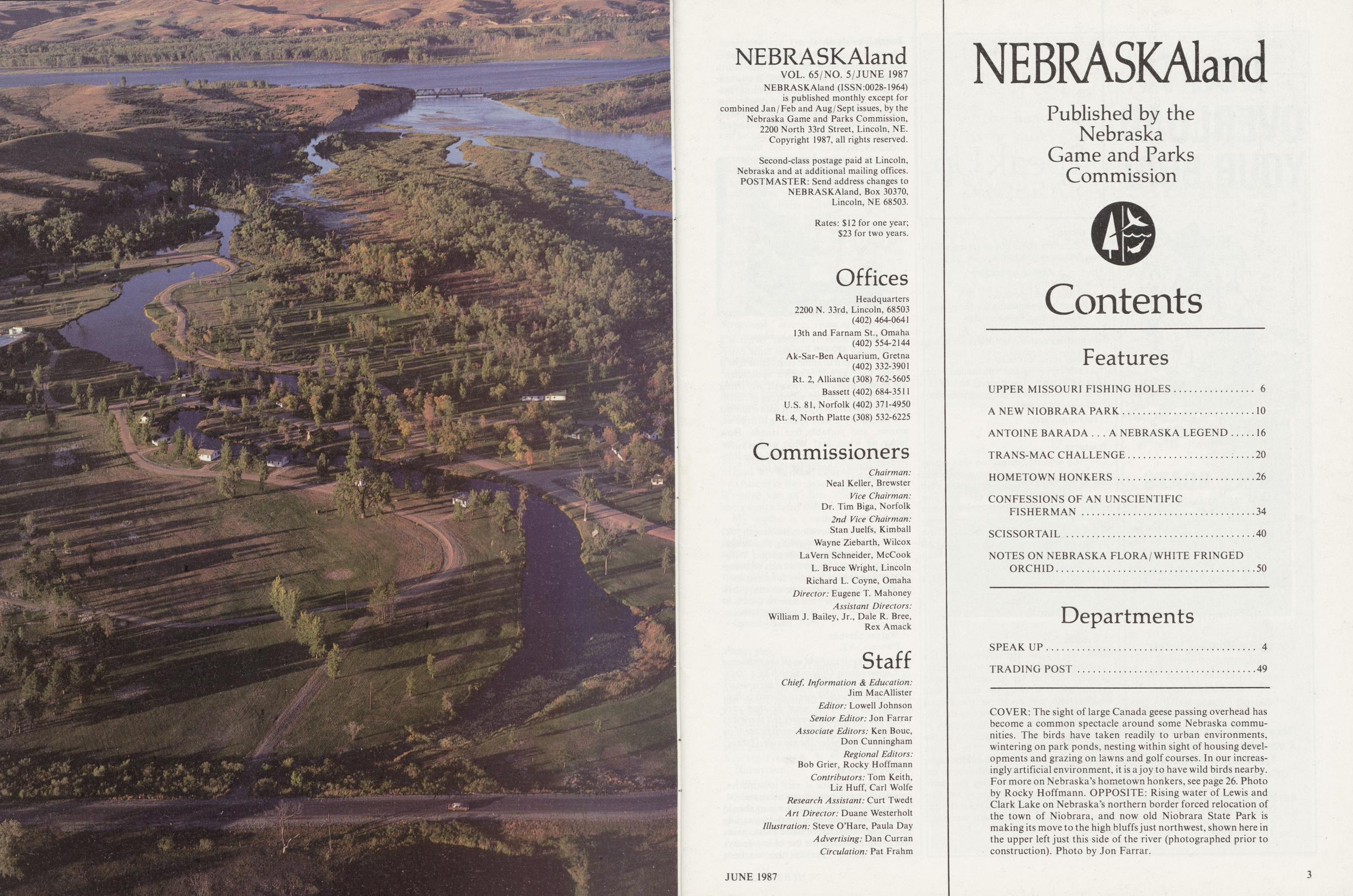
NEBRASKAland
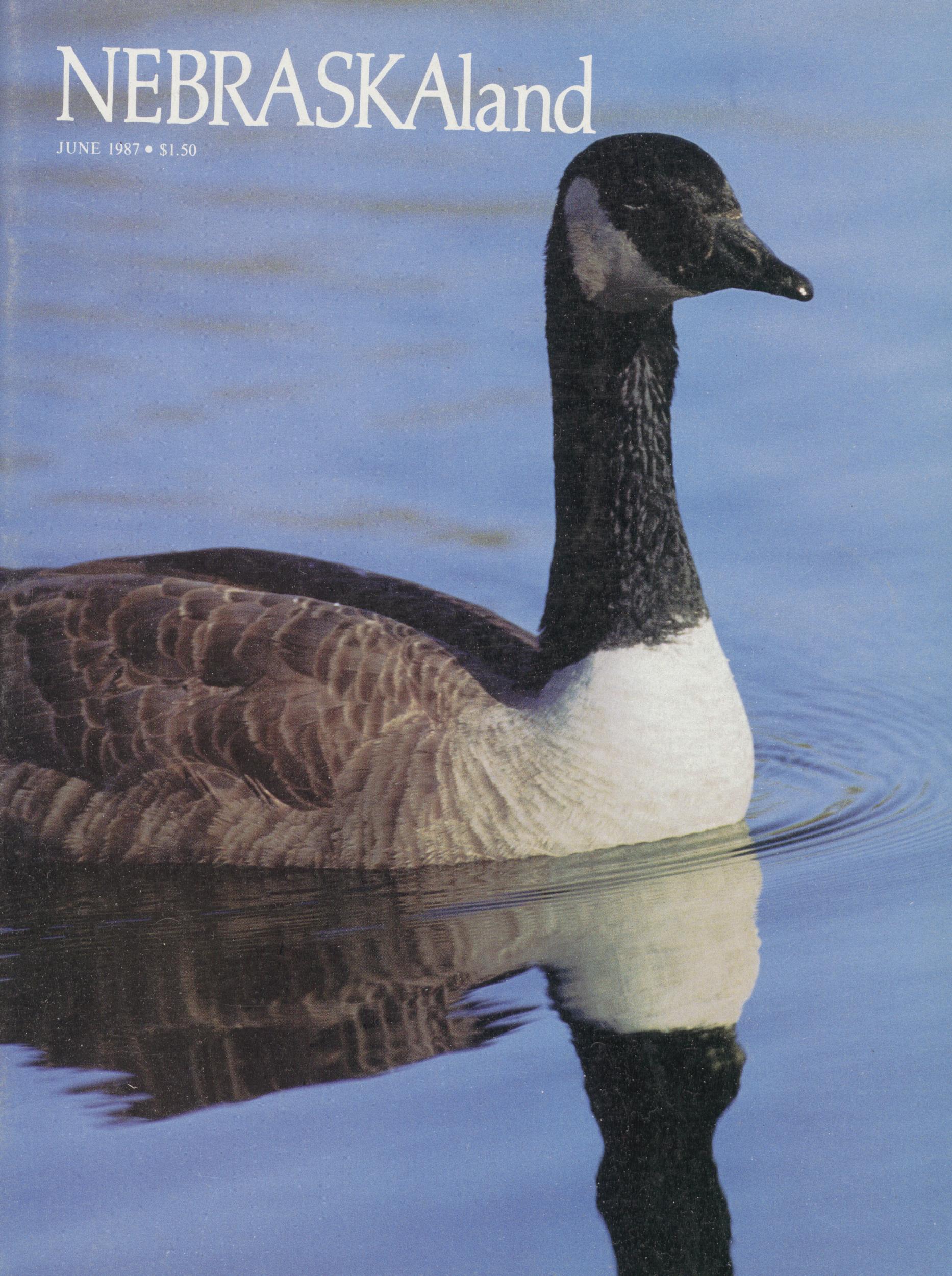
Published by the NEbraska Game and Parks Commission NEBRASKAland VOL. 65/NO. 5/JUNE 1987 NEBRASKAland (ISSN:0028-1964) is published monthly except for combined Jan/Feb and Aug/ Sept issues, by the Nebraska Game and Parks Commission, 2200 North 33rd Street, Lincoln, NE. Copyright 1987, all rights reserved. Second-class postage paid at Lincoln, Nebraska and at additional mailing offices. POSTMASTER: Send address changes to NEBRASKAland, Box 30370, Lincoln, NE 68503. Rates: $12 for one year; $23 for two years. Offices Headquarters 2200 N. 33rd, Lincoln, 68503 (402) 464-0641 13th and Farnam St., Omaha (402) 554-2144 Ak-Sar-Ben Aquarium, Gretna (402) 332-3901 Rt. 2, Alliance (308) 762-5605 Bassett (402) 684-3511 U.S. 81, Norfolk (402) 371-4950 Rt. 4, North Platte (308) 532-6225 Commissioners Chairman: Neal Keller, Brewster Vice Chairman: Dr. Tim Biga, Norfolk 2nd Vice Chairman: Stan Juelfs, Kimball Wayne Ziebarth, Wilcox LaVern Schneider, McCook L. Bruce Wright, Lincoln Richard L. Coyne, Omaha Director: Eugene T. Mahoney Assistant Directors: William J. Bailey, Jr., Dale R. Bree, Rex Amack Staff I "* Chief, Information & Education: Jim MacAllister Editor: Lowell Johnson Senior Editor: Jon Farrar Associate Editors: Ken Bouc, Don Cunningham Regional Editors: Bob Grier, Rocky Hoffmann Contributors: Tom Keith, Liz Huff, Carl Wolfe Research Assistant: Curt Twedt Art Director: Duane Westerholt Illustration: Steve O'Hare, Paula Day Advertising: Dan Cur ran Circulation: Pat Frahm Contents Features UPPER MISSOURI FISHING HOLES................ 6 A NEW NIOBRARA PARK..........................10 ANTOINE BARADA ... A NEBRASKA LEGEND.....16 TRANS-MAC CHALLENGE........................ .20 HOMETOWN HONKERS...........................26 CONFESSIONS OF AN UNSCIENTIFIC FISHERMAN..................................34 SCISSORTAIL .....................................40 NOTES ON NEBRASKA FLORA/WHITE FRINGED ORCHID.......................................50 Departments SPEAK UP......................................... 4 TRADING POST...................................49 COVER: The sight of large Canada geese passing overhead has become a common spectacle around some Nebraska communities. The birds have taken readily to urban environments, wintering on park ponds, nesting within sight of housing developments and grazing on lawns and golf courses. In our increasingly artificial environment, it is a joy to have wild birds nearby. For more on Nebraska's hometown honkers, see page 26. Photo by Rocky Hoffmann. OPPOSITE: Rising water of Lewis and Clark Lake on Nebraska's northern border forced relocation of the town of Niobrara, and now old Niobrara State Park is making its move to the high bluffs just northwest, shown here in the upper left just this side of the river (photographed prior to construction). Photo by Jon Farrar. 3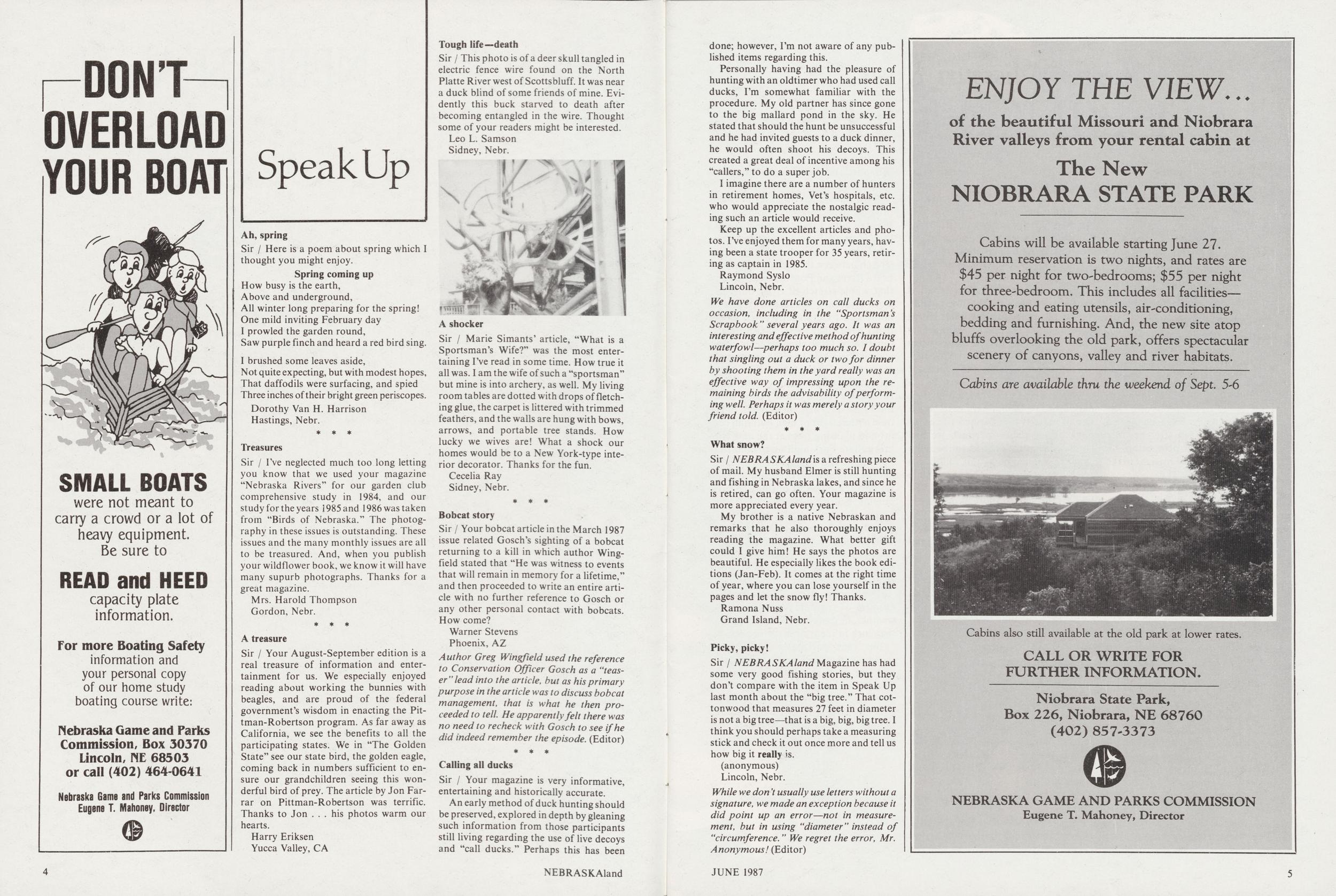
Speak Up
Ah, springSir / Here is a poem about spring which I thought you might enjoy.
Spring coming up How busy is the earth, Above and underground, All winter long preparing for the spring! One mild inviting February day I prowled the garden round, Saw purple finch and heard a red bird sing. I brushed some leaves aside, Not quite expecting, but with modest hopes, That daffodils were surfacing, and spied Three inches of their bright green periscopes. Dorothy Van H. Harrison Hastings, Nebr. * * * TreasuresSir / Tve neglected much too long letting you know that we used your magazine "Nebraska Rivers" for our garden club comprehensive study in 1984, and our study for the years 1985 and 1986 was taken from "Birds of Nebraska." The photography in these issues is outstanding. These issues and the many monthly issues are all to be treasured. And, when you publish your wildflower book, we know it will have many superb photographs. Thanks for a great magazine.
Mrs. Harold Thompson Gordon, Nebr. * * * A treasureSir / Your August-September edition is a real treasure of information and entertainment for us. We especially enjoyed reading about working the bunnies with beagles, and are proud of the federal government's wisdom in enacting the Pittman-Robertson program. As far away as California, we see the benefits to all the participating states. We in "The Golden State" see our state bird, the golden eagle, coming back in numbers sufficient to ensure our grandchildren seeing this wonderful bird of prey. The article by Jon Farrar on Pittman-Robertson was terrific. Thanks to Jon ... his photos warm our hearts.
Harry Eriksen Yucca Valley, CA Tough life—deathSir / This photo is of a deer skull tangled in electric fence wire found on the North Platte River west of Scottsbluff. It was near a duck blind of some friends of mine. Evidently this buck starved to death after becoming entangled in the wire. Thought some of your readers might be interested.
Leo L. Samson Sidney, Nebr.Sir / Marie Simants' article, "What is a Sportsman's Wife?" was the most entertaining I've read in some time. How true it all was. I am the wife of such a "sportsman" but mine is into archery, as well. My living room tables are dotted with drops of fletching glue, the carpet is littered with trimmed feathers, and the walls are hung with bows, arrows, and portable tree stands. How lucky we wives are! What a shock our homes would be to a New York-type interior decorator. Thanks for the fun.
Cecelia Ray Sidney, Nebr. * * * Bobcat storySir / Your bobcat article in the March 1987 issue related Gosch's sighting of a bobcat returning to a kill in which author Wingfield stated that "He was witness to events that will remain in memory for a lifetime," and then proceeded to write an entire article with no further reference to Gosch or any other personal contact with bobcats. How come?
Warner Stevens Phoenix, AZAuthor Greg Wingfield used the reference to Conservation Officer Gosch as a "teaser" lead into the article, but as his primary purpose in the article was to discuss bobcat management, that is what he then proceeded to tell. He apparently felt there was no need to recheck with Gosch to see if he did indeed remember the episode. (Editor)
* * * Calling all ducksSir / Your magazine is very informative, entertaining and historically accurate.
An early method of duck hunting should be preserved, explored in depth by gleaning such information from those participants still living regarding the use of live decoys and "call ducks." Perhaps this has been 4 NEBRASKAland done; however, I'm not aware of any published items regarding this.
Personally having had the pleasure of hunting with an old timer who had used call ducks, I'm somewhat familiar with the procedure. My old partner has since gone to the big mallard pond in the sky. He stated that should the hunt be unsuccessful and he had invited guests to a duck dinner, he would often shoot his decoys. This created a great deal of incentive among his "callers," to do a super job.
I imagine there are a number of hunters in retirement homes, Vet's hospitals, etc. who would appreciate the nostalgic reading such an article would receive.
Keep up the excellent articles and photos. I've enjoyed them for many years, having been a state trooper for 35 years, retiring as captain in 1985.
Raymond Syslo Lincoln, Nebr.We have done articles on call ducks on occasion, including in the "Sportsman's Scrapbook " several years ago. It was an interesting and effective method of hunting waterfowl—perhaps too much so. I doubt that singling out a duck or two for dinner by shooting them in the yard really was an effective way of impressing upon the remaining birds the advisability of performing well. Perhaps it was merely a story your friend told. (Editor)
* * * What snow?Sir / NEBRASKAland is a refreshing piece of mail. My husband Elmer is still hunting and fishing in Nebraska lakes, and since he is retired, can go often. Your magazine is more appreciated every year.
My brother is a native Nebraskan and remarks that he also thoroughly enjoys reading the magazine. What better gift could I give him! He says the photos are beautiful. He especially likes the book editions (Jan-Feb). It comes at the right time of year, where you can lose yourself in the pages and let the snow fly! Thanks.
Ramona Nuss Grand Island, Nebr. Picky, picky!Sir / NEBRASKAland Magazine has had some very good fishing stories, but they don't compare with the item in Speak Up last month about the "big tree." That Cottonwood that measures 27 feet in diameter is not a big tree—that is a big, big, big tree. I think you should perhaps take a measuring stick and check it out once more and tell us how big it really is.
(anonymous) Lincoln, Nebr.While we don't usually use letters without a signature, we made an exception because it did point up an error—not in measurement, but in using "diameter" instead of "circumference. " We regret the error, Mr. Anonymous! (Editor)
ENJOY THE VIEW.,. of the beautiful Missouri and Niobrara River valleys from your rental cabin at The New NIOBRARA STATE PARK Cabins will be available starting June 27. Minimum reservation is two nights, and rates are $45 per night for two-bedrooms; $55 per night for three-bedroom. This includes all facilities—cooking and eating utensils, air-conditioning, bedding and furnishing. And, the new site atop bluffs overlooking the old park, offers spectacular scenery of canyons, valley and river habitats. Cabins are available thru the weekend of Sept 5-6 Cabins also still available at the old park at lower rates, CALL OR WRITE FOR FURTHER INFORMATION. Niobrara State Park, Box 226, Niobrara, NE 68760 (402) 857-3373 NEBRASKA GAME AND PARKS COMMISSION Eugene T, Mahoney, Director JUNE 1987 5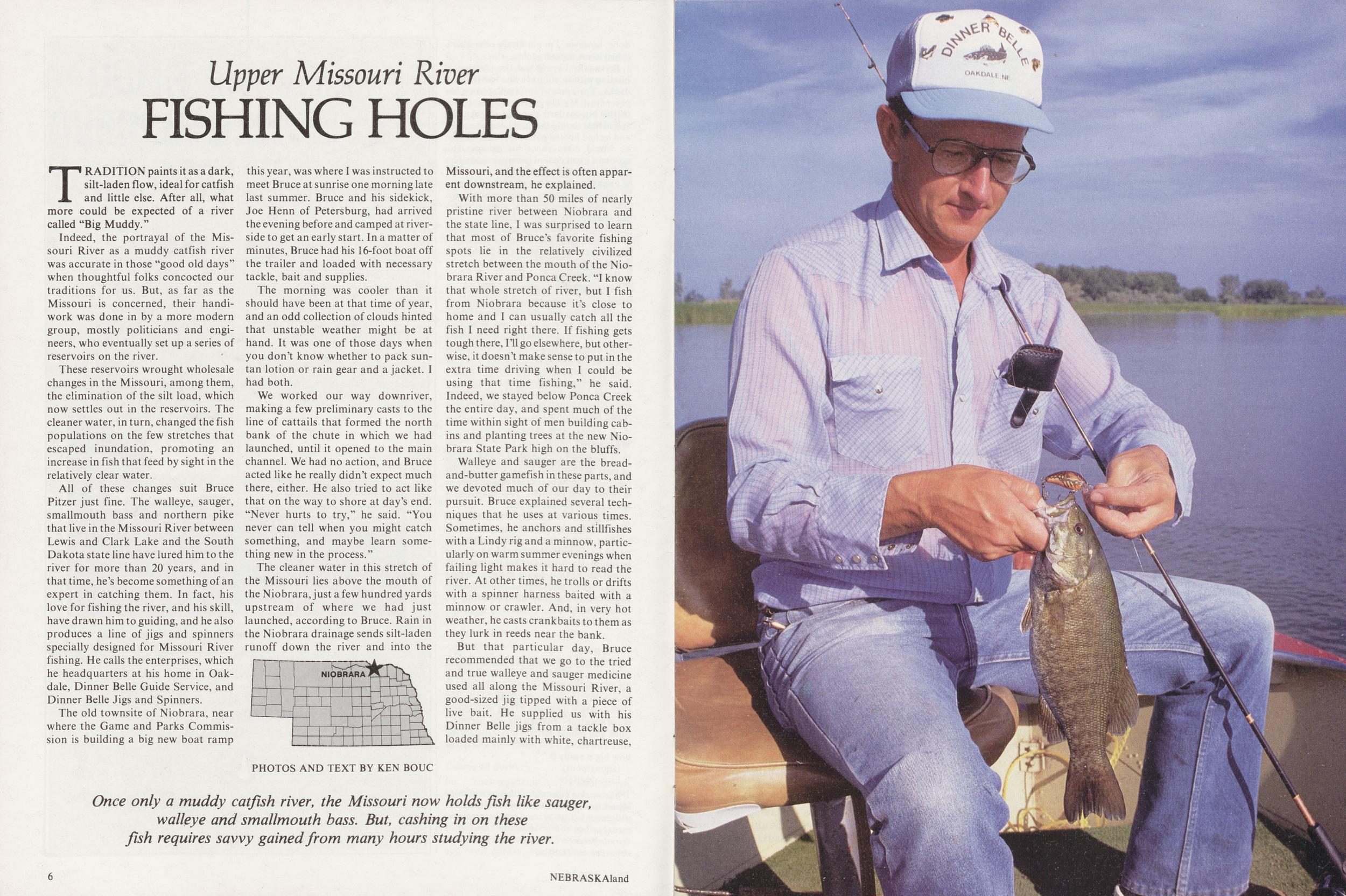
Upper Missouri River FISHING HOLES
TRADITION paints it as a dark, silt-laden flow, ideal for catfish and little else. After all, what more could be expected of a river called "Big Muddy."
Indeed, the portrayal of the Missouri River as a muddy catfish river was accurate in those "good old days" when thoughtful folks concocted our traditions for us. But, as far as the Missouri is concerned, their handiwork was done in by a more modern group, mostly politicians and engineers, who eventually set up a series of reservoirs on the river.
These reservoirs wrought wholesale changes in the Missouri, among them, the elimination of the silt load, which now settles out in the reservoirs. The cleaner water, in turn, changed the fish populations on the few stretches that escaped inundation, promoting an increase in fish that feed by sight in the relatively clear water.
All of these changes suit Bruce Pitzer just fine. The walleye, sauger, smallmouth bass and northern pike that live in the Missouri River between Lewis and Clark Lake and the South Dakota state line have lured him to the river for more than 20 years, and in that time, he's become something of an expert in catching them. In fact, his love for fishing the river, and his skill, have drawn him to guiding, and he also produces a line of jigs and spinners specially designed for Missouri River fishing. He calls the enterprises, which he headquarters at his home in Oakdale, Dinner Belle Guide Service, and Dinner Belle Jigs and Spinners.
The old townsite of Niobrara, near where the Game and Parks Commission is building a big new boat ramp this year, was where I was instructed to meet Bruce at sunrise one morning late last summer. Bruce and his sidekick, Joe Henn of Petersburg, had arrived the evening before and camped at riverside to get an early start. In a matter of minutes, Bruce had his 16-foot boat off the trailer and loaded with necessary tackle, bait and supplies.
The morning was cooler than it should have been at that time of year, and an odd collection of clouds hinted that unstable weather might be at hand. It was one of those days when you don't know whether to pack suntan lotion or rain gear and a jacket. I had both.
We worked our way downriver, making a few preliminary casts to the line of cattails that formed the north bank of the chute in which we had launched, until it opened to the main channel. We had no action, and Bruce acted like he really didn't expect much there, either. He also tried to act like that on the way to shore at day's end. "Never hurts to try," he said. "You never can tell when you might catch something, and maybe learn something new in the process."
The cleaner water in this stretch of the Missouri lies above the mouth of the Niobrara, just a few hundred yards upstream of where we had just launched, according to Bruce. Rain in the Niobrara drainage sends silt-laden runoff down the river and into the Missouri, and the effect is often apparent downstream, he explained.
With more than 50 miles of nearly pristine river between Niobrara and the state line, I was surprised to learn that most of Bruce's favorite fishing spots lie in the relatively civilized stretch between the mouth of the Niobrara River and Ponca Creek. "I know that whole stretch of river, but I fish from Niobrara because it's close to home and I can usually catch all the fish I need right there. If fishing gets tough there, I'll go elsewhere, but otherwise, it doesn't make sense to put in the extra time driving when I could be using that time fishing," he said. Indeed, we stayed below Ponca Creek the entire day, and spent much of the time within sight of men building cabins and planting trees at the new Niobrara State Park high on the bluffs.
Walleye and sauger are the bread-and-butter gamefish in these parts, and we devoted much of our day to their pursuit. Bruce explained several techniques that he uses at various times. Sometimes, he anchors and still fishes with a Lindy rig and a minnow, particularly on warm summer evenings when failing light makes it hard to read the river. At other times, he trolls or drifts with a spinner harness baited with a minnow or crawler. And, in very hot weather, he casts crank baits to them as they lurk in reeds near the bank.
But that particular day, Bruce recommended that we go to the tried and true walleye and sauger medicine used all along the Missouri River, a good-sized jig tipped with a piece of live bait. He supplied us with his Dinner Belle jigs from a tackle box loaded mainly with white, chartreuse, yellow, and yellow-and-black lures, and offered a choice of nightcrawlers or minnows to sweeten them.
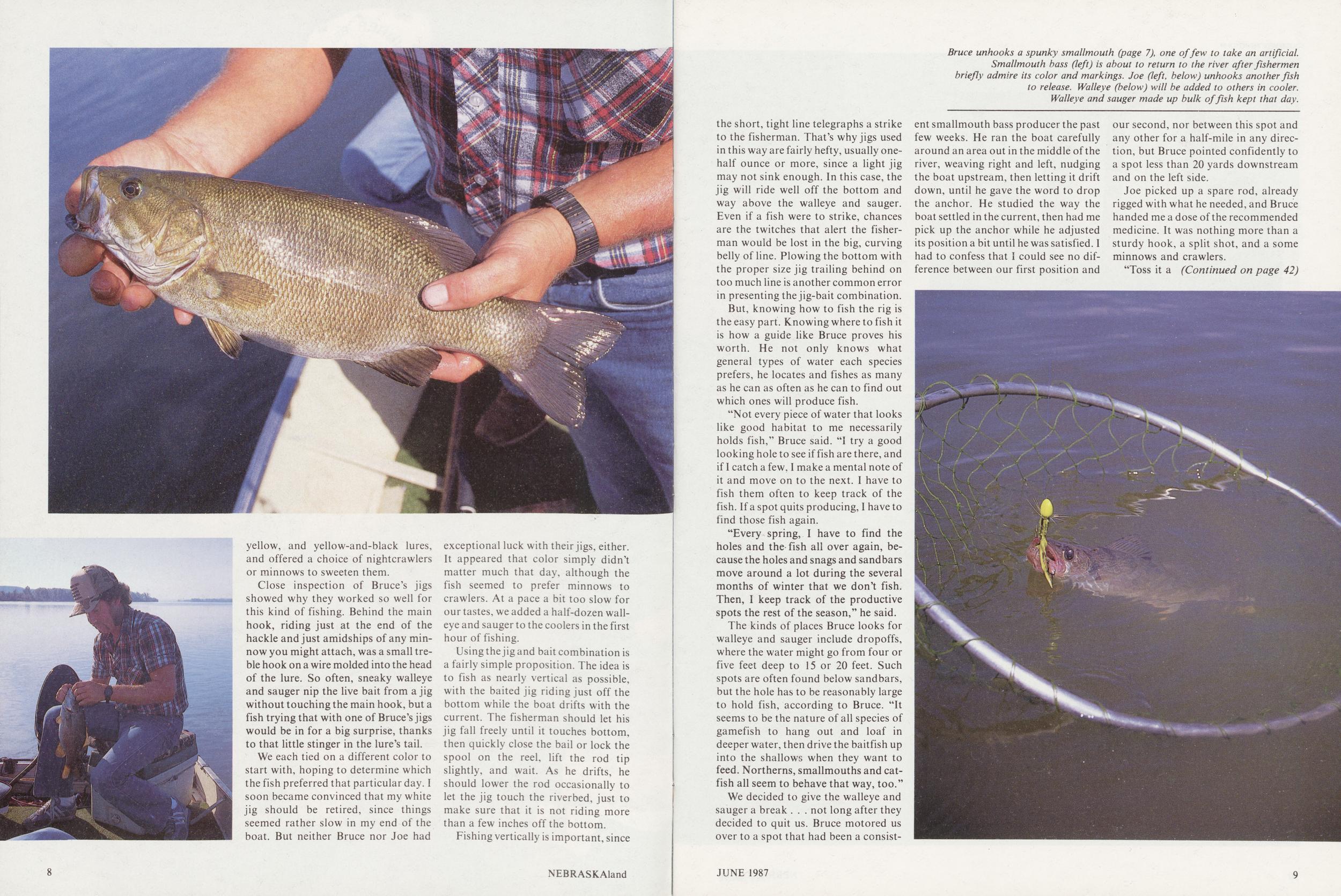
Close inspection of Bruce's jigs showed why they worked so well for this kind of fishing. Behind the main hook, riding just at the end of the hackle and just amidships of any minnow you might attach, was a small treble hook on a wire molded into the head of the lure. So often, sneaky walleye and sauger nip the live bait from a jig without touching the main hook, but a fish trying that with one of Bruce's jigs would be in for a big surprise, thanks to that little stinger in the lure's tail.
We each tied on a different color to start with, hoping to determine which the fish preferred that particular day. I soon became convinced that my white jig should be retired, since things seemed rather slow in my end of the boat. But neither Bruce nor Joe had exceptional luck with their jigs, either. It appeared that color simply didn't matter much that day, although the fish seemed to prefer minnows to crawlers. At a pace a bit too slow for our tastes, we added a half-dozen walleye and sauger to the coolers in the first hour of fishing.
Using the jig and bait combination is a fairly simple proposition. The idea is to fish as nearly vertical as possible, with the baited jig riding just off the bottom while the boat drifts with the current. The fisherman should let his jig fall freely until it touches bottom, then quickly close the bail or lock the spool on the reel, lift the rod tip slightly, and wait. As he drifts, he should lower the rod occasionally to let the jig touch the riverbed, just to make sure that it is not riding more than a few inches off the bottom.
Fishing vertically is important, since 8 NEBRASKAland the short, tight line telegraphs a strike to the fisherman. That's why jigs used in this way are fairly hefty, usually one half ounce or more, since a light jig may not sink enough. In this case, the jig will ride well off the bottom and way above the walleye and sauger. Even if a fish were to strike, chances are the twitches that alert the fisherman would be lost in the big, curving belly of line. Plowing the bottom with the proper size jig trailing behind on too much line is another common error in presenting the jig-bait combination.
But, knowing how to fish the rig is the easy part. Knowing where to fish it is how a guide like Bruce proves his worth. He not only knows what general types of water each species prefers, he locates and fishes as many as he can as often as he can to find out which ones will produce fish.
"Not every piece of water that looks like good habitat to me necessarily holds fish," Bruce said. "I try a good looking hole to see if fish are there, and if I catch a few, I make a mental note of it and move on to the next. I have to fish them often to keep track of the fish. If a spot quits producing, I have to find those fish again.
"Every spring, I have to find the holes and the fish all over again, because the holes and snags and sandbars move around a lot during the several months of winter that we don't fish. Then, I keep track of the productive spots the rest of the season," he said.
The kinds of places Bruce looks for walleye and sauger include drop offs, where the water might go from four or five feet deep to 15 or 20 feet. Such spots are often found below sandbars, but the hole has to be reasonably large to hold fish, according to Bruce. "It seems to be the nature of all species of gamefish to hang out and loaf in deeper water, then drive the baitfish up into the shallows when they want to feed. Northerns, smallmouths and catfish all seem to behave that way, too."
We decided to give the walleye and sauger a break . . . not long after they decided to quit us. Bruce motored us over to a spot that had been a consistent smallmouth bass producer the past few weeks. He ran the boat carefully around an area out in the middle of the river, weaving right and left, nudging the boat upstream, then letting it drift down, until he gave the word to drop the anchor. He studied the way the boat settled in the current, then had me pick up the anchor while he adjusted its position a bit until he was satisfied. I had to confess that I could see no diference between our first position and our second, nor between this spot and any other for a half-mile in any direction, but Bruce pointed confidently to a spot less than 20 yards downstream and on the left side.
Joe picked up a spare rod, already rigged with what he needed, and Bruce handed me a dose of the recommended medicine. It was nothing more than a sturdy hook, a split shot, and a some minnows and crawlers.
"Toss it a (Continued on page 42)
Bruce unhooks a spunky smallmouth (page 7), one of few to take an artificial. Smallmouth bass (left) is about to return to the river after fishermen briefly admire its color and markings. Joe (left, below) unhooks another fish to release. Walleye (below) will be added to others in cooler. Walleye and sauger made up bulk offish kept that day.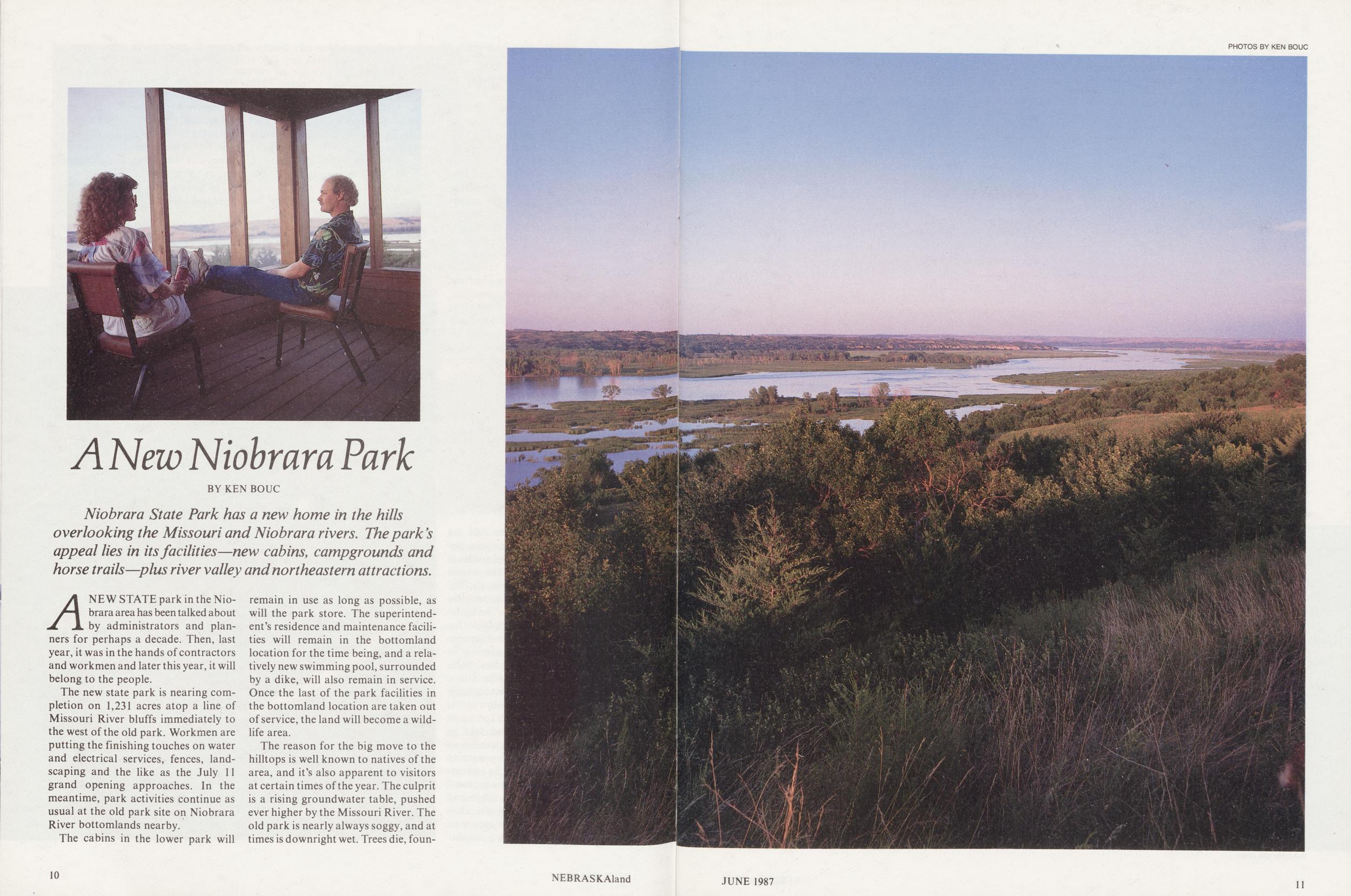
A New Niobrara Park
BY KEN BOUC Niobrara State Park has a new home in the hills overlooking the Missouri and Niobrara rivers. The park's appeal lies in its facilities—new cabins, campgrounds and horse trails—plus river valley and northeastern attractions.A NEW STATE park in the Niobrara area has been talked about jL JL by administrators and planners for perhaps a decade. Then, last year, it was in the hands of contractors and workmen and later this year, it will belong to the people.
The new state park is nearing completion on 1,231 acres atop a line of Missouri River bluffs immediately to the west of the old park. Workmen are putting the finishing touches on water and electrical services, fences, landscaping and the like as the July 11 grand opening approaches. In the meantime, park activities continue as usual at the old park site on Niobrara River bottomlands nearby.
The cabins in the lower park will remain in use as long as possible, as will the park store. The superintendent's residence and maintenance facilities will remain in the bottomland location for the time being, and a relatively new swimming pool, surrounded by a dike, will also remain in service. Once the last of the park facilities in the bottomland location are taken out of service, the land will become a wildlife area.
The reason for the big move to the hilltops is well known to natives of the area, and it's also apparent to visitors at certain times of the year. The culprit is a rising groundwater table, pushed ever higher by the Missouri River. The old park is nearly always soggy, and at times is downright wet. Trees die, dations crack, and roads buckle.
10 NEBRASKAland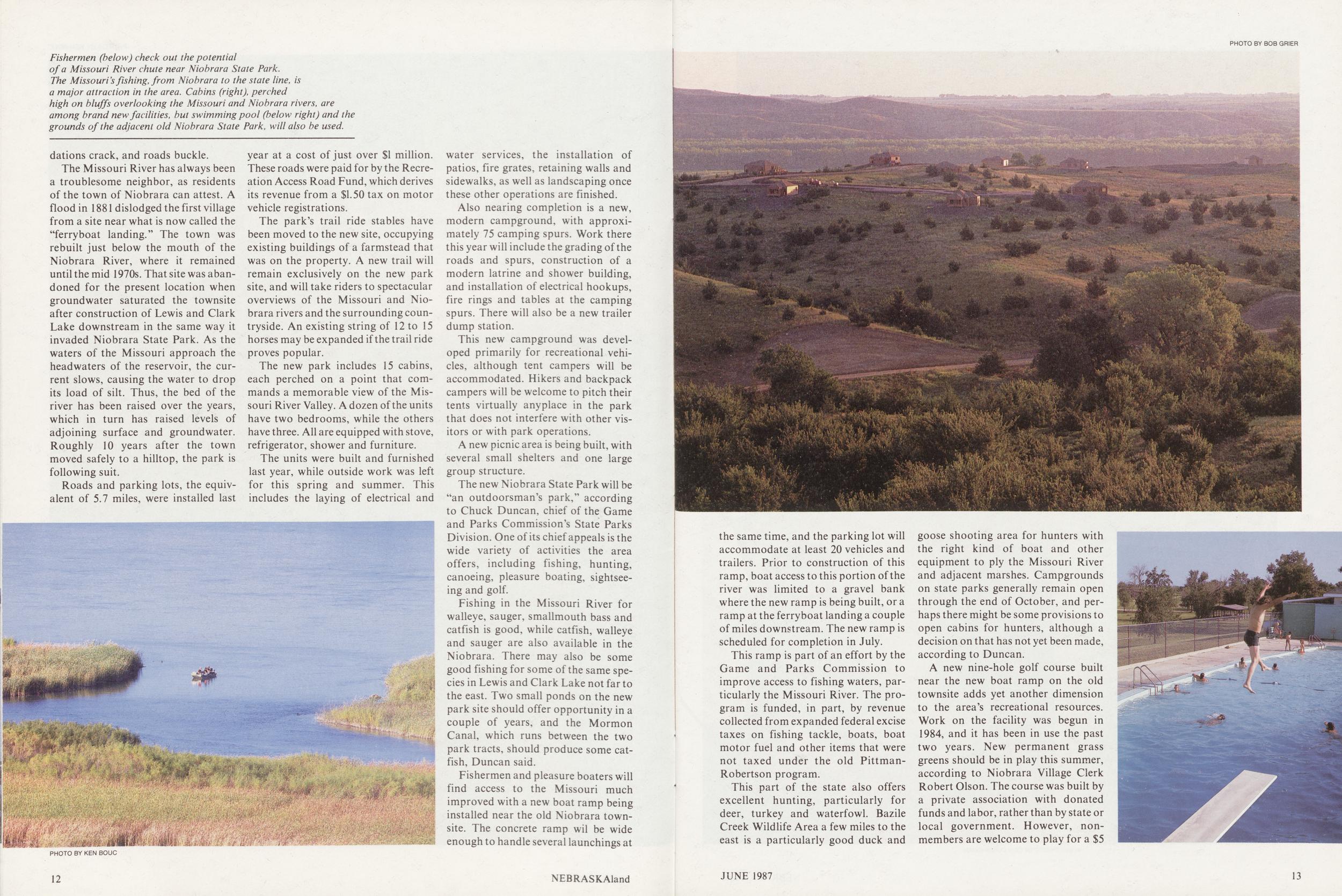 Fishermen (below) check out the potential
of a Missouri River chute near Niobrara State Park.
The Missouri's fishing, from Niobrara to the state line, is
a major attraction in the area. Cabins (right), perched
high on bluffs overlooking the Missouri and Niobrara rivers, are
among brand new facilities, but swimming pool (below right) and the
grounds of the adjacent old Niobrara State Park, will also be used.
Fishermen (below) check out the potential
of a Missouri River chute near Niobrara State Park.
The Missouri's fishing, from Niobrara to the state line, is
a major attraction in the area. Cabins (right), perched
high on bluffs overlooking the Missouri and Niobrara rivers, are
among brand new facilities, but swimming pool (below right) and the
grounds of the adjacent old Niobrara State Park, will also be used.The Missouri River has always been a troublesome neighbor, as residents of the town of Niobrara can attest. A flood in 1881 dislodged the first village from a site near what is now called the "ferryboat landing." The town was rebuilt just below the mouth of the Niobrara River, where it remained until the mid 1970s. That site was abandoned for the present location when groundwater saturated the townsite after construction of Lewis and Clark Lake downstream in the same way it invaded Niobrara State Park. As the waters of the Missouri approach the headwaters of the reservoir, the current slows, causing the water to drop its load of silt. Thus, the bed of the river has been raised over the years, which in turn has raised levels of adjoining surface and groundwater. Roughly 10 years after the town moved safely to a hilltop, the park is following suit.
Roads and parking lots, the equivalent of 5.7 miles, were installed last year at a cost of just over $1 million. These roads were paid for by the Recreation Access Road Fund, which derives its revenue from a $1.50 tax on motor vehicle registrations.
The park's trail ride stables have been moved to the new site, occupying existing buildings of a farmstead that was on the property. A new trail will remain exclusively on the new park site, and will take riders to spectacular overviews of the Missouri and Niobrara rivers and the surrounding countryside. An existing string of 12 to 15 horses may be expanded if the trail ride proves popular.
The new park includes 15 cabins, each perched on a point that commands a memorable view of the Missouri River Valley. A dozen of the units have two bedrooms, while the others have three. All are equipped with stove, refrigerator, shower and furniture.
The units were built and furnished last year, while outside work was left for this spring and summer. This includes the laying of electrical and water services, the installation of patios, fire grates, retaining walls and sidewalks, as well as landscaping once these other operations are finished.
Also nearing completion is a new, modern campground, with approximately 75 camping spurs. Work there this year will include the grading of the roads and spurs, construction of a modern latrine and shower building, and installation of electrical hookups, fire rings and tables at the camping spurs. There will also be a new trailer dump station.
This new campground was developed primarily for recreational vehicles, although tent campers will be accommodated. Hikers and backpack campers will be welcome to pitch their tents virtually anyplace in the park that does not interfere with other visitors or with park operations.
A new picnic area is being built, with several small shelters and one large group structure.
The new Niobrara State Park will be "an outdoorsman's park," according to Chuck Duncan, chief of the Game and Parks Commission's State Parks Division. One of its chief appeals is the wide variety of activities the area offers, including fishing, hunting, canoeing, pleasure boating, sightseeing and golf.
Fishing in the Missouri River for walleye, sauger, smallmouth bass and catfish is good, while catfish, walleye and sauger are also available in the Niobrara. There may also be some good fishing for some of the same species in Lewis and Clark Lake not far to the east. Two small ponds on the new park site should offer opportunity in a couple of years, and the Mormon Canal, which runs between the two park tracts, should produce some catfish, Duncan said.
Fishermen and pleasure boaters will find access to the Missouri much improved with a new boat ramp being installed near the old Niobrara townsite. The concrete ramp will be wide enough to handle several launchings at 12 NEBRASKAland the same time, and the parking lot will accommodate at least 20 vehicles and trailers. Prior to construction of this ramp, boat access to this portion of the river was limited to a gravel bank where the new ramp is being built, or a ramp at the ferryboat landing a couple of miles downstream. The new ramp is scheduled for completion in July.
PHOTO BY BOB GRIERThis ramp is part of an effort by the Game and Parks Commission to improve access to fishing waters, particularly the Missouri River. The program is funded, in part, by revenue collected from expanded federal excise taxes on fishing tackle, boats, boat motor fuel and other items that were not taxed under the old Pittman-Robertson program.
This part of the state also offers excellent hunting, particularly for deer, turkey and waterfowl. Bazile Creek Wildlife Area a few miles to the east is a particularly good duck and goose shooting area for hunters with the right kind of boat and other equipment to ply the Missouri River and adjacent marshes. Campgrounds on state parks generally remain open through the end of October, and perhaps there might be some provisions to open cabins for hunters, although a decision on that has not yet been made, according to Duncan.
A new nine-hole golf course built near the new boat ramp on the old townsite adds yet another dimension to the area's recreational resources. Work on the facility was begun in 1984, and it has been in use the past two years. New permanent grass greens should be in play this summer, according to Niobrara Village Clerk Robert Olson. The course was built by a private association with donated funds and labor, rather than by state or local government. However, non-members are welcome to play for a $5 greens fee paid on an honor system.
JUNE 1987 13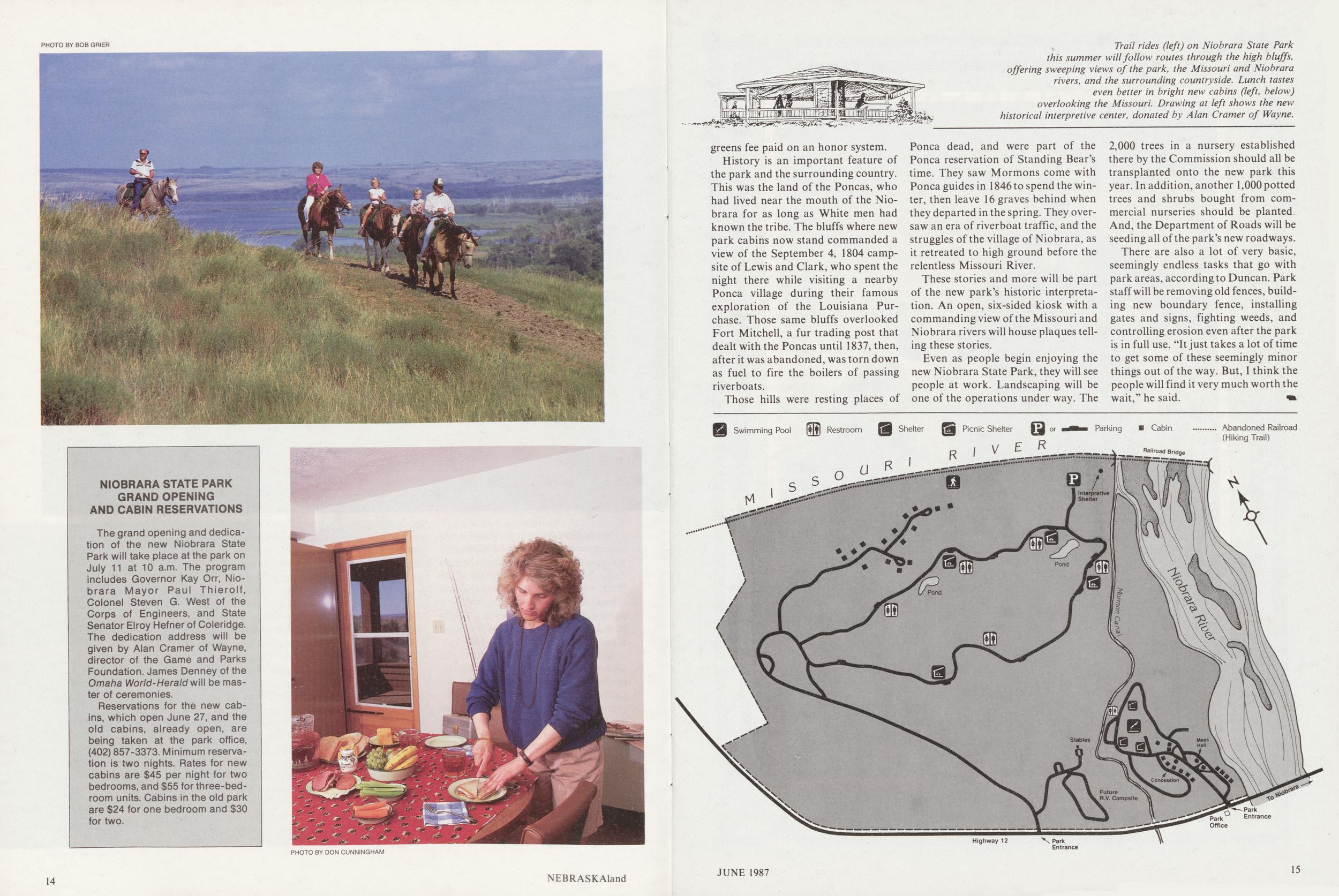
The grand opening and dedication of the new Niobrara State Park will take place at the park on July 11 at 10 a.m. The program includes Governor Kay Orr, Niobrara Mayor Paul Thierolf, Colonel Steven G. West of the Corps of Engineers, and State Senator Eiroy Hefner of Coleridge. The dedication address will be given by Alan Cramer of Wayne, director of the Game and Parks Foundation. James Denney of the Omaha World-Herald will be master of ceremonies.
Reservations for the new cabins, which open June 27, and the old cabins, already open, are being taken at the park office, (402) 857-3373. Minimum reservation is two nights. Rates for new cabins are $45 per night for two bedrooms, and $55 for three-bedroom units. Cabins in the old park are $24 for one bedroom and $30 for two.
History is an important feature of the park and the surrounding country. This was the land of the Poncas, who had lived near the mouth of the Niobrara for as long as White men had known the tribe. The bluffs where new park cabins now stand commanded a view of the September 4, 1804 campsite of Lewis and Clark, who spent the night there while visiting a nearby Ponca village during their famous exploration of the Louisiana Purchase. Those same bluffs overlooked Fort Mitchell, a fur trading post that dealt with the Poncas until 1837, then, after it was abandoned, was torn down as fuel to fire the boilers of passing riverboats.
Those hills were resting places of Ponca dead, and were part of the Ponca reservation of Standing Bear's time. They saw Mormons come with Ponca guides in 1846 to spend the winter, then leave 16 graves behind when they departed in the spring. They oversaw an era of riverboat traffic, and the struggles of the village of Niobrara, as it retreated to high ground before the relentless Missouri River.
These stories and more will be part of the new park's historic interpretation. An open, six-sided kiosk with a commanding view of the Missouri and Niobrara rivers will house plaques telling these stories.
Even as people begin enjoying the new Niobrara State Park, they will see people at work. Landscaping will be one of the operations under way. The 2,000 trees in a nursery established there by the Commission should all be transplanted onto the new park this year. In addition, another 1,000 potted trees and shrubs bought from commercial nurseries should be planted And, the Department of Roads will be seeding all of the park's new roadways.
There are also a lot of very basic, seemingly endless tasks that go with park areas, according to Duncan. Park staff will be removing old fences, building new boundary fence, installing gates and signs, fighting weeds, and controlling erosion even after the park is in full use. "It just takes a lot of time to get some of these seemingly minor things out of the way. But, I think the people will find it very much worth the wait," he said.
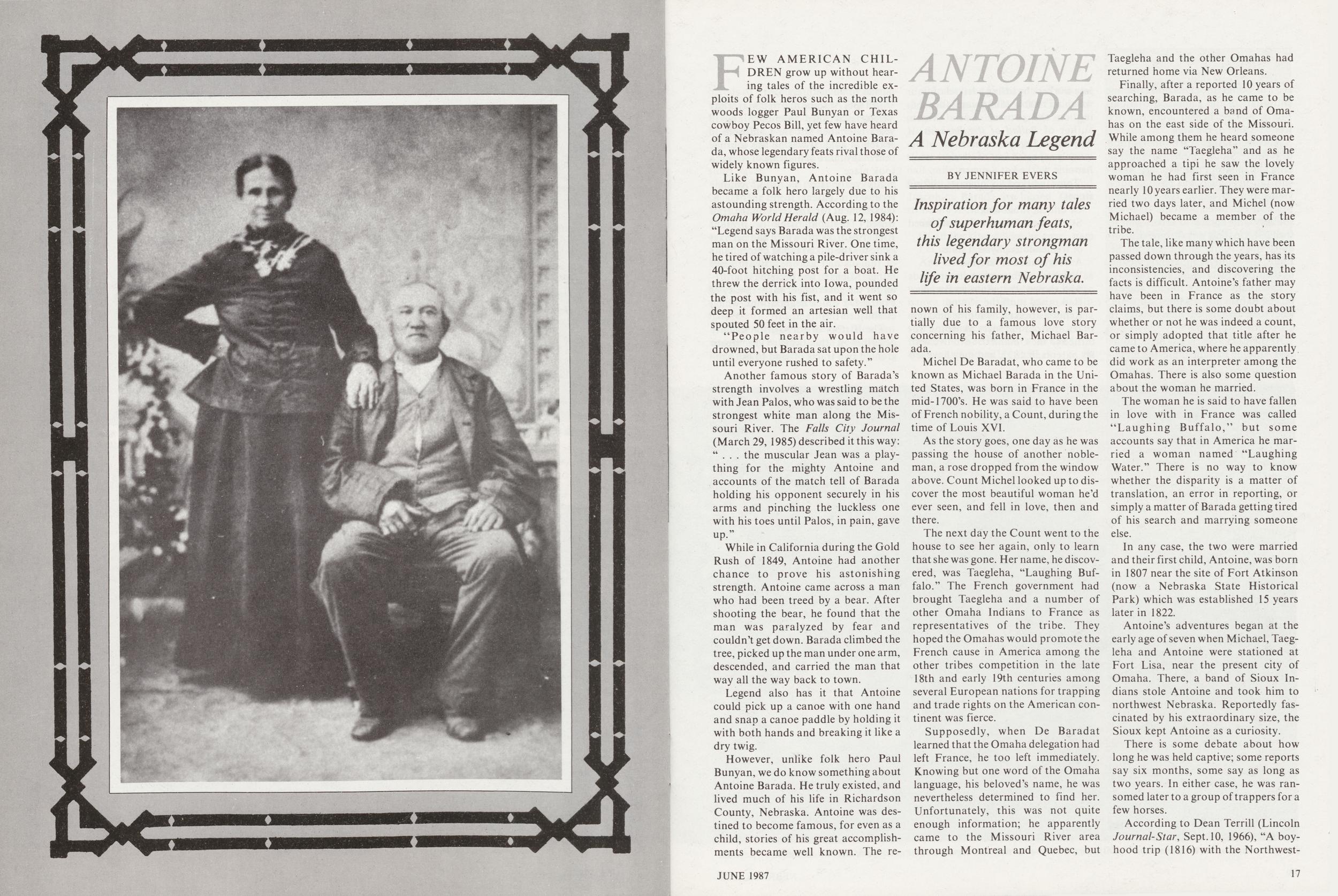
ANTOINE BARADA A Nebraska Legend
BY JENNIFER EVERS Inspiration for many tales of superhuman feats, this legendary strongman lived for most of his life in eastern Nebraska.EW AMERICAN CHILDREN grow up without hearing tales of the incredible exploits of folk heroes such as the north woods logger Paul Bunyan or Texas cowboy Pecos Bill, yet few have heard of a Nebraskan named Antoine Barada, whose legendary feats rival those of widely known figures.
Like Bunyan, Antoine Barada became a folk hero largely due to his astounding strength. According to the Omaha World Herald (Aug. 12, 1984): "Legend says Barada was the strongest man on the Missouri River. One time, he tired of watching a pile-driver sink a 40-foot hitching post for a boat. He threw the derrick into Iowa, pounded the post with his fist, and it went so deep it formed an artesian well that spouted 50 feet in the air.
"People nearby would have drowned, but Barada sat upon the hole until everyone rushed to safety."
Another famous story of Barada's strength involves a wrestling match with Jean Palos, who was said to be the strongest white man along the Missouri River. The Falls City Journal (March 29, 1985) described it this way: "... the muscular Jean was a plaything for the mighty Antoine and accounts of the match tell of Barada holding his opponent securely in his arms and pinching the luckless one with his toes until Palos, in pain, gave up."
While in California during the Gold Rush of 1849, Antoine had another chance to prove his astonishing strength. Antoine came across a man who had been treed by a bear. After shooting the bear, he found that the man was paralyzed by fear and couldn't get down. Barada climbed the tree, picked up the man under one arm, descended, and carried the man that way all the way back to town.
Legend also has it that Antoine could pick up a canoe with one hand and snap a canoe paddle by holding it with both hands and breaking it like a dry twig.
However, unlike folk hero Paul Bunyan, we do know something about Antoine Barada. He truly existed, and lived much of his life in Rich ardsoe County, Nebraska. Antoine was destined to become famous, for even as a child, stories of his great accomplishments became well known. The renown of his family, however, is partially due to a famous love story concerning his father, Michael Barada.
Michel De Barada, who came to be known as Michael Barada in the United States, was born in France in the mid-1700's. He was said to have been of French nobility, a Count, during the time of Louis XVI.
As the story goes, one day as he was passing the house of another nobleman, a rose dropped from the window above. Count Michel looked up to discover the most beautiful woman he'd ever seen, and fell in love, then and there.
The next day the Count went to the house to see her again, only to learn that she was gone. Her name, he discovered, was Taegleha, "Laughing Buffalo." The French government had brought Taegleha and a number of other Omaha Indians to France as representatives of the tribe. They hoped the Omaha’s would promote the French cause in America among the other tribes competition in the late 18th and early 19th centuries among several European nations for trapping and trade rights on the American continent was fierce.
Supposedly, when De Barada learned that the Omaha delegation had left France, he too left immediately. Knowing but one word of the Omaha language, his beloved's name, he was nevertheless determined to find her. Unfortunately, this was not quite enough information; he apparently came to the Missouri River area through Montreal and Quebec, but Taegleha and the other Omahas had returned home via New Orleans.
Finally, after a reported 10 years of searching, Barada, as he came to be known, encountered a band of Omahas on the east side of the Missouri. While among them he heard someone say the name "Taegleha" and as he approached a tipi he saw the lovely woman he had first seen in France nearly 10 years earlier. They were married two days later, and Michel (now Michael) became a member of the tribe.
The tale, like many which have been passed down through the years, has its inconsistencies, and discovering the facts is difficult. Antoine's father may have been in France as the story claims, but there is some doubt about whether or not he was indeed a count, or simply adopted that title after he came to America, where he apparently did work as an interpreter among the Omahas. There is also some question about the woman he married.
The woman he is said to have fallen in love with in France was called "Laughing Buffalo," but some accounts say that in America he married a woman named "Laughing Water." There is no way to know whether the disparity is a matter of translation, an error in reporting, or simply a matter of Barada getting tired of his search and marrying someone else.
In any case, the two were married and their first child, Antoine, was born in 1807 near the site of Fort Atkinson (now a Nebraska State Historical Park) which was established 15 years later in 1822.
Antoine's adventures began at the early age of seven when Michael, Taegleha and Antoine were stationed at Fort Lisa, near the present city of Omaha. There, a band of Sioux Indians stole Antoine and took him to northwest Nebraska. Reportedly fascinated by his extraordinary size, the Sioux kept Antoine as a curiosity.
There is some debate about how long he was held captive; some reports say six months, some say as long as two years. In either case, he was ransomed later to a group of trappers for a few horses.
According to Dean Terrill (Lincoln
Journal-Star, Sept. 10, 1966),
"A boyhood trip (1816) with the Northwestern
JUNE 1987
17
 Fur Company, made him a lifetime
enthusiast of the game-rich Missouri
Bluffs, and he helped greet the first
white settlers of the area."
Fur Company, made him a lifetime
enthusiast of the game-rich Missouri
Bluffs, and he helped greet the first
white settlers of the area."
Antoine's father and mother, afraid of further "Sioux threats," decided to send him to West Point Military Academy (at this time is was possible for a young boy to attend the academy). Michael entrusted Antoine to a few soldiers who agreed to escort him to the East. On their way through Carondolet, just south of the city of St. Louis, the soldiers, apparently victims of their own inebriation, lost the boy.
Eventually he was found, and returned to his aunt, a Mme. Mousette, who then convinced him to stay in Carondolet with her.
As the story goes, it was in St. Louis that Antoine Barada impressed his fellow workers by lifting a barrel of flour weighing 1500 or 1800 pounds (depending on the source). Lucia Ahern, author of Ballad of the Baradas: A Nebraska Legend, writes of a frequently repeated feat of strength while Antoine worked at a quarry:
Toine worked in quarries, lifting stones Of unbelievable weight. St. Louis noticed this half-breed man of tremendous physical state. A doorsill of the Arsenal Weighed seventeen hundred pounds And showed that Antoine Barada Had raised it off the ground.Reports are sketchy for the next few years, but apparently Antoine returned to the Omaha tribe to live with his parents in 1832, and may have led parties of adventurers west.
In 1836, Antoine married Marcellite Veien, later called Josephine, and 13 years later they left for California in search of gold. It was on this journey that many more of his feats of strength took place.
Six years later, in 1855, Antoine received a patent from the U. S. Government for 320 acres on the Half Breed Tract, an area in present Richardson county which had been set aside for the mixed blood descendants of Indians and Europeans. Antoine's father, Michael, had been the interpreter for the government at the Treaty of Prairie Du Chien negotiations, which established this tract.
The History of Richardson County describes it this way: "The treaty granted two tracts of land to the half-breeds 18 NEBRASKAland of five tribes. One of the tracts, 125,000 acres known as The Half-Breed Tract, extended along the Nebraska side of the Missouri River at Rulo to the Little Nemaha River at Auburn and ten miles west of the Missouri River."
According to the plaque on a granite rock on the Bryce Handly farm west of the town of Barada in Richardson County, Antoine Barada was "Founder of Barada Township in 1856, he was a half-breed Indian scout and farmer, being the first to settle here."
This would lead one to think that the town was named for Antoine. However, some feel that the town was named by Antoine for his father, Michael. Still others believe the town was simply called Barada because the family lived there.
Antoine lived in Barada for the rest of his life, making frequent trips north to visit the Omaha tribe of his mother. He died in 1885.
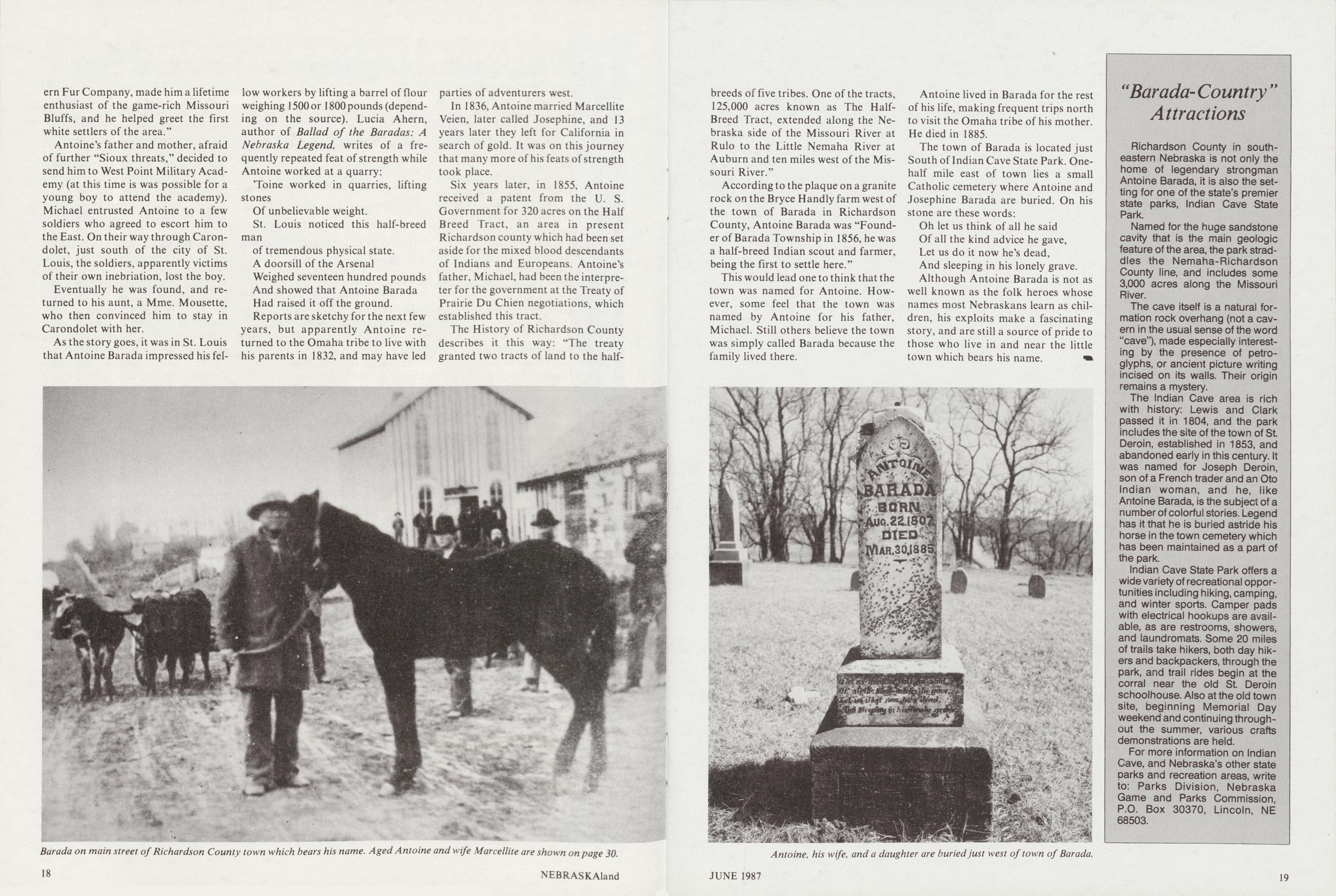
The town of Barada is located just South of Indian Cave State Park. One-half mile east of town lies a small Catholic cemetery where Antoine and Josephine Barada are buried. On his stone are these words:
Oh let us think of all he said Of all the kind advice he gave, Let us do it now he's dead, And sleeping in his lonely grave.Although Antoine Barada is not as well known as the folk heroes whose names most Nebraskans learn as children, his exploits make a fascinating story, and are still a source of pride to those who live in and near the little town which bears his name.
Richardson County in southeastern Nebraska is not only the home of legendary strongman Antoine Barada, it is also the setting for one of the state's premier state parks, Indian Cave State Park.
Named for the huge sandstone cavity that is the main geologic feature of the area, the park straddles the Nemaha-Richardson County line, and includes some 3,000 acres along the Missouri River.
The cave itself is a natural formation rock overhang (not a cavern in the usual sense of the word "cave"), made especially interesting by the presence of petroglyphs, or ancient picture writing incised on its walls. Their origin remains a mystery.
The Indian Cave area is rich with history: Lewis and Clark passed it in 1804, and the park includes the site of the town of St Deroin, established in 1853, and abandoned early in this century, it was named for Joseph Deroin, son of a French trader and an Oto Indian woman, and he, like Antoine Barada, is the subject of a number of colorful stories. Legend has it that he is buried astride his horse in the town cemetery which has been maintained as a part of the park.
Indian Cave State Park offers a wide variety of recreational opportunities including hiking, camping, and winter sports. Camper pads with electrical hookups are available, as are restrooms, showers, and laundromats. Some 20 miles of trails take hikers, both day hikers and backpackers, through the park, and trail rides begin at the corral near the old St. Deroin schoolhouse. Also at the old town site, beginning Memorial Day weekend and continuing throughout the summer, various crafts demonstrations are held.
For more information on Indian Cave, and Nebraska's other state parks and recreation areas, write to: Parks Division, Nebraska Game and Parks Commission, P.O. Box 30370, Lincoln, NE 68503.
JUNE 1987 19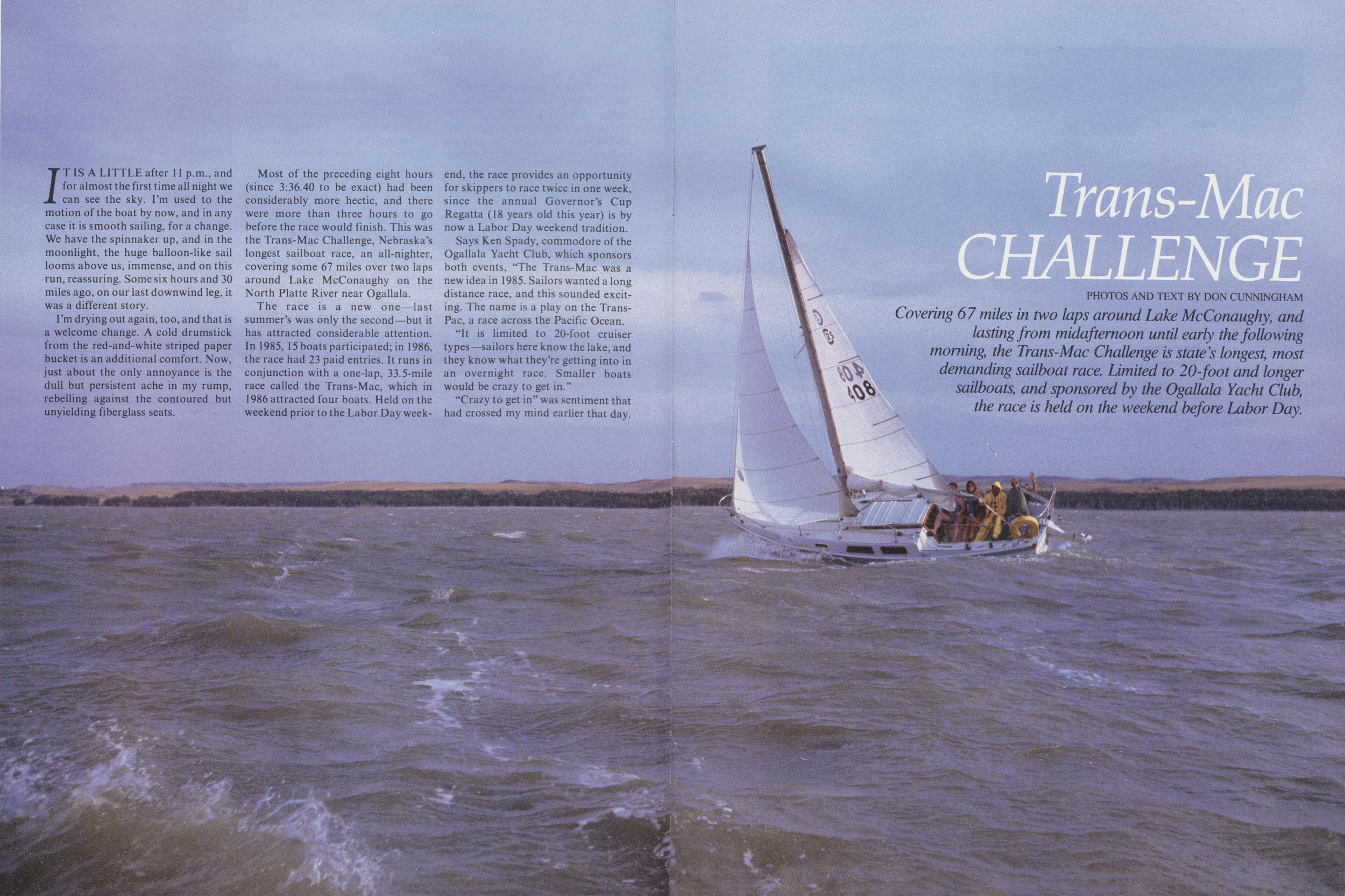
Trans-Mac CHALLENGE
IT IS A LITTLE after 11 p.m., and for almost the first time all night we can see the sky. I'm used to the motion of the boat by now, and in any case it is smooth sailing, for a change. We have the spinnaker up, and in the moonlight, the huge balloon-like sail looms above us, immense, and on this run, reassuring. Some six hours and 30 miles ago, on our last downwind leg, it was a different story.
I'm drying out again, too, and that is a welcome change. A cold drumstick from the red-and-white striped paper bucket is an additional comfort. Now, just about the only annoyance is the dull but persistent ache in my rump, rebelling against the contoured but unyielding fiberglass seats.
Most of the preceding eight hours (since 3:36.40 to be exact) had been considerably more hectic, and there were more than three hours to go before the race would finish. This was the Trans-Mac Challenge, Nebraska's longest sailboat race, an all-nighter, covering some 67 miles over two laps around Lake McConaughy on the North Platte River near Ogallala.
The race is a new one—last summer's was only the second—but it has attracted considerable attention. In 1985, 15 boats participated; in 1986, the race had 23 paid entries. It runs in conjunction with a one-lap, 33.5-mile race called the Trans-Mac, which in 1986 attracted four boats. Held on the weekend prior to the Labor Day weekend, the race provides an opportunity for skippers to race twice in one week, since the annual Governor's Cup Regatta (18 years old this year) is by now a Labor Day weekend tradition.
Says Ken Spady, commodore of the Ogallala Yacht Club, which sponsors both events, "The Trans-Mac was a new idea in 1985. Sailors wanted a long distance race, and this sounded exciting. The name is a play on the TransPac, a race across the Pacific Ocean.
"It is limited to 20-foot cruiser types—sailors here know the lake, and they know what they're getting into in an overnight race. Smaller boats would be crazy to get in."
"Crazy to get in" was sentiment that had crossed my mind earlier that day. At least the weather was clear, and the forecast not particularly threatening. I'd been getting graphic descriptions of the previous year's race, and its 1 a.m. tacking duels down the middle of the lake, illuminated by lightning bolts and spiced by driving rain. The boat I was to be in, Ogallala skipper Dave Doll's Santana 525, looked plenty roomy for a few hours' cruising, but the thought of four of us spending up to 12 hours in it, and most of that time in the dark, shrank its cabin and cockpit remarkably.
PHOTOS AND TEXT BY DON CUNNINGHAM Covering 67 miles in two laps around Lake McConaughy, and lasting from midafternoon until early the following morning, the Trans-Mac Challenge is state's longest, most demanding sailboat race. Limited to 20-foot and longer sailboats, and sponsored by the Ogallala Yacht Club, the race is held on the weekend before Labor Day.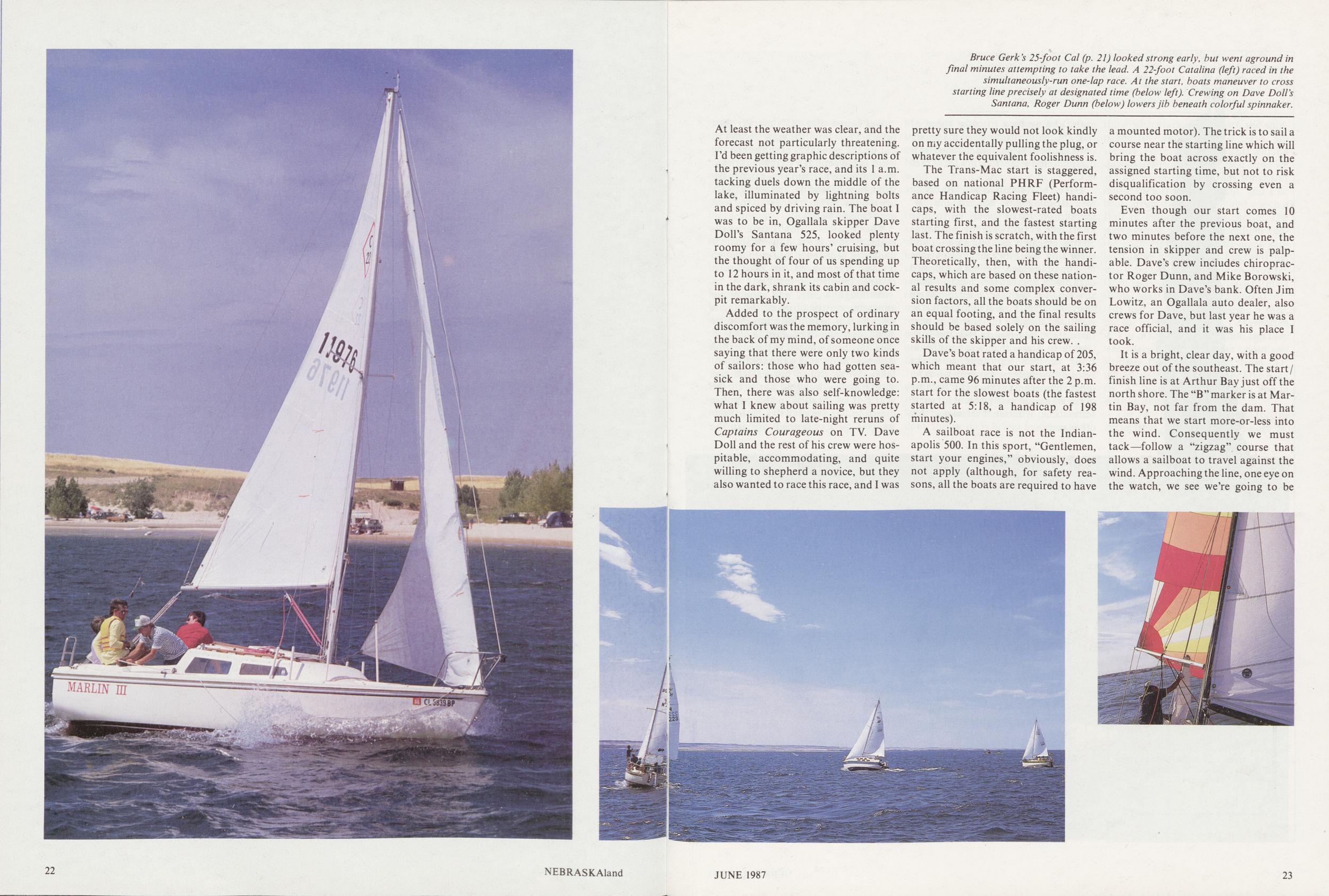
Added to the prospect of ordinary discomfort was the memory, lurking in the back of my mind, of someone once saying that there were only two kinds of sailors: those who had gotten seasick and those who were going to. Then, there was also self-knowledge: what I knew about sailing was pretty much limited to late-night reruns of Captains Courageous on TV. Dave Doll and the rest of his crew were hospitable, accommodating, and quite willing to shepherd a novice, but they also wanted to race this race, and I was pretty sure they would not look kindly on my accidentally pulling the plug, or whatever the equivalent foolishness is.
The Trans-Mac start is staggered, based on national PHRF (Performance Handicap Racing Fleet) handicaps, with the slowest-rated boats starting first, and the fastest starting last. The finish is scratch, with the first boat crossing the line being the winner. Theoretically, then, with the handicaps, which are based on these national results and some complex conversion factors, all the boats should be on an equal footing, and the final results should be based solely on the sailing skills of the skipper and his crew. .
Dave's boat rated a handicap of 205, which meant that our start, at 3:36 p.m., came 96 minutes after the 2 p.m. start for the slowest boats (the fastest started at 5:18, a handicap of 198 minutes).
A sailboat race is not the Indianapolis 500. In this sport, "Gentlemen, start your engines," obviously, does not apply (although, for safety reasons, all the boats are required to have a mounted motor). The trick is to sail a course near the starting line which will bring the boat across exactly on the assigned starting time, but not to risk disqualification by crossing even a second too soon.
Even though our start comes 10 minutes after the previous boat, and two minutes before the next one, the tension in skipper and crew is palpable. Dave's crew includes chiropractor Roger Dunn, and Mike Borowski, who works in Dave's bank. Often Jim Lowitz, an Ogallala auto dealer, also crews for Dave, but last year he was a race official, and it was his place I took.
It is a bright, clear day, with a good breeze out of the southeast. The start/ finish line is at Arthur Bay just off the north shore. The "B" marker is at Martin Bay, not far from the dam. That means that we start more-or-less into the wind. Consequently we must tack—follow a "zigzag" course that allows a sailboat to travel against the wind. Approaching the line, one eye on the watch, we see we're going to be early, and we have to come about or risk disqualification. The maneuver costs us about 40 seconds, but no one is disappointed—there's still a lot of race left.
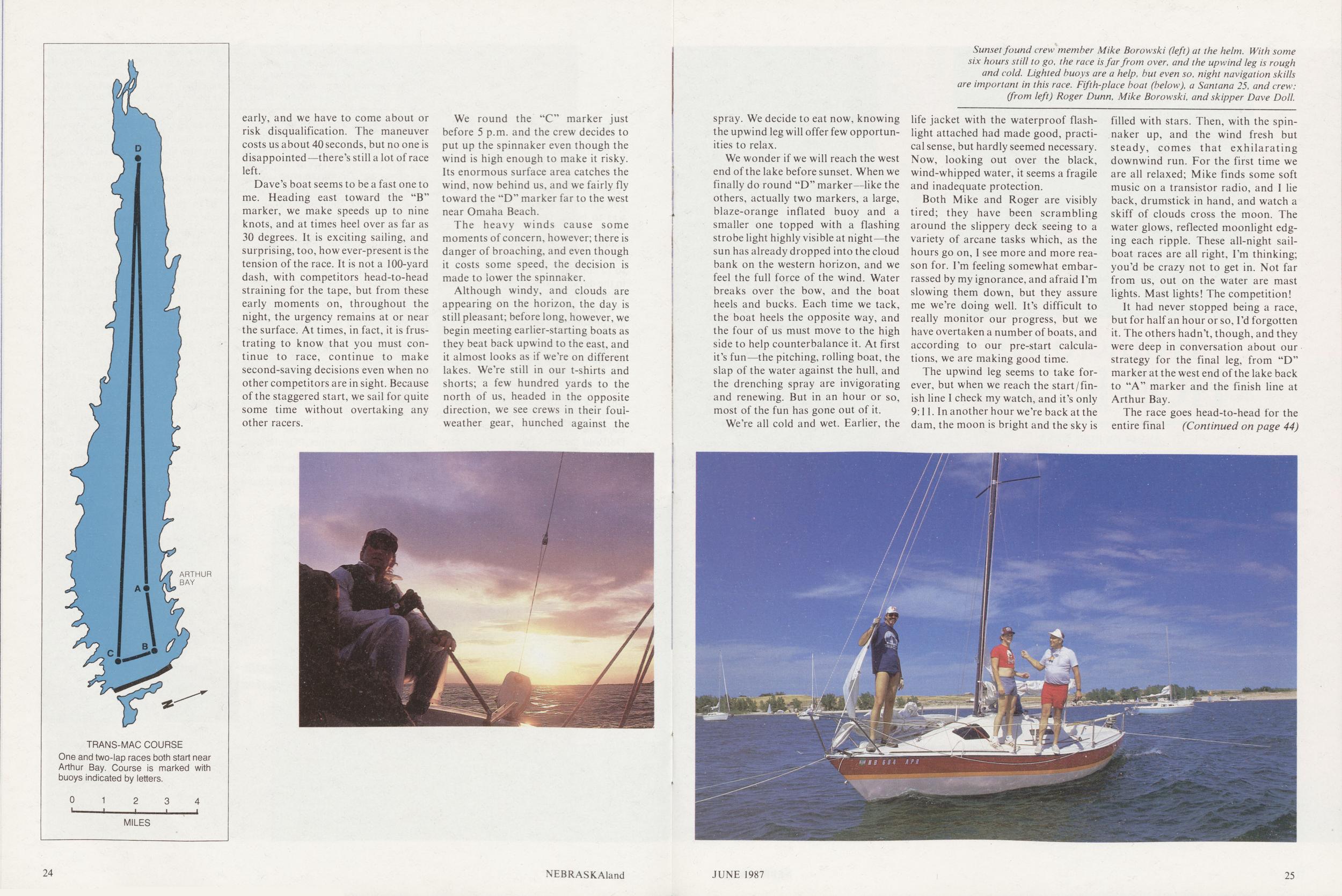
Dave's boat seems to be a fast one to me. Heading east toward the "B" marker, we make speeds up to nine knots, and at times heel over as far as 30 degrees. It is exciting sailing, and surprising, too, how ever-present is the tension of the race. It is not a 100-yard dash, with competitors head-to-head straining for the tape, but from these early moments on, throughout the night, the urgency remains at or near the surface. At times, in fact, it is frustrating to know that you must continue to race, continue to make second-saving decisions even when no other competitors are in sight. Because of the staggered start, we sail for quite some time without overtaking any other racers.
We round the "C marker just before 5 p.m. and the crew decides to put up the spinnaker even though the wind is high enough to make it risky. Its enormous surface area catches the wind, now behind us, and we fairly fly toward the "D" marker far to the west near Omaha Beach.
The heavy winds cause some moments of concern, however; there is danger of broaching, and even though it costs some speed, the decision is made to lower the spinnaker.
Although windy, and clouds are appearing on the horizon, the day is still pleasant; before long, however, we begin meeting earlier-starting boats as they beat back upwind to the east, and it almost looks as if we're on different lakes. We're still in our t-shirts and shorts; a few hundred yards to the north of us, headed in the opposite direction, we see crews in their foul weather gear, hunched against the 24 NEBRASKAland spray. We decide to eat now, knowing the upwind leg will offer few opportunities to relax.
We wonder if we will reach the west end of the lake before sunset. When we finally do round "D" marker—like the others, actually two markers, a large, blaze-orange inflated buoy and a smaller one topped with a flashing strobe light highly visible at night—the sun has already dropped into the cloud bank on the western horizon, and we feel the full force of the wind. Water breaks over the bow, and the boat heels and bucks. Each time we tack, the boat heels the opposite way, and the four of us must move to the high side to help counterbalance it. At first it's fun—the pitching, rolling boat, the slap of the water against the hull, and the drenching spray are invigorating and renewing. But in an hour or so, most of the fun has gone out of it.
We're all cold and wet. Earlier, the life jacket with the waterproof flashlight attached had made good, practical sense, but hardly seemed necessary. Now, looking out over the black, wind-whipped water, it seems a fragile and inadequate protection.
Both Mike and Roger are visibly tired; they have been scrambling around the slippery deck seeing to a variety of arcane tasks which, as the hours go on, I see more and more reason for. I'm feeling somewhat embarrassed by my ignorance, and afraid I'm slowing them down, but they assure me we're doing well. It's difficult to really monitor our progress, but we have overtaken a number of boats, and according to our pre-start calculations, we are making good time.
The upwind leg seems to take forever, but when we reach the start/finish line I check my watch, and it's only 9:11. In another hour we're back at the dam, the moon is bright and the sky is filled with stars. Then, with the spinnaker up, and the wind fresh but steady, comes that exhilarating downwind run. For the first time we are all relaxed; Mike finds some soft music on a transistor radio, and I lie back, drumstick in hand, and watch a skiff of clouds cross the moon. The water glows, reflected moonlight edging each ripple. These all-night sailboat races are all right, I'm thinking; you'd be crazy not to get in. Not far from us, out on the water are mast lights. Mast lights! The competition!
It had never stopped being a race, but for half an hour or so, I'd forgotten it. The others hadn't, though, and they were deep in conversation about our strategy for the final leg, from "D" marker at the west end of the lake back to "A" marker and the finish line at Arthur Bay.
The race goes head-to-head for the entire final (Continued on page 44)
Hometown HONKERS
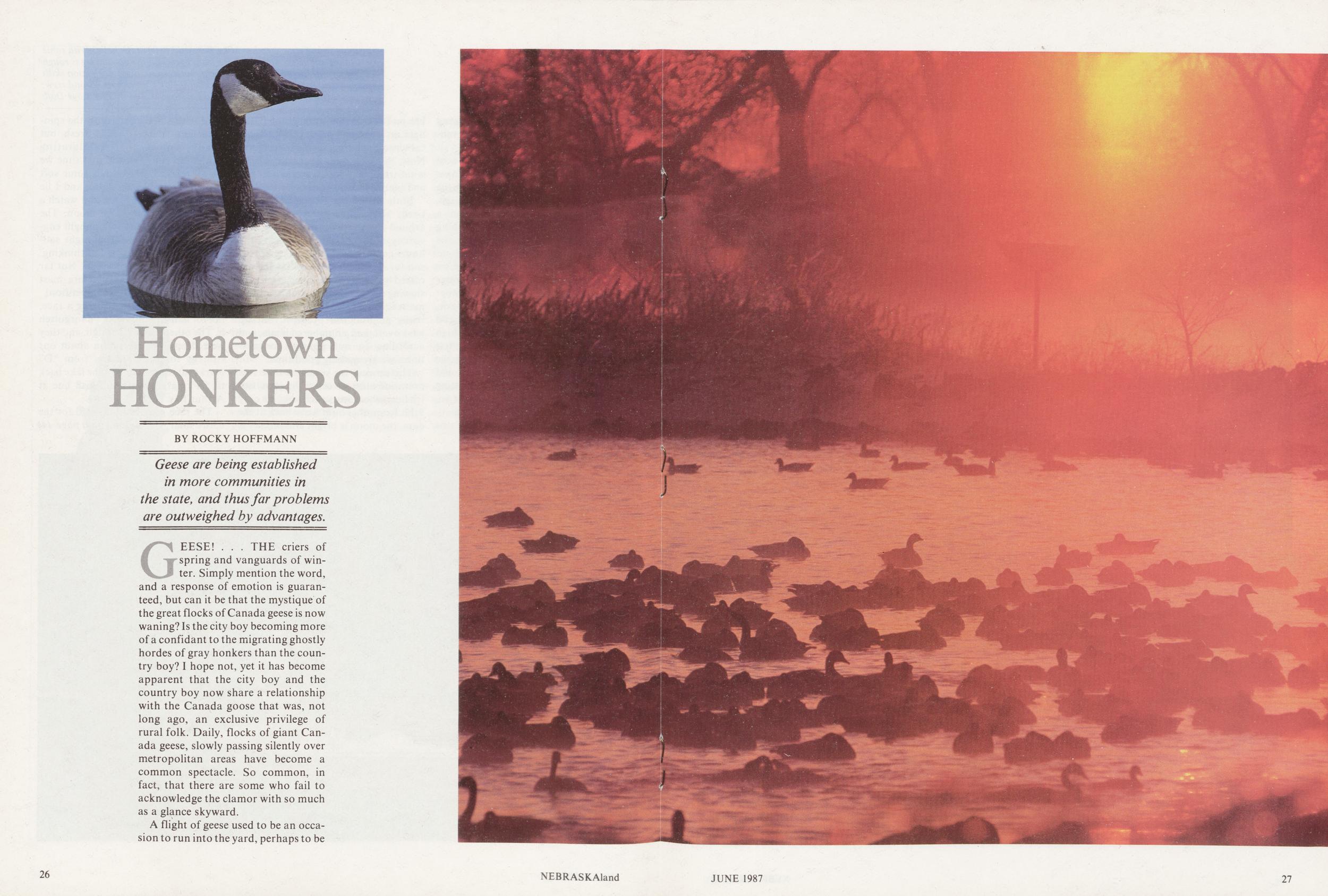
BY ROCKY HOFFMANN Geese are being established in more communities in the state, and thus far problems are outweighed by advantages.EESE! . . . THE criers of spring and vanguards of winter. Simply mention the word, and a response of emotion is guaranteed, but can it be that the mystique of the great flocks of Canada geese is now waning? Is the city boy becoming more of a confidant to the migrating ghostly hordes of gray honkers than the country boy? I hope not, yet it has become apparent that the city boy and the country boy now share a relationship with the Canada goose that was, not long ago, an exclusive privilege of rural folk. Daily, flocks of giant Canada geese, slowly passing silently over metropolitan areas have become a common spectacle. So common, in fact, that there are some who fail to acknowledge the clamor with so much as a glance skyward.
A flight of geese used to be an occasion to run into the yard, perhaps to be rewarded with a fading glimpse of the passing flock. Recently, however, in many of our urban areas there has been occasion to take shelter in the house, because the rewards offered by continuous flocks of low-flying geese may not always be the most pleasant.
26 NEBRASKAland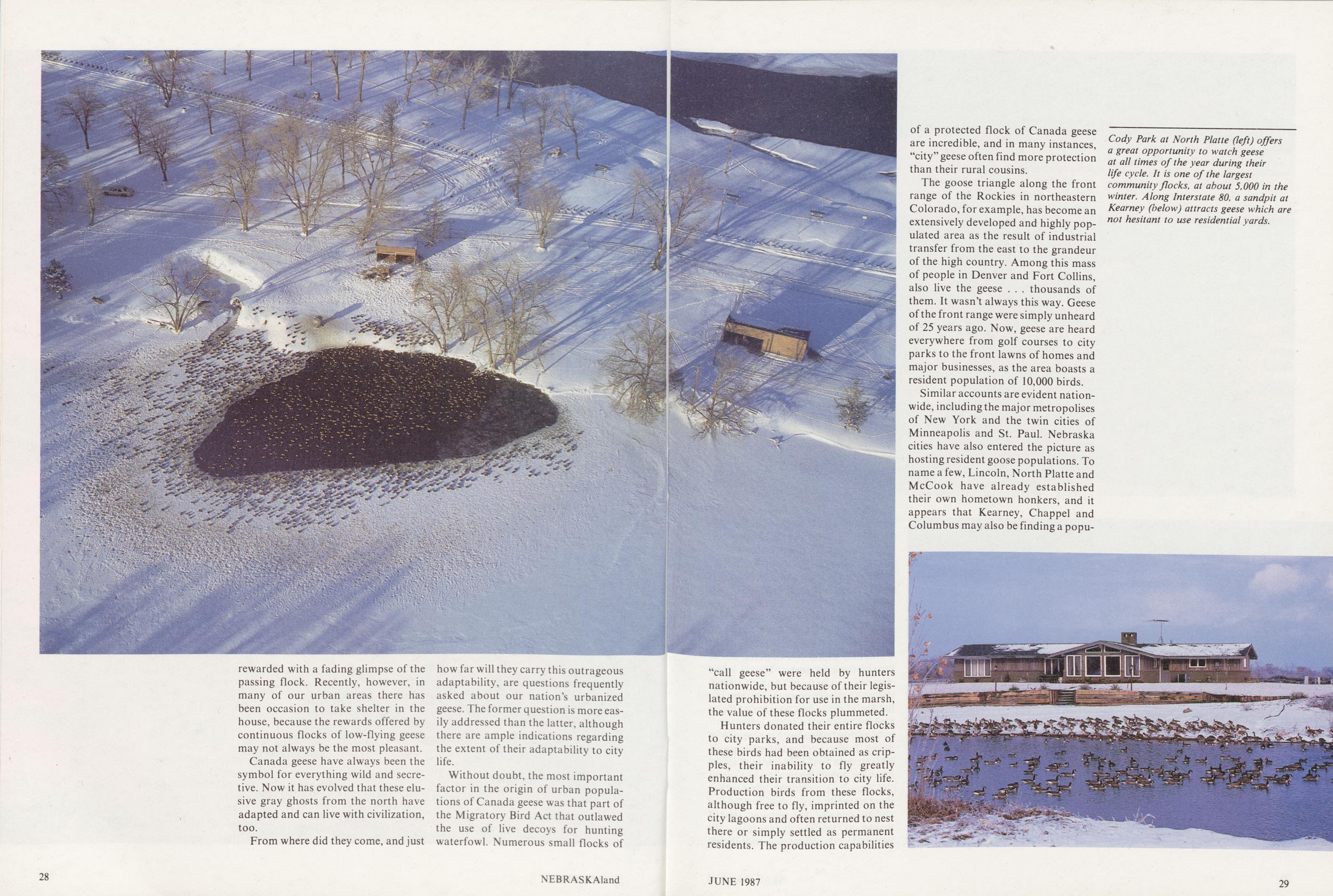
Canada geese have always been the symbol for everything wild and secretive. Now it has evolved that these elusive gray ghosts from the north have adapted and can live with civilization, too.
From where did they come, and just how far will they carry this outrageous adaptability, are questions frequently asked about our nation's urbanized geese. The former question is more easily addressed than the latter, although there are ample indications regarding the extent of their adaptability to city life.
Without doubt, the most important factor in the origin of urban populations of Canada geese was that part of the Migratory Bird Act that outlawed the use of live decoys for hunting waterfowl. Numerous small flocks of 28 NEBRASKAland "call geese" were held by hunters nationwide, but because of their legislated prohibition for use in the marsh, the value of these flocks plummeted.
Hunters donated their entire flocks to city parks, and because most of these birds had been obtained as cripples, their inability to fly greatly enhanced their transition to city life. Production birds from these flocks, although free to fly, imprinted on the city lagoons and often returned to nest there or simply settled as permanent residents. The production capabilities of a protected flock of Canada geese are incredible, and in many instances, "city" geese often find more protection than their rural cousins.
The goose triangle along the front range of the Rockies in northeastern Colorado, for example, has become an extensively developed and highly populated area as the result of industrial transfer from the east to the grandeur of the high country. Among this mass of people in Denver and Fort Collins, also live the geese . . . thousands of them. It wasn't always this way. Geese of the front range were simply unheard of 25 years ago. Now, geese are heard everywhere from golf courses to city parks to the front lawns of homes and major businesses, as the area boasts a resident population of 10,000 birds.
Similar accounts are evident nationwide, including the major metropolises of New York and the twin cities of Minneapolis and St. Paul. Nebraska cities have also entered the picture as hosting resident goose populations. To name a few, Lincoln, North Platte and McCook have already established their own hometown honkers, and it appears that Kearney, Chappel and Columbus may also be finding a population increase of feathered residents in the not too distant future.
Cody Park at North Platte (left) offers a great opportunity to watch geese at all times of the year during their life cycle. It is one of the largest community flocks, at about 5,000 in the winter. Along Interstate 80, a sandpit at Kearney (below) attracts geese which are not hesitant to use residential yards.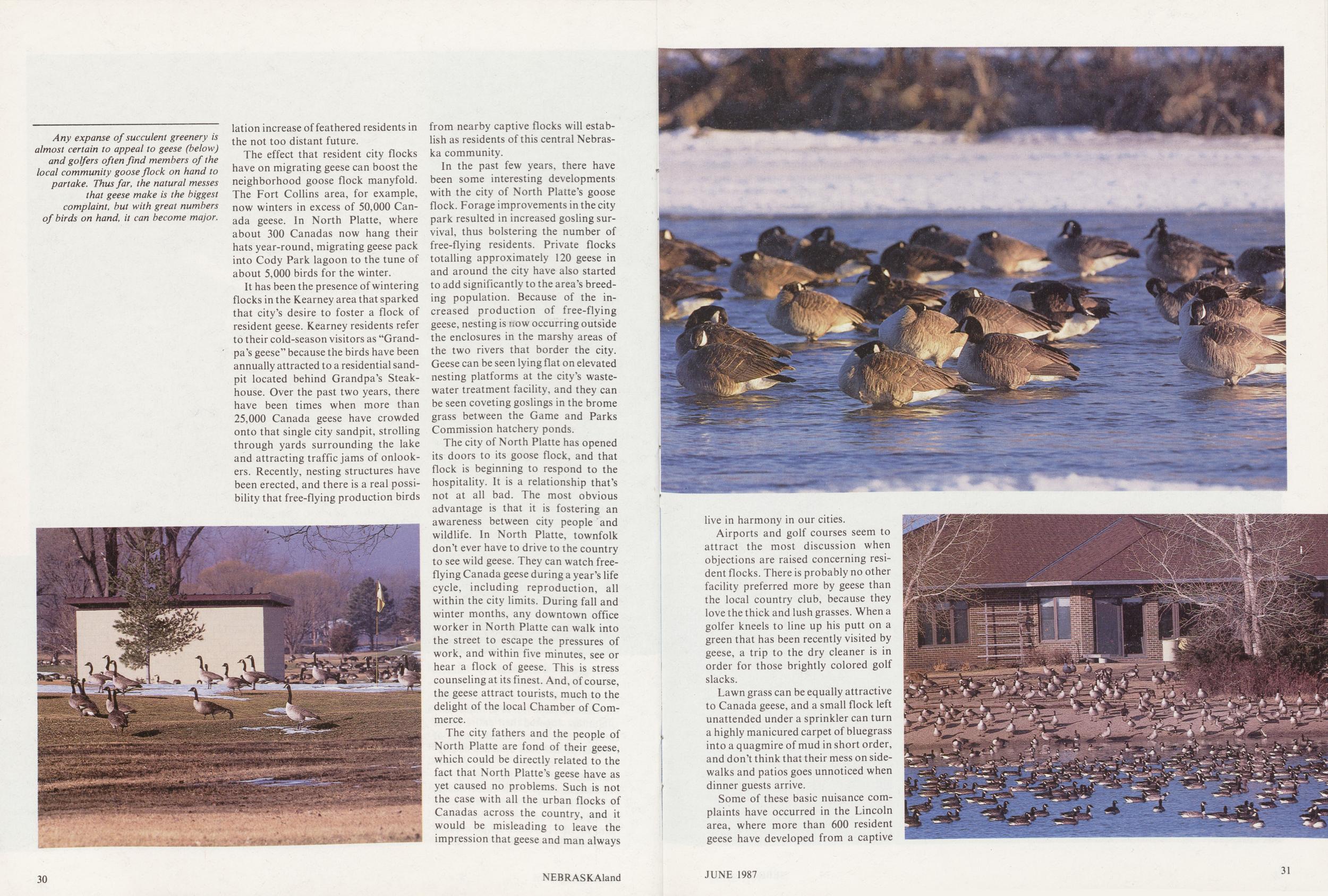 Any expanse of succulent greenery is
almost certain to appeal to geese (below)
and golfers often find members of the
local community goose flock on hand to
partake. Thus far, the natural messes
that geese make is the biggest
complaint, but with great numbers
of birds on hand, it can become major.
Any expanse of succulent greenery is
almost certain to appeal to geese (below)
and golfers often find members of the
local community goose flock on hand to
partake. Thus far, the natural messes
that geese make is the biggest
complaint, but with great numbers
of birds on hand, it can become major.
The effect that resident city flocks have on migrating geese can boost the neighborhood goose flock manyfold. The Fort Collins area, for example, now winters in excess of 50,000 Canada geese. In North Platte, where about 300 Canadians now hang their hats year-round, migrating geese pack into Cody Park lagoon to the tune of about 5,000 birds for the winter.
It has been the presence of wintering flocks in the Kearney area that sparked that city's desire to foster a flock of resident geese. Kearney residents refer to their cold-season visitors as "Grandpa's geese" because the birds have been annually attracted to a residential sandpit located behind Grandpa's Steakhouse. Over the past two years, there have been times when more than 25,000 Canada geese have crowded onto that single city sandpit, strolling through yards surrounding the lake and attracting traffic jams of onlookers. Recently, nesting structures have been erected, and there is a real possibility that free-flying production birds from nearby captive flocks will establish as residents of this central Nebraska community.
In the past few years, there have been some interesting developments with the city of North Platte's goose flock. Forage improvements in the city park resulted in increased gosling survival, thus bolstering the number of free-flying residents. Private flocks totaling approximately 120 geese in and around the city have also started to add significantly to the area's breeding population. Because of the increased production of free-flying geese, nesting is now occurring outside the enclosures in the marshy areas of the two rivers that border the city. Geese can be seen lying flat on elevated nesting platforms at the city's wastewater treatment facility, and they can be seen coveting goslings in the brome grass between the Game and Parks Commission hatchery ponds.
The city of North Platte has opened its doors to its goose flock, and that flock is beginning to respond to the hospitality. It is a relationship that's not at all bad. The most obvious advantage is that it is fostering an awareness between city people and wildlife. In North Platte, town folk don't ever have to drive to the country to see wild geese. They can watch free-flying Canada geese during a year's life cycle, including reproduction, all within the city limits. During fall and winter months, any downtown office worker in North Platte can walk into the street to escape the pressures of work, and within five minutes, see or hear a flock of geese. This is stress counseling at its finest. And, of course, the geese attract tourists, much to the delight of the local Chamber of Commerce.
The city fathers and the people of North Platte are fond of their geese, which could be directly related to the fact that North Platte's geese have as yet caused no problems. Such is not the case with all the urban flocks of Canadians across the country, and it would be misleading to leave the impression that geese and man always 30 NEBRASKAland live in harmony in our cities.
Airports and golf courses seem to attract the most discussion when objections are raised concerning resident flocks. There is probably no other facility preferred more by geese than the local country club, because they love the thick and lush grasses. When a golfer kneels to line up his putt on a green that has been recently visited by geese, a trip to the dry cleaner is in order for those brightly colored golf slacks.
Lawn grass can be equally attractive to Canada geese, and a small flock left unattended under a sprinkler can turn a highly manicured carpet of bluegrass into a quagmire of mud in short order, and don't think that their mess on sidewalks and patios goes unnoticed when dinner guests arrive.
Some of these basic nuisance complaints have occurred in the Lincoln area, where more than 600 resident geese have developed from a captive breeding effort at Branched Oak Lake. Again the problem has been messes created by the ever-feeding geese, which have expanded from their original release site onto private and city lakes surrounded by housing. Game and Parks personnel have been involved with occasional goose roundups in these areas to alleviate the problems caused by these "civilized" birds.
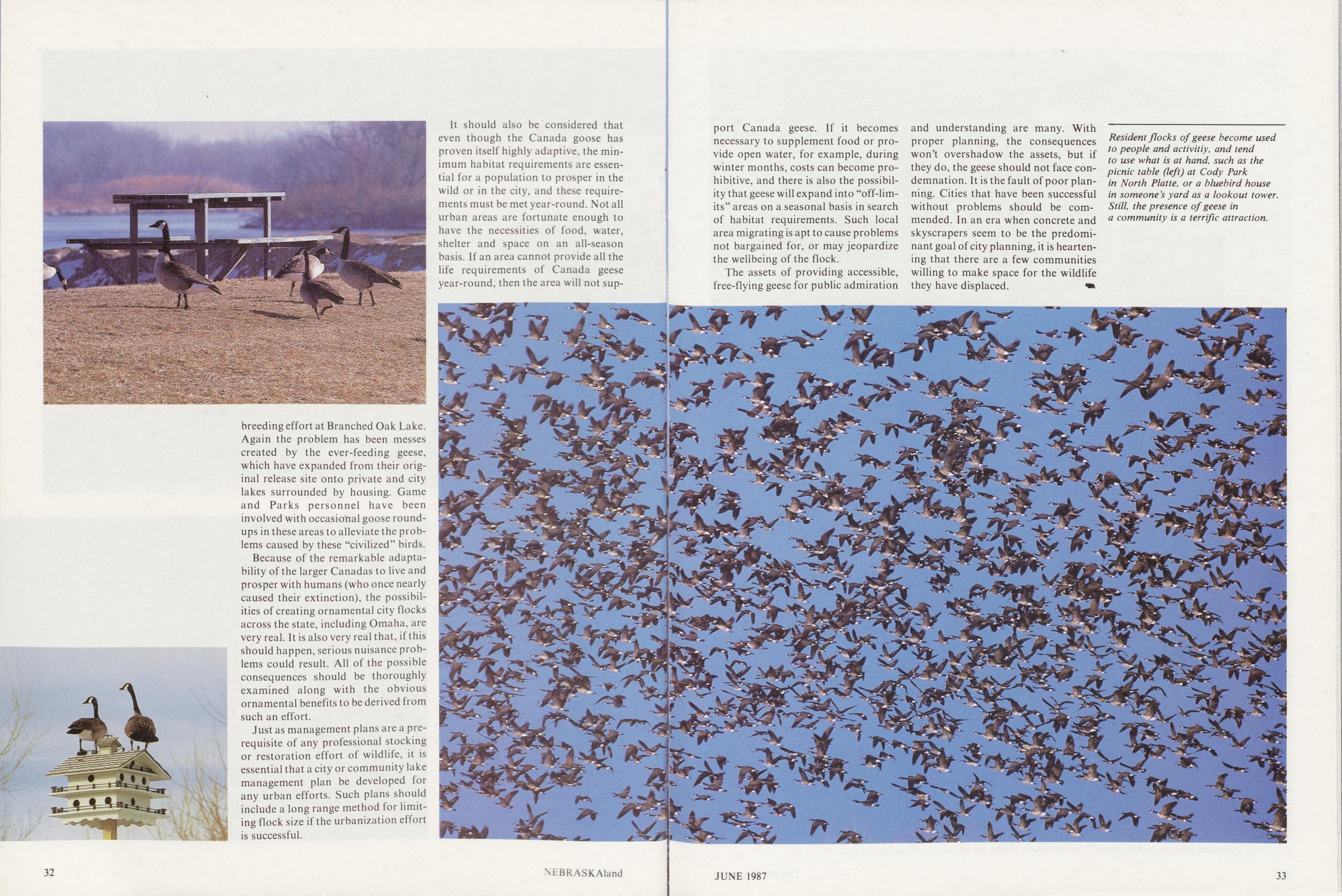
Because of the remarkable adaptability of the larger Canadians to live and prosper with humans (who once nearly caused their extinction), the possibilities of creating ornamental city flocks across the state, including Omaha, are very real. It is also very real that, if this should happen, serious nuisance problems could result. All of the possible consequences should be thoroughly examined along with the obvious ornamental benefits to be derived from such an effort.
Just as management plans are a prerequisite of any professional stocking or restoration effort of wildlife, it is essential that a city or community lake management plan be developed for any urban efforts. Such plans should include a long range method for limiting flock size if the urbanization effort is successful.
It should also be considered that even though the Canada goose has proven itself highly adaptive, the minimum habitat requirements are essential for a population to prosper in the wild or in the city, and these requirements must be met year-round. Not all urban areas are fortunate enough to have the necessities of food, water, shelter and space on an all-season basis. If an area cannot provide all the life requirements of Canada geese year-round, then the area will not support 32 NEBRASKAland Canada geese. If it becomes necessary to supplement food or provide open water, for example, during winter months, costs can become prohibitive, and there is also the possibility that geese will expand into "off-limits" areas on a seasonal basis in search of habitat requirements. Such local area migrating is apt to cause problems not bargained for, or may jeopardize the wellbeing of the flock.
The assets of providing accessible, free-flying geese for public admiration and understanding are many. With proper planning, the consequences won't overshadow the assets, but if they do, the geese should not face condemnation. It is the fault of poor planning. Cities that have been successful without problems should be commended. In an era when concrete and skyscrapers seem to be the predominant goal of city planning, it is heartening that there are a few communities willing to make space for the wildlife they have displaced.
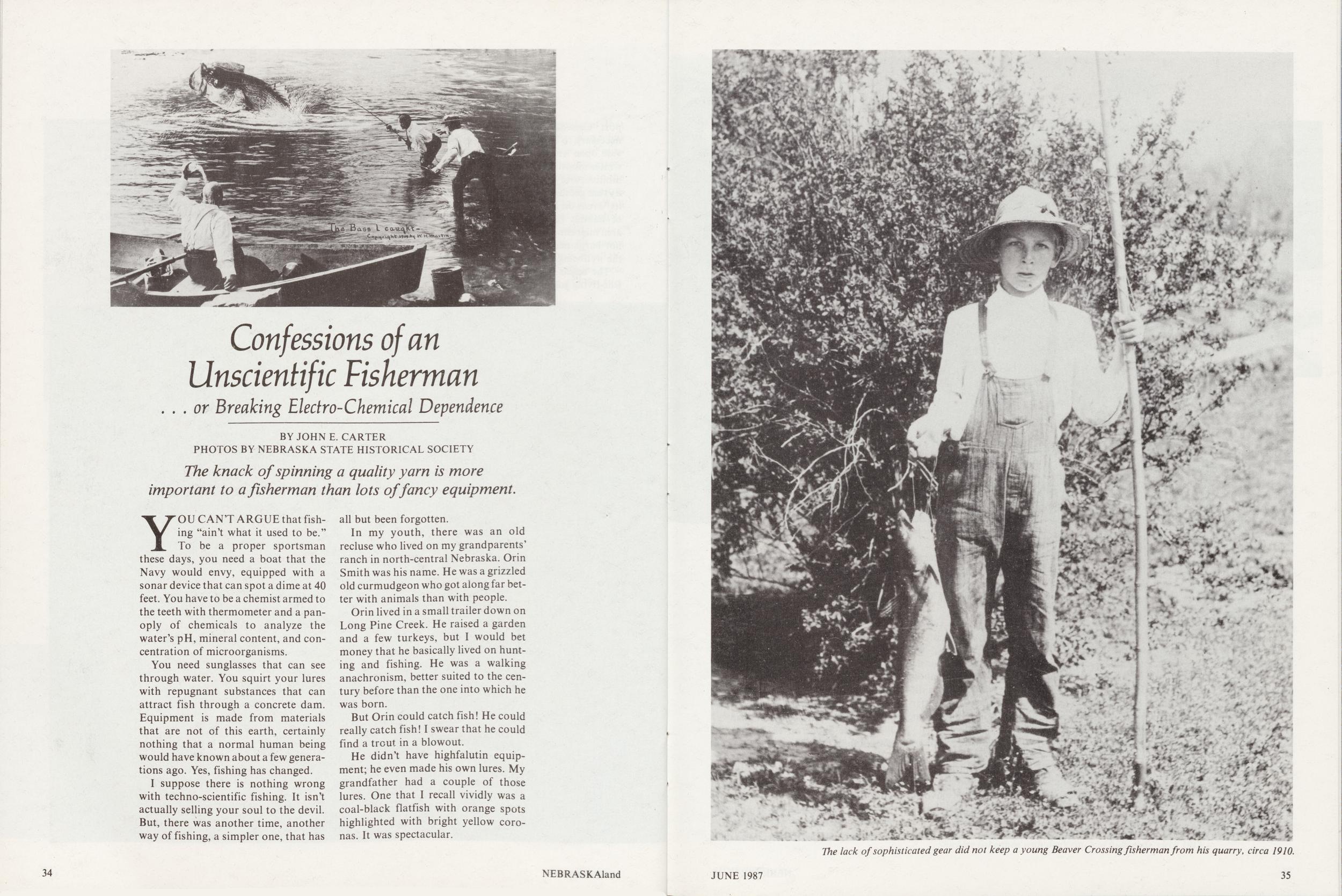
Confessions of an Unscientific Fisherman or Breaking Electro-Chemical Dependence
BY JOHN E. CARTER PHOTOS BY NEBRASKA STATE HISTORICAL SOCIETY The knack of spinning a quality yarn is more important to a fisherman than lots of fancy equipment.YOU CANT ARGUE that fishing "ain't what it used to be." To be a proper sportsman these days, you need a boat that the Navy would envy, equipped with a sonar device that can spot a dime at 40 feet. You have to be a chemist armed to the teeth with thermometer and a panoply of chemicals to analyze the water's pH, mineral content, and concentration of microorganisms.
You need sunglasses that can see through water. You squirt your lures with repugnant substances that can attract fish through a concrete dam. Equipment is made from materials that are not of this earth, certainly nothing that a normal human being would have known about a few generations ago. Yes, fishing has changed.
I suppose there is nothing wrong with techno-scientific fishing. It isn't actually selling your soul to the devil. But, there was another time, another way of fishing, a simpler one, that has all but been forgotten.
In my youth, there was an old recluse who lived on my grandparents' ranch in north-central Nebraska. Orin Smith was his name. He was a grizzled old curmudgeon who got along far better with animals than with people.
Orin lived in a small trailer down on Long Pine Creek. He raised a garden and a few turkeys, but I would bet money that he basically lived on hunting and fishing. He was a walking anachronism, better suited to the century before than the one into which he was born.
But Orin could catch fish! He could really catch fish! I swear that he could find a trout in a blowout.
He didn't have highfalutin equipment; he even made his own lures. My grandfather had a couple of those lures. One that I recall vividly was a coal-black flatfish with orange spots highlighted with bright yellow coronas. It was spectacular.
34 NEBRASKAland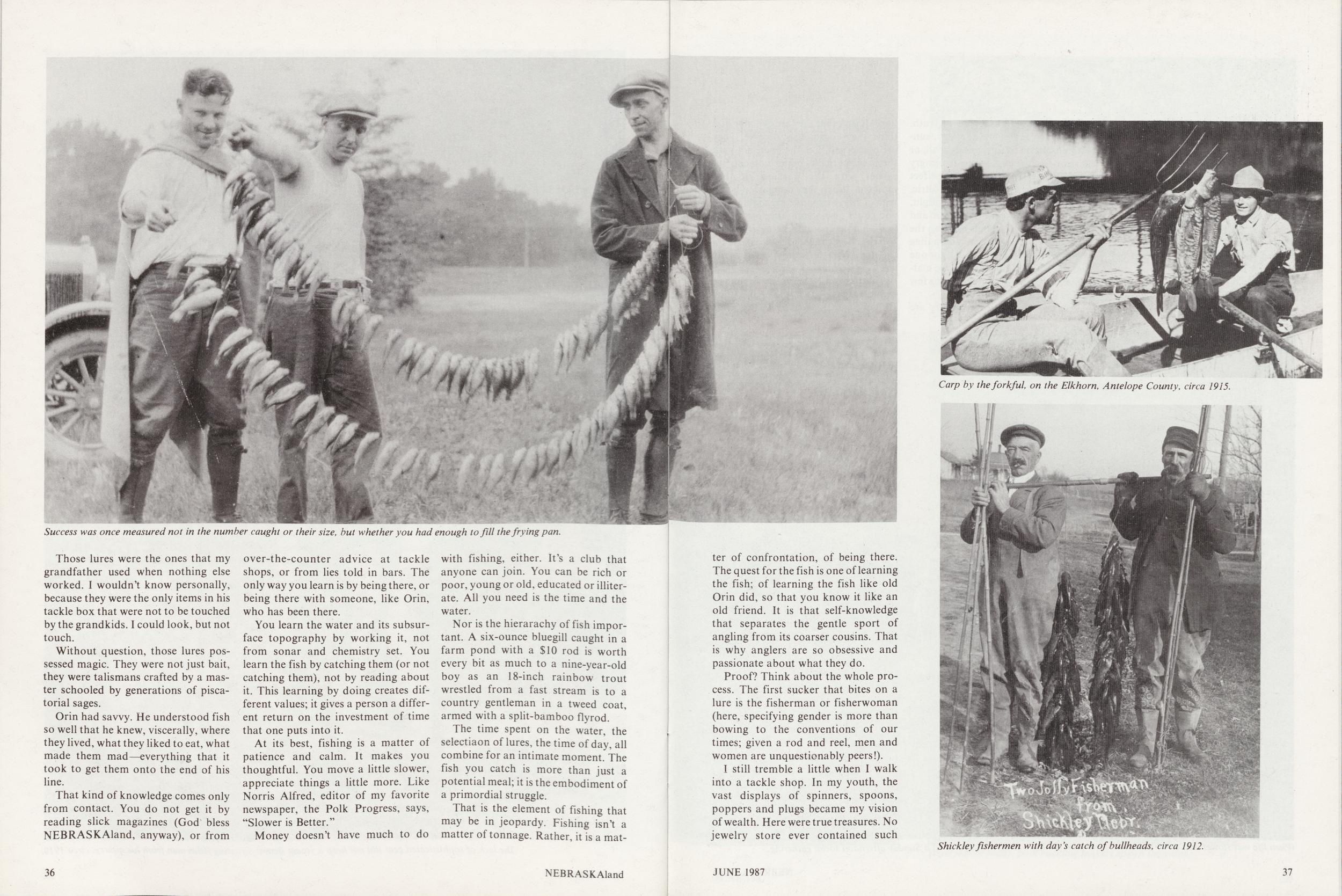
Those lures were the ones that my grandfather used when nothing else worked. I wouldn't know personally, because they were the only items in his tackle box that were not to be touched by the grandkids. I could look, but not touch.
Without question, those lures possessed magic. They were not just bait, they were talismans crafted by a master schooled by generations of piscatorial sages.
Orin had savvy. He understood fish so well that he knew, viscerally, where they lived, what they liked to eat, what made them mad—everything that it took to get them onto the end of his line.
That kind of knowledge comes only from contact. You do not get it by reading slick magazines (God bless NEBRASKAland, anyway), or from over-the-counter advice at tackle shops, or from lies told in bars. The only way you learn is by being there, or being there with someone, like Orin, who has been there.
You learn the water and its subsurface topography by working it, not from sonar and chemistry set. You learn the fish by catching them (or not catching them), not by reading about it. This learning by doing creates different values; it gives a person a different return on the investment of time that one puts into it.
At its best, fishing is a matter of patience and calm. It makes you thoughtful. You move a little slower, appreciate things a little more. Like Norris Alfred, editor of my favorite newspaper, the Polk Progress, says, "Slower is Better."
Money doesn't have much to do with fishing, either. It's a club that anyone can join. You can be rich or poor, young or old, educated or illiterate. All you need is the time and the water.
Nor is the hierarchy offish important. A six-ounce bluegill caught in a farm pond with a $10 rod is worth every bit as much to a nine-year-old boy as an 18-inch rainbow trout wrestled from a fast stream is to a country gentleman in a tweed coat, armed with a split-bamboo flyrod.
The time spent on the water, the selection of lures, the time of day, all combine for an intimate moment. The fish you catch is more than just a potential meal; it is the embodiment of a primordial struggle.
That is the element of fishing that may be in jeopardy. Fishing isn't a matter of tonnage. Rather, it is a matter 36 NEBRASKAland of confrontation, of being there. The quest for the fish is one of learning the fish; of learning the fish like old Orin did, so that you know it like an old friend. It is that self-knowledge that separates the gentle sport of angling from its coarser cousins. That is why anglers are so obsessive and passionate about what they do.
Proof? Think about the whole process. The first sucker that bites on a lure is the fisherman or fisherwoman (here, specifying gender is more than bowing to the conventions of our times; given a rod and reel, men and women are unquestionably peers!).
I still tremble a little when I walk into a tackle shop. In my youth, the vast displays of spinners, spoons, poppers and plugs became my vision of wealth. Here were true treasures. No jewelry store ever contained such beauty. My mouth waters still.
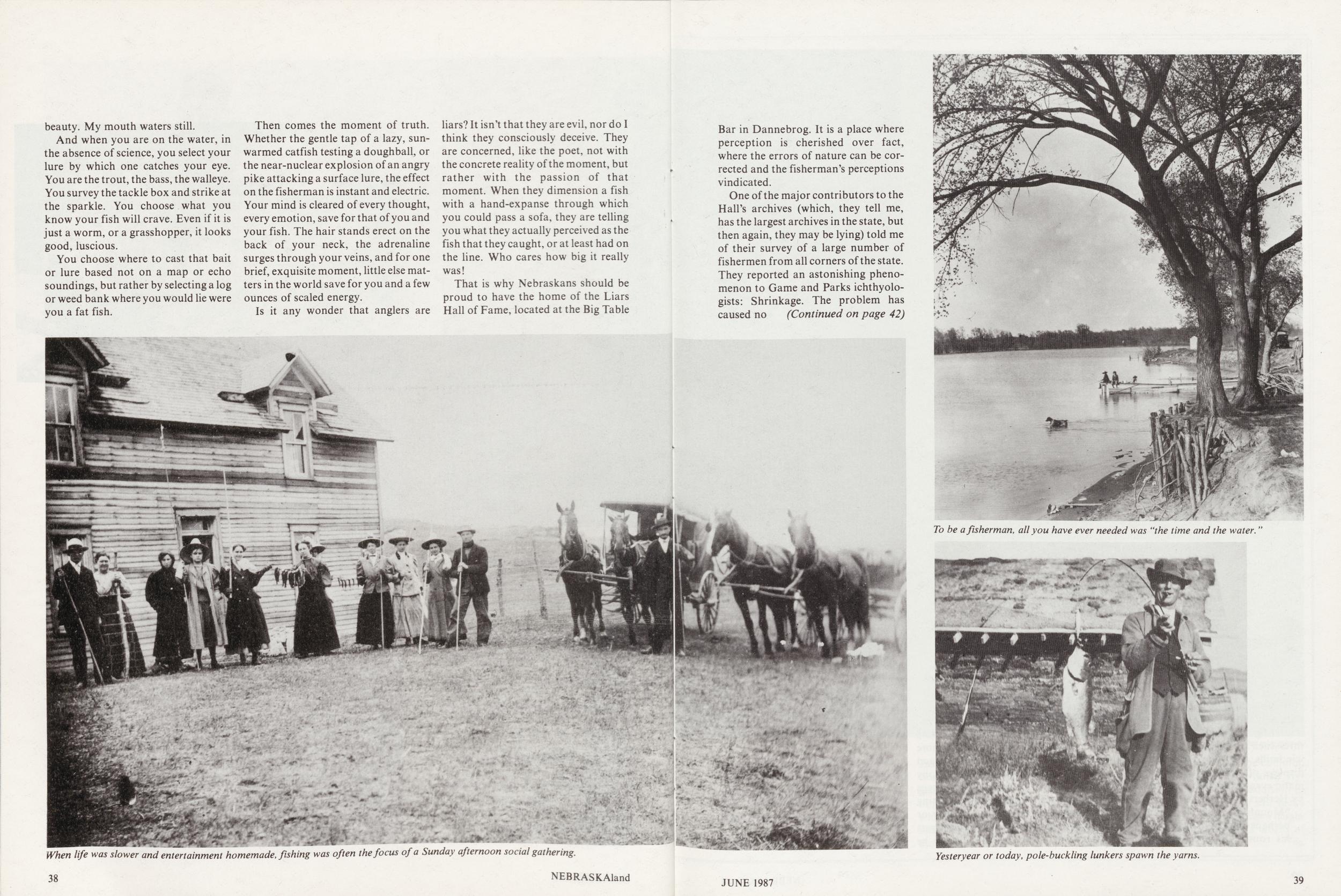
And when you are on the water, in the absence of science, you select your lure by which one catches your eye. You are the trout, the bass, the walleye. You survey the tackle box and strike at the sparkle. You choose what you know your fish will crave. Even if it is just a worm, or a grasshopper, it looks good, luscious.
You choose where to cast that bait or lure based not on a map or echo soundings, but rather by selecting a log or weed bank where you would lie were you a fat fish.
Then comes the moment of truth. Whether the gentle tap of a lazy, sun warmed catfish testing a dough ball, or the near-nuclear explosion of an angry pike attacking a surface lure, the effect on the fisherman is instant and electric. Your mind is cleared of every thought, every emotion, save for that of you and your fish. The hair stands erect on the back of your neck, the adrenaline surges through your veins, and for one brief, exquisite moment, little else matters in the world save for you and a few ounces of scaled energy.
Is it any wonder that anglers are liars? It isn't that they are evil, nor do I think they consciously deceive. They are concerned, like the poet, not with the concrete reality of the moment, but rather with the passion of that moment. When they dimension a fish with a hand-expanse through which you could pass a sofa, they are telling you what they actually perceived as the fish that they caught, or at least had on the line. Who cares how big it really was!
That is why Nebraskans should be proud to have the home of the Liars Hall of Fame, located at the Big Table Bar in Dannebrog. It is a place where perception is cherished over fact, where the errors of nature can be corrected and the fisherman's perceptions vindicated.
One of the major contributors to the Hall's archives (which, they tell me, has the largest archives in the state, but then again, they may be lying) told me of their survey of a large number of fishermen from all corners of the state. They reported an astonishing phenomenon to Game and Parks ichthyologists: Shrinkage. The problem has caused no (Continued on page 42)
Scissortail
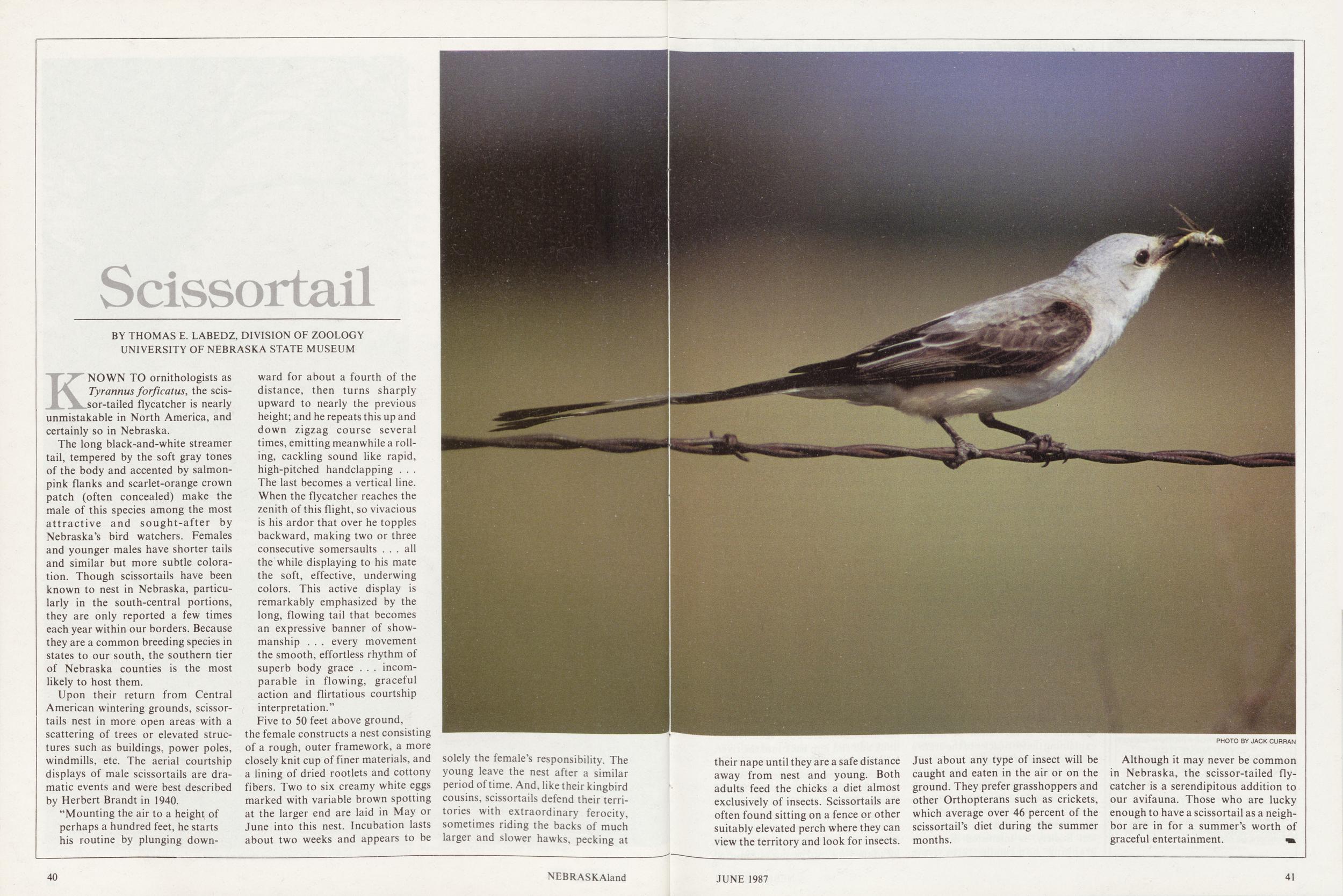
BY THOMAS E. LABEDZ, DIVISION OF ZOOLOGY UNIVERSITY OF NEBRASKA STATE MUSEUMNOWN TO ornithologists as Tyrannus forficatus, the scissor-tailed flycatcher is nearly unmistakable in North America, and certainly so in Nebraska.
The long black-and-white streamer tail, tempered by the soft gray tones of the body and accented by salmon pink flanks and scarlet-orange crown patch (often concealed) make the male of this species among the most attractive and sought-after by Nebraska's bird watchers. Females and younger males have shorter tails and similar but more subtle coloration. Though scissor-tails have been known to nest in Nebraska, particularly in the south-central portions, they are only reported a few times each year within our borders. Because they are a common breeding species in states to our south, the southern tier of Nebraska counties is the most likely to host them.
Upon their return from Central American wintering grounds, scissor-tails nest in more open areas with a scattering of trees or elevated structures such as buildings, power poles, windmills, etc. The aerial courtship displays of male scissor-tails are dramatic events and were best described by Herbert Brandt in 1940.
"Mounting the air to a height of perhaps a hundred feet, he starts his routine by plunging downward for about a fourth of the distance, then turns sharply upward to nearly the previous height; and he repeats this up and down zigzag course several times, emitting meanwhile a rolling, cackling sound like rapid, high-pitched hand clapping . . . The last becomes a vertical line. When the flycatcher reaches the zenith of this flight, so vivacious is his ardor that over he topples backward, making two or three consecutive somersaults ... all the while displaying to his mate the soft, effective, underwing colors. This active display is remarkably emphasized by the long, flowing tail that becomes an expressive banner of showmanship . . . every movement the smooth, effortless rhythm of superb body grace . . . incomparable in flowing, graceful action and flirtatious courtship interpretation."
Five to 50 feet above ground, the female constructs a nest consisting of a rough, outer framework, a more closely knit cup of finer materials, and a lining of dried rootlets and cottony fibers. Two to six creamy white eggs marked with variable brown spotting at the larger end are laid in May or June into this nest. Incubation lasts about two weeks and appears to be solely the female's responsibility. The young leave the nest after a similar period of time. And, like their kingbird cousins, scissor-tails defend their territories with extraordinary ferocity, sometimes riding the backs of much larger and slower hawks, pecking at
40 NEBRASKAlandtheir nape until they are a safe distance away from nest and young. Both adults feed the chicks a diet almost exclusively of insects. Scissor-tails are often found sitting on a fence or other suitably elevated perch where they can view the territory and look for insects. Just about any type of insect will be caught and eaten in the air or on the ground. They prefer grasshoppers and other Orthopterans such as crickets, which average over 46 percent of the scisso-rtail's diet during the summer months.
Although it may never be common in Nebraska, the scissor-tailed fly-catcher is a serendipitous addition to our avifauna. Those who are lucky enough to have a scissor-tail as a neighbor are in for a summer's worth of graceful entertainment.
JUNE 1987 41 NOW OPEN
Your Complete Pet Health
Care Center
Medicine
Surgery
Dentistry
Boarding
Grooming
Supplies
24 HOUR
EMERGENCY SERVICE
PHONE 423-9100
Kent H. Forney, D.V.M.
NIMAfrCENTER
5720 OLD CHENEY RD.
LINCOLN, NE 68516
Aaahh!
EXPERIENCE
NEBRASKA...
with an affordable canoe trip by
DRYLAND AQUATICS
• Niobrara • Dismal • Platte • Elkhorn
-YOU NAME IT-
One & two day trips available
canoe rental only or fully catered
—WE DO IT YOUR WAY—
Write for FREE brochure
Dry land Aquatics, Rt. 1,
Fremont, NE 68025 Ph. (402) 721-4177
NOW OPEN
Your Complete Pet Health
Care Center
Medicine
Surgery
Dentistry
Boarding
Grooming
Supplies
24 HOUR
EMERGENCY SERVICE
PHONE 423-9100
Kent H. Forney, D.V.M.
NIMAfrCENTER
5720 OLD CHENEY RD.
LINCOLN, NE 68516
Aaahh!
EXPERIENCE
NEBRASKA...
with an affordable canoe trip by
DRYLAND AQUATICS
• Niobrara • Dismal • Platte • Elkhorn
-YOU NAME IT-
One & two day trips available
canoe rental only or fully catered
—WE DO IT YOUR WAY—
Write for FREE brochure
Dry land Aquatics, Rt. 1,
Fremont, NE 68025 Ph. (402) 721-4177
Confessions of an unscientific fisherman
(Continued from page 39)end of difficulties for those charged with the responsibility of examining fish for consideration for Nebraska Master Angler awards. Apparently, the Hall's study suggests, exposure to gasses released by plastics commonly used in bass boat live-wells and other such devices employed by anglers to transport their fish (including, surprisingly, the plastic liners of the modern creels used by gentlemanly fly fishers) causes a reduction in length and weight of fish of up to 25 percent!
They report that bass weighing no less than eight pounds when removed from the water, deflate to a mere five pounds when placed on a scale. Certainly everyone reading this article has experienced similar shrinkage.
I think that there are other as yet unnoticed maladies to be suffered by exposure to these unnatural materials. Look at any of the T.V. shows dedicated to fishing. It is troubling to me that when otherwise normal human beings step into a plastic boat, they immediately begin to speak with a southern accent! Certainly this suggests dangerous chromosome damage. Factory workers from New Jersey begin to use words like "Whoopee." And all fish become "big-uns." Yes sir, we got trouble, right here in river city.
Time passes and things change, and I don't want to go back and live 30 years ago. Technology has brought us many good and wonderful things. I am amazed that fishing is still something that is cheap to do, for if you look at it, all of these great technological advances have resulted in a net reduction in the cost of rods, reels, and tackle (prices adjusted for inflation, of course).
But these so-called improvements may have cost us an essence. I don't like the notion of fishing as a competitive sport. In its highest form, it's something very personal. It is you and the fish. It is the father or mother explaining the intricacies of the art to a wide-eyed son or daughter.
No, there is nothing really wrong with this new age of high-tech. But, it never will replace the real, noble reason that people fish. John Carter, whose real job is with the State Historical Society, is interested in photographing homemade lures from around the state. If you have some homemade lures, particularly old ones, that you would share with him, please drop a note in care of NEBRASKAland. If you have some good fish stories that would be worthy of the Liars Hall of Fame, please send them along, too.
Upper Missouri River fishing holes
(Continued from page 9)dozen yards directly to the left of the boat, and let the current carry it downstream into the hole," Bruce coached. I still hadn't seen anything that looked like a fish hangout, but I complied, and Joe was already into his second or third cast. Bruce watched for a bit, then slyly picked up an outfit with a spinner on and started casting artificials. "You should always try several techniques to see what's working best," he alibied after he had us safely fishing with bait.
But it wasn't long before we found out. Joe reacted suddenly, setting the hook with a sweeping motion, then holding the bent rod high overhead. The line sliced through the water, heading upstream and away from the boat as the fish turned its side to the current for leverage. It gave a good account of itself on the initial run, but when that was over, Joe announced that it wasn't a very big fish. A minute or so later, he lifted a 13-incher aboard. It was not a very long fish, but it was hefty, deep in the body and broad across the back. And, it was a pretty fish, too. Its back was olive, with scales highlighted in bronze, while the bronze seemed to predominate on sides marked with dark vertical bars. And the eye was bright red-orange.
It wouldn't have been hard to just sit there and admire that fish for several minutes. But that was exactly what we didn't want to do, because that smallmouth was going right back where he came from. We admired him for just a few moments, before Joe removed the hook and slid him back into the river.
"We like to release all the smallmouths we can, because they're just starting to come on in this river," Bruce said. "It's not like we don't harvest any. You always hurt some fish when you use bait, but that's about the only way to catch these smallmouths a lot of the time. So, we put our injured 42 NEBRASKAland fish in the cooler, and release all our uninjured bass."
It appeared that this would be one of those days when bait would be best. Joe, in the rear of the boat and closest to the magic hole, was having the best success. I was sitting in the bow, farthest from the hotspot and having trouble getting the bait to drift in just right, but I was also catching a few fish. But Bruce, flinging hardware or plastic all the time, was not doing quite as well.
Several of our fish were in the two pound class, big enough to put on a real rodeo when they felt the steel. When he set the hook on one fish, however, Joe noticed a difference. That fish went pretty much where he pleased for a time, and ended up on the right side of the boat, shooing Bruce from his perch at the control console so Joe could play through. The fish flashed near the surface once at the boat, and Joe announced that "he'll go better than three," the Master Angler weight for smallmouths. But, that was as close as Joe would get to a certificate. Seconds later, the line went limp as the hook pulled free.
We spent something short of two hours with those smallmouths before we decided to give that spot a rest. By that time, big piles of clouds were rolling around in all directions, the breeze was shifting around, and it began to feel more humid.
Bruce took us upstream to an island, where we spent a half-hour casting crank baits to reeds and weeds and snags along the bank, without much success. Then we motored over to the north shore, where a floodgate from a drainage project formed a small pool. We caught no bass or walleye there, but a drum latched onto Joe's jig.
We also tried fishing around the intake of an irrigation system, where pilings in a retaining wall and the intake provided breaks in the strong current. Bruce maneuvered us alongside the retaining wall so that we could flip crawlers on jigs or plain hooks along the planks and behind the pilings and intake. And, we found smallmouths there, although catching them was not easy. The strong current masked the strike and gave hooked fish plenty of leverage to get into snags or under the boat.
The current was tricky, and usually only one of us was in good position to fish. Joe and Bruce took turns at the controls, and the three of us took turns casting. We took a few fish there, but, in the end, that spot provided more fun than anything else.
Later, Bruce explained why we found smallmouths where we did. "Smallmouth bass like to be around current. You'll consistently find them around a 'breakpoint,' something like a log or a wing dike or a sandbar that breaks the force of the current. They'll lie in the eddy, but they want the bait moving by them in the fast water. You might also find them where riprap has been dumped. The riprap means that there's current there, and the rocks will provide the fish with the cover they look for," Bruce said.
He also filled us in on his favorite baits and lures for Missouri River smallmouths. Small, deep-diving crank baits, BeetleSpins, or Mepps spinners would be his choice of artificials. "I'd like to fish plastic worms, but you can't control them in the current. The only place they might work would be in slack water," he said. Nightcrawlers, fished on a plain hook and drifted into a hole, or cast into current on a jig, account for most of Bruce's live bait fishing. Small crawdads are also excellent bait, but hard to come by, he said.
At some point after we left that first smallmouth hotspot, the humidity had gradually changed to drizzle, and then to intermittent showers. But, there was no wind to speak of, and no evidence of lightning, so we stayed with our fishing. A strong wind from the wrong direction can make the Missouri more treacherous than any reservoir, and the hazard of being in an electrical storm on a broad expanse of water should be obvious. "The Missouri is a good place to fish, but it's not very forgiving if you make a stupid mistake. It's not a place to do any hot rodding with a boat, especially if you haven't been on that piece of water lately. Snags and sandbars can lie just below the surface, and hitting them at high speed can be hard on boats and passengers," Bruce warned.
We eventually went back to that first smallmouth hangout, and as we approached from downstream, I could see the edge of the sandbar, the deep hole downstream, and a line of weeds just under the surface—the kinds of things Bruce had described. Those weeds were what had kept my bait out of the hole during our first visit.
Harlan County Dam Vacation Apartments - fully furnished Color TV • Kitchen Facilities • Full Baths Game cleaning room with freezer One block from shopping center Weekend or week of pleasant living Security Deposit Required Sorry —No Pets Dean and Esther Stone Box 145 Ph. (308) 799-3422 Republican City, NE 68971 "ALMA'S FINEST. .BUDGET ROOMS' II HARLAN CO. LAKE • All Cable T.V. • Queens • • Phones • Ice • Freezers • • Parking • Plug-Ins • N. Edge Alma, NE Hwys. 183-136 & 383 (308) 928-2116 STOCK YOUR LAKE OR POND WITH Channel cat, Bluegill, Largemouth Bass, Hybrid Bluegill, Crappie, Triploid Grass Carp, Minnows ORDER NOW WILLOW LAKE FISH HATCHERY Rt. 3, Box 46, Hastings, Nebr. 68901 Gaylord L. Crawford Phone: (402) 463-8022 Day or Night For April to October 15 stocking Save energy in style and comfort. QUALITY CONSTRUCTION Full, round logs with unique triple tongue-and-groove for tight, weatherproof fit. ENERGY EFFICIENT Snug in winter, mountain-cool in summer — with the rugged beauty only natural wood can bring. YOUR PLANS OR OURS Year-round home, vacation hideaway or commercial building, we'll deliver to your site and supervise wall erection. Joel A. Plettner RR-1 Box 70C Waterloo, NE 68069 (402) 3595744 Write for free, informative folder. Or send $5.00 for full-color catalog with floor plans. Member: Log Homes Council. National Association of Home Manufacturers. JUNE 1987 43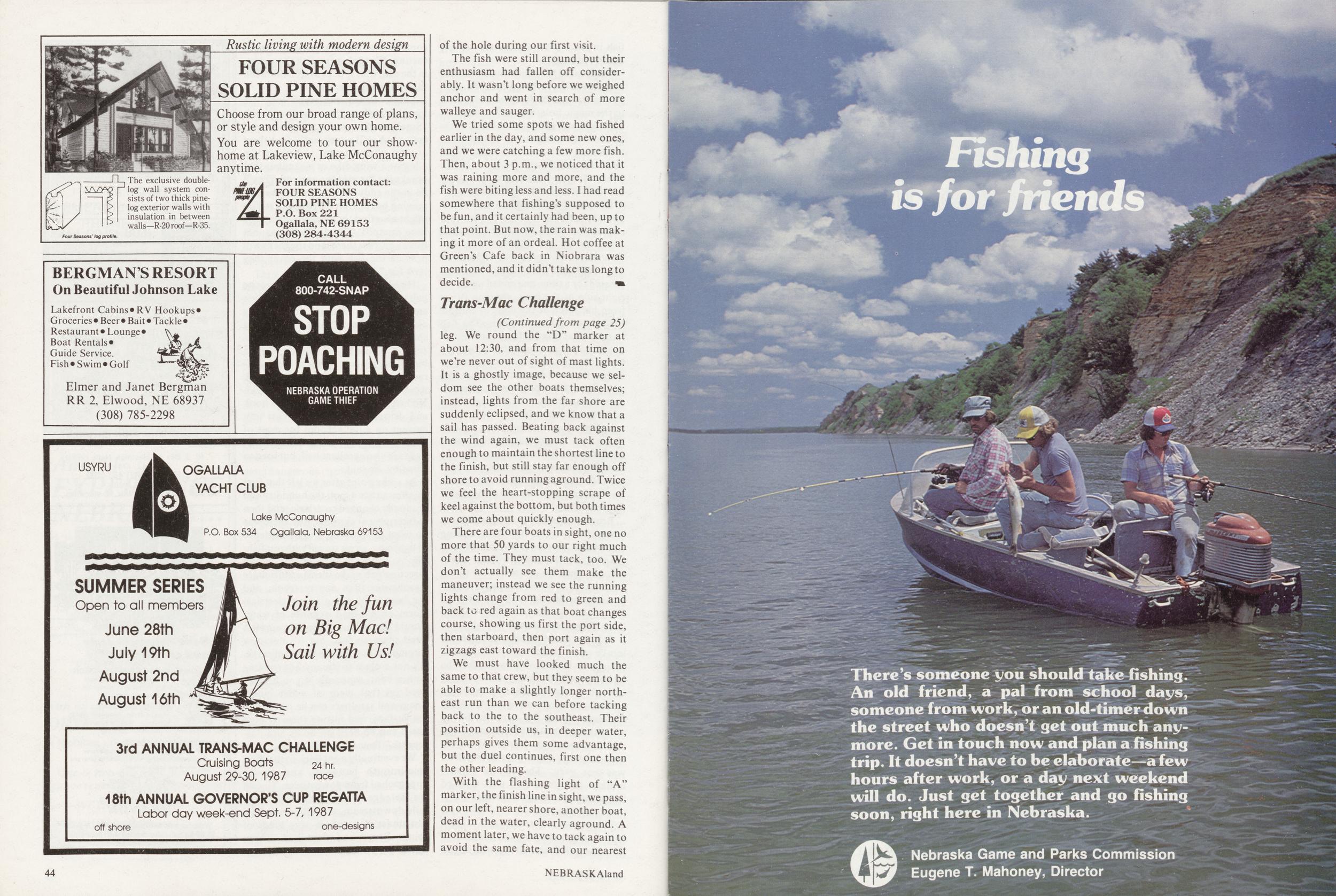 Rustic living with modern design
FOUR SEASONS
SOLID PINE HOMES
The exclusive double log
wall system consists of two thick
pinelog exterior walls with
insulation in between
walls—R-20 roof—R-35.
Four Seasons' log profile.
Choose from our broad range of plans,
or style and design your own home.
You are welcome to tour our
show home at Lakeview, Lake McConaughy
anytime.
For information contact:
FOUR SEASONS
SOLID PINE HOMES
P.O. Box 221
Ogallala, NE 69153
(308) 284-4344
BERGMANS RESORT
On Beautiful Johnson Lake
Lakefront Cabins* RV Hookups*
Groceries* Beer* Bait* Tackle*
Restaurant* Lounge*
Boat Rentals*
Guide Service.
Fish* Swim* Golf
Elmer and Janet Bergman
RR 2, Elwood, NE 68937
(308) 785-2298
CALL
800-742-SNAP
mil
POACHING
NEBRASKA OPERATION
GAME THIEF
USYRU
OGALLALA
YACHT CLUB
Lake McConaughy
P.O. Box 534 Ogallala, Nebraska 69153
SUMMER SERIES
Open to all members
June 28th
July 19th
August 2nd
August 16th
Join the fun
on Big Mac!
Sail with Us!
3rd ANNUAL TRANS-MAC CHALLENGE
Cruising Boats 24 hr.
August 29-30, 1987 race
18th ANNUAL GOVERNOR'S CUP REGATTA
Labor day week-end Sept. 5-7, 1987
off shore one-designs
Rustic living with modern design
FOUR SEASONS
SOLID PINE HOMES
The exclusive double log
wall system consists of two thick
pinelog exterior walls with
insulation in between
walls—R-20 roof—R-35.
Four Seasons' log profile.
Choose from our broad range of plans,
or style and design your own home.
You are welcome to tour our
show home at Lakeview, Lake McConaughy
anytime.
For information contact:
FOUR SEASONS
SOLID PINE HOMES
P.O. Box 221
Ogallala, NE 69153
(308) 284-4344
BERGMANS RESORT
On Beautiful Johnson Lake
Lakefront Cabins* RV Hookups*
Groceries* Beer* Bait* Tackle*
Restaurant* Lounge*
Boat Rentals*
Guide Service.
Fish* Swim* Golf
Elmer and Janet Bergman
RR 2, Elwood, NE 68937
(308) 785-2298
CALL
800-742-SNAP
mil
POACHING
NEBRASKA OPERATION
GAME THIEF
USYRU
OGALLALA
YACHT CLUB
Lake McConaughy
P.O. Box 534 Ogallala, Nebraska 69153
SUMMER SERIES
Open to all members
June 28th
July 19th
August 2nd
August 16th
Join the fun
on Big Mac!
Sail with Us!
3rd ANNUAL TRANS-MAC CHALLENGE
Cruising Boats 24 hr.
August 29-30, 1987 race
18th ANNUAL GOVERNOR'S CUP REGATTA
Labor day week-end Sept. 5-7, 1987
off shore one-designs
The fish were still around, but their enthusiasm had fallen off considerably. It wasn't long before we weighed anchor and went in search of more walleye and sauger.
We tried some spots we had fished earlier in the day, and some new ones, and we were catching a few more fish. Then, about 3 p.m., we noticed that it was raining more and more, and the fish were biting less and less. I had read somewhere that fishing's supposed to be fun, and it certainly had been, up to that point. But now, the rain was making it more of an ordeal. Hot coffee at Green's Cafe back in Niobrara was mentioned, and it didn't take us long to decide.
Trans-Mac Challenge
(Continued from page 25)leg. We round the "D" marker at about 12:30, and from that time on we're never out of sight of mast lights. It is a ghostly image, because we seldom see the other boats themselves; instead, lights from the far shore are suddenly eclipsed, and we know that a sail has passed. Beating back against the wind again, we must tack often enough to maintain the shortest line to the finish, but still stay far enough off shore to avoid running aground. Twice we feel the heart-stopping scrape of keel against the bottom, but both times we come about quickly enough.
There are four boats in sight, one no more that 50 yards to our right much of the time. They must tack, too. We don't actually see them make the maneuver; instead we see the running lights change from red to green and back to red again as that boat changes course, showing us first the port side, then starboard, then port again as it zigzags east toward the finish.
We must have looked much the same to that crew, but they seem to be able to make a slightly longer northeast run than we can before tacking back to the to the southeast. Their position outside us, in deeper water, perhaps gives them some advantage, but the duel continues, first one then the other leading.
With the flashing light of "A" marker, the finish line in sight, we pass, on our left, nearer shore, another boat' dead in the water, clearly aground. A moment later, we have to tack again to avoid the same fate, and our nearest rival gets the jump on us again. We cross the finish line at 2:42 a.m., exactly two minutes behind the Merit 25 sailed by Charles Shinn and his crew from Denver. Just one minute behind us comes another Merit 25 from Englewood, Colorado, skippered by Bob Tone.
44 NEBRASKAland CAN'T BEAR YOUR JOB ANYMORE?
COME STAY WITH US AWHILE.
on Lake McConaughy
Air-conditioned units, cooking facilities.
Up to four adults. Campground on the
beach—50 hookups, showers,
playground, shade.
• MARINA
• CAMPGROUND
• GUIDE SERVICE
• LAUNCHING STORE Groceries,
Beer, Pop, Tackle, Live Bait
• BOAT & PONTOON RENTALS
South Shore Big Mac
at Gate 18
R.R. #1 Box L-9
Brule, NE 69127
Ogallala, NE
(308) 284-4965
NEBRASKA'S BEST KEPT FISHING SECRET
The Missouri River
From Nebraska City to Brownville
• Catfish
• Walleye
• Sauger
and more!
Spend a day fishing on the scenic
Missouri River and let guide
Kenneth Cooksey show you why
many of the state's top anglers
fish this area again and again.
Cost: $60 for 1 person,
$75 for 2 people
(added charge for bait and fuel)
For more information write or call Kenneth Cooksey
KEN KO Inc.
2002 2nd Ave.
Nebraska City, NE 68410
(402) 873-6288
early morning & late evenings
CAN'T BEAR YOUR JOB ANYMORE?
COME STAY WITH US AWHILE.
on Lake McConaughy
Air-conditioned units, cooking facilities.
Up to four adults. Campground on the
beach—50 hookups, showers,
playground, shade.
• MARINA
• CAMPGROUND
• GUIDE SERVICE
• LAUNCHING STORE Groceries,
Beer, Pop, Tackle, Live Bait
• BOAT & PONTOON RENTALS
South Shore Big Mac
at Gate 18
R.R. #1 Box L-9
Brule, NE 69127
Ogallala, NE
(308) 284-4965
NEBRASKA'S BEST KEPT FISHING SECRET
The Missouri River
From Nebraska City to Brownville
• Catfish
• Walleye
• Sauger
and more!
Spend a day fishing on the scenic
Missouri River and let guide
Kenneth Cooksey show you why
many of the state's top anglers
fish this area again and again.
Cost: $60 for 1 person,
$75 for 2 people
(added charge for bait and fuel)
For more information write or call Kenneth Cooksey
KEN KO Inc.
2002 2nd Ave.
Nebraska City, NE 68410
(402) 873-6288
early morning & late evenings
Later, on shore, eating sandwiches and warming up beside a blazing fire, the crews trade war stories. No one seems to notice that it's after 3 a.m., and over the next few hours more boats finish. These later-finishing crews are all as pumped up as the winners. I collapse into the back seat of my vehicle sometime around 4 a.m. The last boat finished, I'm told, about two hours later.
By the next morning's awards ceremonies, Jim Lowitz and his team have official results ready: the winning boat, a Catalina 25 sailed by Donald Waldberger of Longmont, Colorado, finished at 2:15 a.m.—he was also last year's winner. The next five boats finished at 2:35, 2:39, 2:40, 2:42 and 2:43 a.m.
A seventh boat, skippered by Bruce Gerk of Julesburg, went aground in the last 15 minutes of the race in a risky attempt to take the lead. So, after some 11 hours of sailing, the top seven boats were within 15 minutes of each other, and places two through six were within eight minutes. It is a real race.
As winner Donald Waldberger put it, "The race is a real challenge. Endurance counts, and so do navigation skills at night—it's not just sailing around. It has a little of everything: upwind, downwind, and that gorgeous spinnaker run in the moonlight."
Ken Spady summed it up: "Look at them out there sailing around," he said at the awards ceremony. "Some of them were out there at seven this morning. If it were just for the trophy, no one would subject himself to it. By this winter, the stories will be unbelievable; the waves will be two or three feet higher and the winds will be gale force."
Maybe he was right—smaller boats would be crazy to get into the race, but to the unbiased observer (after that night of sailing I have to wonder if I still qualify for that title) there appears to be something just a little crazy about the big-boat people, too, that makes them want to get in—but it's that kind of crazy that makes life fun.
46 NEBRASKAlandRecreation Services Guide
ARCHERY ARCHERY RANGE FISHING SUPPLY AND REPAIR HEADQUARTERS 8705 "F" Street Omaha, NE MODERN AND ANTIQUE FULL GUNSMITHING SERVICES (402) 291-5253 204 E. Mission Bellevue, NE YOUR PLEASURE IS OUR BUSINESS 895-5612 STOP IN FOR ALL YOUR OUTDOOR NEEDS Mark Saner — Proprietor MILLARD BAIT AND TACKLE 14230 "U" St. Just North of HY-VEE on Hwy. 50 G-J's MARINE INC. "YOUR FISHING BOAT DEALER" CUSTOM MADE TOPS & BOAT COVERS LUND & FISHER MARINE BOATS MERCURY OUTBOARDS 4901 "L" Street Omaha, NE (402) 731-4995 THOMAS W. MENK GUNSMITH Custom Work, Repairs • Refinishing Rifles, Handguns and Shotguns 5703 South 77th Ralston, NE (402) 592-5810 CANFIELD'S SPORTING GOODS CAMPING • FISHING HUNTING • ARCHERY MARINE • SCOUTS ARMY SURPLUS M-F 10-7:45, SAT. 10-5:45, SUN. 1-4:45 (402) 342-1517 2415 Cumings St Omaha, NE GUNS UNLIMITED • FIREARMS • SHOOTING accessories 8505 "K" Street • reloading Omaha, NE 68127 EQUIPMENT Home of the Shooting Sports in Omaha and COMPONENTS • CLOTHING (402) 339-0771 AMES MARINE SALES Custom Covers 6001 Ames St. Omaha, NE - SERVICE Financing Available Wes & Terry Smith (402) 455-0276 SPOTLIGHT ON OMAHA MARINE BATTERIES RETAIL — WHOLESALE Delco Voyagers • Varta—the Pro's Choice ACTION BATTERIES 7911J St.6209 Ames 339-1667 451-0837 8505 T St (402) 339-4788 Omaha, NE 68127 FINANCING AND LA I AW A Y AVAILABLE 2 Man Std..............$349.88 or $32.07 Mo. 2 Man Economy........$449.88 or $41.24 Mo. SP-II W................$499.88 or $45.83 Mo. 2 Man — 5 HP..........$599.99 or $55.00 Mo. Jon Boats starting at................. $199.99 BAIT & SUPPLY SHOP ffcjlPlifev # Live Bait • Tackle # Fishing Supplies • Summer & Winter 3952 "Q" St # Hunting & Fishing Permits Omaha, NE ' (402) 733-9855 OMAHA MARINE CENTER Omaha's Value Dealer • SEA RAY • SPORT CRUISER > SORRENTO • MONACO • SEVILLE > ERCOA PONTOONS Authorized Sales & Service • Parts Mercruiser • Cobra • Johnson • Yamaha WATER SPORTS & MARINE ACCESSORIES 4770 "G" St. Omaha, NE (402) 734-4644 MIDWEST CUSTOM SPORTS Archery Pro Shop — Full Line of Equipment SALES & SERVICE ARCHERY RANGES - INDOOR & OUTDOOR 11523 South 60th Omaha, NE (402) 331-0270 dinges taxidermy studio 2763 S. 12th Omaha, NE 68108" (402) 342-3718 JUNE 1987 47
THE SCIENCE OF WILDLIFE MANAGEMENT: The Future of our Wildlife Depends on It
ResearchThe precarious future that many species of North American wildlife faced around the turn of the century provided the impetus for the establishment of our first wildlife parks and refuges. Though initially effective, these early efforts aimed at helping wildlife soon developed serious shortcomings. The concept of providing complete protection, including the elimination of natural predators, to certain species was successful in building up threatened herds of animals, including elk and deer; however, as early as the 1920s, populations in many areas were outstripping their available food supplies.
Such problems helped spur the rapid growth of the modern science of wildlife management. Early wildlife management professionals were the first to recognize the vital importance of vegetation and other aspects of the natural environment that supported wild animal populations. This new understanding of the relationship between wildlife and habitat helped lead to the practical steps necessary to ensure the longterm abundance and health of certain kinds of wildlife.
Extensive biological research is the foundation on which all management programs are built. Studies on animal numbers, their distribution, food preferences and the like provide a detailed picture of a species' needs and habits.
Bird handing projects, such as these, help determine a species' seasonal and local movements and can provide information on age, longevity and other vital characteristics important in developing successful conservation programs.
Over the years, it has been the American hunter who, through license fees and excise taxes, has provided the lion's share of the funds necessary for these conservation programs.
National Shooting Sports Foundation 1075 Post Road Riverside, Conn. 06878 OUTFITTING YOU FOR THE GOOD Up Nebraska's largest selection of quality name brand sporting goods. Count on us to provide you with the finest outdoor clothing and equipment at special low prices. See Burden's Outdoor Outfitters when you're in Lincoln. Get the best of the outdoors. Camping • Hunting • Fishing • Boating • Backpacking X-Country Skiing • Water Sports • Boots, Shoes, Waders Mens, Women’s, Children’s Functional Outdoor Clothing and Gear 1000 West "0" Street Lincoln, NE 68528 474-4366 BURDEN'S Free Parking 48 NEBRASKAlandTrading Post
DOGSTRAINING ALL BREEDS Hunting Dogs — Vizslas for sale. Rozanek Kennels, Rt. 2, Schuyler, NE 68661. Phone (402) 352-8769. _______________________
ENGLISH SETTERS: "Bred for the hunter"; select puppies and started dogs available from outstanding bloodlines. Stud service available by proven hunters. High Plains Kennels, 1411 Emerson, Alliance, NE 69301, Phone (308) 762-6709._____________________
GROUSE WAYBRITTANIES: Ideal hunting companions—dedicated, goal-oriented breeding programs. FREE brochure, Grouseway Gundogs, Louisville, NE 68037. (402) 298-8340. Training available.___________
GERMAN SHORTHAIRS and Brittany Spaniel pups. Started and occasionally a meat dog. Pups are guaranteed. Also I will be training hunting dogs. Wayne Clark, Percival, I A. Phone (712) 529-4238 or (402) 263-3155 at Union, NE._________________
MISCELLANEOUSNE NEBRASKA trout fishing. 3 modern cottages, 1 available year round. 5 spring fed lakes with open water all year. Trout up to 7 pounds. Other varieties fish also. Diamond E. Trout Resort, Orchard, NE 68764. Phone (402) 893-4745._________________________________
GUNS - - Browning, Winchester, Remington, others, Hi-powers, shotguns, new, used, antiques. Want Pre-1964 Winchesters. Buy-Sell-Trade. Ph. (402) 729-6112. Bedlan's Sporting Goods, Fairbury, NE 68352.______
MAD RIVER CANOES offers the finest quality and performance. For the finest canoes and accessories look to Great Plains Canoe Co., 205 Main, Springfield, NE. Phone (402) 253-2001._______________________
RECEIVE $75/100 envelopes returned to us. Rush stamped envelope: Kelley 4, 804 Old Thorsby Road, Clanton, Alabama 35045.
STOCK SHOP wood stocks for all firearms. Repaired, refinished or custom made. Hand-cut checkering, glass bedding. 1618 Euclid, Ashland, NE 68003. Phone (402) 944-2836.___________________________
HOMEWORKERS! RECEIVE $75/100 envelopes you return to us per instructions. Rush stamped envelope: Kelley 5, 804 Old Thorsby Road, Clanton, Ala-bama 35045.______________________________
TROLLING MOTOR REPAIR. Factory authorized Minn Kota and Motor Guide, parts and service. Wolfs Repair and Installation, 1529 David Drive, Lincoln, NE 68504. Phone (402) 464-4265.
WINE AND BEER: Make your own. Send for free recipes and instructions. Omaha Supply, 1324 2nd Avenue, Nebraska City, NE 68410.
FAIRFIELD CAMPGROUNDS along the Niobrara River "in the heart of a unique blend of habitats." Hiking, natural scenery, bird watching, canoe rental, car shuttle, experienced outfitters. Lifetime river knowledge. Beryl Kuhre, Johnstown, NE 69214. Phone (402) 722-4494. _____________________
WANTED — SPORTSMAN to develop private hunting preserve. 1,200 acres in Sherman County. R. G. Hanisch, M.D., Box 236, St. Paul, NE 68872._______
FOR SALE: Hunting cottage and year-round retreat. Located near Nebraska's beautiful Pine Creek, Long Pine, Nebraska. Excellent hunting and trout fishing. Call Wardene Roark, (402) 273-4141.______________
COTTONWOOD PRESS for all your printing needs. We can do family histories, newsletters, pamphlets, booklets, and even cookbooks. Write to Cottonwood Press and tell us what your printing needs are. 404 N. Wheeler, Grand Island, NE 68801 or call (308) 384-0409 anytime.
FREE KODAK film for life, plus hundreds of dollars of free gifts. Call toll free 1-800-433-6312._________
TAXIDERMYALLISON'S TAXIDERMY STUDIO. Wally and Betty Allison, Licensed Taxidermist. We've mounted 21 Nebraska State Record fish. Specializing in fish and birds, small game and rattlesnakes. We use freeze-dry. 2310 West Leota, North Platte, Nebr. 69101. Phone (308) 534-2324. ________________________________
BADE TAXIDERMY - - Quality a must — Fast service. Fish, birds, rugs, tanning, full mounts and game heads, 2111 N. Christy St., Fremont, NE 727-5463.
KARL SCH WARZ master taxidermist has moved to a new country studio; same professional mounting and tanning service. Schwarz Wild Wing Studio, 16804 South 180th St., Springfield, NE 68059. Phone (402) 253-2481.
NABITY'S TAXIDERMY. 31 years experience. Specializing in natural grass backgrounds for mammals, birds and fish. 13901 "O" St., Lincoln, NF 68504 — 4 miles east of 84th and "O". (402) 489-6351.
BIG BEAR TAXIDERMY, Rt. 2, Mitchell, Nebraska 69357. We specialize in all big game from Alaska to Nebraska, also birds and fish. Hair on and hair off tanning. Four miles west of Scottsbluff on Highway 26. Dale Hubel, phone (308) 635-3013._____________
PEISTER TAXIDERMY — Professional work at prices most sportsman can afford. Now in our new log cabin studio, 1020 Central Avenue, Box 3201, Kearney, NE 68847. Phone (308) 236-9700 or (308) 237-7575 evenings.
NATURE CRAFT STUDIO - all custom services — creative work, quality, and experience since 1935. Includes freeze-dry processing. Display and sales room, visitors welcome. Hwy. 2 in Nebraska City. Phone (402) 873-5491. Joe Voges — Owner. Bow Steadily — Big Game specialist.
CEDAR LANE - Ranch Vacations • Guest ranch in the heart of the Sandhills of Nebraska. Swimming, spa, horses, canoeing, trail rides, barbeques, hunting. BOOKING NOW For 1987 Richard and Betty Schroeder HC 2 Box 9C Stapleton. Nebraska 69163 Ph. 308-587-2233 NEBRASKAland Magazine Order Form Please send me a subscription to NEBRASKAland Magazine One-year $12.00 NAME Two-year $23.00 ADDRESS CITY____ STATE ZIP Mail to: NEBRASKAland Magazine, Box 30370, Lincoln, NE 68503 FOR SALE Duck Hunting and Fishing Haven 160 acres of prime duck hunting and fishing land. Warm water spring in lake. 2 excellent cabins. Located on Cedar River in Wheeler County, 25 miles east of new Calamus Lake. Call (402) 628-6685 or (308) 653-3801. WILLIE'S FISH FARM For your fish needs — we have for sale: Kamaloop, Rainbow Trout from 1"to2 lb., Channel Cat, Coho Salmon, Walleye and Goldfish; others also available. Call 7:00 a.m. - 11:00 p.m. 402-723-4210 Wilbur G. Epp R.R. 1, Box 199 — Henderson, Nebr. 68371 (Just Vh miles south of I-80) Hatching Eggs Mature Flyers Day-Old Chix Oven Ready Started Birds Hickory Smoked double Game Bird Farms R. 2, Box 358, Beloit, Wl 53511 PHEASANTS - WILD TURKEYS CHUKAR & HUNGARIAN PARTRIDGES OFFERS A COMPLETE TRAINING PROGRAM For Retrievers, Pointers, Spaniels Basic Obedience Program For All Breeds Field Trial Bloodline Lab Pups For Sale JOHN HONORE Manager and Trainer West Highway 30 RR 1 Box 433 Grand Island, NE 68801 Phone: (308)384-1517 LIME-CATCH ALL-PURPOSE TRAPS Write for FREE CATALOG Traps without injury squirrels, chipmunks, rabbits mink fox raccoons, stray animals, pests, etc. Sizes for every need. Also' trap's for snakes, sparrows, pigeons, crabs, turtles, quail, etc. Save on our low factory prices Send no money. Free catalog and trapping secrets MUSTANG MFG. CO., Oept. N-34, Box 920947, Houston, Tex. 77292 GUN DOG TRAINING All Sporting Breeds All dogs worked on foot — no horses. Midwest's finest facilities. Field Champion-sired Labrador pups for sale. "Training for hunters by hunters" WILDERNESS KENNELS Henry Sander—Roca, Ne. (402)423-4212 68430 JUNE 1987 49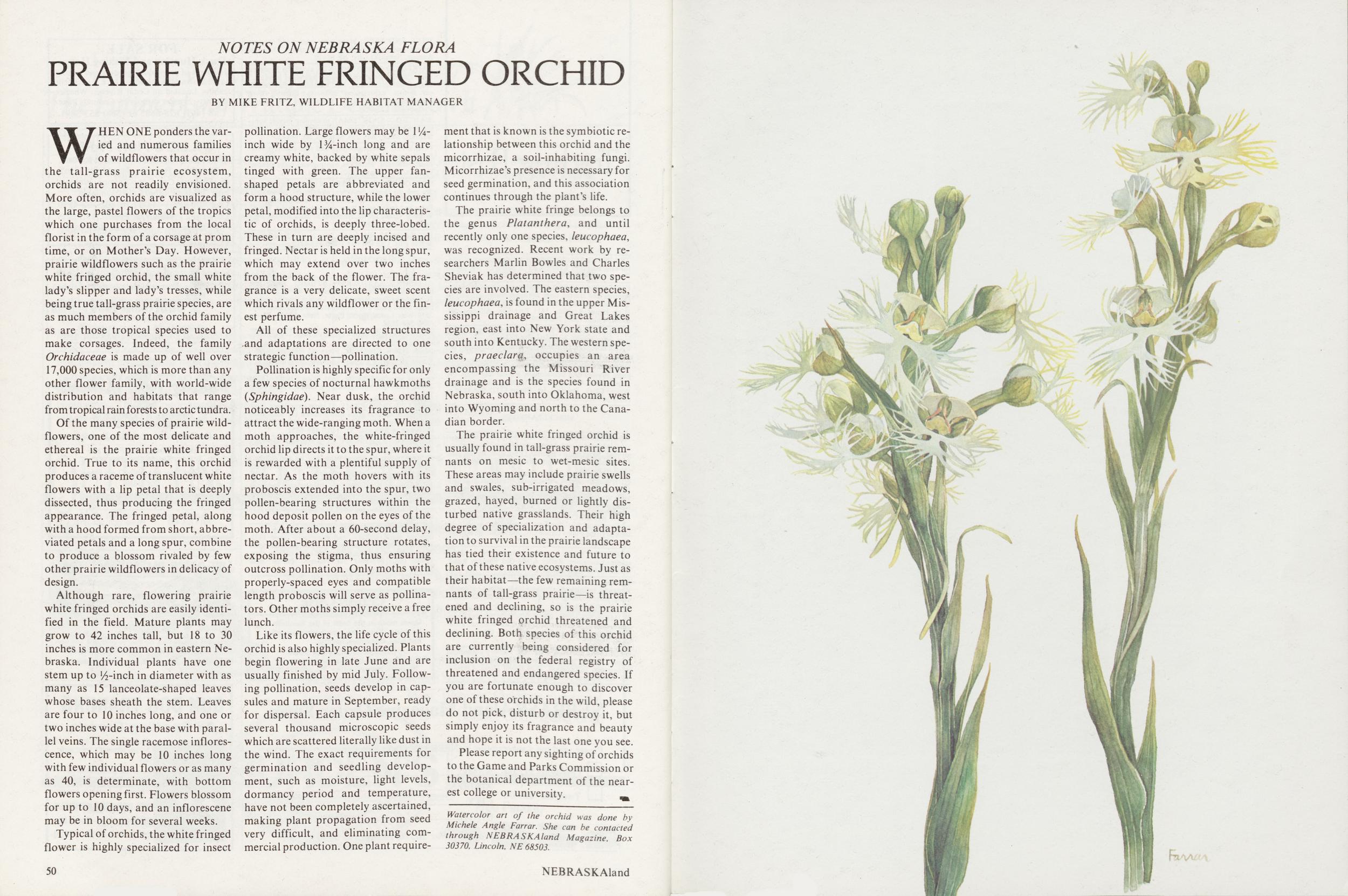
NOTES ON NEBRASKA FLORA PRAIRIE WHITE FRINGED ORCHID
BY MIKE FRITZ, WILDLIFE HABITAT MANAGERWHEN ONE ponders the varied and numerous families of wildflowers that occur in the tall-grass prairie ecosystem, orchids are not readily envisioned. More often, orchids are visualized as the large, pastel flowers of the tropics which one purchases from the local florist in the form of a corsage at prom time, or on Mother's Day. However, prairie wildflowers such as the prairie white fringed orchid, the small white lady's slipper and lady's tresses, while being true tall-grass prairie species, are as much members of the orchid family as are those tropical species used to make corsages. Indeed, the family Orchidaceae is made up of well over 17,000 species, which is more than any other flower family, with world-wide distribution and habitats that range from tropical rain forests to arctic tundra.
Of the many species of prairie wildflowers, one of the most delicate and ethereal is the prairie white fringed orchid. True to its name, this orchid produces a raceme of translucent white flowers with a lip petal that is deeply dissected, thus producing the fringed appearance. The fringed petal, along with a hood formed from short, abbreviated petals and a long spur, combine to produce a blossom rivaled by few other prairie wildflowers in delicacy of design.
Although rare, flowering prairie white fringed orchids are easily identified in the field. Mature plants may grow to 42 inches tall, but 18 to 30 inches is more common in eastern Nebraska. Individual plants have one stem up to !/2-inch in diameter with as many as 15 lanceolate-shaped leaves whose bases sheath the stem. Leaves are four to 10 inches long, and one or two inches wide at the base with parallel veins. The single racemose inflorescence, which may be 10 inches long with few individual flowers or as many as 40, is determinate, with bottom flowers opening first. Flowers blossom for up to 10 days, and an inflorescence may be in bloom for several weeks.
Typical of orchids, the white fringed flower is highly specialized for insect pollination. Large flowers may be 174- inch wide by l3/4-inch long and are creamy white, backed by white sepals tinged with green. The upper fan- shaped petals are abbreviated and form a hood structure, while the lower petal, modified into the lip characteristic of orchids, is deeply three-lobed. These in turn are deeply incised and fringed. Nectar is held in the long spur, which may extend over two inches from the back of the flower. The fragrance is a very delicate, sweet scent which rivals any wildflower or the fin- est perfume.
All of these specialized structures and adaptations are directed to one strategic function—pollination.
Pollination is highly specific for only a few species of nocturnal hawk moths (Sphingidae). Near dusk, the orchid noticeably increases its fragrance to attract the wide-ranging moth. When a moth approaches, the white-fringed orchid lip directs it to the spur, where it is rewarded with a plentiful supply of nectar. As the moth hovers with its proboscis extended into the spur, two pollen-bearing structures within the hood deposit pollen on the eyes of the moth. After about a 60-second delay, the pollen-bearing structure rotates, exposing the stigma, thus ensuring outcross pollination. Only moths with properly-spaced eyes and compatible length proboscis will serve as pollinators. Other moths simply receive a free lunch.
Like its flowers, the life cycle of this orchid is also highly specialized. Plants begin flowering in late June and are usually finished by mid July. Following pollination, seeds develop in capsules and mature in September, ready for dispersal. Each capsule produces several thousand microscopic seeds which are scattered literally like dust in the wind. The exact requirements for germination and seedling development, such as moisture, light levels, dormancy period and temperature, have not been completely ascertained, making plant propagation from seed very difficult, and eliminating commercial production. One plant requirement that is known is the symbiotic relationship between this orchid and the mycorrhizae, a soil-inhabiting fungi. Mycorrhizae’s presence is necessary for seed germination, and this association continues through the plant's life.
The prairie white fringe belongs to the genus Platanthera, and until recently only one species, leucophaea, was recognized. Recent work by researchers Marlin Bowles and Charles Sheviak has determined that two species are involved. The eastern species, leucophaea, is found in the upper Mississippi drainage and Great Lakes region, east into New York state and south into Kentucky. The western species, praeclara, occupies an area encompassing the Missouri River drainage and is the species found in Nebraska, south into Oklahoma, west into Wyoming and north to the Canadian border.
The prairie white fringed orchid is usually found in tall-grass prairie remnants on mesic to wet-mesic sites. These areas may include prairie swells and swales, sub-irrigated meadows, grazed, hayed, burned or lightly disturbed native grasslands. Their high degree of specialization and adaptation to survival in the prairie landscape has tied their existence and future to that of these native ecosystems. Just as their habitat—the few remaining remnants of tall-grass prairie—is threatened and declining, so is the prairie white fringed orchid threatened and declining. Both species of this orchid are currently being considered for inclusion on the federal registry of threatened and endangered species. If you are fortunate enough to discover one of these orchids in the wild, please do not pick, disturb or destroy it, but simply enjoy its fragrance and beauty and hope it is not the last one you see.
Please report any sighting of orchids to the Game and Parks Commission or the botanical department of the nearest college or university.
Watercolor art of the orchid was done by Michele Angle Farrar. She can be contacted through NEBRASKAland Magazine Box 30370, Lincoln, NE 68503. 50 NEBRASKAland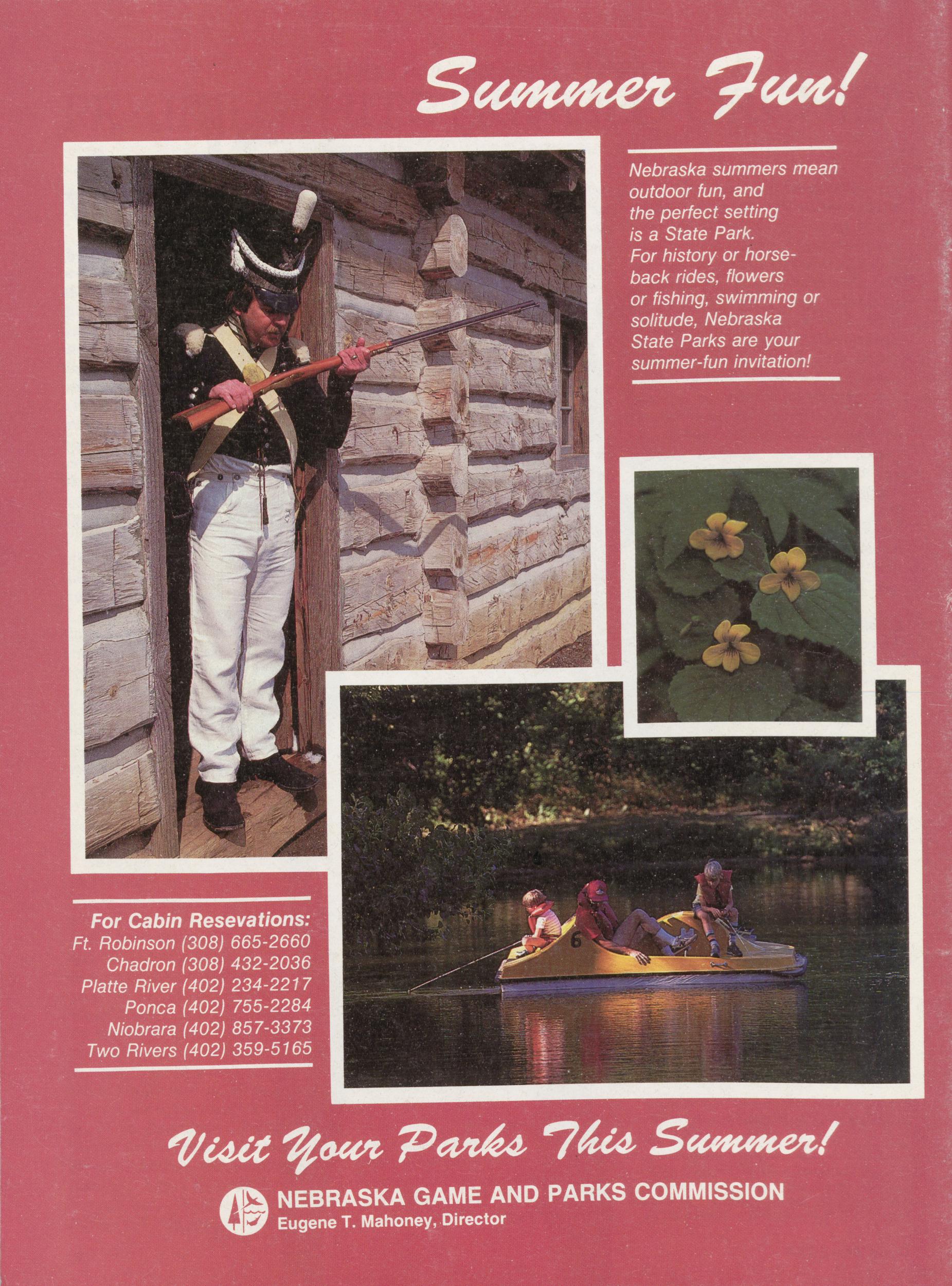
Summer Fun!
Nebraska summers mean outdoor fun, and the perfect setting is a State Park. For history or horse-back rides, flowers or fishing, swimming or solitude, Nebraska State Parks are your summer-fun invitation!Position: 164 (40 views)