Volume 65, Issue 4, 1987
NEBRASKAland
May 1987 $1.50
NEBRASKAland
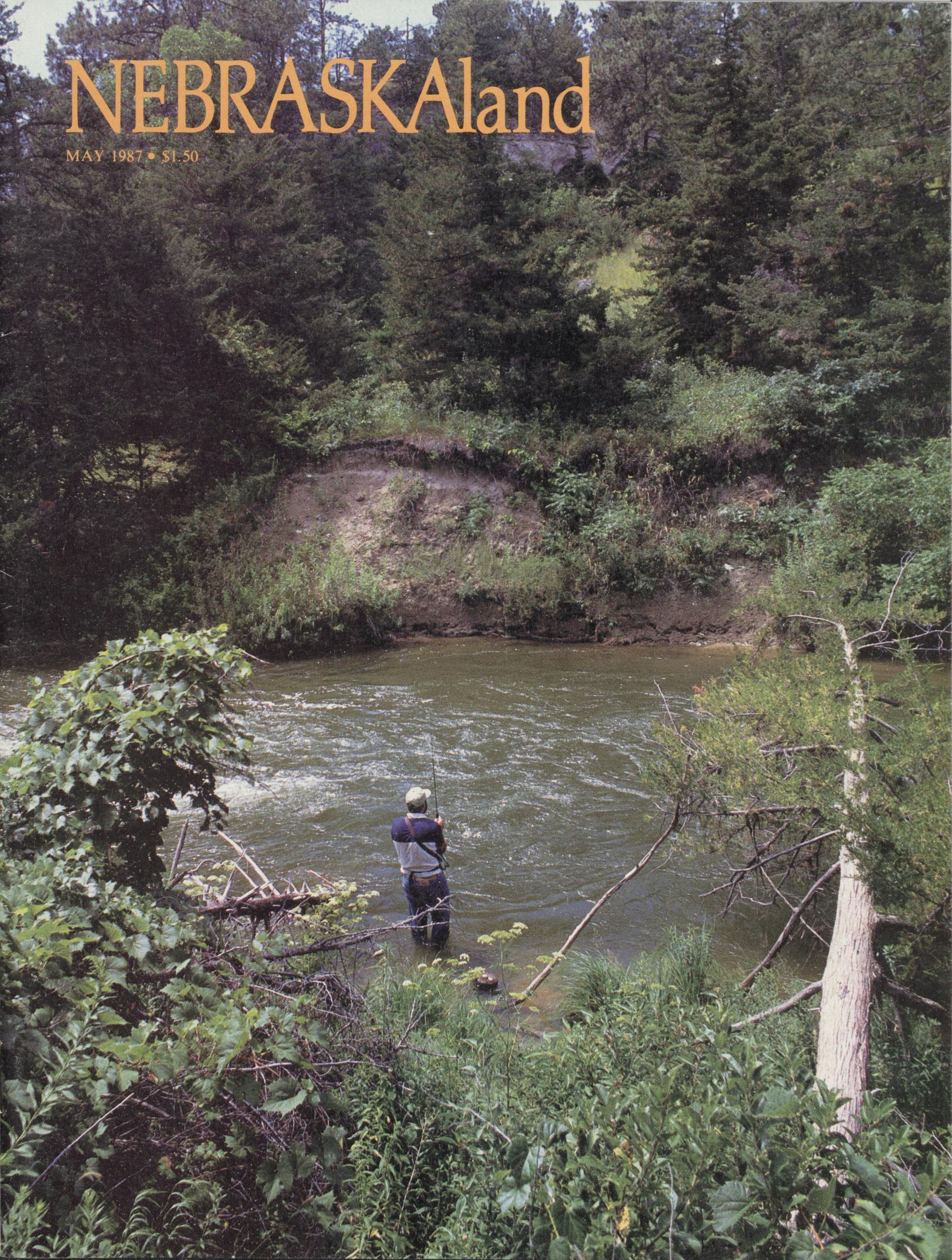
Published by the Nebraska Game and Parks Commission Contents Features McCONAUGHY . . . FISH ASSETS IN THE TONS. 6 FRANK SHOEMAKER . . . PANHANDLE EXPEDITION..14 SNAKE RIVER TROUT..20 INSIDERS’ PICKS.26 A NEW LAKE ON LINE.32 SPRING FISHING..38 NOTES ON NEBRASKA FAUNA/SAUGER.50 Departments SPEAK UP. 4 BOOK SHELF..48 TRADING POST49COVER: Late spring means fishing, and if trout are the quarry, there are few places more productive than the Snake River below Merritt Reservoir. The fast-flowing cold water of this Sandhills stream is home to both browns and rainbows, and the waters below Snake River Falls have produced numerous Master Angler fish. For more on Snake River trout fishing, see page 20 where this month’s cover subject, Shawn Renner of Lincoln, narrates details of a 1986 trip to the area. Photo by Don Cunningham. OPPOSITE: Among the most numerous trophy-size fish in Nebraska, the feisty northern pike is found in many waters across the state. A spirited battle is always assured, and the northern is no less a treat on the table.
Photo by Ken Bouc.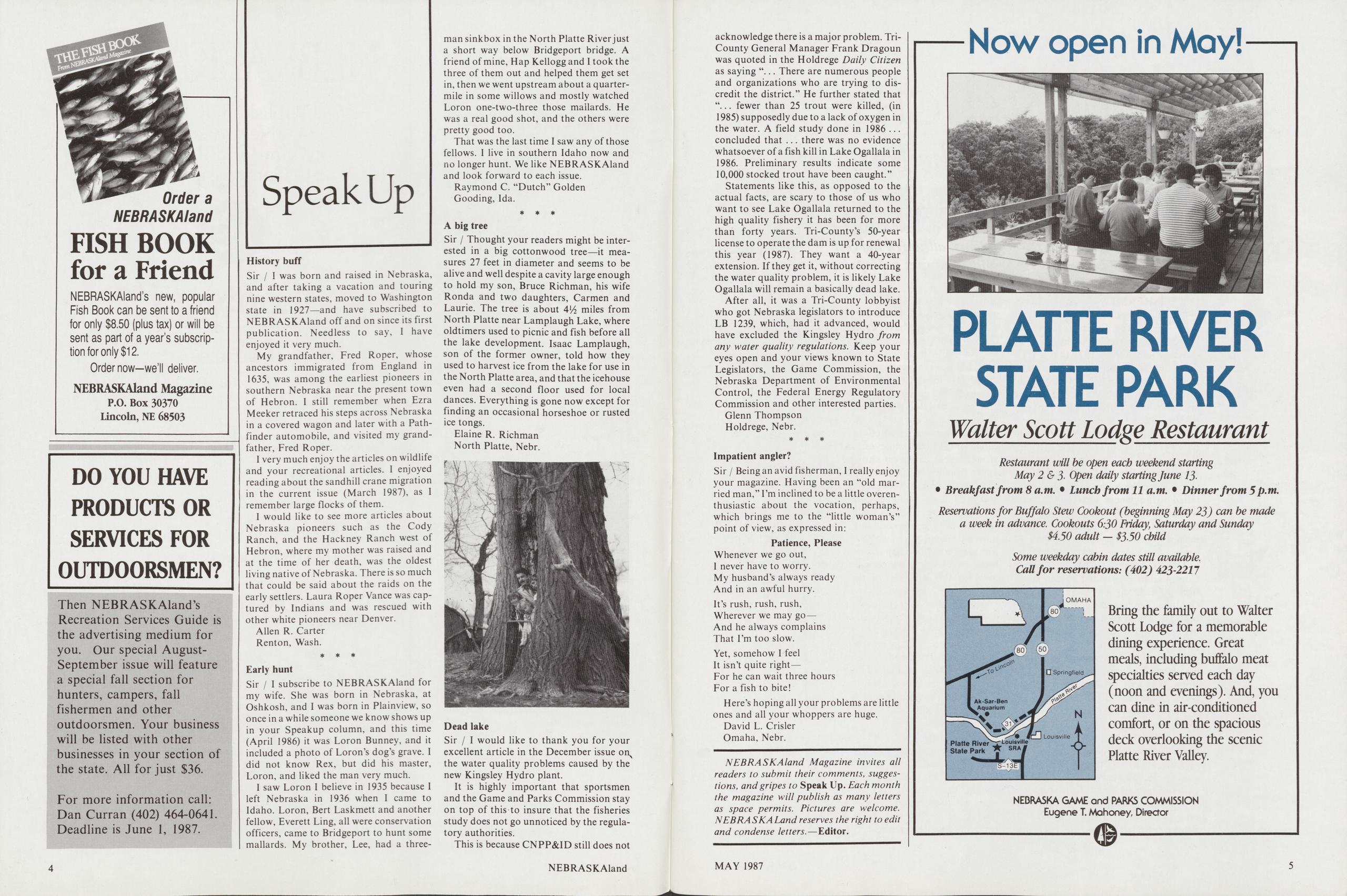
Speak Up
History buffSir / I was born and raised in Nebraska, and after taking a vacation and touring nine western states, moved to Washington state in 1927—and have subscribed to NEBRASKAland off and on since its first publication. Needless to say, I have enjoyed it very much.
My grandfather, Fred Roper, whose ancestors immigrated from England in 1635, was among the earliest pioneers in southern Nebraska near the present town of Hebron. I still remember when Ezra Meeker retraced his steps across Nebraska in a covered wagon and later with a Path- finder automobile, and visited my grand- father, Fred Roper.
I very much enjoy the articles on wildlife and your recreational articles. I enjoyed reading about the sandhill crane migration in the current issue (March 1987), as I remember large flocks of them. I would like to see more articles about Nebraska pioneers such as the Cody Ranch, and the Hackney Ranch west of Hebron, where my mother was raised and at the time of her death, was the oldest living native of Nebraska. There is so much that could be said about the raids on the early settlers. Laura Roper Vance was captured by Indians and was rescued with other white pioneers near Denver.
Allen R. Carter Renton, Wash. Early huntSir / I subscribe to NEBRASKAland for my wife. She was born in Nebraska, at Oshkosh, and 1 was born in Plainview, so once in a while someone we know shows up in your Speakup column, and this time (April 1986) it was Loron Bunney, and it included a photo of Loron’s dog’s grave. I did not know Rex, but did his master, Loron, and liked the man very much.
I saw Loron I believe in 1935 because I left Nebraska in 1936 when I came to Idaho. Loron, Bert Laskmett and another fellow, Everett Ling, all were conservation officers, came to Bridgeport to hunt some mallards. My brother, Lee, had a three-man sinkbox in the North Platte River just a short way below Bridgeport bridge. A friend of mine, Hap Kellogg and I took the three of them out and helped them get set in, then we went upstream about a quarter- mile in some willows and mostly watched Loron one-two-three those mallards. He was a real good shot, and the others were pretty good too.
That was the last time I saw any of those fellows. I live in southern Idaho now and no longer hunt. We like NEBRASKAland and look forward to each issue.
Raymond C. “Dutch” Golden Gooding, Ida. A big treeSir / Thought your readers might be interested in a big cottonwood tree—it measures 27 feet in diameter and seems to be alive and well despite a cavity large enough to hold my son, Bruce Richman, his wife Ronda and two daughters, Carmen and Laurie. The tree is about 4lA miles from North Platte near Lamplaugh Lake, where oldtimers used to picnic and fish before all the lake development. Isaac Lamplaugh, son of the former owner, told how they used to harvest ice from the lake for use in the North Platte area, and that the icehouse even had a second floor used for local dances. Everything is gone now except for finding an occasional horseshoe or rusted ice tongs.
Elaine R. Richman North Platte, Nebr.Sir / I would like to thank you for your excellent article in the December issue oi\ the water quality problems caused by the new Kingsley Hydro plant.
It is highly important that sportsmen and the Game and Parks Commission stay on top of this to insure that the fisheries study does not go unnoticed by the regulatory authorities.
This is because CNPP&ID still does not acknowledge there is a major problem. Tri-County General Manager Frank Dragoun was quoted in the Holdrege Daily Citizen as saying “ There are numerous people and organizations who are trying to discredit the district.” He further stated that fewer than 25 trout were killed, (in 1985) supposedly due to a lack of oxygen in the water. A field study done in 1986 concluded that there was no evidence whatsoever of a fish kill in Lake Ogallala in 1986. Preliminary results indicate some 10,000 stocked trout have been caught.”
Statements like this, as opposed to the actual facts, are scary to those of us who want to see Lake Ogallala returned to the high quality fishery it has been for more than forty years. Tri-County’s 50-year license to operate the dam is up for renewal this year (1987). They want a 40-year extension. If they get it, without correcting the water quality problem, it is likely Lake Ogallala will remain a basically dead lake.
After all, it was a Tri-County lobbyist who got Nebraska legislators to introduce LB 1239, which, had it advanced, would have excluded the Kingsley Hydro from any water quality regulations. Keep your eyes open and your views known to State Legislators, the Game Commission, the Nebraska Department of Environmental Control, the Federal Energy Regulatory Commission and other interested parties.
Glenn Thompson Holdrege, Nebr. Impatient angler?Sir / Being an avid fisherman, I really enjoy your magazine. Having been an “old married man,” I'm inclined to be a little overenthusiastic about the vocation, perhaps, which brings me to the “little woman’s” point of view, as expressed in:
Patience, PleaseWhenever we go out,
I never have to worry.
My husband’s always ready
And in an awful hurry.
It’s rush, rush, rush,
Wherever we may go—
And he always complains
That I’m too slow.
Yet, somehow I feel
It isn’t quite right—
For he can wait three hours
For a fish to bite!
Here’s hoping all your problems are little
ones and all your whoppers are huge. David L. Crisler Omaha, Nebr.
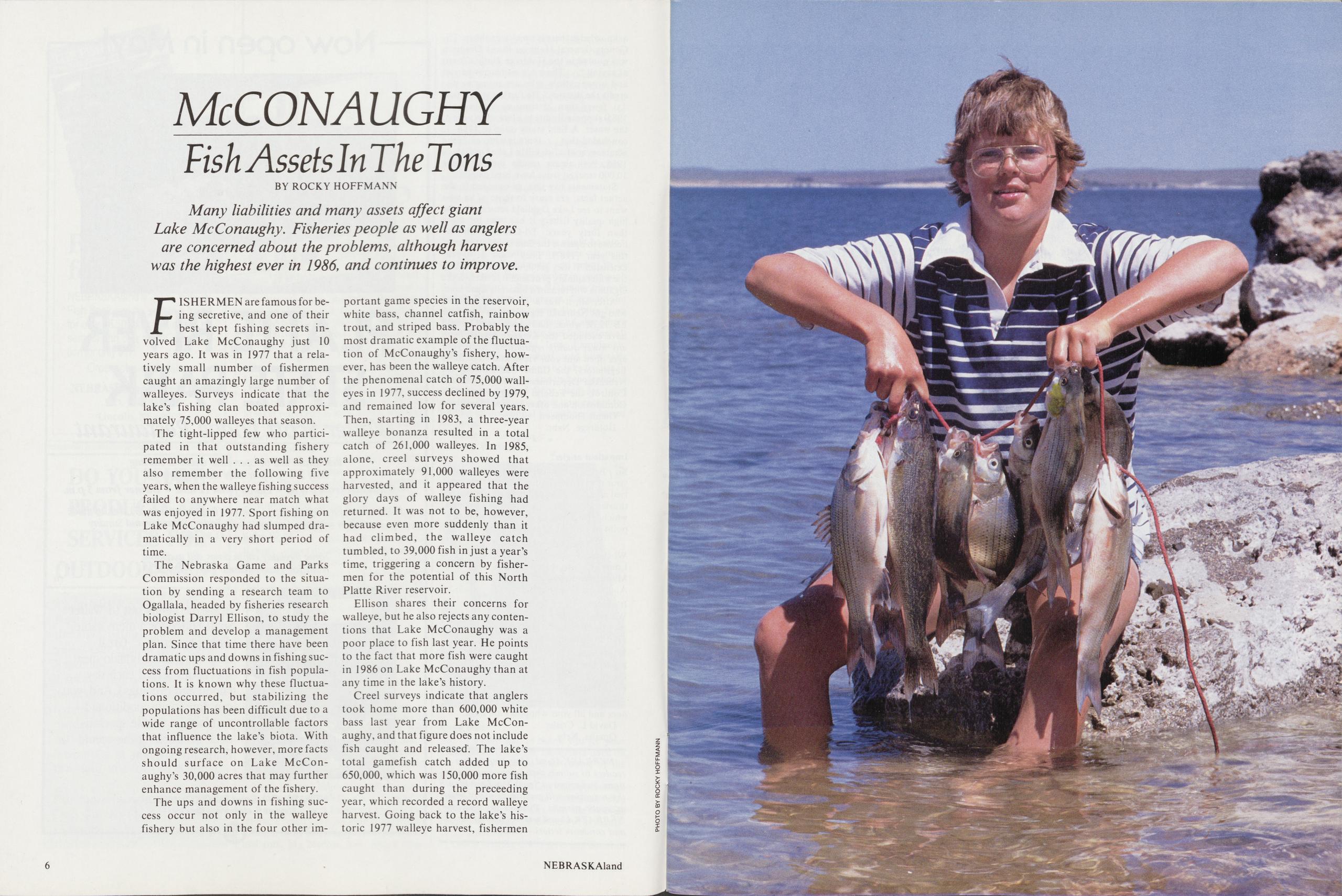
McCONAUGHY
Fish Assets In The Tons
Many liabilities and many assets affect giant Lake McConaughy. Fisheries people as well as anglers are concerned about the problems, although harvest was the highest ever in 1986, and continues to improve.FISHERMEN are famous for being secretive, and one of their best kept fishing secrets involved Lake McConaughy just 10 years ago. It was in 1977 that a relatively small number of fishermen caught an amazingly large number of walleyes. Surveys indicate that the lake’s fishing clan boated approximately 75,000 walleyes that season.
The tight-lipped few who participated in that outstanding fishery remember it well as well as they also remember the following five years, when the walleye fishing success failed to anywhere near match what was enjoyed in 1977. Sport fishing on Lake McConaughy had slumped dramatically in a very short period of time.
The Nebraska Game and Parks Commission responded to the situation by sending a research team to Ogallala, headed by fisheries research biologist Darryl Ellison, to study the problem and develop a management plan. Since that time there have been dramatic ups and downs in fishing success from fluctuations in fish populations. It is known why these fluctuations occurred, but stabilizing the populations has been difficult due to a wide range of uncontrollable factors that influence the lake’s biota. With ongoing research, however, more facts should surface on Lake McConaughy’s 30,000 acres that may further enhance management of the fishery.
The ups and downs in fishing success occur not only in the walleye fishery but also in the four other important game species in the reservoir, white bass, channel catfish, rainbow trout, and striped bass. Probably the most dramatic example of the fluctuation of McConaughy’s fishery, however, has been the walleye catch. After the phenomenal catch of 75,000 walleyes in 1977, success declined by 1979, and remained low for several years. Then, starting in 1983, a three-year walleye bonanza resulted in a total catch of 261,000 walleyes. In 1985, alone, creel surveys showed that approximately 91,000 walleyes were harvested, and it appeared that the glory days of walleye fishing had returned. It was not to be, however, because even more suddenly than it had climbed, the walleye catch tumbled, to 39,000 fish in just a year’s time, triggering a concern by fishermen for the potential of this North Platte River reservoir.
Ellison shares their concerns for walleye, but he also rejects any contentions that Lake McConaughy was a poor place to fish last year. He points to the fact that more fish were caught in 1986 on Lake McConaughy than at any time in the lake’s history.
Creel surveys indicate that anglers took home more than 600,000 white bass last year from Lake McConaughy, and that figure does not include fish caught and released. The lake’s total gamefish catch added up to 650,000, which was 150,000 more fish caught than during the preceeding year, which recorded a record walleye harvest. Going back to the lake’s historic 1977 walleye harvest, fishermen
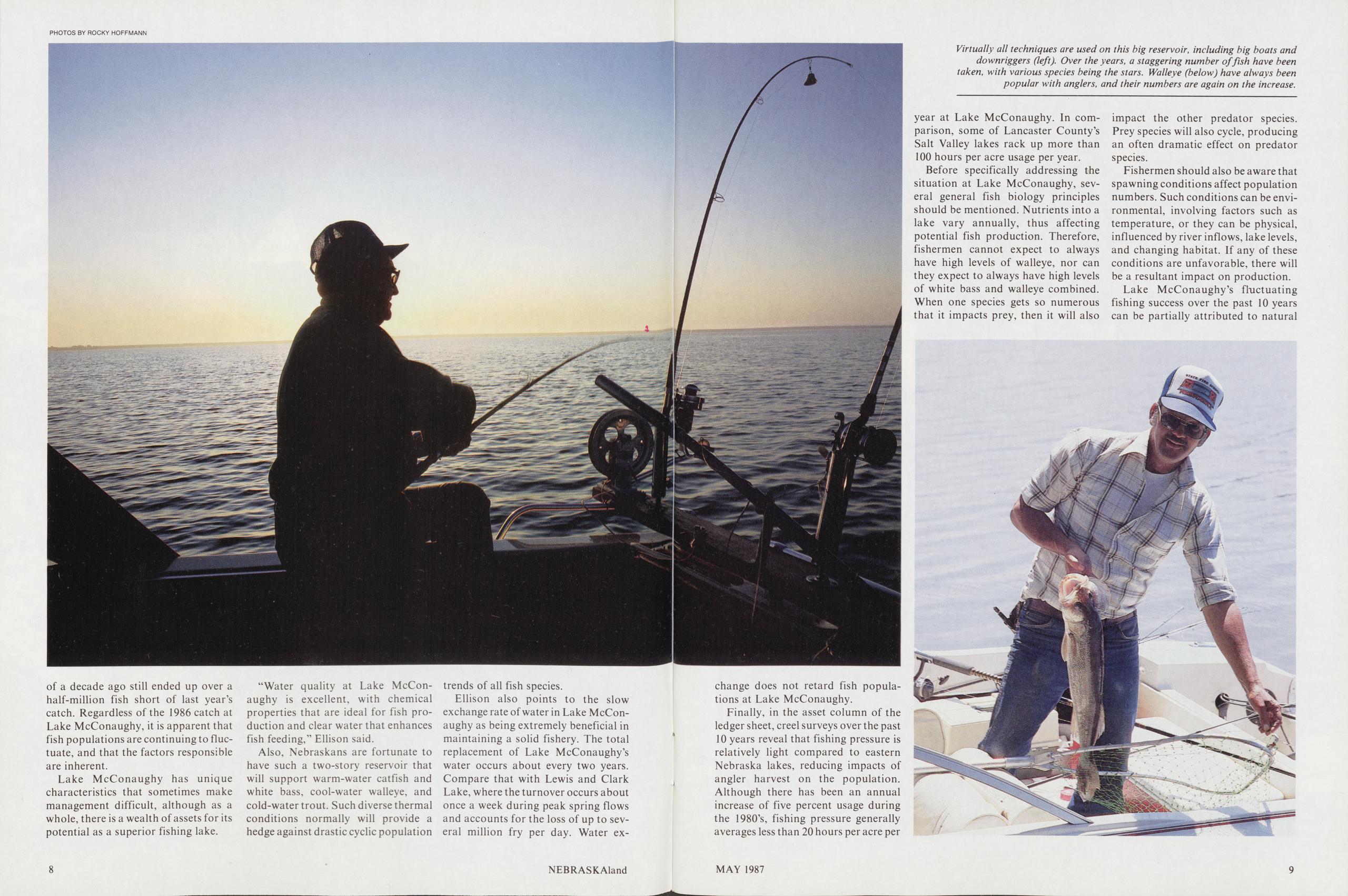
Virtually all techniques are used on this big reservoir, including big boats and downriggers (left). Over the years, a staggering number offish have been taken, with various species being the stars. Walleye (below) have always been popular with anglers, and their numbers are again on the increase.
of a decade ago still ended up over a half-million fish short of last year’s catch. Regardless of the 1986 catch at Lake McConaughy, it is apparent that fish populations are continuing to fluctuate, and that the factors responsible are inherent.
Lake McConaughy has unique characteristics that sometimes make management difficult, although as a whole, there is a wealth of assets for its potential as a superior fishing lake.
“Water quality at Lake McConaughy is excellent, with chemical properties that are ideal for fish production and clear water that enhances fish feeding,” Ellison said.
Also, Nebraskans are fortunate to have such a two-story reservoir that will support warm-water catfish and white bass, cool-water walleye, and cold-water trout. Such diverse thermal conditions normally will provide a hedge against drastic cyclic population trends of all fish species.
Ellison also points to the slow exchange rate of water in Lake McConaughy as being extremely beneficial in maintaining a solid fishery. The total replacement of Lake McConaughy’s water occurs about every two years. Compare that with Lewis and Clark Lake, where the turnover occurs about once a week during peak spring flows and accounts for the loss of up to several million fry per day. Water exchange does not retard fish populations at Lake McConaughy.
Finally, in the asset column of the ledger sheet, creel surveys over the past 10 years reveal that fishing pressure is relatively light compared to eastern Nebraska lakes, reducing impacts of angler harvest on the population. Although there has been an annual increase of five percent usage during the 1980’s, fishing pressure generally averages less than 20 hours per acre per year at Lake McConaughy. In comparison, some of Lancaster County’s Salt Valley lakes rack up more than 100 hours per acre usage per year.
Before specifically addressing the situation at Lake McConaughy, several general fish biology principles should be mentioned. Nutrients into a lake vary annually, thus affecting potential fish production. Therefore, fishermen cannot expect to always have high levels of walleye, nor can they expect to always have high levels of white bass and walleye combined. When one species gets so numerous that it impacts prey, then it will also impact the other predator species. Prey species will also cycle, producing an often dramatic effect on predator species.
Fishermen should also be aware that spawning conditions affect population numbers. Such conditions can be environmental, involving factors such as temperature, or they can be physical, influenced by river inflows, lake levels, and changing habitat. If any of these conditions are unfavorable, there will be a resultant impact on production.
Lake McConaughy’s fluctuating fishing success over the past 10 years can be partially attributed to natural
8 NEBRASKAland MAY 1987 9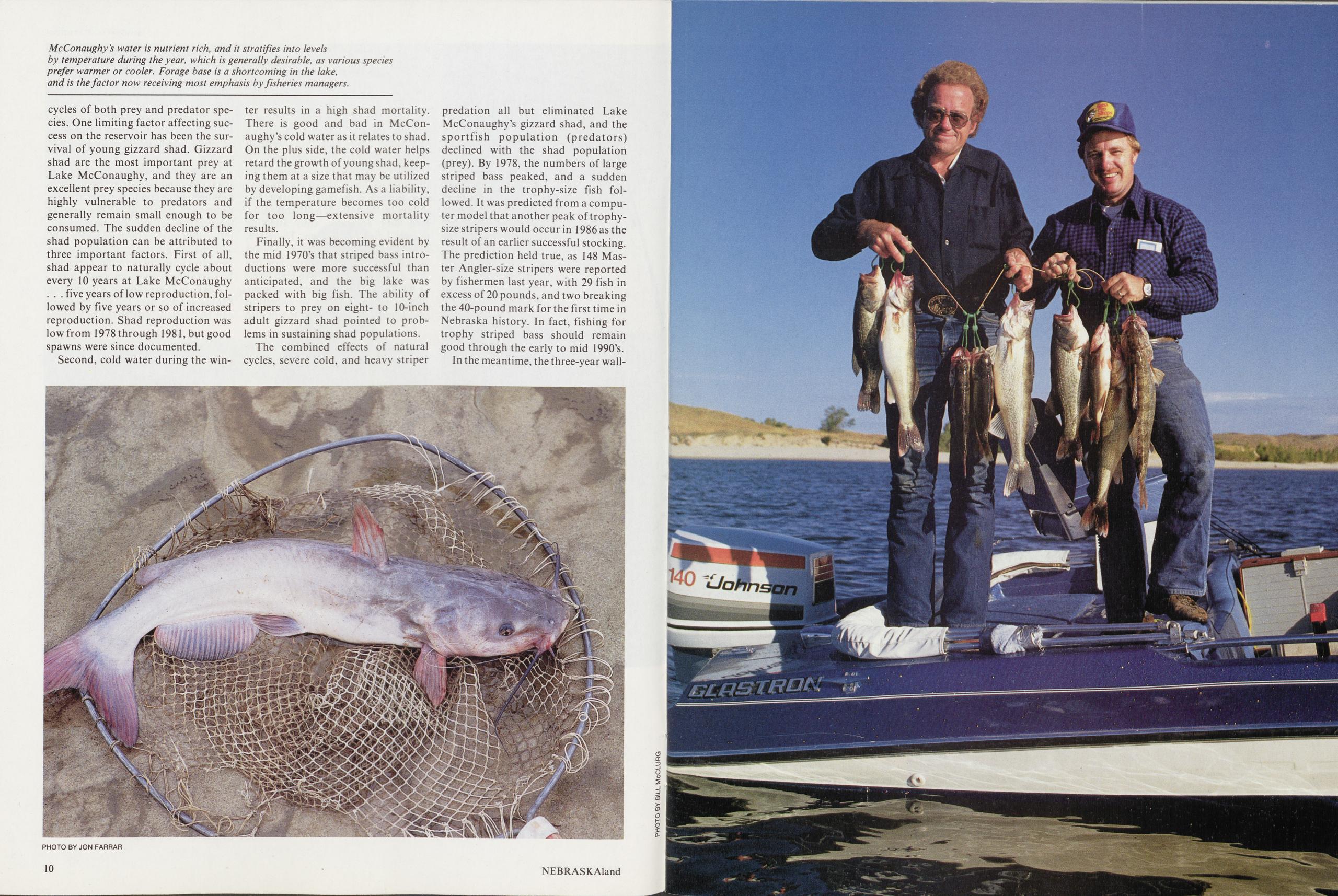
McConaughy’s water is nutrient rich, and it stratifies into levels by temperature during the year, which is generally desirable, as various species prefer warmer or cooler. Forage base is a shortcoming in the lake, and is the factor now receiving most emphasis by fisheries managers.
PHOTO BY BILL McCLURGcycles of both prey and predator species. One limiting factor affecting success on the reservoir has been the survival of young gizzard shad. Gizzard shad are the most important prey at Lake McConaughy, and they are an excellent prey species because they are highly vulnerable to predators and generally remain small enough to be consumed. The sudden decline of the shad population can be attributed to three important factors. First of all, shad appear to naturally cycle about every 10 years at Lake McConaughy . . . five years of low reproduction, followed by five years or so of increased reproduction. Shad reproduction was low from 1978 through 1981, but good spawns were since documented.
Second, cold water during the winter results in a high shad mortality. There is good and bad in McConaughy’s cold water as it relates to shad. On the plus side, the cold water helps retard the growth of young shad, keeping them at a size that may be utilized by developing gamefish. As a liability, if the temperature becomes too cold for too long—extensive mortality results.
Finally, it was becoming evident by the mid 1970’s that striped bass introductions were more successful than anticipated, and the big lake was packed with big fish. The ability of stripers to prey on eight- to 10-inch adult gizzard shad pointed to problems in sustaining shad populations.
The combined effects of natural cycles, severe cold, and heavy striper predation all but eliminated Lake McConaughy’s gizzard shad, and the sportfish population (predators) declined with the shad population (prey). By 1978, the numbers of large striped bass peaked, and a sudden decline in the trophy-size fish followed. It was predicted from a computer model that another peak of trophy-size stripers would occur in 1986 as the result of an earlier successful stocking. The prediction held true, as 148 Master Angler-size stripers were reported by fishermen last year, with 29 fish in excess of 20 pounds, and two breaking the 40-pound mark for the first time in Nebraska history. In fact, fishing for trophy striped bass should remain good through the early to mid 1990’s.
In the meantime, the three-year wall-
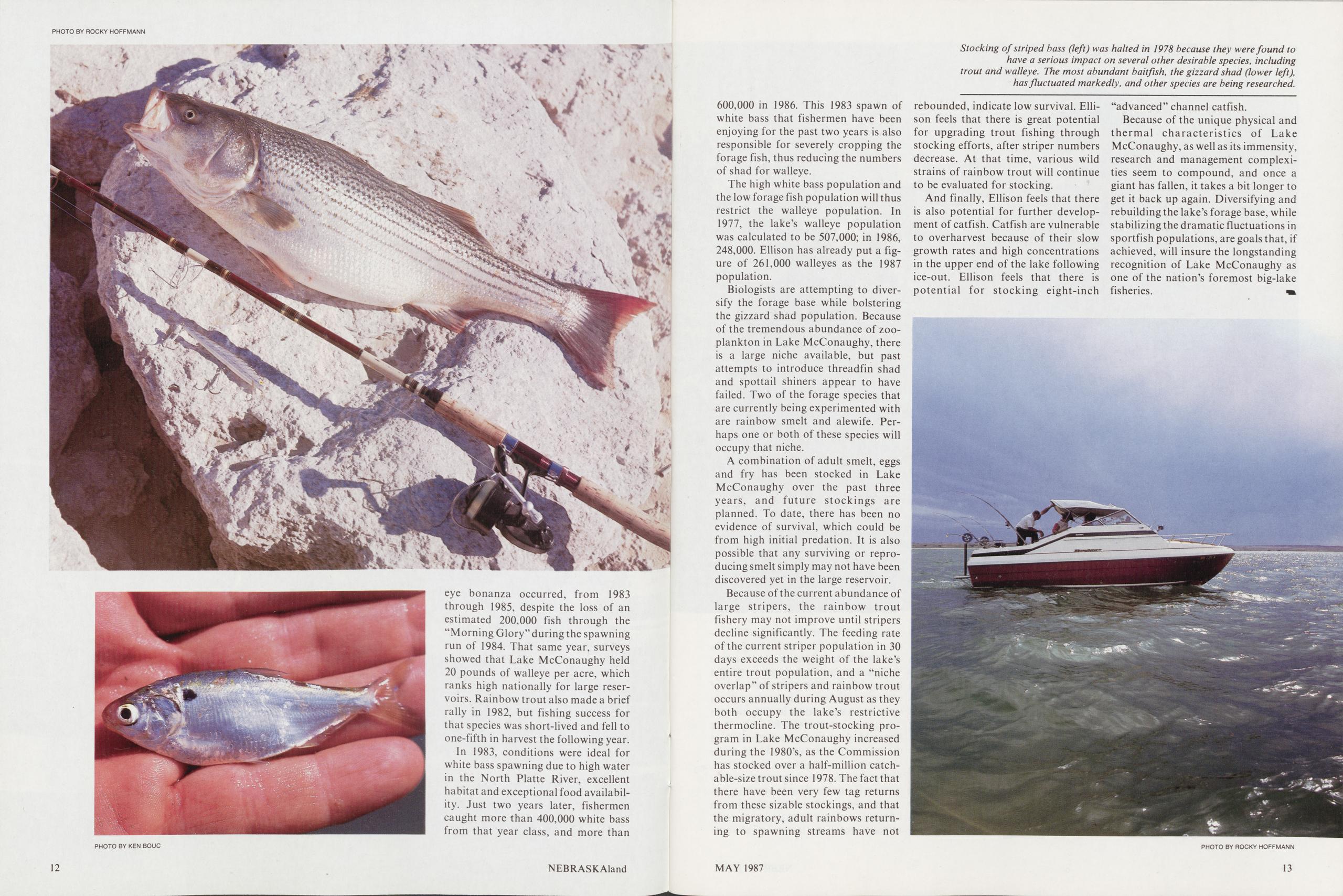
Stocking of striped bass (left) was halted in 1978 because they were found to have a serious impact on several other desirable species, including trout and walleye. The most abundant baitfish, the gizzard shad (lower left), has fluctuated markedly, and other species are being researched.
eye bonanza occurred, from 1983 through 1985, despite the loss of an estimated 200,000 fish through the “Morning Glory” during the spawning run of 1984. That same year, surveys showed that Lake McConaughy held 20 pounds of walleye per acre, which ranks high nationally for large reservoirs. Rainbow trout also made a brief rally in 1982, but fishing success for that species was short-lived and fell to one-fifth in harvest the following year.
In 1983, conditions were ideal for white bass spawning due to high water in the North Platte River, excellent habitat and exceptional food availability. Just two years later, fishermen caught more than 400,000 white bass from that year class, and more than 600,000 in 1986. This 1983 spawn of white bass that fishermen have been enjoying for the past two years is also responsible for severely cropping the forage fish, thus reducing the numbers of shad for walleye.
The high white bass population and the low forage fish population will thus restrict the walleye population. In 1977, the lake’s walleye population was calculated to be 507,000; in 1986, 248,000. Ellison has already put a figure of 261,000 walleyes as the 1987 population.
Biologists are attempting to diversify the forage base while bolstering the gizzard shad population. Because of the tremendous abundance of zooplankton in Lake McConaughy, there is a large niche available, but past attempts to introduce threadfin shad and spottail shiners appear to have failed. Two of the forage species that are currently being experimented with are rainbow smelt and alewife. Perhaps one or both of these species will occupy that niche.
A combination of adult smelt, eggs and fry has been stocked in Lake McConaughy over the past three years, and future stockings are planned. To date, there has been no evidence of survival, which could be from high initial predation. It is also possible that any surviving or reproducing smelt simply may not have been discovered yet in the large reservoir.
Because of the current abundance of large stripers, the rainbow trout fishery may not improve until stripers decline significantly. The feeding rate of the current striper population in 30 days exceeds the weight of the lake’s entire trout population, and a “niche overlap” of stripers and rainbow trout occurs annually during August as they both occupy the lake’s restrictive thermocline. The trout-stocking program in Lake McConaughy increased during the 1980’s, as the Commission has stocked over a half-million catchable-size trout since 1978. The fact that there have been very few tag returns from these sizable stockings, and that the migratory, adult rainbows returning to spawning streams have not rebounded, indicate low survival. Ellison feels that there is great potential for upgrading trout fishing through stocking efforts, after striper numbers decrease. At that time, various wild strains of rainbow trout will continue to be evaluated for stocking.
And finally, Ellison feels that there is also potential for further development of catfish. Catfish are vulnerable to overharvest because of their slow growth rates and high concentrations in the upper end of the lake following ice-out. Ellison feels that there is potential for stocking eight-inch “advanced” channel catfish.
Because of the unique physical and thermal characteristics of Lake McConaughy, as well as its immensity, research and management complexities seem to compound, and once a giant has fallen, it takes a bit longer to get it back up again. Diversifying and rebuilding the lake’s forage base, while stabilizing the dramatic fluctuations in sportfish populations, are goals that, if achieved, will insure the longstanding recognition of Lake McConaughy as one of the nation’s foremost big-lake fisheries.
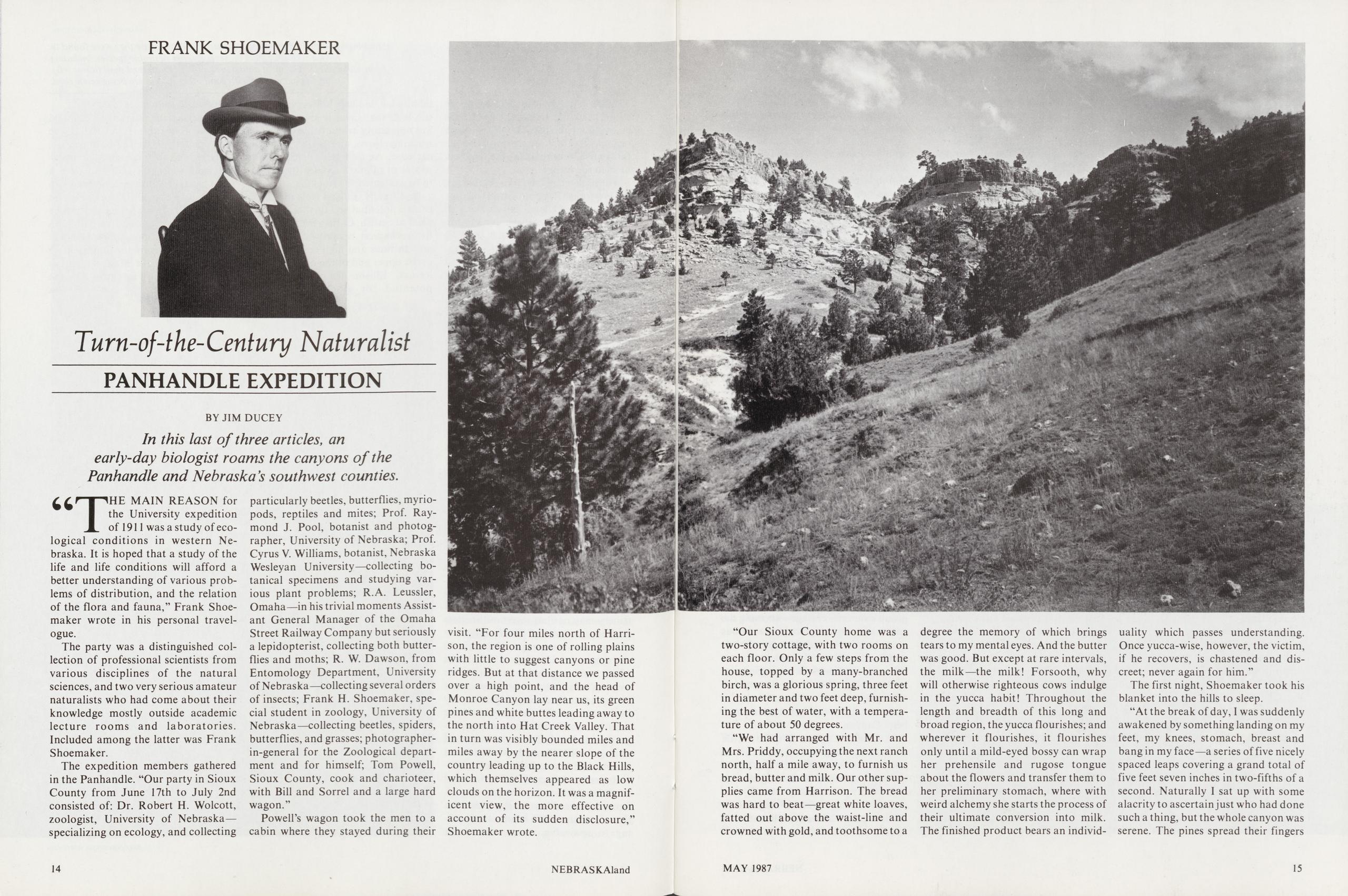
FRANK SHOEMAKER
Turn-of-the-Century Naturalist
PANHANDLE EXPEDITION
In this last of three articles, an early-day biologist roams the canyons of the Panhandle and Nebraska’s southwest counties.THE MAIN REASON for the University expedition of 1911 was a study of ecological conditions in western Nebraska. It is hoped that a study of the life and life conditions will afford a better understanding of various problems of distribution, and the relation of the flora and fauna,” Frank Shoemaker wrote in his personal travelogue.
The party was a distinguished collection of professional scientists from various disciplines of the natural sciences, and two very serious amateur naturalists who had come about their knowledge mostly outside academic lecture rooms and laboratories. Included among the latter was Frank Shoemaker.
The expedition members gathered in the Panhandle. “Our party in Sioux County from June 17th to July 2nd consisted of: Dr. Robert H. Wolcott, zoologist, University of Nebraska— specializing on ecology, and collecting particularly beetles, butterflies, myriopods, reptiles and mites; Prof. Raymond J. Pool, botanist and photographer, University of Nebraska; Prof. Cyrus V. Williams, botanist, Nebraska Wesleyan University—collecting botanical specimens and studying var- ious plant problems; R.A. Leussler, Omaha—in his trivial moments Assistant General Manager of the Omaha Street Railway Company but seriously a lepidopterist, collecting both butterflies and moths; R. W. Dawson, from Entomology Department, University of Nebraska—collecting several orders of insects; Frank H. Shoemaker, special student in zoology, University of Nebraska—collecting beetles, spiders, butterflies, and grasses; photographer-in-general for the Zoological department and for himself; Tom Powell, Sioux County, cook and charioteer, with Bill and Sorrel and a large hard wagon.”
Powell’s wagon took the men to a cabin where they stayed during their visit. “For four miles north of Harri- son, the region is one of rolling plains with little to suggest canyons or pine ridges. But at that distance we passed over a high point, and the head of Monroe Canyon lay near us, its green pines and white buttes leading away to the north into Hat Creek Valley. That in turn was visibly bounded miles and miles away by the nearer slope of the country leading up to the Black Hills, which themselves appeared as low clouds on the horizon. It was a magnificent view, the more effective on account of its sudden disclosure,” Shoemaker wrote.
“Our Sioux County home was a two-story cottage, with two rooms on each floor. Only a few steps from the house, topped by a many-branched birch, was a glorious spring, three feet in diameter and two feet deep, furnishing the best of water, with a temperature of about 50 degrees.
“We had arranged with Mr. and Mrs. Priddy, occupying the next ranch north, half a mile away, to furnish us bread, butter and milk. Our other supplies came from Harrison. The bread was hard to beat—great white loaves, fatted out above the waist-line and crowned with gold, and toothsome to a degree the memory of which brings tears to my mental eyes. And the butter was good. But except at rare intervals, the milk—the milk! Forsooth, why will otherwise righteous cows indulge in the yucca habit! Throughout the length and breadth of this long and broad region, the yucca flourishes; and wherever it flourishes, it flourishes only until a mild-eyed bossy can wrap her prehensile and rugose tongue about the flowers and transfer them to her preliminary stomach, where with weird alchemy she starts the process of their ultimate conversion into milk. The finished product bears an individuality which passes understanding. Once yucca-wise, however, the victim, if he recovers, is chastened and discreet; never again for him.”
The first night, Shoemaker took his blanket into the hills to sleep.
“At the break of day, I was suddenly awakened by something landing on my feet, my knees, stomach, breast and bang in my face—a series of five nicely spaced leaps covering a grand total of five feet seven inches in two-fifths of a second. Naturally I sat up with some alacrity to ascertain just who had done such a thing, but the whole canyon was serene. The pines spread their fingers
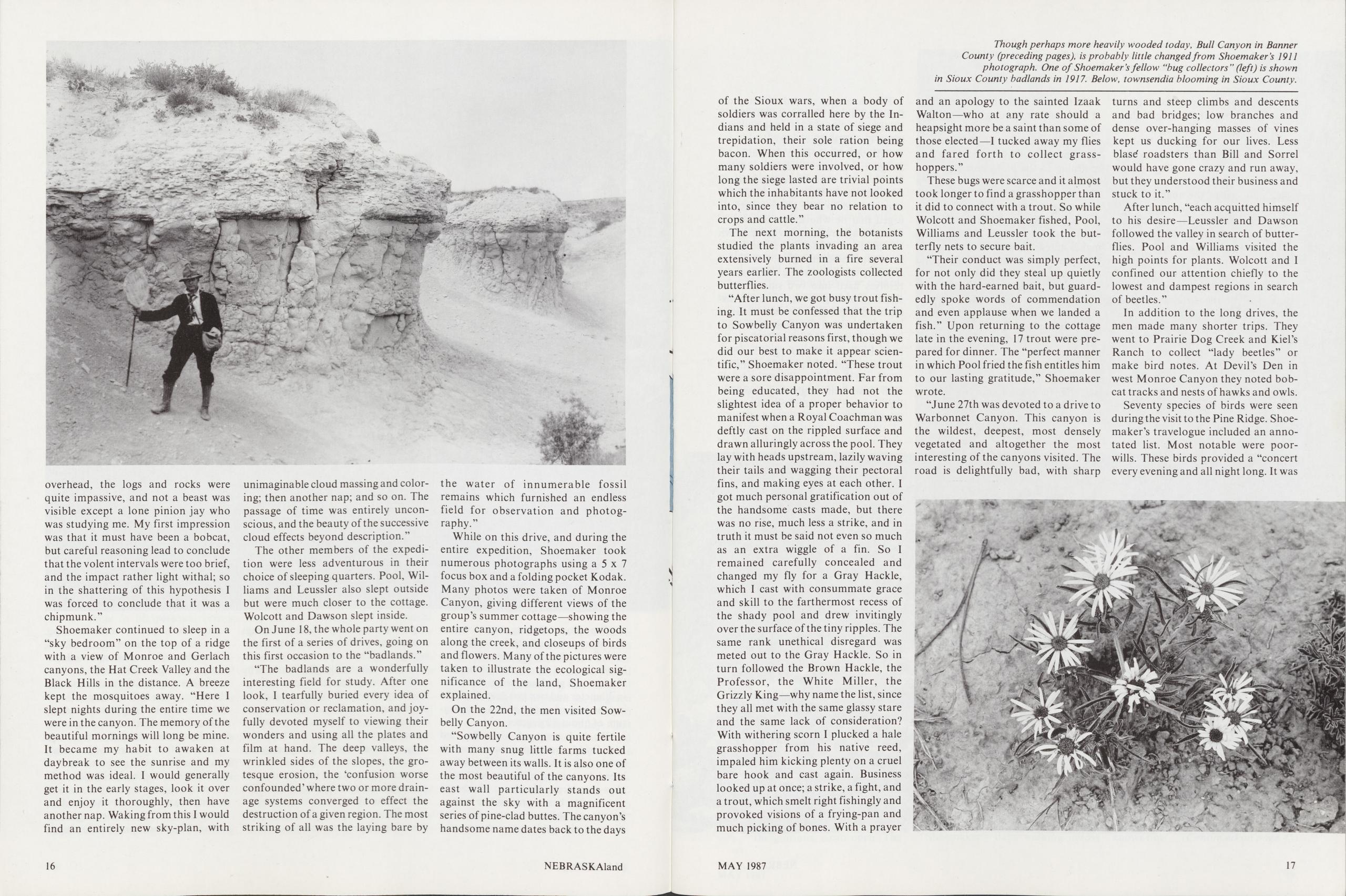
Though perhaps more heavily wooded today, Bull Canyon in Banner County (preceding pages), is probably little changed from Shoemakers 1911 photograph. One of Shoemaker’s fellow “bug collectors” (left) is shown in Sioux County badlands in 1917. Below, townsendia blooming in Sioux County.
overhead, the logs and rocks were quite impassive, and not a beast was visible except a lone pinion jay who was studying me. My first impression was that it must have been a bobcat, but careful reasoning lead to conclude that the volent intervals were too brief, and the impact rather light withal; so in the shattering of this hypothesis I was forced to conclude that it was a chipmunk.”
Shoemaker continued to sleep in a “sky bedroom” on the top of a ridge with a view of Monroe and Gerlach canyons, the Hat Creek Valley and the Black Hills in the distance. A breeze kept the mosquitoes away. “Here I slept nights during the entire time we were in the canyon. The memory of the beautiful mornings will long be mine. It became my habit to awaken at daybreak to see the sunrise and my method was ideal. 1 would generally get it in the early stages, look it over and enjoy it thoroughly, then have another nap. Waking from this I would find an entirely new sky-plan, with unimaginable cloud massing and coloring; then another nap; and so on. The passage of time was entirely unconscious, and the beauty of the successive cloud effects beyond description.”
The other members of the expedition were less adventurous in their choice of sleeping quarters. Pool, Williams and Leussler also slept outside but were much closer to the cottage. Wolcott and Dawson slept inside.
On June 18, the whole party went on the first of a series of drives, going on this first occasion to the “badlands.”
“The badlands are a wonderfully interesting field for study. After one look, I tearfully buried every idea of conservation or reclamation, and joyfully devoted myself to viewing their wonders and using all the plates and film at hand. The deep valleys, the wrinkled sides of the slopes, the grotesque erosion, the ‘confusion worse confounded’ where two or more drainage systems converged to effect the destruction of a given region. The most striking of all was the laying bare by the water of innumerable fossil remains which furnished an endless field for observation and photography.”
While on this drive, and during the entire expedition, Shoemaker took numerous photographs using a 5 x 7 focus box and a folding pocket Kodak. Many photos were taken of Monroe Canyon, giving different views of the group’s summer cottage—showing the entire canyon, ridgetops, the woods along the creek, and closeups of birds and flowers. Many of the pictures were taken to illustrate the ecological significance of the land, Shoemaker explained.
On the 22nd, the men visited Sowbelly Canyon.
“Sowbelly Canyon is quite fertile with many snug little farms tucked away between its walls. It is also one of the most beautiful of the canyons. Its east wall particularly stands out against the sky with a magnificent series of pine-clad buttes. The canyon’s handsome name dates back to the days of the Sioux wars, when a body of soldiers was corralled here by the Indians and held in a state of siege and trepidation, their sole ration being bacon. When this occurred, or how many soldiers were involved, or how long the siege lasted are trivial points which the inhabitants have not looked into, since they bear no relation to crops and cattle.”
The next morning, the botanists studied the plants invading an area extensively burned in a fire several years earlier. The zoologists collected butterflies.
“After lunch, we got busy trout fishing. It must be confessed that the trip to Sowbelly Canyon was undertaken for piscatorial reasons first, though we did our best to make it appear scientific,” Shoemaker noted. “These trout were a sore disappointment. Far from being educated, they had not the slightest idea of a proper behavior to manifest when a Royal Coachman was deftly cast on the rippled surface and drawn alluringly across the pool. They lay with heads upstream, lazily waving their tails and wagging their pectoral fins, and making eyes at each other. I got much personal gratification out of the handsome casts made, but there was no rise, much less a strike, and in truth it must be said not even so much as an extra wiggle of a fin. So I remained carefully concealed and changed my fly for a Gray Hackle, which I cast with consummate grace and skill to the farthermost recess of the shady pool and drew invitingly over the surface of the tiny ripples. The same rank unethical disregard was meted out to the Gray Hackle. So in turn followed the Brown Hackle, the Professor, the White Miller, the Grizzly King—why name the list, since they all met with the same glassy stare and the same lack of consideration? With withering scorn I plucked a hale grasshopper from his native reed, impaled him kicking plenty on a cruel bare hook and cast again. Business looked up at once; a strike, a fight, and a trout, which smelt right fishingly and provoked visions of a frying-pan and much picking of bones. With a prayer and an apology to the sainted Izaak Walton—who at any rate should a heapsight more be a saint than some of those elected—I tucked away my flies and fared forth to collect grass- hoppers.”
These bugs were scarce and it almost took longer to find a grasshopper than it did to connect with a trout. So while Wolcott and Shoemaker fished, Pool, Williams and Leussler took the butterfly nets to secure bait.
“Their conduct was simply perfect, for not only did they steal up quietly with the hard-earned bait, but guardedly spoke words of commendation and even applause when we landed a fish.” Upon returning to the cottage late in the evening, 17 trout were prepared for dinner. The “perfect manner in which Pool fried the fish entitles him to our lasting gratitude,” Shoemaker wrote.
“June 27th was devoted to a drive to Warbonnet Canyon. This canyon is the wildest, deepest, most densely vegetated and altogether the most interesting of the canyons visited. The road is delightfully bad, with sharp turns and steep climbs and descents and bad bridges; low branches and dense over-hanging masses of vines kept us ducking for our lives. Less blasd roadsters than Bill and Sorrel would have gone crazy and run away, but they understood their business and stuck to it.”
After lunch, “each acquitted himself to his desire—Leussler and Dawson followed the valley in search of butterflies. Pool and Williams visited the high points for plants. Wolcott and I confined our attention chiefly to the lowest and dampest regions in search of beetles.”
In addition to the long drives, the men made many shorter trips. They went to Prairie Dog Creek and Kiel’s Ranch to collect “lady beetles” or make bird notes. At Devil’s Den in west Monroe Canyon they noted bobcat tracks and nests of hawks and owls. Seventy species of birds were seen during the visit to the Pine Ridge. Shoemaker’s travelogue included an anno- tated list. Most notable were poor-wills. These birds provided a “concert every evening and all night long. It was
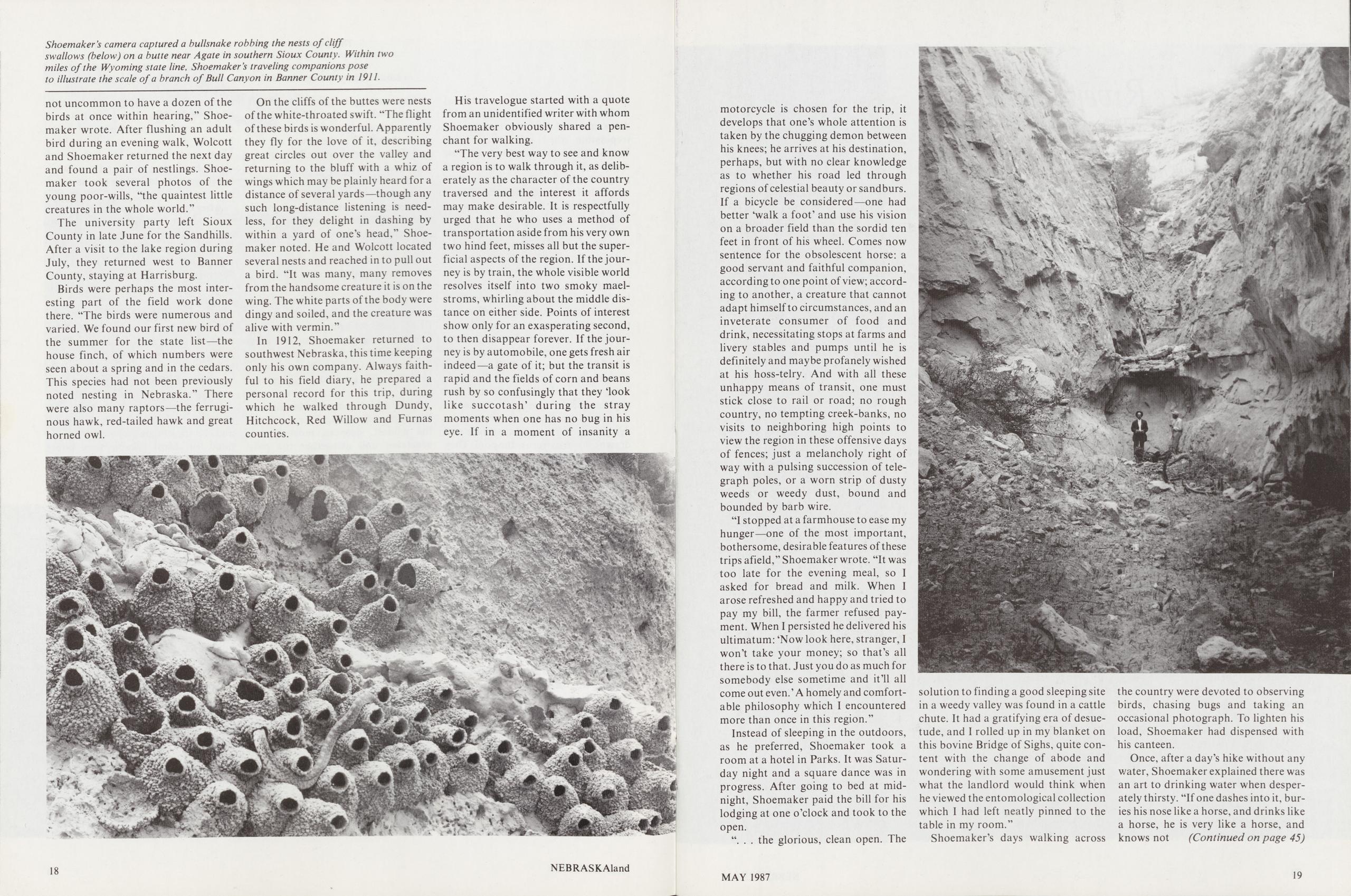
Shoemaker’s camera captured a bullsnake robbing the nests of cliff swallows (below) on a butte near Agate in southern Sioux County. Within two miles of the Wyoming state line, Shoemaker’s traveling companions pose to illustrate the scale of a branch of Bull Canyon in Banner County in 1911.
not uncommon to have a dozen of the birds at once within hearing,” Shoemaker wrote. After flushing an adult bird during an evening walk, Wolcott and Shoemaker returned the next day and found a pair of nestlings. Shoemaker took several photos of the young poor-wills, “the quaintest little creatures in the whole world.”
The university party left Sioux County in late June for the Sandhills. After a visit to the lake region during July, they returned west to Banner County, staying at Harrisburg.
Birds were perhaps the most interesting part of the field work done there. “The birds were numerous and varied. We found our first new bird of the summer for the state list—the house finch, of which numbers were seen about a spring and in the cedars. This species had not been previously noted nesting in Nebraska.” There were also many raptors—the ferruginous hawk, red-tailed hawk and great horned owl.
On the cliffs of the buttes were nests of the white-throated swift. “The flight of these birds is wonderful. Apparently they fly for the love of it, describing great circles out over the valley and returning to the bluff with a whiz of wings which may be plainly heard for a distance of several yards—though any such long-distance listening is needless, for they delight in dashing by within a yard of one’s head,” Shoe- maker noted. He and Wolcott located several nests and reached in to pull out a bird. “It was many, many removes from the handsome creature it is on the wing. The white parts of the body were dingy and soiled, and the creature was alive with vermin.”
In 1912, Shoemaker returned to southwest Nebraska, this time keeping only his own company. Always faithful to his field diary, he prepared a personal record for this trip, during which he walked through Dundy, Hitchcock, Red Willow and Furnas counties.
His travelogue started with a quote from an unidentified writer with whom Shoemaker obviously shared a penchant for walking.
“The very best way to see and know a region is to walk through it, as deliberately as the character of the country traversed and the interest it affords may make desirable. It is respectfully urged that he who uses a method of transportation aside from his very own two hind feet, misses all but the superficial aspects of the region. If the journey is by train, the whole visible world resolves itself into two smoky maelstroms, whirling about the middle distance on either side. Points of interest show only for an exasperating second, to then disappear forever. If the journey is by automobile, one gets fresh air indeed—a gate of it; but the transit is rapid and the fields of corn and beans rush by so confusingly that they ‘look like succotash’ during the stray moments when one has no bug in his eye. If in a moment of insanity a motorcycle is chosen for the trip, it develops that one’s whole attention is taken by the chugging demon between his knees; he arrives at his destination, perhaps, but with no clear knowledge as to whether his road led through regions of celestial beauty or sandburs. If a bicycle be considered—one had better ‘walk a foot’ and use his vision on a broader field than the sordid ten feet in front of his wheel. Comes now sentence for the obsolescent horse: a good servant and faithful companion, according to one point of view; according to another, a creature that cannot adapt himself to circumstances, and an inveterate consumer of food and drink, necessitating stops at farms and livery stables and pumps until he is definitely and maybe profanely wished at his hoss-telry. And with all these unhappy means of transit, one must stick close to rail or road; no rough country, no tempting creek-banks, no visits to neighboring high points to view the region in these offensive days of fences; just a melancholy right of way with a pulsing succession of telegraph poles, or a worn strip of dusty weeds or weedy dust, bound and bounded by barb wire.
“I stopped at a farmhouse to ease my hunger—one of the most important, bothersome, desirable features of these trips afield,” Shoemaker wrote. “It was too late for the evening meal, so I asked for bread and milk. When I arose refreshed and happy and tried to pay my bill, the farmer refused payment. When I persisted he delivered his ultimatum: ‘Now look here, stranger, I won’t take your money; so that’s all there is to that. Just you do as much for somebody else sometime and it’ll all come out even. ’ A homely and comfortable philosophy which I encountered more than once in this region.”
Instead of sleeping in the outdoors, as he preferred, Shoemaker took a room at a hotel in Parks. It was Saturday night and a square dance was in progress. After going to bed at midnight, Shoemaker paid the bill for his lodging at one o’clock and took to the open.
“. . . the glorious, clean open. The
Shoemaker s days walking across the country were devoted to observing birds, chasing bugs and taking an occasional photograph. To lighten his load, Shoemaker had dispensed with his canteen.
Once, after a day’s hike without any water, Shoemaker explained there was an art to drinking water when desperately thirsty. “If one dashes into it, buries his nose like a horse, and drinks like a horse, he is very like a horse, and knows not (Continued on page 45)
18 NEBRASKAland MAY 1987 19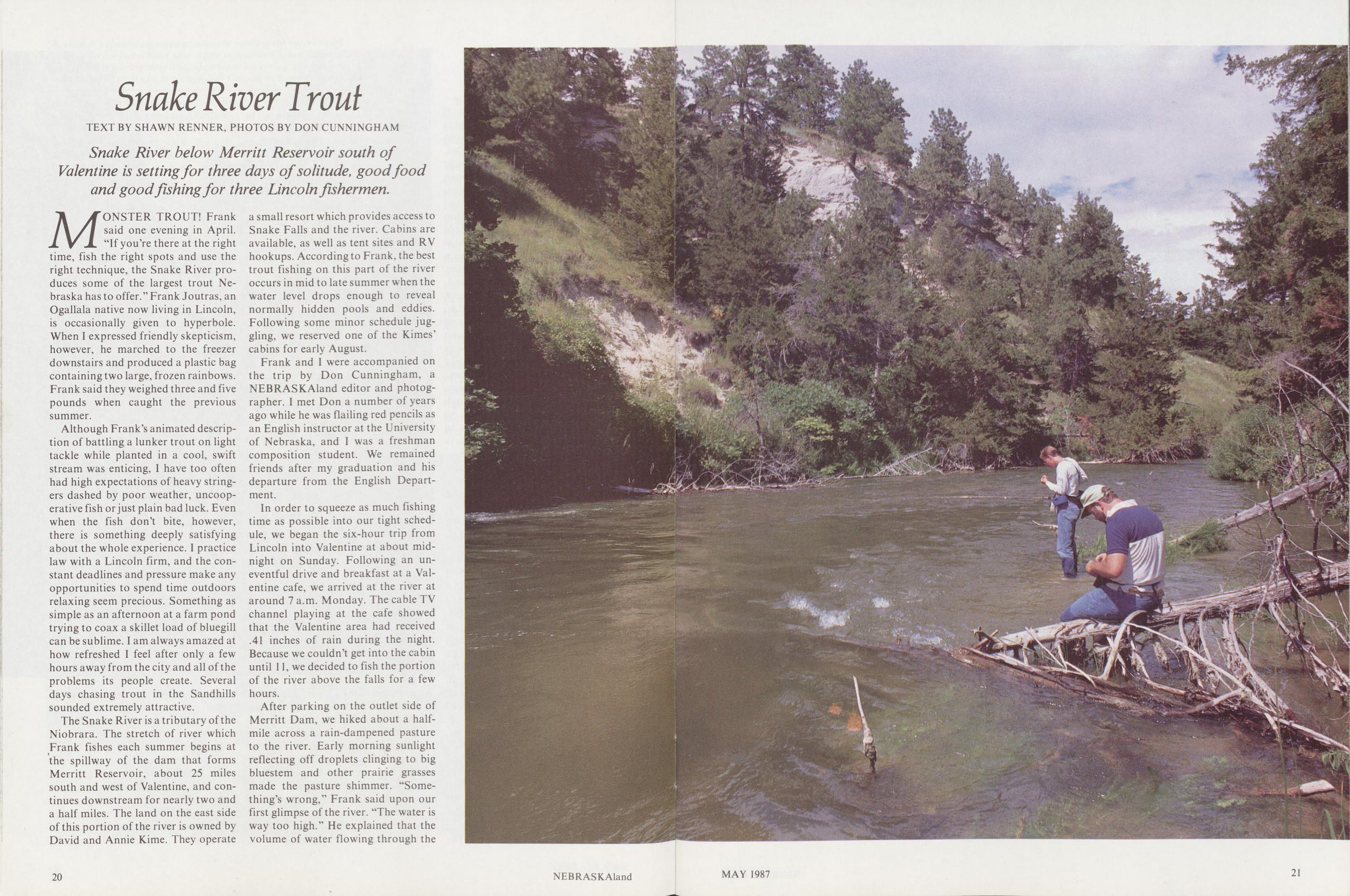
Snake River Trout
Snake River below Merritt Reservoir south of Valentine is setting for three days of solitude, good food and good fishing for three Lincoln fishermen.Monster trout! Frank said one evening in April. “If you’re there at the right time, fish the right spots and use the right technique, the Snake River produces some of the largest trout Nebraska has to offer.” Frank Joutras, an Ogallala native now living in Lincoln, is occasionally given to hyperbole. When I expressed friendly skepticism, however, he marched to the freezer downstairs and produced a plastic bag containing two large, frozen rainbows. Frank said they weighed three and five pounds when caught the previous summer.
Although Frank’s animated description of battling a lunker trout on light tackle while planted in a cool, swift stream was enticing, I have too often had high expectations of heavy stringers dashed by poor weather, uncooperative fish or just plain bad luck. Even when the fish don’t bite, however, there is something deeply satisfying about the whole experience. I practice law with a Lincoln firm, and the constant deadlines and pressure make any opportunities to spend time outdoors relaxing seem precious. Something as simple as an afternoon at a farm pond trying to coax a skillet load of bluegill can be sublime. I am always amazed at how refreshed I feel after only a few hours away from the city and all of the problems its people create. Several days chasing trout in the Sandhills sounded extremely attractive.
The Snake River is a tributary of the Niobrara. The stretch of river which Frank fishes each summer begins at the spillway of the dam that forms Merritt Reservoir, about 25 miles south and west of Valentine, and continues downstream for nearly two and a half miles. The land on the east side of this portion of the river is owned by David and Annie Kime. They operate a small resort which provides access to Snake Falls and the river. Cabins are available, as well as tent sites and RV hookups. According to Frank, the best trout fishing on this part of the river occurs in mid to late summer when the water level drops enough to reveal normally hidden pools and eddies. Following some minor schedule juggling, we reserved one of the Kimes’ cabins for early August.
Frank and I were accompanied on the trip by Don Cunningham, a NEBRASKAland editor and photographer. I met Don a number of years ago while he was flailing red pencils as an English instructor at the University of Nebraska, and I was a freshman composition student. We remained friends after my graduation and his departure from the English Department.
In order to squeeze as much fishing time as possible into our tight schedule, we began the six-hour trip from Lincoln into Valentine at about midnight on Sunday. Following an uneventful drive and breakfast at a Valentine cafe, we arrived at the river at around 7 a.m. Monday. The cable TV channel playing at the cafe showed that the Valentine area had received .41 inches of rain during the night. Because we couldn’t get into the cabin until 11, we decided to fish the portion of the river above the falls for a few hours.
After parking on the outlet side of Merritt Dam, we hiked about a half- mile across a rain-dampened pasture to the river. Early morning sunlight reflecting off droplets clinging to big bluestem and other prairie grasses made the pasture shimmer. “Something’s wrong,” Frank said upon our first glimpse of the river. “The water is way too high.” He explained that the volume of water flowing through the
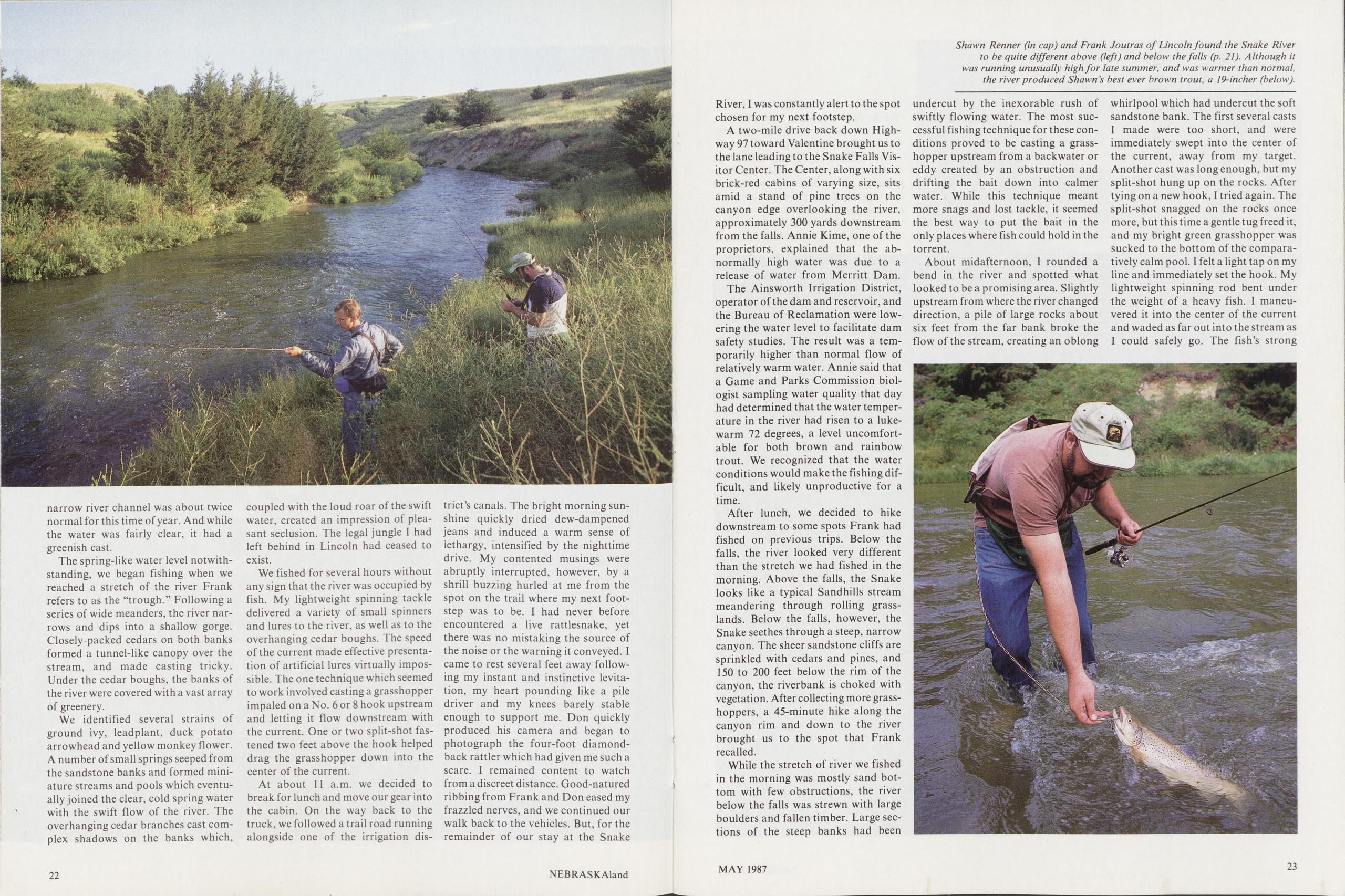
Shawn Renner (in cap) and Frank Joutras of Lincoln found the Snake River to be quite different above (left) and below the falls (p. 21). Although it was running unusually high for late summer, and was warmer than normal, the river produced Shawn’s best ever brown trout, a 19-incher (below).
narrow river channel was about twice normal for this time of year. And while the water was fairly clear, it had a greenish cast.
The spring-like water level notwithstanding, we began fishing when we reached a stretch of the river Frank refers to as the “trough.” Following a series of wide meanders, the river narrows and dips into a shallow gorge. Closely packed cedars on both banks formed a tunnel-like canopy over the stream, and made casting tricky. Under the cedar boughs, the banks of the river were covered with a vast array of greenery.
We identified several strains of ground ivy, leadplant, duck potato arrowhead and yellow monkey flower. A number of small springs seeped from the sandstone banks and formed miniature streams and pools which eventually joined the clear, cold spring water with the swift flow of the river. The overhanging cedar branches cast complex shadows on the banks which, coupled with the loud roar of the swift water, created an impression of pleasant seclusion. The legal jungle I had left behind in Lincoln had ceased to exist.
We fished for several hours without any sign that the river was occupied by fish. My lightweight spinning tackle delivered a variety of small spinners and lures to the river, as well as to the overhanging cedar boughs. The speed of the current made effective presentation of artificial lures virtually impossible. The one technique which seemed to work involved casting a grasshopper impaled on a No. 6 or 8 hook upstream and letting it flow downstream with the current. One or two split-shot fastened two feet above the hook helped drag the grasshopper down into the center of the current.
At about 11 a.m. we decided to break for lunch and move our gear into the cabin. On the way back to the truck, we followed a trail road running alongside one of the irrigation district’s canals. The bright morning sunshine quickly dried dew-dampened jeans and induced a warm sense of lethargy, intensified by the nighttime drive. My contented musings were abruptly interrupted, however, by a shrill buzzing hurled at me from the spot on the trail where my next footstep was to be. I had never before encountered a live rattlesnake, yet there was no mistaking the source of the noise or the warning it conveyed. I came to rest several feet away following my instant and instinctive levitation, my heart pounding like a pile driver and my knees barely stable enough to support me. Don quickly produced his camera and began to photograph the four-foot diamondback rattler which had given me such a scare. I remained content to watch from a discreet distance. Good-natured ribbing from Frank and Don eased my frazzled nerves, and we continued our walk back to the vehicles. But, for the remainder of our stay at the Snake River, I was constantly alert to the spot chosen for my next footstep.
A two-mile drive back down Highway 97 toward Valentine brought us to the lane leading to the Snake Falls Visitor Center. The Center, along with six brick-red cabins of varying size, sits amid a stand of pine trees on the canyon edge overlooking the river, approximately 300 yards downstream from the falls. Annie Kime, one of the proprietors, explained that the abnormally high water was due to a release of water from Merritt Dam.
The Ainsworth Irrigation District, operator of the dam and reservoir, and the Bureau of Reclamation were lowering the water level to facilitate dam safety studies. The result was a temporarily higher than normal flow of relatively warm water. Annie said that a Game and Parks Commission biologist sampling water quality that day had determined that the water temperature in the river had risen to a lukewarm 72 degrees, a level uncomfortable for both brown and rainbow trout. We recognized that the water conditions would make the fishing difficult, and likely unproductive for a time.
After lunch, we decided to hike downstream to some spots Frank had fished on previous trips. Below the falls, the river looked very different than the stretch we had fished in the morning. Above the falls, the Snake looks like a typical Sandhills stream meandering through rolling grasslands. Below the falls, however, the Snake seethes through a steep, narrow canyon. The sheer sandstone cliffs are sprinkled with cedars and pines, and 150 to 200 feet below the rim of the canyon, the riverbank is choked with vegetation. After collecting more grasshoppers, a 45-minute hike along the canyon rim and down to the river brought us to the spot that Frank recalled.
While the stretch of river we fished in the morning was mostly sand bottom with few obstructions, the river below the falls was strewn with large boulders and fallen timber. Large sections of the steep banks had been undercut by the inexorable rush of swiftly flowing water. The most successful fishing technique for these conditions proved to be casting a grasshopper upstream from a backwater or eddy created by an obstruction and drifting the bait down into calmer water. While this technique meant more snags and lost tackle, it seemed the best way to put the bait in the only places where fish could hold in the torrent.
About midafternoon, I rounded a bend in the river and spotted what looked to be a promising area. Slightly upstream from where the river changed direction, a pile of large rocks about six feet from the far bank broke the flow of the stream, creating an oblong whirlpool which had undercut the soft sandstone bank. The first several casts I made were too short, and were immediately swept into the center of the current, away from my target. Another cast was long enough, but my split-shot hung up on the rocks. After tying on a new hook, I tried again. The split-shot snagged on the rocks once more, but this time a gentle tug freed it, and my bright green grasshopper was sucked to the bottom of the comparatively calm pool. I felt a light tap on my line and immediately set the hook. My lightweight spinning rod bent under the weight of a heavy fish. I maneuvered it into the center of the current and waded as far out into the stream as I could safely go. The fish’s strong
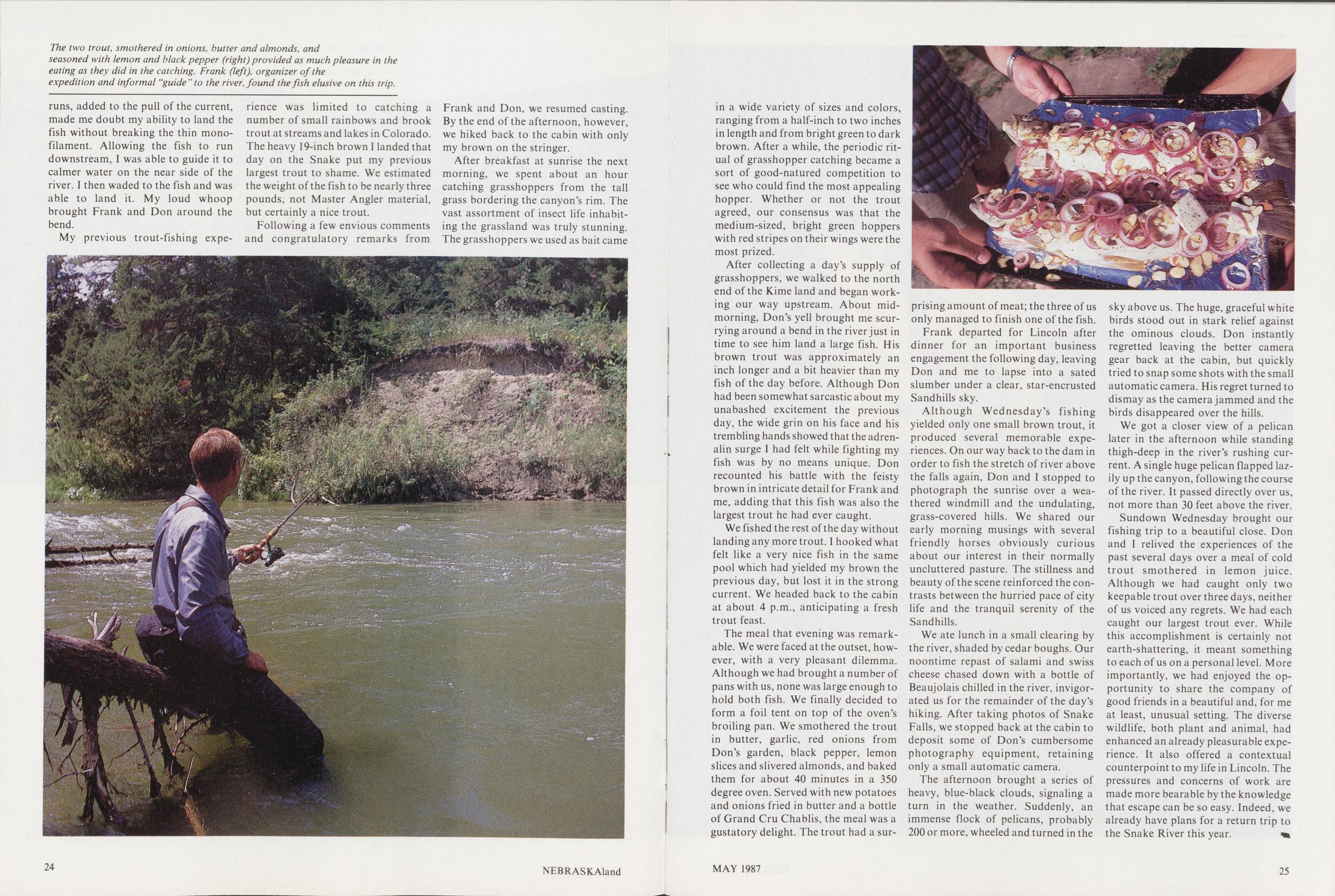
The two trout, smothered in onions, butter and almonds, and seasoned with lemon and black pepper (right) provided as much pleasure in the eating as they did in the catching. Frank (left), organizer of the expedition and informal “guide” to the river, found the fish elusive on this trip.
runs, added to the pull of the current, made me doubt my ability to land the fish without breaking the thin mono-filament. Allowing the fish to run downstream, I was able to guide it to calmer water on the near side of the river. I then waded to the fish and was able to land it. My loud whoop brought Frank and Don around the bend.
My previous trout-fishing experience was limited to catching a number of small rainbows and brook trout at streams and lakes in Colorado. The heavy 19-inch brown I landed that day on the Snake put my previous largest trout to shame. We estimated the weight of the fish to be nearly three pounds, not Master Angler material, but certainly a nice trout.
Following a few envious comments and congratulatory remarks from Frank and Don, we resumed casting. By the end of the afternoon, however, we hiked back to the cabin with only my brown on the stringer.
After breakfast at sunrise the next morning, we spent about an hour catching grasshoppers from the tall grass bordering the canyon’s rim. The vast assortment of insect life inhabiting the grassland was truly stunning. The grasshoppers we used as bait came in a wide variety of sizes and colors, ranging from a half-inch to two inches in length and from bright green to dark brown. After a while, the periodic ritual of grasshopper catching became a sort of good-natured competition to see who could find the most appealing hopper. Whether or not the trout agreed, our consensus was that the medium-sized, bright green hoppers with red stripes on their wings were the most prized.
After collecting a day’s supply of grasshoppers, we walked to the north end of the Kime land and began working our way upstream. About mid-morning, Don’s yell brought me scurrying around a bend in the river just in time to see him land a large fish. His brown trout was approximately an inch longer and a bit heavier than my fish of the day before. Although Don had been somewhat sarcastic about my unabashed excitement the previous day, the wide grin on his face and his trembling hands showed that the adrenalin surge I had felt while fighting my fish was by no means unique. Don recounted his battle with the feisty brown in intricate detail for Frank and me, adding that this fish was also the largest trout he had ever caught.
We fished the rest of the day without landing any more trout. I hooked what felt like a very nice fish in the same pool which had yielded my brown the previous day, but lost it in the strong current. We headed back to the cabin at about 4 p.m., anticipating a fresh trout feast.
The meal that evening was remarkable. We were faced at the outset, however, with a very pleasant dilemma. Although we had brought a number of pans with us, none was large enough to hold both fish. We finally decided to form a foil tent on top of the oven’s broiling pan. We smothered the trout in butter, garlic, red onions from Don’s garden, black pepper, lemon slices and slivered almonds, and baked them for about 40 minutes in a 350 degree oven. Served with new potatoes and onions fried in butter and a bottle of Grand Cru Chablis, the meal was a gustatory delight. The trout had a sur- prising amount of meat; the three of us only managed to finish one of the fish.
Frank departed for Lincoln after dinner for an important business engagement the following day, leaving Don and me to lapse into a sated slumber under a clear, star-encrusted Sandhills sky.
Although Wednesday’s fishing yielded only one small brown trout, it produced several memorable expe- riences. On our way back to the dam in order to fish the stretch of river above the falls again, Don and I stopped to photograph the sunrise over a weathered windmill and the undulating, grass-covered hills. We shared our early morning musings with several friendly horses obviously curious about our interest in their normally uncluttered pasture. The stillness and beauty of the scene reinforced the contrasts between the hurried pace of city life and the tranquil serenity of the Sandhills.
We ate lunch in a small clearing by the river, shaded by cedar boughs. Our noontime repast of salami and swiss cheese chased down with a bottle of Beaujolais chilled in the river, invigorated us for the remainder of the day’s hiking. After taking photos of Snake Falls, we stopped back at the cabin to deposit some of Don’s cumbersome photography equipment, retaining only a small automatic camera.
The afternoon brought a series of heavy, blue-black clouds, signaling a turn in the weather. Suddenly, an immense flock of pelicans, probably 200 or more, wheeled and turned in the sky above us. The huge, graceful white birds stood out in stark relief against the ominous clouds. Don instantly regretted leaving the better camera gear back at the cabin, but quickly tried to snap some shots with the small automatic camera. His regret turned to dismay as the camera jammed and the birds disappeared over the hills.
We got a closer view of a pelican later in the afternoon while standing thigh-deep in the river’s rushing current. A single huge pelican flapped lazily up the canyon, following the course of the river. It passed directly over us, not more than 30 feet above the river.
Sundown Wednesday brought our fishing trip to a beautiful close. Don and I relived the experiences of the past several days over a meal of cold trout smothered in lemon juice. Although we had caught only two keepable trout over three days, neither of us voiced any regrets. We had each caught our largest trout ever. While this accomplishment is certainly not earth-shattering, it meant something to each of us on a personal level. More importantly, we had enjoyed the opportunity to share the company of good friends in a beautiful and, for me at least, unusual setting. The diverse wildlife, both plant and animal, had enhanced an already pleasurable experience. It also offered a contextual counterpoint to my life in Lincoln. The pressures and concerns of work are made more bearable by the knowledge that escape can be so easy. Indeed, we already have plans for a return trip to the Snake River this year.
24 NEBRASKAland MAY 1987 25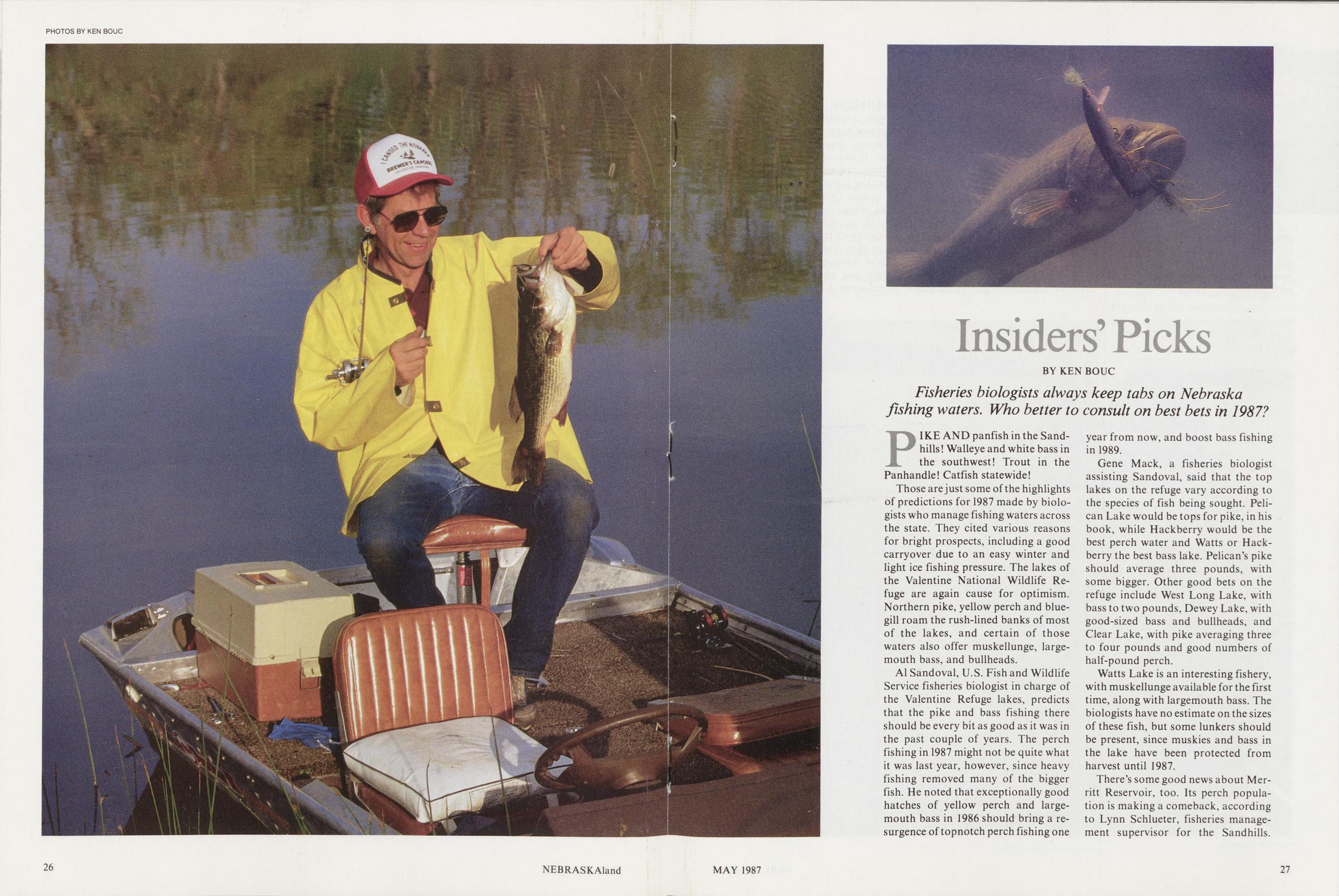
Insiders’ Picks
Fisheries biologists always keep tabs on Nebraska fishing waters. Who better to consult on best bets in 1987?PIKE AND panfish in the Sandhills! Walleye and white bass in the southwest! Trout in the Panhandle! Catfish statewide!
Those are just some of the highlights of predictions for 1987 made by biologists who manage fishing waters across the state. They cited various reasons for bright prospects, including a good carryover due to an easy winter and light ice fishing pressure. The lakes of the Valentine National Wildlife Refuge are again cause for optimism. Northern pike, yellow perch and bluegill roam the rush-lined banks of most of the lakes, and certain of those waters also offer muskellunge, large-mouth bass, and bullheads.
Al Sandoval, U.S. Fish and Wildlife Service fisheries biologist in charge of the Valentine Refuge lakes, predicts that the pike and bass fishing there should be every bit as good as it was in the past couple of years. The perch fishing in 1987 might not be quite what it was last year, however, since heavy fishing removed many of the bigger fish. He noted that exceptionally good hatches of yellow perch and large-mouth bass in 1986 should bring a resurgence of topnotch perch fishing one year from now, and boost bass fishing in 1989.
Gene Mack, a fisheries biologist assisting Sandoval, said that the top lakes on the refuge vary according to the species of fish being sought. Pelican Lake would be tops for pike, in his book, while Hackberry would be the best perch water and Watts or Hackberry the best bass lake. Pelican’s pike should average three pounds, with some bigger. Other good bets on the refuge include West Long Lake, with bass to two pounds, Dewey Lake, with good-sized bass and bullheads, and Clear Lake, with pike averaging three to four pounds and good numbers of half-pound perch.
Watts Lake is an interesting fishery, with muskellunge available for the first time, along with largemouth bass. The biologists have no estimate on the sizes of these fish, but some lunkers should be present, since muskies and bass in the lake have been protected from harvest until 1987.
There’s some good news about Merritt Reservoir, too. Its perch population is making a comeback, according to Lynn Schlueter, fisheries management supervisor for the Sandhills.
26 NEBRASKAland MAY 1987 27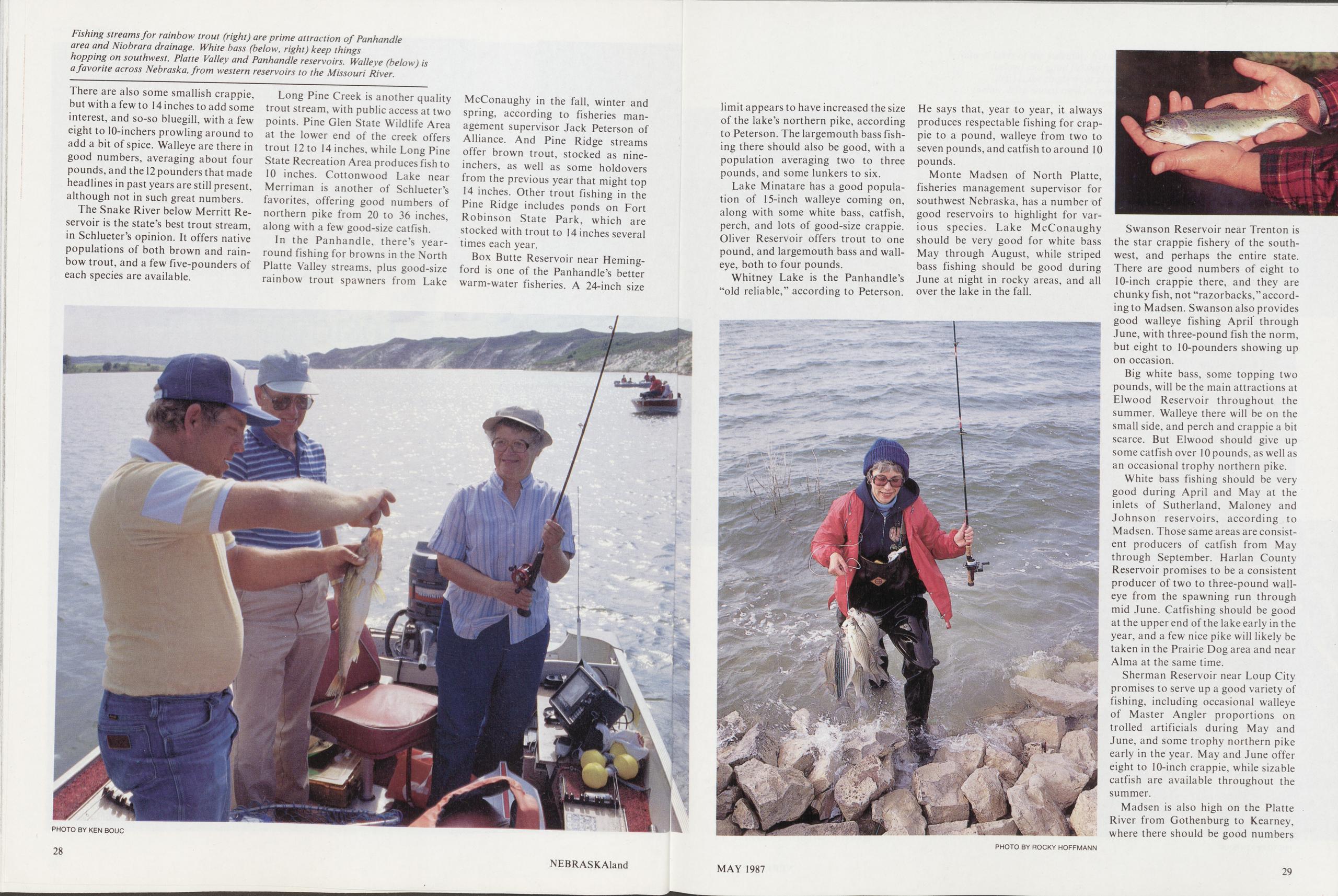
Fishing streams for rainbow trout (right) are prime attraction of Panhandle area and Niobrara drainage. White bass (below, right) keep things hopping on southwest, Platte Valley and Panhandle reservoirs. Walleye (below) is a favorite across Nebraska, from western reservoirs to the Missouri River.
There are also some smallish crappie, but with a few to 14 inches to add some interest, and so-so bluegill, with a few eight to 10-inchers prowling around to add a bit of spice. Walleye are there in good numbers, averaging about four pounds, and the 12 pounders that made headlines in past years are still present, although not in such great numbers.
The Snake River below Merritt Reservoir is the state’s best trout stream, in Schlueter’s opinion. It offers native populations of both brown and rainbow trout, and a few five-pounders of each species are available.
Long Pine Creek is another quality trout stream, with public access at two points. Pine Glen State Wildlife Area at the lower end of the creek offers trout 12 to 14 inches, while Long Pine State Recreation Area produces fish to 10 inches. Cottonwood Lake near Merriman is another of Schlueter’s favorites, offering good numbers of northern pike from 20 to 36 inches, along with a few good-size catfish.
In the Panhandle, there’s year-round fishing for browns in the North Platte Valley streams, plus good-size rainbow trout spawners from Lake McConaughy in the fall, winter and spring, according to fisheries management supervisor Jack Peterson of Alliance. And Pine Ridge streams offer brown trout, stocked as nine-inchers, as well as some holdovers from the previous year that might top 14 inches. Other trout fishing in the Pine Ridge includes ponds on Fort Robinson State Park, which are stocked with trout to 14 inches several times each year.
Box Butte Reservoir near Hemingford is one of the Panhandle’s better warm-water fisheries. A 24-inch size limit appears to have increased the size of the lake’s northern pike, according to Peterson. The largemouth bass fishing there should also be good, with a population averaging two to three pounds, and some lunkers to six.
Lake Minatare has a good population of 15-inch walleye coming on, along with some white bass, catfish, perch, and lots of good-size crappie. Oliver Reservoir offers trout to one pound, and largemouth bass and walleye, both to four pounds.
Whitney Lake is the Panhandle’s “old reliable,” according to Peterson. He says that, year to year, it always produces respectable fishing for crappie to a pound, walleye from two to seven pounds, and catfish to around 10 pounds.
Monte Madsen of North Platte, fisheries management supervisor for southwest Nebraska, has a number of good reservoirs to highlight for various species. Lake McConaughy should be very good for white bass May through August, while striped bass fishing should be good during June at night in rocky areas, and all over the lake in the fall.
Swanson Reservoir near Trenton is the star crappie fishery of the southwest, and perhaps the entire state. There are good numbers of eight to 10-inch crappie there, and they are chunky fish, not “razorbacks,” according to Madsen. Swanson also provides good walleye fishing April* through June, with three-pound fish the norm, but eight to 10-pounders showing up on occasion.
Big white bass, some topping two pounds, will be the main attractions at Elwood Reservoir throughout the summer. Walleye there will be on the small side, and perch and crappie a bit scarce. But Elwood should give up some catfish over 10 pounds, as well as an occasional trophy northern pike.
White bass fishing should be very good during April and May at the inlets of Sutherland, Maloney and Johnson reservoirs, according to Madsen. Those same areas are consistent producers of catfish from May through September. Harlan County Reservoir promises to be a consistent producer of two to three-pound walleye from the spawning run through mid June. Catfishing should be good at the upper end of the lake early in the year, and a few nice pike will likely be taken in the Prairie Dog area and near Alma at the same time.
Sherman Reservoir near Loup City promises to serve up a good variety of fishing, including occasional walleye of Master Angler proportions on trolled artificials during May and June, and some trophy northern pike early in the year. May and June offer eight to 10-inch crappie, while sizable catfish are available throughout the summer.
Madsen is also high on the Platte River from Gothenburg to Kearney, where there should be good numbers
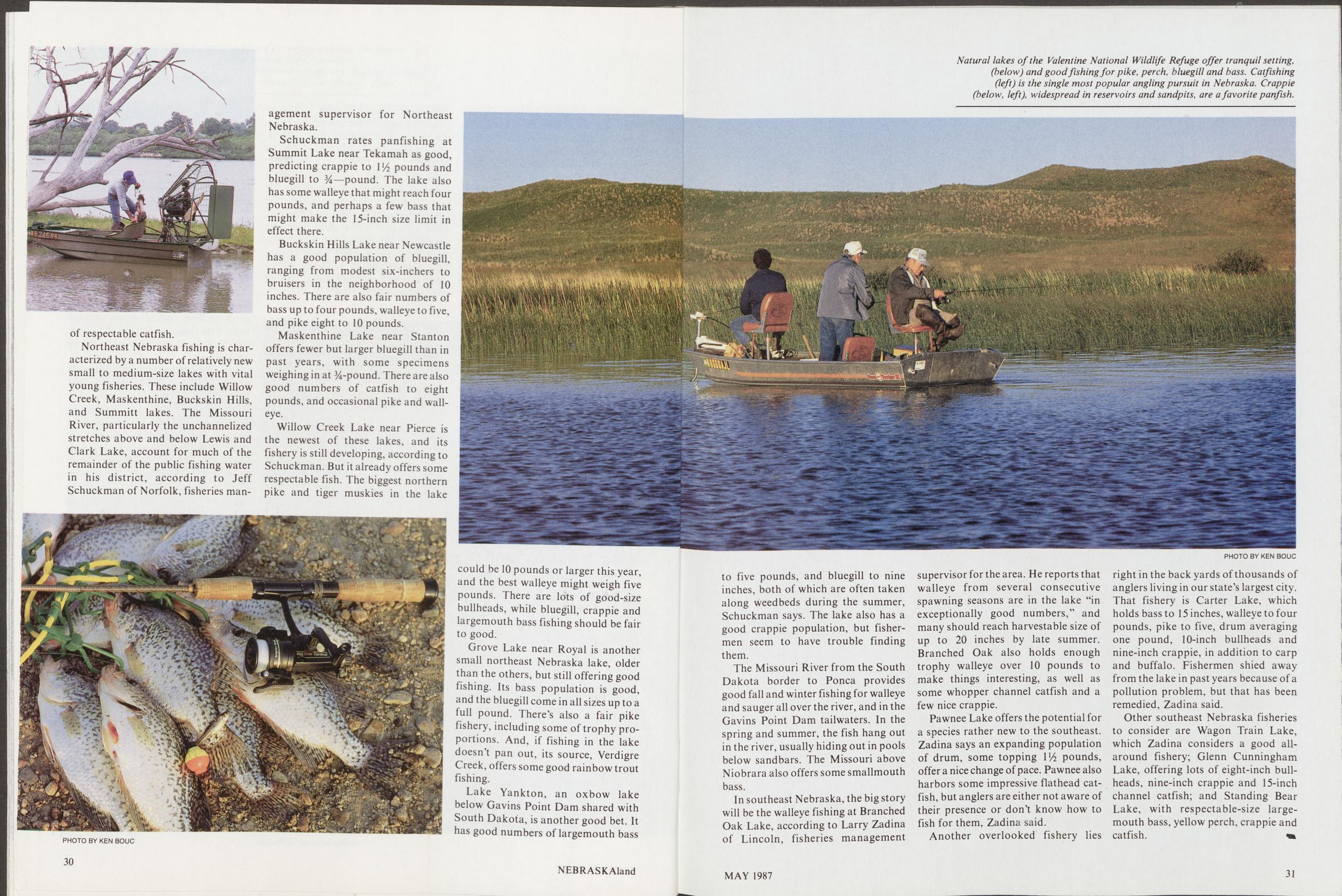
of respectable catfish.
Northeast Nebraska fishing is characterized by a number of relatively new small to medium-size lakes with vital young fisheries. These include Willow Creek, Maskenthine, Buckskin Hills, and Summitt lakes. The Missouri River, particularly the unchannelized stretches above and below Lewis and Clark Lake, account for much of the remainder of the public fishing water in his district, according to Jeff Schuckman of Norfolk, fisheries management supervisor for Northeast Nebraska.
Schuckman rates panfishing at Summit Lake near Tekamah as good, predicting crappie to 1/4 pounds and bluegill to %—pound. The lake also has some walleye that might reach four pounds, and perhaps a few bass that might make the 15-inch size limit in effect there.
Buckskin Hills Lake near Newcastle has a good population of bluegill, ranging from modest six-inchers to bruisers in the neighborhood of 10 inches. There are also fair numbers of bass up to four pounds, walleye to five, and pike eight to 10 pounds.
Maskenthine Lake near Stanton offers fewer but larger bluegill than in past years, with some specimens weighing in at %-pound. There are also good numbers of catfish to eight pounds, and occasional pike and walleye.
Willow Creek Lake near Pierce is the newest of these lakes, and its fishery is still developing, according to Schuckman. But it already offers some respectable fish. The biggest northern pike and tiger muskies in the lake could be 10 pounds or larger this year, and the best walleye might weigh five pounds. There are lots of good-size bullheads, while bluegill, crappie and largemouth bass fishing should be fair to good.
Grove Lake near Royal is another small northeast Nebraska lake, older than the others, but still offering good fishing. Its bass population is good, and the bluegill come in all sizes up to a full pound. There’s also a fair pike fishery, including some of trophy proportions. And, if fishing in the lake doesn’t pan out, its source, Verdigre Creek, offers some good rainbow trout fishing.
Lake Yankton, an oxbow lake below Gavins Point Dam shared with South Dakota, is another good bet. It has good numbers of largemouth bass
Natural lakes of the Valentine National Wildlife Refuge offer tranquil setting, (below) and good fishing for pike, perch, bluegill and bass. Catfishing (left) is the single most popular angling pursuit in Nebraska. Crappie (below, left), widespread in reservoirs and sandpits, are a favorite panfish.
PHOTO BY KEN BOUCto five pounds, and bluegill to nine inches, both of which are often taken along weedbeds during the summer, Schuckman says. The lake also has a good crappie population, but fishermen seem to have trouble finding them.
The Missouri River from the South Dakota border to Ponca provides good fall and winter fishing for walleye and sauger all over the river, and in the Gavins Point Dam tailwaters. In the spring and summer, the fish hang out in the river, usually hiding out in pools below sandbars. The Missouri above Niobrara also offers some smallmouth bass.
In southeast Nebraska, the big story will be the walleye fishing at Branched Oak Lake, according to Larry Zadina of Lincoln, fisheries management supervisor for the area. He reports that walleye from several consecutive spawning seasons are in the lake “in exceptionally good numbers,” and many should reach harvestable size of up to 20 inches by late summer. Branched Oak also holds enough trophy walleye over 10 pounds to make things interesting, as well as some whopper channel catfish and a few nice crappie.
Pawnee Lake offers the potential for a species rather new to the southeast. Zadina says an expanding population of drum, some topping 1/4 pounds, offer a nice change of pace. Pawnee also harbors some impressive flathead cat- fish, but anglers are either not aware of their presence or don’t know how to fish for them, Zadina said.
Another overlooked fishery lies right in the back yards of thousands of anglers living in our state’s largest city. That fishery is Carter Lake, which holds bass to 15 inches, walleye to four pounds, pike to five, drum averaging one pound, 10-inch bullheads and nine-inch crappie, in addition to carp and buffalo. Fishermen shied away from the lake in past years because of a pollution problem, but that has been remedied, Zadina said.
Other southeast Nebraska fisheries to consider are Wagon Train Lake, which Zadina considers a good all-around fishery; Glenn Cunningham Lake, offering lots of eight-inch bullheads, nine-inch crappie and 15-inch channel catfish; and Standing Bear Lake, with respectable-size large-mouth bass, yellow perch, crappie and catfish.
30 NEBRASKAland MAY 1987 31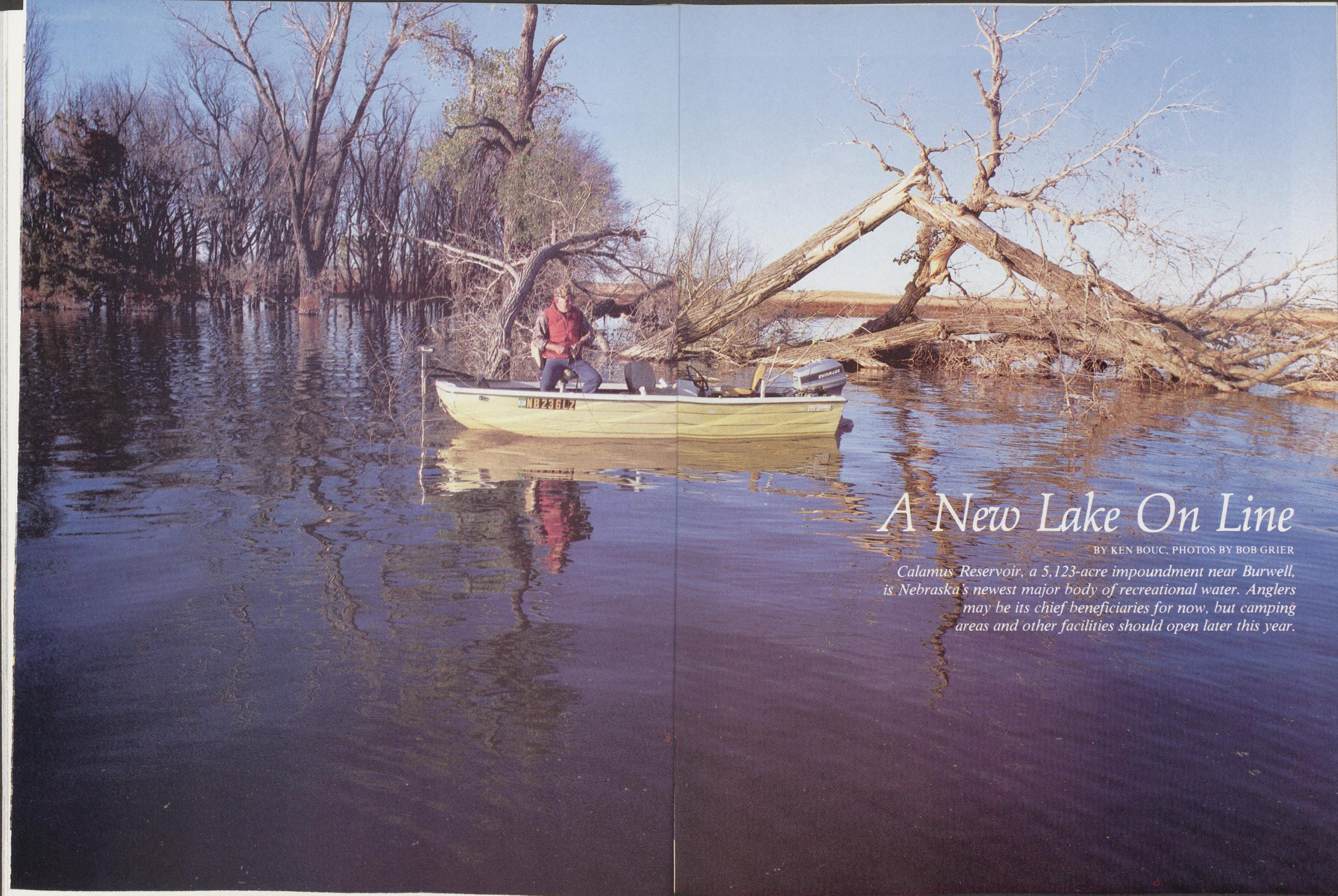
A New Lake On Line
Calamus Reservoir, a 5,123-acre impoundment near Burwell, is Nebraska s newest major body of recreational water. Anglers may be its chief beneficiaries for now, but camping areas and other facilities should open later this year.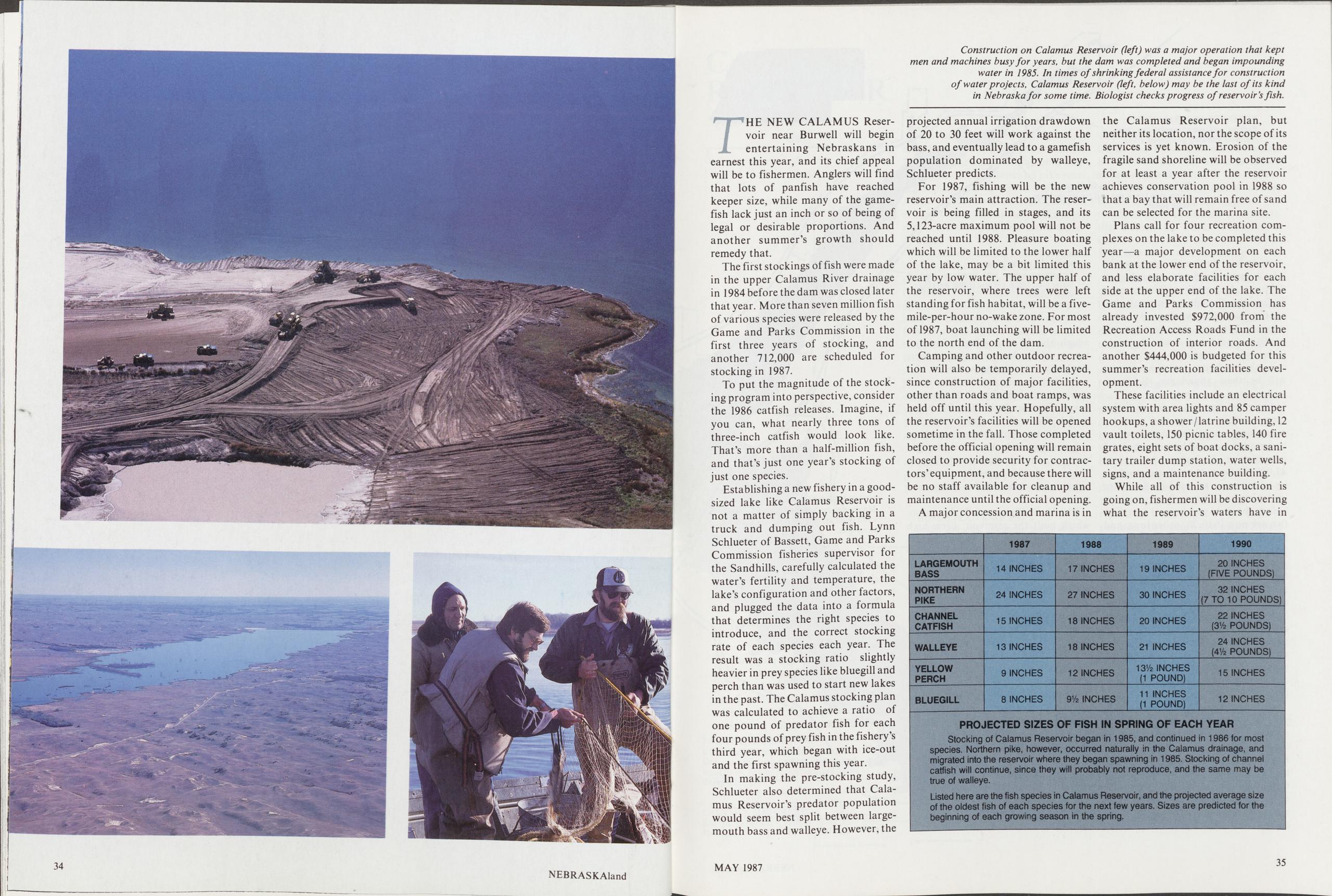
Construction on Calamus Reservoir (left) was a major operation that kept men and machines busy for years, but the dam was completed and began impounding water in 1985. In times of shrinking federal assistance for construction of water projects, Calamus Reservoir (left, below) may be the last of its kind in Nebraska for some time. Biologist checks progress of reservoirs fish.
THE NEW CALAMUS Reservoir near Burwell will begin entertaining Nebraskans in earnest this year, and its chief appeal will be to fishermen. Anglers will find that lots of panfish have reached keeper size, while many of the game-fish lack just an inch or so of being of legal or desirable proportions. And another summer’s growth should remedy that.
The first stockings of fish were made in the upper Calamus River drainage in 1984 before the dam was closed later that year. More than seven million fish of various species were released by the Game and Parks Commission in the first three years of stocking, and another 712,000 are scheduled for stocking in 1987.
To put the magnitude of the stock- ing program into perspective, consider the 1986 catfish releases. Imagine, if you can, what nearly three tons of three-inch catfish would look like. That’s more than a half-million fish, and that’s just one year’s stocking of just one species.
Establishing a new fishery in a good-sized lake like Calamus Reservoir is not a matter of simply backing in a truck and dumping out fish. Lynn Schlueter of Bassett, Game and Parks Commission fisheries supervisor for the Sandhills, carefully calculated the water’s fertility and temperature, the lake’s configuration and other factors, and plugged the data into a formula that determines the right species to introduce, and the correct stocking rate of each species each year. The result was a stocking ratio slightly heavier in prey species like bluegill and perch than was used to start new lakes in the past. The Calamus stocking plan was calculated to achieve a ratio of one pound of predator fish for each four pounds of prey fish in the fishery’s third year, which began with ice-out and the first spawning this year.
In making the pre-stocking study, Schlueter also determined that Calamus Reservoir’s predator population would seem best split between large-mouth bass and walleye. However, the projected annual irrigation drawdown of 20 to 30 feet will work against the bass, and eventually lead to a gamefish population dominated by walleye, Schlueter predicts.
For 1987, fishing will be the new reservoir’s main attraction. The reservoir is being filled in stages, and its 5,123-acre maximum pool will not be reached until 1988. Pleasure boating which will be limited to the lower half of the lake, may be a bit limited this year by low water. The upper half of the reservoir, where trees were left standing for fish habitat, will be a five- mile-per-hour no-wake zone. For most of 1987, boat launching will be limited to the north end of the dam.
Camping and other outdoor recreation will also be temporarily delayed, since construction of major facilities, other than roads and boat ramps, was held off until this year. Hopefully, all the reservoir’s facilities will be opened sometime in the fall. Those completed before the official opening will remain closed to provide security for contractors’ equipment, and because there will be no staff available for cleanup and maintenance until the official opening.
A major concession and marina is in the Calamus Reservoir plan, but neither its location, nor the scope of its services is yet known. Erosion of the fragile sand shoreline will be observed for at least a year after the reservoir achieves conservation pool in 1988 so that a bay that will remain free of sand can be selected for the marina site.
Plans call for four recreation complexes on the lake to be completed this year—a major development on each bank at the lower end of the reservoir, and less elaborate facilities for each side at the upper end of the lake. The Game and Parks Commission has already invested $972,000 from the Recreation Access Roads Fund in the construction of interior roads. And another $444,000 is budgeted for this summer’s recreation facilities development.
These facilities include an electrical system with area lights and 85 camper hookups, a shower/latrine building, 12 vault toilets, 150 picnic tables, 140 fire grates, eight sets of boat docks, a sanitary trailer dump station, water wells, signs, and a maintenance building. While all of this construction is going on, fishermen will be discovering what the reservoir’s waters have in
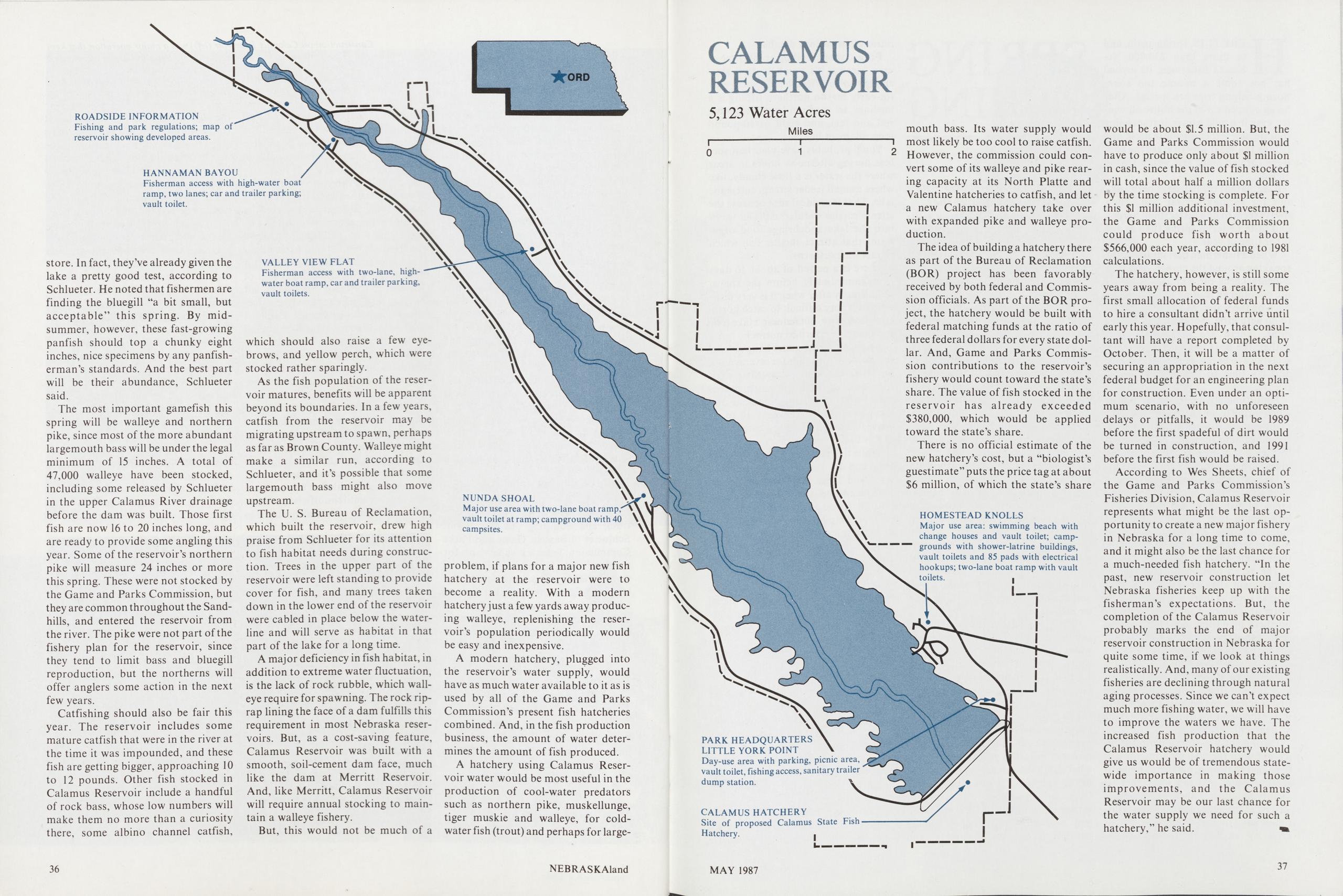
LARGEMOUTH BASS 14 INCHES 17 INCHES 19 INCHES 20 INCHES (FIVE POUNDS)
NORTHERN PIKE 24 INCHES 27 INCHES 30 INCHES 32 INCHES (7 TO 10 POUNDS)
CHANNEL CATFISH 15 INCHES 18 INCHES 20 INCHES 22 INCHES (372 POUNDS)
WALLEYE 13 INCHES 18 INCHES 21 INCHES 24 INCHES (472 POUNDS)
YELLOW PERCH 9 INCHES 12 INCHES 1372 INCHES (1 POUND) 15 INCHES
BLUEGILL 8 INCHES 972 INCHES 11 INCHES (1 POUND) 12 INCHES PROJECTED SIZES OF FISH IN SPRING OF EACH YEAR
Stocking of Calamus Reservoir began in 1985, and continued in 1986 for most species. Northern pike, however, occurred naturally in the Calamus drainage, and migrated into the reservoir where they began spawning in 1985. Stocking of channel catfish will continue, since they will probably not reproduce, and the same may be true of walleye. Listed here are the fish species in Calamus Reservoir, and the projected average size of the oldest fish of each species for the next few years. Sizes are predicted for the beginning of each growing season in the spring.
store. In fact, they’ve already given the lake a pretty good test, according to Schlueter. He noted that fishermen are finding the bluegill "a bit small, but acceptable” this spring. By mid- summer, however, these fast-growing panfish should top a chunky eight inches, nice specimens by any panfisherman’s standards. And the best part will be their abundance, Schlueter said.
The most important gamefish this spring will be walleye and northern pike, since most of the more abundant largemouth bass will be under the legal minimum of 15 inches. A total of 47,000 walleye have been stocked, including some released by Schlueter in the upper Calamus River drainage before the dam was built. Those first fish are now 16 to 20 inches long, and are ready to provide some angling this year. Some of the reservoir’s northern pike will measure 24 inches or more this spring. These were not stocked by the Game and Parks Commission, but they are common throughout the Sandhills, and entered the reservoir from the river. The pike were not part of the fishery plan for the reservoir, since they tend to limit bass and bluegill reproduction, but the northerns will offer anglers some action in the next few years.
Catfishing should also be fair this year. The reservoir includes some mature catfish that were in the river at the time it was impounded, and these fish are getting bigger, approaching 10 to 12 pounds. Other fish stocked in Calamus Reservoir include a handful of rock bass, whose low numbers will make them no more than a curiosity there, some albino channel catfish, which should also raise a few eyebrows, and yellow perch, which were stocked rather sparingly.
As the fish population of the reservoir matures, benefits will be apparent beyond its boundaries. In a few years, catfish from the reservoir may be migrating upstream to spawn, perhaps as far as Brown County. Walleye might make a similar run, according to Schlueter, and it’s possible that some largemouth bass might also move upstream.
The U. S. Bureau of Reclamation, which built the reservoir, drew high praise from Schlueter for its attention to fish habitat needs during construction. Trees in the upper part of the reservoir were left standing to provide cover for fish, and many trees taken down in the lower end of the reservoir were cabled in place below the waterline and will serve as habitat in that part of the lake for a long time.
A major deficiency in fish habitat, in addition to extreme water fluctuation, is the lack of rock rubble, which walleye require for spawning. The rock riprap lining the face of a dam fulfills this requirement in most Nebraska reservoirs. But, as a cost-saving feature, Calamus Reservoir was built with a smooth, soil-cement dam face, much like the dam at Merritt Reservoir. And, like Merritt, Calamus Reservoir will require annual stocking to maintain a walleye fishery.
But, this would not be much of a problem, if plans for a major new fish hatchery at the reservoir were to become a reality. With a modern hatchery just a few yards away producing walleye, replenishing the reservoir’s population periodically would be easy and inexpensive.
A modern hatchery, plugged into the reservoir’s water supply, would have as much water available to it as is used by all of the Game and Parks Commission’s present fish hatcheries combined. And, in the fish production business, the amount of water determines the amount of fish produced.
A hatchery using Calamus Reservoir water would be most useful in the production of cool-water predators such as northern pike, muskellunge, tiger muskie and walleye, for cold-water fish (trout) and perhaps for largemouth bass. Its water supply would most likely be too cool to raise catfish. However, the commission could convert some of its walleye and pike rearing capacity at its North Platte and Valentine hatcheries to catfish, and let a new Calamus hatchery take over with expanded pike and walleye production.
The idea of building a hatchery there as part of the Bureau of Reclamation (BOR) project has been favorably received by both federal and Commission officials. As part of the BOR project, the hatchery would be built with federal matching funds at the ratio of three federal dollars for every state dollar. And, Game and Parks Commission contributions to the reservoir’s fishery would count toward the state’s share. The value of fish stocked in the reservoir has already exceeded $380,000, which would be applied toward the state’s share.
There is no official estimate of the new hatchery’s cost, but a “biologist’s guestimate” puts the price tag at about $6 million, of which the state’s share would be about $1.5 million. But, the Game and Parks Commission would have to produce only about $1 million in cash, since the value of fish stocked will total about half a million dollars by the time stocking is complete. For this $1 million additional investment, the Game and Parks Commission could produce fish worth about $566,000 each year, according to 1981 calculations.
The hatchery, however, is still some years away from being a reality. The first small allocation of federal funds to hire a consultant didn’t arrive until early this year. Hopefully, that consultant will have a report completed by October. Then, it will be a matter of securing an appropriation in the next federal budget for an engineering plan for construction. Even under an optimum scenario, with no unforeseen delays or pitfalls, it would be 1989 before the first spadeful of dirt would be turned in construction, and 1991 before the first fish would be raised.
According to Wes Sheets, chief of the Game and Parks Commission’s Fisheries Division, Calamus Reservoir represents what might be the last opportunity to create a new major fishery in Nebraska for a long time to come, and it might also be the last chance for a much-needed fish hatchery. “In the past, new reservoir construction let Nebraska fisheries keep up with the fisherman’s expectations. But, the completion of the Calamus Reservoir probably marks the end of major reservoir construction in Nebraska for quite some time, if we look at things realistically. And, many of our existing fisheries are declining through natural aging processes. Since we can’t expect much more fishing water, we will have to improve the waters we have. The increased fish production that the Calamus Reservoir hatchery would give us would be of tremendous statewide importance in making those improvements, and the Calamus Reservoir may be our last chance for the water supply we need for such a hatchery,” he said.
36 NEBRASKAland MAY 1987 37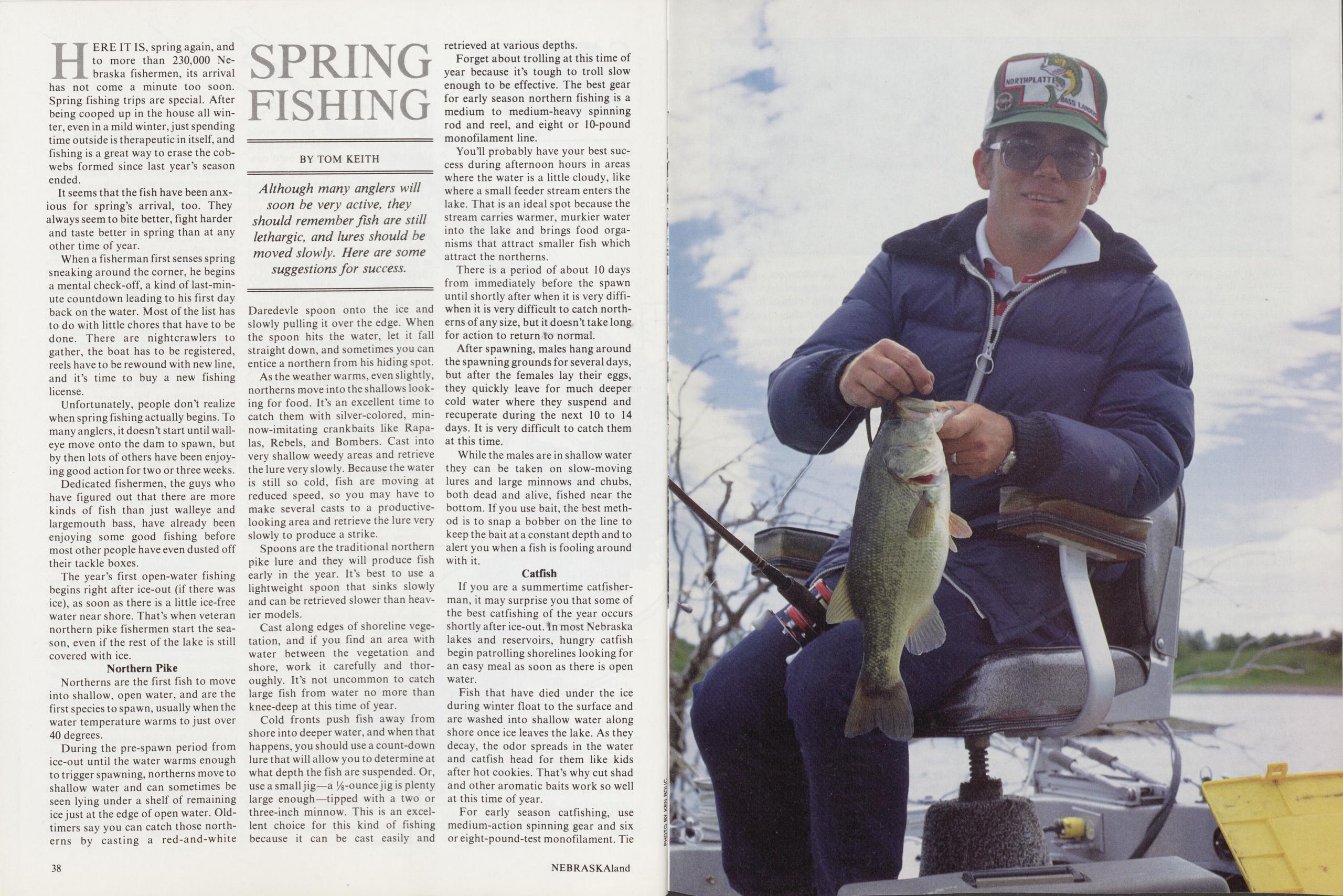
SPRING FISHING
Although many anglers will soon be very active, they should remember fish are still lethargic, and lures should be moved slowly. Here are some suggestions for success.HERE IT IS, spring again, and to more than 230,000 Nebraska fishermen, its arrival has not come a minute too soon. Spring fishing trips are special. After being cooped up in the house all winter, even in a mild winter, just spending time outside is therapeutic in itself, and fishing is a great way to erase the cobwebs formed since last year’s season ended.
It seems that the fish have been anxious for spring’s arrival, too. They always seem to bite better, fight harder and taste better in spring than at any other time of year.
When a fisherman first senses spring sneaking around the corner, he begins a mental check-off, a kind of last-minute countdown leading to his first day back on the water. Most of the list has to do with little chores that have to be done. There are nightcrawlers to gather, the boat has to be registered, reels have to be rewound with new line, and it’s time to buy a new fishing license.
Unfortunately, people don’t realize when spring fishing actually begins. To many anglers, it doesn’t start until walleye move onto the dam to spawn, but by then lots of others have been enjoying good action for two or three weeks.
Dedicated fishermen, the guys who have figured out that there are more kinds of fish than just walleye and largemouth bass, have already been enjoying some good fishing before most other people have even dusted off their tackle boxes.
The year’s first open-water fishing begins right after ice-out (if there was ice), as soon as there is a little ice-free water near shore. That’s when veteran northern pike fishermen start the season, even if the rest of the lake is still covered with ice.
Northern PikeNortherns are the first fish to move into shallow, open water, and are the first species to spawn, usually when the water temperature warms to just over 40 degrees.
During the pre-spawn period from ice-out until the water warms enough to trigger spawning, northerns move to shallow water and can sometimes be seen lying under a shelf of remaining ice just at the edge of open water. Old-timers say you can catch those northerns by casting a red-and-white Daredevle spoon onto the ice and slowly pulling it over the edge. When the spoon hits the water, let it fall straight down, and sometimes you can entice a northern from his hiding spot.
As the weather warms, even slightly, northerns move into the shallows looking for food. It’s an excellent time to catch them with silver-colored, min- now-imitating crankbaits like Rapa- las, Rebels, and Bombers. Cast into very shallow weedy areas and retrieve the lure very slowly. Because the water is still so cold, fish are moving at reduced speed, so you may have to make several casts to a productive- looking area and retrieve the lure very slowly to produce a strike.
Spoons are the traditional northern pike lure and they will produce fish early in the year. It’s best to use a lightweight spoon that sinks slowly and can be retrieved slower than heavier models.
Cast along edges of shoreline vegetation, and if you find an area with water between the vegetation and shore, work it carefully and thoroughly. It’s not uncommon to catch large fish from water no more than knee-deep at this time of year.
Cold fronts push fish away from shore into deeper water, and when that happens, you should use a count-down lure that will allow you to determine at what depth the fish are suspended. Or, use a small jig—a 1/8-ounce jig is plenty large enough—tipped with a two or three-inch minnow. This is an excellent choice for this kind of fishing because it can be cast easily and retrieved at various depths.
Forget about trolling at this time of year because it’s tough to troll slow enough to be effective. The best gear for early season northern fishing is a medium to medium-heavy spinning rod and reel, and eight or 10-pound monofilament line.
You’ll probably have your best success during afternoon hours in areas where the water is a little cloudy, like where a small feeder stream enters the lake. That is an ideal spot because the stream carries warmer, murkier water into the lake and brings food organisms that attract smaller fish which attract the northerns.
There is a period of about 10 days from immediately before the spawn until shortly after when it is very diffi- when it is very difficult to catch northerns of any size, but it doesn’t take long for action to return to normal.
After spawning, males hang around the spawning grounds for several days, but after the females lay their eggs, they quickly leave for much deeper cold water where they suspend and recuperate during the next 10 to 14 days. It is very difficult to catch them at this time.
While the males are in shallow water they can be taken on slow-moving lures and large minnows and chubs, both dead and alive, fished near the bottom. If you use bait, the best method is to snap a bobber on the line to keep the bait at a constant depth and to alert you when a fish is fooling around with it.
CatfishIf you are a summertime catfisherman, it may surprise you that some of the best catfishing of the year occurs shortly after ice-out. In most Nebraska lakes and reservoirs, hungry catfish begin patrolling shorelines looking for an easy meal as soon as there is open water.
Fish that have died under the ice during winter float to the surface and are washed into shallow water along shore once ice leaves the lake. As they decay, the odor spreads in the water and catfish head for them like kids after hot cookies. That’s why cut shad and other aromatic baits work so well at this time of year.
For early season catfishing, use medium-action spinning gear and six or eight-pound-test monofilament. Tie
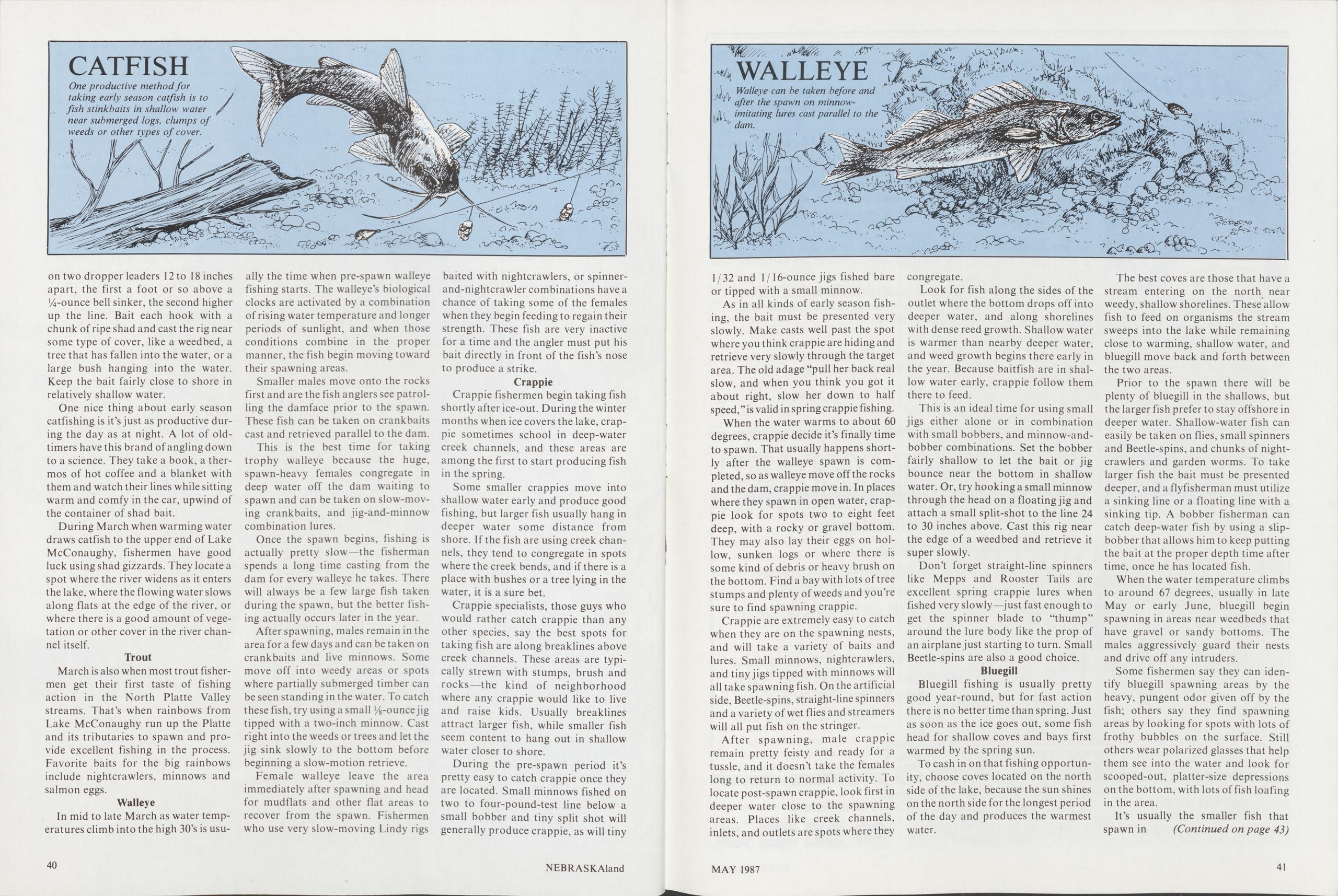
CATFISH
One productive method for taking early searson catfish is to fish stinkbaits in shallow water near submerged logs, clumps of weeds or other types of cover.
WALLEYE
Walleye can be taken before and after the spawn on minnow-imitating lures cast parallel to the dam.
on two dropper leaders 12 to 18 inches apart, the first a foot or so above a 1/4-ounce bell sinker, the second higher up the line. Bait each hook with a chunk of ripe shad and cast the rig near some type of cover, like a weedbed, a tree that has fallen into the water, or a large bush hanging into the water. Keep the bait fairly close to shore in relatively shallow water.
One nice thing about early season catfishing is it’s just as productive during the day as at night. A lot of old-timers have this brand of angling down to a science. They take a book, a thermos of hot coffee and a blanket with them and watch their lines while sitting warm and comfy in the car, upwind of the container of shad bait.
During March when warming water draws catfish to the upper end of Lake McConaughy, fishermen have good luck using shad gizzards. They locate a spot where the river widens as it enters the lake, where the flowing water slows along flats at the edge of the river, or where there is a good amount of vegetation or other cover in the river channel itself.
TroutMarch is also when most trout fishermen get their first taste of fishing action in the North Platte Valley streams. That’s when rainbows from Lake McConaughy run up the Platte and its tributaries to spawn and provide excellent fishing in the process. Favorite baits for the big rainbows include nightcrawlers, minnows and salmon eggs.
WalleyeIn mid to late March as water temperatures climb into the high 30’s is usually the time when pre-spawn walleye fishing starts. The walleye’s biological clocks are activated by a combination of rising water temperature and longer periods of sunlight, and when those conditions combine in the proper manner, the fish begin moving toward their spawning areas.
Smaller males move onto the rocks first and are the fish anglers see patrolling the damface prior to the spawn. These fish can be taken on crankbaits cast and retrieved parallel to the dam.
This is the best time for taking trophy walleye because the huge, spawn-heavy females congregate in deep water off the dam waiting to spawn and can be taken on slow-moving crankbaits, and jig-and-minnow combination lures.
Once the spawn begins, fishing is actually pretty slow—the fisherman spends a long time casting from the dam for every walleye he takes. There will always be a few large fish taken during the spawn, but the better fishing actually occurs later in the year.
After spawning, males remain in the area for a few days and can be taken on crankbaits and live minnows. Some move off into weedy areas or spots where partially submerged timber can be seen standing in the water. To catch these fish, try using a small 1/8-ounce jig tipped with a two-inch minnow. Cast right into the weeds or trees and let the jig sink slowly to the bottom before beginning a slow-motion retrieve.
Female walleye leave the area immediately after spawning and head for mudflats and other flat areas to recover from the spawn. Fishermen who use very slow-moving Lindy rigs baited with nightcrawlers, or spinner- and-nightcrawler combinations have a chance of taking some of the females when they begin feeding to regain their strength. These fish are very inactive for a time and the angler must put his bait directly in front of the fish’s nose to produce a strike.
CrappieCrappie fishermen begin taking fish shortly after ice-out. During the winter months when ice covers the lake, crappie sometimes school in deep-water creek channels, and these areas are among the first to start producing fish in the spring.
Some smaller crappies move into shallow water early and produce good fishing, but larger fish usually hang in deeper water some distance from shore. If the fish are using creek channels, they tend to congregate in spots where the creek bends, and if there is a place with bushes or a tree lying in the water, it is a sure bet.
Crappie specialists, those guys who would rather catch crappie than any other species, say the best spots for taking fish are along breaklines above creek channels. These areas are typically strewn with stumps, brush and rocks—the kind of neighborhood where any crappie would like to live and raise kids. Usually breaklines attract larger fish, while smaller fish seem content to hang out in shallow water closer to shore.
During the pre-spawn period it’s pretty easy to catch crappie once they are located. Small minnows fished on two to four-pound-test line below a small bobber and tiny split shot will generally produce crappie, as will tiny 1/32 and 1 / 16-ounce jigs fished bare or tipped with a small minnow.
As in all kinds of early season fishing, the bait must be presented very slowly. Make casts well past the spot where you think crappie are hiding and retrieve very slowly through the target area. The old adage “pull her back real slow, and when you think you got it about right, slow her down to half speed,” is valid in spring crappie fishing.
When the water warms to about 60 degrees, crappie decide it’s finally time to spawn. That usually happens shortly after the walleye spawn is completed, so as walleye move off the rocks and the dam, crappie move in. In places where they spawn in open water, crappie look for spots two to eight feet deep, with a rocky or gravel bottom. They may also lay their eggs on hollow, sunken logs or where there is some kind of debris or heavy brush on the bottom. Find a bay with lots of tree stumps and plenty of weeds and you’re sure to find spawning crappie.
Crappie are extremely easy to catch when they are on the spawning nests, and will take a variety of baits and lures. Small minnows, nightcrawlers, and tiny jigs tipped with minnows will all take spawning fish. On the artificial side, Beetle-spins, straight-line spinners and a variety of wet flies and streamers will all put fish on the stringer.
After spawning, male crappie remain pretty feisty and ready for a tussle, and it doesn’t take the females long to return to normal activity. To locate post-spawn crappie, look first in deeper water close to the spawning areas. Places like creek channels, inlets, and outlets are spots where they congregate.
Look for fish along the sides of the outlet where the bottom drops off into deeper water, and along shorelines with dense reed growth. Shallow water is warmer than nearby deeper water, and weed growth begins there early in the year. Because baitfish are in shallow water early, crappie follow them there to feed.
This is an ideal time for using small jigs either alone or in combination with small bobbers, and minnow-and- bobber combinations. Set the bobber fairly shallow to let the bait or jig bounce near the bottom in shallow water. Or, try hooking a small minnow through the head on a floating jig and attach a small split-shot to the line 24 to 30 inches above. Cast this rig near the edge of a weedbed and retrieve it super slowly.
Don’t forget straight-line spinners like Mepps and Rooster Tails are excellent spring crappie lures when fished very slowly—just fast enough to get the spinner blade to “thump” around the lure body like the prop of an airplane just starting to turn. Small Beetle-spins are also a good choice.
BluegillBluegill fishing is usually pretty good year-round, but for fast action there is no better time than spring. Just as soon as the ice goes out, some fish head for shallow coves and bays first warmed by the spring sun.
To cash in on that fishing opportunity, choose coves located on the north side of the lake, because the sun shines on the north side for the longest period of the day and produces the warmest water.
The best coves are those that have a stream entering on the north near weedy, shallow shorelines. These allow fish to feed on organisms the stream sweeps into the lake while remaining close to warming, shallow water, and bluegill move back and forth between the two areas.
Prior to the spawn there will be plenty of bluegill in the shallows, but the larger fish prefer to stay offshore in deeper water. Shallow-water fish can easily be taken on flies, small spinners and Beetle-spins, and chunks of nightcrawlers and garden worms. To take larger fish the bait must be presented deeper, and a flyfisherman must utilize a sinking line or a floating line with a sinking tip. A bobber fisherman can catch deep-water fish by using a slip-bobber that allows him to keep putting the bait at the proper depth time after time, once he has located fish.
When the water temperature climbs to around 67 degrees, usually in late May or early June, bluegill begin spawning in areas near weedbeds that have gravel or sandy bottoms. The males aggressively guard their nests and drive off any intruders.
Some fishermen say they can identify bluegill spawning areas by the heavy, pungent odor given off by the fish; others say they find spawning areas by looking for spots with lots of frothy bubbles on the surface. Still others wear polarized glasses that help them see into the water and look for scooped-out, platter-size depressions on the bottom, with lots of fish loafing in the area.
It’s usually the smaller fish that spawn in (Continued on page 43)
40 NEBRASKAland MAY 1987 41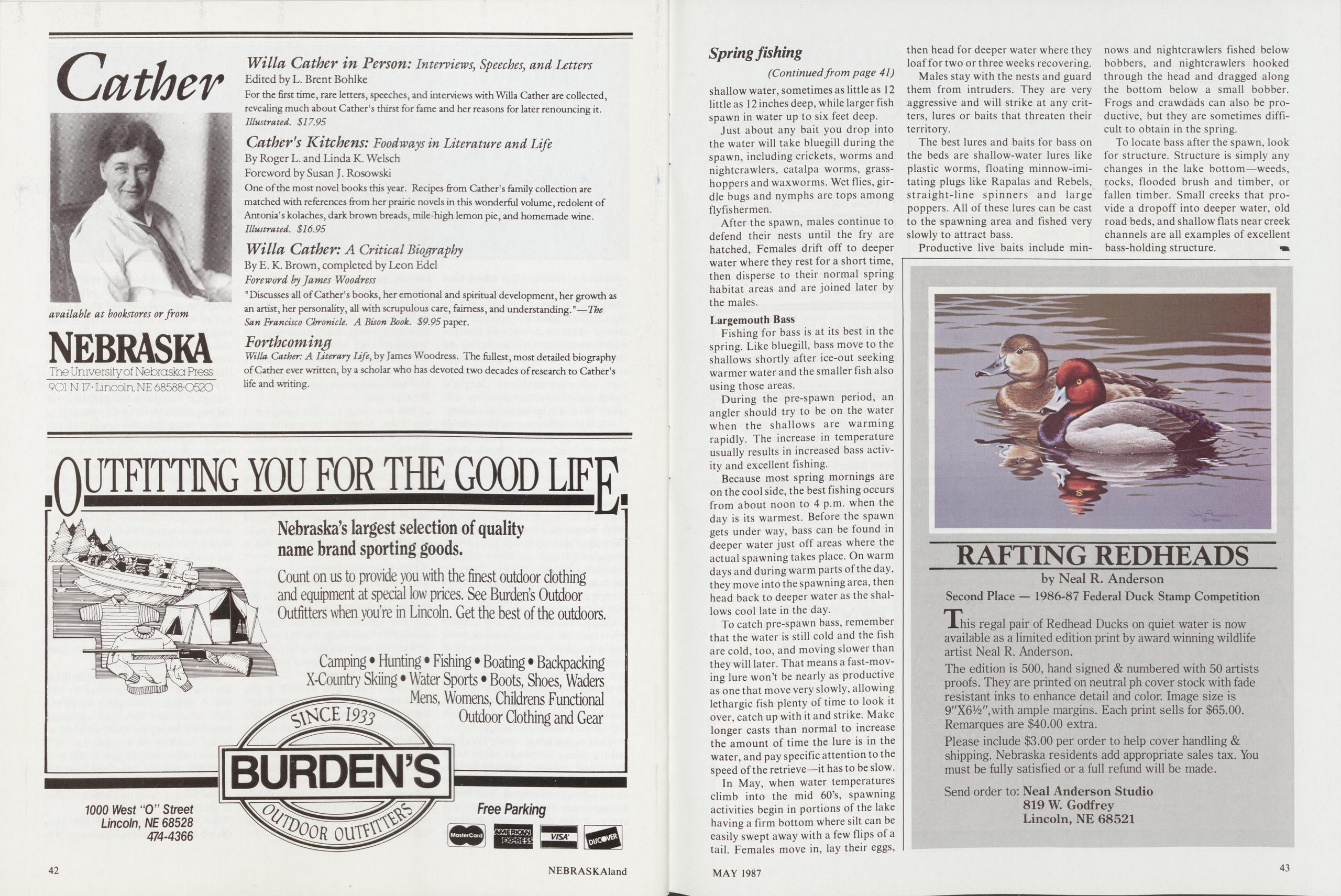
Cather available at bookstores or from NEBRASKA The University of Nebraska Press 901 N17 • Lincoln NE 68588-0520 Willet Gather in Person: Interviews■ Speeches• and Letters Edited by L. Brent Bohlke For the first time, rare letters, speeches, and interviews with Willa Gather are collected, revealing much about Gather's thirst for fame and her reasons for later renouncing it. Illustrated. $17.95 Gather's Kitchens: Foodways in Literature and Life By Roger L. and Linda K. Welsch Foreword by Susan J. Rosowski One of the most novel books this year. Recipes from Gather's family collection are matched with references from her prairie novels in this wonderful volume, redolent of Antonia's koiaches, dark brown breads, mile-high lemon pie, and homemade wine. Illustrated. $16.95 Willa Gather: A Critical Biography By E. R. Brown, completed by Leon Edel Foreword by James Woodress "Discusses all of Gather's books, her emotional and spiritual development, her growth as an artist, her personality, all with scrupulous care, fairness, and understanding."—The San Francisco Chronicle. A Bison Book. $9.95 paper. Forthcoming Willa Cather: A Literary Life, by James Woodress. The fullest, most detailed biography of Gather ever written, by a scholar who has devoted two decades of research to Gather's life and writing.
OUTFITTING YOU FOR THE GOOD LIFE Nebraska’s largest selection of quality name brand sporting goods. Count on us to provide you with the finest outdoor clothing and equipment at special low prices. See Burden’s Outdoor Outfitters when you’re in Lincoln. Get the best of the outdoors. MWS Camping • Hunting • Fishing • Boating • Backpacking X-Country Skiing • Water Sports • Boots, Shoes, Waders Mens, Womens, Childrens Functional Outdoor Clothing and Gear 1000 West “0” Street Lincoln, NE 68528 474-4366 Free Parking MasterCard BURDEN’SSpring fishing
(Continued from page 41)shallow water, sometimes as little as 12 little as 12 inches deep, while larger fish spawn in water up to six feet deep.
Just about any bait you drop into the water will take bluegill during the spawn, including crickets, worms and nightcrawlers, catalpa worms, grasshoppers and waxworms. Wet flies, girdle bugs and nymphs are tops among flyfishermen.
After the spawn, males continue to defend their nests until the fry are hatched, Females drift off to deeper water where they rest for a short time, then disperse to their normal spring habitat areas and are joined later by the males.
Largemouth BassFishing for bass is at its best in the spring. Like bluegill, bass move to the shallows shortly after ice-out seeking warmer water and the smaller fish also using those areas.
During the pre-spawn period, an angler should try to be on the water when the shallows are warming rapidly. The increase in temperature usually results in increased bass activity and excellent fishing.
Because most spring mornings are on the cool side, the best fishing occurs from about noon to 4 p.m. when the day is its warmest. Before the spawn gets under way, bass can be found in deeper water just off areas where the actual spawning takes place. On warm days and during warm parts of the day, they move into the spawning area, then head back to deeper water as the shallows cool late in the day.
To catch pre-spawn bass, remember that the water is still cold and the fish are cold, too, and moving slower than they will later. That means a fast-moving lure won’t be nearly as productive as one that move very slowly, allowing lethargic fish plenty of time to look it over, catch up with it and strike. Make longer casts than normal to increase the amount of time the lure is in the water, and pay specific attention to the speed of the retrieve—it has to be slow.
In May, when water temperatures climb into the mid 60’s, spawning activities begin in portions of the lake having a firm bottom where silt can be easily swept away with a few flips of a tail. Females move in, lay their eggs, then head for deeper water where they loaf for two or three weeks recovering.
Males stay with the nests and guard them from intruders. They are very aggressive and will strike at any critters, lures or baits that threaten their territory.
The best lures and baits for bass on the beds are shallow-water lures like plastic worms, floating minnow-imitating plugs like Rapalas and Rebels, straight-line spinners and large poppers. All of these lures can be cast to the spawning area and fished very slowly to attract bass.
Productive live baits include minnows and nightcrawlers fished below bobbers, and nightcrawlers hooked through the head and dragged along the bottom below a small bobber. Frogs and crawdads can also be productive, but they are sometimes difficult to obtain in the spring.
To locate bass after the spawn, look for structure. Structure is simply any changes in the lake bottom—weeds, rocks, flooded brush and timber, or fallen timber. Small creeks that provide a dropoff into deeper water, old road beds, and shallow flats near creek channels are all examples of excellent bass-holding structure.
Frank Shoemaker. . . Panhandle expedition
(Continued from page 19)the joy of dallying with his thirst. The proper system is to first cool and rinse one’s parched mouth and throat, to let them know there is something at last. Then two or three swallows, not more; gad, how good it is, and how it permeates! Then a moment of contemplation, gazing the while intently into the wealth of the big tin dipper—you miss the essence of the joy if you don’t look at the water—followed by another pair of swallows. Keep this up for ten minutes; two blissful gulps of ambrosia to each two minutes. After which, having trifled sufficiently with your parched system, you will settle down to busi- ness and behave just like the horse; but think how much more pleasure you have had in arriving at your ultimate satisfaction.”
After walking to Haigler, visiting with farmers along the way, he came to the town of Max. Shoemaker noted it was the driest town he had ever visited. There was no pump to provide water. “I sadly returned to the tracks, there to pencil a few last words and lay me down to die of thirst, when in my delirium I noted a livery stable—a trough—a minute excrescence on the end thereof which might be, and, which was, a pump, broad of mouth and connected with a sufficient supply of alkaline water to prolong my miserable existence. And the gods of somebody had hauled in from the fields a fresh load of alfalfa hay and left it by the stables! I took off my shoes and leggings, unfurled my blanket, got into my mosquito hood, snuggled down in the fragrant softness of the hay with a loving last look as Lyra and some of my other overhead friends and lost track of things. A wandering nag ate part of my bed during the night, but I managed to keep part of it.”
Near Stratton, the land became predominantly agricultural. Shoemaker had hoped for wilder country. “Here was the whole country-side disfigured with crops, ruining the scenery and leaving me morose and dangerous.” After walking 170 miles, Shoemaker ended up in Beaver City. He had not planned on spending more than a few hours here but found four reasons to stay longer [his travelogue shows a picture of four smiling women]. “It took
Give a hoot. Don't pollute. Save energy in style and comfort. QUALITY CONSTRUCTION Full, round logs with unique triple tongue-and-groove for tight, weatherproof fit ENERGY EFFICIENT Snug in winter, mountain cool in summer — with the rugged beauty only natural wood can bring YOUR PLANS OR OURS Year-round home, vacation hideaway or commercial building, we’ll deliver to your site and supervise wall erection Joel A. Plettner RR-1 Box 70C Waterloo, NE 68069 (402)359-5744 Write for free, informative folder. Or send $5.00 for full-color catalog with floor plans. Member: Log Homes Council. National Association of Home Manufacturers.
three days to find the train depot,” Shoemaker wrote. His “visit was filled to the limit—long drives and walks, a party, a picnic; one of the most enjoyable ‘times’ I ever had.”
After this 12-day trip, Shoemaker returned to Lincoln, “beautifully tanned and freckled, and taking deep breaths after a manner I had almost forgotten.”
Shoemaker did not return to the Panhandle of Nebraska until many years after his travels as part of the 1911 university expedition and solitary walk across the southwest counties in 1912. From 1910-1931 he worked as a specialized photographer for the university in Lincoln and Omaha. This included being in “charge of clinical photography at University Hospital from 1928-1931.” This position was terminated by the depression.
A good friend, Harold Cook, was contacted about work in the Scottsbluff area during the winter of 1933. Cook was leader of a research group investigating the geologic and historic features at Scotts Bluff Monument along the North Platte. Eventually Shoemaker found a job with the Federal Art Project in December of 1935.
While living in the area, Shoemaker often visited the Agate Springs Ranch, run by the Cook family along the Niobrara River in Sioux County. The open prairie, rugged buttes and river meadows were a haven for naturalists like Shoemaker. During one July visit, Shoemaker called Agate Springs Ranch “an oasis in the desert, and the finest ranch on the North American continent.”
While practical considerations required working in an office as supervisor for the Federal Writer’s Project, Shoemaker, just as he had as a young man growing up in Iowa or working as a railway stenographer in Omaha, found time to be outdoors. His favorite stroll was to the hills, through Robidueau Pass to the plains, around the monument and back through town. Court House and Jail rocks were seen during most outings. Chimney Rock was farther on, a goal for a longer hike. The majestic buttes of Scotts Bluff were always on the horizon. “Some- how 1 like to trudge over these dread miles made vital by their historical associations,” Shoemaker wrote in his journal entry.
While working for the adult education project in Gering months later, Shoemaker conducted about four nature-study trips each week from mid May to the end of August. He taught kids about “birds, weeds, flowers, geological strata, cloud formations, snakes, sedges, bugs, star constellations and especially botany for the girls.” The badlands and buttes were his outdoor classroom.
During the next two years, Shoemaker worked odd jobs in the Pan- handle. He spent three weeks in Sioux County as an “expert advisor” for two girls interested in flora. They all stayed at the Agate Springs Ranch with the Cooks, who Shoemaker said had been his friends for more than a quarter-century.
Eventually, Shoemaker moved to Chadron State Park where he could continue his life-long love and work as a naturalist. Hikes with the kids were filled with tidbits on the lore of plants and animals they saw. During this time he compiled a list of plants at the then new Chadron State Park, and gave talks illustrated with his lantern slides.
In a letter on August 8, 1938, Shoemaker wrote a friend about his summer’s journey through the Sandhills from Halsey to Purdum and then west. His route was through Cherry County across the dune country with only fences breaking the landscape.
This was “my westward course to see what was there. I had driven the Potash Highway perhaps twenty times; but one does not see things while driving; hence this 300-mile walk of mine, to see things. And believe me, I saw em!—my notes cover scores of pages.” This was one of the final journeys Shoemaker was to make. He was in his sixties, walking across a land he had first visited 30 years earlier.
After moving to California in the fall of 1938 and living there for a few years, Shoemaker returned to Nebraska. He lived in Lincoln in 1942, working various jobs—giving nature talks for the WPA of the state recreation service, being an aide to a portrait photographer, in a hobby store, and as a substitute postal carrier to earn enough to support himself.
Shoemaker’s main interest, however, the one he was devoted to throughout his life, was a pursuit of natural history. He had traveled from east to west and from north to south across Nebraska. He walked through the Sandhills, across southwest Nebraska and around the Pine Ridge. These hikes increased his knowledge of nature, which was so important to him.
Shoemaker called himself a “nature shark—almost every line of natural history was of interest. My photography has made a pictorial record of many of my observations and explorations. My personal collection of negatives numbers over 15,000, with over 2,000 negatives relating to birds and nests.”
From childhood, the appeal of natural places had lured Shoemaker into the outdoors. His sense of the land, his great appreciation of the rewards freely given by the birds, bugs and plants are vividly recorded in his writings and photographs.
A comment Shoemaker made in the early 1940’s captured his perspective on the importance of natural areas. He wrote in a letter, when explaining why he was training people how to plant trees: “The basic reason being, that practically every farmer in eastern Nebraska is turning his stock into every patch of woodland; to turn a thousand dollars’ worth of the state’s biological history into a doubtful fifty dollars’ worth of milk. I frankly doubt whether, outside of parks and other protected areas, there will remain in another ten years, a shred of woodland to tell the ecological story which should be a part of the history of the state.”
Some of the prairie, wetland and forest scenes Shoemaker recorded can now be enjoyed only as memories. Time has changed the lands he visited. Shoemaker’s photographs and writing from the 1890’s and early decades of the 20th century document the natural places which Nebraskans once had. Perhaps we can be inspired by men such as Frank Shoemaker to protect our natural heritage for the enjoyment of future generations. Surely we have an obligation to protect more than just memories of naturalists.
Bookshelf
People of the Moonshell: A Western River JournalNancy M Peterson, Renaissance House; Frederick, Colorado. 1984. 166 pp. index; bibliography; illustrations. $22.95 cloth; $14.95 paperback.
This collection of 41 short chapters takes its title from an Indian name for the Platte River, a designation derived from a certain kind of freshwater clam found there. The author, a native of Scottsbluff, said in a 1985 Lincoln Star interview hat her book is intended for the “average reader” who might already have an interest in the river and its land.
Peterson writes her accounts from the viewpoints of diverse participants in the region’s history. The original inhabitants who lost their land and most of their culture, the French and Spanish explorers who charted unknown territory while seeking riches, emigrants who followed the Great Platte River Road on their way west, the settlers who stayed—their stories are all well told. Some of those represented include Crazy Horse, Red Cloud, Pedro de Villasur, Jedadiah Smith, Narcissa Whitman, Hiram Scott, and Robert Louis Stevenson.
Landmarks such as Independence Rock, Chimney Rock and Scotts Bluff, and military posts such as Fort Kearny and Fort McPherson are mentioned frequently. The physical realities of a demanding climate, lack of ordinary comforts, and scarcity of wood and water are recurring themes in the Platte Valley chronicles. Aside from an occasional stop at various historical markers, how many Interstate- 80 travelers today give much thought to what the valley was like a century or more ago?
The concluding chapter, “Who Could Ask For More?” provides a sketch of Adams County settlers Luna and James T. Kellie. Their experiences from about 1880 to 1920 are probably not much different from those of thousands of their contemporaries. The Kellies reared a large family (two children died as infants), coped with weather extremes, harvested a few good crops, gave and received help in their neighborhood. One of the differences, though, is that Mrs. Kellie provided written records which are now in the Nebraska State Historical Society archives.
The Platte River country has been fortunate in that a dedicated few have worked mightily to restore historic sites, mark the overland trails, preserve journals and diaries. Then they began fitting the pieces together so others could understand and appreciate the drama that took place. Although she drew upon numerous well-known sources, Nancy Peterson’s writings have a freshness all their own. People of the Moonshell is definitely a good choice for the beginning amateur historian, but even a seasoned reader of Platte Valley lore is likely to find treasures in its pages.
Trading Post
DOGS TRAINING ALL BREEDS Hunting Dogs — Vizslas for sale. Rozanek Kennels, Rt. 2, Schuyler, NE 68661. Phone (402) 352-8769. ENGLISH SETTERS: “Bred for the hunter”; select puppies and started dogs available from outstanding bloodlines. Stud service available by proven hunters. High Plains Kennels, 1411 Emerson, Alliance, NE 69301, Phone (308) 762-6709. GROUSEWAY BRITTANIES: Ideal hunting compan- ions—dedicated, goal-oriented breeding programs. FREE brochure, Grouseway Gundogs, Louisville, NE 68037. (402) 298-8340. Training available. GERMAN SHORTHAIRS and Brittany Spaniel pups. Started and occasionally a meat dog. Pups are guaranteed. Also I will be training hunting dogs. Wayne Clark, Percival, I A. Phone (712) 529-4238 or (402) 263-3155 at Union, NE. GERMAN DRAHTHAARS — Quality puppies available, whelped in March. Bred by strict VDD standards in a German registered kennel. Drahthaars are superior hunting dogs for fur and feathered game. Wildflugel Kennel, RR 3 Box 78A, Ravenna, NE 68869, Phone (308) 452-4333 (after 6:30 p.m.). WALKING GUN DOG TRAINING. Training all breeds. Leaving for western Nebraska end of June. Dogs worked daily on released quail. Also forced retrieving. Phone (402) 788-2213. ENGLISH SETTER (Llewellin) puppies. Ready early May. Aksarben, Old Hemlock, and Ryman breeding. Parents excellent on grouse and quail. “For Field and Family,”contact Doubleshot Kennels, 485 Regina Dr., Fort Collins, CO 80525. Phone (308) 667-0296. AKC LABRADORS — Black, due April 16. Sire: AFC “My Angus.” Compatible breeding, marking lin- ing pedigree. Super Chief. Riveroaks Corky and much more. Dam: “Tah” daughter of FC-AFC CFC-CAFC Ironwood Tarnation parents, grandparents OFA par- ents, gorgeous, strong, stocky, dispositions great. Call (402) 476-3822. Get hooked on fishing Fishing is fun for everyone NEBRASKAland Magazine Order Form Please send me a subscription to NEBRASKAland Magazine One-year $12.00 NAME ADDRESS Two-year $23.00 CJTy STATE ZIP Mail to: NEBRASKAland Magazine, Box 30370, Lincoln, NE 68503 MISCELLANEOUS NE NEBRASKA trout fishing. 3 modern cottages, 1 available year round. 5 spring fed lakes with open water all year. Trout up to 7 pounds. Other varieties fish also. Diamond E. Trout Resort, Orchard, NE 68764. Phone (402) 893-4745. GUNS — Browning, Winchester, Remington, others, Hi-powers, shotguns, new, used, antiques. Want Pre- 1964 Winchesters. Buy-Sell-Trade. Ph. (402) 729-6112. Bedlan’s Sporting Goods, Fairbury, NE 68352. MAD RIVER CANOES offers the finest quality and performance. For the finest canoes and accessories look to Great Plains Canoe Co., 205 Main, Springfield, NE. Phone (402) 253-2001. HUNTERS WITH BUDDIES — Own your own hunt- ing paradise with 3 miles of Niobrara River frontage. 3,080 acres, with spring creeks and abundant timber and wildlife. Also the ultimate in nature living — nice two-bedroom home, recreational or retirement, over- looking Meadville-Niobrara River area. 80 acres of grass, timber and wildlife. Swett Realty, P.O. Box 265, Ainsworth, NE 69210. Phone (402) 387-1626 day or RECEIVE $75/100 envelopes returned to us. Rush stamped envelope: Kelley 4, 804 Old Thorsby Road, Clanton, Alabama 35045. STOCK SHOP — wood stocks for all firearms. Repaired, refinished or custom made. Hand-cut check- ering, glass bedding. 1618 Euclid, Ashland, NE 68003. Phone (402) 944-2836. HOMEWORKERS! RECEIVE $75/100 envelopes you return to us per instructions. Rush stamped enve- lope: Kelley 5, 804 Old Thorsby Road, Clanton, Ala- bama 35045. FOR SALE: Hunting cottage and year-round retreat. Located near Nebraska’s beautiful Pine Creek, Long Pine, Nebraska. Excellent hunting and trout fishing. Call Wardene Roark (402) 273-4141. AIR GUNS repaired — Benjamin, Crosman, Daisy, other American made. Restoration; old guns wanted, Jack’s Air Guns, 1225 No. 46th, Lincoln, NE 68503. Phone (402) 466-9223. TROLLING MOTOR REPAIR. Factory authorized Minn Kota and Motor Guide, parts and service. Wolfs Repair and Installation, 1529 David Drive, Lincoln, NE 68504. Phone (402) 464-4265. WINE AND BEER: Make your own. Send for free recipes and instructions. Omaha Supply, 1324 2nd Avenue, Nebraska City, NE 68410. WOOD SLABS for sale, all kinds, all sizes. Ideal for clocks or painting, finished or unfinished. All sizes of Cypress slabs. For price list write to: Clocks, HC 30- Box 57, McCook, NE 69001. FAIRFIELD CAMPGROUNDS along the Niobrara River “in the heart of a unique blend of habitats.” Hiking, natural scenery, bird watching, canoe rental, car shuttle, experienced outfitters. Lifetime river knowledge. Beryl Kuhre, Johnstown, NE 69214. Phone (402) 722-4494. ASSEMBLERS WANTED. Make money assembling clowns. Earn $60 per 10 units. It’s fun! Profitable! Send self-addressed stamped envelope to Dickens & Mat- son, P.O. Box 476, East Detroit, MI 48021. TAXIDERMY ALLISON’S TAXIDERMY STUDIO. Wally and Betty Allison, Licensed Taxidermist. We’ve mounted 21 Nebraska State Record fish. Specializing in fish and birds, small game and rattlesnakes. We use freeze-dry. 2310 West Leota, North Platte, Nebr. 69101. Phone (308) 534-2324. BADE TAXIDERMY — Quality a must — Fast service. Fish, birds, rugs, tanning, full mounts and game heads, 2111 N. Christy St., Fremont, NE 727-5463. KARL SCHWARZ master taxidermist has moved to a new country studio; same professional mounting and tanning service. Schwarz Wild Wing Studio, 16804 South 180th St., Springfield, NE 68059. Phone (402) 253-2481. NABITY’S TAXIDERMY. 31 years experience. Spe- cializing in natural grass backgrounds for mammals, birds and fish. 13901 “O” St., Lincoln, NE 68504 — 4 miles east of 84th and “O”. (402) 489-6351. BIG BEAR TAXIDERMY, Rt. 2, Mitchell, Nebraska 69357. We specialize in all big game from Alaska to Nebraska, also birds and fish. Hair on and hair off tanning. Four miles west of Scottsbluff on Highway 26. Dale Hubei, phone (308) 635-3013._ PEISTER TAXIDERMY — Professional work at prices most sportsman can afford. Now in our new log cabin studio, 1020 Central Avenue, Box 3201, Kear- ney, NE 68847. Phone (308) 236-9700 or (308) 237-7575 evenings. NATURECRAFT STUDIO — all custom services — creative work, quality, and experience since 1935. Includes freeze-dry processing. Display and sales room, visitors welcome. Hwy. 2 in Nebraska City. Phone (402) 873-5491. Joe Voges — Owner. Bow Steedly — Big Game specialist. OFFERS A COMPLETE TRAINING PROGRAM For Retrievers, Pointers, Spaniels Basic Obedience Program For All Breeds Field Trial Bloodline Lab Pups For Sale JOHN HONORE Manager and Trainer West Highway 30 Grand Island, NE 68801 RR 1 Box 433 Phone: (308) 384-1517 Traps without injury squirrels, chipmunks, rabbits, mink, fox, raccoons, stray animals, pests, etc. Sizes for every need. Also traps for snakes, sparrows, pigeons, crabs, turtles, quail, etc. Save on our low factory prices. Send no money. Free catalog and trapping secrets. MUSTANG MFG. CO., Dept. N-34, Box 920947, Houston. Tex. 77292 GUN DOG TRAINING All Sporting Breeds All dogs worked on foot — no horses. Midwest’s finest facili- ties. Field Champion-sired Labrador pups for sale. “Training for hunters by hunters” WILDERNESS KENNELS Henry Sader—Roca, Ne. (402)423-4212 68430 48 NEBRASKAland MAY 1987 49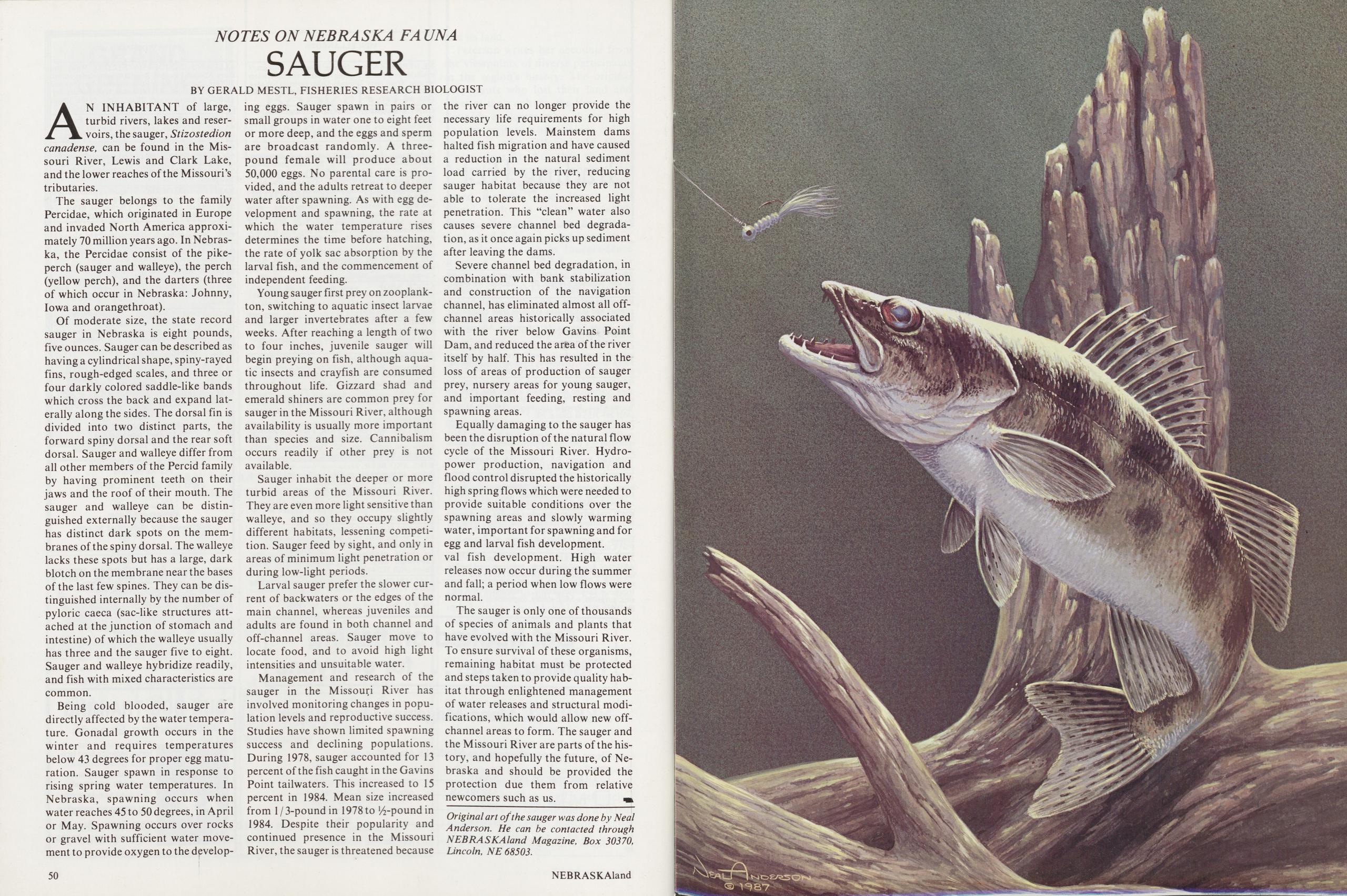
NOTES ON NEBRASKA FA UNA SAUGER
AN INHABITANT of large, turbid rivers, lakes and reservoirs, the sauger, Stizostedion canadense, can be found in the Missouri River, Lewis and Clark Lake, and the lower reaches of the Missouri’s tributaries.
The sauger belongs to the family Percidae, which originated in Europe and invaded North America approximately 70 million years ago. In Nebraska, the Percidae consist of the pike- perch (sauger and walleye), the perch (yellow perch), and the darters (three of which occur in Nebraska: Johnny, Iowa and orangethroat).
Of moderate size, the state record sauger in Nebraska is eight pounds, five ounces. Sauger can be described as having a cylindrical shape, spiny-rayed fins, rough-edged scales, and three or four darkly colored saddle-like bands which cross the back and expand laterally along the sides. The dorsal fin is divided into two distinct parts, the forward spiny dorsal and the rear soft dorsal. Sauger and walleye differ from all other members of the Percid family by having prominent teeth on their jaws and the roof of their mouth. The sauger and walleye can be distinguished externally because the sauger has distinct dark spots on the membranes of the spiny dorsal. The walleye lacks these spots but has a large, dark blotch on the membrane near the bases of the last few spines. They can be distinguished internally by the number of pyloric caeca (sac-like structures attached at the junction of stomach and intestine) of which the walleye usually has three and the sauger five to eight. Sauger and walleye hybridize readily, and fish with mixed characteristics are common.
Being cold blooded, sauger are directly affected by the water temperature. Gonadal growth occurs in the winter and requires temperatures below 43 degrees for proper egg maturation. Sauger spawn in response to rising spring water temperatures. In Nebraska, spawning occurs when water reaches 45 to 50 degrees, in April or May. Spawning occurs over rocks or gravel with sufficient water movement to provide oxygen to the develop- ing eggs. Sauger spawn in pairs or small groups in water one to eight feet or more deep, and the eggs and sperm are broadcast randomly. A three-pound female will produce about 50,000 eggs. No parental care is provided, and the adults retreat to deeper water after spawning. As with egg development and spawning, the rate at which the water temperature rises determines the time before hatching, the rate of yolk sac absorption by the larval fish, and the commencement of independent feeding.
Young sauger first prey on zooplankton, switching to aquatic insect larvae and larger invertebrates after a few weeks. After reaching a length of two to four inches, juvenile sauger will begin preying on fish, although aquatic insects and crayfish are consumed throughout life. Gizzard shad and emerald shiners are common prey for sauger in the Missouri River, although availability is usually more important than species and size. Cannibalism occurs readily if other prey is not available.
Sauger inhabit the deeper or more turbid areas of the Missouri River. They are even more light sensitive than walleye, and so they occupy slightly different habitats, lessening competition. Sauger feed by sight, and only in areas of minimum light penetration or during low-light periods.
Larval sauger prefer the slower current of backwaters or the edges of the main channel, whereas juveniles and adults are found in both channel and off-channel areas. Sauger move to locate food, and to avoid high light intensities and unsuitable water.
Management and research of the sauger in the Missouri River has involved monitoring changes in popu- lation levels and reproductive success. Studies have shown limited spawning success and declining populations. During 1978, sauger accounted for 13 percent of the fish caught in the Gavins Point tailwaters. This increased to 15 percent in 1984. Mean size increased from 1/3-poundin 1978 to 1/2-pound in 1984. Despite their popularity and continued presence in the Missouri River, the sauger is threatened because the river can no longer provide the necessary life requirements for high population levels. Mainstem dams halted fish migration and have caused a reduction in the natural sediment load carried by the river, reducing sauger habitat because they are not able to tolerate the increased light penetration. This “clean” water also causes severe channel bed degradation, as it once again picks up sediment after leaving the dams.
Severe channel bed degradation, in combination with bank stabilization and construction of the navigation channel, has eliminated almost all off-channel areas historically associated with the river below Gavins Point Dam, and reduced the area of the river itself by half. This has resulted in the loss of areas of production of sauger prey, nursery areas for young sauger, and important feeding, resting and spawning areas.
Equally damaging to the sauger has been the disruption of the natural flow cycle of the Missouri River. Hydro-power production, navigation and flood control disrupted the historically high spring flows which were needed to provide suitable conditions over the spawning areas and slowly warming water, important for spawning and for egg and larval fish development. val fish development. High water releases now occur during the summer and fall; a period when low flows were normal.
The sauger is only one of thousands of species of animals and plants that have evolved with the Missouri River. To ensure survival of these organisms, remaining habitat must be protected and steps taken to provide quality habitat through enlightened management of water releases and structural modifications, which would allow new off-channel areas to form. The sauger and the Missouri River are parts of the history, and hopefully the future, of Nebraska and should be provided the protection due them from relative newcomers such as us.
Position: 322 (28 views)