Volume 65, Issue 3, 1987
NEBRASKAland
APRIL 1987 $1.50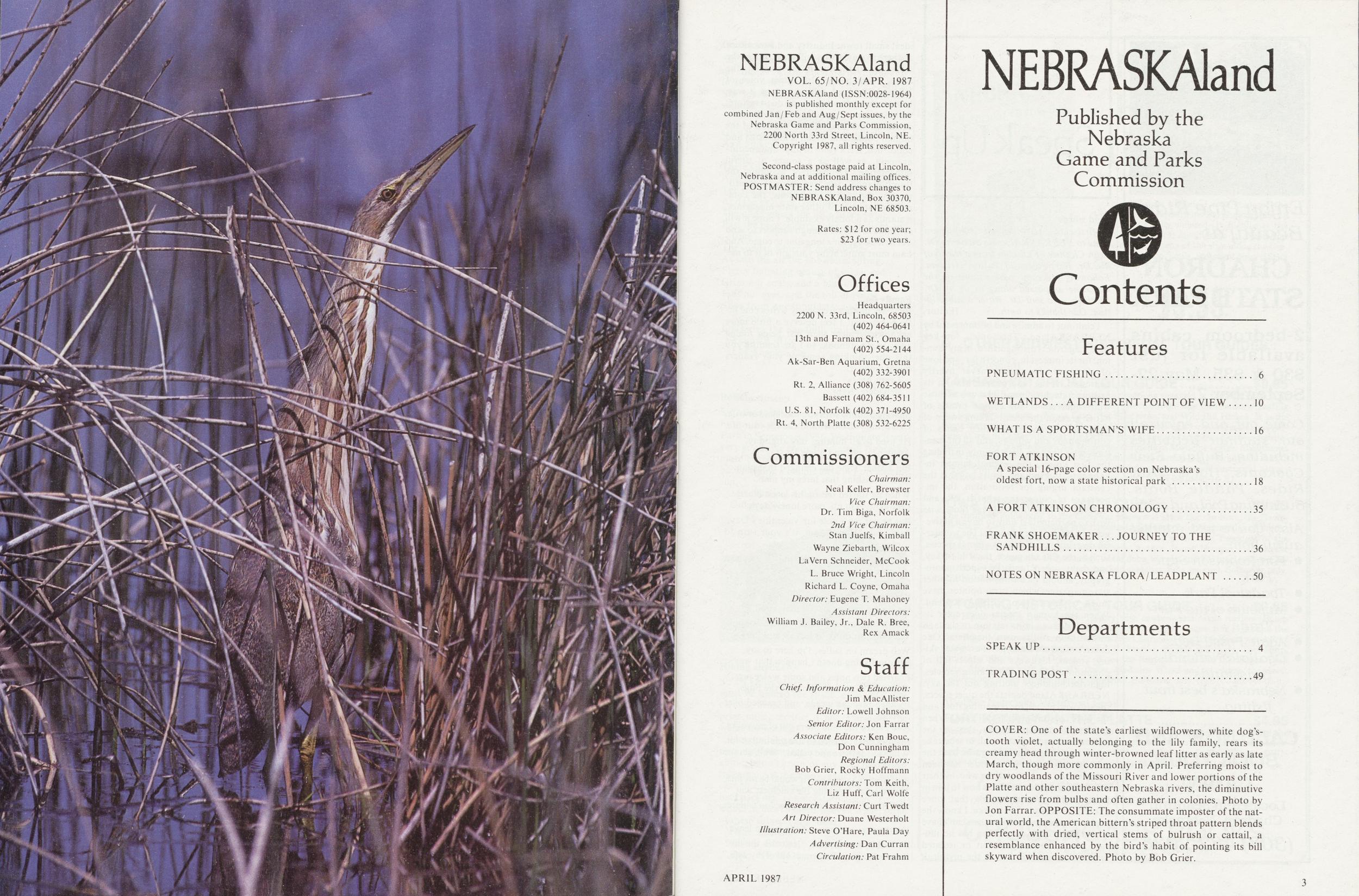
NEBRASKAland
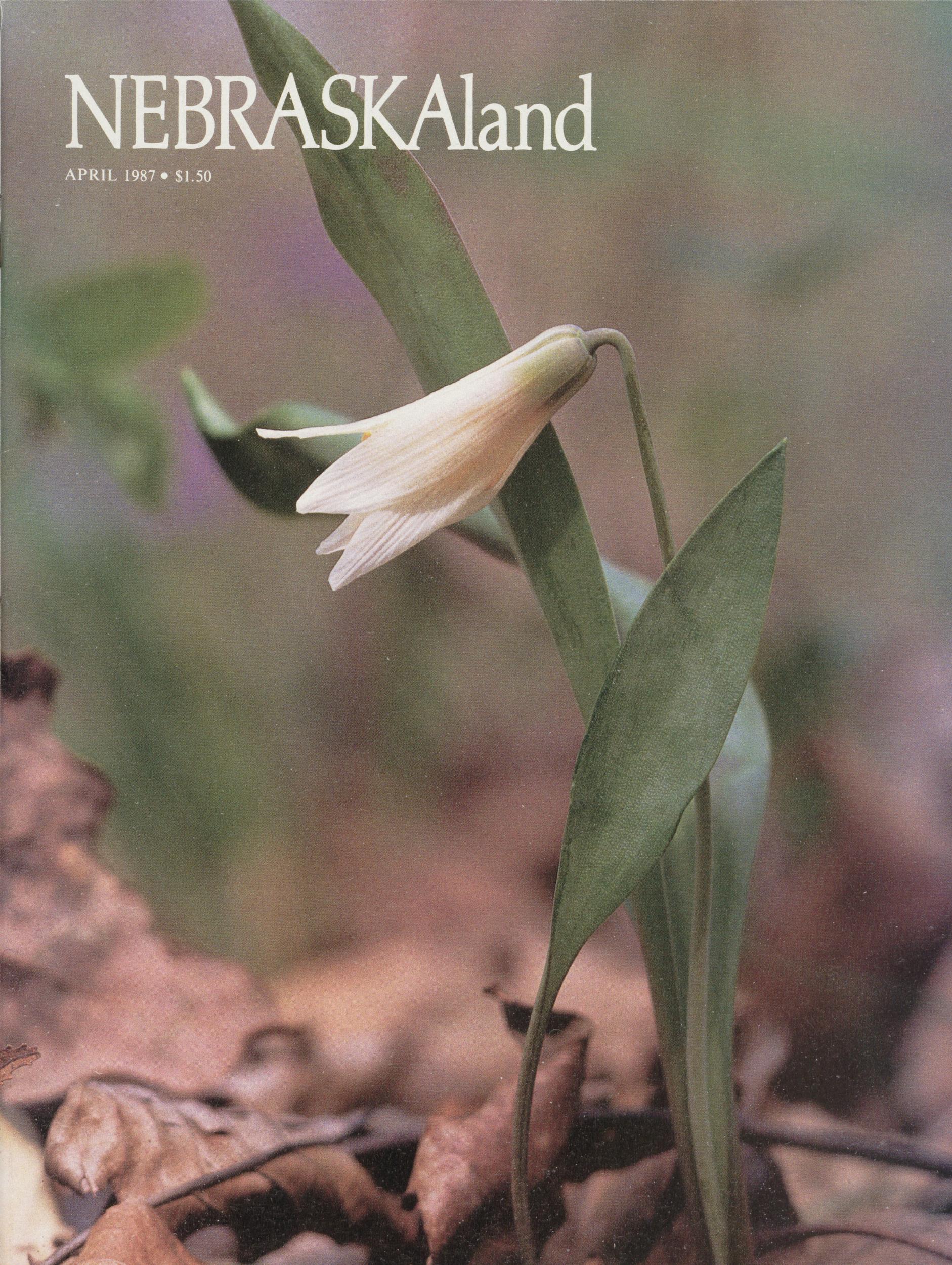
Published by the Nebraskka Game and Parks Commission NEBRASKAland VOL. 65/NO. 3/APR. 1987 NEBRASKAland (ISSN:0028-1964) is published monthly except for combined Jan/Feb and Aug/Sept issues, by the Nebraska Game and Parks Commission, 2200 North 33rd Street, Lincoln, NE. Copyright 1987, all rights reserved. Second-class postage paid at Lincoln, Nebraska and at additional mailing offices. POSTMASTER: Send address changes to NEBRASKAland, Box 30370, Lincoln, NE 68503. Rates: $12 for one year; $23 for two years. Offices Headquarters 2200 N. 33rd, Lincoln, 68503 (402) 464-0641 13th and Farnam St., Omaha (402) 554-2144 Ak-Sar-Ben Aquarium, Gretna (402) 332-3901 Rt. 2, Alliance (308) 762-5605 Bassett (402)684-3511 U.S. 81, Norfolk (402) 371-4950 Rt. 4, North Platte (308) 532-6225 Commissioners Chairman: Neal Keller, Brewster Vice Chairman: Dr. Tim Biga, Norfolk 2nd Vice Chairman: Stan Juelfs, Kimball Wayne Ziebarth, Wilcox LaVern Schneider, McCook L. Bruce Wright, Lincoln Richard L. Coyne, Omaha Director: Eugene T. Mahoney Assistant Directors: William J. Bailey, Jr., Dale R. Bree, Rex Amack Staff Chief, Information & Education: Jim MacAllister Editor: Lowell Johnson Senior Editor: J on Farrar Associate Editors: Ken Bouc, Don Cunningham Regional Editors: Bob Grier, Rocky Hoffmann Contributors: Tom Keith, Liz Huff, Carl Wolfe Research Assistant: Curt Twedt Art Director: Duane Westerholt Illustration: Steve O'Hare, Paula Day Advertising: Dan Curran Circulation: Pat Frahm Contents Features PNEUMATIC FISHING............. WETLANDS A DIFFERENT POINT OF VIEW.....10 WHAT IS A SPORTSMAN'S WIFE. FORT ATKINSON A special 16-page color section on Nebraska's oldest fort, now a state historical park ........ A FORT ATKINSON CHRONOLOGY........ FRANK SHOEMAKER . . . JOURNEY TO THE SANDHILLS................ 35 36 NOTES ON NEBRASKA FLORA/LEADPLANT .50 Departments SPEAK UP.. TRADING POST...................................49 COVER: One of the state's earliest wildflowers, white dog's tooth violet, actually belonging to the lily family, rears its creamy head through winter-browned leaf litter as early as late March, though more commonly in April. Preferring moist to dry woodlands of the Missouri River and lower portions of the Platte and other southeastern Nebraska rivers, the diminutive flowers rise from bulbs and often gather in colonies. Photo by Jon Farrar. OPPOSITE: The consummate imposter of the natural world, the American bittern's striped throat pattern blends perfectly with dried, vertical stems of bulrush or cattail, a resemblance enhanced by the bird's habit of pointing its bill skyward when discovered. Photo by Bob Grier. APRIL 1987 3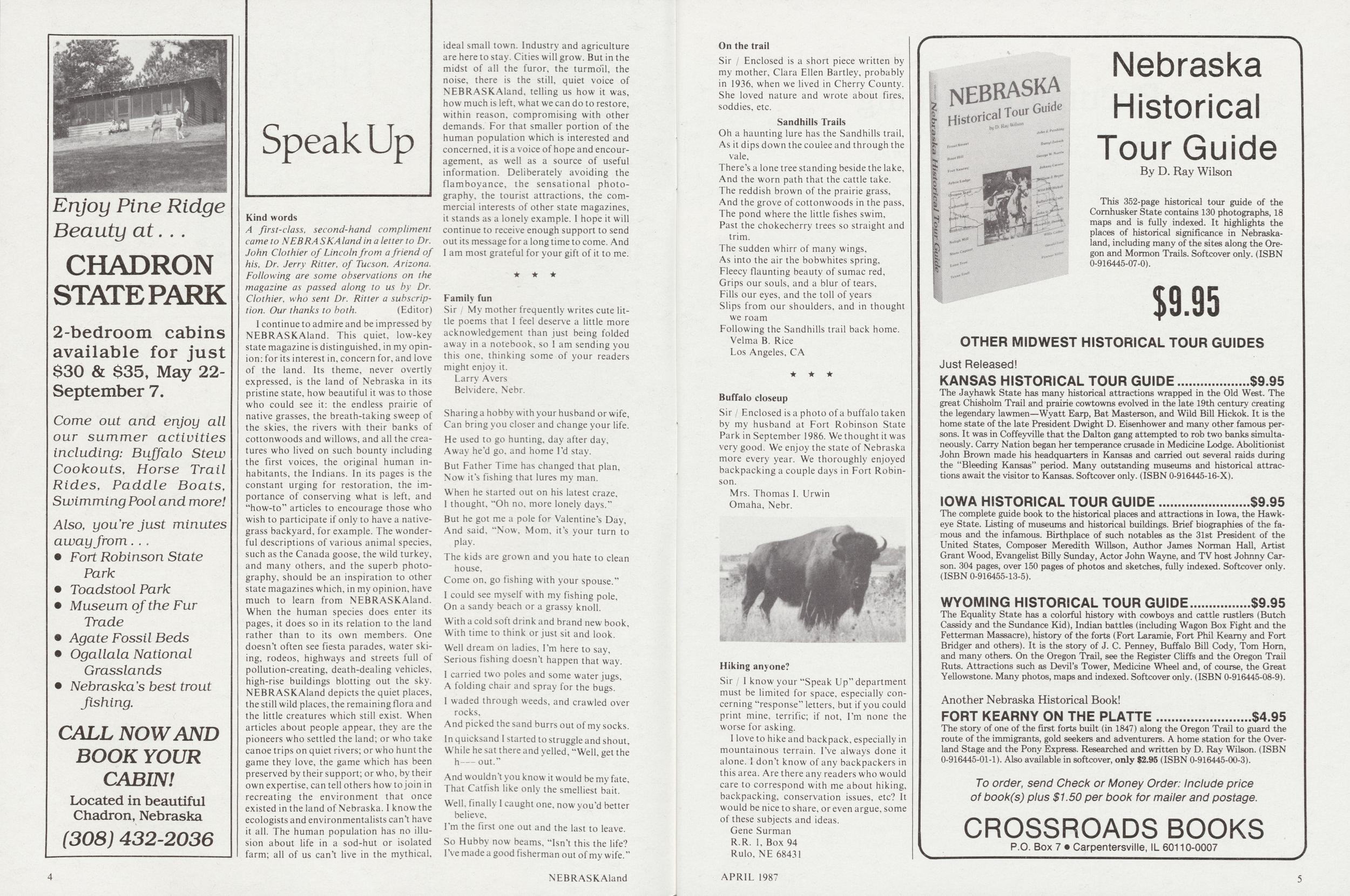
Speak Up
Kind wordsA first-class, second-hand compliment came to NEBRA SKA land in a letter to Dr. John Clothier of Lincoln from a friend of his, Dr. Jerry Ritter, of Tucson, Arizona. Following are some observations on the magazine as passed along to us by Dr. Clothier, who sent Dr. Ritter a subscription. Our thanks to both. (Editor)
I continue to admire and be impressed by NEBRASKAland. This quiet, low-key state magazine is distinguished, in my opinion: for its interest in, concern for, and love of the land. Its theme, never overtly expressed, is the land of Nebraska in its pristine state, how beautiful it was to those who could see it: the endless prairie of native grasses, the breath-taking sweep of the skies, the rivers with their banks of cottonwoods and willows, and all the creatures who lived on such bounty including the first voices, the original human inhabitants, the Indians. In its pages is the constant urging for restoration, the importance of conserving what is left, and "how-to" articles to encourage those who wish to participate if only to have a native grass backyard, for example. The wonderful descriptions of various animal species, such as the Canada goose, the wild turkey, and many others, and the superb photography, should be an inspiration to other state magazines which, in my opinion, have much to learn from NEBRASKAland. When the human species does enter its pages, it does so in its relation to the land rather than to its own members. One doesn't often see fiesta parades, water skiing, rodeos, highways and streets full of pollution-creating, death-dealing vehicles, high-rise buildings blotting out the sky. NEBRASKAland depicts the quiet places, the still wild places, the remaining flora and the little creatures which still exist. When articles about people appear, they are the pioneers who settled the land; or who take canoe trips on quiet rivers; or who hunt the game they love, the game which has been preserved by their support; or who, by their own expertise, can tell others how to join in recreating the environment that once existed in the land of Nebraska. I know the ecologists and environmentalists can't have it all. The human population has no illusion about life in a sod-hut or isolated farm; all of us can't live in the mythical, ideal small town. Industry and agriculture are here to stay. Cities will grow. But in the midst of all the furor, the turmoil, the noise, there is the still, quiet voice of NEBRASKAland, telling us how it was, how much is left, what we can do to restore, within reason, compromising with other demands. For that smaller portion of the human population which is interested and concerned, it is a voice of hope and encouragement, as well as a source of useful information. Deliberately avoiding the flamboyance, the sensational photography, the tourist attractions, the commercial interests of other state magazines, it stands as a lonely example. I hope it will continue to receive enough support to send out its message for a long time to come. And I am most grateful for your gift of it to me.
* * * Family funSir / My mother frequently writes cute little poems that I feel deserve a little more acknowledgement than just being folded away in a notebook, so 1 am sending you this one, thinking some of your readers might enjoy it.
Larry Avers Belvidere. Nebr. Sharing a hobby with your husband or wife, Can bring you closer and change your life. He used to go hunting, day after day, Away he'd go, and home I'd stay. But Father Time has changed that plan, Now it's fishing that lures my man. When he started out on his latest craze, I thought, "Oh no, more lonely days." But he got me a pole for Valentine's Day, And said, "Now, Mom, it's your turn to play. The kids are grown and you hate to clean house. Come on, go fishing with your spouse." I could see myself with my fishing pole, On a sandy beach or a grassy knoll. With a cold soft drink and brand new book, With time to think or just sit and look. Well dream on ladies, I'm here to say, Serious fishing doesn't happen that way. I carried two poles and some water jugs, A folding chair and spray for the bugs. I waded through weeds, and crawled over rocks, And picked the sand burrs out of my socks. In quicksand I started to struggle and shout, While he sat there and yelled, "Well, get the h----out." And wouldn't you know it would be my fate, That Catfish like only the smelliest bait. Well, finally I caught one, now you'd better believe, I'm the first one out and the last to leave. So Hubby now beams, "Isn't this the life? I've made a good fisherman out of my wife." 4 NEBRASKAland On the trailSir / Enclosed is a short piece written by my mother, Clara Ellen Bartley, probably in 1936, when we lived in Cherry County. She loved nature and wrote about fires, soddies, etc.
Sandhills Trails Oh a haunting lure has the Sandhills trail, As it dips down the coulee and through the vale, There's a lone tree standing beside the lake, And the worn path that the cattle take. The reddish brown of the prairie grass, And the grove of cottonwoods in the pass, The pond where the little fishes swim, Past the chokecherry trees so straight and trim. The sudden whirr of many wings, As into the air the bobwhites spring, Fleecy flaunting beauty of sumac red, Grips our souls, and a blur of tears, Fills our eyes, and the toll of years Slips from our shoulders, and in thought we roam Following the Sandhills trail back home. Velma B. Rice Los Angeles, CA * * * Buffalo closeupSir / Enclosed is a photo of a buffalo taken by my husband at Fort Robinson State Park in September 1986. We thought it was very good. We enjoy the state of Nebraska more every year. We thoroughly enjoyed backpacking a couple days in Fort Robinson.
Mrs. Thomas I. Urwin Omaha, Nebr.Sir / I know your "Speak Up" department must be limited for space, especially concerning "response" letters, but if you could print mine, terrific; if not, I'm none the worse for asking.
I love to hike and backpack, especially in mountainous terrain. I've always done it alone. I don't know of any backpackers in this area. Are there any readers who would care to correspond with me about hiking, backpacking, conservation issues, etc? It would be nice to share, or even argue, some of these subjects and ideas.
Gene Surman R.R. 1, Box 94 Rulo, NE 68431 Nebraska Historical Tour Guide By D. Ray Wilson This 352-page historical tour guide of the Cornhusker State contains 130 photographs, 18 maps and is fully indexed. It highlights the places of historical significance in Nebraskaland, including many of the sites along the Oregon and Mormon Trails. Softcover only. (ISBN 0-916445-07-0). $9.95 OTHER MIDWEST HISTORICAL TOUR GUIDES Just Released! KANSAS HISTORICAL TOUR GUIDE...................$9.95 The Jayhawk State has many historical attractions wrapped in the Old West. The great Chisholm Trail and prairie cowtowns evolved in the late 19th century creating the legendary lawmen—Wyatt Earp, Bat Masterson, and Wild Bill Hickok. It is the home state of the late President Dwight D. Eisenhower and many other famous persons. It was in Coffeyville that the Dalton gang attempted to rob two banks simultaneously. Carry Nation began her temperance crusade in Medicine Lodge. Abolitionist John Brown made his headquarters in Kansas and carried out several raids during the "Bleeding Kansas" period. Many outstanding museums and historical attractions await the visitor to Kansas. Softcover only. (ISBN 0-916445-16-X). IOWA HISTORICAL TOUR GUIDE........................$9.95 The complete guide book to the historical places and attractions in Iowa, the Hawkeye State. Listing of museums and historical buildings. Brief biographies of the famous and the infamous. Birthplace of such notables as the 31st President of the United States, Composer Meredith Willson, Author James Norman Hall, Artist Grant Wood, Evangelist Billy Sunday, Actor John Wayne, and TV host Johnny Carson. 304 pages, over 150 pages of photos and sketches, fully indexed. Softcover only. (ISBN 0-916455-13-5). WYOMING HISTORICAL TOUR GUIDE................$9.95 The Equality State has a colorful history with cowboys and cattle rustlers (Butch Cassidy and the Sundance Kid), Indian battles (including Wagon Box Fight and the Fetterman Massacre), history of the forts (Fort Laramie, Fort Phil Kearny and Fort Bridger and others). It is the story of J. C. Penney, Buffalo Bill Cody, Tom Horn, and many others. On the Oregon Trail, see the Register Cliffs and the Oregon Trail Ruts. Attractions such as Devil's Tower, Medicine Wheel and, of course, the Great Yellowstone. Many photos, maps and indexed. Softcover only. (ISBN 0-916445-08-9). Another Nebraska Historical Book! FORT KEARNY ON THE PLATTE.........................$4.95 The story of one of the first forts built (in 1847) along the Oregon Trail to guard the route of the immigrants, gold seekers and adventurers. A home station for the Overland Stage and the Pony Express. Researched and written by D. Ray Wilson. (ISBN 0-916445-01-1). Also available in softcover, only $2.95 (ISBN 0-916445-00-3). To order, send Check or Money Order: Include price of book(s) plus $1.50 per book for mailer and postage. CROSSROADS BOOKS P.O. Box 7 • Carpentersville, IL 60110-0007 ARPIL 1987 5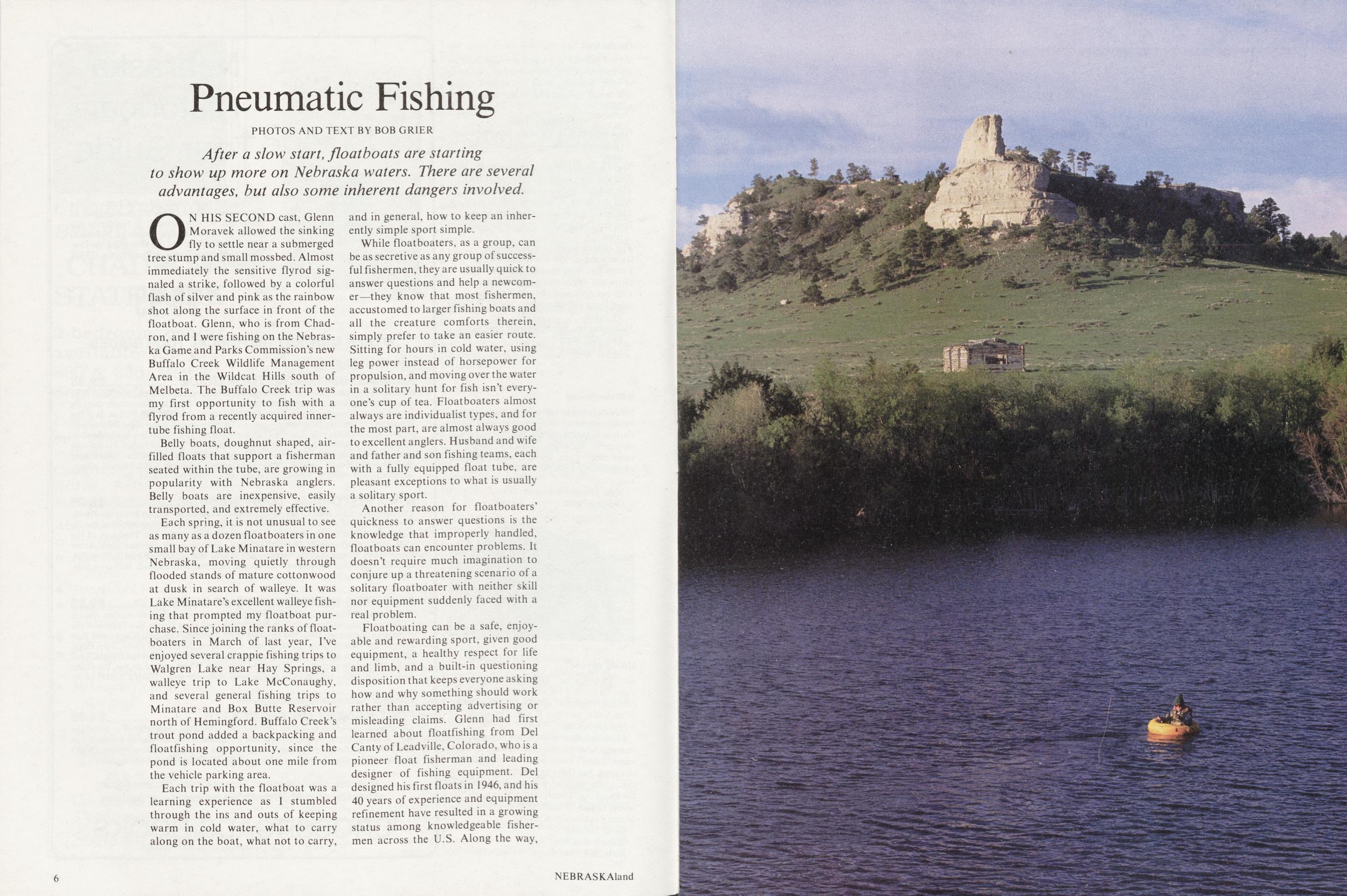
Pneumatic Fishing
PHOTOS AND TEXT BY BOB GRIER After a slow start, float boats are starting to show up more on Nebraska waters. There are several advantages, but also some inherent dangers involved.ON HIS SECOND cast, Glenn Moravek allowed the sinking fly to settle near a submerged tree stump and small moss bed. Almost immediately the sensitive flyrod signaled a strike, followed by a colorful flash of silver and pink as the rainbow shot along the surface in front of the float boat. Glenn, who is from Chadron, and I were fishing on the Nebraska Game and Parks Commission's new Buffalo Creek Wildlife Management Area in the Wildcat Hills south of Melbeta. The Buffalo Creek trip was my first opportunity to fish with a flyrod from a recently acquired innertube fishing float.
Belly boats, doughnut shaped, air-filled floats that support a fisherman seated within the tube, are growing in popularity with Nebraska anglers. Belly boats are inexpensive, easily transported, and extremely effective.
Each spring, it is not unusual to see as many as a dozen float boaters in one small bay of Lake Minatare in western Nebraska, moving quietly through flooded stands of mature cottonwood at dusk in search of walleye. It was Lake Minatare's excellent walleye fishing that prompted my float boat purchase. Since joining the ranks of float boaters in March of last year, I've enjoyed several crappie fishing trips to Walgren Lake near Hay Springs, a walleye trip to Lake McConaughy, and several general fishing trips to Minatare and Box Butte Reservoir north of Hemingford. Buffalo Creek's trout pond added a backpacking and float fishing opportunity, since the pond is located about one mile from the vehicle parking area.
Each trip with the float boat was a learning experience as I stumbled through the ins and outs of keeping warm in cold water, what to carry along on the boat, what not to carry, and in general, how to keep an inherently simple sport simple.
While float boaters, as a group, can be as secretive as any group of successful fishermen, they are usually quick to answer questions and help a newcomer—they know that most fishermen, accustomed to larger fishing boats and all the creature comforts therein, simply prefer to take an easier route. Sitting for hours in cold water, using leg power instead of horsepower for propulsion, and moving over the water in a solitary hunt for fish isn't everyone's cup of tea. Float boaters almost always are individualist types, and for the most part, are almost always good to excellent anglers. Husband and wife and father and son fishing teams, each with a fully equipped float tube, are pleasant exceptions to what is usually a solitary sport.
Another reason for float boaters' quickness to answer questions is the knowledge that improperly handled, float boats can encounter problems. It doesn't require much imagination to conjure up a threatening scenario of a solitary float boater with neither skill nor equipment suddenly faced with a real problem.
Float boating can be a safe, enjoyable and rewarding sport, given good equipment, a healthy respect for life and limb, and a built-in questioning disposition that keeps everyone asking how and why something should work rather than accepting advertising or misleading claims. Glenn had first learned about float fishing from Del Canty of Leadville, Colorado, who is a pioneer float fisherman and leading designer of fishing equipment. Del designed his first floats in 1946, and his 40 years of experience and equipment refinement have resulted in a growing status among knowledgeable fishermen across the U.S. Along the way, Del has recorded some spectacular catches from his fishing floats, including a 26-pound rainbow, a 28-pound cutthroat, a 16-pound hybrid brook trout, and a whopping 102-pound king salmon. Using his floats, flyrod, and a tenacity that keeps him on the water even during storm periods, Del has fished many of the major reservoirs, rivers, and lakes in North America. At the same time, he also enjoys fishing small ponds for bluegill, a personal favorite with light fly fishing equipment.
6 NEBRASKAland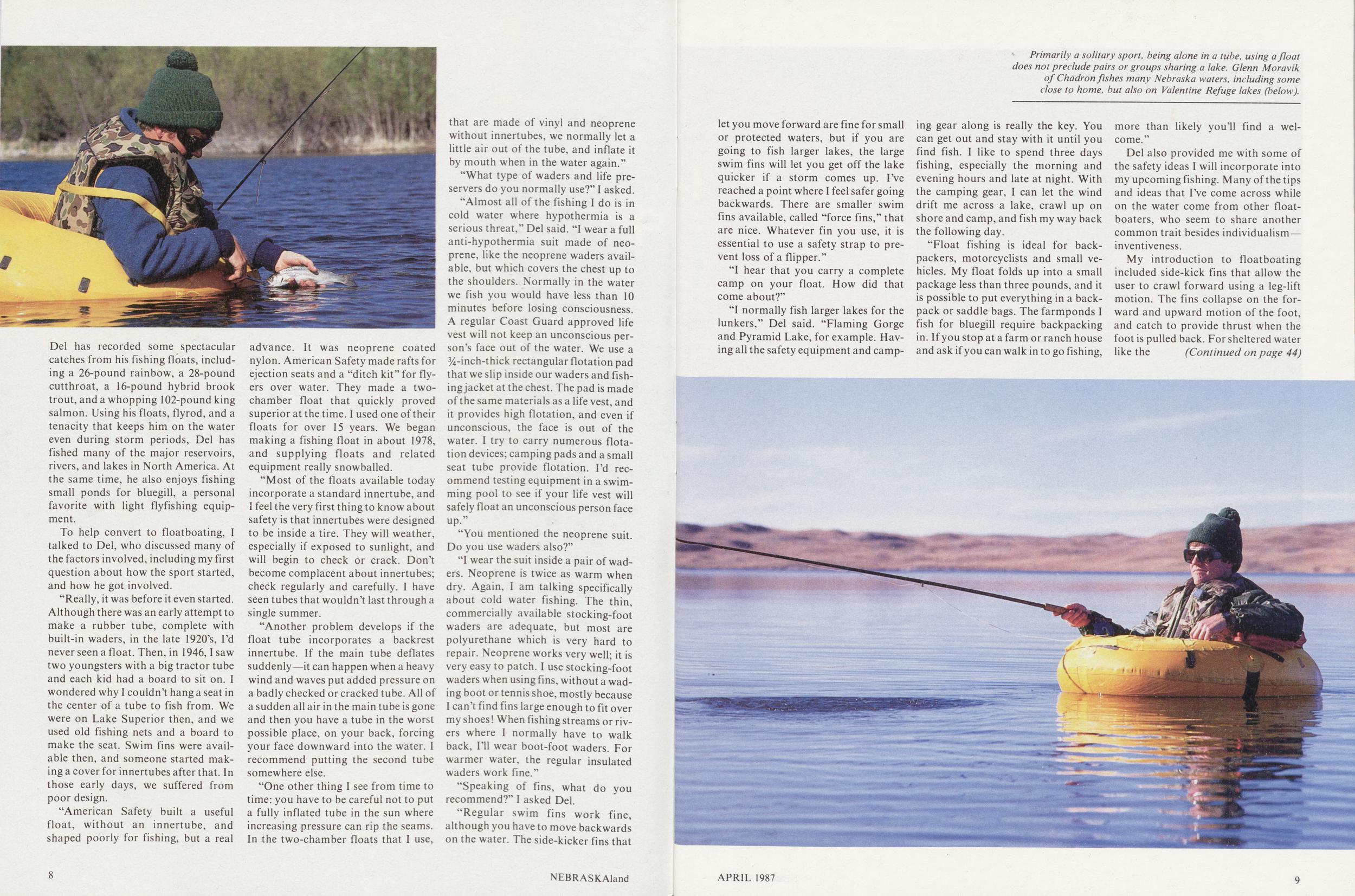
To help convert to float boating, I talked to Del, who discussed many of the factors involved, including my first question about how the sport started, and how he got involved.
"Really, it was before it even started. Although there was an early attempt to make a rubber tube, complete with built-in waders, in the late 1920's, I'd never seen a float. Then, in 1946,1 saw two youngsters with a big tractor tube and each kid had a board to sit on. I wondered why I couldn't hang a seat in the center of a tube to fish from. We were on Lake Superior then, and we used old fishing nets and a board to make the seat. Swim fins were available then, and someone started making a cover for innertubes after that. In those early days, we suffered from poor design.
"American Safety built a useful float, without an innertube, and shaped poorly for fishing, but a real advance. It was neoprene coated nylon. American Safety made rafts for ejection seats and a "ditch kit" for flyers over water. They made a two chamber float that quickly proved superior at the time. I used one of their floats for over 15 years. We began making a fishing float in about 1978, and supplying floats and related equipment really snowballed.
"Most of the floats available today incorporate a standard innertube, and I feel the very first thing to know about safety is that innertubes were designed to be inside a tire. They will weather, especially if exposed to sunlight, and will begin to check or crack. Don't become complacent about innertubes; check regularly and carefully. I have seen tubes that wouldn't last through a single summer.
"Another problem develops if the float tube incorporates a backrest innertube. If the main tube deflates suddenly—it can happen when a heavy wind and waves put added pressure on a badly checked or cracked tube. All of a sudden all air in the main tube is gone and then you have a tube in the worst possible place, on your back, forcing your face downward into the water. I recommend putting the second tube somewhere else.
"One other thing I see from time to time: you have to be careful not to put a fully inflated tube in the sun where increasing pressure can rip the seams. In the two-chamber floats that I use, that are made of vinyl and neoprene without innertubes, we normally let a little air out of the tube, and inflate it by mouth when in the water again."
"What type of waders and life preservers do you normally use?" I asked.
"Almost all of the fishing I do is in cold water where hypothermia is a serious threat," Del said. "I wear a full anti-hypothermia suit made of neoprene, like the neoprene waders avail- able, but which covers the chest up to the shoulders. Normally in the water we fish you would have less than 10 minutes before losing consciousness. A regular Coast Guard approved life vest will not keep an unconscious person's face out of the water. We use a %-inch-thick rectangular flotation pad that we slip inside our waders and fishing jacket at the chest. The pad is made of the same materials as a life vest, and it provides high flotation, and even if unconscious, the face is out of the water. I try to carry numerous flotation devices; camping pads and a small seat tube provide flotation. I'd recommend testing equipment in a swimming pool to see if your life vest will safely float an unconscious person face up."
"You mentioned the neoprene suit. Do you use waders also?"
"I wear the suit inside a pair of waders. Neoprene is twice as warm when dry. Again, I am talking specifically about cold water fishing. The thin, commercially available stocking-foot waders are adequate, but most are polyurethane which is very hard to repair. Neoprene works very well; it is very easy to patch. I use stocking-foot waders when using fins, without a wading boot or tennis shoe, mostly because I can't find fins large enough to fit over my shoes! When fishing streams or rivers where I normally have to walk back, I'll wear boot-foot waders. For warmer water, the regular insulated waders work fine."
"Speaking of fins, what do you recommend?" I asked Del.
"Regular swim fins work fine, although you have to move backwards on the water. The side-kicker fins that 8 NEBRASKAland let you move forward are fine for small or protected waters, but if you are going to fish larger lakes, the large swim fins will let you get off the lake quicker if a storm comes up. I've reached a point where I feel safer going backwards. There are smaller swim fins available, called "force fins," that are nice. Whatever fin you use, it is essential to use a safety strap to prevent loss of a flipper."
"I hear that you carry a complete camp on your float. How did that come about?"
"I normally fish larger lakes for the lunkers," Del said. "Flaming Gorge and Pyramid Lake, for example. Having all the safety equipment and camp- ing gear along is really the key. You can get out and stay with it until you find fish. I like to spend three days fishing, especially the morning and evening hours and late at night. With the camping gear, I can let the wind drift me across a lake, crawl up on shore and camp, and fish my way back the following day.
"Float fishing is ideal for backpackers, motorcyclists and small vehicles. My float folds up into a small package less than three pounds, and it is possible to put everything in a backpack or saddle bags. The farm ponds I fish for bluegill require backpacking in. If you stop at a farm or ranch house and ask if you can walk in to go fishing, more than likely you'll find a welcome."
Del also provided me with some of the safety ideas I will incorporate into my upcoming fishing. Many of the tips and ideas that I've come across while on the water come from other float boaters, who seem to share another common trait besides individualism— inventiveness.
My introduction to float boating included side-kick fins that allow the user to crawl forward using a leg-lift motion. The fins collapse on the forward and upward motion of the foot, and catch to provide thrust when the foot is pulled back. For sheltered water like the (Continued on page 44)
Primarily a solitary sport, being alone in a tube, using afloat does not preclude pairs or groups sharing a lake. Glenn Moravik of Chadron fishes many Nebraska waters, including some close to home, but also on Valentine Refuge lakes (below).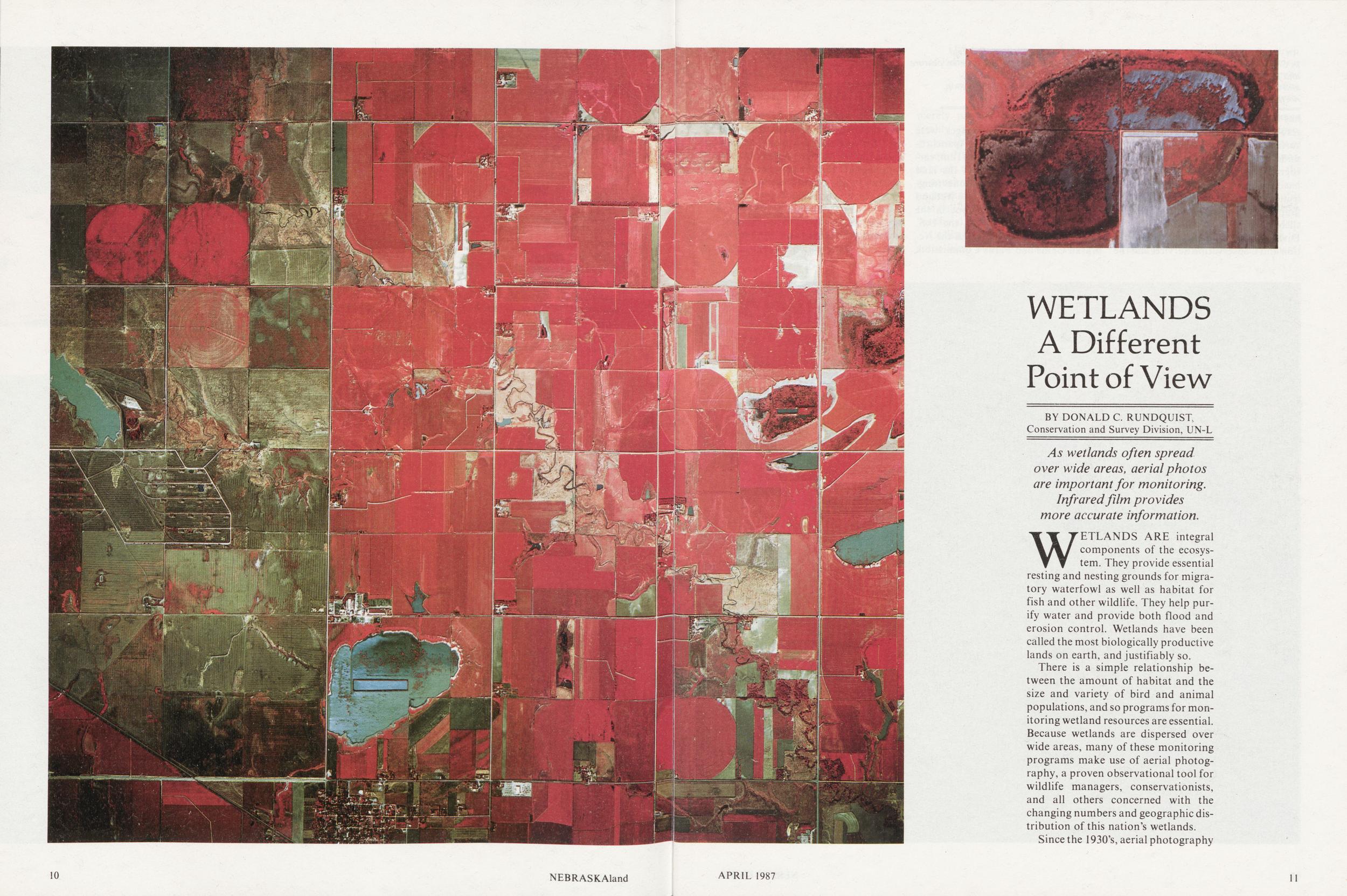
WETLANDS A Different Point of View
BY DONALD C. RUNDQUIST, Conservation and Survey Division, UN-L As wetlands often spread over wide areas, aerial photos are important for monitoring. Infrared film provides more accurate information.WETLANDS ARE integral components of the ecosystem. They provide essential resting and nesting grounds for migratory waterfowl as well as habitat for fish and other wildlife. They help purify water and provide both flood and erosion control. Wetlands have been called the most biologically productive lands on earth, and justifiably so.
There is a simple relationship between the amount of habitat and the size and variety of bird and animal populations, and so programs for monitoring wetland resources are essential. Because wetlands are dispersed over wide areas, many of these monitoring programs make use of aerial photography, a proven observational tool for wildlife managers, conservationists, and all others concerned with the changing numbers and geographic distribution of this nation's wetlands.
Since the 1930's, aerial photography has been widely used by U.S. natural resource managers to evaluate the land surface and the changes it is constantly undergoing. In Nebraska, aerial photography has been done on a regular basis for about 50 years. Extensive collections of historical aerial photographs of the state are held by agencies such as the Conservation and Survey Division, the Agricultural Stabilization and Conservation Service, and the Soil Conservation Service.
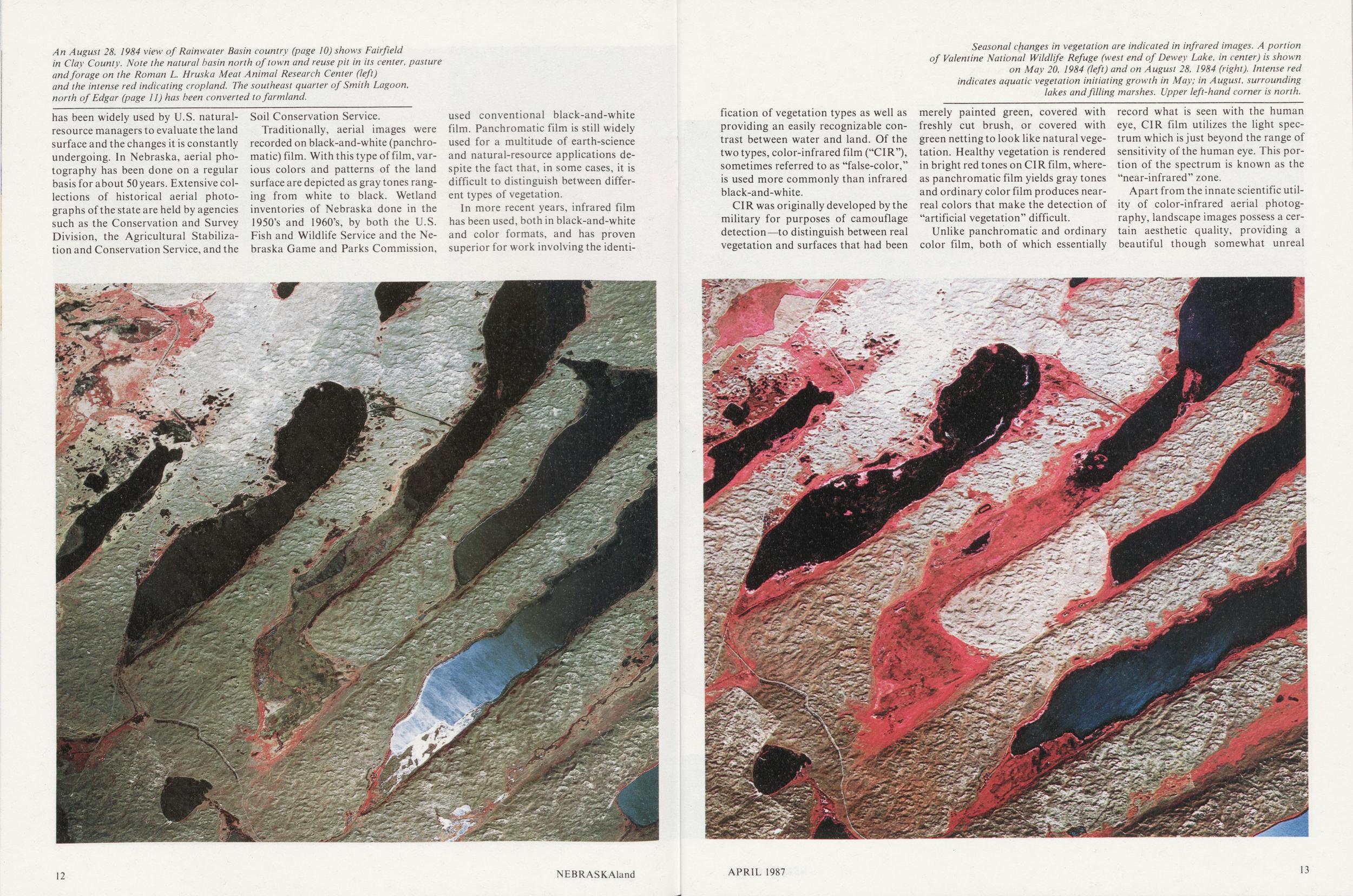 An August 28, 1984 view of Rainwater Basin country (page 10) shows Fairfield
in Clay County. Note the natural basin north of town and reuse pit in its center,
pasture
and forage on the Roman L. Hruska Meat Animal Research Center (left)
and the intense red indicating cropland. The southeast quarter of Smith Lagoon,
north of Edgar (page 11) has been converted to farmland.
An August 28, 1984 view of Rainwater Basin country (page 10) shows Fairfield
in Clay County. Note the natural basin north of town and reuse pit in its center,
pasture
and forage on the Roman L. Hruska Meat Animal Research Center (left)
and the intense red indicating cropland. The southeast quarter of Smith Lagoon,
north of Edgar (page 11) has been converted to farmland.
Traditionally, aerial images were recorded on black-and-white (panchromatic) film. With this type of film, various colors and patterns of the land surface are depicted as gray tones ranging from white to black. Wetland inventories of Nebraska done in the 1950's and 1960's, by both the U.S. Fish and Wildlife Service and the Nebraska Game and Parks Commission, used conventional black-and-white film. Panchromatic film is still widely used for a multitude of earth-science and natural-resource applications despite the fact that, in some cases, it is difficult to distinguish between different types of vegetation.
In more recent years, infrared film has been used, both in black-and-white and color formats, and has proven superior for work involving the identification 12 NEBRASKAland of vegetation types as well as providing an easily recognizable contrast between water and land. Of the two types, color-infrared film ("CIR"), sometimes referred to as "false-color," is used more commonly than infrared black-and-white.
Seasonal changes in vegetation are indicated in infrared images. A portion of Valentine National Wildlife Refuge (west end of Dewey Lake, in center) is shown on May 20, 1984 (left) and on August 28, 1984 (right). Intense red indicates aquatic vegetation initiating growth in May; in August, surrounding lakes and filling marshes. Upper left-hand corner is north.CIR was originally developed by the military for purposes of camouflage detection—to distinguish between real vegetation and surfaces that had been Seasonal changes in vegetation are indicated in infrared images. A portion of Valentine National Wildlife Refuge (west end of Dewey Lake, in center) is shown on May 20, 1984 (left) and on August 28, 1984 (right). Intense red indicates aquatic vegetation initiating growth in May; in August, surrounding lakes and filling marshes. Upper left-hand corner is north. merely painted green, covered with freshly cut brush, or covered with green netting to look like natural vegetation. Healthy vegetation is rendered in bright red tones on CIR film, whereas panchromatic film yields gray tones and ordinary color film produces nearreal colors that make the detection of "artificial vegetation" difficult.
Unlike panchromatic and ordinary color film, both of which essentially record what is seen with the human eye, CIR film utilizes the light spectrum which is just beyond the range of sensitivity of the human eye. This portion of the spectrum is known as the "near-infrared" zone.
Apart from the innate scientific utility of color-infrared aerial photography, landscape images possess a certain aesthetic quality, providing a beautiful though somewhat unreal portrait. While agricultural patterns are quite distinctive when rendered on CIR film, perhaps the most colorful, striking images are obtained over wetland areas. The contrasts between land and water are remarkable; in fact, the variations in tones of both the water and vegetation are both interesting and informative. Variation in the tones of water bodies can generally be traced to differences in levels of suspended solids, depth (in very shallow lakes), chlorophyll content, and levels of alkalinity. Variation in the red tones, in which vegetation is rendered, relate to the vegetation's stage of development or maturity, species (to some extent), water content in the leaves, and stresses such as disease or insect infestations.
APRIL 1987 13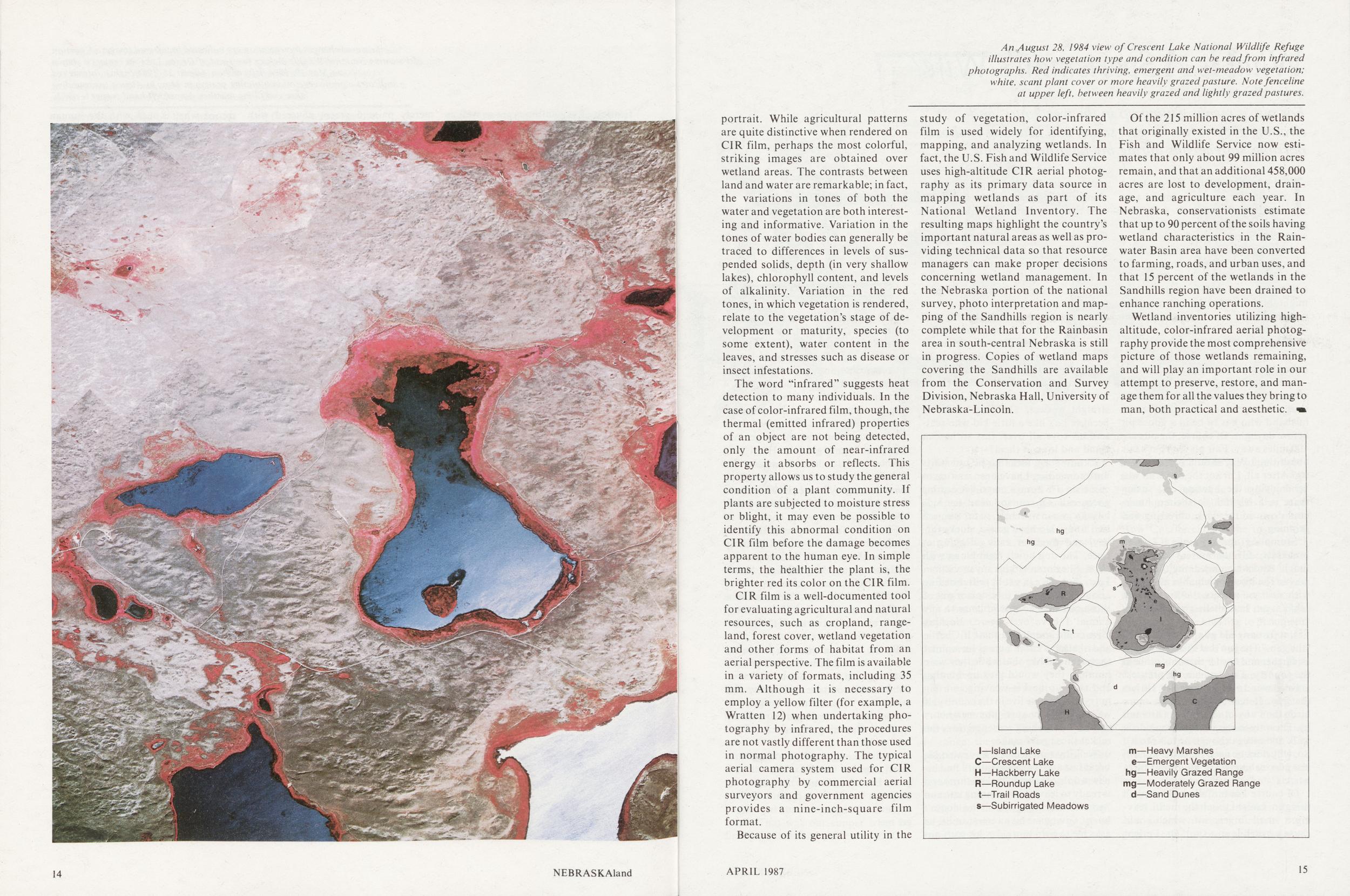
The word "infrared" suggests heat detection to many individuals. In the case of color-infrared film, though, the thermal (emitted infrared) properties of an object are not being detected, only the amount of near-infrared energy it absorbs or reflects. This property allows us to study the general condition of a plant community. If plants are subjected to moisture stress or blight, it may even be possible to identify this abnormal condition on CIR film before the damage becomes apparent to the human eye. In simple terms, the healthier the plant is, the brighter red its color on the CIR film.
CIR film is a well-documented tool for evaluating agricultural and natural resources, such as cropland, rangeland, forest cover, wetland vegetation and other forms of habitat from an aerial perspective. The film is available in a variety of formats, including 35 mm. Although it is necessary to employ a yellow filter (for example, a Wratten 12) when undertaking photography by infrared, the procedures are not vastly different than those used in normal photography. The typical aerial camera system used for CIR photography by commercial aerial surveyors and government agencies provides a nine-inch-square film format.
Because of its general utility in the study of vegetation, color-infrared film is used widely for identifying, mapping, and analyzing wetlands. In fact, the U.S. Fish and Wildlife Service uses high-altitude CIR aerial photography as its primary data source in mapping wetlands as part of its National Wetland Inventory. The resulting maps highlight the country's important natural areas as well as providing technical data so that resource managers can make proper decisions concerning wetland management. In the Nebraska portion of the national survey, photo interpretation and mapping of the Sandhills region is nearly complete while that for the Rainbasin area in south-central Nebraska is still in progress. Copies of wetland maps covering the Sandhills are available from the Conservation and Survey Division, Nebraska Hall, University of Nebraska-Lincoln.
An August 28, 1984 view of Crescent Lake National Wildlife Refuge illustrates how vegetation type and condition can he read from infrared photographs. Red indicates thriving, emergent and wet-meadow vegetation; white, scant plant cover or more heavily grazed pasture. Note fence line at upper left, between heavily grazed and lightly grazed pastures.Of the 215 million acres of wetlands that originally existed in the U.S., the Fish and Wildlife Service now estimates that only about 99 million acres remain, and that an additional 458,000 acres are lost to development, drainage, and agriculture each year. In Nebraska, conservationists estimate that up to 90 percent of the soils having wetland characteristics in the Rainwater Basin area have been converted to farming, roads, and urban uses, and that 15 percent of the wetlands in the Sandhills region have been drained to enhance ranching operations.
Wetland inventories utilizing high-altitude, color-infrared aerial photography provide the most comprehensive picture of those wetlands remaining, and will play an important role in our attempt to preserve, restore, and manage them for all the values they bring to man, both practical and aesthetic.
What Is A Sportsman's Wife?
BY MARIE SIMANTS For me, it means getting up in the wee hours, and cleaning game when he gets some, and listening to those horrible, unreal calls during my favorite TV show.IT IS COMMONLY accepted that a "wife" is a woman joined to a man in lawful wedlock. A "sportsman" is also known as one who pursues field sports, especially hunting and fishing. Another meaning is, "one who plays fair." Well, you may ask, what happens if you put the words sportsman and wife together? You might think that you get a woman who is married to a man who likes to hunt and fish.
WRONG! WRONG! WRONG!
Em a sportsman's wife and definitely have a different interpretation.
I see nothing resembling "fair play" when at 3:30 a.m. I am rousted out of a snug, warm bed by an eager-beaver husband who has to be in a goose pit before daylight. Of course, the pits are 100 miles away. Fair play? What's fair about that? Why should I have to get up? After all, I'm not the one who will be enjoying the hunting . . . sitting there in a frigid little shelter, hunkered down in the dark, shivering and grinning.
Stumbling and grumbling, I cook breakfast, fill thermoses, and pack lunch. And why am I doing this? And why in the kitchen, which is also filled with decoys, waders, boots, piles of socks, vest, hat, shells and of course, the gun."
Not just any old gun, mind you, but the gun." The gun that shoots straighter, farther and harder than any other in the country. This gun has the prettiest grained wood and fits perfectly. He has the gun. It has brought down more birds than any other (to hear him tell it). The only things that gun can't do is walk and talk (although he talks to it). So, why does he need the other guns in his gun cabinet? Or all those extra barrels?
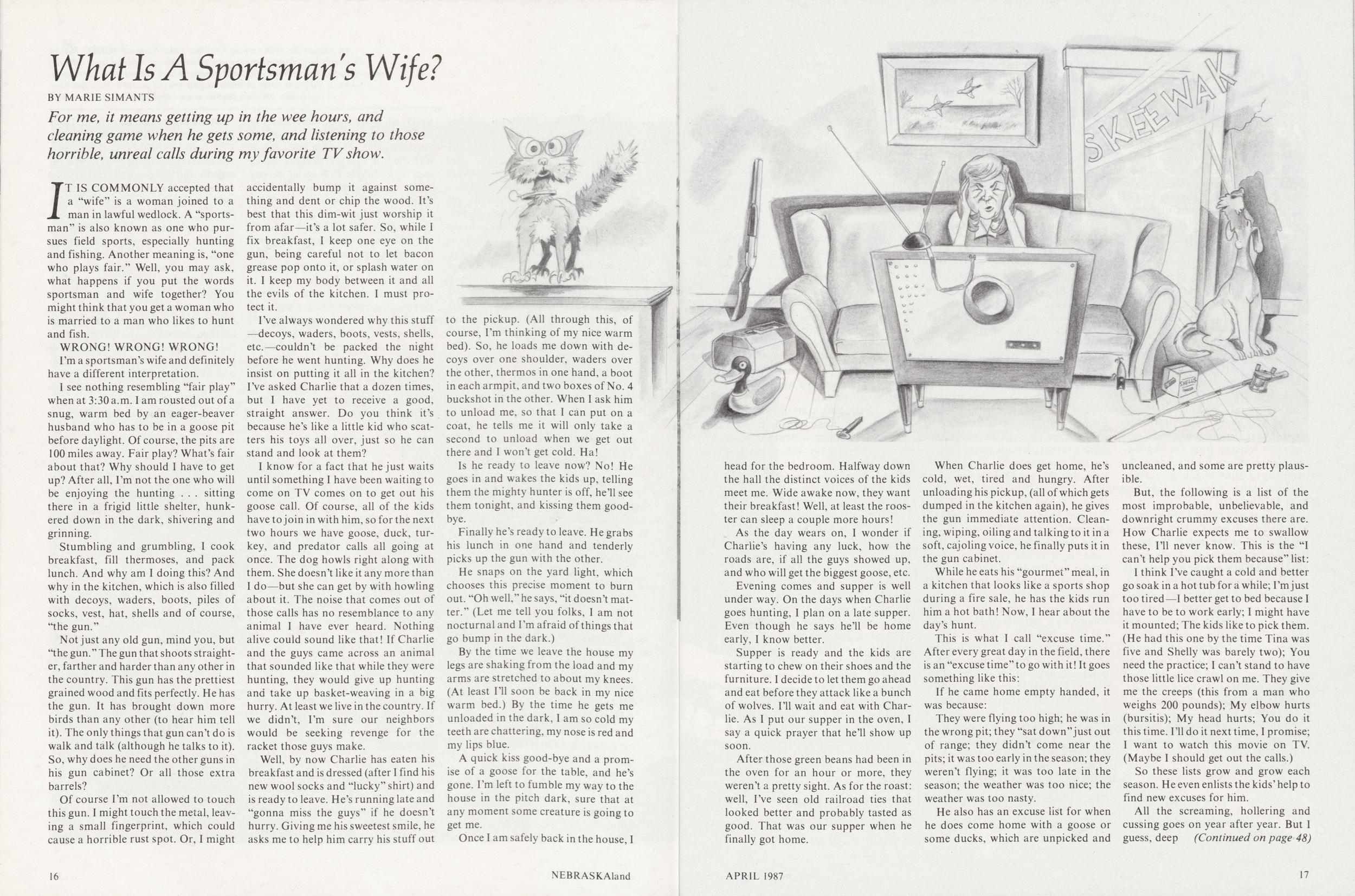
Of course I'm not allowed to touch this gun. I might touch the metal, leaving a small fingerprint, which could cause a horrible rust spot. Or, I might it accidentally bump it against something and dent or chip the wood. It's best that this dim-wit just worship it from afar—it's a lot safer. So, while I fix breakfast, I keep one eye on the gun, being careful not to let bacon grease pop onto it, or splash water on it. I keep my body between it and all the evils of the kitchen. I must protect it.
I've always wondered why this stuff -decoys, waders, boots, vests, shells, etc.—couldn't be packed the night before he went hunting. Why does he insist on putting it all in the kitchen? I've asked Charlie that a dozen times, but I have yet to receive a good, straight answer. Do you think it's because he's like a little kid who scatters his toys all over, just so he can stand and look at them?
I know for a fact that he just waits until something I have been waiting to come on TV comes on to get out his goose call. Of course, all of the kids have to join in with him, so for the next two hours we have goose, duck, turkey, and predator calls all going at once. The dog howls right along with them. She doesn't like it any more than I do—but she can get by with howling about it. The noise that comes out of those calls has no resemblance to any animal I have ever heard. Nothing alive could sound like that! If Charlie and the guys came across an animal that sounded like that while they were hunting, they would give up hunting and take up basket-weaving in a big hurry. At least we live in the country. If we didn't, I'm sure our neighbors would be seeking revenge for the racket those guys make.
Well, by now Charlie has eaten his breakfast and is dressed (after I find his new wool socks and "lucky" shirt) and is ready to leave. He's running late and "gonna miss the guys" if he doesn't hurry. Giving me his sweetest smile, he asks me to help him carry his stuff out to the pickup. (All through this, of course, I'm thinking of my nice warm bed). So, he loads me down with decoys over one shoulder, waders over the other, thermos in one hand, a boot in each armpit, and two boxes of No. 4 buckshot in the other. When I ask him to unload me, so that I can put on a coat, he tells me it will only take a second to unload when we get out there and I won't get cold. Ha!
Is he ready to leave now? No! He goes in and wakes the kids up, telling them the mighty hunter is off, he'll see them tonight, and kissing them goodbye.
Finally he's ready to leave. He grabs his lunch in one hand and tenderly picks up the gun with the other.
He snaps on the yard light, which chooses this precise moment to burn out. "Oh well," he says, "it doesn't matter." (Let me tell you folks, I am not nocturnal and I'm afraid of things that go bump in the dark.)
By the time we leave the house my legs are shaking from the load and my arms are stretched to about my knees. (At least I'll soon be back in my nice warm bed.) By the time he gets me unloaded in the dark, I am so cold my teeth are chattering, my nose is red and my lips blue.
A quick kiss good-bye and a promise of a goose for the table, and he's gone. I'm left to fumble my way to the house in the pitch dark, sure that at any moment some creature is going to get me.
Once I am safely back in the house, I 16 NEBRASKAland head for the bedroom. Halfway down the hall the distinct voices of the kids meet me. Wide awake now, they want their breakfast! Well, at least the rooster can sleep a couple more hours!
As the day wears on, I wonder if Charlie's having any luck, how the roads are, if all the guys showed up, and who will get the biggest goose, etc.
Evening comes and supper is well under way. On the days when Charlie goes hunting, I plan on a late supper. Even though he says he'll be home early, I know better.
Supper is ready and the kids are starting to chew on their shoes and the furniture. I decide to let them go ahead and eat before they attack like a bunch of wolves. I'll wait and eat with Charlie. As I put our supper in the oven, I say a quick prayer that he'll show up soon.
After those green beans had been in the oven for an hour or more, they weren't a pretty sight. As for the roast: well, I've seen old railroad ties that looked better and probably tasted as good. That was our supper when he finally got home.
When Charlie does get home, he's cold, wet, tired and hungry. After unloading his pickup, (all of which gets dumped in the kitchen again), he gives the gun immediate attention. Cleaning, wiping, oiling and talking to it in a soft, cajoling voice, he finally puts it in the gun cabinet.
While he eats his "gourmet" meal, in a kitchen that looks like a sports shop during a fire sale, he has the kids run him a hot bath! Now, I hear about the day's hunt.
This is what I call "excuse time." After every great day in the field, there is an "excuse time" to go with it! It goes something like this:
If he came home empty handed, it was because:
They were flying too high; he was in the wrong pit; they "sat down" just out of range; they didn't come near the pits; it was too early in the season; they weren't flying; it was too late in the season; the weather was too nice; the weather was too nasty.
He also has an excuse list for when he does come home with a goose or some ducks, which are unpicked and uncleaned, and some are pretty plausble.
But, the following is a list of the most improbable, unbelievable, and downright crummy excuses there are. How Charlie expects me to swallow these, I'll never know. This is the "I can't help you pick them because" list:
I think I've caught a cold and better go soak in a hot tub for a while; I'm just too tired—I better get to bed because I have to be to work early; I might have it mounted; The kids like to pick them. (He had this one by the time Tina was five and Shelly was barely two); You need the practice; I can't stand to have those little lice crawl on me. They give me the creeps (this from a man who weighs 200 pounds); My elbow hurts (bursitis); My head hurts; You do it this time. i’ll do it next time, I promise; I want to watch this movie on TV. (Maybe I should get out the calls.)
So these lists grow and grow each season. He even enlists the kids' help to find new excuses for him.
All the screaming, hollering and cussing goes on year after year. But I guess, deep (Continued on page 48)
APRIL 1987 17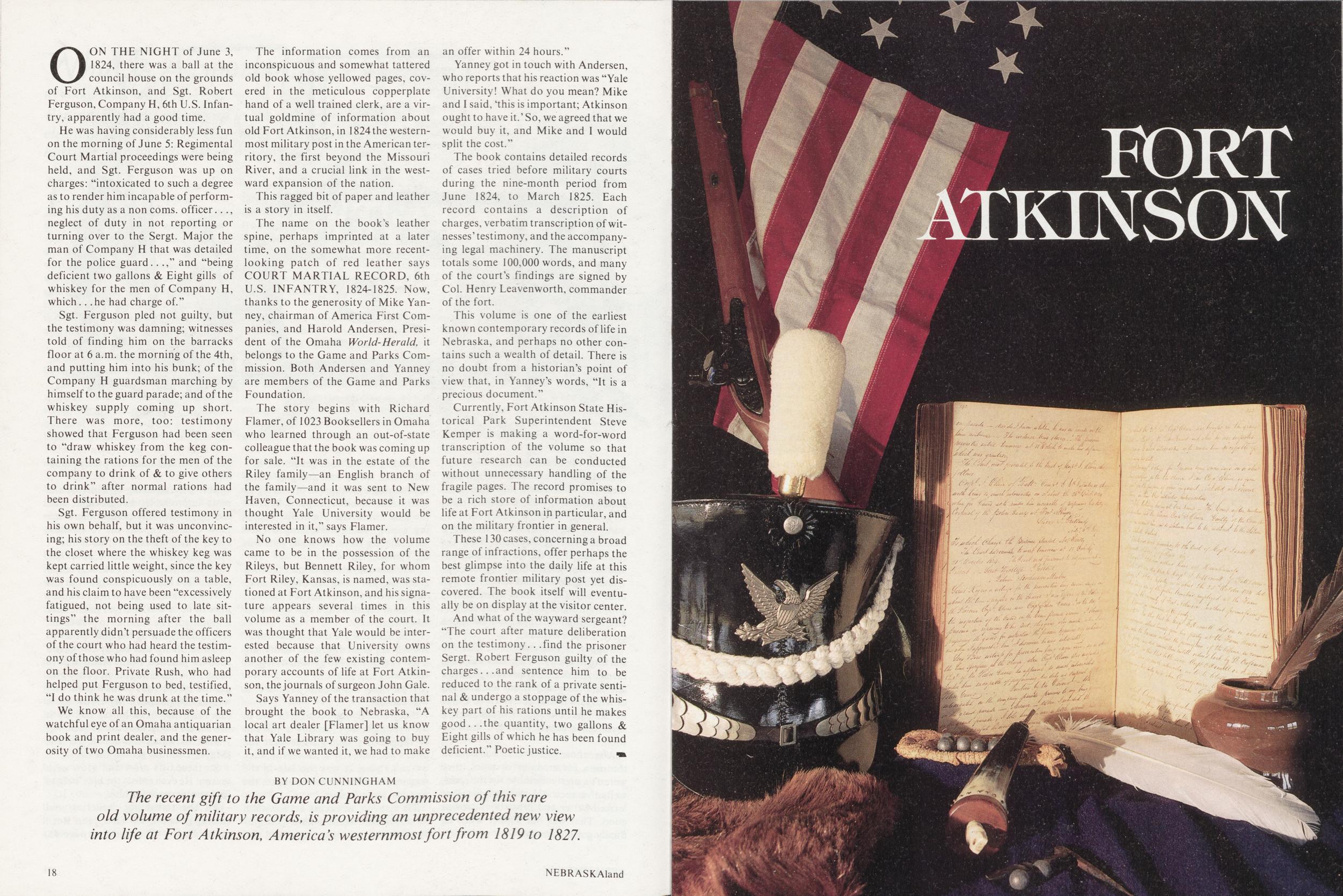
FORT ATKINSON
OON THE NIGHT of June 3, 1824, there was a ball at the council house on the grounds of Fort Atkinson, and Sgt. Robert Ferguson, Company H, 6th U.S. Infantry, apparently had a good time.
He was having considerably less fun on the morning of June 5: Regimental Court Martial proceedings were being held, and Sgt. Ferguson was up on charges: "intoxicated to such a degree as to render him incapable of perform- ing his duty as a non corns, officer neglect of duty in not reporting or turning over to the Sergt. Major the man of Company H that was detailed for the police guard. . .," and "being deficient two gallons & Eight gills of whiskey for the men of Company H, which.. .he had charge of."
Sgt. Ferguson pled not guilty, but the testimony was damning; witnesses told of finding him on the barracks floor at 6 a.m. the morning of the 4th, and putting him into his bunk; of the Company H guardsman marching by himself to the guard parade; and of the whiskey supply coming up short. There was more, too: testimony showed that Ferguson had been seen to "draw whiskey from the keg containing the rations for the men of the company to drink of & to give others to drink" after normal rations had been distributed.
Sgt. Ferguson offered testimony in his own behalf, but it was unconvincing; his story on the theft of the key to the closet where the whiskey keg was kept carried little weight, since the key was found conspicuously on a table, and his claim to have been "excessively fatigued, not being used to late sittings" the morning after the ball apparently didn't persuade the officers of the court who had heard the testimony of those who had found him asleep on the floor. Private Rush, who had helped put Ferguson to bed, testified, "I do think he was drunk at the time."
We know all this, because of the watchful eye of an Omaha antiquarian book and print dealer, and the generosity of two Omaha businessmen.
The information comes from an inconspicuous and somewhat tattered old book whose yellowed pages, covered in the meticulous copperplate hand of a well trained clerk, are a virtual goldmine of information about old Fort Atkinson, in 1824 the western most military post in the American territory, the first beyond the Missouri River, and a crucial link in the westward expansion of the nation.
This ragged bit of paper and leather is a story in itself.
The name on the book's leather spine, perhaps imprinted at a later time, on the somewhat more recent-looking patch of red leather says COURT MARTIAL RECORD, 6th U.S. INFANTRY, 1824-1825. Now, thanks to the generosity of Mike Yanney, chairman of America First Companies, and Harold Andersen, President of the Omaha World-Herald, it belongs to the Game and Parks Commission. Both Andersen and Yanney are members of the Game and Parks Foundation.
The story begins with Richard Flamer, of 1023 Booksellers in Omaha who learned through an out-of-state colleague that the book was coming up for sale. "It was in the estate of the Riley family—an English branch of the family—and it was sent to New Haven, Connecticut, because it was thought Yale University would be interested in it," says Flamer.
No one knows how the volume came to be in the possession of the Riley’s, but Bennett Riley, for whom Fort Riley, Kansas, is named, was stationed at Fort Atkinson, and his signature appears several times in this volume as a member of the court. It was thought that Yale would be interested because that University owns another of the few existing contemporary accounts of life at Fort Atkinson, the journals of surgeon John Gale.
Says Yanney of the transaction that brought the book to Nebraska, "A local art dealer [Flamer] let us know that Yale Library was going to buy it, and if we wanted it, we had to make an offer within 24 hours."
Yanney got in touch with Andersen, who reports that his reaction was "Yale University! What do you mean? Mike and I said, 'this is important; Atkinson ought to have it.' So, we agreed that we would buy it, and Mike and I would split the cost."
The book contains detailed records of cases tried before military courts during the nine-month period from June 1824, to March 1825. Each record contains a description of charges, verbatim transcription of witnesses' testimony, and the accompanying legal machinery. The manuscript totals some 100,000 words, and many of the court's findings are signed by Col. Henry Leavenworth, commander of the fort.
This volume is one of the earliest known contemporary records of life in Nebraska, and perhaps no other contains such a wealth of detail. There is no doubt from a historian's point of view that, in Yanney's words, "It is a precious document."
Currently, Fort Atkinson State Historical Park Superintendent Steve Kemper is making a word-for-word transcription of the volume so that future research can be conducted without unnecessary handling of the fragile pages. The record promises to be a rich store of information about life at Fort Atkinson in particular, and on the military frontier in general.
These 130 cases, concerning a broad range of infractions, offer perhaps the best glimpse into the daily life at this remote frontier military post yet discovered. The book itself will eventually be on display at the visitor center.
And what of the wayward sergeant? "The court after mature deliberation on the testimony. . .find the prisoner Sergt. Robert Ferguson guilty of the charges. . .and sentence him to be reduced to the rank of a private sentinel & undergo a stoppage of the whiskey part of his rations until he makes good. . .the quantity, two gallons & Eight gills of which he has been found deficient." Poetic justice.
BY DON CUNNINGHAM The recent gift to the Game and Parks Commission of this rare old volume of military records, is providing an unprecedented new view into life at Fort Atkinson, America's westernmost fort from 1819 to 1827. 18 NEBRASKAland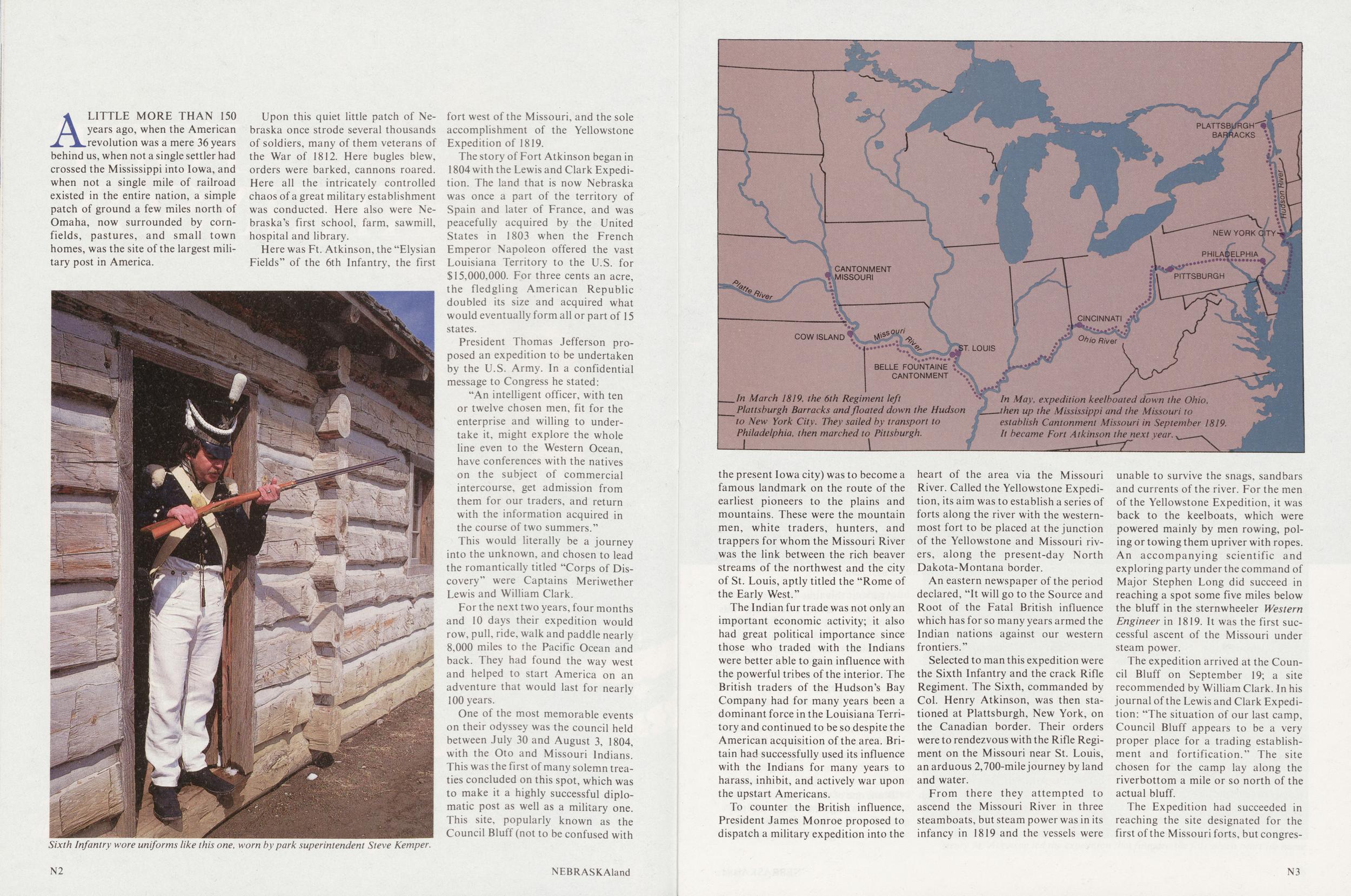
A LITTLE MORE THAN 150 years ago, when the American revolution was a mere 36 years behind us, when not a single settler had crossed the Mississippi into Iowa, and when not a single mile of railroad existed in the entire nation, a simple patch of ground a few miles north of Omaha, now surrounded by cornfields, pastures, and small town homes, was the site of the largest military post in America.
Upon this quiet little patch of Nebraska once strode several thousands of soldiers, many of them veterans of the War of 1812. Here bugles blew, orders were barked, cannons roared. Here all the intricately controlled chaos of a great military establishment was conducted. Here also were Nebraska's first school, farm, sawmill, hospital and library.
Here was Ft. Atkinson, the "Elysian Fields" of the 6th Infantry, the first fort west of the Missouri, and the sole accomplishment of the Yellowstone Expedition of 1819.
The story of Fort Atkinson began in 1804 with the Lewis and Clark Expedition. The land that is now Nebraska was once a part of the territory of Spain and later of France, and was peacefully acquired by the United States in 1803 when the French Emperor Napoleon offered the vast Louisiana Territory to the U.S. for $15,000,000. For three cents an acre, the fledgling American Republic doubled its size and acquired what would eventually form all or part of 15 states.
President Thomas Jefferson proposed an expedition to be undertaken by the U.S. Army. In a confidential message to Congress he stated:
"An intelligent officer, with ten or twelve chosen men, fit for the enterprise and willing to undertake it, might explore the whole line even to the Western Ocean, have conferences with the natives on the subject of commercial intercourse, get admission from them for our traders, and return with the information acquired in the course of two summers."This would literally be a journey into the unknown, and chosen to lead the romantically titled "Corps of Discovery" were Captains Meriwether Lewis and William Clark.
For the next two years, four months and 10 days their expedition would row, pull, ride, walk and paddle nearly 8,000 miles to the Pacific Ocean and back. They had found the way west and helped to start America on an adventure that would last for nearly 100 years.
One of the most memorable events on their odyssey was the council held between July 30 and August 3, 1804, with the Oto and Missouri Indians. This was the first of many solemn treaties concluded on this spot, which was to make it a highly successful diplomatic post as well as a military one. This site, popularly known as the Council Bluff (not to be confused with the present Iowa city) was to become a famous landmark on the route of the earliest pioneers to the plains and mountains. These were the mountain men, white traders, hunters, and trappers for whom the Missouri River was the link between the rich beaver streams of the northwest and the city of St. Louis, aptly titled the "Rome of the Early West."
N2 NEBRASKAlandThe Indian fur trade was not only an important economic activity; it also had great political importance since those who traded with the Indians were better able to gain influence with the powerful tribes of the interior. The British traders of the Hudson's Bay Company had for many years been a dominant force in the Louisiana Territory and continued to be so despite the American acquisition of the area. Britain had successfully used its influence with the Indians for many years to harass, inhibit, and actively war upon the upstart Americans.
To counter the British influence, President James Monroe proposed to dispatch a military expedition into the heart of the area via the Missouri River. Called the Yellowstone Expedition, its aim was to establish a series of forts along the river with the western-most fort to be placed at the junction of the Yellowstone and Missouri rivers, along the present-day North Dakota-Montana border.
An eastern newspaper of the period declared, "It will go to the Source and Root of the Fatal British influence which has for so many years armed the Indian nations against our western frontiers."
Selected to man this expedition were the Sixth Infantry and the crack Rifle Regiment. The Sixth, commanded by Col. Henry Atkinson, was then stationed at Plattsburgh, New York, on the Canadian border. Their orders were to rendezvous with the Rifle Regiment on the Missouri near St. Louis, an arduous 2,700-mile journey by land and water.
From there they attempted to ascend the Missouri River in three steamboats, but steam power was in its infancy in 1819 and the vessels were unable to survive the snags, sandbars and currents of the river. For the men of the Yellowstone Expedition, it was back to the keelboats, which were powered mainly by men rowing, poling or towing them upriver with ropes. An accompanying scientific and exploring party under the command of Major Stephen Long did succeed in reaching a spot some five miles below the bluff in the sternwheeler Western Engineer in 1819. It was the first successful ascent of the Missouri under steam power.
The expedition arrived at the Council Bluff on September 19; a site recommended by William Clark. In his journal of the Lewis and Clark Expedition: "The situation of our last camp, Council Bluff appears to be a very proper place for a trading establishment and fortification." The site chosen for the camp lay along the river bottom a mile or so north of the actual bluff.
The Expedition had succeeded in reaching the site designated for the first of the Missouri forts, but congressional economy measures and difficulties in supplying such far-flung outposts prevented the completion of the expedition and the force was halted there. Approaching winter impelled the 1,120 men of the expedition to bend all their energies to construction of the first post.
N3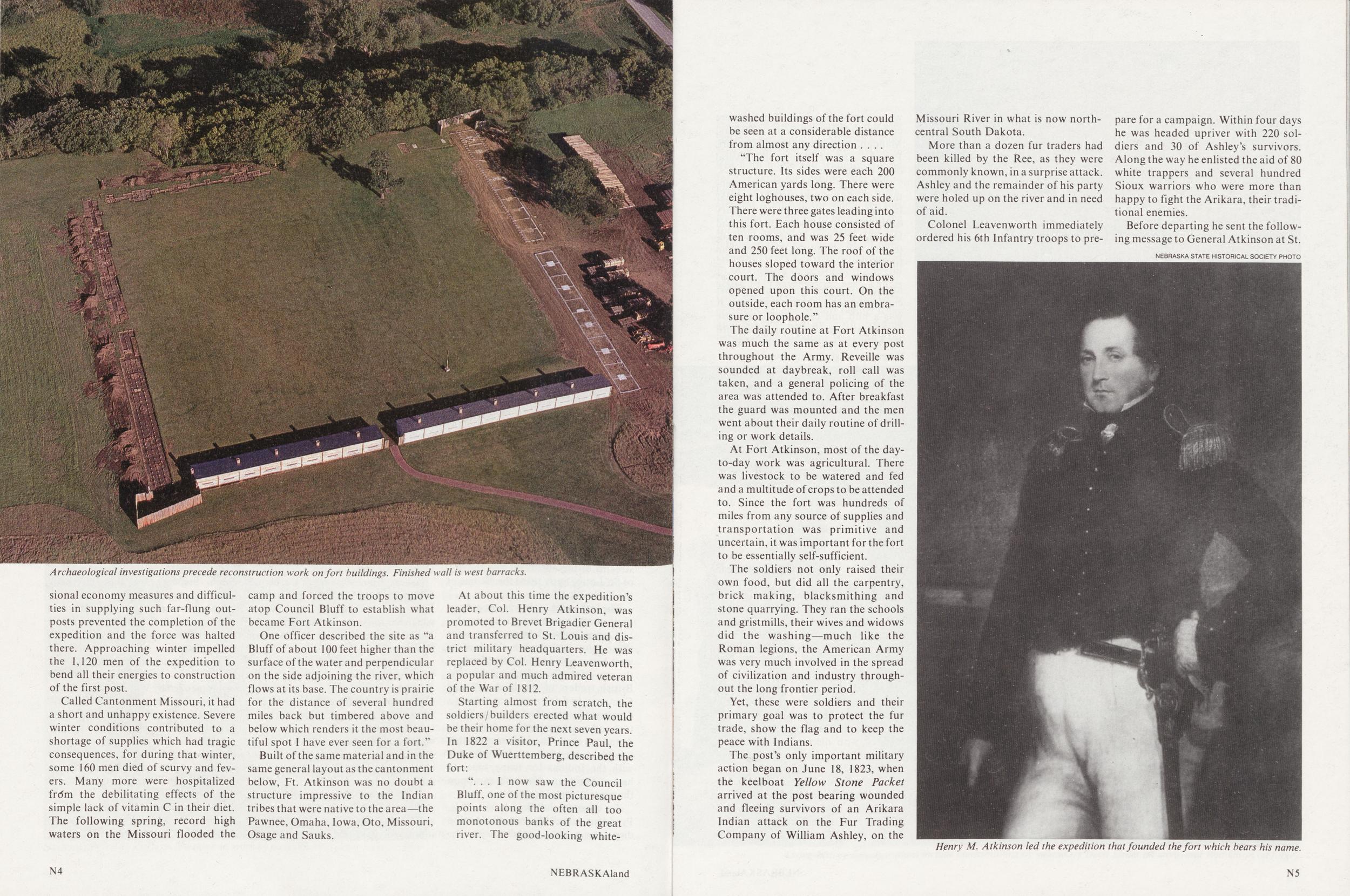
Called Cantonment Missouri, it had a short and unhappy existence. Severe winter conditions contributed to a shortage of supplies which had tragic consequences, for during that winter, some 160 men died of scurvy and fevers. Many more were hospitalized from the debilitating effects of the simple lack of vitamin C in their diet. The following spring, record high waters on the Missouri flooded the camp and forced the troops to move atop Council Bluff to establish what became Fort Atkinson.
One officer described the site as "a Bluff of about 100 feet higher than the surface of the water and perpendicular on the side adjoining the river, which flows at its base. The country is prairie for the distance of several hundred miles back but timbered above and below which renders it the most beautiful spot I have ever seen for a fort.v
Built of the same material and in the same general layout as the cantonment below, Ft. Atkinson was no doubt a structure impressive to the Indian tribes that were native to the area—the Pawnee, Omaha, Iowa, Oto, Missouri, Osage and Sauks.
At about this time the expedition's leader, Col. Henry Atkinson, was promoted to Brevet Brigadier General and transferred to St. Louis and district military headquarters. He was replaced by Col. Henry Leavenworth, a popular and much admired veteran of the War of 1812.
Starting almost from scratch, the soldiers /builders erected what would be their home for the next seven years. In 1822 a visitor, Prince Paul, the Duke of Wurttemberg, described the fort:
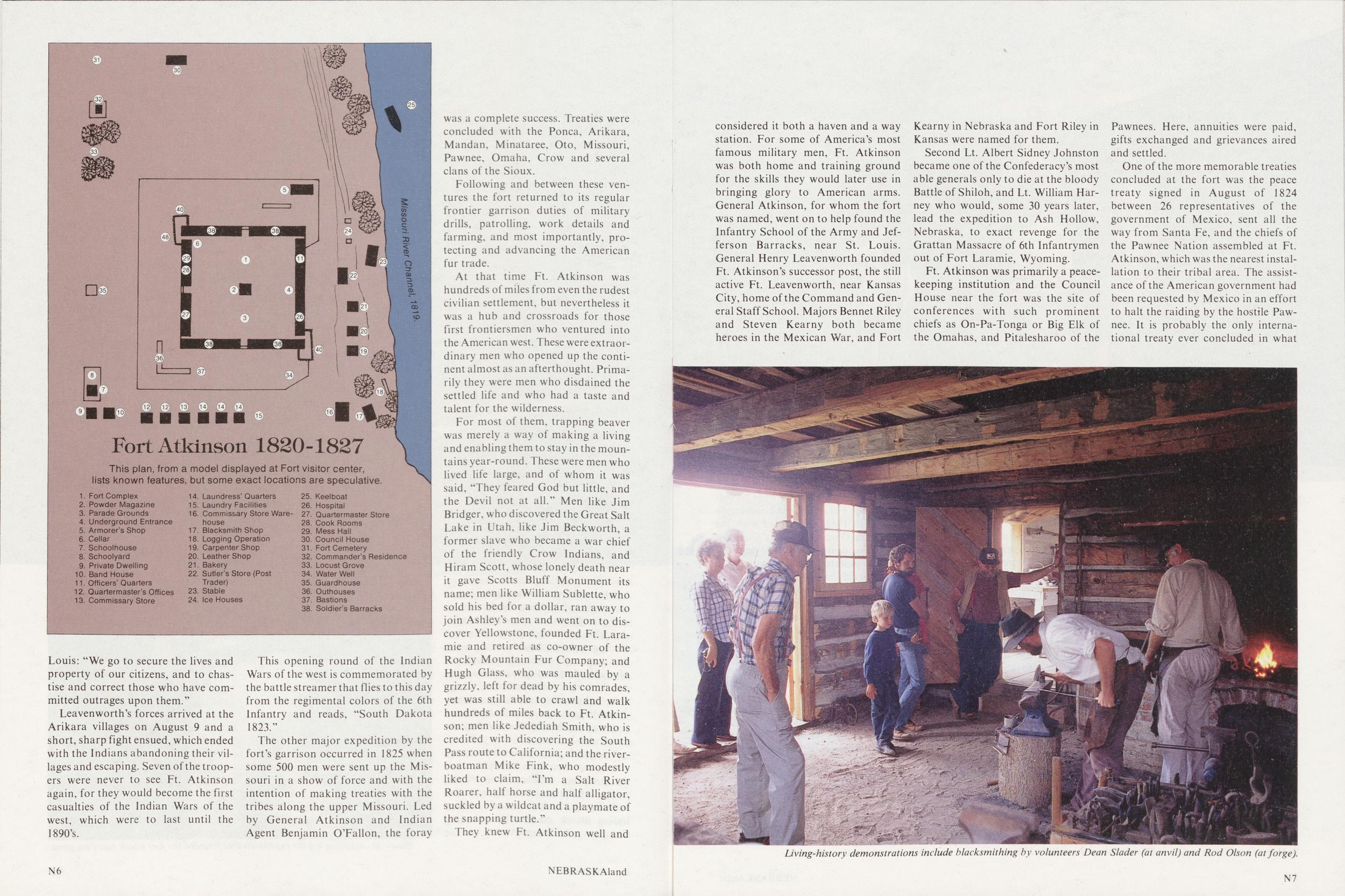
"... I now saw the Council Bluff, one of the most picturesque points along the often all too monotonous banks of the great river. The good-looking white-washed N4 buildings of the fort could be seen at a considerable distance from almost any direction ....
"The fort itself was a square structure. Its sides were each 200 American yards long. There were eight log houses, two on each side. There were three gates leading into this fort. Each house consisted of ten rooms, and was 25 feet wide and 250 feet long. The roof of the houses sloped toward the interior court. The doors and windows opened upon this court. On the outside, each room has an embrasure or loophole."
The daily routine at Fort Atkinson was much the same as at every post throughout the Army. Reveille was sounded at daybreak, roll call was taken, and a general policing of the area was attended to. After breakfast the guard was mounted and the men went about their daily routine of drilling or work details.
At Fort Atkinson, most of the day-to-day work was agricultural. There was livestock to be watered and fed and a multitude of crops to be attended to. Since the fort was hundreds of miles from any source of supplies and transportation was primitive and uncertain, it was important for the fort to be essentially self-sufficient.
The soldiers not only raised their own food, but did all the carpentry, brick making, blacksmithing and stone quarrying. They ran the schools and gristmills, their wives and widows did the washing—much like the Roman legions, the American Army was very much involved in the spread of civilization and industry throughout the long frontier period.
Yet, these were soldiers and their primary goal was to protect the fur trade, show the flag and to keep the peace with Indians.
The post's only important military action began on June 18, 1823, when the keelboat Yellow Stone Packet arrived at the post bearing wounded and fleeing survivors of an Ankara Indian attack on the Fur Trading Company of William Ashley, on the Missouri River in what is now north-central South Dakota.
More than a dozen fur traders had been killed by the Ree, as they were commonly known, in a surprise attack. Ashley and the remainder of his party were holed up on the river and in need of aid.
Colonel Leavenworth immediately ordered his 6th Infantry troops to prepare for a campaign. Within four days he was headed upriver with 220 s oldiers and 30 of Ashley's survivors. Along the way he enlisted the aid of 80 white trappers and several hundred Sioux warriors who were more than happy to fight the Ankara, their traditional enemies.
Before departing he sent the following message to General Atkinson at St. Louis: "We go to secure the lives and property of our citizens, and to chastise and correct those who have committed outrages upon them."
Leavenworth's forces arrived at the Arikara villages on August 9 and a short, sharp fight ensued, which ended with the Indians abandoning their villages and escaping. Seven of the troopers were never to see Ft. Atkinson again, for they would become the first casualties of the Indian Wars of the west, which were to last until the 1890's.
This opening round of the Indian Wars of the west is commemorated by the battle streamer that flies to this day from the regimental colors of the 6th Infantry and reads, "South Dakota 1823."
The other major expedition by the fort's garrison occurred in 1825 when some 500 men were sent up the Missouri in a show of force and with the intention of making treaties with the tribes along the upper Missouri. Led by General Atkinson and Indian Agent Benjamin O'Fallon, the foray was a complete success. Treaties were concluded with the Ponca, Arikara, Mandan, Minataree, Oto, Missouri, Pawnee, Omaha, Crow and several clans of the Sioux.
Following and between these ventures the fort returned to its regular frontier garrison duties of military drills, patrolling, work details and farming, and most importantly, protecting and advancing the American fur trade.
At that time Ft. Atkinson was hundreds of miles from even the rudest civilian settlement, but nevertheless it was a hub and crossroads for those first frontiersmen who ventured into the American west. These were extraordinary men who opened up the continent almost as an afterthought. Primarily they were men who disdained the settled life and who had a taste and talent for the wilderness.
For most of them, trapping beaver was merely a way of making a living and enabling them to stay in the mountains year-round. These were men who lived life large, and of whom it was said, "They feared God but little, and the Devil not at all." Men like Jim Bridger, who discovered the Great Salt Lake in Utah, like Jim Beckworth, a former slave who became a war chief of the friendly Crow Indians, and Hiram Scott, whose lonely death near it gave Scotts Bluff Monument its name; men like William Sublette, who sold his bed for a dollar, ran away to join Ashley's men and went on to discover Yellowstone, founded Ft. Laramie and retired as co-owner of the Rocky Mountain Fur Company; and Hugh Glass, who was mauled by a grizzly, left for dead by his comrades, yet was still able to crawl and walk hundreds of miles back to Ft. Atkinson; men like Jedediah Smith, who is credited with discovering the South Pass route to California; and the river boatman Mike Fink, who modestly liked to claim, "I'm a Salt River Roarer, half horse and half alligator, suckled by a wildcat and a playmate of the snapping turtle."
They knew Ft. Atkinson well and N6 NEBRASKAland considered it both a haven and a way station. For some of America's most famous military men, Ft. Atkinson was both home and training ground for the skills they would later use in bringing glory to American arms. General Atkinson, for whom the fort was named, went on to help found the Infantry School of the Army and Jefferson Barracks, near St. Louis. General Henry Leavenworth founded Ft. Atkinson's successor post, the still active Ft. Leavenworth, near Kansas City, home of the Command and General Staff School. Majors Bennet Riley and Steven Kearny both became heroes in the Mexican War, and Fort Kearny in Nebraska and Fort Riley in Kansas were named for them,
Second Lt. Albert Sidney Johnston became one of the Confederacy's most able generals only to die at the bloody Battle of Shiloh, and Lt. William Harney who would, some 30 years later, lead the expedition to Ash Hollow, Nebraska, to exact revenge for the Grattan Massacre of 6th Infantrymen out of Fort Laramie, Wyoming.
Ft. Atkinson was primarily a peace keeping institution and the Council House near the fort was the site of conferences with such prominent chiefs as On-Pa-Tonga or Big Elk of the Omaha, and Pitalesharoo of the Pawnees. Here, annuities were paid, gifts exchanged and grievances aired and settled.
One of the more memorable treaties concluded at the fort was the peace treaty signed in August of 1824 between 26 representatives of the government of Mexico, sent all the way from Santa Fe, and the chiefs of the Pawnee Nation assembled at Ft. Atkinson, which was the nearest installation to their tribal area. The assistance of the American government had been requested by Mexico in an effort to halt the raiding by the hostile Pawnee. It is probably the only international treaty ever concluded in what was to become Nebraska.
For nearly eight years Ft. Atkinson stood upon this bluff in the remote wilderness and performed its role as a pacifying presence in the forefront of encroaching civilization. However, the thrust of settlement in this period was to the southwest along the Santa Fe Trail and, since the fur trade question had been satisfactorily settled, maintaining a military post at Ft. Atkinson was no longer considered necessary.
On March 7, 1827, the Adjutant General of the Army issued the following orders: "The military post at Fort Atkinson will be abandoned and the 6th Regiment of Infantry will be stationed at Jefferson Barracks . . . ."
On the morning of June 6, 1827, the keelboats were loaded, swung into the current, and just before disappearing around a bend in the river, all aboard caught their last glimpse ever of the walls, bastions and flagpole of proud old Ft. Atkinson.
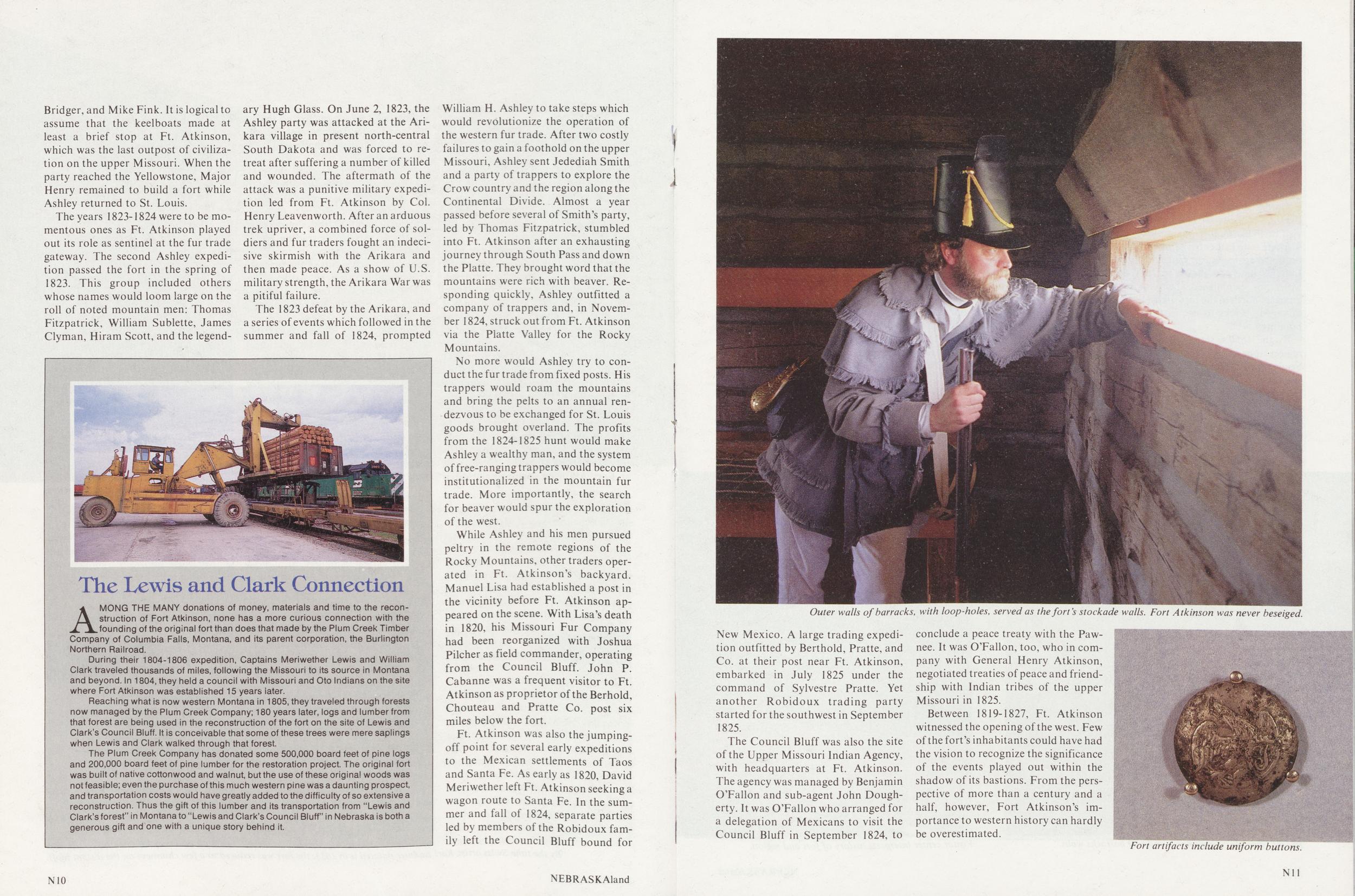
The soldiers went away and the fort fell prey to time and climate, Indians and settlers. Even the river shifted away in 1841 and now flows some three miles east of the bluffs it once touched. By the time the first settlers came to Nebraska nearly 30 years later, little remained of the fort but remnant brick and masonry.
By the mid 1850's, the entire grounds had become a cornfield. Where once there were swords, now there were plowshares. For more than 100 years the site was indistinguishable from any farm in America, except for the musket balls, uniform buttons, and antique coins that appeared with each spring plowing and which served to keep the existence of old Ft. Atkinson alive to the few who cherished its memory.
In the mid 1950's, archaeological crews of the Nebraska State Historical Society began a determined effort to fix the exact locations of the fort's walls, gates and outbuildings, as well as to recover period artifacts which add to our knowledge of that time and place. These "digs" were hugely successful, and helped inspire the formation of the Fort Atkinson Foundation which, in 1963, cooperated with the Nebraska Game and Parks Commission in acquiring the site and developing it as a State Historical Park.
Under Commission Director Eugene T. Mahoney, the reconstruction of the fort has progressed rapidly. Commission crews under the supervision of Park Superintendent Steve Kemper have labored long rebuilding the barracks walls in the same manner as the original.
The Nebraska Game and Parks Foundation was instrumental in raising nearly all the funds necessary to construct the visitor center and reconstruct old Fort Atkinson. The Center and the reconstruction will help tell, for generations to come, the story of the faithful soldiers and bold frontiersmen who knew this place. They will also stand as a monument to honor the major role played by Council Bluff and Fort Atkinson in the opening of the American West.
N8 NEBRASKAland The Fur TradeDURING ITS BRIEF existence, Fort Atkinson played host to momentous events in America's westering experience, and the story of the fort adds much to the social history of the west.
But, these achievements may have diverted attention from Ft. Atkinson's significant contribution to the development of the western fur trade. Between 1819-1827, Ft. Atkinson was the gateway to the fur regions of the upper Missouri and the Rocky Mountains. These were pivotal years which saw the fur trade become the dominant force for American expansion. By the 1840's, fur traders and mountain men had explored the west, opened the Mexican territories of the southwest, and shown the way for emigrants to Oregon and California. As the only government authority in the vast territory west of the Missouri, the garrison at Fort Atkinson assumed the often impossible task of regulating the fur trade and enforcing peaceful relations between traders and the Indian tribes of the region.
Who were the traders and mountain men who passed through the portals of Ft. Atkinson? Contemporary documents reveal some of their names; others may be assumed from sources relating the travels of fur trading parties along the upper Missouri route. We know that such giants of the fur trades General William H. Ashley, Thomas Fitzpatrick, James Clyman, and Hugh Glass trod the parade ground at Ft. Atkinson.
In 1822, a party of fur traders led by Gen. William H. Ashley and Maj. Andrew Henry ascended the Missouri in keelboats, seeking to tap the fur riches of the Yellowstone country. These were the "enterprising young men" for whom Ashley had advertised in the pages of The Missouri Gazette and Public Advertiser. Although the names of many of the party went unrecorded, the expedition included Jedediah Smith, David E. Jackson, Jim Bridger, and Mike Fink. It is logical to assume that the keelboats made at least a brief stop at Ft. Atkinson, which was the last outpost of civilization on the upper Missouri. When the party reached the Yellowstone, Major Henry remained to build a fort while Ashley returned to St. Louis.
The years 1823-1824 were to be momentous ones as Ft. Atkinson played out its role as sentinel at the fur trade gateway. The second Ashley expedition passed the fort in the spring of 1823. This group included others whose names would loom large on the roll of noted mountain men: Thomas Fitzpatrick, William Sublette, James Clyman, Hiram Scott, and the legendary Hugh Glass. On June 2, 1823, the Ashley party was attacked at the Arikara village in present north-central South Dakota and was forced to retreat after suffering a number of killed and wounded. The aftermath of the attack was a punitive military expedition led from Ft. Atkinson by Col. Henry Leavenworth. After an arduous trek upriver, a combined force of soldiers and fur traders fought an indecisive skirmish with the Arikara and then made peace. As a show of U.S. military strength, the Arikara War was a pitiful failure.
The 1823 defeat by the Arikara, and a series of events which followed in the summer and fall of 1824, prompted William H. Ashley to take steps which would revolutionize the operation of the western fur trade. After two costly failures to gain a foothold on the upper Missouri, Ashley sent Jedediah Smith and a party of trappers to explore the Crow country and the region along the Continental Divide. Almost a year passed before several of Smith's party, led by Thomas Fitzpatrick, stumbled into Ft. Atkinson after an exhausting journey through South Pass and down the Platte. They brought word that the mountains were rich with beaver. Responding quickly, Ashley outfitted a company of trappers and, in November 1824, struck out from Ft. Atkinson via the Platte Valley for the Rocky Mountains.
No more would Ashley try to conduct the fur trade from fixed posts. His trappers would roam the mountains and bring the pelts to an annual rendezvous to be exchanged for St. Louis goods brought overland. The profits from the 1824-1825 hunt would make Ashley a wealthy man, and the system of free-ranging trappers would become institutionalized in the mountain fur trade. More importantly, the search for beaver would spur the exploration of the west.
While Ashley and his men pursued peltry in the remote regions of the Rocky Mountains, other traders operated in Ft. Atkinson's backyard. Manuel Lisa had established a post in the vicinity before Ft. Atkinson appeared on the scene. With Lisa's death in 1820, his Missouri Fur Company had been reorganized with Joshua Pilcher as field commander, operating from the Council Bluff. John P. Cabanne was a frequent visitor to Ft. Atkinson as proprietor of the Berhold, Chateau and Pratte Co. post six miles below the fort.
Ft. Atkinson was also the jumping off point for several early expeditions to the Mexican settlements of Taos and Santa Fe. As early as 1820, David Meriwether left Ft. Atkinson seeking a wagon route to Santa Fe. In the summer and fall of 1824, separate parties led by members of the Robidoux family left the Council Bluff bound for N10 NEBRASKAland New Mexico. A large trading expedition outfitted by Berthold, Pratte, and Co. at their post near Ft. Atkinson, embarked in July 1825 under the command of Sylvestre Pratte. Yet another Robidoux trading party started for the southwest in September 1825.
The Council Bluff was also the site of the Upper Missouri Indian Agency, with headquarters at Ft. Atkinson. The agency was managed by Benjamin O'Fallon and sub-agent John Dougherty. It was O'Fallon who arranged for a delegation of Mexicans to visit the Council Bluff in September 1824, to conclude a peace treaty with the Pawnee. It was O'Fallon, too, who in company with General Henry Atkinson, negotiated treaties of peace and friendship with Indian tribes of the upper Missouri in 1825.
Between 1819-1827, Ft. Atkinson witnessed the opening of the west. Few of the fort's inhabitants could have had the vision to recognize the significance of the events played out within the shadow of its bastions. From the perspective of more than a century and a half, however, Fort Atkinson's importance to western history can hardly be overestimated.
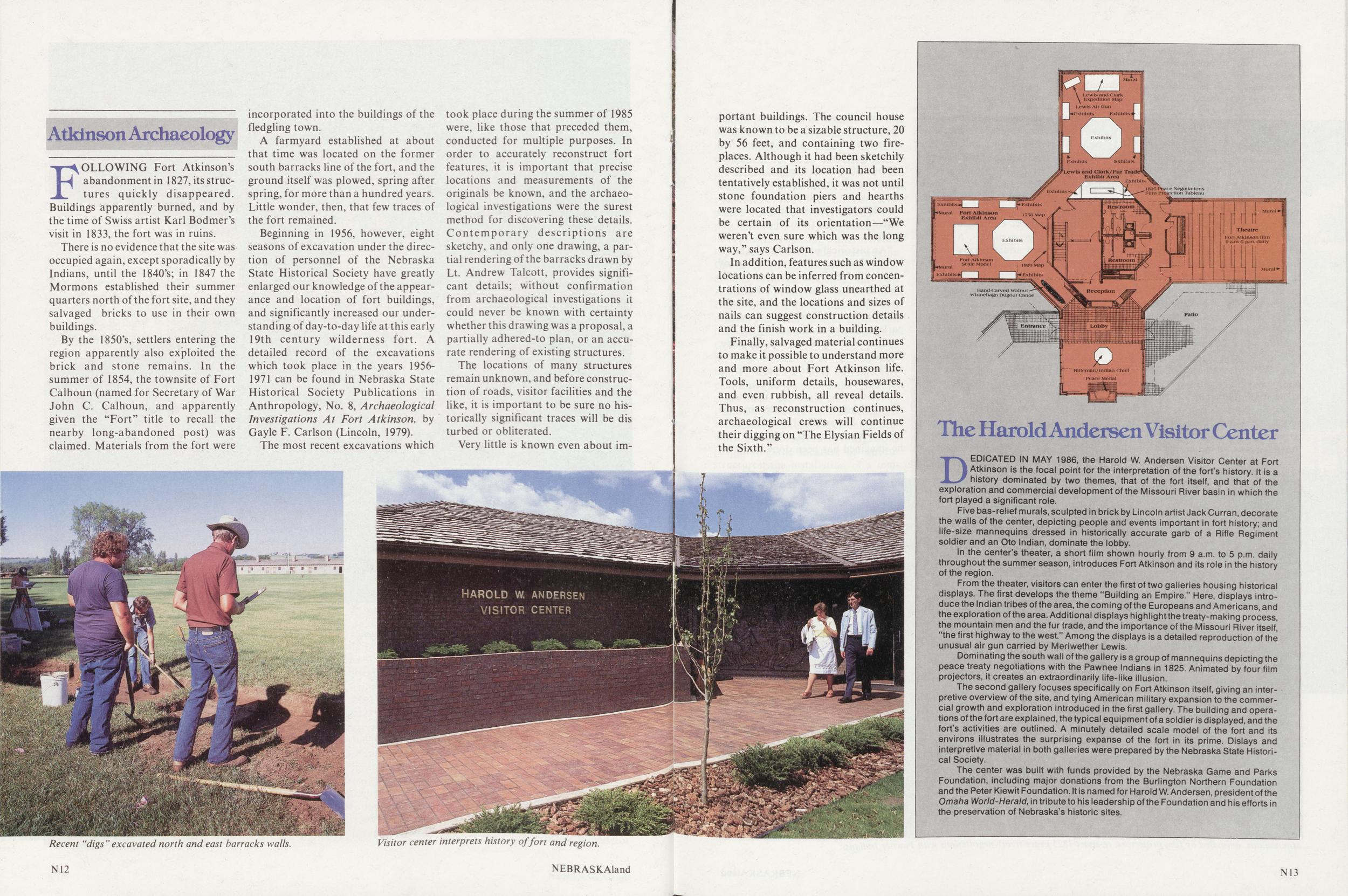 Atkinson Archaeology
FOLLOWING Fort Atkinson's abandonment in 1827, its structures quickly disappeared. Buildings apparently burned, and by the time of Swiss artist Karl Bodmer's visit in 1833, the fort was in ruins.
There is no evidence that the site was occupied again, except sporadically by Indians, until the 1840's; in 1847 the Mormons established their summer quarters north of the fort site, and they salvaged bricks to use in their own buildings.
By the 1850's, settlers entering the region apparently also exploited the brick and stone remains. In the summer of 1854, the townsite of Fort Calhoun (named for Secretary of War John C. Calhoun, and apparently given the "Fort" title to recall the nearby long-abandoned post) was claimed. Materials from the fort were incorporated into the buildings of the fledgling town.
A farmyard established at about that time was located on the former south barracks line of the fort, and the ground itself was plowed, spring after spring, for more than a hundred years. Little wonder, then, that few traces of the fort remained.
Beginning in 1956, however, eight seasons of excavation under the direction of personnel of the Nebraska State Historical Society have greatly enlarged our knowledge of the appearance and location of fort buildings, and significantly increased our understanding of day-to-day life at this early 19th century wilderness fort. A detailed record of the excavations which took place in the years 1956- 1971 can be found in Nebraska State Historical Society Publications in Anthropology, No. 8, Archaeological Investigations At Fort Atkinson, by Gayle F. Carlson (Lincoln, 1979).
The most recent excavations which took place during the summer of 1985 were, like those that preceded them, conducted for multiple purposes. In order to accurately reconstruct fort features, it is important that precise locations and measurements of the originals be known, and the archaeological investigations were the surest method for discovering these details. Contemporary descriptions are sketchy, and only one drawing, a partial rendering of the barracks drawn by Lt. Andrew Talcott, provides significant details; without confirmation from archaeological investigations it could never be known with certainty whether this drawing was a proposal, a partially adhered-to plan, or an accurate rendering of existing structures.
The locations of many structures remain unknown, and before construction of roads, visitor facilities and the like, it is important to be sure no historically significant traces will be dis turbed or obliterated.
Very little is known even about N12 NEBRASKAland important buildings. The council house was known to be a sizable structure, 20 by 56 feet, and containing two fireplaces. Although it had been sketchily described and its location had been tentatively established, it was not until stone foundation piers and hearths were located that investigators could be certain of its orientation—"We weren't even sure which was the long way," says Carlson.
In addition, features such as window locations can be inferred from concentrations of window glass unearthed at the site, and the locations and sizes of nails can suggest construction details and the finish work in a building.
Finally, salvaged material continues to make it possible to understand more and more about Fort Atkinson life. Tools, uniform details, housewares, and even rubbish, all reveal details. Thus, as reconstruction continues, archaeological crews will continue their digging on "The Elysian Fields of the Sixth."
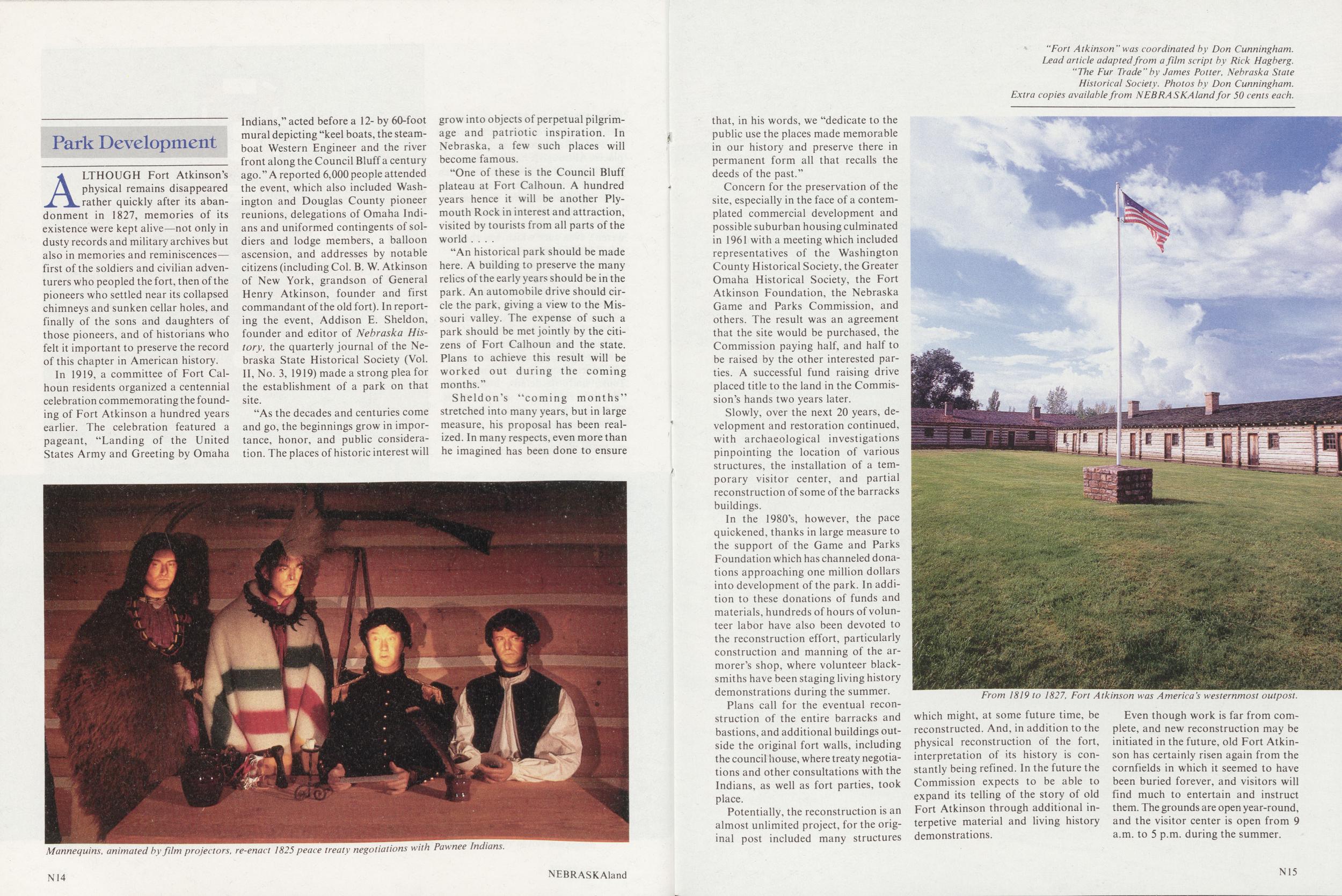 Park Development
ALTHOUGH Fort Atkinson's physical remains disappeared rather quickly after its abandonment in 1827, memories of its existence were kept alive—not only in dusty records and military archives but also in memories and reminiscences first of the soldiers and civilian adventurers who peopled the fort, then of the pioneers who settled near its collapsed chimneys and sunken cellar holes, and finally of the sons and daughters of those pioneers, and of historians who felt it important to preserve the record of this chapter in American history.
In 1919, a committee of Fort Calhoun residents organized a centennial celebration commemorating the founding of Fort Atkinson a hundred years earlier. The celebration featured a pageant, "Landing of the United States Army and Greeting by Omaha Indians," acted before a 12- by 60-foot mural depicting "keel boats, the steam boat Western Engineer and the river front along the Council Bluff a century ago." A reported 6,000 people attended the event, which also included Washington and Douglas County pioneer reunions, delegations of Omaha Indians and uniformed contingents of soldiers and lodge members, a balloon ascension, and addresses by notable citizens (including Col. B. W. Atkinson of New York, grandson of General Henry Atkinson, founder and first commandant of the old fort). In reporting the event, Addison E. Sheldon, founder and editor of Nebraska History, the quarterly journal of the Nebraska State Historical Society (Vol. II, No. 3, 1919) made a strong plea for the establishment of a park on that site.
"As the decades and centuries come and go, the beginnings grow in importance, honor, and public consideration. The places of historic interest will grow into objects of perpetual pilgrimage and patriotic inspiration. In Nebraska, a few such places will become famous.
"One of these is the Council Bluff plateau at Fort Calhoun. A hundred years hence it will be another Plymouth Rock in interest and attraction, visited by tourists from all parts of the world ....
"An historical park should be made here. A building to preserve the many relics of the early years should be in the park. An automobile drive should circle the park, giving a view to the Missouri valley. The expense of such a park should be met jointly by the citizens of Fort Calhoun and the state. Plans to achieve this result will be worked out during the coming months."
Sheldon's "coming months" stretched into many years, but in large measure, his proposal has been realized. In many respects, even more than he imagined has been done to ensure N14 NEBRASKAland that, in his words, we "dedicate to the public use the places made memorable in our history and preserve there in permanent form all that recalls the deeds of the past."
Concern for the preservation of the site, especially in the face of a contemplated commercial development and possible suburban housing culminated in 1961 with a meeting which included representatives of the Washington County Historical Society, the Greater Omaha Historical Society, the Fort Atkinson Foundation, the Nebraska Game and Parks Commission, and others. The result was an agreement that the site would be purchased, the Commission paying half, and half to be raised by the other interested parties. A successful fund raising drive placed title to the land in the Commission's hands two years later.
Slowly, over the next 20 years, development and restoration continued, with archaeological investigations pinpointing the location of various structures, the installation of a temporary visitor center, and partial reconstruction of some of the barracks buildings.
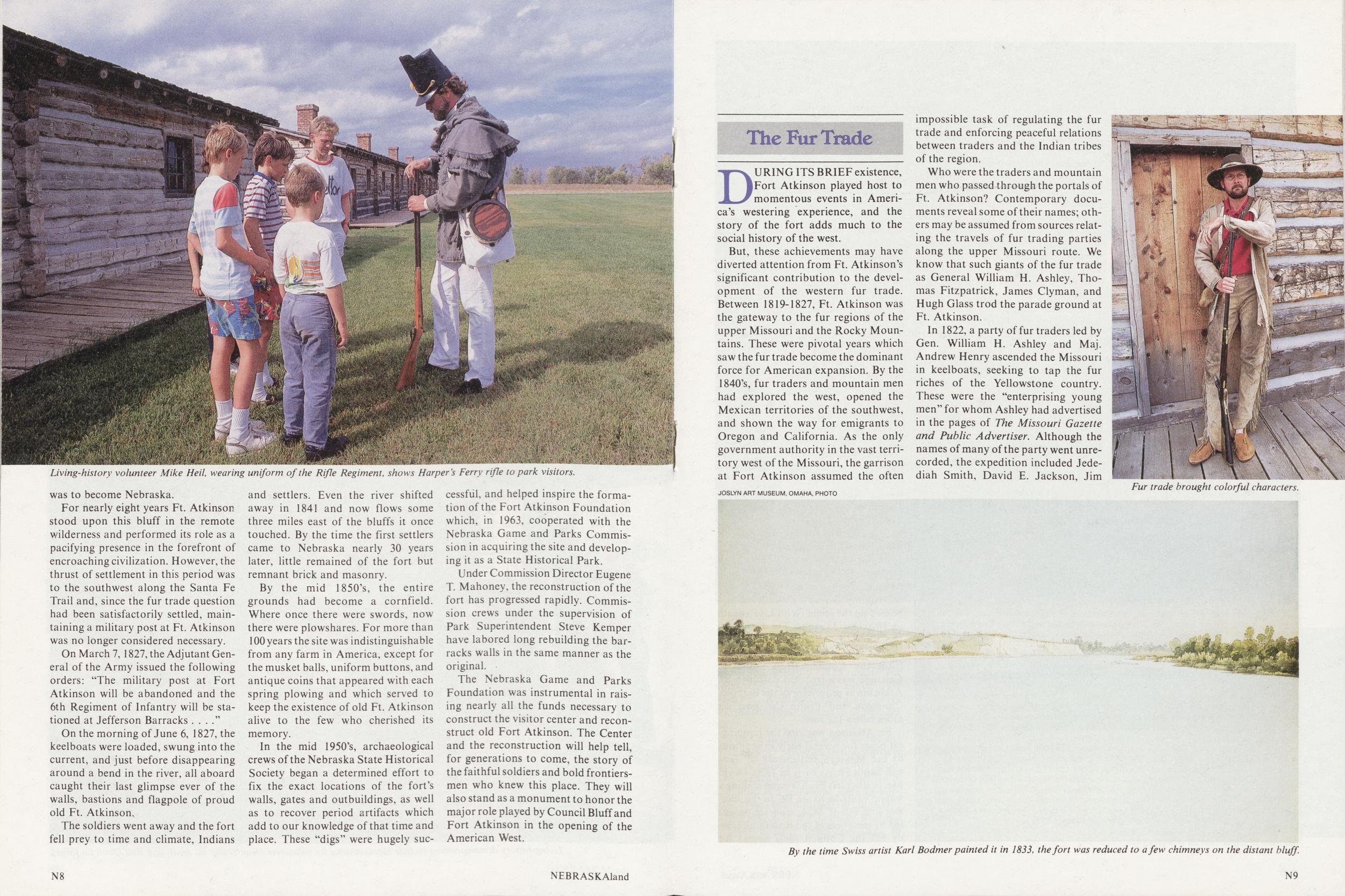
In the 1980's, however, the pace quickened, thanks in large measure to the support of the Game and Parks Foundation which has channeled donations approaching one million dollars into development of the park. In addition to these donations of funds and materials, hundreds of hours of volunteer labor have also been devoted to the reconstruction effort, particularly construction and manning of the armorer's shop, where volunteer blacksmiths have been staging living history demonstrations during the summer.
Plans call for the eventual reconstruction of the entire barracks and bastions, and additional buildings out- side the original fort walls, including the council house, where treaty negotiations and other consultations with the Indians, as well as fort parties, took place.
Potentially, the reconstruction is an almost unlimited project, for the original post included many structures which might, at some future time, be reconstructed. And, in addition to the physical reconstruction of the fort, interpretation of its history is constantly being refined. In the future the Commission expects to be able to expand its telling of the story of old Fort Atkinson through additional interpetive material and living history demonstrations.
Even though work is far from complete, and new reconstruction may be initiated in the future, old Fort Atkinson has certainly risen again from the cornfields in which it seemed to have been buried forever, and visitors will find much to entertain and instruct them. The grounds are open year-round, and the visitor center is open from 9 a.m. to 5 p.m. during the summer.
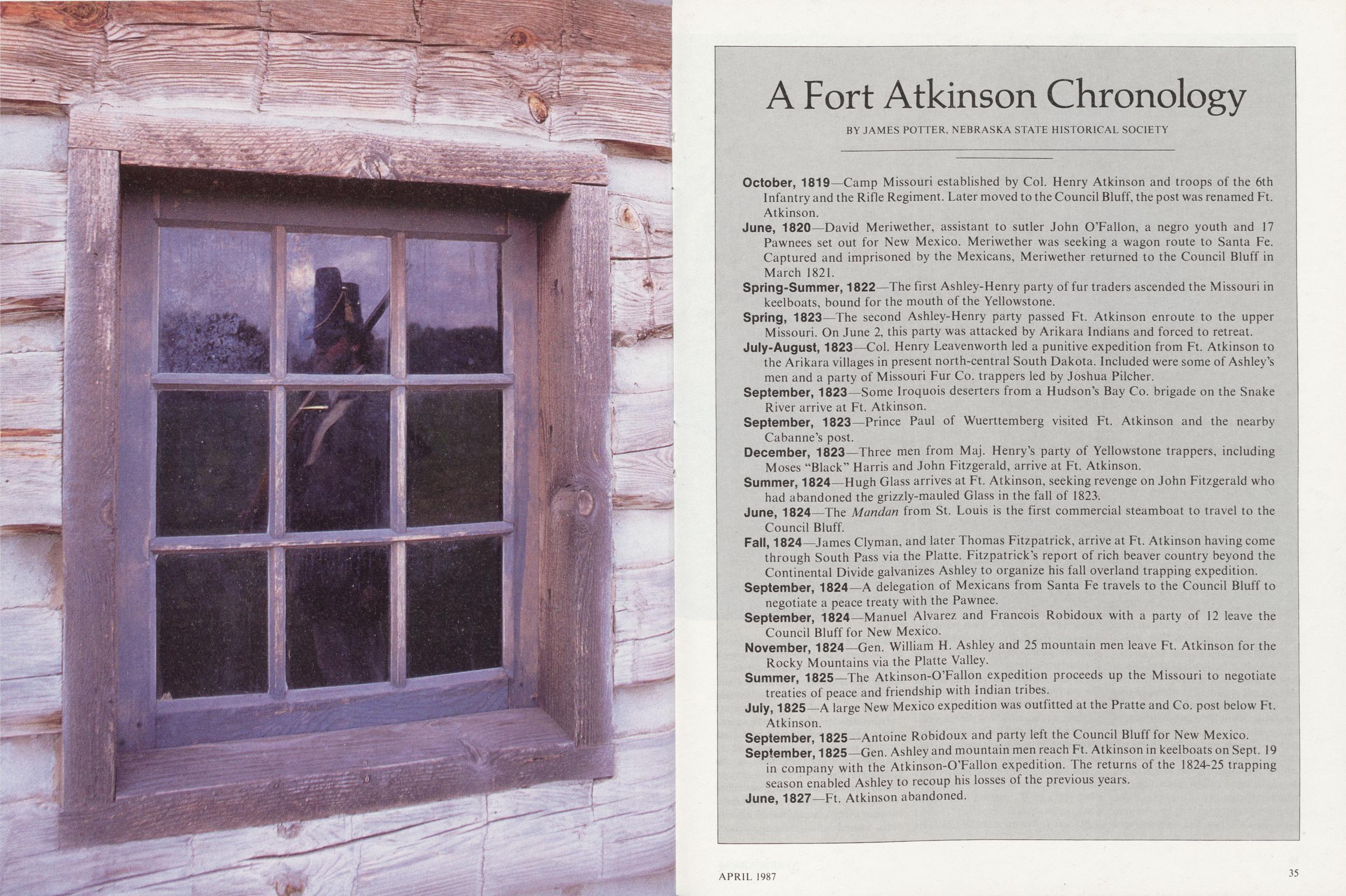
October, 1819—Camp Missouri established by Col. Henry Atkinson and troops of the 6th Infantry and the Rifle Regiment. Later moved to the Council Bluff, the post was renamed Ft. Atkinson.
June, 1820—David Meriwether, assistant to sutler John O'Fallon, a negro youth and 17 Pawnees set out for New Mexico. Meriwether was seeking a wagon route to Santa Fe. Captured and imprisoned by the Mexicans, Meriwether returned to the Council Bluff in March 1821.
Spring-Summer, 1822—The first Ashley-Henry party of fur traders ascended the Missouri in keelboats, bound for the mouth of the Yellowstone.
Spring, 1823—The second Ashley-Henry party passed Ft. Atkinson to the upper Missouri. On June 2, this party was attacked by Arikara Indians and forced to retreat.
July-August, 1823—Col. Henry Leavenworth led a punitive expedition from Ft. Atkinson to the Arikara villages in present north-central South Dakota. Included were some of Ashley's men and a party of Missouri Fur Co. trappers led by Joshua Pilcher.
September, 1823—Some Iroquois deserters from a Hudson's Bay Co. brigade on the Snake River arrive at Ft. Atkinson.
September, 1823—Prince Paul of Wuerttemberg visited Ft. Atkinson and the nearby Cabanne's post.
December, 1823—Three men from Maj. Henry's party of Yellowstone trappers, including Moses "Black" Harris and John Fitzgerald, arrive at Ft. Atkinson.
Summer, 1824—Hugh Glass arrives at Ft. Atkinson, seeking revenge on John Fitzgerald who had abandoned the grizzly-mauled Glass in the fall of 1823.
June, 1824—The Mandan from St. Louis is the first commercial steamboat to travel to the Council Bluff.
Fall, 1824—James Clyman, and later Thomas Fitzpatrick, arrive at Ft. Atkinson having come through South Pass via the Platte. Fitzpatrick's report of rich beaver country beyond the Continental Divide galvanizes Ashley to organize his fall overland trapping expedition.
September, 1824—A delegation of Mexicans from Santa Fe travels to the Council Bluff to negotiate a peace treaty with the Pawnee.
September, 1824—Manuel Alvarez and Francois Robidoux with a party of 12 leave the Council Bluff for New Mexico.
November, 1824—Gen. William H. Ashley and 25 mountain men leave Ft. Atkinson for the Rocky Mountains via the Platte Valley.
Summer, 1825—The Atkinson-O'Fallon expedition proceeds up the Missouri to negotiate treaties of peace and friendship with Indian tribes.
July, 1825—A large New Mexico expedition was outfitted at the Pratte and Co. post below Ft. Atkinson.
September, 1825—Antoine Robidoux and party left the Council Bluff for New Mexico.
September, 1825__Gen. Ashley and mountain men reach Ft. Atkinson in keelboats on Sept. 19 in company with the Atkinson-O'Fallon expedition. The returns of the 1824-25 trapping season enabled Ashley to recoup his losses of the previous years.
June, 1827—Ft. Atkinson abandoned.
APRIL 1987 35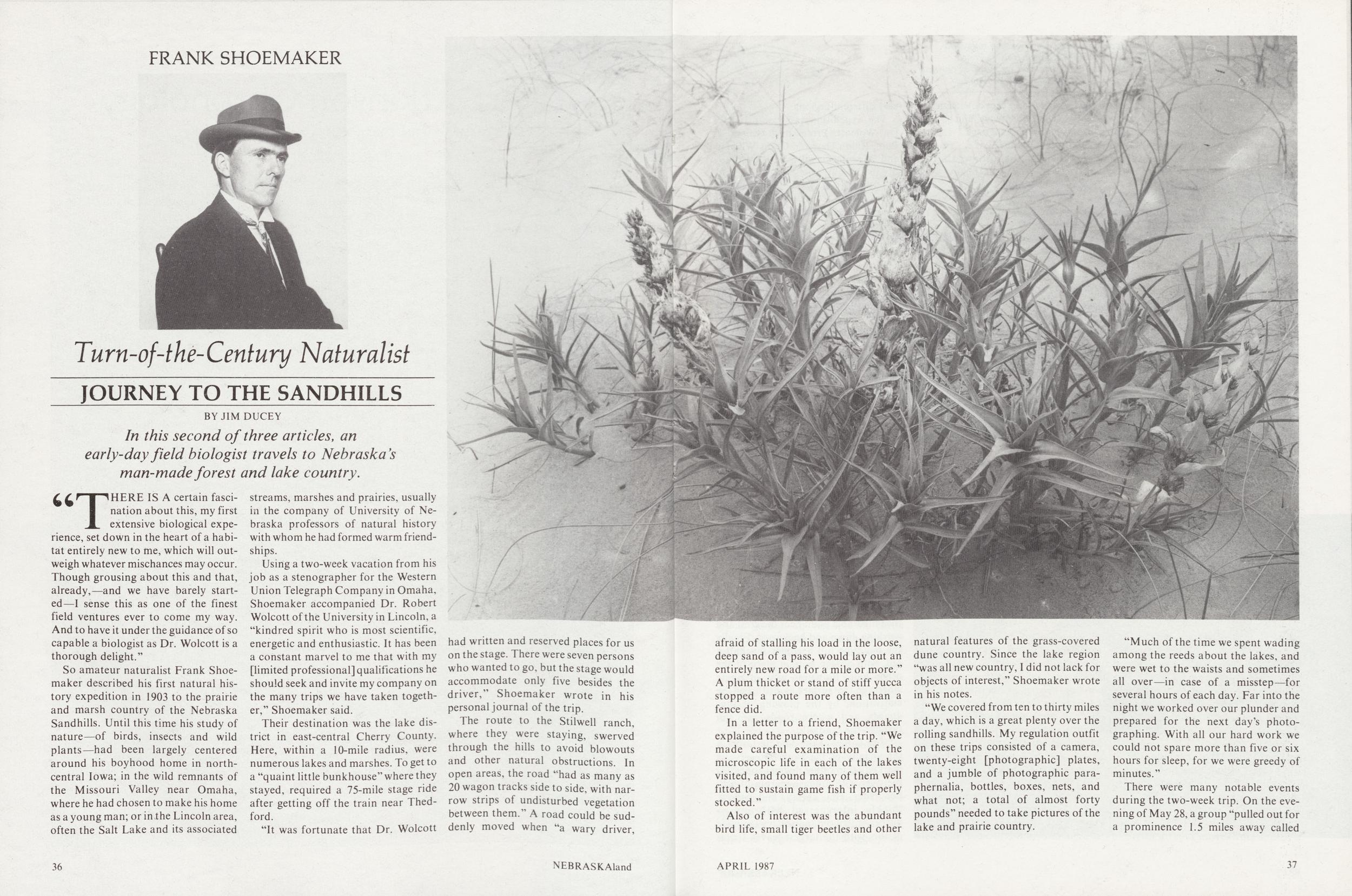
FRANK SHOEMAKER Turn-of-the-Century Naturalist JOURNEY TO THE SANDHILLS
BY JIM DUCEY In this second of three articles, an early-day field biologist travels to Nebraska's man-made forest and lake country.HERE IS A certain fascination about this, my first JL extensive biological experience, set down in the heart of a habitat entirely new to me, which will outweigh whatever mischances may occur. Though grousing about this and that, already,—and we have barely started—I sense this as one of the finest field ventures ever to come my way. And to have it under the guidance of so capable a biologist as Dr. Wolcott is a thorough delight."
So amateur naturalist Frank Shoemaker described his first natural history expedition in 1903 to the prairie and marsh country of the Nebraska Sandhills. Until this time his study of nature—of birds, insects and wild plants—had been largely centered around his boyhood home in north central Iowa; in the wild remnants of the Missouri Valley near Omaha, where he had chosen to make his home as a young man; or in the Lincoln area, often the Salt Lake and its associated streams, marshes and prairies, usually in the company of University of Nebraska professors of natural history with whom he had formed warm friendships.
Using a two-week vacation from his job as a stenographer for the Western Union Telegraph Company in Omaha, Shoemaker accompanied Dr. Robert Wolcott of the University in Lincoln, a "kindred spirit who is most scientific, energetic and enthusiastic. It has been a constant marvel to me that with my [limited professional] qualifications he should seek and invite my company on the many trips we have taken together," Shoemaker said.
Their destination was the lake district in east-central Cherry County. Here, within a 10-mile radius, were numerous lakes and marshes. To get to a "quaint little bunkhouse" where they stayed, required a 75-mile stage ride after getting off the train near Thedford.
"It was fortunate that Dr. Wolcott had written and reserved places for us on the stage. There were seven persons who wanted to go, but the stage would accommodate only five besides the driver," Shoemaker wrote in his personal journal of the trip.
The route to the Stilwell ranch, where they were staying, swerved through the hills to avoid blowouts and other natural obstructions. In open areas, the road "had as many as 20 wagon tracks side to side, with narrow strips of undisturbed vegetation between them." A road could be suddenly moved when "a wary driver, 36 NEBRASKAland afraid of stalling his load in the loose, deep sand of a pass, would lay out an entirely new road for a mile or more." A plum thicket or stand of stiff yucca stopped a route more often than a fence did.
In a letter to a friend, Shoemaker explained the purpose of the trip. "We made careful examination of the microscopic life in each of the lakes visited, and found many of them well fitted to sustain game fish if properly stocked."
Also of interest was the abundant bird life, small tiger beetles and other natural features of the grass-covered dune country. Since the lake region "was all new country, I did not lack for objects of interest," Shoemaker wrote in his notes.
"We covered from ten to thirty miles a day, which is a great plenty over the rolling sandhills. My regulation outfit on these trips consisted of a camera, twenty-eight [photographic] plates, and a jumble of photographic paraphernalia, bottles, boxes, nets, and what not; a total of almost forty pounds" needed to take pictures of the lake and prairie country.
"Much of the time we spent wading among the reeds about the lakes, and were wet to the waists and sometimes all over—in case of a misstep—for several hours of each day. Far into the night we worked over our plunder and prepared for the next day's photographing. With all our hard work we could not spare more than five or six hours for sleep, for we were greedy of minutes."
There were many notable events during the two-week trip. On the evening of May 28, a group "pulled out for a prominence 1.5 miles away called
APRIL 1987 37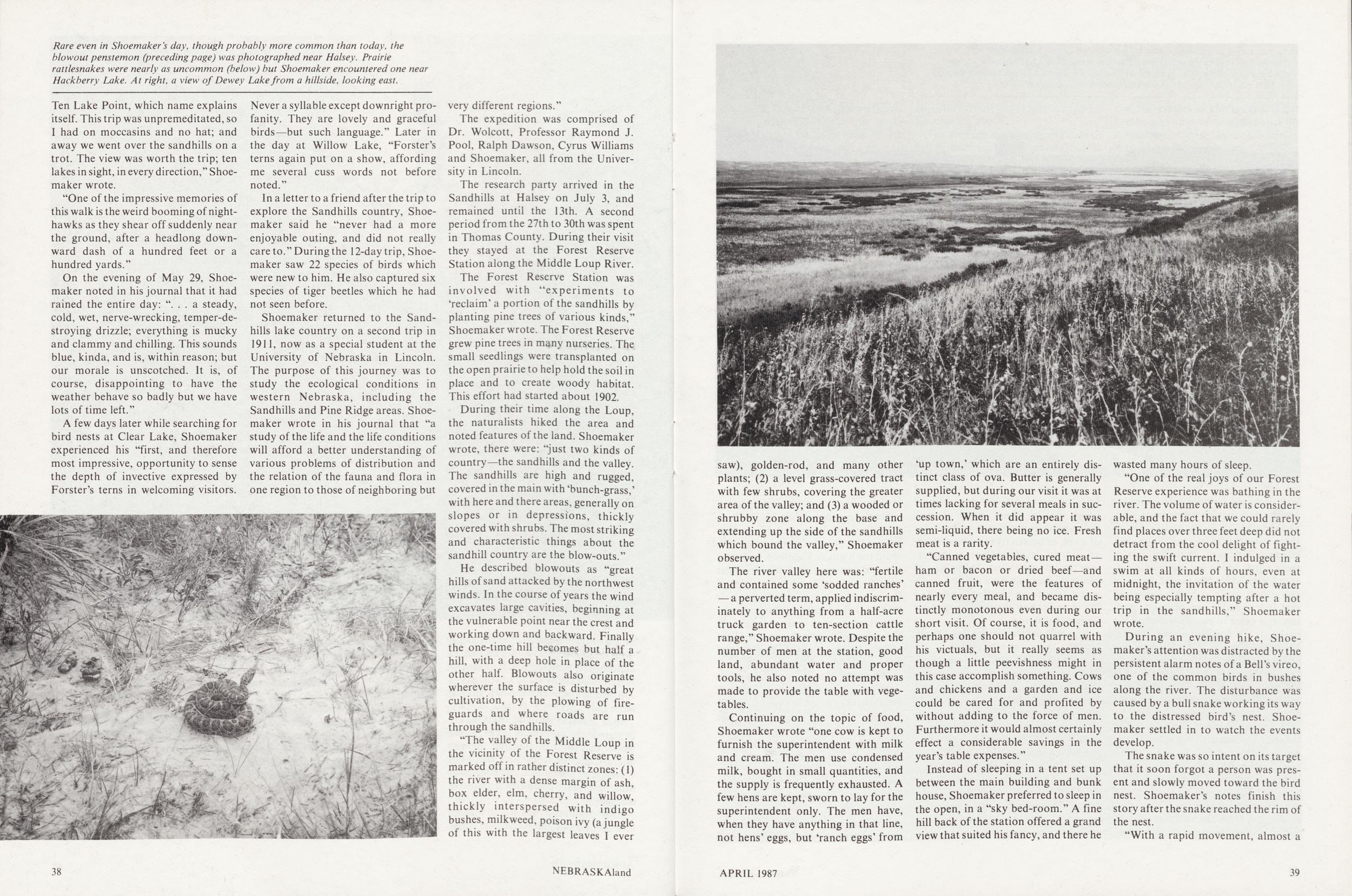 Rare even in Shoemaker's day, though probably more common than today, the
blowout penstemon (preceding page) was photographed near Halsey. Prairie
rattlesnakes were nearly as uncommon (below) but Shoemaker encountered one near
Hackberry Lake. At right, a view of Dewey Lake from a hillside, looking east.
Rare even in Shoemaker's day, though probably more common than today, the
blowout penstemon (preceding page) was photographed near Halsey. Prairie
rattlesnakes were nearly as uncommon (below) but Shoemaker encountered one near
Hackberry Lake. At right, a view of Dewey Lake from a hillside, looking east.
Ten Lake Point, which name explains itself. This trip was unpremeditated, so I had on moccasins and no hat; and away we went over the sandhills on a trot. The view was worth the trip; ten lakes in sight, in every direction, " Shoemaker wrote.
"One of the impressive memories of this walk is the weird booming of nighthawks as they shear off suddenly near the ground, after a headlong downward dash of a hundred feet or a hundred yards."
On the evening of May 29, Shoemaker noted in his journal that it had rained the entire day: "... a steady, cold, wet, nerve-wrecking, temper destroying drizzle; everything is mucky and clammy and chilling. This sounds blue, kinda, and is, within reason; but our morale is unscotched. It is, of course, disappointing to have the weather behave so badly but we have lots of time left."
A few days later while searching for bird nests at Clear Lake, Shoemaker experienced his "first, and therefore most impressive, opportunity to sense the depth of invective expressed by Forster's terns in welcoming visitors. Never a syllable except downright profanity. They are lovely and graceful birds—but such language." Later in the day at Willow Lake, "Forster's terns again put on a show, affording me several cuss words not before noted."
In a letter to a friend after the trip to explore the Sandhills country, Shoemaker said he "never had a more enjoyable outing, and did not really care to. "During the 12-day trip, Shoemaker saw 22 species of birds which were new to him. He also captured six species of tiger beetles which he had not seen before.
Shoemaker returned to the Sandhills lake country on a second trip in 1911, now as a special student at the University of Nebraska in Lincoln. The purpose of this journey was to study the ecological conditions in western Nebraska, including the Sandhills and Pine Ridge areas. Shoemaker wrote in his journal that "a study of the life and the life conditions will afford a better understanding of various problems of distribution and the relation of the fauna and flora in one region to those of neighboring but very different regions."
The expedition was comprised of Dr. Wolcott, Professor Raymond J. Pool, Ralph Dawson, Cyrus Williams and Shoemaker, all from the University in Lincoln.
The research party arrived in the Sandhills at Halsey on July 3, and remained until the 13th. A second period from the 27th to 30th was spent in Thomas County. During their visit they stayed at the Forest Reserve Station along the Middle Loup River.
The Forest Reserve Station was involved with "experiments to 'reclaim' a portion of the sandhills by planting pine trees of various kinds," Shoemaker wrote. The Forest Reserve grew pine trees in many nurseries. The small seedlings were transplanted on the open prairie to help hold the soil in place and to create woody habitat. This effort had started about 1902.
During their time along the Loup, the naturalists hiked the area and noted features of the land. Shoemaker wrote, there were: "just two kinds of country—the sandhills and the valley. The sandhills are high and rugged, covered in the main with 'bunch-grass,' with here and there areas, generally on slopes or in depressions, thickly covered with shrubs. The most striking and characteristic things about the sandhill country are the blow-outs."
He described blowouts as "great hills of sand attacked by the northwest winds. In the course of years the wind excavates large cavities, beginning at the vulnerable point near the crest and working down and backward. Finally the one-time hill becomes but half a hill, with a deep hole in place of the other half. Blowouts also originate wherever the surface is disturbed by cultivation, by the plowing of fire guards and where roads are run through the sandhills.
"The valley of the Middle Loup in the vicinity of the Forest Reserve is marked off in rather distinct zones: (1) the river with a dense margin of ash, box elder, elm, cherry, and willow thickly interspersed with indigo bushes, milkweed, poison ivy (a jungle of this with the largest leaves I ever 38 NEBRASKAland saw), golden-rod, and many other plants; (2) a level grass-covered tract with few shrubs, covering the greater area of the valley; and (3) a wooded or shrubby zone along the base and extending up the side of the sandhills which bound the valley," Shoemaker observed.
The river valley here was: "fertile and contained some 'sodded ranches' — a perverted term, applied indiscriminately to anything from a half-acre truck garden to ten-section cattle range," Shoemaker wrote. Despite the number of men at the station, good land, abundant water and proper tools, he also noted no attempt was made to provide the table with vegetables.
Continuing on the topic of food, Shoemaker wrote "one cow is kept to furnish the superintendent with milk and cream. The men use condensed milk, bought in small quantities, and the supply is frequently exhausted. A few hens are kept, sworn to lay for the superintendent only. The men have, when they have anything in that line, not hens' eggs, but 'ranch eggs' from 'up town,' which are an entirely distinct class of ova. Butter is generally supplied, but during our visit it was at times lacking for several meals in succession. When it did appear it was semi-liquid, there being no ice. Fresh meat is a rarity.
"Canned vegetables, cured meat—ham or bacon or dried beef—and canned fruit, were the features of nearly every meal, and became distinctly monotonous even during our short visit. Of course, it is food, and perhaps one should not quarrel with his victuals, but it really seems as though a little peevishness might in this case accomplish something. Cows and chickens and a garden and ice could be cared for and profited by without adding to the force of men. Furthermore it would almost certainly effect a considerable savings in the year's table expenses."
Instead of sleeping in a tent set up between the main building and bunk house, Shoemaker preferred to sleep in the open, in a "sky bed-room." A fine hill back of the station offered a grand view that suited his fancy, and there he wasted many hours of sleep.
"One of the real joys of our Forest Reserve experience was bathing in the river. The volume of water is considerable, and the fact that we could rarely find places over three feet deep did not detract from the cool delight of fighting the swift current. I indulged in a swim at all kinds of hours, even at midnight, the invitation of the water being especially tempting after a hot trip in the sandhills," Shoemaker wrote.
During an evening hike, Shoemaker's attention was distracted by the persistent alarm notes of a Bell's vireo, one of the common birds in bushes along the river. The disturbance was caused by a bull snake working its way to the distressed bird's nest. Shoemaker settled in to watch the events develop.
The snake was so intent on its target that it soon forgot a person was present and slowly moved toward the bird nest. Shoemaker's notes finish this story after the snake reached the rim of the nest.
"With a rapid movement, almost a jerk, it raised its head several inches above the nest, opened wide its jaws, and struck! . . . Really that is not all there is to this story, for the snake's conduct, not mine, is the subject of these notes; but in my capacity as referee I may add a few words. Being, if you please, quite as highly organized and functioned as an ordinary bullsnake, it came to pass that even as the snake struck down upon the helpless heads of the baby vireos, I grasped the reptile amidships and hauled in enough slack that the blow fell short of the nest. That is all. The subsequent court-martial and execution have no place in this narrative," he wrote.
APRIL 1987 39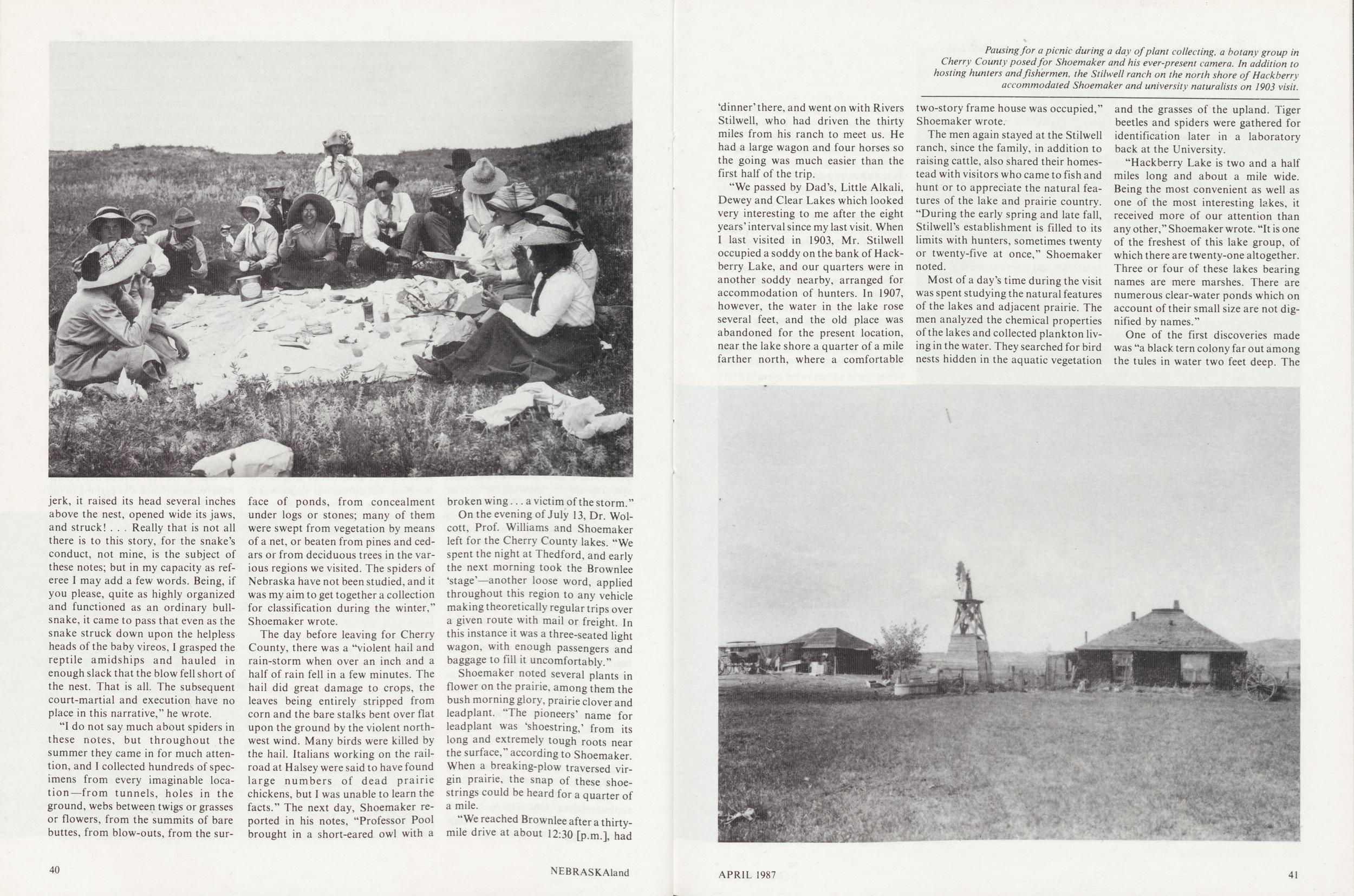
"I do not say much about spiders in these notes, but throughout the summer they came in for much attention, and I collected hundreds of specimens from every imaginable location—from tunnels, holes in the ground, webs between twigs or grasses or flowers, from the summits of bare buttes, from blow-outs, from the surface of ponds, from concealment under logs or stones; many of them were swept from vegetation by means of a net, or beaten from pines and cedars or from deciduous trees in the various regions we visited. The spiders of Nebraska have not been studied, and it was my aim to get together a collection for classification during the winter," Shoemaker wrote.
The day before leaving for Cherry County, there was a "violent hail and rain-storm when over an inch and a half of rain fell in a few minutes. The hail did great damage to crops, the leaves being entirely stripped from corn and the bare stalks bent over flat upon the ground by the violent northwest wind. Many birds were killed by the hail. Italians working on the railroad at Halsey were said to have found large numbers of dead prairie chickens, but I was unable to learn the facts." The next day, Shoemaker reported in his notes, "Professor Pool brought in a short-eared owl with a broken wing... a victim of the storm."
On the evening of July 13, Dr. Wolcott, Prof. Williams and Shoemaker left for the Cherry County lakes. "We spent the night at Thedford, and early the next morning took the Brownlee 'stage'—another loose word, applied throughout this region to any vehicle making theoretically regular trips over a given route with mail or freight. In this instance it was a three-seated light wagon, with enough passengers and baggage to fill it uncomfortably."
Shoemaker noted several plants in flower on the prairie, among them the bush morning glory, prairie clover and lead plant. "The pioneers' name for lead plant was 'shoestring,' from its long and extremely tough roots near the surface," according to Shoemaker. When a breaking-plow traversed virgin prairie, the snap of these shoe strings could be heard for a quarter of a mile.
"We reached Brownlee after a thirty-mile drive at about 12:30 [p.m.], had 40 NEBRASKAland 'dinner' there, and went on with Rivers Stilwell, who had driven the thirty miles from his ranch to meet us. He had a large wagon and four horses so the going was much easier than the first half of the trip.
Pausing for a picnic during a day of plant collecting, a botany group in Cherry County posed for Shoemaker and his ever-present camera. In addition to hosting hunters and fishermen, the Stilwell ranch on the north shore of Hackberry accommodated Shoemaker and university naturalists on 1903 visit."We passed by Dad's, Little Alkali, Dewey and Clear Lakes which looked very interesting to me after the eight years' interval since my last visit. When I last visited in 1903, Mr. Stilwell occupied a soddy on the bank of Hackberry Lake, and our quarters were in another soddy nearby, arranged for accommodation of hunters. In 1907, however, the water in the lake rose several feet, and the old place was abandoned for the present location, near the lake shore a quarter of a mile farther north, where a comfortable two-story frame house was occupied," Shoemaker wrote.
The men again stayed at the Stilwell ranch, since the family, in addition to raising cattle, also shared their homestead with visitors who came to fish and hunt or to appreciate the natural features of the lake and prairie country. "During the early spring and late fall, Stilwell's establishment is filled to its limits with hunters, sometimes twenty or twenty-five at once," Shoemaker noted.
Most of a day's time during the visit was spent studying the natural features of the lakes and adjacent prairie. The men analyzed the chemical properties of the lakes and collected plankton living in the water. They searched for bird nests hidden in the aquatic vegetation and the grasses of the upland. Tiger beetles and spiders were gathered for identification later in a laboratory back at the University.
"Hackberry Lake is two and a half miles long and about a mile wide. Being the most convenient as well as one of the most interesting lakes, it received more of our attention than any other," Shoemaker wrote. "It is one of the freshest of this lake group, of which there are twenty-one altogether. Three or four of these lakes bearing names are mere marshes. There are numerous clear-water ponds which on account of their small size are not dignified by names."
One of the first discoveries made was "a black tern colony far out among the tules in water two feet deep. The nests were on floating mats of vegetation, and contained both young birds and eggs. The young were beautiful, fluffy little things, and showed little fear of us. When informed by their frantic relatives overhead, that we were a bad lot, they dutifully took to the water and paddled away. The old birds were very much disturbed, and swooped down toward us in an endless procession, there being forty or fifty of them, and each having as many swoops as they wished. They frequently touched us with their wings. Forster's terns joined in the demonstration, and with their superior mastery of invective almost disheartened us. In the whole realm of nature I know of no term of scornful, sarcastic vilification which approaches that applied to his disfavorites by the Forster's tern," Shoemaker wrote.
APRIL 1987 41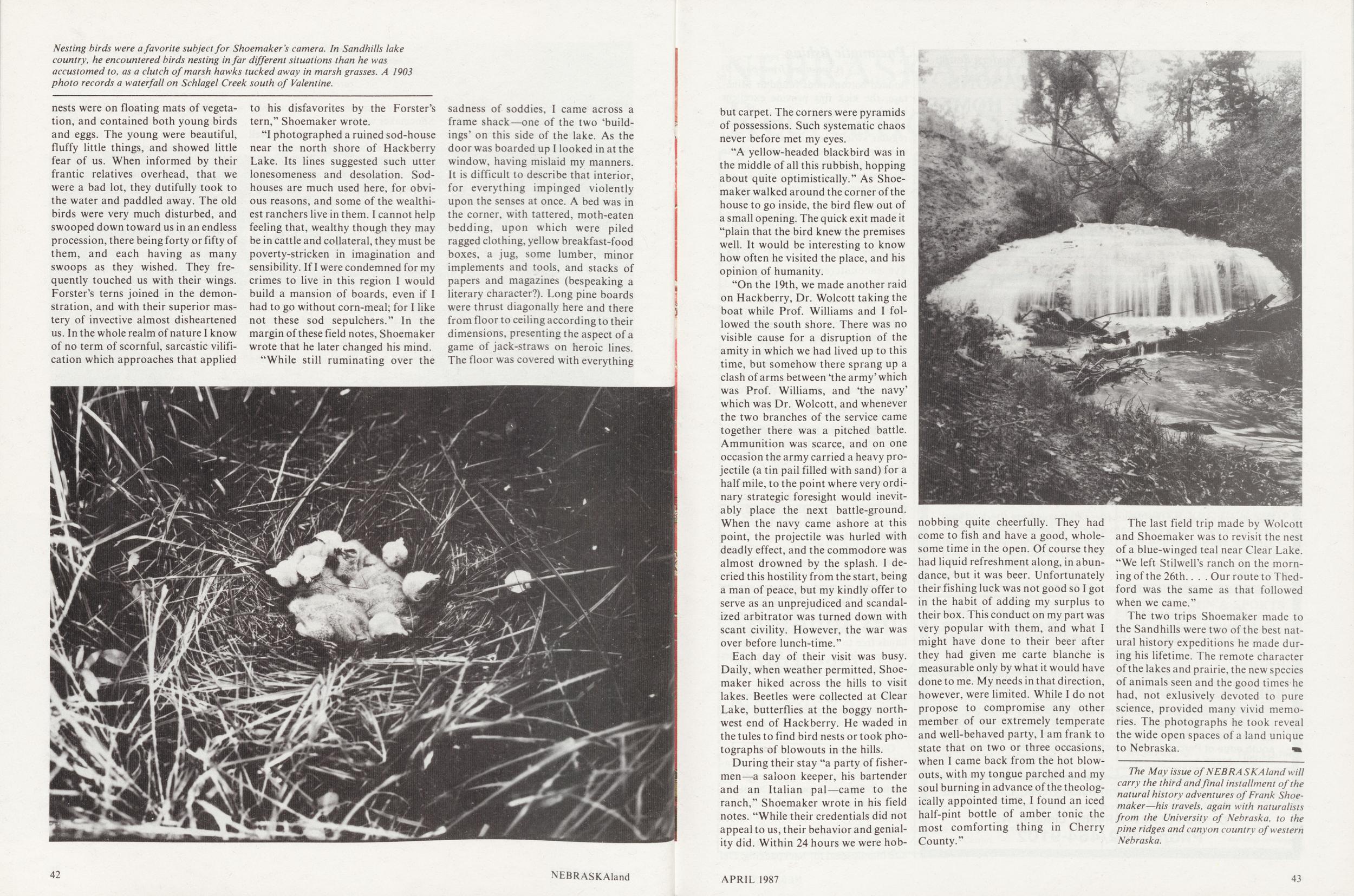 Nesting birds were a favorite subject for Shoemakers camera. In Sandhills lake
country, he encountered birds nesting in far different situations than he was
accustomed to, as a clutch of marsh hawks tucked away in marsh grasses. A 1903
photo records a waterfall on Schlagel Creek south of Valentine.
Nesting birds were a favorite subject for Shoemakers camera. In Sandhills lake
country, he encountered birds nesting in far different situations than he was
accustomed to, as a clutch of marsh hawks tucked away in marsh grasses. A 1903
photo records a waterfall on Schlagel Creek south of Valentine.
"I photographed a ruined sod-house near the north shore of Hackberry Lake. Its lines suggested such utter lonesomeness and desolation. Sod houses are much used here, for obvious reasons, and some of the wealthiest ranchers live in them. I cannot help feeling that, wealthy though they may be in cattle and collateral, they must be poverty-stricken in imagination and sensibility. If I were condemned for my crimes to live in this region I would build a mansion of boards, even if I had to go without corn-meal; for I like not these sod sepulchers." In the margin of these field notes, Shoemaker wrote that he later changed his mind.
"While still ruminating over the sadness of soddies, I came across a frame shack—one of the two 'buildings' on this side of the lake. As the door was boarded up I looked in at the window, having mislaid my manners. It is difficult to describe that interior, for everything impinged violently upon the senses at once. A bed was in the corner, with tattered, moth-eaten bedding, upon which were piled ragged clothing, yellow breakfast-food boxes, a jug, some lumber, minor implements and tools, and stacks of papers and magazines (bespeaking a literary character?). Long pine boards were thrust diagonally here and there from floor to ceiling according to their dimensions, presenting the aspect of a game of jack-straws on heroic lines. The floor was covered with everything 42 NEBRASKAland but carpet. The corners were pyramids of possessions. Such systematic chaos never before met my eyes.
"A yellow-headed blackbird was in the middle of all this rubbish, hopping about quite optimistically." As Shoemaker walked around the corner of the house to go inside, the bird flew out of a small opening. The quick exit made it "plain that the bird knew the premises well. It would be interesting to know how often he visited the place, and his opinion of humanity.
"On the 19th, we made another raid on Hackberry, Dr. Wolcott taking the boat while Prof. Williams and I followed the south shore. There was no visible cause for a disruption of the amity in which we had lived up to this time, but somehow there sprang up a clash of arms between 'the army' which was Prof. Williams, and 'the navy' which was Dr. Wolcott, and whenever the two branches of the service came together there was a pitched battle. Ammunition was scarce, and on one occasion the army carried a heavy projectile (a tin pail filled with sand) for a half mile, to the point where very ordinary strategic foresight would inevitably place the next battle-ground. When the navy came ashore at this point, the projectile was hurled with deadly effect, and the commodore was almost drowned by the splash. I decried this hostility from the start, being a man of peace, but my kindly offer to serve as an unprejudiced and scandalized arbitrator was turned down with scant civility. However, the war was over before lunch-time."
Each day of their visit was busy. Daily, when weather permitted, Shoemaker hiked across the hills to visit lakes. Beetles were collected at Clear Lake, butterflies at the boggy northwest end of Hackberry. He waded in the tules to find bird nests or took photographs of blowouts in the hills.
During their stay "a party of fishermen—a saloon keeper, his bartender and an Italian pal—came to the ranch," Shoemaker wrote in his field notes. "While their credentials did not appeal to us, their behavior and geniality did. Within 24 hours we were hobnobbing quite cheerfully. They had come to fish and have a good, wholesome time in the open. Of course they had liquid refreshment along, in abundance, but it was beer. Unfortunately their fishing luck was not good so I got in the habit of adding my surplus to their box. This conduct on my part was very popular with them, and what I might have done to their beer after they had given me carte blanche is measurable only by what it would have done to me. My needs in that direction, however, were limited. While I do not propose to compromise any other member of our extremely temperate and well-behaved party, I am frank to state that on two or three occasions, when I came back from the hot blowouts, with my tongue parched and my soul burning in advance of the theologically appointed time, I found an iced half-pint bottle of amber tonic the most comforting thing in Cherry County."
The last field trip made by Wolcott and Shoemaker was to revisit the nest of a blue-winged teal near Clear Lake. "We left Stilwell's ranch on the morning of the 26th.. . . Our route to Thedford was the same as that followed when we came."
The two trips Shoemaker made to the Sandhills were two of the best natural history expeditions he made during his lifetime. The remote character of the lakes and prairie, the new species of animals seen and the good times he had, not exclusively devoted to pure science, provided many vivid memories. The photographs he took reveal the wide open spaces of a land unique to Nebraska.
The May issue of NEBRASKAland will carry the third and final installment of the natural history adventures of Frank Shoemaker—his travels, again with naturalists from the University of Nebraska, to the pine ridges and canyon country of western Nebraska.
APIRL 1987 43 Rustic living with modern design
FOUR SEASONS
SOLID PINE HOMES
The exclusive
double log wall system
consists of two thick
pine log exterior walls with
insulation in between
walls-R-20roof-R-35.
Four Seasons' log profile.
Choose from our broad range of plans,
or style and design your own home.
You are welcome to tour our
show home at Lakeview, Lake McConaughy
anytime.
For information contact:
FOUR SEASONS
SOLID PINE HOMES
P.O. Box 221
Ogallala, NE 69153
(308) 284-4344
State LatirJ
PROPERTY
AT
AUCTION
Parcel 2
510 Acres
365 Acres Gifted to
Cheyenne
December 1 984
For Memorial
&
Cultural
Center;
State Land
Parcel 1
275 Acres
County
A Unique & Once in a Lifetime Chance to Bid & Buy
The dramatic view of the White River Buttes (where the Northern
Cheyenne made their desperate escape in below zero weather in
January 1879), and the total 360 degree panoramic view that
includes Crow Butte, the White River Valley, Dead Man's Creek and
Fort Robinson State Park is being offered at auction.
The land is being offered in two parcels:
1. A parcel of 275 acres with U.S. Highway 20 as the north border, is
the first parcel. It has several spring fed ponds and offers one of the
most picturesque views in the Pine Ridge. The land is basically class
IV land and will grow small grains and alfalfa.
2. This parcel of land is 510 acres of beautiful and rugged Butte
country. U.S. Highway 20 is the south border of this parcel.
These two tracts are the only privately held land bordering U.S.
Highway 20 from the west edge of Crawford to the head of Smiley
Canyon almost 10 miles farther west. All the land except for the
south edge of Parcel 1, is bordered by Fort Robinson State Park or
Wildlife Areas.
April 30, 1987 - 2 PM - Cornhusker Hotel, Lincoln, NE
Paul Mike Grieger - Austin Auction Co.
Division of Austin Realty, Lincoln, NE
Phone 402/464-9102
Rustic living with modern design
FOUR SEASONS
SOLID PINE HOMES
The exclusive
double log wall system
consists of two thick
pine log exterior walls with
insulation in between
walls-R-20roof-R-35.
Four Seasons' log profile.
Choose from our broad range of plans,
or style and design your own home.
You are welcome to tour our
show home at Lakeview, Lake McConaughy
anytime.
For information contact:
FOUR SEASONS
SOLID PINE HOMES
P.O. Box 221
Ogallala, NE 69153
(308) 284-4344
State LatirJ
PROPERTY
AT
AUCTION
Parcel 2
510 Acres
365 Acres Gifted to
Cheyenne
December 1 984
For Memorial
&
Cultural
Center;
State Land
Parcel 1
275 Acres
County
A Unique & Once in a Lifetime Chance to Bid & Buy
The dramatic view of the White River Buttes (where the Northern
Cheyenne made their desperate escape in below zero weather in
January 1879), and the total 360 degree panoramic view that
includes Crow Butte, the White River Valley, Dead Man's Creek and
Fort Robinson State Park is being offered at auction.
The land is being offered in two parcels:
1. A parcel of 275 acres with U.S. Highway 20 as the north border, is
the first parcel. It has several spring fed ponds and offers one of the
most picturesque views in the Pine Ridge. The land is basically class
IV land and will grow small grains and alfalfa.
2. This parcel of land is 510 acres of beautiful and rugged Butte
country. U.S. Highway 20 is the south border of this parcel.
These two tracts are the only privately held land bordering U.S.
Highway 20 from the west edge of Crawford to the head of Smiley
Canyon almost 10 miles farther west. All the land except for the
south edge of Parcel 1, is bordered by Fort Robinson State Park or
Wildlife Areas.
April 30, 1987 - 2 PM - Cornhusker Hotel, Lincoln, NE
Paul Mike Grieger - Austin Auction Co.
Division of Austin Realty, Lincoln, NE
Phone 402/464-9102
Pneumatic fishing
(Continued from page 9)flooded cottonwoods found at Minatare, the kick fins provide excellent locomotion.
Glen Moravek uses a large pair of regular swim fins, and on several of our trips to larger lakes he is able to quickly outdistance me. I plan to use larger fins for open-water fishing and use the smaller kick fins where appropriate.
Neoprene waders are a fairly recent innovation. My neoprene waders are completely waterproof and suitably warm for most Nebraska conditions I've encountered. Neoprene is extremely easy to repair if punctured, and even a large tear or hole can be repaired in the field with the proper neoprene glue. Del's suggestion to wear a thin wader over the neoprene in extremely cold water is another possibility. So far, I’ve fished water at a measured temperature of 40 degrees with neoprene waders and polypropylene long johns for up to three hours with no discomfort.
Float tubes are available in a fairly wide price range. If the opportunity to visit with experienced float boaters arises, by all means ask for their recommendations. A good, serviceable tube can be purchased for less than $ 100, including the tube and such niceties as a front apron to prevent equipment loss and to hold flyline between casts, side pockets, and some type of carrying strap or handles. My tube includes a set of suspenders that can be used as shoulder straps to backpack the inflated tube short distances, and allow the fisherman to carry the tube suspended into the water, leaving hands free to carry a fishing pole and to help maintain balance. Float boaters often customize the floats. An experienced Scottsbluff fisherman adds grommets along the bottom of the tube cover to allow trapped water to drain. Some of the better quality covers come equipped with drain holes.
Glenn uses a float tube of Canty design that has a lot of subtle innovations. The tube is made of neoprenecoated cloth with two air chambers, each equipped with an air valve that allows the tube to be inflated orally, even while on the water. The tube weighs 2.8 pounds and folds into a fist-size bundle ideal for backpacking. Del relates patching small holes in the cover while on the water by partially deflating the leaking chamber and applying glue over the hole. After several minutes, the chamber can be brought up to pressure and fishing resumed.
44 NEBRASKAland NEBRASKAland Magazine's Recreation Services Guide CUSTOM ROD & REPAIR Personalized Fishing Rods Name Brand Fishing Tackle NORM ARNETT Professional Rod Crafter (402) 464-0709 4332 N. 62nd Lincoln, NE FISH TACKLE & SUPPLY 201 North 19th Street Who Knows Better What You Need" 476-1710 Lincoln, NE THE TACKLE SHOP LIVE BAIT AMMO ARCHERY 48th & Highway 2, Briarhurst Center Lincoln, NE (402) 423-1303 V&G BAIT SHOP FISHING SUPPLIES LURES, LIVE BAIT Hunting, Fishing, Park Permits Hickman, NE (402) 792-2590 SNEEDS BAIT SHOP Live Bait, Fishing Supplies, Snacks, Off-Sale Beer, Gas, Pop, Ice SPRAGUE, NE Spotlight on Southeast Nebraska BURDENS OUTDOOR OUTFITTERS Nebraska's largest selection of quality name brand sporting goods and supplies. 1000 West "O" Street Lincoln, NE 68528 (402) 474-4366 Branched Oak Marina, Inc. Restaurant & Marina Gas, Fishing Supplies, Live Bait, Beer, Ice and More Branched Oak Lake Raymond, NE (402) 783-3311 PAWNEE LAKE MARINA FISHING SUPPLIES CAMPING SUPPLIES SNACK BAR • BAIT BEER «GAS • LURES (402) 796-2330 Crossroads Bait Shop Bait • Gas • Fishing Supplies • Pop Snacks 8401 West "O" St. Lincoln, NE (402) 475-5959 WOODLAWN BAIT BEER • BAIT • TACKLE • GAS Highway 34 and Northwest 48th Lincoln, NE (402) 470-8935 To advertise in NEBRASKAland's Recreation Services Guide call (402) 464-0641. Ask for Dan Curran. KZ LURES "THE ULTIMATE CRAPPIE LURE" Also great for large and smallmouth bass, bluegill and walleye Write or Call for Price List 2421 No. 74th St. Lincoln, NE 68507 (402) 464-6543 Alamo Sporting Goods Full line of fishing tackle and equipment and more! 5500 Alamo Drive 56th & Hwy. 2 Lincoln, NE (402) 423-0808 Toni's Corner & General Store Groceries • Bait • Tackle Pop • Ice • Beer Hwy. 79 & Raymond Rd. Raymond, NE (402) 783-3461 POWDER KEG GUN SHOP ' LIVE BAIT • FISHING TACKLE Hunting and Fishing Supplies Buy, Sell and Trade Guns • Gun Repair 3245 S. 10 Lincoln, NE (402) 423-9681 HOGIES GUN & SPORTS Hunting & Fishing is Our Business Sell, Trade, Repair, Bluing, Reloading and More 1315 "J" Street Auburn, NE (402) 274-4426 PAAPS SPORT SHOP Hunting, Trapping, Fishing Supplies Southeast Fur Buyers RAW FURS SKINNED OR UNSKINNED 1315 South 11 St. Nebraska City, NE (402) 873-7040 KEN-KO Inc. Spend a day fishing the scenic Missouri River with Fishing Guide Kenneth Cooksey. For information write or call: 2002 2nd Ave. (402) 873-6288 Nebraska City, NE mornings/evenings APIRL 1987 45 ATTENTION ALL COOKS!!
From the Kitchen of NEBRASKAland Magazine
A new, expanded "country" cookbook will
be published by NEBRASKAland Magazine
in 1988. It will feature game and fish
recipes, but will also include non-game
items such as ethnic, old family and pioneer
recipes using any "domestic" fowl and
meat, plus wild berries, breads, desserts,
soups and the full range of good things to
eat. All recipes used will be rewarded with a
free cookbook, plus a byline. Submit as soon
as possible, and as many recipes as you
wish. The deadline, like taxes, will be April
15. Send in your favorites!
Send recipes with full name and address to:
NEBRASKAland Recipes,
Box 30370, Lincoln, NE 68503.
OUTFITTING YOU FOR THE GOOD UFF
Nebraska's largest selection of quality
name brand sporting goods.
Count on us to provide you with the finest outdoor clothing
and equipment at special low prices. See Burden's Outdoor
Outfitters when you're in Lincoln. Get the best of the outdoors.
Camping • Hunting • Fishing • Boating • Backpacking
X-Country Skiing • Water Sports • Boots, Shoes, Waders
Mens, Women’s, Children’s Functional
Outdoor Clothing and Gear
1000 West "0" Street
Lincoln, NE 68528
474-4366
ATTENTION ALL COOKS!!
From the Kitchen of NEBRASKAland Magazine
A new, expanded "country" cookbook will
be published by NEBRASKAland Magazine
in 1988. It will feature game and fish
recipes, but will also include non-game
items such as ethnic, old family and pioneer
recipes using any "domestic" fowl and
meat, plus wild berries, breads, desserts,
soups and the full range of good things to
eat. All recipes used will be rewarded with a
free cookbook, plus a byline. Submit as soon
as possible, and as many recipes as you
wish. The deadline, like taxes, will be April
15. Send in your favorites!
Send recipes with full name and address to:
NEBRASKAland Recipes,
Box 30370, Lincoln, NE 68503.
OUTFITTING YOU FOR THE GOOD UFF
Nebraska's largest selection of quality
name brand sporting goods.
Count on us to provide you with the finest outdoor clothing
and equipment at special low prices. See Burden's Outdoor
Outfitters when you're in Lincoln. Get the best of the outdoors.
Camping • Hunting • Fishing • Boating • Backpacking
X-Country Skiing • Water Sports • Boots, Shoes, Waders
Mens, Women’s, Children’s Functional
Outdoor Clothing and Gear
1000 West "0" Street
Lincoln, NE 68528
474-4366
Other innovations include plastic stringers without sharp points. For panfishing, Eve used a regular fish basket that I've added a small innertube to at the top. The fish basket is tied by a light cord and floats behind me as I move forward. Long stringers should be attached to the boat by both ends to prevent tangling around the feet. Remember also that anything that tangles around the fins or feet will make travel impossible and assistance mandatory. This includes a larger fish, especially if larger lures with multiple treble hooks are used. Another reason to use a floating fish basket is that it is faster to use, especially when fish are really hitting.
On occasion, I've anchored over deep water and used bait fishing techniques, including minnow and nightcrawler rigs for bottom-feeding walleyes. A small nylon sack with added rocks or sand is sufficient to hold the floatboat stationary in windy conditions if enough anchor line is used. Canty recommends using a two-anchor system in heavy water. His system uses a floating anchor line holder, which makes it easy to detach from the anchors to land a fish. I use a small plastic float tied at the upper end of the anchor line to allow detaching from the anchor at a moment's notice.
Other innovations include a plastic jar tied to the float boat to serve as a minnow bucket. Its inventor simply punched holes in the sides to allow water exchange. A string passed through the lid and tied in a knot serves to keep the jar alongside.
Commercially available rod holders that strap around the tube allow the angler to use both hands to land fish or tie on different lures. I try to use a short string tied to the rod or attached with a clip to prevent loss of the rod and reel.
A small hand net is necessary to land larger fish. Mine is a short trout net that I found several years ago along a mountain stream. I replaced the small net with a deeper one, and while I don't need a long handle to net a fish, a deeper net makes things easier. Be careful with sharp dorsal fins and treble hooks. Try to keep fish hooks and net away from the tube. Also, try to keep the fish in the net until the stringer is attached and the hook removed. Another custom addition to float tubes is a ruler or tape measure to use where size limits are involved. A permanent marking pen can be used to mark an accurate ruler on the apron.
CAN'T BEAR YOUR JOB ANYMORE? COME STAY WITH US AWHILE. on Lake McConaughy Air-conditioned units, cooking facilities. Up to four adults. Campground on the beach—50 hookups, showers, play ground, shade. • MARINA • CAMPGROUND •GUIDE SERVICE • LAUNCHING STORE Groceries, Beer, Pop, Tackle, Live Bait • BOAT & PONTOON RENTALS South Shore Big Mac at Gate 18 R.R. #1 Box L-9 Brule, NE 69127 Ogallala, NE (308) 284-4965 NEBRASKA'S BEST KEPT FISHING SECRET The Missouri River From Nebraska City to Brownville • Catfish • Walleye • Sauger and more! Spend a day fishing on the scenic Missouri River and let guide Kenneth Cooksey show you why many of the state's top anglers fish this area again and again. Cost: $60 for 1 person, $75 for 2 people (added charge for bait and fuel) For more information write or call Kenneth Cooksey KEN KO Inc. 2002 2nd Ave. Nebraska City, NE 68410 (402) 873-6288 early morning & late evenings APRIL 1987 47 Aaahh!
EXPERIENCE
NEBRASKA...
vv/7/z an affordable canoe trip by
DRYLAND AQUATICS
• Niobrara • Dismal • Platte • Elkhorn
-YOU NAME IT-
One & two day trips available
canoe rental only or fully catered
—WE DO IT YOUR WAY—
Write for FREE brochure
Dryland Aquatics, Rt. 1,
Fremont, NE 68025 Ph. (402) 721-4177
STOCK YOUR LAKE
OR POND WITH
Channel cat, Bluegill,
Largemouth Bass,
Hybrid Bluegill,
Crappie, Triploid Grass
Carp, Minnows
ORDER NOW
WILLOW LAKE FISH HATCHERY
Rt. 3, Box 46, Hastings, Nebr. 68901
Gaylord L. Crawford
Phone: (402) 463-8022
Day or Night
For April to October 15 stocking
BERGMANS RESORT
On Beautiful Johnson Lake
Lakefront Cabins* RV Hookups*
Groceries* Beer* Bait* Tackle*
Restaurant* Lounge*
Boat Rentals*
Guide Service.
Fish* Swim* Golf
Elmer and Janet Bergman
RR 2, Elwood, NE 68937
(308) 785-2298
Help keep
our forest
from
smoking.
Use your
ashtray.
Don't be careless
with the future.
A Public Service of This Magazine
6k The Advertising Council
WELCOME
to
Merritt Dam Trading Post
Located on beautiful Merritt Reservoir
26 Miles So. Of Valentine On Hwy. 97
Phone 402/376-3437
Bait • Tackle • Ammunition • Groceries • Gas • Beer • Ice
Year-round Modern Cabins with Kitchen Facilities
Campground Hook-ups • Boat and Motor Rental • Professional Guide Service
Easy-access dock • Open year around
Home of the State Record Perch,
Muskellunge and Smallmouth bass
x
Your Hosts
Jon and Marian Davenport
Aaahh!
EXPERIENCE
NEBRASKA...
vv/7/z an affordable canoe trip by
DRYLAND AQUATICS
• Niobrara • Dismal • Platte • Elkhorn
-YOU NAME IT-
One & two day trips available
canoe rental only or fully catered
—WE DO IT YOUR WAY—
Write for FREE brochure
Dryland Aquatics, Rt. 1,
Fremont, NE 68025 Ph. (402) 721-4177
STOCK YOUR LAKE
OR POND WITH
Channel cat, Bluegill,
Largemouth Bass,
Hybrid Bluegill,
Crappie, Triploid Grass
Carp, Minnows
ORDER NOW
WILLOW LAKE FISH HATCHERY
Rt. 3, Box 46, Hastings, Nebr. 68901
Gaylord L. Crawford
Phone: (402) 463-8022
Day or Night
For April to October 15 stocking
BERGMANS RESORT
On Beautiful Johnson Lake
Lakefront Cabins* RV Hookups*
Groceries* Beer* Bait* Tackle*
Restaurant* Lounge*
Boat Rentals*
Guide Service.
Fish* Swim* Golf
Elmer and Janet Bergman
RR 2, Elwood, NE 68937
(308) 785-2298
Help keep
our forest
from
smoking.
Use your
ashtray.
Don't be careless
with the future.
A Public Service of This Magazine
6k The Advertising Council
WELCOME
to
Merritt Dam Trading Post
Located on beautiful Merritt Reservoir
26 Miles So. Of Valentine On Hwy. 97
Phone 402/376-3437
Bait • Tackle • Ammunition • Groceries • Gas • Beer • Ice
Year-round Modern Cabins with Kitchen Facilities
Campground Hook-ups • Boat and Motor Rental • Professional Guide Service
Easy-access dock • Open year around
Home of the State Record Perch,
Muskellunge and Smallmouth bass
x
Your Hosts
Jon and Marian Davenport
Float boats can be an excellent way to reach fishable water. Given the proper safety equipment, including a Coast Guard approved personal flotation device required by Nebraska law, and a basic understanding of safety fundamentals, float boating will continue to be a quietly growing part of Nebraska's fishing scene.
What is a sportsman’s wife?
(Continued from page 17)down, I really don't mind that much. I live for the day when he'll cook breakfast and pack lunches while I get ready to go to "the pits" with him. I can see him now taking me to a fancy restaurant, after the hunt. After a few glasses of wine and a thick, juicy steak, he takes me home. Once there, he smiles sweetly and says, I'll clean and pick them for you, honey."
Will this dream come true? I doubt it, but it's a nice dream, anyway.
The truth is, our family really enjoys the meat, and the kids do enjoy helping clean the birds, even though they get more feathers on the floor than in the garbage. And, we always get a good laugh when Charlie retells his hunting stories over and over. Each time they are a little better and a little different.
Some day our kids will tell their kids about how it was to live in the "olden days" with a great hunter.
Our son will inherit "the gun," and he'll tell his kids of its magic powers. I hope he'll love it and talk to it as his father does.
As for the girls, I only hope they both marry hunters. I hope they experience all the joys and woes that I have, and dream the dreams I do, for nothing is more fulfilling and challenging, after all, than being a "sportsman's wife."
NEBRASKAland proudly presents the stories of its readers. Here is the opportunity so many have requested—a chance to tell their own out- door tales. Hunting trips, the "big fish that got away", unforgettable characters, outdoor impressions—all have a place here. If you have a story to tell, jot it down and send it to Editor, NEBRASKAland, Box 30370, Lincoln, Nebr. 68503. Send photographs, black and white or color, too, if any are available. 48 NEBRASKAlandTrading Post
DOGSTRAINING ALL BREEDS Hunting Dogs -- Vizslas for sale. Rozanek Kennels, Rt. 2, Schuyler, NE 68661. Phone (402) 352-8769.___________________________
ENGLISH SETTERS: "Bred for the hunter"; select puppies and started dogs available from outstanding bloodlines. Stud service available by proven hunters. High Plains Kennels, 1411 Emerson, Alliance, NE 69301, Phone (308) 762-6709._____________________
GROUSEWAY BRITTANIES: Ideal hunting companions—dedicated, goal-oriented breeding programs. FREE brochure, Grouseway Gundogs, Louisville, NE 68037. (402) 298-8340. Training available.___________
GERMAN SHORTHAIRS and Brittany Spaniel pups. Started and occasionally a meat dog. Pups are guaranteed. Also I will be training hunting dogs. Wayne Clark, Percival, I A. Phone (712) 529-4238 or (402) 263-3155 at Union, NE._____________________
MISCELLANEOUSNE NEBRASKA trout fishing. 3 modern cottages, 1 available year round. 5 spring fed lakes with open water all year. Trout up to 7 pounds. Other varieties fish also. Diamond E. Trout Resort, Orchard, NE 68764. Phone (402) 893-4745._________________________________
GUNS — Browning, Winchester, Remington, others, Hi-powers, shotguns, new, used, antiques. Want Pre-1964 Winchesters. Buy-Sell-Trade. Ph. (402) 729-6112. Bedlan's Sporting Goods, Fairbury, NE 68352.
MAD RIVER CANOES offers the finest quality and performance. For the finest canoes and accessories look to Great Plains Canoe Co., 205 Main, Springfield, NE. Phone (402) 253-2001.
LIVE-CATCH ALL-PURPOSE TRAPS FREE CATALOG Traps without injury squirrels, chipmunks, rabbits, mink, fox, raccoons, stray animals, pests, etc. Sizes for every need. Also traps for snakes, sparrows, pigeons, crabs, turtles, quail, etc. Save on our low factory prices. Send no money. Free catalog and trapping secrets. MUSTANG MFG. CO., Oept. N-34, Box 920947. Houston, Tex. 77292RECEIVE $75/100 envelopes returned to us. Rush stamped envelope: Kelley 4, 804 Old Throsby Road, Clanton, Alabama 35045.
FREE BOOK CATALOG. Over 800 titles. Western Americana, history, old west, gold/more. Research, Ames, NE 68621. Phone (402) 727-9833.____________
STOCK SHOP wood stocks for all firearms. Repaired, refinished or custom made. Hand-cut checkering, glass bedding. 1618 Euclid, Ashland, NE 68003. Phone (402) 944-2836.___________________________
HUNTERS WITH BUDDIES -own your own hunt- ing paradise with Niobrara River frontage. 3080 acres, with spring creeks and abundant timber and wildlife. Sweet Realty, P.O. Box 265, Ainsworth, NE 69210. Phone (402) 387-1626 day or night.________________
HOMEWORKERS! RECEIVE $75/100 envelopes you return to us per instructions. Rush stamped envelope: Kelley 5, 804 Old Thorsby Road, Clanton, Alabama 35045.____________________________________.
FOR SALE: Hunting cottage and year-round retreat. Located near Nebraska's beautiful Pine Creek, Long Pine, Nebraska. Excellent hunting and trout fishing. Call Wardene Roark (402) 273-4141.
TROLLING MOTOR REPAIR. Factory authorized Minn Kota and Motor Guide, parts and service. Wolf's Repair and Installation, 1529 David Drive, Lincoln, NE 68504. Phone (402) 464-4265.__________________
WINE AND BEER: Make your own. Send for free recipes and instructions. Omaha Supply, 1324 2nd Avenue, Nebraska City, NE 68410.
WOOD SLABS for sale, all kinds, all sizes. Ideal for clocks or painting, finished or unfinished. All sizes of Cypress slabs. For price list write to: Clocks, HC 30- Box 57, McCook, NE 69001.
TAXIDERMYALLISON'S TAXIDERMY STUDIO. Wally and Betty Allison, Licensed Taxidermist. We've mounted 21 Nebraska State Record fish. Specializing in fish and birds, small game and rattlesnakes. We use freeze-dry. 2310 West Leota, North Platte, Nebr. 69101. Phone (308) 534-2324. ________________________
BADE TAXIDERMY - Quality a must — Fast service. Fish, birds, rugs, tanning, full mounts and game heads, 2111 N. Christy St., Fremont, NE 727-5463.
KARL SCH WARZ master taxidermist has moved to a new country studio; same professional mounting and tanning service. Schwarz Wild Wing Studio, 16804 South 180th St., Springfield, NE 68059. Phone (402) 253-2481.______________________________________
NABITY'S TAXIDERMY. 31 years experience. Specializing in natural grass backgrounds for mammals, birds and fish. 13901 "O" St., Lincoln, NE 68504 — 4 miles east of 84th and "O". (402) 489-6351._________
BIG BEAR TAXIDERMY, Rt. 2, Mitchell, Nebraska 69357. We specialize in all big game from Alaska to Nebraska, also birds and fish. Hair on and hair off tanning. Four miles west of Scottsbluff on Highway 26. Dale Hubel, phone (308) 635-3013.________________
PEISTER TAXIDERMY Professional work at prices most sportsman can afford. Now in our new log cabin studio, 1020 Central Avenue, Box 3201, Kearney, NE 68847. Phone (308) 236-9700 or (308) 237-7575 evenings.
NATURE CRAFT STUDIO — all custom services - creative work, quality, and experience since 1935. Includes freeze-dry processing. Display and sales room, visitors welcome. Hwy. 2 in Nebraska City. Phone (402) 873-5491. Joe Voges Owner. Bow Steadily — Big Game specialist.
NEBRASKAland Magazine Order Form Please send me a subscription to NEBRASKAland Magazine One-year $12.00 NAME Two-year $23.00 ADDRESS CITY____ STATE ZIP. Harlan County Dam Vacation Apartments - fully furnished Color TV • Kitchen Facilities • Full Baths Game cleaning room with freezer One block from shopping center Weekend or week of pleasant living Security Deposit Required Sorry —No Pets Dean and Esther Stone Box 145 Ph. (308)799-3422 Republican City, NE 68971 Hatching Eggs Mature Flyers Day-Old Chix Oven Ready Started Birds Hickory Smoked OUbl Game Bird Farms R. 2, Box 358, Beloit, Wi 53511 PHEASANTS - WILD TURKEYS CHUKAR& HUNGARIAN PARTRIDGES OFFERS A COMPLETE TRAINING PROGRAM For Retrievers, Pointers, Spaniels Basic Obedience Program For All Breeds Field Trial Bloodline Lab Pups For Sale JOHN HONORE Manager and Trainer West Highway 30 RR 1 Box 433 Grand Island, NE 68801 Phone: (308)384-1517 Mail to: NEBRASKAland Magazine, Box 30370, Lincoln, NE 68503 CEDAR LANE Ranch Vacations Guest ranch in the heart of the Sandhills of Nebraska. Swimming, spa, horses, canoeing, trail rides, barbeques, hunting. BOOKING NOW For 1987 Richard and Betty Schroeder HC 2 Box 9C Stapleton, Nebraska 69163 Ph. 308-587-2233 DISCOVER AMERICA GUN DOG TRAINING All Sporting Breeds All dogs worked on foot — no horses. Midwest's finest facilities. Field Champion-sired Labrador pups for sale. "Training for hunters by hunters" WILDERNESS KENNELS Henry Sader—Roca, Ne. (402)423-4212 68430 APRIL 1987 49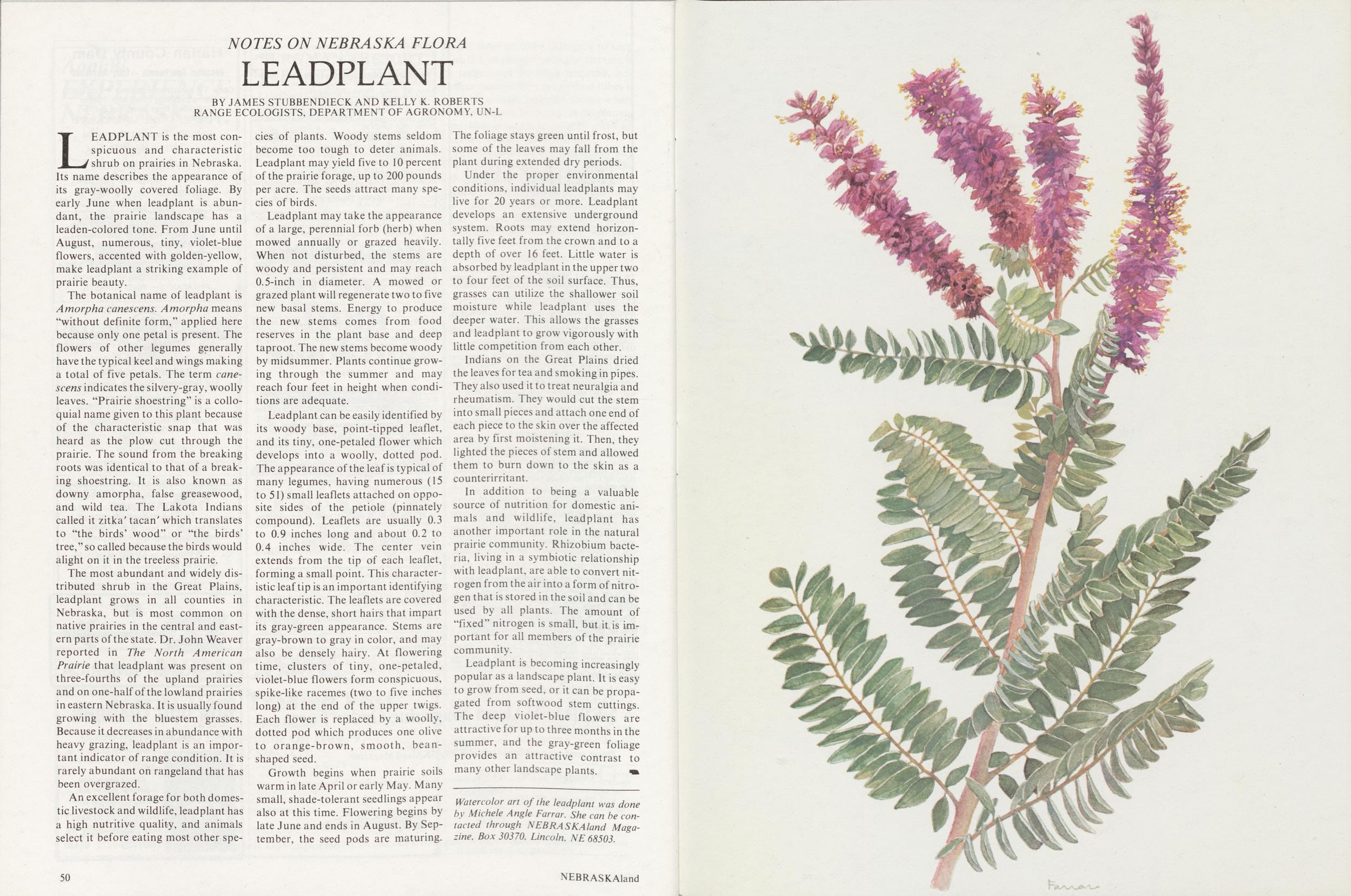
NOTES ON NEBRASKA FLORA LEADPLANT
BY JAMES STUBBENDIECK AND KELLY K. ROBERTS RANGE ECOLOGISTS, DEPARTMENT OF AGRONOMY, UN-LLEAD PLANT is the most conspicuous and characteristic shrub on prairies in Nebraska. Its name describes the appearance of its gray-woolly covered foliage. By early June when lead plant is abundant, the prairie landscape has a leaden-colored tone. From June until August, numerous, tiny, violet-blue flowers, accented with golden-yellow, make lead plant a striking example of prairie beauty.
The botanical name of lead plant is Amorpha canescens. Amorpha means "without definite form," applied here because only one petal is present. The flowers of other legumes generally have the typical keel and wings making a total of five petals. The term canescens indicates the silvery-gray, woolly leaves. "Prairie shoestring" is a colloquial name given to this plant because of the characteristic snap that was heard as the plow cut through the prairie. The sound from the breaking roots was identical to that of a breaking shoestring. It is also known as downy amorpha, false greasewood, and wild tea. The Lakota Indians called it zitka' tacan' which translates to "the birds' wood" or "the birds' tree," so called because the birds would alight on it in the treeless prairie.
The most abundant and widely distributed shrub in the Great Plains, lead plant grows in all counties in Nebraska, but is most common on native prairies in the central and eastern parts of the state. Dr. John Weaver reported in The North American Prairie that lead plant was present on three-fourths of the upland prairies and on one-half of the lowland prairies in eastern Nebraska. It is usually found growing with the bluestem grasses. Because it decreases in abundance with heavy grazing, lead plant is an important indicator of range condition. It is rarely abundant on rangeland that has been overgrazed.
An excellent forage for both domes- tic livestock and wildlife, lead plant has a high nutritive quality, and animals select it before eating most other species of plants. Woody stems seldom become too tough to deter animals. Lead plant may yield five to 10 percent of the prairie forage, up to 200 pounds per acre. The seeds attract many species of birds.
Lead plant may take the appearance of a large, perennial forb (herb) when mowed annually or grazed heavily. When not disturbed, the stems are woody and persistent and may reach 0.5-inch in diameter. A mowed or grazed plant will regenerate two to five new basal stems. Energy to produce the new stems comes from food reserves in the plant base and deep taproot. The new stems become woody by midsummer. Plants continue growing through the summer and may reach four feet in height when conditions are adequate.
Lead plant can be easily identified by its woody base, point-tipped leaflet, and its tiny, one-petaled flower which develops into a woolly, dotted pod. The appearance of the leaf is typical of many legumes, having numerous (15 to 51) small leaflets attached on opposite sides of the petiole (pinnately compound). Leaflets are usually 0.3 to 0.9 inches long and about 0.2 to 0.4 inches wide. The center vein extends from the tip of each leaflet, forming a small point. This characteristic leaf tip is an important identifying characteristic. The leaflets are covered with the dense, short hairs that impart its gray-green appearance. Stems are gray-brown to gray in color, and may also be densely hairy. At flowering time, clusters of tiny, one-petaled, violet-blue flowers form conspicuous, spike-like racemes (two to five inches long) at the end of the upper twigs. Each flower is replaced by a woolly, dotted pod which produces one olive to orange-brown, smooth, beanshaped seed.
Growth begins when prairie soils warm in late April or early May. Many small, shade-tolerant seedlings appear also at this time. Flowering begins by late June and ends in August. By September, the seed pods are maturing. The foliage stays green until frost, but some of the leaves may fall from the plant during extended dry periods.
Under the proper environmental conditions, individual lead plants may live for 20 years or more. Lead plant develops an extensive underground system. Roots may extend horizontally five feet from the crown and to a depth of over 16 feet. Little water is absorbed by lea dplant in the upper two to four feet of the soil surface. Thus, grasses can utilize the shallower soil moisture while lead plant uses the deeper water. This allows the grasses and lead plant to grow vigorously with little competition from each other.
Indians on the Great Plains dried the leaves for tea and smoking in pipes. They also used it to treat neuralgia and rheumatism. They would cut the stem into small pieces and attach one end of each piece to the skin over the affected area by first moistening it. Then, they lighted the pieces of stem and allowed them to burn down to the skin as a counterirritant.
In addition to being a valuable source of nutrition for domestic animals and wildlife, lead plant has another important role in the natural prairie community. Rhizobium bacteria, living in a symbiotic relationship with lead plant, are able to convert nitrogen from the air into a form of nitrogen that is stored in the soil and can be used by all plants. The amount of "fixed" nitrogen is small, but it is important for all members of the prairie community.
Lead plant is becoming increasingly popular as a landscape plant. It is easy to grow from seed, or it can be propagated from softwood stem cuttings. The deep violet-blue flowers are attractive for up to three months in the summer, and the gray-green foliage provides an attractive contrast to many other landscape plants.
Watercolor art of the lead plant was done by Michele Angle Farrar. She can be contacted through NEBRASKAland Magazine, Box 30370, Lincoln, NE 68503.
50 NEBRASKAland
UNCOVER THE ROUTE TO THE GREAT OUTDOORS.
Send us this coupon and we'll 1 send you information on America's great state of surprise...Nebraska.
Take a fresh look at Nebraska and you'll find thousands of rivers, lakes, parks, campgrounds and more. Your free copy of Vacation Nebraska is a 32-page full-color treasury of scenic trails, picturesque parks and inviting destinations.
It's all right here at home...easy to reach and right on your way.
For information on a Nebraska you've never seen, send this coupon or call toll-free 800-228-4307 (inside Nebraska call 800-742-7595).
Yes! I'd like to uncover Nebraska's outdoor secrets. Name Address City State Zip 87005 Please return coupon to: Nebraska Department of Economic Development, Division of Travel and Tourism, P.O. Box 94666, Lincoln, NE 68509. Uncover our secretsPosition: 53 (161 views)