Volume 65, Issue 2, 1987
NEBRASAKAland
MARCH 1987 $1.50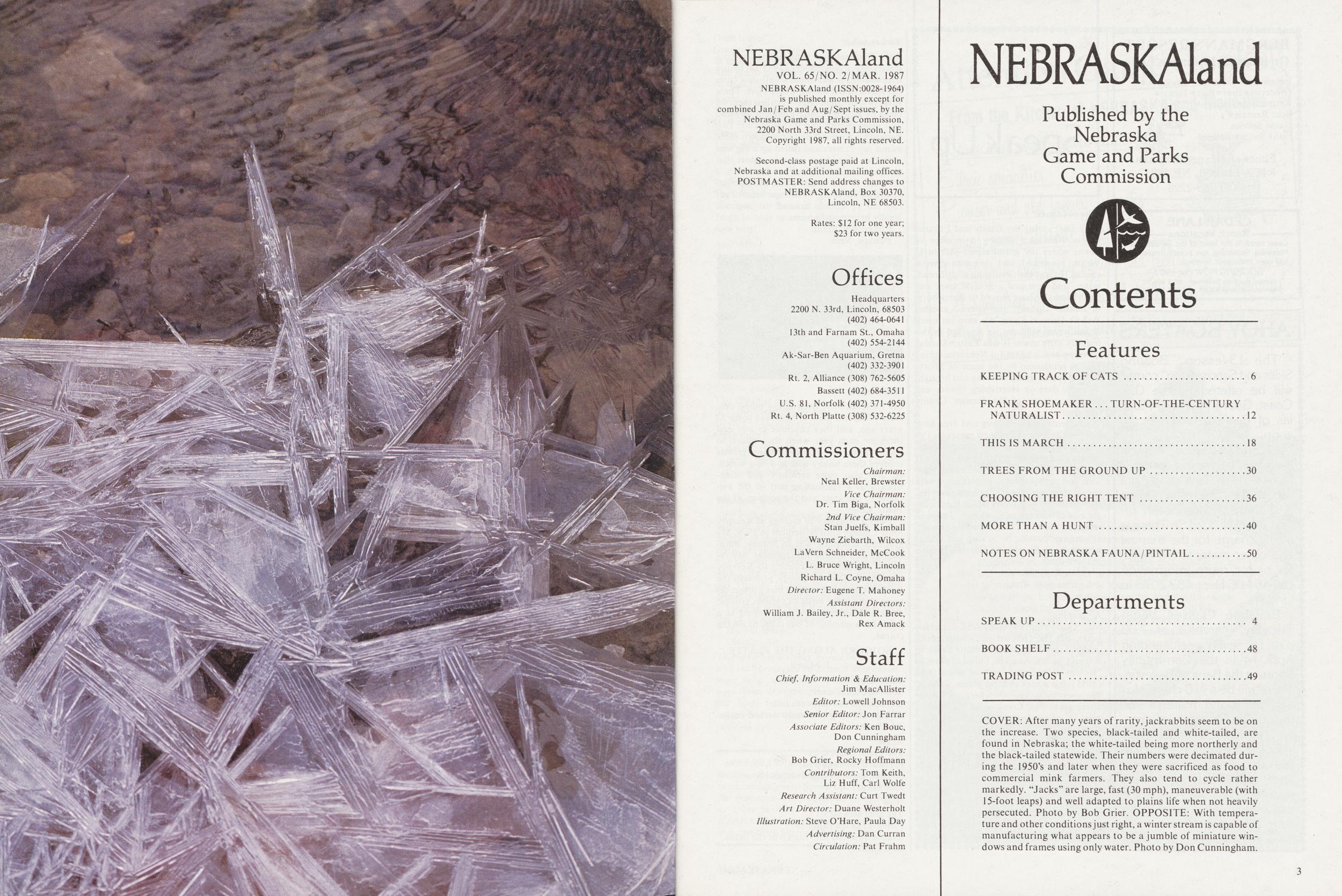
NEBRASKAland
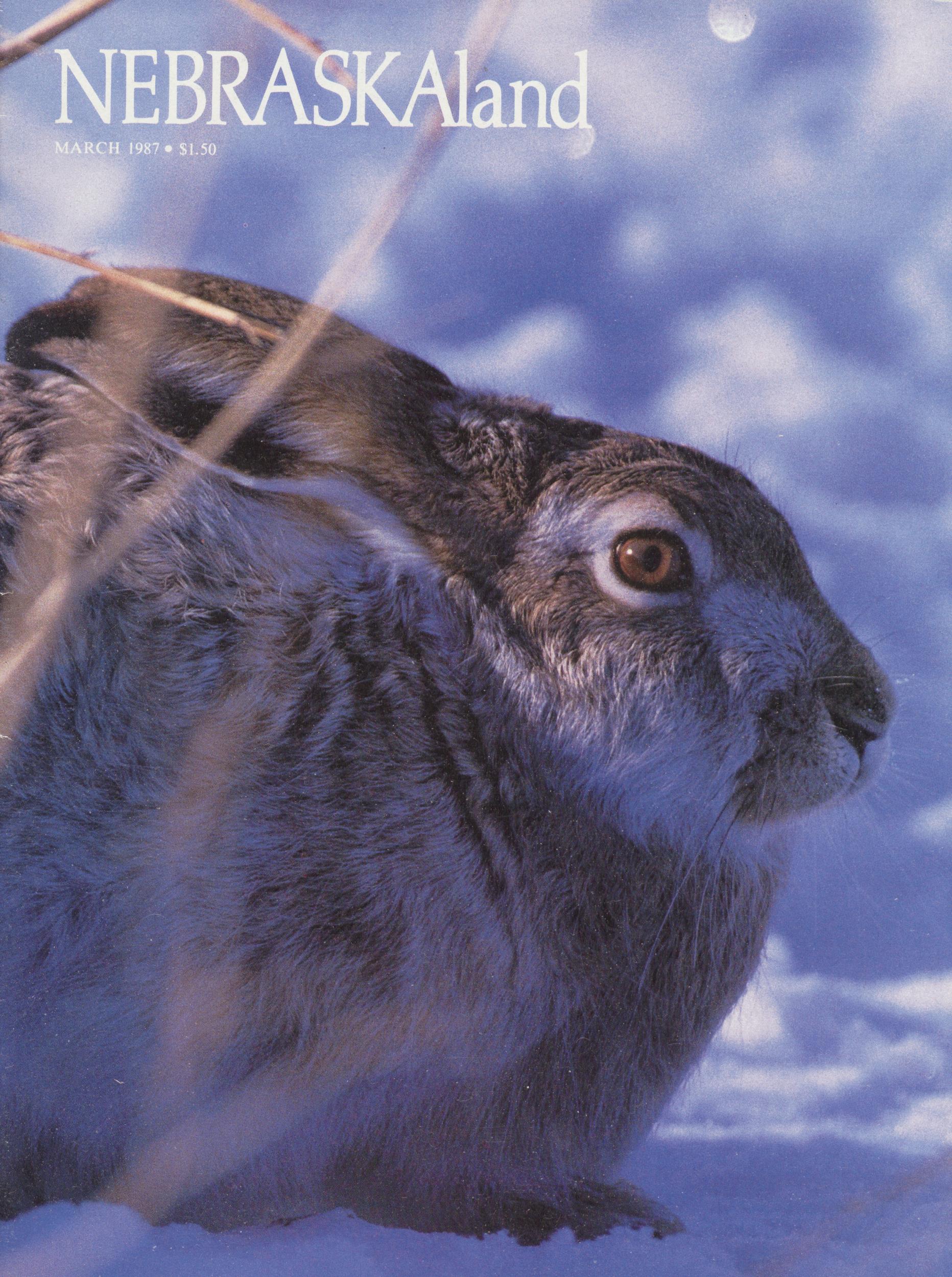
Published by the Nebraska Game and Parks Commission NEBRASKAland VOL. 65/NO. 2/MAR. 1987 NEBRASKAland (ISSN:0028-1964) is published monthly except for combined Jan/Feb and Aug/Sept issues, by the Nebraska Game and Parks Commission, 2200 North 33rd Street, Lincoln, NE. Copyright 1987, all rights reserved. Second-class postage paid at Lincoln, Nebraska and at additional mailing offices. POSTMASTER: Send address changes to NEBRASKAland, Box 30370, Lincoln, NE 68503. Rates: $12 for one year; $23 for two years. Offices Headquarters 2200 N. 33rd, Lincoln, 68503 (402) 464-0641 13th and Farnam St., Omaha (402) 554-2144 Ak-Sar-Ben Aquarium, Gretna (402) 332-3901 Rt. 2, Alliance (308) 762-5605 Bassett (402) 684-3511 U.S. 81, Norfolk (402) 371-4950 Rt. 4, North Platte (308) 532-6225 Commissioners Chairman: Neal Keller, Brewster Vice Chairman: Dr. Tim Biga, Norfolk 2nd Vice Chairman: Stan Juelfs, Kimball Wayne Ziebarth, Wilcox LaVern Schneider, McCook L. Bruce Wright, Lincoln Richard L. Coyne, Omaha Director: Eugene T. Mahoney Assistant Directors: William J. Bailey, Jr., Dale R. Bree, Rex Amack Staff Chief, Information & Education: Jim MacAllister Editor: Lowell Johnson Senior Editor: Jon Farrar Associate Editors: Ken Bouc, Don Cunningham Regional Editors: Bob Grier, Rocky Hoffmann Contributors: Tom Keith, Liz Huff, Carl Wolfe Research Assistant: Curt Twedt Art Director: Duane Westerholt Illustration: Steve O'Hare, Paula Day Advertising: Dan Curran Circulation: Pat Frahm Contents Features KEEPING TRACK OF CATS ........................ 6 FRANK SHOEMAKER .. . TURN-OF-THE-CENTURY NATURALIST....................................12 THIS IS MARCH............ TREES FROM THE GROUND UP...30 CHOOSING THE RIGHT TENT .....................36 MORE THAN A HUNT.............................40 NOTES ON NEBRASKA FAUNA/PINTAIL...........50 Departments BOOK SHELF......................................48 TRADING POST...................................49 COVER: After many years of rarity, jackrabbits seem to be on the increase. Two species, black-tailed and white-tailed, are found in Nebraska; the white-tailed being more northerly and the black-tailed statewide. Their numbers were decimated during the 1950's and later when they were sacrificed as food to commercial mink farmers. They also tend to cycle rather markedly. "Jacks" are large, fast (30 mph), maneuverable (with 15-foot leaps) and well adapted to plains life when not heavily persecuted. Photo by Bob Grier, OPPOSITE: With temperature and other conditions just right, a winter stream is capable of manufacturing what appears to be a jumble of miniature windows and frames using only water. Photo by Don Cunningham. 3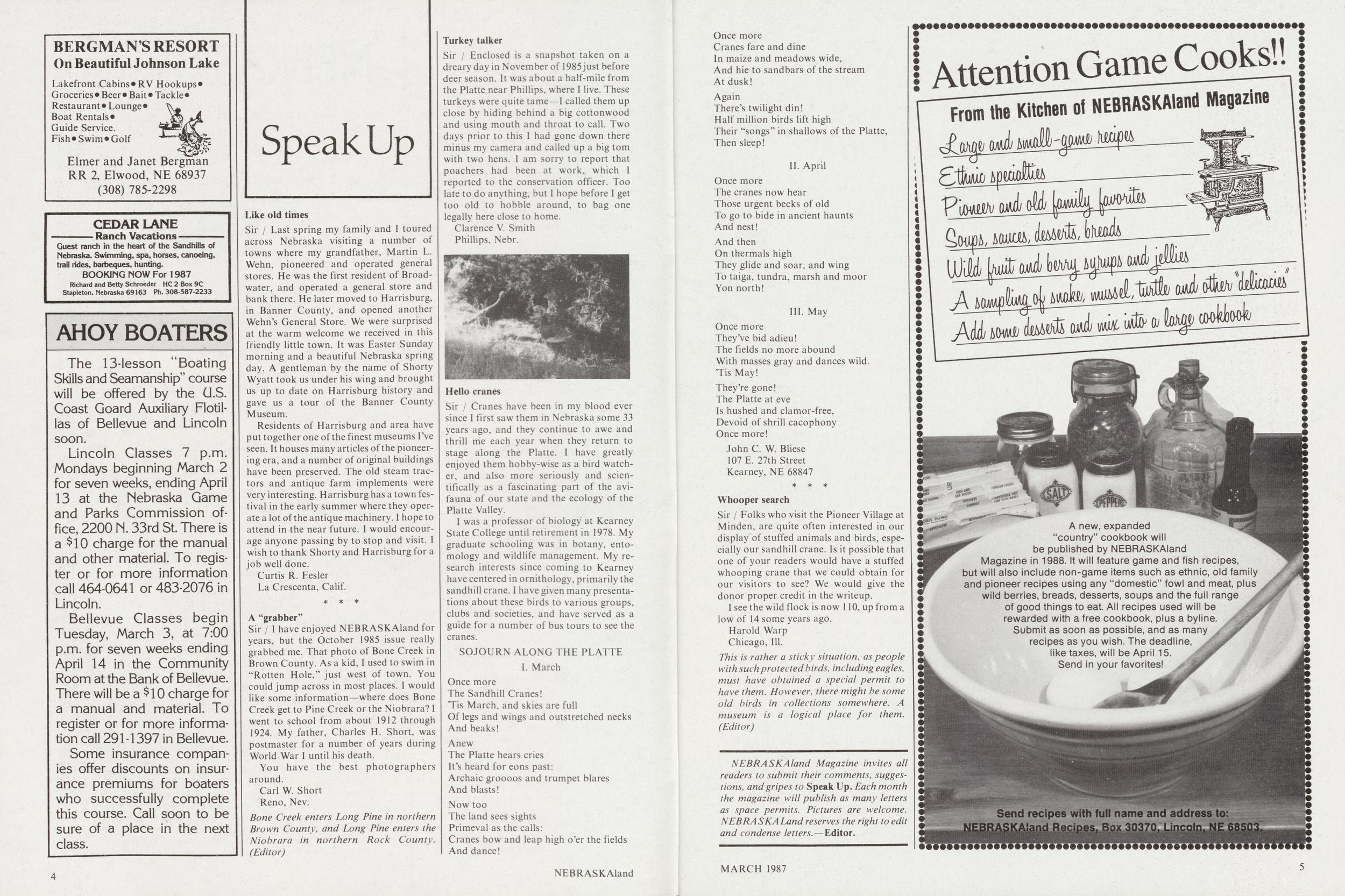
Speak Up
Like old timesSir / Last spring my family and I toured across Nebraska visiting a number of towns where my grandfather, Martin L. Wehn, pioneered and operated general stores. He was the first resident of Broadwater, and operated a general store and bank there. He later moved to Harrisburg, in Banner County, and opened another Wehn's General Store. We were surprised at the warm welcome we received in this friendly little town. It was Easter Sunday morning and a beautiful Nebraska spring day. A gentleman by the name of Shorty Wyatt took us under his wing and brought us up to date on Harrisburg history and gave us a tour of the Banner County Museum.
Residents of Harrisburg and area have put together one of the finest museums I've seen. It houses many articles of the pioneering era, and a number of original buildings have been preserved. The old steam tractors and antique farm implements were very interesting. Harrisburg has a town festival in the early summer where they operate a lot of the antique machinery. I hope to attend in the near future. I would encourage anyone passing by to stop and visit. 1 wish to thank Shorty and Harrisburg for a job well done.
Curtis R. Fesler La Crescenta, Calif. * * * A "grabber"Sir / I have enjoyed NEBRASKAland for years, but the October 1985 issue really grabbed me. That photo of Bone Creek in Brown County. As a kid, I used to swim in "Rotten Hole," just west of town. You could jump across in most places. I would like some information—where does Bone Creek get to Pine Creek or the Niobrara? I went to school from about 1912 through 1924. My father, Charles H. Short, was postmaster for a number of years during World War I until his death.
You have the best photographers around.
Carl W. Short Reno, Nev.Bone Creek enters Long Pine in northern Brown County, and Long Pine enters the Niobrara in northern Rock County. (Editor)
Turkey talkerSir / Enclosed is a snapshot taken on a dreary day in November of 1985 just before deer season. It was about a half-mile from the Platte near Phillips, where I live. These turkeys were quite tame—I called them up close by hiding behind a big cottonwood and using mouth and throat to call. Two days prior to this I had gone down there minus my camera and called up a big torn with two hens. 1 am sorry to report that poachers had been at work, which I reported to the conservation officer. Too late to do anything, but I hope before I get too old to hobble around, to bag one legally here close to home.
Clarence V. Smith Phillips, Nebr.Sir / Cranes have been in my blood ever since I first saw them in Nebraska some 33 years ago, and they continue to awe and thrill me each year when they return to stage along the Platte. I have greatly enjoyed them hobby-wise as a bird watcher, and also more seriously and scientifically as a fascinating part of the avifauna of our state and the ecology of the Platte Valley.
I was a professor of biology at Kearney State College until retirement in 1978. My graduate schooling was in botany, entomology and wildlife management. My research interests since coming to Kearney have centered in ornithology, primarily the sandhill crane. I have given many presentations about these birds to various groups, clubs and societies, and have served as a guide for a number of bus tours to see the cranes.
SOJOURN ALONG THE PLATTE 1. March Once more The Sandhill Cranes! Tis March, and skies are full Of legs and wings and outstretched necks And beaks! Anew The Platte hears cries It's heard for eons past: Archaic groooos and trumpet blares And blasts! Now too The land sees sights Primeval as the calls: Cranes bow and leap high o'er the fields And dance! 4 NEBRASKAland Once more Cranes fare and dine In maize and meadows wide, And hie to sandbars of the stream At dusk! Again There's twilight din! Half million birds lift high Their "songs" in shallows of the Platte, Then sleep! II. April Once more The cranes now hear Those urgent becks of old To go to bide in ancient haunts And nest! And then On thermals high They glide and soar, and wing To taiga, tundra, marsh and moor Yon north! III. May Once more They've bid adieu! The fields no more abound With masses gray and dances wild. Tis May! They're gone! The Platte at eve Is hushed and clamor-free, Devoid of shrill cacophony Once more! John C. W. Bliese 107 E. 27th Street Kearney, NE 68847 * * * Whooper searchSir / Folks who visit the Pioneer Village at Minden, are quite often interested in our display of stuffed animals and birds, especially our sandhill crane. Is it possible that one of your readers would have a stuffed whooping crane that we could obtain for our visitors to see? We would give the donor proper credit in the writeup.
I see the wild flock is now 110, up from a low of 14 some years ago.
Harold Warp Chicago, 111.This is rather a sticky situation, as people with such protected birds, including eagles, must have obtained a special permit to have them. However, there might be some old birds in collections somewhere. A museum is a logical place for them. (Editor)
NEBRASKAland Magazine invites all readers to submit their comments, suggestions, and gripes to Speak Up. Each month the magazine will publish as many letters as space permits. Pictures are welcome. NEBRASKA Land reserves the right to edit and condense letters.—Editor. Attention GaineCooks!! A new, expanded "country" cookbook will be published by NEBRASKAland Magazine in 1988. It will feature game and fish recipes, but will also include non-game items such as ethnic, old family and pioneer recipes using any "domestic" fowl and meat, plus wild berries, breads, desserts, soups and the full range of good things to eat. All recipes used will be rewarded with a free cookbook, plus a byline. Submit as soon as possible, and as many recipes as you wish. The deadline, like taxes, will be April 15 Send in your favorites! MARCH 1987 5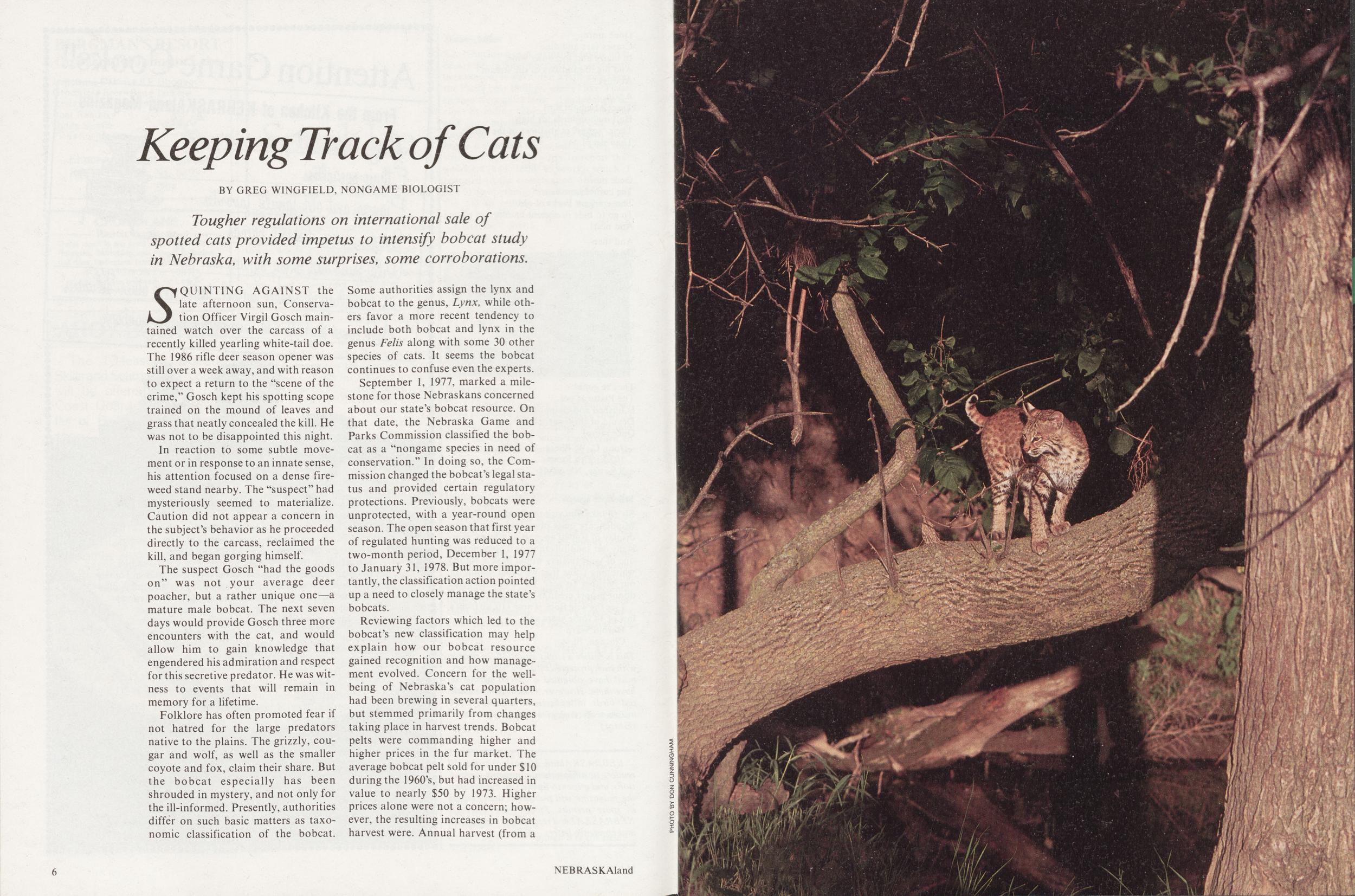
Keeping Track of Cats
BY GREG WINGFIELD, NONGAME BIOLOGIST Tougher regulations on international sale of spotted cats provided impetus to intensify bobcat study in Nebraska, with some surprises, some corroborations.AGAINST the late afternoon sun, Conservation Officer Virgil Gosch maintained watch over the carcass of a recently killed yearling white-tail doe. The 1986 rifle deer season opener was still over a week away, and with reason to expect a return to the "scene of the crime," Gosch kept his spotting scope trained on the mound of leaves and grass that neatly concealed the kill. He was not to be disappointed this night.
In reaction to some subtle movement or in response to an innate sense, his attention focused on a dense fireweed stand nearby. The "suspect" had mysteriously seemed to materialize. Caution did not appear a concern in the subject's behavior as he proceeded directly to the carcass, reclaimed the kill, and began gorging himself.
The suspect Gosch "had the goods on" was not your average deer poacher, but a rather unique one—a mature male bobcat. The next seven days would provide Gosch three more encounters with the cat, and would allow him to gain knowledge that engendered his admiration and respect for this secretive predator. He was witness to events that will remain in memory for a lifetime.
Folklore has often promoted fear if not hatred for the large predators native to the plains. The grizzly, cougar and wolf, as well as the smaller coyote and fox, claim their share. But the bobcat especially has been shrouded in mystery, and not only for the ill-informed. Presently, authorities differ on such basic matters as taxonomic classification of the bobcat. Some authorities assign the lynx and bobcat to the genus, Lynx, while others favor a more recent tendency to include both bobcat and lynx in the genus Felis along with some 30 other species of cats. It seems the bobcat continues to confuse even the experts.
September 1, 1977, marked a milestone for those Nebraskans concerned about our state's bobcat resource. On that date, the Nebraska Game and Parks Commission classified the bobcat as a "nongame species in need of conservation." In doing so, the Commission changed the bobcat's legal status and provided certain regulatory protections. Previously, bobcats were unprotected, with a year-round open season. The open season that first year of regulated hunting was reduced to a two-month period, December 1, 1977 to January 31, 1978. But more importantly, the classification action pointed up a need to closely manage the state's bobcats.
Reviewing factors which led to the bobcat's new classification may help explain how our bobcat resource gained recognition and how management evolved. Concern for the well-being of Nebraska's cat population had been brewing in several quarters, but stemmed primarily from changes taking place in harvest trends. Bobcat pelts were commanding higher and higher prices in the fur market. The average bobcat pelt sold for under $10 during the 1960's, but had increased in value to nearly $50 by 1973. Higher prices alone were not a concern; however, the resulting increases in bobcat harvest were. Annual harvest (from a trapper survey) increased from 31 bobcats in 1970-71 to 186 by 1974-75. Could the resource withstand this level of pressure?
6 NEBRASKAland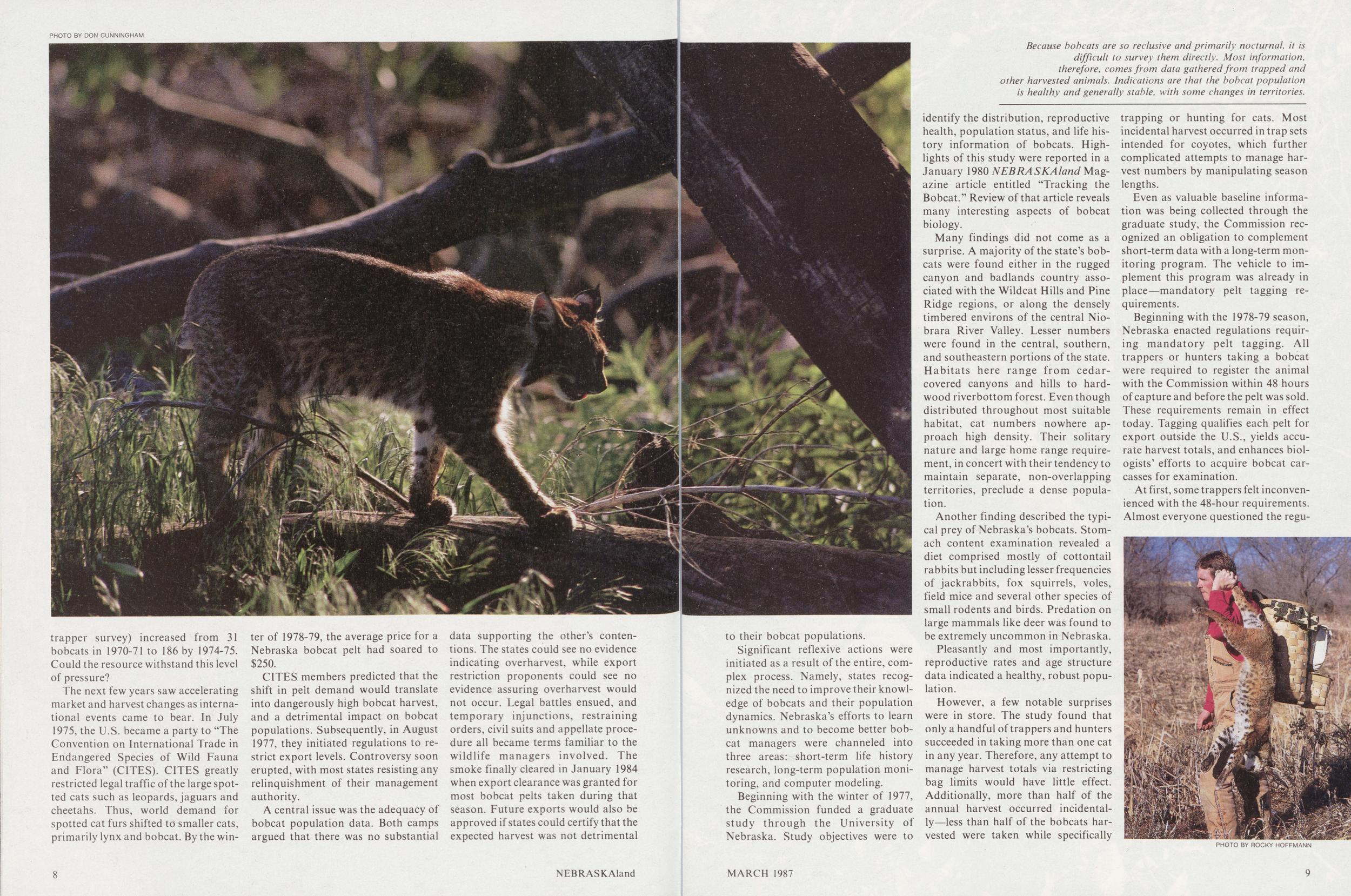
The next few years saw accelerating market and harvest changes as international events came to bear. In July 1975, the U.S. became a party to "The Convention on International Trade in Endangered Species of Wild Fauna and Flora" (CITES). CITES greatly restricted legal traffic of the large spotted cats such as leopards, jaguars and cheetahs. Thus, world demand for spotted cat furs shifted to smaller cats, primarily lynx and bobcat. By the winter of 1978-79, the average price for a Nebraska bobcat pelt had soared to $250.
CITES members predicted that the shift in pelt demand would translate into dangerously high bobcat harvest, and a detrimental impact on bobcat populations. Subsequently, in August 1977, they initiated regulations to restrict export levels. Controversy soon erupted, with most states resisting any relinquishment of their management authority.
A central issue was the adequacy of bobcat population data. Both camps argued that there was no substantial data supporting the other's contentions. The states could see no evidence indicating over harvest, while export restriction proponents could see no evidence assuring over harvest would not occur. Legal battles ensued, and temporary injunctions, restraining orders, civil suits and appellate procedure all became terms familiar to the wildlife managers involved. The smoke finally cleared in January 1984 when export clearance was granted for most bobcat pelts taken during that season. Future exports would also be approved if states could certify that the expected harvest was not detrimental 9 NEBRASKAland to their bobcat populations.
Significant reflexive actions were initiated as a result of the entire, complex process. Namely, states recognized the need to improve their knowledge of bobcats and their population dynamics. Nebraska's efforts to learn unknowns and to become better bobcat managers were channeled into three areas: short-term life history research, long-term population monitoring, and computer modeling.
Beginning with the winter of 1977, the Commission funded a graduate study through the University of Nebraska. Study objectives were to identify the distribution, reproductive health, population status, and life history information of bobcats. Highlights of this study were reported in a January 1980 NEBRASKAland Magazine article entitled "Tracking the Bobcat." Review of that article reveals many interesting aspects of bobcat biology.
Many findings did not come as a surprise. A majority of the state's bobcats were found either in the rugged canyon and badlands country associated with the Wildcat Hills and Pine Ridge regions, or along the densely timbered environs of the central Niobrara River Valley. Lesser numbers were found in the central, southern, and southeastern portions of the state. Habitats here range from cedar covered canyons and hills to hard-wood river bottom forest. Even though distributed throughout most suitable habitat, cat numbers nowhere approach high density. Their solitary nature and large home range requirement, in concert with their tendency to maintain separate, non-overlapping territories, preclude a dense population.
Another finding described the typical prey of Nebraska's bobcats. Stomach content examination revealed a diet comprised mostly of cottontail rabbits but including lesser frequencies of jackrabbits, fox squirrels, voles, field mice and several other species of small rodents and birds. Predation on large mammals like deer was found to be extremely uncommon in Nebraska.
Pleasantly and most importantly, reproductive rates and age structure data indicated a healthy, robust population.
However, a few notable surprises were in store. The study found that only a handful of trappers and hunters succeeded in taking more than one cat in any year. Therefore, any attempt to manage harvest totals via restricting bag limits would have little effect. Additionally, more than half of the annual harvest occurred incidentally—less than half of the bobcats harvested were t aken while specifically trapping or hunting for cats. Most incidental harvest occurred in trap sets intended for coyotes, which further complicated attempts to manage harvest numbers by manipulating season lengths.
Even as valuable baseline information was being collected through the graduate study, the Commission recognized an obligation to complement short-term data with a long-term monitoring program. The vehicle to implement this program was already in place—mandatory pelt tagging requirements.
Beginning with the 1978-79 season, Nebraska enacted regulations requiring mandatory pelt tagging. All trappers or hunters taking a bobcat were required to register the animal with the Commission within 48 hours of capture and before the pelt was sold. These requirements remain in effect today. Tagging qualifies each pelt for export outside the U.S., yields accurate harvest totals, and enhances biologists' efforts to acquire bobcat carcasses for examination.
At first, some trappers felt inconvenienced with the 48-hour requirements. Almost everyone questioned the regulation. Simply stated, the purpose was to collect fresh carcasses suitable for examination. Two critical facts could be obtained from carcass examination: the animal's age and its past reproductive history. Successful carcass collection and the data gained by carcass examination remain the cornerstone of Nebraska's long-term monitoring program.
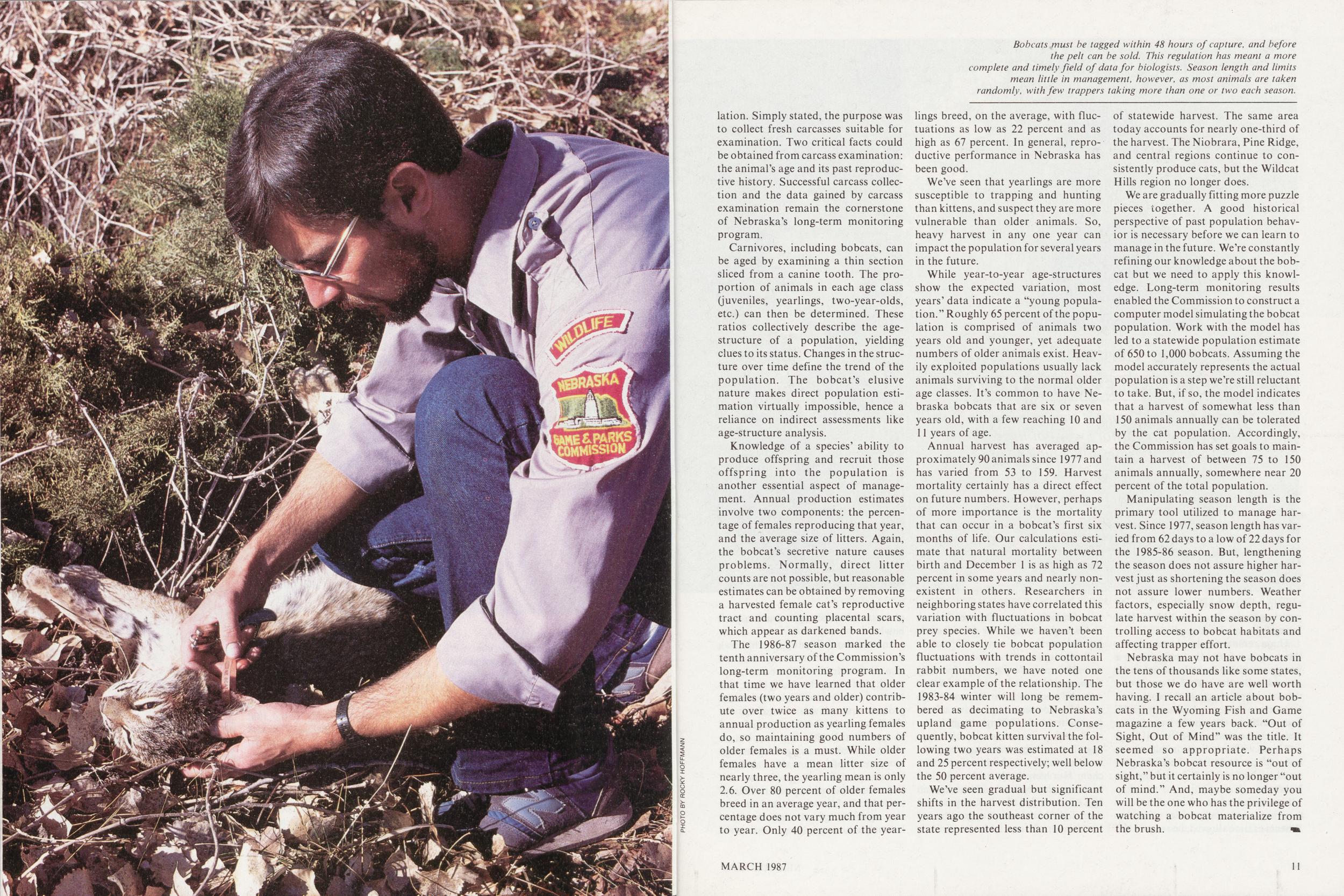
Carnivores, including bobcats, can be aged by examining a thin section sliced from a canine tooth. The proportion of animals in each age class (juveniles, yearlings, two-year-olds, etc.) can then be determined. These ratios collectively describe the age structure of a population, yielding clues to its status. Changes in the structure over time define the trend of the population. The bobcat's elusive nature makes direct population estimation virtually impossible, hence a reliance on indirect assessments like age-structure analysis.
Knowledge of a species' ability to produce offspring and recruit those offspring into the population is another essential aspect of management. Annual production estimates involve two components: the percentage of females reproducing that year, and the average size of litters. Again, the bobcat's secretive nature causes problems. Normally, direct litter counts are not possible, but reasonable estimates can be obtained by removing a harvested female cat's reproductive tract and counting placental scars, which appear as darkened bands.
The 1986-87 season marked the tenth anniversary of the Commission's long-term monitoring program. In that time we have learned that older females (two years and older) contribute over twice as many kittens to annual production as yearling females do, so maintaining good numbers of older females is a must. While older females have a mean litter size of nearly three, the yearling mean is only 2.6. Over 80 percent of older females breed in an average year, and that percentage does not vary much from year to year. Only 40 percent of the yearlings breed, on the average, with fluctuations as low as 22 percent and as high as 67 percent. In general, reproductive performance in Nebraska has been good.
Bobcats must be tagged within 48 hours of capture, and before the pelt can be sold. This regulation has meant a more complete and timely field of data for biologists. Season length and limits mean little in management, however, as most animals are taken randomly, with few trappers taking more than one or two each season.We've seen that yearlings are more susceptible to trapping and hunting than kittens, and suspect they are more vulnerable than older animals. So, heavy harvest in any one year can impact the population for several years in the future.
While year-to-year age-structures show the expected variation, most years' data indicate a "young population." Roughly 65 percent of the population is comprised of animals two years old and younger, yet adequate numbers of older animals exist. Heavily exploited populations usually lack animals surviving to the normal older age classes. It's common to have Nebraska bobcats that are six or seven years old, with a few reaching 10 and 11 years of age.
Annual harvest has averaged approximately 90 animals since 1977 and has varied from 53 to 159. Harvest mortality certainly has a direct effect on future numbers. However, perhaps of more importance is the mortality that can occur in a bobcat's first six months of life. Our calculations estimate that natural mortality between birth and December 1 is as high as 72 percent in some years and nearly nonexistent in others. Researchers in neighboring states have correlated this variation with fluctuations in bobcat prey species. While we haven't been able to closely tie bobcat population fluctuations with trends in cottontail rabbit numbers, we have noted one clear example of the relationship. The 1983-84 winter will long be remembered as decimating to Nebraska's upland game populations. Consequently, bobcat kitten survival the following two years was estimated at 18 and 25 percent respectively; well below the 50 percent average.
We've seen gradual but significant shifts in the harvest distribution. Ten years ago the southeast corner of the state represented less than 10 percent of statewide harvest. The same area today accounts for nearly one-third of the harvest. The Niobrara, Pine Ridge, and central regions continue to consistently produce cats, but the Wildcat Hills region no longer does.
We are gradually fitting more puzzle pieces together. A good historical perspective of past population behavior is necessary before we can learn to manage in the future. We're constantly refining our knowledge about the bobcat but we need to apply this knowledge. Long-term monitoring results enabled the Commission to construct a computer model simulating the bobcat population. Work with the model has led to a statewide population estimate of 650 to 1,000 bobcats. Assuming the model accurately represents the actual population is a step we're still reluctant to take. But, if so, the model indicates that a harvest of somewhat less than 150 animals annually can be tolerated by the cat population. Accordingly, the Commission has set goals to maintain a harvest of between 75 to 150 animals annually, somewhere near 20 percent of the total population.
Manipulating season length is the primary tool utilized to manage harvest. Since 1977, season length has varied from 62 days to a low of 22 days for the 1985-86 season. But, lengthening the season does not assure higher harvest just as shortening the season does not assure lower numbers. Weather factors, especially snow depth, regulate harvest within the season by controlling access to bobcat habitats and affecting trapper effort.
Nebraska may not have bobcats in the tens of thousands like some states, but those we do have are well worth having. I recall an article about bobcats in the Wyoming Fish and Game magazine a few years back. "Out of Sight, Out of Mind" was the title. It seemed so appropriate. Perhaps Nebraska's bobcat resource is "out of sight," but it certainly is no longer "out of mind." And, maybe someday you will be the one who has the privilege of watching a bobcat materialize from the brush.
MARCH 1987 11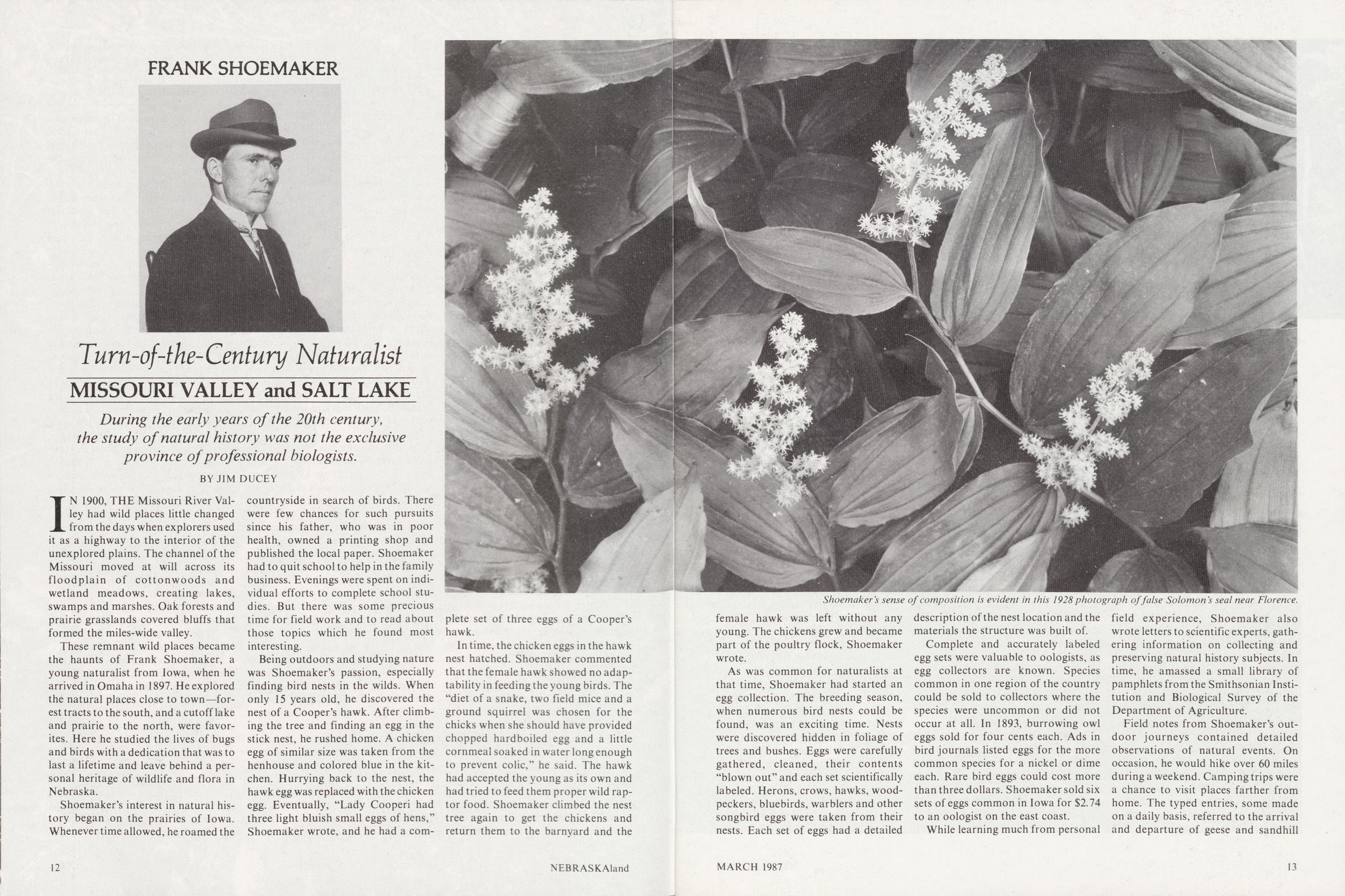
FRANK SHOEMAKER Turn-of-the-Century Naturalist MISSOURI VALLEY and SALT LAKE
During the early years of the 20th century, the study of natural history was not the exclusive province of professional biologists. BY JIM DUCEYIN 1900, THE Missouri River Valley had wild places little changed from the days when explorers used it as a highway to the interior of the unexplored plains. The channel of the Missouri moved at will across its floodplain of cottonwoods and wetland meadows, creating lakes, swamps and marshes. Oak forests and prairie grasslands covered bluffs that formed the miles-wide valley.
These remnant wild places became the haunts of Frank Shoemaker, a young naturalist from Iowa, when he arrived in Omaha in 1897. He explored the natural places close to town—forest tracts to the south, and a cutoff lake and prairie to the north, were favorites. Here he studied the lives of bugs and birds with a dedication that was to last a lifetime and leave behind a personal heritage of wildlife and flora in Nebraska.
Shoemaker's interest in natural history began on the prairies of Iowa. Whenever time allowed, he roamed the countryside in search of birds. There were few chances for such pursuits since his father, who was in poor health, owned a printing shop and published the local paper. Shoemaker had to quit school to help in the family business. Evenings were spent on individual efforts to complete school studies. But there was some precious time for field work and to read about those topics which he found most interesting.
Being outdoors and studying nature was Shoemaker's passion, especially finding bird nests in the wilds. When only 15 years old, he discovered the nest of a Cooper's hawk. After climbing the tree and finding an egg in the stick nest, he rushed home. A chicken egg of similar size was taken from the henhouse and colored blue in the kitchen. Hurrying back to the nest, the hawk egg was replaced with the chicken egg. Eventually, "Lady Cooperi had three light bluish small eggs of hens," Shoemaker wrote, and he had a complete set of three eggs of a Cooper's hawk.
In time, the chicken eggs in the hawk nest hatched. Shoemaker commented that the female hawk showed no adaptability in feeding the young birds. The "diet of a snake, two field mice and a ground squirrel was chosen for the chicks when she should have provided chopped hardboiled egg and a little cornmeal soaked in water long enough to prevent colic," he said. The hawk had accepted the young as its own and had tried to feed them proper wild raptor food. Shoemaker climbed the nest tree again to get the chickens and return them to the barnyard and the 12 female hawk was left without any young. The chickens grew and became part of the poultry flock, Shoemaker wrote.
As was common for naturalists at that time, Shoemaker had started an egg collection. The breeding season, when numerous bird nests could be found, was an exciting time. Nests were discovered hidden in foliage of trees and bushes. Eggs were carefully gathered, cleaned, their contents "blown out" and each set scientifically labeled. Herons, crows, hawks, woodpeckers, bluebirds, warblers and other songbird eggs were taken from their nests. Each set of eggs had a detailed description of the nest location and the materials the structure was built of.
Complete and accurately labeled egg sets were valuable to oologists, as egg collectors are known. Species common in one region of the country could be sold to collectors where the species were uncommon or did not occur at all. In 1893, burrowing owl eggs sold for four cents each. Ads in bird journals listed eggs for the more common species for a nickel or dime each. Rare bird eggs could cost more than three dollars. Shoemaker sold six sets of eggs common in Iowa for $2.74 to an oologist on the east coast.
While learning much from personal field experience, Shoemaker also wrote letters to scientific experts, gathering information on collecting and preserving natural history subjects. In time, he amassed a small library of pamphlets from the Smithsonian Institution and Biological Survey of the Department of Agriculture.
Field notes from Shoemaker's
outdoor journeys contained detailed
observations of natural events. On
occasion, he would hike over 60 miles
during a weekend. Camping trips were
a chance to visit places farther from
home. The typed entries, some made
on a daily basis, referred to the arrival
and departure of geese and sandhill
MARCH 1987
13
 cranes, plus notations made on, the
many other events he observed. In the
fall, he hunted prairie chickens that
flew in large flocks from cover in the
countryside near the family house a
mile south of Hampton, Iowa. Often
the birds he shot were carefully
measured, tagged, and prepared as study
skins.
cranes, plus notations made on, the
many other events he observed. In the
fall, he hunted prairie chickens that
flew in large flocks from cover in the
countryside near the family house a
mile south of Hampton, Iowa. Often
the birds he shot were carefully
measured, tagged, and prepared as study
skins.
Though working in the family print shop denied Shoemaker the opportunity to finish high school, having access to a printing press provided a means to publish his observations. Using the equipment in his father's shop, he prepared a pamphlet listing the species of birds he had observed during several years in Franklin County, Iowa. Copies were sent to his birding friends.
Soon after this, Shoemaker realized he would have to move elsewhere to find work. In the spring of 1897, he moved from Hampton to live with the brother of an aunt, Mr. Van Sant in Omaha. After learning office skills at the Van Sant School of Stenography, he got a job as a stenographer and clerk for Western Union in Omaha, working indoors.
One day of young Shoemaker's week, though, was devoted to a different class of occupation. On Sunday he would "pull out for the woods and fields, and breathe the pure air and learn about the different creatures." It was a day "with some natural history stirrings; some stirring natural history," he wrote.
His favorite companion was his cousin Elizabeth Van Sant, who joined him on most excursions. Leaving early in the morning, they would hike for hours, eat lunch at a favorite spot and then continue exploring the wild places that still surrounded Omaha at the turn of the century.
Florence Woods, a tract of bluestem prairie and floodplain forest, was a frequent destination of Shoemaker. There was also Cutoff Lake, created when the river changed course during a flood in 1888. Shoemaker noted nesting bitterns, rails, marsh wrens, grebes and many other species at this lake which was "simply alive with birds."
During one outing he "got nearly exhausted wading in the swamp. Wad- ing to the waist in water with mud and reeds, cattails, and pondweed on a hot day, was strenuous but very interesting with the birds numerous and nesting." These difficulties were no deterrent in Shoemaker's quest to know about the lives of the birds in the marsh. Occasionally he wrote in his field notes that he had stepped into a deeper hole and was completely dunked.
The young naturalists most often visited Chiids' Point, now known as Gifford Point and Fontanelle Forest, near Bellevue. A typical day's journey meant taking the streetcar, first the Farnam Street line, then the South Omaha line, and finally the Omaha line to Albright which was the final stop on the Douglas County line—all for five cents apiece. The train was taken when the streetcars weren't running, or they walked the entire distance.
The floodplain formed by a meander of the Missouri River was pristine river channel with sandbars, bottomland overgrown with cottonwoods and willows, and an occasional marsh. The upland was rugged hills and deep, shaded hollows and ravines cut by flowing, spring-fed streams. Farther up the bluffs were open fields and an occasional prairie meadow.
In a relatively small area, Frank and Elizabeth found a great diversity of vegetation, nearly equaled by the array of animal life living in each habitat type.
From 50 to 70 species of birds could be seen on days when migration was under way. Ruffed grouse and the now extinct passenger pigeon had once been sighted in this area. Shoemaker's personal reports listed 120 species seen over a period of several years. This included rare breeding birds. Blue-winged, chestnut-sided and cerulean warblers nested in the forest. Acadian flycatchers and prothonotary warblers nested among the willows and cotton-woods that lined the river. Other woodland species—woodpeckers, thrushes, nuthatches—were common.
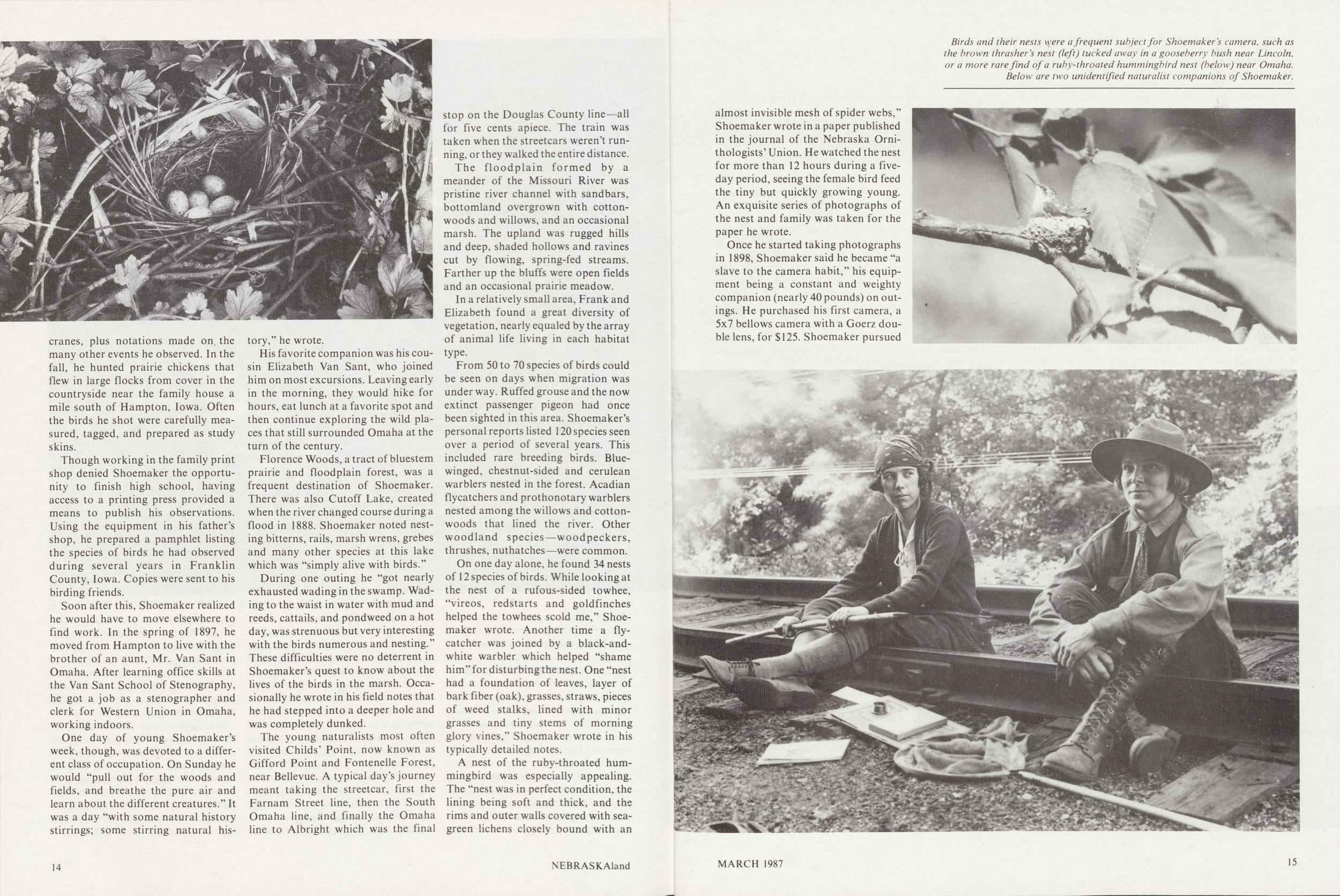
On one day alone, he found 34 nests of 12 species of birds. While looking at the nest of a rufous-sided towhee, "vireos, redstarts and goldfinches helped the towhees scold me," Shoe- maker wrote. Another time a fly- catcher was joined by a black-and- white warbler which helped "shame him" for disturbing the nest. One "nest had a foundation of leaves, layer of bark fiber (oak), grasses, straws, pieces of weed stalks, lined with minor grasses and tiny stems of morning glory vines," Shoemaker wrote in his typically detailed notes.
A nest of the ruby-throated hummingbird was especially appealing. The "nest was in perfect condition, the lining being soft and thick, and the rims and outer walls covered with sea-green lichens closely bound with an 14 NEBRASKAland almost invisible mesh of spider webs," Shoemaker wrote in a paper published in the journal of the Nebraska Ornithologists' Union. He watched the nest for more than 12 hours during a five-day period, seeing the female bird feed the tiny but quickly growing young. An exquisite series of photographs of the nest and family was taken for the paper he wrote.
Once he started taking photographs in 1898, Shoemaker said he became "a slave to the camera habit," his equipment being a constant and weighty companion (nearly 40 pounds) on outings. He purchased his first camera, a 5x7 bellows camera with a Goerz double lens, for $125. Shoemaker pursued his interest in photography with the same zeal that he studied nature, and even managed to receive advice from a photographer taking and developing pictures at the Trans-Mississippi Exhibition in 1898.
MARCH 1987 15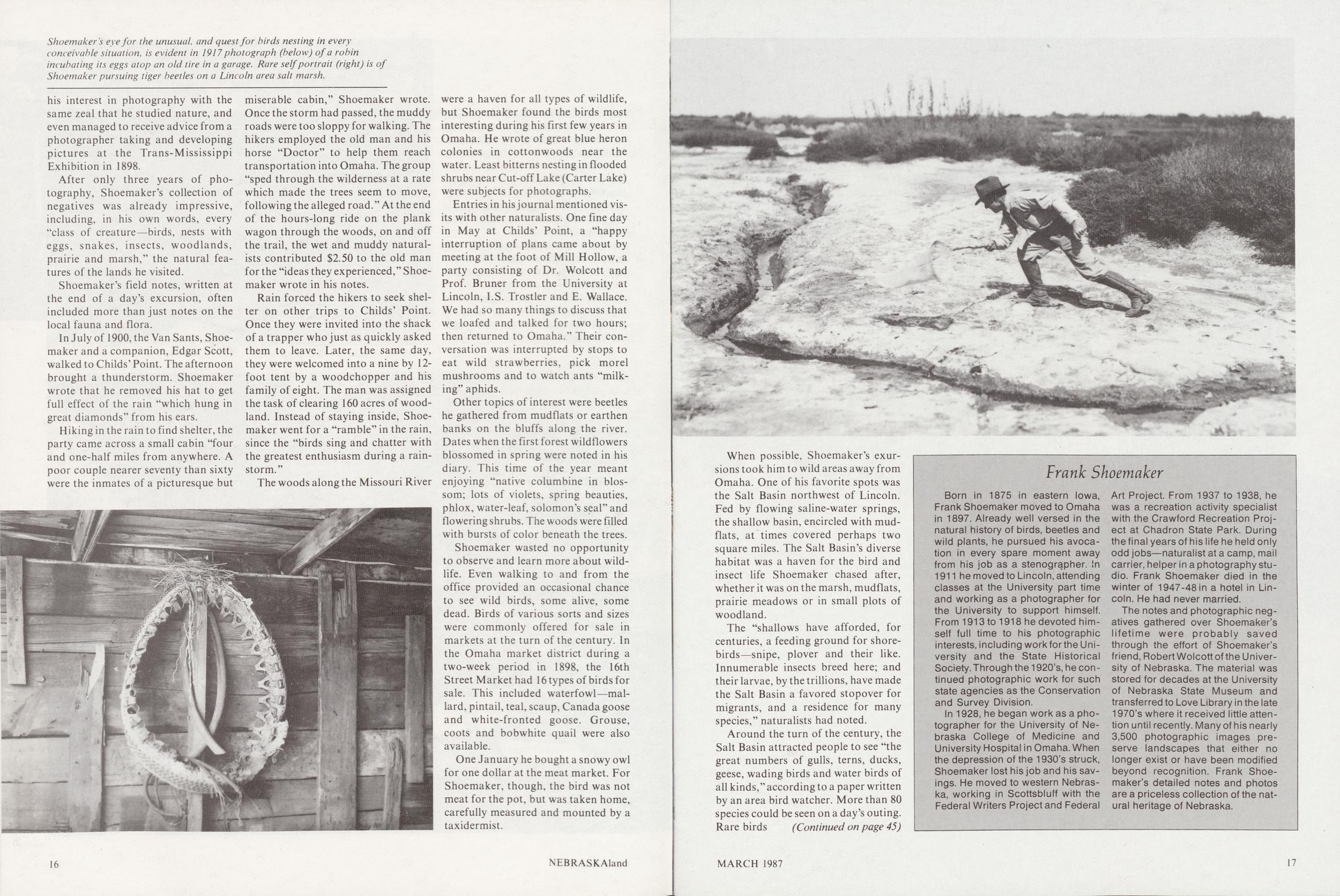 Shoemaker's eye for the unusual and quest for birds nesting in every
conceivable situation, is evident in 1917 photograph (below) of a robin
incubating its eggs atop an old tire in a garage. Rare self portrait (right) is of
Shoemaker pursuing tiger beetles on a Lincoln area salt marsh.
Shoemaker's eye for the unusual and quest for birds nesting in every
conceivable situation, is evident in 1917 photograph (below) of a robin
incubating its eggs atop an old tire in a garage. Rare self portrait (right) is of
Shoemaker pursuing tiger beetles on a Lincoln area salt marsh.
After only three years of photography, Shoemaker's collection of negatives was already impressive, including, in his own words, every "class of creature—birds, nests with eggs, snakes, insects, woodlands, prairie and marsh," the natural features of the lands he visited.
Shoemaker's field notes, written at the end of a day's excursion, often included more than just notes on the local fauna and flora.
In July of 1900, the Van Sants, Shoemaker and a companion, Edgar Scott, walked to Childs' Point. The afternoon brought a thunderstorm. Shoemaker wrote that he removed his hat to get full effect of the rain "which hung in great diamonds" from his ears.
Hiking in the rain to find shelter, the party came across a small cabin "four and one-half miles from anywhere. A poor couple nearer seventy than sixty were the inmates of a picturesque but miserable cabin," Shoemaker wrote. Once the storm had passed, the muddy roads were too sloppy for walking. The hikers employed the old man and his horse "Doctor" to help them reach transportation into Omaha. The group "sped through the wilderness at a rate which made the trees seem to move, following the alleged road." At the end of the hours-long ride on the plank wagon through the woods, on and off the trail, the wet and muddy naturalists contributed $2.50 to the old man for the "ideas they experienced," Shoemaker wrote in his notes.
Rain forced the hikers to seek shelter on other trips to Chiids' Point. Once they were invited into the shack of a trapper who just as quickly asked them to leave. Later, the same day, they were welcomed into a nine by 12-foot tent by a woodchopper and his family of eight. The man was assigned the task of clearing 160 acres of woodland. Instead of staying inside, Shoemaker went for a "ramble" in the rain, since the "birds sing and chatter with the greatest enthusiasm during a rainstorm."
The woods along the Missouri River were a haven for all types of wildlife, but Shoemaker found the birds most interesting during his first few years in Omaha. He wrote of great blue heron colonies in cottonwoods near the water. Least bitterns nesting in flooded shrubs near Cut-off Lake (Carter Lake) were subjects for photographs.
Entries in his journal mentioned visits with other naturalists. One fine day in May at Chiids' Point, a "happy interruption of plans came about by meeting at the foot of Mill Hollow, a party consisting of Dr. Wolcott and Prof. Bruner from the University at Lincoln, I.S. Trostler and E. Wallace. We had so many things to discuss that we loafed and talked for two hours; then returned to Omaha." Their conversation was interrupted by stops to eat wild strawberries, pick morel mushrooms and to watch ants "milking" aphids.
Other topics of interest were beetles he gathered from mudflats or earthen banks on the bluffs along the river. Dates when the first forest wildflowers blossomed in spring were noted in his diary. This time of the year meant enjoying "native columbine in blossom; lots of violets, spring beauties, phlox, water-leaf, Solomon's seal" and flowering shrubs. The woods were filled with bursts of color beneath the trees.
Shoemaker wasted no opportunity to observe and learn more about wildlife. Even walking to and from the office provided an occasional chance to see wild birds, some alive, some dead. Birds of various sorts and sizes were commonly offered for sale in markets at the turn of the century. In the Omaha market district during a two-week period in 1898, the 16th Street Market had 16 types of birds for sale. This included waterfowl—mallard, pintail, teal, scaup, Canada goose and white-fronted goose. Grouse, coots and bobwhite quail were also available.
One January he bought a snowy owl for one dollar at the meat market. For Shoemaker, though, the bird was not meat for the pot, but was taken home, carefully measured and mounted by a taxidermist.
16 NEBRASKAlandWhen possible, Shoemaker's excursions took him to wild areas away from Omaha. One of his favorite spots was the Salt Basin northwest of Lincoln. Fed by flowing saline-water springs, the shallow basin, encircled with mudflats, at times covered perhaps two square miles. The Salt Basin's diverse habitat was a haven for the bird and insect life Shoemaker chased after, whether it was on the marsh, mudflats, prairie meadows or in small plots of woodland.
The "shallows have afforded, for centuries, a feeding ground for shorebirds—snipe, plover and their like. Innumerable insects breed here; and their larvae, by the trillions, have made the Salt Basin a favored stopover for migrants, and a residence for many species," naturalists had noted.
Around the turn of the century, the Salt Basin attracted people to see "the great numbers of gulls, terns, ducks, geese, wading birds and water birds of all kinds," according to a paper written by an area bird watcher. More than 80 species could be seen on a day's outing. Rare birds (Continued on page 45)
Frank ShoemakerBorn in 1875 in eastern Iowa, Frank Shoemaker moved to Omaha in 1897. Already well versed in the natural history of birds, beetles and wild plants, he pursued his avocation in every spare moment away from his job as a stenographer, in 1911 he moved to Lincoln, attending classes at the University part time and working as a photographer for the University to support himself. From 1913 to 1918 he devoted himself full time to his photographic interests, including work for the University and the State Historical Society.Through the 1920's, he continued photographic work for such state agencies as the Conservation and Survey Division.
In 1928, he began work as a photographer for the University of Nebraska College of Medicine and University Hospital in Omaha. When the depression of the 1930's struck, Shoemaker lost his job and his savings. He moved to western Nebraska, working in Scottsbluff with the Federal Writers Project and Federal Art Project. From 1937 to 1938, he was a recreation activity specialist with the Crawford Recreation Project at Chadron State Park. During the final years of his life he held only odd jobs—naturalist at a camp, mail carrier, helper in a photography studio. Frank Shoemaker died in the winter of 1947-48 in a hotel in Lincoln. He had never married.
The notes and photographic negatives gathered over Shoemaker's lifetime were probably saved through the effort of Shoemaker's friend, Robert Wolcott of the University of Nebraska. The material was stored for decades at the University of Nebraska State Museum and transferred to Love Library in the late 1970's where it received little attention until recently. Many of his nearly 3,500 photographic images preserve landscapes that either no longer exist or have been modified beyond recognition. Frank Shoemaker's detailed notes and photos are a priceless collection of the natural heritage of Nebraska.
MARCH 1987 17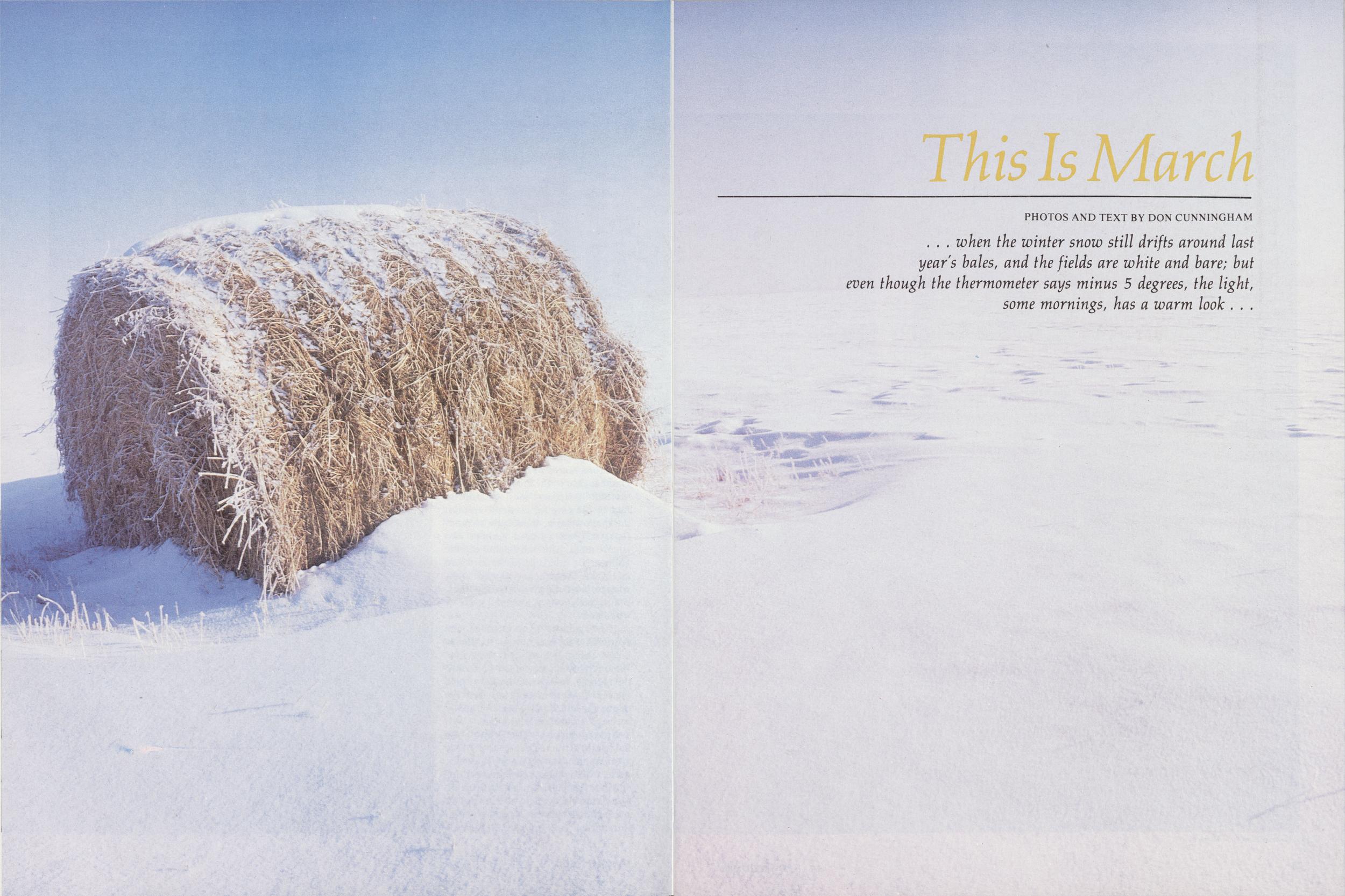
This Is March
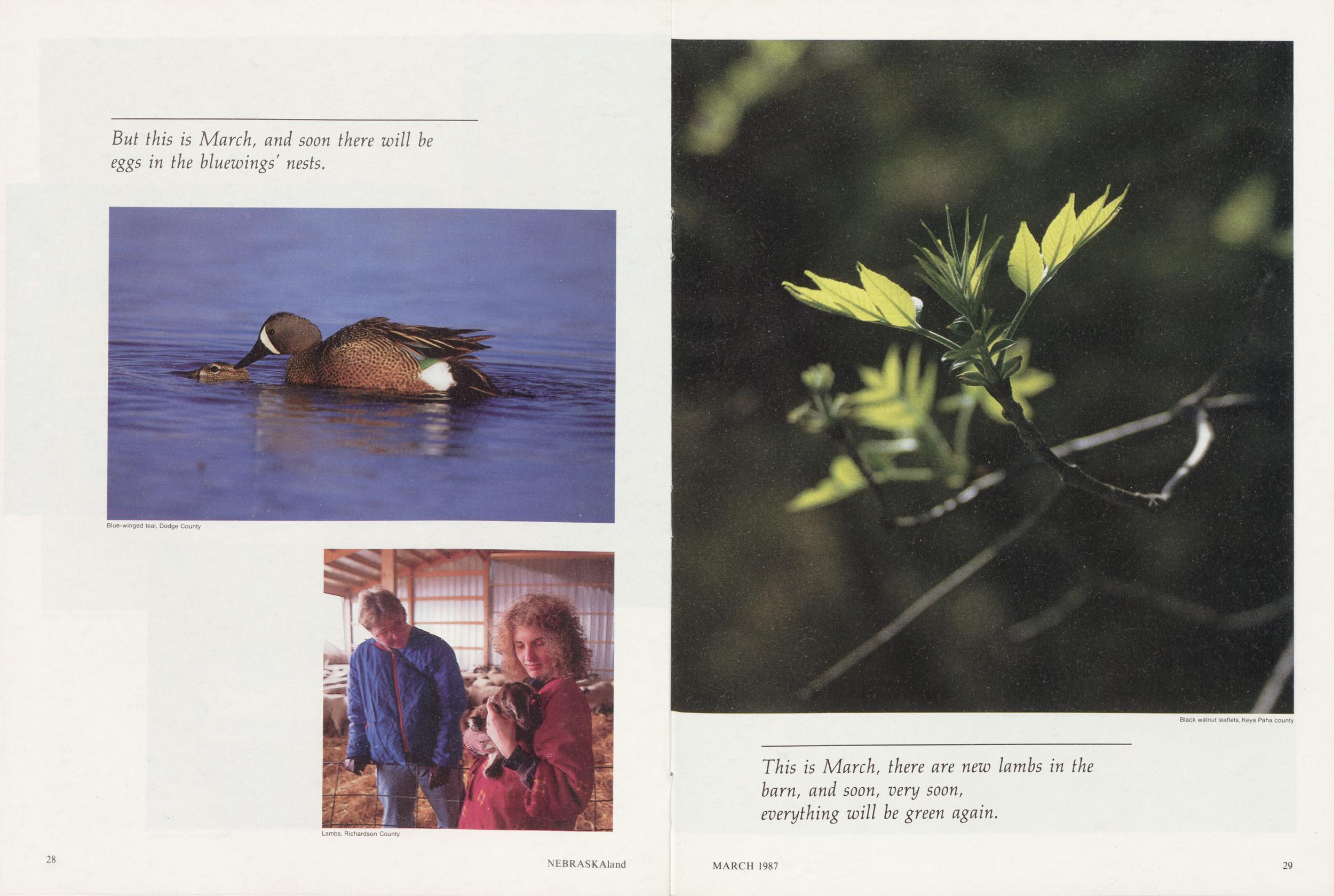
PHOTOS AND TEXT BY DON CUNNINGHAM . . . when the winter snow still drifts around last years hales , and the fields are white and hare; hut even though the thermometer says minus 5 degrees, the light, some mornings, has a warm look . . .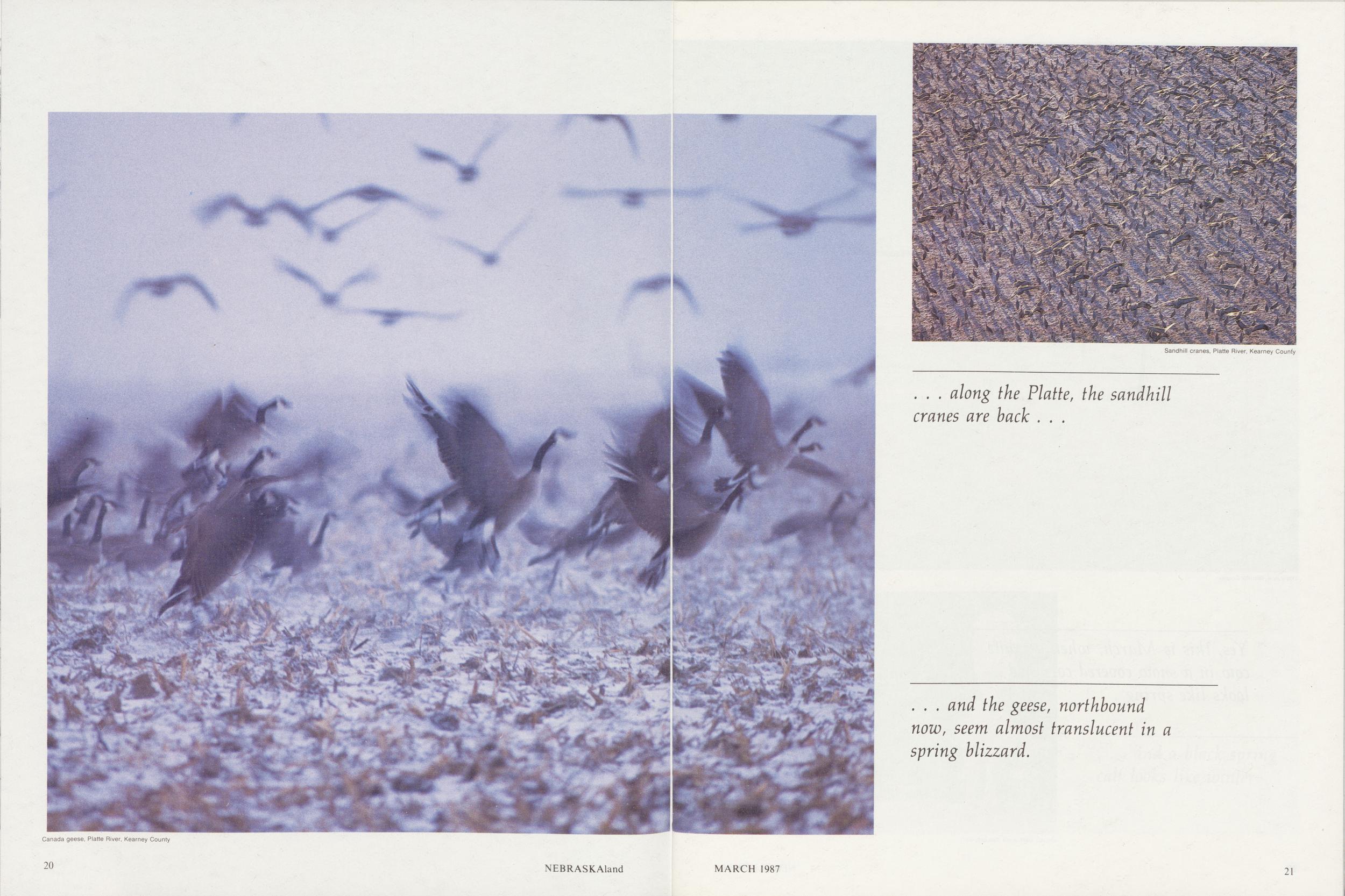
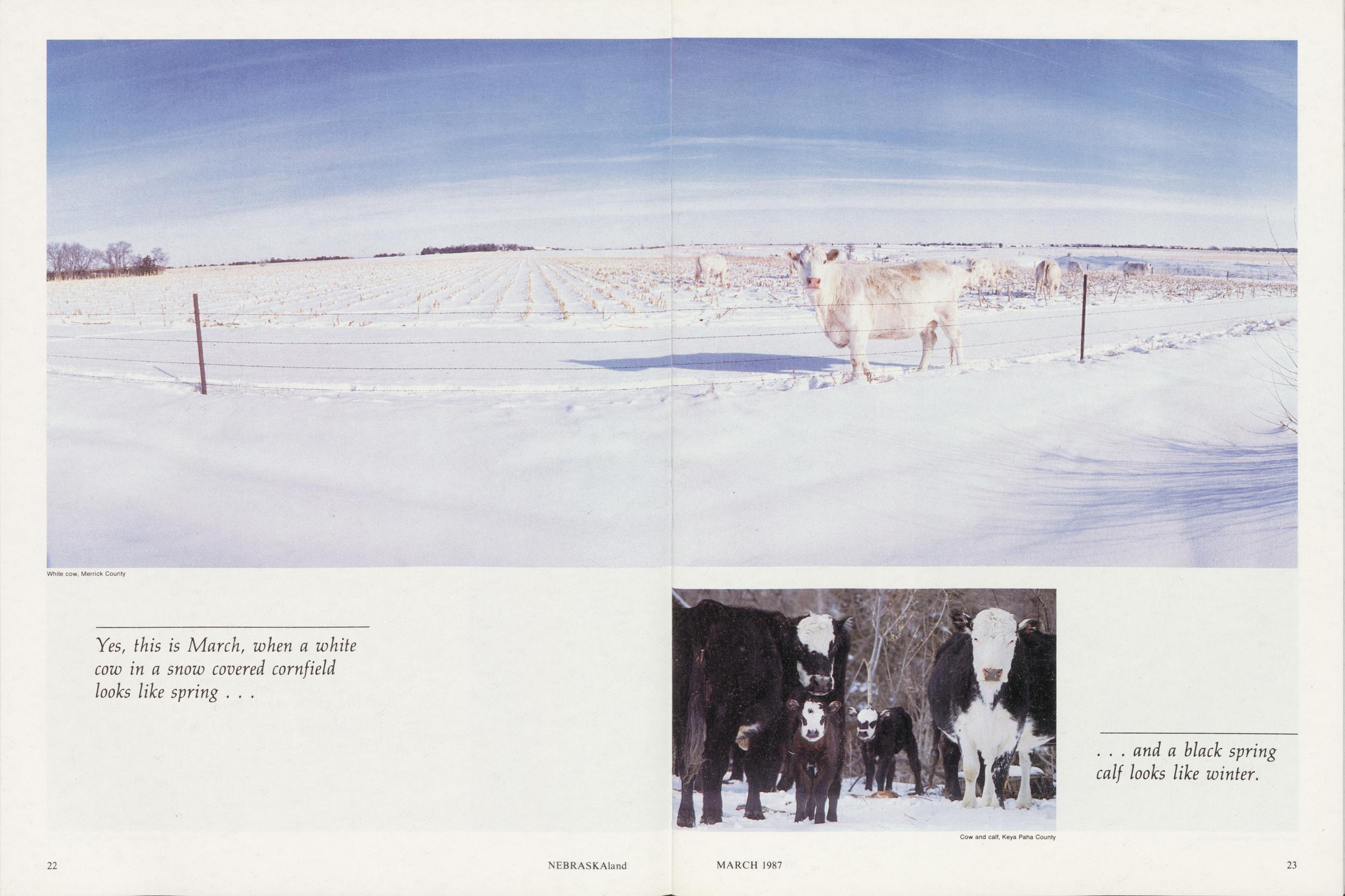
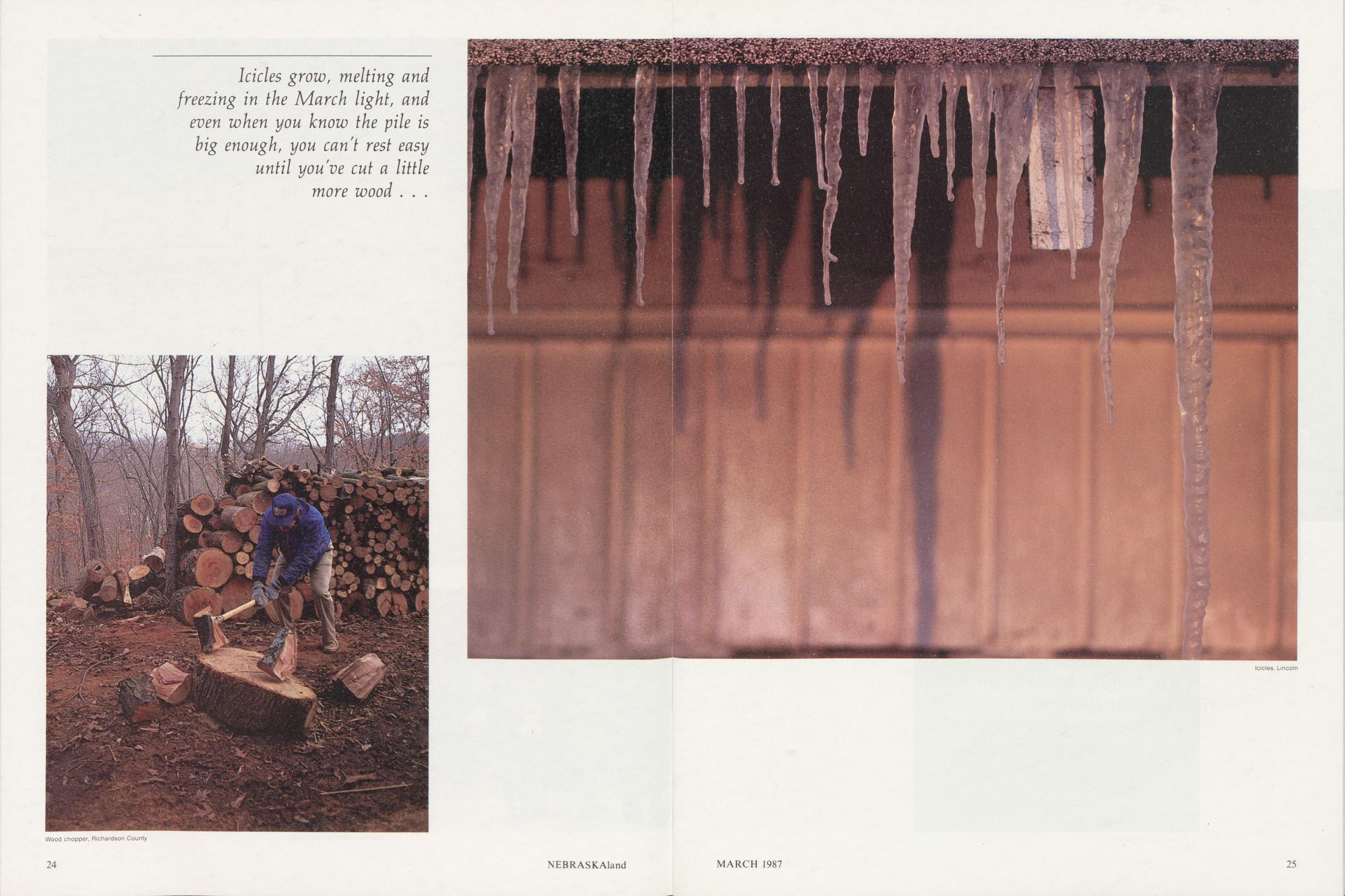 Icicles grow, melting and
freezing in the March light, and
even when you know the pile is
big enough, you can't rest easy
until you've cut a little
more wood
Icicles grow, melting and
freezing in the March light, and
even when you know the pile is
big enough, you can't rest easy
until you've cut a little
more wood
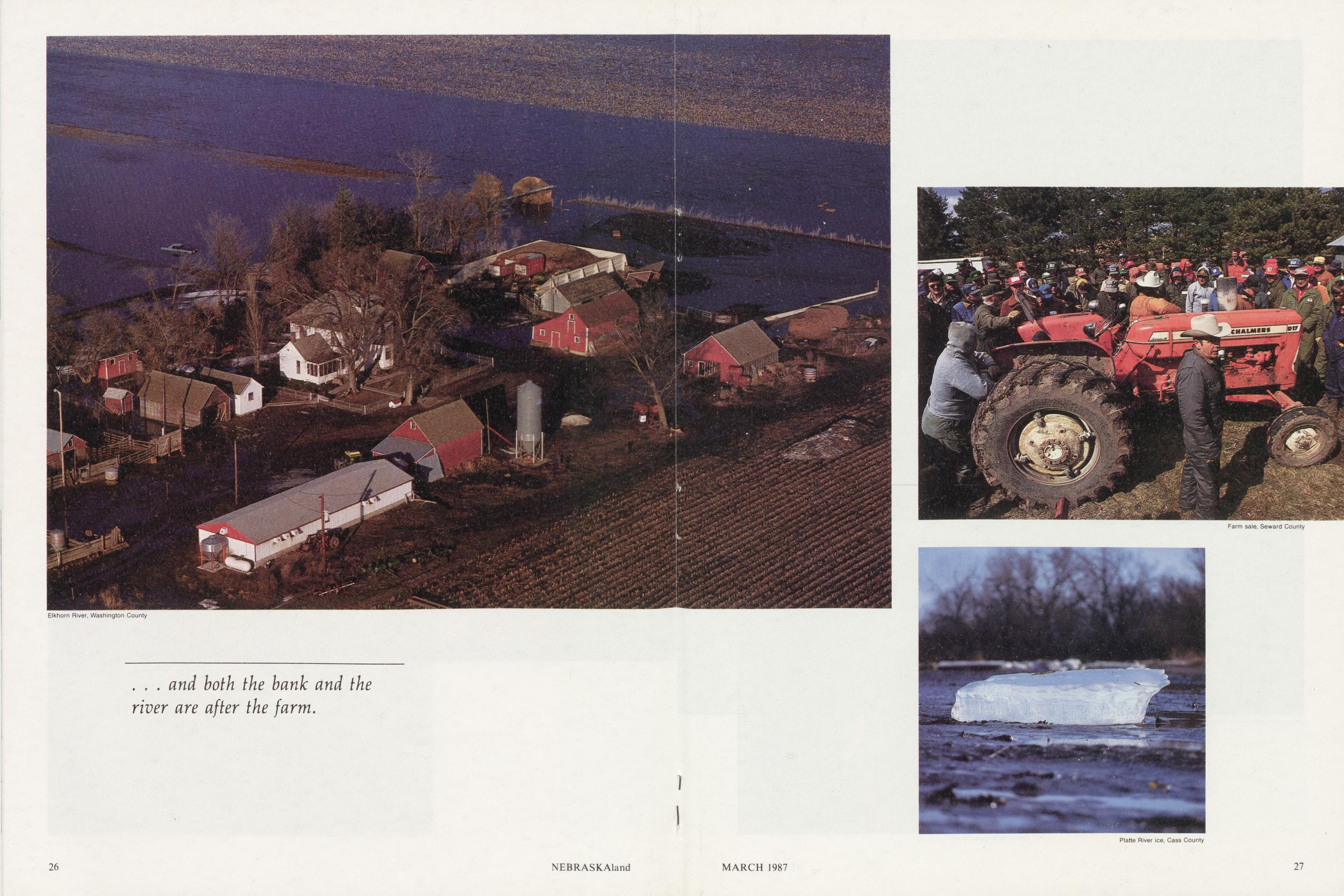
 But this is March, and soon there will he
eggs in the hluewings' nests.
But this is March, and soon there will he
eggs in the hluewings' nests.
TREES From the Ground Up
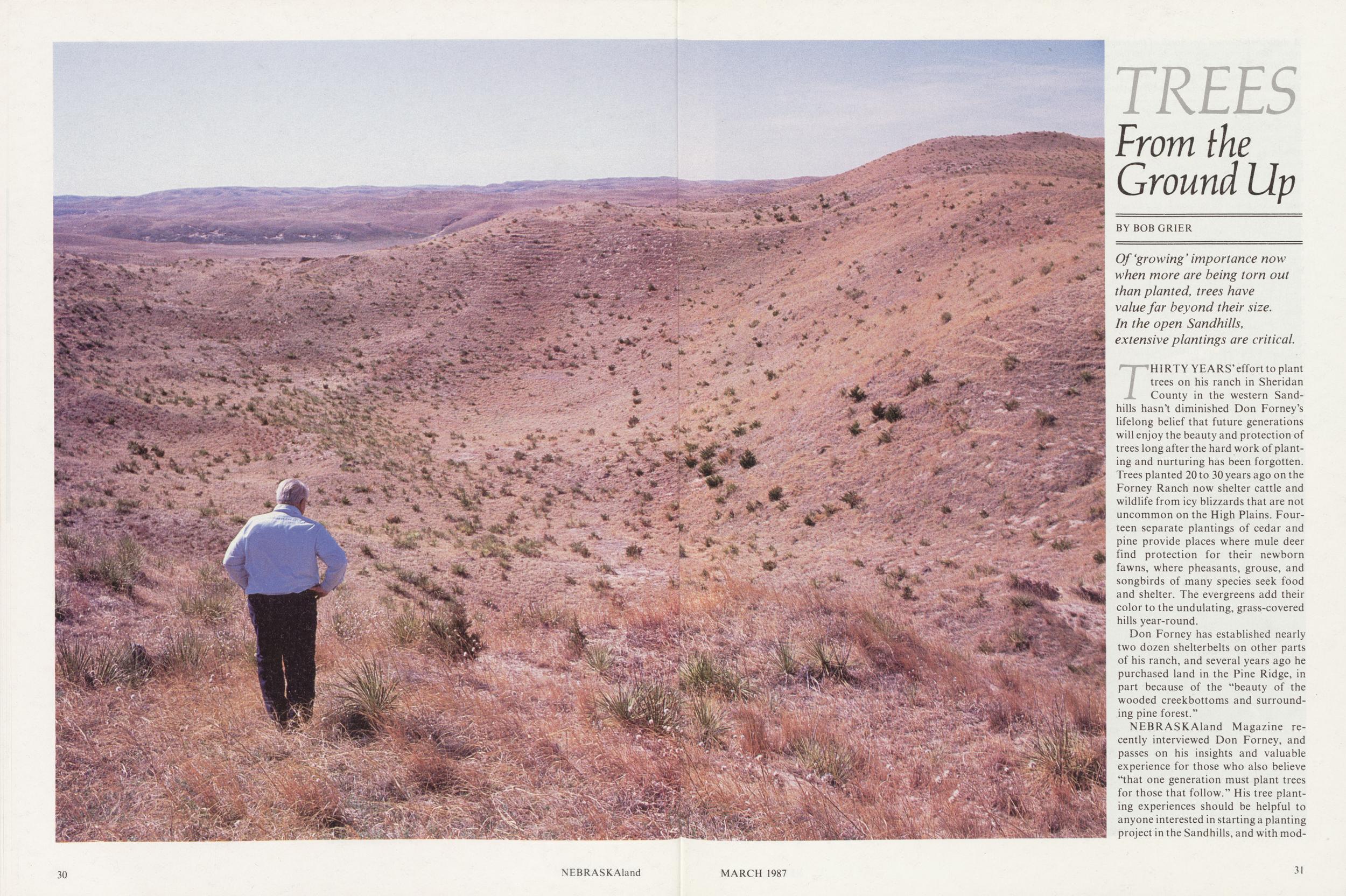
BYBOBGRIER Of growing' importance now when more are being torn out than planted, trees have value far beyond their size. In the open Sandhills, extensive plantings are critical.HIRTY YEARS' effort to plant trees on his ranch in Sheridan County in the western Sand- hills hasn't diminished Don Forney's lifelong belief that future generations will enjoy the beauty and protection of trees long after the hard work of planting and nurturing has been forgotten. Trees planted 20 to 30 years ago on the Forney Ranch now shelter cattle and wildlife from icy blizzards that are not uncommon on the High Plains. Fourteen separate plantings of cedar and pine provide places where mule deer find protection for their newborn fawns, where pheasants, grouse, and songbirds of many species seek food and shelter. The evergreens add their color to the undulating, grass-covered hills year-round.
Don Forney has established nearly two dozen shelter belts on other parts of his ranch, and several years ago he purchased land in the Pine Ridge, in part because of the "beauty of the wooded creek bottoms and surrounding pine forest."
NEBRASKAland Magazine recently interviewed Don Forney, and passes on his insights and valuable experience for those who also believe "that one generation must plant trees for those that follow." His tree planting experiences should be helpful to anyone interested in starting a planting project in the Sandhills, and with modification, elsewhere in Nebraska.
MARCH 1987 31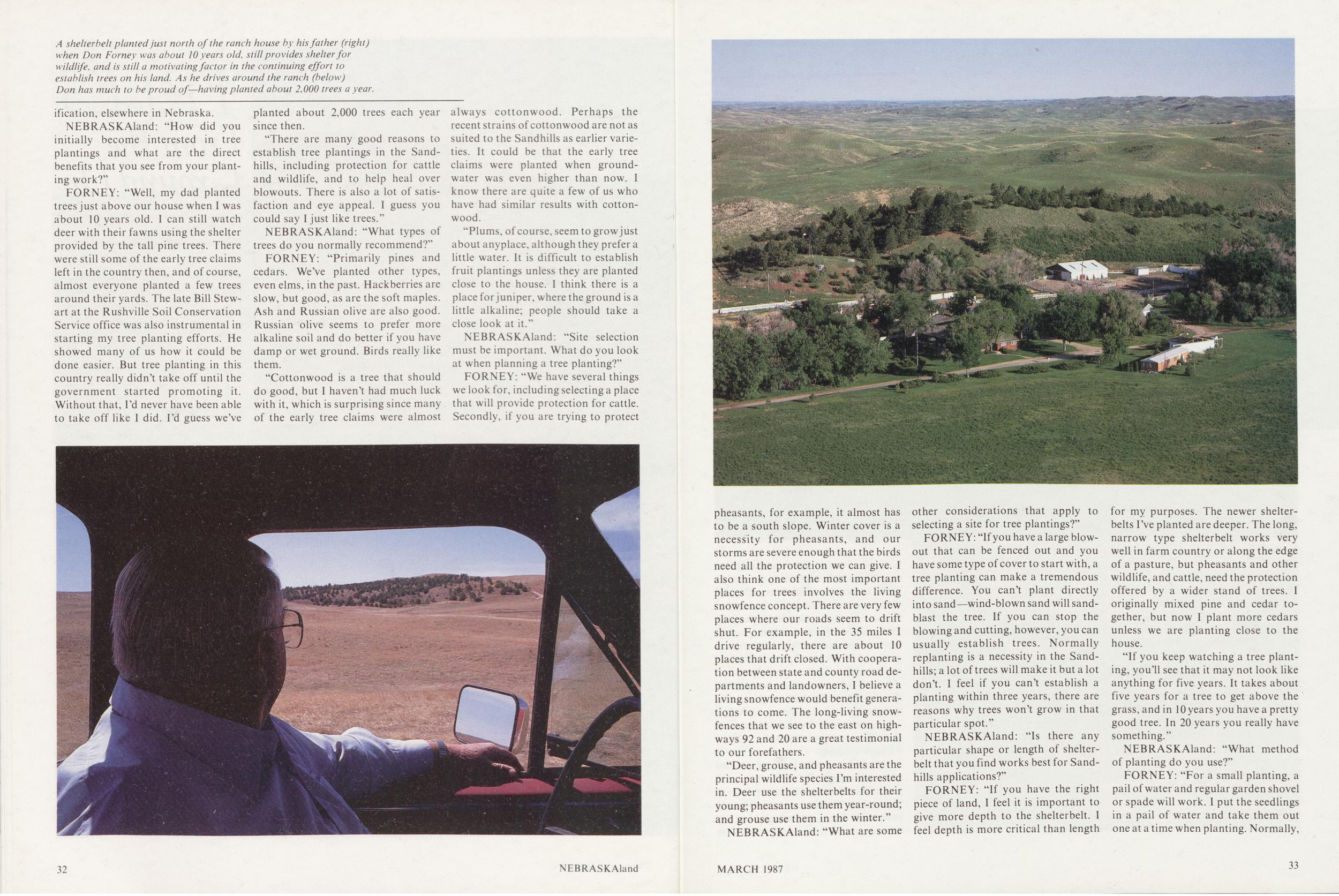 A shelter belt planted just north of the ranch house by his father (right)
when Don Forney was about JO years old, still provides shelter for
wildlife, and is still a motivating factor in the continuing effort to
establish trees on his land. As he drives around the ranch (below)
Don has much to be proud of—having planted about 2,000 trees a year.
A shelter belt planted just north of the ranch house by his father (right)
when Don Forney was about JO years old, still provides shelter for
wildlife, and is still a motivating factor in the continuing effort to
establish trees on his land. As he drives around the ranch (below)
Don has much to be proud of—having planted about 2,000 trees a year.
NEBRASKAland: "How did you initially become interested in tree plantings and what are the direct benefits that you see from your planting work?"
FORNEY: "Well, my dad planted trees just above our house when I was about 10 years old. 1 can still watch deer with their fawns using the shelter provided by the tall pine trees. There were still some of the early tree claims left in the country then, and of course, almost everyone planted a few trees around their yards. The late Bill Stewart at the Rushville Soil Conservation Service office was also instrumental in starting my tree planting efforts. He showed many of us how it could be done easier. But tree planting in this country really didn't take off until the government started promoting it. Without that, I'd never have been able to take off like I did. I'd guess we've planted about 2,000 trees each year since then.
"There are many good reasons to establish tree plantings in the Sandhills, including protection for cattle and wildlife, and to help heal over blowouts. There is also a lot of satisfaction and eye appeal. 1 guess you could say I just like trees."
NEBRASKAland: "What types of trees do you normally recommend?"
FORNEY: "Primarily pines and cedars. We've planted other types, even elms, in the past. Hackberries are slow, but good, as are the soft maples. Ash and Russian olive are also good. Russian olive seems to prefer more alkaline soil and do better if you have damp or wet ground. Birds really like them.
"Cottonwood is a tree that should do good, but I haven't had much luck with it, which is surprising since many of the early tree claims were almost always Cottonwood. Perhaps the recent strains of cottonwood are not as suited to the Sandhills as earlier varieties. It could be that the early tree claims were planted when groundwater was even higher than now. I know there are quite a few of us who have had similar results with cottonwood.
"Plums, of course, seem to grow just about anyplace, although they prefer a little water. It is difficult to establish fruit plantings unless they are planted close to the house. I think there is a place for juniper, where the ground is a little alkaline; people should take a close look at it."
NEBRASKAland: "Site selection must be important. What do you look at when planning a tree planting?"
FORNEY: "We have several things we look for, including selecting a place that will provide protection for cattle. Secondly, if you are trying to protect 32 NEBRASKAland pheasants, for example, it almost has to be a south slope. Winter cover is a necessity for pheasants, and our storms are severe enough that the birds need all the protection we can give. I also think one of the most important places for trees involves the living snow fence concept. There are very few places where our roads seem to drift shut. For example, in the 35 miles I drive regularly, there are about 10 places that drift closed. With cooperation between state and county road departments and landowners, I believe a living snow fence would benefit generations to come. The long-living snow fences that we see to the east on highways 92 and 20 are a great testimonial to our forefathers.
"Deer, grouse, and pheasants are the principal wildlife species I'm interested in. Deer use the shelter belts for their young; pheasants use them year-round; and grouse use them in the winter.'1
NEBRASKAland: "What are some other considerations that apply to selecting a site for tree plantings?"
FORNEY: "If you have a large blowout that can be fenced out and you have some type of cover to start with, a tree planting can make a tremendous difference. You can't plant directly into sand—wind-blown sand will sand blast the tree. If you can stop the blowing and cutting, however, you can usually establish trees. Normally replanting is a necessity in the Sandhills; a lot of trees will make it but a lot don't. I feel if you can't establish a planting within three years, there are reasons why trees won't grow in that particular spot."
NEBRASKAland: "Is there any particular shape or length of shelter belt that you find works best for Sandhills applications?"
FORNEY: "If you have the right piece of land, I feel it is important to give more depth to the shelter belt. I feel depth is more critical than length for my purposes. The newer shelter- belts I've planted are deeper. The long, narrow type shelter belt works very well in farm country or along the edge of a pasture, but pheasants and other wildlife, and cattle, need the protection offered by a wider stand of trees. I originally mixed pine and cedar together, but now I plant more cedars unless we are planting close to the house.
"If you keep watching a tree planting, you'll see that it may not look like anything for five years. It takes about five years for a tree to get above the grass, and in 10 years you have a pretty good tree. In 20 years you really have something."
NEBRASKAland: "What method of planting do you use?"
FORNEY: "For a small planting, a pail of water and regular garden shovel or spade will work. I put the seedlings in a pail of water and take them out one at a time when planting. Normally, seedlings arrive from the nursery boxed in bundles. The seedlings must be kept moist, but not drowned. I usually place the seedlings in buckets or in a slurry and when actually planting 1 can't emphasize too much that the seedling must be planted immediately. If you hold them out in the air, they crust over or dry out and survival will not be good.
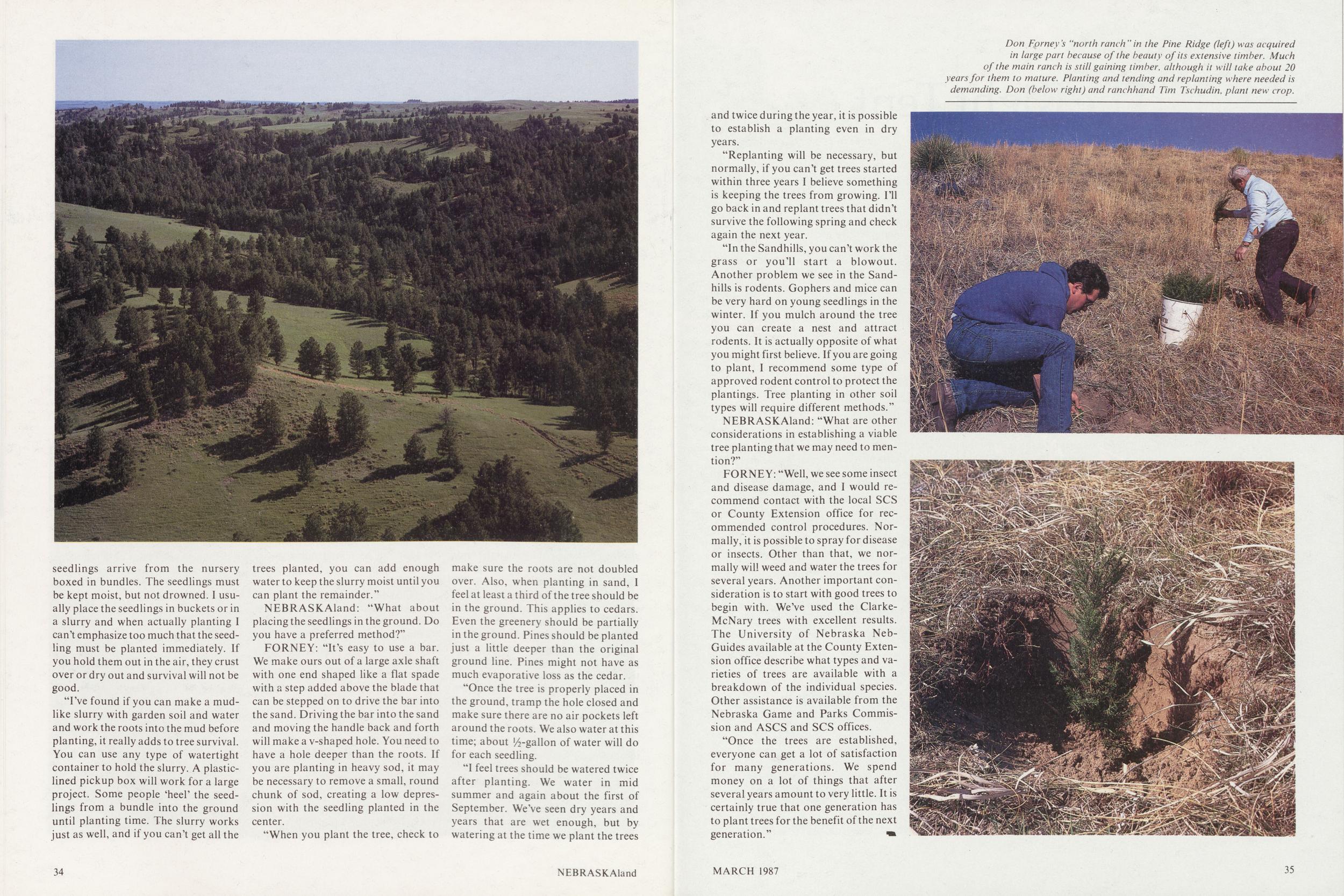
"I've found if you can make a mud-like slurry with garden soil and water and work the roots into the mud before planting, it really adds to tree survival. You can use any type of watertight container to hold the slurry. A plastic lined pickup box will work for a large project. Some people 'heel' the seedlings from a bundle into the ground until planting time. The slurry works just as well, and if you can't get all the trees planted, you can add enough water to keep the slurry moist until you can plant the remainder."
NEBRASKAland: "What about placing the seedlings in the ground. Do you have a preferred method?"
FORNEY: "It's easy to use a bar. We make ours out of a large axle shaft with one end shaped like a flat spade with a step added above the blade that can be stepped on to drive the bar into the sand. Driving the bar into the sand and moving the handle back and forth will make a v-shaped hole. You need to have a hole deeper than the roots. If you are planting in heavy sod, it may be necessary to remove a small, round chunk of sod, creating a low depression with the seedling planted in the center.
"When you plant the tree, check to make sure the roots are not doubled over. Also, when planting in sand, I feel at least a third of the tree should be in the ground. This applies to cedars. Even the greenery should be partially in the ground. Pines should be planted just a little deeper than the original ground line. Pines might not have as much evaporative loss as the cedar.
"Once the tree is properly placed in the ground, tramp the hole closed and make sure there are no air pockets left around the roots. We also water at this time; about gallon of water will do for each seedling.
"I feel trees should be watered twice after planting. We water in mid summer and again about the first of September. We've seen dry years and years that are wet enough, but by watering at the time we plant the trees 34 NEBRASKAland and twice during the year, it is possible to establish a planting even in dry years.
"Replanting will be necessary, but normally, if you can't get trees started within three years I believe something is keeping the trees from growing. I'll go back in and replant trees that didn't survive the following spring and check again the next year.
"In the Sandhills, you can't work the grass or you'll start a blowout. Another problem we see in the Sandhills is rodents. Gophers and mice can be very hard on young seedlings in the winter. If you mulch around the tree you can create a nest and attract rodents. It is actually opposite of what you might first believe. If you are going to plant, I recommend some type of approved rodent control to protect the plantings. Tree planting in other soil types will require different methods.'1
NEBRASKAland: "What are other considerations in establishing a viable tree planting that we may need to mention?"
FORNEY: "Well, we see some insect and disease damage, and I would recommend contact with the local SCS or County Extension office for recommended control procedures. Normally, it is possible to spray for disease or insects. Other than that, we normally will weed and water the trees for several years. Another important consideration is to start with good trees to begin with. We've used the Clarke-McNary trees with excellent results. The University of Nebraska Neb-Guides available at the County Extension office describe what types and varieties of trees are available with a breakdown of the individual species. Other assistance is available from the Nebraska Game and Parks Commission and ASCS and SCS offices.
"Once the trees are established, everyone can get a lot of satisfaction for many generations. We spend money on a lot of things that after several years amount to very little. It is certainly true that one generation has to plant trees for the benefit of the next generation."
The Right Tent
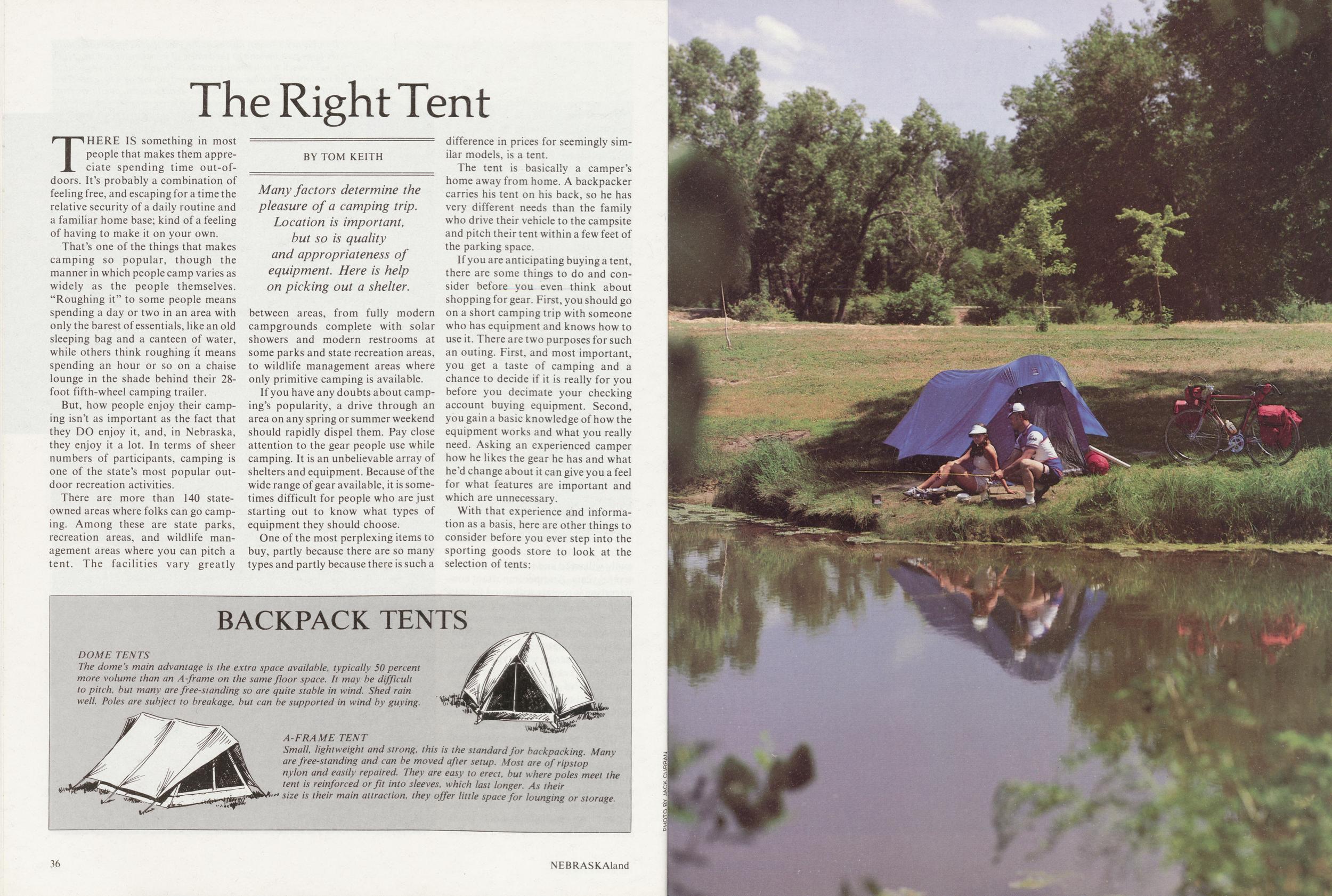
BY TOM KEITH Many factors determine the pleasure of a campoing trip. Location is important, but so is quality and appropriateness of equipment. Here is help on picking out a shelter.THERE IS something in most people that makes them appreciate spending time out-of-doors. It's probably a combination of feeling free, and escaping for a time the relative security of a daily routine and a familiar home base; kind of a feeling of having to make it on your own.
That's one of the things that makes camping so popular, though the manner in which people camp varies as widely as the people themselves. "Roughing it" to some people means spending a day or two in an area with only the barest of essentials, like an old sleeping bag and a canteen of water, while others think roughing it means spending an hour or so on a chaise lounge in the shade behind their 28-foot fifth-wheel camping trailer.
But, how people enjoy their camp- ing isn't as important as the fact that they DO enjoy it, and, in Nebraska, they enjoy it a lot. In terms of sheer numbers of participants, camping is one of the state's most popular outdoor recreation activities.
There are more than 140 state-owned areas where folks can go camping. Among these are state parks, recreation areas, and wildlife management areas where you can pitch a tent. The facilities vary greatly between areas, from fully modern campgrounds complete with solar showers and modern restrooms at some parks and state recreation areas, to wildlife management areas where only primitive camping is available.
If you have any doubts about camping's popularity, a drive through an area on any spring or summer weekend should rapidly dispel them. Pay close attention to the gear people use while camping. It is an unbelievable array of shelters and equipment. Because of the wide range of gear available, it is sometimes difficult for people who are just starting out to know what types of equipment they should choose.
One of the most perplexing items to buy, partly because there are so many types and partly because there is such a difference in prices for seemingly similar models, is a tent.
The tent is basically a camper's home away from home. A backpacker carries his tent on his back, so he has very different needs than the family who drive their vehicle to the campsite and pitch their tent within a few feet of the parking space.
If you are anticipating buying a tent, there are some things to do and consider before you even^think about shopping for gear. First, you should go on a short camping trip with someone who has equipment and knows how to use it. There are two purposes for such an outing. First, and most important, you get a taste of camping and a chance to decide if it is really for you before you decimate your checking account buying equipment. Second, you gain a basic knowledge of how the equipment works and what you really need. Asking an experienced camper how he likes the gear he has and what he'd change about it can give you a feel for what features are important and which are unnecessary.
With that experience and information as a basis, here are other things to consider before you ever step into the sporting goods store to look at the selection of tents:
BACKPACK TENTS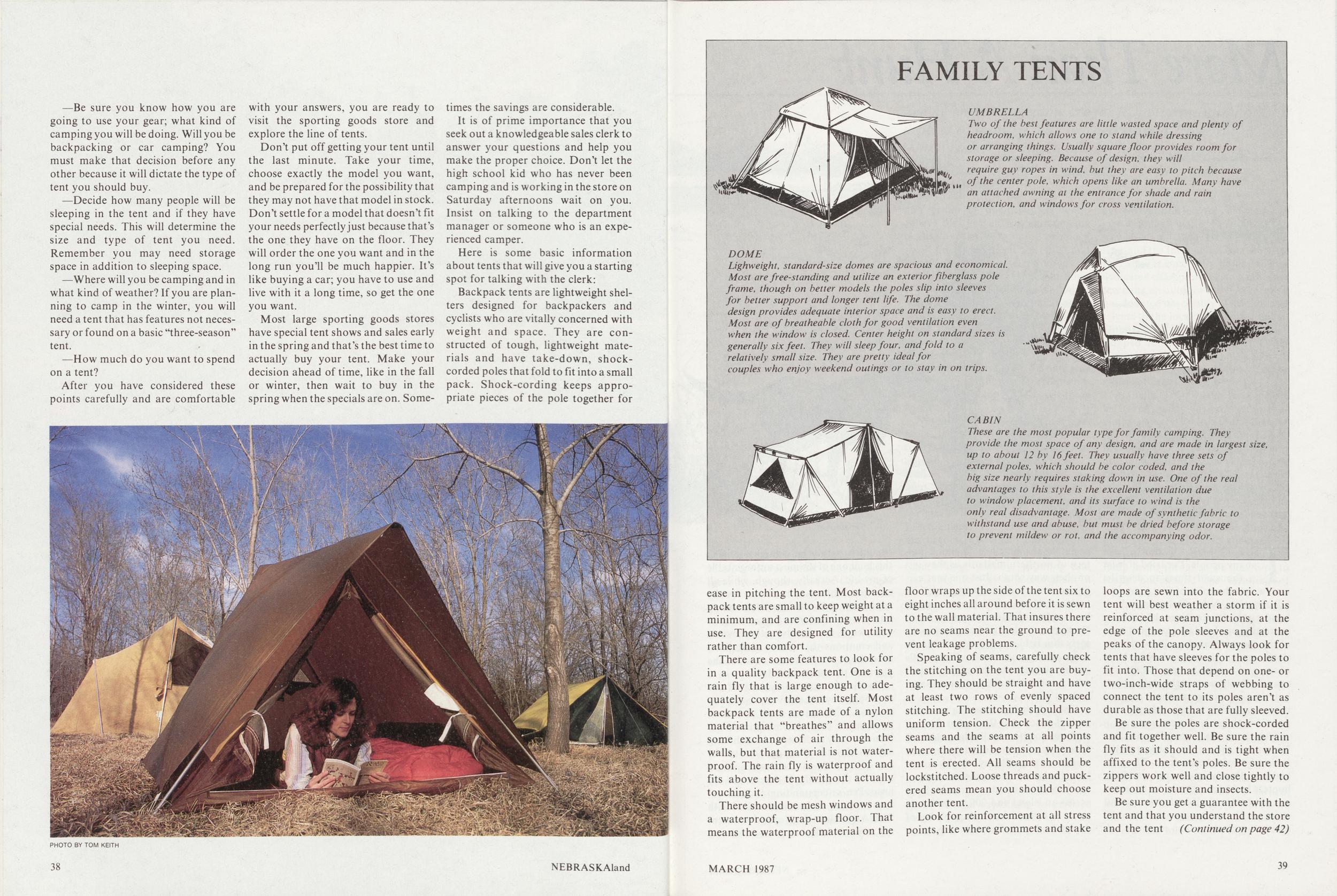
—Be sure you know how you are going to use your gear; what kind of camping you will be doing. Will you be backpacking or car camping? You must make that decision before any other because it will dictate the type of tent you should buy.
—Decide how many people will be sleeping in the tent and if they have special needs. This will determine the size and type of tent you need. Remember you may need storage space in addition to sleeping space.
—Where will you be camping and in what kind of weather? If you are planning to camp in the winter, you will need a tent that has features not necessary or found on a basic "three-season" tent.
—How much do you want to spend on a tent?
After you have considered these points carefully and are comfortable with your answers, you are ready to visit the sporting goods store and explore the line of tents.
Don't put off getting your tent until the last minute. Take your time, choose exactly the model you want, and be prepared for the possibility that they may not have that model in stock. Don't settle for a model that doesn't fit your needs perfectly just because that's the one they have on the floor. They will order the one you want and in the long run you'll be much happier. It's like buying a car; you have to use and live with it a long time, so get the one you want.
Most large sporting goods stores have special tent shows and sales early in the spring and that's the best time to actually buy your tent. Make your decision ahead of time, like in the fall or winter, then wait to buy in the spring when the specials are on. Sometimes the savings are considerable.
It is of prime importance that you seek out a knowledgeable sales clerk to answer your questions and help you make the proper choice. Don't let the high school kid who has never been camping and is working in the store on Saturday afternoons wait on you. Insist on talking to the department manager or someone who is an experienced camper.
Here is some basic information about tents that will give you a starting spot for talking with the clerk:
Backpack tents are lightweight shelters designed for backpackers and cyclists who are vitally concerned with weight and space. They are constructed of tough, lightweight materials and have take-down, shockcorded poles that fold to fit into a small pack. Shock-cording keeps appropriate pieces of the pole together for ease in pitching the tent. Most backpack tents are small to keep weight at a minimum, and are confining when in use. They are designed for utility rather than comfort.
38 NEBRASKAland FAMILY TENTSThere are some features to look for in a quality backpack tent. One is a rain fly that is large enough to adequately cover the tent itself. Most backpack tents are made of a nylon material that "breathes" and allows some exchange of air through the walls, but that material is not waterproof. The rain fly is waterproof and fits above the tent without actually touching it.
There should be mesh windows and a waterproof, wrap-up floor. That means the waterproof material on the floor wraps up the side of the tent six to eight inches all around before it is sewn to the wall material. That insures there are no seams near the ground to prevent leakage problems.
Speaking of seams, carefully check the stitching on the tent you are buying. They should be straight and have at least two rows of evenly spaced stitching. The stitching should have uniform tension. Check the zipper seams and the seams at all points where there will be tension when the tent is erected. All seams should be lock stitched. Loose threads and puckered seams mean you should choose another tent.
Look for reinforcement at all stress points, like where grommets and stake loops are sewn into the fabric. Your tent will best weather a storm if it is reinforced at seam junctions, at the edge of the pole sleeves and at the peaks of the canopy. Always look for tents that have sleeves for the Doles to fit into. Those that depend on one- or two-inch-wide straps of webbing to connect the tent to its poles aren't as durable as those that are fully sleeved.
Be sure the poles are shock-corded and fit together well. Be sure the rain fly fits as it should and is tight when affixed to the tent's poles. Be sure the zippers work well and close tightly to keep out moisture and insects.
Be sure you get a guarantee with the tent and that you understand the store and the tent (Continued on page 42)
MARCH 1987 39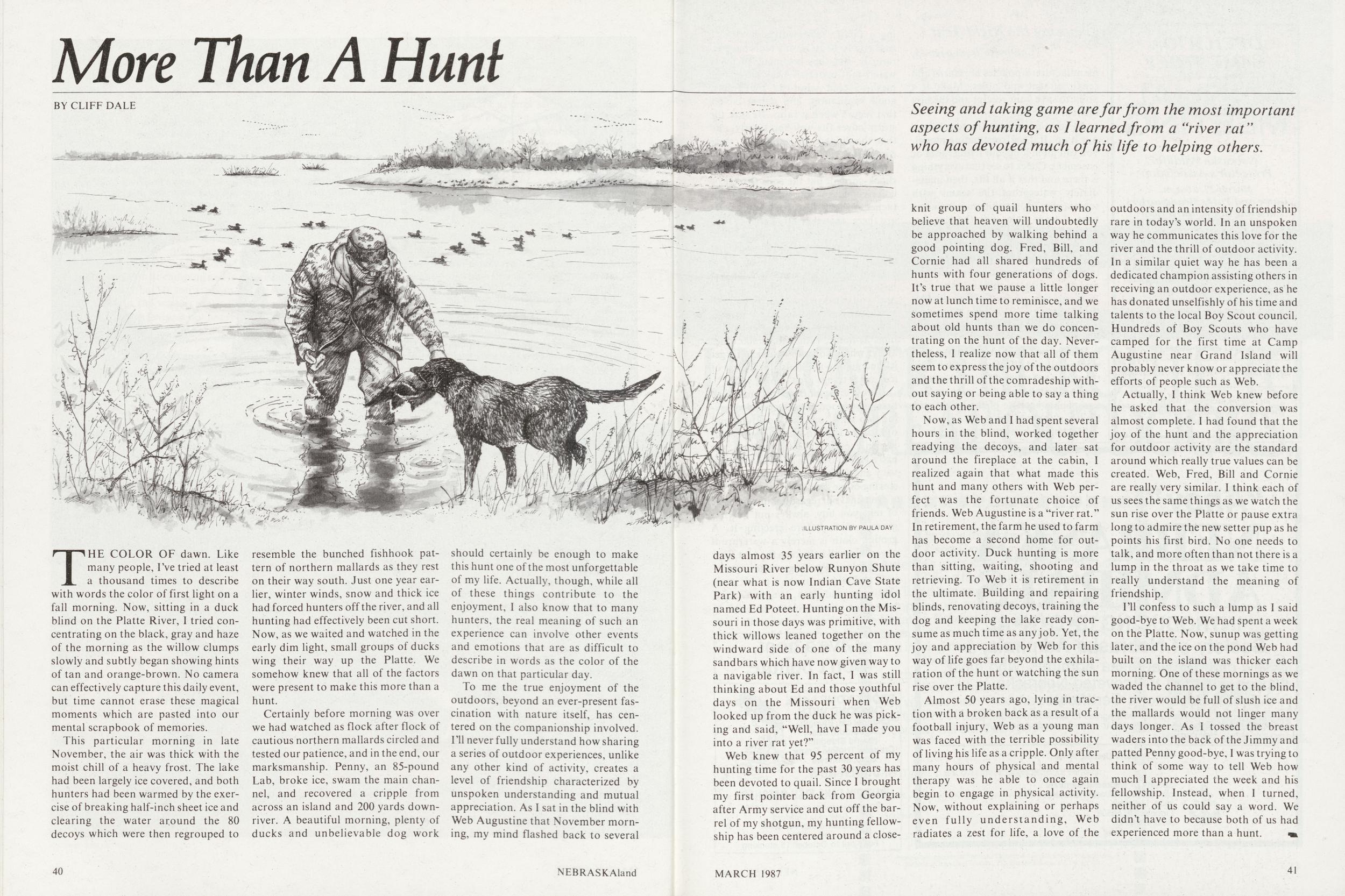
More Than A Hunt
BY CLIFF DALETHE COLOR OF dawn. Like many people, I've tried at least a thousand times to describe with words the color of first light on a fall morning. Now, sitting in a duck blind on the Platte River, I tried con-centrating on the black, gray and haze of the morning as the willow clumps slowly and subtly began showing hints of tan and orange-brown. No camera can effectively capture this daily event, but time cannot erase these magical moments which are pasted into our mental scrapbook of memories.
This particular morning in late November, the air was thick with the moist chill of a heavy frost. The lake had been largely ice covered, and both hunters had been warmed by the exercise of breaking half-inch sheet ice and clearing the water around the 80 decoys which were then regrouped to resemble the bunched fishhook pattern of northern mallards as they rest on their way south. Just one year earlier, winter winds, snow and thick ice had forced hunters off the river, and all hunting had effectively been cut short. Now, as we waited and watched in the early dim light, small groups of ducks wing their way up the Platte. We somehow knew that all of the factors were present to make this more than a hunt.
Certainly before morning was over we had watched as flock after flock of cautious northern mallards circled and tested our patience, and in the end, our marksmanship. Penny, an 85-pound Lab, broke ice, swam the main channel, and recovered a cripple from across an island and 200 yards down river. A beautiful morning, plenty of ducks and unbelievable dog work should certainly be enough to make this hunt one of the most unforgettable of my life. Actually, though, while all of these things contribute to the enjoyment, I also know that to many hunters, the real meaning of such an experience can involve other events and emotions that are as difficult to describe in words as the color of the dawn on that particular day.
To me the true enjoyment of the outdoors, beyond an ever-present fascination with nature itself, has centered on the companionship involved. Till never fully understand how sharing a series of outdoor experiences, unlike any other kind of activity, creates a level of friendship characterized by unspoken understanding and mutual appreciation. As I sat in the blind with Web Augustine that November morning, my mind flashed back to several 40 NEBRASKAland days almost 35 years earlier on the Missouri River below Runyon Shute (near what is now Indian Cave State Park) with an early hunting idol named Ed Poteet. Hunting on the Missouri in those days was primitive, with thick willows leaned together on the windward side of one of the many sandbars which have now given way to a navigable river. In fact, I was still thinking about Ed and those youthful days on the Missouri when Web looked up from the duck he was picking and said, "Well, have I made you into a river rat yet?"
Web knew that 95 percent of my hunting time for the past 30 years has been devoted to quail. Since I brought my first pointer back from Georgia after Army service and cut off the barrel of my shotgun, my hunting fellowship has been centered around a close knit group of quail hunters who believe that heaven will undoubtedly be approached by walking behind a good pointing dog. Fred, Bill, and Cornie had all shared hundreds of hunts with four generations of dogs. It's true that we pause a little longer now at lunch time to reminisce, and we sometimes spend more time talking about old hunts than we do concentrating on the hunt of the day. Nevertheless, I realize now that all of them seem to express the joy of the outdoors and the thrill of the comradeship without saying or being able to say a thing to each other.
seeing and taking game are far from the most important aspects of hunting, as I learned from a "river rat" who has devoted much of his life to helping others.Now, as Web and I had spent several hours in the blind, worked together readying the decoys, and later sat around the fireplace at the cabin, I realized again that what made this hunt and many others with Web perfect was the fortunate choice of friends. Web Augustine is a "river rat." In retirement, the farm he used to farm has become a second home for outdoor activity. Duck hunting is more than sitting, waiting, shooting and retrieving. To Web it is retirement in the ultimate. Building and repairing blinds, renovating decoys, training the dog and keeping the lake ready consume as much time as any job. Yet, the joy and appreciation by Web for this way of life goes far beyond the exhilaration of the hunt or watching the sun rise over the Platte.
Almost 50 years ago, lying in traction with a broken back as a result of a football injury, Web as a young man was faced with the terrible possibility of living his life as a cripple. Only after many hours of physical and mental therapy was he able to once again begin to engage in physical activity. Now, without explaining or perhaps even fully understanding, Web radiates a zest for life, a love of the outdoors and an intensity of friendship rare in today's world. In an unspoken way he communicates this love for the river and the thrill of outdoor activity. In a similar quiet way he has been a dedicated champion assisting others in receiving an outdoor experience, as he has donated unselfishly of his time and talents to the local Boy Scout council, Hundreds of Boy Scouts who have camped for the first time at Camp Augustine near Grand Island will probably never know or appreciate the efforts of people such as Web.
Actually, I think Web knew before he asked that the conversion was almost complete. I had found that the joy of the hunt and the appreciation for outdoor activity are the standard around which really true values can be created. Web, Fred, Bill and Cornie are really very similar. I think each of us sees the same things as we watch the sun rise over the Platte or pause extra long to admire the new setter pup as he points his first bird. No one needs to talk, and more often than not there is a lump in the throat as we take time to really understand the meaning of friendship.
I'll confess to such a lump as I said good-bye to Web. We had spent a week on the Platte. Now, sunup was getting later, and the ice on the pond Web had built on the island was thicker each morning. One of these mornings as we waded the channel to get to the blind, the river would be full of slush ice and the mallards would not linger many days longer. As I tossed the breast waders into the back of the Jimmy and patted Penny good-bye, I was trying to think of some way to tell Web how much I appreciated the week and his fellowship. Instead, when I turned, neither of us could say a word. We didn't have to because both of us had experienced more than a hunt.
MARCH 1987 41
Choosing the Right Tent
(Continued from page 39)manufacturer's policies of returns and repair of tent and poles. Make it a point to save your receipt and the box the tent came in.
As soon as you get the tent home, put it up. If it's a freestanding model, you can pitch it in your living room or basement. Check to see that everything is there and that it all fits, then immediately waterproof the seams with seam sealer. Most companies include a tube of seam sealer with the tent. Let the sealer dry thoroughly before taking the tent down or using it. When they have dried, practice putting the tent together and taking it down until you can do it without thinking about it. Putting a tent up for the first time by flashlight at two o'clock in the morning is an experience you can live without.
Family tents are usually large and well ventilated. Because of their size they are a tad more difficult to put up than backpack tents, and some require two people because of the height and length of some of the poles.
Most of the same rules apply in buying a family tent, with a few basic exceptions. Most family tents have no rain fly, but they are made of fairly waterproof material. They have large mesh-covered windows that allow good ventilation, and storm covers that secure when it rains. Be sure the storm cover fits well and tightly, and that the zippers zip easily and close completely.
The poles on family tents won't be shock-corded, but the ends should be color-coded so you know which attaches to which. Be sure all of the poles are there, that they slip easily if they are meant to telescope, and that they all have the proper plastic ends and tips.
Here again, take the tent to the backyard and practice putting it up until you can do it in the dark, because sometime you're going to have to. It is best and easiest to work out all the bugs at home, rather than 300 miles away; where you can just say "forget it" and go into the house for a glass of iced tea if things aren't going well.
If you are planning to camp with kids, it's a good idea to consider buying two tents, one for the adults and one for the kids. In addition to providing an exciting time for the kids, the extra tent allows the adults a little privacy and frees-up some tent space for storing other gear.
One final tip: regardless of what type of tent you buy, always put down a ground cloth before erecting it. A ground cloth is merely a waterproof cover that will help keep the tent floor dry and clean. Plastic garbage bags slit open and laid flat make a good, inexpensive ground cloth, or a plastic tarp or regular ground cloth material of appropriate size also work well.
Frank Shoemaker...
(Continued from page 16)included the trumpeter swan, mergansers, Caspian terns, "oddly colored plovers," and nesting piping plover. Thousands of birds foraged for food, on the mudflats.
The saline flats were also a haven for tiger beetles, or "tigers" as Shoemaker often called them. Chasing tiger beetles took special effort. Tigers "are little worshippers of the sun that are wary and fly so rapidly it was hard to keep an eye on them," he wrote. A long net on a pole and slow stalking skills helped in capturing specimens.
They occurred in such "great numbers that the ground seemed to rise and walk away. A tiger would be chosen and stalked, very carefully. At the right moment the net was swung and quickly flipped over to prevent the bug's escape, since the beetle may sense danger at any moment, and scoot," Shoemaker wrote. He thought that: "Tigers in the United States were just as hard to get—pound for pound—and just as beautiful when caught, as any tiger that creeps through . . . jungles."
A newspaper article in 1909 reported on the array of tiger beetles which Shoemaker, the "beetle sleuth," had collected. "There are bronze bugs and gold bugs and copper bugs. There are beetles creamy white and gray and silver; there are those of black, dull jet, and those of a satiny lustre; there are those that shine with opalescent lights and those of an ugly, wicked brown; there are those which change in the light from deep violet and vivid green; and there are those with markings and mottlings of rare loveliness," the article noted.
After several years, Shoemaker had nearly 3,000 specimens gathered from around Omaha and Lincoln or during trips outstate. Shoemaker wrote entomologists in other parts of the country, and exchanged specimens with collectors in Missouri, California, Pennsylvania, Texas, Massachusetts and New York. During a vacation to the east in the spring of 1909, he visited several natural history museums to observe their collections of tiger beetles and other insects. Tiger beetles were Shoemaker's consuming interest in the years prior to 1910, though he never lost interest in birds.
The friendship with Professor Wolcott gave Shoemaker a chance to join him on field excursions. In the fall they went on hunting trips between Lincoln and Ashland. In 1903 they went to the Sandhills to study the biology of the lakes and the bird life. Both men and other university naturalists went on an expedition to western Nebraska including the Sandhills and Pine Ridge in 1911.
 WELCOME
to
Merritt Dam Trading Post
Located on beautiful Merritt Reservoir
26 Miles So. Of Valentine On Hwy. 97
Phone 402/376-3437
Bait • Tackle • Ammunition • Groceries • Gas • Beer • Ice
Year-round Modern Cabins with Kitchen Facilities
Campground Hook-ups • Boat and Motor Rental • Professional Guide Service
Easy-access dock • Open year around
Home of the State Record Perch,
Muskellunge and Smallmouth bass /////.
Your Hosts
Jon and Marian Davenport
POLLUTION IS A DIRTY WORD I
Rustic living with modern design
FOUR SEASONS
SOLID PINE HOMES
FL The exclusive
double log wall system
consists of two thick
pine-log exterior walls with
insulation in between
walls—R-20 roof—R-35.
Four Seasons' log profile.
Choose from our broad range of plans,
or style and design your own home.
You are welcome to tour our
show-home at Lakeview, Lake McConaughy
anytime.
For information contact:
FOUR SEASONS
SOLID PINE HOMES
P.O. Box 221
Ogallala, NE 69153
(308) 284-4344
ATTENTION STUDENT TRAPSHOOTERS!!
Plan Now to Attend the 18th Annual
NATIONWIDE CHAMPIONSHIP
CORNHUSKER TRAPSHOOT
Sponsored By the Nebraska Game & Parks Commission
(Non-Registered—ATA Rules)
Nebraska State Trap shoot Grounds, Doniphan, Neb.
May 1-2-3
Friday & Saturday — Nationwide High School Trap Championships
Friday — Nationwide Junior High Trap Championships
Sunday — Nationwide Intercollegiate Trap Competition
Featuring:
Low Entry Fees — $14 per 100 Targets
Special Added 4-H High School & Jr. High Divisions
Commemorative Pin To Each Participant
Door Prize Drawings For All Non-Winners
• Over $4,000 worth of awards • Special added
award for top military
• 16-yard and handicap targets for each group academy team
• Recognized by the ATA • Special award
for top school team
• Sanctioned by Nebraska State in first-year
competition
Sportsmen's Assn. and ACU-I • Pre-registration
required!
For more details, contact:
Dave Wells, Shoot Director
Box 1511, Norfolk, NE 68701
Ph: 402-371-8663
(Mon.-Fri., 9 A.M. to 5 P.M.)
WELCOME
to
Merritt Dam Trading Post
Located on beautiful Merritt Reservoir
26 Miles So. Of Valentine On Hwy. 97
Phone 402/376-3437
Bait • Tackle • Ammunition • Groceries • Gas • Beer • Ice
Year-round Modern Cabins with Kitchen Facilities
Campground Hook-ups • Boat and Motor Rental • Professional Guide Service
Easy-access dock • Open year around
Home of the State Record Perch,
Muskellunge and Smallmouth bass /////.
Your Hosts
Jon and Marian Davenport
POLLUTION IS A DIRTY WORD I
Rustic living with modern design
FOUR SEASONS
SOLID PINE HOMES
FL The exclusive
double log wall system
consists of two thick
pine-log exterior walls with
insulation in between
walls—R-20 roof—R-35.
Four Seasons' log profile.
Choose from our broad range of plans,
or style and design your own home.
You are welcome to tour our
show-home at Lakeview, Lake McConaughy
anytime.
For information contact:
FOUR SEASONS
SOLID PINE HOMES
P.O. Box 221
Ogallala, NE 69153
(308) 284-4344
ATTENTION STUDENT TRAPSHOOTERS!!
Plan Now to Attend the 18th Annual
NATIONWIDE CHAMPIONSHIP
CORNHUSKER TRAPSHOOT
Sponsored By the Nebraska Game & Parks Commission
(Non-Registered—ATA Rules)
Nebraska State Trap shoot Grounds, Doniphan, Neb.
May 1-2-3
Friday & Saturday — Nationwide High School Trap Championships
Friday — Nationwide Junior High Trap Championships
Sunday — Nationwide Intercollegiate Trap Competition
Featuring:
Low Entry Fees — $14 per 100 Targets
Special Added 4-H High School & Jr. High Divisions
Commemorative Pin To Each Participant
Door Prize Drawings For All Non-Winners
• Over $4,000 worth of awards • Special added
award for top military
• 16-yard and handicap targets for each group academy team
• Recognized by the ATA • Special award
for top school team
• Sanctioned by Nebraska State in first-year
competition
Sportsmen's Assn. and ACU-I • Pre-registration
required!
For more details, contact:
Dave Wells, Shoot Director
Box 1511, Norfolk, NE 68701
Ph: 402-371-8663
(Mon.-Fri., 9 A.M. to 5 P.M.)
From 1903 to 1910, Shoemaker worked as a stenographer for the Harriman Railroad Line. He traveled extensively, over 30,000 miles in a year's time, including trips to Texas, Utah, California and Oregon. On these journeys he seldom missed the opportunity to explore natural areas and observe the local flora and fauna.
Shoemaker's job as a railroad stenographer only provided a way to support himself while he pursued his real interest, the natural world. After years of regret for not being able to pursue a vocation in the natural sciences, he decided in 1910 to find a different job.
Shoemaker wrote that he no longer needed an income large enough for him to support his family, as he had been doing since leaving home 12 years earlier. So, instead of taking an office job with the Biological Survey of the Department of Agriculture, he moved to Lincoln and enrolled in college. He also obtained a part-time position with the University with the help of Professor Wolcott. Shoemaker took classes as a "special student" which allowed him to pursue those studies he preferred—zoology, biology and entomology.
For the first time Shoemaker was able to delve into the natural history topics he found most interesting. He was paid for the observation and photography skills developed during many years spent wandering through forests, prairie and marsh in search of birds and beetles. His detailed field notes and photographic records would one day make him one of the most significant amateur naturalists in Nebraska.
The April issue of NEBRASKAland will carry the second of three installments on the natural history adventures of Frank Shoemaker—his travels with the University of Nebraska biologists and botanists to the lake country of the Nebraska Sandhills south of Valentine, and to the then young man-made forest near Halsew 46 NEBRASKAland Its unbelievable how some people collect firewood. They saw down signs. Hatchet trees. Even hack apart picnic tables. And tragically, repeated vandalism has forced many areas to be closed permanently. What will it take to keep our respect for our national forests from going up in smoke? Simple determination. A commitment to ourselves to isolate the few who come to abuse the forests. And a commitment to our young people to help them appreciate the forest for what it really is. A priceless and unparalleled gift. At the Forest Service, we believe that miracles can take root. When people care enough. MARCH 1987 47
Bookshelf
By Curt Twedt Our Nature, Bil Gilbert. University of Nebraska Press, Lincoln. 1986. 276 pp. $18.95, cloth.WHETHER retracing the route of Arctic explorer John Franklin or describing the historical hydrology of Manhattan pieced together by a man with a lifelong fascination for spring water, Bil Gilbert is a first-rate storyteller. This is the second collection of Gilbert's articles published by University of Nebraska Press. The first, In God's Countries, was issued in 1984 (reviewed in NEBRASKAland August 1985).
The present series, which appeared originally in Sports Illustrated and Audubon between 1974 and 1985, reflects the wide-ranging interests of ". . . our best full-time environmental journalist . . . ," as Gilbert was acclaimed in The Washington Post. The author's curiosity about our natural world is obvious throughout these 15 pieces, any of which should stir the naturalist in almost anyone.
"The Curiosity of Thomas Nuttall" and "God Creates, Linnaeus Arranges" are short essays on the lives of energetic, influential scientists. English-born Thomas Nuttall collected plants and animals along the upper Missouri River only five years or so after Lewis and Clark showed the way. Carl Linnaeus, the imaginative Swede who gave us the basis for modern biological classification, was also quite a politician, as Gilbert tells it.
A nearly universal fascination for moving water is lovingly told in "Messing Around Rivers." This piece takes its title from a snippet of conversation among the animal characters in The Wind in the Willows: "Believe me, there is nothing—absolutely nothing half so much worth doing as simply messing about in boats." Instead of an imaginary English stream, though, we do our vicarious "messing around" with Gilbert, his companions, and guides on the Ozark National Scenic Riverways.
Another widespread fascination, unfortunately more negative than that for moving water, is recounted in "The Great American Creeple." The "creeple" is the rattlesnake, its various species and subspecies. From the earliest written accounts in the mid-sixteenth century right down to this week's newspapers, it's hard to beat a good snake story. A reclusive prospector, himself twice-bitten by rattlesnakes, says ". . . You may not like a rattler but you've got to respect him. It is a good thing to have something outside the human line to respect. It gives a man a sense of proportion."
Some of the other chapter titles include "The Chicago Parrots,""Trophy Foraging," "Nature Loving,"and "Reflections on Hawking." If you have read and enjoyed Gilbert's pieces in the various periodicals, or if you liked In God's Countries, it's a safe bet that Our Nature will be a book to share and to keep.
OUTFITTING YOU FOR THE GOOD LIFg Nebraska's largest selection of quality name brand sporting goods. Count on us to provide you with the finest outdoor clothing and equipment at special low prices. See Burdens Outdoor Outfitters when you're in Lincoln. Get the best of the outdoors. Camping • Hunting • Fishing • Boating • Backpacking X-Country Skiing • Water Sports • Boots, Shoes, Waders Mens, Women’s, Children’s Functional Outdoor Clothing and Gear 7000 West "0" Street Lincoln, NE 68528 474-4366 BURDEN'S Free Parking 48 NEBRASKAlandTrading Post
DOGSTRAINING ALL BREEDS Hunting Dogs — Vizslas for sale. Rozanek Kennels, Rt. 2, Schuyler, NE 68661. Phone (402) 352-8769.___________________________
ENGLISH SETTERS: "Bred for the hunter"; select puppies and started dogs available from outstanding bloodlines. Stud service available by proven hunters. High Plains Kennels, 1411 Emerson, Alliance, NE 69301. Phone (308) 762-6709._____________________
GERMAN DRAHTHAAR PUPS: Bred by strict German standards in a registered kennel. Litters due in March. Superior, versatile hunting dogs for furred and feathered game. Wildflugel Kennel, RR 3, Box 78A, Ravenna, NE 68869. Phone (308) 452-4333._________
BLACK LAB PUPS -from Olin, Wonderlick bloodlines. Excellent for field trial or hunting. Have first shots. Call (402) 483-4566.________________________
JACK RUSSELL TERRIERS: Imported British parents. Stud winner of 2 natural hunting certificates for fox and raccoon. A truly lovable little dog with an exceptional disposition. Pups available by reservation. Oak Creek Farms, Rt. 2, Box 69, Blue Hill, NE 68930. Phone (402) 756-2336.
MISCELLANEOUSNE NEBRASKA trout fishing. 3 modern cottages, 1 available year round. 5 spring fed lakes with open water all year. Trout up to 7 pounds. Other varieties fish also. Diamond E. Trout Resort, Orchard, NE 68764. Phone (402) 893 4745._________________________________
GUNS Browning, Winchester, Remington, others, Hi-powers, shotguns, new, used, antiques. Want Pre- 1964 Winchesters. Buy-Sell-Trade. Ph. (402) 729-6112. Bedlan's Sporting Goods, fairbury, NE 68352.______
MAD RIVER CANOES offers the finest quality and performance. For the finest canoes and accessories look to Great Plains Canoe Co., 205 Main, Springfield, NE. Phone (402) 253-2001._______________________
WINE AND BEER: Make your own. Send for free recipes and instructions. Omaha Supply, 1324 2nd Avenue, Nebraska City, NE 68410. ___________
ASSEMBLERS WANTED. Make money assembling clowns. Earn $60 per 10 units. It's fun! Profitable! Send self-addressed stamped envelope to Dickens and Mat- son, P.O. Box 476, East Detroit, MI 48021._________
WOOD SLABS for sale, all kinds, all sizes. Ideal for clocks or painting, finished or unfinished. All sizes of Cypress slabs. For price list write to: Clocks, HC 30- Box 57, McCook, NE 69001.
TROLLING MOTOR REPAIR. Factory authorized Minn Kota and Motor Guide, parts and service. Wolfs Repair and Installation, 1529 David Drive, Lincoln, NE 68504. Phone (402) 464-4265._________________
FREE BOOK CATALOG. Over 800 titles. Western Americana, history, old west, gold, more. Research, Ames, NE 68621. Phone (402) 727-9833.____________
FOR SALE by owner: 2 plus acres, wooded and pasture, with year-round creek and small 2-bedroom house on the west edge on unincorporated town of Oral, S. D. Near Angastora, an easy hour to the beautiful Pine Ridge area of Nebraska! New well, pasture fenced and sub-irrigated. Asking price $15,000. Immediate possession. Phone (308) 665-2849.
STOCK SHOP wood stocks for all firearms. Repaired, refinished or custom made. Hand-cut checkering, glass bedding. 1618 Euclid, Ashland, NE 68003. Phone (402) 944-2836.___________________________
SECRET JERKY RECIPE from deer, beef or turkey —made in your oven. S.S.A.E. and $1.00 to: Marge Bessette, 3635 Oak St., Omaha, NE 68105.__________
HUNTERS WITH BUDDIES -own your own hunting paradise with Niobrara River frontage. 3080 acres, with spring creeks and abundant timber and wildlife. Swett Realty, P.O. Box 265, Ainsworth, NE 69210. Phone (402) 387-1626 day or night.________________
AIR GUNS repaired — Benjamin, Crosman, Daisy, other American made. Restoration; old guns wanted. Jack's Air Guns, 1225 No. 46th, Lincoln, NE 68503. Phone (402) 466-9223.
Harlan County Dam Vacation Apartments - fully furnished Color TV • Kitchen Facilities • Full Baths Game cleaning room with freezer One block from shopping center Weekend or week of pleasant living Security Deposit Required Sorry —No Pets Dean and Esther Stone Box 145 Ph. (308)799-3422 Republican City, NE 68971 OFFERS A COMPLETE TRAINING PROGRAM For Retrievers, Pointers, Spaniels Basic Obedience Program For All Breeds Field Trial Bloodline Lab Pups For Sale JOHN HONORE Manager and Trainer West Highway 30 RR 1 Box 433 Grand Island, NE 68801 Phone: (308) 384-1517 NEBRASKAland Magazine Order Form Please send me a subscription to NEBRASKAland Magazine One-year $12.00 NAME-----------:------------------------------------- ADDRESS Two-year $23.00 STATE ZIP. Mail to: NEBRASKAland Magazine, Box 30370, Lincoln, NE 68503 TAXIDERMYALLISON'S TAXIDERMY STUDIO. Wally and Betty Allison, Licensed Taxidermist. We've mounted 21 Nebraska State Record fish. Specializing in fish and birds, small game and rattlesnakes. We use freeze-dry. 2310 West Leota, North Platte, Nebr. 69101. Phone (308) 534-2324._________________________________
BADE TAXIDERMY - Quality a must — Fast service. Fish, birds, rugs, tanning, full mounts and game heads, 2111 N. Christy St., Fremont, NE 727-5463.
KARL SCHWARZ master taxidermist has moved to a new country studio; same professional mounting and tanning service. Schwarz Wild Wing Studio, 16804 South 180th St., Springfield, NE 68059. Phone (402) 253-2481.______________________________________
NABITY'S TAXIDERMY. 31 years experience. Specializing in natural grass backgrounds for mammals, birds and fish. 13901 "O" St., Lincoln, NE 68504 — 4 miles east of 84th and "O". (402) 489-6351.
BIG BEAR TAXIDERMY, Rt. 2, Mitchell, Nebraska 69357. We specialize in all big game from Alaska to Nebraska, also birds and fish. Hair on and hair off tanning. Four miles west of Scottsbluff on Highway 26. Dale Hubel, phone (308) 635-3013._________
CREATIVE TAXIDERMY. Quality and experience since 1935. All custom services, museum work, and sales. New methods include Freeze-Dry processing. Trophy room visitors and inquiries welcome. Nature-craft Studios, Joe Voges, Owner, Nebraska City, NE 68410. Phone (402) 873-5491._____________________
PEISTER TAXIDERMY Professional work at prices most sportsman can afford. Now in our new log cabin studio, 1020 Central Avenue, Box 3201, Kearney, NE 68847. Phone (308) 236-9700or (308) 237-7575 evenings.
NATURE CRAFT STUDIO - all custom services - creative work, quality, and experience since 1935. Includes freeze-dry processing. Display and sales room, visitors welcome. Hwy. 2 in Nebraska City. Phone (402) 873-5491. Joe Voges Owner. Bow Steedly — Big Game specialist.
LIVE-CATCH ALL-PURPOSE TRAPS Write tor FREE CATALOG Traps without injury squirrels, chipmunks, rabbits, mink, fox, raccoons, stray animals, pests, etc. Sizes for every need. Also traps for snakes, sparrows, pigeons, crabs, turtles, quail, etc. Save on our low factory prices. Send no money. Free catalog and trapping secrets MUSTANG MFG. CO., Dept. N-34. Box 920947, Houston, Tex. 77292 CATCH THE GOOD LIFE GUN DOG TRAINING All Sporting Breeds All dogs worked on foot — no horses. Midwest's finest facilities. Field Champion-sired Labrador pups for sale. "Training for hunters by hunters WILDERNESS KENNELS Henry Sader—Roca, Ne. (402)423-4212 68430 MARCH 1987 49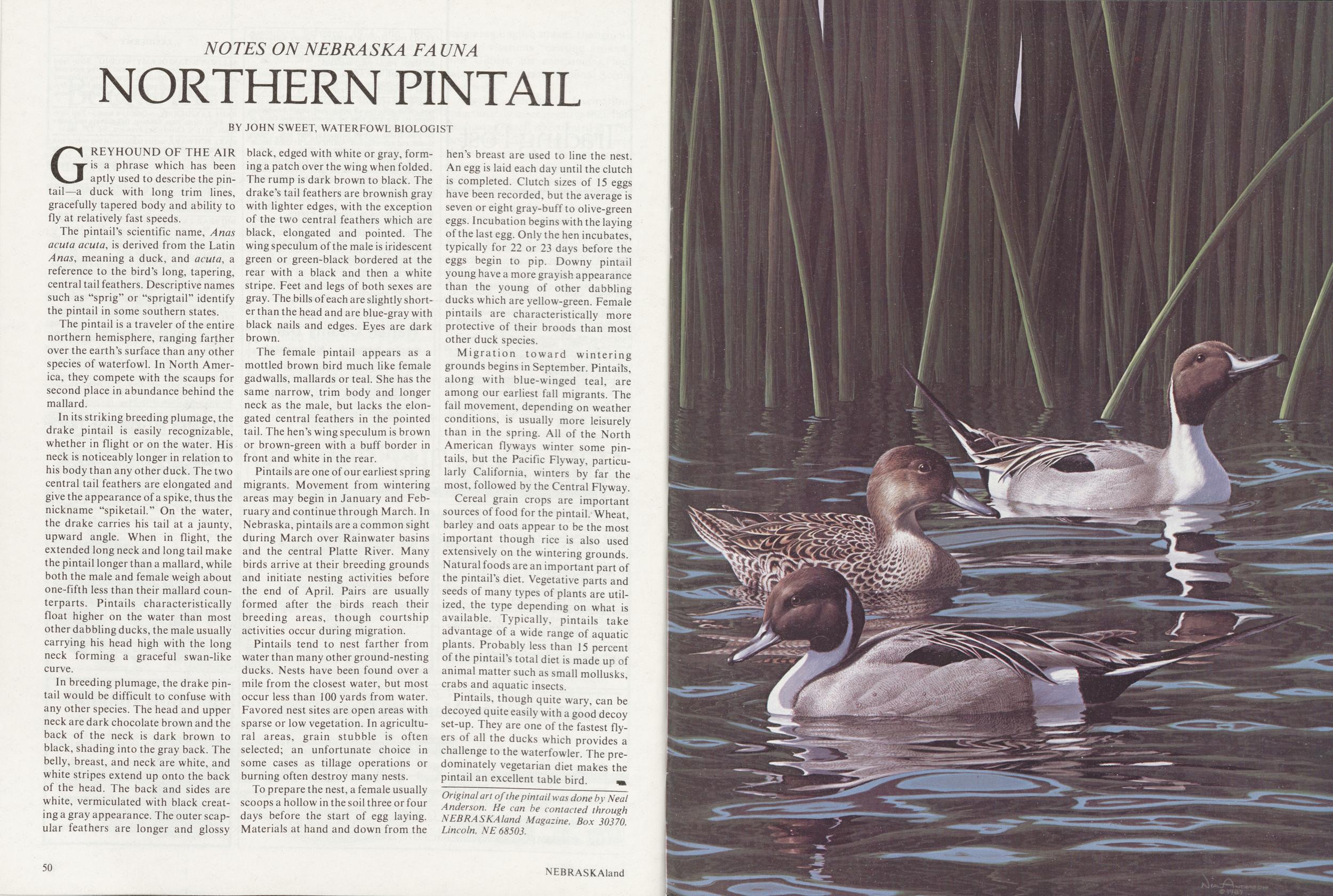
NOTES ON NEBRASKA FAUNA NORTHERN PINTAIL
BY JOHN SWEET, WATERFOWL BIOLOGISTGREYHOUND OF THE AIR is a phrase which has been aptly used to describe the pintail—a duck with long trim lines, gracefully tapered body and ability to fly at relatively fast speeds.
The pintail's scientific name, Anaacuta acuta, is derived from the Latin Anas, meaning a duck, and acuta, a reference to the bird's long, tapering, central tail feathers. Descriptive names such as "sprig" or "springtail" identify the pintail in some southern states.
The pintail is a traveler of the entire northern hemisphere, ranging farther over the earth's surface than any other species of waterfowl. In North America, they compete with the scaups for second place in abundance behind the mallard.
In its striking breeding plumage, the drake pintail is easily recognizable, whether in flight or on the water. His neck is noticeably longer in relation to his body than any other duck. The two central tail feathers are elongated and give the appearance of a spike, thus the nickname "spiketail." On the water, the drake carries his tail at a jaunty, upward angle. When in flight, the extended long neck and long tail make the pintail longer than a mallard, while both the male and female weigh about one-fifth less than their mallard counterparts. Pintails characteristically float higher on the water than most other dabbling ducks, the male usually carrying his head high with the long neck forming a graceful swan-like curve.
In breeding plumage, the drake pintail would be difficult to confuse with any other species. The head and upper neck are dark chocolate brown and the back of the neck is dark brown to black, shading into the gray back. The belly, breast, and neck are white, and white stripes extend up onto the back of the head. The back and sides are white, vermiculated with black creating a gray appearance. The outer scapular feathers are longer and glossy black, edged with white or gray, forming a patch over the wing when folded. The rump is dark brown to black. The drake's tail feathers are brownish gray with lighter edges, with the exception of the two central feathers which are black, elongated and pointed. The wing speculum of the male is iridescent green or green-black bordered at the rear with a black and then a white stripe. Feet and legs of both sexes are gray. The bills of each are slightly shorter than the head and are blue-gray with black nails and edges. Eyes are dark brown.
The female pintail appears as a mottled brown bird much like female gadwalls, mallards or teal. She has the same narrow, trim body and longer neck as the male, but lacks the elongated central feathers in the pointed tail. The hen's wing speculum is brown or brown-green with a buff border in front and white in the rear.
Pintails are one of our earliest spring migrants. Movement from wintering areas may begin in January and February and continue through March. In Nebraska, pintails are a common sight during March over Rainwater basins and the central Platte River. Many birds arrive at their breeding grounds and initiate nesting activities before the end of April. Pairs are usually formed after the birds reach their breeding areas, though courtship activities occur during migration.
Pintails tend to nest farther from water than many other ground-nesting ducks. Nests have been found over a mile from the closest water, but most occur less than 100 yards from water. Favored nest sites are open areas with sparse or low vegetation. In agricultural areas, grain stubble is often selected; an unfortunate choice in some cases as tillage operations or burning often destroy many nests.
To prepare the nest, a female usually scoops a hollow in the soil three or four days before the start of egg laying. Materials at hand and down from the hen's breast are used to line the nest. An egg is laid each day until the clutch is completed. Clutch sizes of 15 eggs have been recorded, but the average is seven or eight gray-buff to olive-green eggs. Incubation begins with the laying of the last egg. Only the hen incubates, typically for 22 or 23 days before the eggs begin to pip. Downy pintail young have a more grayish appearance than the young of other dabbling ducks which are yellow-green. Female pintails are characteristically more protective of their broods than most other duck species.
Migration toward wintering grounds begins in September. Pintails, along with blue-winged teal, are among our earliest fall migrants. The fall movement, depending on weather conditions, is usually more leisurely than in the spring. All of the North American flyways winter some pintails, but the Pacific Flyway, particularly California, winters by far the most, followed by the Central Flyway.
Cereal grain crops are important sources of food for the pintail. Wheat, barley and oats appear to be the most important though rice is also used extensively on the wintering grounds. Natural foods are an important part of the pintail's diet. Vegetative parts and seeds of many types of plants are utilized, the type depending on what is available. Typically, pintails take advantage of a wide range of aquatic plants. Probably less than 15 percent of the pintail's total diet is made up of animal matter such as small mollusks, crabs and aquatic insects.
Pintails, though quite wary, can be decoyed quite easily with a good decoy set-up. They are one of the fastest flyers of all the ducks which provides a challenge to the water fowler. The predominately vegetarian diet makes the pintail an excellent table bird.
Original art of the pintail was done by Neal Anderson. He can be contacted through NEBRASKAland Magazine, Box 30370, Lincoln, NE 68503. 50 NEBRASKAland
Position: 341 (27 views)