Volume 65, Issue 1, 1987
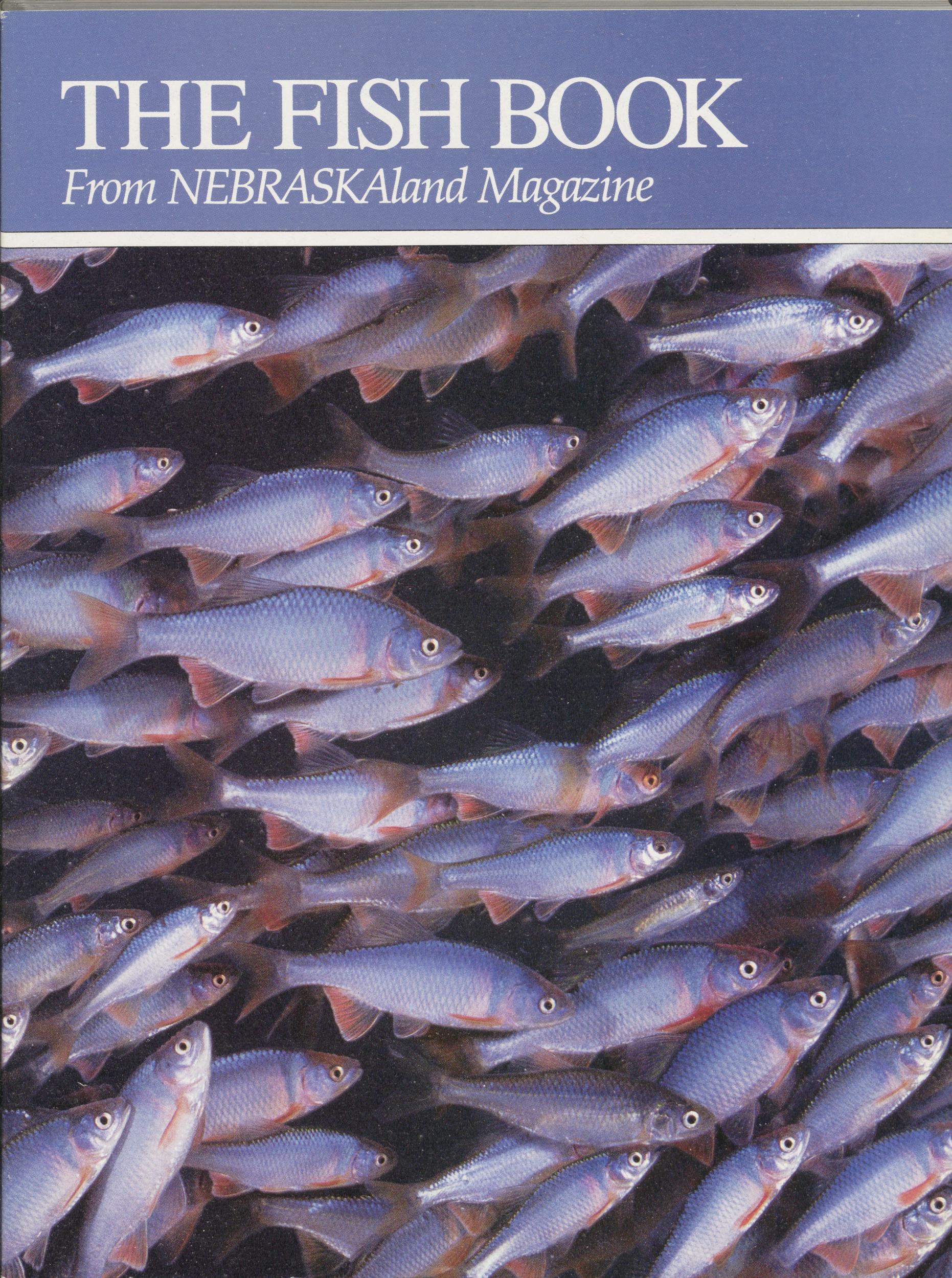
THE FISH BOOK The NEBRASKAland Magazine
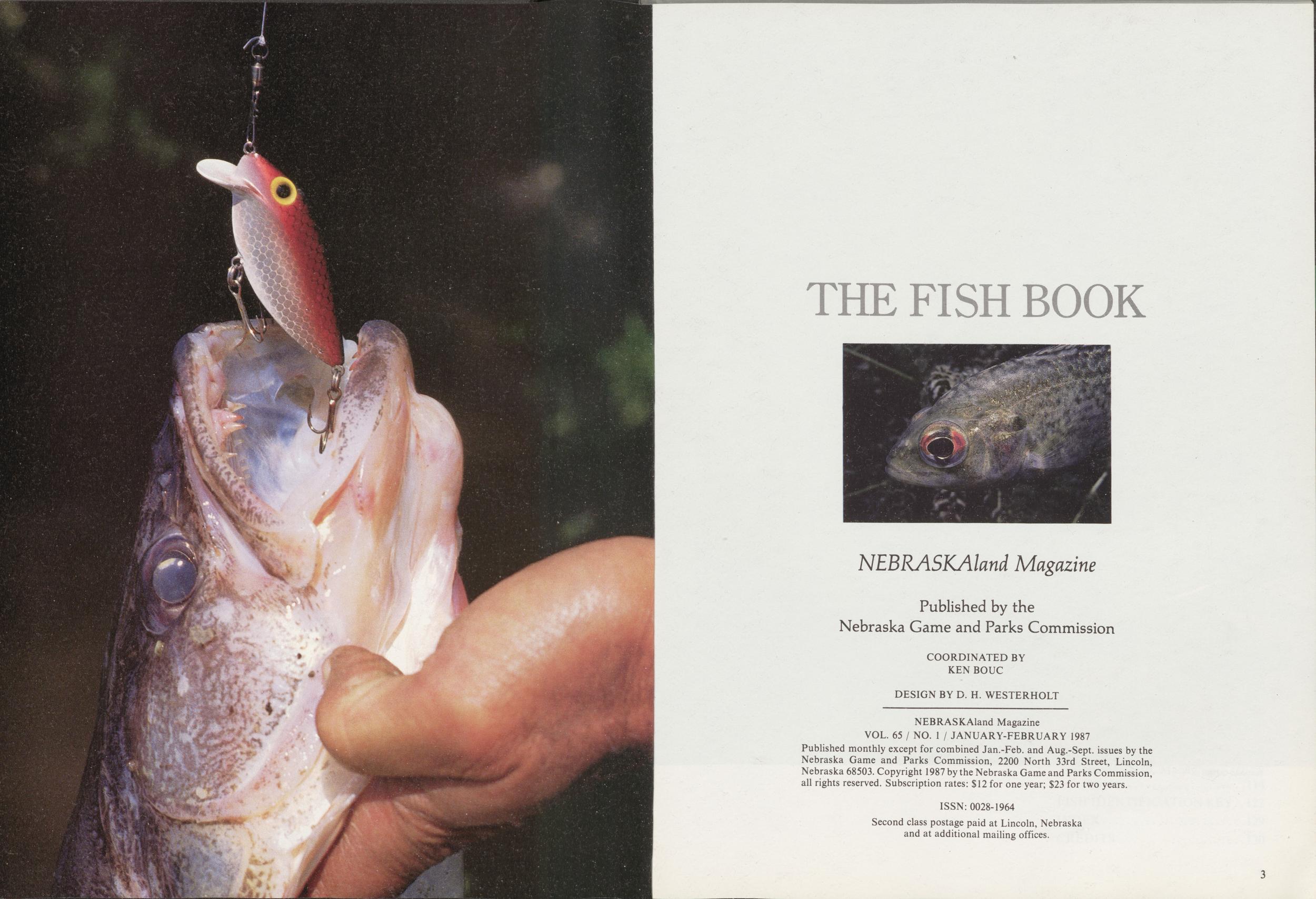
THE FISH BOOK
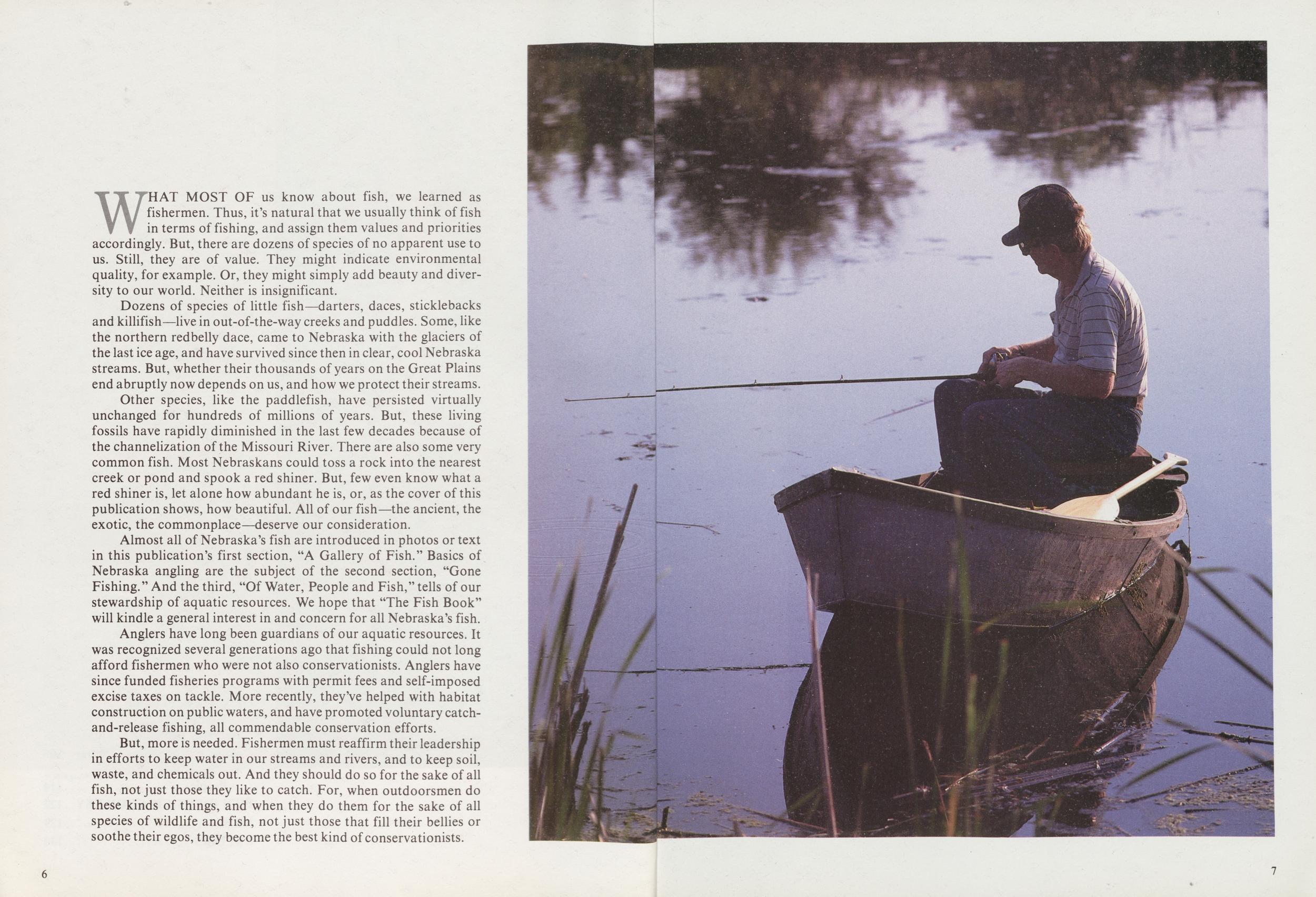
WHAT MOST OF us know about fish, we learned as fishermen. Thus, it's natural that we usually think of fish in terms of fishing, and assign them values and priorities accordingly. But, there are dozens of species of no apparent use to us. Still, they are of value. They might indicate environmental quality, for example. Or, they might simply add beauty and diversity to our world. Neither is insignificant.
Dozens of species of little fish—darters, daces, sticklebacks and killifish—live in out-of-the-way creeks and puddles. Some,like the northern redbelly dace, came to Nebraska with the glaciers of the last ice age, and have survived since then in clear, cool Nebraska streams. But, whether their thousands of years on the Great Plains end abruptly now depends on us, and how we protect their streams.
Other species, like the paddlefish, have persisted virtually unchanged for hundreds of millions of years. But, these living fossils have rapidly diminished in the last few decades because of the channelization of the Missouri River. There are also some very common fish. Most Nebraskans could toss a rock into the nearest creek or pond and spook a red shiner. But, few even know what a red shiner is, let alone how abundant he is, or, as the cover of this publication shows, how beautiful. All of our fish—the ancient, the exotic, the commonplace—deserve our consideration.
Almost all of Nebraska's fish are introduced in photos or text in this publication's first section, "A Gallery of Fish." Basics of Nebraska angling are the subject of the second section, "Gone Fishing." And the third, "Of Water, People and Fish," tells of our stewardship of aquatic resources. We hope that "The Fish Book" will kindle a general interest in and concern for all Nebraska's fish.
Anglers have long been guardians of our aquatic resources. It was recognized several generations ago that fishing could not long afford fishermen who were not also conservationists. Anglers have since funded fisheries programs with permit fees and self-imposed excise taxes on tackle. More recently, they've helped with habitat construction on public waters, and have promoted voluntary catch-and-release fishing, all commendable conservation efforts.
But, more is needed. Fishermen must reaffirm their leadership in efforts to keep water in our streams and rivers, and to keep soil, waste, and chemicals out. And they should do so for the sake of all fish, not just those they like to catch. For, when outdoorsmen do these kinds of things, and when they do them for the sake of all species of wildlife and fish, not just those that fill their bellies or soothe their egos, they become the best kind of conservationists.
6
A GALLERY OF FISH
We’ve caught them on hook and line, or kept them in an aquarium, or read about them, or seen them on television. But most of us really have no idea of how many different kinds offish there are, just in Nebraska, nor do we understand just how colorful and fascinating they really are. Here, we get a close look at most of our fish, and at the unique world in which they live.
The SUNFISH
BY DR. EDWARD J. PETERS Associate Professor of Forestry, Fisheries and Wildlife, UN-LTHE SUNFISH family, known to biologists as the Centrarchidae, are tailor-made for fishermen. They're found everywhere, from cool streams and clear sandpits to warm rivers and dingy farm ponds. And, they're both tasty and sporty, willing to respond to anglers of every age and skill.
In Nebraska, the three main groups of the sunfish family are the bass, genus Micropterus, the sunfish, genus Lepomis, and the crappies, genus Pomoxis. All species build nests of some sort by fanning the bottom of the lake or stream to remove fine materials which might smother developing eggs. These nests are often visible in shallow waters of lakes and ponds during late spring and early summer. The male generally makes and defends the nest and young until they begin to feed on their own.
In most cases, nesting areas are single-species groupings, but two or more species may nest in an area at the same 10 time. This may lead to hybridization, which is not rare in the genus Lepomis. However, sight and sound tend to keep the species from hybridizing. For example, male bluegills produce a series of grunts which attract female bluegills but not other species. Other sunfish species also produce specific calls which attract their appropriate mates.
Each species of sunfish is adapted for slightly different habitat conditions. Therefore, several may be found in the same lake or stream and each may provide quality fishing.
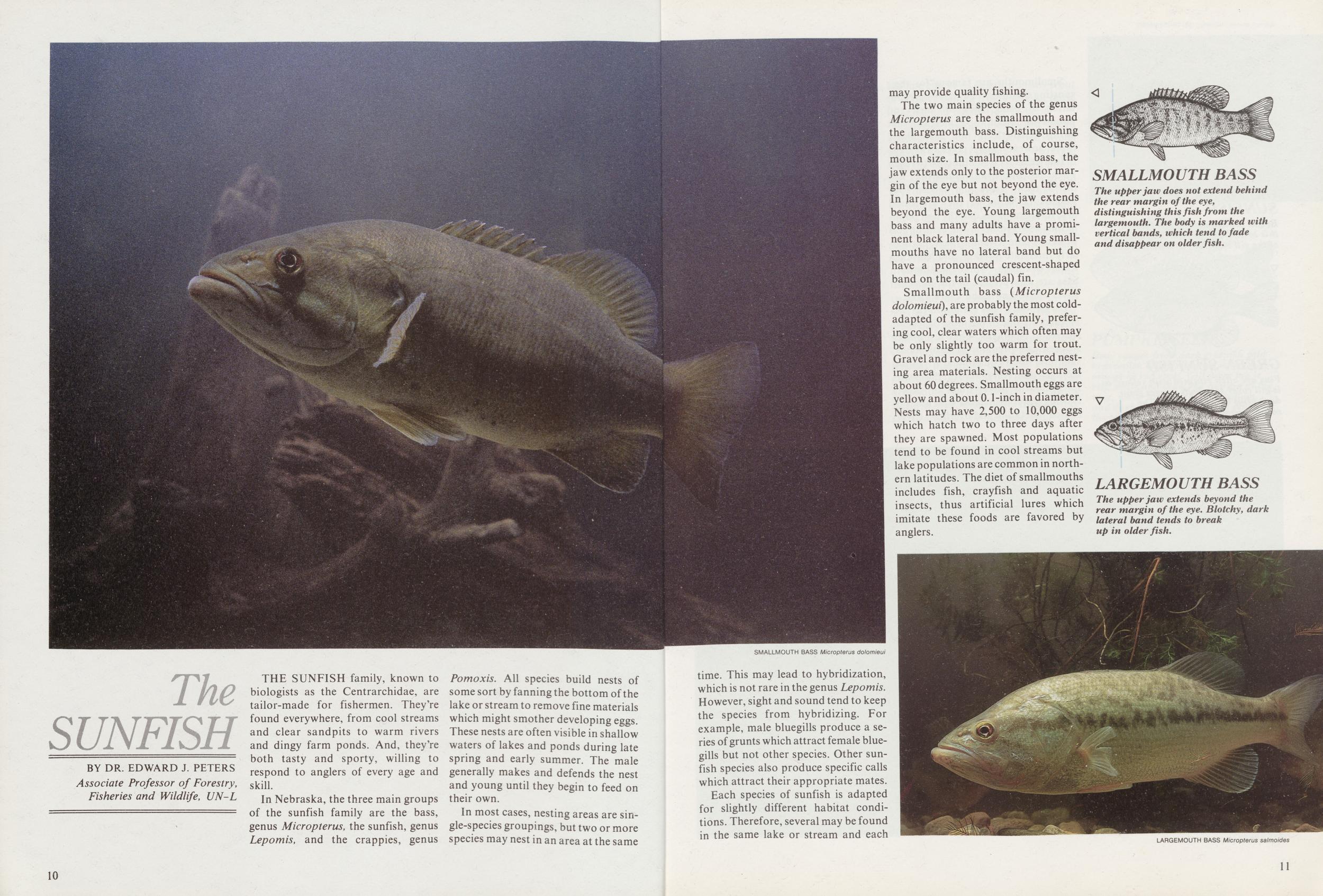
The two main species of the genus Micropterus are the smallmouth and the largemouth bass. Distinguishing characteristics include, of course, mouth size. In smallmouth bass, the jaw extends only to the posterior margin of the eye but not beyond the eye. In largemouth bass, the jaw extends beyond the eye. Young largemouth bass and many adults have a prominent black lateral band. Young smallmouths have no lateral band but do have a pronounced crescent-shaped band on the tail (caudal) fin.
Smallmouth bass {Micropterus dolomieui), are probably the most cold-adapted of the sunfish family, preferring cool, clear waters which often may be only slightly too warm for trout. Gravel and rock are the preferred nesting area materials. Nesting occurs at about 60 degrees. Smallmouth eggs are yellow and about 0.1-inch in diameter. Nests may have 2,500 to 10,000 eggs which hatch two to three days after they are spawned. Most populations tend to be found in cool streams but lake populations are common in northern latitudes. The diet of smallmouths includes fish, crayfish and aquatic insects, thus artificial lures which imitate these foods are favored by anglers.
Smallmouths are famous for their sporting qualities. They have the reputation of being, inch for inch and pound for pound, the gamest fish that swims. Growth is not particularly rapid, however, and it takes an average of four years for a smallmouth to reach 12 inches. Some individuals may live for 10 to 12 years and exceed four pounds. In Nebraska, they are found in several drainages, but the best populations seem to be in the central and western Platte River drainage, particularly Interstate 80 lakes,and Niobrara River drainage. Some smallmouth bass are also present in the Missouri River above Lewis and Clark Lake.
Largemouth bass (Micropterus salmoides) are one of the most fished-for species in Nebraska. They are widely-stocked as a predator in farm ponds, sandpits, flood control and irrigation storage reservoirs across the state. Largemouths prefer quiet or slowly flowing water associated with areas of rooted vegetation and overhead cover. Males build nests in sandy to gravelly areas in less than six feet of water. Nests are almost always in quiet water away from current or wave action. Females produce between 2,000 and 7,000 eggs per pound of body weight.
Almost anything in a pond is considered food by a largemouth. Fish, crayfish, frogs, insects, anything that fits into the gape of the mouth may be the next meal. With the proper food, largemouth bass can reach 20 inches and over five pounds in five years.
Much of what we know about predator-prey interactions in fish populations is based on studies of largemouth-bluegill populations. Fisheries biologists have worked for several decades to try to manage these populations in what has been called a balanced condition—a balance between growth and harvest. Ideally, any bass harvested should be replaced by new individuals which are growing to harvestable size. So, a consistent crop of young, plus food for a good growth 12 rate, are both important.
In contrast to the bass of the genus Micropterus, which are the big predators of the sunfish family, the genus Lepomis often serves as forage or prey for larger fish. Most species in the genus Lepomis have small mouths, which restricts the size of food which can be eaten. However, they are also valuable sport fish in their own right. They are important panfish which have given many a youngster their first fishing thrill. Indeed, many of us have never tired of soaking a worm on a warm summer afternoon for a bluegill or a pumpkinseed or watching a tiny bobber in a crystalizing hole in the ice—waiting for it to tip or dive from a bluegill on the end.
More sophisticated gear, little poppers and a fly rod, extend bluegill fishing to some of us bigger kids. A still evening just before dark, wading quietly in the weedy shallows of a pond, waiting for the sipping sound and the tug of a bluegill at the end of the line can be as exciting as any trout or walleye fishing trip, and a lot more relaxing and hassle-free, to boot.
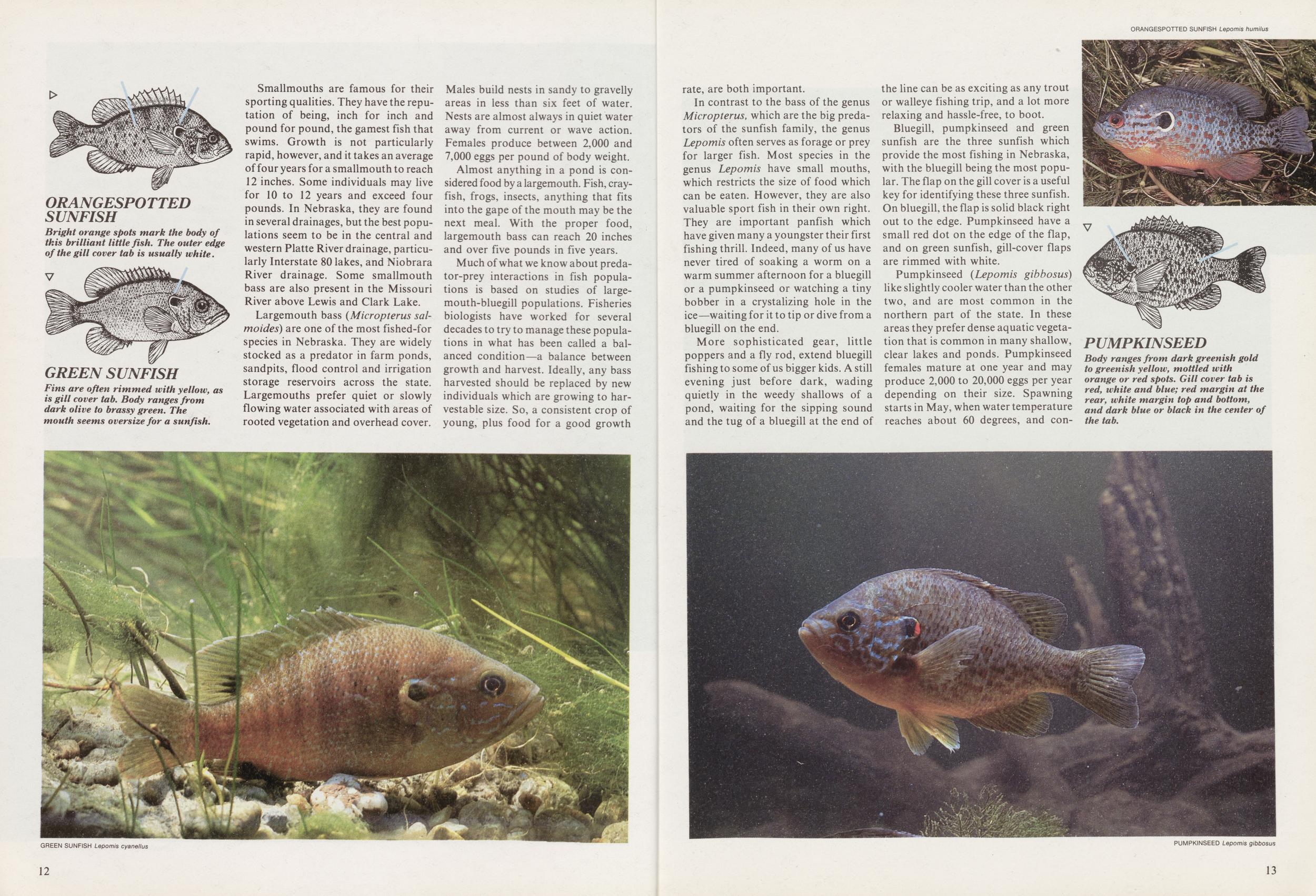
Bluegill, pumpkinseed and green sunfish are the three sunfish which provide the most fishing in Nebraska, with the bluegill being the most popular. The flap on the gill cover is a useful key for identifying these three sunfish. On bluegill, the flap is solid black right out to the edge. Pumpkinseed have a small red dot on the edge of the flap, and on green sunfish, gill-cover flaps are rimmed with white.
Pumpkinseed {Lepomis gibbosus) like slightly cooler water than the other two, and are most common in the northern part of the state. In these areas they prefer dense aquatic vegetation that is common in many shallow, clear lakes and ponds. Pumpkinseed females mature at one year and may produce 2,000 to 20,000 eggs per year depending on their size. Spawning starts in May, when water temperature reaches about 60 degrees, and continues into August.
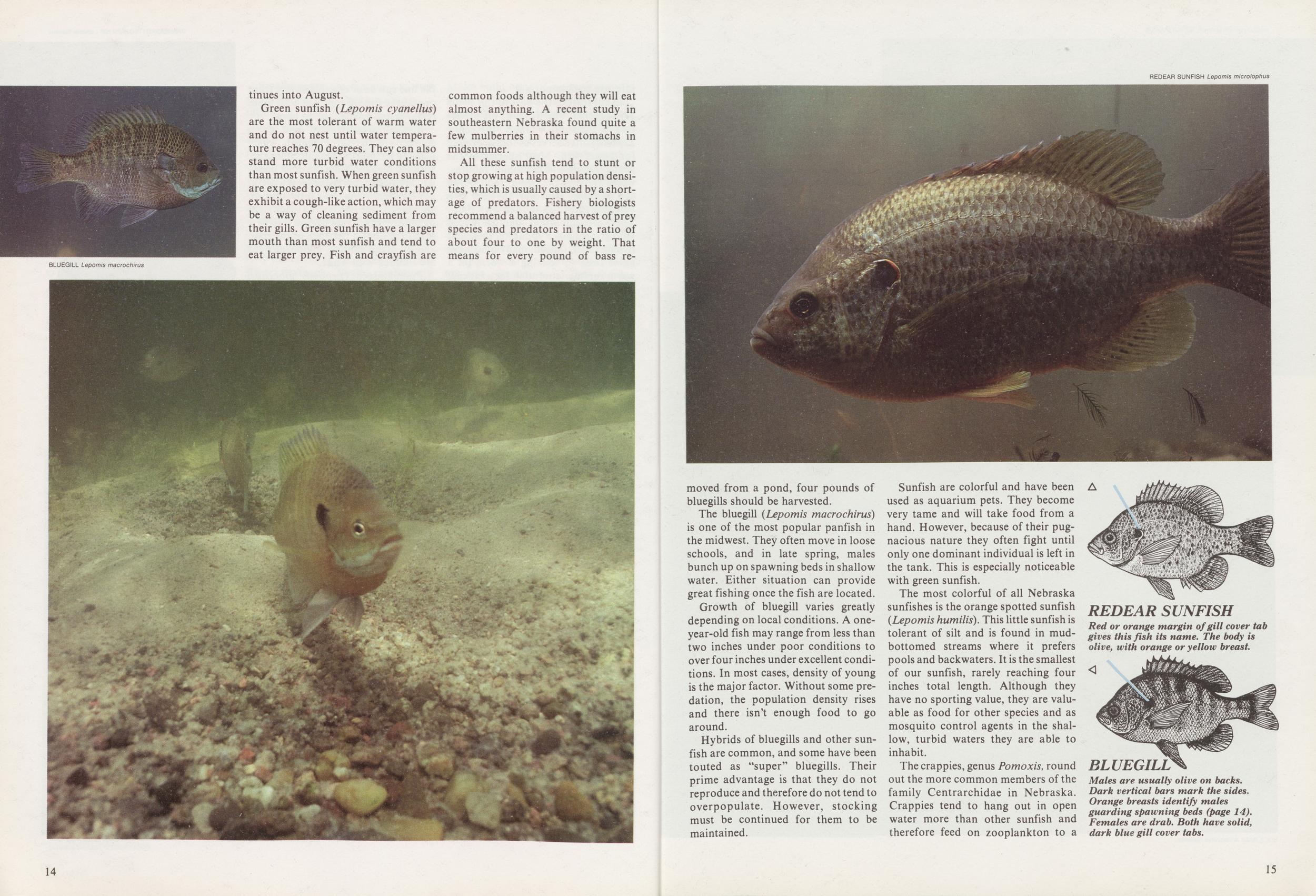
Green sunfish (Lepomis cyanellus) are the most tolerant of warm water and do not nest until water temperature reaches 70 degrees. They can also stand more turbid water conditions than most sunfish. When green sunfish are exposed to very turbid water, they exhibit a cough-like action, which may be a way of cleaning sediment from their gills. Green sunfish have a larger mouth than most sunfish and tend to eat larger prey. Fish and crayfish are common foods although they will eat almost anything. A recent study in southeastern Nebraska found quite a few mulberries in their stomachs in midsummer.
All these sunfish tend to stunt or stop growing at high population densities, which is usually caused by a shortage of predators. Fishery biologists recommend a balanced harvest of prey species and predators in the ratio of about four to one by weight. That means for every pound of bass removed 14 from a pond, four pounds of bluegills should be harvested.
The bluegill (Lepomis macrochirus) is one of the most popular panfish in the midwest. They often move in loose schools, and in late spring, males bunch up on spawning beds in shallow water. Either situation can provide great fishing once the fish are located.
Growth of bluegill varies greatly depending on local conditions. A one-year-old fish may range from less than two inches under poor conditions to over four inches under excellent conditions. In most cases, density of young is the major factor. Without some predation, the population density rises and there isn't enough food to go around.
Hybrids of bluegills and other sunfish are common, and some have been touted as "super" bluegills. Their prime advantage is that they do not reproduce and therefore do not tend to overpopulate. However, stocking must be continued for them to be maintained.
Sunfish are colorful and have been used as aquarium pets. They become very tame and will take food from a hand. However, because of their pugnacious nature they often fight until only one dominant individual is left in the tank. This is especially noticeable with green sunfish.
The most colorful of all Nebraska sunfishes is the orange spotted sunfish (Lepomis humilis). This little sunfish is tolerant of silt and is found in mud- bottomed streams where it prefers pools and backwaters. It is the smallest of our sunfish, rarely reaching four inches total length. Although they have no sporting value, they are valuable as food for other species and as mosquito control agents in the shallow, turbid waters they are able to inhabit.
The crappies, genus Pomoxis, round out the more common members of the family Centrarchidae in Nebraska. Crappies tend to hang out in open water more than other sunfish and therefore feed on zooplankton to a greater extent. To retain the zooplankton, crappies have long, slender gill rakers on their gill arches but feed by picking individual plankton out of the water one after another. In addition to plankton, larger crappies add aquatic insects and small fish to their diets. The size offish eaten depends on the size of the crappie, but even six-inch crappies regularly eat two-inch shad.
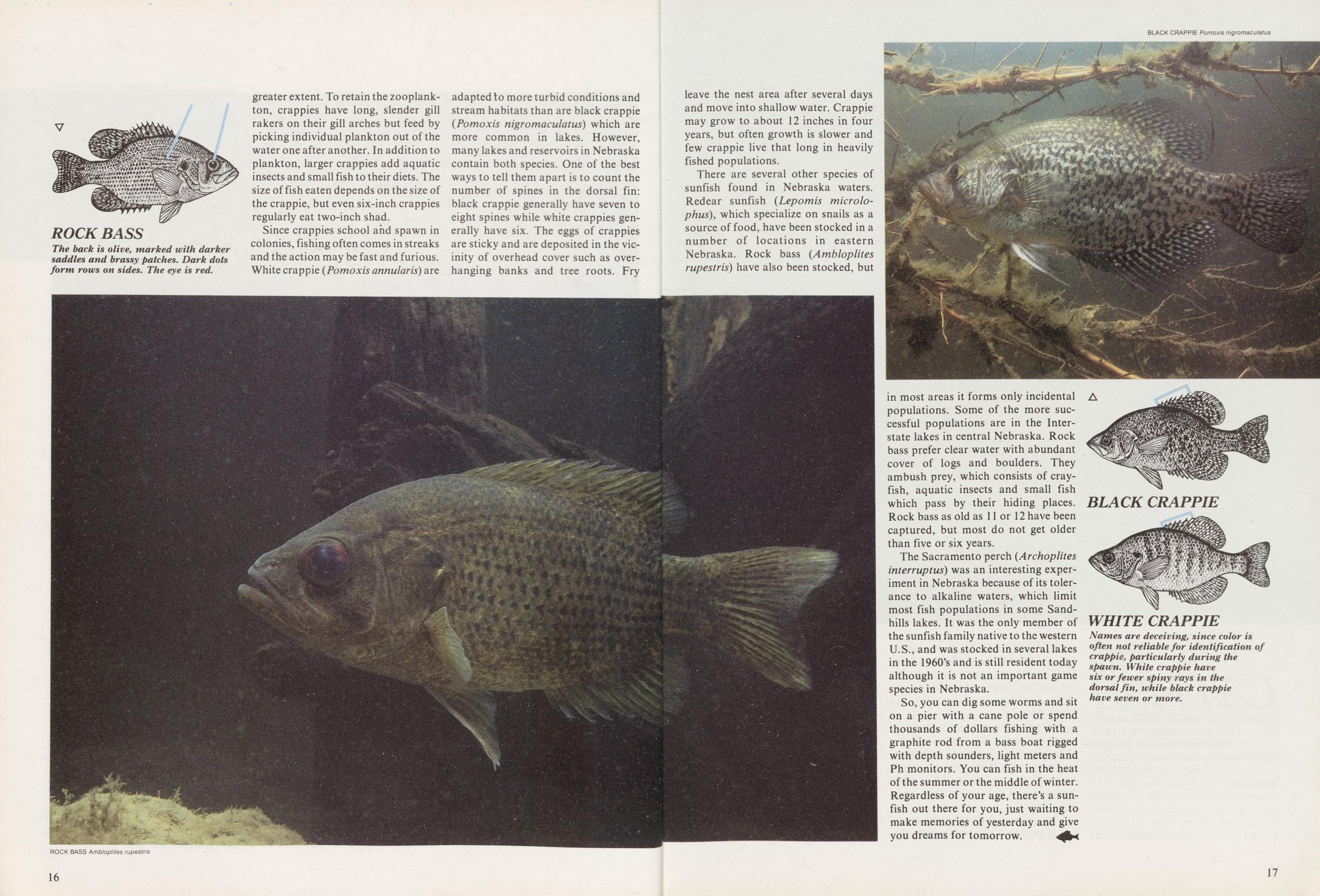
Since crappies school and spawn in colonies, fishing often comes in streaks and the action may be fast and furious. White crappie {Pomoxis annularis) are adapted to more turbid conditions and stream habitats than are black crappie {Pomoxis nigromaculatus) which are more common in lakes. However, many lakes and reservoirs in Nebraska contain both species. One of the best ways to tell them apart is to count the number of spines in the dorsal fin: black crappie generally have seven to eight spines while white crappies generally have six. The eggs of crappies are sticky and are deposited in the vicinity of overhead cover such as overhanging banks and tree roots. Fry 16 leave the nest area after several days and move into shallow water. Crappie may grow to about 12 inches in four years, but often growth is slower and few crappie live that long in heavily fished populations.
There are several other species of sunfish found in Nebraska waters. Redear sunfish {Lepomis microlophus), which specialize on snails as a source of food, have been stocked in a number of locations in eastern Nebraska. Rock bass {Ambloplites rupestris) have also been stocked, but in most areas it forms only incidental populations. Some of the more successful populations are in the Interstate lakes in central Nebraska. Rock bass prefer clear water with abundant cover of logs and boulders. They ambush prey, which consists of crayfish, aquatic insects and small fish which pass by their hiding places. Rock bass as old as 11 or 12 have been captured, but most do not get older than five or six years.
The Sacramento perch {Archoplites interruptus) was an interesting experiment in Nebraska because of its tolerance to alkaline waters, which limit most fish populations in some Sandhills lakes. It was the only member of the sunfish family native to the western U.S., and was stocked in several lakes in the 1960's and is still resident today although it is not an important game species in Nebraska.
So, you can dig some worms and sit on a pier with a cane pole or spend thousands of dollars fishing with a graphite rod from a bass boat rigged with depth sounders, light meters and Ph monitors. You can fish in the heat of the summer or the middle of winter. Regardless of your age, there's a sunfish out there for you, just waiting to make memories of yesterday and give you dreams for tomorrow.
The CATFISH
BY LARRY W. HESSE Fisheries Research BiologistCATFISHES OCCUR in tropical regions around the world, and some even inhabit the planet's oceans. But one catfish family, Ictaluridae, includes 37 species, and is restricted to North America.
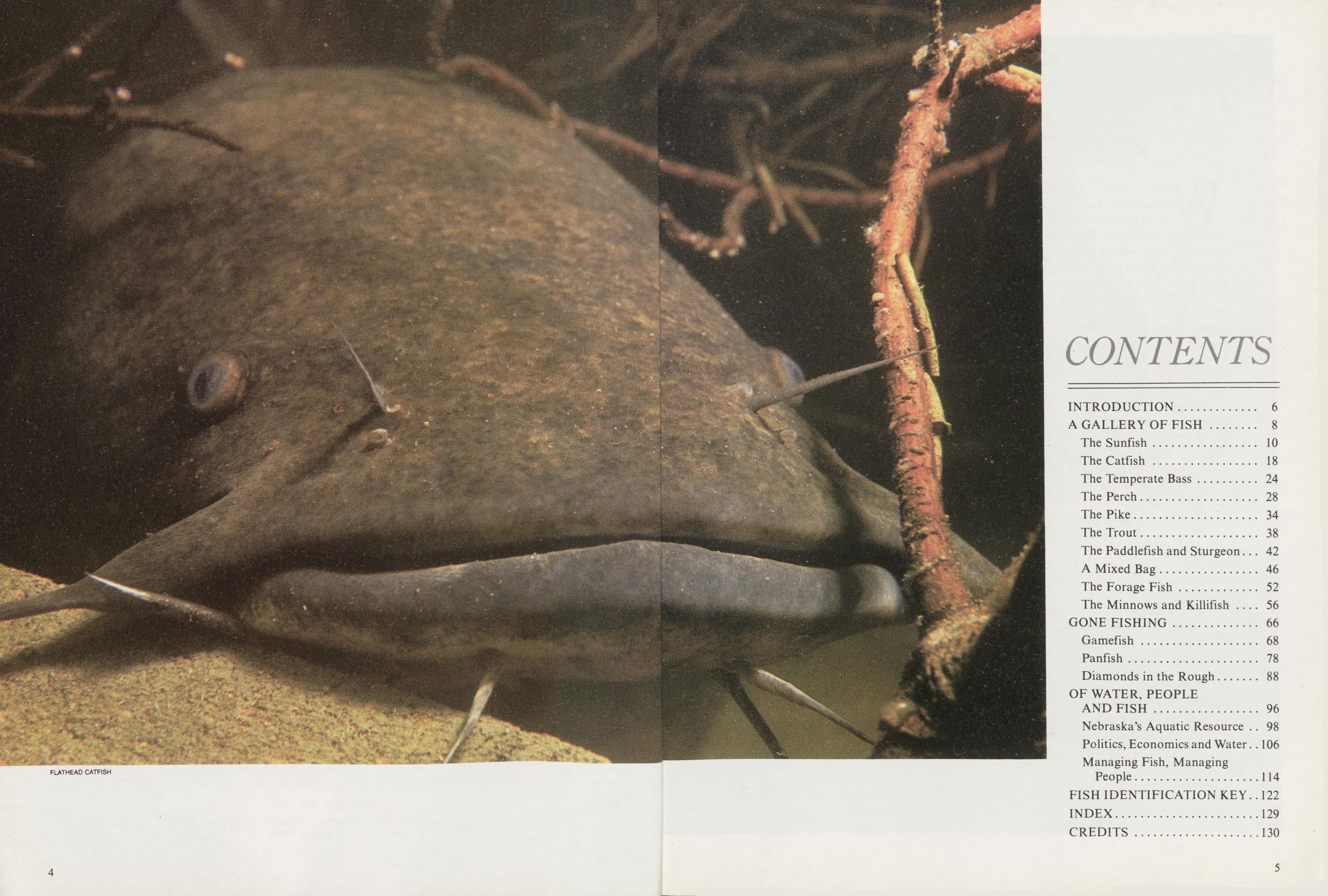
Nebraska is home to eight species of this family including channel and blue catfish, and black, yellow and brown bullheads in the genus Ictalurus; stone cat and tadpole madtom in the genus Noturus; and flathead catfish, genus Pylodictis.
Channel catfish {Ictalurus punctatus) is probably the most widely distributed because it has adapted to small ponds and reservoirs throughout Nebraska, although the black bullhead {Ictalurus melas) is nearly as common. However, the brown bullhead {Ictalurus nebulosus) was introduced into Nebraska waters by a few private pond owners in the east-central, and remains very restricted in its range. The yellow bullhead {Ictalurus natalis) is not nearly as common as the black but can be found in rivers such as the Missouri, Elkhorn, Platte and Little Blue.
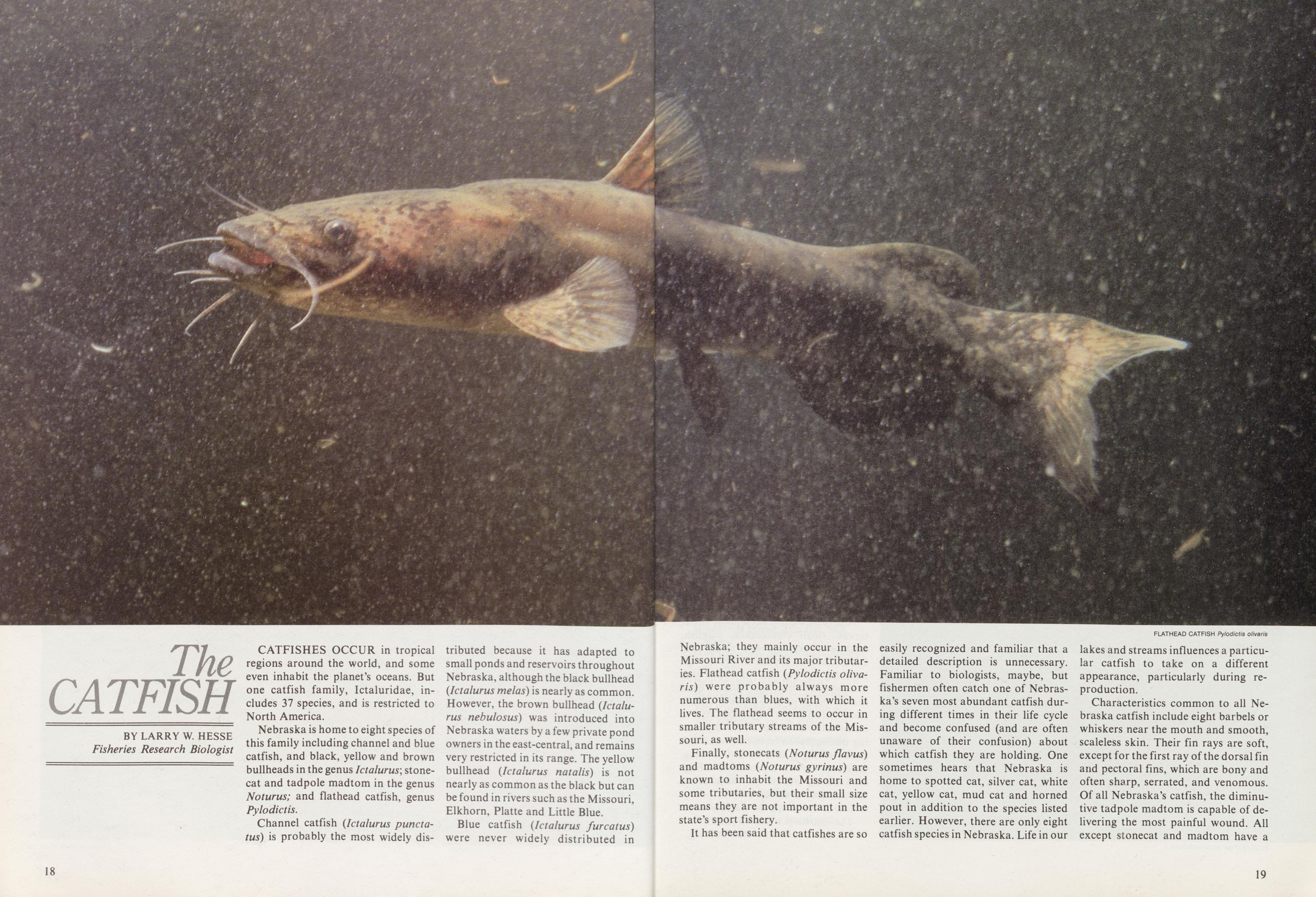
Blue catfish {Ictalurus furcatus) were never widely distributed in 18 Nebraska; they mainly occur in the Missouri River and its major tributaries. Flathead catfish {Pylodictis olivais) were probably always more numerous than blues, with which it lives. The flathead seems to occur in smaller tributary streams of the Missouri, as well.
Finally, stonecats {Noturus flavus) and madtoms {Noturus gyrinus) are known to inhabit the Missouri and some tributaries, but their small size means they are not important in the state's sport fishery.
It has been said that catfishes are so easily recognized and familiar that a detailed description is unnecessary. Familiar to biologists, maybe, but fishermen often catch one of Nebraska's seven most abundant catfish during different times in their life cycle and become confused (and are often unaware of their confusion) about which catfish they are holding. One sometimes hears that Nebraska is home to spotted cat, silver cat, white cat, yellow cat, mud cat and horned pout in addition to the species listed earlier. However, there are only eight catfish species in Nebraska. Life in our lakes and streams influences a particular catfish to take on a different appearance, particularly during reproduction.
Characteristics common to all Nebraska catfish include eight barbels or whiskers near the mouth and smooth, scaleless skin. Their fin rays are soft, except for the first ray of the dorsal fin and pectoral fins, which are bony and often sharp, serrated, and venomous. Of all Nebraska's catfish, the diminutive tadpole madtom is capable of delivering the most painful wound. All except stonecat and madtom have a flap-like, fleshy adipose fin.
19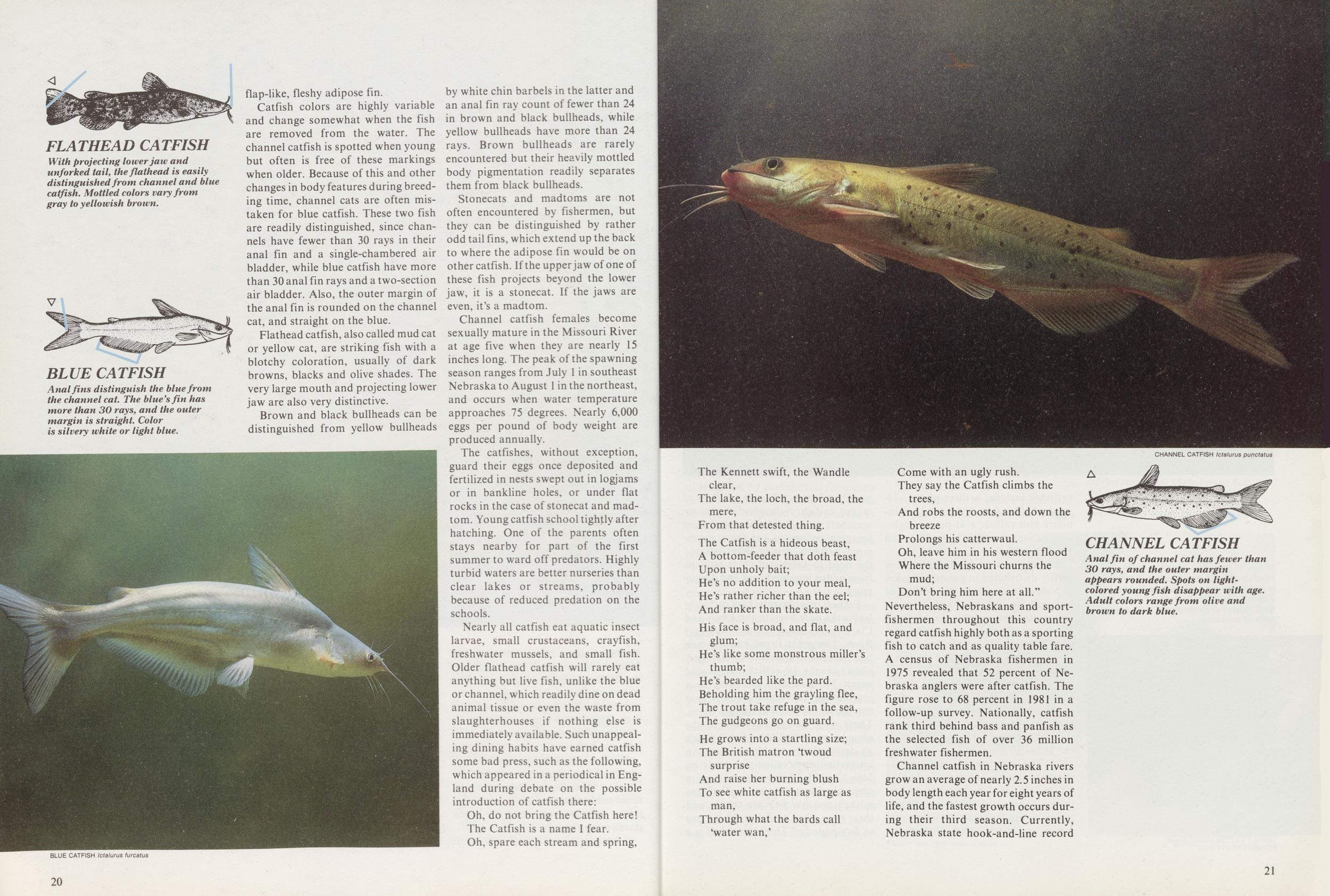
Catfish colors are highly variable and change somewhat when the fish are removed from the water. The channel catfish is spotted when young but often is free of these markings when older. Because of this and other changes in body features during breeding time, channel cats are often mistaken for blue catfish. These two fish are readily distinguished, since channels have fewer than 30 rays in their anal fin and a single-chambered air bladder, while blue catfish have more than 30 anal fin rays and a two-section air bladder. Also, the outer margin of the anal fin is rounded on the channel cat, and straight on the blue.
Flathead catfish, also called mud cat or yellow cat, are striking fish with a blotchy coloration, usually of dark browns, blacks and olive shades. The very large mouth and projecting lower jaw are also very distinctive.
Brown and black bullheads can be distinguished from yellow bullheads by white chin barbels in the latter and an anal fin ray count of fewer than 24 in brown and black bullheads, while yellow bullheads have more than 24 rays. Brown bullheads are rarely encountered but their heavily mottled body pigmentation readily separates them from black bullheads.
Stonecats and madtoms are not often encountered by fishermen, but they can be distinguished by rather odd tail fins, which extend up the back to where the adipose fin would be on other catfish. If the upper jaw of one of these fish projects beyond the lower jaw, it is a stonecat. If the jaws are even, it's a madtom.
Channel catfish females become sexually mature in the Missouri River at age five when they are nearly 15 inches long. The peak of the spawning season ranges from July 1 in southeast Nebraska to August 1 in the northeast, and occurs when water temperature approaches 75 degrees. Nearly 6,000 eggs per pound of body weight are produced annually.
The catfishes, without exception, guard their eggs once deposited and fertilized in nests swept out in log jams or in bank line holes, or under flat rocks in the case of stonecat and madtom. Young catfish school tightly after hatching. One of the parents often stays nearby for part of the first summer to ward off predators. Highly turbid waters are better nurseries than clear lakes or streams, probably because of reduced predation on the schools.
Nearly all catfish eat aquatic insect larvae, small crustaceans, crayfish, freshwater mussels, and small fish. Older flathead catfish will rarely eat anything but live fish, unlike the blue or channel, which readily dine on dead animal tissue or even the waste from slaughterhouses if nothing else is immediately available. Such unappealing dining habits have earned catfish some bad press, such as the following, which appeared in a periodical in England during debate on the possible introduction of catfish there:
Oh, do not bring the Catfish here! The Catfish is a name I fear. Oh, spare each stream and spring, The Kennett swift, the Wandle clear. The lake, the loch, the broad, the mere. From that detested thing. The Catfish is a hideous beast, A bottom-feeder that doth feast Upon unholy bait; He's no addition to your meal, He's rather richer than the eel; And ranker than the skate. His face is broad, and flat, and glum; He's like some monstrous miller's thumb; He's bearded like the pard. Beholding him the grayling flee, The trout take refuge in the sea, The gudgeons go on guard. He grows into a startling size; The British matron wouldn’t surprise and raise her burning blush To see white catfish as large as man, Through what the bards call 'water wan,' Come with an ugly rush. They say the Catfish climbs the trees, And robs the roosts, and down the breeze Prolongs his caterwaul. Oh, leave him in his western flood Where the Missouri churns the mud; Don't bring him here at all."Nevertheless, Nebraskans and sportfishermen throughout this country regard catfish highly both as a sporting fish to catch and as quality table fare. A census of Nebraska fishermen in 1975 revealed that 52 percent of Nebraska anglers were after catfish. The figure rose to 68 percent in 1981 in a follow-up survey. Nationally, catfish rank third behind bass and panfish as the selected fish of over 36 million freshwater fishermen.
Channel catfish in Nebraska rivers grow an average of nearly 2.5 inches in body length each year for eight years of life, and the fastest growth occurs during their third season. Currently,Nebraska state hook-and-line record Catfishes include: a three-pound, 14-ounce bullhead, a 100-pound, eight-ounce blue catfish, a 41-pound, eight-ounce channel catfish, and a 76-pound flathead catfish.
21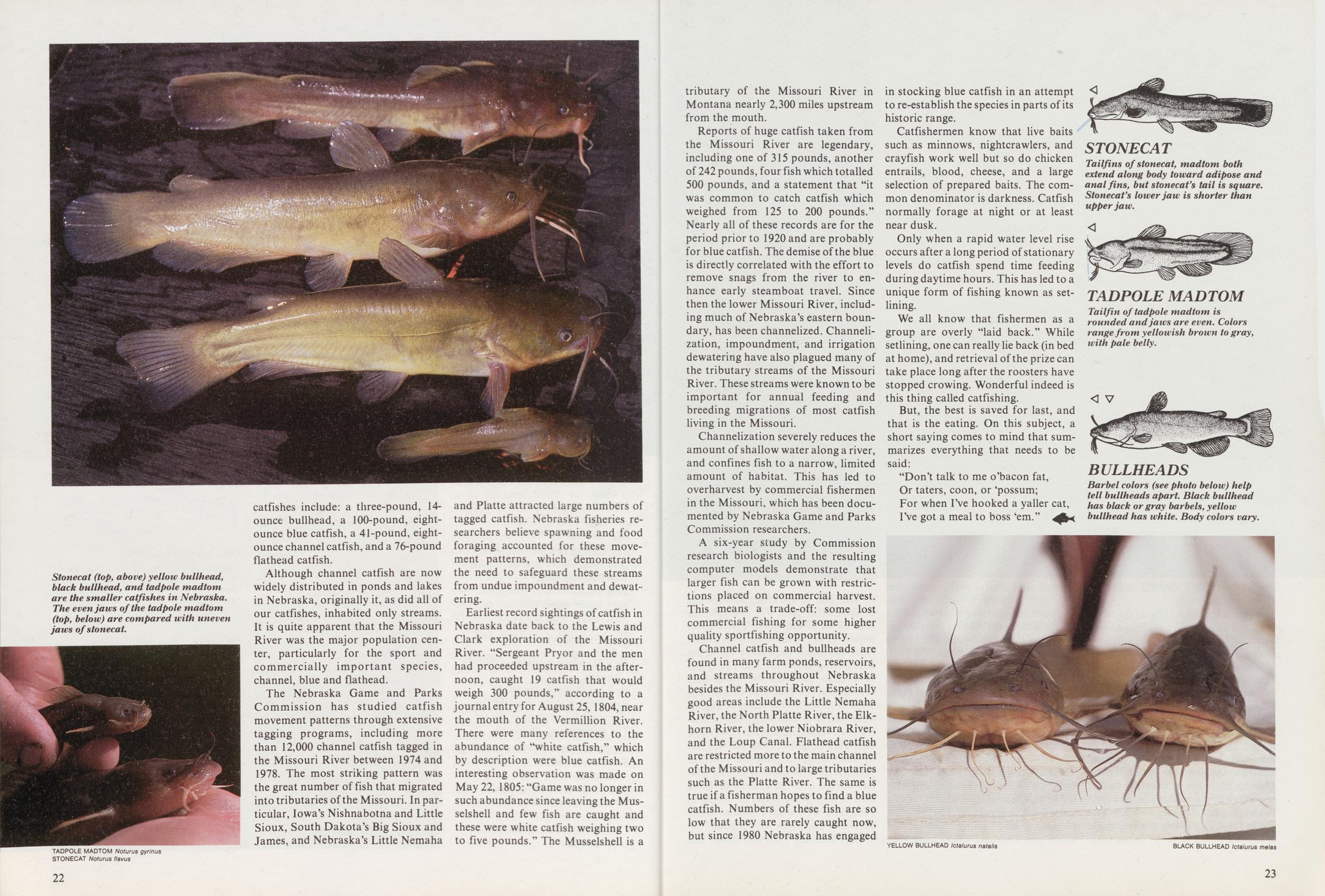
Although channel catfish are now widely distributed in ponds and lakes in Nebraska, originally it, as did all of our catfishes, inhabited only streams. It is quite apparent that the Missouri River was the major population center, particularly for the sport and commercially important species, channel, blue and flathead.
The Nebraska Game and Parks Commission has studied catfish movement patterns through extensive tagging programs, including more than 12,000 channel catfish tagged in the Missouri River between 1974 and 1978. The most striking pattern was the great number offish that migrated into tributaries of the Missouri. In particular, Iowa's Nishnabotna and Little Sioux, South Dakota's Big Sioux and James, and Nebraska's Little Nemaha and Platte attracted large numbers of tagged catfish. Nebraska fisheries researchers believe spawning and food foraging accounted for these movement patterns, which demonstrated the need to safeguard these streams from undue impoundment and dewatering.
Earliest record sightings of catfish in Nebraska date back to the Lewis and Clark exploration of the Missouri River. "Sergeant Pryor and the men had proceeded upstream in the afternoon, caught 19 catfish that would weigh 300 pounds," according to a journal entry for August 25, 1804, near the mouth of the Vermillion River. There were many references to the abundance of "white catfish," which by description were blue catfish. An interesting observation was made on May 22, 1805: "Game was no longer in such abundance since leaving the Musselshell and few fish are caught and these were white catfish weighing two to five pounds." The Mussel shell is a 23 tributary of the Missouri River in Montana nearly 2,300 miles upstream from the mouth.
Reports of huge catfish taken from the Missouri River are legendary, including one of 315 pounds, another of 242 pounds, four fish which totaled 500 pounds, and a statement that "it was common to catch catfish which weighed from 125 to 200 pounds." Nearly all of these records are for the period prior to 1920 and are probably for blue catfish. The demise of the blue is directly correlated with the effort to remove snags from the river to enhance early steamboat travel. Since then the lower Missouri River, including much of Nebraska's eastern boundary, has been channelized. Channelization, impoundment, and irrigation dewatering have also plagued many of the tributary streams of the Missouri River. These streams were known to be important for annual feeding and breeding migrations of most catfish living in the Missouri.
Channelization severely reduces the amount of shallow water along a river, and confines fish to a narrow, limited amount of habitat. This has led to over harvest by commercial fishermen in the Missouri, which has been documented by Nebraska Game and Parks Commission researchers.
A six-year study by Commission research biologists and the resulting computer models demonstrate that larger fish can be grown with restrictions placed on commercial harvest. This means a trade-off: some lost commercial fishing for some higher quality sport fishing opportunity.
Channel catfish and bullheads are found in many farm ponds, reservoirs, and streams throughout Nebraska besides the Missouri River. Especially good areas include the Little Nemaha River, the North Platte River, the Elkhorn River, the lower Niobrara River, and the Loup Canal. Flathead catfish are restricted more to the main channel of the Missouri and to large tributaries such as the Platte River. The same is true if a fisherman hopes to find a blue catfish. Numbers of these fish are so low that they are rarely caught now, but since 1980 Nebraska has engaged in stocking blue catfish in an attempt to re-establish the species in parts of its historic range.
Catfishermen know that live baits such as minnows, night crawlers, and crayfish work well but so do chicken entrails, blood, cheese, and a large selection of prepared baits. The common denominator is darkness. Catfish normally forage at night or at least near dusk.
Only when a rapid water level rise occurs after a long period of stationary levels do catfish spend time feeding during daytime hours. This has led to a unique form of fishing known as settling.
We all know that fishermen as a group are overly "laid back." While settling, one can really lie back (in bed at home), and retrieval of the prize can take place long after the roosters have stopped crowing. Wonderful indeed is this thing called catfishing.
But, the best is saved for last, and that is the eating. On this subject, a short saying comes to mind that summarizes everything that needs to be said:
"Don't talk to me o'bacon fat, Or taters, coon, or 'possum; For when I've hooked a yaller cat, I've got a meal to boss 'em."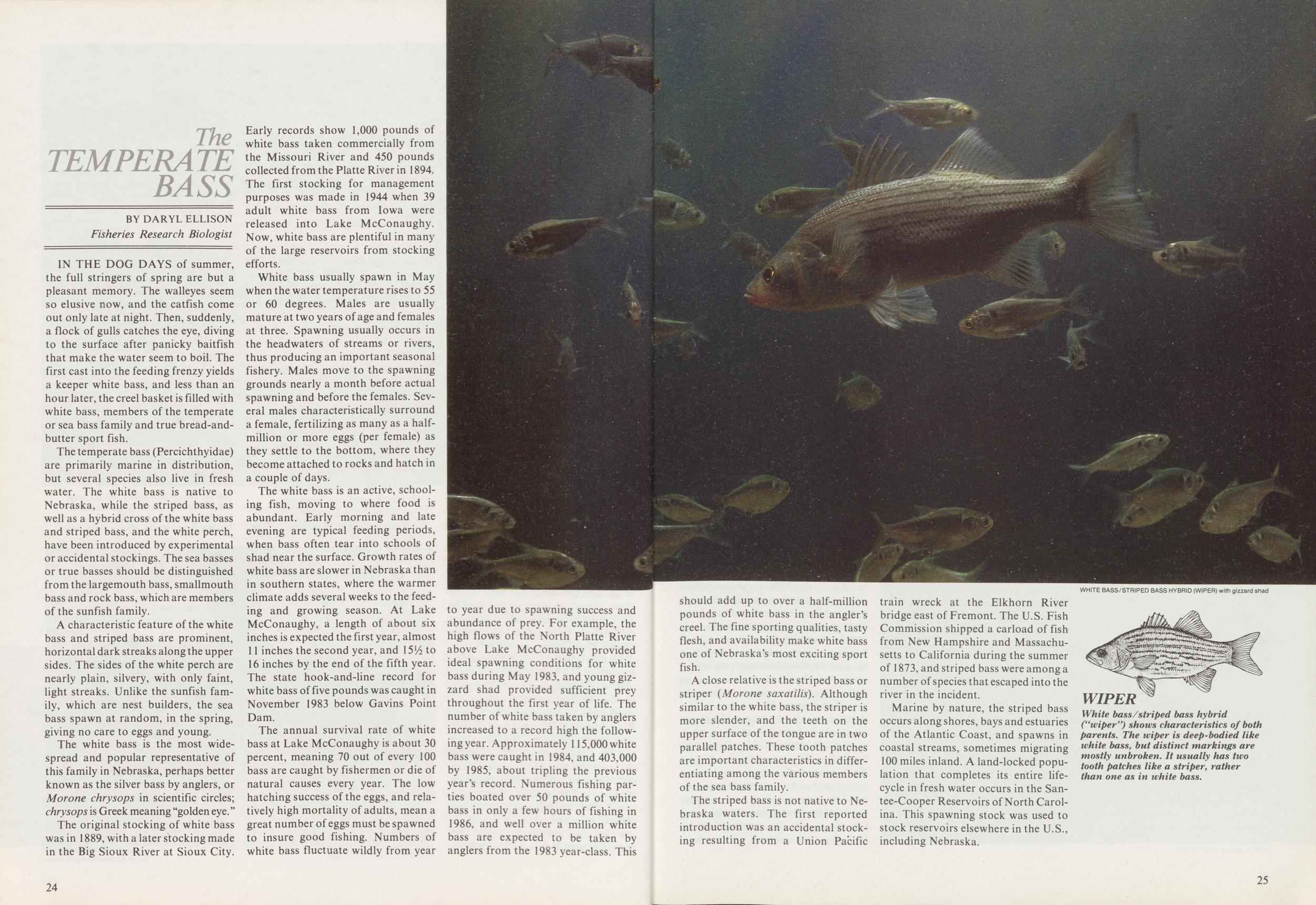
The TEMPERATE BASS
BY DARYL ELLISON Fisheries Research BiologistIN THE DOG DAYS of summer, the full stringers of spring are but a pleasant memory. The walleyes seem so elusive now, and the catfish come out only late at night. Then, suddenly, a flock of gulls catches the eye, diving to the surface after panicky baitfish that make the water seem to boil. The first cast into the feeding frenzy yields a keeper white bass, and less than an hour later, the creel basket is filled with white bass, members of the temperate or sea bass family and true bread-and- butter sport fish.
The temperate bass (Percichthyidae) are primarily marine in distribution, but several species also live in fresh water. The white bass is native to Nebraska, while the striped bass, as well as a hybrid cross of the white bass and striped bass, and the white perch, have been introduced by experimental or accidental stockings. The sea basses or true basses should be distinguished from the largemouth bass, smallmouth bass and rock bass, which are members of the sunfish family.
A characteristic feature of the white bass and striped bass are prominent, horizontal dark streaks along the upper sides. The sides of the white perch are nearly plain, silvery, with only faint, light streaks. Unlike the sunfish family, which are nest builders, the sea bass spawn at random, in the spring, giving no care to eggs and young.
The white bass is the most widespread and popular representative of this family in Nebraska, perhaps better known as the silver bass by anglers, or Morone chrysops in scientific circles; chrysops is Greek meaning "golden eye."
The original stocking of white bass was in 1889, with a later stocking made in the Big Sioux River at Sioux City. Early records show 1,000 pounds of white bass taken commercially from the Missouri River and 450 pounds collected from the Platte River in 1894. The first stocking for management purposes was made in 1944 when 39 adult white bass from Iowa were released into Lake McConaughy. Now, white bass are plentiful in many of the large reservoirs from stocking efforts.
White bass usually spawn in May when the water temperature rises to 55 or 60 degrees. Males are usually mature at two years of age and females at three. Spawning usually occurs in the headwaters of streams or rivers, thus producing an important seasonal fishery. Males move to the spawning grounds nearly a month before actual spawning and before the females. Several males characteristically surround a female, fertilizing as many as a half-million or more eggs (per female) as they settle to the bottom, where they become attached to rocks and hatch in a couple of days.
The white bass is an active, schooling fish, moving to where food is abundant. Early morning and late evening are typical feeding periods, when bass often tear into schools of shad near the surface. Growth rates of white bass are slower in Nebraska than in southern states, where the warmer climate adds several weeks to the feeding and growing season. At Lake McConaughy, a length of about six inches is expected the first year, almost 11 inches the second year, and \5Vi to 16 inches by the end of the fifth year. The state hook-and-line record for white bass off five pounds was caught in November 1983 below Gavins Point Dam.
The annual survival rate of white bass at Lake McConaughy is about 30 percent, meaning 70 out of every 100 bass are caught by fishermen or die of natural causes every year. The low hatching success of the eggs, and relatively high mortality of adults, mean a great number of eggs must be spawned to insure good fishing. Numbers of white bass fluctuate wildly from year to year due to spawning success and abundance of prey. For example, the high flows of the North Platte River above Lake McConaughy provided ideal spawning conditions for white bass during May 1983, and young gizzard had provided sufficient prey throughout the first year of life. The number of white bass taken by anglers increased to a record high the following year. Approximately 115,000 white bass were caught in 1984, and 403,000 by 1985, about tripling the previous year's record. Numerous fishing parties boated over 50 pounds of white bass in only a few hours of fishing in 1986, and well over a million white bass are expected to be taken by anglers from the 1983 year-class. This 24 should add up to over a half-million pounds of white bass in the angler's creel. The fine sporting qualities, tasty flesh, and availability make white bass one of Nebraska's most exciting sport fish.
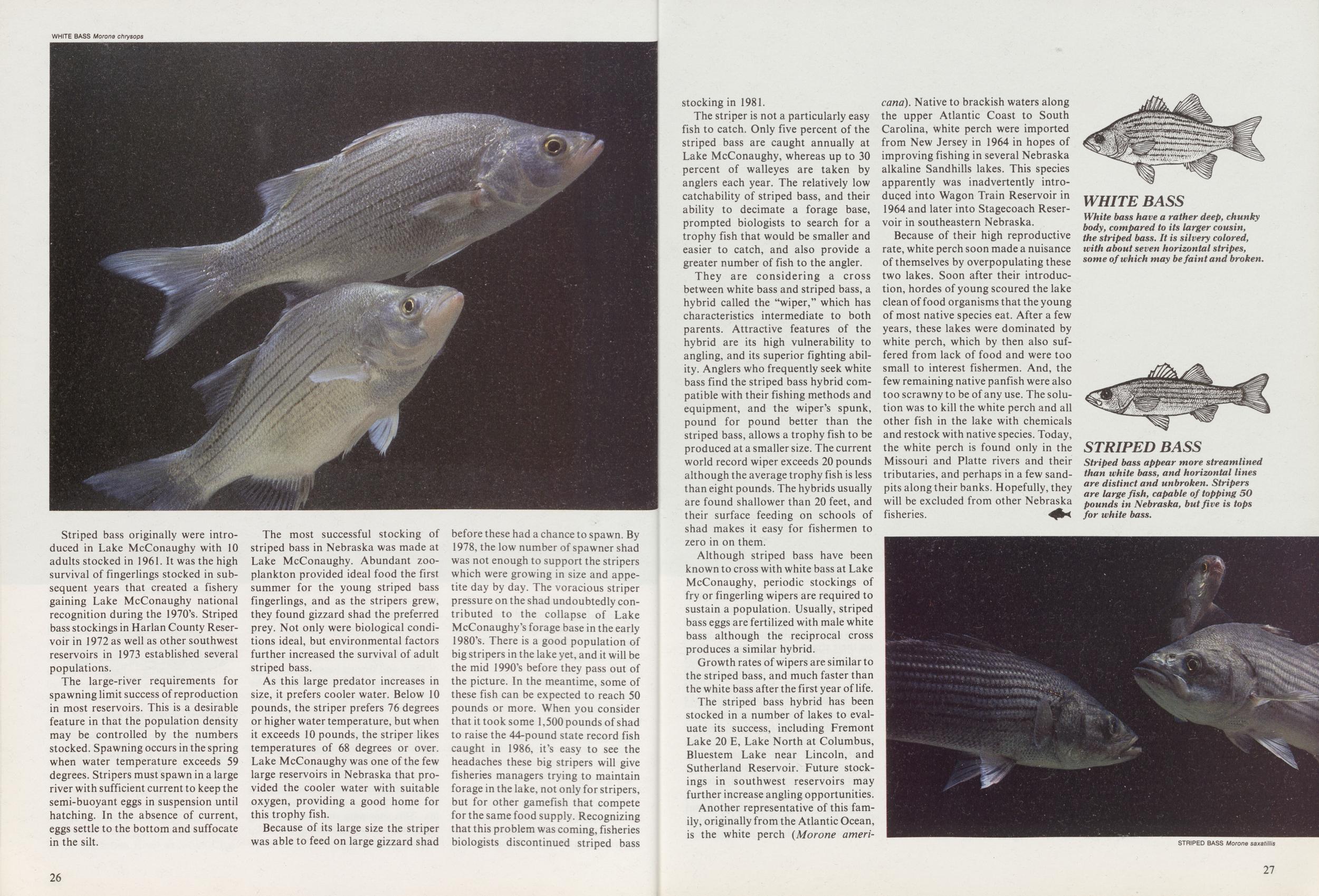
A close relative is the striped bass or striper {Morone saxatilis). Although similar to the white bass, the striper is more slender, and the teeth on the upper surface of the tongue are in two parallel patches. These tooth patches are important characteristics in differentiating among the various members of the sea bass family.
The striped bass is not native to Nebraska waters. The first reported introduction was an accidental stocking resulting from a Union Pacific train wreck at the Elkhorn River bridge east of Fremont. The U.S. Fish Commission shipped a carload of fish from New Hampshire and Massachusetts to California during the summer of 1873, and striped bass were among a number of species that escaped into the river in the incident.
Marine by nature, the striped bass occurs along shores, bays and estuaries of the Atlantic Coast, and spawns in coastal streams, sometimes migrating 100 miles inland. A land-locked population that completes its entire lifecycle in fresh water occurs in the Santee-Cooper Reservoirs of North Carolina. This spawning stock was used to stock reservoirs elsewhere in the U.S., including Nebraska.
Striped bass originally were introduced in Lake McConaughy with 10 adults stocked in 1961. It was the high survival of fingerlings stocked in subsequent years that created a fishery gaining Lake McConaughy national recognition during the 1970's. Striped bass stockings in Harlan County Reservoir in 1972 as well as other southwest reservoirs in 1973 established several populations.
The large-river requirements for spawning limit success of reproduction in most reservoirs. This is a desirable feature in that the population density may be controlled by the numbers stocked. Spawning occurs in the spring when water temperature exceeds 59 degrees. Stripers must spawn in a large river with sufficient current to keep the semi-buoyant eggs in suspension until hatching. In the absence of current, eggs settle to the bottom and suffocate in the silt.
The most successful stocking of striped bass in Nebraska was made at Lake McConaughy. Abundant zooplankton provided ideal food the first summer for the young striped bass fingerlings, and as the stripers grew, they found gizzard shad the preferred prey. Not only were biological conditions ideal, but environmental factors further increased the survival of adult striped bass.
As this large predator increases in size, it prefers cooler water. Below 10 pounds, the striper prefers 76 degrees or higher water temperature, but when it exceeds 10 pounds, the striper likes temperatures of 68 degrees or over. Lake McConaughy was one of the few large reservoirs in Nebraska that provided the cooler water with suitable oxygen, providing a good home for this trophy fish.
Because of its large size the striper was able to feed on large gizzard shad before these had a chance to spawn. By 1978, the low number of spawner shad was not enough to support the stripers which were growing in size and appetite day by day. The voracious striper pressure on the shad undoubtedly contributed to the collapse of Lake McConaughy's forage base in the early 1980's. There is a good population of big stripers in the lake yet, and it will be the mid 1990's before they pass out of the picture. In the meantime, some of these fish can be expected to reach 50 pounds or more. When you consider that it took some 1,500 pounds of shad to raise the 44-pound state record fish caught in 1986, it's easy to see the headaches these big stripers will give fisheries managers trying to maintain forage in the lake, not only for stripers, but for other gamefish that compete for the same food supply. Recognizing that this problem was coming, fisheries biologists discontinued striped bass 26 stocking in 1981.
The striper is not a particularly easy fish to catch. Only five percent of the striped bass are caught annually at Lake McConaughy, whereas up to 30 percent of walleyes are taken by anglers each year. The relatively low catch ability of striped bass, and their ability to decimate a forage base, prompted biologists to search for a trophy fish that would be smaller and easier to catch, and also provide a greater number of fish to the angler.
They are considering a cross between white bass and striped bass, a hybrid called the "wiper," which has characteristics intermediate to both parents. Attractive features of the hybrid are its high vulnerability to angling, and its superior fighting ability. Anglers who frequently seek white bass find the striped bass hybrid compatible with their fishing methods and equipment, and the wiper's spunk, pound for pound better than the striped bass, allows a trophy fish to be produced at a smaller size. The current world record wiper exceeds 20 pounds although the average trophy fish is less than eight pounds. The hybrids usually are found shallower than 20 feet, and their surface feeding on schools of shad makes it easy for fishermen to zero in on them.
Although striped bass have been known to cross with white bass at Lake McConaughy, periodic stockings of fry or fingerling wipers are required to sustain a population. Usually, striped bass eggs are fertilized with male white bass although the reciprocal cross produces a similar hybrid.
Growth rates of wipers are similar to the striped bass, and much faster than the white bass after the first year of life.
The striped bass hybrid has been stocked in a number of lakes to evaluate its success, including Fremont Lake 20 E, Lake North at Columbus, Bluestem Lake near Lincoln, and Sutherland Reservoir. Future stockings in southwest reservoirs may further increase angling opportunities.
Another representative of this family, originally from the Atlantic Ocean, is the white perch (Morone americana). Native to brackish waters along the upper Atlantic Coast to South Carolina, white perch were imported from New Jersey in 1964 in hopes of improving fishing in several Nebraska alkaline Sandhills lakes. This species apparently was inadvertently introduced into Wagon Train Reservoir in 1964 and later into Stagecoach Reservoir in southeastern Nebraska.
Because of their high reproductive rate, white perch soon made a nuisance of themselves by overpopulating these two lakes. Soon after their introduction, hordes of young scoured the lake clean of food organisms that the young of most native species eat. After a few years, these lakes were dominated by white perch, which by then also suffered from lack of food and were too small to interest fishermen. And, the few remaining native panfish were also too scrawny to be of any use. The solution was to kill the white perch and all other fish in the lake with chemicals and restock with native species. Today, the white perch is found only in the Missouri and Platte rivers and their tributaries, and perhaps in a few sandpits along their banks. Hopefully, they will be excluded from other Nebraska fisheries.
The PERCH
BY ROBERT HRABIK Fisheries Biologist, Missouri Department of Conservation (Formerly with Nebraska Game and Parks Commission)THE PERCH FAMILY, Percidae, is the second largest family of North American freshwater fishes, with over 160 known, named species. The larger members of this family, walleye, sauger and yellow perch, are well known as gamefish and panfish. The smaller species, the darters, are rarely seen but are a curious and showy lot.
Native ranges of walleye, sauger and yellow perch vary from cold, subarctic streams and lakes to warm, temperate reservoirs. Most darters, on the other hand, are found in cool to warm temperate streams and lakes, except for the Iowa darter, which can be found in cold water habitats. While the North American walleye, sauger and yellow perch have look-alike relatives in Europe or Asia, the darters are found only in North America.
Perches are considered "advanced" fishes on the evolutionary scale, based on their structure and behavior. They probably originated from the sea bass (Percichthyidae), not directly from the pikes (Esocidae). However, walleye and sauger seem to have a pike-like appearance and are often referred to as "walleyed" pike and sand pike. Perches are easily recognized and readily discernible from other families of fish. However, the sea bass, sunfish, and drum families are superficially similar. Perches are generally slender and cylindrical, having spiny-rayed dorsal fins and rough-edged (ctenoid) scales. The dorsal fin is in two parts, the 28 forward portion containing six or more hard, usually sharp spines. The rear part of the dorsal fin has 23 or fewer soft rays. The pelvic fins are attached far forward on the body, beneath the pectoral fins, a trait common of more advanced fishes.
Darters are miniature versions of larger perches but are, evolutionarily, or structurally, more recent. Whereas walleye and sauger have well defined and sharp canine teeth on their jaws and roof of the mouth, darters' teeth are very small, almost inconspicuous. The pectoral fins of walleye and sauger are proportioned, in a typical sense, of fish in general, but darters have large fan-shaped pectoral fins in relation to their body size.
These odd pectoral fins are an external manifestation of a rather unique adaptation that these little fish have evolved for life in streams. Most darters have no swim bladder, and thus readily sink to the bottom. There, the current presses down on the large pectoral fins, allowing the fish to cling to the bottom to keep from being swept downstream. Most darters cannot suspend themselves above the bottom and thus their movements are limited to short, quick dashes, hence their name.
Renowned for its performance on the platter, the walleye (Stizostedion vitreum) is one of Nebraska's most sought-after fish. In a recent statewide fishing survey, the walleye was the third most sought-after fish trailing only catfish and crappie in popularity.
Large, almost oversized eyes with light-reflecting retinas that seem to glow in the dark, are the walleye's most prominent physical characteristics, accounting for both its name and its remarkable efficiency as a night-time predator. It is a slender fish with a large mouth full of needle-like teeth. Its tail fin is clearly forked, and two sharp spines form the leading edge of the anal fin.
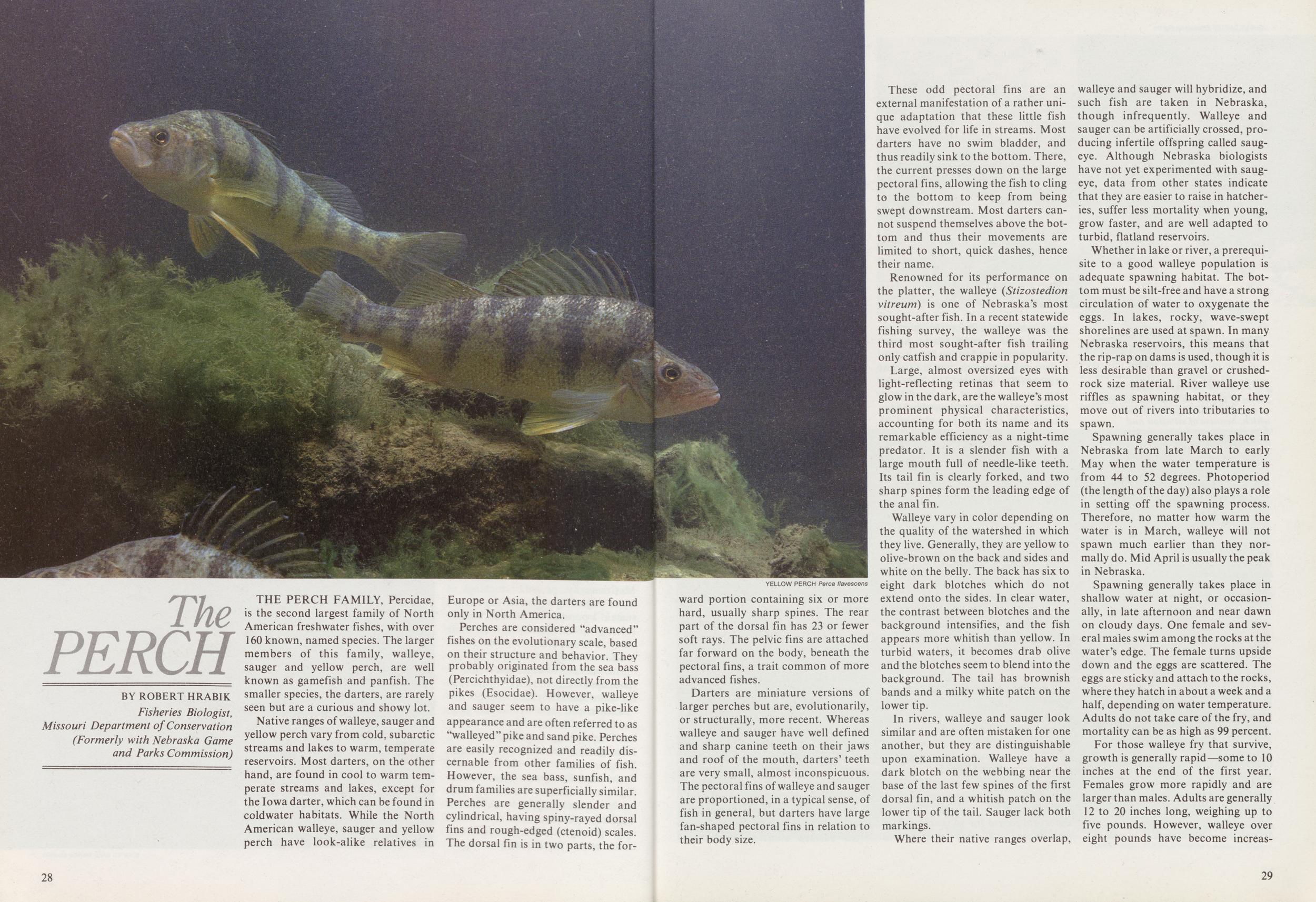
Walleye vary in color depending on the quality of the watershed in which they live. Generally, they are yellow to olive-brown on the back and sides and white on the belly. The back has six to eight dark blotches which do not extend onto the sides. In clear water, the contrast between blotches and the background intensifies, and the fish appears more whitish than yellow. In turbid waters, it becomes drab olive and the blotches seem to blend into the background. The tail has brownish bands and a milky white patch on the lower tip.
In rivers, walleye and sauger look similar and are often mistaken for one another, but they are distinguishable upon examination. Walleye have a dark blotch on the webbing near the base of the last few spines of the first dorsal fin, and a whitish patch on the lower tip of the tail. Sauger lack both markings.
Where their native ranges overlap, walleye and sauger will hybridize, and such fish are taken in Nebraska, though infrequently. Walleye and sauger can be artificially crossed, producing infertile offspring called saugeye. Although Nebraska biologists have not yet experimented with saugeye, data from other states indicate that they are easier to raise in hatcheries, suffer less mortality when young, grow faster, and are well adapted to turbid, flatland reservoirs.
Whether in lake or river, a prerequisite to a good walleye population is adequate spawning habitat. The bottom must be silt-free and have a strong circulation of water to oxygenate the eggs. In lakes, rocky, wave-swept shorelines are used at spawn. In many Nebraska reservoirs, this means that the rip-rap on dams is used, though it less desirable than gravel or crushed- rock size material. River walleye use riffles as spawning habitat, or they move out of rivers into tributaries to spawn.
Spawning generally takes place in Nebraska from late March to early May when the water temperature is from 44 to 52 degrees. Photoperiod (the length of the day) also plays a role in setting off the spawning process. Therefore, no matter how warm the water is in March, walleye will not spawn much earlier than they normally do. Mid April is usually the peak in Nebraska.
Spawning generally takes place in shallow water at night, or occasionally, in late afternoon and near dawn on cloudy days. One female and several males swim among the rocks at the water's edge. The female turns upside down and the eggs are scattered. The eggs are sticky and attach to the rocks, where they hatch in about a week and a half, depending on water temperature. Adults do not take care of the fry, and mortality can be as high as 99 percent.
For those walleye fry that survive, growth is generally rapid—some to 10 inches at the end of the first year. Females grow more rapidly and are larger than males. Adults are generally 12 to 20 inches long, weighing up to five pounds. However, walleye over eight pounds have become increasingly common in Nebraska in recent years. In 1986, over 500 Master Angler awards were issued for walleye weighing over eight pounds, and the largest weighed 15!4 pounds. The Nebraska state record stands at 16 pounds, two ounces, and elsewhere the walleye may grow larger than 20 pounds and 36 inches long.
29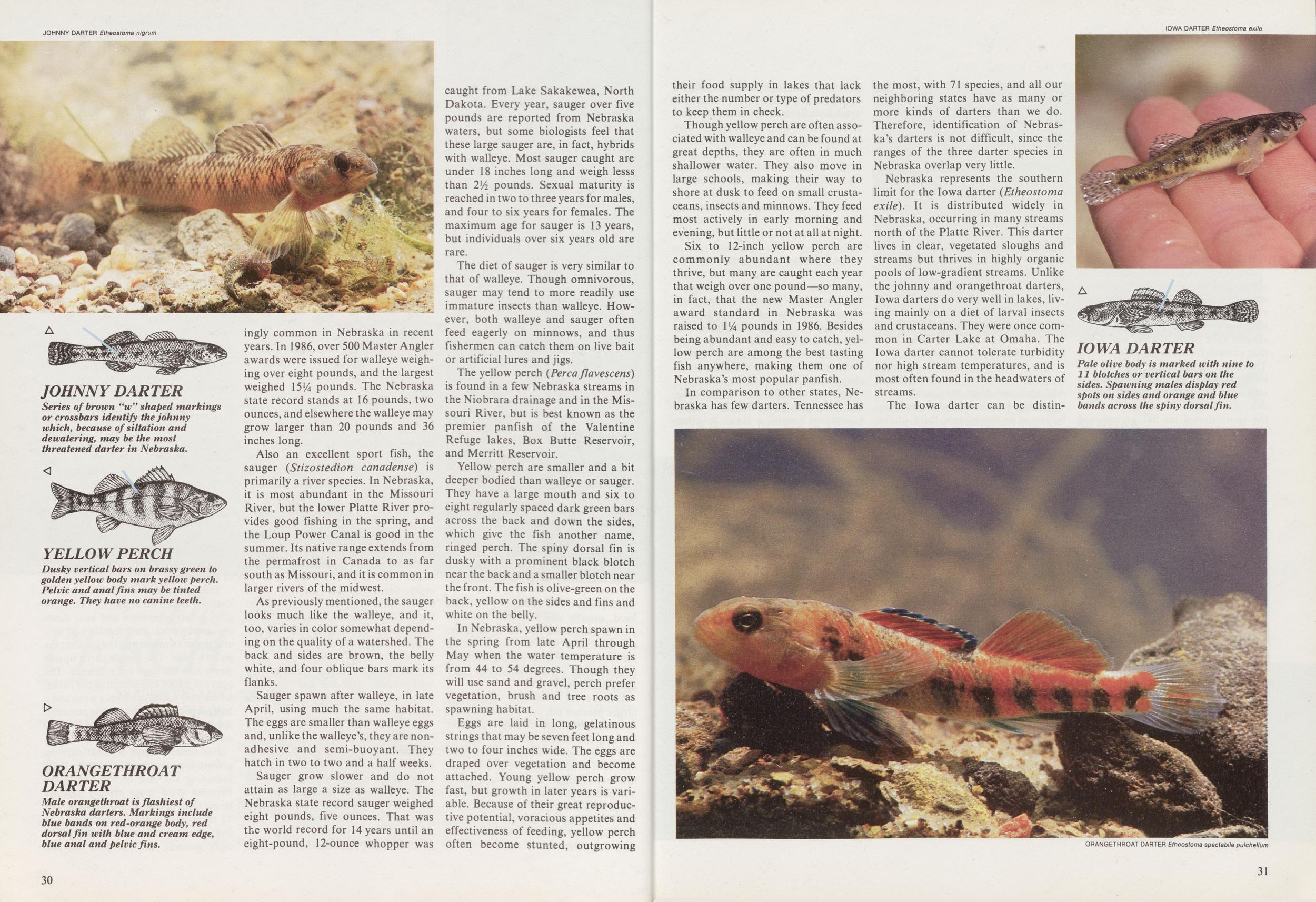
Also an excellent sport fish, the sauger (Stizostedion canadense) is primarily a river species. In Nebraska, it is most abundant in the Missouri River, but the lower Platte River provides good fishing in the spring, and the Loup Power Canal is good in the summer. Its native range extends from the permafrost in Canada to as far south as Missouri, and it is common in larger rivers of the midwest.
As previously mentioned, the sauger looks much like the walleye, and it, too, varies in color somewhat depending on the quality of a watershed. The back and sides are brown, the belly white, and four oblique bars mark its flanks.
Sauger spawn after walleye, in late April, using much the same habitat. The eggs are smaller than walleye eggs and, unlike the walleye's, they are nonadhesive and semi-buoyant. They hatch in two to two and a half weeks. Sauger grow slower and do not attain as large a size as walleye. The Nebraska state record sauger weighed eight pounds, five ounces. That was the world record for 14 years until an eight-pound, 12-ounce whopper was caught from Lake Sakakewea, North Dakota. Every year, sauger over five pounds are reported from Nebraska waters, but some biologists feel that these large sauger are, in fact, hybrids with walleye. Most sauger caught are under 18 inches long and weigh less than 2Vi pounds. Sexual maturity is reached in two to three years for males, and four to six years for females. The maximum age for sauger is 13 years, but individuals over six years old are rare.
The diet of sauger is very similar to that of walleye. Though omnivorous, sauger may tend to more readily use immature insects than walleye. However, both walleye and sauger often feed eagerly on minnows, and thus fishermen can catch them on live bait or artificial lures and jigs.
The yellow perch (Perca flavescens) is found in a few Nebraska streams in the Niobrara drainage and in the Missouri River, but is best known as the premier panfish of the Valentine Refuge lakes, Box Butte Reservoir, and Merritt Reservoir.
Yellow perch are smaller and a bit deeper bodied than walleye or sauger. They have a large mouth and six to eight regularly spaced dark green bars across the back and down the sides, which give the fish another name, ringed perch. The spiny dorsal fin is dusky with a prominent black blotch near the back and a smaller blotch near the front. The fish is olive-green on the back, yellow on the sides and fins and white on the belly.
In Nebraska, yellow perch spawn in the spring from late April through May when the water temperature is from 44 to 54 degrees. Though they will use sand and gravel, perch prefer vegetation, brush and tree roots as spawning habitat.
Eggs are laid in long, gelatinous strings that may be seven feet long and two to four inches wide. The eggs are draped over vegetation and become attached. Young yellow perch grow fast, but growth in later years is variable. Because of their great reproductive potential, voracious appetites and effectiveness of feeding, yellow perch often become stunted, outgrowing 30 their food supply in lakes that lack either the number or type of predators to keep them in check.
Though yellow perch are often associated with walleye and can be found at great depths, they are often in much shallower water. They also move in large schools, making their way to shore at dusk to feed on small crustaceans, insects and minnows. They feed most actively in early morning and evening, but little or not at all at night.
Six to 12-inch yellow perch are commonly abundant where they thrive, but many are caught each year that weigh over one pound—so many, in fact, that the new Master Angler award standard in Nebraska was raised to U/i pounds in 1986. Besides being abundant and easy to catch, yellow perch are among the best tasting fish anywhere, making them one of Nebraska's most popular panfish.
In comparison to other states, Nebraska has few darters. Tennessee has the most, with 71 species, and all our neighboring states have as many or more kinds of darters than we do. Therefore, identification of Nebraska's darters is not difficult, since the ranges of the three darter species in Nebraska overlap very little.
Nebraska represents the southern limit for the Iowa darter {Etheostoma exile). It is distributed widely in Nebraska, occurring in many streams north of the Platte River. This darter lives in clear, vegetated sloughs and streams but thrives in highly organic pools of low-gradient streams. Unlike the Johnny and orange throat darters, Iowa darters do very well in lakes, living mainly on a diet of larval insects and crustaceans. They were once common in Carter Lake at Omaha. The Iowa darter cannot tolerate turbidity nor high stream temperatures, and is most often found in the headwaters of streams.
The Iowa darter can be distinguished from the Johnny darter by the presence of a frenum, a bridge of skin that connects the upper lip to the snout. The Johnny darter does not have a frenum, allowing its jaws to extend outward. The Iowa darter can be distinguished from the orange throat darter by several means. The Iowa darter has scaled cheeks, a short, highly arched lateral line, and less than 10 dorsal spines, while the orange throat has unsealed cheeks, a long, nearly straight lateral line and 10 or more dorsal spines.
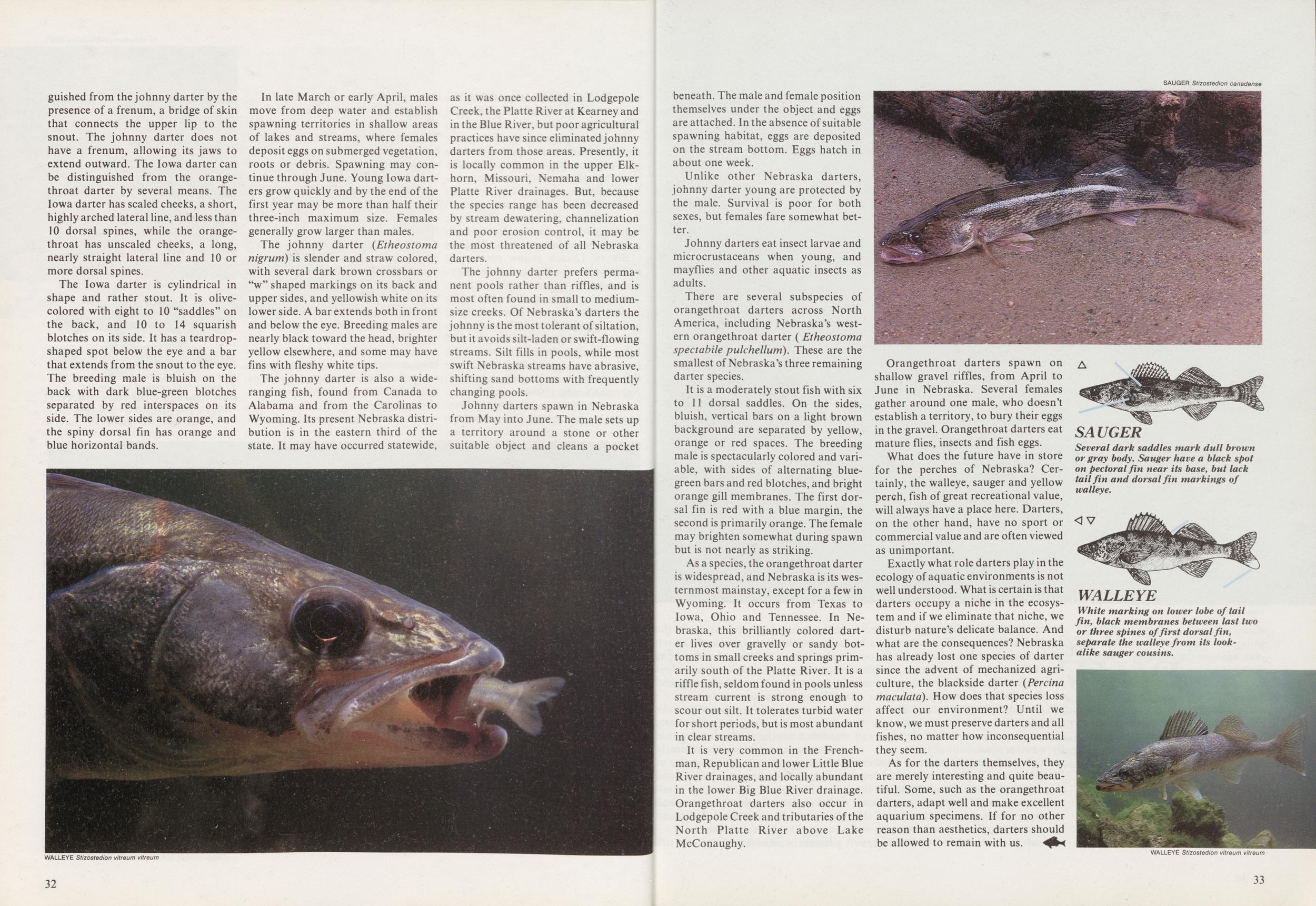
The Iowa darter is cylindrical in shape and rather stout. It is olive colored with eight to 10 "saddles" on the back, and 10 to 14 squarish blotches on its side. It has a teardrop-shaped spot below the eye and a bar that extends from the snout to the eye. The breeding male is bluish on the back with dark blue-green blotches separated by red interspaces on its side. The lower sides are orange, and the spiny dorsal fin has orange and blue horizontal bands.
In late March or early April, males move from deep water and establish spawning territories in shallow areas of lakes and streams, where females deposit eggs on submerged vegetation, roots or debris. Spawning may continue through June. Young Iowa darters grow quickly and by the end of the first year may be more than half their three-inch maximum size. Females generally grow larger than males.
The Johnny darter (Etheostoma nigrum) is slender and straw colored, with several dark brown crossbars or "w" shaped markings on its back and upper sides, and yellowish white on its lower side. A bar extends both in front and below the eye. Breeding males are nearly black toward the head, brighter yellow elsewhere, and some may have fins with fleshy white tips.
The Johnny darter is also a wide ranging fish, found from Canada to Alabama and from the Carolinas to Wyoming. Its present Nebraska distribution is in the eastern third of the state. It may have occurred statewide, as it was once collected in Lodgepole Creek, the Platte River at Kearney and in the Blue River, but poor agricultural practices have since eliminated Johnny darters from those areas. Presently, it is locally common in the upper Elkhorn, Missouri, Nemaha and lower Platte River drainages. But, because the species range has been decreased by stream dewatering, channelization and poor erosion control, it may be the most threatened of all Nebraska darters.
The Johnny darter prefers permanent pools rather than riffles, and is most often found in small to medium-size creeks. Of Nebraska's darters the Johnny is the most tolerant of siltation, but it avoids silt-laden or swift-flowing streams. Silt fills in pools, while most swift Nebraska streams have abrasive, shifting sand bottoms with frequently changing pools.
Johnny darters spawn in Nebraska from May into June. The male sets up a territory around a stone or other suitable object and cleans a pocket 32 beneath. The male and female position themselves under the object and eggs are attached. In the absence of suitable spawning habitat, eggs are deposited on the stream bottom. Eggs hatch in about one week.
Unlike other Nebraska darters, Johnny darter young are protected by the male. Survival is poor for both sexes, but females fare somewhat better.
Johnny darters eat insect larvae and microcrustaceans when young, and mayflies and other aquatic insects as adults.
There are several subspecies of orange throat darters across North America, including Nebraska's western orange throat darter ( Etheostoma spectabile pulchellum). These are the smallest of Nebraska's three remaining darter species.
It is a moderately stout fish with six to 11 dorsal saddles. On the sides, bluish, vertical bars on a light brown background are separated by yellow, orange or red spaces. The breeding male is spectacularly colored and variable, with sides of alternating blue- green bars and red blotches, and bright orange gill membranes. The first dorsal fin is red with a blue margin, the second is primarily orange. The female may brighten somewhat during spawn but is not nearly as striking.
As a species, the orange throat darter is widespread, and Nebraska is its westernmost mainstay, except for a few in Wyoming. It occurs from Texas to Iowa, Ohio and Tennessee. In Nebraska, this brilliantly colored dart- er lives over gravelly or sandy bot- toms in small creeks and springs primarily south of the Platte River. It is a riffle fish, seldom found in pools unless stream current is strong enough to scour out silt. It tolerates turbid water for short periods, but is most abundant in clear streams.
It is very common in the Frenchman, Republican and lower Little Blue River drainages, and locally abundant in the lower Big Blue River drainage. Orange throat darters also occur in Lodgepole Creek and tributaries of the North Platte River above Lake McConaughy.
Orange throat darters spawn on shallow gravel riffles, from April to June in Nebraska. Several females gather around one male, who doesn't establish a territory, to bury their eggs in the gravel. Orange throat darters eat mature flies, insects and fish eggs.
What does the future have in store for the perches of Nebraska? Certainly, the walleye, sauger and yellow perch, fish of great recreational value, will always have a place here. Darters, on the other hand, have no sport or commercial value and are often viewed as unimportant.
Exactly what role darters play in the ecology of aquatic environments is not well understood. What is certain is that darters occupy a niche in the ecosystem and if we eliminate that niche, we disturb nature's delicate balance. And what are the consequences? Nebraska has already lost one species of darter since the advent of mechanized agri- culture, the black side darter {Percina maculata). How does that species loss affect our environment? Until we know, we must preserve darters and all fishes, no matter how inconsequential they seem.
As for the darters themselves, they are merely interesting and quite beautiful. Some, such as the orangethroat darters, adapt well and make excellent aquarium specimens. If for no other reason than aesthetics, darters should be allowed to remain with us.
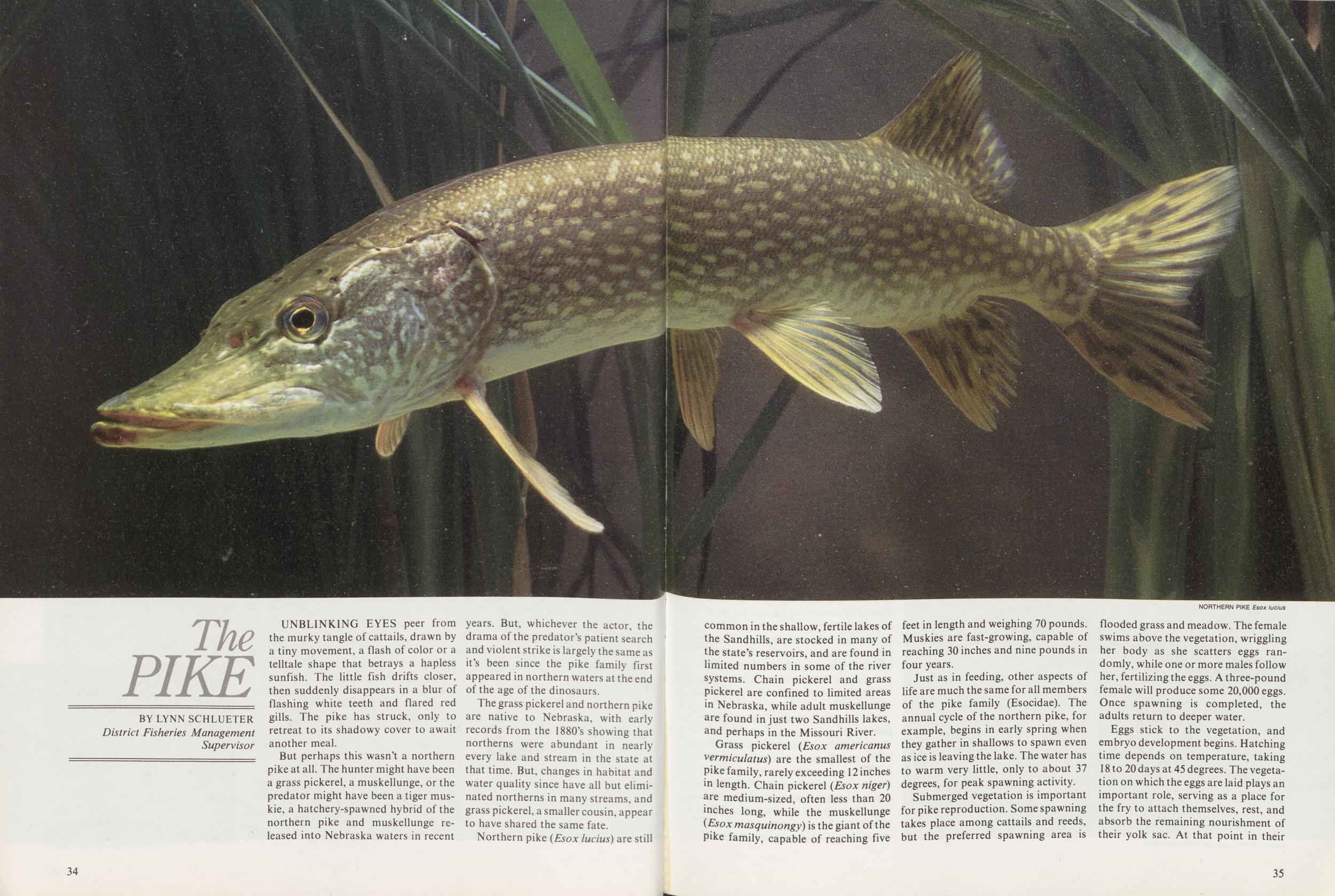
The PIKE
BY LYNN SCHLUETER District Fisheries Management SupervisorUNBLINKING EYES peer from the murky tangle of cattails, drawn by a tiny movement, a flash of color or a telltale shape that betrays a hapless sunfish. The little fish drifts closer, then suddenly disappears in a blur of flashing white teeth and flared red gills. The pike has struck, only to retreat to its shadowy cover to await another meal.
But perhaps this wasn't a northern pike at all. The hunter might have been a grass pickerel, a muskellunge, or the predator might have been a tiger muskie, a hatchery-spawned hybrid of the northern pike and muskellunge released into Nebraska waters in recent years. But, whichever the actor, the drama of the predator's patient search and violent strike is largely the same as it's been since the pike family first appeared in northern waters at the end of the age of the dinosaurs.
The grass pickerel and northern pike are native to Nebraska, with early records from the 1880's showing that northerns were abundant in nearly every lake and stream in the state at that time. But, changes in habitat and water quality since have all but eliminated northerns in many streams, and grass pickerel, a smaller cousin, appear to have shared the same fate.
Northern pike (Esox lucius) are still 34 common in the shallow, fertile lakes of the Sandhills, are stocked in many of the state's reservoirs, and are found in limited numbers in some of the river systems. Chain pickerel and grass pickerel are confined to limited areas in Nebraska, while adult muskellunge are found in just two Sandhills lakes, and perhaps in the Missouri River.
Grass pickerel (Esox americanus vermiculatus) are the smallest of the pike family, rarely exceeding 12 inches in length. Chain pickerel (Esox niger) are medium-sized, often less than 20 inches long, while the muskellunge (Esox masquinongy) is the giant of the Pike family, capable of reaching five feet in length and weighing 70 pounds. Muskies are fast-growing, capable of reaching 30 inches and nine pounds in four years.
Just as in feeding, other aspects of life are much the same for all members of the pike family (Esocidae). The annual cycle of the northern pike, for example, begins in early spring when they gather in shallows to spawn even as ice is leaving the lake. The water has to warm very little, only to about 37 degrees, for peak spawning activity.
Submerged vegetation is important for pike reproduction. Some spawning takes place among cattails and reeds, but the preferred spawning area is NORTHERN PIKE Esox lucius flooded grass and meadow. The female swims above the vegetation, wriggling her body as she scatters eggs randomly, while one or more males follow her, fertilizing the eggs. A three-pound female will produce some 20,000 eggs. Once spawning is completed, the adults return to deeper water.
Eggs stick to the vegetation, and embryo development begins. Hatching time depends on temperature, taking 18 to 20 days at 45 degrees. The vegetation on which the eggs are laid plays an important role, serving as a place for the fry to attach themselves, rest, and absorb the remaining nourishment of their yolk sac. At that point in their lives, they are one-half inch long; 2,000 would occupy the volume of one fluid ounce, and it would take about 65,000 to weigh one pound.
35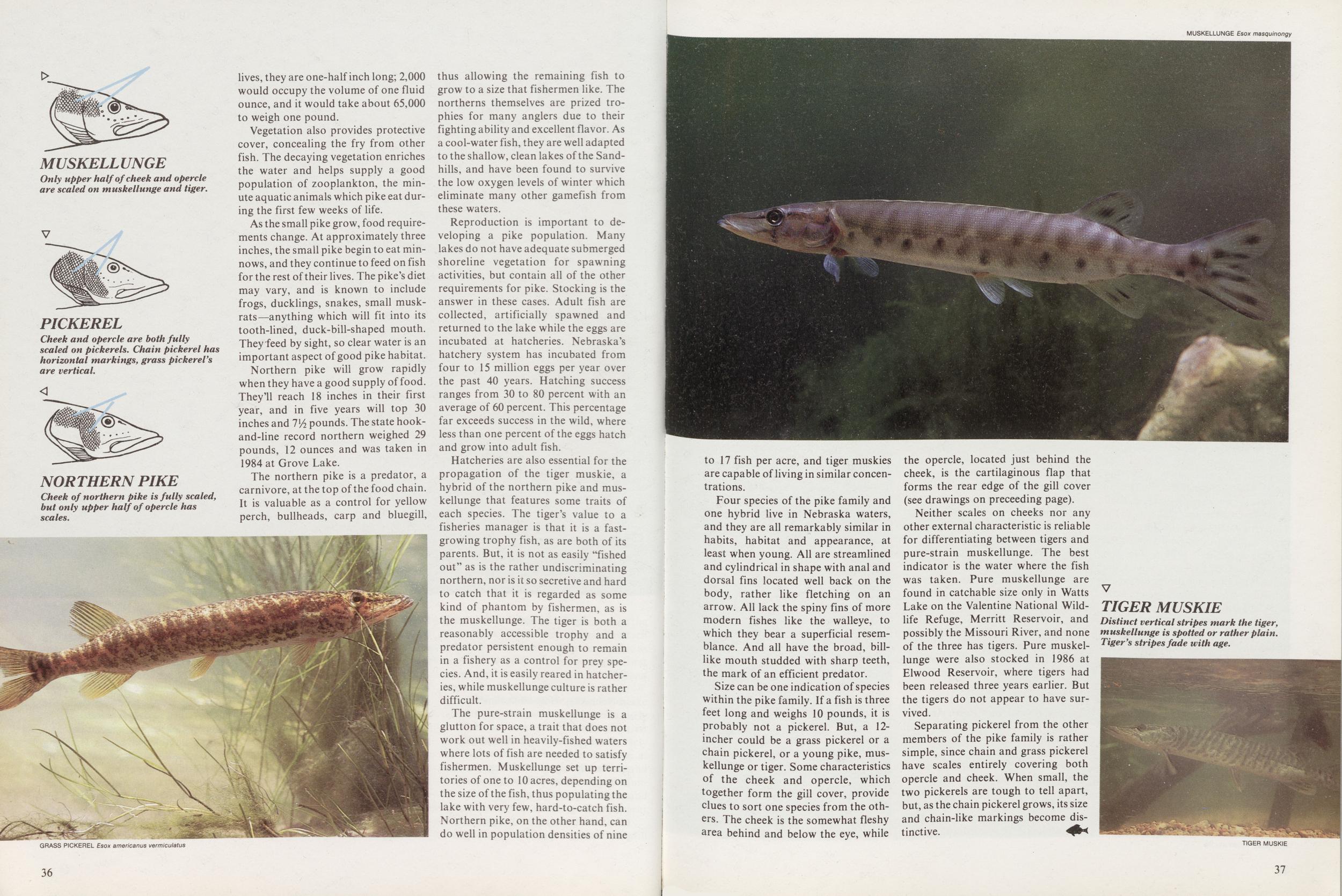
Vegetation also provides protective cover, concealing the fry from other fish. The decaying vegetation enriches the water and helps supply a good population of zooplankton, the minute aquatic animals which pike eat during the first few weeks of life.
As the small pike grow, food requirements change. At approximately three inches, the small pike begin to eat minnows, and they continue to feed on fish for the rest of their lives. The pike's diet may vary, and is known to include frogs, ducklings, snakes, small muskrats—anything which will fit into its tooth-lined, duck-bill-shaped mouth. They feed by sight, so clear water is an important aspect of good pike habitat.
Northern pike will grow rapidly when they have a good supply of food. They'll reach 18 inches in their first year, and in five years will top 30 inches and IVi pounds. The state hook-and-line record northern weighed 29 pounds, 12 ounces and was taken in 1984 at Grove Lake.
The northern pike is a predator, a carnivore, at the top of the food chain. It is valuable as a control for yellow perch, bullheads, carp and bluegill, thus allowing the remaining fish to grow to a size that fishermen like. The northerns themselves are prized trophies for many anglers due to their fighting ability and excellent flavor. As a cool-water fish, they are well adapted to the shallow, clean lakes of the Sand- hills, and have been found to survive the low oxygen levels of winter which eliminate many other gamefish from these waters.
Reproduction is important to developing a pike population. Many lakes do not have adequate submerged shoreline vegetation for spawning activities, but contain all of the other requirements for pike. Stocking is the answer in these cases. Adult fish are collected, artificially spawned and returned to the lake while the eggs are incubated at hatcheries. Nebraska's hatchery system has incubated from four to 15 million eggs per year over the past 40 years. Hatching success ranges from 30 to 80 percent with an average of 60 percent. This percentage far exceeds success in the wild, where less than one percent of the eggs hatch and grow into adult fish.
Hatcheries are also essential for the propagation of the tiger muskie, a hybrid of the northern pike and muskellunge that features some traits of each species. The tiger's value to a fisheries manager is that it is a fast-growing trophy fish, as are both of its parents. But, it is not as easily "fished out" as is the rather undiscriminating northern, nor is it so secretive and hard to catch that it is regarded as some kind of phantom by fishermen, as is the muskellunge. The tiger is both a reasonably accessible trophy and a predator persistent enough to remain in a fishery as a control for prey species. And, it is easily reared in hatchers, while muskellunge culture is rather difficult.
The pure-strain muskellunge is a glutton for space, a trait that does not work out well in heavily-fished waters where lots offish are needed to satisfy fishermen. Muskellunge set up territories of one to 10 acres, depending on the size of the fish, thus populating the lake with very few, hard-to-catch fish. Northern pike, on the other hand, can do well in population densities of nine 36 to 17 fish per acre, and tiger muskies are capable of living in similar concentrations.
Four species of the pike family and one hybrid live in Nebraska waters, and they are all remarkably similar in habits, habitat and appearance, at least when young. All are streamlined and cylindrical in shape with anal and dorsal fins located well back on the body, rather like fletching on an arrow. All lack the spiny fins of more modern fishes like the walleye, to which they bear a superficial resemblance. And all have the broad, bill-like mouth studded with sharp teeth, the mark of an efficient predator.
Size can be one indication of species within the pike family. If a fish is three feet long and weighs 10 pounds, it is probably not a pickerel. But, a 12-incher could be a grass pickerel or a chain pickerel, or a young pike, muskellunge or tiger. Some characteristics of the cheek and opercle, which together form the gill cover, provide clues to sort one species from the others. The cheek is the somewhat fleshy area behind and below the eye, while the opercle, located just behind the cheek, is the cartilaginous flap that forms the rear edge of the gill cover (see drawings on preceding page).
Neither scales on cheeks nor any other external characteristic is reliable for differentiating between tigers and pure-strain muskellunge. The best indicator is the water where the fish was taken. Pure muskellunge are found in catchable size only in Watts Lake on the Valentine National Wildlife Refuge, Merritt Reservoir, and possibly the Missouri River, and none of the three has tigers. Pure muskellunge were also stocked in 1986 at Elwood Reservoir, where tigers had been released three years earlier. But the tigers do not appear to have survived.
Separating pickerel from the other members of the pike family is rather simple, since chain and grass pickerel have scales entirely covering both opercle and cheek. When small, the two pickerels are tough to tell apart, but, as the chain pickerel grows, its size and chain-like markings become distinctive.
The TROUT
BY JACK PETERSON District Fisheries Management SupervisorTROUT! THERE'S A WORD that works a certain magic on fishermen, conjuring up thoughts of clear, ice-cold streams, rugged mountains, and dark forest. And, that's why most people don't readily associate trout with Nebraska. They think that trout require pristine wilderness, when the fact is that trout merely prefer it. What trout require, what they must have to live, is simply plenty of well-aerated, relatively cool water and some cover. And, these are things that a surprising number of Nebraska streams do, in fact, provide.
Most species of trout would rather have crystal-clear, ice-cold water, but they can tolerate less. That is, the environment might not be what they prefer, but trout can live there. Here in Nebraska, we usually have crystal-clear, ice-cold streams, but only in the wintertime. Streams in the North Platte Valley around Scottsbluff such as Nine Mile, Red Willow and Tub Springs, are all like that, but in the summer they become drains for excess irrigation water. When water from large irrigation canals is dumped into these streams, it increases flow drastically, and the water becomes highly turbid and warmer. This is not ideal for trout, but they are able to tolerate it. In fact, a few of these "valley streams" are considered some of the best in Nebraska for fishing and for natural reproduction of both brown and rainbow trout.
Here in Nebraska, many trout streams are far warmer than trout prefer. Some of the Pine Ridge streams in the Crawford-Chadron area such as the White River and Bordeaux creeks, experience daytime temperatures in the mid 80's. This is much higher than trout care for, but they survive because these temperatures last only for a short time before they start dropping in the evenings to the low 60's. These streams provide excellent fishing for brown trout even though they must be stocked with fish because the silty nature of the bottom limits natural reproduction. Pine Ridge streams also experience periodic flooding from early spring thaws or heavy summer downpours. These floods cause a loss of many fish.
We also have streams such as the Niobrara, which are nearly dried up at times by irrigation. In addition, we have trout streams in the Sandhills such as Blue and Otter creeks, where the soil is so fragile that cattle walking along the bank can cave it in and ruin the undercut banks that provide the critical cover that trout need. In these instances, fencing a portion of the stream to exclude livestock can turn a mediocre trout stream into an excellent one.
Trout need high dissolved-oxygen concentrations, low water temperatures and cover. The three species of trout in Nebraska, brown, brook and rainbow, all differ slightly but share these three main requirements.
On the evolutionary scale, the family Salmonidae, which includes these three trout, is neither as primitive as the sturgeons or the paddlefish, nor as modern as the perches or sunfish. The Salmonids do not have the well-developed scales of modern fish. Theirs are tiny, almost undetectable. Neither do they have the bony spines in their fins that modern fish have developed. Trout get by with soft-rayed fins. And, their pelvic fins are located well back on the body, not forward, just beneath the pectoral fins, as in modern fish.
The Salmonids are thought to have evolved in arctic marine environments and spread down into North America and Europe ahead of glacial periods. This undoubtedly accounts for their cold water requirement.
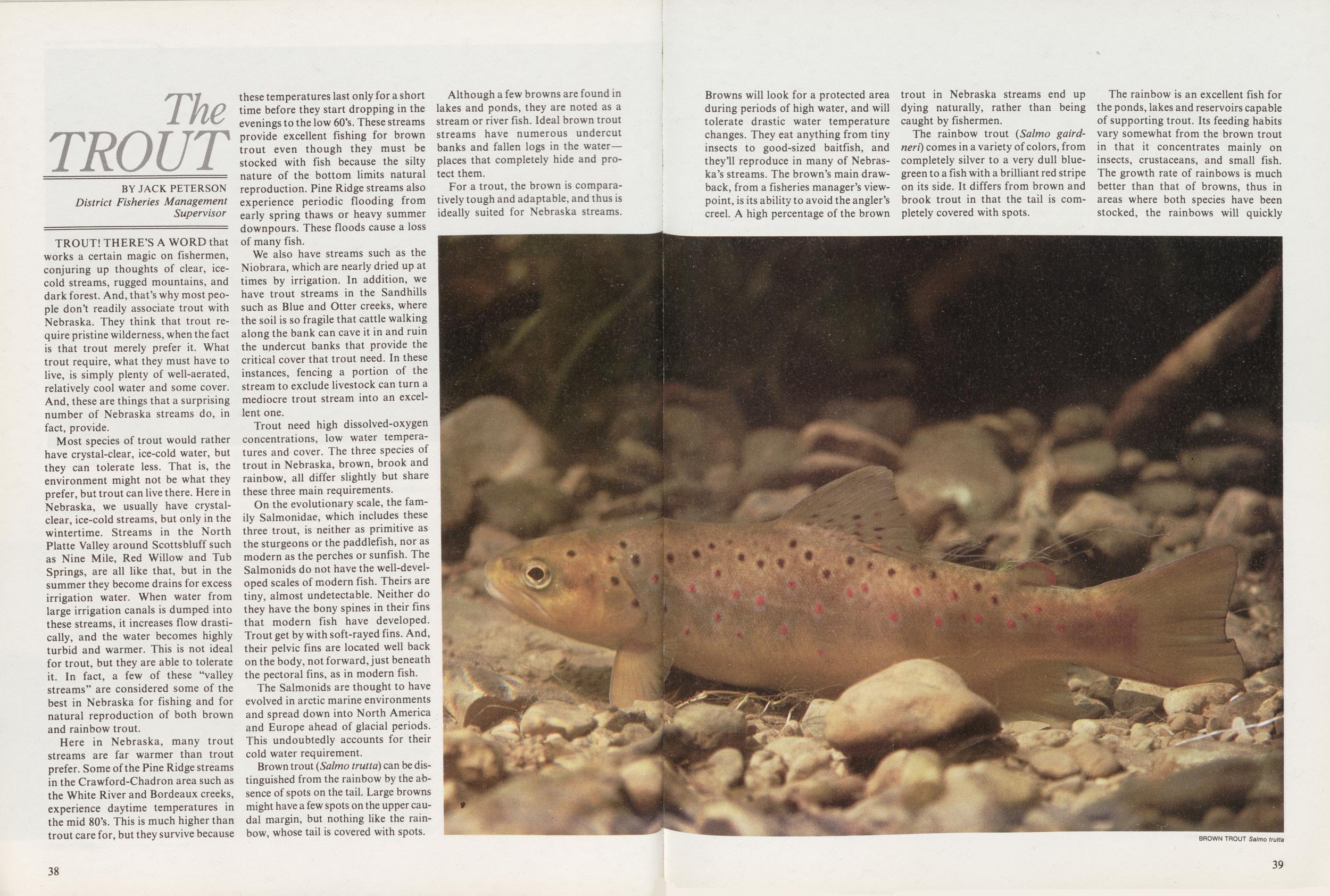
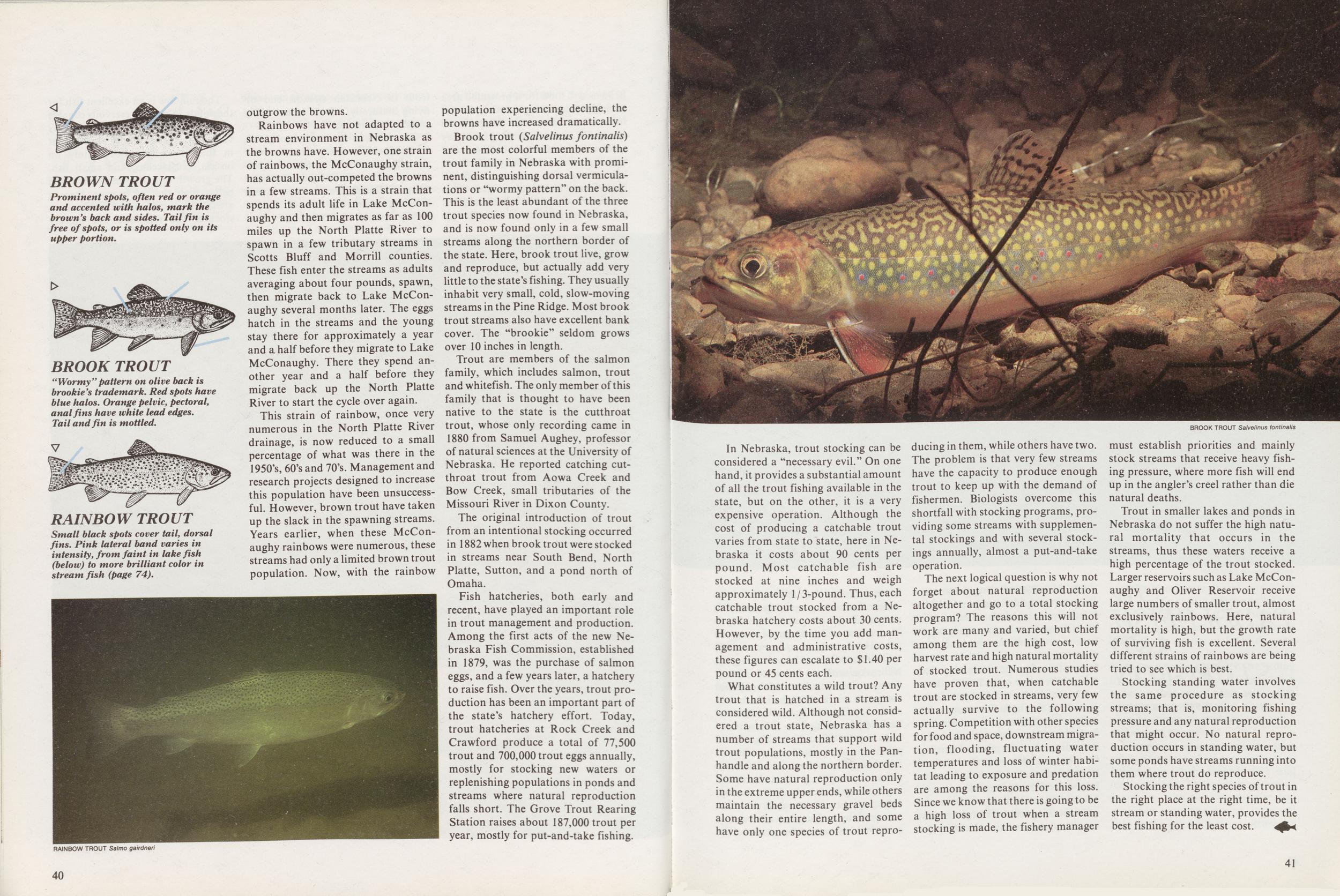
Brown trout (Salmon trutta) can be distinguished from the rainbow by the absence of spots on the tail. Large browns might have a few spots on the upper caudal margin, but nothing like the rainbow, whose tail is covered with spots.
Although a few browns are found in lakes and ponds, they are noted as a stream or river fish. Ideal brown trout streams have numerous undercut banks and fallen logs in the water—places that completely hide and protect them.
For a trout, the brown is comparatively tough and adaptable, and thus is ideally suited for Nebraska streams. 38 Browns will look for a protected area during periods of high water, and will tolerate drastic water temperature changes. They eat anything from tiny insects to good-sized baitfish, and they'll reproduce in many of Nebraska's streams. The brown's main drawback, from a fisheries manager's view-point, is its ability to avoid the angler's creel. A high percentage of the brown trout in Nebraska streams end up dying naturally, rather than being caught by fishermen.
The rainbow trout (Salmo gairdneri) comes in a variety of colors, from completely silver to a very dull blue-green to a fish with a brilliant red stripe on its side. It differs from brown and brook trout in that the tail is completely covered with spots.
The rainbow is an excellent fish for the ponds, lakes and reservoirs capable of supporting trout. Its feeding habits vary somewhat from the brown trout in that it concentrates mainly on insects, crustaceans, and small fish. The growth rate of rainbows is much better than that of browns, thus in areas where both species have been stocked, the rainbows will quickly outgrow the browns.
Rainbows have not adapted to a stream environment in Nebraska as the browns have. However, one strain of rainbows, the McConaughy strain, has actually out-competed the browns in a few streams. This is a strain that spends its adult life in Lake McConaughy and then migrates as far as 100 miles up the North Platte River to spawn in a few tributary streams in Scotts Bluff and Morrill counties. These fish enter the streams as adults averaging about four pounds, spawn, then migrate back to Lake McConaughy several months later. The eggs hatch in the streams and the young stay there for approximately a year and a half before they migrate to Lake McConaughy. There they spend another year and a half before they migrate back up the North Platte River to start the cycle over again.
This strain of rainbow, once very numerous in the North Platte River drainage, is now reduced to a small percentage of what was there in the 1950's, 60's and 70's. Management and research projects designed to increase this population have been unsuccessful. However, brown trout have taken up the slack in the spawning streams. Years earlier, when these McConaughy rainbows were numerous, these streams had only a limited brown trout population. Now, with the rainbow population experiencing decline, the browns have increased dramatically.
Brook trout (Salvelinus fontinalis) are the most colorful members of the trout family in Nebraska with prominent, distinguishing dorsal vermiculations or "wormy pattern" on the back. This is the least abundant of the three trout species now found in Nebraska, and is now found only in a few small streams along the northern border of the state. Here, brook trout live, grow and reproduce, but actually add very little to the state's fishing. They usually inhabit very small, cold, slow-moving streams in the Pine Ridge. Most brook trout streams also have excellent bank cover. The "brookie" seldom grows over 10 inches in length.
Trout are members of the salmon family, which includes salmon, trout and whitefish. The only member of this family that is thought to have been native to the state is the cutthroat trout, whose only recording came in 1880 from Samuel Aughey, professor of natural sciences at the University of Nebraska. He reported catching cutthroat trout from Aowa Creek and Bow Creek, small tributaries of the Missouri River in Dixon County.
The original introduction of trout from an intentional stocking occurred in 1882 when brook trout were stocked in streams near South Bend, North Platte, Sutton, and a pond north of Omaha.
Fish hatcheries, both early and recent, have played an important role in trout management and production. Among the first acts of the new Nebraska Fish Commission, established in 1879, was the purchase of salmon eggs, and a few years later, a hatchery to raise fish. Over the years, trout production has been an important part of the state's hatchery effort. Today, trout hatcheries at Rock Creek and Crawford produce a total of 77,500 trout and 700,000 trout eggs annually, mostly for stocking new waters or replenishing populations in ponds and streams where natural reproduction falls short. The Grove Trout Rearing Station raises about 187,000 trout per year, mostly for put-and-take fishing.
40What constitutes a wild trout? Any trout that is hatched in a stream is considered wild. Although not considered a trout state, Nebraska has a number of streams that support wild trout populations, mostly in the Panhandle and along the northern border. Some have natural reproduction only in the extreme upper ends, while others maintain the necessary gravel beds along their entire length, and some have only one species of trout reproducing in them, while others have two. The problem is that very few streams have the capacity to produce enough trout to keep up with the demand of fishermen. Biologists overcome this shortfall with stocking programs, providing some streams with supplemental stockings and with several stockings annually, almost a put-and-take operation.
The next logical question is why not forget about natural reproduction altogether and go to a total stocking program? The reasons this will not work are many and varied, but chief among them are the high cost, low harvest rate and high natural mortality of stocked trout. Numerous studies have proven that, when catchable trout are stocked in streams, very few actually survive to the following spring. Competition with other species for food and space, downstream migration, flooding, fluctuating water temperatures and loss of winter habitat leading to exposure and predation are among the reasons for this loss. Since we know that there is going to be a high loss of trout when a stream stocking is made, the fishery manager must establish priorities and mainly stock streams that receive heavy fishing pressure, where more fish will end up in the angler's creel rather than die natural deaths.
Trout in smaller lakes and ponds in Nebraska do not suffer the high natural mortality that occurs in the streams, thus these waters receive a high percentage of the trout stocked. Larger reservoirs such as Lake McConaughy and Oliver Reservoir receive large numbers of smaller trout, almost exclusively rainbows. Here, natural mortality is high, but the growth rate of surviving fish is excellent. Several different strains of rainbows are being tried to see which is best.
Stocking standing water involves the same procedure as stocking streams; that is, monitoring fishing pressure and any natural reproduction that might occur. No natural reproduction occurs in standing water, but some ponds have streams running into them where trout do reproduce.
Stocking the right species of trout in the right place at the right time, be it stream or standing water, provides the best fishing for the least cost.
41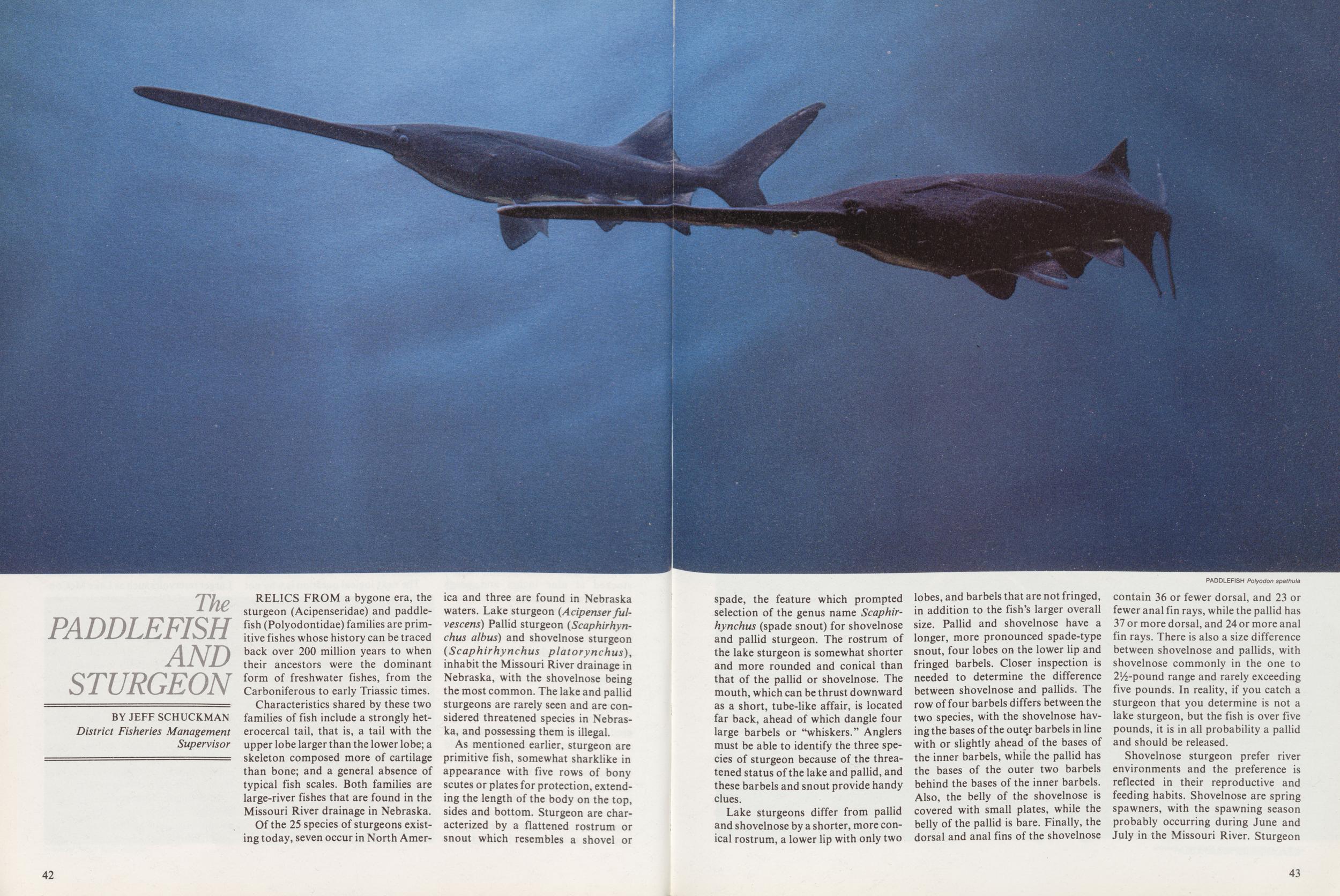
The PADDLEFISH AND STURGEON
BY JEFF SCHUCKMAN District Fisheries Management SupervisorRELICS FROM a bygone era, the sturgeon (Acipenseridae) and paddlefish (Polyodontidae) families are primitive fish whose history can be traced back over 200 million years to when their ancestors were the dominant form of freshwater fishes, from the Carboniferous to early Triassic times.
Characteristics shared by these two families of fish include a strongly heterocercal tail, that is, a tail with the upper lobe larger than the lower lobe; a skeleton composed more of cartilage than bone; and a general absence of typical fish scales. Both families are large-river fishes that are found in the Missouri River drainage in Nebraska.
Of the 25 species of sturgeons existing today, seven occur in North America and three are found in Nebraska waters. Lake sturgeon (Acipenser fulvescens) Pallid sturgeon (Scaphirhynchus albus) and shovelnose sturgeon (Scaphirhynchus platorynchus), inhabit the Missouri River drainage in Nebraska, with the shovelnose being the most common. The lake and pallid sturgeons are rarely seen and are considered threatened species in Nebraska, and possessing them is illegal.
As mentioned earlier, sturgeon are primitive fish, somewhat sharklike in appearance with five rows of bony scutes or plates for protection, extending the length of the body on the top, sides and bottom. Sturgeon are characterized by a flattened rostrum or snout which resembles a shovel or 42 spade, the feature which prompted selection of the genus name Scaphirhynchus (spade snout) for shovelnose and pallid sturgeon. The rostrum of the lake sturgeon is somewhat shorter and more rounded and conical than that of the pallid or shovelnose. The mouth, which can be thrust downward as a short, tube-like affair, is located far back, ahead of which dangle four large barbels or "whiskers." Anglers must be able to identify the three species of sturgeon because of the threatened status of the lake and pallid, and these barbels and snout provide handy clues.
Lake sturgeons differ from pallid and shovelnose by a shorter, more conical rostrum, a lower lip with only two lobes, and barbels that are not fringed, in addition to the fish's larger overall size. Pallid and shovelnose have a longer, more pronounced spade-type snout, four lobes on the lower lip and fringed barbels. Closer inspection is needed to determine the difference between shovelnose and pallids. The row of four barbels differs between the two species, with the shovelnose having the bases of the outer barbels in line with or slightly ahead of the bases of the inner barbels, while the pallid has the bases of the outer two barbels behind the bases of the inner barbels. Also, the belly of the shovelnose is covered with small plates, while the belly of the pallid is bare. Finally, the dorsal and anal fins of the shovelnose contain 36 or fewer dorsal, and 23 or fewer anal fin rays, while the pallid has 37 or more dorsal, and 24 or more anal fin rays. There is also a size difference between shovelnose and pallids, with shovelnose commonly in the one to 2/2-pound range and rarely exceeding five pounds. In reality, if you catch a sturgeon that you determine is not a lake sturgeon, but the fish is over five pounds, it is in all probability a pallid and should be released.
Shovelnose sturgeon prefer river environments and the preference is reflected in their reproductive and feeding habits. Shovelnose are spring spawners, with the spawning season probably occurring during June and July in the Missouri River. Sturgeon spawn over gravel or rock in areas of moderate current. It is believed that female sturgeon spawn only every two or three years after reaching sexual maturity at five to seven years of age.
43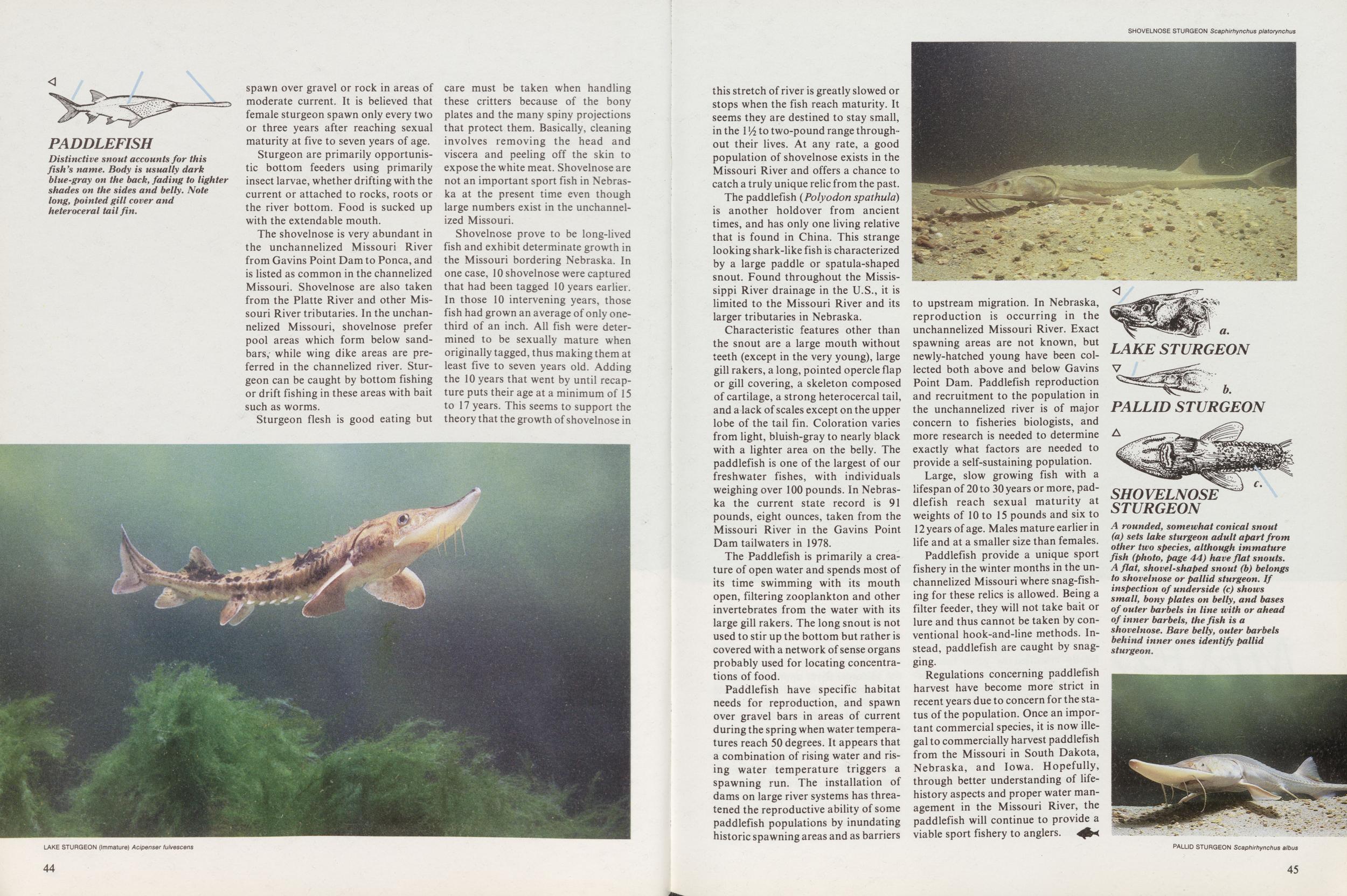
Sturgeon are primarily opportunistic bottom feeders using primarily insect larvae, whether drifting with the current or attached to rocks, roots or the river bottom. Food is sucked up with the extendable mouth.
The shovelnose is very abundant in the unchannelized Missouri River from Gavins Point Dam to Ponca, and is listed as common in the channelized Missouri. Shovelnose are also taken from the Platte River and other Missouri River tributaries. In the unchannelized Missouri, shovelnose prefer pool areas which form below sandbars, while wing dike areas are preferred in the channelized river. Sturgeon can be caught by bottom fishing or drift fishing in these areas with bait such as worms.
Sturgeon flesh is good eating but care must be taken when handling these critters because of the bony plates and the many spiny projections that protect them. Basically, cleaning involves removing the head and viscera and peeling off the skin to expose the white meat. Shovelnose are not an important sport fish in Nebraska at the present time even though large numbers exist in the unchannelized Missouri.
Shovelnose prove to be long-lived fish and exhibit determinate growth in the Missouri bordering Nebraska. In one case, 10 shovelnose were captured that had been tagged 10 years earlier. In those 10 intervening years, those fish had grown an average of only one-third of an inch. All fish were determined to be sexually mature when originally tagged, thus making them at least five to seven years old. Adding the 10 years that went by until recapture puts their age at a minimum of 15 to 17 years. This seems to support the theory that the growth of shovelnose in 44 this stretch of river is greatly slowed or stops when the fish reach maturity. It seems they are destined to stay small, in the 1 Vi to two-pound range throughout their lives. At any rate, a good population of shovelnose exists in the Missouri River and offers a chance to catch a truly unique relic from the past.
The paddlefish (Polyodon spathula) is another holdover from ancient times, and has only one living relative that is found in China. This strange looking shark-like fish is characterized by a large paddle or spatula-shaped snout. Found throughout the Mississippi River drainage in the U.S., it is limited to the Missouri River and its larger tributaries in Nebraska.
Characteristic features other than the snout are a large mouth without teeth (except in the very young), large gill rakers, a long, pointed opercle flap or gill covering, a skeleton composed of cartilage, a strong heterocercal tail, and a lack of scales except on the upper lobe of the tail fin. Coloration varies from light, bluish-gray to nearly black with a lighter area on the belly. The paddlefish is one of the largest of our freshwater fishes, with individuals weighing over 100 pounds. In Nebraska the current state record is 91 pounds, eight ounces, taken from the Missouri River in the Gavins Point Dam tailwaters in 1978.
The Paddlefish is primarily a creature of open water and spends most of its time swimming with its mouth open, filtering zooplankton and other invertebrates from the water with its large gill rakers. The long snout is not used to stir up the bottom but rather is covered with a network of sense organs probably used for locating concentrations of food.
Paddlefish have specific habitat needs for reproduction, and spawn over gravel bars in areas of current during the spring when water temperatures reach 50 degrees. It appears that a combination of rising water and rising water temperature triggers a spawning run. The installation of dams on large river systems has threatened the reproductive ability of some paddlefish populations by inundating historic spawning areas and as barriers to upstream migration. In Nebraska, reproduction is occurring in the unchannelized Missouri River. Exact spawning areas are not known, but newly-hatched young have been collected both above and below Gavins Point Dam. Paddlefish reproduction and recruitment to the population in the unchannelized river is of major concern to fisheries biologists, and more research is needed to determine exactly what factors are needed to provide a self-sustaining population.
Large, slow growing fish with a lifespan of 20 to 30 years or more, paddlefish reach sexual maturity at weights of 10 to 15 pounds and six to 12 years of age. Males mature earlier in life and at a smaller size than females.
Paddlefish provide a unique sport fishery in the winter months in the unchannelized Missouri where snag-fishing for these relics is allowed. Being a filter feeder, they will not take bait or lure and thus cannot be taken by conventional hook-and-line methods. Instead, paddlefish are caught by snagging.
Regulations concerning paddlefish harvest have become more strict in recent years due to concern for the status of the population. Once an important commercial species, it is now illegal to commercially harvest paddlefish from the Missouri in South Dakota, Nebraska, and Iowa. Hopefully, through better understanding of life-history aspects and proper water management in the Missouri River, the paddlefish will continue to provide a viable sport fishery to anglers.
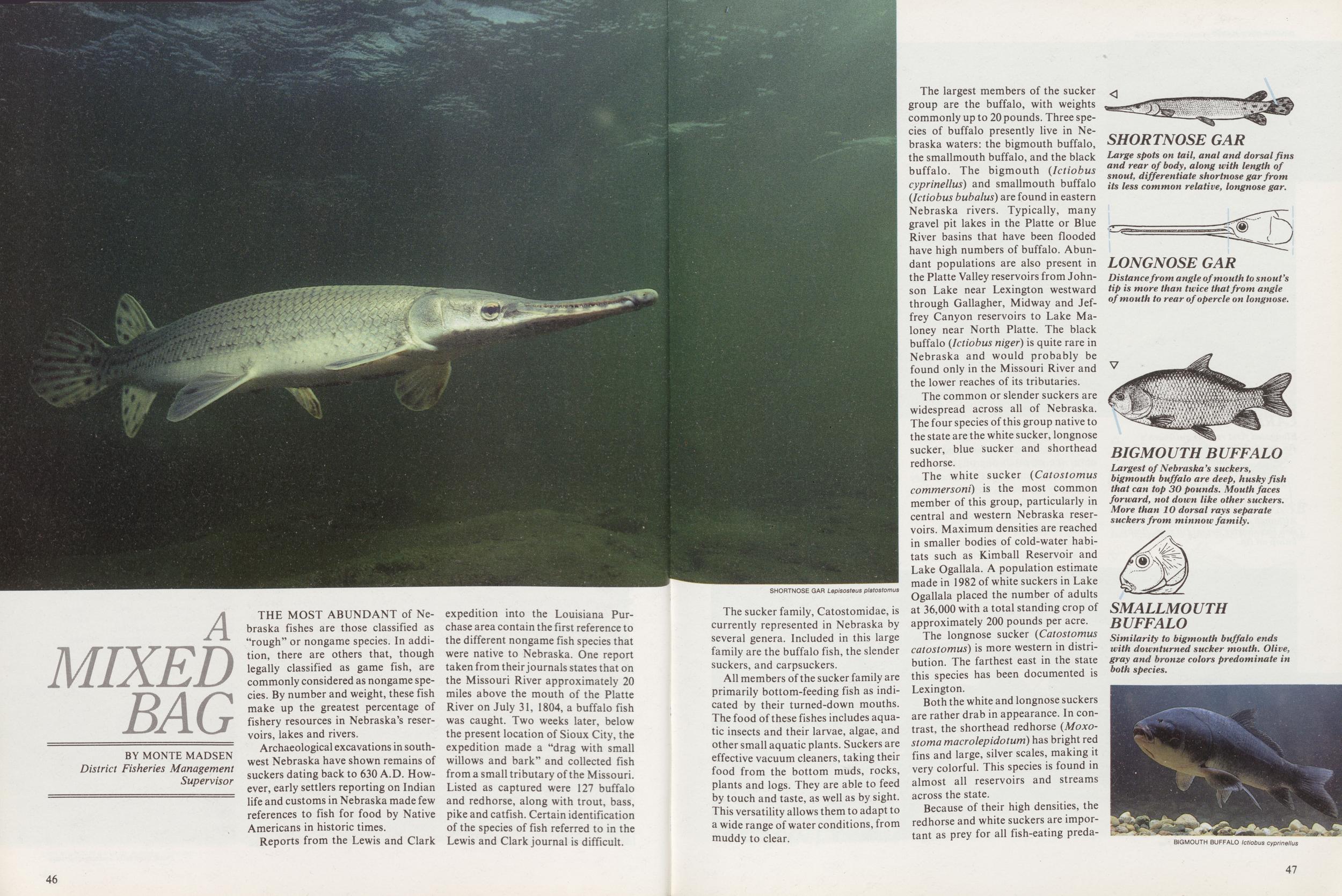
A MIXED BAG
BY MONTE MADSEN District Fisheries Management SupervisorTHE MOST ABUNDANT of Nebraska fishes are those classified as "rough" or nongame species. In addition, there are others that, though legally classified as game fish, are commonly considered as nongame species. By number and weight, these fish make up the greatest percentage of fishery resources in Nebraska's reservoirs, lakes and rivers.
Archaeological excavations in south-west Nebraska have shown remains of suckers dating back to 630 A.D. However, early settlers reporting on Indian life and customs in Nebraska made few references to fish for food by Native Americans in historic times.
Reports from the Lewis and Clark expedition into the Louisiana Purchase area contain the first reference to the different nongame fish species that were native to Nebraska. One report taken from their journals states that on the Missouri River approximately 20 miles above the mouth of the Platte River on July 31, 1804, a buffalo fish was caught. Two weeks later, below the present location of Sioux City, the expedition made a "drag with small willows and bark" and collected fish from a small tributary of the Missouri. Listed as captured were 127 buffalo and redhorse, along with trout, bass, pike and catfish. Certain identification of the species of fish referred to in the Lewis and Clark journal is difficult.
46The sucker family, Catostomidae, is currently represented in Nebraska by several genera. Included in this large family are the buffalo fish, the slender suckers, and carp suckers.
All members of the sucker family are primarily bottom-feeding fish as indicated by their turned-down mouths. The food of these fishes includes aquatic insects and their larvae, algae, and other small aquatic plants. Suckers are effective vacuum cleaners, taking their food from the bottom muds, rocks, plants and logs. They are able to feed by touch and taste, as well as by sight. This versatility allows them to adapt to a wide range of water conditions, from muddy to clear.
The largest members of the sucker group are the buffalo, with weights commonly up to 20 pounds. Three species of buffalo presently live in Nebraska waters: the bigmouth buffalo, the smallmouth buffalo, and the black buffalo. The bigmouth {Ictiobus cyprinellus) and smallmouth buffalo {Ictiobus bubalus) are found in eastern Nebraska rivers. Typically, many gravel pit lakes in the Platte or Blue River basins that have been flooded have high numbers of buffalo. Abundant populations are also present in the Platte Valley reservoirs from Johnson Lake near Lexington westward through Gallagher, Midway and Jef- frey Canyon reservoirs to Lake Maloney near North Platte. The black buffalo {Ictiobus niger) is quite rare in Nebraska and would probably be found only in the Missouri River and the lower reaches of its tributaries.
The common or slender suckers are widespread across all of Nebraska. The four species of this group native to the state are the white sucker, longnose sucker, blue sucker and short head redhorse.
The white sucker {Catostomus commersoni) is the most common member of this group, particularly in central and western Nebraska reservoirs. Maximum densities are reached in smaller bodies of cold-water habitats such as Kimball Reservoir and Lake Ogallala. A population estimate made in 1982 of white suckers in Lake Ogallala placed the number of adults at 36,000 with a total standing crop of approximately 200 pounds per acre.
The longnose sucker {Catostomus catostomus) is more western in distribution. The farthest east in the state this species has been documented is Lexington.
Both the white and longnose suckers are rather drab in appearance. In contrast, the shorthead redhorse {Moxostoma macrolepidotum) has bright red fins and large, silver scales, making it very colorful. This species is found in almost all reservoirs and streams across the state.
Because of their high densities, the redhorse and white suckers are important as prey for all fish-eating predators. Both species have been found in predator fish stomachs during food habit studies. Young suckers up to eight inches are used as bait for large gamefish such as northern pike, walleye, bass and catfish. They are hardy and stay alive on a hook.
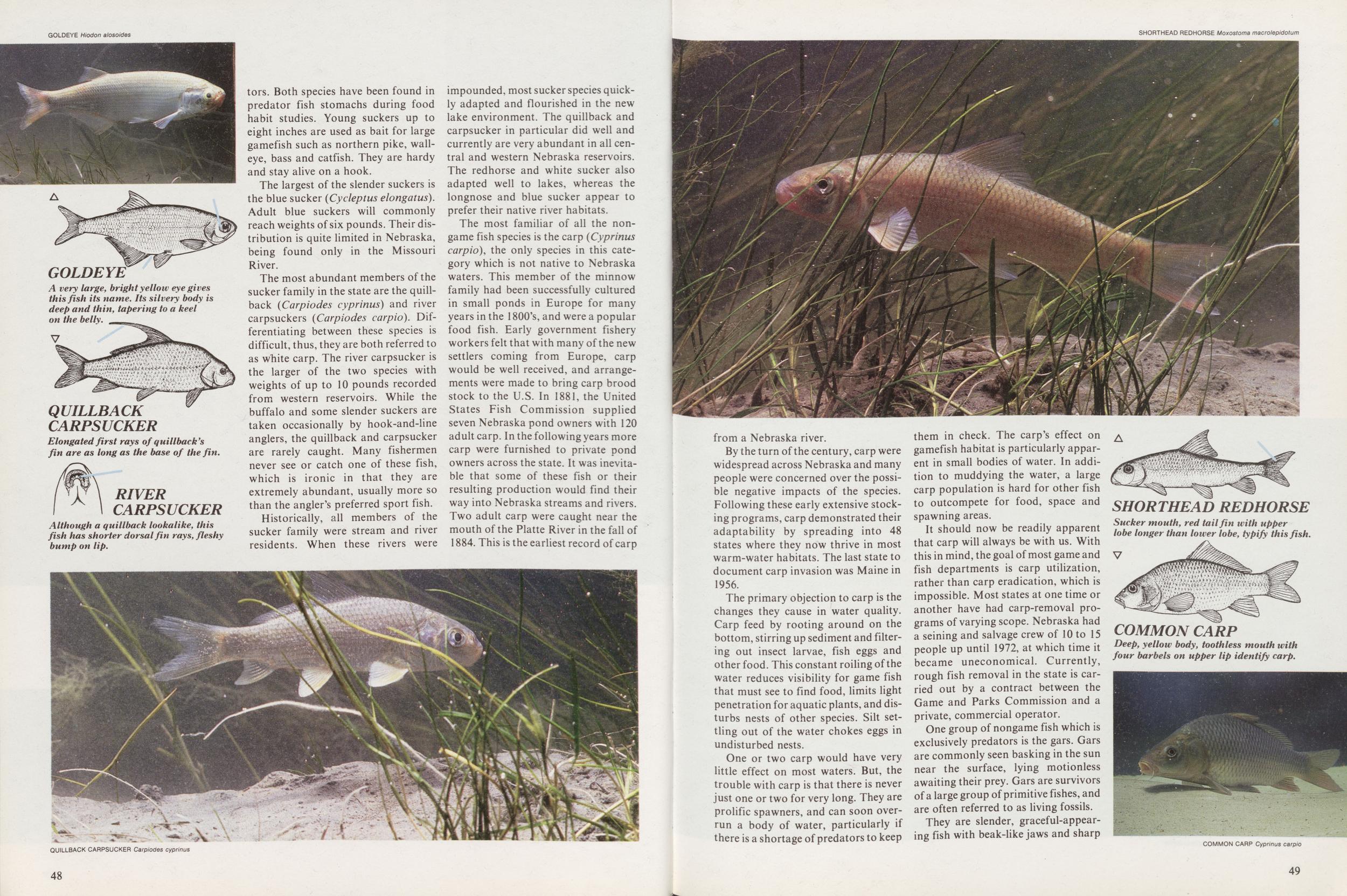
The largest of the slender suckers is the blue sucker {Cycleptus elongatus). Adult blue suckers will commonly reach weights of six pounds. Their distribution is quite limited in Nebraska, being found only in the Missouri River.
The most abundant members of the sucker family in the state are the quillback {Carpiodes cyprinus) and river carpsuckers {Carpiodes carpio). Differentiating between these species is difficult, thus, they are both referred to as white carp. The river carp sucker is the larger of the two species with weights of up to 10 pounds recorded from western reservoirs. While the buffalo and some slender suckers are taken occasionally by hook-and-line anglers, the quillback and carp sucker are rarely caught. Many fishermen never see or catch one of these fish, which is ironic in that they are extremely abundant, usually more so than the angler's preferred sport fish.
Historically, all members of the sucker family were stream and river residents. When these rivers were impounded, most sucker species quickly adapted and flourished in the new lake environment. The quillback and carp sucker in particular did well and currently are very abundant in all central and western Nebraska reservoirs. The redhorse and white sucker also adapted well to lakes, whereas the longnose and blue sucker appear to prefer their native river habitats.
The most familiar of all the nongame fish species is the carp {Cyprinus carpio), the only species in this category which is not native to Nebraska waters. This member of the minnow family had been successfully cultured in small ponds in Europe for many years in the 1800's, and were a popular food fish. Early government fishery workers felt that with many of the new settlers coming from Europe, carp would be well received, and arrangements were made to bring carp brood stock to the U.S. In 1881, the United States Fish Commission supplied seven Nebraska pond owners with 120 adult carp. In the following years more carp were furnished to private pond owners across the state. It was inevitable that some of these fish or their resulting production would find their way into Nebraska streams and rivers. Two adult carp were caught near the mouth of the Platte River in the fall of 1884. This is the earliest record of carp 48 from a Nebraska river.
By the turn of the century, carp were widespread across Nebraska and many people were concerned over the possible negative impacts of the species. Following these early extensive stocking programs, carp demonstrated their adaptability by spreading into 48 states where they now thrive in most warm-water habitats. The last state to document carp invasion was Maine in 1956.
The primary objection to carp is the changes they cause in water quality. Carp feed by rooting around on the bottom, stirring up sediment and filtering out insect larvae, fish eggs and other food. This constant roiling of the water reduces visibility for game fish that must see to find food, limits light penetration for aquatic plants, and disturbs nests of other species. Silt settling out of the water chokes eggs in undisturbed nests.
One or two carp would have very little effect on most waters. But, the trouble with carp is that there is never just one or two for very long. They are prolific spawners, and can soon over-run a body of water, particularly if there is a shortage of predators to keep them in check. The carp's effect on gamefish habitat is particularly apparent in small bodies of water. In addition to muddying the water, a large carp population is hard for other fish to outcompete for food, space and spawning areas.
It should now be readily apparent that carp will always be with us. With this in mind, the goal of most game and fish departments is carp utilization, rather than carp eradication, which is impossible. Most states at one time or another have had carp-removal programs of varying scope. Nebraska had a seining and salvage crew of 10 to 15 people up until 1972, at which time it became uneconomical. Currently, rough fish removal in the state is carried out by a contract between the Game and Parks Commission and a private, commercial operator.
One group of nongame fish which is exclusively predators is the gars. Gars are commonly seen basking in the sun near the surface, lying motionless awaiting their prey. Gars are survivors of a large group of primitive fishes, and are often referred to as living fossils.
They are slender, graceful-appearing fish with beak-like jaws and sharp teeth. Two species, the longnose {Lepisosteus osseus) and shortnose {Lepisosteus plastostomus), are found in Nebraska waters, with distribution mainly in eastern Nebraska in the Missouri River, but also westward up tributary streams such as the Niobrara, Elkhorn and Platte rivers. Both species have been reported in the Platte up-stream to North Platte, a distance of over 250 miles. The shortnose is the more common of the two species, with sizes up to 10 pounds not uncommon.
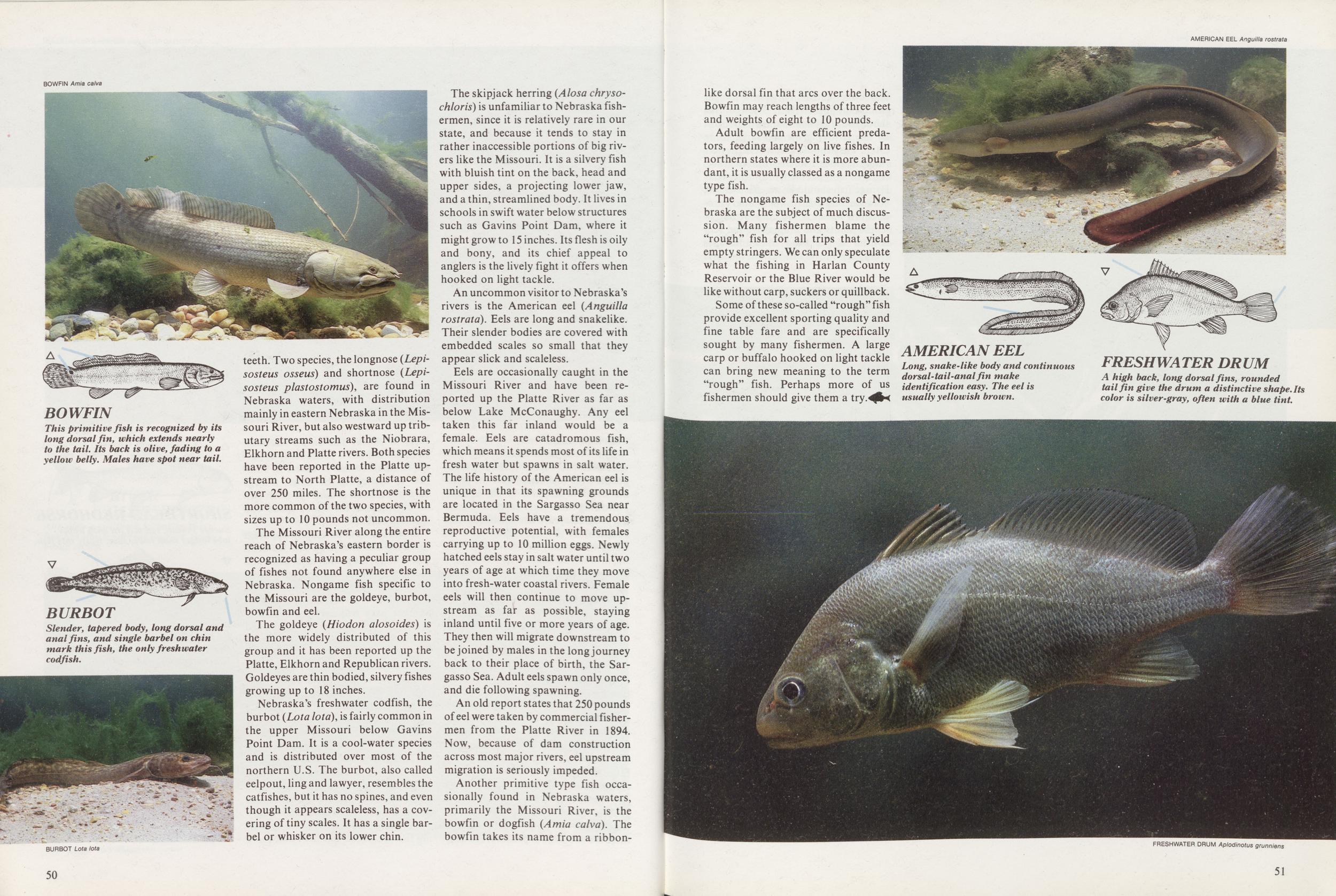
The Missouri River along the entire reach of Nebraska's eastern border is recognized as having a peculiar group of fishes not found anywhere else in Nebraska. Nongame fish specific to the Missouri are the goldeye, burbot, bowfin and eel.
The goldeye (Hiodon alosoides) is the more widely distributed of this group and it has been reported up the Platte, Elkhorn and Republican rivers. Goldeyes are thin bodied, silvery fishes growing up to 18 inches.
Nebraska's freshwater codfish, the burbot {Lota lota), is fairly common in the upper Missouri below Gavins Point Dam. It is a cool-water species and is distributed over most of the northern U.S. The burbot, also called eelpout, ling and lawyer, resembles the catfishes, but it has no spines, and even though it appears scaleless, has a covering of tiny scales. It has a single barbel or whisker on its lower chin.
The skipjack herring {Alosa c hrysochloris) is unfamiliar to Nebraska fishermen, since it is relatively rare in our state, and because it tends to stay in rather inaccessible portions of big rivers like the Missouri. It is a silvery fish with bluish tint on the back, head and upper sides, a projecting lower jaw, and a thin, streamlined body. It lives in schools in swift water below structures such as Gavins Point Dam, where it might grow to 15 inches. Its flesh is oily and bony, and its chief appeal to anglers is the lively fight it offers when hooked on light tackle.
An uncommon visitor to Nebraska's rivers is the American eel {Anguilla rostrata). Eels are long and snakelike. Their slender bodies are covered with embedded scales so small that they appear slick and scaleless.
Eels are occasionally caught in the Missouri River and have been reported up the Platte River as far as below Lake McConaughy. Any eel taken this far inland would be a female. Eels are catadromous fish, which means it spends most of its life in fresh water but spawns in salt water. The life history of the American eel is unique in that its spawning grounds are located in the Sargasso Sea near Bermuda. Eels have a tremendous reproductive potential, with females carrying up to 10 million eggs. Newly hatched eels stay in salt water until two years of age at which time they move into fresh-water coastal rivers. Female eels will then continue to move up-stream as far as possible, staying inland until five or more years of age. They then will migrate downstream to be joined by males in the long journey back to their place of birth, the Sargasso Sea. Adult eels spawn only once, and die following spawning.
An old report states that 250 pounds of eel were taken by commercial fishermen from the Platte River in 1894 Now, because of dam construction across most major rivers, eel upstream migration is seriously impeded.
Another primitive type fish occasionally found in Nebraska waters, primarily the Missouri River, is the bowfin or dogfish {Amia calva). The bowfin takes its name from a ribbonlike 50 like dorsal fin that arcs over the back. Bowfin may reach lengths of three feet and weights of eight to 10 pounds.
Adult bowfin are efficient predators, feeding largely on live fishes. In northern states where it is more a bundant, it is usually classed as a nongame type fish.
The nongame fish species of Nebraska are the subject of much discussion. Many fishermen blame the "rough" fish for all trips that yield empty stringers. We can only speculate what the fishing in Harlan County Reservoir or the Blue River would be like without carp, suckers or quillback.
Some of these so-called "rough" fish provide excellent sporting quality and fine table fare and are specifically sought by many fishermen. A large carp or buffalo hooked on light tackle can bring new meaning to the term "rough" fish. Perhaps more of us fishermen should give them a try.
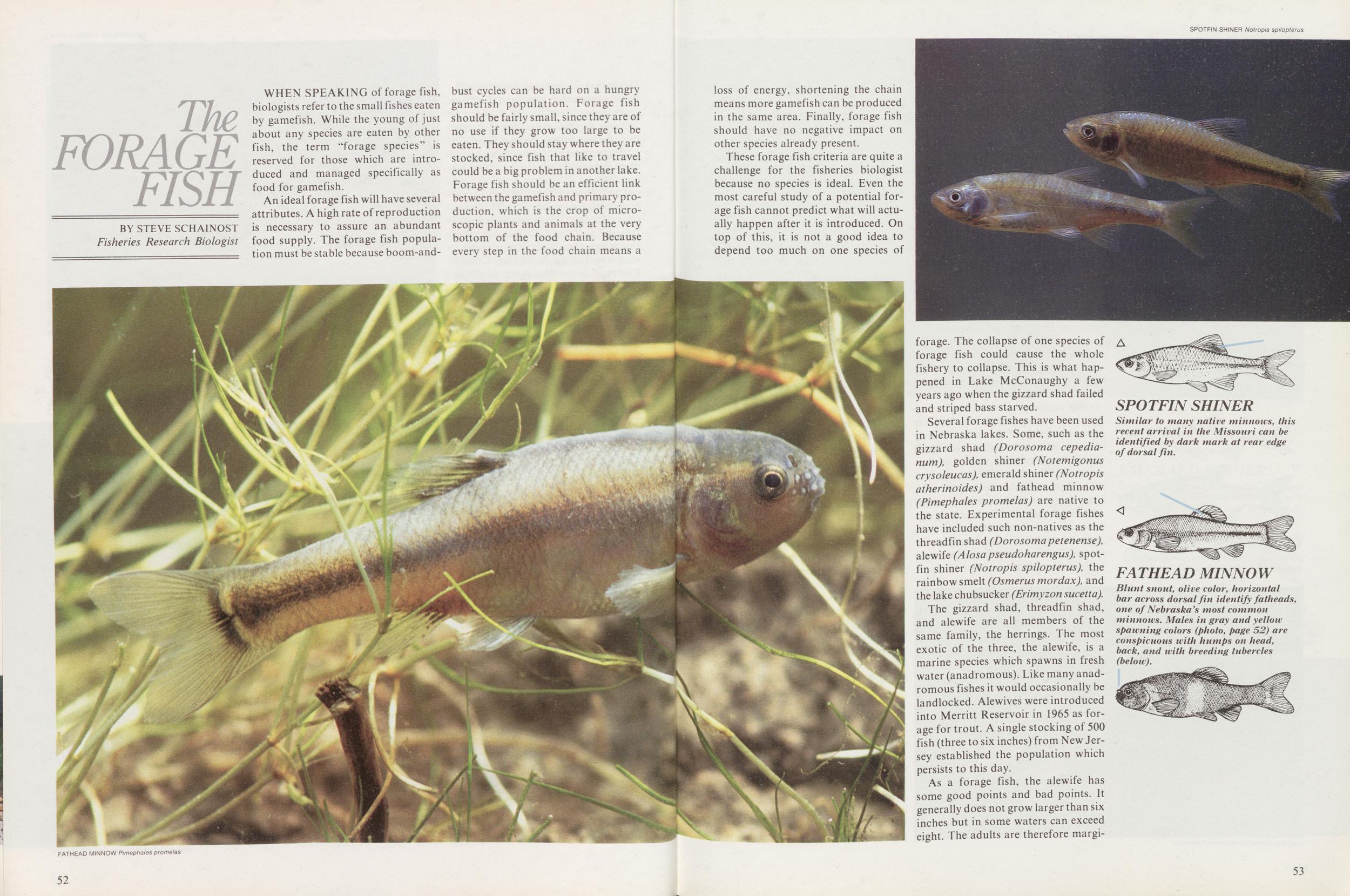
The FORAGE FISH
BY STEVE SCHAINOST Fisheries Research BiologistWHEN SPEAKING of forage fish, biologists refer to the small fishes eaten by gamefish. While the young of just about any species are eaten by other fish, the term "forage species" is reserved for those which are introduced and managed specifically as food for gamefish.
An ideal forage fish will have several attributes. A high rate of reproduction is necessary to assure an abundant food supply. The forage fish population must be stable because boom-and- bust cycles can be hard on a hungry gamefish population. Forage fish should be fairly small, since they are of no use if they grow too large to be eaten. They should stay where they are stocked, since fish that like to travel could be a big problem in another lake. Forage fish should be an efficient link between the gamefish and primary production, which is the crop of microscopic plants and animals at the very bottom of the food chain. Because every step in the food chain means a 52 loss of energy, shortening the chain means more gamefish can be produced in the same area. Finally, forage fish should have no negative impact on other species already present.
These forage fish criteria are quite a challenge for the fisheries biologist because no species is ideal. Even the most careful study of a potential forage fish cannot predict what will actually happen after it is introduced. On top of this, it is not a good idea to depend too much on one species of forage. The collapse of one species of forage fish could cause the whole fishery to collapse. This is what happened in Lake McConaughy a few years ago when the gizzard shad failed and striped bass starved.
Several forage fishes have been used in Nebraska lakes. Some, such as the gizzard shad (Dorosoma cepedia- num), golden shiner (Notemigonus crysoleucas), emerald shiner (Notropis atherinoides) and fathead minnow (Pimephales promelas) are native to the state. Experimental forage fishes have included such non-natives as the thread fin shad (Dorosoma petenense), alewife (Alosa pseudoharengus), spot-fin shiner (Notropis spilopterus), the rainbow smelt (Osmerus mordax), and the lake chub sucker (Erimyzon sucetta).
The gizzard shad, thread fin shad, and alewife are all members of the same family, the herrings. The most exotic of the three, the alewife, is a marine species which spawns in fresh water (anadromous). Like many anadromous fishes it would occasionally be landlocked. Alewives were introduced into Merritt Reservoir in 1965 as forage for trout. A single stocking of 500 fish (three to six inches) from New Jersey established the population which persists to this day.
As a forage fish, the alewife has some good points and bad points. It generally does not grow larger than six inches but in some waters can exceed eight. The adults are therefore marginal prey, being a bit too large. The species is fairly prolific, with each female having about 10,000 eggs. However, they are also subject to periodic die-offs, which can be a problem for the predators who depend on them. They also like to emigrate downstream into other lakes. The alewife feeds mainly on zooplankton but will also eat insects and larval fish. They are higher on the food chain than is really desirable and may compete with young gamefish for the same foods.
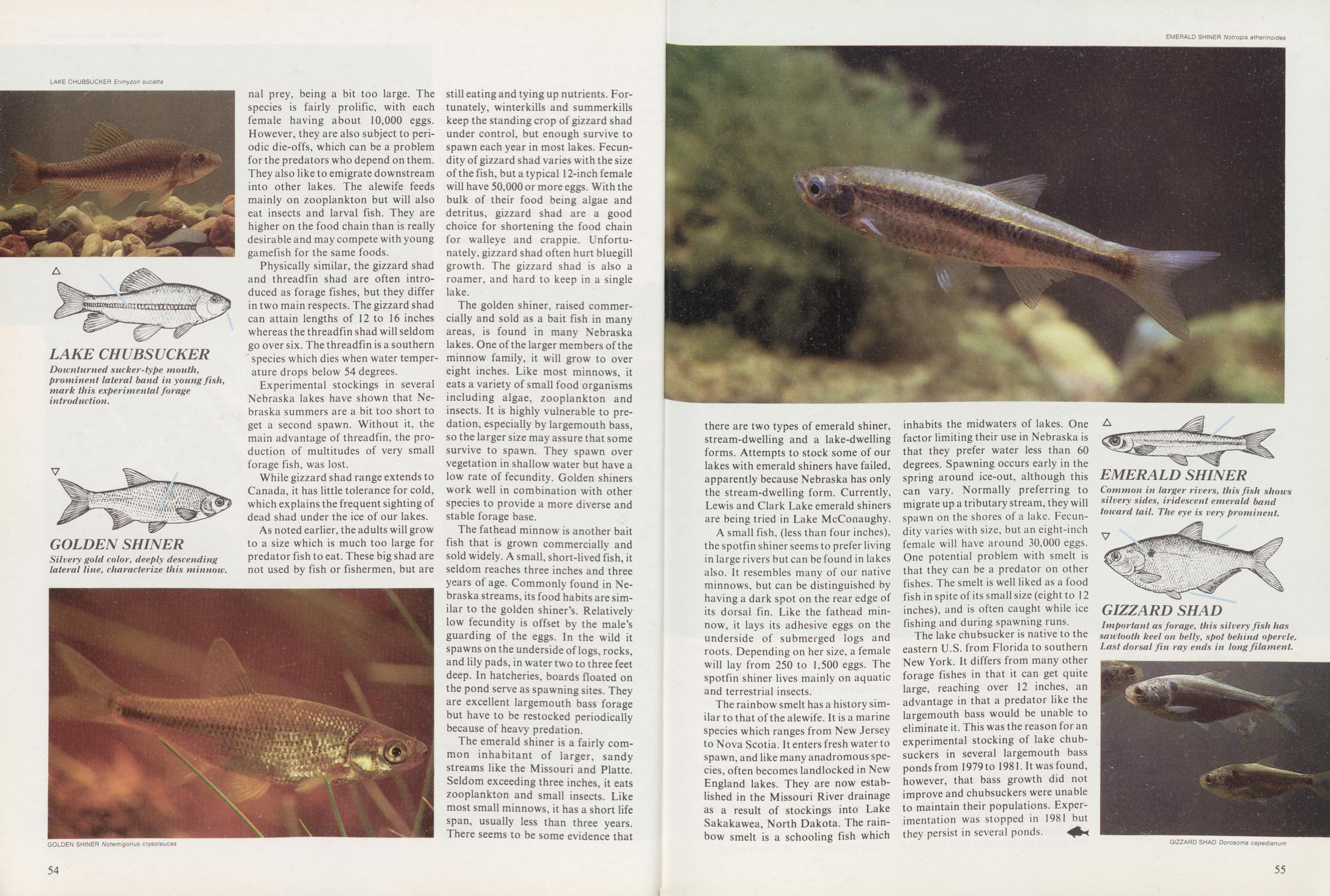
Physically similar, the gizzard shad and threadfin shad are often introduced as forage fishes, but they differ in two main respects. The gizzard shad can attain lengths of 12 to 16 inches whereas the threadfin shad will seldom go over six. The threadfin is a southern species which dies when water temperature drops below 54 degrees.
Experimental stockings in several Nebraska lakes have shown that Nebraska summers are a bit too short to get a second spawn. Without it, the main advantage of threadfin, the production of multitudes of very small forage fish, was lost.
While gizzard shad range extends to Canada, it has little tolerance for cold, which explains the frequent sighting of dead shad under the ice of our lakes.
As noted earlier, the adults will grow to a size which is much too large for predator fish to eat. These big shad are not used by fish or fishermen, but are GOLDEN SHINER Notemigonus crysoleucas still eating and tying up nutrients. Fortunately, winter kills and summer kills keep the standing crop of gizzard shad under control, but enough survive to spawn each year in most lakes. Fecundity of gizzard shad varies with the size of the fish, but a typical 12-inch female will have 50,000 or more eggs. With the bulk of their food being algae and detritus, gizzard shad are a good choice for shortening the food chain for walleye and crappie. Unfortunately, gizzard shad often hurt bluegill growth. The gizzard shad is also a roamer, and hard to keep in a single lake.
The golden shiner, raised commercially and sold as a bait fish in many areas, is found in many Nebraska lakes. One of the larger members of the minnow family, it will grow to over eight inches. Like most minnows, it eats a variety of small food organisms including algae, zooplankton and insects. It is highly vulnerable to predation, especially by largemouth bass, so the larger size may assure that some survive to spawn. They spawn over vegetation in shallow water but have a low rate of fecundity. Golden shiners work well in combination with other species to provide a more diverse and stable forage base.
The fathead minnow is another bait fish that is grown commercially and sold widely. A small, short-lived fish, it seldom reaches three inches and three years of age. Commonly found in Nebraska streams, its food habits are similar to the golden shiner's. Relatively low fecundity is offset by the male's guarding of the eggs. In the wild it spawns on the underside of logs, rocks, and lily pads, in water two to three feet deep. In hatcheries, boards floated on the pond serve as spawning sites. They are excellent largemouth bass forage but have to be restocked periodically because of heavy predation.
The emerald shiner is a fairly common inhabitant of larger, sandy streams like the Missouri and Platte. Seldom exceeding three inches, it eats zooplankton and small insects. Like most small minnows, it has a short life span, usually less than three years. There seems to be some evidence that 54 there are two types of emerald shiner, stream-dwelling and a lake-dwelling forms. Attempts to stock some of our lakes with emerald shiners have failed, apparently because Nebraska has only the stream-dwelling form. Currently, Lewis and Clark Lake emerald shiners are being tried in Lake McConaughy.
A small fish, (less than four inches), the spot fin shiner seems to prefer living in large rivers but can be found in lakes also. It resembles many of our native minnows, but can be distinguished by having a dark spot on the rear edge of its dorsal fin. Like the fathead minnow, it lays its adhesive eggs on the underside of submerged logs and roots. Depending on her size, a female will lay from 250 to 1,500 eggs. The spot fin shiner lives mainly on aquatic and terrestrial insects.
The rainbow smelt has a history similar to that of the alewife. It is a marine species which ranges from New Jersey to Nova Scotia. It enters fresh water to spawn, and like many anadromous species, often becomes landlocked in New England lakes. They are now established in the Missouri River drainage as a result of stockings into Lake Sakakawea, North Dakota. The rainbow smelt is a schooling fish which inhabits the mid-waters of lakes. One factor limiting their use in Nebraska is that they prefer water less than 60 degrees. Spawning occurs early in the spring around ice-out, although this can vary. Normally preferring to migrate up a tributary stream, they will spawn on the shores of a lake. Fecundity varies with size, but an eight-inch female will have around 30,000 eggs. One potential problem with smelt is that they can be a predator on other fishes. The smelt is well liked as a food fish in spite of its small size (eight to 12 inches), and is often caught while ice fishing and during spawning runs.
The lake chubsucker is native to the eastern U.S. from Florida to southern New York. It differs from many other forage fishes in that it can get quite large, reaching over 12 inches, an advantage in that a predator like the largemouth bass would be unable to eliminate it. This was the reason for an experimental stocking of lake chubsucker in several largemouth bass ponds from 1979to 1981. It was found, however, that bass growth did not improve and chubsucker were unable to maintain their populations. Experimentation was stopped in 1981 but they persist in several ponds.
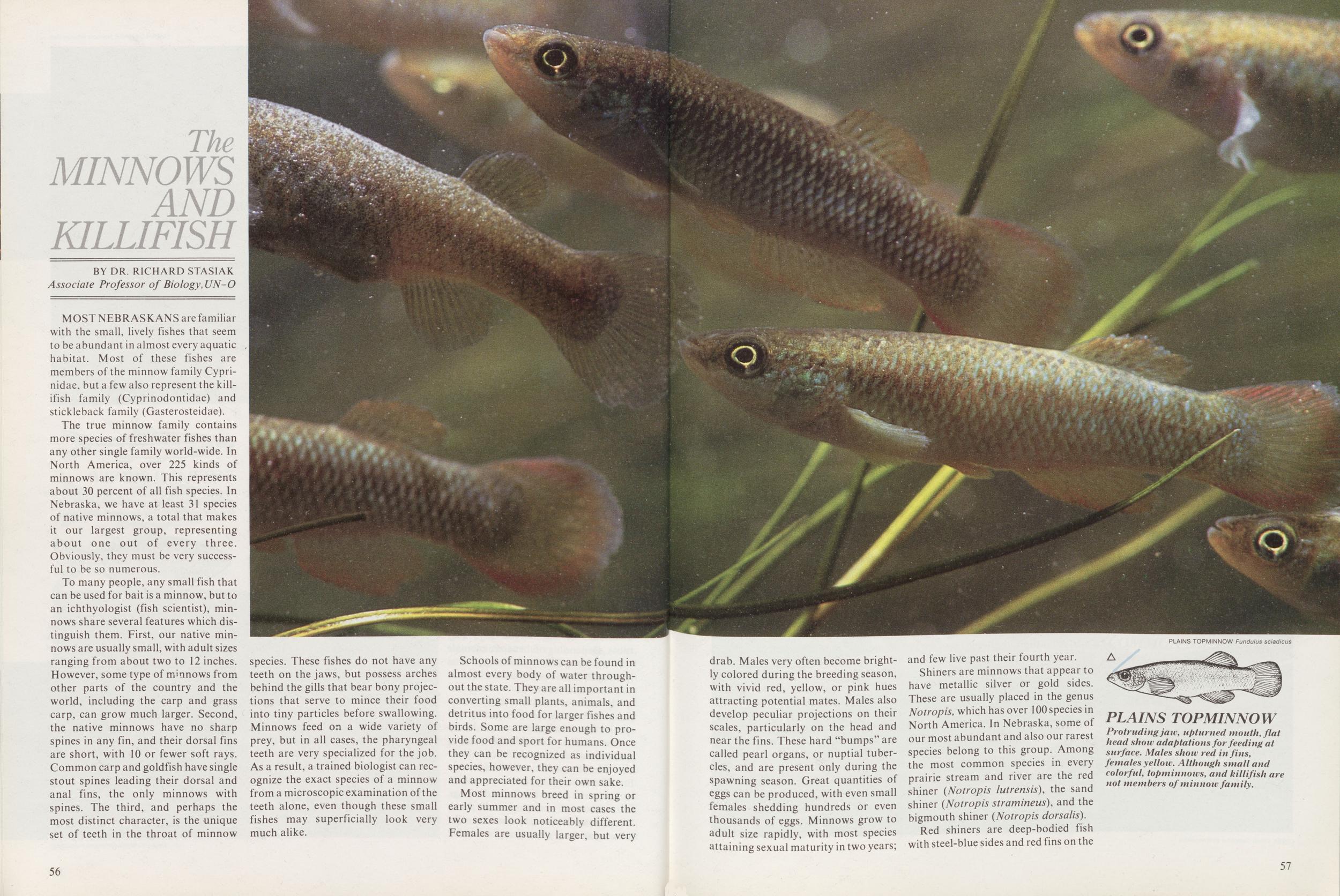
The MINNOWS AND KILLIFISH
BY DR. RICHARD STASIAK Associate Professor of Biology, UN-OMOST NEBRASKANS are familiar with the small, lively fishes that seem to be abundant in almost every aquatic habitat. Most of these fishes are members of the minnow family Cyprinidae, but a few also represent the killfish family (Cyprinodontidae) and stickleback family (Gasterosteidae).
The true minnow family contains more species of freshwater fishes than any other single family world-wide. In North America, over 225 kinds of minnows are known. This represents about 30 percent of all fish species. In Nebraska, we have at least 31 species of native minnows, a total that makes it our largest group, representing about one out of every three. Obviously, they must be very successful to be so numerous.
To many people, any small fish that can be used for bait is a minnow, but to an ichthyologist (fish scientist), minnows share several features which distinguish them. First, our native minnows are usually small, with adult sizes ranging from about two to 12 inches. However, some type of minnows from other parts of the country and the world, including the carp and grass carp, can grow much larger. Second, the native minnows have no sharp spines in any fin, and their dorsal fins are short, with 10 or fewer soft rays. Common carp and goldfish have single stout spines leading their dorsal and anal fins, the only minnows with spines. The third, and perhaps the most distinct character, is the unique set of teeth in the throat of minnow species. These fishes do not have any teeth on the jaws, but possess arches behind the gills that bear bony projections that serve to mince their food into tiny particles before swallowing. Minnows feed on a wide variety of prey, but in all cases, the pharyngeal teeth are very specialized for the job. As a result, a trained biologist can recognize the exact species of a minnow from a microscopic examination of the teeth alone, even though these small fishes may superficially look very much alike.
Schools of minnows can be found in almost every body of water throughout the state. They are all important in converting small plants, animals, and detritus into food for larger fishes and birds. Some are large enough to provide food and sport for humans. Once they can be recognized as individual species, however, they can be enjoyed and appreciated for their own sake.
Most minnows breed in spring or early summer and in most cases the two sexes look noticeably different. Females are usually larger, but very 56 drab. Males very often become brightly colored during the breeding season, with vivid red, yellow, or pink hues attracting potential mates. Males also develop peculiar projections on their scales, particularly on the head and near the fins. These hard "bumps" are called pearl organs, or nuptial tubercles, and are present only during the spawning season. Great quantities of eggs can be produced, with even small females shedding hundreds or even thousands of eggs. Minnows grow to adult size rapidly, with most species attaining sexual maturity in two years; and few live past their fourth year.
Shiners are minnows that appear to have metallic silver or gold sides. These are usually placed in the genus Notropis, which has over 100 species in North America. In Nebraska, some of our most abundant and also our rarest species belong to this group. Among the most common species in every prairie stream and river are the red shiner (Notropis lutrensis), the sand shiner (Notropis stramineus), and the bigmouth shiner (Notropis dorsalis).
Red shiners are deep-bodied fish with steel-blue sides and red fins on the breeding male. To many people, this three-inch fish is as handsome as any tropical fish in an aquarium, yet it is very hardy and tolerant of changing water conditions. It is one of the most common fishes in the large rivers throughout Nebraska. Sand shiners and bigmouth shiners are the typical small, slender, silvery minnows abundant in most rivers and s andy-bottomed streams. They feed primarily on small insects and detritus.
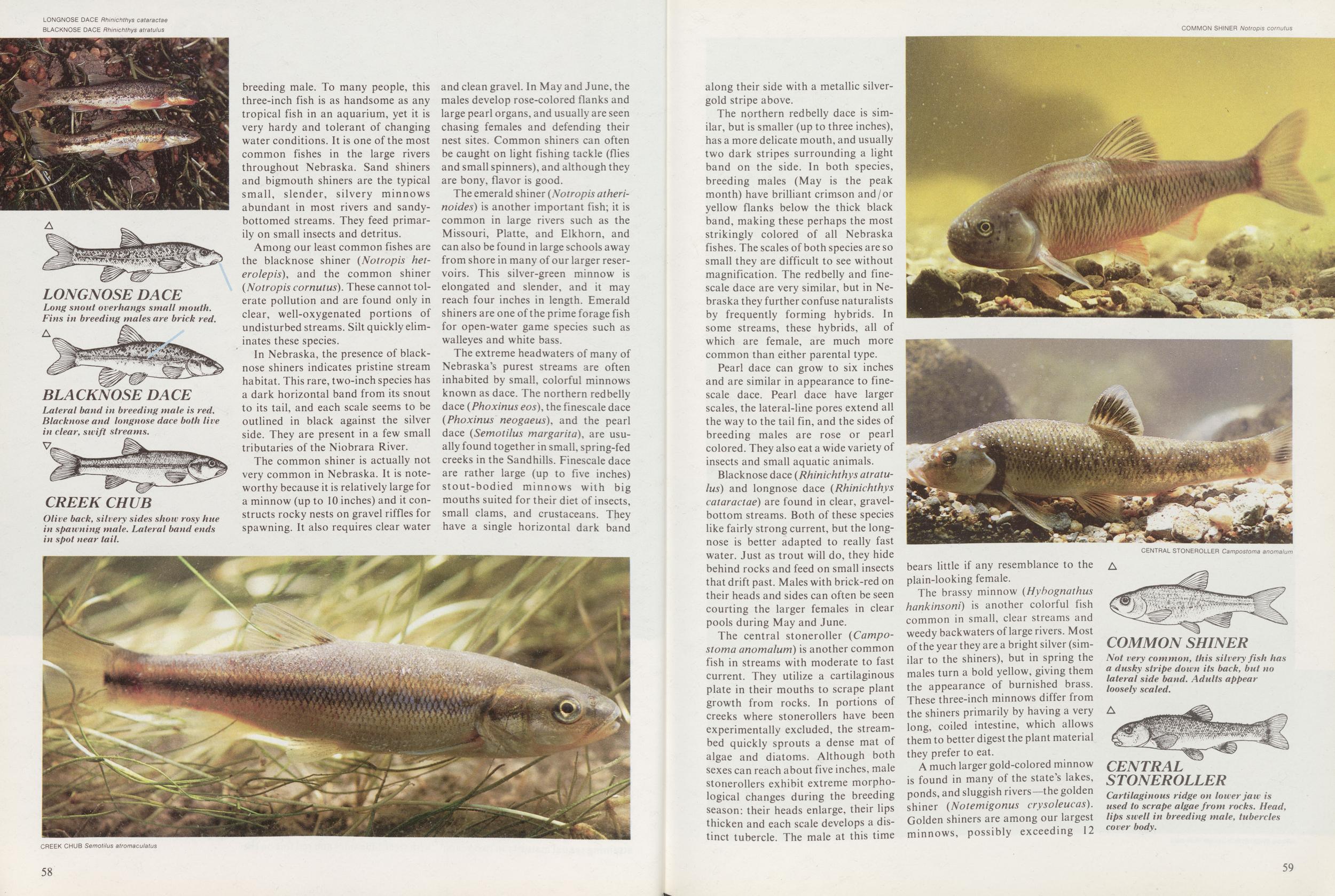
Among our least common fishes are the blacknose shiner {Notropis heterolepis), and the common shiner {Notropis cornutus). These cannot tolerate pollution and are found only in clear, well-oxygenated portions of undisturbed streams. Silt quickly eliminates these species.
In Nebraska, the presence of black-nose shiners indicates pristine stream habitat. This rare, two-inch species has a dark horizontal band from its snout to its tail, and each scale seems to be outlined in black against the silver side. They are present in a few small tributaries of the Niobrara River.
The common shiner is actually not very common in Nebraska. It is noteworthy because it is relatively large for a minnow (up to 10 inches) and it constructs rocky nests on gravel riffles for spawning. It also requires clear water and clean gravel. In May and June, the males develop rose-colored flanks and large pearl organs, and usually are seen chasing females and defending their nest sites. Common shiners can often be caught on light fishing tackle (flies and small spinners), and although they are bony, flavor is good.
The emerald shiner {Notropis atherinoides) is another important fish; it is common in large rivers such as the Missouri, Platte, and Elkhorn, and can also be found in large schools away from shore in many of our larger reservoirs. This silver-green minnow is elongated and slender, and it may reach four inches in length. Emerald shiners are one of the prime forage fish for open-water game species such as walleyes and white bass.
The extreme headwaters of many of Nebraska's purest streams are often inhabited by small, colorful minnows known as dace. The northern redbelly dace {Phoxinus eos), the fin scale dace {Phoxinus neogaeus), and the pearl dace {Semotilus margarita), are usually found together in small, spring-fed creeks in the Sandhills. Fin scale dace are rather large (up to five inches) stout-bodied minnows with big mouths suited for their diet of insects, small clams, and crustaceans. They have a single horizontal dark band 58 along their side with a metallic silver-gold stripe above.
The northern redbelly dace is similar, but is smaller (up to three inches), has a more delicate mouth, and usually two dark stripes surrounding a light band on the side. In both species, breeding males (May is the peak month) have brilliant crimson and/or yellow flanks below the thick black band, making these perhaps the most strikingly colored of all Nebraska fishes. The scales of both species are so small they are difficult to see without magnification. The redbelly and fine- scale dace are very similar, but in Nebraska they further confuse naturalists by frequently forming hybrids. In some streams, these hybrids, all of which are female, are much more common than either parental type.
Pearl dace can grow to six inches and are similar in appearance to fine-scale dace. Pearl dace have larger scales, the lateral-line pores extend all the way to the tail fin, and the sides of breeding males are rose or pearl colored. They also eat a wide variety of insects and small aquatic animals.
Blacknose dace {Rhinichthys atratulus) and longnose dace {Rhinichthys cataractae) are found in clear, gravel bottom streams. Both of these species like fairly strong current, but the long-nose is better adapted to really fast water. Just as trout will do, they hide behind rocks and feed on small insects that drift past. Males with brick-red on their heads and sides can often be seen courting the larger females in clear pools during May and June.
The central stoneroller {Campostoma anomalum) is another common fish in streams with moderate to fast current. They utilize a cartilaginous plate in their mouths to scrape plant growth from rocks. In portions of creeks where stone rollers have been experimentally excluded, the stream- bed quickly sprouts a dense mat of algae and diatoms. Although both sexes can reach about five inches, male stonerollers exhibit extreme morphological changes during the breeding season: their heads enlarge, their lips thicken and each scale develops a distinct tubercle. The male at this time bears little if any resemblance to the plain-looking female.
The brassy minnow {Hyhognathus hankinsoni) is another colorful fish common in small, clear streams and weedy backwaters of large rivers. Most of the year they are a bright silver (similar to the shiners), but in spring the males turn a bold yellow, giving them the appearance of burnished brass. These three-inch minnows differ from the shiners primarily by having a very long, coiled intestine, which allows them to better digest the plant material they prefer to eat.
A much larger gold-colored minnow is found in many of the state's lakes, ponds, and sluggish rivers—the golden shiner {Notemigonus crysoleucas). Golden shiners are among our largest minnows, possibly exceeding 12 inches. They are our only native minnow with a long anal fin bearing 13 or more soft rays. In this species, the scales are silver until the fish is mature at about four or five inches, then the shiny gold begins to appear in both sexes. Because of their bright colors and size, golden shiners make attractive bait for large game fish such as bass, pike and catfish. Many fishermen use eight- to 10-inch golden shiners as their "secret weapon" for really large fish. Due to their diet and size, golden shiners are frequently caught by fishermen seeking panfish since they readily bite on small worms, flies and spinners. Just as with any large minnow, they can be eaten. The flesh is bony, but the flavor is good.
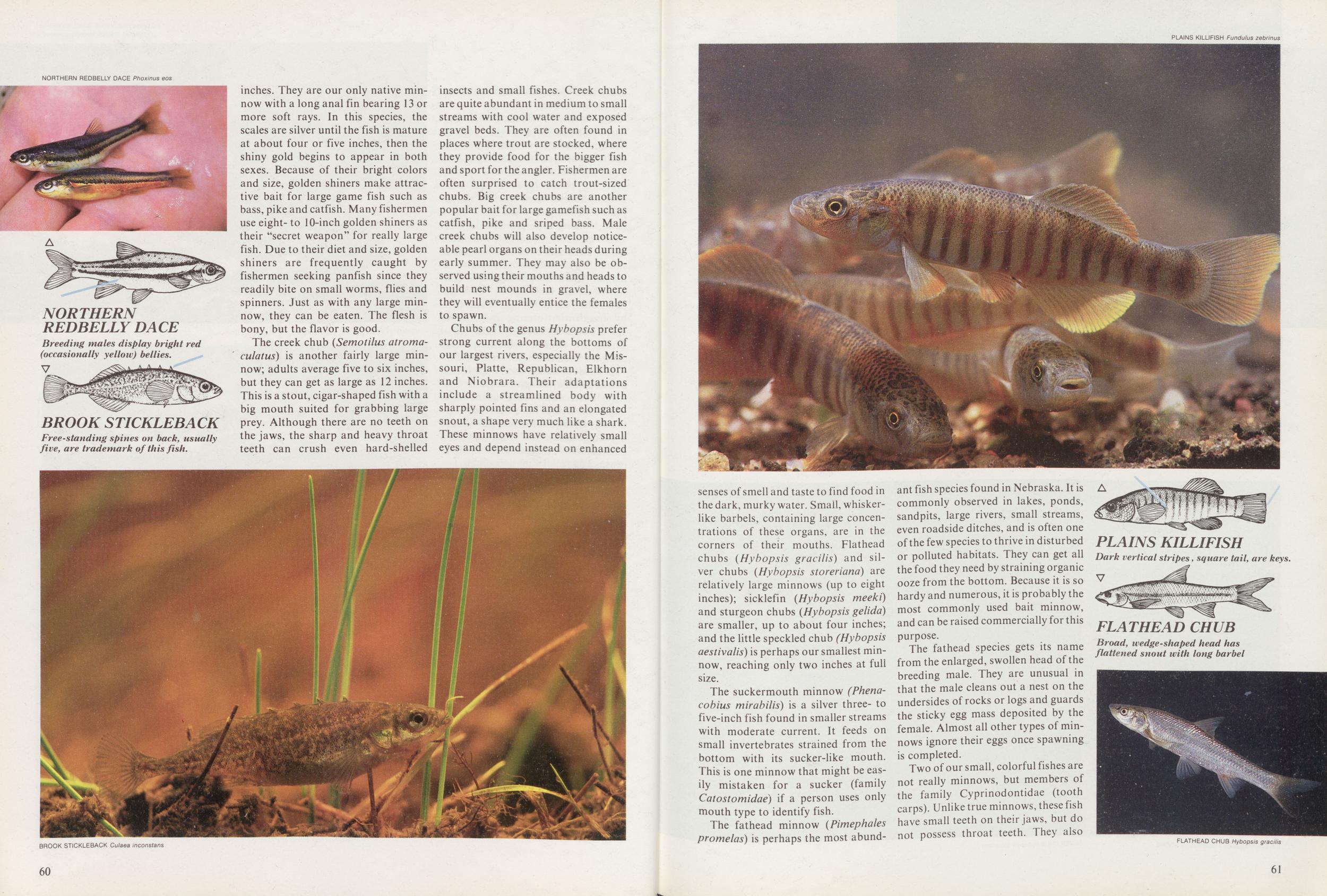
The creek chub {Semotilus atromaculatus) is another fairly large minnow; adults average five to six inches, but they can get as large as 12 inches. This is a stout, cigar-shaped fish with a big mouth suited for grabbing large prey. Although there are no teeth on the jaws, the sharp and heavy throat teeth can crush even hard-shelled insects and small fishes. Creek chubs are quite abundant in medium to small streams with cool water and exposed gravel beds. They are often found in places where trout are stocked, where they provide food for the bigger fish and sport for the angler. Fishermen are often surprised to catch trout-sized chubs. Big creek chubs are another popular bait for large gamefish such as catfish, pike and striped bass. Male creek chubs will also develop noticeable pearl organs on their heads during early summer. They may also be observed using their mouths and heads to build nest mounds in gravel, where they will eventually entice the females to spawn.
Chubs of the genus Hybopsis prefer strong current along the bottoms of our largest rivers, especially the Missouri, Platte, Republican, Elkhorn and Niobrara. Their adaptations include a streamlined body with sharply pointed fins and an elongated snout, a shape very much like a shark. These minnows have relatively small eyes and depend instead on enhanced 60 senses of smell and taste to find food in the dark, murky water. Small, whisker like barbels, containing large concentrations of these organs, are in the corners of their mouths. Flathead chubs (Hybopsis gracilis) and silver chubs (Hybopsis storeriana) are relatively large minnows (up to eight inches); sickle fin (Hybopsis meehi) and sturgeon chubs (Hybopsis gelida) are smaller, up to about four inches; and the little speckled chub (Hybopsis aestivalis) is perhaps our smallest minnow, reaching only two inches at full size.
The suckermouth minnow (Phenacobius mirabilis) is a silver three- to five-inch fish found in smaller streams with moderate current. It feeds on small invertebrates strained from the bottom with its sucker-like mouth. This is one minnow that might be easily mistaken for a sucker (family Catostomidae) if a person uses only mouth type to identify fish.
The fathead minnow (Pimephales promelas) is perhaps the most abundant fish species found in Nebraska. It is commonly observed in lakes, ponds, sandpits, large rivers, small streams, even roadside ditches, and is often one of the few species to thrive in disturbed or polluted habitats. They can get all the food they need by straining organic ooze from the bottom. Because it is so hardy and numerous, it is probably the most commonly used bait minnow, and can be raised commercially for this purpose.
The fathead species gets its name from the enlarged, swollen head of the breeding male. They are unusual in that the male cleans out a nest on the undersides of rocks or logs and guards the sticky egg mass deposited by the female. Almost all other types of minnows ignore their eggs once spawning is completed.
Two of our small, colorful fishes are not really minnows, but members of the family Cyprinodontidae (tooth carps). Unlike true minnows, these fish have small teeth on their jaws, but do not possess throat teeth. They also have well-formed stomachs, while the digestive system of minnows is composed almost entirely of intestine.
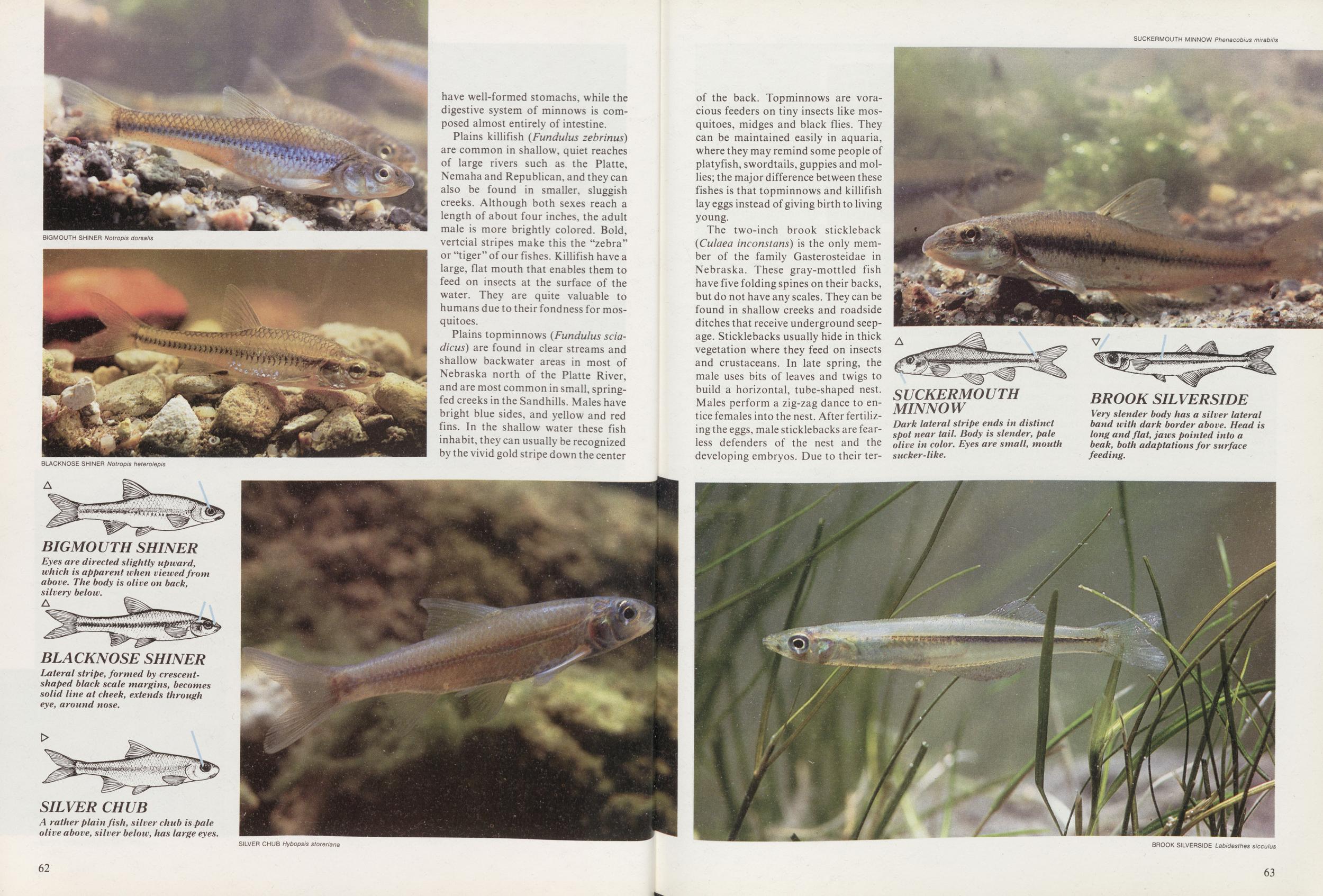
Plains killifish {Fundulus zebrinus) are common in shallow, quiet reaches of large rivers such as the Platte, Nemaha and Republican, and they can also be found in smaller, sluggish creeks. Although both sexes reach a length of about four inches, the adult male is more brightly colored. Bold, vertical stripes make this the "zebra" or "tiger" of our fishes. Killifish have a large, flat mouth that enables them to feed on insects at the surface of the water. They are quite valuable to humans due to their fondness for mosquitoes.
Plains topminnows {Fundulus sciadicus) are found in clear streams and shallow backwater areas in most of Nebraska north of the Platte River, and are most common in small, springfed creeks in the Sandhills. Males have bright blue sides, and yellow and red fins. In the shallow water these fish inhabit, they can usually be recognized by the vivid gold stripe down the center 62 of the back. Topminnows are voracious feeders on tiny insects like mosquitoes, midges and black flies. They can be maintained easily in aquaria, where they may remind some people of platyfish, swordtails, guppies and mollies; the major difference between these fishes is that topminnows and killifish lay eggs instead of giving birth to living young.
The two-inch brook stickleback {Culaea inconstans) is the only member of the family Gasterosteidae in Nebraska. These gray-mottled fish have five folding spines on their backs, but do not have any scales. They can be found in shallow creeks and roadside ditches that receive underground seepage. Sticklebacks usually hide in thick vegetation where they feed on insects and crustaceans. In late spring, the male uses bits of leaves and twigs to build a horizontal, tube-shaped nest. Males perform a zig-zag dance to entice females into the nest. After fertilizing the eggs, male sticklebacks are fearless defenders of the nest and the developing embryos. Due to their territorial nature, male sticklebacks are very feisty, and if several are placed in a fish tank, usually only one will survive.
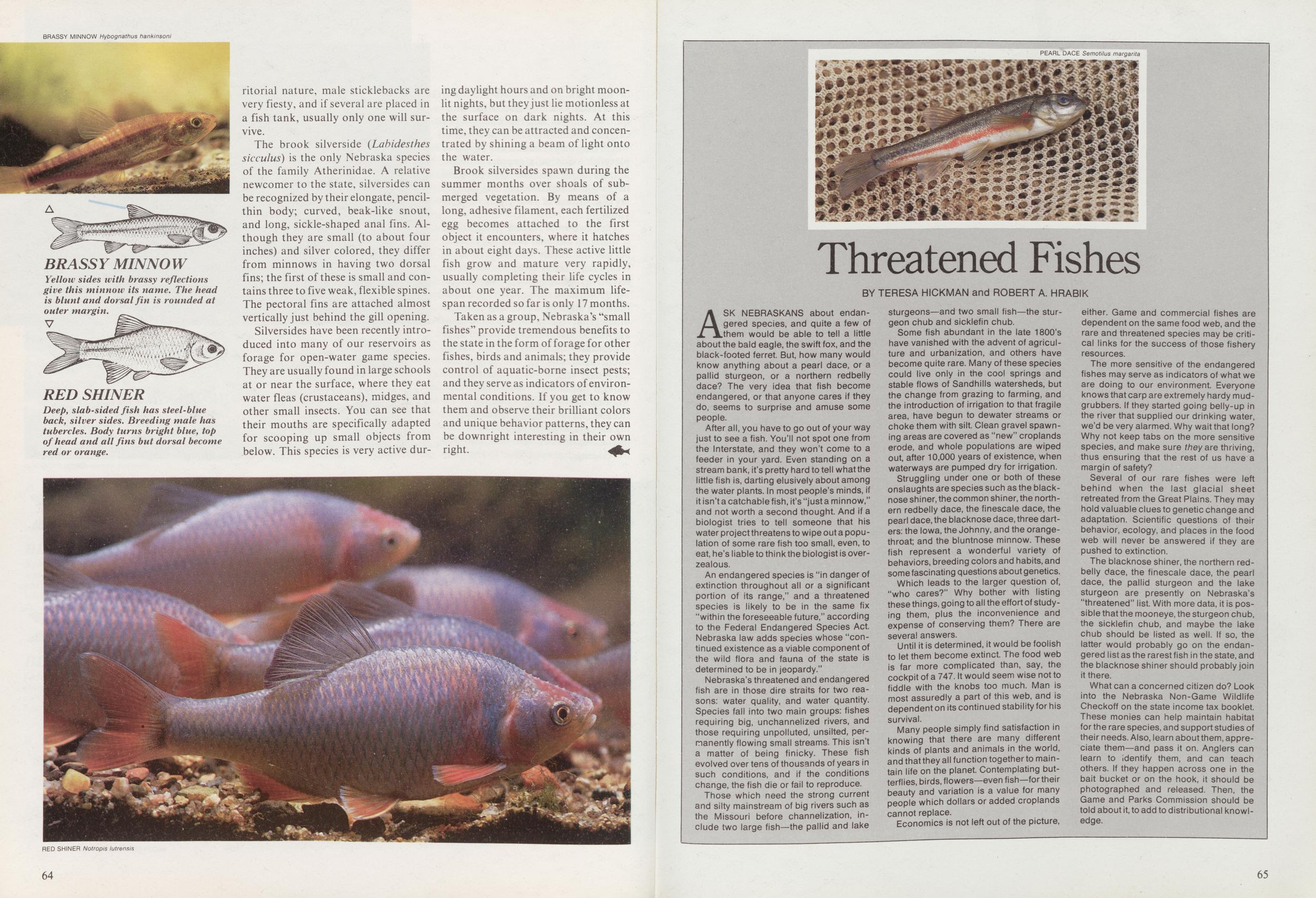
The brook silverside {Lahidesthes sicculus) is the only Nebraska species of the family Atherinidae. A relative newcomer to the state, silversides can be recognized by their elongate, pencil thin body; curved, beak-like snout, and long, sickle-shaped anal fins. Although they are small (to about four inches) and silver colored, they differ from minnows in having two dorsal fins; the first of these is small and contains three to five weak, flexible spines. The pectoral fins are attached almost vertically just behind the gill opening.
Silversides have been recently introduced into many of our reservoirs as forage for open-water game species. They are usually found in large schools at or near the surface, where they eat water fleas (crustaceans), midges, and other small insects. You can see that their mouths are specifically adapted for scooping up small objects from below. This species is very active during daylight hours and on bright moonlit nights, but they just lie motionless at the surface on dark nights. At this time, they can be attracted and concentrated by shining a beam of light onto the water.
Brook silversides spawn during the summer months over shoals of submerged vegetation. By means of a long, adhesive filament, each fertilized egg becomes attached to the first object it encounters, where it hatches in about eight days. These active little fish grow and mature very rapidly, usually completing their life cycles in about one year. The maximum lifespan recorded so far is only 17 months.
Taken as a group, Nebraska's "small fishes" provide tremendous benefits to the state in the form of forage for other fishes, birds and animals; they provide control of aquatic-borne insect pests; and they serve as indicators of environmental conditions. If you get to know them and observe their brilliant colors and unique behavior patterns, they can be downright interesting in their own right.
64Threatened Fishes
BY TERESA HICKMAN and ROBERT A. HRABIKASK NEBRASKANS about endangered species, and quite a few of them would be able to tell a little about the bald eagle, the swift fox, and the black-footed ferret. But, how many would know anything about a pearl dace, or a pallid sturgeon, or a northern redbelly dace? The very idea that fish become endangered, or that anyone cares if they do, seems to surprise and amuse some people.
After all, you have to go out of your way just to see a fish. You'll not spot one from the Interstate, and they won't come to a feeder in your yard. Even standing on a stream bank, it's pretty hard to tell what the little fish is, darting elusively about among the water plants. In most people's minds, if it isn't a catchable fish, it's "just a minnow," and not worth a second thought. And if a biologist tries to tell someone that his water project threatens to wipe out a population of some rare fish too small, even, to eat, he's liable to think the biologist is overzealous.
An endangered species is "in danger of extinction throughout all or a significant portion of its range," and a threatened species is likely to be in the same fix "within the foreseeable future," according to the Federal Endangered Species Act.
Nebraska law adds species whose "continued existence as a viable component of the wild flora and fauna of the state is determined to be in jeopardy." Nebraska's threatened and endangered fish are in those dire straits for two reasons: water quality, and water quantity. Species fall into two main groups: fishes requiring big, unchanneiized rivers, and those requiring unpolluted, unsilted, permanently flowing small streams. This isn't a matter of being finicky. These fish evolved over tens of thousands of years in such conditions, and if the conditions change, the fish die or fail to reproduce.
Those which need the strong current and silty mainstream of big rivers such as the Missouri before channelization, include two large fish—the pallid and lake sturgeons—and two small fish—the sturgeon chub and sicklefin chub.
Some fish abundant in the late 1800's have vanished with the advent of agriculture and urbanization, and others have become quite rare. Many of these species could live only in the cool springs and stable flows of Sandhills watersheds, but the change from grazing to farming, and the introduction of irrigation to that fragile area, have begun to dewater streams or choke them with silt. Clean gravel spawning areas are covered as "new" croplands erode, and whole populations are wiped out, after 10,000 years of existence, when waterways are pumped dry for irrigation.
Struggling under one or both of these onslaughts are species such as the black-nose shiner, the common shiner, the northern redbelly dace, the finescale dace, the pearl dace, the blacknose dace, three darters: the Iowa, the Johnny, and the orange-throat; and the bluntnose minnow. These fish represent a wonderful variety of behaviors, breeding colors and habits, and some fascinating questions about genetics.
Which leads to the larger question of, "who cares?" Why bother with listing these things, going to all the effort of studying them, plus the inconvenience and expense of conserving them? There are several answers.
Until it is determined, it would be foolish to let them become extinct. The food web is far more complicated than, say, the cockpit of a 747. It would seem wise not to fiddle with the knobs too much. Man is most assuredly a part of this web, and is dependent on its continued stability for his survival.
Many people simply find satisfaction in knowing that there are many different kinds of plants and animals in the world, and that they all function together to maintain life on the planet. Contemplating butterflies, birds, flowers—even fish—for their beauty and variation is a value for many people which dollars or added croplands cannot replace.
Economics is not left out of the picture, either. Game and commercial fishes are dependent on the same food web, and the rare and threatened species may be critical links for the success of those fishery resources.
The more sensitive of the endangered fishes may serve as indicators of what we are doing to our environment. Everyone knows that carp are extremely hardy mudgrubbers. If they started going belly-up in the river that supplied our drinking water, we'd be very alarmed. Why wait that long? Why not keep tabs on the more sensitive species, and make sure they are thriving, thus ensuring that the rest of us have a margin of safety?
Several of our rare fishes were left behind when the last glacial sheet retreated from the Great Plains. They may hold valuable clues to genetic change and adaptation. Scientific questions of their behavior, ecology, and places in the food web will never be answered if they are pushed to extinction.
The blacknose shiner, the northern redbelly dace, the finescale dace, the pearl dace, the pallid sturgeon and the lake sturgeon are presently on Nebraska's "threatened" list. With more data, it is possible that the mooneye, the sturgeon chub, the sicklefin chub, and maybe the lake chub should be listed as well. If so, the latter would probably go on the endangered list as the rarest fish in the state, and the blacknose shiner should probably join it there.
What can a concerned citizen do? Look into the Nebraska Non-Game Wildlife Checkoff on the state income tax booklet. These monies can help maintain habitat for the rare species, and support studies of their needs. Also, learn about them, appreciate them—and pass it on. Anglers can learn to identify them, and can teach others. If they happen across one in the bait bucket or on the hook, it should be photographed and released. Then, the Game and Parks Commission should be told about it, to add to distributional knowledge.
65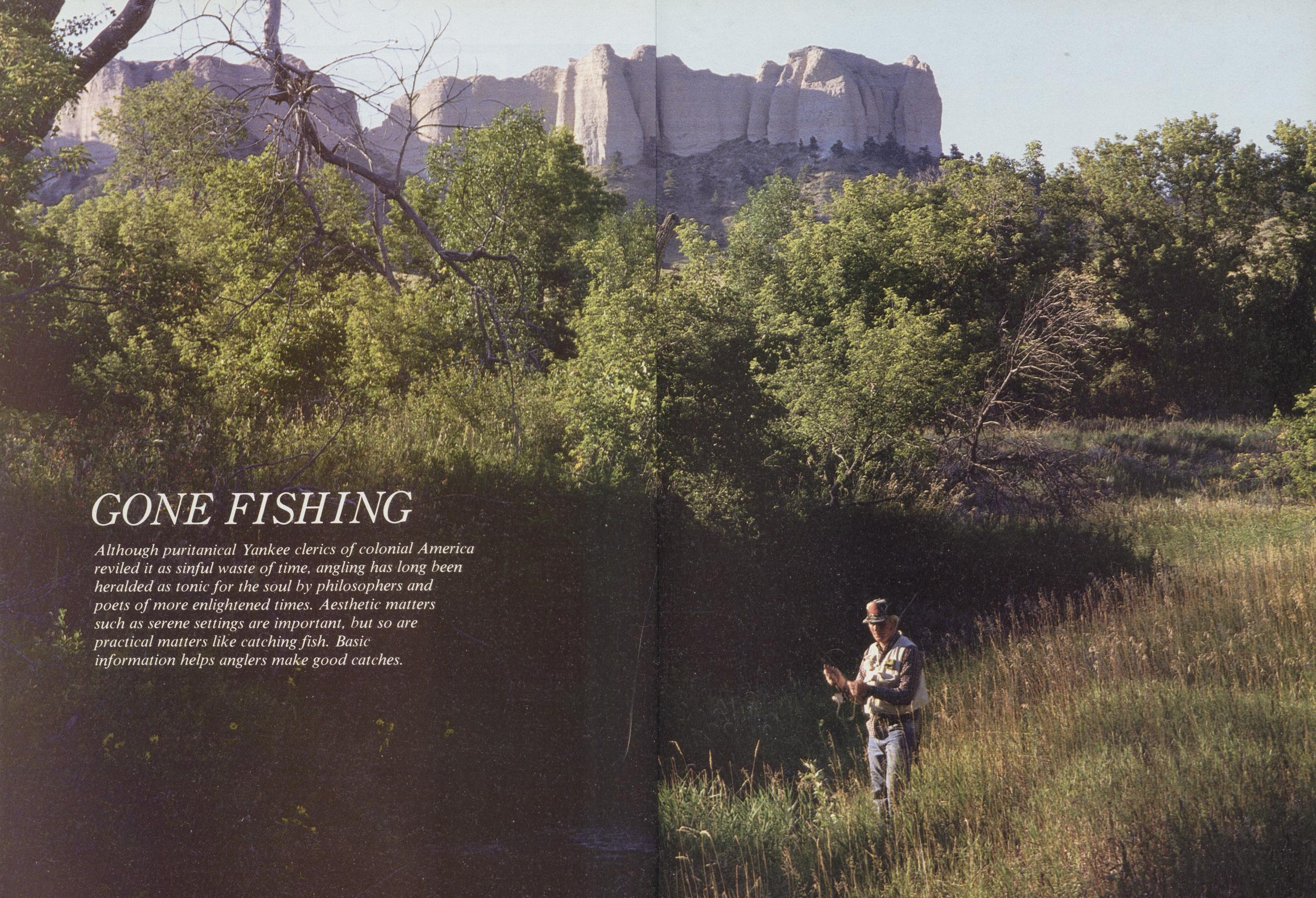
GONE FISHING
Although puritanical Yankee clerics of colonial America reviled it as sinful waste of time, angling has long been heralded as tonic for the soul by philosophers and poets of more enlightened times. Aesthetic matters such as serene settings are important, hut so are practical matters like catching fish. Basic information helps anglers make good catches.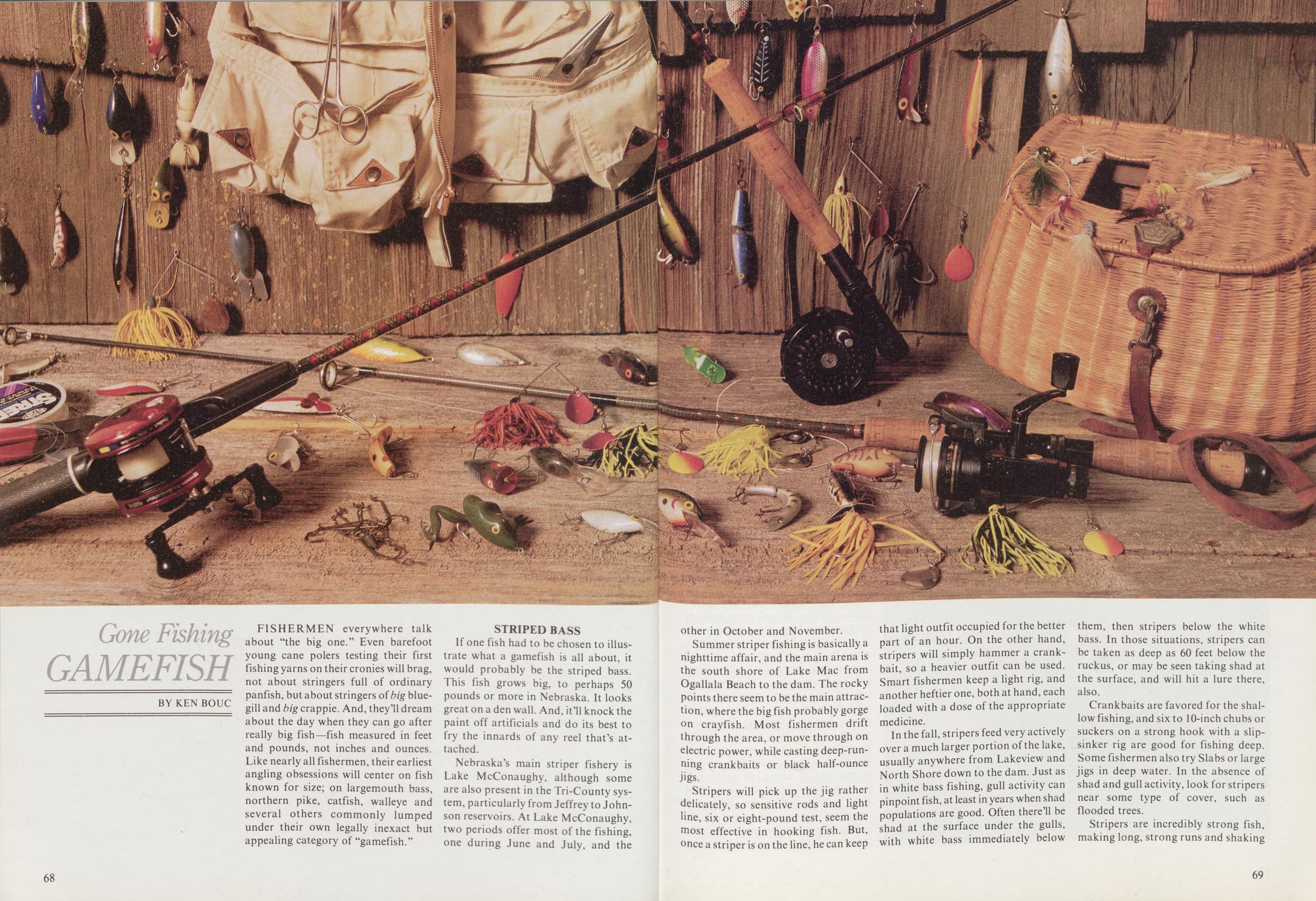
Gone Fishing GAMEFISH
BY KEN BOUCFISHERMEN everywhere talk about "the big one." Even barefoot young cane polers testing their first fishing yarns on their cronies will brag, not about stringers full of ordinary panfish, but about stringers of big bluegill and big crappie. And, they'll dream about the day when they can go after really big fish—fish measured in feet and pounds, not inches and ounces. Like nearly all fishermen, their earliest angling obsessions will center on fish known for size; on largemouth bass, northern pike, catfish, walleye and several others commonly lumped under their own legally inexact but appealing category of "gamefish."
STRIPED BASSIf one fish had to be chosen to illustrate what a gamefish is all about, it would probably be the striped bass. This fish grows big, to perhaps 50 pounds or more in Nebraska. It looks great on a den wall. And, it'll knock the paint off artificial and do its best to fry the innards of any reel that's attached.
Nebraska's main striper fishery is Lake McConaughy, although some are also present in the Tri-County system, particularly from Jeffrey to Johnson reservoirs. At Lake McConaughy, two periods offer most of the fishing, one during June and July, and the 68 other in October and November.
Summer striper fishing is basically a nighttime affair, and the main arena is the south shore of Lake Mac from Ogallala Beach to the dam. The rocky points there seem to be the main attraction, where the big fish probably gorge on crayfish. Most fishermen drift through the area, or move through on electric power, while casting deep-running crankbaits or black half-ounce jigs.
Stripers will pick up the jig rather delicately, so sensitive rods and light six or eight-pound test, seem the most effective in hooking fish. But, once a striper is on the line, he can keep that light outfit occupied for the better part of an hour. On the other hand, stripers will simply hammer a crankbait, so a heavier outfit can be used. Smart fishermen keep a light rig, and another heftier one, both at hand, each loaded with a dose of the appropriate medicine.
In the fall, stripers feed very actively over a much larger portion of the lake, usually anywhere from Lakeview and North Shore down to the dam. Just as in white bass fishing, gull activity can pinpoint fish, at least in years when shad populations are good. Often there'll be shad at the surface under the gulls, with white bass immediately below them, then stripers below the white bass. In those situations, stripers can be taken as deep as 60 feet below the ruckus, or may be seen taking shad at the surface, and will hit a lure there, also.
Crankbaits are favored for the shallow fishing, and six to 10-inch chubs or suckers on a strong hook with a slipsinker rig are good for fishing deep. Some fishermen also try Slabs or large jigs in deep water. In the absence of shad and gull activity, look for stripers near some type of cover, such as flooded trees.
Stripers are incredibly strong fish, making long, strong runs and shaking their heads like bulldogs when hooked. They have an uncanny knack for shaking a hook, and fishermen swear that they try to rub lures out of their mouths on the rocks. Anglers report losing considerably more fish hooked on crankbaits than on jigs in the summer, indicating that stripers may be able to foul the larger lure or a trailing hook on the rocks. Stripers often fight literally to the death, or may require considerable attention before they can be released.
69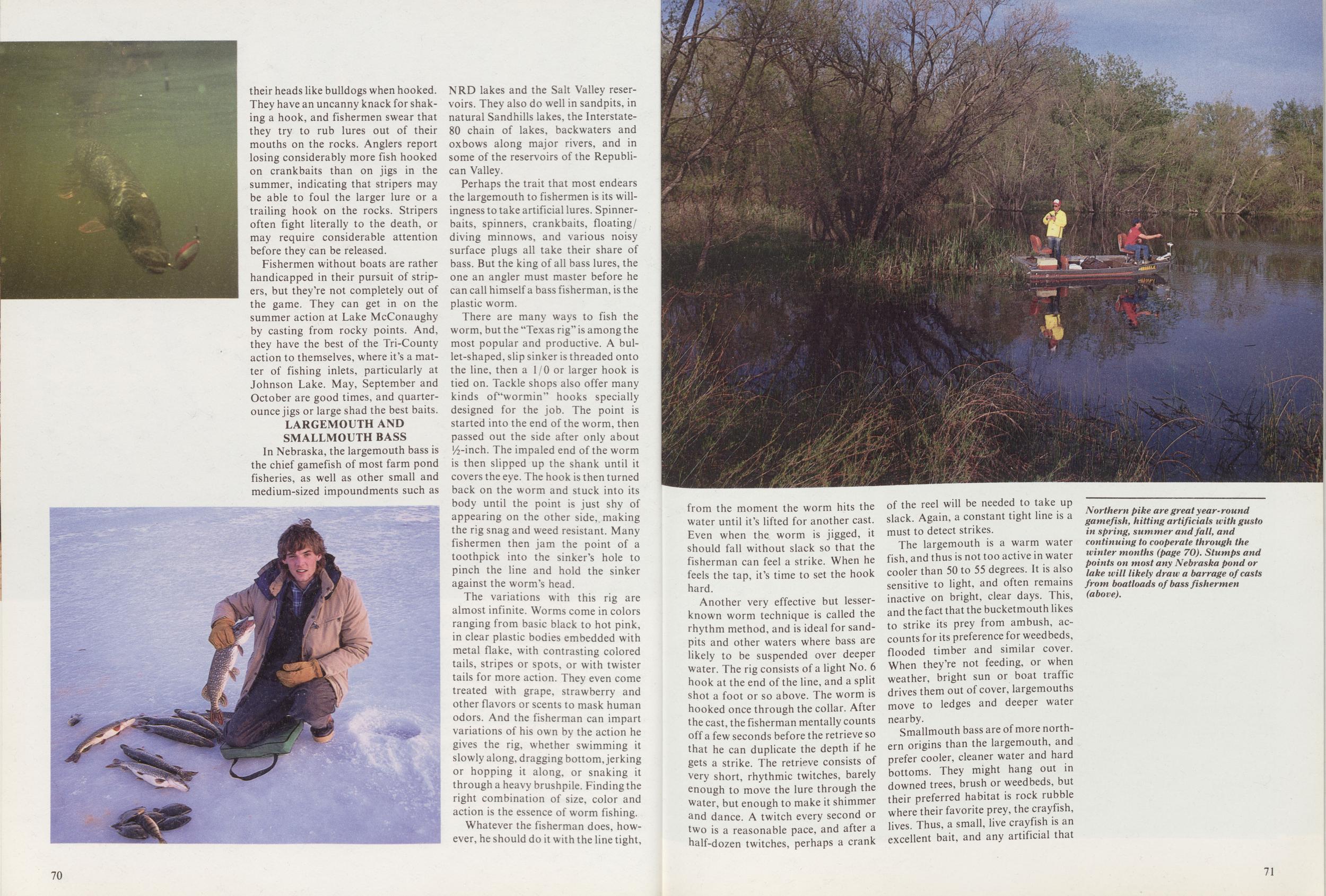
Fishermen without boats are rather handicapped in their pursuit of stripers, but they're not completely out of the game. They can get in on the summer action at Lake McConaughy by casting from rocky points. And, they have the best of the Tri-County action to themselves, where it's a matter of fishing inlets, particularly at Johnson Lake. May, September and October are good times, and quarter-ounce jigs or large shad the best baits.
LARGEMOUTH AND SMALLMOUTH BASSIn Nebraska, the largemouth bass is the chief gamefish of most farm pond fisheries, as well as other small and medium-sized impoundments such as NRD lakes and the Salt Valley reservoirs. They also do well in sandpits, unnatural Sandhills lakes, the Interstate-80 chain of lakes, backwaters and oxbows along major rivers, and in some of the reservoirs of the Republican Valley,
Perhaps the trait that most endears the largemouth to fishermen is its willingness to take artificial lures. Spinner-baits, spinners, crankbaits, floating/ diving minnows, and various noisy surface plugs all take their share of bass. But the king of all bass lures, the one an angler must master before he can call himself a bass fisherman, is the plastic worm.
There are many ways to fish the worm, but the "Texas rig" is among the most popular and productive. A bullet-shaped, slip sinker is threaded onto the line, then a 1/0 or larger hook is tied on. Tackle shops also offer many kinds of"wormin" hooks specially designed for the job. The point is started into the end of the worm, then passed out the side after only about 72-inch. The impaled end of the worm is then slipped up the shank until it covers the eye. The hook is then turned back on the worm and stuck into its body until the point is just shy of appearing on the other side, making the rig snag and weed resistant. Many fishermen then jam the point of a toothpick into the sinker's hole to pinch the line and hold the sinker against the worm's head.
The variations with this rig are almost infinite. Worms come in colors ranging from basic black to hot pink, in clear plastic bodies embedded with metal flake, with contrasting colored tails, stripes or spots, or with twister tails for more action. They even come treated with grape, strawberry and other flavors or scents to mask human odors. And the fisherman can impart variations of his own by the action he gives the rig, whether swimming it slowly along, dragging bottom, jerking or hopping it along, or snaking it through a heavy brushpile. Finding the right combination of size, color and action is the essence of worm fishing.
Whatever the fisherman does, however, he should do it with the line tight, 70 from the moment the worm hits the water until it's lifted for another cast. Even when the worm is jigged, it should fall without slack so that the fisherman can feel a strike. When he feels the tap, it's time to set the hook hard.
Another very effective but lesser-known worm technique is called the rhythm method, and is ideal for sandpits and other waters where bass are likely to be suspended over deeper water. The rig consists of a light No. 6 hook at the end of the line, and a split shot a foot or so above. The worm is hooked once through the collar. After the cast, the fisherman mentally counts off a few seconds before the retrieve so that he can duplicate the depth if he gets a strike. The retrieve consists of very short, rhythmic twitches, barely enough to move the lure through the water, but enough to make it shimmer and dance. A twitch every second or two is a reasonable pace, and after a half-dozen twitches, perhaps a crank of the reel will be needed to take up slack. Again, a constant tight line is a must to detect strikes.
The largemouth is a warm water fish, and thus is not too active in water cooler than 50 to 55 degrees. It is also sensitive to light, and often remains inactive on bright, clear days. This, and the fact that the bucketmouth likes to strike its prey from ambush, accounts for its preference for weedbeds, flooded timber and similar cover. When they're not feeding, or when weather, bright sun or boat traffic drives them out of cover, largemouths move to ledges and deeper water nearby.
Smallmouth bass are of more northern origins than the largemouth, and prefer cooler, cleaner water and hard bottoms. They might hang out in downed trees, brush or weedbeds, but their preferred habitat is rock rubble where their favorite prey, the crayfish, lives. Thus, a small, live crayfish is an excellent bait, and any artificial that imitates one is also a good bet. This might include crankbaits and small spinnerbaits in what the manufacturers call "crawdad color.'' The plastic worm is also effective on smallmouth bass, although not to the same degree as on the largemouth.
71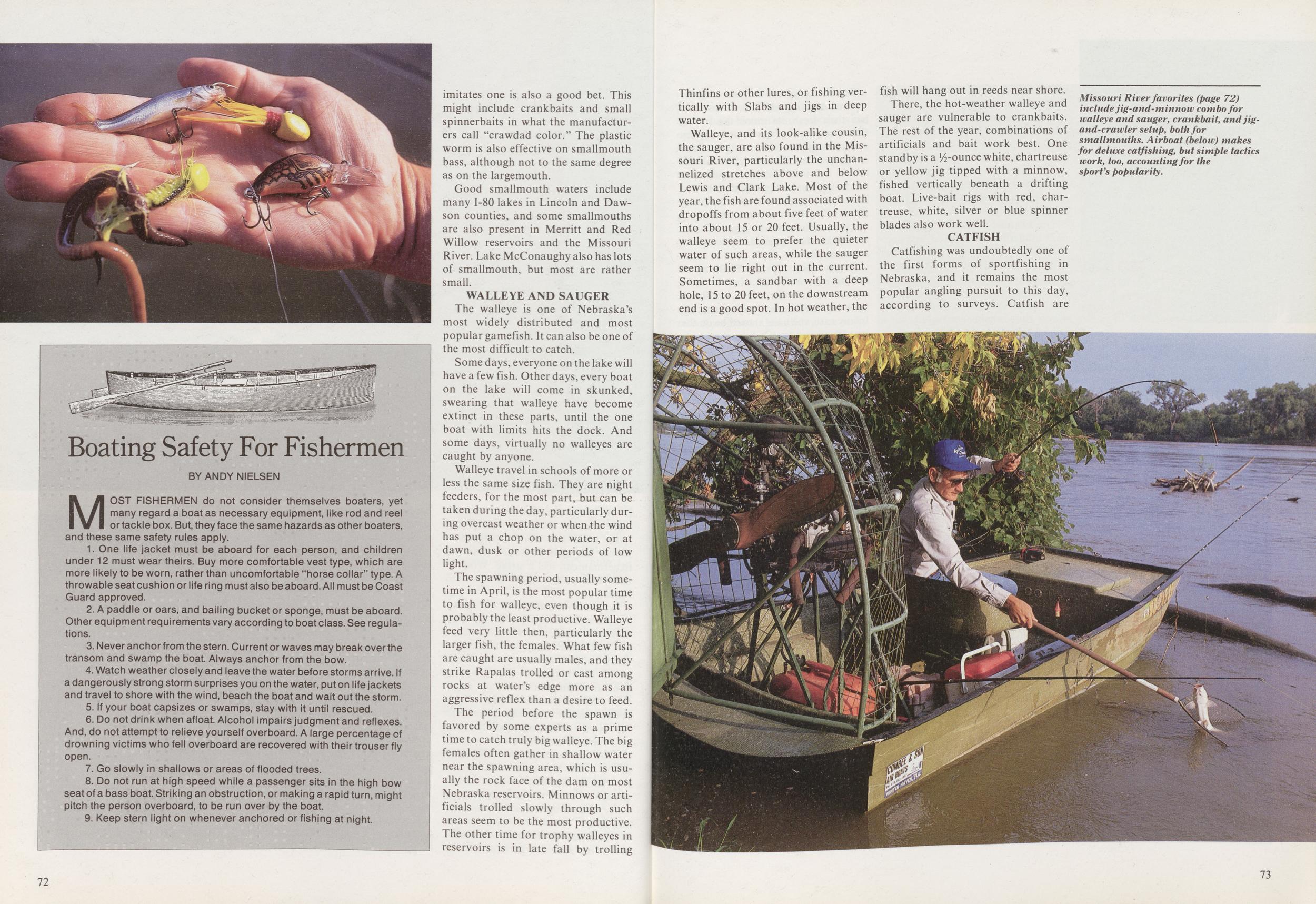
Good smallmouth waters include many 1-80 lakes in Lincoln and Dawson counties, and some smallmouths are also present in Merritt and Red Willow reservoirs and the Missouri River. Lake McConaughy also has lots of smallmouth, but most are rather small.
MOST FISHERMEN do not consider themselves boaters, yet many regard a boat as necessary equipment, like rod and reel or tackle box. But, they face the same hazards as other boaters, and these same safety rules apply.
1. One life jacket must be aboard for each person, and children under 12 must wear theirs. Buy more comfortable vest type, which are more likely to be worn, rather than uncomfortable "horse collar" type. A throwable seat cushion or life ring must also be aboard. Ail must be Coast Guard approved.
2. A paddle or oars, and bailing bucket or sponge, must be aboard. Other equipment requirements vary according to boat class. See regulations.
3. Never anchor from the stern. Current or waves may break over the transom and swamp the boat. Always anchor from the bow.
4. Watch weather closely and leave the water before storms arrive. If a dangerously strong storm surprises you on the water, put on life jackets and travel to shore with the wind, beach the boat and wait out the storm.
5. If your boat capsizes or swamps, stay with it until rescued.
6. Do not drink when afloat. Alcohol impairs judgment and reflexes. And, do not attempt to relieve yourself overboard. A large percentage of drowning victims who fell overboard are recovered with their trouser fly open.
7. Go slowly in shallows or areas of flooded trees.
8. Do not run at high speed while a passenger sits in the high bow seat of a bass boat. Striking an obstruction, or making a rapid turn, might pitch the person overboard, to be run over by the boat.
9. Keep stern light on whenever anchored or fishing at night.
WALLEYE AND SAUGERThe walleye is one of Nebraska's most widely distributed and most popular gamefish. It can also be one of the most difficult to catch.
Some days, everyone on the lake will have a few fish. Other days, every boat on the lake will come in skunked, swearing that walleye have become extinct in these parts, until the one boat with limits hits the dock. And some days, virtually no walleyes are caught by anyone.
Walleye travel in schools of more or less the same size fish. They are night feeders, for the most part can be taken during the day, particularly during overcast weather or when the wind has put a chop on the water, or at dawn, dusk or other periods of low light.
The spawning period, usually sometime in April, is the most popular time to fish for walleye, even though it is probably the least productive. Walleye feed very little then, particularly the larger fish, the females. What few fish are caught are usually males, and they strike Rapalas trolled or cast among rocks at water's edge more as an aggressive reflex than a desire to feed.
The period before the spawn is favored by some experts as a prime time to catch truly big walleye. The big females often gather in shallow water near the spawning area, which is usually the rock face of the dam on most Nebraska reservoirs. Minnows or artificially trolled slowly through such areas seem to be the most productive. The other time for trophy walleyes in reservoirs is in late fall by trolling 72 Thinfins or other lures, or fishing vertically with Slabs and jigs in deep water.
Walleye, and its look-alike cousin, the sauger, are also found in the Missouri River, particularly the unchannelized stretches above and below Lewis and Clark Lake. Most of the year, the fish are found associated with drop offs from about five feet of water into about 15 or 20 feet. Usually, the walleye seem to prefer the quieter water of such areas, while the sauger seem to lie right out in the current. Sometimes, a sandbar with a deep hole, 15 to 20 feet, on the downstream end is a good spot. In hot weather, the fish will hang out in reeds near shore.
There, the hot-weather walleye and sauger are vulnerable to crankbaits. The rest of the year, combinations of artificials and bait work best. One standby is a !/2-ounce white, chartreuse or yellow jig tipped with a minnow, fished vertically beneath a drifting boat. Live-bait rigs with red, chartreuse, white, silver or blue spinner blades also work well.
CATFISHCatfishing was undoubtedly one of the first forms of sportfishing in Nebraska, and it remains the most popular angling pursuit to this day, according to surveys. Catfish are widely distributed in streams and virtually all reservoir fisheries.
Missouri River favorites (page 72) include jig-and-minnow combo for walleye and sauger, crankbait, andjigand-crawler setup, both for smallmouths. Airboat (below) makes for deluxe catfishing, but simple tactics work, too, accounting for the sport's popularity.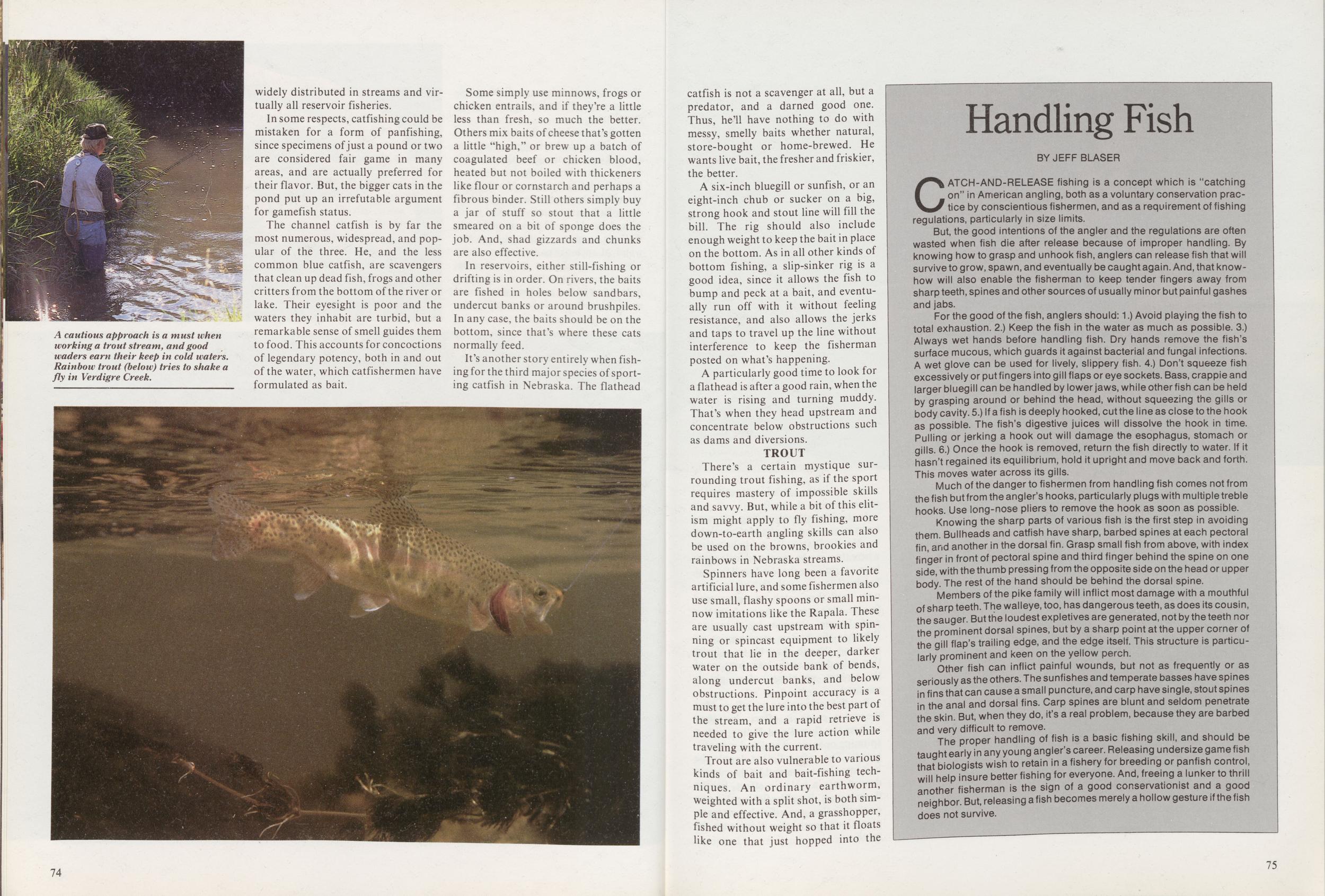
In some respects, catfishing could be mistaken for a form of panfishing, since specimens of just a pound or two are considered fair game in many areas, and are actually preferred for their flavor. But, the bigger cats in the pond put up an irrefutable argument for gamefish status.
The channel catfish is by far the most numerous, widespread, and popular of the three. He, and the less common blue catfish, are scavengers that clean up dead fish, frogs and other critters from the bottom of the river or lake. Their eyesight is poor and the waters they inhabit are turbid, but a remarkable sense of smell guides them to food. This accounts for concoctions of legendary potency, both in and out of the water, which catfishermen have formulated as bait.
Some simply use minnows, frogs or chicken entrails, and if they're a little less than fresh, so much the better. Others mix baits of cheese that's gotten a little "high," or brew up a batch of coagulated beef or chicken blood, heated but not boiled with thickeners like flour or cornstarch and perhaps a fibrous binder. Still others simply buy a jar of stuff so stout that a little smeared on a bit of sponge does the job. And, shad gizzards and chunks are also effective.
In reservoirs, either still-fishing or drifting is in order. On rivers, the baits are fished in holes below sandbars, undercut banks or around brush piles. In any case, the baits should be on the bottom, since that's where these cats normally feed.
It's another story entirely when fishing for the third major species of sporting catfish in Nebraska. The flathead 74 catfish is not a scavenger at all, but a predator, and a darned good one. Thus, he'll have nothing to do with messy, smelly baits whether natural, store-bought or home-brewed. He wants live bait, the fresher and friskier, the better.
A six-inch bluegill or sunfish, or an eight-inch chub or sucker on a big, strong hook and stout line will fill the bill. The rig should also include enough weight to keep the bait in place on the bottom. As in all other kinds of bottom fishing, a slip-sinker rig is a good idea, since it allows the fish to bump and peck at a bait, and eventually run off with it without feeling resistance, and also allows the jerks and taps to travel up the line without interference to keep the fisherman posted on what's happening.
A particularly good time to look for a flathead is after a good rain, when the water is rising and turning muddy. That's when they head upstream and concentrate below obstructions such as dams and diversions.
TROUTThere's a certain mystique surrounding trout fishing, as if the sport requires mastery of impossible skills and savvy. But, while a bit of this elitism might apply to fly fishing, more down-to-earth angling skills can also be used on the browns, brookies and rainbows in Nebraska streams.
Spinners have long been a favorite artificial lure, and some fishermen also use small, flashy spoons or small minnow imitations like the Rapala. These are usually cast upstream with spinning or spin cast equipment to likely trout that lie in the deeper, darker water on the outside bank of bends, along undercut banks, and below obstructions. Pinpoint accuracy is a must to get the lure into the best part of the stream, and a rapid retrieve is needed to give the lure action while traveling with the current.
Trout are also vulnerable to various kinds of bait and bait-fishing techniques. An ordinary earthworm, weighted with a split shot, is both simple and effective. And, a grasshopper, fished without weight so that it floats like one that just hopped into the water, offers the extra fun of seeing the trout strike on the surface.
Handling Fish BY JEFF BLASERCATCH-AND-RELEASE fishing is a concept which is "catching on" in American angling, both as a voluntary conservation practice by conscientious fishermen, and as a requirement of fishing regulations, particularly in size limits.
But, the good intentions of the angler and the regulations are often wasted when fish die after release because of improper handling. By knowing how to grasp and unhook fish, anglers can release fish that will survive to grow, spawn, and eventually be caught again. And, that know how will also enable the fisherman to keep tender fingers away from sharp teeth, spines and other sources of usually minor but painful gashes and jabs.
For the good of the fish, anglers should: 1.) Avoid playing the fish to total exhaustion. 2.) Keep the fish in the water as much as possible. 3.) Always wet hands before handling fish. Dry hands remove the fish's surface mucous, which guards it against bacterial and fungal infections. A wet glove can be used for lively, slippery fish. 4.) Don't squeeze fish excessively or put fingers into gill flaps or eye sockets. Bass, crappie and larger bluegill can be handled by lower jaws, while other fish can be held by grasping around or behind the head, without squeezing the gills or body cavity. 5.) If a fish is deeply hooked, cut the line as close to the hook as possible. The fish's digestive juices will dissolve the hook in time. Pulling or jerking a hook out will damage the esophagus, stomach or gills. 6.) Once the hook is removed, return the fish directly to water. If it hasn't regained its equilibrium, hold it upright and move back and forth. This moves water across its gills.
Much of the danger to fishermen from handling fish comes not from the fish but from the angler's hooks, particularly plugs with multiple treble hooks. Use long-nose pliers to remove the hook as soon as possible.
Knowing the sharp parts of various fish is the first step in avoiding them. Bullheads and catfish have sharp, barbed spines at each pectoral fin, and another in the dorsal fin. Grasp small fish from above, with index finger in front of pectoral spine and third finger behind the spine on one side, with the thumb pressing from the opposite side on the head or upper body. The rest of the hand should be behind the dorsal spine.
Members of the pike family will inflict most damage with a mouthful of sharp teeth. The walleye, too, has dangerous teeth, as does its cousin, the sauger. But the loudest expletives are generated, not by the teeth nor the prominent dorsal spines, but by a sharp point at the upper corner of the gill flap's trailing edge, and the edge itself. This structure is particularly prominent and keen on the yellow perch.
Other fish can inflict painful wounds, but not as frequently or as seriously as the others. The sunfishes and temperate basses have spines in fins that can cause a small puncture, and carp have single, stout spines in the anal and dorsal fins. Carp spines are blunt and seldom penetrate the skin. But, when they do, it's a real problem, because they are barbed and very difficult to remove.
The proper handling of fish is a basic fishing skill, and should be taught early in any young angler's career. Releasing undersize game fish that biologists wish to retain in a fishery for breeding or panfish control, will help insure better fishing for everyone. And, freeing a Junker to thrill another fisherman is the sign of a good conservationist and a good neighbor. But, releasing a fish becomes merely a hollow gesture if the fish does not survive.
75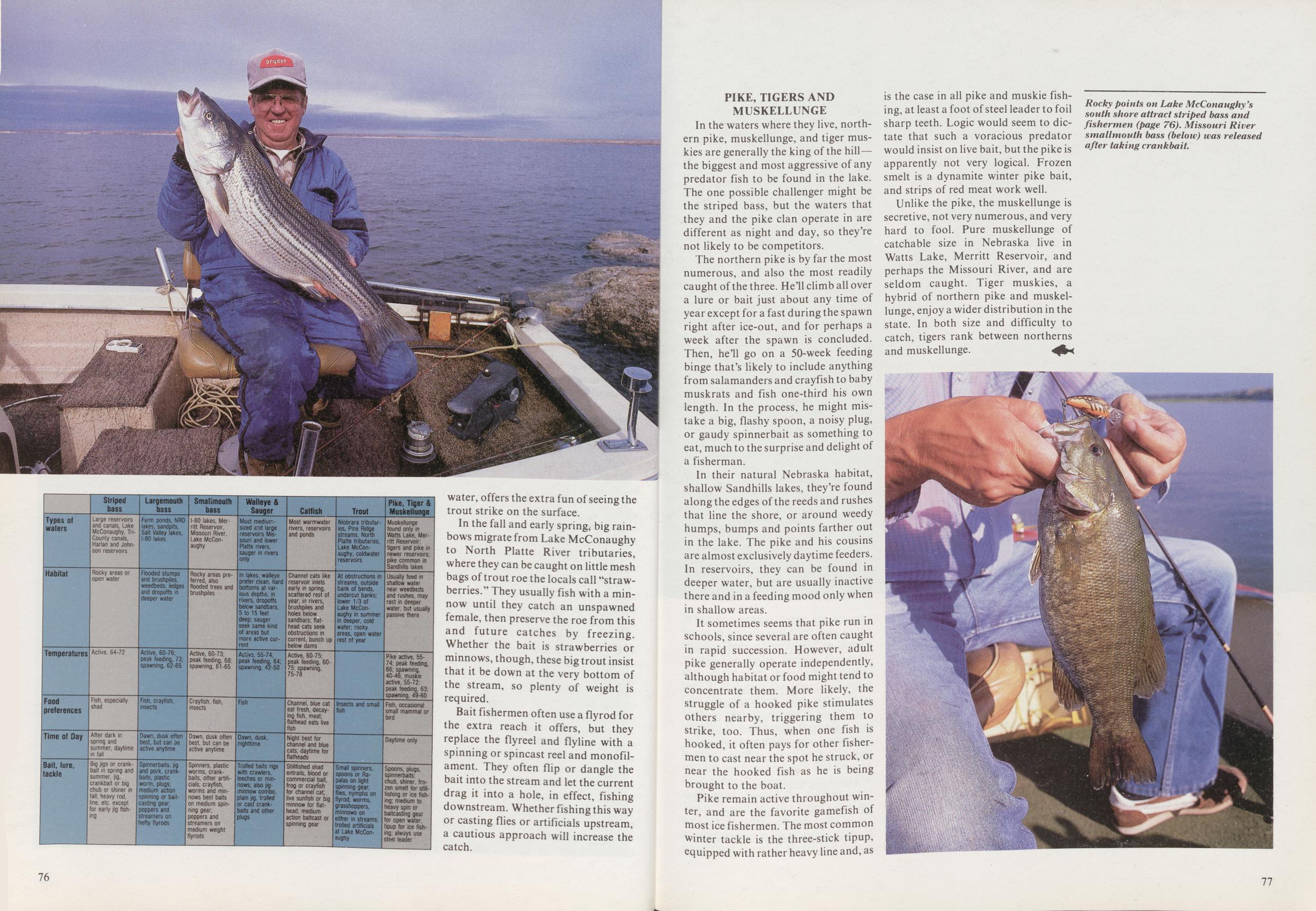
In the fall and early spring, big rainbows migrate from Lake McConaughy to North Platte River tributaries, where they can be caught on little mesh bags of trout roe the locals call "strawberries." They usually fish with a minnow until they catch an unspawned female, then preserve the roe from this and future catches by freezing. Whether the bait is strawberries or minnows, though, these big trout insist that it be down at the very bottom of the stream, so plenty of weight is required.
Bait fishermen often use a fly rod for the extra reach it offers, but they replace the fly reel and fly line with a spinning or spin cast reel and monofilament. They often flip or dangle the bait into the stream and let the current drag it into a hole, in effect, fishing downstream. Whether fishing this way or casting flies or artificials upstream, a cautious approach will increase the catch.
76 PIKE, TIGERS AND MUSKELLUNGEIn the waters where they live, northern pike, muskellunge, and tiger muskies are generally the king of the hill—the biggest and most aggressive of any predator fish to be found in the lake. The one possible challenger might be the striped bass, but the waters that they and the pike clan operate in are different as night and day, so they're not likely to be competitors.
The northern pike is by far the most numerous, and also the most readily caught of the three. He'll climb all over a lure or bait just about any time of year except for a fast during the spawn right after ice-out, and for perhaps a week after the spawn is concluded. Then, he'll go on a 50-week feeding binge that's likely to include anything from salamanders and crayfish to baby muskrats and fish one-third his own length. In the process, he might mistake a big, flashy spoon, a noisy plug, or gaudy spinnerbait as something to eat, much to the surprise and delight of a fisherman.
In their natural Nebraska habitat, shallow Sandhills lakes, they're found along the edges of the reeds and rushes that line the shore, or around weedy humps, bumps and points farther out in the lake. The pike and his cousins are almost exclusively daytime feeders. In reservoirs, they can be found in deeper water, but are usually inactive there and in a feeding mood only when in shallow areas.
It sometimes seems that pike run in schools, since several are often caught in rapid succession. However, adult pike generally operate independently, although habitat or food might tend to concentrate them. More likely, the struggle of a hooked pike stimulates others nearby, triggering them to strike, too. Thus, when one fish is hooked, it often pays for other fishermen to cast near the spot he struck, or near the hooked fish as he is being brought to the boat.
Pike remain active throughout winter, and are the favorite gamefish of most ice fishermen. The most common winter tackle is the three-stick tipup, equipped with rather heavy line and, as is the case in all pike and muskie fishing, at least a foot of steel leader to foil sharp teeth. Logic would seem to dictate that such a voracious predator would insist on live bait, but the pike is apparently not very logical. Frozen smelt is a dynamite winter pike bait, and strips of red meat work well.
Unlike the pike, the muskellunge is secretive, not very numerous, and very hard to fool. Pure muskellunge of catchable size in Nebraska live in Watts Lake, Merritt Reservoir, and perhaps the Missouri River, and are seldom caught. Tiger muskies, a hybrid of northern pike and muskellunge, enjoy a wider distribution in the state. In both size and difficulty to catch, tigers rank between northerns and muskellunge.
Rocky points on Lake McConaughy's south shore attract striped bass and fishermen (page 76), Missouri River smallmouth bass (below) was released after taking crankbait.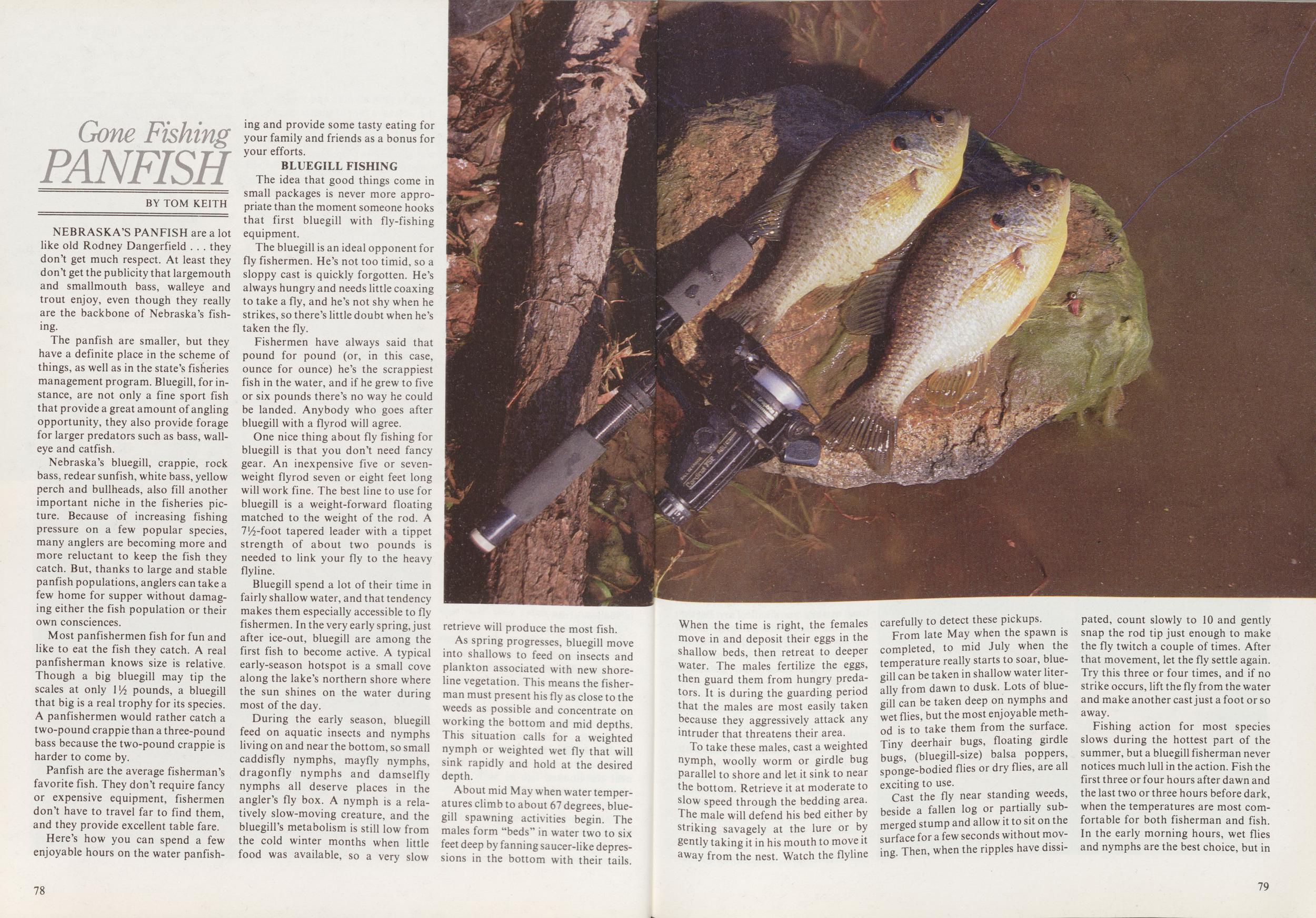
Gone Fishing PANFISH
BY TOM KEITHNEBRASKA'S PANFISH are a lot like old Rodney Dangerfield . . . they don't get much respect. At least they don't get the publicity that largemouth and smallmouth bass, walleye and trout enjoy, even though they really are the backbone of Nebraska's fishing.
The panfish are smaller, but they have a definite place in the scheme of things, as well as in the state's fisheries management program. Bluegill, for instance, are not only a fine sport fish that provide a great amount of angling opportunity, they also provide forage for larger predators such as bass, walleye and catfish.
Nebraska's bluegill, crappie, rock bass, redear sunfish, white bass, yellow perch and bullheads, also fill another important niche in the fisheries picture. Because of increasing fishing pressure on a few popular species, many anglers are becoming more and more reluctant to keep the fish they catch. But, thanks to large and stable panfish populations, anglers can take a few home for supper without damaging either the fish population or their own consciences.
Most panfishermen fish for fun and like to eat the fish they catch. A real panfisherman knows size is relative. Though a big bluegill may tip the scales at only 1/2 pounds, a bluegill that big is a real trophy for its species. A panfishermen would rather catch a two-pound crappie than a three-pound bass because the two-pound crappie is harder to come by.
Panfish are the average fisherman's favorite fish. They don't require fancy or expensive equipment, fishermen don't have to travel far to find them, and they provide excellent table fare.
Here's how you can spend a few enjoyable hours on the water panfishing and provide some tasty eating for your family and friends as a bonus for your efforts.
BLUEGILL FISHINGThe idea that good things come in small packages is never more appropriate than the moment someone hooks that first bluegill with fly-fishing equipment.
The bluegill is an ideal opponent for fly fishermen. He's not too timid, so a sloppy cast is quickly forgotten. He's always hungry and needs little coaxing to take a fly, and he's not shy when he strikes, so there's little doubt when he's taken the fly.
Fishermen have always said that pound for pound (or, in this case, ounce for ounce) he's the scrappiest fish in the water, and if he grew to five or six pounds there's no way he could be landed. Anybody who goes after bluegill with a fly rod will agree.
One nice thing about fly fishing for bluegill is that you don't need fancy gear. An inexpensive five or seven-weight fly rod seven or eight feet long will work fine. The best line to use for bluegill is a weight-forward floating matched to the weight of the rod. A 7!/2-foot tapered leader with a tippet strength of about two pounds is needed to link your fly to the heavy fly line.
Bluegill spend a lot of their time in fairly shallow water, and that tendency makes them especially accessible to fly fishermen. In the very early spring, just after ice-out, bluegill are among the first fish to become active. A typical early-season hotspot is a small cove along the lake's northern shore where the sun shines on the water during most of the day.
During the early season, bluegill feed on aquatic insects and nymphs living on and near the bottom, so small caddisfly nymphs, mayfly nymphs, dragonfly nymphs and damselfly nymphs all deserve places in the angler's fly box. A nymph is a relatively slow-moving creature, and the bluegill's metabolism is still low from the cold winter months when little food was available, so a very slow retrieve will produce the most fish.
As spring progresses, bluegill move into shallows to feed on insects and plankton associated with new shoreline vegetation. This means the fisherman must present his fly as close to the weeds as possible and concentrate on working the bottom and mid depths. This situation calls for a weighted nymph or weighted wet fly that will sink rapidly and hold at the desired depth.
About mid May when water temperatures climb to about 67 degrees, bluegill spawning activities begin. The males form "beds" in water two to six feet deep by fanning saucer-like depressions in the bottom with their tails. 78 When the time is right, the females move in and deposit their eggs in the shallow beds, then retreat to deeper water. The males fertilize the eggs, then guard them from hungry predators. It is during the guarding period that the males are most easily taken because they aggressively attack any intruder that threatens their area.
To take these males, cast a weighted nymph, woolly worm or girdle bug parallel to shore and let it sink to near the bottom. Retrieve it at moderate to slow speed through the bedding area. The male will defend his bed either by striking savagely at the lure or by gently taking it in his mouth to move it away from the nest. Watch the flyline carefully to detect these pickups.
From late May when the spawn is completed, to mid July when the temperature really starts to soar, bluegill can be taken in shallow water literally from dawn to dusk. Lots of bluegill can be taken deep on nymphs and wet flies, but the most enjoyable method is to take them from the surface. Tiny deer hair bugs, floating girdle bugs (bluegill-size) balsa poppers, sponge-bodied flies or dry flies, are all exciting to use.
Cast the fly near standing weeds, beside a fallen log or partially submerged stump and allow it to sit on the surface for a few seconds without moving Then, when the ripples have dissipated, count slowly to 10 and gently snap the rod tip just enough to make the fly twitch a couple of times. After that movement, let the fly settle again. Try this three or four times, and if no strike occurs, lift the fly from the water and make another cast just a foot or so away.
Fishing action for most species slows during the hottest part of the summer, but a bluegill fisherman never notices much lull in the action. Fish the first three or four hours after dawn and the last two or three hours before dark, when the temperatures are most comfortable for both fisherman and fish. In the early morning hours, wet flies and nymphs are the best choice, but in the evening, dry flies and floating bugs are most apt to bring fast and furious action.
79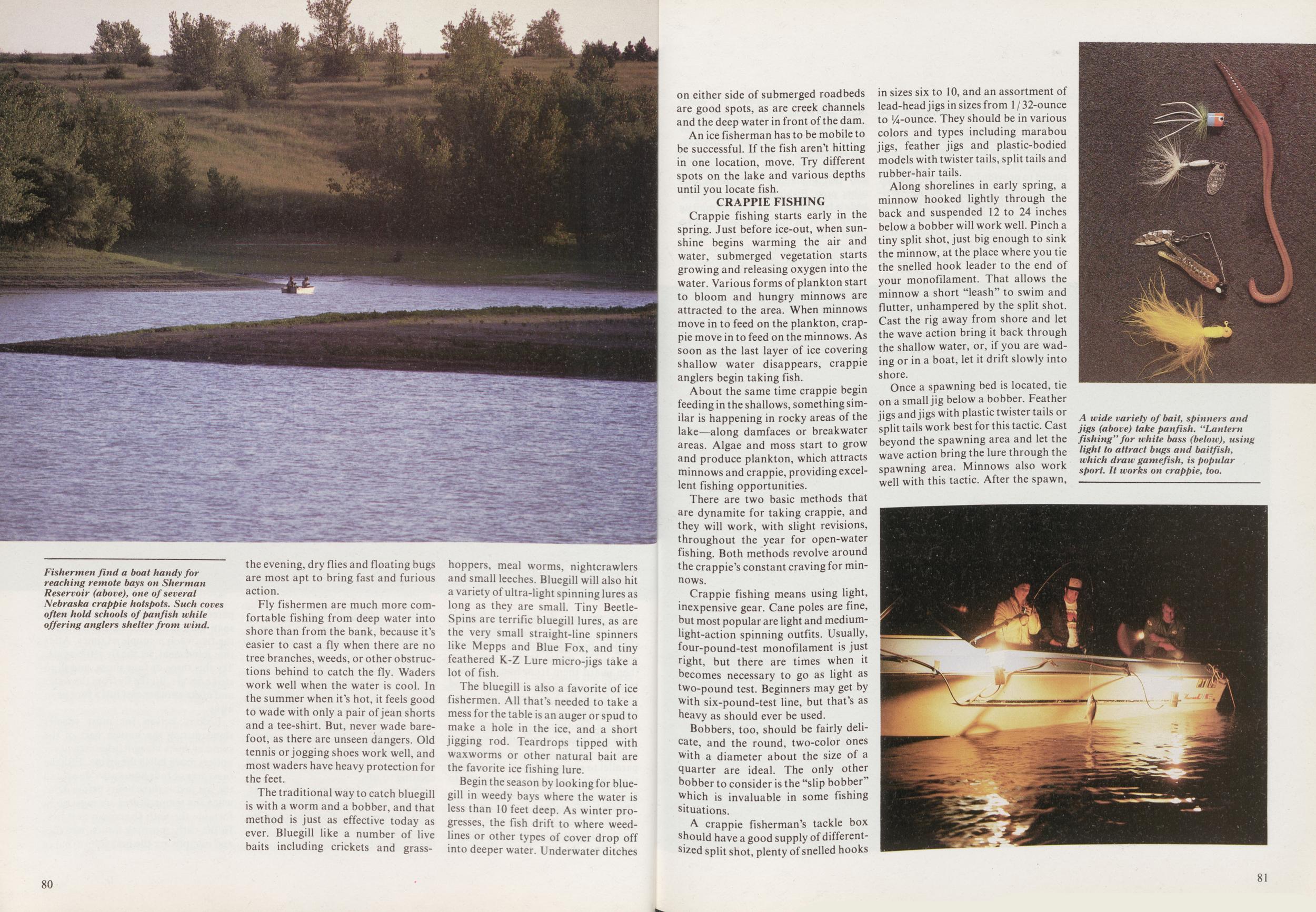
Fly fishermen are much more comfortable fishing from deep water into shore than from the bank, because it's easier to cast a fly when there are no tree branches, weeds, or other obstructions behind to catch the fly. Waders work well when the water is cool. In the summer when it's hot, it feels good to wade with only a pair of jean shorts and a tee-shirt. But, never wade barefoot, as there are unseen dangers. Old tennis or jogging shoes work well, and most waders have heavy protection for the feet.
The traditional way to catch bluegill is with a worm and a bobber, and that method is just as effective today as ever. Bluegill like a number of live baits including crickets and grasshoppers, meal worms, nightcrawlers and small leeches. Bluegill will also hit a variety of ultra-light spinning lures as long as they are small. Tiny Beetle-Spins are terrific bluegill lures, as are the very small straight-line spinners like Mepps and Blue Fox, and tiny feathered K-Z Lure micro-jigs take a lot of fish.
The bluegill is also a favorite of ice fishermen. All that's needed to take a mess for the table is an auger or spud to make a hole in the ice, and a short jigging rod. Teardrops tipped with waxworms or other natural bait are the favorite ice fishing lure.
Begin the season by looking for bluegill in weedy bays where the water is less than 10 feet deep. As winter progresses, the fish drift to where weedlines or other types of cover drop off into deeper water. Underwater ditches 80 on either side of submerged roadbeds are good spots, as are creek channels and the deep water in front of the dam.
An ice fisherman has to be mobile to be successful. If the fish aren't hitting in one location, move. Try different spots on the lake and various depths until you locate fish.
CRAPPIE FISHINGCrappie fishing starts early in the spring. Just before ice-out, when sunshine begins warming the air and water, submerged vegetation starts growing and releasing oxygen into the water. Various forms of plankton start to bloom and hungry minnows are attracted to the area. When minnows move in to feed on the plankton, crappie move in to feed on the minnows. As soon as the last layer of ice covering shallow water disappears, crappie anglers begin taking fish.
About the same time crappie begin feeding in the shallows, something similar is happening in rocky areas of the lake—along dam faces or breakwater areas. Algae and moss start to grow and produce plankton, which attracts minnows and crappie, providing excellent fishing opportunities.
There are two basic methods that are dynamite for taking crappie, and they will work, with slight revisions, throughout the year for open-water fishing. Both methods revolve around the crappie's constant craving for minnows.
Crappie fishing means using light, inexpensive gear. Cane poles are fine, but most popular are light and medium-light-action spinning outfits. Usually, four-pound-test monofilament is just right, but there are times when it becomes necessary to go as light as two-pound test. Beginners may get by with six-pound-test line, but that's as heavy as should ever be used.
Bobbers, too, should be fairly delicate, and the round, two-color ones with a diameter about the size of a quarter are ideal. The only other bobber to consider is the "slip bobber" which is invaluable in some fishing situations.
A crappie fisherman's tackle box should have a good supply of different sized split shot, plenty of snelled hooks in sizes six to 10, and an assortment of lead-head jigs in sizes from 1 / 32-ounce to !4-ounce. They should be in various colors and types including marabou jigs, feather jigs and plastic-bodied models with twister tails, split tails and rubber-hair tails.
Along shorelines in early spring, a minnow hooked lightly through the back and suspended 12 to 24 inches below a bobber will work well. Pinch a tiny split shot, just big enough to sink the minnow, at the place where you tie the snelled hook leader to the end of your monofilament. That allows the minnow a short "leash" to swim and flutter, unhampered by the split shot. Cast the rig away from shore and let the wave action bring it back through the shallow water, or, if you are wading or in a boat, let it drift slowly into shore.
Once a spawning bed is located, tie on a small jig below a bobber. Feather jigs and jigs with plastic twister tails or split tails work best for this tactic. Cast beyond the spawning area and let the wave action bring the lure through the spawning area. Minnows also work well with this tactic. After the spawn, males remain in shallow water guarding the nests while the females head for deeper water.
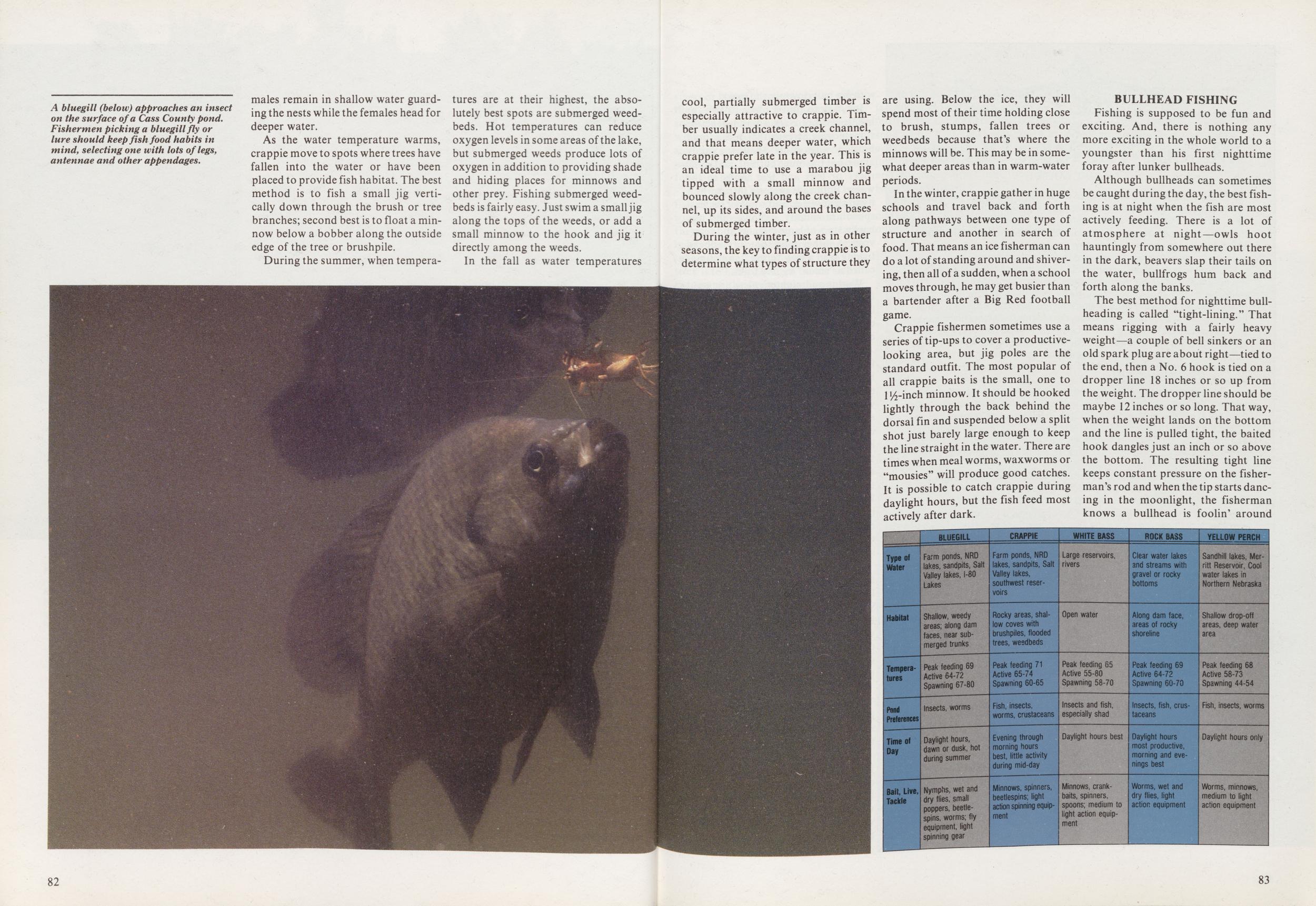 A bluegill (below) approaches an insect on the surface of a Cass County pond. Fishermen picking a bluegill fly or lure should keep fish food habits in mind, selecting one with lots of legs, antennae and other appendages.
As the water temperature warms, crappie move to spots where trees have fallen into the water or have been placed to provide fish habitat. The best method is to fish a small jig vertically down through the brush or tree branches; second best is to float a minnow below a bobber along the outside edge of the tree or brush pile.
During the summer, when temperatures are at their highest, the absolutely best spots are submerged weed-beds. Hot temperatures can reduce oxygen levels in some areas of the lake, but submerged weeds produce lots of oxygen in addition to providing shade and hiding places for minnows and other prey. Fishing submerged weed-beds is fairly easy. Just swim a small jig along the tops of the weeds, or add a small minnow to the hook and jig it directly among the weeds.
In the fall as water temperatures 82 cool, partially submerged timber is especially attractive to crappie. Timber usually indicates a creek channel, and that means deeper water, which crappie prefer late in the year. This is an ideal time to use a marabou jig tipped with a small minnow and bounced slowly along the creek channel, up its sides, and around the bases of submerged timber.
During the winter, just as in other seasons, the key to finding crappie is to determine what types of structure they are using. Below the ice, they will spend most of their time holding close to brush, stumps, fallen trees or weed beds because that's where the minnows will be. This may be in somewhat deeper areas than in warm-water periods.
In the winter, crappie gather in huge schools and travel back and forth along pathways between one type of structure and another in search of food. That means an ice fisherman can do a lot of standing around and shivering, then all of a sudden, when a school moves through, he may get busier than a bartender after a Big Red football game.
Crappie fishermen sometimes use a series of tip-ups to cover a productive looking area, but jig poles are the standard outfit. The most popular of all crappie baits is the small, one to 11/2-inch minnow. It should be hooked lightly through the back behind the dorsal fin and suspended below a split shot just barely large enough to keep the line straight in the water. There are times when meal worms, waxworms or "mousies" will produce good catches. It is possible to catch crappie during daylight hours, but the fish feed most actively after dark.
Type of Water Habitat Temperatures Pond Preferences Time of Day Bait, Live,Tackle Farm ponds, NRD lakes, sandpits, Salt Valley lakes, 1-80 Lakes Shallow, weedy areas; along dam faces, near submerged trunks Peak feeding 69 Active 64-72 Spawning 67-80 Insects, worms Daylight hours, dawn or dusk, hot during summer Nymphs, wet and dry flies, small poppers, beetlespins, worms; fly equipment, light spinning gear CRAPPIE Farm ponds, NRD lakes, sandpits, Salt Valley lakes, southwest reservoirs Rocky areas, shallow coves with brush piles, flooded trees, weed beds Peak feeding 71 Active 65-74 Spawning 60-65 Fish, insects, worms, crustaceans Evening through morning hours best, little activity during mid-day Minnows, spmne beetlespins; light action spinning equip ment WHITE BASS Large reservoirs, rivers Open water Peak feeding 65 Active 55-80 Spawning 58-70 Insects and fish, especially shad Daylight hours best Minnows, crank-baits, spinners, spoons; medium to light action equipment ROCK BASS Clear water lakes and streams with gravel or rocky bottoms Along dam face, areas of rocky shoreline Peak feeding 69 Active 64-72 Spawning 60-70 Insects, fish, crustaceans Daylight hours most productive, morning and evenings best Worms, wet and dry flies, light action equipment YELLOW PERCH Sandhill lakes, Merritt Reservoir, Cool water lakes in Northern Nebraska Shallow drop-off areas, deep water area Peak feeding 68 Active 58-73 Spawning 44-54 Fish, insects, worms Daylight hours only Worms, minnows, medium to light action equipment BULLHEAD FISHINGFishing is supposed to be fun and exciting. And, there is nothing any more exciting in the whole world to a youngster than his first nighttime foray after lunker bullheads.
Although bullheads can sometimes be caught during the day, the best fishing is at night when the fish are most actively feeding. There is a lot of atmosphere at night—owls hoot hauntingly from somewhere out there in the dark, beavers slap their tails on the water, bullfrogs hum back and forth along the banks.
The best method for nighttime bullheading is called "tight-lining." That means rigging with a fairly heavy weight—a couple of bell sinkers or an old spark plug are about right—tied to the end, then a No. 6 hock is tied on a dropper line 18 inches or so up from the weight. The dropper line should be maybe 12 inches or so long. That way, when the weight lands on the bottom and the line is pulled tight, the baited hook dangles just an inch or so above the bottom. The resulting tight line keeps constant pressure on the fisherman's rod and when the tip starts dancing in the moonlight, the fisherman knows a bullhead is foolin' around with his bait down in the murk.
83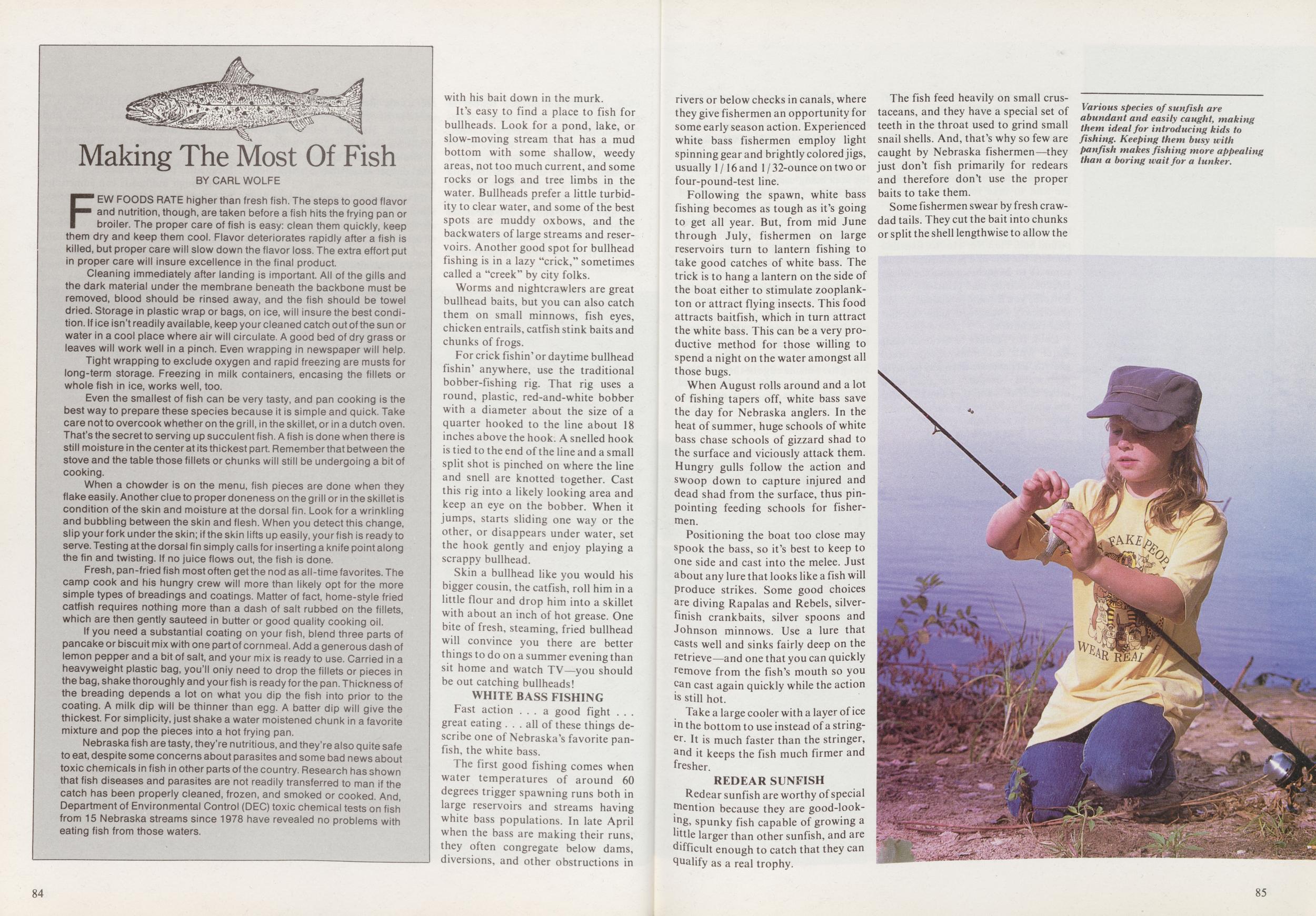
FEW FOODS RATE higher than fresh fish. The steps to good flavor and nutrition, though, are taken before a fish hits the frying pan or broiler. The proper care of fish is easy: clean them quickly, keep them dry and keep them cool. Flavor deteriorates rapidly after a fish is killed, but proper care will slow down the flavor loss. The extra effort put in proper care will insure excellence in the final product.
Cleaning immediately after landing is important. All of the gills and the dark material under the membrane beneath the backbone must be removed, blood should be rinsed away, and the fish should be towel dried. Storage in plastic wrap or bags, on ice, will insure the best condition. If ice isn't readily available, keep your cleaned catch out of the sun or water in a cool place where air will circulate. A good bed of dry grass or leaves will work well in a pinch. Even wrapping in newspaper will help.
Tight wrapping to exclude oxygen and rapid freezing are musts for long-term storage. Freezing in milk containers, encasing the fillets or whole fish in ice, works well, too.
Even the smallest of fish can be very tasty, and pan cooking is the best way to prepare these species because it is simple and quick. Take care not to overcook whether on the grill, in the skillet, or in a dutch oven. That's the secret to serving up succulent fish. A fish is done when there is still moisture in the center at its thickest part. Remember that between the stove and the table those fillets or chunks will still be undergoing a bit of cooking.
When a chowder is on the menu, fish pieces are done when they flake easily. Another clue to proper doneness on the grill or in the skillet is condition of the skin and moisture at the dorsal fin. Look for a wrinkling and bubbling between the skin and flesh. When you detect this change, slip your fork under the skin; if the skin lifts up easily, your fish is ready to serve. Testing at the dorsal fin simply calls for inserting a knife point along the fin and twisting. If no juice flows out, the fish is done.
Fresh, pan-fried fish most often get the nod as all-time favorites. The camp cook and his hungry crew will more than likely opt for the more simple types of breading and coatings. Matter of fact, home-style fried catfish requires nothing more than a dash of salt rubbed on the fillets, which are then gently sautéed in butter or good quality cooking oil.
If you need a substantial coating on your fish, blend three parts of pancake or biscuit mix with one part of cornmeal. Add a generous dash of lemon pepper and a bit of salt, and your mix is ready to use. Carried in a heavyweight plastic bag, you'll only need to drop the fillets or pieces in the bag, shake thoroughly and your fish is ready for the pan. Thickness of the breading depends a lot on what you dip the fish into prior to the coating. A milk dip will be thinner than egg. A batter dip will give the thickest. For simplicity, just shake a water moistened chunk in a favorite mixture and pop the pieces into a hot frying pan.
Nebraska fish are tasty, they're nutritious, and they're also quite safe to eat, despite some concerns about parasites and some bad news about toxic chemicals in fish in other parts of the country. Research has shown that fish diseases and parasites are not readily transferred to man if the catch has been properly cleaned, frozen, and smoked or cooked. And, Department of Environmental Control (DEC) toxic chemical tests on fish from 15 Nebraska streams since 1978 have revealed no problems with eating fish from those waters.
It's easy to find a place to fish for bullheads. Look for a pond, lake, or slow-moving stream that has a mud bottom with some shallow, weedy areas, not too much current, and some rocks or logs and tree limbs in the water. Bullheads prefer a little turbidity to clear water, and some of the best spots are muddy oxbows, and the backwaters of large streams and reservoirs. Another good spot for bullhead fishing is in a lazy "crick," sometimes called a "creek" by city folks.
Worms and nightcrawlers are great bullhead baits, but you can also catch them on small minnows, fish eyes, chicken entrails, catfish stink baits and chunks of frogs.
For crick fishin' or daytime bullhead fishin' anywhere, use the traditional bobber-fishing rig. That rig uses a round, plastic, red-and-white bobber with a diameter about the size of a quarter hooked to the line about 18 inches above the hook. A snelled hook is tied to the end of the line and a small split shot is pinched on where the line and snell are knotted together. Cast this rig into a likely looking area and keep an eye on the bobber. When it jumps, starts sliding one way or the other, or disappears under water, set the hook gently and enjoy playing a scrappy bullhead.
Skin a bullhead like you would his bigger cousin, the catfish, roll him in a little flour and drop him into a skillet with about an inch of hot grease. One bite of fresh, steaming, fried bullhead will convince you there are better things to do on a summer evening than sit home and watch TV—you should be out catching bullheads!
WHITE BASS FISHINGFast action ... a good fight . . . great eating ... all of these things describe one of Nebraska's favorite panfish, the white bass.
The first good fishing comes when water temperatures of around 60 degrees trigger spawning runs both in large reservoirs and streams having white bass populations. In late April when the bass are making their runs, they often congregate below dams, I diversions, and other obstructions in 84 rivers or below checks in canals, where they give fishermen an opportunity for some early season action. Experienced white bass fishermen employ light spinning gear and brightly colored jigs, usually 1/16 and 1 / 32-ounce on two or four-pound-test line.
Following the spawn, white bass fishing becomes as tough as it's going to get all year. But, from mid June through July, fishermen on large reservoirs turn to lantern fishing to take good catches of white bass. The trick is to hang a lantern on the side of the boat either to stimulate zoo plankton or attract flying insects. This food attracts baitfish, which in turn attract the white bass. This can be a very productive method for those willing to spend a night on the water amongst all those bugs.
When August rolls around and a lot of fishing tapers off, white bass save the day for Nebraska anglers. In the heat of summer, huge schools of white bass chase schools of gizzard shad to the surface and viciously attack them. Hungry gulls follow the action and swoop down to capture injured and dead shad from the surface, thus pinpointing feeding schools for fishermen.
Positioning the boat too close may spook the bass, so it's best to keep to one side and cast into the melee. Just about any lure that looks like a fish will produce strikes. Some good choices are diving Rapalas and Rebels, silver finish crank baits, silver spoons and Johnson minnows. Use a lure that casts well and sinks fairly deep on the retrieve—and one that you can quickly remove from the fish's mouth so you can cast again quickly while the action is still hot.
Take a large cooler with a layer of ice in the bottom to use instead of a stringer- It is much faster than the stringer, and it keeps the fish much firmer and fresher.
REDEAR SUNFISHRedear sunfish are worthy of special mention because they are good-looking, spunky fish capable of growing a iittle larger than other sunfish, and are difficult enough to catch that they can qualify as a real trophy.
The fish feed heavily on small crustaceans, and they have a special set of teeth in the throat used to grind small snail shells. And, that's why so few are caught by Nebraska fishermen—they just don't fish primarily for redears and therefore don't use the proper baits to take them.
Some fishermen swear by fresh crawdad tails. They cut the bait into chunks or split the shell lengthwise to allow the critter's scent to escape into the water.
Various species of sunfish are abundant and easily caught, making them ideal for introducing kids to fishing. Keeping them busy with panfish makes fishing more appealing than a boring wait for a lunker.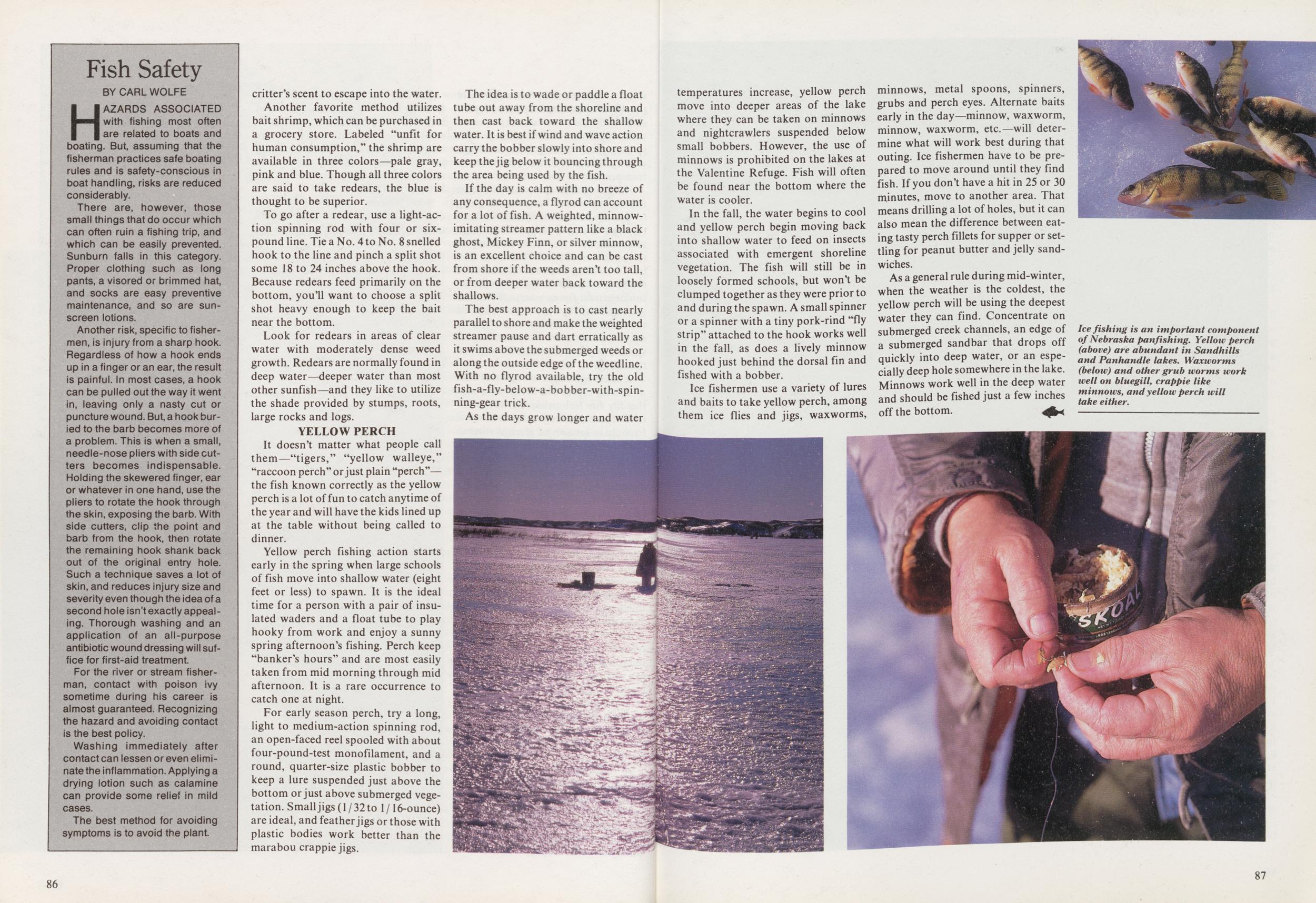 Fish Safety BY CARL WOLFE
HAZARDS ASSOCIATED with fishing most often are related to boats and boating. But, assuming that the fisherman practices safe boating rules and is safety-conscious in boat handling, risks are reduced considerably.
There are, however, those small things that do occur which can often ruin a fishing trip, and which can be easily prevented. Sunburn falls in this category. Proper clothing such as long pants, a visored or brimmed hat, and socks are easy preventive maintenance, and so are sunscreen lotions.
Another risk, specific to fishermen, is injury from a sharp hook. Regardless of how a hook ends up in a finger or an ear, the result is painful. In most cases, a hook can be pulled out the way it went in, leaving only a nasty cut or puncture wound. But, a hook buried to the barb becomes more of a problem. This is when a small, needle-nose pliers with side cutters becomes indispensable. Holding the skewered finger, ear or whatever in one hand, use the pliers to rotate the hook through the skin, exposing the barb. With side cutters, clip the point and barb from the hook, then rotate the remaining hook shank back out of the original entry hole. Such a technique saves a lot of skin, and reduces injury size and severity even though the idea of a second hole isn't exactly appealing. Thorough washing and an application of an all-purpose antibiotic wound dressing will suffice for first-aid treatment
For the river or stream fisherman, contact with poison ivy sometime during his career is almost guaranteed. Recognizing the hazard and avoiding contact is the best policy.
Washing immediately after contact can lessen or even eliminate the inflammation. Applying a drying lotion such as calamine can provide some relief in mild cases.
The best method for avoiding symptoms is to avoid the plant.
Another favorite method utilizes bait shrimp, which can be purchased in a grocery store. Labeled "unfit for human consumption," the shrimp are available in three colors—pale gray, pink and blue. Though all three colors are said to take redears, the blue is thought to be superior.
To go after a redear, use a light-action spinning rod with four or six-pound line. Tie a No. 4 to No. 8 snelled hook to the line and pinch a split shot some 18 to 24 inches above the hook. Because redears feed primarily on the bottom, you'll want to choose a split shot heavy enough to keep the bait near the bottom.
Look for redears in areas of clear water with moderately dense weed growth. Redears are normally found in deep water—deeper water than most other sunfish—and they like to utilize the shade provided by stumps, roots, large rocks and logs.
YELLOW PERCHIt doesn't matter what people call them—"tigers," "yellow walleye," "raccoon perch" or just plain "perch"— the fish known correctly as the yellow perch is a lot of fun to catch anytime of the year and will have the kids lined up at the table without being called to dinner.
Yellow perch fishing action starts early in the spring when large schools of fish move into shallow water (eight feet or less) to spawn. It is the ideal time for a person with a pair of insulated waders and a float tube to play hooky from work and enjoy a sunny spring afternoon's fishing. Perch keep "banker's hours" and are most easily taken from mid morning through mid afternoon. It is a rare occurrence to catch one at night.
For early season perch, try a long, light to medium-action spinning rod, an open-faced reel spooled with about four-pound-test monofilament, and a round, quarter-size plastic bobber to keep a lure suspended just above the bottom or just above submerged vegetation. Small jigs (1 / 32 to 1 /16-ounce) are ideal, and feather jigs or those with plastic bodies work better than the marabou crappie jigs.
The idea is to wade or paddle a float tube out away from the shoreline and then cast back toward the shallow water. It is best if wind and wave action carry the bobber slowly into shore and keep the jig below it bouncing through the area being used by the fish.
If the day is calm with no breeze of any consequence, a flyrod can account for a lot of fish. A weighted, minnow imitating streamer pattern like a black ghost, Mickey Finn, or silver minnow, is an excellent choice and can be cast from shore if the weeds aren't too tall, or from deeper water back toward the shallows.
The best approach is to cast nearly parallel to shore and make the weighted streamer pause and dart erratically as it swims above the submerged weeds or along the outside edge of the weed line. With no flyrod available, try the old fish-a-fly-below-a-bobber-with-spinning-gear trick.
As the days grow longer and water 86 temperatures increase, yellow perch move into deeper areas of the lake where they can be taken on minnows and nightcrawlers suspended below small bobbers. However, the use of minnows is prohibited on the lakes at the Valentine Refuge. Fish will often be found near the bottom where the water is cooler.
In the fall, the water begins to cool and yellow perch begin moving back into shallow water to feed on insects associated with emergent shoreline vegetation. The fish will still be in loosely formed schools, but won't be clumped together as they were prior to and during the spawn. A small spinner or a spinner with a tiny pork-rind "fly strip" attached to the hook works well in the fall, as does a lively minnow hooked just behind the dorsal fin and fished with a bobber.
Ice fishermen use a variety of lures and baits to take yellow perch, among them ice flies and jigs, waxworms, minnows, metal spoons, spinners, grubs and perch eyes. Alternate baits early in the day—minnow, waxworm, minnow, waxworm, etc.—will determine what will work best during that outing. Ice fishermen have to be prepared to move around until they find fish. If you don't have a hit in 25 or 30 minutes, move to another area. That means drilling a lot of holes, but it can also mean the difference between eating tasty perch fillets for supper or settling for peanut butter and jelly sandwiches.
As a general rule during mid-winter, when the weather is the coldest, the yellow perch will be using the deepest water they can find. Concentrate on submerged creek channels, an edge of a submerged sandbar that drops off quickly into deep water, or an especially deep hole somewhere in the lake. Minnows work well in the deep water and should be fished just a few inches off the bottom.
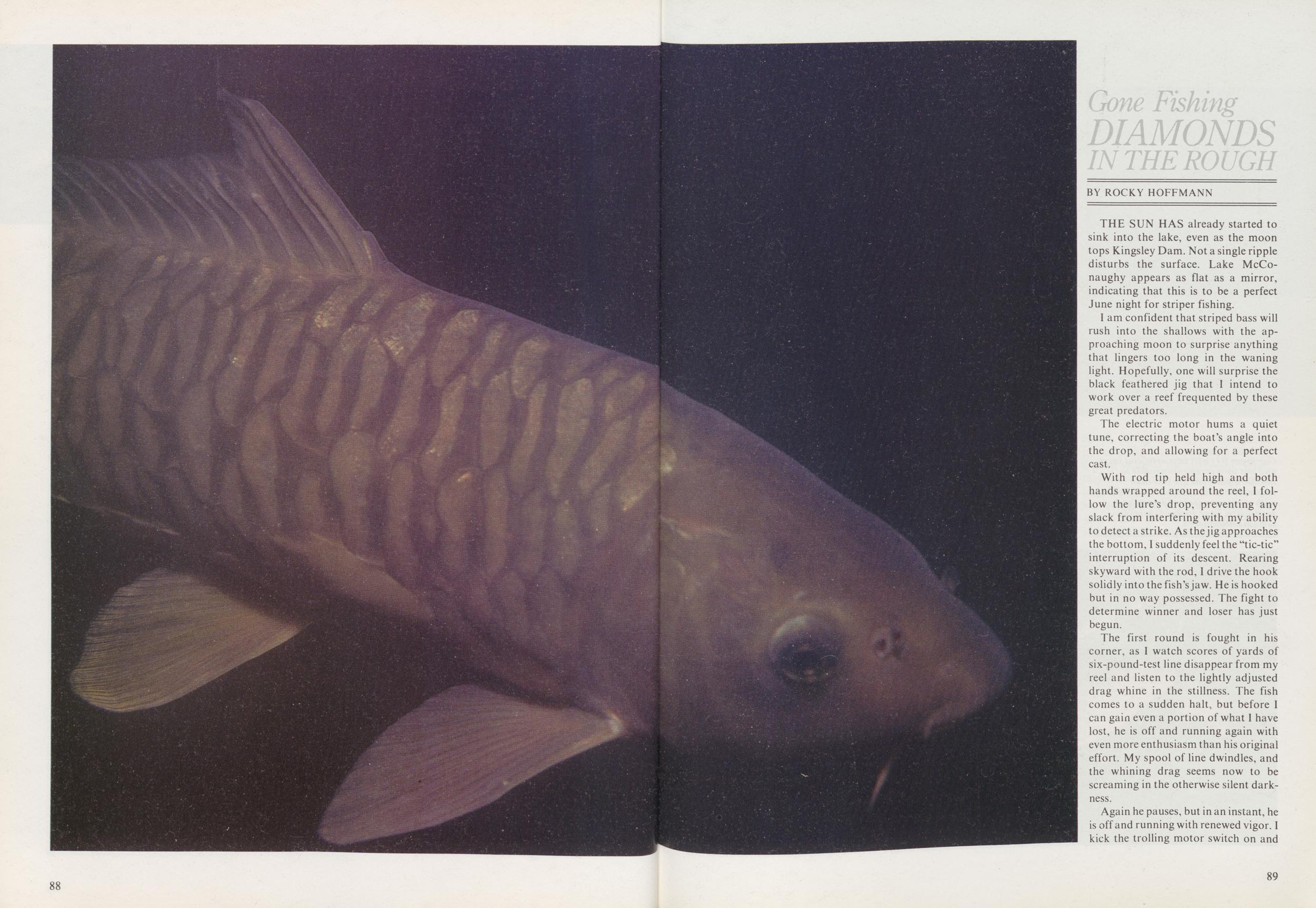
Gone Fishing Diamond in the Rough
The sun has already started to sink into the lake, even as the moon tops Kingsley Dam. Not a single ripple disturbes the surface. Lake McConaughy appears as flat as a mirror, indicating that this is to be a perfect June night for stiper fishing
I am confident that stiped bass will rush into the shallows with the approaching moon to surprise anything that lingers too long in the waning light. Hopefully, one will surprise the black feathered jig that I intend to work over a reef frequented by these great predators.
The electric motor hums a quiet tune, correcting the boat's angle into the drop, and allowing for a perfect cast.
With rod top held high and both hands wrapped around the reel, I follow the lure's drop, preventing any slack from interfering with my ability to detect a strike. As the jig approaches the bottom, I suddenly feel the "tic-tic" interruption of its descent. Rearing skyward with the rod, I drive the hook solidly into the fish's jaw. He is hooked but in no way possessed. The fight to determine winner and loser has just begun.
The first round is fought in his corner, as I watch scores of yards of six-pound-test line disappear from my reel and listen to the lightly adjusted drag whine in the stillness. The fish comes to a sudden halt, but before I can gain even a portion of what I have lost, he is off and running again with even more enthusiasm than his original effort. My spool of line dwindles, and the whining drag seems now to be screaming in the otherwise silent darkness.
Again he pauses, but in an instant, he is off and running with renewed vifor. I kick the trolling motor switch on and
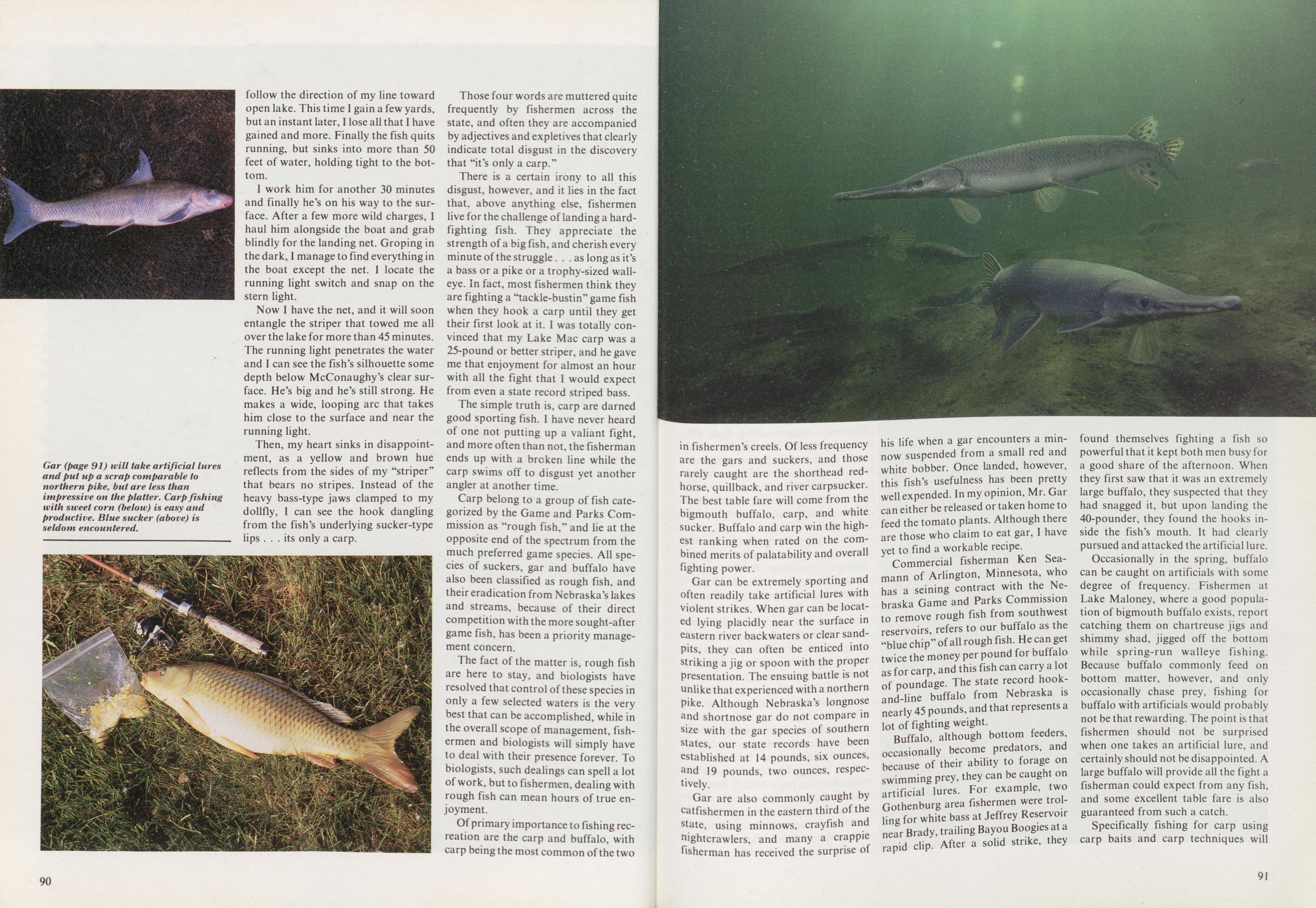
follow the direction of my line toward open lake. This time I gain a few yards, but an instant later, I lose all that I have gained and more. Finally the fish quits running, but sinks into more than 50 feet of water, holding tight to the bottom.
I work him for another 30 minutes and finally he's on his way to the surface. After a few more wild charges, I haul him alongside the boat and grab blindly for the landing net. Groping in the dark, I manage to find everything in the boat except the net. I locate the running light switch and snap on the stern light.
Now I have the net, and it will soon entangle the striper that towed me all over the lake for more than 45 minutes. The running light penetrates the water and I can see the fish's silhouette some depth below McConaughy's clear surface. He's big and he's still strong. He makes a wide, looping arc that takes him close to the surface and near the running light.
Then, my heart sinks in disappointment, as a yellow and brown hue reflects from the sides of my "striper" that bears no stripes. Instead of the heavy bass-type jaws clamped to my dollfly, I can see the hook dangling from the fish's underlying sucker-type lips ... its only a carp.
Those four words are muttered quite frequently by fishermen across the state, and often they are accompanied by adjectives and expletives that clearly indicate total disgust in the discovery that "it's only a carp."
There is a certain irony to all this disgust, however, and it lies in the fact that, above anything else, fishermen live for the challenge of landing a hard fighting fish. They appreciate the strength of a big fish, and cherish every minute of the struggle. . . as long as it's a bass or a pike or a trophy-sized walleye. In fact, most fishermen think they are fighting a "tackle-bustin" game fish when they hook a carp until they get their first look at it. I was totally convinced that my Lake Mac carp was a 25-pound or better striper, and he gave me that enjoyment for almost an hour with all the fight that I would expect from even a state record striped bass.
The simple truth is, carp are darned good sporting fish. I have never heard of one not putting up a valiant fight, and more often than not, the fisherman ends up with a broken line while the carp swims off to disgust yet another angler at another time.
Carp belong to a group of fish categorized by the Game and Parks Commission as "rough fish," and lie at the opposite end of the spectrum from the much preferred game species. All species of suckers, gar and buffalo have also been classified as rough fish, and their eradication from Nebraska's lakes and streams, because of their direct competition with the more sought-after game fish, has been a priority management concern.
The fact of the matter is, rough fish are here to stay, and biologists have resolved that control of these species in only a few selected waters is the very best that can be accomplished, while in the overall scope of management, fishermen and biologists will simply have to deal with their presence forever. To biologists, such dealings can spell a lot of work, but to fishermen, dealing with rough fish can mean hours of true enjoyment.
Of primary importance to fishing recreation are the carp and buffalo, with carp being the most common of the two 90 in fishermen's creels. Of less frequency are the gars and suckers, and those rarely caught are the shorthead red horse, quillback, and river carpsucker. The best table fare will come from the bigmouth buffalo, carp, and white sucker. Buffalo and carp win the highest ranking when rated on the combined merits of palatability and overall fighting power.
Gar can be extremely sporting and often readily take artificial lures with violent strikes. When gar can be located lying placidly near the surface in eastern river backwaters or clear sandpits, they can often be enticed into striking a jig or spoon with the proper presentation. The ensuing battle is not unlike that experienced with a northern pike. Although Nebraska's longnose and shortnose gar do not compare in size with the gar species of southern states, our state records have been established at 14 pounds, six ounces, and 19 pounds, two ounces, respectively.
Gar are also commonly caught by catfishermen in the eastern third of the state, using minnows, crayfish and nightcrawlers, and many a crappie fisherman has received the surprise of his life when a gar encounters a minnow suspended from a small red and white bobber. Once landed, however, this fish's usefulness has been pretty well expended. In my opinion, Mr. Gar can either be released or taken home to feed the tomato plants. Although there are those who claim to eat gar, I have yet to find a workable recipe.
Commercial fisherman Ken Seamann of Arlington, Minnesota, who has a seining contract with the Nebraska Game and Parks Commission to remove rough fish from southwest reservoirs, refers to our buffalo as the "blue chip" of all rough fish. He can get twice the money per pound for buffalo as for carp, and this fish can carry a lot of poundage. The state record hook-and-line buffalo from Nebraska is nearly 45 pounds, and that represents a lot of fighting weight.
Buffalo, although bottom feeders, occasionally become predators, and because of their ability to forage on swimming prey, they can be caught on artificial lures. For example, two Gothenburg area fishermen were trolling for white bass at Jeffrey Reservoir near Brady, trailing Bayou Boogies at a rapid clip. After a solid strike, they found themselves fighting a fish so powerful that it kept both men busy for a good share of the afternoon. When they first saw that it was an extremely large buffalo, they suspected that they had snagged it, but upon landing the 40-pounder, they found the hooks inside the fish's mouth. It had clearly pursued and attacked the artificial lure.
Occasionally in the spring, buffalo can be caught on artificials with some degree of frequency. Fishermen at Lake Maloney, where a good population of bigmouth buffalo exists, report catching them on chartreuse jigs and shimmy shad, jigged off the bottom while spring-run walleye fishing. Because buffalo commonly feed on bottom matter, however, and only occasionally chase prey, fishing for buffalo with artificials would probably not be that rewarding. The point is that fishermen should not be surprised when one takes an artificial lure, and certainly should not be disappointed. A large buffalo will provide all the fight a fisherman could expect from any fish, and some excellent table fare is also guaranteed from such a catch.
Specifically fishing for carp using carp baits and carp techniques will probably yield more buffalo than fishing for buffalo with jigs or other artificials. Carp bait is probably the most accommodating aspect of fishing for this particular species. In fact, if you have the basic ability of operating a can opener and live anywhere near a grocery store, you have access to the best carp bait available.
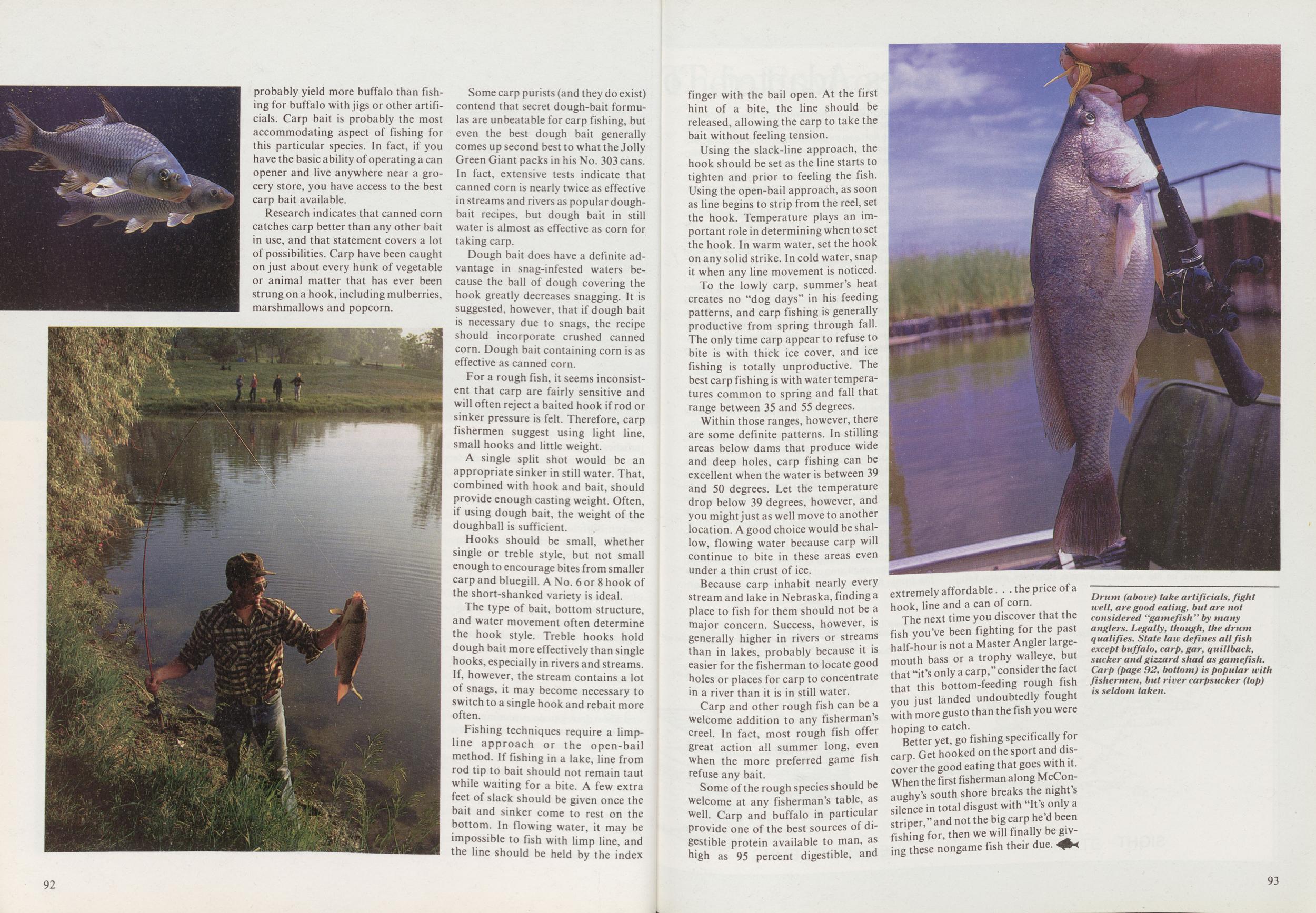
Research indicates that canned corn catches carp better than any other bait in use, and that statement covers a lot of possibilities. Carp have been caught on just about every hunk of vegetable or animal matter that has ever been strung on a hook, including mulberries, marshmallows and popcorn.
Some carp purists (and they do exist) contend that secret dough-bait formulas are unbeatable for carp fishing, but even the best dough bait generally comes up second best to what the Jolly Green Giant packs in his No. 303 cans. In fact, extensive tests indicate that canned corn is nearly twice as effective in streams and rivers as popular doughbait recipes, but dough bait in still water is almost as effective as corn for taking carp.
Dough bait does have a definite advantage in snag-infested waters because the ball of dough covering the hook greatly decreases snagging. It is suggested, however, that if dough bait is necessary due to snags, the recipe should incorporate crushed canned corn. Dough bait containing corn is as effective as canned corn.
For a rough fish, it seems inconsistent that carp are fairly sensitive and will often reject a baited hook if rod or sinker pressure is felt. Therefore, carp fishermen suggest using light line, small hooks and little weight.
A single split shot would be an appropriate sinker in still water. That, combined with hook and bait, should provide enough casting weight. Often, if using dough bait, the weight of the doughball is sufficient.
Hooks should be small, whether single or treble style, but not small enough to encourage bites from smaller carp and bluegill. A No. 6 or 8 hook of the short-shanked variety is ideal.
The type of bait, bottom structure, and water movement often determine the hook style. Treble hooks hold dough bait more effectively than single hooks, especially in rivers and streams. If, however, the stream contains a lot of snags, it may become necessary to switch to a single hook and rebait more often.
Fishing techniques require a limp line approach or the open-bail method. If fishing in a lake, line from rod tip to bait should not remain taut while waiting for a bite. A few extra feet of slack should be given once the bait and sinker come to rest on the bottom. In flowing water, it may be impossible to fish with limp line, and the line should be held by the index 92 finger with the bail open. At the first hint of a bite, the line should be released, allowing the carp to take the bait without feeling tension.
Using the slack-line approach, the hook should be set as the line starts to tighten and prior to feeling the fish. Using the open-bail approach, as soon as line begins to strip from the reel, set the hook. Temperature plays an important role in determining when to set the hook. In warm water, set the hook on any solid strike. In cold water, snap it when any line movement is noticed.
To the lowly carp, summer's heat creates no "dog days" in his feeding patterns, and carp fishing is generally productive from spring through fall. The only time carp appear to refuse to bite is with thick ice cover, and ice fishing is totally unproductive. The best carp fishing is with water temperatures common to spring and fall that range between 35 and 55 degrees.
Within those ranges, however, there are some definite patterns. In stilling areas below dams that produce wide and deep holes, carp fishing can be excellent when the water is between 39 and 50 degrees. Let the temperature drop below 39 degrees, however, and you might just as well move to another location. A good choice would be shallow, flowing water because carp will continue to bite in these areas even under a thin crust of ice.
Because carp inhabit nearly every stream and lake in Nebraska, finding a place to fish for them should not be a major concern. Success, however, is generally higher in rivers or streams than in lakes, probably because it is easier for the fisherman to locate good holes or places for carp to concentrate in a river than it is in still water.
Carp and other rough fish can be a welcome addition to any fisherman's creel. In fact, most rough fish offer great action all summer long, even when the more preferred game fish refuse any bait.
Some of the rough species should be welcome at any fisherman's table, as well. Carp and buffalo in particular provide one of the best sources of digestible protein available to man, as high as 95 percent digestible, and extremely affordable. . .the price of a hook, line and a can of corn.
The next time you discover that the fish you've been fighting for the past half-hour is not a Master Angler largemouth bass or a trophy walleye, but that "it's only a carp," consider the fact that this bottom-feeding rough fish you just landed undoubtedly fought with more gusto than the fish you were hoping to catch.
Better yet, go fishing specifically for carp Get hooked on the sport and discover the good eating that goes with it. When the first fisherman along McConaughy's south shore breaks the night's silence in total disgust with "It's only a striper," and not the big carp he'd been fishing for, then we will finally be giving these non-game fish their due.
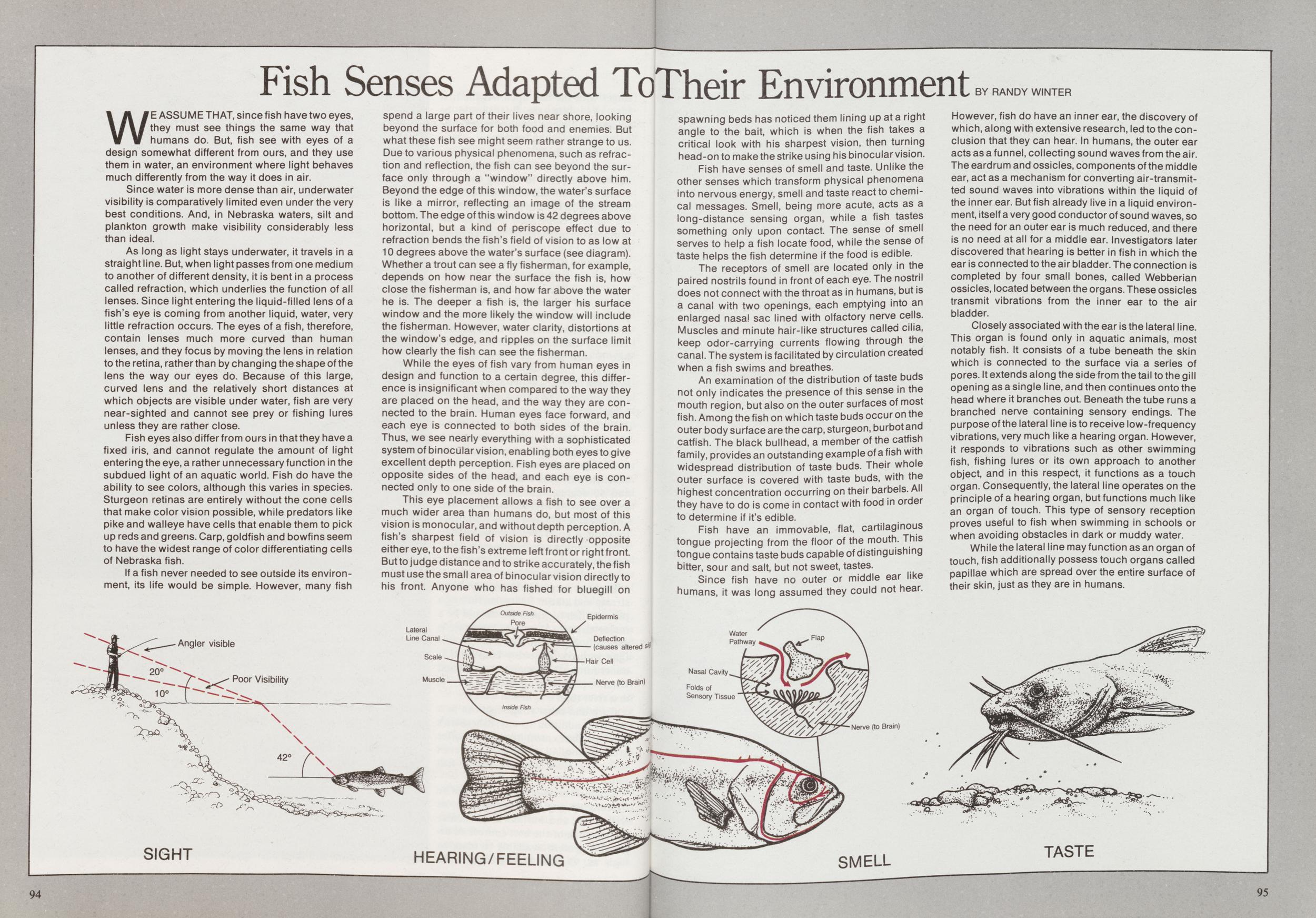
Fish Senses Adapted To Their Environment
BY RANDY WINTERWE ASSUME THAT, since fish have two eyes, they must see things the same way that humans do. But, fish see with eyes of a design somewhat different from ours, and they use them in water, an environment where light behaves much differently from the way it does in air.
Since water is more dense than air, underwater visibility is comparatively limited even under the very best conditions. And, in Nebraska waters, silt and plankton growth make visibility considerably less than ideal.
As long as light stays underwater, it travels in a straight line. But, when light passes from one medium to another of different density, it is bent in a process called refraction, which underlies the function of all lenses. Since light entering the liquid-filled lens of a fish's eye is coming from another liquid, water, very little refraction occurs. The eyes of a fish, therefore, contain lenses much more curved than human lenses, and they focus by moving the lens in relation to the retina, rather than by changing the shape of the lens the way our eyes do. Because of this large, curved lens and the relatively short distances at which objects are visible under water, fish are very near-sighted and cannot see prey or fishing lures unless they are rather close.
Fish eyes also differ from ours in that they have a fixed iris, and cannot regulate the amount of light entering the eye, a rather unnecessary function in the subdued light of an aquatic world. Fish do have the ability to see colors, although this varies in species. Sturgeon retinas are entirely without the cone cells that make color vision possible, while predators like pike and walleye have cells that enable them to pick up reds and greens. Carp, goldfish and bowfins seem to have the widest range of color differentiating cells of Nebraska fish.
If a fish never needed to see outside its environment, its life would be simple. However, many fish spend a large part of their lives near shore, looking beyond the surface for both food and enemies. But what these fish see might seem rather strange to us. Due to various physical phenomena, such as refraction and reflection, the fish can see beyond the surface only through a "window" directly above him. Beyond the edge of this window, the water's surface is like a mirror, reflecting an image of the stream bottom. The edge of this window is 42 degrees above horizontal, but a kind of periscope effect due to refraction bends the fish's field of vision to as low at 10 degrees above the water's surface (see diagram). Whether a trout can see a fly fisherman, for example, depends on how near the surface the fish is, how close the fisherman is, and how far above the water he is. The deeper a fish is, the larger his surface window and the more likely the window will include the fisherman. However, water clarity, distortions at the window's edge, and ripples on the surface limit how clearly the fish can see the fisherman.
While the eyes of fish vary from human eyes in design and function to a certain degree, this difference is insignificant when compared to the way they are placed on the head, and the way they are connected to the brain. Human eyes face forward, and each eye is connected to both sides of the brain. Thus, we see nearly everything with a sophisticated system of binocular vision, enabling both eyes to give excellent depth perception. Fish eyes are placed on opposite sides of the head, and each eye is connected only to one side of the brain.
This eye placement allows a fish to see over a much wider area than humans do, but most of this vision is monocular, and without depth perception. A fish's sharpest field of vision is directly opposite either eye, to the fish's extreme left front or right front. But to judge distance and to strike accurately, the fish must use the small area of binocular vision directly to his front. Anyone who has fished for bluegill on 94 spawning beds has noticed them lining up at a right angle to the bait, which is when the fish takes a critical look with his sharpest vision, then turning head-on to make the strike using his binocular vision.
Fish have senses of smell and taste. Unlike the other senses which transform physical phenomena into nervous energy, smell and taste react to chemical messages. Smell, being more acute, acts as a long-distance sensing organ, while a fish tastes something only upon contact. The sense of smell serves to help a fish locate food, while the sense of taste helps the fish determine if the food is edible.
The receptors of smell are located only in the paired nostrils found in front of each eye. The nostril does not connect with the throat as in humans, but is a canal with two openings, each emptying into an enlarged nasal sac lined with olfactory nerve cells. Muscles and minute hair-like structures called cilia, keep odor-carrying currents flowing through the canal. The system is facilitated by circulation created when a fish swims and breathes.
An examination of the distribution of taste buds not only indicates the presence of this sense in the mouth region, but also on the outer surfaces of most fish. Among the fish on which taste buds occur on the outer body surface are the carp, sturgeon, burbot and catfish. The black bullhead, a member of the catfish family, provides an outstanding example of a fish with widespread distribution of taste buds. Their whole outer surface is covered with taste buds, with the highest concentration occurring on their barbels. All they have to do is come in contact with food in order to determine if it's edible.
Fish have an immovable, flat, cartilaginous tongue projecting from the floor of the mouth. This tongue contains taste buds capable of distinguishing bitter, sour and salt, but not sweet, tastes.
Since fish have no outer or middle ear like humans, it was long assumed they could not hear. However, fish do have an inner ear, the discovery of which, along with extensive research, led to the conclusion that they can hear. In humans, the outer ear acts as a funnel, collecting sound waves from the air. The eardrum and ossicles, components of the middle ear, act as a mechanism for converting air-transmitted sound waves into vibrations within the liquid of the inner ear. But fish already live in a liquid environment, itself a very good conductor of sound waves, so the need for an outer ear is much reduced, and there is no need at all for a middle ear. Investigators later discovered that hearing is better in fish in which the ear is connected to the air bladder. The connection is completed by four small bones, called Weberian ossicles, located between the organs. These ossicles transmit vibrations from the inner ear to the air bladder.
Closely associated with the ear is the lateral line. This organ is found only in aquatic animals, most notably fish. It consists of a tube beneath the skin which is connected to the surface via a series of pores. It extends along the side from the tail to the gill opening as a single line, and then continues onto the head where it branches out. Beneath the tube runs a branched nerve containing sensory endings. The purpose of the lateral line is to receive low-frequency vibrations, very much like a hearing organ. However, it responds to vibrations such as other swimming fish, fishing lures or its own approach to another object, and in this respect, it functions as a touch organ. Consequently, the lateral line operates on the principle of a hearing organ, but functions much like an organ of touch. This type of sensory reception proves useful to fish when swimming in schools or when avoiding obstacles in dark or muddy water.
While the lateral line may function as an organ of touch, fish additionally possess touch organs called papillae which are spread over the entire surface of their skin, just as they are in humans.
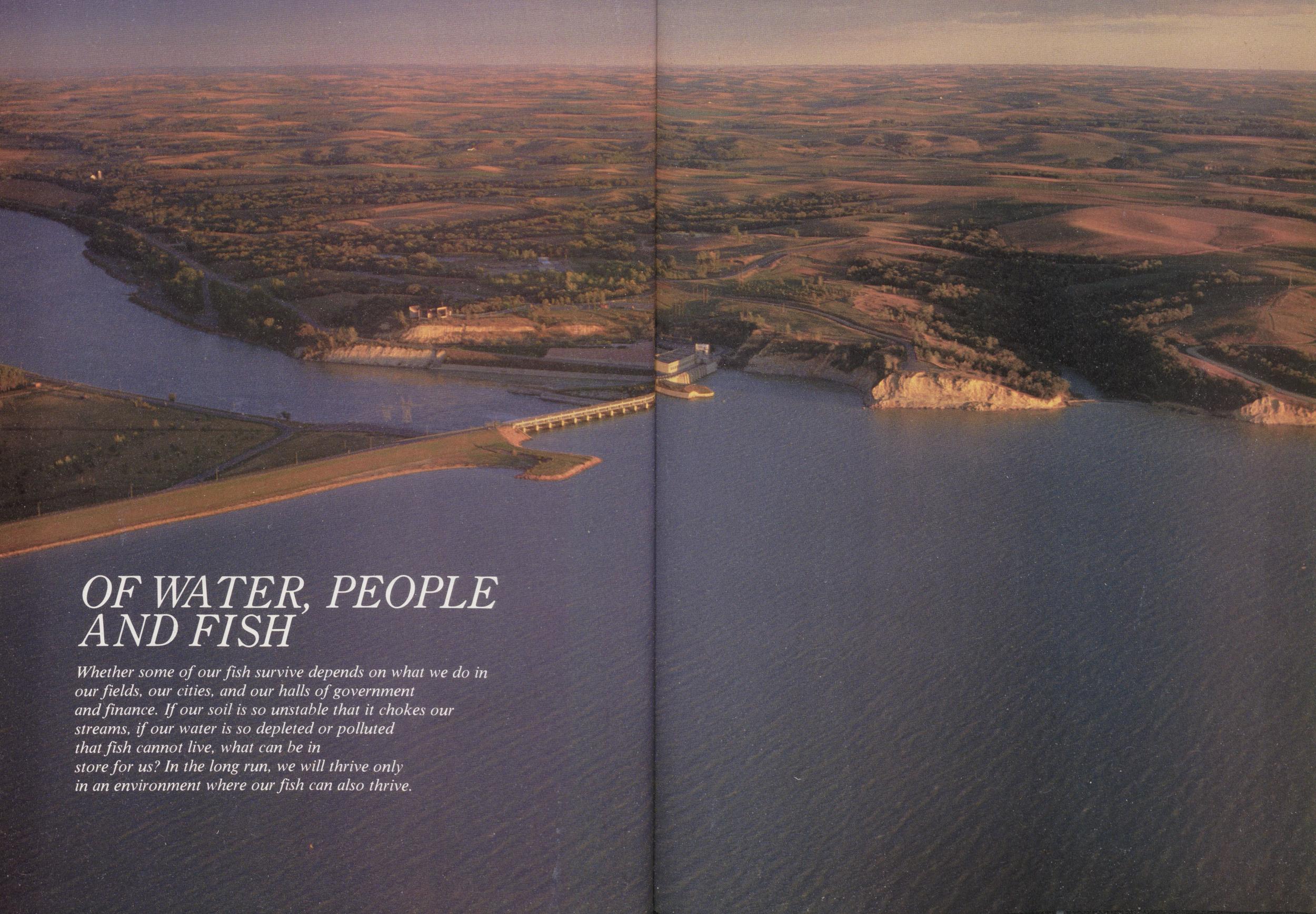
OF WATER, PEOPLE AND FISH
Whether some of our fish survive depends on what we do in our fields, our cities, and our halls of government and finance. If our soil is so unstable that it chokes our streams, if our water is so depleted or polluted that fish cannot live, what can be in store for us? In the long run, we will thrive only 77 an environment where our fish can also thrive.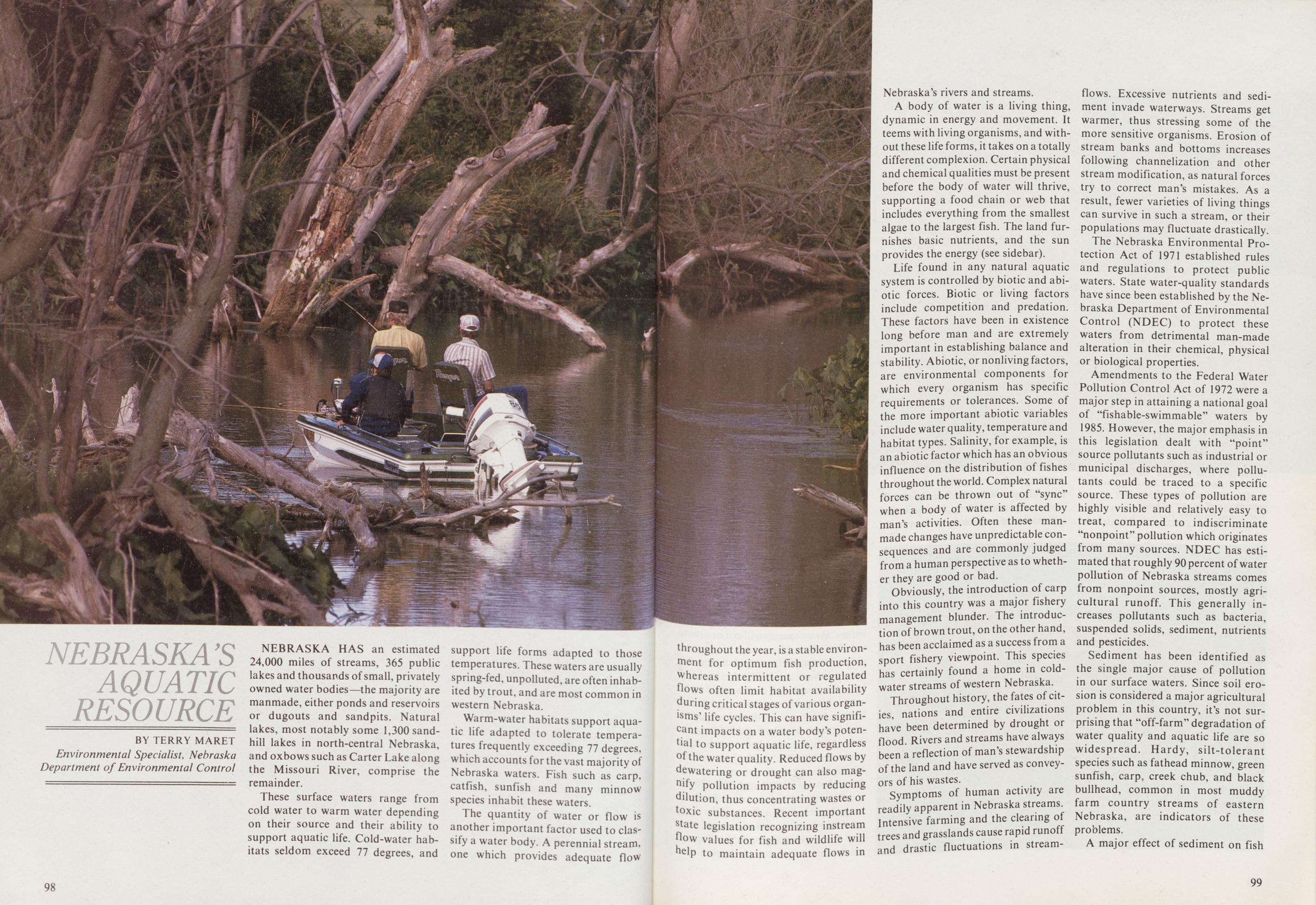
NEBRASKA'S AQUATIC RESOURCE
BY TERRY MARET Environmental Specialist, Nebraska Department of Environmental ControlNEBRASKA HAS an estimated 24,000 miles of streams, 365 public lakes and thousands of small, privately owned water bodies—the majority are manmade, either ponds and reservoirs or dugouts and sandpits. Natural lakes, most notably some 1,300 sandhill lakes in north-central Nebraska, and oxbows such as Carter Lake along the Missouri River, comprise the remainder.
These surface waters range from cold water to warm water depending on their source and their ability to support aquatic life. Cold-water habitats seldom exceed 77 degrees, and support life forms adapted to those temperatures. These waters are usually spring-fed, unpolluted, are often inhabited by trout, and are most common in western Nebraska.
Warm-water habitats support aquatic life adapted to tolerate temperatures frequently exceeding 77 degrees, which accounts for the vast majority of Nebraska waters. Fish such as carp, catfish, sunfish and many minnow species inhabit these waters.
The quantity of water or flow is another important factor used to classify a water body. A perennial stream, one which provides adequate flow 98 throughout the year, is a stable environment for optimum fish production, whereas intermittent or regulated flows often limit habitat availability during critical stages of various organisms' life cycles. This can have significant impacts on a water body's potential to support aquatic life, regardless of the water quality. Reduced flows by dewatering or drought can also magnify pollution impacts by reducing dilution, thus concentrating wastes or toxic substances. Recent important state legislation recognizing in-stream flow values for fish and wildlife will nclp to maintain adequate flows in Nebraska's rivers and streams.
A body of water is a living thing, dynamic in energy and movement. It teems with living organisms, and without these life forms, it takes on a totally different complexion. Certain physical and chemical qualities must be present before the body of water will thrive, supporting a food chain or web that includes everything from the smallest algae to the largest fish. The land furnishes basic nutrients, and the sun provides the energy (see sidebar).
Life found in any natural aquatic system is controlled by biotic and abiotic forces. Biotic or living factors include competition and predation. These factors have been in existence long before man and are extremely important in establishing balance and stability. Abiotic, or nonliving factors, are environmental components for which every organism has specific requirements or tolerances. Some of the more important abiotic variables include water quality, temperature and habitat types. Salinity, for example, is an abiotic factor which has an obvious influence on the distribution of fishes throughout the world. Complex natural forces can be thrown out of "sync" when a body of water is affected by man's activities. Often these manmade changes have unpredictable consequences and are commonly judged from a human perspective as to whether they are good or bad.
Obviously, the introduction of carp into this country was a major fishery management blunder. The introduction of brown trout, on the other hand, has been acclaimed as a success from a sport fishery viewpoint. This species has certainly found a home in cold-water streams of western Nebraska.
Throughout history, the fates of cities nations and entire civilizations have been determined by drought or flood. Rivers and streams have always been a reflection of man's stewardship of the land and have served as conveyors of his wastes.
Svmptoms of human activity are readily apparent in Nebraska streams intensive farming and the clearing of trees and grasslands cause rapid runoff and drastic fluctuations in stream- flows. Excessive nutrients and sediment invade waterways. Streams get warmer, thus stressing some of the more sensitive organisms. Erosion of stream banks and bottoms increases following channelization and other stream modification, as natural forces try to correct man's mistakes. As a result, fewer varieties of living things can survive in such a stream, or their populations may fluctuate drastically.
The Nebraska Environmental Protection Act of 1971 established rules and regulations to protect public waters. State water-quality standards have since been established by the Nebraska Department of Environmental Control (NDEC) to protect these waters from detrimental man-made alteration in their chemical, physical or biological properties.
Amendments to the Federal Water Pollution Control Act of 1972 were a major step in attaining a national goal of "fishable-swimmable" waters by 1985. However, the major emphasis in this legislation dealt with "point" source pollutants such as industrial or municipal discharges, where pollutants could be traced to a specific source. These types of pollution are highly visible and relatively easy to treat, compared to indiscriminate "non-point" pollution which originates from many sources. NDEC has estimated that roughly 90 percent of water pollution of Nebraska streams comes from non-point sources, mostly agricultural runoff. This generally increases pollutants such as bacteria, suspended solids, sediment, nutrients and pesticides.
Sediment has been identified as the single major cause of pollution in our surface waters. Since soil erosion is considered a major agricultural problem in this country, it's not surprising that "off-farm" degradation of water quality and aquatic life are so widespread. Hardy, silt-tolerant species such as fathead minnow, green sunfish, carp, creek chub, and black bullhead, common in most muddy farm country streams of eastern Nebraska, are indicators of these problems.
A major effect of sediment on fish populations is the disruption of normal fish reproduction. Sediment fills in the spaces between rocks, smothering eggs and fry, thus destroying the habitat many species need to reproduce. Trout, for instance, need approximately 70 percent gravel bottom to successfully spawn. Without it, a self-sustaining population will not exist. Instead, the stream will have either a trout fishery reliant on artificial stocking, or no trout at all.
99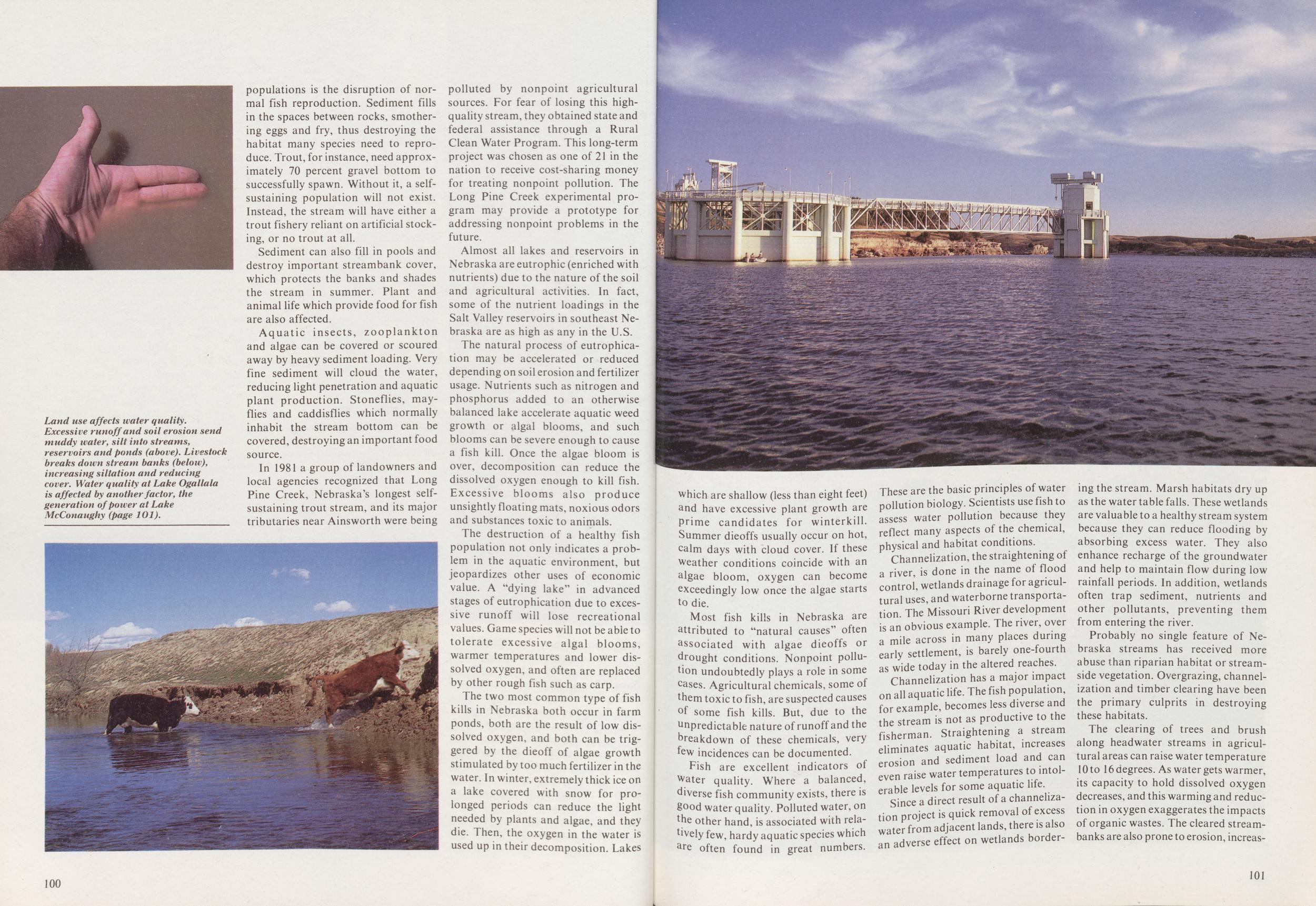
Sediment can also fill in pools and destroy important stream bank cover, which protects the banks and shades the stream in summer. Plant and animal life which provide food for fish are also affected.
Aquatic insects, zooplankton and algae can be covered or scoured away by heavy sediment loading. Very fine sediment will cloud the water, reducing light penetration and aquatic plant production. Stoneflies, mayflies and caddisflies which normally inhabit the stream bottom can be covered, destroying an important food source.
In 1981 a group of landowners and local agencies recognized that Long Pine Creek, Nebraska's longest self-sustaining trout stream, and its major tributaries near Ainsworth were being polluted by nonpoint agricultural sources. For fear of losing this high-quality stream, they obtained state and federal assistance through a Rural Clean Water Program. This long-term project was chosen as one of 21 in the nation to receive cost-sharing money for treating nonpoint pollution. The Long Pine Creek experimental program may provide a prototype for addressing nonpoint problems in the future.
Almost all lakes and reservoirs in Nebraska are eutrophic (enriched with nutrients) due to the nature of the soil and agricultural activities. In fact, some of the nutrient loadings in the Salt Valley reservoirs in southeast Nebraska are as high as any in the U.S.
The natural process of eutrophication may be accelerated or reduced depending on soil erosion and fertilizer usage. Nutrients such as nitrogen and phosphorus added to an otherwise balanced lake accelerate aquatic weed growth or algal blooms, and such blooms can be severe enough to cause a fish kill. Once the algae bloom is over, decomposition can reduce the dissolved oxygen enough to kill fish. Excessive blooms also produce unsightly floating mats, noxious odors and substances toxic to animals.
The destruction of a healthy fish population not only indicates a problem in the aquatic environment, but jeopardizes other uses of economic value. A "dying lake" in advanced stages of eutrophication due to excessive runoff will lose recreational values. Game species will not be able to tolerate excessive algal blooms, warmer temperatures and lower dissolved oxygen, and often are replaced by other rough fish such as carp.
The two most common type of fish kills in Nebraska both occur in farm ponds, both are the result of low dissolved oxygen, and both can be triggered by the die off of algae growth stimulated by too much fertilizer in the water. In winter, extremely thick ice on a lake covered with snow for prolonged periods can reduce the light needed by plants and algae, and they die. Then, the oxygen in the water is used up in their decomposition. Lakes 100 which are shallow (less than eight feet) and have excessive plant growth are prime candidates for winter kill. Summer die offs usually occur on hot, calm days with cloud cover. If these weather conditions coincide with an algae bloom, oxygen can become exceedingly low once the algae starts to die.
Most fish kills in Nebraska are attributed to "natural causes" often associated with algae die offs or drought conditions. Nonpoint pollution undoubtedly plays a role in some cases. Agricultural chemicals, some of them toxic to fish, are suspected causes of some fish kills. But, due to the unpredictable nature of runoff and the breakdown of these chemicals, very few incidences can be documented.
Fish are excellent indicators of Water quality. Where a balanced, diverse fish community exists, there is good water quality. Polluted water, on the other hand, is associated with relatively few, hardy aquatic species which are often found in great numbers. These are the basic principles of water pollution biology. Scientists use fish to assess water pollution because they reflect many aspects of the chemical, physical and habitat conditions.
Channelization, the straightening of a river, is done in the name of flood control, wetlands drainage for agricultural uses, and waterborne transportation. The Missouri River development is an obvious example. The river, over a mile across in many places during early settlement, is barely one-fourth as wide today in the altered reaches.
Channelization has a major impact on all aquatic life. The fish population, for example, becomes less diverse and the stream is not as productive to the fisherman. Straightening a stream eliminates aquatic habitat, increases erosion and sediment load and can even raise water temperatures to intolerable levels for some aquatic life.
Since a direct result of a channelization project is quick removal of excess water from adjacent lands, there is also an adverse effect on wetlands bordering the stream. Marsh habitats dry up as the water table falls. These wetlands are valuable to a healthy stream system because they can reduce flooding by absorbing excess water. They also enhance recharge of the groundwater and help to maintain flow during low rainfall periods. In addition, wetlands often trap sediment, nutrients and other pollutants, preventing them from entering the river.
Probably no single feature of Nebraska streams has received more abuse than riparian habitat or stream-side vegetation. Overgrazing, channelization and timber clearing have been the primary culprits in destroying these habitats.
The clearing of trees and brush along headwater streams in agricultural areas can raise water temperature 10 to 16 degrees. As water gets warmer, its capacity to hold dissolved oxygen decreases, and this warming and reduction in oxygen exaggerates the impacts of organic wastes. The cleared stream-banks are also prone to erosion, increasing ing sediment pollution. But, if a buffer strip of trees and grass is left on stream-banks, sediment, nutrients, pesticides and other pollutants can be prevented from flowing directly into a stream. Recent studies indicate the width of the riparian zone along a stream is directly related to the amount of sediment accumulation in stream bottoms.
101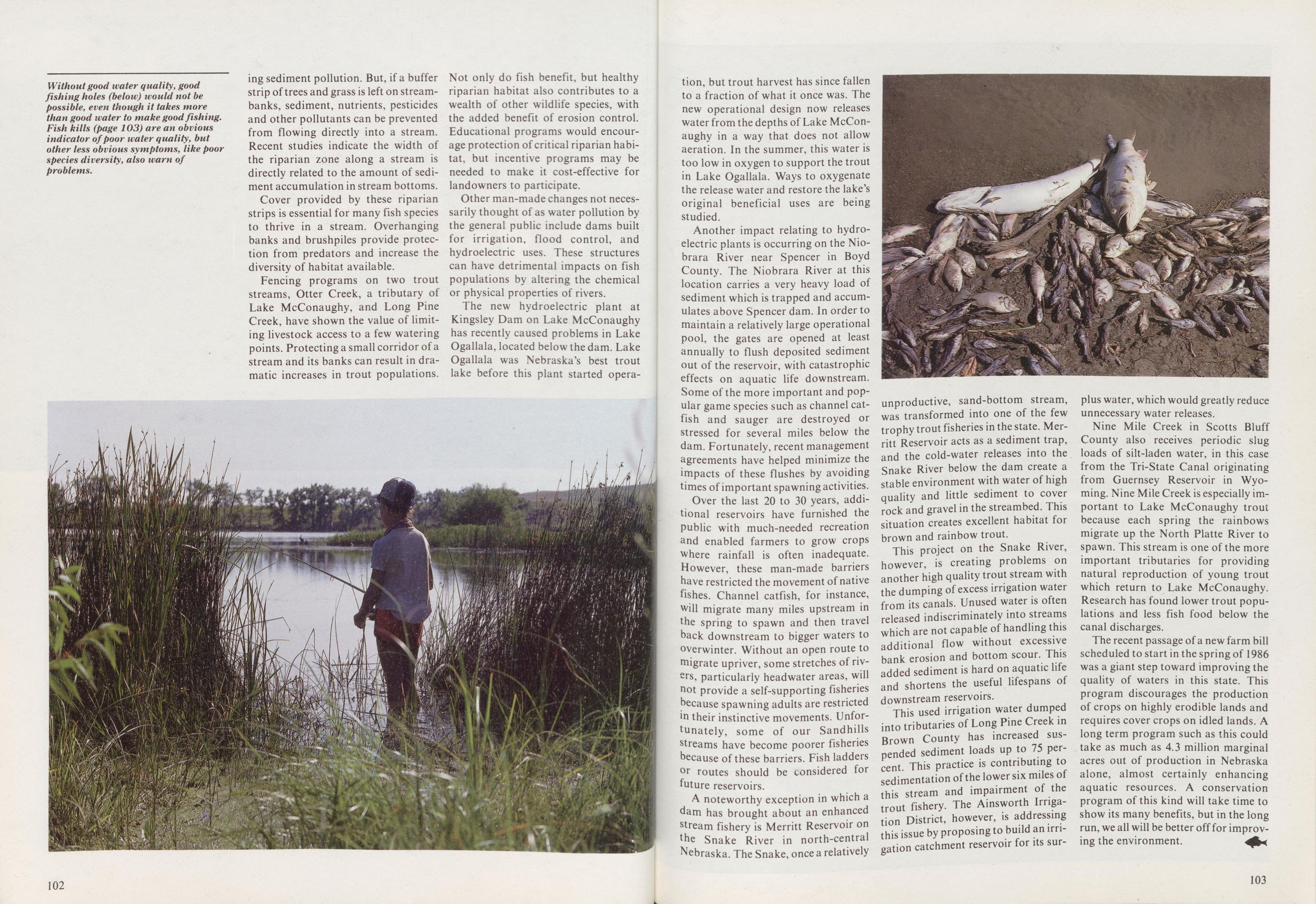 Without good water quality, good fishing holes (below) would not be possible, even though it takes more than good water to make good fishing. Fish kills (page 103) are an obvious indicator of poor water quality, but other less obvious symptoms, like poor species diversity, also warn of problems.
Cover provided by these riparian strips is essential for many fish species to thrive in a stream. Overhanging banks and brushpiles provide protection from predators and increase the diversity of habitat available.
Fencing programs on two trout streams, Otter Creek, a tributary of Lake McConaughy, and Long Pine Creek, have shown the value of limiting livestock access to a few watering points. Protecting a small corridor of a stream and its banks can result in dramatic increases in trout populations. Not only do fish benefit, but healthy riparian habitat also contributes to a wealth of other wildlife species, with the added benefit of erosion control. Educational programs would encourage protection of critical riparian habitat, but incentive programs may be needed to make it cost-effective for landowners to participate.
Other man-made changes not necessarily thought of as water pollution by the general public include dams built for irrigation, flood control, and hydroelectric uses. These structures can have detrimental impacts on fish populations by altering the chemical or physical properties of rivers.
The new hydroelectric plant at Kingsley Dam on Lake McConaughy has recently caused problems in Lake Ogallala, located below the dam. Lake Ogallala was Nebraska's best trout lake before this plant started operation, 102 but trout harvest has since fallen to a fraction of what it once was. The new operational design now releases water from the depths of Lake McConaughy in a way that does not allow aeration. In the summer, this water is too low in oxygen to support the trout in Lake Ogallala. Ways to oxygenate the release water and restore the lake's original beneficial uses are being studied.
Another impact relating to hydro-electric plants is occurring on the Niobrara River near Spencer in Boyd County. The Niobrara River at this location carries a very heavy load of sediment which is trapped and accumulates above Spencer dam. In order to maintain a relatively large operational pool, the gates are opened at least annually to flush deposited sediment out of the reservoir, with catastrophic effects on aquatic life downstream. Some of the more important and popular game species such as channel catfish and sauger are destroyed or stressed for several miles below the dam. Fortunately, recent management agreements have helped minimize the impacts of these flushes by avoiding times of important spawning activities.
Over the last 20 to 30 years, additional reservoirs have furnished the public with much-needed recreation and enabled farmers to grow crops where rainfall is often inadequate. However, these man-made barriers have restricted the movement of native fishes. Channel catfish, for instance, will migrate many miles upstream in the spring to spawn and then travel hack downstream to bigger waters to overwinter. Without an open route to migrate upriver, some stretches of rivers, particularly headwater areas, will not provide a self-supporting fisheries because spawning adults are restricted in their instinctive movements. Unfortunately, some of our Sandhills streams have become poorer fisheries because of these barriers. Fish ladders °r routes should be considered for future reservoirs.
A noteworthy exception in which a dam has brought about an enhanced stream fishery is Merritt Reservoir on the Snake River in north-central Nebraska. The Snake, once a relatively unproductive, sand-bottom stream, was transformed into one of the few trophy trout fisheries in the state. Merritt Reservoir acts as a sediment trap, and the cold-water releases into the Snake River below the dam create a stable environment with water of high quality and little sediment to cover rock and gravel in the streambed. This situation creates excellent habitat for brown and rainbow trout.
This project on the Snake River, however, is creating problems on another high quality trout stream with the dumping of excess irrigation water from its canals. Unused water is often released indiscriminately into streams which are not capable of handling this additional flow without excessive bank erosion and bottom scour. This added sediment is hard on aquatic life and shortens the useful lifespans of downstream reservoirs.
This used irrigation water dumped into tributaries of Long Pine Creek in Brown County has increased suspended sediment loads up to 75 percent. This practice is contributing to sedimentation of the lower six miles of this stream and impairment of the trout fishery. The Ainsworth Irrigation District, however, is addressing this issue by proposing to build an irrigation catchment reservoir for its surplus water, which would greatly reduce unnecessary water releases.
Nine Mile Creek in Scotts Bluff County also receives periodic slug loads of silt-laden water, in this case from the Tri-State Canal originating from Guernsey Reservoir in Wyoming. Nine Mile Creek is especially important to Lake McConaughy trout because each spring the rainbows migrate up the North Platte River to spawn. This stream is one of the more important tributaries for providing natural reproduction of young trout which return to Lake McConaughy. Research has found lower trout populations and less fish food below the canal discharges.
The recent passage of a new farm bill scheduled to start in the spring of 1986 was a giant step toward improving the quality of waters in this state. This program discourages the production of crops on highly erodible lands and requires cover crops on idled lands. A long term program such as this could take as much as 4.3 million marginal acres out of production in Nebraska alone, almost certainly enhancing aquatic resources. A conservation program of this kind will take time to show its many benefits, but in the long run, we all will be better off for improving the environment.
103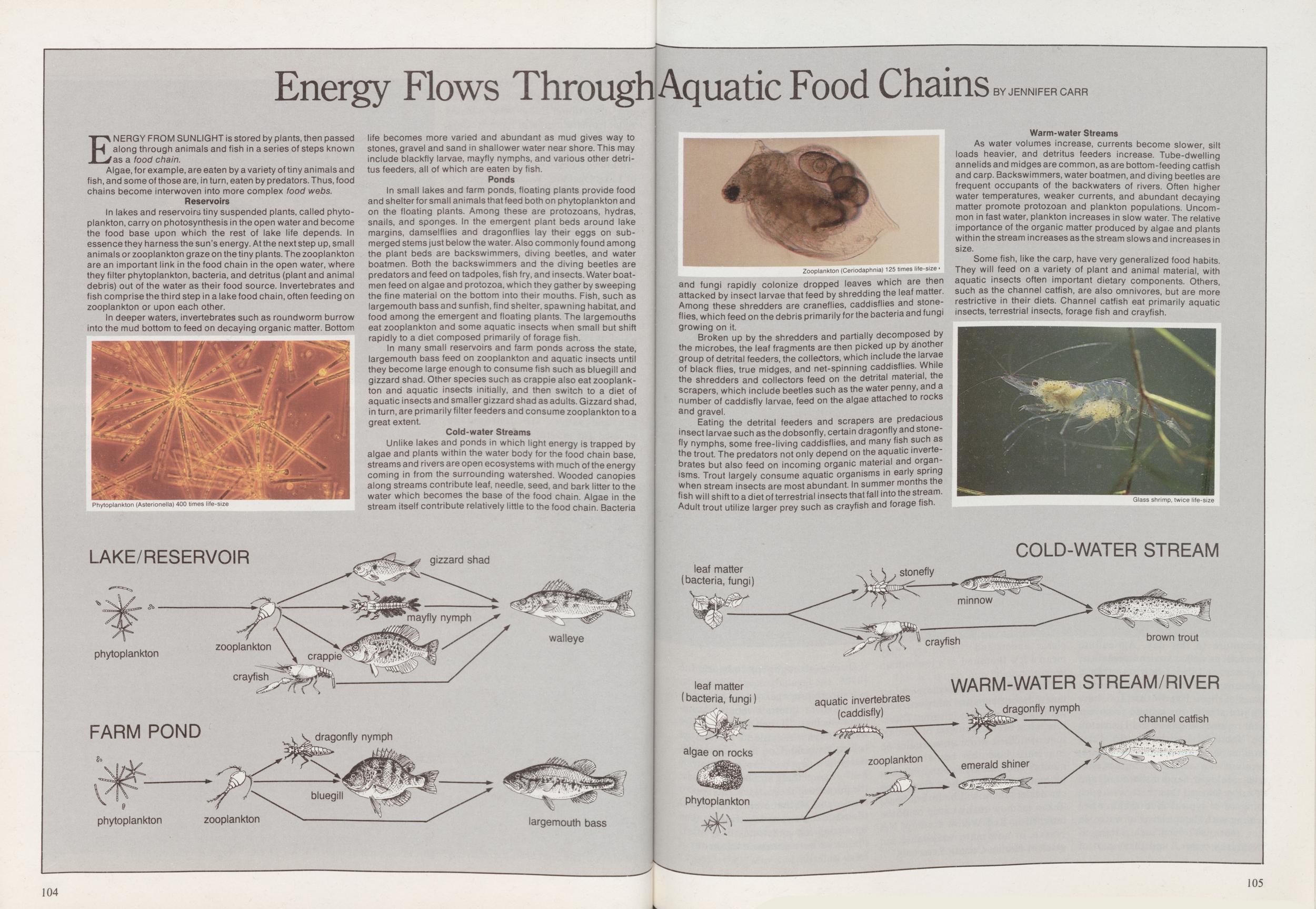
Energy Flows Through Aquatic Food Chains
BY JENNIFER CARRENERGY FROM SUNLIGHT is stored by plants, then passed along through animals and fish in a series of steps known as a food chain.
Algae, for example, are eaten by a variety of tiny animals and fish, and some of those are, in turn, eaten by predators. Thus, food chains become interwoven into more complex food webs.
ReservoirsIn lakes and reservoirs tiny suspended plants, called phytoplankton, carry on photosynthesis in the open water and become the food base upon which the rest of lake life depends. In essence they harness the sun's energy. At the next step up, small animals or zooplankton graze on the tiny plants. The zooplankton are an important link in the food chain in the open water, where they filter phytoplankton, bacteria, and detritus (plant and animal debris) out of the water as their food source. Invertebrates and fish comprise the third step in a lake food chain, often feeding on zooplankton or upon each other.
In deeper waters, invertebrates such as roundworm burrow into the mud bottom to feed on decaying organic matter. Bottom life becomes more varied and abundant as mud gives way to stones, gravel and sand in shallower water near shore. This may include blackfly larvae, mayfly nymphs, and various other detritus feeders, ail of which are eaten by fish.
PondsIn small lakes and farm ponds, floating plants provide food and shelter for small animals that feed both on phytoplankton and on the floating plants. Among these are protozoans, hydras, snails, and sponges. In the emergent plant beds around lake margins, damselflies and dragonflies lay their eggs on submerged stems just below the water. Also commonly found among the plant beds are backswimmers, diving beetles, and water boatmen. Both the backswimmers and the diving beetles are predators and feed on tadpoles, fish fry, and insects. Water boatmen feed on algae and protozoa, which they gather by sweeping the fine material on the bottom into their mouths. Fish, such as largemouth bass and sunfish, find shelter, spawning habitat, and food among the emergent and floating plants. The largemouths eat zooplankton and some aquatic insects when small but shift rapidly to a diet composed primarily of forage fish.
In many small reservoirs and farm ponds across the state, largemouth bass feed on zooplankton and aquatic insects until they become large enough to consume fish such as bluegill and gizzard shad. Other species such as crappie also eat zooplankton and aquatic insects initially, and then switch to a diet of aquatic insects and smaller gizzard shad as adults. Gizzard shad,in turn, are primarily filter feeders and consume zooplankton to a great extent.
Cold-water StreamsUnlike lakes and ponds in which light energy is trapped by algae and plants within the water body for the food chain base, streams and rivers are open ecosystems with much of the energy coming in from the surrounding watershed. Wooded canopies along streams contribute leaf, needle, seed, and bark litter to the water which becomes the base of the food chain. Algae in the stream itself contribute relatively little to the food chain. Bacteria 104 and fungi rapidly colonize dropped leaves which are then attacked by insect larvae that feed by shredding the leaf matter. Among these shredders are craneflies, caddisflies and stoneflies, which feed on the debris primarily for the bacteria and fungi growing on it.
Broken up by the shredders and partially decomposed by the microbes, the leaf fragments are then picked up by another group of detrital feeders, the collectors, which include the larvae of black flies, true midges, and net-spinning caddisflies. When the shredders and collectors feed on the detrital material, the scrapers, which include beetles such as the water penny, and a number of caddisfly larvae, feed on the algae attached to rocks and gravel.
Eating the detrital feeders and scrapers are predacious insect larvae such as the dobsonfly, certain dragonfly and stonefly nymphs, some free-living caddisflies, and many fish such as the trout. The predators not only depend on the aquatic invertebrates but also feed on incoming organic material and organisms. Trout largely consume aquatic organisms in early spring when stream insects are most abundant. In summer months the fish will shift to a diet of terrestrial insects that fall into the stream. Adult trout utilize larger prey such as crayfish and forage fish.
Warm-water StreamsAs water volumes increase, currents become slower, silt loads heavier, and detritus feeders increase. Tube-dwelling annelids and midges are common, as are bottom-feeding catfish and carp. Backswimmers, water boatmen, and diving beetles are frequent occupants of the backwaters of rivers. Often higher water temperatures, weaker currents, and abundant decaying matter promote protozoan and plankton populations. Uncommon in fast water, plankton increases in slow water. The relative importance of the organic matter produced by algae and plants within the stream increases as the stream slows and increases in size.
Some fish, like the carp, have very generalized food habits. They will feed on a variety of plant and animal material, with aquatic insects often important dietary components. Others, such as the channel catfish, are also omnivores, but are more restrictive in their diets. Channel catfish eat primarily aquatic insects, terrestrial insects, forage fish and crayfish.
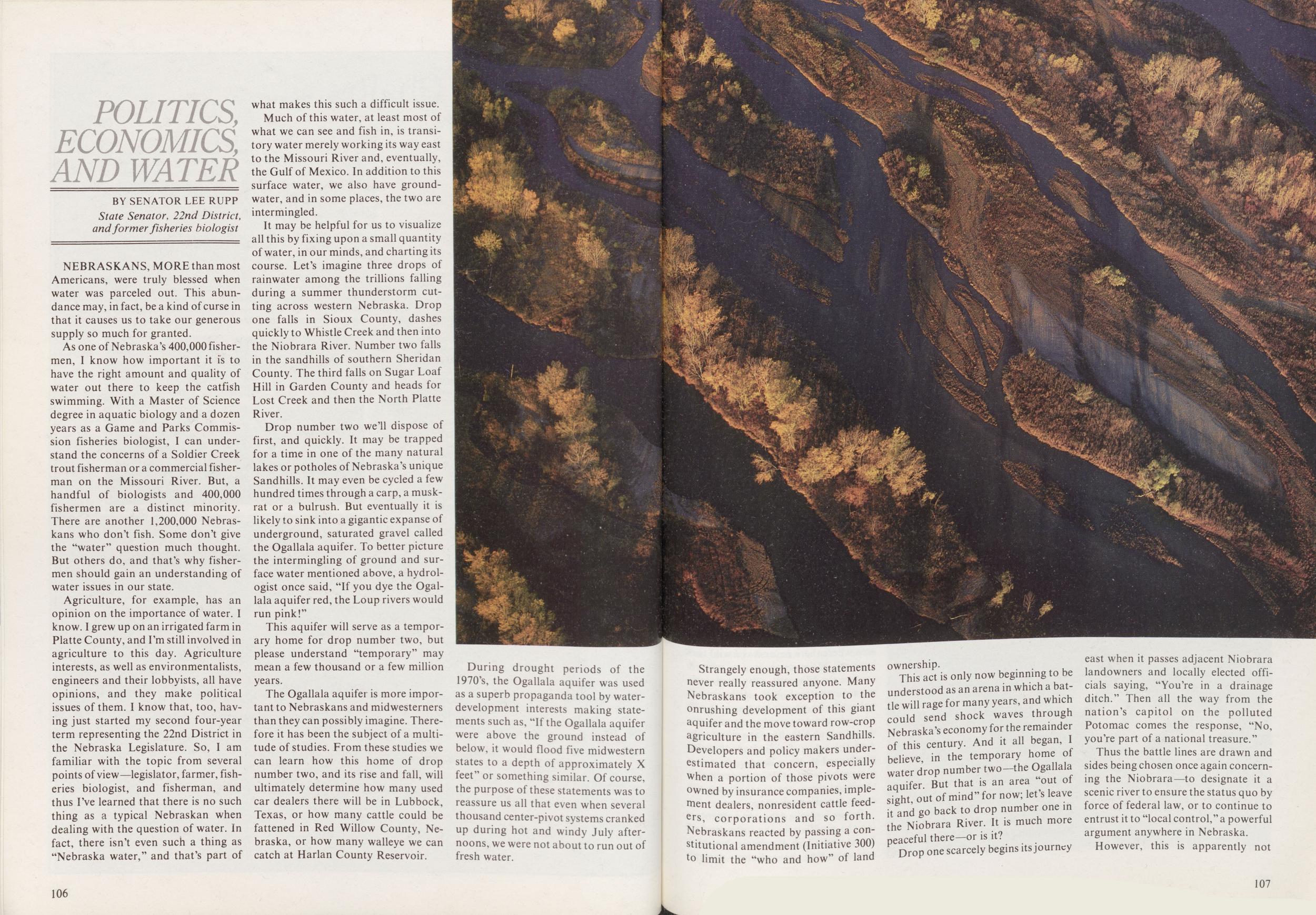
POLITICS, ECONOMICS, AND WATER
BY SENATOR LEE RUPP State Senator, 22nd District, and former fisheries biologistNEBRASKANS, MORE than most Americans, were truly blessed when water was parceled out. This abundance may, in fact, be a kind of curse in that it causes us to take our generous supply so much for granted.
As one of Nebraska's 400,000 fishermen, I know how important it is to have the right amount and quality of water out there to keep the catfish swimming. With a Master of Science degree in aquatic biology and a dozen years as a Game and Parks Commission fisheries biologist, I can understand the concerns of a Soldier Creek trout fisherman or a commercial fisherman on the Missouri River. But, a handful of biologists and 400,000 fishermen are a distinct minority. There are another 1,200,000 Nebraskans who don't fish. Some don't give the "water" question much thought. But others do, and that's why fishermen should gain an understanding of water issues in our state.
Agriculture, for example, has an opinion on the importance of water. I know. I grew up on an irrigated farm in Platte County, and I'm still involved in agriculture to this day. Agriculture interests, as well as environmentalists, engineers and their lobbyists, all have opinions, and they make political issues of them. I know that, too, having just started my second four-year term representing the 22nd District in the Nebraska Legislature. So, I am familiar with the topic from several points of view—legislator, farmer, fisheries biologist, and fisherman, and thus I've learned that there is no such thing as a typical Nebraskan when dealing with the question of water. In fact, there isn't even such a thing as Nebraska water," and that's part of what makes this such a difficult issue.
Much of this water, at least most of what we can see and fish in, is transitory water merely working its way east to the Missouri River and, eventually, the Gulf of Mexico. In addition to this surface water, we also have groundwater, and in some places, the two are intermingled.
It may be helpful for us to visualize all this by fixing upon a small quantity of water, in our minds, and charting its course. Let's imagine three drops of rainwater among the trillions falling during a summer thunderstorm cutting across western Nebraska. Drop one falls in Sioux County, dashes quickly to Whistle Creek and then into the Niobrara River. Number two falls in the sandhills of southern Sheridan County. The third falls on Sugar Loaf Hill in Garden County and heads for Lost Creek and then the North Platte River.
Drop number two we'll dispose of first, and quickly. It may be trapped for a time in one of the many natural lakes or potholes of Nebraska's unique Sandhills. It may even be cycled a few hundred times through a carp, a muskrat or a bulrush. But eventually it is likely to sink into a gigantic expanse of underground, saturated gravel called the Ogallala aquifer. To better picture the intermingling of ground and surface water mentioned above, a hydrologist once said, "If you dye the Ogallala aquifer red, the Loup rivers would run pink!"
This aquifer will serve as a temporary home for drop number two, but please understand "temporary" may mean a few thousand or a few million years.
The Ogallala aquifer is more important to Nebraskans and midwesterners than they can possibly imagine. Therefore it has been the subject of a multi- tude of studies. From these studies we can learn how this home of drop number two, and its rise and fall, will ultimately determine how many used car dealers there will be in Lubbock, Texas, or how many cattle could be fattened in Red Willow County, Nebraska, or how many walleye we can catch at Harlan County Reservoir.
During drought periods of the 1970's, the Ogallala aquifer was used as a superb propaganda tool by water development interests making statements such as, "If the Ogallala aquifer were above the ground instead of below, it would flood five midwestern states to a depth of approximately X feet" or something similar. Of course, the purpose of these statements was to reassure us all that even when several thousand center-pivot systems cranked up during hot and windy July afternoons, we were not about to run out of fresh water.
106Strangely enough, those statements never really reassured anyone. Many Nebraskans took exception to the onrushing development of this giant aquifer and the move toward row-crop agriculture in the eastern Sandhills. Developers and policy makers underestimated that concern, especially when a portion of those pivots were owned by insurance companies, implement dealers, nonresident cattle feeders, corporations and so forth. Nebraskans reacted by passing a constitutional amendment (Initiative 300) to limit the "who and how" of land ownership.
This act is only now beginning to be understood as an arena in which a battle will rage for many years, and which could send shock waves through Nebraska's economy for the remainder of this century. And it all began, I believe, in the temporary home of water drop number two—the Ogallala aquifer. But that is an area "out of sight, out of mind" for now; let's leave it and go back to drop number one in the Niobrara River. It is much more peaceful there—or is it?
Drop one scarcely begins its journey east when it passes adjacent Niobrara landowners and locally elected officials saying, "You're in a drainage ditch." Then all the way from the nation's capitol on the polluted Potomac comes the response, "No, you're part of a national treasure."
Thus the battle lines are drawn and sides being chosen once again concerning the Niobrara—to designate it a scenic river to ensure the status quo by force of federal law, or to continue to entrust it to "local control," a powerful argument anywhere in Nebraska.
However, this is apparently not really a new fight, only round two of a battle of many years to decide whether drop one should be allowed to travel east unimpeded—or pause for a few years somewhere southwest of a ghost town called Norden. There it would have nurtured some walleye and perch, floated some bass boats, then watered a corn plant before being allowed to head for the Missouri River. But the decision makers decided the expense was greater than the need. So drop one will be allowed to proceed on its journey without pause. Despite the ferocity and level of rhetoric in the arguments over the fate of drop one in the Niobrara, no one alive today, perhaps ever, will be able to say with any certainty who was right and who was wrong.
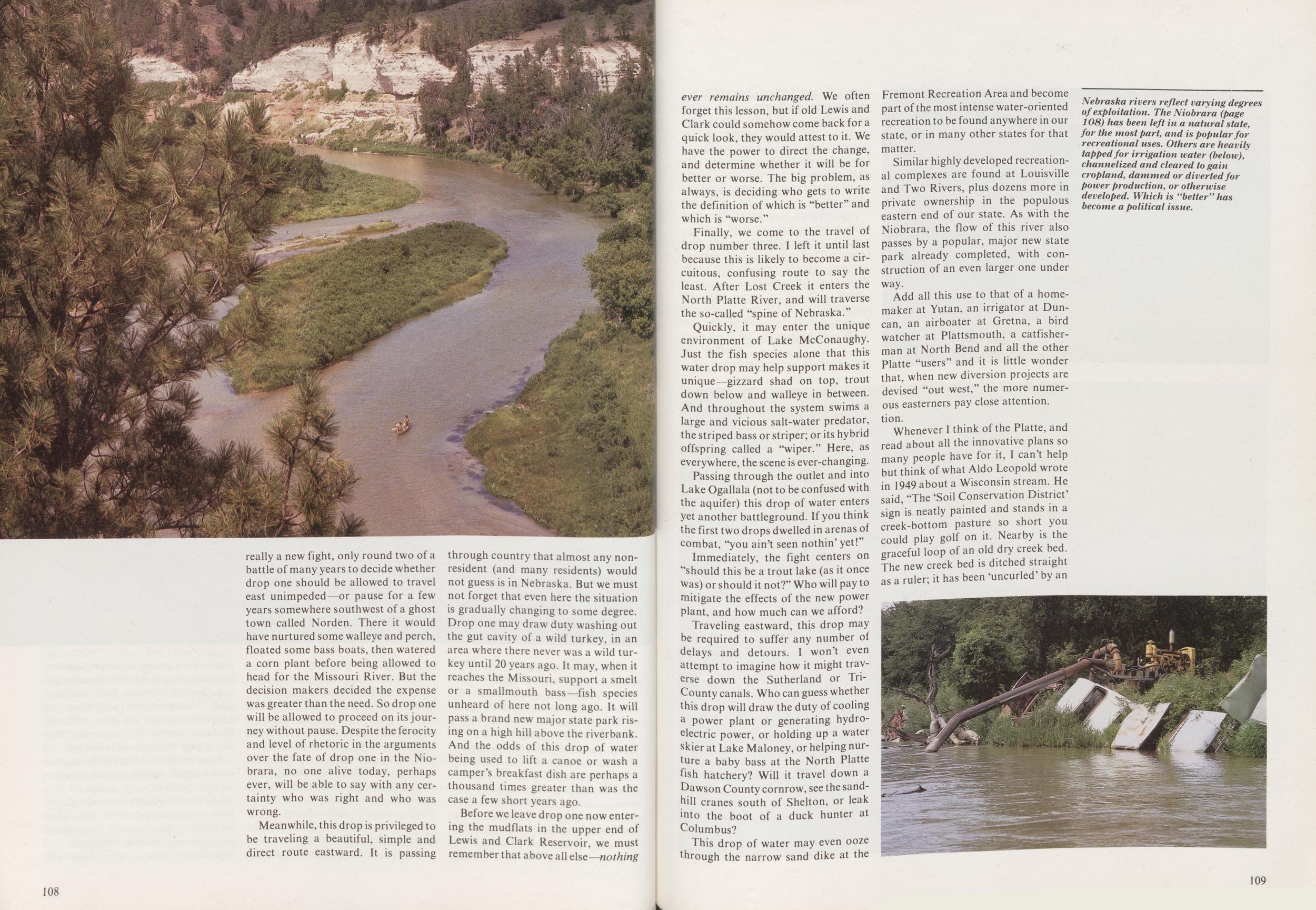
Meanwhile, this drop is privileged to be traveling a beautiful, simple and direct route eastward. It is passing through country that almost any nonresident (and many residents) would not guess is in Nebraska. But we must not forget that even here the situation is gradually changing to some degree. Drop one may draw duty washing out the gut cavity of a wild turkey, in an area where there never was a wild turkey until 20 years ago. It may, when it reaches the Missouri, support a smelt or a smallmouth bass—fish species unheard of here not long ago. It will pass a brand new major state park rising on a high hill above the riverbank. And the odds of this drop of water being used to lift a canoe or wash a camper's breakfast dish are perhaps a thousand times greater than was the case a few short years ago.
Before we leave drop one now entering the mudflats in the upper end of Lewis and Clark Reservoir, we must remember that above all eke—nothing ever remains unchanged. We often forget this lesson, but if old Lewis and Clark could somehow come back for a quick look, they would attest to it. We have the power to direct the change, and determine whether it will be for better or worse. The big problem, as always, is deciding who gets to write the definition of which is "better" and which is "worse."
Finally, we come to the travel of drop number three. I left it until last because this is likely to become a circuitous, confusing route to say the least. After Lost Creek it enters the North Platte River, and will traverse the so-called "spine of Nebraska."
Quickly, it may enter the unique environment of Lake McConaughy. Just the fish species alone that this water drop may help support makes it unique—gizzard shad on top, trout down below and walleye in between. And throughout the system swims a large and vicious salt-water predator, the striped bass or striper; or its hybrid offspring called a "wiper." Here, as everywhere, the scene is ever-changing.
Passing through the outlet and into Lake Ogallala (not to be confused with the aquifer) this drop of water enters yet another battleground. If you think the first two drops dwelled in arenas of combat, "you ain't seen nothin' yet!"
Immediately, the fight centers on "should this be a trout lake (as it once was) or should it not?" Who will pay to mitigate the effects of the new power plant, and how much can we afford?
Traveling eastward, this drop may be required to suffer any number of delays and detours. I won't even attempt to imagine how it might traverse down the Sutherland or Tri-County canals. Who can guess whether this drop will draw the duty of cooling a power plant or generating hydro-electric power, or holding up a water skier at Lake Maloney, or helping nurture a baby bass at the North Platte fish hatchery? Will it travel down a Dawson County cornrow, see the sandhill cranes south of Shelton, or leak into the boot of a duck hunter at Columbus?
This drop of water may even ooze through the narrow sand dike at the Fremont Recreation Area and become part of the most intense water-oriented recreation to be found anywhere in our state, or in many other states for that matter.
Similar highly developed recreational complexes are found at Louisville and Two Rivers, plus dozens more in private ownership in the populous eastern end of our state. As with the Niobrara, the flow of this river also passes by a popular, major new state park already completed, with construction of an even larger one under way.
Add all this use to that of a homemaker at Yutan, an irrigator at Duncan, an air boater at Gretna, a bird watcher at Plattsmouth, a catfisherman at North Bend and all the other Platte "users" and it is little wonder that, when new diversion projects are devised "out west," the more numerous easterners pay close attention.
Whenever I think of the Platte, and read about all the innovative plans so many people have for it, I can't help but think of what Aldo Leopold wrote in 1949 about a Wisconsin stream. He said, "The 'Soil Conservation District' sign' is neatly painted and stands in a creek-bottom pasture so short you could play golf on it. Nearby is the graceful loop of an old dry creek bed. The new creek bed is ditched straight as a ruler; it has been 'uncurled' by an engineer to hurry the run-off. On the hill in the background are contoured strip-crops; they have been 'curled' by a different engineer to slow the run-off. Surely the water must be confused by so much advice."
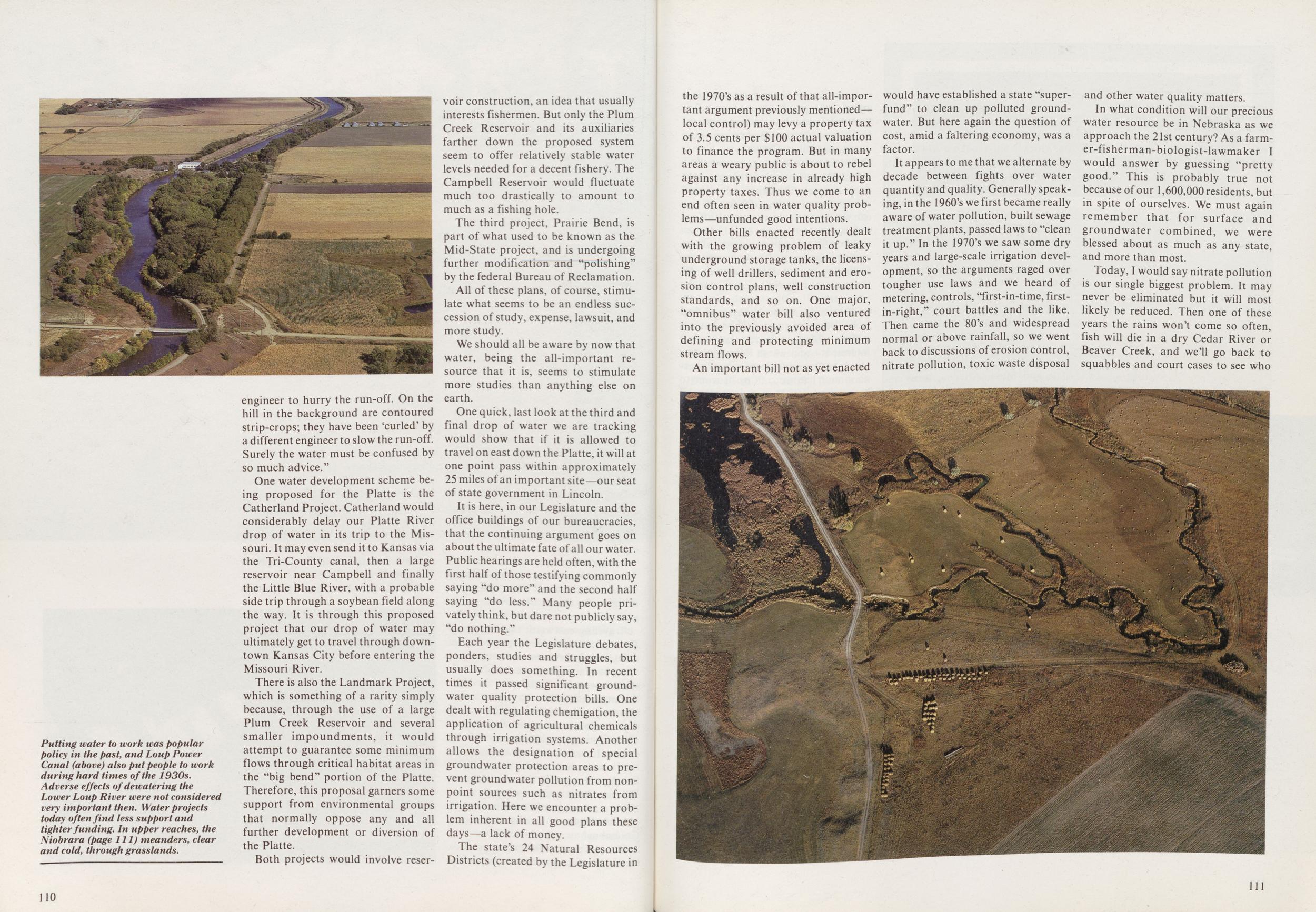
One water development scheme being proposed for the Platte is the Catherland Project. Catherland would considerably delay our Platte River drop of water in its trip to the Missouri. It may even send it to Kansas via the Tri-County canal, then a large reservoir near Campbell and finally the Little Blue River, with a probable side trip through a soybean field along the way. It is through this proposed project that our drop of water may ultimately get to travel through downtown Kansas City before entering the Missouri River.
There is also the Landmark Project, which is something of a rarity simply because, through the use of a large Plum Creek Reservoir and several smaller impoundments, it would attempt to guarantee some minimum flows through critical habitat areas in the "big bend" portion of the Platte. Therefore, this proposal garners some support from environmental groups that normally oppose any and all further development or diversion of the Platte.
Both projects would involve reservoir construction, an idea that usually interests fishermen. But only the Plum Creek Reservoir and its auxiliaries farther down the proposed system seem to offer relatively stable water levels needed for a decent fishery. The Campbell Reservoir would fluctuate much too drastically to amount to much as a fishing hole.
The third project, Prairie Bend, is part of what used to be known as the Mid-State project, and is undergoing further modification and "polishing" by the federal Bureau of Reclamation.
All of these plans, of course, stimulate what seems to be an endless succession of study, expense, lawsuit, and more study.
We should all be aware by now that water, being the all-important resource that it is, seems to stimulate more studies than anything else on earth.
One quick, last look at the third and final drop of water we are tracking would show that if it is allowed to travel on east down the Platte, it will at one point pass within approximately 25 miles of an important site—our seat of state government in Lincoln.
It is here, in our Legislature and the office buildings of our bureaucracies, that the continuing argument goes on about the ultimate fate of all our water. Public hearings are held often, with the first half of those testifying commonly saying "do more" and the second half saying "do less." Many people privately think, but dare not publicly say, "do nothing."
Each year the Legislature debates, ponders, studies and struggles, but usually does something. In recent times it passed significant groundwater quality protection bills. One dealt with regulating chemigation, the application of agricultural chemicals through irrigation systems. Another allows the designation of special groundwater protection areas to prevent groundwater pollution from nonpoint sources such as nitrates from irrigation. Here we encounter a problem inherent in all good plans these days—a lack of money.
The state's 24 Natural Resources Districts (created by the Legislature in 110 the 1970's as a result of that all-important argument previously mentioned local control) may levy a property tax of 3.5 cents per $100 actual valuation to finance the program. But in many areas a weary public is about to rebel against any increase in already high property taxes. Thus we come to an end often seen in water quality problems—unfunded good intentions.
Other bills enacted recently dealt with the growing problem of leaky underground storage tanks, the licensing of well drillers, sediment and erosion control plans, well construction standards, and so on. One major, "omnibus" water bill also ventured into the previously avoided area of defining and protecting minimum stream flows.
An important bill not as yet enacted would have established a state "superfund" to clean up polluted groundwater. But here again the question of cost, amid a faltering economy, was a factor.
It appears to me that we alternate by decade between fights over water quantity and quality. Generally speaking, in the 1960's we first became really aware of water pollution, built sewage treatment plants, passed laws to "clean it up." In the 1970's we saw some dry years and large-scale irrigation development, so the arguments raged over tougher use laws and we heard of metering, controls, "first-in-time, first-in-right," court battles and the like. Then came the 80's and widespread normal or above rainfall, so we went back to discussions of erosion control, nitrate pollution, toxic waste disposal and other water quality matters.
In what condition will our precious water resource be in Nebraska as we approach the 21st century? As a farmer-fisherman-biologist-lawmaker I would answer by guessing "pretty good." This is probably true not because of our 1,600,000 residents, but in spite of ourselves. We must again remember that for surface and groundwater combined, we were blessed about as much as any state, and more than most.
Today, I would say nitrate pollution is our single biggest problem. It may never be eliminated but it will most likely be reduced. Then one of these years the rains won't come so often, fish will die in a dry Cedar River or Beaver Creek, and we'll go back to squabbles and court cases to see who gets what water's left.
111
I would further say that at this point in Nebraska's unfolding history, the most important water policy decision our citizens must make is whether we should sell some of our water. It may take half a generation of public discussion and debate before we are ready to decide, but we cannot afford to simply reject it out of hand. We must consider the incredible estimate of scientists that it takes from 3,000 to 10,000 gallons of water, from all sources, to produce one bushel of corn. We must then consider the worth of that water in a market like Phoenix, and compare that to the value of the bushel of corn at the nearest grain elevator.
A recent article describing water shortages in the western and southwestern states, specifically the Scottsdale and Mesa, Arizona, areas and Reno and Sparks, Nevada, discussed water prices. It said "growing demand and shrinking supply spell big money for water rights. An acre-foot that sold for $50 to $100 a decade ago now commands about $2,500."
Consider the fact that one acre-foot (326,000 gallons) would produce approximately 50 bushels of corn, having a value of perhaps $100, and you can see this is a subject we can't afford to ignore.
After listening to hundreds of the endless arguments, I would make the following general statements. Of themselves, they will generate more arguments.
We should all be honest and "up front" by starting each water debate by telling what our particular vested interest is—and we all have one. For example, "I am a dedicated trout fisherman, and I think...," or "I want to keep my job with the irrigation district 112 and it's my opinion that___"
Extreme points of view only polarize the opponents and disrupt the inevitable process of compromise, and we should do our best to discount them. Then we can get on with trying to referee disputes between more rational people.
I believe most water-use practices are ultimately not determined by imperfect laws but by economics, that giant, invisible engine that dictates all our actions whether we admit it or not. For example, many (myself included) were calling for tough laws to slow irrigation development 10 years ago. Isn't it incredible how a glut of feed grains, and $ 1.50 corn, brought it all to a skidding, screeching halt? Another example we've seen is the amount of care exercised by farmers applying nitrogen costing 30 cents per pound, as opposed to the same fertilizer that cost a nickel a pound two decades ago. Unfortunately, the lag-time is such that we are just now seeing the problems in some areas that were caused by the cheap chemicals of 20 years ago.
Above all else, we must temper our water arguments by listening carefully and intently to "the other guy," if he is reasonable. We must remind ourselves that no one is right all the time, just as no one is always wrong. To the really difficult problems, there are usually never complete solutions. We just make ongoing efforts to keep the problems manageable, and the answers are seldom found in either fringe of the extreme points-of-view, but somewhere in the middle.
I have no doubt that 50 or 100 years from now, Nebraskans will be drinking, canoeing and skiing on, irrigating with, fishing in, and generally enjoying their abundant supply of water. And then our three little drops may have found their way back to the Pacific, been evaporated into the clouds, drifted across the Rockies, reached Western Nebraska with a cold front, fallen during a rip-roaring thunderstorm and will be starting the same journeys all over again. By then a new generation of Nebraskans will be struggling, trying to do what's right to manage their water.
MOST FISHERMEN care more about catching fish than about funding state fisheries programs. But tight budgets and high demands on the fishery resources mean squeezing more and more out of the fisherman's dollars, and since more dollars will undoubtedly be asked of them, they have a right to know what happens to their money.
There are two basic sources of income for Nebraska fisheries programs: license fees and federal aid. By far the bulk of license fee money comes from resident and non-resident fishing permits; secondary amounts come from trout stamps, commercial fishing permits, bait vendor permits, and private fish culture permits. These sales generate a total of some 2.6 million dollars per year.
The second major source, federal aid, is collected as a tax on fishing equipment, including boats, motors, depth finders, rods, reels, line and lures. Enacted in 1950, the law levying this excise tax was called the Dingell-Johnson Act, named for its sponsoring senators. Expanded in 1984 as the Wallop-Broeaux Act to include items not taxed under the old law, the combined yearly total available to Nebraska is about $1.5 million.
A third potential source of income, but up to the present very little utilized, is donations from private sources. Groups such as the Fish America Foundation, and the BASS Federation are currently sponsoring, or have expressed interest in sponsoring special projects, and in the future contributions from such organizations may become as important a source of funds for fishery development as those provided to waterfowl by groups such as Ducks Unlimited,
Expenditures by the Game and Parks Commission's Fisheries Division can be broken down into five areas: management, production, research, administration, and the Ak-Sar-Ben Aquarium.
Management accounts for about 35% of the division budget, supporting biologists in the Commission's five district offices. Theirs is the primary responsibility of assessing the state's waters to determine action necessary to preserve, or create the best possible sport fishing opportunities. Management programs include stocking, habitat improvement, access improvement, regulation changes, and so forth.
Fish production is carried out in five hatcheries, and the hatching and raising of fish accounts for about 37% of the fisheries budget. A wide variety of fish, both warm and cold water varieties, are raised at the five facilities, and although it is an expensive activity the stocking which is facilitated by the hatchery system is considered by many to be the most important single fishery management tool available.
Fisheries research teams located at Lincoln, Ogallala, and Norfolk, concentrate their activities on the Salt Valley reservoirs, Lake McConaughy, and the Missouri River respectively Their mission is to increase the division's understanding of the workings of these complex ecological systems, and the results of their research are applied to increasing the productivity of the lakes and the river, and improving the efficiency of future management programs. Their work is supported almost exclusively by federal aid and accounts for about 19% of the budget.
The remaining 9% of the budget is spent on administration. The aquarium operates out of a separate account.
Thus all the money supporting fishing in Nebraska is money paid by fishermen themselves Even the federal aid, though derived from tax dollars, comes from excise taxes and thus is paid by the angler. No general fund state tax money supports division programs except that used by the Ak-Sar-Ben Aquarium located at qrahramm State Recreation Area near Gretna, a facility operated for the public at large, not ordinarily for sport fishermen. Perhaps as much as any segment of society, Nebraska fishermen pay their own way, but future rising costs and anticipated increasing demands on the resources may well mean that more will eventually be asked of them.
113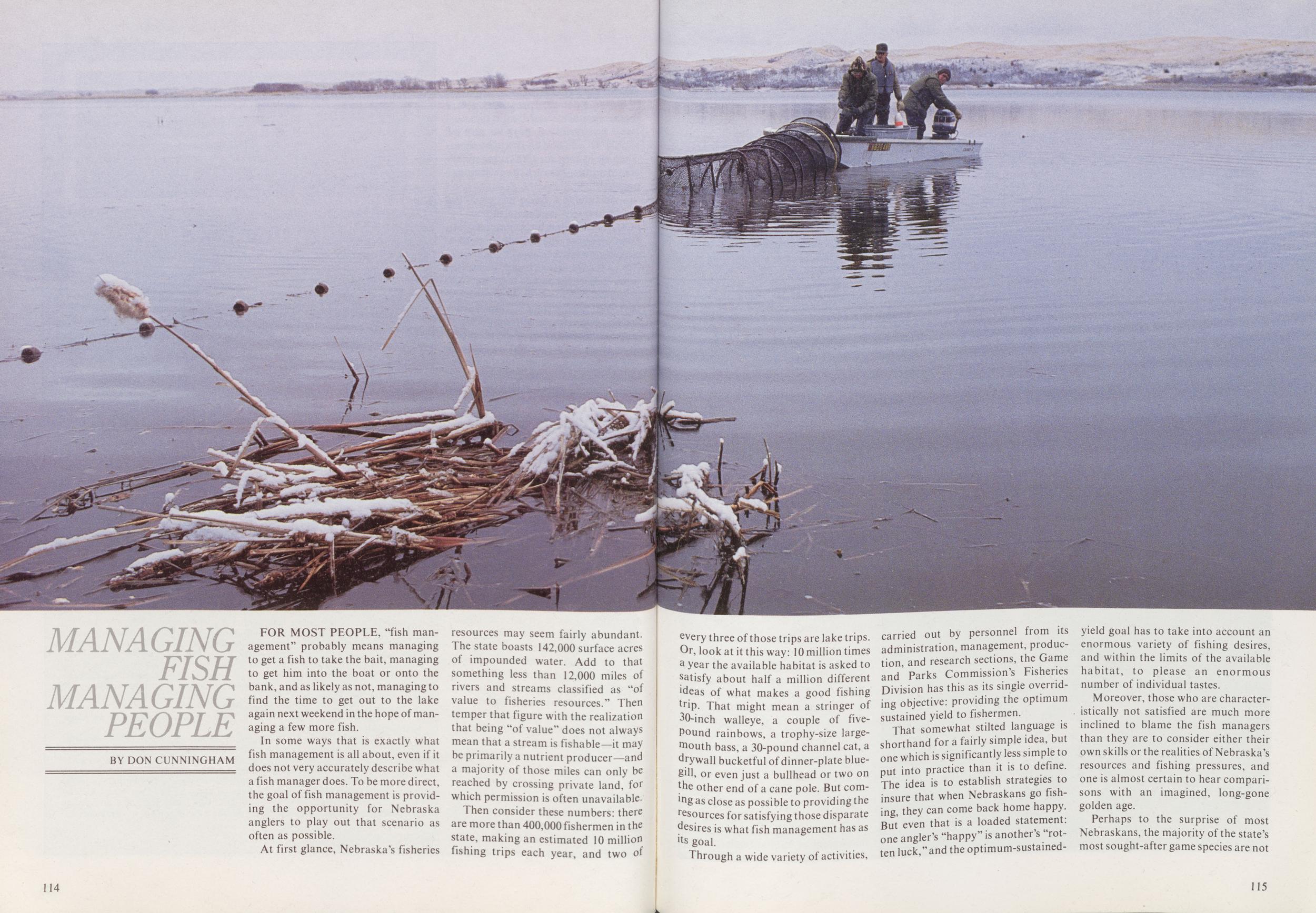
MANAGING FISH MANAGING PEOPLE
BY DON CUNNINGHAMFOR MOST PEOPLE, "fish management" probably means managing to get a fish to take the bait, managing to get him into the boat or onto the bank, and as likely as not, managing to find the time to get out to the lake again next weekend in the hope of managing a few more fish.
In some ways that is exactly what fish management is all about, even if it does not very accurately describe what a fish manager does. To be more direct, the goal offish management is providing the opportunity for Nebraska anglers to play out that scenario as often as possible.
At first glance, Nebraska's fisheries resources may seem fairly abundant. The state boasts 142,000 surface acres of impounded water. Add to that something less than 12,000 miles of rivers and streams classified as "of value to fisheries resources." Then temper that figure with the realization that being "of value" does not always mean that a stream is fishable—it may be primarily a nutrient producer—and a majority of those miles can only be reached by crossing private land, for which permission is often unavailable.
Then consider these numbers: there are more than 400,000 fishermen in the state, making an estimated 10 million fishing trips each year, and two of 114 every three of those trips are lake trips. Or, look at it this way: 10 million times a year the available habitat is asked to satisfy about half a million different ideas of what makes a good fishing trip. That might mean a stringer of 30-inch walleye, a couple of five-Pound rainbows, a trophy-size largettiouth bass, a 30-pound channel cat, a drywall bucketful of dinner-plate bluegill, or even just a bullhead or two on the other end of a cane pole. But coming as close as possible to providing the resources for satisfying those disparate desires is what fish management has as l*s goal.
Through a wide variety of activities, carried out by personnel from its administration, management, production, and research sections, the Game and' Parks Commission's Fisheries Division has this as its single overriding objective: providing the optimum sustained yield to fishermen.
That somewhat stilted language is shorthand for a fairly simple idea, but one which is significantly less simple to put into practice than it is to define. The idea is to establish strategies to insure that when Nebraskans go fishing, they can come back home happy. But even that is a loaded statement: one angler's "happy" is another's "rotten luck,"and the optimum-sustained- yield goal has to take into account an enormous variety of fishing desires, and within the limits of the available habitat, to please an enormous number of individual tastes.
Moreover, those who are characteristically not satisfied are much more inclined to blame the fish managers than they are to consider either their own skills or the realities of Nebraska's resources and fishing pressures, and one is almost certain to hear comparisons with an imagined, long-gone golden age.
Perhaps to the surprise of most Nebraskans, the majority of the state's most sought-after game species are not native fish, but have been introduced into Nebraska's waters as quarry for the angler. Moreover, even if these species had been native, that designation would be essentially irrelevant, since the state's water is so radically changed from what it was before the days of flood-control and irrigation impoundments and intensive agriculture, which affect not only stream flows, but also water quality. And, the recreation demands of half a million fishermen add another component which makes comparisons with anybody's version of "the good old days" meaningless.
115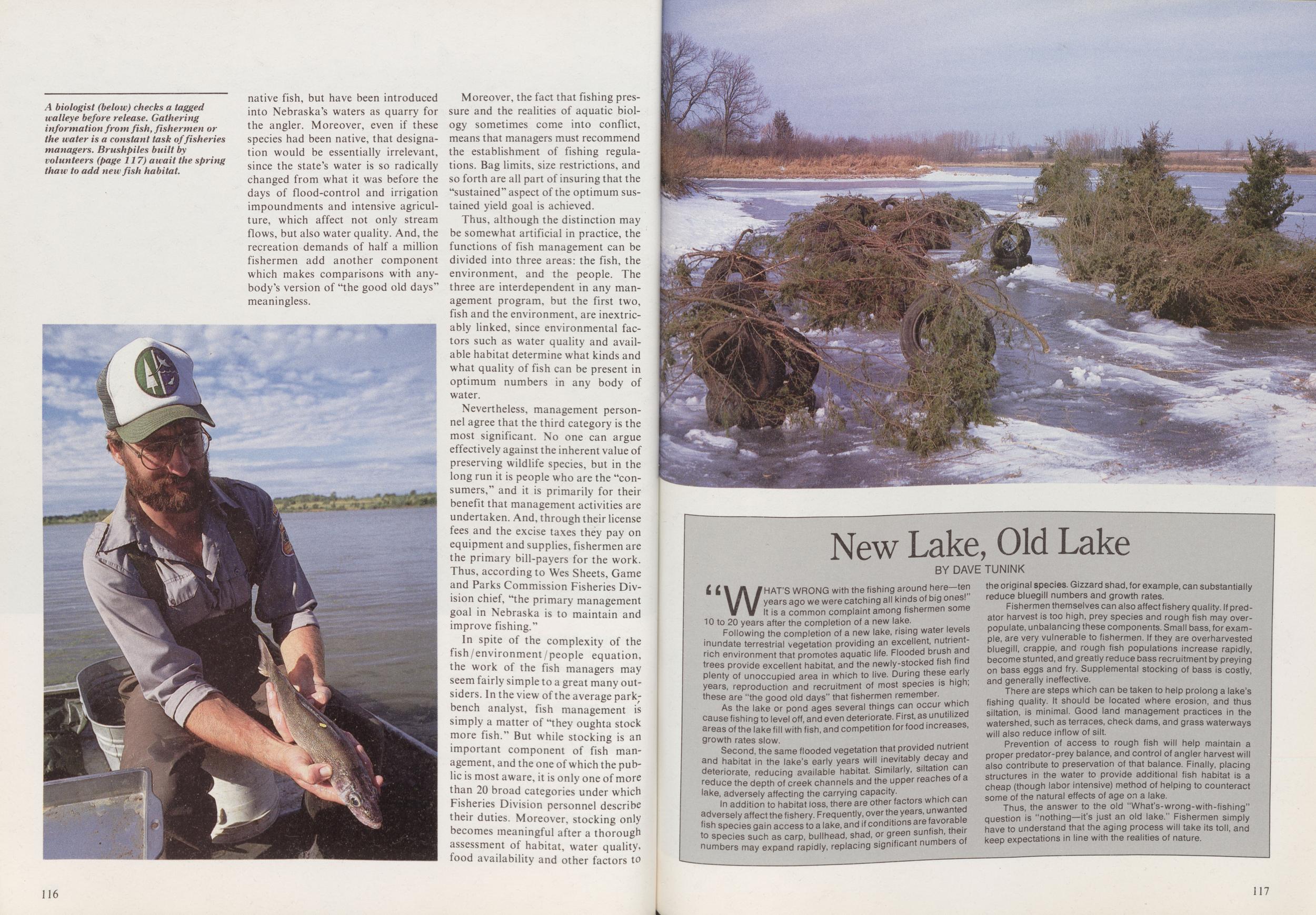 A biologist (below) checks a tagged walleye before release. Gathering information from fish, fishermen or the water is a constant task of fisheries managers. Brushpiles built by volunteers (page 117) await the spring thaw to add new fish habitat.
Moreover, the fact that fishing pressure and the realities of aquatic biology sometimes come into conflict, means that managers must recommend the establishment of fishing regulations. Bag limits, size restrictions, and so forth are all part of insuring that the "sustained" aspect of the optimum sustained yield goal is achieved.
Thus, although the distinction may be somewhat artificial in practice, the functions of fish management can be divided into three areas: the fish, the environment, and the people. The three are interdependent in any management program, but the first two, fish and the environment, are inextricably linked, since environmental factors such as water quality and available habitat determine what kinds and what quality of fish can be present in optimum numbers in any body of water.
Nevertheless, management personnel agree that the third category is the most significant. No one can argue effectively against the inherent value of preserving wildlife species, but in the long run it is people who are the "consumers," and it is primarily for their benefit that management activities are undertaken. And, through their license fees and the excise taxes they pay on equipment and supplies, fishermen are the primary bill-payers for the work. Thus, according to Wes Sheets, Game and Parks Commission Fisheries Division chief, "the primary management goal in Nebraska is to maintain and improve fishing."
In spite of the complexity of the fish/environment/people equation, the work of the fish managers may seem fairly simple to a great many outsiders. In the view of the average park bench analyst, fish management is simply a matter of "they ought a stock more fish." But while stocking is an important component of fish management, and the one of which the public is most aware, it is only one of more than 20 broad categories under which Fisheries Division personnel describe their duties. Moreover, stocking only becomes meaningful after a thorough assessment of habitat, water quality, food availability and other factors to insure that a body of water can actually support the desired population.
116WHAT'S WRONG with the fishing around here—ten years ago we were catching ail kinds of big ones! It is a common complaint among fishermen some 10 to 20 years after the completion of a new lake.
Following the completion of a new lake, rising water levels inundate terrestrial vegetation providing an excellent, nutrient rich environment that promotes aquatic life. Flooded brush and trees provide excellent habitat, and the newly-stocked fish find plenty of unoccupied area in which to live. During these early years, reproduction and recruitment of most species is high; these are "the good old days" that fishermen remember.
As the lake or pond ages several things can occur which cause fishing to level off, and even deteriorate. First, as unutilized areas of the lake fill with fish, and competition for food increases, growth rates slow.
Second, the same flooded vegetation that provided nutrient and habitat in the lake's early years will inevitably decay and deteriorate, reducing available habitat. Similarly, siltation can reduce the depth of creek channels and the upper reaches or a lake, adversely affecting the carrying capacity.
In addition to habitat loss, there are other factors which can adversely affect the fishery. Frequently, over the years, unwanted fish species gain access to a lake, and if conditions are few to species such as carp, bullhead, shad, or green sunfish numbers may expand rapidly, replacing significant numbers or the original species. Gizzard shad, for example, can substantially reduce bluegill numbers and growth rates.
Fishermen themselves can also affect fishery quality. If predator harvest is too high, prey species and rough fish may over-populate, unbalancing these components. Small bass, for example, are very vulnerable to fishermen, if they are over harvested bluegill, crappie, and rough fish populations increase rapidly, become stunted, and greatly reduce bass recruitment by preying on bass eggs and fry. Supplemental stocking of bass is costly, and generally ineffective.
There are steps which can be taken to help prolong a lake's fishing quality. It should be located where erosion, and thus siltation, is minimal. Good land management practices in the watershed, such as terraces, check dams, and grass waterways will also reduce inflow of silt.
Prevention of access to rough fish will help maintain a proper predator-prey balance, and control of angler harvest will also contribute to preservation of that balance. Finally, placing structures in the water to provide additional fish habitat is a cheap (though labor intensive) method of helping to counteract some of the natural effects of age on a lake.
Thus, the answer to the old "What's-wrong-with-fishing" question is "nothing—it's just an old lake." Fishermen simply have to understand that the aging process will take its toll, and keep expectations in line with the realities of nature.
117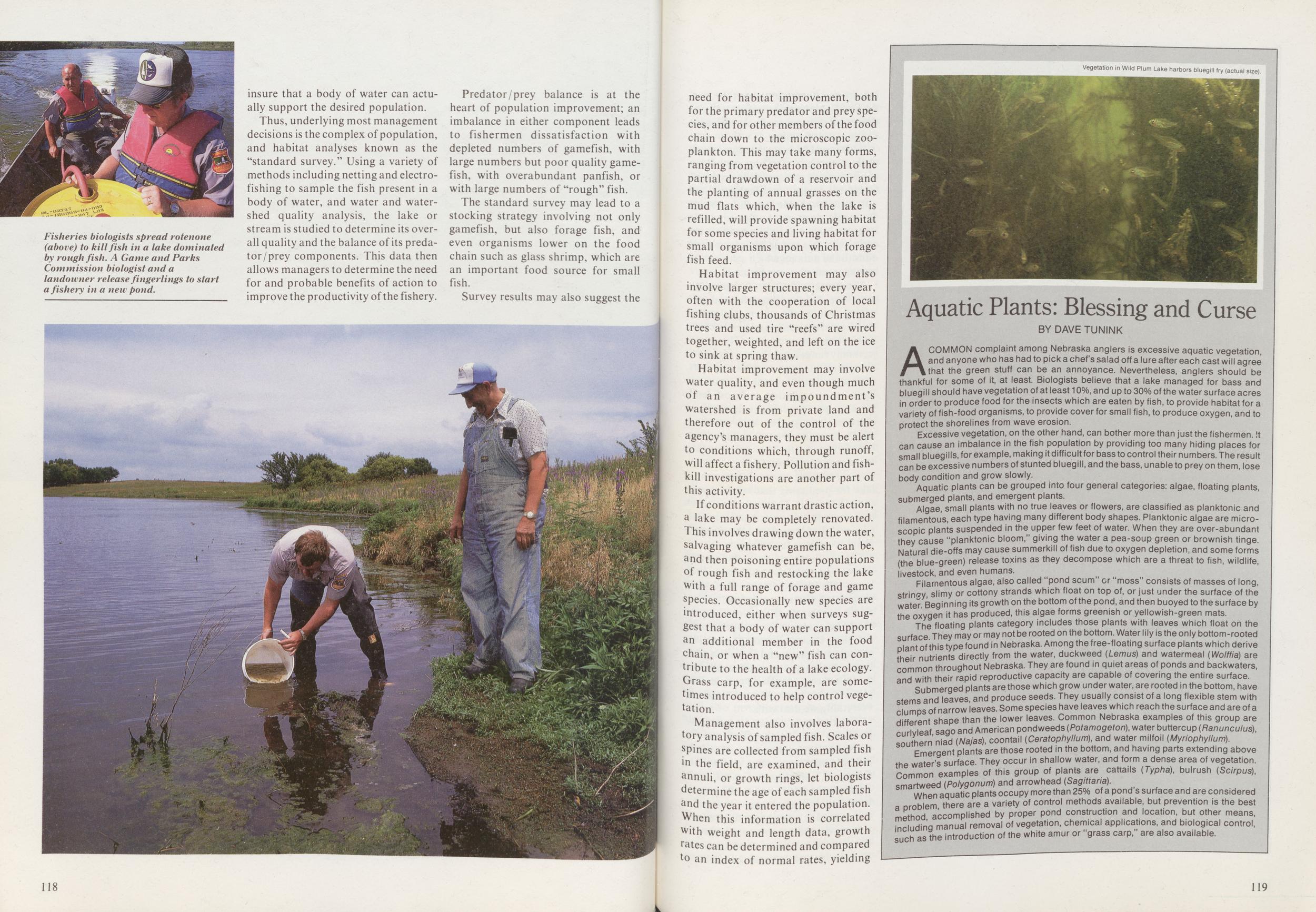
Thus, underlying most management decisions is the complex of population, and habitat analyses known as the "standard survey." Using a variety of methods including netting and electro-fishing to sample the fish present in a body of water, and water and water-shed quality analysis, the lake or stream is studied to determine its overall quality and the balance of its predator/prey components. This data then allows managers to determine the need for and probable benefits of action to improve the productivity of the fishery.
Predator/prey balance is at the heart of population improvement; an imbalance in either component leads to fishermen dissatisfaction with depleted numbers of gamefish, with large numbers but poor quality gamefish, with overabundant panfish, or with large numbers of "rough" fish.
The standard survey may lead to a stocking strategy involving not only gamefish, but also forage fish, and even organisms lower on the food chain such as glass shrimp, which are an important food source for small fish.
Survey results may also suggest the 118 need for habitat improvement, both for the primary predator and prey species, and for other members of the food chain down to the microscopic zooplankton. This may take many forms, ranging from vegetation control to the partial drawdown of a reservoir and the planting of annual grasses on the mud flats which, when the lake is refilled, will provide spawning habitat for some species and living habitat for small organisms upon which forage fish feed.
Habitat improvement may also involve larger structures; every year, often with the cooperation of local fishing clubs, thousands of Christmas trees and used tire "reefs" are wired together, weighted, and left on the ice to sink at spring thaw.
Habitat improvement may involve water quality, and even though much of an average impoundment's watershed is from private land and therefore out of the control of the agency's managers, they must be alert to conditions which, through runoff, will affect a fishery. Pollution and fish-kill investigations are another part of this activity.
If conditions warrant drastic action, a lake may be completely renovated. This involves drawing down the water, salvaging whatever gamefish can be, and then poisoning entire populations °f rough fish and restocking the lake with a full range of forage and game species. Occasionally new species are introduced, either when surveys suggest that a body of water can support an additional member in the food chain, or when a "new" fish can contribute to the health of a lake ecology. Grass carp, for example, are sometimes introduced to help control vegetation.
Management also involves laboratory analysis of sampled fish. Scales or spines are collected from sampled fish in the field, are examined, and their annuli, or growth rings, let biologists determine the age of each sampled fish and the year it entered the population. When this information is correlated with weight and length data, growth rates can be determined and compared to an index of normal rates, yielding
A COMMON complaint among Nebraska anglers is excessive aquatic vegetation, and anyone who has had to pick a chefs salad off a lure after each cast will agree that the green stuff can be an annoyance. Nevertheless, anglers should be thankful for some of it, at least. Biologists believe that a lake managed for bass and bluegill should have vegetation of at least 10%, and up to 30% of the water surface acres in order to produce food for the insects which are eaten by fish, to provide habitat for a variety of fish-food organisms, to provide cover for small fish, to produce oxygen, and to protect the shorelines from wave erosion.
Excessive vegetation, on the other hand, can bother more than just the fishermen. It can cause an imbalance in the fish population by providing too many hiding places for small bluegills, for example, making it difficult for bass to control their numbers. The result can be excessive numbers of stunted bluegill, and the bass, unable to prey on them, lose body condition and grow slowly.
Aquatic plants can be grouped into four general categories: algae, floating plants, submerged plants, and emergent plants.
Algae, small plants with no true leaves or flowers, are classified as planktonic and filamentous, each type having many different body shapes. Planktonic algae are microscopic plants suspended in the upper few feet of water. When they are over-abundant they cause "planktonic bloom," giving the water a pea-soup green or brownish tinge. Natural die-offs may cause summer kill of fish due to oxygen depletion, and some forms (the blue-green) release toxins as they decompose which are a threat to fish, wildlife, livestock, and even humans.
Filamentous algae, also called "pond scum" or "moss" consists of masses of long, stringy, slimy or cottony strands which float on top of, or just under the surface of the water Beginning its growth on the bottom of the pond, and then buoyed to the surface by the oxygen it has produced, this algae forms greenish or yellowish-green mats.
The floating plants category includes those plants with leaves which float on the surface. They may or may not be rooted on the bottom. Water lily is the only bottom-rooted plant of this type found in Nebraska. Among the free-floating surface plants which derive their nutrients directly from the water, duckweed (Lemus) and watermeal (Wolffia) are common throughout Nebraska. They are found in quiet areas of ponds and backwaters, and with their rapid reproductive capacity are capable of covering the entire surface.
Submerged plants are those which grow under water, are rooted in the bottom, have stems and leaves, and produce seeds. They usually consist of a long flexible stem with clumps of narrow leaves. Some species have leaves which reach the surface and are of a different shape than the lower leaves. Common Nebraska examples of this group are curlvleaf sago and American pond weeds (Potamogeton), water buttercup (Ranunculus), southern niad (Najas), coontail (Ceratophyllum), and water milfoil (Myriophyllum).
Emergent plants are those rooted in the bottom, and having parts extending above the water's surface. They occur in shallow water, and form a dense area of vegetation. Common examples of this group of plants are cattails (Typha), bulrush (Sclrpus), smartweed (Polygonum) and arrowhead (Sagittaria).
When aquatic plants occupy more than 25% of a pond s surface and are considered problem there are a variety of control methods available, but prevention is the best 3 thod accomplished by proper pond construction and location, but other means, mrludina manual removal of vegetation, chemical applications, and biological control, such as the introduction of the white amur or "grass carp," are also available.
119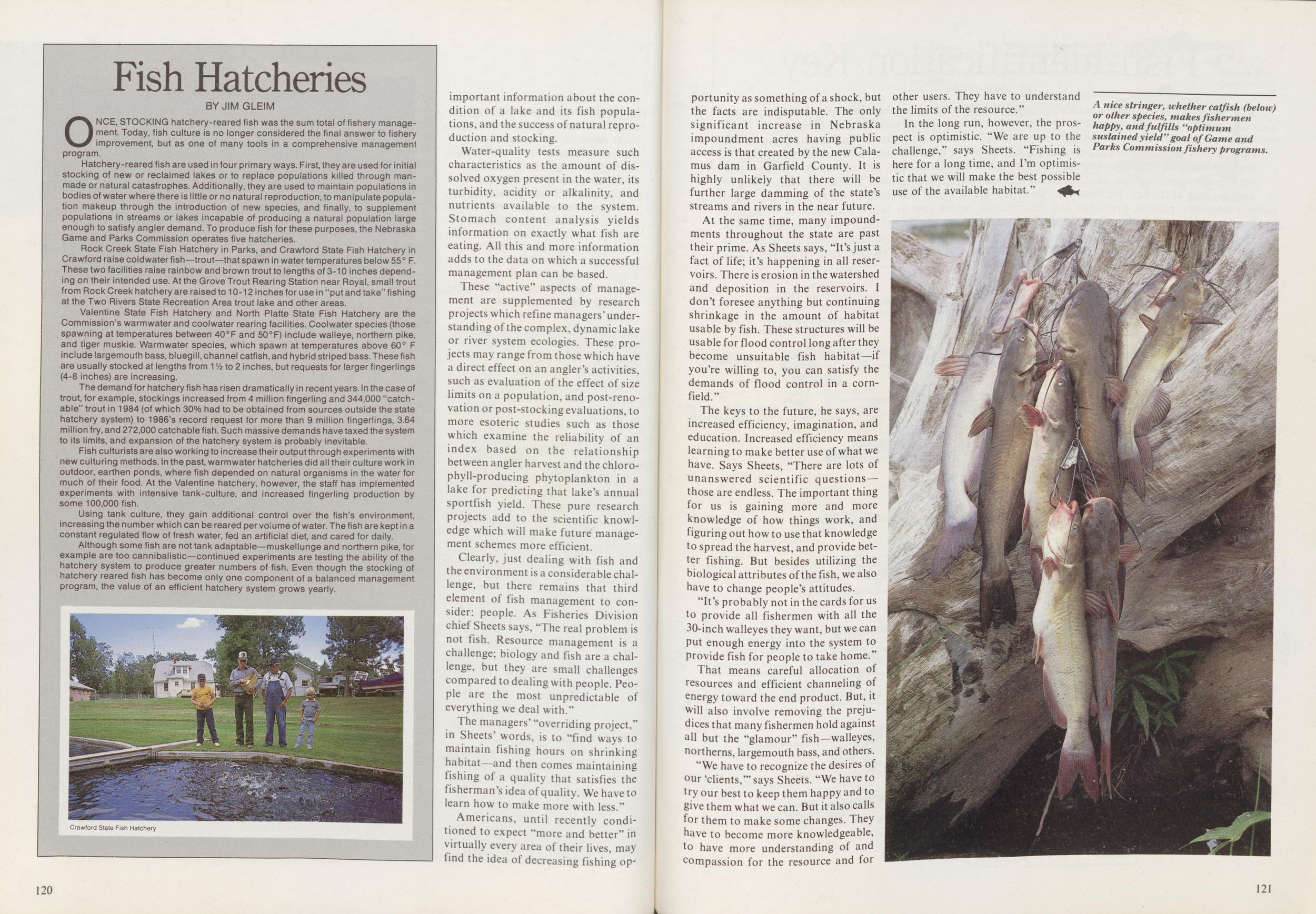
Fish Hatcheries
ONCE, STOCKING hatchery-reared fish was the sum total of fishery management. Today, fish culture is no longer considered the final answer to fishery improvement, but as one of many tools in a comprehensive management program.
Hatchery-reared fish are used in four primary ways. First, they are used for initial stocking of new or reclaimed lakes or to replace populations killed through man- made or natural catastrophes. Additionally, they are used to maintain populations in bodies of water where there is little or no natural reproduction, to manipulate population makeup through the introduction of new species, and finally, to supplement populations in streams or lakes incapable of producing a natural population large enough to satisfy angler demand. To produce fish for these purposes, the Nebraska Game and Parks Commission operates five hatcheries.
Rock Creek State Fish Hatchery in Parks, and Crawford State Fish Hatchery in Crawford raisecoldwaterfish—trout—that spawn in water temperatures below 55° F. These two facilities raise rainbow and brown trout to lengths of 3-10 inches depending on their intended use. At the Grove Trout Rearing Station near Royal, small trout from Rock Creek hatchery are raised to 10-12 inches for use in “put and take” fishing at the Two Rivers State Recreation Area trout lake and other areas.
Valentine State Fish Hatchery and North Platte State Fish Hatchery are the Commission’s warmwater and coolwater rearing facilities. Coolwater species (those spawning at temperatures between 40°F and 50°F) include walleye, northern pike, and tiger muskie. Warmwater species, which spawn at temperatures above 60° F include largemouth bass, bluegill, channel catfish, and hybrid striped bass. These fish are usually stocked at lengths from 1 % to 2 inches, but requests for larger fingerlings (4-8 inches) are increasing.
The demand for hatchery fish has risen dramatically in recent years. In the case of trout, for example, stockings increased from 4 million fingerling and 344,000 “catchable” trout in 1984 (of which 30% had to be obtained from sources outside the state hatchery system) to 1986’s record request for more than 9 million fingerlings, 3.64 million fry, and 272,000 catchable fish. Such massive demands have taxed the system to its limits, and expansion of the hatchery system is probably inevitable.
Fish culturists are also working to increase their output through experiments with new culturing methods. In the past, warmwater hatcheries did all their culture work in outdoor, earthen ponds, where fish depended on natural organisms in the water for much of their food. At the Valentine hatchery, however, the staff has implemented experiments with intensive tank-culture, and increased fingerling production by some 100,000 fish.
Using tank culture, they gain additional control over the fish’s environment, increasing the number which can be reared per volume of water. The fish are kept in a constant regulated flow of fresh water, fed an artificial diet, and cared for daily.
Although some fish are not tank adaptable—muskellunge and northern pike, for example are too cannibalistic—continued experiments are testing the ability of the hatchery system to produce greater numbers of fish. Even though the stocking of hatchery reared fish has become only one component of a balanced management program, the value of an efficient hatchery system grows yearly.
important information about the condition of a lake and its fish populations, and the success of natural reproduction and stocking.
Water-quality tests measure such characteristics as the amount of dissolved oxygen present in the water, its turbidity, acidity or alkalinity, and nutrients available to the system. Stomach content analysis yields information on exactly what fish are eating. All this and more information adds to the data on which a successful management plan can be based.
These “active” aspects of management are supplemented by research projects which refine managers’ understanding of the complex, dynamic lake or river system ecologies. These projects may range from those which have a direct effect on an angler’s activities, such as evaluation of the effect of size limits on a population, and post-renovation or post-stocking evaluations, to more esoteric studies such as those which examine the reliability of an index based on the relationship between angler harvest and the chlorophyll-producing phytoplankton in a lake for predicting that lake’s annual sportfish yield. These pure research projects add to the scientific knowledge which will make future management schemes more efficient.
Clearly, just dealing with fish and the environment is a considerable challenge, but there remains that third element of fish management to consider: people. As Fisheries Division chief Sheets says, “The real problem is not fish. Resource management is a challenge; biology and fish are a challenge, but they are small challenges compared to dealing with people. People are the most unpredictable of everything we deal with.”
The managers’ “overriding project,” in Sheets’ words, is to “find ways to maintain fishing hours on shrinking habitat—and then comes maintaining fishing of a quality that satisfies the fisherman’s idea of quality. We have to learn how to make more with less.”
Americans, until recently condi- tioned to expect “more and better” in virtually every area of their lives, may find the idea of decreasing fishing opportunity as something of a shock, but the facts are indisputable. The only significant increase in Nebraska impoundment acres having public access is that created by the new Calamus dam in Garfield County. It is highly unlikely that there will be further large damming of the state’s streams and rivers in the near future.
At the same time, many impoundments throughout the state are past their prime. As Sheets says, “It’s just a fact of life; it’s happening in all reservoirs. There is erosion in the watershed and deposition in the reservoirs. I don’t foresee anything but continuing shrinkage in the amount of habitat usable by fish. These structures will be usable for flood control long after they become unsuitable fish habitat—if you’re willing to, you can satisfy the demands of flood control in a cornfield.”
The keys to the future, he says, are increased efficiency, imagination, and education. Increased efficiency means learning to make better use of what we have. Says Sheets, “There are lots of unanswered scientific questions — those are endless. The important thing for us is gaining more and more knowledge of how things work, and figuring out how to use that knowledge to spread the harvest, and provide better fishing. But besides utilizing the biological attributes of the fish, we also have to change people’s attitudes.
“It’s probably not in the cards for us to provide all fishermen with all the 30-inch walleyes they want, but we can put enough energy into the system to provide fish for people to take home.”
That means careful allocation of resources and efficient channeling of energy toward the end product. But, it will also involve removing the prejudices that many fishermen hold against all but the “glamour” fish—walleyes, northerns, largemouth bass, and others.
“We have to recognize the desires of our ‘clients,’” says Sheets. “We have to try our best to keep them happy and to give them what we can. But it also calls for them to make some changes. They have to become more knowledgeable, to have more understanding of and compassion for the resource and for other users. They have to understand the limits of the resource.”
In the long run, however, the prospect is optimistic. “We are up to the challenge,” says Sheets. “Fishing is here for a long time, and I’m optimistic that we will make the best possible use of the available habitat.”
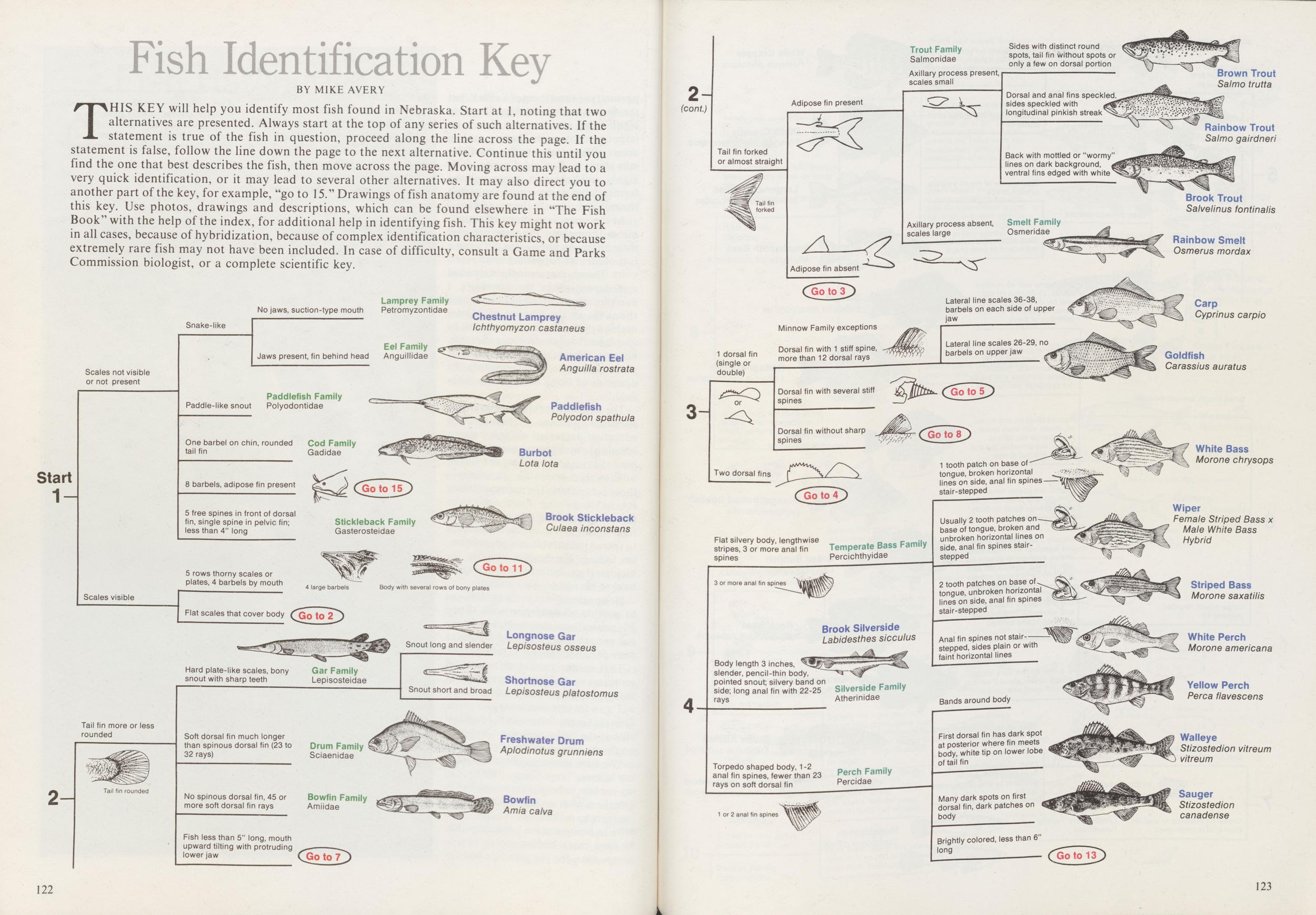
Fish Identification Key
THIS KEY will kelp YOU identify most fish found in Nebraska. Start at 1, noting that two alternatives are presented. Always start at the top of any series of such alternatives. If the statement is true of the fish in question, proceed along the line across the page. If the statement is false, follow the line down the page to the next alternative. Continue this until you find the one that best describes the fish, then move across the page. Moving across may lead to a very quick identification, or it may lead to several other alternatives. It may also direct you to another part of the key, for example, “go to 15.” Drawings of fish anatomy are found at the end of this key. Use photos, drawings and descriptions, which can be found elsewhere in “The Fish Book” with the help of the index, for additional help in identifying fish. This key might not work in all cases, because of hybridization, because of complex identification characteristics, or because extremely rare fish may not have been included. In case of difficulty, consult a Game and Parks Commission biologist, or a complete scientific key.
2- (cont.) Tail fin forked or almost straight Tail fin forked Snake-like No jaws, suction-type mouth Lamprey Family Petromyzontidae Chestnut Lamprey Ichthyomyzon castaneus Adipose fin present Adipose fin absent Go to 3 Jaws present, fin behind head Start 122 Scales not visible or not present Scales visible Tail fin more or less rounded Trout Family Salmonidae Axillary process present, scales small Dorsal and anal fins speckled, sides speckled with longitudinal pinkish streak Paddlefish Family Paddle-like snout Polyodontidae One barbel on chin, rounded tail fin 5 free spines in front of dorsal fin, single spine in pelvic fin; less than 4" long 5 rows thorny scales or plates, 4 barbels by mouth Cod Family Gadidae Eel Family Anguillidae American Eel Anguilla rostrata 1 dorsal fin (single or double) 8 barbels, adipose fin present 4 large barbels Flat scales that cover body to 2 Paddiefish Polyodon spathula Burbot Lota lota Stickleback Family Gasterosteidae Brook Stickleback Culaea inconstans Body with several rows of bony plates Hard plate-like scales, bony snout with sharp teeth No spinous dorsal fin, 45 or more soft dorsal fin rays Fish less than 5" long, mouth upward tilting with protruding lower jaw Gar Family Lepisosteidae Longnose Gar Lepisosteus osseus Shortnose Gar Lepisosteus platostomus 4 Sides with distinct round spots, tail fin without spots or only a few on dorsal portion Brown Trout Sal mo trutta Rainbow Trout Salmo gairdneri Back with mottled or "wormy” lines on dark background, ventral fins edged with white Brook Trout Salvelinus fontinalis Soft dorsal fin much longer than spinous dorsal fin (23 to 32 rays) Bowfin Family Amiidae Go to 7 Freshwater Drum Aplodinotus grunniens Bowfin Ami a calva Rainbow Smelt Osmerus mordax Lateral line scales 26-29, no barbels on upper jaw Perch Family Percidae Silverside Family Atherinidae Axillary process absent, Smelt Family scales large Osmeridae Go to 8 Bands around body Brightly colored, less than 6' long First dorsal fin has dark spot at posterior where fin meets body, white tip on lower lobe of tail fin Anal fin spines not stair------ stepped, sides plain or with faint horizontal lines Many dark spots on first dorsal fin, dark patches on body 2 tooth patches on base of^ tongue, unbroken horizontal lines on side, anal fin spines stair-stepped 1 tooth patch on base of tongue, broken horizontal lines on side, anal tin spines stair-stepped Usually 2 tooth patches on- base of tongue, broken and unbroken horizontal lines on side, anal fin spines stair- stepped Minnow Family exceptions Dorsal fin with 1 stiff spine, more than 12 dorsal rays Dorsal fin with several stiff spines Dorsal fin without sharp spines Two dorsal fins Flat silvery body, lengthwise stripes, 3 or more anal fin Temperate Bass Family spines Percichthyidae 3 or more anal fin spines Brook Silverside Labidesthes sicculus Body length 3 inches, slender, pencil-thin body, pointed snout; silvery band on side; long anal fin with 22-25 rays Torpedo shaped body, 1-2 anal fin spines, fewer than 23 rays on soft dorsal fin 1 or 2 anal fin spines Lateral line scales 36-38, barbels on each side of upper jaw Carp Cyprinus carpio Goldfish Carassius auratus White Bass Morone chrysops Wiper Female Striped Bass x Male ]White Bass Hybrid Striped Bass Morone saxatilis White Perch Morone americana Yellow Perch Perea flavescens Walleye Stizostedion vitreum vitreum Sauger Stizostedion canadense 123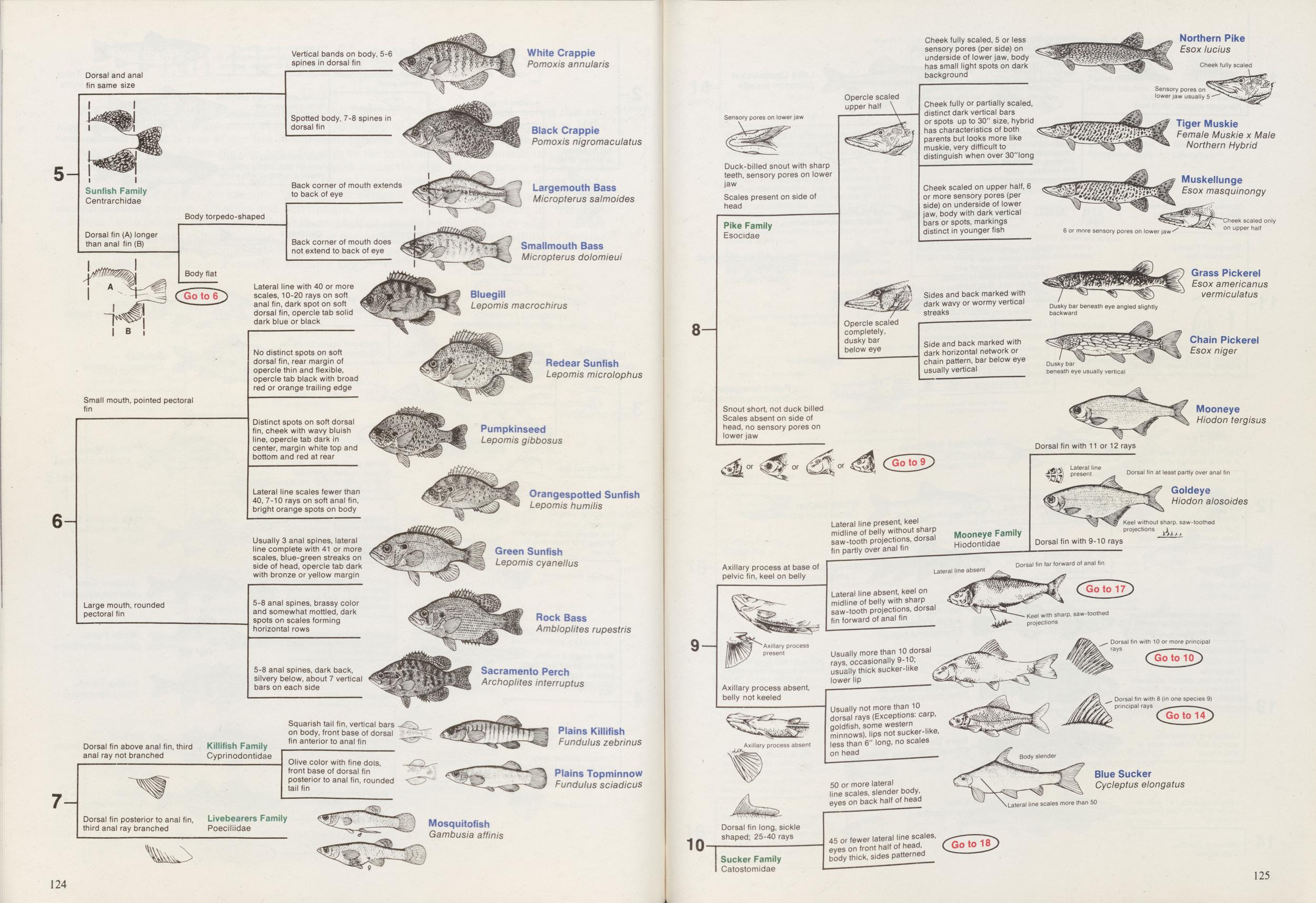 Dorsal and anal fin same size Sunfish Family Centrarchidae Back corner of mouth extends to back of eye Body torpedo-shaped Dorsal fin posterior to anal fin, Livebearers Family third anal ray branched Poeciliidae 124 Dorsal fin (A) longer than anal fin (B) Body flat Go to 6 Small mouth, pointed pectoral fin Large mouth, rounded pectoral fin Dorsal fin above anal fin, third anal ray not branched Killifish Family Cyprinodontidae Lateral line scales fewer than 40, 7-10 rays on soft anal fin, bright orange spots on body Usually 3 anal spines, lateral line complete with 41 or more scales, blue-green streaks on side of head, opercle tab dark with bronze or yellow margin Back corner of mouth does not extend to back of eye No distinct spots on soft dorsal fin, rear margin of opercle thin and flexible, opercle tab black with broad red or orange trailing edge 5-8 anal spines, brassy color and somewhat mottled, dark spots on scales forming horizontal rows 5-8 anal spines, dark back, silvery below, about 7 vertical bars on each side Distinct spots on soft dorsal fin, cheek with wavy bluish line, opercle tab dark in center, margin white top and bottom and red at rear Lateral line with 40 or more scales, 10-20 rays on soft anal fin, dark spot on soft dorsal fin, opercle tab solid dark blue or black Spotted body, 7-8 spines in dorsal fin Vertical bands on body, 5-6 spines in dorsal fin Squarish tail fin, vertical bars on body, front base of dorsal fin anterior to anal fin White Crappie Pomoxis annularis Opercle scaled upper half Black Crappie Pomoxis nigromaculatus Largemouth Bass Micropterus salmoides Smallmouth Bass Micropterus dolomieui Lepomis macrochirus Redear Sunfish Lepomis microlophus Pumpkinseed Lepomis gibbosus Orangespotted Sunfish Lepomis humilis Green Sunfish Lepomis cyanellus Rock Bass Ambloplites rupestris Sacramento Perch Archoplites interruptus Plains Killifish Fund ulus zebrinus Olive color with fine dots, front base of dorsal fin posterior to anal fin, rounded tail fin Plains Topminnow Fundulus sciadicus Sensory pores on lower jaw Cheek fully scaled, 5 or less sensory pores (per side) on underside of lower jaw, body has small light spots on dark background Northern Pike Esox lucius Duck-billed snout with sharp teeth, sensory pores on lower jaw Scales present on side of head Cheek fully or partially scaled, distinct dark vertical bars or spots up to 30" size, hybrid has characteristics of both parents but looks more like muskie, very difficult to distinguish when over 30"long Pike Family Esocidae Opercle scaled completely, dusky bar below eye Sides and back marked with dark wavy or wormy vertical streaks Snout short, not duck billed Scales absent on side of head, no sensory pores on lower jaw -sD or or QQJV or Axillary process at base of pelvic fin, keel on belly Lateral line absent, keel on midline of belly with sharp saw-tooth projections, dorsal fin forward of anal fin Axillary process present Axillary process absent, belly not keeled Axillary process absent Dorsal fin long, sickle shaped; 25-40 rays 10 Sucker Family Catostomidae Cheek scaled on upper half, 6 or more sensory pores (per side) on underside of lower jaw, body with dark vertical bars or spots, markings distinct in younger fish 6 or more sensory pores on lower jaw Cheek scaled only on upper half Dusky bar beneath eye angled slightly backward Cheek fully scaled Sensory pores on lower jaw usually 5 Tiger Muskie Female Muskie x Male Northern Hybrid Muskellunge Esox masquinongy Grass Pickerel Esox americanus vermiculatus Side and back marked with dark horizontal network or chain pattern, bar below eye usually vertical Dusky bar beneath eye usually vertical Chain Pickerel Esox niger Dorsal fin with 11 or 12 rays Mooneye Hiodon tergisus Go to 9 Lateral line present, keel midline of belly without sharp saw-tooth projections, dorsal fin partly over anal fin Mooneye Family Hiodontidae Lateral line Dorsal fin at least partly over anal fin Goldeye Hiodon alosoides Keel without sharp, saw-toothed projections _______ Dorsal fin with 9-10 rays Usually more than 10 dorsal rays, occasionally 9-10; usually thick sucker-like lower lip Usually not more than 10 dorsal rays (Exceptions: carp, goldfish, some western minnows), lips not sucker-like, less than 6" long, no scales on head 50 or more lateral line scales, slender body, eyes on back half of head 45 or fewer lateral line scales, eyes on front half of head, body thick, sides patterned Dorsal fin far forward of anal fin Lateral line absent Go to 17 Dorsal fin with 10 or more principal Go to 14 Lateral line scales more than 50 Keel with sharp, saw-toothed projections Dorsal fin with 8 (in one species 9) principal rays ____________ Body slender Blue Sucker Cycleptus elongatus 125
 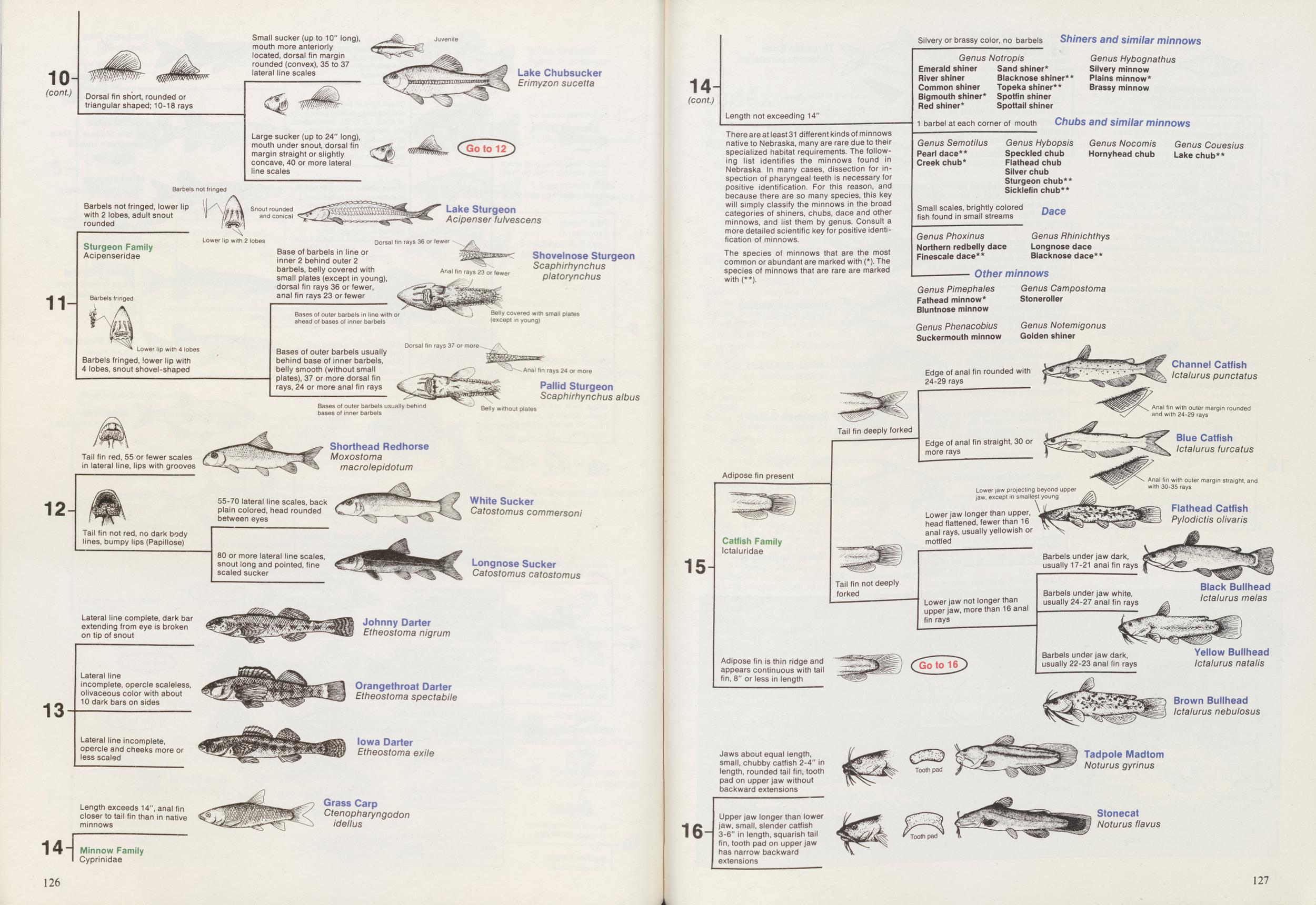 10- (co nt.) Dorsal fin short, rounded or triangular shaped; 10-18 rays Barbels not fringed Barbels not fringed, lower lip with 2 lobes, adult snout rounded Sturgeon Family Acipenseridae Barbels fringed Small sucker (up to 10" long), mouth more anteriorly located, dorsal fin margin rounded (convex), 35 to 37 lateral line scales Juvenile Large sucker (up to 24" long), mouth under snout, dorsal fin margin straight or slightly concave, 40 or more lateral line scales Lower lip with 2 lobes Lower lip with 4 lobes Barbels fringed, lower lip with 4 lobes, snout shovel-shaped Tail fin not red, no dark body lines, bumpy lips (Papillose) Silvery or brassy color, no barbels Shiners and similar minnows Lake Chubsucker Erimyzon sucetta 14- (cont.) Length not exceeding 14" Genus Emerald shiner River shiner Common shiner Bigmouth shiner* Red shiner* Notropis Sand shiner* Blacknose shiner** Topeka shiner** Spotfin shiner Spottail shiner Genus Hybognathus Silvery minnow Plains minnow* Brassy minnow Minnow Family Cyprinidae 126 Snout rounded and conical Dorsal fin rays 36 or fewer Base of barbels in line or inner 2 behind outer 2 barbels, belly covered with small plates (except in young), dorsal fin rays 36 or fewer, anal fin rays 23 or fewer Bases of outer barbels in line with or ahead of bases of inner barbels Lake Sturgeon Acipenser fulvescens Anal fin rays 23 or fewer Shovelnose Sturgeon Scaphirhynchus platorynchus Belly covered with small plates (except in young) Bases of outer barbels usually behind bases of inner barbels Tail fin red, 55 or fewer scales in lateral line, lips with grooves Dorsal fin rays 37 or more^. Bases of outer barbels usually behind base of inner barbels, belly smooth (without small plates), 37 or more dorsal fin rays, 24 or more anal fin rays Anal fin rays 24 or more Pallid Sturgeon Scaphirhynchus albus Belly without plates Shorthead Redhorse Moxostoma macrolepidotum 80 or more lateral line scales, snout long and pointed, fine scaled sucker 55-70 lateral line scales, back plain colored, head rounded between eyes White Sucker Catostomus commersoni Longnose Sucker Catostomus catostomus Lateral line complete, dark bar extending from eye is broken on tip of snout Lateral line incomplete, opercle scaleless, olivaceous color with about 10 dark bars on sides Lateral line incomplete, opercle and cheeks more or less scaled Length exceeds 14", anal fin closer to tail fin than in native minnows Johnny Darter Etheostoma nigrum Orangethroat Darter Etheostoma spectabile Iowa Darter Etheostoma exile Grass Carp Ctenopharyngodon idellus 16 There are at least 31 different kinds of minnows native to Nebraska, many are rare due tc their specialized habitat requirements. The follow- ing list identifies the minnows found in Nebraska. In many cases, dissection for in- spection of pharyngeal teeth is necessary for positive identification. For this reason, and because there are so many species, this key will simply classify the minnows in the broad categories of shiners, chubs, dace and other minnows, and list them by genus. Consult a more detailed scientific key for positive identi- fication of minnows. The species of minnows that are the most common or abundant are marked with (*). The species of minnows that are rare are marked with (**). Tail fin deeply forked Adipose fin present Catfish Family Ictaluridae Lipper jaw longer than lower jaw, small, slender catfish 3-6" in length, squarish tail fin, tooth pad on upper jaw has narrow backward extensions 1 barbel at each corner of mouth Chubs and similar minnows Genus Semotilus Pearl dace** Creek chub* Genus Hybopsis Speckled chub Flathead chub Silver chub Sturgeon chub** Sicklefin chub** Genus Nocomis Hornyhead chub Genus Couesius Lake chub** Small scales, brightly colored fish found in small streams Genus Phoxinus Northern redbelly dace Finescale dace** Genus Rhinichthys Longnose dace Blacknose dace** Other minnows Genus Pimephales Fathead minnow* Bluntnose minnow Genus Phenacobius Suckermouth minnow Genus Campostoma Stoneroller Genus Notemigonus Golden shiner Edge of anal fin rounded with 24-29 rays Lower jaw projecting beyond upper jaw, except in smallest young Channel Catfish Ictalurus punctatus Anal fin with outer margin rounded and with 24-29 rays Edge of anal fin straight, 30 or more rays Blue Catfish Ictalurus furcatus Tail fin not deeply forked Lower jaw not longer than upper jaw, more than 16 anal fin rays Adipose fin is thin ridge and appears continuous with tail fin, 8" or less in length Jaws about equal length, small, chubby catfish 2-4" in length, rounded tail fin, tooth pad on upper jaw without backward extensions Anal fin with outer margin straight, and with 30-35 rays Lower jaw longer than upper, head flattened, fewer than 16 anal rays, usually yellowish or mottled Barbels under jaw dark, usually 17-21 anai fin rays Barbels under jaw white, usually 24-27 anal fin rays Flathead Catfish Pylodictis olivaris Black Bullhead Ictalurus melas Barbels under jaw dark, usually 22-23 anal fin rays Yellow Bullhead Ictalurus natalis Tadpole Madtom Noturus gyrin us Stonecat Noturus flav us Brown Bullhead Ictalurus nebulosus 127
 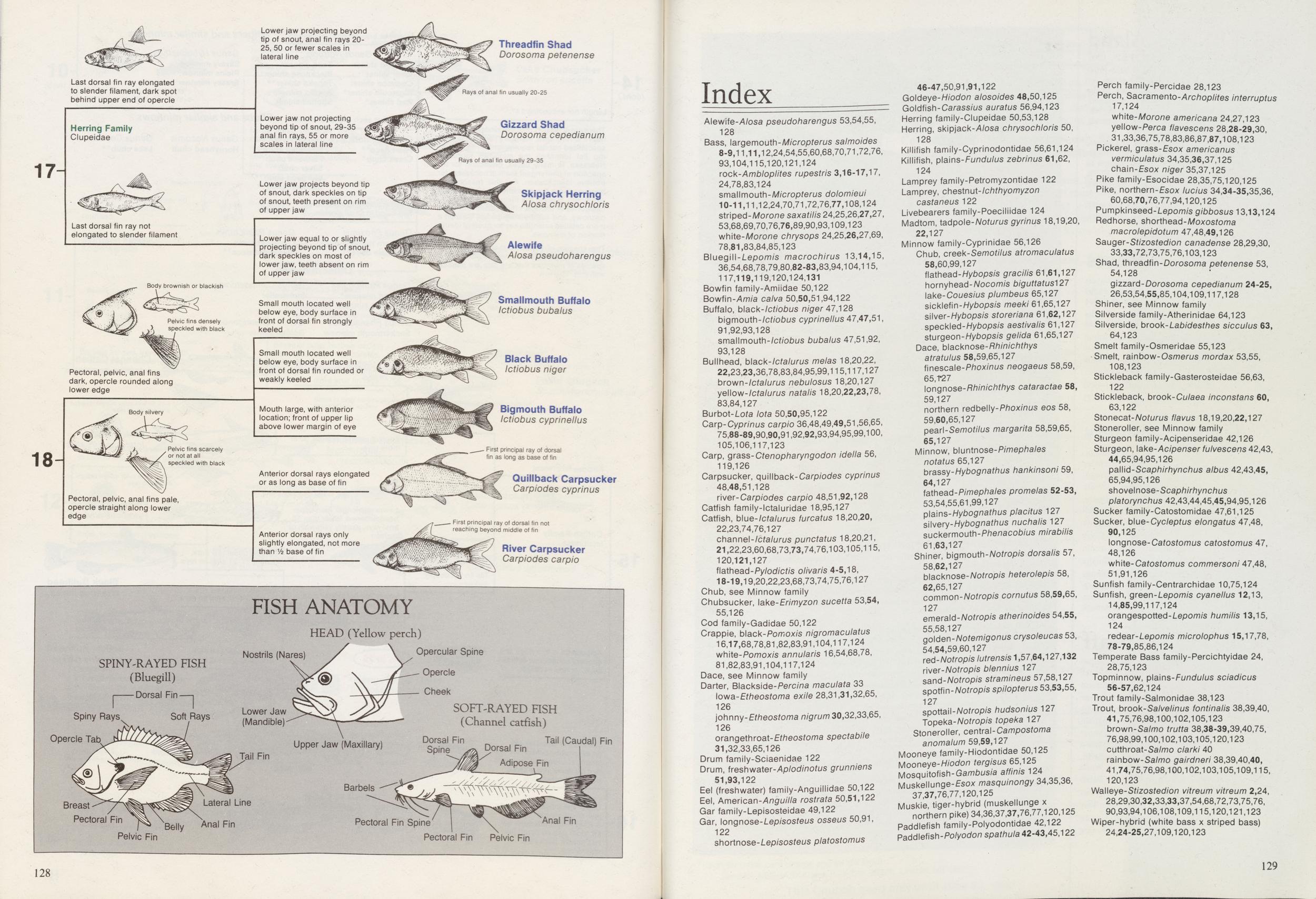 Body silvery Last dorsal fin ray elongated to slender filament, dark spot behind upper end of opercle Pelvic fins densely speckled with black Mouth large, with anterior location; front of upper lip above lower margin of eye Skipjack Herring Alosa chrysochloris Lower jaw not projecting beyond tip of snout, 29-35 anal fin rays, 55 or more scales in lateral line Pectoral, pelvic, anal fins pale, opercle straight along lower edge Herring Family Clupeidae Small mouth located well below eye, body surface in front of dorsal fin strongly keeled Small mouth located well below eye, body surface in front of dorsal fin rounded or weakly keeled Anterior dorsal rays only slightly elongated, not more than 1/2 base of fin Pelvic fins scarcely or not at all speckled with black Lower jaw equal to or slightly projecting beyond tip of snout, dark speckles on most of lower jaw, teeth absent on rim of upper jaw Lower jaw projects beyond tip of snout, dark speckles on tip of snout, teeth present on rim of upper jaw Lower jaw projecting beyond tip of snout, anal fin rays 20- 25, 50 or fewer scales in lateral line Anterior dorsal rays elongated or as long as base of fin Gizzard Shad Dorosoma cepedianum Alewife Alosa pseudoharengus Threadfin Shad Dorosoma petenense Rays of anal fin usually 20-25 Bigmouth Buffalo Ictiobus cyprinellus Black Buffalo Ictiobus niger River Carpsucker Carpiodes carpio Last dorsal fin ray not elongated to slender filament Body brownish or blackish Pectoral, pelvic, anal fins dark, opercle rounded along lower edge 128 Rays of anal fin usually 29-35 Smallmouth Buffalo Ictiobus bubalus First principal ray of dorsal fin as long as base of fin Quillback Carpsucker Carpiodes cyprinus First principal ray of dorsal fin not reaching beyond middle of fin
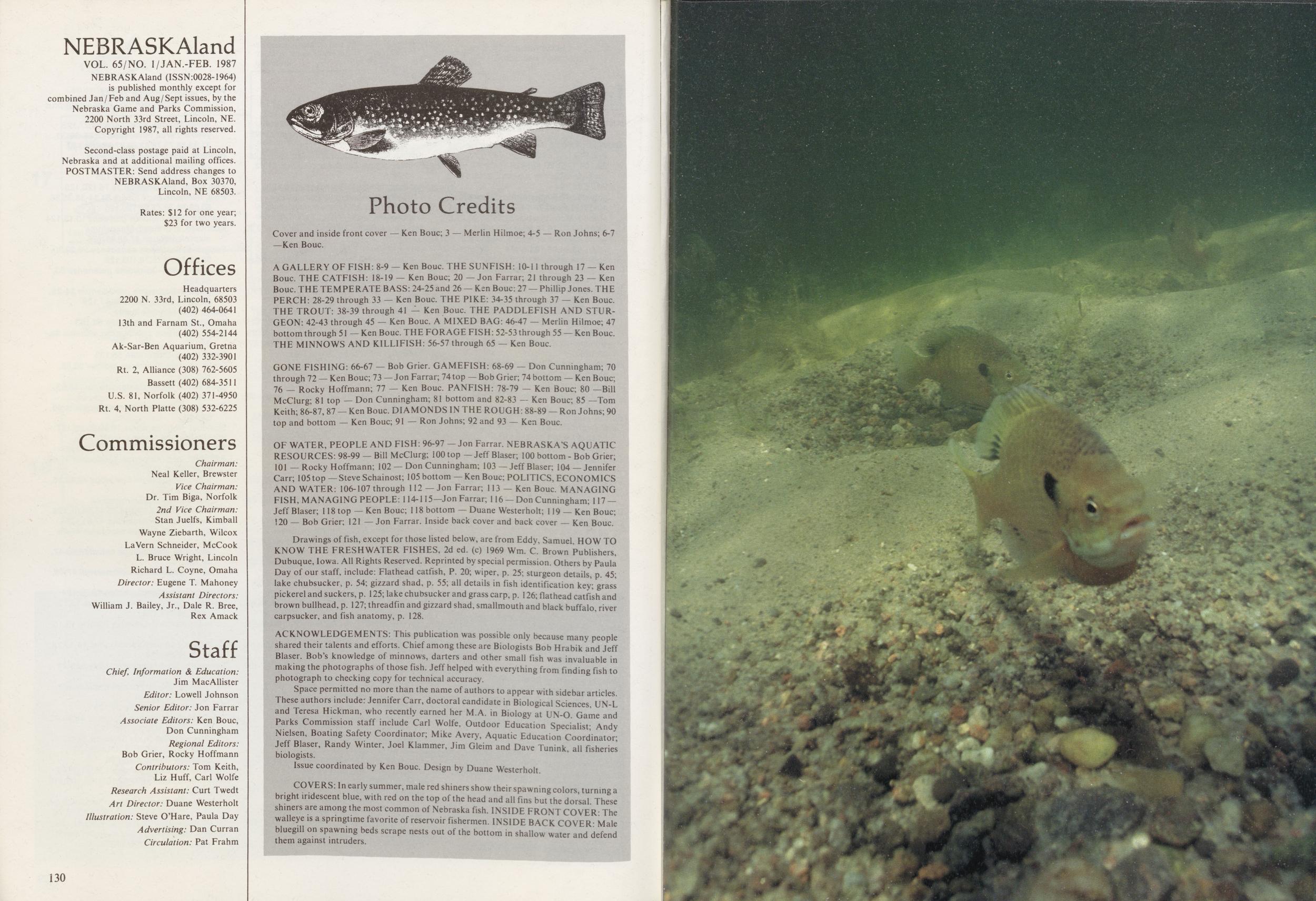 NEBRASKAland VOL. 65/NO. 1/JAN.-FEB. 1987 NEBRASKAland (ISSN:0028-1964) is published monthly except for combined Jan/Feb and Aug/Sept issues, by the Nebraska Game and Parks Commission, 2200 North 33rd Street, Lincoln, NE. Copyright 1987, all rights reserved. Second-class postage paid at Lincoln, Nebraska and at additional mailing offices. POSTMASTER: Send address changes to NEBRASKAland, Box 30370, Lincoln, NE 68503. Rates: $12 for one year; $23 for two years. Photo Credits Cover and inside front cover — Ken Bouc; 3 — Merlin Hilmoe; 4-5 — Ron Johns; 6-7 — Ken Bouc. Offices
Headquarters
2200 N. 33rd, Lincoln, 68503
(402) 464-0641
13th and Farnam St., Omaha
(402) 554-2144
Ak-Sar-Ben Aquarium, Gretna
(402) 332-3901
Rt. 2, Alliance (308) 762-5605
Bassett (402) 684-3511
U.S. 81, Norfolk (402) 371-4950
Rt. 4, North Platte (308) 532-6225 Commissioners
Chairman:
Neal Keller, Brewster
Vice Chairman:
Dr. Tim Biga, Norfolk
2nd Vice Chairman:
Stan Juelfs, Kimball
Wayne Ziebarth, Wilcox
LaVern Schneider, McCook
L. Bruce Wright, Lincoln
Richard L. Coyne, Omaha
Director: Eugene T. Mahoney
Assistant Directors:
William J. Bailey, Jr., Dale R. Bree, Rex Amack Staff Chief, Information & Education:
Jim MacAllister
Editor: Lowell Johnson
Senior Editor: Jon Farrar
Associate Editors: Ken Bouc, Don Cunningham
Regional Editors: Bob Grier, Rocky Hoffmann
Contributors: Tom Keith, Liz Huff, Carl Wolfe
Research Assistant: Curt Twedt Art Director: Duane Westerholt
Illustration: Steve O’Hare, Paula Day Advertising: Dan Curran
Circulation: Pat Frahm A GALLERY OF FISH: 8-9 — Ken Bouc. THE SUNFISH: 10-11 through 17 — Ken Bouc. THE CATFISH: 18-19 — Ken Bouc; 20 — Jon Farrar; 21 through 23 — Ken Bouc. THE TEMPERATE BASS. 24-25 and 26 — Ken Bouc: 27 — Phillip Jones. THE PERCH: 28-29 through 33 — Ken Bouc. THE PIKE: 34-35 through 37 — Ken Bouc. THE TROUT: 38-39 through 41 — Ken Bouc. THE PADDLEFISH AND STUR- GEON: 42-43 through 45 — Ken Bouc. A MIXED BAG: 46-47 — Merlin Hilmoe; 47 bottom through 51 — Ken Bouc. THE FORAGE FISH: 52-53 through 55 — Ken Bouc. THE MINNOWS AND K1LLIFISH: 56-57 through 65 — Ken Bouc. GONE FISHING: 66-67 — Bob Grier. GAMEFISH: 68-69 — Don Cunningham; 70 through 72 — Ken Bouc; 73 — Jon Farrar; 74 top — Bob Grier; 74 bottom — Ken Bouc; 76 — Rocky Hoffmann; 77 — Ken Bouc. PANFISH: 78-79 — Ken Bouc; 80 —Bill McClurg; 81 top — Don Cunningham; 81 bottom and 82-83 — Ken Bouc; 85 —Tom Keith; 86-87, 87 — Ken Bouc. DIAMONDS IN THE ROUGH: 88-89 — Ron Johns; 90 top and bottom — Ken Bouc; 91 — Ron Johns; 92 and 93 — Ken Bouc. OF WATER, PEOPLE AND FISH: 96-97 — Jon Farrar. NEBRASKA’S AQUATIC RESOURCES: 98-99 — Bill McClurg; lOOtop — Jeff Blaser; 100 bottom - Bob Grier; 101 — Rocky Hoffmann; 102 — Don Cunningham; 103 —Jeff Blaser; 104 — Jennifer Carr; 105 top —Steve Schainost; 105 bottom — Ken Bouc; POLITICS, ECONOMICS AND WATER: 106-107 through 112—Jon Farrar; 113 —Ken Bouc. MANAGING FISH, MANAGING PEOPLE: 114-115—Jon Farrar; 116 — Don Cunningham; 117 — Jeff Blaser; 118 top — Ken Bouc; 118 bottom — Duane Westerholt; 119 — Ken Bouc; 120 — Bob Grier; 121 — Jon Farrar. Inside back cover and back cover — Ken Bouc. Drawings of fish, except for those listed below, are from Eddy, Samuel. HOW TO KNOW THE FRESHWATER FISHES. 2d ed. (c) 1969 Wm. C. Brown Publishers, Dubuque, Iowa. All Rights Reserved. Reprinted by special permission. Others by Paula Day of our staff, include: Flathead catfish, P. 20; wiper, p. 25; sturgeon details, p. 45; lake chubsucker, p. 54; gizzard shad, p. 55; all details in fish identification key; grass pickerel and suckers, p. 125; lake chubsucker and grass carp, p. 126; flathead catfish and brown bullhead, p. 127; threadfin and gizzard shad, smallmouth and black buffalo, river carpsucker, and fish anatomy, p. 128. ACKNOWLEDGEMENTS: This publication was possible only because many people shared their talents and efforts. Chief among these are Biologists Bob Hrabik and Jeff Blaser. Bob’s knowledge of minnows, darters and other small fish was invaluable in making the photographs of those fish. Jeff helped with everything from finding fish to photograph to checking copy for technical accuracy. Space permitted no more than the name of authors to appear with sidebar articles. These authors include: Jennifer Carr, doctoral candidate in Biological Sciences, UN-L and Teresa Hickman, who recently earned her M A in Biology at UN O. Game and Parks Commission staff include Carl Wolfe, Outdoor Education Specialist; Andy Nielsen, Boating Safety Coordinator; Mike Avery, Aquatic Education Coordinator; Jeff Blaser, Randy Winter, Joel Klammer, Jim Gleim and Dave Tunink. all fisheries biologists. Issue coordinated by Ken Bouc. Design by Duane Westerholt.
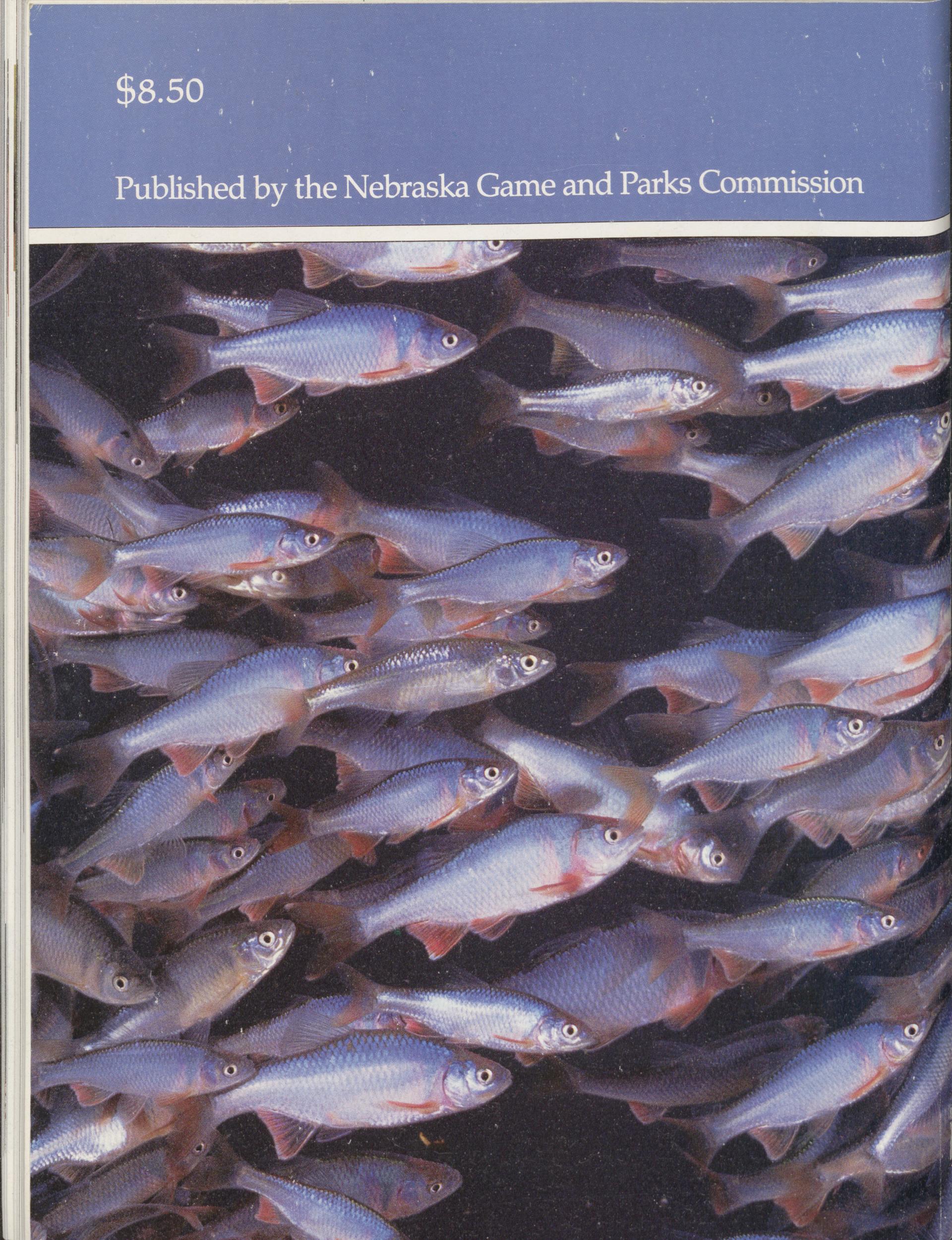
Position: 378 (25 views)