Volume 64, Issue 10, 1986
NEBRASKAland
DECEMBER 1986 $1.50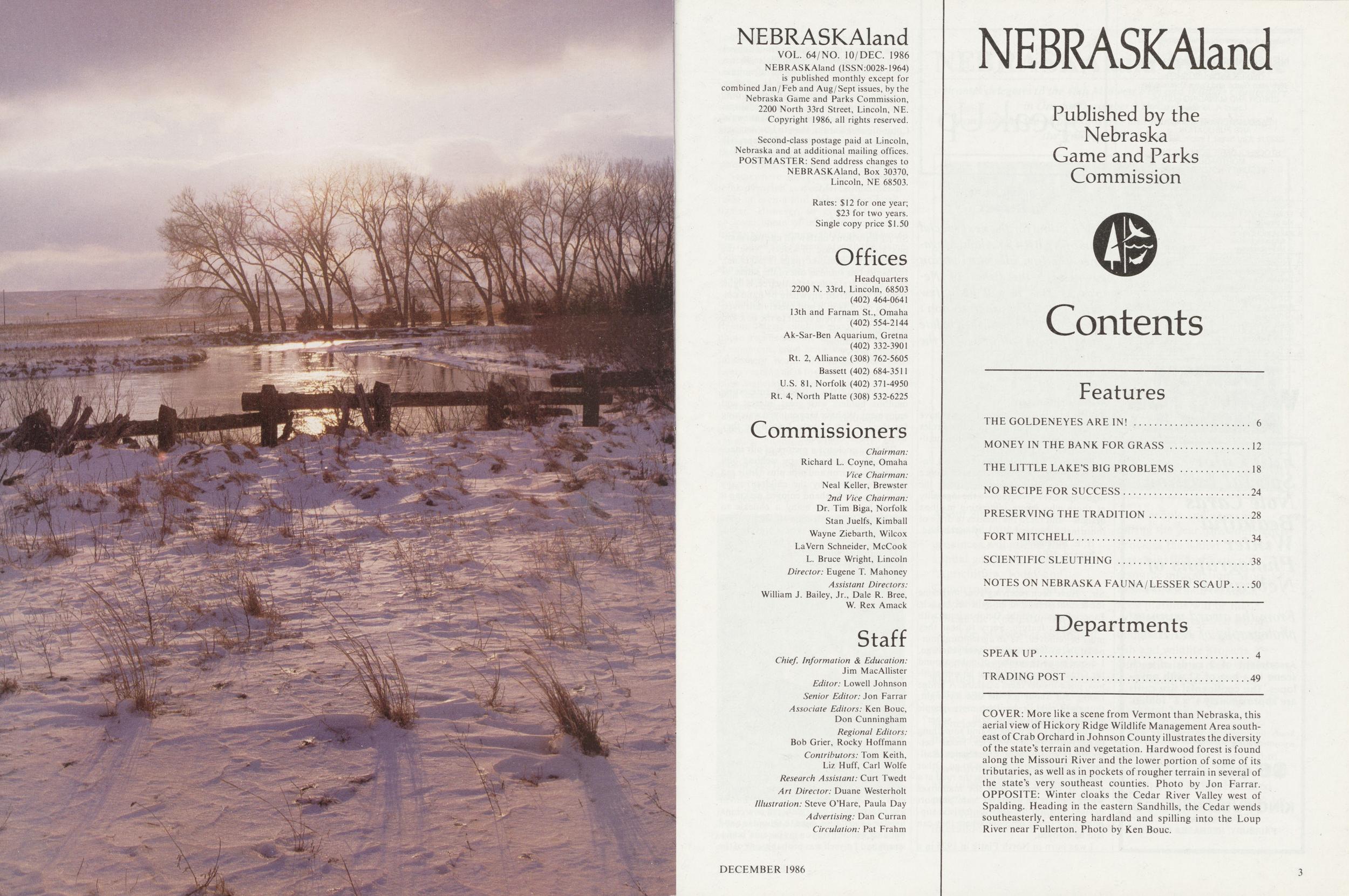
NEBRASKAland
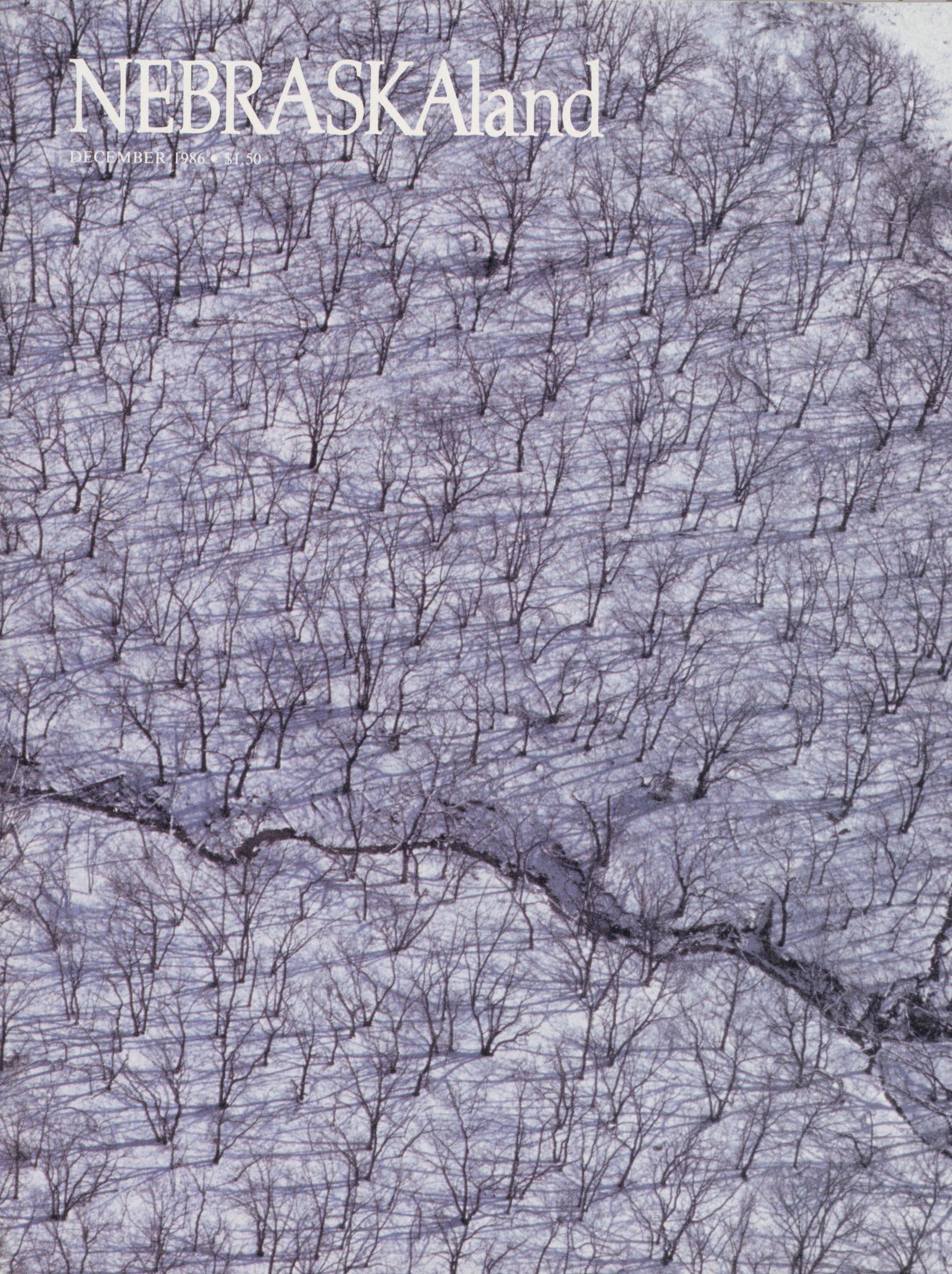
Published by the Nebraska Game and Parks Commission NEBRASKAland VOL. 64/NO. 10/DEC. 1986 NEBRASKAland (ISSN:0028-1964) is published monthly except for combined Jan/Feb and Aug/Sept issues, by the Nebraska Game and Parks Commission, 2200 North 33rd Street, Lincoln, NE. Copyright 1986, all rights reserved. Second-class postage paid at Lincoln, Nebraska and at additional mailing offices. POSTMASTER: Send address changes to NEBRASKAland, Box 30370, Lincoln, NE 68503. Rates: $12 for one year; $23 for two years. Single copy price $1.50 Offices Headquarters 2200 N. 33rd, Lincoln, 68503 (402) 464-0641 13th and Farnam St., Omaha (402) 554-2144 Ak-Sar-Ben Aquarium, Gretna (402) 332-3901 Rt. 2, Alliance (308) 762-5605 Bassett (402) 684-3511 U.S. 81, Norfolk (402) 371-4950 Rt. 4, North Platte (308) 532-6225 Commissioners Chairman: Richard L. Coyne, Omaha Vice Chairman: Neal Keller, Brewster 2nd Vice Chairman: Dr. Tim Biga, Norfolk Stan Juelfs, Kimball Wayne Ziebarth, Wilcox LaVern Schneider, McCook L. Bruce Wright, Lincoln Director: Eugene T. Mahoney Assistant Directors: William J. Bailey, Jr., Dale R. Bree, W. Rex Amack Staff C0W Chief, Information & Education: Jim MacAllister Editor: Lowell Johnson Senior Editor: Jon Farrar Associate Editors: Ken Bouc, Don Cunningham Regional Editors: Bob Grier, Rocky Hoffmann Contributors: Tom Keith, Liz Huff, Carl Wolfe Research Assistant: Curt Twedt Art Director: Duane Westerholt Illustration: Steve O'Hare, Paula Day Advertising: Dan Curran Circulation: Pat Frahm Contents Features THE GOLDENEYES ARE IN! 6 MONEY IN THE BANK FOR GRASS 12 THE LITTLE LAKE'S BIG PROBLEMS 18 NO RECIPE FOR SUCCESS 24 PRESERVING THE TRADITION 28 FORT MITCHELL SCIENTIFIC SLEUTHING 38 NOTES ON NEBRASKA FAUNA/LESSER SCAUP 50 Departments SPEAK UP 4 TRADING POST 49 COVER: More like a scene from Vermont than Nebraska, this aerial view of Hickory Ridge Wildlife Management Area southeast of Crab Orchard in Johnson County illustrates the diversity of the state's terrain and vegetation. Hardwood forest is found along the Missouri River and the lower portion of some of its tributaries, as well as in pockets of rougher terrain in several of the state's very southeast counties. Photo by Jon Farrar. OPPOSITE: Winter cloaks the Cedar River Valley west of Spalding. Heading in the eastern Sandhills, the Cedar wends southeasterly, entering hardland and spilling into the Loup River near Fullerton. Photo by Ken Bouc. DECEMBER 1986 3
Speak Up
A Special Time for ReadersYes, it's time for the next special issue ofNEBRA SKA land Magazine—the big, all-color edition devoted to the fishes of Nebraska. But, it will be a few weeks later than usual, so don't worry. It will be published in late January, and will be worth the wait!
Mail on mailboxesSir / It is pathetic that some people have nothing to do but dream up asinine rules requiring rubber posts and rubber mailboxes for R.F.D. customers.
Perhaps it would be better to inject liquid rubber into their craniums and bounce them out to pick up garbage along the highways. Let's give credit to the ingenuity of those who create interesting mailbox designs—and recall the licenses to drive of those inebriates unable to stay on the road.
H. E. Burchfield Bayard, NESir / Have been receiving your magazine for several years and enjoy it very much. Especially enjoyed the October issue with the mailbox feature. Sorry to hear they must be removed. As an agricultural journalist and assistant county agent years ago, I drove many thousands of miles around the Great Plains and did not hit one mailbox, nor consider them a hazard. A bridge railing did about get me one icy night, though. Could it be that more people should drive with greater skill sober?
Some folks are going to find something to run into with their vehicles. Trees—better cut them all down. Fence posts. Railings on narrow bridges—got to go. Other vehicles—only one vehicle on the road at a time. If you must, keep the mailboxes where they are on whatever "safe" support devised, but put the creative, artistic supports back to the fenceline where they can still be enjoyed.
I was born in North Platte in 1925 in a house my Dad built, and was raised on farms around there, country grade school and all. High school in North Platte, then a Navy career. Earned a degree in animal husbandry at Colorado State U., was an assistant county agent in Rocky Ford, Colo., then to Missouri U. for journalism. Worked for farm and ranch publications in Colorado and Kansas, then to Los Angeles and aerospace publications. Chiropractic college 1970 to 1975. In practice in San Francisco since then, but I still love Nebraska, my home.
L. D. Houser, D.C. San Francisco, CASir / Please don't outlaw all unusual mailbox stands because of safety. Note the replica high-wheel bike (page 12 last issue). I consider this stand as one of the safest, as safe can be. It stands perfectly free, is light, and can be carried anywhere by hand easily. If a car hits it, it will merely fall over. More damage would result to the box and stand than the car.
D. R. Ostrander Endicott, NESir / We read the article on interesting mailbox holders with great interest and enjoyment. We have long enjoyed watching for these in our travels. I do hope they won't have to disappear.
We have enclosed a picture of our mailbox holder constructed by welding odd pieces of junk iron and pipe plus a little red wagon outgrown by the children many years ago. My husband enjoyed making it and it has brought many a chuckle to passers by. We live 3/4-mile off Highway 81 in Cedar County, so it is on a gravel road. Enjoy your magazine every month.
Gaylon and June Mittan Hartington, NESir / I have lived in the Sandhills of Nebraska since I was brought here in 1909 at three weeks of age, and have always considered myself a trapper, fisherman, hunter and sportsman. I have gathered cow chips, lived in a sod house, gone to school in a sod building, (while living on my parents' homestead) and I myself was probably one of the 4 NEBRASKAland last homesteaders in this area. I can remember when the ducks, curlews, avocets, etc. practically clouded the skies, and up to a thousand muskrats could be harvested off a sandhill lake. I have seen these diminish by 80 percent and more. I can also remember when deer, antelope and wild turkey first began to appear in the Sandhills, and then controlled hunting began. At last I was able to be a so-called big-game hunter, of which I had always dreamed but which seemed so remote.
Somewhere along the line I started to think of myself as a conservationist, naturalist or even a bird watcher instead of a hunter. However, as evidenced by the enclosed photo of my 1976 Bicentennial trophy board, some might think otherwise, but I am in full agreement with the Game Commission that a few game animals should be harvested each year for the good of the species.
I do not wish to insinuate that my success is unusual, although perhaps exceptional. It is the best success I have experienced [taking a deer, antelope and turkey]. This photo recalls for me memories of good companions, good neighbors, and beautiful scenery, beautiful springs, creeks and rivers rushing as if to get out of the Sandhills. Sometimes I think maybe we should hold them back lest they continue on and become polluted.
It is almost a March blizzard right now and not a fit day to be outside, so the inspiration hit me to write a letter to a friend—NEBRASKAIand. Maybe you should keep the photo and publish it in the year 2076.
Basil Hollers Valentine, NE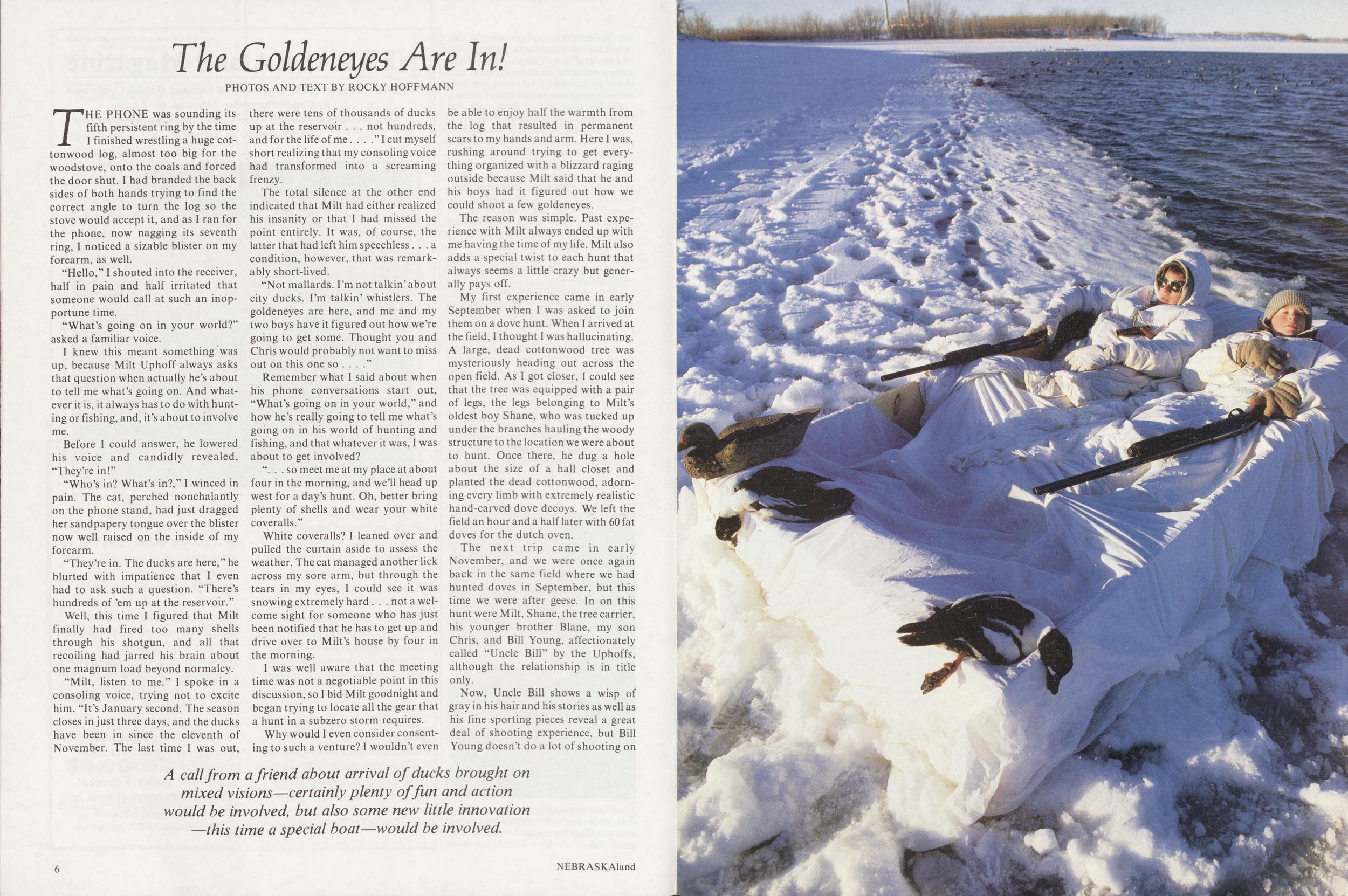
The Goldeneyes Are In!
PHOTOS AND TEXT BY ROCKY HOFFMANN A call from a friend about arrival of ducks brought on mixed visions—certainly plenty of fun and action would be involved, but also some new little innovation —this time a special boat—would be involved.THE PHONE was sounding its fifth persistent ring by the time I finished wrestling a huge Cottonwood log, almost too big for the woodstove, onto the coals and forced the door shut. I had branded the back sides of both hands trying to find the correct angle to turn the log so the stove would accept it, and as I ran for the phone, now nagging its seventh ring, I noticed a sizable blister on my forearm, as well.
"Hello," I shouted into the receiver, half in pain and half irritated that someone would call at such an inopportune time.
"What's going on in your world?" asked a familiar voice.
I knew this meant something was up, because Milt Uphoff always asks that question when actually he's about to tell me what's going on. And whatever it is, it always has to do with hunting or fishing, and, it's about to involve me.
Before I could answer, he lowered his voice and candidly revealed, "They're in!"
"Who's in? What's in?," I winced in pain. The cat, perched nonchalantly on the phone stand, had just dragged her sandpapery tongue over the blister now well raised on the inside of my forearm.
"They're in. The ducks are here," he blurted with impatience that I even had to ask such a question. "There's hundreds of 'em up at the reservoir."
Well, this time I figured that Milt finally had fired too many shells through his shotgun, and all that recoiling had jarred his brain about one magnum load beyond normalcy.
"Milt, listen to me." I spoke in a consoling voice, trying not to excite him. "It's January second. The season closes in just three days, and the ducks have been in since the eleventh of November. The last time I was out, there were tens of thousands of ducks up at the reservoir not hundreds, and for the life of me. "I cut myself short realizing that my consoling voice had transformed into a screaming frenzy.
The total silence at the other end indicated that Milt had either realized his insanity or that I had missed the point entirely. It was, of course, the latter that had left him speechless a condition, however, that was remarkably short-lived.
"Not mallards. I'm not talkin' about city ducks. I'm talkin' whistlers. The goldeneyes are here, and me and my two boys have it figured out how we're going to get some. Thought you and Chris would probably not want to miss out on this one so "
Remember what I said about when his phone conversations start out, "What's going on in your world," and how he's really going to tell me what's going on in his world of hunting and fishing, and that whatever it was, I was about to get involved?
" so meet meat my place at about four in the morning, and we'll head up west for a day's hunt. Oh, better bring plenty of shells and wear your white coveralls."
White coveralls? I leaned over and pulled the curtain aside to assess the weather. The cat managed another lick across my sore arm, but through the tears in my eyes, I could see it was snowing extremely hard not a welcome sight for someone who has just been notified that he has to get up and drive over to Milt's house by four in the morning.
I was well aware that the meeting time was not a negotiable point in this discussion, so I bid Milt goodnight and began trying to locate all the gear that a hunt in a subzero storm requires.
Why would I even consider consenting to such a venture? I wouldn't even be able to enjoy half the warmth from the log that resulted in permanent scars to my hands and arm. Here I was, rushing around trying to get everything organized with a blizzard raging outside because Milt said that he and his boys had it figured out how we could shoot a few goldeneyes.
The reason was simple. Past experience with Milt always ended up with me having the time of my life. Milt also adds a special twist to each hunt that always seems a little crazy but generally pays off.
My first experience came in early September when I was asked to join them on a dove hunt. When I arrived at the field, I thought I was hallucinating. A large, dead cottonwood tree was mysteriously heading out across the open field. As I got closer, I could see that the tree was equipped with a pair of legs, the legs belonging to Milt's oldest boy Shane, who was tucked up under the branches hauling the woody structure to the location we were about to hunt. Once there, he dug a hole about the size of a hall closet and planted the dead cottonwood, adorning every limb with extremely realistic hand-carved dove decoys. We left the field an hour and a half later with 60 fat doves for the dutch oven.
The next trip came in early November, and we were once again back in the same field where we had hunted doves in September, but this time we were after geese. In on this hunt were Milt, Shane, the tree carrier, his younger brother Blane, my son Chris, and Bill Young, affectionately called "Uncle Bill" by the Uphoffs, although the relationship is in title only.
Now, Uncle Bill shows a wisp of gray in his hair and his stories as well as his fine sporting pieces reveal a great deal of shooting experience, but Bill Young doesn't do a lot of shooting on 6 NEBRASKAland
It was snowing hard, and as soon as we could get the shell decoys set out, we had to sweep them off with a whisk broom. All together we probably had seven dozen regular-size Canada goose decoys in place when Milt went to his truck and pulled out three magnum and one super-magnum decoys. He placed the three magnums at the head of the primary string of decoys, and hauled the super-size imposter over to where we were taking a position in an outside row of standing corn.
"Here ya go, Bingo," he said to Blane, handing him the big goose. "Do your thing."
Not hesitating an instant, Blane unloaded his gun and secured it against a stout corn stalk. He grabbed up the huge decoy and dragged it out to the center of the spread, turned it right side up and burrowed underneath it. When the first flock came along, Milt gave Blane a signal, and the youngster began crawling around in the elbow-deep snow with the decoy on his back while Shane and Milt got busy with the calls.
Bill leaned back, puffed on his pipe and offered a slight smile as he watched the flock set their wings directly above us. A few geese hit the ground with the volley of shots, and Blane was pardoned from his chore of goose impersonator to enjoy some excellent shooting on later flocks. We left with eight Canadas, a mallard, and a bonus whitefront.
Now it was three o'clock in the morning of January third, and I was stumbling aimlessly across the bedroom, having just stepped on the cat that had licked my blister a very few hours earlier. I was enroute to the alarm clock that past experience had taught me not to keep next to my bed if I planned on staying awake. My stumble had turned into a full-scale fall that resulted in crushing the alarm clock and nearly the night stand on which it sat. The cat slunk down the hall and disappeared into one of her hiding places.
It was no longer necessary to wake Chris. In fact, everybody in the house was awake, and my attempt to blame the commotion on the cat was fruitless.
Peeking through a small hole that the defrosters had started to open up, I headed the pickup toward town and Milt's house when Chris spoke his first words of the morning.
"Where we going, Dad?" came a weak murmer from inside all that down clothing and white coveralls.
It was then I realized that Chris was 8 NEBRASKAland already in bed when Milt called, and that he went through the cat and the alarm clock commotion, pulled on hundreds of pounds of clothes, walked out into nearly zero weather, and climbed into the truck with his shotgun and shells without even knowing what was up.
I also realized that now I had to explain the plan to Chris, and that I didn't even know the plan, other than that Milt thought we could get into a few goldeneyes up at the lake.
There came no response, and I drove on silently in the darkness.
Pulling up in front of Milt's house, we could see the familiar outline of Uncle Bill's old square Bronco parked at the curb. Bill was leaning against the back of his vehicle, and the red glow of a match, shielded by his left hand over the bowl of his pipe, dimly illuminated his face. Bill was marvelling at the loading-of-the-truck spectacle which had been going on for some time.
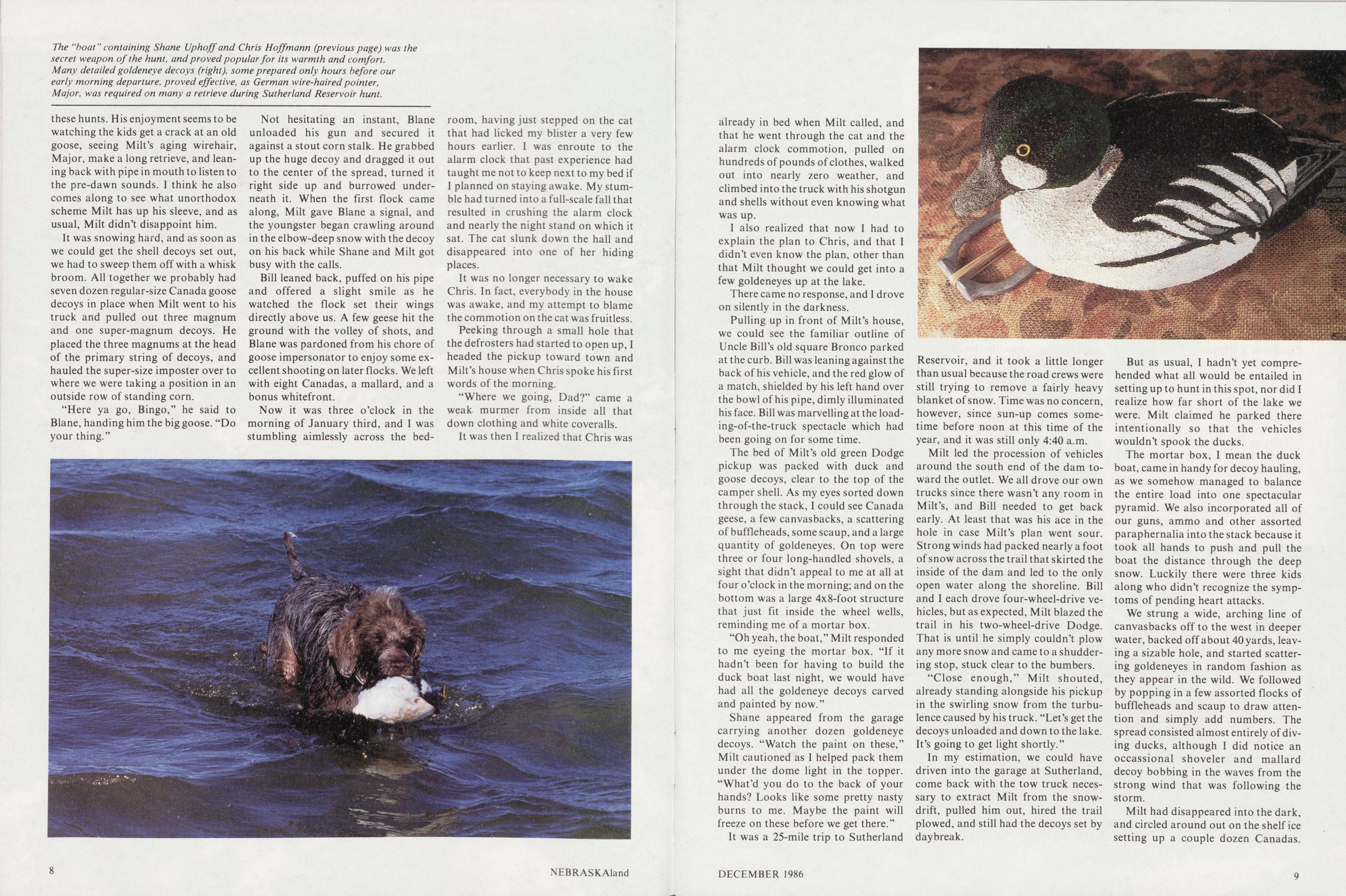
The bed of Milt's old green Dodge pickup was packed with duck and goose decoys, clear to the top of the camper shell. As my eyes sorted down through the stack, I could see Canada geese, a few canvasbacks, a scattering of buffleheads, some scaup, and a large quantity of goldeneyes. On top were three or four long-handled shovels, a sight that didn't appeal to me at all at four o'clock in the morning; and on the bottom was a large 4x8-foot structure that just fit inside the wheel wells, reminding me of a mortar box.
"Oh yeah, the boat," Milt responded to me eyeing the mortar box. "If it hadn't been for having to build the duck boat last night, we would have had all the goldeneye decoys carved and painted by now."
Shane appeared from the garage carrying another dozen goldeneye decoys. "Watch the paint on these," Milt cautioned as I helped pack them under the dome light in the topper. "What'd you do to the back of your hands? Looks like some pretty nasty burns to me. Maybe the paint will freeze on these before we get there."
It was a 25-mile trip to Sutherland Reservoir, and it took a little longer than usual because the road crews were still trying to remove a fairly heavy blanket of snow. Time was no concern, however, since sun-up comes sometime before noon at this time of the year, and it was still only 4:40 a.m.
Milt led the procession of vehicles around the south end of the dam toward the outlet. We all drove our own trucks since there wasn't any room in Milt's, and Bill needed to get back early. At least that was his ace in the hole in case Milt's plan went sour. Strong winds had packed nearly a foot of snow across the trail that skirted the inside of the dam and led to the only open water along the shoreline. Bill and I each drove four-wheel-drive vehicles, but as expected, Milt blazed the trail in his two-wheel-drive Dodge. That is until he simply couldn't plow any more snow and came to a shuddering stop, stuck clear to the bumbers.
"Close enough," Milt shouted, already standing alongside his pickup in the swirling snow from the turbulence caused by his truck. "Let's get the decoys unloaded and down to the lake. It's going to get light shortly."
In my estimation, we could have driven into the garage at Sutherland, come back with the tow truck necessary to extract Milt from the snowdrift, pulled him out, hired the trail plowed, and still had the decoys set by daybreak.
But as usual, I hadn't yet comprehended what all would be entailed in setting up to hunt in this spot, nor did I realize how far short of the lake we were. Milt claimed he parked there intentionally so that the vehicles wouldn't spook the ducks.
The mortar box, I mean the duck boat, came in handy for decoy hauling, as we somehow managed to balance the entire load into one spectacular pyramid. We also incorporated all of our guns, ammo and other assorted paraphernalia into the stack because it took all hands to push and pull the boat the distance through the deep snow. Luckily there were three kids along who didn't recognize the symptoms of pending heart attacks.
We strung a wide, arching line of canvasbacks off to the west in deeper water, backed off about 40 yards, leaving a sizable hole, and started scattering goldeneyes in random fashion as they appear in the wild. We followed by popping in a few assorted flocks of buffleheads and scaup to draw attention and simply add numbers. The spread consisted almost entirely of diving ducks, although I did notice an occassional shoveler and mallard decoy bobbing in the waves from the strong wind that was following the storm.
Milt had disappeared into the dark, and circled around out on the shelf ice setting up a couple dozen Canadas. DECEMBER 1986 9 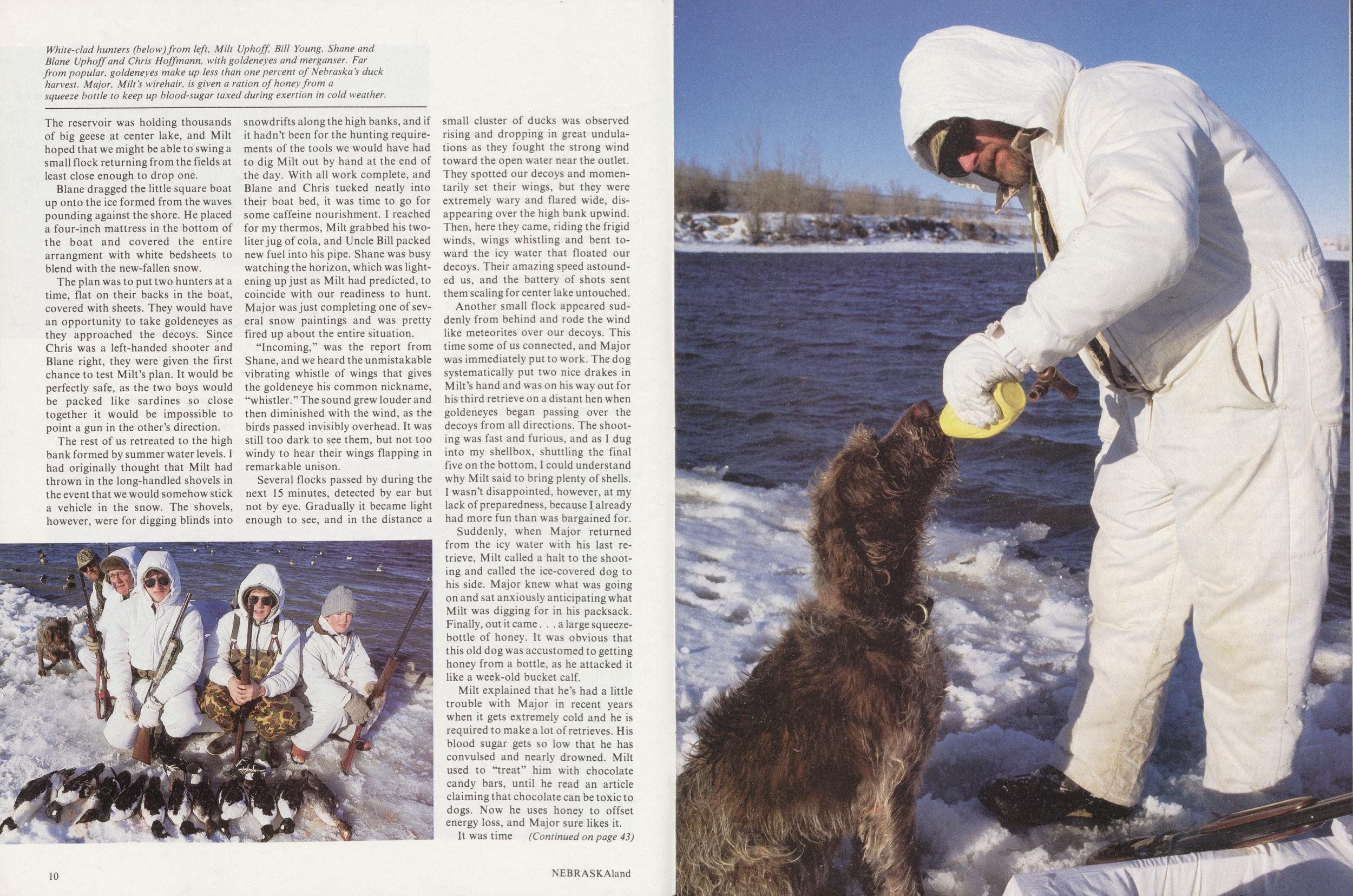
Blane dragged the little square boat up onto the ice formed from the waves pounding against the shore. He placed a four-inch mattress in the bottom of the boat and covered the entire arrangment with white bedsheets to blend with the new-fallen snow.
The plan was to put two hunters at a time, flat on their backs in the boat, covered with sheets. They would have an opportunity to take goldeneyes as they approached the decoys. Since Chris was a left-handed shooter and Blane right, they were given the first chance to test Milt's plan. It would be perfectly safe, as the two boys would be packed like sardines so close together it would be impossible to point a gun in the other's direction.
The rest of us retreated to the high bank formed by summer water levels. I had originally thought that Milt had thrown in the long-handled shovels in the event that we would somehow stick a vehicle in the snow. The shovels, however, were for digging blinds into snowdrifts along the high banks, and if it hadn't been for the hunting requirements of the tools we would have had to dig Milt out by hand at the end of the day. With all work complete, and Blane and Chris tucked neatly into their boat bed, it was time to go for some caffeine nourishment. I reached for my thermos, Milt grabbed his twoliter jug of cola, and Uncle Bill packed new fuel into his pipe. Shane was busy watching the horizon, which was lightening up just as Milt had predicted, to coincide with our readiness to hunt. Major was just completing one of several snow paintings and was pretty fired up about the entire situation.
"Incoming," was the report from Shane, and we heard the unmistakable vibrating whistle of wings that gives the goldeneye his common nickname, "whistler." The sound grew louder and then diminished with the wind, as the birds passed invisibly overhead. It was still too dark to see them, but not too windy to hear their wings flapping in remarkable unison.
Several flocks passed by during the next 15 minutes, detected by ear but not by eye. Gradually it became light enough to see, and in the distance a small cluster of ducks was observed rising and dropping in great undulations as they fought the strong wind toward the open water near the outlet. They spotted our decoys and momentarily set their wings, but they were extremely wary and flared wide, disappearing over the high bank upwind. Then, here they came, riding the frigid winds, wings whistling and bent toward the icy water that floated our decoys. Their amazing speed astounded us, and the battery of shots sent them scaling for center lake untouched.
Another small flock appeared suddenly from behind and rode the wind like meteorites over our decoys. This time some of us connected, and Major was immediately put to work. The dog systematically put two nice drakes in Milt's hand and was on his way out for his third retrieve on a distant hen when goldeneyes began passing over the decoys from all directions. The shooting was fast and furious, and as I dug into my shellbox, shuttling the final five on the bottom, I could understand why Milt said to bring plenty of shells. I wasn't disappointed, however, at my lack of preparedness, because I already had more fun than was bargained for.
Suddenly, when Major returned from the icy water with his last retrieve, Milt called a halt to the shooting and called the ice-covered dog to his side. Major knew what was going on and sat anxiously anticipating what Milt was digging for in his packsack. Finally, out it came. a large squeezebottle of honey. It was obvious that this old dog was accustomed to getting honey from a bottle, as he attacked it like a week-old bucket calf.
Milt explained that he's had a little trouble with Major in recent years when it gets extremely cold and he is required to make a lot of retrieves. His blood sugar gets so low that he has convulsed and nearly drowned. Milt used to "treat" him with chocolate candy bars, until he read an article claiming that chocolate can be toxic to dogs. Now he uses honey to offset energy loss, and Major sure likes it.
It was time (Continued on page 43)
10 NEBRASKAland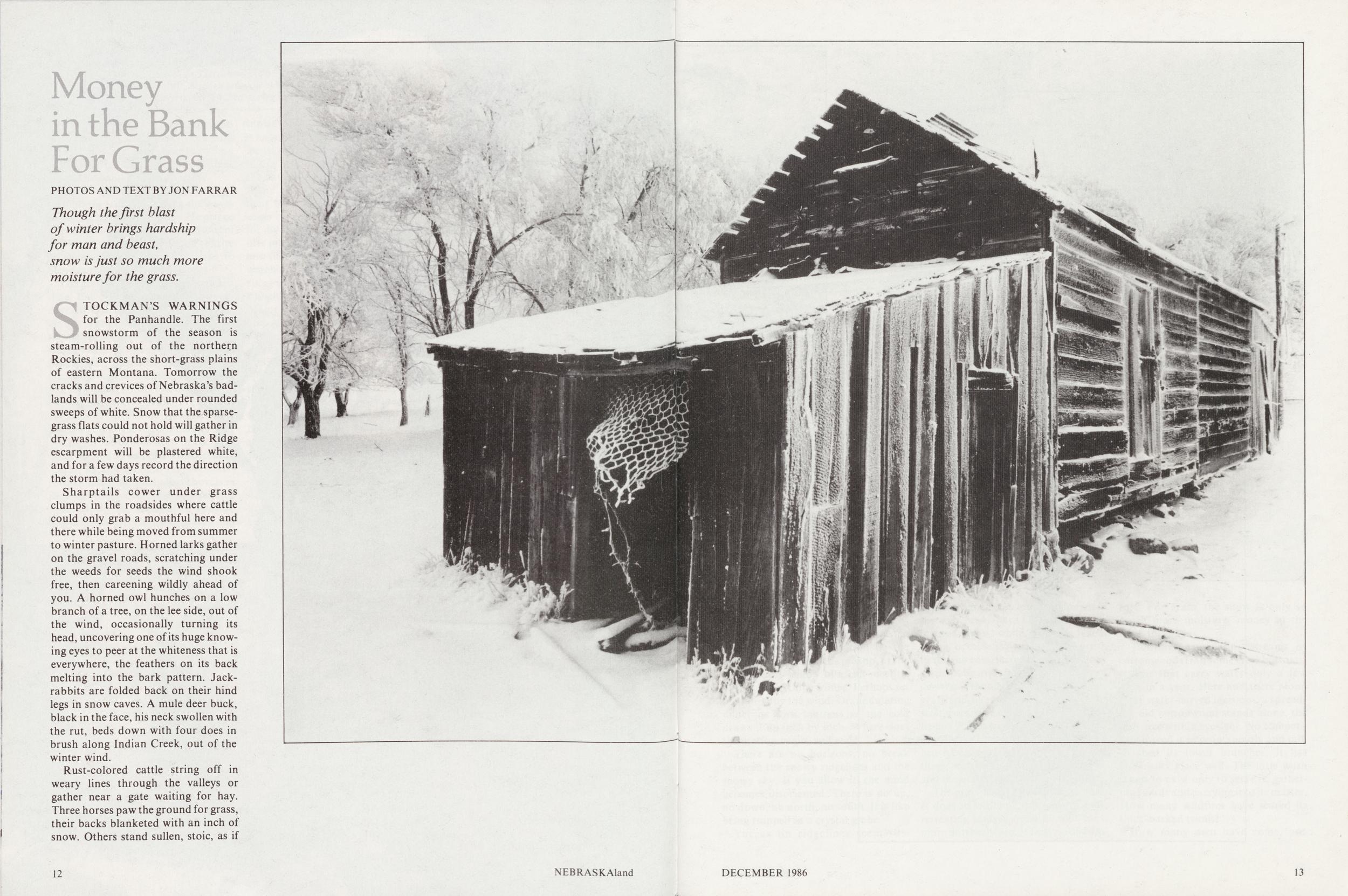
Money in the Bank For Grass
PHOTOS AND TEXT BY JON FARRAR Though the first blast of winter brings hardship for man and beast, snow is just so much more moisture for the grass.STOCKMAN'S WARNINGS for the Panhandle. The first snowstorm of the season is steam-rolling out of the northern Rockies, across the short-grass plains of eastern Montana. Tomorrow the cracks and crevices of Nebraska's badlands will be concealed under rounded sweeps of white. Snow that the sparsegrass flats could not hold will gather in dry washes. Ponderosas on the Ridge escarpment will be plastered white, and for a few days record the direction the storm had taken.
Sharptails cower under grass clumps in the roadsides where cattle could only grab a mouthful here and there while being moved from summer to winter pasture. Horned larks gather on the gravel roads, scratching under the weeds for seeds the wind shook free, then careening wildly ahead of you. A horned owl hunches on a low branch of a tree, on the lee side, out of the wind, occasionally turning its head, uncovering one of its huge knowing eyes to peer at the whiteness that is everywhere, the feathers on its back melting into the bark pattern. Jackrabbits are folded back on their hind legs in snow caves. A mule deer buck, black in the face, his neck swollen with the rut, beds down with four does in brush along Indian Creek, out of the winter wind.
Rust-colored cattle string off in weary lines through the valleys or gather near a gate waiting for hay. Three horses paw the ground for grass, their backs blanketed with an inch of snow. Others stand sullen, stoic, as if 12 NEBRASKAland
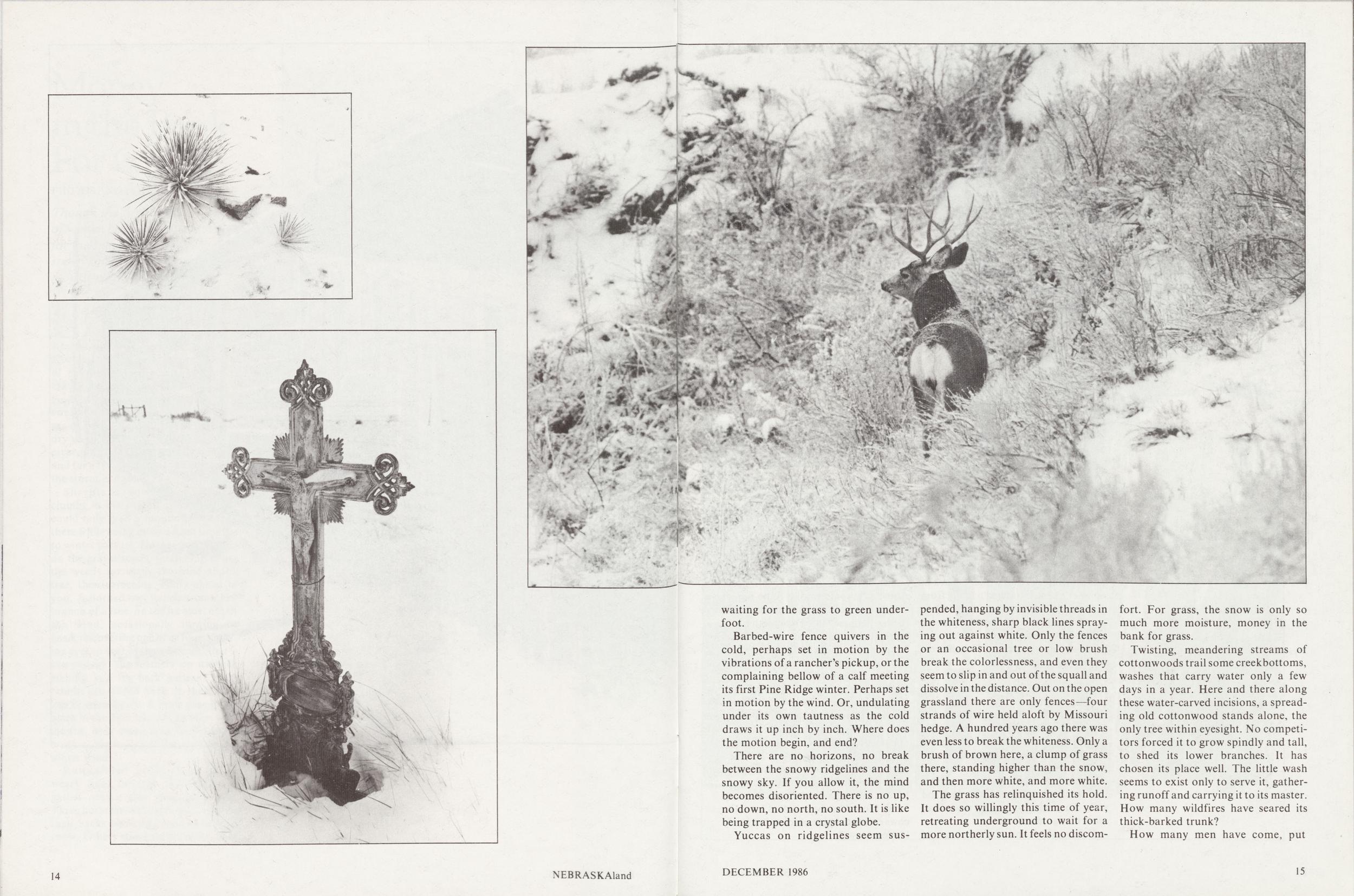
Barbed-wire fence quivers in the cold, perhaps set in motion by the vibrations of a rancher's pickup, or the complaining bellow of a calf meeting its first Pine Ridge winter. Perhaps set in motion by the wind. Or, undulating under its own tautness as the cold draws it up inch by inch. Where does the motion begin, and end?
There are no horizons, no break between the snowy ridgeiines and the snowy sky. If you allow it, the mind becomes disoriented. There is no up, no down, no north, no south. It is like being trapped in a crystal globe.
Yuccas on ridgeiines seem suspended, hanging by invisible threads in the whiteness, sharp black lines spraying out against white. Only the fences or an occasional tree or low brush break the colorlessness, and even they seem to slip in and out of the squall and dissolve in the distance. Out on the open grassland there are only fences—four strands of wire held aloft by Missouri hedge. A hundred years ago there was even less to break the whiteness. Only a brush of brown here, a clump of grass there, standing higher than the snow, and then more white, and more white.
The grass has relinquished its hold. It does so willingly this time of year, retreating underground to wait for a more northerly sun. It feels no discomfort. For grass, the snow is only so much more moisture, money in the bank for grass.
Twisting, meandering streams of cottonwoods trail some creekbottoms, washes that carry water only a few days in a year. Here and there along these water-carved incisions, a spreading old cottonwood stands alone, the only tree within eyesight. No competitors forced it to grow spindly and tall, to shed its lower branches. It has chosen its place well. The little wash seems to exist only to serve it, gathering runoff and carrying it to its master. How many wildfires have seared its thick-barked trunk?
How many men have come, put DECEMBER 1986 15 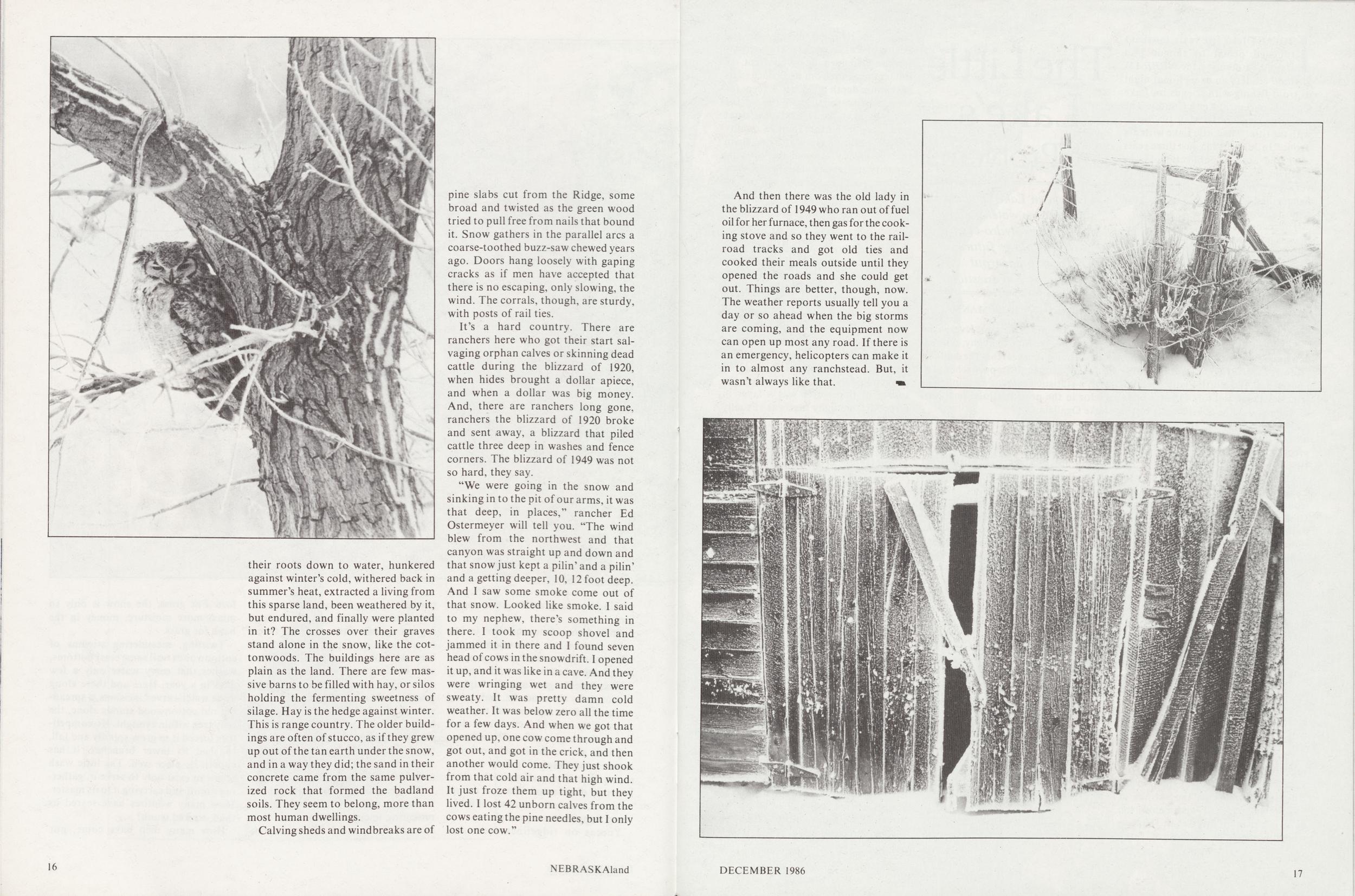
Calving sheds and windbreaks are of pine slabs cut from the Ridge, some broad and twisted as the green wood tried to pull free from nails that bound it. Snow gathers in the parallel arcs a coarse-toothed buzz-saw chewed years ago. Doors hang loosely with gaping cracks as if men have accepted that there is no escaping, only slowing, the wind. The corrals, though, are sturdy, with posts of rail ties.
It's a hard country. There are ranchers here who got their start salvaging orphan calves or skinning dead cattle during the blizzard of 1920, when hides brought a dollar apiece, and when a dollar was big money. And, there are ranchers long gone, ranchers the blizzard of 1920 broke and sent away, a blizzard that piled cattle three deep in washes and fence corners. The blizzard of 1949 was not so hard, they say.
"We were going in the snow and sinking in to the pit of our arms, it was that deep, in places," rancher Ed Ostermeyer will tell you. "The wind blew from the northwest and that canyon was straight up and down and that snow just kept a pilin' and a pilin' and a getting deeper, 10, 12 foot deep. And I saw some smoke come out of that snow. Looked like smoke. I said to my nephew, there's something in there. I took my scoop shovel and jammed it in there and I found seven head of cows in the snowdrift. I opened it up, and it was like in a cave. And they were wringing wet and they were sweaty. It was pretty damn cold weather. It was below zero all the time for a few days. And when we got that opened up, one cow come through and got out, and got in the crick, and then another would come. They just shook from that cold air and that high wind. It just froze them up tight, but they lived. I lost 42 unborn calves from the cows eating the pine needles, but I only lost one cow."
16 NEBRASKAlandAnd then there was the old lady in the blizzard of 1949 who ran out of fuel oil for her furnace, then gas for the cooking stove and so they went to the railroad tracks and got old ties and cooked their meals outside until they opened the roads and she could get out. Things are better, though, now. The weather reports usually tell you a day or so ahead when the big storms are coming, and the equipment now can open up most any road. If there is an emergency, helicopters can make it in to almost any ranchstead. But, it wasn't always like that.
The Little Lake's Big Problems
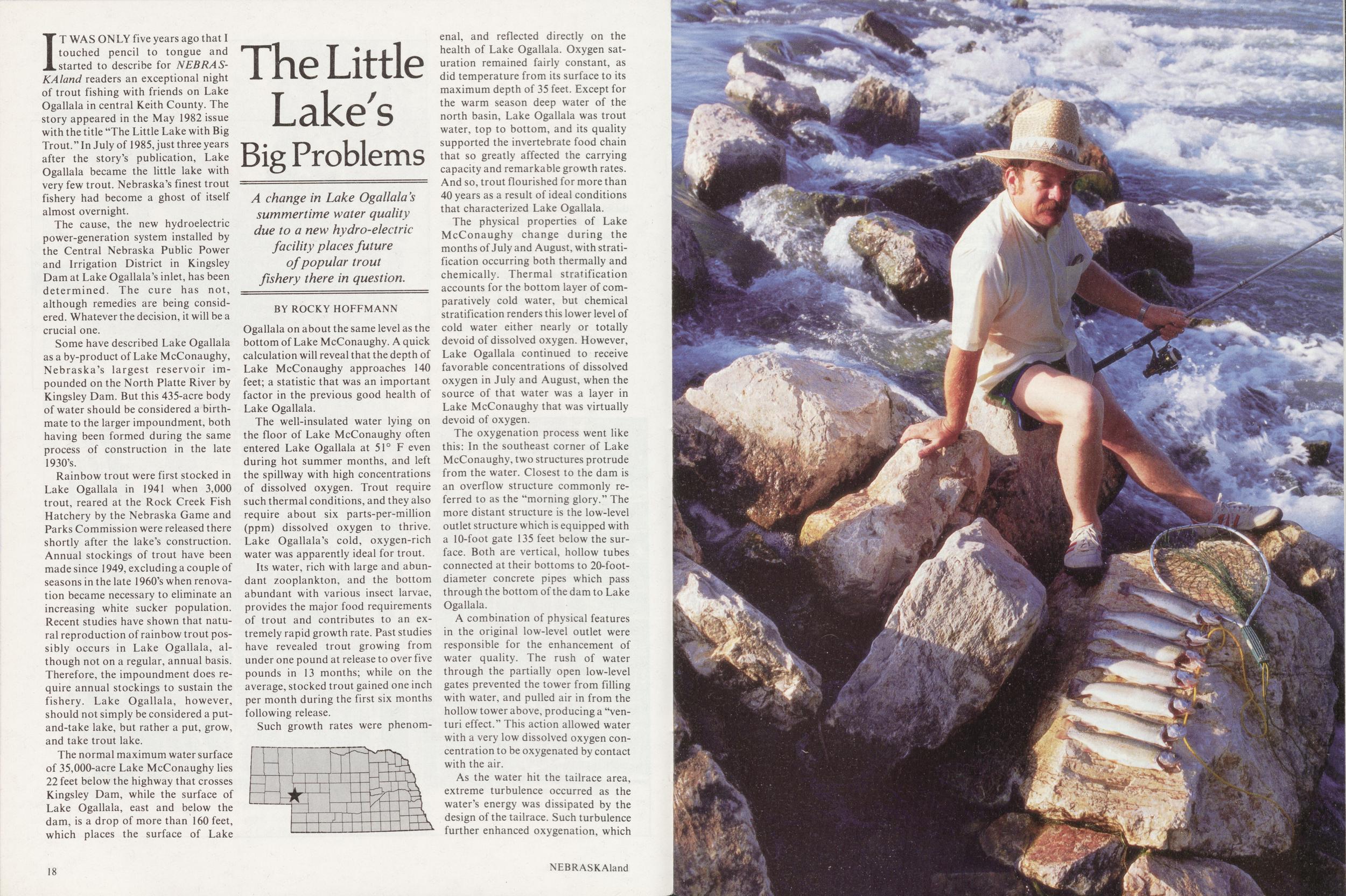
A change in Lake Ogallala's summertime water quality due to a new hydro-electric facility places future of popular trout fishery there in question. BY ROCKY HOFFMANNIT WAS ONLY five years ago that I touched pencil to tongue and started to describe for NEBRASKAland readers an exceptional night of trout fishing with friends on Lake Ogallala in central Keith County. The story appeared in the May 1982 issue with the title "The Little Lake with Big Trout." In July of 1985, just three years after the story's publication, Lake Ogallala became the little lake with very few trout. Nebraska's finest trout fishery had become a ghost of itself almost overnight.
The cause, the new hydroelectric power-generation system installed by the Central Nebraska Public Power and Irrigation District in Kingsley Dam at Lake Ogallala's inlet, has been determined. The cure has not, although remedies are being considered. Whatever the decision, it will be a crucial one.
Some have described Lake Ogallala as a by-product of Lake McConaughy, Nebraska's largest reservoir impounded on the North Platte River by Kingsley Dam. But this 435-acre body of water should be considered a birthmate to the larger impoundment, both having been formed during the same process of construction in the late 1930's.
Rainbow trout were first stocked in Lake Ogallala in 1941 when 3,000 trout, reared at the Rock Creek Fish Hatchery by the Nebraska Game and Parks Commission were released there shortly after the lake's construction. Annual stockings of trout have been made since 1949, excluding a couple of seasons in the late 1960's when renovation became necessary to eliminate an increasing white sucker population. Recent studies have shown that natural reproduction of rainbow trout possibly occurs in Lake Ogallala, although not on a regular, annual basis. Therefore, the impoundment does require annual stockings to sustain the fishery. Lake Ogallala, however, should not simply be considered a put-and-take lake, but rather a put, grow, and take trout lake.
The normal maximum water surface of 35,000-acre Lake McConaughy lies 22 feet below the highway that crosses Kingsley Dam, while the surface of Lake Ogallala, east and below the dam, is a drop of more than 160 feet, which places the surface of Lake Ogallala on about the same level as the bottom of Lake McConaughy. A quick calculation will reveal that the depth of Lake McConaughy approaches 140 feet; a statistic that was an important factor in the previous good health of Lake Ogallala.
The well-insulated water lying on the floor of Lake McConaughy often entered Lake Ogallala at 51° F even during hot summer months, and left the spillway with high concentrations of dissolved oxygen. Trout require such thermal conditions, and they also require about six parts-per-million (ppm) dissolved oxygen to thrive. Lake Ogallala's cold, oxygen-rich water was apparently ideal for trout.
Its water, rich with large and abundant zooplankton, and the bottom abundant with various insect larvae, provides the major food requirements of trout and contributes to an extremely rapid growth rate. Past studies have revealed trout growing from under one pound at release to over five pounds in 13 months; while on the average, stocked trout gained one inch per month during the first six months following release.
Such growth rates were phenomenal,
The physical properties of Lake McConaughy change during the months of July and August, with stratification occurring both thermally and chemically. Thermal stratification accounts for the bottom layer of comparatively cold water, but chemical stratification renders this lower level of cold water either nearly or totally devoid of dissolved oxygen. However, Lake Ogallala continued to receive favorable concentrations of dissolved oxygen in July and August, when the source of that water was a layer in Lake McConaughy that was virtually devoid of oxygen.
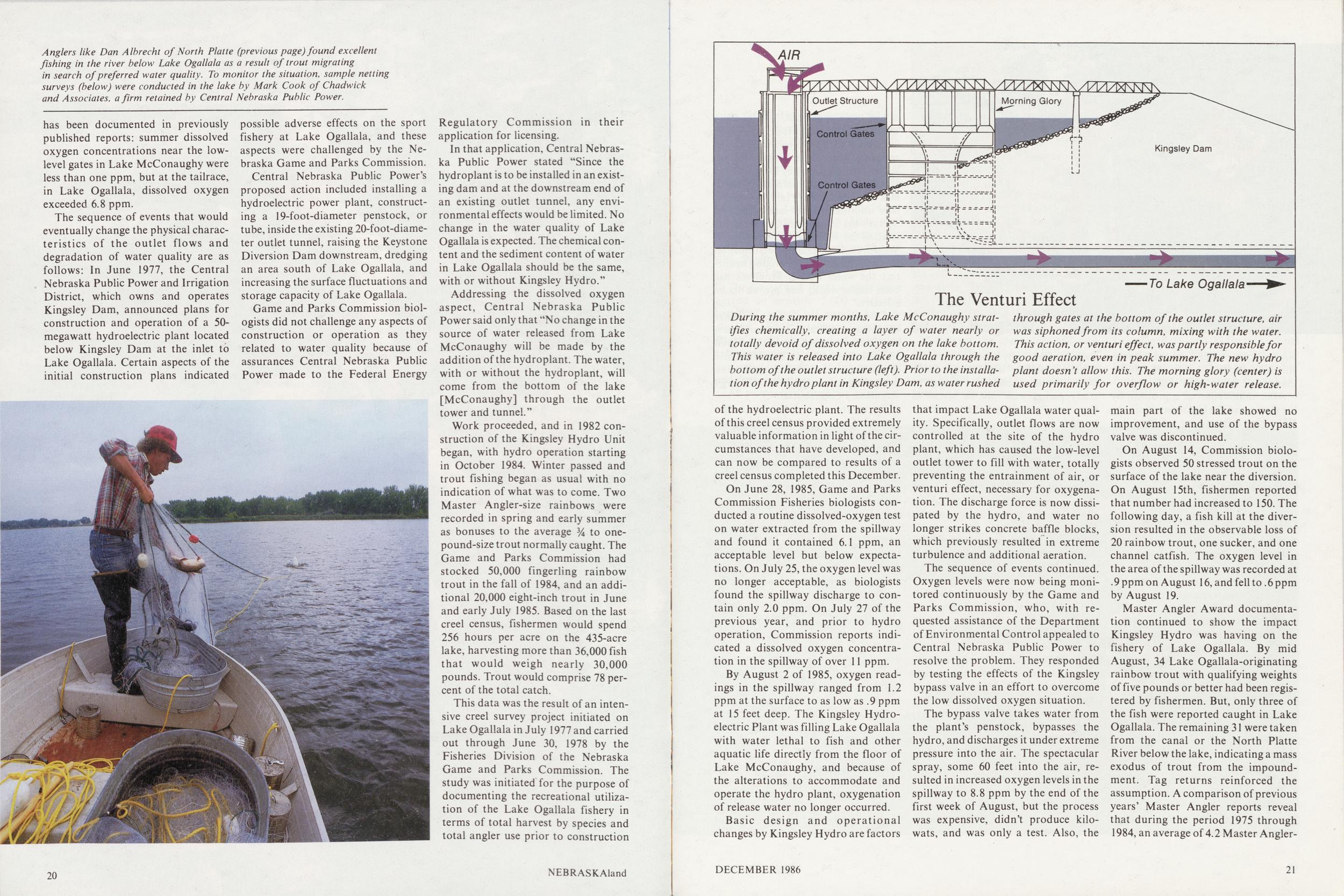
The oxygenation process went like this: In the southeast corner of Lake McConaughy, two structures protrude from the water. Closest to the dam is an overflow structure commonly referred to as the "morning glory." The more distant structure is the low-level outlet structure which is equipped with a 10-foot gate 135 feet below the surface. Both are vertical, hollow tubes connected at their bottoms to 20-foot-diameter concrete pipes which pass through the bottom of the dam to Lake Ogallala.
A combination of physical features in the original low-level outlet were responsible for the enhancement of water quality. The rush of water through the partially open low-level gates prevented the tower from filling with water, and pulled air in from the hollow tower above, producing a "venturi effect." This action allowed water with a very low dissolved oxygen concentration to be oxygenated by contact with the air.
As the water hit the tailrace area, extreme turbulence occurred as the water's energy was dissipated by the design of the tailrace. Such turbulence further enhanced oxygenation, which 18 NEBRASKAland
The sequence of events that would eventually change the physical characteristics of the outlet flows and degradation of water quality are as follows: In June 1977, the Central Nebraska Public Power and Irrigation District, which owns and operates Kingsley Dam, announced plans for construction and operation of a 50-megawatt hydroelectric plant located below Kingsley Dam at the inlet to Lake Ogallala. Certain aspects of the initial construction plans indicated possible adverse effects on the sport fishery at Lake Ogallala, and these aspects were challenged by the Nebraska Game and Parks Commission.
Central Nebraska Public Power's proposed action included installing a hydroelectric power plant, constructing a 19-foot-diameter penstock, or tube, inside the existing 20-foot-diameter outlet tunnel, raising the Keystone Diversion Dam downstream, dredging an area south of Lake Ogallala, and increasing the surface fluctuations and storage capacity of Lake Ogallala.
Game and Parks Commission biologists did not challenge any aspects of construction or operation as they related to water quality because of assurances Central Nebraska Public Power made to the Federal Energy Regulatory Commission in their application for licensing.
In that application, Central Nebraska Public Power stated "Since the hydroplant is to be installed in an existing dam and at the downstream end of an existing outlet tunnel, any environmental effects would be limited. No change in the water quality of Lake Ogallala is expected. The chemical content and the sediment content of water in Lake Ogallala should be the same, with or without Kingsley Hydro."
Addressing the dissolved oxygen aspect, Central Nebraska Public Power said only that "No change in the source of water released from Lake McConaughy will be made by the addition of the hydroplant. The water, with or without the hydroplant, will come from the bottom of the lake [McConaughy] through the outlet tower and tunnel."
Work proceeded, and in 1982 construction of the Kingsley Hydro Unit began, with hydro operation starting in October 1984. Winter passed and trout fishing began as usual with no indication of what was to come. Two Master Angler-size rainbows were recorded in spring and early summer as bonuses to the average % to onepound-size trout normally caught. The Game and Parks Commission had stocked 50,000 fingerling rainbow trout in the fall of 1984, and an additional 20,000 eight-inch trout in June and early July 1985. Based on the last creel census, fishermen would spend 256 hours per acre on the 435-acre lake, harvesting more than 36,000 fish that would weigh nearly 30,000 pounds. Trout would comprise 78 percent of the total catch.
This data was the result of an intensive creel survey project initiated on Lake Ogallala in July 1977 and carried out through June 30, 1978 by the Fisheries Division of the Nebraska Game and Parks Commission. The study was initiated for the purpose of documenting the recreational utilization of the Lake Ogallala fishery in terms of total harvest by species and total angler use prior to construction 20 NEBRASKAland
On June 28, 1985, Game and Parks Commission Fisheries biologists conducted a routine dissolved-oxygen test on water extracted from the spillway and found it contained 6.1 ppm, an acceptable level but below expectations. On July 25, the oxygen level was no longer acceptable, as biologists found the spillway discharge to contain only 2.0 ppm. On July 27 of the previous year, and prior to hydro operation, Commission reports indicated a dissolved oxygen concentration in the spillway of over 11 ppm.
By August 2 of 1985, oxygen readings in the spillway ranged from 1.2 ppm at the surface to as low as .9 ppm at 15 feet deep. The Kingsley Hydroelectric Plant was filling Lake Ogallala with water lethal to fish and other aquatic life directly from the floor of Lake McConaughy, and because of the alterations to accommodate and operate the hydro plant, oxygenation of release water no longer occurred.
Basic design and operational changes by Kingsley Hydro are factors DECEMBER 1986 that impact Lake Ogallala water quality. Specifically, outlet flows are now controlled at the site of the hydro plant, which has caused the low-level outlet tower to fill with water, totally preventing the entrainment of air, or venturi effect, necessary for oxygenation. The discharge force is now dissipated by the hydro, and water no longer strikes concrete baffle blocks, which previously resulted in extreme turbulence and additional aeration.
The sequence of events continued. Oxygen levels were now being monitored continuously by the Game and Parks Commission, who, with requested assistance of the Department of Environmental Control appealed to Central Nebraska Public Power to resolve the problem. They responded by testing the effects of the Kingsley bypass valve in an effort to overcome the low dissolved oxygen situation.
The bypass valve takes water from the plant's penstock, bypasses the hydro, and discharges it under extreme pressure into the air. The spectacular spray, some 60 feet into the air, resulted in increased oxygen levels in the spillway to 8.8 ppm by the end of the first week of August, but the process was expensive, didn't produce kilowats, and was only a test. Also, the main part of the lake showed no improvement, and use of the bypass valve was discontinued.
On August 14, Commission biologists observed 50 stressed trout on the surface of the lake near the diversion. On August 15th, fishermen reported that number had increased to 150. The following day, a fish kill at the diversion resulted in the observable loss of 20 rainbow trout, one sucker, and one channel catfish. The oxygen level in the area of the spillway was recorded at .9 ppm on August 16, and fell to .6 ppm by August 19.
Master Angler Award documentation continued to show the impact Kingsley Hydro was having on the fishery of Lake Ogallala. By mid August, 34 Lake Ogallala-originating rainbow trout with qualifying weights of five pounds or better had been registered by fishermen. But, only three of the fish were reported caught in Lake Ogallala. The remaining 31 were taken from the canal or the North Platte River below the lake, indicating a mass exodus of trout from the impoundment. Tag returns reinforced the assumption. A comparison of previous years' Master Angler reports reveal that during the period 1975 through 1984, an average of 4.2 Master Angler-size DECEMBER 1986 21 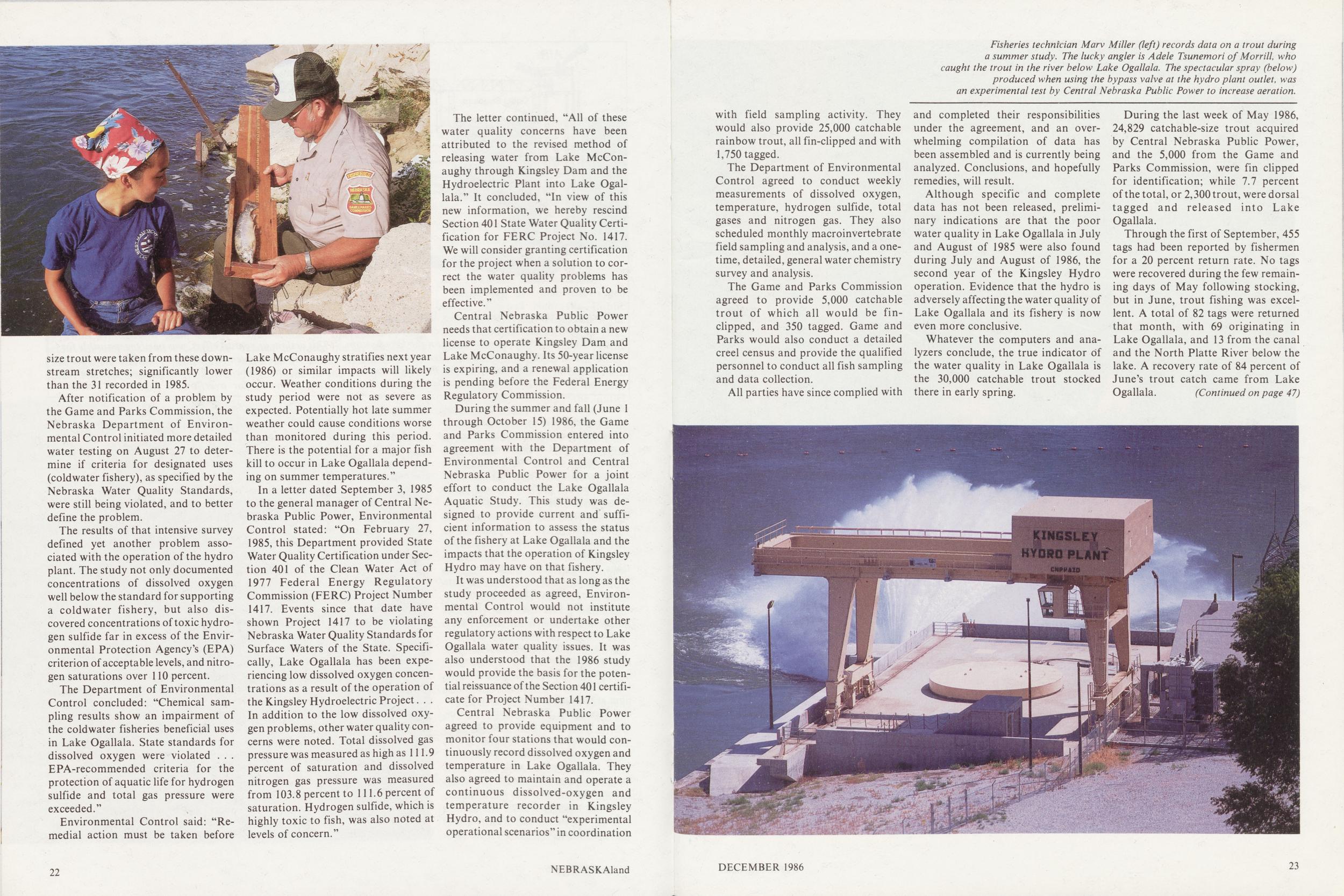
After notification of a problem by the Game and Parks Commission, the Nebraska Department of Environmental Control initiated more detailed water testing on August 27 to determine if criteria for designated uses (coldwater fishery), as specified by the Nebraska Water Quality Standards, were still being violated, and to better define the problem.
The results of that intensive survey defined yet another problem associated with the operation of the hydro plant. The study not only documented concentrations of dissolved oxygen well below the standard for supporting a coldwater fishery, but also discovered concentrations of toxic hydrogen sulfide far in excess of the Environmental Protection Agency's (EPA) criterion of acceptable levels, and nitrogen saturations over 110 percent.
The Department of Environmental Control concluded: "Chemical sampling results show an impairment of the coldwater fisheries beneficial uses in Lake Ogallala. State standards for dissolved oxygen were violated EPA-recommended criteria for the protection of aquatic life for hydrogen sulfide and total gas pressure were exceeded."
Environmental Control said: "Remedial action must be taken before Lake McConaughy stratifies next year (1986) or similar impacts will likely occur. Weather conditions during the study period were not as severe as expected. Potentially hot late summer weather could cause conditions worse than monitored during this period. There is the potential for a major fish kill to occur in Lake Ogallala depending on summer temperatures."
In a letter dated September 3, 1985 to the general manager of Central Nebraska Public Power, Environmental Control stated: "On February 27, 1985, this Department provided State Water Quality Certification under Section 401 of the Clean Water Act of 1977 Federal Energy Regulatory Commission (FERC) Project Number 1417. Events since that date have shown Project 1417 to be violating Nebraska Water Quality Standards for Surface Waters of the State. Specifically, Lake Ogallala has been experiencing low dissolved oxygen concentrations as a result of the operation of the Kingsley Hydroelectric Project. In addition to the low dissolved oxygen problems, other water quality concerns were noted. Total dissolved gas pressure was measured as high as 111.9 percent of saturation and dissolved nitrogen gas pressure was measured from 103.8 percent to 111.6 percent of saturation. Hydrogen sulfide, which is highly toxic to fish, was also noted at levels of concern."
The letter continued, "All of these water quality concerns have been attributed to the revised method of releasing water from Lake McConaughy through Kingsley Dam and the Hydroelectric Plant into Lake Ogallala." It concluded, "In view of this new information, we hereby rescind Section 401 State Water Quality Certification for FERC Project No. 1417. We will consider granting certification for the project when a solution to correct the water quality problems has been implemented and proven to be effective."
Central Nebraska Public Power needs that certification to obtain a new license to operate Kingsley Dam and Lake McConaughy. Its 50-year license is expiring, and a renewal application is pending before the Federal Energy Regulatory Commission.
During the summer and fall (June 1 through October 15) 1986, the Game and Parks Commission entered into agreement with the Department of Environmental Control and Central Nebraska Public Power for a joint effort to conduct the Lake Ogallala Aquatic Study. This study was designed to provide current and sufficient information to assess the status of the fishery at Lake Ogallala and the impacts that the operation of Kingsley Hydro may have on that fishery.
It was understood that as long as the study proceeded as agreed, Environmental Control would not institute any enforcement or undertake other regulatory actions with respect to Lake Ogallala water quality issues. It was also understood that the 1986 study would provide the basis for the potential reissuance of the Section 401 certificate for Project Number 1417.
Central Nebraska Public Power agreed to provide equipment and to monitor four stations that would continuously record dissolved oxygen and temperature in Lake Ogallala. They also agreed to maintain and operate a continuous dissolved-oxygen and temperature recorder in Kingsley Hydro, and to conduct "experimental operational scenarios" in coordination 22 NEBRASKAland with field sampling activity. They would also provide 25,000 catchable rainbow trout, all fin-clipped and with 1,750 tagged.
The Department of Environmental Control agreed to conduct weekly measurements of dissolved oxygen, temperature, hydrogen sulfide, total gases and nitrogen gas. They also scheduled monthly macroinvertebrate field sampling and analysis, and a onetime, detailed, general water chemistry survey and analysis.
The Game and Parks Commission agreed to provide 5,000 catchable trout of which all would be finclipped, and 350 tagged. Game and Parks would also conduct a detailed creel census and provide the qualified personnel to conduct all fish sampling and data collection.
All parties have since complied with and completed their responsibilities under the agreement, and an overwhelming compilation of data has been assembled and is currently being analyzed. Conclusions, and hopefully remedies, will result.
Although specific and complete data has not been released, preliminary indications are that the poor water quality in Lake Ogallala in July and August of 1985 were also found during July and August of 1986, the second year of the Kingsley Hydro operation. Evidence that the hydro is adversely affecting the water quality of Lake Ogallala and its fishery is now even more conclusive.
Whatever the computers and analyzers conclude, the true indicator of the water quality in Lake Ogallala is the 30,000 catchable trout stocked there in early spring.
During the last week of May 1986, 24,829 catchable-size trout acquired by Central Nebraska Public Power, and the 5,000 from the Game and Parks Commission, were fin clipped for identification; while 7.7 percent of the total, or 2,300 trout, were dorsal tagged and released into Lake Ogallala.
Through the first of September, 455 tags had been reported by fishermen for a 20 percent return rate. No tags were recovered during the few remaining days of May following stocking, but in June, trout fishing was excellent. A total of 82 tags were returned that month, with 69 originating in Lake Ogallala, and 13 from the canal and the North Platte River below the lake. A recovery rate of 84 percent of June's trout catch came from Lake Ogallala. (Continued on page 47)
No Recipe For Success
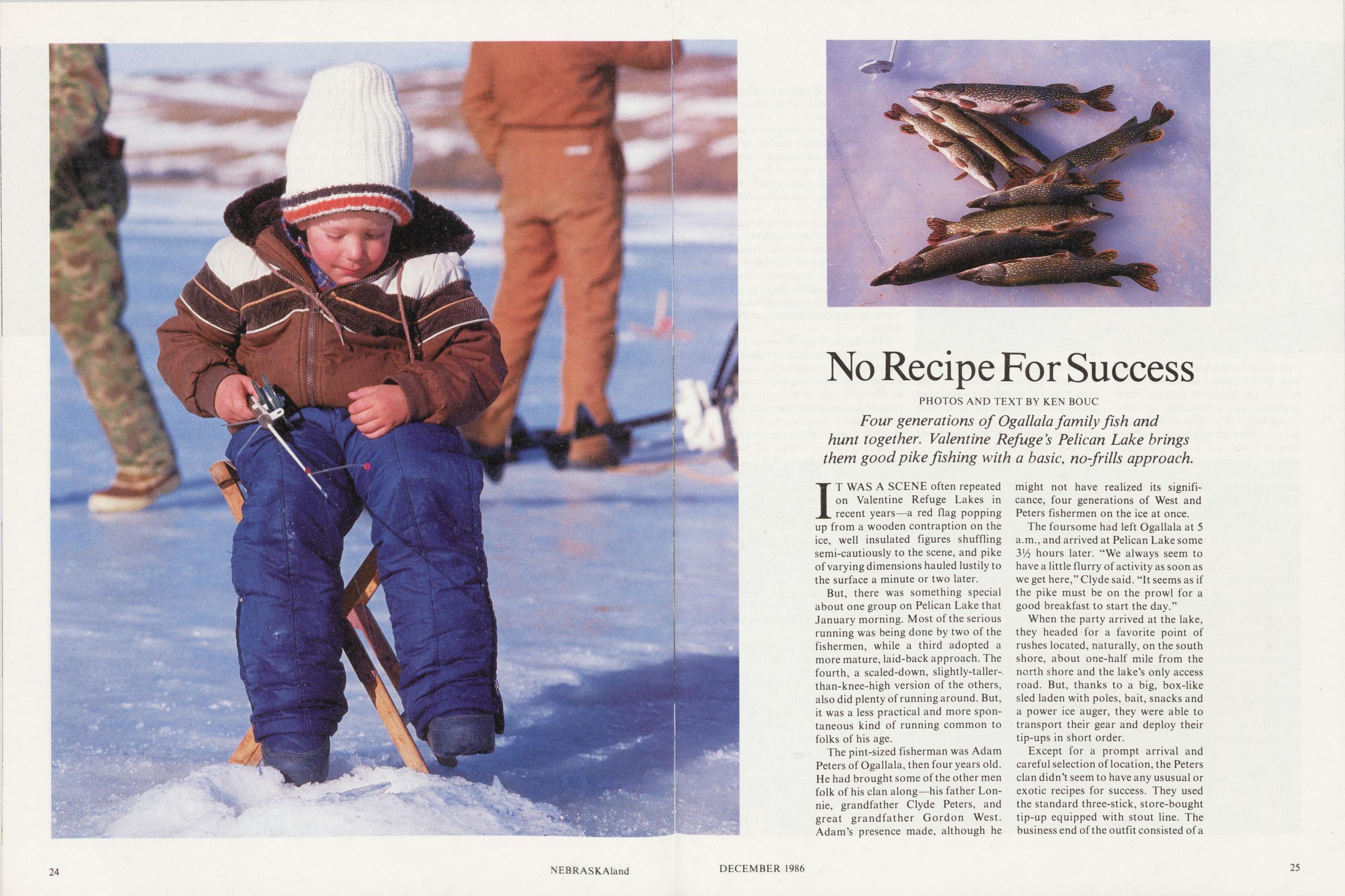
PHOTOS AND TEXT BY KEN BOUC Four generations of Ogallala family fish and hunt together. Valentine Refuge's Pelican Lake brings them good pike fishing with a basic, no-frills approach.IT WAS A SCENE often repeated on Valentine Refuge Lakes in recent years—a red flag popping up from a wooden contraption on the ice, well insulated figures shuffling semi-cautiously to the scene, and pike of varying dimensions hauled lustily to the surface a minute or two later.
But, there was something special about one group on Pelican Lake that January morning. Most of the serious running was being done by two of the fishermen, while a third adopted a more mature, laid-back approach. The fourth, a scaled-down, slightly-taller-than-knee-high version of the others, also did plenty of running around. But, it was a less practical and more spontaneous kind of running common to folks of his age.
The pint-sized fisherman was Adam Peters of Ogallala, then four years old. He had brought some of the other men folk of his clan along—his father Lonnie, grandfather Clyde Peters, and great grandfather Gordon West. Adam's presence made, although he might not have realized its significance, four generations of West and Peters fishermen on the ice at once.
The foursome had left Ogallala at 5 a.m., and arrived at Pelican Lake some 3/2 hours later. "We always seem to have a little flurry of activity as soon as we get here," Clyde said. "It seems as if the pike must be on the prowl for a good breakfast to start the day."
When the party arrived at the lake, they headed for a favorite point of rushes located, naturally, on the south shore, about one-half mile from the north shore and the lake's only access road. But, thanks to a big, box-like sled laden with poles, bait, snacks and a power ice auger, they were able to transport their gear and deploy their tip-ups in short order.
Except for a prompt arrival and careful selection of location, the Peters clan didn't seem to have any ususual or exotic recipes for success. They used the standard three-stick, store-bought tip-up equipped with stout line. The business end of the outfit consisted of a DECMEBER 1986 25 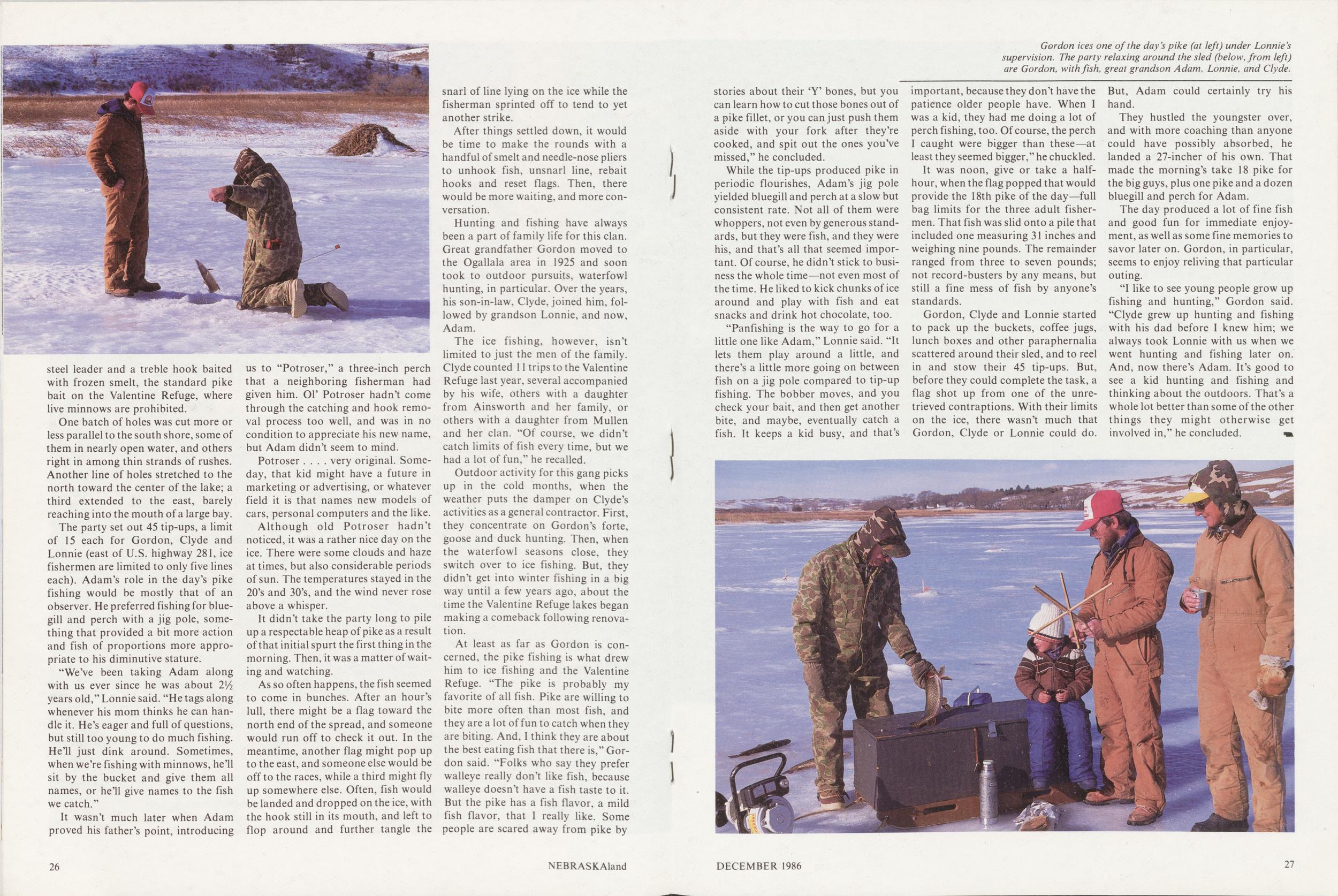
One batch of holes was cut more or less parallel to the south shore, some of them in nearly open water, and others right in among thin strands of rushes. Another line of holes stretched to the north toward the center of the lake; a third extended to the east, barely reaching into the mouth of a large bay.
The party set out 45 tip-ups, a limit of 15 each for Gordon, Clyde and Lonnie (east of U.S. highway 281, ice fishermen are limited to only five lines each). Adam's role in the day's pike fishing would be mostly that of an observer. He preferred fishing for bluegill and perch with a jig pole, something that provided a bit more action and fish of proportions more appropriate to his diminutive stature.
"We've been taking Adam along with us ever since he was about 2*/2 years old," Lonnie said. "He tags along whenever his mom thinks he can handle it. He's eager and full of questions, but still too young to do much fishing. He'll just dink around. Sometimes, when we're fishing with minnows, he'll sit by the bucket and give them all names, or he'll give names to the fish we catch."
It wasn't much later when Adam proved his father's point, introducing us to "Potroser," a three-inch perch that a neighboring fisherman had given him. Ol' Potroser hadn't come through the catching and hook removal process too well, and was in no condition to appreciate his new name, but Adam didn't seem to mind.
Potroser . very original. Someday, that kid might have a future in marketing or advertising, or whatever field it is that names new models of cars, personal computers and the like.
Although old Potroser hadn't noticed, it was a rather nice day on the ice. There were some clouds and haze at times, but also considerable periods of sun. The temperatures stayed in the 20's and 30's, and the wind never rose above a whisper.
It didn't take the party long to pile up a respectable heap of pike as a result of that initial spurt the first thing in the morning. Then, it was a matter of waiting and watching.
As so often happens, the fish seemed to come in bunches. After an hour's lull, there might be a flag toward the north end of the spread, and someone would run off to check it out. In the meantime, another flag might pop up to the east, and someone else would be off to the races, while a third might fly up somewhere else. Often, fish would be landed and dropped on the ice, with the hook still in its mouth, and left to flop around and further tangle the snarl of line lying on the ice while the fisherman sprinted off to tend to yet another strike.
After things settled down, it would be time to make the rounds with a handful of smelt and needle-nose pliers to unhook fish, unsnarl line, rebait hooks and reset flags. Then, there would be more waiting, and more conversation.
Hunting and fishing have always been a part of family life for this clan. Great grandfather Gordon moved to the Ogallala area in 1925 and soon took to outdoor pursuits, waterfowl hunting, in particular. Over the years, his son-in-law, Clyde, joined him, followed by grandson Lonnie, and now, Adam.
The ice fishing, however, isn't limited to just the men of the family. Clyde counted 11 trips to the Valentine Refuge last year, several accompanied by his wife, others with a daughter from Ainsworth and her family, or others with a daughter from Mullen and her clan. "Of course, we didn't catch limits of fish every time, but we had a lot of fun," he recalled.
Outdoor activity for this gang picks up in the cold months, when the weather puts the damper on Clyde's activities as a general contractor. First, they concentrate on Gordon's forte, goose and duck hunting. Then, when the waterfowl seasons close, they switch over to ice fishing. But, they didn't get into winter fishing in a big way until a few years ago, about the time the Valentine Refuge lakes began making a comeback following renovation.
At least as far as Gordon is concerned, the pike fishing is what drew him to ice fishing and the Valentine Refuge. "The pike is probably my favorite of all fish. Pike are willing to bite more often than most fish, and they are a lot of fun to catch when they are biting. And, I think they are about the best eating fish that there is," Gordon said. "Folks who say they prefer walleye really don't like fish, because walleye doesn't have a fish taste to it. But the pike has a fish flavor, a mild fish flavor, that I really like. Some people are scared away from pike by 26 NEBRASKAland stories about their 4Y' bones, but you can learn how to cut those bones out of a pike fillet, or you can just push them aside with your fork after they're cooked, and spit out the ones you've missed," he concluded.
While the tip-ups produced pike in periodic flourishes, Adam's jig pole yielded bluegill and perch at a slow but consistent rate. Not all of them were whoppers, not even by generous standards, but they were fish, and they were his, and that's all that seemed important. Of course, he didn't stick to business the whole time—not even most of the time. He liked to kick chunks of ice around and play with fish and eat snacks and drink hot chocolate, too.
"Panfishing is the way to go for a little one like Adam," Lonnie said. "It lets them play around a little, and there's a little more going on between fish on a jig pole compared to tip-up fishing. The bobber moves, and you check your bait, and then get another bite, and maybe, eventually catch a fish. It keeps a kid busy, and that's important, because they don't have the patience older people have. When I was a kid, they had me doing a lot of perch fishing, too. Of course, the perch I caught were bigger than these—at least they seemed bigger," he chuckled.
It was noon, give or take a halfhour, when the flag popped that would provide the 18th pike of the day—full bag limits for the three adult fishermen. That fish was slid onto a pile that included one measuring 31 inches and weighing nine pounds. The remainder ranged from three to seven pounds; not record-busters by any means, but still a fine mess of fish by anyone's standards.
Gordon, Clyde and Lonnie started to pack up the buckets, coffee jugs, lunch boxes and other paraphernalia scattered around their sled, and to reel in and stow their 45 tip-ups. But, before they could complete the task, a flag shot up from one of the unretrieved contraptions. With their limits on the ice, there wasn't much that Gordon, Clyde or Lonnie could do. But, Adam could certainly try his hand.
They hustled the youngster over, and with more coaching than anyone could have possibly absorbed, he landed a 27-incher of his own. That made the morning's take 18 pike for the big guys, plus one pike and a dozen bluegill and perch for Adam.
The day produced a lot of fine fish and good fun for immediate enjoyment, as well as some fine memories to savor later on. Gordon, in particular, seems to enjoy reliving that particular outing.
"I like to see young people grow up fishing and hunting," Gordon said. "Clyde grew up hunting and fishing with his dad before I knew him; we always took Lonnie with us when we went hunting and fishing later on. And, now there's Adam. It's good to see a kid hunting and fishing and thinking about the outdoors. That's a whole lot better than some of the other things they might otherwise get involved in," he concluded.
Preserving the Tradition
PHOTOS AND TEXT BY JON FARRAR When afflicted with the passion for quail hunting, good pointing dogs, open-bore shotguns and weedy creekbottoms assume a greater importance.NOT ALL THAT many years ago, a good share of Nebraska's upland bird hunters thought of quail as small brown birds you sometimes stumbled across while pheasant hunting. If you were lucky you got off a shot while they were huddled in a bunch so you could get as many as possible; not a legal act then, or now, and certainly not a moral or sporting way to lace a roaster with quail, but without a dog that was about the only way of getting more than one or two a day. The fine points, and real joy, of chasing after these fastflying little game birds completely eluded most hunters. Today, more Nebraska hunters have come to appreciate the bobwhite's sporting qualities, no doubt a result of more and more Cornhusker hunters trailing dogs through the fields than was true only 20 years ago.
Nebraska is on the edge of the bobwhite's range but that doesn't mean there are not more than enough quail here most years to satisfy serious quail hunters. Unlike states in the southeast, a quail hunting tradition simply never developed in Nebraska, at least not in many families. The gaudy ringneck took readily to Nebraska fields and the Nebraska bird hunter took readily to the ringneck. Both seemed right at home in the cornfields and weedy draws. Though pheasant hunting is more successful and satisfying with a dog, you could get along without one if you had a pair of stout legs and lots of persistence.
There always have been dyed-in-the-wool quail hunters in the state, but their numbers were small. Probably no one knows for sure how many hunters prefer quail to other upland game species. There's simply no way to count them; no quail stamp sales or quail hunting permits to use as a measure, no way to sort out the dedicated quail hunters from all those required to buy a hunting permit and habitat stamp.
From hunter success surveys conducted by the Nebraska Game and Parks Commission, biologists are able to sketch a profile of the state's quail hunter, though, and somewhat estimate his success. Despite the increase in number of hunters who specialize in chasing quail, the bulk of the quail taken in Nebraska are still shot incidentally to hunting other types of game, principally pheasants. The survey indicates that about 60,000 to 70,000 hunt quail, but of those only about 10,000 are, at least by the criteria of the survey, considered serious quail hunters. In practice, the number of dedicated quail hunters—the fellows who get up on a November morning, pull on their hunting britches, whistle up their pointer, take down their favorite open-choked smooth-bore from the rack and go out specifically for quail— is probably only a fraction of those 10,000 hunters the Game Commission's computer considers quail hunters. One interesting conclusion can be drawn from the survey results, though. About 10 percent of Nebraska hunters take about 47 percent of the quail harvested in an average year. Those who specialize in quail are successful!
About three years ago, a handful of quail hunters in the Lincoln and Omaha areas got together to organize a chapter of Quail Unlimited, the quail hunter's counterpart of the waterfowler's Ducks Unlimited. At one time the chapter counted 70 to 80 members, but has failed to generate the interest 28 NEBRASKAland
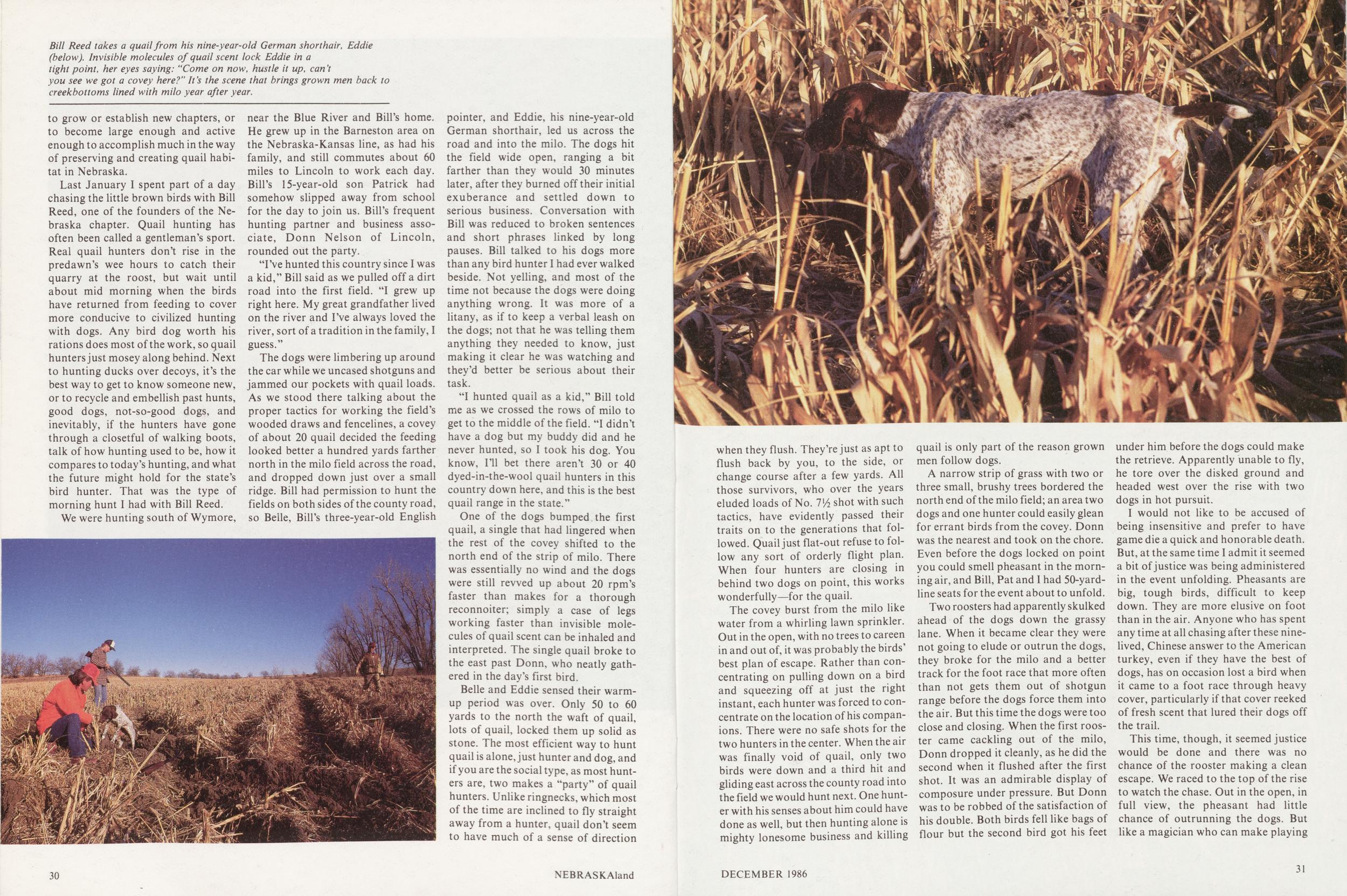
Last January I spent part of a day chasing the little brown birds with Bill Reed, one of the founders of the Ne- braska chapter. Quail hunting has often been called a gentleman's sport. Real quail hunters don't rise in the predawn's wee hours to catch their quarry at the roost, but wait until about mid morning when the birds have returned from feeding to cover more conducive to civilized hunting with dogs. Any bird dog worth his rations does most of the work, so quail hunters just mosey along behind. Next to hunting ducks over decoys, it's the best way to get to know someone new, or to recycle and embellish past hunts, good dogs, not-so-good dogs, and inevitably, if the hunters have gone through a closetful of walking boots, talk of how hunting used to be, how it compares to today's hunting, and what the future might hold for the state's bird hunter. That was the type of morning hunt I had with Bill Reed.
We were hunting south of Wymore, near the Blue River and Bill's home. He grew up in the Barneston area on the Nebraska-Kansas line, as had his family, and still commutes about 60 miles to Lincoln to work each day. Bill's 15-year-old son Patrick had somehow slipped away from school for the day to join us. Bill's frequent hunting partner and business associate, Donn Nelson of Lincoln, rounded out the party.
"I've hunted this country since I was a kid," Bill said as we pulled off a dirt road into the first field. "I grew up right here. My great grandfather lived on the river and I've always loved the river, sort of a tradition in the family, I guess."
The dogs were limbering up around the car while we uncased shotguns and jammed our pockets with quail loads. As we stood there talking about the proper tactics for working the field's wooded draws and fencelines, a covey of about 20 quail decided the feeding looked better a hundred yards farther north in the milo field across the road, and dropped down just over a small ridge. Bill had permission to hunt the fields on both sides of the county road, so Belle, Bill's three-year-old English pointer, and Eddie, his nine-year-old German shorthair, led us across the road and into the milo. The dogs hit the field wide open, ranging a bit farther than they would 30 minutes later, after they burned off their initial exuberance and settled down to serious business. Conversation with Bill was reduced to broken sentences and short phrases linked by long pauses. Bill talked to his dogs more than any bird hunter I had ever walked beside. Not yelling, and most of the time not because the dogs were doing anything wrong. It was more of a litany, as if to keep a verbal leash on the dogs; not that he was telling them anything they needed to know, just making it clear he was watching and they'd better be serious about their task.
"I hunted quail as a kid," Bill told me as we crossed the rows of milo to get to the middle of the field. "I didn't have a dog but my buddy did and he never hunted, so I took his dog. You know, I'll bet there aren't 30 or 40 dyed-in-the-wool quail hunters in this country down here, and this is the best quail range in the state."
One of the dogs bumped the first quail, a single that had lingered when the rest of the covey shifted to the north end of the strip of milo. There was essentially no wind and the dogs were still revved up about 20 rpm's faster than makes for a thorough reconnoiter; simply a case of legs working faster than invisible molecules of quail scent can be inhaled and interpreted. The single quail broke to the east past Donn, who neatly gathered in the day's first bird.
Belle and Eddie sensed their warmup period was over. Only 50 to 60 yards to the north the waft of quail, lots of quail, locked them up solid as stone. The most efficient way to hunt quail is alone, just hunter and dog, and if you are the social type, as most hunters are, two makes a "party" of quail hunters. Unlike ringnecks, which most of the time are inclined to fly straight away from a hunter, quail don't seem to have much of a sense of direction 30 NEBRASKAland when they flush. They're just as apt to flush back by you, to the side, or change course after a few yards. All those survivors, who over the years eluded loads of No. 7!/2 shot with such tactics, have evidently passed their traits on to the generations that followed. Quail just flat-out refuse to follow any sort of orderly flight plan. When four hunters are closing in behind two dogs on point, this works wonderfully—for the quail.
The covey burst from the milo like water from a whirling lawn sprinkler. Out in the open, with no trees to careen in and out of, it was probably the birds' best plan of escape. Rather than concentrating on pulling down on a bird and squeezing off at just the right instant, each hunter was forced to concentrate on the location of his companions. There were no safe shots for the two hunters in the center. When the air was finally void of quail, only two birds were down and a third hit and gliding east across the county road into the field we would hunt next. One hunter with his senses about him could have done as well, but then hunting alone is mighty lonesome business and killing quail is only part of the reason grown men follow dogs.
A narrow strip of grass with two or three small, brushy trees bordered the north end of the milo field; an area two dogs and one hunter could easily glean for errant birds from the covey. Donn was the nearest and took on the chore. Even before the dogs locked on point you could smell pheasant in the morning air, and Bill, Pat and I had 50-yardline seats for the event about to unfold.
Two roosters had apparently skulked ahead of the dogs down the grassy lane. When it became clear they were not going to elude or outrun the dogs, they broke for the milo and a better track for the foot race that more often than not gets them out of shotgun range before the dogs force them into the air. But this time the dogs were too close and closing. When the first rooster came cackling out of the milo, Donn dropped it cleanly, as he did the second when it flushed after the first shot. It was an admirable display of composure under pressure. But Donn was to be robbed of the satisfaction of his double. Both birds fell like bags of flour but the second bird got his feet under him before the dogs could make the retrieve. Apparently unable to fly, he tore over the disked ground and headed west over the rise with two dogs in hot pursuit.
I would not like to be accused of being insensitive and prefer to have game die a quick and honorable death. But, at the same time I admit it seemed a bit of justice was being administered in the event unfolding. Pheasants are big, tough birds, difficult to keep down. They are more elusive on foot than in the air. Anyone who has spent any time at all chasing after these ninelived, Chinese answer to the American turkey, even if they have the best of dogs, has on occasion lost a bird when it came to a foot race through heavy cover, particularly if that cover reeked of fresh scent that lured their dogs off the trail.
This time, though, it seemed justice would be done and there was no chance of the rooster making a clean escape. We raced to the top of the rise to watch the chase. Out in the open, in full view, the pheasant had little chance of outrunning the dogs. But like a magician who can make playing DECEMBER 1986 31 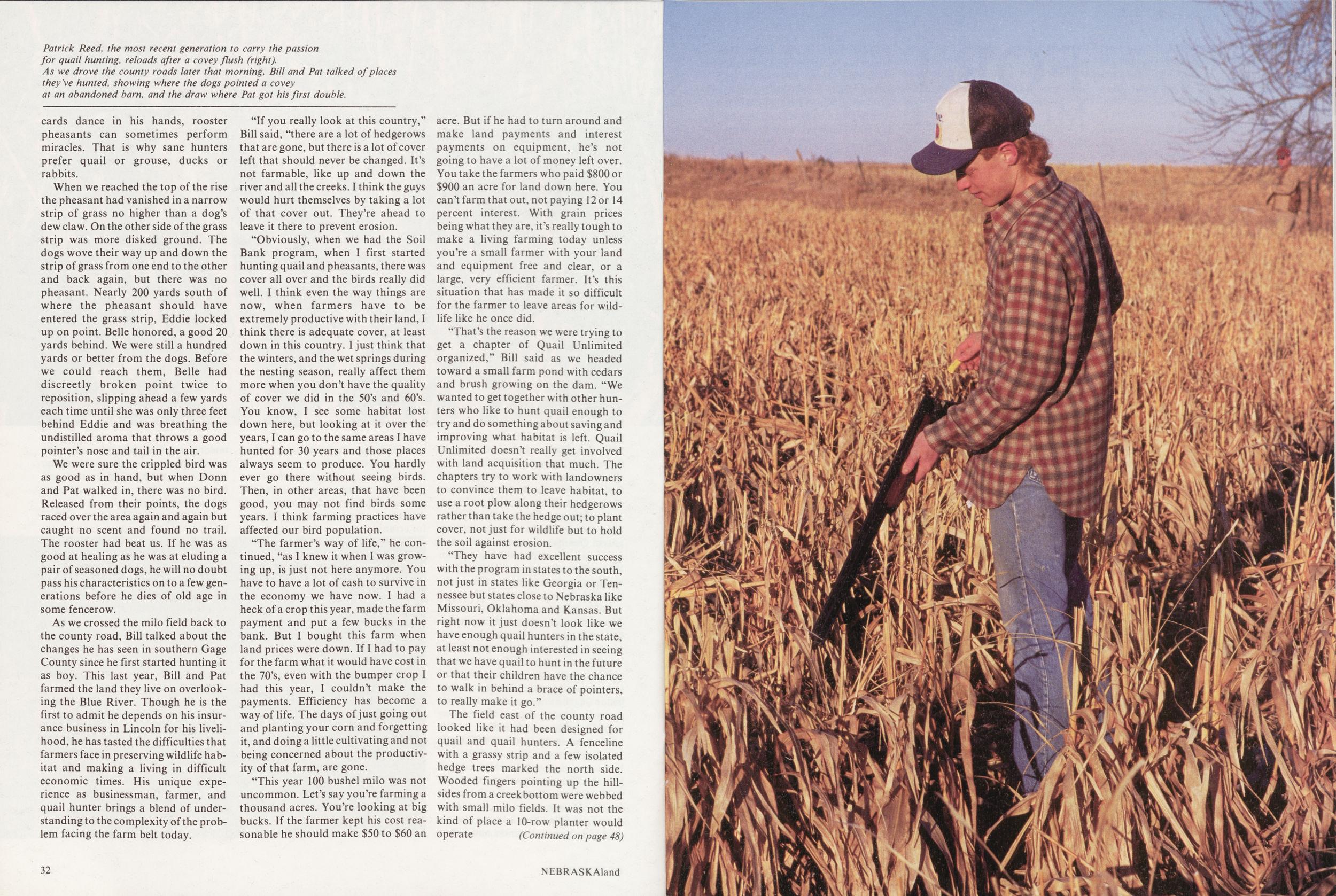
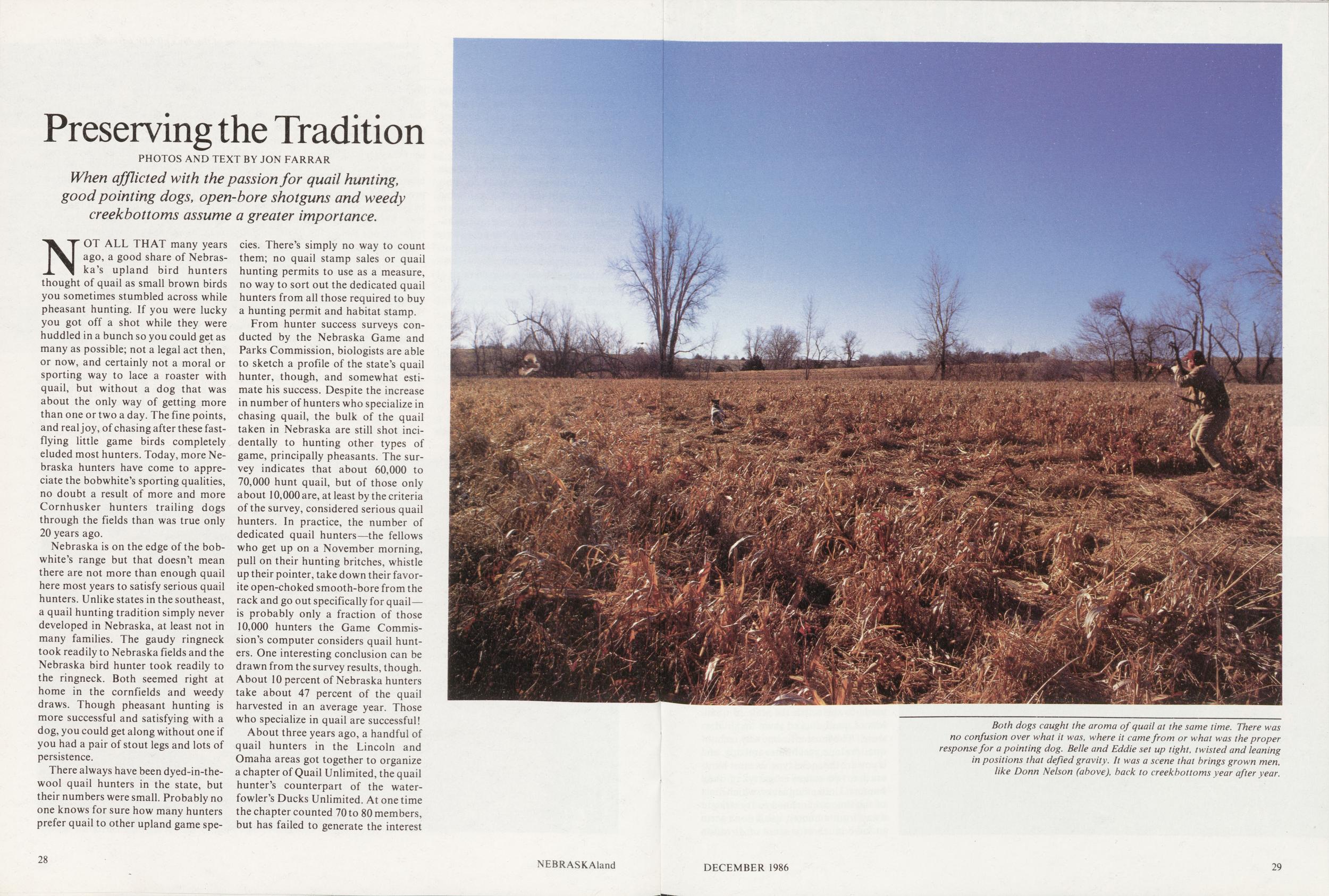
When we reached the top of the rise the pheasant had vanished in a narrow strip of grass no higher than a dog's dew claw. On the other side of the grass strip was more disked ground. The dogs wove their way up and down the strip of grass from one end to the other and back again, but there was no pheasant. Nearly 200 yards south of where the pheasant should have entered the grass strip, Eddie locked up on point. Belle honored, a good 20 yards behind. We were still a hundred yards or better from the dogs. Before we could reach them, Belle had discreetly broken point twice to reposition, slipping ahead a few yards each time until she was only three feet behind Eddie and was breathing the undistilled aroma that throws a good pointer's nose and tail in the air.
We were sure the crippled bird was as good as in hand, but when Donn and Pat walked in, there was no bird. Released from their points, the dogs raced over the area again and again but caught no scent and found no trail. The rooster had beat us. If he was as good at healing as he was at eluding a pair of seasoned dogs, he will no doubt pass his characteristics on to a few generations before he dies of old age in some fencerow.
As we crossed the milo field back to the county road, Bill talked about the changes he has seen in southern Gage County since he first started hunting it as boy. This last year, Bill and Pat farmed the land they live on overlooking the Blue River. Though he is the first to admit he depends on his insurance business in Lincoln for his livelihood, he has tasted the difficulties that farmers face in preserving wildlife habitat and making a living in difficult economic times. His unique experience as businessman, farmer, and quail hunter brings a blend of understanding to the complexity of the problem facing the farm belt today.
"If you really look at this country," Bill said, "there are a lot of hedgerows that are gone, but there is a lot of cover left that should never be changed. It's not farmable, like up and down the river and all the creeks. I think the guys would hurt themselves by taking a lot of that cover out. They're ahead to leave it there to prevent erosion.
"Obviously, when we had the Soil Bank program, when I first started hunting quail and pheasants, there was cover all over and the birds really did well. I think even the way things are now, when farmers have to be extremely productive with their land, I think there is adequate cover, at least down in this country. I just think that the winters, and the wet springs during the nesting season, really affect them more when you don't have the quality of cover we did in the 50's and 60's. You know, I see some habitat lost down here, but looking at it over the years, I can go to the same areas I have hunted for 30 years and those places always seem to produce. You hardly ever go there without seeing birds. Then, in other areas, that have been good, you may not find birds some years. I think farming practices have affected our bird population.
"The farmer's way of life," he continued, "as I knew it when I was growing up, is just not here anymore. You have to have a lot of cash to survive in the economy we have now. I had a heck of a crop this year, made the farm payment and put a few bucks in the bank. But I bought this farm when land prices were down. If I had to pay for the farm what it would have cost in the 70's, even with the bumper crop I had this year, I couldn't make the payments. Efficiency has become a way of life. The days of just going out and planting your corn and forgetting it, and doing a little cultivating and not being concerned about the productivity of that farm, are gone.
"This year 100 bushel milo was not uncommon. Let's say you're farming a thousand acres. You're looking at big bucks. If the farmer kept his cost reasonable he should make $50 to $60 an acre. But if he had to turn around and make land payments and interest payments on equipment, he's not going to have a lot of money left over. You take the farmers who paid $800 or $900 an acre for land down here. You can't farm that out, not paying 12 or 14 percent interest. With grain prices being what they are, it's really tough to make a living farming today unless you're a small farmer with your land and equipment free and clear, or a large, very efficient farmer. It's this situation that has made it so difficult for the farmer to leave areas for wildlife like he once did.
"That's the reason we were trying to get a chapter of Quail Unlimited organized," Bill said as we headed toward a small farm pond with cedars and brush growing on the dam. "We wanted to get together with other hunters who like to hunt quail enough to try and do something about saving and improving what habitat is left. Quail Unlimited doesn't really get involved with land acquisition that much. The chapters try to work with landowners to convince them to leave habitat, to use a root plow along their hedgerows rather than take the hedge out; to plant cover, not just for wildlife but to hold the soil against erosion.
"They have had excellent success with the program in states to the south, not just in states like Georgia or Tennessee but states close to Nebraska like Missouri, Oklahoma and Kansas. But right now it just doesn't look like we have enough quail hunters in the state, at least not enough interested in seeing that we have quail to hunt in the future or that their children have the chance to walk in behind a brace of pointers, to really make it go."
The field east of the county road looked like it had been designed for quail and quail hunters. A fenceline with a grassy strip and a few isolated hedge trees marked the north side. Wooded fingers pointing up the hillsides from a creekbottom were webbed with small milo fields. It was not the kind of place a 10-row planter would operate (Continued on page 48)
32 NEBRASKAland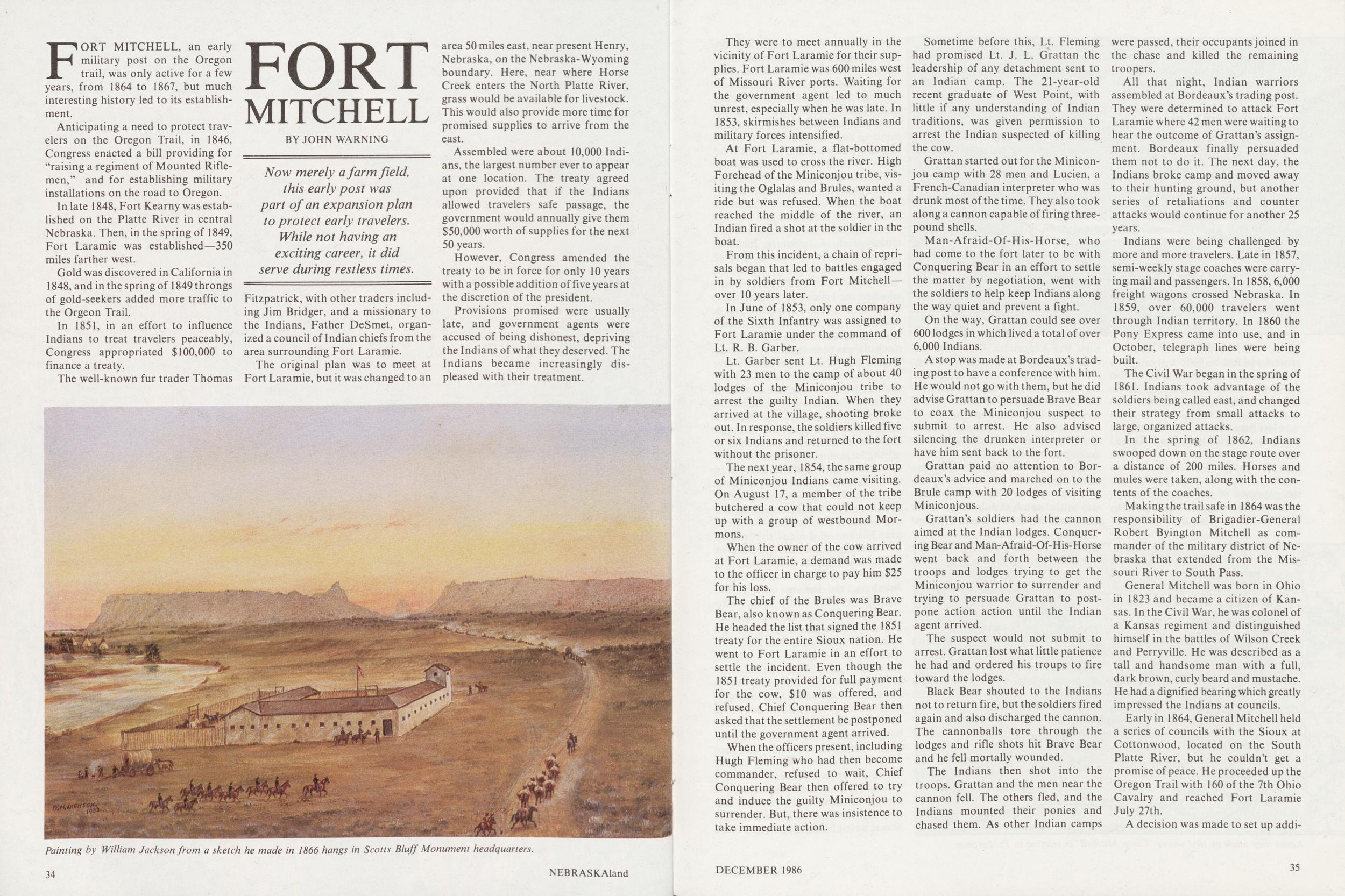
FORT MITCHELL
BY JOHN WARNING Now merely a farm field, this early post was part of an expansion plan to protect early travelers. While not having an exciting career, it did serve during restless times.FORT MITCHELL, an early military post on the Oregon trail, was only active for a few years, from 1864 to 1867, but much interesting history led to its establishment.
Anticipating a need to protect travelers on the Oregon Trail, in 1846, Congress enacted a bill providing for "raising a regiment of Mounted Riflemen," and for establishing military installations on the road to Oregon.
In late 1848, Fort Kearny was established on the Platte River in central Nebraska. Then, in the spring of 1849, Fort Laramie was established—350 miles farther west.
Gold was discovered in California in 1848, and in the spring of 1849 throngs of gold-seekers added more traffic to the Orgeon Trail.
In 1851, in an effort to influence Indians to treat travelers peaceably, Congress appropriated $100,000 to finance a treaty.
The well-known fur trader Thomas Fitzpatrick, with other traders including Jim Bridger, and a missionary to the Indians, Father DeSmet, organized a council of Indian chiefs from the area surrounding Fort Laramie.
The original plan was to meet at Fort Laramie, but it was changed to an area 50 miles east, near present Henry, Nebraska, on the Nebraska-Wyoming boundary. Here, near where Horse Creek enters the North Platte River, grass would be available for livestock. This would also provide more time for promised supplies to arrive from the east.
Assembled were about 10,000 Indians, the largest number ever to appear at one location. The treaty agreed upon provided that if the Indians allowed travelers safe passage, the government would annually give them $50,000 worth of supplies for the next 50 years.
However, Congress amended the treaty to be in force for only 10 years with a possible addition of five years at the discretion of the president.
Provisions promised were usually late, and government agents were accused of being dishonest, depriving the Indians of what they deserved. The Indians became increasingly displeased with their treatment.
They were to meet annually in the vicinity of Fort Laramie for their supplies. Fort Laramie was 600 miles west of Missouri River ports. Waiting for the government agent led to much unrest, especially when he was late. In 1853, skirmishes between Indians and military forces intensified.
At Fort Laramie, a flat-bottomed boat was used to cross the river. High Forehead of the Miniconjou tribe, visiting the Oglalas and Brules, wanted a ride but was refused. When the boat reached the middle of the river, an Indian fired a shot at the soldier in the boat.
From this incident, a chain of reprisals began that led to battles engaged in by soldiers from Fort Mitchell over 10 years later.
In June of 1853, only one company of the Sixth Infantry was assigned to Fort Laramie under the command of Lt. R. B. Garber.
In June of 1853, only one company of the Sixth Infantry was assigned to Fort Laramie under the command of Lt. R. B. Garber.
The next year, 1854, the same group of Miniconjou Indians came visiting. On August 17, a member of the tribe butchered a cow that could not keep up with a group of westbound Mormons.
When the owner of the cow arrived at Fort Laramie, a demand was made to the officer in charge to pay him $25 for his loss.
The chief of the Brules was Brave Bear, also known as Conquering Bear. He headed the list that signed the 1851 treaty for the entire Sioux nation. He went to Fort Laramie in an effort to settle the incident. Even though the 1851 treaty provided for full payment for the cow, $10 was offered, and refused. Chief Conquering Bear then asked that the settlement be postponed until the government agent arrived.
When the officers present, including Hugh Fleming who had then become commander, refused to wait, Chief Conquering Bear then offered to try and induce the guilty Miniconjou to surrender. But, there was insistence to take immediate action.
Sometime before this, Lt. Fleming had promised Lt. J. L. Grattan the leadership of any detachment sent to an Indian camp. The 21-year-old recent graduate of West Point, with little if any understanding of Indian traditions, was given permission to arrest the Indian suspected of killing the cow.
Grattan started out for the Miniconjou camp with 28 men and Lucien, a French-Canadian interpreter who was drunk most of the time. They also took along a cannon capable of firing three-pound shells.
Man-Afraid-Of-His-Horse, who had come to the fort later to be with Conquering Bear in an effort to settle the matter by negotiation, went with the soldiers to help keep Indians along the way quiet and prevent a fight.
On the way, Grattan could see over 600 lodges in which lived a total of over 6,000 Indians.
A stop was made at Bordeaux's trading post to have a conference with him. He would not go with them, but he did advise Grattan to persuade Brave Bear to coax the Miniconjou suspect to submit to arrest. He also advised silencing the drunken interpreter or have him sent back to the fort.
A stop was made at Bordeaux's trading post to have a conference with him. He would not go with them, but he did advise Grattan to persuade Brave Bear to coax the Miniconjou suspect to submit to arrest. He also advised silencing the drunken interpreter or have him sent back to the fort.
Grattan paid no attention to Bordeaux's advice and marched on to the Brule camp with 20 lodges of visiting Miniconjous.
Grattan's soldiers had the cannon aimed at the Indian lodges. Conquering Bear and Man-Afraid-Of-His-Horse went back and forth between the troops and lodges trying to get the Miniconjou warrior to surrender and trying to persuade Grattan to postpone action action until the Indian agent arrived.
The suspect would not submit to arrest. Grattan lost what little patience he had and ordered his troups to fire toward the lodges.
Black Bear shouted to the Indians not to return fire, but the soldiers fired again and also discharged the cannon. The cannonballs tore through the lodges and rifle shots hit Brave Bear and he fell mortally wounded.
The Indians then shot into the troops. Grattan and the men near the cannon fell. The others fled, and the Indians mounted their ponies and chased them. As other Indian camps were passed, their occupants joined in the chase and killed the remaining troopers.
All that night, Indian warriors assembled at Bordeaux's trading post. They were determined to attack Fort Laramie where 42 men were waiting to hear the outcome of Grattan's assignment. Bordeaux finally persuaded them not to do it. The next day, the Indians broke camp and moved away to their hunting ground, but another series of retaliations and counter attacks would continue for another 25 years.
Indians were being challenged by more and more travelers. Late in 1857, semi-weekly stage coaches were carrying mail and passengers. In 1858, 6,000 freight wagons crossed Nebraska. In 1859, over 60,000 travelers went through Indian territory. In 1860 the Pony Express came into use, and in October, telegraph lines were being built.
The Civil War began in the spring of 1861. Indians took advantage of the soldiers being called east, and changed their strategy from small attacks to large, organized attacks.
In the spring of 1862, Indians swooped down on the stage route over a distance of 200 miles. Horses and mules were taken, along with the contents of the coaches.
Making the trail safe in 1864 was the responsibility of Brigadier-General Robert Byington Mitchell as commander of the military district of Nebraska that extended from the Missouri River to South Pass.
General Mitchell was born in Ohio in 1823 and became a citizen of Kansas. In the Civil War, he was colonel of a Kansas regiment and distinguished himself in the battles of Wilson Creek and Perryville. He was described as a tall and handsome man with a full, dark brown, curly beard and mustache. He had a dignified bearing which greatly impressed the Indians at councils.
Early in 1864, General Mitchell held a series of councils with the Sioux at Cottonwood, located on the South Platte River, but he couldn't get a promise of peace. He proceeded up the Oregon Trail with 160 of the 7th Ohio Cavalry and reached Fort Laramie July 27th.
A decision was made to set up additional DECEMBER 1986 35 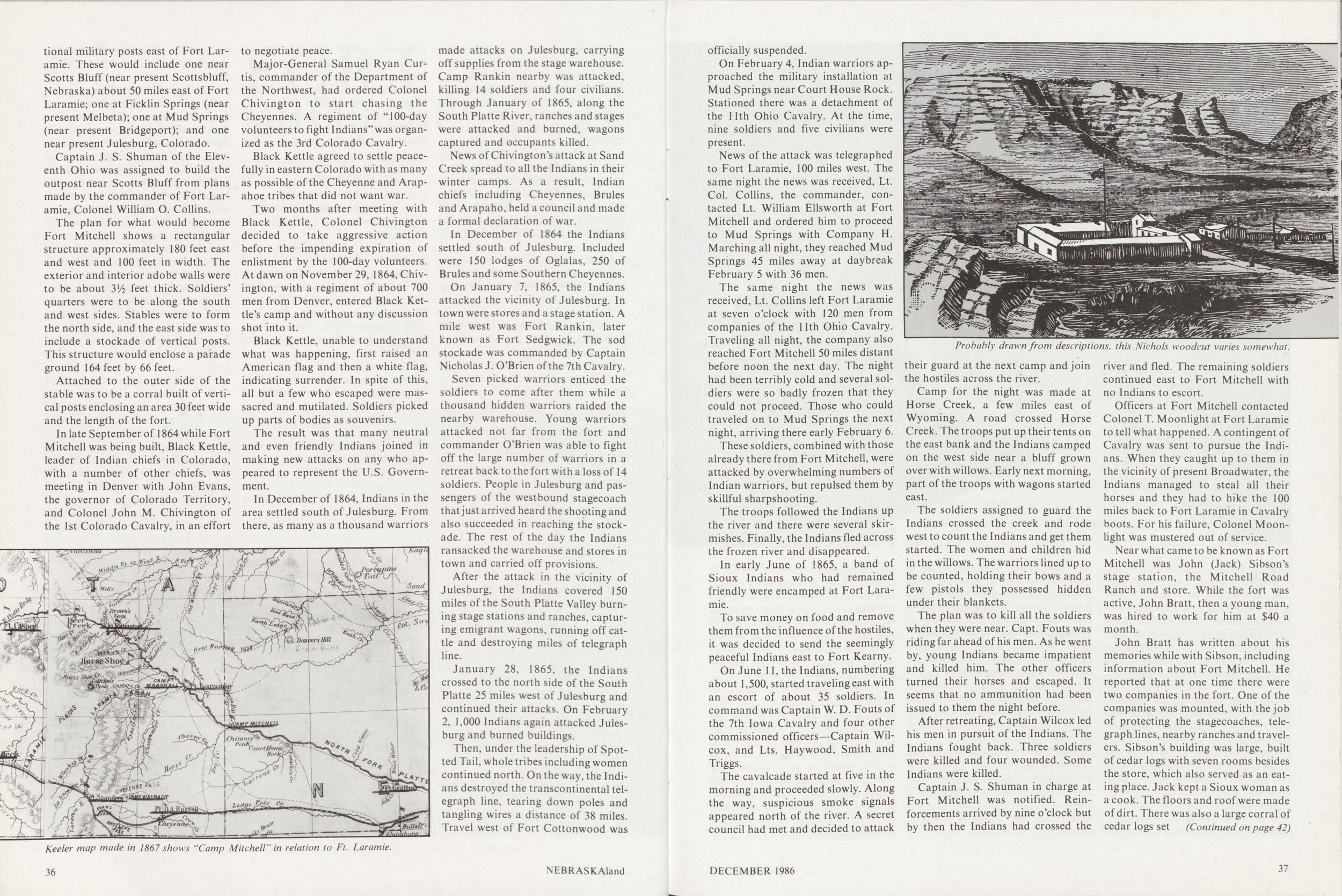 military posts east of Fort Laramie. These would include one near Scotts Bluff (near present Scottsbluff, Nebraska) about 50 miles east of Fort Laramie; one at Ficklin Springs (near present Melbeta); one at Mud Springs (near present Bridgeport); and one near present Julesburg, Colorado.
Captain J. S. Shuman of the Eleventh Ohio was assigned to build the outpost near Scotts Bluff from plans made by the commander of Fort Laramie, Colonel William O. Collins.
The plan for what would become Fort Mitchell shows a rectangular structure approximately 180 feet east and west and 100 feet in width. The exterior and interior adobe walls were to be about VA feet thick. Soldiers' quarters were to be along the south and west sides. Stables were to form the north side, and the east side was to include a stockade of vertical posts. This structure would enclose a parade ground 164 feet by 66 feet.
Attached to the outer side of the stable was to be a corral built of vertical posts enclosing an area 30 feet wide and the length of the fort.
In late September of 1864 while Fort Mitchell was being built, Black Kettle, leader of Indian chiefs in Colorado, with a number of other chiefs, was meeting in Denver with John Evans, the governor of Colorado Territory, and Colonel John M. Chivington of the 1st Colorado Cavalry, in an effort
Major-General Samuel Ryan Curtis, commander of the Department of the Northwest, had ordered Colonel Chivington to start chasing the Cheyennes. A regiment of "100-day volunteers to fight Indians" was organized as the 3rd Colorado Cavalry.
Black Kettle agreed to settle peacefully in eastern Colorado with as many as possible of the Cheyenne and Arapahoe tribes that did not want war.
Two months after meeting with Black Kettle, Colonel Chivington decided to take aggressive action before the impending expiration of enlistment by the 100-day volunteers. At dawn on November 29, 1864, Chivington, with a regiment of about 700 men from Denver, entered Black Kettle's camp and without any discussion shot into it.
Black Kettle, unable to understand what was happening, first raised an American flag and then a white flag, indicating surrender. In spite of this, all but a few who escaped were massacred and mutilated. Soldiers picked up parts of bodies as souvenirs.
The result was that many neutral and even friendly Indians joined in making new attacks on any who appeared to represent the U.S. Government.
In December of 1864, Indians in the area settled south of Julesburg. From there, as many as a thousand warriors made attacks on Julesburg, carrying off supplies from the stage warehouse. Camp Rankin nearby was attacked, killing 14 soldiers and four civilians. Through January of 1865, along the South Platte River, ranches and stages were attacked and burned, wagons captured and occupants killed.
News of Chivington's attack at Sand Creek spread to all the Indians in their winter camps. As a result, Indian chiefs including Cheyennes, Brules and Arapaho, held a council and made a formal declaration of war.
In December of 1864 the Indians settled south of Julesburg. Included were 150 lodges of Oglalas, 250 of Brules and some Southern Cheyennes.
On January 7, 1865, the Indians attacked the vicinity of Julesburg. In town were stores and a stage station. A mile west was Fort Rankin, later known as Fort Sedgwick. The sod stockade was commanded by Captain Nicholas J. O'Brien of the 7th Cavalry.
Seven picked warriors enticed the soldiers to come after them while a thousand hidden warriors raided the nearby warehouse. Young warriors attacked not far from the fort and commander O'Brien was able to fight off the large number of warriors in a retreat back to the fort with a loss of 14 soldiers. People in Julesburg and passengers of the westbound stagecoach thatjust arrived heard the shooting and also succeeded in reaching the stockade. The rest of the day the Indians ransacked the warehouse and stores in town and carried off provisions.
After the attack in the vicinity of Julesburg, the Indians covered 150 miles of the South Platte Valley burning stage stations and ranches, capturing emigrant wagons, running off cattle and destroying miles of telegraph line.
January 28, 1865, the Indians crossed to the north side of the South Platte 25 miles west of Julesburg and continued their attacks. On February 2, 1,000 Indians again attacked Julesburg and burned buildings.
Then, under the leadership of Spotted Tail, whole tribes including women continued north. On the way, the Indians destroyed the transcontinental telegraph line, tearing down poles and tangling wires a distance of 38 miles. Travel west of Fort Cottonwood was 36 NEBRASKAland officially suspended.
On February 4, Indian warriors approached the military installation at Mud Springs near Court House Rock. Stationed there was a detachment of the 11th Ohio Cavalry. At the time, nine soldiers and five civilians were present.
News of the attack was telegraphed to Fort Laramie, 100 miles west. The same night the news was received, Lt. Col. Collins, the commander, contacted Lt. William Ellsworth at Fort Mitchell and ordered him to proceed to Mud Springs with Company H. Marching all night, they reached Mud Springs 45 miles away at daybreak February 5 with 36 men.
The same night the news was received, Lt. Collins left Fort Laramie at seven o'clock with 120 men from companies of the 11th Ohio Cavalry. Traveling all night, the company also reached Fort Mitchell 50 miles distant before noon the next day. The night had been terribly cold and several soldiers were so badly frozen that they could not proceed. Those who could traveled on to Mud Springs the next night, arriving there early February 6.
These soldiers, combined with those already there from Fort Mitchell, were attacked by overwhelming numbers of Indian warriors, but repulsed them by skillful sharpshooting.
The troops followed the Indians up the river and there were several skirmishes. Finally, the Indians fled across the frozen river and disappeared.
In early June of 1865, a band of Sioux Indians who had remained friendly were encamped at Fort Laramie.
To save money on food and remove them from the influence of the hostiles, it was decided to send the seemingly peaceful Indians east to Fort Kearny.
On June 11, the Indians, numbering about 1,500, started traveling east with an escort of about 35 soldiers. In command was Captain W. D. Fouts of the 7th Iowa Cavalry and four other commissioned officers—Captain Wilcox, and Lts. Haywood, Smith and Triggs.
The cavalcade started at five in the morning and proceeded slowly. Along the way, suspicious smoke signals appeared north of the river. A secret council had met and decided to attack
Camp for the night was made at Horse Creek, a few miles east of Wyoming. A road crossed Horse Creek. The troops put up their tents on the east bank and the Indians camped on the west side near a bluff grown over with willows. Early next morning, part of the troops with wagons started east.
The soldiers assigned to guard the Indians crossed the creek and rode west to count the Indians and get them started. The women and children hid in the willows. The warriors lined up to be counted, holding their bows and a few pistols they possessed hidden under their blankets.
The plan was to kill all the soldiers when they were near. Capt. Fouts was riding far ahead of his men. As he went by, young Indians became impatient and killed him. The other officers turned their horses and escaped. It seems that no ammunition had been issued to them the night before.
After retreating, Captain Wilcox led his men in pursuit of the Indians. The Indians fought back. Three soldiers were killed and four wounded. Some Indians were killed.
Captain J. S. Shuman in charge at Fort Mitchell was notified. Reinforcements arrived by nine o'clock but by then the Indians had crossed the river and fled. The remaining soldiers continued east to Fort Mitchell with no Indians to escort.
Officers at Fort Mitchell contacted Colonel T. Moonlight at Fort Laramie to tell what happened. A contingent of Cavalry was sent to pursue the Indians. When they caught up to them in the vicinity of present Broadwater, the Indians managed to steal all their horses and they had to hike the 100 miles back to Fort Laramie in Cavalryboots. For his failure, Colonel Moonlight was mustered out of service.
Near what came to be known as Fort Mitchell was John (Jack) Sibson's stage station, the Mitchell Road Ranch and store. While the fort was active, John Bratt, then a young man, was hired to work for him at $40 a month.
John Bratt has written about his memories while with Sibson, including information about Fort Mitchell. He reported that at one time there were two companies in the fort. One of the companies was mounted, with the job of protecting the stagecoaches, telegraph lines, nearby ranches and travelers. Sibson's building was large, built of cedar logs with seven rooms besides the store, which also served as an eating place. Jack kept a Sioux woman as a cook. The floors and roof were made of dirt. There was also a large corral of cedar logs set (Continued on page 42)
DECEMBER 1986 37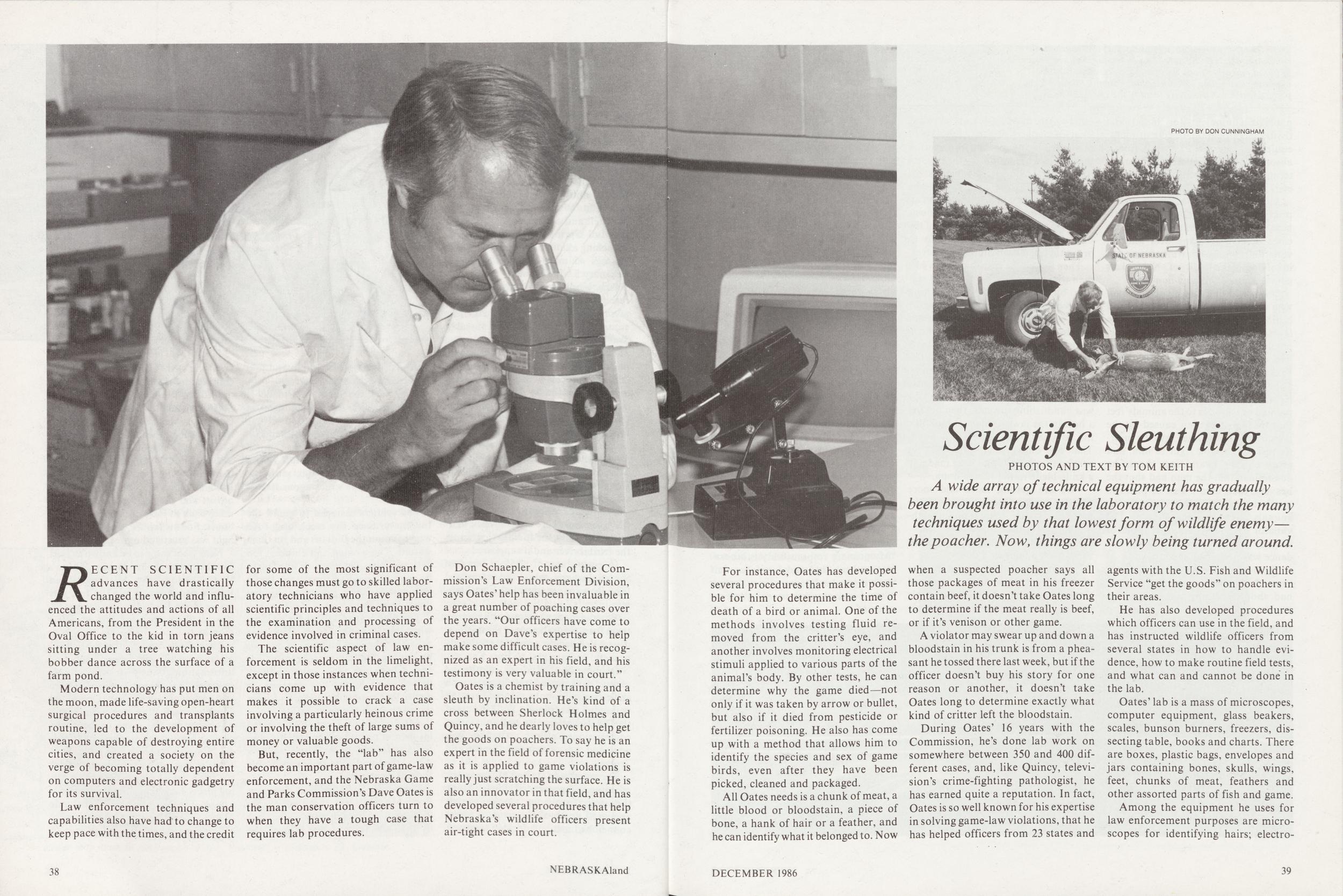
Scientific Sleuthing
PHOTOS AND TEXT BY TOM KEITH A wide array of technical equipment has gradually been brought into use in the laboratory to match the many techniques used by that lowest form of wildlife enemy the poacher. Now, things are slowly being turned around.RECENT SCIENTIFIC advances have drastically . changed the world and influenced the attitudes and actions of all Americans, from the President in the Oval Office to the kid in torn jeans sitting under a tree watching his bobber dance across the surface of a farm pond.
Modern technology has put men on the moon, made life-saving open-heart surgical procedures and transplants routine, led to the development of weapons capable of destroying entire cities, and created a society on the verge of becoming totally dependent on computers and electronic gadgetry for its survival.
Law enforcement techniques and capabilities also have had to change to keep pace with the times, and the credit for some of the most significant of those changes must go to skilled laboratory technicians who have applied scientific principles and techniques to the examination and processing of evidence involved in criminal cases.
The scientific aspect of law enforcement is seldom in the limelight, except in those instances when technicians come up with evidence that makes it possible to crack a case involving a particularly heinous crime or involving the theft of large sums of money or valuable goods.
But, recently, the "lab" has also become an important part of game-law enforcement, and the Nebraska Game and Parks Commission's Dave Oates is the man conservation officers turn to when they have a tough case that requires lab procedures.
Don Schaepler, chief of the Commission's Law Enforcement Division, says Oates' help has been invaluable in a great number of poaching cases over the years. "Our officers have come to depend on Dave's expertise to help make some difficult cases. He is recognized as an expert in his field, and his testimony is very valuable in court."
Oates is a chemist by training and a sleuth by inclination. He's kind of a cross between Sherlock Holmes and Quincy, and he dearly loves to help get the goods on poachers. To say he is an expert in the field of forensic medicine as it is applied to game violations is really just scratching the surface. He is also an innovator in that field, and has developed several procedures that help Nebraska's wildlife officers present air-tight cases in court.
38 NEBRASKAlandFor instance, Oates has developed several procedures that make it possible for him to determine the time of death of a bird or animal. One of the methods involves testing fluid removed from the critter's eye, and another involves monitoring electrical stimuli applied to various parts of the animal's body. By other tests, he can determine why the game died—not only if it was taken by arrow or bullet, but also if it died from pesticide or fertilizer poisoning. He also has come up with a method that allows him to identify the species and sex of game birds, even after they have been picked, cleaned and packaged.
All Oates needs is a chunk of meat, a little blood or bloodstain, a piece of bone, a hank of hair or a feather, and he can identify what it belonged to. Now when a suspected poacher says all those packages of meat in his freezer contain beef, it doesn't take Oates long to determine if the meat really is beef, or if it's venison or other game.
A violator may swear up and down a bloodstain in his trunk is from a pheasant he tossed there last week, but if the officer doesn't buy his story for one reason or another, it doesn't take Oates long to determine exactly what kind of critter left the bloodstain.
During Oates' 16 years with the Commission, he's done lab work on somewhere between 350 and 400 different cases, and, like Quincy, television's crime-fighting pathologist, he has earned quite a reputation. In fact, Oates is so well known for his expertise in solving game-law violations, that he has helped officers from 23 states and agents with the U.S. Fish and Wildlife Service "get the goods" on poachers in their areas.
He has also developed procedures which officers can use in the field, and has instructed wildlife officers from several states in how to handle evidence, how to make routine field tests, and what can and cannot be done in the lab.
Oates' lab is a mass of microscopes, computer equipment, glass beakers, scales, bunson burners, freezers, dissecting table, books and charts. There are boxes, plastic bags, envelopes and jars containing bones, skulls, wings, feet, chunks of meat, feathers and other assorted parts of fish and game.
Among the equipment he uses for law enforcement purposes are microscopes for identifying hairs; electrophoresis DECEMBER 1986 39 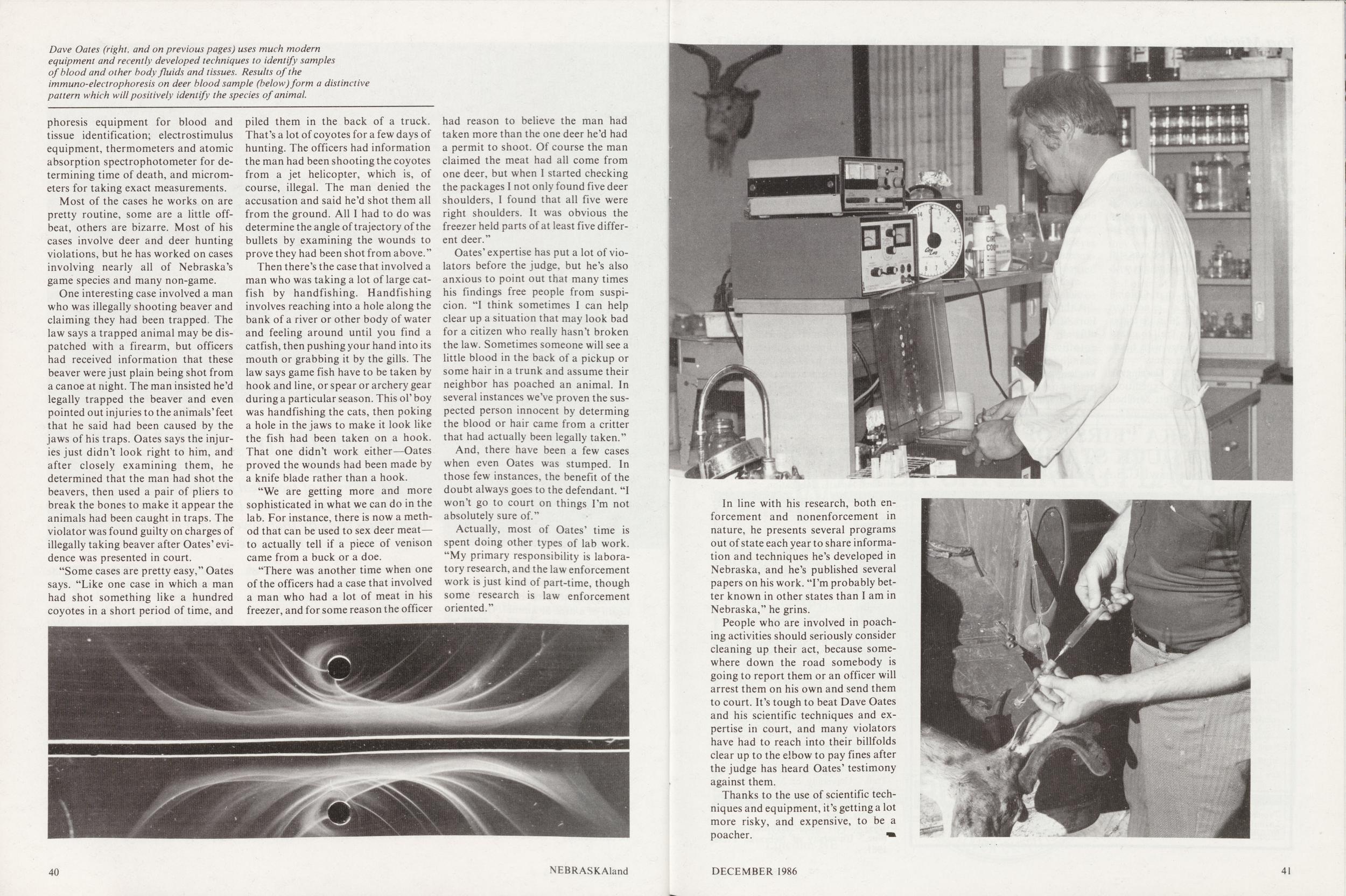
Most of the cases he works on are pretty routine, some are a little offbeat, others are bizarre. Most of his cases involve deer and deer hunting violations, but he has worked on cases involving nearly all of Nebraska's game species and many non-game.
One interesting case involved a man who was illegally shooting beaver and claiming they had been trapped. The law says a trapped animal may be dispatched with a firearm, but officers had received information that these beaver were just plain being shot from a canoe at night. The man insisted he'd legally trapped the beaver and even pointed out injuries to the animals'feet that he said had been caused by the jaws of his traps. Oates says the injuries just didn't look right to him, and after closely examining them, he determined that the man had shot the beavers, then used a pair of pliers to break the bones to make it appear the animals had been caught in traps. The violator was found guilty on charges of illegally taking beaver after Oates' evidence was presented in court.
"Some cases are pretty easy," Oates says. "Like one case in which a man had shot something like a hundred coyotes in a short period of time, and piled them in the back of a truck. That's a lot of coyotes for a few days of hunting. The officers had information the man had been shooting the coyotes from a jet helicopter, which is, of course, illegal. The man denied the accusation and said he'd shot them all from the ground. All I had to do was determine the angle of trajectory of the bullets by examining the wounds to prove they had been shot from above."
Then there's the case that involved a man who was taking a lot of large catfish by handfishing. Handfishing involves reaching into a hole along the bank of a river or other body of water and feeling around until you find a catfish, then pushing your hand into its mouth or grabbing it by the gills. The law says game fish have to be taken by hook and line, or spear or archery gear during a particular season. This ol' boy was handfishing the cats, then poking a hole in the jaws to make it look like the fish had been taken on a hook. That one didn't work either—Oates proved the wounds had been made by a knife blade rather than a hook.
"We are getting more and more sophisticated in what we can do in the lab. For instance, there is now a method that can be used to sex deer meat to actually tell if a piece of venison came from a buck or a doe.
"There was another time when one of the officers had a case that involved a man who had a lot of meat in his freezer, and for some reason the officer had reason to believe the man had taken more than the one deer he'd had a permit to shoot. Of course the man claimed the meat had all come from one deer, but when I started checking the packages I not only found five deer shoulders, I found that all five were right shoulders. It was obvious the freezer held parts of at least five different deer."
Oates' expertise has put a lot of violators before the judge, but he's also anxious to point out that many times his findings free people from suspicion. "I think sometimes I can help clear up a situation that may look bad for a citizen who really hasn't broken the law. Sometimes someone will see a little blood in the back of a pickup or some hair in a trunk and assume their neighbor has poached an animal. In several instances we've proven the suspected person innocent by determing the blood or hair came from a critter that had actually been legally taken."
And, there have been a few cases when even Oates was stumped. In those few instances, the benefit of the doubt always goes to the defendant. "I won't go to court on things I'm not absolutely sure of."
Actually, most of Oates' time is spent doing other types of lab work. "My primary responsibility is laboratory research, and the law enforcement work is just kind of part-time, though some research is law enforcement oriented."
40 NEBRASKAlandIn line with his research, both enforcement and nonenforcement in nature, he presents several programs out of state each year to share information and techniques he's developed in Nebraska, and he's published several papers on his work. "I'm probably better known in other states than I am in Nebraska," he grins.
People who are involved in poaching activities should seriously consider cleaning up their act, because somewhere down the road somebody is going to report them or an officer will arrest them on his own and send them to court. It's tough to beat Dave Oates and his scientific techniques and expertise in court, and many violators have had to reach into their billfolds clear up to the elbow to pay fines after the judge has heard Oates' testimony against them.
Thanks to the use of scientific techniques and equipment, it's getting a lot more risky, and expensive, to be a poacher.
DECEMBER 1986 41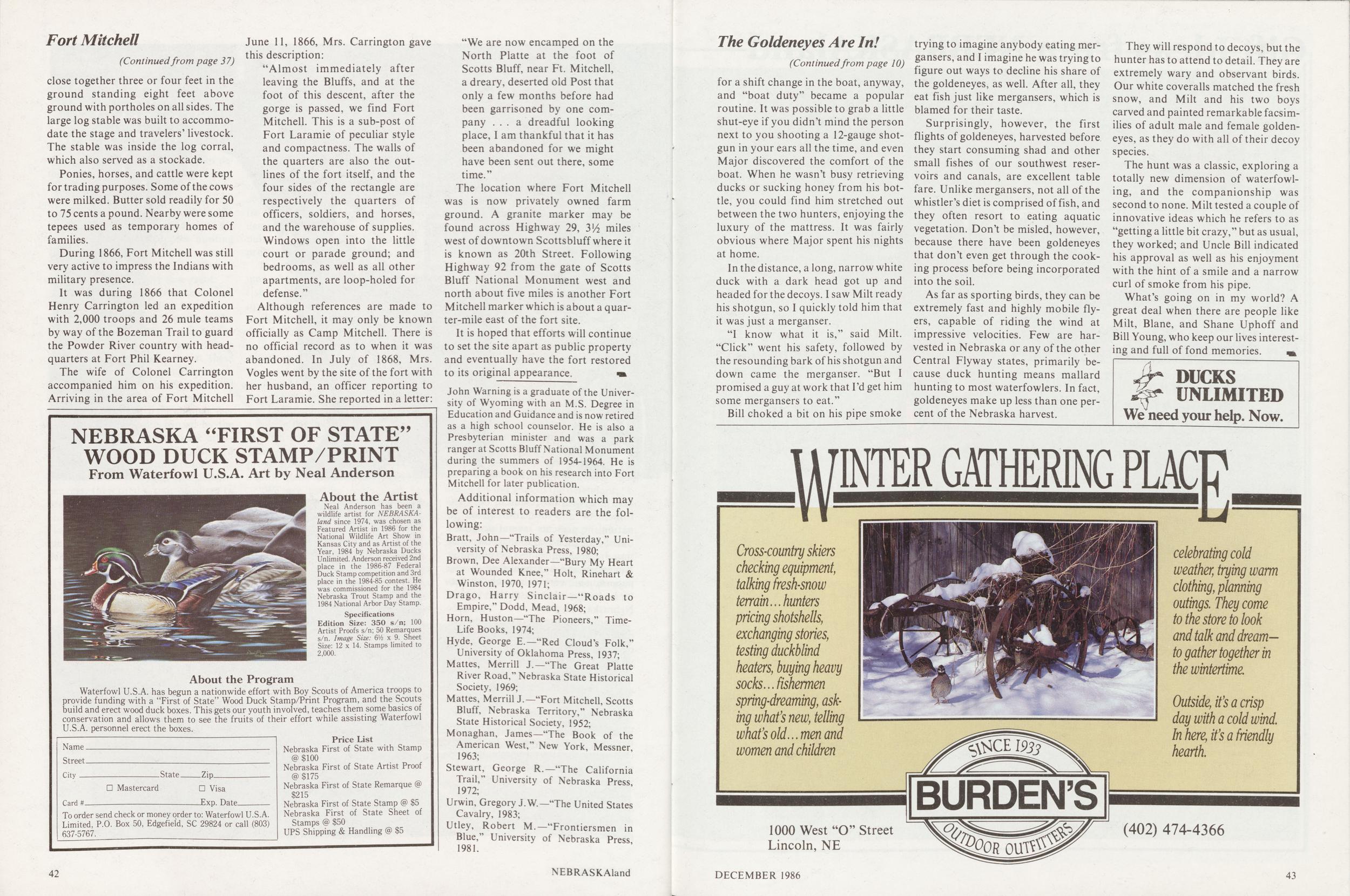
Fort Mitchell
(Continued from page 37)close together three or four feet in the ground standing eight feet above ground with portholes on all sides. The large log stable was built to accommodate the stage and travelers' livestock. The stable was inside the log corral, which also served as a stockade.
Ponies, horses, and cattle were kept for trading purposes. Some of the cows were milked. Butter sold readily for 50 to 75 cents a pound. Nearby were some tepees used as temporary homes of families.
During 1866, Fort Mitchell was still very active to impress the Indians with military presence.
It was during 1866 that Colonel Henry Carrington led an expedition with 2,000 troops and 26 mule teams by way of the Bozeman Trail to guard the Powder River country with headquarters at Fort Phil Kearney.
The wife of Colonel Carrington accompanied him on his expedition. Arriving in the area of Fort Mitchell June 11, 1866, Mrs. Carrington gave this description:
"Almost immediately after leaving the Bluffs, and at the foot of this descent, after the gorge is passed, we find Fort Mitchell. This is a sub-post of Fort Laramie of peculiar style and compactness. The walls of the quarters are also the outlines of the fort itself, and the four sides of the rectangle are respectively the quarters of officers, soldiers, and horses, and the warehouse of supplies. Windows open into the little court or parade ground; and bedrooms, as well as all other apartments, are loop-holed for defense."
Although references are made to Fort Mitchell, it may only be known officially as Camp Mitchell. There is no official record as to when it was abandoned. In July of 1868, Mrs. Vogles went by the site of the fort with her husband, an officer reporting to Fort Laramie. She reported in a letter:
"We are now encamped on the North Platte at the foot of Scotts Bluff, near Ft. Mitchell, a dreary, deserted old Post that only a few months before had been garrisoned by one com- pany ... a dreadful looking place, I am thankful that it has been abandoned for we might have been sent out there, some time."
The location where Fort Mitchell was is now privately owned farm ground. A granite marker may be found across Highway 29, 3/2 miles west of downtown Scottsbluff where it is known as 20th Street. Following Highway 92 from the gate of Scotts Bluff National Monument west and north about five miles is another Fort Mitchell marker which is about a quarter-mile east of the fort site.
It is hoped that efforts will continue to set the site apart as public property and eventually have the fort restored to its original appearance.
John Warning is a graduate of the University of Wyoming with an M.S. Degree in Education and Guidance and is now retired as a high school counselor. He is also a Presbyterian minister and was a park ranger at Scotts Bluff National Monument during the summers of 1954-1964. He is preparing a book on his research into Fort Mitchell for later publication.
Additional information which may be of interest to readers are the following:
Bratt, John—"Trails of Yesterday," University of Nebraska Press, 1980;
Brown, Dee Alexander—"Bury My Heart at Wounded Knee," Holt, Rinehart & Winston, 1970, 1971;
Drago, Harry Sinclair—"Roads to Empire," Dodd, Mead, 1968;
Horn, Huston—"The Pioneers," TimeLife Books, 1974;
Hyde, George E.—"Red Cloud's Folk," University of Oklahoma Press, 1937;
Mattes, Merrill J.—"The Great Platte River Road," Nebraska State Historical Society, 1969;
Mattes, Merrill J.—"Fort Mitchell, Scotts Bluff, Nebraska Territory," Nebraska State Historical Society, 1952;
Monaghan, James—"The Book of the American West," New York, Messner, 1963;
Stewart, George R.— "The California Trail," University of Nebraska Press, 1972;
Urwin, Gregory J. W.—"The United States Cavalry, 1983;
Utley, Robert M.—"Frontiersmen in Blue," University of Nebraska Press, 1981.
The Goldeneyes Are In!
(Continued from page 10)for a shift change in the boat, anyway, and "boat duty" became a popular routine. It was possible to grab a little shut-eye if you didn't mind the person next to you shooting a 12-gauge shotgun in your ears all the time, and even Major discovered the comfort of the boat. When he wasn't busy retrieving ducks or sucking honey from his bottle, you could find him stretched out between the two hunters, enjoying the luxury of the mattress. It was fairly obvious where Major spent his nights at home.
In the distance, a long, narrow white duck with a dark head got up and headed for the decoys. I saw Milt ready his shotgun, so I quickly told him that it was just a merganser.
"I know what it is," said Milt. "Click" went his safety, followed by the resounding bark of his shotgun and down came the merganser. "But I promised a guy at work that I'd get him some mergansers to eat."
Bill choked a bit on his pipe smoke trying to imagine anybody eating mergansers, and I imagine he was trying to figure out ways to decline his share of the goldeneyes, as well. After all, they eat fish just like mergansers, which is blamed for their taste.
Surprisingly, however, the first flights of goldeneyes, harvested before they start consuming shad and other small fishes of our southwest reservoirs and canals, are excellent table fare. Unlike mergansers, not all of the whistler's diet is comprised offish, and they often resort to eating aquatic vegetation. Don't be misled, however, because there have been goldeneyes that don't even get through the cooking process before being incorporated into the soil.
As far as sporting birds, they can be extremely fast and highly mobile flyers, capable of riding the wind at impressive velocities. Few are harvested in Nebraska or any of the other Central Flyway states, primarily because duck hunting means mallard hunting to most waterfowlers. In fact, goldeneyes make up less than one percent of the Nebraska harvest.
They will respond to decoys, but the hunter has to attend to detail. They are extremely wary and observant birds. Our white coveralls matched the fresh snow, and Milt and his two boys carved and painted remarkable facsimilies of adult male and female goldeneyes, as they do with all of their decoy species.
The hunt was a classic, exploring a totally new dimension of waterfowling, and the companionship was second to none. Milt tested a couple of innovative ideas which he refers to as "getting a little bit crazy," but as usual, they worked; and Uncle Bill indicated his approval as well as his enjoyment with the hint of a smile and a narrow curl of smoke from his pipe.
What's going on in my world? A great deal when there are people like Milt, Blane, and Shane Uphoff and Bill Young, who keep our lives interesting and full of fond memories.
DUCKS UNLIMITED We need your help. Now. WINTER GATHERING PLACF Cross-country skiers checking equipment, talking fresh-snow terrain hunters pricing shotshells, exchanging stories, testing duckblind heaters, buying heavy socks fishermen spring-dreaming, asking what's new, telling what's old. men and women and children celebrating cold weather, trying warm clothing, planning outings. They come to the store to look and talk and dreamto gather together in the wintertime. Outside, it's a crisp day with a cold wind. In here, it's a friendly hearth. 1000 West "O" Street Lincoln, NE (402) 474-4366 DECEMBER 1986 43
Gift Ideas from NEBRASKAland
The perfect gift. award-winning NEBRASKAland and Magazine! Filled with breath-taking color photos and informative articles on life in Nebraska, it's just $12 for one year, $23 for two years.
Designed especially for NEBRASKAland, this attractive binder will keep a full year of magazines like new and right at your fingertips. It's a must for anyone who collects this special Nebraska publication. Only $6.
From the pages of NEBRASKAland Magazine comes this fascinating book you '11 find hard to put down. Reminisce with Roe Black as he recalls those intriguing days of yesteryear on the family ranch on the Dismal River from 1900-1912. Softcover. $9.95.
If you thought NEBRASKAland's (Birds of Nebraska " was great, you '11 be fascinated by the newest special edition, THEFISHBOOK, coming in January-February. It provides a unique glimpse of Nebraska's many fishes and their mysterious watery world.
WILD GAME COOKBOOK features favorite recipes for all popular game, big and small, land and lake, plus some unusual "gourmet" items like clams, snake, etc. A great gift. 100 pages. $3 (reg. $3-75).
FORT ROBINSON ILLUSTRATED takes readers from 1868 and the days of the Indian Wars to the magnificent recreational opportunities in the Pine Ridge today. It's chock full of historic photos and fascinating reading. 116 pages. $6
NEBRASKA THROUGH THE SEASONS is a beautiful collection of photos from all corners of the state at all times of the year, including people, places, wildlife, and more. 132 pages. $4 (reg. $6).
THE FIRST VOICES is a must for everyone interested in history of the triumphs and tragedies of the Indian in Nebraska. Historic art, maps, history, recollections, color photos, and more. 132 pages. $5.
NEBRASKA RIVERS traces the state's major waterways and several lesser steams from their ancient beginnings to the present in this ambitious full-color volume. Photos, stories, recollections. $5 (reg. $6).
Upland Stamp series (1955-76) features the work of NEBRASKAland artist, C. G. "Bud'Pritchard. Set includes 18 of 22 stamps andframable certificate. Years 1958, '59, '60, '62 are not available. $55 (tax included).
Handsome 17-1/2" by 25" identification poster portrays 21 of Nebraska's major game fish in full color. With the chart comes a handy booklet that describes the fish, their habits and range. $2. Booklet only-25#.
The Nebraska Habitat Stamp collection includes all ten stamps (1977-1986) and certificate suitable for framing, with room for 10 more stamps. A great gift for the outdoorsman - collector. $75.00 (tax included)
Perfect. HUNT and FISH PERMITSGive your hunter or angler 365 duys of outdoor enjoyment with a 1987 hunting, fishing or combination hunt-fish permit, complete with necessary stamps. Res. Hunt--$8.50; Res. Fish $9.50; Res. Hunt-Fish Combo $17.50; Habitat Stamp—$7.50; Trout Stamp—$5.
For that special person, here's an outdoor gift that keeps giving over and over—a Lifetime Permit to hunt, fish or both. Available only to Nebraska residents, permits are still valid even if holder must leave our state at some future time. Please give all information requested on order form. Lifetime Hunt or Lifetime Fish $200.00 each and Lifetime Hunt/Fish—$400.00 each.
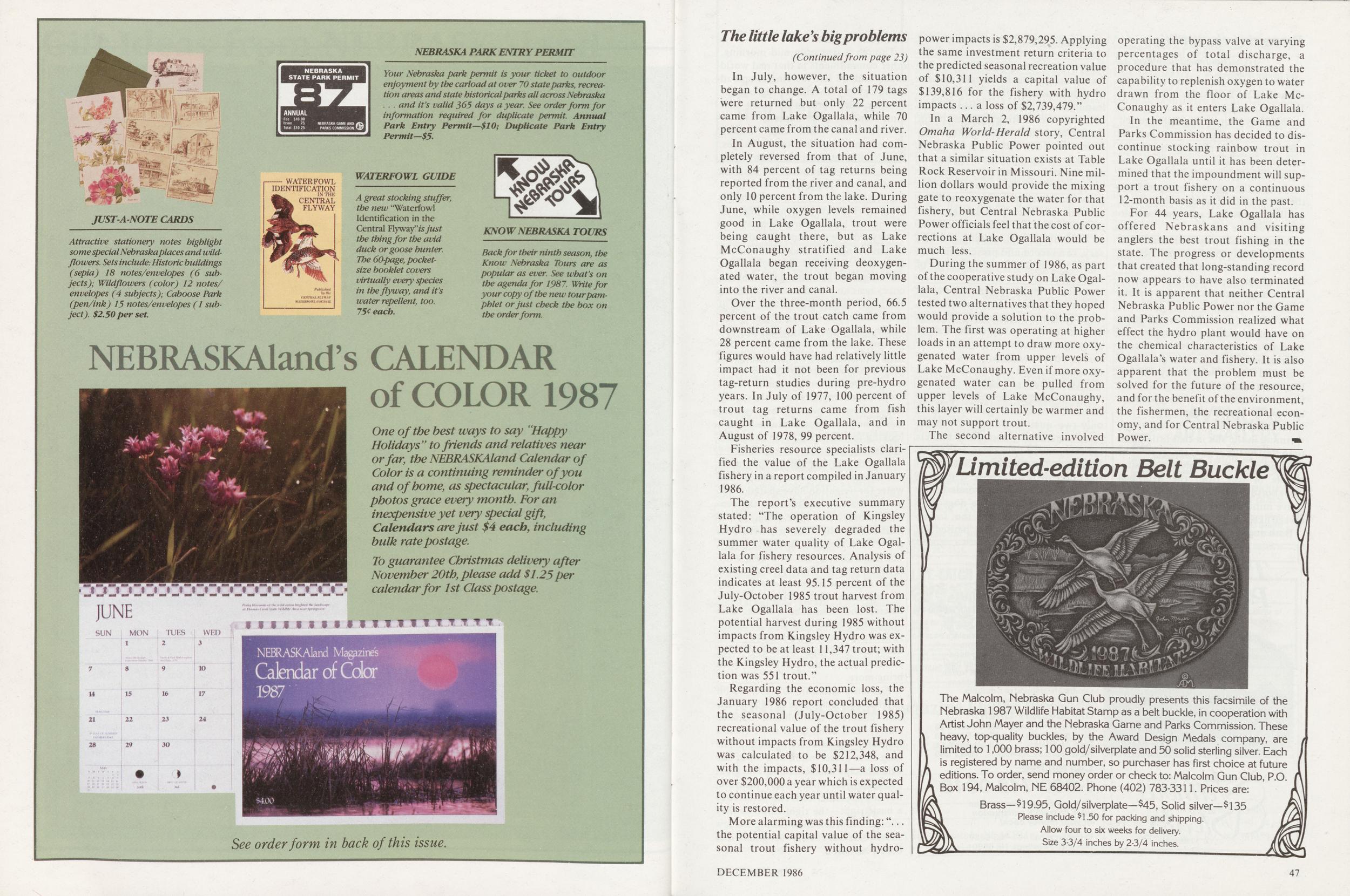
Your Nebraska park permit is your ticket to outdoor enjoyment by the carload at over 70 state parks, recreation areas and state historical parks all across Nebraska and it's valid 365 days a year. See order form for information required for duplicate permit. Annual Park Entry Permit—$10; Duplicate Park Entry Permit—$5.
Attractive stationery notes highlight some special Nebraska places and wildflowers. Sets include: Historic buildings (sepia) 18 notes/envelopes (6 subjects); Wildflowers (color) 12 notes/ envelopes (4 subjects); Caboose Park (pen/ink) 15 notes/envelopes (1 subject). $2.50 per set.
A great stocking staffer, the new "Waterfowl Identification in the Central Flyway the thing for the avid duck or goose hunter. The 60-page, pocketsize booklet covers virtually every species in theflyway, and it's water repellent, too. 75c each.
Back for their ninth season, the Know Nebraska Tours are as popular as ever. See what's on the agenda for 1987. Write for your copy of the new tour pamphlet or just check the box on the order form.
NEBRASKAland's CALENDAR of COLOR 1987One of the best ways to say Happy Holidays" to friends and relatives near or far, the NEBRASKAland Calendar of Color is a continuing reminder of you and of home, as spectacular, full-color photos grace every month. For an inexpensive yet very special gift, Calendars are just $4 each, including bulk rate postage.
To guarantee Christmas delivery after November 20th, please add $1.25 per calendar for 1st Class postage.
See order form in back of this issue.The little lake's big problems
(Continued from page 23)In July, however, the situation began to change. A total of 179 tags were returned but only 22 percent came from Lake Ogallala, while 70 percent came from the canal and river.
In August, the situation had completely reversed from that of June, with 84 percent of tag returns being reported from the river and canal, and only 10 percent from the lake. During June, while oxygen levels remained good in Lake Ogallala, trout were being caught there, but as Lake McConaughy stratified and Lake Ogallala began receiving deoxygenated water, the trout began moving into the river and canal.
Over the three-month period, 66.5 percent of the trout catch came from downstream of Lake Ogallala, while 28 percent came from the lake. These figures would have had relatively little impact had it not been for previous tag-return studies during pre-hydro years. In July of 1977, 100 percent of trout tag returns came from fish caught in Lake Ogallala, and in August of 1978, 99 percent.
Fisheries resource specialists clarified the value of the Lake Ogallala fishery in a report compiled in January 1986.
The report's executive summary stated: "The operation of Kingsley Hydro has severely degraded the summer water quality of Lake Ogallala for fishery resources. Analysis of existing creel data and tag return data indicates at least 95.15 percent of the July-October 1985 trout harvest from Lake Ogallala has been lost. The potential harvest during 1985 without impacts from Kingsley Hydro was expected to be at least 11,347 trout; with the Kingsley Hydro, the actual prediction was 551 trout."
Regarding the economic loss, the January 1986 report concluded that the seasonal (July-October 1985) recreational value of the trout fishery without impacts from Kingsley Hydro was calculated to be $212,348, and with the impacts, $10,311—a loss of over $200,000 a year which is expected to continue each year until water quality is restored.
More alarming was this finding:". the potential capital value of the seasonal trout fishery without hydropower impacts is $2,879,295. Applying the same investment return criteria to the predicted seasonal recreation value of $10,311 yields a capital value of $139,816 for the fishery with hydro impacts a loss of $2,739,479."
In a March 2, 1986 copyrighted Omaha World-Herald story, Central Nebraska Public Power pointed out that a similar situation exists at Table Rock Reservoir in Missouri. Nine million dollars would provide the mixing gate to reoxygenate the water for that fishery, but Central Nebraska Public Power officials feel that the cost of corrections at Lake Ogallala would be much less.
During the summer of 1986, as part of the cooperative study on Lake Ogallala, Central Nebraska Public Power tested two alternatives that they hoped would provide a solution to the problem. The first was operating at higher loads in an attempt to draw more oxygenated water from upper levels of Lake McConaughy. Even if more oxygenated water can be pulled from upper levels of Lake McConaughy, this layer will certainly be warmer and may not support trout.
The second alternative involved operating the bypass valve at varying percentages of total discharge, a procedure that has demonstrated the capability to replenish oxygen to water drawn from the floor of Lake McConaughy as it enters Lake Ogallala.
In the meantime, the Game and Parks Commission has decided to discontinue stocking rainbow trout in Lake Ogallala until it has been determined that the impoundment will support a trout fishery on a continuous 12-month basis as it did in the past.
For 44 years, Lake Ogallala has offered Nebraskans and visiting anglers the best trout fishing in the state. The progress or developments that created that long-standing record now appears to have also terminated it. It is apparent that neither Central Nebraska Public Power nor the Game and Parks Commission realized what effect the hydro plant would have on the chemical characteristics of Lake Ogallala's water and fishery. It is also apparent that the problem must be solved for the future of the resource, and for the benefit of the environment, the fishermen, the recreational economy, and for Central Nebraska Public Power.
Limited-edition Belt Buckle The Malcolm, Nebraska Gun Club proudly presents this facsimile of the Nebraska 1987 Wildlife Habitat Stamp as a belt buckle, in cooperation with Artist John Mayer and the Nebraska Game and Parks Commission. These heavy, top-quality buckles, by the Award Design Medals company, are limited to 1,000 brass; 100 gold/silverplate and 50 solid sterling silver. Each is registered by name and number, so purchaser has first choice at future editions. To order, send money order or check to: Malcolm Gun Club, P.O. Box 194, Malcolm, NE 68402. Phone (402) 783-3311. Prices are: Brass—$19.95, Gold/silverplate—$45, Solid silver—$135 Please include $1.50 for packing and shipping. Allow four to six weeks for delivery. Size 3-3/4 inches by 2-3/4 inches. DECEMBER 1986 47
Preserving the tradition
(Continued from page 32)efficiently and a hunter had to wonder if it would look the same next year, or five years from now.
The covey of quail that Bill expected to be in the brushy cover on the dam must have been enjoying the unseasonably warm January day by lingering in the milo fields. Belle was not to be denied, though, and emerged from the thickest of the cover with the cock quail that was hit earlier in the milo field across the road.
A weedy waterway with head-high sunflowers that should have harbored a rooster or two was without birds. We followed the north fenceline down to where it joined the wooded creekbottom.
It's strange, after you have hunted a certain bird for enough years, how you seem to develop a sixth sense about where you are going to find them. Not a general idea of where they will be, like, "that sure looks like a good draw for pheasants," but a very precise notion: "If I were a quail, I'd be just back from feeding in the milo and warming in the sun in that little point of foxtail by the edge of the trees." The little point of grass only stuck out a couple of feet from the tree-lined creekbottom but the sun probably hit it five minutes earlier than the rest. It looked likejust the right spot, and it was.
Both dogs caught the aroma of quail at the same time. There was no confusion over what it was, where it came from or what was the proper response for a pointing dog. Belle and Eddie set up tight, frozen in place—twisted and leaning in positions that defied gravity, only their eyes shifting from the spot in the foxtail to the hunters approaching from the side; their eyes speaking urgently to the hunters: "Come on now, hustle it up, can't you see we got a covey here?" It's the scene that brings grown men back to creekbottoms lined with milo year after year. It's the scene that men who can't find their car keys, or remember their wedding anniversary, can record and preserve in their minds in fine detail—the shadows of scrubby trees cast across a winterbleached field, the parsnip-like smell of dust underfoot, the tenseness in a dog's amber eye, the sound of wings and blur of feathers and the acrid smell of gunpowder that from any other source would be offensive. It's the stuff of winter night daydreams. And always, it's over so quickly.
Again, most of the shooting fell to Pat and Donn, and again there were only two quail down, again because there were simply too many hunters for everyone to have clear, safe shots. But it didn't really matter, that was not the point of this exercise. The point was passed those few seconds before the birds flushed and the dogs were taut as violin strings, the frozen moment when the world paused for four quail hunters.
The Perfect Gift at a Perfect Price OF NEBRASKA Juicy, tender, flavorful Famous Steaks of Nebraska Give that hard-to-buy-for-person a gift that's truly appreciated- Nebraska's finest thick and juicy steaks from Famous Steaks. All steaks are handcut from naturally aged corn-fed beef, then vacuum sealed and quick frozen to keep in all their natural goodness. Orders are shipped in a durable, reusable styrofoam cooler. Introductory Offer! Six 10 oz. New Yorks $47.95-SAVE $5 Six 8 oz. Sirloins 40.40-SAVE $3 Six 6 oz. Filets 43.50-SAVE $2 NEW! Six 8 oz. Ribeyes ONLY $49 Call toll free 1-800-742-0045 Famous Steaks guarantees your complete satisfaction or your money back! In Hastings call 402-463-9857 Box 11 67, Hastings, NE 68901Though it was only mid morning, other commitments in that real world called and we left the singles spread along a grassy fenceline to regroup for another day, perhaps to paint that same scene for other hunters.
"You know," Bill said, "I look around and we've had some changes, but it's still a lot like it was when I was a kid. I shot my first goose on the Blue River only 200 yards from where I live. That's important. My grandfather is dead but I always remember the catfishing and bird hunting we had."
As we drove the county roads later that morning, I listened to Bill and Pat talk; talk of places they've hunted, pointing out where the dogs pointed a covey near an abandoned barn, where Pat got his first double. Later, back at their house, Bill tried to explain what really didn't need explanation—why anyone would drive 120 miles a day between where they worked and where they chose to live. He told of swimming in the river on hot summer days, the sound of ice going out in the spring, and of coyotes howling on a winter night, the piercing scream of a bobcat, looking for arrowheads on sandbars, or running banklines for catfish.
To a degree, the soils, topography and erratic occurrence of underground water for irrigation have spared much of southeast Nebraska from the economic forces that have reshaped the land so radically in other parts of the state; the forces that have encouraged farmers to cover the land only with cash crops and directly reduced the land's capacity to support the diversity of vegetation that in turn supports diverse and abundant wildlife. Certainly there have been changes in the southeast—hedgerows have been dozed out and grass waterways filled and farmed, and the future is certain to bring more.
For those who want to preserve a bit of what they knew as a child for their own children, the solution remains elusive, and often is no more than a temporary fix or delaying action. The long-term preservation of a bit of our wild heritage will come only at a great price, not just in monetary measure, but in what Americans still perceive as a basic right—the right to do as they choose with their land during the few short years our society recognizes it as their possession.
48 NEBRASKAlandTrading Post
DOGSTRAINING ALL BREEDS Hunting Dogs — Vizslas for sale. Rozanek Kennels, Rt. 2, Schuyler, NE 68661. Phone (402) 352-8769.
ENGLISH SETTERS and Labradors: "Bred for the hunter"; outstanding bloodlines! Puppies, started dogs and stud service available. High Plains Kennels, 1411 Emerson, Alliance, Nebr. 69301. Phone (308) 762-6709.
PLATTE RIVER KENNELS, Lexington, NE. Phone (308) 324-6093. Trained and started German shorthair pointers. $300 and up.
X-MAS BRITTANY PUPPIES: Free brochure detailing goal-oriented breeding program. Guaranteed. Grouseway Gundogs, Rt. 4 Box 197, North Platte, NE 69101. Phone (308) 534-7525.
YELLOW LABRADOR pups. Bred to be large, trainable hunters. Dam is 80 lbs. of intelligence and desire to please. Hips O.F.A. certified. Sire is big, broad chested and aggressive. A former field-trialer and now a super hunter. A.K.C. Shots. Robert A. Bendler, 214 East 13th, Lexington, NE 68850. Phone (308) 324-2200.
MISCELLANEOUSNE NEBRASKA trout fishing. 3 modern cottages, 1 available year round. 5 spring fed lakes with open water all year. Trout up to 7 pounds. Other varieties fish also. Diamond E. Trout Resort, Orchard, NE 68764. Phone (402) 893-4745.
GUNS — Browning, Winchester, Remington, others, Hi-powers, shotguns, new, used, antiques. Want Pre1964 Winchesters. Buy-Sell-Trade. Ph. (402) 729-6112. Bedlan's Sporting Goods, Fairbury, NE 68352.
MAD RIVER CANOES offers the finest quality and performance. For the finest canoes and accessories look to Great Plains Canoe Co., 205 Main, Springfield, NE. Phone (402) 253-2001.
WINE AND BEER: Make your own. Send for free recipes and instructions. Omaha Supply, 1324 2nd Avenue, Nebraska City, NE 68410.
LOG HOMES — Discover the simple elegance and richness of a Western Log Home. Your plan or ours. Free estimates. 44-page home planning guides $5. Action Log Homes, Box 3201, Kearney, NE 68847. Phone (308) 237-LOGS.
ASSEMBLERS WANTED: Make money assembling clowns. Earn $60 per 10 units part-time at home. It's fun, profitable and materials supplied. Send selfaddressed stamped envelope to Dickens and Matson, P.O. Box 476, East Detroit, MI 48021.
WOOD SLABS for sale, all kinds, all sizes. Ideal for clocks or painting, finished or unfinished. All sizes of Cypress slabs. For price list write to: Clocks, HC 30-Box 57, McCook, NE 69001.
MANDARIN DUCKS; nice full-wing birds, $35 pair. Mrs. R. W. Hansen, 3315 Avenue L, Kearney, NE 68847. Phone (308) 237-3781.
TROLLING MOTOR REPAIR. Factory authorized Minn Kota and Motor Guide, parts and service. Wolf's Repair and Installation, 1529 David Drive, Lincoln, NE 68504. Phone (402) 464-4265.
BIG BEND WATERFOWLING now booking hunts on the Platte River near Elm Creek, Nebraska. Guided duck and goose hunting at its best. Make reservations early. Call (308) 856-4520.
"JOIN TODAY." Nebraska Bowhunters Association, P.O. Box 112, St. Charles, IL 60174. Phone (312) 584-7563.
WE CAN HELP! Yes, we can help you insure the purity of your family's drinking water. With the only proven method, water distillation. Call today. (308) 262-0459.
RAW HONEY. Gift pack available. Write for price list. DeBee's Honey, Box 963, Bridgeport, NE 69336. Phone (308) 262-0459.
FREE BOOK CATALOG. Over 800 titles. Western Americana, history, old west, gold, more. Research, Ames, NE 68621. Phone (402) 727-9833.
WAX WORMS: 500/$8.25-1000/$14.50. Loose or cardboard rolls, specify which. Add 3'/2% sales tax. Postpaid first class. No C.O.D. Harold Malicky, Burwell, NE 68823.
NEBRASKA: A Geography (Baltensperger). Comprehensive survey of Nebraska's landscape, resources, agriculture, economy, people. 300 pages. Hundreds of photos, illustrations, maps. Perfect Christmas gift. Westview Press, 5500 Central Ave., Boulder, CO 80301 ($39.95 + $2.50 shipping, if ordered before January 1, 1987).
TAXIDERMYALLISON'S TAXIDERMY STUDIO. Wally and Betty Allison, Licensed Taxidermist. We've mounted 21 Nebraska State Record fish. Specializing in fish and birds, small game and rattlesnakes. We use freeze-dry. 2310 West Leota, North Platte, Nebr. 69101 Phone (308) 534-2324.
BADE TAXIDERMY — Quality a must — Fast service. Fish, birds, rugs, tanning, full mounts and game heads, 2111 N. Christy St., Fremont, Nebraska 727-5463.
KARL SCH WARZ master taxidermist has moved to a new country studio; same professional mounting and tanning service. Schwarz Wild Wing Studio, 16804 South 180th St., Springfield, NE 68059. Phone (402) 253-2481.
JOHNSON TAXIDERMY servicing southwest Nebraska, specializing in big-game mounts, life-sized mounts, rug work, fish, birds, tanning hair-on leather. Brochure and price list on request. Johnson Taxidermy, Rt. 1, Box 78, Lamar, NE 69035. Telephone (308) 882-5555.
E-CATCH ALL-PURPOSE TRAPS Wrtftor FREE CATALOG Traps without injury squirrels, chipmunks, rabbits, mink, fox, raccoons, stray animals, pests, etc. Sizes for every need. Also traps for snakes, sparrows, pigeons, crabs, turtles, quail, etc. Save on our low factory prices. Send no money. Free catalog and trapping secrets MUSTANG MFG. CO., Dept. N-34, Box 920947, Houston, Tex. 77292 NEBRASKAland Magazine Order Form Please send me a subscription to NEBRASKAland Magazine One-year $12.00 NAME Two-year $23.00 ADDRESS CITY STATE ZIP. Mail to: NEBRASKAland Magazine, Box 30370, Lincoln, NE 68503NABITY'S TAXIDERMY. 31 years experience. Specializing in natural grass backgrounds for mammals, birds and fish. 13901 "O" St., Lincoln, NE 68504 — 4 miles east of 84th and "O". (402) 489-6351.
K&M TAXIDERMY — we do natural mounts you will be proud of. Fish, birds and game heads. Rt. 2, Box 175, Norfolk, NE 68701. Phone (402) 675-1862.
BIG BEAR TAXIDERMY, Rt. 2, Mitchell, Nebraska 69357. We specialize in all big game from Alaska to Nebraska, also birds and fish. Hair on and hair off tanning. Four miles west of Scottsbluff on Highway 26. Dale Hubel, phone (308) 635-3013.
CREATIVE TAXIDERMY. Quality and experience since 1935. All custom services, museum work, and sales. New methods include Freeze-Dry processing. Trophy room visitors and inquiries welcome. Naturecraft Studios, Joe Voges, Owner, Nebraska City, NE 68410. Phone (402) 873-5491.
PLATTE VALLEY TAXIDERMY. Museum-quality mounts using latest scientific methods. 1985 world taxidermy competition winner. Delton Wegner, 1419 11th Street, Central City, NE 68826. Telephone (308) 946-3773.
PEISTER TAXIDERMY — Professional work at prices most sportsman can afford. Now in our new log cabin studio, 1020 Central Avenue, Box 3201, Kearney, NE 68847. Phone (308) 236-9700 or (308) 237-7575 evenings.
HASTINGS TAXIDERMY: Award winner at the World Taxidermy Championships — Commercial Division — Life-like mounting of big-game heads, rugs, birds, fish. Big game is my specialty. Call or write: Hastings Taxidermy, RR 3, Ord, NE 68862. Phone (308) 728-5322.
WILD HONEY TAXIDERMY: Tom Schneider, Taxidermist. Quality and affordable prices in birds, fish, full-shoulder mounts, life-size mounts, rugs, leather, hair-on tanning and snakes. Delivery available. 1019 No. Spruce St., Ogallala, NE 69153. Phone (308) 284-4137.
AVENUEART GALLERY Original art by Nebraska artists A unique, one-of-a-kind place gaiiery EastParkPlazaMall 66th and O Streets Lincoln, Nebraska Special orders and commissions CEDAR LANE Ranch Vacations Guest ranch in the heart of the Sandhills of Nebraska. Swimming, spa, horses, canoeing, trail rides, barbeques, hunting. BOOKING NOW For 1987 Richard and Betty Schroeder HC 2 Box 9C Stapleton, Nebraska 69163 Ph. 308-587-2233 Harlan County Dam Vacation Apartments - fully furnished Color TV • Kitchen Facilities • Full Baths Game cleaning room with freezer One block from shopping center Weekend or week of pleasant living Security Deposit Required Sorry —No Pets Dean and Esther Stone Box 145 Ph. (308) 799-3422 Republican City, NE 68971 DECEMBER 1986 49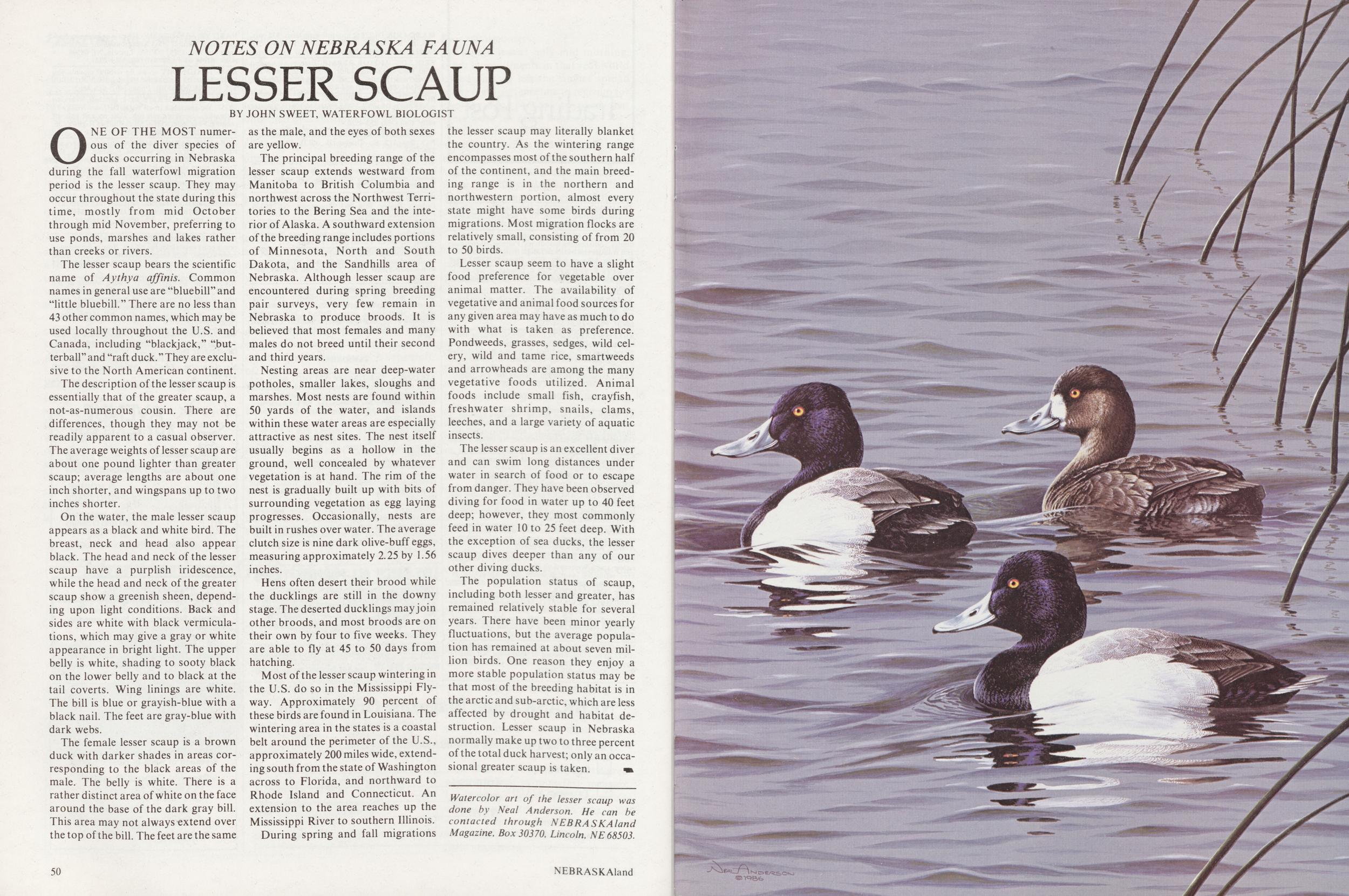
NOTES ON NEBRASKA FAUNA LESSER SCAUP
BY JOHN SWEET, WATERFOWL BIOLOGISTONE OF THE MOST numerous of the diver species of ducks occurring in Nebraska during the fall waterfowl migration period is the lesser scaup. They may occur throughout the state during this time, mostly from mid October through mid November, preferring to use ponds, marshes and lakes rather than creeks or rivers.
The lesser scaup bears the scientific name of Aythya affinis. Common names in general use are "bluebiH" and "little bluebill." There are no less than 43 other common names, which may be used locally throughout the U.S. and Canada, including "blackjack," "butterball" and "raft duck." They are exclusive to the North American continent.
The description of the lesser scaup is essentially that of the greater scaup, a not-as-numerous cousin. There are differences, though they may not be readily apparent to a casual observer. The average weights of lesser scaup are about one pound lighter than greater scaup; average lengths are about one inch shorter, and wingspans up to two inches shorter.
On the water, the male lesser scaup appears as a black and white bird. The breast, neck and head also appear black. The head and neck of the lesser scaup have a purplish iridescence, while the head and neck of the greater scaup show a greenish sheen, depending upon light conditions. Back and sides are white with black vermiculations, which may give a gray or white appearance in bright light. The upper belly is white, shading to sooty black on the lower belly and to black at the tail coverts. Wing linings are white. The bill is blue or grayish-blue with a black nail. The feet are gray-blue with dark webs.
The female lesser scaup is a brown duck with darker shades in areas corresponding to the black areas of the male. The belly is white. There is a rather distinct area of white on the face around the base of the dark gray bill. This area may not always extend over the top of the bill. The feet are the same as the male, and the eyes of both sexes are yellow.
The principal breeding range of the lesser scaup extends westward from Manitoba to British Columbia and northwest across the Northwest Territories to the Bering Sea and the interior of Alaska. A southward extension of the breeding range includes portions of Minnesota, North and South Dakota, and the Sandhills area of Nebraska. Although lesser scaup are encountered during spring breeding pair surveys, very few remain in Nebraska to produce broods. It is believed that most females and many males do not breed until their second and third years.
Nesting areas are near deep-water potholes, smaller lakes, sloughs and marshes. Most nests are found within 50 yards of the water, and islands within these water areas are especially attractive as nest sites. The nest itself usually begins as a hollow in the ground, well concealed by whatever vegetation is at hand. The rim of the nest is gradually built up with bits of surrounding vegetation as egg laying progresses. Occasionally, nests are built in rushes over water. The average clutch size is nine dark olive-buff eggs, measuring approximately 2.25 by 1.56 inches.
Hens often desert their brood while the ducklings are still in the downy stage. The deserted ducklings may join other broods, and most broods are on their own by four to five weeks. They are able to fly at 45 to 50 days from hatching.
Most of the lesser scaup wintering in the U.S. do so in the Mississippi Flyway. Approximately 90 percent of these birds are found in Louisiana. The wintering area in the states is a coastal belt around the perimeter of the U.S., approximately 200 miles wide, extending south from the state of Washington across to Florida, and northward to Rhode Island and Connecticut. An extension to the area reaches up the Mississippi River to southern Illinois.
During spring and fall migrations the lesser scaup may literally blanket the country. As the wintering range encompasses most of the southern half of the continent, and the main breeding range is in the northern and northwestern portion, almost every state might have some birds during migrations. Most migration flocks are relatively small, consisting of from 20 to 50 birds.
Lesser scaup seem to have a slight food preference for vegetable over animal matter. The availability of vegetative and animal food sources for any given area may have as much to do with what is taken as preference. Pondweeds, grasses, sedges, wild celery, wild and tame rice, smartweeds and arrowheads are among the many vegetative foods utilized. Animal foods include small fish, crayfish, freshwater shrimp, snails, clams, leeches, and a large variety of aquatic insects.
The lesser scaup is an excellent diver and can swim long distances under water in search of food or to escape from danger. They have been observed diving for food in water up to 40 feet deep; however, they most commonly feed in water 10 to 25 feet deep. With the exception of sea ducks, the lesser scaup dives deeper than any of our other diving ducks.
The population status of scaup, including both lesser and greater, has remained relatively stable for several years. There have been minor yearly fluctuations, but the average population has remained at about seven million birds. One reason they enjoy a more stable population status may be that most of the breeding habitat is in the arctic and sub-arctic, which are less affected by drought and habitat destruction. Lesser scaup in Nebraska normally make up two to three percent of the total duck harvest; only an occasional greater scaup is taken.
Watercolor art of the lesser scaup was done by Neal Anderson. He can be contacted through NEBRASKAland Magazine, Box 30370, Lincoln, NE 68503. 50 NEBRASKAland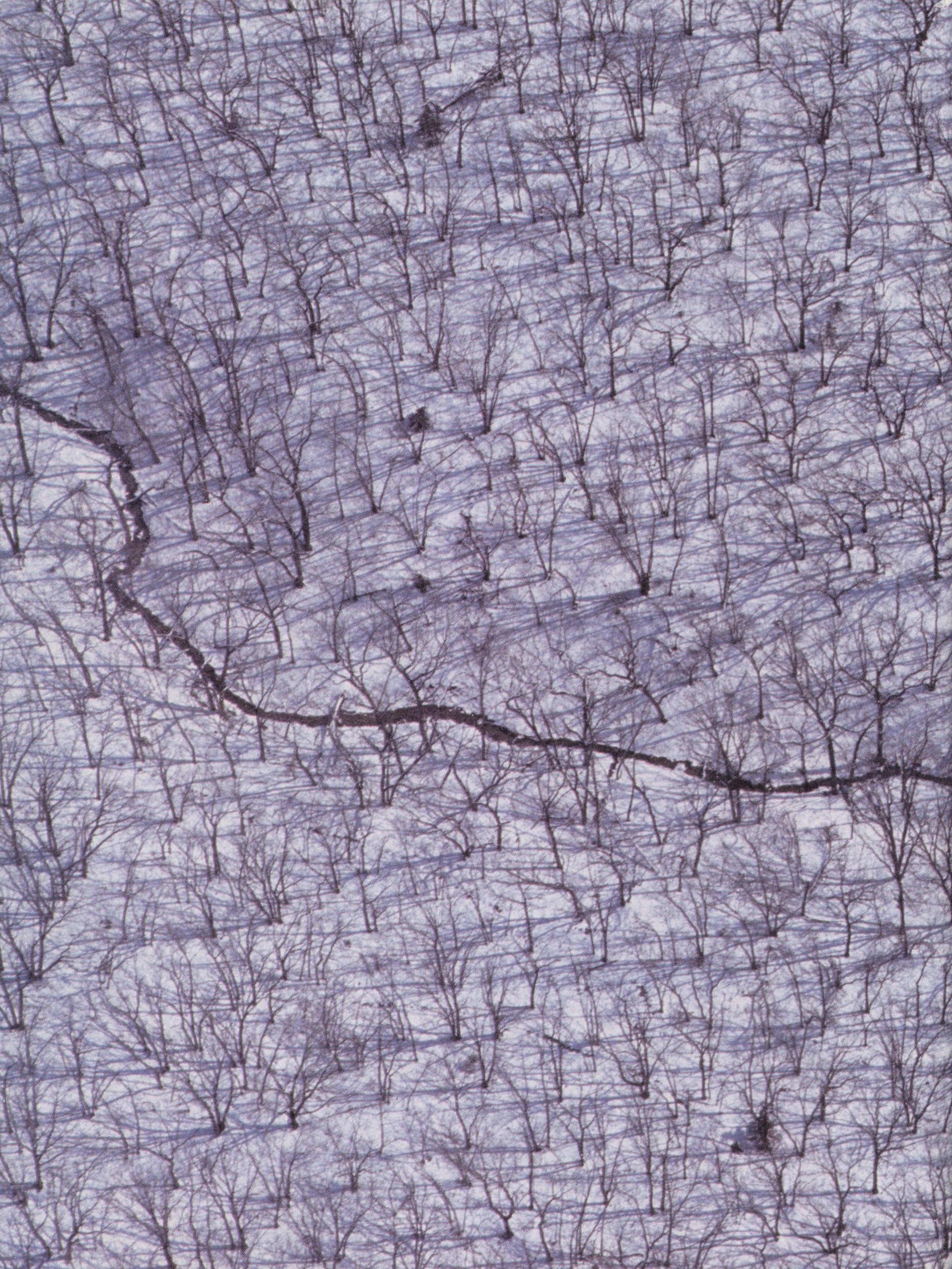
Position: 233 (33 views)