Volume 64, Issue 9, 1986
NEBRASKAland
NOVEMBER 1986 $1.50
NEBRASKAland
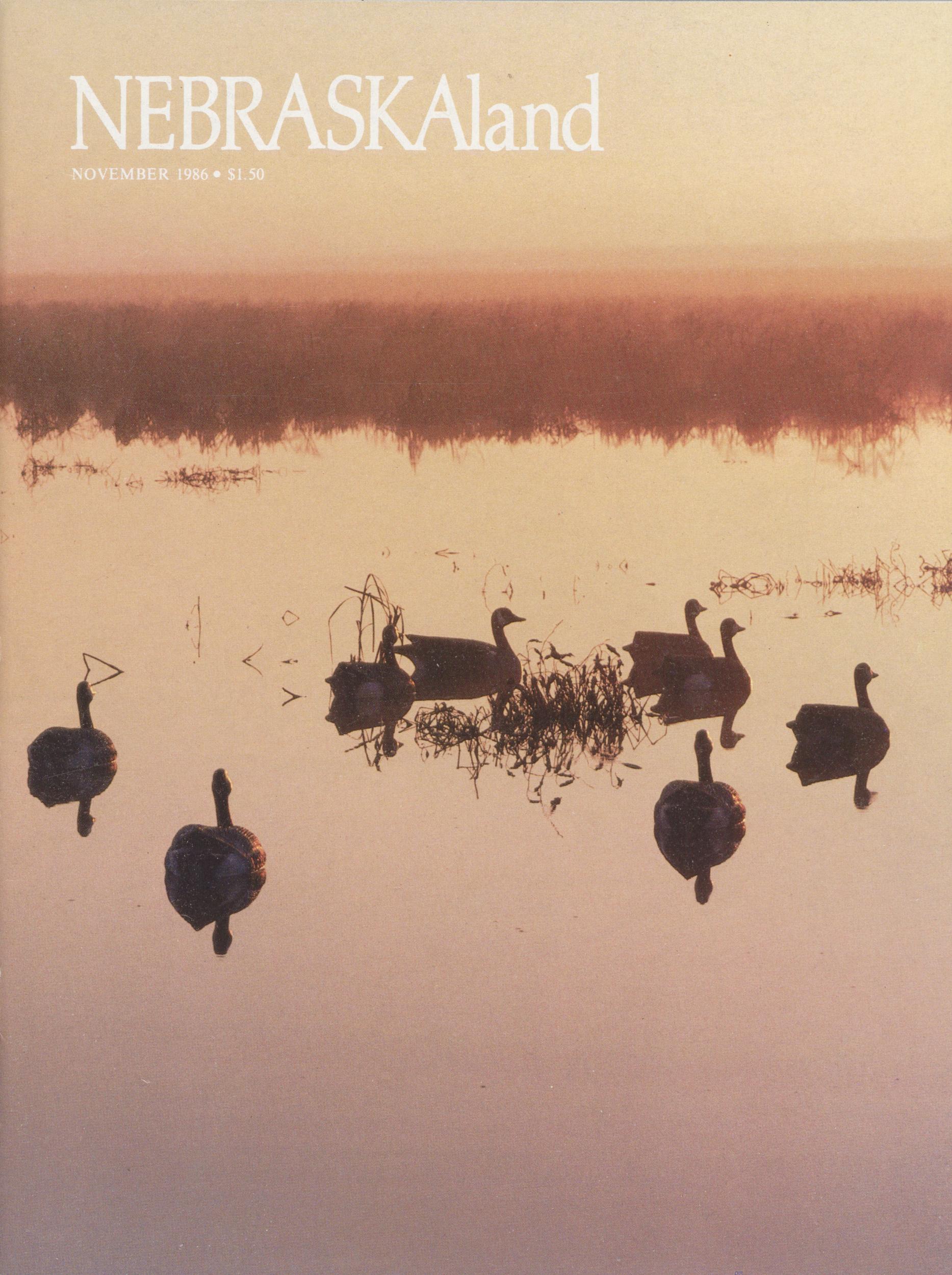
NEBRASKAland Published by the Nebraska Game and Parks Commission NEBRASKAland VOL. 64/NO. 9/NOV. 1986 NEBRASKAland (ISSN:0028-1964) is published monthly except for combined Jan /Feb and Aug/Sept issues, by the Nebraska Game and Parks Commission, 2200 North 33rd Street, Lincoln, NE. Copyright 1986, all rights reserved. Second-class postage paid at Lincoln, Nebraska and at additional mailing offices. POSTMASTER: Send address changes to NEBRASKAland, Box 30370, Lincoln, NE 68503. Rates: $12 for one year; $23 for two years. Single copy price $1.50 Offices Headquarters 2200 N. 33rd, Lincoln, 68503 (402) 464-0641 13th and Farnam St., Omaha (402) 554-2144 Ak-Sar-Ben Aquarium, Gretna (402) 332-3901 Rt. 2, Alliance (308) 762-5605 Bassett (402) 684-3511 US. 81, Norfolk (402) 371-4950 Rt. 4, North Platte (308) 532-6225 Commissioners Chairman: Richard L. Coyne, Omaha Vice Chairman: Neal Keller, Brewster 2nd Vice Chairman: Dr. Tim Biga, Norfolk Stan Juelfs, Kimball Wayne Ziebarth, Wilcox LaVern Schneider, McCook L. Bruce Wright, Lincoln Director: Eugene T. Mahoney Assistant Directors: William J. Bailey, Jr., Dale R. Bree, W. Rex Amack Staff Chief, Information & Education: Jim MacAllister Editor: Lowell Johnson Senior Editor: Jon Farrar Associate Editors: Ken Bouc, Don Cunningham Regional Editors: Bob Grier, Rocky Hoffmann Contributors: Tom Keith, Liz Huff, Carl Wolfe Research Assistant: Curt Twedt Art Director: Duane Westerholt Illustration: Steve O'Hare, Paula Day Advertising: Dan Curran Circulation: Pat Frahm Contents Features LATE-SEASON DEER MANAGEMENT 6 HUNTING STILL WORTHWHILE 10 GOOD FRIENDS GOOD TIMES NEBRASKA FURBEARERS A special 18-page section on the natural history of these important wild mammals 16 18 WHISPERING SMITH 36 Departments SPEAK UP 4 TRADING POST 49 COVER: As if watching for an incoming flight, Canada geese decoys face the morning sun on a Rainwater Basin marsh. For most Nebraska waterfowlers, goose decoys are only to round out a good spread of mallards, serving as confidence decoys to convince wary ducks the spread is safe. But in the back of their mind is the hope that one morning the goose fakes will pull in a half-dozen Canadas moving south for winter. OPPOSITE: Cussed by some, praised by some, and respected for their intelligence by everyone who knows them, coyotes have learned to coexist with man, even expanding their range north and east as man cleared timber formerly the domain of the timber wolf. Though not naturally nocturnal, the coyote has taken to a life in the night to avoid man. Photos by Jon Farrar. NEBRASKAland 1986 3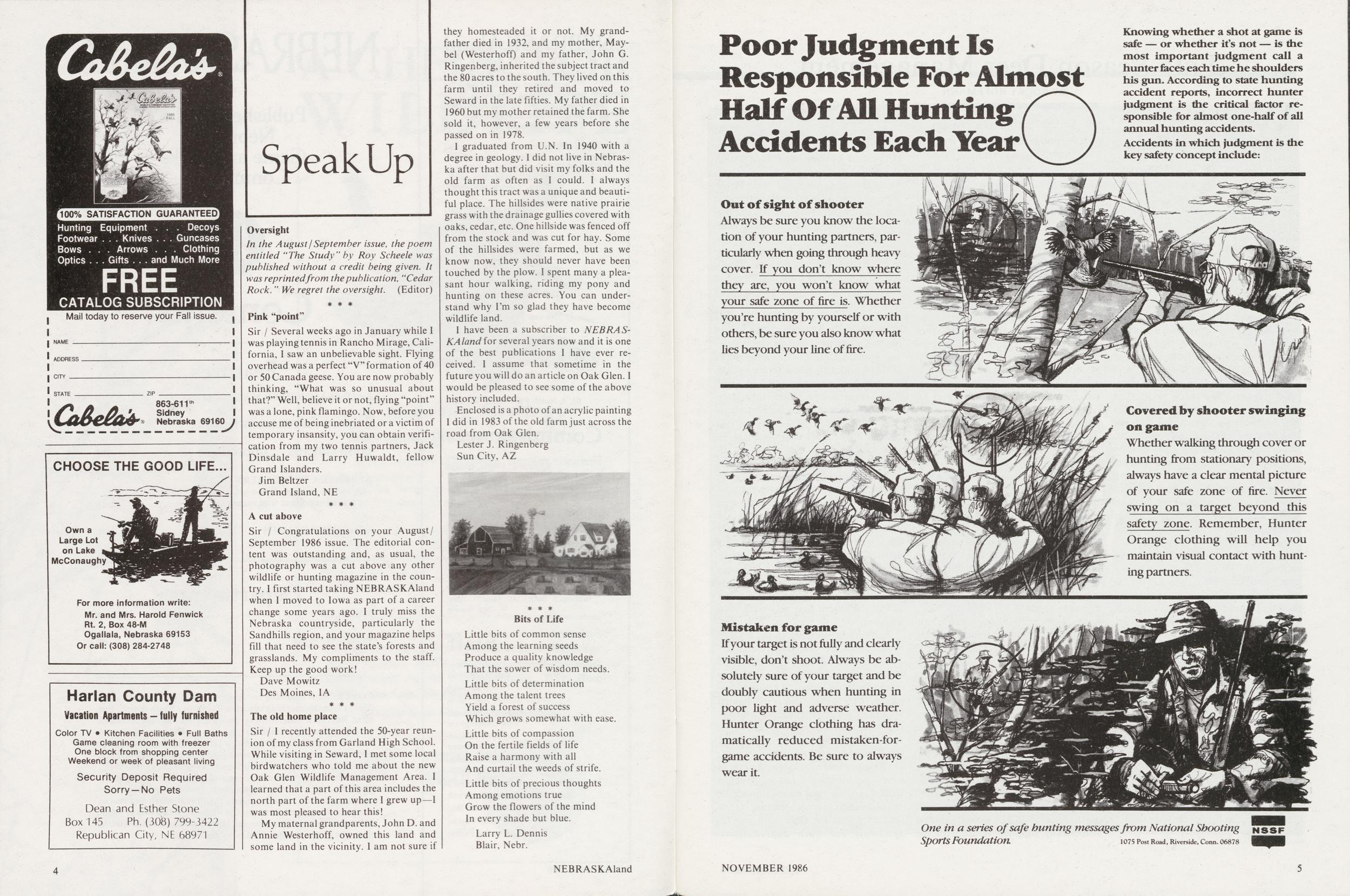
Speak Up
OversightIn the August J September issue, the poem entitled "The Study" by Roy Scheele was published without a credit being given. It was reprinted from the publication, "Cedar Rock. " We regret the oversight. (Editor)
Pink "point"Sir / Several weeks ago in January while I was playing tennis in Rancho Mirage, California, I saw an unbelievable sight. Flying overhead was a perfect "V" formation of 40 or 50 Canada geese. You are now probably thinking, "What was so unusual about that?" Well, believe it or not, flying "point" was a lone, pink flamingo. Now, before you accuse me of being inebriated or a victim of temporary insansity, you can obtain verification from my two tennis partners, Jack Dinsdale and Larry Huwaldt, fellow Grand Islanders.
Jim Beltzer Grand Island, NE A cut aboveSir / Congratulations on your August/ September 1986 issue. The editorial content was outstanding and, as usual, the photography was a cut above any other wildlife or hunting magazine in the country. I first started taking NEBRASKAland when I moved to Iowa as part of a career change some years ago. I truly miss the Nebraska countryside, particularly the Sandhills region, and your magazine helps fill that need to see the state's forests and grasslands. My compliments to the staff. Keep up the good work!
Dave Mowitz Des Moines, IA The old home placeSir / I recently attended the 50-year reunion of my class from Garland High School. While visiting in Seward, I met some local birdwatchers who told me about the new Oak Glen Wildlife Management Area. I learned that a part of this area includes the north part of the farm where I grew up—I was most pleased to hear this!
My maternal grandparents, John D. and Annie Westerhoff, owned this land and some land in the vicinity. 1 am not sure if they homesteaded it or not. My grandfather died in 1932, and my mother, Maybel (Westerhoff) and my father, John G. Ringenberg, inherited the subject tract and the 80 acres to the south. They lived on this farm until they retired and moved to Seward in the late fifties. My father died in 1960 but my mother retained the farm. She sold it, however, a few years before she passed on in 1978.
I graduated from U.N. In 1940 with a degree in geology. I did not live in Nebraska after that but did visit my folks and the old farm as often as I could. I always thought this tract was a unique and beautiful place. The hillsides were native prairie grass with the drainage gullies covered with oaks, cedar, etc. One hillside was fenced off from the stock and was cut for hay. Some of the hillsides were farmed, but as we know now, they should never have been touched by the plow. I spent many a pleasant hour walking, riding my pony and hunting on these acres. You can understand why I'm so glad they have become wildlife land.
I have been a subscriber to NEBRASKAland for several years now and it is one of the best publications I have ever received. I assume that sometime in the future you will do an article on Oak Glen. I would be pleased to see some of the above history included.
Enclosed is a photo of an acrylic painting I did in 1983 of the old farm just across the road from Oak Glen.
Lester J. Ringenberg Sun City, AZ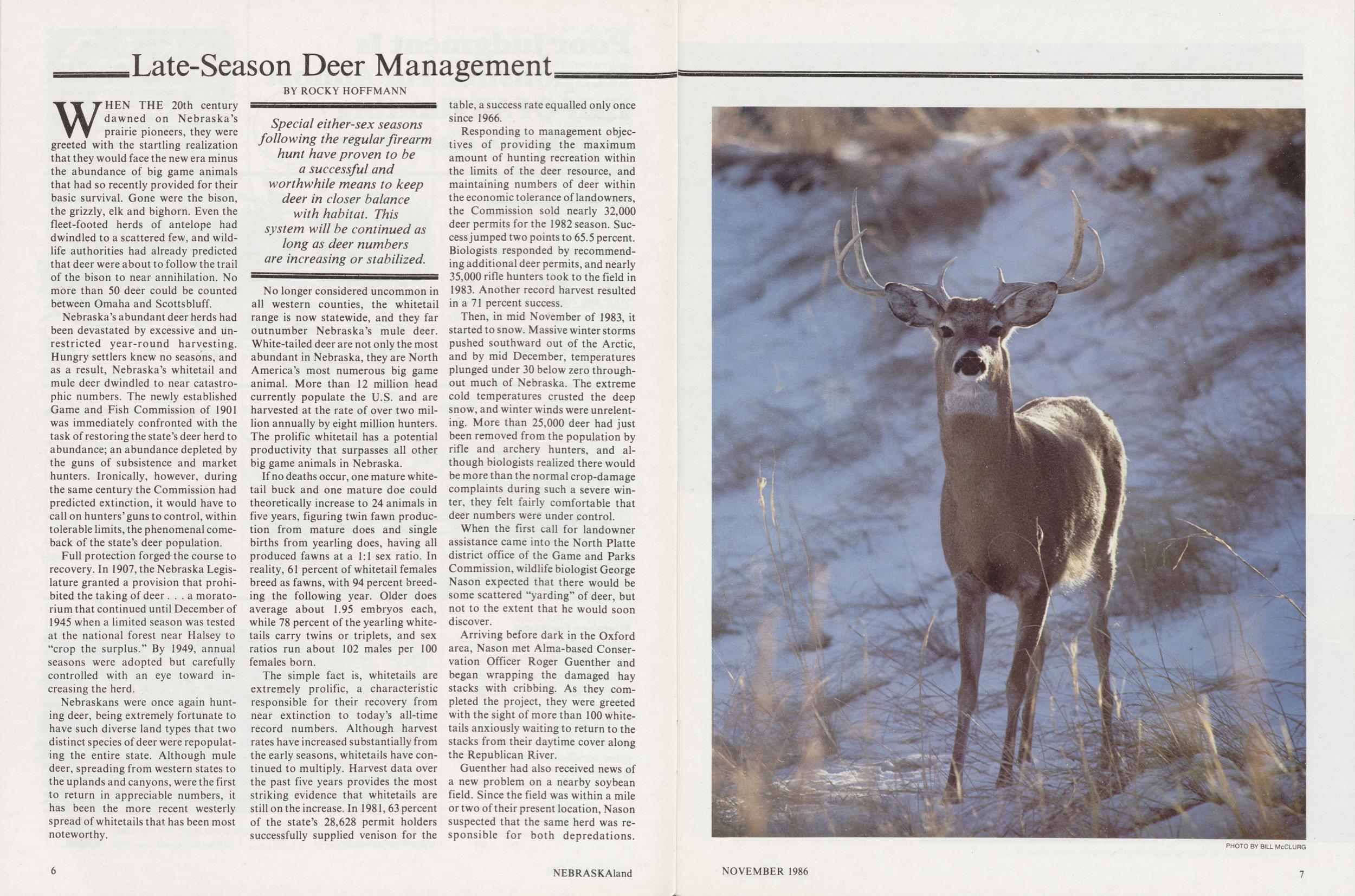
Late-Season Deer Management
BY ROCKY HOFFMANN Special either-sex seasons following the regular firearm hunt have proven to be a successful and worthwhile means to keep deer in closer balance with habitat. This system will be continued as long as deer numbers are increasing or stabilized.WHEN THE 20th century dawned on Nebraska's prairie pioneers, they were greeted with the startling realization that they would face the new era minus the abundance of big game animals that had so recently provided for their basic survival. Gone were the bison, the grizzly, elk and bighorn. Even the fleet-footed herds of antelope had dwindled to a scattered few, and wildlife authorities had already predicted that deer were about to follow the trail of the bison to near annihilation. No more than 50 deer could be counted between Omaha and Scottsbluff.
Nebraska's abundant deer herds had been devastated by excessive and unrestricted year-round harvesting. Hungry settlers knew no seasons, and as a result, Nebraska's whitetail and mule deer dwindled to near catastrophic numbers. The newly established Game and Fish Commission of 1901 was immediately confronted with the task of restoring the state's deer herd to abundance; an abundance depleted by the guns of subsistence and market hunters. Ironically, however, during the same century the Commission had predicted extinction, it would have to call on hunters'guns to control, within tolerable limits, the phenomenal comeback of the state's deer population.
Full protection forged the course to recovery. In 1907, the Nebraska Legislature granted a provision that prohibited the taking of deer a moratorium that continued until December of 1945 when a limited season was tested at the national forest near Halsey to "crop the surplus." By 1949, annual seasons were adopted but carefully controlled with an eye toward increasing the herd.
Nebraskans were once again hunting deer, being extremely fortunate to have such diverse land types that two distinct species of deer were repopulating the entire state. Although mule deer, spreading from western states to the uplands and canyons, were the first to return in appreciable numbers, it has been the more recent westerly spread of whitetails that has been most noteworthy.
No longer considered uncommon in all western counties, the whitetail range is now statewide, and they far outnumber Nebraska's mule deer. White-tailed deer are not only the most abundant in Nebraska, they are North America's most numerous big game animal. More than 12 million head currently populate the U.S. and are harvested at the rate of over two million annually by eight million hunters. The prolific whitetail has a potential productivity that surpasses all other big game animals in Nebraska.
If no deaths occur, one mature whitetail buck and one mature doe could theoretically increase to 24 animals in five years, figuring twin fawn production from mature does and single births from yearling does, having all produced fawns at a 1:1 sex ratio. In reality, 61 percent of whitetail females breed as fawns, with 94 percent breeding the following year. Older does average about 1.95 embryos each, while 78 percent of the yearling whitetails carry twins or triplets, and sex ratios run about 102 males per 100 females born.
The simple fact is, whitetails are extremely prolific, a characteristic responsible for their recovery from near extinction to today's all-time record numbers. Although harvest rates have increased substantially from the early seasons, whitetails have continued to multiply. Harvest data over the past five years provides the most striking evidence that whitetails are still on the increase. In 1981, 63 percent of the state's 28,628 permit holders successfully supplied venison for the table, a success rate equalled only once since 1966.
Responding to management objectives of providing the maximum amount of hunting recreation within the limits of the deer resource, and maintaining numbers of deer within the economic tolerance of landowners, the Commission sold nearly 32,000 deer permits for the 1982 season. Success jumped two points to 65.5 percent. Biologists responded by recommending additional deer permits, and nearly 35,000 rifle hunters took to the field in 1983. Another record harvest resulted in a 71 percent success.
Then, in mid November of 1983, it started to snow. Massive winter storms pushed southward out of the Arctic, and by mid December, temperatures plunged under 30 below zero throughout much of Nebraska. The extreme cold temperatures crusted the deep snow, and winter winds were unrelenting. More than 25,000 deer had just been removed from the population by rifle and archery hunters, and although biologists realized there would be more than the normal crop-damage complaints during such a severe winter, they felt fairly comfortable that deer numbers were under control.
When the first call for landowner assistance came into the North Platte district office of the Game and Parks Commission, wildlife biologist George Nason expected that there would be some scattered "yarding" of deer, but not to the extent that he would soon discover.
Arriving before dark in the Oxford area, Nason met Alma-based Conservation Officer Roger Guenther and began wrapping the damaged hay stacks with cribbing. As they completed the project, they were greeted with the sight of more than 100 whitetails anxiously waiting to return to the stacks from their daytime cover along the Republican River.
Guenther had also received news of a new problem on a nearby soybean field. Since the field was within a mile or two of their present location, Nason suspected that the same herd was responsible for both depredations. 6 NEBRASKAland
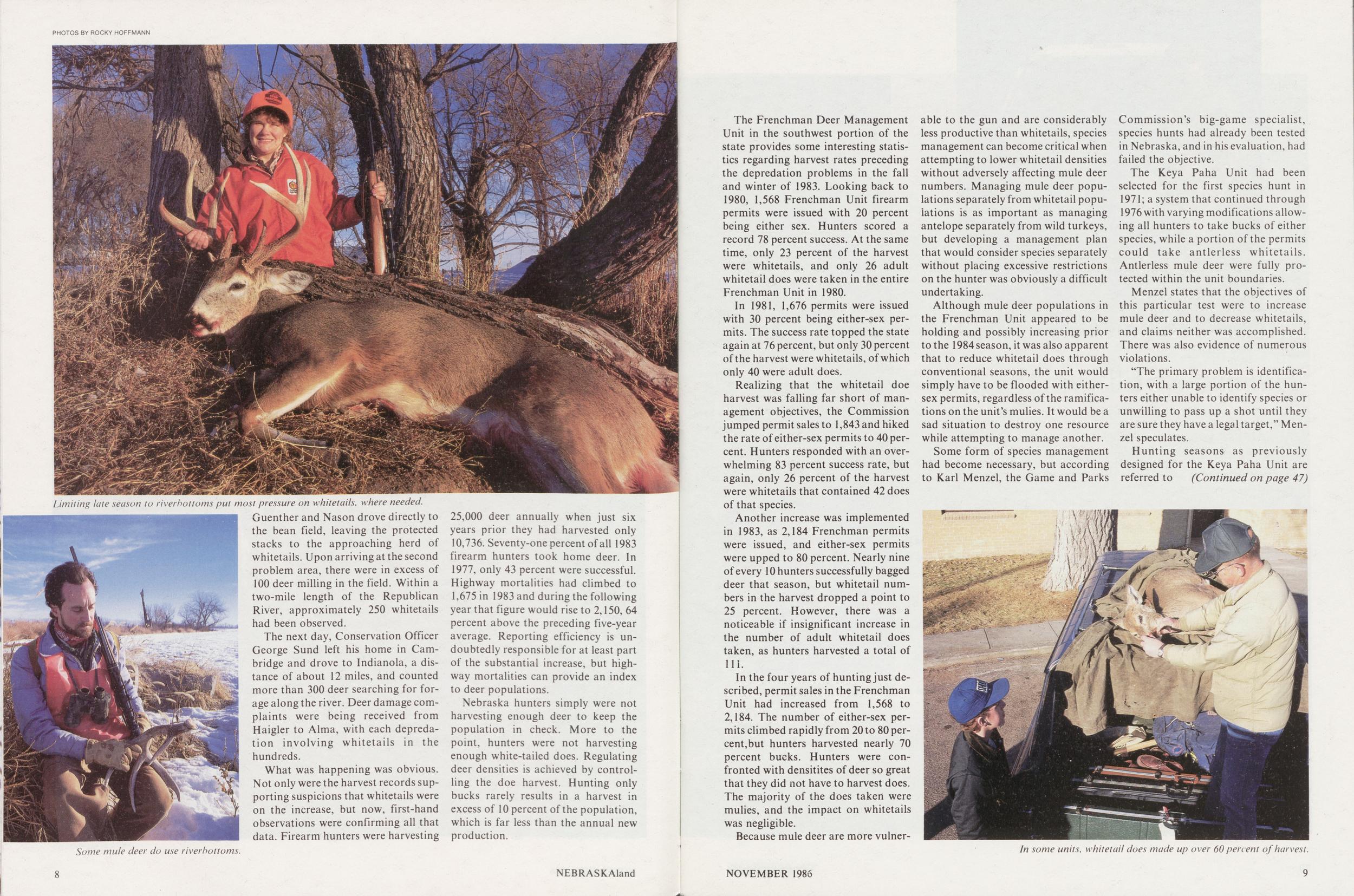
The next day, Conservation Officer George Sund left his home in Cambridge and drove to Indianola, a distance of about 12 miles, and counted more than 300 deer searching for forage along the river. Deer damage complaints were being received from Haigler to Alma, with each depredation involving whitetails in the hundreds.
What was happening was obvious. Not only were the harvest records supporting suspicions that whitetails were on the increase, but now, first-hand observations were confirming all that data. Firearm hunters were harvesting Some mule deer do use riverbottoms. 8 25,000 deer annually when just six years prior they had harvested only 10,736. Seventy-one percent of all 1983 firearm hunters took home deer. In 1977, only 43 percent were successful. Highway mortalities had climbed to 1,675 in 1983 and during the following year that figure would rise to 2,150, 64 percent above the preceding five-year average. Reporting efficiency is undoubtedly responsible for at least part of the substantial increase, but highway mortalities can provide an index to deer populations.
Nebraska hunters simply were not harvesting enough deer to keep the population in check. More to the point, hunters were not harvesting enough white-tailed does. Regulating deer densities is achieved by controlling the doe harvest. Hunting only bucks rarely results in a harvest in excess of 10 percent of the population, which is far less than the annual new production.
8 NEBRASKAlandThe Frenchman Deer Management Unit in the southwest portion of the state provides some interesting statistics regarding harvest rates preceding the depredation problems in the fall and winter of 1983. Looking back to 1980, 1,568 Frenchman Unit firearm permits were issued with 20 percent being either sex. Hunters scored a record 78 percent success. At the same time, only 23 percent of the harvest were whitetails, and only 26 adult whitetail does were taken in the entire Frenchman Unit in 1980.
In 1981, 1,676 permits were issued with 30 percent being either-sex permits. The success rate topped the state again at 76 percent, but only 30 percent of the harvest were whitetails, of which only 40 were adult does.
Realizing that the whitetail doe harvest was falling far short of management objectives, the Commission jumped permit sales to 1,843 and hiked the rate of either-sex permits to 40 percent. Hunters responded with an overwhelming 83 percent success rate, but again, only 26 percent of the harvest were whitetails that contained 42 does of that species.
Another increase was implemented in 1983, as 2,184 Frenchman permits were issued, and either-sex permits were upped to 80 percent. Nearly nine of every 10 hunters successfully bagged deer that season, but whitetail numbers in the harvest dropped a point to 25 percent. However, there was a noticeable if insignificant increase in the number of adult whitetail does taken, as hunters harvested a total of 111.
In the four years of hunting just described, permit sales in the Frenchman Unit had increased from 1,568 to 2,184. The number of either-sex permits climbed rapidly from 20 to 80 percent, but hunters harvested nearly 70 percent bucks. Hunters were confronted with densitites of deer so great that they did not have to harvest does. The majority of the does taken were mulies, and the impact on whitetails was negligible.
Because mule deer are more vulnerNOVEMBER 1986 able to the gun and are considerably less productive than whitetails, species management can become critical when attempting to lower whitetail densities without adversely affecting mule deer numbers. Managing mule deer populations separately from whitetail populations is as important as managing antelope separately from wild turkeys, but developing a management plan that would consider species separately without placing excessive restrictions on the hunter was obviously a difficult undertaking.
Although mule deer populations in the Frenchman Unit appeared to be holding and possibly increasing prior to the 1984 season, it was also apparent that to reduce whitetail does through conventional seasons, the unit would simply have to be flooded with eithersex permits, regardless of the ramifications on the unit's mulies. It would be a sad situation to destroy one resource while attempting to manage another.
Some form of species management had become necessary, but according to Karl Menzel, the Game and Parks Commission's big-game specialist, species hunts had already been tested in Nebraska, and in his evaluation, had failed the objective.
The Keya Paha Unit had been selected for the first species hunt in 1971; a system that continued through 1976 with varying modifications allowing all hunters to take bucks of either species, while a portion of the permits could take antlerless whitetails. Antlerless mule deer were fully protected within the unit boundaries.
Menzel states that the objectives of this particular test were to increase mule deer and to decrease whitetails, and claims neither was accomplished. There was also evidence of numerous violations.
"The primary problem is identification, with a large portion of the hunters either unable to identify species or unwilling to pass up a shot until they are sure they have a legal target," Menzel speculates.
Hunting seasons as previously designed for the Keya Paha Unit are referred to (Continued on page 47)
Hunting... Still Worthwhile
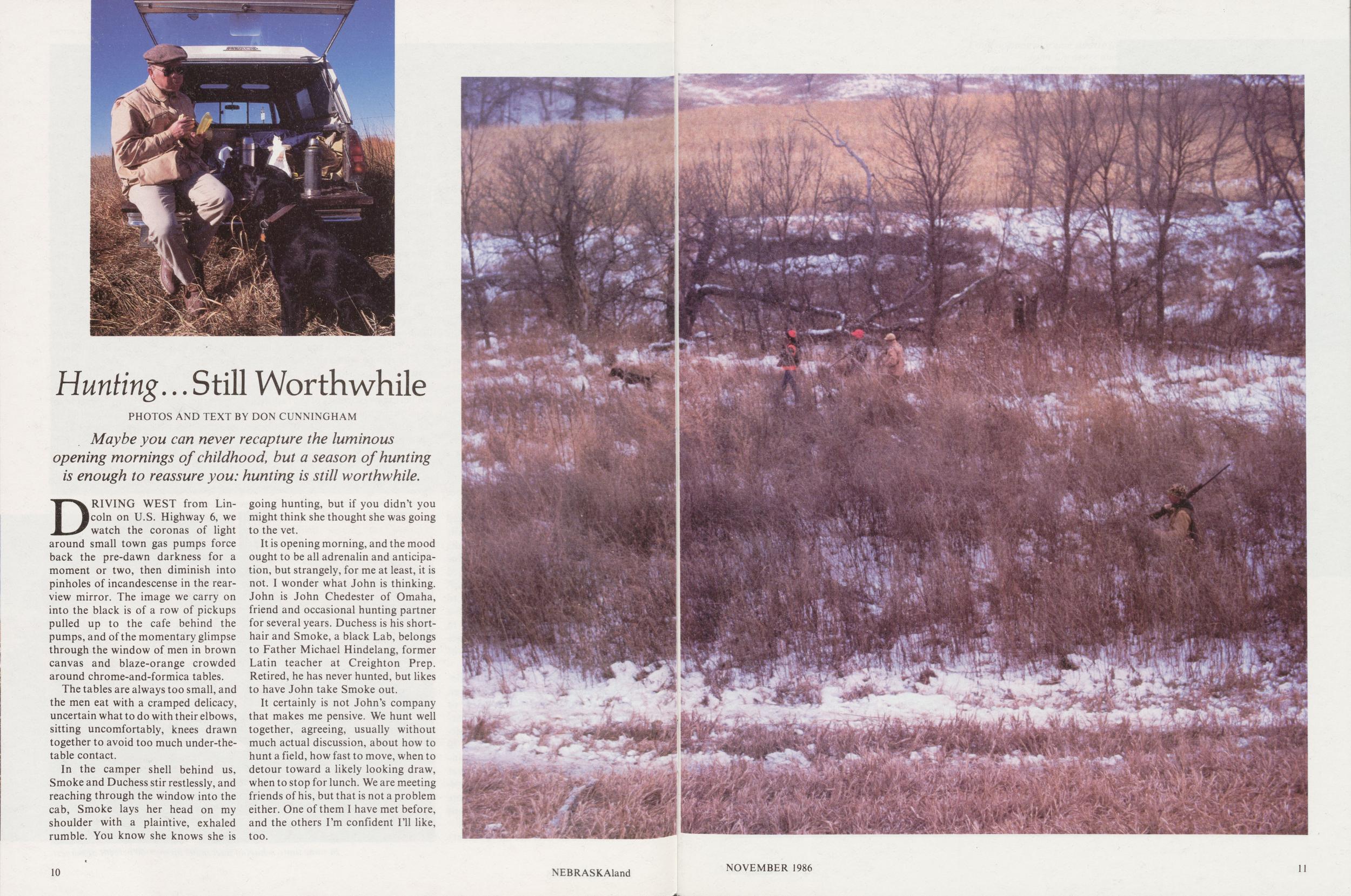
PHOTOS AND TEXT BY DON CUNNINGHAM Maybe you can never recapture the luminous opening mornings of childhood, but a season of hunting is enough to reassure you: hunting is still worthwhile.DRIVING WEST from Lincoln on U.S. Highway 6, we watch the coronas of light around small town gas pumps force back the pre-dawn darkness for a moment or two, then diminish into pinholes of incandescense in the rearview mirror. The image we carry on into the black is of a row of pickups pulled up to the cafe behind the pumps, and of the momentary glimpse through the window of men in brown canvas and blaze-orange crowded around chrome-and-formica tables.
The tables are always too small, and the men eat with a cramped delicacy, uncertain what to do with their elbows, sitting uncomfortably, knees drawn together to avoid too much under-the-table contact.
In the camper shell behind us, Smoke and Duchess stir restlessly, and reaching through the window into the cab, Smoke lays her head on my shoulder with a plaintive, exhaled rumble. You know she knows she is going hunting, but if you didn't you might think she thought she was going to the vet.
It is opening morning, and the mood ought to be all adrenalin and anticipation, but strangely, for me at least, it is not. I wonder what John is thinking. John is John Chedester of Omaha, friend and occasional hunting partner for several years. Duchess is his shorthair and Smoke, a black Lab, belongs to Father Michael Hindelang, former Latin teacher at Creighton Prep. Retired, he has never hunted, but likes to have John take Smoke out.
It certainly is not John's company that makes me pensive. We hunt well together, agreeing, usually without much actual discussion, about how to hunt a field, how fast to move, when to detour toward a likely looking draw, when to stop for lunch. We are meeting friends of his, but that is not a problem either. One of them I have met before, and the others I'm confident I'll like, too.
10 NEBRASKAland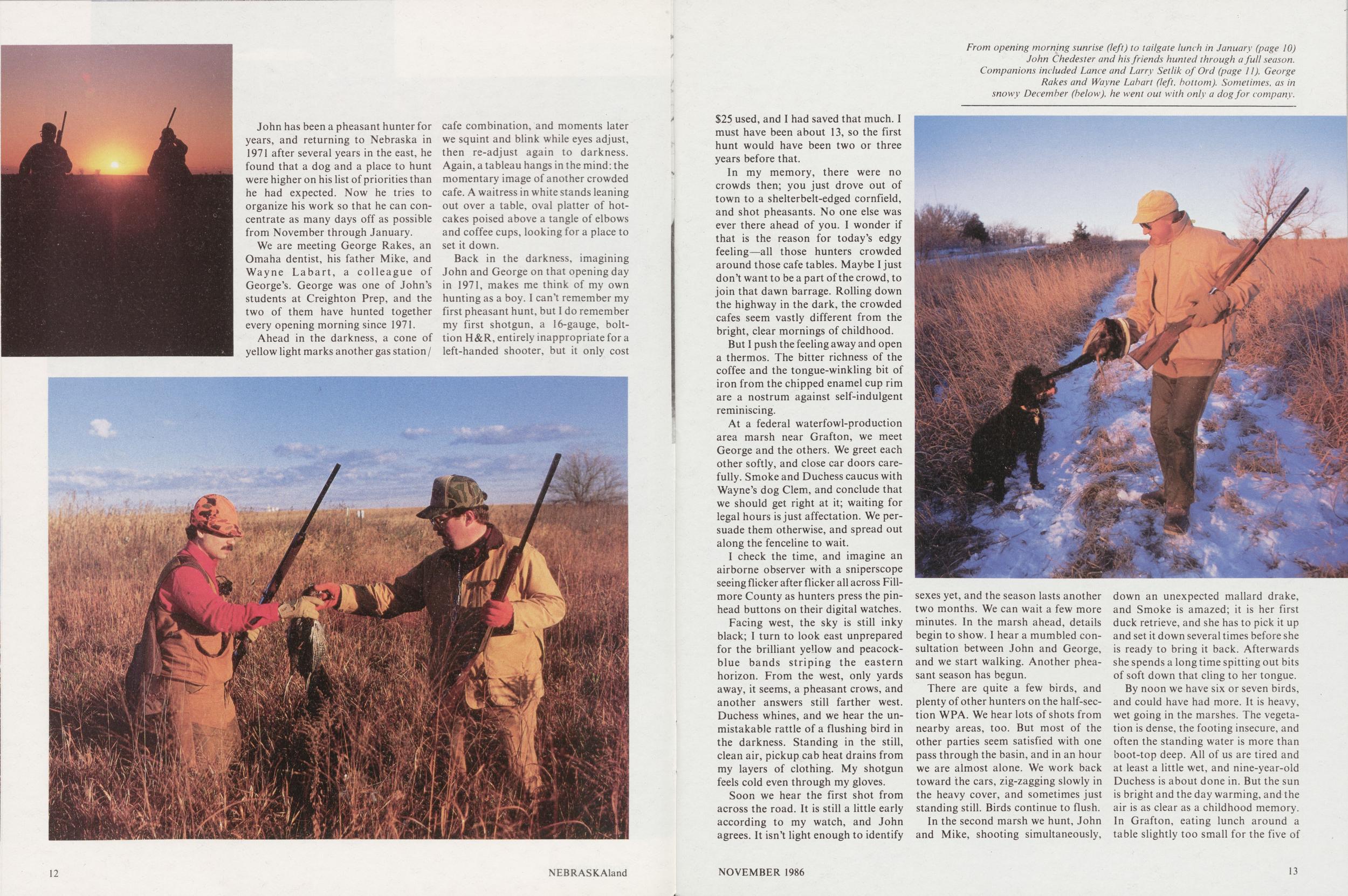
John has been a pheasant hunter for years, and returning to Nebraska in 1971 after several years in the east, he found that a dog and a place to hunt were higher on his list of priorities than he had expected. Now he tries to organize his work so that he can concentrate as many days off as possible from November through January.
We are meeting George Rakes, an Omaha dentist, his father Mike, and Wayne Labart, a colleague of George's. George was one of John's students at Creighton Prep, and the two of them have hunted together every opening morning since 1971.
Ahead in the darkness, a cone of yellow light marks another gas station cafe combination, and moments later we squint and blink while eyes adjust, then re-adjust again to darkness. Again, a tableau hangs in the mind: the momentary image of another crowded cafe. A waitress in white stands leaning out over a table, oval platter of hotcakes poised above a tangle of elbows and coffee cups, looking for a place to set it down.
Back in the darkness, imagining John and George on that opening day in 1971, makes me think of my own hunting as a boy. I can't remember my first pheasant hunt, but I do remember my first shotgun, a 16-gauge, bolttion H&R, entirely inappropriate for a left-handed shooter, but it only cost 12 NEBRASKAland $25 used, and I had saved that much. I must have been about 13, so the first hunt would have been two or three years before that.
In my memory, there were no crowds then; you just drove out of town to a shelterbelt-edged cornfield, and shot pheasants. No one else was ever there ahead of you. I wonder if that is the reason for today's edgy feeling—all those hunters crowded around those cafe tables. Maybe I just don't want to be a part of the crowd, to join that dawn barrage. Rolling down the highway in the dark, the crowded cafes seem vastly different from the bright, clear mornings of childhood.
But I push the feeling away and open a thermos. The bitter richness of the coffee and the tongue-winkling bit of iron from the chipped enamel cup rim are a nostrum against self-indulgent reminiscing.
At a federal waterfowl-production area marsh near Grafton, we meet George and the others. We greet each other softly, and close car doors carefully. Smoke and Duchess caucus with Wayne's dog Clem, and conclude that we should get right at it; waiting for legal hours is just affectation. We persuade them otherwise, and spread out along the fenceline to wait.
I check the time, and imagine an airborne observer with a sniperscope seeing flicker after flicker all across Fillmore County as hunters press the pinhead buttons on their digital watches.
Facing west, the sky is still inky black; I turn to look east unprepared for the brilliant yellow and peacockblue bands striping the eastern horizon. From the west, only yards away, it seems, a pheasant crows, and another answers still farther west. Duchess whines, and we hear the unmistakable rattle of a flushing bird in the darkness. Standing in the still, clean air, pickup cab heat drains from my layers of clothing. My shotgun feels cold even through my gloves.
Soon we hear the first shot from across the road. It is still a little early according to my watch, and John agrees. It isn't light enough to identify sexes yet, and the season lasts another two months. We can wait a few more minutes. In the marsh ahead, details begin to show. I hear a mumbled consultation between John and George, and we start walking. Another pheasant season has begun.
There are quite a few birds, and plenty of other hunters on the half-section WPA. We hear lots of shots from nearby areas, too. But most of the other parties seem satisfied with one pass through the basin, and in an hour we are almost alone. We work back toward the cars, zig-zagging slowly in the heavy cover, and sometimes just standing still. Birds continue to flush.
In the second marsh we hunt, John and Mike, shooting simultaneously, down an unexpected mallard drake, and Smoke is amazed; it is her first duck retrieve, and she has to pick it up and set it down several times before she is ready to bring it back. Afterwards she spends a long time spitting out bits of soft down that cling to her tongue.
By noon we have six or seven birds,
and could have had more. It is heavy,
wet going in the marshes. The vegetation is dense, the footing insecure, and
often the standing water is more than
boot-top deep. All of us are tired and
at least a little wet, and nine-year-old
Duchess is about done in. But the sun
is bright and the day warming, and the
air is as clear as a childhood memory.
In Grafton, eating lunch around a
table slightly too small for the five of
NOVEMBER 1986
13
We hunt again in the afternoon, on another federal area, and on Wayne's father's farm near McCool Junction. There it is easier, farmland hunting, where treelines, draws and creekbottoms first separate, then reunite a party of hunters. Hunting this way, you move through the contoured land, often out of sight of each other, alone, but still pacing yourself to the movements of hunting partners you cannot see. It is a solitary dance which tests, mildly, how well the group meshes.
From the far side of the creekbottom I hear a shot, and get ready in case a missed bird comes my way, but none does. I hear John say "Good Shot, Wayne," and I pause until the bird is tucked into Wayne's hunting coat.
Emerging from the last treeline, we see a pickup bouncing down a field road. Wayne's father and the grandchildren—Wayne's boys, Jason and Justin—have come to save us the walk back to the place.
Wayne's bird commands considerable respect from Jason and Justin, who take turns holding it as we ride in the back of the pickup to the house. The light is fading, but Wayne has promised the boys that they can go with him to hunt the quarter-mile shelterbelt behind the house, and there is still time for that. The rest of us leave for a motel as Wayne and the boys only Wayne with a shotgun for a few more years—start down the treeline. I wonder how the day will look to them in memory, 35 years from now.
Back at the motel, water streaming over tired muscles, I review the day, searching for a cause of the early sour taste. Was it those crowded cafes? Except for the first hour in the first marsh, we hadn't really been overwhelmed by other hunters.
Could it just be age? Is it possible to get too old to hunt pheasants? I'm not talking about sore knees and short wind. Am I becoming some kind of corn-country Prufrock, measuring out my life in opening days, and asking if it is really worthwhile after all?
But 30 opening mornings, give or take a few, isn't really all that many; I know plenty of 50-year —and more veterans. It is not just their hunting skill, and their stories of seasons past that I like. There is more: a calm cleareyed self-knowledge that does not demand the continual reassurance of more (and more expensive) shotguns, of more opening morning limits. The problem is not just crowds or age, even if those are involved in it somewhere.
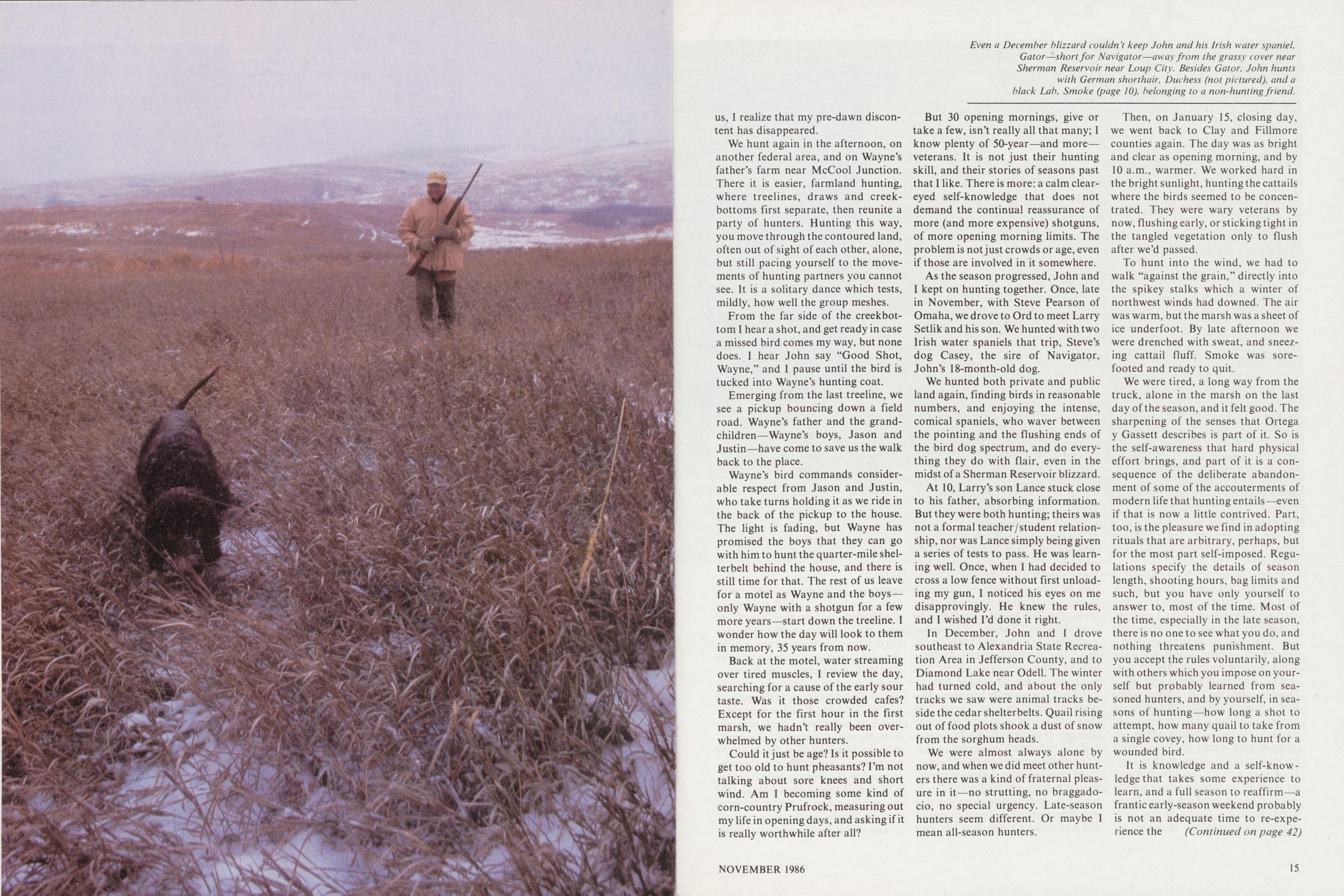
As the season progressed, John and I kept on hunting together. Once, late in November, with Steve Pearson of Omaha, we drove to Ord to meet Larry Setlik and his son. We hunted with two Irish water spaniels that trip, Steve's dog Casey, the sire of Navigator, John's 18-month-old dog.
We hunted both private and public land again, finding birds in reasonable numbers, and enjoying the intense, comical spaniels, who waver between the pointing and the flushing ends of the bird dog spectrum, and do everything they do with flair, even in the midst of a Sherman Reservoir blizzard.
At 10, Larry's son Lance stuck close to his father, absorbing information. But they were both hunting; theirs was not a formal teacher/student relationship, nor was Lance simply being given a series of tests to pass. He was learning well. Once, when I had decided to cross a low fence without first unloading my gun, I noticed his eyes on me disapprovingly. He knew the rules, and I wished I'd done it right.
In December, John and I drove southeast to Alexandria State Recreation Area in Jefferson County, and to Diamond Lake near Odell. The winter had turned cold, and about the only tracks we saw were animal tracks beside the cedar shelterbelts. Quail rising out of food plots shook a dust of snow from the sorghum heads.
We were almost always alone by now, and when we did meet other hunters there was a kind of fraternal pleasure in it—no strutting, no braggadocio, no special urgency. Late-season hunters seem different. Or maybe I mean all-season hunters.
Then, on January 15, closing day, we went back to Clay and Fillmore counties again. The day was as bright and clear as opening morning, and by 10 a.m., warmer. We worked hard in the bright sunlight, hunting the cattails where the birds seemed to be concentrated. They were wary veterans by now, flushing early, or sticking tight in the tangled vegetation only to flush after we'd passed.
To hunt into the wind, we had to walk "against the grain," directly into the spikey stalks which a winter of northwest winds had downed. The air was warm, but the marsh was a sheet of ice underfoot. By late afternoon we were drenched with sweat, and sneezing cattail fluff. Smoke was sorefooted and ready to quit.
We were tired, a long way from the truck, alone in the marsh on the last day of the season, and it felt good. The sharpening of the senses that Ortega y Gassett describes is part of it. So is the self-awareness that hard physical effort brings, and part of it is a consequence of the deliberate abandonment of some of the accouterments of modern life that hunting entails—even if that is now a little contrived. Part, too, is the pleasure we find in adopting rituals that are arbitrary, perhaps, but for the most part self-imposed. Regulations specify the details of season length, shooting hours, bag limits and such, but you have only yourself to answer to, most of the time. Most of the time, especially in the late season, there is no one to see what you do, and nothing threatens punishment. But you accept the rules voluntarily, along with others which you impose on yourself but probably learned from seasoned hunters, and by yourself, in seasons of hunting—how long a shot to attempt, how many quail to take from a single covey, how long to hunt for a wounded bird.
It is knowledge and a self-knowledge that takes some experience to learn, and a full season to reaffirm—a frantic early-season weekend probably is not an adequate time to re-experience the (Continued on page 42)
NOVEMBER 1986 15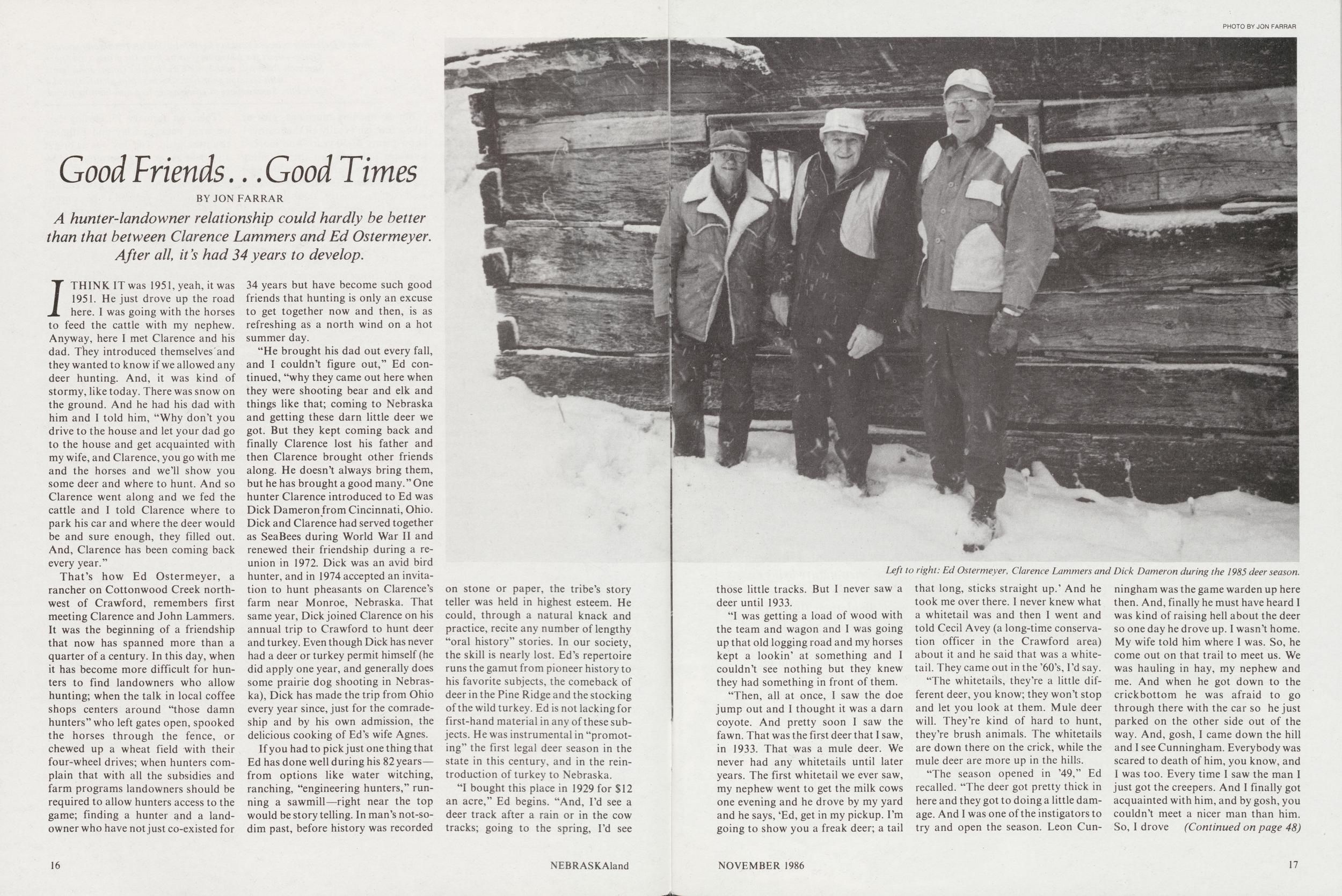
Good Friends Good Times
BY JON FARRAR A hunter-landowner relationship could hardly be better than that between Clarence Lammers and Ed Ostermeyer. After all, it's had 34 years to develop.I THINK IT was 1951, yeah, it was 1951. He just drove up the road here. I was going with the horses to feed the cattle with my nephew. Anyway, here I met Clarence and his dad. They introduced themselves and they wanted to know if we allowed any deer hunting. And, it was kind of stormy, like today. There was snow on the ground. And he had his dad with him and I told him, "Why don't you drive to the house and let your dad go to the house and get acquainted with my wife, and Clarence, you go with me and the horses and we'll show you some deer and where to hunt. And so Clarence went along and we fed the cattle and I told Clarence where to park his car and where the deer would be and sure enough, they filled out. And, Clarence has been coming back every year."
That's how Ed Ostermeyer, a rancher on Cottonwood Creek northwest of Crawford, remembers first meeting Clarence and John Lammers. It was the beginning of a friendship that now has spanned more than a quarter of a century. In this day, when it has become more difficult for hunters to find landowners who allow hunting; when the talk in local coffee shops centers around "those damn hunters" who left gates open, spooked the horses through the fence, or chewed up a wheat field with their four-wheel drives; when hunters complain that with all the subsidies and farm programs landowners should be required to allow hunters access to the game; finding a hunter and a landowner who have not just co-existed for 34 years but have become such good friends that hunting is only an excuse to get together now and then, is as refreshing as a north wind on a hot summer day.
"He brought his dad out every fall, and I couldn't figure out," Ed continued, "why they came out here when they were shooting bear and elk and things like that; coming to Nebraska and getting these darn little deer we got. But they kept coming back and finally Clarence lost his father and then Clarence brought other friends along. He doesn't always bring them, but he has brought a good many." One hunter Clarence introduced to Ed was Dick Dameron from Cincinnati, Ohio. Dick and Clarence had served together as SeaBees during World War II and renewed their friendship during a reunion in 1972. Dick was an avid bird hunter, and in 1974 accepted an invitation to hunt pheasants on Clarence's farm near Monroe, Nebraska. That same year, Dick joined Clarence on his annual trip to Crawford to hunt deer and turkey. Even though Dick has never had a deer or turkey permit himself (he did apply one year, and generally does some prairie dog shooting in Nebraska), Dick has made the trip from Ohio every year since, just for the comradeship and by his own admission, the delicious cooking of Ed's wife Agnes.
If you had to pick just one thing that Ed has done well during his 82 years from options like water witching, ranching, "engineering hunters," running a sawmill—right near the top would be story telling. In man's not-so-dim past, before history was recorded on stone or paper, the tribe's story teller was held in highest esteem. He could, through a natural knack and practice, recite any number of lengthy "oral history" stories. In our society, the skill is nearly lost. Ed's repertoire runs the gamut from pioneer history to his favorite subjects, the comeback of deer in the Pine Ridge and the stocking of the wild turkey. Ed is not lacking for first-hand material in any of these subjects. He was instrumental in "promoting" the first legal deer season in the state in this century, and in the reintroduction of turkey to Nebraska.
"I bought this place in 1929 for $12 an acre," Ed begins. "And, I'd see a deer track after a rain or in the cow tracks; going to the spring, I'd see 16 NEBRASKAland
"I was getting a load of wood with the team and wagon and I was going up that old logging road and my horses kept a lookin' at something and I couldn't see nothing but they knew they had something in front of them.
"Then, all at once, I saw the doe jump out and I thought it was a darn coyote. And pretty soon I saw the fawn. That was the first deer that I saw, in 1933. That was a mule deer. We never had any whitetails until later years. The first whitetail we ever saw, my nephew went to get the milk cows one evening and he drove by my yard and he says, 'Ed, get in my pickup. I'm going to show you a freak deer; a tail that long, sticks straight up.' And he took me over there. I never knew what a whitetail was and then I went and told Cecil Avey (a long-time conservation officer in the Crawford area) about it and he said that was a whitetail. They came out in the '60's, I'd say.
"The whitetails, they're a little different deer, you know; they won't stop and let you look at them. Mule deer will. They're kind of hard to hunt, they're brush animals. The whitetails are down there on the crick, while the mule deer are more up in the hills.
"The season opened in '49," Ed recalled. "The deer got pretty thick in here and they got to doing a little damage. And I was one of the instigators to try and open the season. Leon CunDick Dameron during the 1985 deer season. ningham was the game warden up here then. And, finally he must have heard I was kind of raising hell about the deer so one day he drove up. I wasn't home. My wife told him where I was. So, he come out on that trail to meet us. We was hauling in hay, my nephew and me. And when he got down to the crickbottom he was afraid to go through there with the car so he just parked on the other side out of the way. And, gosh, I came down the hill and I see Cunningham. Everybody was scared to death of him, you know, and I was too. Every time I saw the man I just got the creepers. And I finally got acquainted with him, and by gosh, you couldn't meet a nicer man than him. So, I drove (Continued on page 48)
NOVEMBER 1986 17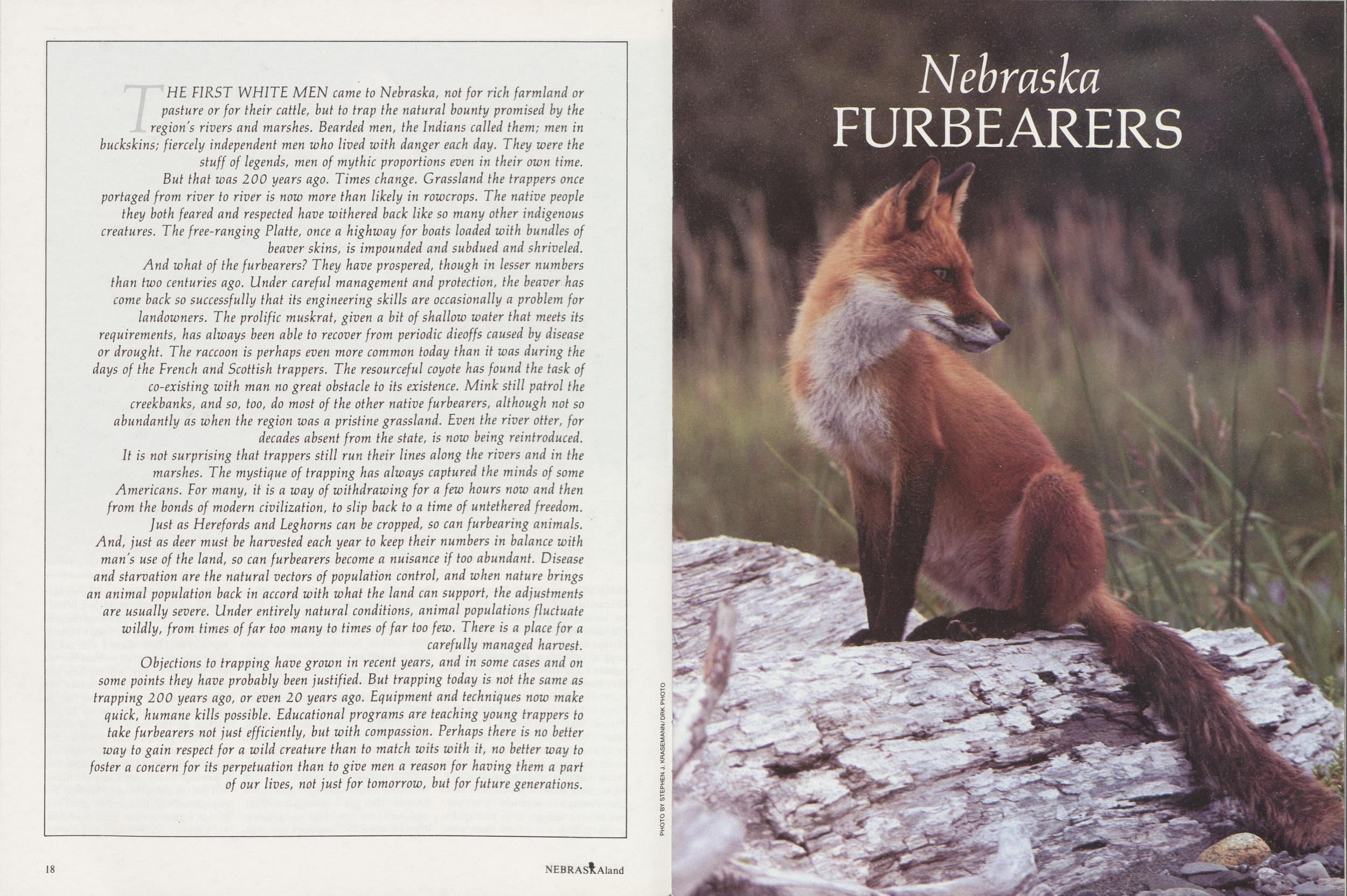
Nebraska FURBEARERS
THE FIRST WHITE MEN came to Nebraska, not for rich farmland or pasture or for their cattle, but to trap the natural bounty promised by the regions rivers and marshes. Bearded men, the Indians called them; men in buckskins; fiercely independent men who lived with danger each day. They were the stuff of legends, men of mythic proportions even in their own time.
But that was 200 years ago. Times change. Grassland the trappers once portaged from river to river is now more than likely in rowcrops. The native people they both feared and respected have withered back like so many other indigenous creatures. The free-ranging Platte, once a highway for boats loaded with bundles of beaver skins, is impounded and subdued and shriveled.
And what of the furbearers? They have prospered, though in lesser numbers than two centuries ago. Under careful management and protection, the beaver has come back so successfully that its engineering skills are occasionally a problem for landowners. The prolific muskrat, given a bit of shallow water that meets its requirements, has always been able to recover from periodic dieoffs caused by disease or drought. The raccoon is perhaps even more common today than it was during the days of the French and Scottish trappers. The resourceful coyote has found the task of co-existing with man no great obstacle to its existence. Mink still patrol the creekbanks, and so, too, do most of the other native furbearers, although not so abundantly as when the region was a pristine grassland. Even the river otter, for decades absent from the state, is now being reintroduced.
It is not surprising that trappers still run their lines along the rivers and in the marshes. The mystique of trapping has always captured the minds of some Americans. For many, it is a way of withdrawing for a few hours now and then from the bonds of modern civilization, to slip back to a lime of unlelhered freedom.
Just as Herefords and Leghorns can be cropped, so can furbearing animals. And, just as deer must be harvested each year to keep their numbers in balance with mans use of the land, so can furbearers become a nuisance if loo abundant. Disease and starvation are the natural vectors of population control, and when nature brings an animal population back in accord with what the land can support, the adjustments are usually severe. Under entirely natural conditions, animal populations fluctuate wildly, from limes of far loo many to limes of far too few. There is a place for a carefully managed harvest.
Objections to trapping have grown in recent years, and in some cases and on some points they have probably been justified. But trapping today is not the same as trapping 200 years ago, or even 20 years ago. Equipment and techniques now make quick, humane kills possible. Educational programs are teaching young trappers to take furbearers not just efficiently, but with compassion. Perhaps there is no better way to gain respect for a wild creature than to match wits with it, no better way to foster a concern for its perpetuation than to give men a reason for having them a part of our lives, not just for tomorrow, but for future generations.
18 NEBRASKAland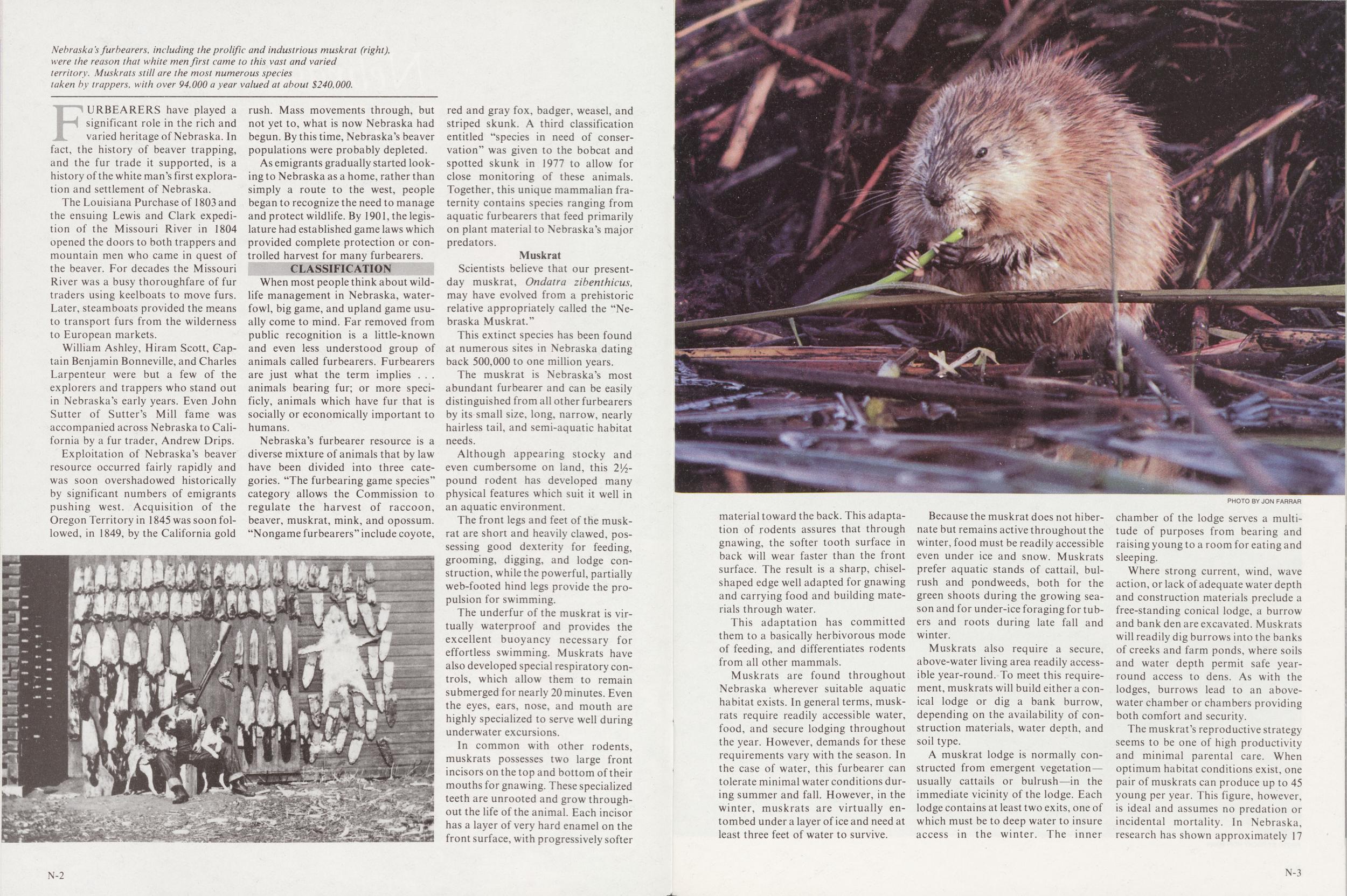
FURBEARERS have played a HI significant role in the rich and varied heritage of Nebraska. In fact, the history of beaver trapping, and the fur trade it supported, is a history of the white man's first exploration and settlement of Nebraska.
The Louisiana Purchase of 1803 and the ensuing Lewis and Clark expedition of the Missouri River in 1804 opened the doors to both trappers and mountain men who came in quest of the beaver. For decades the Missouri River was a busy thoroughfare of fur traders using keelboats to move furs. Later, steamboats provided the means to transport furs from the wilderness to European markets.
William Ashley, Hiram Scott, Captain Benjamin Bonneville, and Charles Larpenteur were but a few of the explorers and trappers who stand out in Nebraska's early years. Even John Sutter of Sutter's Mill fame was accompanied across Nebraska to California by a fur trader, Andrew Drips.
Exploitation of Nebraska's beaver resource occurred fairly rapidly and was soon overshadowed historically by significant numbers of emigrants pushing west. Acquisition of the Oregon Territory in 1845 was soon followed, in 1849, by the California gold
As emigrants gradually started looking to Nebraska as a home, rather than simply a route to the west, people began to recognize the need to manage and protect wildlife. By 1901, the legislature had established game laws which provided complete protection or controlled harvest for many furbearers.
CLASSIFICATIONWhen most people think about wildlife management in Nebraska, waterfowl, big game, and upland game usually come to mind. Far removed from public recognition is a little-known and even less understood group of animals called furbearers. Furbearers are just what the term implies animals bearing fur; or more specificly, animals which have fur that is socially or economically important to humans.
Nebraska's furbearer resource is a diverse mixture of animals that by law have been divided into three categories. "The furbearing game species" category allows the Commission to regulate the harvest of raccoon, beaver, muskrat, mink, and opossum. "Nongame furbearers" include coyote, red and gray fox, badger, weasel, and striped skunk. A third classification entitled "species in need of conservation" was given to the bobcat and spotted skunk in 1977 to allow for close monitoring of these animals. Together, this unique mammalian fraternity contains species ranging from aquatic furbearers that feed primarily on plant material to Nebraska's major predators.
MuskratScientists believe that our presentday muskrat, Ondatra zibenthicus, may have evolved from a prehistoric relative appropriately called the "Nebraska Muskrat."
This extinct species has been found at numerous sites in Nebraska dating back 500,000 to one million years.
The muskrat is Nebraska's most abundant furbearer and can be easily distinguished from all other furbearers by its small size, long, narrow, nearly hairless tail, and semi-aquatic habitat needs.
Although appearing stocky and even cumbersome on land, this 2 1/2pound rodent has developed many physical features which suit it well in an aquatic environment.
The front legs and feet of the muskrat are short and heavily clawed, possessing good dexterity for feeding, grooming, digging, and lodge construction, while the powerful, partially web-footed hind legs provide the propulsion for swimming.
The underfur of the muskrat is virtually waterproof and provides the excellent buoyancy necessary for effortless swimming. Muskrats have also developed special respiratory controls, which allow them to remain submerged for nearly 20 minutes. Even the eyes, ears, nose, and mouth are highly specialized to serve well during underwater excursions.
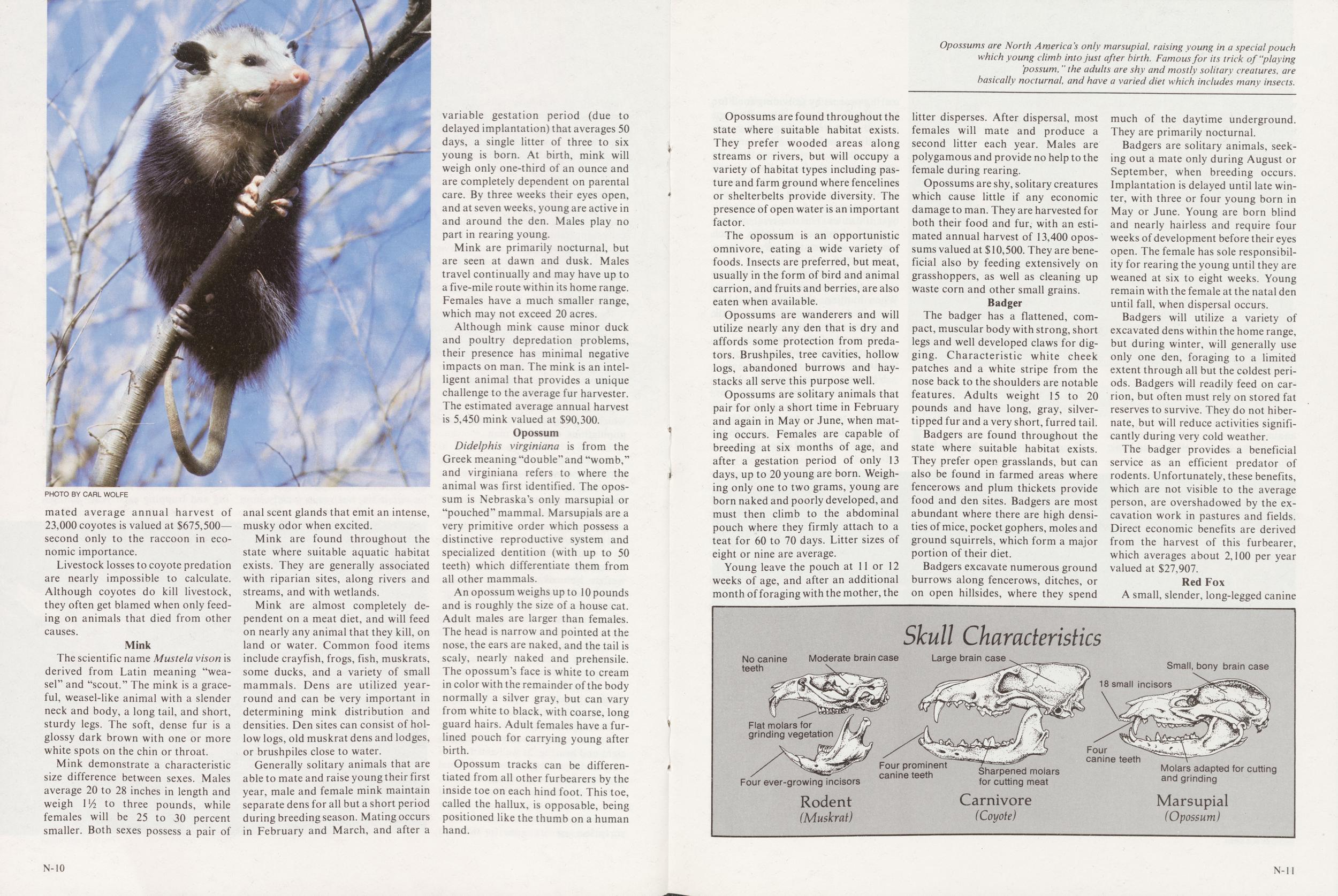
In common with other rodents, muskrats possesses two large front incisors on the top and bottom of their mouths for gnawing. These specialized teeth are unrooted and grow throughout the life of the animal. Each incisor has a layer of very hard enamel on the front surface, with progressively softer N-2 material toward the back. This adaptation of rodents assures that through gnawing, the softer tooth surface in back will wear faster than the front surface. The result is a sharp, chiselshaped edge well adapted for gnawing and carrying food and building materials through water.
This adaptation has committed them to a basically herbivorous mode of feeding, and differentiates rodents from all other mammals.
Muskrats are found throughout Nebraska wherever suitable aquatic habitat exists. In general terms, muskrats require readily accessible water, food, and secure lodging throughout the year. However, demands for these requirements vary with the season. In the case of water, this furbearer can tolerate minimal water conditions during summer and fall. However, in the winter, muskrats are virtually entombed under a layer of ice and need at least three feet of water to survive.
Because the muskrat does not hibernate but remains active throughout the winter, food must be readily accessible even under ice and snow. Muskrats prefer aquatic stands of cattail, bulrush and pondweeds, both for the green shoots during the growing season and for under-ice foraging for tubers and roots during late fall and winter.
Muskrats also require a secure, above-water living area readily accessible year-round. To meet this requirement, muskrats will build either a conical lodge or dig a bank burrow, depending on the availability of construction materials, water depth, and soil type.
A muskrat lodge is normally constructed from emergent vegetation usually cattails or bulrush—in the immediate vicinity of the lodge. Each lodge contains at least two exits, one of which must be to deep water to insure access in the winter. The inner chamber of the lodge serves a multitude of purposes from bearing and raising young to a room for eating and sleeping.
Where strong current, wind, wave action, or lack of adequate water depth and construction materials preclude a free-standing conical lodge, a burrow and bank den are excavated. Muskrats will readily dig burrows into the banks of creeks and farm ponds, where soils and water depth permit safe year round access to dens. As with the lodges, burrows lead to an abovewater chamber or chambers providing both comfort and security.
The muskrat's reproductive strategy
seems to be one of high productivity
and minimal parental care. When
optimum habitat conditions exist, one
pair of muskrats can produce up to 45
young per year. This figure, however,
is ideal and assumes no predation or
incidental mortality. In Nebraska,
research has shown approximately 17
N-3
In the spring, dispersal and mating are the two major biological functions of note. Spring dispersal in muskrats is a natural phenomenon that is not fully understood. It is closely related to both ice break-up and increased aggression during the formation of pair bonds and establishment of territories. These dispersal movements consist of both cross-country treks which may take muskrats great distances, or less dramatic movements within their own wetland. Cross-country movements result in extremely high mortality due to predation and accidents. This dispersal instinct does, however, serve a necessary role in the establishment or re-establishment of muskrat populations in areas devoid of them.
Muskrats breed their first year, with mating activity beginning immediately following ice break-up. Males compete fiercely for females, but it is not certain whether males remain paired with one female or form less lasting ties. Territories are established, and in less than one month after mating, the first litter is born. Nebraska muskrats will have up to four litters per year, with two or three litters most common. Peaks in litter production occur in late April to early May; June; and late August to early September. Litter size varies from five to 10, with six or seven being most common. Adding to this productivity are the first-litter females, which can become sexually mature and raise a litter the same year they where born.
The young, although blind, hairless, and nearly helpless at birth, grow rapidly and can swim and take short excursions from the lodge within 14 days.
N-4The female is bred soon after the birth of the first litter, and begins preparations for her second litter after the first is weaned, at about three weeks.
As fall approaches, reproduction gives way to preparing for winter. New lodge construction or burrow excavation begins in late August and peaks in October, while increased feeding activity builds fat reserves for leaner times to come.
Food and space are usually in their shortest supply in winter. The quantity and quality of vegetation, water, habitable dwellings, and the density of muskrats using this habitat will dictate body condition for the breeding season.
Statistically, a majority of all muskrats die before they are one year old. Occasionally, individuals will live to be two years old, and maximum age is considered to be three or four years. Muskrat hemorrhagic disease and tularemia have been responsible for significant muskrat die-offs in Nebraska.
Muskrats have both positive and negative economic values to the people of Nebraska. Positive values center on the income generated by the harvest of muskrats for their meat and fur, as well as the recreational value derived from their pursuit. Since 1942, an estimated 5.6 million muskrats have been taken by fur harvesters in Nebraska. Harvest totals since 1981 indicate an average annual harvest of 94,500 muskrats valued at nearly $240,000.
Muskrats are also important in the management of wetlands. Muskrat lodge construction provides openings in vegetation-choked wetlands which greatly increase the wetlands' value to waterfowl and shorebirds.
The negative economic impacts of muskrats center around burrowing activities that can cause shoreline erosion and structural damage to farm ponds, stock dams, and dikes. This damage can be controlled, however, with proper population regulation.
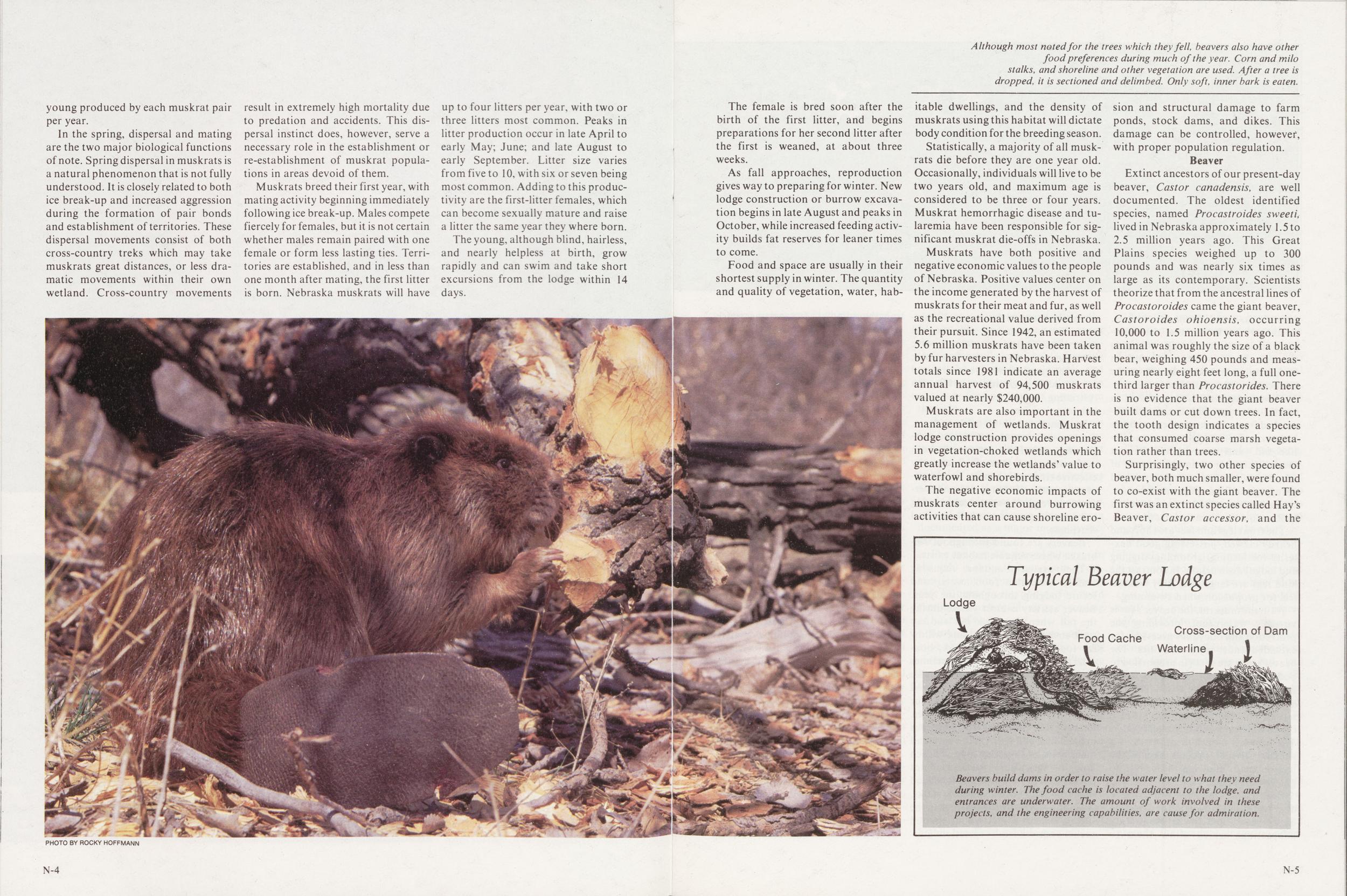
BeaverExtinct ancestors of our present-day beaver, Castor canadensis, are well documented. The oldest identified species, named Procastroides sweeti, lived in Nebraska approximately 1.5 to 2.5 million years ago. This Great Plains species weighed up to 300 pounds and was nearly six times as large as its contemporary. Scientists theorize that from the ancestral lines of Procastoroides came the giant beaver, Castoroides ohioensis, occurring 10,000 to 1.5 million years ago. This animal was roughly the size of a black bear, weighing 450 pounds and measuring nearly eight feet long, a full onethird larger than Procastorides. There is no evidence that the giant beaver built dams or cut down trees. In fact, the tooth design indicates a species that consumed coarse marsh vegetation rather than trees.
Surprisingly, two other species of beaver, both much smaller, were found to co-exist with the giant beaver. The first was an extinct species called Hay's Beaver, Castor accessor, and the
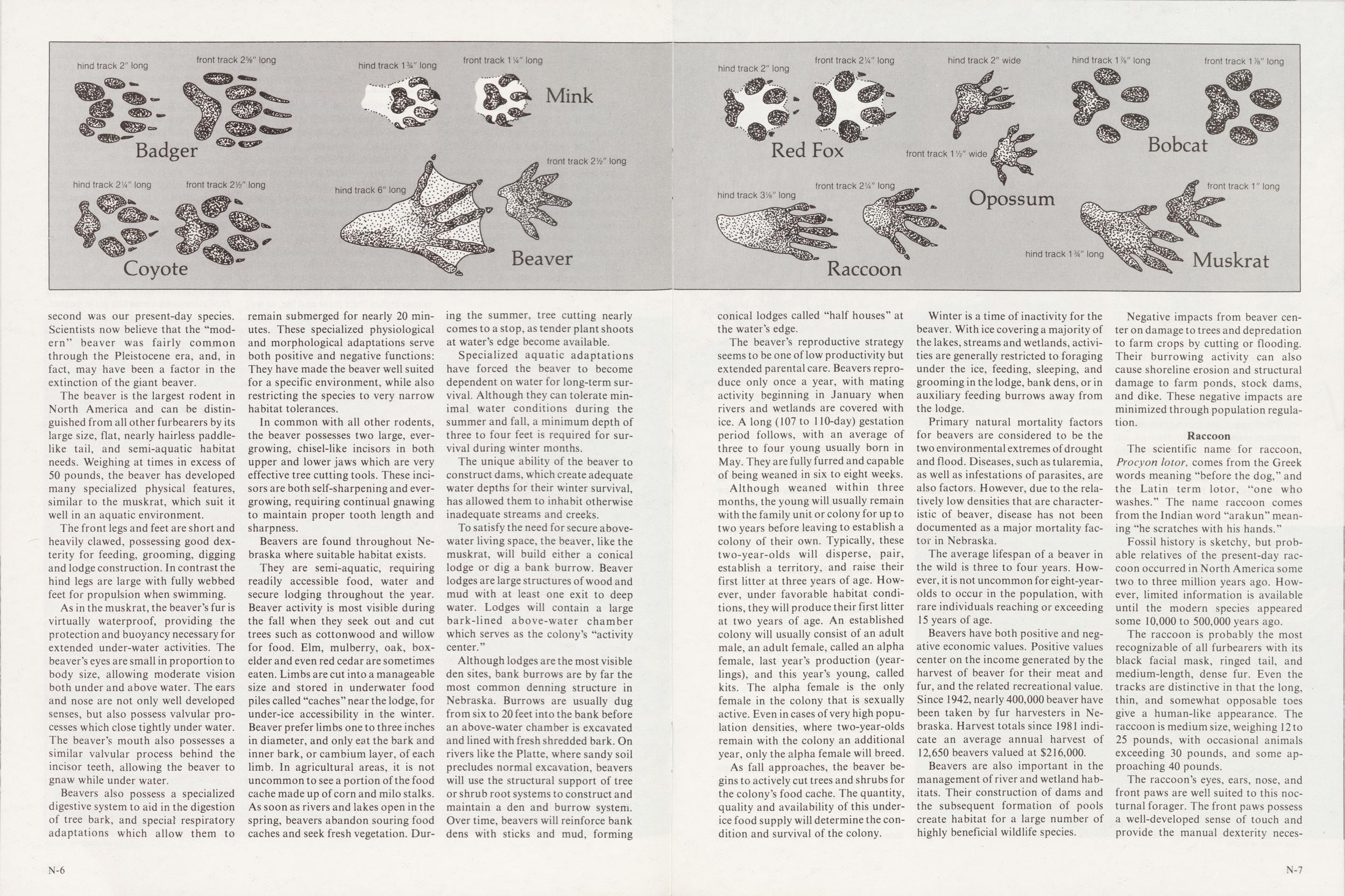
The beaver is the largest rodent in North America and can be distinguished from all other furbearers by its large size, flat, nearly hairless paddlelike tail, and semi-aquatic habitat needs. Weighing at times in excess of 50 pounds, the beaver has developed many specialized physical features, similar to the muskrat, which suit it well in an aquatic environment.
The front legs and feet are short and heavily clawed, possessing good dexterity for feeding, grooming, digging and lodge construction. In contrast the hind legs are large with fully webbed feet for propulsion when swimming.
As in the muskrat, the beaver's fur is virtually waterproof, providing the protection and buoyancy necessary for extended under-water activities. The beaver's eyes are small in proportion to body size, allowing moderate vision both under and above water. The ears and nose are not only well developed senses, but also possess valvular processes which close tightly under water. The beaver's mouth also possesses a similar valvular process behind the incisor teeth, allowing the beaver to gnaw while under water.
Beavers also possess a specialized digestive system to aid in the digestion of tree bark, and special respiratory adaptations which allow them to remain submerged for nearly 20 minutes. These specialized physiological and morphological adaptations serve both positive and negative functions: They have made the beaver well suited for a specific environment, while also restricting the species to very narrow habitat tolerances.
In common with all other rodents, the beaver possesses two large, evergrowing, chisel-like incisors in both upper and lower jaws which are very effective tree cutting tools. These incisors are both self-sharpening and evergrowing, requiring continual gnawing to maintain proper tooth length and sharpness.
Beavers are found throughout Nebraska where suitable habitat exists.
They are semi-aquatic, requiring readily accessible food, water and secure lodging throughout the year. Beaver activity is most visible during the fall when they seek out and cut trees such as Cottonwood and willow for food. Elm, mulberry, oak, boxelder and even red cedar are sometimes eaten. Limbs are cut into a manageable size and stored in underwater food piles called "caches" near the lodge, for under-ice accessibility in the winter. Beaver prefer limbs one to three inches in diameter, and only eat the bark and inner bark, or cambium layer, of each limb. In agricultural areas, it is not uncommon to see a portion of the food cache made up of corn and milo stalks. As soon as rivers and lakes open in the spring, beavers abandon souring food caches and seek fresh vegetation. During the summer, tree cutting nearly comes to a stop, as tender plant shoots at water's edge become available.
Specialized aquatic adaptations have forced the beaver to become dependent on water for long-term survival. Although they can tolerate minimal water conditions during the summer and fall, a minimum depth of three to four feet is required for survival during winter months.
The unique ability of the beaver to construct dams, which create adequate water depths for their winter survival, has allowed them to inhabit otherwise inadequate streams and creeks.
To satisfy the need for secure abovewater living space, the beaver, like the muskrat, will build either a conical lodge or dig a bank burrow. Beaver lodges are large structures of wood and mud with at least one exit to deep water. Lodges will contain a large bark-lined above-water chamber which serves as the colony's "activity center."
Although lodges are the most visible den sites, bank burrows are by far the most common denning structure in Nebraska. Burrows are usually dug from six to 20 feet into the bank before an above-water chamber is excavated and lined with fresh shredded bark. On rivers like the Platte, where sandy soil precludes normal excavation, beavers will use the structural support of tree or shrub root systems to construct and maintain a den and burrow system. Over time, beavers will reinforce bank dens with sticks and mud, forming N-6
Although weaned within three months, the young will usually remain with the family unit or colony for up to two years before leaving to establish a colony of their own. Typically, these two-year-olds will disperse, pair, establish a territory, and raise their first litter at three years of age. However, under favorable habitat conditions, they will produce their first litter at two years of age. An established colony will usually consist of an adult male, an adult female, called an alpha female, last year's production (yearlings), and this year's young, called kits. The alpha female is the only female in the colony that is sexually active. Even in cases of very high population densities, where two-year-olds remain with the colony an additional year, only the alpha female will breed.
As fall approaches, the beaver begins to actively cut trees and shrubs for the colony's food cache. The quantity, quality and availability of this underice food supply will determine the condition and survival of the colony.
Winter is a time of inactivity for the beaver. With ice covering a majority of the lakes, streams and wetlands, activities are generally restricted to foraging under the ice, feeding, sleeping, and grooming in the lodge, bank dens, or in auxiliary feeding burrows away from the lodge.
Primary natural mortality factors for beavers are considered to be the two environmental extremes of drought and flood. Diseases, such as tularemia, as well as infestations of parasites, are also factors. However, due to the relatively low densities that are characteristic of beaver, disease has not been documented as a major mortality factor in Nebraska.
The average lifespan of a beaver in the wild is three to four years. However, it is not uncommon for eight-year-olds to occur in the population, with rare individuals reaching or exceeding 15 years of age.
Beavers have both positive and negative economic values. Positive values center on the income generated by the harvest of beaver for their meat and fur, and the related recreational value. Since 1942, nearly 400,000 beaver have been taken by fur harvesters in Nebraska. Harvest totals since 1981 indicate an average annual harvest of 12,650 beavers valued at $216,000.
Beavers are also important in the management of river and wetland habitats. Their construction of dams and the subsequent formation of pools create habitat for a large number of highly beneficial wildlife species.
Negative impacts from beaver center on damage to trees and depredation to farm crops by cutting or flooding. Their burrowing activity can also cause shoreline erosion and structural damage to farm ponds, stock dams, and dike. These negative impacts are minimized through population regulation.
RaccoonThe scientific name for raccoon, Procyon lotor, comes from the Greek words meaning "before the dog," and the Latin term lotor, "one who washes." The name raccoon comes from the Indian word "arakun" meaning "he scratches with his hands."
Fossil history is sketchy, but probable relatives of the present-day raccoon occurred in North America some two to three million years ago. However, limited information is available until the modern species appeared some 10,000 to 500,000 years ago.
The raccoon is probably the most recognizable of all furbearers with its black facial mask, ringed tail, and medium-length, dense fur. Even the tracks are distinctive in that the long, thin, and somewhat opposable toes give a human-like appearance. The raccoon is medium size, weighing 12 to 25 pounds, with occasional animals exceeding 30 pounds, and some approaching 40 pounds.
The raccoon's eyes, ears, nose, and
front paws are well suited to this nocturnal forager. The front paws possess
a well-developed sense of touch and
provide the manual dexterity necessary
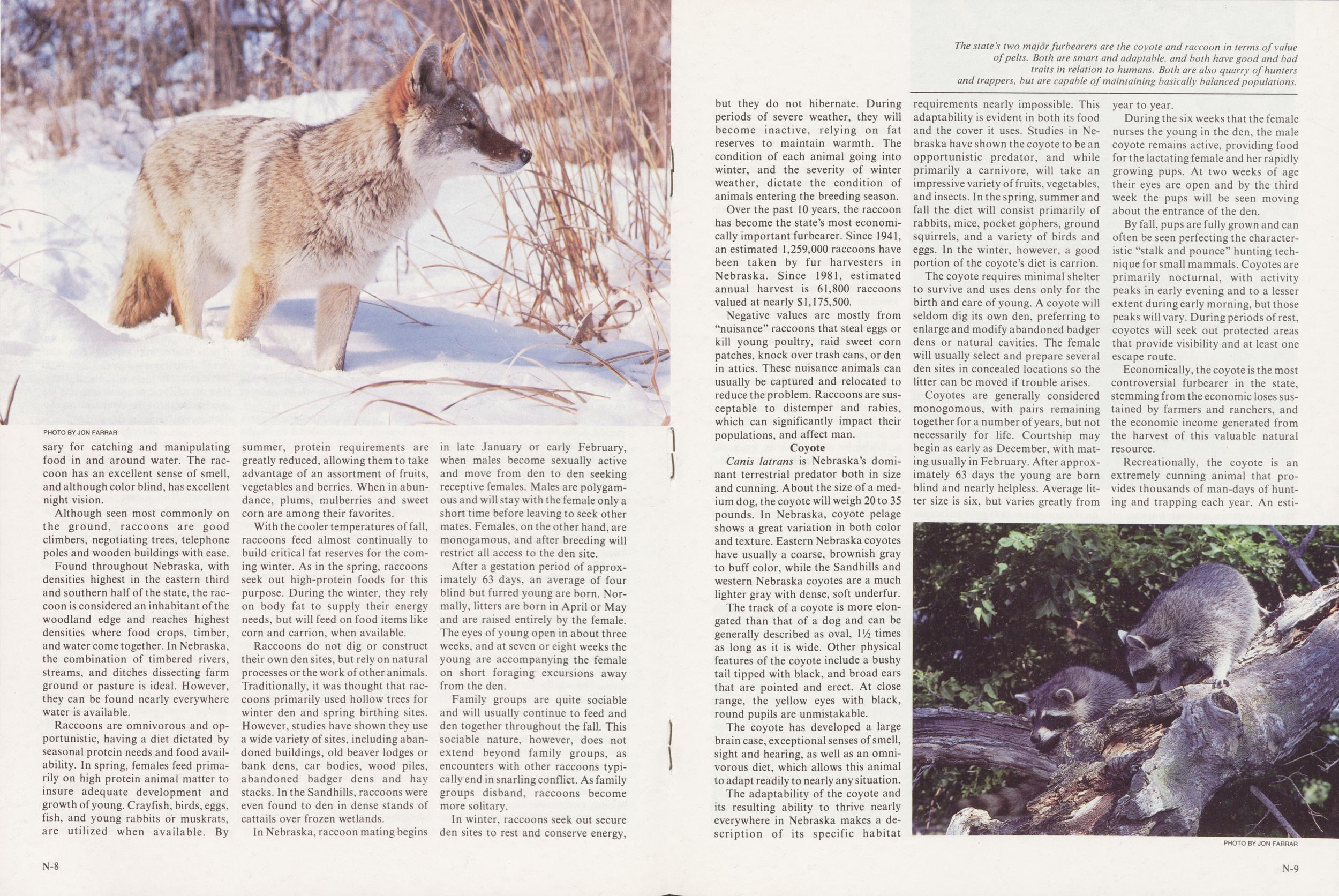
Although seen most commonly on the ground, raccoons are good climbers, negotiating trees, telephone poles and wooden buildings with ease.
Found throughout Nebraska, with densities highest in the eastern third and southern half of the state, the raccoon is considered an inhabitant of the woodland edge and reaches highest densities where food crops, timber, and water come together. In Nebraska, the combination of timbered rivers, streams, and ditches dissecting farm ground or pasture is ideal. However, they can be found nearly everywhere water is available.
Raccoons are omnivorous and opportunistic, having a diet dictated by seasonal protein needs and food availability. In spring, females feed primarily on high protein animal matter to insure adequate development and growth of young. Crayfish, birds, eggs, fish, and young rabbits or muskrats, are utilized when available. By summer, protein requirements are greatly reduced, allowing them to take advantage of an assortment of fruits, vegetables and berries. When in abundance, plums, mulberries and sweet corn are among their favorites.
With the cooler temperatures of fall, raccoons feed almost continually to build critical fat reserves for the coming winter. As in the spring, raccoons seek out high-protein foods for this purpose. During the winter, they rely on body fat to supply their energy needs, but will feed on food items like corn and carrion, when available.
Raccoons do not dig or construct their own den sites, but rely on natural processes or the work of other animals. Traditionally, it was thought that raccoons primarily used hollow trees for winter den and spring birthing sites. However, studies have shown they use a wide variety of sites, including abandoned buildings, old beaver lodges or bank dens, car bodies, wood piles, abandoned badger dens and hay stacks. In the Sandhills, raccoons were even found to den in dense stands of cattails over frozen wetlands.
In Nebraska, raccoon mating begins in late January or early February, when males become sexually active and move from den to den seeking receptive females. Males are polygamous and will stay with the female only a short time before leaving to seek other mates. Females, on the other hand, are monogamous, and after breeding will restrict all access to the den site.
After a gestation period of approximately 63 days, an average of four blind but furred young are born. Normally, litters are born in April or May and are raised entirely by the female. The eyes of young open in about three weeks, and at seven or eight weeks the young are accompanying the female on short foraging excursions away from the den.
Family groups are quite sociable and will usually continue to feed and den together throughout the fall. This sociable nature, however, does not extend beyond family groups, as encounters with other raccoons typically end in snarling conflict. As family groups disband, raccoons become more solitary.
In winter, raccoons seek out secure den sites to rest and conserve energy, N-8 but they do not hibernate. During periods of severe weather, they will become inactive, relying on fat reserves to maintain warmth. The condition of each animal going into winter, and the severity of winter weather, dictate the condition of animals entering the breeding season.
Over the past 10 years, the raccoon has become the state's most economically important furbearer. Since 1941, an estimated 1,259,000 raccoons have been taken by fur harvesters in Nebraska. Since 1981, estimated annual harvest is 61,800 raccoons valued at nearly $1,175,500.
Negative values are mostly from "nuisance" raccoons that steal eggs or kill young poultry, raid sweet corn patches, knock over trash cans, or den in attics. These nuisance animals can usually be captured and relocated to reduce the problem. Raccoons are susceptable to distemper and rabies, which can significantly impact their populations, and affect man.
CoyoteCanis latrans is Nebraska's dominant terrestrial predator both in size and cunning. About the size of a medium dog, the coyote will weigh 20 to 35 pounds. In Nebraska, coyote pelage shows a great variation in both color and texture. Eastern Nebraska coyotes have usually a coarse, brownish gray to buff color, while the Sandhills and western Nebraska coyotes are a much lighter gray with dense, soft underfur.
The track of a coyote is more elongated than that of a dog and can be generally described as oval, Wi times as long as it is wide. Other physical features of the coyote include a bushy tail tipped with black, and broad ears that are pointed and erect. At close range, the yellow eyes with black, round pupils are unmistakable.
The coyote has developed a large brain case, exceptional senses of smell, sight and hearing, as well as an omnivorous diet, which allows this animal to adapt readily to nearly any situation.
The adaptability of the coyote and its resulting ability to thrive nearly everywhere in Nebraska makes a description of its specific habitat requirements nearly impossible. This adaptability is evident in both its food and the cover it uses. Studies in Nebraska have shown the coyote to be an opportunistic predator, and while primarily a carnivore, will take an impressive variety of fruits, vegetables, and insects. In the spring, summer and fall the diet will consist primarily of rabbits, mice, pocket gophers, ground squirrels, and a variety of birds and eggs. In the winter, however, a good portion of the coyote's diet is carrion.
The coyote requires minimal shelter to survive and uses dens only for the birth and care of young. A coyote will seldom dig its own den, preferring to enlarge and modify abandoned badger dens or natural cavities. The female will usually select and prepare several den sites in concealed locations so the litter can be moved if trouble arises.
Coyotes are generally considered monogomous, with pairs remaining together for a number of years, but not necessarily for life. Courtship may begin as early as December, with mating usually in February. After approximately 63 days the young are born blind and nearly helpless. Average litter size is six, but varies greatly from year to year.
During the six weeks that the female nurses the young in the den, the male coyote remains active, providing food for the lactating female and her rapidly growing pups. At two weeks of age their eyes are open and by the third week the pups will be seen moving about the entrance of the den.
By fall, pups are fully grown and can often be seen perfecting the characteristic "stalk and pounce" hunting technique for small mammals. Coyotes are primarily nocturnal, with activity peaks in early evening and to a lesser extent during early morning, but those peaks will vary. During periods of rest, coyotes will seek out protected areas that provide visibility and at least one escape route.
Economically, the coyote is the most controversial furbearer in the state, stemming from the economic loses sustained by farmers and ranchers, and the economic income generated from the harvest of this valuable natural resource.
Recreationally, the coyote is an extremely cunning animal that provides thousands of man-days of hunting and trapping each year. An estimated
Livestock losses to coyote predation are nearly impossible to calculate. Although coyotes do kill livestock, they often get blamed when only feeding on animals that died from other causes.
MinkThe scientific name Mustela vison is derived from Latin meaning "weasel" and "scout." The mink is a graceful, weasel-like animal with a slender neck and body, a long tail, and short, sturdy legs. The soft, dense fur is a glossy dark brown with one or more white spots on the chin or throat.
Mink demonstrate a characteristic size difference between sexes. Males average 20 to 28 inches in length and weigh P/2 to three pounds, while females will be 25 to 30 percent smaller. Both sexes possess a pair of anal scent glands that emit an intense, musky odor when excited.
Mink are found throughout the state where suitable aquatic habitat exists. They are generally associated with riparian sites, along rivers and streams, and with wetlands.
Mink are almost completely dependent on a meat diet, and will feed on nearly any animal that they kill, on land or water. Common food items include crayfish, frogs, fish, muskrats, some ducks, and a variety of small mammals. Dens are utilized year round and can be very important in determining mink distribution and densities. Den sites can consist of hollow logs, old muskrat dens and lodges, or brushpiles close to water.
Generally solitary animals that are able to mate and raise young their first year, male and female mink maintain separate dens for all but a short period during breeding season. Mating occurs in February and March, and after a variable gestation period (due to delayed implantation) that averages 50 days, a single litter of three to six young is born. At birth, mink will weigh only one-third of an ounce and are completely dependent on parental care. By three weeks their eyes open, and at seven weeks, young are active in and around the den. Males play no part in rearing young.
Mink are primarily nocturnal, but are seen at dawn and dusk. Males travel continually and may have up to a five-mile route within its home range. Females have a much smaller range, which may not exceed 20 acres.
Although mink cause minor duck and poultry depredation problems, their presence has minimal negative impacts on man. The mink is an intelligent animal that provides a unique challenge to the average fur harvester. The estimated average annual harvest is 5,450 mink valued at $90,300.
OpossumDidelphis virginiana is from the Greek meaning "double" and "womb," and virginiana refers to where the animal was first identified. The opossum is Nebraska's only marsupial or "pouched" mammal. Marsupials are a very primitive order which possess a distinctive reproductive system and specialized dentition (with up to 50 teeth) which differentiate them from all other mammals.
An opossum weighs up to 10 pounds and is roughly the size of a house cat. Adult males are larger than females. The head is narrow and pointed at the nose, the ears are naked, and the tail is scaly, nearly naked and prehensile. The opossum's face is white to cream in color with the remainder of the body normally a silver gray, but can vary from white to black, with coarse, long guard hairs. Adult females have a furlined pouch for carrying young after birth.
Opossum tracks can be differentiated from all other furbearers by the inside toe on each hind foot. This toe, called the hallux, is opposable, being positioned like the thumb on a human hand.
N-10Opossums are found throughout the state where suitable habitat exists. They prefer wooded areas along streams or rivers, but will occupy a variety of habitat types including pasture and farm ground where fencelines or shelterbelts provide diversity. The presence of open water is an important factor.
The opossum is an opportunistic omnivore, eating a wide variety of foods. Insects are preferred, but meat, usually in the form of bird and animal carrion, and fruits and berries, are also eaten when available.
Opossums are wanderers and will utilize nearly any den that is dry and affords some protection from predators. Brushpiles, tree cavities, hollow logs, abandoned burrows and hay stacks all serve this purpose well.
Opossums are solitary animals that pair for only a short time in February and again in May or June, when mating occurs. Females are capable of breeding at six months of age, and after a gestation period of only 13 days, up to 20 young are born. Weighing only one to two grams, young are born naked and poorly developed, and must then climb to the abdominal pouch where they firmly attach to a teat for 60 to 70 days. Litter sizes of eight or nine are average.
Young leave the pouch at 11 or 12 weeks of age, and after an additional month of foraging with the mother, the litter disperses. After dispersal, most females will mate and produce a second litter each year. Males are polygamous and provide no help to the female during rearing.
Opossums are shy, solitary creatures which cause little if any economic damage to man. They are harvested for both their food and fur, with an estimated annual harvest of 13,400 opossums valued at $10,500. They are beneficial also by feeding extensively on grasshoppers, as well as cleaning up waste corn and other small grains.
BadgerThe badger has a flattened, compact, muscular body with strong, short legs and well developed claws for digging. Characteristic white cheek patches and a white stripe from the nose back to the shoulders are notable features. Adults weight 15 to 20 pounds and have long, gray, silvertipped fur and a very short, furred tail.
Badgers are found throughout the state where suitable habitat exists. They prefer open grasslands, but can also be found in farmed areas where fencerows and plum thickets provide food and den sites. Badgers are most abundant where there are high densities of mice, pocket gophers, moles and ground squirrels, which form a major portion of their diet.
Badgers excavate numerous ground burrows along fencerows, ditches, or on open hillsides, where they spend much of the daytime underground. They are primarily nocturnal.
Badgers are solitary animals, seeking out a mate only during August or September, when breeding occurs. Implantation is delayed until late winter, with three or four young born in May or June. Young are born blind and nearly hairless and require four weeks of development before their eyes open. The female has sole responsibility for rearing the young until they are weaned at six to eight weeks. Young remain with the female at the natal den until fall, when dispersal occurs.
Badgers will utilize a variety of excavated dens within the home range, but during winter, will generally use only one den, foraging to a limited extent through all but the coldest periods. Badgers will readily feed on carrion, but often must rely on stored fat reserves to survive. They do not hibernate, but will reduce activities significantly during very cold weather.
The badger provides a beneficial service as an efficient predator of rodents. Unfortunately, these benefits, which are not visible to the average person, are overshadowed by the excavation work in pastures and fields. Direct economic benefits are derived from the harvest of this furbearer, which averages about 2,100 per year valued at $27,907.
Red FoxA small, slender, long-legged canine
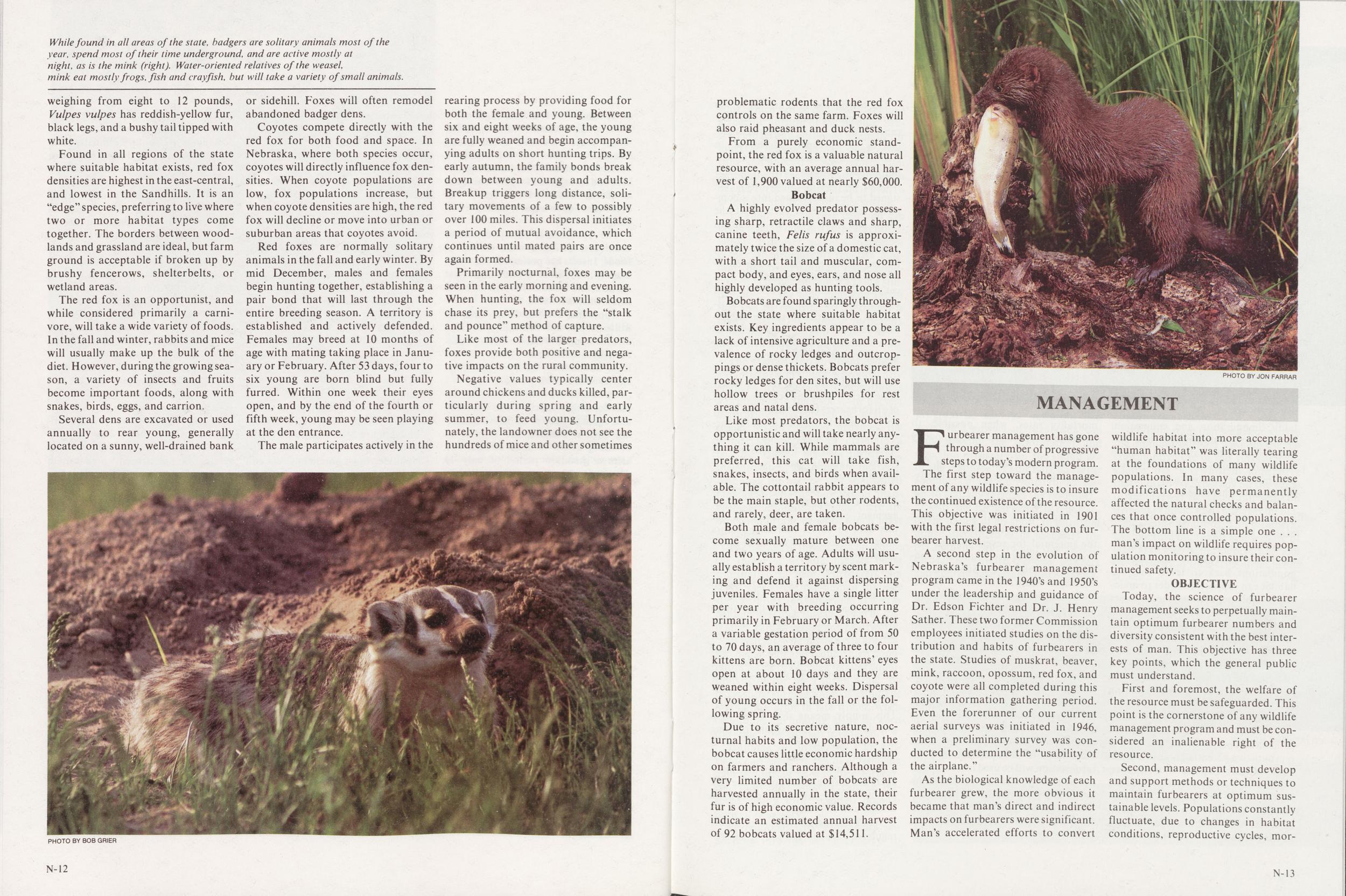
Found in all regions of the state where suitable habitat exists, red fox densities are highest in the east-central, and lowest in the Sandhills. It is an "edge" species, preferring to live where two or more habitat types come together. The borders between woodlands and grassland are ideal, but farm ground is acceptable if broken up by brushy fencerows, shelterbelts, or wetland areas.
The red fox is an opportunist, and while considered primarily a carnivore, will take a wide variety of foods. In the fall and winter, rabbits and mice will usually make up the bulk of the diet. However, during the growing season, a variety of insects and fruits become important foods, along with snakes, birds, eggs, and carrion.
Several dens are excavated or used annually to rear young, generally located on a sunny, well-drained bank or sidehill. Foxes will often remodel abandoned badger dens.
Coyotes compete directly with the red fox for both food and space. In Nebraska, where both species occur, coyotes will directly influence fox densities. When coyote populations are low, fox populations increase, but when coyote densities are high, the red fox will decline or move into urban or suburban areas that coyotes avoid.
Red foxes are normally solitary animals in the fall and early winter. By mid December, males and females begin hunting together, establishing a pair bond that will last through the entire breeding season. A territory is established and actively defended. Females may breed at 10 months of age with mating taking place in January or February. After 53 days, four to six young are born blind but fully furred. Within one week their eyes open, and by the end of the fourth or fifth week, young may be seen playing at the den entrance.
The male participates actively in the rearing process by providing food for both the female and young. Between six and eight weeks of age, the young are fully weaned and begin accompanying adults on short hunting trips. By early autumn, the family bonds break down between young and adults. Breakup triggers long distance, solitary movements of a few to possibly over 100 miles. This dispersal initiates a period of mutual avoidance, which continues until mated pairs are once again formed.
Primarily nocturnal, foxes may be seen in the early morning and evening. When hunting, the fox will seldom chase its prey, but prefers the "stalk and pounce" method of capture.
Like most of the larger predators, foxes provide both positive and negative impacts on the rural community.
Negative values typically center around chickens and ducks killed, particularly during spring and early summer, to feed young. Unfortunately, the landowner does not see the hundreds of mice and other sometimes N-12 problematic rodents that the red fox controls on the same farm. Foxes will also raid pheasant and duck nests.
From a purely economic standpoint, the red fox is a valuable natural resource, with an average annual harvest of 1,900 valued at nearly $60,000.
BobcatA highly evolved predator possessing sharp, retractile claws and sharp, canine teeth, Felis rufus is approximately twice the size of a domestic cat, with a short tail and muscular, compact body, and eyes, ears, and nose all highly developed as hunting tools.
Bobcats are found sparingly throughout the state where suitable habitat exists. Key ingredients appear to be a lack of intensive agriculture and a prevalence of rocky ledges and outcroppings or dense thickets. Bobcats prefer rocky ledges for den sites, but will use hollow trees or brushpiles for rest areas and natal dens.
Like most predators, the bobcat is opportunistic and will take nearly anything it can kill. While mammals are preferred, this cat will take fish, snakes, insects, and birds when available. The cottontail rabbit appears to be the main staple, but other rodents, and rarely, deer, are taken.
Both male and female bobcats become sexually mature between one and two years of age. Adults will usually establish a territory by scent marking and defend it against dispersing juveniles. Females have a single litter per year with breeding occurring primarily in February or March. After a variable gestation period of from 50 to 70 days, an average of three to four kittens are born. Bobcat kittens' eyes open at about 10 days and they are weaned within eight weeks. Dispersal of young occurs in the fall or the following spring.
Due to its secretive nature, nocturnal habits and low population, the bobcat causes little economic hardship on farmers and ranchers. Although a very limited number of bobcats are harvested annually in the state, their fur is of high economic value. Records indicate an estimated annual harvest of 92 bobcats valued at $14,511.
Furbearer management has gone through a number of progressive steps to today's modern program. The first step toward the management of any wildlife species is to insure the continued existence of the resource. This objective was initiated in 1901 with the first legal restrictions on furbearer harvest.
A second step in the evolution of Nebraska's furbearer management program came in the 1940's and 1950's under the leadership and guidance of Dr. Edson Fichter and Dr. J. Henry Sather. These two former Commission employees initiated studies on the distribution and habits of furbearers in the state. Studies of muskrat, beaver, mink, raccoon, opossum, red fox, and coyote were all completed during this major information gathering period. Even the forerunner of our current aerial surveys was initiated in 1946, when a preliminary survey was conducted to determine the "usability of the airplane."
As the biological knowledge of each furbearer grew, the more obvious it became that man's direct and indirect impacts on furbearers were significant. Man's accelerated efforts to convert wildlife habitat into more acceptable "human habitat" was literally tearing at the foundations of many wildlife populations. In many cases, these modifications have permanently affected the natural checks and balances that once controlled populations. The bottom line is a simple one man's impact on wildlife requires population monitoring to insure their continued safety.
OBJECTIVEToday, the science of furbearer management seeks to perpetually maintain optimum furbearer numbers and diversity consistent with the best interests of man. This objective has three key points, which the general public must understand.
First and foremost, the welfare of the resource must be safeguarded. This point is the cornerstone of any wildlife management program and must be considered an inalienable right of the resource.
Second, management must develop
and support methods or techniques to
maintain furbearers at optimum sustainable levels. Populations constantly
fluctuate, due to changes in habitat
conditions, reproductive cycles, mortality,
N-13
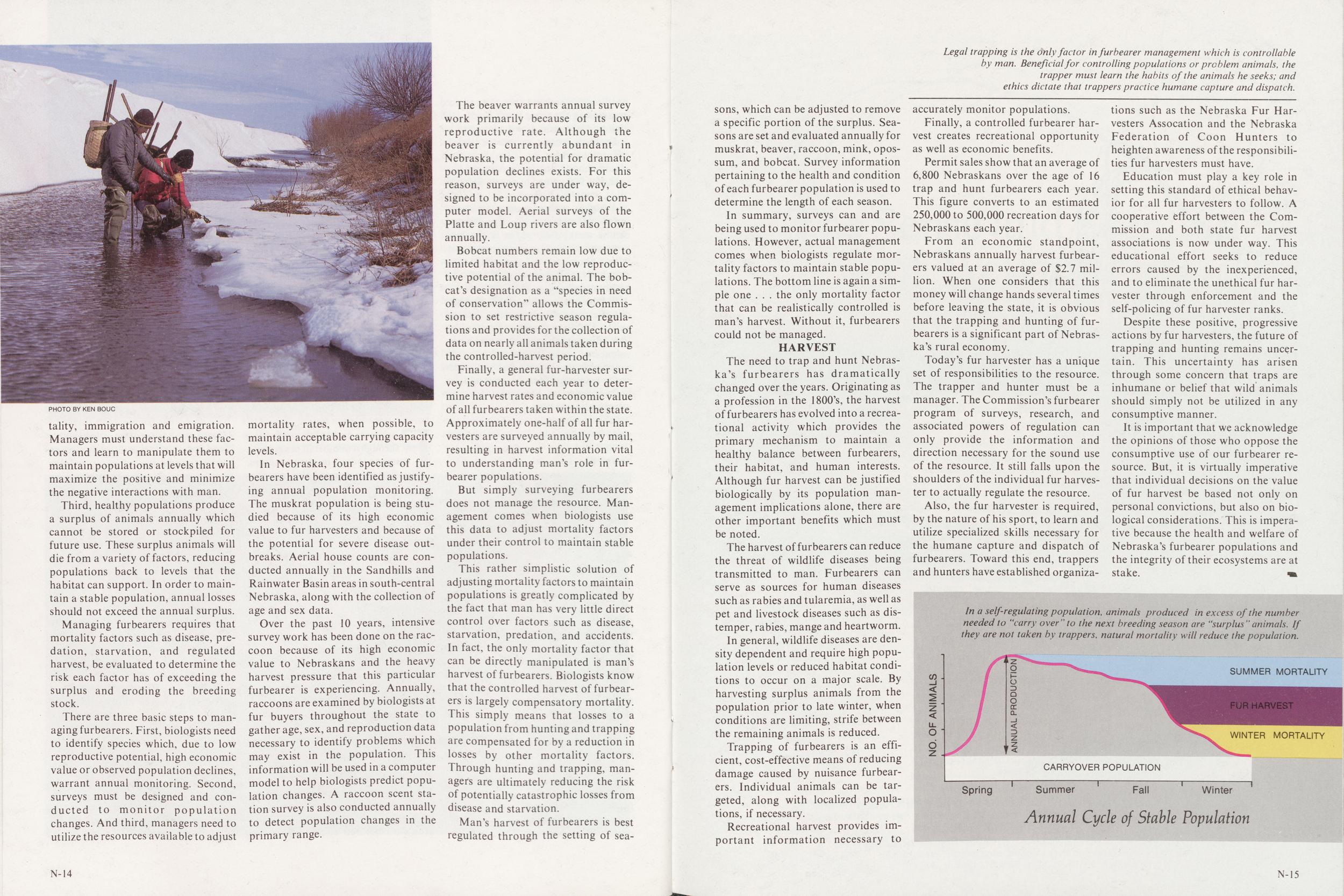
Third, healthy populations produce a surplus of animals annually which cannot be stored or stockpiled for future use. These surplus animals will die from a variety of factors, reducing populations back to levels that the habitat can support. In order to maintain a stable population, annual losses should not exceed the annual surplus.
Managing furbearers requires that mortality factors such as disease, predation, starvation, and regulated harvest, be evaluated to determine the risk each factor has of exceeding the surplus and eroding the breeding stock.
There are three basic steps to managing furbearers. First, biologists need to identify species which, due to low reproductive potential, high economic value or observed population declines, warrant annual monitoring. Second, surveys must be designed and conducted to monitor population changes. And third, managers need to utilize the resources available to adjust mortality rates, when possible, to maintain acceptable carrying capacity levels.
In Nebraska, four species of furbearers have been identified as justifying annual population monitoring. The muskrat population is being studied because of its high economic value to fur harvesters and because of the potential for severe disease outbreaks. Aerial house counts are conducted annually in the Sandhills and Rainwater Basin areas in south-central Nebraska, along with the collection of age and sex data.
Over the past 10 years, intensive survey work has been done on the raccoon because of its high economic value to Nebraskans and the heavy harvest pressure that this particular furbearer is experiencing. Annually, raccoons are examined by biologists at fur buyers throughout the state to gather age, sex, and reproduction data necessary to identify problems which may exist in the population. This information will be used in a computer model to help biologists predict population changes. A raccoon scent station survey is also conducted annually to detect population changes in the primary range.
The beaver warrants annual survey work primarily because of its low reproductive rate. Although the beaver is currently abundant in Nebraska, the potential for dramatic population declines exists. For this reason, surveys are under way, designed to be incorporated into a computer model. Aerial surveys of the Platte and Loup rivers are also flown annually.
Bobcat numbers remain low due to limited habitat and the low reproductive potential of the animal. The bobcat's designation as a "species in need of conservation" allows the Commission to set restrictive season regulations and provides for the collection of data on nearly all animals taken during the controlled-harvest period.
Finally, a general fur-harvester survey is conducted each year to determine harvest rates and economic value of all furbearers taken within the state. Approximately one-half of all fur harvesters are surveyed annually by mail, resulting in harvest information vital to understanding man's role in furbearer populations.
But simply surveying furbearers does not manage the resource. Management comes when biologists use this data to adjust mortality factors under their control to maintain stable populations.
This rather simplistic solution of adjusting mortality factors to maintain populations is greatly complicated by the fact that man has very little direct control over factors such as disease, starvation, predation, and accidents. In fact, the only mortality factor that can be directly manipulated is man's harvest of furbearers. Biologists know that the controlled harvest of furbearers is largely compensatory mortality. This simply means that losses to a population from hunting and trapping are compensated for by a reduction in losses by other mortality factors. Through hunting and trapping, managers are ultimately reducing the risk of potentially catastrophic losses from disease and starvation.
Man's harvest of furbearers is best regulated through the setting of seasons, N-14 which can be adjusted to remove a specific portion of the surplus. Seasons are set and evaluated annually for muskrat, beaver, raccoon, mink, opossum, and bobcat. Survey information pertaining to the health and condition of each furbearer population is used to determine the length of each season.
In summary, surveys can and are being used to monitor furbearer populations. However, actual management comes when biologists regulate mortality factors to maintain stable populations. The bottom line is again a simple one the only mortality factor that can be realistically controlled is man's harvest. Without it, furbearers could not be managed.
HARVESTThe need to trap and hunt Nebraska's furbearers has dramatically changed over the years. Originating as a profession in the 1800's, the harvest of furbearers has evolved into a recreational activity which provides the primary mechanism to maintain a healthy balance between furbearers, their habitat, and human interests. Although fur harvest can be justified biologically by its population management implications alone, there are other important benefits which must be noted.
The harvest of furbearers can reduce the threat of wildlife diseases being transmitted to man. Furbearers can serve as sources for human diseases such as rabies and tularemia, as well as pet and livestock diseases such as distemper, rabies, mange and heartworm.
In general, wildlife diseases are density dependent and require high population levels or reduced habitat conditions to occur on a major scale. By harvesting surplus animals from the population prior to late winter, when conditions are limiting, strife between the remaining animals is reduced.
Trapping of furbearers is an efficient, cost-effective means of reducing damage caused by nuisance furbearers. Individual animals can be targeted, along with localized populations, if necessary.
Recreational harvest provides important information necessary to accurately monitor populations.
Finally, a controlled furbearer harvest creates recreational opportunity as well as economic benefits.
Permit sales show that an average of 6,800 Nebraskans over the age of 16 trap and hunt furbearers each year. This figure converts to an estimated 250,000 to 500,000 recreation days for Nebraskans each year.
From an economic standpoint, Nebraskans annually harvest furbearers valued at an average of $2.7 million. When one considers that this money will change hands several times before leaving the state, it is obvious that the trapping and hunting of furbearers is a significant part of Nebraska's rural economy.
Today's fur harvester has a unique set of responsibilities to the resource. The trapper and hunter must be a manager. The Commission's furbearer program of surveys, research, and associated powers of regulation can only provide the information and direction necessary for the sound use of the resource. It still falls upon the shoulders of the individual fur harvester to actually regulate the resource.
Also, the fur harvester is required, by the nature of his sport, to learn and utilize specialized skills necessary for the humane capture and dispatch of furbearers. Toward this end, trappers and hunters have established organizations such as the Nebraska Fur Harvesters Assocation and the Nebraska Federation of Coon Hunters to heighten awareness of the responsibilities fur harvesters must have.
Education must play a key role in setting this standard of ethical behavior for all fur harvesters to follow. A cooperative effort between the Commission and both state fur harvest associations is now under way. This educational effort seeks to reduce errors caused by the inexperienced, and to eliminate the unethical fur harvester through enforcement and the self-policing of fur harvester ranks.
Despite these positive, progressive actions by fur harvesters, the future of trapping and hunting remains uncertain. This uncertainty has arisen through some concern that traps are inhumane or belief that wild animals should simply not be utilized in any consumptive manner.
It is important that we acknowledge the opinions of those who oppose the consumptive use of our furbearer resource. But, it is virtually imperative that individual decisions on the value of fur harvest be based not only on personal convictions, but also on biological considerations. This is imperative because the health and welfare of Nebraska's furbearer populations and the integrity of their ecosystems are at stake.
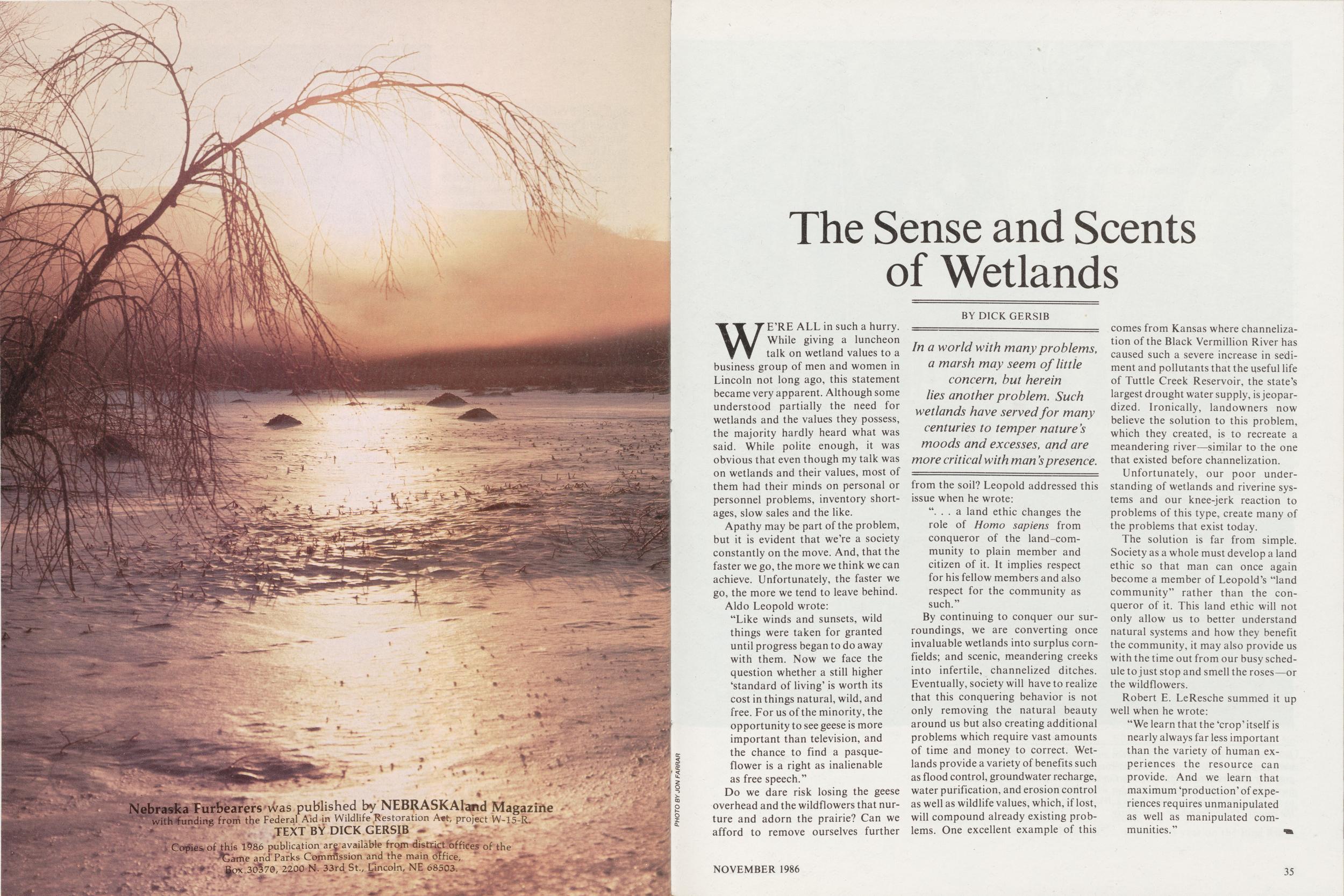
The Sense and Scents of Wetlands
BY DICK GERSIB In a world with many problems, a marsh may seem of little concern, but herein lies another problem. Such wetlands have served for many centuries to temper nature's moods and excesses, and are more critical with man spresence.WE'RE ALL in such a hurry. While giving a luncheon talk on wetland values to a business group of men and women in Lincoln not long ago, this statement became very apparent. Although some understood partially the need for wetlands and the values they possess, the majority hardly heard what was said. While polite enough, it was obvious that even though my talk was on wetlands and their values, most of them had their minds on personal or personnel problems, inventory shortages, slow sales and the like.
Apathy may be part of the problem, but it is evident that we're a society constantly on the move. And, that the faster we go, the more we think we can achieve. Unfortunately, the faster we go, the more we tend to leave behind.
Aldo Leopold wrote:
"Like winds and sunsets, wild things were taken for granted until progress began to do away with them. Now we face the question whether a still higher 'standard of living' is worth its cost in things natural, wild, and free. For us of the minority, the opportunity to see geese is more important than television, and the chance to find a pasqueflower is a right as inalienable as free speech."
Do we dare risk losing the geese overhead and the wildflowers that nurture and adorn the prairie? Can we afford to remove ourselves further from the soil? Leopold addressed this issue when he wrote:
" a land ethic changes the role of Homo sapiens from conqueror of the land-community to plain member and citizen of it. It implies respect for his fellow members and also respect for the community as such."
By continuing to conquer our surroundings, we are converting once invaluable wetlands into surplus cornfields; and scenic, meandering creeks into infertile, channelized ditches. Eventually, society will have to realize that this conquering behavior is not only removing the natural beauty around us but also creating additional problems which require vast amounts of time and money to correct. Wetlands provide a variety of benefits such as flood control, groundwater recharge, water purification, and erosion control as well as wildlife values, which, if lost, will compound already existing problems. One excellent example of this comes from Kansas where channelization of the Black Vermillion River has caused such a severe increase in sediment and pollutants that the useful life of Tuttle Creek Reservoir, the state's largest drought water supply, is jeopardized. Ironically, landowners now believe the solution to this problem, which they created, is to recreate a meandering river—similar to the one that existed before channelization.
Unfortunately, our poor understanding of wetlands and riverine systems and our knee-jerk reaction to problems of this type, create many of the problems that exist today.
The solution is far from simple. Society as a whole must develop a land ethic so that man can once again become a member of Leopold's "land community" rather than the con- queror of it. This land ethic will not only allow us to better understand natural systems and how they benefit the community, it may also provide us with the time out from our busy schedule to just stop and smell the roses—or the wildflowers.
Robert E. LeResche summed it up well when he wrote:
"We learn that the 'crop' itself is nearly always far less important than the variety of human experiences the resource can provide. And we learn that maximum 'production' of experiences requires unmanipulated as well as manipulated communities."
NOVEMBER 1986 35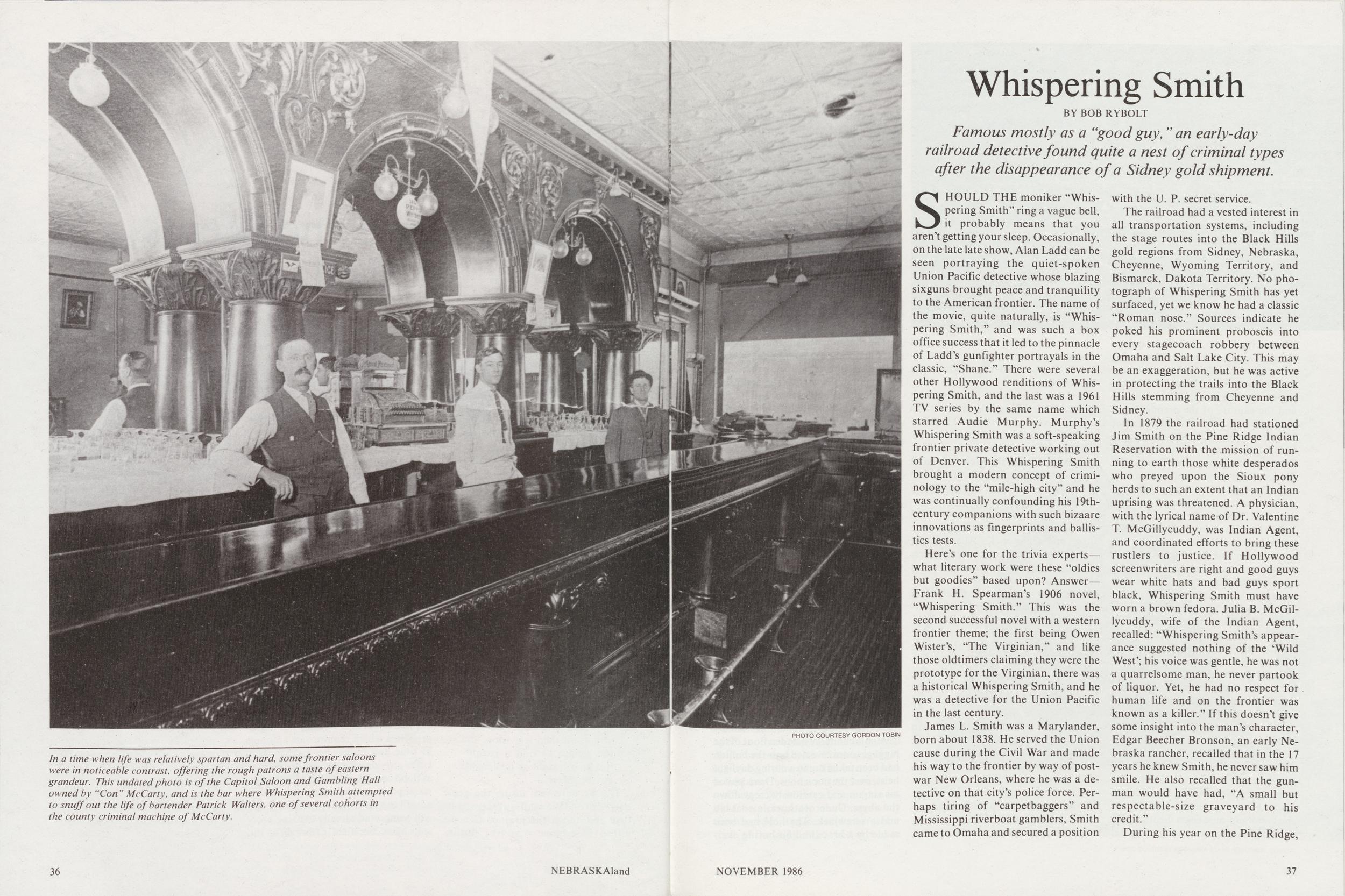
Whispering Smith
BY BOB RYBOLT Famous mostly as a "good guy," an early-day railroad detective found quite a nest of criminal types after the disappearance of a Sidney gold shipment.SHOULD THE moniker "Whispering Smith" ring a vague bell, it probably means that you aren't getting your sleep. Occasionally, on the late late show, Alan Ladd can be seen portraying the quiet-spoken Union Pacific detective whose blazing sixguns brought peace and tranquility to the American frontier. The name of the movie, quite naturally, is "Whispering Smith," and was such a box office success that it led to the pinnacle of Ladd's gunfighter portrayals in the classic, "Shane." There were several other Hollywood renditions of Whispering Smith, and the last was a 1961 TV series by the same name which starred Audie Murphy. Murphy's Whispering Smith was a soft-speaking frontier private detective working out of Denver. This Whispering Smith brought a modern concept of criminology to the "mile-high city" and he was continually confounding his 19thcentury companions with such bizaare innovations as fingerprints and ballistics tests.
Here's one for the trivia experts what literary work were these "oldies but goodies" based upon? Answer Frank H. Spearman's 1906 novel, "Whispering Smith." This was the second successful novel with a western frontier theme; the first being Owen Wister's, "The Virginian," and like those oldtimers claiming they were the prototype for the Virginian, there was a historical Whispering Smith, and he was a detective for the Union Pacific in the last century.
James L. Smith was a Marylander, born about 1838. He served the Union cause during the Civil War and made his way to the frontier by way of postwar New Orleans, where he was a detective on that city's police force. Perhaps tiring of "carpetbaggers" and Mississippi riverboat gamblers, Smith came to Omaha and secured a position with the U. P. secret service.
The railroad had a vested interest in all transportation systems, including the stage routes into the Black Hills gold regions from Sidney, Nebraska, Cheyenne, Wyoming Territory, and Bismarck, Dakota Territory. No photograph of Whispering Smith has yet surfaced, yet we know he had a classic "Roman nose." Sources indicate he poked his prominent proboscis into every stagecoach robbery between Omaha and Salt Lake City. This may be an exaggeration, but he was active in protecting the trails into the Black Hills stemming from Cheyenne and Sidney.
In 1879 the railroad had stationed Jim Smith on the Pine Ridge Indian Reservation with the mission of running to earth those white desperados who preyed upon the Sioux pony herds to such an extent that an Indian uprising was threatened. A physician, with the lyrical name of Dr. Valentine T. McGillycuddy, was Indian Agent, and coordinated efforts to bring these rustlers to justice. If Hollywood screenwriters are right and good guys wear white hats and bad guys sport black, Whispering Smith must have worn a brown fedora. Julia B. McGillycuddy, wife of the Indian Agent, recalled: "Whispering Smith's appearance suggested nothing of the 'Wild West'; his voice was gentle, he was not a quarrelsome man, he never partook of liquor. Yet, he had no respect for human life and on the frontier was known as a killer." If this doesn't give some insight into the man's character, Edgar Beecher Bronson, an early Nebraska rancher, recalled that in the 17 years he knew Smith, he never saw him smile. He also recalled that the gunman would have had, "A small but respectable-size graveyard to his credit."
During his year on the Pine Ridge,
NOVEMBER 1986
37
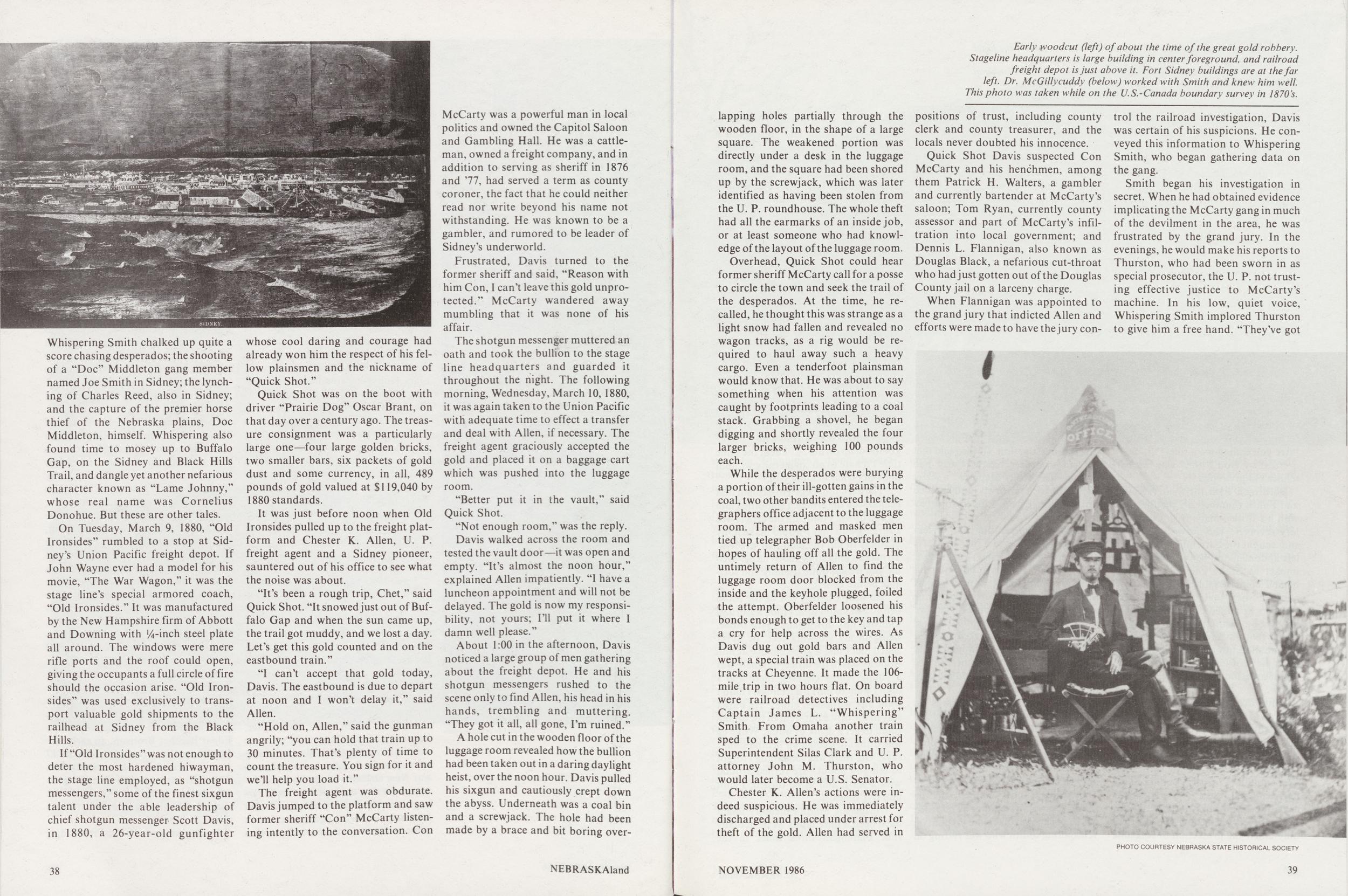
If "Old Ironsides" was not enough to deter the most hardened hiwayman, the stage line employed, as "shotgun messengers," some of the finest sixgun talent under the able leadership of chief shotgun messenger Scott Davis, in 1880, a 26-year-old gunfighter whose cool daring and courage had already won him the respect of his fellow plainsmen and the nickname of "Quick Shot."
Quick Shot was on the boot with driver "Prairie Dog" Oscar Brant, on that day over a century ago. The treasure consignment was a particularly large one—four large golden bricks, two smaller bars, six packets of gold dust and some currency, in all, 489 pounds of gold valued at $119,040 by 1880 standards.
It was just before noon when Old Ironsides pulled up to the freight platform and Chester K. Allen, U. P. freight agent and a Sidney pioneer, sauntered out of his office to see what the noise was about.
"It's been a rough trip, Chet," said Quick Shot. "It snowed just out of Buffalo Gap and when the sun came up, the trail got muddy, and we lost a day. Let's get this gold counted and on the eastbound train."
"I can't accept that gold today, Davis. The eastbound is due to depart at noon and I won't delay it," said Allen.
"Hold on, Allen," said the gunman angrily; "you can hold that train up to 30 minutes. That's plenty of time to count the treasure. You sign for it and we'll help you load it."
The freight agent was obdurate. Davis jumped to the platform and saw former sheriff "Con" McCarty listening intently to the conversation. Con McCarty was a powerful man in local politics and owned the Capitol Saloon and Gambling Hall. He was a cattleman, owned a freight company, and in addition to serving as sheriff in 1876 and '77, had served a term as county coroner, the fact that he could neither read nor write beyond his name not withstanding. He was known to be a gambler, and rumored to be leader of Sidney's underworld.
Frustrated, Davis turned to the former sheriff and said, "Reason with him Con, I can't leave this gold unprotected." McCarty wandered away mumbling that it was none of his affair.
The shotgun messenger muttered an oath and took the bullion to the stage line headquarters and guarded it throughout the night. The following morning, Wednesday, March 10, 1880, it was again taken to the Union Pacific with adequate time to effect a transfer and deal with Allen, if necessary. The freight agent graciously accepted the gold and placed it on a baggage cart which was pushed into the luggage room.
"Better put it in the vault," said Quick Shot.
"Not enough room," was the reply.
Davis walked across the room and tested the vault door—it was open and empty. "It's almost the noon hour, explained Allen impatiently. "I have a luncheon appointment and will not be delayed. The gold is now my responsibility, not yours; I'll put it where I damn well please."
About 1:00 in the afternoon, Davis noticed a large group of men gathering about the freight depot. He and his shotgun messengers rushed to the scene only to find Allen, his head in his hands, trembling and muttering. "They got it all, all gone, I'm ruined."
A hole cut in the wooden floor of the luggage room revealed how the bullion had been taken out in a daring daylight heist, over the noon hour. Davis pulled his sixgun and cautiously crept down the abyss. Underneath was a coal bin and a screwjack. The hole had been made by a brace and bit boring overlapping 38 NEBRASKAland holes partially through the wooden floor, in the shape of a large square. The weakened portion was directly under a desk in the luggage room, and the square had been shored up by the screwjack, which was later identified as having been stolen from the U. P. roundhouse. The whole theft had all the earmarks of an inside job, or at least someone who had knowledge of the layout of the luggage room.
Overhead, Quick Shot could hear former sheriff McCarty call for a posse to circle the town and seek the trail of the desperados. At the time, he recalled, he thought this was strange as a light snow had fallen and revealed no wagon tracks, as a rig would be required to haul away such a heavy cargo. Even a tenderfoot plainsman would know that. He was about to say something when his attention was caught by footprints leading to a coal stack. Grabbing a shovel, he began digging and shortly revealed the four larger bricks, weighing 100 pounds each.
While the desperados were burying a portion of their ill-gotten gains in the coal, two other bandits entered the telegraphers office adjacent to the luggage room. The armed and masked men tied up telegrapher Bob Oberfelder in hopes of hauling off all the gold. The untimely return of Allen to find the luggage room door blocked from the inside and the keyhole plugged, foiled the attempt. Oberfelder loosened his bonds enough to get to the key and tap a cry for help across the wires. As Davis dug out gold bars and Allen wept, a special train was placed on the tracks at Cheyenne. It made the 106-miletrip in two hours flat. On board were railroad detectives including Captain James L. "Whispering" Smith From Omaha another train sped to the crime scene. It carried Superintendent Silas Clark and U. P. attorney John M. Thurston, who would later become a U.S. Senator.
Chester K. Allen's actions were indeed suspicious. He was immediately discharged and placed under arrest for theft of the gold. Allen had served in positions of trust, including county clerk and county treasurer, and the locals never doubted his innocence.
Quick Shot Davis suspected Con McCarty and his henchmen, among them Patrick H. Walters, a gambler and currently bartender at McCarty's saloon; Tom Ryan, currently county assessor and part of McCarty's infiltration into local government; and Dennis L. Flannigan, also known as Douglas Black, a nefarious cut-throat who had just gotten out of the Douglas County jail on a larceny charge.
When Flannigan was appointed to the grand jury that indicted Allen and efforts were made to have the jury control the railroad investigation, Davis was certain of his suspicions. He conveyed this information to Whispering Smith, who began gathering data on the gang.
Smith began his investigation in secret. When he had obtained evidence implicating the McCarty gang in much of the devilment in the area, he was frustrated by the grand jury. In the evenings, he would make his reports to Thurston, who had been sworn in as special prosecutor, the U. P. not trusting effective justice to McCarty's machine. In his low, quiet voice, Whispering Smith implored Thurston to give him a free hand. "They've got
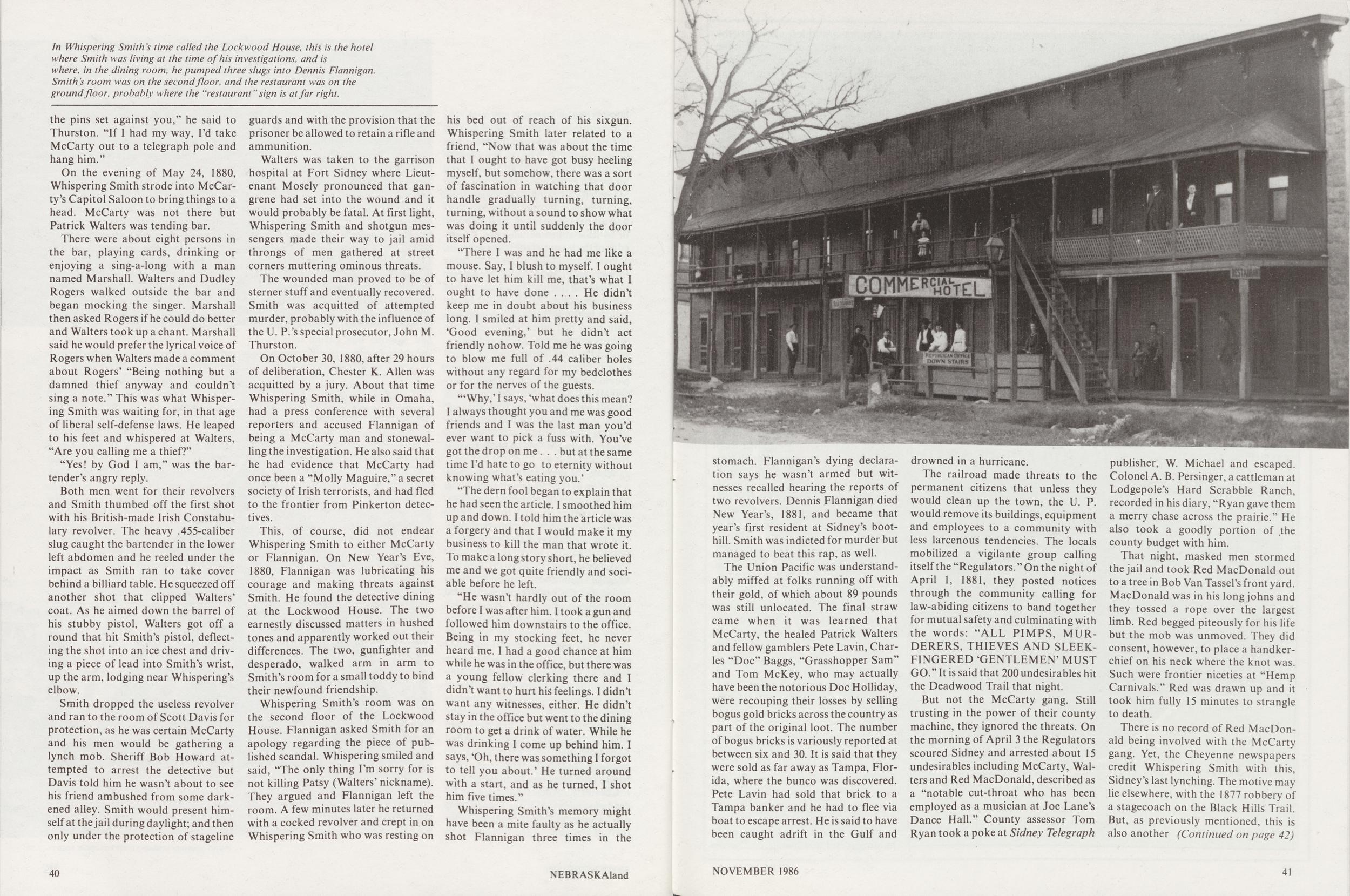
On the evening of May 24, 1880, Whispering Smith strode into McCarty's Capitol Saloon to bring things to a head. McCarty was not there but Patrick Walters was tending bar.
There were about eight persons in the bar, playing cards, drinking or enjoying a sing-a-long with a man named Marshall. Walters and Dudley Rogers walked outside the bar and began mocking the singer. Marshall then asked Rogers if he could do better and Walters took up a chant. Marshall said he would prefer the lyrical voice of Rogers when Walters made a comment about Rogers' "Being nothing but a damned thief anyway and couldn't sing a note." This was what Whispering Smith was waiting for, in that age of liberal self-defense laws. He leaped to his feet and whispered at Walters, "Are you calling me a thief?"
"Yes! by God I am," was the bartender's angry reply.
Both men went for their revolvers and Smith thumbed off the first shot with his British-made Irish Constabulary revolver. The heavy .455-caliber slug caught the bartender in the lower left abdomen and he reeled under the impact as Smith ran to take cover behind a billiard table. He squeezed off another shot that clipped Walters' coat. As he aimed down the barrel of his stubby pistol, Walters got off a round that hit Smith's pistol, deflecting the shot into an ice chest and driving a piece of lead into Smith's wrist, up the arm, lodging near Whispering's elbow.
Smith dropped the useless revolver and ran to the room of Scott Davis for protection, as he was certain McCarty and his men would be gathering a lynch mob. Sheriff Bob Howard attempted to arrest the detective but Davis told him he wasn't about to see his friend ambushed from some darkened alley. Smith would present himself at the jail during daylight; and then only under the protection of stageline guards and with the provision that the prisoner be allowed to retain a rifle and ammunition.
Walters was taken to the garrison hospital at Fort Sidney where Lieutenant Mosely pronounced that gangrene had set into the wound and it would probably be fatal. At first light, Whispering Smith and shotgun messengers made their way to jail amid throngs of men gathered at street corners muttering ominous threats.
The wounded man proved to be of sterner stuff and eventually recovered. Smith was acquitted of attempted murder, probably with the influence of the U. P.'s special prosecutor, John M. Thurston.
On October 30, 1880, after 29 hours of deliberation, Chester K. Allen was acquitted by a jury. About that time Whispering Smith, while in Omaha, had a press conference with several reporters and accused Flannigan of being a McCarty man and stonewalling the investigation. He also said that he had evidence that McCarty had once been a "Molly Maguire," a secret society of Irish terrorists, and had fled to the frontier from Pinkerton detectives.
This, of course, did not endear Whispering Smith to either McCarty or Flannigan. On New Year's Eve, 1880, Flannigan was lubricating his courage and making threats against Smith. He found the detective dining at the Lockwood House. The two earnestly discussed matters in hushed tones and apparently worked out their differences. The two, gunfighter and desperado, walked arm in arm to Smith's room for a small toddy to bind their newfound friendship.
Whispering Smith's room was on the second floor of the Lockwood House. Flannigan asked Smith for an apology regarding the piece of published scandal. Whispering smiled and said, "The only thing I'm sorry for is not killing Patsy (Walters' nickname). They argued and Flannigan left the room. A few minutes later he returned with a cocked revolver and crept in on Whispering Smith who was resting on his bed out of reach of his sixgun. Whispering Smith later related to a friend, "Now that was about the time that I ought to have got busy heeling myself, but somehow, there was a sort of fascination in watching that door handle gradually turning, turning, turning, without a sound to show what was doing it until suddenly the door itself opened.
"There I was and he had me like a mouse. Say, I blush to myself. I ought to have let him kill me, that's what I ought to have done He didn't keep me in doubt about his business long. I smiled at him pretty and said, 'Good evening,' but he didn't act friendly nohow. Told me he was going to blow me full of .44 caliber holes without any regard for my bedclothes or for the nerves of the guests.
"Why, I says, 'what does this mean? I always thought you and me was good friends and I was the last man you'd ever want to pick a fuss with. You've got the drop on me but at the same time I'd hate to go to eternity without knowing what's eating you.'
"The dern fool began to explain that he had seen the article. I smoothed him up and down. I told him the article was a forgery and that I would make it my business to kill the man that wrote it. To make a long story short, he believed me and we got quite friendly and sociable before he left.
"He wasn't hardly out of the room before I was after him. I took a gun and followed him downstairs to the office. Being in my stocking feet, he never heard me. I had a good chance at him while he was in the office, but there was a young fellow clerking there and I didn't want to hurt his feelings. I didn't want any witnesses, either. He didn't stay in the office but went to the dining room to get a drink of water. While he was drinking I come up behind him. I says, 'Oh, there was something I forgot to tell you about.' He turned around with a start, and as he turned, I shot him five times."
Whispering Smith's memory might have been a mite faulty as he actually shot Flannigan three times in the 40 NEBRASKAland stomach. Flannigan's dying declaration says he wasn't armed but witnesses recalled hearing the reports of two revolvers. Dennis Flannigan died New Year's, 1881, and became that year's first resident at Sidney's boothill. Smith was indicted for murder but managed to beat this rap, as well.
The Union Pacific was understandably miffed at folks running off with their gold, of which about 89 pounds was still unlocated. The final straw came when it was learned that McCarty, the healed Patrick Walters and fellow gamblers Pete Lavin, Charles "Doc" Baggs, "Grasshopper Sam" and Tom McKey, who may actually have been the notorious Doc Holliday, were recouping their losses by selling bogus gold bricks across the country as part of the original loot. The number of bogus bricks is variously reported at between six and 30. It is said that they were sold as far away as Tampa, Florida, where the bunco was discovered. Pete Lavin had sold that brick to a Tampa banker and he had to flee via boat to escape arrest. He is said to have been caught adrift in the Gulf and drowned in a hurricane.
The railroad made threats to the permanent citizens that unless they would clean up the town, the U. P. would remove its buildings, equipment and employees to a community with less larcenous tendencies. The locals mobilized a vigilante group calling itself the "Regulators." On the night of April 1, 1881, they posted notices through the community calling for law-abiding citizens to band together for mutual safety and culminating with the words: "ALL PIMPS, MURDERERS, THIEVES AND SLEEKFINGERED 'GENTLEMEN' MUST GO." It is said that 200 undesirables hit the Deadwood Trail that night.
But not the McCarty gang. Still trusting in the power of their county machine, they ignored the threats. On the morning of April 3 the Regulators scoured Sidney and arrested about 15 undesirables including McCarty, Walters and Red MacDonald, described as a "notable cut-throat who has been employed as a musician at Joe Lane's Dance Hall." County assessor Tom Ryan took a poke at Sidney Telegraph publisher, W. Michael and escaped. Colonel A. B. Persinger, a cattleman at Lodgepole's Hard Scrabble Ranch, recorded in his diary, "Ryan gave them a merry chase across the prairie." He also took a goodly portion of Jhe county budget with him.
That night, masked men stormed the jail and took Red MacDonald out to a tree in Bob Van Tassel's front yard. MacDonald was in his long Johns and they tossed a rope over the largest limb. Red begged piteously for his life but the mob was unmoved. They did consent, however, to place a handkerchief on his neck where the knot was. Such were frontier niceties at "Hemp Carnivals." Red was drawn up and it took him fully 15 minutes to strangle to death.
There is no record of Red MacDonald being involved with the McCarty gang. Yet, the Cheyenne newspapers credit Whispering Smith with this, Sidney's last lynching. The motive may lie elsewhere, with the 1877 robbery of a stagecoach on the Black Hills Trail. But, as previously mentioned, this is also another (Continued on page 42)
NOVEMBER 1986 41
Whispering Smith
(Continued from page 41)story. The "Regulators" also felt that Whispering Smith was culpable in this. They paid him a visit toting the hangman's rope. Pistols were drawn but Whispering was outnumbered. He backed up to the U. P. yard and caught the next freight into Cheyenne. McCarty was run out of town, as were his henchmen.
They went up into Montana Territory where Walters got into an altercation over the finer points of poker rules. On March 13, 1883, a man named Hoppy shot him exactly where Whispering Smith had three years prior; this time it took. McCarty and Tom Ryan went to Oregon and were run out of Rattlesnake and settled in Huntington where they entered into the saloon business, probably with the ill-gained county revenue. They,again had problems with vigilantes and left. One oldtimer recalled that McCarty got his in Idaho Territory. "It took a team of oxen to haul him out of the gulch where he was shot, the body was so full of lead."
Whispering Smith's sanguine activities may have cost him his job but no matter. He went to New Mexico Territory and landed a job as a detective on the Mescalero Apache Reservation where he could still enjoy a good shooting or lynching. His career continued to Wyoming and the Stock Grower's Association and he seems to have been part of the effort to run down Butch Cassidy and the Sundance Kid at the turn of the century. He may have committed suicide about 1910.
As for the 89 pounds of gold: It has never been located or positively accounted for. In January of 1908, when McCarty's Capitol burned down, the missing bricks were thought to be found amid the ashes. These turned out to be part of the bogus bricks. They were placed in the wall over the door of the new structure where they rest today.
About 1955, Sheriff Bill Shultz received a letter claiming that the author had relatives involved in the gold heist. He gave detailed instructions as to where the loot was buried. At the time it was felt that if this information were made public, folks would be digging potholes all over the county. The letter is now lost, as is the author's name. But those who have read it concur that it was written by an old man living somewhere in the Pacific Northwest. Con McCartv was in that area and had a son who would have been elderly in 1955. Could he have been the author? Are there still gold bars moldering under the sod near Sidney? Today they would be worth in excess of half a million dollars.
Hunting. stillworthwhile
(Continued from page 15)values of hunting, even if it does produce a possession-limit of pheasants.
When we decided to start back to the pickup, we were a bird short of the limit, but we really did not work very hard hunting the most promising cover. The truth of the matter is, we were avoiding the heavy stuff, picking the easy walking, and talking as we meandered along.
Then, the sun just barely above the western horizon, the last bird of the season flushed, green head and white neck ring neon-bright in the red-gold light. John and I stood and watched him go, knowing, although neither of us said it aloud, that pheasant hunting is still worthwhile, that counting opening days is as good a way as any for measuring the progress of life, and that neither the number of hunters in an opening-morning cafe, nor the age of the hunter, matters .much.
Maybe what matters more is starting to hunt early enough—as Jason, Justin, and Lance are doing, and learning that the hunt is in the hunter, and not in the game. And keeping at it long enough matters, too. Keeping at it as long as your legs and your wind will let you, of course, but also keeping at it as late into the season as you can, giving yourself time each year to again become something more than just a shotgun owner who drives out into the country a couple of times in early November.
Maybe you can never recapture the luminous opening mornings of childhood when you were the only hunters, and all the rituals were new. Possibly those hunts were never really quite as memory shapes them now. But that doesn't really matter; there is pleasure enough in the present to reassure you: hunting is still worthwhile.
42 NEBRASKAlandNEBRASKAland
Gift Catalog Gift Ideas from NEBRASKAland
Late season deer management
(Continued from page 9)as direct species management, where hunting regulations refer directly to the species targeted for management objectives. It was determined, however, that the objectives of harvesting whitetails and sparing mule deer could be realized through modified species management, which delineates whitetail range and specific habitats, and puts hunters where the whitetails are and the mule deer are not. Thus evolved the late rivers seasons.
Essentially, Nebraska has species management in the east and far west, because of deer distribution, but there is a considerable portion of the state west of Grand Island where there is a reasonable degree of overlap of the two species. Within this overlap, however, whitetails are found most frequently along stream courses, and a map of whitetail harvest distribution would plot the stream courses even if you didn't know where these courses were.
The plan was to create a special late season for 1984 that would deal specifically with the overpopulation of whitetails along the Republican River, without jeopardizing mule deer.
The new season was designated the Southwest Rivers Late Season, with boundaries spanning the entire length of the Republican River from Alma to the Colorado border. The Frenchman River from Enders Reservoir to its confluence with the Republican was also included. Hunters were allowed to take any deer within one mile of each bank of the Republican and Frenchman rivers. The special season would consist of a five-day hunt opening after the conclusion of the regular firearm season.
Sixty-seven percent of the unit's 1,204 hunters were successful during the late season. Since the special season was designed to harvest antlerless whitetails in the Frenchman Unit, a comparison between the two firearm hunts should indicate if objectives were reached. During the regular Frenchman firearm season, which in fact included most of the area within the Southwest Rivers Late Season, six antlerless whitetails and 23 antlerless mule deer per 100 either-sex permits were harvested. In the Southwest Rivers Late Management Unit, 36 antlerless whitetails and nine antlerless mule deer per 100 either-sex permits were taken.
The management plan was a success. The harvest showed a reversal in species composition between the two seasons, with 647 whitetails and 162 mule deer taken, as compared to 463 whitetails and 1,540 mule deer in the Frenchman Unit's regular season. The majority of the late season's 162 mule deer were taken along the Frenchman River, which has been traditional mule deer habitat. Because of the vulnerability of mule deer along the Frenchman, this portion of the unit has since been discontinued in the late hunts.
In 1985, the Southwest Rivers Late Season was divided into the West Republican and the East Republican, which in effect extended the eastern boundaries to cover all of the Republican River east of Highway 6.
Comparisons exemplified the efficiency of the late river seasons to harvest antlerless whitetails. In the West Republican Late Season, only 716 permit holders harvested 329 antlerless whitetails. Comparing that to the corresponding Frenchman Unit, 2,652 permit holders took only 147 antlerless whitetails. Since the second objective of the West Republican Late Season was to avoid significant harvest of mule deer does, the season was extremely successful. Only 39 antlerless mulies were removed from the Frenchman Unit during the late season, as compared to 542 during the regular Frenchman season.
Because of the success of the Southwest Rivers late Season and the need to control whitetails in management units that have well-represented populations of both species, additional modified species management seasons were introduced in 1985.
Both the Platte River Late and the North Platte River Late seasons were adopted. The Platte River Late was aimed at providing some additional harvest on whitetail populations along the North Platte River from Lake McConaughy to North Platte, along the South Platte River from Ogallala to North Platte, and along the Platte River from North Platte to Gothenburg.
At the same time, the North Platte River Late would provide deer hunting along a stretch of the river west of Lake McConaughy, incorporating both the Clear Creek and Garden County refuges. Because of the refuge designation, the Garden County portion of the North Platte River had never been directly hunted, and the Clear Creek portion had been closed to hunting since the early 1960's.
Even with the prospects of good bucks in the area, only 38 percent of the unit's 104 successful permit holders harvested adult whitetail bucks, while 53 percent bagged antlerless whitetails, and the remaining nine percent shot mule deer.
Although some exceptional bucks were checked in, the North Platte River Late Season did not develop into the trophy hunt that many hunters had expected. In fact, the area's total deer numbers appeared to fall far short of previous years' inventories. Hunters worked hard for their 69 percent success rate, and found the going difficult in the river's cattailed backwaters and heavy willow stands that became immediately attractive to whitetails discovering the refuge was no longer a refuge.
Meanwhile, downstream from Lake McConaughy, 709 hunters were gaining some additional recreation opportunities from the whitetails of the Platte River Late Season. Approximately 65 percent of that area's successful permit holders harvested antlerless whitetails, taking only 85 antlered whitetails and five antlered mule deer.
It is likely that Nebraska's late seasons will be annually recommended if deer populations continue to increase or stabilize. If numbers should show a marked depletion, such additional opportunities will be discontinued until data indicates that harvest rates can be accelerated. Because either-sex permit holders during the regular seasons in 1985 were still taking a high number of bucks, hunting had little impact on the growing whitetail population.
Before any discussion relating to the control of whitetails is concluded, it is essential that an extremely important factor be mentioned. Epizootic hemorrhagic disease (EHD), has had a definite impact on whitetail populations in the past. Recently, however, EHD has not suppressed wild populations, providing the opportunity for additional hunting now being realized through more permit allocations and the creation of late seasons.
NOVEMBER 1986 47
Good friends. good times
(Continued from page 17)right beside him and pulled the clutch. He leaned over, wanted to know if 1 had a few minutes' time. I told him I guess I did. He said, 4I understand you think we've got too many deer.' I said I knew we had too many. He asked, 'How many do you think we got?' I said, fcI told you, we got too darn many. We want a season opened up.'
"He wanted to know if I would take him around, early in the morning, before sun-up, or in the evening. And I told him I didn't like to get up that early but 1 would take him in the evening. So he drove out. I invited him in the house. He never come in the house other times; he just sat in the car. But he did come in the house and had a cup of coffee. He got out a yellow sheet on a snapboard. He drew some, lines through there and put down fourpoint bucks or better, smaller bucks, does, fawns and unknown deer. My nephew wanted to ride along, and Cunningham had the back end of his car full of sleeping bags and raincoats and everything else, rubber shoes, overshoes. So he piled that on one side and I sat in the front seat with him. He had a spotlight on it. I took him around, and I think we counted 92 deer just on my alfalfa fields. He asked me if he could come again. I told him, 'you just let me know what evening so I'm home and we'll go out again,' and we did, quite a few times. Then he saved them sheets, see. And finally he brought some people out from Lincoln and they talked to me and I told them that I thought they better open the season because the deer was doing a terrible lot of damage. That was about 1947 or '48. In '49 they opened it.
"The first turkey they released in Nebraska was right here on my place. They brought in 17 hens. We released them right out here. One was dead, and one had a wing broke and another one had a leg broke. They were all tagged and I could see the tags on them. I had field glasses and I watched them. I watched those turkeys like a hawk. I fed 'em and protected them all my life and I was really proud of them. By the time spring comes, I didn't have no toms, and 1 was worried I wasn't going to get no toms. So, in February, they brought me three young toms. And only 14 of the hens survived. But I got 92 birds off of them 14 hens by the next fall. Finally, I got to 400. I had 400 birds here, in the winter.
"And, then they trapped them, in 1961 I believe, and they took some to Valentine and some to White Clay and some to the Wildcat Hills, and they really done good. They caught that old torn and I wouldn't let them take it. I got him under my arms and I said, 'now, you're not going to take that torn.' They caught him three different times and I wouldn't let them take him.
"And, those bands. I found two of those bands in the corral. I found number one and number eight, and number one was broke. I could hardly see that it was a silver band. And not a one of those turkeys was ever bagged that had the original band.
"The first turkey season was in 1962 and if I remember correctly we bagged 34 that first day. We've bagged as high as 70 during one season. That same fall there were 70 deer taken by hunters. We had 158 hunters."
Over the years Ed has "engineered" a lot of deer and turkey hunters. He's had hunters from Tennessee, Texas, Florida, New York, Wisconsin, Minnesota, California, Washington, and probably a lot of other places he doesn't remember anymore. Why does a landowner take on that many hunters? To keep the deer and turkey from overpopulating; overpopulation that can lead to disease outbreaks and crop depredations? Well, that's part of it. To make money by charging hunters? Well, that doesn't appear to be the reason.
"I've never charged a man a dime in my life," Ed says. "I never did. They come up and say, 'Ed, how much do I owe you.' And we'd feed them and house them; not all of them, but a lot of them. And, I'd say, 'you don't owe me a damn dime. I engineer 'em and bring the game in. I take you out and plant you. Come and see how you're getting along. If you think my wife has earned anything, washed the linens and cooked the meals, well, ok.' But I never charged a man a dime in my life. I didn't have to.
"Sometimes it gets a little out of hand," Ed admits. "You'll have friends come or pretty soon you call me and you got a brother-in-law or a cousin, or an uncle, and he'd like to come. Well that uncle, he's got somebody and all of a sudden we're getting too many.
"Well, I'll tell you how the landowner feels. If a man comes up to your residence and asks for permission to hunt, the landowner will either be real nice, he'll let you hunt, or he won't. But if you don't ask, and you drive up and down the road, back and forth, and you see deer or turkey and never ask to hunt, if you're a road hunter, you're all done. I've had some people come here that made me think about locking the gate. I am trying to quit but I can't. I've got too many friends. But I don't take hunters in any more. Clarence and Dick, here, are the only ones that still stay with me. My wife and I turned it over to my daughter and son-in-law and they got all the hunters they can handle.
"That's why Clarence and I get along. Clarence is a damn good hunter. You don't have to baby him or nothing. He's careful with his gun, he knows what he's doing. If he don't like an animal, he won't shoot. And Clarence will never shoot first. If you're with him, if he brought you out here, he'll never shoot first. He'll let you have first chance, and when you run out of ammunition, he'll ask you if you want some help."
Clarence has had more big game hunts than most men dream of, and yet for 34 years he has come back to Ed's.
"The first big game hunt I went on, other than hunting in Wyoming, was in 1950 into northern British Columbia," Clarence said. "Dad was getting up in years but he thought he could take the trip if it was on horseback. We packed enough food and everything for 30 days. We had three hunters and three guides and a horse wrangler and 32 head of horses. We were hunting stone sheep, bear and goats. We didn't get any sheep but we got three grizzly bears and three mountain goats. The next spring Dad and I went to Kodiak Island in Alaska and he got an eightfoot bear and I got a 10-foot bear. We couldn't make a trip every year because we didn't make that much money, but we would always go to Wyoming for deer and antelope and we would come out here to Ed's. That would be about the second hunt for the year.
"And I went back into Canada and I got a stone sheep and I went back to Alaska in 1956 and got a Dall sheep. I've made five trips into Alaska. I got a moose with a 61 !/2-inch spread, and
48 NEBRASKAlandTrading Post
DOGSTRAINING ALL BREEDS Hunting Dogs Vizslas for sale. Rozanek Kennels, Rt. 2, Schuyler, NE 68661. Phone (402) 352-8769.
A FEW HUNTING dogs for sale: Brittanies, English setters. German Shorthairs. Darrell Yentes, Phone (308) 995-8570 or (308) 995-4797 after 5 p.m.
ENGLISH SETTERS and Labradors: "Bred for the hunter"; outstanding bloodlines! Puppies, started dogs and stud service available. High Plains Kennels, 1411 Emerson, Alliance, Nebr. 69301. Phone (308) 762 6709.
GERMAN SHORTHA1R male 5 years old. Points, backs and retrieves from land and water. Whistle broke and has had experience on pheasants and quail. Two males out of this dog, over a year old, started. Pointer male V/i years old, points and retrieves. Wayne Clark (712) 529-4238 after 10 p.m. or (402) 263-3495, Union, NE.
PLATTE RIVER KENNELS, Lexington, NE. Phone (308) 324-6093. Trained and started German shorthair pointers. $300 and up.
PROFESSIONAL GUNDOG TRAINING: Working pointing breeds. Complete, individualized programwell equipped. "Positive retrieve." Honesty and consistent patience. Grouseway Gundogs. Phone (308) 636-2495.
QUALITY LINE-BRED Pointer bird dogs. Several high and classy dogs to choose from. Natural retrievers who enjoy the task. Responsive to and considerate of their handler. Guaranteed. Mark L'Heureux, Omaha, NE 558-8540.
X-MAS BRITTANY PUPPIES: Free brochure detailing goal-oriented breeding program. Guaranteed. Grouseway Gundogs, Rt. 4 Box 197, North Platte, NE 69101. Phone (308) 534-7525.
MISCELLANEOUSFISH FOR SALE. Channel catfish, bass, bluegill, crappie, trout, perch, white bass, minnows, hybrid grass carp, bullhead. We can ship fish, you can pick them up, or we can deliver. Contact the Pleasant Valley Fish Farm, Rt. 1. McCook, NE 69001. Phone (308) 345-6599.
NE NEBRASKA trout fishing. 3 modern cottages, 1 available year round. 5 spring fed lakes with open water all year. Trout up to 7 pounds. Other varieties fish also. Diamond E. Trout Resort, Orchard, NE 68764. Phone (402) 893-4745.
GUNS Browning, Winchester, Remington, others, Hi-powers, shotguns, new, used, antiques. Want Pre1964 Winchesters. Buy-Sell-Trade. Ph. (402) 729-6112. Bedlan's Sporting Goods, Fairbury, NE 68352.
MAD RIVER CANOES offers the finest quality and performance. For the finest canoes and accessories look to Great Plains Canoe Co., 205 Main, Springfield, NE. Phone (402) 253 2001.
WINE AND BEER: Make your own. Send for free recipes and instructions. Omaha Supply, 1324 2nd Avenue, Nebraska City, NE 68410.
LOG HOMES Discover the simple elegance and richness of a Western Log Home. Your plan or ours. Free estimates. 44-page home planning guides $5. Action Log Homes, Box 3201, Kearney, NE 68847. Phone (308) 237-LOGS.
ASSEMBLERS WANTED: Make money assembling clowns. Earn $60 per 10 units part-time at home. It's fun, profitable and materials supplied. Send selfaddressed stamped envelope to Dickens and Matson, P.O. Box 476, East Detroit, Ml 48021.
GIANT CANADA GEESE, all ages, adult snow and blue geese. Alan Nelson, Rt. 1 Box 151, Aurora, NE 68818. Phone (402) 694-5224.
WOOD SLABS for sale, all kinds, all sizes. Ideal for clocks or painting, finished or unfinished. All sizes of Cypress slabs. For price list write to: Clocks, HC 30-Box 57, McCook, NE 69001.
ATTENTION HUNTERS: Cabin available at Johnson Lake — accommodates 6 people. Call (308) 486-5642 for information, or write Box 322, Eustis, NE 69028.
MANDARIN DUCKS; nice full-wing birds, $35 pair. Mrs. R. W. Hansen, 3315 Avenue L, Kearnev, NE 68847. Phone (308) 237-3781.
AIR GUNS repaired — Benjamin, Crosman, Daisy, other American made. Restoration; old guns wanted, Jack's Air Guns, 1225 No. 46th, Lincoln, NE 68503. Phone (402) 466-9223.
HUNTERS WITH BUDDIES --own your own hunting paradise with Niobrara River frontage. 367 acres or 3080 acres, with spring creeks and abundant timber and wildlife. Swett Realty, P.O. Box 265, Ainsworth, NE 69210. Phone (402) 387-1626 day or night.
TROLLING MOTOR REPAIR. Factory authorized Minn Kota and Motor Guide, parts and service. Wolf's Repair and Installation, 1529 David Drive, Lincoln, NE 68504. Phone (402) 464-4265.
NE NEBRASKA trout fishing. 3 modern cottages, 1 available year-round. Five spring-fed lakes with open water all year. Trout up to 7 pounds. Other varieties fish also. Diamond E. Trout Resort, Orchard, NE 68764. Phone (402) 893-4745.
STOCK SHOP — wood stocks for all firearms. Repaired, refinished or custom made. Hand-cut checkering, glass bedding. 1618 Euclid, Ashland, NE 68003. Phone (402) 944-2836.
BIG BEN WATERFOWLING is now booking hunts on the Platte River near Eim Creek, Nebraska. Guided duck and goose hunting at its best. Make reservations early. Call (308) 856-4520.
"JOIN TODAY." Nebraska Bowhunters Association, P.O. Box 112, St. Charles, IL 60174. Phone (312) 584-7563.
FOR SALE: Hunting cottage and year-round retreat. Located near Nebraska's beautiful Pine Creek, Long Pine, Nebraska. Excellent hunting and trout fishing. Call Wardene Roark (402) 273-4141.
'79 WETBIKE includes trailer, accessories, spare parts and new Diehard battery. $1900 or make offer. Mechanic owner, like new, call (402) 475-8693 or 423-0380 and ask for Mike.
TAXIDERMYALLISON'S TAXIDERMY STUDIO: Wally and Betty Allison. Licensed Taxidermist. We've mounted 18 Nebraska State Record fish. Specializing in fish and birds, small game and rattlesnakes. We use freeze-dry. 2709 Brichwood Rd., North Platte, Nebr. 69101. Phone (308) 534-2324.
BADE TAXIDERMY — Quality a must — Fast service. Fish, birds, rugs, tanning, full mounts and game heads, 2111 N. Christv St., Fremont, Nebraska 727-5463.
KARL SCHWA RZ master taxidermist has moved to a new country studio; same professional mounting and tanning service. Schwarz Wild Wing Studio, 16804 South 180th St., Springfield, NE 68059. Phone (402) 253-2481.
JOHNSON TAXIDERMY servicing southwest Nebraska, specializing in big-game mounts, life-sized mounts, rug work, fish, birds, tanning hair-on leather. Brochure and price list on request. Johnson Taxidermv, Rt. 1, Box 78, Lamar, NE 69035. Telephone (308) "882-5555.
NABITY'S TAXIDERMY. 31 years experience. Specializing in natural grass backgrounds for mammals, birds and fish. 13901 "O" St., Lincoln, NE 68504 -4 miles east of 84th and "O". (402) 489-6351.
PEISTER TAXIDERMY Professional work at prices most sportsman can afford. Now in our new log cabin studio, 1020 Central Avenue, Box 3201, Kearney, NE 68847. Phone (308) 236-9700 or (308) 237-7575 evenings.
HASTINGS TAXIDERMY: Award winner at the World Taxidermy Championships —Commercial Division — Life-like mounting of big-game heads, rugs, birds, fish. Big game is my specialty. Call or write: Hastings Taxidermy, RR 3, Ord, NE 68862. Phone (308) 728-5322.
WILD HONEY TAXIDERMY: Tom Schneider, Taxidermist. Quality and affordable prices in birds, fish, full-shoulder mounts, life-size mounts, rugs, leather, hair-on tanning and snakes. Delivery available. 1019 No. Spruce St., Ogallala, NE 69153. Phone (308) 284-4137.
K&M TAXIDERMY — we do natural mounts you will be proud of. Fish, birds and game heads. Rt. 2, Box 175, Norfolk, NE 68701. Phone (402) 675-1862.
BIG BEAR TAXIDERMY, Rt. 2, Mitchell, Nebraska 69357. We specialize in all big game from Alaska to Nebraska, also birds and fish. Hair on and hair off tanning. Four miles west of Scottsbluff on Highway 26. Dale Hubel, phone (308) 635-3013.
CREATIVE TAXIDERMY. Quality and experience since 1935. All custom services, museum work, and sales. New methods include Freeze-Dry processing. Trophy room visitors and inquiries welcome. Naturecraft Studios, Joe Voges, Owner, Nebraska City, NE 68410. Phone (402) 873-5491.
PLATTE VALLEY TAXIDERMY. Museum-quality mounts using latest scientific methods. 1985 world taxidermy competition winner. Delton Wegner, 1419 11th Street, Central City, NE 68826. Telephone (308) 946-3773.
CEDAR LANE - Ranch Vacations • Guest ranch in the heart of the Sandhills of Nebraska. Swimming, spa, horses, canoeing, trail rides, barbeques, hunting. BOOKING NOW For 1987 Richard and Betty Schroeder HC 2 Box 9C Stapleton, Nebraska 69163 Ph. 308-587-2233 LIVE-CATCH ALL-PURPOSE TRAPS FREE CATALOG Traps without injury squirrels, chipmunks, rabbits, mink, fox, raccoons, stray animals, pests, etc. Sizes for every need. Also traps for snakes, sparrows, pigeons, crabs, turtles, quail, etc. Save on our low factory prices. Send no money. Free catalog and trapping secrets MUSTANG MFG. CO., Dept. N-34, Box 920947, Houston, Tex. 77292 GOOSE HUNTING on Stanco Ranch North Platte River near Lisco, NE For rates & info call (308) 235-2390 STANCO PETROLEUM INC. FRANK STOYSICH MEATS 52 & Q • Omaha • 731-0776 VENISON From your Boneless Trimmings We Process the Finest Venison Sausage: 'SUMMER SAUSAGE 'ITALIAN SAUSAGE 'SMOKEDPOLISH 'BREAKFAST SAUSAGE -FRESH POLISH - VENISON JERKY - CALL OR WRITE FOR PRICE LIST WITH THIS COUPON, RECEIVE $5 OFF YOUR DEER PROCESSING ORDER OF $25 OR MORE. - ONE COUPON PER CUSTOMER FRANK STOYSICH MEATS 52nd & Q • 731-0776 Expires 1-87
one with a 62-inch spread. They won't make Boone and Crockett; they're about 20 points short. I did get an elk that made Boone and Crockett but it ranks down at the bottom, 230th in the all-time record. That's from Wyoming, southwest of Jackson Hole."
In recent years, Clarence has made two hunting safaris in Africa and three camera safaris. The list of trophies he has taken in Africa reads like a list of the local fauna—blue wildebeest, red hartebeest, blesbok, gemsbok, springbok, eland, impala, sable antelope, waterbuck, cape buffalo, and puku; four of which are listed in Rowans and Ward Record Book, the equivalent of North America's Boone and Crockett.
What has drawn him back to Ed's in the Pine Ridge each fall for 34 years for turkey and deer? The answer is so obvious that neither Ed nor Clarence, nor Dick, can or will give it to you straight out.
Has the hunting and the hunters changed over the years?
"When we first started out," Ed recalls "you wouldn't get over about three whitetails for every 30 or 40 deer. And now, we're getting quite a few more. Hardly half yet, about a third whitetails. It's getting to be more and more all the time.
"Hunting equipment has changed too. The first hunters that I had, they had a 30/30 rifle, or that .250-3000 Savage. Clarence had the most modern gun, the first gun I saw in a .30-06. They never had any hunting clothes and nobody ever wore orange or anything. You know, first a man will come with a pickup with a camper on, then it won't be very long and he'll pull one behind a car, and it won't be very long and they'll come with a fifth wheeler, and they're modern, TV and everything. Now, they come with motor homes that cost 30 or 40 thousand."
You would expect someone who lives in some of the state's best deer and turkey country, who took in dozens of hunters every year, and who has a keen interest in wildlife, to be a hunter, but Ed is not.
"I've never owned a rifle in my life. I've never had a permit in my life. I never was a hunter. I never cared about hunting myself. I just like wildlife. I like to see people hunt. I've met a lot of people, a lot of good people. I've met a few that aren't so good but I've met a hell of a lot of good people.
"You ask why they come back," Ed said. "Just take that man, Dick. I can't get over that man coming back 10 times in 12 years, and never had a permit, and lives 1,250 miles from here. I don't know why he comes back. I don't think it's the pie. Dick and I got to watch Clarence; if there is an extra piece of pie, he'll get it."
"Well, it's a place to hunt," Clarence said. "Being out with the boys, you know, you don't care if you shoot or not. We take it pretty easy."
"Now, I'm goin' to tell a story about when we was trapping those turkeys," Ed begins. "... we sprinkled a little straw there and I got five gallons of grain and sprinkled it in that straw and run the wire that set off the cannon net into that poultry house. We got a window in the poultry house and put the battery in there, and we sat in that office where we candled and cased the eggs. We sat there and watched out of the window and pretty soon here the turkeys come."
"I like to listen to these stories Ed tells," Dick said.
Great reading from NebraskaWere our forefathers liars? "You bet they were," says Roger Welsch, "and damned fine ones at that." The proof is in Catfish at the Pump, a collection of the kind of humor that softened the hardships of pioneering on the Great Plains. $5.50 paper, $14.50 cloth.
Miss Bishop By Bess Streeter Aldrich"A constructive and inspiring book."—The New York Times. "From cover to cover, a sparkling story."—The Christian Science Monitor. Aldrich tells the deeply moving story of the courage and unselfishness of Ella Bishop in this book that has become a classic. $8.95 paper.
The Horsecatcher By Mari Sandoz"A beautiful story, bright with warmth, humor, and the love of life."—The Chicago Tribune. Praised for swift action and beauty of language, The Horsecatcher is Mari Sandoz's first novel about the Indians she knew so well. $5.95 paper.
50 NEBRASKAland Hunter Safety is for Everyone! Completing a course will make youngsters better and safer hunters. It is also required by law. And, many states require adults to have a certificate to obtain a nonresident permit. For details, contact your nearest Conservation Officer or any Game and Parks Commission office, including headquarters in Lincoln. Phone (402) 464-0641.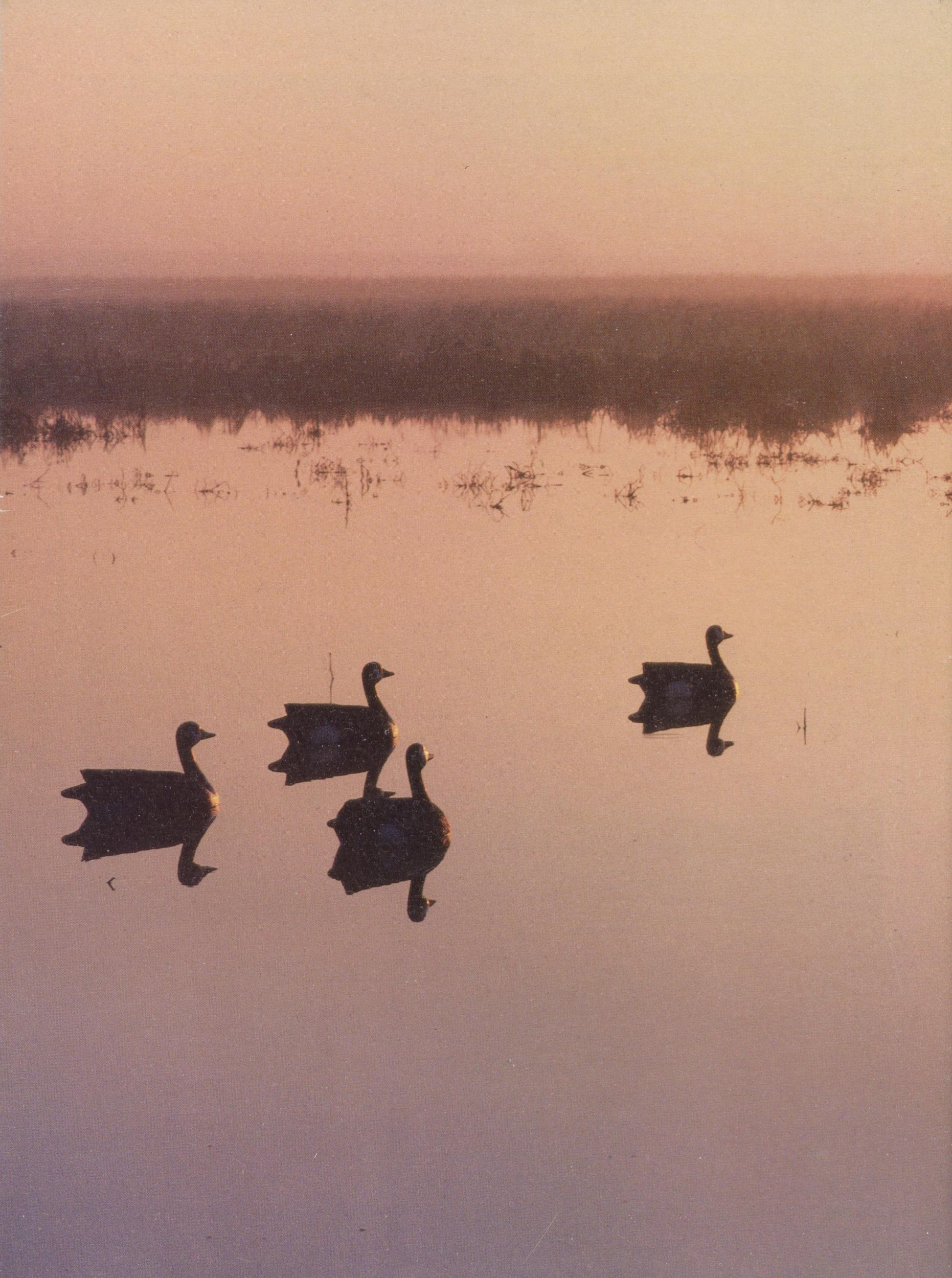
Position: 541 (20 views)