Volume 64, Issue 8, 1986
NEBRASKAland
OCTOBER 1986 $1.50
NEBRASKAland
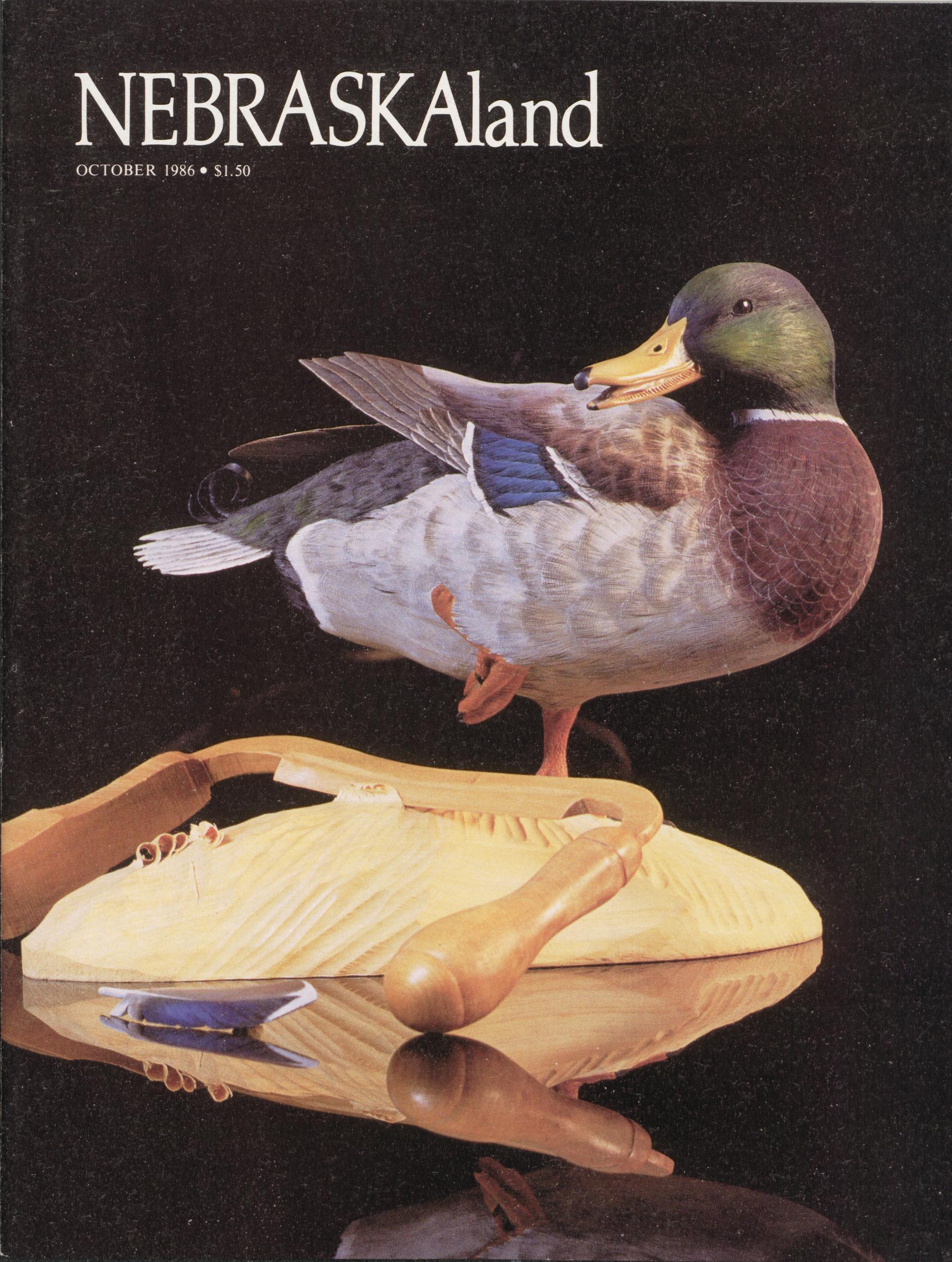
Published by the Nebraska Game and Parks Commission NEBRASKAland VOL. 64/NO. 8/OCT. 1986 NEBRASKAland (ISSN:0028-1964) is published monthly except for combined Jan/Feb and Aug/Sept issues, by the Nebraska Game and Parks Commission, 2200 North 33rd Street, Lincoln, NE. Copyright 1986, all rights reserved. Second-class postage paid at Lincoln, Nebraska and at additional mailing offices. POSTMASTER: Send address changes to NEBRASKAland, Box 30370, Lincoln, NE 68503. Rates: $12 for one year; $23 for two years. Single copy price $1.50 Offices Headquarters 2200 N. 33rd, Lincoln, 68503 (402) 464-0641 13th and Farnam St., Omaha (402) 554-2144 Ak-Sar-Ben Aquarium, Gretna (402) 332-3901 Rt. 2, Alliance (308) 762-5605 Bassett (402) 684-3511 U.S. 81, Norfolk (402) 371-4950 Rt. 4, North Platte (308) 532-6225 Commissioners Chairman: Richard L. Coyne, Omaha Vice Chairman: Neal Keller, Brewster 2nd Vice Chairman: Dr. Tim Biga, Norfolk Stan Juelfs, Kimball Wayne Ziebarth, Wilcox LaVern Schneider, McCook L. Bruce Wright, Lincoln Director: Eugene T. Mahoney Assistant Directors: William J. Bailey, Jr., Dale R. Bree, W. Rex Amack Staff Chief, Information & Education: Jim MacAllister Editor: Lowell Johnson Senior Editor: Jon Farrar Associate Editors: Ken Bouc, Don Cunningham Regional Editors: Bob Grier, Rocky Hoffmann Contributors: Tom Keith, Liz Huff, Carl Wolfe Research Assistant: Curt Twedt Art Director: Duane Westerholt Illustration: Steve O'Hare, Paula Day Advertising: Dan Curran Circulation: Pat Frahm Contents Features A PASSING FANCY 6 WATERFOWLING GUIDE 14 DUCK PHILOSOPHY 18 WILDFOWL IN WOOD 20 MY CAREER AS AN ENGINEER 38 Departments SPEAK UP 4 TRADING POST 49 BOOK SHELF 50 COVER: Lincoln carver Cliff Hollestelle created this drake mallard as if rising from a block of wood, complete with a hand-carved wooden drawknife, symbolic of the rich, uniquely American tradition of decoy carving. Hollestelle was selected 1986 Nebraska Artist of the Year by Ducks Unlimited, and this mallard will be auctioned at the Lincoln DU chapter's dinner on October 14 to raise funds for waterfowl habitat. Photo by Jon Farrar. OPPOSITE: During October, Canada geese move into the state, pushed south by snow on feeding grounds and ice on water where they rest. Some will continue on as ice and snow sweep across Nebraska, but for many, the Platte River will be winter headquarters. Photo by Rocky Hoffmann. OCTOBER 1986 3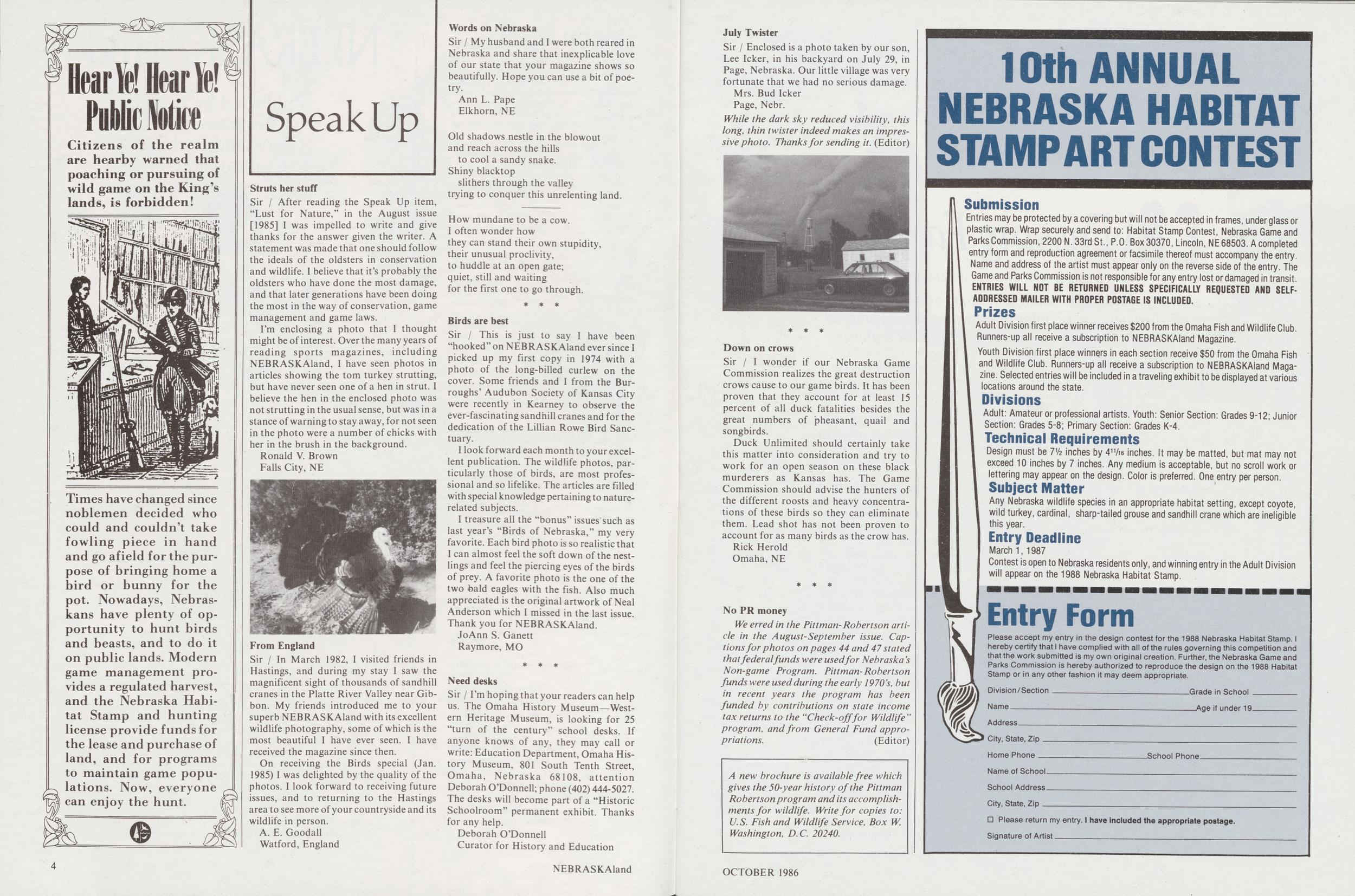
Speak Up
Struts her stuffSir / After reading the Speak Up item, "Lust for Nature," in the August issue [1985] I was impelled to write and give thanks for the answer given the writer. A statement was made that one should follow the ideals of the oldsters in conservation and wildlife. I believe that it's probably the oldsters who have done the most damage, and that later generations have been doing the most in the way of conservation, game management and game laws.
I'm enclosing a photo that I thought might be of interest. Over the many years of reading sports magazines, including NEBRASKAland, I have seen photos in articles showing the torn turkey strutting, but have never seen one of a hen in strut. I believe the hen in the enclosed photo was not strutting in the usual sense, but was in a stance of warning to stay away, for not seen in the photo were a number of chicks with her in the brush in the background.
Ronald V. Brown Falls City, NESir / In March 1982, I visited friends in Hastings, and during my stay I saw the magnificent sight of thousands of sandhill cranes in the Platte River Valley near Gibbon. My friends introduced me to your superb NEBRASKAland with its excellent wildlife photography, some of which is the most beautiful I have ever seen. I have received the magazine since then.
On receiving the Birds special (Jan. 1985) I was delighted by the quality of the photos. I look forward to receiving future issues, and to returning to the Hastings area to see more ofyour countryside and its wildlife in person.
A. E. Goodall Watford, England Words on NebraskaSir / My husband and I were both reared in Nebraska and share that inexplicable love of our state that your magazine shows so beautifully. Hope you can use a bit of poetry.
Ann L. Pape Elkhorn, NE Old shadows nestle in the blowout and reach across the hills to cool a sandy snake. Shiny blacktop slithers through the valley trying to conquer this unrelenting land. How mundane to be a cow. I often wonder how they can stand their own stupidity, their unusual proclivity, to huddle at an open gate; quiet, still and waiting for the first one to go through. Birds are bestSir / This is just to say I have been "hooked" on NEBRASKAland ever since I picked up my first copy in 1974 with a photo of the long-billed curlew on the cover. Some friends and I from the Burroughs' Audubon Society of Kansas City were recently in Kearney to observe the ever-fascinating sandhill cranes and for the dedication of the Lillian Rowe Bird Sanctuary.
I look forward each month to your excellent publication. The wildlife photos, particularly those of birds, are most professional and so lifelike. The articles are filled with special knowledge pertaining to naturerelated subjects.
I treasure all the "bonus" issues such as last year's "Birds of Nebraska," my very favorite. Each bird photo is so realistic that I can almost feel the soft down of the nestlings and feel the piercing eyes of the birds of prey. A favorite photo is the one of the two bald eagles with the fish. Also much appreciated is the original artwork of Neal Anderson which I missed in the last issue. Thank you for NEBRASKAland.
JoAnn S. Ganett Raymore, MO Need desksSir / I'm hoping that your readers can help us. The Omaha History Museum—Western Heritage Museum, is looking for 25 "turn of the century" school desks. If anyone knows of any, they may call or write: Education Department, Omaha History Museum, 801 South Tenth Street, Omaha, Nebraska 68108, attention Deborah O'Donnell; phone (402) 444-5027. The desks will become part of a "Historic Schoolroom" permanent exhibit. Thanks for any help.
Deborah O'Donnell Curator for History and Education 4 NEBRASKAland July TwisterSir Enclosed is a photo taken by our son, Lee Icker, in his backyard on July 29, in Page, Nebraska. Our little village was very fortunate that we had no serious damage.
Mrs. Bud Icker Page, Nebr.While the dark sky reduced visibility, this long, thin twister indeed makes an impressive photo. Thanks for sending it. (Editor)
Sir I wonder if our Nebraska Game Commission realizes the great destruction crows cause to our game birds. It has been proven that they account for at least 15 percent of all duck fatalities besides the great numbers of pheasant, quail and songbirds.
Duck Unlimited should certainly take this matter into consideration and try to work for an open season on these black murderers as Kansas has. The Game Commission should advise the hunters of the different roosts and heavy concentrations of these birds so they can eliminate them. Lead shot has not been proven to account for as many birds as the crow has.
Rick Herold Omaha, NE No PR moneyWe erred in the Pitt man- Robertson article in the August-September issue. Captions for photos on pages 44 and 47 stated that federal funds were used for Nebraska s Non-game Program. Pitt man- Robertson funds were used during the early 1970 's, but in recent years the program has been funded by contributions on state income tax returns to the "Check-offfor Wildlife" program, and from General Fund appropriations. (Editor)
A new brochure is available free which gives the 50-year history of the Pitt man Robertson program and its accomplishments for wildlife. Write for copies to: U. S. Fish and Wildlife Service, Box W, Washington, D. C. 20240. 10th ANNUAL NEBRASKA HABITAT STAMP ART CONTEST Submission Entries may be protected by a covering but will not be accepted in frames, under glass or plastic wrap. Wrap securely and send to: Habitat Stamp Contest, Nebraska Game and Parks Commission, 2200 N. 33rd St., P.O. Box 30370, Lincoln, NE 68503. A completed entry form and reproduction agreement or facsimile thereof must accompany the entry. Name and address of the artist must appear only on the reverse side of the entry. The Game and Parks Commission is not responsible for any entry lost or damaged in transit. ENTRIES WILL NOT BE RETURNED UNLESS SPECIFICALLY REQUESTED AND SELF ADDRESSED MAILER WITH PROPER POSTAGE IS INCLUDED. Prizes Adult Division first place winner receives $200 from the Omaha Fish and Wildlife Club. Runners-up all receive a subscription to NEBRASKAland Magazine. Youth Division first place winners in each section receive $50 from the Omaha Fish and Wildlife Club. Runners-up all receive a subscription to NEBRASKAland Magazine. Selected entries will be included in a traveling exhibit to be displayed at various locations around the state. Divisions Adult: Amateur or professional artists. Youth: Senior Section: Grades 9-12; Junior Section: Grades 5-8; Primary Section: Grades K-4. Technical Requirements Design must be 71/2 inches by 411/ie inches. It may be matted, but mat may not exceed 10 inches by 7 inches. Any medium is acceptable, but no scroll work or lettering may appear on the design. Color is preferred. One entry per person. Subject Matter Any Nebraska wildlife species in an appropriate habitat setting, except coyote, wild turkey, cardinal, sharp-tailed grouse and sandhill crane which are ineligible this year. Entry Deadline March 1,1987 Contest is open to Nebraska residents only, and winning entry in the Adult Division will appear on the 1988 Nebraska Habitat Stamp. Entry Form Please accept my entry in the design contest for the 1988 Nebraska Habitat Stamp. I hereby certify that I have complied with all of the rules governing this competition and that the work submitted is my own original creation. Further, the Nebraska Game and Parks Commission is hereby authorized to reproduce the design on the 1988 Habitat Stamp or in any other fashion it may deem appropriate. Division/Section Name Grade in School . Age if under 19. Address. City, State, Zip Home Phone School Phone. Name of School. School Address. City, State, Zip Q Please return my entry. I have included the appropriate postage. Signature of Artist OCTOBER 1986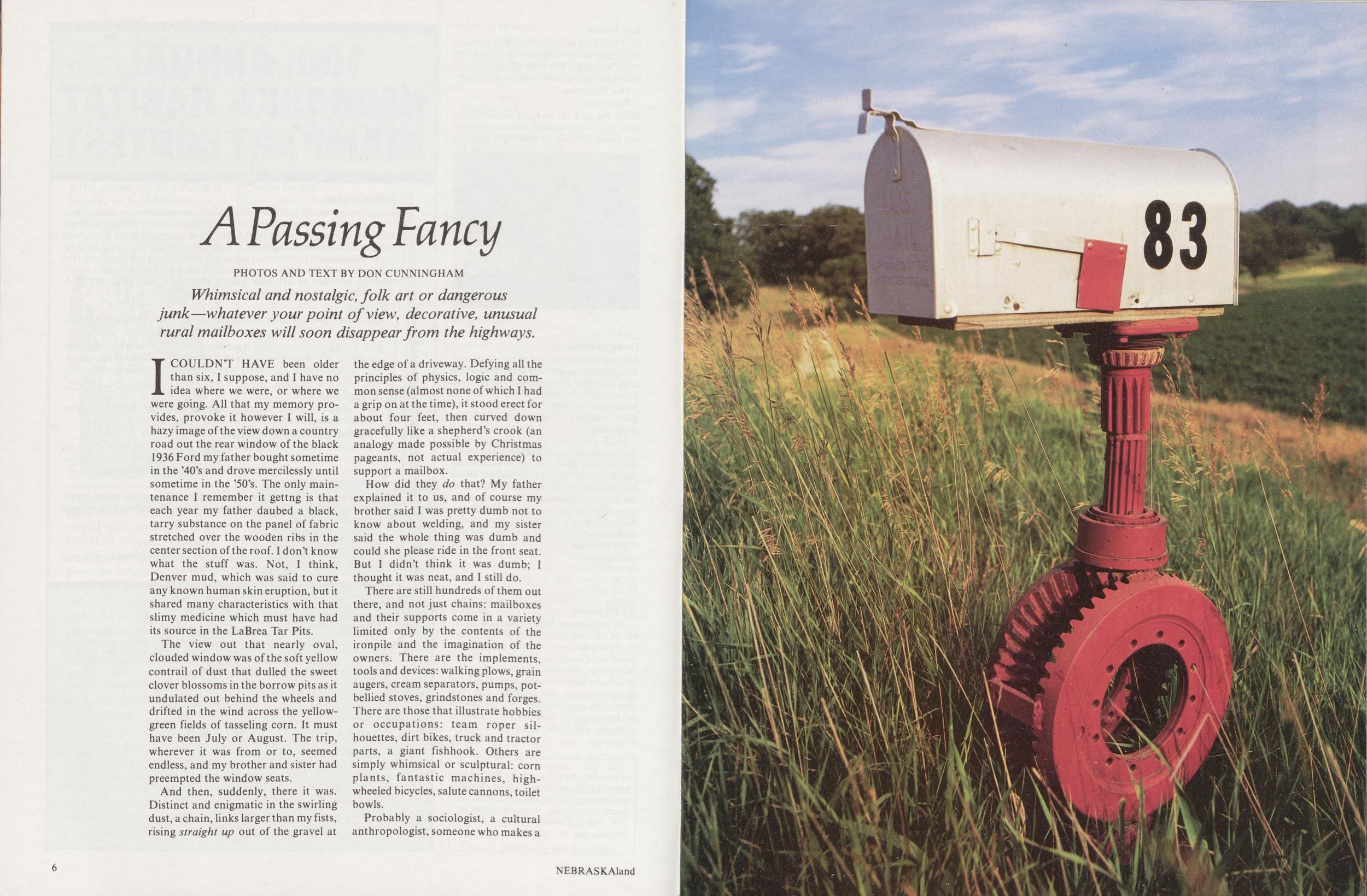
A Passing Fancy
PHOTOS AND TEXT BY DON CUNNINGHAM Whimsical and nostalgic, folk art or dangerous junk—whatever your point of view, decorative, unusual rural mailboxes will soon disappear from the highways.I COULDN'T HAVE been older than six, I suppose, and I have no idea where we were, or where we were going. All that my memory provides, provoke it however I will, is a hazy image of the view down a country road out the rear window of the black 1936 Ford my father bought sometime in the '40's and drove mercilessly until sometime in the '50's. The only maintenance I remember it gettng is that each year my father daubed a black, tarry substance on the panel of fabric stretched over the wooden ribs in the center section of the roof. I don't know what the stuff was. Not, I think, Denver mud, which was said to cure any known human skin eruption, but it shared many characteristics with that slimy medicine which must have had its source in the LaBrea Tar Pits.
The view out that nearly oval, clouded window was of the soft yellow contrail of dust that dulled the sweet clover blossoms in the borrow pits as it undulated out behind the wheels and drifted in the wind across the yellowgreen fields of tasseling corn. It must have been July or August. The trip, wherever it was from or to, seemed endless, and my brother and sister had preempted the window seats.
And then, suddenly, there it was. Distinct and enigmatic in the swirling dust, a chain, links larger than my fists, rising straight up out of the gravel at the edge of a driveway. Defying all the principles of physics, logic and common sense (almost none of which I had a grip on at the time), it stood erect for about four feet, then curved down gracefully like a shepherd's crook (an analogy made possible by Christmas pageants, not actual experience) to support a mailbox.
How did they do that? My father explained it to us, and of course my brother said I was pretty dumb not to know about welding, and my sister said the whole thing was dumb and could she please ride in the front seat. But I didn't think it was dumb; I thought it was neat, and I still do.
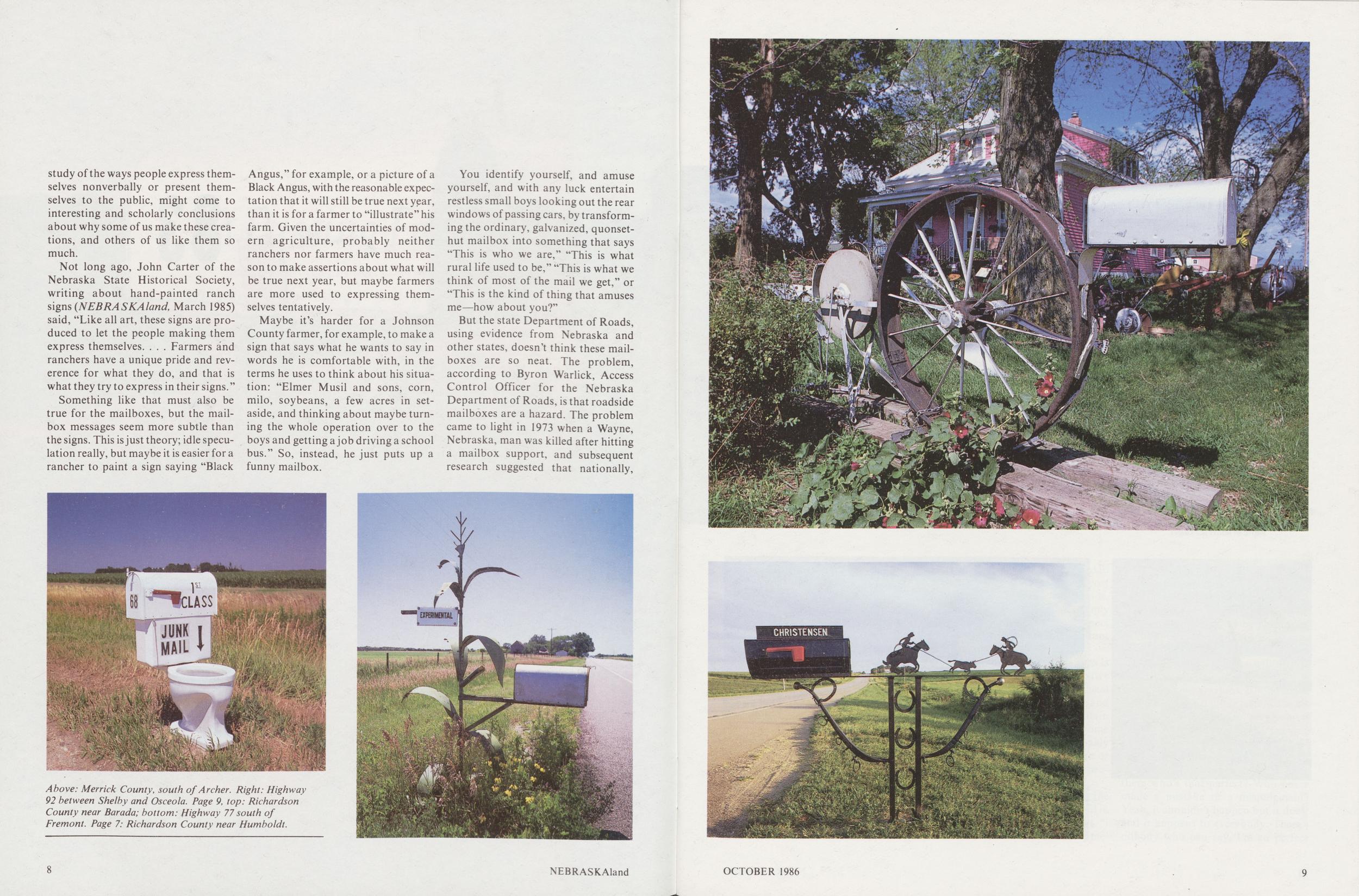
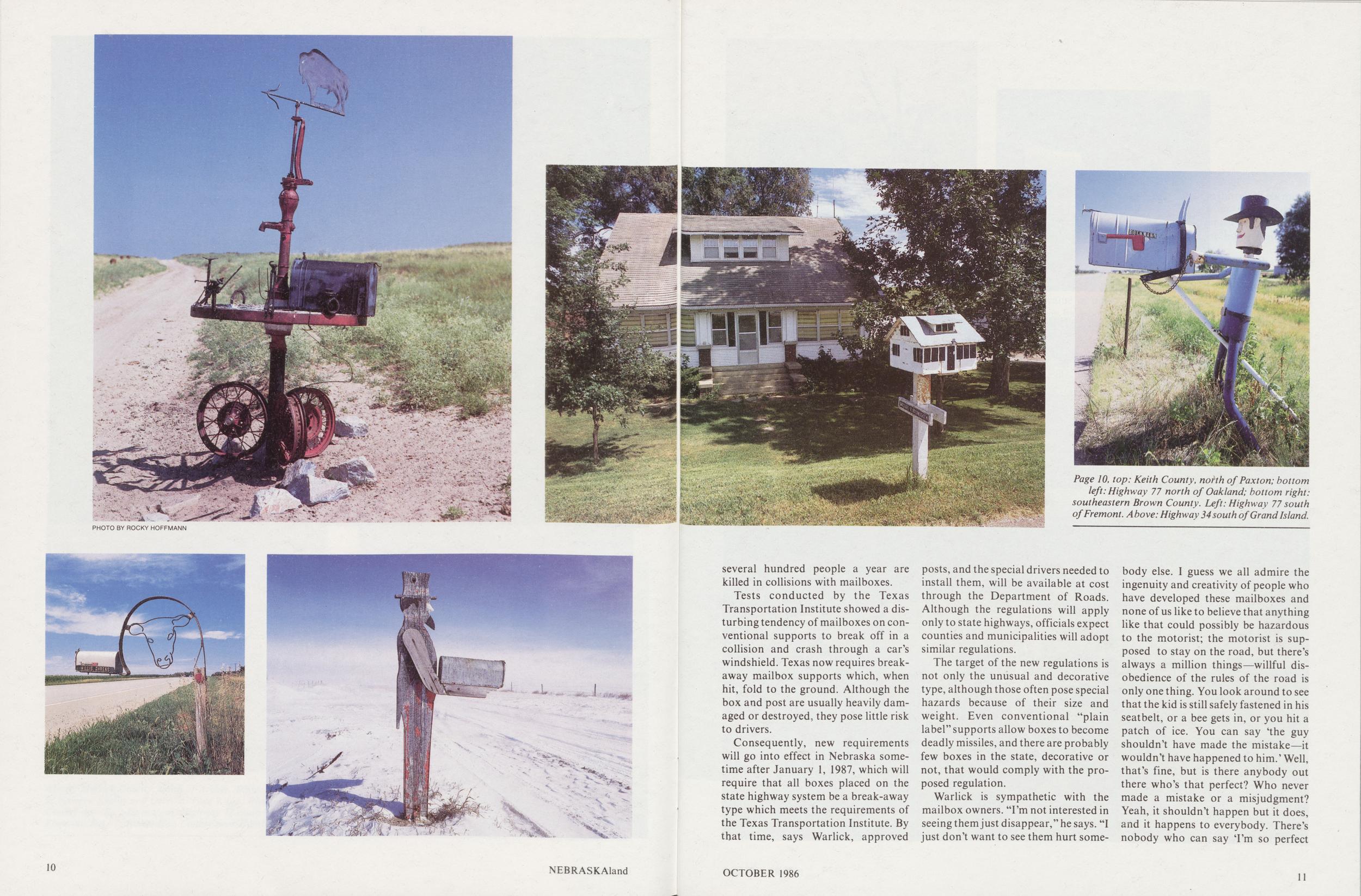
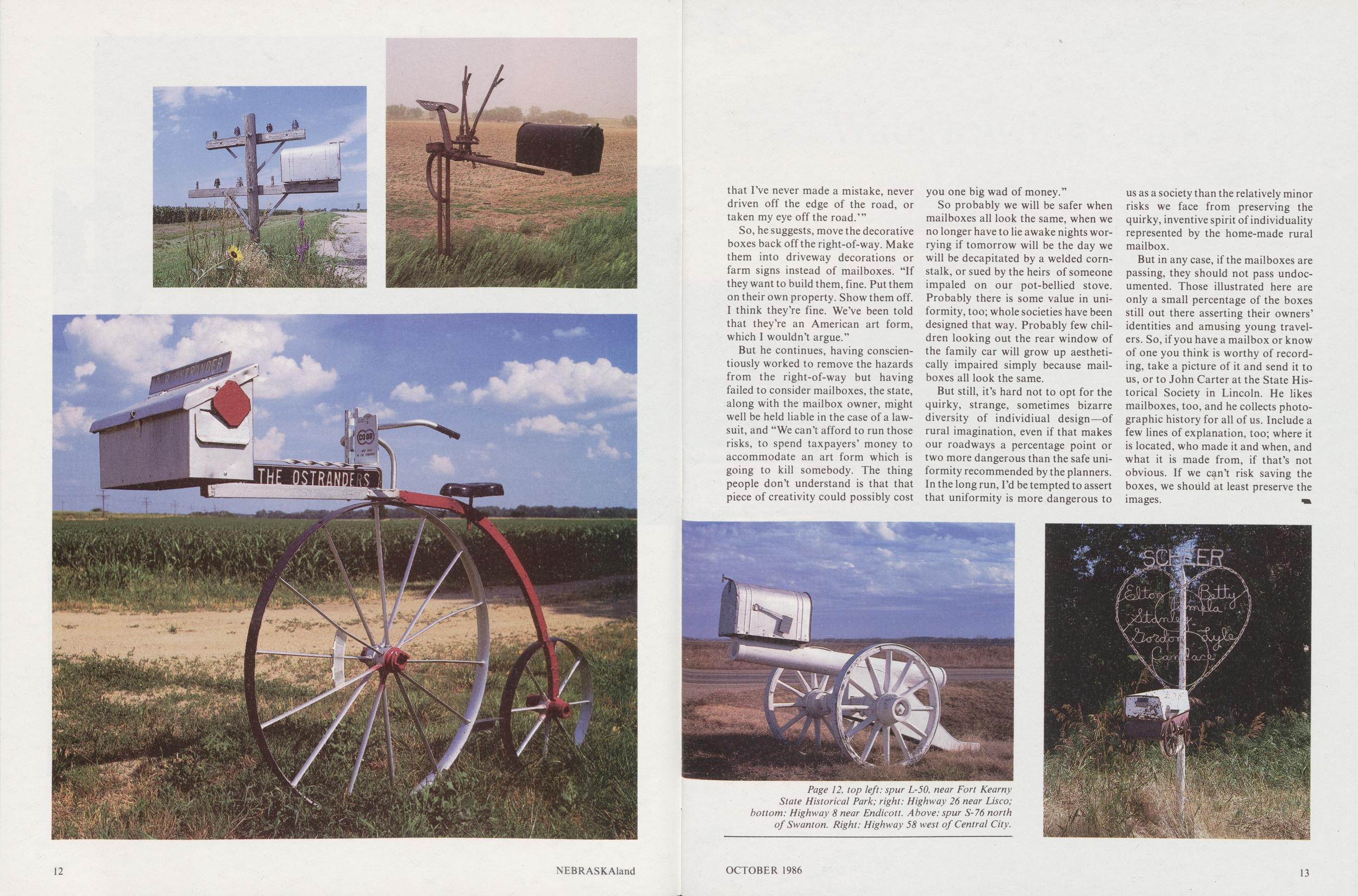
There are still hundreds of them out there, and not just chains: mailboxes and their supports come in a variety limited only by the contents of the ironpile and the imagination of the owners. There are the implements, tools and devices: walking plows, grain augers, cream separators, pumps, potbellied stoves, grindstones and forges. There are those that illustrate hobbies or occupations: team roper silhouettes, dirt bikes, truck and tractor parts, a giant fishhook. Others are simply whimsical or sculptural: corn plants, fantastic machines, highwheeled bicycles, salute cannons, toilet bowls.
Probably a sociologist, a cultural anthropologist, someone who makes a 6 NEBREASKAland
 study of the ways people express themselves nonverbally or present themselves to the
public, might come to
interesting and scholarly conclusions
about why some of us make these creations, and others of us like them so
much.
study of the ways people express themselves nonverbally or present themselves to the
public, might come to
interesting and scholarly conclusions
about why some of us make these creations, and others of us like them so
much.
Not long ago, John Carter of the Nebraska State Historical Society, writing about hand-painted ranch signs (NEBRASKAland, March 1985) said, "Like all art, these signs are pro- duced to let the people making them express themselves Farmers and ranchers have a unique pride and reverence for what they do, and that is what they try to express in their signs."
Something like that must also be true for the mailboxes, but the mailbox messages seem more subtle than the signs. This is just theory; idle speculation really, but maybe it is easier for a rancher to paint a sign saying "Black Angus," for example, or a picture of a Black Angus, with the reasonable expectation that it will still be true next year, than it is for a farmer to "illustrate" his farm. Given the uncertainties of modern agriculture, probably neither ranchers nor farmers have much reason to make assertions about what will be true next year, but maybe farmers are more used to expressing themselves tentatively.
Maybe it's harder for a Johnson County farmer, for example, to make a sign that says what he wants to say in words he is comfortable with, in the terms he uses to think about his situation: "Elmer Musil and sons, corn, milo, soybeans, a few acres in setaside, and thinking about maybe turning the whole operation over to the boys and getting a job driving a school bus." So, instead, he just puts up a funny mailbox.
You identify yourself, and amuse yourself, and with any luck entertain restless small boys looking out the rear windows of passing cars, by transforming the ordinary, galvanized, quonsethut mailbox into something that says "This is who we are," "This is what rural life used to be," "This is what we think of most of the mail we get," or "This is the kind of thing that amuses me—how about you?"
But the state Department of Roads, using evidence from Nebraska and other states, doesn't think these mailboxes are so neat. The problem, according to Byron Warlick, Access Control Officer for the Nebraska Department of Roads, is that roadside mailboxes are a hazard. The problem came to light in 1973 when a Wayne, Nebraska, man was killed after hitting a mailbox support, and subsequent research suggested that nationally,
Tests conducted by the Texas Transportation Institute showed a disturbing tendency of mailboxes on conventional supports to break off in a collision and crash through a car's windshield. Texas now requires breakaway mailbox supports which, when hit, fold to the ground. Although the box and post are usually heavily damaged or destroyed, they pose little risk to drivers.
Consequently, new requirements will go into effect in Nebraska sometime after January 1, 1987, which will require that all boxes placed on the state highway system be a break-away type which meets the requirements of the Texas Transportation Institute. By that time, says Warlick, approved posts, and the special drivers needed to install them, will be available at cost through the Department of Roads. Although the regulations will apply only to state highways, officials expect counties and municipalities will adopt similar regulations.
The target of the new regulations is not only the unusual and decorative type, although those often pose special hazards because of their size and weight. Even conventional "plain label" supports allow boxes to become deadly missiles, and there are probably few boxes in the state, decorative or not, that would comply with the proposed regulation.
Warlick is sympathetic with the
mailbox owners. "I'm not interested in
seeing them just disappear," he says. "I
just don't want to see them hurt somebody else. I guess we all admire the
ingenuity and creativity of people who
have developed these mailboxes and
none of us like to believe that anything
like that could possibly be hazardous
to the motorist; the motorist is supposed to stay on the road, but there's
always a million things—willful disobedience of the rules of the road is
only one thing. You look around to see
that the kid is still safely fastened in his
seatbelt, or a bee gets in, or you hit a
patch of ice. You can say 'the guy
shouldn't have made the mistake—it
wouldn't have happened to him.' Well,
that's fine, but is there anybody out
there who's that perfect? Who never
made a mistake or a misjudgment?
Yeah, it shouldn't happen but it does,
and it happens to everybody. There's
nobody who can say 'I'm so perfect
OCTOBER 1986
11
So, he suggests, move the decorative boxes back off the right-of-way. Make them into driveway decorations or farm signs instead of mailboxes. "If they want to build them, fine. Put them on their own property. Show them off. I think they're fine. We've been told that they're an American art form, which I wouldn't argue."
But he continues, having conscientiously worked to remove the hazards from the right-of-way but having failed to consider mailboxes, the state, along with the mailbox owner, might well be held liable in the case of a lawsuit, and "We can't afford to run those risks, to spend taxpayers' money to accommodate an art form which is going to kill somebody. The thing people don't understand is that that piece of creativity could possibly cost you one big wad of money."
So probably we will be safer when mailboxes all look the same, when we no longer have to lie awake nights worrying if tomorrow will be the day we will be decapitated by a welded cornstalk, or sued by the heirs of someone impaled on our pot-bellied stove. Probably there is some value in uniformity, too; whole societies have been designed that way. Probably few children looking out the rear window of the family car will grow up aesthetically impaired simply because mailboxes all look the same.
But still, it's hard not to opt for the quirky, strange, sometimes bizarre diversity of individiual design—of rural imagination, even if that makes our roadways a percentage point or two more dangerous than the safe uniformity recommended by the planners. In the long run, I'd be tempted to assert that uniformity is more dangerous to us as a society than the relatively minor risks we face from preserving the quirky, inventive spirit of individuality represented by the home-made rural mailbox.
But in any case, if the mailboxes are passing, they should not pass undocumented. Those illustrated here are only a small percentage of the boxes still out there asserting their owners' identities and amusing young travelers. So, if you have a mailbox or know of one you think is worthy of recording, take a picture of it and send it to us, or to John Carter at the State Historical Society in Lincoln. He likes mailboxes, too, and he collects photographic history for all of us. Include a few lines of explanation, too; where it is located, who made it and when, and what it is made from, if that's not obvious. If we can't risk saving the boxes, we should at least preserve the images.
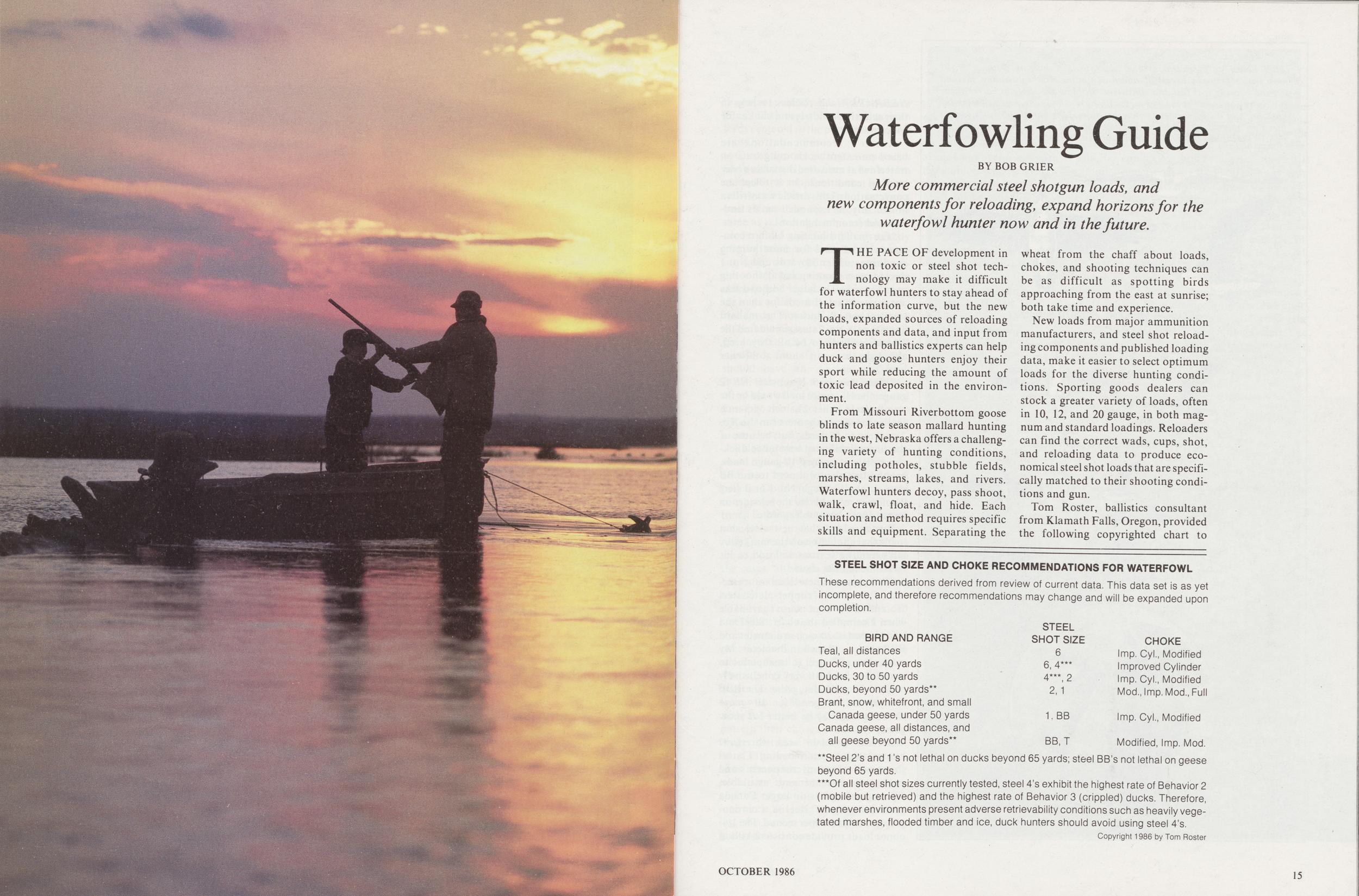
Waterfowling Guide
BY BOB GRIER More commercial steel shotgun loads, and new components for reloading, expand horizons for the waterfowl hunter now and in the future.THE PACE OF development in non toxic or steel shot technology may make it difficult for waterfowl hunters to stay ahead of the information curve, but the new loads, expanded sources of reloading components and data, and input from hunters and ballistics experts can help duck and goose hunters enjoy their sport while reducing the amount of toxic lead deposited in the environment.
From Missouri Riverbottom goose blinds to late season mallard hunting in the west, Nebraska offers a challenging variety of hunting conditions, including potholes, stubble fields, marshes, streams, lakes, and rivers. Waterfowl hunters decoy, pass shoot, walk, crawl, float, and hide. Each situation and method requires specific skills and equipment. Separating the wheat from the chaff about loads, chokes, and shooting techniques can be as difficult as spotting birds approaching from the east at sunrise; both take time and experience.
New loads from major ammunition manufacturers, and steel shot reloading components and published loading data, make it easier to select optimum loads for the diverse hunting conditions. Sporting goods dealers can stock a greater variety of loads, often in 10, 12, and 20 gauge, in both magnum and standard loadings. Reloaders can find the correct wads, cups, shot, and reloading data to produce economical steel shot loads that are specifically matched to their shooting conditions and gun.
Tom Roster, ballistics consultant from Klamath Falls, Oregon, provided the following copyrighted chart to NEBRASKAland readers to help in their selection of loads and chokes for waterfowl.
STEEL SHOT SIZE AND CHOKE RECOMMENDATIONS FOR WATERFOWLThese recommendations derived from review of current data. This data set is as yet incomplete, and therefore recommendations may change and will be expanded upon completion.
STEEL BIRD AND RANGE SHOT SIZE CHOKE Teal, all distances 6 Modified Ducks, under 40 yards 6 Improved Cylinder Ducks, 30 to 50 yards Imp. Cyl., Modified Ducks, beyond 50 yards 2,1 Mod., Imp. Mod., Full Brant, snow, whitefront, and small Canada geese, under 50 yards 1. BB Imp. Cyl., Modified Canada geese, all distances, and all geese beyond 50 yards BB,T Modified, Imp. Mod.Steel 2's and 1 's not lethal on ducks beyond 65 yards; steel BB's not lethal on geese beyond 65 yards.
Of all steel shot sizes currently tested, steel 4's exhibit the highest rate of Behavior 2 (mobile but retrieved) and the highest rate of Behavior 3 (crippled) ducks. Therefore, whenever environments present adverse retrievability conditions such as heavily vegetated marshes, flooded timber and ice, duck hunters should avoid using steel 4's.
Copyright 1986 by Tom Roster OCTOBER 1986 15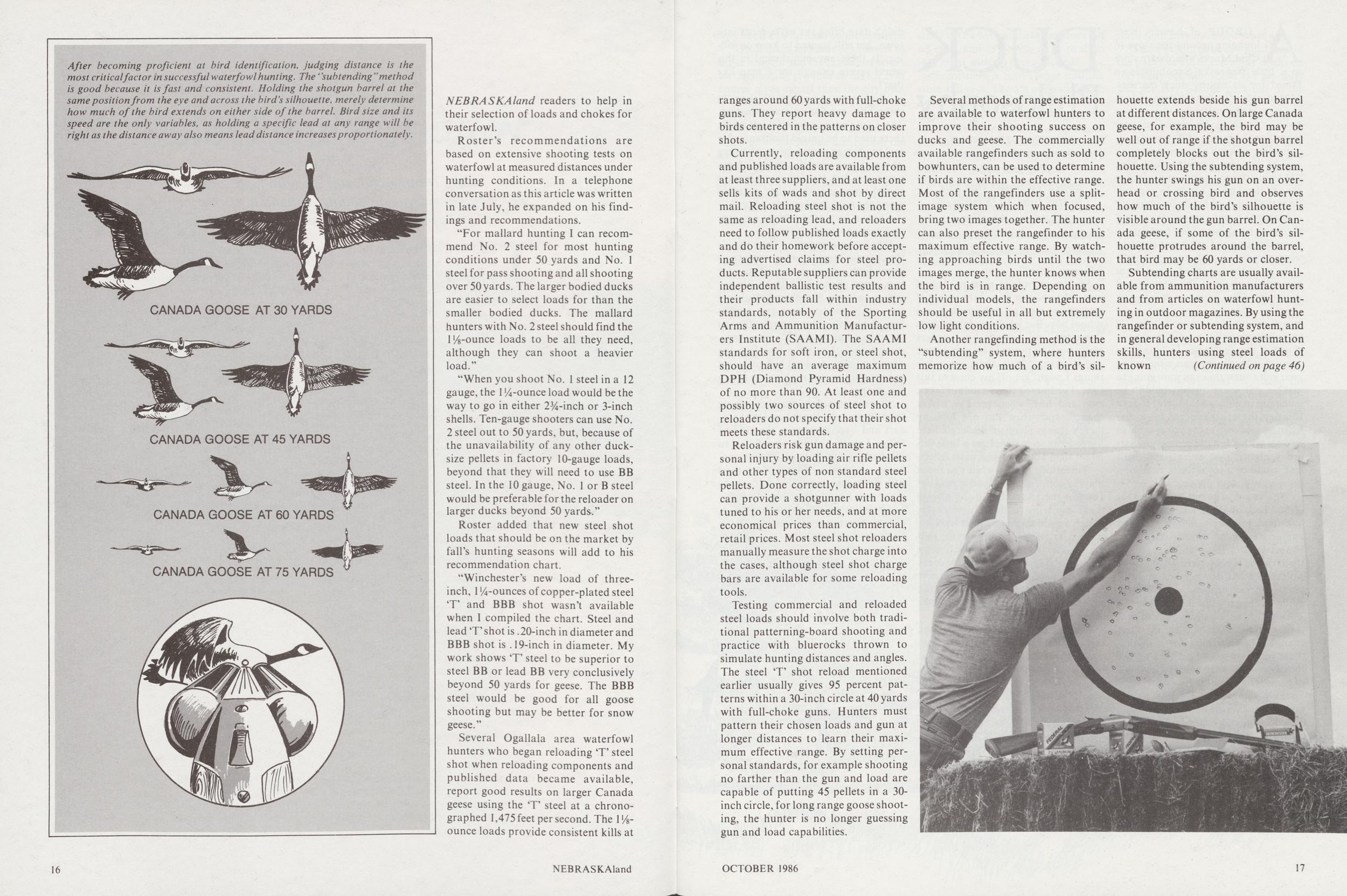
Roster's recommendations are based on extensive shooting tests on waterfowl at measured distances under hunting conditions. In a telephone conversation as this article was written in late July, he expanded on his findings and recommendations.
"For mallard hunting I can recommend No. 2 steel for most hunting conditions under 50 yards and No. 1 steel for pass shooting and all shooting over 50 yards. The larger bodied ducks are easier to select loads for than the smaller bodied ducks. The mallard hunters with No. 2 steel should find the F/s-ounce loads to be all they need, although they can shoot a heavier load."
"When you shoot No. 1 steel in a 12 gauge, the 1 !4-ounce load would be the way to go in either 2%-inch or 3-inch shells. Ten-gauge shooters can use No. 2 steel out to 50 yards, but, because of the unavailability of any other ducksize pellets in factory 10-gauge loads, beyond that they will need to use BB steel. In the 10 gauge, No. 1 or B steel would be preferable for the reloader on larger ducks beyond 50 yards."
Roster added that new steel shot loads that should be on the market by fall's hunting seasons will add to his recommendation chart.
"Winchester's new load of threeinch, 1 -ounces of copper-plated steel and BBB shot wasn't available when I compiled the chart. Steel and lead T shot is. 20-inch in diameter and BBB shot is .19-inch in diameter. My work shows T' steel to be superior to steel BB or lead BB very conclusively beyond 50 yards for geese. The BBB steel would be good for all goose shooting but may be better for snow geese."
Several Ogallala area waterfowl hunters who began reloading T' steel shot when reloading components and published data became available, report good results on larger Canada geese using the T steel at a chronographed 1,475 feet per second. The 1 Mr ounce loads provide consistent kills at 16 NEBRASKAland ranges around 60 yards with full-choke guns. They report heavy damage to birds centered in the patterns on closer shots.
Currently, reloading components and published loads are available from at least three suppliers, and at least one sells kits of wads and shot by direct mail. Reloading steel shot is not the same as reloading lead, and reloaders need to follow published loads exactly and do their homework before accepting advertised claims for steel products. Reputable suppliers can provide independent ballistic test results and their products fall within industry standards, notably of the Sporting Arms and Ammunition Manufacturers Institute (SAAMI). The SAAMI standards for soft iron, or steel shot, should have an average maximum DPH (Diamond Pyramid Hardness) of no more than 90. At least one and possibly two sources of steel shot to reloaders do not specify that their shot meets these standards.
Reloaders risk gun damage and personal injury by loading air rifle pellets and other types of non standard steel pellets. Done correctly, loading steel can provide a shotgunner with loads tuned to his or her needs, and at more economical prices than commercial, retail prices. Most steel shot reloaders manually measure the shot charge into the cases, although steel shot charge bars are available for some reloading tools.
Testing commercial and reloaded steel loads should involve both traditional patterning-board shooting and practice with bluerocks thrown to simulate hunting distances and angles. The steel T' shot reload mentioned earlier usually gives 95 percent patterns within a 30-inch circle at 40 yards with full-choke guns. Hunters must pattern their chosen loads and gun at longer distances to learn their maximum effective range. By setting personal standards, for example shooting no farther than the gun and load are capable of putting 45 pellets in a 30-inch circle, for long range goose shooting, the hunter is no longer guessing gun and load capabilities.
Several methods of range estimation are available to waterfowl hunters to improve their shooting success on ducks and geese. The commercially available rangefinders such as sold to bowhunters, can be used to determine if birds are within the effective range. Most of the rangefinders use a split-image system which when focused, bring two images together. The hunter can also preset the rangefinder to his maximum effective range. By watching approaching birds until the two images merge, the hunter knows when the bird is in range. Depending on individual models, the rangefinders should be useful in all but extremely low light conditions.
Another rangefinding method is the "subtending" system, where hunters memorize how much of a bird's silhouette extends beside his gun barrel at different distances. On large Canada geese, for example, the bird may be well out of range if the shotgun barrel completely blocks out the bird's silhouette. Using the subtending system, the hunter swings his gun on an overhead or crossing bird and observes how much of the bird's silhouette is visible around the gun barrel. On Canada geese, if some of the bird's silhouette protrudes around the barrel, that bird may be 60 yards or closer.
Subtending charts are usually available from ammunition manufacturers and from articles on waterfowl hunting in outdoor magazines. By using the rangefinder or subtending system, and in general developing range estimation skills, hunters using steel loads of known (Continued on page 46)
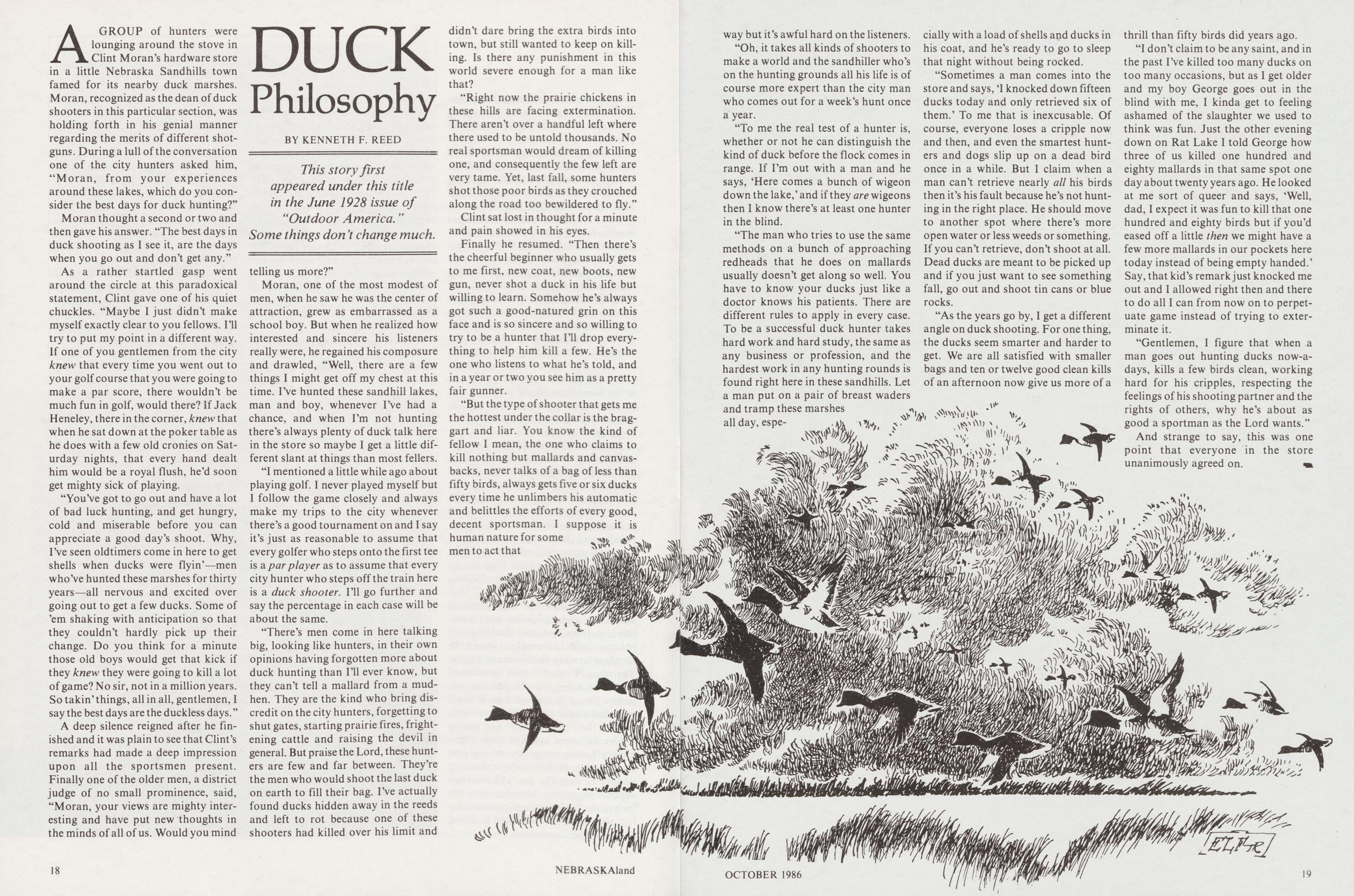
DUCK Philosophy
BY KENNETH F. REED This story first appeared under this title in the June 1928 issue of "Outdoor America." Some things don't change much.A GROUP of hunters were lounging around the stove in Clint Moran's hardware store in a little Nebraska Sandhills town famed for its nearby duck marshes. Moran, recognized as the dean of duck shooters in this particular section, was holding forth in his genial manner regarding the merits of different shotguns. During a lull of the conversation one of the city hunters asked him, "Moran, from your experiences around these lakes, which do you consider the best days for duck hunting?"
Moran thought a second or two and then gave his answer. "The best days in duck shooting as I see it, are the days when you go out and don't get any."
As a rather startled gasp went around the circle at this paradoxical statement, Clint gave one of his quiet chuckles. "Maybe I just didn't make myself exactly clear to you fellows. I'll try to put my point in a different way. If one of you gentlemen from the city knew that every time you went out to your golf course that you were going to make a par score, there wouldn't be much fun in golf, would there? If Jack Heneley, there in the corner, knew that when he sat down at the poker table as he does with a few old cronies on Saturday nights, that every hand dealt him would be a royal flush, he'd soon get mighty sick of playing.
"You've got to go out and have a lot of bad luck hunting, and get hungry, cold and miserable before you can appreciate a good day's shoot. Why, I've seen oldtimers come in here to get shells when ducks were flyin'men who've hunted these marshes for thirty years—all nervous and excited over going out to get a few ducks. Some of 'em shaking with anticipation so that they couldn't hardly pick up their change. Do you think for a minute those old boys would get that kick if they knew they were going to kill a lot of game? No sir, not in a million years. So takin'things, all in all, gentlemen, I say the best days are the duckless days.
A deep silence reigned after he finished and it was plain to see that Clint's remarks had made a deep impression upon all the sportsmen present. Finally one of the older men, a district judge of no small prominence, said, "Moran, your views are mighty interesting and have put new thoughts in the minds of all of us. Would you mind telling us more?"
Moran, one of the most modest of men, when he saw he was the center of attraction, grew as embarrassed as a school boy. But when he realized how interested and sincere his listeners really were, he regained his composure and drawled, "Well, there are a few things I might get off my chest at this time. I've hunted these sandhill lakes, man and boy, whenever I've had a chance, and when I'm not hunting there's always plenty of duck talk here in the store so maybe I get a little different slant at things than most fellers.
"I mentioned a little while ago about playing golf. I never played myself but I follow the game closely and always make my trips to the city whenever there's a good tournament on and I say it's just as reasonable to assume that every golfer who steps onto the first tee is a par player as to assume that every city hunter who steps off the train here is a duck shooter. I'll go further and say the percentage in each case will be about the same.
"There's men come in here talking big, looking like hunters, in their own opinions having forgotten more about duck hunting than I'll ever know, but they can't tell a mallard from a mudhen. They are the kind who bring discredit on the city hunters, forgetting to shut gates, starting prairie fires, frightening cattle and raising the devil in general. But praise the Lord, these hunters are few and far between. They're the men who would shoot the last duck on earth to fill their bag. I've actually found ducks hidden away in the reeds and left to rot because one of these shooters had killed over his limit and didn't dare bring the extra birds into town, but still wanted to keep on killing. Is there any punishment in this world severe enough for a man like that?
"Right now the prairie chickens in these hills are facing extermination. There aren't over a handful left where there used to be untold thousands. No real sportsman would dream of killing one, and consequently the few left are very tame. Yet, last fall, some hunters shot those poor birds as they crouched along the road too bewildered to fly."
Clint sat lost in thought for a minute and pain showed in his eyes.
Finally he resumed. "Then there's the cheerful beginner who usually gets to me first, new coat, new boots, new gun, never shot a duck in his life but willing to learn. Somehow he's always got such a good-natured grin on this face and is so sincere and so willing to try to be a hunter that I'll drop everything to help him kill a few. He's the one who listens to what he's told, and in a year or two you see him as a pretty fair gunner.
"But the type of shooter that gets me the hottest under the collar is the braggart and liar. You know the kind of fellow I mean, the one who claims to kill nothing but mallards and canvasbacks, never talks of a bag of less than fifty birds, always gets five or six ducks every time he unlimbers his automatic and belittles the efforts of every good, decent sportsman. I suppose it is human nature for some men to act that 18 NEBRASKAland way but it's awful hard on the listeners.
"Oh, it takes all kinds of shooters to make a world and the sandhiller who's on the hunting grounds all his life is of course more expert than the city man who comes out for a week's hunt once a year.
"To me the real test of a hunter is, whether or not he can distinguish the kind of duck before the flock comes in range. If I'm out with a man and he says, 'Here comes a bunch of wigeon down the lake,' and if they are wigeons then I know there's at least one hunter in the blind.
"The man who tries to use the same methods on a bunch of approaching redheads that he does on mallards usually doesn't get along so well. You have to know your ducks just like a doctor knows his patients. There are different rules to apply in every case. To be a successful duck hunter takes hard work and hard study, the same as any business or profession, and the hardest work in any hunting rounds is found right here in these sandhills. Let a man put on a pair of breast waders and tramp these marshes allday,especially with a load of shells and ducks in his coat, and he's ready to go to sleep that night without being rocked.
"Sometimes a man comes into the store and says, 'I knocked down fifteen ducks today and only retrieved six of them.' To me that is inexcusable. Of course, everyone loses a cripple now and then, and even the smartest hunters and dogs slip up on a dead bird once in a while. But I claim when a man can't retrieve nearly all his birds then it's his fault because he's not hunting in the right place. He should move to another spot where there's more open water or less weeds or something. If you can't retrieve, don't shoot at all. Dead ducks are meant to be picked up and if you just want to see something fall, go out and shoot tin cans or blue rocks.
"As the years go by, I get a different angle on duck shooting. For one thing, the ducks seem smarter and harder to get. We are all satisfied with smaller bags and ten or twelve good clean kills of an afternoon now give us more of a thrill than fifty birds did years ago.
"I don't claim to be any saint, and in the past I've killed too many ducks on too many occasions, but as I get older and my boy George goes out in the blind with me, I kinda get to feeling ashamed of the slaughter we used to think was fun. Just the other evening down on Rat Lake I told George how three of us killed one hundred and eighty mallards in that same spot one day about twenty years ago. He looked at me sort of queer and says, 'Well, dad, I expect it was fun to kill that one hundred and eighty birds but if you'd eased off a little then we might have a few more mallards in our pockets here today instead of being empty handed.' Say, that kid's remark just knocked me out and I allowed right then and there to do all I can from now on to perpetuate game instead of trying to exterminate it.
"Gentlemen, I figure that when a man goes out hunting ducks now-a-days, kills a few birds clean, working hard for his cripples, respecting the feelings of his shooting partner and the rights of others, why he's about as good a sportman as the Lord wants."
And strange to say, this was one point that everyone in the store unanimously agreed on.
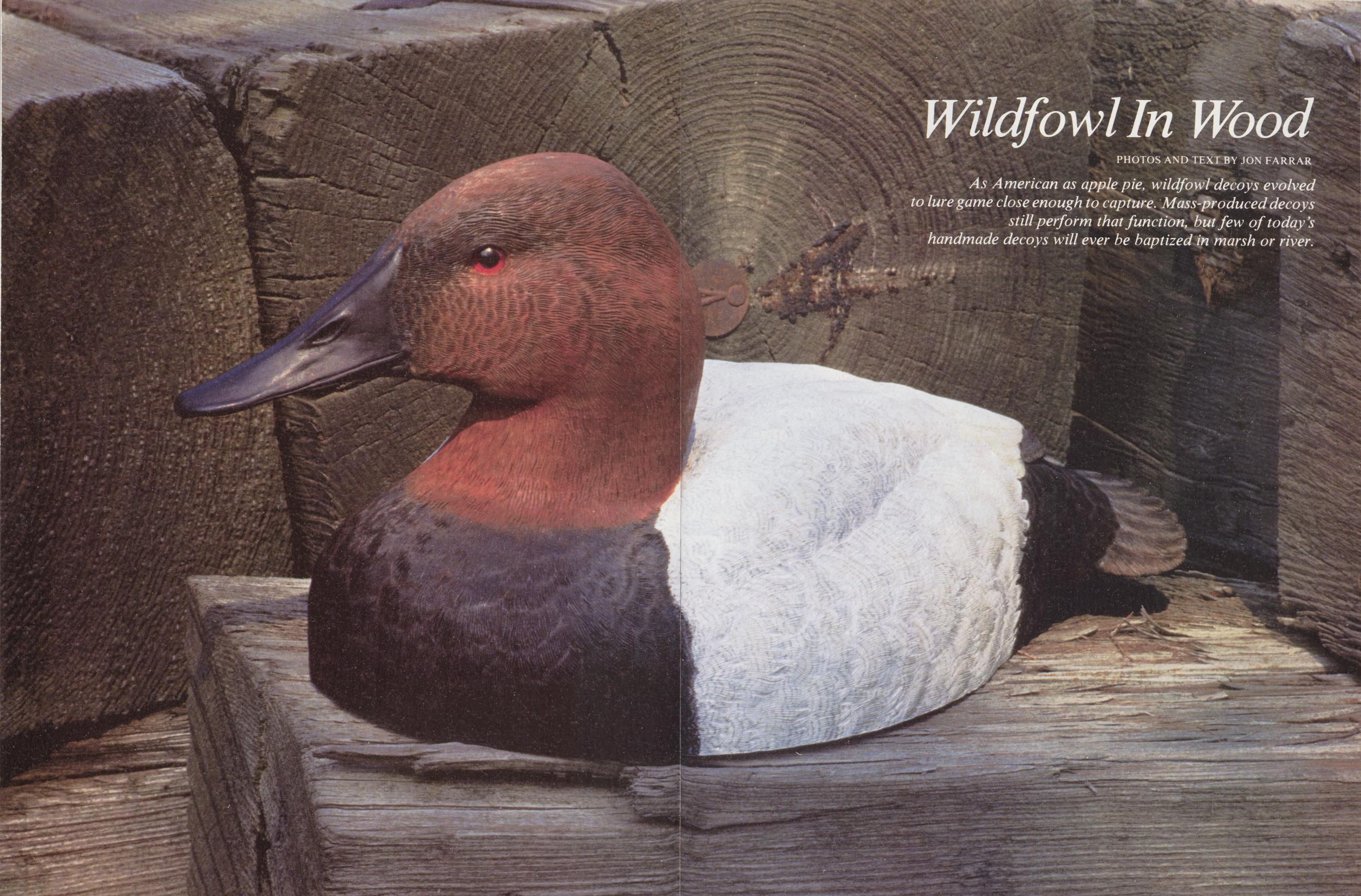
Wildfowl In Wood
PHOTOS AND TEXT BY JON FARRAR As American as apple pie, wildfowl decoys evolved to lure game close enough to capture. Mass-produced decoys still perform that function, but few of today's handmade decoys will ever be baptized in marsh or river.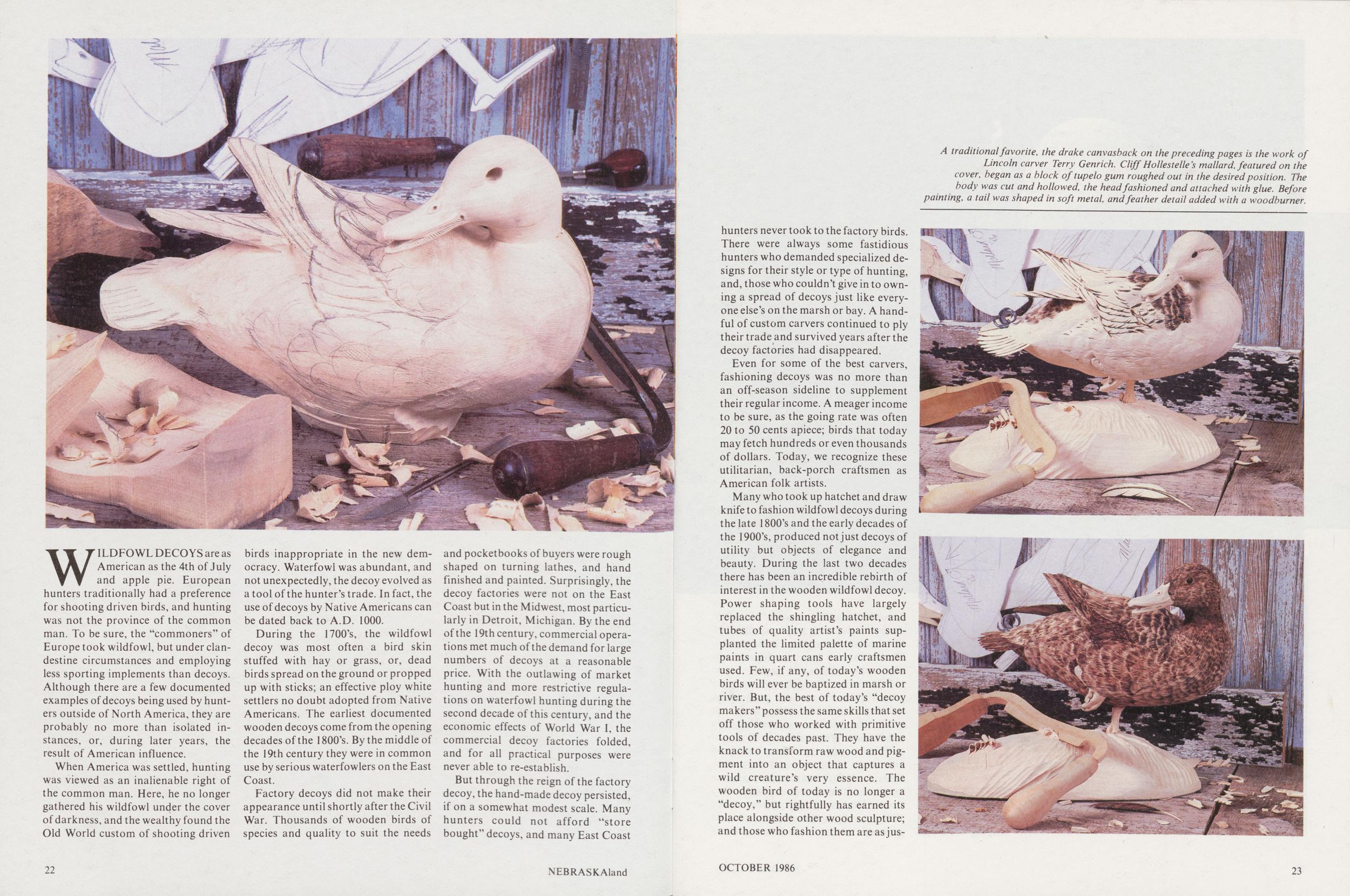
WILDFOWL DECOYS are as American as the 4th of July and apple pie. European hunters traditionally had a preference for shooting driven birds, and hunting was not the province of the common man. To be sure, the "commoners" of Europe took wildfowl, but under clandestine circumstances and employing less sporting implements than decoys. Although there are a few documented examples of decoys being used by hunters outside of North America, they are probably no more than isolated instances, or, during later years, the result of American influence.
When America was settled, hunting was viewed as an inalienable right of the common man. Here, he no longer gathered his wildfowl under the cover of darkness, and the wealthy found the Old World custom of shooting driven birds inappropriate in the new democracy. Waterfowl was abundant, and not unexpectedly, the decoy evolved as a tool of the hunter's trade. In fact, the use of decoys by Native Americans can be dated back to A.D. 1000.
During the 1700's, the wildfowl decoy was most often a bird skin stuffed with hay or grass, or, dead birds spread on the ground or propped up with sticks; an effective ploy white settlers no doubt adopted from Native Americans. The earliest documented wooden decoys come from the opening decades of the 1800's. By the middle of the 19th century they were in common use by serious waterfowlers on the East Coast.
Factory decoys did not make their appearance until shortly after the Civil War. Thousands of wooden birds of species and quality to suit the needs and pocketbooks of buyers were rough shaped on turning lathes, and hand finished and painted. Surprisingly, the decoy factories were not on the East Coast but in the Midwest, most particularly in Detroit, Michigan. By the end of the 19th century, commercial operations met much of the demand for large numbers of decoys at a reasonable price. With the outlawing of market hunting and more restrictive regulations on waterfowl hunting during the second decade of this century, and the economic effects of World War I, the commercial decoy factories folded, and for all practical purposes were never able to re-establish.
But through the reign of the factory decoy, the hand-made decoy persisted, if on a somewhat modest scale. Many hunters could not afford "store bought" decoys, and many East Coast 22 NEBRASKAland hunters never took to the factory birds. There were always some fastidious hunters who demanded specialized designs for their style or type of hunting, and, those who couldn't give in to owning a spread of decoys just like everyone else's on the marsh or bay. A handful of custom carvers continued to ply their trade and survived years after the decoy factories had disappeared.
Even for some of the best carvers, fashioning decoys was no more than an off-season sideline to supplement their regular income. A meager income to be sure, as the going rate was often 20 to 50 cents apiece; birds that today may fetch hundreds or even thousands of dollars. Today, we recognize these utilitarian, back-porch craftsmen as American folk artists.
Many who took up hatchet and draw knife to fashion wildfowl decoys during the late 1800's and the early decades of the 1900's, produced not just decoys of utility but objects of elegance and beauty. During the last two decades there has been an incredible rebirth of interest in the wooden wildfowl decoy. Power shaping tools have largely replaced the shingling hatchet, and tubes of quality artist's paints supplanted the limited palette of marine paints in quart cans early craftsmen used. Few, if any, of today's wooden birds will ever be baptized in marsh or river. But, the best of today's "decoy makers" possess the same skills that set off those who worked with primitive tools of decades past. They have the knack to transform raw wood and pigment into an object that captures a wild creature's very essence. The wooden bird of today is no longer a "decoy," but rightfully has earned its place alongside other wood sculpture; and those who fashion them are as just
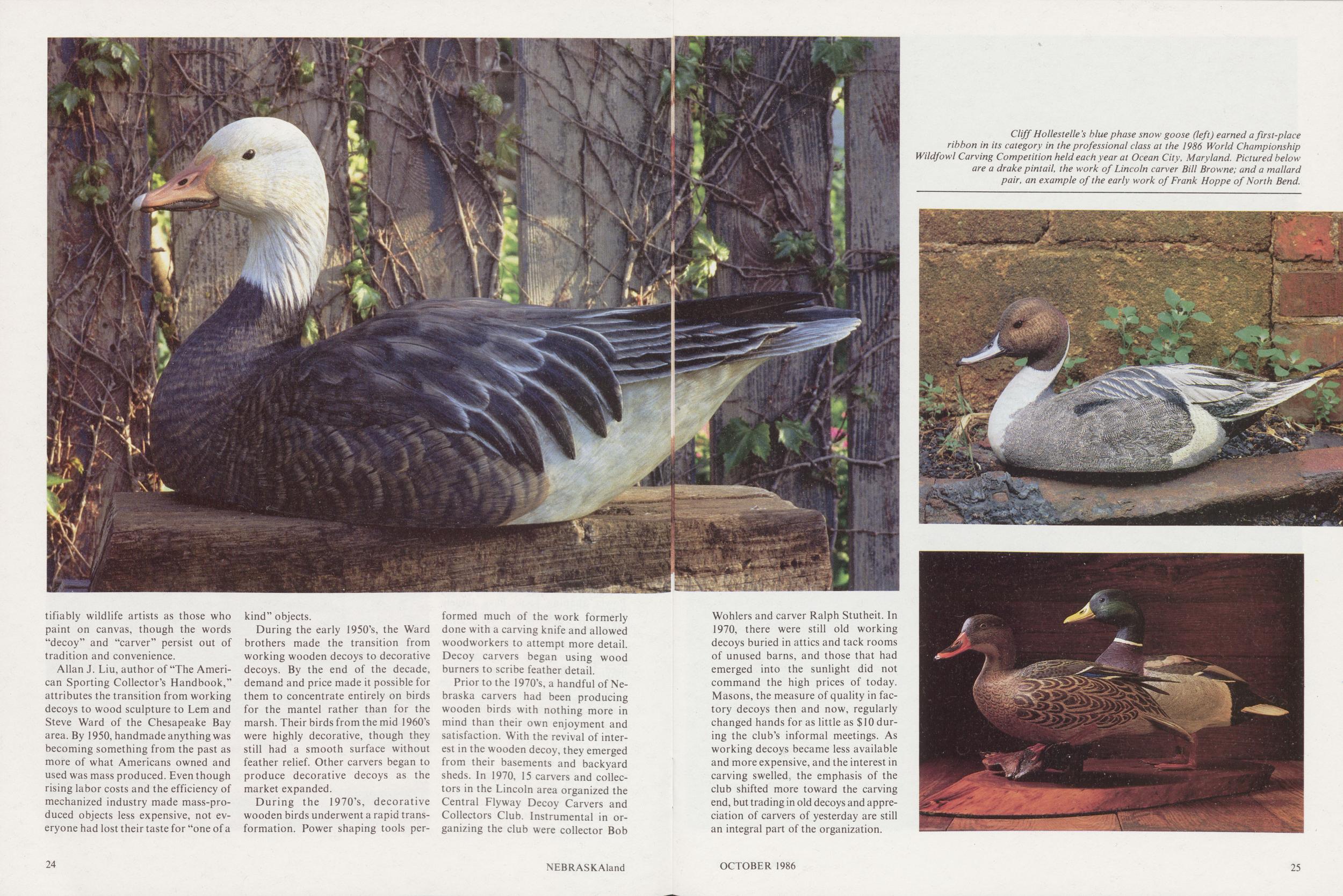
Allan J. Liu, author of "The American Sporting Collector's Handbook," attributes the transition from working decoys to wood sculpture to Lem and Steve Ward of the Chesapeake Bay area. By 1950, handmade anything was becoming something from the past as more of what Americans owned and used was mass produced. Even though rising labor costs and the efficiency of mechanized industry made mass-produced objects less expensive, not everyone had lost their taste for "one of a kind" objects.
During the early 1950's, the Ward brothers made the transition from working wooden decoys to decorative decoys. By the end of the decade, demand and price made it possible for them to concentrate entirely on birds for the mantel rather than for the marsh. Their birds from the mid 1960's were highly decorative, though they still had a smooth surface without feather relief. Other carvers began to produce decorative decoys as the market expanded.
During the 1970's, decorative wooden birds underwent a rapid transformation. Power shaping tools performed much of the work formerly done with a carving knife and allowed woodworkers to attempt more detail. Decoy carvers began using wood burners to scribe feather detail.
Prior to the 1970's, a handful of Nebraska carvers had been producing wooden birds with nothing more in mind than their own enjoyment and satisfaction. With the revival of interest in the wooden decoy, they emerged from their basements and backyard sheds. In 1970, 15 carvers and collectors in the Lincoln area organized the Central Flyway Decoy Carvers and Collectors Club. Instrumental in organizing the club were collector Bob 24 NEBRASKAland Wohlers and carver Ralph Stutheit. In 1970, there were still old working decoys buried in attics and tack rooms of unused barns, and those that had emerged into the sunlight did not command the high prices of today. Masons, the measure of quality in factory decoys then and now, regularly changed hands for as little as $10 during the club's informal meetings. As working decoys became less available and more expensive, and the interest in carving swelled, the emphasis of the club shifted more toward the carving end, but trading in old decoys and appreciation of carvers of yesterday are still an integral part of the organization.
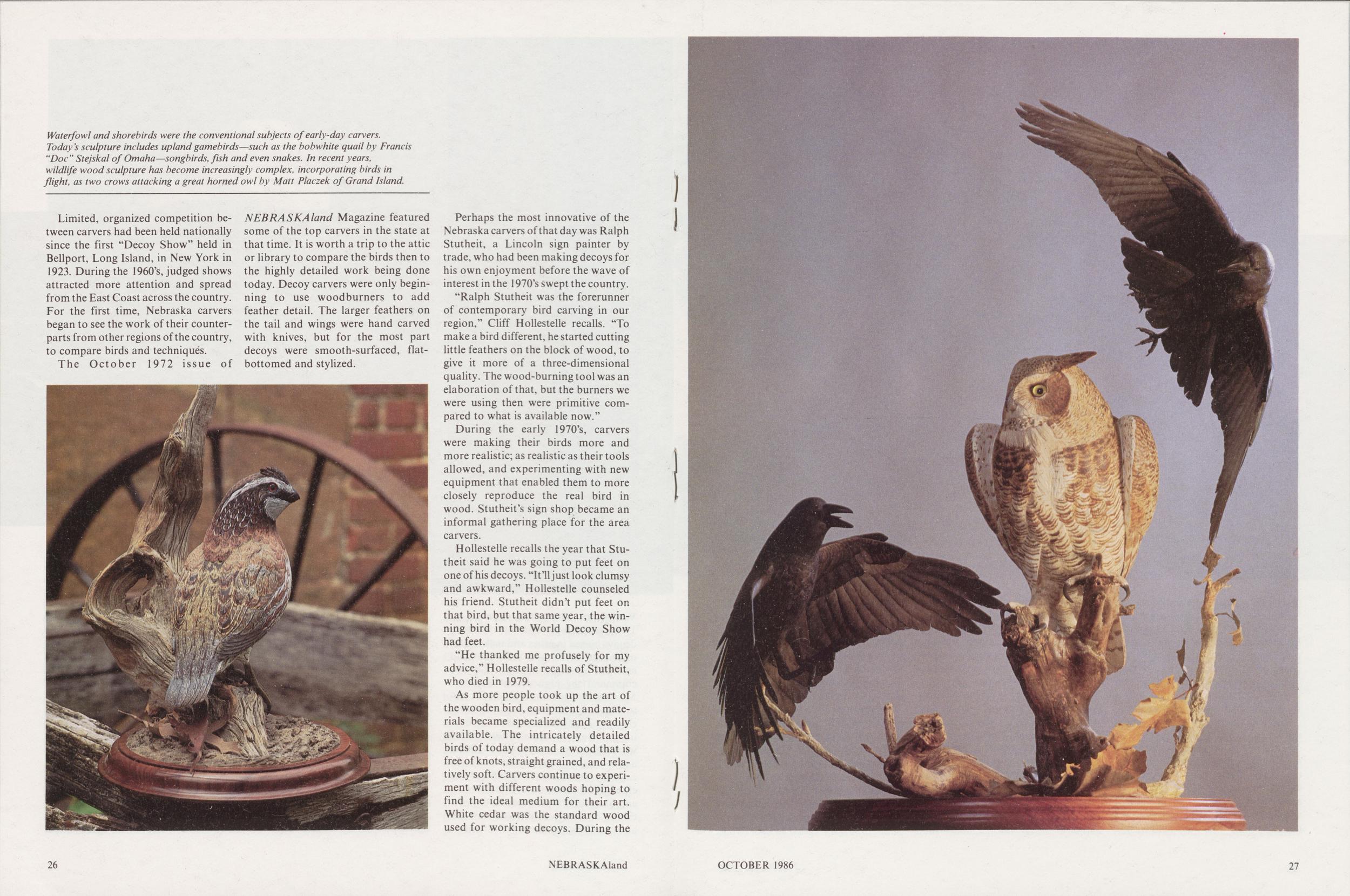
Limited, organized competition between carvers had been held nationally since the first "Decoy Show" held in Bellport, Long Island, in New York in 1923. During the 1960's, judged shows attracted more attention and spread from the East Coast across the country. For the first time, Nebraska carvers began to see the work of their counterparts from other regions of the country, to compare birds and techniques.
The October 1972 issue of NEBRASKAland Magazine featured some of the top carvers in the state at that time. It is worth a trip to the attic or library to compare the birds then to the highly detailed work being done today. Decoy carvers were only beginning to use woodburners to add feather detail. The larger feathers on the tail and wings were hand carved with knives, but for the most part decoys were smooth-surfaced, flat-bottomed and stylized.
Perhaps the most innovative of the Nebraska carvers of that day was Ralph Stutheit, a Lincoln sign painter by trade, who had been making decoys for his own enjoyment before the wave of interest in the 1970's swept the country.
"Ralph Stutheit was the forerunner of contemporary bird carving in our region," Cliff Hollestelle recalls. "To make a bird different, he started cutting little feathers on the block of wood, to give it more of a three-dimensional quality. The wood-burning tool was an elaboration of that, but the burners we were using then were primitive compared to what is available now."
During the early 1970's, carvers were making their birds more and more realistic; as realistic as their tools allowed, and experimenting with new equipment that enabled them to more closely reproduce the real bird in wood. Stutheit's sign shop became an informal gathering place for the area carvers.
Hollestelle recalls the year that Stutheit said he was going to put feet on one of his decoys. "It'll just look clumsy and awkward," Hollestelle counseled his friend. Stutheit didn't put feet on that bird, but that same year, the winning bird in the World Decoy Show had feet.
"He thanked me profusely for my advice," Hollestelle recalls of Stutheit, who died in 1979.
As more people took up the art of the wooden bird, equipment and materials became specialized and readily available. The intricately detailed birds of today demand a wood that is free of knots, straight grained, and relatively soft. Carvers continue to experiment with different woods hoping to find the ideal medium for their art. White cedar was the standard wood used for working decoys. During the 26 NEBRASKaland
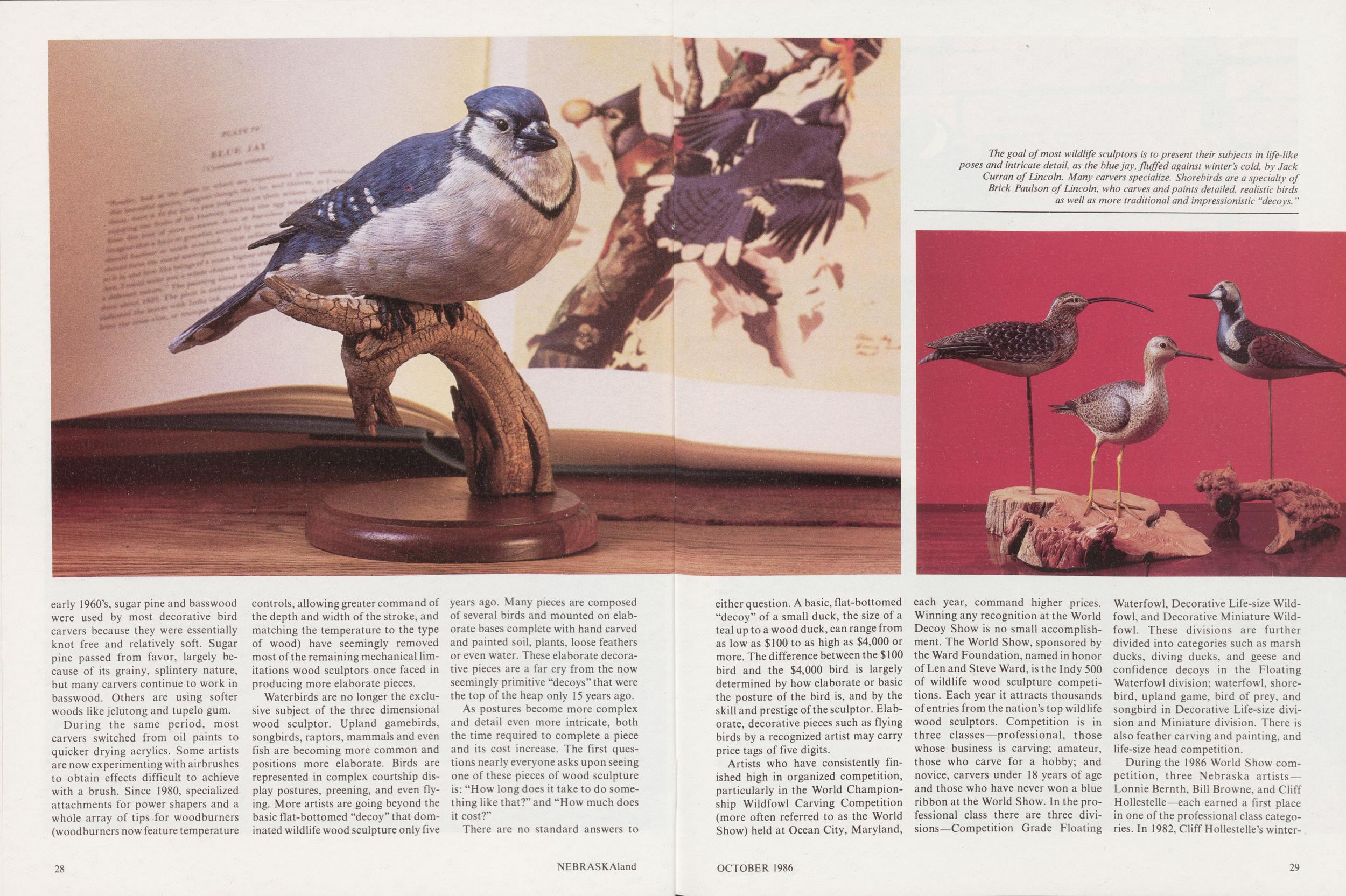
During the same period, most carvers switched from oil paints to quicker drying acrylics. Some artists are now experimenting with airbrushes to obtain effects difficult to achieve with a brush. Since 1980, specialized attachments for power shapers and a whole array of tips for woodburners (woodburners now feature temperature controls, allowing greater command of the depth and width of the stroke, and matching the temperature to the type of wood) have seemingly removed most of the remaining mechanical limitations wood sculptors once faced in producing more elaborate pieces.
Waterbirds are no longer the exclusive subject of the three dimensional wood sculptor. Upland gamebirds, songbirds, raptors, mammals and even fish are becoming more common and positions more elaborate. Birds are represented in complex courtship display postures, preening, and even flying. More artists are going beyond the basic flat-bottomed "decoy" that dominated wildlife wood sculpture only five years ago. Many pieces are composed of several birds and mounted on elaborate bases complete with hand carved and painted soil, plants, loose feathers or even water. These elaborate decorative pieces are a far cry from the now seemingly primitive "decoys" that were the top of the heap only 15 years ago.
As postures become more complex and detail even more intricate, both the time required to complete a piece and its cost increase. The first questions nearly everyone asks upon seeing one of these pieces of wood sculpture is: "How long does it take to do something like that?" and "How much does it cost?"
There are no standard answers to 28 NEBRASKAland either question. A basic, flat-bottomed "decoy" of a small duck, the size of a teal up to a wood duck, can range from as low as $100 to as high as $4,000 or more. The difference between the $100 bird and the $4,000 bird is largely determined by how elaborate or basic the posture of the bird is, and by the skill and prestige of the sculptor. Elaborate, decorative pieces such as flying birds by a recognized artist may carry price tags of five digits.
Artists who have consistently finished high in organized competition, particularly in the World Championship Wildfowl Carving Competition (more often referred to as the World Show) held at Ocean City, Maryland, each year, command higher prices. Winning any recognition at the World Decoy Show is no small accomplishment. The World Show, sponsored by the Ward Foundation, named in honor of Len and Steve Ward, is the Indy 500 of wildlife wood sculpture competitions. Each year it attracts thousands of entries from the nation's top wildlife wood sculptors. Competition is in three classes—professional, those whose business is carving; amateur, those who carve for a hobby; and novice, carvers under 18 years of age and those who have never won a blue ribbon at the World Show. In the professional class there are three divisions—Competition Grade Floating Waterfowl, Decorative Life-size Wildfowl, and Decorative Miniature Wildfowl. These divisions are further divided into categories such as marsh ducks, diving ducks, and geese and confidence decoys in the Floating Waterfowl division; waterfowl, shorebird, upland game, bird of prey, and songbird in Decorative Life-size division and Miniature division. There is also feather carving and painting, and life-size head competition.
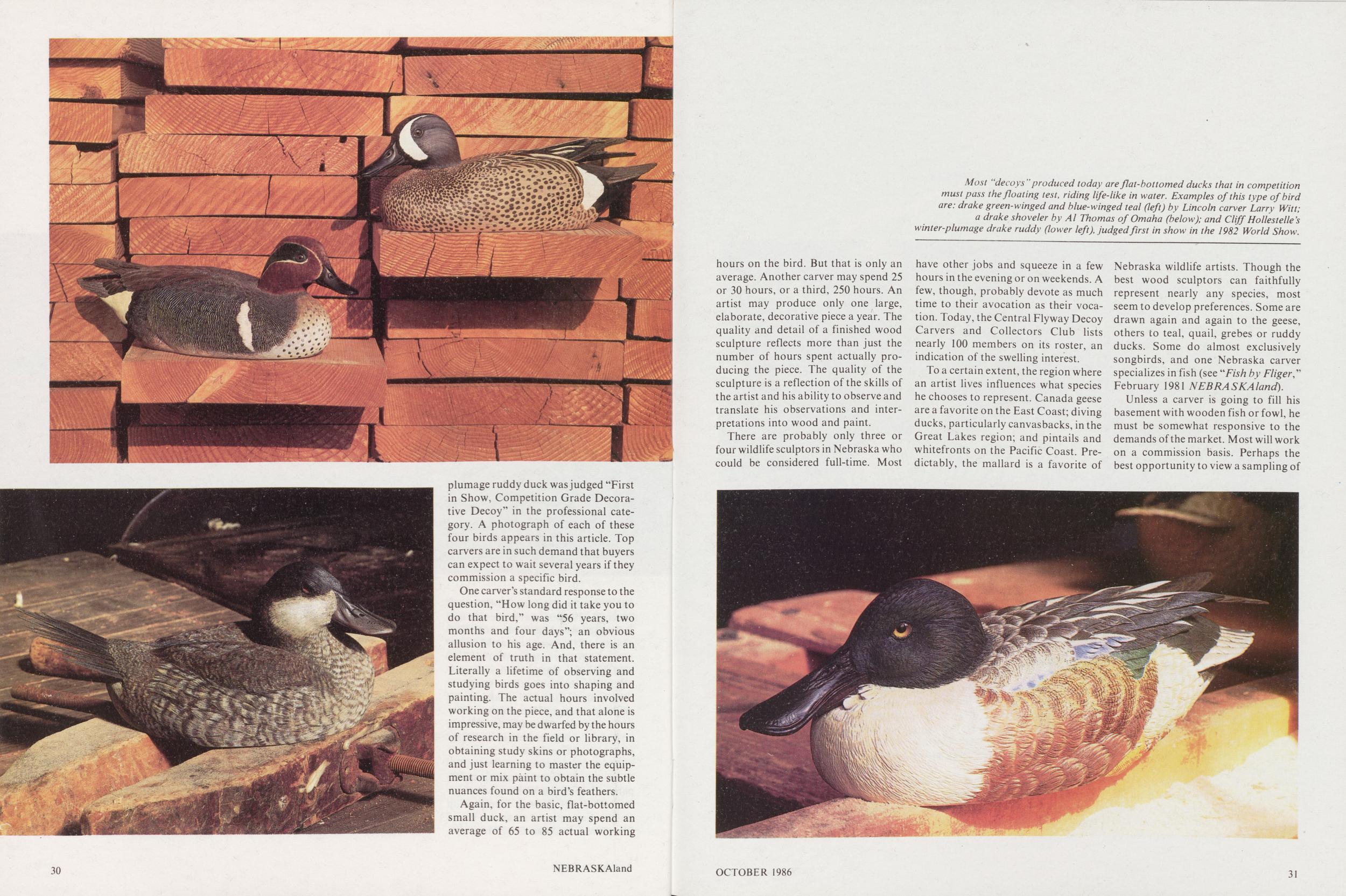
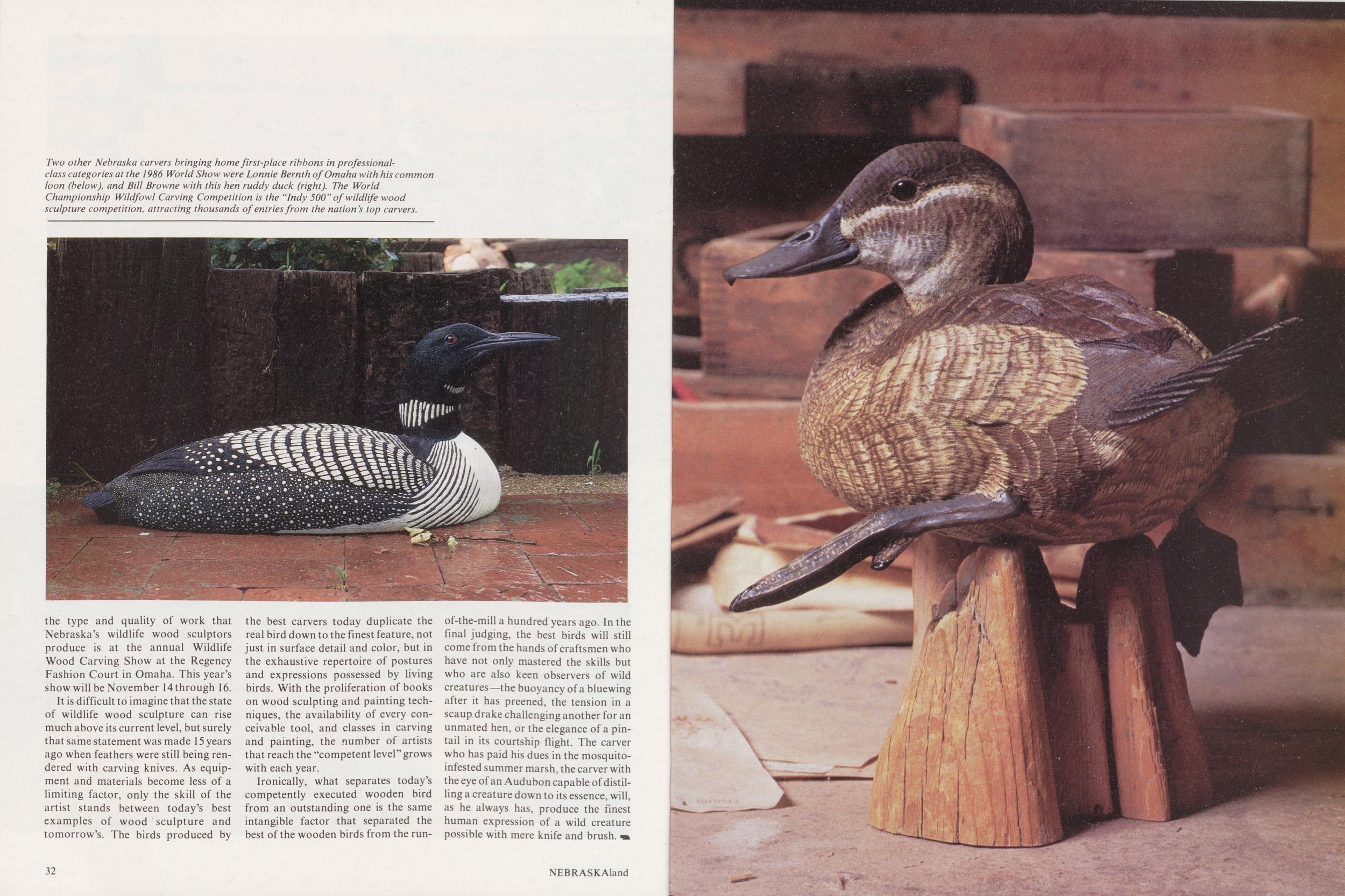
During the 1986 World Show competition, three Nebraska artists
Lonnie Bernth, Bill Browne, and Cliff
Hollestelle—each earned a first place
in one of the professional class categories. In 1982, Cliff Hollestelle's winter
OCTOBER 1986
29
One carver's standard response to the question, "How long did it take you to do that bird," was "56 years, two months and four days"; an obvious allusion to his age. And, there is an element of truth in that statement. Literally a lifetime of observing and studying birds goes into shaping and painting. The actual hours involved working on the piece, and that alone is impressive, may be dwarfed by the hours of research in the field or library, in obtaining study skins or photographs, and just learning to master the equipment or mix paint to obtain the subtle nuances found on a bird's feathers.
Again, for the basic, flat-bottomed small duck, an artist may spend an average of 65 to 85 actual working 30 NEBRASKAland hours on the bird. But that is only an average. Another carver may spend 25 or 30 hours, or a third, 250 hours. An artist may produce only one large, elaborate, decorative piece a year. The quality and detail of a finished wood sculpture reflects more than just the number of hours spent actually producing the piece. The quality of the sculpture is a reflection of the skills of the artist and his ability to observe and translate his observations and interpretations into wood and paint.
There are probably only three or four wildlife sculptors in Nebraska who could be considered full-time. Most have other jobs and squeeze in a few hours in the evening or on weekends. A few, though, probably devote as much time to their avocation as their vocation. Today, the Central Flyway Decoy Carvers and Collectors Club lists nearly 100 members on its roster, an indication of the swelling interest.
To a certain extent, the region where an artist lives influences what species he chooses to represent. Canada geese are a favorite on the East Coast; diving ducks, particularly canvasbacks, in the Great Lakes region; and pintails and whitefronts on the Pacific Coast. Predictably, the mallard is a favorite of Nebraska wildlife artists. Though the best wood sculptors can faithfully represent nearly any species, most seem to develop preferences. Some are drawn again and again to the geese, others to teal, quail, grebes or ruddy ducks. Some do almost exclusively songbirds, and one Nebraska carver specializes in fish (see "Fish by Fligerf February 1981 NEBRASKAland).
Unless a carver is going to fill his basement with wooden fish or fowl, he must be somewhat responsive to the demands of the market. Most will work on a commission basis. Perhaps the best opportunity to view a sampling of
It is difficult to imagine that the state of wildlife wood sculpture can rise much above its current level, but surely that same statement was made 15 years ago when feathers were still being rendered with carving knives. As equipment and materials become less of a limiting factor, only the skill of the artist stands between today's best examples of wood sculpture and tomorrow's. The birds produced by the best carvers today duplicate the real bird down to the finest feature, not just in surface detail and color, but in the exhaustive repertoire of postures and expressions possessed by living birds. With the proliferation of books on wood sculpting and painting techniques, the availability of every conceivable tool, and classes in carving and painting, the number of artists that reach the "competent level" grows with each year.
Ironically, what separates today's competently executed wooden bird from an outstanding one is the same intangible factor that separated the best of the wooden birds from the runof-the-mill a hundred years ago. In the final judging, the best birds will still come from the hands of craftsmen who have not only mastered the skills but who are also keen observers of wild creatures—the buoyancy of a bluewing after it has preened, the tension in a scaup drake challenging another for an unmated hen, or the elegance of a pintail in its courtship flight. The carver who has paid his dues in the mosquitoinfested summer marsh, the carver with the eye of an Audubon capable of distilling a creature down to its essence, will, as he always has, produce the finest human expression of a wild creature possible with mere knife and brush.
32 NEBRASKAland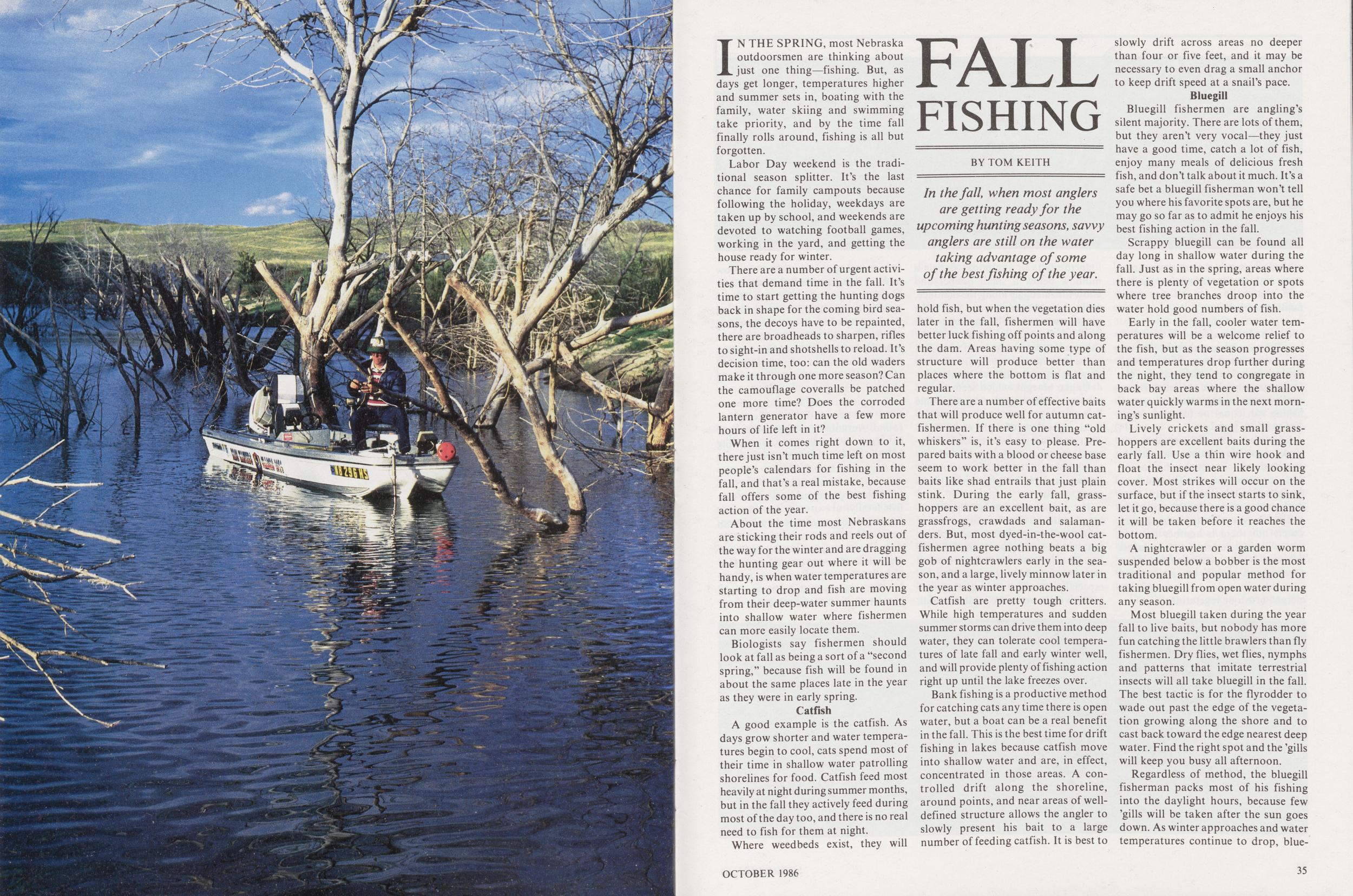
FALL FISHING
BY TOM KEITH In the fall when most anglers are getting ready for the upcoming hunting seasons, savvy anglers are still on the water taking advantage of some ofthe best fishing ofthe year.IN THE SPRING, most Nebraska outdoorsmen are thinking about just one thing—fishing. But, as days get longer, temperatures higher and summer sets in, boating with the family, water skiing and swimming take priority, and by the time fall finally rolls around, fishing is all but forgotten.
Labor Day weekend is the traditional season splitter. It's the last chance for family campouts because following the holiday, weekdays are taken up by school, and weekends are devoted to watching football games, working in the yard, and getting the house ready for winter.
There are a number of urgent activities that demand time in the fall. It's time to start getting the hunting dogs back in shape for the coming bird seasons, the decoys have to be repainted, there are broadheads to sharpen, rifles to sight-in and shotshells to reload. It's decision time, too: can the old waders make it through one more season? Can the camouflage coveralls be patched one more time? Does the corroded lantern generator have a few more hours of life left in it?
When it comes right down to it, there just isn't much time left on most people's calendars for fishing in the fall, and that's a real mistake, because fall offers some of the best fishing action of the year.
About the time most Nebraskans are sticking their rods and reels out of the way for the winter and are dragging the hunting gear out where it will be handy, is when water temperatures are starting to drop and fish are moving from their deep-water summer haunts into shallow water where fishermen can more easily locate them.
Biologists say fishermen should look at fall as being a sort of a "second spring," because fish will be found in about the same places late in the year as they were in early spring.
CatfishA good example is the catfish. As days grow shorter and water temperatures begin to cool, cats spend most of their time in shallow water patrolling shorelines for food. Catfish feed most heavily at night during summer months, but in the fall they actively feed during most ofthe day too, and there is no real need to fish for them at night.
Where weedbeds exist, they will hold fish, but when the vegetation dies later in the fall, fishermen will have better luck fishing off points and along the dam. Areas having some type of structure will produce better than places where the bottom is flat and regular.
There are a number of effective baits that will produce well for autumn catfishermen. If there is one thing "old whiskers" is, it's easy to please. Prepared baits with a blood or cheese base seem to work better in the fall than baits like shad entrails that just plain stink. During the early fall, grasshoppers are an excellent bait, as are grassfrogs, crawdads and salamanders. But, most dyed-in-the-wool catfishermen agree nothing beats a big gob of nightcrawlers early in the season, and a large, lively minnow later in the year as winter approaches.
Catfish are pretty tough critters. While high temperatures and sudden summer storms can drive them into deep water, they can tolerate cool temperatures of late fall and early winter well, and will provide plenty of fishing action right up until the lake freezes over.
Bank fishing is a productive method for catching cats any time there is open water, but a boat can be a real benefit in the fall. This is the best time for drift fishing in lakes because catfish move into shallow water and are, in effect, concentrated in those areas. A controlled drift along the shoreline, around points, and near areas of welldefined structure allows the angler to slowly present his bait to a large number of feeding catfish. It is best to slowly drift across areas no deeper than four or five feet, and it may be necessary to even drag a small anchor to keep drift speed at a snail's pace.
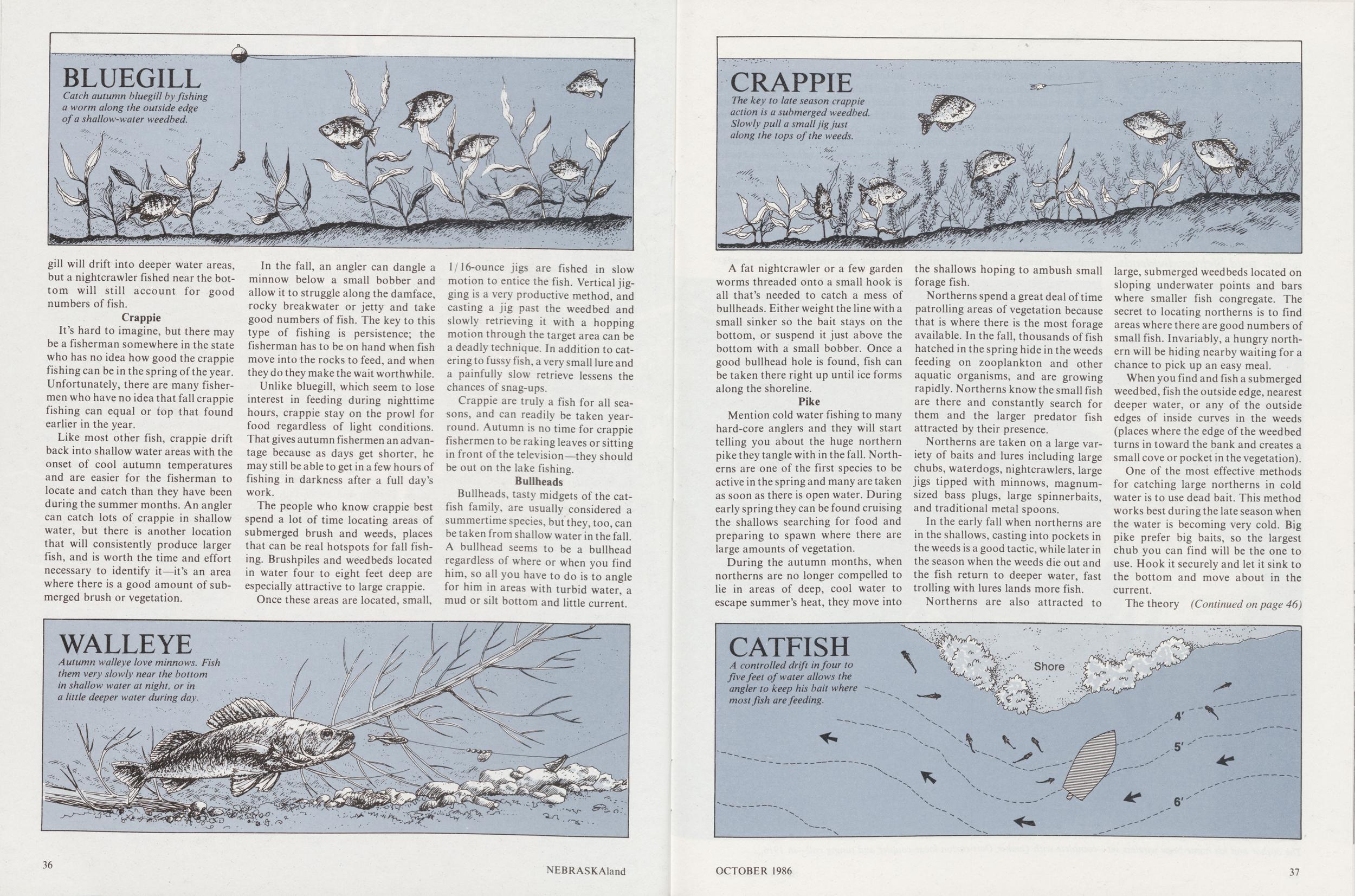
BluegillBluegill fishermen are angling's silent majority. There are lots of them, but they aren't very vocal—they just have a good time, catch a lot of fish, enjoy many meals of delicious fresh fish, and don't talk about it much. It's a safe bet a bluegill fisherman won't tell you where his favorite spots are, but he may go so far as to admit he enjoys his best fishing action in the fall.
Scrappy bluegill can be found all day long in shallow water during the fall. Just as in the spring, areas where there is plenty of vegetation or spots where tree branches droop into the water hold good numbers of fish.
Early in the fall, cooler water temperatures will be a welcome relief to the fish, but as the season progresses and temperatures drop further during the night, they tend to congregate in back bay areas where the shallow water quickly warms in the next morning's sunlight.
Lively crickets and small grasshoppers are excellent baits during the early fall. Use a thin wire hook and float the insect near likely looking cover. Most strikes will occur on the surface, but if the insect starts to sink, let it go, because there is a good chance it will be taken before it reaches the bottom.
A nightcrawler or a garden worm suspended below a bobber is the most traditional and popular method for taking bluegill from open water during any season.
Most bluegill taken during the year fall to live baits, but nobody has more fun catching the little brawlers than fly fishermen. Dry flies, wet flies, nymphs and patterns that imitate terrestrial insects will all take bluegill in the fall. The best tactic is for the flyrodder to wade out past the edge of the vegetation growing along the shore and to cast back toward the edge nearest deep water. Find the right spot and the 'gills will keep you busy all afternoon.
Regardless of method, the bluegill
fisherman packs most of his fishing
into the daylight hours, because few
'gills will be taken after the sun goes
down. As winter approaches and water
temperatures continue to drop, bluegill
OCTOBER 1986
35
It's hard to imagine, but there may be a fisherman somewhere in the state who has no idea how good the crappie fishing can be in the spring of the year. Unfortunately, there are many fishermen who have no idea that fall crappie fishing can equal or top that found earlier in the year.
Like most other fish, crappie drift back into shallow water areas with the onset of cool autumn temperatures and are easier for the fisherman to locate and catch than they have been during the summer months. An angler can catch lots of crappie in shallow water, but there is another location that will consistently produce larger fish, and is worth the time and effort necessary to identify it—it's an area where there is a good amount of submerged brush or vegetation.
In the fall, an angler can dangle a minnow below a small bobber and allow it to struggle along the damface, rocky breakwater or jetty and take good numbers of fish. The key to this type of fishing is persistence; the fisherman has to be on hand when fish move into the rocks to feed, and when they do they make the wait worthwhile.
Unlike bluegill, which seem to lose interest in feeding during nighttime hours, crappie stay on the prowl for food regardless of light conditions. That gives autumn fishermen an advantage because as days get shorter, he may still be able to get in a few hours of fishing in darkness after a full day's work.
The people who know crappie best spend a lot of time locating areas of submerged brush and weeds, places that can be real hotspots for fall fishing. Brushpiles and weedbeds located in water four to eight feet deep are especially attractive to large crappie.
Once these areas are located, small, 1/16-ounce jigs are fished in slow motion to entice the fish. Vertical jigging is a very productive method, and casting a jig past the weedbed and slowly retrieving it with a hopping motion through the target area can be a deadly technique. In addition to catering to fussy fish, a very small lure and a painfully slow retrieve lessens the chances of snag-ups.
Crappie are truly a fish for all seasons, and can readily be taken year round. Autumn is no time for crappie fishermen to be raking leaves or sitting in front of the television—they should be out on the lake fishing.
BullheadsBullheads, tasty midgets of the catfish family, are usually considered a summertime species, but they, too, can be taken from shallow water in the fall. A bullhead seems to be a bullhead regardless of where or when you find him, so all you have to do is to angle for him in areas with turbid water, a mud or silt bottom and little current.
A fat nightcrawler or a few garden worms threaded onto a small hook is all that's needed to catch a mess of bullheads. Either weight the line with a small sinker so the bait stays on the bottom, or suspend it just above the bottom with a small bobber. Once a good bullhead hole is found, fish can be taken there right up until ice forms along the shoreline.
PikeMention cold water fishing to many hard-core anglers and they will start telling you about the huge northern pike they tangle with in the fall. Northerns are one of the first species to be active in the spring and many are taken as soon as there is open water. During early spring they can be found cruising the shallows searching for food and preparing to spawn where there are large amounts of vegetation.
During the autumn months, when northerns are no longer compelled to lie in areas of deep, cool water to escape summer's heat, they move into the shallows hoping to ambush small forage fish.
Northerns spend a great deal of time patrolling areas of vegetation because that is where there is the most forage available. In the fall, thousands offish hatched in the spring hide in the weeds feeding on zooplankton and other aquatic organisms, and are growing rapidly. Northerns know the small fish are there and constantly search for them and the larger predator fish attracted by their presence.
Northerns are taken on a large variety of baits and lures including large chubs, waterdogs, nightcrawlers, large jigs tipped with minnows, magnumsized bass plugs, large spinnerbaits, and traditional metal spoons.
In the early fall when northerns are in the shallows, casting into pockets in the weeds is a good tactic, while later in the season when the weeds die out and the fish return to deeper water, fast trolling with lures lands more fish.
Northerns are also attracted to large, submerged weedbeds located on sloping underwater points and bars where smaller fish congregate. The secret to locating northerns is to find areas where there are good numbers of small fish. Invariably, a hungry northern will be hiding nearby waiting for a chance to pick up an easy meal.
When you find and fish a submerged weedbed, fish the outside edge, nearest deeper water, or any of the outside edges of inside curves in the weeds (places where the edge of the weedbed turns in toward the bank and creates a small cove or pocket in the vegetation).
One of the most effective methods for catching large northerns in cold water is to use dead bait. This method works best during the late season when the water is becoming very cold. Big pike prefer big baits, so the largest chub you can find will be the one to use. Hook it securely and let it sink to the bottom and move about in the current.
The theory (Continued on page 46)
My Career as an Engineer
BY JIM WILSON A Polk reader recalls how youth in the "benighted dark ages"before TV, paid lifelong dividends.GRANDPA HAD longed, as a boy, to be an engineer. But after three years in the Union Army and successive trial runs as a Nebraska homesteader, Methodist circuit rider, and editor of three country newspapers, he had ended up as manager of the Stromsburg grain elevator for his brother-in-law, whom he drove to madness by writing farmers' grainpayment checks to the even dollar, with the odd cents in cash or postage stamps, making it impossible to balance the books. But nobody really minded. He was a one-of-a-kind original and we loved him. When I displayed a modicum of skill at oiling the wheels of my tricycle, the whole family hung his dream of being an engineer on me.
But what kind of an engineer? Like the gypsy mother who places a violin and a purse beside her baby's crib, to offer him the choice between fiddler and thief, they made sure that I, the only child in the extended family, had every opportunity to discover my natural bent.
When I assembled a 25-car freight train out of boards and wooden packing
When I dismantled the train and built an eight-room mansion out of it in the depths of our orchard, they said, "The dear little fellow—he's going to be an architectural engineer."
Wrong. All I wanted was a private hide-out where my pals and I could smoke cornsilk cigarets and consume, without fear of discovery, the bottles of ginger ale I swiped from the family supply in the icebox in the basement.
That Christmas, Grandpa vicariously furthered his youthful ambition by giving me a Weeden toy steam engine 10 inches high, and a miniature belt-driven machine shop with a tiny trip-hammer, drill press, emery wheel and buzz saw. The engine even had a whistle. When you blew it, everything stopped until the boiler built up steam again. The source of heat was a little alcohol lamp.
From that engine, I learned the first principle of mechanical engineering, which is that the operator of a steam power plant should never bend too close over a lighted alcohol lamp while trimming the wick. My mother impressed this on me after she rushed into my playroom with a pail of water to put out my hair.
For some time after, I confined myself to exploiting the potential of a reliable alternative, non-wasting, nonpolluting power source approved by the Fire Underwriters Laboratory, namely rubber bands.
I made rubber-band-powered paddleboats, racing cars, a jumping frog, and an airplane that wouldn't fly, to say nothing of such deadly weapons as bean-shooters and a powerful slingshot with which I shattered a henhouse window while stalking sparrows.
I also made a water turbine with wooden paddles, from which I piped the tail-water into the bathtub until our cesspool filled up and overflowed, imparting to the back yard a rich and heady fragrance.
With my career as a hydraulics engineer thus aborted, I again turned my attention to aeronautical engineering, which I had given up when my rubberband-powered airplane failed to fly. Despite this setback, the family had remained convinced that I was destined to play a significant role in Man's developing conquest of the air.
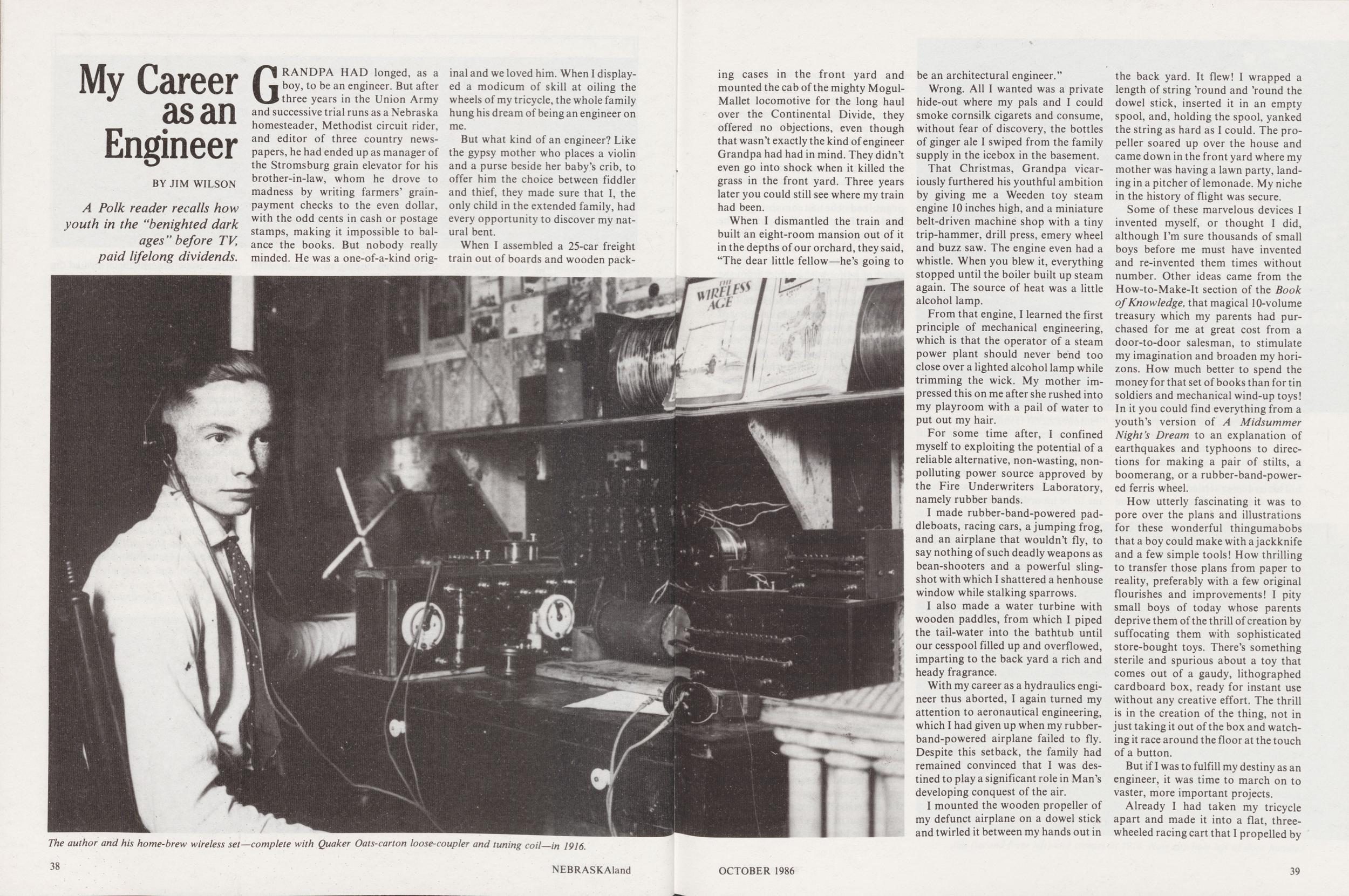
I mounted the wooden propeller of my defunct airplane on a dowel stick and twirled it between my hands out in The author and his home-brew wireless set—complete with Quaker Oats-carton loose-coupler and tuning coil—in 1916. the back yard. It flew! I wrapped a length of string 'round and 'round the dowel stick, inserted it in an empty spool, and, holding the spool, yanked the string as hard as I could. The propeller soared up over the house and came down in the front yard where my mother was having a lawn party, landing in a pitcher of lemonade. My niche in the history of flight was secure.
Some of these marvelous devices I invented myself, or thought I did, although I'm sure thousands of small boys before me must have invented and re-invented them times without number. Other ideas came from the How-to-Make-It section of the Book of Knowledge, that magical 10-volume treasury which my parents had purchased for me at great cost from a door-to-door salesman, to stimulate my imagination and broaden my horizons. How much better to spend the money for that set of books than for tin soldiers and mechanical wind-up toys! In it you could find everything from a youth's version of A Midsummer Nights Dream to an explanation of earthquakes and typhoons to directions for making a pair of stilts, a boomerang, or a rubber-band-powered ferris wheel.
How utterly fascinating it was to pore over the plans and illustrations for these wonderful thingumabobs that a boy could make with a jackknife and a few simple tools! How thrilling to transfer those plans from paper to reality, preferably with a few original flourishes and improvements! I pity small boys of today whose parents deprive them of the thrill of creation by suffocating them with sophisticated store-bought toys. There's something sterile and spurious about a toy that comes out of a gaudy, lithographed cardboard box, ready for instant use without any creative effort. The thrill is in the creation of the thing, not in just taking it out of the box and watching it race around the floor at the touch of a button.
But if I was to fulfill my destiny as an engineer, it was time to march on to vaster, more important projects.
Already I had taken my tricycle
apart and made it into a flat, threewheeled racing cart that I propelled by
OCTOBER 1986
39
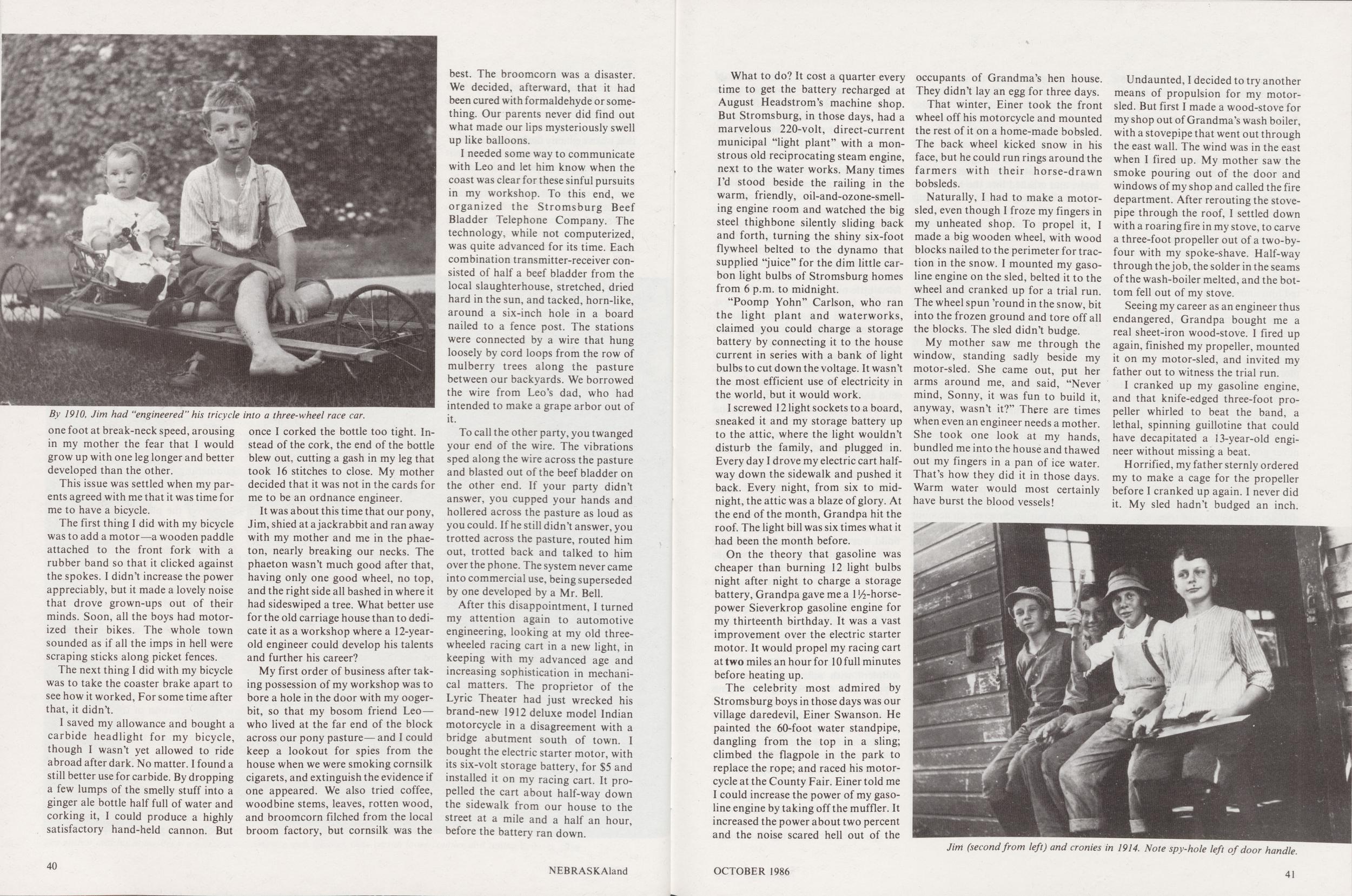
This issue was settled when my parents agreed with me that it was time for me to have a bicycle.
The first thing I did with my bicycle was to add a motor—a wooden paddle attached to the front fork with a rubber band so that it clicked against the spokes. I didn't increase the power appreciably, but it made a lovely noise that drove grown-ups out of their minds. Soon, all the boys had motorized their bikes. The whole town sounded as if all the imps in hell were scraping sticks along picket fences.
The next thing I did with my bicycle was to take the coaster brake apart to see how it worked, For some time after that, it didn't.
I saved my allowance and bought a carbide headlight for my bicycle, though I wasn't yet allowed to ride abroad after dark. No matter. I found a still better use for carbide. By dropping a few lumps of the smelly stuff into a ginger ale bottle half full of water and corking it, I could produce a highly satisfactory hand-held cannon. But once I corked the bottle too tight. Instead of the cork, the end of the bottle blew out, cutting a gash in my leg that took 16 stitches to close. My mother decided that it was not in the cards for me to be an ordnance engineer.
It was about this time that our pony, Jim, shied at a jackrabbit and ran away with my mother and me in the phaeton, nearly breaking our necks. The phaeton wasn't much good after that, having only one good wheel, no top, and the right side all bashed in where it had sideswiped a tree. What better use for the old carriage house than to dedicate it as a workshop where a 12-year-old engineer could develop his talents and further his career?
My first order of business after taking possession of my workshop was to bore a hole in the door with my oogerbit, so that my bosom friend Leo who lived at the far end of the block across our pony pasture— and I could keep a lookout for spies from the house when we were smoking cornsilk cigarets, and extinguish the evidence if one appeared. We also tried coffee, woodbine stems, leaves, rotten wood, and broomcorn filched from the local broom factory, but cornsilk was the best. The broomcorn was a disaster. We decided, afterward, that it had been cured with formaldehyde or something. Our parents never did find out what made our lips mysteriously swell up like balloons.
I needed some way to communicate with Leo and let him know when the coast was clear for these sinful pursuits in my workshop. To this end, we organized the Stromsburg Beef Bladder Telephone Company. The technology, while not computerized, was quite advanced for its time. Each combination transmitter-receiver consisted of half a beef bladder from the local slaughterhouse, stretched, dried hard in the sun, and tacked, horn-like, around a six-inch hole in a board nailed to a fence post. The stations were connected by a wire that hung loosely by cord loops from the row of mulberry trees along the pasture between our backyards. We borrowed the wire from Leo's dad, who had intended to make a grape arbor out of it.
To call the other party, you twanged your end of the wire. The vibrations sped along the wire across the pasture and blasted out of the beef bladder on the other end. If your party didn't answer, you cupped your hands and hollered across the pasture as loud as you could. If he still didn't answer, you trotted across the pasture, routed him out, trotted back and talked to him over the phone. The system never came into commercial use, being superseded by one developed by a Mr. Bell.
After this disappointment, I turned my attention again to automotive engineering, looking at my old threewheeled racing cart in a new light, in keeping with my advanced age and increasing sophistication in mechanical matters. The proprietor of the Lyric Theater had just wrecked his brand-new 1912 deluxe model Indian motorcycle in a disagreement with a bridge abutment south of town. I bought the electric starter motor, with its six-volt storage battery, for $5 and installed it on my racing cart. It propelled the cart about half-way down the sidewalk from our house to the street at a mile and a half an hour, before the battery ran down.
40 NEBRASKAlandWhat to do? It cost a quarter every time to get the battery recharged at August Headstrom's machine shop. But Stromsburg, in those days, had a marvelous 220-volt, direct-current municipal "light plant" with a monstrous old reciprocating steam engine, next to the water works. Many times I'd stood beside the railing in the warm, friendly, oil-and-ozone-smelling engine room and watched the big steel thighbone silently sliding back and forth, turning the shiny six-foot flywheel belted to the dynamo that supplied "juice" for the dim little carbon light bulbs of Stromsburg homes from 6 p.m. to midnight.
"Poomp Yohn" Carlson, who ran the light plant and waterworks, claimed you could charge a storage battery by connecting it to the house current in series with a bank of light bulbs to cut down the voltage. It wasn't the most efficient use of electricity in the world, but it would work.
I screwed 12 light sockets to a board, sneaked it and my storage battery up to the attic, where the light wouldn't disturb the family, and plugged in. Every day I drove my electric cart halfway down the sidewalk and pushed it back. Every night, from six to midnight, the attic was a blaze of glory. At the end of the month, Grandpa hit the roof. The light bill was six times what it had been the month before.
On the theory that gasoline was cheaper than burning 12 light bulbs night after night to charge a storage battery, Grandpa gave me a 1 horsepower Sieverkrop gasoline engine for my thirteenth birthday. It was a vast improvement over the electric starter motor. It would propel my racing cart at two miles an hour for 10 full minutes before heating up.
The celebrity most admired by Stromsburg boys in those days was our village daredevil, Einer Swanson. He painted the 60-foot water standpipe, dangling from the top in a sling; climbed the flagpole in the park to replace the rope; and raced his motorcycle at the County Fair. Einer told me I could increase the power of my gasoline engine by taking off the muffler. It increased the power about two percent and the noise scared hell out of the occupants of Grandma's hen house. They didn't lay an egg for three days.
That winter, Einer took the front wheel off his motorcycle and mounted the rest of it on a home-made bobsled. The back wheel kicked snow in his face, but he could run rings around the farmers with their horse-drawn bobsleds.
Naturally, I had to make a motorsled, even though I froze my fingers in my unheated shop. To propel it, I made a big wooden wheel, with wood blocks nailed to the perimeter for traction in the snow. I mounted my gasoline engine on the sled, belted it to the wheel and cranked up for a trial run. The wheel spun 'round in the snow, bit into the frozen ground and tore off all the blocks. The sled didn't budge.
My mother saw me through the window, standing sadly beside my motor-sled. She came out, put her arms around me, and said, "Never mind, Sonny, it was fun to build it, anyway, wasn't it?" There are times when even an engineer needs a mother. She took one look at my hands, bundled me into the house and thawed out my fingers in a pan of ice water. That's how they did it in those days. Warm water would most certainly have burst the blood vessels!
Undaunted, I decided to try another means of propulsion for my motorsled. But first I made a wood-stove for my shop out of Grandma's wash boiler, with a stovepipe that went out through the east wall. The wind was in the east when I fired up. My mother saw the smoke pouring out of the door and windows of my shop and called the fire department. After rerouting the stovepipe through the roof, I settled down with a roaring fire in my stove, to carve a three-foot propeller out of a two-by-four with my spoke-shave. Half-way through the job, the solder in the seams of the wash-boiler melted, and the bottom fell out of my stove.
Seeing my career as an engineer thus endangered, Grandpa bought me a real sheet-iron wood-stove. I fired up again, finished my propeller, mounted it on my motor-sled, and invited my father out to witness the trial run.
I cranked up my gasoline engine, and that knife-edged three-foot propeller whirled to beat the band, a lethal, spinning guillotine that could have decapitated a 13-year-old engineer without missing a beat.
Horrified, my father sternly ordered my to make a cage for the propeller before I cranked up again. I never did it. My sled hadn't budged an inch.
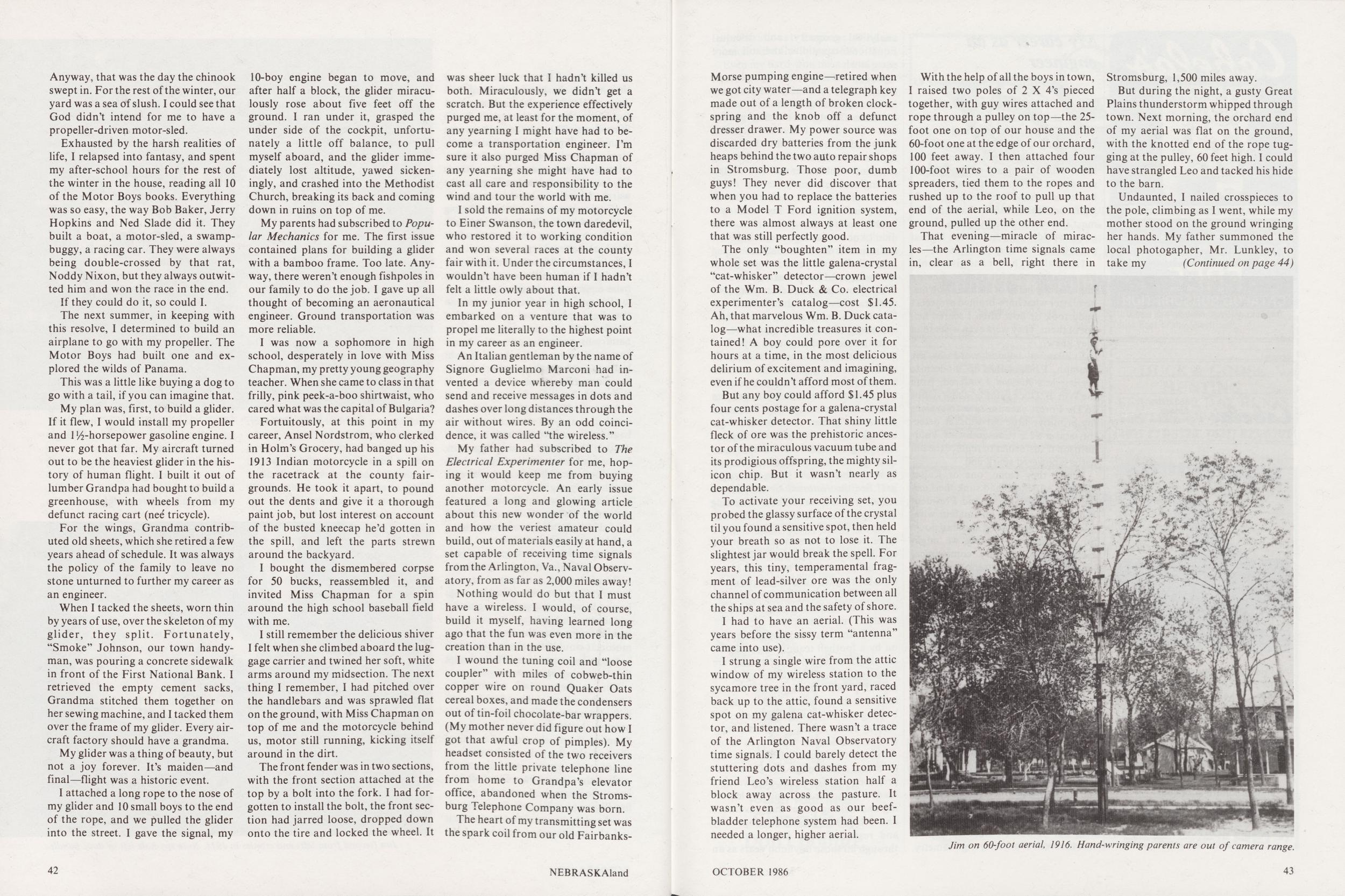 Anyway, that was the day the chinook
swept in. For the rest of the winter, our
yard was a sea of slush. I could see that
God didn't intend for me to have a
propeller-driven motor-sled.
Anyway, that was the day the chinook
swept in. For the rest of the winter, our
yard was a sea of slush. I could see that
God didn't intend for me to have a
propeller-driven motor-sled.
Exhausted by the harsh realities of life, I relapsed into fantasy, and spent my after-school hours for the rest of the winter in the house, reading all 10 of the Motor Boys books. Everything was so easy, the way Bob Baker, Jerry Hopkins and Ned Slade did it. They built a boat, a motor-sled, a swampbuggy, a racing car. They were always being double-crossed by that rat, Noddy Nixon, but they always outwitted him and won the race in the end.
If they could do it, so could I.
The next summer, in keeping with this resolve, I determined to build an airplane to go with my propeller. The Motor Boys had built one and explored the wilds of Panama.
This was a little like buying a dog to go with a tail, if you can imagine that.
My plan was, first, to build a glider. If it flew, I would install my propeller and 1 ^-horsepower gasoline engine. I never got that far. My aircraft turned out to be the heaviest glider in the history of human flight. I built it out of lumber Grandpa had bought to build a greenhouse, with wheels from my defunct racing cart (nee tricycle).
For the wings, Grandma contributed old sheets, which she retired a few years ahead of schedule. It was always the policy of the family to leave no stone unturned to further my career as an engineer.
When I tacked the sheets, worn thin by years of use, over the skeleton of my glider, they split. Fortunately, "Smoke" Johnson, our town handyman, was pouring a concrete sidewalk in front of the First National Bank. I retrieved the empty cement sacks, Grandma stitched them together on her sewing machine, and I tacked them over the frame of my glider. Every aircraft factory should have a grandma.
My glider was a thing of beauty, but not a joy forever. It's maiden—and final—flight was a historic event.
I attached a long rope to the nose of my glider and 10 small boys to the end of the rope, and we pulled the glider into the street. I gave the signal, my 10-boy engine began to move, and after half a block, the glider miraculously rose about five feet off the ground. I ran under it, grasped the under side of the cockpit, unfortunately a little off balance, to pull myself aboard, and the glider immediately lost altitude, yawed sickeningly, and crashed into the Methodist Church, breaking its back and coming down in ruins on top of me.
My parents had subscribed to Popular Mechanics for me. The first issue contained plans for building a glider with a bamboo frame. Too late. Anyway, there weren't enough fishpoles in our family to do the job. I gave up all thought of becoming an aeronautical engineer. Ground transportation was more reliable.
I was now a sophomore in high school, desperately in love with Miss Chapman, my pretty young geography teacher. When she came to class in that frilly, pink peek-a-boo shirtwaist, who cared what was the capital of Bulgaria?
Fortuitously, at this point in my career, Ansel Nordstrom, who clerked in Holm's Grocery, had banged up his 1913 Indian motorcycle in a spill on the racetrack at the county fairgrounds. He took it apart, to pound out the dents and give it a thorough paint job, but lost interest on account of the busted kneecap he'd gotten in the spill, and left the parts strewn around the backyard.
I bought the dismembered corpse for 50 bucks, reassembled it, and invited Miss Chapman for a spin around the high school baseball field with me.
I still remember the delicious shiver I felt when she climbed aboard the luggage carrier and twined her soft, white arms around my midsection. The next thing I remember, I had pitched over the handlebars and was sprawled flat on the ground, with Miss Chapman on top of me and the motorcycle behind us, motor still running, kicking itself around in the dirt.
The front fender was in two sections, with the front section attached at the top by a bolt into the fork. I had forgotten to install the bolt, the front section had jarred loose, dropped down onto the tire and locked the wheel. It was sheer luck that I hadn't killed us both. Miraculously, we didn't get a scratch. But the experience effectively purged me, at least for the moment, of any yearning I might have had to become a transportation engineer. I'm sure it also purged Miss Chapman of any yearning she might have had to cast all care and responsibility to the wind and tour the world with me.
I sold the remains of my motorcycle to Einer Swanson, the town daredevil, who restored it to working condition and won several races at the county fair with it. Under the circumstances, I wouldn't have been human if I hadn't felt a little owly about that.
In my junior year in high school, I embarked on a venture that was to propel me literally to the highest point in my career as an engineer.
An Italian gentleman by the name of Signore Guglielmo Marconi had invented a device whereby man could send and receive messages in dots and dashes over long distances through the air without wires. By an odd coincidence, it was called "the wireless."
My father had subscribed to The Electrical Experimenter for me, hoping it would keep me from buying another motorcycle. An early issue featured a long and glowing article about this new wonder of the world and how the veriest amateur could build, out of materials easily at hand, a set capable of receiving time signals from the Arlington, Va., Naval Observatory, from as far as 2,000 miles away!
Nothing would do but that I must have a wireless. I would, of course, build it myself, having learned long ago that the fun was even more in the creation than in the use.
I wound the tuning coil and "loose coupler" with miles of cobweb-thin copper wire on round Quaker Oats cereal boxes, and made the condensers out of tin-foil chocolate-bar wrappers. (My mother never did figure out how I got that awful crop of pimples). My headset consisted of the two receivers from the little private telephone line from home to Grandpa's elevator office, abandoned when the Stromsburg Telephone Company was born.
The heart of my transmitting set was the spark coil from our old Fairbanks-Morse 42 NEBRASKAland Morse pumping engine—retired when we got city water—and a telegraph key made out of a length of broken clockspring and the knob off a defunct dresser drawer. My power source was discarded dry batteries from the junk heaps behind the two auto repair shops in Stromsburg. Those poor, dumb guys! They never did discover that when you had to replace the batteries to a Model T Ford ignition system, there was almost always at least one that was still perfectly good.
The only "boughten" item in my whole set was the little galena-crystal "cat-whisker" detector—crown jewel of the Wm. B. Duck & Co. electrical experimenter's catalog—cost $1.45. Ah, that marvelous Wm. B. Duck catalog—what incredible treasures it contained! A boy could pore over it for hours at a time, in the most delicious delirium of excitement and imagining, even if he couldn't afford most of them.
But any boy could afford $1.45 plus four cents postage for a galena-crystal cat-whisker detector. That shiny little fleck of ore was the prehistoric ancestor of the miraculous vacuum tube and its prodigious offspring, the mighty silicon chip. But it wasn't nearly as dependable.
To activate your receiving set, you probed the glassy surface of the crystal til you found a sensitive spot, then held your breath so as not to lose it. The slightest jar would break the spell. For years, this tiny, temperamental fragment of lead-silver ore was the only channel of communication between all the ships at sea and the safety of shore.
I had to have an aerial. (This was years before the sissy term "antenna" came into use).
I strung a single wire from the attic window of my wireless station to the sycamore tree in the front yard, raced back up to the attic, found a sensitive spot on my galena cat-whisker detector, and listened. There wasn't a trace of the Arlington Naval Observatory time signals. I could barely detect the stuttering dots and dashes from my friend Leo's wireless station half a block away across the pasture. It wasn't even as good as our beefbladder telephone system had been. I needed a longer, higher aerial.
With the help of all the boys in town, I raised two poles of 2 X 4's pieced together, with guy wires attached and rope through a pulley on top—the 25-foot one on top of our house and the 60-foot one at the edge of our orchard, 100 feet away. I then attached four 100-foot wires to a pair of wooden spreaders, tied them to the ropes and rushed up to the roof to pull up that end of the aerial, while Leo, on the ground, pulled up the other end.
That evening—miracle of miracles—the Arlington time signals came in, clear as a bell, right there in Stromsburg, 1,500 miles away.
But during the night, a gusty Great Plains thunderstorm whipped through town. Next morning, the orchard end of my aerial was flat on the ground, with the knotted end of the rope tugging at the pulley, 60 feet high. I could have strangled Leo and tacked his hide to the barn.
Undaunted, I nailed crosspieces to the pole, climbing as I went, while my mother stood on the ground wringing her hands. My father summoned the local photogapher, Mr. Lunkley, to take my (Continued on page 44)
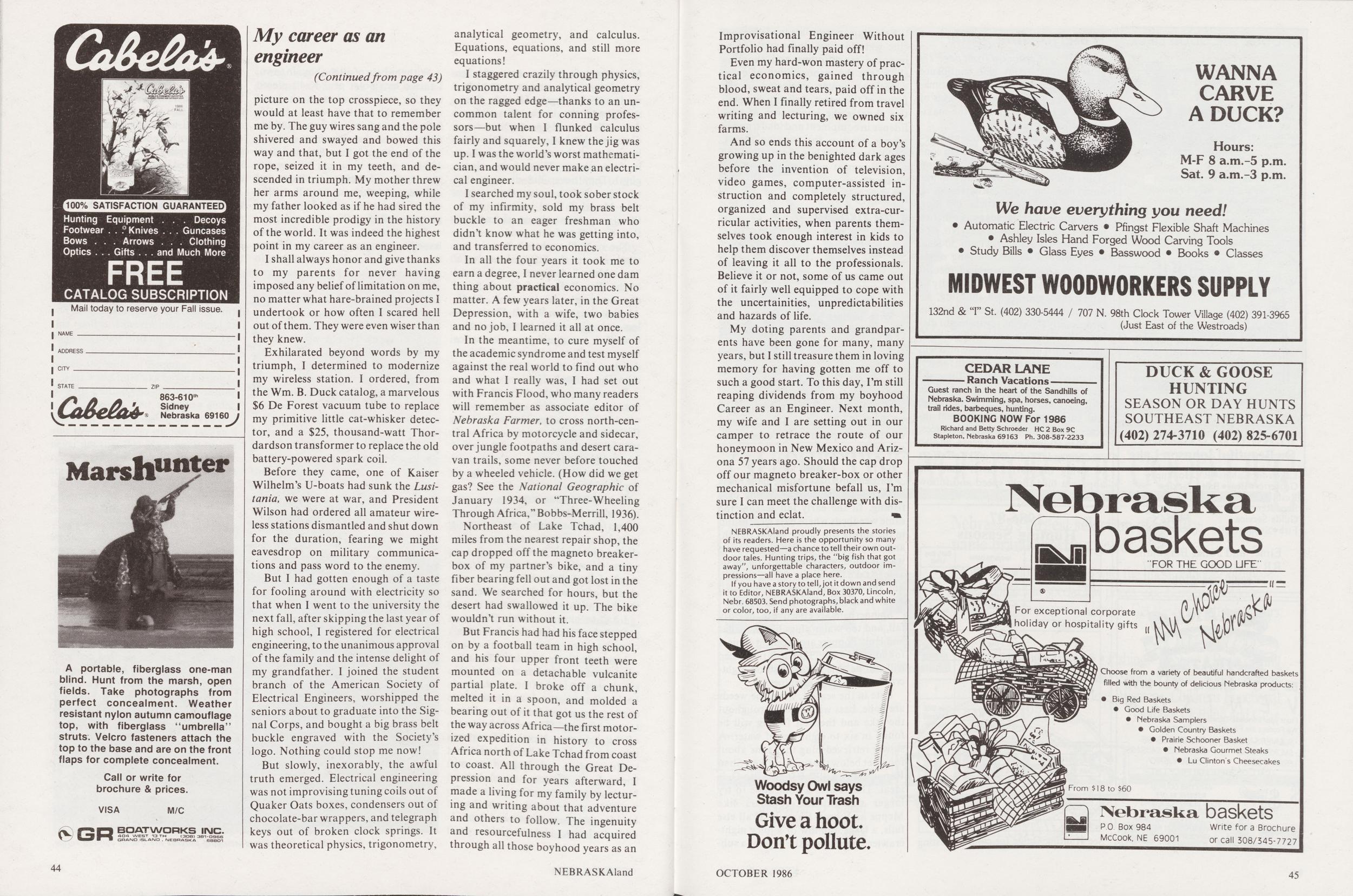 Cabela's
100% SATISFACTION GUARANTEED]
Hunting Equipment Decoys
Footwear Knives Guncases
Bows Arrows Clothing
Optics Gifts and Much More
FREE
CATALOG SUBSCRIPTION
Mail today to reserve your Fall issue.
NAME
ADDRESS
CITY
STATE
ZIP
863-610th
Sidney
Nebraska 69160
Marshunter
A portable, fiberglass one-man
blind. Hunt from the marsh, open
fields. Take photographs from
perfect concealment. Weather
resistant nylon autumn camouflage
top, with fiberglass "umbrella"
struts. Velcro fasteners attach the
top to the base and are on the front
flaps for complete concealment.
Call or write for
brochure & prices.
VISA
M/C
BQATWQRKS INC.
404 WEST 13 TH (30B1 381-0965
GRAND NEBRASKA 6SB01
Cabela's
100% SATISFACTION GUARANTEED]
Hunting Equipment Decoys
Footwear Knives Guncases
Bows Arrows Clothing
Optics Gifts and Much More
FREE
CATALOG SUBSCRIPTION
Mail today to reserve your Fall issue.
NAME
ADDRESS
CITY
STATE
ZIP
863-610th
Sidney
Nebraska 69160
Marshunter
A portable, fiberglass one-man
blind. Hunt from the marsh, open
fields. Take photographs from
perfect concealment. Weather
resistant nylon autumn camouflage
top, with fiberglass "umbrella"
struts. Velcro fasteners attach the
top to the base and are on the front
flaps for complete concealment.
Call or write for
brochure & prices.
VISA
M/C
BQATWQRKS INC.
404 WEST 13 TH (30B1 381-0965
GRAND NEBRASKA 6SB01
My career as an engineer
(Continued from page 43)picture on the top crosspiece, so they would at least have that to remember me by. The guy wires sang and the pole shivered and swayed and bowed this way and that, but I got the end of the rope, seized it in my teeth, and descended in triumph. My mother threw her arms around me, weeping, while my father looked as if he had sired the most incredible prodigy in the history of the world. It was indeed the highest point in my career as an engineer.
I shall always honor and give thanks to my parents for never having imposed any belief of limitation on me, no matter what hare-brained projects I undertook or how often I scared hell out of them. They were even wiser than they knew.
Exhilarated beyond words by my triumph, I determined to modernize my wireless station. I ordered, from the Wm. B. Duck catalog, a marvelous $6 De Forest vacuum tube to replace my primitive little cat-whisker detector, and a $25, thousand-watt Thordardson transformer to replace the old battery-powered spark coil.
Before they came, one of Kaiser Wilhelm's U-boats had sunk the Lusitania, we were at war, and President Wilson had ordered all amateur wireless stations dismantled and shut down for the duration, fearing we might eavesdrop on military communications and pass word to the enemy.
But I had gotten enough of a taste for fooling around with electricity so that when I went to the university the next fall, after skipping the last year of high school, I registered for electrical engineering, to the unanimous approval of the family and the intense delight of my grandfather. I joined the student branch of the American Society of Electrical Engineers, worshipped the seniors about to graduate into the Signal Corps, and bought a big brass belt buckle engraved with the Society's logo. Nothing could stop me now!
But slowly, inexorably, the awful truth emerged. Electrical engineering was not improvising tuning coils out of Quaker Oats boxes, condensers out of chocolate-bar wrappers, and telegraph keys out of broken clock springs. It was theoretical physics, trigonometry, analytical geometry, and calculus. Equations, equations, and still more equations!
I staggered crazily through physics, trigonometry and analytical geometry on the ragged edge—thanks to an uncommon talent for conning professors—but when I flunked calculus fairly and squarely, I knew the jig was up. I was the world's worst mathematician, and would never make an electrical engineer.
I searched my soul, took sober stock of my infirmity, sold my brass belt buckle to an eager freshman who didn't know what he was getting into, and transferred to economics.
In all the four years it took me to earn a degree, I never learned one dam thing about practical economics. No matter. A few years later, in the Great Depression, with a wife, two babies and no job, I learned it all at once.
In the meantime, to cure myself of the academic syndrome and test myself against the real world to find out who and what I really was, I had set out with Francis Flood, who many readers will remember as associate editor of Nebraska Farmer, to cross north-central Africa by motorcycle and sidecar, over jungle footpaths and desert caravan trails, some never before touched by a wheeled vehicle. (How did we get gas? See the National Geographic of January 1934, or "Three-Wheeling Through Africa," Bobbs-Merrill, 1936).
Northeast of Lake Tchad, 1,400 miles from the nearest repair shop, the cap dropped off the magneto breakerbox of my partner's bike, and a tiny fiber bearing fell out and got lost in the sand. We searched for hours, but the desert had swallowed it up. The bike wouldn't run without it.
But Francis had had his face stepped on by a football team in high school, and his four upper front teeth were mounted on a detachable vulcanite partial plate. I broke off a chunk, melted it in a spoon, and molded a bearing out of it that got us the rest of the way across Africa—the first motorized expedition in history to cross Africa north of Lake Tchad from coast to coast. All through the Great Depression and for years afterward, I made a living for my family by lecturing and writing about that adventure and others to follow. The ingenuity and resourcefulness I had acquired through all those boyhood years as an 44 NEBRASKAland Improvisational Engineer Without Portfolio had finally paid off!
Even my hard-won mastery of practical economics, gained through blood, sweat and tears, paid off in the end. When I finally retired from travel writing and lecturing, we owned six farms.
And so ends this account of a boy's growing up in the benighted dark ages before the invention of television, video games, computer-assisted instruction and completely structured, organized and supervised extra-curricular activities, when parents themselves took enough interest in kids to help them discover themselves instead of leaving it all to the professionals. Believe it or not, some of us came out of it fairly well equipped to cope with the uncertainties, unpredictabilities and hazards of life.
My doting parents and grandparents have been gone for many, many years, but I still treasure them in loving memory for having gotten me off to such a good start. To this day, I'm still reaping dividends from my boyhood Career as an Engineer. Next month, my wife and I are setting out in our camper to retrace the route of our honeymoon in New Mexico and Arizona 57 years ago. Should the cap drop off our magneto breaker-box or other mechanical misfortune befall us, I'm sure I can meet the challenge with distinction and eclat.
NEBRASKAland proudly presents the stories of its readers. Here is the opportunity so many have requested—a chance to tell their own outdoor tales. Hunting trips, the "big fish that got away", unforgettable characters, outdoor impressions—all have a place here.
If you have a story to tell, jot it down and send it to Editor, NEBRASKAland, Box 30370, Lincoln, Nebr. 68503. Send photographs, black and white or color, too, if any are available.
 CHOOSE THE GOOD LIFE
Own a
Large Lot
on Lake
McConaughy
For more information write:
Mr. and Mrs. Harold Fenwick
Rt. 2, Box 48-M
Ogallala, Nebraska 69153
Or call: (308) 284-2748
AVENUE
ART GALLERY
Ltmt\ Original art by
avenuej Nebraska artists
A unique,
one-of-a-kind place
go lie y East Park P|aza MaM
66th and O Streets
Lincoln, Nebraska
Special orders and commissions
BERGMANS RESORT
On Beautiful Johnson Lake
Lakefront Cabins* RV Hookups*
Groceries • Beer • Bait • Tackle •
Restaurant* Lounge*
Boat Rentals*
Guide Service.
Fish* Swim* Golf
Elmer and Janet Bergman
RR 2, Elwood, NE 68937
(308) 785-2298
FRANK
STOYSICH
MEATS
52 & Q • Omaha • 731-0776
HfJIJON
From your Boneless Trimmings
We Process the Finest Venison Sausage:
'SUMMER SAUSAGE • ITALIANSAUSAGE
'SMOKEDPOLISH 'BREAKFAST SAUSAGE
'FRESH POLISH • VENISON JERKY
CALL OR WRITE FOR PRICE LIST
WITH THIS COUPON,
RECEIVE $5 OFF
YOUR DEER PROCESSING
ORDER OF $25 OR MORE.
- ONE COUPON PER CUSTOMER
FRANK STOYSICH MEATS
52nd & Q • 731-0776
CHOOSE THE GOOD LIFE
Own a
Large Lot
on Lake
McConaughy
For more information write:
Mr. and Mrs. Harold Fenwick
Rt. 2, Box 48-M
Ogallala, Nebraska 69153
Or call: (308) 284-2748
AVENUE
ART GALLERY
Ltmt\ Original art by
avenuej Nebraska artists
A unique,
one-of-a-kind place
go lie y East Park P|aza MaM
66th and O Streets
Lincoln, Nebraska
Special orders and commissions
BERGMANS RESORT
On Beautiful Johnson Lake
Lakefront Cabins* RV Hookups*
Groceries • Beer • Bait • Tackle •
Restaurant* Lounge*
Boat Rentals*
Guide Service.
Fish* Swim* Golf
Elmer and Janet Bergman
RR 2, Elwood, NE 68937
(308) 785-2298
FRANK
STOYSICH
MEATS
52 & Q • Omaha • 731-0776
HfJIJON
From your Boneless Trimmings
We Process the Finest Venison Sausage:
'SUMMER SAUSAGE • ITALIANSAUSAGE
'SMOKEDPOLISH 'BREAKFAST SAUSAGE
'FRESH POLISH • VENISON JERKY
CALL OR WRITE FOR PRICE LIST
WITH THIS COUPON,
RECEIVE $5 OFF
YOUR DEER PROCESSING
ORDER OF $25 OR MORE.
- ONE COUPON PER CUSTOMER
FRANK STOYSICH MEATS
52nd & Q • 731-0776
Waterfowling guide
(Continued from page 17)patterning capability gain confidence that their gun, load, and range estimation ability will increase their odds of cleanly taking birds out to the maximum effective range.
Preseason shotgun practice on bluerocks thrown to simulate hunting conditions, and accurate rangefinding skills, will help each waterfowl hunter once seasons open. Roster, in a recently published article on long range goose hunting, suggests practice using 1 l/g-ounce loads of steel No. 6 or 4 shot with a velocity within 50-feet-per-second of the chosen long range steel goose load. For overhead, incoming shots that make up the majority of long range goose pass shooting, he recommends hunters learn to shoot the bird exactly the same regardless of distance. Swing up from behind the bird, blot the bird out (some of the bird will show around the barrel if it is in range), instantly fire, and follow through! According to Roster, the speed of the bird will dictate the speed of the swing, and this compensates for actual increased lead at the longer distances. On 50 to 60-yard shots at geese, he also recommends the hunter make an effort to swing the barrel faster than the apparent bird flight speed and follow through farther.
1986-87 Hunting Seasons Species Inclusive Dates Daily Bag Limit Cock Pheasant Nov. 1-Jan .18 3 Coot Same as Duck 15 Cottontail Sept. 1-Feb. 28 7 Crow Oct. 1-Nov. 15 Jan. 21-April 8 No Limit Mourning Dove Sept. 1-Oct. 30 15 Duck Oct. 18-26 Nov. 1-Dec. 12 100 pts. Oct. 11-Nov. 30 100 pts. Oct. 11-Nov. 30 Dec.20-Jan.4 100 pts. Light Goose Oct. 4-Dec. 14 Feb. 2-15 5 Dark Goose Oct. 4-Dec. 21 See 1986 Nebraska Hunting Guide Oct. 4-Dec. 14 Oct. 25-Jan.4 Nov. 10-Jan. 4 Grouse Sept. 13-Nov.30 3 Hungarian Partridge Nov. 1-Jan. 18 3 Quail Nov. 1-Jan. 18 6 Raccoon Nov. 5-Jan. 31 No Limit Rail Sept. 1-Nov. 9 10 Common Snipe Sept. 1-Dec. 15 8 Squirrel Aug.1-Jan. 31 7 Woodcock Sept. 15-Nov. 18 5Selecting appropriate loads for specific waterfowling, and practicing to improve rangefinding and shooting skills, are the responsibility of every waterfowl hunter interested in the future of this sport. Ask any competitive shooter the importance of confidence in equipment and loads, and in proper practice for winning scores. Should we expect less of ourselves and our equipment when hunting with a shotgun?
Fallfishing
(Continued from page 37)is that northerns like dead baits because they don't have to expend much energy to catch and devour them, at least much less than is necessary to chase and catch a fleeing fish.
Wire leaders and strong line are always a good choice for pike fishing. A long rod with a lot of backbone is ideal for landing large northerns. If you hook a 10 or 12-pound catfish, it feels like you've gotten snagged on a log, but hook a northern of similar size and you'll swear you've somehow hooked an enraged bull that's determined to escape and cause some damage in the process.
BassLargemouth bass fishing in the fall is almost a carbon copy of spring bass fishing. In the early fall season, the same weedbeds where bass were found in the spring will be the places to fish, and they should be fished the same way. A good bass fisherman should he able to take fish all day during the fall, but the best and fastest action will occur from late afternoon to sunset.
Spinnerbaits are effective in the early fall, and top-water plugs like Rapallas and Hula Poppers are excellent choices for late in the day. Live-bait fishermen will still be able to take fish on nightcrawlers and large minnows.
Late in the season, when the weeds are gone, bass will scatter throughout the lake and the best fishing will be found in six to eight feet of water. A slowly retrieved plug that runs about four feet below the surface, like a Shad Rap, a Deep Kill'R Bl, or a Big-O, is ideal. This is also a good time to try larger straight-line spinners like Mepps or Vibrax Foxtails. If all else fails, a large minnow or a juicy nightcrawler fished along the edge of a submerged roadbed or creek channel may produce bass.
46 NEBRASKAland BEFORE YOU GO A 10-Point Checklist for the Responsible Hunter Are you familiar with all the game laws and regulations thai apply to the species yott plan to hunt? Are yo« familiar with your game's habits, and can you readily identify the species in the field? Are yoo familiar with how properly to dean and care for your game? If you're planning to hunt on private land, are yon sore that yon have permission from the landowner and understand where yon may hunt on his land? Am yon familiar with the safe and proper operation of the gam you TI be using? 1 g Is year gam clean and in good working order? Are yonr gnn and ammunition appropriate for the game yon TI be hunting? Eg Is your ammunition the proper match for the gange or caliber gnn you're bringing along? Ian sighted in? |0 If appropriate for yonr type of hunting, have yon brought along yonr hunter orange vest or coat and cap? National Shooting Sports Foundation N88F P.O. Sox 1075 Riverside, Conn. 06878 (OUTFITTING YOU FOR THE GOOD LIFF Nebraska's largest selection of quality name brand sporting goods. Count on us to provide you with the finest outdoor clothing and equipment at special low prices. See Burden's Outdoor Outfitters when you're in Lincoln. Get the best of the outdoors. Camping • Hunting • Fishing • Boating • Backpacking X-Country Skiing • Water Sports • Boots, Shoes, Waders Mens, Womens, Childrens Functional Outdoor Clothing and Gear 1000 West "0" Street Lincoln, NE 68528 474-4366 OCTOBER 1986 47 6th Annual Omaha Area
Board of Realtors
RECYCLE FOR WILDLIFE DRIVE
Saturday October 25 8 am-5pm
Aluminum Cans & Newsprint
Locations
Commercial Federal 90th & Maplewood
Action Real Estate 1313 Harlan Drive—Bellevue
CBS Real Estate 5025 Grover and 120th & Pacific
When Hunting, Think SAFETY!
WELCOME
to
Merritt Dam Trading Post
Located on beautiful Merritt Reservoir
26 Miles So. Of Valentine On Hwy. 97
Phone 402/376-3437
Bait • Tackle • Ammunition • Groceries • Gas • Beer • Ice
Year-round Modern Cabins with Kitchen Facilities
Campground Hook-ups • Boat and Motor Rental • Professional Guide Service
Easy-access dock • Open year around
Home of the State Record Perch,
Muskellunge, Smallmouth Bass
and Channel Catfish
Your Hosts
Jon and Marian Davenport
WOOD
SUPPLIES
FOR
CAR VERS
• Sugar pine • Basswood • Jelutong
• Custom-made hardwood bases and pedestals
• Millwork • Call Us Today!
Standard Planing Mill
1040 North 11th, Lincoln, NE (402) 475-1005
Walleye
6th Annual Omaha Area
Board of Realtors
RECYCLE FOR WILDLIFE DRIVE
Saturday October 25 8 am-5pm
Aluminum Cans & Newsprint
Locations
Commercial Federal 90th & Maplewood
Action Real Estate 1313 Harlan Drive—Bellevue
CBS Real Estate 5025 Grover and 120th & Pacific
When Hunting, Think SAFETY!
WELCOME
to
Merritt Dam Trading Post
Located on beautiful Merritt Reservoir
26 Miles So. Of Valentine On Hwy. 97
Phone 402/376-3437
Bait • Tackle • Ammunition • Groceries • Gas • Beer • Ice
Year-round Modern Cabins with Kitchen Facilities
Campground Hook-ups • Boat and Motor Rental • Professional Guide Service
Easy-access dock • Open year around
Home of the State Record Perch,
Muskellunge, Smallmouth Bass
and Channel Catfish
Your Hosts
Jon and Marian Davenport
WOOD
SUPPLIES
FOR
CAR VERS
• Sugar pine • Basswood • Jelutong
• Custom-made hardwood bases and pedestals
• Millwork • Call Us Today!
Standard Planing Mill
1040 North 11th, Lincoln, NE (402) 475-1005
Walleye
There may be no more popular fish among autumn anglers than the walleye. His wariness, tentative feeding habits, ability to attain trophy size, and excellent flavor make him a popular adversary.
Walleye are known primarily as nighttime feeders, but as the water cools in the fall, they can be taken from weedbeds and shallow water in morning and evening, and from deep-water points during the middle of the day. Fishermen who insist on fishing under the stars will find walleye along the damface at night, as well as in nearby shallows searching for food.
The absolute best time for walleye fishing is during those crisp autumn days following a downright chilly night when clouds cover the sky and there is enough wind to put a medium chop on the water.
Nightcrawlers are an occasionally successful bait early in the fall, but minnows are a more consistent walleye bait at this time of year. Crawdads and leeches are also productive early in the fall season, and large minnows and deep-running minnow-imitating plugs like Rapallas and Shad Raps are super later.
It's hard to think about fishing when you hear geese honking overhead, see a whitetail tip-toeing to the creek for a drink, or come across a flock of pheasants pecking gravel from the roadside, but make it a point to try your luck at the lake at least a couple of times this fall. Chances are you'll decide late-season fishing opportunities are too good to pass up, and you'll increase your fishing enjoyment by taking advantage of the beauty and comfort of autumn fishing.
CALL 800-742-SNAP STOP POACHING NEBRASKA OPERATION GAME THIEF 48 NEBRASKAlandTrading Post
DOGSTRAINING ALL BREEDS Hunting Dogs - Vizslas for sale. Rozanek Kennels, Rt. 2, Schuyler, NE 68661. Phone (402) 352-8769.
A FEW HUNTING dogs for sale: Brittanies, English setters. German Shorthairs. Darrell Yentes, Phone (308) 995-8570 or (308) 995-4797 after 5 p.m.
ENGLISH SETTERS and Labradors: "Bred for the hunter"; outstanding bloodlines! Puppies, started dogs and stud service available. High Plains Kennels, 1411 Emerson, Alliance, Nebr. 69301. Phone (308) 762-6709.
GERMAN SHORTHAIR male 5 years old. Points, backs and retrieves from land and water. Whistle broke and has had experience on pheasants and quail. Two males out of this dog, over a year old, started. Pointer male 3!4 years old, points and retrieves. Wayne Clark (712) 529-4238 after 10 p.m. or (402) 263-3495, Union, NE.
PLATTE RIVER KENNELS, Lexington, NE. Phone (308) 324-6093. Trained and started German shorthair pointers. $300 and up.
QUALITY GERMAN short-haired puppies. Both sire and dam are AKC field champions, have been rated in the top ten nationally, and are excellent personal hunting dogs. Also one fully trained personal hunting dog. Contact James W. Douglass, Jr. after 6 p.m. (402) 564-1158.
MISCELLANEOUSFISH FOR SALE. Channel catfish, bass, bluegill, crappie, trout, perch, white bass, minnows, hybrid grass carp, bullhead. We can ship fish, you can pick them up, or we can deliver. Contact the Pleasant Valley Fish Farm, Rt. 1, McCook, NE 69001. Phone (308) 345-6599.
NE NEBRASKA trout fishing. 3 modern cottages, 1 available year round. 5 spring fed lakes with open water all year. Trout up to 7 pounds. Other varieties fish also. Diamond E. Trout Resort, Orchard, NE 68764. Phone (402) 893-4745.
GUNS — Browning, Winchester, Remington, others, Hi-powers, shotguns, new, used, antiques. Want Pre1964 Winchesters. Buy-Sell-Trade. Ph. (402) 729-6112. Bedlan's Sporting Goods, Fairbury, NE 68352.
MAD RIVER CANOES offers the finest quality and performance. For the finest canoes and accessories look to Great Plains Canoe Co., 205 Main, Springfield, NE. Phone (402) 253-200L
WINE AND BEER: Make your own. Send for free recipes and instructions. Omaha Supply, 1324 2nd Avenue, Nebraska City, NE 68410.
LOG HOMES — Discover the simple elegance and richness of a Western Log Home. Your plan or ours. Free estimates. 44-page home planning guides $5. Action Log Homes, Box 3201, Kearney, NE 68847. Phone (308) 237-LOGS.
LAKE McCONAUGH Y LOTS —choice lots adjacent to Cedar Vue (Gate 13). THE choice development on McConaughy, all south of RR tracks with direct access to the lake. Quarter-acre lots, $500 down and $100 per month. Call (308) 284-6701 or (308) 355-4543.
NEBRASKA WILDFLOWERS - - permanently preserved in resin. Paperweights and range-top spoon rests. $6.95 each includes tax and shipping. K&M Taxidermy, Rt. 2, Box 175, Norfolk, NE 68701 or phone (402)675-1862.
ASSEMBLERS WANTED: Make money assembling clowns. Earn $60 per 10 units part-time at home. It's fun, profitable and materials supplied. Send selfaddressed stamped envelope to Dickens and Matson, P.O. Box 476, East Detroit, MI 48021.
GIANT CANADA GEESE, all ages, adult snow and blue geese. Alan Nelson, Rt. 1 Box 151, Aurora, NE 68818. Phone (402) 694-5224.
ATTENTION HUNTERS/CAMPERS: 246 acres along Niobrara River in N.E. Nebraska. Excellent turkey and deer hunting; will divide. Also approx. 90 acres along Verdigre Creek also in N.E. Nebraska. Very secluded. Excellent camping and / or deer hunting area. Call Mike (402) 493-5772 or 498-0245.
WOOD SLABS for sale, all kinds, all sizes. Ideal for clocks or painting, finished or unfinished. All sizes of Cypress slabs. For price list write to: Clocks, HC 30 Box 57, McCook, NE 69001.
FOR SALE: Captive-reared wild ducks, geese, mute swan. Phone William Lemburg, Cairo, NE, evenings (308) 485-4620 or Mickey Lemburg, early evening (308) 485-4438 for six varieties quail, chukars and five varieties of pheasants.
DUCK HUNTERS —guided duck hunts on the Platte River near Schuyler. Good dogs, good decoys, good blinds and a good time. $30 per day. Make your reservations early. Call Frank Hoppe, North Bend, NE. Phone (402) 652-8725.
ATTENTION HUNTERS: Cabin available at Johnson Lake — accommodates 6 people. Call (308) 486-5642 for information, or write Box 322, Eustis, NE 69028.
FOR SALE: Hunting cottage and year-round retreat. Located near Nebraska's beautiful Pine Creek, Long Pine, Nebraska. Excellent hunting and trout fishing. Call Wardene Roark, (402) 273-4141.
FERRETS FOR SALE as pets. Litter train easy; are young, approx. 8 weeks. All kinds: sable, silver mitt, Siamese and albino. Phone (308) 946-3576.
MANDARIN DUCKS; nice full-wing birds, $35 pair. Mrs. R. W. Hansen, 3315 Avenue L, Kearney, NE 68847. Phone (308) 237-3781.
LIVE-CATCH ALL-PURPOSE TRAPS FREE CATALOG Traps without injury squirrels, chipmunks, rabbits, mink, fox, raccoons, stray animals, pests, etc. Sizes for every need. Also traps for snakes, sparrows, pigeons, crabs, turtles, quail, etc. Save on our low factory prices. Send no money. Free catalog and trapping secrets MUSTANG MFG. CO., Dept. N-34, Box 920947, Houston, Tex. 77292 NEBRASKAland Magazine Order Form Please send me a subscription to NEBRASKAland Magazine One-year $12.00 NAME ADDRESS Two-year $23.00 STATE ZIP. Mail to: NEBRASKAland Magazine, Box 30370, Lincoln, NE 68503 TAXIDERMYALLISON'S TAXIDERMY STUDIO: Wally and Betty Allison, Licensed Taxidermist. We've mounted 18 Nebraska State Record fish. Specializing in fish and birds, small game and rattlesnakes. We use freeze-dry. 2709 Brichwood Rd., North Platte, Nebr. 69101. Phone (308) 534-2324.
BADE TAXIDERMY - Quality a must Fast service. Fish, birds, rugs, tanning, full mounts and game heads, 2111 N. Christy St., Fremont, Nebraska 727-5463.
KARL SCH WARZ master taxidermist has moved to a new country studio; same professional mounting and tanning service. Schwarz Wild Wing Studio, 16804 South 180th St., Springfield, NE 68059. Phone (402) 253-2481.
JOHNSON TAXIDERMY servicing southwest Nebraska, specializing in big-game mounts, life-sized mounts, rug work, fish, birds, tanning hair-on leather. Brochure and price list on request. Johnson Taxidermy, Rt. 1, Box 78, Lamar, NE 69035. Telephone (308) 882-5555.
NABITY'S TAXIDERMY. 31 years experience. Specializing in natural grass backgrounds for mammals, birds and fish. 13901 "O" St., Lincoln, NE 68504 — 4 miles east of 84th and "O". (402) 489-6351.
K&M TAXIDERMY — we do natural mounts you will be proud of. Fish, birds and game heads. Rt. 2, Box 175, Norfolk, NE 68701. Phone (402) 675-1862.
BIG BEAR TAXIDERMY, Rt. 2, Mitchell, Nebraska 69357. We specialize in all big game from Alaska to Nebraska, also birds and fish. Hair on and hair off tanning. Four miles west of Scottsbluff on Highway 26. Dale Hubel, phone (308) 635-3013.
CREATIVE TAXIDERMY. Quality and experience since 1935. All custom services, museum work, and sales. New methods include Freeze-Dry processing. Trophy room visitors and inquiries welcome. Naturecraft Studios, Joe Voges, Owner, Nebraska City, NE 68410. Phone (402) 873-5491.
PLATTE VALLEY TAXIDERMY. Museum-quality mounts using latest scientific methods. 1985 world taxidermy competition winner. Delton Wegner, 1419 11th Street, Central City, NE 68826. Telephone (308) 946-3773.
PEISTER TAXIDERMY Professional work at prices most sportsmen can afford. Now in our new log cabin studio, 1020 Central Avenue, Box 3201, Kearney, NE 68847. Phone (308) 236-9700 or (308) 237-7575 evenings.
STOCK YOUR LAKE OR POND WITH Channel cat, Bluegill, Largemouth Bass, Hybrid Bluegill, Crappie, Triploid Grass Carp, Minnows ORDER NOW WILLOW LAKE FISH HATCHERY Rt. 3, Box 46, Hastings, Nebr. 68901 Gaylord L Crawford Phone: (402) 463-8022 Day or Night For April to October 15 stocking Harlan County Dam Vacation Apartments - fully furnished Color TV • Kitchen Facilities • Full Baths Game cleaning room with freezer One block from shopping center Weekend or week of pleasant living Security Deposit Required Sorry —No Pets Dean and Esther Stone Box 145 Ph. (308) 799-3422 Republican City, NE 68971 OCTOBER 1986 49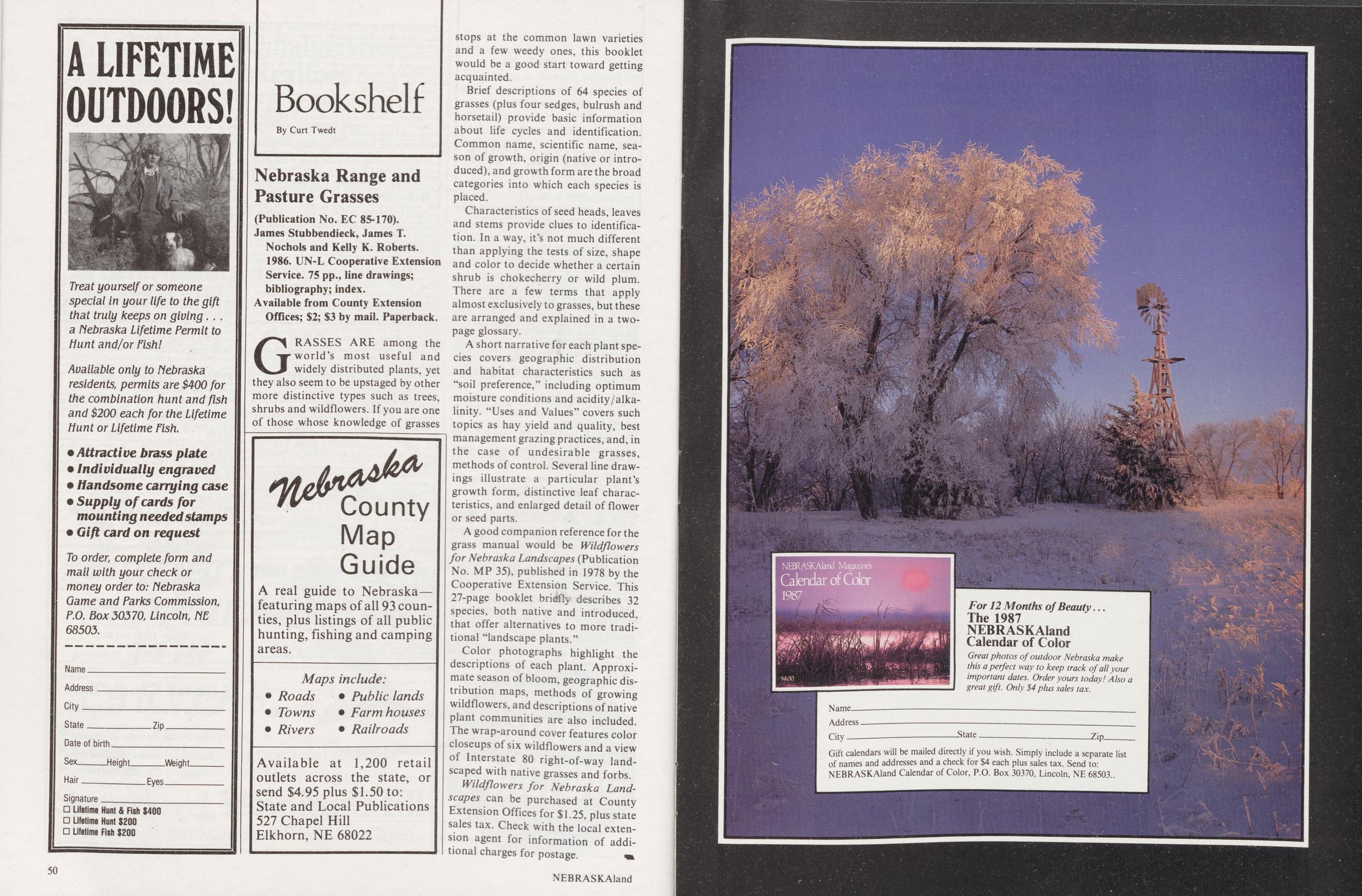 A LIFETIME
OUTDOORS!
Treat yourself or someone
special in your life to the gift
that truly keeps on giving.
a Nebraska Lifetime Permit to
Hunt and/or Pish!
Available only to Nebraska
residents, permits are $400 for
the combination hunt and fish
and $200 each for the Lifetime
Hunt or Lifetime Fish.
• Attractive brass plate
• Individually engraved
• Handsome carrying case
• Supply of cards for
mounting needed stamps
• Gift card on request
To order, complete form and
mail with your check or
money order to: Nebraska
Game and Parks Commission,
P.O. Box 30370, Lincoln, NE
68503.
Name
Address
City
State
Zip
Date of birth
Sex.
Height.
Weight
Hair
Eyes.
Signature
D Lifetime Hunt & Fish $400
D Lifetime Hunt $200
D Lifetime Fish $200
A LIFETIME
OUTDOORS!
Treat yourself or someone
special in your life to the gift
that truly keeps on giving.
a Nebraska Lifetime Permit to
Hunt and/or Pish!
Available only to Nebraska
residents, permits are $400 for
the combination hunt and fish
and $200 each for the Lifetime
Hunt or Lifetime Fish.
• Attractive brass plate
• Individually engraved
• Handsome carrying case
• Supply of cards for
mounting needed stamps
• Gift card on request
To order, complete form and
mail with your check or
money order to: Nebraska
Game and Parks Commission,
P.O. Box 30370, Lincoln, NE
68503.
Name
Address
City
State
Zip
Date of birth
Sex.
Height.
Weight
Hair
Eyes.
Signature
D Lifetime Hunt & Fish $400
D Lifetime Hunt $200
D Lifetime Fish $200
Bookshelf
By Curt Twedt Nebraska Range and Pasture Grasses (Publication No. EC 85-170). James Stubbendieck, James T. Nochols and Kelly K. Roberts. 1986. UN-L Cooperative Extension Service. 75 pp., line drawings; bibliography; index. Available from County Extension Offices; $2; S3 by mail. Paperback.GRASSES ARE among the world's most useful and widely distributed plants, yet they also seem to be upstaged by other more distinctive types such as trees, shrubs and wildflowers. If you are one of those whose knowledge of grasses stops at the common lawn varieties and a few weedy ones, this booklet would be a good start toward getting acquainted.
County Map Guide A real guide to Nebraska featuring maps of all 93 counties, plus listings of all public hunting, fishing and camping areas. Maps include: • Roads • Public lands • Towns • Farmhouses • Rivers • Railroads Available at 1,200 retail outlets across the state, or send $4.95 plus $1.50 to: State and Local Publications 527 Chapel Hill Elkhorn, NE 68022Brief descriptions of 64 species of grasses (plus four sedges, bulrush and horsetail) provide basic information about life cycles and identification. Common name, scientific name, season of growth, origin (native or introduced), and growth form are the broad categories into which each species is placed.
Characteristics of seed heads, leaves and stems provide clues to identification. In a way, it's not much different than applying the tests of size, shape and color to decide whether a certain shrub is chokecherry or wild plum. There are a few terms that apply almost exclusively to grasses, but these are arranged and explained in a twopage glossary.
A short narrative for each plant species covers geographic distribution and habitat characteristics such as "soil preference," including optimum moisture conditions and acidity/alkalinity. "Uses and Values" covers such topics as hay yield and quality, best management grazing practices, and, in the case of undesirable grasses, methods of control. Several line drawings illustrate a particular plant's growth form, distinctive leaf characteristics, and enlarged detail of flower or seed parts.
A good companion reference for the grass manual would be Wildflowers for Nebraska Landscapes (Publication No. MP 35), published in 1978 by the Cooperative Extension Service. This 27-page booklet briefly describes 32 species, both native and introduced, that offer alternatives to more traditional "landscape plants."
Color photographs highlight the descriptions of each plant. Approximate season of bloom, geographic distribution maps, methods of growing wildflowers, and descriptions of native plant communities are also included. The wrap-around cover features color closeups of six wildflowers and a view of Interstate 80 right-of-way landscaped with native grasses and forbs.
Wildflowers for Nebraska Landscapes can be purchased at County Extension Offices for $1.25, plus state sales tax. Check with the local extension agent for information of additional charges for postage.
50 NEBRASKAland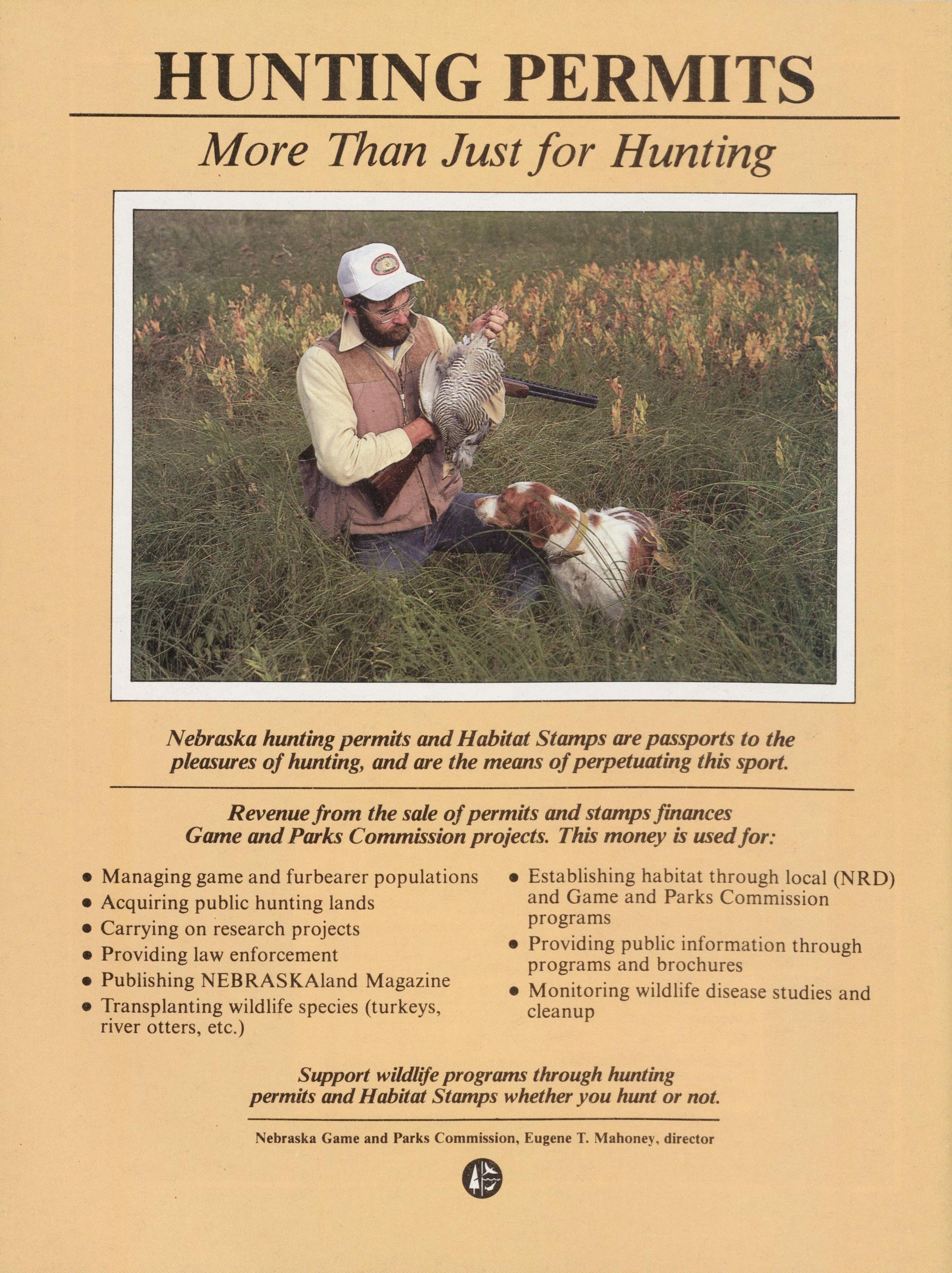
HUNTING PERMITS More Than Just for Hunting
Position: 664 (17 views)