Volume 64, Issue 7, 1986
NEBRASKAland
AUGUST/SEPTEMBER 1986 $1.50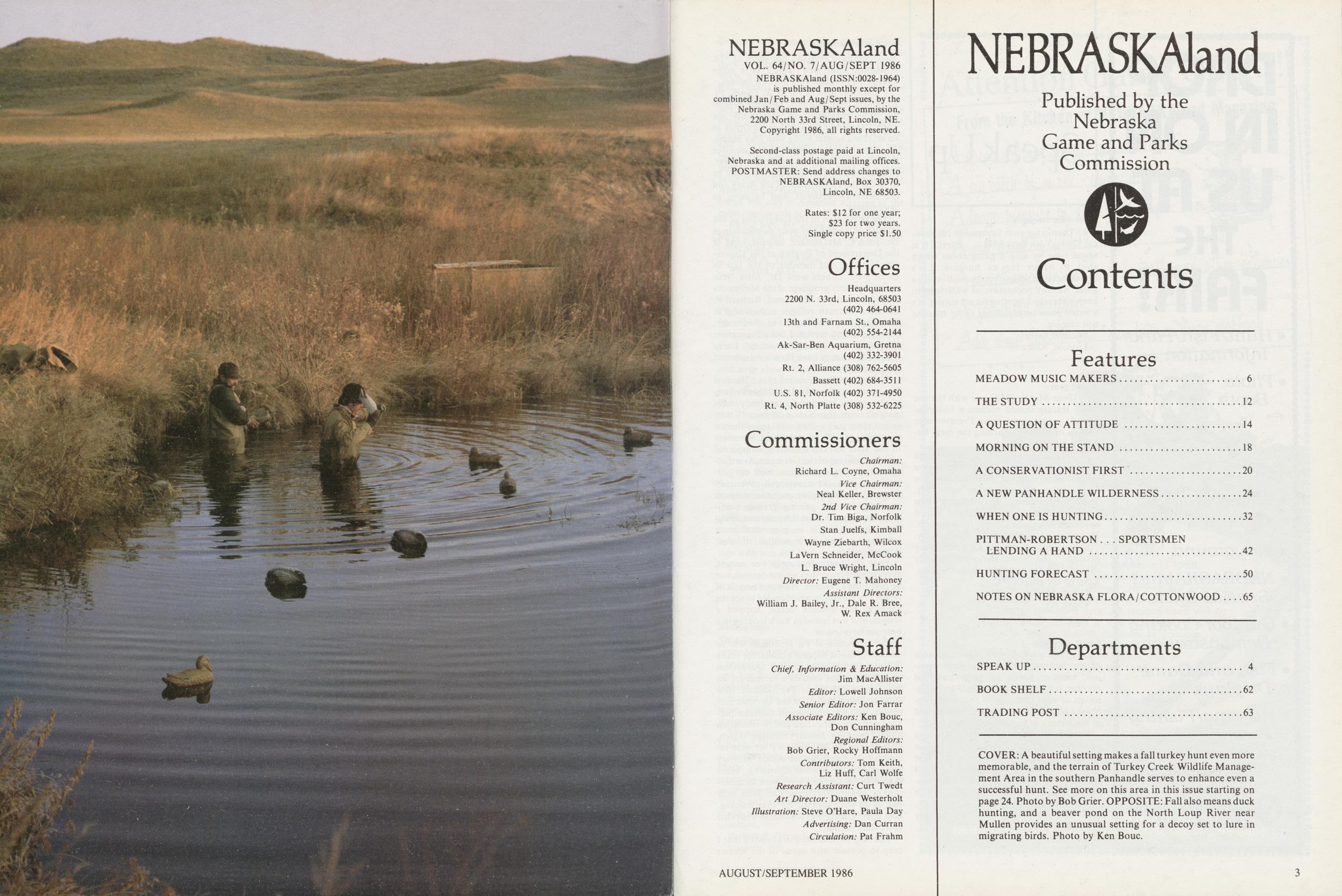
NEBRASKAland
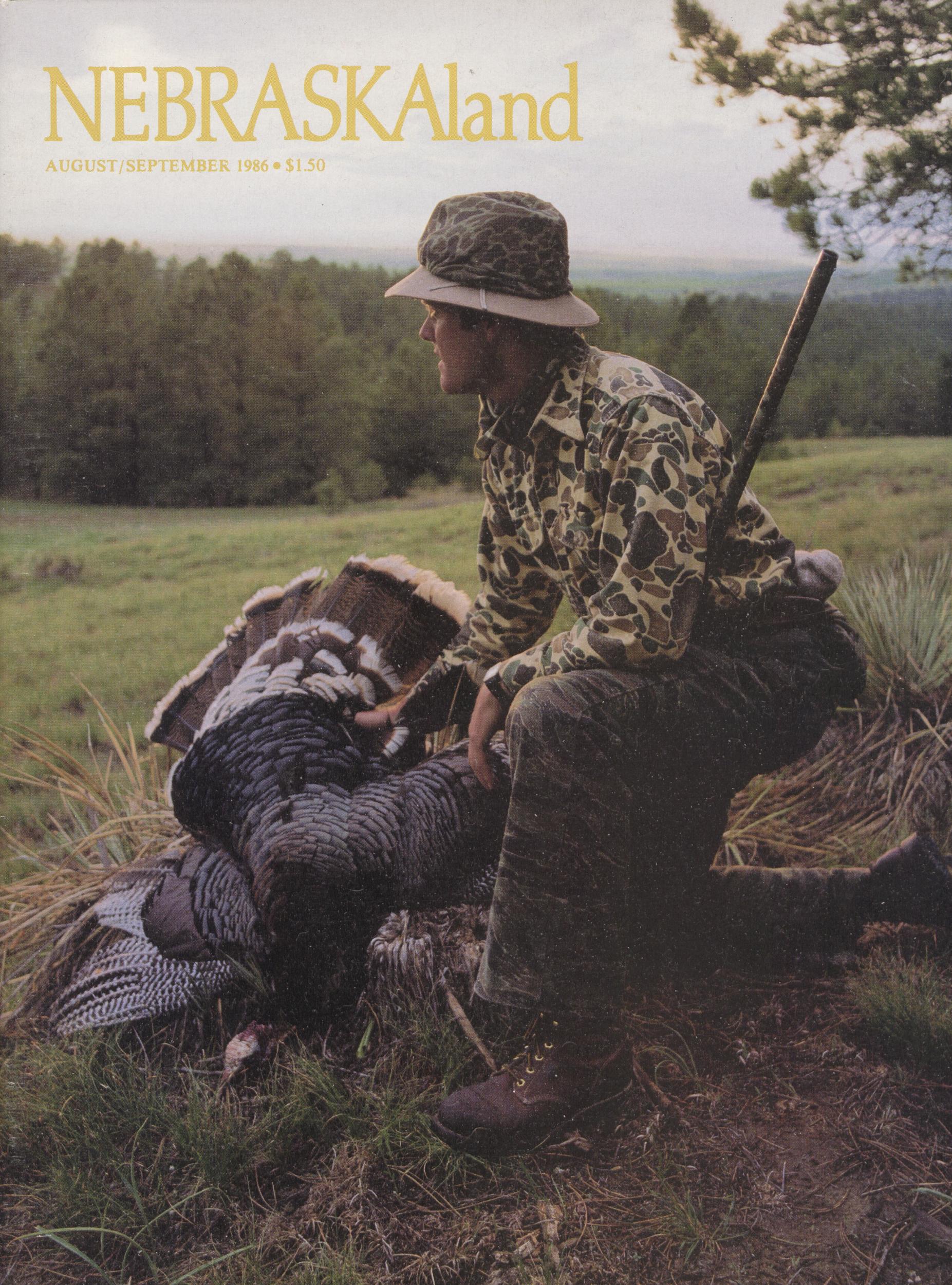
NEBRASKAland Published by the Nebraska Game and Parks Commission NEBRASKAland VOL. 64/NO. 7/AUG/SEPT 1986 NEBRASKAland (ISSN:0028-1964) is published monthly except for combined Jan/Feb and Aug/Sept issues, by the Nebraska Game and Parks Commission, 2200 North 33rd Street, Lincoln, NE. Copyright 1986, all rights reserved. Second-class postage paid at Lincoln, Nebraska and at additional mailing offices. POSTMASTER: Send address changes to NEBRASKAland, Box 30370, Lincoln, NE 68503. Rates: $12 for one year; $23 for two years. Single copy price $1.50 Offices Headquarters 2200 N. 33rd, Lincoln, 68503 (402) 464-0641 13th and Farnam St., Omaha (402) 554-2144 Ak-Sar-Ben Aquarium, Gretna (402) 332-3901 Rt. 2, Alliance (308) 762-5605 Bassett (402) 684-3511 U.S. 81, Norfolk (402) 371-4950 Rt. 4, North Platte (308) 532-6225 Commissioners Chairman: Richard L. Coyne, Omaha Vice Chairman: Neal Keller, Brewster 2nd Vice Chairman: Dr. Tim Biga, Norfolk Stan Juelfs, Kimball Wayne Ziebarth, Wilcox LaVern Schneider, McCook L. Bruce Wright, Lincoln Director: Eugene T. Mahoney Assistant Directors: William J. Bailey, Jr., Dale R. Bree, W. Rex Amack Staff Chief, Information & Education: Jim MacAllister Editor: Lowell Johnson Senior Editor: Jon Farrar Associate Editors: Ken Bouc, Don Cunningham Regional Editors: Bob Grier, Rocky Hoffmann Contributors: Tom Keith, Liz Huff, Carl Wolfe Research Assistant: Curt Twedt Art Director: Duane Westerholt Illustration: Steve O'Hare, Paula Day Advertising: Dan Curran Circulation: Pat Frahm Contents Features MEADOW MUSIC MAKERS 6 THE STUDY 12 A QUESTION OF ATTITUDE 14 MORNING ON THE STAND 18 A CONSERVATIONIST FIRST 20 A NEW PANHANDLE WILDERNESS 24 WHEN ONE IS HUNTING 32 PITTMAN-ROBERTSON SPORTSMEN LENDING A HAND 42 HUNTING FORECAST 50 NOTES ON NEBRASKA FLORA /COTTONWOOD 65 Departments SPEAK UP 4 BOOK SHELF 62 TRADING POST 63 COVER: A beautiful setting makes a fall turkey hunt even more memorable, and the terrain of Turkey Creek Wildlife Management Area in the southern Panhandle serves to enhance even a successful hunt. See more on this area in this issue starting on page 24. Photo by Bob Grier. OPPOSITE: Fall also means duck hunting, and a beaver pond on the North Loup River near Mullen provides an unusual setting for a decoy set to lure in migrating birds. Photo by Ken Bouc. AUGUST/SEPTEMBER 1986 3
Speak Up
Steel—for strengthSir / Thanks for your September 1985 article "Take Your Best Shot Steel." It is about time we stop arguing about which shot is better for us hunters. Let's remember that using steel shot will insure a good, healthy population of waterfowl to keep Nebraska's hunting future strong. It's a small price to pay. Keep those hunting tips coming.
Michael Ashley Lincoln, Nebr. A real gemSir / Your March 1986 issue with the sod house feature should become a historical gem. It surpasses anything I've ever seen written or printed regarding the early Nebraska homesteader homes.
My mother was born in a sod house six miles south of Ord. Her mother was a homesteader and her husband was the Mira Valley postmaster for years. Mr. Ward, the postmaster, was a delegate to the first Republican Convention and helped nominate Abraham Lincoln for president. He was also a captain in the Union Army.
So you see such articles are a part of my heritage. The State Historical Society should attempt to preserve all such articles. Keep up the good work.
Claude M. Roe Yuma, AZ Great coverageSir / Your Fort Robinson Illustrated issue of your fine magazine deserves, in my opinion, another notch on your gun and another feather in your bonnet in recognition of your coverage of this noted Nebraska historical site and the part it played in the history of our western country.
Having visited Fort Robinson, and as a retired teacher from the Bureau of Indian Affairs, Indian Field Service under the U.S. Department of the Interior, when I served for two years at the Oglala Community High School on the Pine Ridge Indian Reservation at Pine Ridge, S.D., Fort Robinson Illustrated was deeply appreciated.
Lawrence D. Fairbairn Hemet, CA Ft. Rob experienceSir / We have received our copy of "Ft. Robinson Illustrated" and I have some comments to make on a portion thereof.
I was stationed at the P.W. Camp, Ft. Robinson from late 1943 until the prisoners were transferred to Scottsbluff late 1945. I served in the Intelligence Office as an attached soldier along with four others. The function of our office was to monitor the affairs of the German prisoners of war, to uncover whatever information might be of use to the Department of the Army and the State Department, and to serve as interpreters.
The gentleman in the foreground of the picture on page 61 of your publication is Dr. John C. McGalliard, linguist, head of the Department of English at the University of Iowa, and member of the Intelligence staff. Others were Dr. John Neumaier, formerly president of the Minnesota State University at Moorhead, Richard P. Peritz, a German refugee now living in Chicago, Captain Duell, of Rochester, New York, and myself. I fail to recognize the person named in your article, Larry Norgard. He may have been a member of the guard personnel.
Mr. Norgard's statement that "The real Nazis were in charge and would give a kangaroo court martial to anybody who strayed from the Nazi doctrine. If they found them guilty, they would give them a piece of rope," simply is not true. Members of our staff worked inside the compound with the consent of the Germans. As a matter of fact, guard personnel were not permitted within the compound. We even taught classes in English and other subjects at night, thereby gaining greater confidence and respect from the prisoners, making it easier for us to gain intelligence information and keep control of their domestic affairs.
Your statement that only one person ever escaped from the camp is correct, but he really didn't escape. He was a person of rather low mentality who decided to see the country, left a work detail, hopped a freight, and was found in York looking in a beer-parlor window.
Our operation at Ft. Robinson was so successful that it became a model for many PW camps all over the country. Our system of operation was used as a format for an Intelligence School at Ft. Slocum, New York, in May 1945 after the German surrender, and for selection of German personnel for denazification and re-education at Ft. Eustis, Va. January through March, 1946, where 20,000 German PWs were instructed on functions of Allied Military Government in postwar Germany. More than 400,000 German PWs were incarcerated in the U.S. during the war. Thus, only one in 20 were selected for that training, and P.W. Camp, Ft. Robinson provided more than its share.
You may be interested in knowing that I keep in contact with many of the former 4 NEBRASKAland German PWs, among them the PW Camp Spokesman, Wolfgang Dorschel, who now lives at Eichbuehl 24, D7605 Bad Griesbach, West Germany, and the camp chaplain, Pater Leander, now an Abbott at the monastery in D - 8711 Muensterschwarzach, West Germany. These gentlemen and many others met with me last autumn in Limburg, West Germany. Mr. Dorschel and I have exchanged visits over the past years. You may also be interested in knowing that the German PWs have, to a man, assured me that they were well treated in America, and that although they were prisoners, the stay in America was one of the most memorable of their life's experiences.
By the way, my wife and I met at Crawford, thus my continued interest in her home state.
Alfred A. Thompson Bismarck, N.D. I'll be backSir I would like to take this opportunity to say "Thank You" to all the people at Fort Robinson State Park. I have visited the park several times in the last 15 years and have always enjoyed the activities, the relaxation and the friendliness of all the people at the fort and in the Crawford area. I have also enjoyed many hours exploring the area, which makes memories that I will never forget. The history and beauty of the area never seem to fill me up, and I keep coming back for more.
I would like to give a special thank-you to Tom Buecker, curator of the Historical Society museum there. I recently contacted him about some research I was doing on the Indian Wars era. His response was quick and the information and resources he furnished me were both interesting and helpful. I thoroughly enjoyed my conversation with him and look forward to meeting him on my next visit to the fort.
Michael Allen Columbus, NE BenefactorsSir / The article "Panhandle Playground" in the May 1985 issue states: "It would take a cooperative effort between area residents and the local and state governments to rebuild and to refill the reservoir." This indicates the above-mentioned groups were solely responsible for the Oliver Reservoir project.
No mention was made of the fact that the USDA Soil Conservation Service, through a cooperative agreement with the South Platte NRD, contributed well over a quarter-million dollars and many man-hours to insure the project was completed.
It is unfortunate the author did not give credit to the SCS for its substantial contribution.
Robert E. Gerard Lincoln, NE AttentionGameCooks!! From Kitchen ot NEBRASKAland Magazine A new cookbook will be published by NEBRASKAland Magazine in 1988. We are asking readers to submit their favorite game and fish recipes. Ethnic and pioneer recipes are encouraged. Include a list of ingredients, procedures, and any other pertinent data. All recipes used will be rewarded with a free cookbook, plus a credit. Submit as soon as possible, and as many as you wish. The deadline, like taxes, will be April 15, 1987. Send recipes with full name and address to: NEBRASKAland Recipes, Box 30370, Lincoln, NE 68503. AUGUST/SEPTEMBER 1986 5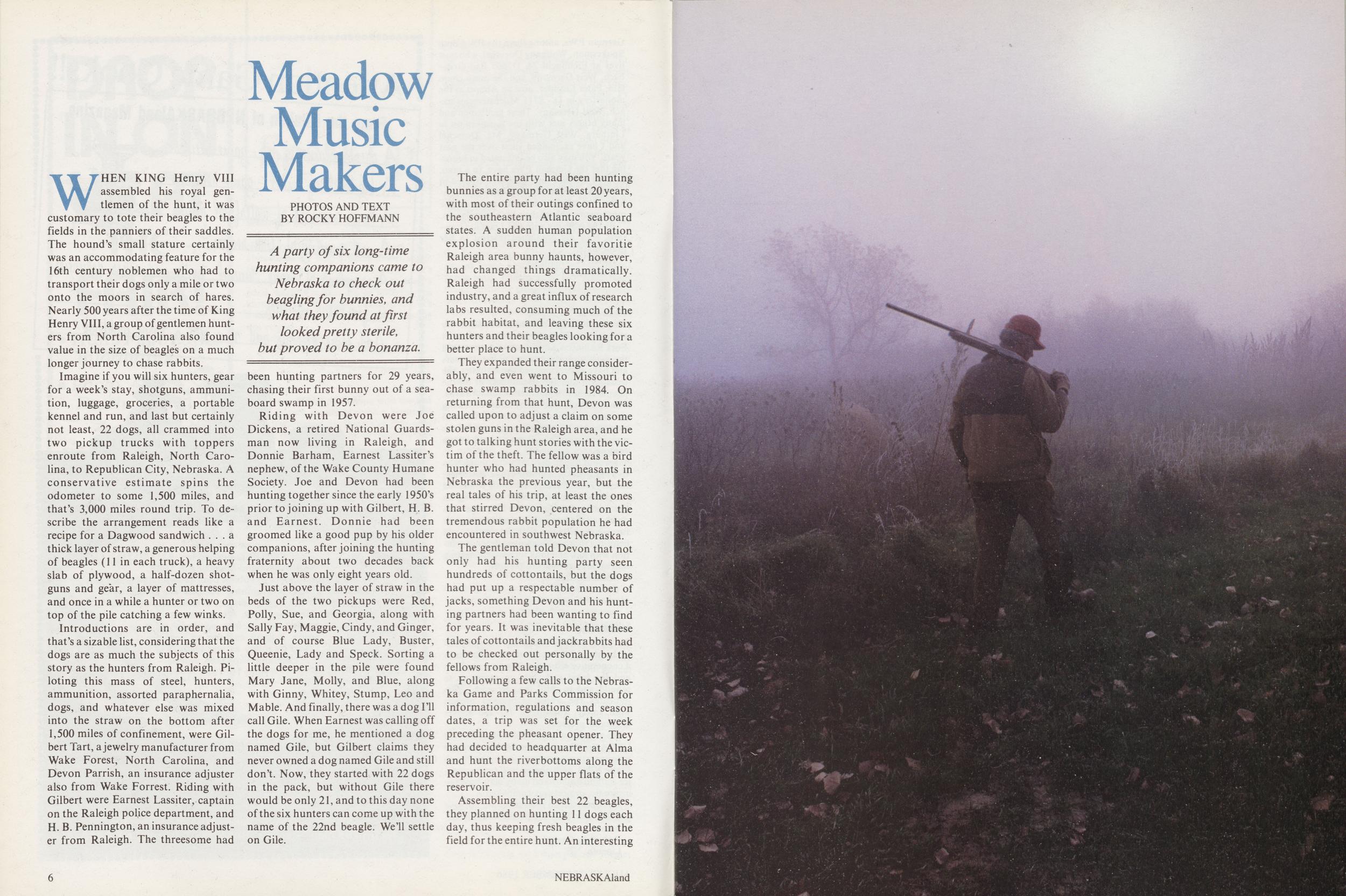
Meadow Music Makers
PHOTOS AND TEXT BY ROCKY HOFFMANN A party of six long-time hunting companions came to Nebraska to check out beagling for bunnies, and what they found at first looked pretty sterile, but proved to be a bonanza.WHEN KING Henry VIII assembled his royal gentlemen of the hunt, it was customary to tote their beagles to the fields in the panniers of their saddles. The hound's small stature certainly was an accommodating feature for the 16th century noblemen who had to transport their dogs only a mile or two onto the moors in search of hares. Nearly 500 years after the time of King Henry VIII, a group of gentlemen hunters from North Carolina also found value in the size of beagles on a much longer journey to chase rabbits.
Imagine if you will six hunters, gear for a week's stay, shotguns, ammunition, luggage, groceries, a portable kennel and run, and last but certainly not least, 22 dogs, all crammed into two pickup trucks with toppers enroute from Raleigh, North Carolina, to Republican City, Nebraska. A conservative estimate spins the odometer to some 1,500 miles, and that's 3,000 miles round trip. To describe the arrangement reads like a recipe for a Dagwood sandwich a thick layer of straw, a generous helping of beagles (11 in each truck), a heavy slab of plywood, a half-dozen shotguns and gear, a layer of mattresses, and once in a while a hunter or two on top of the pile catching a few winks.
Introductions are in order, and that's a sizable list, considering that the dogs are as much the subjects of this story as the hunters from Raleigh. Piloting this mass of steel, hunters, ammunition, assorted paraphernalia, dogs, and whatever else was mixed into the straw on the bottom after 1,500 miles of confinement, were Gilbert Tart, a jewelry manufacturer from Wake Forest, North Carolina, and Devon Parrish, an insurance adjuster also from Wake Forrest. Riding with Gilbert were Earnest Lassiter, captain on the Raleigh police department, and H. B. Pennington, an insurance adjuster from Raleigh. The threesome had been hunting partners for 29 years, chasing their first bunny out of a seaboard swamp in 1957.
Riding with Devon were Joe Dickens, a retired National Guardsman now living in Raleigh, and Donnie Barham, Earnest Lassiter's nephew, of the Wake County Humane Society. Joe and Devon had been hunting together since the early 1950's prior to joining up with Gilbert, H. B. and Earnest. Donnie had been groomed like a good pup by his older companions, after joining the hunting fraternity about two decades back when he was only eight years old.
Just above the layer of straw in the beds of the two pickups were Red, Polly, Sue, and Georgia, along with Sally Fay, Maggie, Cindy, and Ginger, and of course Blue Lady, Buster, Queenie, Lady and Speck. Sorting a little deeper in the pile were found Mary Jane, Molly, and Blue, along with Ginny, Whitey, Stump, Leo and Mable. And finally, there was a dog I'll call Gile. When Earnest was calling off the dogs for me, he mentioned a dog named Gile, but Gilbert claims they never owned a dog named Gile and still don't. Now, they started with 22 dogs in the pack, but without Gile there would be only 21, and to this day none of the six hunters can come up with the name of the 22nd beagle. We'll settle on Gile.
The entire party had been hunting bunnies as a group for at least 20 years, with most of their outings confined to the southeastern Atlantic seaboard states. A sudden human population explosion around their favoritie Raleigh area bunny haunts, however, had changed things dramatically. Raleigh had successfully promoted industry, and a great influx of research labs resulted, consuming much of the rabbit habitat, and leaving these six hunters and their beagles looking for a better place to hunt.
They expanded their range considerably, and even went to Missouri to chase swamp rabbits in 1984. On returning from that hunt, Devon was called upon to adjust a claim on some stolen guns in the Raleigh area, and he got to talking hunt stories with the victim of the theft. The fellow was a bird hunter who had hunted pheasants in Nebraska the previous year, but the real tales of his trip, at least the ones that stirred Devon, centered on the tremendous rabbit population he had encountered in southwest Nebraska.
The gentleman told Devon that not only had his hunting party seen hundreds of cottontails, but the dogs had put up a respectable number of jacks, something Devon and his hunting partners had been wanting to find for years. It was inevitable that these tales of cottontails and jackrabbits had to be checked out personally by the fellows from Raleigh.
Following a few calls to the Nebraska Game and Parks Commission for information, regulations and season dates, a trip was set for the week preceding the pheasant opener. They had decided to headquarter at Alma and hunt the riverbottoms along the Republican and the upper flats of the reservoir.
Assembling their best 22 beagles, they planned on hunting 11 dogs each day, thus keeping fresh beagles in the field for the entire hunt. An interesting 6 NEBRASKAland
The dogs are owned by Devon, Earnest, and Gilbert, while all of the hunters contribute for feed, boarding, and veterinarian expenses. In all, they kennel 45 beagles that comprise three separate packs. Each dog has its own personality traits some good and some bad. Some are excellent brush dogs, while others work open fields better. Some give voice freely, while others bark only a hot trail. By careful selection, the right combination of dogs makes for a perfect pack, and here's where the misunderstanding evolved.
Whitey, Mary Jane, and Buster were all considered tremendous assets to the pack as a whole, and the men wanted to include them on the traveling team, but with the good comes the bad. Their 8 NEBRASKAland bad trait was they dearly loved to run deer, so one of the questions to someone in the Lincoln office was, "Are there any deer in the Republican River Valley?" The reported answer was, "You won't have any problem with deer in that area of the state."
Adios Whitey, Mary Jane, and Buster. I think it was in the first draw of the hunt. Buster was found before returning to Raleigh, Mary Jane still hasn't been heard from, and Whitey came home via air freight in May of 1986. Earnest claimed, "Whoever it was that said we wouldn't have any problem with deer in Nebraska must have thought that's what we were coming to hunt."
As the two pickups headed west across Kansas and turned north toward Harlan County Reservoir, everyone thought they had made a big mistake. Open, rolling grasslands, almost devoid of thickets, brushy draws and swamps, spanned from horizon to horizon. This certainly didn't resemble any rabbit country they had hunted in North and South Carolina or even Missouri, but they had traveled too far to turn around.
At Republican City, they stopped for gas, refreshments and non-resident hunting permits, and began talking to the locals, who told some pretty big rabbit stories. Inquiries led them to Al Gehrt, chief ranger for the Corps of Engineers' Harlan Reservoir Project. Al provided them with a tour of the wildlife habitat improvement projects in the rough country surrounding Harlan Reservoir; a tour that convinced them that maybe they hadn't made a mistake coming to Nebraska.
In 1977, the U.S. Army Corps of Engineers entered into a cooperative agreement with the Nebraska Game and Parks Commission and the University of Nebraska Department of Forestry on managing Harlan's public lands for wildlife habitat. Harlan County Reservoir's total public land consists of 17,000 acres all open to hunting, but the land to be managed specifically for habitat development consisted of 10,000 acres.
Since that time, Habitat Stamp dollars collected by the Game and Parks Commission have provided five small wetlands, 900 acres of native grasses planted in interspersed strips on agricultural land, 160,000 trees and shrubs consisting of skunkbush sumac, Hanson hedge rose, American plum and chokecherry, and more than 800 miles of protective fencing. While the shrubs, grass, and wetlands were going in, the Corps dramatically revised its leasing agreements with area farmers and ranchers, mandating crop rotation and totally forbidding further fall plowing, silage cutting or grazing. They also set back hay production after July 1 to protect nesting pheasants and quail.
Al Gehrt and his personnel also established some "state of the art" management practices; namely, controlled burning to rejuvenate desirable native stands of grasses, hoping to improve winter and nesting cover. Since 1982, Gehrt has conducted 27 separate controlled burns, and in 1986 alone, the Corps has rejuvenated more than 1,200 acres by fire on lands surrounding Harlan Reservoir.
Harlan is a showpiece for wildlife habitat, and it didn't take the boys from North Carolina long to decide where they were going to hunt bunnies. They pulled their two rigs into Stone's Apartments, set up their portable kennel and dog run, and never changed camp the entire week.
Scheduling prevented me from joining them until the last day of their hunt, which was the Friday before Saturday's opening of pheasant season, but a lot of experiences preceded my arrival, one of which is certainly worth recounting.
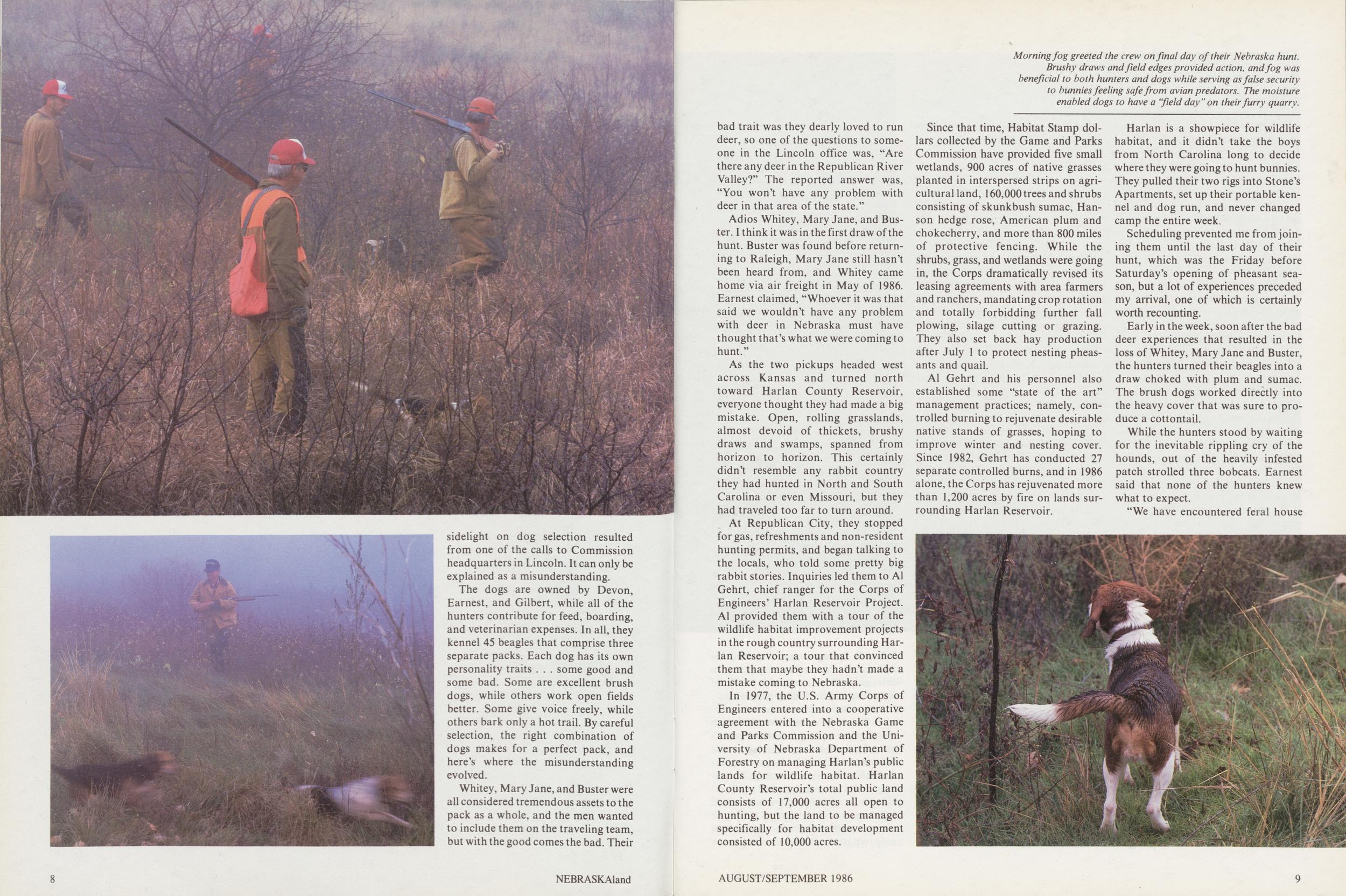
Early in the week, soon after the bad deer experiences that resulted in the loss of Whitey, Mary Jane and Buster, the hunters turned their beagles into a draw choked with plum and sumac. The brush dogs worked directly into the heavy cover that was sure to produce a cottontail.
While the hunters stood by waiting for the inevitable rippling cry of the hounds, out of the heavily infested patch strolled three bobcats. Earnest said that none of the hunters knew what to expect.
"We have encountered feral house
Credit has to be given to the beagles. They were strictly attending to business and that was hunting cottontails. Not one of the 11 hounds even cast a glance at the braced cats as they proceeded to bounce five bunnies from the patch of cover. The bobcats melted back into the thicket, the beagles bayed at the fleeing cottontails and the hunt continued without incident.
At daybreak, we met in one of Stone's efficiency apartments and shared a generous concoction of scrambled eggs, bacon, sausages, whole wheat bread, and some succulent flakes of rabbit meat left over from the previous night's barbecue. I guessed that the large breakfast was an attempt to utilize all of the grub since this was to be the final hunt of the trip. By 2:00 in the afternoon, however, I began to fully appreciate the generous helpings and learned that the morning's offering was just a typical breakfast, as hunting time was not wasted for trivial matters like lunch.
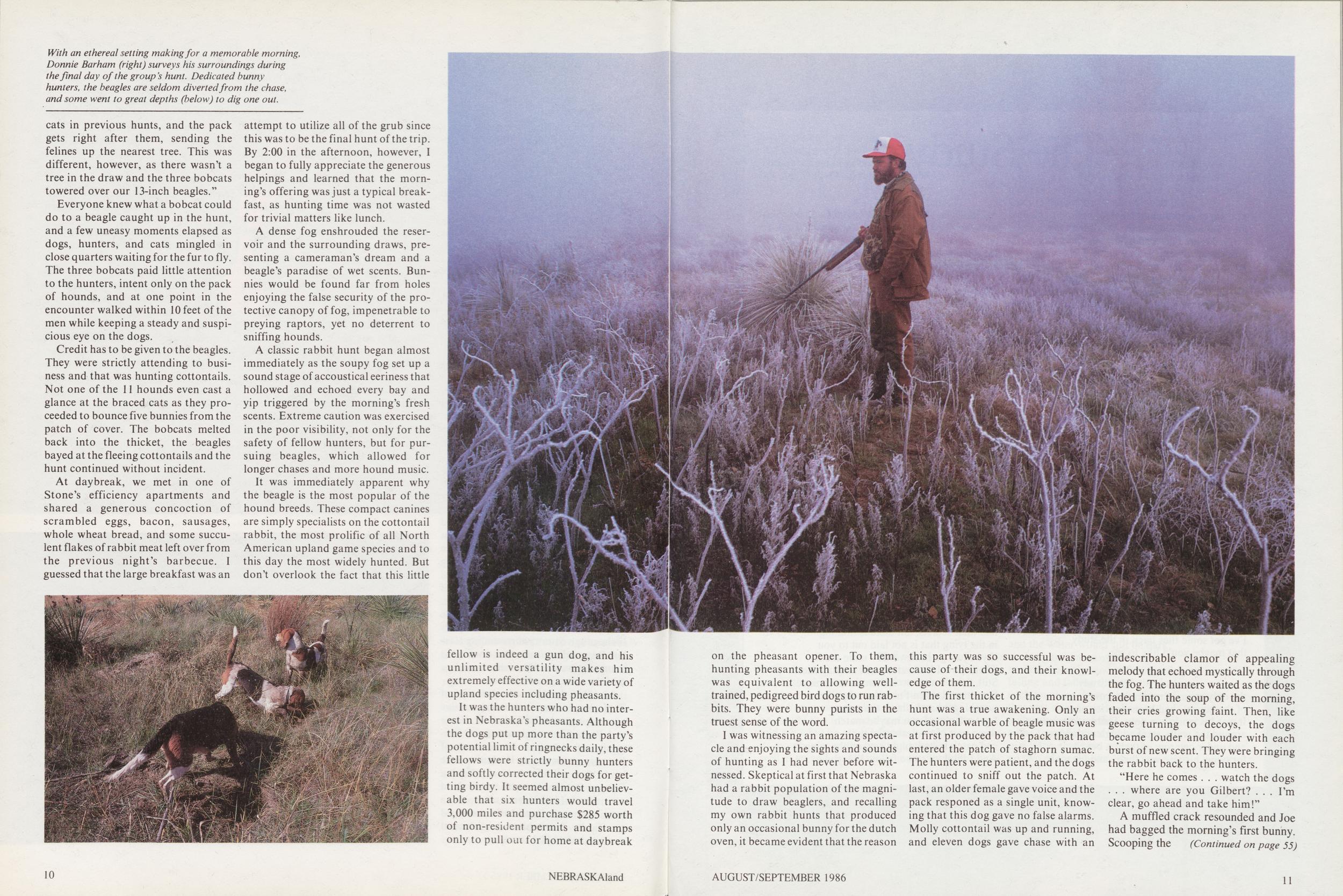
A dense fog enshrouded the reservoir and the surrounding draws, presenting a cameraman's dream and a beagle's paradise of wet scents. Bunnies would be found far from holes enjoying the false security of the protective canopy of fog, impenetrable to preying raptors, yet no deterrent to sniffing hounds.
A classic rabbit hunt began almost immediately as the soupy fog set up a sound stage of accoustical eeriness that hollowed and echoed every bay and yip triggered by the morning's fresh scents. Extreme caution was exercised in the poor visibility, not only for the safety of fellow hunters, but for pursuing beagles, which allowed for longer chases and more hound music.
It was immediately apparent why the beagle is the most popular of the hound breeds. These compact canines are simply specialists on the cottontail rabbit, the most prolific of all North American upland game species and to this day the most widely hunted. But don't overlook the fact that this little fellow is indeed a gun dog, and his unlimited versatility makes him extremely effective on a wide variety of upland species including pheasants.
It was the hunters who had no interest in Nebraska's pheasants. Although the dogs put up more than the party's potential limit of ringnecks daily, these fellows were strictly bunny hunters and softly corrected their dogs for getting birdy. It seemed almost unbelievable that six hunters would travel 3,000 miles and purchase $285 worth of non-resident permits and stamps only to pull oui for home at daybreak 10 NEBRASKAland on the pheasant opener. To them, hunting pheasants with their beagles was equivalent to allowing welltrained, pedigreed bird dogs to run rabbits. They were bunny purists in the truest sense of the word.
I was witnessing an amazing spectacle and enjoying the sights and sounds of hunting as I had never before witnessed. Skeptical at first that Nebraska had a rabbit population of the magnitude to draw beaglers, and recalling my own rabbit hunts that produced only an occasional bunny for the dutch oven, it became evident that the reason this party was so successful was because of their dogs, and their knowledge of them.
The first thicket of the morning's hunt was a true awakening. Only an occasional warble of beagle music was at first produced by the pack that had entered the patch of staghorn sumac. The hunters were patient, and the dogs continued to sniff out the patch. At last, an older female gave voice and the pack responed as a single unit, knowing that this dog gave no false alarms. Molly cottontail was up and running, and eleven dogs gave chase with an indescribable clamor of appealing melody that echoed mystically through the fog. The hunters waited as the dogs faded into the soup of the morning, their cries growing faint. Then, like geese turning to decoys, the dogs became louder and louder with each burst of new scent. They were bringing the rabbit back to the hunters.
"Here he comes watch the dogs where are you Gilbert? I'm clear, go ahead and take him!"
A muffled crack resounded and Joe had bagged the morning's first bunny. Scooping the (Continued on page 55)
AUGUST/SEPTEMBER 1986 11
The Study
BY ROY SCHEELEThe paper says that up north of here the trout are hitting on the Verdigre. I fished there one Indian Summer day years ago, without success, 'till a storm came up over the hills and drove me to a nearby farmhouse just ahead of the rain. The house was of limestone, its lintels and sills covered with the prints of tiny shells. There was a light on in the kitchen and, answering my knock, a man appeared behind the screen door; tall and thin, with wire-rim glasses on, he had a wen, soft-looking as a dab of putty, about the size of a fingertip, off to one side of his forehead. He looked me over before he said, "You better come on in."
In the kitchen there was a cast-iron stove with brass facings in which he had a fire. The wood spat, and the draft drew off the smoke and ash with a flapping sound, as though a bird were trapped underneath the roof. We sat drinking coffee at the table, listening to that sound against the rain. "I guess this weather sort of spoils your fishing, but maybe you don't mind. I doubt if you were having any luck. Nobody around here has lately. Oh, the fish are there, all right; I know the fish are there. Say, I tell you what. I've got some flies back in the study that maybe you'd like to see."
The "study" the only room in use in the front of the house—had been a parlor once. It was his workshop now. There were shelves around the walls, stacked high with boxes, and under one row of them a bench for tying: his vise was there, and his tools. A Catalogue of Fly-Tying Material well-thumbed as a Bible, a leaping trout on its cover, was propped against the wall. He showed me flies from several books, and some new ones he'd been working on.
"You understand, it's just a sidelight for me—what you might call my hobby. Running the farm takes most of my time, and when I tie, it's usually late at night. I've sold a few at the tackle store in town, but most of them I use, or give them to friends or visitors. I've even started a few patterns up, though when I began I never thought the day would come when I'd get good enough. My father tied: he wasn't encouraging. I used to keep my flies out of the way in his cigar case, of all places! I can see him yet: he'd take one of those flies up, let it drop back down, and say, 'Terrible—just terrible' no more than that. And I suppose they were. But over the years you get to know a thing or two—like how to pick the hackles that will make a good dry fly. Those darker feathers down along the sides of the neck, those are the ones you want. And you have to wait 'till the second year before the chickens have them. So the first lesson that you learn is patience. All the rest of it depends on that. You know, a lot of the oldtimers had their secrets, but there is nothing in the tying that is not laid out to you if you just go backwards—untie the fly. That's how I learned myself, untying flies. Still, there's more to it than just technique. Sometimes, when I'm out on the river, watching a hatch above the water, I get a feeling I can maybe match some part of that essential to itcan catch it, you might say, on the wing. And I think of some fellow like you laying his cast across the riffles, and what he will think of the darn thing. There's a kind of pride in that, I guess, but maybe that's all right."
He leaned back in the black swivel chair he sat in. On the bench behind him, feather shreds and ends of thread and tinsel lay in drifts. There was a fly still in the vise with the thread partly wrapped around it and hanging from it, like a snapped length of leader.
"People talk about the art of tying. To me it's more a mystery. If you caught a fly and looked at it, you'd tie it a certain way. It might not be exactly like the fly you looked at, but that's okay: sometimes it's better not to make it look too natural. You sort of tie your first impression, and somehow the fish go crazy for it. There's no telling why; it's more like a mistake. That's what I mean, see, by the mystery. And even working in the same pattern, somehow you never tie the same fly twice. You know, like they say about snowflakes no two of them alike. I sometimes think stubbornness is part of it too not being willing to give it up 'till you get the fly you're after. You need a bit of stubbornness in this business, and mine I come by naturally."
For a moment he gazed at a spot somewhere above my shoulder, not seeing what was there, but something his eyes glinted to recall.
"Tell you a story about my dad. He used to trap, see, in the winter, when there wasn't much to do around the place. He'd sell the skins up to Pettigrew's in town. Well, one time he caught this fox, and somehow (he never told my why) he got his finger down its mouth, way at the back, and the fox, well, it up and died, with its jaws shut tight on his finger. Dad pulled the finger out, wrapped his handkerchief around it, picked up the fox and came home. Mother said, 'Lathur, what's the matter with your finger?' like that, you know, and he said, 'Nothing much. Get me the iodine.' He just stood there bleeding onto the table and the floor. So she says again, 'What've you done to your finger?' Then he tells her he'd got it bit by a fox. Never once did I hear her carry on the way she did when she heard that! There was dad soaking his hand in a dish of iodine while she kept saying, T never saw anything so gruesome as that!!' And when he took the hand out of the iodine it was about the shade of the fox's skin, the finger swollen and chewed-up, like, but he never batted an eye. Mother kept after him for days to see the doctor, but he wouldn't. Later he said he'd had it coming, that his foolishness had let the fox trap him, just as he'd trapped the fox. He'd even laugh about it, when mother wasn't around. He was the stubbornest old cuss I ever saw. And could he tie flies! I've got a few here somewhere. Let me show you "
When we went back to the kitchen the rain had stopped. Drops hung from the eaves as we said goodby in the dusk. Down below I could hear the river through the trees. I felt the chill of the coming night, and I thought how, in a month or two, there would be a fall of snow. The snow would line the banks and cover up the weeds and bushes. It would fall and disappear into the water and the water would still be dark, showing only a snow of foam around the snags and riffles, the flakes falling and falling through the dusk, each touching down like a fly that was risen to and taken a ghostly hatch of flies come trembling out of the sky in a flurry that bore no hook, no two of them alike.
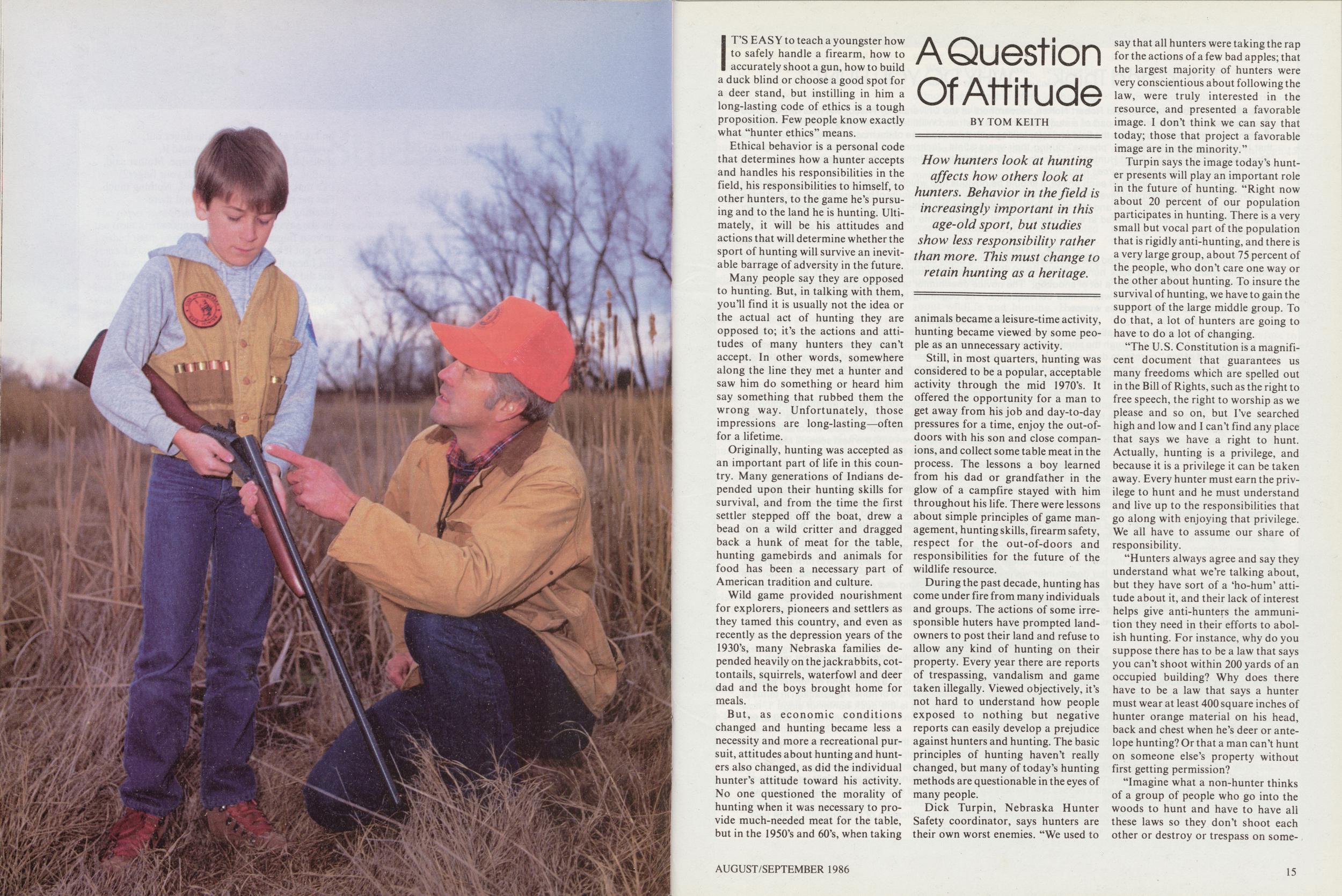
A Question Of Attitude
BY TOM KEITH How hunters look at hunting affects how others look at hunters. Behavior in the field is increasingly important in this age-old sport, but studies show less responsibility rather than more. This must change to retain hunting as a heritage.IT'S EASY to teach a youngster how to safely handle a firearm, how to accurately shoot a gun, how to build a duck blind or choose a good spot for a deer stand, but instilling in him a long-lasting code of ethics is a tough proposition. Few people know exactly what "hunter ethics" means.
Ethical behavior is a personal code that determines how a hunter accepts and handles his responsibilities in the field, his responsibilities to himself, to other hunters, to the game he's pursuing and to the land he is hunting. Ultimately, it will be his attitudes and actions that will determine whether the sport of hunting will survive an inevitable barrage of adversity in the future.
Many people say they are opposed to hunting. But, in talking with them, you'll find it is usually not the idea or the actual act of hunting they are opposed to; it's the actions and attitudes of many hunters they can't accept. In other words, somewhere along the line they met a hunter and saw him do something or heard him say something that rubbed them the wrong way. Unfortunately, those impressions are long-lasting—often for a lifetime.
Originally, hunting was accepted as an important part of life in this country. Many generations of Indians depended upon their hunting skills for survival, and from the time the first settler stepped off the boat, drew a bead on a wild critter and dragged back a hunk of meat for the table, hunting gamebirds and animals for food has been a necessary part of American tradition and culture.
Wild game provided nourishment for explorers, pioneers and settlers as they tamed this country, and even as recently as the depression years of the 1930's, many Nebraska families depended heavily on the jackrabbits, cottontails, squirrels, waterfowl and deer dad and the boys brought home for meals.
But, as economic conditions changed and hunting became less a necessity and more a recreational pursuit, attitudes about hunting and hunters also changed, as did the individual hunter's attitude toward his activity. No one questioned the morality of hunting when it was necessary to provide much-needed meat for the table, but in the 1950's and 60's, when taking animals became a leisure-time activity, hunting became viewed by some people as an unnecessary activity.
Still, in most quarters, hunting was considered to be a popular, acceptable activity through the mid 1970's. It offered the opportunity for a man to get away from his job and day-to-day pressures for a time, enjoy the out-of-doors with his son and close companions, and collect some table meat in the process. The lessons a boy learned from his dad or grandfather in the glow of a campfire stayed with him throughout his life. There were lessons about simple principles of game management, hunting skills, firearm safety, respect for the out-of-doors and responsibilities for the future of the wildlife resource.
During the past decade, hunting has come under fire from many individuals and groups. The actions of some irresponsible huters have prompted landowners to post their land and refuse to allow any kind of hunting on their property. Every year there are reports of trespassing, vandalism and game taken illegally. Viewed objectively, it's not hard to understand how people exposed to nothing but negative reports can easily develop a prejudice against hunters and hunting. The basic principles of hunting haven't really changed, but many of today's hunting methods are questionable in the eyes of many people.
Dick Turpin, Nebraska Hunter Safety coordinator, says hunters are their own worst enemies. "We used to say that all hunters were taking the rap for the actions of a few bad apples; that the largest majority of hunters were very conscientious about following the law, were truly interested in the resource, and presented a favorable image. I don't think we can say that today; those that project a favorable image are in the minority."
Turpin says the image today's hunter presents will play an important role in the future of hunting. "Right now about 20 percent of our population participates in hunting. There is a very small but vocal part of the population that is rigidly anti-hunting, and there is a very large group, about 75 percent of the people, who don't care one way or the other about hunting. To insure the survival of hunting, we have to gain the support of the large middle group. To do that, a lot of hunters are going to have to do a lot of changing.
"The U.S. Constitution is a magnificent document that guarantees us many freedoms which are spelled out in the Bill of Rights, such as the right to free speech, the right to worship as we please and so on, but I've searched high and low and I can't find any place that says we have a right to hunt. Actually, hunting is a privilege, and because it is a privilege it can be taken away. Every hunter must earn the privilege to hunt and he must understand and live up to the responsibilities that go along with enjoying that privilege. We all have to assume our share of responsibility.
"Hunters always agree and say they understand what we're talking about, but they have sort of a 'no-hum' attitude about it, and their lack of interest helps give anti-hunters the ammunition they need in their efforts to abolish hunting. For instance, why do you suppose there has to be a law that says you can't shoot within 200 yards of an occupied building? Why does there have to be a law that says a hunter must wear at least 400 square inches of hunter orange material on his head, back and chest when he's deer or antelope hunting? Or that a man can't hunt on someone else's property without first getting permission?
"Imagine what a non-hunter thinks of a group of people who go into the woods to hunt and have to have all these laws so they don't shoot each other or destroy or trespass on some one else's property? Originally, hunting laws were passed to protect game, but now more and more laws are being passed to protect hunters from other hunters," Turpin said.
AUGUST/SEPTEMBER 1986 15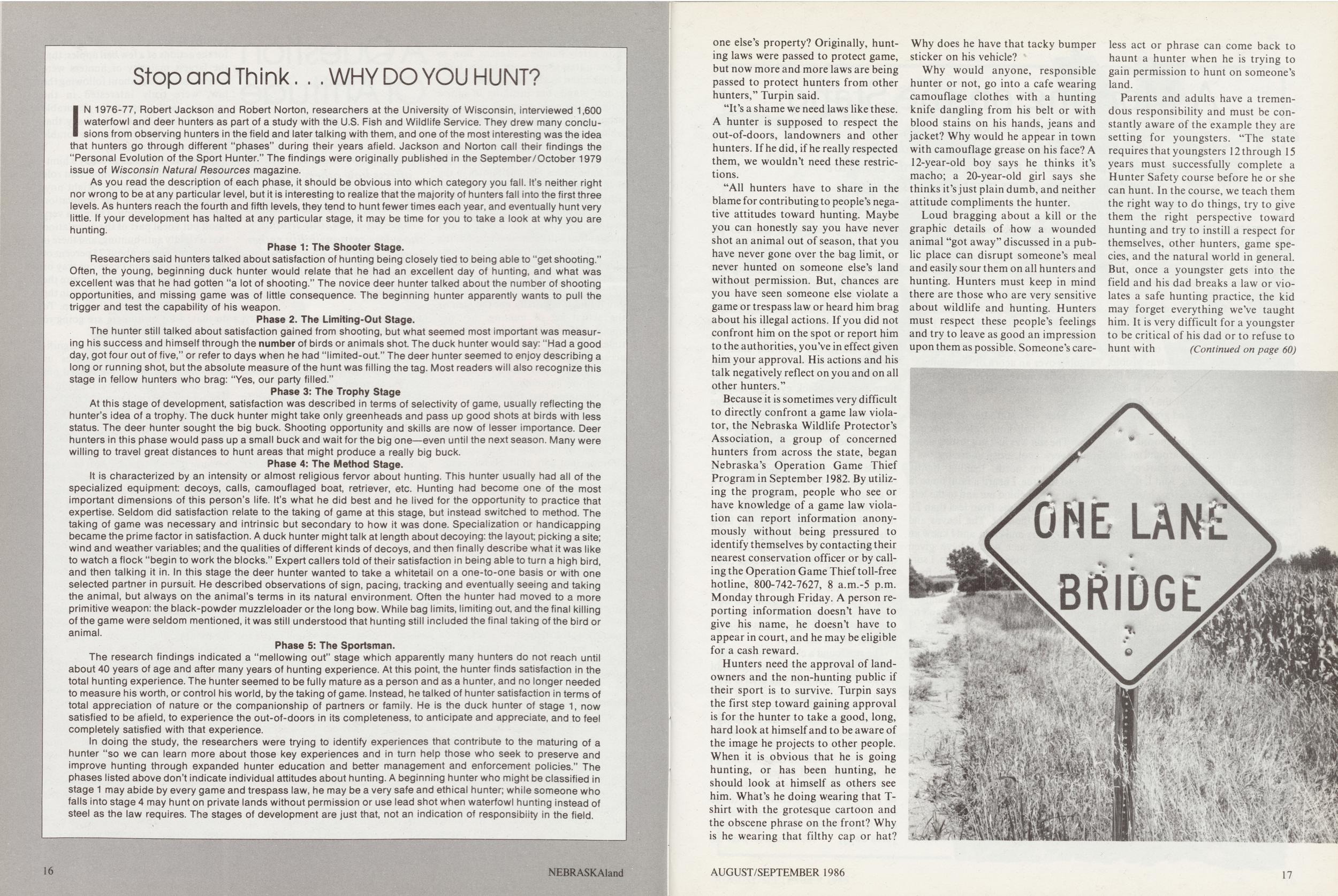 Stop and Think.. .WHY DO YOU HUNT?
IN 1976-77, Robert Jackson and Robert Norton, researchers at the University of Wisconsin, interviewed 1,600 waterfowl and deer hunters as part of a study with the U.S. Fish and Wildlife Service. They drew many conclusions from observing hunters in the field and later talking with them, and one of the most interesting was the idea that hunters go through different "phases" during their years afield. Jackson and Norton call their findings the "Personal Evolution of the Sport Hunter." The findings were originally published in the September/October 1979 issue of Wisconsin Natural Resources magazine.
As you read the description of each phase, it should be obvious into which category you fall. It's neither right nor wrong to be at any particular level, but it is interesting to realize that the majority of hunters fall into the first three levels. As hunters reach the fourth and fifth levels, they tend to hunt fewer times each year, and eventually hunt very little. If your development has halted at any particular stage, it may be time for you to take a look at why you are hunting.
Phase 1: The Shooter Stage.Researchers said hunters talked about satisfaction of hunting being closely tied to being able to "get shooting." Often, the young, beginning duck hunter would relate that he had an excellent day of hunting, and what was excellent was that he had gotten "a lot of shooting." The novice deer hunter talked about the number of shooting opportunities, and missing game was of little consequence. The beginning hunter apparently wants to pull the trigger and test the capability of his weapon.
Phase 2. The Limiting-Out Stage.The hunter still talked about satisfaction gained from shooting, but what seemed most important was measur- ing his success and himself through the number of birds or animals shot. The duck hunter would say: "Had a good day, got four out of five," or refer to days when he had "limited-out." The deer hunter seemed to enjoy describing a long or running shot, but the absolute measure of the hunt was filling the tag. Most readers will also recognize this stage in fellow hunters who brag: "Yes, our party filled."
Phase 3: The Trophy StageAt this stage of development, satisfaction was described in terms of selectivity of game, usually reflecting the hunter's idea of a trophy. The duck hunter might take only greenheads and pass up good shots at birds with less status. The deer hunter sought the big buck. Shooting opportunity and skills are now of lesser importance. Deer hunters in this phase would pass up a small buck and wait for the big one—even until the next season. Many were willing to travel great distances to hunt areas that might produce a really big buck.
Phase 4: The Method Stage.It is characterized by an intensity or almost religious fervor about hunting. This hunter usually had all of the specialized equipment: decoys, calls, camouflaged boat, retriever, etc. Hunting had become one of the most important dimensions of this person's life. It's what he did best and he lived for the opportunity to practice that expertise. Seldom did satisfaction relate to the taking of game at this stage, but instead switched to method. The taking of game was necessary and intrinsic but secondary to how it was done. Specialization or handicapping became the prime factor in satisfaction. A duck hunter might talk at length about decoying: the layout; picking a site; wind and weather variables; and the qualities of different kinds of decoys, and then finally describe what it was like to watch a flock "begin to work the blocks." Expert callers told of their satisfaction in being able to turn a high bird, and then talking it in. In this stage the deer hunter wanted to take a whitetail on a one-to-one basis or with one selected partner in pursuit. He described observations of sign, pacing, tracking and eventually seeing and taking the animal, but always on the animal's terms in its natural environment. Often the hunter had moved to a more primitive weapon: the black-powder muzzleloader or the long bow. While bag limits, limiting out, and the final killing of the game were seldom mentioned, it was still understood that hunting still included the final taking of the bird or animal.
Phase 5: The Sportsman.The research findings indicated a "mellowing out" stage which apparently many hunters do not reach until about 40 years of age and after many years of hunting experience. At this point, the hunter finds satisfaction in the total hunting experience. The hunter seemed to be fully mature as a person and as a hunter, and no longer needed to measure his worth, or control his world, by the taking of game. Instead, he talked of hunter satisfaction in terms of total appreciation of nature or the companionship of partners or family. He is the duck hunter of stage 1, now satisfied to be afield, to experience the out-of-doors in its completeness, to anticipate and appreciate, and to feel completely satisfied with that experience.
In doing the study, the researchers were trying to identify experiences that contribute to the maturing of a hunter "so we can learn more about those key experiences and in turn help those who seek to preserve and improve hunting through expanded hunter education and better management and enforcement policies." The phases listed above don't indicate individual attitudes about hunting. A beginning hunter who might be classified in stage 1 may abide by every game and trespass law, he may be a very safe and ethical hunter; while someone who falls into stage 4 may hunt on private lands without permission or use lead shot when waterfowl hunting instead of steel as the law requires. The stages of development are just that, not an indication of responsibiity in the field.
16 NEBRASKAland"It's a shame we need laws like these. A hunter is supposed to respect the out-of-doors, landowners and other hunters. If he did, if he really respected them, we wouldn't need these restrictions.
"All hunters have to share in the blame for contributing to people's negative attitudes toward hunting. Maybe you can honestly say you have never shot an animal out of season, that you have never gone over the bag limit, or never hunted on someone else's land without permission. But, chances are you have seen someone else violate a game or trespass law or heard him brag about his illegal actions. If you did not confront him on the spot or report him to the authorities, you've in effect given him your approval. His actions and his talk negatively reflect on you and on all other hunters."
Because it is sometimes very difficult to directly confront a game law violator, the Nebraska Wildlife Protector's Association, a group of concerned hunters from across the state, began Nebraska's Operation Game Thief Program in September 1982. By utilizing the program, people who see or have knowledge of a game law violation can report information anonymously without being pressured to identify themselves by contacting their nearest conservation officer or by calling the Operation Game Thief toll-free hotline, 800-742-7627, 8 a.m.-5 p.m. Monday through Friday. A person reporting information doesn't have to give his name, he doesn't have to appear in court, and he may be eligible for a cash reward.
Hunters need the approval of landowners and the non-hunting public if their sport is to survive. Turpin says the first step toward gaining approval is for the hunter to take a good, long, hard look at himself and to be aware of the image he projects to other people. When it is obvious that he is going hunting, or has been hunting, he should look at himself as others see him. What's he doing wearing that T-shirt with the grotesque cartoon and the obscene phrase on the front? Why is he wearing that filthy cap or hat? Why does he have that tacky bumper sticker on his vehicle?
Why would anyone, responsible hunter or not, go into a cafe wearing camouflage clothes with a hunting knife dangling from his belt or with blood stains on his hands, jeans and jacket? Why would he appear in town with camouflage grease on his face? A 12-year-old boy says he thinks it's macho; a 20-year-old girl says she thinks it's just plain dumb, and neither attitude compliments the hunter.
Loud bragging about a kill or the graphic details of how a wounded animal "got away" discussed in a public place can disrupt someone's meal and easily sour them on all hunters and hunting. Hunters must keep in mind there are those who are very sensitive about wildlife and hunting. Hunters must respect these people's feelings and try to leave as good an impression upon them as possible. Someone's careless act or phrase can come back to haunt a hunter when he is trying to gain permission to hunt on someone's land.
Parents and adults have a tremendous responsibility and must be constantly aware of the example they are setting for youngsters. "The state requires that youngsters 12 through 15 years must successfully complete a Hunter Safety course before he or she can hunt. In the course, we teach them the right way to do things, try to give them the right perspective toward hunting and try to instill a respect for themselves, other hunters, game species, and the natural world in general. But, once a youngster gets into the field and his dad breaks a law or violates a safe hunting practice, the kid may forget everything we've taught him. It is very difficult for a youngster to be critical of his dad or to refuse to hunt with (Continued on page 60)
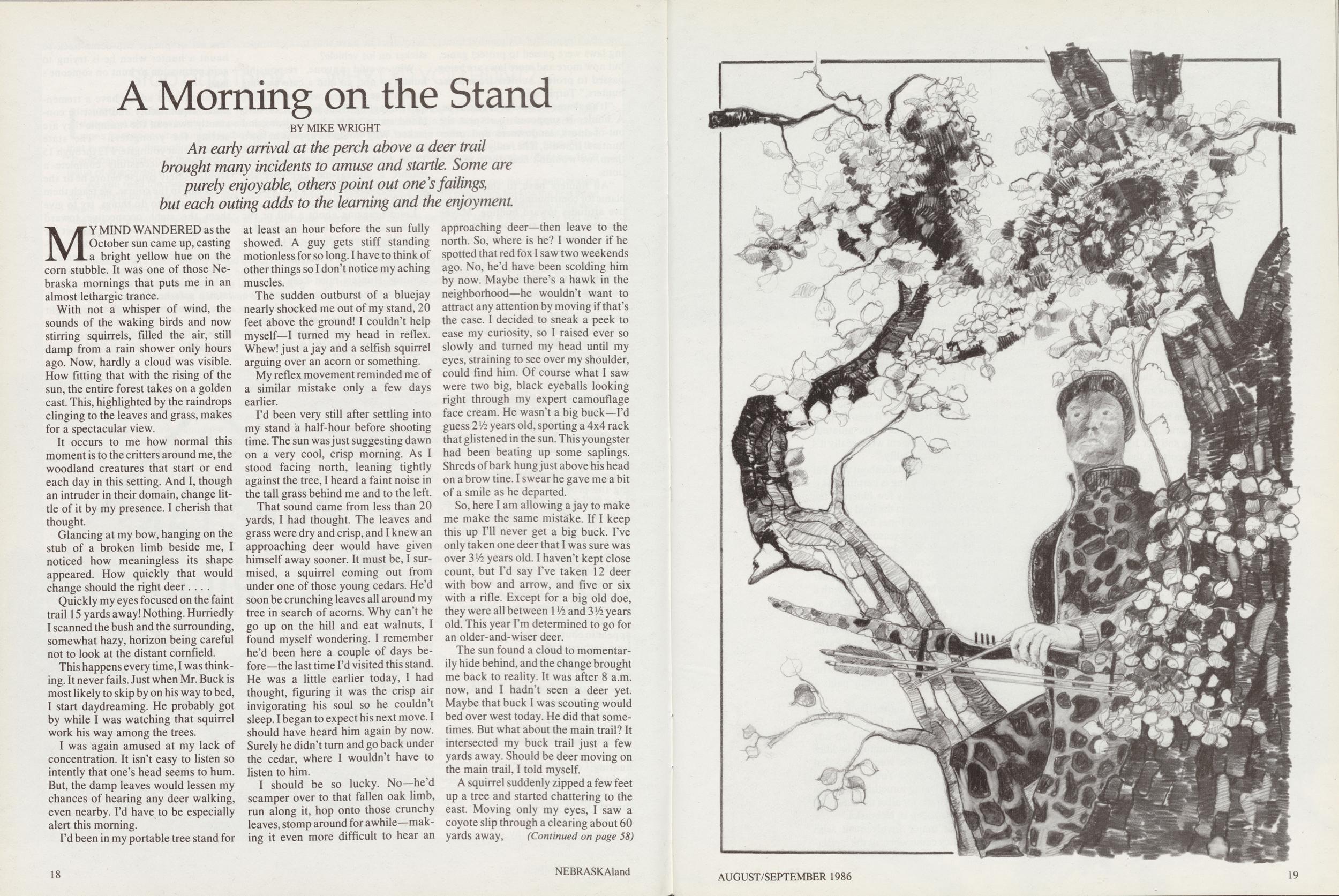
A Morning on the Stand
BY MIKE WRIGHT An early arrival at the perch above a deer trail brought many incidents to amuse and startle. Some are purely enjoyable, others point out one's failings, but each outing adds to the learning and the enjoyment.MY MIND WANDERED as the October sun came up, casting a bright yellow hue on the corn stubble. It was one of those Nebraska mornings that puts me in an almost lethargic trance.
With not a whisper of wind, the sounds of the waking birds and now stirring squirrels, filled the air, still damp from a rain shower only hours ago. Now, hardly a cloud was visible. How fitting that with the rising of the sun, the entire forest takes on a golden cast. This, highlighted by the raindrops clinging to the leaves and grass, makes for a spectacular view.
It occurs to me how normal this moment is to the critters around me, the woodland creatures that start or end each day in this setting. And I, though an intruder in their domain, change little of it by my presence. I cherish that thought.
Glancing at my bow, hanging on the stub of a broken limb beside me, I noticed how meaningless its shape appeared. How quickly that would change should the right deer
Quickly my eyes focused on the faint trail 15 yards away! Nothing. Hurriedly I scanned the bush and the surrounding, somewhat hazy, horizon being careful not to look at the distant cornfield.
This happens every time, I was thinking. It never fails. Just when Mr. Buck is most likely to skip by on his way to bed, I start daydreaming. He probably got by while I was watching that squirrel work his way among the trees.
I was again amused at my lack of concentration. It isn't easy to listen so intently that one's head seems to hum. But, the damp leaves would lessen my chances of hearing any deer walking, even nearby. I'd have to be especially alert this morning.
I'd been in my portable tree stand for at least an hour before the sun fully showed. A guy gets stiff standing motionless for so long. I have to think of other things so I don't notice my aching muscles.
The sudden outburst of a bluejay nearly shocked me out of my stand, 20 feet above the ground! I couldn't help myself—I turned my head in reflex. Whew! just a jay and a selfish squirrel arguing over an acorn or something.
My reflex movement reminded me of a similar mistake only a few days earlier.
I'd been very still after settling into my stand a half-hour before shooting time. The sun was just suggesting dawn on a very cool, crisp morning. As I stood facing north, leaning tightly against the tree, I heard a faint noise in the tall grass behind me and to the left.
That sound came from less than 20 yards, I had thought. The leaves and grass were dry and crisp, and I knew an approaching deer would have given himself away sooner. It must be, I surmised, a squirrel coming out from under one of those young cedars. He'd soon be crunching leaves all around my tree in search of acorns. Why can't he go up on the hill and eat walnuts, I found myself wondering. I remember he'd been here a couple of days before—the last time I'd visited this stand. He was a little earlier today, I had thought, figuring it was the crisp air invigorating his soul so he couldn't sleep. I began to expect his next move. I should have heard him again by now. Surely he didn't turn and go back under the cedar, where I wouldn't have to listen to him.
I should be so lucky. No—he'd scamper over to that fallen oak limb, run along it, hop onto those crunchy leaves, stomp around for awhile—making it even more difficult to hear an approaching deer—then leave to the north. So, where is he? I wonder if he spotted that red fox I saw two weekends ago. No, he'd have been scolding him by now. Maybe there's a hawk in the neighborhood—he wouldn't want to attract any attention by moving if that's the case. I decided to sneak a peek to ease my curiosity, so I raised ever so slowly and turned my head until my eyes, straining to see over my shoulder, could find him. Of course what I saw were two big, black eyeballs looking right through my expert camouflage face cream. He wasn't a big buck—I'd guess 2l/2 years old, sporting a 4x4 rack that glistened in the sun. This youngster had been beating up some saplings. Shreds of bark hung just above his head on a brow tine. I swear he gave me a bit of a smile as he departed.
So, here I am allowing a jay to make me make the same mistake. If I keep this up I'll never get a big buck. I've only taken one deer that I was sure was over Vh years old. I haven't kept close count, but I'd say I've taken 12 deer with bow and arrow, and five or six with a rifle. Except for a big old doe, they were all between 1 Vi and 3 Vi years old. This year I'm determined to go for an older-and-wiser deer.
The sun found a cloud to momentarily hide behind, and the change brought me back to reality. It was after 8 a.m. now, and I hadn't seen a deer yet. Maybe that buck I was scouting would bed over west today. He did that sometimes. But what about the main trail? It intersected my buck trail just a few yards away. Should be deer moving on the main trail, I told myself.
A squirrel suddenly zipped a few feet up a tree and started chattering to the east. Moving only my eyes, I saw a coyote slip through a clearing about 60 yards away, (Continued on page 58)
18 NEBRASKAland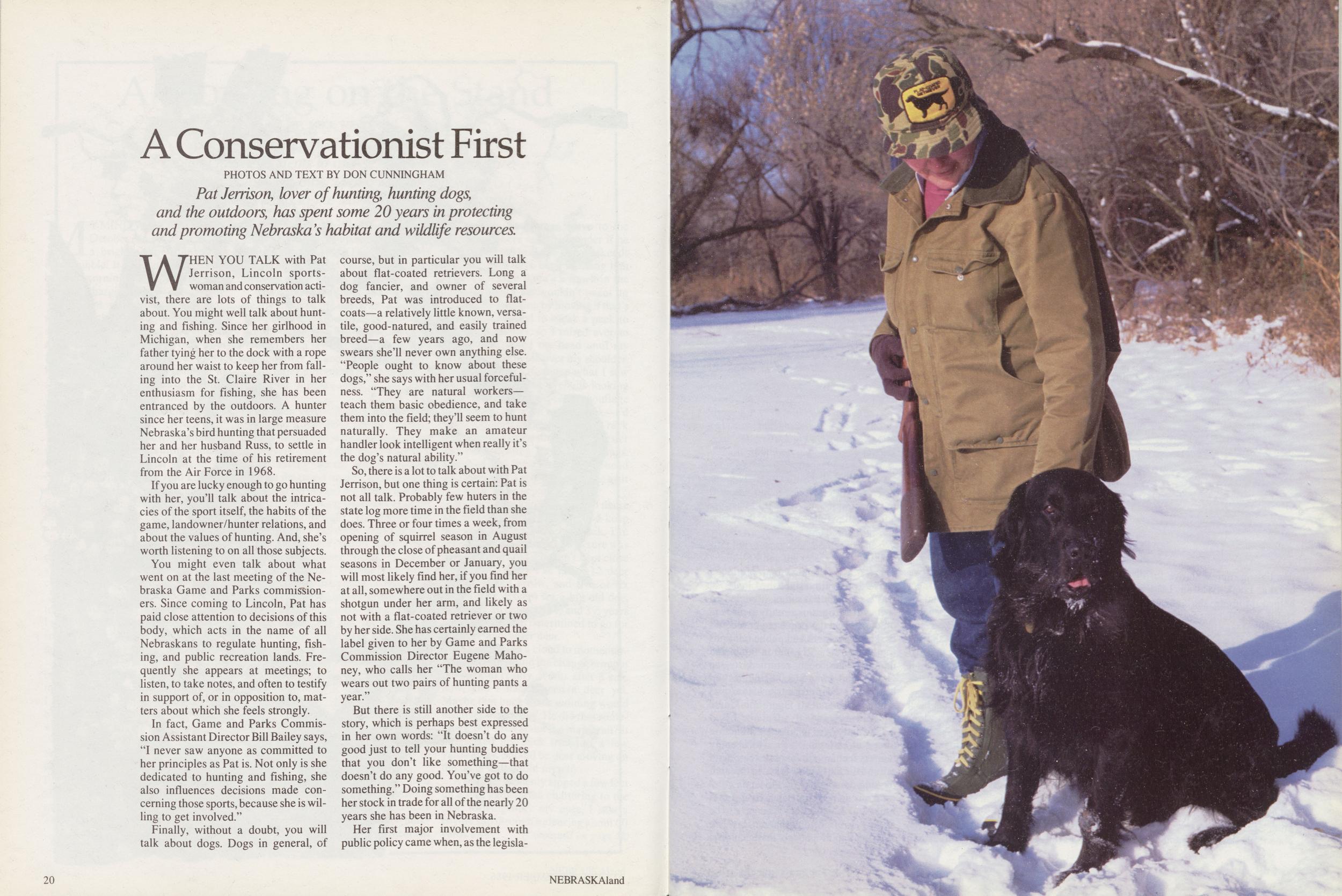
A Conservationist First
PHOTOS AND TEXT BY DON CUNNINGHAM Pat Jerrison, lover of hunting, hunting dogs, and the outdoors, has spent some 20 years in protecting and promoting Nebraska's habitat and wildlife resources.WHEN YOU TALK with Pat Jerrison, Lincoln sportswoman and conservation activist, there are lots of things to talk about. You might well talk about hunting and fishing. Since her girlhood in Michigan, when she remembers her father tying her to the dock with a rope around her waist to keep her from falling into the St. Claire River in her enthusiasm for fishing, she has been entranced by the outdoors. A hunter since her teens, it was in large measure Nebraska's bird hunting that persuaded her and her husband Russ, to settle in Lincoln at the time of his retirement from the Air Force in 1968.
If you are lucky enough to go hunting with her, you'll talk about the intricacies of the sport itself, the habits of the game, landowner/hunter relations, and about the values of hunting. And, she's worth listening to on all those subjects.
You might even talk about what went on at the last meeting of the Nebraska Game and Parks commissioners. Since coming to Lincoln, Pat has paid close attention to decisions of this body, which acts in the name of all Nebraskans to regulate hunting, fishing, and public recreation lands. Frequently she appears at meetings; to listen, to take notes, and often to testify in support of, or in opposition to, matters about which she feels strongly.
In fact, Game and Parks Commission Assistant Director Bill Bailey says, "I never saw anyone as committed to her principles as Pat is. Not only is she dedicated to hunting and fishing, she also influences decisions made concerning those sports, because she is willing to get involved."
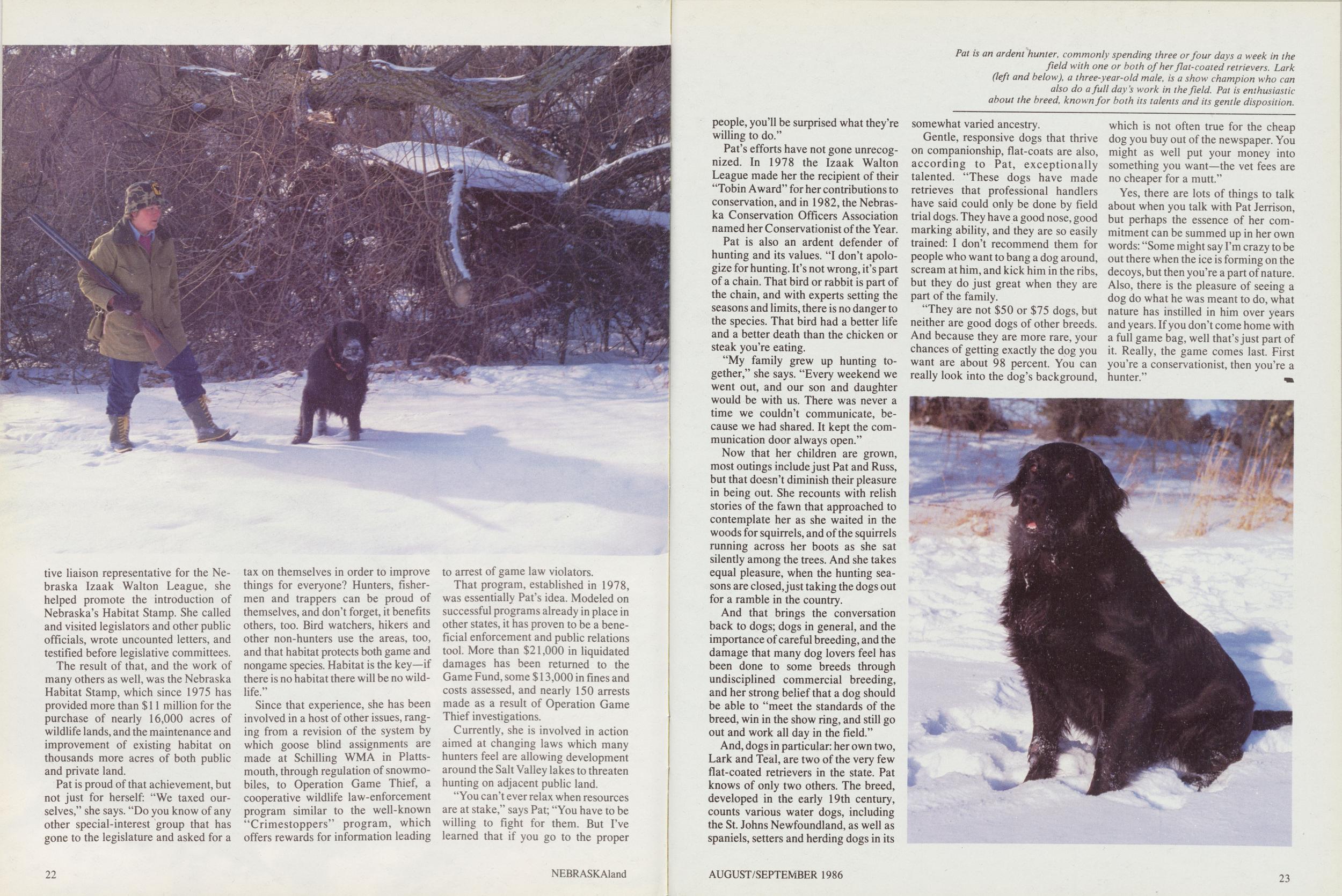
Finally, without a doubt, you will talk about dogs. Dogs in general, of course, but in particular you will talk about flat-coated retrievers. Long a dog fancier, and owner of several breeds, Pat was introduced to flatcoats—a relatively little known, versatile, good-natured, and easily trained breed—a few years ago, and now swears she'll never own anything else. "People ought to know about these dogs," she says with her usual forcefulness. "They are natural workersteach them basic obedience, and take them into the field; they'll seem to hunt naturally. They make an amateur handler look intelligent when really it's the dog's natural ability."
So, there is a lot to talk about with Pat Jerrison, but one thing is certain: Pat is not all talk. Probably few huters in the state log more time in the field than she does. Three or four times a week, from opening of squirrel season in August through the close of pheasant and quail seasons in December or January, you will most likely find her, if you find her at all, somewhere out in the field with a shotgun under her arm, and likely as not with a flat-coated retriever or two by her side. She has certainly earned the label given to her by Game and Parks Commission Director Eugene Mahoney, who calls her "The woman who wears out two pairs of hunting pants a year."
But there is still another side to the story, which is perhaps best expressed in her own words: "It doesn't do any good just to tell your hunting buddies that you don't like something—that doesn't do any good. You've got to do something." Doing something has been her stock in trade for all of the nearly 20 years she has been in Nebraska.
Her first major involvement with
public policy came when, as the legislative
20
NEBRASKAland
The result of that, and the work of many others as well, was the Nebraska Habitat Stamp, which since 1975 has provided more than $11 million for the purchase of nearly 16,000 acres of wildlife lands, and the maintenance and improvement of existing habitat on thousands more acres of both public and private land.
Pat is proud of that achievement, but not just for herself: "We taxed ourselves," she says. "Do you know of any other special-interest group that has gone to the legislature and asked for a tax on themselves in order to improve things for everyone? Hunters, fishermen and trappers can be proud of themselves, and don't forget, it benefits others, too. Bird watchers, hikers and other non-hunters use the areas, too, and that habitat protects both game and nongame species. Habitat is the key—if there is no habitat there will be no wildlife."
Since that experience, she has been involved in a host of other issues, ranging from a revision of the system by which goose blind assignments are made at Schilling WMA in Plattsmouth, through regulation of snowmobiles, to Operation Game Thief, a cooperative wildlife law-enforcement program similar to the well-known "Crimestoppers" program, which offers rewards for information leading to arrest of game law violators.
That program, established in 1978, was essentially Pat's idea. Modeled on successful programs already in place in other states, it has proven to be a beneficial enforcement and public relations tool. More than $21,000 in liquidated damages has been returned to the Game Fund, some $ 13,000 in fines and costs assessed, and nearly 150 arrests made as a result of Operation Game Thief investigations.
Currently, she is involved in action aimed at changing laws which many hunters feel are allowing development around the Salt Valley lakes to threaten hunting on adjacent public land.
"You can't ever relax when resources are at stake," says Pat; "You have to be willing to fight for them. But I've learned that if you go to the proper 22 NEBRASKAland people, you'll be surprised what they're willing to do."
Pat's efforts have not gone unrecognized. In 1978 the Izaak Walton League made her the recipient of their "Tobin Award" for her contributions to conservation, and in 1982, the Nebraska Conservation Officers Association named her Conservationist of the Year.
Pat is also an ardent defender of hunting and its values. "I don't apologize for hunting. It's not wrong, it's part of a chain. That bird or rabbit is part of the chain, and with experts setting the seasons and limits, there is no danger to the species. That bird had a better life and a better death than the chicken or steak you're eating.
"My family grew up hunting together," she says. "Every weekend we went out, and our son and daughter would be with us. There was never a time we couldn't communicate, because we had shared. It kept the communication door always open."
Now that her children are grown, most outings include just Pat and Russ, but that doesn't diminish their pleasure in being out. She recounts with relish stories of the fawn that approached to contemplate her as she waited in the woods for squirrels, and of the squirrels running across her boots as she sat silently among the trees. And she takes equal pleasure, when the hunting seasons are closed, just taking the dogs out for a ramble in the country.
And that brings the conversation back to dogs; dogs in general, and the importance of careful breeding, and the damage that many dog lovers feel has been done to some breeds through undisciplined commercial breeding, and her strong belief that a dog should be able to "meet the standards of the breed, win in the show ring, and still go out and work all day in the field."
And, dogs in particular: her own two, Lark and Teal, are two of the very few flat-coated retrievers in the state. Pat knows of only two others. The breed, developed in the early 19th century, counts various water dogs, including the St. Johns Newfoundland, as well as spaniels, setters and herding dogs in its somewhat varied ancestry.
Gentle, responsive dogs that thrive on companionship, flat-coats are also, according to Pat, exceptionally talented. "These dogs have made retrieves that professional handlers have said could only be done by field trial dogs. They have a good nose, good marking ability, and they are so easily trained: I don't recommend them for people who want to bang a dog around, scream at him, and kick him in the ribs, but they do just great when they are part of the family.
"They are not $50 or $75 dogs, but neither are good dogs of other breeds. And because they are more rare, your chances of getting exactly the dog you want are about 98 percent. You can really look into the dog's background, which is not often true for the cheap dog you buy out of the newspaper. You might as well put your money into something you want—the vet fees are no cheaper for a mutt."
Yes, there are lots of things to talk about when you talk with Pat Jerrison, but perhaps the essence of her commitment can be summed up in her own words: "Some might say I'm crazy to be out there when the ice is forming on the decoys, but then you're a part of nature. Also, there is the pleasure of seeing a dog do what he was meant to do, what nature has instilled in him over years and years. If you don't come home with a full game bag, well that's just part of it. Really, the game comes last. First you're a conservationist, then you're a hunter."
AUGUST/SEPTEMBER 1986 23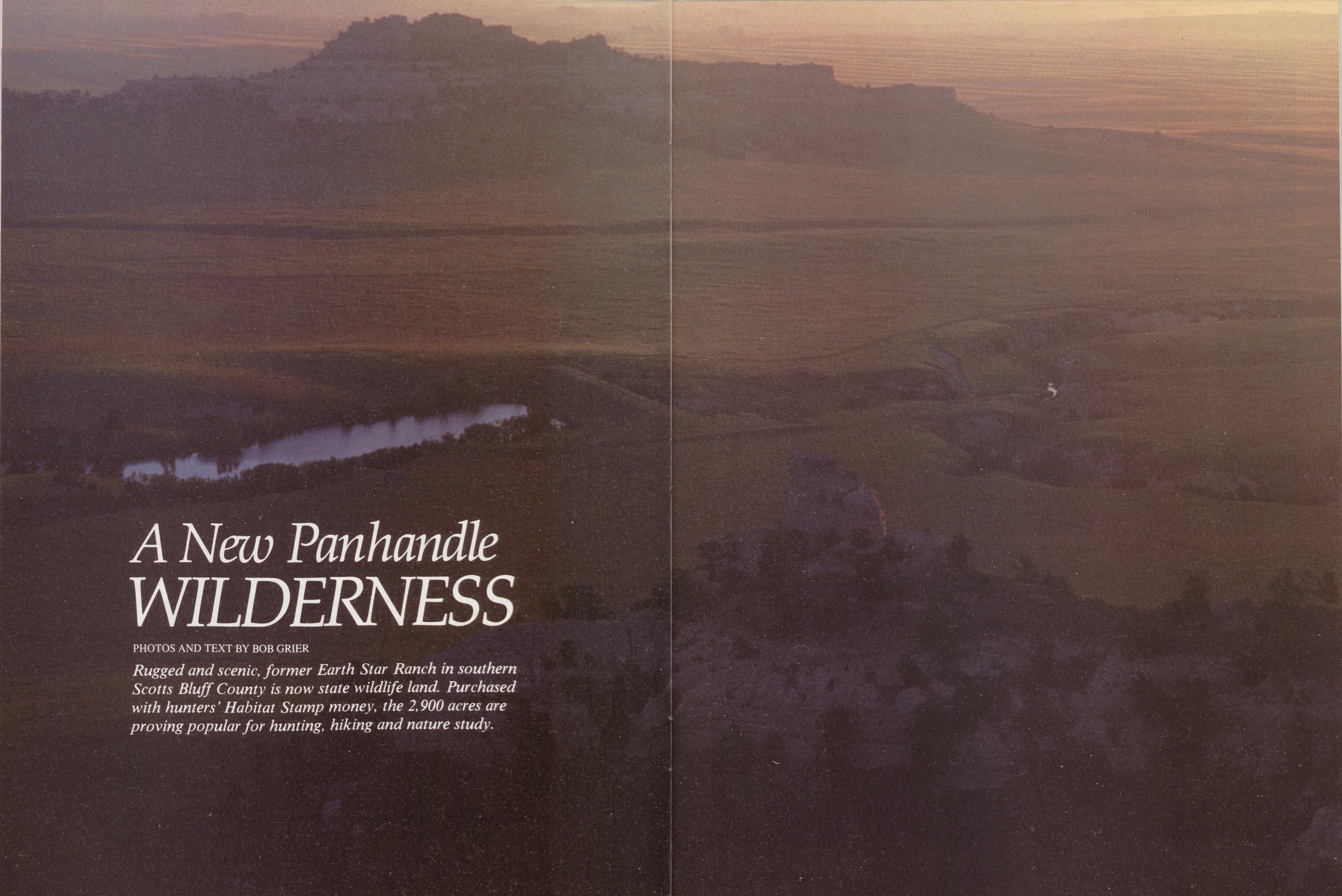
A New Panhandle WILDERNESS
PHOTOS AND TEXT BY BOB GRIER Rugged and scenic, former Earth Star Ranch in southern Scotts Bluff County is now state wildlife land. Purchased with hunters' Habitat Stamp money, the 2,900 acres are proving popular for hunting, hiking and nature study.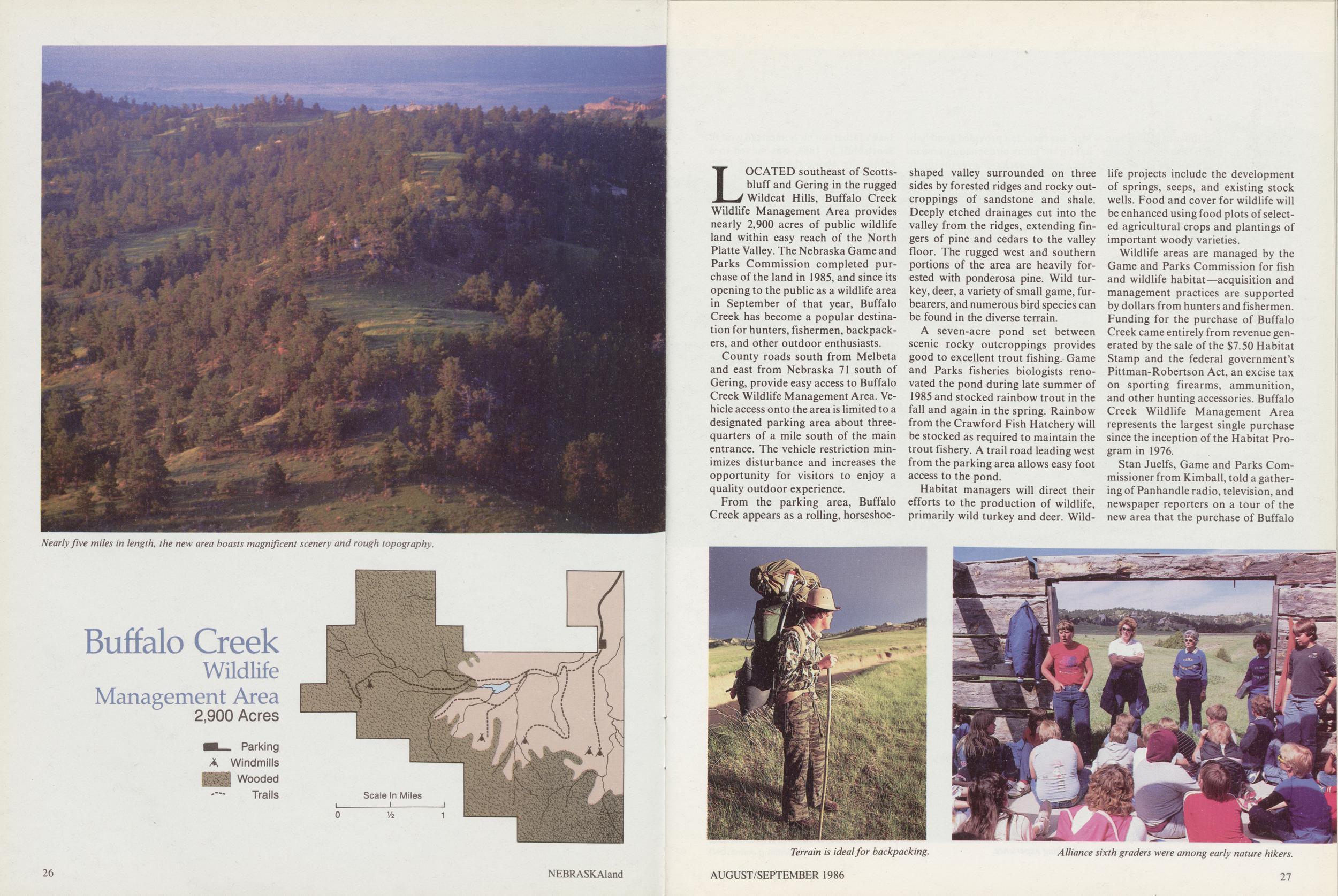
LOCATED southeast of Scottsbluff and Gering in the rugged Wildcat Hills, Buffalo Creek Wildlife Management Area provides nearly 2,900 acres of public wildlife land within easy reach of the North Platte Valley. The Nebraska Game and Parks Commission completed purchase of the land in 1985, and since its opening to the public as a wildlife area in September of that year, Buffalo Creek has become a popular destination for hunters, fishermen, backpackers, and other outdoor enthusiasts.
County roads south from Melbeta and east from Nebraska 71 south of Gering, provide easy access to Buffalo Creek Wildlife Management Area. Vehicle access onto the area is limited to a designated parking area about threequarters of a mile south of the main entrance. The vehicle restriction minimizes disturbance and increases the opportunity for visitors to enjoy a quality outdoor experience.
From the parking area, Buffalo Creek appears as a rolling, horseshoeshaped valley surrounded on three sides by forested ridges and rocky outcroppings of sandstone and shale. Deeply etched drainages cut into the valley from the ridges, extending fingers of pine and cedars to the valley floor. The rugged west and southern portions of the area are heavily forested with ponderosa pine. Wild turkey, deer, a variety of small game, furbearers, and numerous bird species can be found in the diverse terrain.
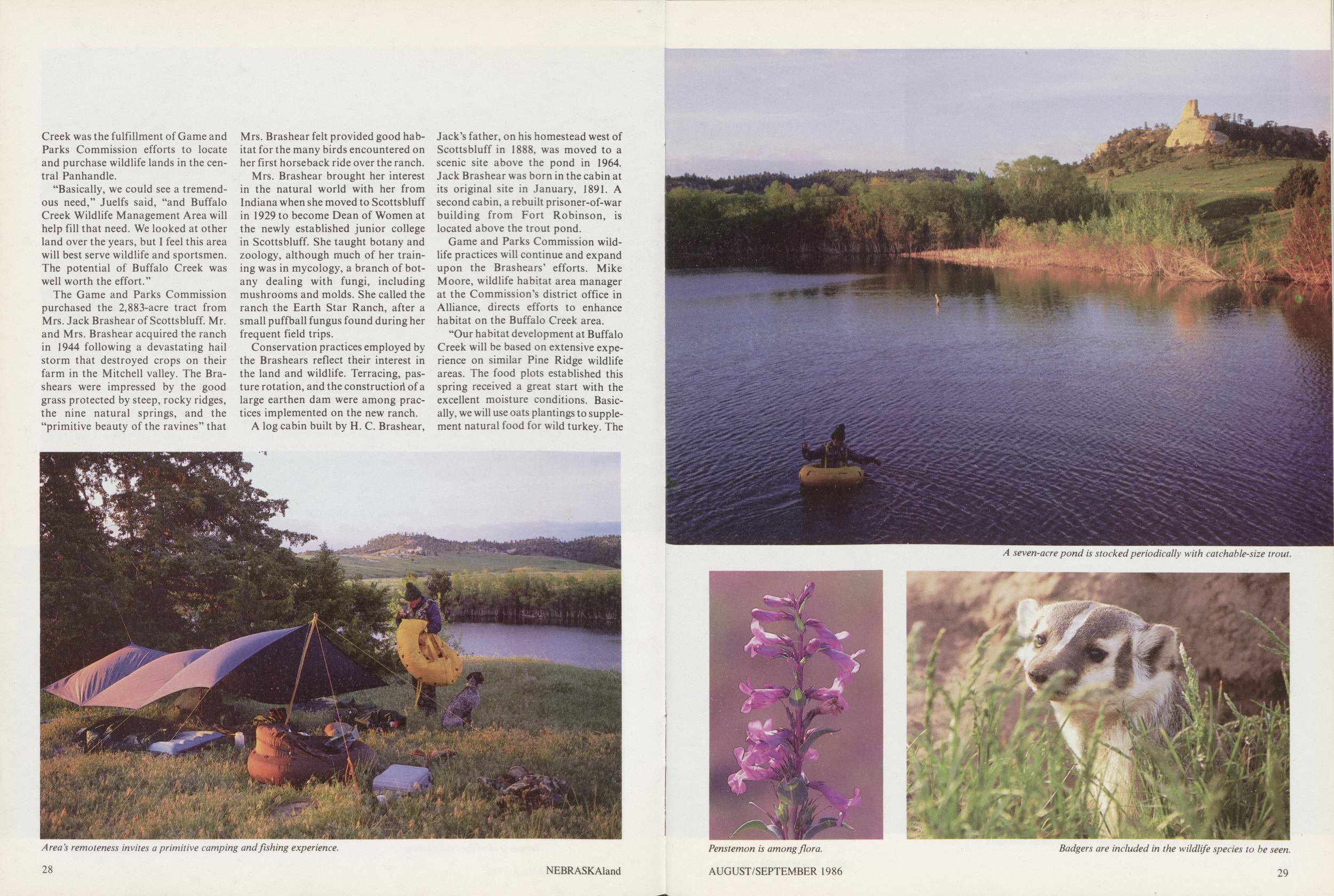
A seven-acre pond set between scenic rocky outcroppings provides good to excellent trout fishing. Game and Parks fisheries biologists renovated the pond during late summer of 1985 and stocked rainbow trout in the fall and again in the spring. Rainbow from the Crawford Fish Hatchery will be stocked as required to maintain the trout fishery. A trail road leading west from the parking area allows easy foot access to the pond.
Habitat managers will direct their efforts to the production of wildlife, primarily wild turkey and deer. Wildlife projects include the development of springs, seeps, and existing stock wells. Food and cover for wildlife will be enhanced using food plots of selected agricultural crops and plantings of important woody varieties.
Wildlife areas are managed by the Game and Parks Commission for fish and wildlife habitat—acquisition and management practices are supported by dollars from hunters and fishermen. Funding for the purchase of Buffalo Creek came entirely from revenue generated by the sale of the $7.50 Habitat Stamp and the federal government's Pittman-Robertson Act, an excise tax on sporting firearms, ammunition, and other hunting accessories. Buffalo Creek Wildlife Management Area represents the largest single purchase since the inception of the Habitat Program in 1976.
Stan Juelfs, Game and Parks Commissioner from Kimball, told a gathering of Panhandle radio, television, and newspaper reporters on a tour of the new area that the purchase of Buffalo
 Creek was the fulfillment of Game and
Parks Commission efforts to locate
and purchase wildlife lands in the central Panhandle.
Creek was the fulfillment of Game and
Parks Commission efforts to locate
and purchase wildlife lands in the central Panhandle.
"Basically, we could see a tremendous need," Juelfs said, "and Buffalo Creek Wildlife Management Area will help fill that need. We looked at other land over the years, but I feel this area will best serve wildlife and sportsmen. The potential of Buffalo Creek was well worth the effort."
The Game and Parks Commission purchased the 2,883-acre tract from Mrs. Jack Brashear of Scottsbluff. Mr. and Mrs. Brashear acquired the ranch in 1944 following a devastating hail storm that destroyed crops on their farm in the Mitchell valley. The Brashears were impressed by the good grass protected by steep, rocky ridges, the nine natural springs, and the "primitive beauty of the ravines" that Mrs. Brashear felt provided good habitat for the many birds encountered on her first horseback ride over the ranch.
Mrs. Brashear brought her interest in the natural world with her from Indiana when she moved to Scottsbluff in 1929 to become Dean of Women at the newly established junior college in Scottsbluff. She taught botany and zoology, although much of her training was in mycology, a branch of botany dealing with fungi, including mushrooms and molds. She called the ranch the Earth Star Ranch, after a small puffball fungus found during her frequent field trips.
Conservation practices employed by the Brashears reflect their interest in the land and wildlife. Terracing, pasture rotation, and the constructiori of a large earthen dam were among practices implemented on the new ranch.
A log cabin built by H. C. Brashear, Jack's father, on his homestead west of Scottsbluff in 1888, was moved to a scenic site above the pond in 1964. Jack Brashear was born in the cabin at its original site in January, 1891. A second cabin, a rebuilt prisoner-of-war building from Fort Robinson, is located above the trout pond.
Game and Parks Commission wildlife practices will continue and expand upon the Brashears' efforts. Mike Moore, wildlife habitat area manager at the Commission's district office in Alliance, directs efforts to enhance habitat on the Buffalo Creek area.
"Our habitat development at Buffalo Creek will be based on extensive experience on similar Pine Ridge wildlife areas. The food plots established this spring received a great start with the excellent moisture conditions. Basically, we will use oats plantings to supplement natural food for wild turkey. The
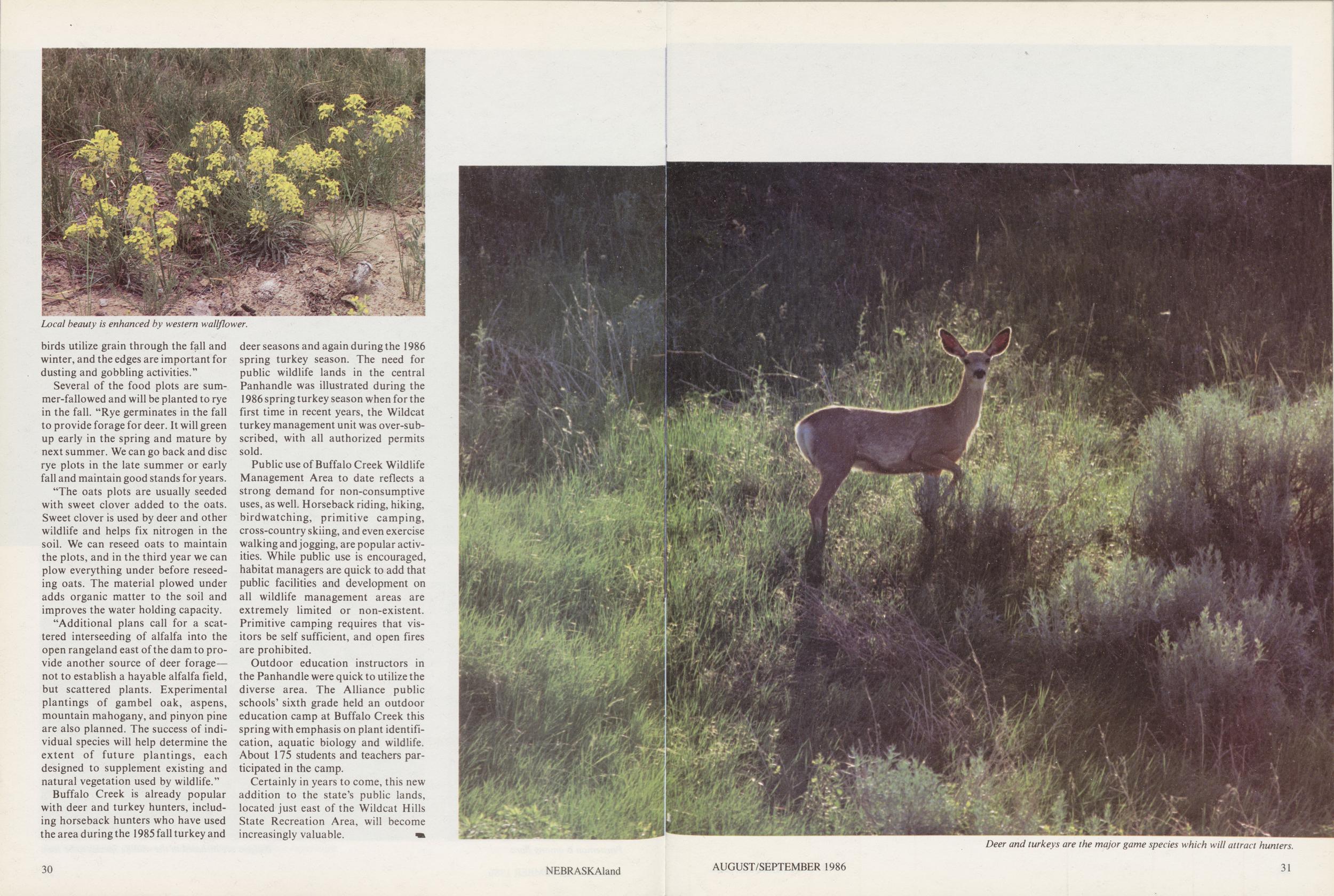
Several of the food plots are summer-fallowed and will be planted to rye in the fall. "Rye germinates in the fall to provide forage for deer. It will green up early in the spring and mature by next summer. We can go back and disc rye plots in the late summer or early fall and maintain good stands for years.
"The oats plots are usually seeded with sweet clover added to the oats. Sweet clover is used by deer and other wildlife and helps fix nitrogen in the soil. We can reseed oats to maintain the plots, and in the third year we can plow everything under before reseeding oats. The material plowed under adds organic matter to the soil and improves the water holding capacity.
"Additional plans call for a scattered interseeding of alfalfa into the open rangeland east of the dam to provide another source of deer forage not to establish a hayable alfalfa field, but scattered plants. Experimental plantings of gambel oak, aspens, mountain mahogany, and pinyon pine are also planned. The success of individual species will help determine the extent of future plantings, each designed to supplement existing and natural vegetation used by wildlife."
Buffalo Creek is already popular with deer and turkey hunters, including horseback hunters who have used the area during the 1985 fall turkey and deer seasons and again during the 1986 spring turkey season. The need for public wildlife lands in the central Panhandle was illustrated during the 1986 spring turkey season when for the first time in recent years, the Wildcat turkey management unit was over-subscribed, with all authorized permits sold.
Public use of Buffalo Creek Wildlife Management Area to date reflects a strong demand for non-consumptive uses, as well. Horseback riding, hiking, birdwatching, primitive camping, cross-country skiing, and even exercise walking and jogging, are popular activities. While public use is encouraged, habitat managers are quick to add that public facilities and development on all wildlife management areas are extremely limited or non-existent. Primitive camping requires that visitors be self sufficient, and open fires are prohibited.
Outdoor education instructors in the Panhandle were quick to utilize the diverse area. The Alliance public schools' sixth grade held an outdoor education camp at Buffalo Creek this spring with emphasis on plant identification, aquatic biology and wildlife. About 175 students and teachers participated in the camp.
Certainly in years to come, this new addition to the state's public lands, located just east of the Wildcat Hills State Recreation Area, will become increasingly valuable.
30 NEBRASKAland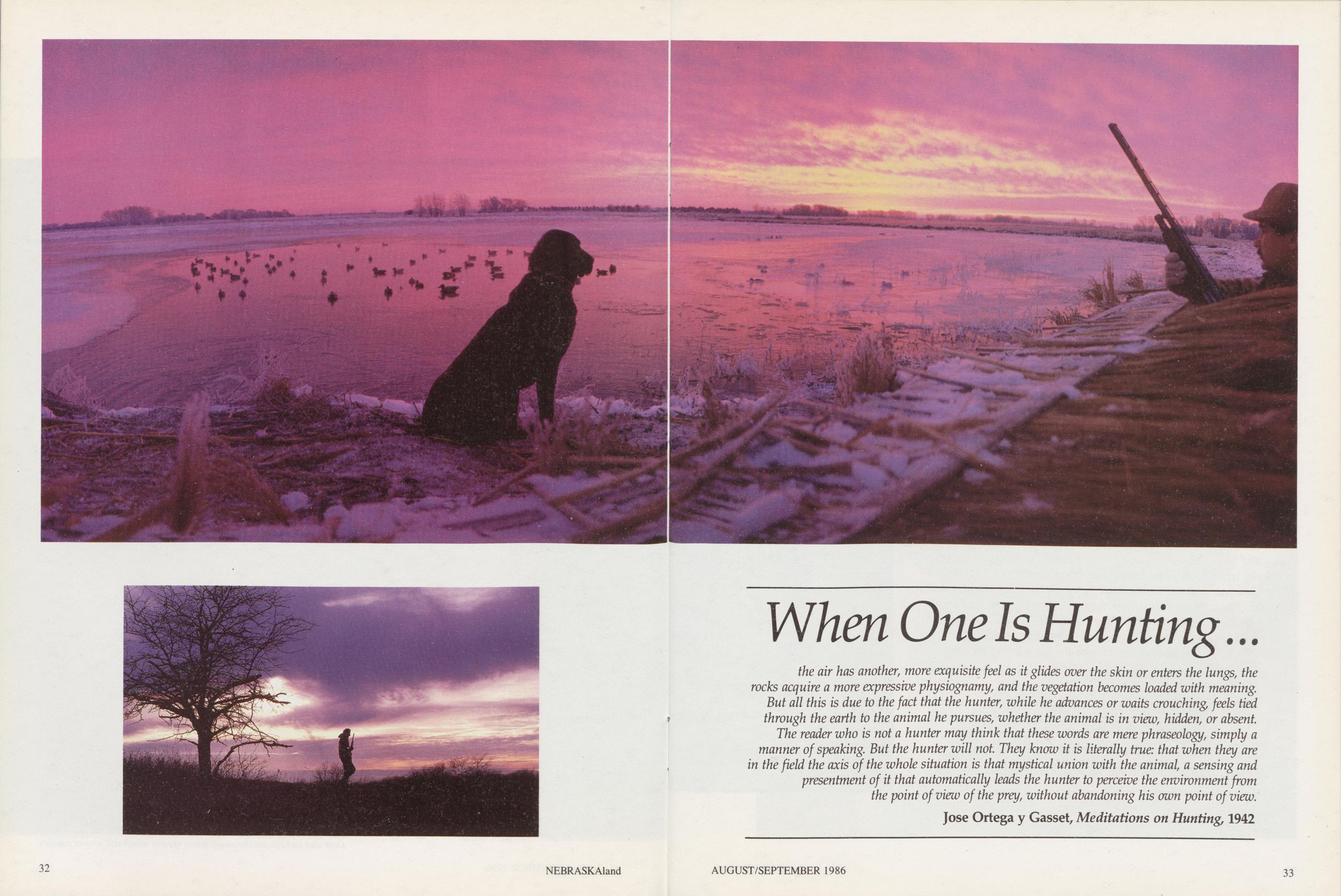
When One Is Hunting...
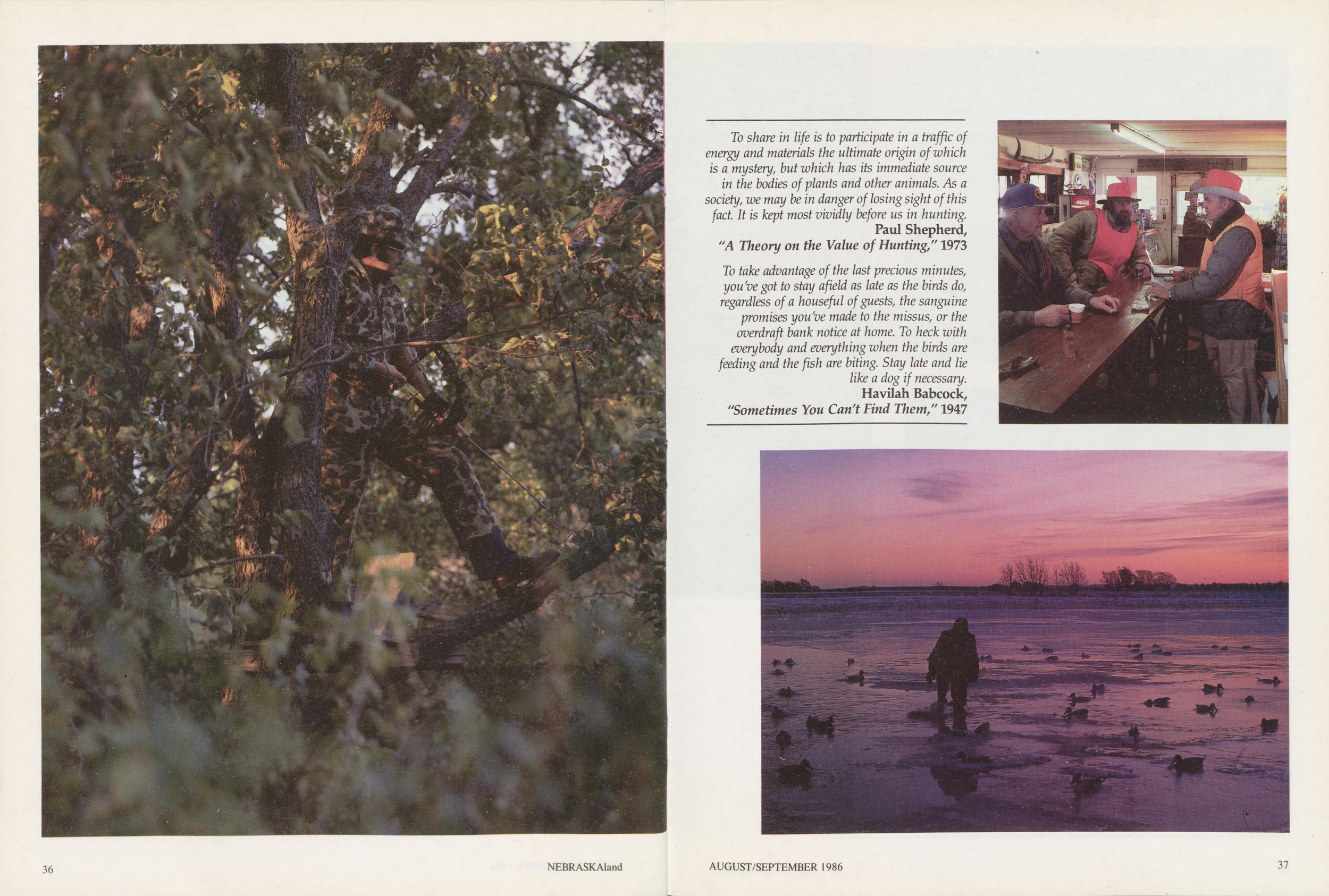
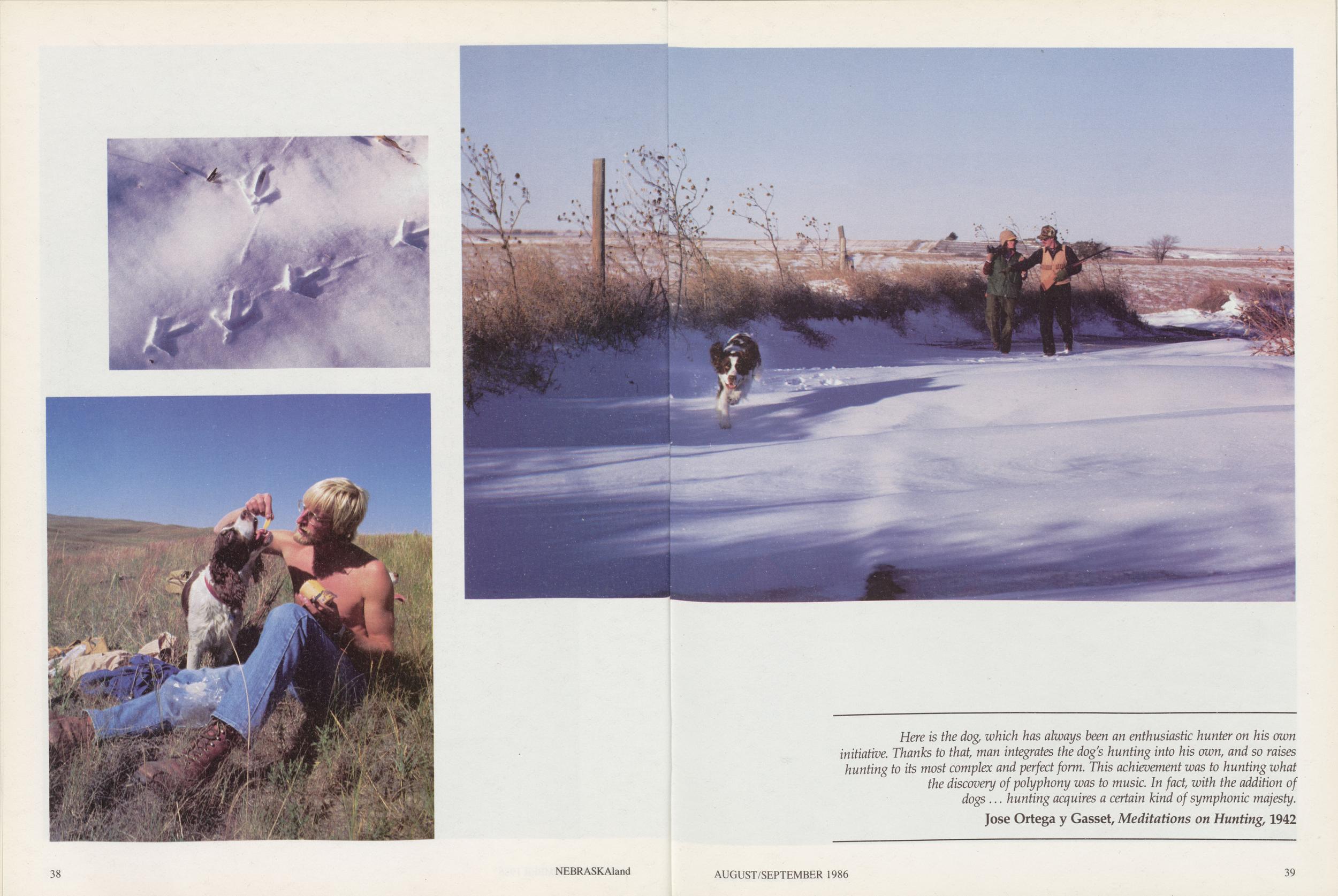
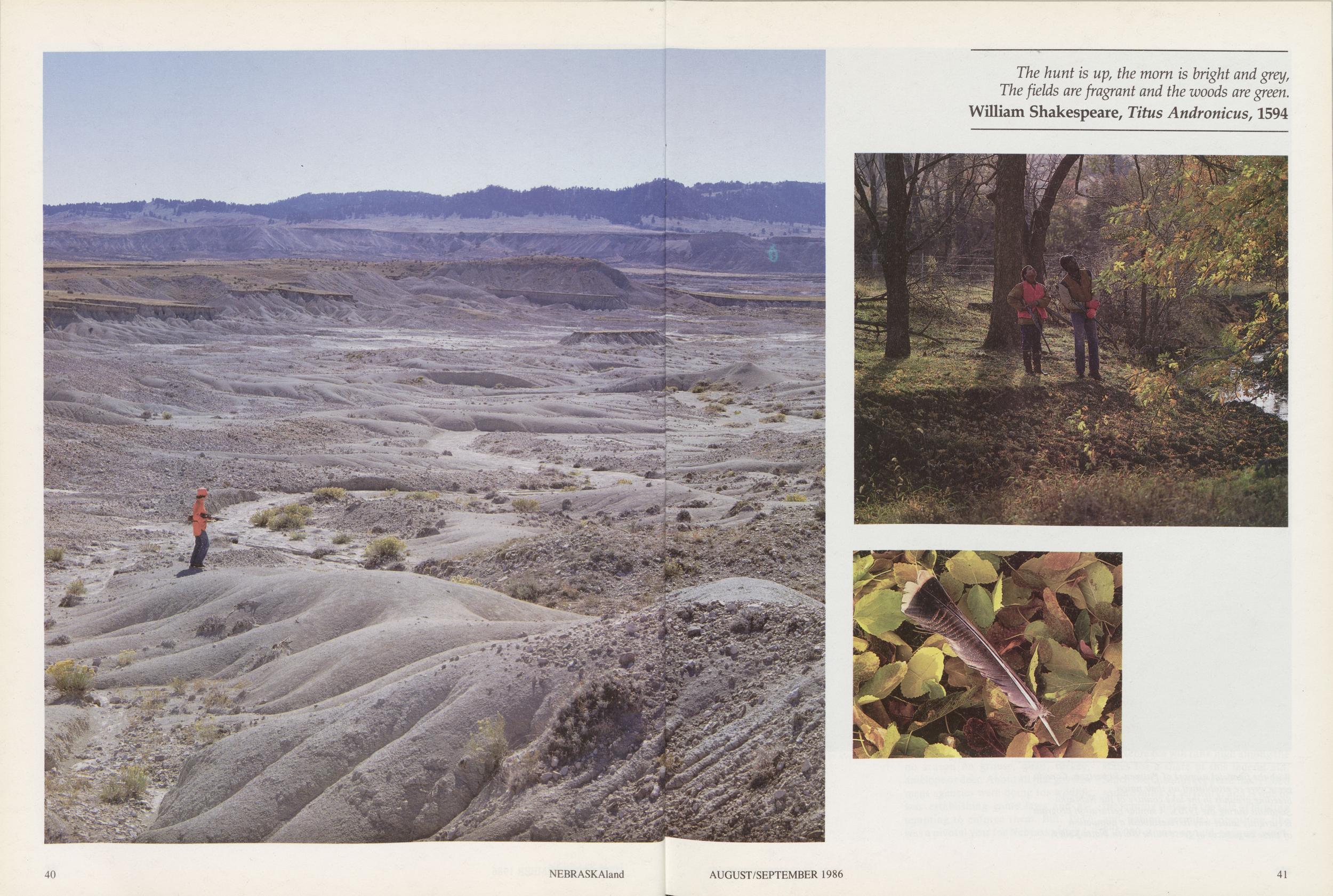
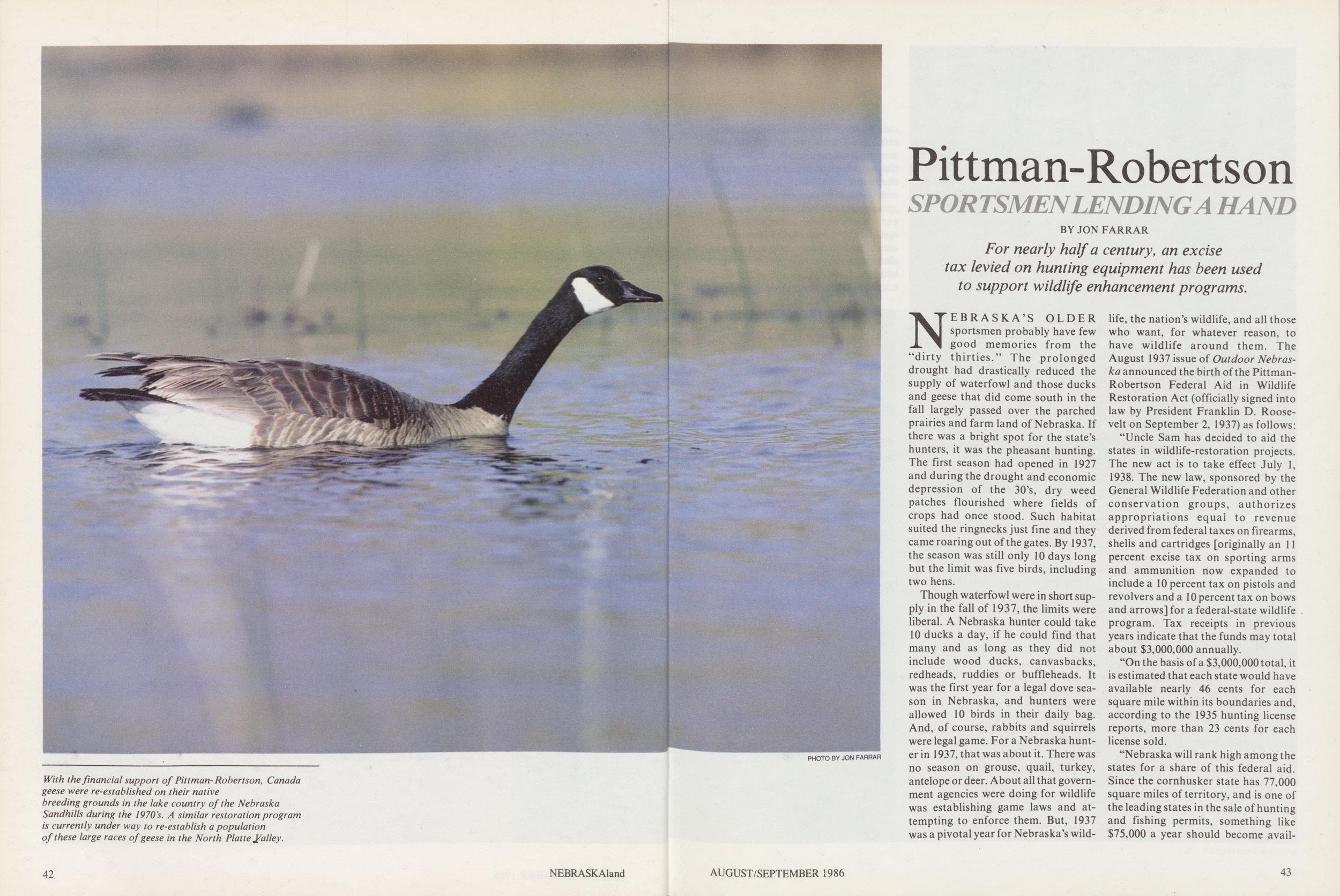
the air has another, more exquisite feel as it glides aver the skin or enters the lungs, the rocks acquire a more expressive physiognomy, and the vegetation becomes loaded with meaning. But all this is due to the fact that the hunter, while he advances or waits crouching feels tied through the earth to the animal he pursues, whether the animal is in view, hidden, or absent. The reader who is not a hunter may think that these words are mere phraseology, simply a manner of speaking. But the hunter will not. They know it is literally true: that when they are in the field the axis of the whole situation is that mystical union with the animal, a sensing and presentment of it that automatically leads the hunter to perceive the environment from the point of view of the prey, without abandoning his own point of view. Jose Ortega y Gasset, Meditations on Hunting, 1942 AUGUST/SEPTEMBER 1986 33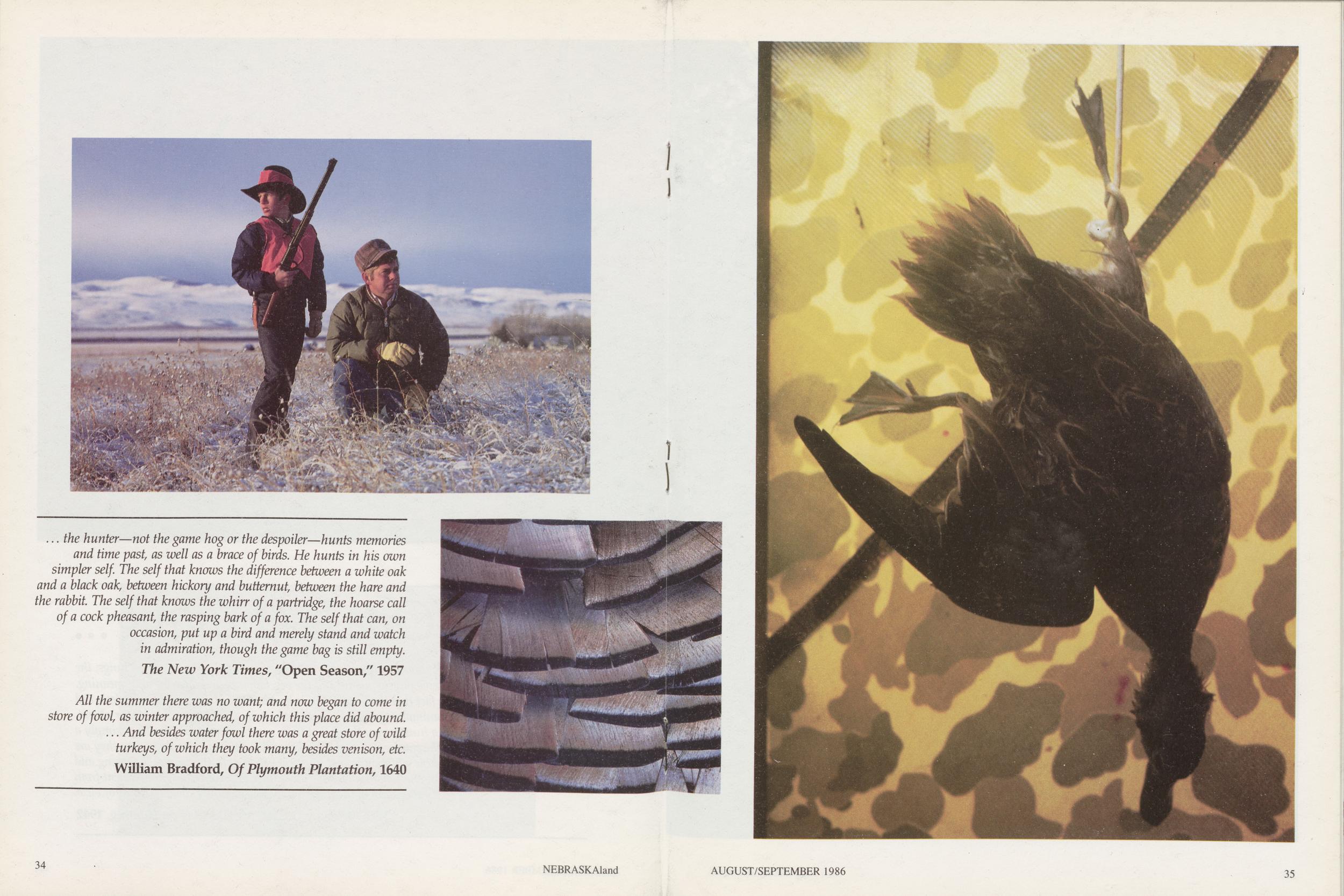
Pittman-Robertson SPORTSMEN LENDING A HAND
BY JON FARRAR For nearly half a century, an excise tax levied on hunting equipment has been used to support wildlife enhancement programs.NEBRASKA'S OLDER sportsmen probably have few good memories from the "dirty thirties." The prolonged drought had drastically reduced the supply of waterfowl and those ducks and geese that did come south in the fall largely passed over the parched prairies and farm land of Nebraska. If there was a bright spot for the state's hunters, it was the pheasant hunting. The first season had opened in 1927 and during the drought and economic depression of the 30's, dry weed patches flourished where fields of crops had once stood. Such habitat suited the ringnecks just fine and they came roaring out of the gates. By 1937, the season was still only 10 days long but the limit was five birds, including two hens.
Though waterfowl were in short supply in the fall of 1937, the limits were liberal. A Nebraska hunter could take 10 ducks a day, if he could find that many and as long as they did not include wood ducks, canvasbacks, redheads, ruddies or buffleheads. It was the first year for a legal dove season in Nebraska, and hunters were allowed 10 birds in their daily bag. And, of course, rabbits and squirrels were legal game. For a Nebraska hunter in 1937, that was about it. There was no season on grouse, quail, turkey, antelope or deer. About all that government agencies were doing for wildlife was establishing game laws and attempting to enforce them. But, 1937 was a pivotal year for Nebraska's wildlife, the nation's wildlife, and all those who want, for whatever reason, to have wildlife around them. The August 1937 issue of Outdoor Nebraska announced the birth of the PittmanRobertson Federal Aid in Wildlife Restoration Act (officially signed into law by President Franklin D. Roosevelt on September 2, 1937) as follows:
"Uncle Sam has decided to aid the states in wildlife-restoration projects. The new act is to take effect July 1, 1938. The new law, sponsored by the General Wildlife Federation and other conservation groups, authorizes appropriations equal to revenue derived from federal taxes on firearms, shells and cartridges [originally an 11 percent excise tax on sporting arms and ammunition now expanded to include a 10 percent tax on pistols and revolvers and a 10 percent tax on bows and arrows] for a federal-state wildlife program. Tax receipts in previous years indicate that the funds may total about $3,000,000 annually.
"On the basis of a $3,000,000 total, it is estimated that each state would have available nearly 46 cents for each square mile within its boundaries and, according to the 1935 hunting license reports, more than 23 cents for each license sold.
"Nebraska will rank high among the
states for a share of this federal aid.
Since the cornhusker state has 77,000
square miles of territory, and is one of
the leading states in the sale of hunting
and fishing permits, something like
$75,000 a year should become available
AUGUST/SEPTEMBER 1986
43
Few at that time could have anticipated the impact the Pittman-Robertson Act (P-R) would have on Nebraska's and the nation's wildlife resource and sportsmen. By putting up $1 for each $3 in P-R matching funds, the states made enormous strides that previously they simply could not afford acquiring lands specifically for wildlife, conducting research essential to move wildlife management out of its days of a "glorified guessing game into a time when decisions would be based on documented scientific principles, in the year-to-year management of wildlife species and the habitat they require, and in recent years to fund such auxiliary projects as Hunter Safety programs. Since 1939, when Nebraska received its first apportionment of $20,448.51, the P-R program has supported some of the state's most ambitious and successful wildlife enhancement projects. In 1986, Nebraska received $1,745,692 through the Pittman-Robertson Act for a total of $26,608,039 since 1939. More than $1.5 billion has been collected thus far nationwide from the Pittman-Robertson excise tax.
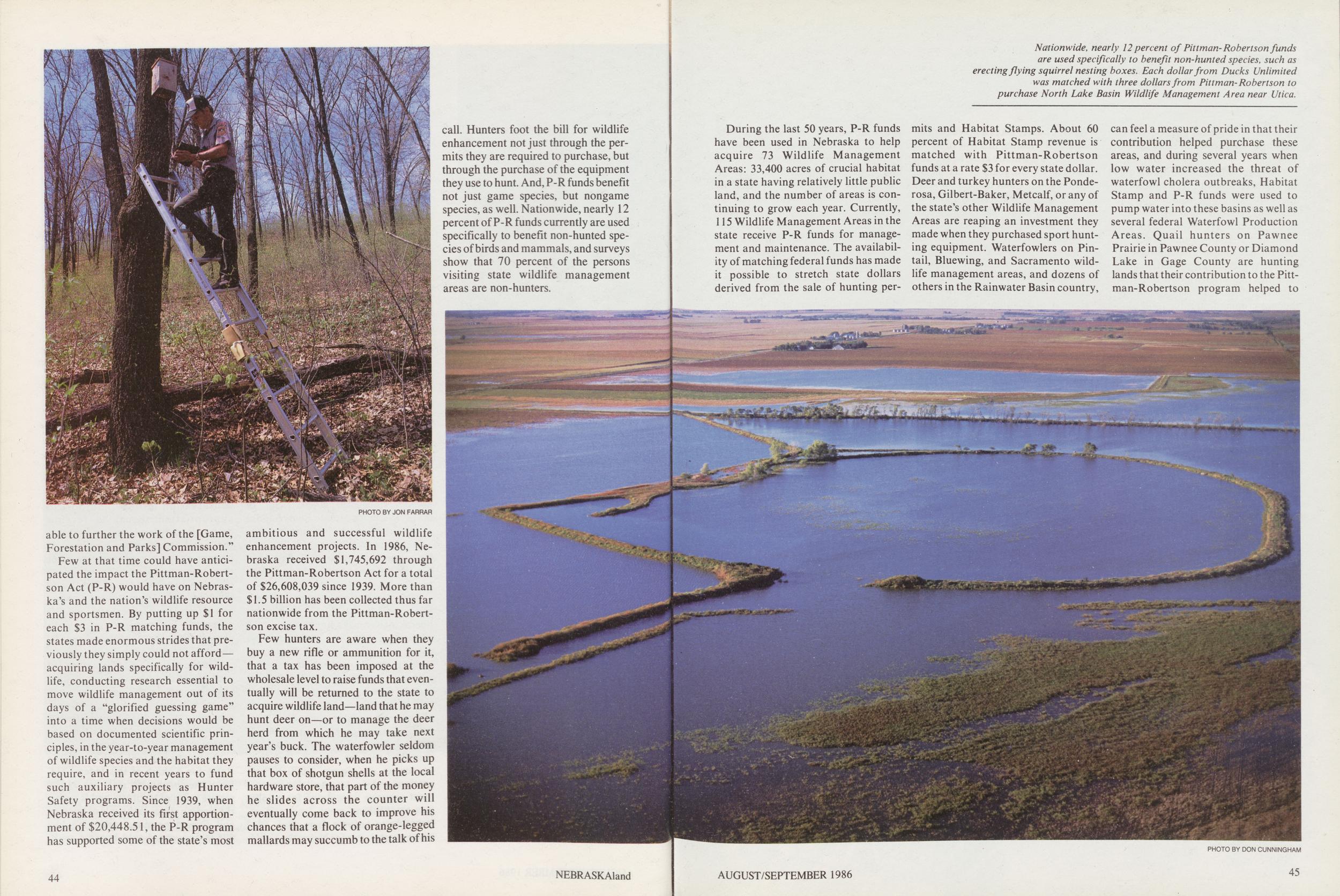
Few hunters are aware when they buy a new rifle or ammunition for it, that a tax has been imposed at the wholesale level to raise funds that eventually will be returned to the state to acquire wildlife land—land that he may hunt deer on—or to manage the deer herd from which he may take next year's buck. The waterfowler seldom pauses to consider, when he picks up that box of shotgun shells at the local hardware store, that part of the money he slides across the counter will eventually come back to improve his chances that a flock of orange-legged mallards may succumb to the talk of his call. Hunters foot the bill for wildlife enhancement not just through the permits they are required to purchase, but through the purchase of the equipment they use to hunt. And, P-R funds benefit not just game species, but nongame species, as well. Nationwide, nearly 12 percent of P-R funds currently are used specifically to benefit non-hunted species of birds and mammals, and surveys show that 70 percent of the persons visiting state wildlife management areas are non-hunters.
During the last 50 years, P-R funds have been used in Nebraska to help acquire 73 Wildlife Management Areas: 33,400 acres of crucial habitat in a state having relatively little public land, and the number of areas is continuing to grow each year. Currently, 115 Wildlife Management Areas in the state receive P-R funds for management and maintenance. The availability of matching federal funds has made it possible to stretch state dollars derived from the sale of hunting permits and Habitat Stamps. About 60 percent of Habitat Stamp revenue is matched with Pittman-Robertson funds at a rate $3 for every state dollar. Deer and turkey hunters on the Ponderosa, Gilbert-Baker, Metcalf, or any of the state's other Wildlife Management Areas are reaping an investment they made when they purchased sport hunting equipment. Waterfowlers on Pintail, Bluewing, and Sacramento wildlife management areas, and dozens of others in the Rainwater Basin country, can feel a measure of pride in that their contribution helped purchase these areas, and during several years when low water increased the threat of waterfowl cholera outbreaks, Habitat Stamp and P-R funds were used to pump water into these basins as well as several federal Waterfowl Production Areas. Quail hunters on Pawnee Prairie in Pawnee County or Diamond Lake in Gage County are hunting lands that their contribution to the Pittman-Robertson program helped to
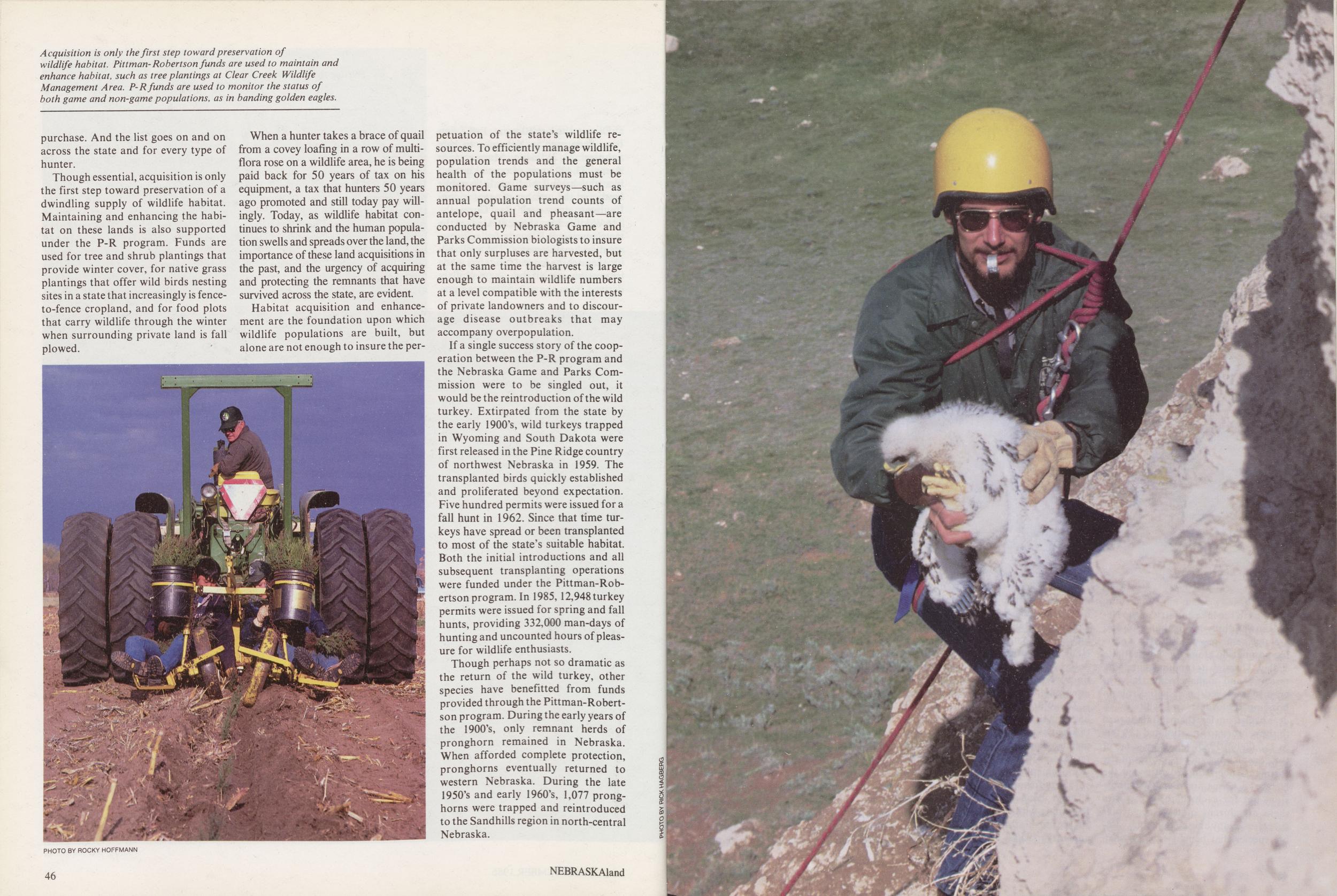
Though essential, acquisition is only the first step toward preservation of a dwindling supply of wildlife habitat. Maintaining and enhancing the habitat on these lands is also supported under the P-R program. Funds are used for tree and shrub plantings that provide winter cover, for native grass plantings that offer wild birds nesting sites in a state that increasingly is fenceto-fence cropland, and for food plots that carry wildlife through the winter when surrounding private land is fall plowed.
When a hunter takes a brace of quail from a covey loafing in a row of multiflora rose on a wildlife area, he is being paid back for 50 years of tax on his equipment, a tax that hunters 50 years ago promoted and still today pay willingly. Today, as wildlife habitat continues to shrink and the human population swells and spreads over the land, the importance of these land acquisitions in the past, and the urgency of acquiring and protecting the remnants that have survived across the state, are evident.
Habitat acquisition and enhancement are the foundation upon which wildlife populations are built, but alone are not enough to insure the perPHOTO BY ROCKY HOFFMANN 46 petuation of the state's wildlife resources. To efficiently manage wildlife, population trends and the general health of the populations must be monitored. Game surveys—such as annual population trend counts of antelope, quail and pheasant—are conducted by Nebraska Game and Parks Commission biologists to insure that only surpluses are harvested, but at the same time the harvest is large enough to maintain wildlife numbers at a level compatible with the interests of private landowners and to discourage disease outbreaks that may accompany overpopulation.
If a single success story of the cooperation between the P-R program and the Nebraska Game and Parks Commission were to be singled out, it would be the reintroduction of the wild turkey. Extirpated from the state by the early 1900's, wild turkeys trapped in Wyoming and South Dakota were first released in the Pine Ridge country of northwest Nebraska in 1959. The transplanted birds quickly established and proliferated beyond expectation. Five hundred permits were issued for a fall hunt in 1962. Since that time turkeys have spread or been transplanted to most of the state's suitable habitat. Both the initial introductions and all subsequent transplanting operations were funded under the Pittman-Robertson program. In 1985, 12,948 turkey permits were issued for spring and fall hunts, providing 332,000 man-days of hunting and uncounted hours of pleasure for wildlife enthusiasts.
Though perhaps not so dramatic as the return of the wild turkey, other species have benefitted from funds provided through the Pittman-Robertson program. During the early years of the 1900's, only remnant herds of pronghorn remained in Nebraska. When afforded complete protection, pronghorns eventually returned to western Nebraska. During the late 1950's and early 1960's, 1,077 pronghorns were trapped and reintroduced to the Sandhills region in north-central Nebraska.
46 NEBRASKAland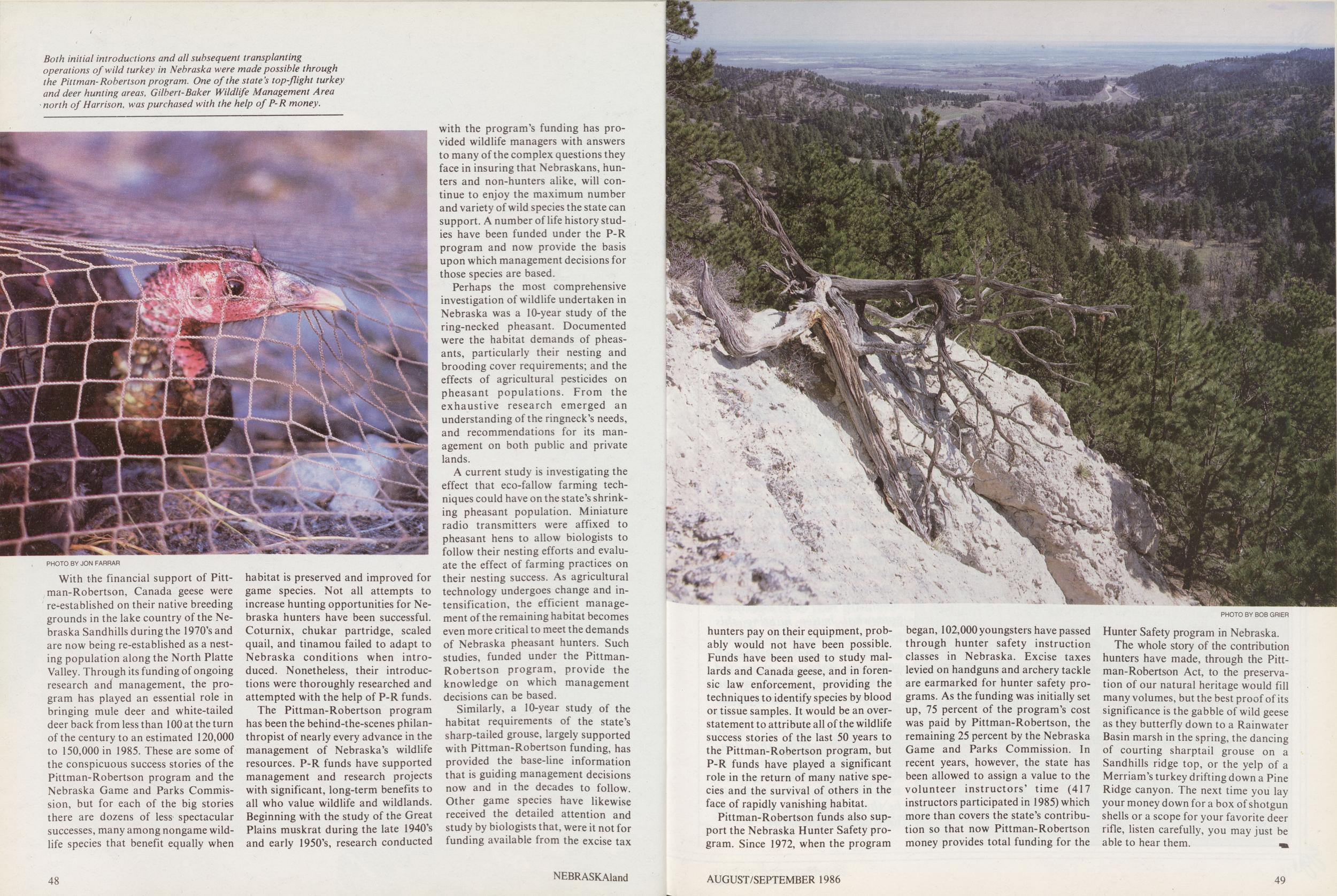
With the financial support of Pittman-Robertson, Canada geese were re-established on their native breeding grounds in the lake country of the Nebraska Sandhills during the 1970's and are now being re-established as a nesting population along the North Platte Valley. Through its funding of ongoing research and management, the program has played an essential role in bringing mule deer and white-tailed deer back from less than 100 at the turn of the century to an estimated 120,000 to 150,000 in 1985. These are some of the conspicuous success stories of the Pittman-Robertson program and the Nebraska Game and Parks Commission, but for each of the big stories there are dozens of less spectacular successes, many among nongame wildlife species that benefit equally when habitat is preserved and improved for game species. Not all attempts to increase hunting opportunities for Nebraska hunters have been successful. Coturnix, chukar partridge, scaled quail, and tinamou failed to adapt to Nebraska conditions when introduced. Nonetheless, their introductions were thoroughly researched and attempted with the help of P-R funds.
The Pittman-Robertson program has been the behind-the-scenes philanthropist of nearly every advance in the management of Nebraska's wildlife resources. P-R funds have supported management and research projects with significant, long-term benefits to all who value wildlife and wildlands. Beginning with the study of the Great Plains muskrat during the late 1940's and early 1950's, research conducted with the program's funding has provided wildlife managers with answers to many of the complex questions they face in insuring that Nebraskans, hunters and non-hunters alike, will continue to enjoy the maximum number and variety of wild species the state can support. A number of life history studies have been funded under the P-R program and now provide the basis upon which management decisions for those species are based.
Perhaps the most comprehensive investigation of wildlife undertaken in Nebraska was a 10-year study of the ring-necked pheasant. Documented were the habitat demands of pheasants, particularly their nesting and brooding cover requirements; and the effects of agricultural pesticides on pheasant populations. From the exhaustive research emerged an understanding of the ringneck's needs, and recommendations for its management on both public and private lands.
A current study is investigating the effect that eco-fallow farming techniques could have on the state's shrinking pheasant population. Miniature radio transmitters were affixed to pheasant hens to allow biologists to follow their nesting efforts and evaluate the effect of farming practices on their nesting success. As agricultural technology undergoes change and intensification, the efficient management of the remaining habitat becomes even more critical to meet the demands of Nebraska pheasant hunters. Such studies, funded under the Pittman Robertson program, provide the knowledge on which management decisions can be based.
Similarly, a 10-year study of the habitat requirements of the state's sharp-tailed grouse, largely supported with Pittman-Robertson funding, has provided the base-line information that is guiding management decisions now and in the decades to follow. Other game species have likewise received the detailed attention and study by biologists that, were it not for funding available from the excise tax 48 NEBRASKAland
Pittman-Robertson funds also support the Nebraska Hunter Safety program. Since 1972, when the program began, 102,000 youngsters have passed through hunter safety instruction classes in Nebraska. Excise taxes levied on handguns and archery tackle are earmarked for hunter safety programs. As the funding was initially set up, 75 percent of the program's cost was paid by Pittman-Robertson, the remaining 25 percent by the Nebraska Game and Parks Commission. In recent years, however, the state has been allowed to assign a value to the volunteer instructors' time (417 instructors participated in 1985) which more than covers the state's contribution so that now Pittman-Robertson money provides total funding for the Hunter Safety program in Nebraska.
The whole story of the contribution hunters have made, through the Pittman-Robertson Act, to the preservation of our natural heritage would fill many volumes, but the best proof of its significance is the gabble of wild geese as they butterfly down to a Rainwater Basin marsh in the spring, the dancing of courting sharptail grouse on a Sandhills ridge top, or the yelp of a Merriam's turkey drifting down a Pine Ridge canyon. The next time you lay your money down for a box of shotgun shells or a scope for your favorite deer rifle, listen carefully, you may just be able to hear them.
AUGUST/SEPTEMBER 1986 49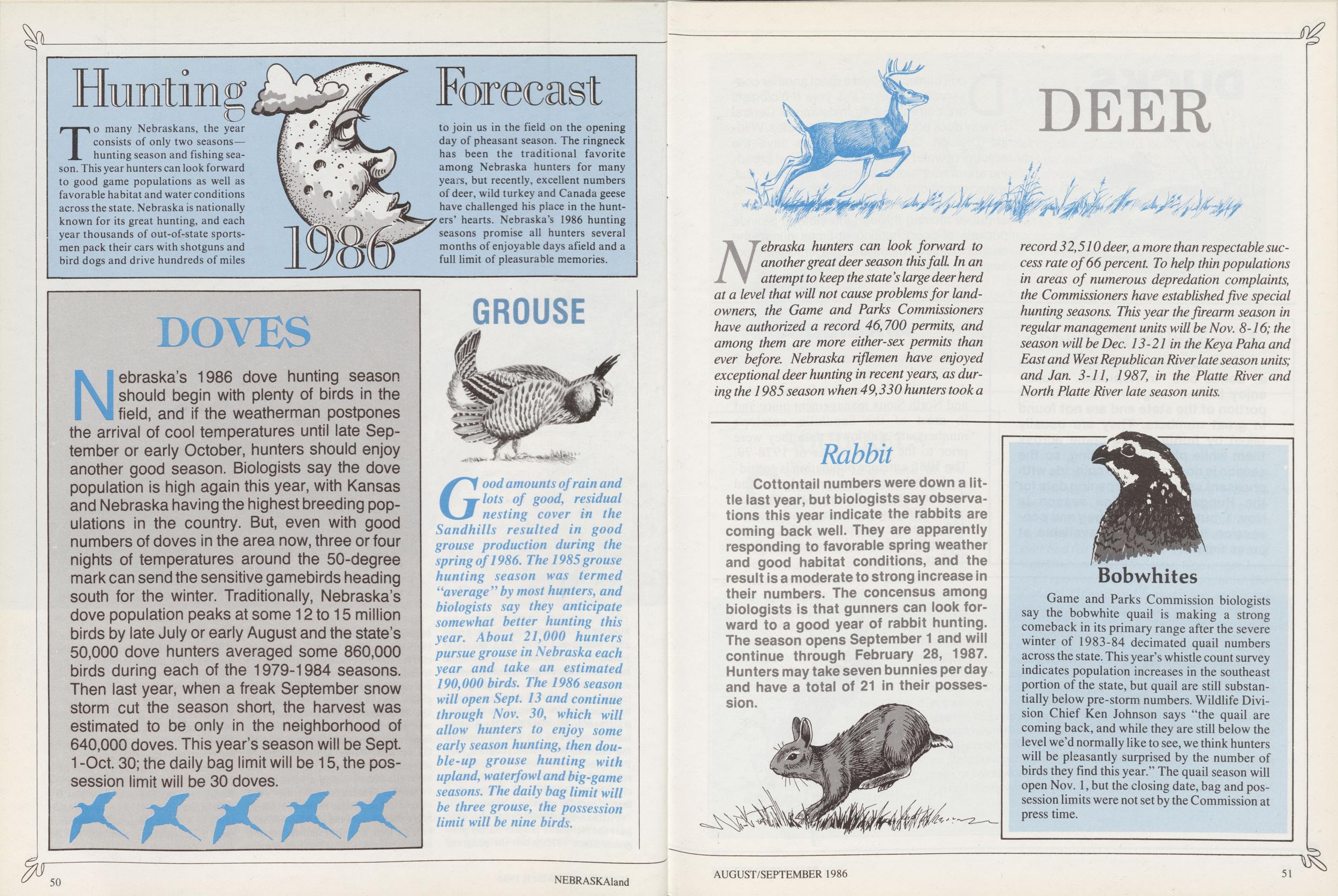
Hunting Forecast 1986
To many Nebraskans, the year consists of only two seasons hunting season and fishing season. This year hunters can look forward to good game populations as well as favorable habitat and water conditions across the state. Nebraska is nationally known for its great hunting, and each year thousands of out-of-state sportsmen pack their cars with shotguns and bird dogs and drive hundreds of miles to join us in the field on the opening day of pheasant season. The ringneck has been the traditional favorite among Nebraska hunters for many years, but recently, excellent numbers of deer, wild turkey and Canada geese have challenged his place in the hunters' hearts. Nebraska's 1986 hunting seasons promise all hunters several months of enjoyable days afield and a full limit of pleasurable memories.
DOVESNebraska's 1986 dove hunting season should begin with plenty of birds in the field, and if the weatherman postpones the arrival of cool temperatures until late September or early October, hunters should enjoy another good season. Biologists say the dove population is high again this year, with Kansas and Nebraska having the highest breeding populations in the country. But, even with good numbers of doves in the area now, three or four nights of temperatures around the 50-degree mark can send the sensitive gamebirds heading south for the winter. Traditionally, Nebraska's dove population peaks at some 12 to 15 million birds by late July or early August and the state's 50,000 dove hunters averaged some 860,000 birds during each of the 1979-1984 seasons. Then last year, when a freak September snow storm cut the season short, the harvest was estimated to be only in the neighborhood of 640,000 doves. This year's season will be Sept. 1 Oct. 30; the daily bag limit will be 15, the possession limit will be 30 doves.
Good amounts of rain and lots of goody residual nesting cover in the Sandhills resulted in good grouse production during the spring of 1986. The 1985 grouse hunting season was termed "average" by most hunters, and biologists say they anticipate somewhat better hunting this year. About 21,000 hunters pursue grouse in Nebraska each year and take an estimated 190,000 birds. The 1986 season will open Sept. 13 and continue through Nov. 30, which will allow hunters to enjoy some early season hunting, then double-up grouse hunting with upland, waterfowl and big-game seasons. The daily bag limit will be three grouse, the possession limit will be nine birds.
50 NEBRASKAlandNebraska hunters can look forward to another great deer season this fall In an attempt to keep the state large deer herd at a level that will not cause problems for landowners, the Game and Parks Commissioners have authorized a record 46,700 permits, and among them are more either-sex permits than ever before. Nebraska riflemen have enjoyed exceptional deer hunting in recent years, as during the 1985 season when 49,330 hunters took a record 32,510 deer, a more than respectable success rate of 66 percent. To help thin populations in areas of numerous depredation complaints, the Commissioners have established five special hunting seasons. This year the firearm season in regular management units will be Nov. 8-16; the season will be Dec. 13-21 in the Key a Paha and East and West Republican River late season units; and Jan. 3-11, 1987, in the Platte River and North Platte River late season units.
RabbitCottontail numbers were down a fittie last year, but biologists say observations this year indicate the rabbits am coming back well. They are apparently responding to favorable spring weather and good habitat conditions, and the result is a moderate to strong increase in their numbers. The concensus among biologists is that gunners can look forward to a good year of rabbit hunting. The season opens September 1 and will continue through February 28, 1987. Hunters may take seven bunnies per day and have a total of 21 in their possession.
Game and Parks Commission biologists say the bobwhite quail is making a strong comeback in its primary range after the severe winter of 1983-84 decimated quail numbers across the state. This year's whistle count survey indicates population increases in the southeast portion of the state, but quail are still substantially below pre-storm numbers. Wildlife Division Chief Ken Johnson says "the quail are coming back, and while they are still below the level we'd normally like to see, we think hunters will be pleasantly surprised by the number of birds they find this year." The quail season will open Nov. 1, but the closing date, bag and possession limits were not set by the Commission at press time.
AUGUST/SEPTEMBER 1986 51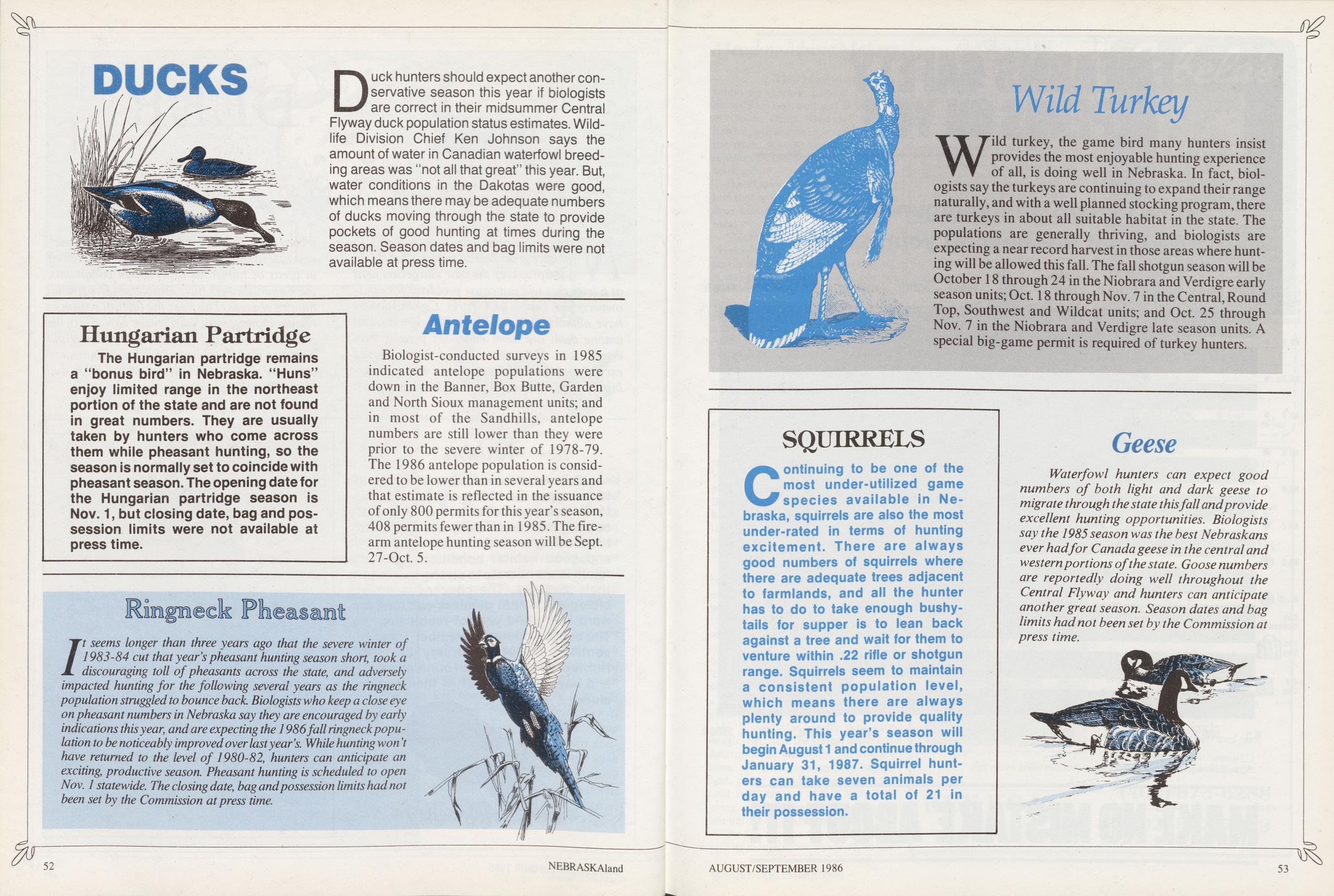 DUCKS
DUCKS
Duck hunters should expect another conservative season this year if biologists are correct in their midsummer Central Flyway duck population status estimates. Wildlife Division Chief Ken Johnson says the amount of water in Canadian waterfowl breeding areas was "not all that great" this year. But, water conditions in the Dakotas were good, which means there may be adequate numbers of ducks moving through the state to provide pockets of good hunting at times during the season. Season dates and bag limits were not available at press time.
Hungarian PartridgeThe Hungarian partridge remains a "bonus bird" in Nebraska. "Huns" enjoy limited range in the northeast portion of the state and are not found in great numbers. They are usually taken by hunters who come across them while pheasant hunting, so the season is normally set to coincide with pheasant season. The opening date for the Hungarian partridge season is Nov. 1, but closing date, bag and possession limits were not available at press time.
AntelopeBiologist-conducted surveys in 1985 indicated antelope populations were down in the Banner, Box Butte, Garden and North Sioux management units; and in most of the Sandhills, antelope numbers are still lower than they were prior to the severe winter of 1978-79. The 1986 antelope population is considered to be lower than in several years and that estimate is reflected in the issuance of only 800 permits for this year's season, 408 permits fewer than in 1985. The firearm antelope hunting season will be Sept. 27-Oct. 5.
Ringneck Pheasantsseems longer than three years ago that the severe winter of 1983-84 cut that year's pheasant hunting season short, took a discouraging toll of pheasants across the state, and adversely impacted hunting for the following several years as the ringneck population struggled to bounce back. Biologists who keep a close eye on pheasant numbers in Nebraska say they are encouraged by early indications this year, and are expecting the 1986 fall ringneck population to be noticeably improved over last year's. While hunting won't have returned to the level of 1980-82, hunters can anticipate an exciting, productive season. Pheasant hunting is scheduled to open Nov. 1 statewide. The closing date, bag and possession limits had not been set by the Commission at press time.
52 NEBRASKAlandWild turkey, the game bird many hunters insist provides the most enjoyable hunting experience of all, is doing well in Nebraska. In fact, biologists say the turkeys are continuing to expand their range naturally, and with a well planned stocking program, there are turkeys in about all suitable habitat in the state. The populations are generally thriving, and biologists are expecting a near record harvest in those areas where hunting will be allowed this fall. The fall shotgun season will be October 18 through 24 in the Niobrara and Verdigre early season units; Oct. 18 through Nov. 7 in the Central, Round Top, Southwest and Wildcat units; and Oct. 25 through Nov. 7 in the Niobrara and Verdigre late season units. A special big-game permit is required of turkey hunters.
SQUIRRELSContinuing to be one of the most under-utilized game species available in Nebraska, squirrels are also the most under-rated in terms of hunting excitement. There are always good numbers of squirrels where there are adequate trees adjacent to farmlands, and all the hunter has to do to take enough bushytails for supper is to lean back against a tree and wait for them to venture within .22 rifle or shotgun range. Squirrels seem to maintain a consistent population level, which means there are always plenty around to provide quality hunting. This year's season will begin August 1 and continue through January 31, 1987. Squirrel hunters can take seven animals per day and have a total of 21 in their possession.
GeeseWaterfowl hunters can expect good numbers of both light and dark geese to migrate through the state this fall and provide excellent hunting opportunities. Biologists say the 1985 season was the best Nebraskans ever had for Canada geese in the central and western portions of the state. Goose numbers are reportedly doing well throughout the Central Flyway and hunters can anticipate another great season. Season dates and bag limits had not been set by the Commission at press time.
AUGUST/SEPTEMBER 1986 53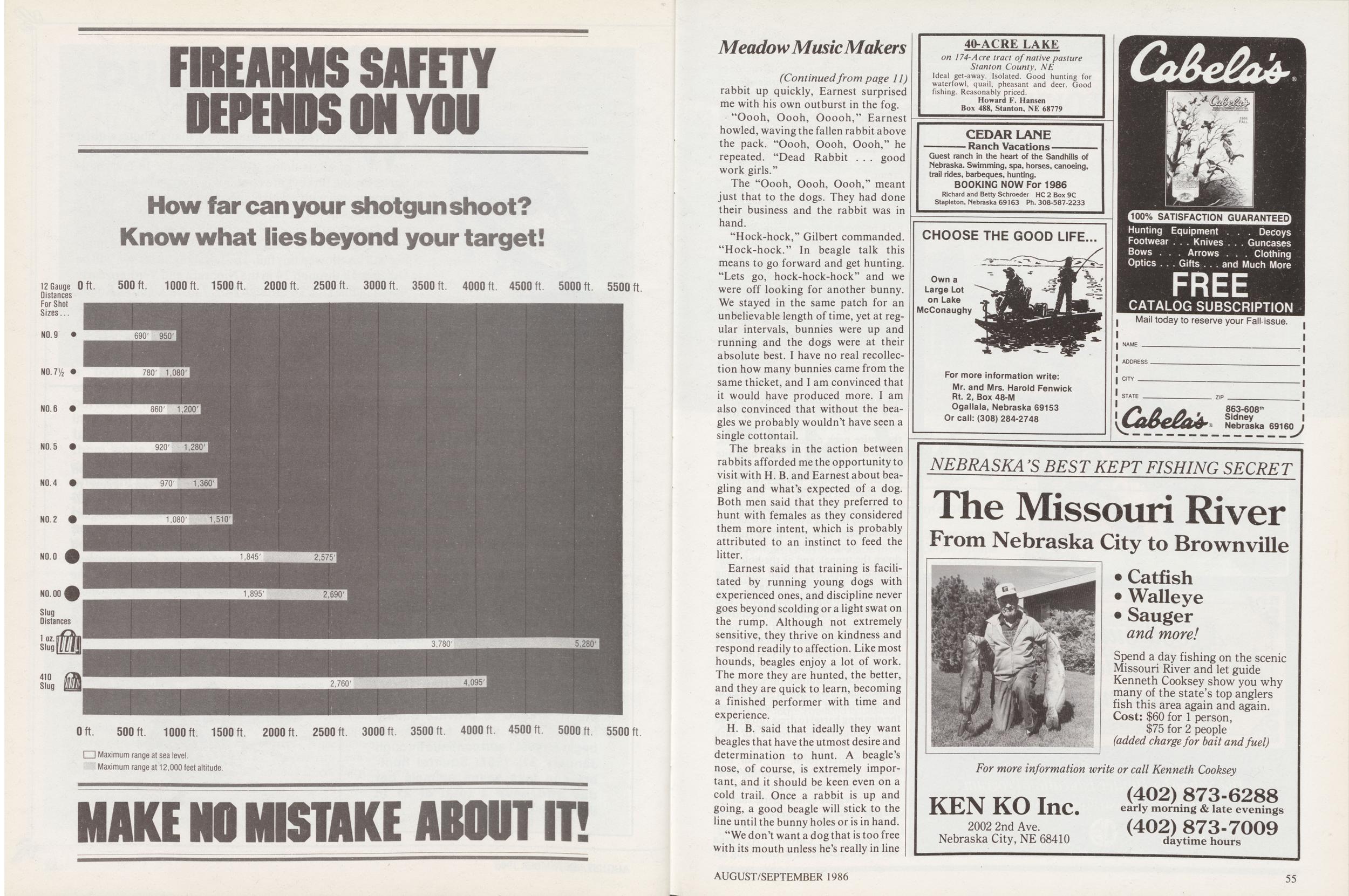
Meadow Music Makers
(Continued from page 11)rabbit up quickly, Earnest surprised me with his own outburst in the fog.
"Oooh, Oooh, Ooooh," Earnest howled, waving the fallen rabbit above the pack. "Oooh, Oooh, Oooh," he repeated. "Dead Rabbit good work girls."
The "Oooh, Oooh, Oooh," meant just that to the dogs. They had done their business and the rabbit was in hand.
"Hock-hock," Gilbert commanded. "Hock-hock." In beagle talk this means to go forward and get hunting. "Lets go, hock-hock-hock" and we were off looking for another bunny. We stayed in the same patch for an unbelievable length of time, yet at regular intervals, bunnies were up and running and the dogs were at their absolute best. I have no real recollection how many bunnies came from the same thicket, and I am convinced that it would have produced more. I am also convinced that without the beagles we probably wouldn't have seen a single cottontail.
The breaks in the action between rabbits afforded me the opportunity to visit with H. B. and Earnest about beagling and what's expected of a dog. Both men said that they preferred to hunt with females as they considered them more intent, which is probably attributed to an instinct to feed the litter.
Earnest said that training is facilitated by running young dogs with experienced ones, and discipline never goes beyond scolding or a light swat on the rump. Although not extremely sensitive, they thrive on kindness and respond readily to affection. Like most hounds, beagles enjoy a lot of work. The more they are hunted, the better, and they are quick to learn, becoming a finished performer with time and experience.
H. B. said that ideally they want beagles that have the utmost desire and determination to hunt. A beagle's nose, of course, is extremely important, and it should be keen even on a cold trail. Once a rabbit is up and going, a good beagle will stick to the line until the bunny holes or is in hand.
"We don't want a dog that is too free with its mouth unless he's really in line with a rabbit. Then, the freer the better," Earnest said.
40-ACRE LAKE on 174-Acre tract of native pasture Stanton County, NE Ideal get-away. Isolated. Good hunting for waterfowl, quail, pheasant and deer. Good fishing. Reasonably priced. Howard F. Hansen Box 488, Stanton, NE 68779 CEDAR LANE - Ranch Vacations Guest ranch in the heart of the Sandhills of Nebraska. Swimming, spa, horses, canoeing, trail rides, barbeques, hunting. BOOKING NOW For 1986 Richard and Betty Schroeder HC 2 Box 9C Stapleton, Nebraska 69163 Ph. 308-587-2233 CHOOSE THE GOOD LIFE Own a Large Lot on Lake McConaughy For more information write: Mr. and Mrs. Harold Fenwick Rt. 2, Box 48-M Ogallala, Nebraska 69153 Or call: (308) 284-2748 Cabela's Mail today to reserve your Fall-issue. NAME ADDRESS CITY STATE ZIP 863-608, Nebraska 69160 NEBRASKA'S BEST KEPT FISHING SECRET The Missouri River From Nebraska City to Brownville • Catfish • Walleye • Sauger and more! Spend a day fishing on the scenic Missouri River and let guide Kenneth Cooksey show you why many of the state's top anglers fish this area again and again. Cost: $60 for 1 person, $75 for 2 people (added charge for bait and fuel) For more information write or call Kenneth Cooksey KEN KO Inc 2002 2nd Ave. Nebraska City, NE 68410 (402) 873-6288 early morning & late evenings (402) 873-7009 daytime hours AUGUST/SEPTEMBER 1986 55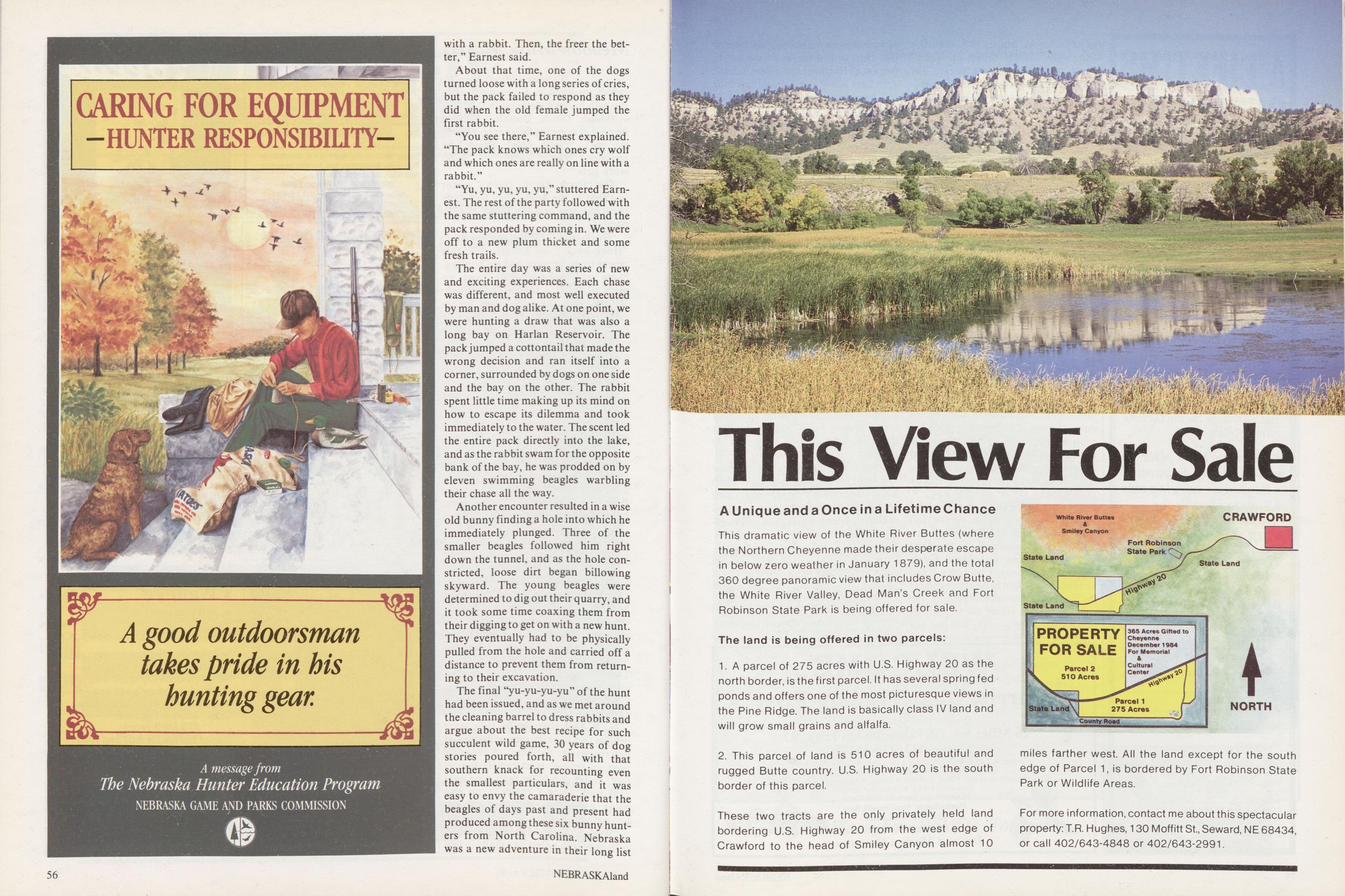
About that time, one of the dogs turned loose with a long series of cries, but the pack failed to respond as they did when the old female jumped the first rabbit.
"You see there," Earnest explained. "The pack knows which ones cry wolf and which ones are really on line with a rabbit."
"Yu, yu, yu, yu, yu," stuttered Earnest. The rest of the party followed with the same stuttering command, and the pack responded by coming in. We were off to a new plum thicket and some fresh trails.
The entire day was a series of new and exciting experiences. Each chase was different, and most well executed by man and dog alike. At one point, we were hunting a draw that was also a long bay on Harlan Reservoir. The pack jumped a cottontail that made the wrong decision and ran itself into a corner, surrounded by dogs on one side and the bay on the other. The rabbit spent little time making up its mind on how to escape its dilemma and took immediately to the water. The scent led the entire pack directly into the lake, and as the rabbit swam for the opposite bank of the bay, he was prodded on by eleven swimming beagles warbling their chase all the way.
Another encounter resulted in a wise old bunny finding a hole into which he immediately plunged. Three of the smaller beagles followed him right down the tunnel, and as the hole constricted, loose dirt began billowing skyward. The young beagles were determined to dig out their quarry, and it took some time coaxing them from their digging to get on with a new hunt. They eventually had to be physically pulled from the hole and carried off a distance to prevent them from returning to their excavation.
The final "yu-yu-yu-yu" of the hunt had been issued, and as we met around the cleaning barrel to dress rabbits and argue about the best recipe for such succulent wild game, 30 years of dog stories poured forth, all with that southern knack for recounting even the smallest particulars, and it was easy to envy the camaraderie that the beagles of days past and present had produced among these six bunny hunters from North Carolina. Nebraska was a new adventure in their long list of experiences, but as they loaded a seemingly endless supply of equipment, dogs, and hunters into the trucks for the return trip, it was evident that this was not be their last trip to, the bunny canyons of southwest Nebraska.
56 NEBRASKAland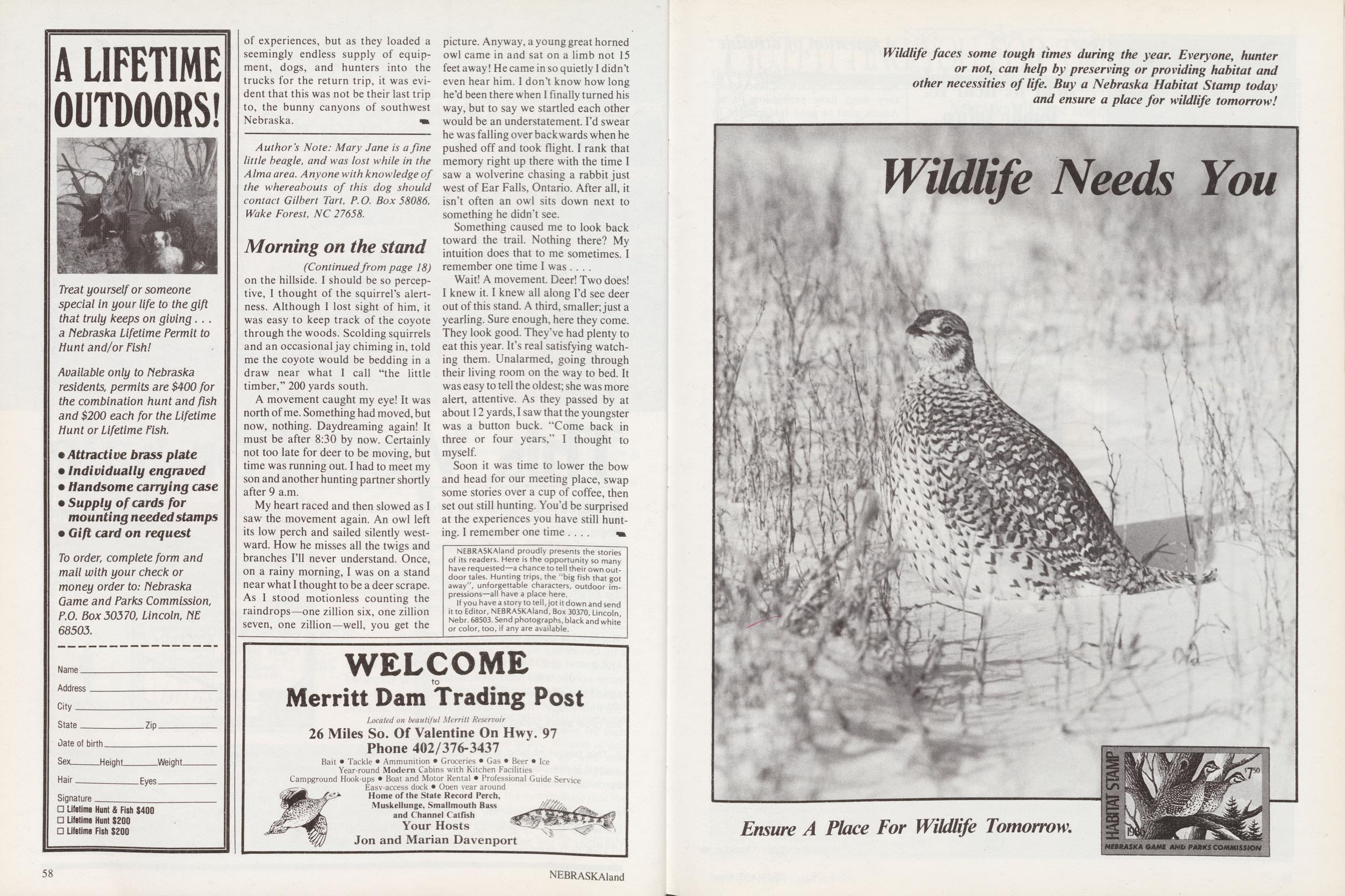 A LIFETIME
OUTDOORS!
Treat yourself or someone
special in your life to the gift
that truly keeps on giving.
a Nebraska Lifetime Permit to
Hunt and/or Fish!
Available only to Nebraska
residents, permits are $400 for
the combination hunt and fish
and $200 each for the Lifetime
Hunt or Lifetime Fish.
• Attractive brass plate
• Individually engraved
• Handsome carrying case
• Supply of cards for
mounting needed stamps
• Gift card on request
To order, complete form and
mail with your check or
money order to: Nebraska
Game and Parks Commission,
P.O. Box 30370, Lincoln, NE
68503.
Name
Address
City
State
Zip
date of birth
Sex Height.
Weight.
Hair
Eyes.
Signature
Lifetime Hunt & Fish $400
Lifetime Hunt $200
Lifetime Fish $200
Author's Note: Mary Jane is a fine
little beagle, and was lost while in the
Alma area. Anyone with knowledge of
the whereabouts of this dog should
contact Gilbert Tart, P. O. Box 58086,
Wake Forest, NC 27658.
A LIFETIME
OUTDOORS!
Treat yourself or someone
special in your life to the gift
that truly keeps on giving.
a Nebraska Lifetime Permit to
Hunt and/or Fish!
Available only to Nebraska
residents, permits are $400 for
the combination hunt and fish
and $200 each for the Lifetime
Hunt or Lifetime Fish.
• Attractive brass plate
• Individually engraved
• Handsome carrying case
• Supply of cards for
mounting needed stamps
• Gift card on request
To order, complete form and
mail with your check or
money order to: Nebraska
Game and Parks Commission,
P.O. Box 30370, Lincoln, NE
68503.
Name
Address
City
State
Zip
date of birth
Sex Height.
Weight.
Hair
Eyes.
Signature
Lifetime Hunt & Fish $400
Lifetime Hunt $200
Lifetime Fish $200
Author's Note: Mary Jane is a fine
little beagle, and was lost while in the
Alma area. Anyone with knowledge of
the whereabouts of this dog should
contact Gilbert Tart, P. O. Box 58086,
Wake Forest, NC 27658.
Morning on the stand
(Continued from page 18)on the hillside. I should be so perceptive, I thought of the squirrel's alertness. Although I lost sight of him, it was easy to keep track of the coyote through the woods. Scolding squirrels and an occasional jay chiming in, told me the coyote would be bedding in a draw near what I call "the little timber," 200 yards south.
A movement caught my eye! It was north of me. Something had moved, but now, nothing. Daydreaming again! It must be after 8:30 by now. Certainly not too late for deer to be moving, but time was running out. I had to meet my son and another hunting partner shortly after 9 a.m.
My heart raced and then slowed as I saw the movement again. An owl left its low perch and sailed silently westward. How he misses all the twigs and branches I'll never understand. Once, on a rainy morning, I was on a stand near what I thought to be a deer scrape. As I stood motionless counting the raindrops—one zillion six, one zillion seven, one zillion—well, you get the picture. Anyway, a young great horned owl came in and sat on a limb not 15 feet away! He came in so quietly I didn't even hear him. I don't know how long he'd been there when I finally turned his way, but to say we startled each other would be an understatement. I'd swear he was falling over backwards when he pushed off and took flight. I rank that memory right up there with the time I saw a wolverine chasing a rabbit just west of Ear Falls, Ontario. After all, it isn't often an owl sits down next to something he didn't see.
Something caused me to look back toward the trail. Nothing there? My intuition does that to me sometimes. I remember one time I was
Wait! A movement. Deer! Two does! I knew it. I knew all along I'd see deer out of this stand. A third, smaller; just a yearling. Sure enough, here they come. They look good. They've had plenty to eat this year. It's real satisfying watching them. Unalarmed, going through their living room on the way to bed. It was easy to tell the oldest; she was more alert, attentive. As they passed by at about 12 yards, I saw that the youngster was a button buck. "Come back in three or four years," I thought to myself.
Soon it was time to lower the bow and head for our meeting place, swap some stories over a cup of coffee, then set out still hunting. You'd be surprised at the experiences you have still hunting. I remember one time ....
NEBRASKAland proudly presents the stories of its readers. Here is the opportunity so many have requested—a chance to tell their own outdoor tales. Hunting trips, the "big fish that got away", unforgettable characters, outdoor impressions—all have a place here.
If you have a story to tell, jot it down and send it to Editor, NEBRASKAland, Box 30370, Lincoln, Nebr. 68503. Send photographs, black and white' or color, too, if any are available.
WELCOME to Merritt Dam Trading Post Located on beautiful Merritt Reservoir 26 Miles So. Of Valentine On Hwy. 97 Phone 402/376-3437 Bait • Tackle • Ammunition • Groceries • Gas • Beer • Ice Year-round Modern Cabins with Kitchen Facilities Campground Hook-ups • Boat and Motor Rental • Professional Guide Service Easv-access dock • Ooen year around Home of the State Record Perch, Muskellunge, Smallmouth Bass and Channel Catfish Your Hosts Jon and Marian Davenport 58 NEBRASKAland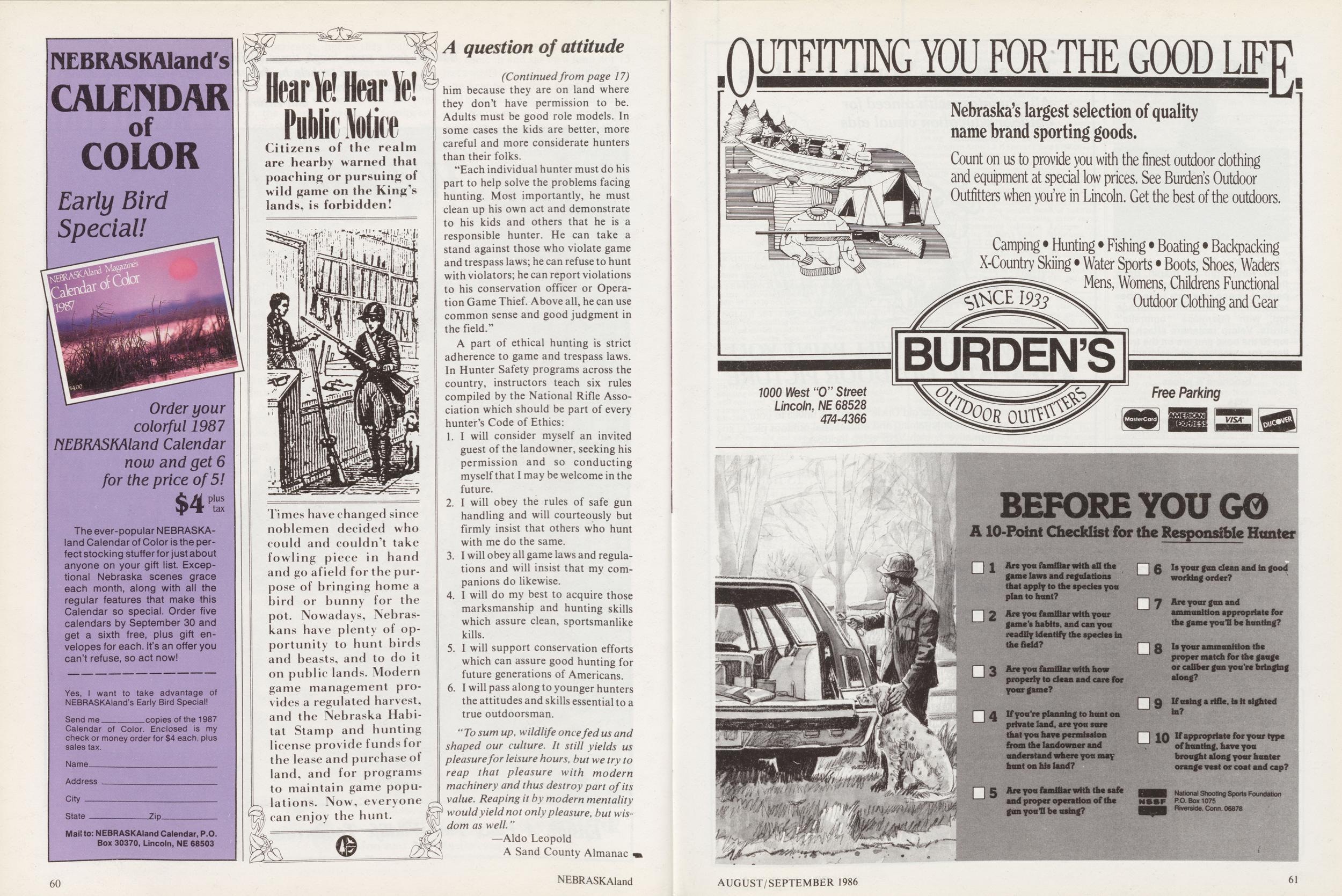 NEBRASKAland's
CALENDAR
of
COLOR
Early Bird
Special!
Order your
colorful 1987
liEBRASMland Calendar
now and get 6
for the price of 5!
$4
plus
tax
The ever-popular NEBRASKAland Calendar of Color is the perfect stocking stuffer for
just about
anyone on your gift list. Exceptional Nebraska scenes grace
each month, along with all the
regular features that make this
Calendar so special. Order five
calendars by September 30 and
get a sixth free, plus gift envelopes for each. It's an offer you
can't refuse, so act now!
Yes, I want to take advantage of
NEBRASKAland's Early Bird Special!
Send me
Calendar
of
copies of the 1987
Color. Enclosed is my
check or money order for $4 each, plus
sales tax.
Name
Address
City
State
Zip
Mail to: NEBRASKAIand Calendar, P.O.
Box 30370, Lincoln, NE 68503
Hear le! Hear
Citizens of the realm
are hearbv warned that
poaching or pursuing of
wild game on the King^s
lands, is forbidden!
Times have changed since
noblemen decided who
could and couldn't take
fowling piece in hand
and go afield for the purpose of bringing home a
bird or bunny for the
pot. Nowadays, Nebraskans have plenty of opportunity to hunt birds
and beasts, and to do it
on public lands. Modern
game management provides a regulated harvest,
and the Nebraska Habitat Stamp and hunting
license provide funds for
the lease and purchase of
land, and for programs
to maintain game populations. Now, everyone
can enjoy the hunt.
©
NEBRASKAland's
CALENDAR
of
COLOR
Early Bird
Special!
Order your
colorful 1987
liEBRASMland Calendar
now and get 6
for the price of 5!
$4
plus
tax
The ever-popular NEBRASKAland Calendar of Color is the perfect stocking stuffer for
just about
anyone on your gift list. Exceptional Nebraska scenes grace
each month, along with all the
regular features that make this
Calendar so special. Order five
calendars by September 30 and
get a sixth free, plus gift envelopes for each. It's an offer you
can't refuse, so act now!
Yes, I want to take advantage of
NEBRASKAland's Early Bird Special!
Send me
Calendar
of
copies of the 1987
Color. Enclosed is my
check or money order for $4 each, plus
sales tax.
Name
Address
City
State
Zip
Mail to: NEBRASKAIand Calendar, P.O.
Box 30370, Lincoln, NE 68503
Hear le! Hear
Citizens of the realm
are hearbv warned that
poaching or pursuing of
wild game on the King^s
lands, is forbidden!
Times have changed since
noblemen decided who
could and couldn't take
fowling piece in hand
and go afield for the purpose of bringing home a
bird or bunny for the
pot. Nowadays, Nebraskans have plenty of opportunity to hunt birds
and beasts, and to do it
on public lands. Modern
game management provides a regulated harvest,
and the Nebraska Habitat Stamp and hunting
license provide funds for
the lease and purchase of
land, and for programs
to maintain game populations. Now, everyone
can enjoy the hunt.
©
A question of attitude
(Continued from page 17)him because they are on land where they don't have permission to be. Adults must be good role models. In some cases the kids are better, more careful and more considerate hunters than their folks.
"Each individual hunter must do his part to help solve the problems facing hunting. Most importantly, he must clean up his own act and demonstrate to his kids and others that he is a responsible hunter. He can take a stand against those who violate game and trespass laws; he can refuse to hunt with violators; he can report violations to his conservation officer or Operation Game Thief. Above all, he can use common sense and good judgment in the field."
A part of ethical hunting is strict adherence to game and trespass laws. In Hunter Safety programs across the country, instructors teach six rules compiled by the National Rifle Association which should be part of every hunter's Code of Ethics:
1. I will consider myself an invited guest of the landowner, seeking his permission and so conducting myself that I may be welcome in the future.
2. I will obey the rules of safe gun handling and will courteously but firmly insist that others who hunt with me do the same.
3. I will obey all game laws and regulations and will insist that my companions do likewise.
4. I will do my best to acquire those marksmanship and hunting skills which assure clean, sportsmanlike kills.
5. I will support conservation efforts which can assure good hunting for future generations of Americans.
6. I will pass along to younger hunters the attitudes and skills essential to a true outdoorsman.
"To sum up, wildlife once fed us and shaped our culture. It still yields us pleasure for leisure hours, but we try to reap that pleasure with modern machinery and thus destroy part of its value. Reaping it by modern mentality would yield not only pleasure, but wisdom as well."
Aldo Leopold A Sand County Almanac 60 NEBRASKAland AUTFnTlNG YOU FOR THE GOOD IJFT? Nebraska's largest selection of quality name brand sporting goods. Count on us to provide you with the finest outdoor clothing and equipment at special low prices. See Burden's Outdoor Outfitters when you're in Lincoln. Get the best of the outdoors. Camping • Hunting • Fishing • Boating • Backpacking X-Country Skiing • Water Sports • Boots, Shoes, Waders Mens, Womens, Childrens Functional Outdoor Clothing and Gear 1000 West "0" Street Lincoln, NE 68528 474-4366 BEFORE YOU GO A10 - Point Checklist for the Responsible Hunter Art yon familiar with all the game laws and regulations that apply to the species you plan to hunt? 2 Art yon familiar with yottr games habits, and can yon readily identify the species in the Bold? O Are yon familiar with how properly to dean and care for your game? A If you're planning to hunt on private land, are you sore that you have permission from the landowner and understand where yon may hunt on his land? 5 and proper operation of the gun you 11 be using? g Is your gun clean and good workin g order? Arc your gun and ammunition appropriate for the game you 11 be hunting? 8 ammunition the proper match lor the gauge or caliber gem you're bringing along? If using a rifle, is it righted in? for your of hunting, have you brought along your hunter orange vest or coat and cap? MSSF National Shooting Sports P.O. Box 1075 Riverside. Conn. 06878 AUGUST/SEPTEMBER 1986 61 Marsh"11
A portable, fiberglass one-man
blind. Hunt from the marsh, open
fields. Take photographs from
perfect concealment. Weather
resistant nylon autumn camouflage
top, with fiberglass "umbrella"
struts. Velcro fasteners attach the
top to the base and are on the front
flaps for complete concealment.
Call or write for
brochure & prices.
VISA
M/C
®
BOATWORKS INC.
GRAND ISLAND , NEBRASKA 68SOI
County
Map
Guide
A real guide to Nebraska
featuring maps of all 93 counties, plus listings of all public
hunting, fishing and camping
areas.
Maps include:
Roads • Public lands
Towns • Farmhouses
Rivers • Railroads
Available at 1,200 retail
outlets across the state, or
send $4.95 plus $1.50 to:
State and Local Publications
527 Chapel Hill
Elkhorn, NE 68022
Teachers—Youth Leaders
All educators with a need for
outdoor education visual aids
MR. WHISKERS WILL PAINT YOU
A REALISTIC OUTDOOR PICTURE
Let this prairie vole and his old Uncle Thaddeus unveil to your
youth group a most entertaining and educational outdoor pic-
ture. This informative V2 inch VHS video includes:
Helping Our Wildlife Friends 13 minutes
Birds of Nebraska
Part I Songbirds 20 minutes
Part II Raptors and Shorebirds 24 minutes
Part III Gamebirds 25 minutes
Fishes of Nebraska 14 minutes
Mammals of Nebraska 16 minutes
One video—six outstanding programs
alt for $22.00
have Enclosed.
which includes sales tax.
Please send
Name
Mr. Whisker's video tapes
Address
City
State.
-Zip-
MAIL TO: NEBRASKAIand Magazine
Whiskers' Tape Series
P.O. Box 30370
Lincoln, NE 68503
62
NEBRASKAland
Marsh"11
A portable, fiberglass one-man
blind. Hunt from the marsh, open
fields. Take photographs from
perfect concealment. Weather
resistant nylon autumn camouflage
top, with fiberglass "umbrella"
struts. Velcro fasteners attach the
top to the base and are on the front
flaps for complete concealment.
Call or write for
brochure & prices.
VISA
M/C
®
BOATWORKS INC.
GRAND ISLAND , NEBRASKA 68SOI
County
Map
Guide
A real guide to Nebraska
featuring maps of all 93 counties, plus listings of all public
hunting, fishing and camping
areas.
Maps include:
Roads • Public lands
Towns • Farmhouses
Rivers • Railroads
Available at 1,200 retail
outlets across the state, or
send $4.95 plus $1.50 to:
State and Local Publications
527 Chapel Hill
Elkhorn, NE 68022
Teachers—Youth Leaders
All educators with a need for
outdoor education visual aids
MR. WHISKERS WILL PAINT YOU
A REALISTIC OUTDOOR PICTURE
Let this prairie vole and his old Uncle Thaddeus unveil to your
youth group a most entertaining and educational outdoor pic-
ture. This informative V2 inch VHS video includes:
Helping Our Wildlife Friends 13 minutes
Birds of Nebraska
Part I Songbirds 20 minutes
Part II Raptors and Shorebirds 24 minutes
Part III Gamebirds 25 minutes
Fishes of Nebraska 14 minutes
Mammals of Nebraska 16 minutes
One video—six outstanding programs
alt for $22.00
have Enclosed.
which includes sales tax.
Please send
Name
Mr. Whisker's video tapes
Address
City
State.
-Zip-
MAIL TO: NEBRASKAIand Magazine
Whiskers' Tape Series
P.O. Box 30370
Lincoln, NE 68503
62
NEBRASKAland
Trading Post
DOGSTRAINING ALL BREEDS Hunting Dogs - Vizslas for sale. Rozanek Kennels, Rt. 2, Schuyler, NE 68661. Phone (402) 352-8769.
A FEW HUNTING dogs for sale: Brittanies, English setters. German Shorthairs. Darrell Yentes, Phone (308) 995-8570 or (308) 995-4797 after 5 p.m.
ENGLISH SETTERS and Labradors: "Bred for the hunter"; outstanding bloodlines! Puppies, started dogs and stud service available. High Plains Kennels, 1411 Emerson, Alliance, Nebr. 69301. Phone (308) 762-6709.
GERMAN SHORTHAIR Pointers pups, started dogs, occasionally a finished meat dog. Wayne Clark (712) 529-4238 after 10:00 p.m. or (402) 263-3495. Union, Nebr.
PROFESSIONAL GUNDOG TRAINING: Working pointing breeds. Complete, individualized program well equipped. "Positive retrieve." Honesty and consistent patience. Grouseway Gundogs. Phone (308) 636-2495.
FOR SALE: Two AKC Registered Weimaraner dogs. One 3 years old and one 2 years old. Both partially trained. R. H. Bybee, Box 277, Curtis, NE 69025. Phone (308) 367-4153.
MISCELLANEOUSFISH FOR SALE. Channel catfish, bass, bluegill, crappie, trout, perch, white bass, minnows, hybrid grass carp, bullhead. We can ship fish, you can pick them up, or we can deliver. Contact the Pleasant Valley Fish Farm, Rt. 1, McCook, NE 69001. Phone (308) 345-6599.
N.E. NEBRASKA TROUT Fishing, For rent Mon.-Thurs. or Fri.-Sun. 2 modern cottages completely furnished, 5 spring-fed lakes with trout up to 7 lbs. Bass and bluegill also. Diamond E Trout Resort, Orchard, NE 68764. (402) 893-4745.
GUNS - - Browning, Winchester, Remington, others, Hi-powers, shotguns, new, used, antiques. Want Pre1964 Winchesters. Buy-Sell-Trade. Ph. (402) 729-6112. Bedlan's Sporting Goods, Fairbury, NE 68352.
FOR SALE: 577 acres 17 miles southwest of Crawford, Nebraska on the scenic White River. Ranch-style house with double garage, barn with corral and other buildings, heavily timbered with spring and pond. Good deer and turkey hunting and trout fishing. Contact Josephine Doehring, Rt. 3, Fairbury, NE 68352 or phone (402) 729-5738.
BERGMANS RESORT On Beautiful Johnson Lake Lakefront Cabins* RV Hookups* Groceries • Beer • Bait • Tackle • Restaurant* Lounge* Boat Rentals* Guide Service. Fish*Swim*Golf Elmer and Janet Bergman RR 2, Elwood, NE 68937 (308) 785-2298MAD RIVER CANOES offers the finest quality and performance. For the first canoes and accessories look to Great Plains Canoe Co., 205 Main, Springfield, NE. Phone (402) 253-2001.
WINE AND BEER: Make your own. Send for free recipes and instructions. Omaha Supply, 1324 2nd Avenue, Nebraska City, NE 68410.
WINCHESTER COMMEMORATIVES: Canadian Pacific Railroad Standard $369.00; Members Model $369.00; Deluxe Cased $895.00; Calgary Stampede Deluxe Cased $895.00; US Border Patrol with Print $395.00; Saskatchewan Diamond Jubilee $395.00; Great Western Artist I & II Deluxe Cased $799.00each. Commemorative Firearms LTD, 2305 South 168th Street, Omaha, Nebr. 68130. Phone (402) 330-2541.
UNIQUE 2,000-ACRE ranch available; excellent goose, duck, grouse and antelope hunting with deer and turkey within five miles. Call (308) 684-3341.
FAIRFIELD CAMPGROUNDS along the Niobrara River "in the heart of a unique blend of habitats." Hiking, natural scenery, bird watching, canoe rental, car shuttle, experienced outfitters. Lifetime river knowledge. Loring & Beryl Kuhre, Johnstown, NE 69214. Phone (402) 722-4494.
ARCHERY PRO SHOP for sale: All equipment needed to open retail archery shop and/or lanes. Accessories, arrow-making supplies, targets, butts, etc. Write to Michael Howell, Rt. 1, Box 188, Bellwood, NE 68624, or call (402) 564-9510.
LOG HOMES — Discover the simple elegance and richness of a Western Log Home. Your plan or ours. Free estimates. 44-page home planning guides $5. Action Log Homes, Box 3201, Kearney, NE 68847. Phone (308) 237-LOGS.
LA KE McCON A UGH Y LOTS — choice lots adjacent to Cedar Vue (Gate 13). THE choice development on McConaughy, all south of RR tracks with direct access to the lake. Quarter-acre lots, $500 down and $100 per month. Call (308) 284-6701 or (308) 355-4543.
NEBRASKA WILDFLOWERS — permanently pre- served in resin. Paperweights and range-top spoon rests. $6.95 each includes tax and shipping. K&M Taxidermy, Rt. 2, Box 175, Norfolk, NE 68701 or phone (402)675-1862.
AIR GUNS repaired — Benjamin, Crosman, Daisy, other American made. Restoration; old guns wanted, Jack's Air Guns, 1225 No. 46th, Lincoln, NE 68503. Phone (402) 466-9223.
STOCK SHOP wood stocks for all firearms. Repaired, refinished or custom made. Hand cut checkering, glass bedding. 1618 Euclid, Ashland, NE 68003. Phone (402) 944-2836.
GOOSE HUNTING FACILITY private or commercial. Located on the North Platte River between two game reserves near Lewellen, Nebraska, this facility is fully equipped and ready to provide you with good hunting this fall. For more information, call or write Doran Post and Associates, P.O. Box 158, Lexington, NE 68850, (308) 324-6992.
LIVE-CATCH ALL-PURPOSE TRAPS Write tor FREE CATALOG Traps without injury squirrels, chipmunks, rabbits, mink, fox, raccoons, stray animals, pests, etc. Sizes for every need. Also traps for snakes, sparrows, pigeons, crabs, turtles, quail, etc. Save on our low factory prices. Send no money. Free catalog and trapping secrets MUSTANG MFG. CO., Dept N-34, Box 920947, Houston. Tex. 77292 STOCK YOUR LAKE OR POND WITH Channel cat, Bluegill, Largemouth Bass, Hybrid Bluegill, Crappie, Triploid Grass Carp, Minnows ORDER NOW WILLOW LAKE FISH HATCHERY Rt. 3, Box 46, Hastings, Nebr. 68901 Gaylord L. Crawford Phone: (402) 463-8022 Day or Night For April to October 15 stocking TAXIDERMYALLISON'S TAXIDERMY STUDIO: Wally and Betty Allison, Licensed Taxidermist. We've mounted 18 Nebraska State Record fish. Specializing in fish and birds, small game and rattlesnakes. We use freeze-dry. 2709 Brichwood Rd., North Platte, Nebr. 69101. Phone (308) 534-2324.
BADE TAXIDERMY - - Quality a must - - Fast service. Fish, birds, rugs, tanning, full mounts and game heads, 2111 N. Christy St., Fremont, Nebraska 727-5463.
KARL SCH WARZ master taxidermist has moved to a new country studio; same professional mounting and tanning service. Schwarz Wild Wing Studio, 16804 South 180th St., Springfield, NE 68059. Phone (402) 253-2481.
JOHNSON TAXIDERMY servicing southwest Nebraska, specializing in big-game mounts, life-sized mounts, rug work, fish, birds, tanning hair-on leather. Brochure and price list on request. Johnson Taxidermy, Rt. 1, Box 78, Lamar, NE 69035. Telephone (308) 882-5555.
NABITY'S TAXIDERMY. 31 years experience. Specializing in natural grass backgrounds for mammals, birds and fish. 13901 "O" St., Lincoln, NE 68504 — 4 miles east of 84th and "O". (402) 489-6351.
K&M TAXIDERMY — we do natural mounts you will be proud of. Fish, birds and game heads. Rt. 2, Box 175, Norfolk, NE 68701. Phone (402) 675-1862.
BIG BEAR TAXIDERMY, Rt. 2, Mitchell, Nebraska 69357. We specialize in all big game from Alaska to Nebraska, also birds and fish. Hair on and hair off tanning. Four miles west of Scottsbluff on Highway 26. Dale Hubel, phone (308) 635-3013.
CREATIVE TAXIDERMY. Quality and experience since 1935. All custom services, museum work, and sales. New methods include Freeze-Dry processing. Trophy room visitors and inquiries welcome. Naturecraft Studios, Joe Voges, Owner, Nebraska City, NE 68410. Phone (402) 873-5491.
PLATTE VALLEY TAXIDERMY. Museum-quality mounts using latest scientific methods. 1985 world taxidermy competition winner. Delton Wegner, 1419 11th Street, Central City, NE 68826. Telephone (308) 946-3773.
PE1STER TAXIDERMY Professional work at prices most sportsman can afford. Now in our new log cabin studio, 1020 Central Avenue, Box 3201, Kearney, NE 68847. Phone (308) 236-9700 or (308) 237-7575 evenings.
OFFERS A COMPLETE TRAINING PROGRAM For Retrievers, Pointers, Spaniels Basic Obedience Program For All Breeds Field Trial Bloodline Lab Pups For Sale JOHN HONORE Manager and Trainer West Highway 30 RR 1 Box 433 Grand Island, NE 68801 Phone:(308)384-1517 Harlan County Dam Vacation Apartments - fully furnished Color TV • Kitchen Facilities • Full Baths Game cleaning room with freezer One block from shopping center Weekend or week of pleasant living Security Deposit Required Sorry —No Pets Dean and Esther Stone Box 145 Ph. (308) 799-3422 Republican City, NE 68971 AUGUST/SEPTEMBER 1986 63 WHEN YOU'RE IN THE FIELD
A 10-Point Checklist for the Responsible Hunter
Do you always make sure the muzzle of
your gun is pointed in a safe direction?
j—12 Do you always treat your gun as if it
were loaded and ready to fire?
2 Do you always load your gun only while
actually hunting and keep it unloaded
and open at all other times?
A If hunting with others, do you always
know your safe zone of fire and the
location of your partners?
ou always make absolutely sure of
arget and what s beyond it before
shoot?
Do you always limit your shots to those
within range?
Do you always make every possible
effort to recover game?
Do you always make sure to leave gates
the way you found them?
Do you always make sure to pack out all
of your litter?
10 Do YOtI aIwaYs wear a hunter orange
vest or coat and cap, if appropriate for
your type of hunting?
National Shooting Sports Foundation
NSSF P.O. Box 1075
Riverside, Cona 06878
WHEN YOU'RE IN THE FIELD
A 10-Point Checklist for the Responsible Hunter
Do you always make sure the muzzle of
your gun is pointed in a safe direction?
j—12 Do you always treat your gun as if it
were loaded and ready to fire?
2 Do you always load your gun only while
actually hunting and keep it unloaded
and open at all other times?
A If hunting with others, do you always
know your safe zone of fire and the
location of your partners?
ou always make absolutely sure of
arget and what s beyond it before
shoot?
Do you always limit your shots to those
within range?
Do you always make every possible
effort to recover game?
Do you always make sure to leave gates
the way you found them?
Do you always make sure to pack out all
of your litter?
10 Do YOtI aIwaYs wear a hunter orange
vest or coat and cap, if appropriate for
your type of hunting?
National Shooting Sports Foundation
NSSF P.O. Box 1075
Riverside, Cona 06878
NOTES ON NEBRASKA FLORA COTTONWOOD
BY WALTER BAGLEY ASSOCIATE PROFESSOR EMERITUS, UNLCOTTON WOODS are pioneering trees—trees for pioneers, past, present, and future, and pioneers in their own right. Though few and far betweeen, they served the American Indian and our ancestors well as giant landmarks in a sea of grass, and as shady respites from a searing summer sun. They usually marked a source of water, and provided fuel for campsites.
In late spring, the female cottonwood produces thousands of tiny, short-lived seeds that fly far and wide on prairie breezes hoping to alight on a moist sandbar, a scar in the sod, or a cultivated field. They must take advantage of timely rains and cool, humid interludes to quickly push out fragile roots and shoots before they lose their germinating ability. If all goes well, thousands of seedlings appear as if by magic. Before the advent of homesteaders, most of them succumbed to prairie fires and the ravages of buffalo at an early age. Those that survived adolescence often reached 80 feet in height at a grand old age of 60 years, with stem diameters of four to six feet. The trunk of our state champion is about nine feet in diameter and is 90 feet tall.
Enterprising settlers utilized sandbar "nurseries" as a source of cottonwood trees for shade and shelter on their homesites. Perhaps some of them planted dormant, one-year-old twigs cut from vigorous young trees in the spring. These produced roots quite readily. If water was adequate and the soil fertile, these fast growing trees provided significant protection from wind and sun in five years or less. Young trees that were harvested for firewood or poles regenerated by fastgrowing stump sprouts.
Unfortunately, cottonwoods were often planted on sites which were too high and dry for long life. My parents, homesteaders in the sandhills of Yuma County, Colorado, like many others, were disappointed by the trees' early demise. But those whose homesteads were along streams or near lakes or areas with high water tables were pleased to discover that cottonwoods soon transformed the barren homestead into a shady oasis, and their tree claims became a haven for their animals in summer and winter. Fences of Cottonwood posts and poles, though short-lived in contact with the soil, served where more durable woods were scarce. The lumber was used in the construction of many farm buildings despite its tendency to warp.
During the droughty thirties, our family was fortunate to lease a ranch with a homesite on the Arikaree River in eastern Colorado, 35 miles west of its confluence with the Republican near Haigler. The house was modest, but the long, cottonwood-lined lane leading up to a shady yard made it a luxurious haven on a hot summer day. A grove of cottonwoods in Spring Canyon nearby served as a picnic ground for neighbors from miles around. In addition, it provided food for beaver and "makin's" for their dam which served as our fishing and swimming hole in summer and as a place for mallards to light and stay for a while in
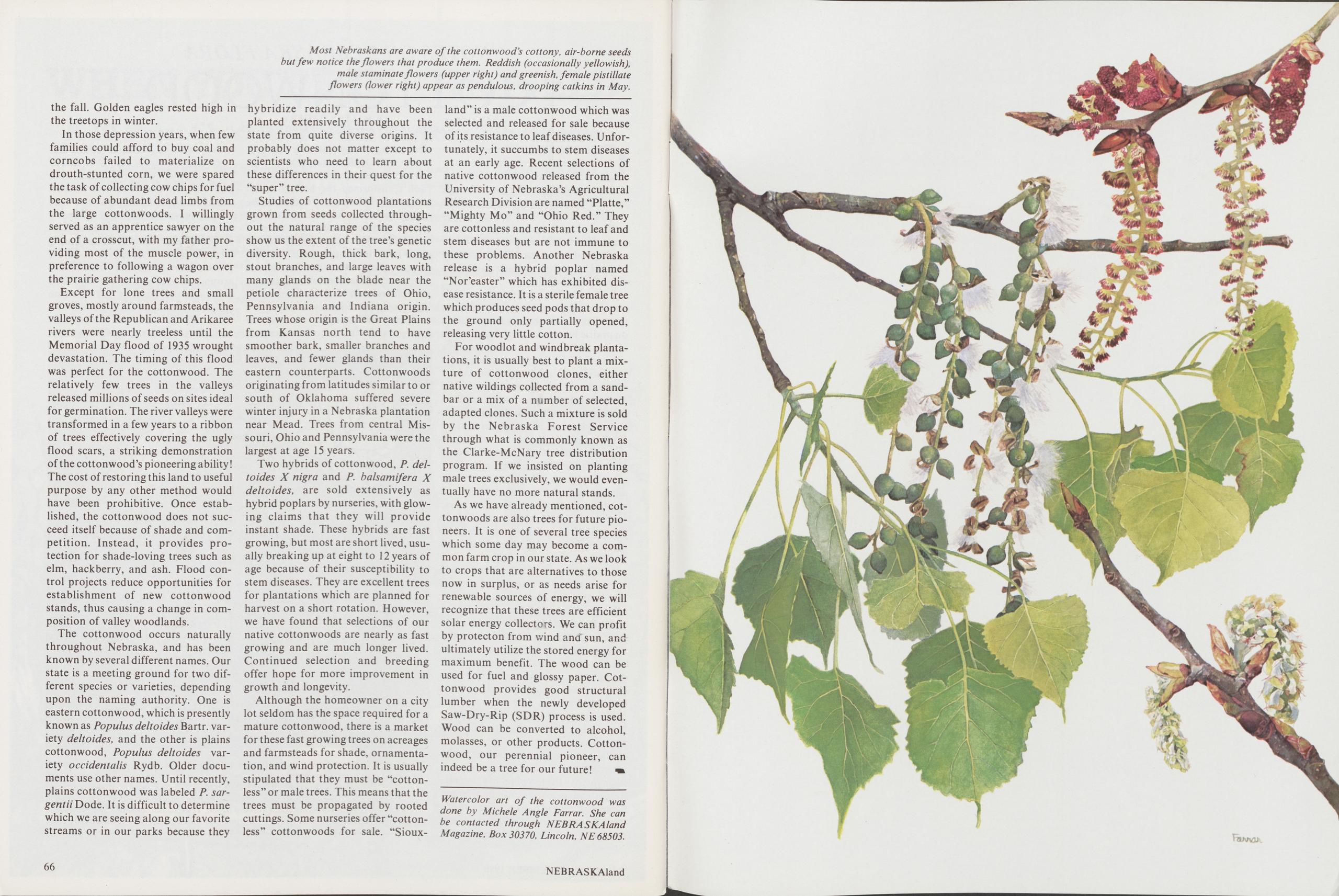
Most Nebraskans are aware of the cottonwood’s cottony, air-borne seeds but few notice the flowers that produce them. Reddish (occasionally yellowish), male staminate flowers (upper right) and greenish, female pistillate flowers (lower right) appear as pendulous, drooping catkins in May.
the fall. Golden eagles rested high in the treetops in winter.
In those depression years, when few families could afford to buy coal and corncobs failed to materialize on drouth-stunted corn, we were spared the task of collecting cow chips for fuel because of abundant dead limbs from the large cottonwoods. I willingly served as an apprentice sawyer on the end of a crosscut, with my father providing most of the muscle power, in preference to following a wagon over the prairie gathering cow chips.
Except for lone trees and small groves, mostly around farmsteads, the valleys of the Republican and Arikaree rivers were nearly treeless until the Memorial Day flood of 1935 wrought devastation. The timing of this flood was perfect for the cottonwood. The relatively few trees in the valleys released millions of seeds on sites ideal for germination. The river valleys were transformed in a few years to a ribbon of trees effectively covering the ugly flood scars, a striking demonstration of the cottonwood’s pioneering ability! The cost of restoring this land to useful purpose by any other method would have been prohibitive. Once established, the cottonwood does not succeed itself because of shade and competition. Instead, it provides protection for shade-loving trees such as elm, hackberry, and ash. Flood control projects reduce opportunities for establishment of new cottonwood stands, thus causing a change in composition of valley woodlands.
The cottonwood occurs naturally throughout Nebraska, and has been known by several different names. Our state is a meeting ground for two dif- ferent species or varieties, depending upon the naming authority. One is eastern cottonwood, which is presently known as Populus deltoides Bartr. variety deltoides, and the other is plains cottonwood, Populus deltoides variety occidentalis Rydb. Older documents use other names. Until recently, plains cottonwood was labeled P. sargentii Dode. It is difficult to determine which we are seeing along our favorite streams or in our parks because they hybridize readily and have been planted extensively throughout the state from quite diverse origins. It probably does not matter except to scientists who need to learn about these differences in their quest for the “super” tree.
Studies of cottonwood plantations grown from seeds collected throughout the natural range of the species show us the extent of the tree’s genetic diversity. Rough, thick bark, long, stout branches, and large leaves with many glands on the blade near the petiole characterize trees of Ohio, Pennsylvania and Indiana origin. Trees whose origin is the Great Plains from Kansas north tend to have smoother bark, smaller branches and leaves, and fewer glands than their eastern counterparts. Cottonwoods originating from latitudes similar to or south of Oklahoma suffered severe winter injury in a Nebraska plantation near Mead. Trees from central Missouri, Ohio and Pennsylvania were the largest at age 15 years.
Two hybrids of cottonwood, P. deltoides X nigra and P. balsamifera X deltoides, are sold extensively as hybrid poplars by nurseries, with glowing claims that they will provide instant shade. These hybrids are fast growing, but most are short lived, usually breaking up at eight to 12 years of age because of their susceptibility to stem diseases. They are excellent trees for plantations which are planned for harvest on a short rotation. However, we have found that selections of our native cottonwoods are nearly as fast growing and are much longer lived. Continued selection and breeding offer hope for more improvement in growth and longevity.
Although the homeowner on a city lot seldom has the space required for a mature cottonwood, there is a market for these fast growing trees on acreages and farmsteads for shade, ornamentation, and wind protection. It is usually stipulated that they must be “cottonless” or male trees. This means that the trees must be propagated by rooted cuttings. Some nurseries offer “cottonless” cottonwoods for sale. “Siouxland” is a male cottonwood which was selected and released for sale because of its resistance to leaf diseases. Unfortunately, it succumbs to stem diseases at an early age. Recent selections of native cottonwood released from the University of Nebraska’s Agricultural Research Division are named “Platte,” “Mighty Mo” and “Ohio Red.” They are cottonless and resistant to leaf and stem diseases but are not immune to these problems. Another Nebraska release is a hybrid poplar named “Nor’easter” which has exhibited disease resistance. It is a sterile female tree which produces seed pods that drop to the ground only partially opened, releasing very little cotton.
For woodlot and windbreak plantations, it is usually best to plant a mixture of cottonwood clones, either native wildings collected from a sandbar or a mix of a number of selected, adapted clones. Such a mixture is sold by the Nebraska Forest Service through what is commonly known as the Clarke-McNary tree distribution program. If we insisted on planting male trees exclusively, we would eventually have no more natural stands.
As we have already mentioned, cottonwoods are also trees for future pioneers. It is one of several tree species which some day may become a common farm crop in our state. As we look to crops that are alternatives to those now in surplus, or as needs arise for renewable sources of energy, we will recognize that these trees are efficient solar energy collectors. We can profit by protecton from wind ana' sun, and ultimately utilize the stored energy for maximum benefit. The wood can be used for fuel and glossy paper. Cottonwood provides good structural lumber when the newly developed Saw-Dry-Rip (SDR) process is used. Wood can be converted to alcohol, molasses, or other products. Cottonwood, our perennial pioneer, can indeed be a tree for our future!
Watercolor art of the cottonwood was done by Michele Angle Farrar. She can be contacted through NEBRASKAland Magazine, Box 30370, Lincoln, NE 68503. Fannon
Position: 387 (25 views)