Volume 64, Issue 6, 1986
NEBRASKAland
JULY 1986 #1.50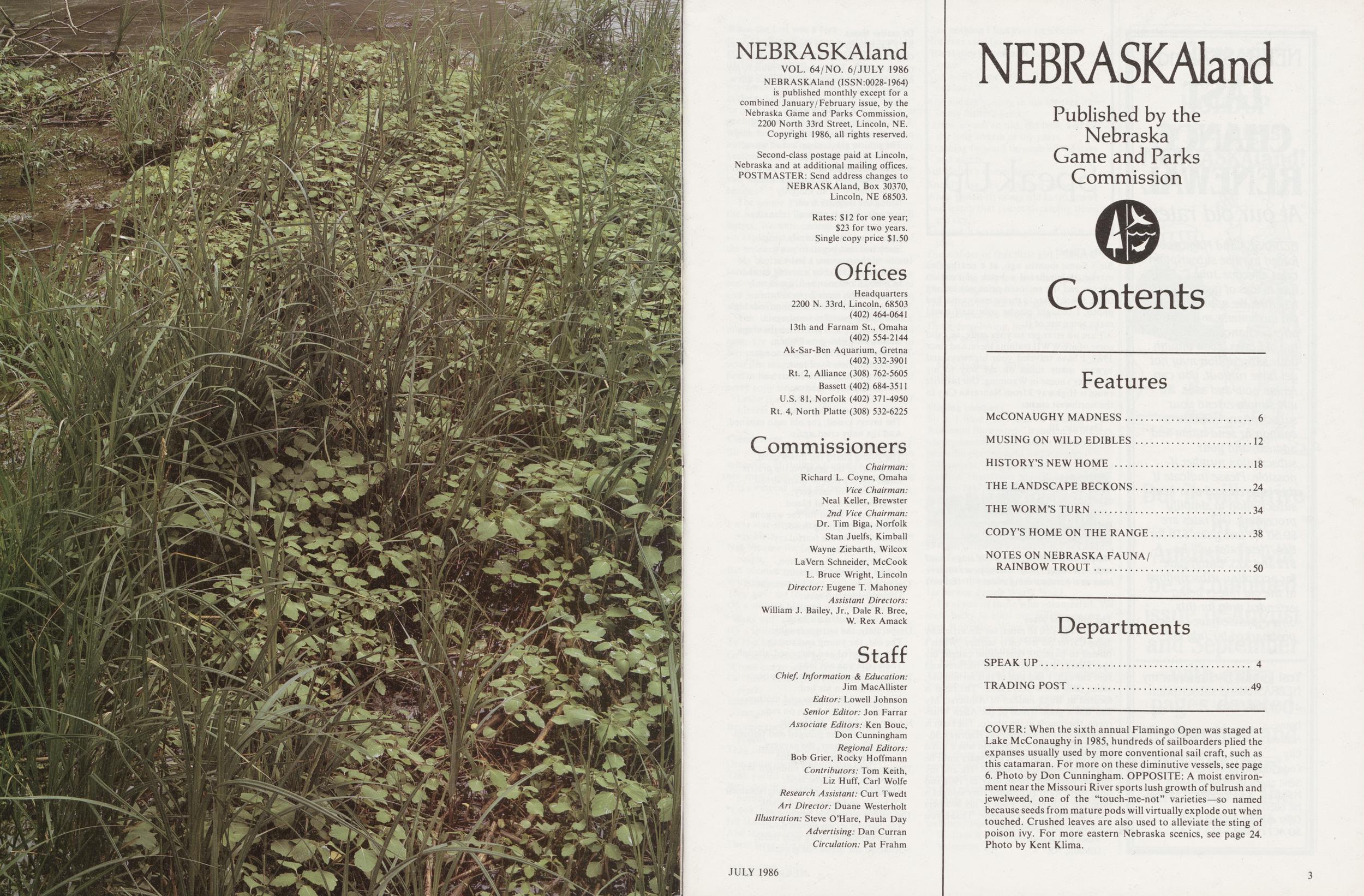
NEBRASKAland
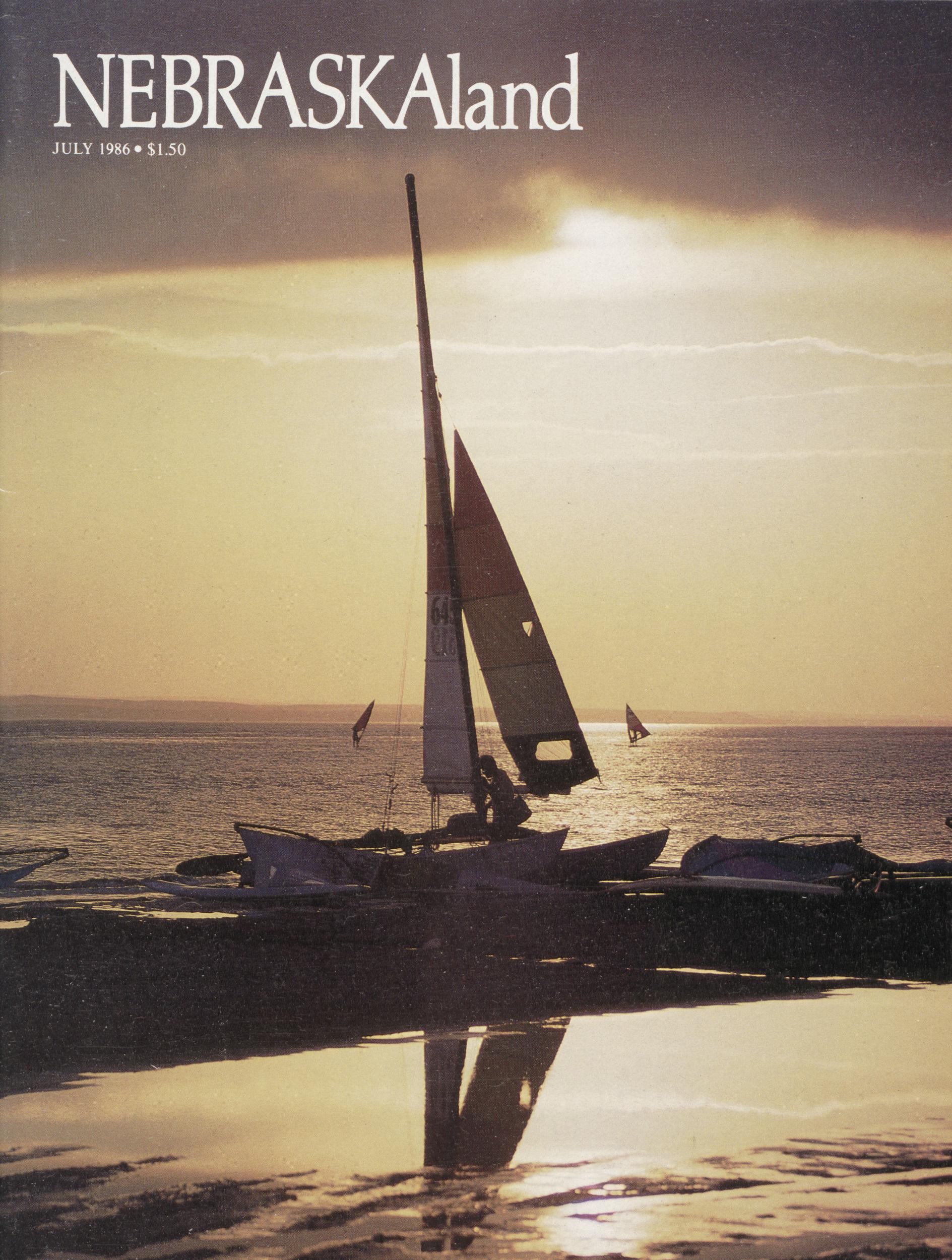
Published by the Nebraska Game and Parks Commission NEBRASKAland VOL. 64/NO. 6/JULY 1986 NEBRASKAland (ISSN:0028-1964) is published monthly except for a combined January/February issue, by the Nebraska Game and Parks Commission, 2200 North 33rd Street, Lincoln, NE. Copyright 1986, all rights reserved. Second-class postage paid at Lincoln, Nebraska and at additional mailing offices. POSTMASTER: Send address changes to NEBRASKAland, Box 30370, Lincoln, NE 68503. Rates: $12 for one year; $23 for two years. Single copy price $1.50 Offices Headquarters 2200 N. 33rd, Lincoln, 68503 (402) 464-0641 13th and Farnam St., Omaha (402) 554-2144 Ak-Sar-Ben Aquarium, Gretna (402) 332-3901 Rt. 2, Alliance (308) 762-5605 Bassett (402) 684-3511 U.S. 81, Norfolk (402) 371-4950 Rt. 4, North Platte (308) 532-6225 Commissioners Chairman: Richard L. Coyne, Omaha Vice Chairman: Neal Keller, Brewster 2nd Vice Chairman: Dr. Tim Biga, Norfolk Stan Juelfs, Kimball Wayne Ziebarth, Wilcox LaVern Schneider, McCook L. Bruce Wright, Lincoln Director: Eugene T. Mahoney Assistant Directors: William J. Bailey, Jr., Dale R. Bree, W. Rex Amack Staff Chief, Information & Education: Jim MacAllister Editor: Lowell Johnson Senior Editor: Jon Farrar Associate Editors: Ken Bouc, Don Cunningham Regional Editors: Bob Grier, Rocky Hoffmann Contributors: Tom Keith, Liz Huff, Carl Wolfe Research Assistant: Curt Twedt Art Director: Duane Westerholt Illustration: Steve O'Hare, Paula Day Advertising: Dan Curran Circulation: Pat Frahm Contents Features McCONAUGHY MADNESS 6 MUSING ON WILD EDIBLES HISTORY'S NEW HOME THE LANDSCAPE BECKONS THE WORM'S TURN 12 CODY'S HOME ON THE RANGE NOTES ON NEBRASKA FAUNA RAINBOW TROUT 34 38 50 Departments TRADING POST 49 COVER: When the sixth annual Flamingo Open was staged at Lake McConaughy in 1985, hundreds of sailboarders plied the expanses usually used by more conventional sail craft, such as this catamaran. For more on these diminutive vessels, see page 6. Photo by Don Cunningham. OPPOSITE: A moist environment near the Missouri River sports lush growth of bulrush and jewelweed, one of the "touch-me-not" varieties—so named because seeds from mature pods will virtually explode out when touched. Crushed leaves are also used to alleviate the sting of poison ivy. For more eastern Nebraska scenics, see page 24. Photo by Kent Klima. JULY 1986 3
Speak Up
Early Flight?Sir / Some months ago, at a nearby flea market, I purchased a batch of aviation photos and the enclosed print was among them. Since 1 hate to throw away a marked photo, I thought maybe your staff could make some use of it.
I am no stranger to your state, as I did some of my WWII training there, and since 1982, I have traveled your highways and byways many times on my way to my daughter's home in Wyoming. Our favorite route is Highway 2 from Nebraska City to the northwest corner.
Irvin D. Baer Danville, 111.Sir / Thank you so much for the article by John Carter on the early settlers. When I turned to page 20, that house caught my eye. Finally I got out my old pictures and sure enough, I had one of this farmhouse, taken only a few years later. The farm is located at Buda instead of Amherst. My dad was a good friend of the Allen Wisemans, the couple in the photo. The farm is six miles east of Kearney on Highway 30.
My dad, Elmer Lindenstein was a hired hand on this farm for a few years until he started farming it for himself. He and my mother were married on May 28, 1908 and lived there until 1920 when they bought a farm one mile north. Four of my brothers and I were born in this house. Thank you for a wonderful magazine.
Viola E. Livingston Gibbon, NE Of earlier timesSir / I presently live in California, but was originally from Bradshaw, Nebraska, and miss it terribly. This poem is a tribute to my home state and the simple life I once knew.
Vera Adams Coyote Witness The harvest moon hung low and red On the circled wagon train. The prairie grass, as an ocean wave, Rippled over the plain. All was quietly at rest; No sound, save the coyote's wail, As he slinked by so hungrily Along the wagon's trail. The wagon guards were all relaxed, Waiting for the dawn. One young fellow sleepily, Stretched and began to yawn. In one of the wagons, a baby cried, And was soothed by a loving mother. In one, an old man softly moaned; A faint laugh came from another. The fire burned low and the moon rode high. The young guard yawned again. He could not know the Indians crept Across the grass-grown plain. Two lovers stood by a wagon tongue, Whispering words of love. The coyote wailed his lonely call To the lazy moon above. Closer still the savages crept To the unsuspecting train; The lovers kissed; the old man moaned; And the baby cried again. Then suddenly, an arrow came; The young guard fell down dead. From out of the grass on the prairie Came the cry that so many dread An awful howl of savagery; A cry for the lust of blood. The red men raced for the wagons In a terror inspiring flood. "Indians!" Came the fearful cry. A rifle shot rang out! The camp was all confusion, As the people raced about. The young man pushed his sweetheart Under the wagon rack; Then fell down in front of her With an arrow in his back. Desperately, the settlers fought; The old, the young and strong Out-numbered and surprised, though The battle was not long. The lovers died in each other's arms; The old man in his bed. One arrow killed baby and mother, The moon shown down on red. No one was left to tell the tale. The wagons were pillaged and burned. When all was over, the savages, To the prairie grass returned. The moon rode on in the midnight sky; Quiet returned to the land. The fire burned out and nothing remained Of hopes and dreams and plans. The coyote wailed his lonely wail; The harvest moon shown down, Upon the camp where only death Roamed the blood red ground. 4 NEBRASKAland When the fort was a fortSir The Fort Robinson special is simply a masterpiece, and your magazine is a wonderful publication.
My brother and I spent a few memorable years working for my cousin, Karl Spence, in the publishing of the Northwest Nebraska News at Crawford. Karl's avocation was geology, archeology and paleontology, which he avidly pursued. He also was an authority on Indian lore. He would give my brother and me small shovels, point out a place to start digging, and in no time we had unearthed pottery, beads and arrowheads.
The scenic Pine Ridge is spectacular the badlands, Toadstool Park, the famed buttes. We were enthralled when our cousin explained the historical significance of the military post now turned state park.
My brother and I went to work at Crawford in 1938 when the fort had become a remount depot with some 17,000 horses and mules. The American equestrian team was training for the 1940 Olympic games.
Yes, that special edition brought back many fond memories. The photos, old and new, are magnificent. My sister back in Nebraska sent me a gift subscription to your fine magazine back about 1963 when I first moved to Livermore, and I have saved every copy since. Keep up the good work.
Leslie (Les) Spence Livermore, CA Comet-mentSir / Some of your older readers will have memories of Halley's Comet in 1910. Here are memories of a farm child, including that awesome sight of the comet.
Inheritance I was star-struck and moon-kissed from my birth, Not because the fairies spattered me with magic, But because my parents willed it so. With their work-worn, calloused hands They gave me the earth and all my life On a shining platter. "Wake up!" my mother'd say, "Wake up! It's a spring morning too beautiful To lose in idle sleep." Or "Let the dishes go," my father'd say. "Come out to watch the swallows fly." Or "Let's walk down the road a little piece. Fireflies are thick above the slough tonight." Because they were a noticing sort of people They filled my world with wonder. One chilly night when I was four They pulled me from my trundle bed. Wrapped in a blanket, and carried me outdoors. "Look, child, look! Look and remember. It's Halley's Comet." And there, across the dark night sky There streamed a light Like nothing I had ever seen before Nor ever saw again. "It's Halley's Comet. It swings way out in space And won't come back till you're an old, old lady." And suddenly, snug in my blanket, there in my father's arms, I knew myself an old, old lady, and felt the long stream of my years Reaching forward through all the days and nights Till Halley's comes again. And if I live, the night will come When I shall sit in my old lady's shawl And watch that comet streaming through the sky, And touch across the years of griefs and joys The wonder of that little girl I've never lost On the long way toward that old lady I have always been. They filled my life with Stardust and spangled me with wonder, Those deep-loving, hard-working, long dead people. Mrs. James C. Wilson Polk, Nebr. Missing companySir / I have just finished reading "Fort Robinson Illustrated." It should be in every library because of its perfect composition, beautiful photographs and history.
However, you missed or neglected to mention that from March 1917 to September 1917, Company I of the Nebraska Militia occupied the fort. The company was nationalized and went to Camp Cody, near Deming, New Mexico, to become part of the 32nd Division. Former Governor Dwight Griswold was captain, Joe Leedom was first Lieutenant, both from Gordon, Nebraska. The company soldiers were from northwest Nebraska who volunteered for service during World War I.
I was one of those who volunteered. We were lucky to start our military career at Fort Robinson. When we assembled there, a regular Army top sergeant Havery was there. He drilled us hard, and we didn't like it, but when I went to the front lines in France, I realized that the training helped me survive three months under fire.
At the fort we were issued uniforms, equipment and were paid $13 a month in gold coins.
I gave special attention to your photo of the old guard house, because I served one week there for being A.W.O.L., which I enjoyed as a vacation. Officers and enlisted men were one big family, calling each other by first names. As far as I know, I am, at 87, the only surviving member of Company I. Now you know the reason I enjoyed and treasure "Fort Robinson Illustrated."
William B. Quigley Valentine, NE There will be a HOLDUP in the August NEBRASKAland! But it will arrive in late August. It will be a combined issue of August and September with extra pages devoted to hunting and the outdoors, and worth the HOLDUP!! JULY 1986 5
McConaughy Madness
PHOTOS AND TEXT BY DON CUNNINGHAM Lake Mac's clear water, sandy beaches, and dependable winds have made it a sailboarders mecca.AT LAKE McCONAUGHY, early in September, sitting on a bluff overlooking the beach at Sand Point on an inexplicably windless Friday, you might think the dogs were in charge. Several dozen of them seemed to have persuaded about double their number of humans to drive out to the lake and throw frisbees for them—long, looping flights across the hard-packed sand, and low skimmers out over the shallow water at the edge of the lake.
The dogs were flawless, performing perfect, subtle pirouettes to pluck a speeding disk out of the air, or to salvage poorly executed throws with over-the-shoulder-back-below-the-tail catches as luxurious and superfluously skillful as a Spud Webb slam-dunk.
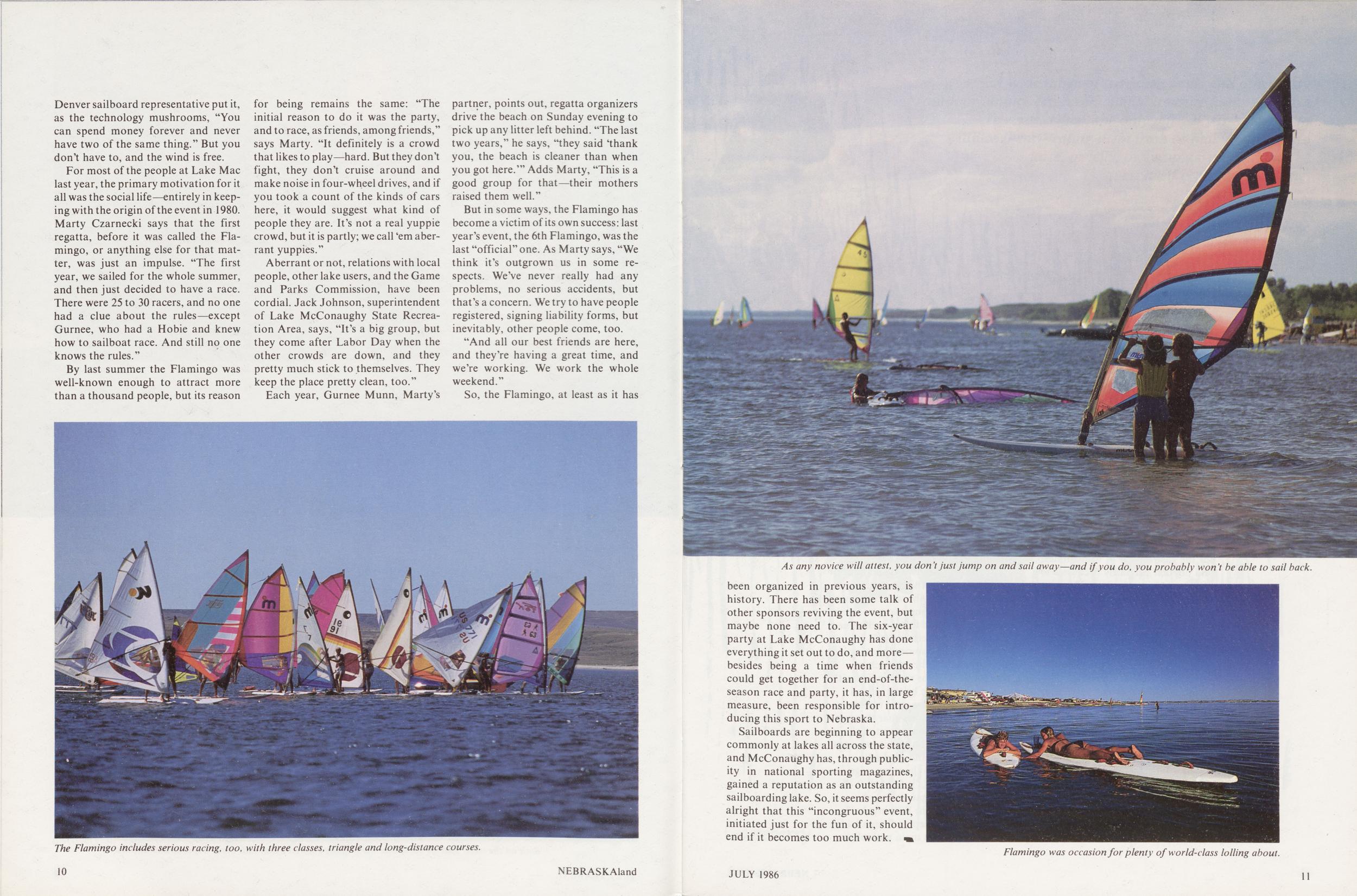
About a thousand dogless watchers lolled on the beach, quietly appreciative. Incongruously, the beach itself looked like the staging area for some kind of high-tech migrant caravan: cars with tags from a dozen or more midwestern states, and tents of every description were arrayed in a random, desultory order along a full mile or more of beach, but the eye was drawn most directly to the hundreds of brilliant, colored triangles of fabric lying at the water's edge, an elaborately decorative obstacle course for the frisbee-chasing dogs.
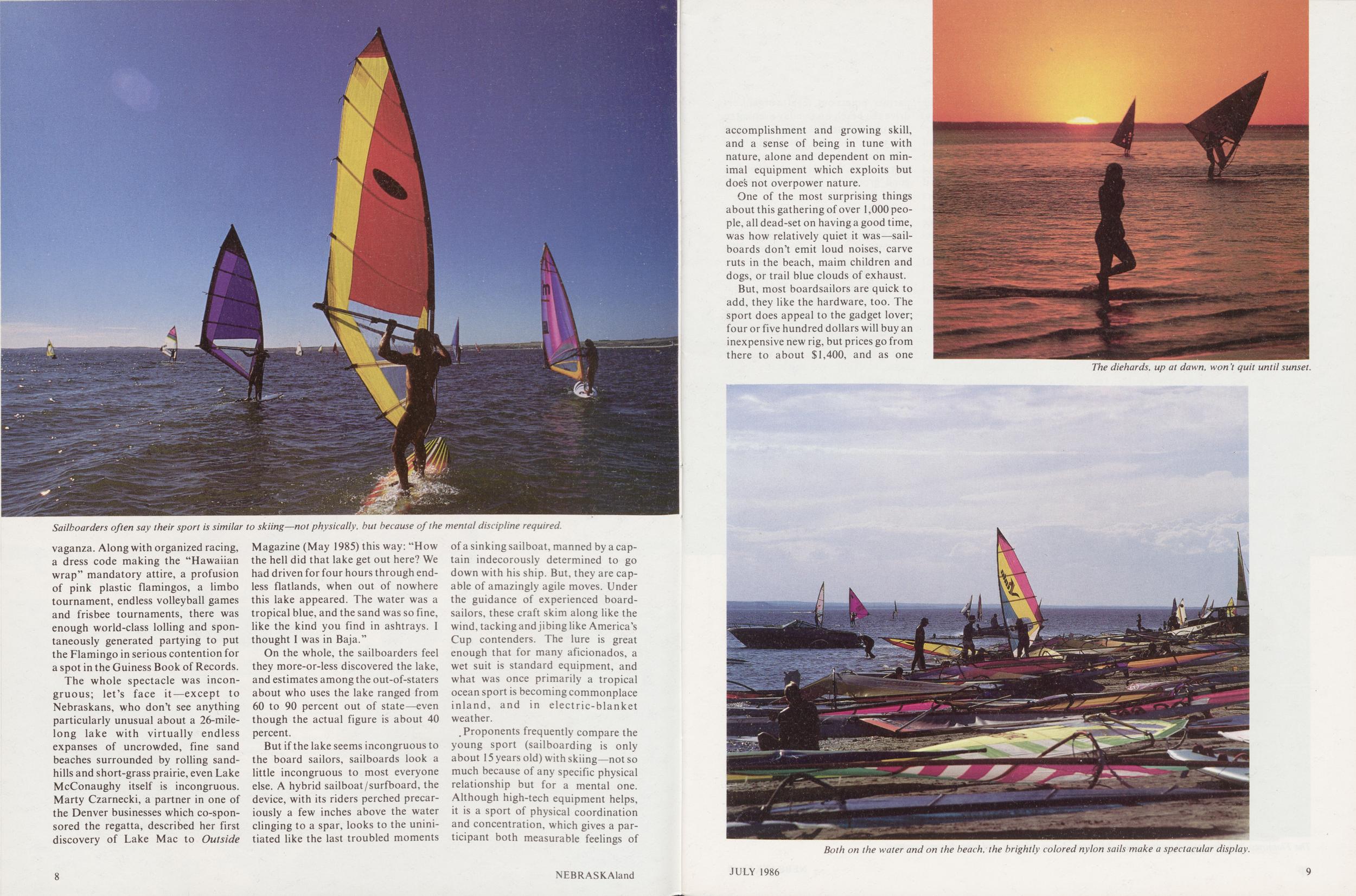
How did those dogs manage to get all these people out here? Easy. They had promised the people that if the wind ever did come up, the people could ride their sailboards; slender, sculptured platforms dominated by those spectacularly colored triangular nylon sails. The people were lucky; a little later in the afternoon a good, steady breeze appeared. The dogs kept their promise, and went away to lie down in the shade and plan moves. They needed the rest anyway. And the people got to have the sixth annual Flamingo Open Sailboard Regatta at Lake McConaughy, the third largest sailboard competition in the U.S.
"Incongruity" might be the operative term for this three-day extravaganza. 6 NEBRASKAland
The whole spectacle was incongruous; let's face it—except to Nebraskans, who don't see anything particularly unusual about a 26-mile-long lake with virtually endless expanses of uncrowded, fine sand beaches surrounded by rolling sandhills and short-grass prairie, even Lake McConaughy itself is incongruous. Marty Czarnecki, a partner in one of the Denver businesses which co-sponsored the regatta, described her first discovery of Lake Mac to Outside Magazine (May 1985) this way: "How the hell did that lake get out here? We had driven for four hours through endless flatlands, when out of nowhere this lake appeared. The water was a tropical blue, and the sand was so fine, like the kind you find in ashtrays. I thought I was in Baja."
On the whole, the sailboarders feel they more-or-less discovered the lake, and estimates among the out-of-staters about who uses the lake ranged from 60 to 90 percent out of state—even though the actual figure is about 40 percent.
But if the lake seems incongruous to the board sailors, sailboards look a little incongruous to most everyone else. A hybrid sailboat/surfboard, the device, with its riders perched precariously a few inches above the water clinging to a spar, looks to the uninitiated like the last troubled moments of a sinking sailboat, manned by a captain indecorously determined to go down with his ship. But, they are capable of amazingly agile moves. Under the guidance of experienced boardsailors, these craft skim along like the wind, tacking and jibing like America's Cup contenders. The lure is great enough that for many aficionados, a wet suit is standard equipment, and what was once primarily a tropical ocean sport is becoming commonplace inland, and in electric-blanket weather.
Proponents frequently compare the young sport (sailboarding is only about 15 years old) with skiing—not so much because of any specific physical relationship but for a mental one. Although high-tech equipment helps, it is a sport of physical coordination and concentration, which gives a participant both measurable feelings of 8 NEBRASKAland accomplishment and growing skill, and a sense of being in tune with nature, alone and dependent on minimal equipment which exploits but does not overpower nature.
One of the most surprising things about this gathering of over 1,000 people, all dead-set on having a good time, was how relatively quiet it was—sailboards don't emit loud noises, carve ruts in the beach, maim children and dogs, or trail blue clouds of exhaust.
But, most boardsailors are quick to add, they like the hardware, too. The sport does appeal to the gadget lover; four or five hundred dollars will buy an inexpensive new rig, but prices go from there to about $1,400, and as one
 Denver sailboard representative put it,
as the technology mushrooms, "You
can spend money forever and never
have two of the same thing." But you
don't have to, and the wind is free.
Denver sailboard representative put it,
as the technology mushrooms, "You
can spend money forever and never
have two of the same thing." But you
don't have to, and the wind is free.
For most of the people at Lake Mac last year, the primary motivation for it all was the social life—entirely in keeping with the origin of the event in 1980. Marty Czarnecki says that the first regatta, before it was called the Flamingo, or anything else for that matter, was just an impulse. "The first year, we sailed for the whole summer, and then just decided to have a race. There were 25 to 30 racers, and no one had a clue about the rules—except Gurnee, who had a Hobie and knew how to sailboat race. And still no one knows the rules."
By last summer the Flamingo was well-known enough to attract more than a thousand people, but its reason for being remains the same: "The initial reason to do it was the party, and to race, as friends, among friends," says Marty. "It definitely is a crowd that likes to play—hard. But they don't fight, they don't cruise around and make noise in four-wheel drives, and if you took a count of the kinds of cars here, it would suggest what kind of people they are. It's not a real yuppie crowd, but it is partly; we call 'em aberrant yuppies."
Aberrant or not, relations with local people, other lake users, and the Game and Parks Commission, have been cordial. Jack Johnson, superintendent of Lake McConaughy State Recreation Area, says, "It's a big group, but they come after Labor Day when the other crowds are down, and they pretty much stick to themselves. They keep the place pretty clean, too."
Each year, Gurnee Munn, Marty's partner, points out, regatta organizers drive the beach on Sunday evening to pick up any litter left behind. "The last two years," he says, "they said thank you, the beach is cleaner than when you got here.'' Adds Marty, "This is a good group for that—their mothers raised them well."
But in some ways, the Flamingo has become a victim of its own success: last year's event, the 6th Flamingo, was the last "official" one. As Marty says, "We think it's outgrown us in some respects. We've never really had any problems, no serious accidents, but that's a concern. We try to have people registered, signing liability forms, but inevitably, other people come, too.
"And all our best friends are here, and they're having a great time, and we're working. We work the whole weekend."
So, the Flamingo, at least as it has
Sailboards are beginning to appear commonly at lakes all across the state, and McConaughy has, through publicity in national sporting magazines, gained a reputation as an outstanding sailboarding lake. So, it seems perfectly alright that this "incongruous" event, initiated just for the fun of it, should end if it becomes too much work.
Musing on EDIBLES
BY CARL WOLFE ILLUSTRATIONS BY STEVE O'HARETRAIL ROAD 203. To most, that would be an official designation of some biway to somewhere. To some, Trail Road 203 rings with familiarity; it winds through the sandhills country of Thomas County, more specifically on the Bessey Division of the Nebraska National Forest called "Halsey Forest." To a very few, Trail Road 203 is a pathway to some very select plant species with special attributes for the gastronome of wild edibles, and popular primarily because a few of these species are alongside or within easy striking distance of the trail road.
Several select chokecherry patches with histories of bearing abundant and unusually succulent fruits can be found on TR203 as it winds south toward the Dismal River. For several decades these particular patches have been watched with more than passing interest. Time of bloom, weather, pollination and fruit set are all factors that go into the mind's computer in anticipation of a crop which will find its way into all varieties of chokecherry concoctions. More often than not, the old adage of not counting your chickens has some deep meanings for those who muse about and anticipate bumper fruit crops before the actual harvest.
Nebraska's fickle weather can squelch the grandest of dreams. Who would anticipate killing frosts as late as April or early May? Or a severe but short drought at the very time fruit should be filling to potential plumpness? It all happens, and dreams of bountiful harvests are often dashed before much of the season has progressed. So it was in May of 1965. Lightning ignited a running fire on the west side of the Halsey Forest, and within an hour or so it was obvious that control would be impossible. As the wall of flames consumed the rolling mid-grasses and moved on into the forest itself, a new factor in the concern for wild fruit potential became somewhat critical. A favorite chokecherry patch on Trail Road 203 was right in line with the path of the fire by the second day. Our worst fears were realized as we watched the flames roar through a cedar plantation to the west of the patch. As the fire burned its way out of this hot tinder and gradually began creeping up the steep ridge toward "the patch," a faint shift of wind direction began rolling the smoke to the north. Within a halfhour span, the creeping flames had died away and the main path of the 12 NEBRASKAland
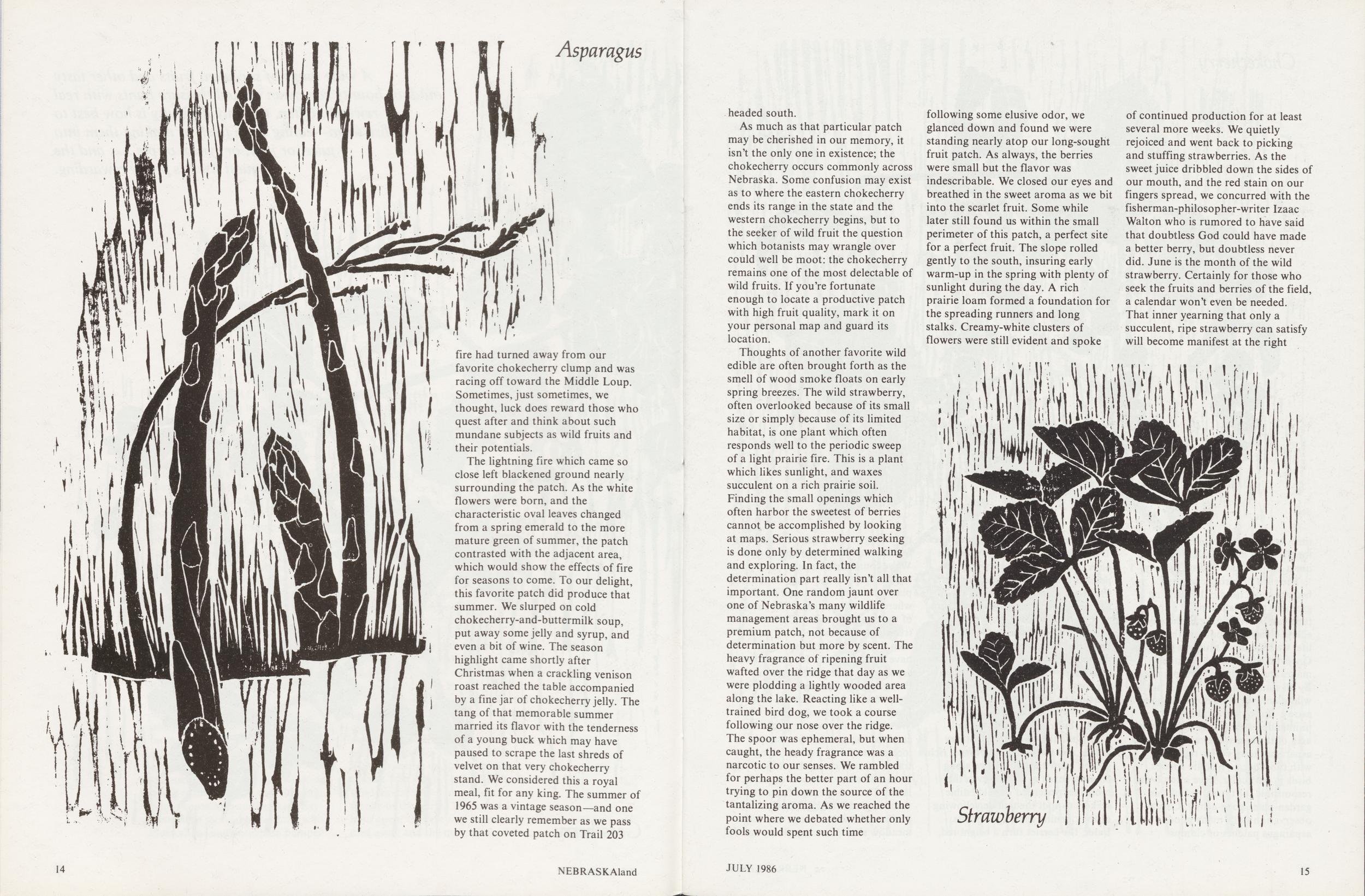
The lightning fire which came so close left blackened ground nearly surrounding the patch. As the white flowers were born, and the characteristic oval leaves changed from a spring emerald to the more mature green of summer, the patch contrasted with the adjacent area, which would show the effects of fire for seasons to come. To our delight, this favorite patch did produce that summer. We slurped on cold chokecherry-and-buttermilk soup, put away some jelly and syrup, and even a bit of wine. The season highlight came shortly after Christmas when a crackling venison roast reached the table accompanied by a fine jar of chokecherry jelly. The tang of that memorable summer married its flavor with the tenderness of a young buck which may have paused to scrape the last shreds of velvet on that very chokecherry stand. We considered this a royal meal, fit for any king. The summer of 1965 was a vintage season—and one we still clearly remember as we pass by that coveted patch on Trail 203 14 NEBRASKAland headed south.
As much as that particular patch may be cherished in our memory, it isn't the only one in existence; the chokecherry occurs commonly across Nebraska. Some confusion may exist as to where the eastern chokecherry ends its range in the state and the western chokecherry begins, but to the seeker of wild fruit the question which botanists may wrangle over could well be moot: the chokecherry remains one of the most delectable of wild fruits. If you're fortunate enough to locate a productive patch with high fruit quality, mark it on your personal map and guard its location.
Thoughts of another favorite wild edible are often brought forth as the smell of wood smoke floats on early spring breezes. The wild strawberry, often overlooked because of its small size or simply because of its limited habitat, is one plant which often responds well to the periodic sweep of a light prairie fire. This is a plant which likes sunlight, and waxes succulent on a rich prairie soil. Finding the small openings which often harbor the sweetest of berries cannot be accomplished by looking at maps. Serious strawberry seeking is done only by determined walking and exploring. In fact, the determination part really isn't all that important. One random jaunt over one of Nebraska's many wildlife management areas brought us to a premium patch, not because of determination but more by scent. The heavy fragrance of ripening fruit wafted over the ridge that day as we were plodding a lightly wooded area along the lake. Reacting like a welltrained bird dog, we took a course following our nose over the ridge. The spoor was ephemeral, but when caught, the heady fragrance was a narcotic to our senses. We rambled for perhaps the better part of an hour trying to pin down the source of the tantalizing aroma. As we reached the point where we debated whether only fools would spent such time following some elusive odor, we glanced down and found we were standing nearly atop our long-sought fruit patch. As always, the berries were small but the flavor was indescribable. We closed our eyes and breathed in the sweet aroma as we bit into the scarlet fruit. Some while later still found us within the small perimeter of this patch, a perfect site for a perfect fruit. The slope rolled gently to the south, insuring early warm-up in the spring with plenty of sunlight during the day. A rich prairie loam formed a foundation for the spreading runners and long stalks. Creamy-white clusters of flowers were still evident and spoke of continued production for at least several more weeks. We quietly rejoiced and went back to picking and stuffing strawberries. As the sweet juice dribbled down the sides of our mouth, and the red stain on our fingers spread, we concurred with the fisherman-philosopher-writer Izaac Walton who is rumored to have said that doubtless God could have made a better berry, but doubtless never did. June is the month of the wild strawberry. Certainly for those who seek the fruits and berries of the field, a calendar won't even be needed. That inner yearning that only a succulent, ripe strawberry can satisfy will become manifest at the right
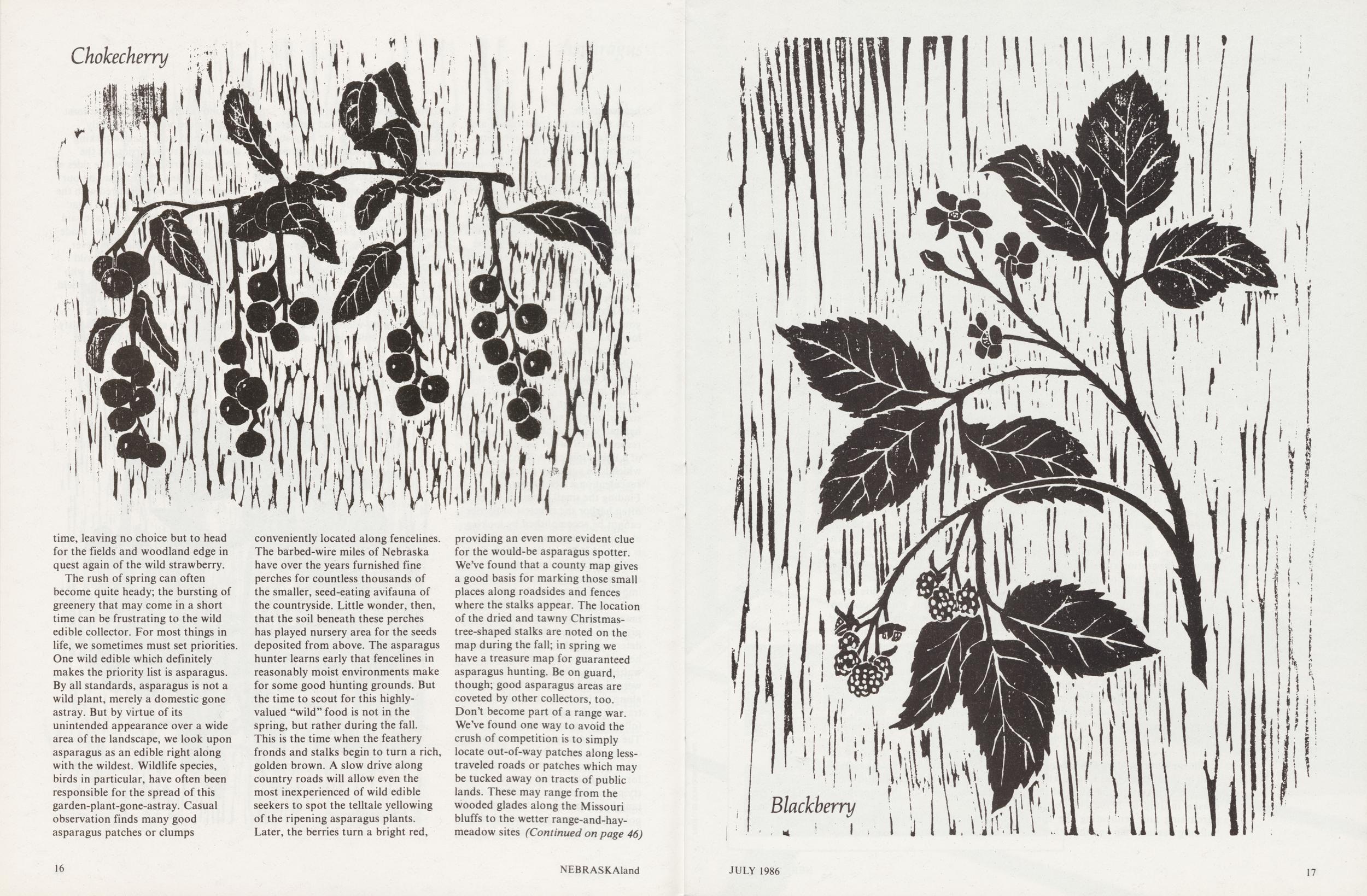
The rush of spring can often become quite heady; the bursting of greenery that may come in a short time can be frustrating to the wild edible collector. For most things in life, we sometimes must set priorities. One wild edible which definitely makes the priority list is asparagus. By all standards, asparagus is not a wild plant, merely a domestic gone astray. But by virtue of its unintended appearance over a wide area of the landscape, we look upon asparagus as an edible right along with the wildest. Wildlife species, birds in particular, have often been responsible for the spread of this garden-plant-gone-astray. Casual observation finds many good asparagus patches or clumps conveniently located along fencelines. The barbed-wire miles of Nebraska have over the years furnished fine perches for countless thousands of the smaller, seed-eating avifauna of the countryside. Little wonder, then, that the soil beneath these perches has played nursery area for the seeds deposited from above. The asparagus hunter learns early that fencelines in reasonably moist environments make for some good hunting grounds. But the time to scout for this highly valued "wild" food is not in the spring, but rather during the fall. This is the time when the feathery fronds and stalks begin to turn a rich, golden brown. A slow drive along country roads will allow even the most inexperienced of wild edible seekers to spot the telltale yellowing of the ripening asparagus plants. Later, the berries turn a bright red, providing an even more evident clue for the would-be asparagus spotter. We've found that a county map gives a good basis for marking those small places along roadsides and fences where the stalks appear. The location of the dried and tawny Christmastree-shaped stalks are noted on the map during the fall; in spring we have a treasure map for guaranteed asparagus hunting. Be on guard, though; good asparagus areas are coveted by other collectors, too. Don't become part of a range war. We've found one way to avoid the crush of competition is to simply locate out-of-way patches along lesstraveled roads or patches which may be tucked away on tracts of public lands. These may range from the wooded glades along the Missouri bluffs to the wetter range-and-haymeadow sites (Continued on page 46)
16 NEBRASKAland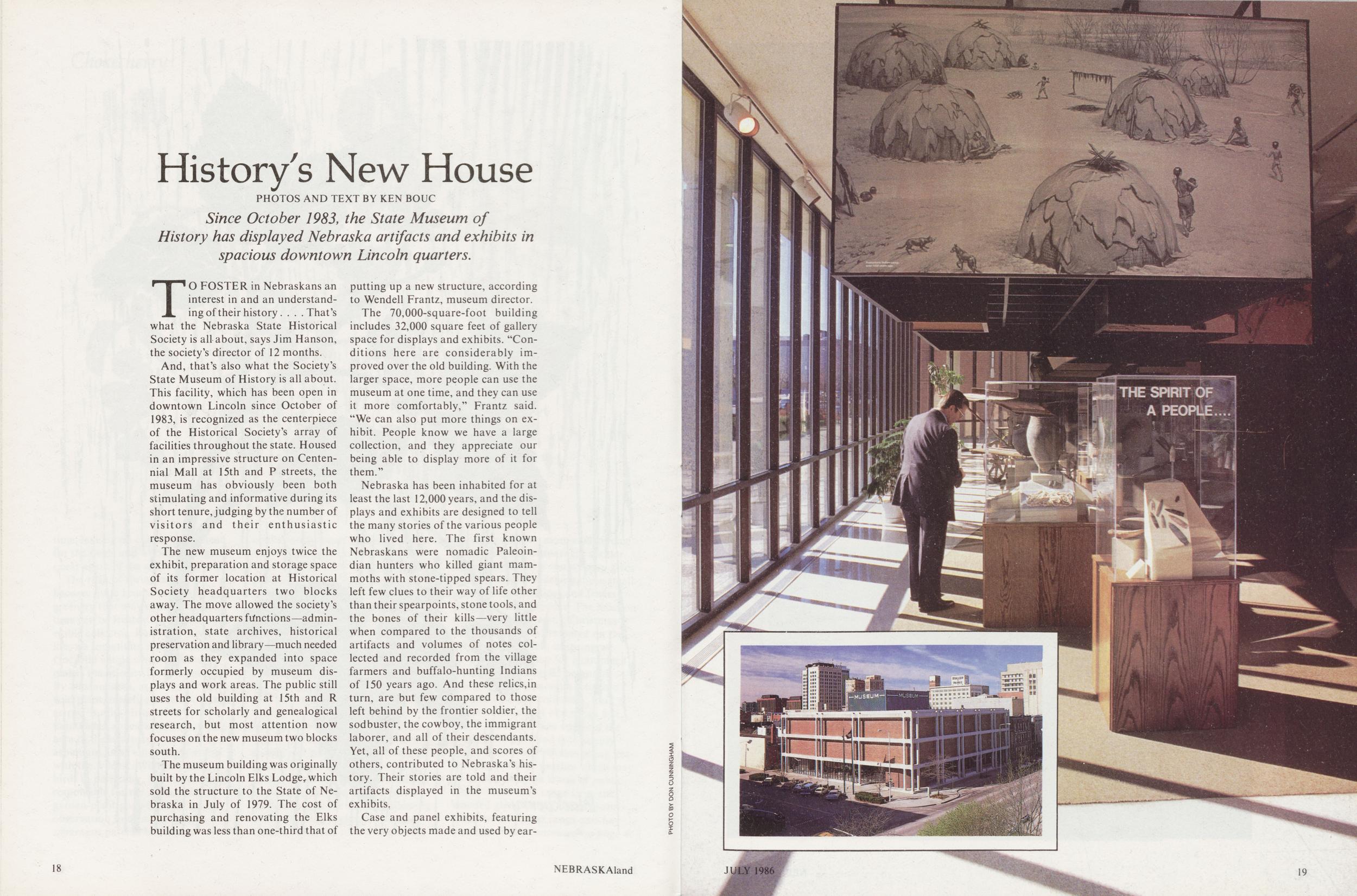
History's New House
Since October 1983, the State Museum of History has displayed Nebraska artifacts and exhibits in spacious downtown Lincoln quarters.
TO FOSTER in Nebraskans an interest in and an understanding of their history . . . .That’s what the Nebraska State Historical Society is all about, says Jim Hanson, the society’s director of 12 months.
And, that’s also what the Society’s State Museum of History is all about. This facility, which has been open in downtown Lincoln since October of 1983, is recognized as the centerpiece of the Historical Society’s array of facilities throughout the state. Housed in an impressive structure on Centennial Mall at 15th and P streets, the museum has obviously been both stimulating and informative during its short tenure judging by the number of visitors and their enthusiastic response.
The new museum enjoys twice the exhibit, preparation and storage space of its former location at Historical Society headquarters two blocks away. The move allowed the society’s other headquarters functions—administration, state archives, historical preservation and library—much needed room as they expanded into space formerly occupied by museum displays and work areas. The public still uses the old building at 15th and R streets for scholarly and genealogical research, but most attention now focuses on the new museum two blocks south.
The museum building was originally built by the Lincoln Elks Lodge, which sold the structure to the State of Nebraska in July of 1979. The cost of purchasing and renovating the Elks building was less than one-third that of putting up a new structure, according to Wendell Frantz, museum director.
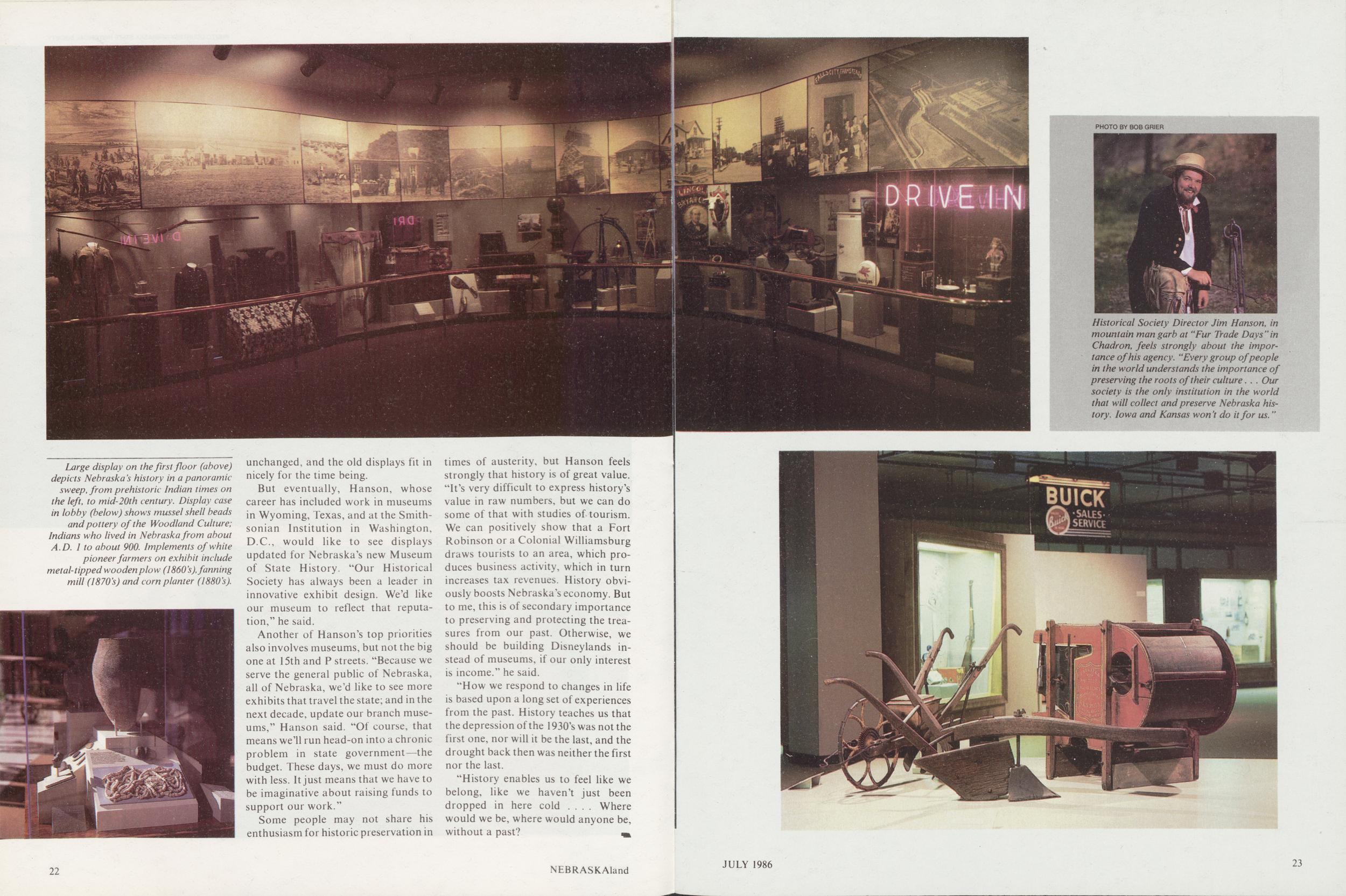
The 70,000-square-foot building includes 32,000 square feet of gallery space for displays and exhibits. “Conditions here are considerably improved over the old building. With the larger space, more people can use the museum at one time, and they can use it more comfortably,” Frantz said. “We can also put more things on exhibit. People know we have a large collection, and they appreciate our being able to display more of it for them.”
Nebraska has been inhabited for at least the last 12,000 years, and the displays and exhibits are designed to tell the many stories of the various people who lived here. The first known Nebraskans were nomadic Paleoindian hunters who killed giant mammoths with stone-tipped spears. They left few clues to their way of life other than their spearpoints, stone tools, and the bones of their kills—very little when compared to the thousands of artifacts and volumes of notes collected and recorded from the village farmers and buffalo-hunting Indians of 150 years ago. And these relics,in turn, are but few compared to those left behind by the frontier soldier, the sodbuster, the cowboy, the immigrant laborer, and all of their descendants. Yet, all of these people, and scores of others, contributed to Nebraska’s history. Their stories are told and their artifacts displayed in the museum’s exhibits.
Case and panel exhibits, featuring the very objects made and used by earlier
18 NEBRASKAland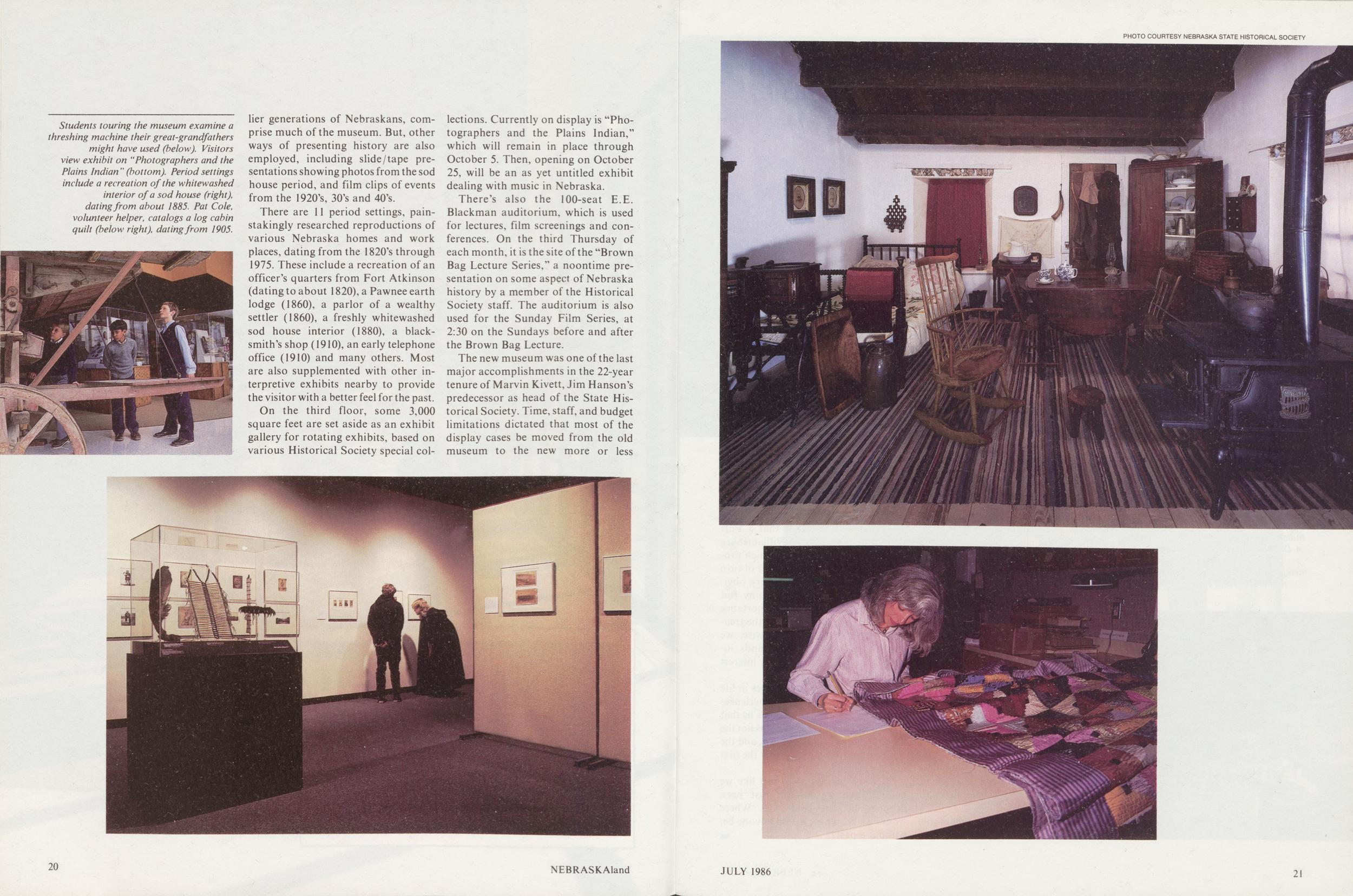
generations of Nebraskans, comprise much of the museum. But, other ways of presenting history are also employed, including slide/tape presentations showing photos from the sod house period, and film clips of events from the 1920's, 30's and 40's.
There are 11 period settings, painstakingly researched reproductions of various Nebraska homes and work places, dating from the 1820's through 1975. These include a recreation of an officer's quarters from Fort Atkinson (dating to about 1820), a Pawnee earth lodge (1860), a parlor of a wealthy settler (1860), a freshly whitewashed sod house interior (1880), a blacksmith's shop (1910), an early telephone office (1910) and many others. Most are also supplemented with other interpretive exhibits nearby to provide the visitor with a better feel for the past.
On the third floor, some 3,000 square feet are set aside as an exhibit gallery for rotating exhibits, based on various Historical Society special collections. Currently on display is "Photographers and the Plains Indian," which will remain in place through October 5. Then, opening on October 25, will be an as yet untitled exhibit dealing with music in Nebraska.
There's also the 100-seat E.E. Blackman auditorium, which is used for lectures, film screenings and conferences. On the third Thursday of each month, it is the site of the "Brown Bag Lecture Series," a noontime presentation on some aspect of Nebraska history by a member of the Historical Society staff. The auditorium is also used for the Sunday Film Series, at 2:30 on the Sundays before and after the Brown Bag Lecture.
The new museum was one of the last major accomplishments in the 22-year tenure of Marvin Kivett, Jim Hanson's predecessor as head of the State Historical Society. Time, staff, and budget limitations dictated that most of the display cases be moved from the old museum to the new more or less 20 NEBRASKAland
But eventually, Hanson, whose career has included work in museums in Wyoming, Texas, and at the Smithsonian Institution in Washington, D.C., would like to see displays updated for Nebraska's new Museum of State History. "Our Historical Society has always been a leader in innovative exhibit design. We'd like our museum to reflect that reputation," he said.
Another of Hanson's top priorities also involves museums, but not the big one at 15th and P streets. "Because we serve the general public of Nebraska, all of Nebraska, we'd like to see more exhibits that travel the state; and in the next decade, update our branch museums," Hanson said. "Of course, that means we'll run head-on into a chronic problem in state government—the budget. These days, we must do more with less. It just means that we have to be imaginative about raising funds to support our work."
Some people may not share his enthusiasm for historic preservation in times of austerity, but Hanson feels strongly that history is of great value. "It's very difficult to express history's value in raw numbers, but we can do some of that with studies of tourism. We can positively show that a Fort Robinson or a Colonial Williamsburg draws tourists to an area, which produces business activity, which in turn increases tax revenues. History obviously boosts Nebraska's economy. But to me, this is of secondary importance to preserving and protecting the treasures from our past. Otherwise, we should be building Disneylands instead of museums, if our only interest is income." he said.
"How we respond to changes in life is based upon a long set of experiences from the past. History teaches us that the depression of the 1930's was not the first one, nor will it be the last, and the drought back then was neither the first nor the last.
"History enables us to feel like we belong, like we haven't just been dropped in here cold Where would we be, where would anyone be, without a past?
22 NEBRASKAland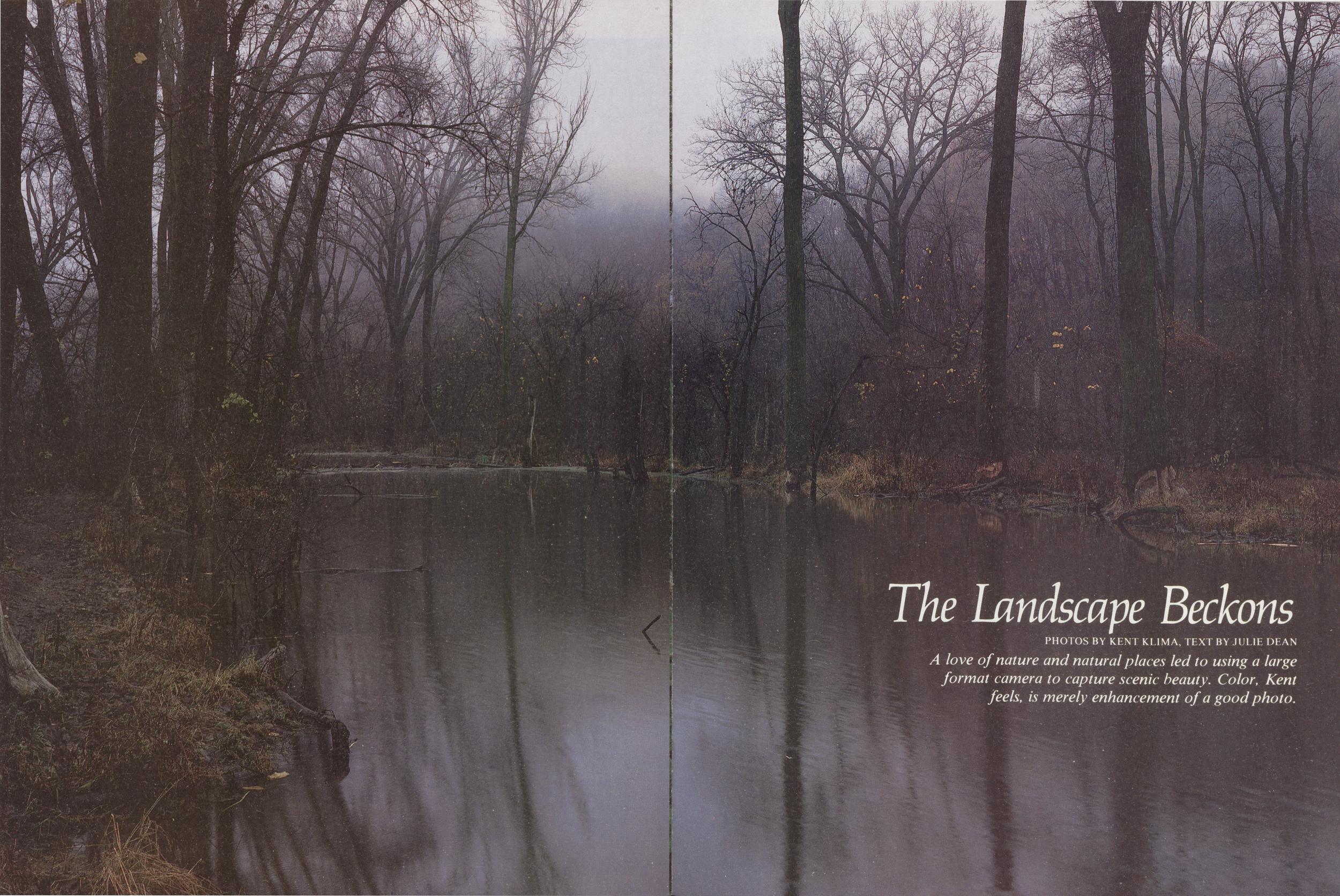
The Landscape Beckons
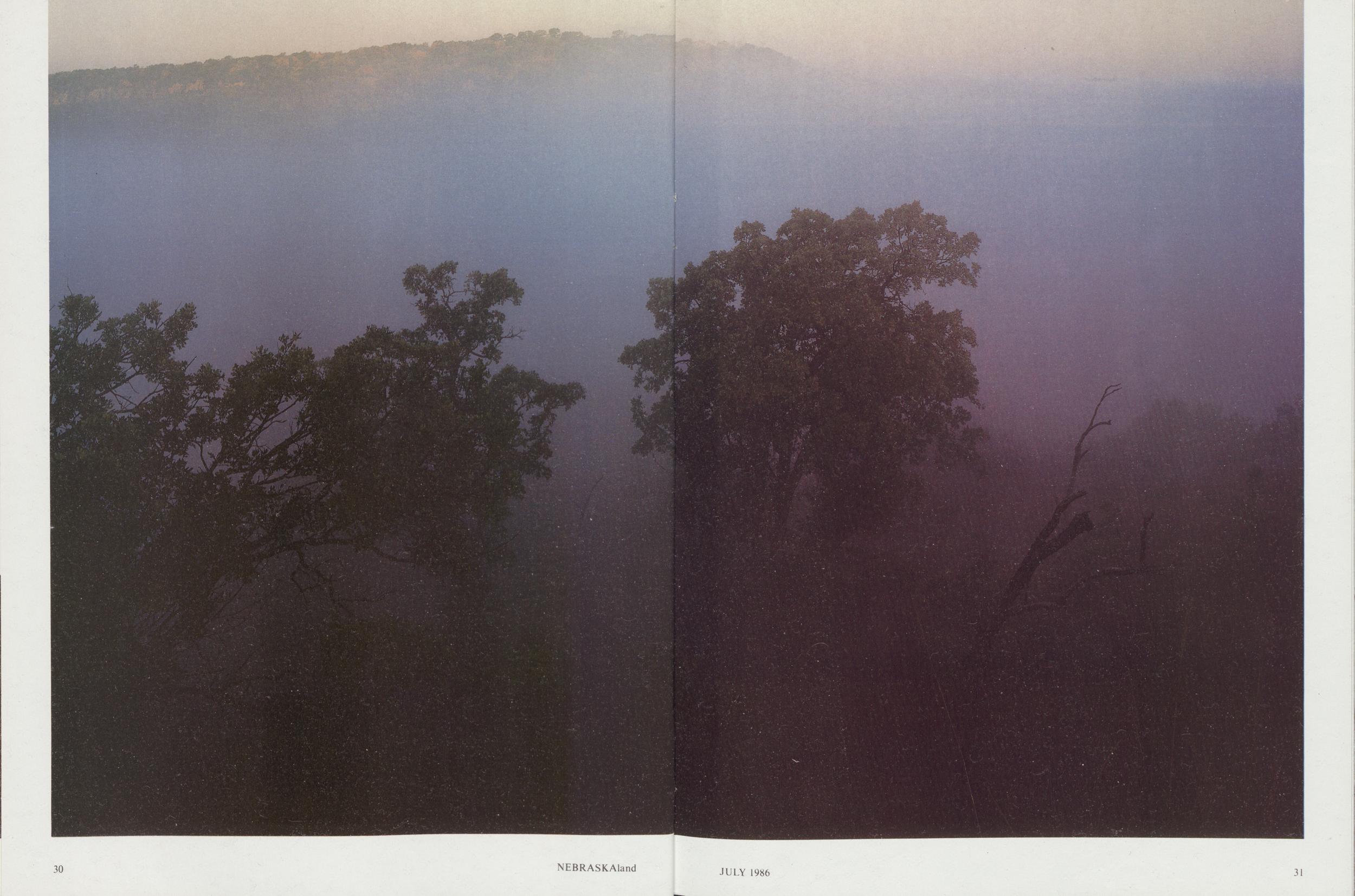
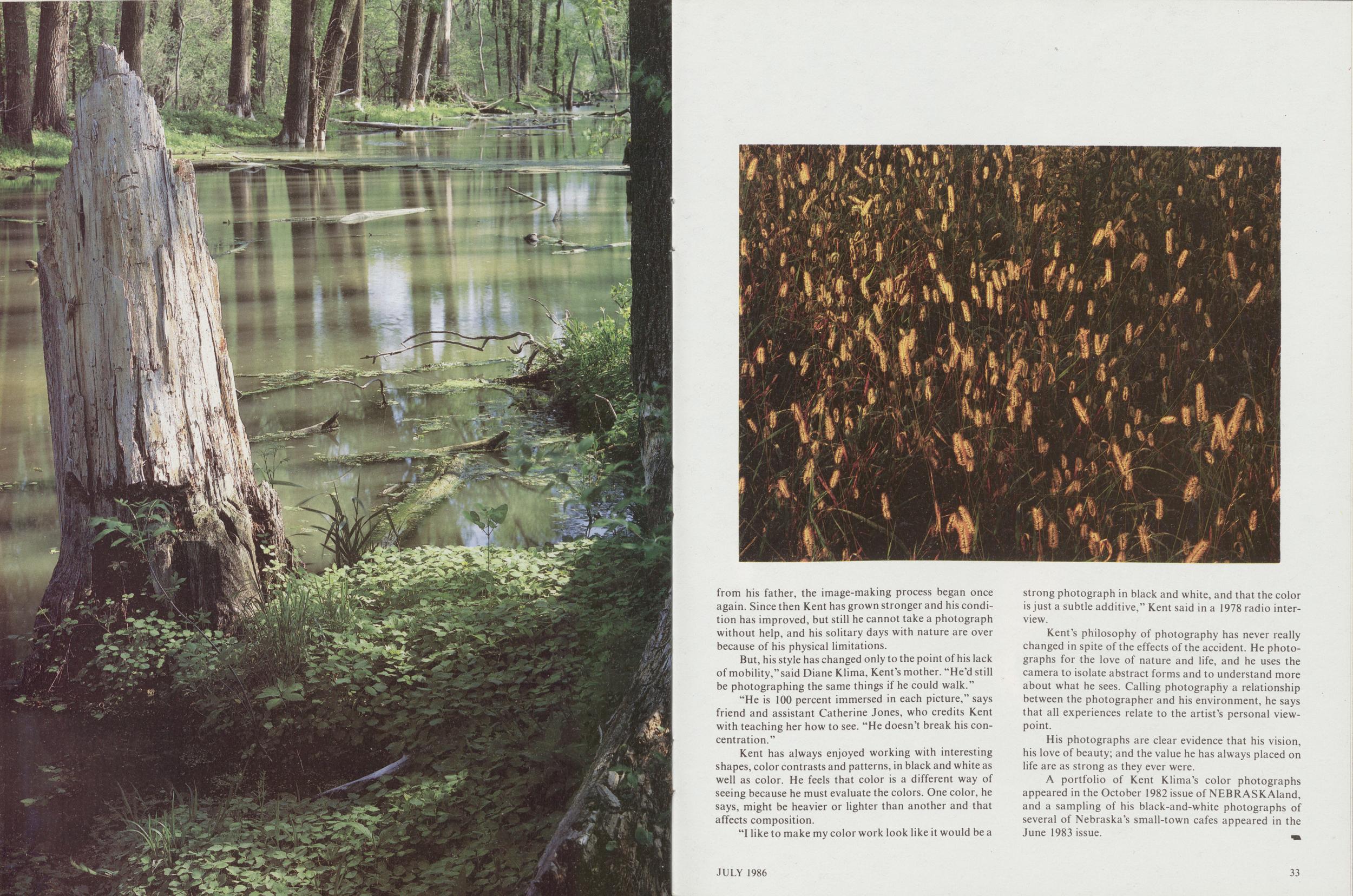
PHOTOS BY KENT KLIMA, TEXT BY JULIE DEAN A love of nature and natural places led to using a large format camera to capture scenic beauty. Color, Kent feels, is merely enhancement of a good photo.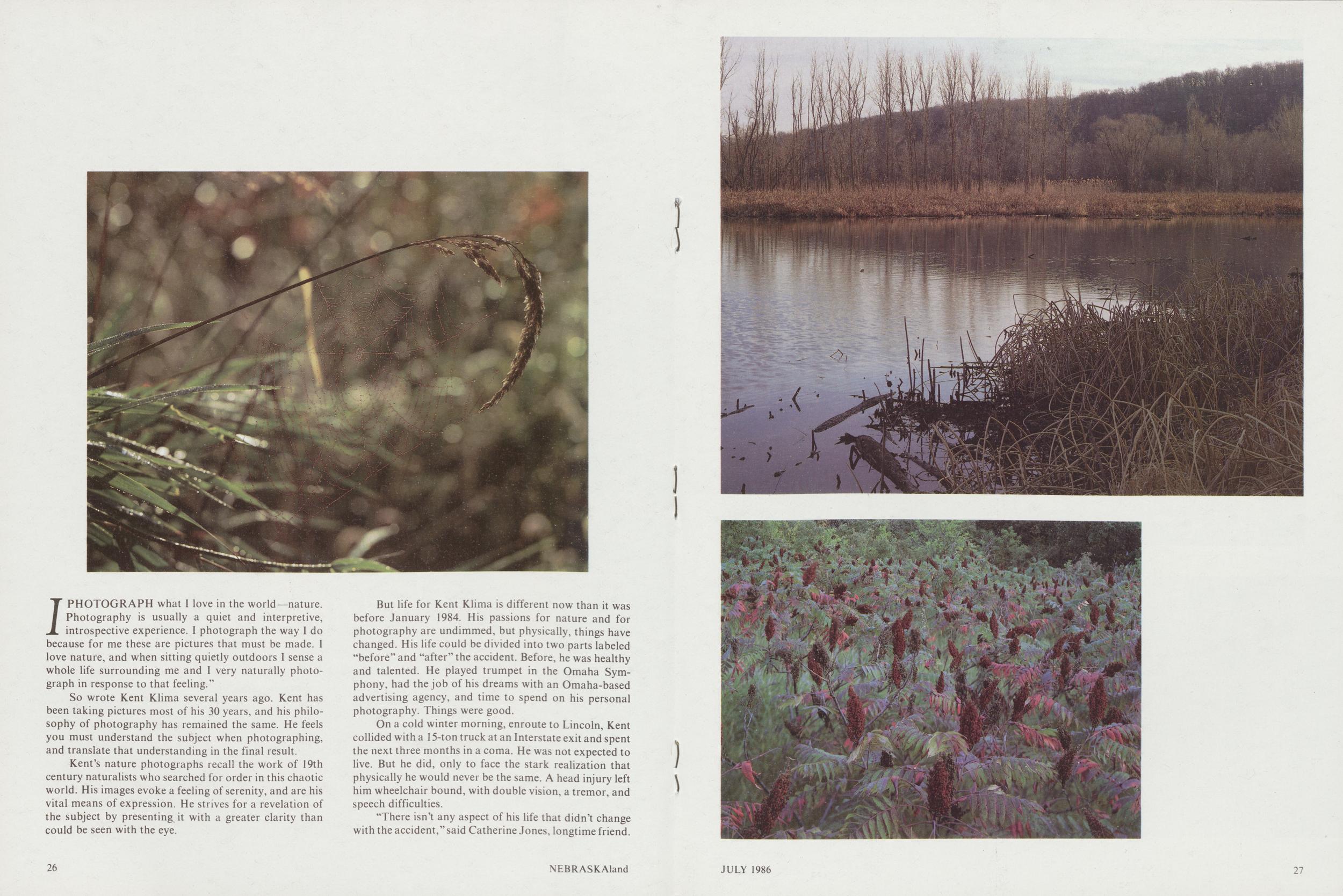
I PHOTOGRAPH what I love in the world—nature. Photography is usually a quiet and interpretive, introspective experience. I photograph the way 1 do because for me these are pictures that must be made. 1 love nature, and when sitting quietly outdoors 1 sense a whole life surrounding me and I very naturally photo- graph in response to that feeling."
So wrote Kent Klima several years ago. Kent has been taking pictures most of his 30 years, and his philosophy of photography has remained the same. He feels you must understand the subject when photographing, and translate that understanding in the final result.
Kent's nature photographs recall the work of 19th century naturalists who searched for order in this chaotic world. His images evoke a feeling of serenity, and are his vital means of expression. He strives for a revelation of the subject by presenting it with a greater clarity than could be seen with the eye.
But life for Kent Klima is different now than it was before January 1984. His passions for nature and for photography are undimmed, but physically, things have changed. His life could be divided into two parts labeled "before" and "after" the accident. Before, he was healthy and talented. He played trumpet in the Omaha Sym- phony, had the job of his dreams with an Omaha-based advertising agency, and time to spend on his personal photography. Things were good.
On a cold winter morning, enroute to Lincoln, Kent collided with a 15-ton truck at an Interstate exit and spent the next three months in a coma. He was not expected to live. But he did, only to face the stark realization that physically he would never be the same. A head injury left him wheelchair bound, with double vision, a tremor, and speech difficulties.
"There isn't any aspect of his life that didn't change with the accident,"said Catherine Jones, longtime friend.
26 NEBRASKAland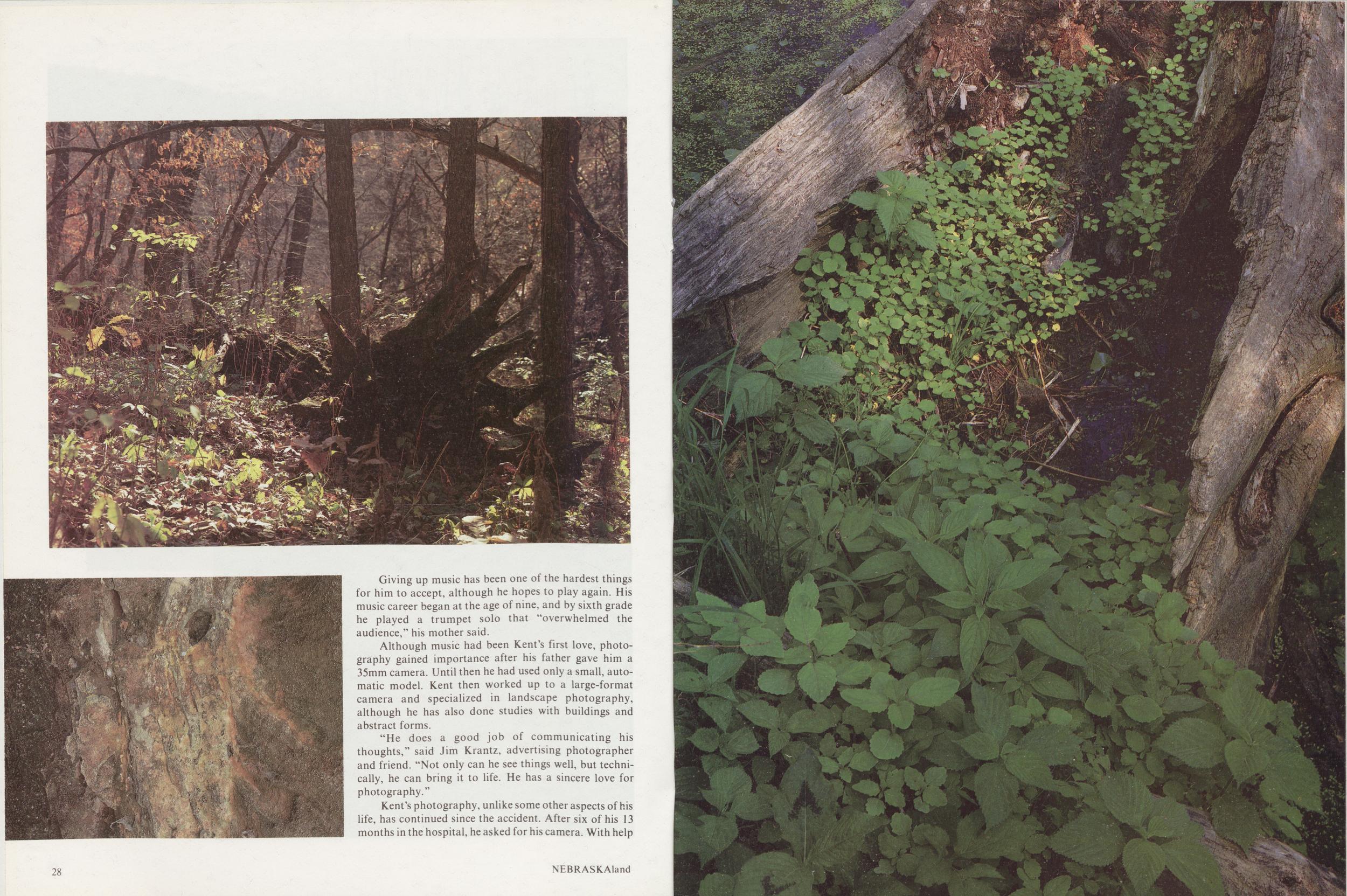
Giving up music has been one of the hardest things for him to accept, although he hopes to play again. His music career began at the age of nine, and by sixth grade he played a trumpet solo that "overwhelmed the audience," his mother said.
Although music had been Kent's first love, photography gained importance after his father gave him a 35mm camera. Until then he had used only a small, automatic model. Kent then worked up to a large-format camera and specialized in landscape photography, although he has also done studies with buildings and abstract forms.
"He does a good job of communicating his thoughts," said Jim Krantz, advertising photographer and friend. "Not only can he see things well, but technically, he can bring it to life. He has a sincere love for photography."
Kent's photography, unlike some other aspects of his
life, has continued since the accident. After six of his 13
months in the hospital, he asked for his camera. With help
28
NEBRASKAland
28
NEBRASKAland
But, his style has changed only to the point of his lack of mobility," said Diane Klima, Kent's mother. "He'd still be photographing the same things if he could walk."
"He is 100 percent immersed in each picture," says friend and assistant Catherine Jones, who credits Kent with teaching her how to see. "He doesn't break his concentration."
Kent has always enjoyed working with interesting shapes, color contrasts and patterns, in black and white as well as color. He feels that color is a different way of seeing because he must evaluate the colors. One color, he says, might be heavier or lighter than another and that affects composition.
"I like to make my color work look like it would be a strong photograph in black and white, and that the color is just a subtle additive," Kent said in a 1978 radio interview.
Kent's philosophy of photography has never really changed in spite of the effects of the accident. He photographs for the love of nature and life, and he uses the camera to isolate abstract forms and to understand more about what he sees. Calling photography a relationship between the photographer and his environment, he says that all experiences relate to the artist's personal viewpoint.
His photographs are clear evidence that his vision, his love of beauty; and the value he has always placed on life are as strong as they ever were.
A portfolio of Kent Klima's color photographs appeared in the October 1982 issue of NEBRASKAland, and a sampling of his black-and-white photographs of several of Nebraska's small-town cafes appeared in the June 1983 issue.
JULY 1986 33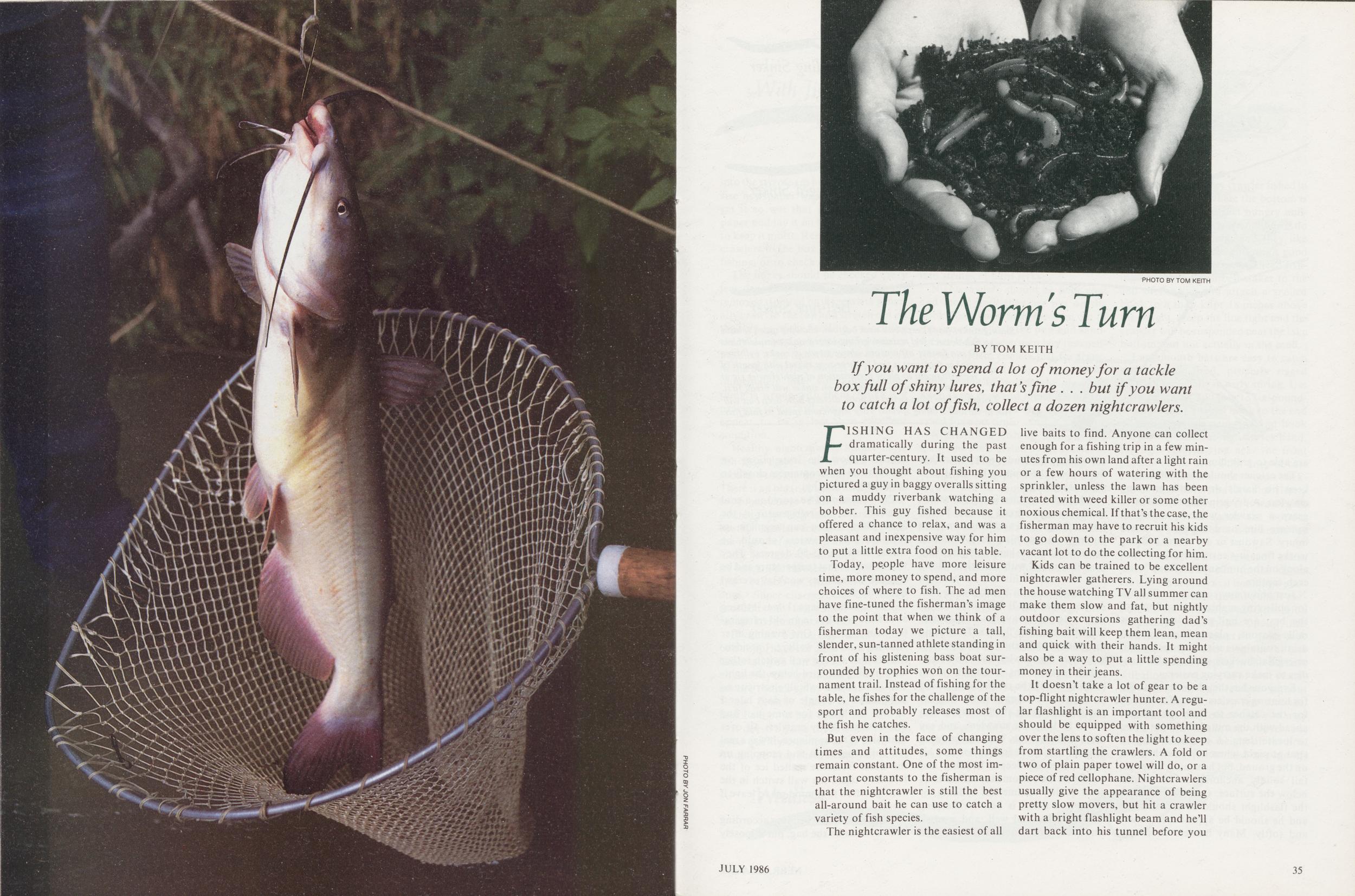
The Worm's Turn
BY TOM KEITH If you want to spend a lot of money for a tackle box full of shiny lures, that's fine but if you want to catch a lot offish, collect a dozen night crawlers.FISHING HAS CHANGED dramatically during the past quarter-century. It used to be when you thought about fishing you pictured a guy in baggy overalls sitting on a muddy riverbank watching a bobber. This guy fished because it offered a chance to relax, and was a pleasant and inexpensive way for him to put a little extra food on his table.
Today, people have more leisure time, more money to spend, and more choices of where to fish. The ad men have fine-tuned the fisherman's image to the point that when we think of a fisherman today we picture a tall, slender, sun-tanned athlete standing in front of his glistening bass boat surrounded by trophies won on the tournament trail. Instead of fishing for the table, he fishes for the challenge of the sport and probably releases most of the fish he catches.
But even in the face of changing times and attitudes, some things remain constant. One of the most important constants to the fisherman is that the nightcrawler is still the best all-around bait he can use to catch a variety of fish species.
The nightcrawler is the easiest of all live baits to find. Anyone can collect enough for a fishing trip in a few minutes from his own land after a light rain or a few hours of watering with the sprinkler, unless the lawn has been treated with weed killer or some other noxious chemical. If that's the case, the fisherman may have to recruit his kids to go down to the park or a nearby vacant lot to do the collecting for him.
Kids can be trained to be excellent nightcrawler gatherers. Lying around the house watching TV all summer can make them slow and fat, but nightly outdoor excursions gathering dad's fishing bait will keep them lean, mean and quick with their hands. It might also be a way to put a little spending money in their jeans.
It doesn't take a lot of gear to be a
top-flight nightcrawler hunter. A regular flashlight is an important tool and
should be equipped with something
over the lens to soften the light to keep
from startling the crawlers. A fold or
two of plain paper towel will do, or a
piece of red cellophane. Nightcrawlers
usually give the appearance of being
pretty slow movers, but hit a crawler
with a bright flashlight beam and he'll
dart back into his tunnel before you
JULY 1986
35
The catcher should use something to keep his hands dry while grabbing crawlers. A dry grip makes it easier to grasp a crawler without having to squeeze him hard enough to cause injury. Sawdust or dry worm bedding works fine; just carry a small amount along on the hunt and "chalk-up" after each capture.
Just about any container will work for collecting nightcrawlers. Some of the best are half-gallon-size plastic milk cartons, plastic liter-size soft drink containers with the tops cut off, or regular buckets with suitable handles to make carrying easier.
Everyone has their favorite methods for hunting crawlers. One of the best is for the catcher to flash the ground ahead with the muted flashlight beam to locate them. A crawler is easy to spot at night when he's stretched out on the ground, but he usually keeps his tail solidly anchored in his tunnel below the surface. Once he's spotted, the flashlight should be turned aside and he should be approached slowly and softly. Many hunters choose to crawl along on hands and knees rather than spend the evening hunched over while searching.
When the crawler is within reach, quickly put one hand on him to pin him to the ground and keep him from pulling back into his tunnel. Hold him down with the one hand and grasp him near the tunnel with the other. Don't jerk him out of his lair or you can injure him or even break him in two. As you grab, you'll feel him contract and try to pull away; just hold on and in a few seconds he'll relax. Then begin the gradual and gentle pulling process to extract the crawler from his hole.
Before the hunt is begun, worm bedding should be readied and placed in suitable holding boxes. Experts recommend using shallow styrofoam boxes to keep the crawlers, and say they shouldn't be kept in bedding deeper than three inches because air can't penetrate deeper bedding and worms on the bottom may suffocate. A good quality commercial bedding, or sphagnum moss, is best for keeping crawlers alive and well, and a small amount of food should occasionally be added. Follow the instructions on bedding and food containers closely to keep the bait healthy.
Crawlers should be stored in a cool location. An old refrigerator is the ideal place if you can regulate its temperature. Crawlers should be stored between 45-50 degrees. They will do well at that temperature and be sluggish enough they won't try to crawl out of the box.
Two summers ago I was storing about 750 crawlers in an old refrigerator in my garage. One evening after cleaning a mess of walleye, I accidentally turned off the wall switch rather than pulling the cord below the lightbulb, and shut down all electricity to the garage. A couple of days later I opened the 'fridge for some bait and found warm, lively crawlers all over the inside of the appliance. It was a real job collecting them and mopping up the water from the melted ice of the freezer. I taped the wall switch in the "on" position to remind me to leave it alone.
After mixing the bedding according to directions on the bag, put it loosely
The boxes should be checked every few days and sick or dead crawlers removed. Injured or ill crawlers generally crawl to the top and stretch out on the surface of the bedding, so locating them is pretty easy. Decaying worms produce a gas that kills other crawlers in the box, so they should be removed immediately after you notice something is wrong with them. Make it a practice to discard any crawlers that appear to be in less than excellent condition.
Healthy nightcrawlers attract more fish than limp, scrawny ones, so care should be taken to keep them prime. There is an old trick some fishermen use to "super-charge" their crawlers before a fishing trip. They select several strong, healthy crawlers from the holding box the night before a trip and drop them into a bait bucket containing water and ice cubes. The crawlers absorb the water and "balloon-up" like miniature hot dogs. Super-charged crawlers make excellent bait for walleye and largemouth and smallmouth bass.
If you are buying nightcrawlers in a bait shop, have the clerk open the container so you can see the bait before any money changes hands. Good crawlers are round, shiny and fat and just "look" healthy. Don't buy bait that looks old or in bad condition.
It doesn't make much sense to buy good quality crawlers or go to all the trouble to keep them healthy at home if you don't take care of them during your trip. Sometimes people put their bait in the trunk or the back seat in the sun and let them bake all the way to the lake. It takes only a few minutes for the hot sun or the oven-like temperatures of a car trunk to turn healthy crawlers into strings of hard jerky.
Nightcrawlers should be kept cool and moist until they are put on the hook. Keep them in an ice chest out of the sun along with the pop and sandwiches. Many fishermen buy inexpensive styrofoam coolers just for transporting bait, and keep a layer of ice cubes inside to protect the crawlers. Keep them cool and moist during the trip and any that aren't used can be saved for next time.
Nightcrawler fishing methods are many and are dictated by the species of fish being sought. When fishing for bluegill, a small portion of one night crawler will be enough to attract the fish. Thread just enough of the crawler on to cover the hook, or the bluegill is likely to strip it off and enjoy lunch without offering the chance to hook him. Too many dangling worm ends are an invitation for him to steal your bait.
Crappie can also be taken on a small chunk of nightcrawler, though they sometimes prefer a larger bite than bluegill. For both species, suspend a nightcrawler below a small bobber and add a split shot, just big enough to sink the bait, to the line six to eight inches above the hook. Cast the rig into fairly shallow water under a boat dock or near a weedbed or partially submerged log and get ready for action.
Bullheads love nightcrawlers more than any other bait you can put into the water. A fat, sassy crawler fished in a part of the lake where the bottom is muddy is sure to attract hungry bullheads. Nighttime is when bullheads do most of their feeding, and they like their food close to the bottom. A good way to rig your line for bullhead fishing is to tie a small bell sinker to the end of the line and attach a snelled hook to a loop knot 18 inches above the weight. Keep the line tight and the crawler will be suspended near the lake bottom, but not actually in the mud.
Largemouth bass are easy to catch with a good-sized, properly rigged crawler, especially in early spring. Use ultra-light gear and four to six-pound-test line. Tie a snelled hook to the end of your monofilament line and hook the crawler once through the sex band, the light-colored ring near the front portion of the bait. Flip, drop or cast the crawler under or near weeds, stickups or other cover and let it sink slowly in the water. Chances are it won't sink long enough to reach the bottom before a bass grabs it and heads for deeper water.
To fish a crawler in weedy areas, insert the hook point in the nightcrawler's head just as if hooking a plastic worm, and then thread a short portion of the crawler onto the hook shank and expose the hook point, then turn the hook and insert the point back into the critter's body to make the bait semi-weedless. Rigging in this manner will allow you to cast in or near standing vegetation and retrieve without getting hung up every few seconds. Some snags may occur and you may lose a few crawlers in heavy cover, but because there is no weight on the line, it will (Continued on page 43)
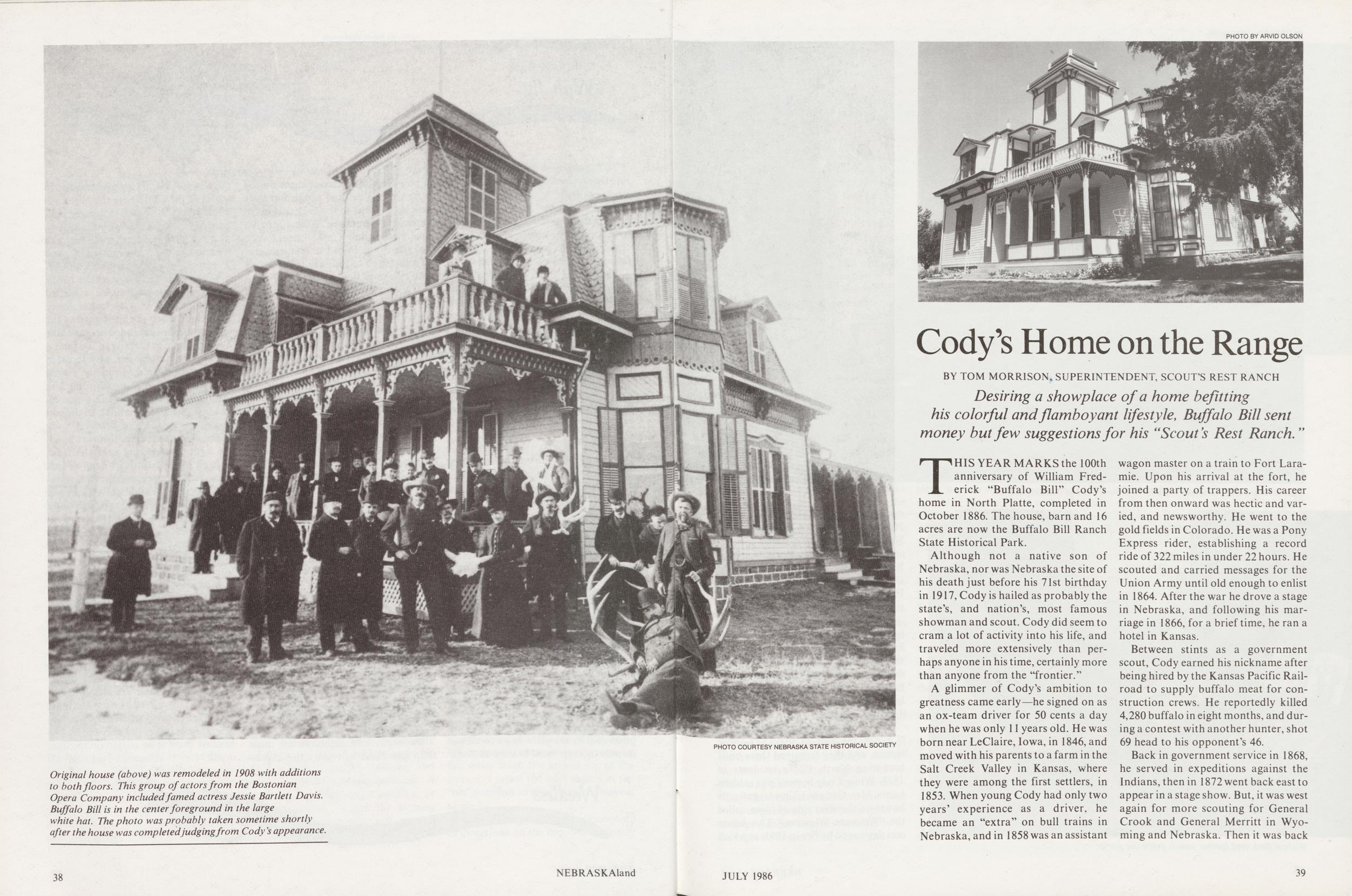
Cody's Home on the Range
BY TOM MORRISON, SUPERINTENDENT, SCOUT'S REST RANCH Desiring a showplace of a home befitting his colorful and flamboyant lifestyle, Buffalo Bill sent money but few suggestions for his "Scout's Rest Ranch."THIS YEAR MARKS the 100th anniversary of William Frederick "Buffalo Bill" Cody's home in North Platte, completed in October 1886. The house, barn and 16 acres are now the Buffalo Bill Ranch State Historical Park.
Although not a native son of Nebraska, nor was Nebraska the site of his death just before his 71st birthday in 1917, Cody is hailed as probably the state's, and nation's, most famous showman and scout. Cody did seem to cram a lot of activity into his life, and traveled more extensively than perhaps anyone in his time, certainly more than anyone from the frontier.
A glimmer of Cody's ambition to greatness came early—he signed on as an ox-team driver for 50 cents a day when he was only 11 years old. He was born near LeClaire, Iowa, in 1846, and moved with his parents to a farm in the Salt Creek Valley in Kansas, where they were among the first settlers, in 1853. When young Cody had only two years' experience as a driver, he became an "extra" on bull trains in Nebraska, and in 1858 was an assistant wagon master on a train to Fort Laramie. Upon his arrival at the fort, he joined a party of trappers. His career from then onward was hectic and varied, and newsworthy. He went to the gold fields in Colorado. He was a Pony Express rider, establishing a record ride of 322 miles in under 22 hours. He scouted and carried messages for the Union Army until old enough to enlist in 1864. After the war he drove a stage in Nebraska, and following his marriage in 1866, for a brief time, he ran a hotel in Kansas.
Between stints as a government scout, Cody earned his nickname after being hired by the Kansas Pacific Railroad to supply buffalo meat for construction crews. He reportedly killed 4,280 buffalo in eight months, and during a contest with another hunter, shot 69 head to his opponent's 46.
Back in government service in 1868,
he served in expeditions against the
Indians, then in 1872 went back east to
appear in a stage show. But, it was west
again for more scouting for General
Crook and General Merritt in Wyoming and Nebraska. Then it was back
JULY 1986
39
Cody's stage career took off in earnest after this, with tours of the U.S. and Europe taking most of his time until the year before his death. And, it was during this time that his North Platte home was built under the direction of his sister and her husband, Al and Julia Goodman.
The Codys were living in Rochester, N.Y., at the end of the 1873 show season, and they remained there until becoming North Platte residents in 1878. While Cody himself was seldom home, Mrs. Cody lived in a large frame house on the west side of town called the "Welcome Wigwam." This house was destroyed by fire in 1891, at which 40 NEBRASKAland time Mrs. Cody moved into one of their rental houses until 1893 when Cody presented his wife with the deed of the former McKay mansion. Apparently never a close couple, the Codys lived separately most of their married lives.
Cody's real pride and joy was what ultimately would become the state historical park. Although back east involved in his show, Cody left most decisions up to his sister and her husband, both of whom he had persuaded to come west to manage his ranch.
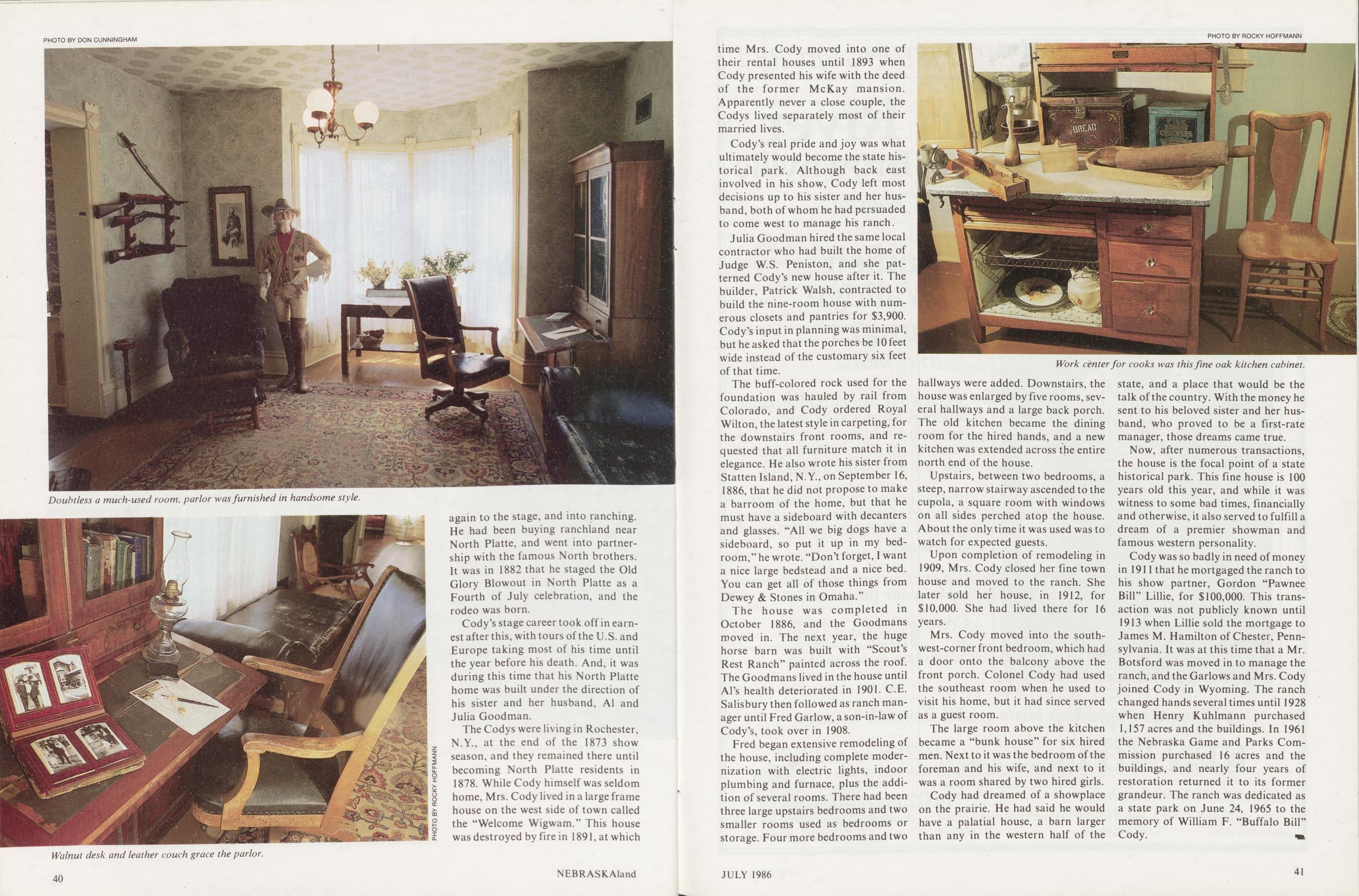
Julia Goodman hired the same local contractor who had built the home of Judge W.S. Peniston, and she patterned Cody's new house after it. The builder, Patrick Walsh, contracted to build the nine-room house with numerous closets and pantries for $3,900. Cody's input in planning was minimal, but he asked that the porches be 10 feet wide instead of the customary six feet of that time.
The buff-colored rock used for the foundation was hauled by rail from Colorado, and Cody ordered Royal Wilton, the latest style in carpeting, for the downstairs front rooms, and requested that all furniture match it in elegance. He also wrote his sister from Statten Island, N. Y., on September 16, 1886, that he did not propose to make a barroom of the home, but that he must have a sideboard with decanters and glasses. "All we big dogs have a sideboard, so put it up in my bedroom," he wrote. "Don't forget, I want a nice large bedstead and a nice bed. You can get all of those things from Dewey & Stones in Omaha."
The house was completed in October 1886, and the Goodmans moved in. The next year, the huge horse barn was built with "Scout's Rest Ranch" painted across the roof. The Goodmans lived in the house until Al's health deteriorated in 1901. C.E. Salisbury then followed as ranch manager until Fred Garlow, a son-in-law of Cody's, took over in 1908.
Fred began extensive remodeling of the house, including complete modernization with electric lights, indoor plumbing and furnace, plus the addition of several rooms. There had been three large upstairs bedrooms and two smaller rooms used as bedrooms or storage. Four more bedrooms and two hallways were added. Downstairs, the house was enlarged by five rooms, several hallways and a large back porch. The old kitchen became the dining room for the hired hands, and a new kitchen was extended across the entire north end of the house.
Upstairs, between two bedrooms, a steep, narrow stairway ascended to the cupola, a square room with windows on all sides perched atop the house. About the only time it was used was to watch for expected guests.
Upon completion of remodeling in 1909, Mrs. Cody closed her fine town house and moved to the ranch. She later sold her house, in 1912, for $10,000. She had lived there for 16 years.
Mrs. Cody moved into the southwest-corner front bedroom, which had a door onto the balcony above the front porch. Colonel Cody had used the southeast room when he used to visit his home, but it had since served as a guest room.
The large room above the kitchen became a "bunk house" for six hired men. Next to it was the bedroom of the foreman and his wife, and next to it was a room shared by two hired girls.
Cody had dreamed of a showplace on the prairie. He had said he would have a palatial house, a barn larger than any in the western half of the state, and a place that would be the talk of the country. With the money he sent to his beloved sister and her husband, who proved to be a first-rate manager, those dreams came true.
Now, after numerous transactions, the house is the focal point of a state historical park. This fine house is 100 years old this year, and while it was witness to some bad times, financially and otherwise, it also served to fulfill a dream of a premier showman and famous western personality.
Cody was so badly in need of money in 1911 that he mortgaged the ranch to his show partner, Gordon "Pawnee Bill" Lillie, for $100,000. This transaction was not publicly known until 1913 when Lillie sold the mortgage to James M. Hamilton of Chester, Pennsylvania. It was at this time that a Mr. Botsford was moved in to manage the ranch, and the Garlows and Mrs. Cody joined Cody in Wyoming. The ranch changed hands several times until 1928 when Henry Kuhlmann purchased 1,157 acres and the buildings. In 1961 the Nebraska Game and Parks Commission purchased 16 acres and the buildings, and nearly four years of restoration returned it to its former grandeur. The ranch was dedicated as a state park on June 24, 1965 to the memory of William F. "Buffalo Bill" Cody.
JULY 1986 41 NEBRASKA'S BEST KEPT FISHING SECRET
The Missouri River
From Nebraska City to Brownville
Pro Guide — Kenneth Cooksey
Catfish
Walleye
Sauger
and more!
Spend a day fishing on the scenic
Missouri River and let guide
Kenneth Cooksey show you why
many of the state's top anglers
fish this area again and again.
Primarily known for Catfish, the
Missouri also offers many other
types of fish including Walleye
and Sauger.
It's sure to be a good time so
make your plans today!
Cost: $60 for 1 person,
$75 for 2 people
(added charge for bait and fuel)
For more information write or call Kenneth Cooksey
KEN KO Inc
2002 2nd Ave.
Nebraska City, NE 68410
(402) 873-6288
early morning & late evenings
(402) 873-7009
daytime hours
42
NEBRASKAland
NEBRASKA'S BEST KEPT FISHING SECRET
The Missouri River
From Nebraska City to Brownville
Pro Guide — Kenneth Cooksey
Catfish
Walleye
Sauger
and more!
Spend a day fishing on the scenic
Missouri River and let guide
Kenneth Cooksey show you why
many of the state's top anglers
fish this area again and again.
Primarily known for Catfish, the
Missouri also offers many other
types of fish including Walleye
and Sauger.
It's sure to be a good time so
make your plans today!
Cost: $60 for 1 person,
$75 for 2 people
(added charge for bait and fuel)
For more information write or call Kenneth Cooksey
KEN KO Inc
2002 2nd Ave.
Nebraska City, NE 68410
(402) 873-6288
early morning & late evenings
(402) 873-7009
daytime hours
42
NEBRASKAland
The Worm's Turn
(Continued from page 37)usually glide along or near the top of the water on the retrieve. When bass take the floating worm they take it with a vengeance, and the strike is exciting to see. And you better be holding on securely.
To fish the same type of rig deeper, pinch a small split shot on the line ahead of the bait and let the weight carry it to the bottom, then slowly drag and twitch the crawler along the bottom with an erratic retrieve. To make the bait swim along the edge of the weeds at varying depths, pump the rod, let the bait partially sink, reel, and pump again. Bass cruising along the weedbed will attack the crawler as it swims past.
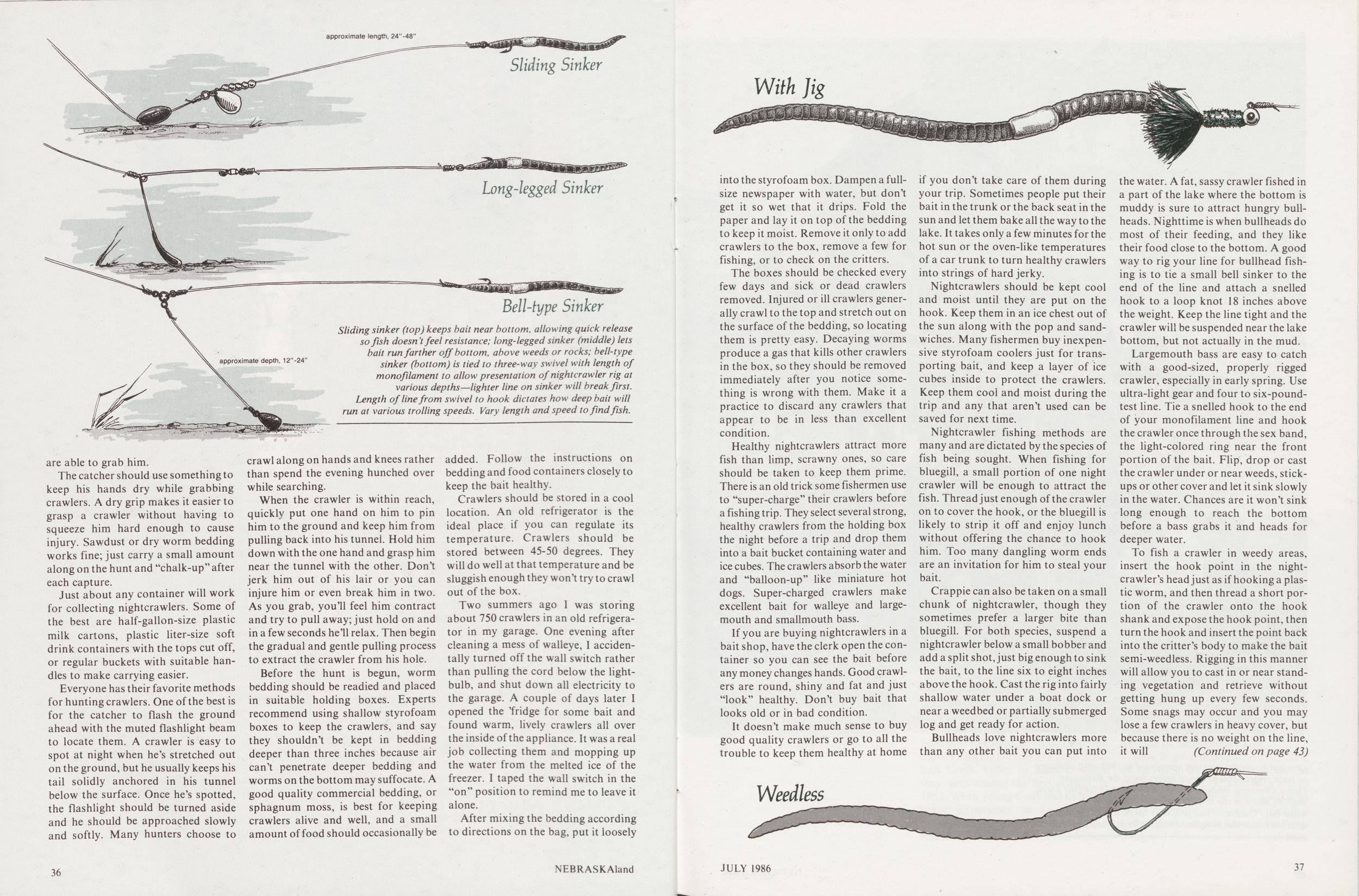
Walleye fishermen like to use nightcrawlers in conjunction with a small spinner and a series of beads on the snell below a snap swivel. Attached to the other end of the snap swivel is monofilament line from the reel which is passed through an oval slip sinker. The sliding weight keeps the bait near the bottom; the spinner and beads attract the fish, and the nightcrawler glides seductively behind. There are several variations of this style of rig, but the principle is approximately the same—to keep the bait near the bottom while allowing the line to slip through the sinker unhampered when a fish picks the bait up. Sometimes a bubble of air is injected into the crawler's tail to make the bait float a bit above the lake or river bottom; sometimes a long-legged sinker is used to keep the weight farther off the bottom, both to keep it from becoming entangled in the rocks and to let the bait ride even higher in the water.
Sometimes the bait is elevated by the use of a three-ringed swivel that allows line from the reel to attach to one ring, a drop line tied to a weight to bounce along the bottom is tied to the second ring, while the leader from the hook is tied to the third ring.
 1986 Young
Fur Harvesters
Camp
Saturday and Sunday, September 13 & 14
Camp Arrowhead (near Lexington)
Sponsored by
The Nebraska Fur Harvesters and
The Nebraska Federation of Coon Hunters
in cooperation with The Nebraska Game
and Parks Commission
For information and registration forms,
write Nebraska Game and Parks Commission
Box 30370, Lincoln, NE 68503
44
NEBRASKAland
1986 Young
Fur Harvesters
Camp
Saturday and Sunday, September 13 & 14
Camp Arrowhead (near Lexington)
Sponsored by
The Nebraska Fur Harvesters and
The Nebraska Federation of Coon Hunters
in cooperation with The Nebraska Game
and Parks Commission
For information and registration forms,
write Nebraska Game and Parks Commission
Box 30370, Lincoln, NE 68503
44
NEBRASKAland
These rigs are occasionally cast from dam faces and slowly retrieved to entice walleye, but they are most often used from a drifting or very slowly moving boat. Most trolling motors troll too fast for effective use of these rigs, so knowledgeable walleye fishermen troll backwards against the waves or current to slow the boat to the proper speed.
Trout fishermen fish crawlers in as natural a manner as possible to take browns and rainbows. The most productive method is to hook the crawler through the body, cast it upstream and let the current tumble it back downstream, allowing it to be swept along the same route it would be carried if it had fallen into the water from the bank. In deeper water, a split shot attached 12 to 18 inches above the hook will help keep the bait near the bottom as it is swept downstream.
Carp can easily be taken on nightcrawlers from areas where there is plenty of weed growth. A small "gob" of crawlers fished near the bottom works well, and the crawlers' moving ends seem to help attract carp. It's im-portant to "think light" when carp fishing because even the smallest amount of resistance seems to discourage him when he takes the bait. The best rule is to use only as much weight as is necessary to sink the bait and hold it in position on the bottom.
Experienced catfishermen will tell you there are a number of live baits and uncountable numbers of prepared concoctions that will catch cats. Some natural and commercial stink baits are dynamite at certain times of the year; for instance, putrid shad strips are excellent in the spring in most areas of the country. All kinds of baits from toads and frogs to salamanders and turkey livers have accounted for inestimable numbers of catfish through the ages, but the king of all catfish baits is still the nightcrawler. There are many ways to fish crawlers for cats, and one of the most popular is a wellconditioned crawler or two on a size four or six hook fished on the bottom in deep, moving water. At other times when the fish are a bit more finicky, a small hook and light line weighted with a slip sinker are needed.
If you're fishing from a boat, try drift-fishing a crawler along the bottom for catfish. Put just enough weight on the line to sink the bait and let the wave action push you across fish-holding areas of the lake. When drifting, the rule is "the slower the better" give the fish a chance to find the bait. This method allows you to present your bait over a larger area than stationary fishing, and helps to locate areas where the fish are holding. Some fishermen drift until they catch a fish, then anchor and fish that area. This is a good technique, but if you don't pick up a second fish in 20 minutes or so, move on to another area.
Name Address City State Zip NEBRASKA WILDLIFE SOCIETY 1985 PRINT RED-TAILED HAWK by D.H.Westerholt Individually signed and numbered limited edition prints (100). Printed on premium 100% cotton paper, with an image size of 8" x 11" and overall size of 11" x 14". Only $15. Plus $2.50 postage and handling Send Order and Payment to: The Nebraska Wildlife Society Qty lJ 1985 Nebraska Wildlife Society Print Price $15 plus 2.50 postage and handling - P.O. Box 61 Ceresco,N£68017 THE ADMIRAL'S COVE EXIT 6 ON THE NORTH SIDE VISIT THE flWIRfltS QAILEY RESTAURANT YOUR FAVORITE COCKTAILS • FANCY LARGE SALAD BAR TROPHY STRIPERS ON DISPLAY CLOSE TO WATER Located on the north shore of Lake McConaughy, 7 miles west of dam SERVICES Tackle, Bait, Gas, Oil, Ice, Beer, Pop, etc. Ph: 308-355-2102 • MOTEL Lake McConaughy's largest motel and apartment complex includes new units • BOAT AND MOTOR RENTAL • GUIDE SERVICE Lemoyne, Ne 69146 JULY 1986 45 Fisherman • Hunters • Canoeists
If you're planning a trip to the
Valentine area—stay with us!
TRADE WINDS LODGE
* Large clean rooms
* Game cleaning & storage facilities
* Pets welcome
* Cable T.V.
* Discounts for food & gas
present this coupon and receive $3 off any room
(no other motel discounts will apply when used)
East Hwy 20 & 83 Valentine, NE 69201
(402) 376-1600 AAA Rated I.M.A.
CALL
800-742-SNAP
STOP
POACHING
NEBRASKA OPERATION
GAME THIEF
CEDAR LANE
- Ranch Vacations •
Guest ranch in the heart of the Sandhills of
Nebraska. Swimming, spa, horses, canoeing,
trail rides, barbeques, hunting.
BOOKING NOW For 1986
Richard and Betty Schroeder HC 2 Box 9C
Stapleton, Nebraska 69163 Ph. 308-587-2233
THERE'S NOTHING
AVERAGE ABOUT
WINNEBAGO®
Chieftain 27RT
EXCEPT THE PRICE.
Winnebago is the number one
motor home in the world. When
you see their quality and our
prices youTl understand why.
A.C.NELSEN
CAMPER WORLD
11818 L St.
Omaha, NE (402) 333-1122
Fisherman • Hunters • Canoeists
If you're planning a trip to the
Valentine area—stay with us!
TRADE WINDS LODGE
* Large clean rooms
* Game cleaning & storage facilities
* Pets welcome
* Cable T.V.
* Discounts for food & gas
present this coupon and receive $3 off any room
(no other motel discounts will apply when used)
East Hwy 20 & 83 Valentine, NE 69201
(402) 376-1600 AAA Rated I.M.A.
CALL
800-742-SNAP
STOP
POACHING
NEBRASKA OPERATION
GAME THIEF
CEDAR LANE
- Ranch Vacations •
Guest ranch in the heart of the Sandhills of
Nebraska. Swimming, spa, horses, canoeing,
trail rides, barbeques, hunting.
BOOKING NOW For 1986
Richard and Betty Schroeder HC 2 Box 9C
Stapleton, Nebraska 69163 Ph. 308-587-2233
THERE'S NOTHING
AVERAGE ABOUT
WINNEBAGO®
Chieftain 27RT
EXCEPT THE PRICE.
Winnebago is the number one
motor home in the world. When
you see their quality and our
prices youTl understand why.
A.C.NELSEN
CAMPER WORLD
11818 L St.
Omaha, NE (402) 333-1122
Incidentally, the new Nebraska state record channel catfish of 41 pounds, eight ounces, was taken by John Cunning of Valentine from the Snake River arm of Merritt Reservoir on July 26, 1985. It's not much of a surprise that this record fish was taken on a nightcrawler.
Musing on wild edibles
(Continued from page 16)throughout the north and eastern edges of the Sandhills. Matter of fact, some of the better asparagus hunting can be found in and along the fringes of the Sandhills. And there goes my secret.
When we consider "range wars" over wild edibles, the "wars" often don't involve people; the plants themselves can work to resist all efforts at harvest. One which comes to mind in this regard is the blackberry. The stems of all blackberries are woody, and usually armed with slender or stout thorns, and this is where the wars begin. A productive blackberry patch may leave you in tatters by the time a bucket has been filled. We consider this part of the game, however, and worth every scratch and rip. Wild blackberries are among the finest of all our wild fruits. For juiciness and flavor the blackberry would be hard to outdo. Southeast Nebraska seems to be the stronghold of the wild blackberry. The rolling hills along the Missouri and Nemaha drainages harbor many of the dense, impenetrable thickets that characterize the blackberry. Woodland edges, old fields and fencerows provide more specific habitat locations which the wild berry seeker should check out. Once found, a good blackberry patch becomes a valuable annuity for many years, paying dividends on a fairly regular basis. We recall several tucked away on the ridge slopes of Nemaha County. They were impressive, not just from the bounty of fruit produced, but from their aggressive nature, which usually claimed bits of jean and shirt as we struggled through the fierce stems. As we surveyed the fruits of our labor, we were faced again with the dilemma of many wild edible aficionados should we go ahead and gorge on the fresh berries, or plan to put some aside for later enjoyment? The last time that we had used all our freshly collected berries in a single gastronomic splurge helped us make a decision: fresh it would be. We thought back to that camping trip which happened to coincide with blackberry ripening time. A generous pail of fresh blackberries was dumped into a deep cast-iron dutch oven, sprinkled generously with sugar, some cornstarch, a bit of cinnamon and nutmeg and a few gobs of fresh butter. We layered the fruit mixture with a rich pastry and shoveled glowing coals over the inverted cover. Some 40 minutes or so later we lifted the lid and gazed on a golden brown crust bubbling with the juicy syrup of the blackberries. As the last succulent bits of crust and berry were scraped away from the dutch-oven sides, we determined that the next day would see us waging war on the blackberry patch again. Only the next collection would find its way to a blackberry sauce lightly spiked with a bit of rich port wine, then liberally distributed over some real New York style cheesecake.
In good fruit years, we have found time (and willpower) to put wild blackberries in such delights as thick jam and full-bodied wines. But as a fresh treat, the wild blackberry overcomes the best of intentions and design. It may be easier to just anticipate the next blackberry season.
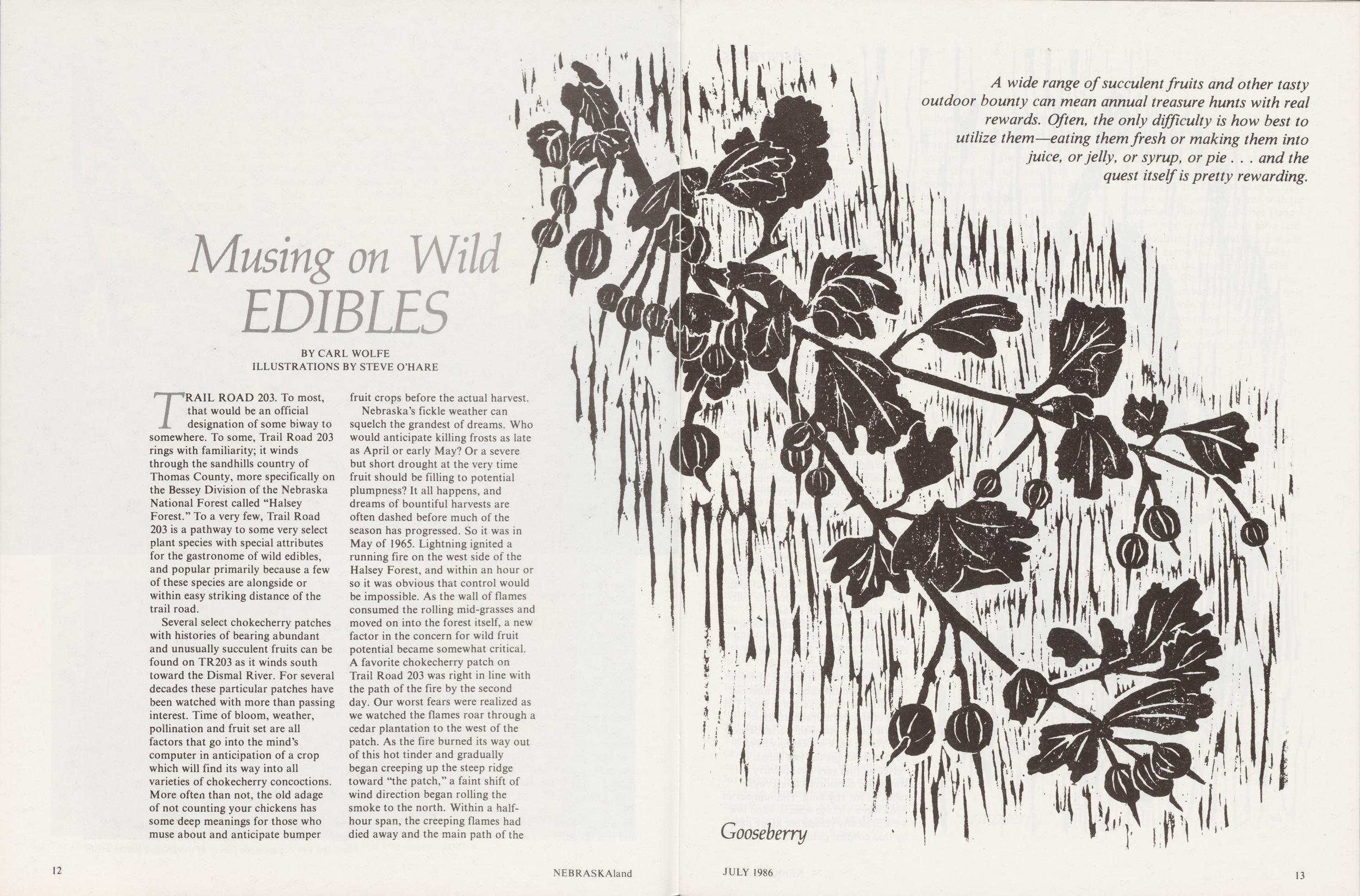
We may be partial to the blackberry for other reasons. The blackberry is hard to confuse with anything else. Not so with another group of berries which occur across the state in a variety of habitat situations. These are those belonging to the currant or gooseberry genus. Some eight different species are reported for the state, though we'd be the first to admit that our interest centers around only one: the golden or Missouri or buffalo currant which occurs across central and northern Nebraska, and is probably best identified by the bright yellow flowers. During late spring, the elongated, drooping flower clusters of the golden currant radiate like a beacon on the horizon. It's little wonder that this colorful shrub finds use as an ornamental in the yard or garden. By late June or early July, the brilliant yellow of the unique flowers have faded, to be replaced by an often translucent, smooth berry which may be red, black, and on rare occasions a soft yellow. The "beak" which hangs on and typifies these berries is nothing more than a persistent flower part.
46 NEBRASKAland The Nebraska Game and Parks Commission, the Omaha World Herald and the Duck Callers Association of Nebraska present the 1986 WaterfowleFs Expoc The Nebraska State Duck Calling Championship (Sanctioned by World Championships in Stuttgart, Arkansas — winner to receive expense paid trip to compete in the World Championships) Saturday, August 23 Also featuring presentations on • Waterfowl I.D. — Paul Horton • Mallards — past, present, and future —Joe Hyland • Proper care for your retriever — Dr. Harless • Question — answer session — Ralph Kohler • Calling demonstration — Dick Schultz • Exhibit space still available! •Duck Calling Contest — 2nd flight (open to anyone who has not previously called in a Nebraska State Championship. Winner eligible for championship contest.) Join us for a full day of fun and education as some of the state's top outdoor experts present helpful information on technique — calling, identification and much more! For more information write or call the Nebraska Game and Parks Commission, 1313 Farnam on the Mall, Omaha, NE 68102, (402) 554-2144. What? Won at the Send information on Omaha's Rare Treats to: name address city state zip mail to Greater Omaha Convention & Visitors Bureau 1819 Farnam Suite 1200 Omaha, NE 68183 402 444-4660/800 835-7427 est 201 Greater Omalxi OxTventton and Visitors Bureau JULY 1986 47 Announcing the
Sandhill Sharptail Shootout
A One-Box Grouse Hunting Competition
September 19,20 8c 21,1986
Mullen, Nebraska
IF INTERESTED CONTACT:
Mullen Commercial Club
Roger D. Wittie, Coordinator
Box 129 Mullen, Nebraska 69152
Entries due by August 1, 1986 Phone 308/546-2247
NEBRASKA
STATE PARKS
VACATION!
©NIOBRARA STATE PARK
Niobrara, NE 68760
(402) 857-3373
CABINS: 1-2 bedrooms, $24, $30
Group Facilities available
SEASON: May 23-September 2
©PONCA STATE PARK
Box 487
Ponca, NE 68770
(402) 755-2284
CABINS: 2 bedroom, $30
SEASON: May 23-September 2
©PLATTE RIVER STATE PARK
Route 1, Box 161A
Louisville, NE 68037
(402) 234-2217
CAMPERS CABINS:
1-3 bedrooms, $10-$20
CABINS: 2 bedroom, $40, $50
Group Facilities available
SEASON: May 1-October 31
ACTIVITY
GUIDE
Chadron
Ft. Robinson
Niobrara
Platte River
Ponca
Victoria Springs
Indian Cave
Two Rivers
Available June part-time
Trail Rides, Restauram open p
September weekends
Trail Rides also available we
^Pttm^ ^available for public
Swimming Beacn
©CHADRON STATE PARK
Chadron, NE 69337
(308) 432-2036
CABINS: 2 bedroom, $26, $30
Group Facilities available
SEASON: May 23-September 2
© FORT ROBINSON
STATE PARK
Box 392
Crawford, NE 69339
(308) 665-2660
CABINS: 2-4 bedrooms, $30-$50
LODGE ROOMS: $18, $20
Brick Houses: 6-9 bedrooms, $80-$ 110
Group Facilities available
SEASON: May 23-September 2
©UNION PACIFIC
CABOOSE PARK
Two Rivers State Recreation Area
Route 1 Box 203
Waterloo, NE 68069
(402) 359-5165
CABOOSE CABINS: Sleep 6, $35
SEASON: May 1-October 31
©VICTORIA SPRINGS
STATE REC AREA
Box 254
Anselmo, NE 68813
(308) 749-2235
CABINS: 2 bedroom, $30
SEASON: May 23-September 2
8—Indian Cave
Nebraska Game and Parks Commission
Eugene T. Mahoney, Director
Announcing the
Sandhill Sharptail Shootout
A One-Box Grouse Hunting Competition
September 19,20 8c 21,1986
Mullen, Nebraska
IF INTERESTED CONTACT:
Mullen Commercial Club
Roger D. Wittie, Coordinator
Box 129 Mullen, Nebraska 69152
Entries due by August 1, 1986 Phone 308/546-2247
NEBRASKA
STATE PARKS
VACATION!
©NIOBRARA STATE PARK
Niobrara, NE 68760
(402) 857-3373
CABINS: 1-2 bedrooms, $24, $30
Group Facilities available
SEASON: May 23-September 2
©PONCA STATE PARK
Box 487
Ponca, NE 68770
(402) 755-2284
CABINS: 2 bedroom, $30
SEASON: May 23-September 2
©PLATTE RIVER STATE PARK
Route 1, Box 161A
Louisville, NE 68037
(402) 234-2217
CAMPERS CABINS:
1-3 bedrooms, $10-$20
CABINS: 2 bedroom, $40, $50
Group Facilities available
SEASON: May 1-October 31
ACTIVITY
GUIDE
Chadron
Ft. Robinson
Niobrara
Platte River
Ponca
Victoria Springs
Indian Cave
Two Rivers
Available June part-time
Trail Rides, Restauram open p
September weekends
Trail Rides also available we
^Pttm^ ^available for public
Swimming Beacn
©CHADRON STATE PARK
Chadron, NE 69337
(308) 432-2036
CABINS: 2 bedroom, $26, $30
Group Facilities available
SEASON: May 23-September 2
© FORT ROBINSON
STATE PARK
Box 392
Crawford, NE 69339
(308) 665-2660
CABINS: 2-4 bedrooms, $30-$50
LODGE ROOMS: $18, $20
Brick Houses: 6-9 bedrooms, $80-$ 110
Group Facilities available
SEASON: May 23-September 2
©UNION PACIFIC
CABOOSE PARK
Two Rivers State Recreation Area
Route 1 Box 203
Waterloo, NE 68069
(402) 359-5165
CABOOSE CABINS: Sleep 6, $35
SEASON: May 1-October 31
©VICTORIA SPRINGS
STATE REC AREA
Box 254
Anselmo, NE 68813
(308) 749-2235
CABINS: 2 bedroom, $30
SEASON: May 23-September 2
8—Indian Cave
Nebraska Game and Parks Commission
Eugene T. Mahoney, Director
We've never found what would be considered bumper crops from the golden currant. Rather, our collecting has often seen a fair effort and many of these shrubs gleaned before a good supply of berries is accumulated.
Some of the very best flavored fruit has been found along banks of certain of the Sandhills rivers. We'd like to think that a special combination of water, soil and sunlight has gone into making the unique flavor which these berries somehow achieve. Certainly we've not found it in currants at other locations—or in other species of currant. For this reason, those years when we manage to find ourselves along the river at the right time, the small collection we may make is already consigned to the manufacture of a golden currant conserve. A combination of dead-ripe currants, grated orange rind and plump raisins is slow cooked until a thick and rich consistency is achieved. Daubed generously on fresh sourdough biscuits and washed down with camp-style coffee, one is unlikely to require anything else. The golden currant is not to be overlooked for pie, either. Assuming one might have the good fortune to find plentiful pickings, one currant pie will highlight the year. But then, there are also elderberries, and plums, and mulberries and raspberries and....
Foraging for wild treats does go beyond the simple delights of the table. While we've dwelled at length on the pleasures of taste. I would be the first to admit that many gathering expeditions have provided memories far beyond taste alone. Rambling over the countryside always brings me greater appreciation for all sorts of seemingly commonplace sights, sounds and smells. In all, we come closer to the Earth. And that is certainly the way it should be.
48 NEBRASKAlandTrading Post
DOGSTRAINING ALL BREEDS Hunting Dogs — Vizslas for sale. Rozanek Kennels, Rt. 2, Schuyler, NE 68661. Phone (402) 352-8769.
A FEW HUNTING dogs for sale: Brittanies, English setters. German Shorthairs. Darrell Yentes, Phone (308) 995-8570 or (308) 995-4797 after 5 p.m.
ENGLISH SETTERS and Labradors: "Bred for the hunter"; outstanding bloodlines! Puppies, started dogs and stud service available. High Plains Kennels, 1411 Emerson, Alliance, Nebr. 69301. Phone (308) 762-6709.
GERMAN SHORTHAIR Pointers pups, started dogs occasionally a finished meat dog. Wayne Clark (712) 529-4238 after 10:00 p.m. or (402) 263-3495. Union, Nebr.
WALKIN' GUNDOG training: Training all breeds. Forced retrieving. Leaving for western Nebraska in July. Dogs work daily on released quail. At Stud Champion Elhew Husker John. Satisfaction guaranteed. Phone (402) 788-2213.
PROFESSIONAL GUNDOG TRAINING: Working pointing breeds. Complete, individualized program well equipped. "Positive retrieve." Honesty and consistent patience. Grouseway Gundogs. Phone (308) 636-2495.
YELLOW LABRADOR pups. Bred to be large, trainable hunters. Dam is 80 lbs. of intelligence and desire to please. Hips O.F.A. certified. Sire is big, broad chested and aggressive. A former field-trialer and now a super hunter. A.K.C. Shots. Robert A. Bendler, 214 East 13th, Lexington, NE 68850. Phone (308) 324-2200.
AKC GOLDEN RETRIEVER pups for sale. Welped 04/06/86. Six field champions in four generations. Very healthy litter. Call (402) 489-2181.
MISCELLANEOUSFISH FOR SALE. Channel catfish, bass, bluegill, crappie, trout, perch, white bass, minnows, hybrid grass carp, bullhead. We can ship fish, you can pick them up, or we can deliver. Contact the Pleasant Valley Fish Farm, Rt. 1, McCook, NE 69001. Phone (308) 345-6599.
N.E. NEBRASKA TROUT Fishing, For rent Mon.-Thurs. or Fri.-Sun. 2 modern cottages completely furnished, 5 spring-fed lakes with trout up to 7 lbs. Bass and bluegill also. Diamond E Trout Resort, Orchard, NE 68764. (402) 893-4745.
GUNS - Browning, Winchester, Remington, others, Hi-powers, shotguns, new, used, antiques. Want Pre1964 Winchesters. Buy-Sell-Trade. Ph. (402) 729-6112. Bedlan's Sporting Goods, Fairbury, NE 68352.
MAD RIVER CANOES offers the finest quality and performance. For the first canoes and accessories look to Great Plains Canoe Co., 205 Main, Springfield, NE. Phone (402) 253-2001.
WINE AND BEER: Make your own. Send for free recipes and instructions. Omaha Supply, 1324 2nd Avenue, Nebraska City, NE 68410.
WINCHESTER COMMEMORATIVES: Canadian Pacific Railroad Standard $369.00; Members Model $369.00; Deluxe Cased $895.00; Calgary Stampede Deluxe Cased $895.00; US Border Patrol with Print $395.00; Saskatchewan Diamond Jubilee $395.00; Great Western Artist 1 & II Deluxe Cased $799.00each. Commemorative Firearms LTD, 2305 South 168th Street, Omaha, Nebr. 68130. Phone (402) 330-2541.
UNIQUE 2,000-ACRE ranch available; excellent goose, duck, grouse and antelope hunting with deer and turkey within five miles. Call (308) 684-3341.
FAIRFIELD CAMPGROUNDS along the Niobrara River "in the heart of a unique blend of habitats." Hiking, natural scenery, bird watching, canoe rental, car shuttle, experienced outfitters. Lifetime river knowledge. Loring & Beryl Kuhre, Johnstown, NE 69214. Phone (402) 722-4494.
ARCHERY PRO SHOP for sale: All equipment needed to open retail archery shop and/or lanes. Accessories, arrow-making supplies, targets, butts, etc. Write to Michael Howell, Rt. 1, Box 188, Bellwood, NE 68624, or call (402) 564-9510.
FOR SALE: 577 acres 17 miles southwest of Crawford, Nebraska on scenic White River. Ranch-style house with double garage, barn with corral, other buildings; heavily timbered with spring and pond. Good deer and turkey hunting and trout fishing. Contact Josephine Doehring, Rt. 3, Fairbury, NE 68352 or phone (402) 729-4738.
LOG HOMES — Discover the simple elegance and richness of a Western Log Home. Your plan or ours. Free estimates. 44-page home planning guides $5. Action Log Homes, Box 3201, Kearney, NE 68847. Phone (308) 237-LOGS.
FOR SALE: quail and wild turkey chicks and eggs. Call (402) 643-2365.
LA KE McCON A UG H Y LOTS — choice lots adjacent to Cedar Vue (Gate 13). THE choice development on McConaughy, all south of RR tracks with direct access to the lake. Quarter-acre lots, $500 down and $ 100 per month. Call (308) 284-6701 or (308) 355-4543.
THE BIG CATFISH are biting. Furnishing lunch, boat, tackle for big ones. Jim Mason, Missouri River guide, Brownville House, Brownville, NE 68321 or phone (402) 825-4721 ask for Jim.
NEBRASKA WILDFLOWERS — permanently preserved in resin. Paperweights and range-top spoon rests. $6.95 each includes tax and shipping. K&M Taxidermy, Rt. 2, Box 175, Norfolk, NE 68701 or phone (402)675-1862.
AIR GUNS repaired — Benjamin, Crosman, Daisy, other American made. Restoration; old guns wanted, Jack's Air Guns, 1225 No. 46th, Lincoln, NE 68503. Phone (402) 466-9223.
LIVE-CATCH ALL-PURPOSE TRAPS Wrttotor FREE CATALOG Traps without injury squirrels, chipmunks, rabbits, mink, fox, raccoons, stray animals, pests, etc. Sizes for every need. Also traps for snakes, sparrows, pigeons, crabs, turtles, quail, etc. Save on our low factory prices. Send no money. Free catalog and trapping secrets MUSTANG MFG. CO., Dept. N-34, Box 920947, Houston, Tex. 77292 NEBRASKAland Magazine Order Form Please send me a subscription to NEBRASKAland Magazine at the last chance price of only $9.50 for one year; $18 for two! One-year Two-year $9.50 $18 NAME ADDRESS CITY STATE Deadline is July 10!! Ma/7 to: NEBRASKAland, Box 30370, Lincoln, NE 68503 ZIP TAXIDERMYALLISON'S TAXIDERMY STUDIO: Wally and Betty Allison, Licensed Taxidermist. We've mounted 18 Nebraska State Record fish. Specializing in fish and birds, small game and rattlesnakes. We use freeze-dry. 2709 Brichwood Rd., North Platte, Nebr. 69101. Phone (308) 534-2324.
BADE TAXIDERMY - Quality a must - Fast service. Fish, birds, rugs, tanning, full mounts and game heads, 2111 N. Christy St., Fremont, Nebraska 727-5463.
KARL SCHWARZ master taxidermist has moved to a new country studio; same professional mounting and tanning service. Schwarz Wild Wing Studio, 16804 South 180th St., Springfield, NE 68059. Phone (402) 253-2481.
JOHNSON TAXIDERMY servicing southwest Nebraska, specializing in big-game mounts, life-sized mounts, rug work, fish, birds, tanning hair-on leather. Brochure and price list on request. Johnson Taxidermy, Rt. 1, Box 78, Lamar, NE 69035. Telephone (308) 882-5555.
NABITY'S TAXIDERMY. 31 years experience. Specializing in natural grass backgrounds for mammals, birds and fish. 13901 "O" St., Lincoln, NE 68504 — 4 miles east of 84th and "O". (402) 489-6351.
K&M TAXIDERMY we do natural mounts you will be proud of. Fish, birds and game heads. Rt. 2, Box 175, Norfolk, NE 68701. Phone (402) 675-1862.
BIG BEAR TAXIDERMY, Rt. 2, Mitchell, Nebraska 69357. We specialize in all big game from Alaska to Nebraska, also birds and fish. Hair on and hair off tanning. Four miles west of Scottsbluff on Highway 26. Dale Hubel, phone (308) 635-3013.
CREATIVE TAXIDERMY. Quality and experience since 1935. All custom services, museum work, and sales. New methods include Freeze-Dry processing. Trophy room visitors and inquiries welcome. Naturecraft Studios, Joe Voges, Owner, Nebraska City, NE 68410. Phone (402) 873-5491.
PLATTE VALLEY TAXIDERMY. Museum-quality mounts using latest scientific methods. 1985 world taxidermy competition winner. Delton Wegner, 1419 11th Street, Central City, NE 68826. Telephone (308) 946-3773.
PEISTER TAXIDERMY Professional work at prices most sportsman can afford. Now in our new log cabin studio, 1020 Central Avenue, Box 3201, Kearney, NE 68847. Phone (308) 236-9700 or (308) 237-7575 evenings.
Harlan County Dam Vacation Apartments - fully furnished Color TV • Kitchen Facilities • Full Baths Game cleaning room with freezer One block from shopping center Weekend or week of pleasant living Security Deposit Required Sorry —No Pets Dean and Esther Stone Box 145 Ph. (308) 799-3422 Republican City, NE 68971 STOCK YOUR LAKE OR POND WITH Channel cat, Bluegill, Largemouth Bass, Hybrid Bluegill, Crappie, Triploid Grass Carp, Minnows ORDER NOW WILLOW LAKE FISH HATCHERY Rt. 3, Box 46, Hastings, Nebr. 68901 Gaylord L. Crawford Phone: (402) 463-8022 Day or Night For April to October 15 stocking JULY 1986 49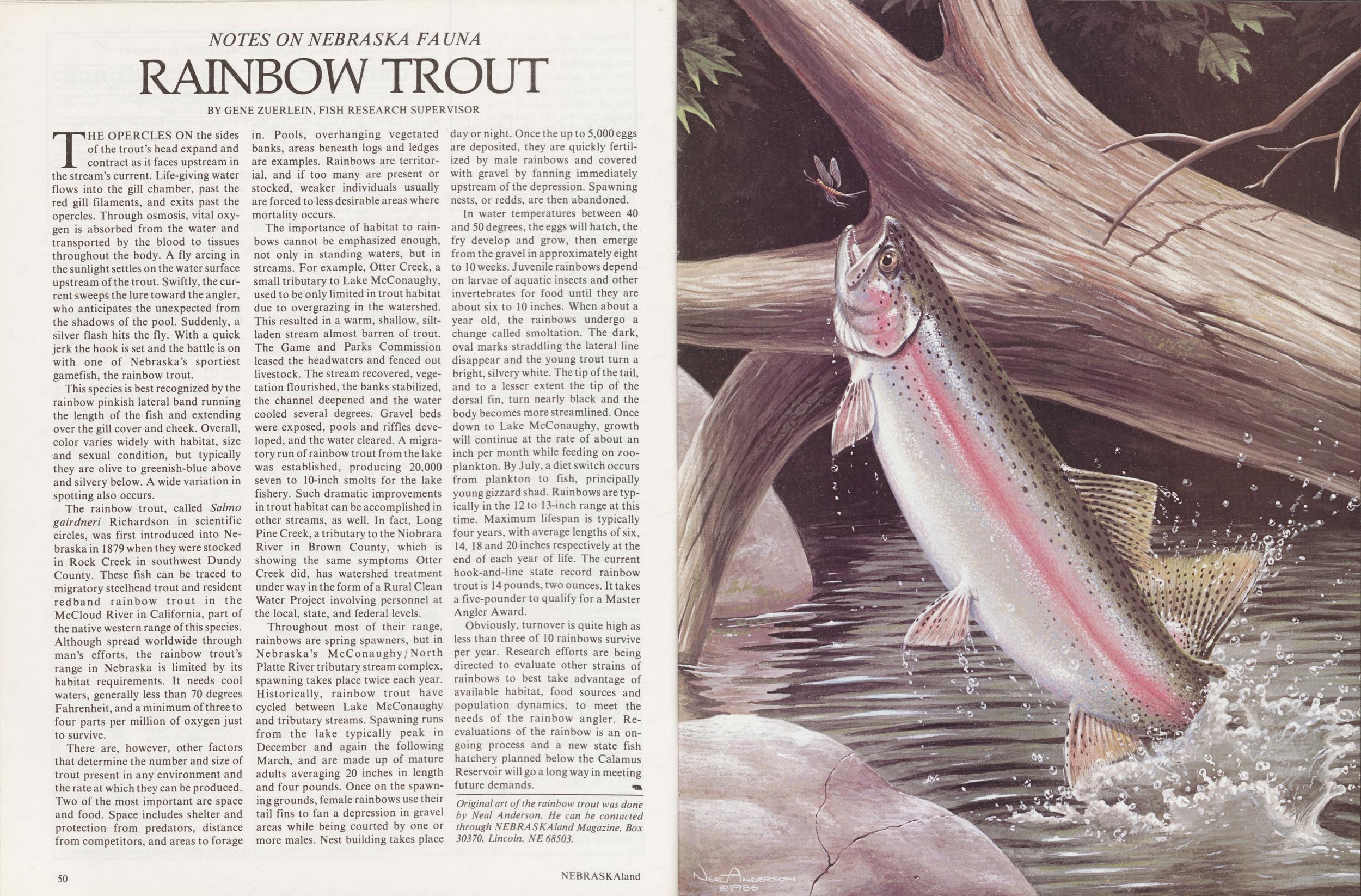
NOTES ON NEBRASKA FAUNA RAINBOW TROUT
BY GENE ZUERLEIN, FISH RESEARCH SUPERVISORTHE OPERCLES ON the sides of the trout's head expand and contract as it faces upstream in the stream's current. Life-giving water flows into the gill chamber, past the red gill filaments, and exits past the opercles. Through osmosis, vital oxygen is absorbed from the water and transported by the blood to tissues throughout the body. A fly arcing in the sunlight settles on the water surface upstream of the trout. Swiftly, the current sweeps the lure toward the angler, who anticipates the unexpected from the shadows of the pool. Suddenly, a silver flash hits the fly. With a quick jerk the hook is set and the battle is on with one of Nebraska's sportiest gamefish, the rainbow trout.
This species is best recognized by the rainbow pinkish lateral band running the length of the fish and extending over the gill cover and cheek. Overall, color varies widely with habitat, size and sexual condition, but typically they are olive to greenish-blue above and silvery below. A wide variation in spotting also occurs.
The rainbow trout, called Salmo gairdneri Richardson in scientific circles, was first introduced into Nebraska in 1879 when they were stocked in Rock Creek in southwest Dundy County. These fish can be traced to migratory steelhead trout and resident redband rainbow trout in the McCloud River in California, part of the native western range of this species. Although spread worldwide through man's efforts, the rainbow trout's range in Nebraska is limited by its habitat requirements. It needs cool waters, generally less than 70 degrees Fahrenheit, and a minimum of three to four parts per million of oxygen just to survive.
There are, however, other factors that determine the number and size of trout present in any environment and the rate at which they can be produced. Two of the most important are space and food. Space includes shelter and protection from predators, distance from competitors, and areas to forage 50 in. Pools, overhanging vegetated banks, areas beneath logs and ledges are examples. Rainbows are territorial, and if too many are present or stocked, weaker individuals usually are forced to less desirable areas where mortality occurs.
The importance of habitat to rainbows cannot be emphasized enough, not only in standing waters, but in streams. For example, Otter Creek, a small tributary to Lake McConaughy, used to be only limited in trout habitat due to overgrazing in the watershed. This resulted in a warm, shallow, siltladen stream almost barren of trout. The Game and Parks Commission leased the headwaters and fenced out livestock. The stream recovered, vegetation flourished, the banks stabilized, the channel deepened and the water cooled several degrees. Gravel beds were exposed, pools and riffles developed, and the water cleared. A migratory run of rainbow trout from the lake was established, producing 20,000 seven to 10-inch smolts for the lake fishery. Such dramatic improvements in trout habitat can be accomplished in other streams, as well. In fact, Long Pine Creek, a tributary to the Niobrara River in Brown County, which is showing the same symptoms Otter Creek did, has watershed treatment under way in the form of a Rural Clean Water Project involving personnel at the local, state, and federal levels.
Throughout most of their range, rainbows are spring spawners, but in Nebraska's McConaughy/North Platte River tributary stream complex, spawning takes place twice each year. Historically, rainbow trout have cycled between Lake McConaughy and tributary streams. Spawning runs from the lake typically peak in December and again the following March, and are made up of mature adults averaging 20 inches in length and four pounds. Once on the spawning grounds, female rainbows use their tail fins to fan a depression in gravel areas while being courted by one or more males. Nest building takes place day or night. Once the up to 5,000 eggs are deposited, they are quickly fertilized by male rainbows and covered with gravel by fanning immediately upstream of the depression. Spawning nests, or redds, are then abandoned.
In water temperatures between 40 and 50 degrees, the eggs will hatch, the fry develop and grow, then emerge from the gravel in approximately eight to 10 weeks. Juvenile rainbows depend on larvae of aquatic insects and other invertebrates for food until they are about six to 10 inches. When about a year old, the rainbows undergo a change called smoltation. The dark, oval marks straddling the lateral line disappear and the young trout turn a bright, silvery white. The tip of the tail, and to a lesser extent the tip of the dorsal fin, turn nearly black and the body becomes more streamlined. Once down to Lake McConaughy, growth will continue at the rate of about an inch per month while feeding on zooplankton. By July, a diet switch occurs from plankton to fish, principally young gizzard shad. Rainbows are typically in the 12 to 13-inch range at this time. Maximum lifespan is typically four years, with average lengths of six, 14, 18 and 20 inches respectively at the end of each year of life. The current hook-and-line state record rainbow trout is 14 pounds, two ounces. It takes a five-pounder to qualify for a Master Angler Award.
Obviously, turnover is quite high as less than three of 10 rainbows survive per year. Research efforts are being directed to evaluate other strains of rainbows to best take advantage of available habitat, food sources and population dynamics, to meet the needs of the rainbow angler. Re-evaluations of the rainbow is an ongoing process and a new state fish hatchery planned below the Calamus Reservoir will go a long way in meeting future demands.
Original art of the rainbow trout was done by Neal Anderson. He can be contacted through NEB RASKAland Magazine, Box 30370, Lincoln, NE 68503. 50 NEBRASKAland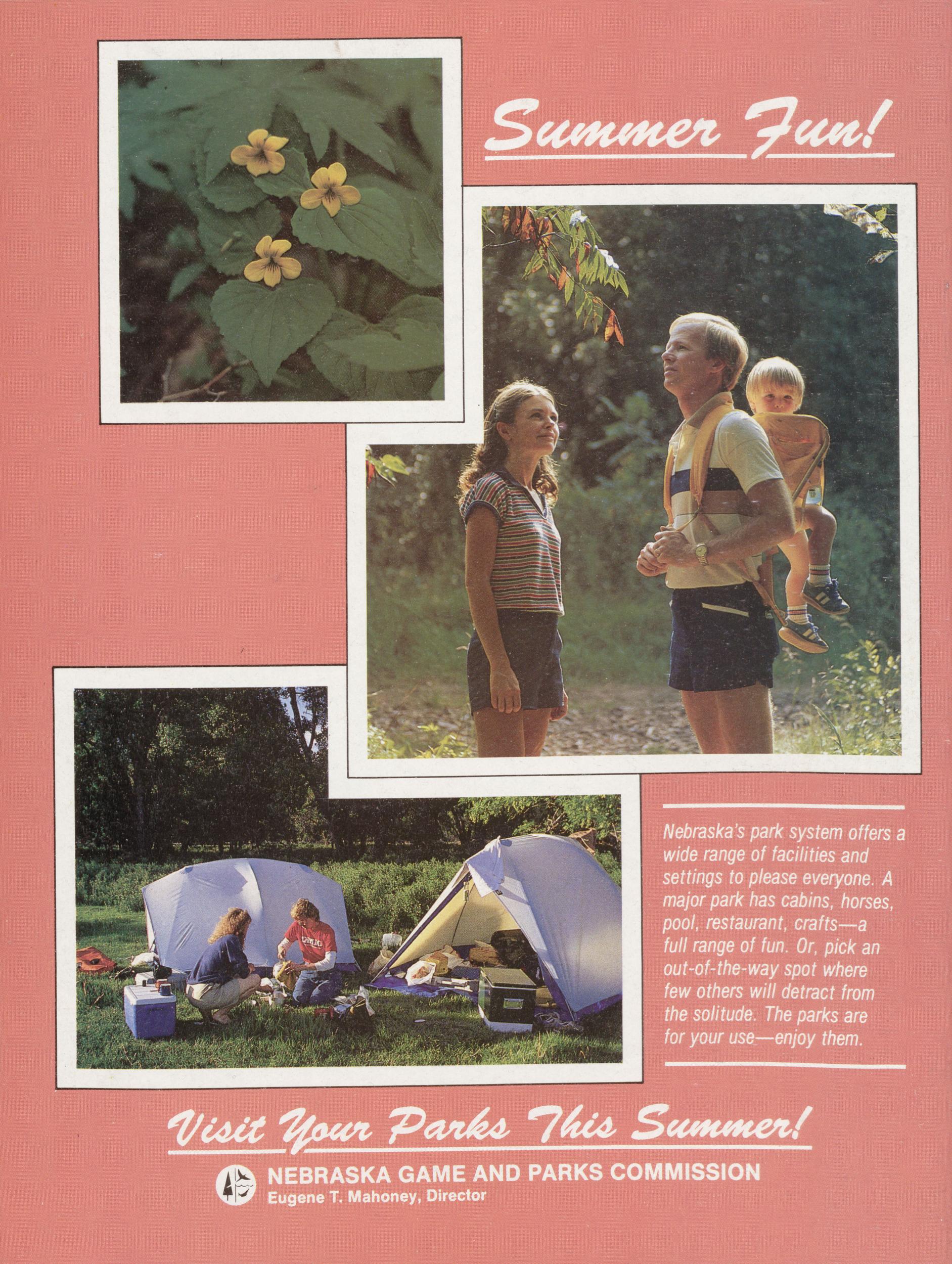
Summer Fun!
Position: 820 (12 views)