Volume 64, Issue 5, 1986
NEBRASKAland
JUNE 1986 $1
NEBRASKAland
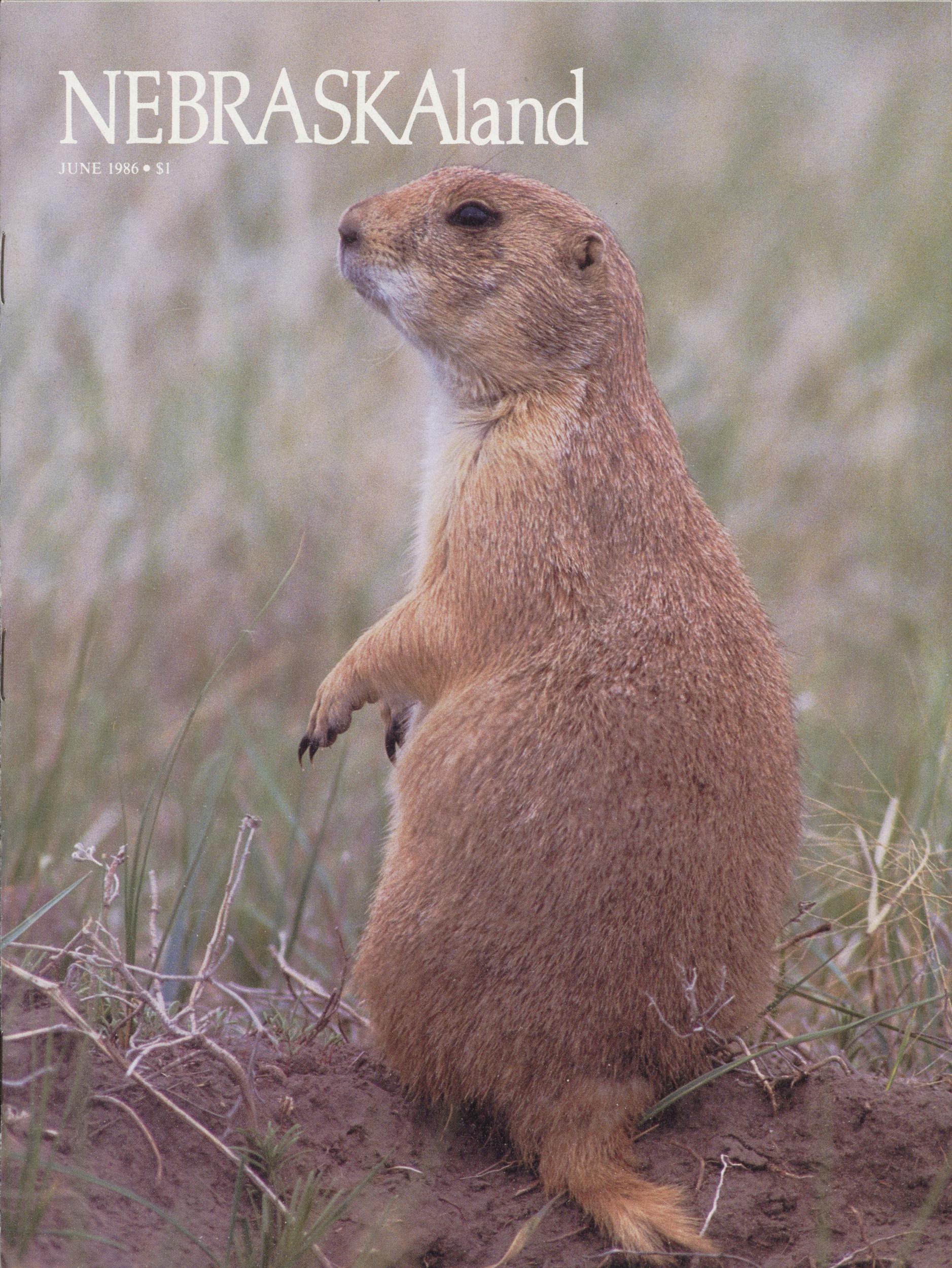
Published by the Nebraska Game and Parks Commission NEBRASKAland VOL. 64/NO. 5/JUNE 1986 NEBRASKAland (ISSN:0028-1964) is published monthly except for a combined January/February issue, by the Nebraska Game and Parks Commission, 2200 North 33rd Street, Lincoln, NE. Copyright 1986, all rights reserved. Second-class postage paid at Lincoln, Nebraska and at additional mailing offices. POSTMASTER: Send address changes to NEBRASKAland, Box 30370, Lincoln, NE 68503. Rates: $9.50 for one year; $18 for two years. Single copy price $1. Offices Headquarters 2200 N. 33rd, Lincoln, 68503 (402) 464-0641 13th and Farnam St., Omaha (402) 554-2144 Ak-Sar-Ben Aquarium, Gretna (402) 332-3901 Rt. 2, Alliance (308) 762-5605 Bassett (402) 684-3511 U.S. 81, Norfolk (402) 371-4950 Rt. 4, North Platte (308) 532-6225 Commissioners Chairman: Richard L. Coyne, Omaha Vice Chairman: Neal Keller, Brewster 2nd Vice Chairman: Dr. Tim Biga, Norfolk Stan Juelfs, Kimball Wayne Ziebarth, Wilcox LaVern Schneider, McCook L. Bruce Wright, Lincoln Director: Eugene T Mahoney Assistant Directors: William J. Bailey, Jr., Dale R. Bree, W. Rex Amack Staff Chief, Information & Education: Jim MacAllister Editor: Lowell Johnson Senior Editor: Jon Farrar Associate Editors: Ken Bouc, Don Cunningham Regional Editors: Bob Grier, Rocky Hoffmann Contributors: Tom Keith, Liz Huff, Carl Wolfe Research Assistant: Curt Twedt Art Director: Duane Westerholt Illustration: Steve O'Hare, Paula Day Advertising: Dan Curran Circulation: Pat Frahm Contents Features ARTIFACTS FROM THE BATTLEFIELD 6 FUNDS FOR FUN 14 BASS AT BOX BUTTE 18 LAKE OWL 20 WEEKEND PHANTOMS 30 PINE RIDGE TROUT. 36 A GIFT TO NEBRASKANS. 38 NOTES ON NEBRASKA FLORA TUFTED EVENING PRIMROSE 50 Departments SPEAK UP 4 TRADING POST 49 COVER: Black-tailed prairie dogs are among the most social of mammals. The organization of their "towns" bears a remarkable resemblance to those of humans; each being separated from neighboring towns by some distance; each divided into "wards" or neighborhoods; and wards divided into "coteries" roughly the equivalent of an expanded family group. Photo by Jon Farrar. OPPOSITE: The largest of several species of penstemons native to Nebraska, shell-leaf penstemon might be found in flower nearly anywhere in the state during June, though it prefers dry, sandy soils. The Pawnee prepared a decoction of its leaves as a remedy for chills and fever. Photo by Don Cunningham.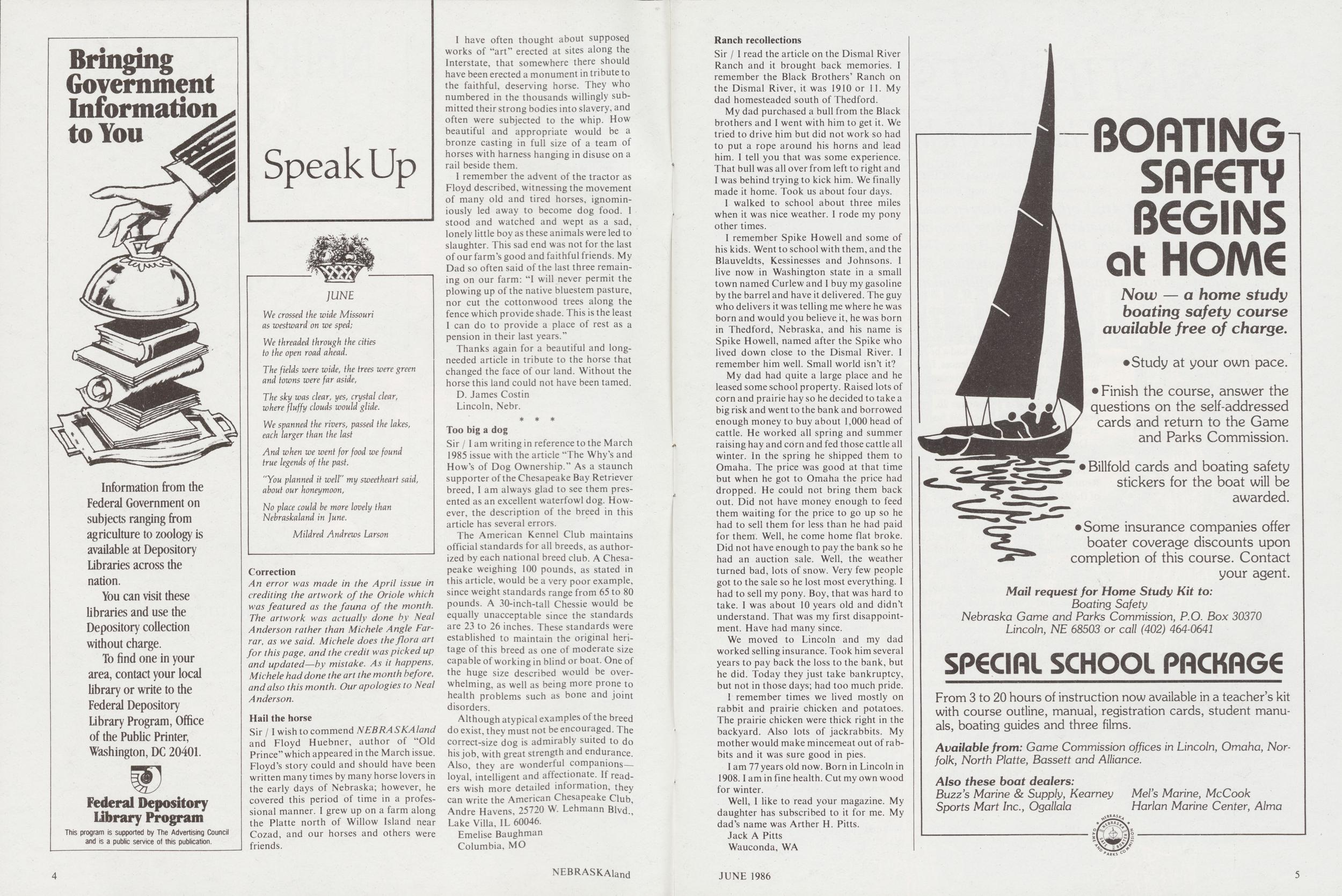
Speak Up
JUNE We crossed the wide Missouri as westward on we sped; We threaded through the cities to the open road ahead. The fields were wide, the trees were green and towns were far aside, The sky was clear, yes, crystal clear, where fluffy clouds would glide. We spanned the rivers, passed the lakes, each larger than the last And when we went for food we found true legends of the past. "You planned it well" my sweetheart said, about our honeymoon, No place could be more lovely than Nebraskaland in June. Mildred Andrews Larson CorrectionAn error was made in the April issue in crediting the artwork of the Oriole which was featured as the fauna of the month. The artwork was actually done by Neal Anderson rather than Michele Angle Farrar, as we said. Michele does the flora art for this page, and the credit was picked up and updated—by mistake. As it happens, Michele had done the art the month before, and also this month. Our apologies to Neal Anderson.
Hail the horseSir/ I wish to commend NEBRASKAland and Floyd Huebner, author of "Old Prince" which appeared in the March issue. Floyd's story could and should have been written many times by many horse lovers in the early days of Nebraska; however, he covered this period of time in a professional manner. I grew up on a farm along the Platte north of Willow Island near Cozad, and our horses and others were friends.
I have often thought about supposed works of "art" erected at sites along the Interstate, that somewhere there should have been erected a monument in tribute to the faithful, deserving horse. They who numbered in the thousands willingly submitted their strong bodies into slavery, and often were subjected to the whip. How beautiful and appropriate would be a bronze casting in full size of a team of horses with harness hanging in disuse on a rail beside them.
I remember the advent of the tractor as Floyd described, witnessing the movement of many old and tired horses, ignominiously led away to become dog food. I stood and watched and wept as a sad, lonely little boy as these animals were led to slaughter. This sad end was not for the last of our farm's good and faithful friends. My Dad so often said of the last three remaining on our farm: "I will never permit the plowing up of the native bluestem pasture, nor cut the cottonwood trees along the fence which provide shade. This is the least I can do to provide a place of rest as a pension in their last years."
Thanks again for a beautiful and longneeded article in tribute to the horse that changed the face of our land. Without the horse this land could not have been tamed.
D. James Costin Lincoln, Nebr. Too big a dogSir / I am writing in reference to the March 1985 issue with the article "The Why's and How's of Dog Ownership." As a staunch supporter of the Chesapeake Bay Retriever breed, I am always glad to see them presented as an excellent waterfowl dog. However, the description of the breed in this article has several errors.
The American Kennel Club maintains official standards for all breeds, as authorized by each national breed club. A Chesapeake weighing 100 pounds, as stated in this article, would be a very poor example, since weight standards range from 65 to 80 pounds. A 30-inch-tall Chessie would be equally unacceptable since the standards are 23 to 26 inches. These standards were established to maintain the original heritage of this breed as one of moderate size capable of working in blind or boat. One of the huge size described would be overwhelming, as well as being more prone to health problems such as bone and joint disorders.
Although atypical examples of the breed do exist, they must not be encouraged. The correct-size dog is admirably suited to do his job, with great strength and endurance. Also, they are wonderful companions- loyal, intelligent and affectionate. If readers wish more detailed information, they can write the American Chesapeake Club, Andre Havens, 25720 W. Lehmann Blvd. Lake Villa, IL 60046.
Emelise Baughman Columbia, MO 4 NEBRASKAland Ranch recollectionsSir / I read the article on the Dismal River Ranch and it brought back memories. I remember the Black Brothers' Ranch on the Dismal River, it was 1910 or 11. My dad homesteaded south of Thedford.
My dad purchased a bull from the Black brothers and I went with him to get it. We tried to drive him but did not work so had to put a rope around his horns and lead him. I tell you that was some experience. That bull was all over from left to right and I was behind trying to kick him. We finally made it home. Took us about four days.
I walked to school about three miles when it was nice weather. I rode my pony other times.
I remember Spike Howell and some of his kids. Went to school with them, and the Blauveldts, Kessinesses and Johnsons. I live now in Washington state in a small town named Curlew and I buy my gasoline by the barrel and have it delivered. The guy who delivers it was telling me where he was born and would you believe it, he was born in Thedford, Nebraska, and his name is Spike Howell, named after the Spike who lived down close to the Dismal River. I remember him well. Small world isn't it?
My dad had quite a large place and he leased some school property. Raised lots of corn and prairie hay so he decided to take a big risk and went to the bank and borrowed enough money to buy about 1,000 head of cattle. He worked all spring and summer raising hay and corn and fed those cattle all winter. In the spring he shipped them to Omaha. The price was good at that time but when he got to Omaha the price had dropped. He could not bring them back out. Did not have money enough to feed them waiting for the price to go up so he had to sell them for less than he had paid for them. Well, he come home flat broke. Did not have enough to pay the bank so he had an auction sale. Well, the weather turned bad, lots of snow. Very few people got to the sale so he lost most everything. I had to sell my pony. Boy, that was hard to take. I was about 10 years old and didn't understand. That was my first disappointment. Have had many since.
We moved to Lincoln and my dad worked selling insurance. Took him several years to pay back the loss to the bank, but he did. Today they just take bankruptcy, but not in those days; had too much pride.
I remember times we lived mostly on rabbit and prairie chicken and potatoes. The prairie chicken were thick right in the backyard. Also lots of jackrabbits. My mother would make mincemeat out of rabbits and it was sure good in pies.
I am 77 years old now. Born in Lincoln in 1908.1 am in fine health. Cut my own wood for winter.
Well, I like to read your magazine. My daughter has subscribed to it for me. My dad's name was Arther H. Pitts.
Jack A Pitts Wauconda, WA BOOTING SflF€TV B€GINS ot HOM€ Now a home study boating safety course available free of charge. •Study at your own pace. • Finish the course, answer the questions on the self-addressed cards and return to the Game and Parks Commission. Billfold cards and boating safety stickers for the boat will be awarded. • Some insurance companies offer boater coverage discounts upon completion of this course. Contact your agent. Mail request for Home Study Kit to: Boating Safety Nebraska Game and Parks Commission, P.O. Box 30370 Lincoln, NE 68503 or call (402) 464-0641 SCHOOL From 3 to 20 hours of instruction now available in a teacher's kit with course outline, manual, registration cards, student manuals, boating guides and three films. Available from: Game Commission offices in Lincoln, Omaha, Norfolk, North Platte, Bassett and Alliance. Also these boat dealers: Buzz's Marine & Supply, Kearney Mel's Marine, McCook Sports Mart Inc., Ogallala Harlan Marine Center, Alma JUNE 1986 5
ARTIFACTS From The Battlefield
BY JAMES HANSON, DIRECTOR NEBRASKA STATE HISTORICAL SOCIETY Photos courtesy of Smithsonian Institution. A scientific-minded Army officer, Lt. Warren made the best of a bad situation by collecting personal equipment after the Battle of Blue Water. This material, an invaluable representation of a culture, is now a major display at Smithsonian.GOUVERNEUR KEMBLE Warren was a brilliant, highstrung, opinionated, and controversial Army officer. He had a broad interest in virtually all the sciences, from anthropology and astronomy to entomology and geology. Graduating second in West Point's class of 1850 at age 20, he is best remembered in American history as "the Saviour of Gettysburg."
During the heated action of that fateful turning point in the Civil War, General Warren realized that Little Round Top, a key high point at the end of the Union line, was undefended. He rushed troops to the rocky knoll just in time to repulse a major Confederate assault. A southern breakthrough at Little Round Top certainly would have changed the outcome of the battle, and possibly the war itself.
Warren was promoted to Major General and commanded an entire corps of 26,000 men, but his penchant for criticizing superior officers, including Gen. U.S. Grant himself, plus an unfortunate tendency to disobey orders on occasion, finally led to his undoing. At Five Forks, the last major battle of the Civil War, Phil Sheridan relieved him of command.
Ten years earlier, in 1855, the young lieutenant had done field mapping in Nebraska Territory. He was headquartered in Washington, D.C. when assigned the important task of developing a "great map" of the heartland of America from the Mississippi to the Rockies. While many explorers, starting with Lewis and Clark, had made reasonably good maps, their pieces of the puzzle did not always fit together. There were also several major regions that had never been mapped scientifically, including the Nebraska Sandhills and the Black Hills.
So, Warren came west as topographical engineer under General William S. Harney. Harney had been sent by the War Department to "chastize" the Western Sioux for killing Lieutenant John L. Grattan and his soldiers near Ft. Laramie following an altercation over a milk cow. Harney sent word ahead that all peaceful Sioux should move south of the Platte or to Ft. Laramie, but many of the Sioux desired to fight and had a contempt for soldiers based upon 30 years of experience, first as allies and then as foes.
Little Thunder, an important Brule Sioux chief, had his camp on Blue Water Creek northwest of present-day Lewellen, Nebraska, within sight of the Oregon Trail's famous landmark, Ash Hollow. Little Thunder had about 400 people with him, including fewer than a hundred Oglala Sioux, some Minneconjou Sioux and a few Cheyennes. He had been warned specifically and repeatedly by the whites to move a few miles and cross the Platte, but he wanted war and sent a message to Harney to come and fight. He was also a patriot, for why should he accommodate the whites in his own land?
Harney's force of 1,200 men moved swiftly up the Platte, guided by a halfdozen mixed-blood Sioux scouts. On the night of September 2, 1855, Harney split his force, sending a mounted column north to cut off the Indians' retreat into the Sandhills. Before dawn on the 3rd, he advanced up Blue Water with the second column in full view of the Indians.
Little Thunder, with only 80 or 90 fighting men, ordered an immediate withdrawal. The Indians abandoned virtually all their property—tipis, clothing, food—so hastily that the soldiers found breakfast still cooking on the fires when they reached the village. The general, however, was concerned that his trap was not yet set, so he ordered his men to halt and sent a truce flag ahead to Little Thunder. The two parleyed at length until Harney assumed his flanking column was in place. Harney then crossly told Little 6 NEBRASKAland
The ensuing "battle" was more of a running slaughter. The Army had new rifles, reasonably accurate to 500 yards, and it was difficult to avoid hitting women and children in the smoke and confusion. A number of Sioux took refuge on a prominent little butte upstream, until concentrated rifle fire drove them away. The mounted Dragoons pursued the survivors 12 miles into the Sandhills. By 9 a.m., the "Battle of Blue Water" or the "Battle of Ash Hollow," was over.
Lt. Warren was horrified at the results. Many women and children had been shot. He found two dead mothers with their dead babies in their arms. He spent all day searching for wounded. He made a horse-drawn litter and brought in a "piteous load" of two women and children, all wounded, while he led the horse and carried "a little boy shot thro' the calves of his legs and thro' his hams." Other soldiers brought in more of the injured and rounded up prisoners, all women and children. At least 87 Indians were killed and 70 were taken captive. Harney's action earned him the Sioux name of "the Wasp" or "the Hornet," although some called him "Mad Bear," and later Indians referred to him as "Squaw Killer."
Warren was disappointed in the attitude of the soldiers: "I was disgusted with the tales afterward of valor on the field, for there were few who killed anything but a flying foe The feeling of sympathy for the wounded women and children and deep regret for their being so, I found universal, lt could not be helped." Like G.I.'s in countless wars, Warren and a fellow officer passed out chocolate and lemonade to the women and children.
During the next four days Warren busied himself laying out and supervising the construction of a small sod fort, Ft. Grattan, on General Harney's orders. On September 8 the lieutenant and Ben Cadotte, one of the mixedblood scouts, went out to the village. Warren noted that "the Ravens Bussards [sic]
Warren was a close friend of Spencer F. Baird, assistant secretary at the new Smithsonian Institution in Washington, D.C.; he also had his own cart and driver to haul his surveying instruments and personal belongings. The idea struck him to make a collection of Sioux Indian material to give to the nation's museum.
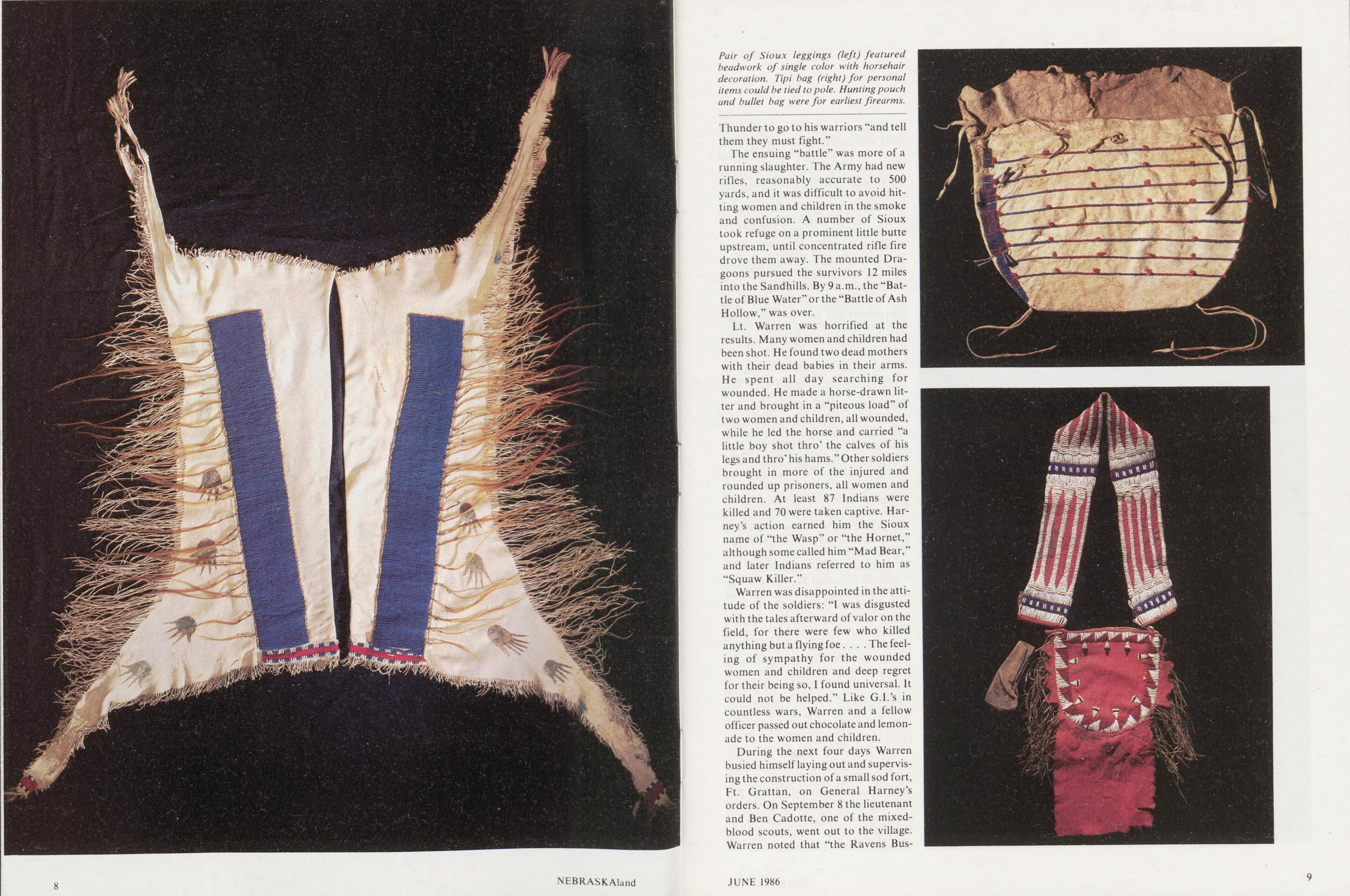
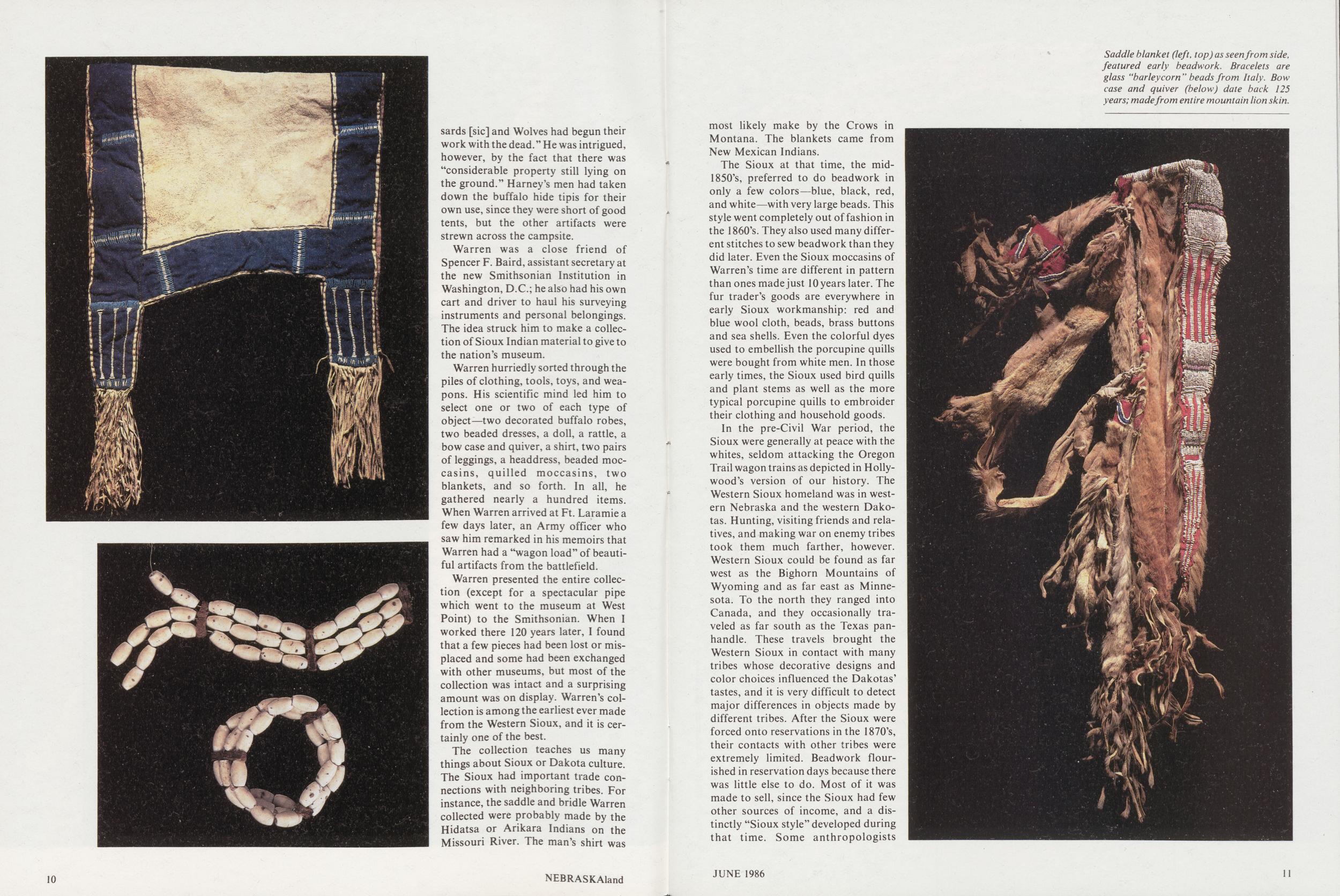
Warren hurriedly sorted through the piles of clothing, tools, toys, and weapons. His scientific mind led him to select one or two of each type of object—two decorated buffalo robes, two beaded dresses, a doll, a rattle, a bow case and quiver, a shirt, two pairs of leggings, a headdress, beaded moccasins, quilled moccasins, two blankets, and so forth. In all, he gathered nearly a hundred items. When Warren arrived at Ft. Laramie a few days later, an Army officer who saw him remarked in his memoirs that Warren had a "wagon load" of beautiful artifacts from the battlefield.
Warren presented the entire collection (except for a spectacular pipe which went to the museum at West Point) to the Smithsonian. When I worked there 120 years later, I found that a few pieces had been lost or misplaced and some had been exchanged with other museums, but most of the collection was intact and a surprising amount was on display. Warren's collection is among the earliest ever made from the Western Sioux, and it is certainly one of the best.
The collection teaches us many things about Sioux or Dakota culture. The Sioux had important trade connections with neighboring tribes. For instance, the saddle and bridle Warren collected were probably made by the Hidatsa or Ankara Indians on the Missouri River. The man's shirt was 10 NEBRASKAland
The Sioux at that time, the mid1850's, preferred to do beadwork in only a few colors—blue, black, red, and white—with very large beads. This style went completely out of fashion in the 1860's. They also used many different stitches to sew beadwork than they did later. Even the Sioux moccasins of Warren's time are different in pattern than ones made just 10 years later. The fur trader's goods are everywhere in early Sioux workmanship: red and blue wool cloth, beads, brass buttons and sea shells. Even the colorful dyes used to embellish the porcupine quills were bought from white men. In those early times, the Sioux used bird quills and plant stems as well as the more typical porcupine quills to embroider their clothing and household goods.
In the pre-Civil War period, the
Sioux were generally at peace with the
whites, seldom attacking the Oregon
Trail wagon trains as depicted in Hollywood's version of our history. The
Western Sioux homeland was in western Nebraska and the western Dakotas.
Hunting, visiting friends and relatives, and making war on enemy tribes
took them much farther, however.
Western Sioux could be found as far
west as the Bighorn Mountains of
Wyoming and as far east as Minnesota. To the north they ranged into
Canada, and they occasionally traveled as far south as the Texas
panhandle. These travels brought the
Western Sioux in contact with many
tribes whose decorative designs and
color choices influenced the Dakotas'
tastes, and it is very difficult to detect
major differences in objects made by
different tribes. After the Sioux were
forced onto reservations in the 1870's,
their contacts with other tribes were
extremely limited. Beadwork flourished in reservation days because there
was little else to do. Most of it was
made to sell, since the Sioux had few
other sources of income, and a distinctly "Sioux style" developed during
that time. Some anthropologists
JUNE 1986
11
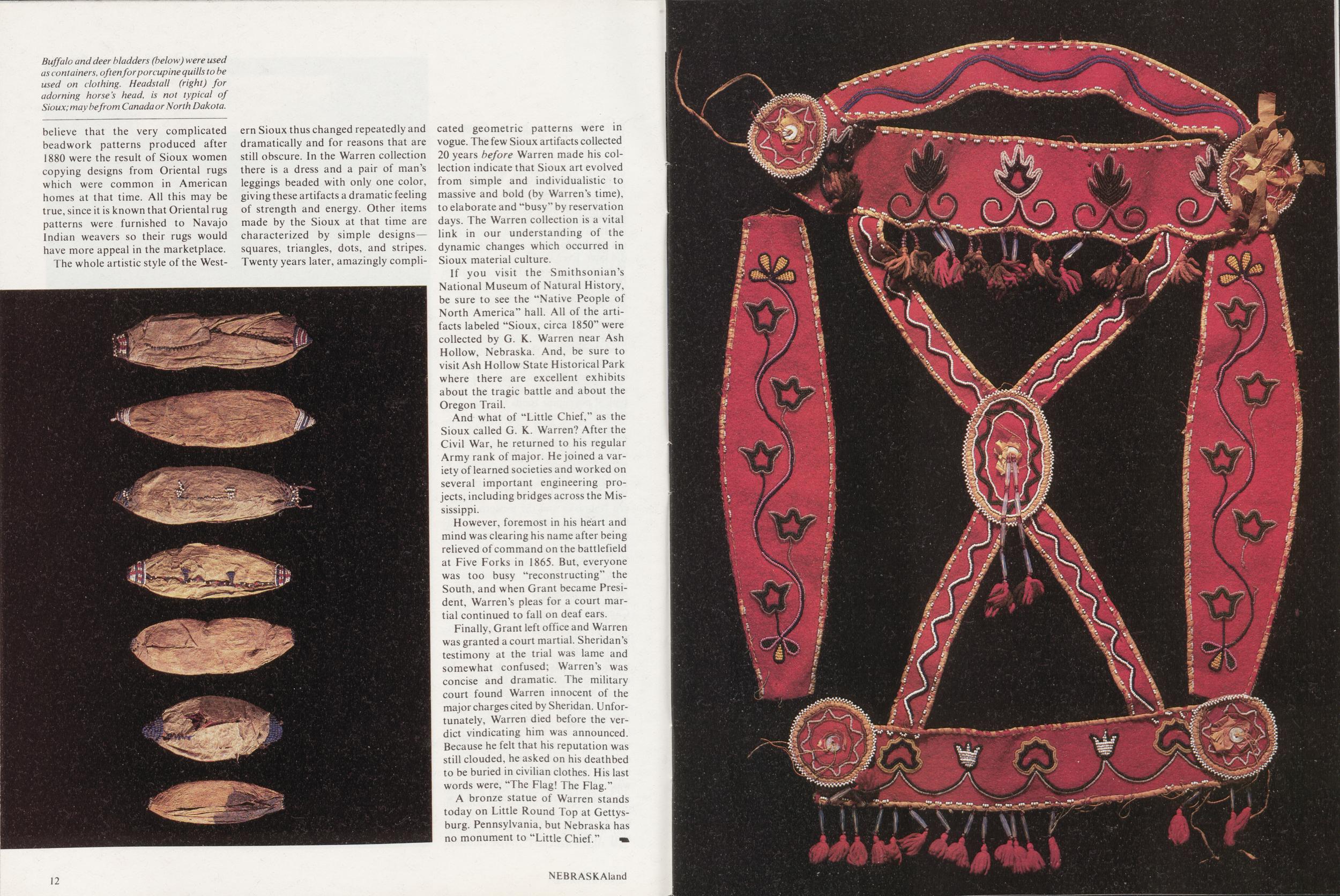
The whole artistic style of the Western Sioux thus changed repeatedly and dramatically and for reasons that are still obscure. In the Warren collection there is a dress and a pair of man's leggings beaded with only one color, giving these artifacts a dramatic feeling of strength and energy. Other items made by the Sioux at that time are characterized by simple designssquares, triangles, dots, and stripes. Twenty years later, amazingly complicated geometric patterns were in vogue. The few Sioux artifacts collected 20 years before Warren made his collection indicate that Sioux art evolved from simple and individualistic to massive and bold (by Warren's time), to elaborate and "busy" by reservation days. The Warren collection is a vital link in our understanding of the dynamic changes which occurred in Sioux material culture.
If you visit the Smithsonian's National Museum of Natural History, be sure to see the "Native People of North America" hall. All of the artifacts labeled "Sioux, circa 1850" were collected by G. K. Warren near Ash Hollow, Nebraska. And, be sure to visit Ash Hollow State Historical Park where there are excellent exhibits about the tragic battle and about the Oregon Trail.
And what of "Little Chief," as the Sioux called G. K. Warren? After the Civil War, he returned to his regular Army rank of major. He joined a variety of learned societies and worked on several important engineering projects, including bridges across the Mississippi.
However, foremost in his heart and mind was clearing his name after being relieved of command on the battlefield at Five Forks in 1865. But, everyone was too busy "reconstructing" the South, and when Grant became President, Warren's pleas for a court martial continued to fall on deaf ears.
Finally, Grant left office and Warren was granted a court martial. Sheridan's testimony at the trial was lame and somewhat confused; Warren's was concise and dramatic. The military court found Warren innocent of the major charges cited by Sheridan. Unfortunately, Warren died before the verdict vindicating him was announced. Because he felt that his reputation was still clouded, he asked on his deathbed to be buried in civilian clothes. His last words were, "The Flag! The Flag."
A bronze statue of Warren stands today on Little Round Top at Gettysburg. Pennsylvania, but Nebraska has no monument to "Little Chief."
12 NEBRASKAland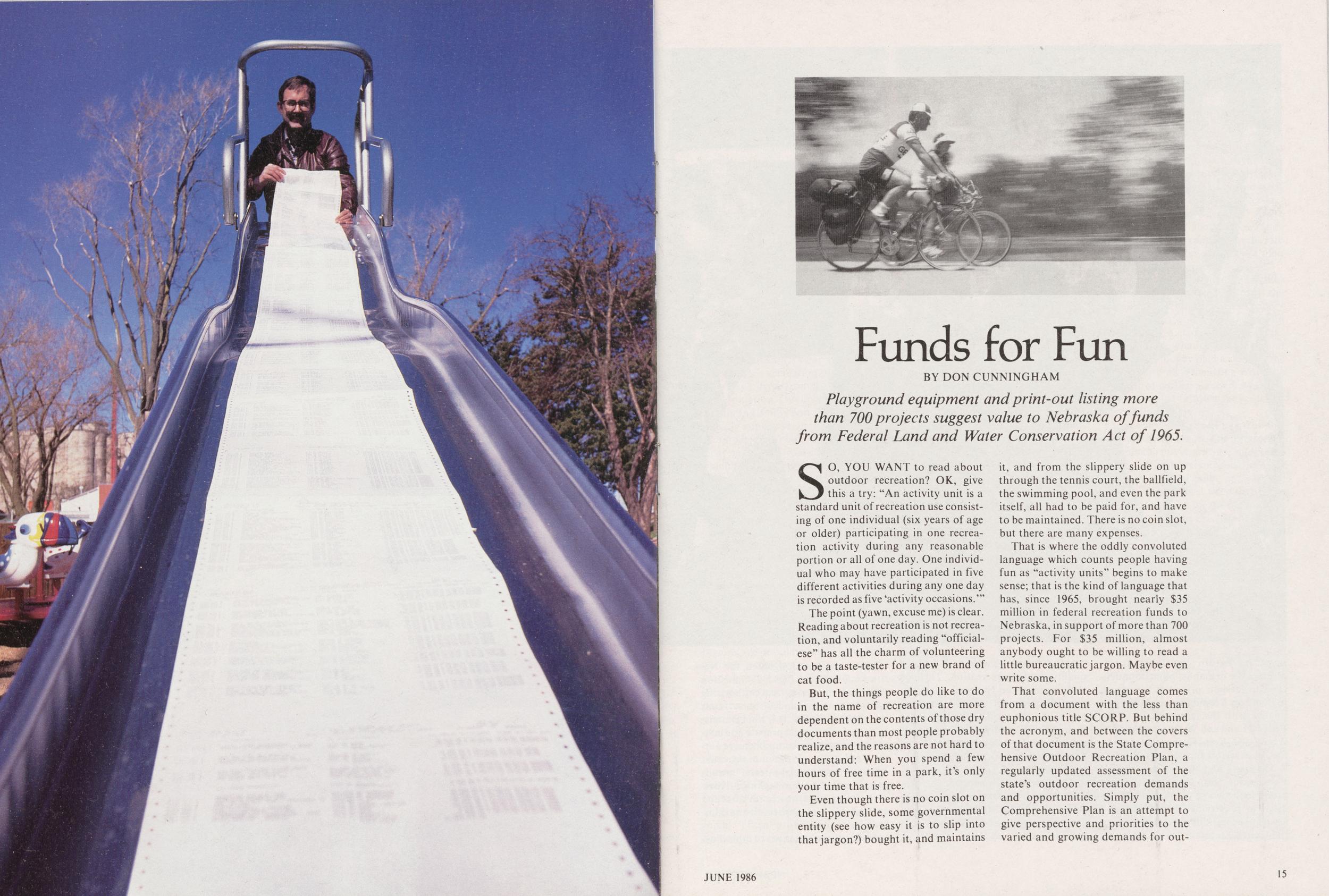
Funds for Fun
BY DON CUNNINGHAM Playground equipment and print-out listing more than 700 projects suggest value to Nebraska of funds from Federal Land and Water Conservation Act of1965.SO, YOU WANT to read about outdoor recreation? OK, give this a try: "An activity unit is a standard unit of recreation use consisting of one individual (six years of age or older) participating in one recreation activity during any reasonable portion or all of one day. One individual who may have participated in five different activities during any one day is recorded as five 'activity occasions."
The point (yawn, excuse me) is clear. Reading about recreation is not recreation, and voluntarily reading "officialese" has all the charm of volunteering to be a taste-tester for a new brand of cat food.
But, the things people do like to do in the name of recreation are more dependent on the contents of those dry documents than most people probably realize, and the reasons are not hard to understand: When you spend a few hours of free time in a park, it's only your time that is free.
Even though there is no coin slot on the slippery slide, some governmental entity (see how easy it is to slip into that jargon?) bought it, and maintains it, and from the slippery slide on up through the tennis court, the ballfield, the swimming pool, and even the park itself, all had to be paid for, and have to be maintained. There is no coin slot, but there are many expenses.
That is where the oddly convoluted language which counts people having fun as "activity units" begins to make sense; that is the kind of language that has, since 1965, brought nearly $35 million in federal recreation funds to Nebraska, in support of more than 700 projects. For $35 million, almost anybody ought to be willing to read a little bureaucratic jargon. Maybe even write some.
That convoluted language comes
from a document with the less than
euphonious title SCORP. But behind
the acronym, and between the covers
of that document is the State Comprehensive Outdoor Recreation Plan, a
regularly updated assessment of the
state's outdoor recreation demands
and opportunities. Simply put, the
Comprehensive Plan is an attempt to
give perspective and priorities to the
varied and growing demands for outdoor
JUNE 1986
15
The Land and Water Conservation Fund came into being in 1965, in order, in the words of the act itself, "to assist in preserving, developing, and assuring accessibility to all citizens of the United States of America of present and future generations" to high quality outdoor recreation. Through the program, the National Park Service, Department of the Interior, makes grants-in-aid to the states and their political subdivisions for up to 50 percent of the cost of acquiring and developing outdoor recreation areas and facilities.
The funds which support the program come from taxes on marine fuel, sales of surplus federal property, entrance fees, and off-shore oil revenues.
State law has designated the Nebraska Game and Parks Commission as the administering and authorizing agency to receive and disburse funds under the program. It is the Commission, too, which must prepare and continually update the comprehensive outdoor recreation plan, but many other agencies and special-interest groups are represented on a Technical Advisory Committee which reviews and comments on all aspects of the comprehensive plan.
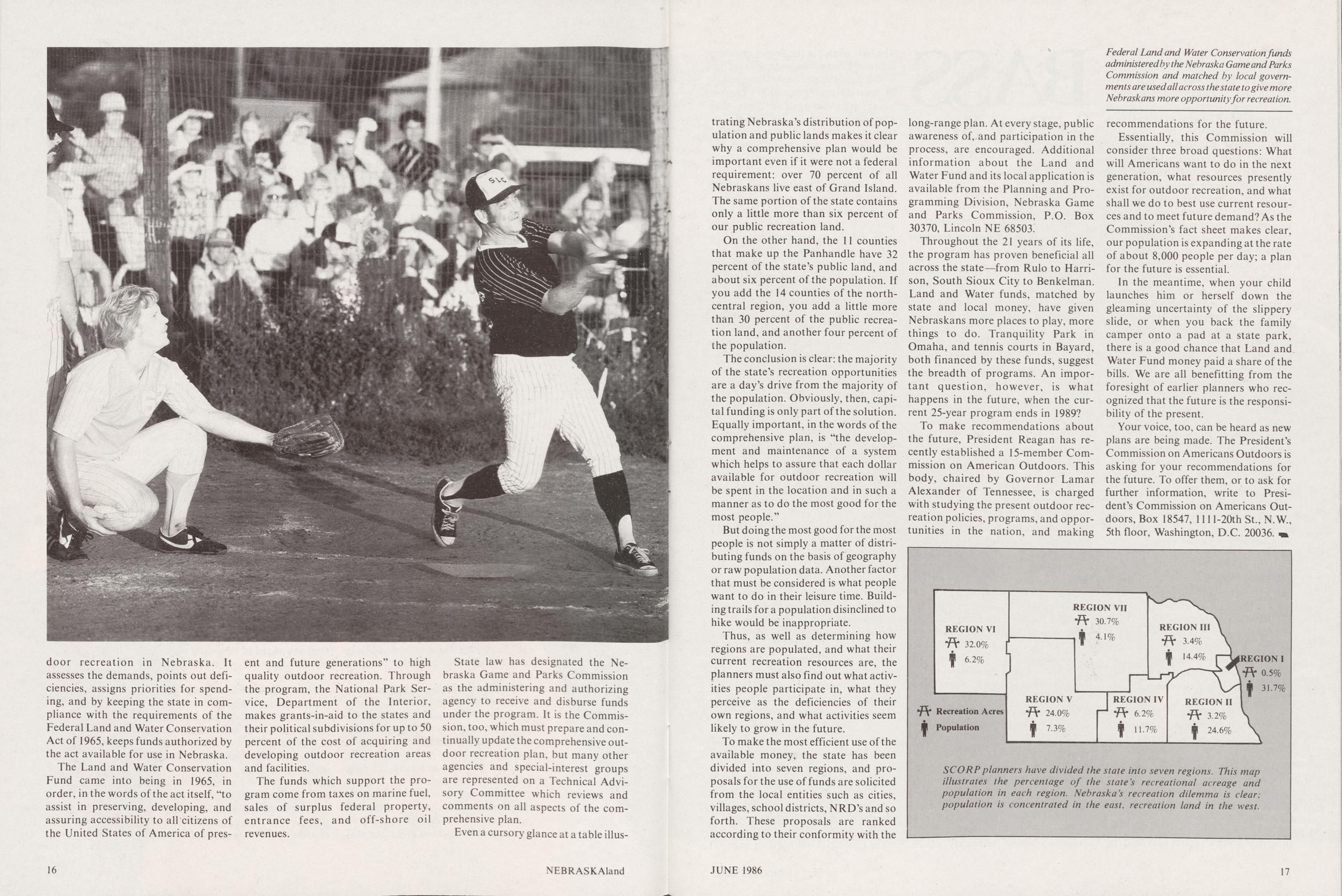
Even a cursory glance at a table 16 NEBRASKAland illustrating Nebraska's distribution of population and public lands makes it clear why a comprehensive plan would be important even if it were not a federal requirement: over 70 percent of all Nebraskans live east of Grand Island. The same portion of the state contains only a little more than six percent of our public recreation land.
On the other hand, the 11 counties that make up the Panhandle have 32 percent of the state's public land, and about six percent of the population. If you add the 14 counties of the northcentral region, you add a little more than 30 percent of the public recreation land, and another four percent of the population.
The conclusion is clear: the majority of the state's recreation opportunities are a day's drive from the majority of the population. Obviously, then, capital funding is only part of the solution. Equally important, in the words of the comprehensive plan, is "the development and maintenance of a system which helps to assure that each dollar available for outdoor recreation will be spent in the location and in such a manner as to do the most good for the most people."
But doing the most good for the most people is not simply a matter of distributing funds on the basis of geography or raw population data. Another factor that must be considered is what people want to do in their leisure time. Building trails for a population disinclined to hike would be inappropriate.
Thus, as well as determining how regions are populated, and what their current recreation resources are, the planners must also find out what activities people participate in, what they perceive as the deficiencies of their own regions, and what activities seem likely to grow in the future.
To make the most efficient use of the available money, the state has been divided into seven regions, and proposals for the use of funds are solicited from the local entities such as cities, villages, school districts, NRD's and so forth. These proposals are ranked according to their conformity with the long-range plan. At every stage, public awareness of,.and participation in the process, are encouraged. Additional information about the Land and Water Fund and its local application is available from the Planning and Programming Division, Nebraska Game and Parks Commission, P.O. Box 30370, Lincoln NE 68503.
Throughout the 21 years of its life, the program has proven beneficial all across the state—from Rulo to Harrison, South Sioux City to Benkelman. Land and Water funds, matched by state and local money, have given Nebraskans more places to play, more things to do. Tranquility Park in Omaha, and tennis courts in Bayard, both financed by these funds, suggest the breadth of programs. An important question, however, is what happens in the future, when the current 25-year program ends in 1989?
To make recommendations about the future, President Reagan has recently established a 15-membef Commission on American Outdoors. This body, chaired by Governor Lamar Alexander of Tennessee, is charged with studying the present outdoor recreation policies, programs, and opportunities in the nation, and making recommendations for the future.
Essentially, this Commission will consider three broad questions: What will Americans want to do in the next generation, what resources presently exist for outdoor recreation, and what shall we do to best use current resources and to meet future demand? As the Commission's fact sheet makes clear, our population is expanding at the rate of about 8,000 people per day; a plan for the future is essential.
In the meantime, when your child launches him or herself down the gleaming uncertainty of the slippery slide, or when you back the family camper onto a pad at a state park, there is a good chance that Land and Water Fund money paid a share of the bills. We are all benefitting from the foresight of earlier planners who recognized that the future is the responsibility of the present.
Your voice, too, can be heard as new plans are being made. The President's Commission on Americans Outdoors is asking for your recommendations for the future. To offer them, or to ask for further information, write to President's Commission on Americans Outdoors, Box 18547, 111 l-20th St., N.W., 5th floor, Washington, D.C. 20036.
BASS At Box Butte
BY BOB GRIER A transplanted easterner has learned many secrets about taking largemouths from what is becoming western Nebraska's "mixed-bag" reservoir on the Niobrara.EVEN EXPERIENCED bass fishermen can be unnerved by the explosive strike of a largemouth bass. For a newcomer to trophy bass fishing, the quickness and power displayed by an aggressive largemouth can be unforgettable.
Box Butte Reservoir, located 11 miles north of Hemingford on the Niobrara River, is quietly developing a reputation among western Nebraska fishermen as one of the region's most diverse fisheries. The 1,600-acre irrigation impoundment was the subject of a reservoir fishing workshop in Alliance last spring that overflowed two high school classrooms with participants interested in catching more fish.
Bill Myers, an avid fisherman from Alliance, devoted his portion of the workshop to explaining his successful fishing techniques, and it didn't take much effort on my part to convince Bill we should try a trip or two to Box Butte to sample the fine largemouth fishing he described during the workshop.
It is rare to find someone born and reared in western Nebraska who knows much about largemouth fishing—Nebraska bass, and bass fishermen, tend to inhabit the eastern two-thirds of the state where farm ponds, sandpits, and smaller lakes hold most of the state's largemouths. To my way of thinking, if you scratch a western Nebraska bass angler, you'll most likely find a transplanted southerner or easterner who may have left the south or east, but not without bringing along a heavy bass rod, casting reel, and a colorful assortment of rubber worms and other bass baits. Bill was raised on the Ohio River and its tributaries where catfish and largemouth are kings. Since moving to western Nebraska in 1977, most of his fishing has been devoted to bass, walleye, and crappie at Box Butte, Lake Minatare, Merritt Reservoir, and Lake McConaughy.
Part of Bill's workshop presentation was devoted to describing largemouth activities during different times of the year, and Bill suggested we begin my bass fishing education with a trip to Box Butte to try early spring, or prespawn, bass fishing. It was mid May before our long-planned trip materialized. As we moved quietly along the reservoir's flooded-willow and brushy shoreline in Bill's 16-foot bass boat, he explained his experience with bass and bass feeding habits during early spring.
"The ideal situation is to find a deeper creek channel with shallow points and submerged flats nearby. As the water temperature reaches 55 to 60 degrees, the bass tend to move out of deeper water onto shallow points where they can set up to ambush their lunch. I look for areas that tend to warm up early, such as the northwest corner of a reservoir where sunlight warms the water first. On a warm, sunny day, the bass will hold on the ambush points, and if cold, cloudy weather returns, they can move back to the deeper creek channel."
Bill's preferred equipment for this type of bass fishing includes a shallowrunning bass boat equipped with electric trolling motor and a mediumheavy casting rod and free-spool bait-casting reel with eight to 10-pound-test line.
"Usually before the moss builds up, lighter lines will work, but you can also judge the best line weight by the lure size or weight. If I'm using a %-ounce to l/4-ounce lure, then eight or 10-pound-test line will work. When I go to a /2-ounce to %-ounce lure, I try to go to 12 or 14-pound line. During the early pre-spawn period I like to use the traditional skirted spinnerbaits with the addition of pork rind or plastic twister tails.
"A flasher or depth finder can be very useful to find old creek channels; try to find points with submerged brush and flooded willows extending into the channel. The brushy points are sometimes called secondary points. The bass winter in the deeper channels and move out as the water warms."
Bill used the electric trolling motor to position the boat along a narrow point of submerged willows that extended out from a half-moonshaped shallow bay. Using a small thermometer, he checked and recorded the water temperature—right at 60 degrees.
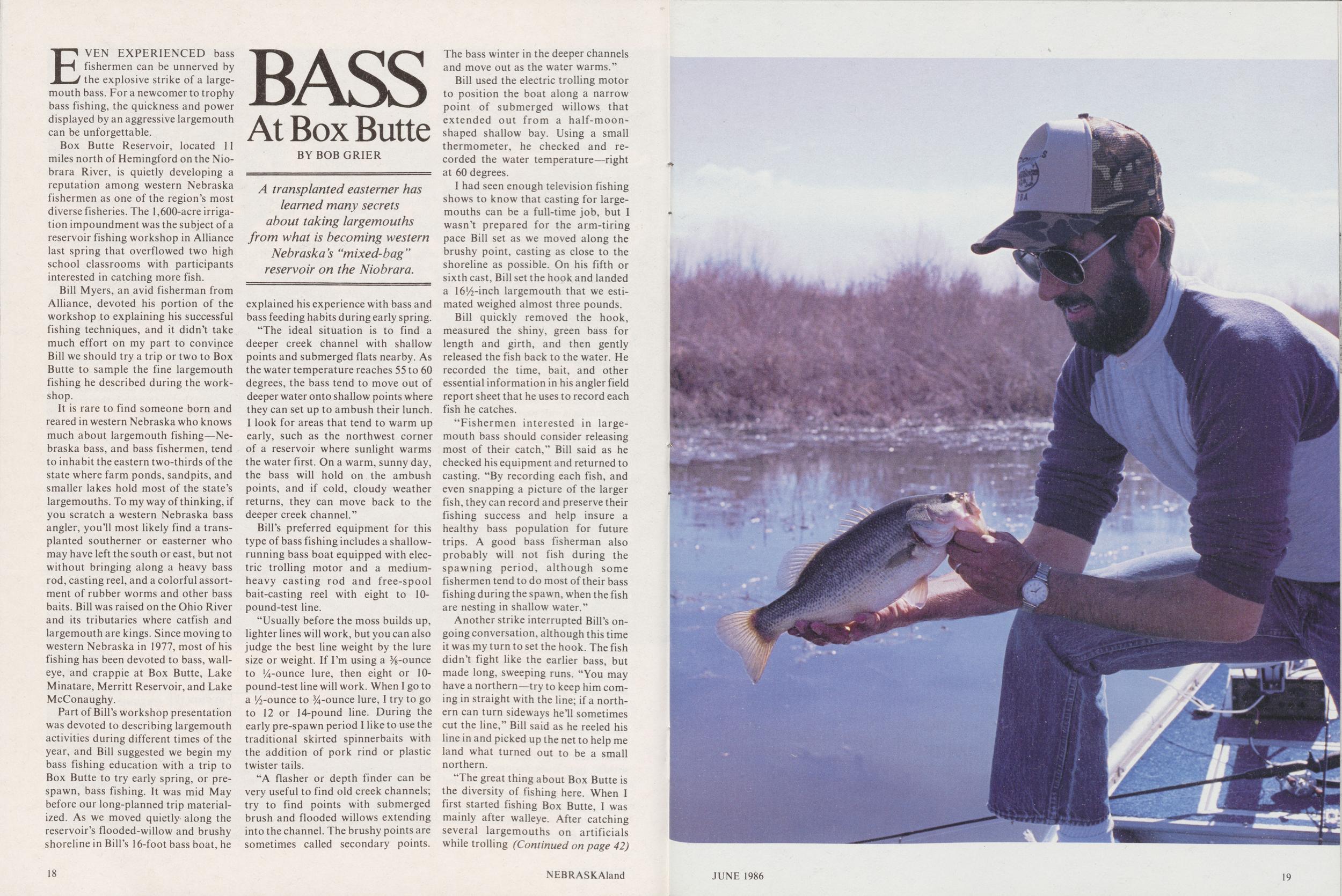
I had seen enough television fishing shows to know that casting for largemouths can be a full-time job, but I wasn't prepared for the arm-tiring pace Bill set as we moved along the brushy point, casting as close to the shoreline as possible. On his fifth or sixth cast, Bill set the hook and landed a 16/2-inch largemouth that we estimated weighed almost three pounds.
Bill quickly removed the hook, measured the shiny, green bass for length and girth, and then gently released the fish back to the water. He recorded the time, bait, and other essential information in his angler field report sheet that he uses to record each fish he catches.
"Fishermen interested in large-mouth bass should consider releasing most of their catch," Bill said as he checked his equipment and returned to casting. "By recording each fish, and even snapping a picture of the larger fish, they can record and preserve their fishing success and help insure a healthy bass population for future trips. A good bass fisherman also probably will not fish during the spawning period, although some fishermen tend to do most of their bass fishing during the spawn, when the fish are nesting in shallow water."
Another strike interrupted Bill's on going conversation, although this time it was my turn to set the hook. The fish didn't fight like the earlier bass, but made long, sweeping runs. "You may have a northern—try to keep him coming in straight with the line; if a northern can turn sideways he'll sometimes cut the line," Bill said as he reeled his line in and picked up the net to help me land what turned out to be a small northern.
"The great thing about Box Butte is the diversity of fishing here. When I first started fishing Box Butte, I was mainly after walleye. After catching several largemouths on artificials while trolling (Continued on page 42)
18 NEBRASKAland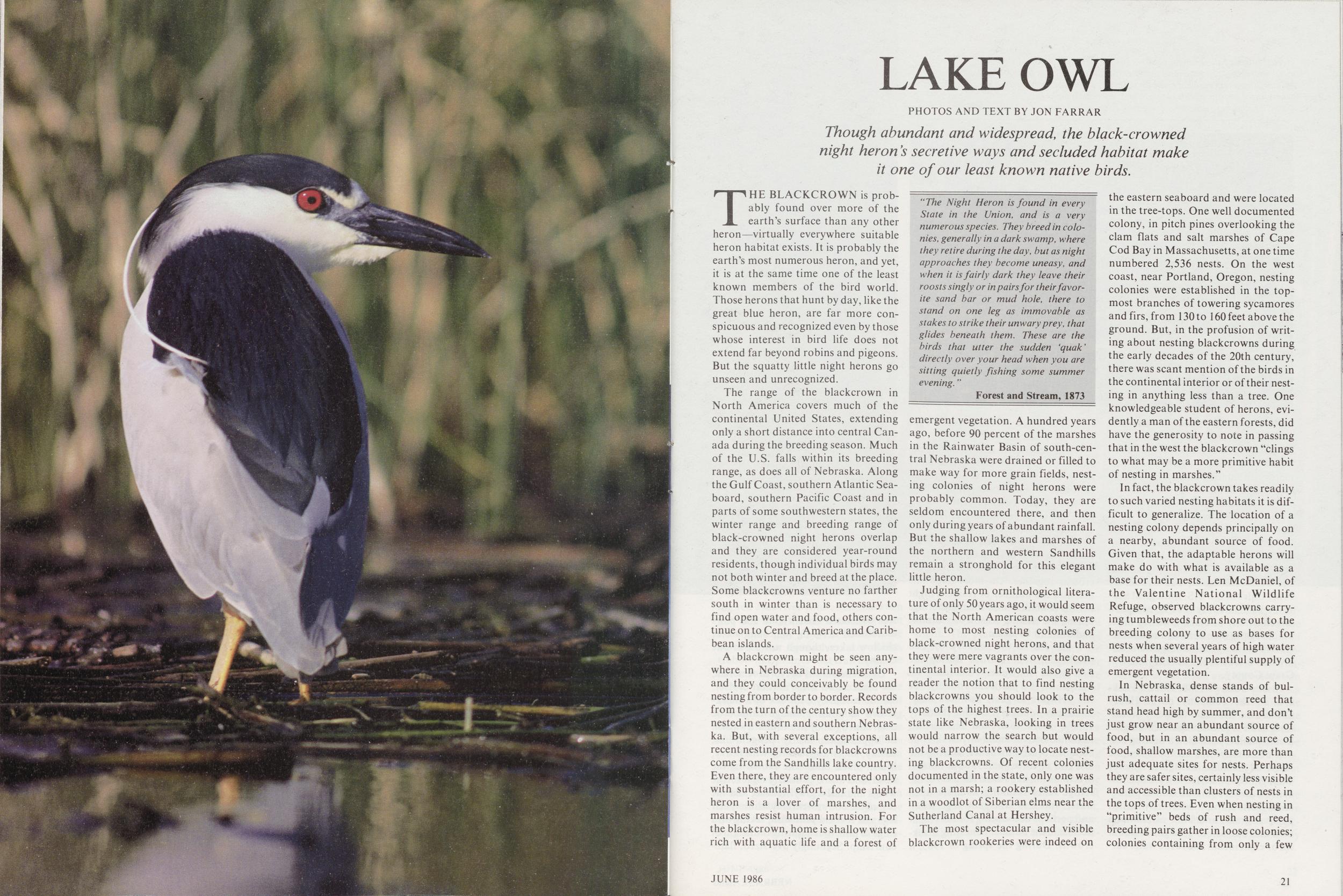
LAKE OWL
PHOTOS AND TEXT BY JON FARRAR Though abundant and widespread, the black-crowned night heron's secretive ways and secluded habitat make it one of our least known native birds.THE BLACKCROWN is probably found over more of the earth's surface than any other heron—virtually everywhere suitable heron habitat exists. It is probably the earth's most numerous heron, and yet, it is at the same time one of the least known members of the bird world. Those herons that hunt by day, like the great blue heron, are far more conspicuous and recognized even by those whose interest in bird life does not extend far beyond robins and pigeons. But the squatty little night herons go unseen and unrecognized.
The range of the blackcrown in North America covers much of the continental United States, extending only a short distance into central Canada during the breeding season. Much of the U.S. falls within its breeding range, as does all of Nebraska. Along the Gulf Coast, southern Atlantic Seaboard, southern Pacific Coast and in parts of some southwestern states, the winter range and breeding range of black-crowned night herons overlap and they are considered year-round residents, though individual birds may not both winter and breed at the place. Some blackcrowns venture no farther south in winter than is necessary to find open water and food, others continue on to Central America and Caribbean islands.
A blackcrown might be seen anywhere in Nebraska during migration, and they could conceivably be found nesting from border to border. Records from the turn of the century show they nested in eastern and southern Nebraska. But, with several exceptions, all recent nesting records for blackcrowns come from the Sandhills lake country. Even there, they are encountered only with substantial effort, for the night heron is a lover of marshes, and marshes resist human intrusion. For the blackcrown, home is shallow water rich with aquatic life and a forest of emergent vegetation. A hundred years ago, before 90 percent of the marshes in the Rainwater Basin of south-central Nebraska were drained or filled to make way for more grain fields, nesting colonies of night herons were probably common. Today, they are seldom encountered there, and then only during years of abundant rainfall. But the shallow lakes and marshes of the northern and western Sandhills remain a stronghold for this elegant little heron.
"The Night Heron is found in every State in the Union, and is a very numerous species. They breed in colonies, generally in a dark swamp, where they retire during the day, but as night approaches they become uneasy, and when it is fairly dark they leave their roosts singly or in pairs for their favorite sand bar or mud hole, there to stand on one leg as immovable as stakes to strike their unwary prey, that glides beneath them. These are the birds that utter the sudden 'quak' directly over your head when you are sitting quietly fishing some summer evening." Forest and Stream, 1873Judging from ornithological literature of only 50 years ago, it would seem that the North American coasts were home to most nesting colonies of black-crowned night herons, and that they were mere vagrants over the continental interior. It would also give a reader the notion that to find nesting blackcrowns you should look to the tops of the highest trees. In a prairie state like Nebraska, looking in trees would narrow the search but would not be a productive way to locate nesting blackcrowns. Of recent colonies documented in the state, only one was not in a marsh; a rookery established in a woodlot of Siberian elms near the Sutherland Canal at Hershey.
The most spectacular and visible blackcrown rookeries were indeed on the eastern seaboard and were located in the tree-tops. One well documented colony, in pitch pines overlooking the clam flats and salt marshes of Cape Cod Bay in Massachusetts, at one time numbered 2,536 nests. On the west coast, near Portland, Oregon, nesting colonies were established in the topmost branches of towering sycamores and firs, from 130 to 160 feet above the ground. But, in the profusion of writing about nesting blackcrowns during the early decades of the 20th century, there was scant mention of the birds in the continental interior or of their nesting in anything less than a tree. One knowledgeable student of herons, evidently a man of the eastern forests, did have the generosity to note in passing that in the west the blackcrown "clings to what may be a more primitive habit of nesting in marshes."
In fact, the blackcrown takes readily to such varied nesting habitats it is difficult to generalize. The location of a nesting colony depends principally on a nearby, abundant source of food. Given that, the adaptable herons will make do with what is available as a base for their nests. Len McDaniel, of the Valentine National Wildlife Refuge, observed blackcrowns carrying tumbleweeds from shore out to the breeding colony to use as bases for nests when several years of high water reduced the usually plentiful supply of emergent vegetation.
In Nebraska, dense stands of bulrush, cattail or common reed that
stand head high by summer, and don't
just grow near an abundant source of
food, but in an abundant source of
food, shallow marshes, are more than
just adequate sites for nests. Perhaps
they are safer sites, certainly less visible
and accessible than clusters of nests in
the tops of trees. Even when nesting in
"primitive" beds of rush and reed,
breeding pairs gather in loose colonies;
colonies containing from only a few
JUNE 1986
21
Though there was occasional mention of blackcrowns nesting in the Sandhills lake country around the turnof-the-century, the earliest Nebraska record giving additional information, and even then scant, was written by F.M. Uhler of the U.S. Biological Survey, who in late July of 1930 reported a mixed colony of black-crowned night herons, great blue herons, and doublecrested cormorants, nesting in low willows on a lake shore near Hyannis in Grant County.
In late June of 1949, Robert Packard, in the company of J. Henry Sather, a Nebraska Game, Forestation, and Parks Commission biologist, located and reported on a nesting colony of blackcrowns on the Valentine National Wildlife Refuge in Cherry County. The 23 nests were located in a dense stand of common reed or phragmites (often, but incorrectly called pampas grass) and built of common reed and bulrush to a height of about six or eight inches above the water surface. The nests contained both eggs and newly hatched young.
It was in a similar setting, during the spring of 1985 and only a few miles away, that I had my first opportunity to observe and photograph blackcrowns at their nests. Over the years I have had many encounters with blackcrowns, chance meetings on this marsh or that bulrush-fringed lake, but had never located a nesting colony. Never had I seen more than a dozen blackcrowns together. On most Sandhills marshes the number of resident night herons is small and so their gatherings during the nesting season are humble and difficult to locate.
I was led to the rookery by Len McDaniel, and returned during the first week of June. According to McDaniel, this particular rookery was the refuge's largest, but not only, blackcrown rookery. During the early 1980's, more than 400 blackcrown nests had been counted on just this one complex of shallow lakes. During the last two or three years, above normal precipitation had raised the level of the refuge lakes resulting in more open water and less emergent vegetation, and perhaps accounting for the recent decline in the number of nesting blackcrowns. During the spring of 1985, it was estimated that about 150 pairs established nests on that complex of shallow lakes, though not all in one colony.
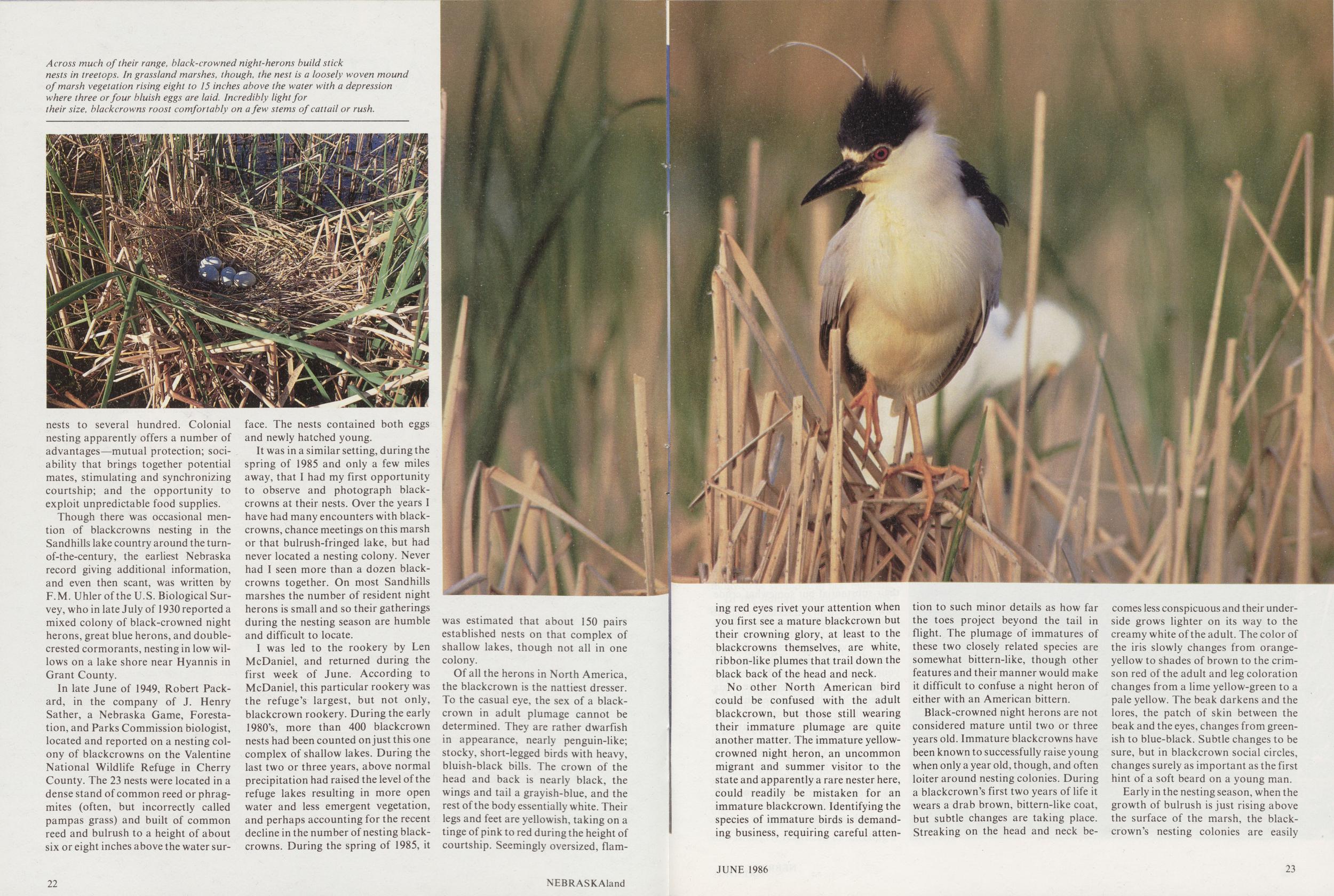
Of all the herons in North America, the blackcrown is the nattiest dresser. To the casual eye, the sex of a blackcrown in adult plumage cannot be determined. They are rather dwarfish in appearance, nearly penguin-like; stocky, short-legged birds with heavy, bluish-black bills. The crown of the head and back is nearly black, the wings and tail a grayish-blue, and the rest of the body essentially white. Their legs and feet are yellowish, taking on a tinge of pink to red during the height of courtship. Seemingly oversized, flaming 22 NEBRASKAland
No other North American bird could be confused with the adult blackcrown, but those still wearing their immature plumage are quite another matter. The immature yellow-crowned night heron, an uncommon migrant and summer visitor to the state and apparently a rare nester here, could readily be mistaken for an immature blackcrown. Identifying the species of immature birds is demanding business, requiring careful attention to such minor details as how far the toes project beyond the tail in flight. The plumage of immatures of these two closely related species are somewhat bittern-like, though other features and their manner would make it difficult to confuse a night heron of either with an American bittern.
Black-crowned night herons are not considered mature until two or three years old. Immature blackcrowns have been known to successfully raise young when only a year old, though, and often loiter around nesting colonies. During a blackcrown's first two years of life it wears a drab brown, bittern-like coat, but subtle changes are taking place. Streaking on the head and neck becomes less conspicuous and their underside grows lighter on its way to the creamy white of the adult. The color of the iris slowly changes from orangeyellow to shades of brown to the crimson red of the adult and leg coloration changes from a lime yellow-green to a pale yellow. The beak darkens and the lores, the patch of skin between the beak and the eyes, changes from greenish to blue-black. Subtle changes to be sure, but in blackcrown social circles, changes surely as important as the first hint of a soft beard on a young man.
Early in the nesting season, when the
growth of bulrush is just rising above
the surface of the marsh, the blackcrown's nesting colonies are
easily
JUNE 1986
23
Over much of its range, the blackcrown is called by the name, "quawk, or similiar variations like "woe, "quock," "guark," or "squawk." And those are only the beginning of the blackcrown's local names. In the Middle West it was once commonly called "night raven," "lake owl" or "night scrooglin." In parts of Georgia, it is appropriately identified as "red eye." Elsewhere, it goes by "Indian pullet" or "Indian hen," "gobly-gossit," "speckled heron" and "dry heron."
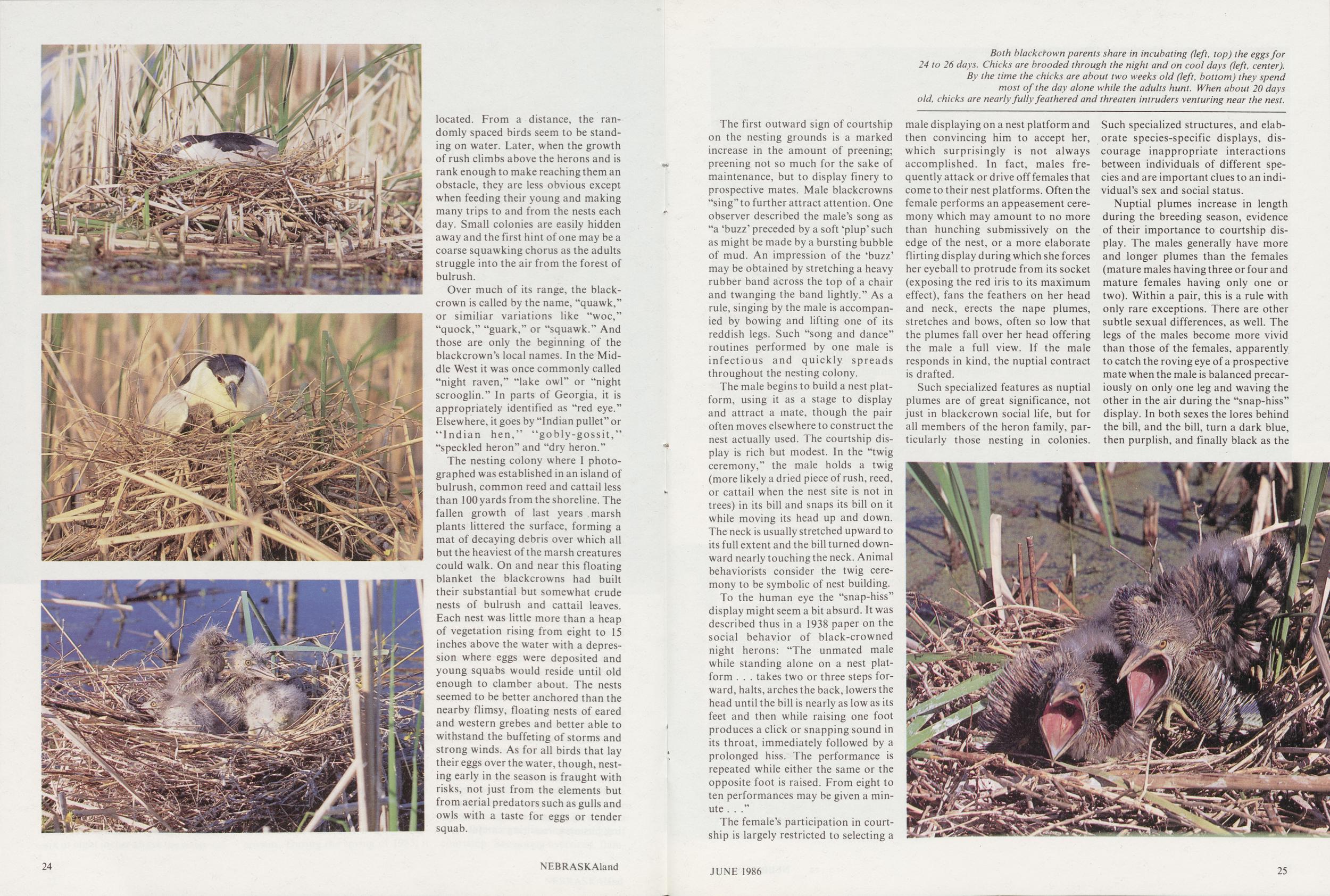
The nesting colony where I photographed was established in an island of bulrush, common reed and cattail less than 100 yards from the shoreline. The fallen growth of last years marsh plants littered the surface, forming a mat of decaying debris over which all but the heaviest of the marsh creatures could walk. On and near this floating blanket the blackcrowns had built their substantial but somewhat crude nests of bulrush and cattail leaves. Each nest was little more than a heap of vegetation rising from eight to 15 inches above the water with a depression where eggs were deposited and young squabs would reside until old enough to clamber about. The nests seemed to be better anchored than the nearby flimsy, floating nests of eared and western grebes and better able to withstand the buffeting of storms and strong winds. As for all birds that lay their eggs over the water, though, nesting early in the season is fraught with risks, not just from the elements but from aerial predators such as gulls and owls with a taste for eggs or tender squab.
24 NEBRASKAlandThe first outward sign of courtship on the nesting grounds is a marked increase in the amount of preening; preening not so much for the sake of maintenance, but to display finery to prospective mates. Male blackcrowns "sing" to further attract attention. One observer described the male's song as "a 'buzz' preceded by a soft 'plup' such as might be made by a bursting bubble of mud. An impression of the 'buzz' may be obtained by stretching a heavy rubber band across the top of a chair and twanging the band lightly." As a rule, singing by the male is accompanied by bowing and lifting one of its reddish legs. Such "song and dance" routines performed by one male is infectious and quickly spreads throughout the nesting colony.
The male begins to build a nest platform, using it as a stage to display and attract a mate, though the pair often moves elsewhere to construct the nest actually used. The courtship display is rich but modest. In the "twig ceremony," the male holds a twig (more likely a dried piece of rush, reed, or cattail when the nest site is not in trees) in its bill and snaps its bill on it while moving its head up and down. The neck is usually stretched upward to its full extent and the bill turned downward nearly touching the neck. Animal behaviorists consider the twig ceremony to be symbolic of nest building.
To the human eye the "snap-hiss" display might seem a bit absurd. It was described thus in a 1938 paper on the social behavior of black-crowned night herons: "The unmated male while standing alone on a nest platform takes two or three steps forward, halts, arches the back, lowers the head until the bill is nearly as low as its feet and then while raising one foot produces a click or snapping sound in its throat, immediately followed by a prolonged hiss. The performance is repeated while either the same or the opposite foot is raised. From eight to ten performances may be given a minute"
The female's participation in courtship is largely restricted to selecting a male displaying on a nest platform and then convincing him to accept her, which surprisingly is not always accomplished. In fact, males frequently attack or drive off females that come to their nest platforms. Often the female performs an appeasement ceremony which may amount to no more than hunching submissively on the edge of the nest, or a more elaborate flirting display during which she forces her eyeball to protrude from its socket (exposing the red iris to its maximum effect), fans the feathers on her head and neck, erects the nape plumes, stretches and bows, often so low that the plumes fall over her head offering the male a full view. If the male responds in kind, the nuptial contract is drafted.
Such specialized features as nuptial plumes are of great significance, not just in blackcrown social life, but for all members of the heron family, particularly those nesting in colonies. Such specialized structures, and elaborate species-specific displays, discourage inappropriate interactions between individuals of different species and are important clues to an individual's sex and social status.
Nuptial plumes increase in length
during the breeding season, evidence
of their importance to courtship display. The males generally have more
and longer plumes than the females
(mature males having three or four and
mature females having only one or
two). Within a pair, this is a rule with
only rare exceptions. There are other
subtle sexual differences, as well. The
legs of the males become more vivid
than those of the females, apparently
to catch the roving eye of a prospective
mate when the male is balanced precariously on only one leg and waving the
other in the air during the "snap-hiss"
display. In both sexes the lores behind
the bill, and the bill, turn a dark blue,
then purplish, and finally black as the
JUNE 1986
25
With courtship preliminaries behind them, the pair finally settles down to rearing young. Both the male and female work at constructing the nest, the male's role being largely restricted to gathering material and the female doing the actual construction. The first bluish-green egg is usually laid three to four days after the nest is completed. Subsequent eggs are laid at two day intervals (accounting for young of different size and age in the same nest) until a full clutch is down, generally three or four eggs. The male and female share equally in incubation of the eggs, as they later do in brooding the young. The changing of the guard at the nest is accomplished by a greeting ceremony that apparently confirms the identity of the mate and reaffirms the pair bond. Blackcrowns are reported to be so tenaciously attached to the nest that the incubating or brooding bird is often reluctant to be relieved of duty. The first egg laid begins to pip in 24 to 26 days. Within a nesting colony there seems to be imperfect synchronization in the time of egg laying, as some nests still hold sets of eggs while three-week-old chicks squawk and complain in neighboring nests.
Ornithologists classify young birds into two broad categories. Altricial young enter the world nearly featherless and helpless and are cared for in the nest by the parents for some time after hatching. Precocial young are fully feathered and able to leave the nest soon after hatching. In effect, altricial young are hatched ugly and helpless while precocial young are handsome and mobile. Though blackcrowns are considered "semi-altricial," that is, hatched with a downy coat but requiring prolonged care in the nest, they are inordinately ugly.
The squabs gaze at you from behind dull, yellow eyes. Their overall color is wash-water gray with tinges of festering-sore green skin showing through here and there. Their backs are nearly naked, and the rump area totally naked (a wise evolutionary choice considering the total absence of anything resembling nest sanitation); their wings stubby and pinfeathery, seemingly designed not as future flight structures but to aid one bird to pull itself across the nest over the bodies of its siblings. Their yellowish and blackish bills seem oversized, with the outer surface perpetually peeled. The legs and feet are also frightfully oversized and get in the way more than aid in locomotion. In some places they show a hint of fuzzy promise, but most of their body is covered with a sparse, matted growth only remotely resembling feathers. They look like prehistoric birds that have been plucked for eating but not yet singed. There is little endearing about a young blackcrown from the time of hatch until nearly a month old and it begins to take on its brownish, streaked, bittern-like plumage. Even then they show little promise of growing into anything resembling their dapper parents.
In their behavior, blackcrown chicks make little effort to ameliorate their repulsive image. In fact, both in appearance and temperament they seem determined to offend and repulse, perhaps a desirable survival strategy. When an intruder approaches a nest of blackcrown squabs, particularly older squabs, two or three weeks of age, they cower on the far side of the nest momentarily while they summon up the spunk to attack with spread wings, outstretched necks and a gaping, squawking, snapping bill. One of the clutch is always larger, the first hatched and from the beginning the most aggressive and successful at soliciting food from the adults. Once a chick succeeds in demanding the attention of adults at feeding time, there is little chance it will lose its dominant rank. In most cases, though, the adults are ample providers and there is adequate food for all.
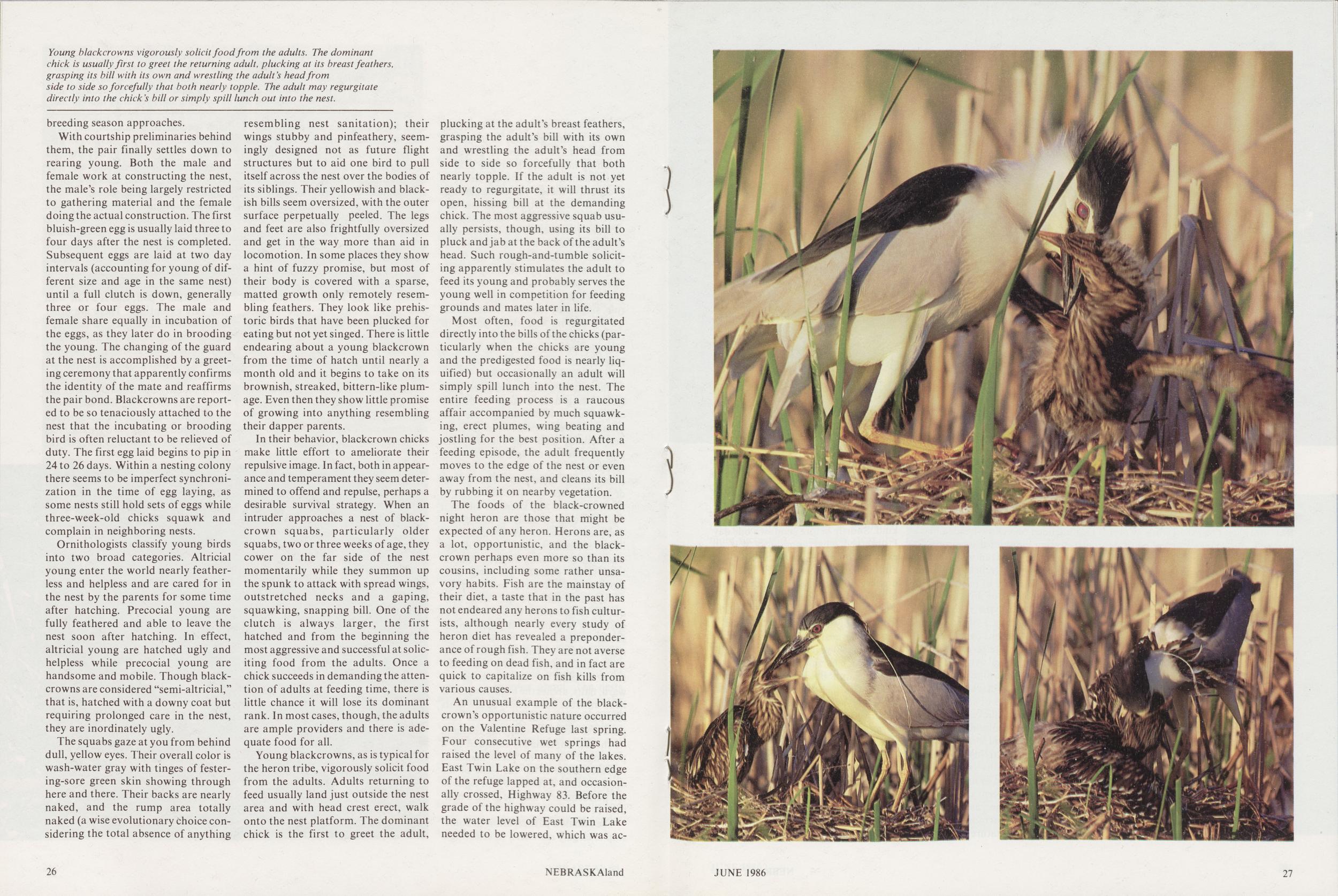
Young blackcrowns, as is typical for the heron tribe, vigorously solicit food from the adults. Adults returning to feed usually land just outside the nest area and with head crest erect, walk onto the nest platform. The dominant chick is the first to greet the adult, plucking at the adult's breast feathers, grasping the adult's bill with its own and wrestling the adult's head from side to side so forcefully that both nearly topple. If the adult is not yet ready to regurgitate, it will thrust its open, hissing bill at the demanding chick. The most aggressive squab usually persists, though, using its bill to pluck and jab at the back of the adult's head. Such rough-and-tumble soliciting apparently stimulates the adult to feed its young and probably serves the young well in competition for feeding grounds and mates later in life.
Most often, food is regurgitated directly into the bills of the chicks (particularly when the chicks are young and the predigested food is nearly liquified) but occasionally an adult will simply spill lunch into the nest. The entire feeding process is a raucous affair accompanied by much squawking, erect plumes, wing beating and jostling for the best position. After a feeding episode, the adult frequently moves to the edge of the nest or even away from the nest, and cleans its bill by rubbing it on nearby vegetation.
The foods of the black-crowned night heron are those that might be expected of any heron. Herons are, as a lot, opportunistic, and the blackcrown perhaps even more so than its cousins, including some rather unsavory habits. Fish are the mainstay of their diet, a taste that in the past has not endeared any herons to fish culturists, although nearly every study of heron diet has revealed a preponderance of rough fish. They are not averse to feeding on dead fish, and in fact are quick to capitalize on fish kills from various causes.
An unusual example of the blackcrown's opportunistic nature occurred on the Valentine Refuge last spring. Four consecutive wet springs had raised the level of many of the lakes. East Twin Lake on the southern edge of the refuge lapped at, and occasionally crossed, Highway 83. Before the grade of the highway could be raised, the water level of East Twin Lake needed to be lowered, which was accomplished 26 NEBRASKAland
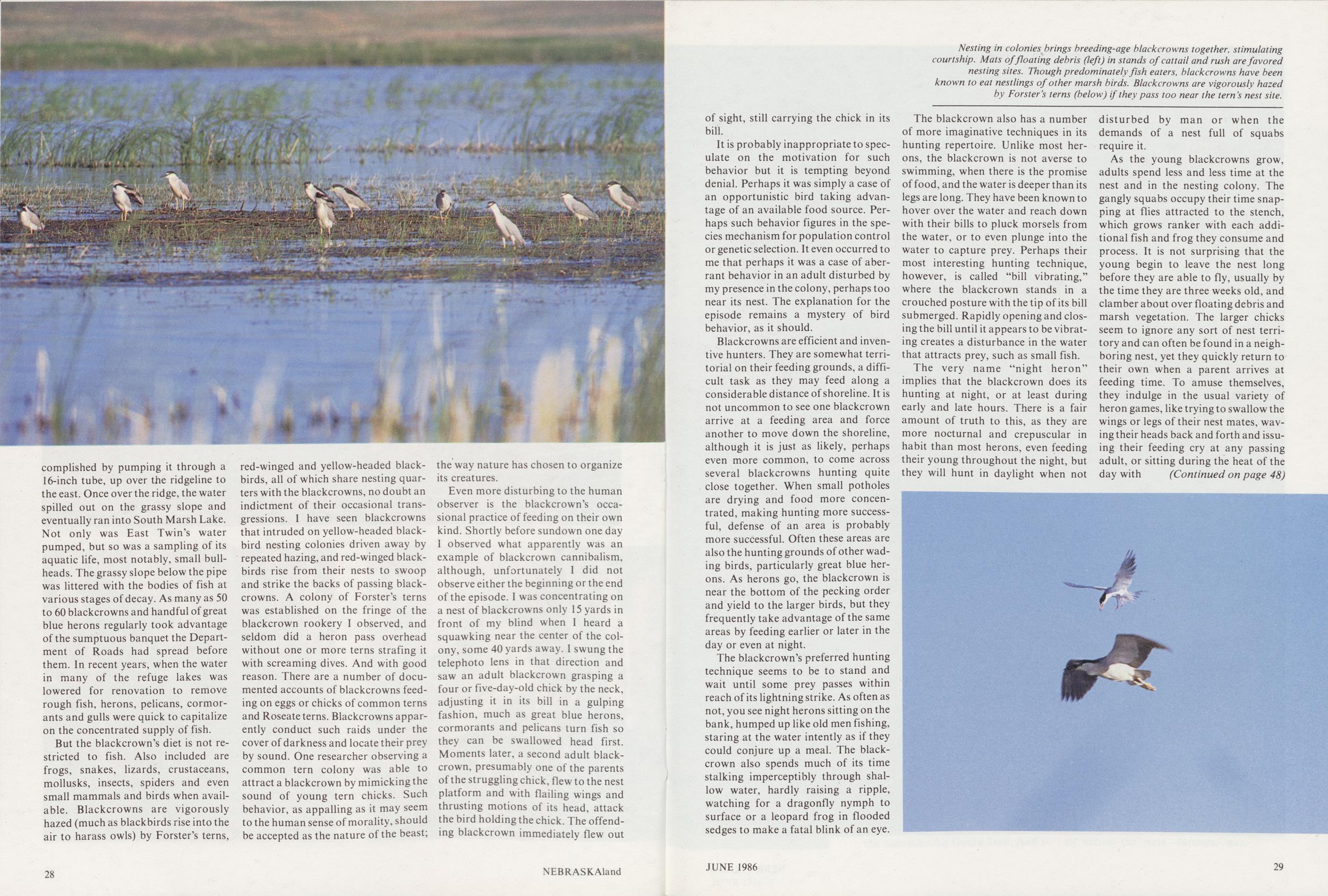
But the blackcrown's diet is not restricted to fish. Also included are frogs, snakes, lizards, crustaceans, mollusks, insects, spiders and even small mammals and birds when available. Blackcrowns are vigorously hazed (much as blackbirds rise into the air to harass owls) by Forster's terns, red-winged and yellow-headed blackbirds, all of which share nesting quarters with the blackcrowns, no doubt an indictment of their occasional transgressions. I have seen blackcrowns that intruded on yellow-headed blackbird nesting colonies driven away by repeated hazing, and red-winged blackbirds rise from their nests to swoop and strike the backs of passing blackcrowns. A colony of Forster's terns was established on the fringe of the blackcrown rookery I observed, and seldom did a heron pass overhead without one or more terns strafing it with screaming dives. And with good reason. There are a number of documented accounts of blackcrowns feeding on eggs or chicks of common terns and Roseate terns. Blackcrowns apparently conduct such raids under the cover of darkness and locate their prey by sound. One researcher observing a common tern colony was able to attract a blackcrown by mimicking the sound of young tern chicks. Such behavior, as appalling as it may seem to the human sense of morality, should be accepted as the nature of the beast; the way nature has chosen to organize its creatures.
Even more disturbing to the human observer is the blackcrown's occasional practice of feeding on their own kind. Shortly before sundown one day 1 observed what apparently was an example of blackcrown cannibalism, although, unfortunately I did not observe either the beginning or the end of the episode. I was concentrating on a nest of blackcrowns only 15 yards in front of my blind when I heard a squawking near the center of the colony, some 40 yards away. I swung the telephoto lens in that direction and saw an adult blackcrown grasping a four or five-day-old chick by the neck, adjusting it in its bill in a gulping fashion, much as great blue herons, cormorants and pelicans turn fish so they can be swallowed head first. Moments later, a second adult blackcrown, presumably one of the parents of the struggling chick, flew to the nest platform and with flailing wings and thrusting motions of its head, attack the bird holding the chick. The offending blackcrown immediately flew out 28 NEBRASKAland of sight, still carrying the chick in its bill.
It is probably inappropriate to speculate on the motivation for such behavior but it is tempting beyond denial. Perhaps it was simply a case of an opportunistic bird taking advantage of an available food source. Perhaps such behavior figures in the species mechanism for population control or genetic selection. It even occurred to me that perhaps it was a case of aberrant behavior in an adult disturbed by my presence in the colony, perhaps too near its nest. The explanation for the episode remains a mystery of bird behavior, as it should.
Blackcrowns are efficient and inventive hunters. They are somewhat territorial on their feeding grounds, a difficult task as they may feed along a considerable distance of shoreline. It is not uncommon to see one blackcrown arrive at a feeding area and force another to move down the shoreline, although it is just as likely, perhaps even more common, to come across several blackcrowns hunting quite close together. When small potholes are drying and food more concentrated, making hunting more successful, defense of an area is probably more successful. Often these areas are also the hunting grounds of other wading birds, particularly great blue herons. As herons go, the blackcrown is near the bottom of the pecking order and yield to the larger birds, but they frequently take advantage of the same areas by feeding earlier or later in the day or even at night.
The blackcrown's preferred hunting technique seems to be to stand and wait until some prey passes within reach of its lightning strike. As often as not, you see night herons sitting on the bank, humped up like old men fishing, staring at the water intently as if they could conjure up a meal. The blackcrown also spends much of its time stalking imperceptibly through shallow water, hardly raising a ripple, watching for a dragonfly nymph to surface or a leopard frog in flooded sedges to make a fatal blink of an eye.
The blackcrown also has a number of more imaginative techniques in its hunting repertoire. Unlike most herons, the blackcrown is not averse to swimming, when there is the promise of food, and the water is deeper than its legs are long. They have been known to hover over the water and reach down with their bills to pluck morsels from the water, or to even plunge into the water to capture prey. Perhaps their most interesting hunting technique, however, is called "bill vibrating," where the blackcrown stands in a crouched posture with the tip of its bill submerged. Rapidly opening and closing the bill until it appears to be vibrating creates a disturbance in the water that attracts prey, such as small fish.
The very name "night heron" implies that the blackcrown does its hunting at night, or at least during early and late hours. There is a fair amount of truth to this, as they are more nocturnal and crepuscular in habit than most herons, even feeding their young throughout the night, but they will hunt in daylight when not disturbed by man or when the demands of a nest full of squabs require it.
As the young blackcrowns grow, adults spend less and less time at the nest and in the nesting colony. The gangly squabs occupy their time snapping at flies attracted to the stench, which grows ranker with each additional fish and frog they consume and process. It is not surprising that the young begin to leave the nest long before they are able to fly, usually by the time they are three weeks old, and clamber about over floating debris and marsh vegetation. The larger chicks seem to ignore any sort of nest territory and can often be found in a neighboring nest, yet they quickly return to their own when a parent arrives at feeding time. To amuse themselves, they indulge in the usual variety of heron games, like trying to swallow the wings or legs of their nest mates, waving their heads back and forth and issuing their feeding cry at any passing adult, or sitting during the heat of the day with (Continued on page 48)
Weekend Phantoms
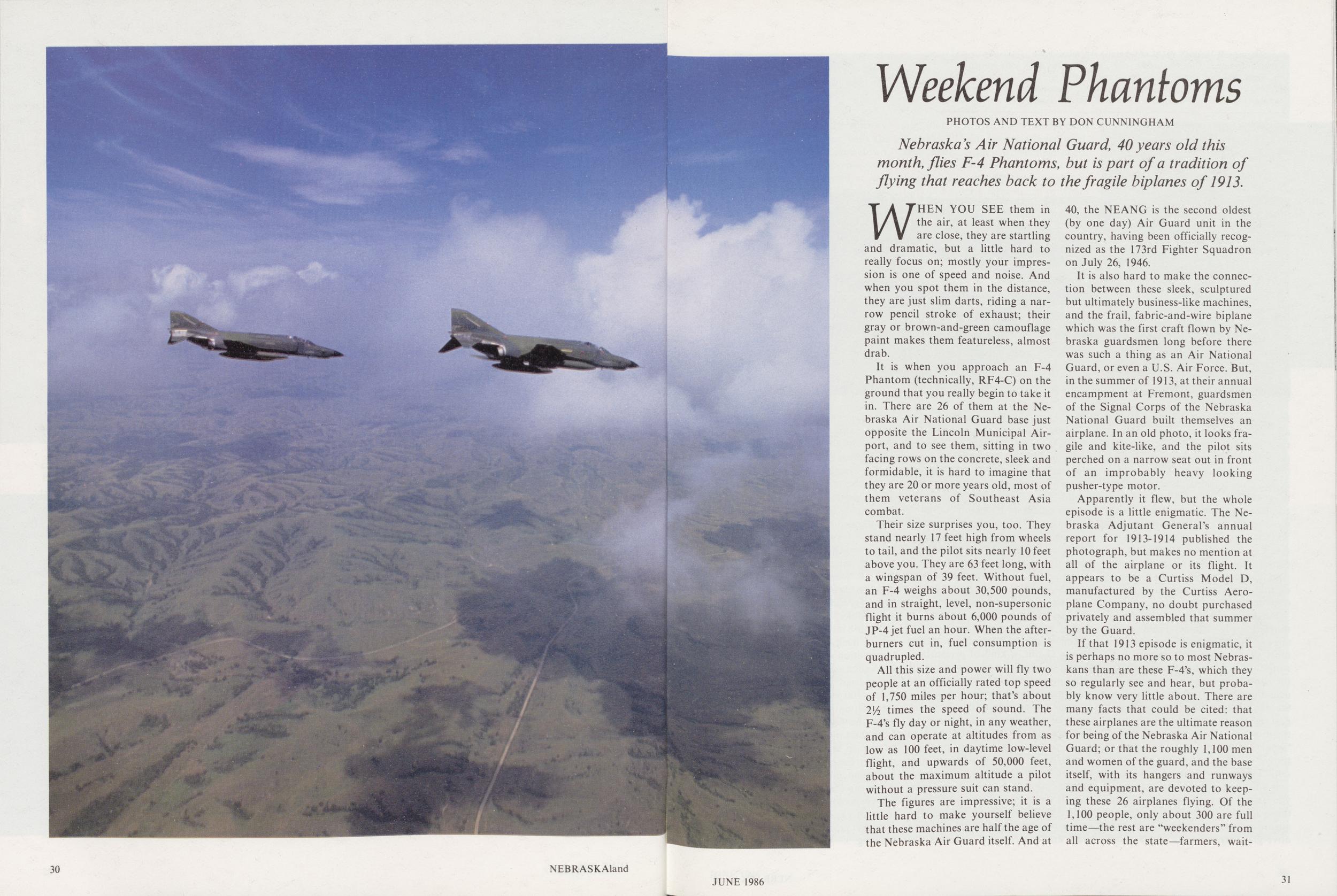
PHOTOS AND TEXT BY DON CUNNINGHAM Nebraska's Air National Guard, 40years old this month, flies F-4 Phantoms, but is part of a tradition of flying that reaches back to the fragile biplanes of 1913.WHEN YOU SEE them in the air, at least when they are close, they are startling and dramatic, but a little hard to really focus on; mostly your impression is one of speed and noise. And when you spot them in the distance, they are just slim darts, riding a narrow pencil stroke of exhaust; their gray or brown-and-green camouflage paint makes them featureless, almost drab.
It is when you approach an F-4 Phantom (technically, RF4-C) on the ground that you really begin to take it in. There are 26 of them at the Nebraska Air National Guard base just opposite the Lincoln Municipal Airport, and to see them, sitting in two facing rows on the concrete, sleek and formidable, it is hard to imagine that they are 20 or more years old, most of them veterans of Southeast Asia combat.
Their size surprises you, too. They stand nearly 17 feet high from wheels to tail, and the pilot sits nearly 10 feet above you. They are 63 feet long, with a wingspan of 39 feet. Without fuel, an F-4 weighs about 30,500 pounds, and in straight, level, non-supersonic flight it burns about 6,000 pounds of JP-4 jet fuel an hour. When the afterburners cut in, fuel consumption is quadrupled.
All this size and power will fly two people at an officially rated top speed of 1,750 miles per hour; that's about 2!/2 times the speed of sound. The F-4's fly day or night, in any weather, and can operate at altitudes from as low as 100 feet, in daytime low-level flight, and upwards of 50,000 feet, about the maximum altitude a pilot without a pressure suit can stand.
The figures are impressive; it is a little hard to make yourself believe that these machines are half the age of the Nebraska Air Guard itself. And at 40, the NEANG is the second oldest (by one day) Air Guard unit in the country, having been officially recognized as the 173rd Fighter Squadron on July 26, 1946.
It is also hard to make the connection between these sleek, sculptured but ultimately business-like machines, and the frail, fabric-and-wire biplane which was the first craft flown by Nebraska guardsmen long before there was such a thing as an Air National Guard, or even a U.S. Air Force. But, in the summer of 1913, at their annual encampment at Fremont, guardsmen of the Signal Corps of the Nebraska National Guard built themselves an airplane. In an old photo, it looks fragile and kite-like, and the pilot sits perched on a narrow seat out in front of an improbably heavy looking pusher-type motor.
Apparently it flew, but the whole episode is a little enigmatic. The Nebraska Adjutant General's annual report for 1913-1914 published the photograph, but makes no mention at all of the airplane or its flight. It appears to be a Curtiss Model D, manufactured by the Curtiss Aeroplane Company, no doubt purchased privately and assembled that summer by the Guard.
If that 1913 episode is enigmatic, it
is perhaps no more so to most Nebraskans than are these F-4's, which they
so regularly see and hear, but probably know very little about. There are
many facts that could be cited: that
these airplanes are the ultimate reason
for being of the Nebraska Air National
Guard; or that the roughly 1,100 men
and women of the guard, and the base
itself, with its hangers and runways
and equipment, are devoted to keeping these 26 airplanes flying. Of the
1,100 people, only about 300 are full
time—the rest are "weekenders" from
all across the state—farmers, waitresses,
JUNE 1986
31
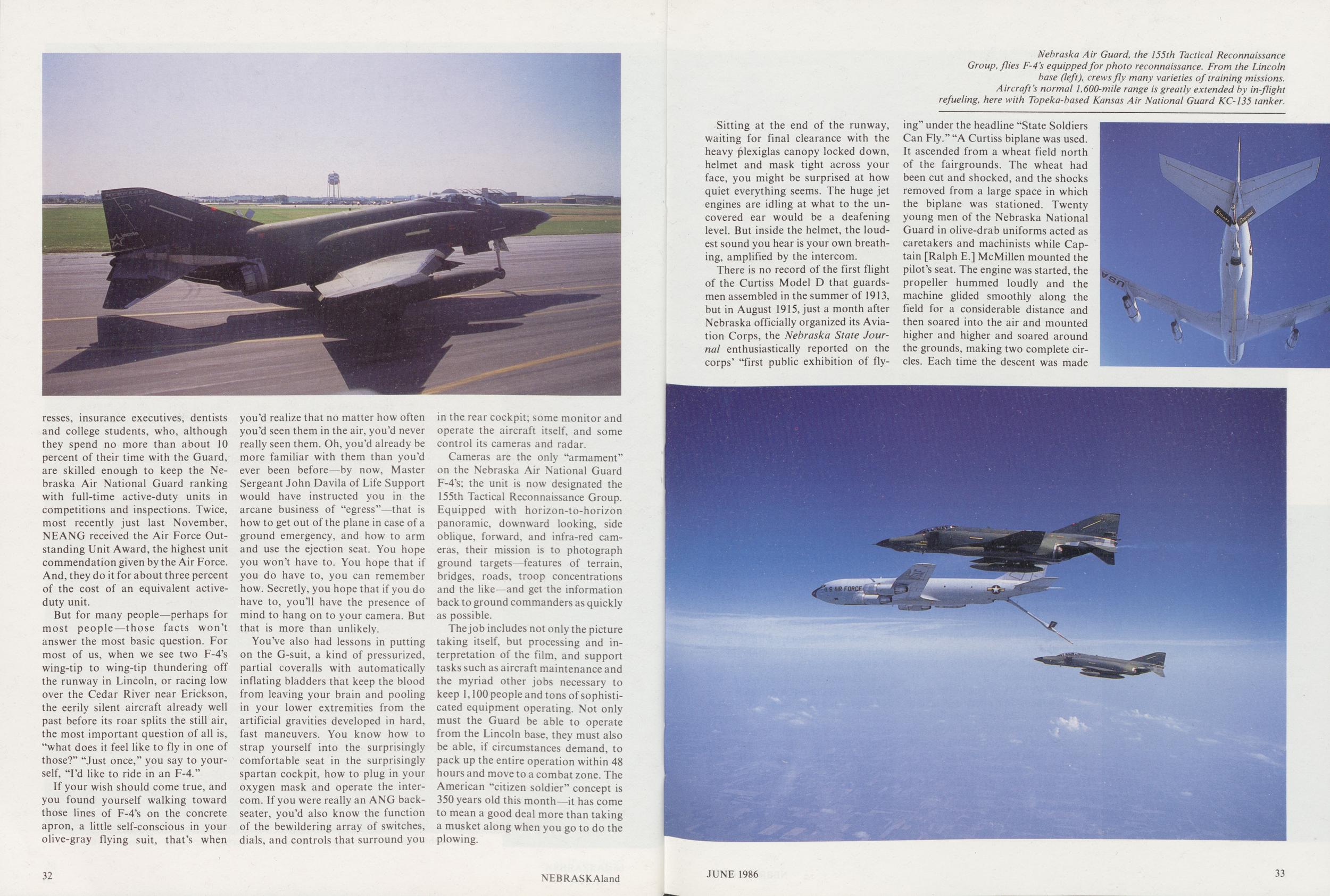
But for many people—perhaps for most people—those facts won't answer the most basic question. For most of us, when we see two F-4's wing-tip to wing-tip thundering off the runway in Lincoln, or racing low over the Cedar River near Erickson, the eerily silent aircraft already well past before its roar splits the still air, the most important question of all is, "what does it feel like to fly in one of those?" "Just once," you say to yourself, "I'd like to ride in an F-4."
If your wish should come true, and you found yourself walking toward those lines of F-4's on the concrete apron, a little self-conscious in your olive-gray flying suit, that's when you'd realize that no matter how often you'd seen them in the air, you'd never really seen them. Oh, you'd already be more familiar with them than you'd ever been before—by now, Master Sergeant John Davila of Life Support would have instructed you in the arcane business of "egress"—that is how to get out of the plane in case of a ground emergency, and how to arm and use the ejection seat. You hope you won't have to. You hope that if you do have to, you can remember how. Secretly, you hope that if you do have to, you'll have the presence of mind to hang on to your camera. But that is more than unlikely.
You've also had lessons in putting on the G-suit, a kind of pressurized, partial coveralls with automatically inflating bladders that keep the blood from leaving your brain and pooling in your lower extremities from the artificial gravities developed in hard, fast maneuvers. You know how to strap yourself into the surprisingly comfortable seat in the surprisingly spartan cockpit, how to plug in your oxygen mask and operate the intercom. If you were really an ANG backseater, you'd also know the function of the bewildering array of switches, dials, and controls that surround you in the rear cockpit; some monitor and operate the aircraft itself, and some control its cameras and radar.
Cameras are the only "armament" on the Nebraska Air National Guard F-4's; the unit is now designated the 155th Tactical Reconnaissance Group. Equipped with horizon-to-horizon panoramic, downward looking, side oblique, forward, and infra-red cameras, their mission is to photograph ground targets—features of terrain, bridges, roads, troop concentrations and the like—and get the information back to ground commanders as quickly as possible.
The job includes not only the picture taking itself, but processing and interpretation of the film, and support tasks such as aircraft maintenance and the myriad other jobs necessary to keep 1,100 people and tons of sophisticated equipment operating. Not only must the Guard be able to operate from the Lincoln base, they must also be able, if circumstances demand, to pack up the entire operation within 48 hours and move to a combat zone. The American "citizen soldier" concept is 350 years old this month—it has come to mean a good deal more than taking a musket along when you go to do the plowing.
32 NEBRASKAlandSitting at the end of the runway, waiting for final clearance with the heavy plexiglas canopy locked down, helmet and mask tight across your face, you might be surprised at how quiet everything seems. The huge jet engines are idling at what to the uncovered ear would be a deafening level. But inside the helmet, the loudest sound you hear is your own breathing, amplified by the intercom.
There is no record of the first flight of the Curtiss Model D that guardsmen assembled in the summer of 1913, but in August 1915, just a month after Nebraska officially organized its Aviation Corps, the Nebraska State Journal enthusiastically reported on the corps' "first public exhibition of flying" under the headline "State Soldiers Can Fly." "A Curtiss biplane was used. It ascended from a wheat field north of the fairgrounds. The wheat had been cut and shocked, and the shocks removed from a large space in which the biplane was stationed. Twenty young men of the Nebraska National Guard in olive-drab uniforms acted as caretakers and machinists while Captain [Ralph E.] McMillen mounted the pilot's seat. The engine was started, the propeller hummed loudly and the machine glided smoothly along the field for a considerable distance and then soared into the air and mounted higher and higher and soared around the grounds, making two complete circles. Each time the descent was made
The newspaper failed to mention a significant fact: Captain McMillen was flying his own airplane. Although Nebraska officially had an aviation section, there was no money available for an airplane. In fact, McMillen, a new member of the corps, had just increased their inventory by 100 percent. The other airplane belonged to Captain Castle W. Schaffer, the new "chief of aviation."
The F-4's don't belong to the people who fly them, but pilots and maintenance crews alike treat them like their own, lavishing care and skill on maintenance and pre-flight checks. You listened to flight leader Lieutenant David Blume methodically brief the other pilots and backseaters in the briefing room, and now, over the radio, you hear your pilot, Captain Lynn Oveson, and the men in the other two planes, Lieutenants Tom Rademacker, Gordon Kucera and Kevin Oatly, prepare for take-off.
If you're lucky, you take off in formation; it feels much like take-off in any jet aircraft: there is the familiar sense of acceleration which pushes you back against the seat, and the sudden cessation of vibration when the wheels rise off the concrete. The difference is that everything happens so much more quickly, with so much more force, and with another 15-ton F-4 right at your wingtip.
As Lincoln drops away below you, your only real point of reference is the other F-4, and its movements so accurately mirror your own that practically every sensation of movement disappears. But a heavy hand continues to push you back in your seat, a constant reminder of the power of the engines below you.
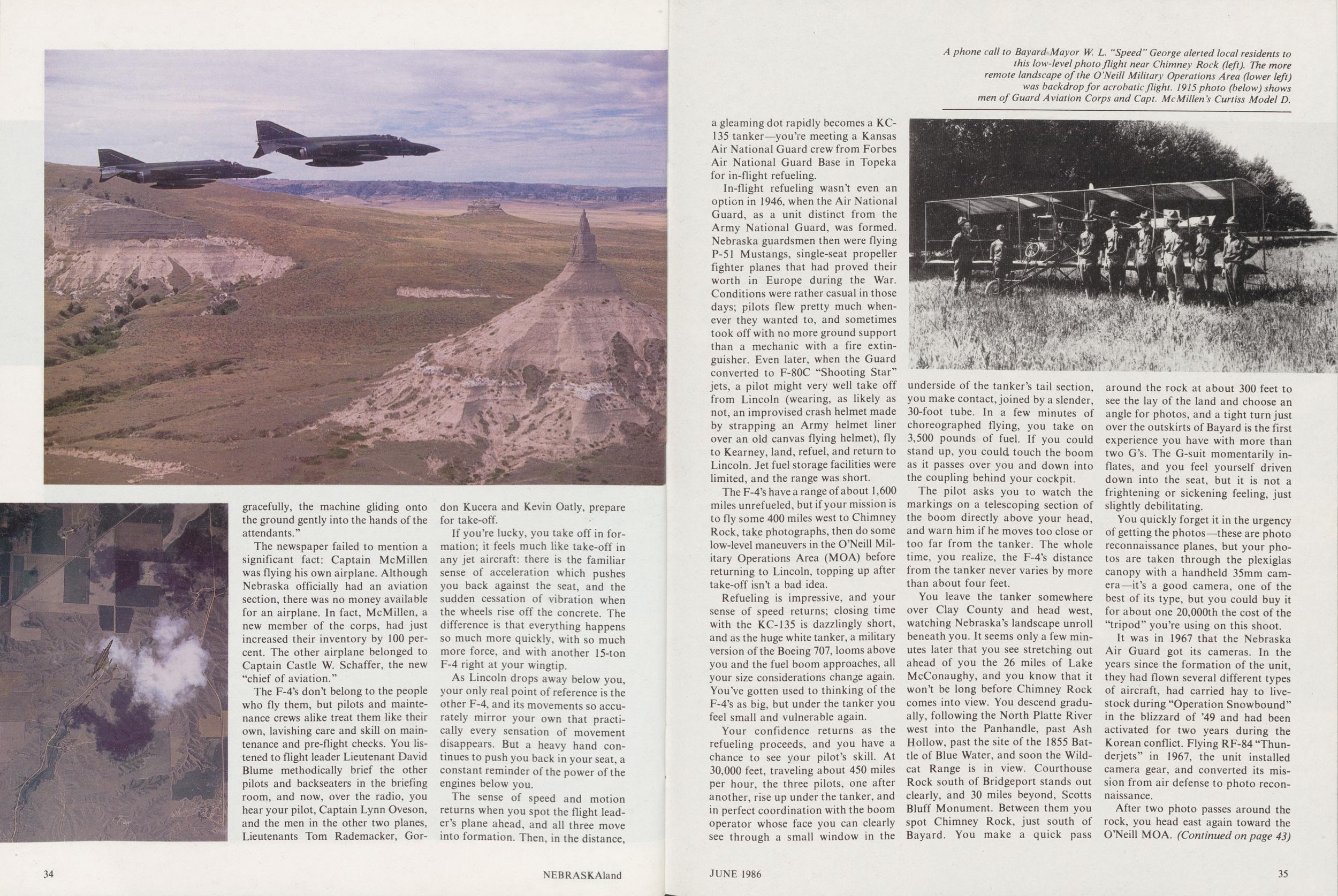
The sense of speed and motion returns when you spot the flight leader's plane ahead, and all three move into formation. Then, in the distance, 34 NEBRASKAland a gleaming dot rapidly becomes a KC 135 tanker—you're meeting a Kansas Air National Guard crew from Forbes Air National Guard Base in Topeka for in-flight refueling.
In-flight refueling wasn't even an option in 1946, when the Air National Guard, as a unit distinct from the Army National Guard, was formed. Nebraska guardsmen then were flying P-51 Mustangs, single-seat propeller fighter planes that had proved their worth in Europe during the War. Conditions were rather casual in those days; pilots flew pretty much whenever they wanted to, and sometimes took off with no more ground support than a mechanic with a fire extinguisher. Even later, when the Guard converted to F-80C "Shooting Star" jets, a pilot might very well take off from Lincoln (wearing, as likely as not, an improvised crash helmet made by strapping an Army helmet liner over an old canvas flying helmet), fly to Kearney, land, refuel, and return to Lincoln. Jet fuel storage facilities were limited, and the range was short.
The F-4's have a range of about 1,600 miles unrefueled, but if your mission is to fly some 400 miles west to Chimney Rock, take photographs, then do some low-level maneuvers in the O'Neill Military Operations Area (MOA) before returning to Lincoln, topping up after take-off isn't a bad idea.
Refueling is impressive, and your sense of speed returns; closing time with the KC-135 is dazzlingly short, and as the huge white tanker, a military version of the Boeing 707, looms above you and the fuel boom approaches, all your size considerations change again. You've gotten used to thinking of the F-4's as big, but under the tanker you feel small and vulnerable again.
Your confidence returns as the refueling proceeds, and you have a chance to see your pilot's skill. At 30,000 feet, traveling about 450 miles per hour, the three pilots, one after another, rise up under the tanker, and in perfect coordination with the boom operator whose face you can clearly see through a small window in the underside of the tanker's tail section, you make contact, joined by a slender, 30-foot tube. In a few minutes of choreographed flying, you take on 3,500 pounds of fuel. If you could stand up, you could touch the boom as it passes over you and down into the coupling behind your cockpit.
The pilot asks you to watch the markings on a telescoping section of the boom directly above your head, and warn him if he moves too close or too far from the tanker. The whole time, you realize, the F-4's distance from the tanker never varies by more than about four feet.
You leave the tanker somewhere over Clay County and head west, watching Nebraska's landscape unroll beneath you. It seems only a few minutes later that you see stretching out ahead of you the 26 miles of Lake McConaughy, and you know that it won't be long before Chimney Rock comes into view. You descend gradually, following the North Platte River west into the Panhandle, past Ash Hollow, past the site of the 1855 Battle of Blue Water, and soon the Wildcat Range is in view. Courthouse Rock south of Bridgeport stands out clearly, and 30 miles beyond, Scotts Bluff Monument. Between them you spot Chimney Rock, just south of Bayard. You make a quick pass around the rock at about 300 feet to see the lay of the land and choose an angle for photos, and a tight turn just over the outskirts of Bayard is the first experience you have with more than two G's. The G-suit momentarily inflates, and you feel yourself driven down into the seat, but it is not a frightening or sickening feeling, just slightly debilitating.
You quickly forget it in the urgency of getting the photos—these are photo reconnaissance planes, but your photos are taken through the plexiglas canopy with a handheld 35mm camera—it's a good camera, one of the best of its type, but you could buy it for about one 20,000th the cost of the "tripod" you're using on this shoot.
It was in 1967 that the Nebraska Air Guard got its cameras. In the years since the formation of the unit, they had flown several different types of aircraft, had carried hay to livestock during "Operation Snowbound" in the blizzard of '49 and had been activated for two years during the Korean conflict. Flying RF-84 "Thunderjets" in 1967, the unit installed camera gear, and converted its mission from air defense to photo reconnaissance.
After two photo passes around the rock, you head east again toward the O'Neill MOA. (Continued on page 43)
JUNE 1986 35
Pine Ridge TROUT
BY KIRK PETERS Although spring may be best, there is year-round angling in several streams and ponds in the Crawford area of Nebraska s splendorous northern Panhandle.SMALL IS BEAUTIFUL; that seems to be a popular theme in recent years for those tired of a world full of colossal corporations and pervading franchises. "Small and beautiful" may not yet be popular as a theme, but it is true in the case of some overlooked angling opportunities in northwestern Nebraska. Nestled in the Pine Ridge area are several diminutive waters that provide big sport for the dedicated trout angler.
If you're weary of long travel to crowded waters that may require specialized techniques and voluminous equipment, you could find a solution close at hand if you're from the western part of Nebraska. The White River, Soldier Creek, and Carter P. Johnson Lake, as well as other waters near Crawford, offer a variety of angling alternatives which rank right up there for challenging the fisherman. For those meeting these challenges, the results can be highly rewarding.
The Pine Ridge is split at its widest point by the White River. Credited as being one of the best trout streams in the area during the spring, the White can also provide excellent angling through much of the year. Eighteen miles of this stream are definitely trout water, and almost six of these miles are on Fort Robinson State Park land, providing public access. Of course, the turning and twisting of this small stream pack a lot of fishable water into those six miles. A thorough fisherman could spend three days on the White, not leaving the boundaries of Fort Robinson, and never fish the same water twice. The upper portion of the White River is on private property and permission to fish is a must.
Much of the stream runs through wooded lowlands and contains plenty of brushy cover, deep runs, and holes for trout to hide in. Through much of its length the White River can be spanned by a good flyrod, but may narrow to only a couple of feet in spots. This stream has a silty bottom with gravel in places. Although turbid water can be a hindrance during winter months, in early spring or after a rainstorm, throughout much of the year clear water prevails. Even in murky water trout can and do feed. Dirty water can be a double-edged sword: it may limit the range at which a fish can see your offering, but it also reduces a trout's ability to see a wading angler.
The White River offers both brown and rainbow trout, with browns being most numerous. Frequent stockings during spring and summer bolster the population, and a good carryover of fish generally occurs. These "second season" fish are a big drawing card. Fish surviving human and natural predation, low flows and high water for more than a year not only increase in size, but also in wariness. These fish can be a real challenge to anglers. Brown trout reaching 18 inches or more can test your "stream savvy" in the close quarters often encountered on the White. A cautious approach and accurate presentation are necessary to have consistent success. Living in a wild environment has turned these fish into cannibals, brawlers and survivors. They will eat anything they think is natural, and which they can catch and eat without too much effort. They are opportunistic and aggressive when unaware of a fisherman's presence. This catch-as-catch-can feeding behavior allows for a wide variety of productive fishing techniques.
Most people fishing the White River drift bait through holes, under cutbanks and logs, and down deep runs in hopes of coaxing a trout to hit. Worms, hoppers and minnows are the common fair, and this technique requires only minimal casting as one carefully slips or lobs his bait into the water above a fishy spot and lets the current take over. A long rod and a good supply of hooks and split shot fill the tackle needs for this method. A split shot or two above the hook should get the bait down to the fish. Occasionally a sucker or chub will find the bait first and raise the angler's pulse rate prematurely. Bait fishing can produce some nice catches, especially early in the season, and is a reliable method any time of year.
Although bait fishing is a standard on the White, it's not the only way to catch your supper. Both flyfishing and spinning can give good results. Both require accurate casting in confined quarters to fish over and around obstructions.
Flyfishing can be exciting anywhere, and the White River is no exception. Dry and wet flies, nymphs and streamers all have merit when fishing this small stream. Good choices in dry flies include any general patterns such as Adams, Grizzly Wulff, Mosquito, Black Gnat, and Royal Coachman. Caddis flies are prevalent, as are hoppers, ants, and crickets. Imitations of any of these should work. Streamers in combinations of brown, yellow, black and white are effective. Larger sizes have good drawing power in tinted water.
Flycasting on the White provides a special challenge. Long casts with long, fine leaders are unnecessary. A stealthy approach and short, accurate casts are the ticket. At times an angler must also make an accurate back-cast to avoid limbs, but there are portions of the creek that are fairly open and allow simpler casting.
Spinning for trout can also be productive. Spoons, spinners, and small plugs can bring hard strikes from cruiser-weight trout. Precise casting as well as cover-skimming retrieves are keys to success. Backhands, sidearm casts, underhand flips, as well as "normal" casting all belong in the angler's bag of tricks.
While the White River is fun to fish and capable of giving up nice fish, Soldier Creek is probably the favorite and most-used trout stream in the Fort Robinson area. Nestled between high, pine-covered ridges, this stream provides excellent fishing for many anglers. A gravelly bottom, clear water and grassy banks also make Soldier Creek a beautiful place to fish. But, beauty isn't all that Soldier Creek has to offer. The attraction is a good supply of pan-sized trout that can be taken through much of the year. This stream has (Continued on page 46)
JUNE 1986 37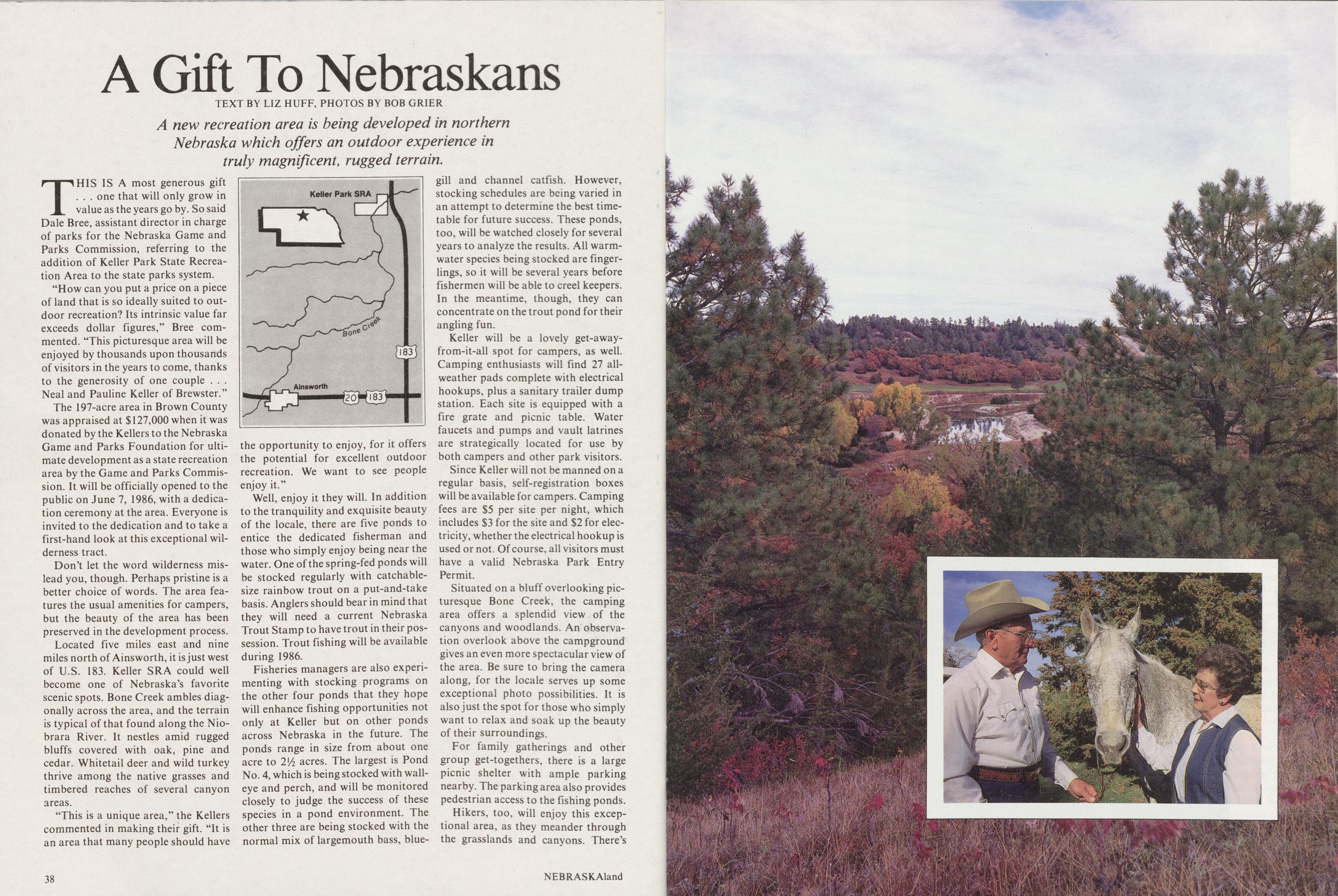
A Gift To Nebraskans
A new recreation area is being developed in northern Nebraska which offers an outdoor experience in truly magnificent, rugged terrain.
THIS IS A most generous gift . . . one that will only grow in value as the years go by. So said Dale Bree, assistant director in charge of parks for the Nebraska Game and Parks Commission, referring to the addition of Keller Park State Recreation Area to the state parks system.
“How can you put a price on a piece of land that is so ideally suited to out- door recreation? Its intrinsic value far exceeds dollar figures,” Bree commented. “This picturesque area will be enjoyed by thousands upon thousands of visitors in the years to come, thanks to the generosity of one couple . . . Neal and Pauline Keller of Brewster.”
The 197-acre area in Brown County was appraised at $127,000 when it was donated by the Kellers to the Nebraska Game and Parks Foundation for ultimate development as a state recreation area by the Game and Parks Commission. It will be officially opened to the public on June 7, 1986, with a dedication ceremony at the area. Everyone is invited to the dedication and to take a first-hand look at this exceptional wilderness tract.
Don’t let the word wilderness mislead you, though. Perhaps pristine is a better choice of words. The area features the usual amenities for campers, but the beauty of the area has been preserved in the development process.
Located five miles east and nine miles north of Ainsworth, it is just west of U.S. 183. Keller SRA could well become one of Nebraska’s favorite scenic spots. Bone Creek ambles diagonally across the area, and the terrain is typical of that found along the Niobrara River. It nestles amid rugged bluffs covered with oak, pine and cedar. Whitetail deer and wild turkey thrive among the native grasses and timbered reaches of several canyon areas.
“This is a unique area,” the Kellers commented in making their gift. “It is an area that many people should have 38 NEBRASKAland the opportunity to enjoy, for it offers the potential for excellent outdoor recreation. We want to see people enjoy it.”
Well, enjoy it they will. In addition to the tranquility and exquisite beauty of the locale, there are five ponds to entice the dedicated fisherman and those who simply enjoy being near the water. One of the spring-fed ponds will be stocked regularly with catchable- size rainbow trout on a put-and-take basis. Anglers should bear in mind that they will need a current Nebraska Trout Stamp to have trout in their possession. Trout fishing will be available during 1986. Fisheries managers are also experimenting with stocking programs on the other four ponds that they hope will enhance fishing opportunities not only at Keller but on other ponds across Nebraska in the future. The ponds range in size from about one acre to IVi acres. The largest is Pond No. 4, which is being stocked with walleye and perch, and will be monitored closely to judge the success of these species in a pond environment. The other three are being stocked with the normal mix of largemouth bass, bluegill and channel catfish. However, stocking schedules are being varied in an attempt to determine the best timetable for future success. These ponds, too, will be watched closely for several years to analyze the results. All warm- water species being stocked are fingerlings, so it will be several years before fishermen will be able to creel keepers. In the meantime, though, they can concentrate on the trout pond for their angling fun. Keller will be a lovely get-away- from-it-all spot for campers, as well. Camping enthusiasts will find 27 all- weather pads complete with electrical hookups, plus a sanitary trailer dump station. Each site is equipped with a fire grate and picnic table. Water faucets and pumps and vault latrines are strategically located for use by both campers and other park visitors. Since Keller will not be manned on a regular basis, self-registration boxes will be available for campers. Camping fees are $5 per site per night, which includes $3 for the site and $2 for electricity, whether the electrical hookup is used or not. Of course, all visitors must have a valid Nebraska Park Entry Permit. Situated on a bluff overlooking picturesque Bone Creek, the camping area offers a splendid view of the canyons and woodlands. An observation overlook above the campground gives an even more spectacular view of the area. Be sure to bring the camera along, for the locale serves up some exceptional photo possibilities. It is also just the spot for those who simply want to relax and soak up the beauty of their surroundings. For family gatherings and other group get-togethers, there is a large picnic shelter with ample parking nearby. The parking area also provides pedestrian access to the fishing ponds. Hikers, too, will enjoy this exceptional area, as they meander through the grasslands and canyons. There’s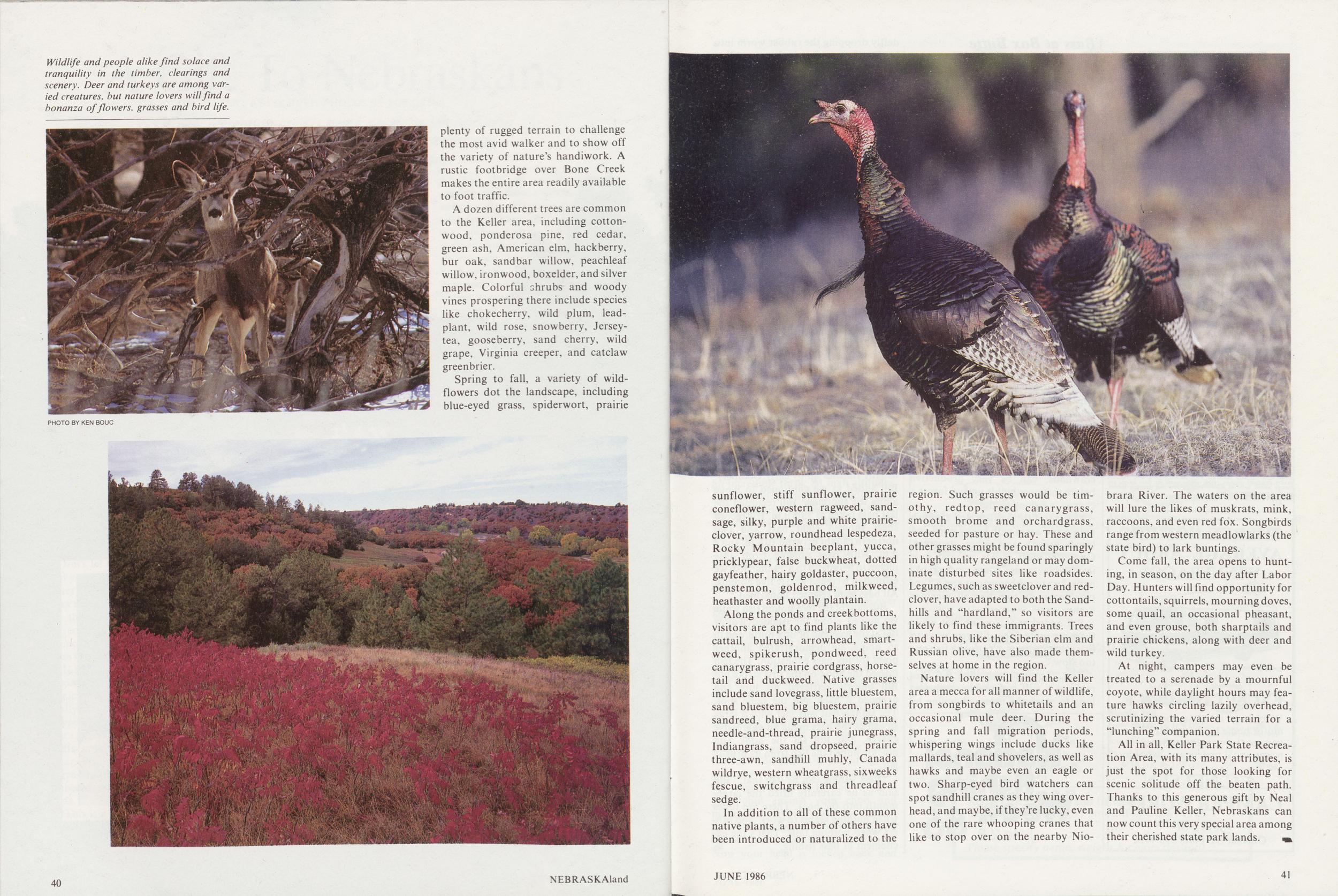
plenty of rugged terrain to challenge the most avid walker and to show off the variety of nature's handiwork. A rustic footbridge over Bone Creek makes the entire area readily available to foot traffic.
A dozen different trees are common to the Keller area, including cottonwood, ponderosa pine, red cedar, green ash, American elm, hackberry, bur oak, sandbar willow, peachleaf willow, ironwood, boxelder, and silver maple. Colorful shrubs and woody vines prospering there include species like chokecherry, wild plum, leadplant, wild rose, snowberry, Jerseytea, gooseberry, sand cherry, wild grape, Virginia creeper, and catclaw greenbrier.
Spring to fall, a variety of wildflowers dot the landscape, including blue-eyed grass, spiderwort, prairie 40 NEBRASKAland
Along the ponds and creekbottoms, visitors are apt to find plants like the cattail, bulrush, arrowhead, smartweed, spikerush, pondweed, reed canarygrass, prairie cordgrass, horsetail and duckweed. Native grasses include sand lovegrass, little bluestem, sand bluestem, big bluestem, prairie sandreed, blue grama, hairy grama, needle-and-thread, prairie junegrass, Indiangrass, sand dropseed, prairie three-awn, sandhill muhly, Canada wildrye, western wheatgrass, sixweeks fescue, switchgrass and threadleaf sedge.
In addition to all of these common native plants, a number of others have been introduced or naturalized to the region. Such grasses would be timothy, redtop, reed canarygrass, smooth brome and orchardgrass, seeded for pasture or hay. These and other grasses might be found sparingly in high quality rangeland or may dominate disturbed sites like roadsides. Legumes, such as sweetclover and redclover, have adapted to both the Sandhills and "hardland," so visitors are likely to find these immigrants. Trees and shrubs, like the Siberian elm and Russian olive, have also made themselves at home in the region.
Nature lovers will find the Keller area a mecca for all manner of wildlife, from songbirds to whitetails and an occasional mule deer. During the spring and fall migration periods, whispering wings include ducks like mallards, teal and shovelers, as well as hawks and maybe even an eagle or two. Sharp-eyed bird watchers can spot sandhill cranes as they wing overhead, and maybe, if they're lucky, even one of the rare whooping cranes that like to stop over on the nearby Niobrara River. The waters on the area will lure the likes of muskrats, mink, raccoons, and even red fox. Songbirds range from western meadlowlarks (the state bird) to lark buntings.
Come fall, the area opens to hunting, in season, on the day after Labor Day. Hunters will find opportunity for cottontails, squirrels, mourning doves, some quail, an occasional pheasant, and even grouse, both sharptails and prairie chickens, along with deer and wild turkey.
At night, campers may even be treated to a serenade by a mournful coyote, while daylight hours may feature hawks circling lazily overhead, scrutinizing the varied terrain for a "lunching" companion.
All in all, Keller Park State Recreation Area, with its many attributes, is just the spot for those looking for scenic solitude off the beaten path. Thanks to this generous gift by Neal and Pauline Keller, Nebraskans can now count this very special area among their cherished state park lands.
JUNE 1986 41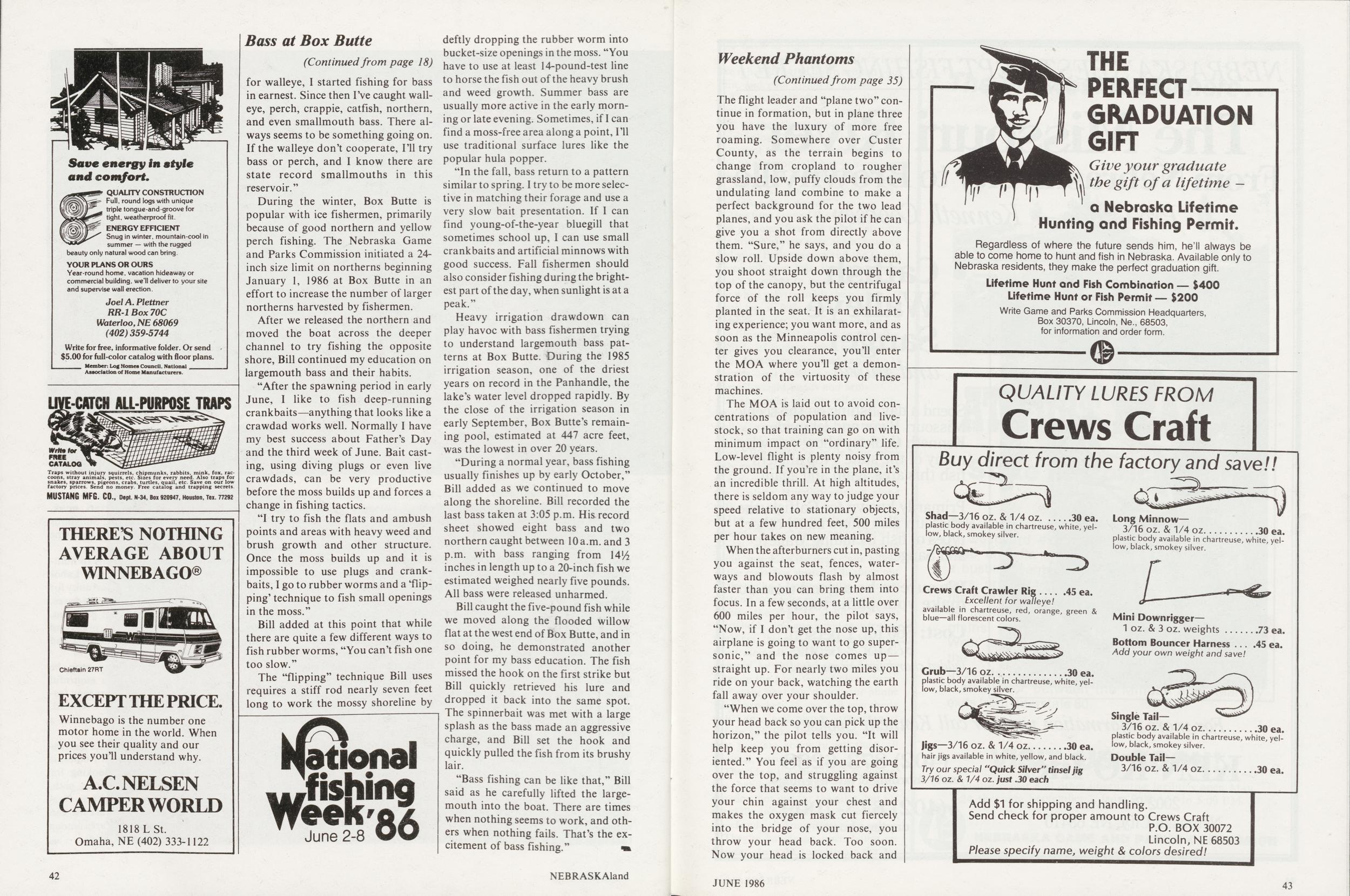 Save energy in style
and comfort.
QUALITY CONSTRUCTION
Full, round logs with unique
triple tongue-and-groove for
tight, weatherproof fit.
ENERGY EFFICIENT
Snug in winter, mountain-cool in
summer — with the rugged
beauty only natural wood can bring.
YOUR PLANS OR OURS
Year-round home, vacation hideaway or
commercial building, we'll deliver to your site
and supervise wall erection.
Joel A. Plettner
RR-1 Box 70C
Waterloo, NE 68069
(402) 359-5744
Write for free, informative folder. Or send
$5.00 for full-color catalog with floor plans.
Member: Log Homes Council. National
Association of Home Manufacturers.
CATCH ALL-PURPOSE TRAPS
Wrif
FREE
CATALOG
Traps without injury squirrels, chipmunks, rabbits, mink, fox, raccoons,
stray animals, pests, etc. Sizes for every need. Also traps for
snakes, sparrows, pigeons, crabs, turtles, quail, etc. Save on our low
factory prices. Send no money. Free catalog and trapping secrets.
MUSTANG MFG. CO., Dept. N-34, Box 920947, Houston, Tex. 77292
THERE'S NOTHING
AVERAGE ABOUT
WINNEBAGO®
Chieftain 27RT
EXCEPT THE PRICE.
Winnebago is the number one
motor home in the world. When
you see their quality and our
prices you'll understand why.
A.C.NELSEN
CAMPER WORLD
1818 L St.
Omaha, NE (402) 333-1122
Save energy in style
and comfort.
QUALITY CONSTRUCTION
Full, round logs with unique
triple tongue-and-groove for
tight, weatherproof fit.
ENERGY EFFICIENT
Snug in winter, mountain-cool in
summer — with the rugged
beauty only natural wood can bring.
YOUR PLANS OR OURS
Year-round home, vacation hideaway or
commercial building, we'll deliver to your site
and supervise wall erection.
Joel A. Plettner
RR-1 Box 70C
Waterloo, NE 68069
(402) 359-5744
Write for free, informative folder. Or send
$5.00 for full-color catalog with floor plans.
Member: Log Homes Council. National
Association of Home Manufacturers.
CATCH ALL-PURPOSE TRAPS
Wrif
FREE
CATALOG
Traps without injury squirrels, chipmunks, rabbits, mink, fox, raccoons,
stray animals, pests, etc. Sizes for every need. Also traps for
snakes, sparrows, pigeons, crabs, turtles, quail, etc. Save on our low
factory prices. Send no money. Free catalog and trapping secrets.
MUSTANG MFG. CO., Dept. N-34, Box 920947, Houston, Tex. 77292
THERE'S NOTHING
AVERAGE ABOUT
WINNEBAGO®
Chieftain 27RT
EXCEPT THE PRICE.
Winnebago is the number one
motor home in the world. When
you see their quality and our
prices you'll understand why.
A.C.NELSEN
CAMPER WORLD
1818 L St.
Omaha, NE (402) 333-1122
Bass at Box Butte
(Continued from page 18)for walleye, I started fishing for bass in earnest. Since then I've caught walleye, perch, crappie, catfish, northern, and even smallmouth bass. There always seems to be something going on. If the walleye don't cooperate, I'll try bass or perch, and I know there are state record smallmouths in this reservoir."
During the winter, Box Butte is popular with ice fishermen, primarily because of good northern and yellow perch fishing. The Nebraska Game and Parks Commission initiated a 24-inch size limit on northerns beginning January 1, 1986 at Box Butte in an effort to increase the number of larger northerns harvested by fishermen.
After we released the northern and moved the boat across the deeper channel to try fishing the opposite shore, Bill continued my education on largemouth bass and their habits.
"After the spawning period in early June, I like to fish deep-running crankbaits—anything that looks like a crawdad works well. Normally I have my best success about Father's Day and the third week of June. Bait casting, using diving plugs or even live crawdads, can be very productive before the moss builds up and forces a change in fishing tactics.
"I try to fish the flats and ambush points and areas with heavy weed and brush growth and other structure. Once the moss builds up and it is impossible to use plugs and crank- baits, I go to rubber worms and a 'flipping' technique to fish small openings in the moss."
Bill added at this point that while there are quite a few different ways to fish rubber worms, "You can't fish one too slow."
The "flipping" technique Bill uses requires a stiff rod nearly seven feet long to work the mossy shoreline by deftly dropping the rubber worm into bucket-size openings in the moss. "You have to use at least 14-pound-test line to horse the fish out of the heavy brush and weed growth. Summer bass are usually more active in the early morning or late evening. Sometimes, if I can find a moss-free area along a point, I'll use traditional surface lures like the popular hula popper.
National fishing Week '86 June 2-8 OO"In the fall, bass return to a pattern similar to spring. I try to be more selective in matching their forage and use a very slow bait presentation. If I can find young-of-the-year bluegill that sometimes school up, I can use small crankbaits and artificial minnows with good success. Fall fishermen should also consider fishing during the brightest part of the day, when sunlight is at a peak."
Heavy irrigation drawdown can play havoc with bass fishermen trying to understand largemouth bass patterns at Box Butte. During the 1985 irrigation season, one of the driest years on record in the Panhandle, the lake's water level dropped rapidly. By the close of the irrigation season in early September, Box Butte's remaining pool, estimated at 447 acre feet, was the lowest in over 20 years.
"During a normal year, bass fishing usually finishes up by early October," Bill added as we continued to move along the shoreline. Bill recorded the last bass taken at 3:05 p.m. His record sheet showed eight bass and two northern caught between 10 a.m. and 3 p.m. with bass ranging from W/i inches in length up to a 20-inch fish we estimated weighed nearly five pounds. All bass were released unharmed.
Bill caught the five-pound fish while we moved along the flooded willow flat at the west end of Box Butte, and in so doing, he demonstrated another point for my bass education. The fish missed the hook on the first strike but Bill quickly retrieved his lure and dropped it back into the same spot. The spinnerbait was met with a large splash as the bass made an aggressive charge, and Bill set the hook and quickly pulled the fish from its brushy lair.
"Bass fishing can be like that," Bill said as he carefully lifted the largemouth into the boat. There are times when nothing seems to work, and others when nothing fails. That's the excitement of bass fishing."
42 NEBRASKAlandWeekend Phantoms
(Continued from page 35)The flight leader and "plane two" continue in formation, but in plane three you have the luxury of more free roaming. Somewhere over Custer County, as the terrain begins to change from cropland to rougher grassland, low, puffy clouds from the undulating land combine to make a perfect background for the two lead planes, and you ask the pilot if he can give you a shot from directly above them. "Sure," he says, and you do a slow roll. Upside down above them, you shoot straight down through the top of the canopy, but the centrifugal force of the roll keeps you firmly planted in the seat. It is an exhilarating experience; you want more, and as soon as the Minneapolis control center gives you clearance, you'll enter the MOA where you'll get a demonstration of the virtuosity of these machines.
The MOA is laid out to avoid concentrations of population and livestock, so that training can go on with minimum impact on "ordinary" life. Low-level flight is plenty noisy from the ground. If you're in the plane, it's an incredible thrill. At high altitudes, there is seldom any way to judge your speed relative to stationary objects, but at a few hundred feet, 500 miles per hour takes on new meaning.
When the afterburners cut in, pasting you against the seat, fences, waterways and blowouts flash by almost faster than you can bring them into focus. In a few seconds, at a little over 600 miles per hour, the pilot says, "Now, if I don't get the nose up, this airplane is going to want to go supersonic," and the nose comes up — straight up. For nearly two miles you ride on your back, watching the earth fall away over your shoulder.
"When we come over the top, throw your head back so you can pick up the horizon," the pilot tells you. "It will help keep you from getting disoriented." You feel as if you are going over the top, and struggling against the force that seems to want to drive your chin against your chest and makes the oxygen mask cut fiercely into the bridge of your nose, you throw your head back. Too soon. Now your head is locked back and you have to fight it back down to normal. The flesh on your face feels like it has all oozed down around your chin, and your vision is blurred.
THE PERFECT GRADUATION GIFT Give your graduate the gift of a lifetime a Nebraska Lifetime Hunting and Fishing Permit. Regardless of where the future sends him, he'll always be able to come home to hunt and fish in Nebraska. Available only to Nebraska residents, they make the perfect graduation gift. Lifetime Hunt and Fish Combination — $400 Lifetime Hunt or Fish Permit — $200 Write Game and Parks Commission Headquarters, Box 30370, Lincoln, Ne., 68503, for information and order form. QUALITY LURES FROM Crews Craft Buy direct from the factory and save!! Shad—3/16 oz. & 1/4 oz 30 ea. plastic body available in chartreuse, white, yellow, black, smokey silver. Long Minnow— 3/16 oz. & 1/4 oz 30 ea. plastic body available in chartreuse, white, yellow, black, smokey silver. Crews Craft Crawler Rig 45 ea. Excellent for walleye! available in chartreuse, red, orange, green & blue—all florescent colors. Mini Downrigger 1 oz. & 3 oz. weights Bottom Bouncer Harness Add your own weight and save! .73 ea. .45 ea. Grub—3/16 oz 30 ea. plastic body available in chartreuse, white, yeliow, black, smokey silver. Jigs—3/16 oz. & 1/4 oz 30 ea. hair jigs available in white, yellow, and black. Try our special "Quick Silver" tinsel jig 3/16 oz. & 1/4 oz. just 30 each Single Tail— 3/16 oz. & 1/4 oz 30 ea. plastic body available in chartreuse, white, yellow, black, smokey silver. Double Tail— 3/16 oz. & 1/4 oz 30 ea. Add $1 for shipping and handling. Send check for proper amount to Crews Craft P.O. BOX 30072 Lincoln, NE 68503 Please specify name, weight & colors desired! JUNE 1986 43 NEBRASKA'S BEST KEPT FISHING SECRET
The Missouri River
From Nebraska City to Brownville
Pro Guide — Kenneth Cooksey
Catfish
Walleye
Sauger
and more!
Spend a day fishing on the scenic
Missouri River and let guide
Kenneth Cooksey show you why
many of the state's top anglers
fish this area again and again.
Primarily known for Catfish, the
Missouri also offers many other
types of fish including Walleye
and Sauger.
It's sure to be a good time so
make your plans today!
Cost: $60 for 1 person,
$75 for 2 people
(added charge for bait and fuel)
For more information write or call Kenneth Cooksey
KEN KO Inc
2002 2nd Ave.
Nebraska City, NE 68410
(402) 873-6288
early morning & late evenings
(402) 873-7009
daytime hours
44
NEBRASKAland
NEBRASKA'S BEST KEPT FISHING SECRET
The Missouri River
From Nebraska City to Brownville
Pro Guide — Kenneth Cooksey
Catfish
Walleye
Sauger
and more!
Spend a day fishing on the scenic
Missouri River and let guide
Kenneth Cooksey show you why
many of the state's top anglers
fish this area again and again.
Primarily known for Catfish, the
Missouri also offers many other
types of fish including Walleye
and Sauger.
It's sure to be a good time so
make your plans today!
Cost: $60 for 1 person,
$75 for 2 people
(added charge for bait and fuel)
For more information write or call Kenneth Cooksey
KEN KO Inc
2002 2nd Ave.
Nebraska City, NE 68410
(402) 873-6288
early morning & late evenings
(402) 873-7009
daytime hours
44
NEBRASKAland
And then you do go over the top, upside down, and look down, incredibly, on the other two planes a mile or more below. You finish the loop, and you want to shout something absurd, like "Yaaahooooo!" but you practice restraint, and when the pilot asks if you're O.K., you say "Yeah, great. Could we do it again?"
This time around the G-meter registers just over five; the mask cuts into the bridge of your nose again, you can feel your flesh sagging and the G-suit squeezing your legs. It occurs to you that you ought to be taking pictures, but when you try to lift the camera off your lap it feels as if it weighs 30 pounds. Later, you figure it out: at five times normal gravity, roughly five pounds of camera, lens, motor drive and batteries weighed about 25 pounds—not counting your five-times-normal-weight hands and arms.
In the midst of your self-congratulations for not getting sick, it suddenly occurs to you that the guy in the front seat is not only not getting sick, he's at work. While you're back here mentally yaahoo-ing, but virtually unable to move a muscle, he's up front flying the airplane. Humility returns, along with respect.
The rest of the trip is over in an instant. Before you really know it you're on the runway in Lincoln again, watching the drag chute billow in the rear-view mirror. Climbing out of the cockpit, you're a little surprised that no one else seems to have to repress the urge to shout and turn cartwheels, and again you realize that for them, this was a more-or-less routine training flight, made only slightly unusual by the presence of a hitchhiker in the back seat of plane three.
For the next few days, your phone bill skyrockets as you call everybody you know, and people at work part before you like the Red Sea in fear that you are about to tell them all about it, again.
The ride is the chief thrill, of course, but behind the thrill, the respect remains; not just for the pilot, but for the skills and professionalism all these "weekenders" demonstrated to you.
They're having an open house on Sunday, June 29, to celebrate the Air Guard's 40th birthday, and the 350th anniversary of the National Guard. The public is invited to see the F-4's and aircraft of many other types closeup—and to see the Thunderbirds, the U.S. Air Force precision flying team. They will be flying F-16's, a new generation of high-performance jets whose characteristics you can only guess at. Secretly, though, you think maybe you know just a little of what it must feel like to "just once, ride in one of those."
The old west is still here. ST FORT KEARNY State Historical Park This historic Army post was an important factor in westward expansion. From its inception in 1848 until its closure in 1871, Fort Kearny was a bustling center of activity for overland passengers, prospectors, farmers and emigrants making the trek west. Now a state historical park, it serves as testimony to the pioneers who crossed the plains. Imagine life as it was in the American West as you follow walkways in the shadow of the restored stockade and across the old parade grounds. Fort Kearny is located south of the Platte River between the Minden and Kearney exits from Interstate 80. VISIT US S It Visitor center and other interpretive facilities open May 24 through September 1, from 9:00 AM to 5:00 PM. NEBRASKA GAME AND PARKS COMMISSION JUNE 1986 45 BE SMART
Take a
Boating Course!
National
Saf a Boating
Wee*
JUNE 1-7,1986
For information contact
Game and Parks Commission
Box 30370, Lincoln, NE 68503
(402) 464-0641
CATCH THE
GOOD LIFE
Name
Address
7985
NEBRASKA
WILDLIFE
SOCIETY
PRINT
RED-TAILED HAWK
by D.H.Westerholt
Individually signed and
numbered limited edition
prints (100). Printed on
premium 100% cotton
paper, with an image size
of 8" x 11" and overall
size of 11" x 14".
Only $15,
Plus $2.50 postage
and handling
City
State
Zip
Qty 1985 Nebraska Wildlife Society Print
Price $15 plus 2.50 postage and handling
Send Order and
Payment to:
The Nebraska
Wildlife Society
P.O. Box 61
Ceresco,NE68017
BE SMART
Take a
Boating Course!
National
Saf a Boating
Wee*
JUNE 1-7,1986
For information contact
Game and Parks Commission
Box 30370, Lincoln, NE 68503
(402) 464-0641
CATCH THE
GOOD LIFE
Name
Address
7985
NEBRASKA
WILDLIFE
SOCIETY
PRINT
RED-TAILED HAWK
by D.H.Westerholt
Individually signed and
numbered limited edition
prints (100). Printed on
premium 100% cotton
paper, with an image size
of 8" x 11" and overall
size of 11" x 14".
Only $15,
Plus $2.50 postage
and handling
City
State
Zip
Qty 1985 Nebraska Wildlife Society Print
Price $15 plus 2.50 postage and handling
Send Order and
Payment to:
The Nebraska
Wildlife Society
P.O. Box 61
Ceresco,NE68017
Pine Ridge Trout
(Continued from page 37)excellent public access with easy-going terrain which invites fishermen regardless of age or physical condition. The trout water of this stream begins in two tributaries, the Middle and South forks, on the Forest Service Wood Reserve approximately six miles west of Fort Robinson State Park. While the South Fork affords some angling, it depends largely on stocked fish from Crawford Fish Hatchery. The Middle Fork contains the best trout water and provides the most consistent action. Although occasionally stained by runoff, Soldier Creek quickly regains its clarity. This can be an ace-in-the-hole should the angler find other area streams hit by longer-lasting turbidity. This small creek averages only one or two yards in width, so a stealthy approach is necessary. Fish in Soldier Creek generally run about nine inches in length with an occasional 15-incher.
As with the White River, bait-fishing is the most common angling method. Worms, hoppers and minnows all account for a share of the fish. Drifting bait into holes or brushpiles often produces trout for the skillet.
Spinning is not commonly practiced on Soldier Creek. This method can produce good results, however. Very small, minnow-imitating plugs can be fished over and around stream obstructions. Lightweight spinners can also be productive. The light lures and clear water almost demand the use of ultralight equipment. An angler must fish fearlessly and allow his lure to pass very close to snags if he is to tempt a trout into striking. Because of this, the fisherman often gets only one chance to draw a fish from cover before a snagged lure spooks the quarry, so pinpoint accuracy is necessary. An angler willing to ease along Soldier Creek can find a unique brand of spin-fishing as well as catch a tasty breakfast.
For the flyfisherman, Soldier Creek presents an interesting challenge. Generally the fly, wet or dry, must be precisely placed, be allowed to drift a few feet, then carefully lifted for another cast. Often, little if any of the flyline reaches the water and occasionally most of the leader is lying on the bank. Only the fly and a few feet of tippet are actually in the creek. Sound tough? It may be a little sticky, but with a little practice it can be done consistently. The trout in Soldier Creek rise eagerly to flies, and any general pattern is good. Although this stream requires accuracy in casting, it provides the angler with plenty of excitement that is well worth the effort.
Both the White River and Soldier Creek require confined, precise fishing, but not all the trout water in the Fort Robinson area is so compact. If an angler wants to uncork some long casts with a flyrod, or zing a spoon or spinner as far as he can, Carter P. Johnson Reservoir on Soldier Creek 46 NEBRASKAland is just the place. Regularly stocked with rainbow trout, this lake lets an angler work on his casting form, check out equipment, or just relax and catch a few flashy rainbows. Some brown trout also leave the creek and take up residence in the lake, adding variety to the creel. Any bait or lure used for stream fishing will also produce in Carter P. Johnson. This is also a good spot to take a budding angler just learning the basics of fishing or casting. Some of the fish in the lake feed on crayfish, giving their tasty flesh an orange or pink color.
Other fishing opportunities in the Fort Robinson area include Hat, Sowbelly, and Deadman creeks. These are all on private property and require permission to fish. Monroe Creek has good public access and contains brook trout and a few browns. The Niobrara River has some good trout water south of Harrison, with browns the predominant gamefish. Most access to the river depends on landowner permission.
All of these streams in the Pine Ridge provide exciting angling and their own "twist" to test the angler's skill with an interesting spectrum of challenges. With this range of options, it's easy to find the type of fishing that appeals to you.
Fort Robinson is an excellent headquarters for the Pine Ridge trout fisherman. Lodging, camping, and many activities are available. Horseback riding, plays, crafts, museums, scenic and historical sites, as well as tennis and swimming are among options available to those wanting to take a break from angling. These pastimes may also appeal to nonfishing companions, making this a great spot to take the entire family.
Nebraska's Pine Ridge has something special for everyone. The scenery is fantastic and the history intriguing. Fort Robinson offers recreational activities that anyone can enjoy. Last but not least, lakes and streams in the area provide quality fishing, making this a "must do" trip for Nebraska anglers.
Take a Kid Fishing WELCOME to Merritt Dam Trading Post Located on beautiful Merritt Reservoir 26 Miles So. Of Valentine On Hwy. 97 Phone 402/376-3437 Bait • Tackle • Ammunition • Groceries • Gas • Beer • Ice Year-round Modern Cabins with Kitchen Facilities Campground Hook-ups • Boat and Motor Rental • Professional Guide Service Easv-access dock • Omen year around Home of the State Record Perch, Muskellunge, Smallmouth Bass and Channel Catfish Your Hosts Jon and Marian Davenport BERGMANS RESORT On Beautiful Johnson Lake Lakefront Cabins* RV Hookups Groceries* Beer* Bait* Tackle Restaurant* Lounge* Boat Rentals* Guide Service. Fish* Swim* Golf Elmer and Janet Bergman RR 2, Elwood, NE 68937 (308) 785-2298 OFFERS A COMPLETE TRAINING PROGRAM For Retrievers, Pointers, Spaniels Basic Obedience Program For All Breeds Field Trial Bloodline Lab Pups For Sale JOHN HONORE Manager and Trainer West Highway 30 RR 1 Box 433 Grand Island, NE 68801 Phone: (308) 384-1517 DON'T JUST FISH AROUND FOR A VACATION SPOT, LAKEVIEW OFFERS YOU EVERYTHING. on Lake McConaughy • MARINA Air-conditioned units, cooking facilities. • campground Up to four adults. Campground on the • guide service beach—50 hookups, showers, playground, shade. • LAUNCHING STORE Groceries, Beer, Pop, Tackle, Live Bait • BOAT & PONTOON RENTALS South Shore Big Mac at Gate 18 Rural Route Brule, NE 69127 Ogallala, NE (308) 284-4965 JUNE 1986 47 Rustic living with modern design
FOUR SEASONS
LOG HOMES
Choose from our broad range of plans, or
style and design your own home.
You are welcome to tour our show-home
at Lakeview, Lake McConaughy anytime.
Four Seasons' log profile.
The exclusive doublelog wall system consists
of two thick pine-log
exterior walls with insulation in between
walls—R-20 roof—R-35.
the
people
For information contact:
FOUR SEASONS LOG HOMES
P.O. Box 221
Ogallala, NE 69153
(308) 284-4344
Harlan County Dam
Vacation Apartments - fully furnished
Color TV • Kitchen Facilities • Full Baths
Game cleaning room with freezer
One block from shopping center
Weekend or week of pleasant living
Security Deposit Required
Sorry —No Pets
Dean and Esther Stone
Box 145 Ph. (308) 799-3422
Republican City, NE 68971
STOCK YOUR LAKE
OR POND WITH
Channel cat, Bluegill,
Largemouth Bass,
Hybrid Bluegill,
Crappie, Triploid Grass
Carp, Minnows
ORDER NOW
WILLOW LAKE FISH HATCHERY
Rt. 3, Box 46, Hastings, Nebr. 68901
Gaylord L. Crawford
Phone: (402) 463-8022
Day or Night
For April to October 15 stocking
THE ADMIRAL'S COVE
EXIT 6 ON THE NORTH SIDE
VISIT THE
AbmffilS QflLLEY
RESTAURANT
YOUR FAVORITE COCKTAILS • FANCY LARGE SALAD BAR
TROPHY STRIPERS ON DISPLAY
CLOSE TO WATER
Located on the north shore of
Lake McConaughy, 7 miles
west of dam
SERVICES
Tackle, Bait, Gas, Oil,
Ice, Beer, Pop, etc.
Ph: 308-355-2102
• MOTEL
Lake McConaughy's largest motel
and apartment complex
includes new units
• BOAT AND MOTOR RENTAL
• GUIDE SERVICE
Lemoyne, Ne 69146
Rustic living with modern design
FOUR SEASONS
LOG HOMES
Choose from our broad range of plans, or
style and design your own home.
You are welcome to tour our show-home
at Lakeview, Lake McConaughy anytime.
Four Seasons' log profile.
The exclusive doublelog wall system consists
of two thick pine-log
exterior walls with insulation in between
walls—R-20 roof—R-35.
the
people
For information contact:
FOUR SEASONS LOG HOMES
P.O. Box 221
Ogallala, NE 69153
(308) 284-4344
Harlan County Dam
Vacation Apartments - fully furnished
Color TV • Kitchen Facilities • Full Baths
Game cleaning room with freezer
One block from shopping center
Weekend or week of pleasant living
Security Deposit Required
Sorry —No Pets
Dean and Esther Stone
Box 145 Ph. (308) 799-3422
Republican City, NE 68971
STOCK YOUR LAKE
OR POND WITH
Channel cat, Bluegill,
Largemouth Bass,
Hybrid Bluegill,
Crappie, Triploid Grass
Carp, Minnows
ORDER NOW
WILLOW LAKE FISH HATCHERY
Rt. 3, Box 46, Hastings, Nebr. 68901
Gaylord L. Crawford
Phone: (402) 463-8022
Day or Night
For April to October 15 stocking
THE ADMIRAL'S COVE
EXIT 6 ON THE NORTH SIDE
VISIT THE
AbmffilS QflLLEY
RESTAURANT
YOUR FAVORITE COCKTAILS • FANCY LARGE SALAD BAR
TROPHY STRIPERS ON DISPLAY
CLOSE TO WATER
Located on the north shore of
Lake McConaughy, 7 miles
west of dam
SERVICES
Tackle, Bait, Gas, Oil,
Ice, Beer, Pop, etc.
Ph: 308-355-2102
• MOTEL
Lake McConaughy's largest motel
and apartment complex
includes new units
• BOAT AND MOTOR RENTAL
• GUIDE SERVICE
Lemoyne, Ne 69146
Lake Owl
(Continued from page 29)bills agape and throat skin flapping in an attempt to keep their body temperature down.
When about six weeks old the young are able to fly and follow the adults to feeding grounds, where they continue to solicit food. By late summer, all but late-hatched young are on their own. Though poorly documented in the continental interior, young blackcrowns in other parts of the country, as with many other species of herons, disperse from the breeding grounds, even going north for several weeks, before beginning fall migration. Such dispersal takes the young birds to rich feeding grounds that did not attract nesting blackcrowns either because they lacked adequate nesting areas or "opened up" too late in the spring to allow enough time for nesting chores to be completed. Blackcrowns do not linger late into the fall in Nebraska. Most have moved south by the end of September, however there are records of blackcrowns in the state as late as mid November.
Because of their versatility, blackcrowned night herons have remained abundant, and over most of their vast range do not appear to be threatened. They survived indiscriminate shooting by vandals, plume hunters and those who saw them as competitors for game fish. What they and their companions in the marsh cannot survive is the continued loss of habitat—the lowering of water tables for irrigation, which dries up ponds, lakes and marshes; or the outright destruction of wetlands by filling or drainage.
Authors James Hancock and Hugh Elliott, in their book "The Herons of the World,' wrote that: "To a very large extent the problems of conserving the herons of the world are indistinguishable from the problems of wetland conservation."
The destruction of wetlands continues around the world, across the nation and throughout Nebraska. We are left today with only a few remnants, and nowhere are they secure from the same forces that claimed so many like them in the past. With the destruction of each wetland goes the full complement of creatures they support, not the least of which is the shy little blackcrown.
48 NEBRASKAlandTrading Post
DOGSTRAINING ALL BREEDS Hunting Dogs — Vizslas for sale. Rozanek Kennels, Rt. 2, Schuyler, NE 68661. Phone (402) 352 8769.
A FEW HUNTING dogs for sale: Brittanies, English setters. German Shorthairs. Darrell Yentes, Phone (308) 995-8570 or (308) 995-4797 after 5 p.m.
ENGLISH SETTERS and Labradors: "Bred for the hunter"; outstanding bloodlines! Puppies, started dogs and stud service available. High Plains Kennels, I4l l Emerson, Alliance, Nebr. 69301. Phone (308) 762-6709.
GERMAN SHORTHAIR Pointers pups, started dogs, occasionally a finished meat dog. Wayne Clark (712) 529-4238 after 10:00 p.m. or (402) 263-3495. Union, Nebr.
WALKIN' GUNDOG training. Training all breeds. Forced retrieving. Leaving for western Nebraska in July. Dogs work daily on released quail. At Stud Champion Elhew Husker John. Satisfaction guaranteed. Phone (402) 788-2213.
AKC GOLDEN RETRIEVER hunting dogs. Excellent bloodlines, dam and sire outstanding hunting dogs. Dam's sire 1981 National Top Derby Dog. Born 03/14/86. Five males, four females. Dew claws removed. All shots, hips and eves quaranteed. Phone (308) 381-1495 (hm) or (308)'382-1952 (wk), ask for Lonnie.
MISCELLANEOUSFISH FOR SALE. Channel catfish, bass, bluegill, crappie, trout, perch, white bass, minnows, hybrid grass carp, bullhead. We can ship fish, you can pick them up, or we can deliver. Contact the Pleasant Valley Fish Farm, Rt. 1. McCook, NE 69001. Phone (308) 345 6599.
NE. NEBRASKA TROUT Fishing, For rent Mon.-Thurs. or Fri.-Sun. 2 modern cottages completely furnished, 5 spring-fed lakes with trout up to 7 lbs. Bass and bluegill also. Diamond E Trout Resort, Orchard, NE 68764. (402) 893-4745.
GUNS - Browning, Winchester. Remington, others, Hi-powers, shotguns, new, used, antiques. Want Pre1964 Winchesters. Buy- Sell-Trade. Ph. (402) 729-6112. Bedlan's Sporting Goods, Fairbury, NE 68352.
MAD RIVER CANOES offers the finest quality and performance. For the first canoes and accessories look to Great Plains Canoe Co., 205 Main, Springfield, NE. Phone (402) 253-2001.
PRIVATE HUNTING turkey, deer, pheasant, quail. Abandoned railroad, about thirty-five acres. West of Oakdale, Nebraska. R. K. Draper, Jr., Broker, Draper Insurance Agency, Inc., Elgin, NE. (402) 843-2228, 8:00-10:00 A.M., Monday through Friday.
CRAWFORD (NE) CENTENNIAL, June 15-July 15, 1986. Enjoy an Old West Fourth of July. Centennial souvenirs available. Write for schedule of events. Crawford Centennial, Inc., 402 2nd Street, Crawford, NE 69339.
FOR SALE: 577 acres 17 miles southwest of Crawford, Nebraska on scenic White River. Ranch-style house with double garage, barn with corral, other buildings; heavily timbered with spring and pond. Good deer and turkey hunting and trout fishing. Contact Josephine Doehring, Rt. 3, Fairbury, NE 68352 or phone (402) 729-4738.
LOG HOMES — Discover the simple elegance and richness of a Western Log Home. We make building a fun experience. Your plan or ours. Free estimates. Send $5 for a 44-page home planning guide. Action Log Homes, 1020 Central Avenue, Box 3201, Kearney NE 68847. Phone (308) 237-LOGS.
FAIRFIELD CAMPGROUNDS along the Niobrara River "in the heart of a unique blend of habitats." Hiking, natural scenery, bird watching, canoe rental, car shuttle, experienced outfitters. Lifetime river knowledge. Loring & Beryl Kuhre, Johnstown, NE 69214. Phone (402) 722-4494.
46 ACRES. St. Edward area! Perfect weekend getaway! Cabin, camping, fishing, stocked sandpit lake, trees! Brad Kile, Professional Real Estate Consultants (402) 342-6382 or 333-5900.
50 ACRES. Deer Hunter's Paradise! Scenic, isolated, heavily treed, located along the Platte River! Brad Kilei Professional Real Estate Consultants, (402) 342-6382 or 333-5900.
ARCHERY PRO SHOP for sale: All equipment needed to open retail archery shop and/or lanes. Accessories, arrow-making supplies, targets, butts, etc. Write to Michael Howell, Rt. 1, Box 188, Bellwood NE 68624, or call (402) 564-9510.
WINCHESTER COMMEMORATIVES: Canadian Pacific Railroad Standard $369.00; Members Model $369.00; Deluxe Cased $895.00; Calgary Stampede Deluxe Cased $895.00; US Border Patrol with Print $395.00; Saskatchewan Diamond Jubilee $395.00; Great Western Artist I & II Deluxe Cased $799.00each' Commemorative Firearms LTD, 2305 South 168th Street, Omaha, Nebr. 68130. Phone (402) 330-2541.
UNIQUE 2,000-ACRE ranch available; excellent goose, duck, grouse and antelope hunting with deer and turkey within five miles. Call (308) 684-3341.
WINE AND BEER: Make your own. Send for free recipes and instructions. Omaha Supply, 1324 2nd Avenue, Nebraska City, NE 68410.
TAXIDERMYPLATTE VALLEY TAXIDERMY, Museum quality mounts using latest scientific methods. 1985 World Taxidermy Competition winner. Delton Wegner, 617 "H" Street, Central City, NE 68826. Telephone (308) 946-3773.
ALLISON'S TAXIDERMY STUDIO: Wally and Betty Allison, Licensed Taxidermist. We've mounted 18 Nebraska State Record fish. Specializing in fish and birds, small game and rattlesnakes. We use freeze-dry. 2709 Brichwood Rd., North Platte, Nebr. 69101. Phone (308) 534-2324.
BADE TAXIDERMY - Quality a must - Fast service. Fish, birds, rugs, tanning, full mounts and game heads, 2111 N. Christy St., Fremont. Nebraska 727-5463.
NEBRASKAland Magazine Order Form Please send me a subscription to NEBRASKAland Magazine NAME One-year $9.50 Two-year $18 D Three-year $27 Mail to: NEBRASKAland, Box 30370, Lincoln, NE 68503 ADDRESS CITY STATE ZIPKARL SCH WARZ master taxidermist has moved to a new country studio; same professional mounting and tanning service. Schwarz Wild Wing Studio, 16804 South 180th St., Springfield, NE 68059. Phone (402) 253-2481.
JOHNSON TAXIDERMY servicing southwest Nebraska, specializing in big-game mounts, life-sized mounts, rug work, fish, birds, tanning hair-on leather. Brochure and price list on request. Johnson Taxidermy, Rt. 1, Box 78, Lamar, NE 69035. Telephone (308) 882-5555.
NABITY'S TAXIDERMY. 31 years experience. Specializing in natural grass backgrounds for mammals, birds and fish. 13901 "O" St., Lincoln, NE 68504 — 4 miles east of 84th and "O". (402) 489-6351.
PEISTER TAXIDERMY - a name you can trust. Now in our new location. We give you professional work at prices most sportsmen can afford. Look for the new log buildling at 1020 Central Avenue. Box 3201, Kearney, NE 68847. Phone (308) 236-9700 or 237-7575 evenings.
K&M TAXIDERMY — we do natural mounts you will be proud of. Fish, birds and game heads. Rt. 2, Box 175, Norfolk, NE 68701. Phone (402) 675-1862.
BIG BEAR TAXIDERMY, Rt. 2, Mitchell, Nebraska 69357. We specialize in all big game from Alaska to Nebraska, also birds and fish. Hair on and hair off tanning. Four miles west of Scottsbluff on Highway 26. Dale Hubel. phone (308) 635-3013.
CREATIVE TAXIDERMY. Quality and experience since 1935. All custom services, museum work, and sales. New methods include Freeze-Dry processing. Trophy room visitors and inquiries welcome. Naturecraft Studios, Joe Voges, Owner, Nebraska City, NE 68410. Phone (402) 873-5491.
VACATION PLANS? • Boating • Housing • Fishing • Guides • Shoot-out on Saturdays Contact: Tourist information Box 37, Elwood, NE 68937 (308) 785-2803 A Public Service Message S. Department of Transportation JUNE 1986 49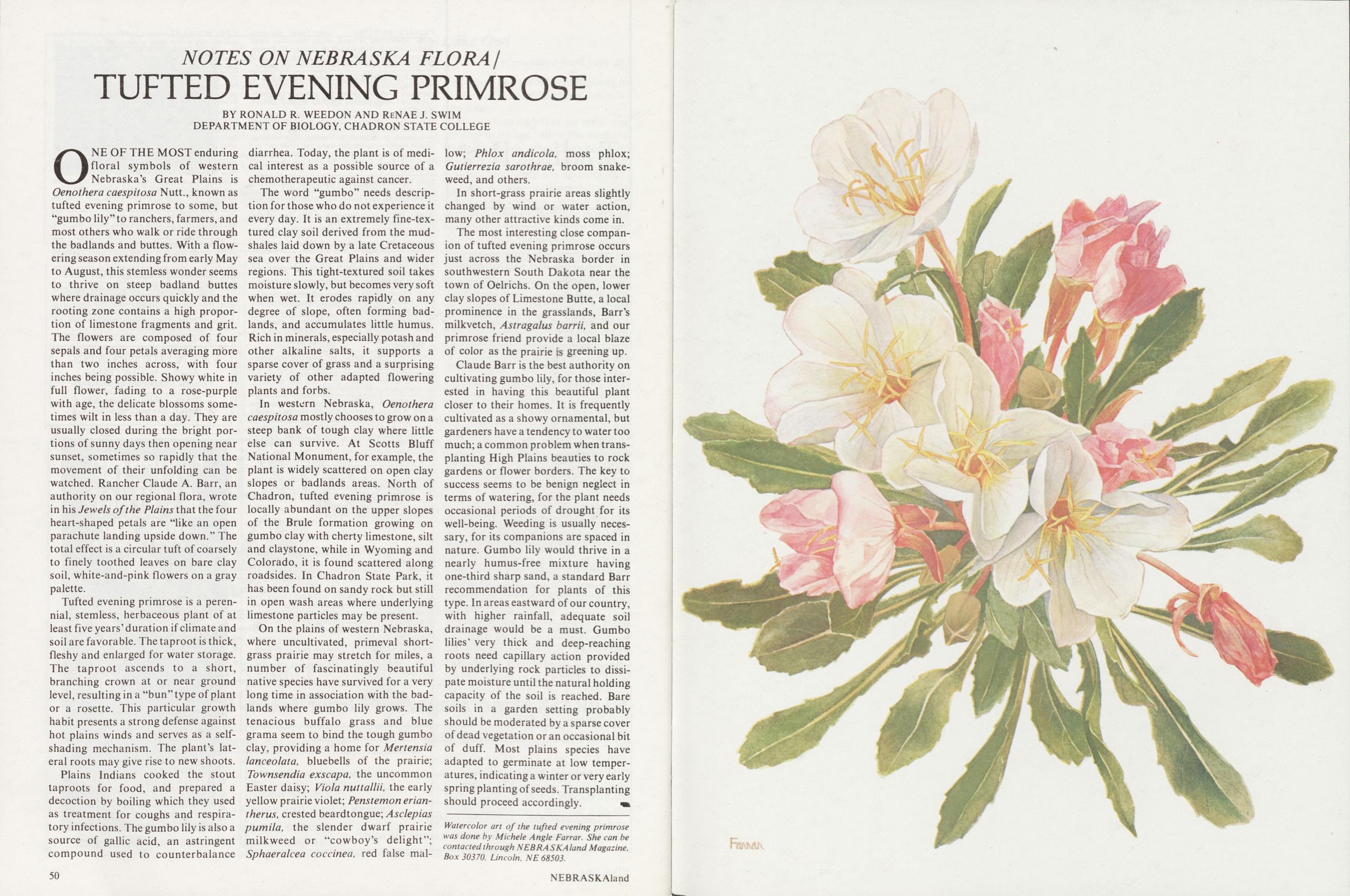
NOTES ON NEBRASKA FLORA TUFTED EVENING PRIMROSE
BY RONALD R. WEEDON AND ReNAE J. SWIM DEPARTMENT OF BIOLOGY, CHADRON STATE COLLEGEONE OF THE MOST enduring floral symbols of western Nebraska's Great Plains is Oenothera caespitosa Nutt., known as tufted evening primrose to some, but "gumbo lily" to ranchers, farmers, and most others who walk or ride through the badlands and buttes. With a flowering season extending from early May to August, this stemless wonder seems to thrive on steep badland buttes where drainage occurs quickly and the rooting zone contains a high proportion of limestone fragments and grit. The flowers are composed of four sepals and four petals averaging more than two inches across, with four inches being possible. Showy white in full flower, fading to a rose-purple with age, the delicate blossoms sometimes wilt in less than a day. They are usually closed during the bright portions of sunny days then opening near sunset, sometimes so rapidly that the movement of their unfolding can be watched. Rancher Claude A. Barr, an authority on our regional flora, wrote in his Jewels of the Plains that the four heart-shaped petals are "like an open parachute landing upside down." The total effect is a circular tuft of coarsely to finely toothed leaves on bare clay soil, white-and-pink flowers on a gray palette.
Tufted evening primrose is a perennial, stemless, herbaceous plant of at least five years' duration if climate and soil are favorable. The taproot is thick, fleshy and enlarged for water storage. The taproot ascends to a short, branching crown at or near ground level, resulting in a "bun" type of plant or a rosette. This particular growth habit presents a strong defense against hot plains winds and serves as a selfshading mechanism. The plant's lateral roots may give rise to new shoots.
Plains Indians cooked the stout taproots for food, and prepared a decoction by boiling which they used as treatment for coughs and respiratory infections. The gumbo lily is also a source of gallic acid, an astringent compound used to counterbalance diarrhea. Today, the plant is of medical interest as a possible source of a chemotherapeutic against cancer.
The word "gumbo" needs description for those who do not experience it every day. It is an extremely fine-textured clay soil derived from the mudshales laid down by a late Cretaceous sea over the Great Plains and wider regions. This tight-textured soil takes moisture slowly, but becomes very soft when wet. It erodes rapidly on any degree of slope, often forming badlands, and accumulates little humus. Rich in minerals, especially potash and other alkaline salts, it supports a sparse cover of grass and a surprising variety of other adapted flowering plants and forbs.
In western Nebraska, Oenothera caespitosa mostly chooses to grow on a steep bank of tough clay where little else can survive. At Scotts Bluff National Monument, for example, the plant is widely scattered on open clay slopes or badlands areas. North of Chadron, tufted evening primrose is locally abundant on the upper slopes of the Brule formation growing on gumbo clay with cherty limestone, silt and claystone, while in Wyoming and Colorado, it is found scattered along roadsides. In Chadron State Park, it has been found on sandy rock but still in open wash areas where underlying limestone particles may be present.
On the plains of western Nebraska, where uncultivated, primeval shortgrass prairie may stretch for miles, a number of fascinatingly beautiful native species have survived for a very long time in association with the badlands where gumbo lily grows. The tenacious buffalo grass and blue grama seem to bind the tough gumbo clay, providing a home for Mertensia lanceolata, bluebells of the prairie; Townsendia exscapa, the uncommon Easter daisy; Viola nuttallii, the early yellow prairie violet; Penstemon eriantherus, crested beardtongue; Asclepias pumila, the slender dwarf prairie milkweed or "cowboy's delight"; Sphaeralcea coccinea, red false mallow; Phlox andicola, moss phlox; Gutierrezia sarothrae, broom snakeweed, and others.
In short-grass prairie areas slightly changed by wind or water action, many other attractive kinds come in.
The most interesting close companion of tufted evening primrose occurs just across the Nebraska border in southwestern South Dakota near the town of Oelrichs. On the open, lower clay slopes of Limestone Butte, a local prominence in the grasslands, Barr's milkvetch, Astragalus barrii, and our primrose friend provide a local blaze of color as the prairie is greening up.
Claude Barr is the best authority on cultivating gumbo lily, for those interested in having this beautiful plant closer to their homes. It is frequently cultivated as a showy ornamental, but gardeners have a tendency to water too much; a common problem when transplanting High Plains beauties to rock gardens or flower borders. The key to success seems to be benign neglect in terms of watering, for the plant needs occasional periods of drought for its well-being. Weeding is usually necessary, for its companions are spaced in nature. Gumbo lily would thrive in a nearly humus-free mixture having one-third sharp sand, a standard Barr recommendation for plants of this type. In areas eastward of our country, with higher rainfall, adequate soil drainage would be a must. Gumbo lilies' very thick and deep-reaching roots need capillary action provided by underlying rock particles to dissipate moisture until the natural holding capacity of the soil is reached. Bare soils in a garden setting probably should be moderated by a sparse cover of dead vegetation or an occasional bit of duff. Most plains species have adapted to germinate at low temperatures, indicating a winter or very early spring planting of seeds. Transplanting should proceed accordingly.
Watercolor art of the tufted evening primrose was done by Michele Angle Farrar. She can be contacted through NEBRA SKA land Magazine, Box 30370, Lincoln, NE 68503. 50 NEBRASKAland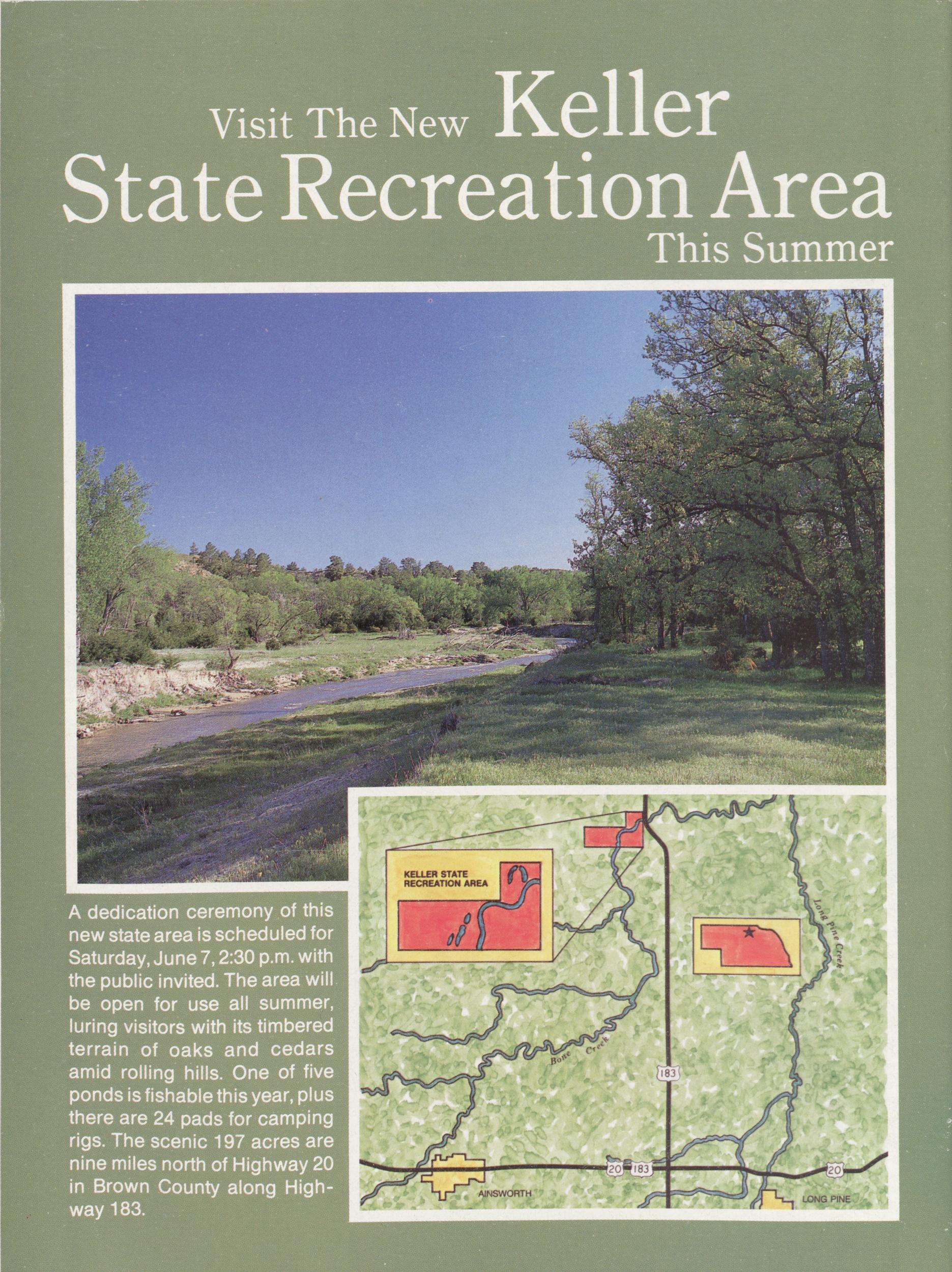
Visit The New Keller State Recreation Area This Summer
Position: 40 (206 views)