Volume 64, Issue 4, 1986
NEBRASKAland
MAY 1986 $1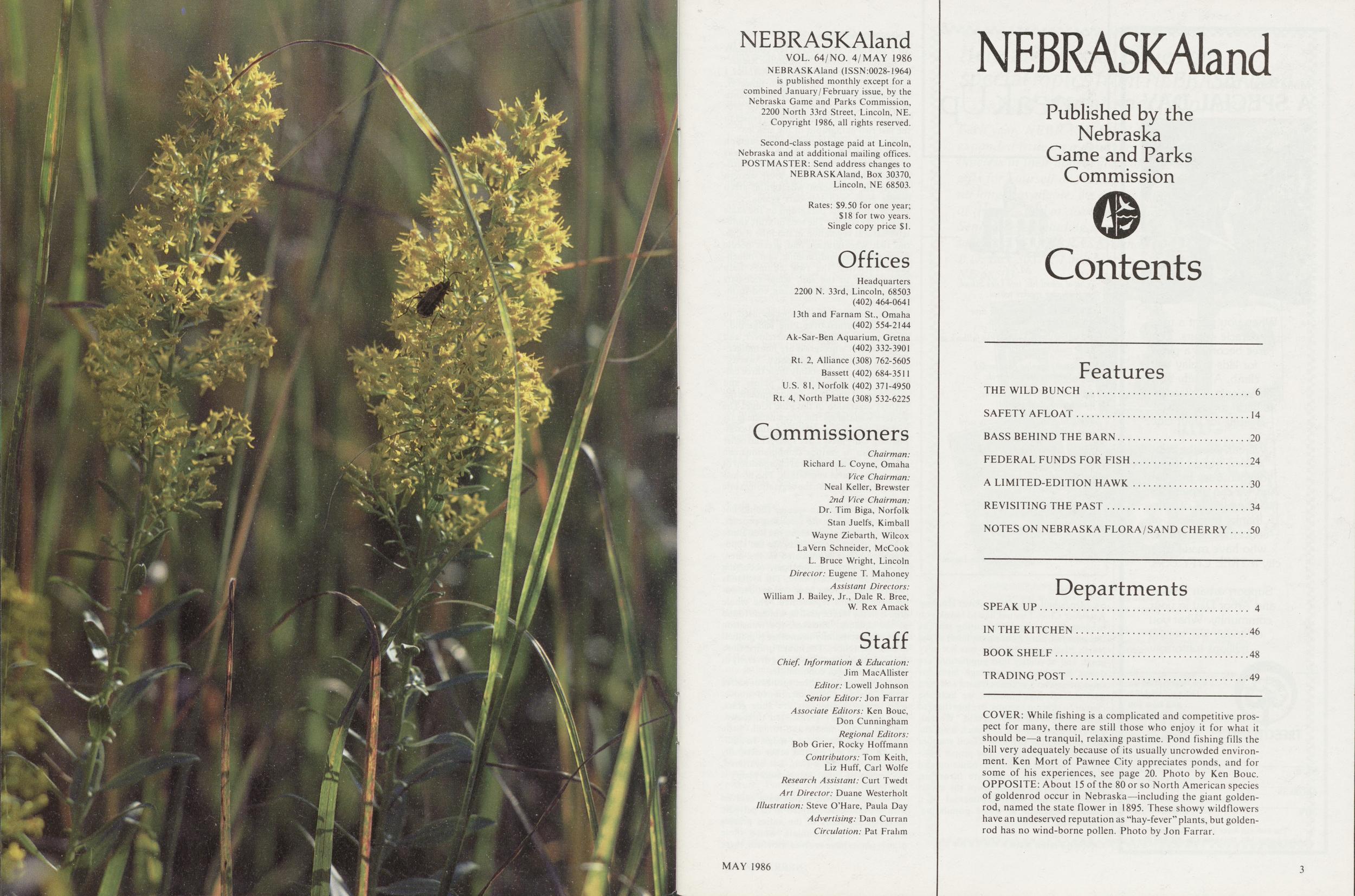
NEBRASKAland
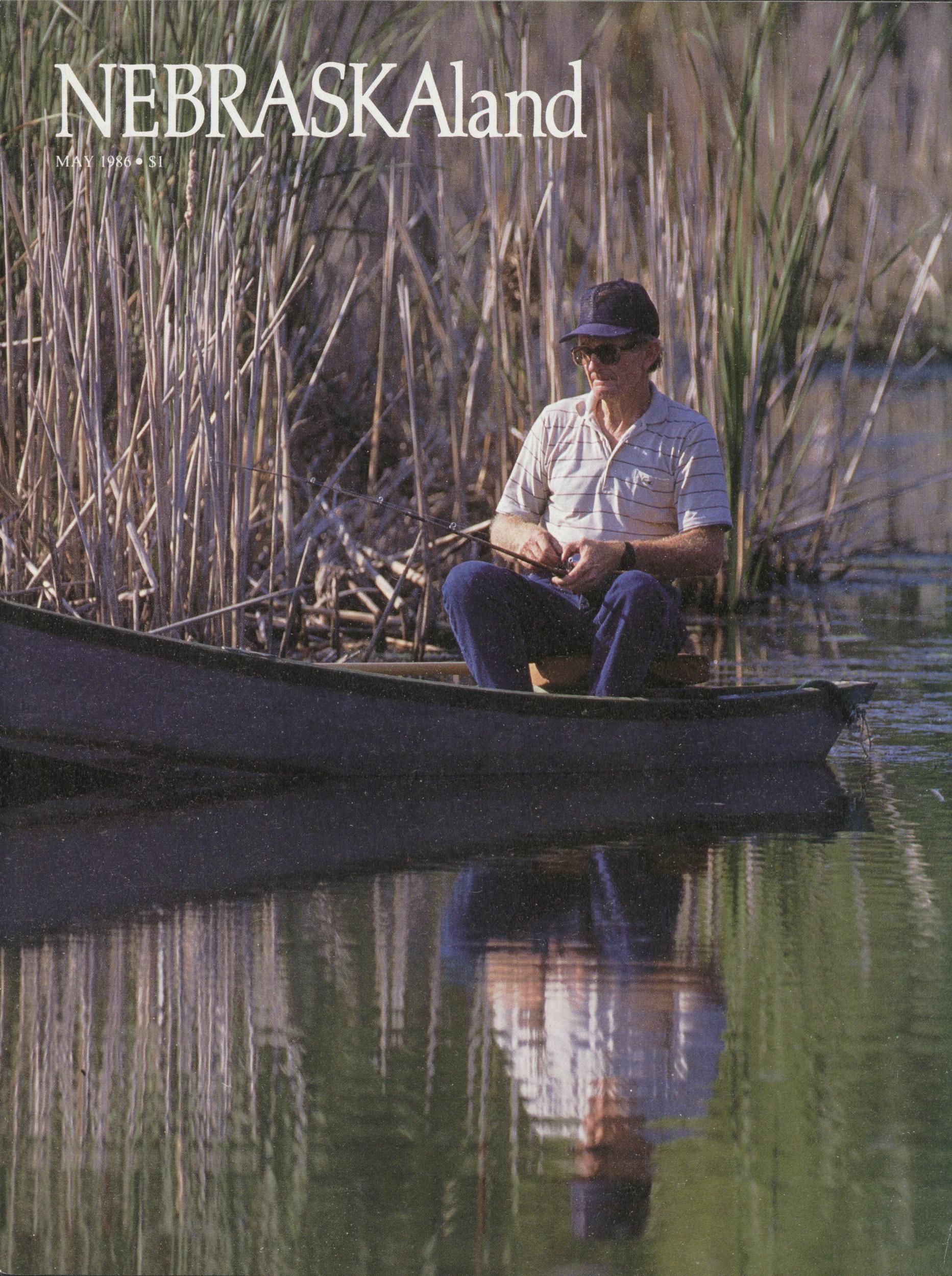
Published by the Nebraska Game and Parks Commission NEBRASKAland VOL. 64/NO. 4/MAY 1986 NEBRASKAland (ISSN:0028-I964) is published monthly except for a combined January/February issue, by the Nebraska Game and Parks Commission, 2200 North 33rd Street, Lincoln, NE. Copyright 1986, all rights reserved. Second-class postage paid at Lincoln, Nebraska and at additional mailing offices. POSTMASTER: Send address changes to NEBRASKAland, Box 30370, Lincoln, NE 68503. Rates: $9.50 for one year; $18 for two years. Single copy price $1. Offices Headquarters 2200 N. 33rd, Lincoln, 68503 (402) 464-0641 13th and Farnam St., Omaha (402) 554-2144 Ak-Sar-Ben Aquarium, Gretna (402) 332-3901 Rt. 2, Alliance (308) 762-5605 Bassett (402) 684-3511 U.S. 81, Norfolk (402) 371-4950 Rt. 4, North Platte (308) 532-6225 Commissioners Chairman: Richard L. Coyne, Omaha Vice Chairman: Neal Keller, Brewster 2nd Vice Chairman: Dr. Tim Biga, Norfolk Stan Juelfs, Kimball Wayne Ziebarth, Wilcox LaVern Schneider, McCook L. Bruce Wright, Lincoln Director: Eugene T. Mahoney Assistant Directors: William J. Bailey, Jr., Dale R. Bree, W. Rex Amack Staff Chief, Information & Education: Jim MacAllister Editor: Lowell Johnson Senior Editor: Jon Farrar Associate Editors: Ken Bouc, Don Cunningham Regional Editors: Bob Grier, Rocky Hoffmann Contributors: Tom Keith, Liz Huff, Carl Wolfe Research Assistant: Curt Twedt Art Director: Duane Westerholt Illustration: Steve O'Hare, Paula Day Advertising: Dan Curran Circulation: Pat Frahm Contents Features THE WILD BUNCH 6 SAFETY AFLOAT 14 BASS BEHIND THE BARN 20 FEDERAL FUNDS FOR FISH 24 A LIMITED-EDITION HAWK 30 REVISITING THE PAST 34 NOTES ON NEBRASKA FLORA/SAND CHERRY 50 Departments SPEAK UP 4 IN THE KITCHEN 46 BOOK SHELF 48 TRADING POST 49 COVER: While fishing is a complicated and competitive prospect for many, there are still those who enjoy it for what it should be—a tranquil, relaxing pastime. Pond fishing fills the bill very adequately because of its usually uncrowded environment. Ken Mort of Pawnee City appreciates ponds, and for some of his experiences, see page 20. Photo by Ken Bouc. OPPOSITE: About 15 of the 80 or so North American species of goldenrod occur in Nebraska—including the giant goldenrod, named the state flower in 1895. These showy wildflowers have an undeserved reputation as "hay-fever" plants, but goldenrod has no wind-borne pollen. Photo by Jon Farrar. MAY 1986 3
Speak Up
MAY "Out of school life, into Life's School, the thumping speaker roared Some folk listened, some folk slept and some were frankly hored. "Dam hot — these robes," the fullback said, while pushing his aside His parents saw but only smiled while bursting out with pride. Spirea trailed its lovely blooms, from baskets short and tall While lilacs spread their lovely scent from just above them all. The old school's looking pretty good, the teachers really smile As on the stage, in cap and gown, the graduates then file. In cities large and cities small this scene you'll find they play As each his personal scroll receives, in Nebraska now in May. Mildred Andrews Larson Hunted hardSir / On behalf of the Platte River Hunting Retriever Club, I would like to thank you for lengthening the bird hunting seasons this past fall. Bird hunting (upland) in the North Platte area this year was not very good, and obviously bird populations are down. But there were enough birds for those of us who worked at it hard and used well trained dogs. Locally, we hear the clamor to shorten seasons, or close them to let the bird populations "rebuild." We realize, as you do, that this approach is not the way to solve the problem. Good weather for nesting, mild winters and proper habitat are essential to bird reproduction and survival. If these factors are favorable, hunting pressure merely crops the excess cock birds and isn't detrimental to a healthy pheasant or quail population. Thank you.
Ron Green North Platte, Nebr. Rethinking reseedingSir / This letter is to make a few comments on Bob Grier's article, "Fire on the Ridge," in the December 1985 NEBRASKAland. I do not criticize his article as such; however, I do denounce his unchallenged acceptance of the U.S. Forest Service and other propaganda that was given to him in respect to the last two paragraphs of the article.
According to the penultimate paragraph on page 31, the burned-over area was reseeded with " A mixture of rhizomanous alfalfa, yellow sweetclover, western wheatgrass, pubescent wheatgrass, green needle grass, and side-oats grama" Finally, in the last paragraph on the same page, Grier states: "The seed mixture simulates natural vegetation in the Pine Ridge, the two wheatgrasses and green needle grass provided sod-forming and bunchgrass varieties, the two legumes help fix nitrogen in the soil, while side-oats grama provides a warm-season, sod-forming variety. . . ."
A closer look at the species used to reseed the burned-over Pine Ridge indicates that the alfalfa, the sweetclover, and the pubescent wheatgrass are not indigenous but tend to be aggressive, "weedy" Eurasian species. Certainly these three cultivated and/or naturalized plants and other flora of the region do not simulate the natural vegetation of the Pine Ridge. The western wheatgrass, the green needle grass and the side-oats grama are natural components. Only these three species and other native flora in various combinations can simulate the past historical composition of the area's natural vegetation. The nonnative species only make the vegetation exotic in composition.
The three Eurasian species should not have been used in the reseeding process. The Pine Ridge escarpment, the Box Butte Plain, and the Pierre Hills are the topographic regions represented in the area. Ponderosa pines are naturally occurring conifers on the escarpment. The lowlands (rivers and streams) have various deciduous tree species represented. The whole area is in the mixed prairie, which is found in the uplands; however, the transition from one community to another is gradual in many instances. The mixed prairie flora are likely to be found in varying diversity in the two woodland communities.
In addition to the three species of native mixed prairie plants mentioned above, other grass components are June grass, blue grama, hairy grama, red threeawn, buffalo-grass, needle-and-thread, little bluestem, and three-edged sedge. In addition to these grasses and other naturally occurring grasses, a rich, but scattered, assortment of native leguminous plants is also found.
The native prairie plants have evolved with fire and have adapted to its periodic occurrences. Many of the native grasses and forbs are perennials. Since these prairie plants have evolved with fires, these 4 NEBRASKAland plants are not killed outright by the passage of fire; therefore, they regenerate later after rains come or in the spring.
In essence, the taxpayers could have been spared the cost of the seed and the reseeding operation. Given time, these native grasses and forbs would have regenerated to give sufficient cover to exposed soil. In any event, living roots still hold soil together and would prevent some erosion in event of a heavy rain'. If erosion were a serious threat, then why not use the limited, commercially available native seeds to do the reseeding? Why attempt reseeding at all when ecological expertise was readily available, but was undoubtedly not heeded or sought? Who failed to do their homework? Was it bureaucracy at fault again?
Instead of a multipurpose management of forest lands; including wildlife, recreation, erosion control, water quality, and lumbering; the Forest Service has given more emphasis to commercializing forest resources. In recent years the trend has been toward logging at the exclusion of the other purposes. Road-building programs in forests, in order to gain access to the timber, have ruined many areas by reducing the wilderness and wildlife values. Road-building costs by the service have been greater in many cases than the value of the lumber removed. Perhaps the Forest Service should reassess its public mandate of protecting more of our national forests and also eliminate those unnecessary expenses such as reseeding mixed prairie areas on the Pine Ridge, which I understand cost Nebraska taxpayers $100,000.
Larry L. Einemann Lincoln, Nebr. Early sceneSir / I enjoy NEBRASKAland very much, having lived in Nebraska in a senior village, and long ago as a child. I wonder if mirages occur anymore, or is there too much pollution at times. I've never seen any article on mirages, but in the early 1900's I witnessed something I shall never forget.
We lived on a southwest corner of a section—with neighbors to the east and northeast, but directly north of us was usually a wheat field on a gentle slope and we could never see beyond where the sky and the field of wheat met. This particular morning my father started to work after breakfast and called to us—my mother, brother and me—and we witnessed this phenomenon!—this beautiful scene projected above the field of green wheat. We saw the Platte River, which was nearly 15 miles from us, and a man on a lumber wagon with a team of dark horses going west. We stood there in awe; I don't remember how long, but long enough to see many details of that picture. Finally, I don't remember if it gradually faded or a sudden end, but once again we were looking at just the sky and field.
Grace Clark Martinsville, Ind. Here are special issues on special topics from NEBRASKAland and also at special prices1. Each year, NEBRASKAland Magazine does a special, expanded issue on a deserving subject. These are timeless in their appeal and value, and make great gifts for yourself or friends. While some are no longer available, we do have limited numbers of these — and at discounted prices while they last. Send order (including appropriate sales tax) to: NEBRASKAland, P.O. Box 30370, Lincoln, NE 68503. NEBRASKA RIVERS traces the state's major waterways and several lesser steams from their ancient beginnings to the present in this ambitious full-color volume. Photos, stories, recollections. $5 THE EIRST VOICES is a must for everyone interested in history of the triumphs and tragedies of the Indian in Nebraska. Historic art, maps, history, recollections, color photos, and more. 132 pages. $5 NEBRASKA THROUGH THE SEASONS is a beautiful collection of photos from all corners of the state at all times of the year, including people, places, wildlife, and more. 132 pages. $4 WILD GAME COOKBOOK features favorite recipes for all popular game, big and small, land and lake, plus some unusual "gourmet" items like clams, snake, etc. A great gift. 100 pages. $3 FORT ROBINSON ILLUSTRATED is all about this military post turned state park, from frontier times right up to the present. Includes photos of the modern facilities for park-goers to enjoy. 116 pp. $6 SPORTSMAN'S SCRAPBOOKrecalls the "good old days ", when your grandfather and his friends hunted and fished Nebraska. It traces hunting and fishing through the last century. 100 pages. $2.50 MAY 1986 5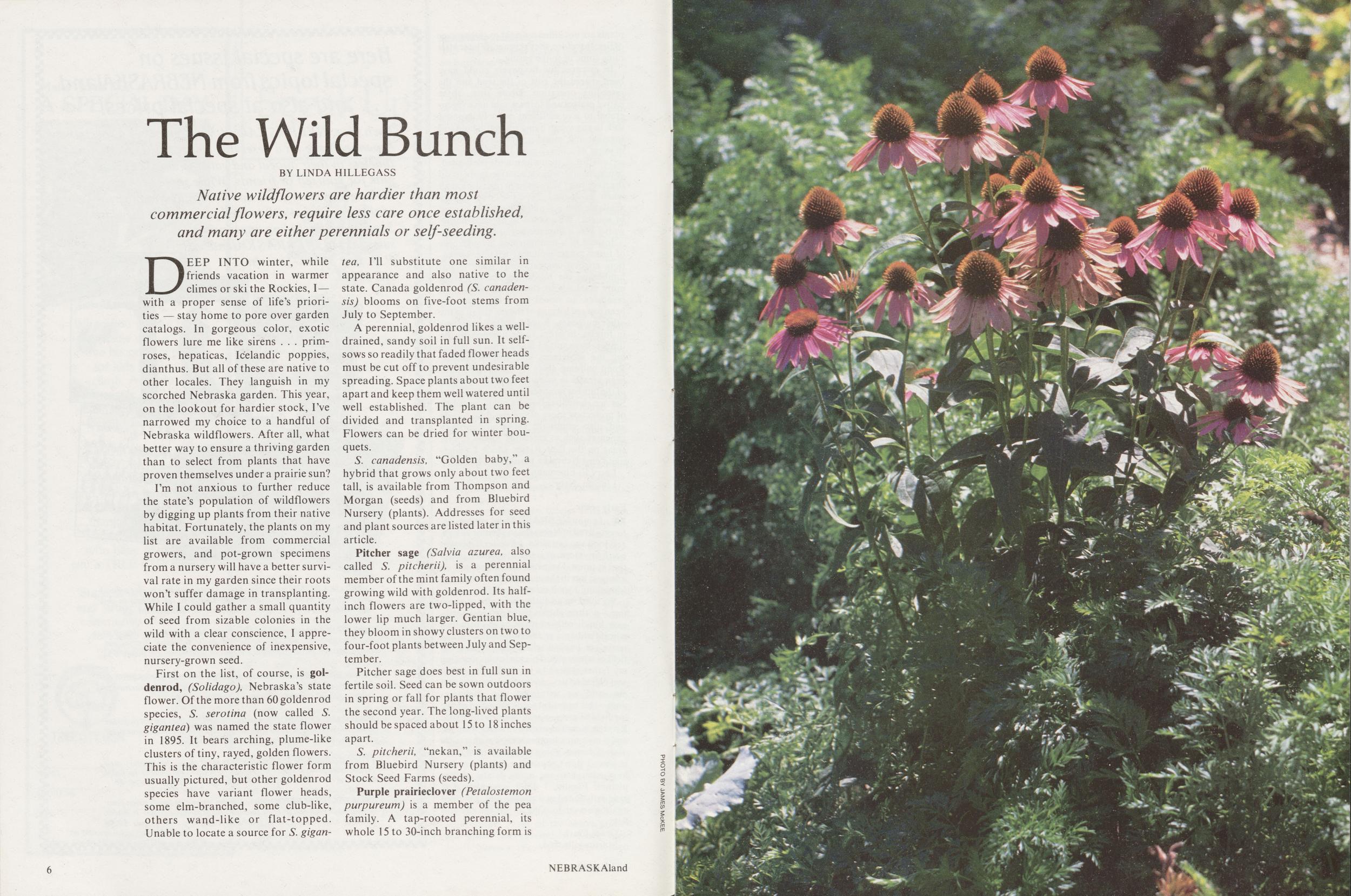
The Wild Bunch
BY LINDA HILLEGASS Native wild/lowers are hardier than most commercial flowers, require less care once established, and many are either perennials or self-seeding.DEEP INTO winter, while friends vacation in warmer climes or ski the Rockies, with a proper sense of life's priorities — stay home to pore over garden catalogs. In gorgeous color, exotic flowers lure me like sirens primroses, hepaticas, Icelandic poppies, dianthus. But all of these are native to other locales. They languish in my scorched Nebraska garden. This year, on the lookout for hardier stock, I've narrowed my choice to a handful of Nebraska wildflowers. After all, what better way to ensure a thriving garden than to select from plants that have proven themselves under a prairie sun?
I'm not anxious to further reduce the state's population of wildflowers by digging up plants from their native habitat. Fortunately, the plants on my list are available from commercial growers, and pot-grown specimens from a nursery will have a better survival rate in my garden since their roots won't suffer damage in transplanting. While I could gather a small quantity of seed from sizable colonies in the wild with a clear conscience, I appreciate the convenience of inexpensive, nursery-grown seed.
First on the list, of course, is goldenrod, (Solidago), Nebraska's state flower. Of the more than 60 goldenrod species, S. serotina (now called S. gigantea) was named the state flower in 1895. It bears arching, plume-like clusters of tiny, rayed, golden flowers. This is the characteristic flower form usually pictured, but other goldenrod species have variant flower heads, some elm-branched, some club-like, others wand-like or flat-topped. Unable to locate a source for S. gigantea, I'll substitute one similar in appearance and also native to the state. Canada goldenrod (S. canadensis) blooms on five-foot stems from July to September.
A perennial, goldenrod likes a well-drained, sandy soil in full sun. It selfsows so readily that faded flower heads must be cut off to prevent undesirable spreading. Space plants about two feet apart and keep them well watered until well established. The plant can be divided and transplanted in spring. Flowers can be dried for winter bouquets.
S. canadensis, "Golden baby," a hybrid that grows only about two feet tall, is available from Thompson and Morgan (seeds) and from Bluebird Nursery (plants). Addresses for seed and plant sources are listed later in this article.
Pitcher sage (Salvia azurea, also called S. pitcherii), is a perennial member of the mint family often found growing wild with goldenrod. Its halfinch flowers are two-lipped, with the lower lip much larger. Gentian blue, they bloom in showy clusters on two to four-foot plants between July and September.
Pitcher sage does best in full sun in fertile soil. Seed can be sown outdoors in spring or fall for plants that flower the second year. The long-lived plants should be spaced about 15 to 18 inches apart.
S. pitcherii, "nekan," is available from Bluebird Nursery (plants) and Stock Seed Farms (seeds).
Purple prairieclover (Petalostemon purpureum) is a member of the pea family. A tap-rooted perennial, its whole 15 to 30-inch branching form is 6 NEBRASKAland
Purple prairie clover can be grown from seed, available from Stock Seed Farms, or plants can be purchased from Bluebird Nursery, but attempts to transplant purple prairieclover from the wild are unlikely to meet with success due to its taprooted structure.
Gray-headed prairie coneflower (Ratibida pinnata) is a handsome, three to five-foot, long-lived perennial. A member of the daisy family, its showy and distinctive bloom appears in July and August. Ten or 12 yellow rays droop sharply back from a round or somewhat round cylindrical, anisescented cone that is gray during bloom, darkening as seed ripens. Found on streambanks and bluffs in eastern Nebraska, gray-headed prairie coneflower is suitable for gardens in the eastern two-thirds of the state.
Grow it from seed offered by Stock Seed Farms, or start with plants from Bluebird Nursery.
Another common prairie flower with yellow rays is black-eyed Susan (Rudbeckia hirta). Easily adapted to the home garden, it can be grown throughout Nebraska, where it is found wild in meadows, prairies and even in open woodlands. Fifteen or 20-inch stiffly upright stems, usually unbranched and topped with two or three-inch flowers, rise from ovate basal leaves. Brown center cones are surrounded by 10 to 20 brilliant rays. The rough and hairy plant blooms profusely from June to September.
The flowers are outstanding for cutting, but if left on the plant they last an unusually long time. This short-lived perennial — treated as an annual in the garden — self-sows freely. Scatter the seeds in a full sun location in late summer or early fall, when ripe. Plants will flower the next year and usually die afterward. Black-eyed Susans can be transplanted, but not divided.
Stock Seed Farms offer seeds of the native R. hirta. Bluebird Nursery sells the plant, along with several of its hybrids.
Thickspike gayfeather or Kansas gayfeather (Liatris pycnostachya), with its erect, club-like spikes crowded with small, brilliantly rose-purple fuzzy flowers, would make a handsome 8 NEBRASKAland garden companion for the yellow coneflowers. This four to five-foot perennial blooms from July or August through September. Contrary to the usual pattern, the flowers open from top to bottom. Found wild in eastern and central Nebraska prairies and meadows, the flower is suitable for gardens in the eastern half of the state.
Thickspike gayfeather likes ade- quate moisture and a sunny location in light sandy soil of poor to fair fertility. Because gayfeather seed may take as much as a year to germinate, the easiest procedure is to buy nursery-grown plants. These can be set out in spring or fall, about a foot to 18 inches apart. Clumps may be divided in spring or fall every three or four years to prevent overcrowding. The bloom can be dried for winter bouquets.
Stock Seed Farms offers seeds of L. pycnostachya, "Eureka." Bluebird Nursery sells the plants. Hybrid gayfeathers are widely available through commercial growers.
Another handsome rose-purple wildflower is pale purple coneflower or black samson (Echinacea pallida, also called E. angustifolia). A hardy perennial of the daisy family, it is native throughout the state. The hairy plant, 12 to 20 inches tall, bears a dozen daisy-like flowers measuring up to 11/2 inches across. Rose-purple rays droop slightly around a dark, domed center of disk florets and pointed bracts. This coneflower blooms during June and July on prairies throughout the state, often with gayfeather.
Easy to transplant, pale purple coneflower can also be started from seed planted in late spring. It grows best in a rich dry soil in full sun or very light shade. Clumps can be divided in spring or fall. New plants should be spaced about 18 inches to two feet apart.
E. purpurea, the purple coneflower, is a more vivid bloomer found in prairies east of Nebraska. A larger, bushy plant, it grows up to three feet tall and sports flowers three or four inches across.
Seeds of E. Pallida and E. purpurea are available from Stock Seed Farms. E. purpurea is also available from Park Seeds (seeds) and Bluebird Nursery (plants). Wayside offers plants of both a rose-purple and a white variety of E. purpurea.
Plains coreopsis or tickseed (Coreopsis tinctoria) is a member of the daisy family with five to seven showy, gold ray flowers, reddish-brown at the base, flat and notched at the tip. One to three feet high, this annual blooms from June to September. Common in moist areas of central Nebraska, it is found in garden catalogs as "calliopsis" or "annual coreopsis," usually available only in mixes that feature yellow, orange and reddish-brown flowers.
Although easy to start from seed, plains coreopsis seedlings do not transplant well, so seeds must be sown where plants will be grown. The flowers are good for cutting and flower heads can be used to make an orange or yellow dye.
Seeds are available from Burpee and Thompson and Morgan.
Found along streams in western Nebraska, shooting star (Dodecatheon pauciflorum, also called D. pulchellum) is one of the most beautiful wildflowers anywhere. Its lovely mauve to pink flowers really do resemble shooting stars. The dark beak of stamens points to earth, while five petals flare up and back like the feathers on a shuttlecock. Several blooms hang from a scape six to 12 inches high. Spoonshaped leaves cluster in a rosette at the plant's base.
Dormant after it flowers in May or
Bluebird Nursery, Inc., 515 Linden, Clarkson, NE 68629. (402) 892-3457. Catalog free.
W. Atlee Burpee Company, 300 Park Avenue, Warminster, PA 18794. (215) 674-4900. Catalog free.
The Fragrant Path, P.O. Box 328, Fort Calhoun, NE 68023. Catalog $1.
Park Seed Company, Hwy. 254 North, Greenwood, SC 29647. (803) 374-3341. Catalog free.
Stock Seed Farms, Inc., R.R. 1, Box 112, Murdoek, NE 68407. (402) 867-3771. Catalog free.
Thompson & Morgan, Inc., P.O. Box 1308, Jackson, NJ 08527. (201) 363-2225. Catalog free.
Wayside Gardens, Hodges, SC 29695. (800) 845-1124. Catalog $1.
Although I know of no commercial source for D. pauciflorum, both Park Seed and Thompson and Morgan offer the seeds for D. meadia, a near relative found wild along the East Coast. Bluebird Nursery offers plants of the same. 10 NEBRASKAland
Harebell (Campanula rotundifolia) is a dainty perennial widely distributed throughout the world. Commonly found in northern and western Nebraska, this member of the bellfower family is the famed "bluebell of Scotland." Slate blue, nodding, bell-shaped flowers are borne at the tips of slender stems that rise from rounded basal leaves. The plant may grow as high as 18 inches, but stays around nine to 12 inches tall in the garden. It flowers from June to September.
Harebells prosper in a sandy, welldrained soil in full sun or light shade. If happy, they will spread vigorously by underground stems. They make good rock garden specimens and will grow on slopes. Though harebells may be propagated by seed, germination time is unpredictable. Space plants a foot or more apart. Divide every few years in early spring when plants are dormant.
Seeds of this Nebraska wildflower may be purchased from Thompson and Morgan. Plants are available from Bluebird Nursery. Wayside offers a compact hybrid of Campanula rotundifolia called "Olympica" (plants only). All three catalogs list a wide variety of related campanulas.
Chicory (Cichorium intybus), a member of the daisy family, has basal leaves similar to those of its relative the dandelion. A European perennial, chicory is naturalized in central and eastern Nebraska where it is often seen along roadsides and in vacant lots. Clear, light blue, two-inch flowers bloom all along the stiff, branching stems. Nearly stalkless, they seem to spring directly from the stem. Plants grow from one to four feet tall and flower from June or July to as late as October. The ray flowers have no central disk and open only in the morning.
Chicory's taproot is ground and
roasted as a coffee substitute or
extender. Some may regard the plant
as too weedy for the garden, but its
flowers are a lovely shade of light blue
and the leaves are edible in salads.
MAY 1986
11
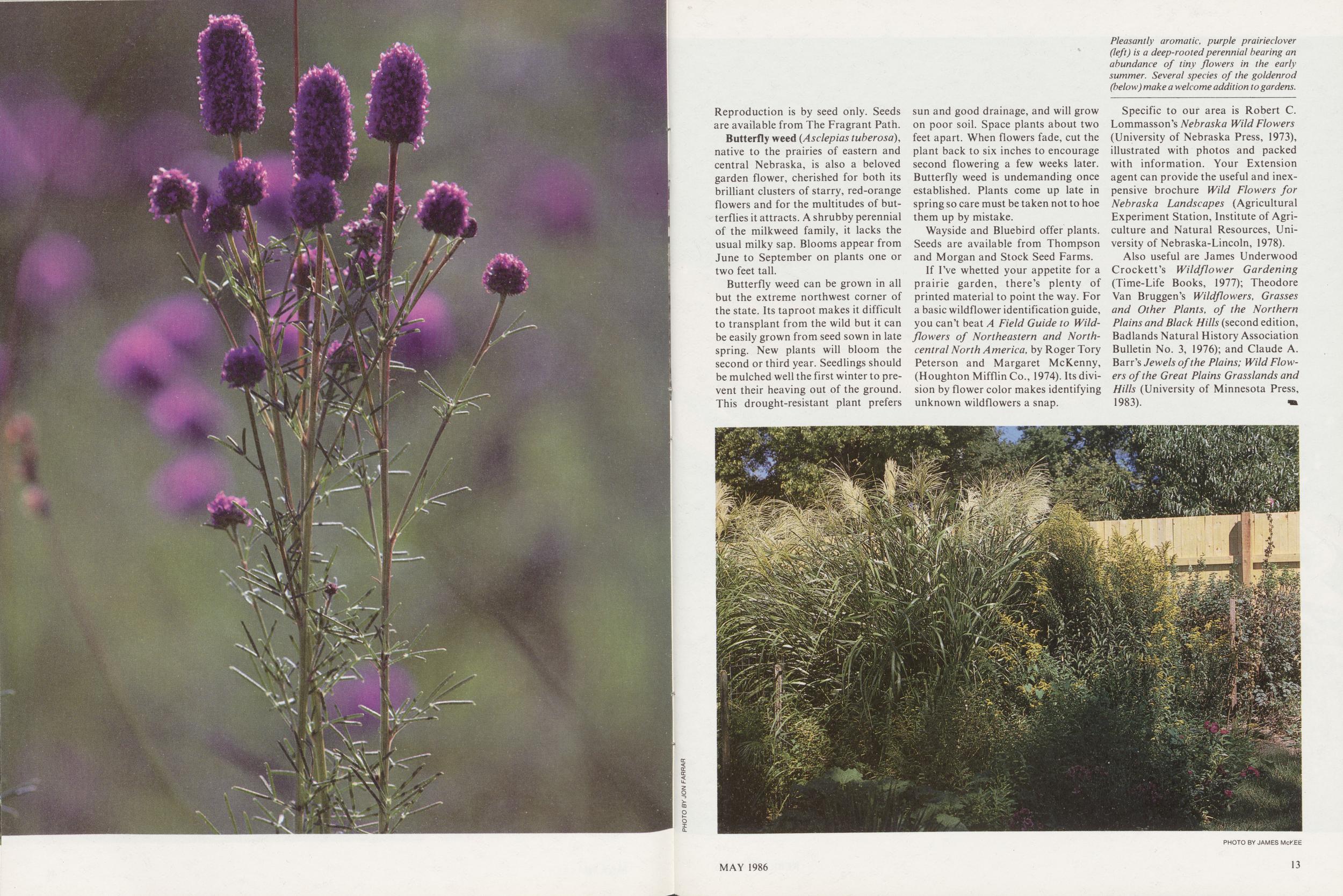
Butterfly weed (Asclepias tuberosa), native to the prairies of eastern and central Nebraska, is also a beloved garden flower, cherished for both its brilliant clusters of starry, red-orange flowers and for the multitudes of butterflies it attracts. A shrubby perennial of the milkweed family, it lacks the usual milky sap. Blooms appear from June to September on plants one or two feet tall.
Butterfly weed can be grown in all but the extreme northwest corner of the state. Its taproot makes it difficult to transplant from the wild but it can be easily grown from seed sown in late spring. New plants will bloom the second or third year. Seedlings should be mulched well the first winter to prevent their heaving out of the ground. This drought-resistant plant prefers sun and good drainage, and will grow on poor soil. Space plants about two feet apart. When flowers fade, cut the plant back to six inches to encourage second flowering a few weeks later. Butterfly weed is undemanding once established. Plants come up late in spring so care must be taken not to hoe them up by mistake.
Wayside and Bluebird offer plants. Seeds are available from Thompson and Morgan and Stock Seed Farms.
If I've whetted your appetite for a prairie garden, there's plenty of printed material to point the way. For a basic wildflower identification guide, you can't beat A Field Guide to Wildflowers of Northeastern and Northcentral North America, by Roger Tory Peterson and Margaret McKenny, (Houghton Mifflin Co., 1974). Its division by flower color makes identifying unknown wildflowers a snap.
Specific to our area is Robert C. Lommasson's Nebraska Wild Flowers (University of Nebraska Press, 1973), illustrated with photos and packed with information. Your Extension agent can provide the useful and inexpensive brochure Wild Flowers for Nebraska Landscapes (Agricultural Experiment Station, Institute of Agriculture and Natural Resources, University of Nebraska-Lincoln, 1978).
Also useful are James Underwood Crockett's Wildflower Gardening (Time-Life Books, 1977); Theodore Van Bruggen's Wildflowers, Grasses and Other Plants, of the Northern Plains and Black Hills (second edition, Badlands Natural History Association Bulletin No. 3, 1976); and Claude A. Barr's Jewels of the Plains; Wild Flowers of the Great Plains Grasslands and Hills (University of Minnesota Press, 1983).
Safet Afloat
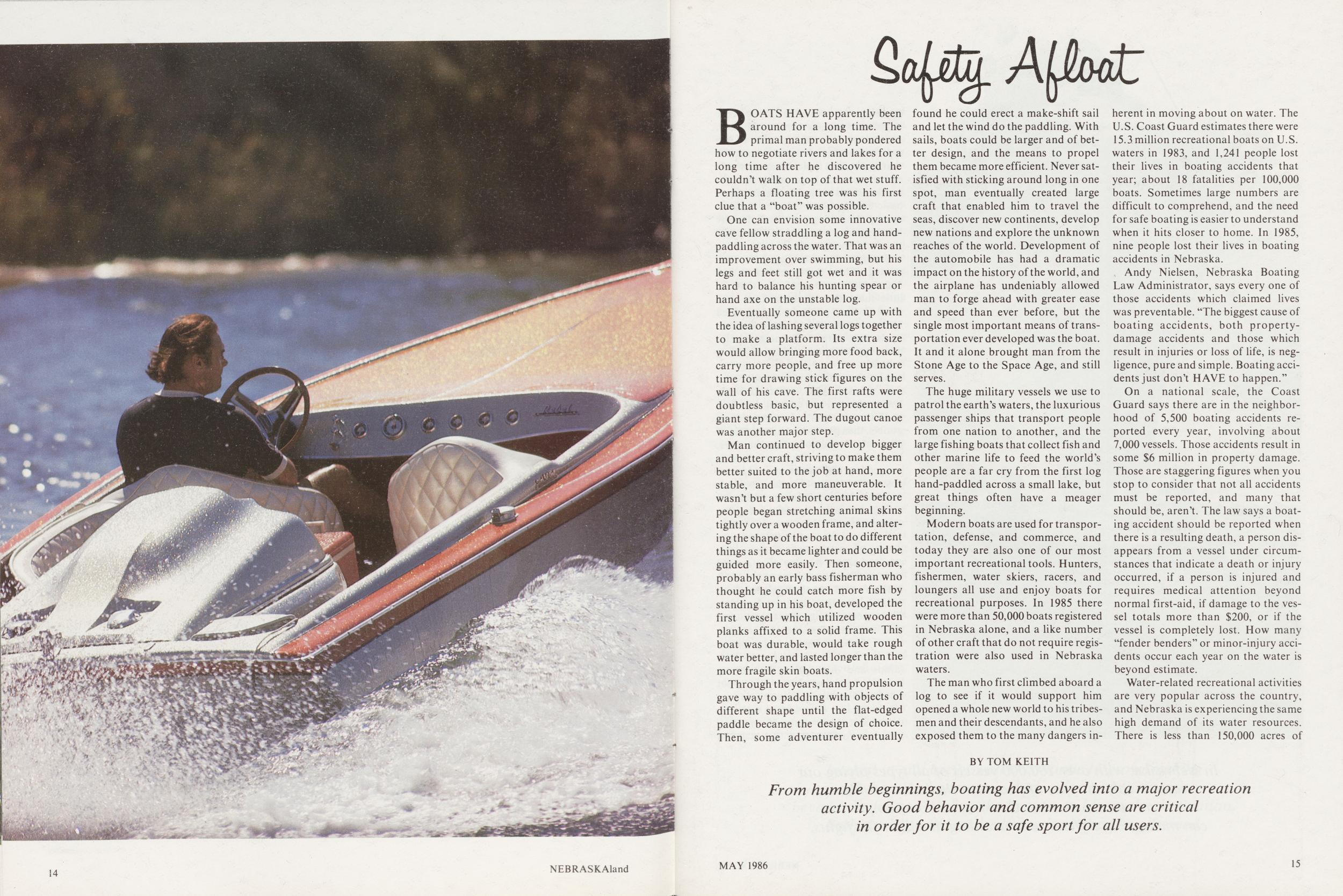
BOATS HAVE apparently been around for a long time. The primal man probably pondered how to negotiate rivers and lakes for a long time after he discovered he couldn't walk on top of that wet stuff. Perhaps a floating tree was his first clue that a "boat" was possible.
One can envision some innovative cave fellow straddling a log and handpaddling across the water. That was an improvement over swimming, but his legs and feet still got wet and it was hard to balance his hunting spear or hand axe on the unstable log.
Eventually someone came up with the idea of lashing several logs together to make a platform. Its extra size would allow bringing more food back, carry more people, and free up more time for drawing stick figures on the wall of his cave. The first rafts were doubtless basic, but represented a giant step forward. The dugout canoe was another major step.
Man continued to develop bigger and better craft, striving to make them better suited to the job at hand, more stable, and more maneuverable. It wasn't but a few short centuries before people began stretching animal skins tightly over a wooden frame, and altering the shape of the boat to do different things as it became lighter and could be guided more easily. Then someone, probably an early bass fisherman who thought he could catch more fish by standing up in his boat, developed the first vessel which utilized wooden planks affixed to a solid frame. This boat was durable, would take rough water better, and lasted longer than the more fragile skin boats.
Through the years, hand propulsion gave way to paddling with objects of different shape until the flat-edged paddle became the design of choice. Then, some adventurer eventually found he could erect a make-shift sail and let the wind do the paddling. With sails, boats could be larger and of better design, and the means to propel them became more efficient. Never satisfied with sticking around long in one spot, man eventually created large craft that enabled him to travel the seas, discover new continents, develop new nations and explore the unknown reaches of the world. Development of the automobile has had a dramatic impact on the history of the world, and the airplane has undeniably allowed man to forge ahead with greater ease and speed than ever before, but the single most important means of transportation ever developed was the boat. It and it alone brought man from the Stone Age to the Space Age, and still serves.
The huge military vessels we use to patrol the earth's waters, the luxurious passenger ships that transport people from one nation to another, and the large fishing boats that collect fish and other marine life to feed the world's people are a far cry from the first log hand-paddled across a small lake, but great things often have a meager beginning.
Modern boats are used for transportation, defense, and commerce, and today they are also one of our most important recreational tools. Hunters, fishermen, water skiers, racers, and loungers all use and enjoy boats for recreational purposes. In 1985 there were more than 50,000 boats registered in Nebraska alone, and a like number of other craft that do not require registration were also used in Nebraska waters.
BY TOM KEITH From humble beginnings, boating has evolved into a major recreation activity. Good behavior and common sense are critical in order for it to be a safe sport for all users.The man who first climbed aboard a log to see if it would support him opened a whole new world to his tribesmen and their descendants, and he also exposed them to the many dangers inherent in moving about on water. The U.S. Coast Guard estimates there were 15.3 million recreational boats on U.S. waters in 1983, and 1,241 people lost their lives in boating accidents that year; about 18 fatalities per 100,000 boats. Sometimes large numbers are difficult to comprehend, and the need for safe boating is easier to understand when it hits closer to home. In 1985, nine people lost their lives in boating accidents in Nebraska.
Andy Nielsen, Nebraska Boating Law Administrator, says every one of those accidents which claimed lives was preventable. "The biggest cause of boating accidents, both propertydamage accidents and those which result in injuries or loss of life, is negligence, pure and simple. Boating accidents just don't HAVE to happen."
On a national scale, the Coast Guard says there are in the neighborhood of 5,500 boating accidents reported every year, involving about 7,000 vessels. Those accidents result in some $6 million in property damage. Those are staggering figures when you stop to consider that not all accidents must be reported, and many that should be, aren't. The law says a boating accident should be reported when there is a resulting death, a person disappears from a vessel under circumstances that indicate a death or injury occurred, if a person is injured and requires medical attention beyond normal first-aid, if damage to the vessel totals more than $200, or if the vessel is completely lost. How many "fender benders" or minor-injury accidents occur each year on the water is beyond estimate.
Water-related recreational activities
are very popular across the country,
and Nebraska is experiencing the same
high demand of its water resources.
There is less than 150,000 acres of
MAY 1986
15
Also competing for water space are float tubes, kayaks, inflatable boats and mattresses, and even jet skis. Add to all these an army of swimmers and waders, then throw in an assortment of physical obstructions like sandbars, barely submerged rocks, partially submerged logs and trees, some old fenceposts still holding strands of barbedwire and the like, and the necessity for a large measure of safe boating becomes apparent.
When you get a lot of different people together, all with different interests, and expect them to share a small area, problems are sure to result. Most of them could be solved just by plain, ordinary courtesy, but there are those who expect everyone else to get out of their way and allow them to have the run of the area. There are arguments and fist fights over the use of boat ramps and dock space. There are heated exchanges when a large boat zips past a smaller one, nearly capsizing the smaller boat with its wake, or when a waterskier shows off by skiing too close to fishermen. Boats cut in
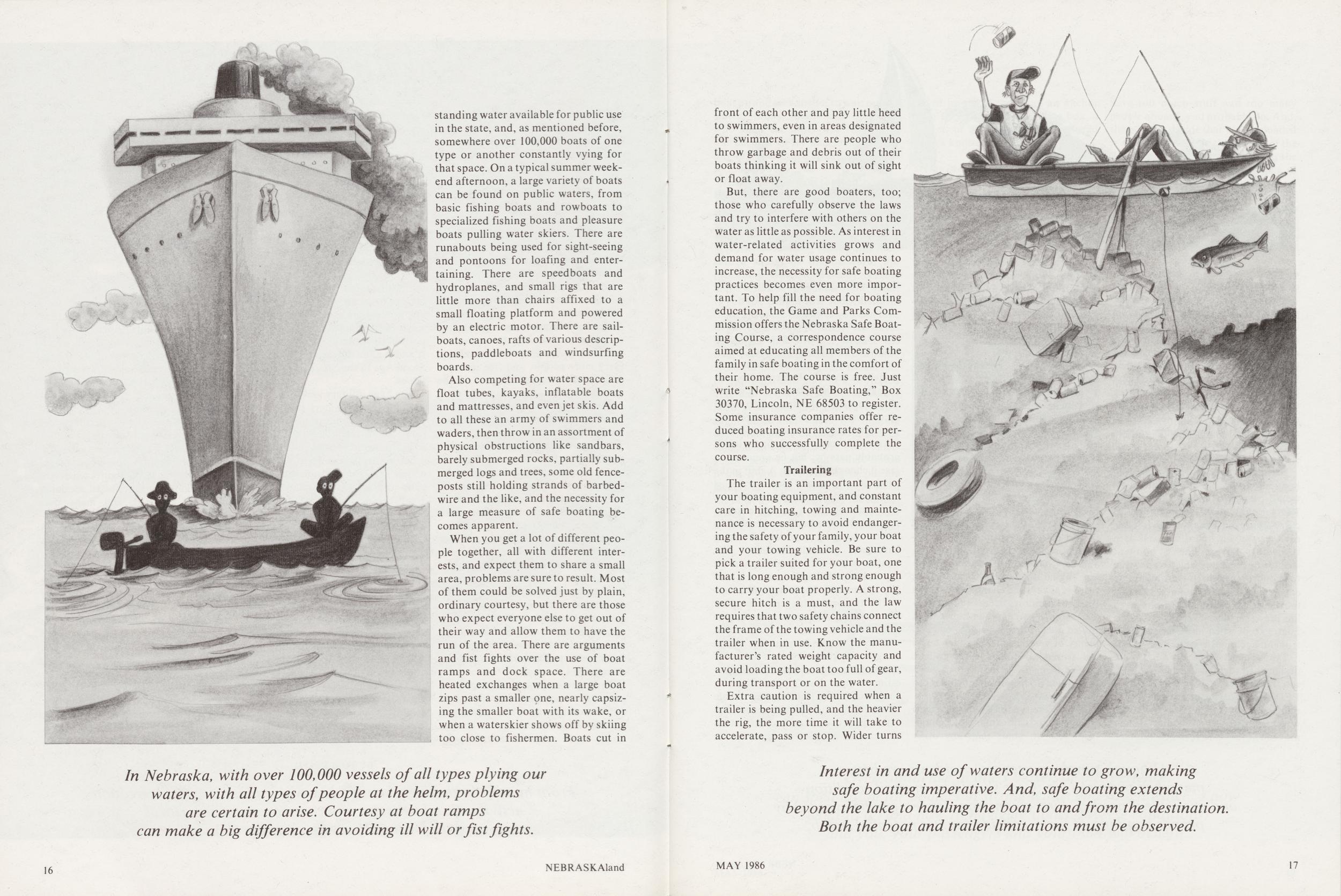
In Nebraska, with over 100,000 vessels of all types plying our waters, with all types of people at the helm, problems are certain to arise. Courtesy at boat ramps can make a big difference in avoiding ill will or fist fights. 16 NEBRASKAlandfront of each other and pay little heed to swimmers, even in areas designated for swimmers. There are people who throw garbage and debris out of their boats thinking it will sink out of sight or float away.
But, there are good boaters, too; those who carefully observe the laws and try to interfere with others on the water as little as possible. As interest in water-related activities grows and demand for water usage continues to increase, the necessity for safe boating practices becomes even more important. To help fill the need for boating education, the Game and Parks Commission offers the Nebraska Safe Boating Course, a correspondence course aimed at educating all members of the family in safe boating in the comfort of their home. The course is free. Just write "Nebraska Safe Boating,'1 Box 30370, Lincoln, NE 68503 to register. Some insurance companies offer reduced boating insurance rates for persons who successfully complete the course.
TraileringThe trailer is an important part of your boating equipment, and constant care in hitching, towing and maintenance is necessary to avoid endangering the safety of your family, your boat and your towing vehicle. Be sure to pick a trailer suited for your boat, one that is long enough and strong enough to carry your boat properly. A strong, secure hitch is a must, and the law requires that two safety chains connect the frame of the towing vehicle and the trailer when in use. Know the manufacturer's rated weight capacity and avoid loading the boat too full of gear, during transport or on the water.
Extra caution is required when a trailer is being pulled, and the heavier the rig, the more time it will take to accelerate, pass or stop. Wider turns
Interest in and use of waters continue to grow, making safe boating imperative. And, safe boating extends beyond the lake to hauling the boat to and from the destination. Both the boat and trailer limitations must be observed. MAY 1986 17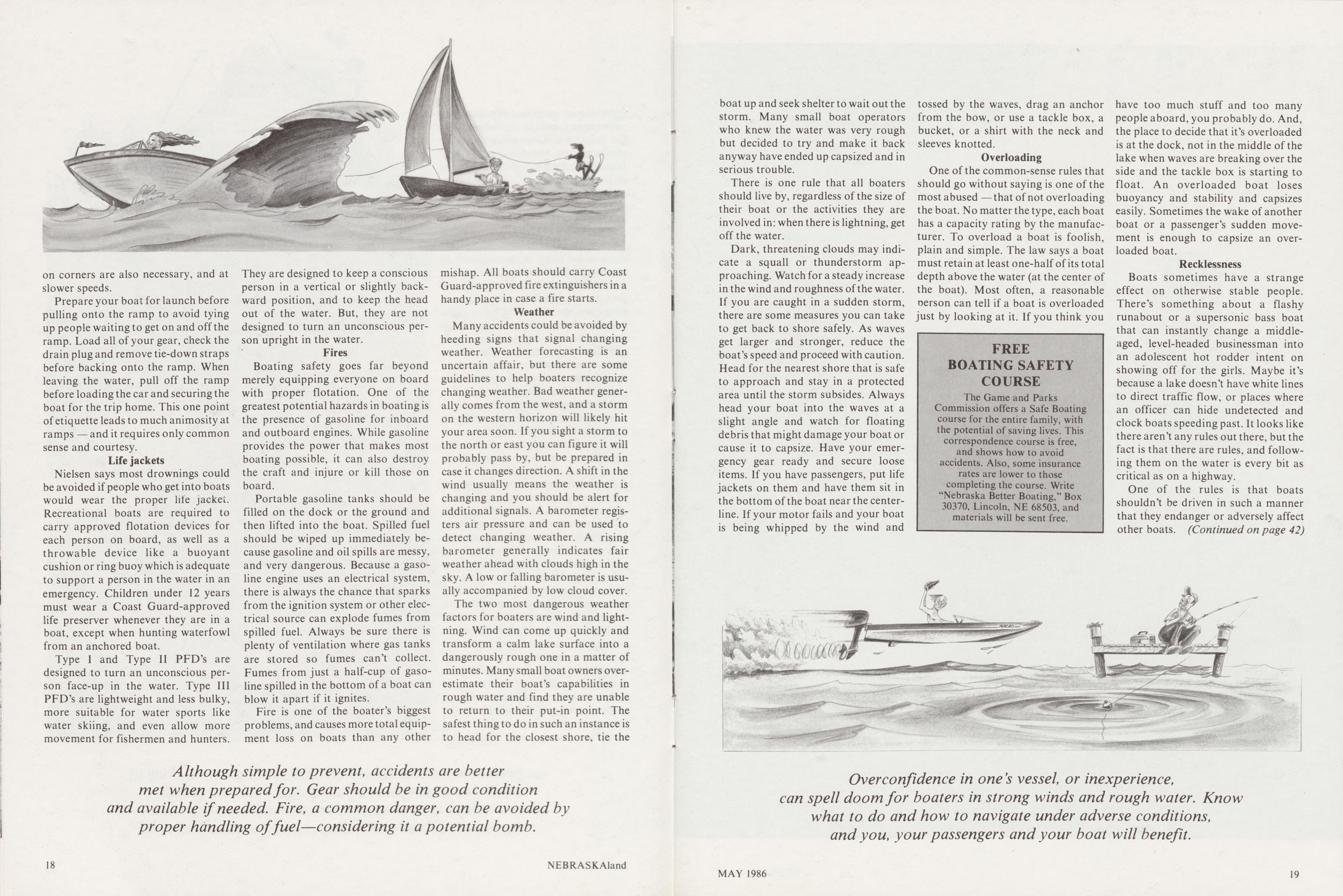
on corners are also necessary, and at slower speeds.
Prepare your boat for launch before pulling onto the ramp to avoid tying up people waiting to get on and off the ramp. Load all of your gear, check the drain plug and remove tie-down straps before backing onto the ramp. When leaving the water, pull off the ramp before loading the car and securing the boat for the trip home. This one point of etiquette leads to much animosity at ramps — and it requires only common sense and courtesy.
Life jacketsNielsen says most drownings could be avoided if people who get into boats would wear the proper life jacket. Recreational boats are required to carry approved flotation devices for each person on board, as well as a throwable device like a buoyant cushion or ring buoy which is adequate to support a person in the water in an emergency. Children under 12 years must wear a Coast Guard-approved life preserver whenever they are in a boat, except when hunting waterfowl from an anchored boat.
Type I and Type II PFD's are designed to turn an unconscious person face-up in the water. Type III PFD's are lightweight and less bulky, more suitable for water sports like water skiing, and even allow more movement for fishermen and hunters. They are designed to keep a conscious person in a vertical or slightly backward position, and to keep the head out of the water. But, they are not designed to turn an unconscious person upright in the water.
Although simple to prevent, accidents are better met when prepared for. Gear should be in good condition and available if needed. Fire, a common danger, can be avoided by proper handling of fuel—considering it a potential bomb. FiresBoating safety goes far beyond merely equipping everyone on board with proper flotation. One of the greatest potential hazards in boating is the presence of gasoline for inboard and outboard engines. While gasoline provides the power that makes most boating possible, it can also destroy the craft and injure or kill those on board.
Portable gasoline tanks should be filled on the dock or the ground and then lifted into the boat. Spilled fuel should be wiped up immediately because gasoline and oil spills are messy, and very dangerous. Because a gasoline engine uses an electrical system, there is always the chance that sparks from the ignition system or other electrical source can explode fumes from spilled fuel. Always be sure there is plenty of ventilation where gas tanks are stored so fumes can't collect. Fumes from just a half-cup of gasoline spilled in the bottom of a boat can blow it apart if it ignites.
Fire is one of the boater's biggest problems, and causes more total equipment loss on boats than any other mishap. All boats should carry Coast Guard-approved fire extinguishers in a handy place in case a fire starts.
WeatherMany accidents could be avoided by heeding signs that signal changing weather. Weather forecasting is an uncertain affair, but there are some guidelines to help boaters recognize changing weather. Bad weather generally comes from the west, and a storm on the western horizon will likely hit your area soon. If you sight a storm to the north or east you can figure it will probably pass by, but be prepared in case it changes direction. A shift in the wind usually means the weather is changing and you should be alert for additional signals. A barometer registers air pressure and can be used to detect changing weather. A rising barometer generally indicates fair weather ahead with clouds high in the sky. A low or falling barometer is usually accompanied by low cloud cover.
The two most dangerous weather factors for boaters are wind and lightning. Wind can come up quickly and transform a calm lake surface into a dangerously rough one in a matter of minutes. Many small boat owners overestimate their boat's capabilities in rough water and find they are unable to return to their put-in point. The safest thing to do in such an instance is to head for the closest shore, tie the 18 NEBRASKAland boat up and seek shelter to wait out the storm. Many small boat operators who knew the water was very rough but decided to try and make it back anyway have ended up capsized and in serious trouble.
There is one rule that all boaters should live by, regardless of the size of their boat or the activities they are involved in: when there is lightning, get off the water.
Dark, threatening clouds may indicate a squall or thunderstorm approaching. Watch for a steady increase in the wind and roughness of the water. If you are caught in a sudden storm, there are some measures you can take to get back to shore safely. As waves get larger and stronger, reduce the boat's speed and proceed with caution. Head for the nearest shore that is safe to approach and stay in a protected area until the storm subsides. Always head your boat into the waves at a slight angle and watch for floating debris that might damage your boat or cause it to capsize. Have your emergency gear ready and secure loose items. If you have passengers, put life jackets on them and have them sit in the bottom of the boat near the centerline. If your motor fails and your boat is being whipped by the wind and tossed by the waves, drag an anchor from the bow, or use a tackle box, a bucket, or a shirt with the neck and sleeves knotted.
Over confidence in one's vessel, or inexperience, can spell doom for boaters in strong winds and rough water. Know what to do and how to navigate under adverse conditions, and you, your passengers and your boat will benefit. OverloadingOne of the common-sense rules that should go without saying is one of the most abused —that of not overloading the boat. No matter the type, each boat has a capacity rating by the manufacturer. To overload a boat is foolish, plain and simple. The law says a boat must retain at least one-half of its total depth above the water (at the center of the boat). Most often, a reasonable oerson can tell if a boat is overloaded just by looking at it. If you think you have too much stuff and too many people aboard, you probably do. And, the place to decide that it's overloaded is at the dock, not in the middle of the lake when waves are breaking over the side and the tackle box is starting to float. An overloaded boat loses buoyancy and stability and capsizes easily. Sometimes the wake of another boat or a passenger's sudden movement is enough to capsize an overloaded boat.
FREE BOATING SAFETY COURSE The Game and Parks Commission offers a Safe Boating course for the entire family, with the potential of saving lives. This correspondence course is free, and shows how to avoid accidents. Also, some insurance rates are lower to those completing the course. Write "Nebraska Better Boating," Box 30370, Lincoln, NE 68503, and materials will be sent free. RecklessnessBoats sometimes have a strange effect on otherwise stable people. There's something about a flashy runabout or a supersonic bass boat that can instantly change a middleaged, level-headed businessman into an adolescent hot rodder intent on showing off for the girls. Maybe it's because a lake doesn't have white lines to direct traffic flow, or places where an officer can hide undetected and clock boats speeding past. It looks like there aren't any rules out there, but the fact is that there are rules, and following them on the water is every bit as critical as on a highway.
One of the rules is that boats shouldn't be driven in such a manner that they endanger or adversely affect other boats. (Continued on page 42)
Bass Behind The Barn
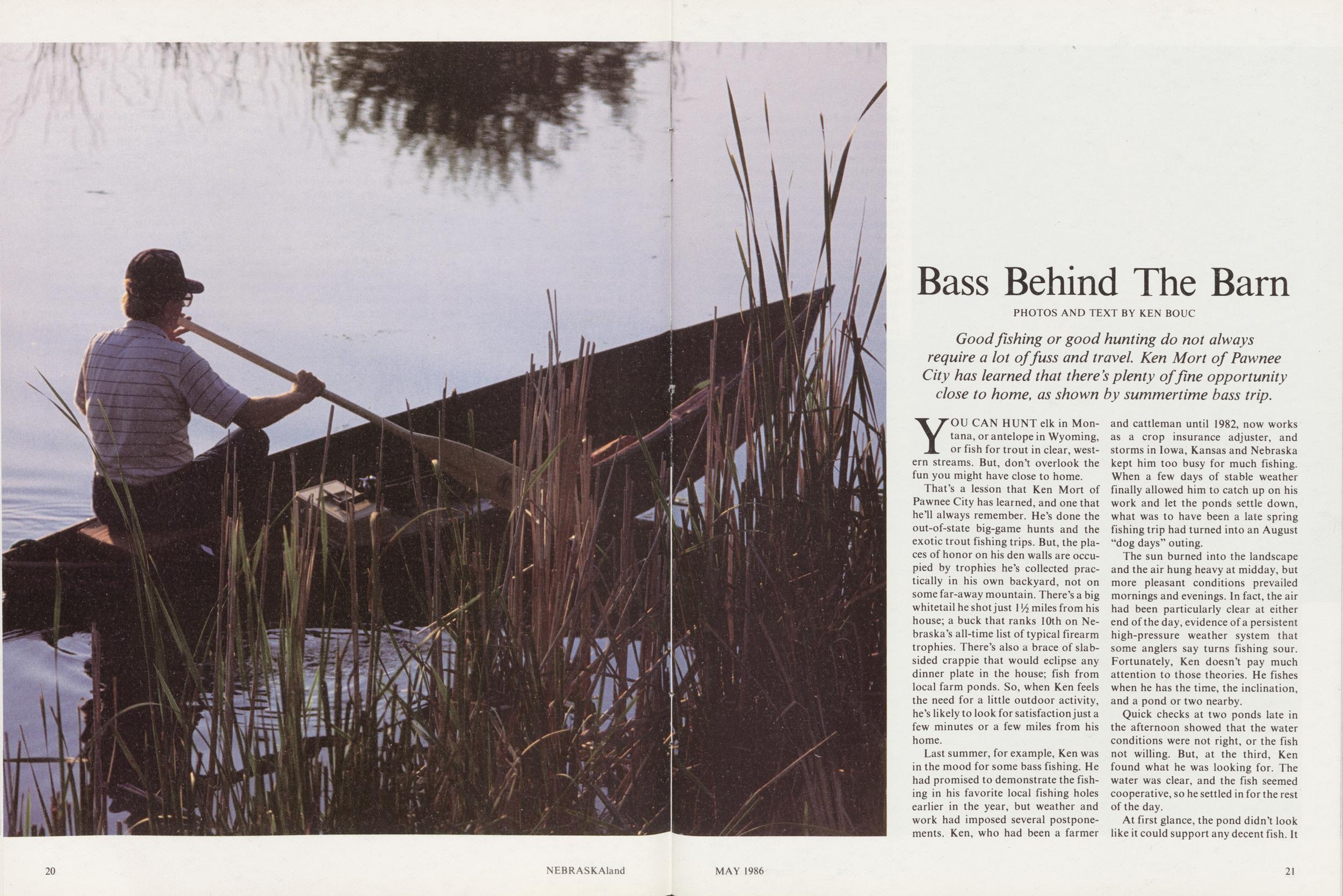
PHOTOS AND TEXT BY KEN BOUC Good fishing or good hunting do not always require a lot of fuss and travel Ken Mort of Pawnee City has learned that there s plenty of fine opportunity close to home, as shown by summertime bass trip.YOU CAN HUNT elk in Montana, or antelope in Wyoming, or fish for trout in clear, western streams. But, don't overlook the fun you might have close to home.
That's a lesson that Ken Mort of Pawnee City has learned, and one that he'll always remember. He's done the out-of-state big-game hunts and the exotic trout fishing trips. But, the places of honor on his den walls are occupied by trophies he's collected practically in his own backyard, not on some far-away mountain. There's a big whitetail he shot just 11/2 miles from his house; a buck that ranks 10th on Nebraska's all-time list of typical firearm trophies. There's also a brace of slabsided crappie that would eclipse any dinner plate in the house; fish from local farm ponds. So, when Ken feels the need for a little outdoor activity, he's likely to look for satisfaction just a few minutes or a few miles from his home.
Last summer, for example, Ken was in the mood for some bass fishing. He had promised to demonstrate the fishing in his favorite local fishing holes earlier in the year, but weather and work had imposed several postponements. Ken, who had been a farmer and cattleman until 1982, now works as a crop insurance adjuster, and storms in Iowa, Kansas and Nebraska kept him too busy for much fishing. When a few days of stable weather finally allowed him to catch up on his work and let the ponds settle down, what was to have been a late spring fishing trip had turned into an August "dog days" outing.
The sun burned into the landscape and the air hung heavy at midday, but more pleasant conditions prevailed mornings and evenings. In fact, the air had been particularly clear at either end of the day, evidence of a persistent high-pressure weather system that some anglers say turns fishing sour. Fortunately, Ken doesn't pay much attention to those theories. He fishes when he has the time, the inclination, and a pond or two nearby.
Quick checks at two ponds late in the afternoon showed that the water conditions were not right, or the fish not willing. But, at the third, Ken found what he was looking for. The water was clear, and the fish seemed cooperative, so he settled in for the rest of the day.
At first glance, the pond didn't look
like it could support any decent fish. It
MAY 1986
21
But this particular pond had several things going for it. It was spring-fed, receiving a constant supply of clean, cool water. Its sides were steep and the water was deep, which discouraged livestock from wading. And, a fourfoot band of cattails all around kept the cattle out of the pond except at a couple of spots, where they usually came to drink.
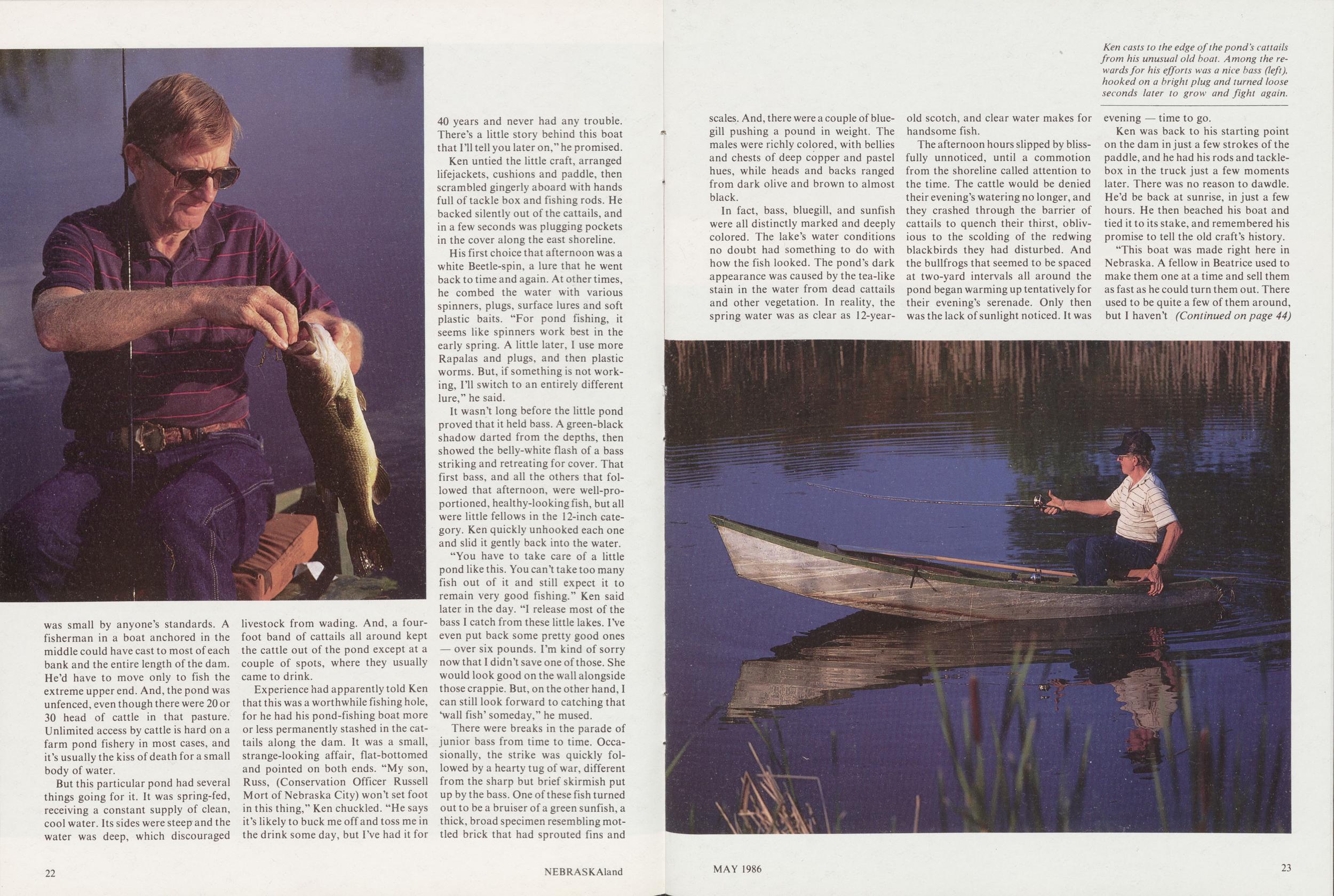
Experience had apparently told Ken that this was a worthwhile fishing hole, for he had his pond-fishing boat more or less permanently stashed in the cattails along the dam. It was a small, strange-looking affair, flat-bottomed and pointed on both ends. "My son, Russ, (Conservation Officer Russell Mort of Nebraska City) won't set foot in this thing," Ken chuckled. "He says it's likely to buck me off and toss me in the drink some day, but I've had it for 40 years and never had any trouble. There's a little story behind this boat that I'll tell you later on," he promised.
Ken untied the little craft, arranged lifejackets, cushions and paddle, then scrambled gingerly aboard with hands full of tackle box and fishing rods. He backed silently out of the cattails, and in a few seconds was plugging pockets in the cover along the east shoreline.
His first choice that afternoon was a white Beetle-spin, a lure that he went back to time and again. At other times, he combed the water with various spinners, plugs, surface lures and soft plastic baits. "For pond fishing, it seems like spinners work best in the early spring. A little later, I use more Rapalas and plugs, and then plastic worms. But, if something is not working, I'll switch to an entirely different lure," he said.
It wasn't long before the little pond proved that it held bass. A green-black shadow darted from the depths, then showed the belly-white flash of a bass striking and retreating for cover. That first bass, and all the others that followed that afternoon, were well-proportioned, healthy-looking fish, but all were little fellows in the 12-inch category. Ken quickly unhooked each one and slid it gently back into the water.
"You have to take care of a little pond like this. You can't take too many fish out of it and still expect it to remain very good fishing." Ken said later in the day. "I release most of the bass I catch from these little lakes. I've even put back some pretty good ones — over six pounds. I'm kind of sorry now that I didn't save one of those. She would look good on the wall alongside those crappie. But, on the other hand, I can still look forward to catching that 'wall fish' someday," he mused.
There were breaks in the parade of junior bass from time to time. Occasionally, the strike was quickly followed by a hearty tug of war, different from the sharp but brief skirmish put up by the bass. One of these fish turned out to be a bruiser of a green sunfish, a thick, broad specimen resembling mottled brick that had sprouted fins and 22 NEBRASKAland scales. And, there were a couple of bluegill pushing a pound in weight. The males were richly colored, with bellies and chests of deep copper and pastel hues, while heads and backs ranged from dark olive and brown to almost black.
In fact, bass, bluegill, and sunfish were all distinctly marked and deeply colored. The lake's water conditions no doubt had something to do with how the fish looked. The pond's dark appearance was caused by the tea-like stain in the water from dead cattails and other vegetation. In reality, the spring water was as clear as 12-year-old scotch, and clear water makes for handsome fish.
The afternoon hours slipped by blissfully unnoticed, until a commotion from the shoreline called attention to the time. The cattle would be denied their evening's watering no longer, and they crashed through the barrier of cattails to quench their thirst, oblivious to the scolding of the redwing blackbirds they had disturbed. And the bullfrogs that seemed to be spaced at two-yard intervals all around the pond began warming up tentatively for their evening's serenade. Only then was the lack of sunlight noticed. It was evening — time to go.
Ken was back to his starting point on the dam in just a few strokes of the paddle, and he had his rods and tacklebox in the truck just a few moments later. There was no reason to dawdle. He'd be back at sunrise, in just a few hours. He then beached his boat and tied it to its stake, and remembered his promise to tell the old craft's history.
"This boat was made right here in Nebraska. A fellow in Beatrice used to make them one at a time and sell them as fast as he could turn them out. There used to be quite a few of them around, but I haven't (Continued on page 44)
Federal Funds For Fish
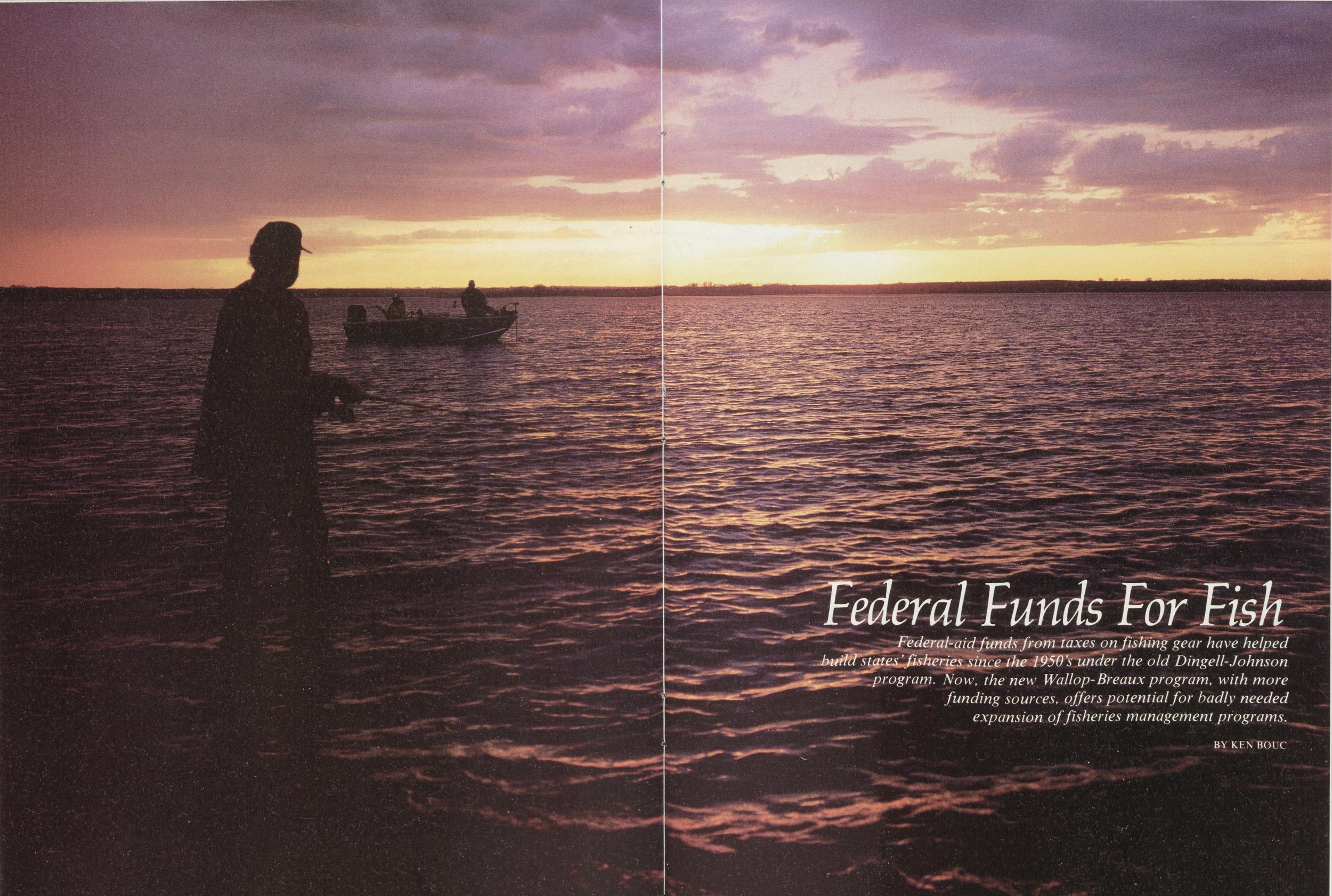
Federal-aid funds from taxes on fishing gear have helped build states' fisheries since the 1950's under the old Dingell-Johnson program. Now, the new Wallop-Breaux program, with more funding sources, offers potential for badly needed expansion of fisheries management programs. BY KEN BOUC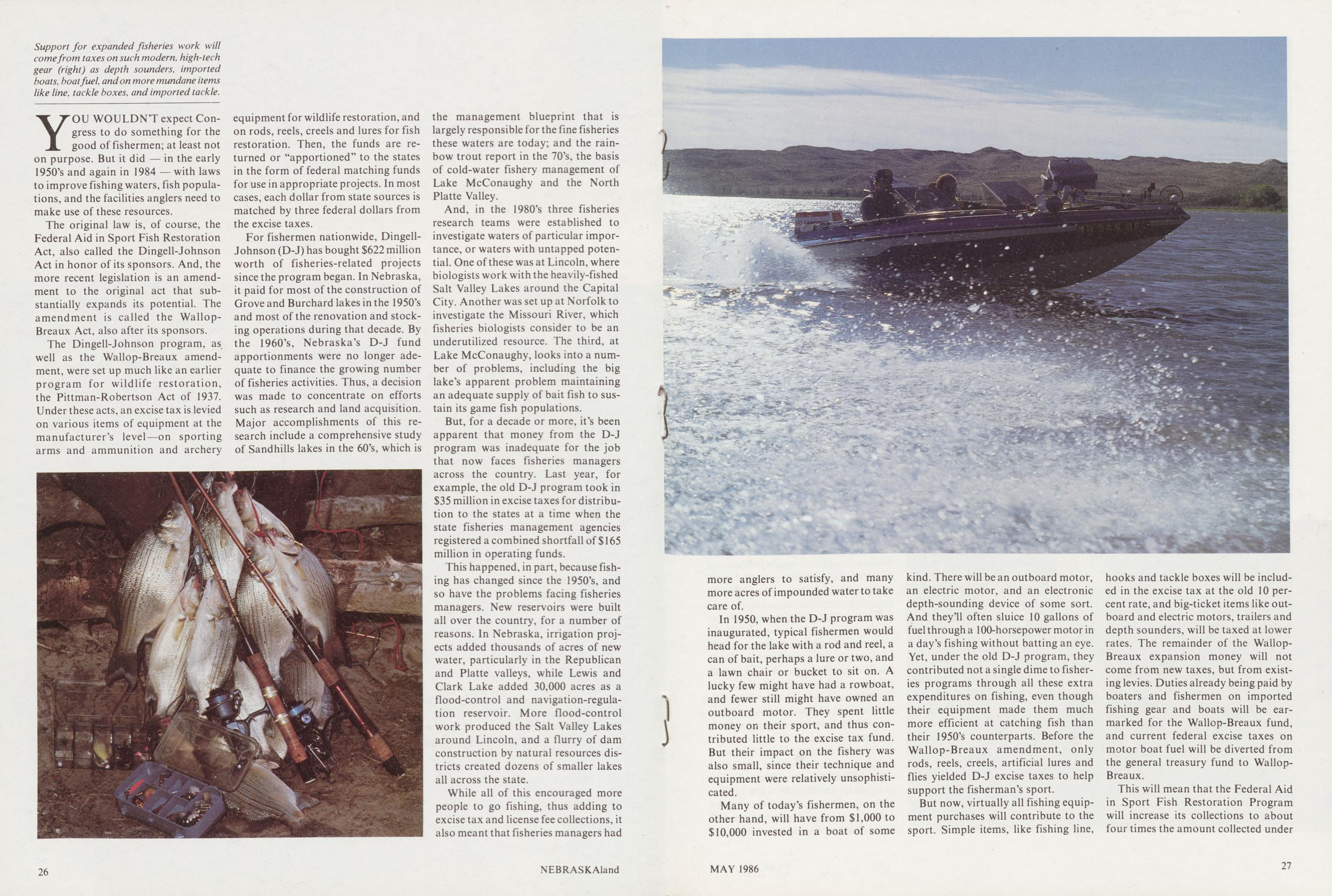
YOU WOULDN'T expect Congress to do something for the good of fishermen; at least not on purpose. But it did — in the early 1950's and again in 1984 — with laws to improve fishing waters, fish populations, and the facilities anglers need to make use of these resources.
The original law is, of course, the Federal Aid in Sport Fish Restoration Act, also called the Dingell-Johnson Act in honor of its sponsors. And, the more recent legislation is an amendment to the original act that substantially expands its potential. The amendment is called the WallopBreaux Act, also after its sponsors.
The Dingell-Johnson program, as well as the Wallop-Breaux amendment, were set up much like an earlier program for wildlife restoration, the Pittman-Robertson Act of 1937. Under these acts, an excise tax is levied on various items of equipment at the manufacturer's level—on sporting arms and ammunition and archery
For fishermen nationwide, Dingell Johnson (D-J) has bought $622 million worth of fisheries-related projects since the program began. In Nebraska, it paid for most of the construction of Grove and Burchard lakes in the 1950's and most of the renovation and stocking operations during that decade. By the 1960's, Nebraska's D-J fund apportionments were no longer adequate to finance the growing number of fisheries activities. Thus, a decision was made to concentrate on efforts such as research and land acquisition. Major accomplishments of this research include a comprehensive study of Sandhills lakes in the 60's, which is the management blueprint that is largely responsible for the fine fisheries these waters are today; and the rainbow trout report in the 70's, the basis of cold-water fishery management of Lake McConaughy and the North Platte Valley.
And, in the 1980's three fisheries research teams were established to investigate waters of particular importance, or waters with untapped potential. One of these was at Lincoln, where biologists work with the heavily-fished Salt Valley Lakes around the Capital City. Another was set up at Norfolk to investigate the Missouri River, which fisheries biologists consider to be an underutilized resource. The third, at Lake McConaughy, looks into a number of problems, including the big lake's apparent problem maintaining an adequate supply of bait fish to sustain its game fish populations.
But, for a decade or more, it's been apparent that money from the D-J program was inadequate for the job that now faces fisheries managers across the country. Last year, for example, the old D-J program took in $35 million in excise taxes for distribution to the states at a time when the state fisheries management agencies registered a combined shortfall of $ 165 million in operating funds.
This happened, in part, because fishing has changed since the 1950's, and so have the problems facing fisheries managers. New reservoirs were built all over the country, for a number of reasons. In Nebraska, irrigation projects added thousands of acres of new water, particularly in the Republican and Platte valleys, while Lewis and Clark Lake added 30,000 acres as a flood-control and navigation-regulation reservoir. More flood-control work produced the Salt Valley Lakes around Lincoln, and a flurry of dam construction by natural resources districts created dozens of smaller lakes all across the state.
While all of this encouraged more people to go fishing, thus adding to excise tax and license fee collections, it also meant that fisheries managers had 26 NEBRASKAland more anglers to satisfy, and many more acres of impounded water to take care of.
In 1950, when the D-J program was inaugurated, typical fishermen would head for the lake with a rod and reel, a can of bait, perhaps a lure or two, and a lawn chair or bucket to sit on. A lucky few might have had a rowboat, and fewer still might have owned an outboard motor. They spent little money on their sport, and thus contributed little to the excise tax fund. But their impact on the fishery was also small, since their technique and equipment were relatively unsophisticated.
Many of today's fishermen, on the other hand, will have from $1,000 to $10,000 invested in a boat of some kind. There will be an outboard motor, an electric motor, and an electronic depth-sounding device of some sort. And they'll often sluice 10 gallons of fuel through a 100-horsepower motor in a day's fishing without batting an eye. Yet, under the old D-J program, they contributed not a single dime to fisheries programs through all these extra expenditures on fishing, even though their equipment made them much more efficient at catching fish than their 1950's counterparts. Before the Wallop-Breaux amendment, only rods, reels, creels, artificial lures and flies yielded D-J excise taxes to help support the fisherman's sport.
But now, virtually all fishing equipment purchases will contribute to the sport. Simple items, like fishing line, hooks and tackle boxes will be included in the excise tax at the old 10 percent rate, and big-ticket items like outboard and electric motors, trailers and depth sounders, will be taxed at lower rates. The remainder of the WallopBreaux expansion money will not come from new taxes, but from exist-ing levies. Duties already being paid by boaters and fishermen on imported fishing gear and boats will be earmarked for the Wallop-Breaux fund, and current federal excise taxes on motor boat fuel will be diverted from the general treasury fund to Wallop Breaux.
This will mean that the Federal Aid
in Sport Fish Restoration Program
will increase its collections to about
four times the amount collected under
MAY 1986
27
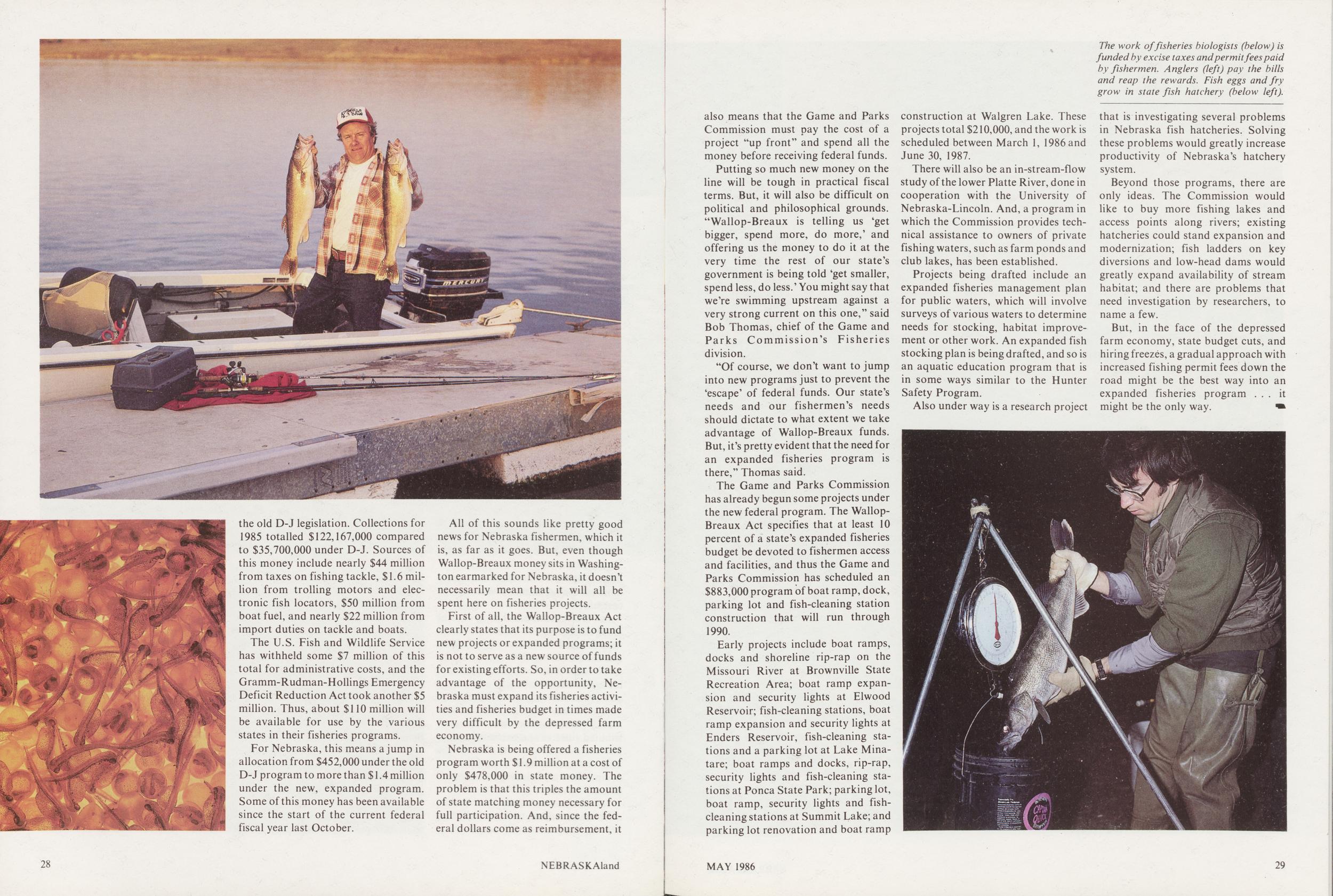
The U.S. Fish and Wildlife Service has withheld some $7 million of this total for administrative costs, and the Gramm-Rudman-Hollings Emergency Deficit Reduction Act took another $5 million. Thus, about $110 million will be available for use by the various states in their fisheries programs.
For Nebraska, this means a jump in allocation from $452,000 under the old D-J program to more than $1.4 million under the new, expanded program. Some of this money has been available since the start of the current federal fiscal year last October.
All of this sounds like pretty good news for Nebraska fishermen, which it is, as far as it goes. But, even though Wallop-Breaux money sits in Washington earmarked for Nebraska, it doesn't necessarily mean that it will all be spent here on fisheries projects.
First of all, the Wallop-Breaux Act clearly states that its purpose is to fund new projects or expanded programs; it is not to serve as a new source of funds for existing efforts. So, in order to take advantage of the opportunity, Nebraska must expand its fisheries activities and fisheries budget in times made very difficult by the depressed farm economy.
Nebraska is being offered a fisheries program worth $1.9 million at a cost of only $478,000 in state money. The problem is that this triples the amount of state matching money necessary for full participation. And, since the federal dollars come as reimbursement, it 28 NEBRASKAland also means that the Game and Parks Commission must pay the cost of a project "up front" and spend all the money before receiving federal funds.
Putting so much new money on the line will be tough in practical fiscal terms. But, it will also be difficult on political and philosophical grounds. "Wallop-Breaux is telling us 'get bigger, spend more, do more,' and offering us the money to do it at the very time the rest of our state's government is being told 'get smaller, spend less, do less.' You might say that we're swimming upstream against a very strong current on this one," said Bob Thomas, chief of the Game and Parks Commission's Fisheries division.
"Of course, we don't want to jump into new programs just to prevent the 'escape' of federal funds. Our state's needs and our fishermen's needs should dictate to what extent we take advantage of Wallop-Breaux funds. But, it's pretty evident that the need for an expanded fisheries program is there," Thomas said.
The Game and Parks Commission has already begun some projects under the new federal program. The Wallop Breaux Act specifies that at least 10 percent of a state's expanded fisheries budget be devoted to fishermen access and facilities, and thus the Game and Parks Commission has scheduled an $883,000 program of boat ramp, dock, parking lot and fish-cleaning station construction that will run through 1990.
Early projects include boat ramps, docks and shoreline rip-rap on the Missouri River at Brownville State Recreation Area; boat ramp expansion and security lights at Elwood Reservoir; fish-cleaning stations, boat ramp expansion and security lights at Enders Reservoir, fish-cleaning stations and a parking lot at Lake Minatare; boat ramps and docks, rip-rap, security lights and fish-cleaning stations at Ponca State Park; parking lot, boat ramp, security lights and fishcleaning stations at Summit Lake; and parking lot renovation and boat ramp construction at Walgren Lake. These projects total $210,000, and the work is scheduled between March 1, 1986 and June 30, 1987.
There will also be an in-stream-flow study of the lower Platte River, done in cooperation with the University of Nebraska-Lincoln. And, a program in which the Commission provides technical assistance to owners of private fishing waters, such as farm ponds and club lakes, has been established.
Projects being drafted include an expanded fisheries management plan for public waters, which will involve surveys of various waters to determine needs for stocking, habitat improvement or other work. An expanded fish stocking plan is being drafted, and so is an aquatic education program that is in some ways similar to the Hunter Safety Program.
Also under way is a research project that is investigating several problems in Nebraska fish hatcheries. Solving these problems would greatly increase productivity of Nebraska's hatchery system.
Beyond those programs, there are only ideas. The Commission would like to buy more fishing lakes and access points along rivers; existing hatcheries could stand expansion and modernization; fish ladders on key diversions and low-head dams would greatly expand availability of stream habitat; and there are problems that need investigation by researchers, to name a few.
But, in the face of the depressed farm economy, state budget cuts, and hiring freezes, a gradual approach with increased fishing permit fees down the road might be the best way into an expanded fisheries program it might be the only way.
A Limited-Edition HAWK
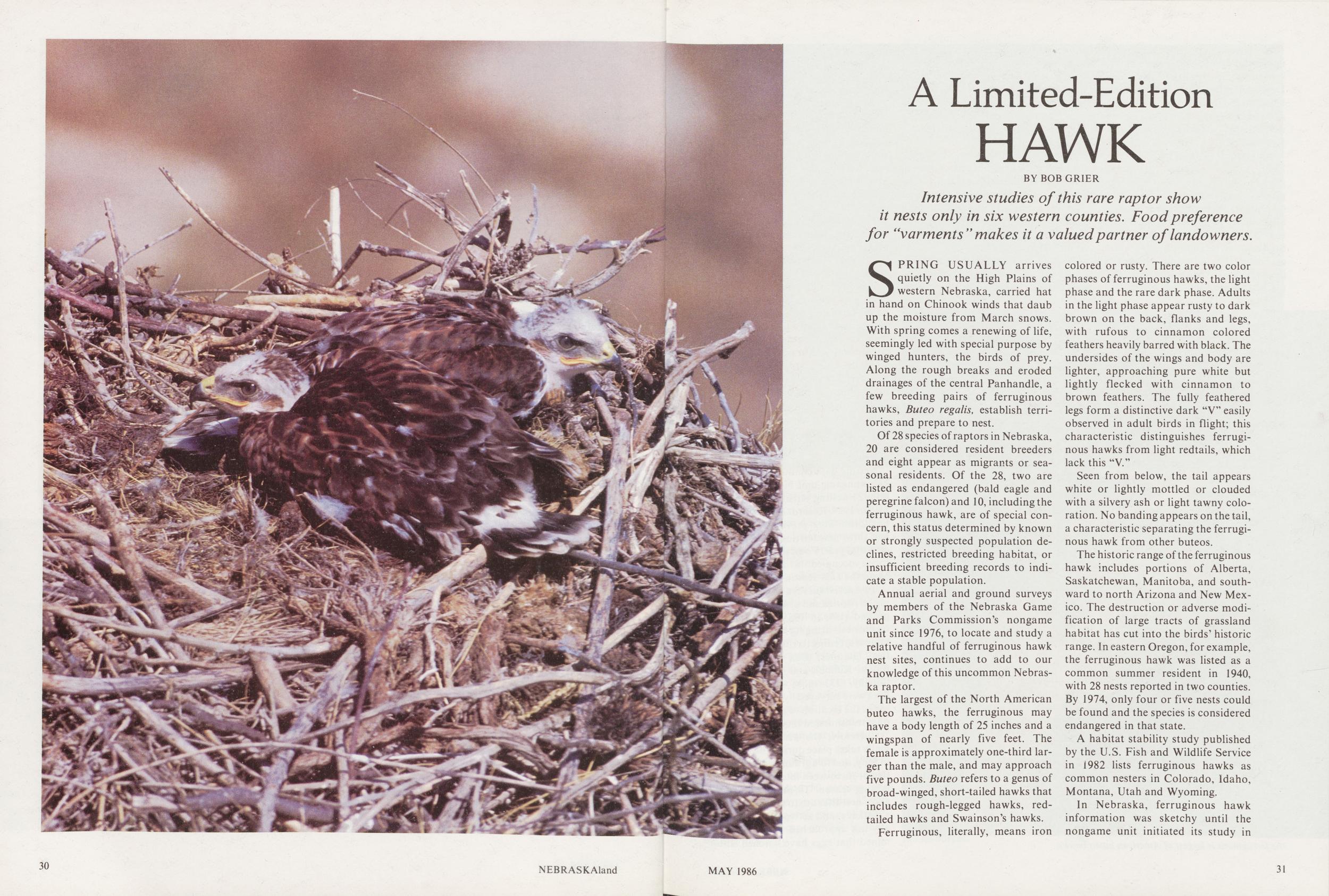
BY BOB GRIER Intensive studies of this rare raptor show it nests only in six western counties. Food preference for "varments" makes it a valued partner of landowners.SPRING USUALLY arrives quietly on the High Plains of western Nebraska, carried hat in hand on Chinook winds that daub up the moisture from March snows. With spring comes a renewing of life, seemingly led with special purpose by winged hunters, the birds of prey. Along the rough breaks and eroded drainages of the central Panhandle, a few breeding pairs of ferruginous hawks, Buteo regalis, establish territories and prepare to nest.
Of 28 species of raptors in Nebraska, 20 are considered resident breeders and eight appear as migrants or seasonal residents. Of the 28, two are listed as endangered (bald eagle and peregrine falcon) and 10, including the ferruginous hawk, are of special concern, this status determined by known or strongly suspected population declines, restricted breeding habitat, or insufficient breeding records to indicate a stable population.
Annual aerial and ground surveys by members of the Nebraska Game and Parks Commission's nongame unit since 1976, to locate and study a relative handful of ferruginous hawk nest sites, continues to add to our knowledge of this uncommon Nebraska raptor.
The largest of the North American buteo hawks, the ferruginous may have a body length of 25 inches and a wingspan of nearly five feet. The female is approximately one-third larger than the male, and may approach five pounds. Buteo refers to a genus of broad-winged, short-tailed hawks that includes rough-legged hawks, redtailed hawks and Swainson's hawks.
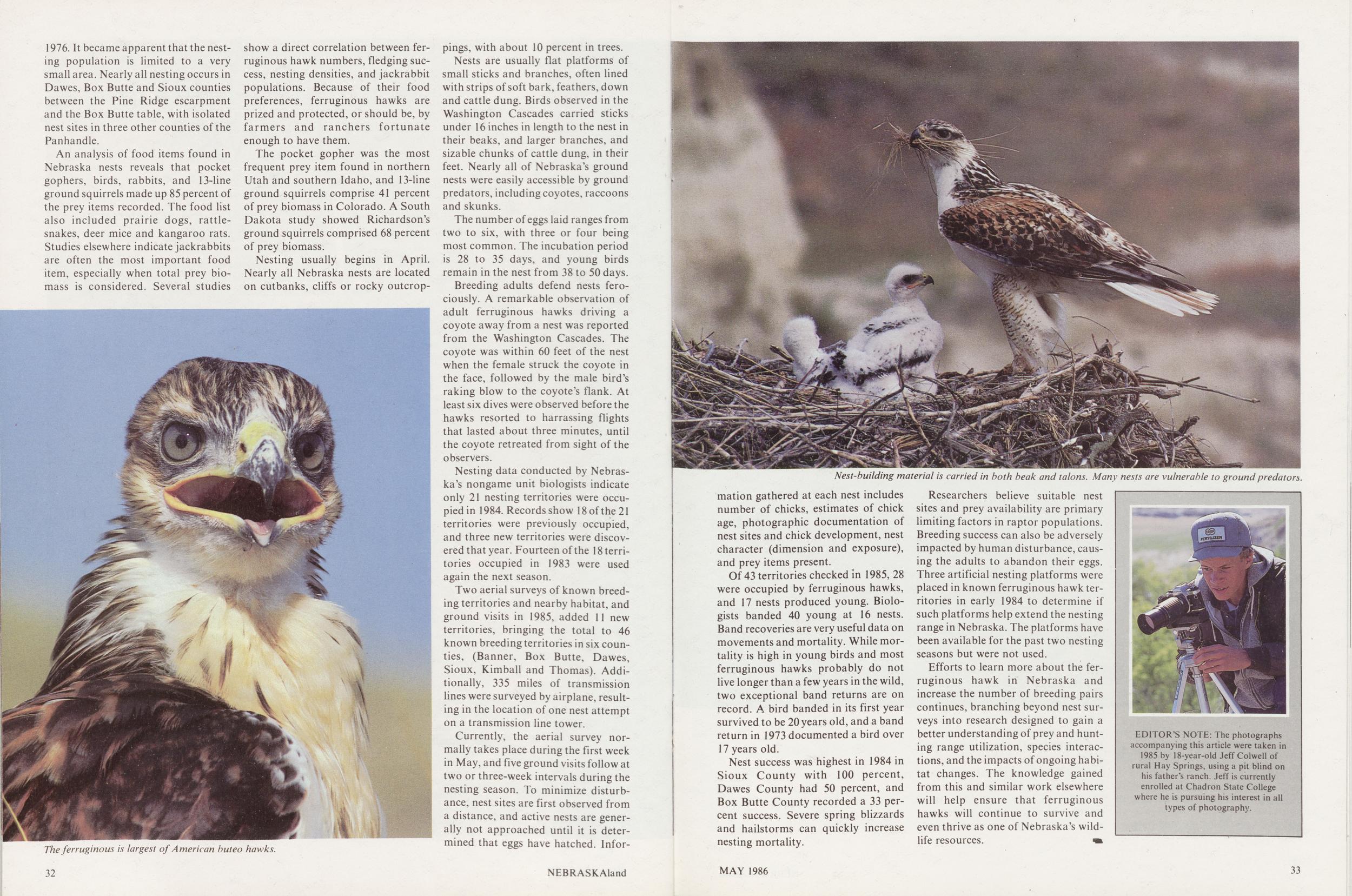
Ferruginous, literally, means iron colored or rusty. There are two color phases of ferruginous hawks, the light phase and the rare dark phase. Adults in the light phase appear rusty to dark brown on the back, flanks and legs, with rufous to cinnamon colored feathers heavily barred with black. The undersides of the wings and body are lighter, approaching pure white but lightly flecked with cinnamon to brown feathers. The fully feathered legs form a distinctive dark easily observed in adult birds in flight; this characteristic distinguishes ferruginous hawks from light redtails, which lack this "V."
Seen from below, the tail appears white or lightly mottled or clouded with a silvery ash or light tawny coloration. No banding appears on the tail, a characteristic separating the ferruginous hawk from other buteos.
The historic range of the ferruginous hawk includes portions of Alberta, Saskatchewan, Manitoba, and southward to north Arizona and New Mexico. The destruction or adverse modification of large tracts of grassland habitat has cut into the birds' historic range. In eastern Oregon, for example, the ferruginous hawk was listed as a common summer resident in 1940, with 28 nests reported in two counties. By 1974, only four or five nests could be found and the species is considered endangered in that state.
A habitat stability study published by the U.S. Fish and Wildlife Service in 1982 lists ferruginous hawks as common nesters in Colorado, Idaho, Montana, Utah and Wyoming.
In Nebraska, ferruginous hawk
information was sketchy until the
nongame unit initiated its study in
MAY 1986
31
 1976. It became apparent that the nesting population is limited to a very
small area. Nearly all nesting occurs in
Dawes, Box Butte and Sioux counties
between the Pine Ridge escarpment
and the Box Butte table, with isolated
nest sites in three other counties of the
Panhandle.
1976. It became apparent that the nesting population is limited to a very
small area. Nearly all nesting occurs in
Dawes, Box Butte and Sioux counties
between the Pine Ridge escarpment
and the Box Butte table, with isolated
nest sites in three other counties of the
Panhandle.
An analysis of food items found in Nebraska nests reveals that pocket gophers, birds, rabbits, and 13-line ground squirrels made up 85 percent of the prey items recorded. The food list also included prairie dogs, rattlesnakes, deer mice and kangaroo rats. Studies elsewhere indicate jackrabbits are often the most important food item, especially when total prey biomass is considered. Several studies show a direct correlation between ferruginous hawk numbers, fledging success, nesting densities, and jackrabbit populations. Because of their food preferences, ferruginous hawks are prized and protected, or should be, by farmers and ranchers fortunate enough to have them.
The pocket gopher was the most frequent prey item found in northern Utah and southern Idaho, and 13-line ground squirrels comprise 41 percent of prey biomass in Colorado. A South Dakota study showed Richardson's ground squirrels comprised 68 percent of prey biomass.
Nesting usually begins in April. Nearly all Nebraska nests are located on cutbanks, cliffs or rocky outcroppings, with about 10 percent in trees.
Nests are usually flat platforms of small sticks and branches, often lined with strips of soft bark, feathers, down and cattle dung. Birds observed in the Washington Cascades carried sticks under 16 inches in length to the nest in their beaks, and larger branches, and sizable chunks of cattle dung, in their feet. Nearly all of Nebraska's ground nests were easily accessible by ground predators, including coyotes, raccoons and skunks.
The number of eggs laid ranges from two to six, with three or four being most common. The incubation period is 28 to 35 days, and young birds remain in the nest from 38 to 50 days.
Breeding adults defend nests ferociously. A remarkable observation of adult ferruginous hawks driving a coyote away from a nest was reported from the Washington Cascades. The coyote was within 60 feet of the nest when the female struck the coyote in the face, followed by the male bird's raking blow to the coyote's flank. At least six dives were observed before the hawks resorted to harrassing flights that lasted about three minutes, until the coyote retreated from sight of the observers.
Nesting data conducted by Nebraska's nongame unit biologists indicate only 21 nesting territories were occupied in 1984. Records show 18 of the 21 territories were previously occupied, and three new territories were discovered that year. Fourteen of the 18 territories occupied in 1983 were used again the next season.
Two aerial surveys of known breeding territories and nearby habitat, and ground visits in 1985, added 11 new territories, bringing the total to 46 known breeding territories in six counties, (Banner, Box Butte, Dawes, Sioux, Kimball and Thomas). Additionally, 335 miles of transmission lines were surveyed by airplane, resulting in the location of one nest attempt on a transmission line tower.
Currently, the aerial survey normally takes place during the first week in May, and five ground visits follow at two or three-week intervals during the nesting season. To minimize disturbance, nest sites are first observed from a distance, and active nests are generally not approached until it is determined that eggs have hatched. Information 32 NEBRASKAland
Of 43 territories checked in 1985, 28 were occupied by ferruginous hawks, and 17 nests produced young. Biologists banded 40 young at 16 nests. Band recoveries are very useful data on movements and mortality. While mortality is high in young birds and most ferruginous hawks probably do not live longer than a few years in the wild, two exceptional band returns are on record. A bird banded in its first year survived to be 20 years old, and a band return in 1973 documented a bird over 17 years old.
Nest success was highest in 1984 in Sioux County with 100 percent, Dawes County had 50 percent, and Box Butte County recorded a 33 percent success. Severe spring blizzards and hailstorms can quickly increase nesting mortality.
Researchers believe suitable nest sites and prey availability are primary limiting factors in raptor populations. Breeding success can also be adversely impacted by human disturbance, causing the adults to abandon their eggs. Three artificial nesting platforms were placed in known ferruginous hawk territories in early 1984 to determine if such platforms help extend the nesting range in Nebraska. The platforms have been available for the past two nesting seasons but were not used.
Efforts to learn more about the ferruginous hawk in Nebraska and increase the number of breeding pairs continues, branching beyond nest surveys into research designed to gain a better understanding of prey and hunting range utilization, species interactions, and the impacts of ongoing habitat changes. The knowledge gained from this and similar work elsewhere will help ensure that ferruginous hawks will continue to survive and even thrive as one of Nebraska's wildlife resources.
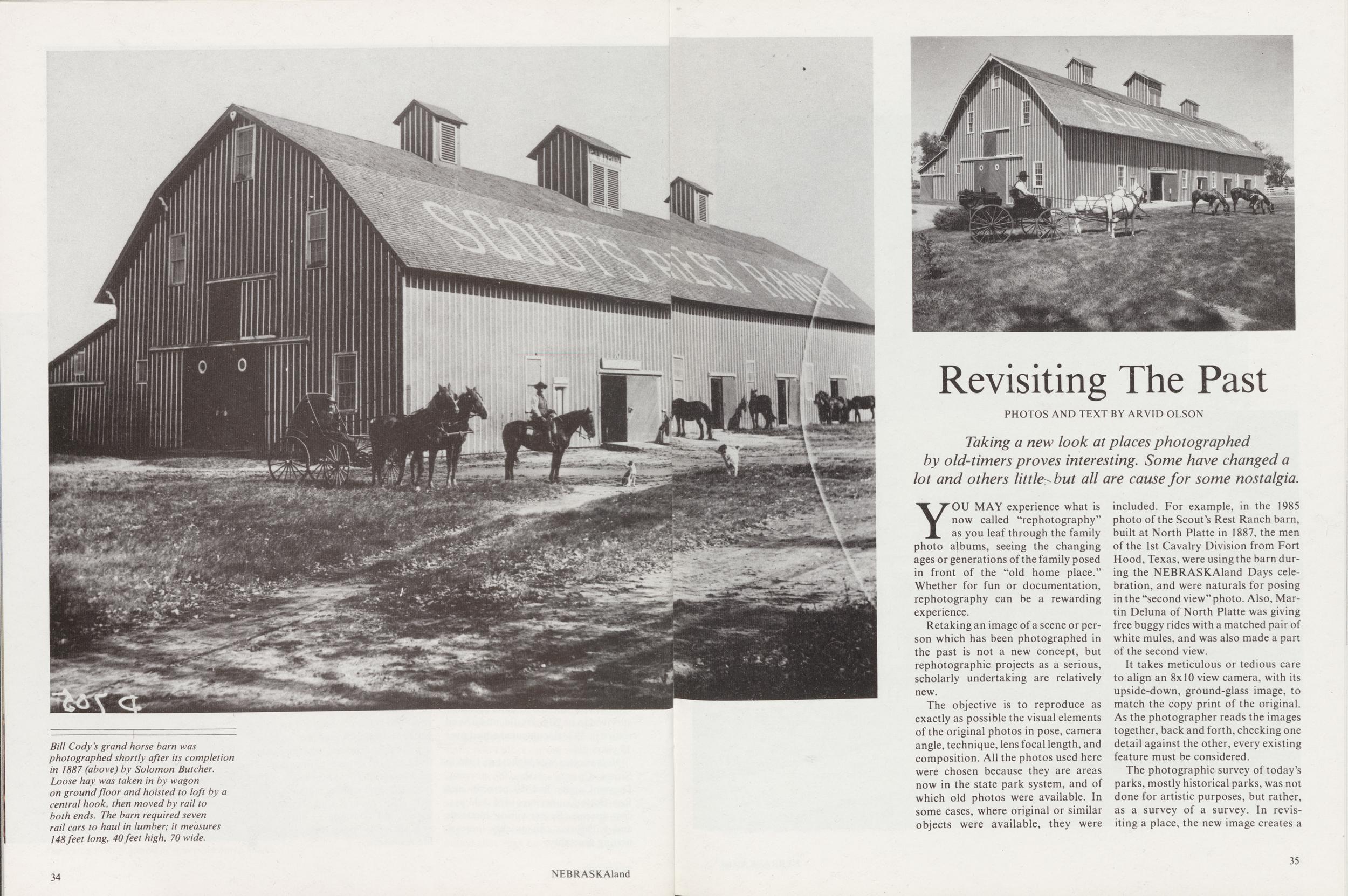
Revisiting The Past
PHOTOS AND TEXT BY ARVID OLSON Taking a new look at places photographed by old-timers proves interesting. Some have changed a lot and others little^ but all are cause for some nostalgia.YOU MAY experience what is now called "rephotography" as you leaf through the family photo albums, seeing the changing ages or generations of the family posed in front of the "old home place." Whether for fun or documentation, rephotography can be a rewarding experience.
Retaking an image of a scene or person which has been photographed in the past is not a new concept, but rephotographic projects as a serious, scholarly undertaking are relatively new.
The objective is to reproduce as exactly as possible the visual elements of the original photos in pose, camera angle, technique, lens focal length, and composition. All the photos used here were chosen because they are areas now in the state park system, and of which old photos were available. In some cases, where original or similar objects were available, they were included. For example, in the 1985 photo of the Scout's Rest Ranch barn, built at North Platte in 1887, the men of the 1st Cavalry Division from Fort Hood, Texas, were using the barn during the NEBRASKAland Days celebration, and were naturals for posing in the "second view" photo. Also, Martin Deluna of North Platte was giving free buggy rides with a matched pair of white mules, and was also made a part of the second view.
It takes meticulous or tedious care to align an 8x10 view camera, with its upside-down, ground-glass image, to match the copy print of the original. As the photographer reads the images together, back and forth, checking one detail against the other, every existing feature must be considered.
The photographic survey of today's
parks, mostly historical parks, was not
done for artistic purposes, but rather,
as a survey of a survey. In revisiting a place, the new image creates a
35
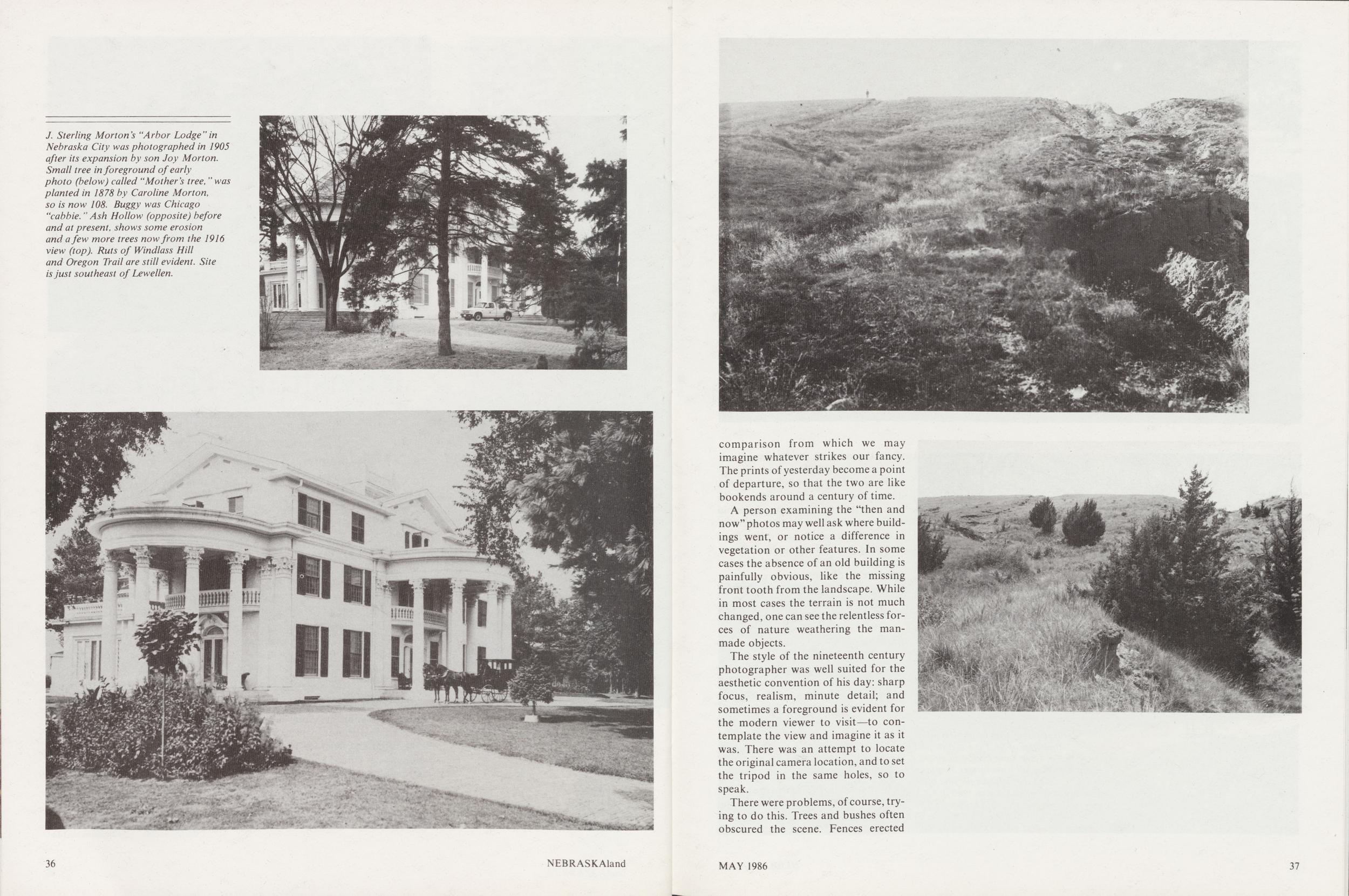
A person examining the "then and now" photos may well ask where buildings went, or notice a difference in vegetation or other features. In some cases the absence of an old building is painfully obvious, like the missing front tooth from the landscape. While in most cases the terrain is not much changed, one can see the relentless forces of nature weathering the manmade objects.
The style of the nineteenth century photographer was well suited for the aesthetic convention of his day: sharp focus, realism, minute detail; and sometimes a foreground is evident for the modern viewer to visit—to contemplate the view and imagine it as it was. There was an attempt to locate the original camera location, and to set the tripod in the same holes, so to speak.
There were problems, of course, trying to do this. Trees and bushes often
obscured the scene. Fences erected
MAY 1986
37
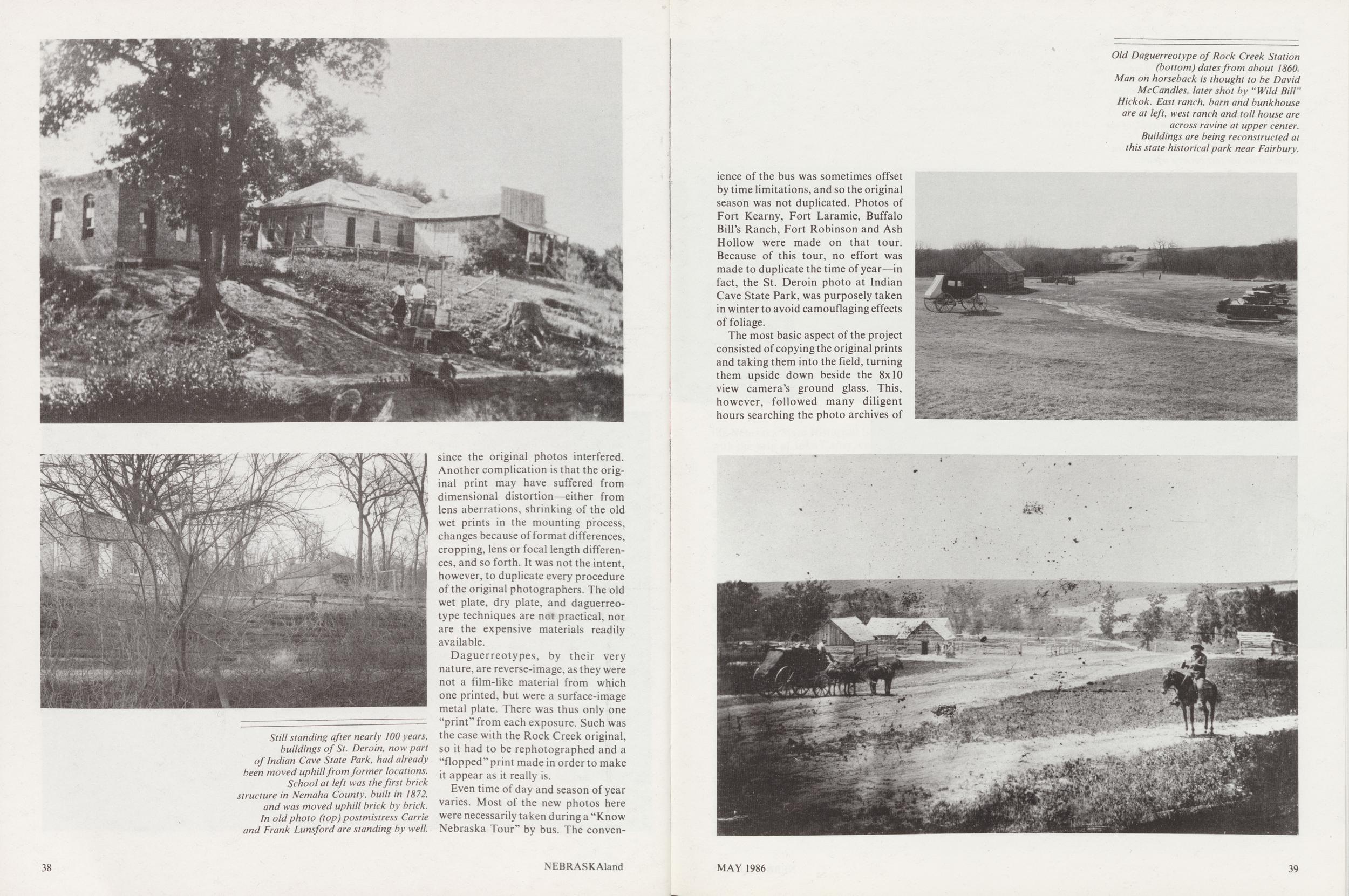
Daguerreotypes, by their very nature, are reverse-image, as they were not a film-like material from which one printed, but were a surface-image metal plate. There was thus only one "print" from each exposure. Such was the case with the Rock Creek original, so it had to be rephotographed and a "flopped" print made in order to make it appear as it really is.
Even time of day and season of year varies. Most of the new photos here were necessarily taken during a "Know Nebraska Tour" by bus. The convenience 38 NEBRASKAland
The most basic aspect of the project consisted of copying the original prints and taking them into the field, turning them upside down beside the 8x10 view camera's ground glass. This, however, followed many diligent hours searching the photo archives of
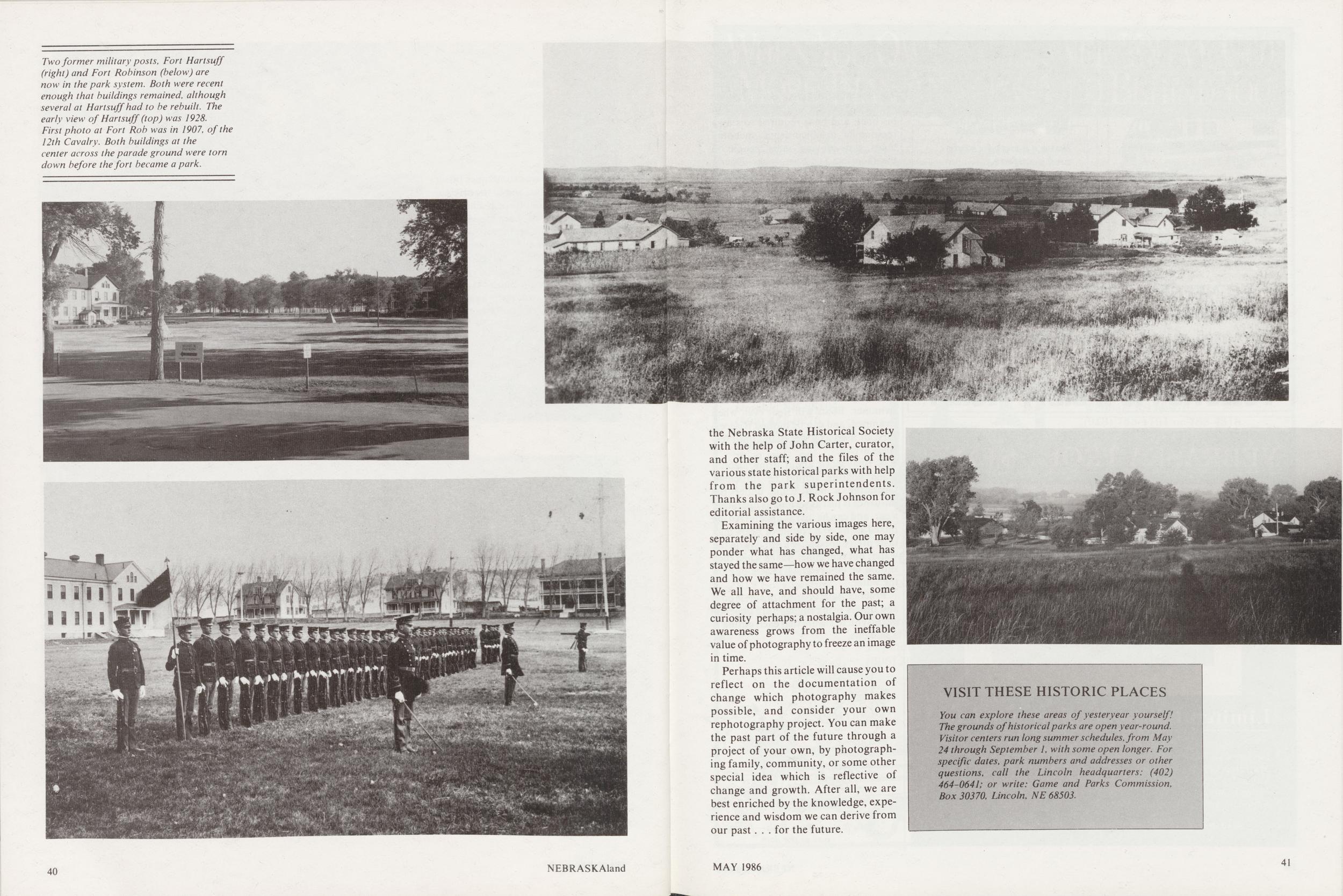
Examining the various images here, separately and side by side, one may ponder what has changed, what has stayed the same—how we have changed and how we have remained the same. We all have, and should have, some degree of attachment for the past; a curiosity perhaps; a nostalgia. Our own awareness grows from the ineffable value of photography to freeze an image in time.
Perhaps this article will cause you to reflect on the documentation of change which photography makes possible, and consider your own rephotography project. You can make the past part of the future through a project of your own, by photographing family, community, or some other special idea which is reflective of change and growth. After all, we are best enriched by the knowledge, experience and wisdom we can derive from our past for the future.
VISIT THESE HISTORIC PLACES You can explore these areas of yesteryear yourself! The grounds of historical parks are open year-round. Visitor centers run long summer schedules, from May 24 through September 1, with some open longer. For specific dates, park numbers and addresses or other questions, call the Lincoln headquarters: (402) 464-0641; or write: Game and Parks Commission, Box 30370, Lincoln, NE 68503. MAY 1986 41 THERE'S NOTHING
AVERAGE ABOUT
WINNEBAGO®
Chieftain 27RT
EXCEPT THE PRICE.
Winnebago is the number one
motor home in the world. When
you see their quality and our
prices youTl understand why.
A.C.NELSEN
CAMPER WORLD
1818 L St.
Omaha, NE (402) 333-1122
Save energy in style
and comfort.
QUALITY CONSTRUCTION
Full, round logs with unique
triple tongue-and-groove for
tight, weatherproof fit.
ENERGY EFFICIENT
Snug in winter, mountain-cool in
summer — with the rugged
beauty only natural wood can bring.
YOUR PLANS OR OURS
Year-round home, vacation hideaway or
commercial building, we'll deliver to your site
and supervise wall erection.
Joel A. Plettner
RR-1 Box 70C
Waterloo, NE 68069
(402) 359-5744
Write for free, informative folder. Or send
$5.00 for full-color catalog with floor plans.
Member: Log Homes Council. National
Association of Home Manufacturers.
POLLUTION IS A DIRTY WORD!
NEBRASKA TROUT STAMP
Limited Edition Collector's Print
Nebraska's 1986 Trout Stamp features a rainbow trout painted by
the late C.G. "Bud" Pritchard, -long-time fauna artist for NEBRASKAland
Magazine. Printed on high-quality cotton rag paper, a fine art print plus
a 1986 Trout Stamp, both carrying the same number, is $75 framed and
matted; unframed, $50. A few sets of the first-year pair painted by Neal
Anderson are available for $95 framed or $75 unframed.
Send orders to Game and Parks, Box 30370, Lincoln, NE 68503
THERE'S NOTHING
AVERAGE ABOUT
WINNEBAGO®
Chieftain 27RT
EXCEPT THE PRICE.
Winnebago is the number one
motor home in the world. When
you see their quality and our
prices youTl understand why.
A.C.NELSEN
CAMPER WORLD
1818 L St.
Omaha, NE (402) 333-1122
Save energy in style
and comfort.
QUALITY CONSTRUCTION
Full, round logs with unique
triple tongue-and-groove for
tight, weatherproof fit.
ENERGY EFFICIENT
Snug in winter, mountain-cool in
summer — with the rugged
beauty only natural wood can bring.
YOUR PLANS OR OURS
Year-round home, vacation hideaway or
commercial building, we'll deliver to your site
and supervise wall erection.
Joel A. Plettner
RR-1 Box 70C
Waterloo, NE 68069
(402) 359-5744
Write for free, informative folder. Or send
$5.00 for full-color catalog with floor plans.
Member: Log Homes Council. National
Association of Home Manufacturers.
POLLUTION IS A DIRTY WORD!
NEBRASKA TROUT STAMP
Limited Edition Collector's Print
Nebraska's 1986 Trout Stamp features a rainbow trout painted by
the late C.G. "Bud" Pritchard, -long-time fauna artist for NEBRASKAland
Magazine. Printed on high-quality cotton rag paper, a fine art print plus
a 1986 Trout Stamp, both carrying the same number, is $75 framed and
matted; unframed, $50. A few sets of the first-year pair painted by Neal
Anderson are available for $95 framed or $75 unframed.
Send orders to Game and Parks, Box 30370, Lincoln, NE 68503
Staying afloat
(Continued from page 19)The operator of a boat is responsible for any damage done by the wake of his boat, and he is required to stay a reasonable distance from anchored boats, slow-moving boats, people on the shoreline and boat docks. Operators must always watch for swimmers. They have the right-of-way over boaters every time.
Boating accidents, just like auto accidents, happen very quickly. A quick start, stop or turn may toss a person overboard, sometimes into the motor's propeller. Stopping quickly after a high-speed run may wash water over the transom and swamp the boat. These are foolish acts — and all avoidable.
If the boat does capsize or swamp, be sure you're wearing a life jacket and stay with the boat. Don't try to swim to shore; it's usually farther than it looks, and besides, an overturned boat is a lot easier for people to spot than a swimmer. Boats will float even when swamped, and can be pushed if necessary, or used as a wet island until rescuers arrive.
A final word about using alcohol while boating should be sufficient. Operating a boat while under the influence is just as serious as operating a car, and can be just as deadly. An icy mixed drink or a couple of beers may taste pretty good after a hot day on the water, but remember, that's when they should be enjoyed: AFTER a day on the water.
Practice safe boating. Your family and others using the lake are depending on you to ensure that each outing is a safe one.
 Limited-edition Belt Buckle
The Malcolm, Nebraska Gun Club proudly presents this facsimile of the
Nebraska 1986 Wildlife Habitat Stamp as a belt buckle, in cooperation with
Artist John Mayer and Nebraska Game and Parks Commission. These heavy,
top-quality buckles, by the Award Design Medals company, are limited to 1,000
brass; 100 gold/silverplate and 50 solid sterling silver. Each is registered by
name and number, so purchaser has first choice at future editions. To order,
send money order or check to: Malcolm Gun Club, P.O. Box 194, Malcolm, NE
68402. Phone (402) 796-2519. Prices are:
Brass-$19.95, Gold/silverplate-$45, Solid silver-$125
Please include $1.50 for packing and shipping.
Allow four to six weeks for delivery.
Size approximately 4 inches by 3 inches.
The ADMIRAL'S COVE
EXIT 6 ON THE NORTH SIDE
VISIT THE
ADMIRAL'S QALLEY
RESTAURANT
YOUR FAVORITE COCKTAILS • FANCY LARGE SALAD BAR
TROPHY STRIPERS ON DISPLAY
• CLOSE TO WATER
Located on the north shore of
Lake McConaughy, 7 miles
west of dam
• SERVICES
Tackle, Bait, Gas, Oil,
Ice, Beer, Pop, etc.
• MOTEL
Lake McConaughy's largest motel
and apartment complex-
includes new units
• BOAT AND MOTOR RENTAL
• GUIDE SERVICE
Ph: 308-355-2102 Lemoyne, Ne 60146
Limited-edition Belt Buckle
The Malcolm, Nebraska Gun Club proudly presents this facsimile of the
Nebraska 1986 Wildlife Habitat Stamp as a belt buckle, in cooperation with
Artist John Mayer and Nebraska Game and Parks Commission. These heavy,
top-quality buckles, by the Award Design Medals company, are limited to 1,000
brass; 100 gold/silverplate and 50 solid sterling silver. Each is registered by
name and number, so purchaser has first choice at future editions. To order,
send money order or check to: Malcolm Gun Club, P.O. Box 194, Malcolm, NE
68402. Phone (402) 796-2519. Prices are:
Brass-$19.95, Gold/silverplate-$45, Solid silver-$125
Please include $1.50 for packing and shipping.
Allow four to six weeks for delivery.
Size approximately 4 inches by 3 inches.
The ADMIRAL'S COVE
EXIT 6 ON THE NORTH SIDE
VISIT THE
ADMIRAL'S QALLEY
RESTAURANT
YOUR FAVORITE COCKTAILS • FANCY LARGE SALAD BAR
TROPHY STRIPERS ON DISPLAY
• CLOSE TO WATER
Located on the north shore of
Lake McConaughy, 7 miles
west of dam
• SERVICES
Tackle, Bait, Gas, Oil,
Ice, Beer, Pop, etc.
• MOTEL
Lake McConaughy's largest motel
and apartment complex-
includes new units
• BOAT AND MOTOR RENTAL
• GUIDE SERVICE
Ph: 308-355-2102 Lemoyne, Ne 60146
Bass behind the barn
(Continued from page 23)seen another like this one for years. I chipped in with a few of my friends right after high school and we bought the boat for $22.50. We used it for years running banklines on the Blue River near Barneston. But, over the years, the other fellows got married or moved away, until I was the only one left. I just outlasted them," he chuckled.
A hearty meal back in town was most welcome, and it was made even better by the company of Ken's wife, Laura, well known in the community as an officer of the Pawnee County Bank. She graciously tolerated the fishing lies that dominated conversation, no doubt accustomed to them from being around fishermen like Ken and their son, Russ.
The next morning found Ken right back at the little pond, climbing aboard his tiny boat with a fistful of rods and tackle. The sun was low, the temperature and wind were pleasant, and it was apparent that the bass were on the prowl. The 12-inchers would rattle any plastic worm in sight. Ken tried, then abandoned, the plastic worm and several other lures in hopes of discovering something that bigger fish would favor, and he soon found it in a floating/diving chartreuse plug.
It wasn't long before that plug had Ken solidly connected to a much more substantial bass than had been seen on that pond in the past few days. The fish made all the standard moves diving to the bottom, running straight away, jumping and gyrating in an attempt to shake the hooks — all to no avail.
It wasn't the six-pounder that Ken was looking for. It wasn't even half of that. But, it was a respectable fish, none-the-less. Ken carefully removed the hooks, admired the fish for a
Catching that fish brought on a good feeling, and so did letting him go. It made a nice finish to the preceding evening and the morning's efforts, even though just one bass like him in several hours fishing might not satisfy a meat fisherman or a big-time tournament pro. Ken was out for different reasons — to enjoy the pond and the fish and the golden hours at the beginning and end of the day. Catching a respectable fish, even if it's just one, simply adds to a trip like that.
Less than an hour after that bass, it was apparent that fishing was over for a while. August heat and August winds were beginning to assert themselves, and the far distant horizon showed a line of ominous clouds brewing trouble for evening.
Ken had to leave shortly, anyway, to assess crop damage from a hailstorm somewhere in Iowa. It might be a while before he would find the time for more fishing. But, when he did,he was sure to know where to go. He'd use his longdistance trips for work, and fish close to home.
TURKEY SYSTEMS INC. SPRING SPECIAL CONTINUES Order today and save! "Calling Turkey" audio cassette and single-reed diaphragm call for the special price of $10.00. Regular price is $15.20. We have everything you need for hunting wild turkey. Write today for a complete catalog and order form. Send check or money order to: Turkey Systems, Inc. P.O. Box 4021 Omaha, NE 68104 Add $1 for shipping and handling and appropriate sales tax. Announcing the Sandhill Sharptail Shootout A One-Box Grouse Hunting Competition September 19,20 & 21,1986 Mullen. Nebraska IF INTERESTED CONTACT: Roger D. Wittie, Coordinator Box 129 Mullen, Nebraska 69152 Phone 308/546-2247 Entries due by August 1, 1986 NEBRASKA STATE PARKS VACATION! ©NIOBRARA STATE PARK Niobrara, NE 68760 (402) 857-3373 CABINS: 1-2 bedrooms, $24, $30 Group Facilities available SEASON: May 23-September 2 ©PONCA STATE PARK Box 487 Ponca, NE 68770 (402) 755-2284 CABINS: 2 bedroom, $30 SEASON: May 23-September 2 PLATTE RIVER STATE PARK Route 1, Box 161A Louisville, NE 68037 (402) 234-2217 CAMPERS CABINS: 1-3 bedrooms, $10-$20 CABINS: 2 bedroom, $40, $50 Group Facilities available SEASON: May 1-October 31 ACTIVITY Chadron Ft. Robinson Niobrara Platte River Ponca Victoria Spnngs Indian Cave Two Rivers ©CHADRON STATE PARK Chadron, NE 69337 (308) 432-2036 CABINS: 2 bedroom, $26, $30 Group Facilities available SEASON: May 23-September 2 FORT ROBINSON STATE PARK Box 392 Crawford, NE 69339 (308) 665-2660 CABINS: 2-4 bedrooms, $30-$50 LODGE ROOMS: $18, $20 Brick Houses: 6-9 bedrooms, $80-$ 110 Group Facilities available SEASON: May 23-September 2 ©UNION PACIFIC CABOOSE PARK Two Rivers State Recreation Area Route 1 Box 203 Waterloo, NE 68069 (402) 359-5165 CABOOSE CABINS: Sleep 6, $35 SEASON: May 1-October 31 ©VICTORIA SPRINGS STATE REC AREA Box 254 Anselmo, NE 68813 (308) 749-2235 CABINS: 2 bedroom, $30 SEASON: May 23-September 2 8—Indian Cave Nebraska Game and Parks Commission Eugene T. Mahoney, Director MAY 1986 45 WELCOME
to
Merritt Dam Trading Post
Located on beautiful Merritt Reservoir
26 Miles So. Of Valentine On Hwy. 16C
Phone 402/376-3437
Bait • Tackle • Ammunition • Groceries • Gas • Beer • Ice
Year-round Modern Cabins with Kitchen Facilities
Campground Hook-ups • Boat and Motor Rental • Professional Guide Service
Easy-access dock • Open year around
Home of the State Record Perch,
Muskellunge and Smallmouth bass
Your Hosts
Jon and Marian Davenport
THE
MISSOURI
RIVER
28 species offish including:
• Walleye • Sauger • Flatheads
Pro guide
For reservations & information write
or call
Brownville, NE 68321 (402) 825-4721
OFFERS A COMPLETE
TRAINING PROGRAM
For Retrievers, Pointers, Spaniels
Basic Obedience Program
For All Breeds
Field Trial Bloodline Lab Pups
For Sale
JOHN HONORE
Manager and Trainer
West Highway 30
RR 1 Box 433
Grand Island, NE 68801
Phone: (308) 384-1517
T JUST FISH AROUND
FOR A VACATION SPOT,
LAKEVIEW OFFERS YOU
EVERYTHING.
on Lake McConaughy
Air-conditioned units, cooking facilities.
Up to four adults. Campground on the
beach—50 hookups, showers, playground, shade.
• MARINA
• CAMPGROUND
• GUIDE SERVICE
• LAUNCHING STORE Groceries,
Beer, Pop, Tackle, Live Bait
• BOAT & PONTOON RENTALS
South Shore Big Mac
at Gate 18
Rural Route
Brule, NE 69127
Ogallala, NE
(308) 284-4965
WELCOME
to
Merritt Dam Trading Post
Located on beautiful Merritt Reservoir
26 Miles So. Of Valentine On Hwy. 16C
Phone 402/376-3437
Bait • Tackle • Ammunition • Groceries • Gas • Beer • Ice
Year-round Modern Cabins with Kitchen Facilities
Campground Hook-ups • Boat and Motor Rental • Professional Guide Service
Easy-access dock • Open year around
Home of the State Record Perch,
Muskellunge and Smallmouth bass
Your Hosts
Jon and Marian Davenport
THE
MISSOURI
RIVER
28 species offish including:
• Walleye • Sauger • Flatheads
Pro guide
For reservations & information write
or call
Brownville, NE 68321 (402) 825-4721
OFFERS A COMPLETE
TRAINING PROGRAM
For Retrievers, Pointers, Spaniels
Basic Obedience Program
For All Breeds
Field Trial Bloodline Lab Pups
For Sale
JOHN HONORE
Manager and Trainer
West Highway 30
RR 1 Box 433
Grand Island, NE 68801
Phone: (308) 384-1517
T JUST FISH AROUND
FOR A VACATION SPOT,
LAKEVIEW OFFERS YOU
EVERYTHING.
on Lake McConaughy
Air-conditioned units, cooking facilities.
Up to four adults. Campground on the
beach—50 hookups, showers, playground, shade.
• MARINA
• CAMPGROUND
• GUIDE SERVICE
• LAUNCHING STORE Groceries,
Beer, Pop, Tackle, Live Bait
• BOAT & PONTOON RENTALS
South Shore Big Mac
at Gate 18
Rural Route
Brule, NE 69127
Ogallala, NE
(308) 284-4965
In The Kitchen
Catfish-vegetable salad 2 cups flaked fish 1 can (1 pound) whole green beans, drained 1 jar (12 oz.) marinated artichoke hearts, drained 72 cup sliced ripe olives 1 jar (2 oz.) sliced pimientos 74 cup Italian salad dressing 1 teaspoon seasoned salt 1 can (1 pound) tomato wedges, drained salad greensCombine all ingredients except tomato wedges and salad greens. Toss lightly and chill. Serve on salad greens and garnish with tomato.
Fish Loaf3 cups flaked fish 1 egg, beaten 74 cup minced onion 2 tablespoons minced green pepper 1 teaspoon salt 72 teaspoon white pepper 1 cup evaporated milk 2 cups soft bread crumbs 72 cup catsup
Combine all ingredients except catsup. Mix well and place in greased loaf pan. Pour catsup over top and bake in moderate, 350° oven for 45 to 50 minutes.
Burgundy Roasted Venison 6 or 7 pound venison roast 2 cups burgundy 1 cup beef bouillon 1 medium onion, sliced 1 clove garlic, crushed 1 bay leaf 3 juniper berries 1 teaspoon salt 6 slices salt porkPlace meat in large bowl. Cover with marinade made from ingredients above except for salt pork. Put in refrigerator for 24 hours. Remove meat; either tie or skewer in compact shape. Strain marinade and reserve. Arrange slices of salt pork over top. Roast, uncovered, in 450° ovenfor 10 minutes, then reduce heat and roast 15 to 18 minutes per pound. Baste occasionally with reserved marinade. Strain drippings, discard fat and serve drippings over sliced roast.
46 NEBRASKAland Game Balls 2 pounds ground venison 1 pound ground pork 3 tablespoons cornstarch 2 teaspoons salt 1 teaspoon pepper 1 teaspoon onion salt 72 teaspoon ginger 72 teaspoon allspice 72 cup cream 74 cup milkGrind meat together, then combine dry ingredients, mix all well. Add cream and milk and form mixture into small balls. Brown meatballs, and remove from pan. Thicken gravy, and return meatballs to gravy and simmer for 45 minutes.
Portuguese Catfish 6 skinned, pan-dressed catfish 2 teaspoons salt 74 teaspoon pepper 1 tablespoon olive oil 2 cloves garlic, sliced 1 cup diced tomato 1 can sliced mushrooms, undrained 1 tablespoon instant onion 2 tablespoons capers l/4 cup chopped parsley 72 cup water 72 teaspoon oregano lemon wedgesClean and dry fish and season inside and out with salt and pepper. Cook garlic in oil, then add remaining ingredients except catfish and simmer 7 to 8 minutes. Place fish in sauce and spoon sauce over fish. Cover and simmer 15 to 20 minutes until fish flakes easily. Garnish with lemon wedges.
Shepherds Bread To make sponge: 2 cakes yeast 2 cups lukewarm water 4 tablespoons honey 3 cups white flourDissolve yeast slowly in the water and thor- oughly blend in flour and honey. Let rise in a warm place for four hours.
To make dough: (do not make until sponge is ready).
1 cake yeast 1 cup lukewarm water 1 tablespoon salt 4 tablespoons honey 2 tablespoons oil 3-5 cups flour (start with 3)Dissolve yeast, blend in the salt, honey, oil and flour. Blend well. Thoroughly mix this into the sponge until pliable and smooth; add extra flour until dough is just tacky. Knead hard for 10 minutes, then let rest for 10 minutes. Shape into round mound or other shape, cut top several times and place on a large baking sheet, cover, and let rise until double. Place a pan of hot water on oven bottom and place bread above. Bake at 400° for 35-45 minutes or until golden brown. Brush with butter while baking.
A Patchwork of the Plains No Time on My Hands By Grace Snyder As told to Nellie Snyder Yost !* As a child, Grace Snyder dreamed she might "grow up to make the most beautiful quilts in the world, to marry a cowboy, and to look down on the top of a cloud." She chronicles the realization of those dreams in this fine book. May. $11.95 paper. Winter Thunder By Mari Sandoz "Written with biting realism and deep human insight."New York Herald Tribune. Sandoz introduces a situation that stretches the limits of human endurance for nine people stranded in a killer storm. February. $4.95 paper. Ma Jeeter's Girls By Dorothy Thomas "A story with charming humor and real understanding."The New York Times. The delightful and robust story of the courtships and shotgun marriages of the five young women. April. $6.95 paper. available at bookstores or from W BISON BOOKS UNF/ERSITY OF NEBRASKA PRESS 901 N 17TH / LINCOLN 685880520 Harlan County Dam Vacation Apartments - fully furnished Color TV • Kitchen Facilities • Full Baths Game cleaning room with freezer One block from shopping center Weekend or week of pleasant living Security Deposit Required Sorry —No Pets Dean and Esther Stone Box 145 Ph. (308) 799-3422 Republican City, NE 68971 STOCK YOUR LAKE OR POND WITH Channel cat, Bluegili, Largemouth Bass, Hybrid Bluegili, IN Crappie, Triploid Grass Carp, Minnows ORDER NOW WILLOW LAKE FISH HATCHERY Rt. 3, Box 46, Hastings, Nebr. 68901 Gaylord L. Crawford Phone: (402) 463-8022 Day or Night For April to October 15 stocking Winchester Commemorative Calgary Stampede (Deluxe & Cased) Only 1,000 Produced Original Price $2,200 now $895 WRITE for COLORED BROCHURE & PRICE LIST Commemorative Firearms ltd. 2305 South 168th Street Omaira, Nebraska 68130 Phone (402) 330-2541 Specializing In TV//VC/f£ST£R Commemorative Firearms MAY 1986 47 Rustic living with modern design
FOUR SEASONS
LOG HOMES
Four Seasons' log profile.
The exclusive doublelog wall system consists
of two thick pine-log
exterior walls with insulation in between
walls—R-20 roof—R-35.
Choose from our broad range of plans, or
style and design your own home.
You are welcome to tour our show-home
at Lakeview, Lake McConaughy anytime.
For information contact:
FOUR SEASONS LOG HOMES
P.O. Box 221
Ogallala, NE 69153
(308) 284-4344
LIVE-CATCH ALL-PURPOSE TRAPS
for
FREE
CATALOG
Traps without injury squirrels, chipmunks, rabbits, mink, fox, raccoons, stray animals,
pests, etc. Sizes for every need. Also traps for
snakes, sparrows, pigeons, crabs, turtles, quail, etc. Save on our low
factory prices. Send no money. Free catalog and trapping secrets.
MUSTANG MFG. CO., Dept. N-34, Box 920947, Houston, Tex. 77292
BERGMANS RESORT
On Beautiful Johnson Lake
Lakefront Cabins RV Hookups
Groceries Beer Bait Tackle
Restaurant Lounge
Boat Rentals
Guide Service.
Fish Swim Golf
Elmer and Janet Bergman
RR 2, Elwood, NE 68937
(308) 785-2298
Between the Niobrara, Snake, Loup
and Dismal Rivers. 30-photo exhibit
by Michael Flecky.
Stop by and see for yourself!
On display mid-April through May at
FURNITURE- CARPETING APPLIANCES
FARWELL, NE. (308) 336 3211
Open daily til 5:30; Wed. til 8 p.m.
Closed Sunday. Groups welcome.
"WTL-0- WOOD SPINNER"
A great fishing lure for walleye and all
sport fishing in Nebraska!
Made with Stren Line with
Gold-Plated Mustad Hooks.
Nebraska Walleye Fishermen
use the Wil-o-Wood Single
Hook Spinner & Night
Crawler Harness.
Wil-o-Wood Spinners"
harness are found in most
local sporting goods stores.
If unavailable in your area,
contact:
WIL-O-WOOD MFG. CO.
P.O. Box 1071 - North Platte, Nebr. 69101
Phone 308-532-3529
Rustic living with modern design
FOUR SEASONS
LOG HOMES
Four Seasons' log profile.
The exclusive doublelog wall system consists
of two thick pine-log
exterior walls with insulation in between
walls—R-20 roof—R-35.
Choose from our broad range of plans, or
style and design your own home.
You are welcome to tour our show-home
at Lakeview, Lake McConaughy anytime.
For information contact:
FOUR SEASONS LOG HOMES
P.O. Box 221
Ogallala, NE 69153
(308) 284-4344
LIVE-CATCH ALL-PURPOSE TRAPS
for
FREE
CATALOG
Traps without injury squirrels, chipmunks, rabbits, mink, fox, raccoons, stray animals,
pests, etc. Sizes for every need. Also traps for
snakes, sparrows, pigeons, crabs, turtles, quail, etc. Save on our low
factory prices. Send no money. Free catalog and trapping secrets.
MUSTANG MFG. CO., Dept. N-34, Box 920947, Houston, Tex. 77292
BERGMANS RESORT
On Beautiful Johnson Lake
Lakefront Cabins RV Hookups
Groceries Beer Bait Tackle
Restaurant Lounge
Boat Rentals
Guide Service.
Fish Swim Golf
Elmer and Janet Bergman
RR 2, Elwood, NE 68937
(308) 785-2298
Between the Niobrara, Snake, Loup
and Dismal Rivers. 30-photo exhibit
by Michael Flecky.
Stop by and see for yourself!
On display mid-April through May at
FURNITURE- CARPETING APPLIANCES
FARWELL, NE. (308) 336 3211
Open daily til 5:30; Wed. til 8 p.m.
Closed Sunday. Groups welcome.
"WTL-0- WOOD SPINNER"
A great fishing lure for walleye and all
sport fishing in Nebraska!
Made with Stren Line with
Gold-Plated Mustad Hooks.
Nebraska Walleye Fishermen
use the Wil-o-Wood Single
Hook Spinner & Night
Crawler Harness.
Wil-o-Wood Spinners"
harness are found in most
local sporting goods stores.
If unavailable in your area,
contact:
WIL-O-WOOD MFG. CO.
P.O. Box 1071 - North Platte, Nebr. 69101
Phone 308-532-3529
Bookshelf
By Curt Twedt Guide to the Mammals of the Plains States J. Knox Jones, Jr.; David M. Armstrong; and Jerry R. Choate. University of Nebraska Press, Lincoln. 1986. Index; bibliography; glossary 137 black-and-white photographs; 94 range maps. 371 pp. $31.50 cloth; $15.95 paperback.ABOUT 150 SPECIES of mammals, most of which are native to the Great Plains from North Dakota to Oklahoma, are covered in one-page discussions in this introduction to regional fauna.
Description of the animal, its geographic range, habitat and reproduction are highlighted. Each discussion concludes with references to detailed studies which may be of interest to those inclined to learn more about the species in question.
Larger groups of relatively similar species, e.g. rodents, hoofed mammals and bats, are grouped within the text, A summary of each group's characteristics and a "key" to identification of species leads off each of eight sections that make up about 90 percent of the book.
The quality of photos is quite uneven; some are extremely sharp; others leave a lot of room for improvement. Range maps have large enough scale to allow the reader to place geographic distributions within county boundaries, in most cases. The bibliography is well-stocked with recent references, something not always the case in works intended for general readership.
Guide to Mammals of the Plains States presents a technically accurate, readable introduction to some of the creatures with which we share the heart of the continent.
48 NEBRASKAlandTrading Post
DOGSTRAINING ALL BREEDS Hunting Dogs - Vizslas forAale. Rozanek Kennels, Rt. 2, Schuyler, NE 68661. Phone (402) 352-8769.
A FEW HUNTING dogs for sale: Brittanies, English setters. German Shorthairs. Darrell Yentes, Phone (308) 995-8570 or (308) 995-4797 after 5 p.m.
ENGLISH SETTERS and Labradors: "Bred for the hunter"; outstanding bloodlines! Puppies, started dogs and stud service available. High Plains Kennels, 1411 Emerson, Alliance, Nebr. 69301. Phone (308) 762-6709.
GERMAN SHORTHAIR Pointers pups, started dogs, occasionally a finished meat dog. Wayne Clark (712) 529-4238 after 10:00 p.m. or (402) 263-3495. Union, Nebr.
AKC GERMAN wirehaired pointers ready by May 15th. Out of excellent hunting dogs. (402) 253-8228. '
WALKIN' GUNDOG training: Training all breeds. Forest retrieving. Leaving for western Nebraska in July. Dogs work daily on released quail. At Stud, Champion Elvew Husker John. Satisfaction guaranteed. Phone (402) 788-2213.
BRITTANIES: Ideal hunting prospects — dedicated breeding program. Sound mentally, physically. Guaranteed quality. Free brochure. Grouseway Gundogs, Stapleton, NE 69163. Phone (308) 636-2495.
MISCELLANEOUSFISH FOR SALE. Channel catfish, bass, bluegill, crappie, trout, perch, white bass, minnows, hybrid grass carp, bullhead. We can ship fish, you can pick them up, or we can deliver. Contact the Pleasant Valley Fish Farm, Rt. 1, McCook, NE 69001. Phone (308) 345-6599.
N.E. NEBRASKA TROUT Fishing, For rent Mon.-Thurs. or Fri.-Sun. 2 modern cottages completely furnished, 5 spring-fed lakes with tiout up to 7 lbs. Bass and bluegill also. Diamond E Trout Resort, Orchard, NE 68764. (402) 893-4745.
GUNS — Browning, Winchester, Remington, others, Hi-powers, shotguns, new, used, antiques. Want Pre1964 Winchesters. Buy-Sell-Trade. Ph. (402) 729-6112. Bedlan's Sporting Goods, Fairbury, NE 68352.
MAD RIVER CANOES offers the finest quality and performance. For the first canoes and accessories look to Great Plains Canoe Co., 205 Main, Springfield, NE. Phone (402) 253-2001.
WINE AND BEER: Make your own. Send for free recipes and instructions. Omaha Supply, 1324 2nd Avenue, Nebraska City, NE 68410.
FISHERMEN —we offer quality repair work for your rods and reels. A large parts inventory and bulk line at reasonable prices. John's Rod and Reel Service, 1112 Pierce Street, Norfolk, NE 68701. Phone (402) 371-5988.
WINCHESTER COMMEMORATIVES: Canadian Pacific Railroad Standard $369.00; Members Model $369.00; Deluxe Cased $895.00; Calgary Stampede Deluxe Cased $895.00; US Border Patrol with Print $395.00; Saskatchewan Diamond Jubilee $395.00; Great Western Artist I & II Deluxe Cased $799.00each. Commemorative Firearms LTD, 2305 South 168th Street, Omaha, Nebr. 68130. Phone (402) 330-2541.
AIR GUNS repaired — Benjamin, Crosman, Daisy, other American made. Restoration; old guns wanted, Jack's Air Guns, 1225 No. 46th, Lincoln, NE 68503. Phone (402) 466-9223.
UNIQUE 2,000-ACRE ranch available; excellent goose, duck, grouse and antelope hunting with deer and turkey within five miles. Call (308) 684-3341.
LOG HOMES — Discover the simple elegance and richness of a Western Log Home. We make building a fun experience. Your plan or ours. Free estimates. Send $5 for a 44-page home planning guide. Action Log Homes, 1020 Central Avenue, Box 3201, Kearney NE 68847. Phone (308) 237-LOGS.
FOR SALE: 104 acres on Long Pine Creek. Lots of stream, lots of wild game, l'/2 miles off Highway 20, Long Pine, Nebraska. James G. Fredrickson, RR, Long Pine, NE 69217.
FOR SALE: Wild turkeys. Phone (402) 643-2365 or 643-2586.
FAIRFIELD CAMPGROUNDS along the Niobrara River "in the heart of a unique blend of habitats." Hiking, natural scenery, bird watching, canoe rental, car shuttle, experienced outfitters. Lifetime river knowledge. Loring & Beryl Kuhre, Johnstown, NE 69214. Phone (402) 722-4494
PLATTE VALLEY TAXIDERMY, Museum quality mounts using latest scientific methods. 1985 World Taxidermy Competition winner. Delton Wegner, 617 "H" Street, Central City, NE 68826. Telephone (308) 946-3773.
ALLISON'S TAXIDERMY STUDIO: Wally and Betty Allison, Licensed Taxidermist. We've mounted 18 Nebraska State Record fish. Specializing in fish and birds, small game and rattlesnakes. We use freeze-dry. 2709 Brichwood Rd., North Platte, Nebr. 69101. Phone (308) 534-2324.
BADE TAXIDERMY - Quality a must — Fast service. Fish, birds, rugs, tanning, full mounts and game heads, 2111 N. Christy St., Fremont, Nebraska 727-5463.
KARL SCH WARZ master taxidermist has moved to a new country studio; same professional mounting and tanning service. Schwarz Wild Wing Studio, 16804 South 180th St., Springfield, NE 68059. Phone (402) 253-2481.
CREATIVE TAXIDERMY in all its branches, since 1935, now includes Northstar Freeze-Dry processing of approved small specimens. Also tanning and deerskin processing. Naturecraft Studio, Nebraska City, Nebraska 68510. Joe Voges-Owner. Phone (402) 873-5491.
JOHNSON TAXIDERMY — servicing southwest Nebraska, specializing in big-game mounts, life-sized mounts, rug work, fish, birds, tanning hair-on leather. Brochure and price list on request. Johnson Taxidermy, Rt. 1, Box 78, Lamar, NE 69035. Telephone (308) 882-5555.
BIG BEAR TAXIDERMY, Rt. 2, Mitchell, Nebraska 69357. We specialize in all big game heads from Alaska to Nebraska, also birds and fish. Hair-on and hair-off tanning. 41 miles west of Scottsbluff on Highway 26 Dale Hubel, phone (308) 635-3013.
DINGES TAXIDERMY Studio, 2763 So. 12th St., Omaha, NE 68108. Fourteen-time National Award Winning Taxidermy, Trust your trophies to a proven winner. Complete professional service. Mike and Mary Dinges. (402) 342-3718.
NABITY'S TAXIDERMY. 31 years experience. Specializing in natural grass backgrounds for mammals, birds and fish. 13901 "O" St., Lincoln, NE 68504 — 4 miles east of 84th and "O". (402) 489-6351.
PEISTER TAXIDERMY — a name you can trust. Now in our new location. We give you professional work at prices most sportsmen can afford. Look for the new log huddling at 1020 Central Avenue., Box 3201, Kearney, NE 68847. Phone (308) 236-9700 or 237-7575 evenings.
K&M TAXIDERMY we do natural mounts you will be proud of. Fish, birds and game heads. Rt. 2, Box 175, Norfolk, NE 68701. Phone (402) 675-1862.
GOAT JERKY Great for hunting & camping 6 oz. Pk. $4.50 + $1 postage SUGARTREE FARMS Box 130A, R.R. 1 Hickman, NE 68372 National Hunting & Fishing Day SEPTEMBER 25, 1976 MAY 1986 49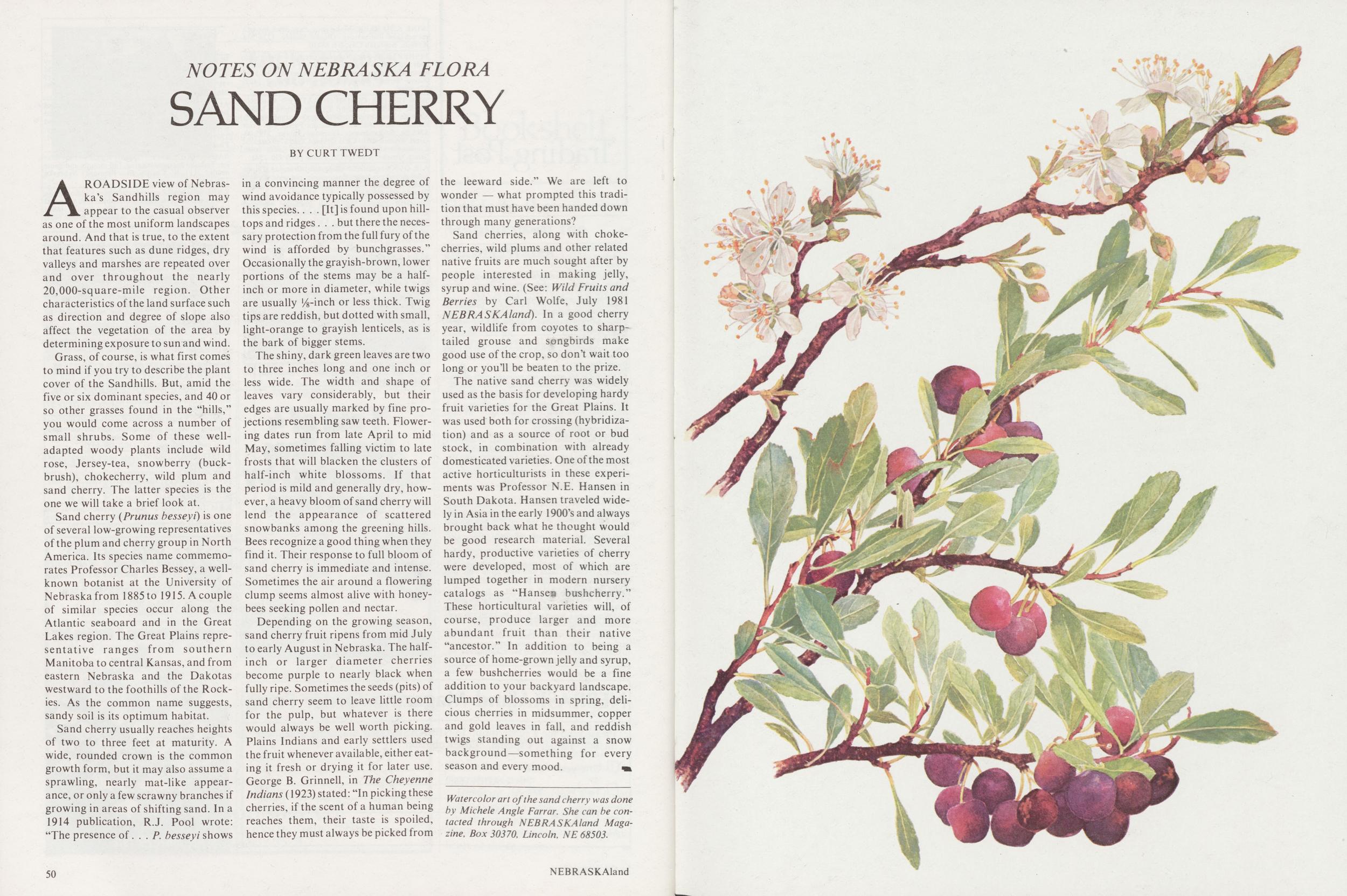
NOTES ON NEBRASKA FLORA SAND CHERRY
BY CURT TWEDTA ROADSIDE view of Nebraska's Sandhills region may appear to the casual observer as one of the most uniform landscapes around. And that is true, to the extent that features such as dune ridges, dry valleys and marshes are repeated over and over throughout the nearly 20,000-square-mile region. Other characteristics of the land surface such as direction and degree of slope also affect the vegetation of the area by determining exposure to sun and wind.
Grass, of course, is what first comes to mind if you try to describe the plant cover of the Sandhills. But, amid the five or six dominant species, and 40 or so other grasses found in the "hills," you would come across a number of small shrubs. Some of these welladapted woody plants include wild rose, Jersey-tea, snowberry (buckbrush), chokecherry, wild plum and sand cherry. The latter species is the one we will take a brief look at.
Sand cherry (Prunus besseyi) is one of several low-growing representatives of the plum and cherry group in North America. Its species name commemorates Professor Charles Bessey, a wellknown botanist at the University of Nebraska from 1885 to 1915. A couple of similar species occur along the Atlantic seaboard and in the Great Lakes region. The Great Plains representative ranges from southern Manitoba to central Kansas, and from eastern Nebraska and the Dakotas westward to the foothills of the Rockies. As the common name suggests, sandy soil is its optimum habitat.
Sand cherry usually reaches heights of two to three feet at maturity. A wide, rounded crown is the common growth form, but it may also assume a sprawling, nearly mat-like appearance, or only a few scrawny branches if growing in areas of shifting sand. In a 1914 publication, R.J. Pool wrote: "The presence of P. besseyi shows in a convincing manner the degree of wind avoidance typically possessed by this species. [It] is found upon hilltops and ridges but there the necessary protection from the full fury of the wind is afforded by bunchgrasses." Occasionally the grayish-brown, lower portions of the stems may be a halfinch or more in diameter, while twigs are usually (/g-inch or less thick. Twig tips are reddish, but dotted with small, light-orange to grayish lenticels, as is the bark of bigger stems.
The shiny, dark green leaves are two to three inches long and one inch or less wide. The width and shape of leaves vary considerably, but their edges are usually marked by fine projections resembling saw teeth. Flowering dates run from late April to mid May, sometimes falling victim to late frosts that will blacken the clusters of half-inch white blossoms. If that period is mild and generally dry, however, a heavy bloom of sand cherry will lend the appearance of scattered snowbanks among the greening hills. Bees recognize a good thing when they find it. Their response to full bloom of sand cherry is immediate and intense. Sometimes the air around a flowering clump seems almost alive with honeybees seeking pollen and nectar.
Depending on the growing season, sand cherry fruit ripens from mid July to early August in Nebraska. The halfinch or larger diameter cherries become purple to nearly black when fully ripe. Sometimes the seeds (pits) of sand cherry seem to leave little room for the pulp, but whatever is there would always be well worth picking. Plains Indians and early settlers used the fruit whenever available, either eating it fresh or drying it for later use. George B. Grinnell, in The Cheyenne Indians (1923) stated: "In picking these cherries, if the scent of a human being reaches them, their taste is spoiled, hence they must always be picked from the leeward side." We are left to wonder — what prompted this tradition that must have been handed down through many generations?
Sand cherries, along with chokecherries, wild plums and other related native fruits are much sought after by people interested in making jelly, syrup and wine. (See: Wild Fruits and Berries by Carl Wolfe, July 1981 NEBRASKAland). In a good cherry year, wildlife from coyotes to sharptailed grouse and songbirds make good use of the crop, so don't wait too long or you'll be beaten to the prize.
The native sand cherry was widely used as the basis for developing hardy fruit varieties for the Great Plains. It was used both for crossing (hybridization) and as a source of root or bud stock, in combination with already domesticated varieties. One of the most active horticulturists in these experiments was Professor N.E. Hansen in South Dakota. Hansen traveled widely in Asia in the early 1900's and always brought back what he thought would be good research material. Several hardy, productive varieties of cherry were developed, most of which are lumped together in modern nursery catalogs as "Hansen bushcherry." These horticultural varieties will, of course, produce larger and more abundant fruit than their native "ancestor." In addition to being a source of home-grown jelly and syrup, a few bushcherries would be a fine addition to your backyard landscape. Clumps of blossoms in spring, delicious cherries in midsummer, copper and gold leaves in fall, and reddish twigs standing out against a snow background—something for every season and every mood.
Water color art of the sand cherry was done by Michele Angle Farrar. She can be contacted through NEBRASKAland Magazine, Box 30370, Lincoln, NE 68503.
50 NEBRASKAland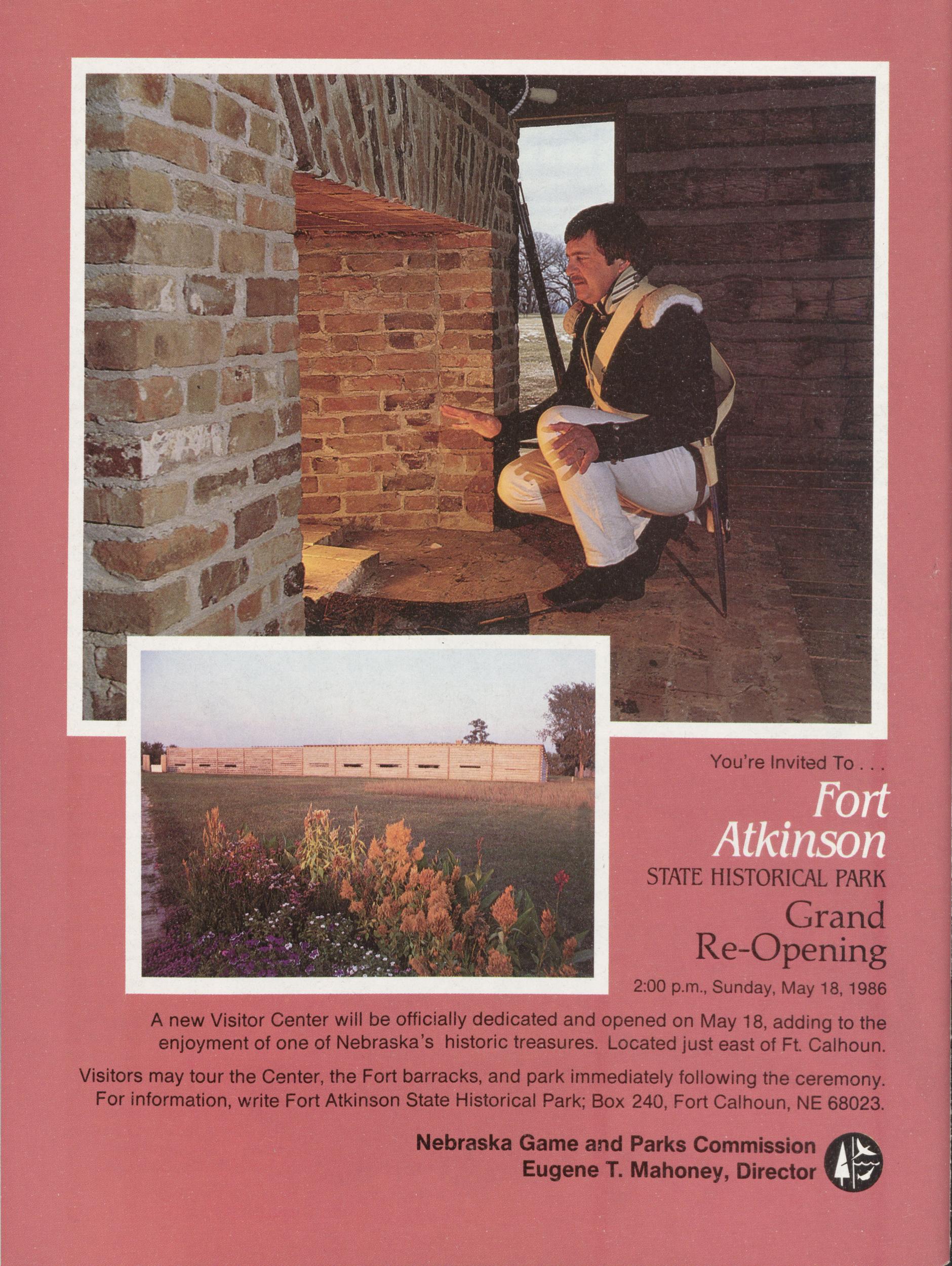
Position: 95 (62 views)