Volume 64, Issue 3, 1986
NEBRASKAland
APRIL 1986 $1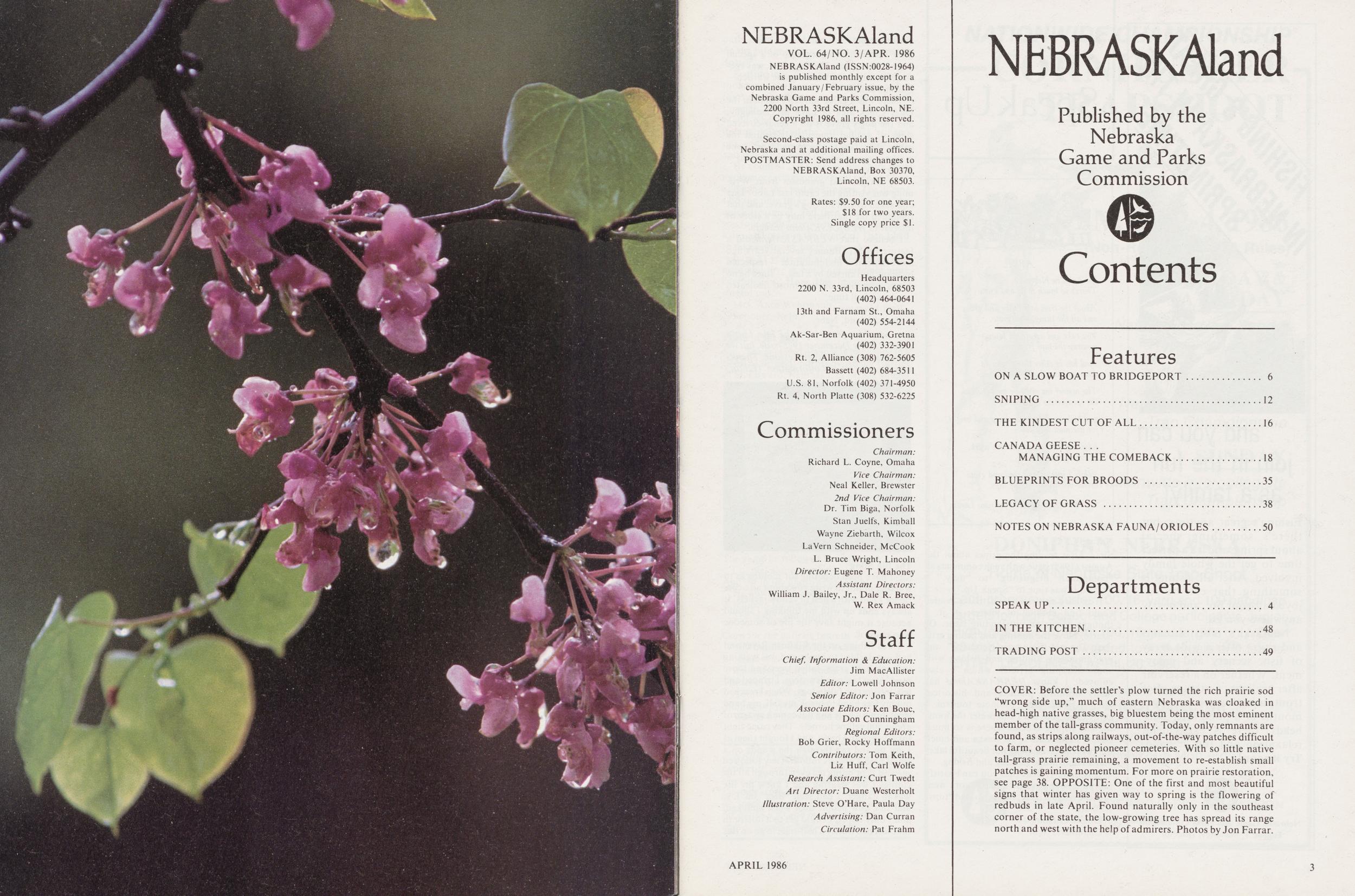
NEBRASKAland
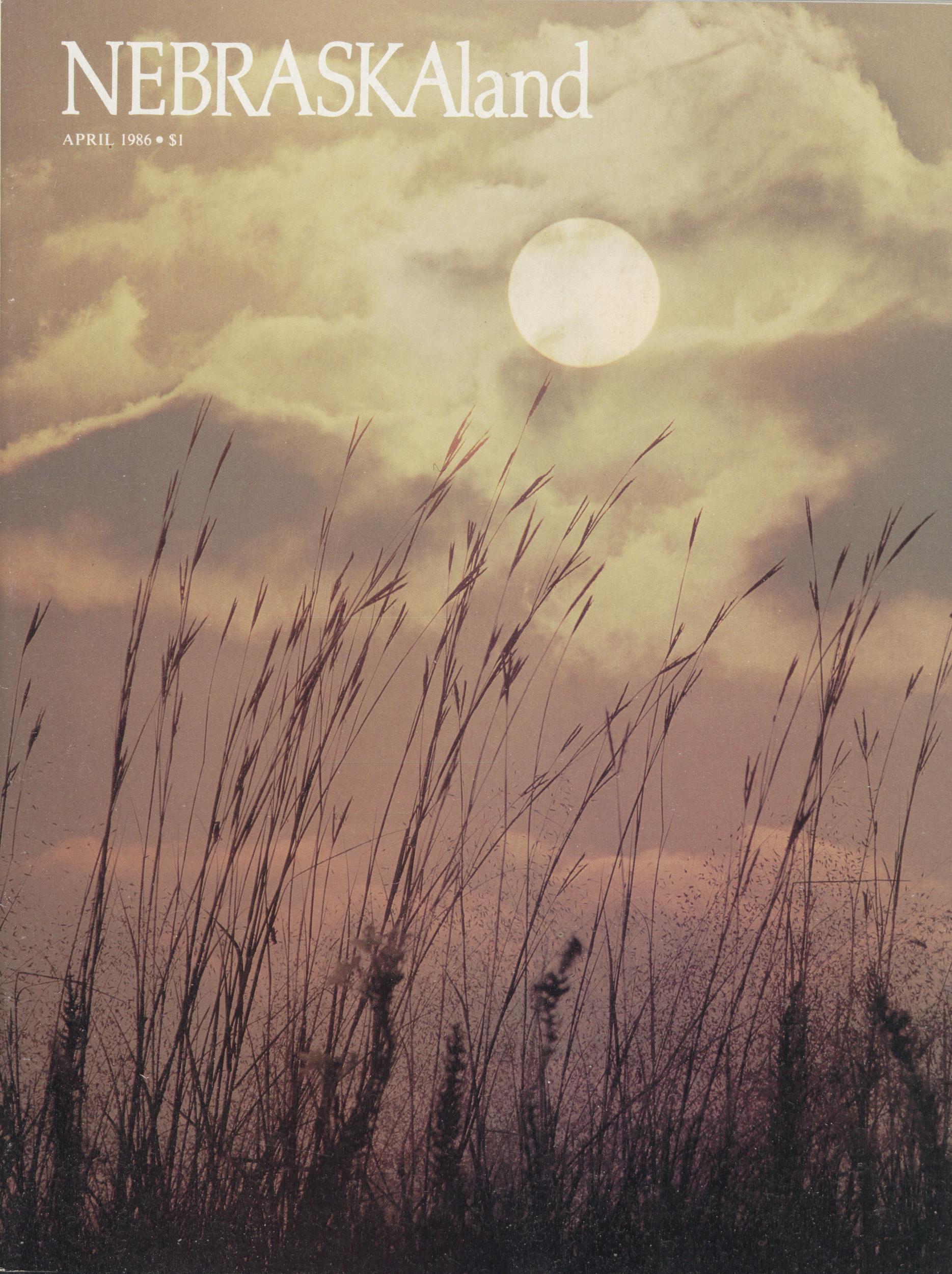
Published by the Nebraska Game and Parks Commission NEBRASKAland VOL. 64/NO. 3/APR. 1986 NEBRASKAland (ISSN:0028-1964) is published monthly except for a combined January/February issue, by the Nebraska Game and Parks Commission, 2200 North 33rd Street, Lincoln, NE. Copyright 1986, all rights reserved. Second-class postage paid at Lincoln, Nebraska and at additional mailing offices. POSTMASTER: Send address changes to NEBRASKAland, Box 30370, Lincoln, NE 68503. Rates: $9.50 for one year; $18 for two years. Single copy price $1. Offices Headquarters 2200 N. 33rd, Lincoln, 68503 (402) 464-0641 13th and Farnam St., Omaha (402) 554-2144 Ak-Sar-Ben Aquarium, Gretna (402) 332-3901 Rt. 2, Alliance (308) 762-5605 Bassett (402) 684-3511 U.S. 81, Norfolk (402) 371-4950 Rt. 4, North Platte (308) 532-6225 Commissioners Chairman: Richard L. Coyne, Omaha Vice Chairman: Neal Keller, Brewster 2nd Vice Chairman: Dr. Tim Biga, Norfolk Stan Juelfs, Kimball Wayne Ziebarth, Wilcox LaVern Schneider, McCook L. Bruce Wright, Lincoln Director: Eugene T Mahoney Assistant Directors: William J. Bailey, Jr., Dale R. Bree, W. Rex Amack Staff Chief, Information & Education: Jim MacAllister Editor: Lowell Johnson Senior Editor: Jon Farrar Associate Editors: Ken Bouc, Don Cunningham Regional Editors: Bob Grier, Rocky Hoffmann Contributors: Tom Keith, Liz Huff, Carl Wolfe Research Assistant: Curt Twedt Art Director: Duane Westerholt Illustration: Steve O'Hare, Paula Day Advertising: Dan Curran Circulation: Pat Frahm Contents Features ON A SLOW BOAT TO BRIDGEPORT 6 SNIPING 12 THE KINDEST CUT OF ALL16 CANADA GEESE MANAGING THE COMEBACK 18 BLUEPRINTS FOR BROODS 35 NOTES ON NEBRASKA FAUNA/ORIOLES 50 Departments SPEAK UP 4 IN THE KITCHEN 48 TRADING POST 49 COVER: Before the settler's plow turned the rich prairie sod "wrong side up," much of eastern Nebraska was cloaked in head-high native grasses, big bluestem being the most eminent member of the tall-grass community. Today, only remnants are found, as strips along railways, out-of-the-way patches difficult to farm, or neglected pioneer cemeteries. With so little native tall-grass prairie remaining, a movement to re-establish small patches is gaining momentum. For more on prairie restoration, see page 38. OPPOSITE: One of the first and most beautiful signs that winter has given way to spring is the flowering of redbuds in late April. Found naturally only in the southeast corner of the state, the low-growing tree has spread its range north and west with the help of admirers. Photos by Jon Farrar. APRIL 1986 3
Speak Up
APRIL It's April in Nebraska. There's so much to do and know About the trees and bulbs and grass and all the things that grow. You rake and aerate the lawn, unwrap the tape from trees, And lots of other things you do down on your hands and knees. The mower too must be well checked, the sprayer too must spray and tools must be both sharp and bright, for use most any day. My husband loves to do this work, he hardly ever sits, While I just sit and read and grow broad-minded — in the hips. Mildred Andrews Larson Not uglySir / After reading the gripes about the August (1985) issue with such comments as "completely disgusting" to "ugly," 1 decided it was time to "Speak Up."
It is hard to understand that a reader could find nothing of interest of it. I thought it was an outstanding issue. Of course, I love the hunting and fishing articles. The old "Outdoor Nebraska" was predominately hunting and fishing with some trapping articles which I also enjoyed. I know NEBRA SKAland has many beautiful pictures and historical interests which help promote tourism. I enjoy those too, but I still prefer the hunting and fishing articles. There is so much beauty in the state of Nebraska and much of it I've observed along our beautiful lakes and streams while hunting and fishing.
It is quite evident that you can't satisfy everyone, but I'm sure a lot of work went into the August issue. It surely rated "tops" with me.
Duane Carson Chambers, Nebr. Grave subjectSir / I am enclosing a photo of a special dog's burial place. The dog, Rex, was special to a former Nebraska game warden— Loron Bunney.
There was a game warden's cabin in the Otter Creek area of Lake McConaughy, and the dog's grave is on a cedar-covered slope of ground immediately behind the cabin. My family discovered the stone marker several years ago, as we rent a trailer space nearby.
My six-year-old grandson from Wyoming was visiting the camp last Labor Day and asked to visit the dog's grave, and that reminded me that there may be a story of interest to NEBRASKAland readers.
I believe that NEBRASKAland did a feature on Mr. Bunney several years ago and I remember his reputation — respected by many and cursed by a few — since he no doubt was one of the most dedicated wardens of all time.
Paul Magnuson Grand Island, Nebr.Yes, we did a feature on the late Loron Bunney in the December 1978 issue, hut we didn 't know about this gravestone. Thanks for your interest and information. (Editor)
The Big StingSir/1 have been debating for months as to whether or not to write you about an experience I had with a nest of yellow jackets. It always ends up with me thinking I should because it might save the life of someone who reads it.
I was fishing on the Elkhorn River and had just decided to move, and was walking through high grass, fallen trees and loose sand. After taking a few steps, I tripped and fell, hitting two fallen logs. When I reached out my free hand to break my fall, my hand went down a hole and out came a swarm of about 500 yellow hornets. They came right for my face and body, and I fought them as I got up and ran through the woods on a small path I always follow. They followed me and kept biting me even through all the clothes I was wearing and I knew my life was in danger. I had seen "Bees" on T.V. and saw how people died when attacked, and I only hoped I could get to a doctor in time as I had nearly a half-mile to go on this 4 NEBRASKAland path. I also prayed that someone would be on the bridge with a car to take me to the doctor.
Fortunately, a man in a truck quickly took me to the doctor, who gave me a shot to counteract the poison which now was all through me. There were big blotches of blood where they stung into a vein. The doctor pulled all the little black stingers out, and even picked some live hornets out, and was stung once himself.
He counted 200 stingers, but there were many more stings on my right side and face and hands that had no stingers. The doctor said the only thing that saved me was the quick treatment, and then it was close. It was four spells later when I nearly died, and a day and night in the hospital. Then I had to take cortisone for three weeks.
I am 81 years old and still fish the Elkhorn and love it, but I am certainly more careful now. Hope this helps others be careful too.
Mrs. Alice Wehrmann Scribner, Nebr. Poem of the pastSir / The enclosed poem was published in a book of original poems by Adella Currier of St. Edward, Nebraska, in 1928. Thought you might like it.
Mrs. Esther Kraus Albion, Nebr. NEBRASKA All things beautiful love thee, Heart of the golden west, The birds that carol thy praises The flowers that kiss thy breast. Butterflies on the daisies, Bees in the goldenrod, And rosy children, playing The fairest gift of God! No longer the dusky hunter Stalks o'er the naked plains, The game he followed has vanished, Coyote, alone, remains, And oft in the ghostly moonlight He howls afar, anear, A requiem for the red man, The bison, and the deer. Corn for the nations beareth Thy bosom warm and sweet; Emerald seas of alfalfa, Bountiful golden wheat. The trees our fathers planted Adorn the fertile plain, Smiling in sylvan beauty, Wooed by the sun and rain.NEBRASKAland Magazine invites all readers to submit their comments, suggestions, and gripes to Speak Up. Each month the magazine will publish as many letters as space permits. Pictures are welcome. NEBRA SKA Land reserves the right to edit and condense letters.—Editor.
NATIONWIDE CHAMPIONSHIP CORNHUSKER-TRAPSHOOT MAY 2-4,1986 (Non-Registered-ATA Rules) FRIDAY & SATURDAY Nationwide High School Trap Championship FRIDAY Nationwide Junior High Trap Championship SUNDAY Nationwide Intercollegiate Trap Championship DONIPHAN, NEBRASKA Home of Nebraska State Trap Shoot Each program includes 100,16-yard and 100 handicap targets for High School and College participants. Junior High (grades 7-8) shoot 100,16-yard targets only. Over 90 trophies will be awarded to individuals and teams. ENTRY DEADLINE IS APRIL 20,1986 For More Information, Contact: DAVE WELLS, SHOOT DIRECTOR Cornhusker Trap Shoot Box 1511 /Norfolk, NE 68701 Phone: (402) 371-8663 (9-5 Mon.-Fri.) SPONSORED BY: NEBRASKA GAME AND PARKS COMMISSION Eugene T. Mahoney, Director ARPIL 1986 5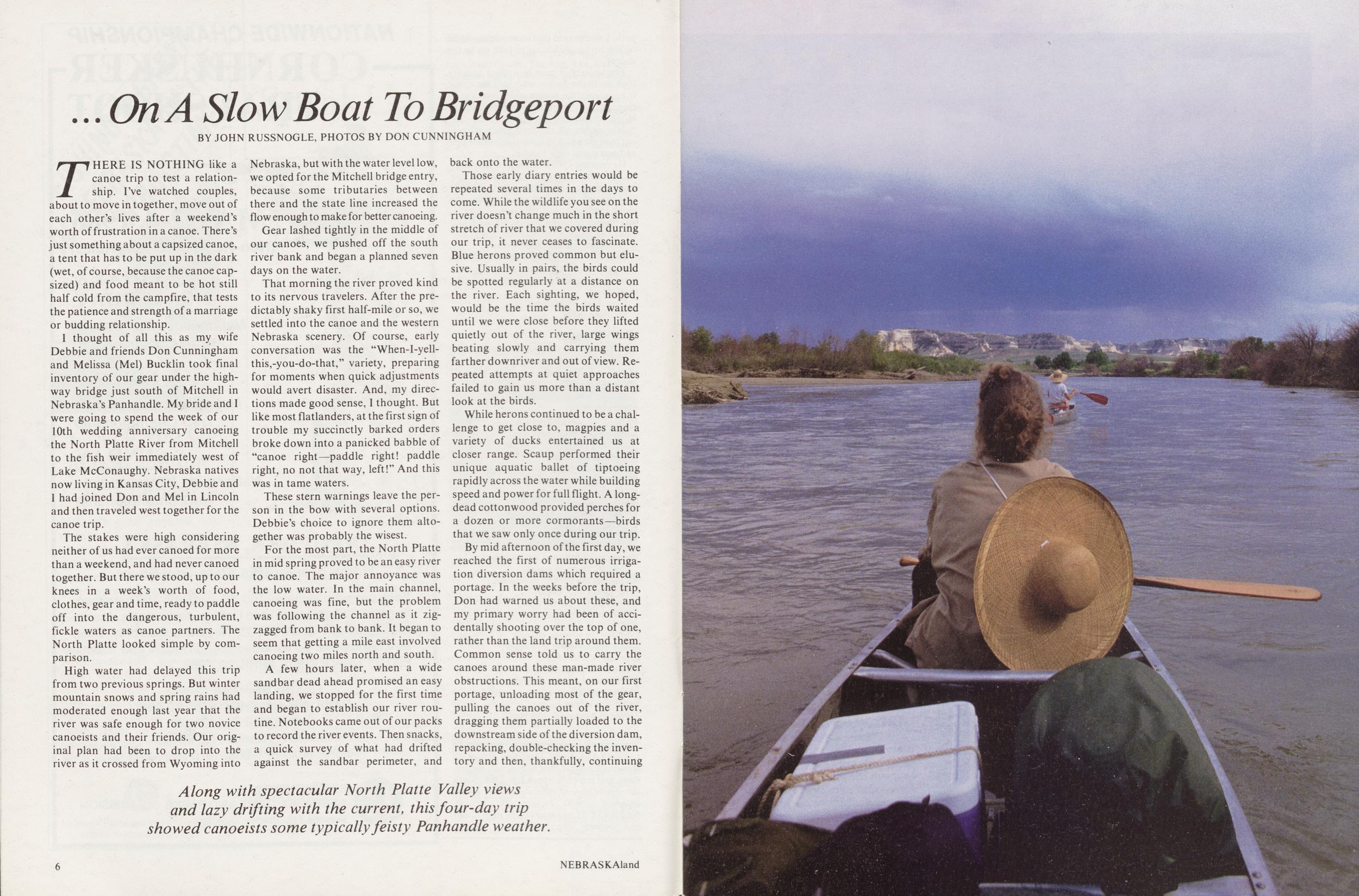
... On A Slow Boat To Bridgeport
BY JOHN RUSSNOGLE, PHOTOS BY DON CUNNINGHAMTHERE IS NOTHING like a canoe trip to test a relationship. I've watched couples, about to move in together, move out of each other's lives after a weekend's worth of frustration in a canoe. There's just something about a capsized canoe, a tent that has to be put up in the dark (wet, of course, because the canoe capsized) and food meant to be hot still half cold from the campfire, that tests the patience and strength of a marriage or budding relationship.
I thought of all this as my wife Debbie and friends Don Cunningham and Melissa (Mel) Bucklin took final inventory of our gear under the highway bridge just south of Mitchell in Nebraska's Panhandle. My bride and I were going to spend the week of our 10th wedding anniversary canoeing the North Platte River from Mitchell to the fish weir immediately west of Lake McConaughy. Nebraska natives now living in Kansas City, Debbie and I had joined Don and Mel in Lincoln and then traveled west together for the canoe trip.
The stakes were high considering neither of us had ever canoed for more than a weekend, and had never canoed together. But there we stood, up to our knees in a week's worth of food, clothes, gear and time, ready to paddle off into the dangerous, turbulent, fickle waters as canoe partners. The North Platte looked simple by comparison.
High water had delayed this trip from two previous springs. But winter mountain snows and spring rains had moderated enough last year that the river was safe enough for two novice canoeists and their friends. Our original plan had been to drop into the river as it crossed from Wyoming into Nebraska, but with the water level low, we opted for the Mitchell bridge entry, because some tributaries between there and the state line increased the flow enough to make for better canoeing.
Gear lashed tightly in the middle of our canoes, we pushed off the south river bank and began a planned seven days on the water.
That morning the river proved kind to its nervous travelers. After the predictably shaky first half-mile or so, we settled into the canoe and the western Nebraska scenery. Of course, early conversation was the "When-I-yell-this,-you-do-that," variety, preparing for moments when quick adjustments would avert disaster. And, my directions made good sense, I thought. But like most flatlanders, at the first sign of trouble my succinctly barked orders broke down into a panicked babble of "canoe right—paddle right! paddle right, no not that way, left!" And this was in tame waters.
These stern warnings leave the person in the bow with several options. Debbie's choice to ignore them altogether was probably the wisest.
For the most part, the North Platte in mid spring proved to be an easy river to canoe. The major annoyance was the low water. In the main channel, canoeing was fine, but the problem was following the channel as it zigzagged from bank to bank. It began to seem that getting a mile east involved canoeing two miles north and south.
A few hours later, when a wide sandbar dead ahead promised an easy landing, we stopped for the first time and began to establish our river routine. Notebooks came out of our packs to record the river events. Then snacks, a quick survey of what had drifted against the sandbar perimeter, and back onto the water.
Along with spectacular North Platte Valley views and lazy drifting with the current, this four-day trip showed canoeists some typically feisty Panhandle weather.Those early diary entries would be repeated several times in the days to come. While the wildlife you see on the river doesn't change much in the short stretch of river that we covered during our trip, it never ceases to fascinate. Blue herons proved common but elusive. Usually in pairs, the birds could be spotted regularly at a distance on the river. Each sighting, we hoped, would be the time the birds waited until we were close before they lifted quietly out of the river, large wings beating slowly and carrying them farther downriver and out of view. Repeated attempts at quiet approaches failed to gain us more than a distant look at the birds.
While herons continued to be a challenge to get close to, magpies and a variety of ducks entertained us at closer range. Scaup performed their unique aquatic ballet of tiptoeing rapidly across the water while building speed and power for full flight. A longdead cottonwood provided perches for a dozen or more cormorants—birds that we saw only once during our trip.
By mid afternoon of the first day, we reached the first of numerous irrigation diversion dams which required a portage. In the weeks before the trip, Don had warned us about these, and my primary worry had been of accidentally shooting over the top of one, rather than the land trip around them. Common sense told us to carry the canoes around these man-made river obstructions. This meant, on our first portage, unloading most of the gear, pulling the canoes out of the river, dragging them partially loaded to the downstream side of the diversion dam, repacking, double-checking the inventory and then, thankfully, continuing 6 NEBRASKAland
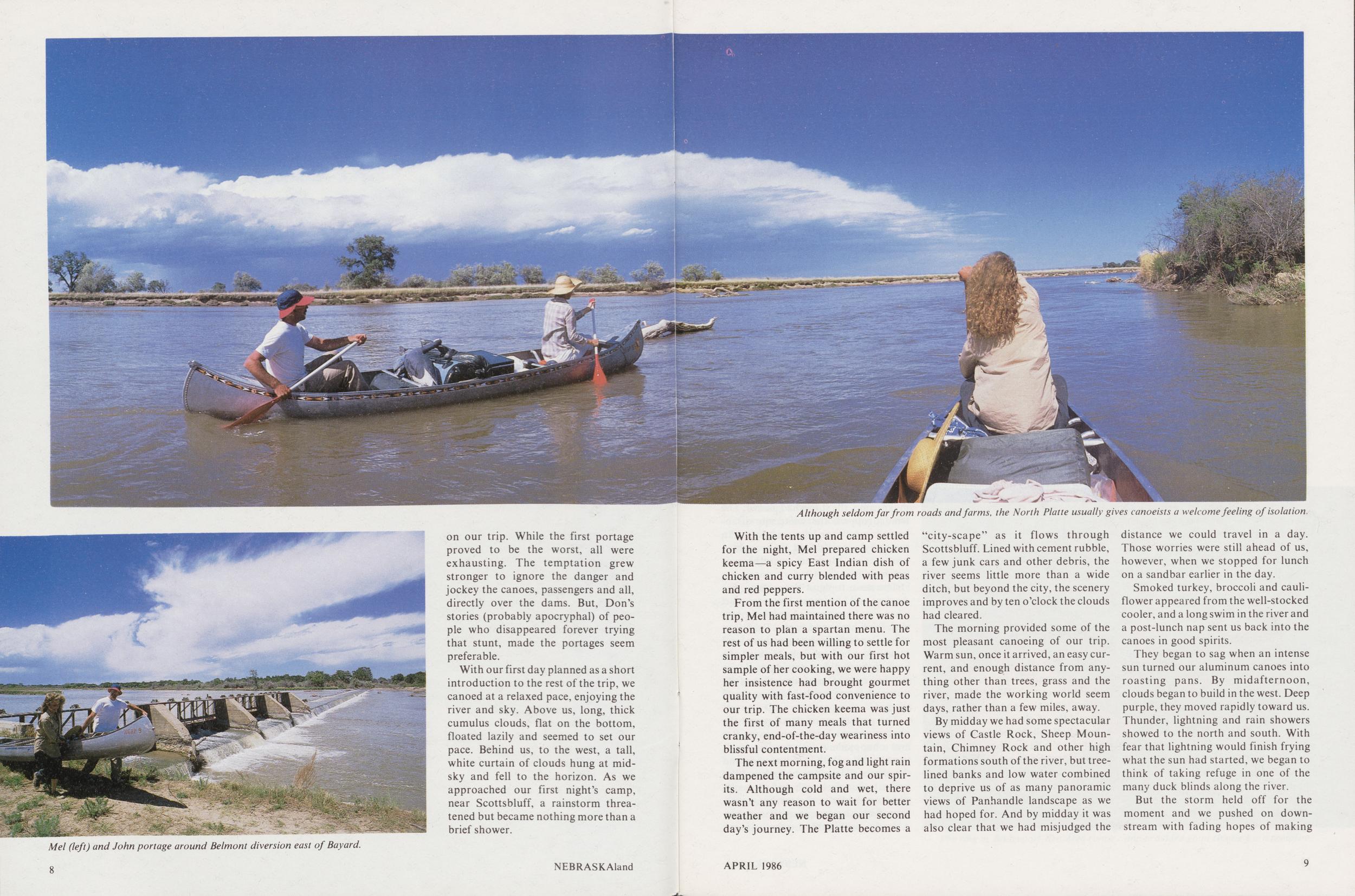
With our first day planned as a short introduction to the rest of the trip, we canoed at a relaxed pace, enjoying the river and sky. Above us, long, thick cumulus clouds, flat on the bottom, floated lazily and seemed to set our pace. Behind us, to the west, a tall, white curtain of clouds hung at midsky and fell to the horizon. As we approached our first night's camp, near Scottsbluff, a rainstorm threatened but became nothing more than a brief shower.
8 NEBRASKAlandWith the tents up and camp settled for the night, Mel prepared chicken keema—a spicy East Indian dish of chicken and curry blended with peas and red peppers.
From the first mention of the canoe trip, Mel had maintained there was no reason to plan a spartan menu. The rest of us had been willing to settle for simpler meals, but with our first hot sample of her cooking, we were happy her insistence had brought gourmet quality with fast-food convenience to our trip. The chicken keema was just the first of many meals that turned cranky, end-of-the-day weariness into blissful contentment.
The next morning, fog and light rain dampened the campsite and our spirits. Although cold and wet, there wasn't any reason to wait for better weather and we began our second day's journey. The Platte becomes a "city-scape'" as it flows through Scottsbluff. Lined with cement rubble, a few junk cars and other debris, the river seems little more than a wide ditch, but beyond the city, the scenery improves and by ten o'clock the clouds had cleared.
The morning provided some of the most pleasant canoeing of our trip. Warm sun, once it arrived, an easy current, and enough distance from anything other than trees, grass and the river, made the working world seem days, rather than a few miles, away.
By midday we had some spectacular views of Castle Rock, Sheep Moun- tain, Chimney Rock and other high formations south of the river, but tree-lined banks and low water combined to deprive us of as many panoramic views of Panhandle landscape as we had hoped for. And by midday it was also clear that we had misjudged the distance we could travel in a day. Those worries were still ahead of us, however, when we stopped for lunch on a sandbar earlier in the day.
Smoked turkey, broccoli and cauliflower appeared from the well-stocked cooler, and a long swim in the river and a post-lunch nap sent us back into the canoes in good spirits.
They began to sag when an intense sun turned our aluminum canoes into roasting pans. By midafternoon, clouds began to build in the west. Deep purple, they moved rapidly toward us. Thunder, lightning and rain showers showed to the north and south. With fear that lightning would finish frying what the sun had started, we began to think of taking refuge in one of the many duck blinds along the river.
But the storm held off for the
moment and we pushed on downstream
with fading hopes of making
APRIL 1986
9
The downpour slowed to a steady rain, and we slid the canoes back into the Platte. For about a mile we battled a swift current twisting from bank to bank and doing its best to drag us under deadfall trees. It wouldn't have made much difference what instructions I shouted; the day's rain and the narrow channel combined to create a swift current that at times seemed to have more control of the canoe than we did. An experienced canoeist might have been elated to finally have fast water to negotiate. I was terrified the uprooted trees that arched low across the river would separate me from the canoe. They barely missed.
Just as quickly, the river widened and slowed. That would have brought relief if the wind hadn't begun to blow from the east, straight at us, and building whitecaps as it came. You know you're whipped when you paddle with the current as hard as you can and barely move forward. The temperature dropped which only intensified our pain.
Weary, we thrashed our way to a wafer of a sandbar, just large enough to hold the canoes. While Debbie and Mel waited in the canoes, in the rain, in the middle of the river, Don and I hiked a half-mile to the nearest farm. A kindly farm wife took pity on what had to appear to be two drowned ground squirrels and gave us permission to camp in her pasture across the river.
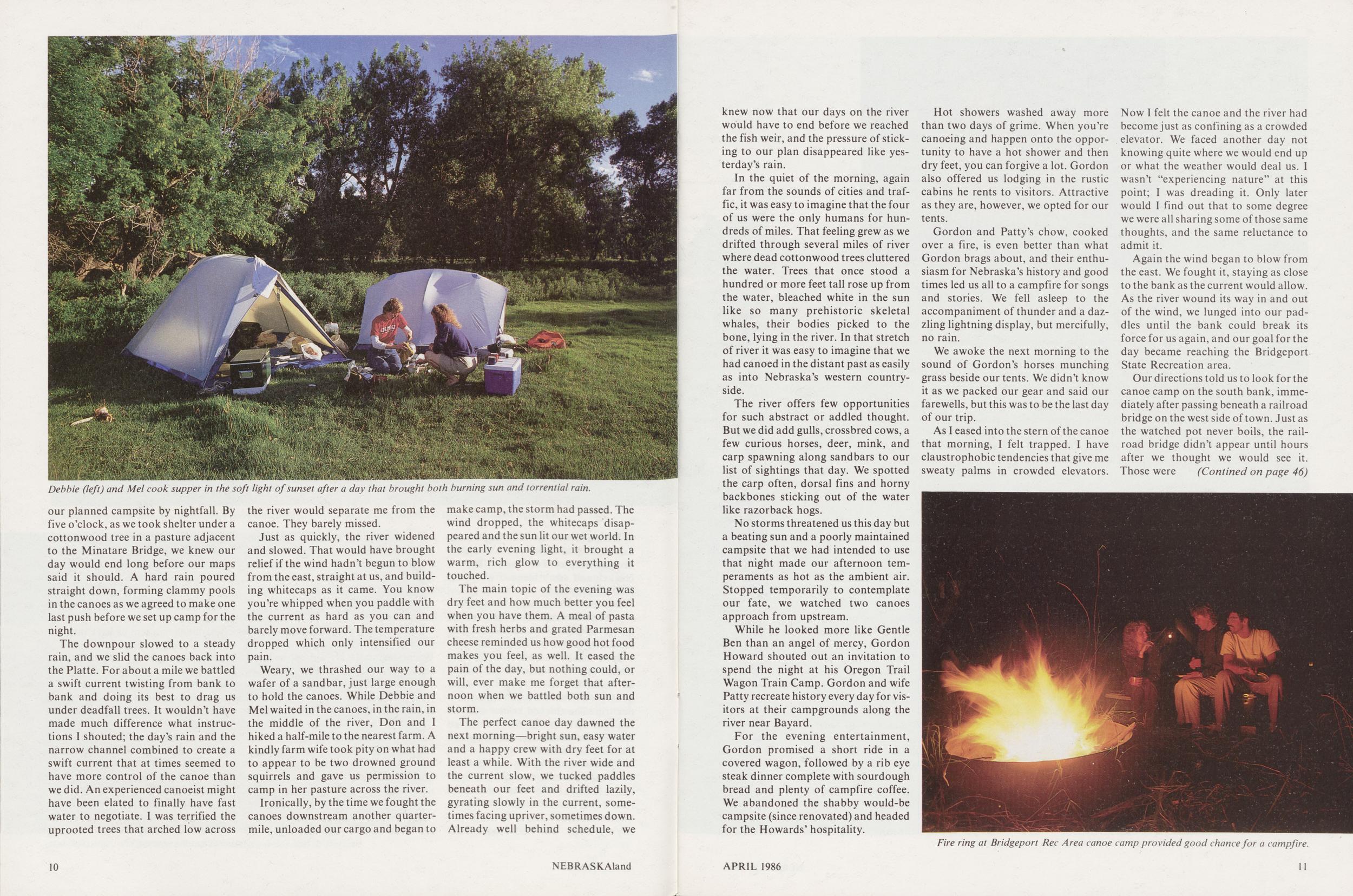
Ironically, by the time we fought the canoes downstream another quarter-mile, unloaded our cargo and began to make camp, the storm had passed. The wind dropped, the whitecaps disappeared and the sun lit our wet world. In the early evening light, it brought a warm, rich glow to everything it touched.
The main topic of the evening was dry feet and how much better you feel when you have them. A meal of pasta with fresh herbs and grated Parmesan cheese reminded us how good hot food makes you feel, as well. It eased the pain of the day, but nothing could, or will, ever make me forget that afternoon when we battled both sun and storm.
The perfect canoe day dawned the next morning—bright sun, easy water and a happy crew with dry feet for at least a while. With the river wide and the current slow, we tucked paddles beneath our feet and drifted lazily, gyrating slowly in the current, sometimes facing upriver, sometimes down. Already well behind schedule, we 10 NEBRASKAland knew now that our days on the river would have to end before we reached the fish weir, and the pressure of sticking to our plan disappeared like yesterday's rain.
In the quiet of the morning, again far from the sounds of cities and traffic, it was easy to imagine that the four of us were the only humans for hundreds of miles. That feeling grew as we drifted through several miles of river where dead cottonwood trees cluttered the water. Trees that once stood a hundred or more feet tall rose up from the water, bleached white in the sun like so many prehistoric skeletal whales, their bodies picked to the bone, lying in the river. In that stretch of river it was easy to imagine that we had canoed in the distant past as easily as into Nebraska's western countryside.
The river offers few opportunities for such abstract or addled thought. But we did add gulls, crossbred cows, a few curious horses, deer, mink, and carp spawning along sandbars to our list of sightings that day. We spotted the carp often, dorsal fins and horny backbones sticking out of the water like razorback hogs.
No storms threatened us this day but a beating sun and a poorly maintained campsite that we had intended to use that night made our afternoon temperaments as hot as the ambient air. Stopped temporarily to contemplate our fate, we watched two canoes approach from upstream.
While he looked more like Gentle Ben than an angel of mercy, Gordon Howard shouted out an invitation to spend the night at his Oregon Trail Wagon Train Camp. Gordon and wife Patty recreate history every day for visitors at their campgrounds along the river near Bayard.
For the evening entertainment, Gordon promised a short ride in a covered wagon, followed by a rib eye steak dinner complete with sourdough bread and plenty of campfire coffee. We abandoned the shabby would-be campsite (since renovated) and headed for the Howards' hospitality.
Hot showers washed away more than two days of grime. When you're canoeing and happen onto the opportunity to have a hot shower and then dry feet, you can forgive a lot. Gordon also offered us lodging in the rustic cabins he rents to visitors. Attractive as they are, however, we opted for our tents.
Gordon and Patty's chow, cooked over a fire, is even better than what Gordon brags about, and their enthusiasm for Nebraska's history and good times led us all to a campfire for songs and stories. We fell asleep to the accompaniment of thunder and a dazzling lightning display, but mercifully, no rain.
We awoke the next morning to the sound of Gordon's horses munching grass beside our tents. We didn't know it as we packed our gear and said our farewells, but this was to be the last day of our trip.
As I eased into the stern of the canoe that morning, I felt trapped. I have claustrophobic tendencies that give me sweaty palms in crowded elevators. Now I felt the canoe and the river had become just as confining as a crowded elevator. We faced another day not knowing quite where we would end up or what the weather would deal us. I wasn't "experiencing nature" at this point; I was dreading it. Only later would I find out that to some degree we were all sharing some of those same thoughts, and the same reluctance to admit it.
Again the wind began to blow from the east. We fought it, staying as close to the bank as the current would allow. As the river wound its way in and out of the wind, we lunged into our paddles until the bank could break its force for us again, and our goal for the day became reaching the Bridgeport State Recreation area.
Our directions told us to look for the canoe camp on the south bank, immediately after passing beneath a railroad bridge on the west side of town. Just as the watched pot never boils, the railroad bridge didn't appear until hours after we thought we would see it. Those were (Contined on page 46)
SNIPING
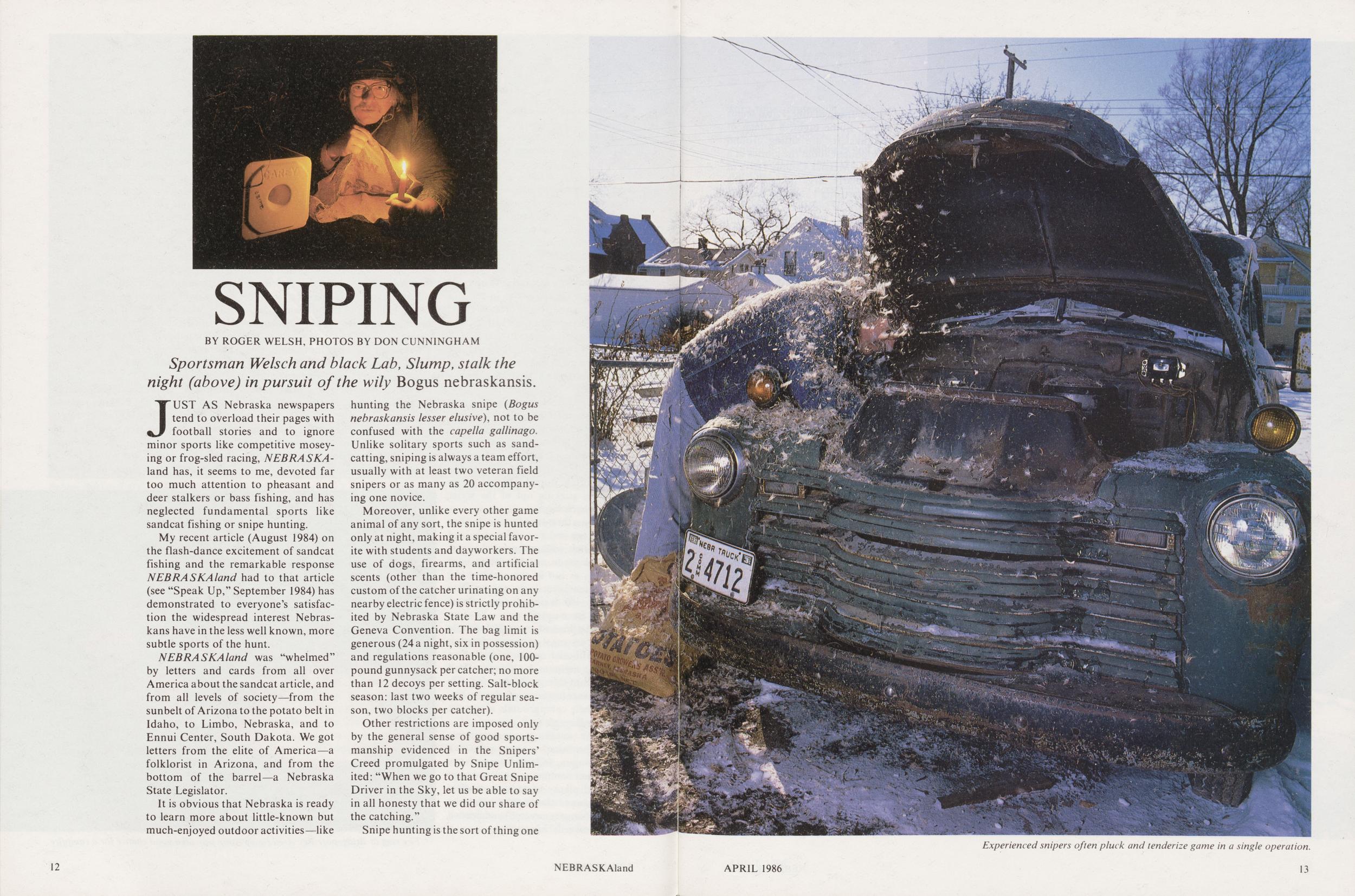
BY ROGER WELSH, PHOTOS BY DON CUNNINGHAM Sportsman Welsch and black Lab, Slump, stalk the night (above) in pursuit of the wily Bogus nebraskansis.JUST AS Nebraska newspapers tend to overload their pages with football stories and to ignore minor sports like competitive moseying or frog-sled racing, NEBRASKAland has, it seems to me, devoted far too much attention to pheasant and deer stalkers or bass fishing, and has neglected fundamental sports like sandcat fishing or snipe hunting.
My recent article (August 1984) on the flash-dance excitement of sandcat fishing and the remarkable response NEBRASKAland had to that article (see "Speak Up," September 1984) has demonstrated to everyone's satisfaction the widespread interest Nebraskans have in the less well known, more subtle sports of the hunt.
NEBRASKAland was "whelmed" by letters and cards from all over America about the sandcat article, and from all levels of society—from the sunbelt of Arizona to the potato belt in Idaho, to Limbo, Nebraska, and to Ennui Center, South Dakota. We got letters from the elite of America—a folklorist in Arizona, and from the bottom of the barrel—a Nebraska State Legislator.
It is obvious that Nebraska is ready to learn more about little-known but much-enjoyed outdoor activities—like hunting the Nebraska snipe (Bogus nebraskansis lesser elusive), not to be confused with the capella gallinago. Unlike solitary sports such as sandcatting, sniping is always a team effort, usually with at least two veteran field snipers or as many as 20 accompanying one novice.
Moreover, unlike every other game animal of any sort, the snipe is hunted only at night, making it a special favorite with students and dayworkers. The use of dogs, firearms, and artificial scents (other than the time-honored custom of the catcher urinating on any nearby electric fence) is strictly prohibited by Nebraska State Law and the Geneva Convention. The bag limit is generous (24 a night, six in possession) and regulations reasonable (one, 100-pound gunnysack per catcher; no more than 12 decoys per setting. Salt-block season: last two weeks of regular season, two blocks per catcher).
Other restrictions are imposed only by the general sense of good sportsmanship evidenced in the Snipers' Creed promulgated by Snipe Unlimited: "When we go to that Great Snipe Driver in the Sky, let us be able to say in all honesty that we did our share of the catching."
Snipe hunting is the sort of thing one 12 NEBRASKAland
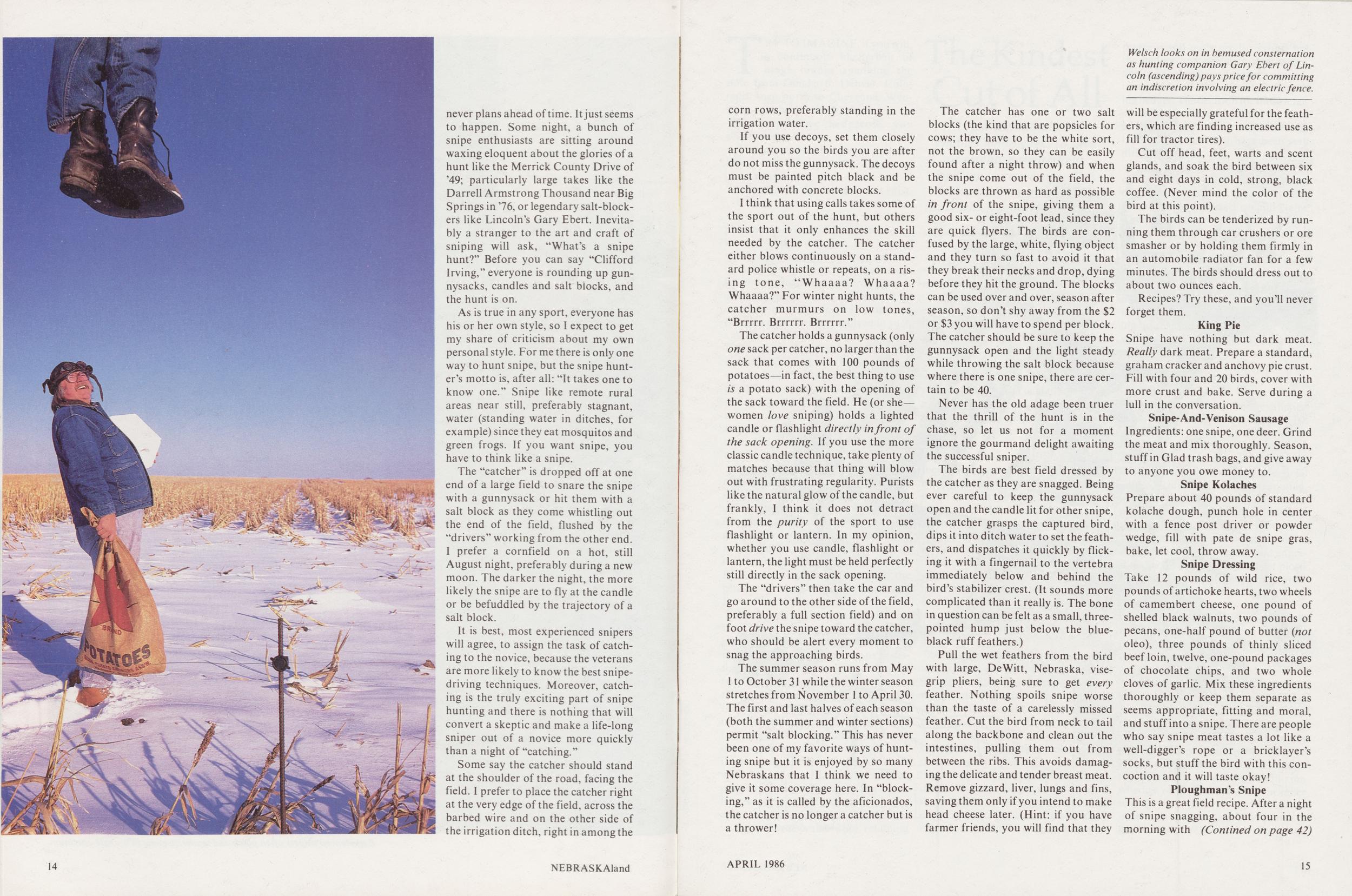
As is true in any sport, everyone has his or her own style, so I expect to get my share of criticism about my own personal style. For me there is only one way to hunt snipe, but the snipe hunter's motto is, after all: "It takes one to know one." Snipe like remote rural areas near still, preferably stagnant, water (standing water in ditches, for example) since they eat mosquitos and green frogs. If you want snipe, you have to think like a snipe.
The "catcher" is dropped off at one end of a large field to snare the snipe with a gunnysack or hit them with a salt block as they come whistling out the end of the field, flushed by the "drivers" working from the other end. I prefer a cornfield on a hot, still August night, preferably during a new moon. The darker the night, the more likely the snipe are to fly at the candle or be befuddled by the trajectory of a salt block.
It is best, most experienced snipers will agree, to assign the task of catching to the novice, because the veterans are more likely to know the best snipedriving techniques. Moreover, catching is the truly exciting part of snipe hunting and there is nothing that will convert a skeptic and make a life-long sniper out of a novice more quickly than a night of "catching."
Some say the catcher should stand at the shoulder of the road, facing the field. I prefer to place the catcher right at the very edge of the field, across the barbed wire and on the other side of the irrigation ditch, right in among the 14 NEBRASKAland corn rows, preferably standing in the irrigation water.
If you use decoys, set them closely around you so the birds you are after do not miss the gunnysack. The decoys must be painted pitch black and be anchored with concrete blocks.
I think that using calls takes some of the sport out of the hunt, but others insist that it only enhances the skill needed by the catcher. The catcher either blows continuously on a stand-ard police whistle or repeats, on a rising tone, "Whaaaa? Whaaaa? Whaaaa?" For winter night hunts, the catcher murmurs on low tones, "Brrrrr. Brrrrrr. Brrrrrr."
The catcher holds a gunnysack (only one sack per catcher, no larger than the sack that comes with 100 pounds of potatoes—in fact, the best thing to use is a potato sack) with the opening of the sack toward the field. He (or she—women love sniping) holds a lighted candle or flashlight directly in front of the sack opening. If you use the more classic candle technique, take plenty of matches because that thing will blow out with frustrating regularity. Purists like the natural glow of the candle, but frankly, I think it does not detract from the purity of the sport to use flashlight or lantern. In my opinion, whether you use candle, flashlight or lantern, the light must be held perfectly still directly in the sack opening.
The "drivers" then take the car and go around to the other side of the field, preferably a full section field) and on foot drive the snipe toward the catcher, who should be alert every moment to snag the approaching birds.
The summer season runs from May 1 to October 31 while the winter season stretches from November 1 to April 30. The first and last halves of each season (both the summer and winter sections) permit "salt blocking." This has never been one of my favorite ways of hunting snipe but it is enjoyed by so many Nebraskans that I think we need to give it some coverage here. In "blocking," as it is called by the aficionados, the catcher is no longer a catcher but is a thrower!
The catcher has one or two salt blocks (the kind that are popsicles for cows; they have to be the white sort, not the brown, so they can be easily found after a night throw) and when the snipe come out of the field, the blocks are thrown as hard as possible in front of the snipe, giving them a good six- or eight-foot lead, since they are quick flyers. The birds are confused by the large, white, flying object and they turn so fast to avoid it that they break their necks and drop, dying before they hit the ground. The blocks can be used over and over, season after season, so don't shy away from the $2 or $3 you will have to spend per block. The catcher should be sure to keep the gunnysack open and the light steady while throwing the salt block because where there is one snipe, there are certain to be 40.
Never has the old adage been truer that the thrill of the hunt is in the chase, so let us not for a moment ignore the gourmand delight awaiting the successful sniper.
The birds are best field dressed by the catcher as they are snagged. Being ever careful to keep the gunnysack open and the candle lit for other snipe, the catcher grasps the captured bird, dips it into ditch water to set the feathers, and dispatches it quickly by flicking it with a fingernail to the vertebra immediately below and behind the bird's stabilizer crest. (It sounds more complicated than it really is. The bone in question can be felt as a small, three-pointed hump just below the blue- black ruff feathers.)
Pull the wet feathers from the bird with large, DeWitt, Nebraska, visegrip pliers, being sure to get every feather. Nothing spoils snipe worse than the taste of a carelessly missed feather. Cut the bird from neck to tail along the backbone and clean out the intestines, pulling them out from between the ribs. This avoids damaging the delicate and tender breast meat. Remove gizzard, liver, lungs and fins, saving them only if you intend to make head cheese later. (Hint: if you have farmer friends, you will find that they will be especially grateful for the feathers, which are finding increased use as fill for tractor tires).
Cut off head, feet, warts and scent glands, and soak the bird between six and eight days in cold, strong, black coffee. (Never mind the color of the bird at this point).
The birds can be tenderized by running them through car crushers or ore smasher or by holding them firmly in an automobile radiator fan for a few minutes. The birds should dress out to about two ounces each.
Recipes? Try these, and you'll never forget them.
King PieSnipe have nothing but dark meat. Really dark meat. Prepare a standard graham cracker and anchovy pie crust. Fill with four and 20 birds, cover with more crust and bake. Serve during a lull in the conversation.
Snipe-And-Venison SausageIngredients: one snipe, one deer. Grind the meat and mix thoroughly. Season, stuff in Glad trash bags, and give away to anyone you owe money to.
Snipe KolachesPrepare about 40 pounds of standard kolache dough, punch hole in center with a fence post driver or powder wedge, fill with pate de snipe gras, bake, let cool, throw away.
Snipe DressingTake 12 pounds of wild rice, two pounds of artichoke hearts, two wheels of camembert cheese, one pound of shelled black walnuts, two pounds of pecans, one-half pound of butter (not oleo), three pounds of thinly sliced beef loin, twelve, one-pound packages of chocolate chips, and two whole cloves of garlic. Mix these ingredients thoroughly or keep them separate as seems appropriate, fitting and moral, and stuff into a snipe. There are people who say snipe meat tastes a lot like a well-digger's rope or a bricklayer's socks, but stuff the bird with this concoction and it will taste okay!
Ploughman's SnipeThis is a great field recipe. After a night of snipe snagging, about four in the morning with (Contined on page 42)
APRIL 1986 15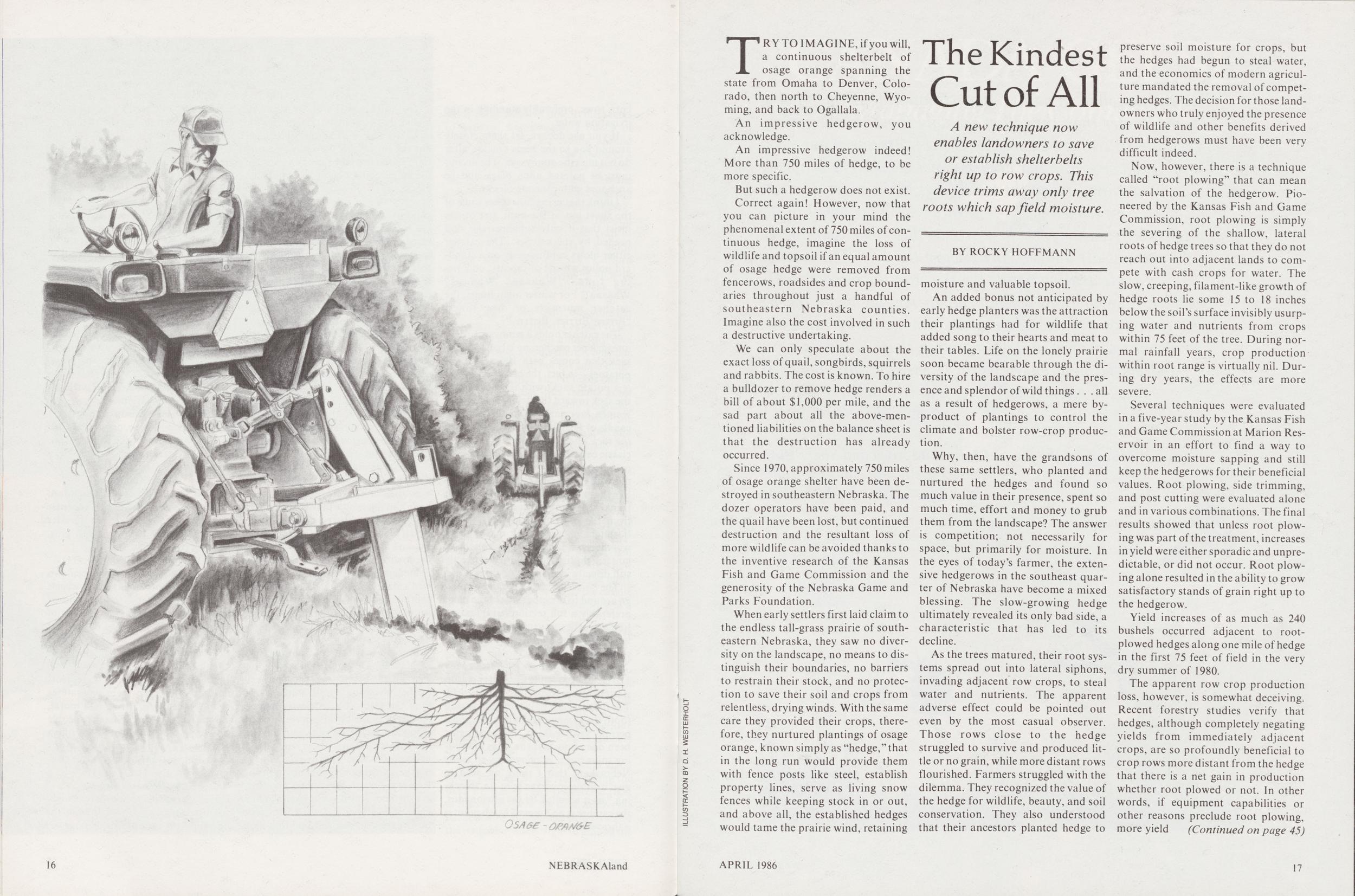
The Kindest Cut of All
A new technique now enables landowners to save or establish shelterbelts right up to row crops. This device trims away only tree roots which sap field moisture. BY ROCKY HOFFMANNTRY TO IMAGINE, if you will, a continuous shelterbelt of osage orange spanning the state from Omaha to Denver, Colorado, then north to Cheyenne, Wyoming, and back to Ogallala.
An impressive hedgerow, you acknowledge.
An impressive hedgerow indeed! More than 750 miles of hedge, to be more specific.
But such a hedgerow does not exist.
Correct again! However, now that you can picture in your mind the phenomenal extent of 750 miles of continuous hedge, imagine the loss of wildlife and topsoil if an equal amount of osage hedge were removed from fencerows, roadsides and crop boundaries throughout just a handful of southeastern Nebraska counties. Imagine also the cost involved in such a destructive undertaking.
We can only speculate about the exact loss of quail, songbirds, squirrels and rabbits. The cost is known. To hire a bulldozer to remove hedge renders a bill of about $1,000 per mile, and the sad part about all the above-mentioned liabilities on the balance sheet is that the destruction has already occurred.
Since 1970, approximately 750 miles of osage orange shelter have been destroyed in southeastern Nebraska. The dozer operators have been paid, and the quail have been lost, but continued destruction and the resultant loss of more wildlife can be avoided thanks to the inventive research of the Kansas Fish and Game Commission and the generosity of the Nebraska Game and Parks Foundation.
When early settlers first laid claim to the endless tall-grass prairie of southeastern Nebraska, they saw no diversity on the landscape, no means to distinguish their boundaries, no barriers to restrain their stock, and no protection to save their soil and crops from relentless, drying winds. With the same care they provided their crops, therefore, they nurtured plantings of osage orange, known simply as "hedge,"that in the long run would provide them with fence posts like steel, establish property lines, serve as living snow fences while keeping stock in or out, and above all, the established hedges would tame the prairie wind, retaining moisture and valuable topsoil.
An added bonus not anticipated by early hedge planters was the attraction their plantings had for wildlife that added song to their hearts and meat to their tables. Life on the lonely prairie soon became bearable through the diversity of the landscape and the presence and splendor of wild things all as a result of hedgerows, a mere byproduct of plantings to control the climate and bolster row-crop production.
Why, then, have the grandsons of these same settlers, who planted and nurtured the hedges and found so much value in their presence, spent so much time, effort and money to grub them from the landscape? The answer is competition; not necessarily for space, but primarily for moisture. In the eyes of today's farmer, the extensive hedgerows in the southeast quarter of Nebraska have become a mixed blessing. The slow-growing hedge ultimately revealed its only bad side, a characteristic that has led to its decline.
As the trees matured, their root systems spread out into lateral siphons, invading adjacent row crops, to steal water and nutrients. The apparent adverse effect could be pointed out even by the most casual observer. Those rows close to the hedge struggled to survive and produced little or no grain, while more distant rows flourished. Farmers struggled with the dilemma. They recognized the value of the hedge for wildlife, beauty, and soil conservation. They also understood that their ancestors planted hedge to preserve soil moisture for crops, but the hedges had begun to steal water, and the economics of modern agriculture mandated the removal of competing hedges. The decision for those landowners who truly enjoyed the presence of wildlife and other benefits derived from hedgerows must have been very difficult indeed.
Now, however, there is a technique called "root plowing" that can mean the salvation of the hedgerow. Pioneered by the Kansas Fish and Game Commission, root plowing is simply the severing of the shallow, lateral roots of hedge trees so that they do not reach out into adjacent lands to compete with cash crops for water. The slow, creeping, filament-like growth of hedge roots lie some 15 to 18 inches below the soil's surface invisibly usurping water and nutrients from crops within 75 feet of the tree. During normal rainfall years, crop production within root range is virtually nil. During dry years, the effects are more severe.
Several techniques were evaluated in a five-year study by the Kansas Fish and Game Commission at Marion Reservoir in an effort to find a way to overcome moisture sapping and still keep the hedgerows for their beneficial values. Root plowing, side trimming, and post cutting were evaluated alone and in various combinations. The final results showed that unless root plowing was part of the treatment, increases in yield were either sporadic and unpredictable, or did not occur. Root plowing alone resulted in the ability to grow satisfactory stands of grain right up to the hedgerow.
Yield increases of as much as 240 bushels occurred adjacent to rootplowed hedges along one mile of hedge in the first 75 feet of field in the very dry summer of 1980.
The apparent row crop production loss, however, is somewhat deceiving. Recent forestry studies verify that hedges, although completely negating yields from immediately adjacent crops, are so profoundly beneficial to crop rows more distant from the hedge that there is a net gain in production whether root plowed or not. In other words, if equipment capabilities or other reasons preclude root plowing, more yield (Continued on page 45)
APRIL 1986 17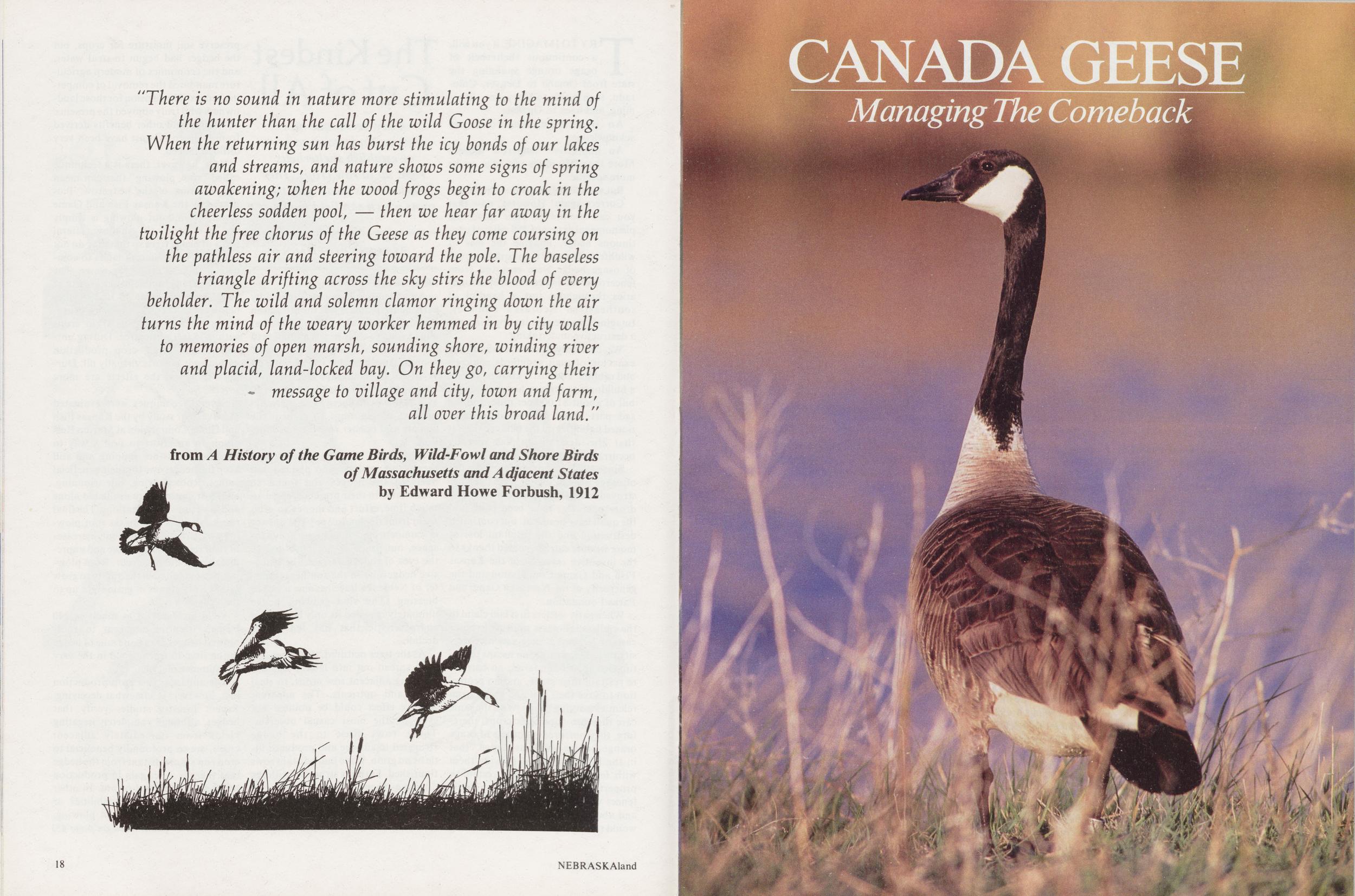
CANADA GEESE Maanaging The Comeback
"There is no sound in nature more stimulating to the mind of the hunter than the call of the wild Goose in the spring. When the returning sun has burst the icy bonds of our lakes and streams, and nature shows some signs of spring awakening; when the wood frogs begin to croak in the cheerless sodden pool, — then we hear far away in the twilight the free chorus of the Geese as they come coursing on the pathless air and steering toward the pole. The baseless triangle drifting across the sky stirs the blood of every beholder. The wild and solemn clamor ringing down the air turns the mind of the weary worker hemmed in by city walls to memories of open marsh, sounding shore, winding river and placid, land-locked bay. On they go, carrying their message to village and city, town and farm, all over this broad land." from A History of the Game Birds, Wild-Fowl and Shore Birds of Massachusetts and Adjacent States by Edward Howe Forbush, 1912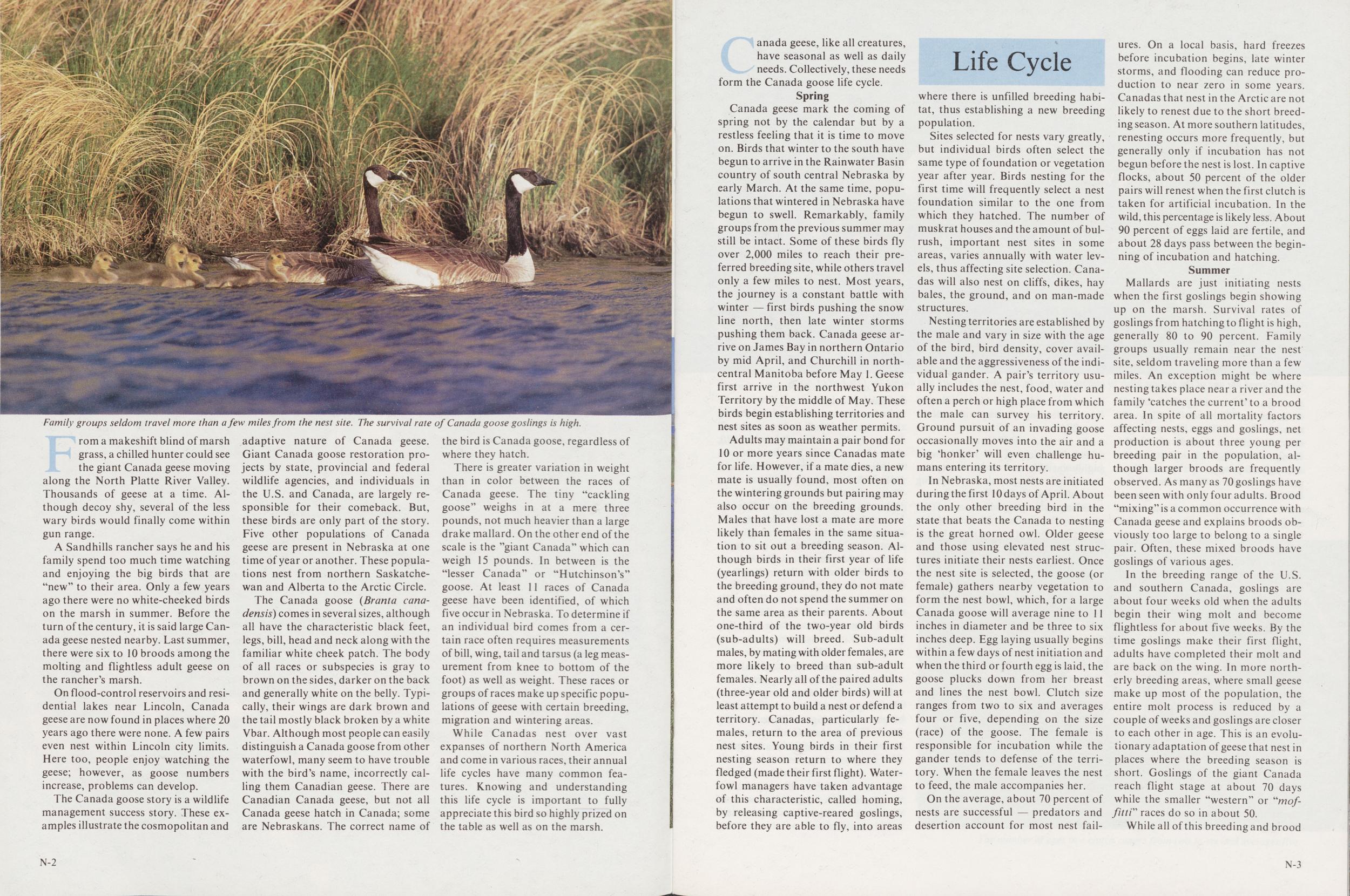
From a makeshift blind of marsh grass, a chilled hunter could see the giant Canada geese moving along the North Platte River Valley. Thousands of geese at a time. Although decoy shy, several of the less wary birds would finally come within gun range.
A Sandhills rancher says he and his family spend too much time watching and enjoying the big birds that are "new" to their area. Only a few years ago there were no white-cheeked birds on the marsh in summer. Before the turn of the century, it is said large Canada geese nested nearby. Last summer, there were six to 10 broods among the molting and flightless adult geese on the rancher's marsh.
On flood-control reservoirs and residential lakes near Lincoln, Canada geese are now found in places where 20 years ago there were none. A few pairs even nest within Lincoln city limits. Here too, people enjoy watching the geese; however, as goose numbers increase, problems can develop.
The Canada goose story is a wildlife management success story. These examples illustrate the cosmopolitan and adaptive nature of Canada geese. Giant Canada goose restoration projects by state, provincial and federal wildlife agencies, and individuals in the U.S. and Canada, are largely responsible for their comeback. But, these birds are only part of the story. Five other populations of Canada geese are present in Nebraska at one time of year or another. These populations nest from northern Saskatchewan and Alberta to the Arctic Circle.
The Canada goose {Branta canadensis) comes in several sizes, although all have the characteristic black feet, legs, bill, head and neck along with the familiar white cheek patch. The body of all races or subspecies is gray to brown on the sides, darker on the back and generally white on the belly. Typically, their wings are dark brown and the tail mostly black broken by a white bar. Although most people can easily distinguish a Canada goose from other waterfowl, many seem to have trouble with the bird's name, incorrectly calling them Canadian geese. There are Canadian Canada geese, but not all Canada geese hatch in Canada; some are Nebraskans. The correct name of the bird is Canada goose, regardless of where they hatch.
There is greater variation in weight than in color between the races of Canada geese. The tiny "cackling goose" weighs in at a mere three pounds, not much heavier than a large drake mallard. On the other end of the scale is the "giant Canada" which can weigh 15 pounds. In between is the "lesser Canada" or "Hutchinson's" goose. At least 11 races of Canada geese have been identified, of which five occur in Nebraska. To determine if an individual bird comes from a certain race often requires measurements of bill, wing, tail and tarsus (a leg measurement from knee to bottom of the foot) as well as weight. These races or groups of races make up specific populations of geese with certain breeding, migration and wintering areas.
While Canadas nest over vast expanses of northern North America and come in various races, their annual life cycles have many common features. Knowing and understanding this life cycle is important to fully appreciate this bird so highly prized on the table as well as on the marsh.
N-2 Life CycleCanada geese, like all creatures, have seasonal as well as daily needs. Collectively, these needs form the Canada goose life cycle.
SpringCanada geese mark the coming of spring not by the calendar but by a restless feeling that it is time to move on. Birds that winter to the south have begun to arrive in the Rainwater Basin country of south central Nebraska by early March. At the same time, populations that wintered in Nebraska have begun to swell. Remarkably, family groups from the previous summer may still be intact. Some of these birds fly over 2,000 miles to reach their preferred breeding site, while others travel only a few miles to nest. Most years, the journey is a constant battle with winter — first birds pushing the snow line north, then late winter storms pushing them back. Canada geese arrive on James Bay in northern Ontario by mid April, and Churchill in northcentral Manitoba before May 1. Geese first arrive in the northwest Yukon Territory by the middle of May. These birds begin establishing territories and nest sites as soon as weather permits.
Adults may maintain a pair bond for 10 or more years since Canadas mate for life. However, if a mate dies, a new mate is usually found, most often on the wintering grounds but pairing may also occur on the breeding grounds. Males that have lost a mate are more likely than females in the same situation to sit out a breeding season. Although birds in their first year of life (yearlings) return with older birds to the breeding ground, they do not mate and often do not spend the summer on the same area as their parents. About one-third of the two-year old birds (sub-adults) will breed. Sub-adult males, by mating with older females, are more likely to breed than sub-adult females. Nearly all of the paired adults (three-year old and older birds) will at least attempt to build a nest or defend a territory. Canadas, particularly females, return to the area of previous nest sites. Young birds in their first nesting season return to where they fledged (made their first flight). Waterfowl managers have taken advantage of this characteristic, called homing, by releasing captive-reared goslings, before they are able to fly, into areas where there is unfilled breeding habitat, thus establishing a new breeding population.
Sites selected for nests vary greatly, but individual birds often select the same type of foundation or vegetation year after year. Birds nesting for the first time will frequently select a nest foundation similar to the one from which they hatched. The number of muskrat houses and the amount of bulrush, important nest sites in some areas, varies annually with water levels, thus affecting site selection. Canadas will also nest on cliffs, dikes, hay bales, the ground, and on man-made structures.
Nesting territories are established by the male and vary in size with the age of the bird, bird density, cover available and the aggressiveness of the individual gander. A pair's territory usually includes the nest, food, water and often a perch or high place from which the male can survey his territory. Ground pursuit of an invading goose occasionally moves into the air and a big 'honker' will even challenge humans entering its territory.
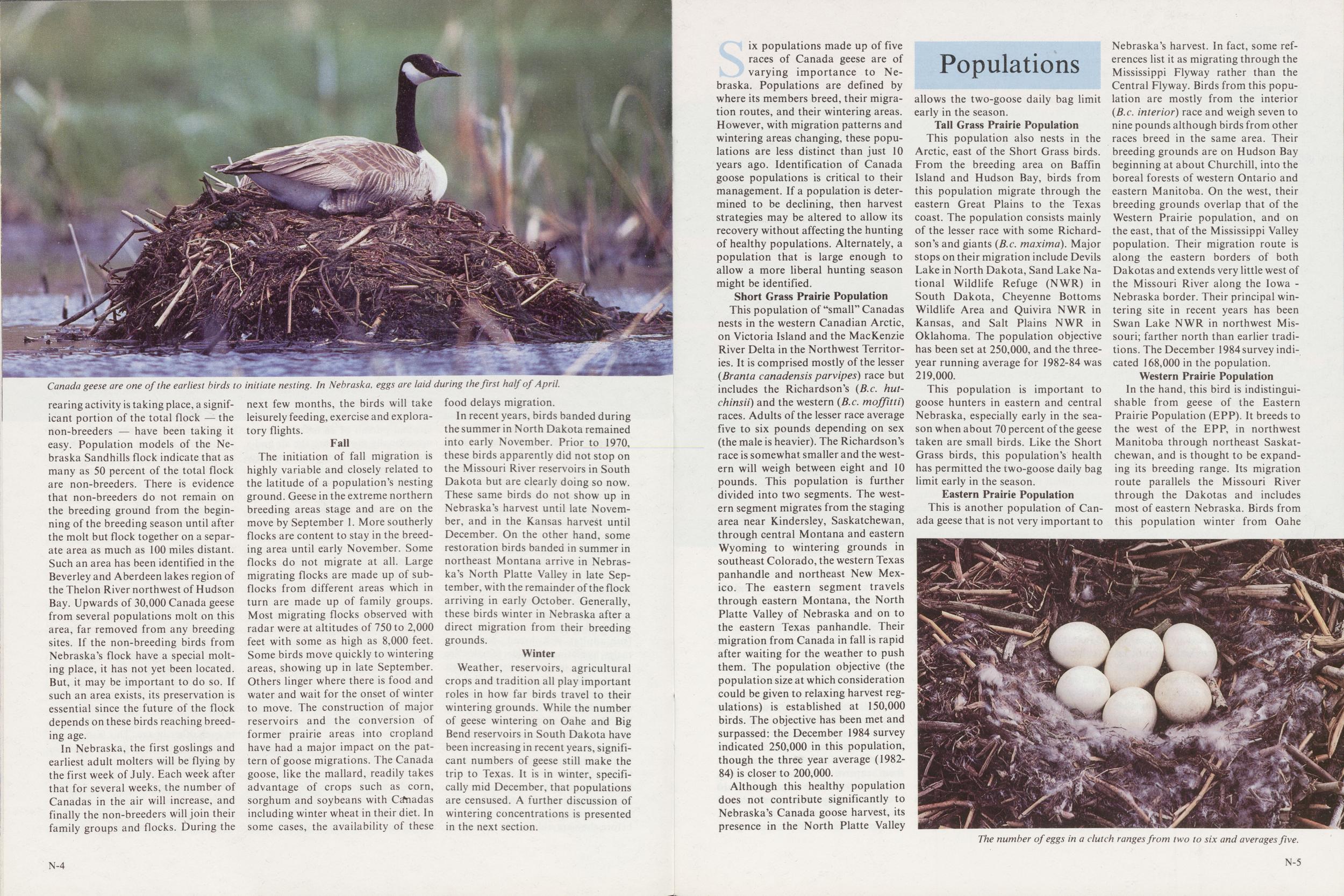
In Nebraska, most nests are initiated during the first lOdays of April. About the only other breeding bird in the state that beats the Canada to nesting is the great horned owl. Older geese and those using elevated nest structures initiate their nests earliest. Once the nest site is selected, the goose (or female) gathers nearby vegetation to form the nest bowl, which, for a large Canada goose will average nine to 11 inches in diameter and be three to six inches deep. Egg laying usually begins within a few days of nest initiation and when the third or fourth egg is laid, the goose plucks down from her breast and lines the nest bowl. Clutch size ranges from two to six and averages four or five, depending on the size (race) of the goose. The female is responsible for incubation while the gander tends to defense of the territory. When the female leaves the nest to feed, the male accompanies her.
On the average, about 70 percent of nests are successful — predators and desertion account for most nest failures. On a local basis, hard freezes before incubation begins, late winter storms, and flooding can reduce production to near zero in some years. Canadas that nest in the Arctic are not likely to renest due to the short breeding season. At more southern latitudes, renesting occurs more frequently, but generally only if incubation has not begun before the nest is lost. In captive flocks, about 50 percent of the older pairs will renest when the first clutch is taken for artificial incubation. In the wild, this percentage is likely less. About 90 percent of eggs laid are fertile, and about 28 days pass between the beginning of incubation and hatching.
SummerMallards are just initiating nests when the first goslings begin showing up on the marsh. Survival rates of goslings from hatching to flight is high, generally 80 to 90 percent. Family groups usually remain near the nest site, seldom traveling more than a few miles. An exception might be where nesting takes place near a river and the family 'catches the current' to a brood area. In spite of all mortality factors affecting nests, eggs and goslings, net production is about three young per breeding pair in the population, although larger broods are frequently observed. As many as 70 goslings have been seen with only four adults. Brood "mixing" is a common occurrence with Canada geese and explains broods obviously too large to belong to a single pair. Often, these mixed broods have goslings of various ages.
In the breeding range of the U.S. and southern Canada, goslings are about four weeks old when the adults begin their wing molt and become flightless for about five weeks. By the time goslings make their first flight, adults have completed their molt and are back on the wing. In more northerly breeding areas, where small geese make up most of the population, the entire molt process is reduced by a couple of weeks and goslings are closer to each other in age. This is an evolutionary adaptation of geese that nest in places where the breeding season is short. Goslings of the giant Canada reach flight stage at about 70 days while the smaller "western" or "fittr races do so in about 50.
While all of this breeding and brood
N-3
In Nebraska, the first goslings and earliest adult molters will be flying by the first week of July. Each week after that for several weeks, the number of Canadas in the air will increase, and finally the non-breeders will join their family groups and flocks. During the next few months, the birds will take leisurely feeding, exercise and exploratory flights.
FallThe initiation of fall migration is highly variable and closely related to the latitude of a population's nesting ground. Geese in the extreme northern breeding areas stage and are on the move by September 1. More southerly flocks are content to stay in the breeding area until early November. Some flocks do not migrate at all. Large migrating flocks are made up of subflocks from different areas which in turn are made up of family groups. Most migrating flocks observed with radar were at altitudes of 750 to 2,000 feet with some as high as 8,000 feet. Some birds move quickly to wintering areas, showing up in late September. Others linger where there is food and water and wait for the onset of winter to move. The construction of major reservoirs and the conversion of former prairie areas into cropland have had a major impact on the pattern of goose migrations. The Canada goose, like the mallard, readily takes advantage of crops such as corn, sorghum and soybeans with Camadas including winter wheat in their diet. In some cases, the availability of these food delays migration.
In recent years, birds banded during the summer in North Dakota remained into early November. Prior to 1970, these birds apparently did not stop on the Missouri River reservoirs in South Dakota but are clearly doing so now. These same birds do not show up in Nebraska's harvest until late November, and in the Kansas harvest until December. On the other hand, some restoration birds banded in summer in northeast Montana arrive in Nebraska's North Platte Valley in late September, with the remainder of the flock arriving in early October. Generally, these birds winter in Nebraska after a direct migration from their breeding grounds.
WinterWeather, reservoirs, agricultural crops and tradition all play important roles in how far birds travel to their wintering grounds. While the number of geese wintering on Oahe and Big Bend reservoirs in South Dakota have been increasing in recent years, significant numbers of geese still make the trip to Texas. It is in winter, specifically mid December, that populations are censused. A further discussion of wintering concentrations is presented in the next section.
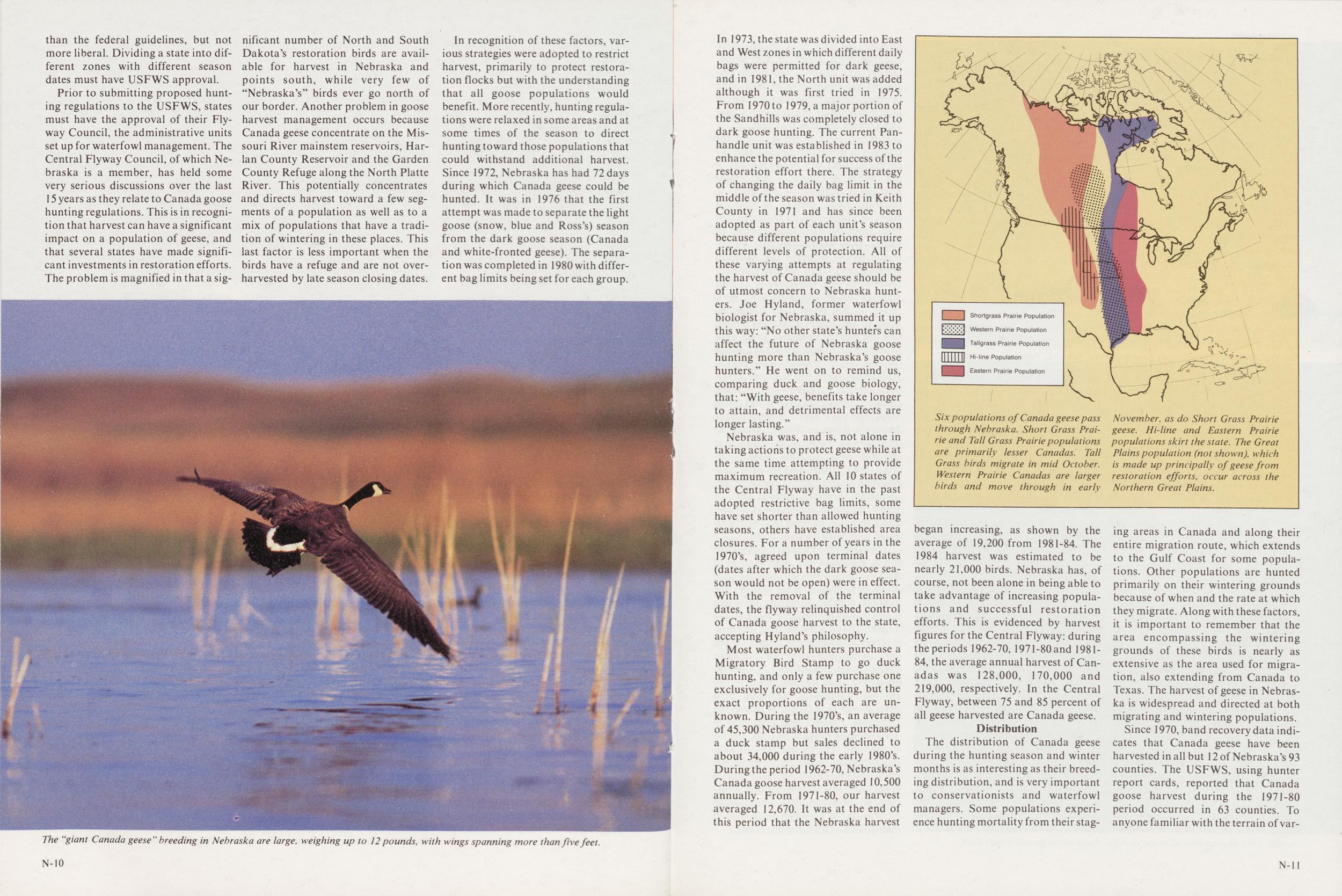
N-4 PopulationsSix populations made up of five races of Canada geese are of varying importance to Nebraska. Populations are defined by where its members breed, their migration routes, and their wintering areas. However, with migration patterns and wintering areas changing, these populations are less distinct than just 10 years ago. Identification of Canada goose populations is critical to their management. If a population is determined to be declining, then harvest strategies may be altered to allow its recovery without affecting the hunting of healthy populations. Alternately, a population that is large enough to allow a more liberal hunting season might be identified.
Short Grass Prairie PopulationThis population of "small" Canadas nests in the western Canadian Arctic, on Victoria Island and the MacKenzie River Delta in the Northwest Territories. It is comprised mostly of the lesser (Branta canadensis parvipes) race but includes the Richardson's (B.c. hutchinsii) and the western (B.c. moffitti) races. Adults of the lesser race average five to six pounds depending on sex (the male is heavier). The Richardson's race is somewhat smaller and the western will weigh between eight and 10 pounds. This population is further divided into two segments. The western segment migrates from the staging area near Kindersley, Saskatchewan, through central Montana and eastern Wyoming to wintering grounds in southeast Colorado, the western Texas panhandle and northeast New Mexico. The eastern segment travels through eastern Montana, the North Platte Valley of Nebraska and on to the eastern Texas panhandle. Their migration from Canada in fall is rapid after waiting for the weather to push them. The population objective (the population size at which consideration could be given to relaxing harvest regulations) is established at 150,000 birds. The objective has been met and surpassed: the December 1984 survey indicated 250,000 in this population, though the three year average (1982-84) is closer to 200,000.
Although this healthy population does not contribute significantly to Nebraska's Canada goose harvest, its presence in the North Platte Valley allows the two-goose daily bag limit early in the season.
Tall Grass Prairie PopulationThis population also nests in the Arctic, east of the Short Grass birds. From the breeding area on Baffin Island and Hudson Bay, birds from this population migrate through the eastern Great Plains to the Texas coast. The population consists mainly of the lesser race with some Richardson's and giants (B.c. maxima). Major stops on their migration include Devils Lake in North Dakota, Sand Lake National Wildlife Refuge (NWR) in South Dakota, Cheyenne Bottoms Wildlife Area and Quivira NWR in Kansas, and Salt Plains NWR in Oklahoma. The population objective has been set at 250,000, and the threeyear running average for 1982-84 was 219,000.
This population is important to goose hunters in eastern and central Nebraska, especially early in the season when about 70 percent of the geese taken are small birds. Like the Short Grass birds, this population's health has permitted the two-goose daily bag limit early in the season.
Eastern Prairie PopulationThis is another population of Canada geese that is not very important to Nebraska's harvest. In fact, some references list it as migrating through the Mississippi Flyway rather than the Central Flyway. Birds from this population are mostly from the interior (B.c. interior) race and weigh seven to nine pounds although birds from other races breed in the same area. Their breeding grounds are on Hudson Bay beginning at about Churchill, into the boreal forests of western Ontario and eastern Manitoba. On the west, their breeding grounds overlap that of the Western Prairie population, and on the east, that of the Mississippi Valley population. Their migration route is along the eastern borders of both Dakotas and extends very little west of the Missouri River along the Iowa Nebraska border. Their principal wintering site in recent years has been Swan Lake NWR in northwest Missouri; farther north than earlier traditions. The December 1984 survey indicated 168,000 in the population.
Western Prairie PopulationIn the hand, this bird is indistinguishable from geese of the Eastern Prairie Population (EPP). It breeds to the west of the EPP, in northwest Manitoba through northeast Saskatchewan, and is thought to be expanding its breeding range. Its migration route parallels the Missouri River through the Dakotas and includes most of eastern Nebraska. Birds from this population winter from Oahe
 Reservoir in South Dakota to eastern
Texas. The population objective is
200,000 birds. The December count in
1984 was 135,000, but this count was
thought to be low.
Hi-line Population
Reservoir in South Dakota to eastern
Texas. The population objective is
200,000 birds. The December count in
1984 was 135,000, but this count was
thought to be low.
Hi-line Population
This population of large geese provides a small portion of Nebraska's harvest since its migration route only includes the western edge of the state. It consists of both the giant (B.c. maxima) and the western (B.c. moffitti) races and nests in Alberta, western Saskatchewan and through Montana and Wyoming. The moffitti geese average between eight and 10 pounds while the maxima race averages between nine and 12. Its wintering grounds include the North Platte River in Wyoming and extends through Colorado to Bosque del Apache NWR in New Mexico. The population objective is 80,000 and the three-year average from 1982-84 indicates about that many.
Great Plains PopulationWhile each of the populations described above contribute to Nebraska's harvest and are considered in the state's goose management program, the Great Plains Population generates much of the interest in Canada geese. Birds from this population are from the giant (maxima) and western (moffitti) races and are almost all the result of restoration projects. The giant race was at one time thought to be extinct and was not 'rediscovered' until the early 1960's. This rediscovery and lessons from early efforts of raising Canada geese provided the impetus to reintroduce Canada geese to their traditional breeding grounds. These birds now breed from southern Alberta and Saskatchewan through the Dakotas to Kansas and into Colorado. Birds from this population provide a significant portion of Nebraska's harvest of Canada geese, and recreation associated with watching these birds.
Many factors had to come together for the restoration programs to work. It took the cooperation of many people throughout the Central Flyway. Essential to successful reintroduction was the bird's adaptive nature. It reproduced readily in captivity, utilized secure artificial nesting structures and developed a sense of what refuges were and where they were located. It has readily taken to feeding on agricultural crops and possesses a homing tendency which permitted local, wild flocks to be established through releases of goslings from captive flocks. Its natural tendency (and ability) to defend the nest and young have contributed to population growth.
Although perfectly suited to a restoration program, these large geese required some human assistance to reclaim their native range. Captive flocks were established, requiring an investment in holding pens and flock maintenance. Through research, it was determined that the total population was made up of sub-populations or segments that migrated at different times, via different routes or to different wintering areas. Further research showed that hunting was the most important factor limiting the growth of segments of the population and that birds from a segment 'homed'to a wintering area. With this information, managers set aside areas where the birds would be safe from the gun and put restrictive limits on hunting, both in terms of the number of birds and time of year they could be taken.
This population is best censused during the summer by counting breeding pairs. The most recent count indicates about 10,000 pairs throughout its range. Population objectives and ways of improving counts are currently being developed.
Nebraska Sandhills RestorationThe restoration of Canada geese began in Nebraska on Crescent Lake National Wildlife Refuge in 1936 when 10 birds were obtained from a private flock near Lisco. Between then and 1951, 140 birds were brought to the refuge from as far away as Utah and Montana, but little production was realized. Adverse weather and other mortality dealt setbacks to the effort, and by 1951, only one bird was left. Between 1952and 1959,427 additional birds were added to the flock and artificial nesting structures were erected. The program was terminated in 1962 and the population has been somewhat static at about 75 breeding pairs since 1976.
The restoration effort at Valentine NWR in Cherry County began in 1950 with 31 birds. These captive birds produced 30 goslings the following year and it appeared that restoration was off to a roaring start. However, the captive flock escaped that same year, perhaps portending what was to occur during the next 10 years. Between 1952 and 1960, 224 goslings were obtained from Swan Lake NWR in Missouri and after several years of nearly zero production from the captive flock, the emphasis shifted to releasing two and three year old birds to the wild. Fifty goslings obtained from Carl Strutz, a private breeder from Jamestown, North Dakota, were added to the flock in both 1964 and 1965. Production from captive and free-flying birds slowly increased but still only 10 broods with 24 goslings were observed on and adjacent to the refuge in 1969. The maintenance of a captive flock N-6
The restoration of giant Canada geese by the Game and Parks Commission began in the late 1960's with a few breeding pairs from a call flock at Plattsmouth (now Schilling) Wildlife Management Area (WMA). The production flock was supplemented with birds from the USFWS Northern Prairie Wildlife Research Center in Jamestown, North Dakota, from Cody Park in North Platte and by keeping goslings produced. These birds were then (and still are) housed at the Sacramento - Wilcox WMA southeast of Holdrege, although captive flocks were also initially maintained at Clear Creek Refuge near Lewellen and at Schilling WMA. Since the restoration effort was to be directed at the Sandhills, a significant portion of that area was closed to Canada goose hunting and the first release, totaling 109 goslings, was made in 1970. Slightly more than 4,100 birds, mostly goslings, were released through 1983. At present, over 400 breeding birds are held in two pens totaling nearly 90 acres at the Sacramento facility.
The management plan for the Sandhills restoration area was to release birds for 10 years before allowing a limited harvest in the area. Three principal objectives were outlined at the beginning of the project: to not allow the restoration effort to have a negative impact on traditional goose hunting areas; to provide for the harvest of geese by residents of the breeding area; and to not get into a "put and take" situation but rather to find out if the geese could make it on their own. With this in mind, a limited hunting season was initiated in 1980. Fewer than 100 birds have been harvested in the area each year through 1984. Most geese from the Sandhills population are harvested in the North Platte Valley and Harlan County Reservoir in Nebraska, and Kirwin Reservoir in Kansas.
Although the Sandhills project is
officially completed, the Game and
N-7
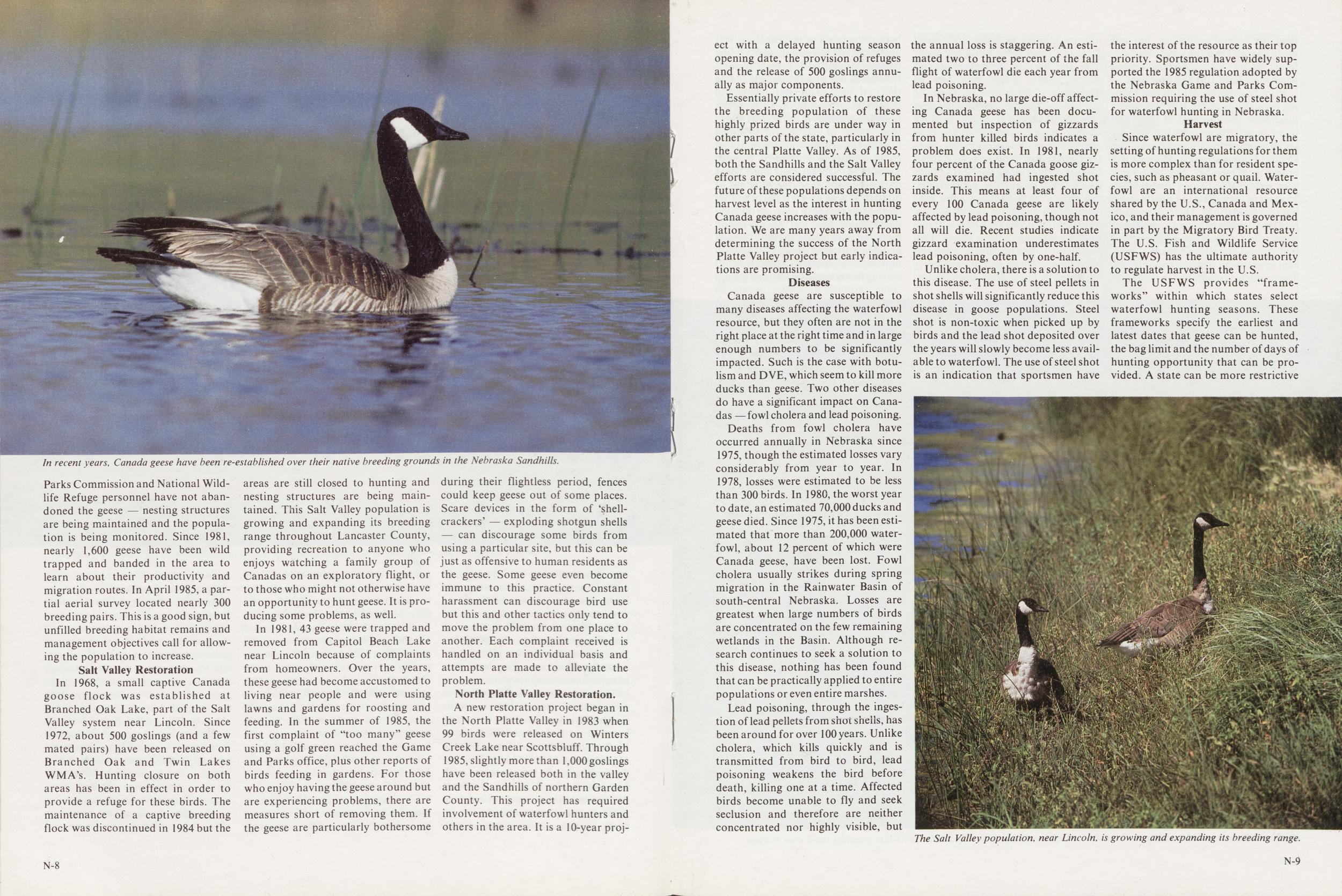
In 1968, a small captive Canada goose flock was established at Branched Oak Lake, part of the Salt Valley system near Lincoln. Since 1972, about 500 goslings (and a few mated pairs) have been released on Branched Oak and Twin Lakes WMA's. Hunting closure on both areas has been in effect in order to provide a refuge for these birds. The maintenance of a captive breeding flock was discontinued in 1984 but the areas are still closed to hunting and nesting structures are being maintained. This Salt Valley population is growing and expanding its breeding range throughout Lancaster County, providing recreation to anyone who enjoys watching a family group of Canadas on an exploratory flight, or to those who might not otherwise have an opportunity to hunt geese. It is producing some problems, as well.
In 1981, 43 geese were trapped and removed from Capitol Beach Lake near Lincoln because of complaints from homeowners. Over the years, these geese had become accustomed to living near people and were using lawns and gardens for roosting and feeding. In the summer of 1985, the first complaint of "too many" geese using a golf green reached the Game and Parks office, plus other reports of birds feeding in gardens. For those who enjoy having the geese around but are experiencing problems, there are measures short of removing them. If the geese are particularly bothersome during their flightless period, fences could keep geese out of some places. Scare devices in the form of 'shellcrackers' — exploding shotgun shells can discourage some birds from using a particular site, but this can be just as offensive to human residents as the geese. Some geese even become immune to this practice. Constant harassment can discourage bird use but this and other tactics only tend to move the problem from one place to another. Each complaint received is handled on an individual basis and attempts are made to alleviate the problem.
North Platte Valley Restoration.A new restoration project began in the North Platte Valley in 1983 when 99 birds were released on Winters Creek Lake near Scottsbluff. Through 1985, slightly more than 1,000 goslings have been released both in the valley and the Sandhills of northern Garden County. This project has required involvement of waterfowl hunters and others in the area. It is a 10-year project N-8 with a delayed hunting season opening date, the provision of refuges and the release of 500 goslings annually as major components.
Essentially private efforts to restore the breeding population of these highly prized birds are under way in other parts of the state, particularly in the central Platte Valley. As of 1985, both the Sandhills and the Salt Valley efforts are considered successful. The future of these populations depends on harvest level as the interest in hunting Canada geese increases with the population. We are many years away from determining the success of the North Platte Valley project but early indications are promising.
DiseasesCanada geese are susceptible to many diseases affecting the waterfowl resource, but they often are not in the right place at the right time and in large enough numbers to be significantly impacted. Such is the case with botulism and D VE, which seem to kill more ducks than geese. Two other diseases do have a significant impact on Canadas — fowl cholera and lead poisoning.
Deaths from fowl cholera have occurred annually in Nebraska since 1975, though the estimated losses vary considerably from year to year. In 1978, losses were estimated to be less than 300 birds. In 1980, the worst year to date, an estimated 70,000 ducks and geese died. Since 1975, it has been estimated that more than 200,000 waterfowl, about 12 percent of which were Canada geese, have been lost. Fowl cholera usually strikes during spring migration in the Rainwater Basin of south-central Nebraska. Losses are greatest when large numbers of birds are concentrated on the few remaining wetlands in the Basin. Although research continues to seek a solution to this disease, nothing has been found that can be practically applied to entire populations or even entire marshes.
Lead poisoning, through the ingestion of lead pellets from shot shells, has been around for over 100 years. Unlike cholera, which kills quickly and is transmitted from bird to bird, lead poisoning weakens the bird before death, killing one at a time. Affected birds become unable to fly and seek seclusion and therefore are neither concentrated nor highly visible, but the annual loss is staggering. An estimated two to three percent of the fall flight of waterfowl die each year from lead poisoning.
In Nebraska, no large die-off affecting Canada geese has been docu- mented but inspection of gizzards from hunter killed birds indicates a problem does exist. In 1981, nearly four percent of the Canada goose gizzards examined had ingested shot inside. This means at least four of every 100 Canada geese are likely affected by lead poisoning, though not all will die. Recent studies indicate gizzard examination underestimates lead poisoning, often by one-half.
Unlike cholera, there is a solution to this disease. The use of steel pellets in shot shells will significantly reduce this disease in goose populations. Steel shot is non-toxic when picked up by birds and the lead shot deposited over the years will slowly become less available to waterfowl. The use of steel shot is an indication that sportsmen have the interest of the resource as their top priority. Sportsmen have widely supported the 1985 regulation adopted by the Nebraska Game and Parks Commission requiring the use of steel shot for waterfowl hunting in Nebraska.
HarvestSince waterfowl are migratory, the setting of hunting regulations for them is more complex than for resident species, such as pheasant or quail. Waterfowl are an international resource shared by the U.S., Canada and Mexico, and their management is governed in part by the Migratory Bird Treaty. The U.S. Fish and Wildlife Service (USFWS) has the ultimate authority to regulate harvest in the U.S.
The USFWS provides "frameworks" within which states select waterfowl hunting seasons. These frameworks specify the earliest and latest dates that geese can be hunted, the bag limit and the number of days of hunting opportunity that can be provided. A state can be more restrictive
 than the federal guidelines, but not
more liberal. Dividing a state into different zones with different season
dates must have USFWS approval.
than the federal guidelines, but not
more liberal. Dividing a state into different zones with different season
dates must have USFWS approval.
Prior to submitting proposed hunting regulations to the USFWS, states must have the approval of their Flyway Council, the administrative units set up for waterfowl management. The Central Fly way Council, of which Nebraska is a member, has held some very serious discussions over the last 15 years as they relate to Canada goose hunting regulations. This is in recognition that harvest can have a significant impact on a population of geese, and that several states have made significant investments in restoration efforts. The problem is magnified in that a significant number of North and South Dakota's restoration birds are available for harvest in Nebraska and points south, while very few of "Nebraska's" birds ever go north of our border. Another problem in goose harvest management occurs because Canada geese concentrate on the Missouri River mainstem reservoirs, Harlan County Reservoir and the Garden County Refuge along the North Platte River. This potentially concentrates and directs harvest toward a few segments of a population as well as to a mix of populations that have a tradition of wintering in these places. This last factor is less important when the birds have a refuge and are not overharvested by late season closing dates.
In recognition of these factors, various strategies were adopted to restrict harvest, primarily to protect restoration flocks but with the understanding that all goose populations would benefit. More recently, hunting regulations were relaxed in some areas and at some times of the season to direct hunting toward those populations that could withstand additional harvest. Since 1972, Nebraska has had 72 days during which Canada geese could be hunted. It was in 1976 that the first attempt was made to separate the light goose (snow, blue and Ross's) season from the dark goose season (Canada and white-fronted geese). The separation was completed in 1980 with different bag limits being set for each group.
Nebraska was, and is, not alone in taking actions to protect geese while at the same time attempting to provide maximum recreation. All 10 states of the Central Flyway have in the past adopted restrictive bag limits, some have set shorter than allowed hunting seasons, others have established area closures. For a number of years in the 1970's, agreed upon terminal dates (dates after which the dark goose season would not be open) were in effect. With the removal of the terminal dates, the flyway relinquished control of Canada goose harvest to the state, accepting Hyland's philosophy.
Most waterfowl hunters purchase a Migratory Bird Stamp to go duck hunting, and only a few purchase one exclusively for goose hunting, but the exact proportions of each are unknown. During the 1970's, an average of 45,300 Nebraska hunters purchased a duck stamp but sales declined to about 34,000 during the early 1980's. During the period 1962-70, Nebraska's Canada goose harvest averaged 10,500 annually. From 1971-80, our harvest averaged 12,670. It was at the end of this period that the Nebraska harvest
The distribution of Canada geese during the hunting season and winter months is as interesting as their breeding distribution, and is very important to conservationists and waterfowl managers. Some populations experience hunting mortality from their staging areas in Canada and along their entire migration route, which extends to the Gulf Coast for some populations. Other populations are hunted primarily on their wintering grounds because of when and the rate at which they migrate. Along with these factors, it is important to remember that the area encompassing the wintering grounds of these birds is nearly as extensive as the area used for migration, also extending from Canada to Texas. The harvest of geese in Nebraska is widespread and directed at both migrating and wintering populations.
Since 1970, band recovery data indicates that Canada geese have been
harvested in all but 12 of Nebraska's 93
counties. The USFWS, using hunter
report cards, reported that Canada
goose harvest during the 1971-80
period occurred in 63 counties. To
anvone familiar with the terrain of various
N-11
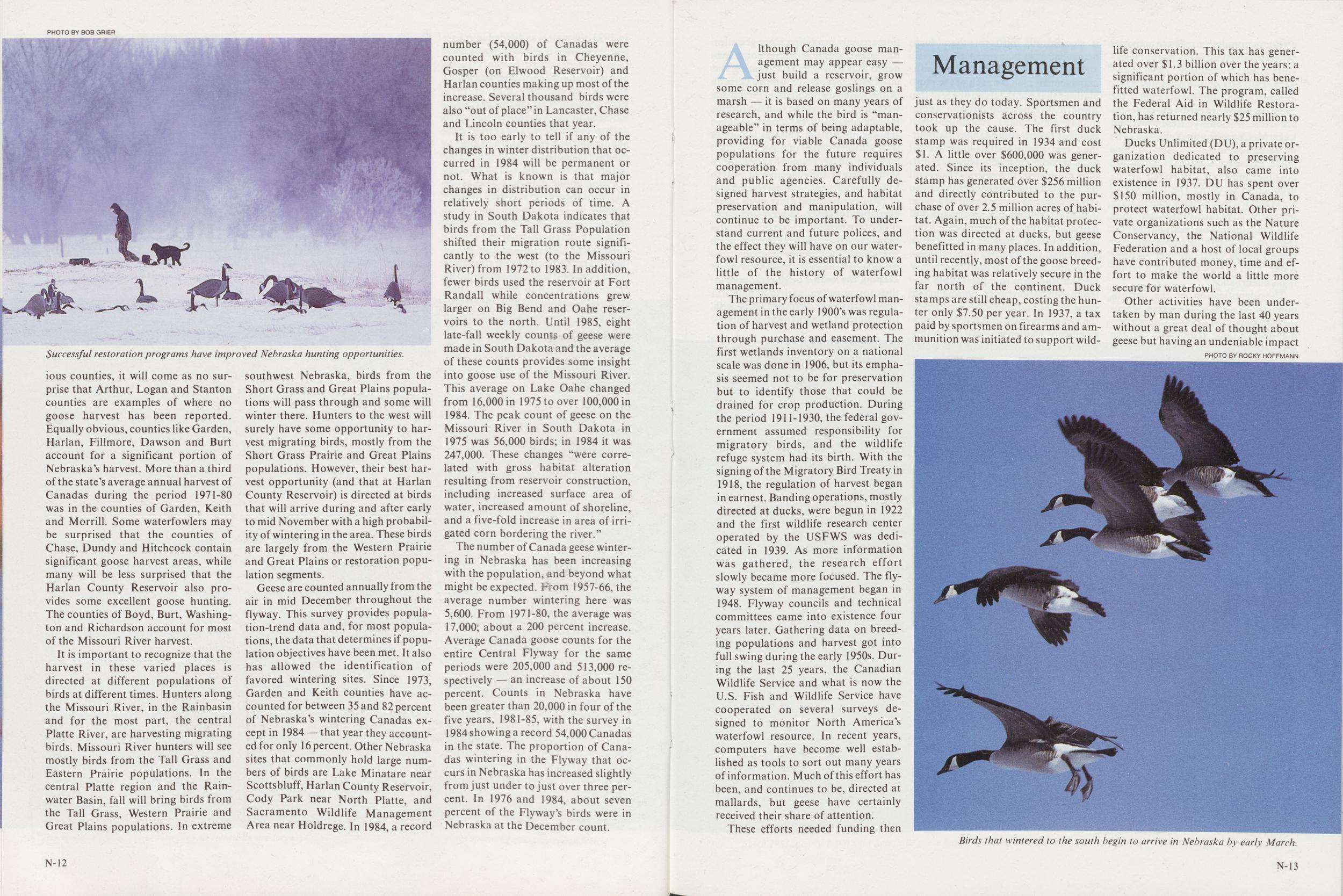
It is important to recognize that the harvest in these varied places is directed at different populations of birds at different times. Hunters along the Missouri River, in the Rainbasin and for the most part, the central Platte River, are harvesting migrating birds. Missouri River hunters will see mostly birds from the Tall Grass and Eastern Prairie populations. In the central Platte region and the Rainwater Basin, fall will bring birds from the Tall Grass, Western Prairie and Great Plains populations. In extreme southwest Nebraska, birds from the Short Grass and Great Plains populations will pass through and some will winter there. Hunters to the west will surely have some opportunity to harvest migrating birds, mostly from the Short Grass Prairie and Great Plains populations. However, their best harvest opportunity (and that at Harlan County Reservoir) is directed at birds that will arrive during and after early to mid November with a high probability of wintering in the area. These birds are largely from the Western Prairie and Great Plains or restoration population segments.
Geese are counted annually from the air in mid December throughout the flyway. This survey provides population-trend data and, for most populations, the data that determines if population objectives have been met. It also has allowed the identification of favored wintering sites. Since 1973, Garden and Keith counties have ac- counted for between 35 and 82 percent of Nebraska's wintering Canadas except in 1984 — that year they accounted for only 16 percent. Other Nebraska sites that commonly hold large numbers of birds are Lake Minatare near Scottsbluff, Harlan County Reservoir, Cody Park near North Platte, and Sacramento Wildlife Management Area near Holdrege. In 1984, a record number (54,000) of Canadas were counted with birds in Cheyenne, Gosper (on Elwood Reservoir) and Harlan counties making up most of the increase. Several thousand birds were also "out of place" in Lancaster, Chase and Lincoln counties that year.
It is too early to tell if any of the changes in winter distribution that occurred in 1984 will be permanent or not. What is known is that major changes in distribution can occur in relatively short periods of time. A study in South Dakota indicates that birds from the Tall Grass Population shifted their migration route significantly to the west (to the Missouri River) from 1972 to 1983. In addition, fewer birds used the reservoir at Fort Randall while concentrations grew larger on Big Bend and Oahe reservoirs to the north. Until 1985, eight late-fall weekly counts of geese were made in South Dakota and the average of these counts provides some insight into goose use of the Missouri River. This average on Lake Oahe changed from 16,000 in 1975 to over 100,000 in 1984. The peak count of geese on the Missouri River in South Dakota in 1975 was 56,000 birds; in 1984 it was 247,000. These changes "were correlated with gross habitat alteration resulting from reservoir construction, including increased surface area of water, increased amount of shoreline, and a five-fold increase in area of irrigated corn bordering the river."
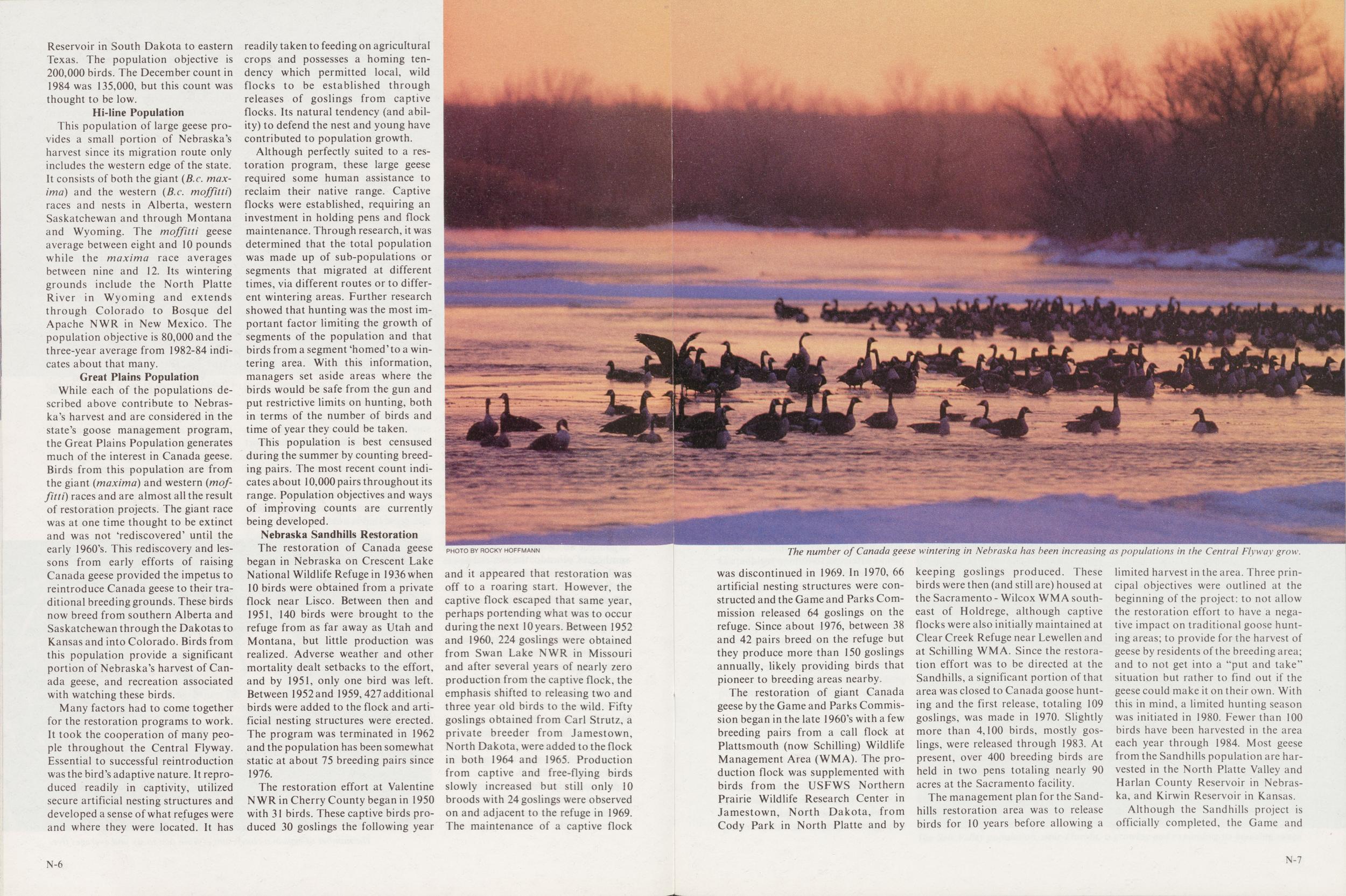
The number of Canada geese wintering in Nebraska has been increasing with the population, and beyond what might be expected. From 1957-66, the average number wintering here was 5,600. From 1971-80, the average was 17,000; about a 200 percent increase. Average Canada goose counts for the entire Central Flyway for the same periods were 205,000 and 513,000 respectively — an increase of about 150 percent. Counts in Nebraska have been greater than 20,000 in four of the five years, 1981-85, with the survey in 1984 showing a record 54,000 Canadas in the state. The proportion of Cana-das wintering in the Flyway that occurs in Nebraska has increased slightly from just under to just over three percent. In 1976 and 1984, about seven percent of the Flyway's birds were in Nebraska at the December count.
N-12 ManagementAlthough Canada goose management may appear easy just build a reservoir, grow some corn and release goslings on a marsh — it is based on many years of research, and while the bird is "manageable" in terms of being adaptable, providing for viable Canada goose populations for the future requires cooperation from many individuals and public agencies. Carefully designed harvest strategies, and habitat preservation and manipulation, will continue to be important. To understand current and future polices, and the effect they will have on our waterfowl resource, it is essential to know a little of the history of waterfowl management.
The primary focus of waterfowl management in the early 1900's was regulation of harvest and wetland protection through purchase and easement. The first wetlands inventory on a national scale was done in 1906, but its emphasis seemed not to be for preservation but to identify those that could be drained for crop production. During the period 1911-1930, the federal government assumed responsibility for migratory birds, and the wildlife refuge system had its birth. With the signing of the Migratory Bird Treaty in 1918, the regulation of harvest began in earnest. Banding operations, mostly directed at ducks, were begun in 1922 and the first wildlife research center operated by the USFWS was dedicated in 1939. As more information was gathered, the research effort slowly became more focused. The flyway system of management began in 1948. Flyway councils and technical committees came into existence four years later. Gathering data on breeding populations and harvest got into full swing during the early 1950s. During the last 25 years, the Canadian Wildlife Service and what is now the U.S. Fish and Wildlife Service have cooperated on several surveys designed to monitor North America's waterfowl resource. In recent years, computers have become well established as tools to sort out many years of information. Much of this effort has been, and continues to be, directed at mallards, but geese have certainly received their share of attention.
These efforts needed funding then just as they do today. Sportsmen and conservationists across the country took up the cause. The first duck stamp was required in 1934 and cost SLA little over $600,000 was generated. Since its inception, the duck stamp has generated over $256 million and directly contributed to the purchase of over 2.5 million acres of habitat. Again, much of the habitat protection was directed at ducks, but geese benefitted in many places. In addition, until recently, most of the goose breeding habitat was relatively secure in the far north of the continent. Duck stamps are still cheap, costing the hunter only $7.50 per year. In 1937, a tax paid by sportsmen on firearms and ammunition was initiated to support wildlife conservation. This tax has generated over $1.3 billion over the years: a significant portion of which has benefitted waterfowl. The program, called the Federal Aid in Wildlife Restoration, has returned nearly $25 million to Nebraska.
Ducks Unlimited (DU), a private organization dedicated to preserving waterfowl habitat, also came into existence in 1937. DU has spent over $150 million, mostly in Canada, to protect waterfowl habitat. Other private organizations such as the Nature Conservancy, the National Wildlife Federation and a host of local groups have contributed money, time and effort to make the world a little more secure for waterfowl.
Other activities have been undertaken by man during the last 40 years without a great deal of thought about geese but having an undeniable impact
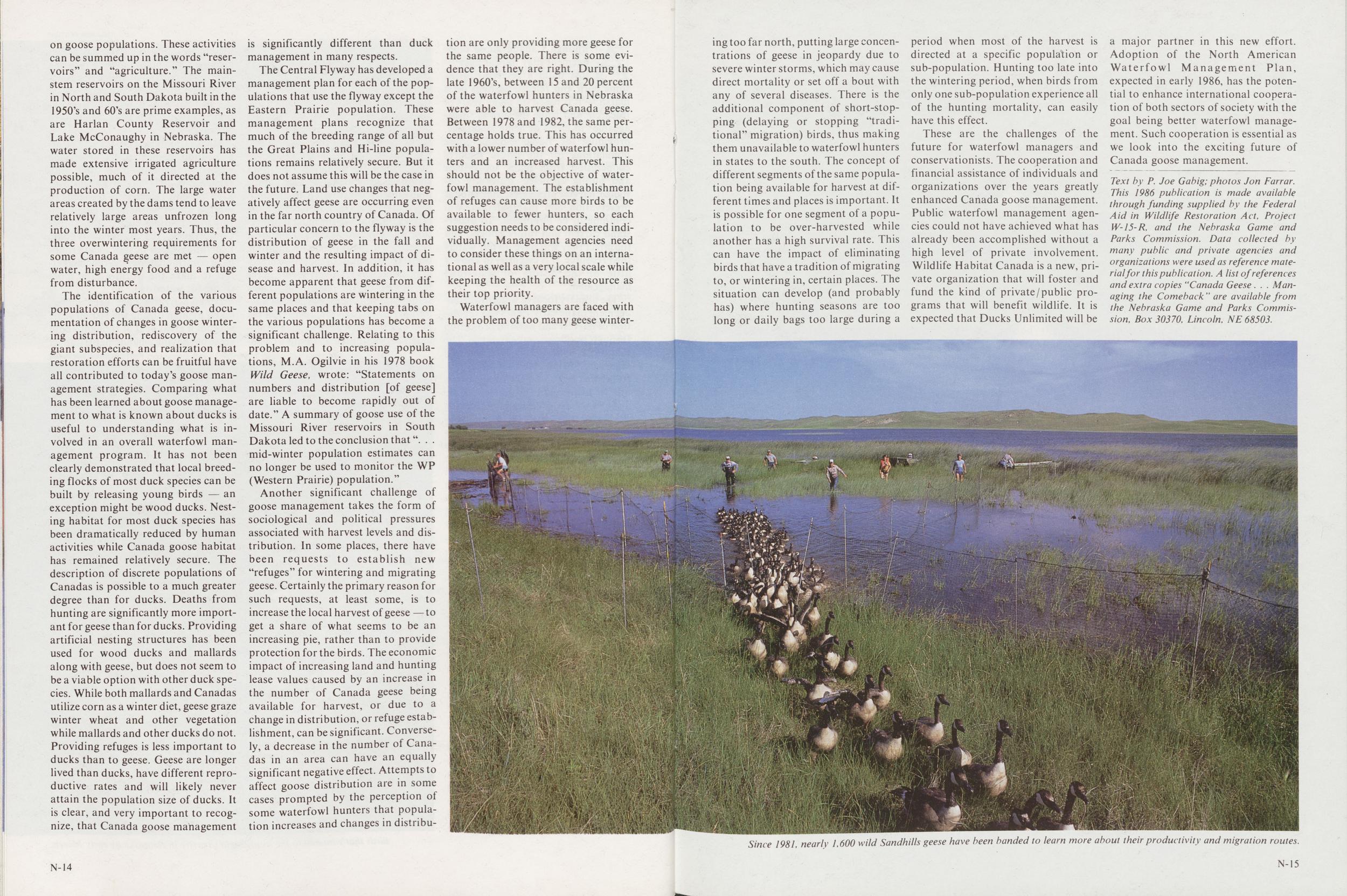 on goose populations. These activities
can be summed up in the words "reservoirs" and "agriculture." The mainstem reservoirs
on the Missouri River
in North and South Dakota built in the
1950's and 60's are prime examples, as
are Harlan County Reservoir and
Lake McConaughy in Nebraska. The
water stored in these reservoirs has
made extensive irrigated agriculture
possible, much of it directed at the
production of corn. The large water
areas created by the dams tend to leave
relatively large areas unfrozen long
into the winter most years. Thus, the
three overwintering requirements for
some Canada geese are met — open
water, high energy food and a refuge
from disturbance.
on goose populations. These activities
can be summed up in the words "reservoirs" and "agriculture." The mainstem reservoirs
on the Missouri River
in North and South Dakota built in the
1950's and 60's are prime examples, as
are Harlan County Reservoir and
Lake McConaughy in Nebraska. The
water stored in these reservoirs has
made extensive irrigated agriculture
possible, much of it directed at the
production of corn. The large water
areas created by the dams tend to leave
relatively large areas unfrozen long
into the winter most years. Thus, the
three overwintering requirements for
some Canada geese are met — open
water, high energy food and a refuge
from disturbance.
The identification of the various populations of Canada geese, documentation of changes in goose wintering distribution, rediscovery of the giant subspecies, and realization that restoration efforts can be fruitful have all contributed to today's goose management strategies. Comparing what has been learned about goose management to what is known about ducks is useful to understanding what is involved in an overall waterfowl management program. It has not been clearly demonstrated that local breeding flocks of most duck species can be built by releasing young birds — an exception might be wood ducks. Nesting habitat for most duck species has been dramatically reduced by human activities while Canada goose habitat has remained relatively secure. The description of discrete populations of Canadas is possible to a much greater degree than for ducks. Deaths from hunting are significantly more important for geese than for ducks. Providing artificial nesting structures has been used for wood ducks and mallards along with geese, but does not seem to be a viable option with other duck species. While both mallards and Canadas utilize corn as a winter diet, geese graze winter wheat and other vegetation while mallards and other ducks do not. Providing refuges is less important to ducks than to geese. Geese are longer lived than ducks, have different reproductive rates and will likely never attain the population size of ducks. It is clear, and very important to recognize, that Canada goose management is significantly different than duck management in many respects.
The Central Flyway has developed a management plan for each of the populations that use the flyway except the Eastern Prairie population. These management plans recognize that much of the breeding range of all but the Great Plains and Hi-line populations remains relatively secure. But it does not assume this will be the case in the future. Land use changes that negatively affect geese are occurring even in the far north country of Canada. Of particular concern to the flyway is the distribution of geese in the fall and winter and the resulting impact of disease and harvest. In addition, it has become apparent that geese from different populations are wintering in the same places and that keeping tabs on the various populations has become a significant challenge. Relating to this problem and to increasing populations, M.A. Ogilvie in his 1978 book Wild Geese, wrote: "Statements on numbers and distribution [of geese] are liable to become rapidly out of date." A summary of goose use of the Missouri River reservoirs in South Dakota led to the conclusion that" mid-winter population estimates can no longer be used to monitor the WP (Western Prairie) population."
Another significant challenge of goose management takes the form of sociological and political pressures associated with harvest levels and distribution. In some places, there have been requests to establish new "refuges" for wintering and migrating geese. Certainly the primary reason for such requests, at least some, is to increase the local harvest of geese to get a share of what seems to be an increasing pie, rather than to provide protection for the birds. The economic impact of increasing land and hunting lease values caused by an increase in the number of Canada geese being available for harvest, or due to a change in distribution, or refuge establishment, can be significant. Conversely, a decrease in the number of Canadas in an area can have an equally significant negative effect. Attempts to affect goose distribution are in some cases prompted by the perception of some waterfowl hunters that population increases and changes in distribution are only providing more geese for the same people. There is some evidence that they are right. During the late 1960's, between 15 and 20 percent of the waterfowl hunters in Nebraska were able to harvest Canada geese. Between 1978 and 1982, the same percentage holds true. This has occurred with a lower number of waterfowl hunters and an increased harvest. This should not be the objective of waterfowl management. The establishment of refuges can cause more birds to be available to fewer hunters, so each suggestion needs to be considered individually. Management agencies need to consider these things on an international as well as a very local scale while keeping the health of the resource as their top priority.
Waterfowl managers are faced with the problem of too many geese wintering N-14 too far north, putting large concentrations of geese in jeopardy due to severe winter storms, which may cause direct mortality or set off a bout with any of several diseases. There is the additional component of short-stopping (delaying or stopping "traditional" migration) birds, thus making them unavailable to waterfowl hunters in states to the south. The concept of different segments of the same population being available for harvest at different times and places is important. It is possible for one segment of a population to be over-harvested while another has a high survival rate. This can have the impact of eliminating birds that have a tradition of migrating to, or wintering in, certain places. The situation can develop (and probably has) where hunting seasons are too long or daily bags too large during a period when most of the harvest is directed at a specific population or sub-population. Hunting too late into the wintering period, when birds from only one sub-population experience all of the hunting mortality, can easily have this effect.
These are the challenges of the future for waterfowl managers and conservationists. The cooperation and financial assistance of individuals and organizations over the years greatly enhanced Canada goose management. Public waterfowl management agencies could not have achieved what has already been accomplished without a high level of private involvement. Wildlife Habitat Canada is a new, private organization that will foster and fund the kind of private/public programs that will benefit wildlife. It is expected that Ducks Unlimited will be a major partner in this new effort. Adoption of the North American Waterfowl Management Plan, expected in early 1986, has the potential to enhance international cooperation of both sectors of society with the goal being better waterfowl management. Such cooperation is essential as we look into the exciting future of Canada goose management.
Text by P. Joe Gabig; photos Jon Farrar. This 1986 publication is made available through funding supplied by the Federal Aid in Wildlife Restoration Act, Project W-15-R, and the Nebraska Game and Parks Commission. Data collected by many public and private agencies and organizations were used as reference material for this publication. A list of references and extra copies ''Canada Geese Managing the Comeback " are available from the Nebraska Game and Parks Commission, Box 30370, Lincoln, NE 68503.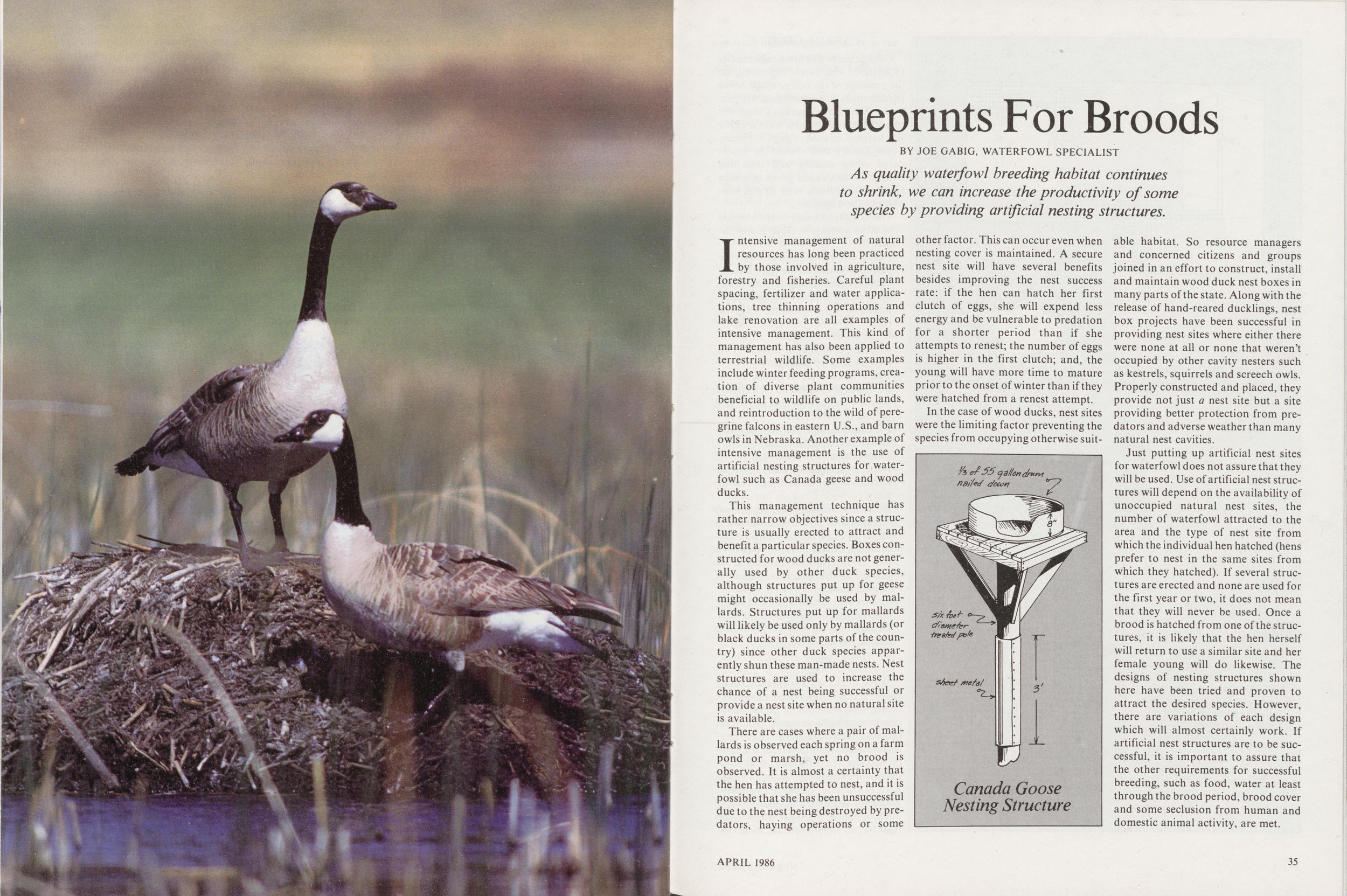
Blueprints For Broods
BY JOE GABIG, WATERFOWL SPECIALIST As quality waterfowl breeding habitat continues to shrink, we can increase the productivity of some species by providing artificial nesting structures.Intensive management of natural resources has long been practiced by those involved in agriculture, forestry and fisheries. Careful plant spacing, fertilizer and water applications, tree thinning operations and lake renovation are all examples of intensive management. This kind of management has also been applied to terrestrial wildlife. Some examples include winter feeding programs, creation of diverse plant communities beneficial to wildlife on public lands, and reintroduction to the wild of peregrine falcons in eastern U.S., and barn owls in Nebraska. Another example of intensive management is the use ol artificial nesting structures for waterfowl such as Canada geese and wood ducks.
This management technique has rather narrow objectives since a structure is usually erected to attract and benefit a particular species. Boxes constructed for wood ducks are not generally used by other duck species, although structures put up for geese might occasionally be used by mallards. Structures put up for mallards will likely be used only by mallards (or black ducks in some parts of the country) since other duck species apparently shun these man-made nests. Nest structures are used to increase the chance of a nest being successful or provide a nest site when no natural site is available.
There are cases where a pair of mallards is observed each spring on a farm pond or marsh, yet no brood is observed. It is almost a certainty that the hen has attempted to nest, and it is possible that she has been unsuccessful due to the nest being destroyed by predators, haying operations or some other factor. This can occur even when nesting cover is maintained. A secure nest site will have several benefits besides improving the nest success rate: if the hen can hatch her first clutch of eggs, she will expend less energy and be vulnerable to predation for a shorter period than if she attempts to renest; the number of eggs is higher in the first clutch; and, the young will have more time to mature prior to the onset of winter than if they were hatched from a renest attempt.
In the case of wood ducks, nest sites were the limiting factor preventing the species from occupying otherwise suitable
Just putting up artificial nest sites for waterfowl does not assure that they will be used. Use of artificial nest structures will depend on the availability of unoccupied natural nest sites, the number of waterfowl attracted to the area and the type of nest site from which the individual hen hatched (hens prefer to nest in the same sites from which they hatched). If several structures are erected and none are used for the first year or two, it does not mean that they will never be used. Once a brood is hatched from one of the structures, it is likely that the hen herself will return to use a similar site and her female young will do likewise. The designs of nesting structures shown here have been tried and proven to attract the desired species. However, there are variations of each design which will almost certainly work. If artificial nest structures are to be successful, it is important to assure that the other requirements for successful breeding, such as food, water at least through the brood period, brood cover and some seclusion from human and domestic animal activity, are met.
APRIL 1986 35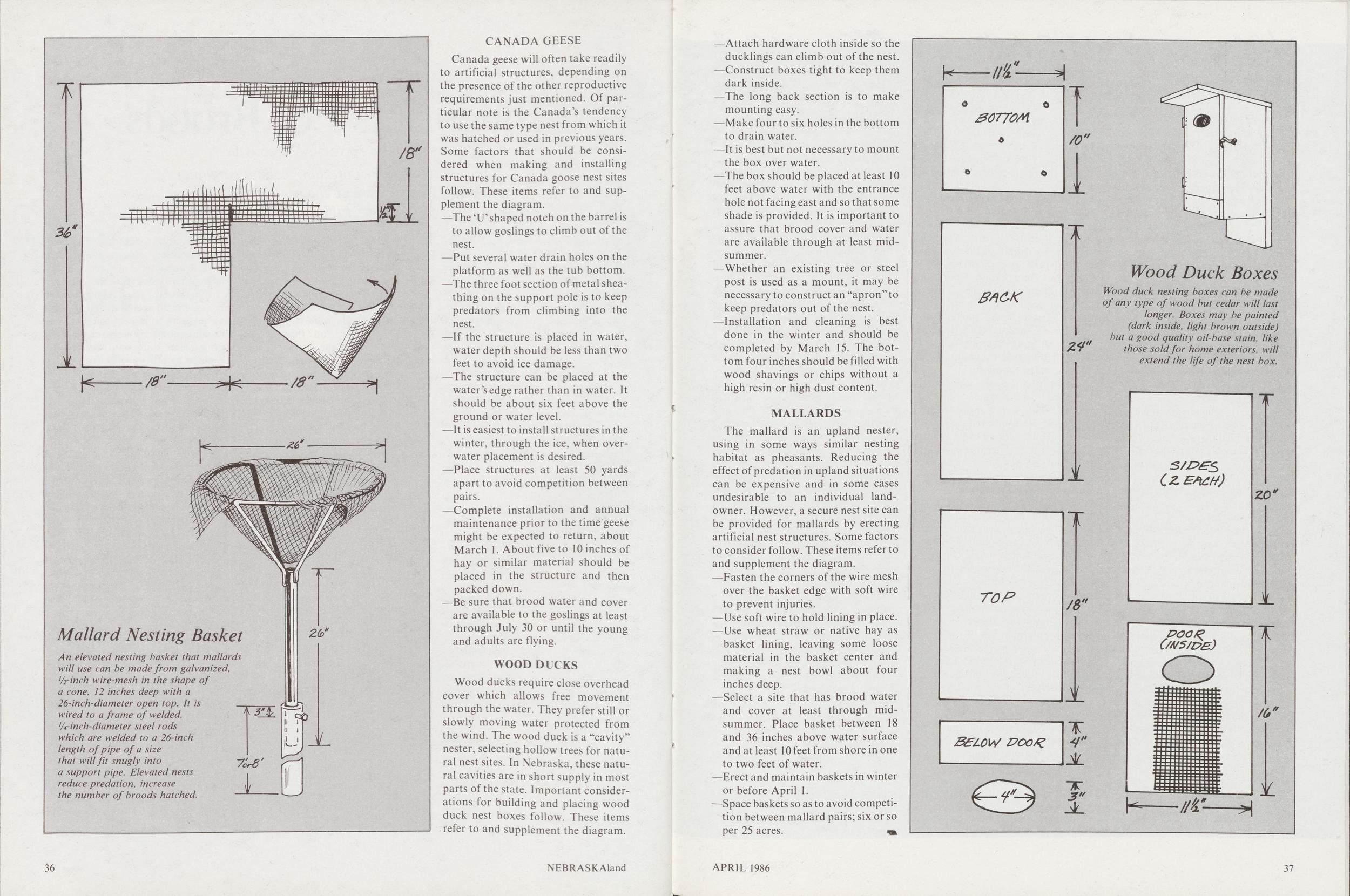
Canada geese will often take readily to artificial structures, depending on the presence of the other reproductive requirements just mentioned. Of particular note is the Canada's tendency to use the same type nest from which it was hatched or used in previous years. Some factors that should be considered when making and installing structures for Canada goose nest sites follow. These items refer to and supplement the diagram.
—The 'U' shaped notch on the barrel is to allow goslings to climb out of the nest.
—Put several water drain holes on the platform as well as the tub bottom.
—The three foot section of metal sheathing on the support pole is to keep predators from climbing into the nest.
—If the structure is placed in water, water depth should be less than two feet to avoid ice damage.
—The structure can be placed at the water'sedge rather than in water. It should be about six feet above the ground or water level.
—It is easiest to install structures in the winter, through the ice, when overwater placement is desired.
—Place structures at least 50 yards apart to avoid competition between pairs.
—Complete installation and annual maintenance prior to the time geese might be expected to return, about March 1. About five to 10 inches of hay or similar material should be placed in the structure and then packed down.
—Be sure that brood water and cover are available to the goslings at least through July 30 or until the young and adults are flying.
WOOD DUCKSWood ducks require close overhead cover which allows free movement through the water. They prefer still or slowly moving water protected from the wind. The wood duck is a "cavity" nester, selecting hollow trees for natural nest sites. In Nebraska, these natural cavities are in short supply in most parts of the state. Important considerations for building and placing wood duck nest boxes follow. These items refer to and supplement the diagram.
36 NEBRASKAland-Attach hardware cloth inside so the ducklings can climb out of the nest.
-Construct boxes tight to keep them dark inside.
-The long back section is to make mounting easy.
-Make four to six holes in the bottom to drain water.
-It is best but not necessary to mount the box over water.
-The box should be placed at least 10 feet above water with the entrance hole not facing east and so that some shade is provided. It is important to assure that brood cover and water are available through at least midsummer.
-Whether an existing tree or steel post is used as a mount, it may be necessary to construct an "apron" to keep predators out of the nest.
-Installation and cleaning is best done in the winter and should be completed by March 15. The bot- tom four inches should be filled with wood shavings or chips without a high resin or high dust content.
MALLARDSThe mallard is an upland nester, using in some ways similar nesting habitat as pheasants. Reducing the effect of predation in upland situations can be expensive and in some cases undesirable to an individual landowner. However, a secure nest site can be provided for mallards by erecting artificial nest structures. Some factors to consider follow. These items refer to and supplement the diagram.
—Fasten the corners of the wire mesh over the basket edge with soft wire to prevent injuries.
—Use soft wire to hold lining in place.
—Use wheat straw or native hay as basket lining, leaving some loose material in the basket center and making a nest bowl about four inches deep.
—Select a site that has brood water and cover at least through midsummer. Place basket between 18 and 36 inches above water surface and at least 10 feet from shore in one to two feet of water.
—Erect and maintain baskets in winter or before April 1.
—Space baskets so as to avoid competition between mallard pairs; six or so per 25 acres.
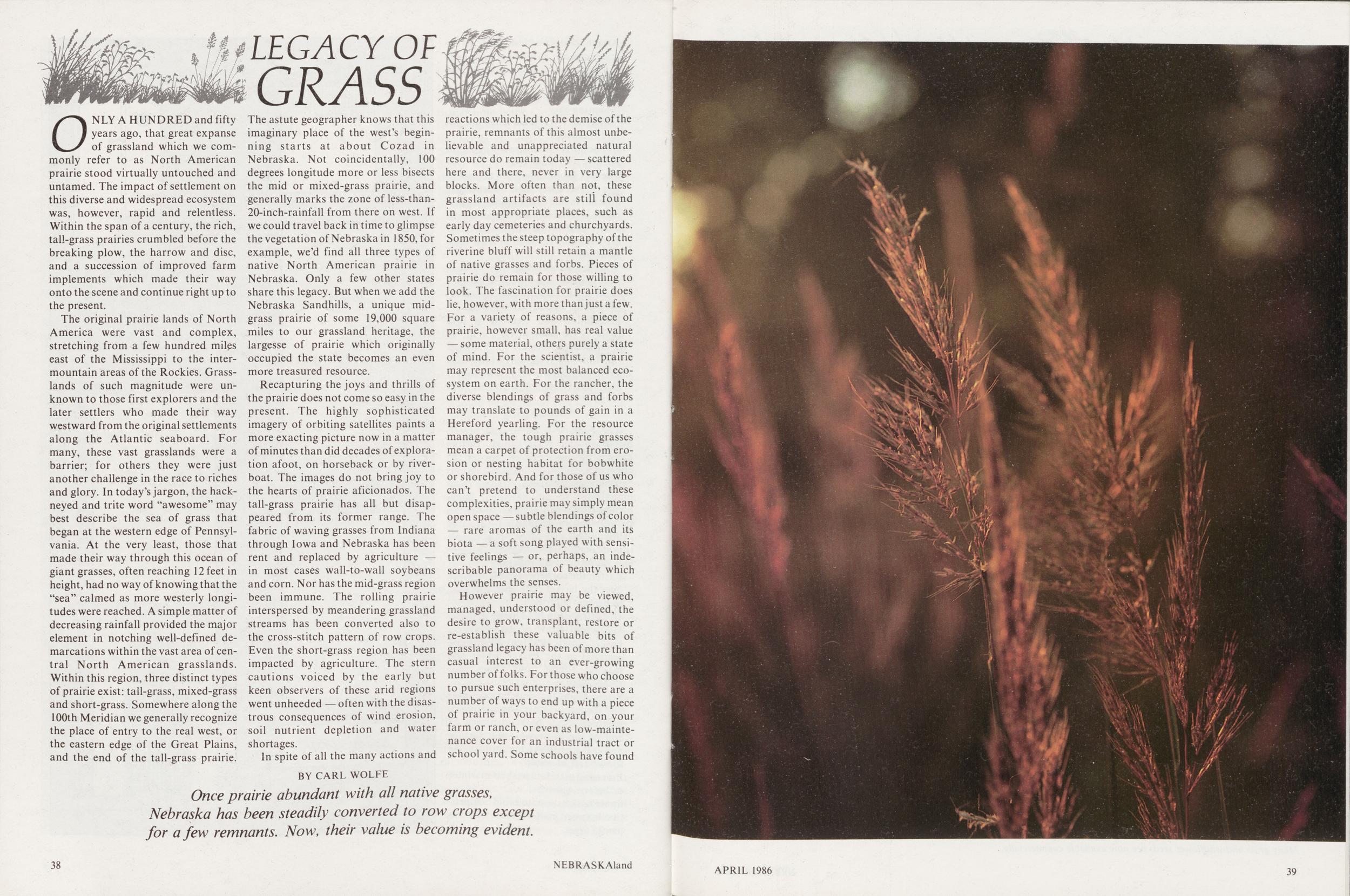
LEGACY OF GRASS
ONLY A HUNDRED and fifty years ago, that great expanse of grassland which we commonly refer to as North American prairie stood virtually untouched and untamed. The impact of settlement on this diverse and widespread ecosystem was, however, rapid and relentless. Within the span of a century, the rich, tall-grass prairies crumbled before the breaking plow, the harrow and disc, and a succession of improved farm implements which made their way onto the scene and continue right up to the present.
The original prairie lands of North America were vast and complex, stretching from a few hundred miles east of the Mississippi to the intermountain areas of the Rockies. Grasslands of such magnitude were unknown to those first explorers and the later settlers who made their way westward from the original settlements along the Atlantic seaboard. For many, these vast grasslands were a barrier; for others they were just another challenge in the race to riches and glory. In today's jargon, the hackneyed and trite word "awesome" may best describe the sea of grass that began at the western edge of Pennsylvania. At the very least, those that made their way through this ocean of giant grasses, often reaching 12 feet in height, had no way of knowing that the "sea" calmed as more westerly longitudes were reached. A simple matter of decreasing rainfall provided the major element in notching well-defined demarcations within the vast area of central North American grasslands. Within this region, three distinct types of prairie exist: tall-grass, mixed-grass and short-grass. Somewhere along the 100th Meridian we generally recognize the place of entry to the real west, or the eastern edge of the Great Plains, and the end of the tall-grass prairie. The astute geographer knows that this imaginary place of the west's beginning starts at about Cozad in Nebraska. Not coincidentally, 100 degrees longitude more or less bisects the mid or mixed-grass prairie, and generally marks the zone of less-than-20-inch-rainfall from there on west. If we could travel back in time to glimpse the vegetation of Nebraska in 1850, for example, we'd find all three types of native North American prairie in Nebraska. Only a few other states share this legacy. But when we add the Nebraska Sandhills, a unique midgrass prairie of some 19,000 square miles to our grassland heritage, the largesse of prairie which originally occupied the state becomes an even more treasured resource.Recapturing the joys and thrills of the prairie does not come so easy in the present. The highly sophisticated imagery of orbiting satellites paints a more exacting picture now in a matter of minutes than did decades of exploration afoot, on horseback or by riverboat. The images do not bring joy to the hearts of prairie aficionados. The tall-grass prairie has all but disappeared from its former range. The fabric of waving grasses from Indiana through Iowa and Nebraska has been rent and replaced by agriculture in most cases wall-to-wall soybeans and corn. Nor has the mid-grass region been immune. The rolling prairie interspersed by meandering grassland streams has been converted also to the cross-stitch pattern of row crops. Even the short-grass region has been impacted by agriculture. The stern cautions voiced by the early but keen observers of these arid regions went unheeded — often with the disastrous consequences of wind erosion, soil nutrient depletion and water shortages.
BY CARL WOLFE Once prairie abundant with all native grasses, Nebraska has been steadily converted to row crops except for a few remnants. Now, their value is becoming evident.In spite of all the many actions and reactions which led to the demise of the prairie, remnants of this almost unbelievable and unappreciated natural resource do remain today — scattered here and there, never in very large blocks. More often than not, these grassland artifacts are still found in most appropriate places, such as early day cemeteries and churchyards. Sometimes the steep topography of the riverine bluff will still retain a mantle of native grasses and forbs. Pieces of prairie do remain for those willing to look. The fascination for prairie does lie, however, with more than just a few. For a variety of reasons, a piece of prairie, however small, has real value some material, others purely a state of mind. For the scientist, a prairie may represent the most balanced ecosystem on earth. For the rancher, the diverse blendings of grass and forbs may translate to pounds of gain in a Hereford yearling. For the resource manager, the tough prairie grasses mean a carpet of protection from erosion or nesting habitat for bobwhite or shorebird. And for those of us who can't pretend to understand these complexities, prairie may simply mean open space — subtle blendings of color — rare aromas of the earth and its biota — a soft song played with sensitive feelings — or, perhaps, an indescribable panorama of beauty which overwhelms the senses.
However prairie may be viewed, managed, understood or defined, the desire to grow, transplant, restore or re-establish these valuable bits of grassland legacy has been of more than casual interest to an ever-growing number of folks. For those who choose to pursue such enterprises, there are a number of ways to end up with a piece of prairie in your backyard, on your farm or ranch, or even as low-maintenance cover for an industrial tract or school yard. Some schools have found 38 NEBRASKAland
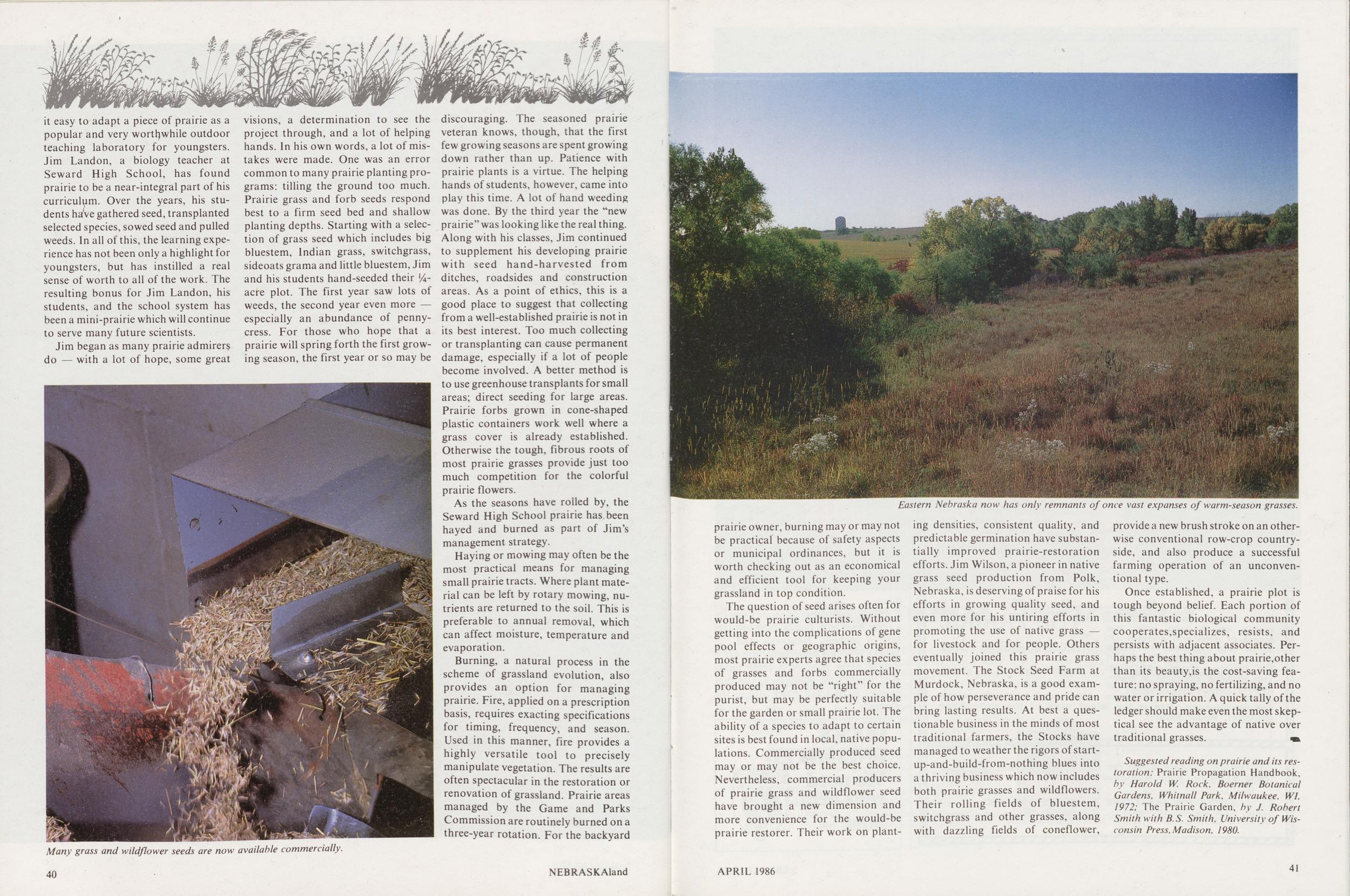 it easy to adapt a piece of prairie as a
popular and very worthwhile outdoor
teaching laboratory for youngsters.
Jim Landon, a biology teacher at
Seward High School, has found
prairie to be a near-integral part of his
curriculum. Over the years, his students haVe gathered seed, transplanted
selected species, sowed seed and pulled
weeds. In all of this, the learning experience has not been only a highlight for
youngsters, but has instilled a real
sense of worth to all of the work. The
resulting bonus for Jim Landon, his
students, and the school system has
been a mini-prairie which will continue
to serve many future scientists.
it easy to adapt a piece of prairie as a
popular and very worthwhile outdoor
teaching laboratory for youngsters.
Jim Landon, a biology teacher at
Seward High School, has found
prairie to be a near-integral part of his
curriculum. Over the years, his students haVe gathered seed, transplanted
selected species, sowed seed and pulled
weeds. In all of this, the learning experience has not been only a highlight for
youngsters, but has instilled a real
sense of worth to all of the work. The
resulting bonus for Jim Landon, his
students, and the school system has
been a mini-prairie which will continue
to serve many future scientists.
Jim began as many prairie admirers do — with a lot of hope, some great
As the seasons have rolled by, the Seward High School prairie has been hayed and burned as part of Jim's management strategy.
Haying or mowing may often be the most practical means for managing small prairie tracts. Where plant material can be left by rotary mowing, nutrients are returned to the soil. This is preferable to annual removal, which can affect moisture, temperature and evaporation.
Burning, a natural process in the scheme of grassland evolution, also provides an option for managing prairie. Fire, applied on a prescription basis, requires exacting specifications for timing, frequency, and season. Used in this manner, fire provides a highly versatile tool to precisely manipulate vegetation. The results are often spectacular in the restoration or renovation of grassland. Prairie areas managed by the Game and Parks Commission are routinely burned on a three-year rotation. For the backyard 40 NEBRASKAland
The question of seed arises often for would-be prairie culturists. Without getting into the complications of gene pool effects or geographic origins, most prairie experts agree that species of grasses and forbs commercially produced may not be "right" for the purist, but may be perfectly suitable for the garden or small prairie lot. The ability of a species to adapt to certain sites is best found in local, native populations. Commercially produced seed may or may not be the best choice. Nevertheless, commercial producers of prairie grass and wildflower seed have brought a new dimension and more convenience for the would-be prairie restorer. Their work on planting densities, consistent quality, and predictable germination have substantially improved prairie-restoration efforts. Jim Wilson, a pioneer in native grass seed production from Polk, Nebraska, is deserving of praise for his efforts in growing quality seed, and even more for his untiring efforts in promoting the use of native grass for livestock and for people. Others eventually joined this prairie grass movement. The Stock Seed Farm at Murdock, Nebraska, is a good example of how perseverance and pride can bring lasting results. At best a questionable business in the minds of most traditional farmers, the Stocks have managed to weather the rigors of startup-and-build-from-nothing blues into a thriving business which now includes both prairie grasses and wildflowers. Their rolling fields of bluestem, switchgrass and other grasses, along with dazzling fields of coneflower, provide a new brush stroke on an otherwise conventional row-crop countryside, and also produce a successful farming operation of an unconventional type.
Once established, a prairie plot is tough beyond belief. Each portion of this fantastic biological community cooperates,specializes, resists, and persists with adjacent associates. Perhaps the best thing about prairie,other than its beauty,is the cost-saving feature: no spraying, no fertilizing, and no water or irrigation. A quick tally of the ledger should make even the most skeptical see the advantage of native over traditional grasses.
Suggested reading on prairie and its restoration: Prairie Propagation Handbook, by Harold W. Rock, Boerner Botanical Gardens, Whitnall Park, Milwaukee, Wl, 1972; The Prairie Garden, by J. Robert Smith with B. S. Smith, University of Wisconsin Press, Madison, 1980. APRIL 1986 41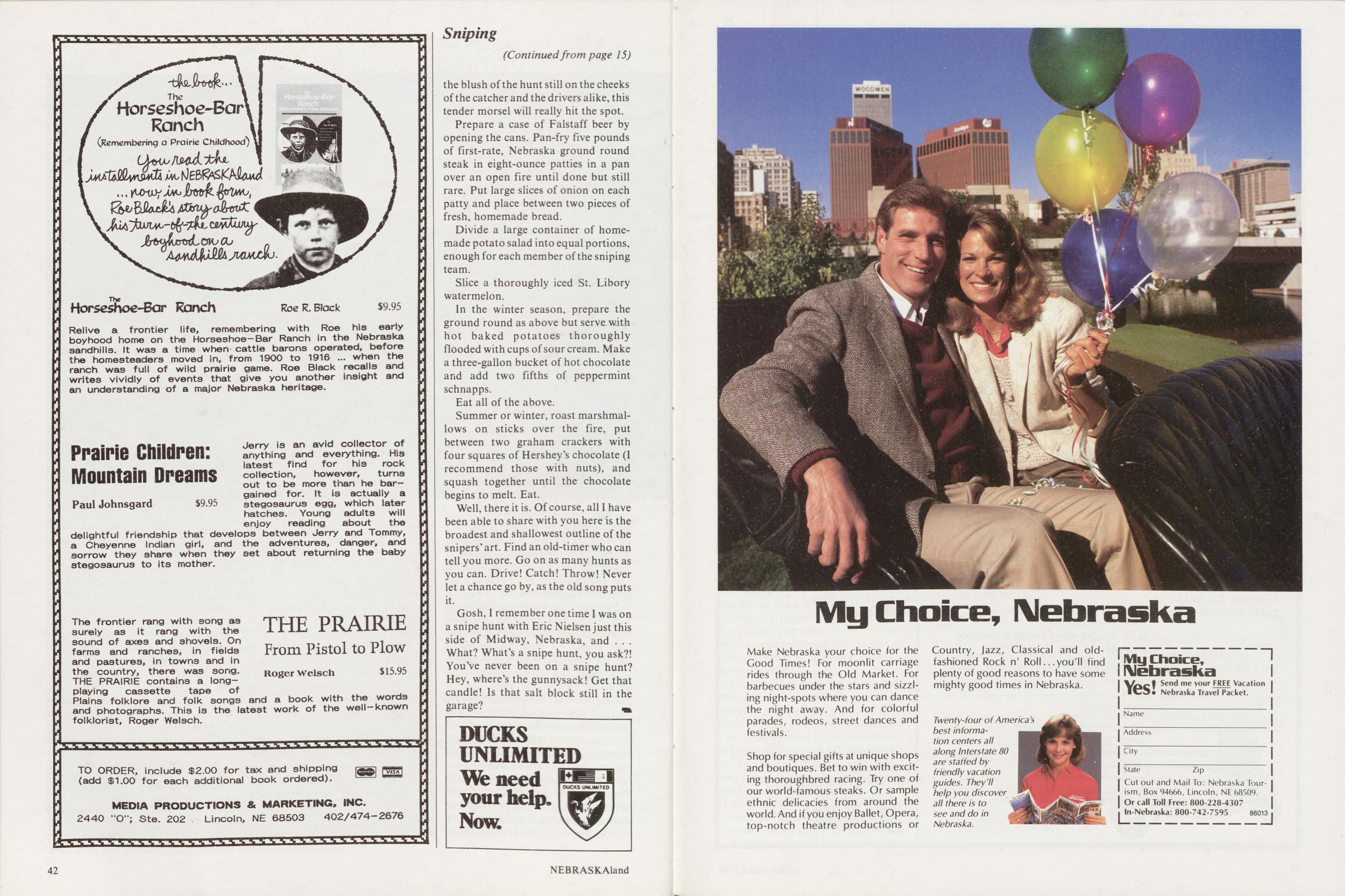
Sniping
(Continued from page 15) the blush of the hunt still on the cheeks of the catcher and the drivers alike, this tender morsel will really hit the spot. Prepare a case of Falstaff beer by opening the cans. Pan-fry five pounds of first-rate, Nebraska ground round steak in eight-ounce patties in a pan over an open fire until done but still rare. Put large slices of onion on each patty and place between two pieces of fresh, homemade bread. Divide a large container of home- made potato salad into equal portions, enough for each member of the sniping team. Slice a thoroughly iced St. Libory watermelon. In the winter season, prepare the ground round as above but serve with hot baked potatoes thoroughly flooded with cups of sour cream. Make a three-gallon bucket of hot chocolate and add two fifths of peppermint schnapps. Eat all of the above. Summer or winter, roast marshmal- lows on sticks over the fire, put between two graham crackers with four squares of Hershey's chocolate (I recommend those with nuts), and squash together until the chocolate begins to melt. Eat. Well, there it is. Of course, all I have been able to share with you here is the broadest and shallowest outline of the snipers' art. Find an old-timer who can tell you more. Go on as many hunts as you can. Drive! Catch! Throw! Never let a chance go by, as the old song puts it. Gosh, I remember one time I was on a snipe hunt with Eric Nielsen just this side of Midway, Nebraska, and . . . What? What's a snipe hunt, you ask?! You've never been on a snipe hunt? Hey, Where's the gunnysack! Get that candle! Is that salt block still in the garage?My Choice, Nebraska
Make Nebraska your choice for the Good Times! For moonlit carriage rides through the Old Market. For barbecues under the stars and sizzl- ing night-spots where you can dance the night away. And for colorful parades, rodeos, street dances and festivals. Shop for special gifts at unique shops and boutiques. Bet to win with excit- ing thoroughbred racing. Try one of our world-famous steaks. Or sample ethnic delicacies from around the world. And if you enjoy Ballet, Opera, top-notch theatre productions or Country, Jazz, Classical and old- fashioned Rock n' Roll...you'll find plenty of good reasons to have some mighty good times in Nebraska. Twenty-four of America's best informa- tion centers all along Interstate 80 are staffed by friendly vacation guides. They'll help you discover all there is to see and do in Nebraska. My Choice, INebraska Yes! Send me your FREE Vacation Nebraska Travel Packet. Name Address ity State Zip Cut out and Mail To: Nebraska Tour- ism, Box 94666, Lincoln, NE 68509. Or call Toll Free: 800-228-4307 In-Nebraska: 800-742-7595 86013 .
The kindest cut of all
(Contined from page 17)is still realized by retaining the hedges, even without root plowing, than by blading them out. A more important lesson from these studies, however, is that shelterbelts should be quickly re- started where removal has already occurred, with the resultant effects being greater crop production and increase in wildlife populations.
Six root plows are now available free of charge from the Nebraska Game and Parks Commission, thanks to financial underwriting by the Ne- braska Game and Parks Foundation. Originally, the Foundation opted for purchase of three root plows, but the overwhelming acceptance by farmers wanting to save their hedges resulted in scheduling problems, and the Founda- tion quickly responded with the pur- chase of three additional units. Farmers who compared root plowing to removal found that the new tech- nique took only about one hour to treat !/2-mile of hedge, costing them only $25 in fuel and wages. SCS offices in southeastern counties have offered to schedule the loan of root plows to farmers who request them, and all inquiries should be made through local Soil Conservation Service offices.
The root plow is a heavy-shanked chisel, adapted specifically to sever the tough, lateral roots of osage orange hedge. The only other application cur- rently recognized by the Game and Parks Commission for the root plow is for the Siberian elm, which has a sim- ilar close-to-the-surface root structure. Neither the elm nor the osage orange is adversely affected by root plowing, even when both sides of the trees are treated, and treatment should last 10 years before it is necessary to repeat the procedure.
Because of the weight of the root plow and the work that it is required to perform, a tractor that delivers a min- imum of 50 horsepower, equipped with a three-point hitch is required, and high-traction tires further enhance the operation. There are a few other tips, however, that should be kept in mind when using this technique.
1) Stay out 15 to 20 feet from the tree trunks. This will allow you to culti- vate over the root plow furrow and kill any suckering hedge that might
occur at point of separation;
2) Be careful of buried power lines, pipelines, cables, etc;
3) Make two trips over the furrow. Hedge roots are almost entirely within the top 18 to 20 inches of soil. Make the first trip with the chisel set 12 to 15 inches deep and the second with it all the way down. This method will do a more tho- rough job and save wear and tear on equipment;
4) Treatment should last for at least 10 years and does not appear to affect the hedge trees themselves. Roots apparently regrow into the field at the rate of about i to 1 !/$ feet per year.
Root plowing has proven itself as a very cost-effective way for farmers to gain additional crop yields at minimal expense and effort, and without sacri- ficing the benefits that hedgerows have always brought to the countryside . . . most notably much-needed habitat for bobwhite quail and other wildlife species.
On a slow boat to Bridgeport
(Continued from page 11)
long hours of solid paddling into a stiff wind that more than once blew hard enough to stop us completely dead in the water.
The bridge did, of course, finally appear. By the time we had the canoes pulled up to the campsite, but before the tents were up, I knew that the trip was over, at least for me. Debbie quickly accepted the idea. A chiro- practor had spent two weeks just before the trip putting her spine back into its natural position. The physical strain had begun to take its toll. Don and Mel reserved their decision until morning to see what a new day would bring. Bridgeport was halfway be- tween Don's Jeep at the Mitchell bridge and my truck at the fish weir. To pull out at this point meant some unpleasant logistics would have to be dealt with.
Morning brought with it an even stronger wind. Within a half-mile of our camp, blowing dirt and sand ob- scured the horizon. That did it: our adventure indeed was over, except for the drive back to Lincoln. Don volun- teered to hitchhike back to Mitchell and his Jeep. Although his decision to NEBRASKAland go alone was met with protest, there was no arguing that one person had a better chance of catching a ride.
While the wind had worked against us all week, it proved to be Don's ticket for a ride that morning. "Normally I don't pick up hitchhikers," said the rancher who had just done that very thing, "but there was no way I could leave you standing out in that wind."
Two rides and a few hours later, Don was back at our Bridgeport camp. With some reluctance we packed, loaded the canoes and headed east on Highway 26. From the highway, we would see the Platte and talk about how we would have navigated it if the trip had stayed on schedule.
With extra time, we stopped at Ash Hollow State Historical Park and walked where pioneers once followed their covered-wagon caravans over those hills and into the North Platte River Valley. Despite the disappoint- ments of the week, we had to laugh at ourselves when we compared our few short days on the river with the trials those pioneers had faced more than a century earlier.
And, I'm happy to say, my wife and I celebrated our 10th wedding anniver- sary at the end of the week. The river may have claimed our plan for a week- long trip, but it failed to wrestle us away from each other. We'll celebrate our 11th anniversary this year, and we talk of last year's river trip to anyone who will listen. We've already made plans for another canoe trip. Three days, at the longest! Maybe two, depending on the weather.
THE LIFE OF A POET All Is But a Beginning Youth Remembered, 1881-1901 By John G. Neihardt Introduction by Dick Cavett "A vivid evocation of the natural setting and folklore that shaped Neihardt's career." — The New York Times. John Neihardt was in his 90s when he wrote this engaging book about growing up in the Midwest. All Is But a Beginning dscribes the people and events instrumental in shaping his later distin- guished career as a poet, historian, and au- thority on Indians. $6.50 paper. Courtesy of the Western Historical Manuscripts Collection, University of Missouri Patterns and Coincidences By John G. Neihardt Continuing the autobiography initiated in All Is But a Beginning, Neihardt offers here a fascinating glimpse into the years of his early manhood. An epilogue by Hilda Neihardt Petri movingly summarizes the visions, daydreams, and philosophy of this extraordinary man to whom all life was a great adventure, and death the greatest of all. $9.95 cloth. UNIVERSITY OF NEBRASKA PRESS 901 NORTH 17TH, LINCOLN, NE 68588
In The Kitchen
Sweet and Sour Catfish 2 pounds catfish fillets 1 cup flour 1 tablespoon salt 1 !/2 cups cooking oil 1 can (131/2 oz.) pineapple chunks Vi teaspoon dry mustard !4 cup brown sugar 1 teaspoon salt 1 teaspoon cornstarch Va cup vinegar 1 tablespoon butter Vi cup green pepper stripsDivide fish into serving-size pieces. Com- bine flour and salt. Roll fish in mixture, then fry in oil 4 or 5 minutes on a side. Drain on paper towel, and keep warm on platter. Combine mustard, brown sugar and salt in saucepan. Add vinegar, blend well, then add pineapple chunks and juice. Cook over low heat. Add butter and green pepper and cook 2 to 3 minutes. Serve over fish. Makes 6 servings.
Catfish Croquettes 2 cups flaked catfish 3/4 teaspoon salt 72 teaspoon celery salt 74 teaspoon pepper 1 cup dry bread crumbs 1 tablespoon grated onion 3 tablespoons chopped parsley 1 can (10-oz.) cheddar cheese soup 2 eggs, beaten 2 tablespoons water 74 cup milk 72 teaspoon basil pinch paprikaCombine fish, salt, celery salt, pepper, break crumbs, onion, parsley, 72 cup of soup, eggs and water. Mix well, and divide into 12 portions. Shape into cakes and fry in shortening for 4 or 5 minutes, until brown. Repeat on other side. Drain on paper towel. Combine remaining soup with milk and basil. Heat, and pour over cro- quettes. Garnish with paprika. Makes 6 servings.
Catfish Creole 1 pound catfish fillets 1/3 cup butter or oil 1/3 cup flour 72 cup water 1 cup chopped celery 72 cup sliced green onions 72 cup chopped green pepper 2 cloves garlic, minced 1 can tomato chunks or juice 1 can (8 oz.) tomato sauce 1 teaspoon salt 2 bay leaves 74 teaspoon pepper 1 tablespoon brown sugar 1 tablespoon lemon juice 1 teaspoon Worcestershire sauce 74 teaspoon hot pepper sauce 74 cup chopped parsley cooked riceCut fish into 1-inch pieces. Brown flour in butter, remove and cool. Add water and stir until blended. Add remaining ingre- dients except catfish and rice. Cover and simmer for 20 minutes. Add catfish and simmer 10 minutes. Serve over rice. Makes 6 servings.
Trading Post
DOGS TRAINING ALL BREEDS Hunting Dogs - Vizslas for sale. Rozanek Kennels, Rt. 2, Schuyler, NE 68661. Phone (402) 352 8769. A FEW HUNTING dogs for sale: Brittanies, English setters. German Shorthairs. Darrell Yentes, Phone (308) 995-8570 or (308) 995-4797 after 5 p.m. ENGLISH SETTERS and Labradors: "Bred for the hunter"; outstanding bloodlines! Puppies, started dogs and stud service available. High Plains Kennels, 1411 Emerson, Alliance, Nebr. 69301. Phone (308) 762-6709. GERMAN SHORTHAIR Pointers pups, started dogs, occasionally a finished meat dog. Wayne Clark (712) 529-4238 after 10:00 p.m. or (402) 263-3495. Union, Nebr. BRITTANY PUPS: Ideal hunting prospects dedi- cated, goal-oriented breeding program. Guaranteed. Free brochure. Grouseway Gundogs, HC 1, Box 126, Stapleton, NE 69163. Phone (308) 636-2495. PROFESSIONAL TRAINING: Working — develop- ing pointed breeds. Patient, honest, hard working. Individually tailored from canine perspective. Problem dogs welcomed. Phone (308) 636-2495, Nebraska. MISCELLANEOUS COMPLETE FUR Service: repair, restyling, large inventory of new coats at saving prices. Will custom- make garments from your skins, either raw or dressed. Offer service of tanning including all fine skins, deer and sheep. 50 years' experience. Hacker's Furriers, Alma Tanning Co., Box 270, Alma, NE 68920. FISH FOR SALE. Channel catfish, bass, bluegill, crappie, trout, perch, white bass, minnows, hybrid grass carp, bullhead. We can ship fish, you can pick them up, or we can deliver. Contact the Pleasant Valley Fish Farm, Rt. 1, McCook, NE 69001. Phone (308) 345-6599. N.E. NEBRASKA TROUT Fishing, For rent Mon.- Thurs. or Fri.-Sun. 2 modern cottages completely fur- nished, 5 spring-fed lakes with trout up to 7 lbs. Bass and bluegill also. Diamond E Trout Resort, Orchard, NE 68764. (402) 893-4745. GUNS — Browning, Winchester, Remington, others, Hi-powers, shotguns, new, used, antiques. Want Pre- 1964 Winchesters. Buy-Sell-Trade. Ph. (402) 729-6112. Bedlan's Sporting Goods, Fairbury, NE 68352. MAD RIVER CANOES offers the finest quality and performance. For the first canoes and accessories look to Great Plains Canoe Co., 205 Main, Springfield, NE. Phone (402) 253 2001. WINE AND BEER: Make your own. Send for free recipes and instructions. Omaha Supply, 1324 2nd Avenue, Nebraska City, NE 68410. FISHERMEN —we offer quality repair work for your rods and reels. A large parts inventory and bulk line at reasonable prices. John's Rod and Reel Service, 1112 Pierce Street, Norfolk. NE 68701. Phone (402) 371-5988. WINCHESTER COMMEMORATIVES: Canadian Pacific Railroad Standard $369.00; Members Model $369.00; Deluxe Cased $895.00; Calgary Stampede Deluxe Cased $895.00; US Border Patrol with Print $395.00; Saskatchewan Diamond Jubilee $395.00; Great Western Artist I & II Deluxe Cased $799.00each. Commemorative Firearms LTD, 2305 South 168th Street, Omaha, Nebr. 68130. Phone (402) 330-2541. FOR SALE: 825 acres of goose, deer, quail, pheasant and turkey hunting ground. Irrigated land located be- tween two channels of the North Platte River. Less than a mile from Federal Refuge near North Platte. 25 white-tailed deer harvested this past season. 7% fixed- rate loan to assume; 3-bedroom house and other deprec- iable improvements. One road in and out. Call Mike or Gene at Century 21-Wilkenson Agency, Phone (308) 532-1332. FOR SALE OLE'S BIG GAME LOUNGE PAXTON, NE Known from coast to coast. Includes building, business, liquor license, fixtures and many extras. For more information, please call LOU PRIBYL 571-5008, 556-3388. Omaha, NE n p Dodge GOAT JERKY Great for hunting & camping 5 oz. Pk. $4.50 + $1 postage SUGARTREE FARMS Box 130A, R.R. 1 Hickman, NE 68372 Don't spoil nature. leave only footprints* WELCOME to Merritt Dam Trading Post Located on beautiful Merritt Reservoir 26 Miles So. Of Valentine On Hwy. 16C Phone 402/376-3437 Bait • Tackle • Ammunition • Groceries • Gas • Beer • Ice Year-round Modern Cabins with Kitchen Facilities Campground Hook-ups • Boat and Motor Rental • Professional Guide Service Easy-access dock • Open year around Home of the State Record Perch, Muskellunge and Smallmouth bass Your Hosts Jon and Marian Davenport TAXIDERMY PLATTE VALLEY TAXIDERMY, Museum quality mounts using latest scientific methods. 1985 World Taxidermy Competition winner. Delton Wegner, 617 "H" Street, Central City, NE 68826. Telephone (308) 946-3773. ALLISON'S TAXIDERMY STUDIO: Wally and Betty Allison, Licensed Taxidermist. We've mounted 18 Nebraska State Record fish. Specializing in fish and birds, small game and rattlesnakes. We use freeze-dry. 2709 Brichwood Rd., North Platte, Nebr. 69101. Phone (308) 534 2324. BADE TAXIDERMY - Quality a must — Fast serv- ice. Fish, birds, rugs, tanning, full mounts and game heads, 2111 N. Christy St., Fremont, Nebraska 727-5463. KARL SCHWARZ master taxidermist has moved to a new country studio; same professional mounting and tanning service. Schwarz Wild Wing Studio, 16804 South 180th St., Springfield. NE 68059. Phone (402) 253-2481. CREATIVE TAXIDERMY in all its branches, since 1935, now includes Northstar Freeze-Dry processing of approved small specimens. Also tanning and deerskin processing. Naturecraft Studio, Nebraska City, Ne- braska 68510. Joe Voges-Owner. Phone (402) 873-5491. JOHNSON TAXIDERMY servicing southwest Nebraska, specializing in big-game mounts, life-sized mounts, rug work, fish, birds, tanning hair-on leather. Brochure and price list on request. Johnson Taxi- dermy, Rt. 1. Box 78, Lamar, NE 69035. Telephone (308) 882 5555. BIG BEAR TAXIDERMY, Rt. 2, Mitchell, Nebraska 69357. We specialize in all big game heads from Alaska to Nebraska, also birds and fish. Hair-on and hair-off tanning. 41 miles west of Scottsbluff on Highway 26. Dale Hubel, phone (308) 635 3013. DINGES TAXIDERMY Studio, 2763 So. 12th St., Omaha, NE 68108. Fourteen-time National Award Winning Taxidermy, Trust your trophies to a proven winner. Complete professional service. Mike and Mary Dinges. (402) 342-3718. NABITY'S TAXIDERMY. 31 years experience. Spe- cializing in natural grass backgrounds for mammals, birds and fish. 13901 "O" St., Lincoln, NE 68504 — 4 miles east of 84th and "O". (402) 489 63651. PEISTER TAXIDERMY—a name you can trust. Now in our new location. We give you professional work at prices most sportsmen can afford. Look for the new log huddling at 1020 Central Avenue. Box 3201, Kearney, NE 68847. Phone (308) 236-9700 or 237-7575 evenings. K&M TAXIDERMY — we do natural mounts you will be proud of. Fish, birds and game heads. Rt. 2, Box 175, Norfolk, NE 68701. Phone (402) 675-1862. HOUSE OF BIRDS. Licensed taxidermist with 18 years'experience. Specialize in birds and game heads. Pheasant $47.50; deer head $87.50; Quail $35 a pair. For more information call (402) 228-3959. LIVE-CATCH ALL-PURPOSE TRAPS Write tor FREE CATALOG Traps without injury squirrels, chipmunks, rabbits, mink, fox, rac- coons, stray animals, pests, etc. Sizes for every need. Also traps for snakes, sparrows, pigeons, crabs, turtles, quail, etc. Save on our low factory prices Send no money. Free catalog and trapping secrets MUSTANG MFG. CO., Dept. N-34, Box 920947, Houston, Tex. 77292 THE MISSOURI RIVER 28 species offish including: • Walleye • Sauger • Flatheads Pro guide —Jusriy For reservations & information write or call Brownville, NE 68321 (402) 825-4721 APRIL 1986 49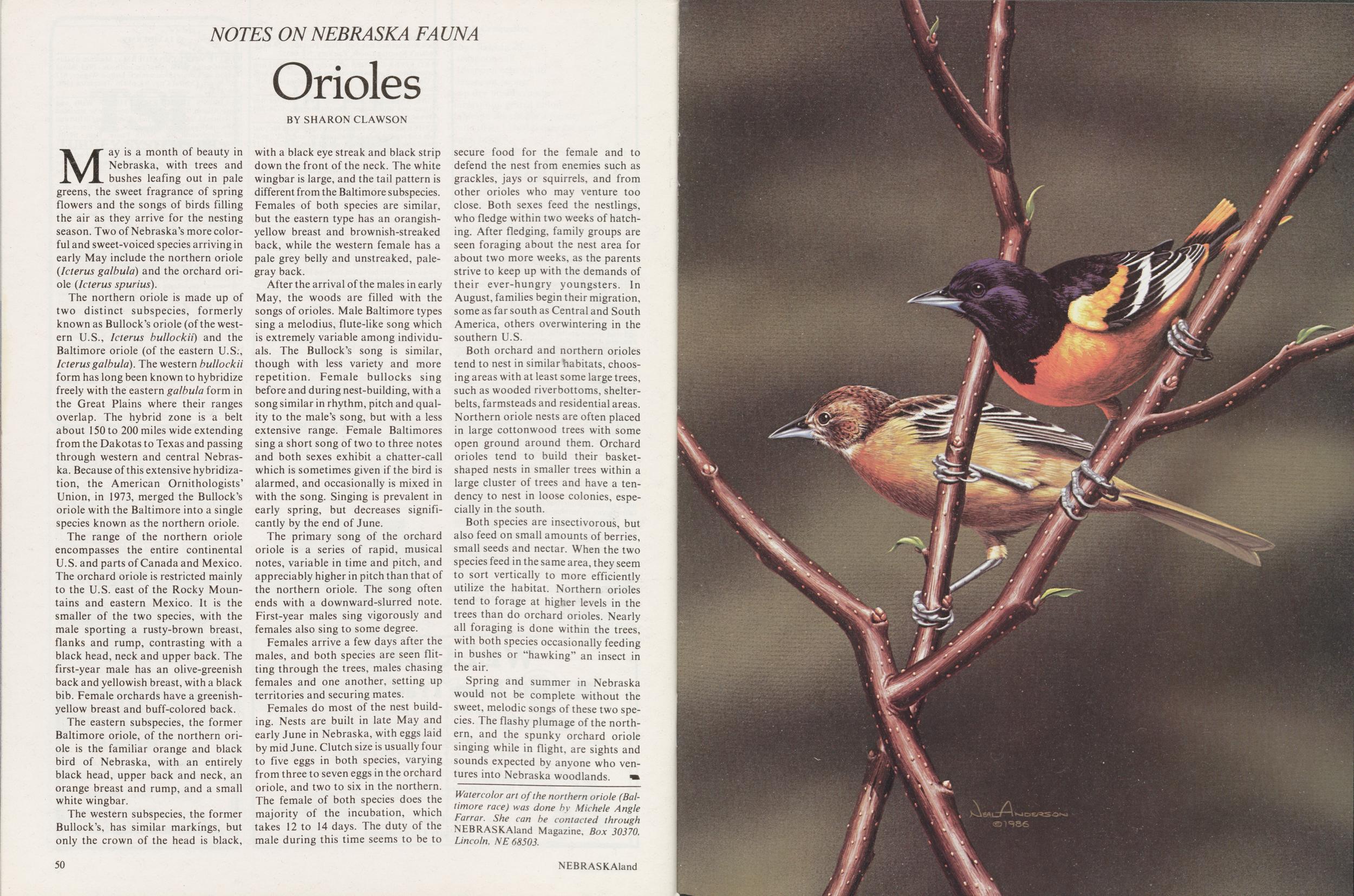
NOTES ON NEBRASKA FAUNA
Orioles
May is a month of beauty in Nebraska, with trees and bushes leafing out in pale greens, the sweet fragrance of spring flowers and the songs of birds filling the air as they arrive for the nesting season. Two of Nebraska's more colorful and sweet-voiced species arriving in early May include the northern oriole (Icterus galbula) and the orchard oriole (Icterus spurius).
The northern oriole is made up of two distinct subspecies, formerly known as Bullock's oriole (of the western U.S., Icterus bullockii) and the Baltimore oriole (of the eastern U.S:, Icterus galbula). The western bullockii form has long been known to hybridize freely with the eastern galbula form in the Great Plains where their ranges overlap. The hybrid zone is a belt about 150 to 200 miles wide extending from the Dakotas to Texas and passing through western and central Nebraska. Because of this extensive hybridization, the American Ornithologists' Union, in 1973, merged the Bullock's oriole with the Baltimore into a single species known as the northern oriole.
The range of the northern oriole encompasses the entire continental U.S. and parts of Canada and Mexico. The orchard oriole is restricted mainly to the U.S. east of the Rocky Mountains and eastern Mexico. It is the smaller of the two species, with the male sporting a rusty-brown breast, flanks and rump, contrasting with a black head, neck and upper back. The first-year male has an olive-greenish back and yellowish breast, with a black bib. Female orchards have a greenish- yellow breast and buff-colored back. The eastern subspecies, the former Baltimore oriole, of the northern oriole is the familiar orange and black bird of Nebraska, with an entirely black head, upper back and neck, an orange breast and rump, and a small white wingbar.
The western subspecies, the former Bullock's, has similar markings, but only the crown of the head is black, with a black eye streak and black strip down the front of the neck. The white wingbar is large, and the tail pattern is different from the Baltimore subspecies. Females of both species are similar, but the eastern type has an orangish- yellow breast and brownish-streaked back, while the western female has a pale grey belly and unstreaked, pale- gray back.
After the arrival of the males in early May, the woods are filled with the songs of orioles. Male Baltimore types sing a melodius, flute-like song which is extremely variable among individuals. The Bullock's song is similar, though with less variety and more repetition. Female bullocks sing before and during nest-building, with a song similar in rhythm, pitch and quality to the male's song, but with a less extensive range. Female Baltimores sing a short song of two to three notes and both sexes exhibit a chatter-call which is sometimes given if the bird is alarmed, and occasionally is mixed in with the song. Singing is prevalent in early spring, but decreases significantly by the end of June.
The primary song of the orchard oriole is a series of rapid, musical notes, variable in time and pitch, and appreciably higher in pitch than that of the northern oriole. The song often ends with a downward-slurred note. First-year males sing vigorously and females also sing to some degree.
Females arrive a few days after the males, and both species are seen flitting through the trees, males chasing females and one another, setting up territories and securing mates. Females do most of the nest building. Nests are built in late May and early June in Nebraska, with eggs laid by mid June. Clutch size is usually four to five eggs in both species, varying from three to seven eggs in the orchard oriole, and two to six in the northern. The female of both species does the majority of the incubation, which takes 12 to 14 days. The duty of the male during this time seems to be to secure food for the female and to defend the nest from enemies such as grackles, jays or squirrels, and from other orioles who may venture too close. Both sexes feed the nestlings, who fledge within two weeks of hatching. After fledging, family groups are seen foraging about the nest area for about two more weeks, as the parents strive to keep up with the demands of their ever-hungry youngsters. In August, families begin their migration, some as far south as Central and South America, others overwintering in the southern U.S.
Both orchard and northern orioles tend to nest in similar habitats, choosing areas with at least some large trees, such as wooded riverbottoms, shelterbelts, farmsteads and residential areas. Northern oriole nests are often placed in large cottonwood trees with some open ground around them. Orchard orioles tend to build their basket- shaped nests in smaller trees within a large cluster of trees and have a ten- dency to nest in loose colonies, especially in the south.
Both species are insectivorous, but also feed on small amounts of berries, small seeds and nectar. When the two species feed in the same area, they seem to sort vertically to more efficiently utilize the habitat. Northern orioles tend to forage at higher levels in the trees than do orchard orioles. Nearly all foraging is done within the trees, with both species occasionally feeding in bushes or "hawking" an insect in the air.
Spring and summer in Nebraska would not be complete without the sweet, melodic songs of these two species. The flashy plumage of the northern, and the spunky orchard oriole singing while in flight, are sights and sounds expected by anyone who ventures into Nebraska woodlands.
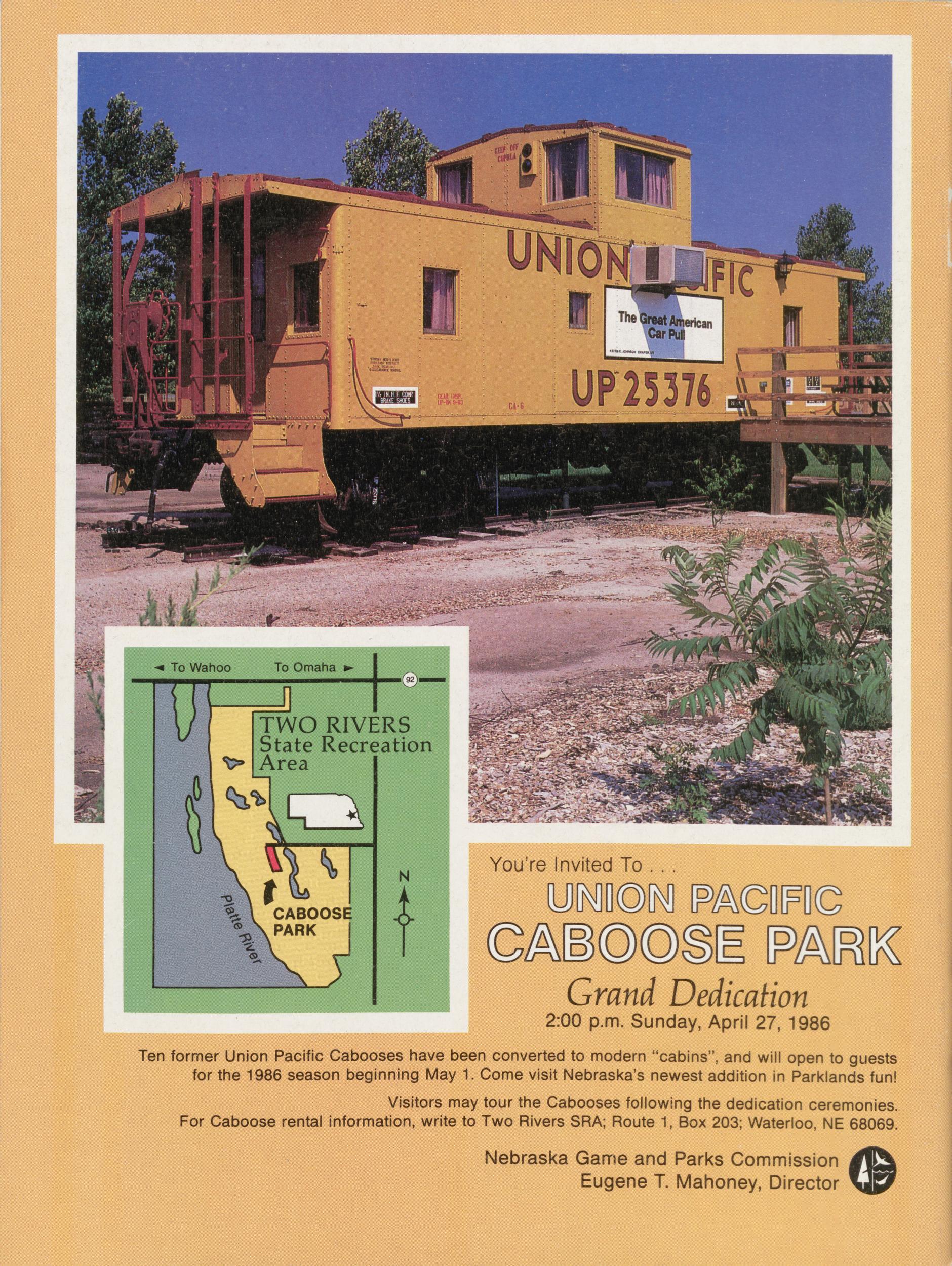
Position: 626 (18 views)