Volume 64, Issue 2, 1986
NEBRASKAland
MARCH 1986 $1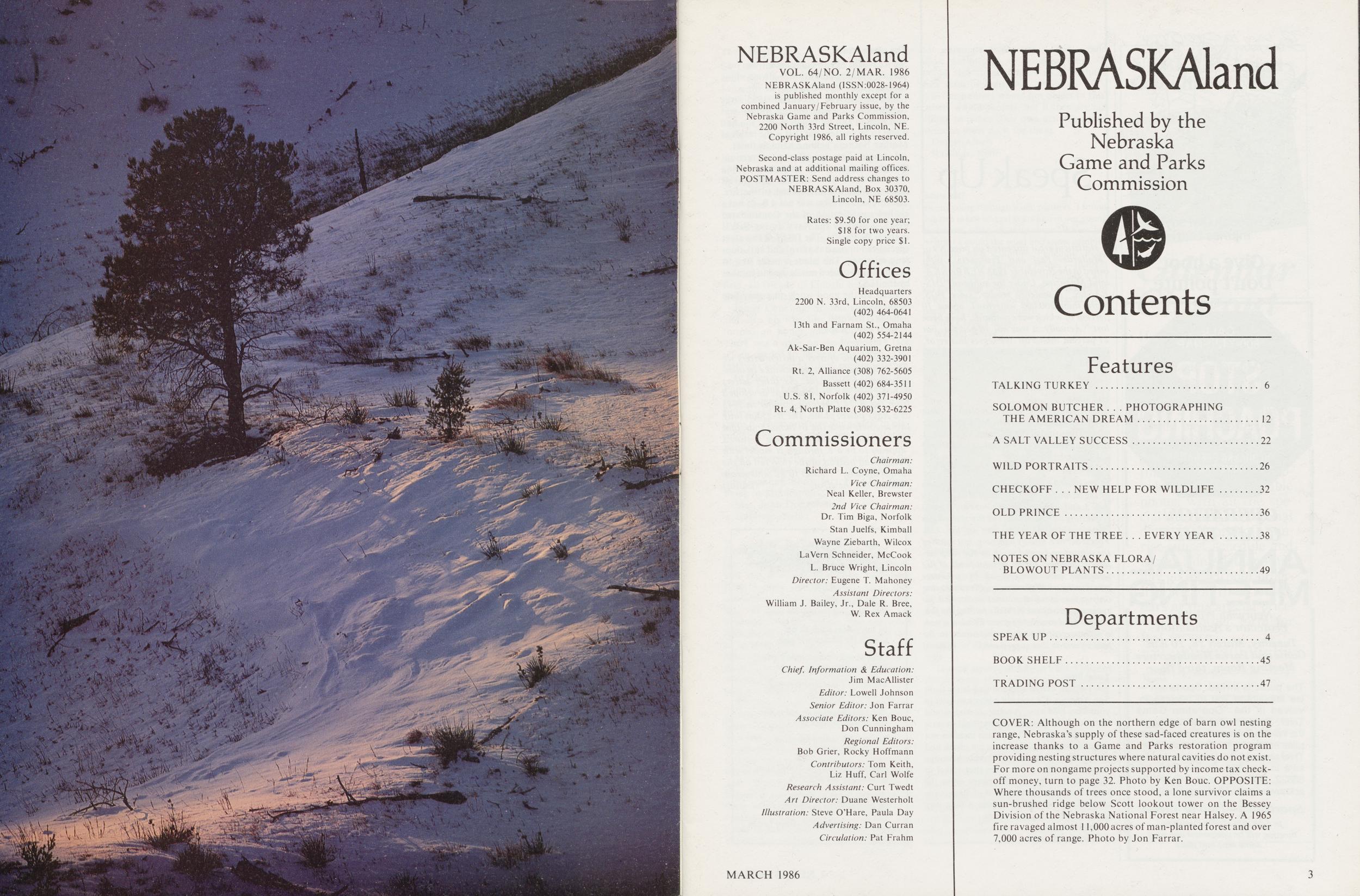
NEBRASKAland
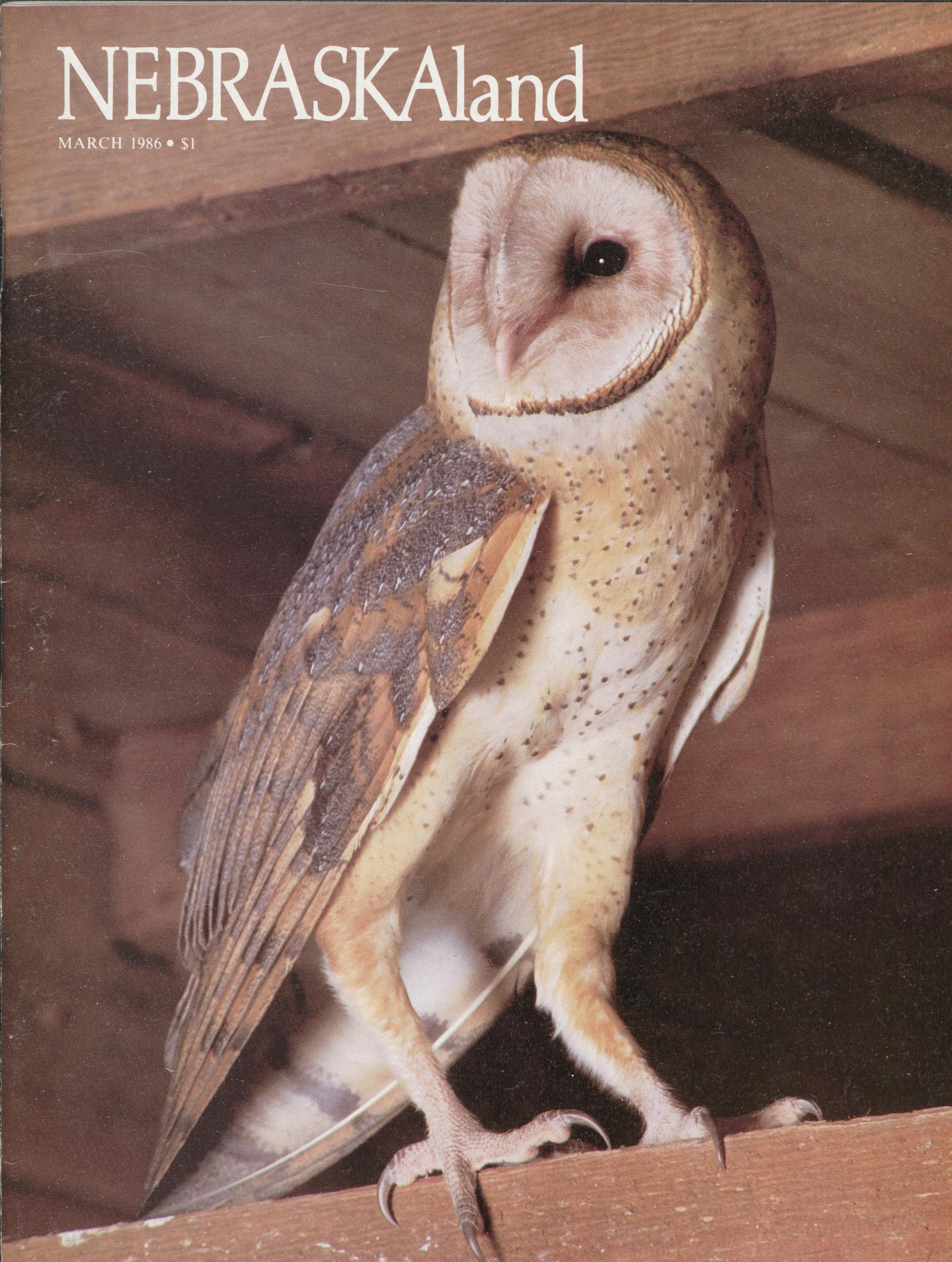
NEBRASKAland Published by the Nebraska Game and Parks Commission NEBRASKAland VOL. 64/NO. 2/MAR. 1986 NEBRASKAland (ISSN:0028-1964) is published monthly except for a combined January/February issue, by the Nebraska Game and Parks Commission, 2200 North 33rd Street, Lincoln, NE. Copyright 1986, all rights reserved. Second-class postage paid at Lincoln, Nebraska and at additional mailing offices. POSTMASTER: Send address changes to NEBRASKAland, Box 30370, Lincoln, NE 68503. Rates: $9.50 for one year; $18 for two years. Single copy price $1. Offices Headquarters 2200 N. 33rd, Lincoln, 68503 (402) 464-0641 13th and Farnam St., Omaha (402) 554-2144 Ak-Sar-Ben Aquarium, Gretna (402) 332-3901 Rt. 2, Alliance (308) 762-5605 Bassett (402) 684-3511 U.S. 81, Norfolk (402) 371-4950 Rt. 4, North Platte (308) 532-6225 Commissioners Chairman: Richard L. Coyne, Omaha Vice Chairman: Neal Keller, Brewster 2nd Vice Chairman: Dr. Tim Biga, Norfolk Stan Juelfs, Kimball Wayne Ziebarth, Wilcox LaVern Schneider, McCook L. Bruce Wright, Lincoln Director: Eugene T. Mahoney Assistant Directors: William J. Bailey, Jr., Dale R. Bree, W. Rex Amack Staff Chief, Information & Education: Jim MacAllister Editor: Lowell Johnson Senior Editor: Jon Farrar Associate Editors: Ken Bouc, Don Cunningham Regional Editors: Bob Grier, Rocky Hoffmann Contributors: Tom Keith, Liz Huff, Carl Wolfe Research Assistant: Curt Twedt Art Director: Duane Westerholt Illustration: Steve O'Hare, Paula Day Advertising: Dan Curran Circulation: Pat Frahm Contents Features TALKING TURKEY 6 SOLOMON BUTCHER PHOTOGRAPHING THE AMERICAN DREAM 12 A SALT VALLEY SUCCESS 22 WILD PORTRAITS 26 CHECKOFF NEW HELP FOR WILDLIFE 32 OLD PRINCE 36 THE YEAR OF THE TREE EVERY YEAR 38 NOTES ON NEBRASKA FLORA BLOWOUT PLANTS 49 Departments SPEAK UP 4 BOOK SHELF 45 TRADING POST 47 COVER: Although on the northern edge of barn owl nesting range, Nebraska's supply of these sad-faced creatures is on the increase thanks to a Game and Parks restoration program providing nesting structures where natural cavities do not exist. For more on nongame projects supported by income tax checkoff money, turn to page 32. Photo by Ken Bouc. OPPOSITE: Where thousands of trees once stood, a lone survivor claims a sun-brushed ridge below Scott lookout tower on the Bessey Division of the Nebraska National Forest near Halsey. A 1965 fire ravaged almost 11,000 acres of man-planted forest and over 7,000 acres of range. Photo by Jon Farrar. MARCH 1986 3
Speak Up
A statistical error appeared on page N9 of "Mallards—Past and Prospects,' pub- lished in the November 1985 NEBRASKAland Magazine. Under the subhead "DISEASES," a sentence reads: "Since 1975, more than 200,000 waterfowl, about 10 percent of which were mallards, have been lost."Actually, it was not 10percent, but 27 percent mallards. We regret this error, which resulted from wrong figures in calculations. (Editor)
Hot newsSir/In your story in the December issue about the Pine Ridge fire, in Ash Creek, there was no mention of the fire near Valentine at the same time. Wasn't it just as bad a fire?
Charlie Epson Lincoln, Nebr.It was indeed a bad weekend. What is known as the Schlagel Creek fire also broke out on July 3, and actually caused some confusion in requesting overhead aid. The fire started just outside Valentine, according to the U.S. Forest Service, also by lightning, just south of the airport and raged south up the steep terrain of Schlagel Creek. Several loads of fire retardant were dumped, all by volunteer pilots using small planes, capable of carrying only a few hundred pounds each. This air support was critical in finally halting the fire, which raged over 1,500 acres. Erosion is now a serious problem, and will remain so for many years in that rugged area. (Editor)
Local litterSir/1 would like to respond to a letter from San Antonio, TX regarding beer can litter in your May 1984 issue. A better solution would be to work for passage of a national or state returnable container law which includes not only aluminum beverage cans, but plastic and glass bottles of all sizes. The only beverage can litter Iowans see is when they travel to Nebraska or other border states or in the border counties where out-of-state cans abound. A 5-cent deposit goes a long way toward a cleaner environment.
Pat Heiser Spirit Lake, Iowa The plane truthSir / I would like to compliment you on a very enjoyable publication. I always enjoy reading your interesting articles.
The one in the December 1985 issue concerning the "Fire on the Ridge" was well written and informative. It is too bad it had to be written, but that is the result of Mother Nature's helping hand at times.
I would like to offer a correction, though, on the aircraft pictured dropping fire retardant. The text states a Forest Service B-25 was dispatched to the fire. The photo, however, was not a B-25 but a civilian modification of the Consolidated PB4Y-2 used by the Navy during WWII in the S. W. Pacific. The PB4Y-2 Privateer specialized in coastal patrol and anti-shipping missions. This plane was the first to launch an air-guided missle used in combat by the U.S.
Keep up the good work on a very fine publication.
Rudy Titsworth Scott City, Kans.This is but one of over a dozen letters we received pointing out the mistake in identification of the plane. As other letters pointed out, the Privateer was developed from the B-24 Liberator bomber in 1943 as a Navy patrol plane. The B-25 has only two engines, while the B-24 had four, and another writer said the plane pictured "appears to be a K through N model with a single tail instead of the twin tail on the earlier models." Thanks to all who wrote pointing out the error. (Editor)
MARCH Today 1 saw a crocus, it was pushing through the snow Its tiny golden petals seemed to make the whole world glow. 1 slipped and on the sidewalk sat amid the snow and ice The things I said were very bad, at least not very nice. And then the crocus seemed to say: look up and you will see The sun has made a fairyland of ice on bush and tree And soon the clouds will drift away, o'erhead blue sky will arch, All these tell us it's Spring for Nebraskaland in March. Mildred Andrews Larson 4 NEBRASKAland The Lincoln carSir / In the December 1985 issue you described the newly renovated Union Pacific Museum in Omaha. The recreation of Lincoln's funeral car was of particular interest to me because my grandfather, James C. Conkling (Jim) was aboard that train.
His father, James C. Conkling, Sr., and his mother, Mercy, were lifelong friends and neighbors of the Lincoln family in Springfield, Illinois.
After the assassination, the funeral train proceeded from Washington, D.C. across the country stopping frequently for crowds to pass through the car and pay their last respects. Jim Conkling was my mother's father. She wrote: "When the funeral train reached the Illinois line, it was met by prominent men from Springfield, all friends of Lincoln before he was elected president."
James Conkling, Sr. was among them, and also his son Jim, age 15. The men formed an honor guard for the casket. There was a mole on the President's face which needed to be kept powdered. This task was assigned to Jim, my grandfather.
In later years, Jim married and he and Fanny Conkling had five daughters. The large home they built is still there, beautifully cared for by the family, which now owns it. There are three youngsters to play under the trees that my grandfather planted.
My sister, Leila B. Lange and I are the only grandchildren born to Fanny and Jim Conkling. She is Mrs. Fred E. Lange, living in Minneapolis, Minn.
Mrs. John Donaldson Holdrege, Nebr. Hunter testSir / I must commend Jon Farrar's excellent article in the November 1985 issue (The Trouble with Hunting). As an outdoorsman, I'm often mistaken for a hunter. When I explain that I'm not, I'm regarded as an anti-hunter. This also is not true. Hunting is a viable management tool in helping man coexist with his natural environment. But, whether we hunt, backpack, canoe or watch birds, we all have a responsibility toward our environment and our fellow man.
To help control irresponsible hunters, a system similar to obtaining a driver's license might be necessary. Anyone under 16 would be issued a learner's permit and be allowed to hunt under the supervision of a licensed hunter. Once over 16, a written test must be passed and proficiency with firearms demonstrated before a license is used. This license would allow them to purchase an annual permit at a sporting goods store. The written test could be taken every four years to remain eligible for an annual permit. This would not eliminate bad hunters, but would allow authorities to monitor them. It would also force hunters to re-evaluate their skills periodically.
Better hunters would not object to this. Others would protest, but if they are not willing to police their own activities, then someone must do it for them.
Daniel Albers Hastings, Nebr. Snow art?Sir/ In going through some pictures, I found this one taken several years ago in our young pine trees, after an early snow. Where but Nebraska could the wind and snow combine to create such sculpture. Penguins? Polar bears? They are interesting shapes — thought we would share them with your readers. Can't say enough for your magazine. Look forward to every issue. The stories of Nebraska's railroads and rivers are superb.
Mrs. Cloyd Frazey Walthill, Nebr.Sir / Last summer I took part in a youth exchange program in Nebraska. I got your excellent magazine as a gift from my friend at Auburn where I lived for the three weeks I spent in the U.S.A. From your magazine I learn a lot about Nebraska during all seasons, and I thank you for the wonderful photos of flowers, animals and countryside.
During my stay in August 1985,1 learned much about your friendly people and the country. Now I welcome NEBRASKAland each month as a nice remembrance.
Kirsten Ossenbrugge West GermanyNEBRASKAland Magazine invites all readers to submit their comments, suggestions, and gripes to Speak Up. Each month the magazine will publish as many letters as space permits. Pictures are welcome. NEBRASKALand reserves the right to edit and condense letters.—Editor.
NEBRASKAland Calendar of Color Calendar Closeout Here is a chance to get a 1986 NEBRASKAland Calendar of Color at a special price. Regularly priced at $4, we have a limited supply which we are offering at only $2.50 including postage! This beautiful, full-color calendar provides a range of framable photos with all the special features as special dates in Nebraska, Sunrise-sunset schedule and more. Don't let another day go by without ordering one of these calendars at this special price. Use the order form for fast service. Name Address City State Zip Calendar of Color ($2.50) Send to: NEBRASKAland P.O. Box 30370 Lincoln, NE 68503. MARCH 1986 5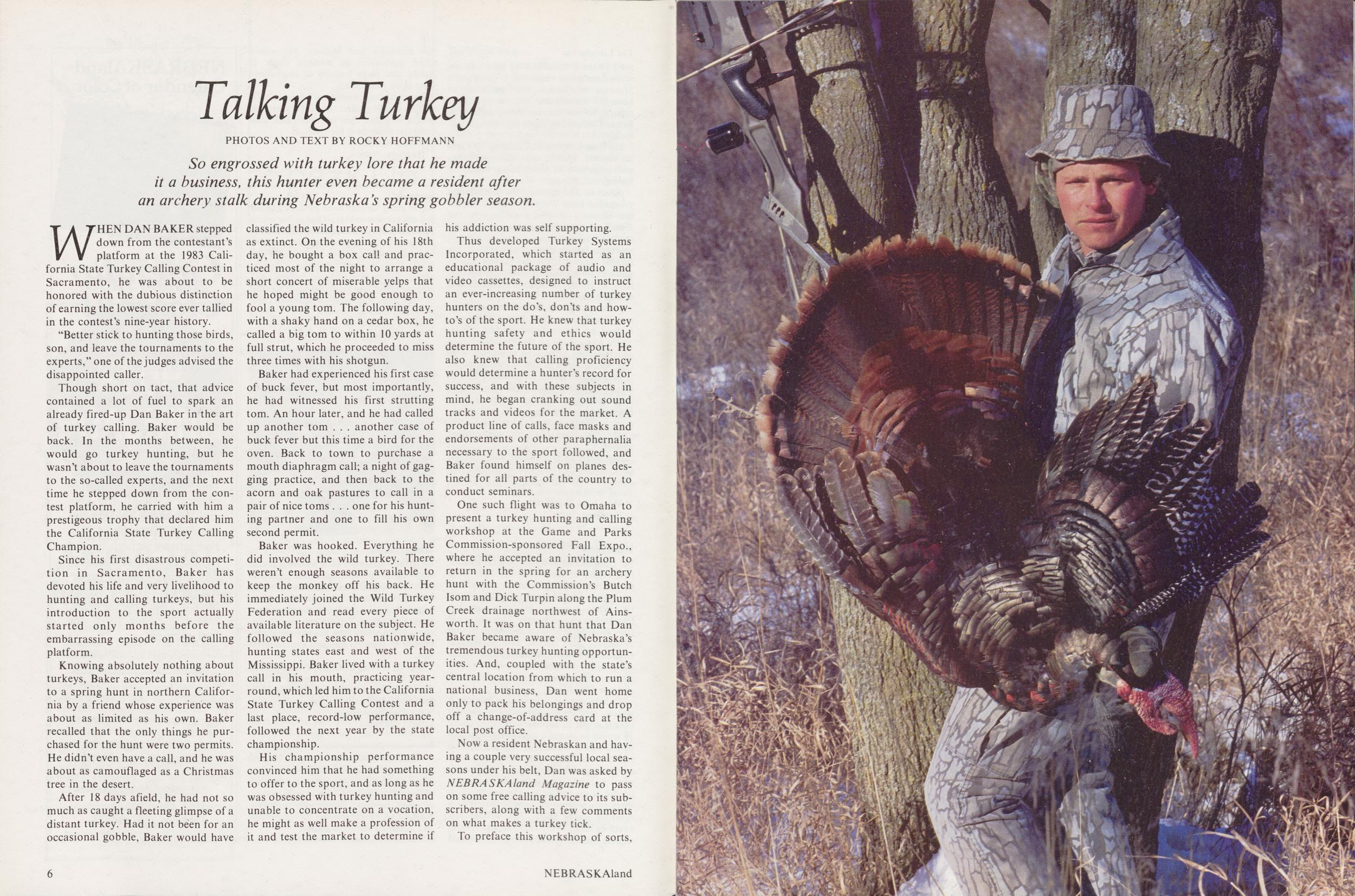
Talking Turkey
PHOTOS AND TEXT BY ROCKY HOFFMANN So engrossed with turkey lore that he made it a business, this hunter even became a resident after an archery stalk during Nebraska's spring gobbler season.WHEN DAN BAKER stepped down from the contestant's platform at the 1983 California State Turkey Calling Contest in Sacramento, he was about to be honored with the dubious distinction of earning the lowest score ever tallied in the contest's nine-year history.
"Better stick to hunting those birds, son, and leave the tournaments to the experts," one of the judges advised the disappointed caller.
Though short on tact, that advice contained a lot of fuel to spark an already fired-up Dan Baker in the art of turkey calling. Baker would be back. In the months between, he would go turkey hunting, but he wasn't about to leave the tournaments to the so-called experts, and the next time he stepped down from the contest platform, he carried with him a prestigeous trophy that declared him the California State Turkey Calling Champion.
Since his first disastrous competition in Sacramento, Baker has devoted his life and very livelihood to hunting and calling turkeys, but his introduction to the sport actually started only months before the embarrassing episode on the calling platform.
Knowing absolutely nothing about turkeys, Baker accepted an invitation to a spring hunt in northern California by a friend whose experience was about as limited as his own. Baker recalled that the only things he purchased for the hunt were two permits. He didn't even have a call, and he was about as camouflaged as a Christmas tree in the desert.
After 18 days afield, he had not so much as caught a fleeting glimpse of a distant turkey. Had it not been for an occasional gobble, Baker would have classified the wild turkey in California as extinct. On the evening of his 18th day, he bought a box call and practiced most of the night to arrange a short concert of miserable yelps that he hoped might be good enough to fool a young torn. The following day, with a shaky hand on a cedar box, he called a big torn to within 10 yards at full strut, which he proceeded to miss three times with his shotgun.
Baker had experienced his first case of buck fever, but most importantly, he had witnessed his first strutting torn. An hour later, and he had called up another torn another case of buck fever but this time a bird for the oven. Back to town to purchase a mouth diaphragm call; a night of gagging practice, and then back to the acorn and oak pastures to call in a pair of nice toms one for his hunting partner and one to fill his own second permit.
Baker was hooked. Everything he did involved the wild turkey. There weren't enough seasons available to keep the monkey off his back. He immediately joined the Wild Turkey Federation and read every piece of available literature on the subject. He followed the seasons nationwide, hunting states east and west of the Mississippi. Baker lived with a turkey call in his mouth, practicing year-round, which led him to the California State Turkey Calling Contest and a last place, record-low performance, followed the next year by the state championship.
His championship performance convinced him that he had something to offer to the sport, and as long as he was obsessed with turkey hunting and unable to concentrate on a vocation, he might as well make a profession of it and test the market to determine if his addiction was self supporting.
Thus developed Turkey Systems Incorporated, which started as an educational package of audio and video cassettes, designed to instruct an ever-increasing number of turkey hunters on the do's, don'ts and how to's of the sport. He knew that turkey hunting safety and ethics would determine the future of the sport. He also knew that calling proficiency would determine a hunter's record for success, and with these subjects in mind, he began cranking out sound tracks and videos for the market. A product line of calls, face masks and endorsements of other paraphernalia necessary to the sport followed, and Baker found himself on planes destined for all parts of the country to conduct seminars.
One such flight was to Omaha to present a turkey hunting and calling workshop at the Game and Parks Commission-sponsored Fall Expo, where he accepted an invitation to return in the spring for an archery hunt with the Commission's Butch Isom and Dick Turpin along the Plum Creek drainage northwest of Ainsworth. It was on that hunt that Dan Baker became aware of Nebraska's tremendous turkey hunting opportunities. And, coupled with the state's central location from which to run a national business, Dan went home only to pack his belongings and drop off a change-of-address card at the local post office.
Now a resident Nebraskan and having a couple very successful local sea- sons under his belt, Dan was asked by NEBRASKAland Magazine to pass on some free calling advice to its subscribers, along with a few comments on what makes a turkey tick.
To preface this workshop of sorts, 6 NEBRASKAland
"Turkeys seem to be exceptionally responsive to the call, and I have to believe that this is a direct result of limited harassment by hunters," Baker claims.
"The Nebraska Game and Parks Commission should be commended for managing flocks for quality hunting, which can be found on both private and public lands with equal results."
Baker recognizes the fact that turkeys can be harvested without calling, but he dismisses that approach as a hit-and-miss system that robs the hunter of the true enjoyment realized when a big tom is coaxed into range by a series of calls.
"Only then is there a sense of accomplishment and appreciation for such a magnificent bird. The hunter 8 NEBRASKAland who ambushes turkeys has missed the entire concept of turkey hunting and is getting a lot less for the permit he has invested in."
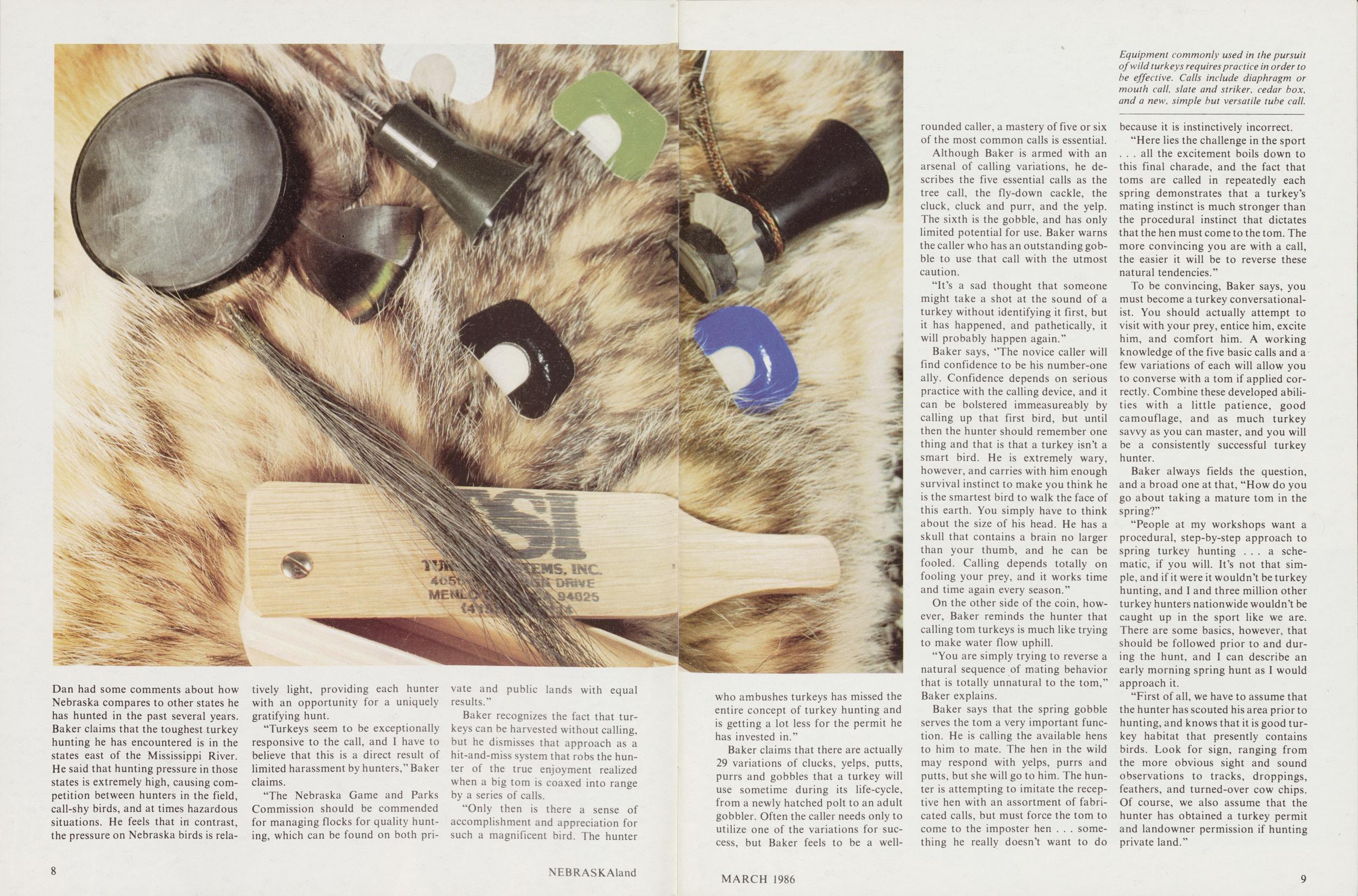
Baker claims that there are actually 29 variations of clucks, yelps, putts, purrs and gobbles that a turkey will use sometime during its life-cycle, from a newly hatched polt to an adult gobbler. Often the caller needs only to utilize one of the variations for success, but Baker feels to be a wellrounded caller, a mastery of five or six of the most common calls is essential.
Although Baker is armed with an arsenal of calling variations, he describes the five essential calls as the tree call, the fly-down cackle, the cluck, cluck and purr, and the yelp. The sixth is the gobble, and has only limited potential for use. Baker warns the caller who has an outstanding gobble to use that call with the utmost caution.
Although Baker is armed with an arsenal of calling variations, he describes the five essential calls as the tree call, the fly-down cackle, the cluck, cluck and purr, and the yelp. The sixth is the gobble, and has only limited potential for use. Baker warns the caller who has an outstanding gobble to use that call with the utmost caution.
"It's a sad thought that someone might take a shot at the sound of a turkey without identifying it first, but it has happened, and pathetically, it will probably happen again."
Baker says, °The novice caller will find confidence to be his number-one ally. Confidence depends on serious practice with the calling device, and it can be bolstered immeasureably by calling up that first bird, but until then the hunter should remember one thing and that is that a turkey isn't a smart bird. He is extremely wary, however, and carries with him enough survival instinct to make you think he is the smartest bird to walk the face of this earth. You simply have to think about the size of his head. He has a skull that contains a brain no larger than your thumb, and he can be fooled. Calling depends totally on fooling your prey, and it works time and time again every season."
On the other side of the coin, however, Baker reminds the hunter that calling tom turkeys is much like trying to make water flow uphill.
"You are simply trying to reverse a natural sequence of mating behavior that is totally unnatural to the tom," Baker explains.
Baker says that the spring gobble serves the tom a very important function. He is calling the available hens to him to mate. The hen in the wild may respond with yelps, purrs and putts, but she will go to him. The hunter is attempting to imitate the receptive hen with an assortment of fabricated calls, but must force the tom to come to the imposter hen something he really doesn't want to do because it is instinctively incorrect.
"Here lies the challenge in the sport all the excitement boils down to this final charade, and the fact that toms are called in repeatedly each spring demonstrates that a turkey's mating instinct is much stronger than the procedural instinct that dictates that the hen must come to the tom. The more convincing you are with a call, the easier it will be to reverse these natural tendencies."
To be convincing, Baker says, you must become a turkey conversationalist. You should actually attempt to visit with your prey, entice him, excite him, and comfort him. A working knowledge of the five basic calls and a few variations of each will allow you to converse with a tom if applied correctly. Combine these developed abilities with a little patience, good camouflage, and as much turkey savvy as you can master, and you will be a consistently successful turkey hunter.
Baker always fields the question, and a broad one at that, "How do you go about taking a mature tom in the spring?"
"People at my workshops want a procedural, step-by-step approach to spring turkey hunting ... a schematic, if you will. It's not that simple, and if it were it wouldn't be turkey hunting, and I and three million other turkey hunters nationwide wouldn't be caught up in the sport like we are. There are some basics, however, that should be followed prior to and during the hunt, and I can describe an early morning spring hunt as I would approach it.
"First of all, we have to assume that the hunter has scouted his area prior to hunting, and knows that it is good turkey habitat that presently contains birds. Look for sign, ranging from the more obvious sight and sound observations to tracks, droppings, feathers, and turned-over cow chips. Of course, we also assume that the hunter has obtained a turkey permit and landowner permission if hunting private land."
MARCH 1986 9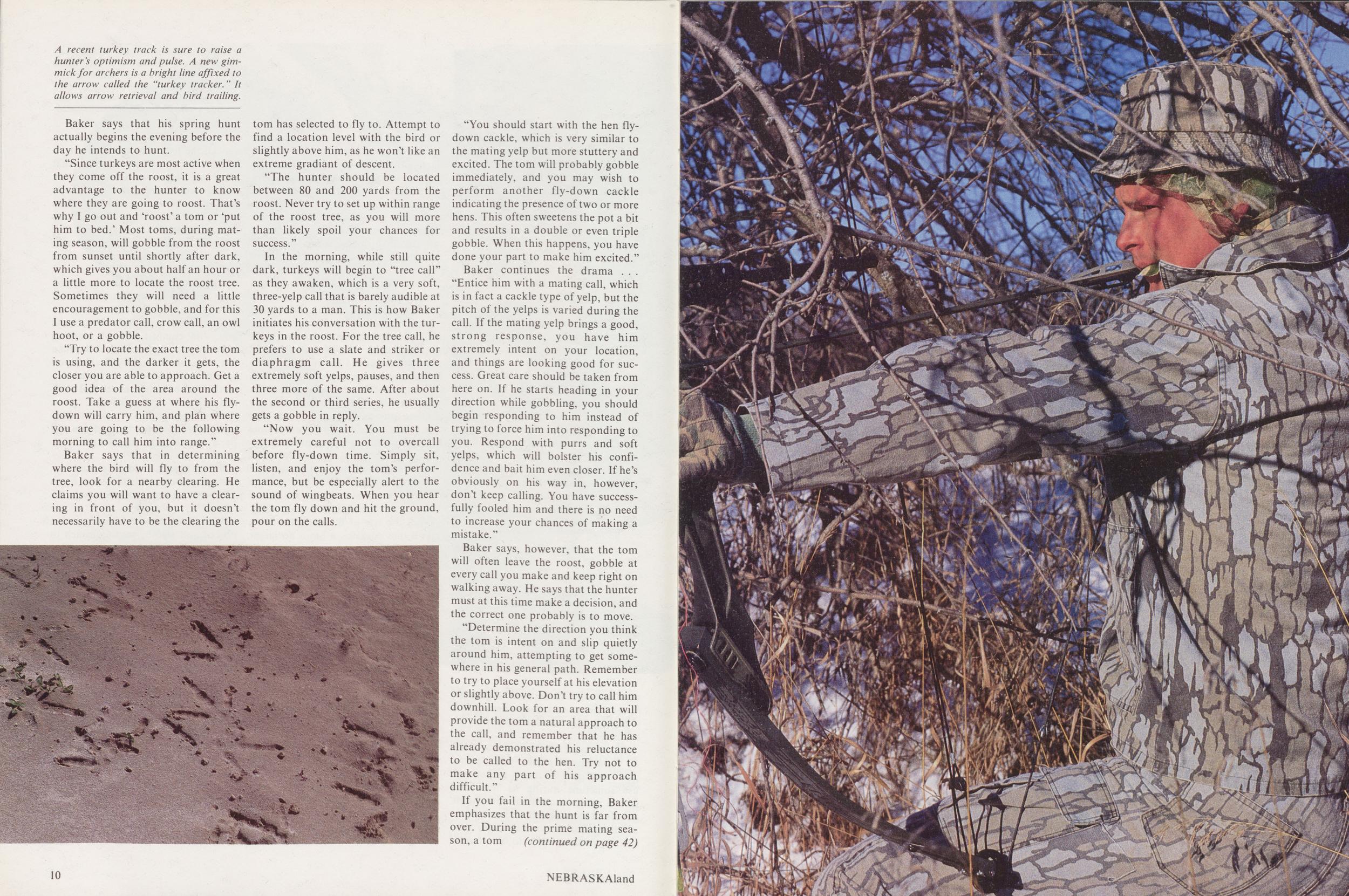
Baker says that his spring hunt actually begins the evening before the day he intends to hunt.
"Since turkeys are most active when they come off the roost, it is a great advantage to the hunter to know where they are going to roost. That's why I go out and 'roost' a torn or 'put him to bed.' Most toms, during mating season, will gobble from the roost from sunset until shortly after dark, which gives you about half an hour or a little more to locate the roost tree. Sometimes they will need a little encouragement to gobble, and for this I use a predator call, crow call, an owl hoot, or a gobble.
"Try to locate the exact tree the torn is using, and the darker it gets, the closer you are able to approach. Get a good idea of the area around the roost. Take a guess at where his flydown will carry him, and plan where you are going to be the following morning to call him into range."
Baker says that in determining where the bird will fly to from the tree, look for a nearby clearing. He claims you will want to have a clearing in front of you, but it doesn't necessarily have to be the clearing the torn has selected to fly to. Attempt to find a location level with the bird or slightly above him, as he won't like an extreme gradiant of descent.
"The hunter should be located between 80 and 200 yards from the roost. Never try to set up within range of the roost tree, as you will more than likely spoil your chances for success."
In the morning, while still quite dark, turkeys will begin to "tree call" as they awaken, which is a very soft, three-yelp call that is barely audible at 30 yards to a man. This is how Baker initiates his conversation with the turkeys in the roost. For the tree call, he prefers to use a slate and striker or diaphragm call. He gives three extremely soft yelps, pauses, and then three more of the same. After about the second or third series, he usually gets a gobble in reply.
"Now you wait. You must be extremely careful not to overcall before fly-down time. Simply sit, listen, and enjoy the tom's performance, but be especially alert to the sound of wingbeats. When you hear the torn fly down and hit the ground, pour on the calls.
"You should start with the hen flydown cackle, which is very similar to the mating yelp but more stuttery and excited. The torn will probably gobble immediately, and you may wish to perform another fly-down cackle indicating the presence of two or more hens. This often sweetens the pot a bit and results in a double or even triple gobble. When this happens, you have done your part to make him excited."
Baker continues the drama "Entice him with a mating call, which is in fact a cackle type of yelp, but the pitch of the yelps is varied during the call. If the mating yelp brings a good, strong response, you have him extremely intent on your location, and things are looking good for success. Great care should be taken from here on. If he starts heading in your direction while gobbling, you should begin responding to him instead of trying to force him into responding to you. Respond with purrs and soft yelps, which will bolster his confidence and bait him even closer. If he's obviously on his way in, however, don't keep calling. You have successfully fooled him and there is no need to increase your chances of making a mistake."
Baker says, however, that the torn will often leave the roost, gobble at every call you make and keep right on walking away. He says that the hunter must at this time make a decision, and the correct one probably is to move.
"Determine the direction you think the torn is intent on and slip quietly around him, attempting to get somewhere in his general path. Remember to try to place yourself at his elevation or slightly above. Don't try to call him downhill. Look for an area that will provide the torn a natural approach to the call, and remember that he has already demonstrated his reluctance to be called to the hen. Try not to make any part of his approach difficult."
If you fail in the morning, Baker emphasizes that the hunt is far from over. During the prime mating season, a torn (continued on page 42)
10 NEBRASKAland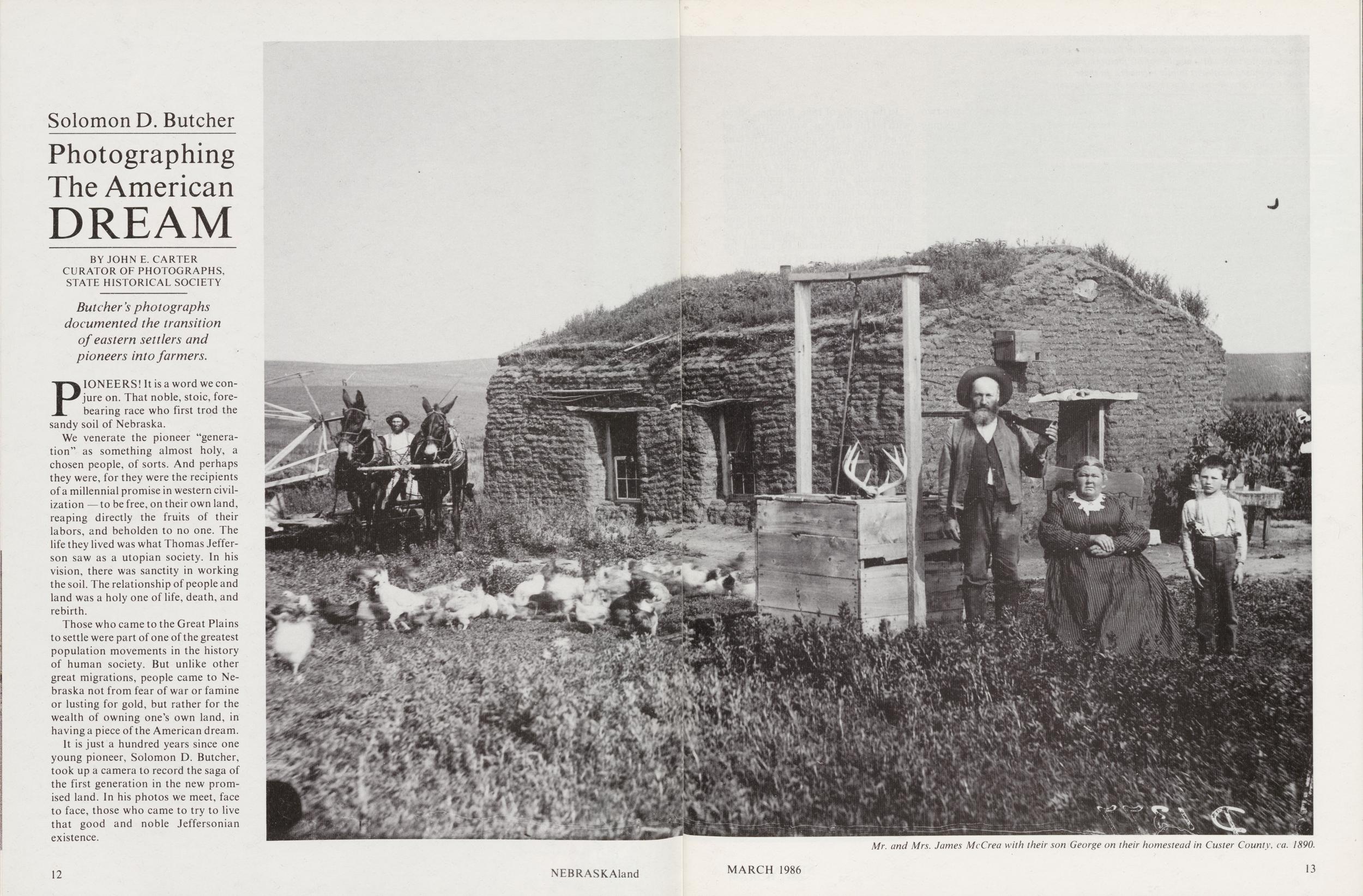
Solomon D. Butcher Photographing The American DREAM
BY JOHN E. CARTER CURATOR OF PHOTOGRAPHS, STATE HISTORICAL SOCIETY Butcher's photographs documented the transition of eastern settlers and pioneers into farmers.PIONEERS! It is a word we conjure on. That noble, stoic, forebearing race who first trod the sandy soil of Nebraska.
We venerate the pioneer "generation" as something almost holy, a chosen people, of sorts. And perhaps they were, for they were the recipients of a millennial promise in western civilization — to be free, on their own land, reaping directly the fruits of their labors, and beholden to no one. The life they lived was what Thomas Jefferson saw as a Utopian society. In his vision, there was sanctity in working the soil. The relationship of people and land was a holy one of life, death, and rebirth.
Those who came to the Great Plains to settle were part of one of the greatest population movements in the history of human society. But unlike other great migrations, people came to Nebraska not from fear of war or famine or lusting for gold, but rather for the wealth of owning one's own land, in having a piece of the American dream.
It is just a hundred years since one young pioneer, Solomon D. Butcher, took up a camera to record the saga of the first generation in the new promised land. In his photos we meet, face to face, those who came to try to live that good and noble Jeffersonian existence.
12 NEBRASKAland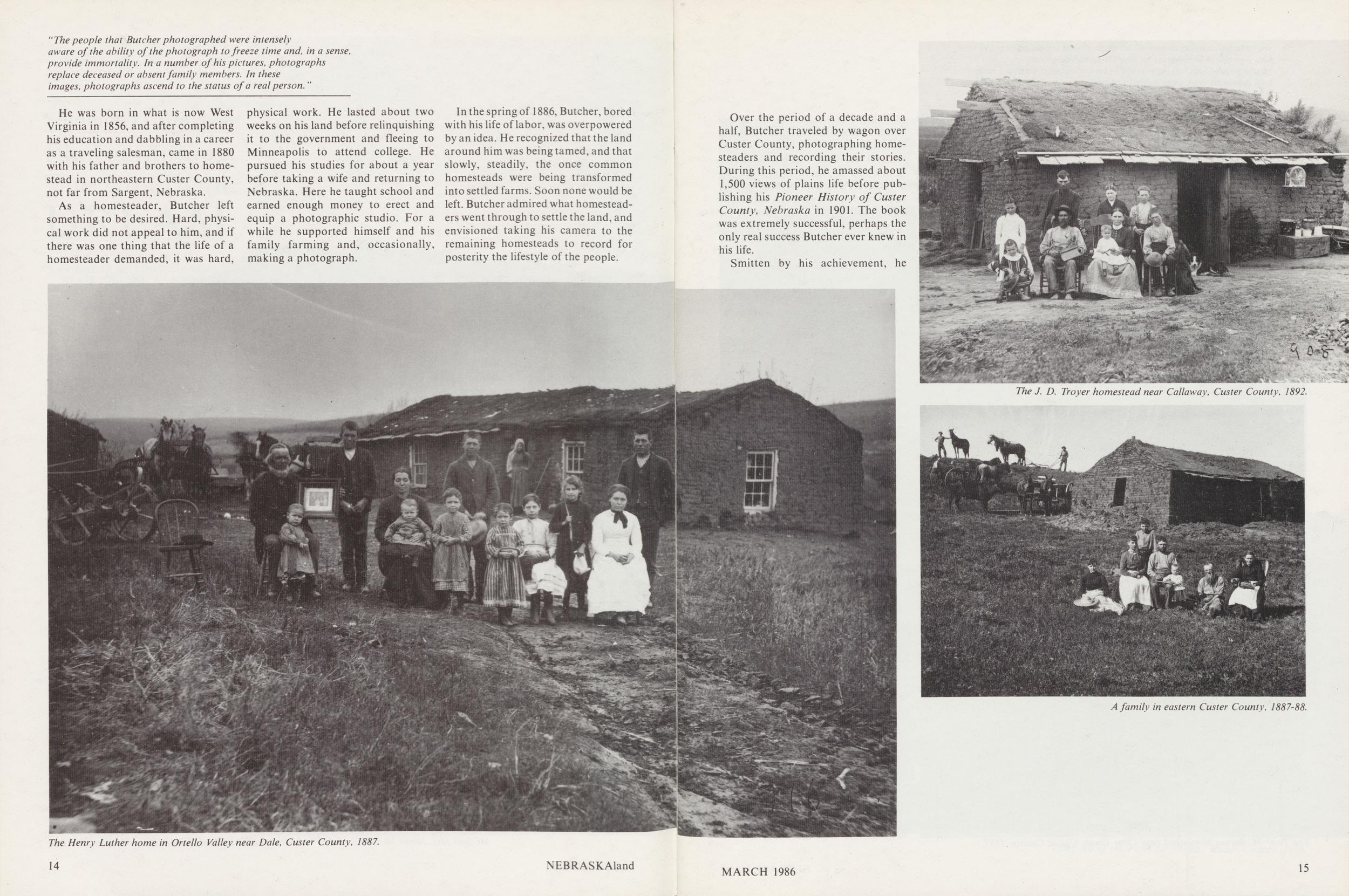
He was born in what is now West Virginia in 1856, and after completing his education and dabbling in a career as a traveling salesman, came in 1880 with his father and brothers to homestead in northeastern Custer County, not far from Sargent, Nebraska.
As a homesteader, Butcher left something to be desired. Hard, physical work did not appeal to him, and if there was one thing that the life of a homesteader demanded, it was hard, physical work. He lasted about two weeks on his land before relinquishing it to the government and fleeing to Minneapolis to attend college. He pursued his studies for about a year before taking a wife and returning to Nebraska. Here he taught school and earned enough money to erect and equip a photographic studio. For a while he supported himself and his family farming and, occasionally, making a photograph.
In the spring of 1886, Butcher, bored with his life of labor, was overpowered by an idea. He recognized that the land around him was being tamed, and that slowly, steadily, the once common homesteads were being transformed into settled farms. Soon none would be left. Butcher admired what homesteaders went through to settle the land, and envisioned taking his camera to the remaining homesteads to record for posterity the lifestyle of the people.
14 NEBRASKAlandOver the period of a decade and a half, Butcher traveled by wagon over Custer County, photographing homesteaders and recording their stories. During this period, he amassed about 1,500 views of plains life before publishing his Pioneer History of Custer County, Nebraska in 1901. The book was extremely successful, perhaps the only real success Butcher ever knew in his life.
Smitten by his achievement, he
 moved to Kearney, dreaming of comparable projects in Buffalo and Dawson counties.
But like so many of his
dreams, these projects became mired
in the realities of everyday life and
never got off the ground.
moved to Kearney, dreaming of comparable projects in Buffalo and Dawson counties.
But like so many of his
dreams, these projects became mired
in the realities of everyday life and
never got off the ground.
Always a schemer, Butcher's life became one chase after another for the pot of gold at the end of the rainbow. He sold patent medicine, dowsed for oil, peddled land — anything he could think of to make money.
But, nothing ever really worked. Finally, old and defeated, he moved to Colorado in 1926, where he died a year later.
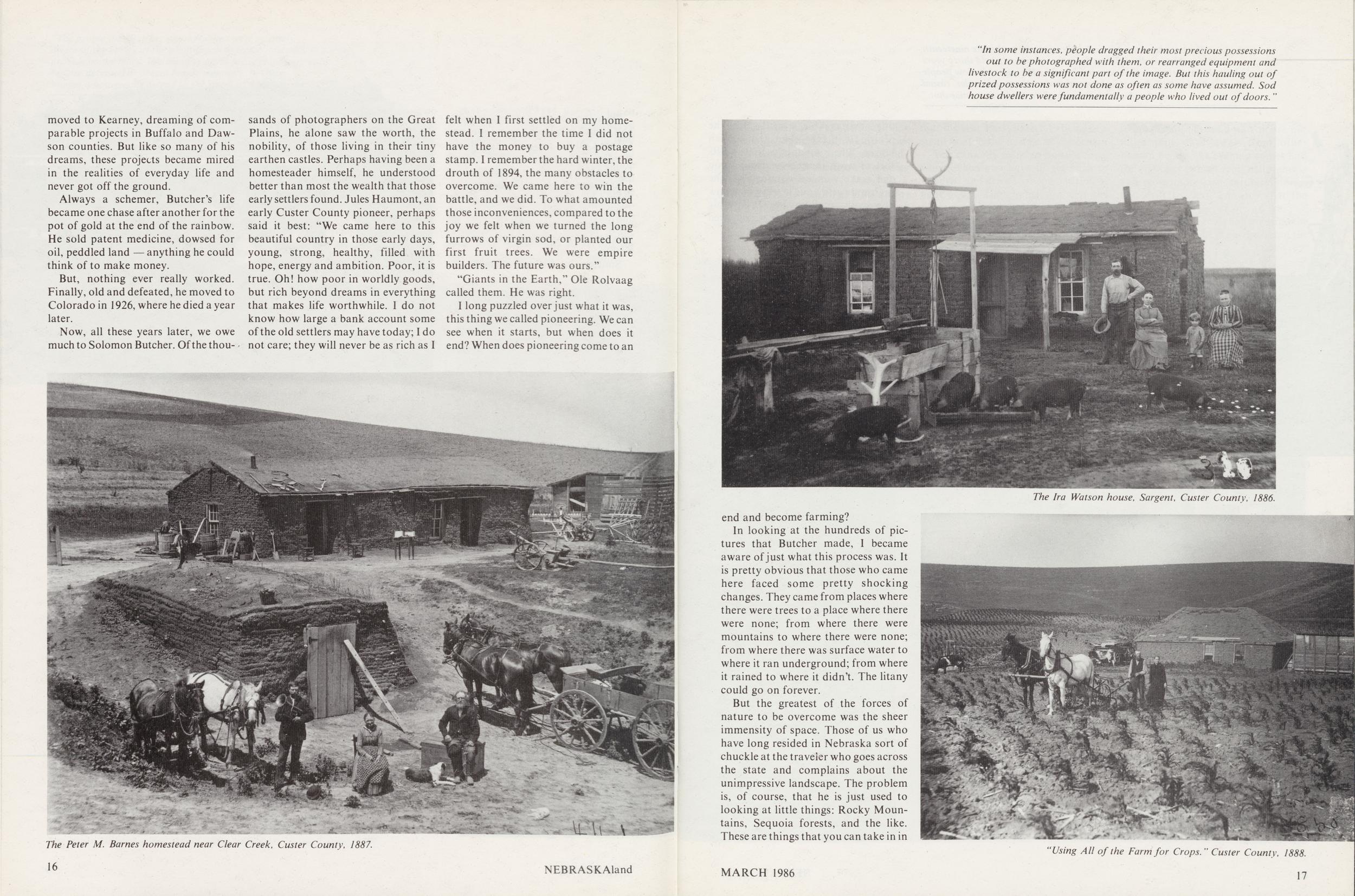
Now, all these years later, we owe much to Solomon Butcher. Of the thousands of photographers on the Great Plains, he alone saw the worth, the nobility, of those living in their tiny earthen castles. Perhaps having been a homesteader himself, he understood better than most the wealth that those early settlers found. Jules Haumont, an early Custer County pioneer, perhaps said it best: "We came here to this beautiful country in those early days, young, strong, healthy, filled with hope, energy and ambition. Poor, it is true. Oh! how poor in worldly goods, but rich beyond dreams in everything that makes life worthwhile. I do not know how large a bank account some of the old settlers may have today; I do not care; they will never be as rich as I felt when I first settled on my homestead. I remember the time I did not have the money to buy a postage stamp. I remember the hard winter, the drouth of 1894, the many obstacles to overcome. We came here to win the battle, and we did. To what amounted those inconveniences, compared to the joy we felt when we turned the long furrows of virgin sod, or planted our first fruit trees. We were empire builders. The future was ours."
"Giants in the Earth," Ole Rolvaag called them. He was right.
I long puzzled over just what it was, this thing we called pioneering. We can see when it starts, but when does it end? When does pioneering come to an
In looking at the hundreds of pictures that Butcher made, I became aware of just what this process was. It is pretty obvious that those who came here faced some pretty shocking changes. They came from places where there were trees to a place where there were none; from where there were mountains to where there were none; from where there was surface water to where it ran underground; from where it rained to where it didn't. The litany could go on forever.
But the greatest of the forces of nature to be overcome was the sheer immensity of space. Those of us who have long resided in Nebraska sort of chuckle at the traveler who goes across the state and complains about the unimpressive landscape. The problem is, of course, that he is just used to looking at little things: Rocky Mountains, Sequoia forests, and the like. These are things that you can take in in
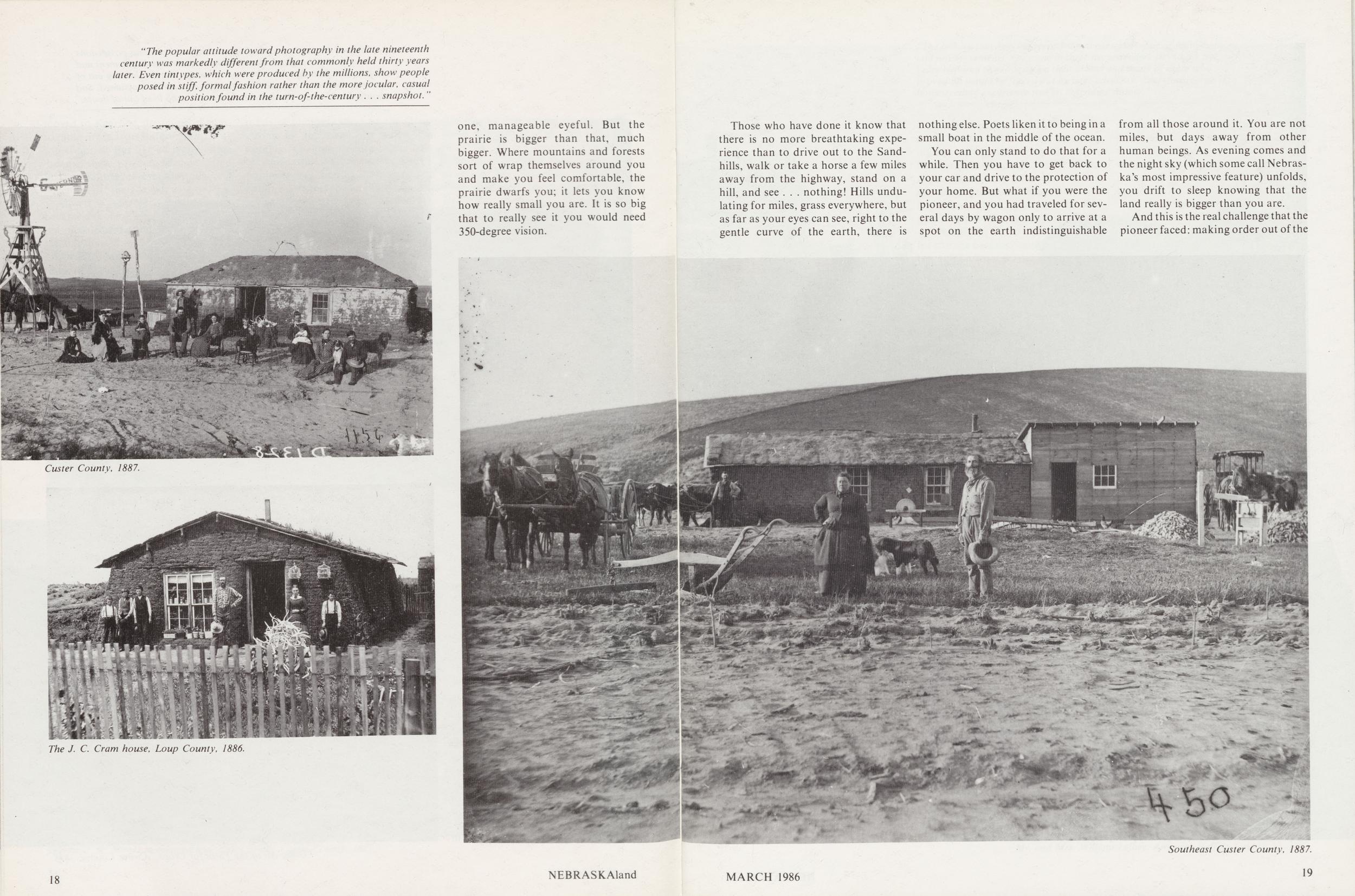
Those who have done it know that there is no more breathtaking experience than to drive out to the Sandhills, walk or take a horse a few miles away from the highway, stand on a hill, and see . . . nothing! Hills undulating for miles, grass everywhere, but as far as your eyes can see, right to the gentle curve of the earth, there is nothing else. Poets liken it to being in a small boat in the middle of the ocean.
You can only stand to do that for a while. Then you have to get back to your car and drive to the protection of your home. But what if you were the pioneer, and you had traveled for several days by wagon only to arrive at a spot on the earth indistinguishable from all those around it. You are not miles, but days away from other human beings. As evening comes and the night sky (which some call Nebraska's most impressive feature) unfolds, you drift to sleep knowing that the land really is bigger than you are.
And this is the real challenge that the pioneer faced: making order out of the
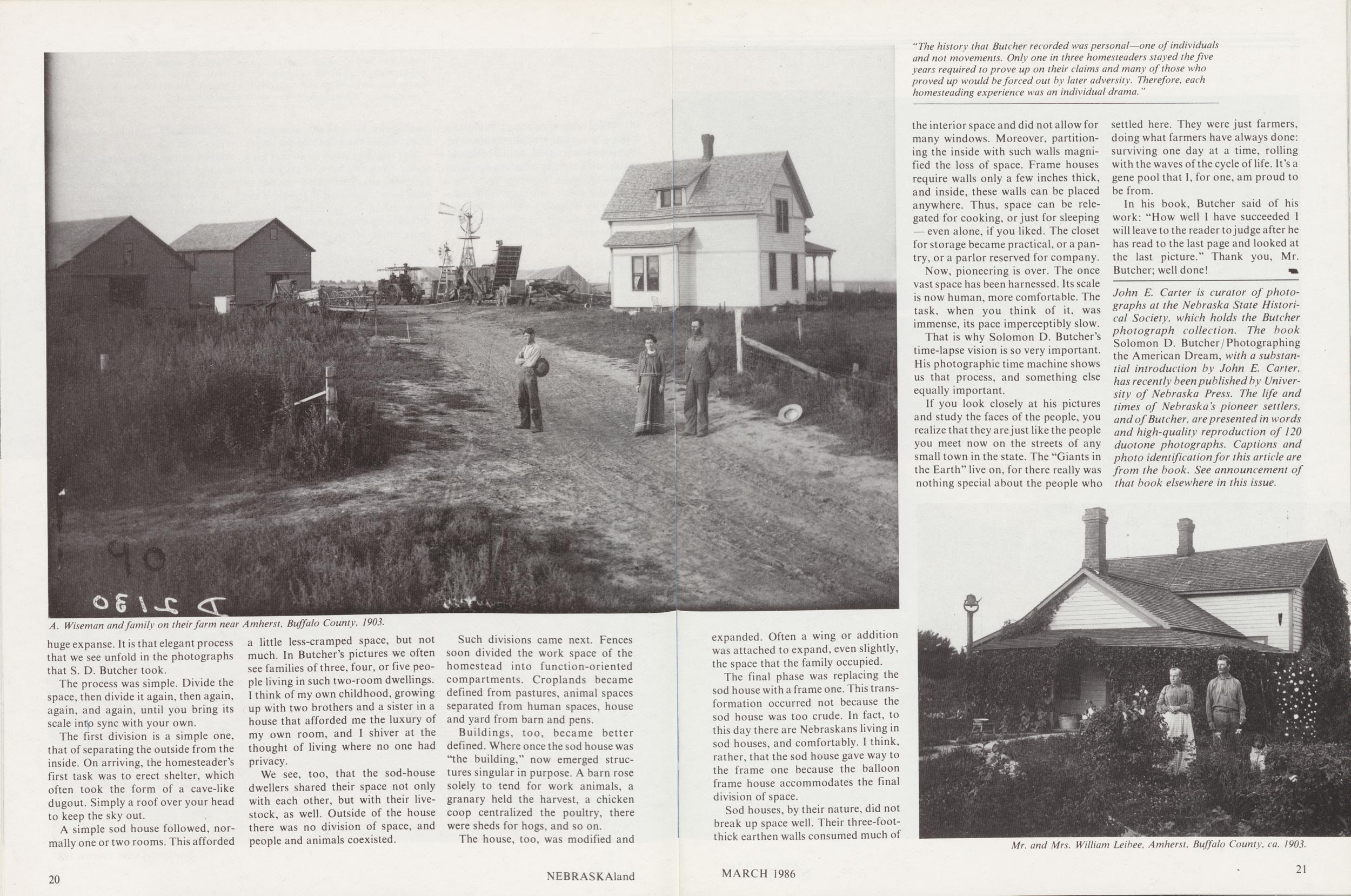
The process was simple. Divide the space, then divide it again, then again, again, and again, until you bring its scale intp sync with your own.
The first division is a simple one, that of separating the outside from the inside. On arriving, the homesteader's first task was to erect shelter, which often took the form of a cave-like dugout. Simply a roof over your head to keep the sky out.
A simple sod house followed, normally one or two rooms. This afforded Amherst. Buffalo County, 1903. a little less-cramped space, but not much. In Butcher's pictures we often see families of three, four, or five people living in such two-room dwellings. I think of my own childhood, growing up with two brothers and a sister in a house that afforded me the luxury of my own room, and I shiver at the thought of living where no one had privacy.
We see, too, that the sod-house dwellers shared their space not only with each other, but with their livestock, as well. Outside of the house there was no division of space, and people and animals coexisted.
Such divisions came next. Fences soon divided the work space of the homestead into function-oriented compartments. Croplands became defined from pastures, animal spaces separated from human spaces, house and yard from barn and pens.
Buildings, too, became better defined. Where once the sod house was "the building," now emerged structures singular in purpose. A barn rose solely to tend for work animals, a granary held the harvest, a chicken coop centralized the poultry, there were sheds for hogs, and so on.
The house, too, was modified and 20 NEBRASKAland expanded. Often a wing or addition was attached to expand, even slightly, the space that the family occupied.
The final phase was replacing the sod house with a frame one. This transformation occurred not because the sod house was too crude. In fact, to this day there are Nebraskans living in sod houses, and comfortably. I think, rather, that the sod house gave way to the frame one because the balloon frame house accommodates the final division of space.
Sod houses, by their nature, did not break up space well. Their three-foot-thick earthen walls consumed much of the interior space and did not allow for many windows. Moreover, partitioning the inside with such walls magnified the loss of space. Frame houses require walls only a few inches thick, and inside, these walls can be placed anywhere. Thus, space can be relegated for cooking, or just for sleeping even alone, if you liked. The closet for storage became practical, or a pantry, or a parlor reserved for company.
Now, pioneering is over. The once vast space has been harnessed. Its scale is now human, more comfortable. The task, when you think of it, was immense, its pace imperceptibly slow.
That is why Solomon D. Butcher's time-lapse vision is so very important. His photographic time machine shows us that process, and something else equally important.
If you look closely at his pictures and study the faces of the people, you realize that they are just like the people you meet now on the streets of any small town in the state. The "Giants in the Earth" live on, for there really was nothing special about the people who settled here. They were just farmers, doing what farmers have always done: surviving one day at a time, rolling with the waves of the cycle of life. It's a gene pool that I, for one, am proud to be from.
In his book, Butcher said of his work: "How well I have succeeded I will leave to the reader to judge after he has read to the last page and looked at the last picture." Thank you, Mr. Butcher; well done!
John E. Carter is curator of photographs at the Nebraska State Historical Society, which holds the Butcher photograph collection. The book Solomon D. Butcher/Photographing the American Dream, with a substantial introduction by John E. Carter, has recently been published by University of Nebraska Press. The life and times of Nebraska's pioneer settlers, and of Butcher, are presented in words and high-quality reproduction of 120 duotone photographs. Captions and photo identification for this article are from the book. See announcement of that book elsewhere in this issue.
A Salt Valley Success
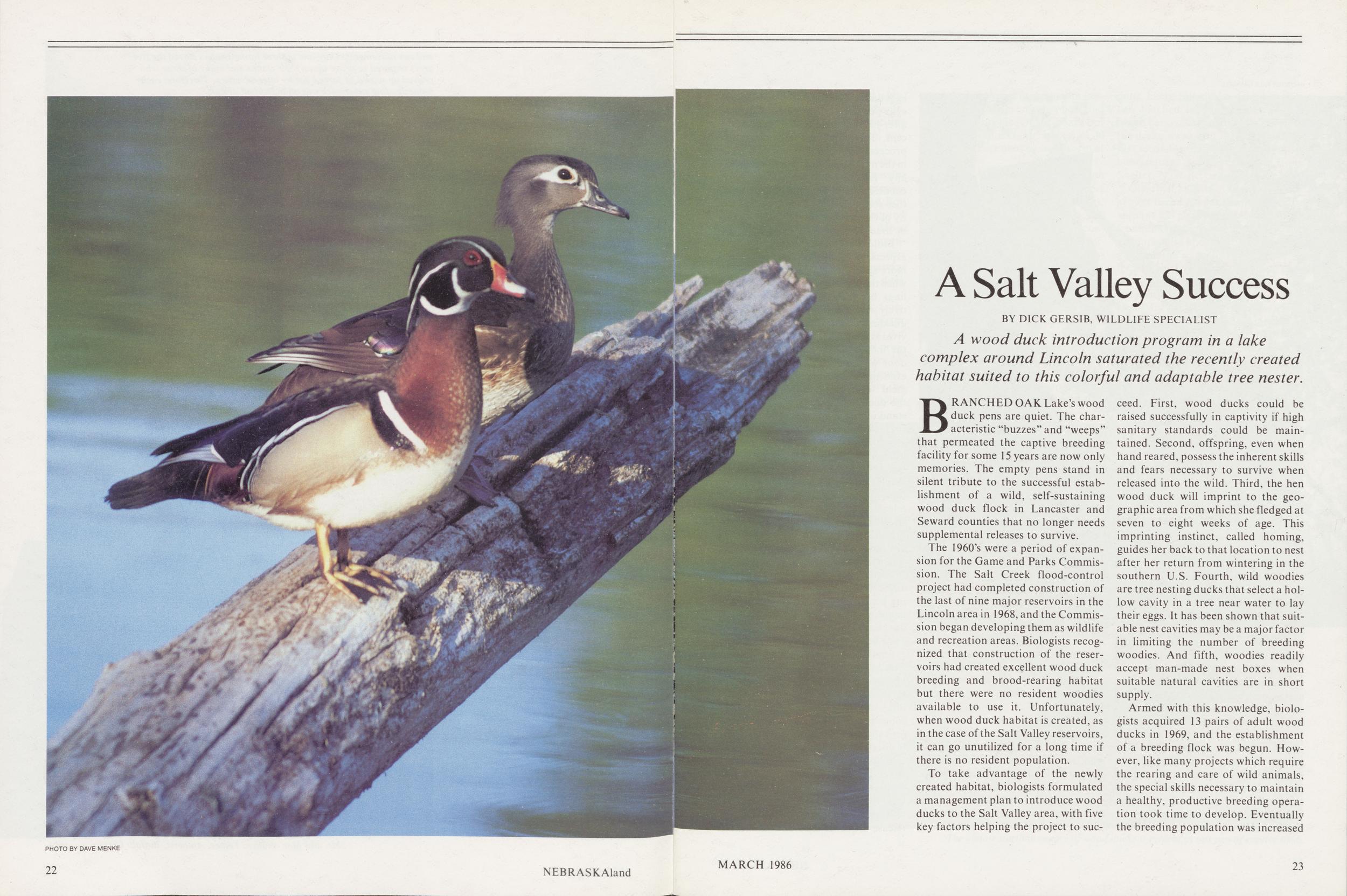
BY DICK GERSIB, WILDLIFE SPECIALIST A wood duck introduction program in a lake complex around Lincoln saturated the recently created habitat suited to this colorful and adaptable tree nester.BRANCHED OAK Lake's wood duck pens are quiet. The characteristic "buzzes" and "weeps" that permeated the captive breeding facility for some 15 years are now only memories. The empty pens stand in silent tribute to the successful establishment of a wild, self-sustaining wood duck flock in Lancaster and Seward counties that no longer needs supplemental releases to survive.
The 1960's were a period of expansion for the Game and Parks Commission. The Salt Creek flood-control project had completed construction of the last of nine major reservoirs in the Lincoln area in 1968, and the Commission began developing them as wildlife and recreation areas. Biologists recognized that construction of the reservoirs had created excellent wood duck breeding and brood-rearing habitat but there were no resident woodies available to use it. Unfortunately, when wood duck habitat is created, as in the case of the Salt Valley reservoirs, it can go unutilized for a long time if there is no resident population.
To take advantage of the newly created habitat, biologists formulated a management plan to introduce wood ducks to the Salt Valley area, with five key factors helping the project to succeed. First, wood ducks could be raised successfully in captivity if high sanitary standards could be maintained. Second, offspring, even when hand reared, possess the inherent skills and fears necessary to survive when released into the wild. Third, the hen wood duck will imprint to the geographic area from which she fledged at seven to eight weeks of age. This imprinting instinct, called homing, guides her back to that location to nest after her return from wintering in the southern U.S. Fourth, wild woodies are tree nesting ducks that select a hollow cavity in a tree near water to lay their eggs. It has been shown that suitable nest cavities may be a major factor in limiting the number of breeding woodies. And fifth, woodies readily accept man-made nest boxes when suitable natural cavities are in short supply.
Armed with this knowledge, biologists acquired 13 pairs of adult wood
ducks in 1969, and the establishment
of a breeding flock was begun. However, like many projects which require
the rearing and care of wild animals,
the special skills necessary to maintain
a healthy, productive breeding operation took time to develop. Eventually
the breeding population was increased
MARCH 1986
23
It was truly an exciting time. But, with the excitement came a seven-day-a-week job. Eggs were collected and washed daily, in addition to the usual chores of feeding and keeping fresh water available for the ducks. The eggs were set once a week in a large forcedair incubator especially modified for the hatching of waterfowl eggs, which require high humidity levels. Eggs were turned twice each day, every day, throughout the 2!/2-month incubating period.
The additional work required to collect and incubate eggs was easily justified by the benefits received. In the wild, a woody hen would normally lay and incubate 10 to 14eggs each spring. Once hatched, she would be able to raise only six to eight ducklings to an age of eight to 10 weeks, when flight becomes possible. But, by collecting eggs daily, biologists averaged 25 to 45 eggs per hen and in many cases held after-hatch mortality to under 10 percent. This collection and incubating process can mean a fourfold increase in the number of birds produced annually. Each weekly set of eggs was candled at 10 days to cull infertile eggs, then returned to the 99.5-degree security of the incubator until they hatched in 28 to 30 days.
Biologists found many exciting aspects to the project, but none was more special than the day each week when the eggs began pipping and ducklings hatched. Woodies are instinctively wild. Only hours after hatching, ducklings demonstrated instinctive survival skills by scurrying to the back of the incubator trays the moment the door was opened. This behavior was even more amazing when the movement was accomplished even before the ducklings were strong enough to stand up for any length of time.
Once out of the egg, ducklings were moved through a series of brooders, each with a cooler temperature than the last until at about 35 days of age they had adjusted to outside temperatures and were ready to be banded and released. This was where the female's imprinting instincts came into play. The concept is simple. Since imprinting occurs at seven to eight weeks of age, ducklings could be raised at the Branched Oak facility but released on another reservoir prior to the imprinting period. In this way, releases were made on different sites even though the ducklings had been hatched in the same brooder.
Small releases began on Branched Oak in 1971 and 1972, and improved husbandry skills increased production to the point where nearly 350 ducklings were released annually. In all, some 4,000 wood ducks were released into the wild during the 15 years the project operated.
Breeding populations were established at Branched Oak, Twin Lakes, Conestoga, Wagon Train, and Bluestem reservoirs through a series of saturation releases on each area. This release sequence insured establishing 24 NEBRASKAland wild populations on the targeted lakes, and since other Salt Valley reservoirs, where no releases occurred, were five miles or less from a release site, pioneering by ducks would occur.
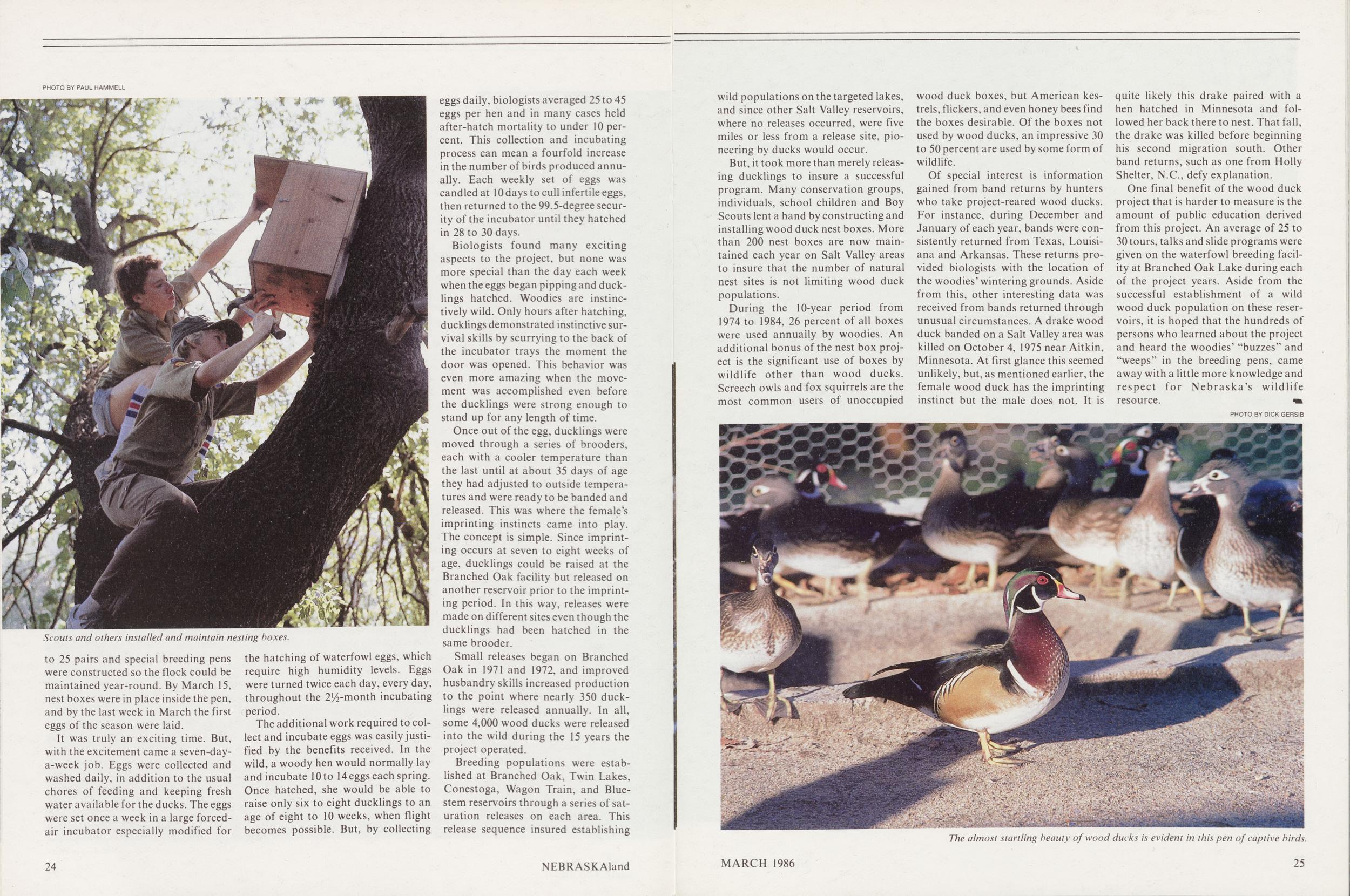
But, it took more than merely releasing ducklings to insure a successful program. Many conservation groups, individuals, school children and Boy Scouts lent a hand by constructing and installing wood duck nest boxes. More than 200 nest boxes are now maintained each year on Salt Valley areas to insure that the number of natural nest sites is not limiting wood duck populations.
During the 10-year period from 1974 to 1984, 26 percent of all boxes were used annuaily by woodies. An additional bonus of the nest box project is the significant use of boxes by wildlife other than wood ducks. Screech owls and fox squirrels are the most common users of unoccupied wood duck boxes, but American kestrels, flickers, and even honey bees find the boxes desirable. Of the boxes not used by wood ducks, an impressive 30 to 50 percent are used by some form of wildlife.
Of special interest is information gained from band returns by hunters who take project-reared wood ducks. For instance, during December and January of each year, bands were consistently returned from Texas, Louisiana and Arkansas. These returns provided biologists with the location of the woodies' wintering grounds. Aside from this, other interesting data was received from bands returned through unusual circumstances. A drake wood duck banded on a Salt Valley area was killed on October 4, 1975 near Aitkin, Minnesota. At first glance this seemed unlikely, but, as mentioned earlier, the female wood duck has the imprinting instinct but the male does not. It is quite likely this drake paired with a hen hatched in Minnesota and followed her back there to nest. That fall, the drake was killed before beginning his second migration south. Other band returns, such as one from Holly Shelter, N.C., defy explanation.
One final benefit of the wood duck project that is harder to measure is the amount of public education derived from this project. An average of 25 to 30 tours, talks and slide programs were given on the waterfowl breeding facility at Branched Oak Lake during each of the project years. Aside from the successful establishment of a wild wood duck population on these reservoirs, it is hoped that the hundreds of persons who learned about the project and heard the woodies' "buzzes" and "weeps" in the breeding pens, came away with a little more knowledge and respect for Nebraska's wildlife resource.
Wild Portraits
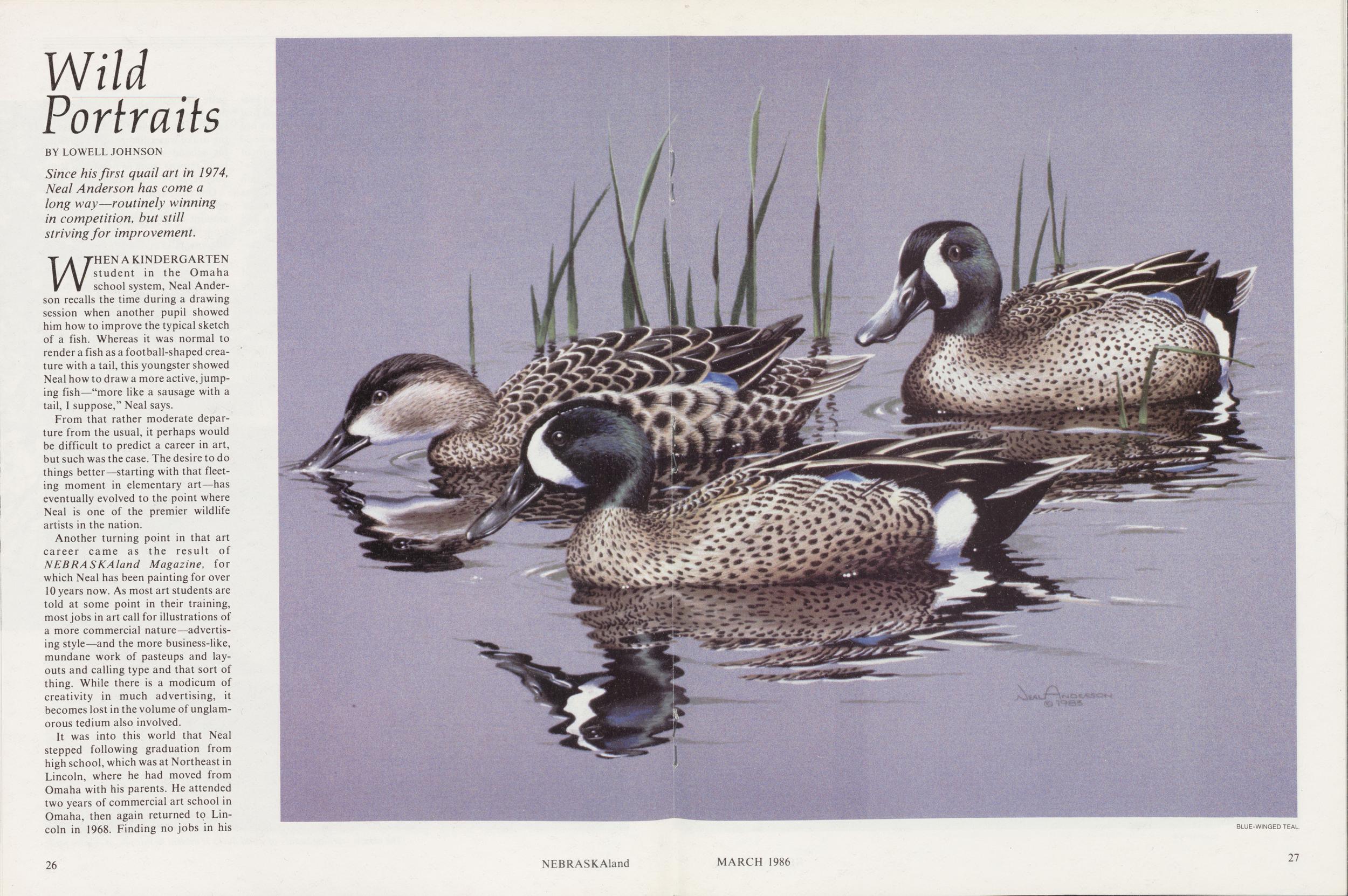
BY LOWELL JOHNSON Since his first quail art in 1974, Neal Anderson has come a long way—routinely winning in competition, but still striving for improvement.WHEN A KINDERGARTEN student in the Omaha school system, Neal Anderson recalls the time during a drawing session when another pupil showed him how to improve the typical sketch of a fish. Whereas it was normal to render a fish as a football-shaped creature with a tail, this youngster showed Neal how to draw a more active, jumping fish—"more like a sausage with a tail, I suppose," Neal says.
From that rather moderate departure from the usual, it perhaps would be difficult to predict a career in art, but such was the case. The desire to do things better—starting with that fleeting moment in elementary art—has eventually evolved to the point where Neal is one of the premier wildlife artists in the nation.
Another turning point in that art career came as the result of NEBRASKAland Magazine, for which Neal has been painting for over 10 years now. As most art students are told at some point in their training, most jobs in art call for illustrations of a more commercial nature—advertising style—and the more business-like, mundane work of pasteups and layouts and calling type and that sort of thing. While there is a modicum of creativity in much advertising, it becomes lost in the volume of unglamorous tedium also involved.
It was into this world that Neal stepped following graduation from high school, which was at Northeast in Lincoln, where he had moved from Omaha with his parents. He attended two years of commercial art school in Omaha, then again returned to Lincoln in 1968. Finding no jobs in his 26 NEBRASKAland
 chosen field, he went to work at Miller
and Paine as a candy maker. After four
years there, in a job which was very
enjoyable, a friend suggested he contact a Lincoln studio, Chuck Elley
Design, a graphics shop. Although his
art portfolio at that time was sadly
lacking and considerably outdated, he
was hired on the basis of what he could
do, not what he had done. So, in 1972
he was back into art, where, he said, "I
learned more in two months from
Chuck Elley and John Cidlik, another
artist there, than I had in two years of
art training. There is no comparison
between theory and actual production," he added.
chosen field, he went to work at Miller
and Paine as a candy maker. After four
years there, in a job which was very
enjoyable, a friend suggested he contact a Lincoln studio, Chuck Elley
Design, a graphics shop. Although his
art portfolio at that time was sadly
lacking and considerably outdated, he
was hired on the basis of what he could
do, not what he had done. So, in 1972
he was back into art, where, he said, "I
learned more in two months from
Chuck Elley and John Cidlik, another
artist there, than I had in two years of
art training. There is no comparison
between theory and actual production," he added.
However, the work at the studio was still a far cry from the wildlife art he now specializes in. In fact, it was during a slack time that his attention again turned to wildlife. He remembers looking through a stock photography book, one of many references artists use when needing a subject. "There was a quail in the book, so I sketched one, then colored it, and it looked pretty good. I guess that got me interested again, and 1 did several more things over the next few weeks."
It so happened that Neal was also playing in a local band to make extra money. Dick Turpin of the Game and Parks Commission also joined the band, and together they worked weekend nights at local clubs. At one point, Turpin saw some of NeaTs bird sketches and suggested he contact the magazine about providing illustrations for the fauna series. Since Bud Pritchard had retired as a Game Commission artist, the fauna series, which had been long running in NEBRASKAland, was languishing for need of illustration. It had always been art rather than photos.
Again, more on the basis of potential rather than his portfolio, Neal was assigned to do wildlife illustration for the series. His first work, the pronghorn antelope, appeared in the April 1975 issue, and he has been doing them ever since.
Exposure he received through the magazine, plus the new emphasis he placed on that type of art, gradually has developed into a new career. While he still does commercial art through the firm of Associated Artists in Lincoln, of which he is a partner, wildlife art is a major part of his work. Of the nearly 100 pieces he has done for the fauna series, he kept only two. One of these, the elk, which appeared in the June 1976 issue, he gave to his wife. The ornate box turtle art he kept because the subject turtle had been a pet of the family.
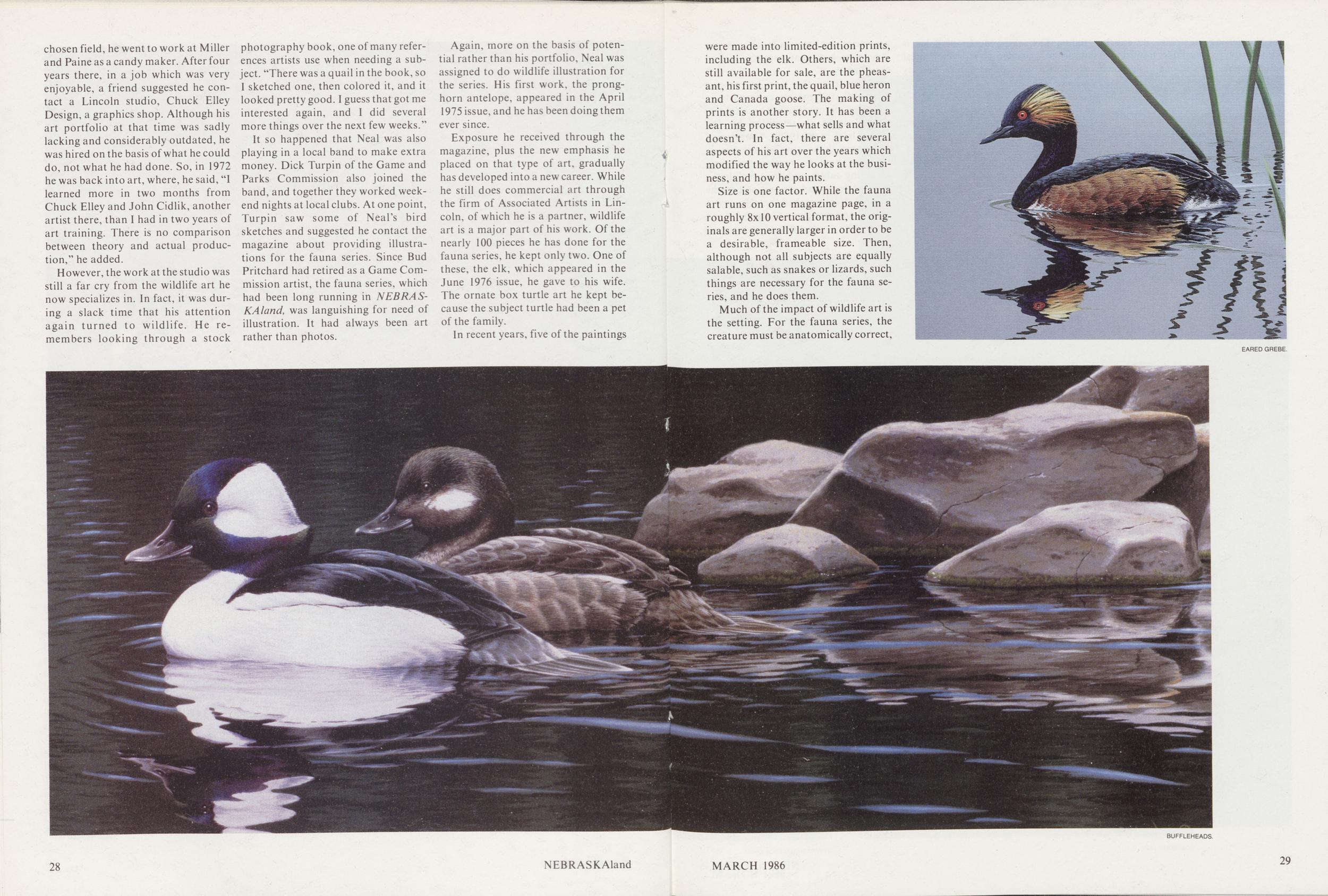
In recent years, five of the paintings 28 NEBRASKAland were made into limited-edition prints, including the elk. Others, which are still available for sale, are the pheasant, his first print, the quail, blue heron and Canada goose. The making of prints is another story. It has been a learning process—what sells and what doesn't. In fact, there are several aspects of his art over the years which modified the way he looks at the business, and how he paints.
Size is one factor. While the fauna art runs on one magazine page, in a roughly 8x 10 vertical format, the originals are generally larger in order to be a desirable, frameable size. Then, although not all subjects are equally salable, such as snakes or lizards, such things are necessary for the fauna series, and he does them.
Much of the impact of wildlife art is the setting. For the fauna series, the creature must be anatomically correct,
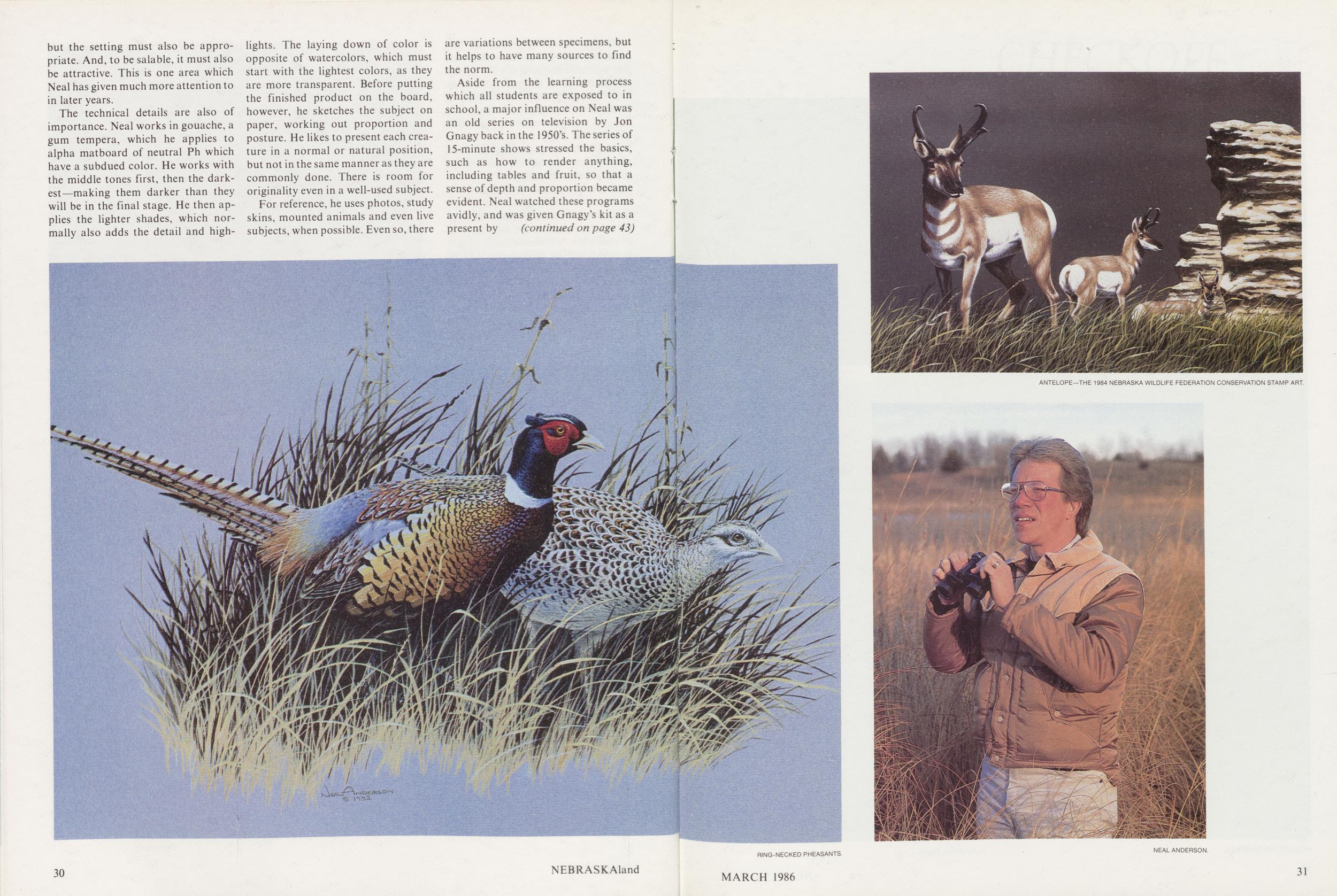 but the setting must also be appropriate. And, to be salable, it must also
be attractive. This is one area which
Neal has given much more attention to
in later years.
but the setting must also be appropriate. And, to be salable, it must also
be attractive. This is one area which
Neal has given much more attention to
in later years.
The technical details are also of importance. Neal works in gouache, a gum tempera, which he applies to alpha matboard of neutral Ph which have a subdued color. He works with the middle tones first, then the darkest—making them darker than they will be in the final stage. He then applies the lighter shades, which normally also adds the detail and highlights. The laying down of color is opposite of watercolors, which must start with the lightest colors, as they are more transparent. Before putting the finished product on the board, however, he sketches the subject on paper, working out proportion and posture. He likes to present each creature in a normal or natural position, but not in the same manner as they are commonly done. There is room for originality even in a well-used subject.
For reference, he uses photos, study skins, mounted animals and even live subjects, when possible. Even so, there are variations between specimens, but it helps to have many sources to find the norm.
Aside from the learning process which all students are exposed to in school, a major influence on Neal was an old series on television by Jon Gnagy back in the 1950's. The series of 15-minute shows stressed the basics, such as how to render anything, including tables and fruit, so that a sense of depth and proportion became evident. Neal watched these programs avidly, and was given Gnagy's kit as a present by (continued on page 43)
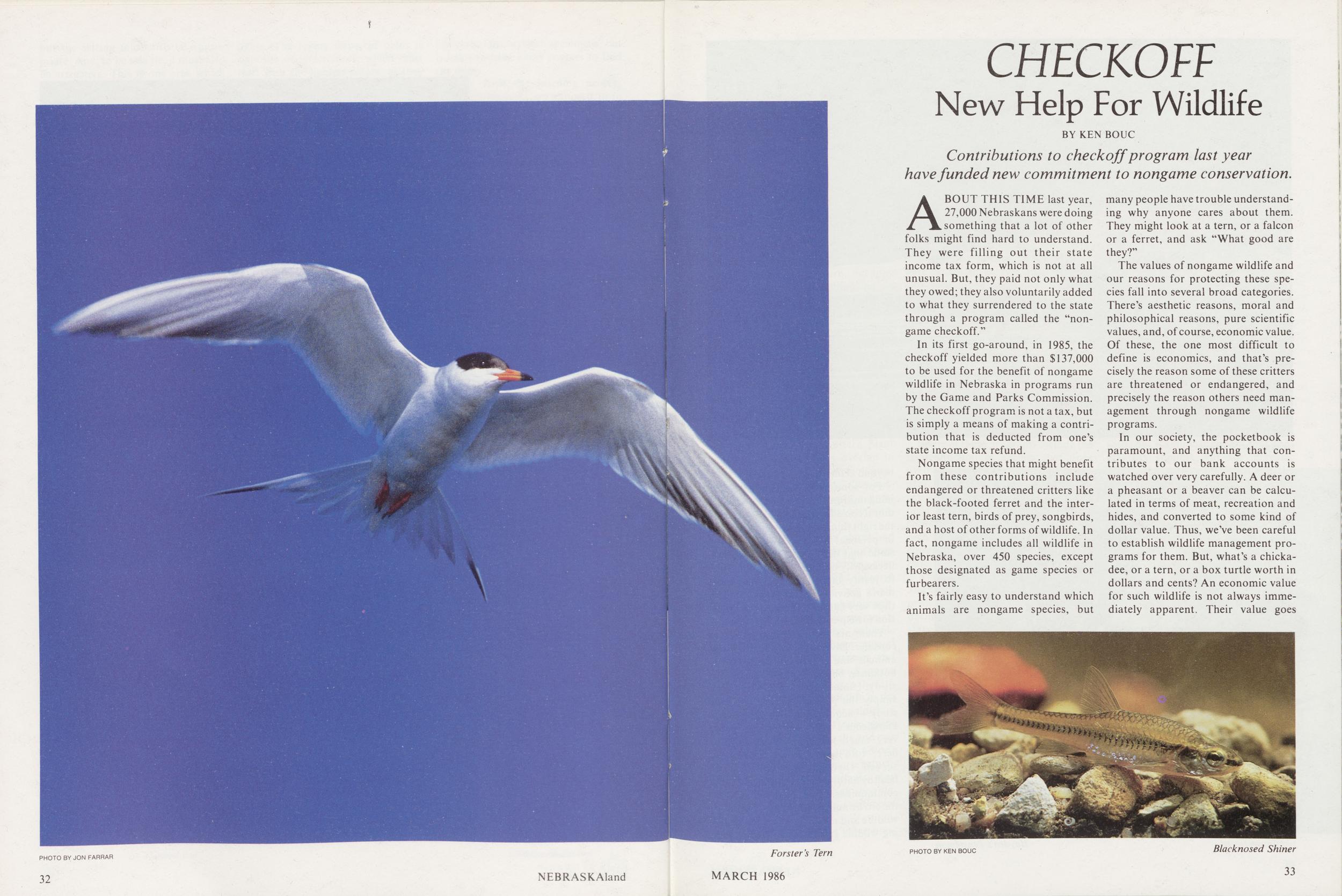
CHECKOFF New Help For Wildlife
BY KEN BOUC Contributions to checkoff program last year have funded new commitment to nongame conservation.ABOUT THIS TIME last year, 27,000 Nebraskans were doing something that a lot of other folks might find hard to understand. They were filling out their state income tax form, which is not at all unusual. But, they paid not only what they owed; they also voluntarily added to what they surrendered to the state through a program called the "nongame checkoff."
In its first go-around, in 1985, the checkoff yielded more than $137,000 to be used for the benefit of nongame wildlife in Nebraska in programs run by the Game and Parks Commission. The checkoff program is not a tax, but is simply a means of making a contribution that is deducted from one's state income tax refund.
Nongame species that might benefit from these contributions include endangered or threatened critters like the black-footed ferret and the interior least tern, birds of prey, songbirds, and a host of other forms of wildlife. In fact, nongame includes all wildlife in Nebraska, over 450 species, except those designated as game species or furbearers.
It's fairly easy to understand which animals are nongame species, but many people have trouble understanding why anyone cares about them. They might look at a tern, or a falcon or a ferret, and ask "What good are they?"
The values of nongame wildlife and our reasons for protecting these species fall into several broad categories. There's aesthetic reasons, moral and philosophical reasons, pure scientific values, and, of course, economic value. Of these, the one most difficult to define is economics, and that's precisely the reason some of these critters are threatened or endangered, and precisely the reason others need management through nongame wildlife programs.
In our society, the pocketbook is paramount, and anything that contributes to our bank accounts is watched over very carefully. A deer or a pheasant or a beaver can be calculated in terms of meat, recreation and hides, and converted to some kind of dollar value. Thus, we've been careful to establish wildlife management programs for them. But, what's a chickadee, or a tern, or a box turtle worth in dollars and cents? An economic value for such wildlife is not always immediately apparent. Their value goes
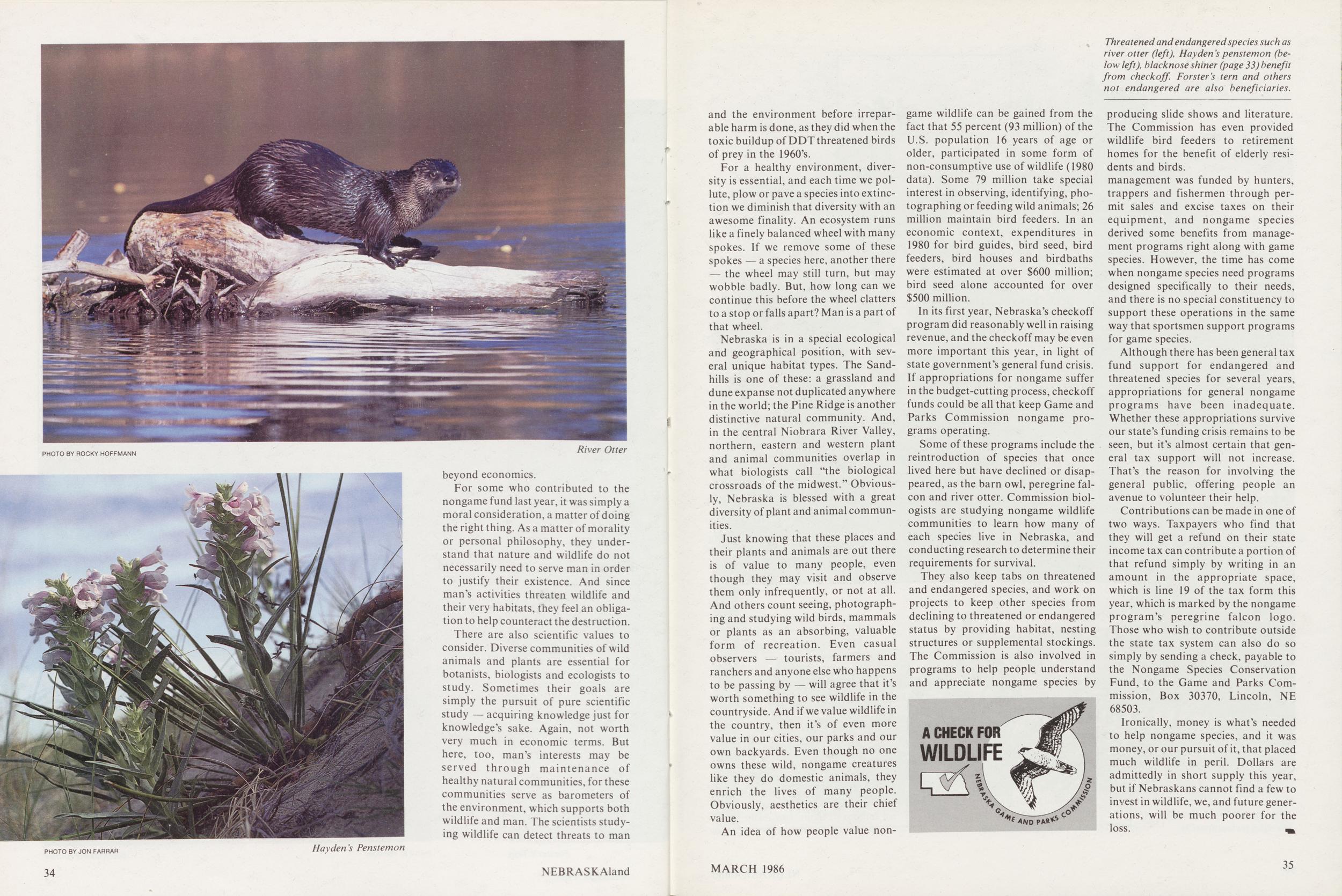
For some who contributed to the nongame fund last year, it was simply a moral consideration, a matter of doing the right thing. As a matter of morality or personal philosophy, they understand that nature and wildlife do not necessarily need to serve man in order to justify their existence. And since man's activities threaten wildlife and their very habitats, they feel an obligation to help counteract the destruction.
There are also scientific values to consider. Diverse communities of wild animals and plants are essential for botanists, biologists and ecologists to study. Sometimes their goals are simply the pursuit of pure scientific study — acquiring knowledge just for knowledge's sake. Again, not worth very much in economic terms. But here, too, man's interests may be served through maintenance of healthy natural communities, for these communities serve as barometers of the environment, which supports both wildlife and man. The scientists studying wildlife can detect threats to man 34 NEBRASKAland and the environment before irreparable harm is done, as they did when the toxic buildup of DDT threatened birds of prey in the 1960's.
For a healthy environment, diversity is essential, and each time we pollute, plow or pave a species into extinction we diminish that diversity with an awesome finality. An ecosystem runs like a finely balanced wheel with many spokes. If we remove some of these spokes — a species here, another there — the wheel may still turn, but may wobble badly. But, how long can we continue this before the wheel clatters to a stop or falls apart? Man is a part of that wheel.
Nebraska is in a special ecological and geographical position, with several unique habitat types. The Sandhills is one of these: a grassland and dune expanse not duplicated anywhere in the world; the Pine Ridge is another distinctive natural community. And, in the central Niobrara River Valley, northern, eastern and western plant and animal communities overlap in what biologists call "the biological crossroads of the midwest." Obviously, Nebraska is blessed with a great diversity of plant and animal communities.
Just knowing that these places and their plants and animals are out there is of value to many people, even though they may visit and observe them only infrequently, or not at all. And others count seeing, photographing and studying wild birds, mammals or plants as an absorbing, valuable form of recreation. Even casual observers — tourists, farmers and ranchers and anyone else who happens to be passing by — will agree that it's worth something to see wildlife in the countryside. And if we value wildlife in the country, then it's of even more value in our cities, our parks and our own backyards. Even though no one owns these wild, nongame creatures like they do domestic animals, they enrich the lives of many people. Obviously, aesthetics are their chief value.
An idea of how people value non MARCH 1986 game wildlife can be gained from the fact that 55 percent (93 million) of the U.S. population 16 years of age or older, participated in some form of non-consumptive use of wildlife (1980 data). Some 79 million take special interest in observing, identifying, photographing or feeding wild animals; 26 million maintain bird feeders. In an economic context, expenditures in 1980 for bird guides, bird seed, bird feeders, bird houses and birdbaths were estimated at over $600 million; bird seed alone accounted for over $500 million.
In its first year, Nebraska's checkoff program did reasonably well in raising revenue, and the checkoff may be even more important this year, in light of state government's general fund crisis. If appropriations for nongame suffer in the budget-cutting process, checkoff funds could be all that keep Game and Parks Commission nongame programs operating.
Some of these programs include the reintroduction of species that once lived here but have declined or disappeared, as the barn owl, peregrine falcon and river otter. Commission biologists are studying nongame wildlife communities to learn how many of each species live in Nebraska, and conducting research to determine their requirements for survival.
They also keep tabs on threatened and endangered species, and work on projects to keep other species from declining to threatened or endangered status by providing habitat, nesting structures or supplemental stockings. The Commission is also involved in programs to help people understand and appreciate nongame species by producing slide shows and literature. The Commission has even provided wildlife bird feeders to retirement homes for the benefit of elderly residents and birds. management was funded by hunters, trappers and fishermen through permit sales and excise taxes on their equipment, and nongame species derived some benefits from management programs right along with game species. However, the time has come when nongame species need programs designed specifically to their needs, and there is no special constituency to support these operations in the same way that sportsmen support programs for game species.
A CHECK FOR WILDLIFEAlthough there has been general tax fund support for endangered and threatened species for several years, appropriations for general nongame programs have been inadequate. Whether these appropriations survive our state's funding crisis remains to be seen, but it's almost certain that general tax support will not increase. That's the reason for involving the general public, offering people an avenue to volunteer their help.
Contributions can be made in one of two ways. Taxpayers who find that they will get a refund on their state income tax can contribute a portion of that refund simply by writing in an amount in the appropriate space, which is line 19 of the tax form this year, which is marked by the nongame program's peregrine falcon logo. Those who wish to contribute outside the state tax system can also do so simply by sending a check, payable to the Nongame Species Conservation Fund, to the Game and Parks Commission, Box 30370, Lincoln, NE 68503.
Ironically, money is what's needed to help nongame species, and it was money, or our pursuit of it, that placed much wildlife in peril. Dollars are admittedly in short supply this year, but if Nebraskans cannot find a few to invest in wildlife, we, and future generations, will be much poorer for the loss.
MARCH 1986 35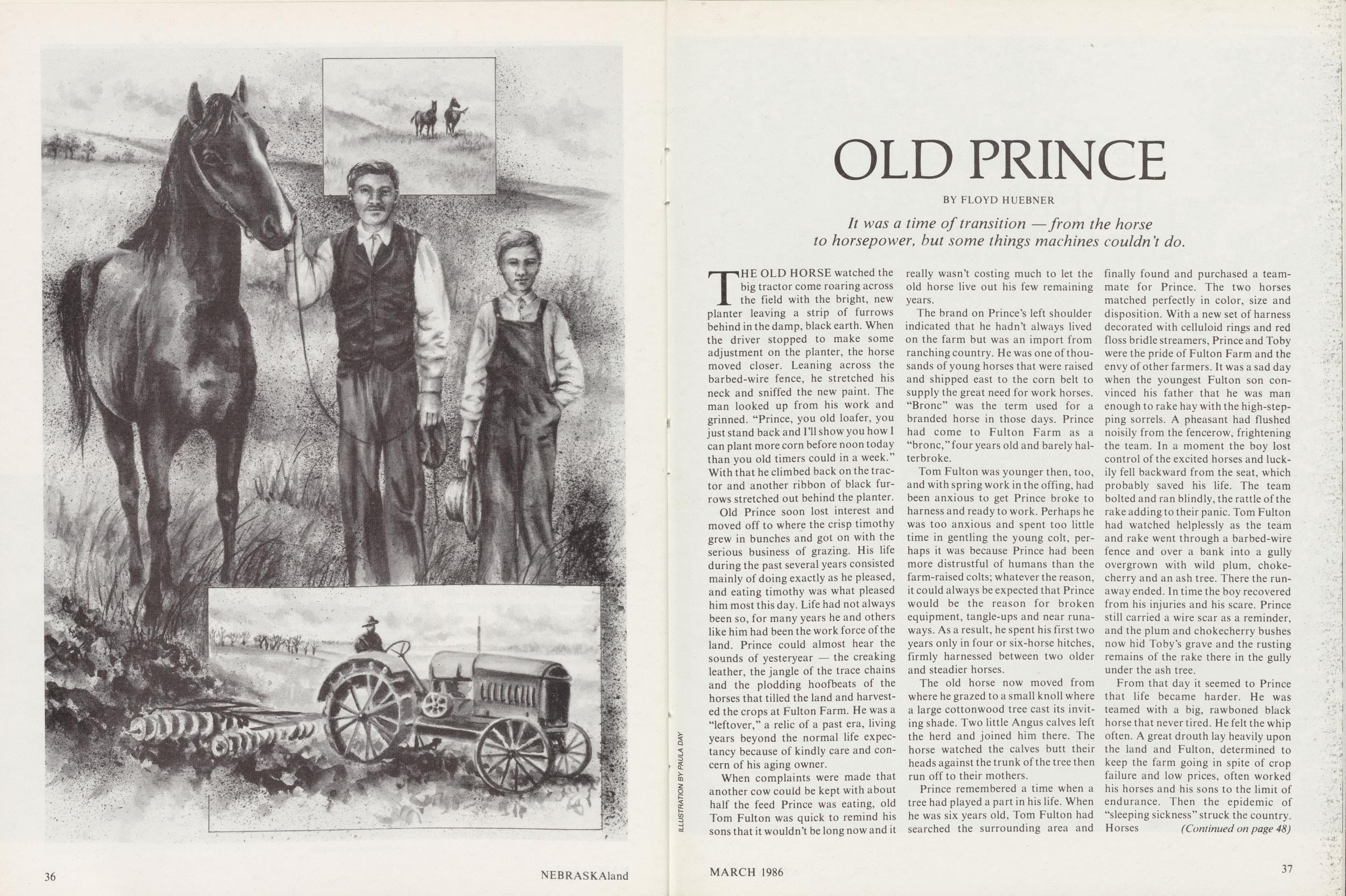
OLD PRINCE
BY FLOYD HUEBNER It was a time of transition —from the horse to horsepower, but some things machines couldn't do,THE OLD HORSE watched the big tractor come roaring across the field with the bright, new planter leaving a strip of furrows behind in the damp, black earth. When the driver stopped to make some adjustment on the planter, the horse moved closer. Leaning across the barbed-wire fence, he stretched his neck and sniffed the new paint. The man looked up from his work and grinned. "Prince, you old loafer, you just stand back and I'll show you how I can plant more corn before noon today than you old timers could in a week." With that he climbed back on the tractor and another ribbon of black furrows stretched out behind the planter.
Old Prince soon lost interest and moved off to where the crisp timothy grew in bunches and got on with the serious business of grazing. His life during the past several years consisted mainly of doing exactly as he pleased, and eating timothy was what pleased him most this day. Life had not always been so, for many years he and others like him had been the work force of the land. Prince could almost hear the sounds of yesteryear — the creaking leather, the jangle of the trace chains and the plodding hoofbeats of the horses that tilled the land and harvested the crops at Fulton Farm. He was a "leftover," a relic of a past era, living years beyond the normal life expectancy because of kindly care and concern of his aging owner.
When complaints were made that another cow could be kept with about half the feed Prince was eating, old Tom Fulton was quick to remind his sons that it wouldn't be long now and it really wasn't costing much to let the old horse live out his few remaining years.
The brand on Prince's left shoulder indicated that he hadn't always lived on the farm but was an import from ranching country. He was one of thousands of young horses that were raised and shipped east to the corn belt to supply the great need for work horses. "Bronc" was the term used for a branded horse in those days. Prince had come to Fulton Farm as a "bronc," four years old and barely halterbroke.
Tom Fulton was younger then, too, and with spring work in the offing, had been anxious to get Prince broke to harness and ready to work. Perhaps he was too anxious and spent too little time in gentling the young colt, perhaps it was because Prince had been more distrustful of humans than the farm-raised colts; whatever the reason, it could always be expected that Prince would be the reason for broken equipment, tangle-ups and near runaways. As a result, he spent his first two years only in four or six-horse hitches, firmly harnessed between two older and steadier horses.
The old horse now moved from where he grazed to a small knoll where a large cottonwood tree cast its inviting shade. Two little Angus calves left the herd and joined him there. The horse watched the calves butt their heads against the trunk of the tree then run off to their mothers.
Prince remembered a time when a tree had played a part in his life. When he was six years old, Tom Fulton had searched the surrounding area and finally found and purchased a teammate for Prince. The two horses matched perfectly in color, size and disposition. With a new set of harness decorated with celluloid rings and red floss bridle streamers, Prince and Toby were the pride of Fulton Farm and the envy of other farmers. It was a sad day when the youngest Fulton son convinced his father that he was man enough to rake hay with the high-stepping sorrels. A pheasant had flushed noisily from the fencerow, frightening the team. In a moment the boy lost control of the excited horses and luckily fell backward from the seat, which probably saved his life. The team bolted and ran blindly, the rattle of the rake adding to their panic. Tom Fulton had watched helplessly as the team and rake went through a barbed-wire fence and over a bank into a gully overgrown with wild plum, chokecherry and an ash tree. There the runaway ended. In time the boy recovered from his injuries and his scare. Prince still carried a wire scar as a reminder, and the plum and chokecherry bushes now hid Toby's grave and the rusting remains of the rake there in the gully under the ash tree.
From that day it seemed to Prince that life became harder. He was teamed with a big, rawboned black horse that never tired. He felt the whip often. A great drouth lay heavily upon the land and Fulton, determined to keep the farm going in spite of crop failure and low prices, often worked his horses and his sons to the limit of endurance. Then the epidemic of "sleeping sickness" struck the country. Horses (Continued on page 48)
MARCH 1986 37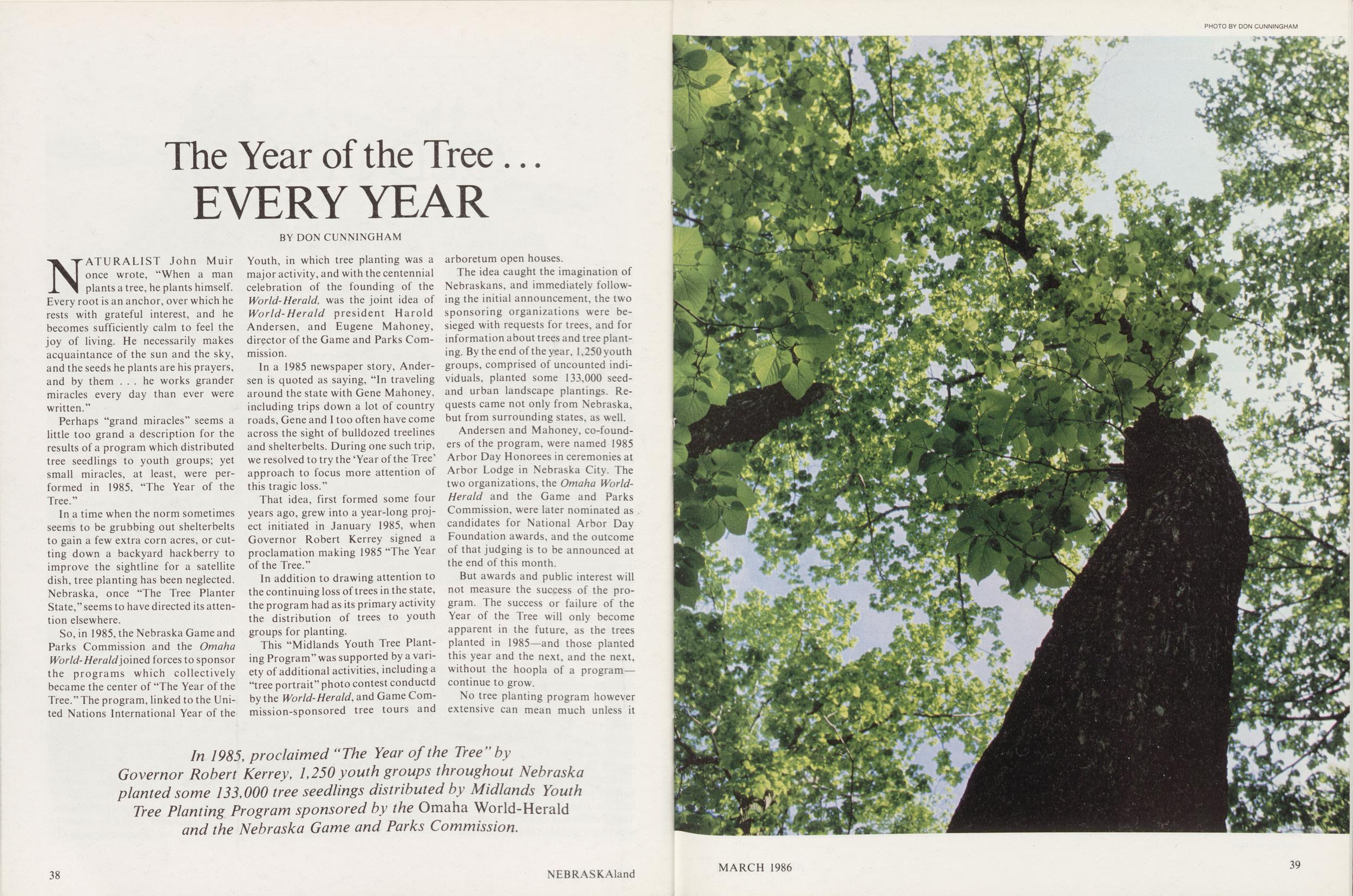
The Year of the Tree... EVERY YEAR
PHOTO BY DON CUNNINGHAMNATURALIST John Muir once wrote, "When a man plants a tree, he plants himself. Every root is an anchor, over which he rests with grateful interest, and he becomes sufficiently calm to feel the joy of living. He necessarily makes acquaintance of the sun and the sky, and the seeds he plants are his prayers, and by them he works grander miracles every day than ever were written."
Perhaps "grand miracles" seems a little too grand a description for the results of a program which distributed tree seedlings to youth groups; yet small miracles, at least, were performed in 1985, "The Year of the Tree."
In a time when the norm sometimes seems to be grubbing out shelterbelts to gain a few extra corn acres, or cutting down a backyard hackberry to improve the sightline for a satellite dish, tree planting has been neglected. Nebraska, once "The Tree Planter State," seems to have directed its attention elsewhere.
So, in 1985, the Nebraska Game and Parks Commission and the Omaha World-Heraldjoined forces to sponsor the programs which collectively became the center of "The Year of the Tree." The program, linked to the United Nations International Year of the Youth, in which tree planting was a major activity, and with the centennial celebration of the founding of the World-Herald, was the joint idea of World-Herald president Harold Andersen, and Eugene Mahoney, director of the Game and Parks Commission.
In a 1985 newspaper story, Andersen is quoted as saying, "In traveling around the state with Gene Mahoney, including trips down a lot of country roads, Gene and I too often have come across the sight of bulldozed treelines and shelterbelts. During one such trip, we resolved to try the 'Year of the Tree' approach to focus more attention oi this tragic loss."
That idea, first formed some four years ago, grew into a year-long project initiated in January 1985, when Governor Robert Kerrey signed a proclamation making 1985 "The Year of the Tree."
In addition to drawing attention to the continuing loss of trees in the state, the program had as its primary activity the distribution of trees to youth groups for planting.
This "Midlands Youth Tree Planting Program" was supported by a variety of additional activities, including a "tree portrait" photo contest conductd by the World-Herald, and Game Commission-sponsored tree tours and arboretum open houses.
The idea caught the imagination of Nebraskans, and immediately following the initial announcement, the two sponsoring organizations were besieged with requests for trees, and for information about trees and tree planting. By the end of the year, 1,250 youth groups, comprised of uncounted individuals, planted some 133,000 seedand urban landscape plantings. Requests came not only from Nebraska, but from surrounding states, as well.
Andersen and Mahoney, co-founders of the program, were named 1985 Arbor Day Honorees in ceremonies at Arbor Lodge in Nebraska City. The two organizations, the Omaha World Herald and the Game and Parks Commission, were later nominated as candidates for National Arbor Day Foundation awards, and the outcome of that judging is to be announced at the end of this month.
But awards and public interest will not measure the success of the program. The success or failure of the Year of the Tree will only become apparent in the future, as the trees planted in 1985—and those planted this year and the next, and the next, without the hoopla of a program continue to grow.
No tree planting program however extensive can mean much unless it stimulates tree planting and tree care in the years that follow.
In 1985, proclaimed "The Year of the Tree" by Governor Robert Kerrey, 1,250 youth groups throughout Nebraska planted some 133,000 tree seedlings distributed by Midlands Youth Tree Planting Program sponsored by the Omaha World-Herald and the Nebraska Game and Parks Commission. 38 NEBRASKAland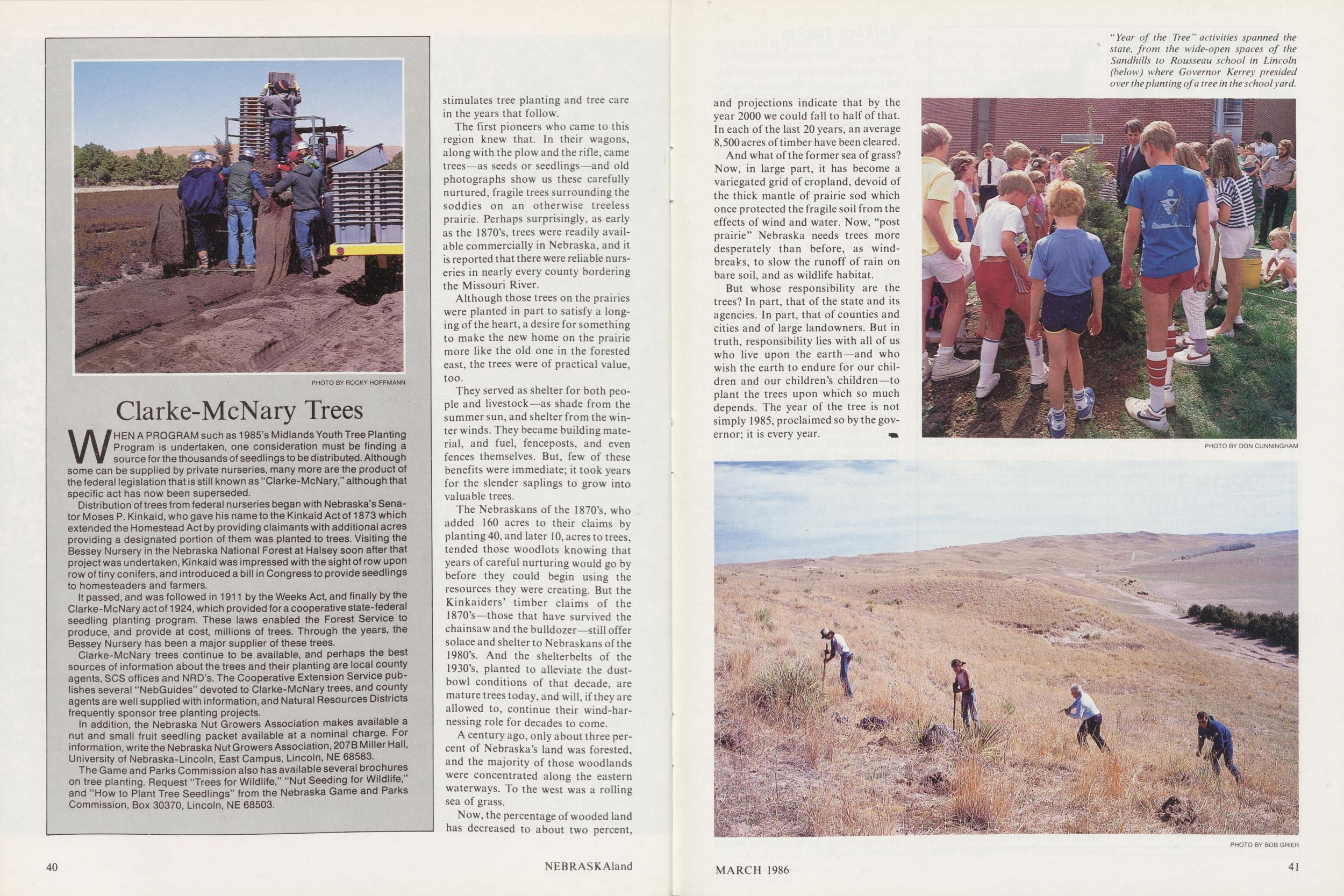
WHEN A PROGRAM such as 1985's Midlands Youth Tree Planting Program is undertaken, one consideration must be finding a source for the thousands of seedlings to be distributed. Although some can be supplied by private nurseries, many more are the product of the federal legislation that is still known as "Clarke-McNary," although that specific act has now been superseded.
Distribution of trees from federal nurseries began with Nebraska's Senator Moses P. Kinkaid, who gave his name to the Kinkaid Act of 1873 which extended the Homestead Act by providing claimants with additional acres providing a designated portion of them was planted to trees. Visiting the Bessey Nursery in the Nebraska National Forest at Halsey soon after that project was undertaken, Kinkaid was impressed with the sight of row upon row of tiny conifers, and introduced a bill in Congress to provide seedlings to homesteaders and farmers.
It passed, and was followed in 1911 by the Weeks Act, and finally by the Clarke-McNary act of 1924, which provided for a cooperative state-federal seedling planting program. These laws enabled the Forest Service to produce, and provide at cost, millions of trees. Through the years, the Bessey Nursery has been a major supplier of these trees.
Clarke-McNary trees continue to be available, and perhaps the best sources of information about the trees and their planting are local county agents, SCS offices and NRD's. The Cooperative Extension Service publishes several "NebGuides" devoted to Clarke-McNary trees, and county agents are well supplied with information, and Natural Resources Districts frequently sponsor tree planting projects.
In addition, the Nebraska Nut Growers Association makes available a nut and small fruit seedling packet available at a nominal charge. For information, write the Nebraska Nut Growers Association, 207B Miller Hall, University of Nebraska-Lincoln, East Campus, Lincoln, NE 68583.
The Game and Parks Commission also has available several brochures on tree planting. Request "Trees for Wildlife," "Nut Seeding for Wildlife," and "How to Plant Tree Seedlings" from the Nebraska Game and Parks Commission, Box 30370, Lincoln, NE 68503.
The first pioneers who came to this region knew that. In their wagons, along with the plow and the rifle, came trees—as seeds or seedlings—and old photographs show us these carefully nurtured, fragile trees surrounding the soddies on an otherwise treeless prairie. Perhaps surprisingly, as early as the 1870's, trees were readily available commercially in Nebraska, and it is reported that there were reliable nurseries in nearly every county bordering the Missouri River.
Although those trees on the prairies were planted in part to satisfy a longing of the heart, a desire for something to make the new home on the prairie more like the old one in the forested east, the trees were of practical value, too.
They served as shelter for both people and livestock—as shade from the summer sun, and shelter from the winter winds. They became building material, and fuel, fenceposts, and even fences themselves. But, few of these benefits were immediate; it took years for the slender saplings to grow into valuable trees.
The Nebraskans of the 1870's, who added 160 acres to their claims by planting 40, and later 10, acres to trees, tended those woodlots knowing that years of careful nurturing would go by before they could begin using the resources they were creating. But the Kinkaiders' timber claims of the 1870's— those that have survived the chainsaw and the bulldozer—still offer solace and shelter to Nebraskans of the 1980's. And the shelterbelts of the 1930's, planted to alleviate the dustbowl conditions of that decade, are mature trees today, and will, if they are allowed to, continue their wind-harnessing role for decades to come.
A century ago, only about three percent of Nebraska's land was forested, and the majority of those woodlands were concentrated along the eastern waterways. To the west was a rolling sea of grass.
Now, the percentage of wooded land has decreased to about two percent, 40 NEBRASKAland and projections indicate that by the year 2000 we could fall to half of that. In each of the last 20 years, an average 8,500 acres of timber have been cleared.
And what of the former sea of grass? Now, in large part, it has become a variegated grid of cropland, devoid of the thick mantle of prairie sod which once protected the fragile soil from the effects of wind and water. Now, "post prairie" Nebraska needs trees more desperately than before, as windbreaks, to slow the runoff of rain on bare soil, and as wildlife habitat.
But whose responsibility are the trees? In part, that of the state and its agencies. In part, that of counties and cities and of large landowners. But in truth, responsibility lies with all of us who live upon the earth—and who wish the earth to endure for our children and our children's children—to plant the trees upon which so much depends. The year of the tree is not simply 1985, proclaimed so by the governor; it is every year.
Talking Turkey
(continued from page 10)can be called at any time of the day. Baker suggests the hunter stay high on the ridges, but not silouhetted against the skyline, and move slowly while listening intently.
"You may also wish to look for a well-used strutting ground or a watering area to sit and quietly wait. Break the silence occasionally with soft yelps, purrs, and putts. Toms will do a lot of midday strutting without gobbling, so keep alert to tail fans to show up at a considerable distance."
Baker says that a lot of hunters return to camp if the wind starts blowing. He says that they feel turkeys don't gobble, respond to the call or strut when it's windy.
"If turkeys mated only when it's calm in Nebraska, there wouldn't be any turkeys left. The problem with wind is that you can't hear them and they can't hear you. They'll come to the call in the wind, but you simply have to get close enough for them to hear you."
Most people are convinced of the effectiveness of spring calling when there is such a strong mating drive, but what about fall calling? Is a turkey call an important tool to the fall hunter, who at that time of year may harvest either sex of young or adult bird?
The dynamics of the fall hunt are entirely different. The mating instincts are gone, but another instinct is readily apparent that can be taken advantage of by the confident caller. A quick analysis of the bird should be made at this point to reveal its vulnerability.
As summer withers into fall, a strong family tie finds the hens still with their young of the year. Often these family groups are combined into large flocks. Young toms gradually break away from the family and form unisexual flocks with birds of their own age. The old or adult toms will be in somewhat of a social proximity to each other. The point is that turkeys in the fall will have a strong instinct to flock, and a wise hunter can use this to his advantage if he knows how to call.
Baker says that most fall birds are taken by hunters who surprise a large flock and quickly shoot a bird in the excitement.
"That's it the hunt's over. Pack your gear and drive home. The sad 42 NEBRASKAland part about it is that this is how multiple kills often occur with a single shot. At the least, you aren't able to select the bird you want; and think of all the enjoyment you have missed."
Baker says that his method of fall hunting starts out very much like the one just described. He walks along silently, listening for turkey talk, trying to locate a flock. If he finds a flock of young toms and wishes to attempt to harvest one with a quality experience, he slips in as close as possible without being seen, then surprises the flock, running through it yelling and waving his arms.
"If I get a good break-up, the young jakes scatter in every direction and seek a place to hide. Right from where I scatter the flock, I find a natural blind and get well hidden. I'll sit and wait maybe several minutes before I begin to call. The 4kee kee run' is probably the best call to use in this circumstance. It's the call that young birds make in the fall to get their flocks back together. Shortly, there will be other turkeys giving the same call, and singly, they will work their way to the caller."
Baker produces the "kee kee run" on a diaphragm call, and it sounds like two "kee kee"-type whistles followed by a series of short yelps. He produces the "kee kee" sound by saying the word "boy, boy" with some modifications into his call.
"The old hen assembly call can be used with favorable results at this time, as well. It's simply a series of eight to 12 yelps in succession followed and intermixed with purrs. Combine the 4kee kee run' and the hen assembly call and it's deadly.
"The old tom is probably the most difficult bird to call up in the fall, but it can be done. It takes patience because the adult toms tend to group up quietly and slowly. A torn looking for his flock will often cluck or yelp just a single syllable and listen. I once called an adult torn in after breaking the flock, with a single yelp and a long wait. Even after the long time spent between producing the call and seeing the bird, he was coming directly to the call. He knew exactly where the sound came from, and he was looking for the torn that made it."
Turkey calling is an art, but one doesn't have to be an artist to call turkeys. Knowledge and practice are the MARCH 1986 key ingredients to being successful with the call, and practice is boring boring, that is, until the reward is realized. Killing a big torn is an exciting moment for any hunter regardless of techniques, but calling a bird into range is the real reward. Incidentally, Baker took second place in the 1985 California State Turkey Calling Championships to a young caller Dan had taught to call.
Wild Portraits
(continued from page 30)his folks, which included a booklet and implements of the trade such as pencils, erasers and the like. "I learned a lot of the basics from that show, and from his books. I suppose they helped a lot of people."
All the interest and input have not ended yet. Neal believes one should continue to strive for improvement. "Looking back at my early stuff in the magazine is pretty revealing. That first piece I did, the antelope, is an example. Up to that point, it was the very best thing I had ever done. I worked hard and long on it, and when it was finished, I knew it was the best I could do. In fact, I thought I would never be able to do as well again. Yet now, as I look back at it, it appears almost amateurish to me."
A real challenge to doing the fauna art now is combining the biology with appeal. "I want it to be correct in detail, yet I also want it to look good from a distance. That is important as far as selling it."
And, selling it has become important. "When you are producing art for sale, you simply have to consider the money. A person who does it strictly for enjoyment, or as a hobby, may not care what it is worth. But, when you are supporting yourself and your family with your art, it is important." Neal and his wife, the former Susan Piccolo, have five children. The oldest is now in high school, and the youngest is three.
The prices Neal asks and gets for his works have increased over the years, perhaps even more than his quality has improved. Much of this is because of the exposure. He attends many art shows, and in addition to his work in NEBRASKAland over the years, he does occasional work for the Kansas Wildlife Magazine. He also has done art for several prints and stamps, including the 1984 Nebraska Conservation Stamp, the 1984 National Arbor Day Stamp, and the 1984 Nebraska Trout Stamp. He has illustrated two books, "Song of Bighorns" by Roberta McGowan, and "Many Moons Ago" by Ida Ferrin. He did the Nebraska Ducks Unlimited Sponsor Print, the first in the state, for 1984-85. And, he has won many awards at art shows since 1978, including "best of show" for several years at the National Wildlife Art Show. In fact, he is the featured artist at the show in 1986 at Kansas City—an honor indeed from the very top wildlife artists in the nation.
Cabela's WORLD'S FOREMOST OUT 1986 SPRING 100% SATISFACTION GUARANTEED^ Rods Reels Lures Boating Camping Outdoor Clothing Hunting Gifts and Much More. FREE CATALOG SUBSCRIPTION Mail today to reserve your Spring issue NAME ADDRESS CITY STATE ZIP 863-602 Sidney Aaahh! EXPERIENCE NEBRASKA with an affordable canoe trip by DRYLAND AQUATICS Niobrara Dismal Platte Elkhorn -YOU NAME IT- One & two day trips available canoe rental only or fully catered —WE DO IT YOUR WAY— Write for FREE brochure Dryland Aquaflcs, Rt. 1, Fremont, NE 68025 Ph. (402) 721-4177 MARCH 1986 43 Winchester Commemorative
SW
Canadian Pacific Railroad
Deluxe (Cased) i of 300 Now $895
Members Model 1 of 2000 Now $369
Standard Model 1 of 2700 Now $369
WRITE for COLORED BROCHURE & PRICE LIST
Commemorative
Firearms ltd.
2305 South 168th Street
Omaha, Nebraska 68130
Phone (402) 330-2541
Specializing In
-WINCHESTER
Commemorative Firearms
POLLUTION IS A DIRTY WORD!
Rustic living with modern design
FOUR SEASONS
LOG HOMES
The exclusive doublelog wall system consists
of two thick pine-log
exterior walls with insulation in between
walls—R-20 roof—R-35.
Four Seasons' log profile.
Choose from our broad range of plans, or
style and design your own home.
You are welcome to tour our show-home
at Lakeview, Lake McConaughy anytime.
For information contact:
FOUR SEASONS LOG HOMES
P.O. Box 221
Ogallala, NE 69153
(308) 284-4344
"CATCHMORE" WITH JOHN BOY
Spinners and Bottom Bouncers
shop 10 years of Quality Made Spinners with
20 styles in your favorite Tackle Shop
U.S.A. hand painted blades.
Hooks, Line, Beads, Clevis
1
Fish John Boy
Bottom Bouncers
1 0Z.-IV2 oz.-3 oz.
Available in
single or double hook
John Boy Spinners P.O. Box 224 Ogallala, NE 69153 U.S.A. Trade No. 1257679
Winchester Commemorative
SW
Canadian Pacific Railroad
Deluxe (Cased) i of 300 Now $895
Members Model 1 of 2000 Now $369
Standard Model 1 of 2700 Now $369
WRITE for COLORED BROCHURE & PRICE LIST
Commemorative
Firearms ltd.
2305 South 168th Street
Omaha, Nebraska 68130
Phone (402) 330-2541
Specializing In
-WINCHESTER
Commemorative Firearms
POLLUTION IS A DIRTY WORD!
Rustic living with modern design
FOUR SEASONS
LOG HOMES
The exclusive doublelog wall system consists
of two thick pine-log
exterior walls with insulation in between
walls—R-20 roof—R-35.
Four Seasons' log profile.
Choose from our broad range of plans, or
style and design your own home.
You are welcome to tour our show-home
at Lakeview, Lake McConaughy anytime.
For information contact:
FOUR SEASONS LOG HOMES
P.O. Box 221
Ogallala, NE 69153
(308) 284-4344
"CATCHMORE" WITH JOHN BOY
Spinners and Bottom Bouncers
shop 10 years of Quality Made Spinners with
20 styles in your favorite Tackle Shop
U.S.A. hand painted blades.
Hooks, Line, Beads, Clevis
1
Fish John Boy
Bottom Bouncers
1 0Z.-IV2 oz.-3 oz.
Available in
single or double hook
John Boy Spinners P.O. Box 224 Ogallala, NE 69153 U.S.A. Trade No. 1257679
Neal's entries also won third place in 1984-85, and a second place in 1986-87, in the federal "Duck Stamp" competition. Winning a first place in this judging can establish an artist, both professionally and financially, and that remains one of his goals.
And, while selecting winners from the vast number of entries in competition such as the federal stamp depends upon the whims of the judges, Neal believes that the winner each year is somehow a standout—some subtleness that just seems to suit the purpose. And, so it is with the actual painting. So much depends upon the eye rather than being entirely a matter of the functions of the hand in creating the piece.
Neal says that being able to study the subject, the details, shape, shading, contour, just everything about it, is so important to do before trying to render it. "The hand will improve with time and experience, but until you learn to study the subject first, you will never be able to portray it properly."
There is much philosophy which enters into art, and it tends to change with the times, but few subjects lend themselves to art so readily as wildlife. It is something which is appreciated by most people, at least in some form, and its appeal is relatively timeless. When one considers that the earliest art of mankind probably was the wild crea- tures that cavemen scratched into and daubed onto cave walls, it is really a matter of talent and techniques being changed. We still like wildlife adorning our walls—we can only hope that wildlife remains around for artists in the future to portray.
44 NEBRASKAlandBookshelf
By Curt Twedt Water in Nebraska: Use, Politics, Policies. James Aucoin University of Nebraska Press, Lincoln. 1984. 157 pp.; index; bibliography; black and white photographs; maps. $15.95; cloth.NO MATTER where we live or what we do, all of us have a stake in water resources. That a necessity for health and life itself has been treated so casually by so many for so long is largely a result of the abundance we enjoy. In the last few years, however, the notion of almost endless availability of water has changed considerably. Concern for water quality was impressed most forcibly upon us by print and photo accounts of Times Beach and Love Canal. The seemingly endless and expensive search for water supplies in the booming cities of southwestern U.S. is another manifestation of the fact that it is no longer business as usual.
From earliest settlement days, central and western Nebraska agriculture was hit by drought of varying intensity and duration. Small-scale irrigation in major stream valleys brought a measure of stability to communities that were located where direct diversion and gravity flow could be practiced. By the early 1900's, water from storage reservoirs in Wyoming was being delivered to the North Platte Valley in western Nebraska. Completion of Lake McConaughy and the Tri-County project in the early 1940's increased the state's irrigated acreage to about 800,000. From the 1940's on, groundwater pumped from deep wells became the prevalent method, and by the early 1980's approximately 7.5 million acres were under irrigation statewide.
The spectacular growth in irrigated agriculture was not without problems, however. Declines in groundwater levels necessitated deeper wells, increases in energy prices brought pumping costs to levels unthought of only a few years before, and evidence of increasing nitrate contamination of aquifers, are among major concerns confronting us in the 1980's.
As a natural resources reporter for the Lincoln Journal from 1978 to 1982, James Aucoin attended numerous conferences and legislative hearings, and conducted scores of interviews. Some of his observations and perceptions gained as a journalist form the basis for Water in Nebraska, Historical records also are used in providing background for understanding how water resources have influenced the state's agriculture and industry. The book's concluding chapter, "Future Options," is largely a review of the politics and economics of water resources. Anyone who has followed Nebraska's water history the past decade will find little that is new or startling. For the uninitiated, it is a readable overview. No great, sweeping reforms or panaceas are offered, and rightly so, for changes in water use and water law in the Great Plains will come by evolution and not revolution.
DUCKS UNLIMITED We need your help. Now. If you are looking for gifts that are unique and! distinctly Nebraskan, call, visit or write to: MUSEUM SHOP The State Museum of History P.O. Box 82554 131 Centennial Mall North Lincoln, NE 68501 (402)471-3447 Solomon D. Butcher ?L°l0£lp^.g*e American Dream By John E.Carter Copies of Solomon D. Butcher: Photographing the American Dream are available by mail from the Shop for $28.95 plus $2.00 postage and handling (Nebraska residents please add appropriate sales tax).Mastercard and Visa accepted. If you like, the authorwill personally inscribe your copy. For millions of Americans, Butcher's photographs epitomize the sod-house frontier. His images constitute the most extensive photographic record in existence of the generation that settled the Great Plains. Their faces are imprinted on our mind: jaunty bachelors and earnest husbands, spinster sodbusters and determined mothers, cowhands, farmhands, and former slaves—all in search of land of their own. This first book devoted to Butcher and his photos presents a unique visual chronicle of that epoch. The 120 photographs are painstakingly reproduced in duotone. $28.95 UNIVERSITY OF NEBRASKA PRESS LINCOLN, NE MARCH 1986 45 MARINER outboards are sold and serviced by a
worldwide network of dealers. They are backed by Mercury
Marine, one of the largest marine engine manufacturers in
the world.
Even though Mariners are built to run years without
serious repairs the Mariner dealer network is there if you
need it. Mariner dealers have factory trained mechanics on
duty with parts and accessories needed to service your
motor. A distribution center is located right here in
Nebraska for quick and accurate service.
Mariner outboards are protected by a one year limited
warranty, even if used for commercial purposes. That's how
confident we are in their reliability. And coming soon, a two
year extended warranty program, the details of which will
be announced shortly.
NEBRASKA DEALER NETWORK
Aden's Medicine Creek Marine
R.R. #2, Medicine Creek Reservoir
Cambridge, NE 69022
(308) 697-3774
Ames Marine Sales, Inc.
6001 Ames Avenue
Omaha, NE 68104
(402) 455-0276
Cork's Sport Shop
West Hwy. 20
Valentine, NE 69201
(402) 376-1199
Island Marine
Old West Hwy. 30
Grand Island, NE 68801
(308) 382-5691
Patt's Marine
212 So. Chestnut
Kimball, NE 69145
(308) 235-3691
OUTBOARDS
Patterson Harbor
R.R. #1, Harlan County Reservoir
Republican City, NE 68971
(308) 799-4600
Platte Valley Marine
R.R. #3, Box 826
Omaha, NE 68123
(402) 291-3478
R V Marine
Box 147, Main St. & Lovewell Res.
Webber, KS 66970
(913) 753-4791 or 753-4318
Ray's Marine
4698 Cornhusker Highway
Lincoln, NE 68504
(402) 464-4791
Spahn's Marine
Highway 138 North
Big Springs, NE 69122
(308) 889-3531
Weinmaster Marine
1319 17th St.
Scottsbluff, NE 69361
(308) 632-5334
Dealerships are still available in selected
areas. Please contact:
MASEK SPORTS DIVISION
P.O. Box 130
Gering, NE 69341
(308) 436-2800
46
NEBRASKAland
MARINER outboards are sold and serviced by a
worldwide network of dealers. They are backed by Mercury
Marine, one of the largest marine engine manufacturers in
the world.
Even though Mariners are built to run years without
serious repairs the Mariner dealer network is there if you
need it. Mariner dealers have factory trained mechanics on
duty with parts and accessories needed to service your
motor. A distribution center is located right here in
Nebraska for quick and accurate service.
Mariner outboards are protected by a one year limited
warranty, even if used for commercial purposes. That's how
confident we are in their reliability. And coming soon, a two
year extended warranty program, the details of which will
be announced shortly.
NEBRASKA DEALER NETWORK
Aden's Medicine Creek Marine
R.R. #2, Medicine Creek Reservoir
Cambridge, NE 69022
(308) 697-3774
Ames Marine Sales, Inc.
6001 Ames Avenue
Omaha, NE 68104
(402) 455-0276
Cork's Sport Shop
West Hwy. 20
Valentine, NE 69201
(402) 376-1199
Island Marine
Old West Hwy. 30
Grand Island, NE 68801
(308) 382-5691
Patt's Marine
212 So. Chestnut
Kimball, NE 69145
(308) 235-3691
OUTBOARDS
Patterson Harbor
R.R. #1, Harlan County Reservoir
Republican City, NE 68971
(308) 799-4600
Platte Valley Marine
R.R. #3, Box 826
Omaha, NE 68123
(402) 291-3478
R V Marine
Box 147, Main St. & Lovewell Res.
Webber, KS 66970
(913) 753-4791 or 753-4318
Ray's Marine
4698 Cornhusker Highway
Lincoln, NE 68504
(402) 464-4791
Spahn's Marine
Highway 138 North
Big Springs, NE 69122
(308) 889-3531
Weinmaster Marine
1319 17th St.
Scottsbluff, NE 69361
(308) 632-5334
Dealerships are still available in selected
areas. Please contact:
MASEK SPORTS DIVISION
P.O. Box 130
Gering, NE 69341
(308) 436-2800
46
NEBRASKAland
Trading Post
DOGSTRAINING ALL BREEDS Hunting Dogs—Vizslas for sale. Rozanek Kennels, Rt. 2, Schuyler, NE 68661. Phone (402) 352-8769.
A FEW HUNTING dogs for sale: Brittanies, English setters. German Shorthairs. Darrell Yentes, Phone (308) 995-8570 or (308) 995 4797 after 5 p.m.
ENGLISH SETTERS and Labradors: "Bred for the hunter"; outstanding bloodlines! Puppies, started dogs and stud service available. High Plains Kennels, 1411 Emerson, Alliance, Nebr. 69301. Phone (308) 762-6709.
GERMAN SHORTHAIR Pointers - pups, started dogs, occasionally a finished meat dog. Wayne Clark (712) 529-4238 after 10:00 p.m. or (402) 263-3495. Union, Nebr.
BRITTANY PUPS: From quality breeding program. Excellent gundogs. Free brochure. Guaranteed. Grouseway Gundogs, HC1, Box 126. Stapleton, NE 69163. Phone (308) 636-2495.
MISCELLANEOUSCOMPLETE FUR Service: repair, restyling, large inventory of new coats at saving prices. Will custommake garments from your skins, either raw or dressed. Offer service of tanning including all fine skins, deer and sheep. 50 years' experience. Hacker's Furriers, Alma Tanning Co., Box 270, Alma, NE 68920.
FISH FOR SALE. Channel catfish, bass, bluegill, crappie, trout, perch, white bass, minnows, hybrid grass carp, bullhead. We can ship fish, you can pick them up, or we can deliver. Contact the Pleasant Valley Fish Farm, Rt. 1, McCook, NE 69001. Phone (308) 345-6599.
N.E. NEBRASKA TROUT Fishing, For rent Mon.-Thurs. or Fri.-Sun. 2 modern cottages completely fur- nished, 5 spring-fed lakes with trout up to 7 lbs. Bass and bluegill also. Diamond E Trout Resort, Orchard, NE 68764. (402) 893-4745.
GUNS — Browning, Winchester, Remington, others, Hi-powers, shotguns, new, used, antiques. Want Pre1964 Winchesters. Buy-Sell-Trade. Ph. (402) 729-6112. Bedlan's Sporting Goods, Fairbury, NE 68352.
AIR GUNS repaired—Benjamin, Crosman, Daisy, other American made. Restoration; old guns wanted, Jack's Air Guns, 1225 No. 46th, Lincoln, NE 68503. Phone (402) 466-9223.
MAD RIVER CANOES offers the finest quality and performance. For the finest canoes and accessories look to Great Plains Canoe Co., 205 Main, Springfield, NE. Phone (402) 253-2001.
WINE AND BEER: Make your own. Send for free recipes and instructions. Omaha Supply, 1324 2nd Avenue, Nebraska City, NE 68410.
FULL-WINGED Mandarin ducks, $35 pair. Mrs. R. W. Hansen, 3315 Avenue L, Kearney, NE 68847. Phone (308) 237-3781.
FISHERMEN—we offer quality repair work for your rods and reels. A large parts inventory and bulk line at reasonable prices. John's Rod and Reel Service, 1112 Pierce Street, Norfolk, NE 68701. Phone (402) 371-5988.
HABITAT STAMPS. Have all nine Nebraska Habitat Stamps. Will sell for best offer. Milton Jacobsen, Box 77, Dannebrog, NE 68831.
WINCHESTER COMMEMORAT1VES: Canadian Pacific Railroad Standard $369.00, Members Model $369.00, Deluxe Cased $895.00; Calgary Stampede Deluxe Cased $895.00; US Border Patrol with Print $395.00; Saskatchewan Diamond Jubilee $395.00; Great Western Artist I & II Deluxe Cased $799.00each. Commemorative Firearms LTD, 2305 South 168th Street, Omaha, Nebr. 68130. Phone (402) 330-2541.
FOR SALE: wild turkeys. Phone (402) 643-2365 or 643-2586.
,1 out of A forest fires are started by trash fires. STOCK YOUR LAKE OR POND WITH Channel cat, Bluegill Hybrid Bluegill, Largemouth Bass, Crappie, Bullheads, Triploid Grass Carp, Minnows WILLOW LAKE FISH HATCHERY Rt. 3, Box 46, Hastings, Nebr. 68901 Gaylord L Crawford Phone: (402) 463-8022 Day or Night For April to October 15 stocking NEBRASKAland Magazine Order Form Please send me a subscription to NEBRASKAland Magazine which will include January's special, "Fort Robinson." One-year $9.50 NAME. ADDRESS I__I Two-year $18 Three-year $27 STATE Ma/7 to: NEBRASKAland, Box 30370, Lincoln, NE 68503 TAXIDERMYPLATTE VALLEY TAXIDERMY, Museum quality mounts using latest scientific methods. 1985 World Taxidermy Competition winner. Delton Wegner, 617 "H" Street, Central City, NE 68826. Telephone (308) 946-3773.
ALLISON'S TAXIDERMY STUDIO: Wally and Betty Allison, Licensed Taxidermist. We've mounted 18 Nebraska State Record fish. Specializing in fish and birds, small game and rattlesnakes. We use freeze-dry. 2709 Birchwood Rd., North Platte, Nebr. 69101. Phone (308) 534-2324.
BADE TAXIDERMY Quality a must Fast service. Fish, birds, rugs, tanning, full mounts and game heads, 2111 N. Christy St., Fremont, Nebraska 727-5463.
KARL SCHWARZ master taxidermist has moved to a new country studio; same professional mounting and tanning service. Schwarz Wild Wing Studio, 16804 South 180th St., Springfield, NE 68059. Phone (402) 253-2481.
CREATIVE TAXIDERMY in all its branches since 1935, now includes Northstar Freeze-Dry processing of approved small specimens. Also tanning and deerskin processing. Naturecraft Studio, Nebraska City, Nebraska 68510. Joe Voges-Owner. Phone (402) 873-5491.
JOHNSON TAXIDERMY servicing southwest Nebraska, specializing in big-game mounts, life-sized mounts, rug work, fish, birds, tanning hair-on leather. Brochure and price list on request. Johnson Taxidermy, Rt. 1, Box 78, Lamar, NE 69035. Telephone (308) 882-5555.
BIG BEAR TAXIDERMY, Rt. 2, Mitchell, Nebraska 69357. We specialize in all big game heads from Alaska to Nebraska, also birds and fish. Hair-on and hair-off tanning. 41 miles west of Scottsbluff on Highwav 26. Dale Hubel, phone (308) 635-3013.
DINGES TAXIDERMY Studio, 2763 So. 12th St., Omaha, NE 68108. Fourteen-time National Award Winning Taxidermy, Trust your trophies to a proven winner. Complete professional service. Mike and Mary Dinges. (402) 342-3718.
NABITY'S TAXIDERMY. 31 years experience. Specializing in natural grass backgrounds for mammals, birds and fish. 13901 "O" St., Lincoln, NE 68504 — 4 miles east of 84th and "O". (402) 489-6351.
PEISTER TAXIDERMY—a name you can trust. Now in our new location. We give you professional work at prices most sportsmen can afford. Look for the new log building at 1020 Central Avenue. Box 3201, Kearney, NE 68847. Phone (308) 236-9700 or 237-7575 evenings.
K&M TAXIDERMY — we do natural mounts you will be proud of. Fish, birds and game heads. Rt. 2, Box 175, Norfolk, NE 68701. Phone (402) 675-1862.
HOUSE OF BIRDS. Licensed taxidermist with 18 years' experience. Specialize in birds and game heads. Pheasant $47.50; deer head $87.50; Quail $35 a pair. For more information call (402) 228-3959.
LIVE-CATCH ALL-PURPOSE TRAPS for FREE CATALOG Traps without injury squirrels, chipmunks, rabbits, mink, fox, raccoons, stray animals, pests, etc. Sizes for every need. Also traps for snakes, sparrows, pigeons, crabs, turtles, quail, etc. Save on our low factory prices. Send no money. Free catalog and trapping secrets. MUSTANG MFG. CO., Dept. N-34, Box 920947, Houston, Tex. 77292 Harlan County Dam Vacation Apartments - fully furnished Color TV • Kitchen Facilities • Full Baths Game cleaning room with freezer One block from shopping center Weekend or week of pleasant living Security Deposit Required Sorry —No Pets Dean and Esther Stone Box 145 Ph. (308) 799-3422 Republican City, NE 68971 MARCH 1986 47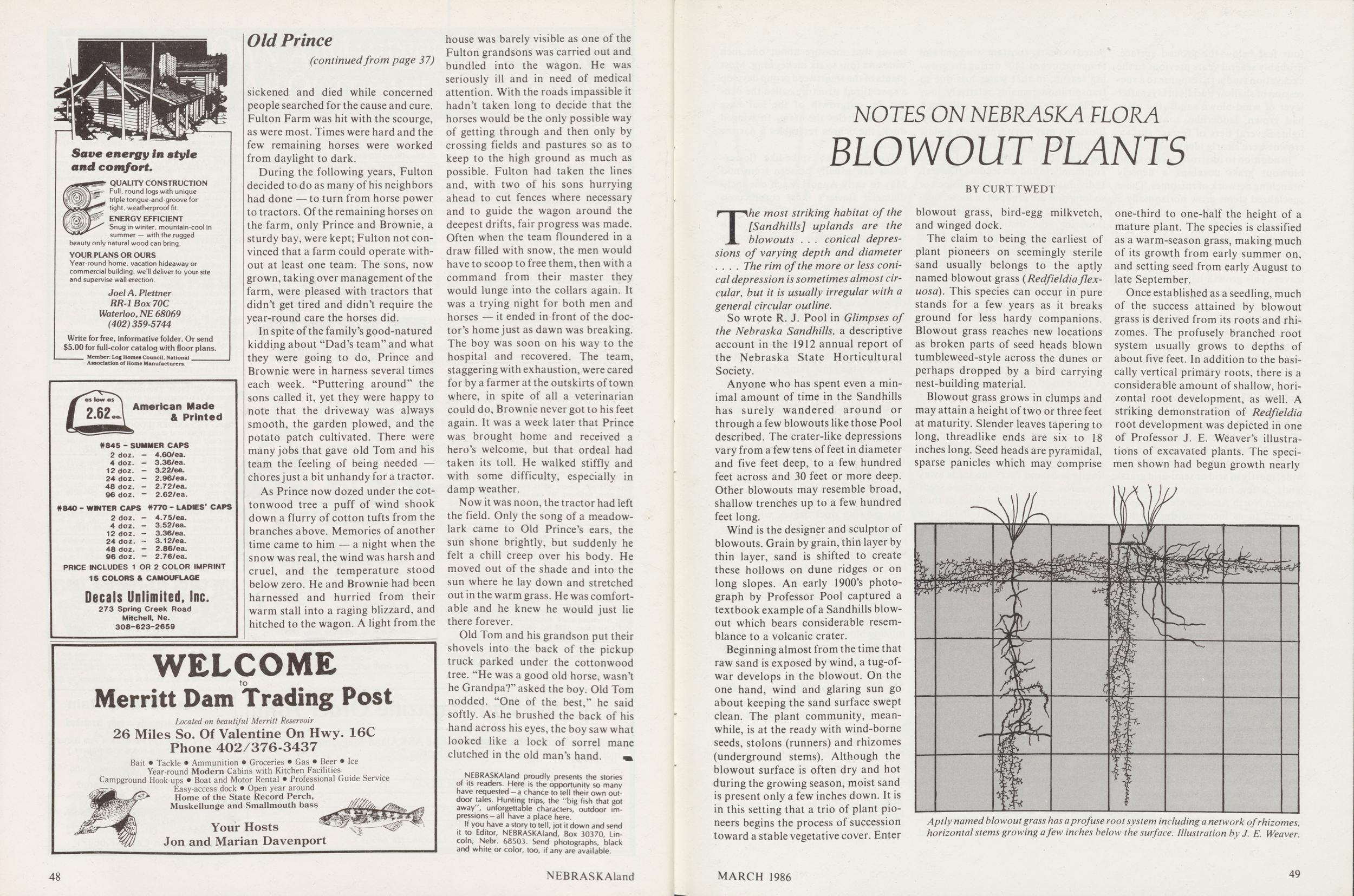 Save energy in style
and comfort.
QUALITY CONSTRUCTION
Full, round logs with unique
triple tongue-and-groove for
tight, weatherproof fit.
ENERGY EFFICIENT
Snug in winter, mountain-cool in
summer — with the rugged
beauty only natural wood can bring.
YOUR PLANS OR OURS
Year-round home, vacation hideaway or
commercial building, we'll deliver to your site
and supervise wall erection.
Joel A. Plettner
RR-1 Box 70C
Waterloo, NE 68069
(402) 359-5744
Write for free, informative folder. Or send
$5.00 for full-color catalog with floor plans.
Member: Log Homes Council. National
Association of Home Manufacturers.
American Made
& Printed
#845 SUMMER CAPS
2 doz.
4 doz.
12 doz.
24 doz.
48 doz.
96 doz.
#840 WINTER CAPS
2 doz.
4 doz.
12 doz.
24 doz.
48 doz.
96 doz.
4.60/ea.
3.36/ea.
3.22/ea.
2.96/ea.
2.72/ea.
2.62/ea.
#770 LADIES' CAPS
4.75/ea.
3.52/ea.
3.36/ea.
3.12/ea.
2.86/ea.
2.76/ea.
PRICE INCLUDES 1 OR 2 COLOR IMPRINT
15 COLORS & CAMOUFLAGE
Decals Unlimited, Inc.
273 Spring Creek Road
Mitchell. Ne.
308-623-2659
WELCOME
to
Merritt Dam Trading Post
Located on beautiful Merritt Reservoir
26 Miles So. Of Valentine On Hwy. 16C
Phone 402/376-3437
Bait • Tackle • Ammunition • Groceries • Gas • Beer • Ice
Year-round Modern Cabins with Kitchen Facilities
Campground Hook-ups • Boat and Motor Rental • Professional Guide Service
Easy-access dock • Open year around
Home of the State Record Perch,
Muskellunge and Smallmouth bass
Your Hosts
Jon and Marian Davenport
Save energy in style
and comfort.
QUALITY CONSTRUCTION
Full, round logs with unique
triple tongue-and-groove for
tight, weatherproof fit.
ENERGY EFFICIENT
Snug in winter, mountain-cool in
summer — with the rugged
beauty only natural wood can bring.
YOUR PLANS OR OURS
Year-round home, vacation hideaway or
commercial building, we'll deliver to your site
and supervise wall erection.
Joel A. Plettner
RR-1 Box 70C
Waterloo, NE 68069
(402) 359-5744
Write for free, informative folder. Or send
$5.00 for full-color catalog with floor plans.
Member: Log Homes Council. National
Association of Home Manufacturers.
American Made
& Printed
#845 SUMMER CAPS
2 doz.
4 doz.
12 doz.
24 doz.
48 doz.
96 doz.
#840 WINTER CAPS
2 doz.
4 doz.
12 doz.
24 doz.
48 doz.
96 doz.
4.60/ea.
3.36/ea.
3.22/ea.
2.96/ea.
2.72/ea.
2.62/ea.
#770 LADIES' CAPS
4.75/ea.
3.52/ea.
3.36/ea.
3.12/ea.
2.86/ea.
2.76/ea.
PRICE INCLUDES 1 OR 2 COLOR IMPRINT
15 COLORS & CAMOUFLAGE
Decals Unlimited, Inc.
273 Spring Creek Road
Mitchell. Ne.
308-623-2659
WELCOME
to
Merritt Dam Trading Post
Located on beautiful Merritt Reservoir
26 Miles So. Of Valentine On Hwy. 16C
Phone 402/376-3437
Bait • Tackle • Ammunition • Groceries • Gas • Beer • Ice
Year-round Modern Cabins with Kitchen Facilities
Campground Hook-ups • Boat and Motor Rental • Professional Guide Service
Easy-access dock • Open year around
Home of the State Record Perch,
Muskellunge and Smallmouth bass
Your Hosts
Jon and Marian Davenport
Old Prince
(continuedfrom page 37)sickened and died while concerned people searched for the cause and cure. Fulton Farm was hit with the scourge, as were most. Times were hard and the few remaining horses were worked from daylight to dark.
During the following years, Fulton decided to do as many of his neighbors had done — to turn from horse power to tractors. Of the remaining horses on the farm, only Prince and Brownie, a sturdy bay, were kept; Fulton not convinced that a farm could operate without at least one team. The sons, now grown, taking over management of the farm, were pleased with tractors that didn't get tired and didn't require the year-round care the horses did.
In spite of the family's good-natured kidding about "Dad's team" and what they were going to do, Prince and Brownie were in harness several times each week. "Puttering around" the sons called it, yet they were happy to note that the driveway was always smooth, the garden plowed, and the potato patch cultivated. There were many jobs that gave old Tom and his team the feeling of being needed chores just a bit unhandy for a tractor.
As Prince now dozed under the Cottonwood tree a puff of wind shook down a flurry of cotton tufts from the branches above. Memories of another time came to him — a night when the snow was real, the wind was harsh and cruel, and the temperature stood below zero. He and Brownie had been harnessed and hurried from their warm stall into a raging blizzard, and hitched to the wagon. A light from the house was barely visible as one of the Fulton grandsons was carried out and bundled into the wagon. He was seriously ill and in need of medical attention. With the roads impassible it hadn't taken long to decide that the horses would be the only possible way of getting through and then only by crossing fields and pastures so as to keep to the high ground as much as possible. Fulton had taken the lines and, with two of his sons hurrying ahead to cut fences where necessary and to guide the wagon around the deepest drifts, fair progress was made. Often when the team floundered in a draw filled with snow, the men would have to scoop to free them, then with a command from their master they would lunge into the collars again. It was a trying night for both men and horses — it ended in front of the doctor's home just as dawn was breaking. The boy was soon on his way to the hospital and recovered. The team, staggering with exhaustion, were cared for by a farmer at the outskirts of town where, in spite of all a veterinarian could do, Brownie never got to his feet again. It was a week later that Prince was brought home and received a hero's welcome, but that ordeal had taken its toll. He walked stiffly and with some difficulty, especially in damp weather.
Now it was noon, the tractor had left the field. Only the song of a meadowlark came to Old Prince's ears, the sun shone brightly, but suddenly he felt a chill creep over his body. He moved out of the shade and into the sun where he lay down and stretched out in the warm grass. He was comfortable and he knew he would just lie there forever.
Old Tom and his grandson put their shovels into the back of the pickup truck parked under the cottonwood tree. "He was a good old horse, wasn't he Grandpa?" asked the boy. Old Tom nodded. "One of the best," he said softly. As he brushed the back of his hand across his eyes, the boy saw what looked like a lock of sorrel mane clutched in the old man's hand.
NEBRASKAland proudly presents the stories of its readers. Here is the opportunity so many have requested -a chance to tell their own outdoor tales. Hunting trips, the "big fish that got away", unforgettable characters, outdoor impressions-all have a place here.
If you have a story to tell, jot it down and send it to Editor, NEBRASKAIand, Box 30370, Lincoln, Nebr. 68503. Send photographs, black and white or color, too, if any are available.
48 NEBRASKAlandNOTES ON NEBRASKA FLORA BLOWOUT PLANTS
BY CURT TWEDTThe most striking habitat of the [Sandhills] uplands are the blowouts conical depressions of varying depth and diameter The rim of the more or less conical depression is sometimes almost circular, but it is usually irregular with a general circular outline.
So wrote R. J. Pool in Glimpses of the Nebraska Sandhills, a descriptive account in the 1912 annual report of the Nebraska State Horticultural Society.
Anyone who has spent even a minimal amount of time in the Sandhills has surely wandered around or through a few blowouts like those Pool described. The crater-like depressions vary from a few tens of feet in diameter and five feet deep, to a few hundred feet across and 30 feet or more deep. Other blowouts may resemble broad, shallow trenches up to a few hundred feet long.
Wind is the designer and sculptor of blowouts. Grain by grain, thin layer by thin layer, sand is shifted to create these hollows on dune ridges or on long slopes. An early I900's photograph by Professor Pool captured a textbook example of a Sandhills blowout which bears considerable resemblance to a volcanic crater.
Beginning almost from the time that raw sand is exposed by wind, a tug-of-war develops in the blowout. On the one hand, wind and glaring sun go about keeping the sand surface swept clean. The plant community, meanwhile, is at the ready with wind-borne seeds, stolons (runners) and rhizomes (underground stems). Although the blowout surface is often dry and hot during the growing season, moist sand is present only a few inches down. It is in this setting that a trio of plant pioneers begins the process of succession toward a stable vegetative cover. Enter blowout grass, bird-egg milkvetch, and winged dock.
The claim to being the earliest of plant pioneers on seemingly sterile sand usually belongs to the aptly named blowout grass (Redfieldia flexuosa). This species can occur in pure stands for a few years as it breaks ground for less hardy companions.
Blowout grass reaches new locations as broken parts of seed heads blown tumbleweed-style across the dunes or perhaps dropped by a bird carrying nest-building material. Blowout grass grows in clumps and may attain a height of two or three feet at maturity. Slender leaves tapering to long, threadlike ends are six to 18 inches long. Seed heads are pyramidal, sparse panicles which may comprise one-third to one-half the height of a mature plant. The species is classified as a warm-season grass, making much of its growth from early summer on, and setting seed from early August to late September.
Once established as a seedling, much of the success attained by blowout grass is derived from its roots and rhizomes. The profusely branched root system usually grows to depths of about five feet. In addition to the basically vertical primary roots, there is a considerable amount of shallow, horizontal root development, as well. A striking demonstration of Redfieldia root development was depicted in one of Professor J. E. Weaver's illustrations of excavated plants. The specimen shown had begun growth nearly
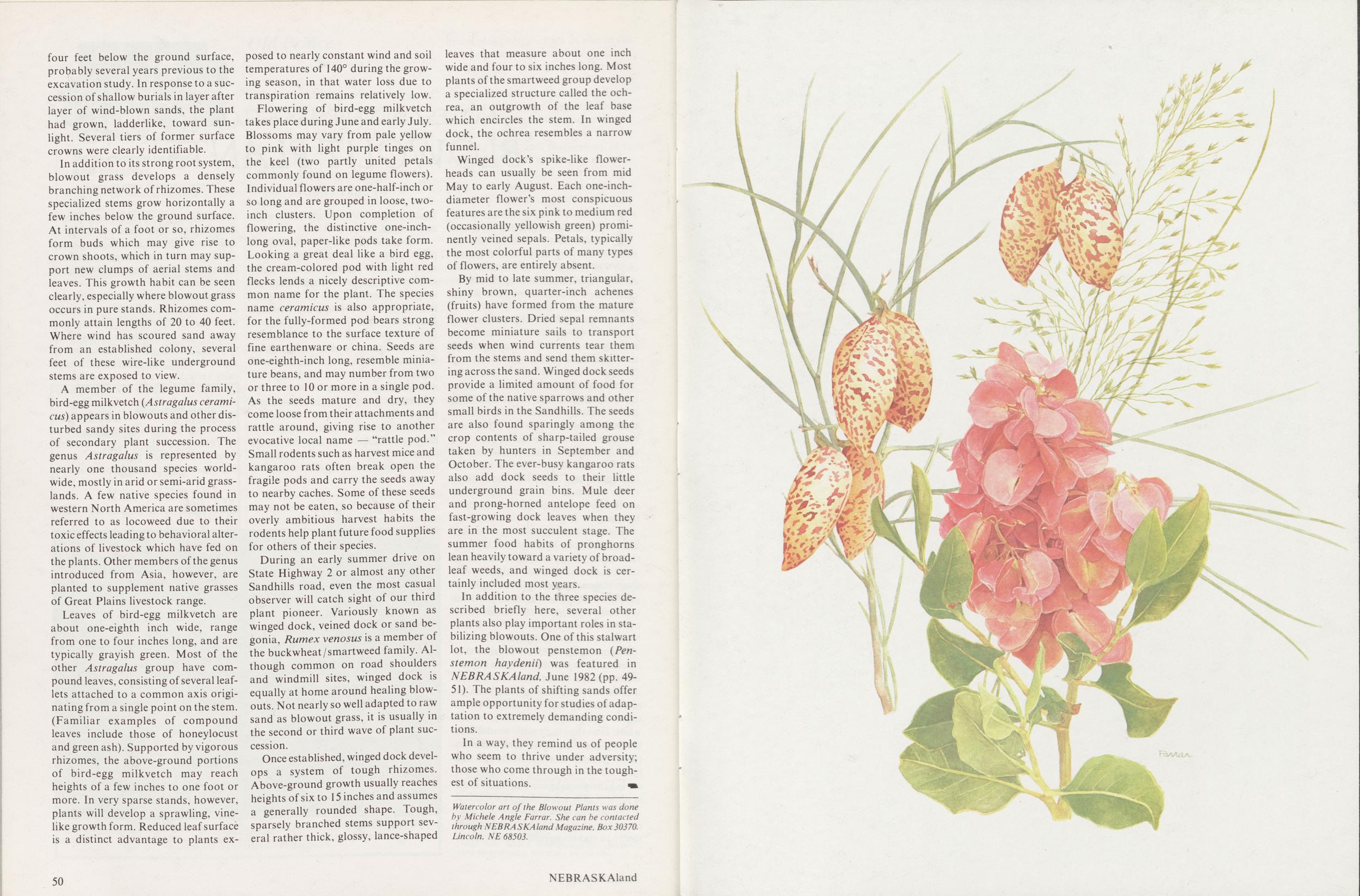 four feet below the ground surface,
probably several years previous to the
excavation study. In response to a succession of shallow burials in layer after
layer of wind-blown sands, the plant
had grown, ladderlike, toward sunlight. Several tiers of former surface
crowns were clearly identifiable.
four feet below the ground surface,
probably several years previous to the
excavation study. In response to a succession of shallow burials in layer after
layer of wind-blown sands, the plant
had grown, ladderlike, toward sunlight. Several tiers of former surface
crowns were clearly identifiable.
In addition to its strong root system, blowout grass develops a densely branching network of rhizomes. These specialized stems grow horizontally a few inches below the ground surface. At intervals of a foot or so, rhizomes form buds which may give rise to crown shoots, which in turn may support new clumps of aerial stems and leaves. This growth habit can be seen clearly, especially where blowout grass occurs in pure stands. Rhizomes commonly attain lengths of 20 to 40 feet. Where wind has scoured sand away from an established colony, several feet of these wire-like underground stems are exposed to view.
A member of the legume family, bird-egg milkvetch (Astragalus ceramicus) appears in blowouts and other disturbed sandy sites during the process of secondary plant succession. The genus Astragalus is represented by nearly one thousand species world-wide, mostly in arid or semi-arid grasslands. A few native species found in western North America are sometimes referred to as locoweed due to their toxic effects leading to behavioral alterations of livestock which have fed on the plants. Other members of the genus introduced from Asia, however, are planted to supplement native grasses of Great Plains livestock range.
Leaves of bird-egg milkvetch are about one-eighth inch wide, range from one to four inches long, and are typically grayish green. Most of the other Astragalus group have compound leaves, consisting of several leaflets attached to a common axis originating from a single point on the stem. (Familiar examples of compound leaves include those of honeylocust and green ash). Supported by vigorous rhizomes, the above-ground portions of bird-egg milkvetch may reach heights of a few inches to one foot or more. In very sparse stands, however, plants will develop a sprawling, vinelike growth form. Reduced leaf surface is a distinct advantage to plants exposed to nearly constant wind and soil temperatures of 140° during the growing season, in that water loss due to transpiration remains relatively low.
Flowering of bird-egg milkvetch takes place during June and early July. Blossoms may vary from pale yellow to pink with light purple tinges on the keel (two partly united petals commonly found on legume flowers). Individual flowers are one-half-inch or so long and are grouped in loose, twoinch clusters. Upon completion of flowering, the distinctive one-inch-long oval, paper-like pods take form. Looking a great deal like a bird egg, the cream-colored pod with light red flecks lends a nicely descriptive common name for the plant. The species name ceramicus is also appropriate, for the fully-formed pod bears strong resemblance to the surface texture of fine earthenware or china. Seeds are one-eighth-inch long, resemble miniature beans, and may number from two or three to 10 or more in a single pod. As the seeds mature and dry, they come loose from their attachments and rattle around, giving rise to another evocative local name — "rattle pod." Small rodents such as harvest mice and kangaroo rats often break open the fragile pods and carry the seeds away to nearby caches. Some of these seeds may not be eaten, so because of their overly ambitious harvest habits the rodents help plant future food supplies for others of their species.
During an early summer drive on State Highway 2 or almost any other Sandhills road, even the most casual observer will catch sight of our third plant pioneer. Variously known as winged dock, veined dock or sand begonia, Rumex venosus is a member of the buckwheat /smartweed family. Although common on road shoulders and windmill sites, winged dock is equally at home around healing blowouts. Not nearly so well adapted to raw sand as blowout grass, it is usually in the second or third wave of plant succession.
Once established, winged dock develops a system of tough rhizomes. Above-ground growth usually reaches heights of six to 15 inches and assumes a generally rounded shape. Tough, sparsely branched stems support several rather thick, glossy, lance-shaped leaves that measure about one inch wide and four to six inches long. Most plants of the smartweed group develop a specialized structure called the ochrea, an outgrowth of the leaf base which encircles the stem. In winged dock, the ochrea resembles a narrow funnel.
Winged dock's spike-like flowerheads can usually be seen from mid May to early August. Each one-inch-diameter flower's most conspicuous features are the six pink to medium red (occasionally yellowish green) prominently veined sepals. Petals, typically the most colorful parts of many types of flowers, are entirely absent.
By mid to late summer, triangular, shiny brown, quarter-inch achenes (fruits) have formed from the mature flower clusters. Dried sepal remnants become miniature sails to transport seeds when wind currents tear them from the stems and send them skittering across the sand. Winged dock seeds provide a limited amount of food for some of the native sparrows and other small birds in the Sandhills. The seeds are also found sparingly among the crop contents of sharp-tailed grouse taken by hunters in September and October. The ever-busy kangaroo rats also add dock seeds to their little underground grain bins. Mule deer and prong-horned antelope feed on fast-growing dock leaves when they are in the most succulent stage. The summer food habits of pronghorns lean heavily toward a variety of broadleaf weeds, and winged dock is certainly included most years.
In addition to the three species described briefly here, several other plants also play important roles in stabilizing blowouts. One of this stalwart lot, the blowout penstemon (Penstemon haydenii) was featured in NEBRASKAland, June 1982 (pp. 4951). The plants of shifting sands offer ample opportunity for studies of adaptation to extremely demanding conditions.
In a way, they remind us of people who seem to thrive under adversity; those who come through in the toughest of situations.
Watercolor art of the Blowout Plants was done by Michele Angle Farrar. She can be contacted through NEBRASKAland Magazine, Box30370. Lincoln, NE 68503.
50 NEBRASKAland
My Choice, Nebraska
Nebraska has been the choice of travelers since the mountain men broke the trail West. The likes of Jim Bridger, Kit Carson and Jedediah Smith saddled their mounts, packed their powder and opened a brand new land.
Their trail came to be known as the Great Platte River Road a trail cutting through the heart of Nebraska. Where fortune seekers streamed to the fabled California gold fields. Where Mark Twain rode the Overland Stage to high adventure. Where a young "Buffalo Bill" Cody became a legendary rider of the Pony Express. Where wagon trains brought the pioneers to their Promised Land. And where the Union Pacific brought settlers from the Old World into the new.
Make your choice Nebraska. Where you can actually walk in the wagon ruts of the Oregon Trail. Where you can hike to the top of Scotts Bluff National Monument and walk down the streets of Old West Towns.
Nebraska. Where you can see Pony Express Stations, Wild West rodeos, street dances and festivals. Make your choice Nebraska. And have some mighty Good Times!
Position: 541 (20 views)