Volume 63, Issue 11, 1985
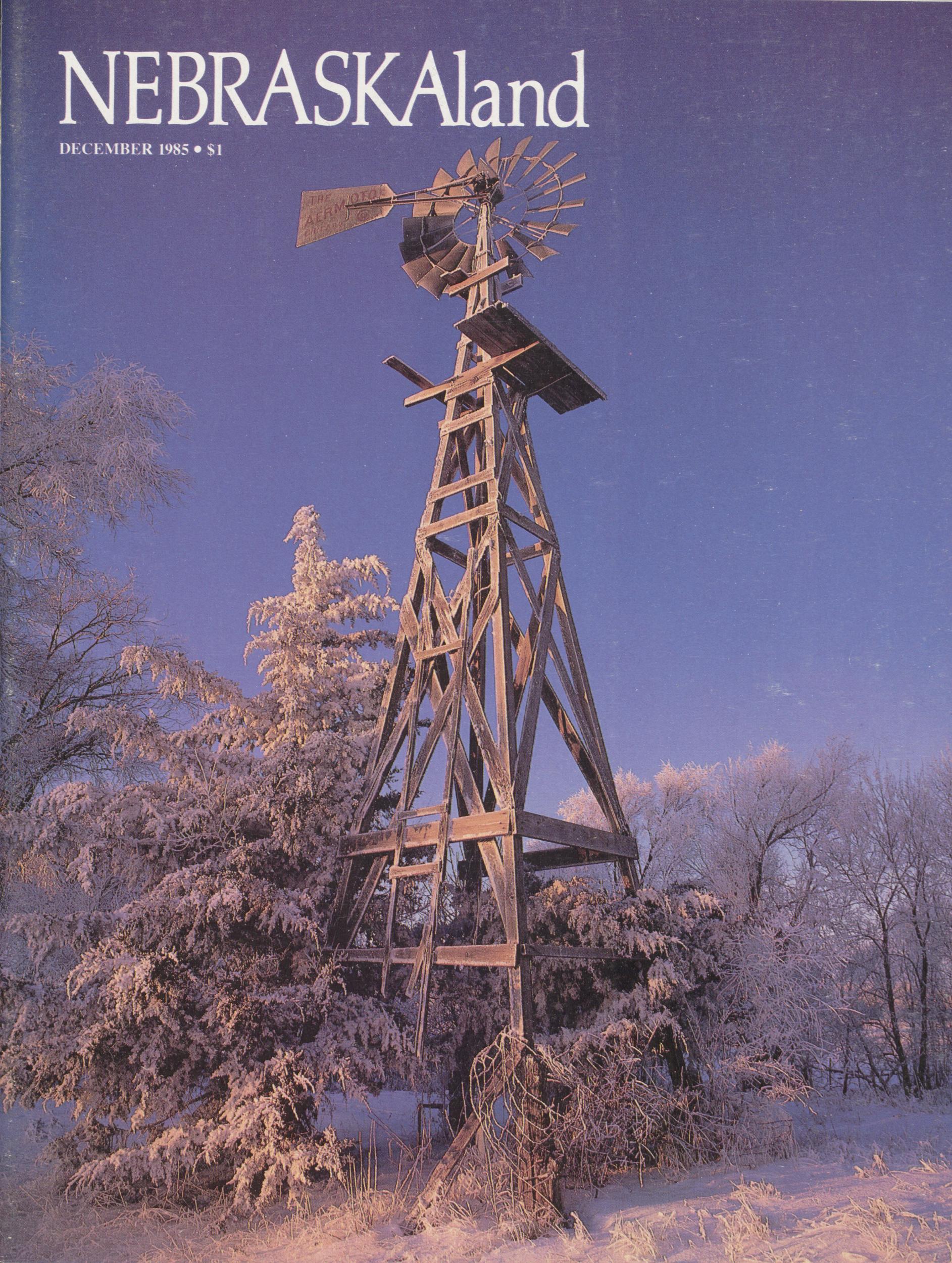
NEBRASKAland
DECEMBER 1985 $1
NEBRASKAland
Published by the Nebraska Game and Parks Commission NEBRASKAland VOL. 63/NO. 11/DEC. 1985 NEBRASKAland (ISSN:0028-1964) is published monthly except for a combined January/February issue, by the Nebraska Game and Parks Commission, 2200 North 33rd Street, Lincoln, NE. Copyright 1986, all rights reserved. Second-class postage paid at Lincoln, Nebraska and at additional mailing offices. POSTMASTER: Send address changes to NEBRASKAland, Box 30370, Lincoln, NE 68503. Rates: $9.50 for one year; $18 for two years. Single copy price $1. Offices Headquarters 2200 N. 33rd, Lincoln, 68503 (402) 464-0641 13th and Farnam St., Omaha (402) 554-2144 Ak-Sar-Ben Aquarium, Gretna (402) 332-3901 Rt. 2, Alliance (308) 762-5605 Bassett (402) 684-3511 U.S. 81, Norfolk (402) 371-4950 Rt. 4, North Platte (308) 532-6225 Commissioners Chairman: Charles E. Wright, Lincoln Vice Chairman: Richard L. Coyne, Omaha 2nd Vice Chairman: Neal Keller, Brewster Dr. Tim Biga, Norfolk Stan Juelfs, Kimball Wayne Ziebarth, Wilcox LaVern Schneider, McCook Director: Eugene T. Mahoney Assistant Directors: William J. Bailey, Jr., Dale R. Bree, W. Rex Amack Staff Chief, Information & Education: Jim MacAllister Editor: Lowell Johnson Senior Editor: Jon Farrar Associate Editors: Ken Bouc, Don Cunningham Regional Editors: Bob Grier, Rocky Hoffmann Contributors: Tom Keith, Liz Huff, Carl Wolfe Research Assistant: Curt Twedt Art Director: Duane Westerholt Illustration: Steve O'Hare, Paula Day. Dan Curran Circulation: Pat FrahmNEBRASKAland Published by the Nebraska Game and Parks Commission
Contents A new home for history 6 Two rivers: Ten cabooses 14 Bringing back the ringneck 18 Trapping . . . providing furs and management 22 Return to horseshoe-bar ranch . . . Part II 32 Arts with a case 38 Notes on Nebraska Flora/The Oaks 49 Departments Speak Up 4 Trading Post 46
Speak Up
DECEMBER The air is crisp, the sky is clear,the stars are very bright
It makes one think of Bethlehem
on that first Christmas night.
Our land is flat, no rolling hills,
but people are the same
For we must be with those who share
with us our family name.
Things from our past are on the tree,
on top an angel glows
The big green wreath goes on the door,
as everybody knows.
The tables groan with special foods
and there's a wassail bowl
Or some things from your heritage
which really please your soul.
Then there are sleds and skates
and — so much to remember,
Nebraska is a special place
in beautiful December. Mildred Andrews Larson Kind words Kind words
Sir/ For the past two years, we have subscribed to NEBR ASK Aland for our friend, Robert Gemmell, M.A., history department, St. Mary's Academy, Bathgate, Scotland. Enclosed is an exerpt from a recent letter with some comments we thought might be of interest to you and the readers of your fine magazine.
Mr. and Mrs. H. E. Hutchinson Alliance, Nebr.'The project on the USA is in its second year, and the pupils have produced some great work on early settlement and 19th century. The material you have been sending has played an important part in the success of this project, and I again express my gratitude for your kindness.
"I have often intended to write to the NEBR ASK Aland, for it has provided material in many areas. The historical articles are 4 NEBRASKAland ideal for use in our project. However, we have to fight to hang on to them. Art teachers want them for the paintings; outdoor education wants them; the Conservation Society wants them; the Young Ornithology Club, the Geography Department, and even those fortunate enough to be going on holiday to the States. Perhaps you might like to inform the publishers of how popular their magazine is, in a small town school thousands of miles away. For children who will probably never see the USA, it is much more informative than the image they get from television programmes and the cinema. It balances Hollywood's version of the West, both in the past and present. To me, it gives a picture of the real America, and for this alone its value cannot be overstated."
* * * First turkeySir/ As avid Nebraska outdoor lovers, we certainly enjoy your magazine in this family! Just had to share this photo with you. Our son's first turkey — a 25-pounder he carried two miles back to camp in the Pine Ridge area. This is just how a tired but happy 14-year-old hunter looks with his first wild tur- key! I'm surprised his father could shoot such a good photo while "jumping for joy.'
Mrs. Gordon D. Bainbridge Grand Island, Nebr.Sir/ Enjoy every page of NEBRASKAland. Love both the inside pictures — whitebreasted nuthatch and the American woodcock (September 1985). Enjoyed the Stuhr Museum blacksmith coverage, and needless to say, your grape coverage. I just received a letter from my sister at Nampa, Idaho, and a clipping on the Ste. Chapelle winery there. You can't believe the increase in grape acreage there every year. We certainly can grow something beside tall corn in Nebraska.
Vera Coons Grand Island, Nebr. * * * Looking for sights?Sir/1 enjoy NEBRASKAland as it is. But, being neither a hunter nor fisherman, I would appreciate a bit more attention to the interests of us amateur naturalists who often find ourselves in the wild wondering what tree, plant, flower, geological formation, animal or track that is.
And, I would like an occasional pointer on, say, what is the best place and best time for non-hunters to find and observe wild turkeys or great-horned owls.
In any case, thanks for an already fine magazine.
Laurie Robertson Omaha, Nebr. * * * Undead leadSir/1 would like to commend Rocky Hoffmann for a timely and accurate article, "Take your best shot... Steel." The Nebraska Game and Parks should be commended also, for their initiative in establishing the steel shotonly waterfowl season.
As a former field diagnostician for the U.S. Fish and Wildlife Service, I traveled extensively throughout the U.S. investigating dieoffs of waterfowl and endangered species. Virtually no hunting area is void of lead poisoning. Once a lead shell has been shot, its killing power does not stop.
Stephen M. Kerr, DVM Gering, Nebr. * * * Magazine DaySir/Since you invited comment on your fine publication, in the renewal letter, please accept the following as my critique:
Each month I eagerly await The day the postman bringsThat super periodical Chock-full of all those things
That tell the wonders of our state With photographs and words,
From the sounds of days of long ago Of thundering buffalo herds
To whine of modern cars and trucks Along the Interstate.
It relates the trials of pioneers Who helped make our state so great.
It tells about historic sites Like Scotts Bluff and Chimney Rock,
And the rolling Sandhills country Famous for its livestock.
It makes us all want to explore Our beautiful state parks,
Or fish our many inland lakes, Or just hear the meadowlarks.
Each issue holds so many things That fill us all with pride,
Because this is NEBRASKAland, This place where we reside.
My best wishes to the entire staff of NEBRASKAland! It keeps getting better and better!
George "Chic" Cihacek Schuyler, Nebr. NOTICE: DON'T PANIC! THE STENT NEBRASKAland wieebeeate! pay no heed to this tardiness! A plethora of olde photos will tickle your fancy. Combined January-February won't arrive until January 25. The "Fort Robinson Special" will repay your patience. Read about the tribulations of Indians, agents, and the Army at frontier forts. SEE THE OLDEN in actual photographs as they happened. REMEMBER We will be late, but worth it January 25 for mid-winter reading! DECEMBER 1985 5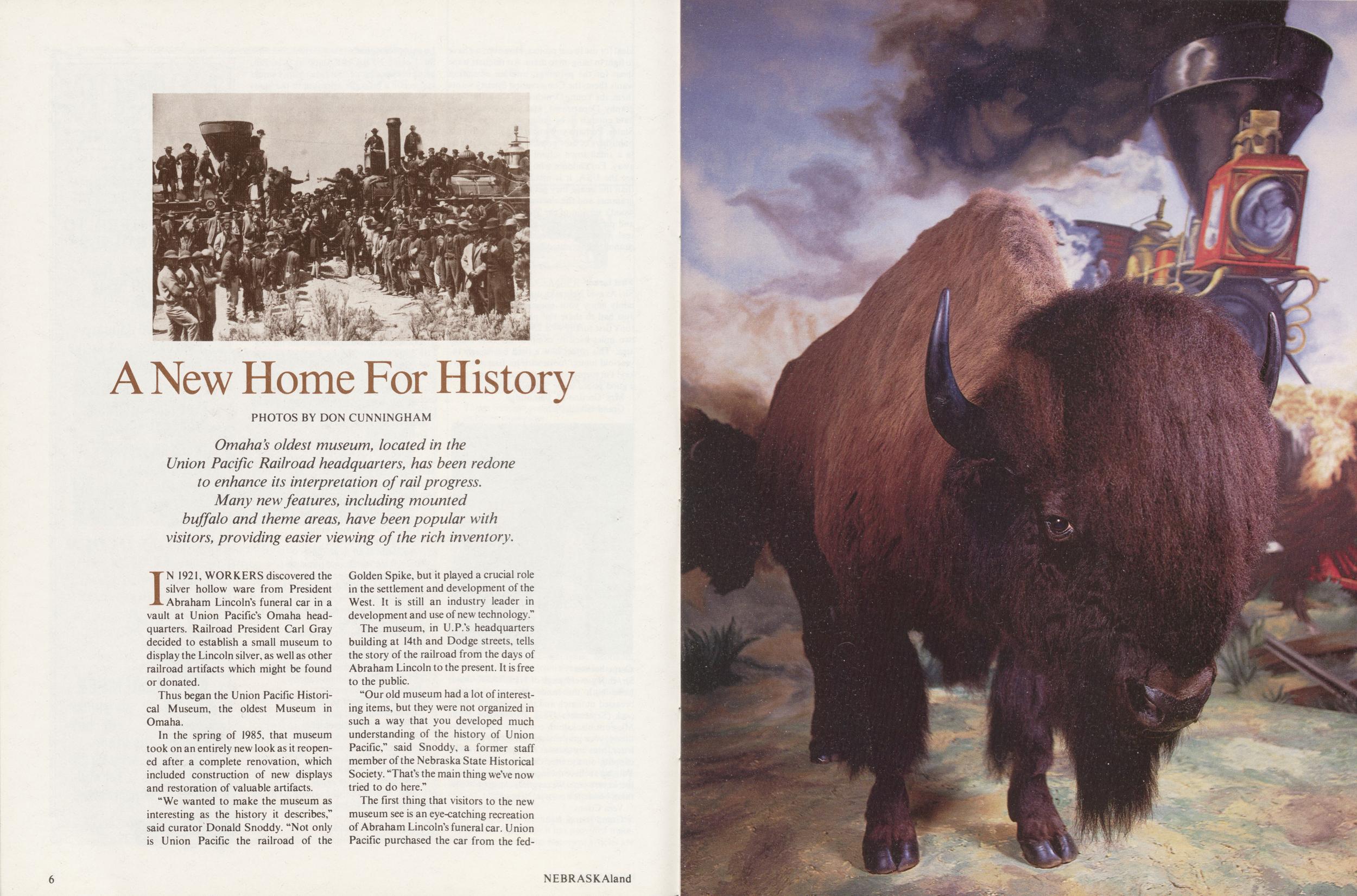
A New Home For History
PHOTOS BY DON CUNNINGHAM Omaha's oldest museum, located in the Union Pacific Railroad headquarters, has been redone to enhance its interpretation of rail progress. Many new features, including mounted buffalo and theme areas, have been popular with visitors, providing easier viewing of the rich inventory.IN 1921, WORKERS discovered the silver hollow ware from President Abraham Lincoln's funeral car in a vault at Union Pacific's Omaha headquarters. Railroad President Carl Gray decided to establish a small museum to display the Lincoln silver, as well as other railroad artifacts which might be found or donated.
Thus began the Union Pacific Historical Museum, the oldest Museum in Omaha.
In the spring of 1985, that museum took on an entirely new look as it reopened after a complete renovation, which included construction of new displays and restoration of valuable artifacts.
"We wanted to make the museum as interesting as the history it describes," said curator Donald Snoddy. "Not only is Union Pacific the railroad of the Golden Spike, but it played a crucial role in the settlement and development of the West. It is still an industry leader in development and use of new technology."
The museum, in U.P.'s headquarters building at 14th and Dodge streets, tells the story of the railroad from the days of Abraham Lincoln to the present. It is free to the public.
"Our old museum had a lot of interesting items, but they were not organized in such a way that you developed much understanding of the history of Union Pacific," said Snoddy, a former staff member of the Nebraska State Historical Society. "That's the main thing we've now tried to do here."
The first thing that visitors to the new museum see is an eye-catching recreation of Abraham Lincoln's funeral car. Union Pacific purchased the car from the federal government in 1866 as a special car for its directors. The car was later destroyed in a fire, but U.P. retained the furnishings, including the silver hollow ware.
6 NEBRASKAland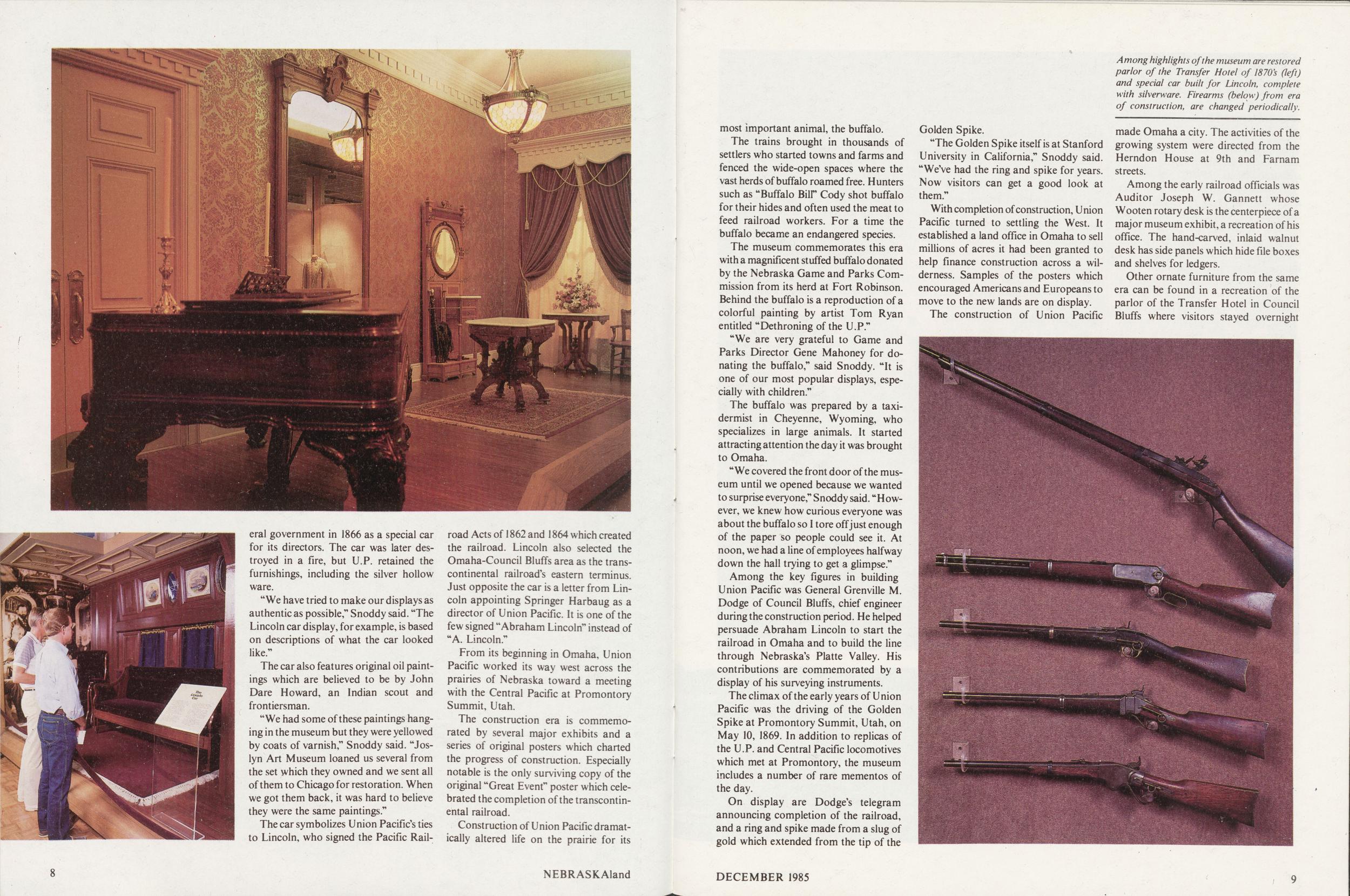
"We have tried to make our displays as authentic as possible," Snoddy said. "The Lincoln car display, for example, is based on descriptions of what the car looked like."
The car also features original oil paintings which are believed to be by John Dare Howard, an Indian scout and frontiersman.
"We had some of these paintings hanging in the museum but they were yellowed by coats of varnish," Snoddy said. "Joslyn Art Museum loaned us several from the set which they owned and we sent all of them to Chicago for restoration. When we got them back, it was hard to believe they were the same paintings."
The car symbolizes Union Pacific's ties to Lincoln, who signed the Pacific Railroad Acts of 1862 and 1864 which created the railroad. Lincoln also selected the Omaha-Council Bluffs area as the transcontinental railroad's eastern terminus. Just opposite the car is a letter from Lincoln appointing Springer Harbaug as a director of Union Pacific. It is one of the few signed "Abraham Lincoln" instead of "A. Lincoln."
From its beginning in Omaha, Union Pacific worked its way west across the prairies of Nebraska toward a meeting with the Central Pacific at Promontory Summit, Utah.
The construction era is commemorated by several major exhibits and a series of original posters which charted the progress of construction. Especially notable is the only surviving copy of the original "Great Event" poster which celebrated the completion of the transcontinental railroad.
Construction of Union Pacific dramatically altered life on the prairie for its 8 NEBRASKAland most important animal, the buffalo.
The trains brought in thousands of settlers who started towns and farms and fenced the wide-open spaces where the vast herds of buffalo roamed free. Hunters such as "Buffalo Bill" Cody shot buffalo for their hides and often used the meat to feed railroad workers. For a time the buffalo became an endangered species.
The museum commemorates this era with a magnificent stuffed buffalo donated by the Nebraska Game and Parks Commission from its herd at Fort Robinson. Behind the buffalo is a reproduction of a colorful painting by artist Tom Ryan entitled "Dethroning of the U.P."
"We are very grateful to Game and Parks Director Gene Mahoney for donating the buffalo," said Snoddy. "It is one of our most popular displays, especially with children."
The buffalo was prepared by a taxidermist in Cheyenne, Wyoming, who specializes in large animals. It started attracting attention the day it was brought to Omaha.
"We covered the front door of the museum until we opened because we wanted to surprise everyone," Snoddy said. "However, we knew how curious everyone was about the buffalo so I tore off just enough of the paper so people could see it. At noon, we had a line of employees halfway down the hall trying to get a glimpse."
Among the key figures in building Union Pacific was General Grenville M. Dodge of Council Bluffs, chief engineer during the construction period. He helped persuade Abraham Lincoln to start the railroad in Omaha and to build the line through Nebraska's Platte Valley. His contributions are commemorated by a display of his surveying instruments.
The climax of the early years of Union Pacific was the driving of the Golden Spike at Promontory Summit, Utah, on May 10, 1869. In addition to replicas of the U.P. and Central Pacific locomotives which met at Promontory, the museum includes a number of rare mementos of the day.
On display are Dodge's telegram announcing completion of the railroad, and a ring and spike made from a slug of gold which extended from the tip of the Golden Spike.
"The Golden Spike itself is at Stanford University in California," Snoddy said. "We've had the ring and spike for years. Now visitors can get a good look at them."
With completion of construction, Union Pacific turned to settling the West. It established a land office in Omaha to sell millions of acres it had been granted to help finance construction across a wilderness. Samples of the posters which encouraged Americans and Europeans to move to the new lands are on display.
The construction of Union Pacific made Omaha a city. The activities of the growing system were directed from the Herndon House at 9th and Farnam streets.
Among highlights of the museum are restored parlor of the Transfer Hotel of 1870's (left) and special car built for Lincoln, complete with silverware. Firearms (below) from era of construction, are changed periodically.Among the early railroad officials was Auditor Joseph W. Gannett whose Wooten rotary desk is the centerpiece of a major museum exhibit, a recreation of his office. The hand-carved, inlaid walnut desk has side panels which hide file boxes and shelves for ledgers.
Other ornate furniture from the same era can be found in a recreation of the parlor of the Transfer Hotel in Council Bluffs where visitors stayed overnight during the 1870's before boarding the U.P. for the trip west. The Hallet and Davis square grand piano has been restrung and can be played.
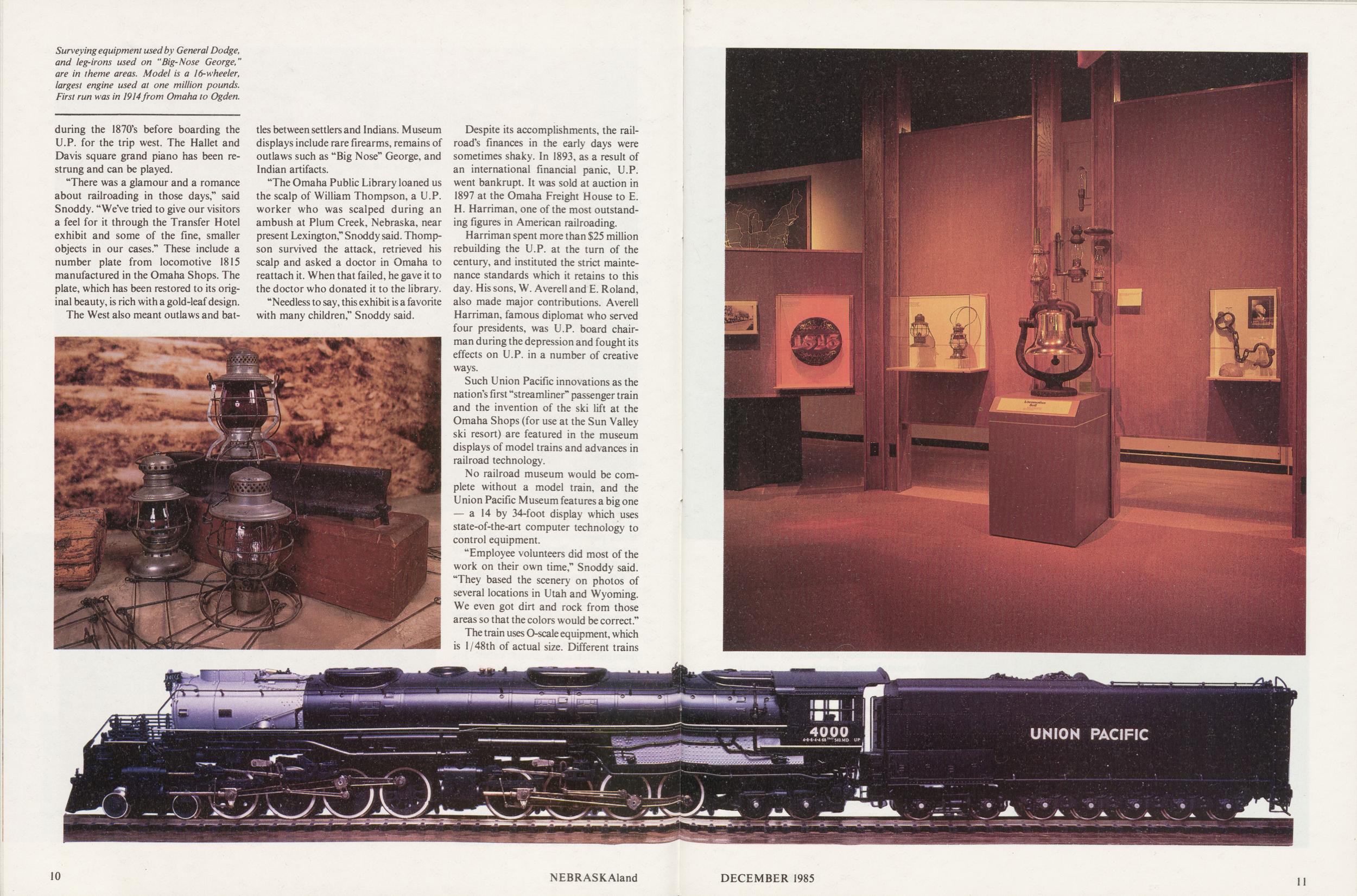 Surveying equipment used by General Dodge,
and leg-irons used on "Big-Nose George,"
are in theme areas. Model is a 16- wheeler,
largest engine used at one million pounds.
First run was in 1914 from Omaha to Ogden.
Surveying equipment used by General Dodge,
and leg-irons used on "Big-Nose George,"
are in theme areas. Model is a 16- wheeler,
largest engine used at one million pounds.
First run was in 1914 from Omaha to Ogden.
"There was a glamour and a romance about railroading in those days," said Snoddy. "We've tried to give our visitors a feel for it through the Transfer Hotel exhibit and some of the fine, smaller objects in our cases." These include a number plate from locomotive 1815 manufactured in the Omaha Shops. The plate, which has been restored to its original beauty, is rich with a gold-leaf design.
The West also meant outlaws and battles between settlers and Indians. Museum displays include rare firearms, remains of outlaws such as "Big Nose" George, and Indian artifacts.
"The Omaha Public Library loaned us the scalp of William Thompson, a U.P. worker who was scalped during an ambush at Plum Creek, Nebraska, near present Lexington," Snoddy said. Thompson survived the attack, retrieved his scalp and asked a doctor in Omaha to reattach it. When that failed, he gave it to the doctor who donated it to the library.
"Needless to say, this exhibit is a favorite with many children," Snoddy said.
Despite its accomplishments, the railroad's finances in the early days were sometimes shaky. In 1893, as a result of an international financial panic, U.P. went bankrupt. It was sold at auction in 1897 at the Omaha Freight House to E. H. Harriman, one of the most outstanding figures in American railroading.
Harriman spent more than $25 million rebuilding the U.P. at the turn of the century, and instituted the strict maintenance standards which it retains to this day. His sons, W. Averell and E. Roland, also made major contributions. Averell Harriman, famous diplomat who served four presidents, was U.P. board chairman during the depression and fought its effects on U.P. in a number of creative ways.
Such Union Pacific innovations as the nation's first "streamliner" passenger train and the invention of the ski lift at the Omaha Shops (for use at the Sun Valley ski resort) are featured in the museum displays of model trains and advances in railroad technology.
No railroad museum would be complete without a model train, and the Union Pacific Museum features a big one — a 14 by 34-foot display which uses state-of-the-art computer technology to control equipment.
"Employee volunteers did most of the work on their own time," Snoddy said. "They based the scenery on photos of several locations in Utah and Wyoming. We even got dirt and rock from those areas so that the colors would be correct."
The train uses O-scale equipment, which is 1/48th of actual size. Different trains are featured at various times.
10 NEBRASKAland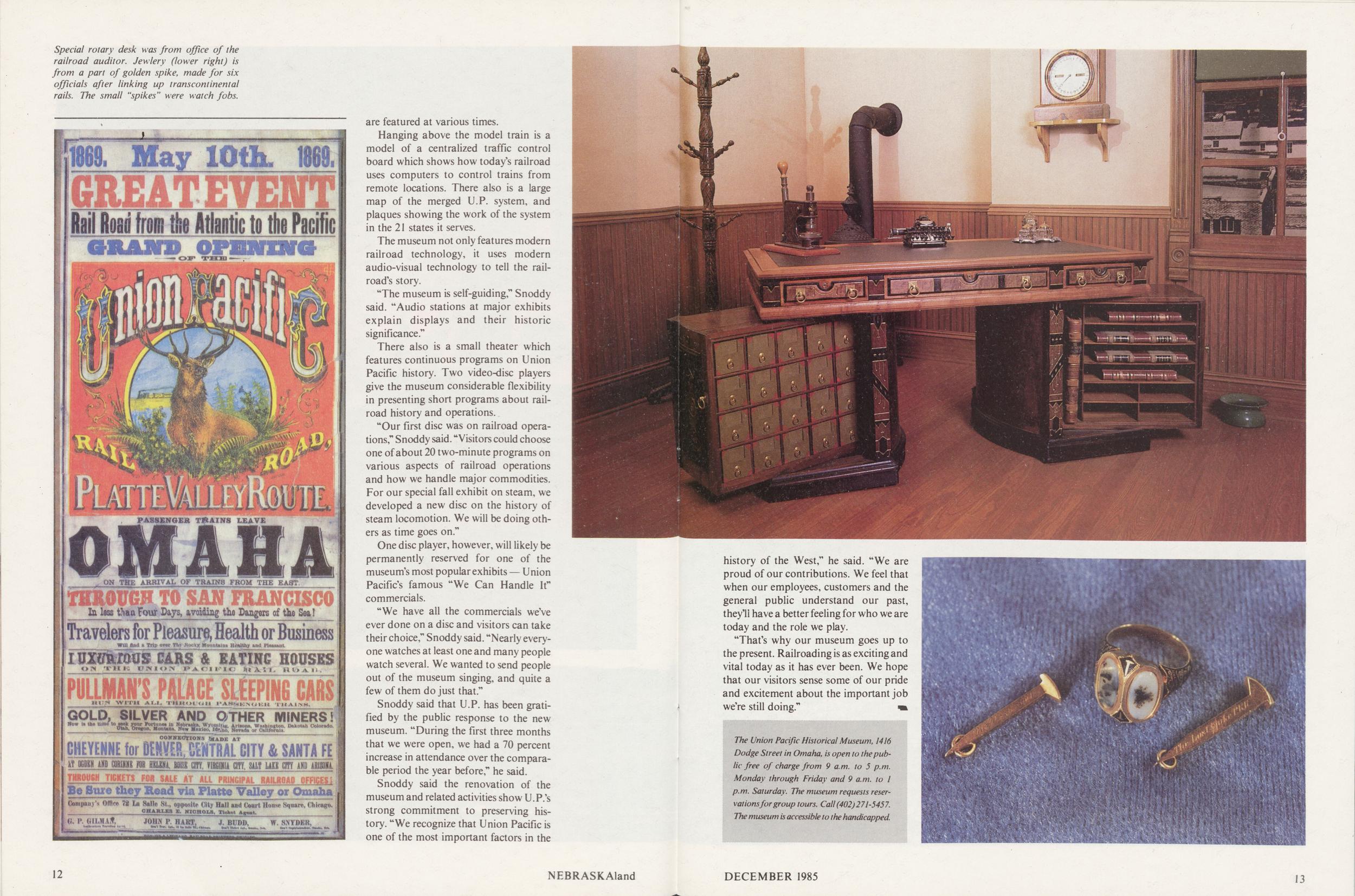 Special rotary desk was from office of the
railroad auditor. Jewlery (lower right) is
from a part of golden spike, made for six
officials after linking up transcontinental
rails. The small "spikes" were watch fobs.
Special rotary desk was from office of the
railroad auditor. Jewlery (lower right) is
from a part of golden spike, made for six
officials after linking up transcontinental
rails. The small "spikes" were watch fobs.
Hanging above the model train is a model of a centralized traffic control board which shows how today's railroad uses computers to control trains from remote locations. There also is a large map of the merged U.P. system, and plaques showing the work of the system in the 21 states it serves.
The museum not only features modern railroad technology, it uses modern audio-visual technology to tell the railroad's story.
"The museum is self-guiding," Snoddy said. "Audio stations at major exhibits explain displays and their historic significance."
There also is a small theater which features continuous programs on Union Pacific history. Two video-disc players give the museum considerable flexibility in presenting short programs about railroad history and operations.
"Our first disc was on railroad operations," Snoddy said. "Visitors could choose one of about 20 two-minute programs on various aspects of railroad operations and how we handle major commodities. For our special fall exhibit on steam, we developed a new disc on the history of steam locomotion. We will be doing others as time goes on."
One disc player, however, will likely be permanently reserved for one of the museum's most popular exhibits — Union Pacific's famous "We Can Handle It" commercials.
"We have all the commercials we've ever done on a disc and visitors can take their choice," Snoddy said. "Nearly everyone watches at least one and many people watch several. We wanted to send people out of the museum singing, and quite a few of them do just that."
Snoddy said that U.P. has been gratified by the public response to the new museum. "During the first three months that we were open, we had a 70 percent increase in attendance over the comparable period the year before," he said.
Snoddy said the renovation of the museum and related activities show U.P.'s strong commitment to preserving history. "We recognize that Union Pacific is one of the most important factors in the 12 NEBRASKAland history of the West," he said. "We are proud of our contributions. We feel that when our employees, customers and the general public understand our past, they'll have a better feeling for who we are today and the role we play.
"That's why our museum goes up to the present. Railroading is as exciting and vital today as it has ever been. We hope that our visitors sense some of our pride and excitement about the important job we're still doing."
The Onion Pacific Historical Museum, 1416 Dodge Street in Omaha, is open to the public free of charge from 9 a.m. to 5 p.m. Monday through Friday and 9 a.m. to I p.m. Saturday. The museum requests reservations for group tours. Call(402)271-5457. The museum is accessible to the handicapped.
DECEMBER 1985 13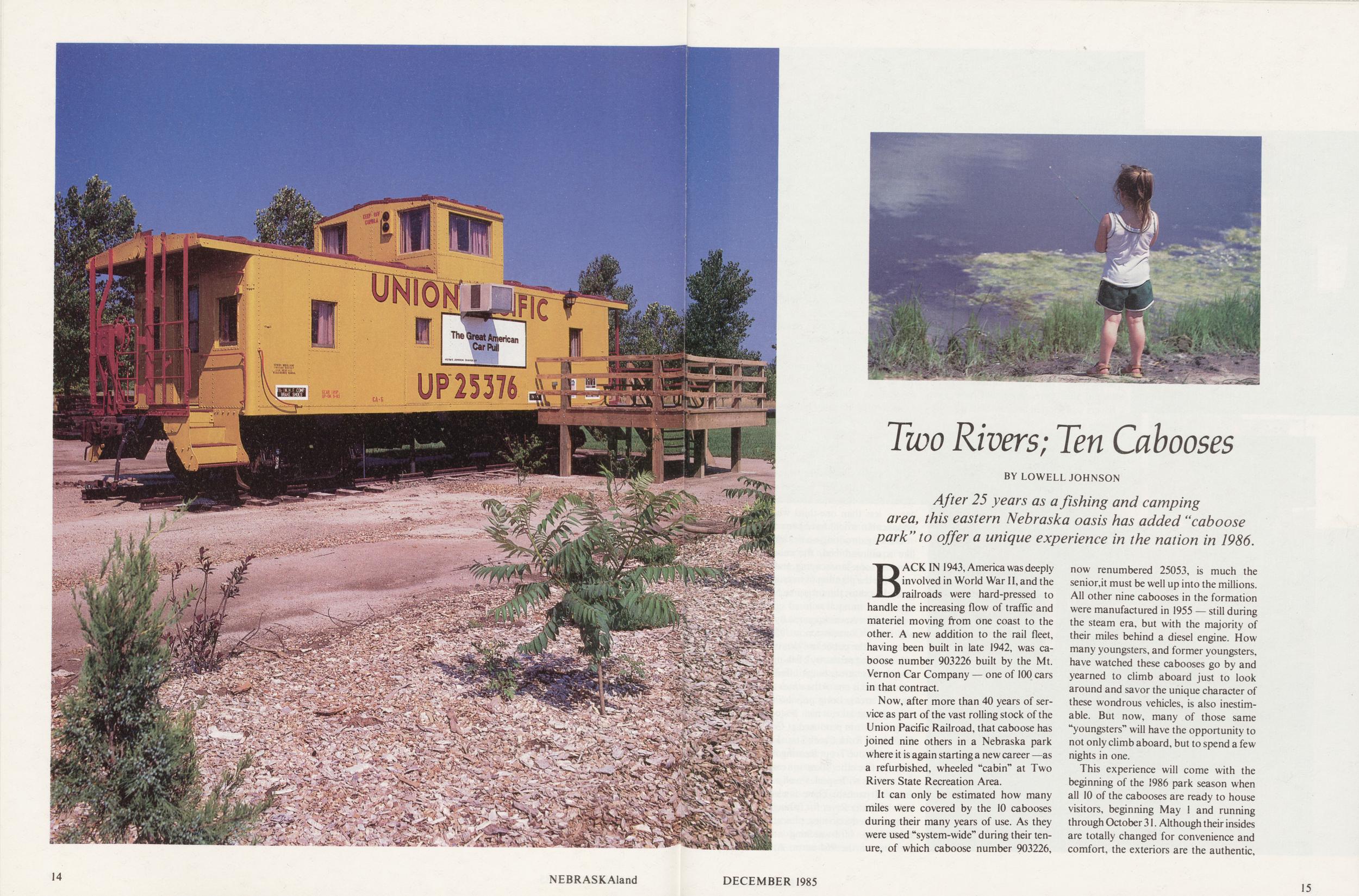
Two Rivers; Ten Cabooses
BY LOWELL JOHNSON After 25 years as a fishing and camping area, this eastern Nebraska oasis has added "caboose park" to offer a unique experience in the nation in 1986.BACK IN 1943, America was deeply involved in World War II, and the railroads were hard-pressed to handle the increasing flow of traffic and materiel moving from one coast to the other. A new addition to the rail fleet, having been built in late 1942, was caboose number 903226 built by the Mt. Vernon Car Company — one of 100 cars in that contract.
Now, after more than 40 years of service as part of the vast rolling stock of the Union Pacific Railroad, that caboose has joined nine others in a Nebraska park where it is again starting a new career —as a refurbished, wheeled "cabin" at Two Rivers State Recreation Area.
It can only be estimated how many miles were covered by the 10 cabooses during their many years of use. As they were used "system-wide" during their tenure, of which caboose number 903226, now renumbered 25053, is much the senior,it must be well up into the millions. All other nine cabooses in the formation were manufactured in 1955 — still during the steam era, but with the majority of their miles behind a diesel engine. How many youngsters, and former youngsters, have watched these cabooses go by and yearned to climb aboard just to look around and savor the unique character of these wondrous vehicles, is also inestimable. But now, many of those same "youngsters" will have the opportunity to not only climb aboard, but to spend a few nights in one.
This experience will come with the
beginning of the 1986 park season when
all 10 of the cabooses are ready to house
visitors, beginning May 1 and running
through October 31. Although their insides
are totally changed for convenience and
comfort, the exteriors are the authentic,
DECEMBER 1985
15
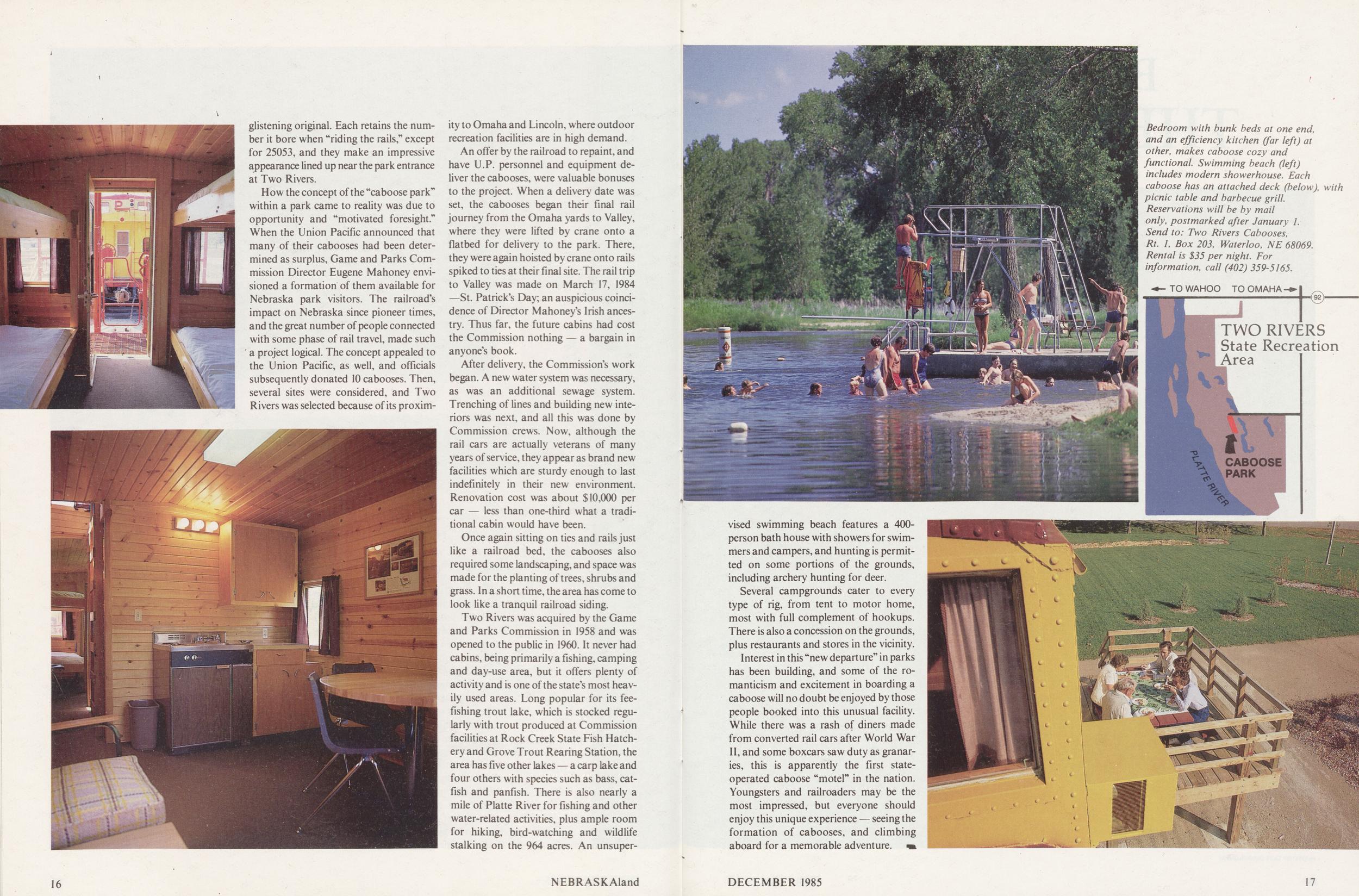 glistening original. Each retains the number it bore when "riding the rails," except
for 25053, and they make an impressive
appearance lined up near the park entrance
at Two Rivers.
glistening original. Each retains the number it bore when "riding the rails," except
for 25053, and they make an impressive
appearance lined up near the park entrance
at Two Rivers.
How the concept of the "caboose park" within a park came to reality was due to opportunity and "motivated foresight." When the Union Pacific announced that many of their cabooses had been determined as surplus, Game and Parks Commission Director Eugene Mahoney envisioned a formation of them available for Nebraska park visitors. The railroad's impact on Nebraska since pioneer times, and the great number of people connected with some phase of rail travel, made such a project logical. The concept appealed to the Union Pacific, as well, and officials subsequently donated 10 cabooses. Then, several sites were considered, and Two Rivers was selected because of its proximity to Omaha and Lincoln, where outdoor recreation facilities are in high demand.
An offer by the railroad to repaint, and have U.P. personnel and equipment deliver the cabooses, were valuable bonuses to the project. When a delivery date was set, the cabooses began their final rail journey from the Omaha yards to Valley, where they were lifted by crane onto a flatbed for delivery to the park. There, they were again hoisted by crane onto rails spiked to ties at their final site. The rail trip to Valley was made on March 17, 1984 —St. Patrick's Day; an auspicious coincidence of Director Mahoney's Irish ancestry. Thus far, the future cabins had cost the Commission nothing — a bargain in anyone's book.
After delivery, the Commission's work began. A new water system was necessary, as was an additional sewage system. Trenching of lines and building new interiors was next, and all this was done by Commission crews. Now, although the rail cars are actually veterans of many years of service, they appear as brand new facilities which are sturdy enough to last indefinitely in their new environment. Renovation cost was about $10,000 per car — less than one-third what a traditional cabin would have been.
Once again sitting on ties and rails just like a railroad bed, the cabooses also required some landscaping, and space was made for the planting of trees, shrubs and grass. In a short time, the area has come to look like a tranquil railroad siding.
Two Rivers was acquired by the Game and Parks Commission in 1958 and was opened to the public in 1960. It never had cabins, being primarily a fishing, camping and day-use area, but it offers plenty of activity and is one of the state's most heavily used areas. Long popular for its feefishing trout lake, which is stocked regularly with trout produced at Commission facilities at Rock Creek State Fish Hatchery and Grove Trout Rearing Station, the area has five other lakes — a carp lake and four others with species such as bass, catfish and panfish. There is also nearly a mile of Platte River for fishing and other water-related activities, plus ample room for hiking, bird-watching and wildlife stalking on the 964 acres. An unsupervised 16 NEBRASKAland swimming beach features a 400person bath house with showers for swimmers and campers, and hunting is permitted on some portions of the grounds, including archery hunting for deer.
Several campgrounds cater to every type of rig, from tent to motor home, most with full complement of hookups. There is also a concession on the grounds, plus restaurants and stores in the vicinity.
Interest in this "new departure" in parks has been building, and some of the romanticism and excitement in boarding a caboose will no doubt be enjoyed by those people booked into this unusual facility. While there was a rash of diners made from converted rail cars after World War II, and some boxcars saw duty as granaries, this is apparently the first stateoperated caboose "motel" in the nation. Youngsters and railroaders may be the most impressed, but everyone should enjoy this unique experience — seeing the formation of cabooses, and climbing aboard for a memorable adventure.
Bringing Back THE RINGNECK
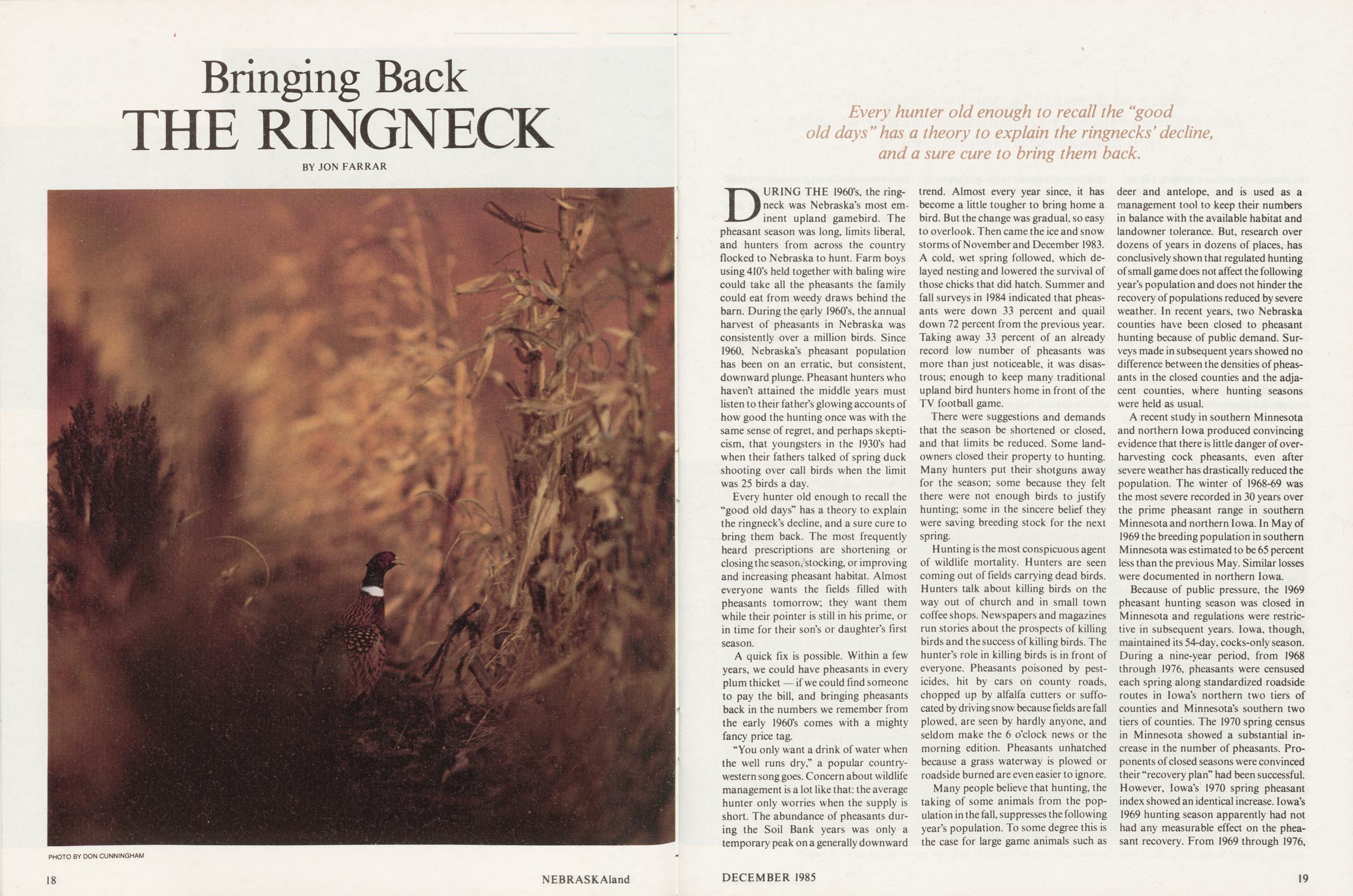
DURING THE 1960's, the ringneck was Nebraska's most eminent upland gamebird. The pheasant season was long, limits liberal, and hunters from across the country flocked to Nebraska to hunt. Farm boys using 410's held together with baling wire could take all the pheasants the family could eat from weedy draws behind the barn. During the early 1960's, the annual harvest of pheasants in Nebraska was consistently over a million birds. Since 1960, Nebraska's pheasant population has been on an erratic, but consistent, downward plunge. Pheasant hunters who haven't attained the middle years must listen to their father's glowing accounts of how good the hunting once was with the same sense of regret, and perhaps skepticism, that youngsters in the 1930's had when their fathers talked of spring duck shooting over call birds when the limit was 25 birds a day.
Every hunter old enough to recall the "good old days" has a theory to explain the ringneck's decline, and a sure cure to bring them back. The most frequently heard prescriptions are shortening or closing the season, stocking, or improving and increasing pheasant habitat. Almost everyone wants the Fields filled with pheasants tomorrow; they want them while their pointer is still in his prime, or in time for their son's or daughter's first season.
A quick fix is possible. Within a few years, we could have pheasants in every plum thicket — if we could find someone to pay the bill, and bringing pheasants back in the numbers we remember from the early 1960's comes with a mighty fancy price tag.
"You only want a drink of water when the well runs dry," a popular countrywestern song goes. Concern about wildlife management is a lot like that: the average hunter only worries when the supply is short. The abundance of pheasants during the Soil Bank years was only a temporary peak on a generally downward trend. Almost every year since, it has become a little tougher to bring home a bird. But the change was gradual, so easy to overlook. Then came the ice and snow storms of November and December 1983. A cold, wet spring followed, which delayed nesting and lowered the survival of those chicks that did hatch. Summer and fall surveys in 1984 indicated that pheasants were down 33 percent and quail down 72 percent from the previous year. Taking away 33 percent of an already record low number of pheasants was more than just noticeable, it was disastrous; enough to keep many traditional upland bird hunters home in front of the TV football game.
There were suggestions and demands that the season be shortened or closed, and that limits be reduced. Some landowners closed their property to hunting. Many hunters put their shotguns away for the season; some because they felt there were not enough birds to justify hunting; some in the sincere belief they were saving breeding stock for the next spring.
Hunting is the most conspicuous agent of wildlife mortality. Hunters are seen coming out of fields carrying dead birds. Hunters talk about killing birds on the way out of church and in small town coffee shops. Newspapers and magazines run stories about the prospects of killing birds and the success of killing birds. The hunter's role in killing birds is in front of everyone. Pheasants poisoned by pesticides, hit by cars on county roads, chopped up by alfalfa cutters or suffocated by driving snow because fields are fall plowed, are seen by hardly anyone, and seldom make the 6 o'clock news or the morning edition. Pheasants unhatched because a grass waterway is plowed or roadside burned are even easier to ignore.
Many people believe that hunting, the taking of some animals from the population in the fall, suppresses the following year's population. To some degree this is the case for large game animals such as deer and antelope, and is used as a management tool to keep their numbers in balance with the available habitat and landowner tolerance. But, research over dozens of years in dozens of places, has conclusively shown that regulated hunting of small game does not affect the following year's population and does not hinder the recovery of populations reduced by severe weather. In recent years, two Nebraska counties have been closed to pheasant hunting because of public demand. Surveys made in subsequent years showed no difference between the densities of pheasants in the closed counties and the adjacent counties, where hunting seasons were held as usual.
A recent study in southern Minnesota and northern Iowa produced convincing evidence that there is little danger of overharvesting cock pheasants, even after severe weather has drastically reduced the population. The winter of 1968-69 was the most severe recorded in 30 years over the prime pheasant range in southern Minnesota and northern Iowa. In May of 1969 the breeding population in southern Minnesota was estimated to be 65 percent less than the previous May. Similar losses were documented in northern Iowa.
Because of public pressure, the 1969 pheasant hunting season was closed in Minnesota and regulations were restrictive in subsequent years. Iowa, though, maintained its 54-day, cocks-only season. During a nine-year period, from 1968 through 1976, pheasants were censused each spring along standardized roadside routes in Iowa's northern two tiers of counties and Minnesota's southern two tiers of counties. The 1970 spring census in Minnesota showed a substantial increase in the number of pheasants. Proponents of closed seasons were convinced their "recovery plan" had been successful. However, Iowa's 1970 spring pheasant index showed an identical increase. Iowa's 1969 hunting season apparently had not had any measurable effect on the pheasant recovery. From 1969 through 1976, the pheasant population in both Minnesota and Iowa declined due to loss of habitat as agricultural practices changed, but biologists from both states reported "no statistical difference was detected between the rates of decline for the two states" in spite of Minnesota's conservative harvest and Iowa's business-as-usual hunting seasons. In their report, the biologists concluded: "... there is no biological reason liberal cocks-only pheasant hunting seasons cannot be maintained in order to provide recreational hunting, even at very low population levels."
DECEMBER 1985 19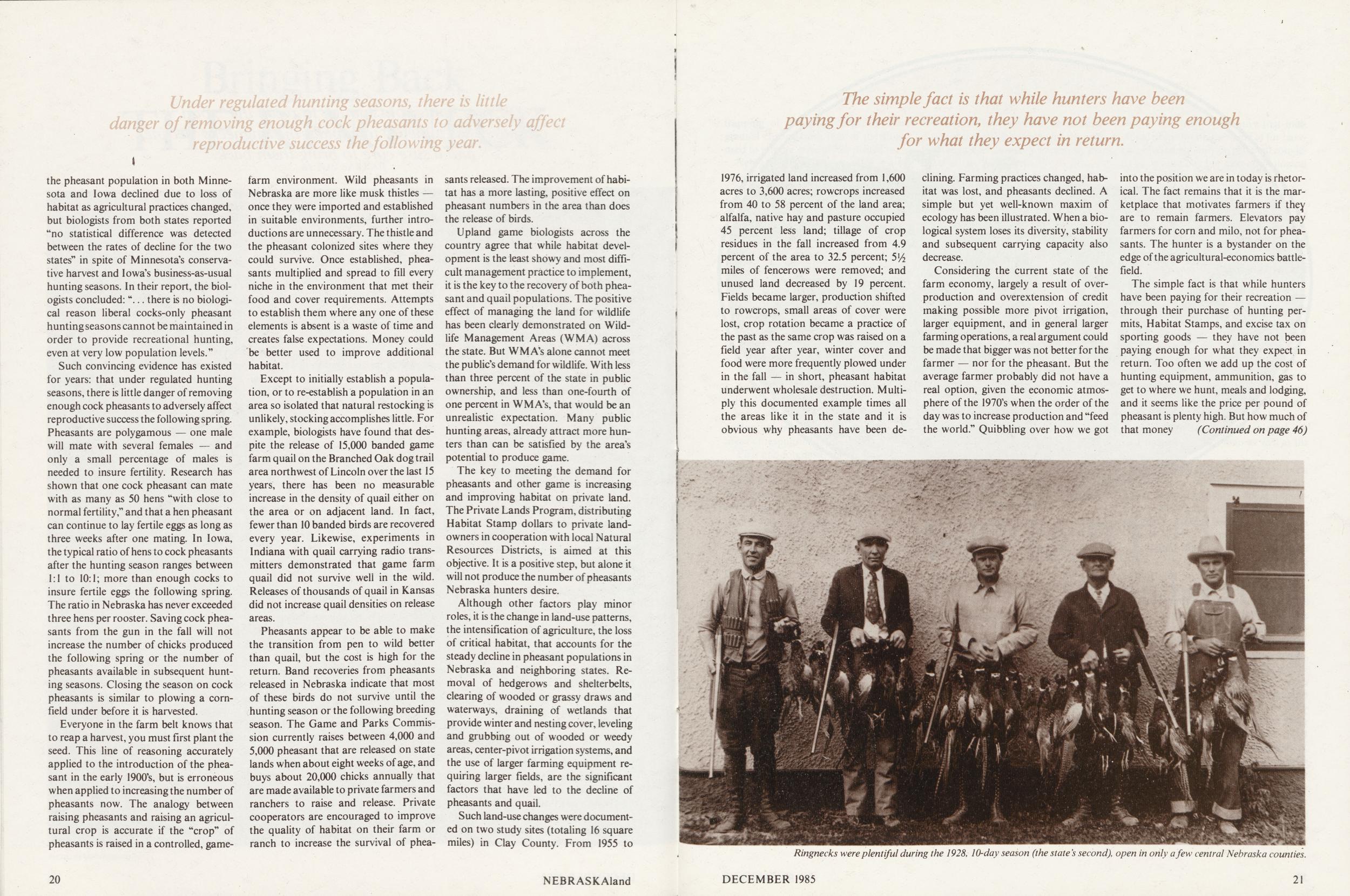 Under rtegulated hunting seasons, there is little
danger of removing enough cock pheasants to adversely affect reproductive success
the following year.
Under rtegulated hunting seasons, there is little
danger of removing enough cock pheasants to adversely affect reproductive success
the following year.
Such convincing evidence has existed for years: that under regulated hunting seasons, there is little danger of removing enough cock pheasants to adversely affect reproductive success the following spring. Pheasants are polygamous — one male will mate with several females — and only a small percentage of males is needed to insure fertility. Research has shown that one cock pheasant can mate with as many as 50 hens "with close to normal fertility," and that a hen pheasant can continue to lay fertile eggs as long as three weeks after one mating. In Iowa, the typical ratio of hens to cock pheasants after the hunting season ranges between 1:1 to 10:1; more than enough cocks to insure fertile eggs the following spring. The ratio in Nebraska has never exceeded three hens per rooster. Saving cock pheasants from the gun in the fall will not increase the number of chicks produced the following spring or the number of pheasants available in subsequent hunting seasons. Closing the season on cock pheasants is similar to plowing a cornfield under before it is harvested.
Everyone in the farm belt knows that to reap a harvest, you must first plant the seed. This line of reasoning accurately applied to the introduction of the pheasant in the early 1900's, but is erroneous when applied to increasing the number of pheasants now. The analogy between raising pheasants and raising an agricultural crop is accurate if the "crop" of pheasants is raised in a controlled, game farm environment. Wild pheasants in Nebraska are more like musk thistles once they were imported and established in suitable environments, further introductions are unnecessary. The thistle and the pheasant colonized sites where they could survive. Once established, pheasants multiplied and spread to fill every niche in the environment that met their food and cover requirements. Attempts to establish them where any one of these elements is absent is a waste of time and creates false expectations. Money could be better used to improve additional habitat.
Except to initially establish a population, or to re-establish a population in an area so isolated that natural restocking is unlikely, stocking accomplishes little. For example, biologists have found that despite the release of 15,000 banded game farm quail on the Branched Oak dog trail area northwest of Lincoln over the last 15 years, there has been no measurable increase in the density of quail either on the area or on adjacent land. In fact, fewer than 10 banded birds are recovered every year. Likewise, experiments in Indiana with quail carrying radio transmitters demonstrated that game farm quail did not survive well in the wild. Releases of thousands of quail in Kansas did not increase quail densities on release areas.
Pheasants appear to be able to make the transition from pen to wild better than quail, but the cost is high for the return. Band recoveries from pheasants released in Nebraska indicate that most of these birds do not survive until the hunting season or the following breeding season. The Game and Parks Commission currently raises between 4,000 and 5,000 pheasant that are released on state lands when about eight weeks of age, and buys about 20,000 chicks annually that are made available to private farmers and ranchers to raise and release. Private cooperators are encouraged to improve the quality of habitat on their farm or ranch to increase the survival of pheasants released. The improvement of habitat has a more lasting, positive effect on pheasant numbers in the area than does the release of birds.
Upland game biologists across the country agree that while habitat development is the least showy and most difficult management practice to implement, it is the key to the recovery of both pheasant and quail populations. The positive effect of managing the land for wildlife has been clearly demonstrated on Wildlife Management Areas (WMA) across the state. But WM A's alone cannot meet the public's demand for wildlife. With less than three percent of the state in public ownership, and less than one-fourth of one percent in WMA's, that would be an unrealistic expectation. Many public hunting areas, already attract more hunters than can be satisfied by the area's potential to produce game.
The key to meeting the demand for pheasants and other game is increasing and improving habitat on private land. The Private Lands Program, distributing Habitat Stamp dollars to private landowners in cooperation with local Natural Resources Districts, is aimed at this objective. It is a positive step, but alone it will not produce the number of pheasants Nebraska hunters desire.
Although other factors play minor roles, it is the change in land-use patterns, the intensification of agriculture, the loss of critical habitat, that accounts for the steady decline in pheasant populations in Nebraska and neighboring states. Removal of hedgerows and shelterbelts, clearing of wooded or grassy draws and waterways, draining of wetlands that provide winter and nesting cover, leveling and grubbing out of wooded or weedy areas, center-pivot irrigation systems, and the use of larger farming equipment requiring larger fields, are the significant factors that have led to the decline of pheasants and quail.
Such land-use changes were documented on two study sites (totaling 16 square miles) in Clay County. From 1955 to 20 NEBRASKAland 1976, irrigated land increased from 1,600 acres to 3,600 acres; rowcrops increased from 40 to 58 percent of the land area; alfalfa, native hay and pasture occupied 45 percent less land; tillage of crop residues in the fall increased from 4.9 percent of the area to 32.5 percent; 5/2 miles of fencerows were removed; and unused land decreased by 19 percent. Fields became larger, production shifted to rowcrops, small areas of cover were lost, crop rotation became a practice of the past as the same crop was raised on a field year after year, winter cover and food were more frequently plowed under in the fall — in short, pheasant habitat underwent wholesale destruction. Multiply this documented example times all the areas like it in the state and it is obvious why pheasants have been declining. Farming practices changed, habitat was lost, and pheasants declined. A simple but yet well-known maxim of ecology has been illustrated. When a biological system loses its diversity, stability and subsequent carrying capacity also decrease.
The simple fact is that while hunters have ha heir recreation, they have not been paying enough for what they expect in return.Considering the current state of the farm economy, largely a result of overproduction and overextension of credit making possible more pivot irrigation, larger equipment, and in general larger farming operations, a real argument could be made that bigger was not better for the farmer — nor for the pheasant. But the average farmer probably did not have a real option, given the economic atmosphere of the 1970's when the order of the day was to increase production and "feed the world." Quibbling over how we got into the position we are in today is rhetorical. The fact remains that it is the marketplace that motivates farmers if they are to remain farmers. Elevators pay farmers for corn and milo, not for pheasants. The hunter is a bystander on the edge of the agricultural-economics battlefield.
The simple fact is that while hunters have been paying for their recreation through their purchase of hunting permits, Habitat Stamps, and excise tax on sporting goods — they have not been paying enough for what they expect in return. Too often we add up the cost of hunting equipment, ammunition, gas to get to where we hunt, meals and lodging, and it seems like the price per pound of pheasant is plenty high. But how much of that money (Continued on page 46)
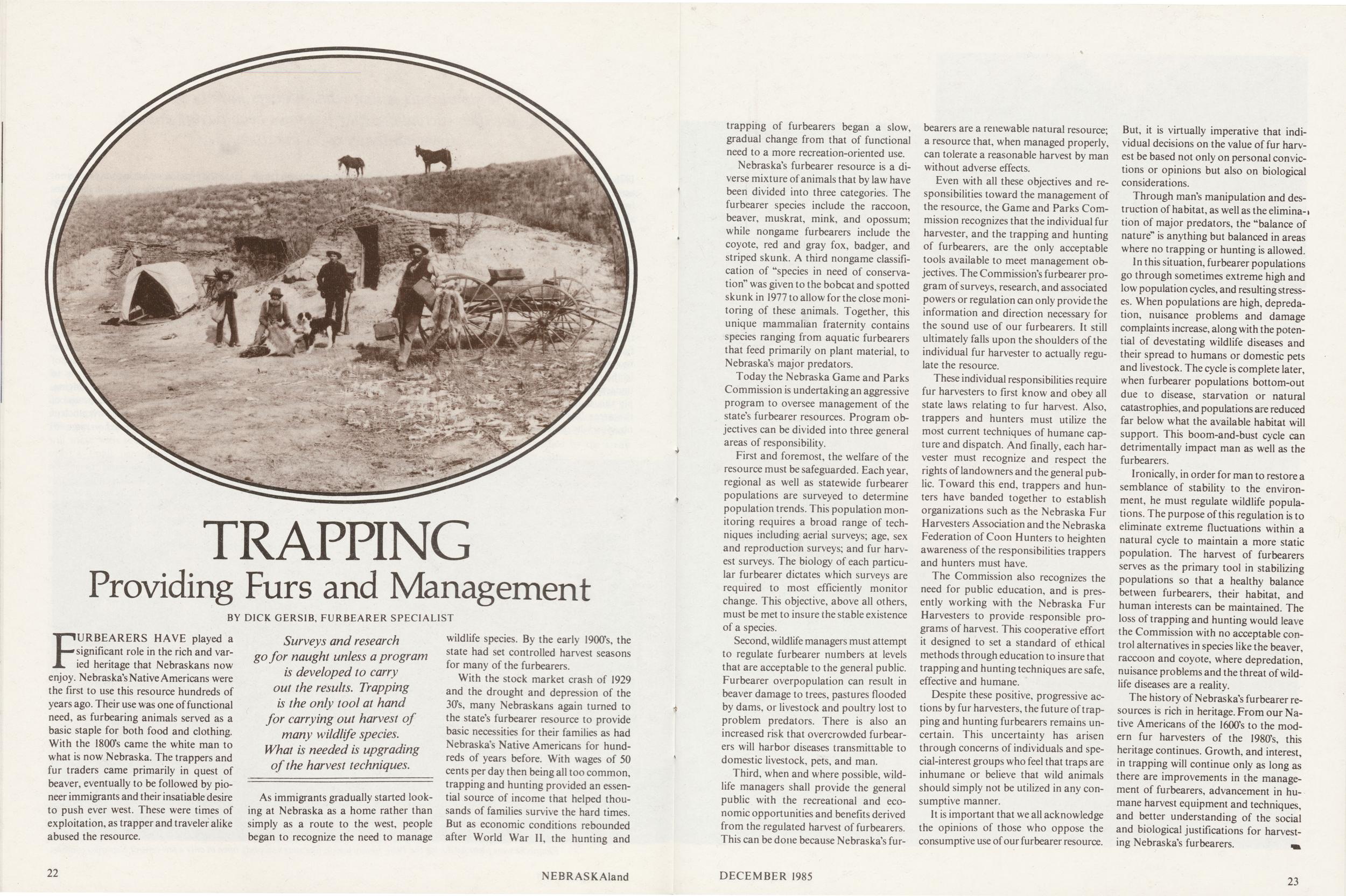
TRAPPING Providing Furs and Management
BY DICK GERS1B, FURBEARER SPECIALIST Surveys and research go for naught unless a program is developed to carry out the results. Trapping is the only tool at hand for carrying out harvest of many wildlife species. What is needed is upgrading of the harvest techniques.FURBEARERS HAVE played a significant role in the rich and varied heritage that Nebraskans now enjoy. Nebraska's Native Americans were the first to use this resource hundreds of years ago. Their use was one of functional need, as furbearing animals served as a basic staple for both food and clothing. With the 1800's came the white man to what is now Nebraska. The trappers and fur traders came primarily in quest of beaver, eventually to be followed by pioneer immigrants and their insatiable desire to push ever west. These were times of exploitation, as trapper and traveler alike abused the resource.
As immigrants gradually started looking at Nebraska as a home rather than simply as a route to the west, people began to recognize the need to manage wildlife species. By the early 1900's, the state had set controlled harvest seasons for many of the furbearers.
With the stock market crash of 1929 and the drought and depression of the 30's, many Nebraskans again turned to the state's furbearer resource to provide basic necessities for their families as had Nebraska's Native Americans for hundreds of years before. With wages of 50 cents per day then being all too common, trapping and hunting provided an essential source of income that helped thousands of families survive the hard times. But as economic conditions rebounded after World War II, the hunting and 22 NEBRASKAland trapping of furbearers began a slow, gradual change from that of functional need to a more recreation-oriented use.
Nebraska's furbearer resource is a diverse mixture of animals that by law have been divided into three categories. The furbearer species include the raccoon, beaver, muskrat, mink, and opossum; while nongame furbearers include the coyote, red and gray fox, badger, and striped skunk. A third nongame classification of "species in need of conservation" was given to the bobcat and spotted skunk in 1977 to allow for the close monitoring of these animals. Together, this unique mammalian fraternity contains species ranging from aquatic furbearers that feed primarily on plant material, to Nebraska's major predators.
Today the Nebraska Game and Parks Commission is undertaking an aggressive program to oversee management of the state's furbearer resources. Program objectives can be divided into three general areas of responsibility.
First and foremost, the welfare of the resource must be safeguarded. Each year, regional as well as statewide furbearer populations are surveyed to determine population trends. This population mon-itoring requires a broad range of techniques including aerial surveys; age, sex and reproduction surveys; and fur harvest surveys. The biology of each particular furbearer dictates which surveys are required to most efficiently monitor change. This objective, above all others, must be met to insure the stable existence of a species.
Second, wildlife managers must attempt to regulate furbearer numbers at levels that are acceptable to the general public. Furbearer overpopulation can result in beaver damage to trees, pastures flooded by dams, or livestock and poultry lost to problem predators. There is also an increased risk that overcrowded furbearers will harbor diseases transmittable to domestic livestock, pets, and man.
Third, when and where possible, wildlife managers shall provide the general public with the recreational and economic opportunities and benefits derived from the regulated harvest of furbearers. This can be done because Nebraska's furbearers are a renewable natural resource; a resource that, when managed properly, can tolerate a reasonable harvest by man without adverse effects.
Even with all these objectives and responsibilities toward the management of the resource, the Game and Parks Commission recognizes that the individual fur harvester, and the trapping and hunting of furbearers, are the only acceptable tools available to meet management objectives. The Commission's furbearer program of surveys, research, and associated powers or regulation can only provide the information and direction necessary for the sound use of our furbearers. It still ultimately falls upon the shoulders of the individual fur harvester to actually regulate the resource.
These individual responsibilities require fur harvesters to first know and obey all state laws relating to fur harvest. Also, trappers and hunters must utilize the most current techniques of humane capture and dispatch. And finally, each harvester must recognize and respect the rights of landowners and the general public. Toward this end, trappers and hunters have banded together to establish organizations such as the Nebraska Fur Harvesters Association and the Nebraska Federation of Coon Hunters to heighten awareness of the responsibilities trappers and hunters must have.
The Commission also recognizes the need for public education, and is presently working with the Nebraska Fur Harvesters to provide responsible programs of harvest. This cooperative effort it designed to set a standard of ethical methods through education to insure that trapping and hunting techniques are safe, effective and humane.
Despite these positive, progressive actions by fur harvesters, the future of trapping and hunting furbearers remains uncertain. This uncertainty has arisen through concerns of individuals and special-interest groups who feel that traps are inhumane or believe that wild animals should simply not be utilized in any consumptive manner.
It is important that we all acknowledge the opinions of those who oppose the consumptive use of our furbearer resource. But, it is virtually imperative that individual decisions on the value of fur harvest be based not only on personal convictions or opinions but also on biological considerations.
Through man's manipulation and destruction of habitat, as well as the elimination of major predators, the "balance of nature" is anything but balanced in areas where no trapping or hunting is allowed.
In this situation, furbearer populations go through sometimes extreme high and low population cycles, and resulting stresses. When populations are high, depredation, nuisance problems and damage complaints increase, along with the potential of devestating wildlife diseases and their spread to humans or domestic pets and livestock. The cycle is complete later, when furbearer populations bottom-out due to disease, starvation or natural catastrophies, and populations are reduced far below what the available habitat will support. This boom-and-bust cycle can detrimentally impact man as well as the furbearers.
Ironically, in order for man to restore a semblance of stability to the environment, he must regulate wildlife populations. The purpose of this regulation is to eliminate extreme fluctuations within a natural cycle to maintain a more static population. The harvest of furbearers serves as the primary tool in stabilizing populations so that a healthy balance between furbearers, their habitat, and human interests can be maintained. The loss of trapping and hunting would leave the Commission with no acceptable control alternatives in species like the beaver, raccoon and coyote, where depredation, nuisance problems and the threat of wildlife diseases are a reality.
The history of Nebraska's furbearer resources is rich in heritage. From our Native Americans of the 1600's to the modern fur harvesters of the 1980's, this heritage continues. Growth, and interest, in trapping will continue only as long as there are improvements in the management of furbearers, advancement in humane harvest equipment and techniques, and better understanding of the social and biological justifications for harvesting Nebraska's furbearers.
DECEMBER 1985 23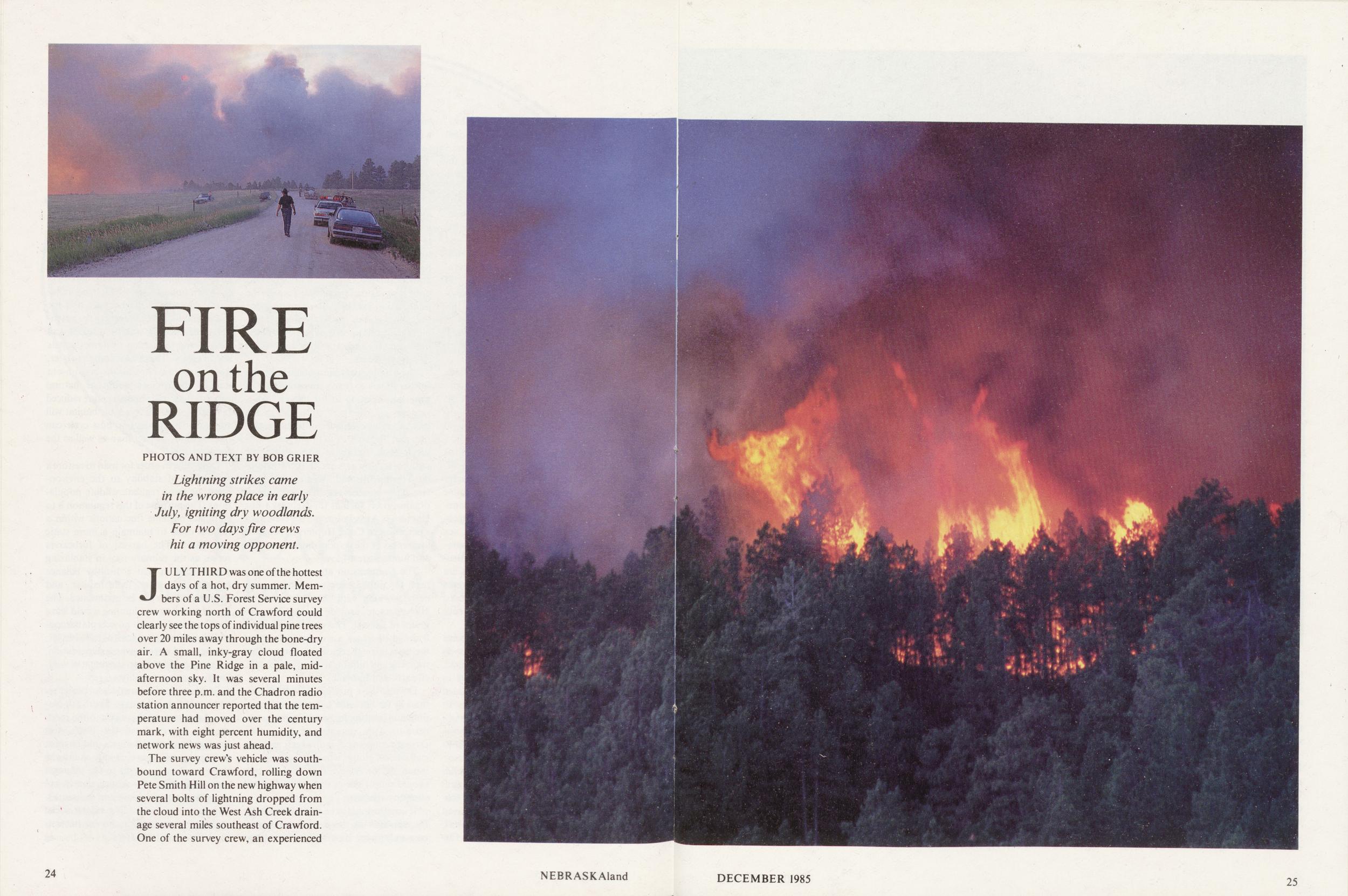
FIRE on the RIDGE
PHOTOS AND TEXT BY BOB GR1ER Lightning strikes came in the wrong place in early July, igniting dry woodlands. For two days fire crews hit a moving opponent.JULY THIRD was one of the hottest days of a hot, dry summer. Members of a U.S. Forest Service survey crew working north of Crawford could clearly see the tops of individual pine trees over 20 miles away through the bone-dry air. A small, inky-gray cloud floated above the Pine Ridge in a pale, midafternoon sky. It was several minutes before three p.m. and the Chadron radio station announcer reported that the temperature had moved over the century mark, with eight percent humidity, and network news was just ahead.
The survey crew's vehicle was southbound toward Crawford, rolling down Pete Smith Hill on the new highway when several bolts of lightning dropped from the cloud into the West Ash Creek drainage several miles southeast of Crawford. One of the survey crew, an experienced fire crew leader, remarked, "If that last strike didn't start a fire, nothing would." In all, at least 12 lightning flashes were observed cutting into a confined area of the West Ash Creek, watershed, no more than a square mile in size.
24 NEBRASKAland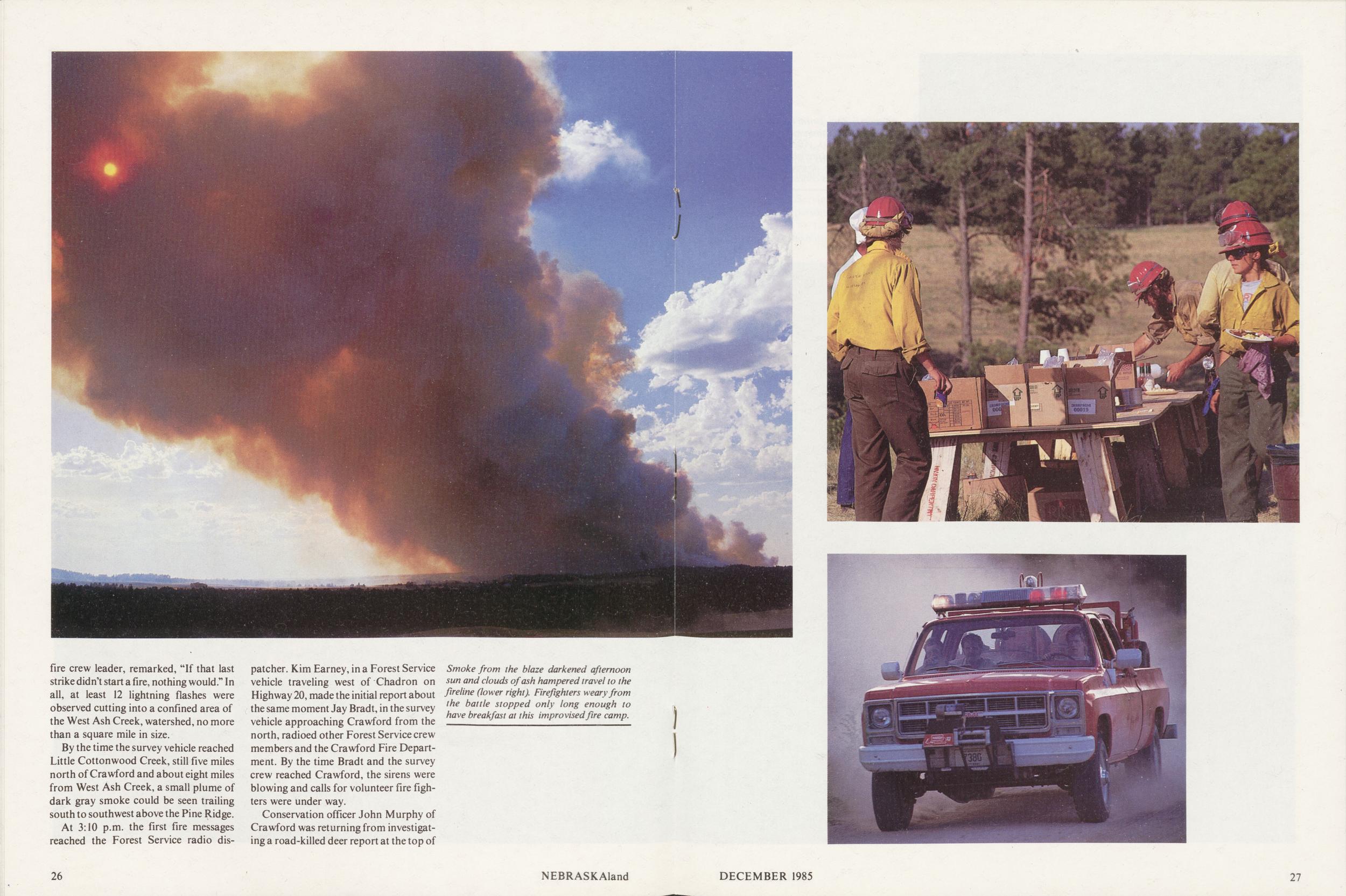
By the time the survey vehicle reached Little Cottonwood Creek, still five miles north of Crawford and about eight miles from West Ash Creek, a small plume of dark gray smoke could be seen trailing south to southwest above the Pine Ridge.
At 3:10 p.m. the first fire messages reached the Forest Service radio dispatcher. Kim Earney, in a Forest Service vehicle traveling west of Chadron on Highway 20, made the initial report about the same moment Jay Bradt, in the survey vehicle approaching Crawford from the north, radioed other Forest Service crew members and the Crawford Fire Department. By the time Bradt and the survey crew reached Crawford, the sirens were blowing and calls for volunteer fire fighters were under way.
Conservation officer John Murphy of Crawford was returning from investigating a road-killed deer report at the top of Smiley Canyon west of Fort Robinson State Park when the initial fire call went out. Moments later, he and park superintendent Jim Lemmon could see a building plume of smoke behind Crow Butte southeast of the park.
Smoke from the blaze darkened afternoon sun and clouds of ash hampered travel to the fireline (lower right). Firefighters weary from the battle stopped only long enough to have breakfast at this improvised fire camp. 26 NEBRASKAland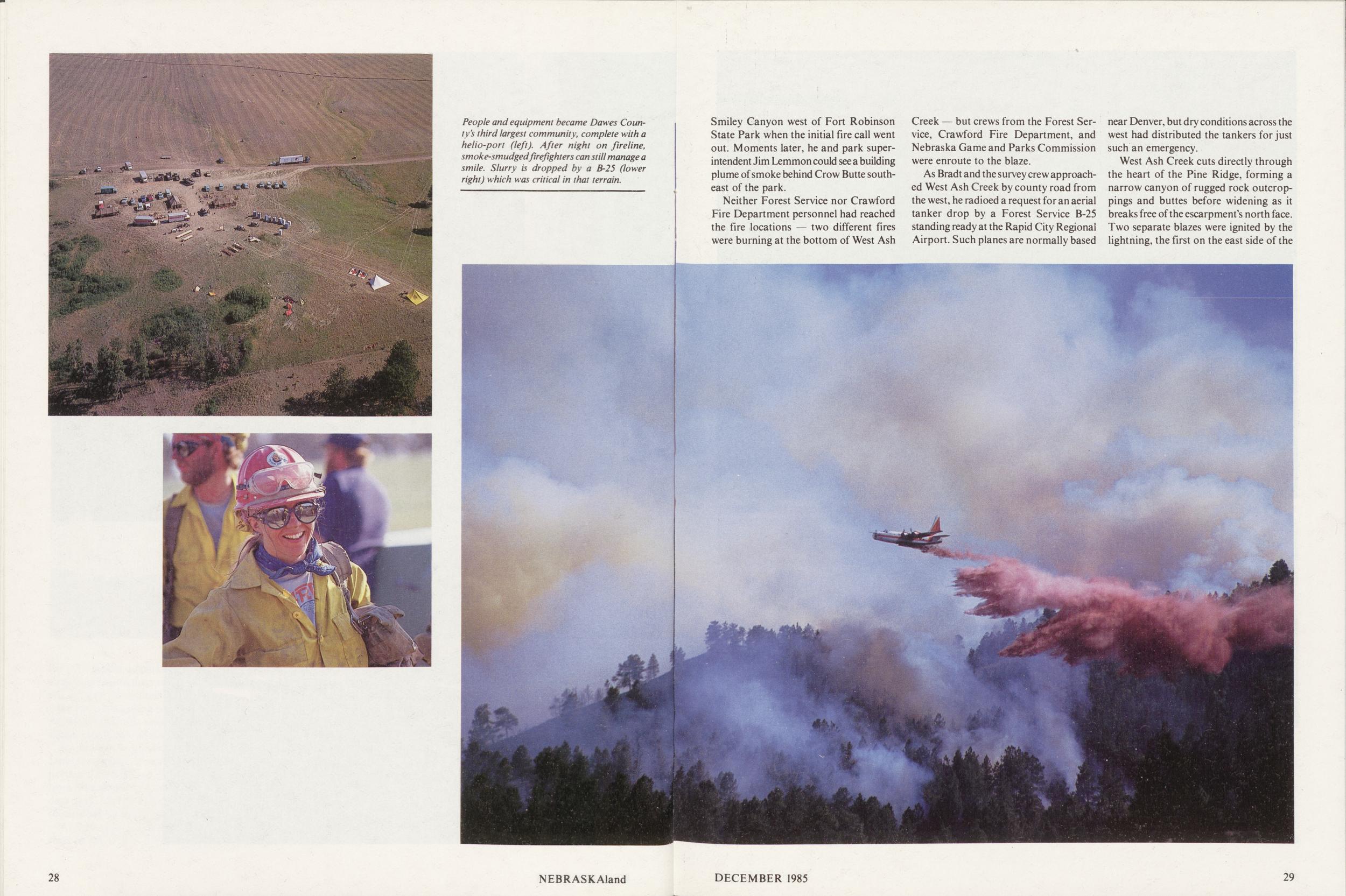
Neither Forest Service nor Crawford Fire Department personnel had reached the fire locations — two different fires were burning at the bottom of West Ash Creek — but crews from the Forest Sevice, Crawford Fire Department, and Nebraska Game and Parks Commission were enroute to the blaze.
As Bradt and the survey crew approached West Ash Creek by county road from the west, he radioed a request for an aerial tanker drop by a Forest Service B-25 standing ready at the Rapid City Regional Airport. Such planes are normally based near Denver, but dry conditions across the west had distributed the tankers for just such an emergency.
West Ash Creek cuts directly through the heart of the Pine Ridge, forming a narrow canyon of rugged rock outcroppings and buttes before widening as it breaks free of the escarpment's north face. Two separate blazes were ignited by the lightning, the first on the east side of the
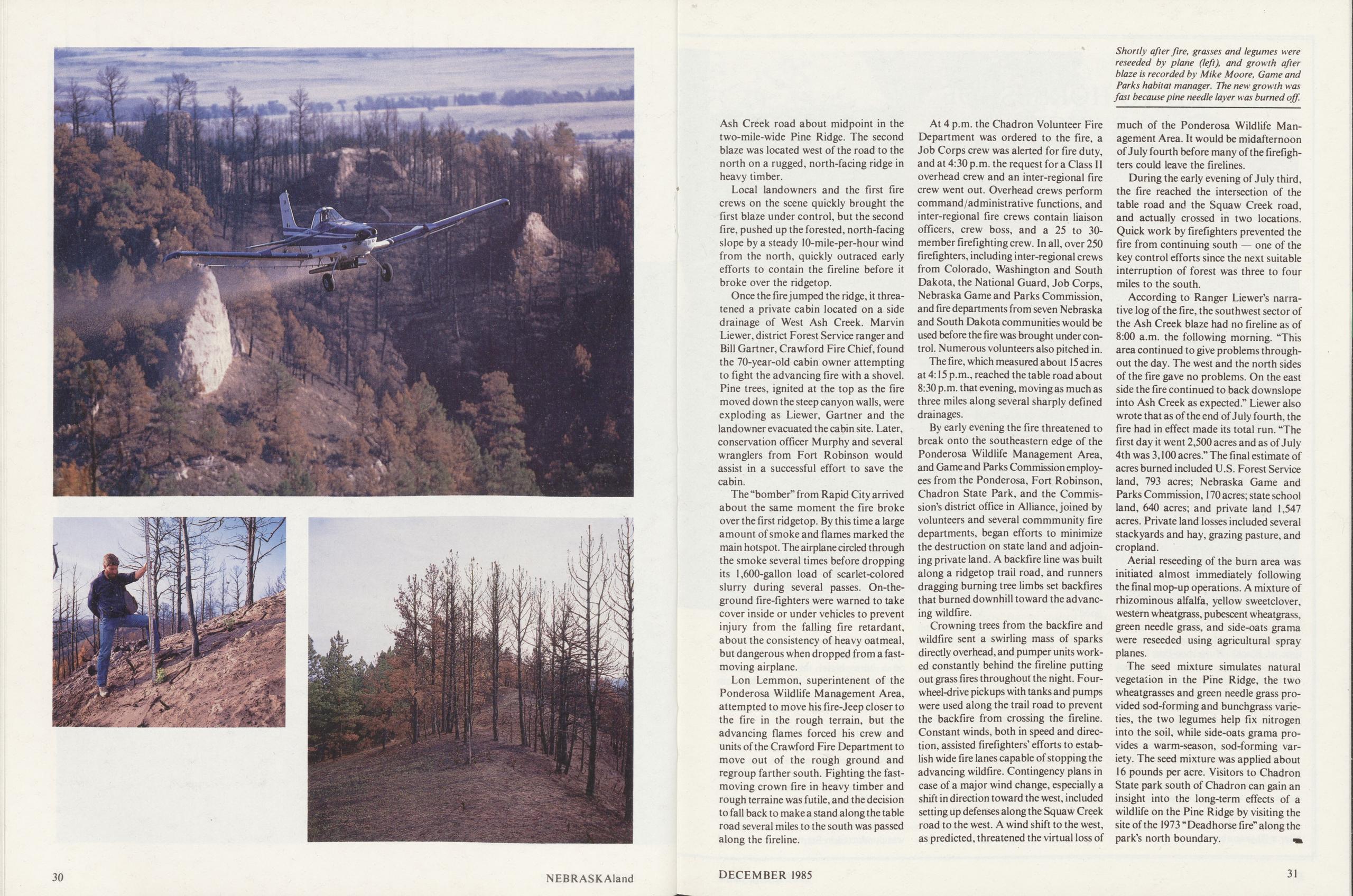
Ash Creek road about midpoint in the two-mile-wide Pine Ridge. The second blaze was located west of the road to the north on a rugged, north-facing ridge in heavy timber.
Local landowners and the first fire crews on the scene quickly brought the first blaze under control, but the second fire, pushed up the forested, north-facing slope by a steady 10-mile-per-hour wind from the north, quickly out raced early efforts to contain the fireline before it broke over the ridgetop.
Once the fire jumped the ridge, it threa- tened a private cabin located on a side drainage of West Ash Creek. Marvin Liewer, district Forest Service ranger and Bill Gartner, Crawford Fire Chief, found the 70-year-old cabin owner attempting to fight the advancing fire with a shovel. Pine trees, ignited at the top as the fire moved down the steep canyon walls, were exploding as Liewer, Gartner and the landowner evacuated the cabin site. Later, conservation officer Murphy and several wranglers from Fort Robinson would assist in a successful effort to save the cabin.
The "bomber" from Rapid City arrived about the same moment the fire broke over the first ridgetop. By this time a large amount of smoke and flames marked the main hotspot. The airplane circled through the smoke several times before dropping its 1,600-gallon load of scarlet-colored slurry during several passes. On-the- ground fire-fighters were warned to take cover inside or under vehicles to prevent injury from the falling fire retardant, about the consistency of heavy oatmeal, but dangerous when dropped from a fast- moving airplane.
Lon Lemmon, superintenent of the Ponderosa Wildlife Management Area, attempted to move his fire-Jeep closer to the fire in the rough terrain, but the advancing flames forced his crew and units of the Crawford Fire Department to move out of the rough ground and regroup farther south. Fighting the fast- moving crown fire in heavy timber and rough terraine was futile, and the decision to fall back to make a stand along the table road several miles to the south was passed along the fireline.
At 4 p.m. the Chadron Volunteer Fire Department was ordered to the fire, a Job Corps crew was alerted for fire duty, and at 4:30 p.m. the request for a Class 11 overhead crew and an inter-regional fire crew went out. Overhead crews perform command/administrative functions, and inter-regional fire crews contain liaison officers, crew boss, and a 25 to 30- member firefighting crew. In all, over 250 firefighters, including inter-regional crews from Colorado, Washington and South Dakota, the National Guard, Job Corps, Nebraska Game and Parks Commission, and fire departments from seven Nebraska and South Dakota communities would be used before the fire was brought under con- trol. Numerous volunteers also pitched in.
The fire, which measured about 15 acres at 4:15 p.m., reached the table road about 8:30 p.m. that evening, moving as much as three miles along several sharply defined drainages.
By early evening the fire threatened to break onto the southeastern edge of the Ponderosa Wildlife Management Area, and Game and Parks Commission employ- ees from the Ponderosa, Fort Robinson, Chadron State Park, and the Commis- sion’s district office in Alliance, joined by volunteers and several commmunity fire departments, began efforts to minimize the destruction on state land and adjoin- ing private land. A backfire line was built along a ridgetop trail road, and runners dragging burning tree limbs set backfires that burned downhill toward the advanc- ing wildfire.
Crowning trees from the backfire and wildfire sent a swirling mass of sparks directly overhead, and pumper units work- ed constantly behind the fireline putting out grass fires throughout the night. Four- wheel-drive pickups with tanks and pumps were used along the trail road to prevent the backfire from crossing the fireline. Constant winds, both in speed and direc- tion, assisted firefighters’ efforts to estab- lish wide fire lanes capable of stopping the advancing wildfire. Contingency plans in case of a major wind change, especially a shift in direction toward the west, included setting up defenses along the Squaw Creek road to the west. A wind shift to the west, as predicted, threatened the virtual loss of much of the Ponderosa Wildlife Man- agement Area. It would be midafternoon of July fourth before many of the firefigh- ters could leave the firelines.
During the early evening of July third, the fire reached the intersection of the table road and the Squaw Creek road, and actually crossed in two locations. Quick work by firefighters prevented the fire from continuing south — one of the key control efforts since the next suitable interruption of forest was three to four miles to the south.
According to Ranger Liewer’s narra- tive log of the fire, the southwest sector of the Ash Creek blaze had no fireline as of 8:00 a.m. the following morning. "This area continued to give problems through- out the day. The west and the north sides of the fire gave no problems. On the east side the fire continued to back downslope into Ash Creek as expected." Liewer also wrote that as of the end of July fourth, the fire had in effect made its total run. "The first day it went 2,500 acres and as of July 4th was 3,100 acres." The final estimate of acres burned included U.S. Forest Service land, 793 acres; Nebraska Game and Parks Commission, 170 acres; state school land, 640 acres; and private land 1,547 acres. Private land losses included several stackyards and hay, grazing pasture, and cropland.
Aerial reseeding of the burn area was initiated almost immediately following the final mop-up operations. A mixture of rhizominous alfalfa, yellow sweetclover, western wheatgrass, pubescent wheatgrass, green needle grass, and side-oats grama were reseeded using agricultural spray planes.
The seed mixture simulates natural vegetation in the Pine Ridge, the two wheatgrasses and green needle grass pro- vided sod-forming and bunchgrass varie- ties, the two legumes help fix nitrogen into the soil, while side-oats grama pro- vides a warm-season, sod-forming var- iety. The seed mixture was applied about 16 pounds per acre. Visitors to Chadron State park south of Chadron can gain an insight into the long-term effects of a wildlife on the Pine Ridge by visiting the site of the 1973 "Deadhorse fire" along the park’s north boundary.
30 NEBRASKAland DECEMBER 1985 31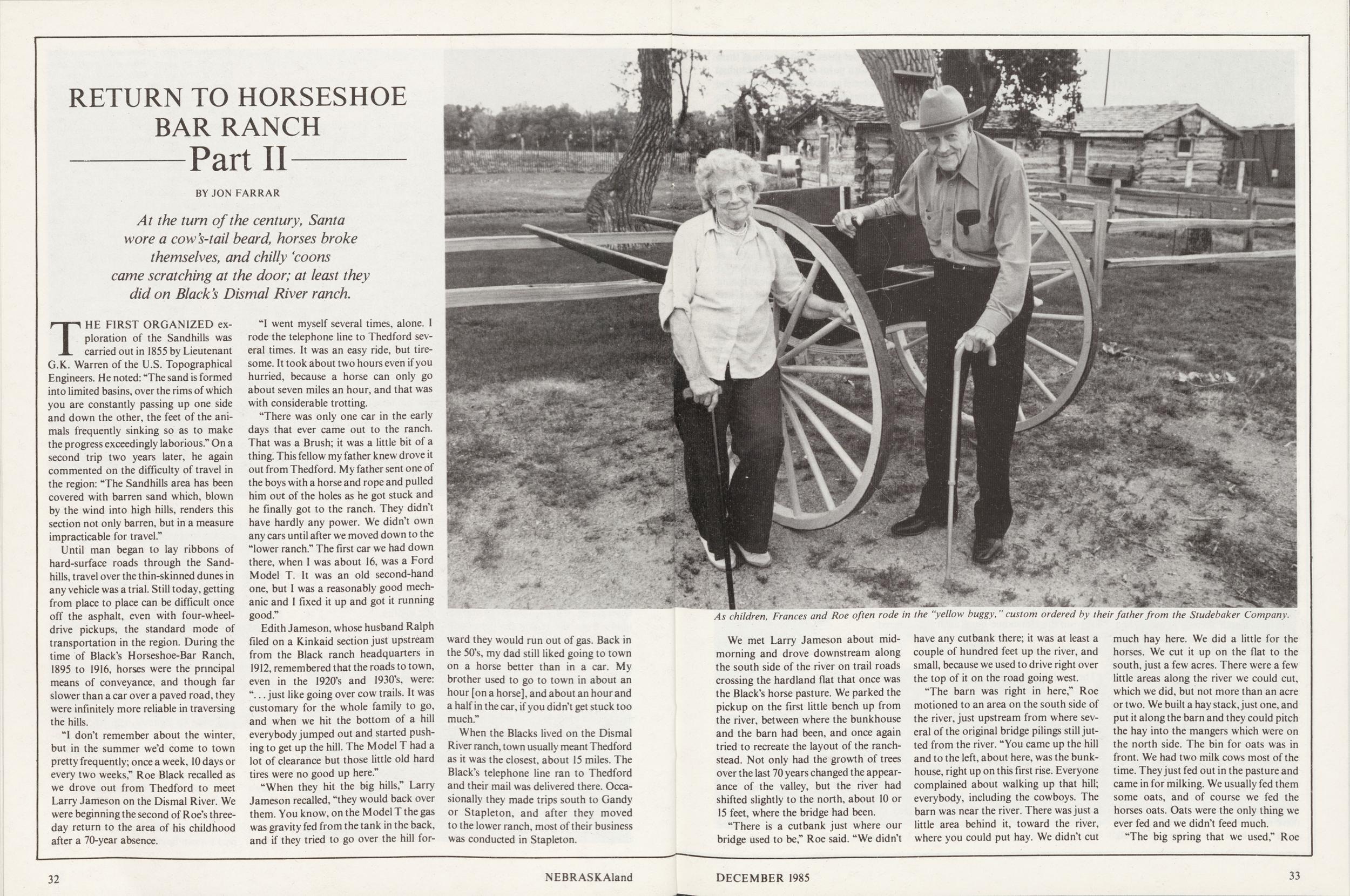
RETURN TO HORSESHOE
BAR RANCH
Part II
BY JON FARRAR
At the turn of the century, Santa
wore a cow 's-tail beard, horses broke
themselves, and chilly 'coons
came scratching at the door; at least they
did on Black's Dismal River ranch.
THE FIRST ORGANIZED exploration of the Sandhills was carried out in 1855 by Lieutenant G.K. Warren of the U.S. Topographical Engineers. He noted: "The sand is formed into limited basins, over the rims of which you are constantly passing up one side and down the other, the feet of the animals frequently sinking so as to make the progress exceedingly laborious." On a second trip two years later, he again commented on the difficulty of travel in the region: "The Sandhills area has been covered with barren sand which, blown by the wind into high hills, renders this section not only barren, but in a measure impracticable for travel."
Until man began to lay ribbons of hard-surface roads through the Sandhills, travel over the thin-skinned dunes in any vehicle was a trial. Still today, getting from place to place can be difficult once off the asphalt, even with four-wheel-drive pickups, the standard mode of transportation in the region. During the time of Black's Horseshoe-Bar Ranch, 1895 to 1916, horses were the principal means of conveyance, and though far slower than a car over a paved road, they were infinitely more reliable in traversing the hills.
"I don't remember about the winter, but in the summer we'd come to town pretty frequently; once a week, 10 days or every two weeks," Roe Black recalled as we drove out from Thedford to meet Larry Jameson on the Dismal River. We were beginning the second of Roe's three day return to the area of his childhood after a 70-year absence.
"I went myself several times, alone. I rode the telephone line to Thedford several times. It was an easy ride, but tiresome. It took about two hours even if you hurried, because a horse can only go about seven miles an hour, and that was with considerable trotting.
"There was only one car in the early days that ever came out to the ranch. That was a Brush; it was a little bit of a thing. This fellow my father knew drove it out from Thedford. My father sent one of the boys with a horse and rope and pulled him out of the holes as he got stuck and he finally got to the ranch. They didn't have hardly any power. We didn't own any cars until after we moved down to the "lower ranch." The first car we had down there, when I was about 16, was a Ford Model T. It was an old second-hand one, but I was a reasonably good mechanic and I fixed it up and got it running good."
Edith Jameson, whose husband Ralph filed on a Kinkaid section just upstream from the Black ranch headquarters in 1912, remembered that the roads to town, even in the 1920's and 1930's, were: "... just like going over cow trails. It was customary for the whole family to go, and when we hit the bottom of a hill everybody jumped out and started pushing to get up the hill. The Model T had a lot of clearance but those little old hard tires were no good up here."
"When they hit the big hills," Larry Jameson recalled, "they would back over them. You know, on the Model T the gas was gravity fed from the tank in the back, and if they tried to go over the hill fiords children, Frances and Roe often rode in the "yellow buggy," custom ordered by their father from the Studebaker Company. ward they would run out of gas. Back in the 50's, my dad still liked going to town on a horse better than in a car. My brother used to go to town in about an hour [on a horse], and about an hour and a half in the car, if you didn't get stuck too much."
When the Blacks lived on the Dismal River ranch, town usually meant Thedford as it was the closest, about 15 miles. The Black's telephone line ran to Thedford and their mail was delivered there. Occasionally they made trips south to Gandy or Stapleton, and after they moved to the lower ranch, most of their business was conducted in Stapleton.
32 NEBRASKAlandWe met Larry Jameson about midmorning and drove downstream along the south side of the river on trail roads crossing the hardland flat that once was the Black's horse pasture. We parked the pickup on the first little bench up from the river, between where the bunkhouse and the barn had been, and once again tried to recreate the layout of the ranchstead. Not only had the growth of trees over the last 70 years changed the appearance of the valley, but the river had shifted slightly to the north, about 10 or 15 feet, where the bridge had been.
"There is a cutbank just where our bridge used to be," Roe said. "We didn't have any cutbank there; it was at least a couple of hundred feet up the river, and small, because we used to drive right over the top of it on the road going west. "The barn was right in here," Roe motioned to an area on the south side of the river, just upstream from where several of the original bridge pilings still jutted from the river. "You came up the hill and to the left, about here, was the bunkhouse, right up on this first rise. Everyone complained about walking up that hill; everybody, including the cowboys. The barn was near the river. There was just a little area behind it, toward the river, where you could put hay. We didn't cut much hay here. We did a little for the horses. We cut it up on the flat to the south, just a few acres. There were a few little areas along the river we could cut, which we did, but not more than an acre or two. We built a hay stack, just one, and put it along the barn and they could pitch the hay into the mangers which were on the north side. The bin for oats was in front. We had two milk cows most of the time. They just fed out in the pasture and came in for milking. We usually fed them some oats, and of course we fed the horses oats. Oats were the only thing we ever fed and we didn't feed much.
"The big spring that we used," Roe again motioned, this time to a dense clump of cedars, "was right there. There were strawberries growing right alongside of the spring and we picked some of them once in a while. My sister and 1 played down there lots of times because there was a nice stream of water coming out of the overflow pipe. And, 1 had a little raft and went out on that swamp. 1 had a pistol, a single shot, and used to go out there and hunt for fish, mostly little sunfish. You didn't need to hit the fish; if you shot close to them they turned bellyup right away. I used to get quite a few and mother didn't care for that because she had to clean them."
DECEMBER 1985 33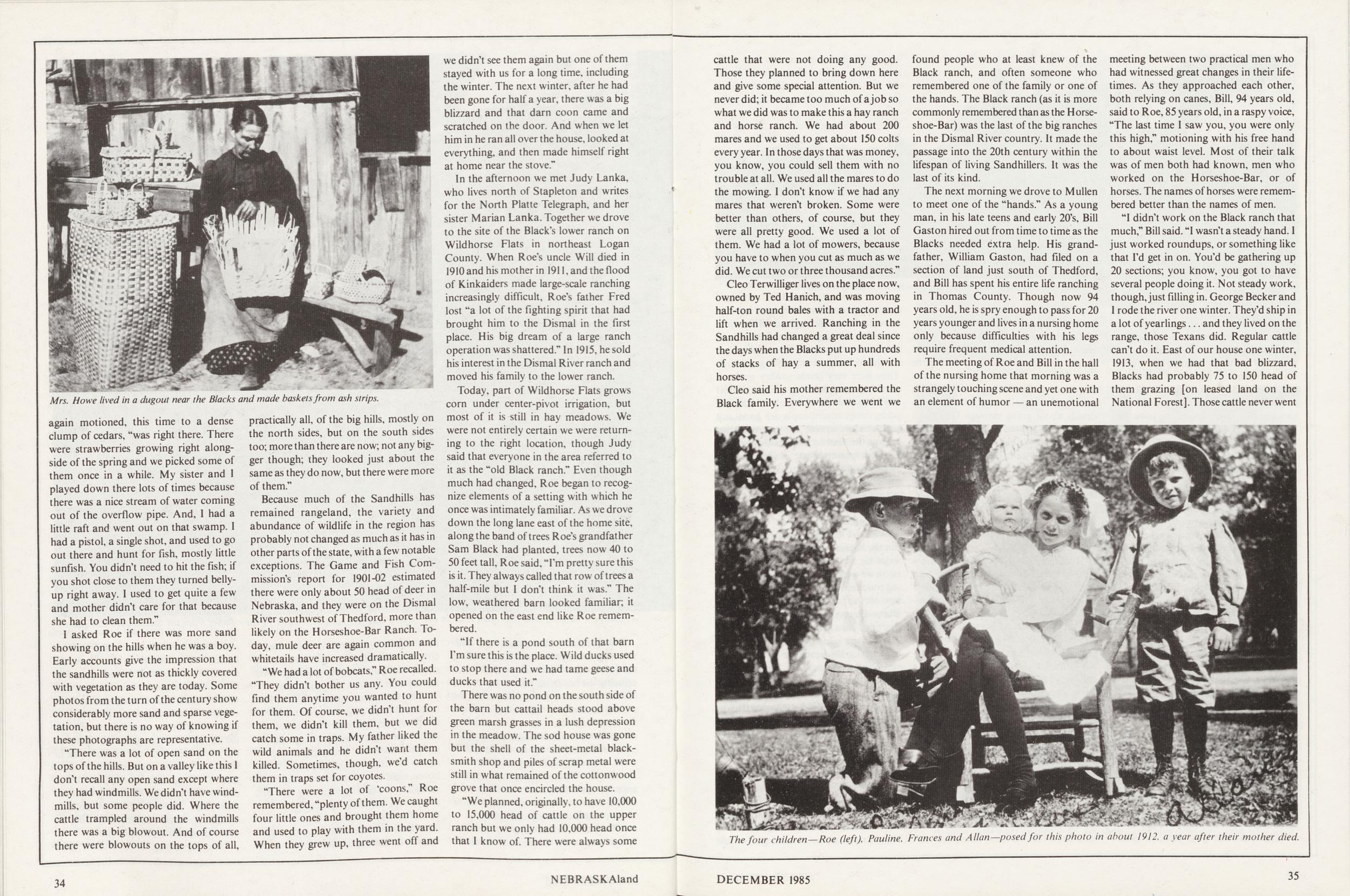
I asked Roe if there was more sand showing on the hills when he was a boy. Early accounts give the impression that the sandhills were not as thickly covered with vegetation as they are today. Some photos from the turn of the century show considerably more sand and sparse vegetation, but there is no way of knowing if these photographs are representative.
"There was a lot of open sand on the tops of the hills. But on a valley like this 1 don't recall any open sand except where they had windmills. We didn't have windmills, but some people did. Where the cattle trampled around the windmills there was a big blowout. And of course there were blowouts on the tops of all, practically all, of the big hills, mostly on the north sides, but on the south sides too; more than there are now; not any bigger though; they looked just about the same as they do now, but there were more of them."
Because much of the Sandhills has remained rangeland, the variety and abundance of wildlife in the region has probably not changed as much as it has in other parts of the state, with a few notable exceptions. The Game and Fish Commission's report for 1901-02 estimated there were only about 50 head of deer in Nebraska, and they were on the Dismal River southwest of Thedford, more than likely on the Horseshoe-Bar Ranch. Today, mule deer are again common and whitetails have increased dramatically.
"We had a lot of bobcats," Roe recalled. "They didn't bother us any. You could find them anytime you wanted to hunt for them. Of course, we didn't hunt for them, we didn't kill them, but we did catch some in traps. My father liked the wild animals and he didn't want them killed. Sometimes, though, we'd catch them in traps set for coyotes.
"There were a lot of 4coons," Roe remembered, "plenty of them. We caught four little ones and brought them home and used to play with them in the yard. When they grew up, three went off and we didn't see them again but one of them stayed with us for a long time, including the winter. The next winter, after he had been gone for half a year, there was a big blizzard and that darn coon came and scratched on the door. And when we let him in he ran all over the house, looked at everything, and then made himself right at home near the stove."
In the afternoon we met Judy Lanka, who lives north of Stapleton and writes for the North Platte Telegraph, and her sister Marian Lanka. Together we drove to the site of the Black's lower ranch on Wildhorse Flats in northeast Logan County. When Roe's uncle Will died in 1910 and his mother in 1911, and the flood of Kinkaiders made large-scale ranching increasingly difficult, Roe's father Fred lost "a lot of the fighting spirit that had brought him to the Dismal in the first place. His big dream of a large ranch operation was shattered." In 1915, he sold his interest in the Dismal River ranch and moved his family to the lower ranch.
Today, part of Wildhorse Flats grows corn under center-pivot irrigation, but most of it is still in hay meadows. We were not entirely certain we were returning to the right location, though Judy said that everyone in the area referred to it as the "old Black ranch." Even though much had changed, Roe began to recognize elements of a setting with which he once was intimately familiar. As we drove down the long lane east of the home site, along the band of trees Roe's grandfather Sam Black had planted, trees now 40 to 50 feet tall, Roe said, "I'm pretty sure this is it. They always called that row of trees a half-mile but I don't think it was." The low, weathered barn looked familiar; it opened on the east end like Roe remembered.
"If there is a pond south of that barn I'm sure this is the place. Wild ducks used to stop there and we had tame geese and ducks that used it."
There was no pond on the south side of the barn but cattail heads stood above green marsh grasses in a lush depression in the meadow. The sod house was gone but the shell of the sheet-metal blacksmith shop and piles of scrap metal were still in what remained of the cottonwood grove that once encircled the house.
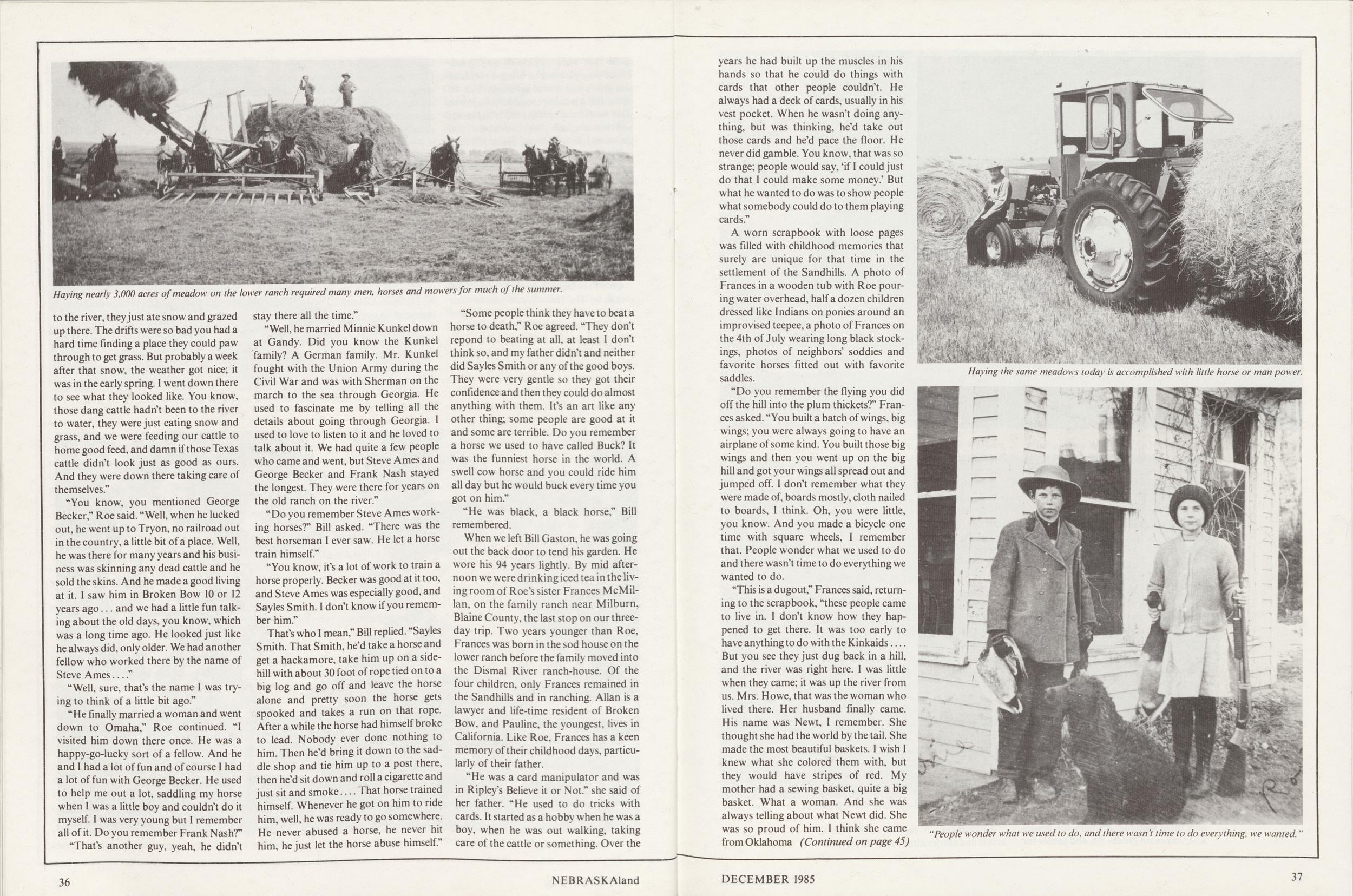
"We planned, originally, to have 10,000 to 15,000 head of cattle on the upper ranch but we only had 10,000 head once that I know of. There were always some 34 NEBRASKAland cattle that were not doing any good. Those they planned to bring down here and give some special attention. But we never did; it became too much of a job so what we did was to make this a hay ranch and horse ranch. We had about 200 mares and we used to get about 150 colts every year. In those days that was money, you know, you could sell them with no trouble at all. We used all the mares to do the mowing. I don't know if we had any mares that weren't broken. Some were better than others, of course, but they were all pretty good. We used a lot of them. We had a lot of mowers, because you have to when you cut as much as we did. We cut two or three thousand acres."
Cleo Terwilliger lives on the place now, owned by Ted Hanich, and was moving half-ton round bales with a tractor and lift when we arrived. Ranching in the Sandhills had changed a great deal since the days when the Blacks put up hundreds of stacks of hay a summer, all with horses.
Cleo said his mother remembered the Black family. Everywhere we went we found people who at least knew of the Black ranch, and often someone who remembered one of the family or one of the hands. The Black ranch (as it is more commonly remembered than as the Horseshoe-Bar) was the last of the big ranches in the Dismal River country. It made the passage into the 20th century within the lifespan of living Sandhillers. It was the last of its kind.
The next morning we drove to Mullen to meet one of the "hands." As a young man, in his late teens and early 20's, Bill Gaston hired out from time to time as the Blacks needed extra help. His grandfather, William Gaston, had filed on a section of land just south of Thedford, and Bill has spent his entire life ranching in Thomas County. Though now 94 years old, he is spry enough to pass for 20 years younger and lives in a nursing home only because difficulties with his legs require frequent medical attention.
The meeting of Roe and Bill in the hall of the nursing home that morning was a strangely touching scene and yet one with an element of humor — an unemotional meeting between two practical men who had witnessed great changes in their lifetimes. As they approached each other, both relying on canes, Bill, 94 years old, said to Roe, 85 years old, in a raspy voice, "The last time I saw you, you were only this high," motioning with his free hand to about waist level. Most of their talk was of men both had known, men who worked on the Horseshoe-Bar, or of horses. The names of horses were remembered better than the names of men.
"I didn't work on the Black ranch that much," Bill said. "I wasn't a steady hand. 1 just worked roundups, or something like that I'd get in on. You'd be gathering up 20 sections; you know, you got to have several people doing it. Not steady work, though, just filling in. George Becker and I rode the river one winter. They'd ship in a lot of yearlings... and they lived on the range, those Texans did. Regular cattle can't do it. East of our house one winter, 1913, when we had that bad blizzard, Blacks had probably 75 to 150 head of them grazing [on leased land on the National Forest]. Those cattle never went to the river, they just ate snow and grazed up there. The drifts were so bad you had a hard time finding a place they could paw through to get grass. But probably a week after that snow, the weather got nice; it was in the early spring. 1 went down there to see what they looked like. You know, those dang cattle hadn't been to the river to water, they were just eating snow and grass, and we were feeding our cattle to home good feed, and damn if those Texas cattle didn't look just as good as ours. And they were down there taking care of themselves."
"You know, you mentioned George Becker," Roe said. "Well, when he lucked out, he went up to Tryon, no railroad out in the country, a little bit of a place. Well, he was there for many years and his business was skinning any dead cattle and he sold the skins. And he made a good living at it. 1 saw him in Broken Bow 10 or 12 years ago... and we had a little fun talking about the old days, you know, which was a long time ago. He looked just like he always did, only older. We had another fellow who worked there by the name of Steve Ames"
"Well, sure, that's the name I was trying to think of a little bit ago."
"He finally married a woman and went down to Omaha," Roe continued. "1 visited him down there once. He was a happy-go-lucky sort of a fellow. And he and I had a lot of fun and of course 1 had a lot of fun with George Becker. He used to help me out a lot, saddling my horse when I was a little boy and couldn't do it myself. 1 was very young but I remember all of it. Do you remember Frank Nash?"
"That's another guy, yeah, he didn't stay there all the time."
"Well, he married Minnie Kunkel down at Gandy. Did you know the Kunkel family? A German family. Mr. Kunkel fought with the Union Army during the Civil War and was with Sherman on the march to the sea through Georgia. He used to fascinate me by telling all the details about going through Georgia. 1 used to love to listen to it and he loved to talk about it. We had quite a few people who came and went, but Steve Ames and George Becker and Frank Nash stayed the longest. They were there for years on the old ranch on the river."
"Do you remember Steve Ames working horses?" Bill asked. "There was the best horseman 1 ever saw. He let a horse train himself."
"You know, it's a lot of work to train a horse properly. Becker was good at it too, and Steve Ames was especially good, and Sayles Smith. 1 don't know if you remember him."
That's who I mean," Bill replied. "Sayles Smith. That Smith, he'd take a horse and get a hackamore, take him up on a sidehill with about 30 foot of rope tied on to a big log and go off and leave the horse alone and pretty soon the horse gets spooked and takes a run on that rope. After a while the horse had himself broke to lead. Nobody ever done nothing to him. Then he'd bring it down to the saddle shop and tie him up to a post there, then he'd sit down and roll a cigarette and just sit and smoke.... That horse trained himself. Whenever he got on him to ride him, well, he was ready to go somewhere. He never abused a horse, he never hit him, he just let the horse abuse himself."
"Some people think they have to beat a horse to death," Roe agreed. "They don't repond to beating at all, at least I don't think so, and my father didn't and neither did Sayles Smith or any of the good boys. They were very gentle so they got their confidence and then they could do almost anything with them. It's an art like any other thing; some people are good at it and some are terrible. Do you remember a horse we used to have called Buck? It was the funniest horse in the world. A swell cow horse and you could ride him all day but he would buck every time you got on him."
"He was black, a black horse," Bill remembered.
When we left Bill Gaston, he was going out the back door to tend his garden. He wore his 94 years lightly. By mid afternoon we were drinking iced tea in the living room of Roe's sister Frances McMillan, on the family ranch near Milburn, Blaine County, the last stop on our threeday trip. Two years younger than Roe, Frances was born in the sod house on the lower ranch before the family moved into the Dismal River ranch-house. Of the four children, only Frances remained in the Sandhills and in ranching. Allan is a lawyer and life-time resident of Broken Bow, and Pauline, the youngest, lives in California. Like Roe, Frances has a keen memory of their childhood days, particularly of their father.
"He was a card manipulator and was in Ripley's Believe it or Not." she said of her father. "He used to do tricks with cards. It started as a hobby when he was a boy, when he was out walking, taking care of the cattle or something. Over the 36 NEBRASKALand years he had built up the muscles in his hands so that he could do things with cards that other people couldn't. He always had a deck of cards, usually in his vest pocket. When he wasn't doing anything, but was thinking, he'd take out those cards and he'd pace the floor. He never did gamble. You know, that was so strange; people would say, cif I could just do that I could make some money.' But what he wanted to do was to show people what somebody could do to them playing cards."
A worn scrapbook with loose pages was filled with childhood memories that surely are unique for that time in the settlement of the Sandhills. A photo of Frances in a wooden tub with Roe pouring water overhead, half a dozen children dressed like Indians on ponies around an improvised teepee, a photo of Frances on the 4th of July wearing long black stockings, photos of neighbors' soddies and favorite horses fitted out with favorite saddles.
"Do you remember the flying you did off the hill into the plum thickets?" Frances asked. "You built a batch of wings, big wings; you were always going to have an airplane of some kind. You built those big wings and then you went up on the big hill and got your wings all spread out and jumped off. I don't remember what they were made of, boards mostly, cloth nailed to boards, I think. Oh, you were little, you know. And you made a bicycle one time with square wheels, I remember that. People wonder what we used to do and there wasn't time to do everything we wanted to do.
"This is a dugout," Frances said, returning to the scrapbook, "these people came to live in. I don't know how they happened to get there. It was too early to have anything to do with the Kinkaids But you see they just dug back in a hill, and the river was right here. I was little when they came; it was up the river from us. Mrs. Howe, that was the woman who lived there. Her husband finally came. His name was Newt, I remember. She thought she had the world by the tail. She made the most beautiful baskets. I wish I knew what she colored them with, but they would have stripes of red. My mother had a sewing basket, quite a big basket. What a woman. And she was always telling about what Newt did. She was so proud of him. I think she came from Oklahoma (Continued on page 45)
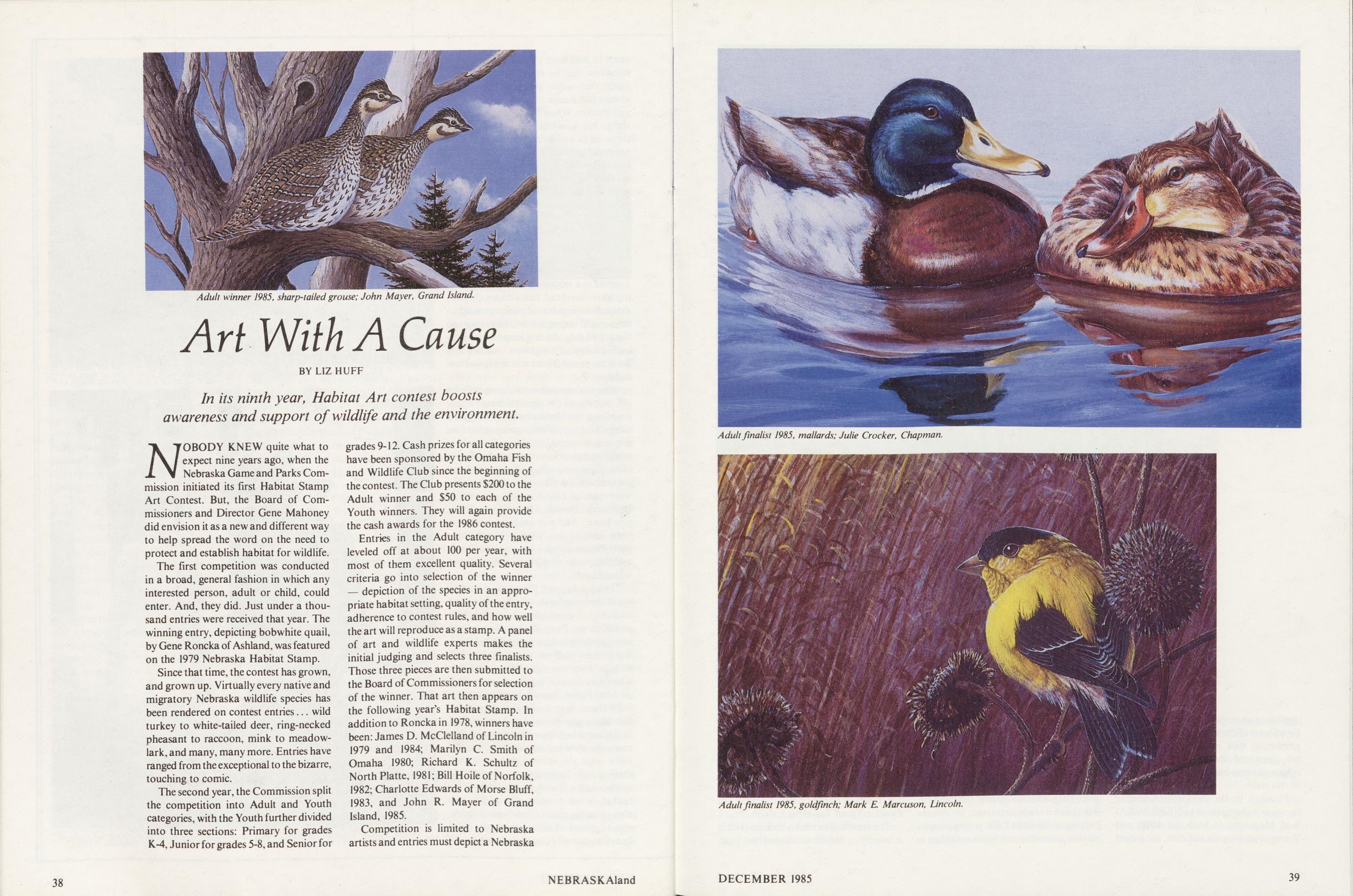
Art With A Cause
BY LIZ HUFF In its ninth year, Habitat Art contest boosts awareness and support of wildlife and the environment.NOBODY KNEW quite what to expect nine years ago, when the Nebraska Game and Parks Commission initiated its first Habitat Stamp Art Contest. But, the Board of Commissioners and Director Gene Mahoney did envision it as a new and different way to help spread the word on the need to protect and establish habitat for wildlife.
The first competition was conducted in a broad, general fashion in which any interested person, adult or child, could enter. And, they did. Just under a thousand entries were received that year. The winning entry, depicting bobwhite quail, by Gene Roncka of Ashland, was featured on the 1979 Nebraska Habitat Stamp.
Since that time, the contest has grown, and grown up. Virtually every native and migratory Nebraska wildlife species has been rendered on contest entries... wild turkey to white-taiied deer, ring-necked pheasant to raccoon, mink to meadowlark, and many, many more. Entries have ranged from the exceptional to the bizarre, touching to comic.
The second year, the Commission split the competition into Adult and Youth categories, with the Youth further divided into three sections: Primary for grades K-4, Junior for grades 5-8, and Senior for grades 9-12. Cash prizes for all categories have been sponsored by the Omaha Fish and Wildlife Club since the beginning of the contest. The Club presents $200 to the Adult winner and $50 to each of the Youth winners. They will again provide the cash awards for the 1986 contest.
Entries in the Adult category have leveled off at about 100 per year, with most of them excellent quality. Several criteria go into selection of the winner — depiction of the species in an appropriate habitat setting, quality of the entry, adherence to contest rules, and how well the art will reproduce as a stamp. A panel of art and wildlife experts makes the initial judging and selects three finalists. Those three pieces are then submitted to the Board of Commissioners for selection of the winner. That art then appears on the following year's Habitat Stamp. In addition to Roncka in 1978, winners have been: James D. McClelland of Lincoln in 1979 and 1984; Marilyn C. Smith of Omaha 1980; Richard K. Schultz of North Platte, 1981; Bill Hoile of Norfolk, 1982; Charlotte Edwards of Morse Bluff, 1983, and John R. Mayer of Grand Island, 1985.
Competition is limited to Nebraska artists and entries must depict a Nebraska species in an appropriate habitat setting. Employees of the Game and Parks Commission or their immediate families are not permitted to enter. For complete rules and entry blank, see the back cover of this issue.
38 NEBRASKAland
Finalists in the competition receive two-year subscriptions to NEBRASKAland Magazine, in both the Adult and Youth categories. In addition, the judges select "honorable mentions," and they receive one-year subscriptions to NEBRASKAland.
The Youth category is handled a bit differently than the Adult, since standards are not as high and some leeway can be given for youthful flights of imagination. Art teachers are recruited to do the judging of the some 2,000 young peoples' entries, since they are better qualified to determine what work youngsters are capable of at a given age and grade level. And, they are required to take the judging a step further. They select the honorable mentions, finalists and winners, but in addition, choose representative entries for inclusion in the "Habitat Stamp Art Contest Youth Traveling Exhibit."
The traveling exhibit is then booked at a variety of locations around the state, 40 NEBRASKAland giving exposure to both the contest, its purpose, and to the youthful artists. This year, for example, the exhibit went to the Ak-Sar-Ben Aquarium and Nature Center near Gretna, the Game and Parks Commission's headquarters in Lincoln, the Norfolk Arts Center, Buffalo Bill Ranch State Historical Park at North Platte, the Peter Kiewit Conference Center at the State Office Building in Omaha, the State Capitol in Lincoln, Stuhr Museum of the Prairie Pioneer in Grand Island, and the Lydia Bruun Woods Library at Falls City.
When booking the exhibit, efforts are made to place it at strategic locations around the state, as well as to place it so most of the entrants can have a reasonable opportunity to see it. Those interested in possibly hosting the exhibit should write to: Contest Coordinator, Nebraska Habitat Stamp Art Contest, Nebraska Game and Parks Commission, P.O. Box 30370, Lincoln, NE 68503. Invitations to display the exhibit will be given every consideration.
In the early years of the contest, the Commission displayed all the youth entries. However, as the competition grew it became (Continued on page 42)
DECEMBER 1985 41
Art with a cause
(Continued from page 41)nearly impossible to do so. In fact, it now takes the judges over half a day just to process the young people's entries.
Because of the size of the contest now, it also becomes necessary for the Commission to require return postage. In the past, all entries were returned also with a Participation Certificate. Higher postal rates, along with the volume of entries, has made that impossible. The Participation Certificates are still provided to all teachers or entrants who include return postage with their submissions.
If anyone thinks this is an inexpensive way to acquire art for our Habitat Stamp, they are mistaken. The hours devoted to processing the entries alone make for a significant outlay on the part of the Commission. One of our secretaries spends about 120 hours cataloging entries when they are received then returning them when the contest is over.
However, we do feel that the contest has more than exceeded our original expectations. It has proven to be a valuable teaching tool on the Youth level, and hopefully has made our Adult entrant more aware of the necessity of habitat for all wildlife. Often, art and science teachers combine forces, using the contest as a way to present both wildlife, habitat and art to their students.
Once a species appears on the Habitat Stamp, it is ineligible for the next five years. Wildlife eliminated for the 1986 contest include: coyote, wild turkey, Canada goose, cardinal, and sharp-tailed grouse. Entries will be accepted through March 1, 1986, and judging will be done that month. After judging, the Adult winners are placed on display for about six weeks in the lobby of the Commission's headquarters at 2200 N. 33rd St., Lincoln. After that, they are returned to the artists, providing return postage is included with the entry.
In spite of the many hours involved in conducting the competition, it is an enjoyable job. The entries are delightful, and winner selections invariably create instant debates on their relative merits. As with any art, the beauty is in the eye of the beholder. However, the judges are saddled with one final criterion for the stamp selection: the species presented must be anatomically correct. Sometimes, an artist makes one fatal flaw that eliminates the entry from further consideration. It may be awarded an honorable mention on merit, but that's as high as it will go. The same would be true of highly modernistic techniques.
42 NEBRASKAland The
Horseshoe-Bar
Ranch
(Remembering a Prairie Childhood)
Horseshoe-Bar
Ranch
a frontier life, remembering with Roe his
early boyhood home on the Horseshoe-Bar Ranch, in the Nebraska sandhills.
It was a time when cattle barons operated, before the homesteaders moved in, from
1900 to 1916 when prairie grass was wild and high. It's a boy's first-hand
account of life with his family and real cowboy ranchhands. Dad's ranch
was full of wild prairie game, when game was meat for
the table. Life was hard, but good.
Roe Black recalls and writes vividly in a style that you can't put down events
that give you another insight and understanding of a major Nebraska heritage.
Early ranch life gave Roe the discipline for a later-in-life education and his
profession as a mechanical engineer. (You'll read about one of his
useful mechanical inventions.)
The
with an introduction by Dr. Robert N.
Roe R. Black Man ley and preface by Jon Farrar. To be
released in December so order now!
isbn 093964418 5, illustrated, paper, $9.95
TO ORDER, send $11 (tax and
shipping included) to:
Media Publishing & Marketing, Inc.
344 N. 27 St., Lincoln, NE 68503
(402) 474-2676
Visa/MasterCard accepted
The
Horseshoe-Bar
Ranch
(Remembering a Prairie Childhood)
Horseshoe-Bar
Ranch
a frontier life, remembering with Roe his
early boyhood home on the Horseshoe-Bar Ranch, in the Nebraska sandhills.
It was a time when cattle barons operated, before the homesteaders moved in, from
1900 to 1916 when prairie grass was wild and high. It's a boy's first-hand
account of life with his family and real cowboy ranchhands. Dad's ranch
was full of wild prairie game, when game was meat for
the table. Life was hard, but good.
Roe Black recalls and writes vividly in a style that you can't put down events
that give you another insight and understanding of a major Nebraska heritage.
Early ranch life gave Roe the discipline for a later-in-life education and his
profession as a mechanical engineer. (You'll read about one of his
useful mechanical inventions.)
The
with an introduction by Dr. Robert N.
Roe R. Black Man ley and preface by Jon Farrar. To be
released in December so order now!
isbn 093964418 5, illustrated, paper, $9.95
TO ORDER, send $11 (tax and
shipping included) to:
Media Publishing & Marketing, Inc.
344 N. 27 St., Lincoln, NE 68503
(402) 474-2676
Visa/MasterCard accepted
Everybody at the Game and Parks Commission is tuned up and ready for the 9th annual competition, so, artists, get out your easels, unpack your paints, and get busy. We're awaiting your entry and a new winner.
Return to Horseshoe-Bar Ranch.. part II
(Continued from page 37)and was Indian, certainly part Indian.
"Do you know what happened to the camera these were taken with?" Frances asked.
"It was stolen out in Yellowstone Park."
"No, I don't think it was Yellowstone. We stopped and had to camp in a campground. We ordinarily just pulled out and had a camp by ourselves. We might have been going to something, a circus or something was in town. So we camped in a campground and I think that was where the camera was stolen, and so there were never any more pictures as good as these. That was a good camera, a box camera, a great big camera."
The more I learned about the Black family and their Horseshoe-Bar Ranch, the more extraordinary it all seemed for a time when the Sandhills was still a raw country. The trip to Yellowstone National Park was made in 1914 and must have been something of an odyssey as they traveled by horse-drawn wagon and on saddle horses and were gone for two months. Roe recalls that along the way he talked to a young man up a pole in the middle of nowhere in eastern Wyoming, stringing the first transcontinental telephone line; and chasing after a pair of grizzly bear cubs until they were treed and only then giving the nearby mother a second thought. In both business and recreation the family never lacked for imagination.
"These are the bay windows," Roe remarked as he looked at a photograph of the ranch house. "We called them bay windows but they were just ordinary windows, three of them together. That's where we had our Christmas trees."
"Nobody would tell when Christmas was," Frances remembered. "It didn't make any difference; it might have been way up in January sometime before Aunt Annie got our things sent and we got into town to get them. It didn't make any difference. Whenever everybody was ready, we had Christmas. They put us to bed early and got us all ready to think of tomorrow, and when we woke up that morning, they told us to come out, something had happened and there was Christmas. 1 remember the last one. 1 remember crying because they told me there wasn't any Santa Claus. 1 insisted that there was because 1 had seen him."
Natural History from Nebraska Guide to Mammals of the Plains States By J. Knox Jones, Jr., David M. Armstrong, and Jerry R.Choate Designed for everyone interested in wildlife, this book is the first comprehensive handbook of the 138 native and 8 introduced species of plains mammals. Distribution, physical characteristics, habitat, food, predation, and other aspects of each species are discussed. Tentative prices: $15.95 paper, $29.95 cloth Central Plains Prehistory Holocene Environments and Culture Change in the Republican River Basin By Waldo Wedel Archaeologist emeritus of the National Museum of Natural History, Smithsonian Institution, Wedel is considered the foremost authority on Great Plains prehistory. This volume, the capstone of his career, presents the first full-scale review and synthesis of central plains prehistory. The Repubican River Basin provides an ideal cross-section for study, a microcosm of plains environments. Tentative price: $29.50 available at bookstores or from UNIVERSITY OF NEBRASKA PRESS 901 NORTH 17TH, LINCOLN, NE 68588 When Hunting, Think SAFETY! LIVE-CATCH ALL-PURPOSE TRAPS Wrtftor FREE CATALOG Traps without injury squirrels, chipmunks, rabbits, mink, fox, raccoons, stray animals, pests, etc. Sizes for every need. Also traps for snakes, sparrows, pigeons, crabs, turtles, quail, etc. Save on our low factory prices Send no money. Free catalog and trapping secrets MUSTANG MFG. CO., Dept. N-34, Box 920947, Houston, Tex. 77292 LET poOL IPCETHEK AMERICA Harlan County Dam Vacation Apartments - fully furnished Color TV Kitchen Facilities Full Baths Game cleaning room with freezer One block from shopping center Weekend or week of pleasant living Security Deposit Required Sorry —No Pets Dean and Esther Stone Box 145 Ph. (308) 799-3422 Republican City, NE 68971 JOHN BOY'S 1985 BIG WALLEYE HUNT $200 winner Steve Anderson, Ogallala 13 pounds, 2 ounces 3-19-85 Girth 19 inches, length 31 inches Recorded by Sportsman's Complex Bait John Boy Spinner. Green with minnow, drifting 11/2-ounce Bottom Bouncer Martin Bay "Thank you for fishing John Boy Spinners and Bottom Bouncers. John Boy Spinners Ogallala, Nebraska 69153 USA Trademark No. 1257679 DECEMBER 1985 45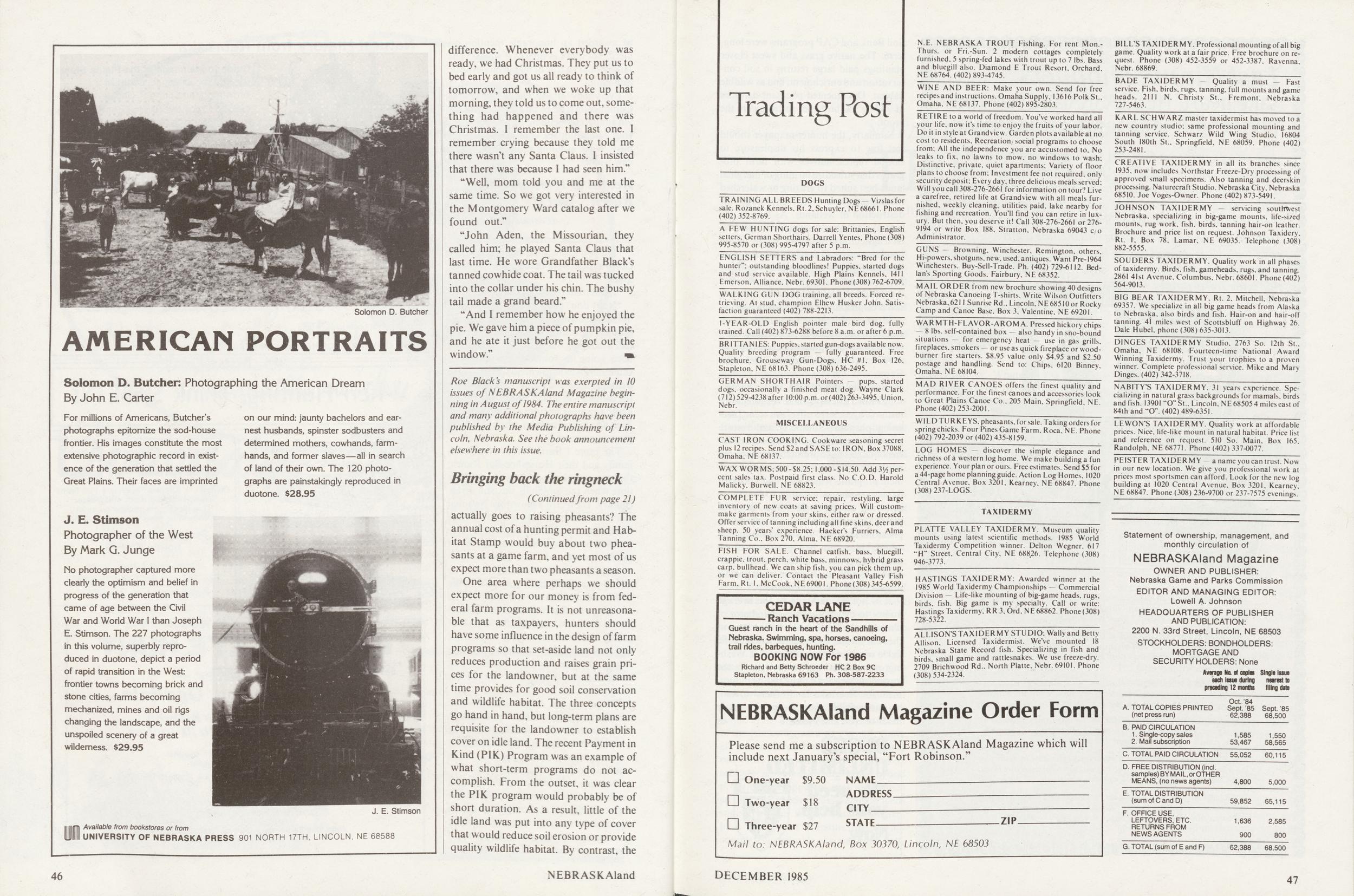
"Well, mom told you and me at the same time. So we got very interested in the Montgomery Ward catalog after we found out."
"John Aden, the Missourian, they called him; he played Santa Claus that last time. He wore Grandfather Black's tanned cowhide coat. The tail was tucked into the collar under his chin. The bushy tail made a grand beard."
"And I remember how he enjoyed the pie. We gave him a piece of pumpkin pie, and he ate it just before he got out the window."
Roe Blacks manuscript was exerpted in 10 issues of NEB R ASK Aland Magazine beginning in A ugust of 1984. The entire manuscript and many additional photographs have been published by the Media Publishing of Lincoln, Nebraska. See the book announcement elsewhere in this issue.
Bringing back the ringneck
(Continued from page 21)actually goes to raising pheasants? The annual cost of a hunting permit and Habitat Stamp would buy about two pheasants at a game farm, and yet most of us expect more than two pheasants a season.
One area where perhaps we should expect more for our money is from federal farm programs. It is not unreasonable that as taxpayers, hunters should have some influence in the design of farm programs so that set-aside land not only reduces production and raises grain prices for the landowner, but at the same time provides for good soil conservation and wildlife habitat. The three concepts go hand in hand, but long-term plans are requisite for the landowner to establish cover on idle land. The recent Payment in Kind (P1K) Program was an example of what short-term programs do not accomplish. From the outset, it was clear the P1K program would probably be of short duration. As a result, little of the idle land was put into any type of cover that would reduce soil erosion or provide quality wildlife habitat. By contrast, the Soil Bank and CAP programs were longterm. The native grass and sweet clover plantings paid large returns in soil conservation and enrichment, and as wildlife habitat. Documented pheasant densities of 200 to 300 birds per section were the proof.
46 NEBRASKAlandTrading Post
DOGSTRAINING ALL BREEDS Hunting Dogs-Vilas for sale. Rozanek Kennels, Rt. 2, Schuyler, NE 68661. Phone (402) 352-8769.
A FEW HUNTING dogs for sale: Brittanies, English setters, German Shorthairs. Darrell Yentes, Phone (308) 995-8570 or (308) 995-4797 after 5 p.m.
ENGLISH SETTERS and Labradors: "Bred for the hunter": outstanding bloodlines! Puppies, started dogs and stud service available. High Plains Kennels, 1411 Emerson, Alliance, Nebr. 69301. Phone (308) 762-6709.
WALKING GUN DOG training, all breeds. Forced retrieving. At stud, champion Elhew Husker John. Satisfaction guaranteed (402) 788-2213.
I-YEAR-OLD English pointer male bird dog, fully trained. Call (402) 873-6288 before 8 a.m. or after 6 p.m.
BR ITTANIES: Puppies, started gun-dogs available now. Quality breeding program — fully guaranteed. Free brochure. Grouseway Gun-Dogs, HC #1, Box 126, Stapleton, NE 68163. Phone (308) 636-2495.
GERMAN SHORTHAIR Pointers pups, started dogs, occasionally a finished meat dog. Wayne Clark (712) 529-4238 after 10:00 p.m. or(402) 263-3495, Union, Nebr.
MISCELLANEOUSCAST IRON COOKING. Cookware seasoning secret plus 12 recipes. Send $2 and SASE to: I RON, Box 37088, Omaha, NE 68137.
WAX WORMS; 500-$8.25; 1,000-$14.50. Add 3'/2 percent sales tax. Postpaid first class. No C.O.D. Harold Malicky. Burwell, NE 68823.
COMPLETE FUR service; repair, restyling, large inventory of new coats at saving prices. Will custommake garments from your skins, either raw or dressed. Offer service of tanning including all fine skins, deer and sheep. 50 years' experience Hacker's Furriers, Alma Tanning Co.. Box 270, Alma. NE 68920.
FISH FOR SALE. Channel catfish, bass, bluegill. crappie, trout, perch, white bass, minnows, hybrid grass carp, bullhead. We can ship fish, you can pick them up, or we can deliver. Contact the Pleasant Valley Fish Farm, Rt. I, McCook, N E 69001. Phone (308) 345-6599.
CEDAR LANE - Ranch Vacations Guest ranch in the heart of the Sandhills of Nebraska. Swimming, spa, horses, canoeing, trail rides, barbeques, hunting. BOOKING NOW For 1986 Richard and Betty Schroeder HC 2 Box 9C Stapleton, Nebraska 69163 Ph. 308-587-2233NE. NEBRASKA TROUT Fishing. For rent Mon.-Thurs. or Fri.-Sun. 2 modern cottages completely furnished, 5 spring-fed lakes with trout up to 7 lbs. Bass and bluegill also. Diamond E Trout Resort, Orchard, NE 68764. (402)893-4745.
WINE AND BEER: Make your own. Send for free recipesand instructions. Omaha Supply, 13616 Polk St., Omaha. NE 68137. Phone (402) 895-2803.
RETIRE to a world of freedom. You've worked hard all your life, now it's time to enjoy the fruits of your labor. Doit in style at Grandview. Garden plots available at no cost to residents. Recreation,/ social programs to choose from; All the independence you are accustomed to. No leaks to fix, no lawns to mow, no windows to wash; Distinctive, private, quiet apartments; Variety of floor plans to choose from; Investment fee not required, only security deposit; Every day, three delicious meals served; Will you call 308-276-2661 for information on tour? Live a carefree, retired life at Grandview with all meals furnished, weekly cleaning, utilities paid, lake nearby for fishing and recreation. You'll find you can retire in luxury. But then, you deserve it! Call 308-276-2661 or 276-9194 or write Box 188, Stratton, Nebraska 69043 c/o Administrator.
GUNS — Browning, Winchester. Remington, others, Hi-powers, shotguns, new, used.antiques. Want Pre-1964 Winchesters. Buy-Sell-Trade. Ph. (402) 729-6112. Bedlan's Sporting Goods, Fairbury, NE 68352.
MAIL ORDER from new brochure showing40designs of Nebraska Canoeing T-shirts. Write Wilson Outfitters Nebraska, 6211 Sunrise Rd., Lincoln, NE 68510 or Rocky Camp and Canoe Base. Box 3. Valentine, NE 69201.
WARMTH-FLAVOR-AROMA. Pressed hickory chips 8 lbs. self-contained box — also handy in sno-bound situations - for emergency heat — use in gas grills, fireplaces, smokers - or use as quick fireplace or woodburner fire starters. $8.95 value only $4.95 and $2.50 postage and handling. Send to: Chips, 6120 Binney. Omaha, NE 68104.
MAD RIVER CANOES offers the finest quality and performance. For the finest canoes and accessories look to Great Plains Canoe Co., 205 Main. Springfield, NE Phone (402) 253-2001.
WILD TURKEYS, pheasants, for sale. Taking orders for spring chicks. Four Pines Game Farm, Roca, NE. Phone (402) 792-2039 or (402) 435-8159.
LOG HOMES discover the simple elegance and richness of a western log home. We make building a fun experience. Your plan or ours. Free estimates. Send $5 for a 44-page home planning guide. Action Log Homes, 1020 Central Avenue, Box 3201. Kearney. NE 68847. Phone (308)237-LOGS.
TAXIDERMYPLATTE VALLEY TAXIDERMY. Museum quality mounts using latest scientific methods. 1985 World Taxidermy Competition winner. Delton Wegner, 617 "H" Street. Central City, NE 68826. Telephone (308) 946-3773.
HASTINGS TAXIDERMY: Awarded winner at the 1985 World Taxidermy Championships — Commercial Division — Life-like mounting of big-game heads, rugs, birds, fish. Big game is my specialty. Call or write: Hastings Taxidermy, RR 3, Ord.NE 68862. Phone(308) 728-5322.
ALLISON'S TAXIDERMY STUDIO; Wallyand Betty Allison. Licensed Taxidermist. We've mounted 18 Nebraska State Record fish. Specializing in fish and birds, small game and rattlesnakes. We use freeze-dry. 2709 Brichwood Rd., North Platte, Nebr. 69101. Phone (308) 534-2324.
NEBRASKAIand Magazine Order Form Please send me a subscription to NEBRASKAIand Magazine which will include next January's special, "Fort Robinson." One-year $9.50 Two-year $18 Three-year $27 NAME ADDRESS CITY STATE ZIP Ma/7 fo. NEBRASKAIand, Box 30370, Lincoln, NE 68503BILL'STAXIDERMY. Professional mounting of all big game. Quality work at a fair price. Free brochure on request. Phone (308) 452-3559 or 452-3387. Ravenna, Nebr. 68869.
BADE TAXIDERMY - Quality a must - Fast service. Fish, birds, rugs, tanning, full mounts and game heads. 2111 N. Christy St., Fremont. Nebraska 727-5463.
KARL SCHWARZ master taxidermist has moved to a new country studio; same professional mounting and tanning service. Schwarz Wild Wing Studio, 16804 South 180th St., Springfield, NE 68059. Phone (402) 253-2481.
CREATIVE TAXIDERMY in all its branches since 1935. now includes Northstar Freeze-Dry processing of approved small specimens. Also tanning and deerskin processing. Naturecraft Studio. Nebraska City, Nebraska 68510. Joe Voges-Owner. Phone (402) 873-5491.
JOHNSON TAXIDERMY - servicing southwest Nebraska, specializing in big-game mounts, life-sized mounts, rug work, fish, birds, tanning hair-on leather. Brochure and price list on request. Johnson Taxidery. Rt. I, Box 78. Lamar, NE 69035. Telephone (308) 882-5555.
SOUDERS TAXIDERMY. Quality work in all phases of taxidermy. Birds, fish, gameheads, rugs, and tanning. 2861 41st Avenue, Columbus, Nebr. 68601. Phone (402) 564-9013.
BIG BEAR TAXIDERMY. Rt. 2. Mitchell, Nebraska 69357. We specialize in all big game heads from Alaska to Nebraska, also birds and fish. Hair-on and hair-off tanning. 41 miles west of Scottsbluff on Highway 26. Dale Hubel, phone (308) 635-3013.
DINGES TAXIDERMY Studio, 2763 So. 12th St.. Omaha. NE 68108. Fourteen-time National Award Winning Taxidermy. Trust your trophies to a proven winner. Complete professional service. Mike and Mary Dinges. (402) 342-3718.
NABITY'S TAXIDERMY. 31 years experience. Specializing in natural grass backgrounds for mamals. birds and fish. 13901 "O" St., Lincoln. N E 68505 4 miles east of 84th and "O". (402) 489-6351.
LEWON'S TAXIDERMY. Quality work at affordable prices. Nice, life-like mount in natural habitat. Price list and reference on request. 510 So. Main, Box 165. Randolph, NE 68771. Phone (402) 337-0077.
PE1STER TAXIDERMY a name you can trust. Now in our new location. We give you professional work at prices most sportsmen can afford. Look for the new log building at 1020 Central Avenue, Box 3201, Kearney NE 68847. Phone (308) 236-9700 or 237-7575 evenings.
Statement of ownership, management, and monthly circulation of NEBRASKAIand Magazine OWNER AND PUBLISHER: Nebraska Game and Parks Commission EDITOR AND MANAGING EDITOR: Lowell A. Johnson HEADQUARTERS OF PUBLISHER AND PUBLICATION: 2200 N. 33rd Street, Lincoln, NE 68503 STOCKHOLDERS: BONDHOLDERS: MORTGAGE AND SECURITY HOLDERS: None Average No. of copies Single Issue each issue during nearest to preceding 12 months filing date A. TOTAL COPIES PRINTED (net press run) Oct. '84 Sept. '85 62,388 Sept. '85 68,500 B. PAID CIRCULATION 1. Single-copy sales 2. Mail subscription 1,585 53,467 1,550 58,565 C. TOTAL PAID CIRCULATION 55,052 60,115 D. FREE DISTRIBUTION (incl. samples) BY MAIL, or OTHER MEANS, (no news agents) 4,800 5,000 E. TOTAL DISTRIBUTION (sum of C and D) 59,852 65,115 F. OFFICE USE, LEFTOVERS, ETC. RETURNS FROM NEWS AGENTS 1,636 900 2,585 800 G. TOTAL (sum of E and F) 62,388 68,500 DECEMBER 1985 47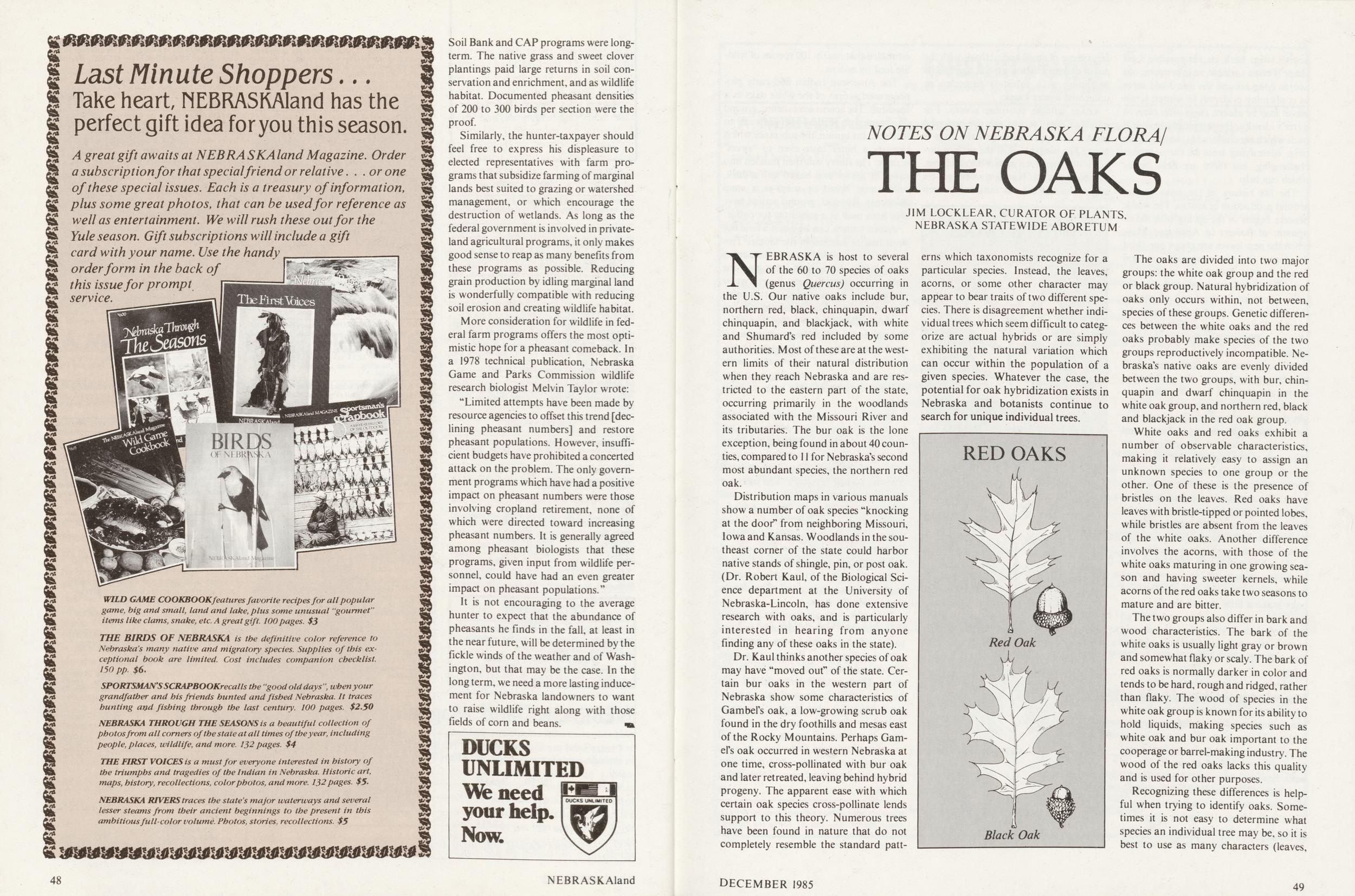
Last* Minute Shoppers Take heart, NEBRASKAland has the perfect gift idea for you this season.
A great gift awaits at NEBRA SKA land Magazine. Order a subscription/or that special friend or relative or one of these special issues. Each is a treasury of information, plus some great photos, that can be used for reference as well as entertainment. We will rush these out for the Yule season. Gift subscriptions will include a gift card with your name. Use the handy order form in the back of this issue for prompt. service.
WILD GAME COOKBOOKfeatures favorite recipes for all popular game, big and small, land and lake, plus some unusual "gourmet" items like clams, snake, etc. A great gift. 100 pages. $3
THE BIRDS OF NEBRASKA is the definitive color reference to Nebraska's many native and migratory species. Supplies of this exceptional book are limited. Cost includes companion checklist. 150 pp. $6.
SPORTSMAN'SSCRAPBOOKrecalls the "good old days", when your grandfather and his friends hunted and fished Nebraska. It traces hunting and fishing through the last century. 100 pages. $2.50
NEBRASKA THROUGH THE SEASONS is a beautiful collection of photos from all corners of the state at all times of the year, including people, places, wildlife, and more. 132 pages. $4
THE FIRST VOICES is a must for everyone interested in history of the triumphs and tragedies of the Indian in Nebraska. Historic art, maps, history, recollections, color photos, and more. 132 pages. $5
NEBRASKA RIVERS traces the state's major waterways and several lesser steams from their ancient beginnings to the present in this ambitious full-color volume. Photos, stories, recollections. $5
Similarly, the hunter-taxpayer should feel free to express his displeasure to elected representatives with farm programs that subsidize farming of marginal lands best suited to grazing or watershed management, or which encourage the destruction of wetlands. As long as the federal government is involved in privateland agricultural programs, it only makes good sense to reap as many benefits from these programs as possible. Reducing grain production by idling marginal land is wonderfully compatible with reducing soil erosion and creating wildlife habitat.
More consideration for wildlife in federal farm programs offers the most optimistic hope for a pheasant comeback. In a 1978 technical publication, Nebraska Game and Parks Commission wildlife research biologist Melvin Taylor wrote:
"Limited attempts have been made by resource agencies to offset this trend [declining pheasant numbers] and restore pheasant populations. However, insufficient budgets have prohibited a concerted attack on the problem. The only government programs which have had a positive impact on pheasant numbers were those involving cropland retirement, none of which were directed toward increasing pheasant numbers. It is generally agreed among pheasant biologists that these programs, given input from wildlife personnel, could have had an even greater impact on pheasant populations."
It is not encouraging to the average hunter to expect that the abundance of pheasants he finds in the fall, at least in the near future, will be determined by the fickle winds of the weather and of Washington, but that may be the case. In the long term, we need a more lasting inducement for Nebraska landowners to want to raise wildlife right along with those fields of corn and beans.
DUCKS UNLIMITED We need your help. Now. 48 NEBRASKAlandNOTES ON NEBRASKA FLORA THE OAKS
JIM LOCKLEAR, CURATOR OF PLANTS, NEBRASKA STATEWIDE ABORETUMNEBRASKA is host to several of the 60 to 70 species of oaks (genus Quercus) occurring in the U.S. Our native oaks include bur, northern red, black, chinquapin, dwarf chinquapin, and blackjack, with white and Shumard's red included by some authorities. Most of these are at the western limits of their natural distribution when they reach Nebraska and are restricted to the eastern part of the state, occurring primarily in the woodlands associated with the Missouri River and its tributaries. The bur oak is the lone exception, being found in about 40 counties, compared to 11 for Nebraska's second most abundant species, the northern red oak.
Distribution maps in various manuals show a number of oak species "knocking at the door" from neighboring Missouri, Iowa and Kansas. Woodlands in the southeast corner of the state could harbor native stands of shingle, pin, or post oak. (Dr. Robert Kaul, of the Biological Science department at the University of Nebraska-Lincoln, has done extensive research with oaks, and is particularly interested in hearing from anyone finding any of these oaks in the state).
Dr. Kaul thinks another species of oak may have "moved out" of the state. Certain bur oaks in the western part of Nebraska show some characteristics of Gambel's oak, a low-growing scrub oak found in the dry foothills and mesas east of the Rocky Mountains. Perhaps Gamel's oak occurred in western Nebraska at one time, cross-pollinated with bur oak and later retreated, leaving behind hybrid progeny. The apparent ease with which certain oak species cross-pollinate lends support to this theory. Numerous trees have been found in nature that do not completely resemble the standard patterns which taxonomists recognize for a particular species. Instead, the leaves, acorns, or some other character may appear to bear traits of two different species. There is disagreement whether individual trees which seem difficult to categorize are actual hybrids or are simply exhibiting the natural variation which can occur within the population of a given species. Whatever the case, the potential for oak hybridization exists in Nebraska and botanists continue to search for unique individual trees.
The oaks are divided into two major groups: the white oak group and the red or black group. Natural hybridization of oaks only occurs within, not between, species of these groups. Genetic differences between the white oaks and the red oaks probably make species of the two groups reproductively incompatible. Nebraska's native oaks are evenly divided between the two groups, with bur, chinquapin and dwarf chinquapin in the white oak group, and northern red, black and blackjack in the red oak group.
White oaks and red oaks exhibit a number of observable characteristics, making it relatively easy to assign an unknown species to one group or the other. One of these is the presence of bristles on the leaves. Red oaks have leaves with bristle-tipped or pointed lobes, while bristles are absent from the leaves of the white oaks. Another difference involves the acorns, with those of the white oaks maturing in one growing season and having sweeter kernels, while acorns of the red oaks take two seasons to mature and are bitter.
The two groups also differ in bark and wood characteristics. The bark of the white oaks is usually light gray or brown and somewhat flaky or scaly. The bark of red oaks is normally darker in color and tends to be hard, rough and ridged, rather than flaky. The wood of species in the white oak group is known for its ability to hold liquids, making species such as white oak and bur oak important to the cooperage or barrel-making industry. The wood of the red oaks lacks this quality and is used for other purposes.
Recognizing these differences is helpful when trying to identify oaks. Sometimes it
is not easy to determine what
species an individual tree may be, so it is
best to use as many characters (leaves,
DECEMBER 1985
49
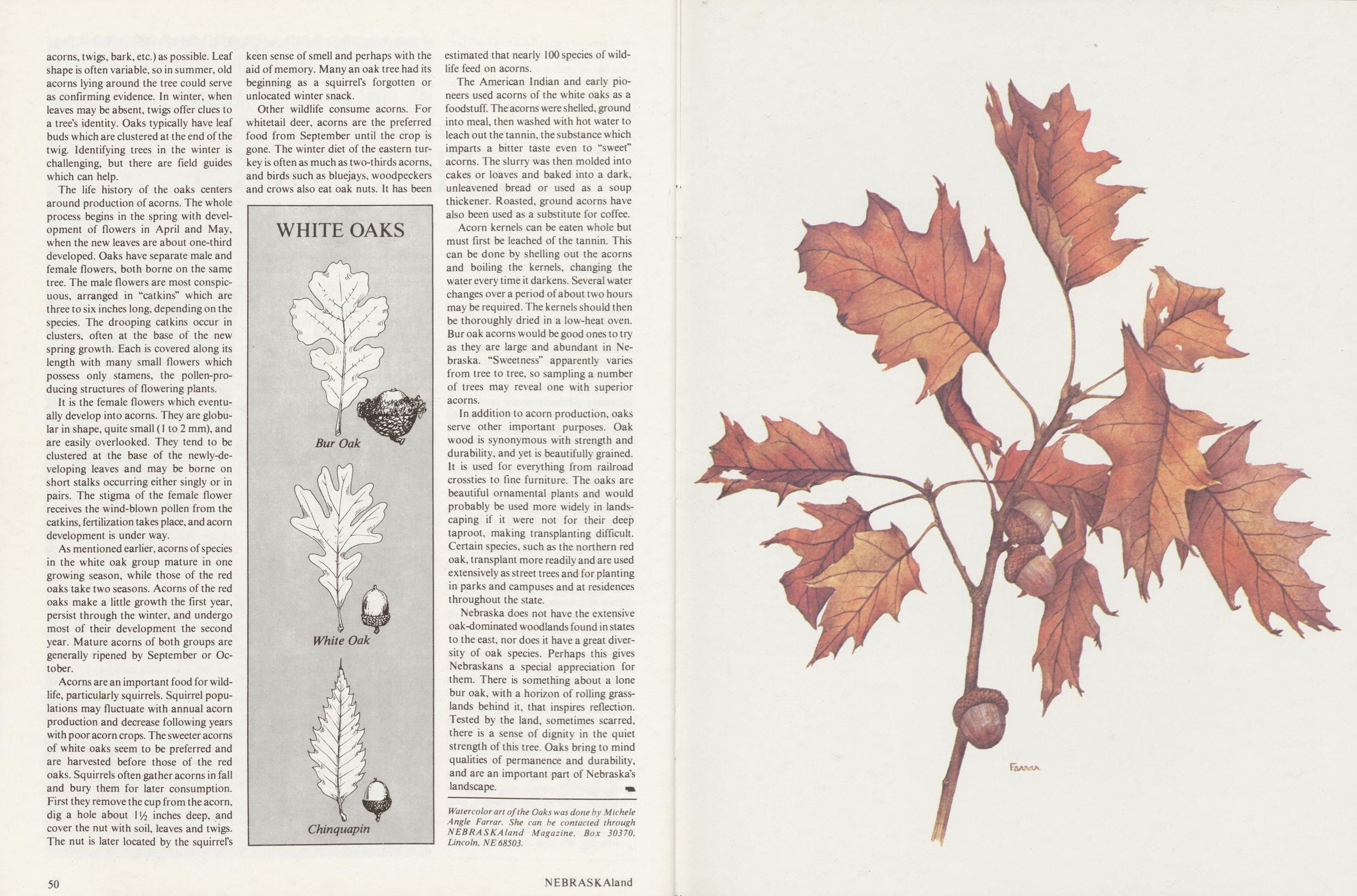 acorns, twigs, bark, etc.) as possible. Leaf
shape is often variable, so in summer, old
acorns lying around the tree could serve
as confirming evidence. In winter, when
leaves may be absent, twigs offer clues to
a tree's identity. Oaks typically have leaf
buds which are clustered at the end of the
twig. Identifying trees in the winter is
challenging, but there are field guides
which can help.
acorns, twigs, bark, etc.) as possible. Leaf
shape is often variable, so in summer, old
acorns lying around the tree could serve
as confirming evidence. In winter, when
leaves may be absent, twigs offer clues to
a tree's identity. Oaks typically have leaf
buds which are clustered at the end of the
twig. Identifying trees in the winter is
challenging, but there are field guides
which can help.
The life history of the oaks centers around production of acorns. The whole process begins in the spring with development of flowers in April and May, when the new leaves are about one-third developed. Oaks have separate male and female flowers, both borne on the same tree. The male flowers are most conspicuous, arranged in "catkins" which are three to six inches long, depending on the species. The drooping catkins occur in clusters, often at the base of the new spring growth. Each is covered along its length with many small flowers which possess only stamens, the pollen-producing structures of flowering plants.
It is the female flowers which eventually develop into acorns. They are globular in shape, quite small (1 to 2 mm), and are easily overlooked. They tend to be clustered at the base of the newly-developing leaves and may be borne on short stalks occurring either singly or in pairs. The stigma of the female flower receives the wind-blown pollen from the catkins, fertilization takes place, and acorn development is under way.
As mentioned earlier, acorns of species in the white oak group mature in one growing season, while those of the red oaks take two seasons. Acorns of the red oaks make a little growth the first year, persist through the winter, and undergo most of their development the second year. Mature acorns of both groups are generally ripened by September or October.
Acorns are an important food for wildlife, particularly squirrels. Squirrel populations may fluctuate with annual acorn production and decrease following years with poor acorn crops. The sweeter acorns of white oaks seem to be preferred and are harvested before those of the red oaks. Squirrels often gather acorns in fall and bury them for later consumption. First they remove the cup from the acorn, dig a hole about \y2 inches deep, and cover the nut with soil, leaves and twigs. The nut is later located by the squirrel's keen sense of smell and perhaps with the aid of memory. Many an oak tree had its beginning as a squirrel's forgotten or unlocated winter snack.
Other wildlife consume acorns. For whitetail deer, acorns are the preferred food from September until the crop is gone. The winter diet of the eastern turkey is often as much as two-thirds acorns, and birds such as bluejays, woodpeckers and crows also eat oak nuts. It has been estimated that nearly 100 species of wildlife feed on acorns.
The American Indian and early pioneers used acorns of the white oaks as a foodstuff. The acorns were shelled, ground into meal, then washed with hot water to leach out the tannin, the substance which imparts a bitter taste even to "sweet" acorns. The slurry was then molded into cakes or loaves and baked into a dark, unleavened bread or used as a soup thickener. Roasted, ground acorns have also been used as a substitute for coffee.
Acorn kernels can be eaten whole but must first be leached of the tannin. This can be done by shelling out the acorns and boiling the kernels, changing the water every time it darkens. Several water changes over a period of about two hours may be required. The kernels should then be thoroughly dried in a low-heat oven. Bur oak acorns would be good ones to try as they are large and abundant in Nebraska. "Sweetness" apparently varies from tree to tree, so sampling a number of trees may reveal one with superior acorns.
In addition to acorn production, oaks serve other important purposes. Oak wood is synonymous with strength and durability, and yet is beautifully grained. It is used for everything from railroad crossties to fine furniture. The oaks are beautiful ornamental plants and would probably be used more widely in landscaping if it were not for their deep taproot, making transplanting difficult. Certain species, such as the northern red oak, transplant more readily and are used extensively as street trees and for planting in parks and campuses and at residences throughout the state.
Nebraska does not have the extensive oak-dominated woodlands found in states to the east, nor does it have a great diversity of oak species. Perhaps this gives Nebraskans a special appreciation for them. There is something about a lone bur oak, with a horizon of rolling grasslands behind it, that inspires reflection. Tested by the land, sometimes scarred, there is a sense of dignity in the quiet strength of this tree. Oaks bring to mind qualities of permanence and durability, and are an important part of Nebraska's landscape.
Water color art of the Oaks was done by Michele Angle Farrar. She can be contacted through NEBRASKAland Magazine, Box 30370, Lincoln, NE 68503.
50 NEBRASKAland
Hunter Safety is for Everyone!
Completing a course will make youngsters better and safer hunters. It is also required by law. And, many states require adults to have a certificate to obtain a nonresident permit. For details, contact your nearest Conservation Officer or any Game and Parks Commission office, including headquarters in Lincoln. Phone (402) 464-0641.
Position: 664 (17 views)