Volume 63, Issue 10, 1985
NEBRASKAland
NOVEMBER 1985 $1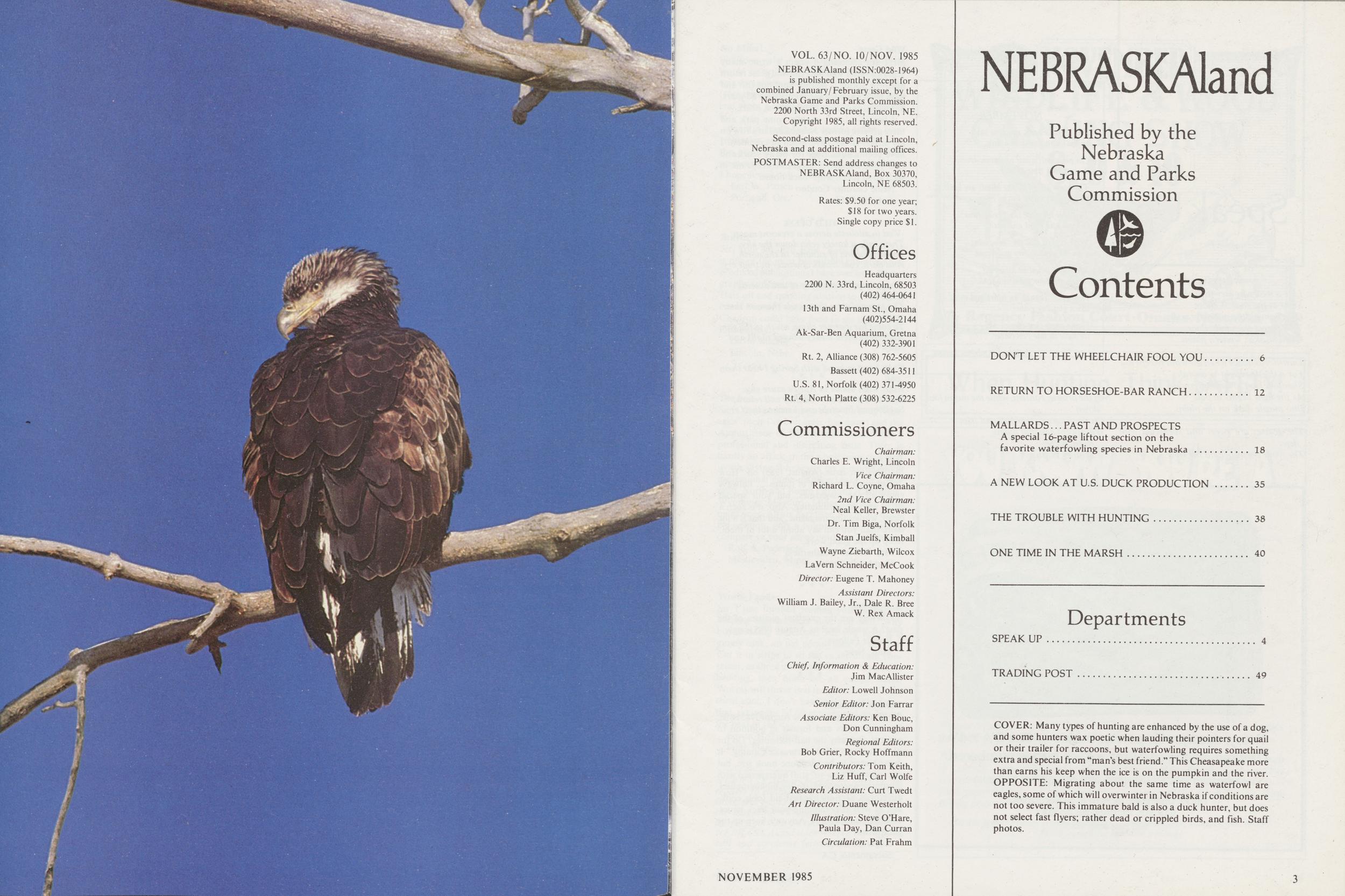
NEBRASKAland
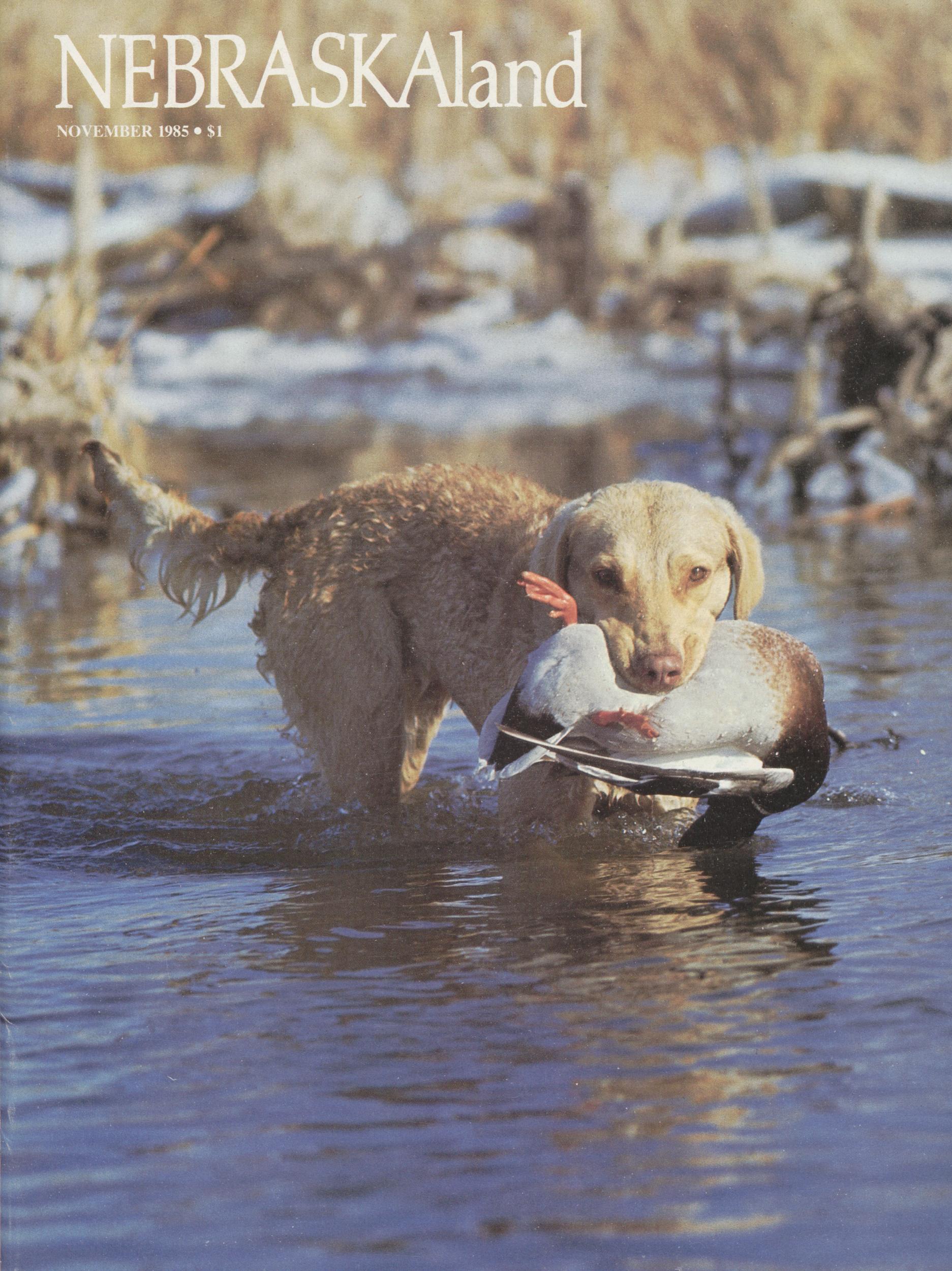
Published by the Nbraska Game and Parks Commission VOL. 63/NO. 10/NOV. 1985 NEBRASKAland (ISSN:0028-1964) is published monthly except for a combined January/ February issue, by the Nebraska Game and Parks Commission. 2200 North 33rd Street, Lincoln, NE. Copyright 1985, all rights reserved. Second-class postage paid at Lincoln, Nebraska and at additional mailing offices. POSTMASTER: Send address changes to NEBRASKAland, Box 30370, Lincoln, NE 68503. Rates: $9.50 for one year; $18 for two years. Single copy price $1. Offices Headquarters 2200 N. 33rd, Lincoln, 68503 (402)464-0641 13th and Farnam St., Omaha (402)554-2144 Ak-Sar-Ben Aquarium, Gretna (402) 332-3901 Rt. 2, Alliance (308) 762-5605 Bassett (402) 684-3511 U.S. 81, Norfolk (402) 371-4950 Rt. 4, North Platte (308) 532-6225 Commissioners Chairman: Charles E. Wright, Lincoln Vice Chairman: Richard L. Coyne, Omaha 2nd Vice Chairman: Neal Keller, Brewster Dr. Tim Biga, Norfolk Stan Jueifs, Kimball Wayne Ziebarth, Wilcox LaVern Schneider, McCook Director: Eugene T. Mahoney Assistant Directors: William J. Bailey, Jr., Dale R. Bree W. Rex Amack Staff Chief, Information & Education: Jim MacAllister Editor: Lowell Johnson Senior Editor: Jon Farrar Associate Editors: Ken Bouc, Don Cunningham Regional Editors: Bob Grier, Rocky Hoffmann Contributors: Tom Keith, Liz Huff, Carl Wolfe Research Assistant: Curt Twedt Art Director: Duane Westerholt Illustration: Steve O'Hare, Paula Day, Dan Curran Circulation: Pat Frahm Contents Contents DONT LET THE WHEELCHAIR FOOL YOU 6 RETURN TO HORSESHOE-BAR RANCH 12 MALLARDS... PAST AND PROSPECTS A special 16-page liftout section on the favorite waterfowling species in Nebraska 18 A NEW LOOK AT U.S. DUCK PRODUCTION35 THE TROUBLE WITH HUNTING38 ONE TIME IN THE MARSH 40 NOVEMBER 1985 Departments SPEAK UP 4 TRADING POST 49 COVER: Many types of hunting are enhanced by the use of a dog, and some hunters wax poetic when lauding their pointers for quail or their trailer for raccoons, but waterfowling requires something extra and special from "man's best friend." This Cheasapeake more than earns his keep when the ice is on the pumpkin and the river. OPPOSITE: Migrating about the same time as waterfowl are eagles, some of which will overwinter in Nebraska if conditions are not too severe. This immature bald is also a duck hunter, but does not select fast flyers; rather dead or crippled birds, and fish. Staff photos. NOVEMBER 1985 3
Speak Up
WINDSWEPT Like a weary housewife, the soughing wind Sighs at the endless chore Of grooming the prairie grasses That carpet the sandy floor Of Nebraska's western plains. Dust-devils dance when the wind sweeps low For a thistle caught in a swale. Shadows lean toward afternoon As the light begins to pale Into purple dusk on the plains. The grasses are sweet and sprinkled with dew. The wind sleeps behind the rimOf the prairie, content, while the moon looks down On the fragrant, tranquil and trim Windswept sandhill plains. Ruth Wylie Seattle, Wash. NOVEMBER The seasons open, someone said, on ducks and geese and deer On pheasant, quail and even doves, it's just that time of year. The boots are oiled, the blinds are built, the guns on safety catch The dogs all have their trial runs to hunt and point and fetch. With turkey and the "trimmins," with the sauces, pies and bread We lade our festive tables yet there's more for months ahead. Nebraska's thanks, in heart and mind, like a glowing ember Flame anew that special day we have in late November. Mildred Andrews Larson Heavy, deep-profile pewter buckle Size 31/4 x 41A Limited-edition of 2500 Each buckle numbered Order from local D.U. chapter, area chairman of Nebraska Ducks Unlimited, Richard E. Schlechtman, 619 5th, Fairbury, NE 68352 $25 plus sales tax Wild GeeseSir/1 am enclosing a poem I wrote many years ago after watching the wild geese return north in Spring. I neither hunt nor fish and have been away from Nebraska for 65 years, but will always be a Nebraskan at heart.
I live in a lovely mobile home park and there are five former Nebraskans in a row on my street, so we have much in common. 1 have been a subscriber for many years and find your wonderful magazine keeps me in such good touch with "back home."
Nellie Gardner Condon Auburn, Calif. * * * WILD GEESE V'ed in silouette across a crescent moon; Their calls a lonely echo down the sky, Foretelling end of summer in the north, And dark, cold winds of winter in their cry. Who knows the mystery of unwavering flight; The sense of time that sends them on their way To some far warmer clime, south to the sun, And keeps them weary-winged night and day. Then hand in hand with Spring I hear them call, High, high above in April's azure sky: Sure as the seasons roll they will return; Spellbound I watch, and listen to their cry. * * * Pro-AugustSir/ This last issue (August 1985) on "How To" on such a number of things 1 always enjoy all the magazines, but your special issues are just outstanding. Aiso, it is such a clean, wholesome magazine, and that is a lot more than you can say about a lot of them. Keep up the good work.
Mrs. Robert Weatherfield Humboldt, Nebr. * * * Anti- AugustSir/ Where are the excellent pictures of the past? A whole issue as August 1985 is ugly.
Robert Fellows Mills, Nebr. * * * More of the same!Sir/ Congratulations on the August 1985 issue, for its graphics and format in addition to content. But why the half-measures? Go for it! Compile a "Whole Nebraska Catalog." It doesn't need to be telephone book size, but put in lots of "how-to" stuff interspersed with illustrative anecedotes/stories, bibliographies, directories. Sections like first-aid, tools, cooking, as well as combining your back issues. Plug it in the monthly. Anyway, keep up the good work!
Roger C. Delight Sacramento, CA 4 NEBRASKAland No More!Sir/To say the August issue was a surprise would be an understatement of the year. I was completely disgusted. It is such a far cry from the magazine that I have taken for several years. I could find nothing of interest in it.
I am a transplanted senior citizen from Nebraska, and I take the magazine because the pictures and articles bring back fond memories of the past. No so the August issue. 1 hope it was only a trial run.
Earl W. Patten Portland, Ore. * * * Bravo!Sir/ Your Jan-Feb. issue "Birds of Nebraska" is one of the must beautifully conceived and produced publications I have ever seen. Photography and written articles are simply superb. Hats off and standing ovation to your entire crew! Bravo! I wish the late Doris Gates of Chadron could have lived to see this marvelous display.
David Mickey Lincoln, Nebr. * * * The bestSir/ Congratulations on both "Birds of Nebraska" (best I've ever seen, bar none) and the August issue of NEBRASKAland. What a professional and interesting issue. There is hardly an article in the whole issue that isn't worth saving. I honestly (as a retired DNR professional game manager) take the Colorado, North and South Carolina, California, Wyoming, Missouri, Minnesota and Iowa magazines. All are excellent, but in my humble opinion, only a couple can even faintly compare to your super outdoors handbook.
Rolf A. Pederson Montevideo, Minn. * * * Worm FarmerSir/1 just finished reading your article on keeping nightcrawlers alive and well. Why buy bedding and food? All you need is a gunny sack, an old potato sack or the like. Cut it in strips to sit flat in styrofoam container, or shred if convenient. I wet down this bedding, then drain off all excess water. Worms will thrive in it for months, just keep them cool. I don't have any trouble doing that, taking the lid off at night and on during the heat of the day.
Edwin H. Turner Buhl, Idaho NEBRASKAland Magazine invites all readers to submit their comments, suggestions, and gripes to Speak Up. Each month the magazine will publish as many letters as space permits. Pictures are also welcome. NEBRASKAland does reserve the right to edit and condense letters. (Editor) NOVEMBER WILDLIFE & WOOD CARVING SHOW 8, 9, & 10 Regency Fashion Court-Omaha, NEbraska When Hunting, Think SAFETY! you know you're a NEBRASKAN... "Roger Welsch... is at it again. Everybody can celebrate this book's publication." Tom Allan, Omaha World-Herald. Folklorist and humorist Roger Welsch and cartoonist Paul Fell, both of Lincoln, have combined comic forces to create a delightful, hilarious cartoon guide that captures the Nebraska personality to perfection. You 11 find your friends — and yourself — prominently exhibited on these funny pages. Order from: Plains Heritage, Dept N, 3511 Mohawk, Lincoln, NE 68510 $6.15 including tax and postage NOBEMBER 1985 5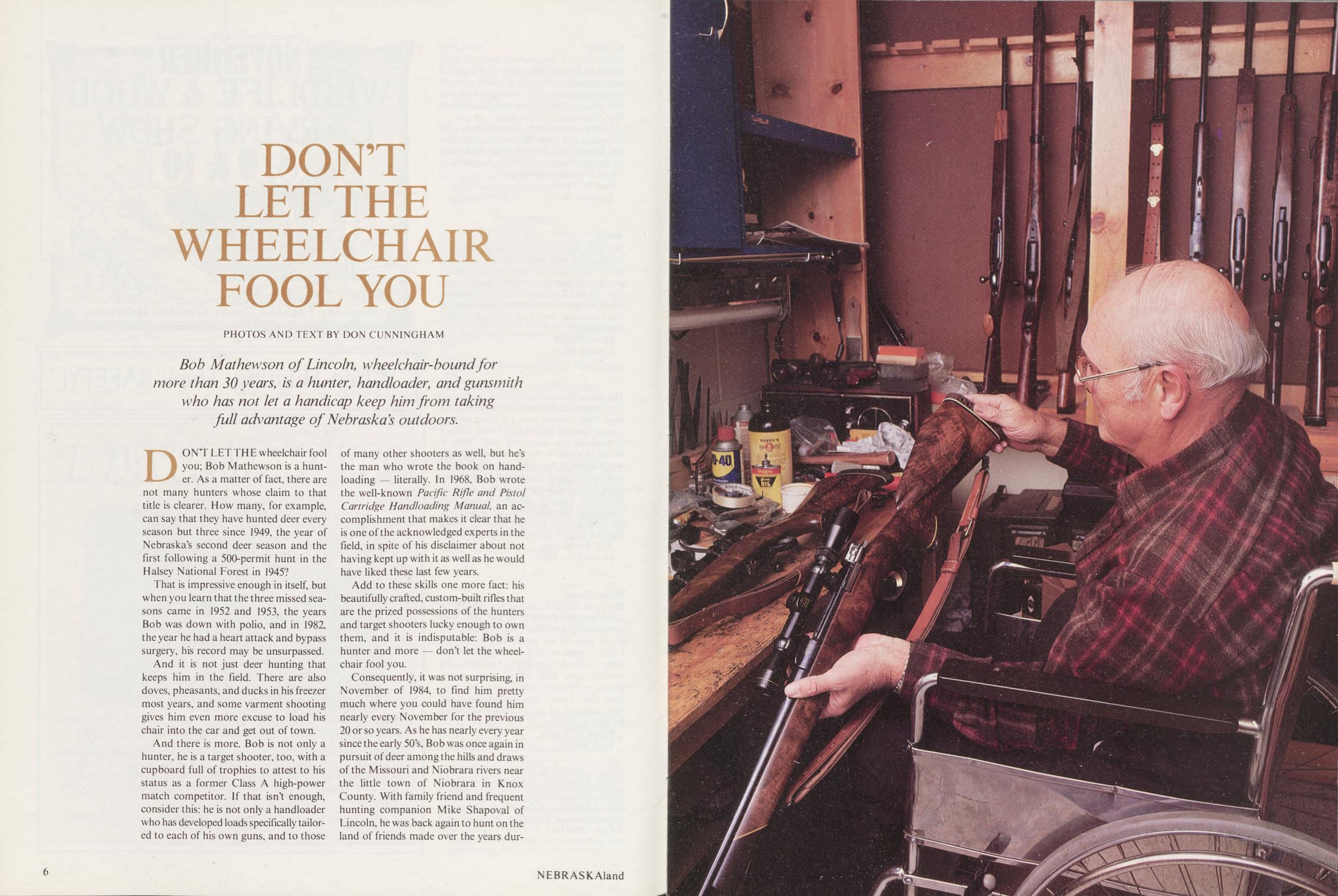
DON'T LET THE WHEELCHAIR FOOL YOU
PHOTOS AND TEXT BY DON CUNNINGHAM Bob Mat hew son of Lincoln, wheelchair-bound for more than 30 years, is a hunter, handloader, and gunsmith who has not let a handicap keep him from taking full advantage of Nebraska's outdoors.DONT LET TH E wheelchair fool you; Bob Mathewson is a hunter. As a matter of fact, there are not many hunters whose claim to that title is clearer. How many, for example, can say that they have hunted deer every season but three since 1949, the year of Nebraska's second deer season and the first following a 500-permit hunt in the Halsey National Forest in 1945?
That is impressive enough in itself, but when you learn that the three missed seasons came in 1952 and 1953, the years Bob was down with polio, and in 1982, the year he had a heart attack and bypass surgery, his record may be unsurpassed.
And it is not just deer hunting that keeps him in the field. There are also doves, pheasants, and ducks in his freezer most years, and some varment shooting gives him even more excuse to load his chair into the car and get out of town.
And there is more. Bob is not only a hunter, he is a target shooter, too, with a cupboard full of trophies to attest to his status as a former Class A high-power match competitor. If that isn't enough, consider this: he is not only a handloader who has developed loads specifically tailored to each of his own guns, and to those of many other shooters as well, but he's the man who wrote the book on handloading — literally. In 1968, Bob wrote the well-known Pacific Rifle and Pistol Cartridge Handloading Manual, an accomplishment that makes it clear that he is one of the acknowledged experts in the field, in spite of his disclaimer about not having kept up with it as well as he would have liked these last few years.
Add to these skills one more fact: his beautifully crafted, custom-built rifles that are the prized possessions of the hunters and target shooters lucky enough to own them, and it is indisputable: Bob is a hunter and more — don't let the wheelchair fool you.
Consequently, it was not surprising, in November of 1984, to find him pretty much where you could have found him nearly every November for the previous 20 or so years. As he has nearly every year since the early 50's, Bob was once again in pursuit of deer among the hills and draws of the Missouri and Niobrara rivers near the little town of Niobrara in Knox County. With family friend and frequent hunting companion Mike Shapoval of Lincoln, he was back again to hunt on the land of friends made over the years during hunting trips to the area.
6 NEBRASKAland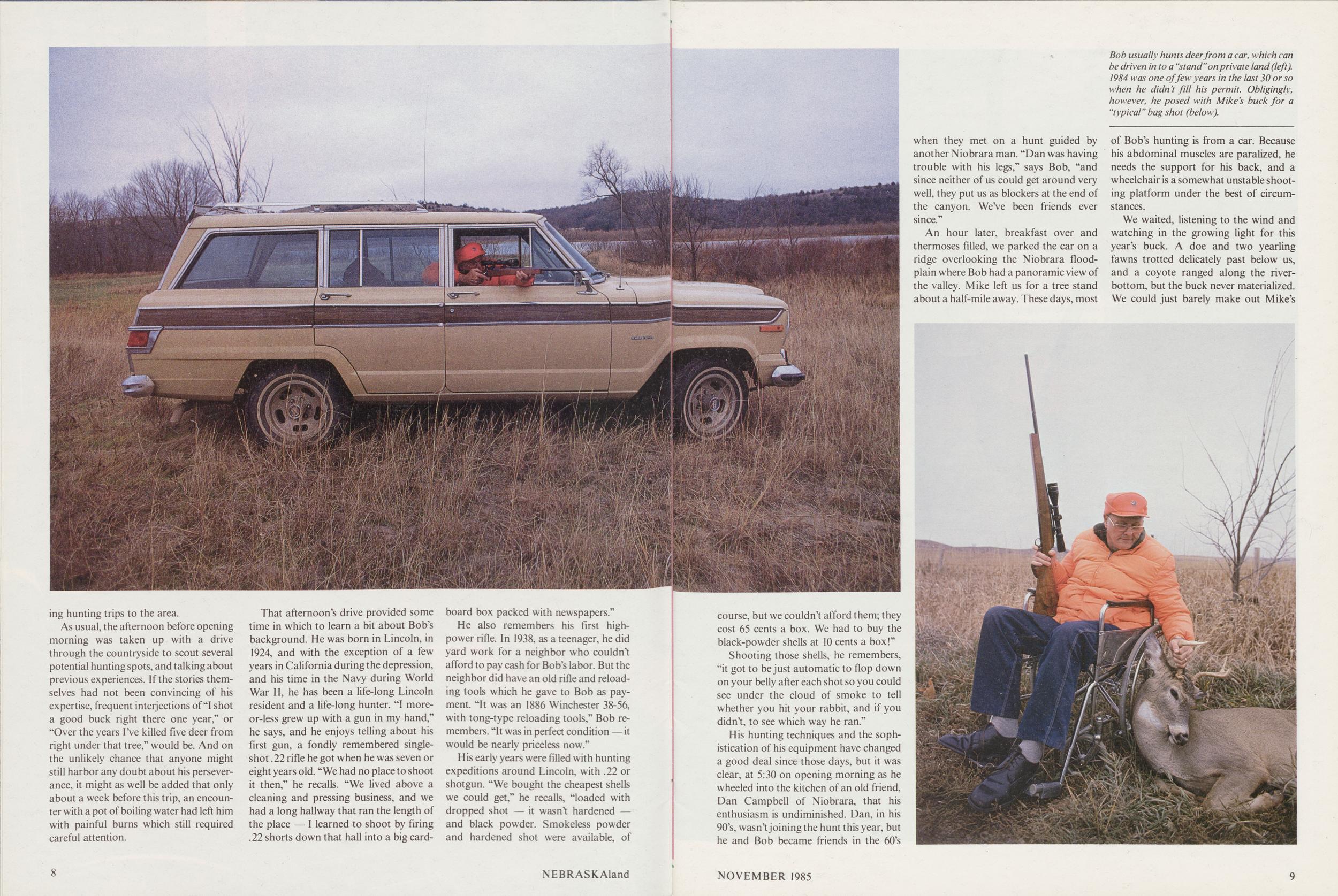
As usual, the afternoon before opening morning was taken up with a drive through the countryside to scout several potential hunting spots, and talking about previous experiences. If the stories themselves had not been convincing of his expertise, frequent interjections of "I shot a good buck right there one year," or "Over the years I've killed five deer from right under that tree," would be. And on the unlikely chance that anyone might still harbor any doubt about his perseverance, it might as well be added that only about a week before this trip, an encounter with a pot of boiling water had left him with painful burns which still required careful attention.
That afternoon's drive provided some time in which to learn a bit about Bob's background. He was born in Lincoln, in 1924, and with the exception of a few years in California during the depression, and his time in the Navy during World War II, he has been a life-long Lincoln resident and a life-long hunter. "I more-or-less grew up with a gun in my hand," he says, and he enjoys telling about his first gun, a fondly remembered single shot .22 rifle he got when he was seven or eight years old. "We had no place to shoot it then," he recalls. "We lived above a cleaning and pressing business, and we had a long hallway that ran the length of the place — I learned to shoot by firing .22 shorts down that hall into a big cardboard box packed with newspapers."
He also remembers his first highpower rifle. In 1938, as a teenager, he did yard work for a neighbor who couldn't afford to pay cash for Bob's labor. But the neighbor did have an old rifle and reloading tools which he gave to Bob as payment. "It was an 1886 Winchester 38-56, with tong-type reloading tools," Bob remembers. "It was in perfect condition — it would be nearly priceless now."
His early years were filled with hunting expeditions around Lincoln, with .22 or shotgun. "We bought the cheapest shells we could get," he recalls, "loaded with dropped shot — it wasn't hardened and black powder. Smokeless powder and hardened shot were available, of 8 NEBRASKAland course, but we couldn't afford them; they cost 65 cents a box. We had to buy the black-powder shells at 10 cents a box!"
Shooting those shells, he remembers, "it got to be just automatic to flop down on your belly after each shot so you could see under the cloud of smoke to tell whether you hit your rabbit, and if you didn't, to see which way he ran."
His hunting techniques and the sophistication of his equipment have changed a good deal since those days, but it was clear, at 5:30 on opening morning as he wheeled into the kitchen of an old friend, Dan Campbell of Niobrara, that his enthusiasm is undiminished. Dan, in his 90's, wasn't joining the hunt this year, but he and Bob became friends in the 60's when they met on a hunt guided by another Niobrara man. "Dan was having trouble with his legs," says Bob, "and since neither of us could get around very well, they put us as blockers at the end of the canyon. We've been friends ever since."
An hour later, breakfast over and thermoses filled, we parked the car on a ridge overlooking the Niobrara flood plain where Bob had a panoramic view of the valley. Mike left us for a tree stand about a half-mile away. These days, most of Bob's hunting is from a car. Because his abdominal muscles are paralized, he needs the support for his back, and a wheelchair is a somewhat unstable shooting platform under the best of circumstances.
Boh usually hunts deer from a car, which can he driven in to a "stand"on private land (left). 1984 was one of few years in the last 30 or so when he didn 7 fill his permit. Obligingly, however, he posed with Mike's buck for a "typical" bag shot (below).We waited, listening to the wind and watching in the growing light for this year's buck. A doe and two yearling fawns trotted delicately past below us, and a coyote ranged along the riverbottom, but the buck never materialized. We could just barely make out Mike's hunter orange to the east of us.
By 10 a.m. we decided to move, and as we drove to a second spot beneath a shelterbelt separating the riverbottom and a hay meadow, we talked some more about Bob's life. When World War II broke out, Bob explained, he enlisted in the Navy, volunteering for submarine service. He spent the majority of the war as an ordinance machinist on the USS Rasher, the submarine which sank the second highest tonnage of the entire war.
Following the war, he went to work for the Elgin Watch Company in Lincoln, and almost immediately resumed hunting. "Shotgun shells were hard to get just after the war," he recalls, but local sporting goods stores would occasionally advertise that they had shotgun shells, but limited sales to one box per customer.
"I remember one day I came across my old hunting vest, and there were some shells in it from before the war. I took them along one day, and just to be sure, I test fired one. It seemed OK.
"A while later, a pheasant jumped up. He was a long way off, but I shot, even though I knew it was probably hopeless. The pheasant fell dead. When I picked it up, there was just one big hole in it, like it had been shot with a slug. I fired another shell into a bank a little way off, and there was no pattern, just a single impact, so I cut a shell open, and found all the shot corroded into a single mass. That's probably the best shot I ever made with a shotgun."
He still hunts gamebirds, but although he was a Class A competition trap shooter, he has given up trap shooting, finding that the "point-pull" reflex of trap shooting interfered with the "aim-squeeze" reflex of rifle shooting, which he enjoys more. But, he says, "The thing I miss most since I had polio is bird hunting with a dog."
Polio came in 1951, and left him with legs 80 percent disabled and some impairment of his left arm. Although he can make limited use of crutches, he is confined to the wheelchair 95 percent of the time, and the paralysis of his abdominal muscles further limits his activity.
Nevertheless, up to about 10 years ago, he could hunt without assistance. Once in position, he explains, he could shoot his deer, use crutches to get into the chair, and then sit on the ground beside the deer to field dress it.
In 1974, however, two vertebrae collapsed, and were rebuilt with bone taken from his hip. That, and degenerative arthritis in his arms and shoulders, makes it necessary for him to have more help now.
But the need for some help seems to have done little to dampen his enthusiasm for the outdoors and for shooting sports, and he is clearly in demand as a hunting partner. Mike accompanies him frequently, as do Bob's son-in-law, and others, including Lincoln Attorney Bob Eberly, originally from Niobrara, who introduced Bob to hunting in that area.
Several more watchful hours late that evening brought several does into range, but no bucks for either hunter, and the hunt continued the following day.
Sunday, well before sunrise, Bob was ready to go again, and by 8 a.m. the hoped-for buck appeared — in front of Mike. As Mike field dressed the deer, Bob continued his story.
After a few years with Elgin, Bob opened his own gun shop in Lincoln. Shooting was, after all, his first love, and through the years his skill as a gunsmith, though largely self-taught, was growing, and the opportunity to devote himself full time to guns was too good to pass up. He still spends a good many hours in his home shop, both building and reworking guns, but retired now, he can take the luxury of working on his own schedule.
It probably goes without sayingthat the gun he was using on this trip was one of his own: a 7mm magnum, now on its fifth barrel. "If I live long enough, maybe I'll have one more barrel on that action I'll about have my money's worth out of it."
In the 1960's Bob sold his gun shop to become a buyer for Western Gun and, Supply, and when that company was purchased by Hornady Company and moved to Grand Island, he began working for Nebraska Job Service, from which he is now retired.
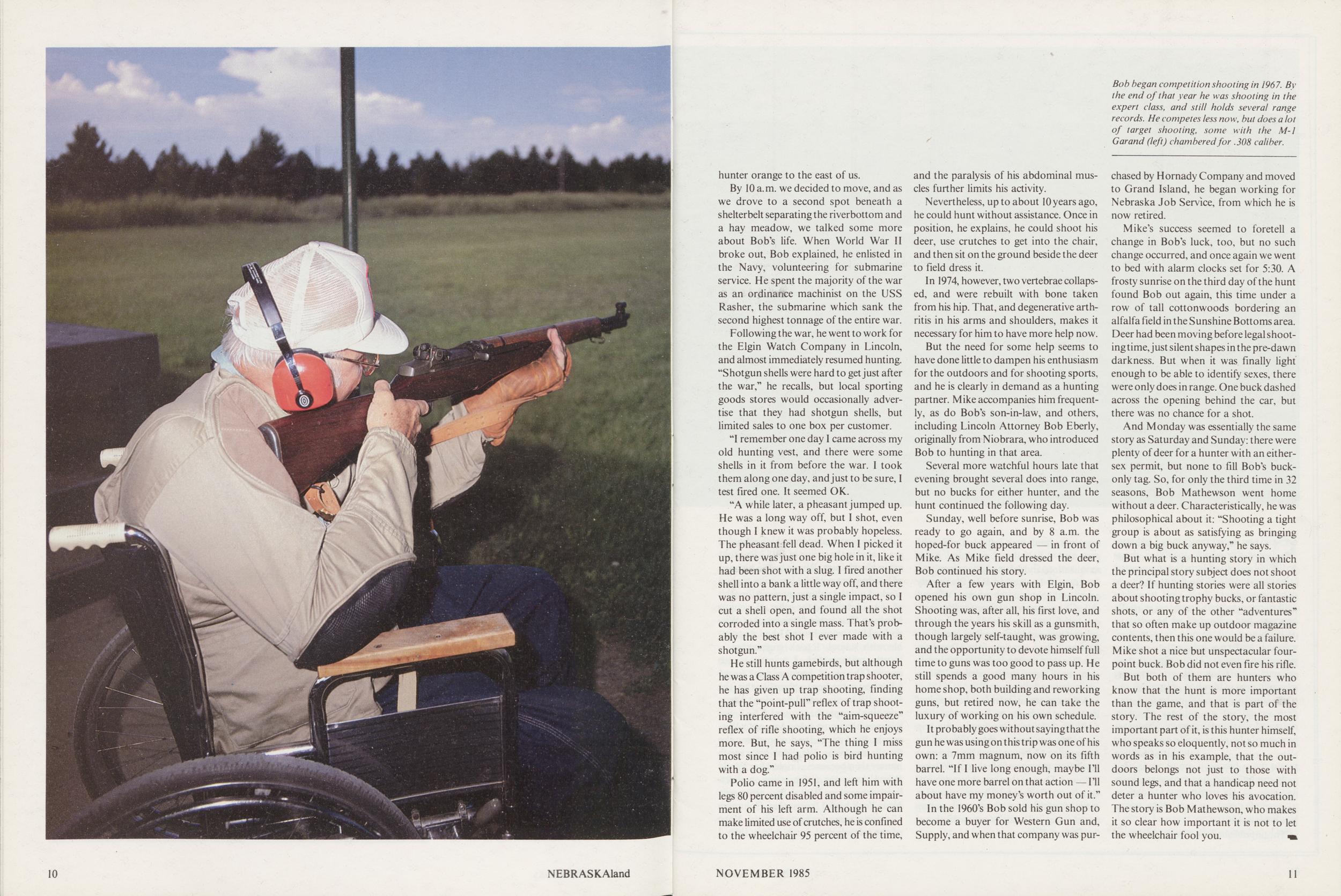
Bob began competition shooting in 1967. By the end of that year he was shooting in the expert class, and still holds several range records. He competes less now, but does a lot of target shooting, some with the M~l Gar and (left) chambered for .308 caliber.Mike's success seemed to foretell a change in Bob's luck, too, but no such change occurred, and once again we went to bed with alarm clocks set for 5:30. A frosty sunrise on the third day of the hunt found Bob out again, this time under a row of tall cottonwoods bordering an alfalfa field in the Sunshine Bottoms area. Deer had been moving before legal shooting time, just silent shapes in the pre-dawn darkness. But when it was finally light enough to be able to identify sexes, there were only does in range. One buck dashed across the opening behind the car, but there was no chance for a shot.
And Monday was essentially the same story as Saturday and Sunday: there were plenty of deer for a hunter with an either sex permit, but none to fill Bob's buckonly tag. So, for only the third time in 32 seasons, Bob Mathewson went home without a deer. Characteristically, he was philosophical about it: "Shooting a tight group is about as satisfying as bringing down a big buck anyway," he says.
But what is a hunting story in which the principal story subject does not shoot a deer? If hunting stories were all stories about shooting trophy bucks, or fantastic shots, or any of the other "adventures" that so often make up outdoor magazine contents, then this one would be a failure. Mike shot a nice but unspectacular fourpoint buck. Bob did not even fire his rifle.
But both of them are hunters who know that the hunt is more important than the game, and that is part of the story. The rest of the story, the most important part of it, is this hunter himself, who speaks so eloquently, not so much in words as in his example, that the outdoors belongs not just to those with sound legs, and that a handicap need not deter a hunter who loves his avocation. The story is Bob Mathewson, who makes it so clear how important it is not to let the wheelchair fool you.
NOVEMBER 1985 11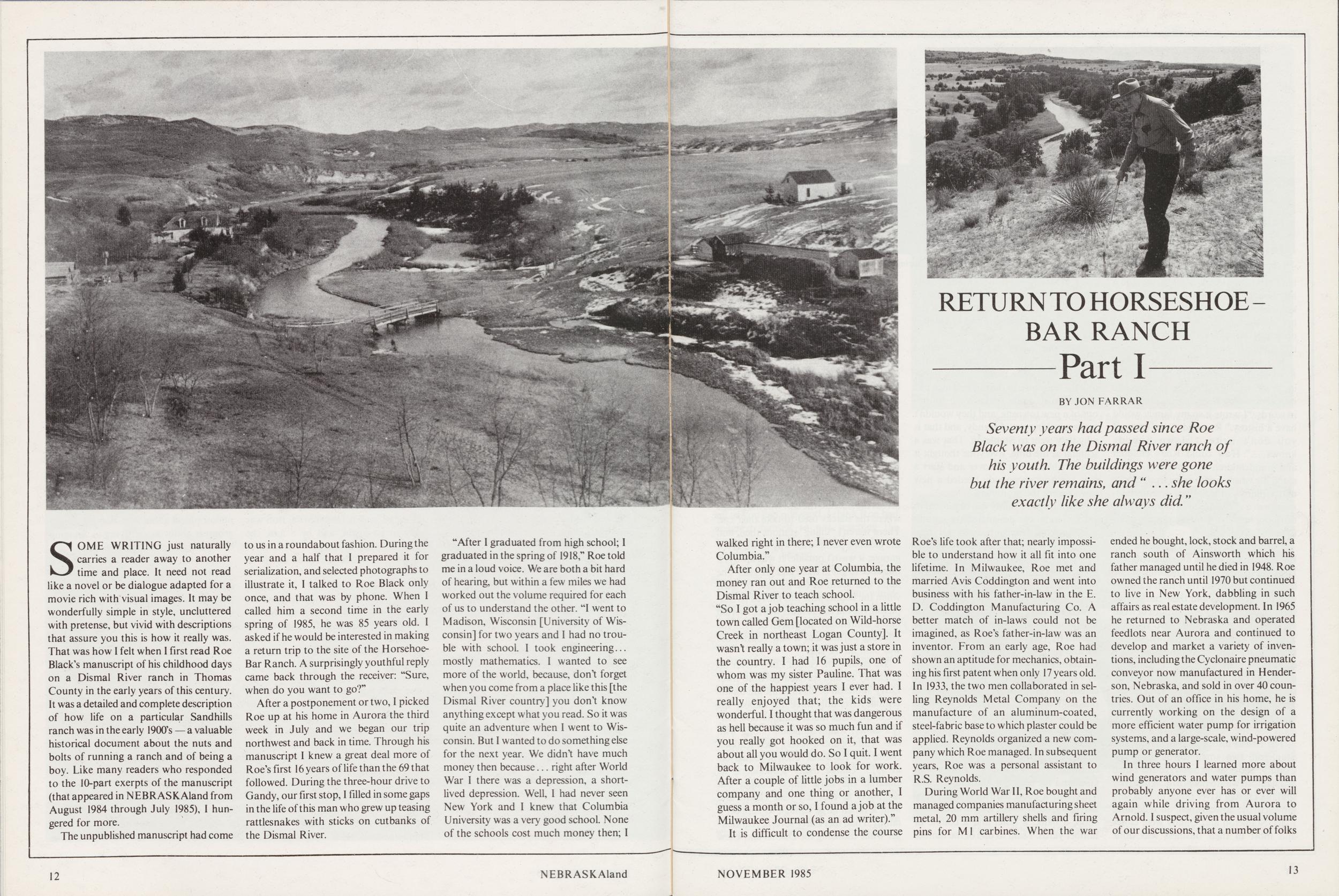
RETURN HORSESHOE - BAR RANCH PART I
BY JON FARRAR Seventy years had passed since Roe Black was on the Dismal River ranch of his youth. The buildings were gone but the river remains, and " ... she looks exactly like she always did."SOME WRITING just naturally carries a reader away to another time and place. It need not read like a novel or be dialogue adapted for a movie rich with visual images. It may be wonderfully simple in style, uncluttered with pretense, but vivid with descriptions that assure you this is how it really was. That was how 1 felt when 1 first read Roe Black's manuscript of his childhood days on a Dismal River ranch in Thomas County in the early years of this century. It was a detailed and complete description of how life on a particular Sandhills ranch was in the early 1900's a valuable historical document about the nuts and bolts of running a ranch and of being a boy. Like many readers who responded to the 10-part exerpts of the manuscript (that appeared in NEBR ASK Aland from August 1984 through July 1985), 1 hungered for more.
The unpublished manuscript had come to us in a roundabout fashion. During the year and a half that I prepared it for serialization, and selected photographs to illustrate it, I talked to Roe Black only once, and that was by phone. When I called him a second time in the early spring of 1985, he was 85 years old. I asked if he would be interested in making a return trip to the site of the Horsehoe Bar Ranch. A surprisingly youthful reply came back through the receiver: "Sure, when do you want to go?"
After a postponement or two, 1 picked Roe up at his home in Aurora the third week in July and we began our trip northwest and back in time. Through his manuscript I knew a great deal more of Roe's first 16 years of life than the 69 that followed. During the three-hour drive to Gandy, our first stop, I filled in some gaps in the life of this man who grew up teasing rattlesnakes with sticks on cutbanks of the Dismal River.
"After I graduated from high school; I graduated in the spring of 1918," Roe told me in a loud voice. We are both a bit hard of hearing, but within a few miles we had worked out the volume required for each of us to understand the other. "I went to Madison, Wisconsin [University of Wisconsin] for two years and I had no trouble with school. I took engineering mostly mathematics. I wanted to see more of the world, because, don't forget when you come from a place like this [the Dismal River country] you don't know anything except what you read. So it was quite an adventure when I went to Wisconsin. But I wanted to do something else for the next year. We didn't have much money then because... right after World War I there was a depression, a shortlived depression. Well, I had never seen New York and I knew that Columbia University was a very good school. None of the schools cost much money then; I 12 NEBRASKAland walked right in there; I never even wrote Columbia."
After only one year at Columbia, the money ran out and Roe returned to the Dismal River to teach school.
"So I got a job teaching school in a little town called Gem [located on Wild-horse Creek in northeast Logan County]. It wasn't really a town; it was just a store in the country. I had 16 pupils, one of whom was my sister Pauline. That was one of the happiest years I ever had. I really enjoyed that; the kids were wonderful. I thought that was dangerous as hell because it was so much fun and if you really got hooked on it, that was about all you would do. So I quit. I went back to Milwaukee to look for work. After a couple of little jobs in a lumber company and one thing or another, I guess a month or so, I found a job at the Milwaukee Journal (as an ad writer)."
It is difficult to condense the course Roe's life took after that; nearly impossible to understand how it all fit into one lifetime. In Milwaukee, Roe met and married Avis Coddington and went into business with his father-in-law in the E. D. Coddington Manufacturing Co. A better match of in-laws could not be imagined, as Roe's father-in-law was an inventor. From an early age, Roe had shown an aptitude for mechanics, obtaining his first patent when only 17 years old. In 1933, the two men collaborated in selling Reynolds Metal Company on the manufacture of an aluminum-coated, steel-fa brie base to which plaster could be applied. Reynolds organized a new company which Roe managed. In subsequent years, Roe was a personal assistant to R.S. Reynolds.
During World War II, Roe bought and managed companies manufacturing sheet metal, 20 mm artillery shells and firing pins for M1 carbines. When the war ended he bought, lock, stock and barrel, a ranch south of Ainsworth which his father managed until he died in 1948. Roe owned the ranch until 1970 but continued to live in New York, dabbling in such affairs as real estate development. In 1965 he returned to Nebraska and operated feedlots near Aurora and continued to develop and market a variety of inventions, including the Cyclonaire pneumatic conveyor now manufactured in Henderson, Nebraska, and sold in over 40 countries. Out of an office in his home, he is currently working on the design of a more efficient water pump for irrigation systems, and a large-scale, wind-powered pump or generator.
In three hours I learned more about wind generators and water pumps than probably anyone ever has or ever will again while driving from Aurora to Arnold. I suspect, given the usual volume of our discussions, that a number of folks having lunch in the Arnold cafe learned a bit about windmills they might not have known. Roe's enthusiasm for his work has not been diminished by his years. He obviously was not ready to set it aside for retirement.
NOVEMBER 1985 13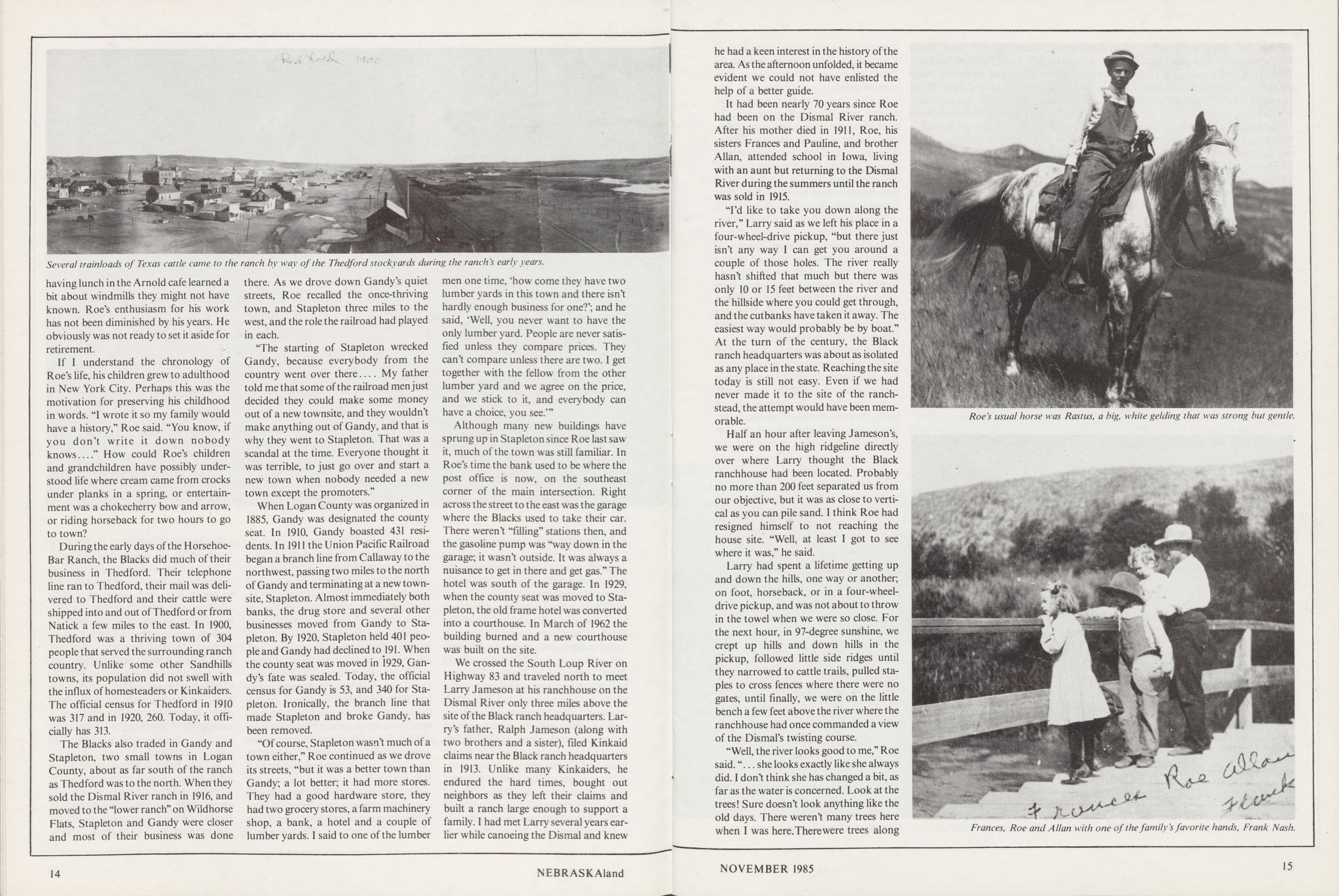
If I understand the chronology of Roe's life, his children grew to adulthood in New York City. Perhaps this was the motivation for preserving his childhood in words. "I wrote it so my family would have a history," Roe said. "You know, if you don't write it down nobody knows...." How could Roe's children and grandchildren have possibly understood life where cream came from crocks under planks in a spring, or entertainment was a chokecherry bow and arrow, or riding horseback for two hours to go to town?
During the early days of the HorsehoeBar Ranch, the Blacks did much of their business in Thedford. Their telephone line ran to Thedford, their mail was delivered to Thedford and their cattle were shipped into and out of Thedford or from Natick a few miles to the east. In 1900, Thedford was a thriving town of 304 people that served the surrounding ranch country. Unlike some other Sandhills towns, its population did not swell with the influx of homesteaders or Kinkaiders. The official census for Thedford in 1910 was 317 and in 1920, 260. Today, it officially has 313.
The Blacks also traded in Gandy and Stapleton, two small towns in Logan County, about as far south of the ranch as Thedford was to the north. When they sold the Dismal River ranch in 1916, and moved to the "lower ranch" on Wildhorse Flats, Stapleton and Gandy were closer and most of their business was done there. As we drove down Gandy's quiet streets, Roe recalled the once-thriving town, and Stapleton three miles to the west, and the role the railroad had played in each.
"The starting of Stapleton wrecked Gandy, because everybody from the country went over there — My father told me that some of the railroad men just decided they could make some money out of a new townsite, and they wouldn't make anything out of Gandy, and that is why they went to Stapleton. That was a scandal at the time. Everyone thought it was terrible, to just go over and start a new town when nobody needed a new town except the promoters."
When Logan County was organized in 1885, Gandy was designated the county seat. In 1910, Gandy boasted 431 residents. In 1911 the Union Pacific Railroad began a branch line from Callaway to the northwest, passing two miles to the north of Gandy and terminating at a new townsite, Stapleton. Almost immediately both banks, the drug store and several other businesses moved from Gandy to Stapleton. By 1920, Stapleton held 401 people and Gandy had declined to 191. When the county seat was moved in 1929, Gandy's fate was sealed. Today, the official census for Gandy is 53, and 340 for Stapleton. Ironically, the branch line that made Stapleton and broke Gandy, has been removed.
"Of course, Stapleton wasn't much of a town either," Roe continued as we drove its streets, "but it was a better town than Gandy; a lot better; it had more stores. They had a good hardware store, they had two grocery stores, a farm machinery shop, a bank, a hotel and a couple of lumber yards. I said to one of the lumber men one time, 'how come they have two lumber yards in this town and there isn't hardly enough business for one?'; and he said, 'Well, you never want to have the only lumber yard. People are never satisfied unless they compare prices. They can't compare unless there are two. I get together with the fellow from the other lumber yard and we agree on the price, and we stick to it, and everybody can have a choice, you see.'"
Although many new buildings have sprung up in Stapleton since Roe last saw it, much of the town was still familiar. In Roe's time the bank used to be where the post office is now, on the southeast corner of the main intersection. Right across the street to the east was the garage where the Blacks used to take their car. There weren't "filling" stations then, and the gasoline pump was "way down in the garage; it wasn't outside. It was always a nuisance to get in there and get gas." The hotel was south of the garage. In 1929, when the county seat was moved to Stapleton, the old frame hotel was converted into a courthouse. In March of 1962 the building burned and a new courthouse was built on the site.
We crossed the South Loup River on Highway 83 and traveled north to meet Larry Jameson at his ranchhouse on the Dismal River only three miles above the site of the Black ranch headquarters. Larry's father, Ralph Jameson (along with two brothers and a sister), filed Kinkaid claims near the Black ranch headquarters in 1913. Unlike many Kinkaiders, he endured the hard times, bought out neighbors as they left their claims and built a ranch large enough to support a family. I had met Larry several years earlier while canoeing the Dismal and knew 14 NEBRASKAland he had a keen interest in the history of the area. As the afternoon unfolded, it became evident we could not have enlisted the help of a better guide.
It had been nearly 70 years since Roe had been on the Dismal River ranch. After his mother died in 1911, Roe, his sisters Frances and Pauline, and brother Allan, attended school in Iowa, living with an aunt but returning to the Dismal River during the summers until the ranch was sold in 1915.
"I'd like to take you down along the river," Larry said as we left his place in a four-wheel-drive pickup, "but there just isn't any way I can get you around a couple of those holes. The river really hasn't shifted that much but there was onlv 10 or 15 feet between the river and the hillside where you could get through, and the cutbanks have taken it away. The easiest way would probably be by boat." At the turn of the century, the Black ranch headquarters was about as isolated as any place in the state. Reaching the site today is still not easy. Even if we had never made it to the site of the ranchstead, the attempt would have been memorable.
Half an hour after leaving Jameson's, we were on the high ridgeline directly over where Larry thought the Black ranchhouse had been located. Probably no more than 200 feet separated us from our objective, but it was as close to vertical as you can pile sand. I think Roe had resigned himself to not reaching the house site. "Well, at least I got to see where it was," he said.
Larry had spent a lifetime getting up and down the hills, one way or another; on foot, horseback, or in a four-wheel-drive pickup, and was not about to throw in the towel when we were so close. For the next hour, in 97-degree sunshine, we crept up hills and down hills in the pickup, followed little side ridges until they narrowed to cattle trails, pulled staples to cross fences where there were no gates, until finally, we were on the little bench a few feet above the river where the ranchhouse had once commanded a view of the Dismal's twisting course.
"Well, the river looks good to me," Roe said."... she looks exactly like she always did. I don't think she has changed a bit, as far as the water is concerned. Look at the trees! Sure doesn't look anything like the old days. There weren't many trees here when I was here.Therewere trees along the river, but not out away from it. When 1 say along the river, 1 mean right on the bank. They look good to me; 1 like to see the trees but we didn't have hardly any, just along the river, that's all; willows, and ash and little cedars."
The small flat between the Dismal and the foot of the hills where the ranch buildings had been located were crowded with hackberry, ash, cedar, and chokecherry. Cedars were colonizing a mile out from the river on the south side.
In the 1940's, Larry had attended a rural school located only a few feet from the site of the Black house. After the Black's moved to the lower ranch on the south side of the Dismal between Dunning and the trail that 40 years later would become Highway 83, another family moved into the Dismal River ranchhouse. When we talked with Larry's mother, Edith Jameson, at her home in Thedford a day later, she recalled dances in the spacious rooms of the house.
"When I came to this country [1923], T.B. Hord had the Black ranch and there was a fellow by the name of Frank Piel on there with some cattle. They were there for a couple of years... and then they moved to town, and of course the ranch buildings were more or less left vacant. I remember seeing the old Black house next to the hill. These Piels had two fairly good-sized rooms and they were awful nice to get together in and have an old fashioned country dance, get-togethers, you know. We danced until daylight so you could see your way to get home."
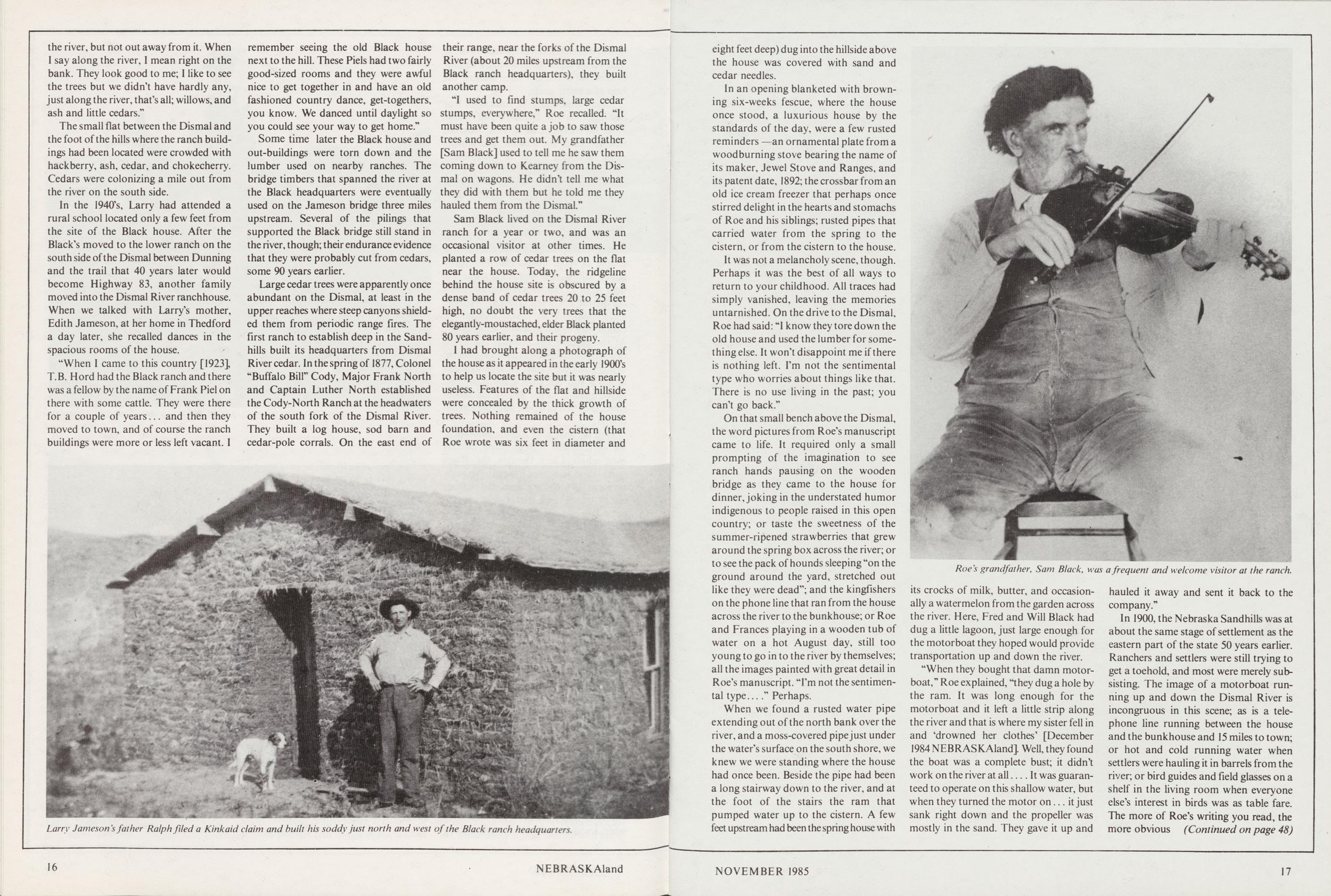
Some time later the Black house and out-buildings were torn down and the lumber used on nearby ranches. The bridge timbers that spanned the river at the Black headquarters were eventually used on the Jameson bridge three miles upstream. Several of the pilings that supported the Black bridge still stand in the river, though; their endurance evidence that they were probably cut from cedars, some 90 years earlier.
Large cedar trees were apparently once abundant on the Dismal, at least in the upper reaches where steep canyons shielded them from periodic range fires. The first ranch to establish deep in the Sandhills built its headquarters from Dismal River cedar. In the spring of 1877, Colonel "Buffalo Bill" Cody, Major Frank North and Captain Luther North established the Cody-North Ranch at the headwaters of the south fork of the Dismal River. They built a log house, sod barn and cedar-pole corrals. On the east end of their range, near the forks of the Dismal River (about 20 miles upstream from the Black ranch headquarters), they built another camp.
"I used to find stumps, large cedar stumps, everywhere," Roe recalled. "It must have been quite a job to saw those trees and get them out. My grandfather [Sam Black] used to tell me he saw them coming down to Kearney from the Dismal on wagons. He didn't tell me what they did with them but he told me they hauled them from the Dismal."
Sam Black lived on the Dismal River ranch for a year or two, and was an occasional visitor at other times. He planted a row of cedar trees on the flat near the house. Today, the ridgeline behind the house site is obscured by a dense band of cedar trees 20 to 25 feet high, no doubt the very trees that the elegantly-moustached, elder Black planted 80 years earlier, and their progeny.
I had brought along a photograph of the house as it appeared in the early 1900's to help us locate the site but it was nearly useless. Features of the flat and hillside were concealed by the thick growth of trees. Nothing remained of the house foundation, and even the cistern (that Roe wrote was six feet in diameter and eight feet deep) dug into the hillside above the house was covered with sand and cedar needles.
In an opening blanketed with browning six-weeks fescue, where the house once stood, a luxurious house by the standards of the day, were a few rusted reminders —an ornamental plate from a woodburning stove bearing the name of its maker, Jewel Stove and Ranges, and its patent date, 1892; the crossbar from an old ice cream freezer that perhaps once stirred delight in the hearts and stomachs of Roe and his siblings; rusted pipes that carried water from the spring to the cistern, or from the cistern to the house.
It was not a melancholy scene, though. Perhaps it was the best of all ways to return to your childhood. All traces had simply vanished, leaving the memories untarnished. On the drive to the Dismal, Roe had said: "I know they tore down the old house and used the lumber for something else. It won't disappoint me if there is nothing left. I'm not the sentimental type who worries about things like that. There is no use living in the past; you can't go back."
On that small bench above the Dismal, the word pictures from Roe's manuscript came to life. It required only a small prompting of the imagination to see ranch hands pausing on the wooden bridge as they came to the house for dinner, joking in the understated humor indigenous to people raised in this open country; or taste the sweetness of the summer-ripened strawberries that grew around the spring box across the river; or to see the pack of hounds sleeping "on the ground around the yard, stretched out like they were dead"; and the kingfishers on the phone line that ran from the house across the river to the bunkhouse; or Roe and Frances playing in a wooden tub of water on a hot August day, still too young to go in to the river by themselves; all the images painted with great detail in Roe's manuscript. "I'm not the sentimental type...." Perhaps.
When we found a rusted water pipe extending out of the north bank over the river, and a moss-covered pipe just under the water's surface on the south shore, we knew we were standing where the house had once been. Beside the pipe had been a long stairway down to the river, and at the foot of the stairs the ram that pumped water up to the cistern. A few feet upstream had been the spring house with its crocks of milk, butter, and occasionally a watermelon from the garden across the river. Here, Fred and Will Black had dug a little lagoon, just large enough for the motorboat they hoped would provide transportation up and down the river.
"When they bought that damn motorboat," Roe explained, "they dug a hole by the ram. It was long enough for the motorboat and it left a little strip along the river and that is where my sister fell in and 'drowned her clothes' [December 1984NEBRASKAland]. Well, they found the boat was a complete bust; it didn't work on the river at all___It was guaranteed to operate on this shallow water, but when they turned the motor on... it just sank right down and the propeller was mostly in the sand. They gave it up and hauled it away and sent it back to the company."
In 1900, the Nebraska Sandhills was at about the same stage of settlement as the eastern part of the state 50 years earlier. Ranchers and settlers were still trying to get a toehold, and most were merely subsisting. The image of a motorboat running up and down the Dismal River is incongruous in this scene; as is a telephone line running between the house and the bunkhouse and 15 miles to town; or hot and cold running water when settlers were hauling it in barrels from the river; or bird guides and field glasses on a shelf in the living room when everyone else's interest in birds was as table fare. The more of Roe's writing you read, the more obvious (Continued on page 48)
NOVEMBER 1985 17
MALLARDS Past and Prospects
".. .we must not forget for a moment that conservation will in the final analysis always have to contend with what is best economically for the average person.... If we could imagine some startling discovery which suddenly made wild ducks an economic necessity, there is no doubt that in five years we could have all the ducks we could possibly require." rbm American Waterfowl, 1930.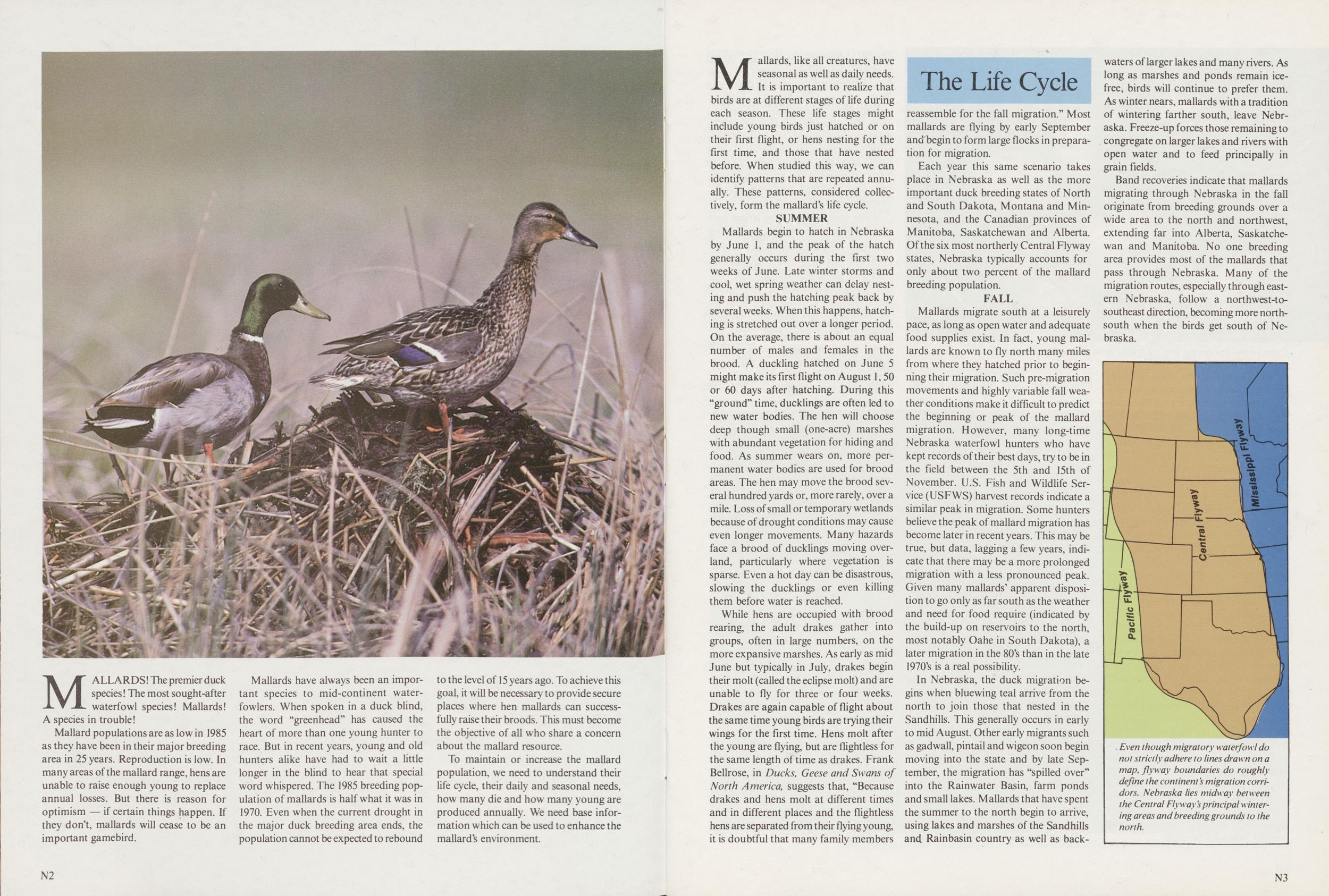
MALLARDS! The premier duck species! The most sought-after waterfowl species! Mallards! A species in trouble!
Mallard populations are as low in 1985 as they have been in their major breeding area in 25 years. Reproduction is low. In many areas of the mallard range, hens are unable to raise enough young to replace annual losses. But there is reason for optimism — if certain things happen. If they don't, mallards will cease to be an important gamebird.
Mallards have always been an important species to mid-continent waterfowlers. When spoken in a duck blind, the word "greenhead" has caused the heart of more than one young hunter to race. But in recent years, young and old hunters alike have had to wait a little longer in the blind to hear that special word whispered. The 1985 breeding population of mallards is half what it was in 1970. Even when the current drought in the major duck breeding area ends, the population cannot be expected to rebound to the level of 15 years ago. To achieve this goal, it will be necessary to provide secure places where hen mallards can successfully raise their broods. This must become the objective of all who share a concern about the mallard resource.
To maintain or increase the mallard population, we need to understand their life cycle, their daily and seasonal needs, how many die and how many young are produced annually. We need base information which can be used to enhance the mallard's environment.
N2 The Life CycleMallards, like all creatures, have seasonal as well as daily needs. It is important to realize that birds are at different stages of life during each season. These life stages might include young birds just hatched or on their first flight, or hens nesting for the first time, and those that have nested before. When studied this way, we can identify patterns that are repeated annually. These patterns, considered collectively, form the mallard's life cycle.
SUMMERMallards begin to hatch in Nebraska by June 1, and the peak of the hatch generally occurs during the first two weeks of June. Late winter storms and cool, wet spring weather can delay nesting and push the hatching peak back by several weeks. When this happens, hatching is stretched out over a longer period. On the average, there is about an equal number of males and females in the brood. A duckling hatched on June 5 might make its first flight on August 1,50 or 60 days after hatching. During this "ground" time, ducklings are often led to new water bodies. The hen will choose deep though small (one-acre) marshes with abundant vegetation for hiding and food. As summer wears on, more permanent water bodies are used for brood areas. The hen may move the brood several hundred yards or, more rarely, over a mile. Loss of small or temporary wetlands because of drought conditions may cause even longer movements. Many hazards face a brood of ducklings moving overland, particularly where vegetation is sparse. Even a hot day can be disastrous, slowing the ducklings or even killing them before water is reached.
While hens are occupied with brood rearing, the adult drakes gather into groups, often in large numbers, on the more expansive marshes. As early as mid June but typically in July, drakes begin their molt (called the eclipse molt) and are unable to fly for three or four weeks. Drakes are again capable of flight about the same time young birds are trying their wings for the first time. Hens molt after the young are flying, but are flightless for the same length of time as drakes. Frank Bellrose, in Ducks, Geese and Swans of North America, suggests that, "Because drakes and hens molt at different times and in different places and the flightless hens are separated from their flying young, it is doubtful that many family members reassemble for the fall migration." Most mallards are flying by early September and begin to form large flocks in preparation for migration.
Each year this same scenario takes place in Nebraska as well as the more important duck breeding states of North and South Dakota, Montana and Minnesota, and the Canadian provinces of Manitoba, Saskatchewan and Alberta. Of the six most northerly Central Fly way states, Nebraska typically accounts for only about two percent of the mallard breeding population.
FALLMallards migrate south at a leisurely pace, as long as open water and adequate food supplies exist. In fact, young mallards are known to fly north many miles from where they hatched prior to beginning their migration. Such pre-migration movements and highly variable fall weather conditions make it difficult to predict the beginning or peak of the mallard migration. However, many long-time Nebraska waterfowl hunters who have kept records of their best days, try to be in the field between the 5th and 15th of November. U.S. Fish and Wildlife Service (USFWS) harvest records indicate a similar peak in migration. Some hunters believe the peak of mallard migration has become later in recent years. This may be true, but data, lagging a few years, indicate that there may be a more prolonged migration with a less pronounced peak. Given many mallards' apparent disposition to go only as far south as the weather and need for food require (indicated by the build-up on reservoirs to the north, most notably Oahe in South Dakota), a later migration in the 80's than in the late 1970's is a real possibility.
In Nebraska, the duck migration begins when bluewing teal arrive from the north to join those that nested in the Sandhills. This generally occurs in early to mid August. Other early migrants such as gadwall, pintail and wigeon soon begin moving into the state and by late September, the migration has "spilled over" into the Rainwater Basin, farm ponds and small lakes. Mallards that have spent the summer to the north begin to arrive, using lakes and marshes of the Sandhills and Rainbasin country as well as backwaters of larger lakes and many rivers. As long as marshes and ponds remain icefree, birds will continue to prefer them. As winter nears, mallards with a tradition of wintering farther south, leave Nebraska. Freeze-up forces those remaining to congregate on larger lakes and rivers with open water and to feed principally in grain fields.
Band recoveries indicate that mallards migrating through Nebraska in the fall originate from breeding grounds over a wide area to the north and northwest, extending far into Alberta, Saskatchewan and Manitoba. No one breeding area provides most of the mallards that pass through Nebraska. Many of the migration routes, especially through eastern Nebraska, follow a northwest-tosoutheast direction, becoming more northsouth when the birds get south of Nebraska.
Fifty percent of the drake mallards banded in western Nebraska in the summer, and recovered during the first hunting season after banding, were taken by hunters in Nebraska. Other Central Flyway states — Kansas, Texas, Colorado and South Dakota — accounted for about nine percent each. Nearly seven percent were recovered in the Mississippi Flyway. Those drake mallards recovered more than a year after being banded tended to stray farther from Nebraska — only 23 percent were taken in Nebraska while 14 percent were recovered in Canada, and a similar proportion in the Mississippi Flyway. Less data is available for drake mallards banded in the summer in eastern Nebraska, but it shows 55 percent of the first-year recoveries were from Nebraska and 17 percent from South Dakota. The Central Flyway accounted for 80 percent of the total recoveries while 20 percent occurred in the Mississippi Flyway, demonstrating the northwest-southeast migration pattern.
Female mallards banded in western Nebraska in the summer seem to have a bit more affinity for the state. Fifty percent of recoveries occurred in Nebraska while nine percent were recovered in the Mississippi Flyway. Canada accounted for nine percent of the hens recovered more than one year after banding. The distribution of females banded in eastern Nebraska is similar to recoveries from western Nebraska bandings.
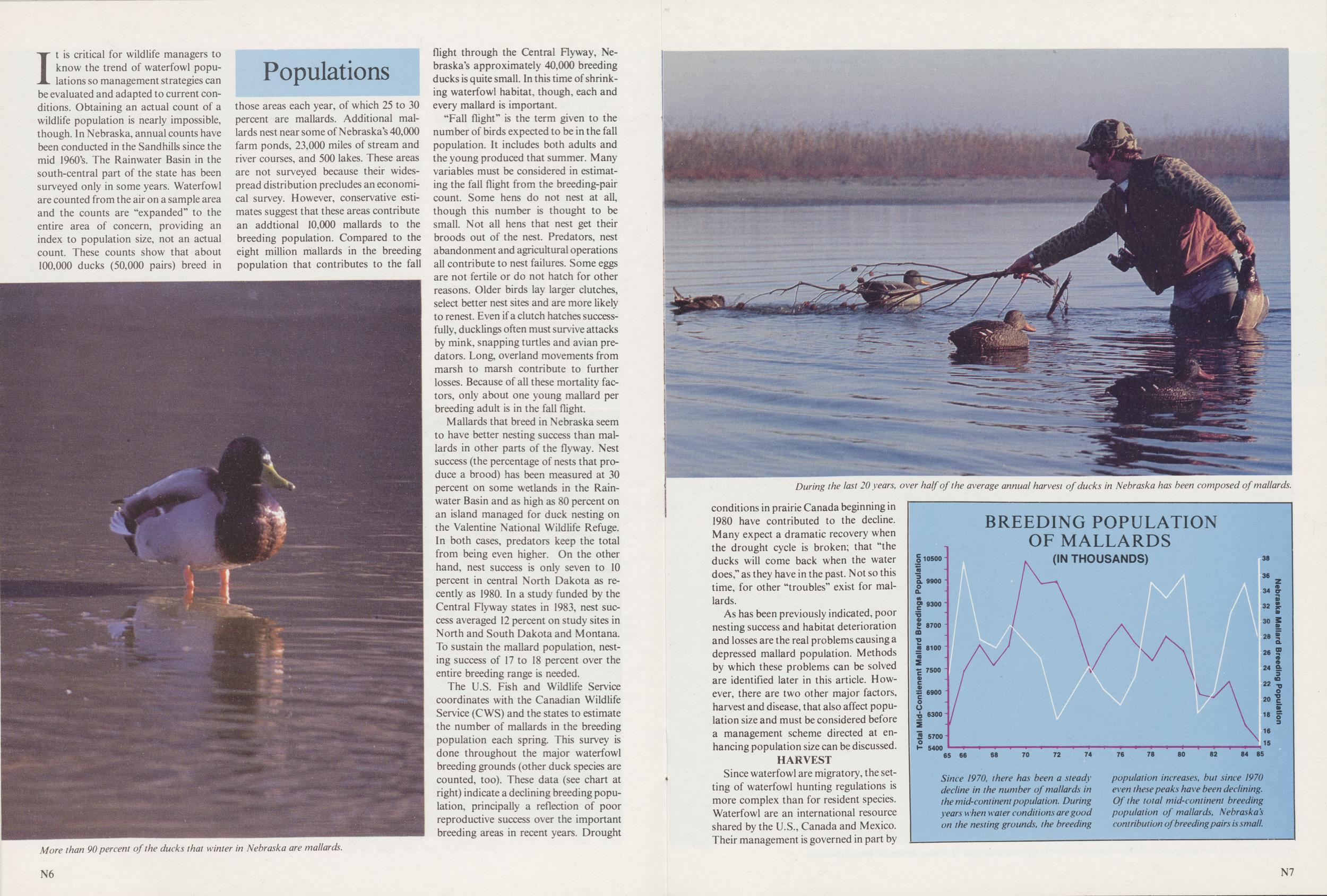
WINTERBy mid December, migration is essentially over and mallards are where they are going to stay until spring. Some shifts in concentrations of birds occur, but the movements will generally be short and in response to severe weather. Even though mallards account for less than 25 percent of all the ducks that come through Nebraska in the fall, more than 90 percent of the ducks that winter in Nebraska are mallards. This demonstrates that mallards are better suited to withstand Nebraska winters than most other waterfowl species. As many as 80 percent of the mallards wintering in Nebraska will be males. At this time there are no satisfactory explanations as to why there is a preponderence of males in Nebraska's wintering population.
Winter requirements for mallards seems to be only open water and a food source. They concentrate on portions of the Platte and North Platte rivers and on major reservoirs. Concentrations occur along the Platte between Fremont and Ashland and from Kearney to Lexing- ton, as well as along the North Platte River, particularly near Oshkosh and west of Scottsbluff. Lake Minatare, Lake McConaughy, Sutherland and Harlan County reservoirs are important to overwintering mallards. Large numbers also winter in Dundy and Boone counties and on Lewis and Clark Lake.
Typically, more than 300,000 mallards winter in Nebraska. In 1984 only 70,000 mallards were counted (counts are made annually in early January), by Game and Parks personnel; the lowest number recorded since counts were initiated in 1946. The record low can probably be attributed to cold temperatures that froze lakes and rivers normally open, and heavy snow that covered grain fields. In 1981, a record high of 480,000 were observed. The 1985 January survey included over 242,000 mallards.
Waste corn makes up the largest part of the mallard's winter diet, accounting for more than 50 percent of the food eaten. Milo is used where abundant if corn is not available, and soybeans are important in some areas. Mallards seem to recognize that a grain diet alone will not sustain them for very long, and also feed on duckweed, smartweed and barnyardgrass. Research in the central Platte Valley has shown that these three food items make up 26 percent of the winter diet. These foods, along with snails and small clams, provide an important part of the high-energy diet required to survive a Nebraska winter.
SPRINGIn contrast to fall migration, when winter must push mallards hard before they go south, mallards push winter northward in the spring. Their migration back into Nebraska begins in mid to late February. Through March, their numbers increase but fluctuate as new birds arrive and others head for their breeding grounds. By the middle of April, most birds that will not stay in Nebraska have reached their more northerly breeding sites.
During spring migration, there is a great deal of activity, most of it related to feeding or breeding courtship. Much of this activity is concentrated on the remaining wetlands in south-central Nebraska. This area of the state has been described as the middle of a geographical and climatological hourglass. The bottom of the hourglass is an extensive wintering area encompassing a significant portion of Mexico and the Texas and Louisiana Gulf coasts. The top fans out in equally extensive breeding grounds that include Hudson Bay, the Arctic Circle and the Alaska coast. The scarcity of wetlands to the east and west of Nebraska's Rainwater Basin country makes it of critical importance to migrating wildfowl, including mallards. Many birds that either N4 migrate down the Mississippi Flyway or overfly the state in the fall, pause in Nebraska during spring migration for a break in their long trip.
Bonds that began to form in the previous fall are strong now, and most females are paired, including those in their first year of life. Females usually return to the same area where they built a nest the previous year, sometimes selecting a site within a few yards of a previous nest. Hens breeding their first time often return to the area where they hatched. This phenomenon, called homing, could be important in increasing production if an area where nest success is high can be provided year after year and successful hens return to the site along with their young. The increased density of successful nests might allow a relatively small area to contribute significantly to the fall flight and subsequent breeding population.
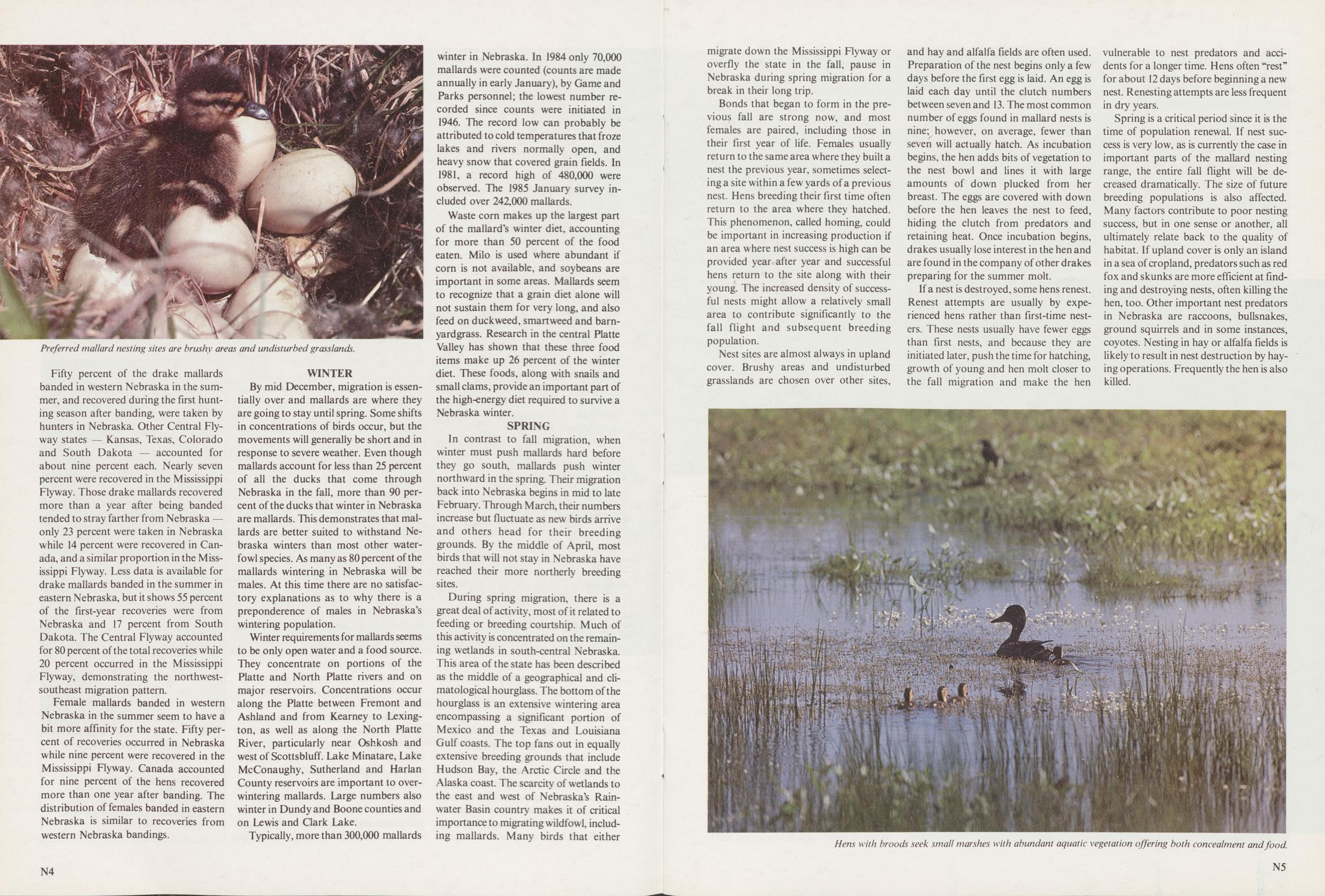
Nest sites are almost always in upland cover. Brushy areas and undisturbed grasslands are chosen over other sites, and hay and alfalfa fields are often used. Preparation of the nest begins only a few days before the first egg is laid. An egg is laid each day until the clutch numbers between seven and 13. The most common number of eggs found in mallard nests is nine; however, on average, fewer than seven will actually hatch. As incubation begins, the hen adds bits of vegetation to the nest bowl and lines it with large amounts of down plucked from her breast. The eggs are covered with down before the hen leaves the nest to feed, hiding the clutch from predators and retaining heat. Once incubation begins, drakes usually lose interest in the hen and are found in the company of other drakes preparing for the summer molt.
If a nest is destroyed, some hens renest. Renest attempts are usually by experienced hens rather than first-time nesters. These nests usually have fewer eggs than first nests, and because they are initiated later, push the time for hatching, growth of young and hen molt closer to the fall migration and make the hen vulnerable to nest predators and accidents for a longer time. Hens often "rest" for about 12 days before beginning a new nest. Renesting attempts are less frequent in dry years.
Spring is a critical period since it is the time of population renewal. If nest success is very low, as is currently the case in important parts of the mallard nesting range, the entire fall flight will be decreased dramatically. The size of future breeding populations is also affected. Many factors contribute to poor nesting success, but in one sense or another, all ultimately relate back to the quality of habitat. If upland cover is only an island in a sea of cropland, predators such as red fox and skunks are more efficient at finding and destroying nests, often killing the hen, too. Other important nest predators in Nebraska are raccoons, bullsnakes, ground squirrels and in some instances, coyotes. Nesting in hay or alfalfa fields is likely to result in nest destruction by haying operations. Frequently the hen is also killed.
 Populations
It is critical for wildlife managers to know the trend of waterfowl populations so management strategies can be evaluated and adapted to current conditions. Obtaining an actual count of a wildlife population is nearly impossible, though. In Nebraska, annual counts have been conducted in the Sandhills since the mid 1960's. The Rainwater Basin in the south-central part of the state has been surveyed only in some years. Waterfowl are counted from the air on a sample area and the counts are "expanded" to the entire area of concern, providing an index to population size, not an actual count. These counts show that about 100,000 ducks (50,000 pairs) breed in those areas each year, of which 25 to 30 percent are mallards. Additional mallards nest near some of Nebraska's 40,000 farm ponds, 23,000 miles of stream and river courses, and 500 lakes. These areas are not surveyed because their widespread distribution precludes an economical survey. However, conservative estimates suggest that these areas contribute an addtional 10,000 mallards to the breeding population. Compared to the eight million mallards in the breeding population that contributes to the fall flight through the Central Flyway, Nebraska's approximately 40,000 breeding ducks is quite small. In this time of shrinking waterfowl habitat, though, each and every mallard is important.
"Fall flight" is the term given to the number of birds expected to be in the fall population. It includes both adults and the young produced that summer. Many variables must be considered in estimating the fall flight from the breeding-pair count. Some hens do not nest at all, though this number is thought to be small. Not all hens that nest get their broods out of the nest. Predators, nest abandonment and agricultural operations all contribute to nest failures. Some eggs are not fertile or do not hatch for other reasons. Older birds lay larger clutches, select better nest sites and are more likely to renest. Even if a clutch hatches successfully, ducklings often must survive attacks by mink, snapping turtles and avian predators. Long, overland movements from marsh to marsh contribute to further losses. Because of all these mortality factors, only about one young mallard per breeding adult is in the fall flight.
Mallards that breed in Nebraska seem to have better nesting success than mallards in other parts of the flyway. Nest success (the percentage of nests that produce a brood) has been measured at 30 percent on some wetlands in the Rainwater Basin and as high as 80 percent on an island managed for duck nesting on the Valentine National Wildlife Refuge. In both cases, predators keep the total from being even higher. On the other hand, nest success is only seven to 10 percent in central North Dakota as recently as 1980. In a study funded by the Central Flyway states in 1983, nest success averaged 12 percent on study sites in North and South Dakota and Montana. To sustain the mallard population, nesting success of 17 to 18 percent over the entire breeding range is needed.
The U.S. Fish and Wildlife Service coordinates with the Canadian Wildlife Service (CWS) and the states to estimate the number of mallards in the breeding population each spring. This survey is done throughout the major waterfowl breeding grounds (other duck species are counted, too). These data (see chart at right) indicate a declining breeding population, principally a reflection of poor reproductive success over the important breeding areas in recent years. Drought conditions in prairie Canada beginning in 1980 have contributed to the decline. Many expect a dramatic recovery when the drought cycle is broken; that "the ducks will come back when the water does," as they have in the past. Not so this time, for other "troubles" exist for mallards.
N6As has been previously indicated, poor nesting success and habitat deterioration and losses are the real problems causing a depressed mallard population. Methods by which these problems can be solved are identified later in this article. However, there are two other major factors, harvest and disease, that also affect population size and must be considered before a management scheme directed at enhancing population size can be discussed.
HARVESTSince waterfowl are migratory, the setting of waterfowl hunting regulations is more complex than for resident species. Waterfowl are an international resource shared by the U.S., Canada and Mexico. Their management is governed in part by the Migratory Bird Treaty, and the USFWS has the ultimate authority to regulate harvest.
BREEDING POPULATION OF MALLARDS (IN THOUSANDS) 38 65 66 Since 1970, there has been a steady decline in the number of mallards in the mid-continent population. During years when water conditions are good on the nesting grounds, the breeding 84 85 population increases, but since 1970 even these peaks have been declining. Of the total mid-continent breeding population of mallards, Nebraska's contribution of breeding pairs is small. N7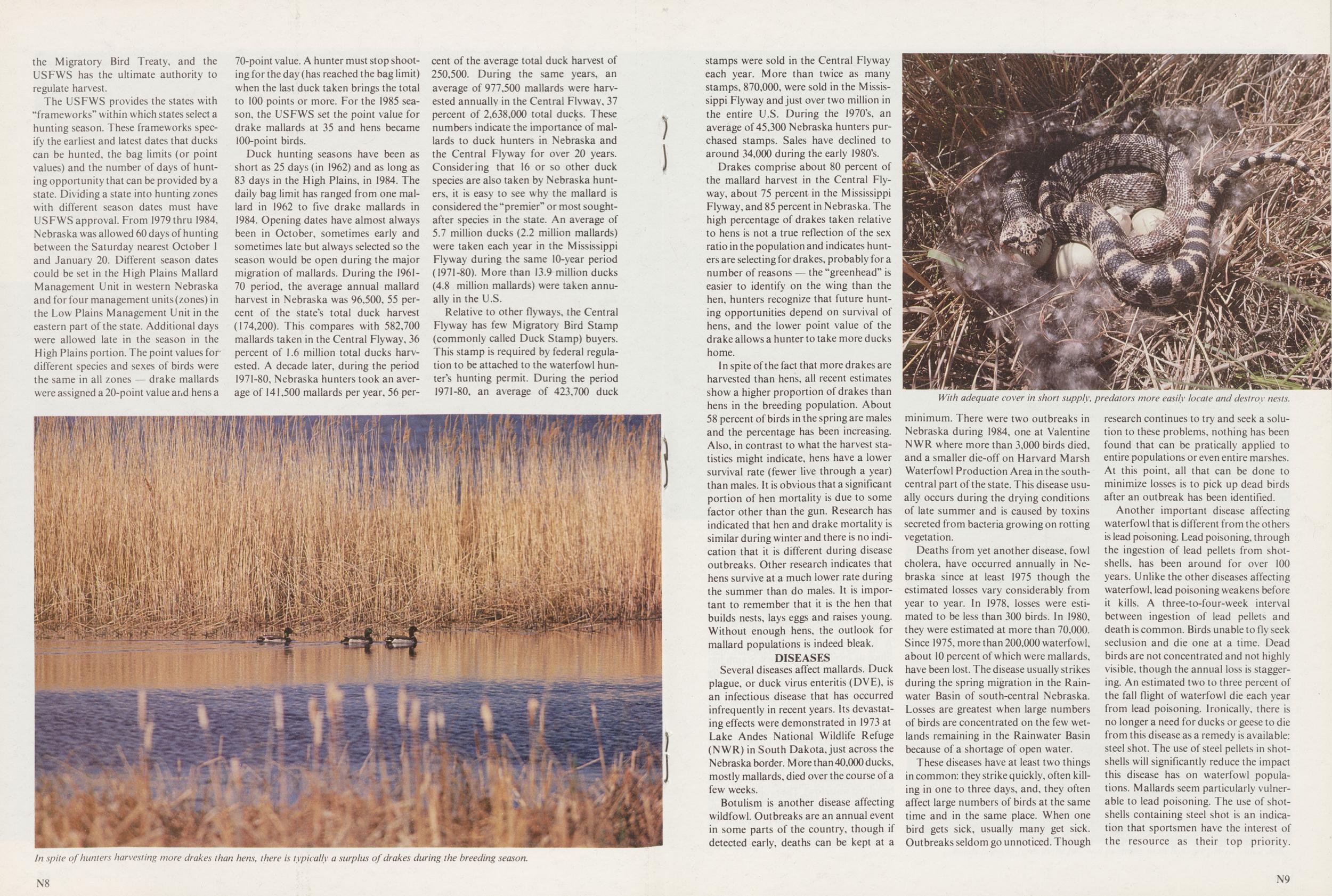
The USFWS provides the states with "frameworks" within which states select a hunting season. These frameworks specify the earliest and latest dates that ducks can be hunted, the bag limits (or point values) and the number of days of hunting opportunity that can be provided by a state. Dividing a state into hunting zones with different season dates must have USFWS approval. From 1979 thru 1984, Nebraska was allowed 60 days of hunting between the Saturday nearest October 1 and January 20. Different season dates could be set in the High Plains Mallard Management Unit in western Nebraska and for four management units (zones) in the Low Plains Management Unit in the eastern part of the state. Additional days were allowed late in the season in the High Plains portion. The point values for different species and sexes of birds were the same in all zones — drake mallards were assigned a 20-point value and hens a 70-point value. A hunter must stop shooting for the day (has reached the bag limit) when the last duck taken brings the total to 100 points or more. For the 1985 season, the USFWS set the point value for drake mallards at 35 and hens became 100-point birds.
Duck hunting seasons have been as short as 25 days (in 1962) and as long as 83 days in the High Plains, in 1984. The daily bag limit has ranged from one mallard in 1962 to five drake mallards in 1984. Opening dates have almost always been in October, sometimes early and sometimes late but always selected so the season would be open during the major migration of mallards. During the 196170 period, the average annual mallard harvest in Nebraska was 96,500, 55 pecent of the state's total duck harvest (174,200). This compares with 582,700 mallards taken in the Central Flyway, 36 percent of 1.6 million total ducks harvested. A decade later, during the period 1971-80, Nebraska hunters took an average of 141,500 mallards per year, 56 percent of the average total duck harvest of 250,500. During the same years, an average of 977,500 mallards were harvested annually in the Central Flvway, 37 percent of 2,638,000 total ducks. These numbers indicate the importance of mallards to duck hunters in Nebraska and the Central Flyway for over 20 years. Considering that 16 or so other duck species are also taken by Nebraska hunters, it is easy to see why the mallard is considered the "premier" or most soughtafter species in the state. An average of 5.7 million ducks (2.2 million mallards) were taken each year in the Mississippi Flyway during the same 10-year period (1971-80). More than 13.9 million ducks (4.8 million mallards) were taken annually in the U.S.
Relative to other flyways, the Central Flyway has few Migratory Bird Stamp (commonly called Duck Stamp) buyers. This stamp is required by federal regulation to be attached to the waterfowl hunter's hunting permit. During the period 1971-80, an average of 423,700 duck stamps were sold in the Central Flyway each year. More than twice as many stamps, 870,000, were sold in the Mississippi Flyway and just over two million in the entire U.S. During the 1970's, an average of 45,300 Nebraska hunters purchased stamps. Sales have declined to around 34,000 during the early 1980's.
Drakes comprise about 80 percent of the mallard harvest in the Central Flyway, about 75 percent in the Mississippi Flyway, and 85 percent in Nebraska. The high percentage of drakes taken relative to hens is not a true reflection of the sex ratio in the population and indicates hunters are selecting for drakes, probably for a number of reasons — the "greenhead" is easier to identify on the wing than the hen, hunters recognize that future hunting opportunities depend on survival of hens, and the lower point value of the drake allows a hunter to take more ducks home.
In spite of the fact that more drakes are harvested than hens, all recent estimates show a higher proportion of drakes than hens in the breeding population. About 58 percent of birds in the spring are males and the percentage has been increasing. Also, in contrast to what the harvest statistics might indicate, hens have a lower survival rate (fewer live through a year) than males. It is obvious that a significant portion of hen mortality is due to some factor other than the gun. Research has indicated that hen and drake mortality is similar during winter and there is no indication that it is different during disease outbreaks. Other research indicates that hens survive at a much lower rate during the summer than do males. It is important to remember that it is the hen that builds nests, lays eggs and raises young. Without enough hens, the outlook for mallard populations is indeed bleak.
DISEASESSeveral diseases affect mallards. Duck plague, or duck virus enteritis (DVE), is an infectious disease that has occurred infrequently in recent years. Its devastating effects were demonstrated in 1973 at Lake Andes National Wildlife Refuge (NWR) in South Dakota, just across the Nebraska border. M ore than 40,000 ducks, mostly mallards, died over the course of a few weeks.
Botulism is another disease affecting wildfowl. Outbreaks are an annual event in some parts of the country, though if detected early, deaths can be kept at a minimum. There were two outbreaks in Nebraska during 1984, one at Valentine NWR where more than 3,000 birds died, and a smaller die-off on Harvard Marsh Waterfowl Production Area in the southcentral part of the state. This disease usually occurs during the drying conditions of late summer and is caused by toxins secreted from bacteria growing on rotting vegetation.
Deaths from yet another disease, fowl cholera, have occurred annually in Nebraska since at least 1975 though the estimated losses vary considerably from year to year. In 1978, losses were estimated to be less than 300 birds. In 1980, they were estimated at more than 70,000. Since 1975, more than 200,000 waterfowl, about 10 percent of which were mallards, have been lost. The disease usually strikes during the spring migration in the Rainwater Basin of south-central Nebraska. Losses are greatest when large numbers of birds are concentrated on the few wetlands remaining in the Rainwater Basin because of a shortage of open water.
These diseases have at least two things in common: they strike quickly, often killing in one to three days, and, they often affect large numbers of birds at the same time and in the same place. When one bird gets sick, usually many get sick. Outbreaks seldom go unnoticed. Though research continues to try and seek a solution to these problems, nothing has been found that can be pratically applied to entire populations or even entire marshes. At this point, all that can be done to minimize losses is to pick up dead birds after an outbreak has been identified.
Another important disease affecting waterfowl that is different from the others is lead poisoning. Lead poisoning, through the ingestion of lead pellets from shotshells, has been around for over 100 years. Unlike the other diseases affecting waterfowl, lead poisoning weakens before it kills. A three-to-four-week interval between ingestion of lead pellets and death is common. Birds unable to flv seek seclusion and die one at a time. Dead birds are not concentrated and not highly visible, though the annual loss is staggering. An estimated two to three percent of the fall flight of waterfowl die each year from lead poisoning. Ironically, there is no longer a need for ducks or geese to die from this disease as a remedy is available: steel shot. The use of steel pellets in shotshells will significantly reduce the impact this disease has on waterfowl populations. Mallards seem particularly vulnerable to lead poisoning. The use of shotshells containing steel shot is an indication that sportsmen have the interest of the resource as their top priority.
N9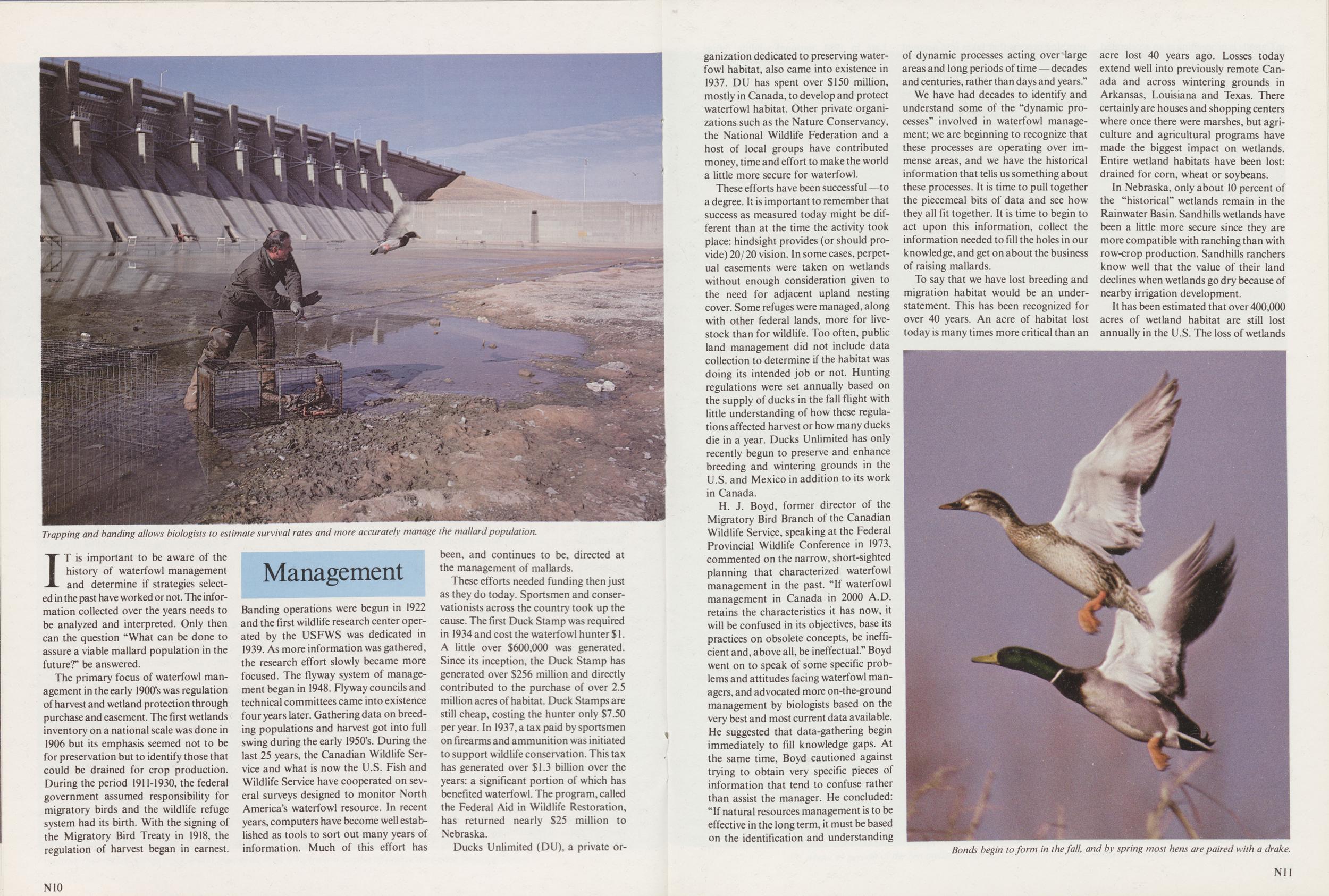
IT is important to be aware of the history of waterfowl management and determine if strategies selected in the past have worked or not. The information collected over the years needs to be analyzed and interpreted. Only then can the question "What can be done to assure a viable mallard population in the future?" be answered.
The primary focus of waterfowl management in the early 1900's was regulation of harvest and wetland protection through purchase and easement. The first wetlands inventory on a national scale was done in 1906 but its emphasis seemed not to be for preservation but to identify those that could be drained for crop production. During the period 1911-1930, the federal government assumed responsibility for migratory birds and the wildlife refuge system had its birth. With the signing of the Migratory Bird Treaty in 1918, the regulation of harvest began in earnest. Banding operations were begun in 1922 and the first wildlife research center operated by the USFWS was dedicated in 1939. As more information was gathered, the research effort slowly became more focused. The fly way system of management began in 1948. Flyway councils and technical committees came into existence four years later. Gathering data on breeding populations and harvest got into full swing during the early 1950's. During the last 25 years, the Canadian Wildlife Service and what is now the U.S. Fish and Wildlife Service have cooperated on several surveys designed to monitor North America's waterfowl resource. In recent years, computers have become well established as tools to sort out many years of information. Much of this effort has been, and continues to be, directed at the management of mallards.
These efforts needed funding then just as they do today. Sportsmen and conservationists across the country took up the cause. The first Duck Stamp was required in 1934 and cost the waterfowl hunter $ 1. A little over $600,000 was generated. Since its inception, the Duck Stamp has generated over $256 million and directly contributed to the purchase of over 2.5 million acres of habitat. Duck Stamps are still cheap, costing the hunter only $7.50 per year. In 1937, a tax paid by sportsmen on firearms and ammunition was initiated to support wildlife conservation. This tax has generated over $1.3 billion over the years: a significant portion of which has benefited waterfowl. The program, called the Federal Aid in Wildlife Restoration, has returned nearly $25 million to Nebraska.
Ducks Unlimited (DU), a private organization N10 dedicated to preserving waterfowl habitat, also came into existence in 1937. DU has spent over $150 million, mostly in Canada, to develop and protect waterfowl habitat. Other private organizations such as the Nature Conservancy, the National Wildlife Federation and a host of local groups have contributed money, time and effort to make the world a little more secure for waterfowl.
These efforts have been successful —to a degree. It is important to remember that success as measured today might be different than at the time the activity took place: hindsight provides (or should provide) 20/ 20 vision. In some cases, perpetual easements were taken on wetlands without enough consideration given to the need for adjacent upland nesting cover. Some refuges were managed, along with other federal lands, more for livestock than for wildlife. Too often, public land management did not include data collection to determine if the habitat was doing its intended job or not. Hunting regulations were set annually based on the supply of ducks in the fall flight with little understanding of how these regulations affected harvest or how many ducks die in a year. Ducks Unlimited has only recently begun to preserve and enhance breeding and wintering grounds in the U.S. and Mexico in addition to its work in Canada.
H. J. Boyd, former director of the Migratory Bird Branch of the Canadian Wildlife Service, speaking at the Federal Provincial Wildlife Conference in 1973, commented on the narrow, short-sighted planning that characterized waterfowl management in the past. "If waterfowl management in Canada in 2000 A.D. retains the characteristics it has now, it will be confused in its objectives, base its practices on obsolete concepts, be inefficient and, above all, be ineffectual." Boyd went on to speak of some specific problems and attitudes facing waterfowl managers, and advocated more on-the-ground management by biologists based on the very best and most current data available. He suggested that data-gathering begin immediately to fill knowledge gaps. At the same time, Boyd cautioned against trying to obtain very specific pieces of information that tend to confuse rather than assist the manager. He concluded: "If natural resources management is to be effective in the long term, it must be based on the identification and understanding of dynamic processes acting over large areas and long periods of time — decades and centuries, rather than days and years."
We have had decades to identify and understand some of the "dynamic processes" involved in waterfowl management; we are beginning to recognize that these processes are operating over immense areas, and we have the historical information that tells us something about these processes. It is time to pull together the piecemeal bits of data and see how they all fit together. It is time to begin to act upon this information, collect the information needed to fill the holes in our knowledge, and get on about the business of raising mallards.
To say that we have lost breeding and migration habitat would be an understatement. This has been recognized for over 40 years. An acre of habitat lost today is many times more critical than an acre lost 40 years ago. Losses today extend well into previously remote Canada and across wintering grounds in Arkansas, Louisiana and Texas. There certainly are houses and shopping centers where once there were marshes, but agriculture and agricultural programs have made the biggest impact on wetlands. Entire wetland habitats have been lost: drained for corn, wheat or soybeans.
In Nebraska, only about 10 percent of the "historical" wetlands remain in the Rainwater Basin. Sandhills wetlands have been a little more secure since they are more compatible with ranching than with row-crop production. Sandhills ranchers know well that the value of their land declines when wetlands go dry because of nearby irrigation development.
It has been estimated that over 400,000 acres of wetland habitat are still lost annually in the U.S. The loss of wetlands in Canada is proceeding at an accelerated rate. Biologists in Canada have documented the impact on wetland "margins": those critical sites for upland-nesting waterfowl such as the mallard. Recent dry conditions in the prairie provinces of Manitoba, Saskatchewan and Alberta allowed land-use changes to be implemented which reduced the amount of grass margins on more than 60 percent of the wetlands. The value of remaining upland nesting cover also declined. The Central Flyway Technical Committee has labeled areas like these (they occur in the U.S., too) as "black holes": places that attract breeding birds in a sea of black dirt, but provide little hope of successful nesting. These islands of habitat are quickly and efficiently hunted by predators that not only destroy eggs but often kill hens on the nest.
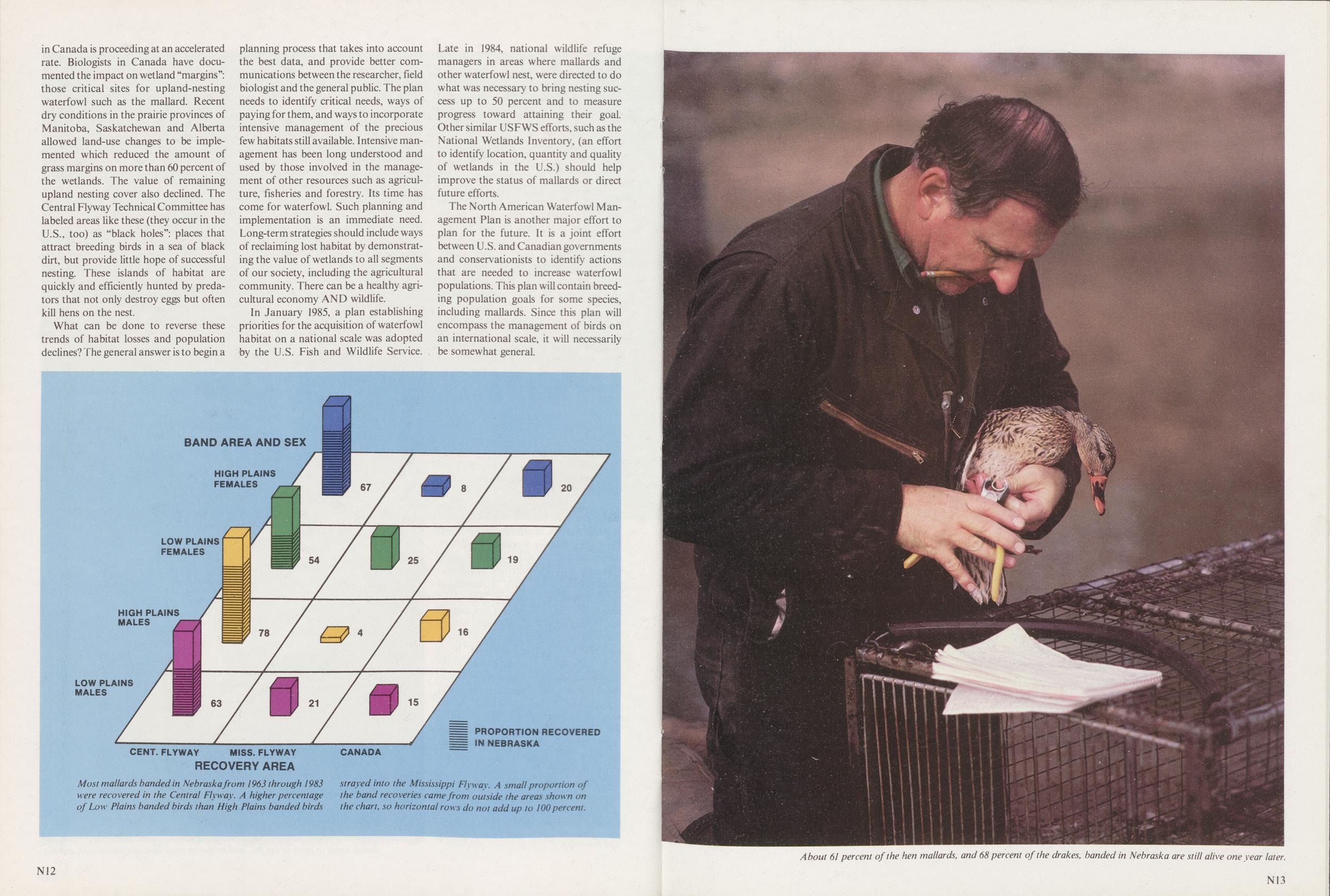
What can be done to reverse these trends of habitat losses and population declines? The general answer is to begin a planning process that takes into account the best data, and provide better communications between the researcher, field biologist and the general public. The plan needs to identify critical needs, ways of paying for them, and ways to incorporate intensive management of the precious few habitats still available. Intensive management has been long understood and used by those involved in the management of other resources such as agriculture, fisheries and forestry. Its time has come for waterfowl. Such planning and implementation is an immediate need. Long-term strategies should include ways of reclaiming lost habitat by demonstrating the value of wetlands to all segments of our society, including the agricultural community. There can be a healthy agricultural economy AND wildlife.
In January 1985, a plan establishing priorities for the acquisition of waterfowl habitat on a national scale was adopted by the U.S. Fish and Wildlife Service. Late in 1984, national wildlife refuge managers in areas where mallards and other waterfowl nest, were directed to do what was necessary to bring nesting success up to 50 percent and to measure progress toward attaining their goal. Other similar USFWS efforts, such as the National Wetlands Inventory, (an effort to identify location, quantity and quality of wetlands in the U.S.) should help improve the status of mallards or direct future efforts.
The North American Waterfowl Management Plan is another major effort to plan for the future. It is a joint effort between U.S. and Canadian governments and conservationists to identify actions that are needed to increase waterfowl populations. This plan will contain breeding population goals for some species, including mallards. Since this plan will encompass the management of birds on an international scale, it will necessarily be somewhat general.
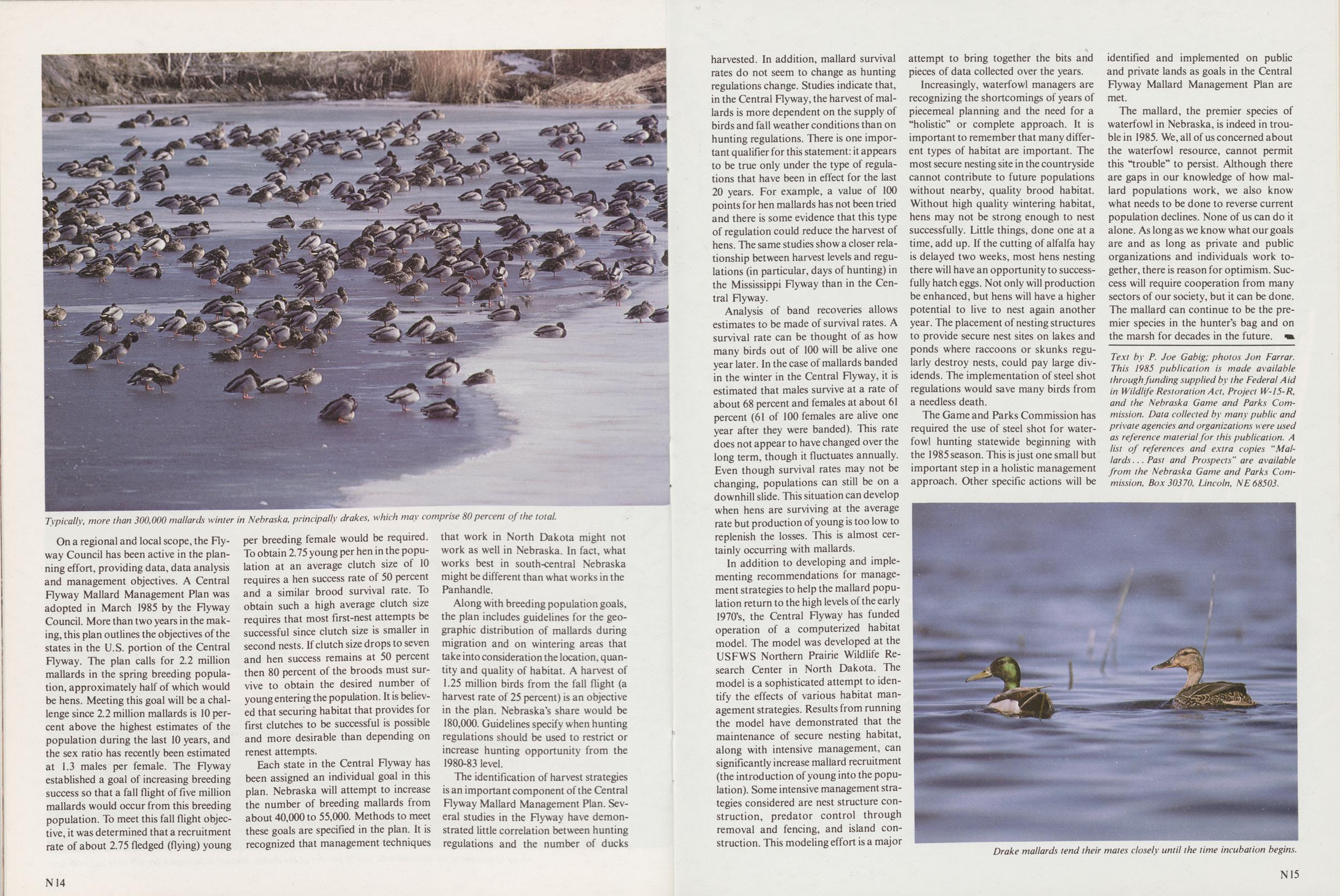
On a regional and local scope, the Flyway Council has been active in the planning effort, providing data, data analysis and management objectives. A Central Flyway Mallard Management Plan was adopted in March 1985 by the Flyway Council. More than two years in the making, this plan outlines the objectives of the states in the U.S. portion of the Central Flyway. The plan calls for 2.2 million mallards in the spring breeding population, approximately half of which would be hens. Meeting this goal will be a challenge since 2.2 million mallards is 10 percent above the highest estimates of the population during the last 10 years, and the sex ratio has recently been estimated at 1.3 males per female. The Flyway established a goal of increasing breeding success so that a fall flight of five million mallards would occur from this breeding population. To meet this fall flight objective, it was determined that a recruitment rate of about 2.75 fledged (flying) young per breeding female would be required. To obtain 2.75 young per hen in the population at an average clutch size of 10 requires a hen success rate of 50 percent and a similar brood survival rate. To obtain such a high average clutch size requires that most first-nest attempts be successful since clutch size is smaller in second nests. If clutch size drops to seven and hen success remains at 50 percent then 80 percent of the broods must survive to obtain the desired number of young entering the population. It is believed that securing habitat that provides for first clutches to be successful is possible and more desirable than depending on renest attempts.
Each state in the Central Flyway has been assigned an individual goal in this plan. Nebraska will attempt to increase the number of breeding mallards from about 40,000 to 55,000. Methods to meet these goals are specified in the plan. It is recognized that management techniques that work in North Dakota might not work as well in Nebraska. In fact, what works best in south-central Nebraska might be different than what works in the Panhandle.
Along with breeding population goals, the plan includes guidelines for the geographic distribution of mallards during migration and on wintering areas that take into consideration the location, quantity and quality of habitat. A harvest of 1.25 million birds from the fall flight (a harvest rate of 25 percent) is an objective in the plan. Nebraska's share would be 180,000. Guidelines specify when hunting regulations should be used to restrict or increase hunting opportunity from the 1980-83 level.
The identification of harvest strategies is an important component of the Central Flyway Mallard Management Plan. Several studies in the Flyway have demonstrated little correlation between hunting regulations and the number of ducks N14 harvested. In addition, mallard survival rates do not seem to change as hunting regulations change. Studies indicate that, in the Central Flyway, the harvest of mallards is more dependent on the supply of birds and fall weather conditions than on hunting regulations. There is one important qualifier for this statement: it appears to be true only under the type of regulations that have been in effect for the last 20 years. For example, a value of 100 points for hen mallards has not been tried and there is some evidence that this type of regulation could reduce the harvest of hens. The same studies show a closer relationship between harvest levels and regulations (in particular, days of hunting) in the Mississippi Flyway than in the Central Flyway.
Analysis of band recoveries allows estimates to be made of survival rates. A survival rate can be thought of as how many birds out of 100 will be alive one year later. In the case of mallards banded in the winter in the Central Flyway, it is estimated that males survive at a rate of about 68 percent and females at about 61 percent (61 of 100 females are alive one year after they were banded). This rate does not appear to have changed over the long term, though it fluctuates annually. Even though survival rates may not be changing, populations can still be on a downhill slide. This situation can develop when hens are surviving at the average rate but production of young is too low to replenish the losses. This is almost certainly occurring with mallards.
In addition to developing and implementing recommendations for management strategies to help the mallard population return to the high levels of the early 1970's, the Central Flyway has funded operation of a computerized habitat model. The model was developed at the USFWS Northern Prairie Wildlife Research Center in North Dakota. The model is a sophisticated attempt to identify the effects of various habitat management strategies. Results from running the model have demonstrated that the maintenance of secure nesting habitat, along with intensive management, can significantly increase mallard recruitment (the introduction of young into the population). Some intensive management strategies considered are nest structure construction, predator control through removal and fencing, and island construction. This modeling effort is a major attempt to bring together the bits and pieces of data collected over the years.
Increasingly, waterfowl managers are recognizing the shortcomings of years of piecemeal planning and the need for a "holistic" or complete approach. It is important to remember that many different types of habitat are important. The most secure nesting site in the countryside cannot contribute to future populations without nearby, quality brood habitat. Without high quality wintering habitat, hens may not be strong enough to nest successfully. Little things, done one at a time, add up. If the cutting of alfalfa hay is delayed two weeks, most hens nesting there will have an opportunity to successfully hatch eggs. Not only will production be enhanced, but hens will have a higher potential to live to nest again another year. The placement of nesting structures to provide secure nest sites on lakes and ponds where raccoons or skunks regularly destroy nests, could pay large dividends. The implementation of steel shot regulations would save many birds from a needless death.
The Game and Parks Commission has required the use of steel shot for waterfowl hunting statewide beginning with the 1985 season. This is just one small but important step in a holistic management approach. Other specific actions will be identified and implemented on public and private lands as goals in the Central Flyway Mallard Management Plan are met.
The mallard, the premier species of waterfowl in Nebraska, is indeed in trouble in 1985. We, all of us concerned about the waterfowl resource, cannot permit this "trouble" to persist. Although there are gaps in our knowledge of how mallard populations work, we also know what needs to be done to reverse current population declines. None of us can do it alone. As long as we know what our goals are and as long as private and public organizations and individuals work together, there is reason for optimism. Success will require cooperation from many sectors of our society, but it can be done. The mallard can continue to be the premier species in the hunter's bag and on the marsh for decades in the future.
Text by P. Joe Gabig; photos Jon Farrar. This 1985 publication is made available through funding supplied by the Federal Aid in Wildlife Restoration Act, Project W-15-R, and the Nebraska Game and Parks Commission. Data collected by many public and private agencies and organizations were used as reference material for this publication. A list of references and extra copies "Mallards. .. Past and Prospects" are available from the Nebraska Game and Parks Commission, Box 30370, Lincoln, NE 68503.
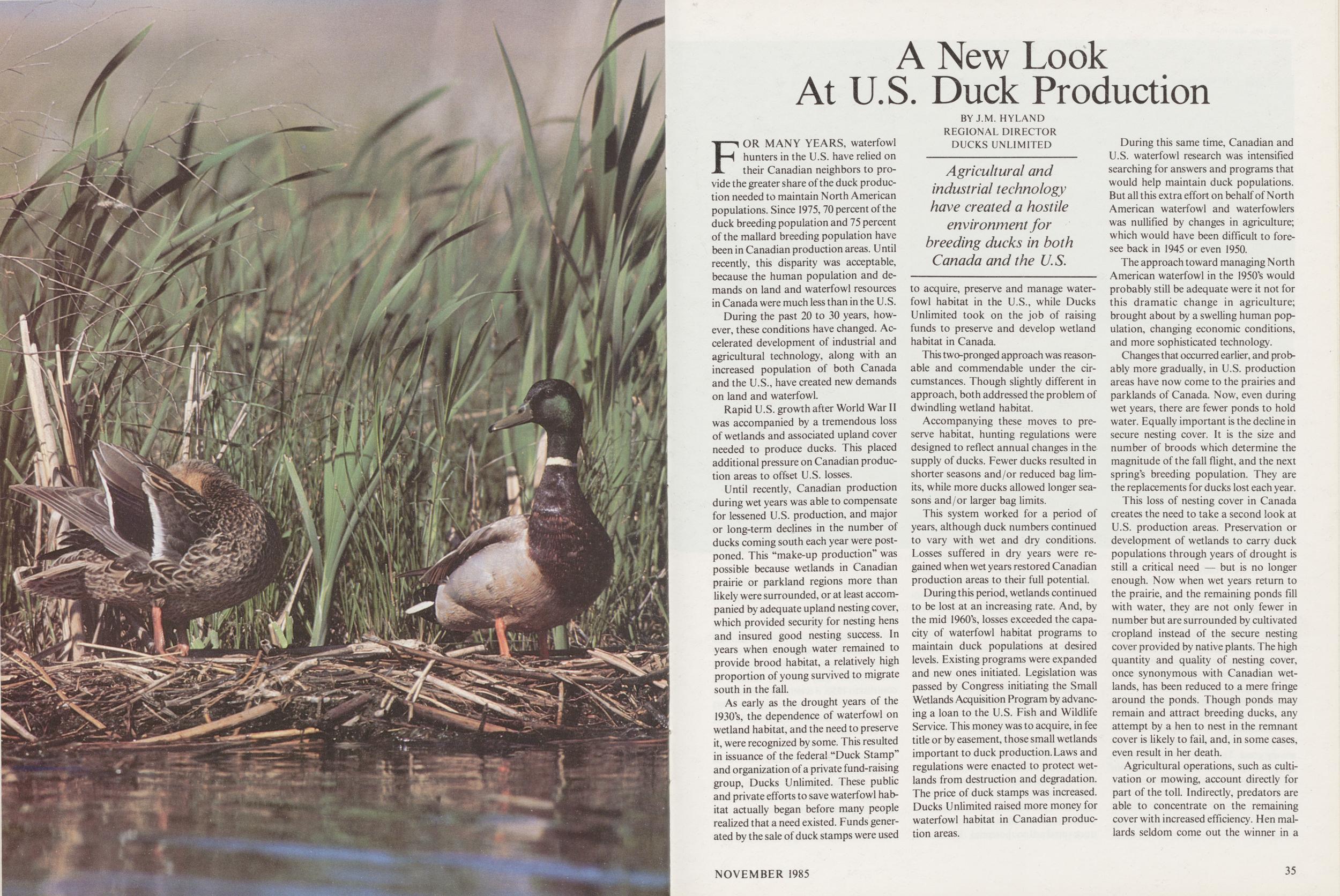
A New Look At U.S. Duck Production
BY J. M. HYLAND REGIONAL DIRECTOR DUCKS UNLIMITED Agricultural and undustrial technology have created a hostile environment for breeding ducks in both Canada and the U.S.FOR MANY YEARS, waterfowl hunters in the U.S. have relied on their Canadian neighbors to provide the greater share of the duck production needed to maintain North American populations. Since 1975,70 percent of the duck breeding population and 75 percent of the mallard breeding population have been in Canadian production areas. Until recently, this disparity was acceptable, because the human population and demands on land and waterfowl resources in Canada were much less than in the U.S.
During the past 20 to 30 years, however, these conditions have changed. Accelerated development of industrial and agricultural technology, along with an increased population of both Canada and the U.S., have created new demands on land and waterfowl.
Rapid U.S. growth after World War II was accompanied by a tremendous loss of wetlands and associated upland cover needed to produce ducks. This placed additional pressure on Canadian production areas to offset U.S. losses.
Until recently, Canadian production during wet years was able to compensate for lessened U.S. production, and major or long-term declines in the number of ducks coming south each year were postponed. This "make-up production" was possible because wetlands in Canadian prairie or parkland regions more than likely were surrounded, or at least accompanied by adequate upland nesting cover, which provided security for nesting hens and insured good nesting success. In years when enough water remained to provide brood habitat, a relatively high proportion of young survived to migrate south in the fall.
As early as the drought years of the 1930's, the dependence of waterfowl on wetland habitat, and the need to preserve it, were recognized by some. This resulted in issuance of the federal "Duck Stamp and organization of a private fund-raising group, Ducks Unlimited. These public and private efforts to save waterfowl habitat actually began before many people realized that a need existed. Funds generated by the sale of duck stamps were used to acquire, preserve and manage waterfowl habitat in the U.S., while Ducks Unlimited took on the job of raising funds to preserve and develop wetland habitat in Canada.
This two-pronged approach was reasonable and commendable under the circumstances. Though slightly different in approach, both addressed the problem of dwindling wetland habitat.
Accompanying these moves to preserve habitat, hunting regulations were designed to reflect annual changes in the supply of ducks. Fewer ducks resulted in shorter seasons and/or reduced bag limits, while more ducks allowed longer seasons and/or larger bag limits.
This system worked for a period of years, although duck numbers continued to vary with wet and dry conditions. Losses suffered in dry years were regained when wet years restored Canadian production areas to their full potential.
During this period, wetlands continued to be lost at an increasing rate. And, by the mid 1960's, losses exceeded the capacity of waterfowl habitat programs to maintain duck populations at desired levels. Existing programs were expanded and new ones initiated. Legislation was passed by Congress initiating the Small Wetlands Acquisition Program by advancing a loan to the U.S. Fish and Wildlife Service. This money was to acquire, in fee title or by easement, those small wetlands important to duck production. Laws and regulations were enacted to protect wetlands from destruction and degradation. The price of duck stamps was increased. Ducks Unlimited raised more money for waterfowl habitat in Canadian production areas.
During this same time, Canadian and U.S. waterfowl research was intensified searching for answers and programs that would help maintain duck populations. But all this extra effort on behalf of North American waterfowl and waterfowlers was nullified by changes in agriculture; which would have been difficult to foresee back in 1945 or even 1950.
The approach toward managing North American waterfowl in the 1950's would probably still be adequate were it not for this dramatic change in agriculture; brought about by a swelling human population, changing economic conditions, and more sophisticated technology.
Changes that occurred earlier, and probably more gradually, in U.S. production areas have now come to the prairies and parklands of Canada. Now, even during wet years, there are fewer ponds to hold water. Equally important is the decline in secure nesting cover. It is the size and number of broods which determine the magnitude of the fall flight, and the next spring's breeding population. They are the replacements for ducks lost each year.
This loss of nesting cover in Canada creates the need to take a second look at U.S. production areas. Preservation or development of wetlands to carry duck populations through years of drought is still a critical need — but is no longer enough. Now when wet years return to the prairie, and the remaining ponds fill with water, they are not only fewer in number but are surrounded by cultivated cropland instead of the secure nesting cover provided by native plants. The high quantity and quality of nesting cover, once synonymous with Canadian wetlands, has been reduced to a mere fringe around the ponds. Though ponds may remain and attract breeding ducks, any attempt by a hen to nest in the remnant cover is likely to fail, and, in some cases, even result in her death.
Agricultural operations, such as cultivation or mowing, account directly for part of the toll. Indirectly, predators are able to concentrate on the remaining cover with increased efficiency. Hen mallards seldom come out the winner in a confrontation with a fox, raccoon or skunk — eggs never do!
NOVEMBER 1985 35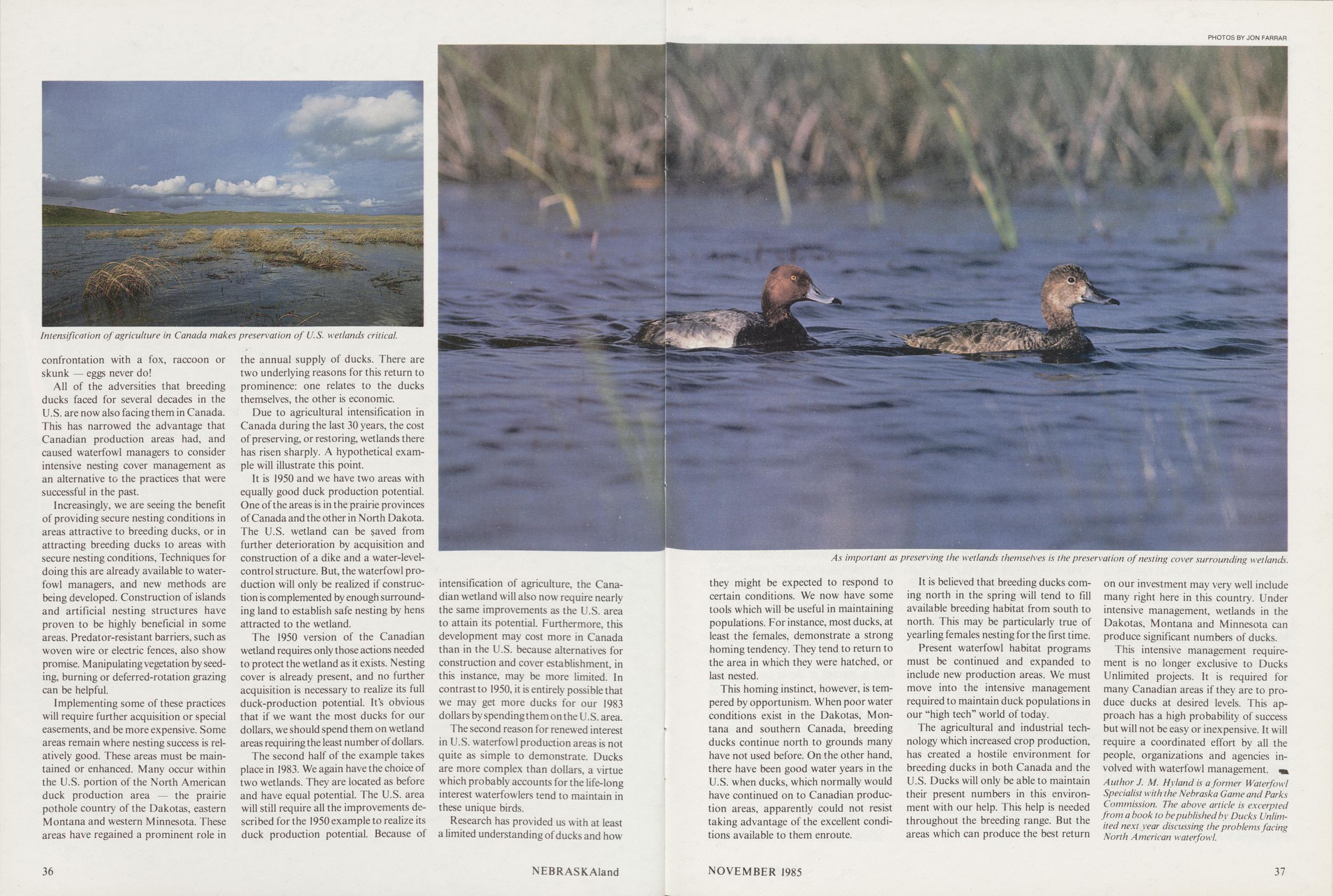
All of the adversities that breeding ducks faced for several decades in the U.S. are now also facing them in Canada. This has narrowed the advantage that Canadian production areas had, and caused waterfowl managers to consider intensive nesting cover management as an alternative to the practices that were successful in the past.
Increasingly, we are seeing the benefit of providing secure nesting conditions in areas attractive to breeding ducks, or in attracting breeding ducks to areas with secure nesting conditions, Techniques for doing this are already available to waterfowl managers, and new methods are being developed. Construction of islands and artificial nesting structures have proven to be highly beneficial in some areas. Predator-resistant barriers, such as woven wire or electric fences, also show promise. Manipulating vegetation by seeding, burning or deferred-rotation grazing can be helpful.
Implementing some of these practices will require further acquisition or special easements, and be more expensive. Some areas remain where nesting success is relatively good. These areas must be maintained or enhanced. Many occur within the U.S. portion of the North American duck production area — the prairie pothole country of the Dakotas, eastern Montana and western Minnesota. These areas have regained a prominent role in the annual supply of ducks. There are two underlying reasons for this return to prominence: one relates to the ducks themselves, the other is economic.
Due to agricultural intensification in Canada during the last 30 years, the cost of preserving, or restoring, wetlands there has risen sharply. A hypothetical example will illustrate this point.
It is 1950 and we have two areas with equally good duck production potential. One of the areas is in the prairie provinces of Canada and the other in North Dakota. The U.S. wetland can be saved from further deterioration by acquisition and construction of a dike and a water-level-control structure. But, the waterfowl production will only be realized if construction is complemented by enough surrouning land to establish safe nesting by hens attracted to the wetland.
The 1950 version of the Canadian wetland requires only those actions needed to protect the wetland as it exists. Nesting cover is already present, and no further acquisition is necessary to realize its full duck-production potential. It's obvious that if we want the most ducks for our dollars, we should spend them on wetland areas requiring the least number of dollars.
The second half of the example takes place in 1983. We again have the choice of two wetlands. They are located as before and have equal potential. The U.S. area will still require all the improvements described for the 1950 example to realize its duck production potential. Because of intensification of agriculture, the Canadian wetland will also now require nearly the same improvements as the U.S. area to attain its potential. Furthermore, this development may cost more in Canada than in the U.S. because alternatives for construction and cover establishment, in this instance, may be more limited. In contrast to 1950, it is entirely possible that we may get more ducks for our 1983 dollars by spending them on the U. S. area.
The second reason for renewed interest in U.S. waterfowl production areas is not quite as simple to demonstrate. Ducks are more complex than dollars, a virtue which probably accounts for the life-long interest waterfowlers tend to maintain in these unique birds.
Research has provided us with at least a limited understanding of ducks and how they might be expected to respond to certain conditions. We now have some tools which will be useful in maintaining populations. For instance, most ducks, at least the females, demonstrate a strong homing tendency. They tend to return to the area in which they were hatched, or last nested.
This homing instinct, however, is tempered by opportunism. When poor water conditions exist in the Dakotas, Montana and southern Canada, breeding ducks continue north to grounds many have not used before. On the other hand, there have been good water years in the U.S. when ducks, which normally would have continued on to Canadian production areas, apparently could not resist taking advantage of the excellent conditions available to them enroute.
It is believed that breeding ducks coming north in the spring will tend to fill available breeding habitat from south to north. This may be particularly true of yearling females nesting for the first time.
Present waterfowl habitat programs must be continued and expanded to include new production areas. We must move into the intensive management required to maintain duck populations in our "high tech" world of today.
The agricultural and industrial technology which increased crop production, has created a hostile environment for breeding ducks in both Canada and the U.S. Ducks will only be able to maintain their present numbers in this environment with our help. This help is needed throughout the breeding range. But the areas which can produce the best return on our investment may very well include many right here in this country. Under intensive management, wetlands in the Dakotas, Montana and Minnesota can produce significant numbers of ducks.
This intensive management requirement is no longer exclusive to Ducks Unlimited projects. It is required for many Canadian areas if they are to produce ducks at desired levels. This approach has a high probability of success but will not be easy or inexpensive. It will require a coordinated effort by all the people, organizations and agencies involved with waterfowl management,
Author J. M. Hy land is a former Waterfowl Specialist with the Nebraska Game and Parks Commission. The above article is excerpted from a book to be published by Ducks Unlimited next year discussing the problems facing North American waterfowl.
NOVEMBER 1985 37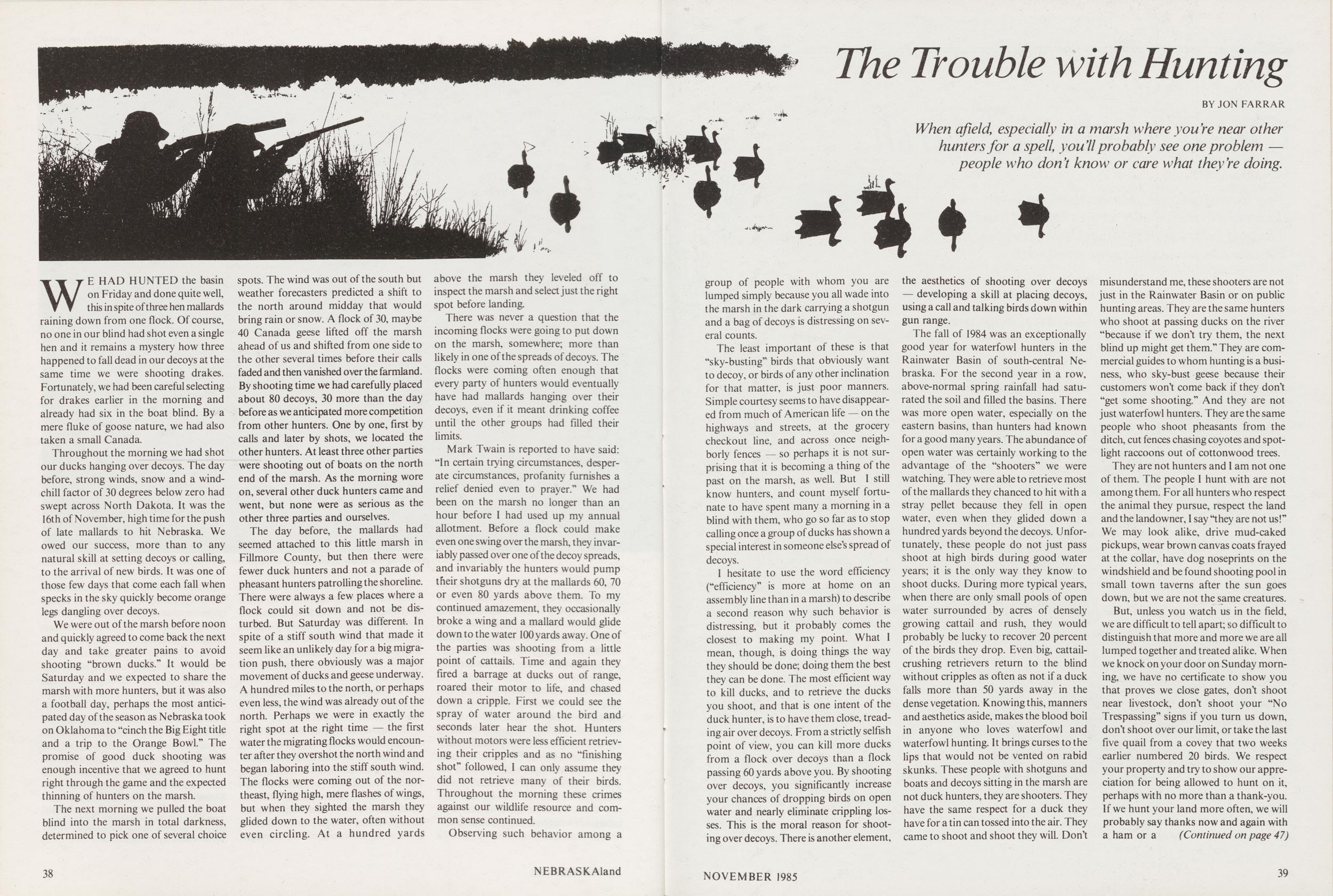
The Trouble with Hunting
BY JON FARRAR When afield, especially in a marsh where you're near other hunters for a spell, you'll probably see one problem— people who don't know or care what they're doing.WE HAD HUNTED the basin on Friday and done quite well, this in spite of three hen mallards raining down from one flock. Of course, no one in our blind had shot even a single hen and it remains a mystery how three happened to fall dead in our decoys at the same time we were shooting drakes. Fortunately, we had been careful selecting for drakes earlier in the morning and already had six in the boat blind. By a mere fluke of goose nature, we had also taken a small Canada.
Throughout the morning we had shot our ducks hanging over decoys. The day before, strong winds, snow and a windchill factor of 30 degrees below zero had swept across North Dakota. It was the 16th of November, high time for the push of late mallards to hit Nebraska. We owed our success, more than to any natural skill at setting decoys or calling, to the arrival of new birds. It was one of those few days that come each fall when specks in the sky quickly become orange legs dangling over decoys.
We were out of the marsh before noon and quickly agreed to come back the next day and take greater pains to avoid shooting "brown ducks." It would be Saturday and we expected to share the marsh with more hunters, but it was also a football day, perhaps the most anticipated day of the season as Nebraska took on Oklahoma to "cinch the Big Eight title and a trip to the Orange Bowl." The promise of good duck shooting was enough incentive that we agreed to hunt right through the game and the expected thinning of hunters on the marsh.
The next morning we pulled the boat blind into the marsh in total darkness, determined to pick one of several choice spots. The wind was out of the south but weather forecasters predicted a shift to the north around midday that would bring rain or snow. A flock of 30, maybe 40 Canada geese lifted off the marsh abead of us and shifted from one side to the other several times before their calls faded and then vanished over the farmland. By shooting time we had carefully placed about 80 decoys, 30 more than the day before as we anticipated more competition from other hunters. One by one, first by calls and later by shots, we located the other hunters. At least three other parties ^vere shooting out of boats on the north end of the marsh. As the morning wore on, several other duck hunters came and went, but none were as serious as the other three parties and ourselves.
The day before, the mallards had seemed attached to this little marsh in Fillmore County, but then there were fewer duck hunters and not a parade of pheasant hunters patrolling the shoreline. There were always a few places where a flock could sit down and not be disturbed. But Saturday was different. In spite of a stiff south wind that made it seem like an unlikely day for a big migration push, there obviously was a major movement of ducks and geese underway. A hundred miles to the north, or perhaps even less, the wind was already out of the north. Perhaps we were in exactly the right spot at the right time — the first water the migrating flocks would encoun- ter after they overshot the north wind and began laboring into the stiff south wind. The flocks were coming out of the northeast, flying high, mere flashes of wings, but when they sighted the marsh they glided down to the water, often without even circling. At a hundred yards above the marsh they leveled off to inspect the marsh and select just the right spot before landing.
There was never a question that the incoming flocks were going to put down on the marsh, somewhere; more than likely in one of the spreads of decoys. The flocks were coming often enough that every party of hunters would eventually have had mallards hanging over their decoys, even if it meant drinking coffee until the other groups had filled their limits.
Mark Twain is reported to have said: "In certain trying circumstances, desperate circumstances, profanity furnishes a relief denied even to prayer." We had been on the marsh no longer than an hour before I had used up my annual allotment. Before a flock could make even one swing over the marsh, they invariably passed over one of the decoy spreads, and invariably the hunters would pump their shotguns dry at the mallards 60, 70 or even 80 yards above them. To my continued amazement, they occasionally broke a wing and a mallard would glide down to the water 100 yards away. One of the parties was shooting from a little point of cattails. Time and again they fired a barrage at ducks out of range, roared their motor to life, and chased down a cripple. First we could see the spray of water around the bird and seconds later hear the shot. Hunters without motors were less efficient retrieving their cripples and as no "finishing shot" followed, I can only assume they did not retrieve many of their birds. Throughout the morning these crimes against our wildlife resource and common sense continued.
Observing such behavior among a 38 NEBRASKAland group of people with whom you are lumped simply because you all wade into the marsh in the dark carrying a shotgun and a bag of decoys is distressing on several counts.
The least important of these is that "sky-busting" birds that obviously want to decoy, or birds of any other inclination for that matter, is just poor manners. Simple courtesy seems to have disappeared from much of American life — on the highways and streets, at the grocery checkout line, and across once neighborly fences — so perhaps it is not surprising that it is becoming a thing of the past on the marsh, as well. But I still know hunters, and count myself fortunate to have spent many a morning in a blind with them, who go so far as to stop calling once a group of ducks has shown a special interest in someone else's spread of decoys.
I hesitate to use the word efficiency ("efficiency" is more at home on an assembly line than in a marsh) to describe a second reason why such behavior is distressing, but it probably comes the closest to making my point. What I mean, though, is doing things the way they should be done; doing them the best they can be done. The most efficient way to kill ducks, and to retrieve the ducks you shoot, and that is one intent of the duck hunter, is to have them close, treading air over decoys. From a strictly selfish point of view, you can kill more ducks from a flock over decoys than a flock passing 60 yards above you. By shooting over decoys, you significantly increase your chances of dropping birds on open water and nearly eliminate crippling losses. This is the moral reason for shooting over decoys. There is another element, When afield, especially in a marsh where you re near other hunters for a spell, you 11 probably see one problem people who don't know or care what they're doing. the aesthetics of shooting over decoys — developing a skill at placing decoys, using a call and talking birds down within gun range.
The fall of 1984 was an exceptionally good year for waterfowl hunters in the Rainwater Basin of south-central Nebraska. For the second year in a row, above-normal spring rainfall had saturated the soil and filled the basins. There was more open water, especially on the eastern basins, than hunters had known for a good many years. The abundance of open water was certainly working to the advantage of the "shooters" we were watching. They were able to retrieve most of the mallards they chanced to hit with a stray pellet because they fell in open water, even when they glided down a hundred yards beyond the decoys. Unfortunately, these people do not just pass shoot at high birds during good water years; it is the only way they know to shoot ducks. During more typical years, when there are only small pools of open water surrounded by acres of densely growing cattail and rush, they would probably be lucky to recover 20 percent of the birds they drop. Even big, cattailcrushing retrievers return to the blind without cripples as often as not if a duck falls more than 50 yards away in the dense vegetation. Knowing this, manners and aesthetics aside, makes the blood boil in anyone who loves waterfowl and waterfowl hunting. It brings curses to the lips that would not be vented on rabid skunks. These people with shotguns and boats and decoys sitting in the marsh are not duck hunters, they are shooters. They have the same respect for a duck they have for a tin can tossed into the air. They came to shoot and shoot they will. Don't misunderstand me, these shooters are not just in the Rainwater Basin or on public hunting areas. They are the same hunters who shoot at passing ducks on the river "because if we don't try them, the next blind up might get them." They are commercial guides to whom hunting is a business, who sky-bust geese because their customers won't come back if they don't "get some shooting." And they are not just waterfowl hunters. They are the same people who shoot pheasants from the ditch, cut fences chasing coyotes and spotlight raccoons out of Cottonwood trees.
They are not hunters and I am not one of them. The people I hunt with are not among them. For all hunters who respect the animal they pursue, respect the land and the landowner, I say "they are not us!" We may look alike, drive mud-caked pickups, wear brown canvas coats frayed at the collar, have dog noseprints on the windshield and be found shooting pool in small town taverns after the sun goes down, but we are not the same creatures.
But, unless you watch us in the field, we are difficult to tell apart; so difficult to distinguish that more and more we are all lumped together and treated alike. When we knock on your door on Sunday morning, we have no certificate to show you that proves we close gates, don't shoot near livestock, don't shoot your "No Trespassing" signs if you turn us down, don't shoot over our limit, or take the last five quail from a covey that two weeks earlier numbered 20 birds. We respect your property and try to show our appreciation for being allowed to hunt on it, perhaps with no more than a thank-you. If we hunt your land more often, we will probably say thanks now and again with a ham or a (Continued on page 47)
NOVEMBER 1985 39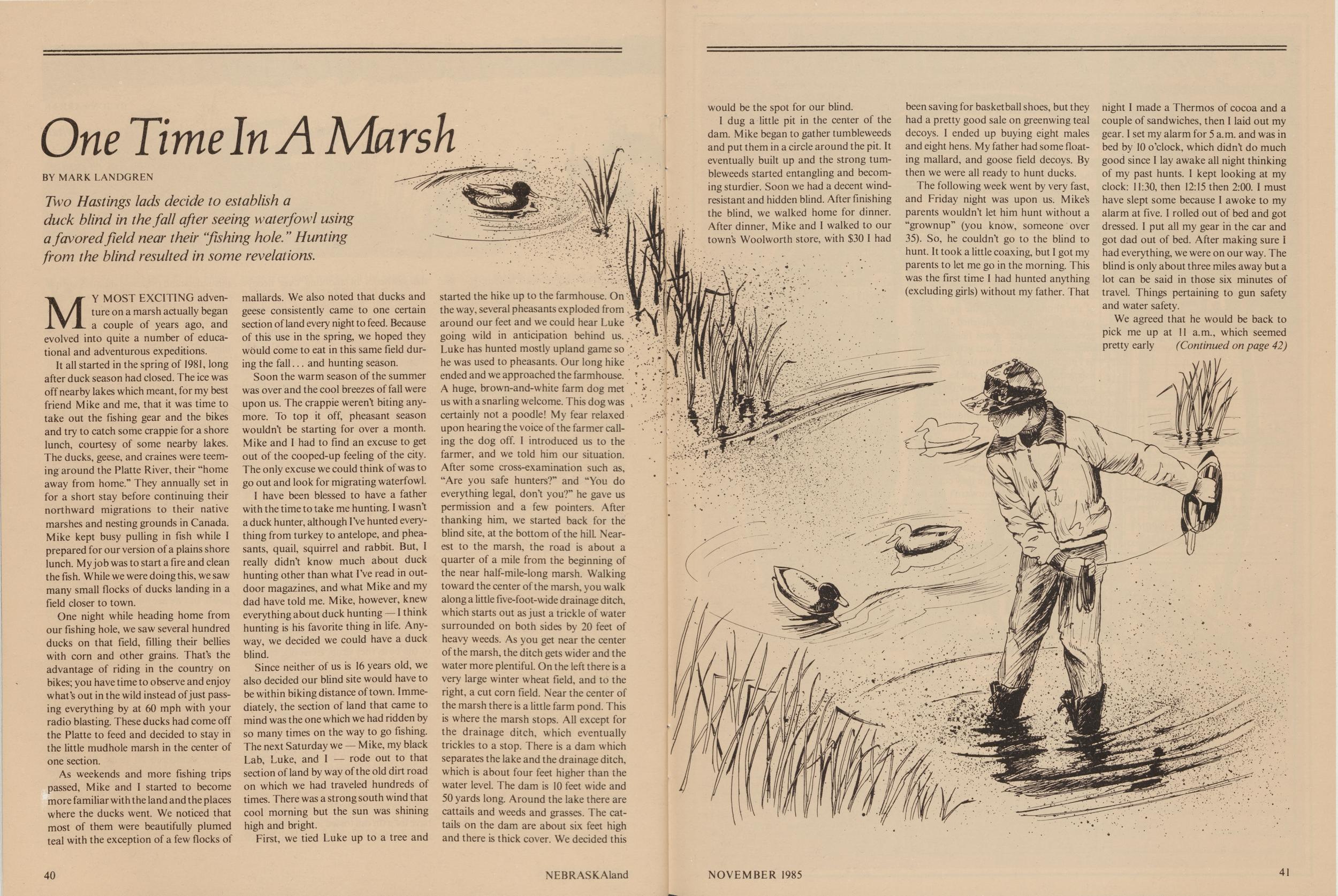
One Time In A Marsh
BY MARK LANDGREN Two Hastings lads decide to establish a duck blind in the fall after seeing waterfowl using a favored field near their fishing hole." Hunting from the blind resulted in some revelations.MOST EXCITING adventure on a marsh actually began A a couple of years ago, and evolved into quite a number of educational and adventurous expeditions.
It all started in the spring of 1981, long after duck season had closed. The ice was off nearby lakes which meant, for my best friend Mike and me, that it was time to take out the fishing gear and the bikes and try to catch some crappie for a shore lunch, courtesy of some nearby lakes. The ducks, geese, and craines were teeming around the Platte River, their "home away from home." They annually set in for a short stay before continuing their northward migrations to their native marshes and nesting grounds in Canada. Mike kept busy pulling in fish while I prepared for our version of a plains shore lunch. Myjob was to start a fire and clean the fish. While we were doing this, we saw many small flocks of ducks landing in a field closer to town.
One night while heading home from our fishing hole, we saw several hundred ducks on that field, filling their bellies with corn and other grains. That's the advantage of riding in the country on bikes; you have time to observe and enjoy what's out in the wild instead of just passing everything by at 60 mph with your radio blasting. These ducks had come off the Platte to feed and decided to stay in the little mudhole marsh in the center of one section.
As weekends and more fishing trips passed, Mike and I started to become more familiar with the land and the places where the ducks went. We noticed that most of them were beautifully plumed teal with the exception of a few flocks of mallards. We also noted that ducks and geese consistently came to one certain section of land every night to feed. Because of this use in the spring, we hoped they would come to eat in this same field during the fall... and hunting season.
Soon the warm season of the summer was over and the cool breezes of fall were upon us. The crappie weren't biting anymore. To top it off, pheasant season wouldn't be starting for over a month. Mike and I had to find an excuse to get out of the cooped-up feeling of the city. The only excuse we could think of was to go out and look for migrating waterfowl.
I have been blessed to have a father with the time to take me hunting. I wasn't a duck hunter, although I've hunted everything from turkey to antelope, and pheasants, quail, squirrel and rabbit. But, I really didn't know much about duck hunting other than what I've read in outdoor magazines, and what Mike and my dad have told me. Mike, however, knew everything about duck hunting — I think hunting is his favorite thing in life. Anyway, we decided we could have a duck blind.
Since neither of us is 16 years old, we also decided our blind site would have to be within biking distance of town. Immediately, the section of land that came to mind was the one which we had ridden by so many times on the way to go fishing. The next Saturday we — Mike, my black Lab, Luke, and I — rode out to that section of land by way of the old dirt road on which we had traveled hundreds of times. There was a strong south wind that cool morning but the sun was shining high and bright.
First, we tied Luke up to a tree and would be the spot for our blind. I dug a little pit in the center of the dam. Mike began to gather tumbleweeds and put them in a circle around the pit. It eventually built up and the strong tumbleweeds started entangling and becoming sturdier. Soon we had a decent windresistant and hidden blind. After finishing the blind, we walked home for dinner. After dinner, Mike and I walked to our town's Woolworth store, with $30 I had started the hike up to the farmhouse. On: the way, several pheasants exploded from around our feet and we could hear Luke going wild in anticipation behind us. Luke has hunted mostly upland game so he was used to pheasants. Our long hike ended and we approached the farmhouse. A huge, brown-and-white farm dog met us with a snarling welcome. This dog was certainly not a poodle! My fear relaxed upon hearing the voice of the farmer calling the dog off. I introduced us to the farmer, and we told him our situation. After some cross-examination such as, "Are you safe hunters?" and "You do everything legal, don't you?" he gave us permission and a few pointers. After thanking him, we started back for the blind site, at the bottom of the hill. Nearest to the marsh, the road is about a quarter of a mile from the beginning of the near half-mile-long marsh. Walking toward the center of the marsh, you walk along a little five-foot-wide drainage ditch, which starts out as just a trickle of water surrounded on both sides by 20 feet of heavy weeds. As you get near the center of the marsh, the ditch gets wider and the water more plentiful. On the left there is a very large winter wheat field, and to the right, a cut corn field. Near the center of the marsh there is a little farm pond. This is where the marsh stops. All except for the drainage ditch, which eventually trickles to a stop. There is a dam which separates the lake and the drainage ditch, which is about four feet higher than the water level. The dam is 10 feet wide and 50 yards long. Around the lake there are cattails and weeds and grasses. The cattails on the dam are about six feet high and there is thick cover. We decided this 40 NEBRASKAland would by the spot for our blind.
I dug a little pit in the center of the dam. Mike began to gather tumbleweeds and put them in a circle around the pit. It eventually built up and the strong tumbleweeds started entangling and becoming sturdier. Soon we had a decent windresistant and hidden blind. After finishing the blind, we walked home for dinner. After dinner, Mike and I walked to our town's Woolworth store, with $30 I had been saving for basketball shoes, but they had a pretty good sale on greenwing teal decoys. I ended up buying eight males and eight hens. My father had some floating mallard, and goose field decoys. By then we were all ready to hunt ducks.
The following week went by very fast, and Friday night was upon us. Mike's parents wouldn't let him hunt without a grownup" (you know, someone over 35). So, he couldn't go to the blind to hunt. It took a little coaxing, but I got my parents to let me go in the morning. This was the first time I had hunted anything (excluding girls) without my father. That night I made a Thermos of cocoa and a couple of sandwiches, then I laid out my gear. I set my alarm for 5 a.m. and was in bed by 10 o'clock, which didn't do much good since I lay awake all night thinking of my past hunts. I kept looking at my clock: 11:30, then 12:15 then 2:00. I must have slept some because I awoke to my alarm at five. I rolled out of bed and got dressed. I put all my gear in the car and got dad out of bed. After making sure I had everything, we were on our way. The blind is only about three miles away but a lot can be said in those six minutes of travel. Things pertaining to gun safety and water safety.
We agreed that he would be back to pick me up at 11 a.m., which seemed pretty early (Continued on page 42)
NOVEMBER 1985 41 La
FALL
100% SATISFACTION GUARANTEED
Hunting Equipment Decoys
Footwear Knives Guncases
Bows Arrows Clothing
Optics Gifts and Much More
aui
CATALOG SUBSCRIPTION
Mail today to reserve your Fall issue
NAME
ADDRESS
CITY
STATE
ZIP
863-511
Sidney
Nebraska 69160
CEDAR LANE
Ranch Vacations
Guest ranch in the heart of the Sandhills of
Nebraska. Swimming, spa, horses, canoeing,
trail rides, barbeques, hunting.
BOOKING NOW For 1986
Richard and Betty Schroeder HC 2 Box 9C
Stapleton. Nebraska 69163 Ph. 308-587-2233
Available in 12 & 20 ga.
Gives your shotgun total flexibility.
Fits most single & double barrel shotguns.
10 different chokes to choose from.
Write for brochure.
UPPER MISSOURI TRADING CO., INC.
Box 191
Crofton, NE 68730
easyoncmigy
the next generation
will thank you for it.
nebraska energy conservation committee
Handcrafted by
Country Artisans
#402 702:01
Mallard Decoy
#401P-697 2
Decor Planter
Sue 13
COUNTRY CERAMICS
"A WATERFOWL COLLECTION"
Exquisite Planters & Decor Pieces Each similar. But Different
Decor Duck Soft Creamy Egg Nog sprinkled lightly with chocolate specks Head
detailed Flowers of mixed colors to match any decor and brighten any room
Mallard Green head with white neck ring, yellow bill and walnut tone body. Perfect
for den or family room
401P-697:02 DECOR DUCK W/planter pocket (shown)
401-697:02 DECOR DUCK No planter pocket (not shown)
402-702:01 MALLARD DECOY No planter pocket (shown)
402P-702:01 MALLARD DECOY W/planter pocket (not shown)
COUNTRY CERAMICS: coimur cemhics
Check or money order Decor Ducks $19 50 ea/Mallards $29 50 ea Shipping & handling
$4 50
each piece NJ residents add 6% sales tax Shipped UPS Allow 4-6 wks tor delivery due
to
custom craft processing Send for free brochure
La
FALL
100% SATISFACTION GUARANTEED
Hunting Equipment Decoys
Footwear Knives Guncases
Bows Arrows Clothing
Optics Gifts and Much More
aui
CATALOG SUBSCRIPTION
Mail today to reserve your Fall issue
NAME
ADDRESS
CITY
STATE
ZIP
863-511
Sidney
Nebraska 69160
CEDAR LANE
Ranch Vacations
Guest ranch in the heart of the Sandhills of
Nebraska. Swimming, spa, horses, canoeing,
trail rides, barbeques, hunting.
BOOKING NOW For 1986
Richard and Betty Schroeder HC 2 Box 9C
Stapleton. Nebraska 69163 Ph. 308-587-2233
Available in 12 & 20 ga.
Gives your shotgun total flexibility.
Fits most single & double barrel shotguns.
10 different chokes to choose from.
Write for brochure.
UPPER MISSOURI TRADING CO., INC.
Box 191
Crofton, NE 68730
easyoncmigy
the next generation
will thank you for it.
nebraska energy conservation committee
Handcrafted by
Country Artisans
#402 702:01
Mallard Decoy
#401P-697 2
Decor Planter
Sue 13
COUNTRY CERAMICS
"A WATERFOWL COLLECTION"
Exquisite Planters & Decor Pieces Each similar. But Different
Decor Duck Soft Creamy Egg Nog sprinkled lightly with chocolate specks Head
detailed Flowers of mixed colors to match any decor and brighten any room
Mallard Green head with white neck ring, yellow bill and walnut tone body. Perfect
for den or family room
401P-697:02 DECOR DUCK W/planter pocket (shown)
401-697:02 DECOR DUCK No planter pocket (not shown)
402-702:01 MALLARD DECOY No planter pocket (shown)
402P-702:01 MALLARD DECOY W/planter pocket (not shown)
COUNTRY CERAMICS: coimur cemhics
Check or money order Decor Ducks $19 50 ea/Mallards $29 50 ea Shipping & handling
$4 50
each piece NJ residents add 6% sales tax Shipped UPS Allow 4-6 wks tor delivery due
to
custom craft processing Send for free brochure
One time in a marsh
(Continued from page 41)to me. I packed the bag of decoys onto my back and put my shells , calls, sandwiches and cocoa in a bucket which I would later sit on. With Luke by my side trudging through the flooded weeds, I made my way to the blind with flashlight in one hand and my old pump shotgun in the other. I remembered hoping that my breast waders didn't have any holes in them, as wet feet are no carnival.
When I got to the lake, I dumped out the decoys at the end of the dam and took the bags and bucket to the blind. I set everything up in the blind and made my way back to the decoys. First I set the mallard decoys out on the lake with a few teal decoys on the canal, some to the left of the blind and some to the right. After my water follies were finished, I put six geese decoys in the wheat field and two on the water's edge. It was getting lighter as I made my way back to the blind. I sat, listened, and watched for ducks. I could hear geese high above. I saw they were high but I gave them a series of "heronks," and they gave me the cold shoulder, acting as though I wasn't even there. Later that morning, bunches of teal and mallards came high overhead. They didn't even look at me. Obviously they had some other place in mind where they could eat and drink. As the action wasn't too hot with the ducks, I had a lot of time to observe and enjoy the sunrise and morning. I enjoyed just sitting back and watching the world of wildlife wake up. I remember feeling sorry for my friends and others back in town. Then I realized that probably three-fourths of the people in our so-called "advanced" world would not have sat back and enjoyed the sunrise. I used to wonder what people used to do without TV. and radios, but now I think I have a pretty good idea. I also thought of all the people who get mad when they don't shoot any game on their hunt. These people would consider this an unsuccessful hunt, but by my standards you cannot have an unsuccessful hunt. Just being there is something you can't purchase like a house or a car.
Pretty soon, 11 a.m. rolled around and my dad came back. We picked up everything and started heading back to the road. Suddenly, Luke slammed into a point and a rooster got up at my feet. It hadn't occurred to me until then that I had a pretty decent place to go pheasant hunting, but I guess that was just another excuse. I feel people like me who would rather go hunting than do anything don't really have the "kill" attitude. They just hunt to get out and get away and enjoy things that can't be bought.
It's spring now, and a few days ago we had a few days off from school. Mike, Luke and I went back to our marsh. There were about 200 teal on the pond and some pintails in the drainage ditch. They flew away, but we sat in the blind anyway. We watched some more teal come into the pond. I thought about the next hunting season, and about the last one — and that my most exciting adventure on a marsh was just being there.
Having written this two years ago, Mark has since done more than just watch and hear waterfowl. Last fall he brought down 15 geese and about 50 ducks. And, despite the "down" season, he got "quite a few pheasants. "Mark wrote this story because he felt that although "thousands of kids read your magazine every month, I don't believe I've ever seen an article written by a kid." He is from Hastings — the son of Dr. and Mrs. George Landgren.
NEBRASKAland proudly presents the stories of its readers. Here is the opportunity so many have requested-a chance to tell their own outdoor tales. Hunting trips, the "big fish that got away", unforgettable characters, outdoor impressions-all have a place here. If you have a story to tell, jot it down and send it to Editor, NEBRASKAland, Box 30370, Lincoln, Nebr. 68503. Send photographs, black and white or color, too, if any are available. 42 NEBRASKAlandNEBRASKAland Gift Catalog
More Gift Ideas from NEBRASKAland
Limited Edition TROUT PRINTS AND STAMPSNebraska's 1986 Trout Stamp features the work of renowned NEBRASKAland artist, the late C. G. "Bud" Pritehard, creator of the Nebraska fauna series. His rainbow trout is available as a quality art print, and both print and stamp carry the same number. Only stamps sold with the prints are so numbered. The 1986 print is $75 framed and matted or $50 unframed. Some copies of the first stamp and print, done by Bud's successor as "fauna master," Neal Anderson, are still available at $95 framed and matted or $70 unframed. Both are printed on high mality 100% cotton rag art paper.
Staff artist with the Game and Parks Commission for 2 5 years, Bud Pritehard was a master of his craft. His wildlife paintings are among the best and the collection is on long-term loan to Stuhr Museum. In 1968, he won the national "Duck Stamp" competition, a rare honor for any artist.
Handsome 17-1/2" by 25" identifica- tion poster portrays 21 of Nebraska's major game fish in full color. With the chart comes a handy booklet that describes the fish, their habits and range. $2. Booklet only-25$.
Attractive stationery notes highlight some special Nebraska places and wild flowers. Historic buildings set (sepia) includes 18 notes/envelopes (6 subjects); Wildflowers (color) contain 12 notes/envelopes (4 subjects). $2.50 per set.
Park Permit is your ticket to outdoor enjoyment by the carload at some 70 state park areas across Nebraska. See order form for information required for duplicate permit. Annual Park Entry Permit $10; Duplicate-$5
The Nebraska Habitat Stamp collection includes all ten stamps (1977-1986) and certificate suitable for framing, with room for 10 more stamps. A great gift for the outdoorsman - collector. $75.00 (tax included)
For that extra special person in your life, here's an outdoor gift that will keep on giving over and over again... a lifetime hunt, fish, or hunt-fish permit. Available only to Nebraska residents, these permits are still valid even if they must leave our state at some future time. Please provide all information requested on order form. Lifetime Hunt or Lifetime Fish $200.00 each and Lifetime Hunt Fish...$400.00.
FOR THE OUTDOORSMANGive your hunter or angler 365 days of outdoor enjoyment with a 1985 hunting, fishing, or combination hunt-fish permit, complete with necessary stamps. Res. Hunt-$8.50; Res. Eish $9.50; Res. Hunt-Fish Combo-$17.50; Habitat Stamp-$7.50; Trout Stamp $500.
THE GIFT THAT LASTS ALL YEAR!Our readers asked for it, so here it is! NEBRASKA land's super-popular volume, "The First Voices" is available now in a hard-bound edition. This comprehensive book on the Indians of Nebraska is just$8.50.
Designed especially for NEBRASKAland Magazine, this attractive binder will keep a full year of magazines like new forever and right at your fingertips. A must for everyone who collects this special Nebraska publication. $5.
WILD GAME COOKBOOKfeatures favorite recipes for at I popular game, big and small, land and lake, plus some unusual "gourmet" items like clams, snake, etc. A great gift. 100 pages. $3 (reg. $3.75).
THE BIRDS OF NEBRASKA is the definitive color reference to Nebraska's many native and migratory species. Supplies of this exceptional book are limited. Cost includes companion checklist. 150 pp. $6.
SPORTSMAN'S SCRAPBOOKrecalls the "good old days", when your grandfather and his friends hunted and fished Nebraska. It traces hunting and fishing through the last century. 100 pages. $2.50 (reg. $3).
NEBRASKA THROUGH THE SEASONS is a beautiful collection of photos from all corners of the state at all times of the year, including people, places, wildlife, and more. 132 pages. $4 (reg. $6).
THE FIRST VOICES is a must for everyone interested in history of the triumphs and tragedies of the Indian in Nebraska. Historic art, maps, history, recollections, color photos, and more. 132 pages. $5.
NEBRASKA RIVERS traces the state's major waterways and several lesser steams from their ancient beginnings to the present in this ambitious full-color volume. Photos, stories, recollections. $5 (reg. $6).
 NEBRASKAlana Magazine
SUBSCRIPTIONS
NEBRASKAlana Magazine
SUBSCRIPTIONS
The state's No. 1 ambassador, awardwinning NEBRASKAland magazine makes the perfect gift. Each month, NEBRASKAland presents a wealth of beautiful, full-color photographs and informative articles about life in Nebraska. In addition to the regular monthly issues, subscribers also receive special, single-topic editions, such as the upcoming January/ February Fort Robinson Illustrated, which captures the many aspects of this famed frontier fort and its environs. Throughout the year, the magazine presents information on hunting, fishing, camping, hiking, boating, parks, and scenic areas; vividly depicts events of the past; keeps readers posted on the latest in wildlife management, and much much more. fFort Robinson Illustrated" will be included with all subscriptions. Rates are $950 for one year or $18 for two years.
The 20th edition of NEBRASKAland Magazine's Calendar of Color is still one of the best ways to say "Happy Holidays" to friends and relatives, whether nearby or far away. Its a continuing reminder of you and of home each and every day. Spectacular fullcolor photos of Nebraska grace every month, and, new this year, a few historic reminders of happenings of days gone by have been added to each month. For an inexpensive, yet very special gift, the Calendar of Color is just $4 each, including bulk rate postage. To guarantee Christmas delivery after Nov. 20, please add $1.25 per calendar for 1st Class postage.
The trouble with hunting
(Continued from page 39)dinner in town, some gesture that doesn't seem like paying to hunt.
Landowners seldom have the time to sort out "them" from "us," and so more and more we are all treated as "them." If I owned land with a wooded bottom running through a milo field in southeast Nebraska, or a marsh in the middle of a section in the Sandhills, I would probably not have been as tolerant as long as some landowners have been. It is not the landowner's job to screen hunters; to sort the good from the bad. It is the job of the good hunters to do everything possible to weed their own garden.
For too long we have ignored the fellow who comes to town at 10 in the morning with five drake mallards to give away so he can go back out and shoot another limit, or the hunter who patrols the river road from his car during deer season, or the hunters who take an occasional pheasant or two in September "when they're nice and tender." For too long we have blamed the bullet-riddled road signs on teenagers with guns. To the non-hunting public, these stand as evidence of the hunters' vandalistic nature. And, if you don't think these vandals are considered hunters by the public, I quote the following editorial in the Hitchcock County News from October 17, 1984.
"Farmers are also feerful [fearful] that when they [hunters] have a hard time finding bird [birds]the hunter will shoot at anything that moves whether it be human [or] animal such as cows, calves, horses, sheep or chickens. Farmers get together if you all feel this way and resist pheasant hunting."
Or the writer from Plainview, Nebraska, quoted in the February 25, 1985 Omaha World-Herald: "Three years ago during hunting season, I found my little cat and three of her kittens shot to pieces in a ditch. I found her other kitten with a back leg nearly shot off. I despise*hunters and always will."
Or the landowner from the Wildcat Hills quoted in the November 11, 1984 edition of the World-Herald: "1 had 60 signs up last year. I had 60 signs torn down. I had my mailbox beaten to death, my house shot at, and cattle shot right here in the corrals. My fences are cut about 13 times a year. I have a ricochet mark in the roof of the car."
No real hunter was responsible for these acts. Perhaps the vandals had a hunting license, wore a camouflage hat and occasionally shot wild game. Perhaps the vandals did not even look like hunters. But it doesn't really matter. To the general public, they were hunters. We have all turned our heads the other wav to this type of behavior. Decent hunters have feared that calling attention to the problem would only bring more attention on hunters and hunting as a whole. Many of us simply look the other way because we don't want to interrupt our own hunting. We have been afraid to get involved because we may have to testify in court, possibly against someone from our own community, possibly someone we know. Those days are past, my friend. They must become history or hunting as we know it will become history. If we continue to look the other way, we are going to find less game in the field and fewer fields where we are allowed to hunt.
If you see a violation in the field, get a license number and a description of the vehicle, the hunter or hunters. Call the county sheriff; he can locate the nearest conservation officer. If the violation is the type that involves hard evidence, as overlimits or out-of-season shooting, there is a good chance an officer can greet the poacher when he arrives home.
Even violations that require an officer as a witness are worth reporting. If you see a carload of people road hunting who shoot a pheasant in the ditch, get the license number, a description of the car and the occupants. Call the county sheriff or your local conservation officer. Legally there is nothing that can be done about that particular violation, but conservation officers maintain card files of known or suspected violators. When they encounter these people in the field, they receive special observation and the chances of catching them in the act are significantly greater. Your name is never mentioned and you need not become involved, but still you have helped discourage a "hunting vandal" from robbing you of game and places to hunt.
Although no one who hunts should need any greater incentive to curb hunting violations, Operation Game Thief, sponsored by the Nebraska Wildlife Protectors' Association, pays rewards to individuals providing information on game violations. The procedure is simple: call your county sheriff or conservation officer, particularly ifthere is a chance of catching the offenders with the evidence or still in the act, or call the toll-free hotline humber, 800-742-7627. You will remain anonymous.
The illegal hunter is only part of the problem, though, which brings me back to the sky-busting duck hunters. Under the law, they are doing nothing illegal shooting at ducks 70 yards overhead. As long as they made an attempt to retrieve birds they downed, whether they found them or not, they were legal hunters; but certainly not ethical hunters. None can call themselves hunters unless they respect their quarry enough to hunt it in a fashion that is fair and insures the best opportunity to kill the animal quickly, humanely and with a good chance of retrieving it. Four-hundred-yard "maybe" shots at running deer or antelope, 70-yard shots at passing geese with the hopes of getting a BB in the head, is proof of "shooters," not "hunters." Hunters stalk or wait until a deer or antelope is within range where a clean, quick kill can be made or they don't shoot. Hunters rely on a wellcamouflaged blind, a skillfully set spread of decoys and proficiency with a call to bring ducks within range. Hunters spend the time and money and put up with the inconvenience to have a hunting dog that will not only find more game, but will bring back birds that would otherwise be left in the field.
What we are talking about is hunter behavior, and there are no laws that will make someone an ethical hunter. We do it by setting an example for young hunters, by teaching them the right way, by showing respect for the animals we pursue. We do it by peer pressure on those we hunt with and how we respond to coffee shop talk. This is easy advice to give, but sometimes painful advice to follow. The alternative, though, is more of what is plaguing hunting today — more private land closed to hunters, more crippled waterfowl dying in the marshes, less game to hunt. It's a problem that won't go away; one we have ignored for too long. It's time we take it head-on because if we don't do it now, we won't have to worry about it at all in the future.
NOVEMBER 1985 47 IRISH McCALLA
presents
"BRIGHT LEAF"
The rich colors of this beautiful
Sioux child are accented by a
16"x20" double mat ready for
framing. Edition of 2000 signed
and numbered. Priced at $24.50
plus $2.50 handling fee, this print is
a natural winner.
Send your order today to:
McCalla Enterprises
HC 32 Box 218
Prescott, Az. 86301
ICE FISHERMEN!
LEARN THE BASICS AND THE MOST ADVANCED
METHODS: Be one of the select few who know the
Hows, Wheres, Whens and Whys of catching fish under
the ice. Everything from locations, presentations, equipment, lures to baits. Includes
Hints, Tips, Hotspots,
Techniques & Secrets
Please send me
copies of Ice Fishing Guide
Name.
$10.00 includes Postage and Handling
Address
City
State
Zip
Enclose check or money order and
send to:
ICE FISHING PUBLICATIONS
P.O. Box 529
Thief River Falls, MN 56701
IRISH McCALLA
presents
"BRIGHT LEAF"
The rich colors of this beautiful
Sioux child are accented by a
16"x20" double mat ready for
framing. Edition of 2000 signed
and numbered. Priced at $24.50
plus $2.50 handling fee, this print is
a natural winner.
Send your order today to:
McCalla Enterprises
HC 32 Box 218
Prescott, Az. 86301
ICE FISHERMEN!
LEARN THE BASICS AND THE MOST ADVANCED
METHODS: Be one of the select few who know the
Hows, Wheres, Whens and Whys of catching fish under
the ice. Everything from locations, presentations, equipment, lures to baits. Includes
Hints, Tips, Hotspots,
Techniques & Secrets
Please send me
copies of Ice Fishing Guide
Name.
$10.00 includes Postage and Handling
Address
City
State
Zip
Enclose check or money order and
send to:
ICE FISHING PUBLICATIONS
P.O. Box 529
Thief River Falls, MN 56701
Return to Horseshoe- Bar Ranch Part I
(Continued from page 17)it is that the Horseshoe-Bar was not a typical Sandhills ranch in 1900. The phone, boats, water ram, plumbing and other contrivances can in part be attributed to Fred and Will Black's apparent fascination with mechanics. But in 1900, in the Sandhills, many obstacles usually stood between fascination and implementation.
Even as late as the 1870's and 1880's, ranches pasturing cattle in the Sandhills were headquartered on the fringes of the region. The 1880's was a decade of above normal rainfall (encouraging to the rush of homesteaders convinced they could scratch a living from a quarter-section of land) and harsh blizzards, hard on range cattle and ranchers' accounting books. As if that were not enough, cattle markets were falling during the 1880's, and the government was beginning to make a fuss about fencing of public land. Many large ranches folded.
Drought in the early years of the 1890's crushed the dreams of homesteaders in the Sandhills. Soddies fell into ruin and sunflowers reclaimed the small patches of corn and potatoes. The Burlington Railroad had pressed through the region, connecting Grand Island and Alliance in 1888, opening up shipping points in the heart of the Sandhills. The price of cattle was on the rise during the 1890's; and quarters, half-sections and sections could be purchased for a song from fleeing settlers.
Bartlett Richards and William Cornstock moved back into the Sandhills, established the famous Spade Ranch, built the town of Ellsworth and ran cattle on government range 60 miles long and 40 miles wide. The Standard Cattle Company formed the 101 Ranch on the North Loup and strung hundreds of miles of fence to contain their 25,000 cattle. The UBI, managed by an Episcopal clergyman with British backing, established on the forks of the Dismal south of Mullen, its range extending from the Dismal River on the south to the Middle Loup on the north.
It was in these free-wheeling times that the Black Brothers, with the advice of William F. Cody ("Why, that's the best cattle country in the world") and the financial backing of T.B. Hord (owner of several ranches and feedlots, as well as dozens of elevators and lumber yards across the state), formed the HorseshoeBar Ranch on the Dismal River. Though smaller than the Spade, the 101 and the UBI, the Black ranch (running stock on range 30 miles long and 12 or more miles wide) had much in common with the larger operations. And, though it would survive a few years longer than the others, ultimately it suffered the same fate.
Two factors were instrumental in bringing down the big Sandhills ranches: Theodore Roosevelt's one-man war with ranchers fencing government land and illegal claim filings; and the passage of the Kinkaid Act in 1904, granting would-be homesteaders a full section of land. One by one the cattle empires folded; the 101 in 1905, the UBI in 1906, and the Spade in 1911.
A 1911 plat map of Thomas County shows the former Black ranch range divided into a patchwork of quarters, half-sections and sections. Were all of these claims occupied by Kinkaiders and their families, the population of Thomas County would have rivaled many an eastern county of the time. Even before the passage of the Kinkaid Act, Black family members, ranch hands and friends filed on land along the river; arranging the 160 acres allowed under the Home- stead Act into 40's like building blocks along the river. In the Sandhills, access to water (windmills had not come into wide use at that time) and the best grass in river valleys and meadows essentially brought with it control of surrounding drylands.
Such "creative filings" were not employed solely by ranchers; Kinkaiders used the same technique. It was not uncommon to see "stair-step sections" and clusters of family names on land. That both ranchers and settlers were trying to control all the land they could only proved that the government in Washington did not understand that a section of land in the Sandhills could not support a ranch family, and that the soil was not suited for farming.
Leasing pasture on the nearby National Forest allowed the Black ranch to survive a few years longer than the Spade, UBI and the 101, but the loss of most of its range, and the tragic loss of several family members, took a toll on the Black ranch, as well. In time, the Kinkaiders, like the homesteaders before them, learned the painful lesson that Sandhills country was meant to grow grass and cattle.
Roe Black's return to the Dismal River country will be concluded next month. 48 NEBRASKAlandTrading Post
DOGSTRAINING ALL BREEDS Hunting Dogs — Vizslas for sale. Rozanek Kennels, Rt. 2, Schuyler, NE 68661. Phone (402) 352-8769.
A FEW HUNTING dogs for sale: Brittanies, English setters, German Shorthairs. Darrell Yentes, Phone (308) 995-8570 or (308) 995-4797 after 5 p.m.
ENGLISH SETTERS and Labradors: "Bred for the hunter"; outstanding bloodlines! Puppies, started dogs and stud service available. High Plains Kennels, 1411 Emerson, Alliance, Nebr. 69301. Phone (308) 762-6709.
PLATTE RIVER KENNELS (started and trained hunting dogs— Brits, shorthairs and Labs), Lexington, Nebr. Call evenings (308) 324-6093.
1-YEAR-OLD English pointer male bird dog, fully trained. Call (402) 873-6288 before 8 a.m. or after 6 p.m.
BRITTANIES: Puppies, started gun-dogs available now. Quality breeding program — fully guaranteed. Free brochure. Grouseway Gun-Dogs, HC #1, Box 126, Stapleton, NE 68163. Phone (308) 636-2495.
GERMAN SHORTHA1R Pointers pups, started dogs, occasionally a finished meat dog. Wayne Clark (712) 529-4238 after 10:00 p.m. or (402) 263-3495, Union, Nebr.
AKC WEIM ARANER puppies for sale last of October. Phone (308) 367-4153.
AKC Yellow Labrador Retrievers. Born July 1. Excellent waterdogs and disposition. Phone (308) 346-5166.
MISCELLANEOUSNEBRASKA WILDFLOWERS permanently preserved in resin paperweights. No two alike. Male lovely gifts. $6.95 includes tax and shipping. K&M Taxidermy, Rt. 2, Box 175, Norfolk, NE 68701 or phone (402) 675-1862.
COMPLETE FUR service; repair, restyling, large inventory of new coats at saving prices. Will custommake garments from your skins, either raw or dressed. Offer service of tanning including all fine skins, deer and sheep. 50 years' experience. Haeker's Furriers, Alma Tanning Co., Box 270, Alma, NE 68920.
FISH FOR SALE. Channel catfish, bass, bluegill, crappie, trout, perch, white bass, minnows, hybrid grass carp, bullhead. We can ship fish, you can pick them up, or we can deliver. Contact the Pleasant Valley Fish Farm, Rt. 1, McCook, NE69001. Phone(308)345-6599.
N.E. NEBRASKA TROUT Fishing. For rent Mon.- Thurs. or Fri.-Sun. 2 modern cottages completely furnished, 5 spring-fed lakes with trout up to 7 lbs. Bass and bluegill also. Diamond E Trout Resort, Orchard, NE 68764. (402) 893-4745.
WINE AND BEER: Make your own. Send for free recipes and instructions. Omaha Supply, 13616 Polk St., Omaha, NE 68137. Phone (402) 895-2803.
40-ACRE LAKE on 174 Acre tract of native pasture Stanton County, NE Ideal get-away. Isolated. Good hunting for waterfowl, quail, pheasant and deer. Reasonably priced. Ringer Partners Box 1166 1105 Norfolk Ave. Norfolk, NE 68701BEER KIT — everything to make 5 gallons of delicious home-made beer except bottles. Makes 50 bottles. Drink in 6 weeks. $39 includes tax and shipping. Omaha Supply, 13616 Polk St., Omaha, NE 68137. Phone (402) 895-2803.
FULL—WINGED MANDARINS and wood ducks for fall delivery; fully matured birds. Mrs. R. W. Hansen, 3315 Avenue L, Kearney, NE 68847. Phone (308) 237-3781.
PHEASANTS; Full-grown birds, ready for release this fall. Frontier Birds, Inc., Wauneta, NE 69045. Phone (308) 394-5577 days, or (308) 394-5715 evenings.
GUNS — Browning, Winchester, Remington, others, Hi-powers, shotguns, new, used, antiques. Want Pre-1964 Winchesters. Buy-Sell-Trade. Ph. (402) 729-6112. Bedlan's Sporting Goods, Fairbury, NE 68352.
MAIL ORDER from new brochure showing40designs of Nebraska Canoeing T-shirts. Write Wilson Outfitters Nebraska,6211 Sunrise Rd., Lincoln, NE68510or Rocky Camp and Canoe Base, Box 3, Valentine, NE 69201.
SMALLMOUTH BASS and black crappie reared on formulated feed for cage or pond stocking. Fattig Fish Hatchery, Brady, NE. Phone (308) 584-3451.
GUN FOR SALE — Winchester, Model 12,12-gauge2y4 chamber, full choke, 28" barrel — Serial No. 1553377. Very good condition! Contact Ervin Kraus, Tuxedo Park, Crete, NE 68333. Phone (402) 826-2846.
MAD RIVER CANOES offers the finest quality and performance. For the finest canoes and accessories look to Great Plains Canoe Co., 205 Main, Springfield, NE. Phone (402) 253-2001.
WILD TURKEYS, pheasants, for sale. Taking orders for spring chicks. Four Pines Game Farm, Roca, NE. Phone (402) 792-2039 or (402) 435-8159.
DUCK HUNTERS guided duck hunts on the Platte River near Schuyler. Good dogs, good decoys, good blinds and a good time. $25 per day. Make your reservations early. Call Frank Hoppe, North Bend, Nebr. Phone (402) 652-8725.
40 ACRES 16 MILES SE Lincoln; unique. Trees, deer, pheasants, quail. Crops can pay for your hobby. Broker owned. Duane Mehrems, Associate Broker, (402) 489-0280. Dick Shea Realty (402) 866-6311.
AIR GUNS Repaired — Benjamin, Crosman, Daisy, other American made. Restoration; old guns wanted. Jack's Air Guns, 1225 No. 46th, Lincoln, NE 68503. Phone (402) 466-9223.
MAKE YOUR OWN delicious "Irish Cream" and "Kahlua." Send $2.00 and SASE to: LIQUEUR, Box 37088, Omaha, NE 68137.
LOG HOMES — discover the simple elegance and richness of a western log home. We make building a fun experience. Your plan or ours. Free estimates. Send $5 for a 44-page home planning guide. Action Log Homes, 1020 Central Avenue, Box 3201, Kearney, NE 68847. Phone (308) 237-LOGS.
LIVE-CATCH ALL-PURPOSE TRAPS Wrtftor FREE CATALOG Traps without injury squirrels, chipmunks, rabbits, mink, fox, raccoons, stray animals, pests, etc. Sizes for every need. Also traps for snakes, sparrows, pigeons, crabs, turtles, quail, etc. Save on our low factory prices Send no money. Free catalog and trapping secrets MUSTANG MFG. CO., Oept N-34, Box 920947, Houston, Tex. 77292 Venison sausage; From your Boneless Trimmings, WE PROCESS THE FINEST VENISON SAUSAGE: SUMMER SAUSAGE ITALIAN SAUSAGE SMOKED POLISH FRESH POLISH BREAKFAST SAUSAGE* VENISON JERKY 5170 Q. STREET OMAHA, NEBRASKA 68117 (402)731-0776 CALL OR WRITE FOR PRICE LIST TAXIDERMYPLATTE VALLEY TAXIDERMY. Museum quality mounts using latest scientific methods. 1985 World Taxidermy Competition winner. Delton Wegner, 617 "H" Street, Central City, NE 68826. Telephone (308) 946-3773.
HASTINGS TASIDERMY: Awarded winner at the 1985 World Taxidermy Championships — Commercial Division — Life-like mounting of big-game heads, rugs, birds, fish. Big game is my specialty. Call or write: Hastings Taxidermy, RR3, Ord, NE68862. Phone (308) 728-5322.
K&M TAXIDERMY - - We do natural mounts you will be proud of. Fish, birds, and game heads. Rt. 2, Box 175, Norfolk, NE 68701. Phone (402) 675-1862.
BADE TAXIDERMY Quality a must — Fast service. Fish, birds, rugs, tanning, full mounts and game heads. 2111 N. Christy St., Fremont, Nebraska 727-5463.
KARL SCH WARZ master taxidermist has moved to a new country studio; same professional mounting and tanning service. Schwarz Wild Wing Studio, 16804 South 180th St., Springfield, NE 68059. Phone (402) 253-2481.
CREATIVE TAXIDERMY in all its branches since 1935, now includes Northstar Freeze-Dry processing of approved small specimens. Also tanning and deerskin processing. Naturecraft Studio. Nebraska City, Nebraska 68510. Joe Voges-Owner. Phone (402) 873-5491.
JOHNSON TAXIDERMY servicing southwest Nebraska, specializing in big-game mounts, life-sized mounts, rug work, fish, birds, tanning hair-on leather. Brochure and price list on request. Johnson Taxidery, Rt. 1, Box 78, Lamar, NE 69035. Telephone (308) 882-5555.
ALLISON'S TAXIDERMY STUDIO; Wally and Betty Allison, Licensed Taxidermist. We've mounted 18 Nebraska State Record fish. Specializing in fish and birds, small game and rattlesnakes. We use freeze-dry. 2709 Brichwood Rd., North Platte, Nebr. 69101. Phone (308) 534-2324.
SOUDERS TAXIDERMY. Quality work in all phases of taxidermy. Birds, fish, gameheads, rugs, and tanning. 2861 41st Avenue, Columbus, Nebr. 68601. Phone (402) 564-9013.
BIG BEAR TAXIDERMY, Rt. 2, Mitchell, Nebraska 69357. We specialize in all big game heads from Alaska to Nebraska, also birds and fish. Hair-on and hair-off tanning. 4!/2 miles west of Scottsbluff on Highway 26. Dale Hubel, phone (308) 635-3013.
D1NGES TAXIDERMY Studio, 2763 So. 12th St., Omaha, NE 68108. Fourteen-time National Award Winning Taxidermy. Trust your trophies to a proven winner. Complete professional service. Mike and Mary Dinges. (402)342-3718.
NABITY'S TAXIDERMY. 31 years experience. Specializing in natural grass backgrounds for mamals, birds and fish. 13901 "O" St., Lincoln, NE 68505 4 miles east of 84th and "O". (402) 489-6351.
LEWON'S TAXIDERMY. Quality work at affordable prices. Nice, light mount in natural habitat. Price list and reference on request. 510 So. Main, Box 165, Randolph, NE 68771. Phone (402) 337-0077.
PEISTER TAXIDERMY—a name you can trust. Now in our new location. We give you professional work at prices most sportsmen can afford. Look for the new log building at 1020 Central Avenue, Box 3201, Kearney, NE 68847. Phone (308) 236-9700 or 237-7575 evenings.
Harlan County Dam Vacation Apartments - fully furnished Color TV Kitchen Facilities Full Baths Game cleaning room with freezer One block from shopping center Weekend or week of pleasant living Security Deposit Required Sorry —No Pets Dean and Esther Stone Box 145 Ph. (308) 799-3422 Republican City, NE 68971 NOVEMBER 1985 49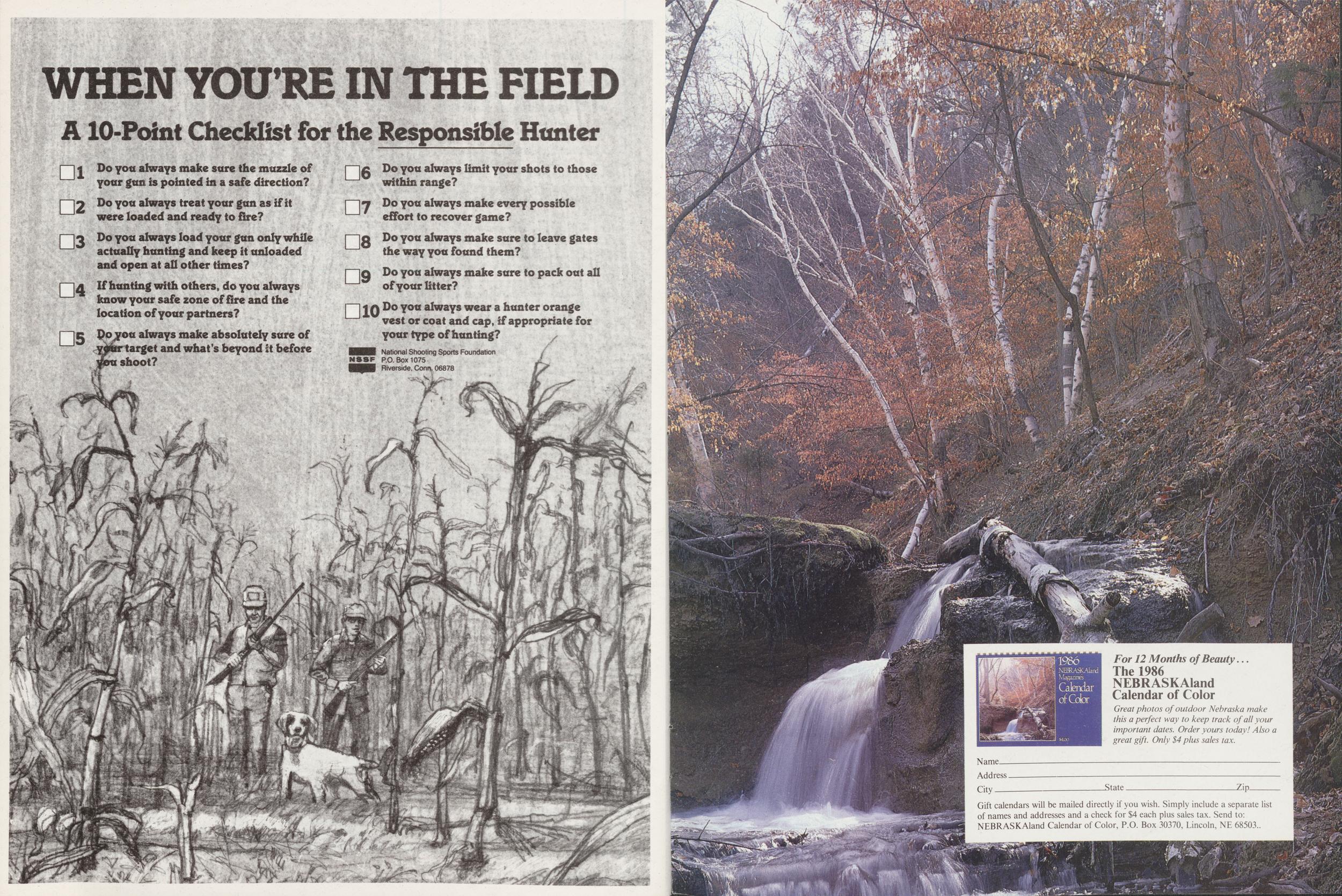
WHEN YOU'RE IN THE HELD
A 10-Point Checklist for the Responsible Hunter 1 Do you always make sure the muzzle of your gun is pointed in a safe direction? 2 Do you always treat your gun as if It were loaded and ready to fire? 3 Do you always load your gun only while actually hunting and keep it unloaded and open at all other times? 4 If hunting with others, do you always know your safe zone of fire and the location of your partners? 5 Do you always make absolutely sure of arget and what's beyond it before shoot? 6 Do you always limit your shots to those within range? 7 Do you always make every possible effort to recover game? 8 Do you always make sure to leave gates the way you found them? 9 Do you always make sure to pack out all of your litter? 10 Do Yolf aIwaYs wear a hunter orange vest or coat and cap, if appropriate for your type of hunting? National Shooting Sports Foundation MSSF P,0. Box 1075 Riverside, Conn. 06878
KEEP A LOOKOUT
Poaching is a serious problem — and a nast businessPosition: 769 (14 views)