Volume 63, Issue 9, 1985
NEBRASKAland OCTOBER 1985 $1
NEBRASKAland
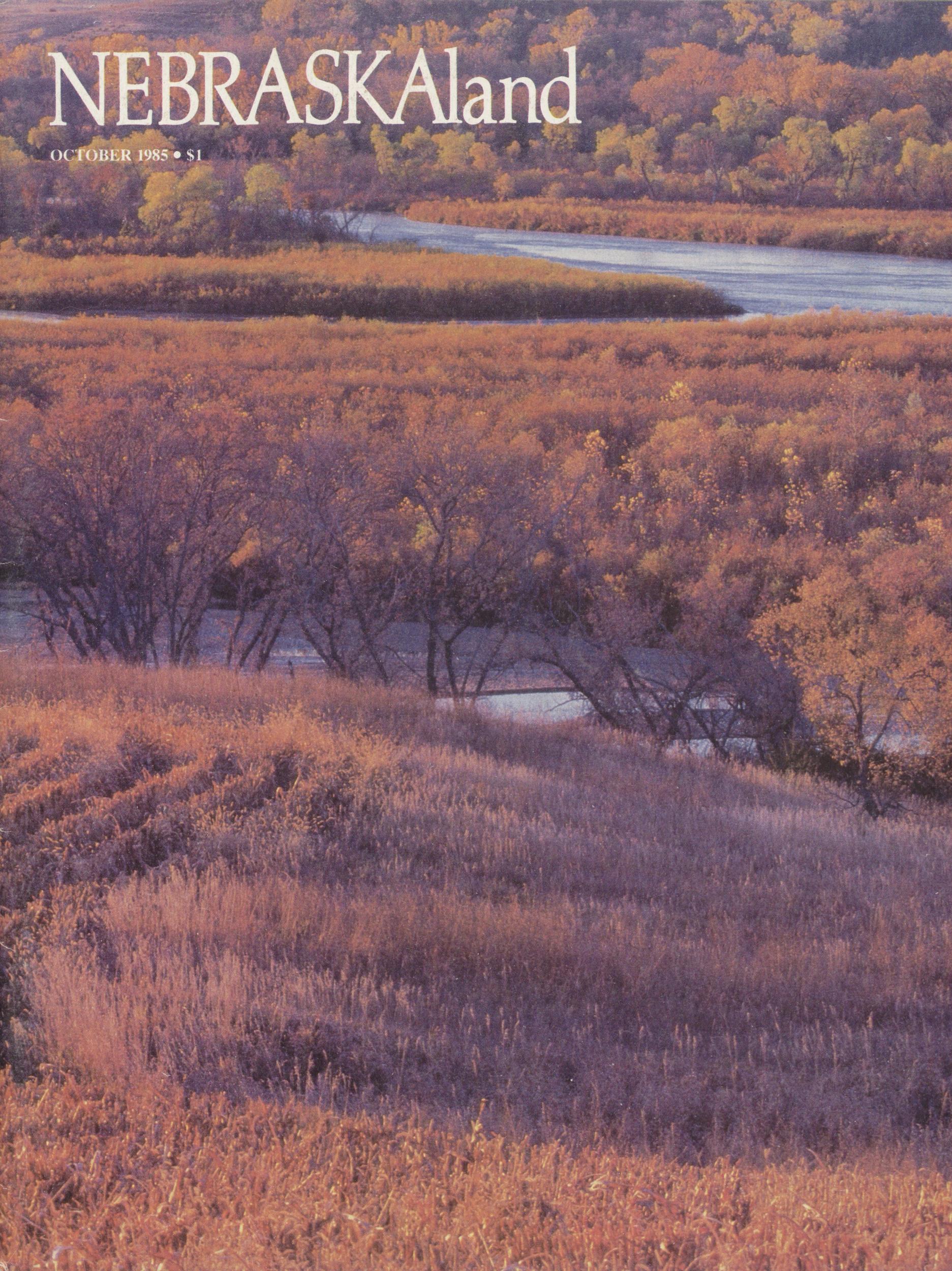
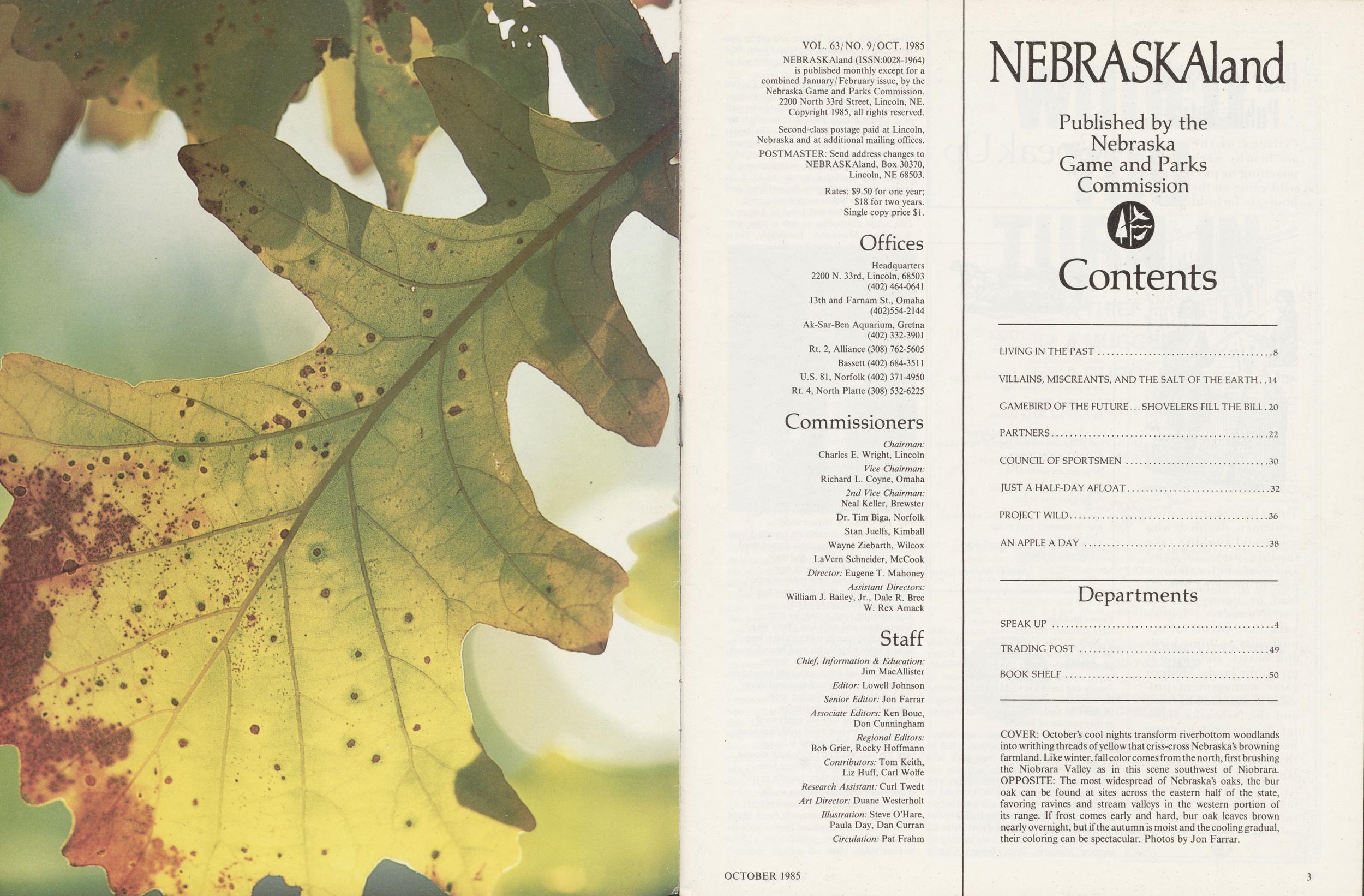
Published by tge Nebraska Game and Parks Commission VOL. 63/NO. 9/OCT. 1985 NEBRASKAland (ISSN:0028-1964) is published monthly except for a combined January/ February issue, by the Nebraska Game and Parks Commission. 2200 North 33rd Street, Lincoln, NE. Copyright 1985, all rights reserved. Second-class postage paid at Lincoln, Nebraska and at additional mailing offices. POSTMASTER: Send address changes to NEBRASKAland, Box 30370, Lincoln, NE 68503. Rates: $9.50 for one year; $18 for two years. Single copy price $1. Offices Headquarters 2200 N. 33rd, Lincoln, 68503 (402)464-0641 13th and Farnam St., Omaha (402)554-2144 Ak-Sar-Ben Aquarium, Gretna (402)332-3901 Rt. 2, Alliance (308) 762-5605 Bassett (402) 684-3511 U.S. 81, Norfolk (402) 371-4950 Rt. 4, North Platte (308) 532-6225 Commissioners Chairman: Charles E. Wright, Lincoln Vice Chairman: Richard L. Coyne, Omaha 2nd Vice Chairman: Neal Keller, Brewster Dr. Tim Biga, Norfolk Stan Juelfs, Kimball Wayne Ziebarth, Wilcox LaVern Schneider, McCook Director: Eugene T. Mahoney Assistant Directors: William J. Bailey, Jr., Dale R. Bree W. Rex Amack Staff Chief, Information & Education: Jim MacAllister Editor: Lowell Johnson Senior Editor: Jon Farrar Associate Editors: Ken Bouc, Don Cunningham Regional Editors: Bob Grier, Rocky Hoffmann Contributors: Tom Keith, Liz Huff, Carl Wolfe Research Assistant: Curl Twedt Art Director: Duane Westerholt Illustration: Steve O'Hare, Paula Day, Dan Curran Circulation: Pat Frahm Contents LIVING IN THE PAST8 VILLAINS, MISCREANTS, AND THE SALT OF THE EARTH.. 14 GAMEBIRD OF THE FUTURE SHOVELERS FILL THE BILL 20 PARTNERS22 COUNCIL OF SPORTSMEN30 JUST A HALF-DAY AFLOAT32 PROJECT WILD36 AN APPLE A DAY Departments SPEAK UP 4 TRADING POST49 BOOK SHELF50 COVER: October's cool nights transform riverbottom woodlands into writhing threads of yellow that criss-cross Nebraska's browning farmland. Like winter, fall color comes from the north, first brushing the Niobrara Valley as in this scene southwest of Niobrara. OPPOSITE: The most widespread of Nebraska's oaks, the bur oak can be found at sites across the eastern half of the state, favoring ravines and stream valleys in the western portion of its range. If frost comes early and hard, bur oak leaves brown nearly overnight, but if the autumn is moist and the cooling gradual, their coloring can be spectacular. Photos by Jon Farrar. OCTOBER 1985 3
Speak Up
over the countryside
And the sumac too has changed its green
for a gorgeous crimson tide.
The trees in Spring slowly
open each leaf, but for autumn
are all arrayed in orange and brown
and yellow and red and green of every shade.
The corn is bursting all the cribs,
the grains are garnered in
The silo's filled with cattle feed,
the fruit's in jars or bin.
The earth seems resting, on hill and plain,
now the summer's work is over
The pride there is in a task well done
is Nebraska in October. Mildred Andrews Larson Knows his beans
Sir/1 certainly enjoyed your recent article, "A Nation of Runners," and was particularly intrigued about the reference to Sidney gambler Hughey Bean. Hughey undoubtedly hoped to pit Big Hawk Chief against all comers and line his pockets from the betting. He may well have done just that. I thought I'd share an anecdote or two about Hughey, as they may be of interest.
I believe his actual name was Behan, "Bean" being a phonetic spelling. I feel he was raised in Waddington, New York, with Cornelius M. McCarty. McCarty was our local crime lord during the 19th century who had come to Sidney about 1874, served as county coroner and sheriff, and operated the Capitol Saloon and Gambling Hall. The fact that McCarty was illiterate didn't deter his henchmen, including Bean, from insuring his election. McCarty, Bean (Behan), Charles "Doc" Baggs, Frank Tarbox and others had total control of local government from 1874 until vigilantes retook the town in April of 1881.
In January of 1908 McCarty's old Capitol burned to the ground. In the ashes were found two golden bricks thought to be part of a Union Pacific bullion theft which the gang pulled off in March 1880. The bricks proved to be bogus and a subsequent investigation revealed they were part of a number of bogus bricks manufactured in Denver and marketed across the U. S. as part of the loot. Hughey Bean is identified as part of that 19th century bunco crew.
Hughey was shot and killed in August of 1886 while attempting to rob a train near Winnipeg, Manitoba. Incidently, those bogus bricks were placed over the entryway of the new structure where they remain to this day, hidden by a neon sign.
Robert R. Rybolt Sidney, Nebr. * * * Ode to NiobraraSir/Upon hearing that the Bureau of Reclamation has dropped plans to build the Norden Dam, I wrote this poem.
Niobrara Where tableland and sandhills meet,Quick weld of river at their feet,
Two canoeists held their stroke
And listened while the river spoke:
"Ten thousand years IVe hewn this course,
Through Rosebud clay, past fossil horse,
To trapper French 'the water that runs,'
It's from my work this valley comes.
Here the banks that touch my speed,
For whiskered catfish swirls to feed,
And here the rocks for mink to hide,
For little bluestem terrace wide.
My springbranch streams are gravelled, cool,
My speckled trout has grass-draped pool,
A stream for stickleback and dace,
Where birch and ponderosa face.
Here snipe and rail have reedy marsh,
Bald eagles roost through winter harsh,
The lanky heron perch to rest,
And scolding wren a rush for nest.
Where moss and cress find shady seep,
And sandhill springs make sudden leap,
Where beaver builds his mud-branch house,
And kestrel dives on harvest mouse.
Here southward goose and crane have pause,
The whitetail deer wood-sheltered draws,
An oxbow for the tussocked sedge,
For vulture black a stony ledge.
Where bullsnake suns on sandy road
And squats the burrowed spadefoot toad
, And where on bottomland is found
The thieving woodrafs stick-built mound.
All this IVe wrought in passing here
With scouring flow these turning years."
Then in the canyon's sun-low shade
One dipped again his weathered blade,
Fresh strokes toward camp on river's shore
It lives to run ten thousand more. Michael O'Leary Cambridge, Mass. 4 NEBRASKAland Up a tree
Sir/ A coon dog is supposed to trail and tree coons, but a friend of mine was out exercising his young (six-months-old) dog, "Jack," when he took off on a hot trail. Within a few minutes he had "treed" his quarry, which turned out to be a small raft, either five or six, young coons—not in a tree, but up a fence post. It appeared to be a standoff, as the pup was about as wary of his quarry as vice-versa. In fact, there was ample time for the dog's owner, Kyle Pearson of Holdrege, to go home, get his camera, and take several "shots" at the group, which looked much like a raccoon popsicle.
Dan Jordan Holdrege, Nebr.Sir/1 was quite interested in the article in the August issue, "Is it safe to drink the water?" I can remember as a child in the mid 1920's drinking water from the Missouri River in South Dakota. We roamed the hills west of town gathering buffalo berries, chokecherries, wild plums and currants on hot summer says. And, oh, how thirsty we would become, so we'd head down to Old Muddy, lie on our stomachs to slake our thirst. But today? Heavens no.
Do any oldsters remember the dammed up areas on farms to catch the runoff water for stock. That water sometimes was the only water for man and beast on the prairies until men could drive 25 to 30 miles with a wagonload of barrels to get river water or from someone's brackish artesian well. I've had to drink that dam water more than once when visiting out on the farms. It's a wonder more people didn't die in those days.
My brother and his son went elk hunting in the Blue Mountains of eastern Oregon eight years ago. They were up high in the mountains and were out of water. They found a rapid-flowing stream and filled their canteens, thinking the water at that altitude should be safe. But my brother soon learned different, and elk or not, the next morning found them heading rapidly for the nearest doctor. My brother had been hit by "Montezuma's revenge" a few years before, on a trip to Arizona, and was warned to carry medication whenever he travels, and to carry water. Apparently beavers had dammed the stream above, and the water was polluted by a bug which stays in the system. So, take warning, travelers and hunters; don't take a chance—I saw what it did to my brother.
Addie M. Wilmart Lincoln, Nebr. A THIEF A MUGGER A BURGLAR A PICKPOCKET All good citizens would! So why protect a poacher? He steals from you too! A poacher steals trom an sportsmen. Each time he acts he reduces the game available to legal hunters and destroys all sportsmen's reputation. Now you can protect yourself and other sportsmen. Operation Game Thief gives you a chance to report game and fish violations and remain anonymous. You don't have to give your name and you don't have to appear in court. Just call your nearest conservation officer or Operation Game Thief's toll-free hotline, 800-742-7627, 8 a.m. to 5 p.m. Monday through Friday. May be eligible to receive an award for information. CALL 800-742-SNAP STOP POACHING NEBRASKA OPERATION GAME THIEF TO REPORT GAME VIOLATIONS DIAL 800-742-SNAP SUPPORT OPERATION GAME THIEF WITH A CHECK! The Operation Game Thief Program is supported entirely by donations from concerned individuals and groups. WE NEED your help! NAME ADDRESS CITY, STATE, ZIP PHONE AMOUNT OF DONATION Operation Game Thief, Box 424, Dept. N, Broken Bow, NE 68822 OCTOBER 1985 5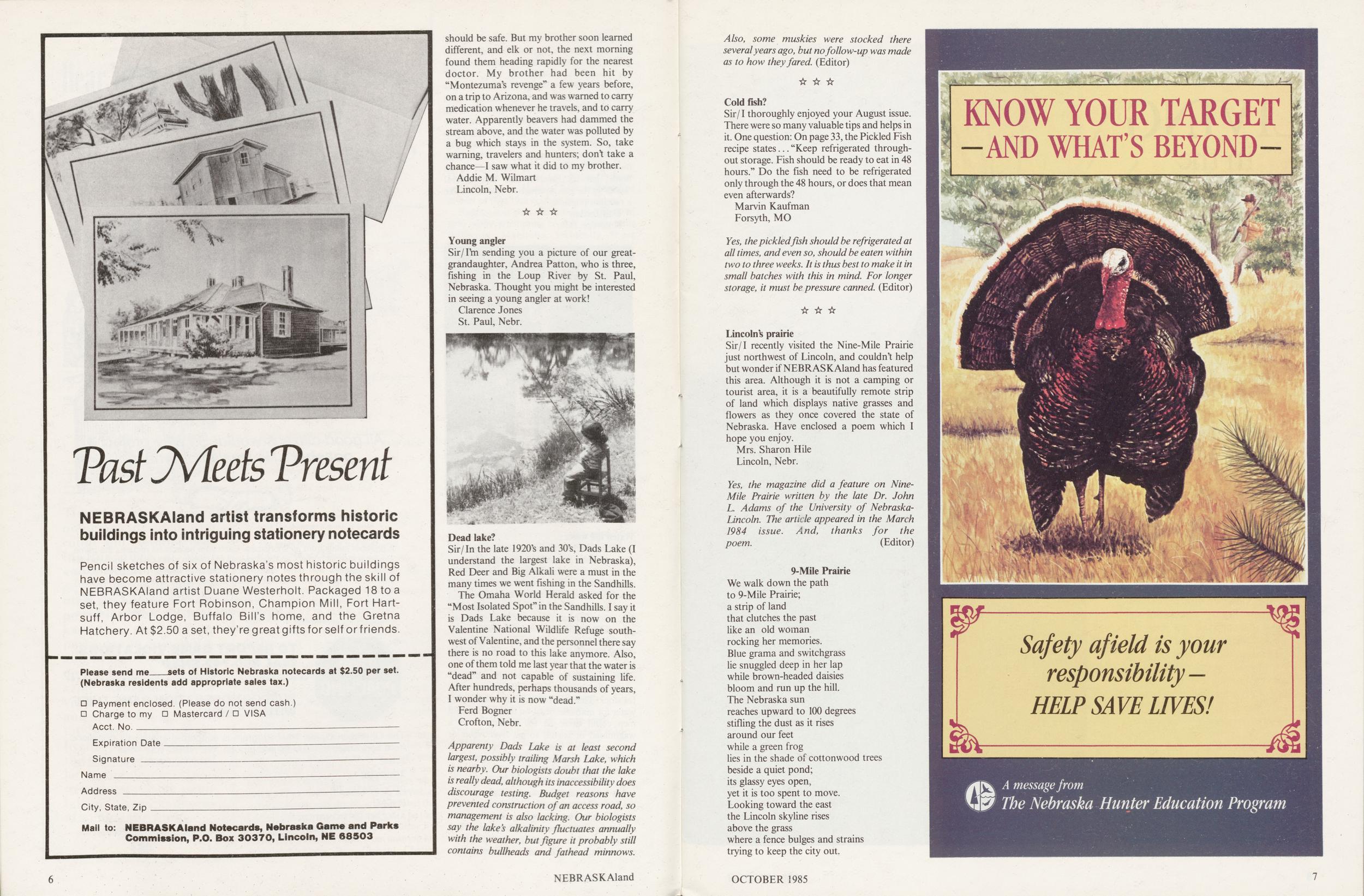
Sir/ I'm sending you a picture of our great-grandaughter, Andrea Patton, who is three, fishing in the Loup River by St. Paul, Nebraska. Thought you might be interested in seeing a young angler at work!
Clarence Jones St. Paul, Nebr.Sir/In the late 1920's and 30's, Dads Lake (I understand the largest lake in Nebraska), Red Deer and Big Alkali were a must in the many times we went fishing in the Sandhills.
The Omaha World Herald asked for the "Most Isolated Spot" in the Sandhills. I say it is Dads Lake because it is now on the Valentine National Wildlife Refuge south- west of Valentine, and the personnel there say there is no road to this lake anymore. Also, one of them told me last year that the water is "dead" and not capable of sustaining life. After hundreds, perhaps thousands of years, I wonder why it is now "dead."
Ferd Bogner Crofton, Nebr.Apparenty Dads Lake is at least second largest, possibly trailing Marsh Lake, which is nearby. Our biologists doubt that the lake is really dead, although its inaccessibility does discourage testing. Budget reasons have prevented construction of an access road, so management is also lacking. Our biologists say the lake's alkalinity fluctuates annually with the weather, but figure it probably still contains bullheads and fathead minnows. 6 NEBRASKAland Also, some muskies were stocked there several years ago, but no follow-up was made as to how they fared. (Editor)
* * * Cold fish?Sir/1 thoroughly enjoyed your August issue. There were so many valuable tips and helps in it. One question: On page 33, the Pickled Fish recipe states... "Keep refrigerated throughout storage. Fish should be ready to eat in 48 hours." Do the fish need to be refrigerated only through the 48 hours, or does that mean even afterwards?
Marvin Kaufman Forsyth, MOYes, the pickled fish should be refrigerated at all times, and even so, should be eaten within two to three weeks. It is thus best to make it in small batches with this in mind. For longer storage, it must be pressure canned. (Editor)
* * * Lincoln's prairieSir/1 recently visited the Nine-Mile Prairie just northwest of Lincoln, and couldn't help but wonder if NEBRASKAIand has featured this area. Although it is not a camping or tourist area, it is a beautifully remote strip of land which displays native grasses and flowers as they once covered the state of Nebraska. Have enclosed a poem which I hope you enjoy.
Mrs. Sharon Hile Lincoln, Nebr.Yes, the magazine did a feature on Nine-Mile Prairie written by the late Dr. John L. Adams of the University of Nebraska-Lincoln. The article appeared in the March 1984 issue. And, thanks for the poem. (Editor)
9-Mile Prairie We walk down the pathto 9-Mile Prairie;
a strip of land
that clutches the past
like an old woman
rocking her memories.
Blue grama and switchgrass
lie snuggled deep in her lap
while brown-headed daisies
bloom and run up the hill.
The Nebraska sun
reaches upward to 100 degrees
stifling the dust as it rises
around our feet
while a green frog
lies in the shade of cottonwood trees
beside a quiet pond;
its glassy eyes open,
yet it is too spent to move.
Looking toward the east
the Lincoln skyline rises
above the grass
where a fence bulges and strains
trying to keep the city out. KNOW YOUR TARGET AND WHAT'S BEYOND Safety afield is your responsibility HELP SAVE LIVES! A message from The Nebraska Hunter Education Program OCTOBER 1985 7
LIVING in the PAST
PHOTOS AND TEXT BY JON FARRAR " man, projected by his inevitable progress away from his ancestral proximity to animals, vegetables, and minerals — in sum, to Nature — takes pleasure in artifical return to it, the only occupation that permits him something like a vacation from his human condition." Jose Ortega y Gasset Meditations of Hunting, 1972THERE IS A SIDE of many men that longs for a simpler existence. They want, at least occasionally, to brush aside modern contrivances, to reduce living to a basic level, to find something lost when we wrapped ourselves in convenience and comfort. Civilization is of recent origin relative to the entire existence of man. Perhaps we still feel the tuggings of ancestral rites and ways that satisfied our kind for thousands, hundreds of thousands, of years. Perhaps today's way of living leaves a physical, even spiritual, void. Perhaps, by denying our place in the natural world, we have become creatures without a place.
The modern version of "escaping back to nature" runs the spectrum from monstrous motor homes that insulate us from the nature we seek, to highteck backpacking, what some have called checkbook admission to wilderness. Between these extremes are infinite variations. Somewhere outside this spectrum, existing in a sphere of its own, are the tipi people. They defy a better label, just as they defy definition and explanation. Although they expand at great length on the advantages of the tipi over all other forms of "mobile housing," you sense that practicality is but a minor detail of their passion for this ancient shelter. Their greatest desire is to escape to another time and another place. They are the great pretenders.
8 NEBRASKAland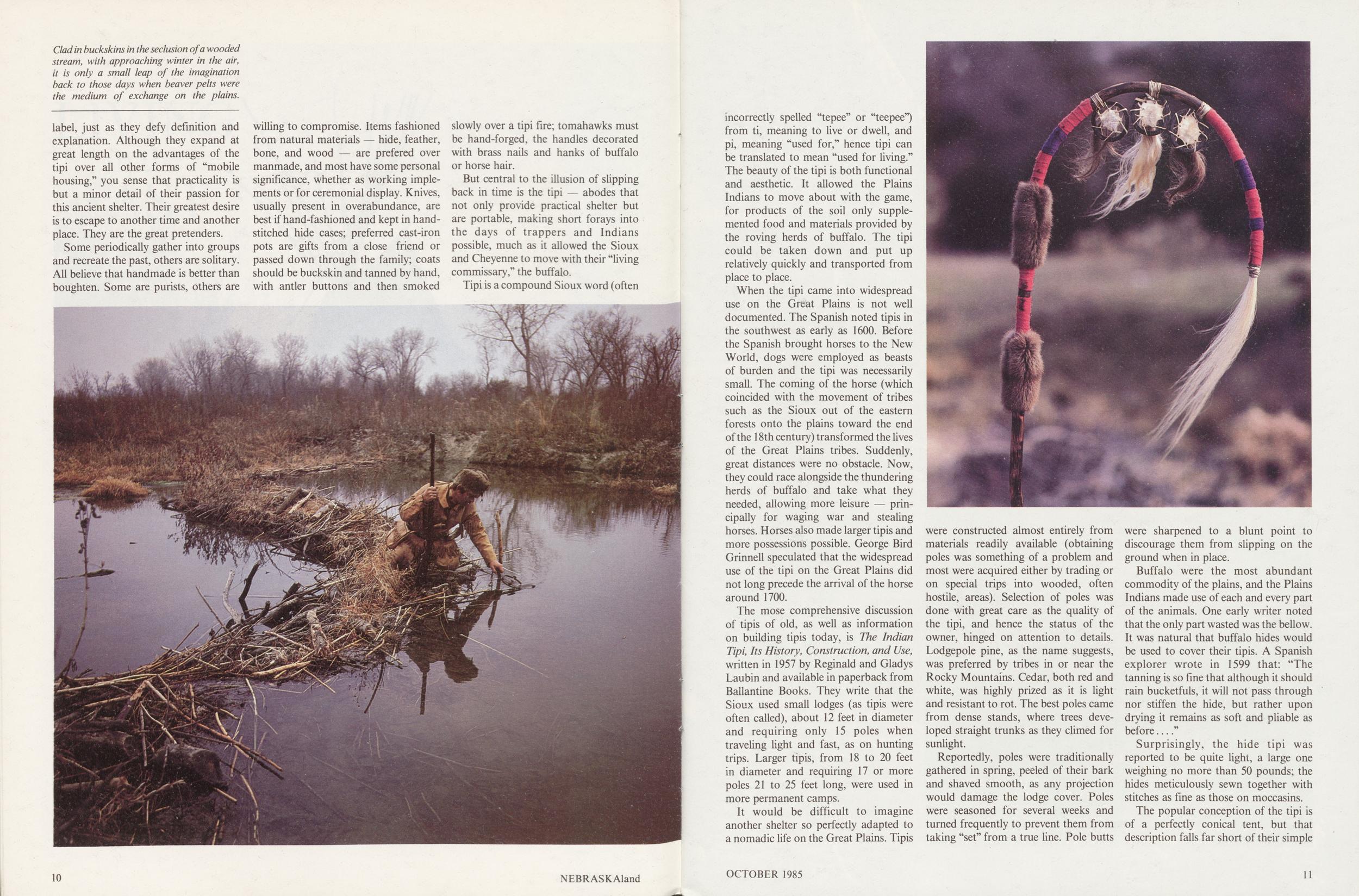 Clad in buckskins in the seclusion of a wooded
stream, with approaching winter in the air,
it is only a small leap of the imagination
back to those days when beaver pelts were
the medium of exchange on the plains.
Clad in buckskins in the seclusion of a wooded
stream, with approaching winter in the air,
it is only a small leap of the imagination
back to those days when beaver pelts were
the medium of exchange on the plains.
Some periodically gather into groups and recreate the past, others are solitary. All believe that handmade is better than boughten. Some are purists, others are willing to compromise. Items fashioned from natural materials — hide, feather, bone, and wood — are prefered over manmade, and most have some personal significance, whether as working implements or for ceremonial display. Knives, usually present in overabundance, are best if hand-fashioned and kept in handstitched hide cases; preferred cast-iron pots are gifts from a close friend or passed down through the family; coats should be buckskin and tanned by hand, with antler buttons and then smoked slowly over a tipi fire; tomahawks must be hand-forged, the handles decorated with brass nails and hanks of buffalo or horse hair.
But central to the illusion of slipping back in time is the tipi — abodes that not only provide practical shelter but are portable, making short forays into the days of trappers and Indians possible, much as it allowed the Sioux and Cheyenne to move with their "living commissary," the buffalo.
Tipi is a compound Sioux word (often 10 NEBRASKAland incorrectly spelled "tepee" or "teepee") from ti, meaning to live or dwell, and pi, meaning "used for," hence tipi can be translated to mean "used for living." The beauty of the tipi is both functional and aesthetic. It allowed the Plains Indians to move about with the game, for products of the soil only supplemented food and materials provided by the roving herds of buffalo. The tipi could be taken down and put up relatively quickly and transported from place to place.
When the tipi came into widespread use on the Great Plains is not well documented. The Spanish noted tipis in the southwest as early as 1600. Before the Spanish brought horses to the New World, dogs were employed as beasts of burden and the tipi was necessarily small. The coming of the horse (which coincided with the movement of tribes such as the Sioux out of the eastern forests onto the plains toward the end of the 18th century) transformed the lives of the Great Plains tribes. Suddenly, great distances were no obstacle. Now, they could race alongside the thundering herds of buffalo and take what they needed, allowing more leisure — principally for waging war and stealing horses. Horses also made larger tipis and more possessions possible. George Bird Grinnell speculated that the widespread use of the tipi on the Great Plains did not long precede the arrival of the horse around 1700.
The mose comprehensive discussion of tipis of old, as well as information on building tipis today, is The Indian Tipi, Its History, Construction, and Use, written in 1957 by Reginald and Gladys Laubin and available in paperback from Ballantine Books. They write that the Sioux used small lodges (as tipis were often called), about 12 feet in diameter and requiring only 15 poles when traveling light and fast, as on hunting trips. Larger tipis, from 18 to 20 feet in diameter and requiring 17 or more poles 21 to 25 feet long, were used in more permanent camps.
It would be difficult to imagine another shelter so perfectly adapted to a nomadic life on the Great Plains. Tipis were constructed almost entirely from materials readily available (obtaining poles was something of a problem and most were acquired either by trading or on special trips into wooded, often hostile, areas). Selection of poles was done with great care as the quality of the tipi, and hence the status of the owner, hinged on attention to details. Lodgepole pine, as the name suggests, was preferred by tribes in or near the Rocky Mountains. Cedar, both red and white, was highly prized as it is light and resistant to rot. The best poles came from dense stands, where trees developed straight trunks as they climed for sunlight.
Reportedly, poles were traditionally gathered in spring, peeled of their bark and shaved smooth, as any projection would damage the lodge cover. Poles were seasoned for several weeks and turned frequently to prevent them from taking "set" from a true line. Pole butts were sharpened to a blunt point to discourage them from slipping on the ground when in place.
Buffalo were the most abundant commodity of the plains, and the Plains Indians made use of each and every part of the animals. One early writer noted that the only part wasted was the bellow. It was natural that buffalo hides would be used to cover their tipis. A Spanish explorer wrote in 1599 that: "The tanning is so fine that although it should rain bucketfuls, it will not pass through nor stiffen the hide, but rather upon drying it remains as soft and pliable as before"
Surprisingly, the hide tipi was reported to be quite light, a large one weighing no more than 50 pounds; the hides meticulously sewn together with stitches as fine as those on moccasins.
The popular conception of the tipi is of a perfectly conical tent, but that description falls far short of their simple yet efficient design. The Laubins stress that the tipi is not a symmetrical cone but a tilted cone, steeper at the back with a smoke hole extending some distance down the gently sloping front, and that the cone shape offered many advantages.
OCTOBER 1985 11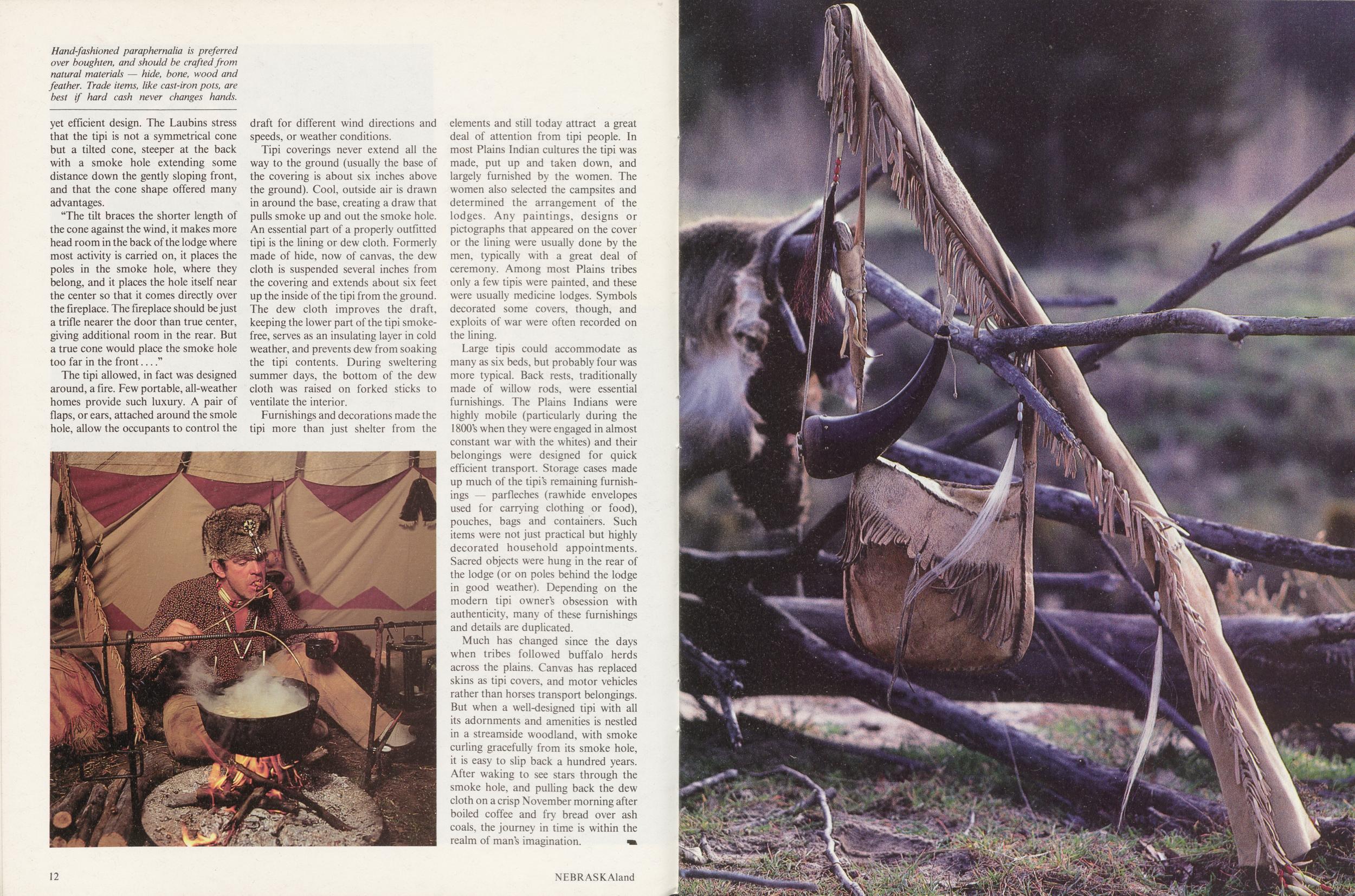 Hand-fashioned paraphernalia is preferred
over boughten, and should be crafted from
natural materials — hide, bone, wood and
feather. Trade items, like cast-iron pots, are
best if hard cash never changes hands.
Hand-fashioned paraphernalia is preferred
over boughten, and should be crafted from
natural materials — hide, bone, wood and
feather. Trade items, like cast-iron pots, are
best if hard cash never changes hands.
"The tilt braces the shorter length of the cone against the wind, it makes more head room in the back of the lodge where most activity is carried on, it places the poles in the smoke hole, where they belong, and it places the hole itself near the center so that it comes directly over the fireplace. The fireplace should be just a trifle nearer the door than true center, giving additional room in the rear. But a true cone would place the smoke hole too far in the front"
The tipi allowed, in fact was designed around, a fire. Few portable, all-weather homes provide such luxury. A pair of flaps, or ears, attached around the smole hole, allow the occupants to control the draft for different wind directions and speeds, or weather conditions.
Tipi coverings never extend all the way to the ground (usually the base of the covering is about six inches above the ground). Cool, outside air is drawn in around the base, creating a draw that pulls smoke up and out the smoke hole. An essential part of a properly outfitted tipi is the lining or dew cloth. Formerly made of hide, now of canvas, the dew cloth is suspended several inches from the covering and extends about six feet up the inside of the tipi from the ground. The dew cloth improves the draft, keeping the lower part of the tipi smokefree, serves as an insulating layer in cold weather, and prevents dew from soaking the tipi contents. During sweltering summer days, the bottom of the dew cloth was raised on forked sticks to ventilate the interior.
Furnishings and decorations made the tipi more than just shelter from the 12 elements and still today attract a great deal of attention from tipi people. In most Plains Indian cultures the tipi was made, put up and taken down, and largely furnished by the women. The women also selected the campsites and determined the arrangement of the lodges. Any paintings, designs or pictographs that appeared on the cover or the lining were usually done by the men, typically with a great deal of ceremony. Among most Plains tribes only a few tipis were painted, and these were usually medicine lodges. Symbols decorated some covers, though, and exploits of war were often recorded on the lining.
Large tipis could accommodate as many as six beds, but probably four was more typical. Back rests, traditionally made of willow rods, were essential furnishings. The Plains Indians were highly mobile (particularly during the 1800's when they were engaged in almost constant war with the whites) and their belongings were designed for quick efficient transport. Storage cases made up much of the tipi's remaining furnishings — parfleches (rawhide envelopes used for carrying clothing or food), pouches, bags and containers. Such items were not just practical but highly decorated household appointments. Sacred objects were hung in the rear of the lodge (or on poles behind the lodge in good weather). Depending on the modern tipi owner's obsession with authenticity, many of these furnishings and details are duplicated.
Much has changed since the days when tribes followed buffalo herds across the plains. Canvas has replaced skins as tipi covers, and motor vehicles rather than horses transport belongings. But when a well-designed tipi with all its adornments and amenities is nestled in a streamside woodland, with smoke curling gracefully from its smoke hole, it is easy to slip back a hundred years. After waking to see stars through the smoke hole, and pulling back the dew cloth on a crisp November morning after boiled coffee and fry bread over ash coals, the journey in time is within the realm of man's imagination.
12 NEBRASKAland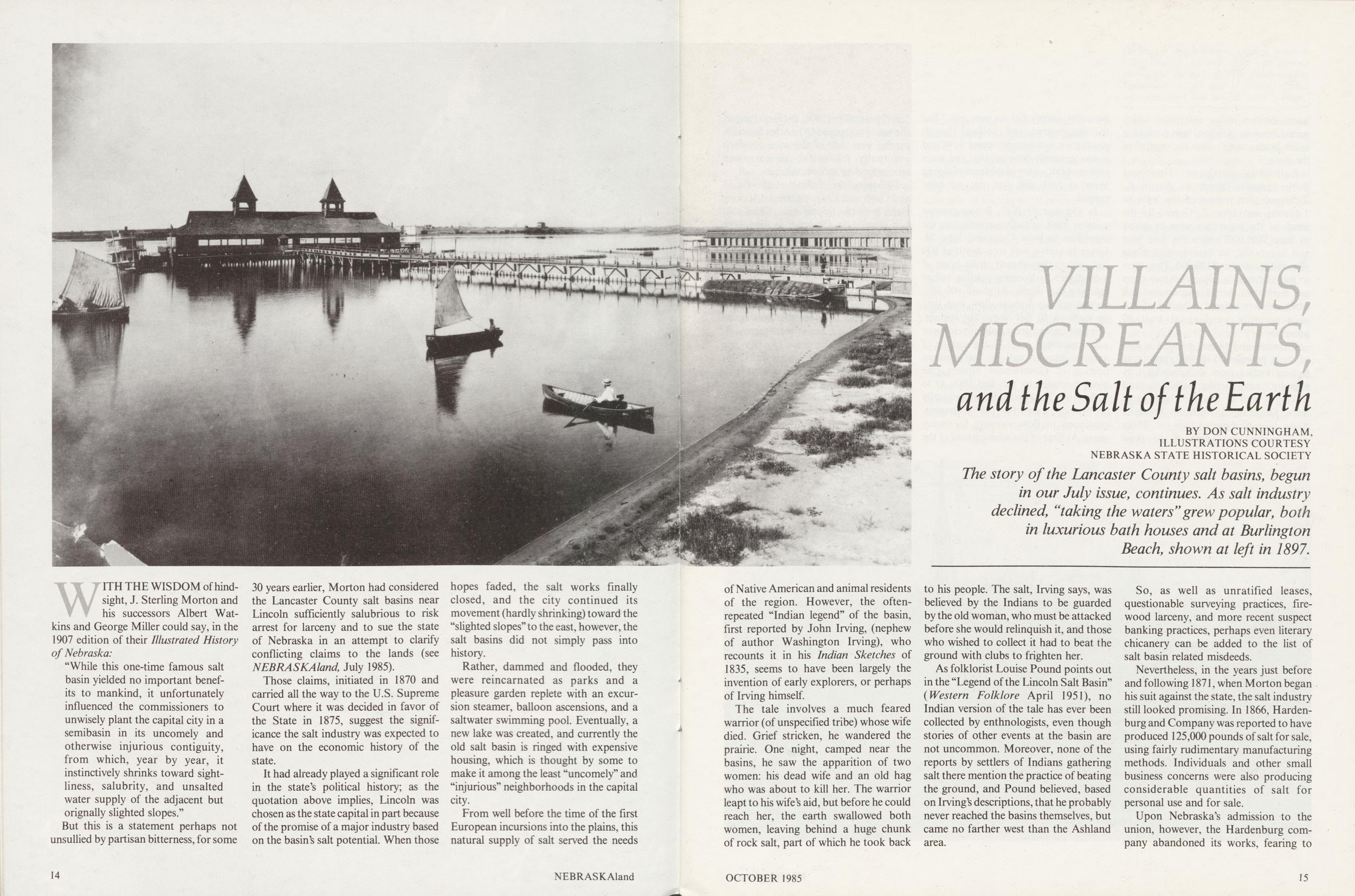
VILLAINS, MISCREANTS, and the Salt of the Earth
BY DON CUNNINGHAM, ILLUSTRATIONS COURTESY NEBRASKA STATE HISTORICAL SOCIETY The story of the Lancaster County salt basins, begun in our July issue, continues. As salt industry declined, "taking the waters"grew popular, both in luxurious bath houses and at Burlington Beach, shown at left in 1897.WITH THE WISDOM of hindsight, J. Sterling Morton and his successors Albert Watkins and George Miller could say, in the 1907 edition of their Illustrated History of Nebraska:
"While this one-time famous salt basin yielded no important benefits to mankind, it unfortunately influenced the commissioners to unwisely plant the capital city in a semibasin in its uncomely and otherwise injurious contiguity, from which, year by year, it instinctively shrinks toward sightliness, salubrity, and unsalted water supply of the adjacent but orignally slighted slopes."
But this is a statement perhaps not unsullied by partisan bitterness, for some 30 years earlier, Morton had considered the Lancaster County salt basins near Lincoln sufficiently salubrious to risk arrest for larceny and to sue the state of Nebraska in an attempt to clarify conflicting claims to the lands (see NEBRASKAland, July 1985).
Those claims, initiated in 1870 and carried all the way to the U.S. Supreme Court where it was decided in favor of the State in 1875, suggest the significance the salt industry was expected to have on the economic history of the state.
It had already played a significant role in the state's political history; as the quotation above implies, Lincoln was chosen as the state capital in part because of the promise of a major industry based on the basin's salt potential. When those hopes faded, the salt works finally closed, and the city continued its movement (hardly shrinking) toward the "slighted slopes" to the east, however, the salt basins did not simply pass into history.
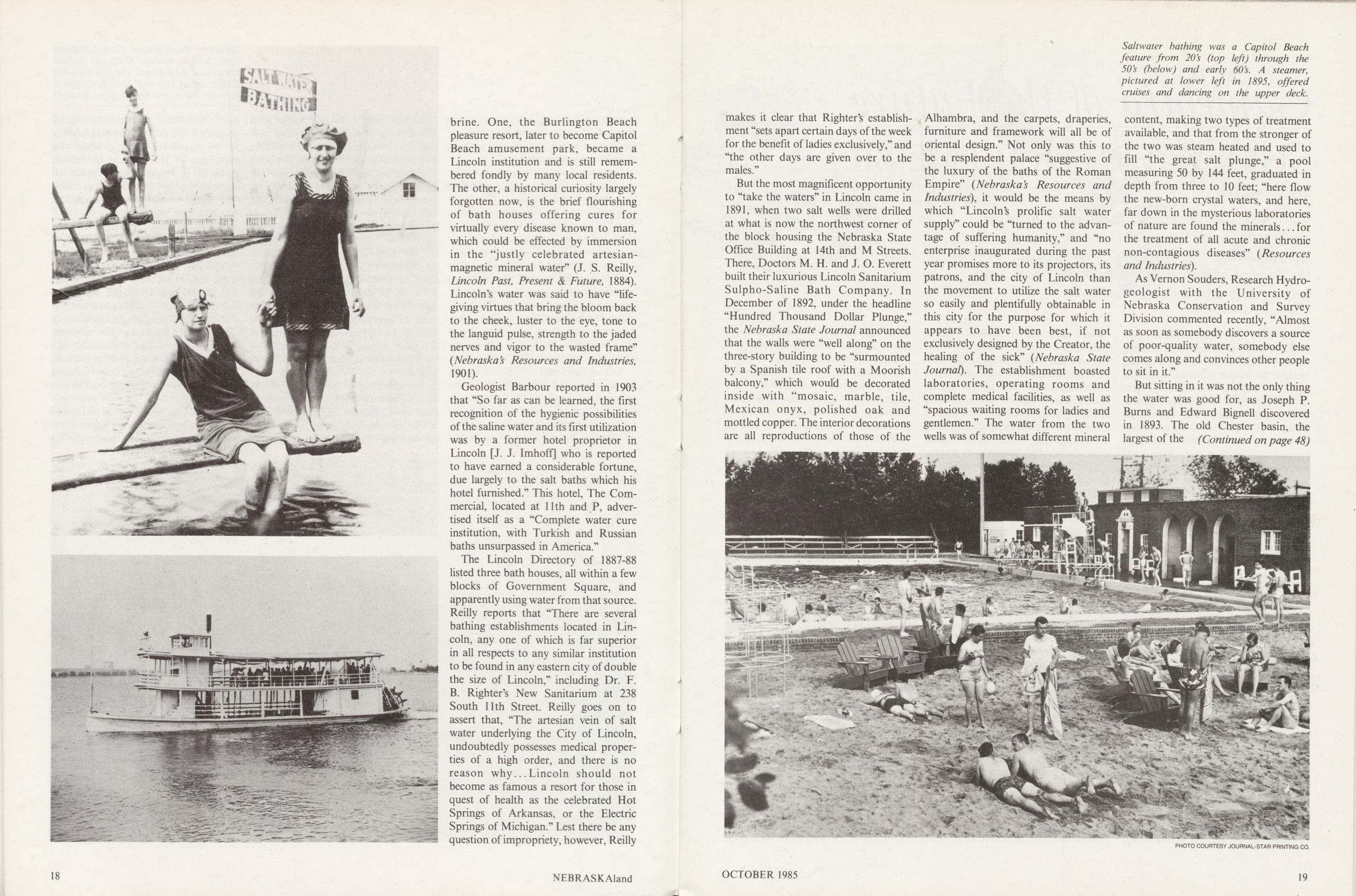
Rather, dammed and flooded, they were reincarnated as parks and a pleasure garden replete with an excursion steamer, balloon ascensions, and a saltwater swimming pool. Eventually, a new lake was created, and currently the old salt basin is ringed with expensive housing, which is thought by some to make it among the least "uncomely" and "injurious" neighborhoods in the capital city.
From well before the time of the first European incursions into the plains, this natural supply of salt served the needs 14 NEBRASKAland of Native American and animal residents of the region. However, the oftenrepeated "Indian legend" of the basin, first reported by John Irving, (nephew of author Washington Irving), who recounts it in his Indian Sketches of 1835, seems to have been largely the invention of early explorers, or perhaps of Irving himself.
The tale involves a much feared warrior (of unspecified tribe) whose wife died. Grief stricken, he wandered the prairie. One night, camped near the basins, he saw the apparition of two women: his dead wife and an old hag who was about to kill her. The warrior leapt to his wife's aid, but before he could reach her, the earth swallowed both women, leaving behind a huge chunk of rock salt, part of which he took back to his people. The salt, Irving says, was believed by the Indians to be guarded by the old woman, who must be attacked before she would relinquish it, and those who wished to collect it had to beat the ground with clubs to frighten her.
As folklorist Louise Pound points out in the "Legend of the Lincoln Salt Basin" (Western Folklore April 1951), no Indian version of the tale has ever been collected by enthnologists, even though stories of other events at the basin are not uncommon. Moreover, none of the reports by settlers of Indians gathering salt there mention the practice of beating the ground, and Pound believed, based on Irving's descriptions, that he probably never reached the basins themselves, but came no farther west than the Ashland area.
So, as well as unratified leases, questionable surveying practices, firewood larceny, and more recent suspect banking practices, perhaps even literary chicanery can be added to the list of salt basin related misdeeds.
Nevertheless, in the years just before and following 1871, when Morton began his suit against the state, the salt industry still looked promising. In 1866, Hardenburg and Company was reported to have produced 125,000 pounds of salt for sale, using fairly rudimentary manufacturing methods. Individuals and other small business concerns were also producing considerable quantities of salt for personal use and for sale.
Upon Nebraska's admission to the
union, however, the Hardenburg company abandoned its works, fearing to
OCTOBER 1985
15
 invest further in an enterprise which
would, because of federal laws governing
saline lands, come under the control of
the state.
invest further in an enterprise which
would, because of federal laws governing
saline lands, come under the control of
the state.
Following statehood, Governor Butler granted leases to Anson C. Tichenor, then reassigned the lease to Tichenor and Jesse T. Green. By the terms of the lease they were to invest at least $100,000 within the first year and eventually, as development plans required it, another $100,000. They were to pay the state a royalty of two cents per bushel on their manufactured salt (state statutes defined a bushel of salt as a quantity weighing at least 50 pounds).
Tichenor and Green invested a part of their promised $100,000, procuring boiling kettles from a Nebraska City foundry, constructing buildings, and sinking a well to increase the flow of brine. On May 22, 1869, the Nebraska State Journal reported that the works was "turning out some of the most beautiful, snowy salt we ever saw." But the evaporation and boiling, though productive, was expensive and slow, and it was generally believed that the main source of salt, either in the form of strong brine or rock salt, had not yet been tapped.
In October of 1869, Butler granted another lease, initially unratified by the legislature to Isaac Cahn and John M. Evans to sink a well to a depth of 800 feet, unless they should strike brine of a 50-degree hydrometer reading before reaching that depth. At about 600 feet, they struck an artesian flow that shot up eight to 10 feet above the surface. The find created great public excitement and occasioned, in 1872, the sinking of another artesian well on the northern portion of Government Square (the block bounded by 9th and 10th, O to P Streets). That well, drilled primarily to provide water for fire protection, continued to flow strongly for many years. At time of the construction of the "new" post office (1906/1915) on the site, the water was piped to another fountain on the west side of the square, which eventually fell victim to corrosion encouraged by its own saltiness.
Following the drilling of the Evans and Cahn well, Evans decamped, leaving Cahn with the unpaid bills. Cahn sold half interest in the lease to Governor Butler, but claimed the note was never paid, and in 1876 sued Butler. As a defense, Butler reasoned that the original agreement had been improper, since it was, in the words of Morton's history, "inconsistent with his official duty and public policy," and therefore because he should not have made the agreement, he should not have to pay it. The extraordinary defense failed, and Cahn received a judgment of $17,000.
The Government Square well foretold the next use to which Lancaster County's brine would be put: writing in the 1903 Nebraska Geological Survey, State Geologist Erwin H. Barbour says, "This 16 NEBRASKaland water is carried away in bottles and pails because of real or imaginary curative properties, which almost any mineral water is reputed to have."
But, in the 1870's and 80's, the production of commercial quantities of salt still seemed possible. The lease originally made to Tichenor and Green changed hands many times in succeeding years and Morton made his futile attempt to claim a portion of the basin, but in spite of the enthusiasm of its various developers and the elaborate predictions of vast wealth to be derived from salt, no one, including the state, seemed to be able to make any significant profits from the "great salt emporium of the west" {Nebraska Commonwealth, June 20, 1868).
Salt royalties paid to the state for the 16 years between 1870 and 1886 came to a grand total of $375.15. At the specified royalty rate of two cents per bushel, that comes to 14,757.5 bushels of salt, or an average of about 920 bushels per year — less than half of what Hardenburg is reported to have produced in 1866. There are also a number of reports of as much as 60 bushels being collected by surface scraping in four days, and early salt entrepreneur W. W. Cox tells of trading 4,000 pounds of salt (80 bushels) for 4,000 pounds of flour in a single transaction in 1861. A flood in 1885 is reported to have destroyed 25,340 barrels of salt in solution belonging to C. G. Bullock, who was then in possession of the peripatetic lease. It is difficult to reconcile the figures, but whether the amounts of salt were exaggerated (not unlikely) or the lessees underpaid their royalties (a tempting speculation), or both, it is nevertheless clear than no fortunes were made.
But unwilling to give up the dream of salt, the state, in 1885, made a contract with M. C. Bullock of Chicago to sink a well to a depth of 2,000 feet in order to determine once and for all whether there was rock salt or commercial strength brine down there just waiting to be discovered. The drilling was completed in 1887, and in his report, geologist in charge Byron P. Russell reported that by 2,000 feet he had struck "no brine of sufficient strength to warrant the manufacture of salt." Drilling continued to a depth of 2,463 feet, and still there was "no brine or indications of salt."
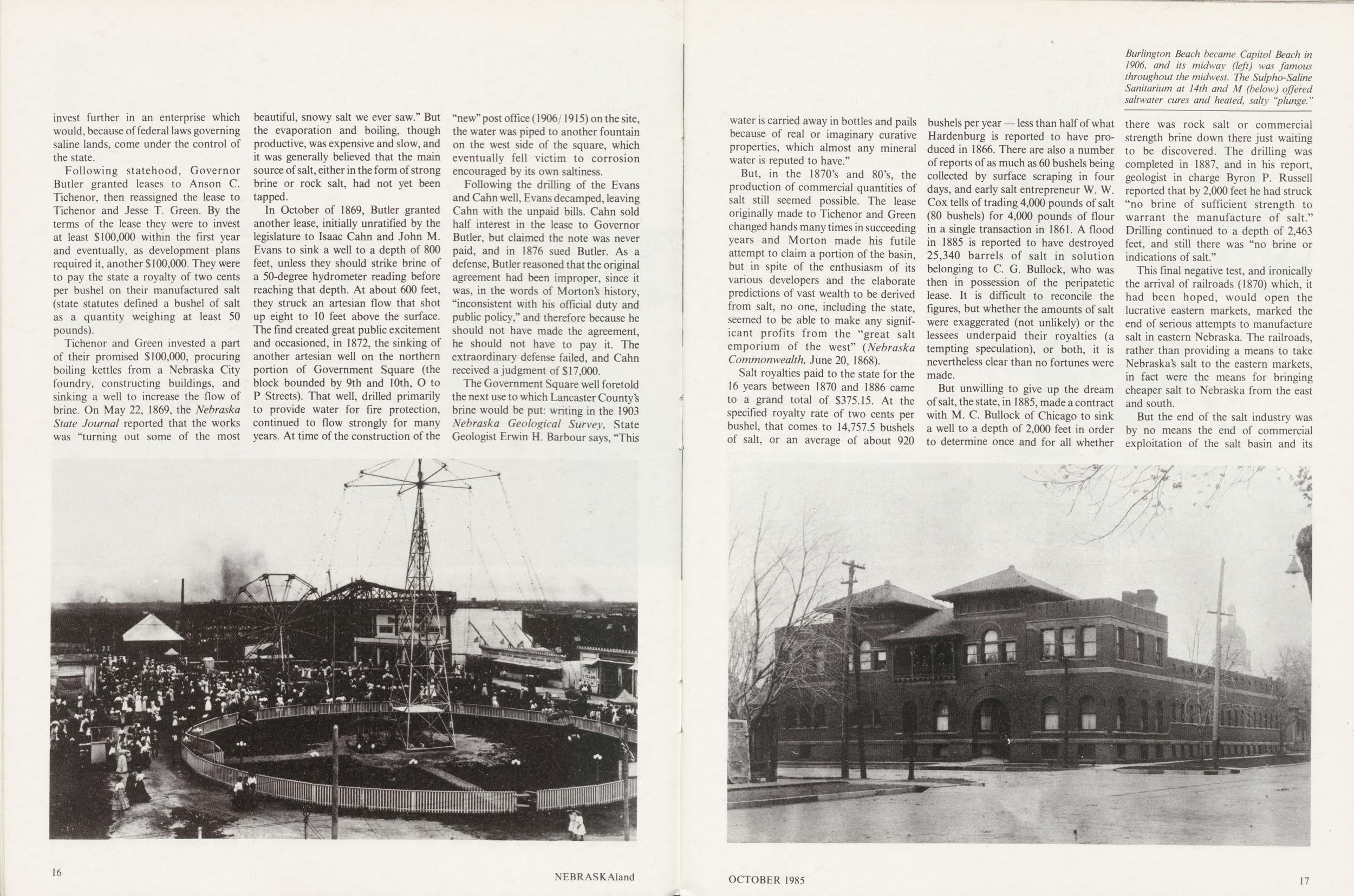
Burlington Beach became Capitol Beach in 1906, and its midway (left) was famous throughout the midwest. The Sulpho-Saline Sanitarium at 14th and M (below) offered saltwater cures and heated, salty "plunge."This final negative test, and ironically the arrival of railroads (1870) which, it had been hoped, would open the lucrative eastern markets, marked the end of serious attempts to manufacture salt in eastern Nebraska. The railroads, rather than providing a means to take Nebraska's salt to the eastern markets, in fact were the means for bringing cheaper salt to Nebraska from the east and south.
But the end of the salt industry was by no means the end of commercial exploitation of the salt basin and its brine. One, the Burlington Beach pleasure resort, later to become Capitol Beach amusement park, became a Lincoln institution and is still remembered fondly by many local residents. The other, a historical curiosity largely forgotten now, is the brief flourishing of bath houses offering cures for virtually every disease known to man, which could be effected by immersion in the "justly celebrated artesianmagnetic mineral water" (J. S. Reilly, Lincoln Past, Present & Future, 1884). Lincoln's water was said to have "lifegiving virtues that bring the bloom back to the cheek, luster to the eye, tone to the languid pulse, strength to the jaded nerves and vigor to the wasted frame" (Nebraska's Resources and Industries, 1901).
Geologist Barbour reported in 1903 that "So far as can be learned, the first recognition of the hygienic possibilities of the saline water and its first utilization was by a former hotel proprietor in Lincoln [J. J. Imhoff] who is reported to have earned a considerable fortune, due largely to the salt baths which his hotel furnished." This hotel, The Commercial, located at 11th and P, advertised itself as a "Complete water cure institution, with Turkish and Russian baths unsurpassed in America."
The Lincoln Directory of 1887-88 listed three bath houses, all within a few blocks of Government Square, and apparently using water from that source. Reilly reports that "There are several bathing establishments located in Lincoln, any one of which is far superior in all respects to any similar institution to be found in any eastern city of double the size of Lincoln," including Dr. F. B. Righter's New Sanitarium at 238 South 11th Street. Reilly goes on to assert that, "The artesian vein of salt water underlying the City of Lincoln, undoubtedly possesses medical properties of a high order, and there is no reason why.. .Lincoln should not become as famous a resort for those in quest of health as the celebrated Hot Springs of Arkansas, or the Electric Springs of Michigan." Lest there be any question of impropriety, however, Reilly 18 NEBRASKaland makes it clear that Righter's establishment "sets apart certain days of the week for the benefit of ladies exclusively," and "the other days are given over to the males."
But the most magnificent opportunity to "take the waters" in Lincoln came in 1891, when two salt wells were drilled at what is now the northwest corner of the block housing the Nebraska State Office Building at 14th and M Streets. There, Doctors M. H. and J. O. Everett built their luxurious Lincoln Sanitarium Sulpho-Saline Bath Company. In December of 1892, under the headline "Hundred Thousand Dollar Plunge," the Nebraska State Journal announced that the walls were "well along" on the three-story building to be "surmounted by a Spanish tile roof with a Moorish balcony," which would be decorated inside with "mosaic, marble, tile, Mexican onyx, polished oak and mottled copper. The interior decorations are all reproductions of those of the Alhambra, and the carpets, draperies, furniture and framework will all be of oriental design." Not only was this to be a resplendent palace "suggestive of the luxury of the baths of the Roman Empire" (Nebraska's Resources and Industries), it would be the means by which "Lincoln's prolific salt water supply" could be "turned to the advantage of suffering humanity," and "no enterprise inaugurated during the past year promises more to its projectors, its patrons, and the city of Lincoln than the movement to utilize the salt water so easily and plentifully obtainable in this city for the purpose for which it appears to have been best, if not exclusively designed by the Creator, the healing of the sick" (Nebraska State Journal). The establishment boasted laboratories, operating rooms and complete medical facilities, as well as "spacious waiting rooms for ladies and gentlemen." The water from the two wells was of somewhat different mineral content, making two types of treatment available, and that from the stronger of the two was steam heated and used to fill "the great salt plunge," a pool measuring 50 by 144 feet, graduated in depth from three to 10 feet; "here flow the new-born crystal waters, and here, far down in the mysterious laboratories of nature are found the minerals for the treatment of all acute and chronic non-contagious diseases" (Resources and Industries).
Saltwater bathing was a Capitol Beach feature from 20 s (top left) through the 50 s (below) and early 60s. A steamer, pictured at lower left in 1895, offered cruises and dancing on the upper deck.As Vernon Souders, Research Hydrogeologist with the University of Nebraska Conservation and Survey Division commented recently, "Almost as soon as somebody discovers a source of poor-quality water, somebody else comes along and convinces other people to sit in it."
But sitting in it was not the only thing the water was good for, as Joseph P. Burns and Edward Bignell discovered in 1893. The old Chester basin, the largest of the (Continued on page 48)
Gamebird of the Future SHOVELERS FILL THE BILL
BY JON FARRAR The course will not be without setbacks, detractors and nonbelievers. Some will claim the spoony gained his lofty post by default, that as the flood of humankind flows into every nook and cranny, only shovelers could survive.THE PILGRIMS HARDLY had wiped the salt spray from fowling pieces before the canvasback became the North American standard against which all other ducks were measured. Their attributes became legion, both in the marsh and on the table. By the late 1800's, the east coast hunters' love for canvasbacks and canvasback shooting had reduced the species to a rarity in the Atlantic Flyway, and prairie marshes in the continent's interior became the major supplier for posh eastern restaurants. Thousands of barrels of salted canvasbacks, or canvasbacks being "aged in transit," moved east behind laboring steam engines. In 1890,"cans" fetched $10 to $16 a dozen in Chicago, with less desirable species, like the mallard, bringing a paltry $3.75 for an equal number.
Canvasbacks could not endure such affection, particularly with exceedingly liberal or nonexistent regulations. Across the continent, their numbers plummeted. The mallard, prospering with man's early agricultural endeavors, assumed "king can's" place at the waterfowler's altar. Right up to the present, any duck less than a mallard was hardly worth consideration, in the field or on the table.
Being readily identifiable, even to novice waterfowlers, has no doubt figured prominently in the decision of many hunters to select for mallards. It was less embarrassing to proclaim, "I only shoot mallards," than to admit they could not identify some of the waterfowl world's more sporty models. Among unenlightened waterfowl hunters, there was no duck other than the mallard.
Now, the mallard is reportedly on the decline across the country, suffering, no doubt, from too much of a good thing — namely grain fields. A few grain fields were much to the liking of migrating or overwintering mallards, as long as there was a supply of wetlands nearby, and of course, adequate wetlands for nesting. But over the years, grain fields crept over more marshes and "stream improvements" destroyed more backwaters. The inevitable decline in waterfowl accelerated. Other species are feeling the squeeze along with mallards, but they have been spared the special attention hunters lavish on mallards. Biologists, the type formally schooled as well as those trained in the marsh and on the river, are gathering in smoke- filled cloak rooms of state capitols or any small-town joint with a pool table, wringing their hands to devise a recovery plan.
But recovery plans are often years in the making, and as far as this November's hunter is concerned, their success may be measured in geologic time. It is obvious a more immediate course of action is required. Just as King Can was retired to his chambers, we must dethrone his majesty the Mallard. Spare me your howls of anguish; it is a necessary chain of royal succession. Surely the dyed-in-the-wool canvasback hunter groveled in agony when the mallard rose to prominence, and no doubt sailors a century before had sworn they would lift a club against no other than the Great Auk.
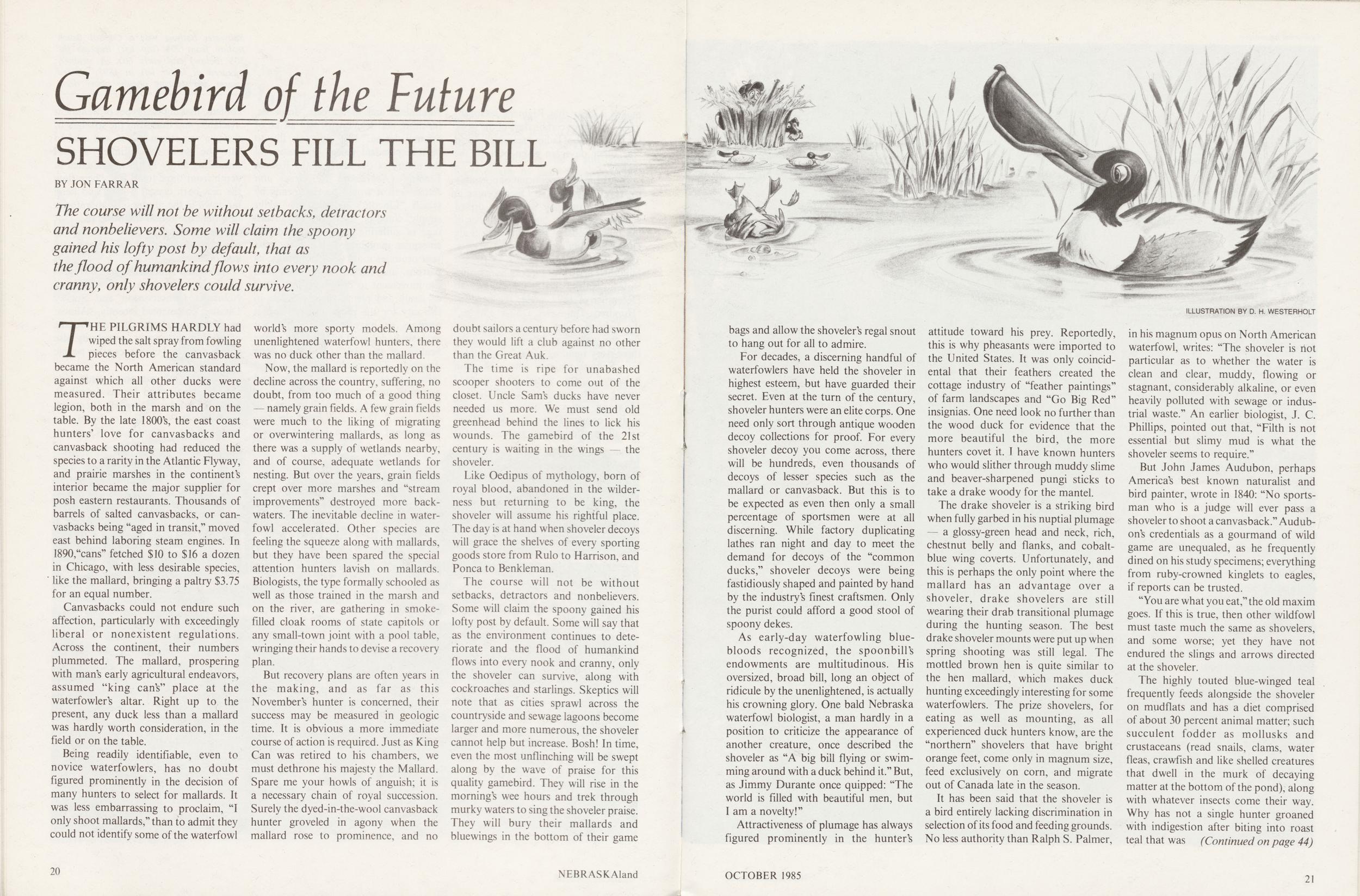
The time is ripe for unabashed scooper shooters to come out of the closet. Uncle Sam's ducks have never needed us more. We must send old greenhead behind the lines to lick his wounds. The gamebird of the 21st century is waiting in the wings the shoveler.
Like Oedipus of mythology, born of royal blood, abandoned in the wilderness but returning to be king, the shoveler will assume his rightful place. The day is at hand when shoveler decoys will grace the shelves of every sporting goods store from Rulo to Harrison, and Ponca to Benkleman.
The course will not be without setbacks, detractors and nonbelievers. Some will claim the spoony gained his lofty post by default. Some will say that as the environment continues to deteriorate and the flood of humankind flows into every nook and cranny, only the shoveler can survive, along with cockroaches and starlings. Skeptics will note that as cities sprawl across the countryside and sewage lagoons become larger and more numerous, the shoveler cannot help but increase. Bosh! In time, even the most unflinching will be swept along by the wave of praise for this quality gamebird. They will rise in the morning's wee hours and trek through murky waters to sing the shoveler praise. They will bury their mallards and bluewings in the bottom of their game 20 NEBRASKaland bags and allow the shoveler's regal snout to hang out for all to admire.
For decades, a discerning handful of waterfowlers have held the shoveler in highest esteem, but have guarded their secret. Even at the turn of the century, shoveler hunters were an elite corps. One need only sort through antique wooden decoy collections for proof. For every shoveler decoy you come across, there will be hundreds, even thousands of decoys of lesser species such as the mallard or canvasback. But this is to be expected as even then only a small percentage of sportsmen were at all discerning. While factory duplicating lathes ran night and day to meet the demand for decoys of the "common ducks," shoveler decoys were being fastidiously shaped and painted by hand by the industry's finest craftsmen. Only the purist could afford a good stool of spoony dekes.
As early-day waterfowling bluebloods recognized, the spoonbill's endowments are multitudinous. His oversized, broad bill, long an object of ridicule by the unenlightened, is actually his crowning glory. One bald Nebraska waterfowl biologist, a man hardly in a position to criticize the appearance of another creature, once described the shoveler as "A big bill flying or swimming around with a duck behind it." But, as Jimmy Durante once quipped: "The world is filled with beautiful men, but I am a novelty!"
Attractiveness of plumage has always figured prominently in the hunter's attitude toward his prey. Reportedly, this is why pheasants were imported to the United States. It was only coincidental that their feathers created the cottage industry of "feather paintings of farm landscapes and "Go Big Red insignias. One need look no further than the wood duck for evidence that the more beautiful the bird, the more hunters covet it. I have known hunters who would slither through muddy slime and beaver-sharpened pungi sticks to take a drake woody for the mantel.
The drake shoveler is a striking bird when fully garbed in his nuptial plumage — a glossy-green head and neck, rich, chestnut belly and flanks, and cobalt-blue wing coverts. Unfortunately, and this is perhaps the only point where the mallard has an advantage over a shoveler, drake shovelers are still wearing their drab transitional plumage during the hunting season. The best drake shoveler mounts were put up when spring shooting was still legal. The mottled brown hen is quite similar to the hen mallard, which makes duck hunting exceedingly interesting for some waterfowlers. The prize shovelers, for eating as well as mounting, as all experienced duck hunters know, are the "northern" shovelers that have bright orange feet, come only in magnum size, feed exclusively on corn, and migrate out of Canada late in the season.
It has been said that the shoveler is a bird entirely lacking discrimination in selection of its food and feeding grounds. No less authority than Ralph S. Palmer, in his magnum opus on North American waterfowl, writes: "The shoveler is riot particular as to whether the water is clean and clear, muddy, flowing or stagnant, considerably alkaline, or even heavily polluted with sewage or industrial waste." An earlier biologist, J. C. Phillips, pointed out that, "Filth is not essential but slimy mud is what the shoveler seems to require."
But John James Audubon, perhaps America's best known naturalist and bird painter, wrote in 1840: "No sportsman who is a judge will ever pass a shoveler to shoot a canvasback." Audubon's credentials as a gourmand of wild game are unequaled, as he frequently dined on his study specimens; everything from ruby-crowned kinglets to eagles, if reports can be trusted.
"You are what you eat," the old maxim goes. If this is true, then other wildfowl must taste much the same as shovelers, and some worse; yet they have not endured the slings and arrows directed at the shoveler.
The highly touted blue-winged teal frequently feeds alongside the shoveler on mudflats and has a diet comprised of about 30 percent animal matter; such succulent fodder as mollusks and crustaceans (read snails, clams, water fleas, crawfish and like shelled creatures that dwell in the murk of decaying matter at the bottom of the pond), along with whatever insects come their way. Why has not a single hunter groaned with indigestion after biting into roast teal that was (Continued on page 44)
OCTOBER 1985 21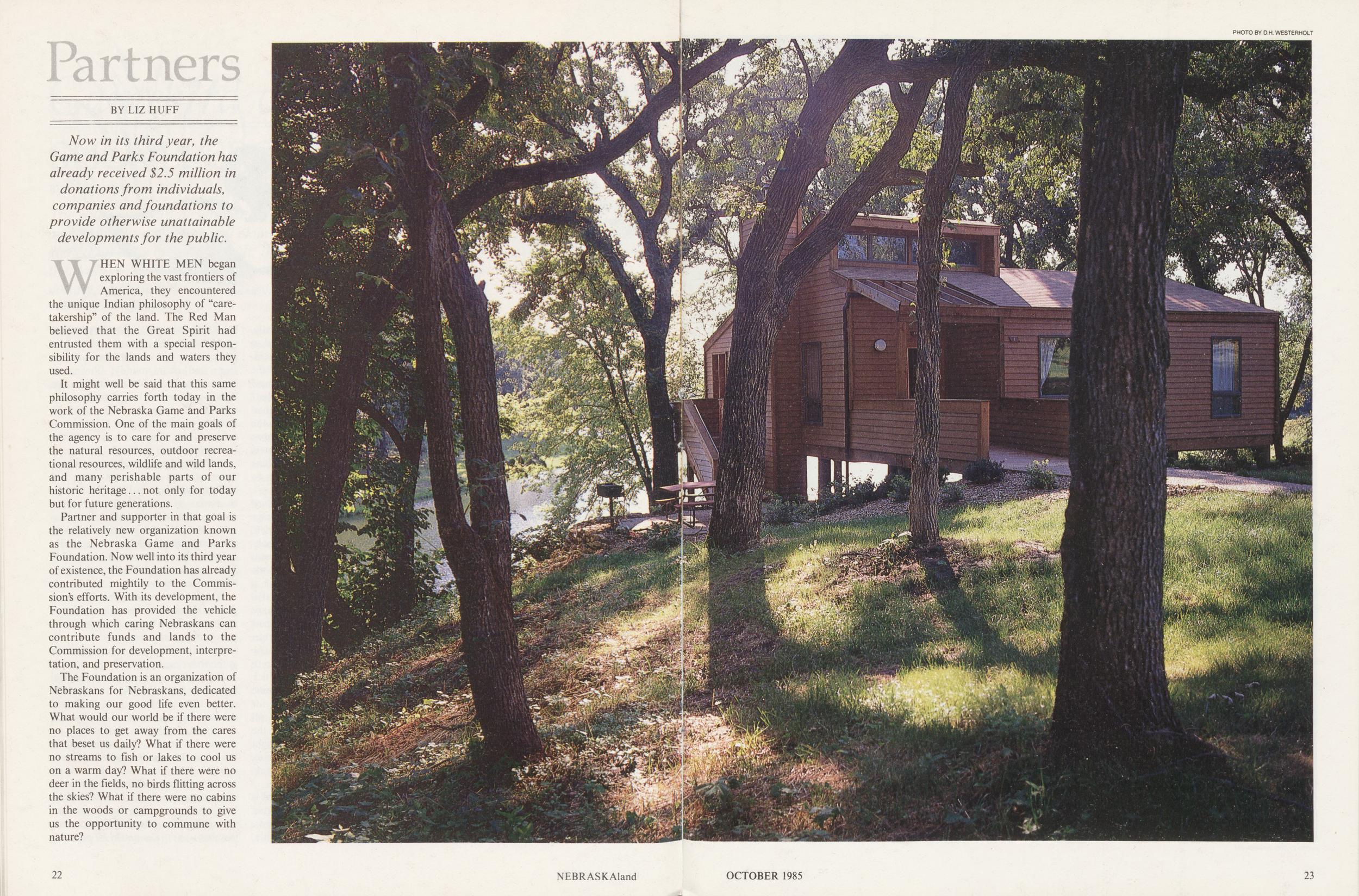
Partners
BY LIZ HUFF Now in its third year, the Game and Parks Foundation has already received $2.5 million in donations from individuals, companies and foundations to provide otherwise unattainable developments for the public.WHEN WHITE MEN began exploring the vast frontiers of America, they encountered the unique Indian philosophy of "caretakership" of the land. The Red Man believed that the Great Spirit had entrusted them with a special responsibility for the lands and waters they used.
It might well be said that this same philosophy carries forth today in the work of the Nebraska Game and Parks Commission. One of the main goals of the agency is to care for and preserve the natural resources, outdoor recreational resources, wildlife and wild lands, and many perishable parts of our historic heritage... not only for today but for future generations.
Partner and supporter in that goal is the relatively new organization known as the Nebraska Game and Parks Foundation. Now well into its third year of existence, the Foundation has already contributed mightily to the Commission's efforts. With its development, the Foundation has provided the vehicle through which caring Nebraskans can contribute funds and lands to the Commission for development, interpretation, and preservation.
The Foundation is an organization of Nebraskans for Nebraskans, dedicated to making our good life even better. What would our world be if there were no places to get away from the cares that beset us daily? What if there were no streams to fish or lakes to cool us on a warm day? What if there were no deer in the fields, no birds flitting across the skies? What if there were no cabins in the woods or campgrounds to give us the opportunity to commune with nature?
22 NEBRASKAland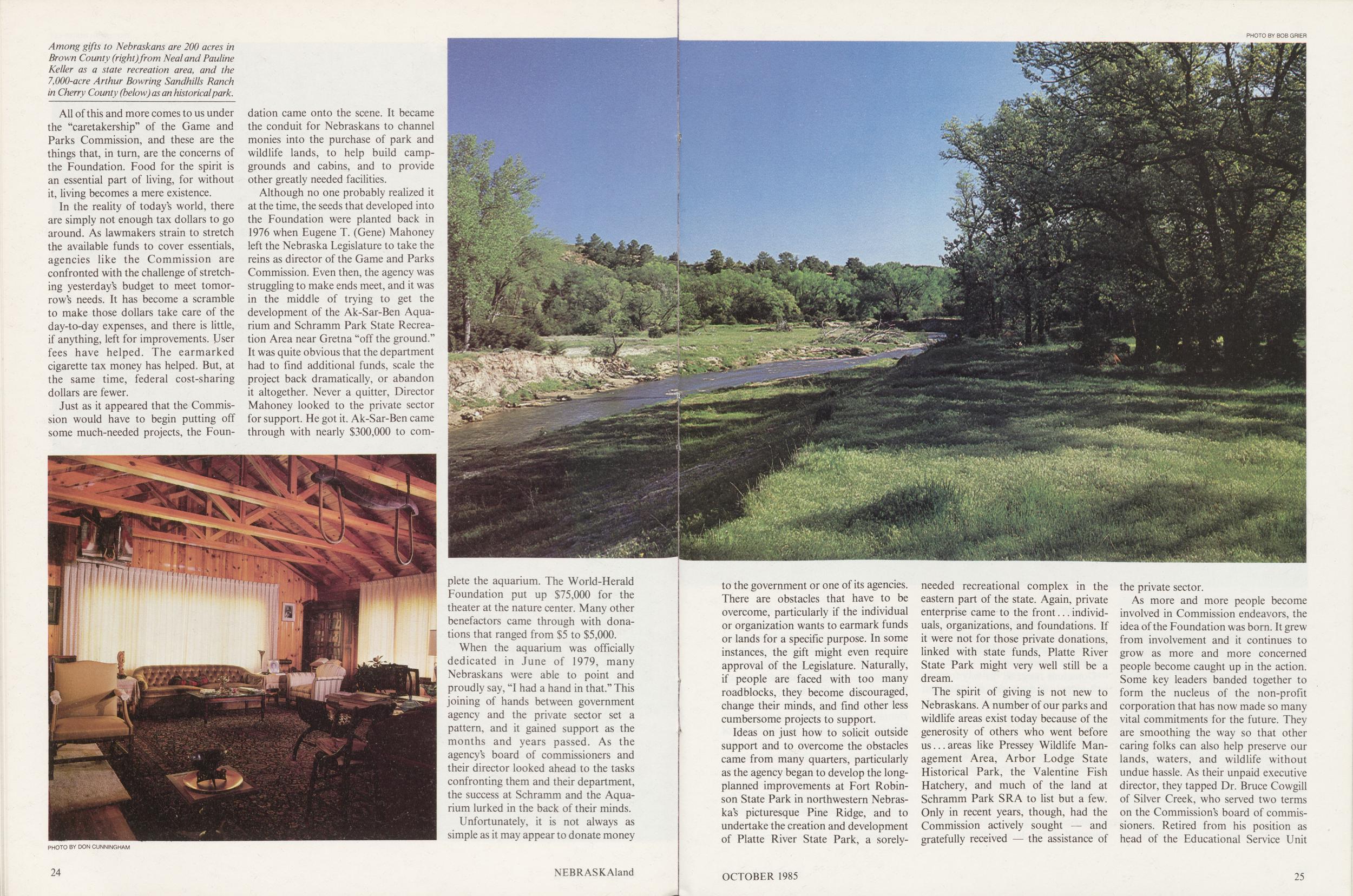 Among gifts to Nebraskans are 200 acres in
Brown County (right)from Nealand Pauline
Keller as a state recreation area, and the
7,000-acre Arthur Bowring Sandhills Ranch
in Cherry County (below) as an historical park.
Among gifts to Nebraskans are 200 acres in
Brown County (right)from Nealand Pauline
Keller as a state recreation area, and the
7,000-acre Arthur Bowring Sandhills Ranch
in Cherry County (below) as an historical park.
All of this and more comes to us under the "caretakership" of the Game and Parks Commission, and these are the things that, in turn, are the concerns of the Foundation. Food for the spirit is an essential part of living, for without it, living becomes a mere existence.
In the reality of today's world, there are simply not enough tax dollars to go around. As lawmakers strain to stretch the available funds to cover essentials, agencies like the Commission are confronted with the challenge of stretching yesterday's budget to meet tomorrow's needs. It has become a scramble to make those dollars take care of the day-to-day expenses, and there is little, if anything, left for improvements. User fees have helped. The earmarked cigarette tax money has helped. But, at the same time, federal cost-sharing dollars are fewer.
Just as it appeared that the Commission would have to begin putting off some much-needed projects, the Foun dation came onto the scene. It became the conduit for Nebraskans to channel monies into the purchase of park and wildlife lands, to help build campgrounds and cabins, and to provide other greatly needed facilities.
Although no one probably realized it at the time, the seeds that developed into the Foundation were planted back in 1976 when Eugene T. (Gene) Mahoney left the Nebraska Legislature to take the reins as director of the Game and Parks Commission. Even then, the agency was struggling to make ends meet, and it was in the middle of trying to get the development of the Ak-Sar-Ben Aquarium and Schramm Park State Recreation Area near Gretna "off the ground." It was quite obvious that the department had to find additional funds, scale the project back dramatically, or abandon it altogether. Never a quitter, Director Mahoney looked to the private sector for support. He got it. Ak-Sar-Ben came through with nearly $300,000 to complete the aquarium. The World-Herald Foundation put up $75,000 for the theater at the nature center. Many other benefactors came through with donations that ranged from $5 to $5,000.
When the aquarium was officially dedicated in June of 1979, many Nebraskans were able to point and proudly say, "I had a hand in that." This joining of hands between government agency and the private sector set a pattern, and it gained support as the months and years passed. As the agency's board of commissioners and their director looked ahead to the tasks confronting them and their department, the success at Schramm and the Aquarium lurked in the back of their minds.
Unfortunately, it is not always as simple as it may appear to donate money 24 NEBRASKAland to the government or one of its agencies. There are obstacles that have to be overcome, particularly if the individual or organization wants to earmark funds or lands for a specific purpose. In some instances, the gift might even require approval of the Legislature. Naturally, if people are faced with too many roadblocks, they become discouraged, change their minds, and find other less cumbersome projects to support.
Ideas on just how to solicit outside support and to overcome the obstacles came from many quarters, particularly as the agency began to develop the longplanned improvements at Fort Robinson State Park in northwestern Nebraska's picturesque Pine Ridge, and to undertake the creation and development of Platte River State Park, a sorely needed recreational complex in the eastern part of the state. Again, private enterprise came to the front... individuals, organizations, and foundations. If it were not for those private donations, linked with state funds, Platte River State Park might very well still be a dream.
The spirit of giving is not new to Nebraskans. A number of our parks and wildlife areas exist today because of the generosity of others who went before us... areas like Pressey Wildlife Management Area, Arbor Lodge State Historical Park, the Valentine Fish Hatchery, and much of the land at Schramm Park SRA to list but a few. Only in recent years, though, had the Commission actively sought — and gratefully received — the assistance of the private sector.
As more and more people become involved in Commission endeavors, the idea of the Foundation was born. It grew from involvement and it continues to grow as more and more concerned people become caught up in the action. Some key leaders banded together to form the nucleus of the non-profit corporation that has now made so many vital commitments for the future. They are smoothing the way so that other caring folks can also help preserve our lands, waters, and wildlife without undue hassle. As their unpaid executive director, they tapped Dr. Bruce Cowgill of Silver Creek, who served two terms on the Commission's board of commissioners. Retired from his position as head of the Educational Service Unit at Columbus, he may well be working harder now on Foundation projects. The same can be said of Harold Andersen, president of the Omaha World-Herald, who serves as the hard-working president of the Foundation. But then, those involved with the Foundation are all there because they care. They receive no reward except the knowledge that they are doing something for the future of Nebraska, and the warm feeling that comes from giving of themselves.
OCTOBER 1985 25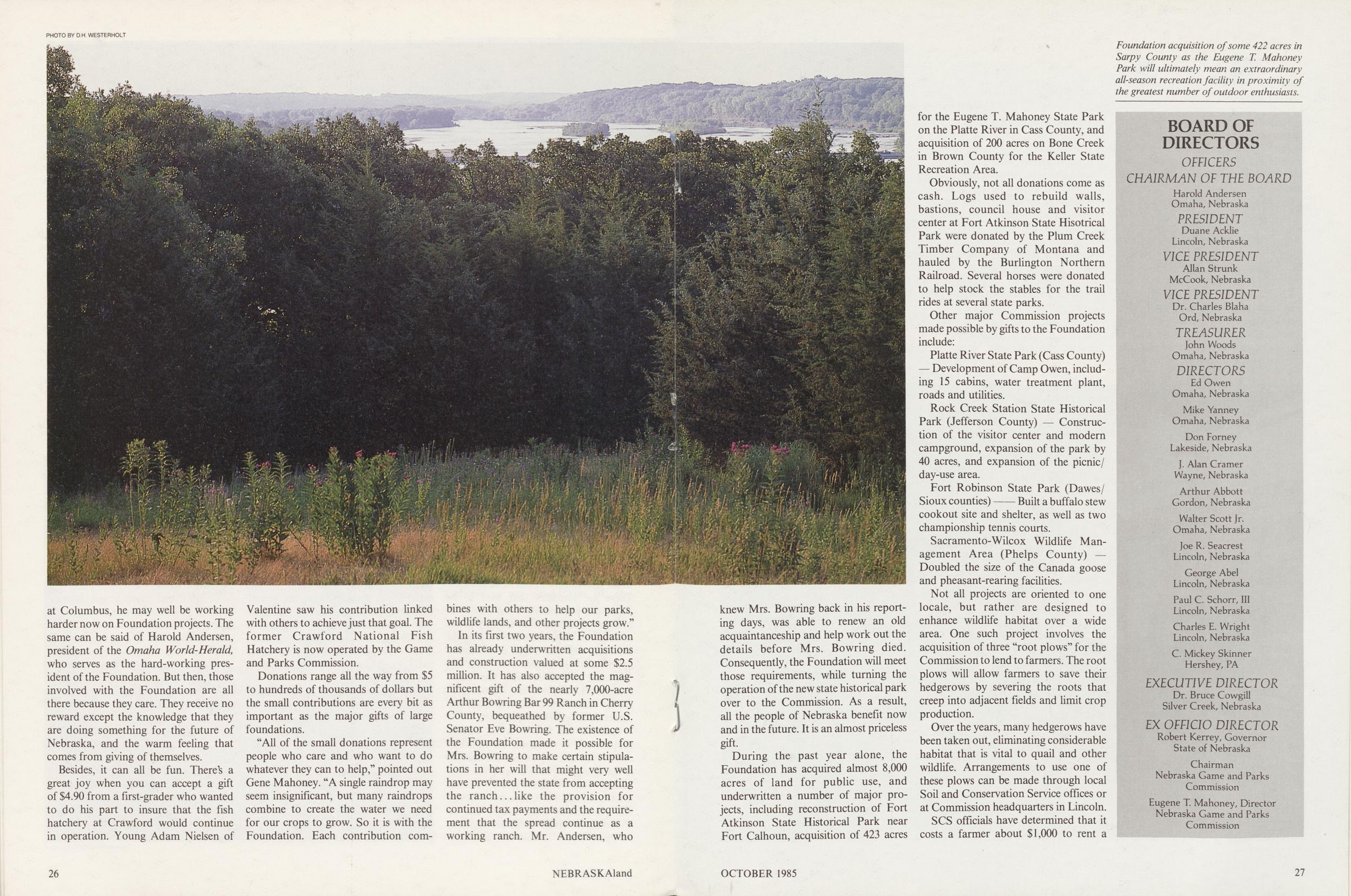
Besides, it can all be fun. There's a great joy when you can accept a gift of $4.90 from a first-grader who wanted to do his part to insure that the fish hatchery at Crawford would continue in operation. Young Adam Nielsen of Valentine saw his contribution linked with others to achieve just that goal. The former Crawford National Fish Hatchery is now operated by the Game and Parks Commission.
Donations range all the way from $5 to hundreds of thousands of dollars but the small contributions are every bit as important as the major gifts of large foundations.
"All of the small donations represent people who care and who want to do whatever they can to help," pointed out Gene Mahoney. "A single raindrop may seem insignificant, but many raindrops combine to create the water we need for our crops to grow. So it is with the Foundation. Each contribution combines with others to help our parks, wildlife lands, and other projects grow."
In its first two years, the Foundation has already underwritten acquisitions and construction valued at some $2.5 million. It has also accepted the magnificent gift of the nearly 7,000-acre Arthur Bowring Bar 99 Ranch in Cherry County, bequeathed by former U.S. Senator Eve Bowring. The existence of the Foundation made it possible for Mrs. Bowring to make certain stipulations in her will that might very well have prevented the state from accepting the ranch... like the provision for continued tax payments and the requirement that the spread continue as a working ranch. Mr. Andersen, who 26 NEBRASKAland knew Mrs. Bowring back in his reporting days, was able to renew an old acquaintanceship and help work out the details before Mrs. Bowring died. Consequently, the Foundation will meet those requirements, while turning the operation of the new state historical park over to the Commission. As a result, all the people of Nebraska benefit now and in the future. It is an almost priceless gift.
During the past year alone, the Foundation has acquired almost 8,000 acres of land for public use, and underwritten a number of major projects, including reconstruction of Fort Atkinson State Historical Park near Fort Calhoun, acquisition of 423 acres for the Eugene T. Mahoney State Park on the Platte River in Cass County, and acquisition of 200 acres on Bone Creek in Brown County for the Keller State Recreation Area.
Obviously, not all donations come as cash. Logs used to rebuild walls, bastions, council house and visitor center at Fort Atkinson State Hisotrical Park were donated by the Plum Creek Timber Company of Montana and hauled by the Burlington Northern Railroad. Several horses were donated to help stock the stables for the trail rides at several state parks.
Other major Commission projects made possible by gifts to the Foundation include:
Platte River State Park (Cass County) — Development of Camp Owen, including 15 cabins, water treatment plant, roads and utilities.
Rock Creek Station State Historical Park (Jefferson County) — Construction of the visitor center and modern campground, expansion of the park by 40 acres, and expansion of the picnic day-use area.
Fort Robinson State Park (Dawes/ Sioux counties)-----Built a buffalo stew cookout site and shelter, as well as two championship tennis courts.
Sacramento-Wilcox Wildlife Management Area (Phelps County) — Doubled the size of the Canada goose and pheasant-rearing facilities.
Not all projects are oriented to one locale, but rather are designed to enhance wildlife habitat over a wide area. One such project involves the acquisition of three "root plows" for the Commission to lend to farmers. The root plows will allow farmers to save their hedgerows by severing the roots that creep into adjacent fields and limit crop production.
Over the years, many hedgerows have been taken out, eliminating considerable habitat that is vital to quail and other wildlife. Arrangements to use one of these plows can be made through local Soil and Conservation Service offices or at Commission headquarters in Lincoln.
SCS officials have determined that it costs a farmer about $1,000 to rent a bulldozer to doze out a half-mile of hedgerow. Using a root plow can accomplish the same purpose in about an hour at a cost to the farmer of about $25, including his labor and fuel for his tractor.
Foundation acquisition of some 422 acres in Sarpy County as the Eugene 77 Mahoney Park will ultimately mean an extraordinary all-season recreation facility in proximity of the greatest number of outdoor enthusiasts. BOARD OF DIRECTORS OFFICERS CHAIRMAN OF THE BOARD Harold Andersen Omaha, Nebraska PRESIDENT Duane Acklie Lincoln, Nebraska VICE PRESIDENT Allan Strunk McCook, Nebraska VICE PRESIDENT Dr. Charles Blaha Ord, Nebraska TREASURER John Woods Omaha, Nebraska DIRECTORS Ed Owen Omaha, Nebraska Mike Yanney Omaha, Nebraska Don Forney Lakeside, Nebraska J. Alan Cramer Wayne, Nebraska Arthur Abbott Gordon, Nebraska Walter Scott Jr. Omaha, Nebraska Joe R. Seacrest Lincoln, Nebraska George Abel Lincoln, Nebraska Paul C. Schorr, III Lincoln, Nebraska Charles E. Wright Lincoln, Nebraska C. Mickey Skinner Hershey, PA EXECUTIVE DIRECTOR Dr. Bruce Cowgill Silver Creek, Nebraska EX OFFICIO DIRECTOR Robert Kerrey, Governor State of Nebraska Chairman Nebraska Game and Parks Commission Eugene T. Mahoney, Director Nebraska Game and Parks Commission OCTOBER 1985 27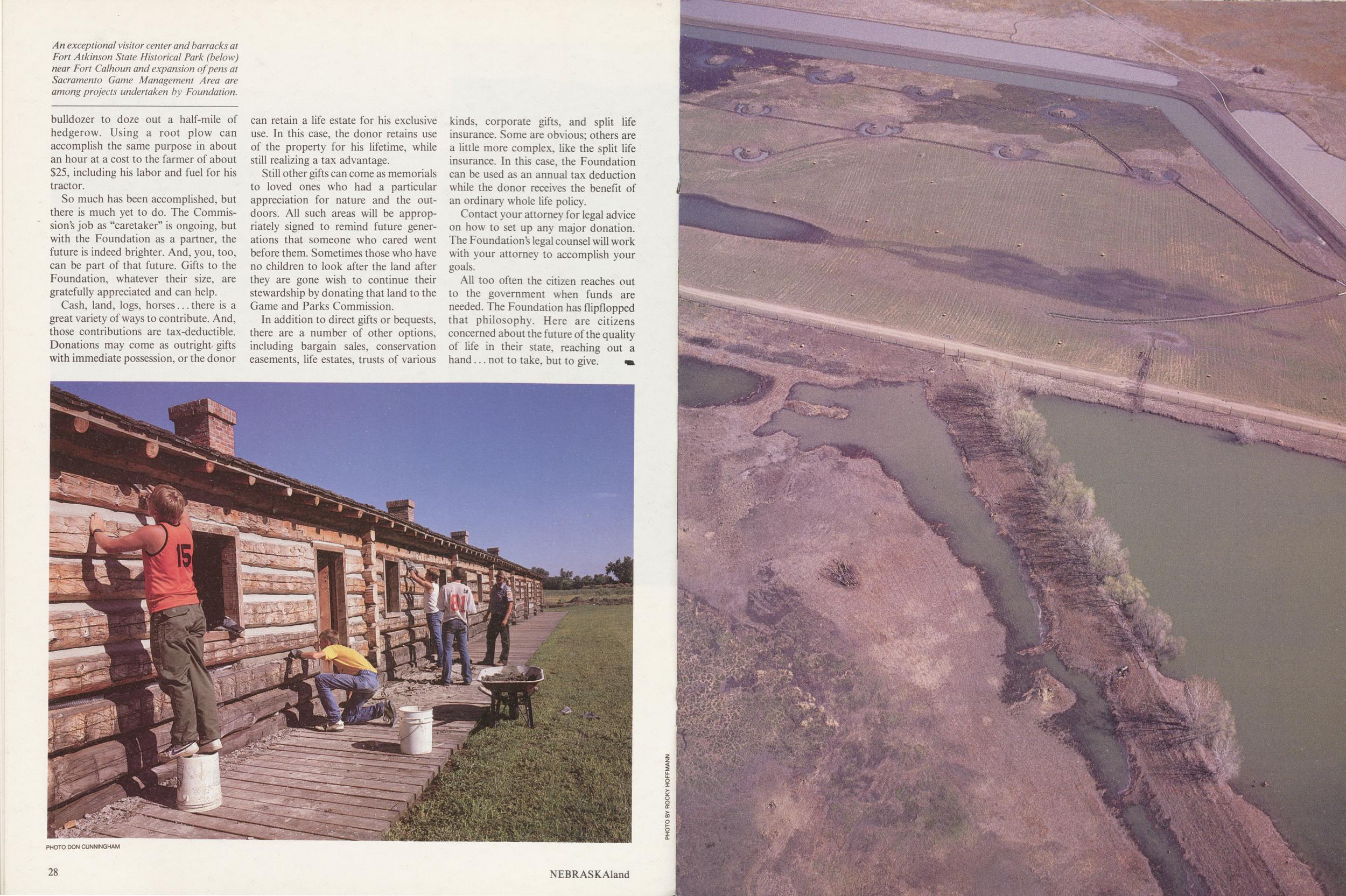 An exceptional visitor center and barracks at
Fort Atkinson State Historical Park (below)
near Fort Calhoun and expansion of pens at
Sacramento Game Management Area are
among projects undertaken by Foundation.
An exceptional visitor center and barracks at
Fort Atkinson State Historical Park (below)
near Fort Calhoun and expansion of pens at
Sacramento Game Management Area are
among projects undertaken by Foundation.
So much has been accomplished, but there is much yet to do. The Commission's job as "caretaker" is ongoing, but with the Foundation as a partner, the future is indeed brighter. And, you, too, can be part of that future. Gifts to the Foundation, whatever their size, are gratefully appreciated and can help.
Cash, land, logs, horses... there is a great variety of ways to contribute. And, those contributions are tax-deductible. Donations may come as outright- gifts with immediate possession, or the donor can retain a life estate for his exclusive use. In this case, the donor retains use of the property for his lifetime, while still realizing a tax advantage.
Still other gifts can come as memorials to loved ones who had a particular appreciation for nature and the outdoors. All such areas will be appropriately signed to remind future generations that someone who cared went before them. Sometimes those who have no children to look after the land after they are gone wish to continue their stewardship by donating that land to the Game and Parks Commission.
In addition to direct gifts or bequests, there are a number of other options, including bargain sales, conservation easements, life estates, trusts of various kinds, corporate gifts, and split life insurance. Some are obvious; others are a little more complex, like the split life insurance. In this case, the Foundation can be used as an annual tax deduction while the donor receives the benefit of an ordinary whole life policy.
Contact your attorney for legal advice on how to set up any major donation. The Foundation's legal counsel will work with your attorney to accomplish your goals.
All too often the citizen reaches out to the government when funds are needed. The Foundation has flipflopped that philosophy. Here are citizens concerned about the future of the quality of life in their state, reaching out a hand... not to take, but to give.
Council of Sportsmen
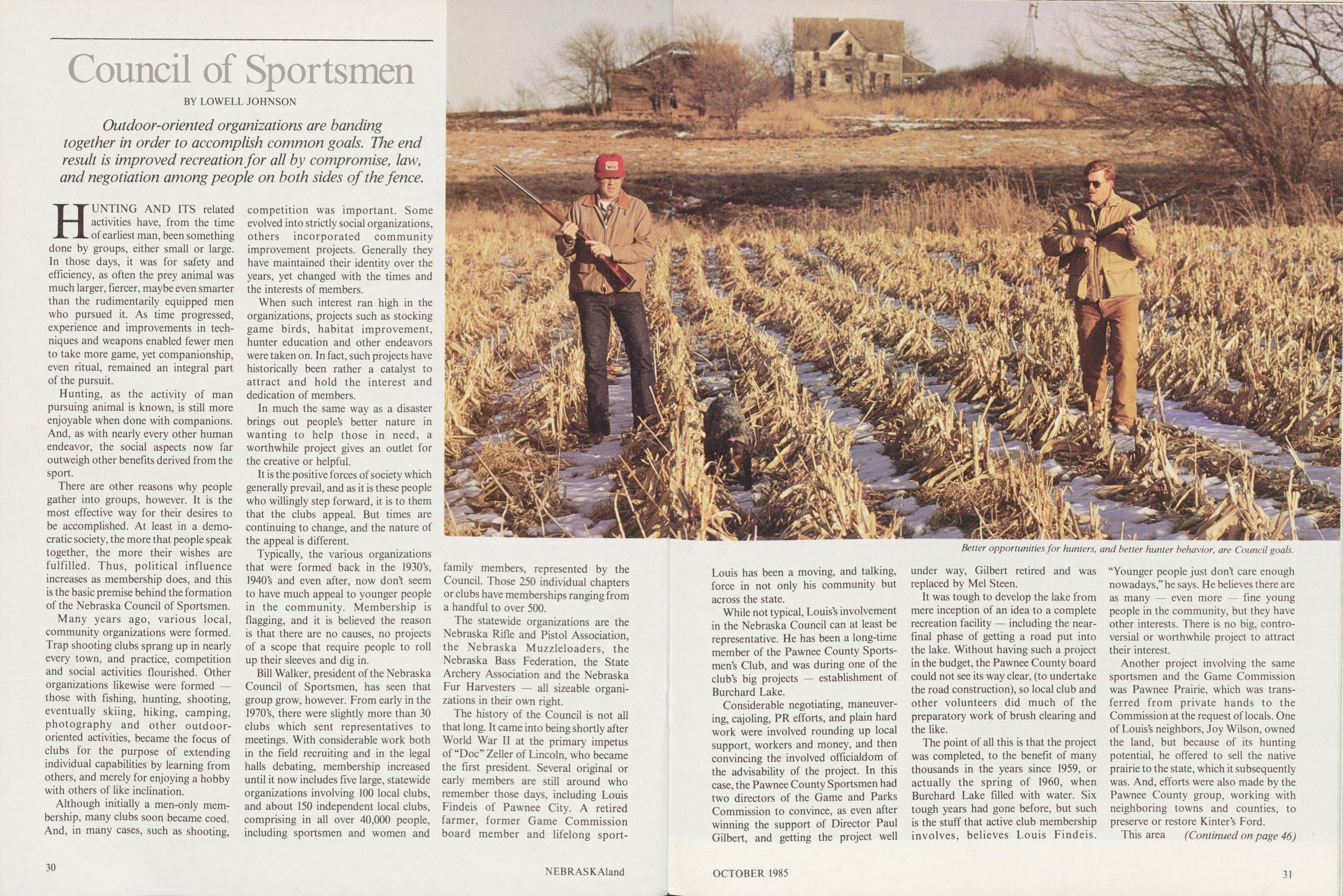
BY LOWELL JOHNSON Outdoor-oriented organizations are banding together in order to accomplish common goals. The end result is improved recreation for all by compromise, law, and negotiation among people on both sides of the fence.HUNTING AND ITS related activities have, from the time of earliest man, been something done by groups, either small or large. In those days, it was for safety and efficiency, as often the prey animal was much larger, fiercer, maybe even smarter than the rudimentarily equipped men who pursued it. As time progressed, experience and improvements in techniques and weapons enabled fewer men to take more game, yet companionship, even ritual, remained an integral part of the pursuit.
Hunting, as the activity of man pursuing animal is known, is still more enjoyable when done with companions. And, as with nearly every other human endeavor, the social aspects now far outweigh other benefits derived from the sport.
There are other reasons why people gather into groups, however. It is the most effective way for their desires to be accomplished. At least in a democratic society, the more that people speak together, the more their wishes are fulfilled. Thus, political influence increases as membership does, and this is the basic premise behind the formation of the Nebraska Council of Sportsmen.
Many years ago, various local, community organizations were formed. Trap shooting clubs sprang up in nearly every town, and practice, competition and social activities flourished. Other organizations likewise were formed those with fishing, hunting, shooting, eventually skiing, hiking, camping, photography and other outdoor- oriented activities, became the focus of clubs for the purpose of extending individual capabilities by learning from others, and merely for enjoying a hobby with others of like inclination.
Although initially a men-only membership, many clubs soon became coed. And, in many cases, such as shooting, competition was important. Some evolved into strictly social organizations, others incorporated community improvement projects. Generally they have maintained their identity over the years, yet changed with the times and the interests of members.
When such interest ran high in the organizations, projects such as stocking game birds, habitat improvement, hunter education and other endeavors were taken on. In fact, such projects have historically been rather a catalyst to attract and hold the interest and dedication of members.
In much the same way as a disaster brings out people's better nature in wanting to help those in need, a worthwhile project gives an outlet for the creative or helpful.
It is the positive forces of society which generally prevail, and as it is these people who willingly step forward, it is to them that the clubs appeal. But times are continuing to change, and the nature of the appeal is different.
Typically, the various organizations that were formed back in the 1930's, 1940's and even after, now don't seem to have much appeal to younger people in the community. Membership is flagging, and it is believed the reason is that there are no causes, no projects of a scope that require people to roll up their sleeves and dig in.
Bill Walker, president of the Nebraska Council of Sportsmen, has seen that group grow, however. From early in the 1970's, there were slightly more than 30 clubs which sent representatives to meetings. With considerable work both in the field recruiting and in the legal halls debating, membership increased until it now includes five large, statewide organizations involving 100 local clubs, and about 150 independent local clubs, comprising in all over 40,000 people, including sportsmen and women and family members, represented by the Council. Those 250 individual chapters or clubs have memberships ranging from a handful to over 500.
The statewide organizations are the Nebraska Rifle and Pistol Association, the Nebraska Muzzleloaders, the Nebraska Bass Federation, the State Archery Association and the Nebraska Fur Harvesters — all sizeable organizations in their own right.
The history of the Council is not all that long. It came into being shortly after World War II at the primary impetus of "Doc" Zeller of Lincoln, who became the first president. Several original or early members are still around who remember those days, including Louis Findeis of Pawnee City. A retired farmer, former Game Commission board member and lifelong sport 30 NEBRASKAland Louis has been a moving, and talking, force in not only his community but across the state.
While not typical, Louis's involvement in the Nebraska Council can at least be representative. He has been a long-time member of the Pawnee County Sports men's Club, and was during one of the club's big projects — establishment of Burchard Lake.
Considerable negotiating, maneuvering, cajoling, PR efforts, and plain hard work were involved rounding up local support, workers and money, and then convincing the involved officialdom of the advisability of the project. In this case, the Pawnee County Sportsmen had two directors of the Game and Parks Commission to convince, as even after winning the support of Director Paul Gilbert, and getting the project well under way, Gilbert retired and was replaced by Mel Steen.
It was tough to develop the lake from mere inception of an idea to a complete recreation facility — including the nearfinal phase of getting a road put into the lake. Without having such a project in the budget, the Pawnee County board could not see its way clear, (to undertake the road construction), so local club and other volunteers did much of the preparatory work of brush clearing and the like.
The point of all this is that the project was completed, to the benefit of many thousands in the years since 1959, or actually the spring of 1960, when Burchard Lake filled with water. Six tough years had gone before, but such is the stuff that active club membership involves, believes Louis Findeis. "Younger people just don't care enough nowadays," he says. He believes there are as many — even more — fine young people in the community, but they have other interests. There is no big, controversial or worthwhile project to attract their interest.
Another project involving the same sportsmen and the Game Commission was Pawnee Prairie, which was transferred from private hands to the Commission at the request of locals. One of Louis's neighbors, Joy Wilson, owned the land, but because of its hunting potential, he offered to sell the native prairie to the state, which it subsequently was. And, efforts were also made by the Pawnee County group, working with neighboring towns and counties, to preserve or restore Kinter's Ford.
This area (Continued on page 46)
OCTOBER 1985 31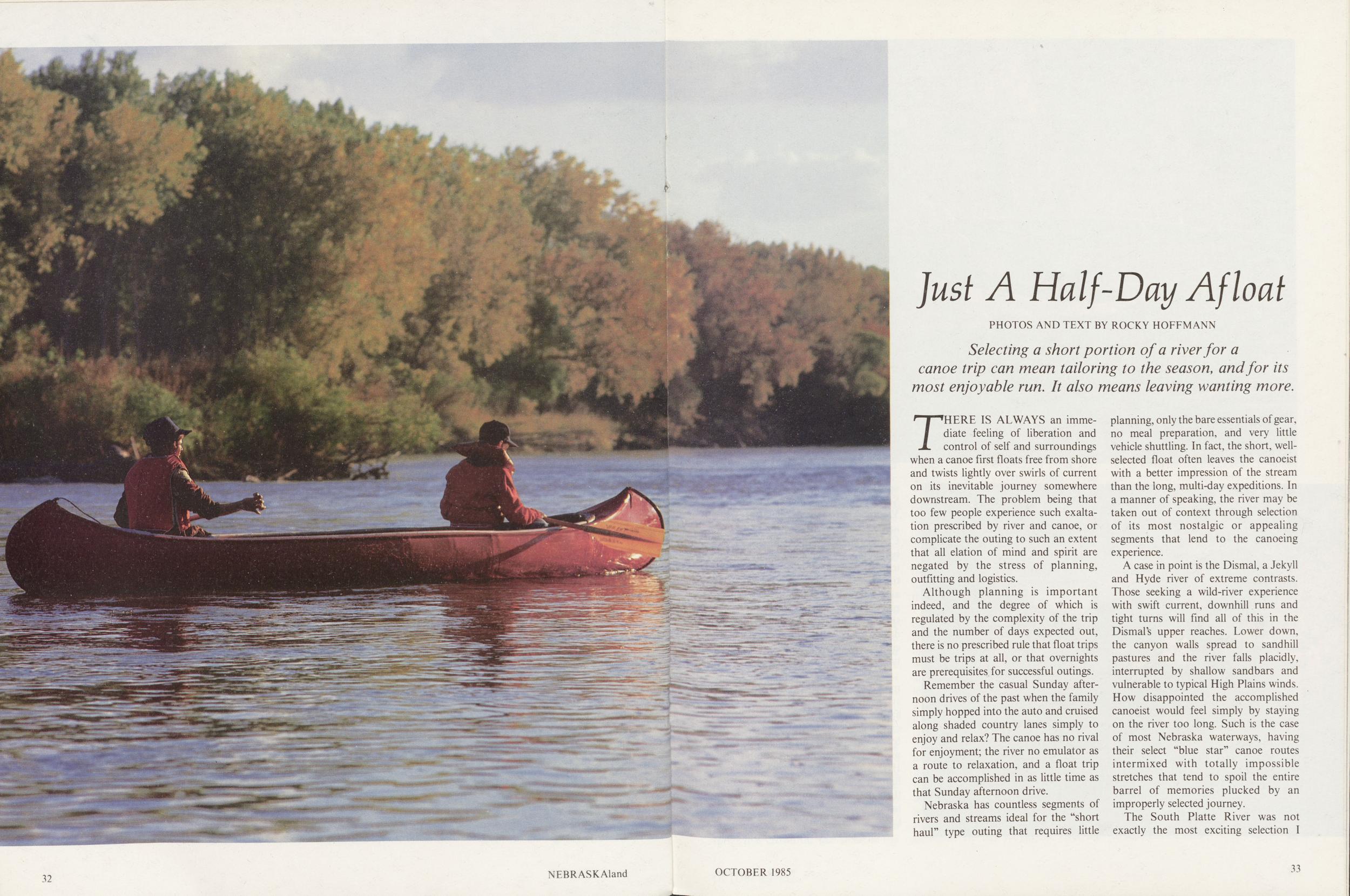
Just A Half-Day Afloat
PHOTOS AND TEXT BY ROCKY HOFFMANN Selecting a short portion of a river for a canoe trip can mean tailoring to the season, and for its most enjoyable run. It also means leaving wanting more.THERE IS ALWAYS an immediate feeling of liberation and control of self and surroundings when a canoe first floats free from shore and twists lightly over swirls of current on its inevitable journey somewhere downstream. The problem being that too few people experience such exaltation prescribed by river and canoe, or complicate the outing to such an extent that all elation of mind and spirit are negated by the stress of planning, outfitting and logistics.
Although planning is important indeed, and the degree of which is regulated by the complexity of the trip and the number of days expected out, there is no prescribed rule that float trips must be trips at all, or that overnights are prerequisites for successful outings.
Remember the casual Sunday afternoon drives of the past when the family simply hopped into the auto and cruised along shaded country lanes simply to enjoy and relax? The canoe has no rival for enjoyment; the river no emulator as a route to relaxation, and a float trip can be accomplished in as little time as that Sunday afternoon drive.
Nebraska has countless segments of rivers and streams ideal for the "short haul" type outing that requires little planning, only the bare essentials of gear, no meal preparation, and very little vehicle shuttling. In fact, the short, wellselected float often leaves the canoeist with a better impression of the stream than the long, multi-day expeditions. In a manner of speaking, the river may be taken out of context through selection of its most nostalgic or appealing segments that lend to the canoeing experience.
A case in point is the Dismal, a Jekyll and Hyde river of extreme contrasts. Those seeking a wild-river experience with swift current, downhill runs and tight turns will find all of this in the Dismal's upper reaches. Lower down, the canyon walls spread to sandhill pastures and the river falls placidly, interrupted by shallow sandbars and vulnerable to typical High Plains winds. How disappointed the accomplished canoeist would feel simply by staying on the river too long. Such is the case of most Nebraska waterways, having their select "blue star" canoe routes intermixed with totally impossible stretches that tend to spoil the entire barrel of memories plucked by an improperly selected journey.
The South Platte River was not exactly the most exciting selection I could think of when invited along on a Sunday afternoon float with Leonard VanErt, his two boys, Tim and Todd, and their close friend and neighbor, Charlie Wedler. The South Platte has two moods: a violent nature, capable of tearing cottonwood and farmstead from time-tested foundations; and that of almost total hibernation — sleeping, placid, nearly currentless, with water shallow enough to poach a minnow during the peak irrigation season. Under either temperament the South Platte is typically not a canoeist's paradise.
OCOBTER 1985 33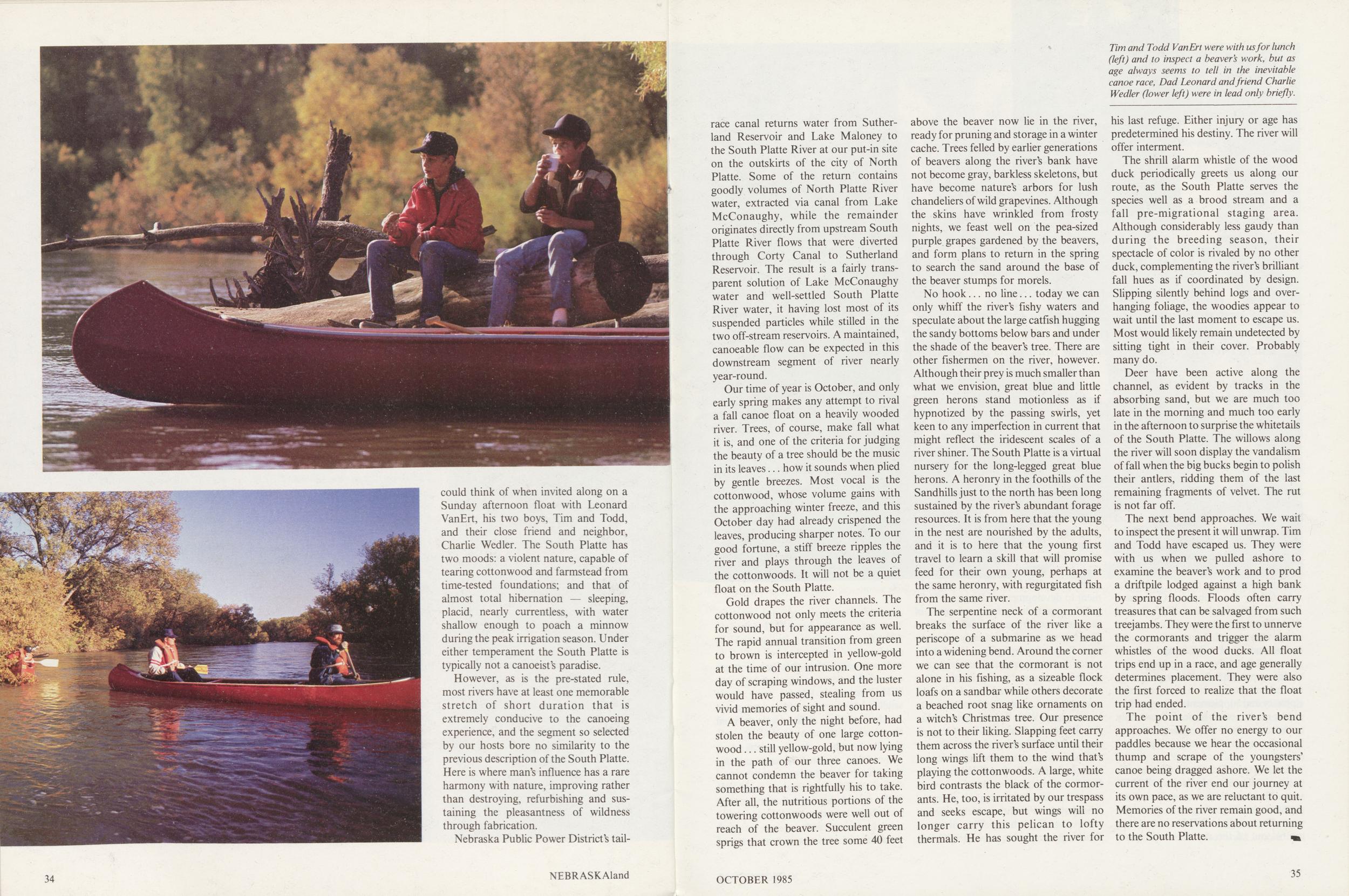
However, as is the pre-stated rule, most rivers have at least one memorable stretch of short duration that is extremely conducive to the canoeing experience, and the segment so selected by our hosts bore no similarity to the previous description of the South Platte. Here is where man's influence has a rare harmony with nature, improving rather than destroying, refurbishing and sustaining the pleasantness of wildness through fabrication.
Nebraska Public Power District's tailrace 34 NEBRASKAland canal returns water from Sutherland Reservoir and Lake Maloney to the South Platte River at our put-in site on the outskirts of the city of North Platte. Some of the return contains goodly volumes of North Platte River water, extracted via canal from Lake McConaughy, while the remainder originates directly from upstream South Platte River flows that were diverted through Corty Canal to Sutherland Reservoir. The result is a fairly transparent solution of Lake McConaughy water and well-settled South Platte River water, it having lost most of its suspended particles while stilled in the two off-stream reservoirs. A maintained, canoeable flow can be expected in this downstream segment of river nearly year-round.
Our time of year is October, and only early spring makes any attempt to rival a fall canoe float on a heavily wooded river. Trees, of course, make fall what it is, and one of the criteria for judging the beauty of a tree should be the music in its leaves... how it sounds when plied by gentle breezes. Most vocal is the cottonwood, whose volume gains with the approaching winter freeze, and this October day had already crispened the leaves, producing sharper notes. To our good fortune, a stiff breeze ripples the river and plays through the leaves of the cottonwoods. It will not be a quiet float on the South Platte.
Gold drapes the river channels. The cottonwood not only meets the criteria for sound, but for appearance as well. The rapid annual transition from green to brown is intercepted in yellow-gold at the time of our intrusion. One more day of scraping windows, and the luster would have passed, stealing from us vivid memories of sight and sound.
A beaver, only the night before, had stolen the beauty of one large cottonwood still yellow-gold, but now lying in the path of our three canoes. We cannot condemn the beaver for taking something that is rightfully his to take. After all, the nutritious portions of the towering cottonwoods were well out of reach of the beaver. Succulent green sprigs that crown the tree some 40 feet above the beaver now lie in the river, ready for pruning and storage in a winter cache. Trees felled by earlier generations of beavers along the river's bank have not become gray, barkless skeletons, but have become nature's arbors for lush chandeliers ofwild grapevines. Although the skins have wrinkled from frosty nights, we feast well on the pea-sized purple grapes gardened by the beavers, and form plans to return in the spring to search the sand around the base of the beaver stumps for morels.
No hook... no line... today we can only whiff the river's fishy waters and speculate about the large catfish hugging the sandy bottoms below bars and under the shade of the beaver's tree. There are other fishermen on the river, however. Although their prey is much smaller than what we envision, great blue and little green herons stand motionless as if hypnotized by the passing swirls, yet keen to any imperfection in current that might reflect the iridescent scales of a river shiner. The South Platte is a virtual nursery for the long-legged great blue herons. A heronry in the foothills of the Sandhills just to the north has been long sustained by the river's abundant forage resources. It is from here that the young in the nest are nourished by the adults, and it is to here that the young first travel to learn a skill that will promise feed for their own young, perhaps at the same heronry, with regurgitated fish from the same river.
The serpentine neck of a cormorant breaks the surface of the river like a periscope of a submarine as we head into a widening bend. Around the corner we can see that the cormorant is not alone in his fishing, as a sizeable flock loafs on a sandbar while others decorate a beached root snag like ornaments on a witch's Christmas tree. Our presence is not to their liking. Slapping feet carry them across the river's surface until their long wings lift them to the wind that's playing the cottonwoods. A large, white bird contrasts the black of the cormorants. He, too, is irritated by our trespass and seeks escape, but wings will no longer carry this pelican to lofty thermals. He has sought the river for his last refuge. Either injury or age has predetermined his destiny. The river will offer interment.
Tim and Todd VanErt were with us for lunch (left) and to inspect a beaver's work, but as age always seems to tell in the inevitable canoe race, Dad Leonard and friend Charlie Wedler (lower left) were in lead only briefly.The shrill alarm whistle of the wood duck periodically greets us along our route, as the South Platte serves the species well as a brood stream and a fall pre-migrational staging area. Although considerably less gaudy than during the breeding season, their spectacle of color is rivaled by no other duck, complementing the river's brilliant fall hues as if coordinated by design. Slipping silently behind logs and overhanging foliage, the woodies appear to wait until the last moment to escape us. Most would likely remain undetected by sitting tight in their cover. Probably many do.
Deer have been active along the channel, as evident by tracks in the absorbing sand, but we are much too late in the morning and much too early in the afternoon to surprise the whitetails of the South Platte. The willows along the river will soon display the vandalism of fall when the big bucks begin to polish their antlers, ridding them of the last remaining fragments of velvet. The rut is not far off.
The next bend approaches. We wait to inspect the present it will unwrap. Tim and Todd have escaped us. They were with us when we pulled ashore to examine the beaver's work and to prod a driftpile lodged against a high bank by spring floods. Floods often carry treasures that can be salvaged from such treejambs. They were the first to unnerve the cormorants and trigger the alarm whistles of the wood ducks. All float trips end up in a race, and age generally determines placement. They were also the first forced to realize that the float trip had ended.
The point of the river's bend approaches. We offer no energy to our paddles because we hear the occasional thump and scrape of the youngsters' canoe being dragged ashore. We let the current of the river end our journey at its own pace, as we are reluctant to quit. Memories of the river remain good, and there are no reservations about returning to the South Platte.
OCTOBER 1985 35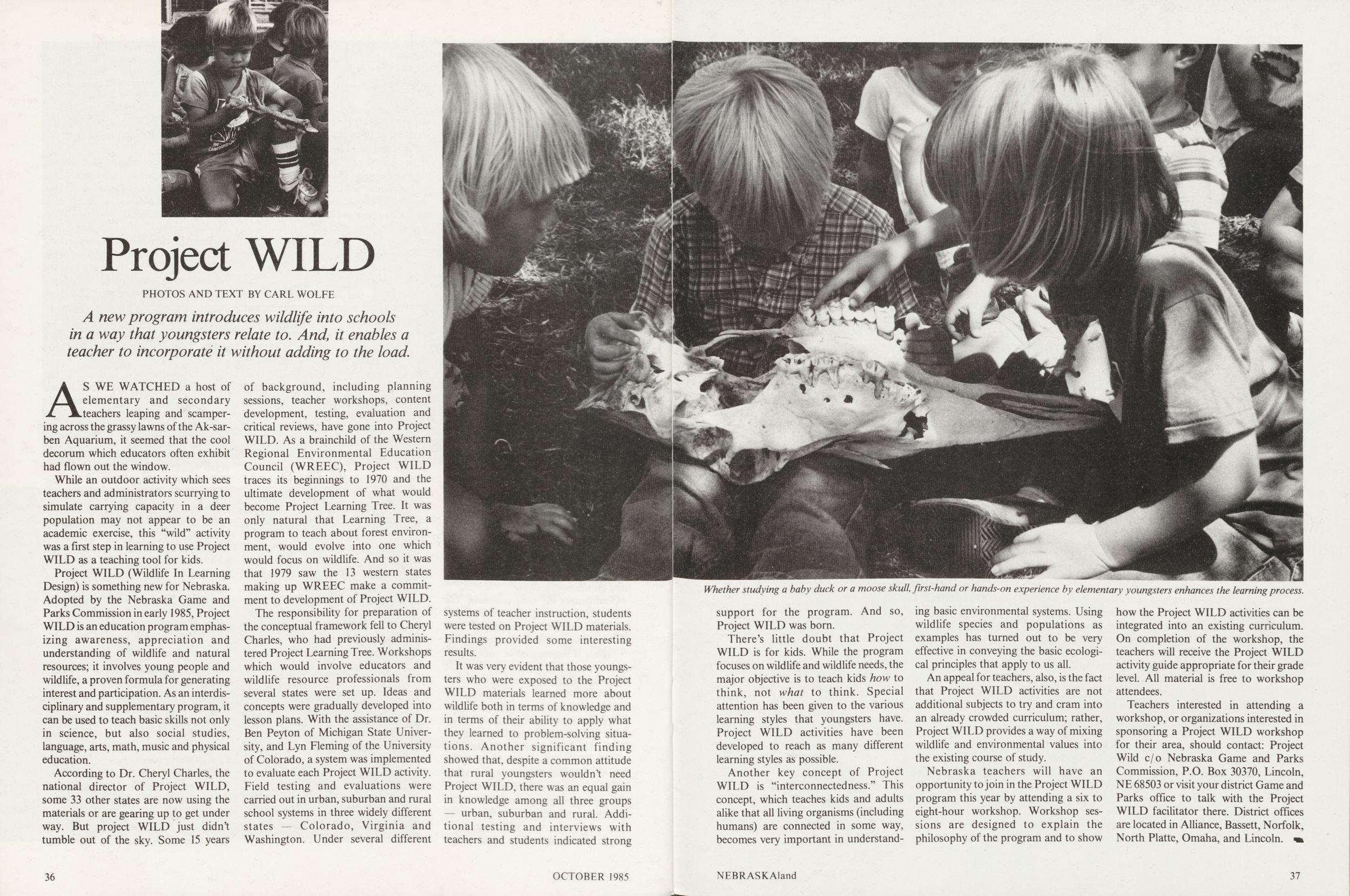
Project WILD
PHOTOS AND TEXT BY CARL WOLFE A new program introduces wildlife into schools in a way that youngsters relate to. And, it enables a teacher to incorporate it without adding to the load.AS WE WATCHED a host of elementary and secondary teachers leaping and scampering across the grassy lawns of the Aksarben Aquarium, it seemed that the cool decorum which educators often exhibit had flown out the window.
While an outdoor activity which sees teachers and administrators scurrying to simulate carrying capacity in a deer population may not appear to be an academic exercise, this "wild" activity was a first step in learning to use Project WILD as a teaching tool for kids.
Project WILD (Wildlife In Learning Design) is something new for Nebraska. Adopted by the Nebraska Game and Parks Commission in early 1985, Project WILD is an education program emphasizing awareness, appreciation and understanding of wildlife and natural resources; it involves young people and wildlife, a proven formula for generating interest and participation. As an interdisciplinary and supplementary program, it can be used to teach basic skills not only in science, but also social studies, language, arts, math, music and physical education.
According to Dr. Cheryl Charles, the national director of Project WILD, some 33 other states are now using the materials or are gearing up to get under way. But project WILD just didn't tumble out of the sky. Some 15 years of background, including planning sessions, teacher workshops, content development, testing, evaluation and critical reviews, have gone into Project WILD. As a brainchild of the Western Regional Environmental Education Council (WREEC), Project WILD traces its beginnings to 1970 and the ultimate development of what would become Project Learning Tree. It was only natural that Learning Tree, a program to teach about forest environment, would evolve into one which would focus on wildlife. And so it was that 1979 saw the 13 western states making up WREEC make a commitment to development of Project WILD.
The responsibility for preparation of the conceptual framework fell to Cheryl Charles, who had previously administered Project Learning Tree. Workshops which would involve educators and wildlife resource professionals from several states were set up. Ideas and concepts were gradually developed into lesson plans. With the assistance of Dr. Ben Peyton of Michigan State University, and Lyn Fleming of the University of Colorado, a system was implemented to evaluate each Project WILD activity. Field testing and evaluations were carried out in urban, suburban and rural school systems in three widely different states — Colorado, Virginia and Washington. Under several different Whether studying a baby duck or a moose skull, first-hand or hands-on experience by elementary youngsters enhances the learning process. systems of teacher instruction, students were tested on Project WILD materials. Findings provided some interesting results.
It was very evident that those youngsters who were exposed to the Project WILD materials learned more about wildlife both in terms of knowledge and in terms of their ability to apply what they learned to problem-solving situations. Another significant finding showed that, despite a common attitude that rural youngsters wouldn't need Project WILD, there was an equal gain in knowledge among all three groups — urban, suburban and rural. Additional testing and interviews with teachers and students indicated strong 36 OCTOBER 1985 support for the program. And so, Project WILD was born.
There's little doubt that Project WILD is for kids. While the program focuses on wildlife and wildlife needs, the major objective is to teach kids how to think, not what to think. Special attention has been given to the various learning styles that youngsters have. Project WILD activities have been developed to reach as many different learning styles as possible.
Another key concept of Project WILD is "interconnectedness." This concept, which teaches kids and adults alike that all living organisms (including humans) are connected in some way, becomes very important in understanding basic environmental systems. Using wildlife species and populations as examples has turned out to be very effective in conveying the basic ecological principles that apply to us all.
An appeal for teachers, also, is the fact that Project WILD activities are not additional subjects to try and cram into an already crowded curriculum; rather, Project WILD provides a way of mixing wildlife and environmental values into the existing course of study.
Nebraska teachers will have an opportunity to join in the Project WILD program this year by attending a six to eight-hour workshop. Workshop sessions are designed to explain the philosophy of the program and to show how the Project WILD activities can be integrated into an existing curriculum. On completion of the workshop, the teachers will receive the Project WILD activity guide appropriate for their grade level. All material is free to workshop attendees.
Teachers interested in attending a workshop, or organizations interested in sponsoring a Project WILD workshop for their area, should contact: Project Wild c/o Nebraska Game and Parks Commission, P.O. Box 30370, Lincoln, NE 68503 or visit your district Game and Parks office to talk with the Project WILD facilitator there. District offices are located in Alliance, Bassett, Norfolk, North Platte, Omaha, and Lincoln.
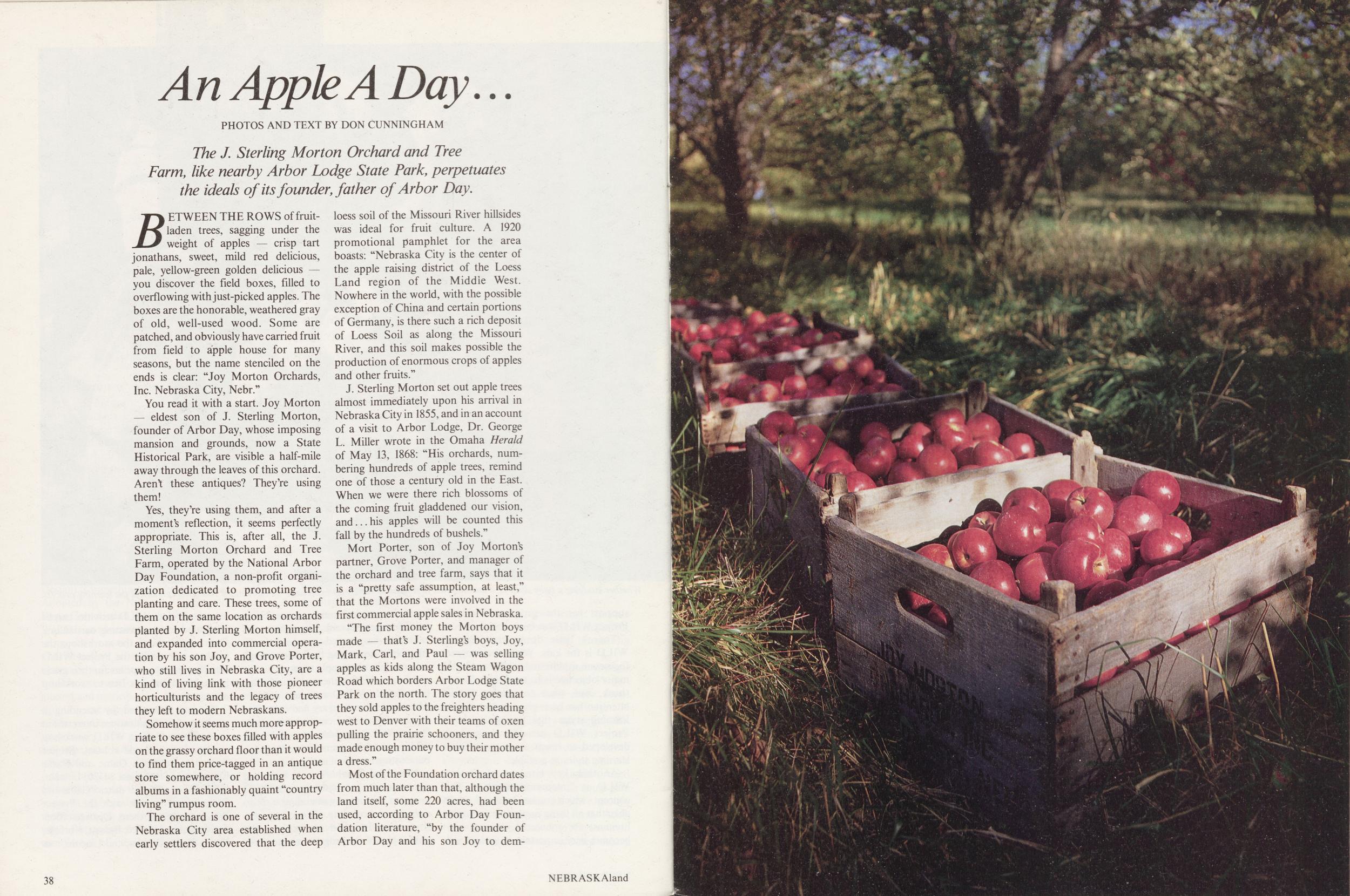
An Apple A Day...
PHOTOS AND TEXT BY DON CUNNINGHAM The J. Sterling Morton Orchard and Tree Farm, like nearby Arbor Lodge State Park, perpetuates the ideals of its founder, father of Arbor Day.ETWEEN THE ROWS of fruit laden trees, sagging under the JLJ weight of apples — crisp tart Jonathans, sweet, mild red delicious, pale, yellow-green golden delicious you discover the field boxes, filled to overflowing with just-picked apples. The boxes are the honorable, weathered gray of old, well-used wood. Some are patched, and obviously have carried fruit from field to apple house for many seasons, but the name stenciled on the ends is clear: "Joy Morton Orchards, Inc. Nebraska City, Nebr."
You read it with a start. Joy Morton — eldest son of J. Sterling Morton, founder of Arbor Day, whose imposing mansion and grounds, now a State Historical Park, are visible a half-mile away through the leaves of this orchard. Arent these antiques? They're using them!
Yes, they're using them, and after a moment's reflection, it seems perfectly appropriate. This is, after all, the J. Sterling Morton Orchard and Tree Farm, operated by the National Arbor Day Foundation, a non-profit organization dedicated to promoting tree planting and care. These trees, some of them on the same location as orchards planted by J. Sterling Morton himself, and expanded into commercial operation by his son Joy, and Grove Porter, who still lives in Nebraska City, are a kind of living link with those pioneer horticulturists and the legacy of trees they left to modern Nebraskans.
Somehow it seems much more appropriate to see these boxes filled with apples on the grassy orchard floor than it would to find them price-tagged in an antique store somewhere, or holding record albums in a fashionably quaint "country living" rumpus room.
The orchard is one of several in the Nebraska City area established when early settlers discovered that the deep loess soil of the Missouri River hillsides was ideal for fruit culture. A 1920 promotional pamphlet for the area boasts: "Nebraska City is the center of the apple raising district of the Loess Land region of the Middle West. Nowhere in the world, with the possible exception of China and certain portions of Germany, is there such a rich deposit of Loess Soil as along the Missouri River, and this soil makes possible the production of enormous crops of apples and other fruits."
J. Sterling Morton set out apple trees almost immediately upon his arrival in Nebraska City in 1855, and in an account of a visit to Arbor Lodge, Dr. George L. Miller wrote in the Omaha Herald of May 13, 1868: "His orchards, numbering hundreds of apple trees, remind one of those a century old in the East. When we were there rich blossoms of the coming fruit gladdened our vision, and...his apples will be counted this fall by the hundreds of bushels."
Mort Porter, son of Joy Morton's partner, Grove Porter, and manager of the orchard and tree farm, says that it is a "pretty safe assumption, at least," that the Mortons were involved in the first commercial apple sales in Nebraska.
"The first money the Morton boys made — that's J. Sterling's boys, Joy, Mark, Carl, and Paul — was selling apples as kids along the Steam Wagon Road which borders Arbor Lodge State Park on the north. The story goes that they sold apples to the freighters heading west to Denver with their teams of oxen pulling the prairie schooners, and they made enough money to buy their mother a dress."
Most of the Foundation orchard dates from much later than that, although the land itself, some 220 acres, had been used, according to Arbor Day Foundation literature, "by the founder of Arbor Day and his son Joy to demonstrate the value and feasibility of growing various shade and fruit trees."
38 NEBRASKAland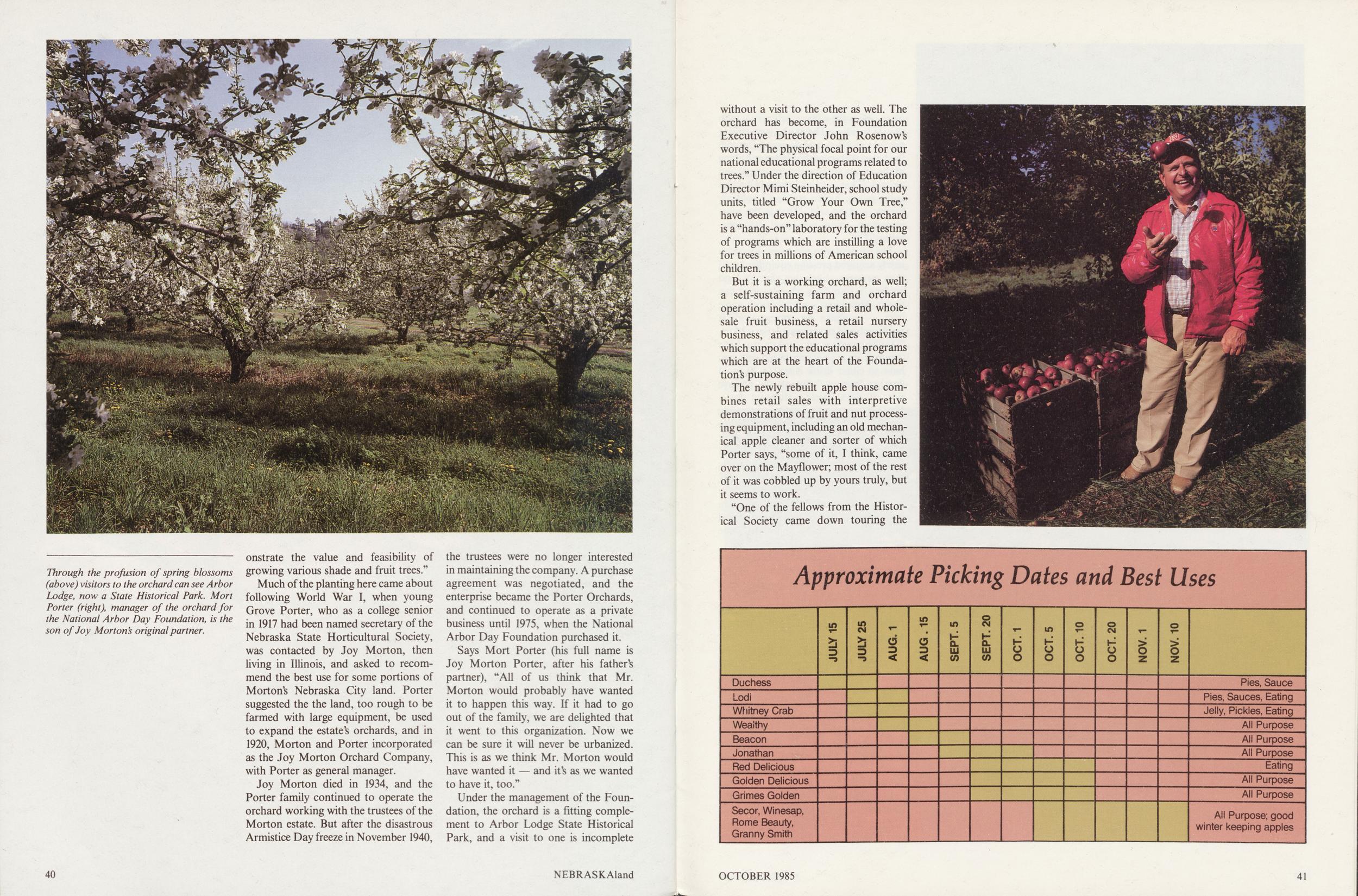
Much of the planting here came about following World War I, when young Grove Porter, who as a college senior in 1917 had been named secretary of the Nebraska State Horticultural Society, was contacted by Joy Morton, then living in Illinois, and asked to recommend the best use for some portions of Morton's Nebraska City land. Porter suggested the the land, too rough to be farmed with large equipment, be used to expand the estate's orchards, and in 1920, Morton and Porter incorporated as the Joy Morton Orchard Company, with Porter as general manager.
Joy Morton died in 1934, and the Porter family continued to operate the orchard working with the trustees of the Morton estate. But after the disastrous Armistice Day freeze in November 1940, the trustees were no longer interested in maintaining the company. A purchase agreement was negotiated, and the enterprise became the Porter Orchards, and continued to operate as a private business until 1975, when the National Arbor Day Foundation purchased it.
Says Mort Porter (his full name is Joy Morton Porter, after his father's partner), "All of us think that Mr. Morton would probably have wanted it to happen this way. If it had to go out of the family, we are delighted that it went to this organization. Now we can be sure it will never be urbanized. This is as we think Mr. Morton would have wanted it — and it's as we wanted to have it, too."
Under the management of the Foundation, the orchard is a fitting complement to Arbor Lodge State Historical Park, and a visit to one is incomplete 40 NEBRASKAland without a visit to the other as well. The orchard has become, in Foundation Executive Director John Rosenow's words, "The physical focal point for our national educational programs related to trees." Under the direction of Education Director Mimi Steinheider, school study units, titled "Grow Your Own Tree," have been developed, and the orchard is a "hands-on" laboratory for the testing of programs which are instilling a love for trees in millions of American school children.
But it is a working orchard, as well; a self-sustaining farm and orchard operation including a retail and wholesale fruit business, a retail nursery business, and related sales activities which support the educational programs which are at the heart of the Foundation's purpose.
The newly rebuilt apple house combines retail sales with interpretive demonstrations of fruit and nut processing equipment, including an old mechanical apple cleaner and sorter of which Porter says, "some of it, I think, came over on the Mayflower; most of the rest of it was cobbled up by yours truly, but it seems to work.
"One of the fellows from the Historical Society came down touring the place, when the same machinery was in the old building. The apples were rolling this way and that, and dropping through the holes; there was the clatter and clang of the chains turning the sprockets, and he said, That...' and I thought he was going to say 'has to go,' and I held my breath, and he said, 'That is the most important thing we have! It's marvelous!'"
Approximate Picking Dates and Best Uses Duchess Pies, Sauce Lodge Pies, Sauces, Eating Whitney Crab Jelly, Pickles, Eating Wealthy AH Purpose Beacon All Purpose Jonathan All Purpose Red Delicious Eating Golden Delicious AH Purpose Grimes Golden All Purpose Secor, Winesap, Rome Beauty, Granny Smith All Purpose; good winter keeping apples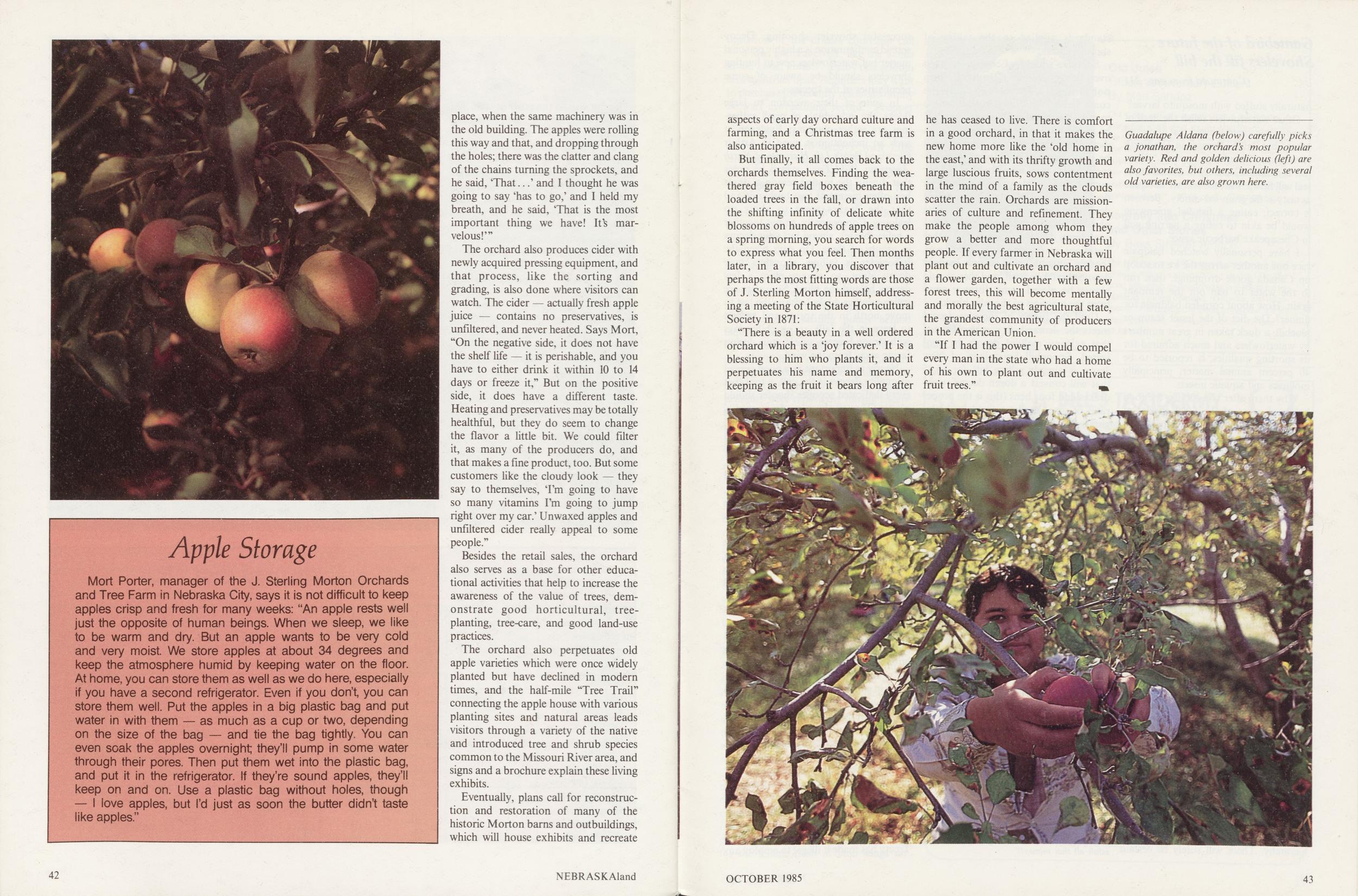
The orchard also produces cider with newly acquired pressing equipment, and that process, like the sorting and grading, is also done where visitors can watch. The cider — actually fresh apple juice — contains no preservatives, is unfiltered, and never heated. Says Mort, "On the negative side, it does not have the shelf life — it is perishable, and you have to either drink it within 10 to 14 days or freeze it," But on the positive side, it does have a different taste. Heating and preservatives may be totally healthful, but they do seem to change the flavor a little bit. We could filter it, as many of the producers do, and that makes a fine product, too. But some customers like the cloudy look — they say to themselves, 'I'm going to have so many vitamins I'm going to jump right over my car.' Unwaxed apples and unfiltered cider really appeal to some people."
Besides the retail sales, the orchard also serves as a base for other educational activities that help to increase the awareness of the value of trees, demonstrate good horticultural, treeplanting, tree-care, and good land-use practices.
The orchard also perpetuates old apple varieties which were once widely planted but have declined in modern times, and the half-mile "Tree Trail" connecting the apple house with various planting sites and natural areas leads visitors through a variety of the native and introduced tree and shrub species common to the Missouri River area, and signs and a brochure explain these living exhibits.
Eventually, plans call for reconstruction and restoration of many of the historic Morton barns and outbuildings, which will house exhibits and recreate 42 NEBRASKAland aspects of early day orchard culture and farming, and a Christmas tree farm is also anticipated.
But finally, it all comes back to the orchards themselves. Finding the weathered gray field boxes beneath the loaded trees in the fall, or drawn into the shifting infinity of delicate white blossoms on hundreds of apple trees on a spring morning, you search for words to express what you feel. Then months later, in a library, you discover that perhaps the most fitting words are those of J. Sterling Morton himself, addressing a meeting of the State Horticultural Society in 1871:
"There is a beauty in a well ordered orchard which is a 'joy forever.' It is a blessing to him who plants it, and it perpetuates his name and memory, keeping as the fruit it bears long after he has ceased to live. There is comfort in a good orchard, in that it makes the new home more like the 'old home in the east,' and with its thrifty growth and large luscious fruits, sows contentment in the mind of a family as the clouds scatter the rain. Orchards are missionaries of culture and refinement. They make the people among whom they grow a better and more thoughtful people. If every farmer in Nebraska will plant out and cultivate an orchard and a flower garden, together with a few forest trees, this will become mentally and morally the best agricultural state, the grandest community of producers in the American Union.
"If I had the power I would compel every man in the state who had a home of his own to plant out and cultivate fruit trees."
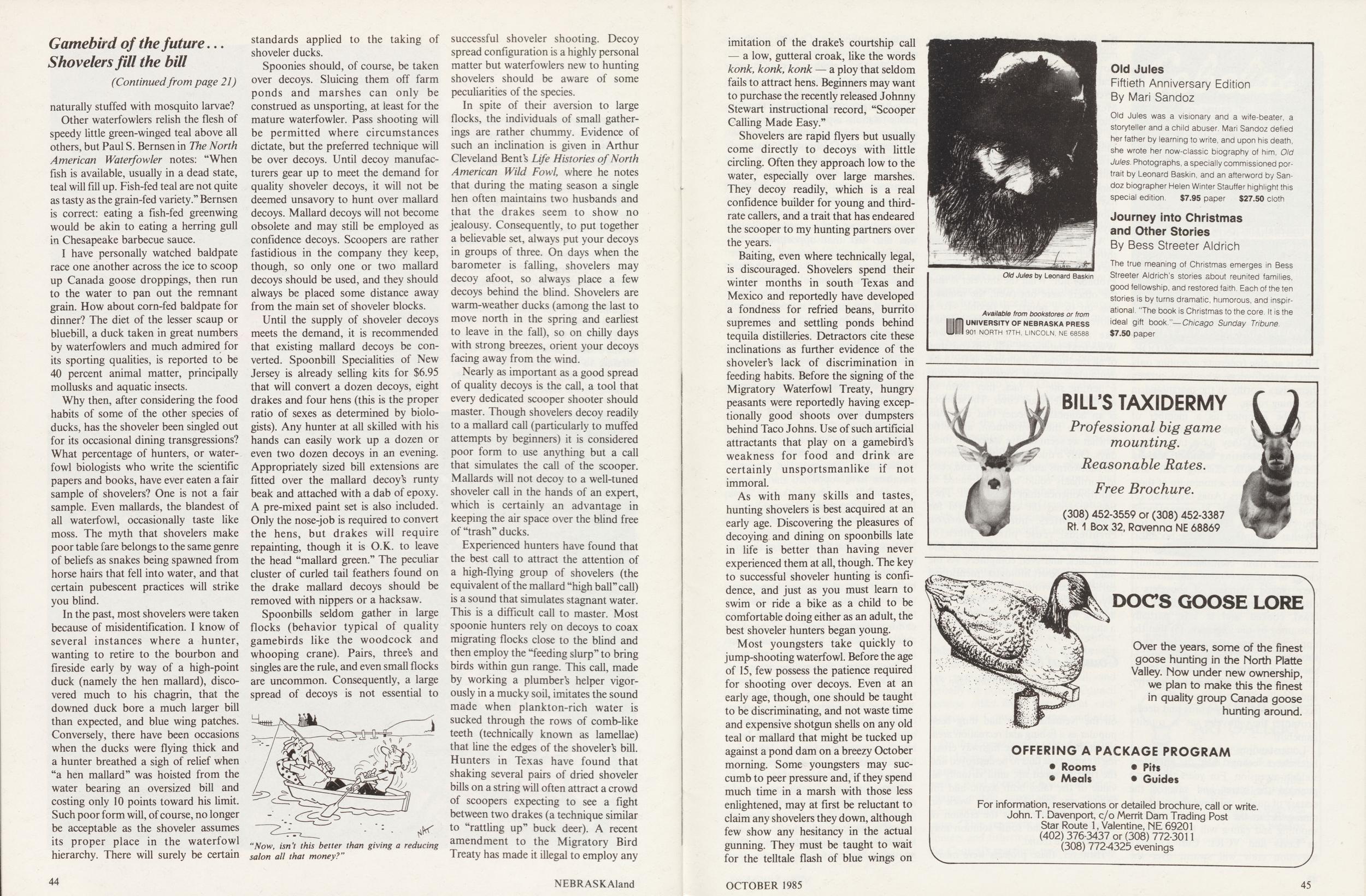
Gamebird of the future Shovelers fill the bill
(Continued from page 21)naturally stuffed with mosquito larvae?
Other waterfowlers relish the flesh of speedy little green-winged teal above all others, but Paul S. Bernsen in The North American Waterfowler notes: "When fish is available, usually in a dead state, teal will fill up. Fish-fed teal are not quite as tasty as the grain-fed variety." Bernsen is correct: eating a fish-fed greenwing would be akin to eating a herring gull in Chesapeake barbecue sauce.
I have personally watched baldpate race one another across the ice to scoop up Canada goose droppings, then run to the water to pan out the remnant grain. How about corn-fed baldpate for dinner? The diet of the lesser scaup or bluebill, a duck taken in great numbers by waterfowlers and much admired for its sporting qualities, is reported to be 40 percent animal matter, principally mollusks and aquatic insects.
Why then, after considering the food habits of some of the other species of ducks, has the shoveler been singled out for its occasional dining transgressions? What percentage of hunters, or waterfowl biologists who write the scientific papers and books, have ever eaten a fair sample of shovelers? One is not a fair sample. Even mallards, the blandest of all waterfowl, occasionally taste like moss. The myth that shovelers make poor table fare belongs to the same genre of beliefs as snakes being spawned from horse hairs that fell into water, and that certain pubescent practices will strike you blind.
In the past, most shovelers were taken because of misidentification. I know of several instances where a hunter, wanting to retire to the bourbon and fireside early by way of a high-point duck (namely the hen mallard), discovered much to his chagrin, that the downed duck bore a much larger bill than expected, and blue wing patches. Conversely, there have been occasions when the ducks were flying thick and a hunter breathed a sigh of relief when "a hen mallard" was hoisted from the water bearing an oversized bill and costing only 10 points toward his limit. Such poor form will, of course, no longer be acceptable as the shoveler assumes its proper place in the waterfowl hierarchy. There will surely be certain standards applied to the taking of shoveler ducks.
Spoonies should, of course, be taken over decoys. Sluicing them off farm ponds and marshes can only be construed as unsporting, at least for the mature waterfowler. Pass shooting will be permitted where circumstances dictate, but the preferred technique will be over decoys. Until decoy manufacturers gear up to meet the demand for quality shoveler decoys, it will not be deemed unsavory to hunt over mallard decoys. Mallard decoys will not become obsolete and may still be employed as confidence decoys. Scoopers are rather fastidious in the company they keep, though, so only one or two mallard decoys should be used, and they should always be placed some distance away from the main set of shoveler blocks.
Until the supply of shoveler decoys meets the demand, it is recommended that existing mallard decoys be converted. Spoonbill Specialities of New Jersey is already selling kits for $6.95 that will convert a dozen decoys, eight drakes and four hens (this is the proper ratio of sexes as determined by biologists). Any hunter at all skilled with his hands can easily work up a dozen or even two dozen decoys in an evening. Appropriately sized bill extensions are fitted over the mallard decoy's runty beak and attached with a dab of epoxy. A pre-mixed paint set is also included. Only the nose-job is required to convert the hens, but drakes will require repainting, though it is O.K. to leave the head "mallard green." The peculiar cluster of curled tail feathers found on the drake mallard decoys should be removed with nippers or a hacksaw.
Spoonbills seldom gather in large flocks (behavior typical of quality gamebirds like the woodcock and whooping crane). Pairs, three's and singles are the rule, and even small flocks are uncommon. Consequently, a large spread of decoys is not essential to successful shoveler shooting. Decoy spread configuration is a highly personal matter but waterfowlers new to hunting shovelers should be aware of some peculiarities of the species.
In spite of their aversion to large flocks, the individuals of small gatherings are rather chummy. Evidence of such an inclination is given in Arthur Cleveland Bent's Life Histories of North American Wild Fowl, where he notes that during the mating season a single hen often maintains two husbands and that the drakes seem to show no jealousy. Consequently, to put together a believable set, always put your decoys in groups of three. On days when the barometer is falling, shovelers may decoy afoot, so always place a few decoys behind the blind. Shovelers are warm-weather ducks (among the last to move north in the spring and earliest to leave in the fall), so on chilly days with strong breezes, orient your decoys facing away from the wind.
Nearly as important as a good spread of quality decoys is the call, a tool that every dedicated scooper shooter should master. Though shovelers decoy readily to a mallard call (particularly to muffed attempts by beginners) it is considered poor form to use anything but a call that simulates the call of the scooper. Mallards will not decoy to a well-tuned shoveler call in the hands of an expert, which is certainly an advantage in keeping the air space over the blind free of "trash" ducks.
Experienced hunters have found that the best call to attract the attention of a high-flying group of shovelers (the equivalent of the mallard "high ball" call) is a sound that simulates stagnant water. This is a difficult call to master. Most spoonie hunters rely on decoys to coax migrating flocks close to the blind and then employ the "feeding slurp" to bring birds within gun range. This call, made by working a plumber's helper vigorously in a mucky soil, imitates the sound made when plankton-rich water is sucked through the rows of comb-like teeth (technically known as lamellae) that line the edges of the shoveler's bill. Hunters in Texas have found that shaking several pairs of dried shoveler bills on a string will often attract a crowd of scoopers expecting to see a fight between two drakes (a technique similar to "rattling up" buck deer). A recent amendment to the Migratory Bird Treaty has made it illegal to employ any 44 NEBRASKAland imitation of the drake's courtship call — a low, gutteral croak, like the words konk, konk, konk — a ploy that seldom fails to attract hens. Beginners may want to purchase the recently released Johnny Stewart instructional record, "Scooper Calling Made Easy."
Shovelers are rapid flyers but usually come directly to decoys with little circling. Often they approach low to the water, especially over large marshes. They decoy readily, which is a real confidence builder for young and thirdrate callers, and a trait that has endeared the scooper to my hunting partners over the years.
Baiting, even where technically legal, is discouraged. Shovelers spend their winter months in south Texas and Mexico and reportedly have developed a fondness for refried beans, burrito supremes and settling ponds behind tequila distilleries. Detractors cite these inclinations as further evidence of the shoveler's lack of discrimination in feeding habits. Before the signing of the Migratory Waterfowl Treaty, hungry peasants were reportedly having exceptionally good shoots over dumpsters behind Taco Johns. Use of such artificial attractants that play on a gamebird's weakness for food and drink are certainly unsportsmanlike if not immoral.
As with many skills and tastes, hunting shovelers is best acquired at an early age. Discovering the pleasures of decoying and dining on spoonbills late in life is better than having never experienced them at all, though. The key to successful shoveler hunting is confidence, and just as you must learn to swim or ride a bike as a child to be comfortable doing either as an adult, the best shoveler hunters began young.
Most youngsters take quickly to jump-shooting waterfowl. Before the age of 15, few possess the patience required for shooting over decoys. Even at an early age, though, one should be taught to be discriminating, and not waste time and expensive shotgun shells on any old teal or mallard that might be tucked up against a pond dam on a breezy October morning. Some youngsters may succumb to peer pressure and, if they spend much time in a marsh with those less enlightened, may at first be reluctant to claim any shovelers they down, although few show any hesitancy in the actual gunning. They must be taught to wait for the telltale flash of blue wings on brown ducks bearing the unmistakable regal snout, and to avoid unsavory hunting companions who wear curly tail feathers in the bands of their hats.
Old Jules by Leonard Baskin Available from bookstores or from UNIVERSITY OF NEBRASKA PRESS 901 NORTH 17TH, LINCOLN, NE 68588 Old Jules Fiftieth Anniversary Edition By Mari Sandoz Old Jules was a visionary and a wife-beater, a storyteller and a child abuser. Mari Sandoz defied her father by learning to write, and upon his death, she wrote her now-classic biography of him, Old Jules. Photographs, a specially commissioned portrait by Leonard Baskin, and an afterword by Sandoz biographer Helen Winter Stauffer highlight this special edition. $7.95 paper $27.50 cloth Journey into Christmas and Other Stories By Bess Streeter Aldrich The true meaning of Christmas emerges in Bess Streeter Aldrich's stories about reunited families, good fellowship, and restored faith. Each of the ten stories is by turns dramatic, humorous, and inspirational. "The book is Christmas to the core. It is the ideal gift book."—Chicago Sunday Tribune. $7.50 paper BILL'S TAXIDERMY Professional big game mounting. Reasonable Rates. Free Brochure. (308) 452-3559 or (308) 452-3387 Rt. 1 Box 32, Ravenna NE 68869 DOCS GOOSE LORE Over the years, some of the finest goose hunting in the North Platte Valley. Now under new ownership, we plan to make this the finest in quality group Canada goose hunting around. OFFERING A PACKAGE PROGRAM Rooms Pits Meals Guides For information, reservations or detailed brochure, call or write. John. T. Davenport, c/o Merrit Dam Trading Post Star Route 1, Valentine, NE 69201 (402) 376-3437 or (308) 772-3011 (308) 7724325 evenings OCTOBER 1985 45
The transition from mallards to shovelers will of course require time; perhaps the passing of a generation. Just as many people clung to their horse-and-buggy rigs when cars first arrived on the scene, there will be those among the waterfowl hunting community who will resist the arrival of the shoveler as the gamebird of the future.
To foster an appreciation for this magnificent species as a sporting bird and quality table fare, and to encourage the highest ethics in its pursuit, a new organization has been founded. The Sacred Communal Order Of Perverse Epicureans Revering Shovelers (SCOOPERS) will bring together shoveler hunters from across the continent and carry the message to the uninitiated and unbelievers. SCOOPERS is an elite fraternity accepting only select waterfowlers who have proven themselves worthy in the marsh and in the dining room.
To be accepted as a member of SCOOPERS, applicants must document that: (1) they have taken, in a prescribed sporting manner and in accordance with existing state and federal regulations, a minimum of three northern shovelers (Anas clypeata); (2) that the taking of aforementioned shovelers was by design and not error; (3) that the applicant made no effort to conceal the taking of aforementioned shovelers from companions, family, clergy or lenders; (4) that said shovelers were picked (skinning of shovelers is discouraged under SCOOPERS by laws), cooked, and at least partially consumed by the applicant; (5) that the applicant takes species other than shovelers only when shovelers are in short supply (the time period applying to the "short supply" clause is hourly); and finally, (6) that the applicant, if accepted, shall, in his words and deeds, promote the shoveler as a quality gamebird.
Long-standing advocates will have bittersweet feelings over the shoveler's sudden ascension. For years they have guarded the secret and savored the ecstasy of quality wildfowl shooting and dining. Before the decade fades, spoony shooting and eating will be as popular as Levi's and VCR's. Curt Gowdy's television crew will swarm over the Rainwater Basin country filming segments for the American Sportsman. Cover blurbs of outdoor magazines will bear titles like: Spoony Hotspot Discovered on Isolated Marsh in Central Mexico; Best Bores and Loads for Shovelers over Decoys; and, there will be a raft of new recipes in Gourmet Magazine like, Double-boiled, Twicewrung Shoveler ala Lemon with Sage and Sauerkraut Dressing. For the handful of esoteric waterfowlers who have long been scooper devotees, the shoveler will be stripped of some of its mystique and charm.
As the general populace embraces the shoveler, will it suffer the same fate as the Great Auk, canvasback and mallard? Probably not. What the shoveler is that the others were not (well, the mallard was up to a point), is flexible. To a shoveler, almost any old mud hole looks like a good place to chow down. Waterfowl biologists will tell you that of all the ducks, the shoveler is the least demanding when it comes to selecting a nesting site; in fact, they seem to actually prefer scant cover. The scooper is an adaptable species that demands little from the environment, and little is what we seem to give waterfowl these days. Only a duck that feeds exclusively on rootworms and green bugs and nests in cornfields could be better suited to North America than the shoveler. They have accepted the civilized world for what it offers: horizon-to-horizon cornfields, reuse pits in place of wetlands, a plethora of insecticides and herbicides, and even computers. As the bald waterfowl biologist mentioned earlier once wrote, "The hen shoveler lays an average clutch of 9.4 eggs," and, adding with obvious admiration, "only a shoveler could lay 0.4 of an egg."
Council of Sportsmen
(Continued from page 31)on the Nemaha River had long been popular as a fishing and recreation area, but straightening of the highway crossing it caused the falls to be destroyed and the river to speed up, until virtually all value of the falls, both scenic and for fishing, was lost. Apparently work on this is continuing, as is the erosion of adjacent land, and some solution may eventually be found.
However, these projects were meant to illustrate the type of people involved in the Council of Sportsmen.
Bill Walker, President of the Council and a real estate man from Omaha, is also a member of the Missouri River Waterfowl Association. He feels that the public relations aspects of hunting are a primary consideration of the Council. The sportsmen of Nebraska were sort of brought together after World War II to provide a legislative voice. These sportsmen started to meet in order to come to agreement on recommendations to be made to the Game and Parks Commission on seasons and the like. It was also felt that opportunities for outdoor recreation in general would be enhanced — they tried not to exclude anyone with a genuine interest in the oudoors. "Any time you join other people of like interests, it helps. It helps the individual by expanding the opportunities available to him, and it helps the whole. It seems that opportunities available, say for hunting, are in direct proportion to an individual's involvement in a local club. Other members will open up new horizons, but the new member may also bring added opportunities with him."
Membership in local clubs and in the Nebraska Council have made an impact in Nebraska. Through the Council, members have supported the Habitat Stamp bill. "Look what that's done," says Bill. "Land acquisition for public use now amounts to about 200,000 acres, which means a terrific impact on hunting, yet that is only a fraction of total land in the state."
Public land, of course, has value far beyond its actual measure. Depending upon its makeup, it can be intensively managed for waterfowl or upland game, or for turkeys and deer, or grouse and antelope. Merely having a sufficient acreage in a single tract to serve as a production area, or providing access for hunters in an otherwise heavily posted region, reduces pressure on landowners. There has been such a concerted effort on the part of anti-hunt groups, more in other sections of the country than here, but here also, that many who are basically neutral post land merely to appease the more rabid of these groups.
Just as farmers are at the questionable mercies of those who determine the prices of their products, because farmers cannot present a solid block, so is the hunter merely an individual who must rely on landowners for a place to hunt, or 46 NEBRASKAland use public land. Certainly it is easier to post one's land, but who benefits from such a negative act? This tends to concentrate hunting even more, albeit with a gradually diminishing number of participants, onto less and less land.
Back in the "old days," there was not much concern over hunting access. This was partly because of farming practices which allowed much higher populations of birds, partly because so little land was posted that it meant little problem for anyone, and partly because of fewer hunters afield — and generally better behavior because of less competition or better cooperation of all parties involved. A less "traditional" attitude these days, a change in philosophy, simply a wider diversity of people, have impacted many aspects of society. In hunting, poor behavior is just remembered longer.
There may be no simple solution to the problem of hunter-landowner relations. But, it is a major objective of the Nebraska Council of Sportsmen, and the many clubs within it, to individually and collectively work on the problem. There is a real effort being put forth to make the hunter more aware of what his responsibilities are to those who provide wild game. While a hunter may be in the field only a day or two each season, perhaps, he wants that experience to be pleasant.
The Council has been active on many fronts. It has supported some legislation, opposed other. Council members testify at hearings of legislative committees, and also appear at hearings of the Game and Parks Commission. They have an interest in seasons, but approach the subject with generally objective and realistic ideas. As Bill Walker says, "A law has to be realistic for people and for enforcement. We try to work with the Commission, but we don't always agree. We have to analyze each topic in a rather broad way because of the diverse interests of our members. We all have to compromise for something to be fair to all. We need to work for wildlife we are all interested in that."
Bill adds that when an issue is there, people tend to band together, but often it's too late then — a unified front ahead of time can forestall trouble — or can help. Because of the short time fuse on new legislation, work is needed within 30 days. "Local clubs are not able to respond in this time, so the Council is really necessary. A course of action is decided ahead of time, then we can act when the time comes, or as we feel they want us to."
Bill also feels that local clubs need to make some changes to appeal to young people. This may be broadening of activities, or having projects that are of interest. There has been a lot of agitation by anti-hunting groups, and the Council has had many confrontations. In many cases, anti-hunters make emotional and often misguided appeals, particularly to young people and non-hunters. "These groups don't know the problems, let alone the solutions; if these people would spend the same amount of money on habitat, we'd have no problems, Bill says.
It is not confrontations that the Council seeks, it is cooperation. There is a genuine concern about problems, and it is such things that the Council is forced to participate in, but there is much more to it.
The largest member club, for instance, the Omaha Fish and Wildlife Club, has raised pheasants ever since that program was undertaken by the Game and Parks Commission, raising several hundred birds each year. Also, the club has sponsored the Omaha Sport Show for 39 consecutive years, which brings together hundreds of exhibitors and thousands of visitors to see new equipment, talk with manufacturers and resort owners, and see what's going on in the sporting world. The Omaha club also holds Hunter Safety classes for youngsters, established a wildlife habit area on one of its lakes, erected wood duck nesting boxes, and operates a trap range with free rounds for youngsters. They have released wild turkeys, stocked fish in Omaha city ponds, co-sponsored the annual Habitat Stamp art contest with the Commission, and more.
Such is the case with other member clubs. Many have projects that benefit wildlife and people, and these activities are encouraged by the Council, and actually are promulgated by the Council because other clubs hear about such projects at Council meetings and start their own.
On the Commission's side of the coin, Ken Johnson, chief of the Terrestrial Game Division, said the Council has been a good sounding board for determining public acceptance of various recommendations and policies over the years. "They represent a cross-section of hunters and fishermen in the state, and the Council's reactions provide a ready response of how a certain management strategy will be accepted," he said. "The Council has been a working force in developing wildlife legislation to protect the resource and insure its future," he added.
Mail today to reserve your Fall issue NAME ADDRESS CITY STATE ZIP 863-510 Sidney Nebraska 69160 Handcrafted by Country Artisans #402 70201 Milliard Decoy #401P 697 2 Decor Planter Size 13 COUNTRY CERAMICS "A WATERFOWL COLLECTION" Exquisite Planters & Decor Pieces Each Similar. But Different Decor Duck Sott Creamy Egg Nog sprinkled lightly with chocolate specks Head detailed Flowers of mixed colors to match any decor and brighten any room Mallard Green head with white neck ring, yellow bill and walnut tone body Perfect for den or family room 401P-697:02 DECOR DUCK W/planter pocket (shown) 401-697:02 DECOR DUCK No planter pocket (not shown) 402-702:01 MALLARD DECOY No planter pocket (shown) 402P-702:01 MALLARD DECOY W/planter pocket (not shown, COUNTRY CERAMICS: 'P.O Box 840 Dept. NL1085 Mahwah. NJ 07430 Check or money order Decor Ducks $19 50 ea/Mallards $'29"50 ea Shipping & handling $4 50 each piece NJ residents add 6% sales tax Shipped UPS Allow 4-6 wks for delivery due to custom craft processing Send for free brochure -AVENUE ART GALLERY Original art by Nebraska artists A unique, one-of-a-kind place gone y EastParkPlaza 66th and O Streets Lincoln, Nebraska Special orders and commissions OCTOBER 1985 47 Harlan County Dam
Vacation Apartments - fully furnished
Color TV Kitchen Facilities Full Baths
Game cleaning room with freezer
One block from shopping center
Weekend or week of pleasant living
Security Deposit Required
Sorry —No Pets
Dean and Esther Stone
Box 145 Ph.(308)799-3422
Republican City, NE 68971
DUCKS
UNLIMITED
We need
your help,
Now.
CEDAR LANE
- Ranch Vacations
Guest ranch in the heart of the Sandhills of
Nebraska. Swimming, spa, horses, canoeing,
trail rides, barbeques, hunting.
BOOKING NOW
Richard and Betty Schroeder HC 2 Box 9C
Stapleton, Nebraska 69163 Ph. 308-587-2233
Birds cant call
for help
when the woods
are on fire.
But you can help.
Get the number of your
fire department.
Then call if
you need help.
Birds cant.
fWt A Public Service
Couk! of This Publication & The Advertising Council
Harlan County Dam
Vacation Apartments - fully furnished
Color TV Kitchen Facilities Full Baths
Game cleaning room with freezer
One block from shopping center
Weekend or week of pleasant living
Security Deposit Required
Sorry —No Pets
Dean and Esther Stone
Box 145 Ph.(308)799-3422
Republican City, NE 68971
DUCKS
UNLIMITED
We need
your help,
Now.
CEDAR LANE
- Ranch Vacations
Guest ranch in the heart of the Sandhills of
Nebraska. Swimming, spa, horses, canoeing,
trail rides, barbeques, hunting.
BOOKING NOW
Richard and Betty Schroeder HC 2 Box 9C
Stapleton, Nebraska 69163 Ph. 308-587-2233
Birds cant call
for help
when the woods
are on fire.
But you can help.
Get the number of your
fire department.
Then call if
you need help.
Birds cant.
fWt A Public Service
Couk! of This Publication & The Advertising Council
In the same vein, Bill Bailey, assistant director of the Commission who works closely with the Council, said, "They have presented very responsible views on hunting and fishing matters, and have provided valuable input, especially in the last 10 years. They have offered many good suggestions that have been followed, and have been good to work with in regard to legislation and regulations."
Such is the main role of the Council — to serve as a coordinating agent and representative for its members. It is a public relations tool between clubs, and for them with outside agencies. "There are a lot of people out there we would like to have as members," Bill said; "people who don't belong to local clubs and should; and those local clubs that haven't joined the Council. It's nice to have a broad base of support to work from, and we feel we would all benefit."
Villains, miscreants and the salt of the earth
(Continued from page 19)salt flats, sat idle for some years after the failure of the salt industry. Burns, who was in the well and windmill business in Lincoln, and Bignell, a railroad man, conceived, according to the reminiscences of Burn's grandaughter, a plan for turning the old basin into a lake. Dike work increased the waterholding capacity of the lake, and the diversion of Oak Creek into the basin created a salt lake about a mile and a half long. The Burlington Railroad built a spur to the area, and Barbour reported in 1903 that "Groves were planted around it; pavilions, bath houses, and restaurants were built, a small steamer and numerous sail and rowboats added, and the whole given the rather pretentious name of Burlington Beach."
Pretentious or not, the new resort fascinated Lincolnites. It is reported that in its heyday, Burlington Beach attracted 150,000 visitors each summer, and in 1896, presidential candidate William McKinley spoke there. A pavilion over the water offered dancing, and a doubledecker stern wheel steam boat shipped from Beatrice as the "Queen of the Blue," later renamed "The City of Lincoln," took passengers for rides on the lake. Nellie Burns Goodwin, daughter of developer Joseph Burns, reminiscing in 1961, remembered "From early morning until late at night, people danced on the upper deck of The Belle. I can still hear the music.
"During the week, Lincoln people came on horseback or by horse and buggy — Indians traveling through stopped for salt. It was an exciting time and a thrilling experience to ride with my mother and father by horse and buggy, mother with a gun across her lap, to take the holiday's proceeds into Lincoln." {Lincoln Journal, February 23, 1961).
But hard times at the turn of the century, and troubles with the dam, drained away both the crowds and much of the lake, and the beach went into decline. In 1906 it was purchased by John A. Buckstaff, who reopened it as Capitol Beach, in spite of opposition from the Oak Creek Drainage District which feared the dam would raise the salt levels in nearby agricultural land, and who questioned the legality of the original diversion of the creek's water. Buckstaff perservered, however, planting new rose gardens, trees, a "Japanese" garden and expanding the facilities.
Still, among the chief attractions was the water, which besides having wondrous curative powers, was reported to be just right for making pickles, and it is said that after their outings, some visitors would take home barrels of brine for that purpose.
After Buckstaff's death in 1913, Capitol Beach again declined. There was considerable support for a proposal in 1915 for the city to buy the property as a park, but residents near the newly developed Antelope Park east of the city center feared that Capitol Beach would divert attention and funds from their park, and in 1916, the Beach was leased to the Lincoln Traction Company.
In the 1920's, the land was sold to the Central Realty and Investment Company, much to the distress of C. H. Bullock. He had been among the last of the holders of the often-transferred lease in the salt basin, and although an old man in 1924, he published, at his own expense, a fiery, rambling pamphlet called "Millions on Millions of Dollars for the State in Nebraska's Great Salt Lake at Capital (sic) Beach." In it he vigorously protested the sale of the
46 NEBRASKAlandTrading Post
DOGSTRAINING ALL BREEDS Hunting Dogs Vizslas for sale Rozanek Kennels, Rt. 2, Schuvler, NE 68661. Phone (402) 352-8769.
A FEW HUNTING dogs for sale: Brittanies, English setters, German shorthairs. Darrell Yentes, Phone (308) 995-8570 or (308) 995^1797 after 5 p.m.
FNGL1SH SETTERS and Labradors: "Bred for the hunter"; outstanding bloodlines! Puppies, started dogs and stud service available. High Plains Kennels, 1411 Emerson, Alliance, Nebr. 69301. Phone (308) 762-6709.
PLATTE RIVER KENNELS (started and trained hunting dogs Brits, shorthairs and Labs), Lexington, Nebr. Call evenings (308) 324-6093.
CLASS GUN DOG PROSPECT. AKC and FDSB German Shorthair Pointer puppies. All white, liver heads Champion sire. Dam is AKC Derby Puppy Stakes Winner. Bob Erbv, 1333 South 162nd Avenue, Omaha, NE 68130. Phone'(402) 330-2830.
1-YEAR-OLD English pointer male bird dog, fullv trained. Call (402) 873-6288 before 8 a.m. or after 6 p.m.
BRITTANIES: Puppies, started gun-dogs available now. Quality breeding program — fully guaranteed. Free brochure. Grouseway Gun-Dogs, HC #1, Box 126, Stapleton, NE 69163. Phone (308) 636-2495.
MISCELLANEOUSFISH FOR SALE. Channel catfish, bass, bluegill, crappie, trout, perch, white bass, minnows, hybrid grass carp, bullhead. We can ship fish, you can pick them up, or we can deliver. Contact the Pleasant Valley Fish Farm, Rt. 1, McCook, NE 69001. Phone (308) 345-6599.
N.E. NEBRASKA TROUT Fishing. For rent Mon.-Thurs. or Fri.-Sun. 2 modern cottages completely furnished. 5 spring-fed lakes with trout up to 7 lbs. Bass and bluegill also. Diamond E Trout Resort, Orchard. NE 68764. (402) 8934745.
WINE AND BEER: Make your own. Send for free recipes and instructions. Omaha Supply, 13616 Polk St., Omaha NE 68137. Phone (402) 895-2803.
COMPLETE FUR service; repair, restyling, large inventory of new coats at saving prices. Will custommake garments from your skins, either raw or dressed. Offer service of tanning including all fine skins, deer and sheep. 50 years' experience. Haeker's Furriers, Alma Tanning Co., Box 270, Alma, NE 68920.
BEER KIT everything to make 5 gallons of delicious home-made beer except bottles. Makes 50 bottles. Drink in 6 weeks. $39 includes tax and shipping. Omaha Supply, 13616 Polk St, Omaha, NE 68137. Phone (402) 895-2803.
ACREAGE WITH stocked sandpit between Albion and St Edward, Nebraska. 46 acres of habitat bordering Beaver Creek on main road served by rural power. Ideal site for retirement home or weekend cabin. Century 21 Campbell Realty, Columbus. Nebr. Phone (402) 564-1333.
FULL-WING MANDARINS and wood ducks for fall delivery; fully matured birds. Mrs. R. W. Hansen, 3315 Avenue L, Kearney, NE 68847. Phone (308) 237-3781.
PHEASANTS; Full-grown birds, ready for release this fall. Frontier Birds Inc., Wauneta. NE 69045. Phone (308) 394-5577 days, or (308) 394-5715 evenings.
GUNS -- Browning, Winchester, Remington, others, Hi-powers, shotguns, new, used, antiques. Want Pre-1964 Winchesters. Buy-Sell-Trade. Ph. (402) 729-6112. Bedlan's Sporting Goods, Fairbury, NE 68352.
BEAUTIFUL RECREATION home 5 miles from Merritt Dam Trading Post, Valentine, Nebr. 2 years old, all electric, 2 bedroom, 1 bath, completely furnished and will accommodate 3 couples. Immediate possession. Contact Calvin Jones, Box 136, Thedford, NE 69166 Phone (308) 645-2583.
DECOY BOATS- BLIND BOATS and accessories. Fiberglass or wood construction. On-site installation available. Free brochure. G. R. Boat Works, 404 W 13th St., Grand Island, Ne., 68801. Phone (308) 381-0966.
MAIL ORDER from new brochure showing 40 designs of Nebraska Canoeing T-shirts. Write Wilson Outfitters Nebraska, 621T Sunrise Rd., Lincoln, NE 68510 or Rocky Camp and Canoe Base, Box 3, Valentine, NE 69201.
JEWEl RY: Earrings and necklaces handcrafted in the tradition of the Plains Indian. Stylish by today's standards, and affordable. Send S.A.S.E. for flyer. M. Heils 202 Hackberry Dr., Gretna, NE 68028
SMALLMOUTH BASS and black crappie reared on formulated feed for cage or pond stocking. Fattig Fish Hatchery, Brady, NE. Phone (308) 584-3451
LIVE-CATCH ALL-PURPOSE TRAPS Wrtftor FREE Traps without injury squirrels, chipmunks, rabbits, mink, fox, raccoons, stray animals, pests, etc. Sizes for every need. Also traps for snakes, sparrows, pigeons, crabs, turtles, quail, etc. Save on our low factory prices Send no money Free catalog and trapping secrets MUSTANG MFG. CO., Dept. N-34, Box 920947, Houston, Tex. 77292 LETS pool IPCETHER AMERICA FOR SALE in Aggie's Acres All-new planned development offering lots on Nebraska's newest reservoir. Just 6 miles west of Burwell at the Calamus Reservoir 36 miles of sandy beach, offering the finest in fishing, boating, and recreation. contact: Shonka Real Estate, Inc. 400 E. Douglas, O'Neill, Nebraska 68763 (402) 336-3500 Own a piece of the Good Life!ATTENTION Duck hunters. For a productive place to hunt ducks, try farm ponds. Maps available listing farm ponds and their locations in the following counties: Douglas-Sarpy, Saunders, Butler, Seward, Lancaster, Cass, Otoe, Johnson, Nemaha, Richardson, Pawnee, Gage, Jefferson and Saline. $2.95 for each plus .50 cents postage. Write Pond Hopper, Box 5863, Lincoln, NE 68505.
GUN FOR SALE Winchester, Model 12, 12-gauge 2% chamber, full choke, 28" barrel - Serial No. 1553377. Very good condition! Contact Ervin Kraus, Tuxedo Park, Crete, NE 68333. Phone (402) 826-2846.
MAD RIVER CANOES offers the finest quality and performance. For the finest canoes and accessories, look to Great Plains Canoe Co., 205 Main, Springfield, NE 68059. Phone (402) 253-2001.
WILD TURKEYS, pheasants, for sale. Taking orders for spring chicks. Four Pines Game Farm, Roca, NE. Phone (402) 792-2039 or (402) 435-8159.
TAXIDERMYPLATTE VALLEY TAXIDERMY. Museum quality mounts using latest scientific methods. 1985 World Taxidermy Competition winner. Delton Wegner, 617 "H" Street, Central City, NE 68826. Telephone (308) 946-3773.
HASTINGS TAXIDERMY. Awarded winner at the 1985 World Taxidermy Championships — Commercial Division — Life-like mounting of big-game heads, rugs, birds, fish. Big game is my specialty. Call or write: Hastings Taxidermy, RR 3, Ord, NE 68862. Phone (308) 728-5322.
K&M TAXIDERMY We do natural mounts you will be proud of. Fish, birds and game heads. Rt. 2, Box 175, Norfolk, NE 68701. Phone (402) 675-1862.
BADE TAXIDERMY Quality a must — Fast service. Fish, birds, rugs, tanning, full mounts and game heads. 2111 N. Christy St., Fremont, Nebraska 727-5463.
PEISTER TAXIDERMY — a name you can trust. We give you professional life-like work at prices most sportsmen can afford. Member National Taxidermist Association, #5 Regency, Place, Kearney, Nebr. 68847. Phone (308) 237-7575.
KARL SCHWARZ master taxidermist has moved to a new country studio; same professional mounting and tanning service. Schwarz Wild Wing Studio, 16804 South 180th St., Springfield, NE 68059. Phone (402) 253-2481.
CREATIVE TAXIDERMY in all its branches since 1935, now includes Northstar Freeze-Dry processing of approved small specimens. Also tanning and deerskin processing. Naturecraft Studio. Nebraska City, Nebraska 68510. Joe Voges-Owner. Phone (402) 873-5491.
JOHNSON TAXIDERMY — servicing southwest Nebraska, specializing in big-game mounts, life-sized mounts, rug work, fish, birds, tanning hair-on leather. Brochure and price list on request. Johnson Taxidermy, Rt. 1, Box 78, Lamar, NE 69035. Telephone (308) 882-5555.
ALLISONS TAXIDERMY STUDIO; Wally and Betty Allison, Licensed Taxidermist. WeVe mounted 18 Nebraska State Record fish. Specializing in fish and birds, small game and rattlesnakes. We use freeze-dry. 2709 Brichwood Rd., North Platte, Nebr. 69101. Phone (308) 534-2324.
SOUDERS TAXIDERMY. Quality work in all phases of taxidermy. Birds, fish, gameheads, rugs, and tanning. 2861 41st Avenue, Columbus, Nebr. 68601. Phone (402) 564-9013.
BIG BEAR TAXIDERMY, Rt. 2, Mitchell, Nebraska 69357. We specialize in all big game from Alaska to Nebraska, also birds and fish. Hair-on and hair-off tanning. 4,//2 miles west of Scottsbluff on Highway 26 Dale Hubel, phone (308) 635-3013.
DINGES TAXIDERMY Studio, 2763 So. 12th St., Omaha, NE 68108. Fourteen-time National Award Winning Taxidermy. Trust your trophies to a proven winner. Complete professional service. Mike and Mary Dinges (402) 342-3718.
NABITYS TAXIDERMY. 31 years experience. Specializing in natural grass backgrounds for mamals, birds and fish. 13901 "O" St., Lincoln, NE 68505 4 miles east of 84th and "O". (402) 489-6351.
OCTOBER 1985 49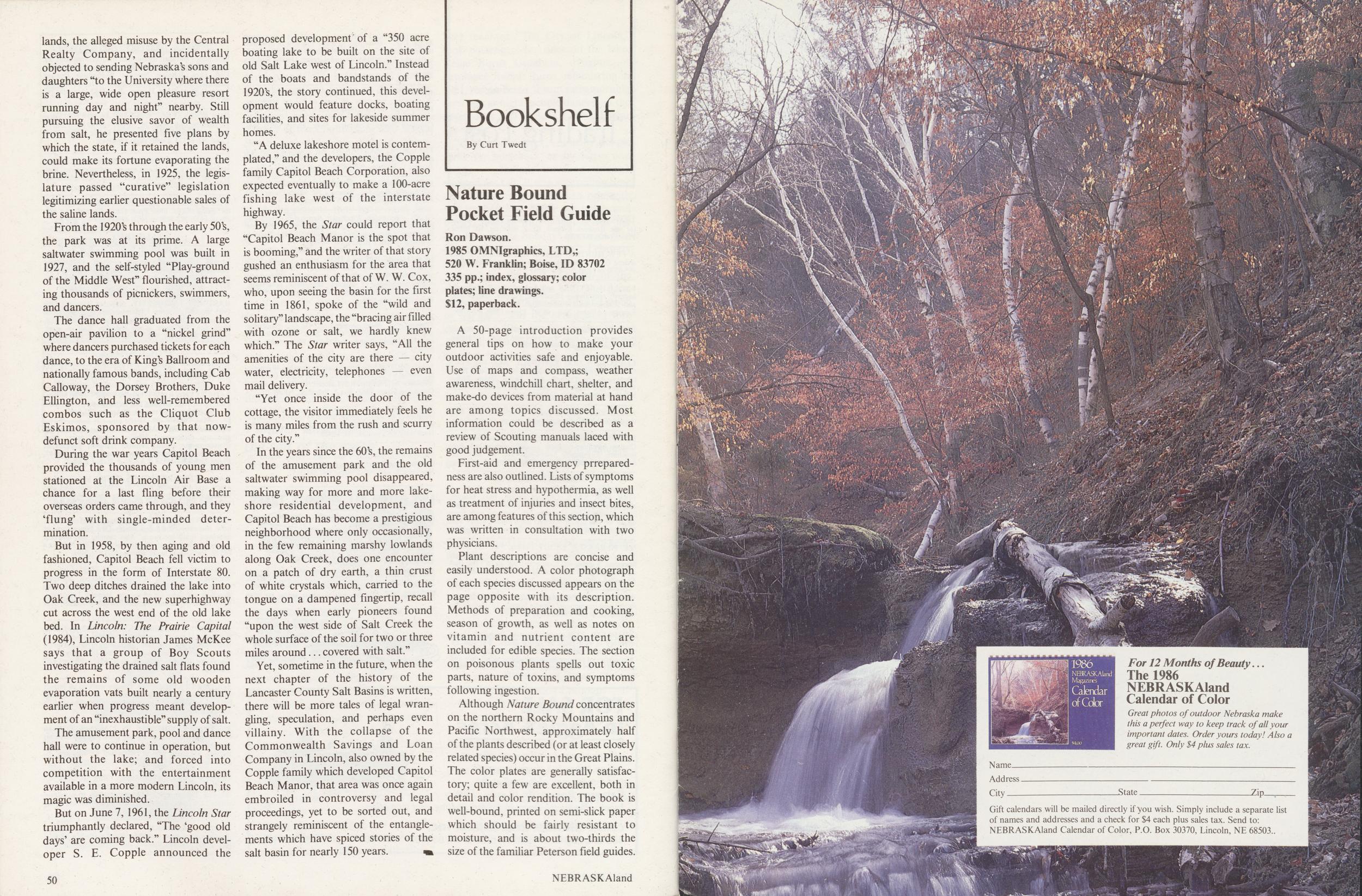
lands, the alleged misuse by the Central Realty Company, and incidentally objected to sending Nebraska's sons and daughters "to the University where there is a large, wide open pleasure resort running day and night" nearby. Still pursuing the elusive savor of wealth from salt, he presented five plans by which the state, if it retained the lands, could make its fortune evaporating the brine. Nevertheless, in 1925, the legislature passed "curative" legislation legitimizing earlier questionable sales of the saline lands.
From the 1920's through the early 50's, the park was at its prime. A large saltwater swimming pool was built in 1927, and the self-styled "Play-ground of the Middle West" flourished, attracting thousands of picnickers, swimmers, and dancers.
The dance hall graduated from the open-air pavilion to a "nickel grind" where dancers purchased tickets for each dance, to the era of King's Ballroom and nationally famous bands, including Cab Calloway, the Dorsey Brothers, Duke Ellington, and less well-remembered combos such as the Cliquot Club Eskimos, sponsored by that now defunct soft drink company.
During the war years Capitol Beach provided the thousands of young men stationed at the Lincoln Air Base a chance for a last fling before their overseas orders came through, and they 'flung' with single-minded determination.
But in 1958, by then aging and old fashioned, Capitol Beach fell victim to progress in the form of Interstate 80. Two deep ditches drained the lake into Oak Creek, and the new superhighway cut across the west end of the old lake bed. In Lincoln: The Prairie Capital (1984), Lincoln historian James McKee says that a group of Boy Scouts investigating the drained salt flats found the remains of some old wooden evaporation vats built nearly a century earlier when progress meant development of an "inexhaustible" supply of salt.
The amusement park, pool and dance hall were to continue in operation, but without the lake; and forced into competition with the entertainment available in a more modern Lincoln, its magic was diminished.
But on June 7, 1961, the Lincoln Star triumphantly declared, "The 'good old days' are coming back." Lincoln developer S. E. Copple announced the 50 proposed development of a "350 acre boating lake to be built on the site of old Salt Lake west of Lincoln." Instead of the boats and bandstands of the 1920's, the story continued, this development would feature docks, boating facilities, and sites for lakeside summer homes.
"A deluxe lakeshore motel is contemplated," and the developers, the Copple family Capitol Beach Corporation, also expected eventually to make a 100-acre fishing lake west of the interstate highway.
By 1965, the Star could report that "Capitol Beach Manor is the spot that is booming," and the writer of that story gushed an enthusiasm for the area that seems reminiscent of that of W. W. Cox, who, upon seeing the basin for the first time in 1861, spoke of the "wild and solitary" landscape, the "bracing air filled with ozone or salt, we hardly knew which." The Star writer says, "All the amenities of the city are there — city water, electricity, telephones — even mail delivery.
"Yet once inside the door of the cottage, the visitor immediately feels he is many miles from the rush and scurry of the city."
In the years since the 60's, the remains of the amusement park and the old saltwater swimming pool disappeared, making way for more and more lakeshore residential development, and Capitol Beach has become a prestigious neighborhood where only occasionally, in the few remaining marshy lowlands along Oak Creek, does one encounter on a patch of dry earth, a thin crust of white crystals which, carried to the tongue on a dampened fingertip, recall the days when early pioneers found "upon the west side of Salt Creek the whole surface of the soil for two or three miles around... covered with salt."
Yet, sometime in the future, when the next chapter of the history of the Lancaster County Salt Basins is written, there will be more tales of legal wrangling, speculation, and perhaps even villainy. With the collapse of the Commonwealth Savings and Loan Company in Lincoln, also owned by the Copple family which developed Capitol Beach Manor, that area was once again embroiled in controversy and legal proceedings, yet to be sorted out, and strangely reminiscent of the entanglements which have spiced stories of the salt basin for nearly 150 years.
Bookshelf
By Curt Twedt Nature Bound Pocket Field Guide Ron Dawson. 1985 OMNIgraphics, LTD,; 520 W. Franklin; Boise, ID 83702 335 pp.; index, glossary; color plates; line drawings. $12, paperback.A 50-page introduction provides general tips on how to make your outdoor activities safe and enjoyable. Use of maps and compass, weather awareness, windchill chart, shelter, and make-do devices from material at hand are among topics discussed. Most information could be described as a review of Scouting manuals laced with good judgement.
First-aid and emergency prreparedness are also outlined. Lists of symptoms for heat stress and hypothermia, as well as treatment of injuries and insect bites, are among features of this section, which was written in consultation with two physicians.
Plant descriptions are concise and easily understood. A color photograph of each species discussed appears on the page opposite with its description. Methods of preparation and cooking, season of growth, as well as notes on vitamin and nutrient content are included for edible species. The section on poisonous plants spells out toxic parts, nature of toxins, and symptoms following ingestion.
Although Nature Bound concentrates on the northern Rocky Mountains and Pacific Northwest, approximately half of the plants described (or at least closely related species) occur in the Great Plains. The color plates are generally satisfactory; quite a few are excellent, both in detail and color rendition. The book is well-bound, printed on semi-slick paper which should be fairly resistant to moisture, and is about two-thirds the size of the familiar Peterson field guides.
50 NEBRASKAland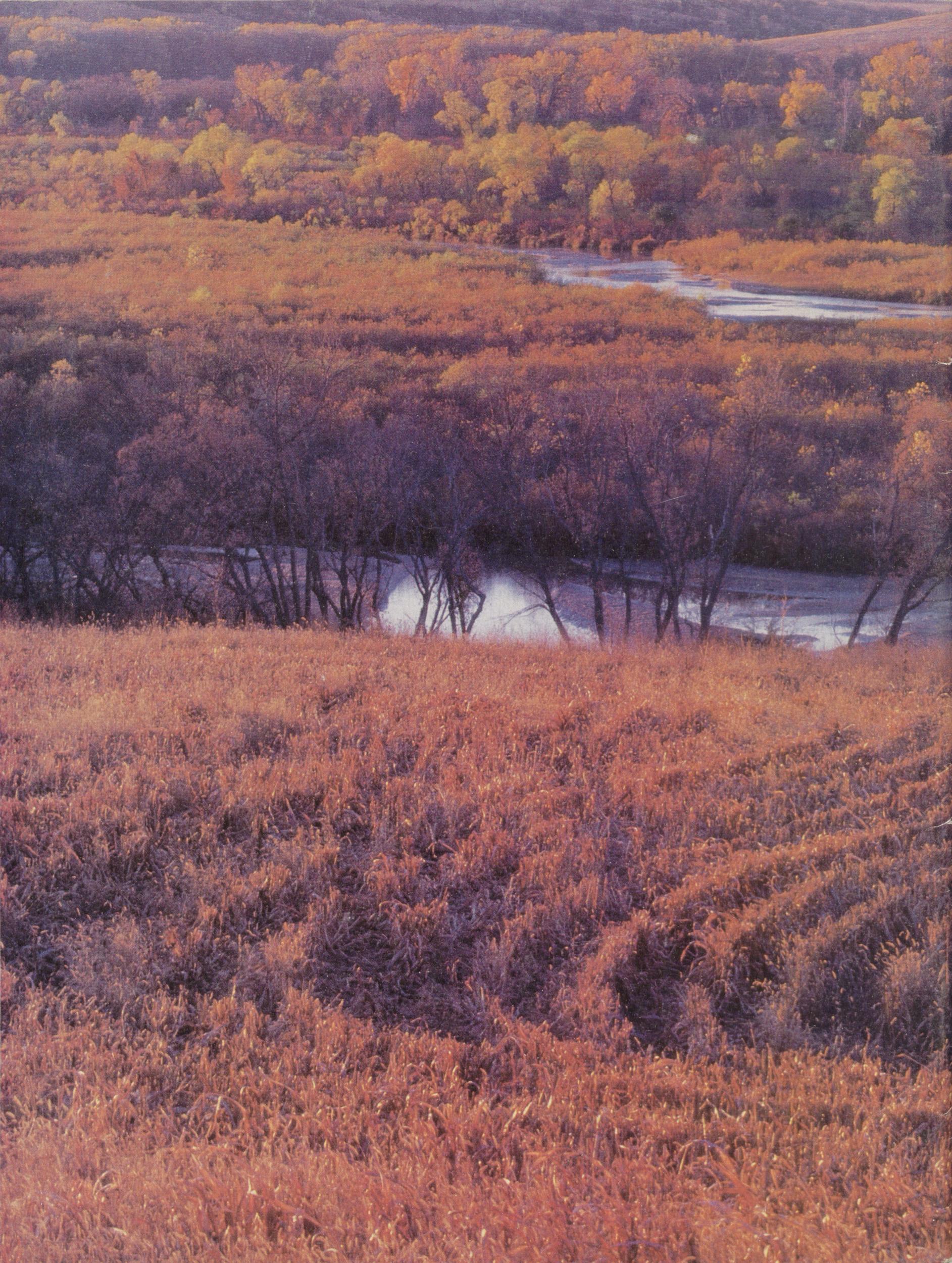
Position: 468 (22 views)