Volume 63, Issue 8, 1985
NEBRASKAland
SEPTEMBER 1985 $1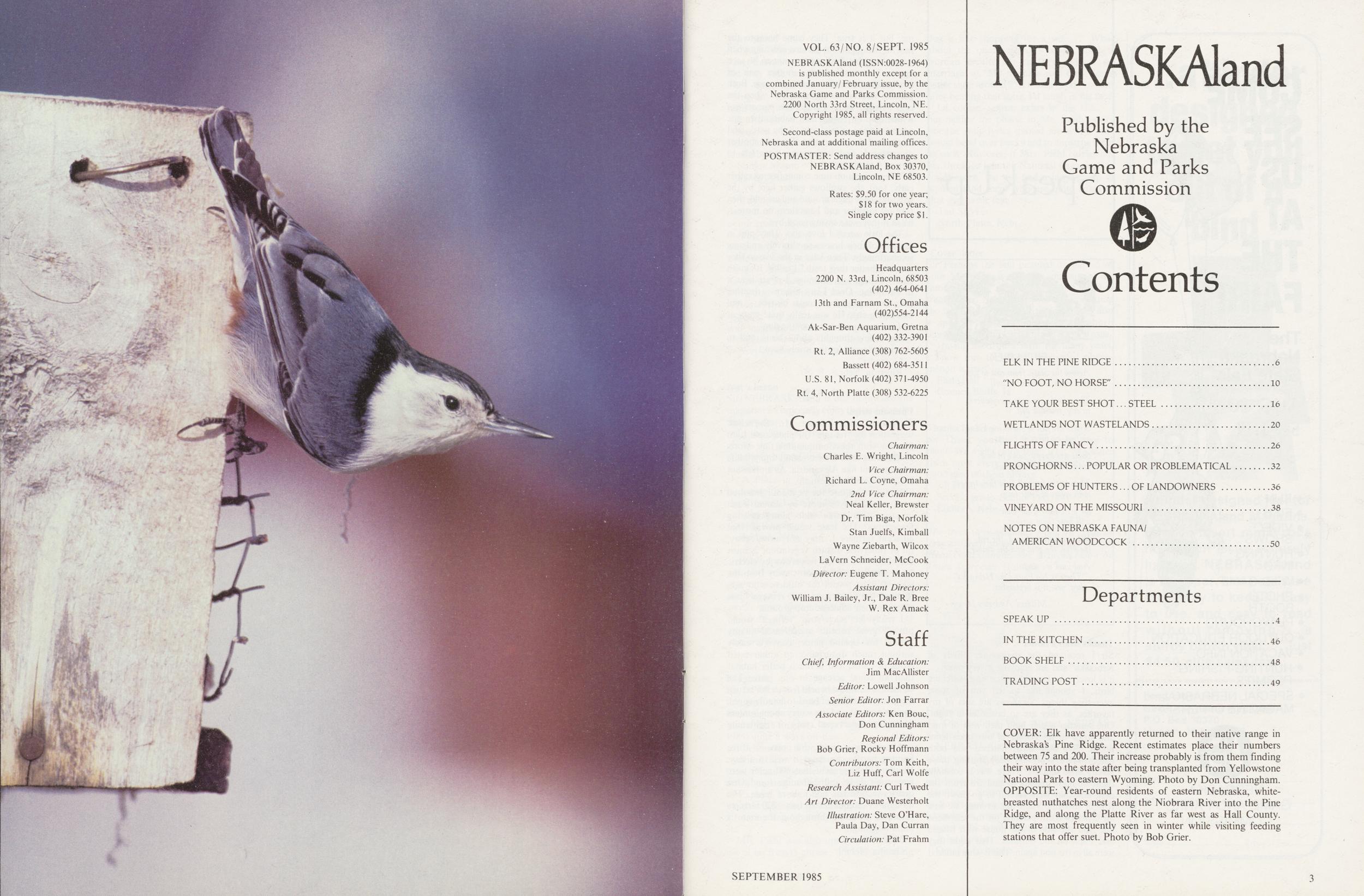
NEBRASKAland
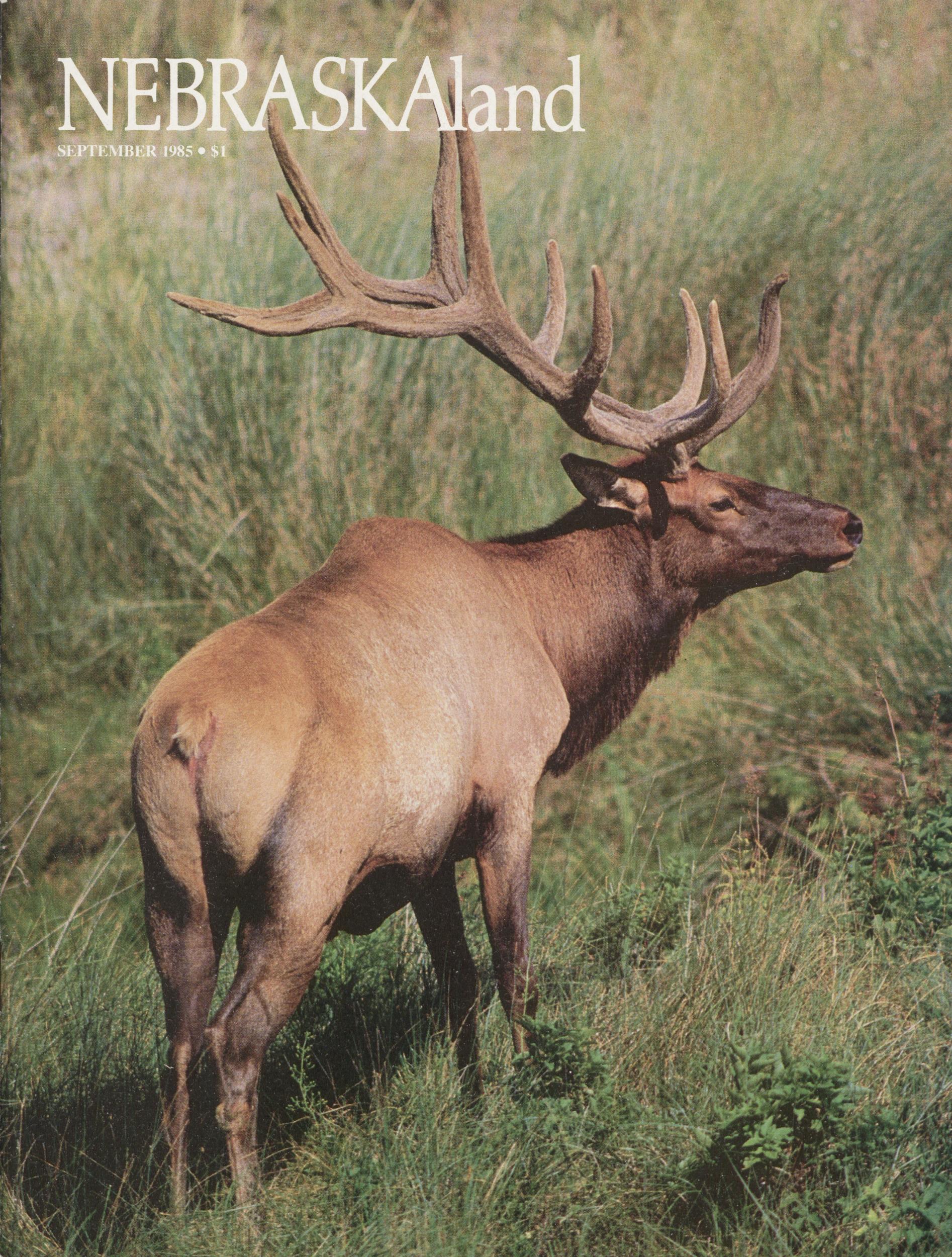
Published by the Nebraska Game and Parks Commission VOL. 63/NO. 8/SEPT. 1985 NEBRASKAland (ISSN:0028-1964) is published monthly except for a combined January/February issue, by the Nebraska Game and Parks Commission. 2200 North 33rd Street, Lincoln, NE. Copyright 1985, all rights reserved. Second-class postage paid at Lincoln, Nebraska and at additional mailing offices. POSTMASTER: Send address changes to NEBRASKAland, Box 30370, Lincoln, NE 68503. Rates: $9.50 for one year; $ 18 for two years. Single copy price $1. Offices Headquarters 2200 N. 33rd, Lincoln, 68503 (402) 464-0641 13th and Farnam St., Omaha (402)554-2144 Ak-Sar-Ben Aquarium, Gretna (402) 332-3901 Rt. 2, Alliance (308) 762-5605 Bassett (402) 684-3511 U.S. 81, Norfolk (402) 371-4950 Rt. 4, North Platte (308) 532-6225 Commissioners Chairman: Charles E. Wright, Lincoln Vice Chairman: Richard L. Coyne, Omaha 2nd Vice Chairman: Neal Keller, Brewster Dr. Tim Biga, Norfolk Stan Juelfs, Kimball Wayne Ziebarth, Wilcox LaVern Schneider, McCook Director: Eugene T. Mahoney Assistant Directors: William J. Bailey, Jr., Dale R. Bree W. Rex Amack Staff Chief, Information & Education: Jim MacAllister Editor: Lowell Johnson Senior Editor: Jon Farrar Associate Editors: Ken Bouc, Don Cunningham Regional Editors: Bob Grier, Rocky Hoffmann Contributors: Tom Keith, Liz Huff, Carl Wolfe Research Assistant: Curl Twedt Art Director: Duane Westerholt Illustration: Steve O'Hare, Paula Day, Dan Curran Circulation: Pat Frahm Contents ELK IN THE PINE RIDGE 6 "NO FOOT, NO HORSE" 10 TAKE YOUR BEST SHOT STEEL 16 WETLANDS NOT WASTELANDS20 FLIGHTS OF FANCY26 PRONGHORNS ... POPULAR OR PROBLEMATICAL32 PROBLEMS OF HUNTERS... OF LANDOWNERS 36 VINEYARD ON THE MISSOURI38 NOTES ON NEBRASKA FAUNA/ AMERICAN WOODCOCK 50 Departments SPEAK UP 4 IN THE KITCHEN46 BOOK SHELF48 TRADING POST49 COVER: Elk have apparently returned to their native range in Nebraska's Pine Ridge. Recent estimates place their numbers between 75 and 200. Their increase probably is from them finding their way into the state after being transplanted from Yellowstone National Park to eastern Wyoming. Photo by Don Cunningham. OPPOSITE: Year-round residents of eastern Nebraska, white- breasted nuthatches nest along the Niobrara River into the Pine Ridge, and along the Platte River as far west as Hall County. They are most frequently seen in winter while visiting feeding stations that offer suet. Photo by Bob Grier. SEPTEMBER 1985 3
Speak Up
SEPTEMBER Across the State, from east to westand north to south, as well
The schools are open everywhere,
in city, town or dell.
Streets are full of shrieking kids,
on foot, on bikes or buses
Some are happy, some in love,
but each his life discusses.
Then to the football field they troop
with colors of their team
for v-i-c-t-o-r-y we soon
will hear them scream.
When all teams blend, the red,
the blue, the gold and the amber,
And loud we sing
"There is No Place Like Nebraska"
then, yes, it is September. Mildred Andrews Larson Thanks from a birder
Sir/1 received the magazine "Birds of Nebraska" and am enjoying it very much it is lovely. As I spend a little time watching birds, I should like to tell you of some interesting things. Swallows are sort of my favorites, as they are so beautiful in flight. One summer a pair built their nest of mud and straw in the corner of our open front porch. Five little birds hatched and both parents were kept very busy stuffing those greedy little mouths. There was a constant flight of both parents to and fro from the nest, and they were careful to go down the row of mouths. Then one evening we saw all seven of them perched on the telephone line near the side of the house with Mama and Papa on the outsides. That night they were all in the nest again. This is what amazed me, but it is true. They came back to the nest for that night, but the next morning when we looked, they had gone — not to be seen again. The next spring, another pair of swallows built a nest in the same place. Both parents worked on the nest, but when the eggs hatched, four of them, the parents got a little tired of feeding their babies, then one parent seemed to be doing all the work, and a couple of the young died. Then the mother disappeared, and two young were left to starve. A tragic end.
When migration time comes (seems rather early, too), the swallows gather here by the window. They circle around and around, then take off together and I see them no more it's as if they were saying good-bye.
The little wrens I love, too. They pop in and out of their houses so elusively and sing so charmingly. Then later in the season they sort of "chatter their teeth," I call it. It's given as a warning, too, although I never hear it in the spring. Once I saw a brown thrasher keep the dog out from under his tree — and everything else. He was really quite scary as he liked men no better than the dog.
Just a few thoughts about birds, and to thank you again for the lovely book.
"A reader" Riverton, Nebr. * * * Pheasant stripsSir/1 read with interest Mr. Cornelius' suggestion for "refuges" for pheasants. I am familiar with the Commission's fine efforts in acquiring land for recreation and wildlife management like Alexandria. As a pheasant hunter, I have a suggestion.
Why not acquire the next four hundred or so acres, maybe more by annual lease, in strips five yards wide along existing fencecrows? The lease would provide that adjacent farmers 1. may not mow, spray, till or otherwise disturb vegetation; 2. must keep cattle out of the fencerows by electric fence parallel and five yards away from the wire; 3. must permit the hunters who ask, to hunt the fencecrows and retrieve birds killed on their adjacent crop ground.
I really feel such strip "refuges" would provide great benefits in increased quality habitat for upland game; converts easily without much disturbance to unharvested crops or cattle; and is much better habitat than an equal acreage in one piece. The farmers, too, would benefit from a fair return for giving up tilling of hard-to-handle edges, erosion control, and less worry about hunters damaging unharvested crops or frightening cattle.
Alexandria is great, but two or three hunting parties can cover it well in a day. Wouldn't it be great if that 400 acres were five yards wide and 220 miles long! One quarter-section has one mile of fence. The thought of 220 quarter-sections, 220 farmers involved, scattered throughout the state is mind-boggling!!
Mike Mooney Omaha, Nebr. 4 NEBRASKAland Why Shoot?Sir/ In reference to the Speak Up letter from Janet Eckmann in the April 1985 issue; why did they feel they had to kill the coyote? They don't mention that the animal was doing any harm, other than "one relieved farm dog," who was scared all night.
I thought your magazine promoted protection of wildlife. With people like the Eckmann's, the coyote will soon be extinct, remembered only in movies and books.
Shirley Mason Sandy, UtahStrictly speaking we do not promote the protection of wildlife. We manage wildlife, or our agency does, which means we promote hunting and fishing as wholesome, worthwhile, and necessary recreation activities while also being good management. Coyotes are not classified as game animals or as furbearers by law. Consequently, the Game and Parks Commission has no authority to regulate their harvest. Despite years of trapping and poisoning by federal agencies and agricultural interests, coyotes remain abundant where they occur and their range in North America is expanding. (Editor)
* * * Not a heronSir/NEBRASKAIand is one of my favorite magazines. I especially enjoy the bird pictures and articles.
In the June ^5 issue, I have a question about the picture on page 39. Isn't it an American bittern, instead of a night heron, as captioned?
"A Place in the Wild" was particularly intersting to me as I live not too far from the Crescent Lake Wildlife Refuge. Keep those bird pictures coming.
Opal Bilstein Hyannis, Nebr.While we toyed with the idea of telling you that was a night heron in costume, or winner of a bittern look-alike contest, you are indeed correct — it is a bittern in the weeds rather than a night heron. It was one of those slips of the typewriter — or typewriter operator. Thanks for pointing this out, and for your comments. (Editor)
* * * LaughableSir/NEBRASKAIand has printed articles in the past that would indicate it strongly encourages women to take part in hunting. Therefore, I find Mrs. Ann Piehl's letter (July 1985) quite a ways off-base.
I believe that Tom Keith simply used the common theme of husband-wife antagonism (which many people find amusing) in his article on dog ownership. He did not stop to explore every other possible situation, which would also include the ownership of a hunting dog by a single person, divorcee, etc.
Mrs. Piehl was also upset by Mr. Keith's use of his friend's phrase, "Picking a hunting dog is like shopping for a wife" What about the once-popular song in which a woman recalls her mother's advice on marriage — "My mamma told me, 'You'd better shop around 7" If a man cried "sexism" after hearing that song, I'd laugh in his face.
Of course, sexism exists in the U.S. but neither the pharse in Mr. Keith's story nor the song lyrics quoted are sexist. One would bend over backward to construe them as such. However, if Mrs. Piehl carries out her threat to join the National Organization for Women, she will find a large group of women (and men) who are quite adept at that gymnastic feat.
Tad Stryker North Platte, Nebr. * * * "Cover" letterSir/Perhaps the bull pictured on page 5 of your May issue is a distant ancestor of the famed Indian namesake. I am another transplanted Nebraskan who enjoys reading the magazine from cover to cover. It is also a special treat for our Nebraska-born daughter, who now lives in Houston, Texas.
Having lived on a farm for many years, I know that the above mentioned phenomenon is true.
Earl Graff Council Bluffs, la. * * * Thanks for treesSir/ Thank you for giving us the trees to plant. We really enjoy them a lot. We water them most every day. We promise to take good care of them always.
Jill Haiar Second grade, School Dist. #41 Elkhorn, Nebr.The trees were obtained from the Year of Tree program sponsored by Omaha World Herald and Commission. Artwork below by Laura Schroeder. (Editor)
Sir/Outstanding! Your August NEBRASKAIand is really something special.
NEBRASKAIand Magazine is the finest of its type. The articles and photography are second to none. However, you have finally outdone yourselves with the Outdoor Handbook. Seasonal issues of this type could be timely and enjoyable. Our family will be lakeside on vacation next week and your August edition will be in our boat.
John Landen Omaha, Nebraska a binder designed to get you outofa bind a binder designed just for NEBRASKAIand Magazine. Easy-to-insert metal rods hold each issue securely in place. NEBRASKAIand is a keeper, and here's the ideal way to keep it. Easy to use, and easy to read without removing a sturdy brown vinyl Just $4.50 plus sales tax. Send order to: NEBRASKAIand Magazine P.O. Box 30370 Lincoln, Nebr. 68503 Check Money Order Name Street. City State. .Zip. SEPTEMBER 1985 5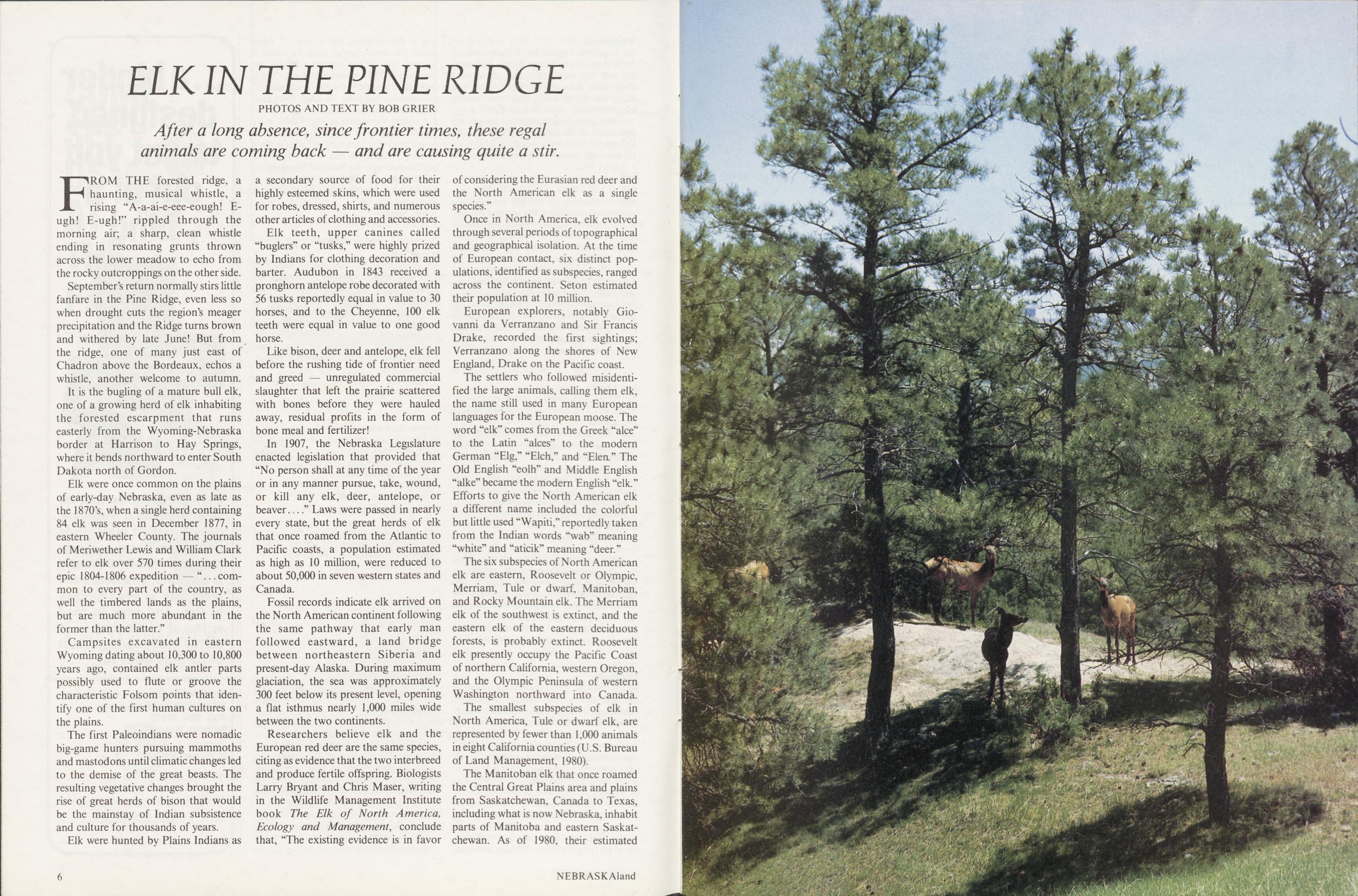
ELK IN THE PINE RIDGE
PHOTOS AND TEXT BY BOB GRIER After a long absence, since frontier times, these regal animals are coming back — and are causing quite a stir.FROM THE forested ridge, a haunting, musical whistle, a rising "A-a-ai-e-eee-eough! E-ugh! E-ugh!" rippled through the morning air; a sharp, clean whistle ending in resonating grunts thrown across the lower meadow to echo from the rocky outcroppings on the other side.
September's return normally stirs little fanfare in the Pine Ridge, even less so when drought cuts the region's meager precipitation and the Ridge turns brown and withered by late June! But from the ridge, one of many just east of Chadron above the Bordeaux, echos a whistle, another welcome to autumn.
It is the bugling of a mature bull elk, one of a growing herd of elk inhabiting the forested escarpment that runs easterly from the Wyoming-Nebraska border at Harrison to Hay Springs, where it bends northward to enter South Dakota north of Gordon.
Elk were once common on the plains of early-day Nebraska, even as late as the 1870's, when a single herd containing 84 elk was seen in December 1877, in eastern Wheeler County. The journals of Meriwether Lewis and William Clark refer to elk over 570 times during their epic 1804-1806 expedition — " common to every part of the country, as well the timbered lands as the plains, but are much more abundant in the former than the latter."
Campsites excavated in eastern Wyoming dating about 10,300 to 10,800 years ago, contained elk antler parts possibly used to flute or groove the characteristic Folsom points that identify one of the first human cultures on the plains.
The first Paleoindians were nomadic big-game hunters pursuing mammoths and mastodons until climatic changes led to the demise of the great beasts. The resulting vegetative changes brought the rise of great herds of bison that would be the mainstay of Indian subsistence and culture for thousands of years.
Elk were hunted by Plains Indians as a secondary source of food for their highly esteemed skins, which were used for robes, dressed, shirts, and numerous other articles of clothing and accessories.
Elk teeth, upper canines called "buglers" or "tusks," were highly prized by Indians for clothing decoration and barter. Audubon in 1843 received a pronghorn antelope robe decorated with 56 tusks reportedly equal in value to 30 horses, and to the Cheyenne, 100 elk teeth were equal in value to one good horse.
Like bison, deer and antelope, elk fell before the rushing tide of frontier need and greed — unregulated commercial slaughter that left the prairie scattered with bones before they were hauled away, residual profits in the form of bone meal and fertilizer!
In 1907, the Nebraska Legislature enacted legislation that provided that "No person shall at any time of the year or in any manner pursue, take, wound, or kill any elk, deer, antelope, or beaver" Laws were passed in nearly every state, but the great herds of elk that once roamed from the Atlantic to Pacific coasts, a population estimated as high as 10 million, were reduced to about 50,000 in seven western states and Canada.
Fossil records indicate elk arrived on the North American continent following the same pathway that early man followed eastward, a land bridge between northeastern Siberia and present-day Alaska. During maximum glaciation, the sea was approximately 300 feet below its present level, opening a flat isthmus nearly 1,000 miles wide between the two continents.
Researchers believe elk and the European red deer are the same species, citing as evidence that the two interbreed and produce fertile offspring. Biologists Larry Bryant and Chris Maser, writing in the Wildlife Management Institute book The Elk of North America, Ecology and Management, conclude that, "The existing evidence is in favor of considering the Eurasian red deer and the North American elk as a single species."
Once in North America, elk evolved through several periods of topographical and geographical isolation. At the time of European contact, six distinct populations, identified as subspecies, ranged across the continent. Seton estimated their population at 10 million.
European explorers, notably Giovanni da Verranzano and Sir Francis Drake, recorded the first sightings; Verranzano along the shores of New England, Drake on the Pacific coast.
The settlers who followed misidentified the large animals, calling them elk, the name still used in many European languages for the European moose. The word "elk" comes from the Greek "alee" to the Latin "alces" to the modern German "Elg," "Elch," and "Elen." The Old English "eolh" and Middle English "alke" became the modern English "elk." Efforts to give the North American elk a different name included the colorful but little used "Wapiti," reportedly taken from the Indian words "wab" meaning "white" and "aticik" meaning "deer."
The six subspecies of North American elk are eastern, Roosevelt or Olympic, Merriam, Tule or dwarf, Manitoban, and Rocky Mountain elk. The Merriam elk of the southwest is extinct, and the eastern elk of the eastern deciduous forests, is probably extinct. Roosevelt elk presently occupy the Pacific Coast of northern California, western Oregon, and the Olympic Peninsula of western Washington northward into Canada.
The smallest subspecies of elk in North America, Tule or dwarf elk, are represented by fewer than 1,000 animals in eight California counties (U.S. Bureau of Land Management, 1980).
The Manitoban elk that once roamed the Central Great Plains area and plains from Saskatchewan, Canada to Texas, including what is now Nebraska, inhabit parts of Manitoba and eastern Saskatchewan. As of 1980, their estimated population was slightly fewer than 1,000 animals.
6 NEBRASKAland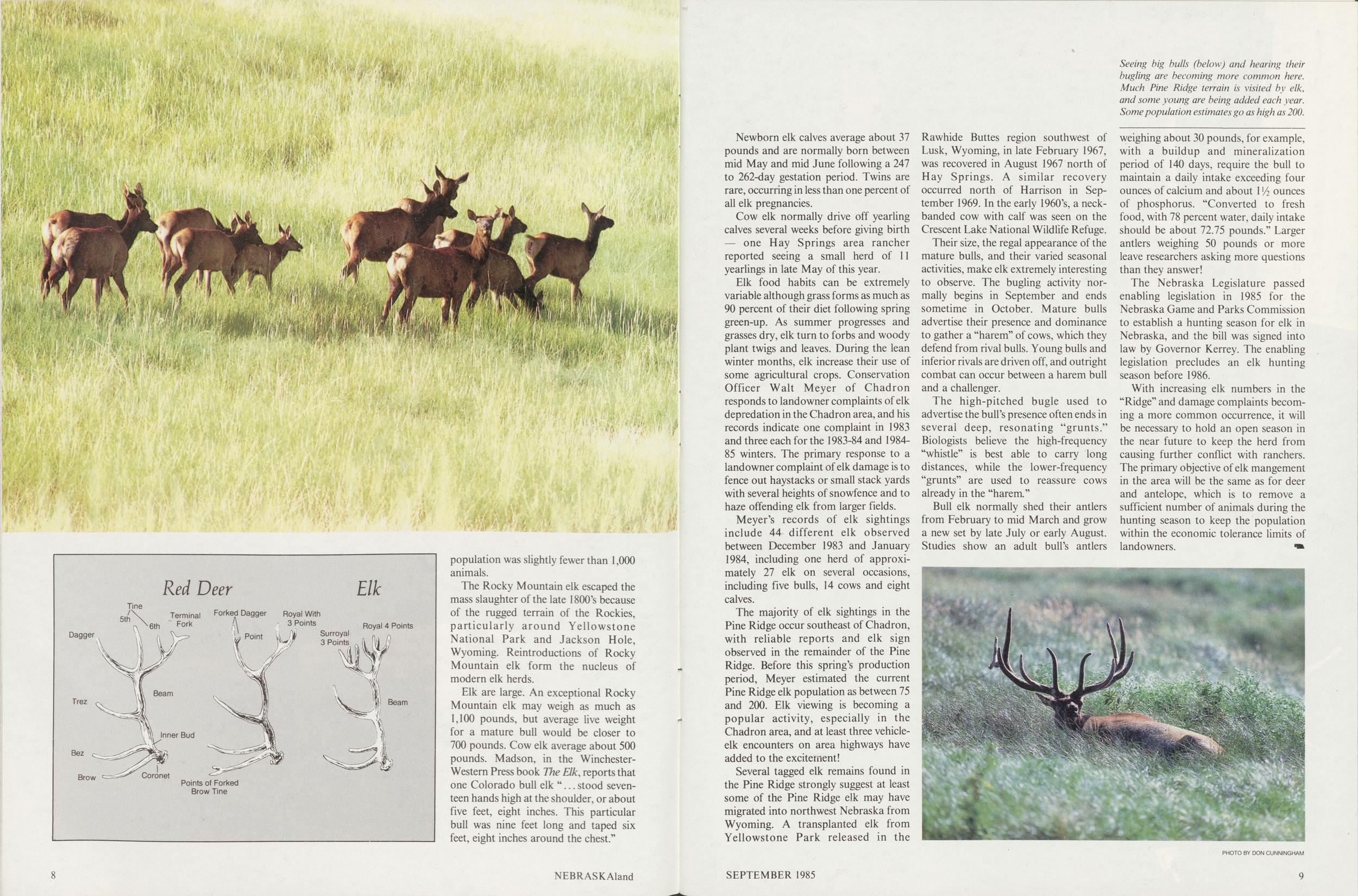
The Rocky Mountain elk escaped the mass slaughter of the late 1800's because of the rugged terrain of the Rockies, particularly around Yellowstone National Park and Jackson Hole, Wyoming. Reintroductions of Rocky Mountain elk form the nucleus of modern elk herds.
Elk are large. An exceptional Rocky Mountain elk may weigh as much as 1,100 pounds, but average live weight for a mature bull would be closer to 700 pounds. Cow elk average about 500 pounds. Madson, in the WinchesterWestern Press book The Elk, reports that one Colorado bull elk " stood seventeen hands high at the shoulder, or about five feet, eight inches. This particular bull was nine feet long and taped six feet, eight inches around the chest."
8 NEBRASKAlandNewborn elk calves average about 37 pounds and are normally born between mid May and mid June following a 247 to 262-day gestation period. Twins are rare, occurring in less than one percent of all elk pregnancies.
Cow elk normally drive off yearling calves several weeks before giving birth one Hay Springs area rancher reported seeing a small herd of 11 yearlings in late May of this year.
Elk food habits can be extremely variable although grass forms as much as 90 percent of their diet following spring green-up. As summer progresses and grasses dry, elk turn to forbs and woody plant twigs and leaves. During the lean winter months, elk increase their use of some agricultural crops. Conservation Officer Walt Meyer of Chadron responds to landowner complaints of elk depredation in the Chadron area, and his records indicate one complaint in 1983 and three each for the 1983-84 and 1984-85 winters. The primary response to a landowner complaint of elk damage is to fence out haystacks or small stack yards with several heights of snowfence and to haze offending elk from larger fields.
Meyer's records of elk sightings include 44 different elk observed between December 1983 and January 1984, including one herd of approximately 27 elk on several occasions, including five bulls, 14 cows and eight calves.
The majority of elk sightings in the Pine Ridge occur southeast of Chadron, with reliable reports and elk sign observed in the remainder of the Pine Ridge. Before this spring's production period, Meyer estimated the current Pine Ridge elk population as between 75 and 200. Elk viewing is becoming a popular activity, especially in the Chadron area, and at least three vehicleelk encounters on area highways have added to the excitement!
Several tagged elk remains found in the Pine Ridge strongly suggest at least some of the Pine Ridge elk may have migrated into northwest Nebraska from Wyoming. A transplanted elk from Yellowstone Park released in the Rawhide Buttes region southwest of Lusk, Wyoming, in late February 1967, was recovered in August 1967 north of Hay Springs. A similar recovery occurred north of Harrison in September 1969. In the early 1960's, a neckbanded cow with calf was seen on the Crescent Lake National Wildlife Refuge.
Their size, the regal appearance of the mature bulls, and their varied seasonal activities, make elk extremely interesting to observe. The bugling activity normally begins in September and ends sometime in October. Mature bulls advertise their presence and dominance to gather a "harem" of cows, which they defend from rival bulls. Young bulls and inferior rivals are driven off, and outright combat can occur between a harem bull and a challenger.
The high-pitched bugle used to advertise the bull's presence often ends in several deep, resonating "grunts." Biologists believe the high-frequency "whistle" is best able to carry long distances, while the lower-frequency "grunts" are used to reassure cows already in the "harem."
Bull elk normally shed their antlers from February to mid March and grow a new set by late July or early August. Studies show an adult bull's antlers weighing about 30 pounds, for example, with a buildup and mineralization period of 140 days, require the bull to maintain a daily intake exceeding four ounces of calcium and about 1 x/i ounces of phosphorus. "Converted to fresh food, with 78 percent water, daily intake should be about 72.75 pounds." Larger antlers weighing 50 pounds or more leave researchers asking more questions than they answer!
Seeing big bulls (below) and hearing their bugling are becoming more common here. Much Pine Ridge terrain is visited by elk, and some young are being added each year. Some population estimates go as high as 200.The Nebraska Legislature passed enabling legislation in 1985 for the Nebraska Game and Parks Commission to establish a hunting season for elk in Nebraska, and the bill was signed into law by Governor Kerrey. The enabling legislation precludes an elk hunting season before 1986.
With increasing elk numbers in the "Ridge" and damage complaints becoming a more common occurrence, it will be necessary to hold an open season in the near future to keep the herd from causing further conflict with ranchers. The primary objective of elk mangement in the area will be the same as for deer and antelope, which is to remove a sufficient number of animals during the hunting season to keep the population within the economic tolerance limits of landowners.
"NO FOOT, NO HORSE"
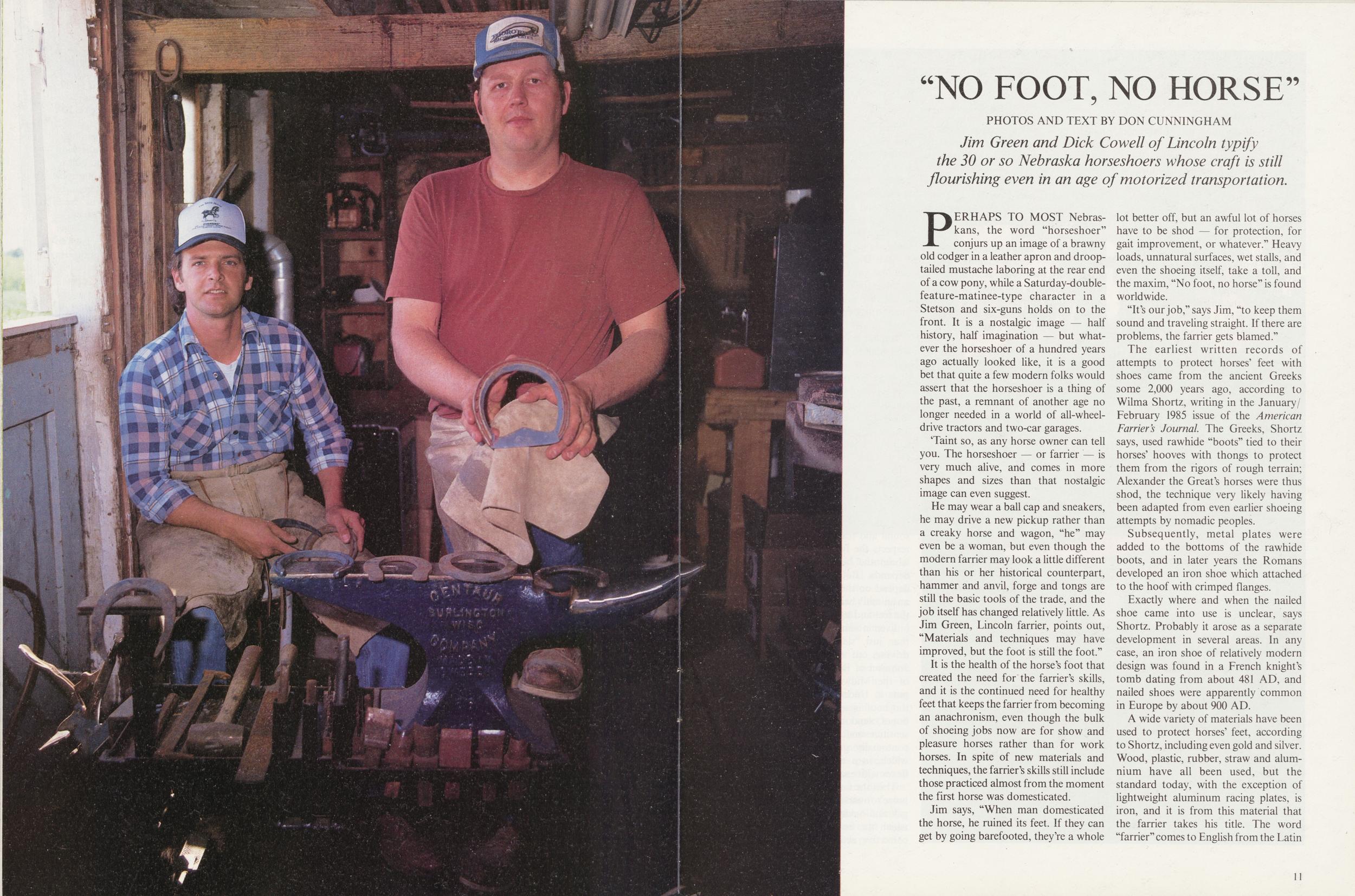
PHOTOS AND TEXT BY DON CUNNINGHAM Jim Green and Dick Cowell of Lincoln typify the 30 or so Nebraska horseshoers whose craft is still flourishing even in an age of motorized transportation.PERHAPS TO MOST Nebraskans, the word "horseshoer" conjurs up an image of a brawny old codger in a leather apron and drooptailed mustache laboring at the rear end of a cow pony, while a Saturday-double-feature-matinee-type character in a Stetson and six-guns holds on to the front. It is a nostalgic image — half history, half imagination — but whatever the horseshoer of a hundred years ago actually looked like, it is a good bet that quite a few modern folks would assert that the horseshoer is a thing of the past, a remnant of another age no longer needed in a world of all-wheeldrive tractors and two-car garages.
Taint so, as any horse owner can tell you. The horseshoer — or farrier — is very much alive, and comes in more shapes and sizes than that nostalgic image can even suggest.
He may wear a ball cap and sneakers, he may drive a new pickup rather than a creaky horse and wagon, "he" may even be a woman, but even though the modern farrier may look a little different than his or her historical counterpart, hammer and anvil, forge and tongs are still the basic tools of the trade, and the job itself has changed relatively little. As Jim Green, Lincoln farrier, points out, "Materials and techniques may have improved, but the foot is still the foot."
It is the health of the horse's foot that created the need for the farrier's skills, and it is the continued need for healthy feet that keeps the farrier from becoming an anachronism, even though the bulk of shoeing jobs now are for show and pleasure horses rather than for work horses. In spite of new materials and techniques, the farrier's skills still include those practiced almost from the moment the first horse was domesticated.
Jim says, "When man domesticated the horse, he ruined its feet. If they can get by going barefooted, they're a whole lot better off, but an awful lot of horses have to be shod — for protection, for gait improvement, or whatever." Heavy loads, unnatural surfaces, wet stalls, and even the shoeing itself, take a toil, and the maxim, "No foot, no horse" is found worldwide.
"It's our job," says Jim, "to keep them sound and traveling straight. If there are problems, the farrier gets blamed."
The earliest written records of attempts to protect horses' feet with shoes came from the ancient Greeks some 2,000 years ago, according to Wilma Shortz, writing in the January/ February 1985 issue of the American Farrier's Journal The Greeks, Shortz says, used rawhide "boots" tied to their horses' hooves with thongs to protect them from the rigors of rough terrain; Alexander the Great's horses were thus shod, the technique very likely having been adapted from even earlier shoeing attempts by nomadic peoples.
Subsequently, metal plates were added to the bottoms of the rawhide boots, and in later years the Romans developed an iron shoe which attached to the hoof with crimped flanges.
Exactly where and when the nailed shoe came into use is unclear, says Shortz. Probably it arose as a separate development in several areas. In any case, an iron shoe of relatively modern design was found in a French knight's tomb dating from about 481 AD, and nailed shoes were apparently common in Europe by about 900 AD.
A wide variety of materials have been used to protect horses' feet, according to Shortz, including even gold and silver. Wood, plastic, rubber, straw and alumnium have all been used, but the standard today, with the exception of lightweight aluminum racing plates, is iron, and it is from this material that the farrier takes his title. The word "farrier" comes to English from the Latin ferrum, iron, through the old French ferrier, blacksmith. But to ironworkers in America, there is a significant difference between the blacksmith and the farrier. Both work with iron, and a blacksmith may also be a farrier, but it is the farrier who shoes horses.
SEPTEMBER 1985 11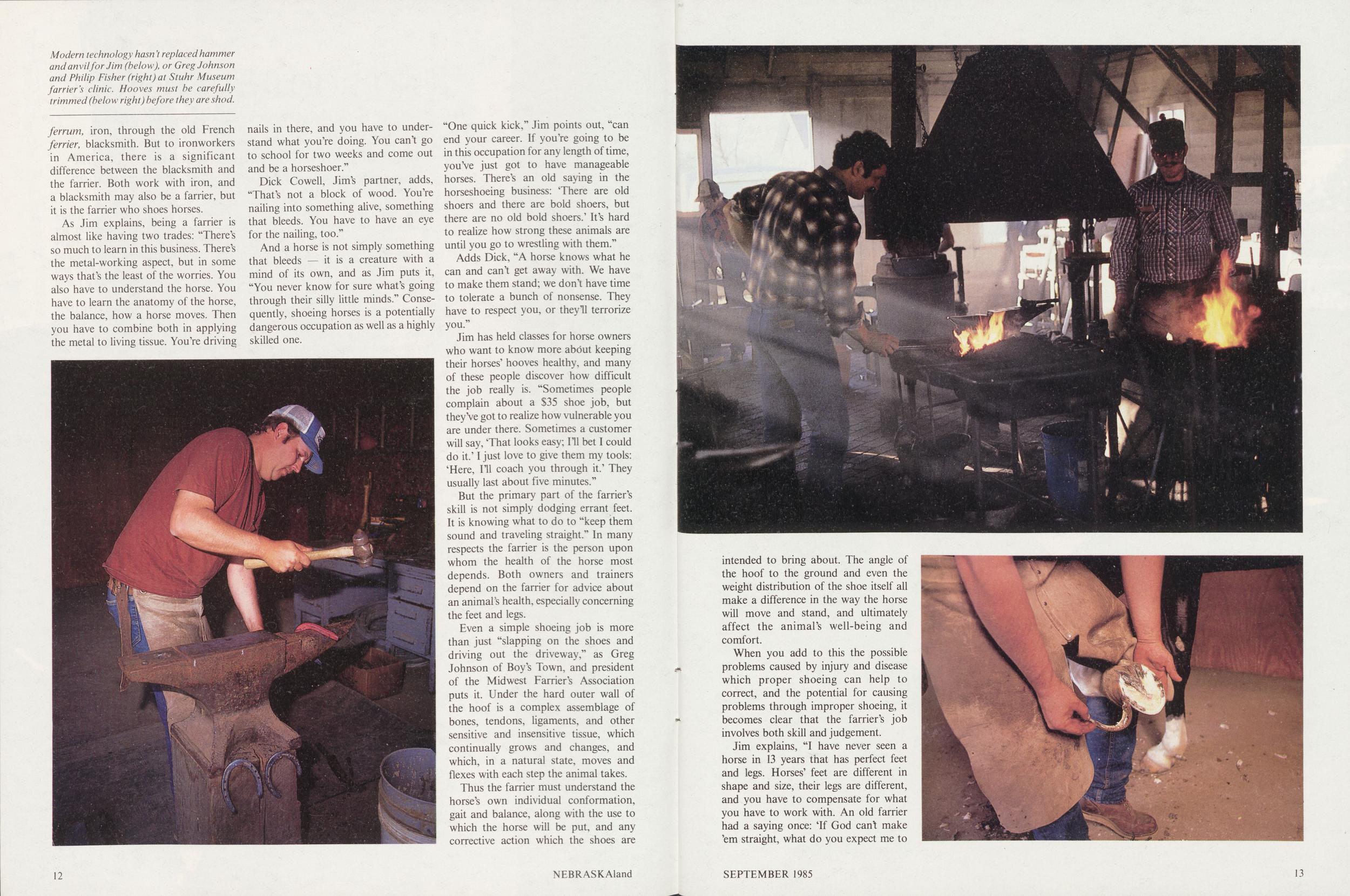 Modern technology hasn 't replaced hammer
and anvil for Jim (below), or Greg Johnson
and Philip Fisher (right) at Stuhr Museum
farrier's clinic. Hooves must be carefully
trimmed (below right) before they are shod.
Modern technology hasn 't replaced hammer
and anvil for Jim (below), or Greg Johnson
and Philip Fisher (right) at Stuhr Museum
farrier's clinic. Hooves must be carefully
trimmed (below right) before they are shod.
As Jim explains, being a farrier is almost like having two trades: "There's so much to learn in this business. There's the metal-working aspect, but in some ways that's the least of the worries. You also have to understand the horse. You have to learn the anatomy of the horse, the balance, how a horse moves. Then you have to combine both in applying the metal to living tissue. You're driving nails in there, and you have to understand what you're doing. You can't go to school for two weeks and come out and be a horseshoer."
Dick Cowell, Jim's partner, adds, "That's not a block of wood. You're nailing into something alive, something that bleeds. You have to have an eye for the nailing, too."
And a horse is not simply something that bleeds — it is a creature with a mind of its own, and as Jim puts it, "You never know for sure what's going through their silly little minds." Consequently, shoeing horses is a potentially dangerous occupation as well as a highly skilled one.
"One quick kick," Jim points out, "can end your career. If you're going to be in this occupation for any length of time, you've just got to have manageable horses. There's an old saying in the horseshoeing business: There are old shoers and there are bold shoers, but there are no old bold shoers.' It's hard to realize how strong these animals are until you go to wrestling with them."
Adds Dick, "A horse knows what he can and can't get away with. We have to make them stand; we don't have time to tolerate a bunch of nonsense. They have to respect you, or they'll terrorize you."
Jim has held classes for horse owners who want to know more about keeping their horses' hooves healthy, and many of these people discover how difficult the job really is. "Sometimes people complain about a $35 shoe job, but they've got to realize how vulnerable you are under there. Sometimes a customer will say, That looks easy; 111 bet I could do it.' I just love to give them my tools: 'Here, 111 coach you through it.' They usually last about five minutes."
But the primary part of the farrier's skill is not simply dodging errant feet. It is knowing what to do to "keep them sound and traveling straight." In many respects the farrier is the person upon whom the health of the horse most depends. Both owners and trainers depend on the farrier for advice about an animal's health, especially concerning the feet and legs.
Even a simple shoeing job is more than just "slapping on the shoes and driving out the driveway," as Greg Johnson of Boy's Town, and president of the Midwest Farrier's Association puts it. Under the hard outer wall of the hoof is a complex assemblage of bones, tendons, ligaments, and other sensitive and insensitive tissue, which continually grows and changes, and which, in a natural state, moves and flexes with each step the animal takes.
Thus the farrier must understand the horse's own individual conformation, gait and balance, along with the use to which the horse will be put, and any corrective action which the shoes are 12 NEBRASKAland intended to bring about. The angle of the hoof to the ground and even the weight distribution of the shoe itself all make a difference in the way the horse will move and stand, and ultimately affect the animal's well-being and comfort.
When you add to this the possible problems caused by injury and disease which proper shoeing can help to correct, and the potential for causing problems through improper shoeing, it becomes clear that the farrier's job involves both skill and judgement.
Jim explains, "I have never seen a horse in 13 years that has perfect feet and legs. Horses' feet are different in shape and size, their legs are different, and you have to compensate for what you have to work with. An old farrier had a saying once: 'If God canY make 'em straight, what do you expect me to do?' We just work with what we've got, and go from there.
SEPTEMBER 1985 13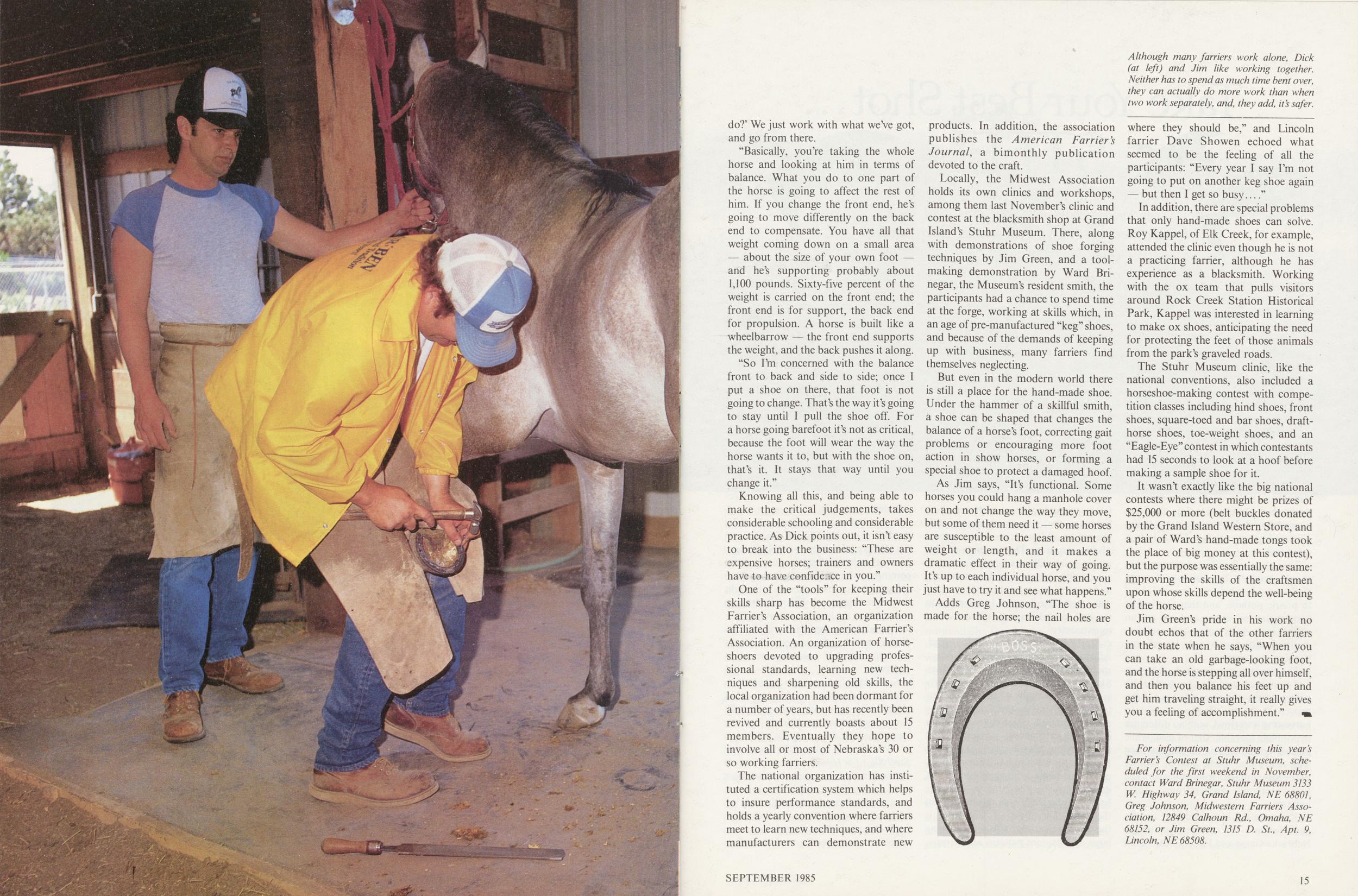
"Basically, you're taking the whole horse and looking at him in terms of balance. What you do to one part of the horse is going to affect the rest of him. If you change the front end, he's going to move differently on the back end to compensate. You have all that weight coming down on a small area about the size of your own foot and he's supporting probably about 1,100 pounds. Sixty-five percent of the weight is carried on the front end; the front end is for support, the back end for propulsion. A horse is built like a wheelbarrow — the front end supports the weight, and the back pushes it along.
"So I'm concerned with the balance front to back and side to side; once I put a shoe on there, that foot is not going to change. That's the way it's going to stay until I pull the shoe off. For a horse going barefoot it's not as critical, because the foot will wear the way the horse wants it to, but with the shoe on, that's it. It stays that way until you change it."
Knowing all this, and being able to make the critical judgements, takes considerable schooling and considerable practice. As Dick points out, it isn't easy to break into the business: "These are expensive horses; trainers and owners have to have confidence in you."
One of the "tools" for keeping their skills sharp has become the Midwest Farrier's Association, an organization affiliated with the American Farrier's Association. An organization of horseshoers devoted to upgrading professional standards, learning new techniques and sharpening old skills, the local organization had been dormant for a number of years, but has recently been revived and currently boasts about 15 members. Eventually they hope to involve all or most of Nebraska's 30 or so working farriers.
The national organization has instituted a certification system which helps to insure performance standards, and holds a yearly convention where farriers meet to learn new techniques, and where manufacturers can demonstrate new products. In addition, the association publishes the American Farrier's Journal, a bimonthly publication devoted to the craft.
Locally, the Midwest Association holds its own clinics and workshops, among them last November's clinic and contest at the blacksmith shop at Grand Island's Stuhr Museum. There, along with demonstrations of shoe forging techniques by Jim Green, and a toolmaking demonstration by Ward Brinegar, the Museum's resident smith, the participants had a chance to spend time at the forge, working at skills which, in an age of pre-manufactured "keg" shoes, and because of the demands of keeping up with business, many farriers find themselves neglecting.
But even in the modern world there is still a place for the hand-made shoe. Under the hammer of a skillful smith, a shoe can be shaped that changes the balance of a horse's foot, correcting gait problems or encouraging more foot action in show horses, or forming a special shoe to protect a damaged hoof.
As Jim says, "It's functional. Some horses you could hang a manhole cover on and not change the way they move, but some of them need it — some horses are susceptible to the least amount of weight or length, and it makes a dramatic effect in their way of going. It's up to each individual horse, and you just have to try it and see what happens."
Adds Greg Johnson, "The shoe is made for the horse; the nail holes are where they should be," and Lincoln farrier Dave Showen echoed what seemed to be the feeling of all the participants: "Every year I say I'm not going to put on another keg shoe again — but then I get so busy"
In addition, there are special problems that only hand-made shoes can solve. Roy Kappel, of Elk Creek, for example, attended the clinic even though he is not a practicing farrier, although he has experience as a blacksmith. Working with the ox team that pulls visitors around Rock Creek Station Historical Park, Kappel was interested in learning to make ox shoes, anticipating the need for protecting the feet of those animals from the park's graveled roads.
The Stuhr Museum clinic, like the national conventions, also included a horseshoe-making contest with competition classes including hind shoes, front shoes, square-toed and bar shoes, drafthorse shoes, toe-weight shoes, and an "Eagle-Eye" contest in which contestants had 15 seconds to look at a hoof before making a sample shoe for it.
It wasn't exactly like the big national contests where there might be prizes of $25,000 or more (belt buckles donated by the Grand Island Western Store, and a pair of Ward's hand-made tongs took the place of big money at this contest), but the purpose was essentially the same: improving the skills of the craftsmen upon whose skills depend the well-being of the horse.
Jim Green's pride in his work no doubt echos that of the other farriers in the state when he says, "When you can take an old garbage-looking foot, and the horse is stepping all over himself, and then you balance his feet up and get him traveling straight, it really gives you a feeling of accomplishment."
For information concerning this year's Farrier's Contest at Stuhr Museum, sche- duled for the first weekend in November, contact Ward Brinegar, Stuhr Museum 3133 W. Highway 34, Grand Island, NE 68801, Greg Johnson, Midwestern Farriers Association, 12849 Calhoun Rd., Omaha, NE 68152, or Jim Green, 1315 D. St., Apt. 9, Lincoln, NE 68508.
SEPTEMBER 1985 15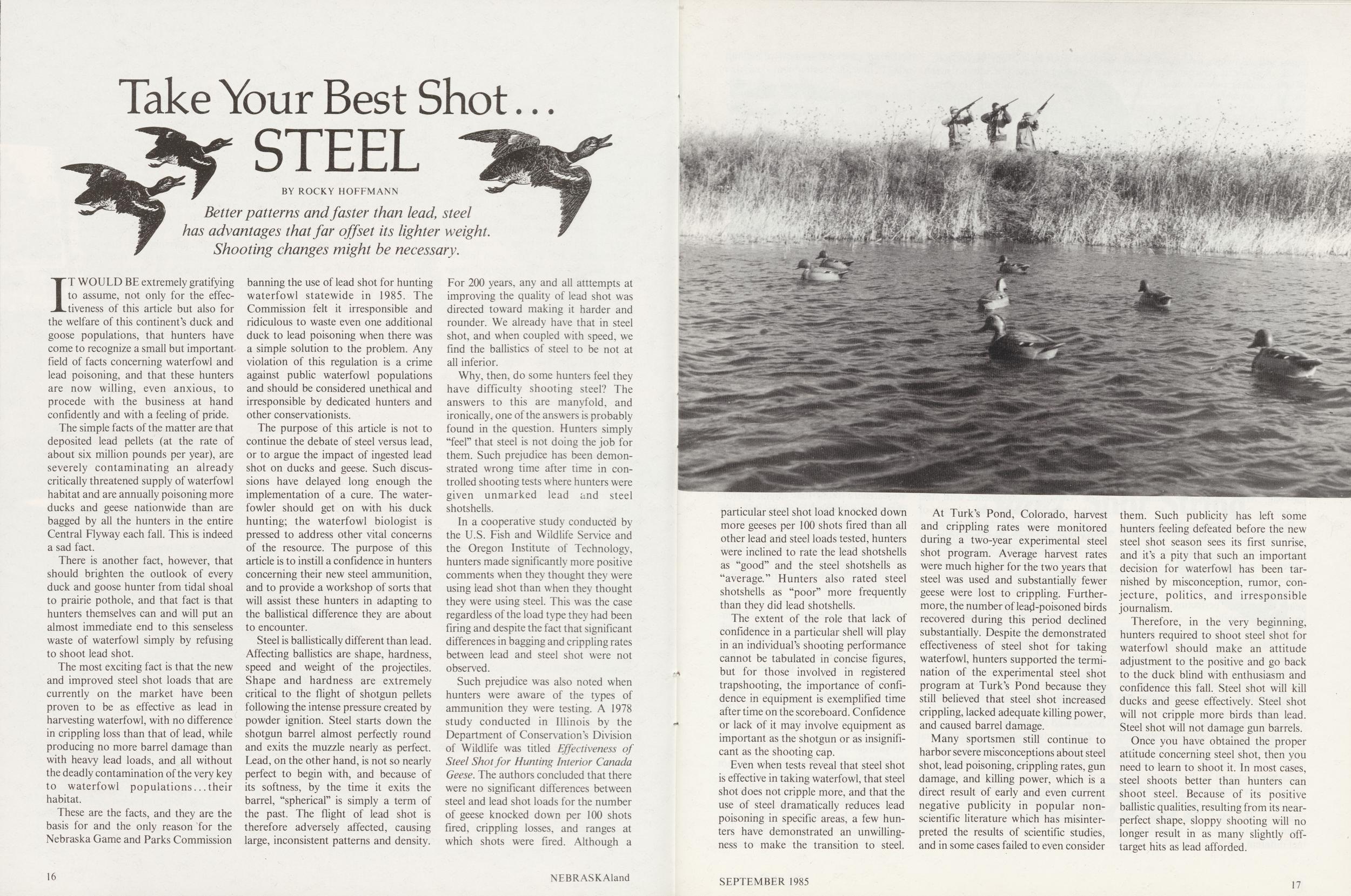
Take your Best Shot STEEL
IT WOULD BE extremely gratifying to assume, not only for the effectiveness of this article but also for the welfare of this continent's duck and goose populations, that hunters have come to recognize a small but important field of facts concerning waterfowl and lead poisoning, and that these hunters are now willing, even anxious, to procede with the business at hand confidently and with a feeling of pride.
The simple facts of the matter are that deposited lead pellets (at the rate of about six million pounds per year), are severely contaminating an already critically threatened supply of waterfowl habitat and are annually poisoning more ducks and geese nationwide than are bagged by all the hunters in the entire Central Flyway each fall. This is indeed a sad fact.
There is another fact, however, that should brighten the outlook of every duck and goose hunter from tidal shoal to prairie pothole, and that fact is that hunters themselves can and will put an almost immediate end to this senseless waste of waterfowl simply by refusing to shoot lead shot.
The most exciting fact is that the new and improved steel shot loads that are currently on the market have been proven to be as effective as lead in harvesting waterfowl, with no difference in crippling loss than that of lead, while producing no more barrel damage than with heavy lead loads, and all without the deadly contamination of the very key to waterfowl populations their habitat.
These are the facts, and they are the basis for and the only reason for the Nebraska Game and Parks Commission banning the use of lead shot for hunting waterfowl statewide in 1985. The Commission felt it irresponsible and ridiculous to waste even one additional duck to lead poisoning when there was a simple solution to the problem. Any violation of this regulation is a crime against public waterfowl populations and should be considered unethical and irresponsible by dedicated hunters and other conservationists.
The purpose of this article is not to continue the debate of steel versus lead, or to argue the impact of ingested lead shot on ducks and geese. Such discussions have delayed long enough the implementation of a cure. The waterfowler should get on with his duck hunting; the waterfowl biologist is pressed to address other vital concerns of the resource. The purpose of this article is to instill a confidence in hunters concerning their new steel ammunition, and to provide a workshop of sorts that will assist these hunters in adapting to the ballistical difference they are about to encounter.
Steel is ballistically different than lead. Affecting ballistics are shape, hardness, speed and weight of the projectiles. Shape and hardness are extremely critical to the flight of shotgun pellets following the intense pressure created by powder ignition. Steel starts down the shotgun barrel almost perfectly round and exits the muzzle nearly as perfect. Lead, on the other hand, is not so nearly perfect to begin with, and because of its softness, by the time it exits the barrel, "spherical" is simply a term of the past. The flight of lead shot is therefore adversely affected, causing large, inconsistent patterns and density. For 200 years, any and all atttempts at improving the quality of lead shot was directed toward making it harder and rounder. We already have that in steel shot, and when coupled with speed, we find the ballistics of steel to be not at all inferior.
Why, then, do some hunters feel they have difficulty shooting steel? The answers to this are manyfold, and ironically, one of the answers is probably found in the question. Hunters simply "feel" that steel is not doing the job for them. Such prejudice has been demonstrated wrong time after time in controlled shooting tests where hunters were given unmarked lead and steel shotshells.
In a cooperative study conducted by the U.S. Fish and Wildlife Service and the Oregon Institute of Technology, hunters made significantly more positive comments when they thought they were using lead shot than when they thought they were using steel. This was the case regardless of the load type they had been firing and despite the fact that significant differences in bagging and crippling rates between lead and steel shot were not observed.
Such prejudice was also noted when hunters were aware of the types of ammunition they were testing. A 1978 study conducted in Illinois by the Department of Conservation's Division of Wildlife was titled Effectiveness of Steel Shot for Hunting Interior Canada Geese. The authors concluded that there were no significant differences between steel and lead shot loads for the number of geese knocked down per 100 shots fired, crippling losses, and ranges at which shots were fired. Although a 16 NEBRASKAland particular steel shot load knocked down more geeses per 100 shots fired than all other lead and steel loads tested, hunters were inclined to rate the lead shotshells as "good" and the steel shotshells as "average." Hunters also rated steel shotshells as "poor" more frequently than they did lead shotshells.
The extent of the role that lack of confidence in a particular shell will play in an individual's shooting performance cannot be tabulated in concise figures, but for those involved in registered trapshooting, the importance of confidence in equipment is exemplified time after time on the scoreboard. Confidence or lack of it may involve equipment as important as the shotgun or as insignificant as the shooting cap.
Even when tests reveal that steel shot is effective in taking waterfowl, that steel shot does not cripple more, and that the use of steel dramatically reduces lead poisoning in specific areas, a few hunters have demonstrated an unwillingness to make the transition to steel.
At Turk's Pond, Colorado, harvest and crippling rates were monitored during a two-year experimental steel shot program. Average harvest rates were much higher for the two years that steel was used and substantially fewer geese were lost to crippling. Furthermore, the number of learj-poisoned birds recovered during this period declined substantially. Despite the demonstrated effectiveness of steel shot for taking waterfowl, hunters supported the termination of the experimental steel shot program at Turk's Pond because they still believed that steel shot increased crippling, lacked adequate killing power, and caused barrel damage.
Many sportsmen still continue to harbor severe misconceptions about steel shot, lead poisoning, crippling rates, gun damage, and killing power, which is a direct result of early and even current negative publicity in popular nonscientific literature which has misinterpreted the results of scientific studies, and in some cases failed to even consider them. Such publicity has left some hunters feeling defeated before the new steel shot season sees its first sunrise, and it's a pity that such an important decision for waterfowl has been tarnished by misconception, rumor, conjecture, politics, and irresponsible journalism.
Therefore, in the very beginning, hunters required to shoot steel shot for waterfowl should make an attitude adjustment to the positive and go back to the duck blind with enthusiasm and confidence this fall. Steel shot will kill ducks and geese effectively. Steel shot will not cripple more birds than lead. Steel shot will not damage gun barrels.
Once you have obtained the proper attitude concerning steel shot, then you need to learn to shoot it. In most cases, steel shoots better than hunters can shoot steel. Because of its positive ballistic qualities, resulting from its nearperfect shape, sloppy shooting will no longer result in as many slightly offtarget hits as lead afforded.
SEPTEMBER 1985 17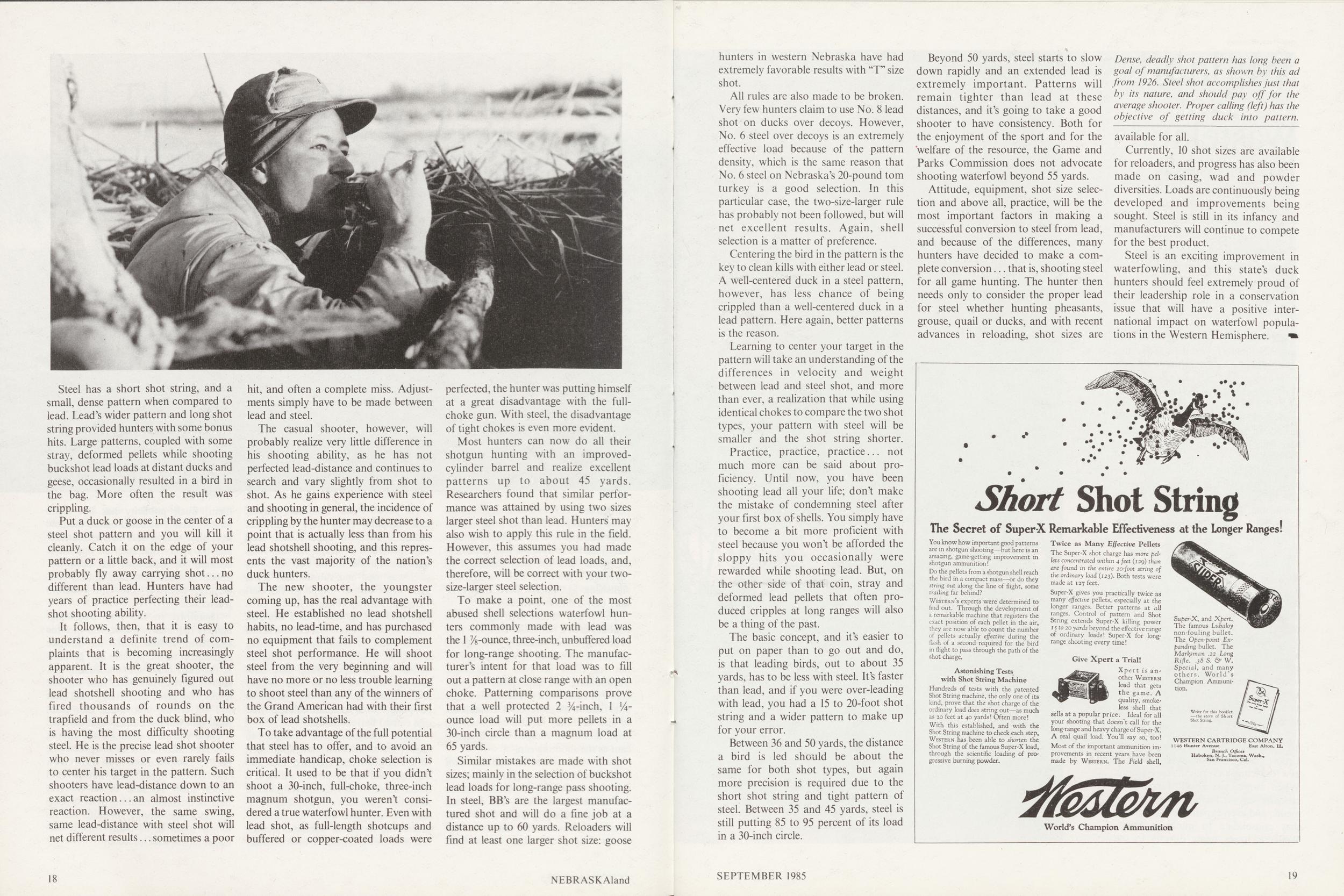
Steel has a short shot string, and a small, dense pattern when compared to lead. Lead's wider pattern and long shot string provided hunters with some bonus hits. Large patterns, coupled with some stray, deformed pellets while shooting buckshot lead loads at distant ducks and geese, occasionally resulted in a bird in the bag. More often the result was crippling.
Put a duck or goose in the center of a steel shot pattern and you will kill it cleanly. Catch it on the edge of your pattern or a little back, and it will most probably fly away carrying shot no different than lead. Hunters have had years of practice perfecting their leadshot shooting ability.
It follows, then, that it is easy to understand a definite trend of complaints that is becoming increasingly apparent. It is the great shooter, the shooter who has genuinely figured out lead shotshell shooting and who has fired thousands of rounds on the trapfield and from the duck blind, who is having the most difficulty shooting steel. He is the precise lead shot shooter who never misses or even rarely fails to center his target in the pattern. Such shooters have lead-distance down to an exact reaction... an almost instinctive reaction. However, the same swing, same lead-distance with steel shot will net different results sometimes a poor hit, and often a complete miss. Adjustments simply have to be made between lead and steel.
The casual shooter, however, will probably realize very little difference in his shooting ability, as he has not perfected lead-distance and continues to search and vary slightly from shot to shot. As he gains experience with steel and shooting in general, the incidence of crippling by the hunter may decrease to a point that is actually less than from his lead shotshell shooting, and this represents the vast majority of the nation's duck hunters.
The new shooter, the youngster coming up, has the real advantage with steel. He established no lead shotshell habits, no lead-time, and has purchased no equipment that fails to complement steel shot performance. He will shoot steel from the very beginning and will have no more or no less trouble learning to shoot steel than any of the winners of the Grand American had with their first box of lead shotshells.
To take advantage of the full potential that steel has to offer, and to avoid an immediate handicap, choke selection is critical. It used to be that if you didn't shoot a 30-inch, full-choke, three-inch magnum shotgun, you weren't considered a true waterfowl hunter. Even with lead shot, as full-length shotcups and buffered or copper-coated loads were perfected, the hunter was putting himself at a great disadvantage with the fullchoke gun. With steel, the disadvantage of tight chokes is even more evident.
Most hunters can now do all their shotgun hunting with an improved cylinder barrel and realize excellent patterns up to about 45 yards. Researchers found that similar performance was attained by using two sizes larger steel shot than lead. Hunters may also wish to apply this rule in the field. However, this assumes you had made the correct selection of lead loads, and, therefore, will be correct with your two-size-larger steel selection.
To make a point, one of the most abused shell selections waterfowl hunters commonly made with lead was the 1 %-ounce, three-inch, unbuffered load for long-range shooting. The manufacturer's intent for that load was to fill out a pattern at close range with an open choke. Patterning comparisons prove that a well protected 2 3/4-inch, 1 14-ounce load will put more pellets in a 30-inch circle than a magnum load at 65 yards.
Similar mistakes are made with shot sizes; mainly in the selection of buckshot lead loads for long-range pass shooting. In steel, BB's are the largest manufactured shot and will do a fine job at a distance up to 60 yards. Reloaders will find at least one larger shot size: goose 18 NEBRASKAland hunters in western Nebraska have had extremely favorable results with "T" size shot.
All rules are also made to be broken. Very few hunters claim to use No. 8 lead shot on ducks over decoys. However, No. 6 steel over decoys is an extremely effective load because of the pattern density, which is the same reason that No. 6 steel on Nebraska's 20-pound torn turkey is a good selection. In this particular case, the two-size-larger rule has probably not been followed, but will net excellent results. Again, shell selection is a matter of preference.
Centering the bird in the pattern is the key to clean kills with either lead or steel. A well-centered duck in a steel pattern, however, has less chance of being crippled than a well-centered duck in a lead pattern. Here again, better patterns is the reason.
Learning to center your target in the pattern will take an understanding of the differences in velocity and weight between lead and steel shot, and more than ever, a realization that while using identical chokes to compare the two shot types, your pattern with steel will be smaller and the shot string shorter.
Practice, practice, practice not much more can be said about proficiency. Until now, you have been shooting lead all your life; don't make the mistake of condemning steel after your first box of shells. You simply have to become a bit more proficient with steel because you won't be afforded the sloppy hits you occasionally were rewarded while shooting lead. But, on the other side of that coin, stray and deformed lead pellets that often produced cripples at long ranges will also be a thing of the past.
The basic concept, and it's easier to put on paper than to go out and do, is that leading birds, out to about 35 yards, has to be less with steel. It's faster than lead, and if you were over-leading with lead, you had a 15 to 20-foot shot string and a wider pattern to make up for your error.
Between 36 and 50 yards, the distance a bird is led should be about the same for both shot types, but again more precision is required due to the short shot string and tight pattern of steel. Between 35 and 45 yards, steel is still putting 85 to 95 percent of its load in a 30-inch circle.
Beyond 50 yards, steel starts to slow down rapidly and an extended lead is extremely important. Patterns will remain tighter than lead at these distances, and it's going to take a good shooter to have consistency. Both for the enjoyment of the sport and for the welfare of the resource, the Game and Parks Commission does not advocate shooting waterfowl beyond 55 yards.
Attitude, equipment, shot size selection and above all, practice, will be the most important factors in making a successful conversion to steel from lead, and because of the differences, many hunters have decided to make a com- plete conversion... that is, shooting steel for all game hunting. The hunter then needs only to consider the proper lead for steel whether hunting pheasants, grouse, quail or ducks, and with recent advances in reloading, shot sizes are available for all.
Dense, deadly shot pattern has long been a goal of manufacturers, as shown by this ad from 1926. Steel shot accomplishes just that by its nature, and should pay off for the average shooter. Proper calling (left) has the objective of getting duck into pattern.Currently, 10 shot sizes are available for reloaders, and progress has also been made on casing, wad and powder diversities. Loads are continuously being developed and improvements being sought. Steel is still in its infancy and manufacturers will continue to compete for the best product.
Steel is an exciting improvement in waterfowling, and this state's duck hunters should feel extremely proud of their leadership role in a conservation issue that will have a positive international impact on waterfowl populations in the Western Hemisphere.
Short Shot String The Secret of Super-X Remarkable Effectiveness at the Longer Ranges! You know how important good patterns are in shotgun shooting—but here is an amazing, game-getting improvement in shotgun ammunition! Do the pellets from a shotgun shell reach the bird in a compact mass—or do they string out along the line of flight, some trailing far behind? Western's experts were determined to find out. Through the development of a remarkable machine that registers the exact position of each pellet in the air, they are now able to count the number of pellets actually effective during the flash of a second required for the bird in flight to pass through the path of the shot charge. Astonishing Tests with Shot String Machine Hundreds of tests with the patented Shot String machine, the only one of its kind, prove that the shot charge of the ordinary load does string out—as much as 20 feet at 40 yards! Often more! With this established, and with the Shot String machine to check each step, Western has been able to shorten the Shot String of the famous Super-X load, through the scientific loading of progressive burning powder. Twice as Many Effective Pellets The Super-X shot charge has more pelJets concentrated within 4 feet (129) than are found in the entire 20-foot string of the ordinary load (123). Both tests were made at 127 feet. Super-X gives you practically twice as many effective pellets, especially at the longer ranges. Better patterns at all ranges. Control of pattern and Shot String extends Super-X killing power 15 to 20 yards beyond the effective range of ordinary loads! Super-X for long range shooting every time! Give Xpert a Trial! Xpert is another Western load that gets the game. A quality, smokeless shell that sells at a popular price. Ideal for all your shooting that doesn't call for the long-range and heavy charge of Super-X. A real quail load. You'll say so, too! Most of the important ammunition im- provements in recent years have been made by Western. The Field shell, Super-X., and Xpert. The famous Lubaloy non-fouling bullet. The Open-point Expanding bullet. The Marhsman .22 Long Rifle. .38 S. & W. Special, and many others. World's Champion Ammunition. Write for this booklet the story of Short Shot String. WESTERN CARTRIDGE COMPANY 1 146 Hunter Avenue East Alton, 111, Branch Offices Hoboken, N. J., Tacoma, Wash., San Francisco, Cal. World's Champion Ammunition SEPTEMBER 1985 19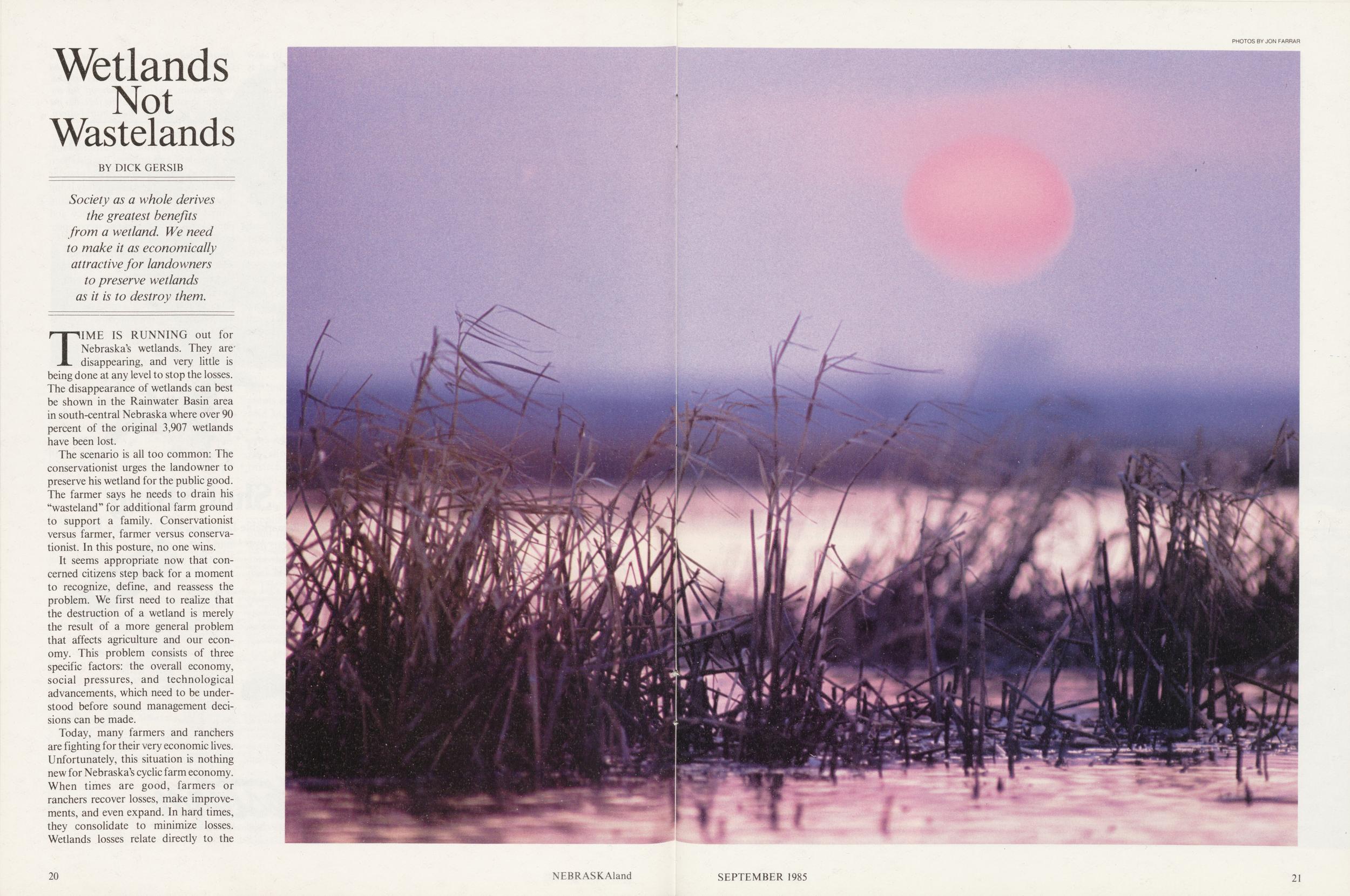
Wetlands Not Wastelands
BY DICK GERSIB Society as a whole derives the greatest benefits from a wetland. We need to make it as economically attractive for landowners to preserve wetlands as it is to destroy them.TIME IS RUNNING out for Nebraska's wetlands. They arc disappearing, and very little is being done at any level to stop the losses. The disappearance of wetlands can best be shown in the Rainwater Basin area in south-central Nebraska where over 90 percent of the original 3,907 wetlands have been lost.
The scenario is all too common: The conservationist urges the landowner to preserve his wetland for the public good. The farmer says he needs to drain his "wasteland" for additional farm ground to support a family. Conservationist versus farmer, farmer versus conservationist. In this posture, no one wins.
It seems appropriate now that con- cerned citizens step back for a moment to recognize, define, and reassess the problem. We first need to realize that the destruction of a wetland is merely the result of a more general problem that affects agriculture and our economy. This problem consists of three specific factors: the overall economy, social pressures, and technological advancements, which need to be understood before sound management decisions can be made.
Today, many farmers and ranchers are fighting for their very economic lives. Unfortunately, this situation is nothing new for Nebraska's cyclic farm economy. When times are good, farmers or ranchers recover losses, make improvements, and even expand. In hard times, they consolidate to minimize losses. Wetlands losses relate directly to the economic condition of the wetland owner and the desire or need to "improve" or expand. The bottom line is a simple one: In many farmers' eyes, survival demands efficiency and effeciency demands that every acre constantly produce a cash crop.
20 NEBRASKAland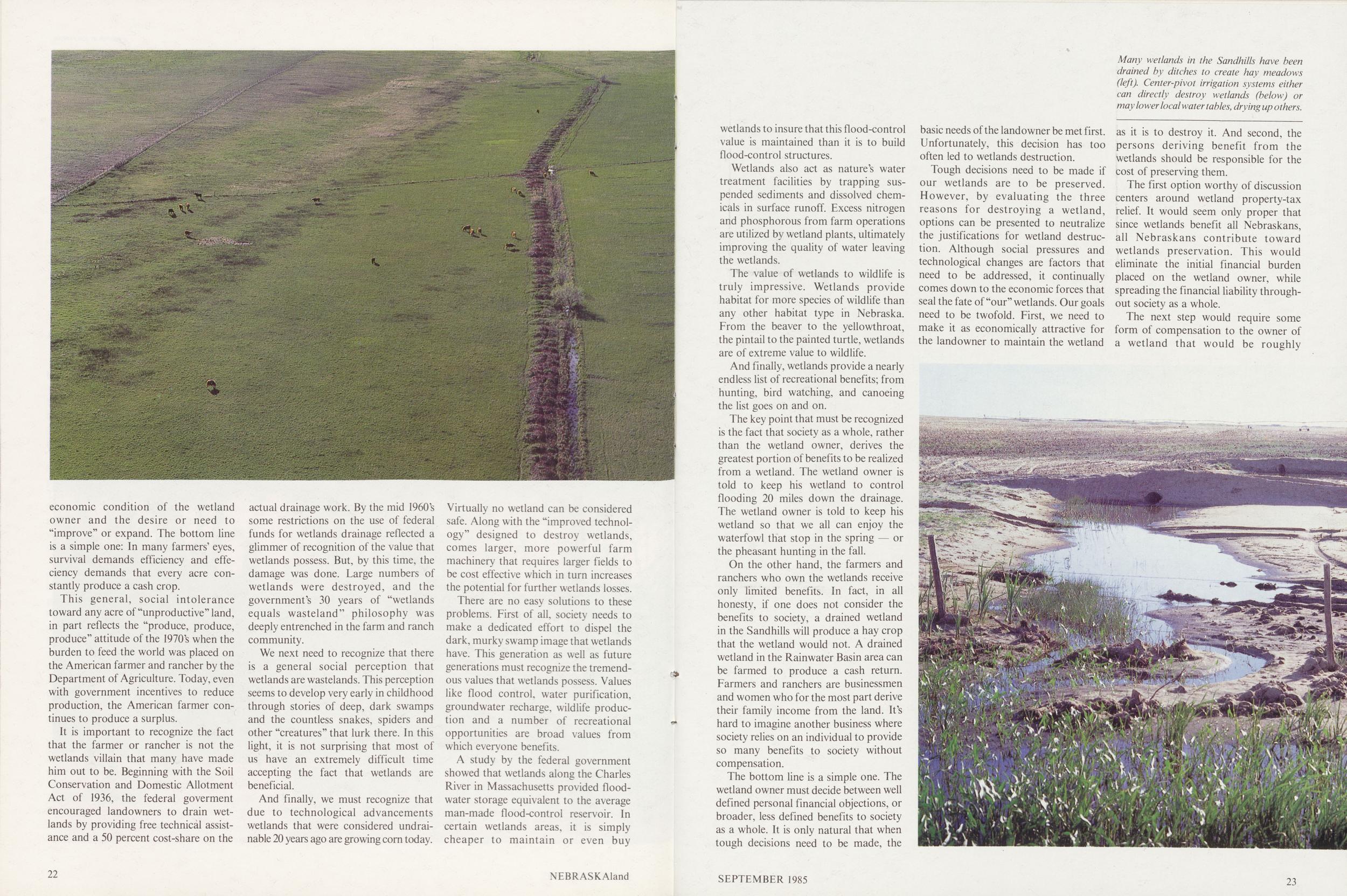
This general, social intolerance toward any acre of "unproductive" land, in part reflects the "produce, produce, produce" attitude of the 1970's when the burden to feed the world was placed on the American farmer and rancher by the Department of Agriculture. Today, even with government incentives to reduce production, the American farmer continues to produce a surplus.
It is important to recognize the fact that the farmer or rancher is not the wetlands villain that many have made him out to be. Beginning with the Soil Conservation and Domestic Allotment Act of 1936, the federal goverment encouraged landowners to drain wetlands by providing free technical assistance and a 50 percent cost-share on the actual drainage work. By the mid 1960's some restrictions on the use of federal funds for wetlands drainage reflected a glimmer of recognition of the value that wetlands possess. But, by this time, the damage was done. Large numbers of wetlands were destroyed, and the government's 30 years of "wetlands equals wasteland" philosophy was deeply entrenched in the farm and ranch community.
We next need to recognize that there is a general social perception that wetlands are wastelands. This perception seems to develop very early in childhood through stories of deep, dark swamps and the countless snakes, spiders and other "creatures" that lurk there. In this light, it is not surprising that most of us have an extremely difficult time accepting the fact that wetlands are beneficial.
And finally, we must recognize that due to technological advancements wetlands that were considered undrainable 20 years ago are growing corn today. Virtually no wetland can be considered safe. Along with the "improved technology" designed to destroy wetlands, comes larger, more powerful farm machinery that requires larger fields to be cost effective which in turn increases the potential for further wetlands losses.
There are no easy solutions to these problems. First of all, society needs to make a dedicated effort to dispel the dark, murky swamp image that wetlands have. This generation as well as future generations must recognize the tremendous values that wetlands possess. Values like flood control, water purification, groundwater recharge, wildlife production and a number of recreational opportunities are broad values from which everyone benefits.
A study by the federal government showed that wetlands along the Charles River in Massachusetts provided floodwater storage equivalent to the average man-made flood-control reservoir. In certain wetlands areas, it is simply cheaper to maintain or even buy 22 NEBRASKAland wetlands to insure that this flood-control value is maintained than it is to build flood-control structures.
Wetlands also act as nature's water treatment facilities by trapping suspended sediments and dissolved chemicals in surface runoff. Excess nitrogen and phosphorous from farm operations are utilized by wetland plants, ultimately improving the quality of water leaving the wetlands.
The value of wetlands to wildlife is truly impressive. Wetlands provide habitat for more species of wildlife than any other habitat type in Nebraska. From the beaver to the yellowthroat, the pintail to the painted turtle, wetlands are of extreme value to wildlife.
And finally, wetlands provide a nearly endless list of recreational benefits; from hunting, bird watching, and canoeing the list goes on and on.
The key point that must be recognized is the fact that society as a whole, rather than the wetland owner, derives the greatest portion of benefits to be realized from a wetland. The wetland owner is told to keep his wetland to control flooding 20 miles down the drainage. The wetland owner is told to keep his wetland so that we all can enjoy the waterfowl that stop in the spring or the pheasant hunting in the fall.
On the other hand, the farmers and ranchers who own the wetlands receive only limited benefits. In fact, in all honesty, if one does not consider the benefits to society, a drained wetland in the Sandhills will produce a hay crop that the wetland would not. A drained wetland in the Rainwater Basin area can be farmed to produce a cash return. Farmers and ranchers are businessmen and women who for the most part derive their family income from the land. It's hard to imagine another business where society relies on an individual to provide so many benefits to society without compensation.
The bottom line is a simple one. The wetland owner must decide between well defined personal financial objections, or broader, less defined benefits to society as a whole. It is only natural that when tough decisions need to be made, the basic needs of the landowner be met first. Unfortunately, this decision has too often led to wetlands destruction.
Tough decisions need to be made if our wetlands are to be preserved. However, by evaluating the three reasons for destroying a wetland, options can be presented to neutralize the justifications for wetland destruction. Although social pressures and technological changes are factors that need to be addressed, it continually comes down to the economic forces that seal the fate of "our" wetlands. Our goals need to be twofold. First, we need to make it as economically attractive for the landowner to maintain the wetland as it is to destroy it. And second, the persons deriving benefit from the wetlands should be responsible for the cost of preserving them.
Many wetlands in the Sandhills have been drained by ditches to create hay meadows (left). Center-pivot irrigation systems either can directly destroy wetlands (below) or may lower local water tables, drying up others.The first option worthy of discussion centers around wetland property-tax relief. It would seem only proper that since wetlands benefit all Nebraskans, all Nebraskans contribute toward wetlands preservation. This would eliminate the initial financial burden placed on the wetland owner, while spreading the financial liability throughout society as a whole.
The next step would require some form of compensation to the owner of a wetland that would be roughly equivalent to the income that would be generated from the wetland if it were destroyed and either farmed or hayed. Options here include a state income tax exemption for each acre of wetland that a farmer or rancher owns, or county property-tax relief on land adjacent to wetlands.
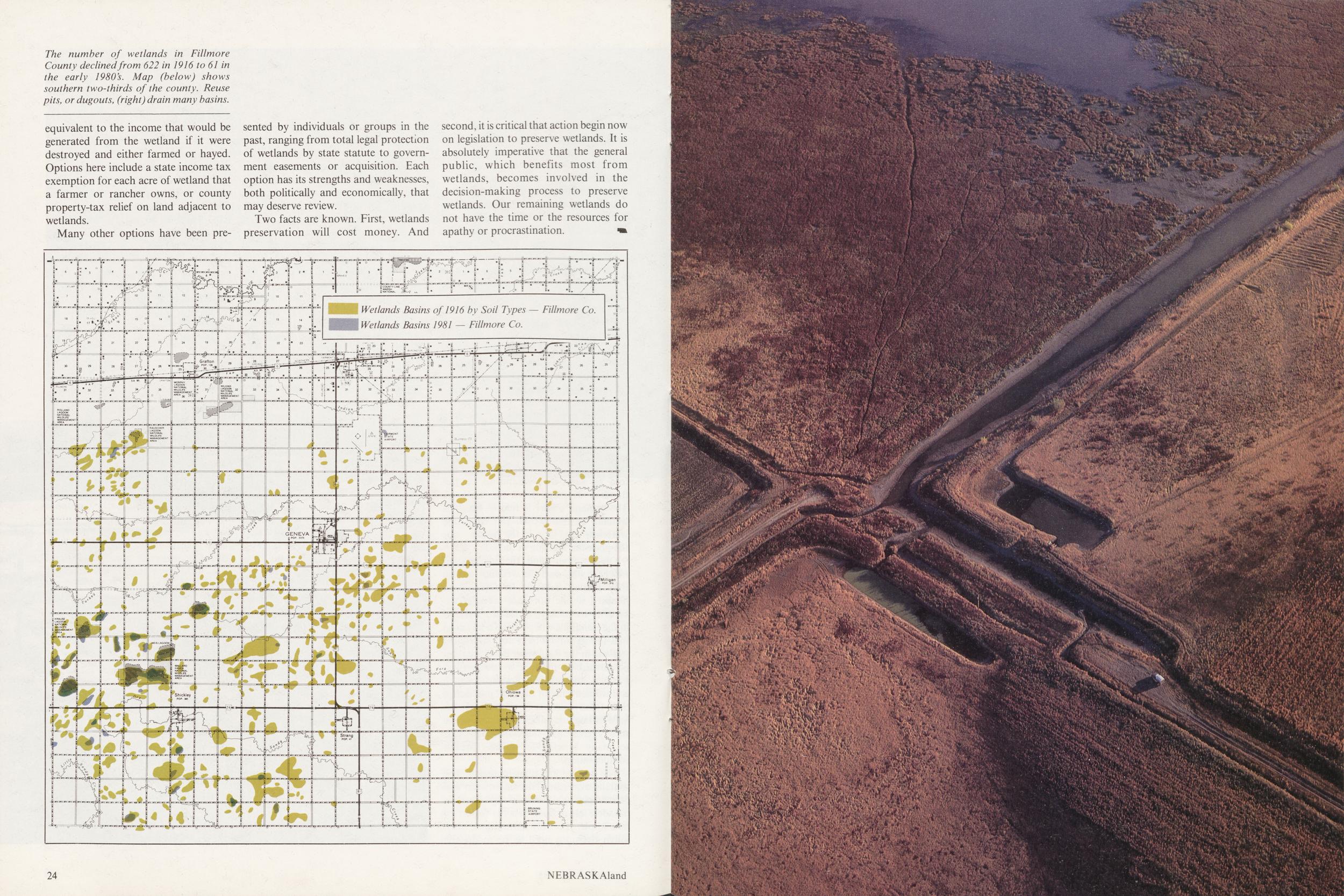 The number of wetlands in Fillmore
County declined from 622 in 1916 to 61 in
the early 1980s. Map (below) shows
southern two-thirds of the county. Reuse
pits, or dugouts, (right) drain many basins.
The number of wetlands in Fillmore
County declined from 622 in 1916 to 61 in
the early 1980s. Map (below) shows
southern two-thirds of the county. Reuse
pits, or dugouts, (right) drain many basins.
Many other options have been presented by individuals or groups in the past, ranging from total legal protection of wetlands by state statute to government easements or acquisition. Each option has its strengths and weaknesses, both politically and economically, that may deserve review.
Two facts are known. First, wetlands preservation will cost money. And second, it is critical that action begin now on legislation to preserve wetlands. It is absolutely imperative that the general public, which benefits most from wetlands, becomes involved in the decision-making process to preserve wetlands. Our remaining wetlands do not have the time or the resources for apathy or procrastination.
Flights Of Fancy
BY CARL WOLFE ILLUSTRATION BY PAULA DAY Beautiful inform, coloration and pattern, butterflies are also unique in their transformation from egg to wondrous adult. Watching only one is enthralling at times happening upon a huge throng during migration is truly overpowering.THE FICKLENESS of Nebraska weather during the spring is well known — wet snow one day with balmy days and sunshine the next. Unless one's memory is without error, the rigors of many springs past often blend until it is impossible to recall specific weather vagaries. That is, unless some special indicator provides that unique catalyst of recall. And such it was last spring when the butterflies merged with the autumn olive trees.
Walking along one late afternoon in April on the meadow path that has seen our steps countless times over the years, we moved toward the top of the hill at the south end of what we often refer to as the "back 40." The sweet fragrance of autumn olive, just coming into full bloom, drifted toward us. When we 26 NEBRASKAland turned the familiar corner along an inner windbreak row of olive, ginnala and chokecherry, it appeared the small rise of land was a moving, crazy patchwork of soft wings and bright colors. The heavy pungency of the autumn olive combined with the dancing colors to turn the south end of our small meadow into a surrealistic world. Time and place were lost momentarily as we watched red admirals chase, turn and flutter among the soft, pale yellow of autumn olive blossoms. Here and there an occasional painted lady could be seen. Even the cosmopolitan spirit of this delicate butterfly was lost, however, among the dancing wings of the red admirals as they congregated close to each and every autumn olive, drinking in the abundant nectar. While some springtimes are forgotten, we will long remember this beautiful fleeting moment in time because of the butterflies. The heavy fragrance of the autumn olive bloom, too, will always be associated with that April afternoon when the red admirals flew.
Through the years, butterflies have provided a number of such moments serving as indicators of phenology as well as indicators of changes in diversity of vegetation especially the more visible flowers.
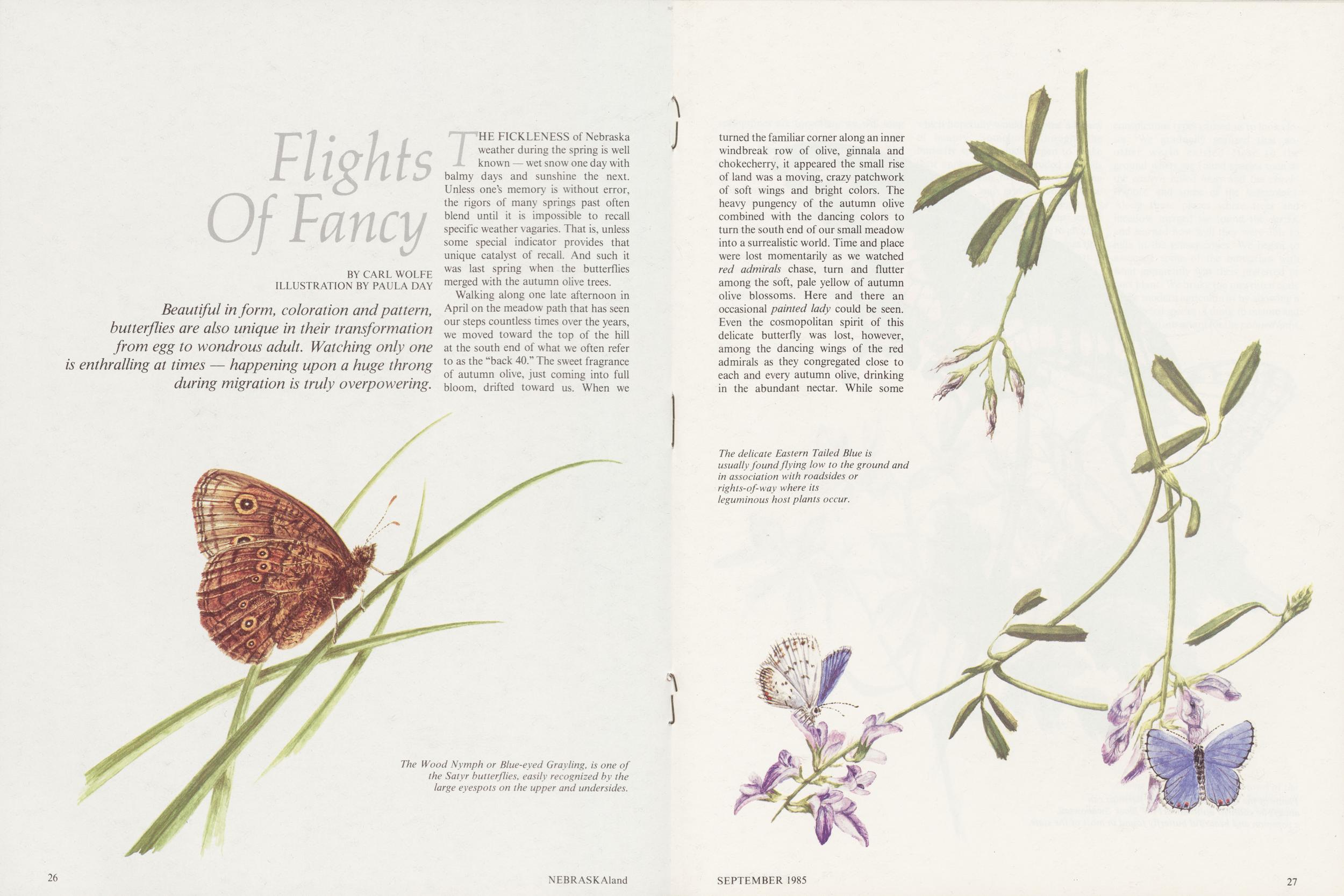
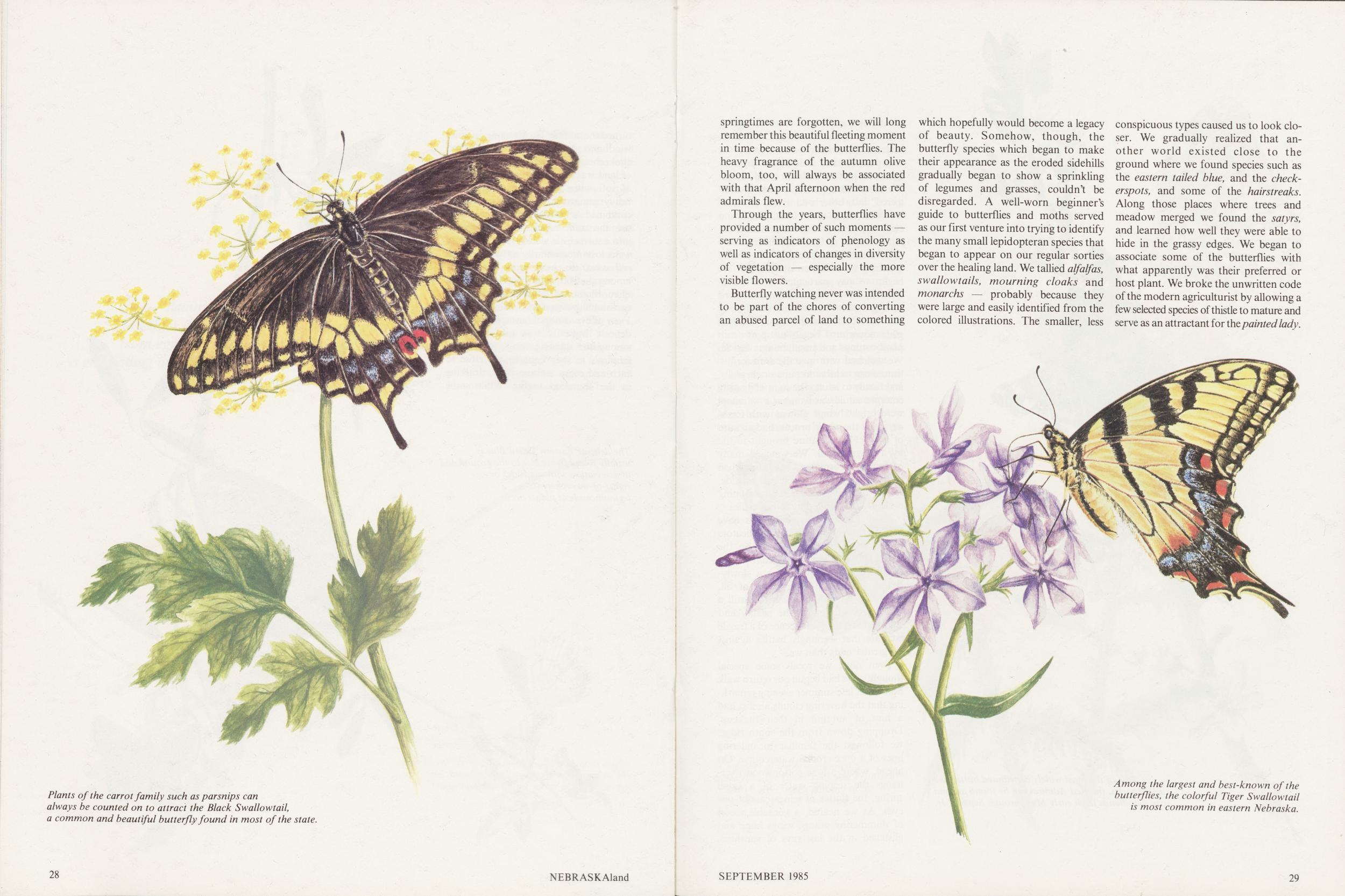
Butterfly watching never was intended to be part of the chores of converting an abused parcel of land to something which hopefully would become a legacy of beauty. Somehow, though, the butterfly species which began to make their appearance as the eroded sidehills gradually began to show a sprinkling of legumes and grasses, couldn't be disregarded. A well-worn beginner's guide to butterflies and moths served as our first venture into trying to identify the many small lepidopteran species that began to appear on our regular sorties over the healing land. We tallied alfalfas, swallowtails, mourning cloaks and monarchs — probably because they were large and easily identified from the colored illustrations. The smaller, less conspicuous types caused us to look closer. We gradually realized that another world existed close to the ground where we found species such as the eastern tailed blue, and the checkerspots, and some of the hairstreaks. Along those places where trees and meadow merged we found the satyrs, and learned how well they were able to hide in the grassy edges. We began to associate some of the butterflies with what apparently was their preferred or host plant. We broke the unwritten code of the modern agriculturist by allowing a few selected species of thistle to mature and serve as an attractant for the paintedlady.
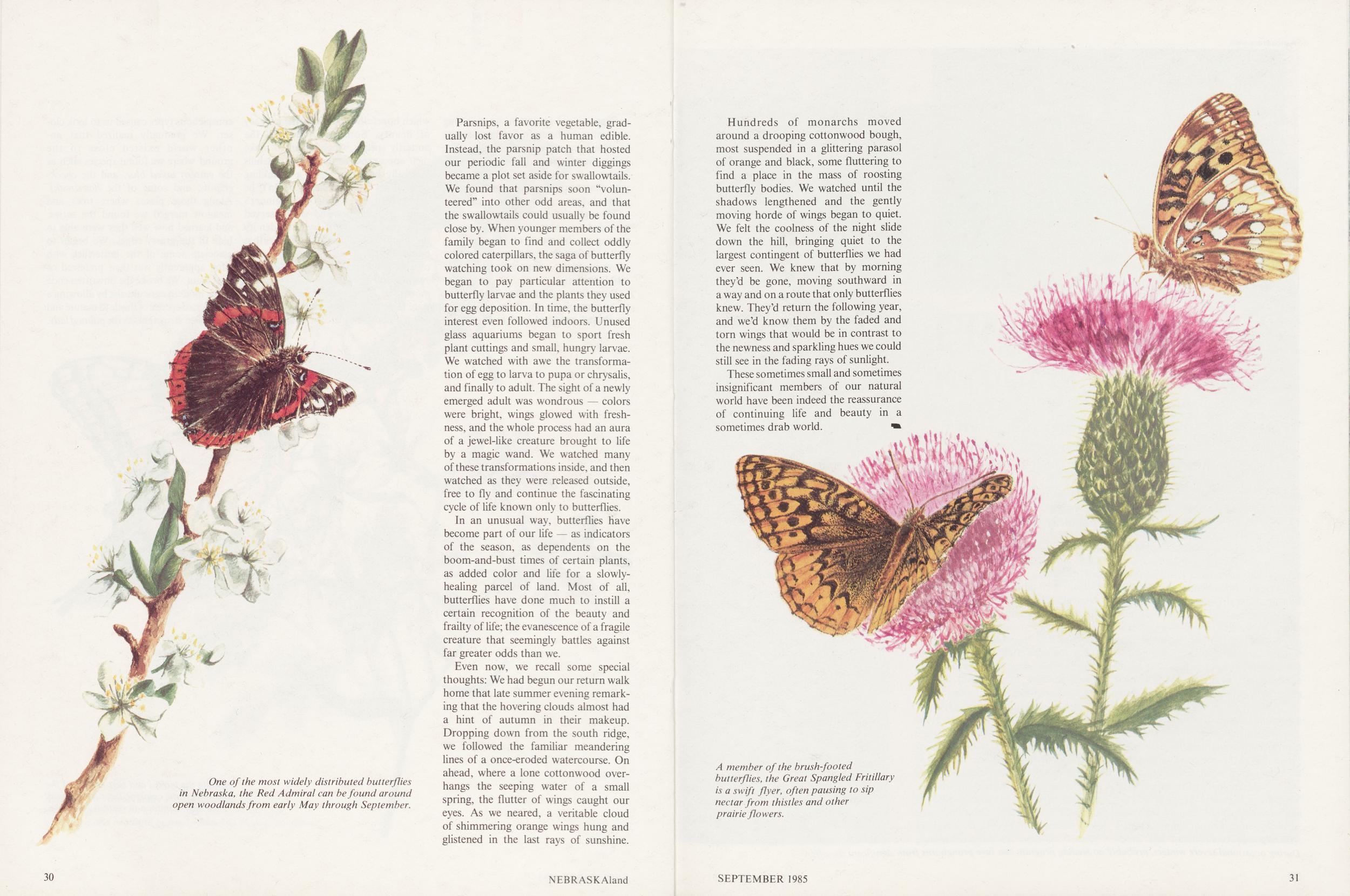
Parsnips, a favorite vegetable, gradually lost favor as a human edible. Instead, the parsnip patch that hosted our periodic fall and winter diggings became a plot set aside for swallowtails. We found that parsnips soon "volunteered" into other odd areas, and that the swallowtails could usually be found close by. When younger members of the family began to find and collect oddly colored caterpillars, the saga of butterfly watching took on new dimensions. We began to pay particular attention to butterfly larvae and the plants they used for egg deposition. In time, the butterfly interest even followed indoors. Unused glass aquariums began to sport fresh plant cuttings and small, hungry larvae. We watched with awe the transformation of egg to larva to pupa or chrysalis, and finally to adult. The sight of a newly emerged adult was wondrous — colors were bright, wings glowed with freshness, and the whole process had an aura of a jewel-like creature brought to life by a magic wand. We watched many of these transformations inside, and then watched as they were released outside, free to fly and continue the fascinating cycle of life known only to butterflies.
In an unusual way, butterflies have become part of our life — as indicators of the season, as dependents on the boom-and-bust times of certain plants, as added color and life for a slowlyhealing parcel of land. Most of all, butterflies have done much to instill a certain recognition of the beauty and frailty of life; the evanescence of a fragile creature that seemingly battles against far greater odds than we.
Even now, we recall some special thoughts: We had begun our return walk home that late summer evening remarking that the hovering clouds almost had a hint of autumn in their makeup. Dropping down from the south ridge, we followed the familiar meandering lines of a once-eroded watercourse. On ahead, where a lone cottonwood overhangs the seeping water of a small spring, the flutter of wings caught our eyes. As we neared, a veritable cloud of shimmering orange wings hung and glistened in the last rays of sunshine.
30 NEBRASKAlandHundreds of monarchs moved around a drooping cottonwood bough, most suspended in a glittering parasol of orange and black, some fluttering to find a place in the mass of roosting butterfly bodies. We watched until the shadows lengthened and the gently moving horde of wings began to quiet. We felt the coolness of the night slide down the hill, bringing quiet to the largest contingent of butterflies we had ever seen. We knew that by morning they'd be gone, moving southward in a way and on a route that only butterflies knew. They'd return the following year, and we'd know them by the faded and torn wings that would be in contrast to the newness and sparkling hues we could still see in the fading rays of sunlight.
These sometimes small and sometimes insignificant members of our natural world have been indeed the reassurance of continuing life and beauty in a sometimes drab world.
PRONGHORNS Popular or Problematical
BY JON FARRAR In recent years, it has become increasingly difficult to obtain an antelope permit in Nebraska. There are several reasons why, but no easy solutions.WHY IS IT so difficult to get an antelope permit in Nebraska? Back in the early and even the mid 1960s, anyone who wanted to hunt pronghorns had only to apply to be issued a permit. Back then, a hunter's principal concern was finding private land to hunt, or, putting up with the more intense competition on public land. What changed in the last 20 years?
The answer, or more accurately the answers, to that question are not at first clear-cut or simple. It has become more difficult to obtain an antelope permit in Nebraska for several reasons.
For starters, Nebraska is not in the heart of pronghorn range, but on the eastern margin. Although historical records indicate that antelope were once found all across Nebraska, their numbers were probably never high in the eastern portion of the state. John K. Townsend in 1834 reported antelope near the mouth of the Platte River. In 1855, Lt. G. K. Warren crossed the eastern Sandhills and reported "numer 32 ous" antelope. But by 1880, antelope were largely confined to the northern and western portions of the state.
As grasslands were converted to cropland, antelope, along with other once common grazers such as elk, disappeared from much of their former range. The fleet herds of pronghorns that hunters once knew in eastern and southern Nebraska became part of our history. In 1873, the Nebraska Legislature imposed a hunting season on pronghorns, and by 1907 it became illegal to take any antelope. It was not until 1953, 46 years later, that antelope could again be taken legally by Nebraska hunters.
But most of the Sandhills, and much of the Panhandle, remained in grassland. Why, with modern game management and a carefully regulated harvest, do we not once again have large herds of antelope over these regions?
"The problem apparently is range, says Karl Menzel, Nebraska Game and Parks Commission big-game specialist; both the quality and the quantity. Primarily, though, it has to be the quality of the range. We have areas with open expanses of grassland that antelope require, but we do not have the densities that you see once you cross into Wyoming. It would appear that Nebraska's range is not providing something that the range in Wyoming does. Obviously we don't have the sage, which is an antelope food. But the stretch along Highway 20 between the Nebraska border and Lusk, Wyoming, doesn't have that much more sage yet there are pretty good densities of antelope.
SEPTEMBER 1985 33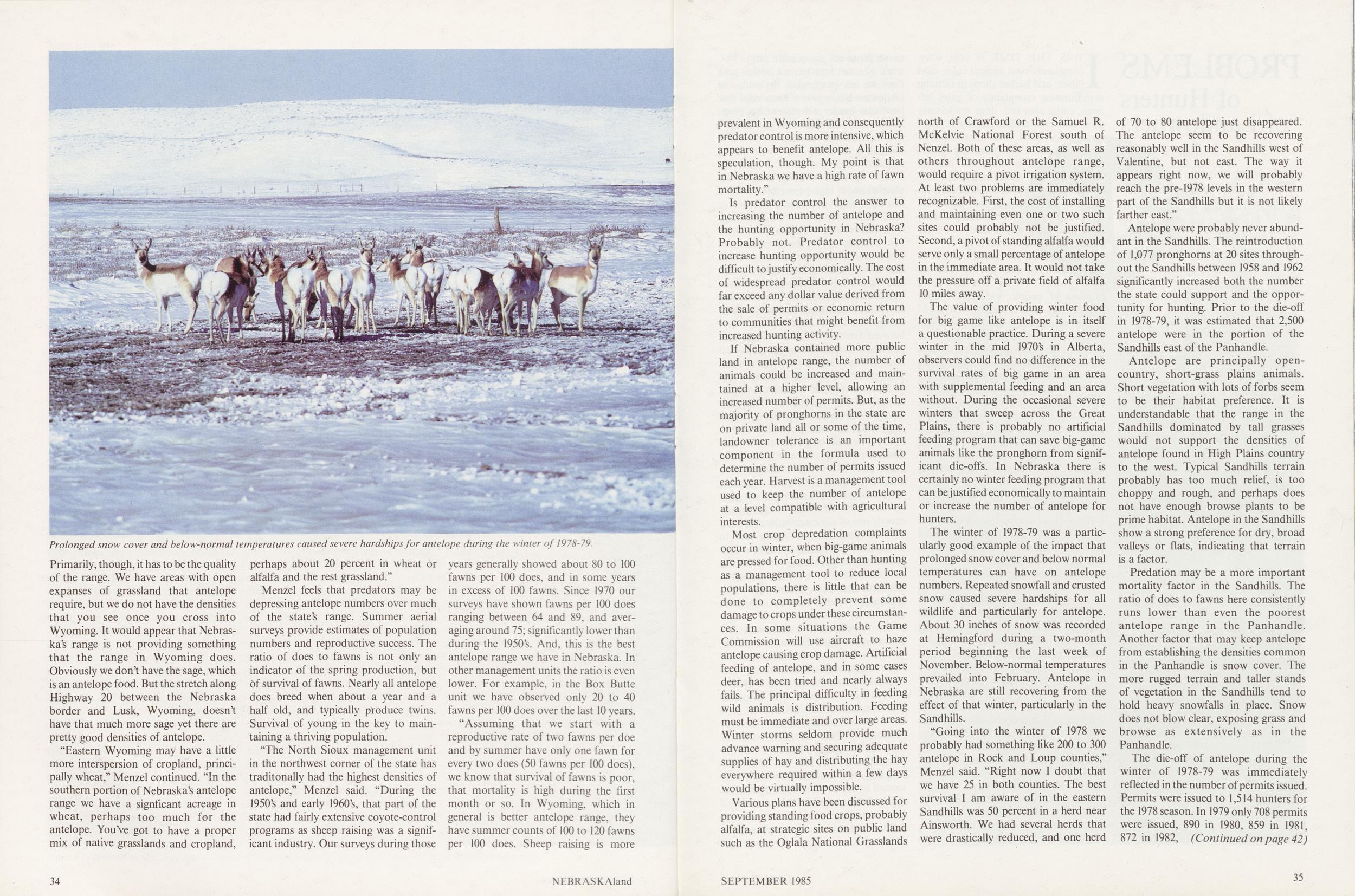
"Eastern Wyoming may have a little more interspersion of cropland, principally wheat," Menzel continued. "In the southern portion of Nebraska's antelope range we have a signficant acreage in wheat, perhaps too much for the antelope. You've got to have a proper mix of native grasslands and cropland, perhaps about 20 percent in wheat or alfalfa and the rest grassland."
Menzel feels that predators may be depressing antelope numbers over much of the state's range. Summer aerial surveys provide estimates of population numbers and reproductive success. The ratio of does to fawns is not only an indicator of the spring production, but of survival of fawns. Nearly all antelope does breed when about a year and a half old, and typically produce twins. Survival of young in the key to maintaining a thriving population.
"The North Sioux management unit in the northwest corner of the state has traditonally had the highest densities of antelope," Menzel said. "During the 1950's and early 1960's, that part of the state had fairly extensive coyote-control programs as sheep raising was a significant industry. Our surveys during those years generally showed about 80 to 100 fawns per 100 does, and in some years in excess of 100 fawns. Since 1970 our surveys have shown fawns per 100 does ranging between 64 and 89, and averaging around 75; significantly lower than during the 1950's. And, this is the best antelope range we have in Nebraska. In other management units the ratio is even lower. For example, in the Box Butte unit we have observed only 20 to 40 fawns per 100 does over the last 10 years.
"Assuming that we start with a reproductive rate of two fawns per doe and by summer have only one fawn for every two does (50 fawns per 100 does), we know that survival of fawns is poor, that mortality is high during the first month or so. In Wyoming, which in general is better antelope range, they have summer counts of 100 to 120 fawns per 100 does. Sheep raising is more 34 NEBRASKAland prevalent in Wyoming and consequently predator control is more intensive, which appears to benefit antelope. All this is speculation, though. My point is that in Nebraska we have a high rate of fawn mortality."
Is predator control the answer to increasing the number of antelope and the hunting opportunity in Nebraska? Probably not. Predator control to increase hunting opportunity would be difficult to justify economically. The cost of widespread predator control would far exceed any dollar value derived from the sale of permits or economic return to communities that might benefit from increased hunting activity.
If Nebraska contained more public land in antelope range, the number of animals could be increased and maintained at a higher level, allowing an increased number of permits. But, as the majority of pronghorns in the state are on private land all or some of the time, landowner tolerance is an important component in the formula used to determine the number of permits issued each year. Harvest is a management tool used to keep the number of antelope at a level compatible with agricultural interests.
Most crop depredation complaints occur in winter, when big-game animals are pressed for food. Other than hunting as a management tool to reduce local populations, there is little that can be done to completely prevent some damage to crops under these circumstances. In some situations the Game Commission will use aircraft to haze antelope causing crop damage. Artificial feeding of antelope, and in some cases deer, has been tried and nearly always fails. The principal difficulty in feeding wild animals is distribution. Feeding must be immediate and over large areas. Winter storms seldom provide much advance warning and securing adequate supplies of hay and distributing the hay everywhere required within a few days would be virtually impossible.
Various plans have been discussed for providing standing food crops, probably alfalfa, at strategic sites on public land such as the Oglala National Grasslands north of Crawford or the Samuel R. McKelvie National Forest south of Nenzel. Both of these areas, as well as others throughout antelope range, would require a pivot irrigation system. At least two problems are immediately recognizable. First, the cost of installing and maintaining even one or two such sites could probably not be justified. Second, a pivot of standing alfalfa would serve only a small percentage of antelope in the immediate area. It would not take the pressure off a private field of alfalfa 10 miles away.
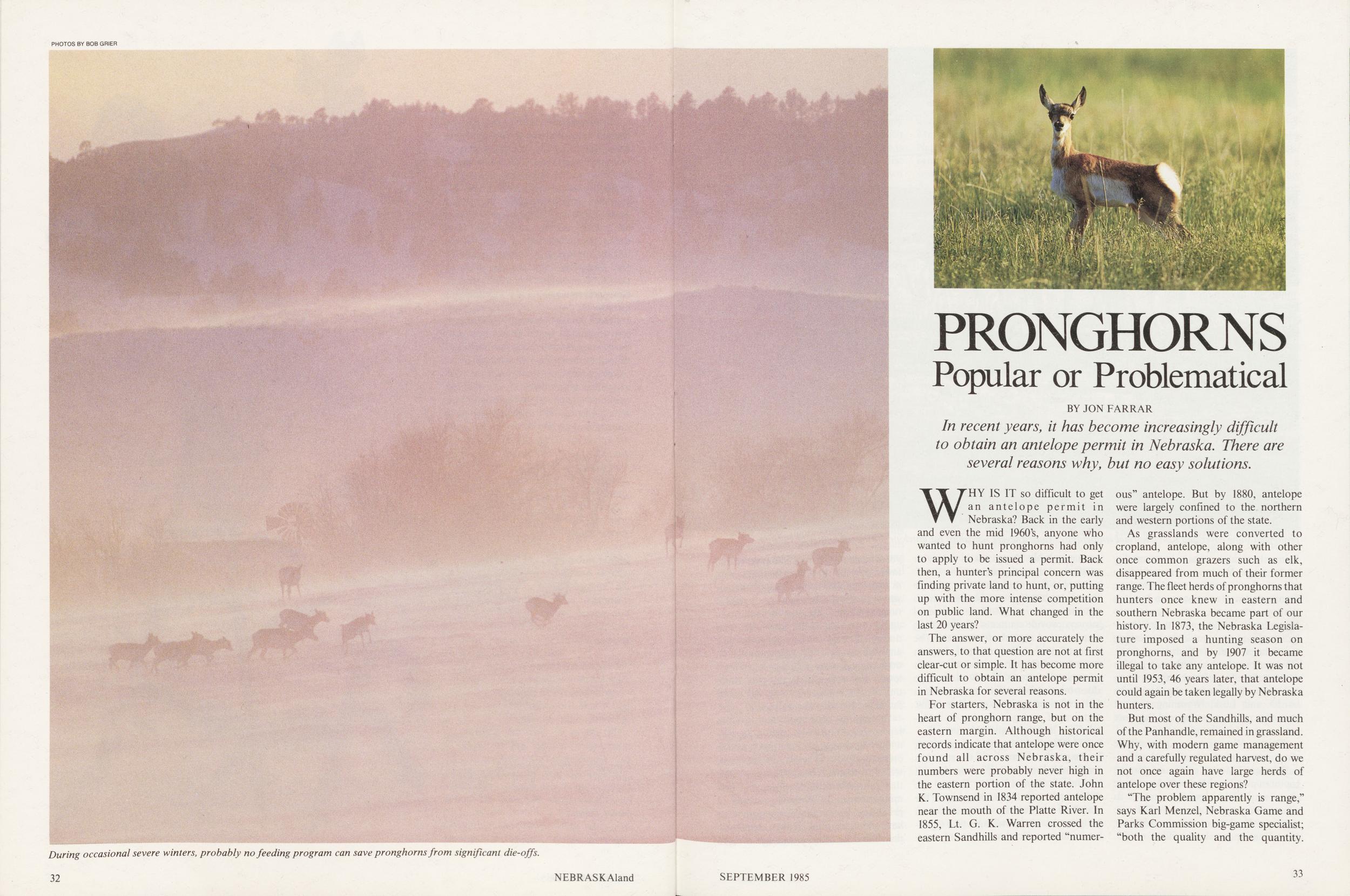
The value of providing winter food for big game like antelope is in itself a questionable practice. During a severe winter in the mid 1970's in Alberta, observers could find no difference in the survival rates of big game in an area with supplemental feeding and an area without. During the occasional severe winters that sweep across the Great Plains, there is probably no artificial feeding program that can save big-game animals like the pronghorn from significant die-offs. In Nebraska there is certainly no winter feeding program that can be justified economically to maintain or increase the number of antelope for hunters.
The winter of 1978-79 was a particularly good example of the impact that prolonged snow cover and below normal temperatures can have on antelope numbers. Repeated snowfall and crusted snow caused severe hardships for all wildlife and particularly for antelope. About 30 inches of snow was recorded at Hemingford during a two-month period beginning the last week of November. Below-normal temperatures prevailed into February. Antelope in Nebraska are still recovering from the effect of that winter, particularly in the Sandhills.
"Going into the winter of 1978 we probably had something like 200 to 300 antelope in Rock and Loup counties," Menzel said. "Right now I doubt that we have 25 in both counties. The best survival I am aware of in the eastern Sandhills was 50 percent in a herd near Ainsworth. We had several herds that were drastically reduced, and one herd of 70 to 80 antelope just disappeared. The antelope seem to be recovering reasonably well in the Sandhills west of Valentine, but not east. The way it appears right now, we will probably reach the pre-1978 levels in the western part of the Sandhills but it is not likely farther east."
Antelope were probably never abundant in the Sandhills. The reintroduction of 1,077 pronghorns at 20 sites throughout the Sandhills between 1958 and 1962 significantly increased both the number the state could support and the opportunity for hunting. Prior to the die-off in 1978-79, it was estimated that 2,500 antelope were in the portion of the Sandhills east of the Panhandle. Antelope are principally open- country, short-grass plains animals. Short vegetation with lots of forbs seem to be their habitat preference. It is understandable that the range in the Sandhills dominated by tall grasses would not support the densities of antelope found in High Plains country to the west. Typical Sandhills terrain probably has too much relief, is too choppy and rough, and perhaps does not have enough browse plants to be prime habitat. Antelope in the Sandhills show a strong preference for dry, broad valleys or flats, indicating that terrain is a factor.
Predation may be a more important mortality factor in the Sandhills. The ratio of does to fawns here consistently runs lower than even the poorest antelope range in the Panhandle. Another factor that may keep antelope from establishing the densities common in the Panhandle is snow cover. The more rugged terrain and taller stands of vegetation in the Sandhills tend to hold heavy snowfalls in place. Snow does not blow clear, exposing grass and browse as extensively as in the Panhandle.
The die-off of antelope during the winter of 1978-79 was immediately reflected in the number of permits issued. Permits were issued to 1,514 hunters for the 1978 season. In 1979 only 708 permits were issued, 890 in 1980, 859 in 1981, 872 in 1982, (Continued on page 42)
SEPTEMBER 1985 35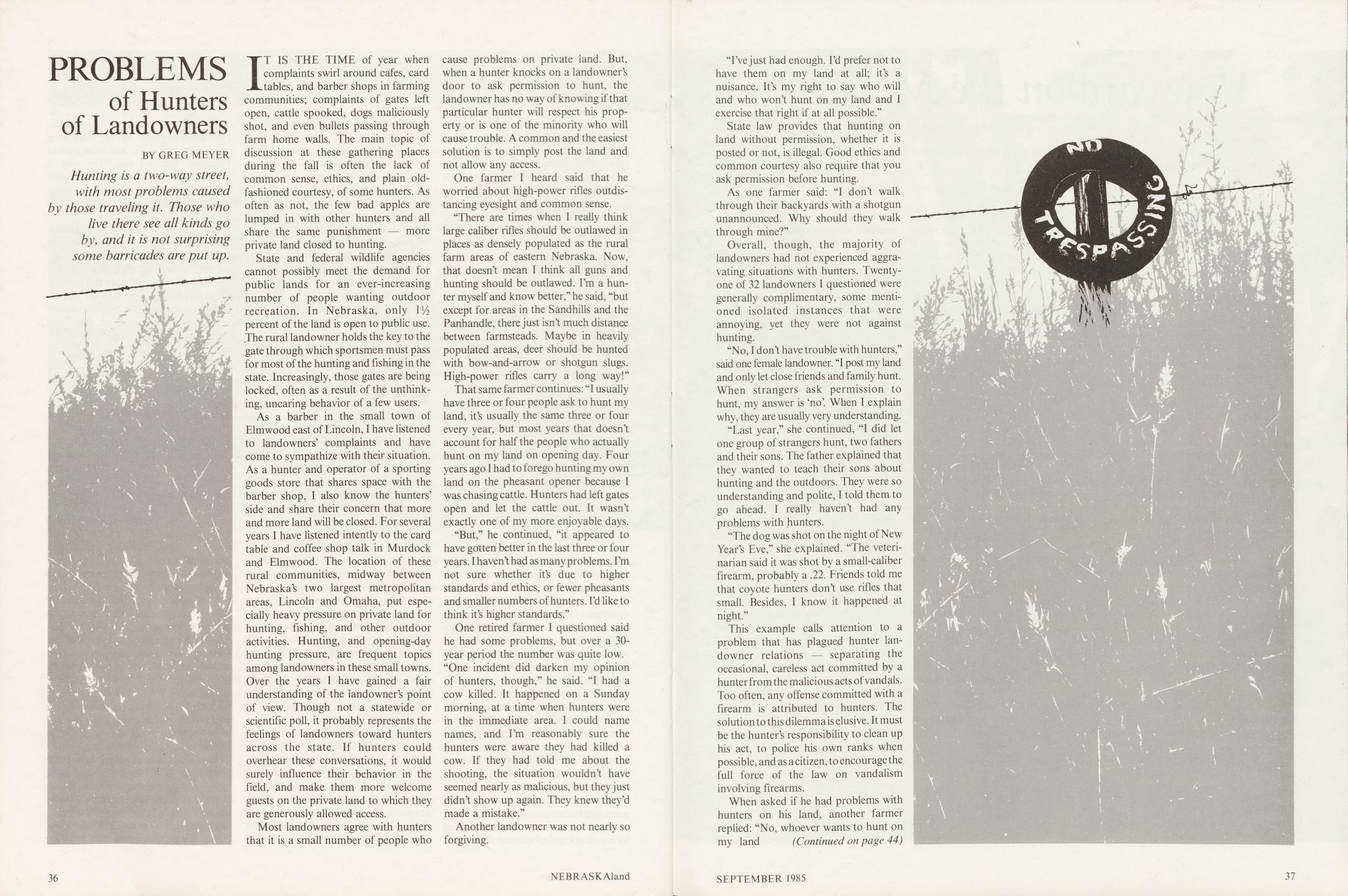
PROBLEMS of Hunters of Landowners
BY GREG MEYER Hunting is a two-way street, with most problems caused by those traveling it. Those who live there see all kinds go by, and it is not surprising some barricades are put up.IT IS THE TIME of year when complaints swirl around cafes, card tables, and barber shops in farming communities; complaints of gates left open, cattle spooked, dogs maliciously shot, and even bullets passing through farm home walls. The main topic of discussion at these gathering places during the fall is often the lack of common sense, ethics, and plain oldfashioned courtesy, of some hunters. As often as not, the few bad apples are lumped in with other hunters and all share the same punishment more private land closed to hunting.
State and federal wildlife agencies cannot possibly meet the demand for public lands for an ever-increasing number of people wanting outdoor recreation. In Nebraska, only ll/2 percent of the land is open to public use. The rural landowner holds the key to the gate through which sportsmen must pass for most of the hunting and fishing in the state. Increasingly, those gates are being locked, often as a result of the unthinking, uncaring behavior of a few users.
As a barber in the small town of Elmwood east of Lincoln, I have listened to landowners' complaints and have come to sympathize with their situation. As a hunter and operator of a sporting goods store that shares space with the barber shop, I also know the hunters' side and share their concern that more and more land will be closed. For several years I have listened intently to the card table and coffee shop talk in Murdock and Elmwood. The location of these rural communities, midway between Nebraska's two largest metropolitan areas, Lincoln and Omaha, put especially heavy pressure on private land for hunting, fishing, and other outdoor activities. Hunting, and opening-day hunting pressure, are frequent topics among landowners in these small towns. Over the years I have gained a fair understanding of the landowner's point of view. Though not a statewide or scientific poll, it probably represents the feelings of landowners toward hunters across the state. If hunters could overhear these conversations, it would surely influence their behavior in the field, and make them more welcome guests on the private land to which they are generously allowed access.
Most landowners agree with hunters that it is a small number of people who cause problems on private land. But, when a hunter knocks on a landowner's door to ask permission to hunt, the landowner has no way of knowing if that particular hunter will respect his property or is one of the minority who will cause trouble. A common and the easiest solution is to simply post the land and not allow any access.
One farmer I heard said that he worried about high-power rifles outdistancing eyesight and common sense.
"There are times when I really think large caliber rifles should be outlawed in places as densely populated as the rural farm areas of eastern Nebraska. Now, that doesn't mean I think all guns and hunting should be outlawed. I'm a hunter myself and know better," he said, "but except for areas in the Sandhills and the Panhandle, there just isn't much distance between farmsteads. Maybe in heavily populated areas, deer should be hunted with bow-and-arrow or shotgun slugs. High-power rifles carry a long way!"
That same farmer continues: "I usually have three or four people ask to hunt my land, it's usually the same three or four every year, but most years that doesn't account for half the people who actually hunt on my land on opening day. Four years ago I had to forego hunting my own land on the pheasant opener because I was chasing cattle. Hunters had left gates open and let the cattle out. It wasn't exactly one of my more enjoyable days.
"But," he continued, "it appeared to have gotten better in the last three or four years. I havent had as many problems. I'm not sure whether it's due to higher standards and ethics, or fewer pheasants and smaller numbers of hunters. I'd like to think it's higher standards."
One retired farmer I questioned said he had some problems, but over a 30-year period the number was quite low. "One incident did darken my opinion of hunters, though," he said. "I had a cow killed. It happened on a Sunday morning, at a time when hunters were in the immediate area. I could name names, and Em reasonably sure the hunters were aware they had killed a cow. If they had told me about the shooting, the situation wouldn't have seemed nearly as malicious, but they just didn't show up again. They knew they'd made a mistake."
Another landowner was not nearly so forgiving.
36 NEBRASKAland"I've just had enough. I'd prefer not to have them on my land at all; it's a nuisance. It's my right to say who will and who won't hunt on my land and I exercise that right if at all possible."
State law provides that hunting on land without permission, whether it is posted or not, is illegal. Good ethics and common courtesy also require that you ask permission before hunting.
As one farmer said: "I don't walk through their backyards with a shotgun unannounced. Why should they walk through mine?"
Overall, though, the majority of landowners had not experienced aggravating situations with hunters. Twentyone of 32 landowners I questioned were generally complimentary, some mentioned isolated instances that were annoying, yet they were not against hunting.
"No, I don't have trouble with hunters," said one female landowner. "I post my land and only let close friends and family hunt. When strangers ask permission to hunt, my answer is 4no'. When I explain why, they are usually very understanding.
"Last year," she continued, "I did let one group of strangers hunt, two fathers and their sons. The father explained that they wanted to teach their sons about hunting and the outdoors. They were so understanding and polite, I told them to go ahead. I really haven't had any problems with hunters.
"The dog was shot on the night of New Year's Eve," she explained. "The veterinarian said it was shot bv a small-caliber firearm, probably a .22. Friends told me that coyote hunters don't use rifles that small. Besides, I know it happened at night."
This example calls attention to a problem that has plagued hunter landowner relations separating the occasional, careless act committed by a hunter from the malicious acts of vandals. Too often, any offense committed with a firearm is attributed to hunters. The solution to this dilemma is elusive. It must be the hunter's responsibility to clean up his act, to police his own ranks when possible, and as a citizen, to encourage the full force of the law on vandalism involving firearms.
When asked if he had problems with hunters on his land, another farmer replied: "No, whoever wants to hunt on my land (Continued on page 44)
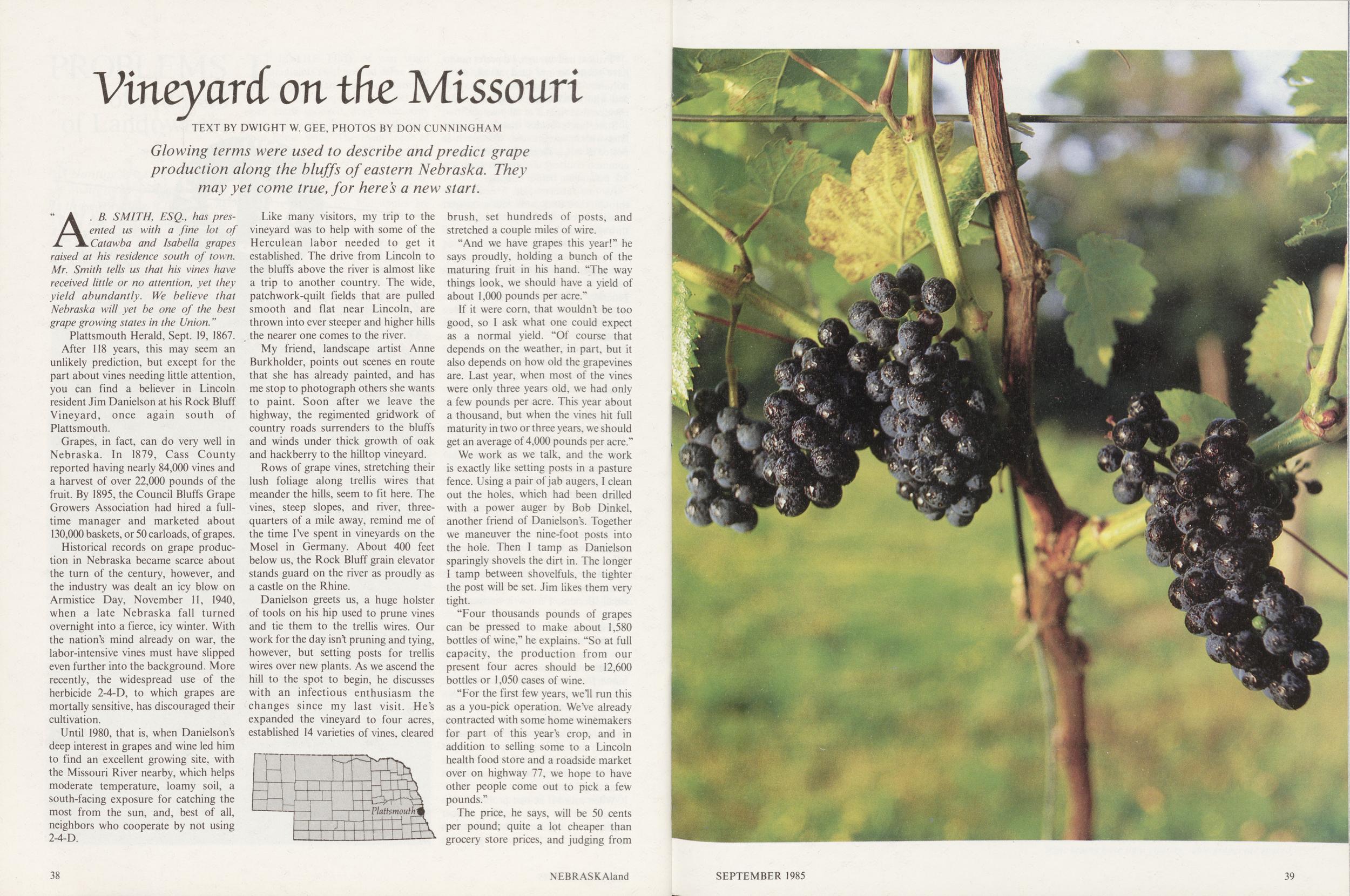
Vineyard on the Missouri
TEXT BY DWIGHT W. GEE, PHOTOS BY DON CUNNINGHAM Glowing terms were used to describe and predict grape production along the bluffs of eastern Nebraska. They may yet come true, for heres a new start.A: B. SMITH, ESQ., has presented us with a fine lot of Catawba and Isabella grapes raised at his residence south of town. Mr. Smith tells us that his vines have received little or no attention, yet they yield abundantly. We believe that Nebraska will yet be one of the best grape growing states in the Union."
Plattsmouth Herald, Sept. 19, 1867.
After 118 years, this may seem an unlikely prediction, but except for the part about vines needing little attention, you can find a believer in Lincoln resident Jim Danielson at his Rock Bluff Vineyard, once again south of Plattsmouth.
Grapes, in fact, can do very well in Nebraska. In 1879, Cass County reported having nearly 84,000 vines and a harvest of over 22,000 pounds of the fruit. By 1895, the Council Bluffs Grape Growers Association had hired a fulltime manager and marketed about 130,000 baskets, or 50 carloads, of grapes.
Historical records on grape production in Nebraska became scarce about the turn of the century, however, and the industry was dealt an icy blow on Armistice Day, November 11, 1940, when a late Nebraska fall turned overnight into a fierce, icy winter. With the nation's mind already on war, the labor-intensive vines must have slipped even further into the background. More recently, the widespread use of the herbicide 2-4-D, to which grapes are mortally sensitive, has discouraged their cultivation.
Until 1980, that is, when Danielson's deep interest in grapes and wine led him to find an excellent growing site, with the Missouri River nearby, which helps moderate temperature, loamy soil, a south-facing exposure for catching the most from the sun, and, best of all, neighbors who cooperate by not using 2-4-D.
Like many visitors, my trip to the vineyard was to help with some of the Herculean labor needed to get it established. The drive from Lincoln to the bluffs above the river is almost like a trip to another country. The wide, patchwork-quilt fields that are pulled smooth and flat near Lincoln, are thrown into ever steeper and higher hills the nearer one comes to the river.
My friend, landscape artist Anne Burkholder, points out scenes en route that she has already painted, and has me stop to photograph others she wants to paint. Soon after we leave the highway, the regimented gridwork of country roads surrenders to the bluffs and winds under thick growth of oak and hackberry to the hilltop vineyard.
Rows of grape vines, stretching their lush foliage along trellis wires that meander the hills, seem to fit here. The vines, steep slopes, and river, three quarters of a mile away, remind me of the time I've spent in vineyards on the Mosel in Germany. About 400 feet below us, the Rock Bluff grain elevator stands guard on the river as proudly as a castle on the Rhine.
Danielson greets us, a huge holster of tools on his hip used to prune vines and tie them to the trellis wires. Our work for the day isn't pruning and tying, however, but setting posts for trellis wires over new plants. As we ascend the hill to the spot to begin, he discusses with an infectious enthusiasm the changes since my last visit. He's expanded the vineyard to four acres, established 14 varieties of vines, cleared brush, set hundreds of posts, and stretched a couple miles of wire.
"And we have grapes this year!" he says proudly, holding a bunch of the maturing fruit in his hand. "The way things look, we should have a yield of about 1,000 pounds per acre."
If it were corn, that wouldn't be too good, so I ask what one could expect as a normal yield. "Of course that depends on the weather, in part, but it also depends on how old the grapevines are. Last year, when most of the vines were only three years old, we had only a few pounds per acre. This year about a thousand, but when the vines hit full maturity in two or three years, we should get an average of 4,000 pounds per acre."
We work as we talk, and the work is exactly like setting posts in a pasture fence. Using a pair of jab augers, I clean out the holes, which had been drilled with a power auger by Bob Dinkel, another friend of Danielson's. Together we maneuver the nine-foot posts into the hole. Then I tamp as Danielson sparingly shovels the dirt in. The longer I tamp between shovelfuls, the tighter the post will be set. Jim likes them very tight."Four thousands pounds of grapes can be pressed to make about 1,580 bottles of wine," he explains. "So at full capacity, the production from our present four acres should be 12,600 bottles or 1,050 cases of wine.
"For the first few years, we'll run this as a you-pick operation. We've already contracted with some home winemakers for part of this year's crop, and in addition to selling some to a Lincoln health food store and a roadside market over on highway 77, we hope to have other people come out to pick a few pounds."
The price, he says, will be 50 cents per pound; quite a lot cheaper than grocery store prices, and judging from freshly-picked vineyard grapes I've eaten in the past, a vastly more interesting produce. This raises the question of grape types.
38 NEBRASKAland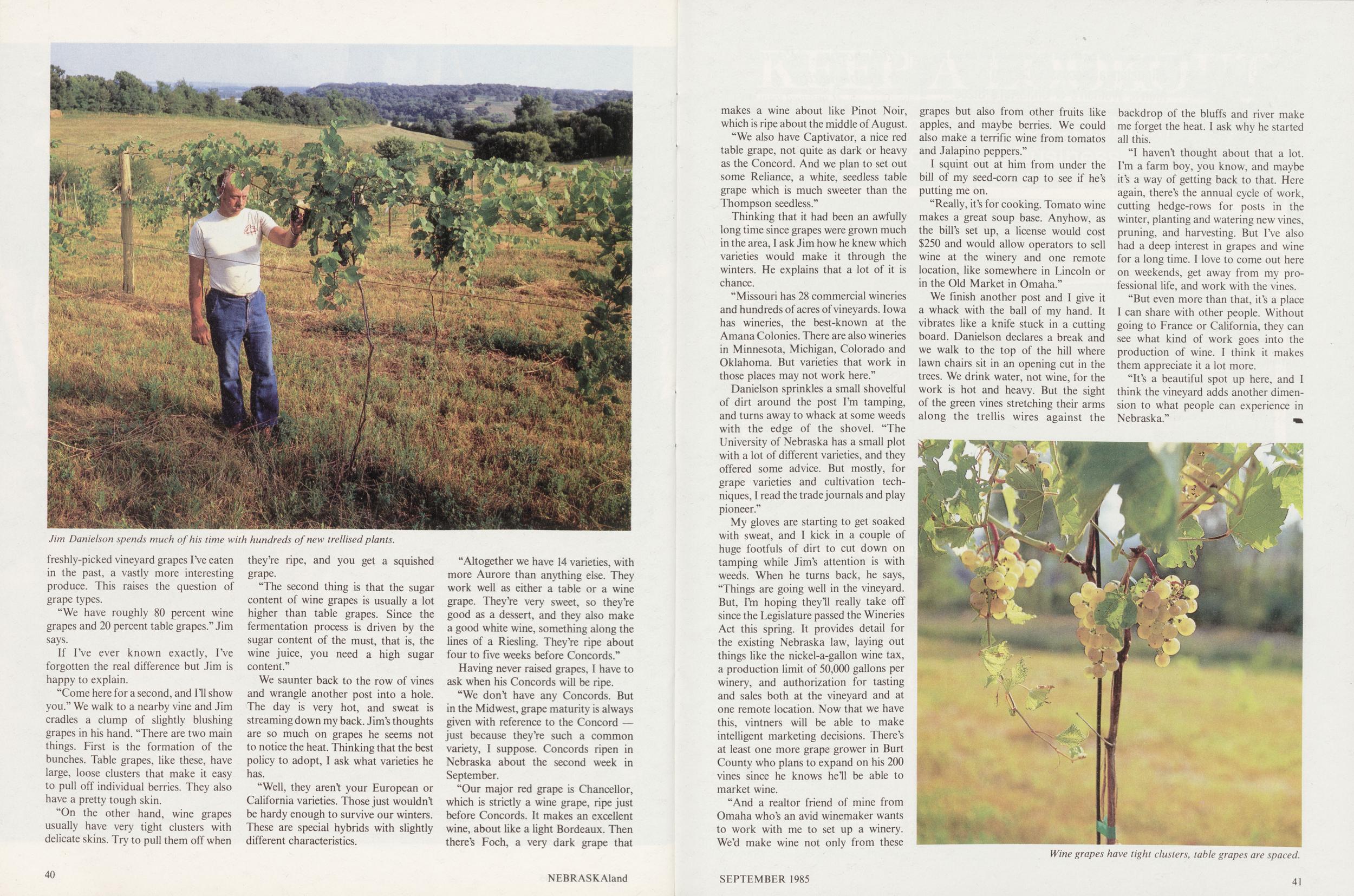
"We have roughly 80 percent wine grapes and 20 percent table grapes." Jim says.
If I've ever known exactly, I've forgotten the real difference but Jim is happy to explain.
"Come here for a second, and I'll show you." We walk to a nearby vine and Jim cradles a clump of slightly blushing grapes in his hand. "There are two main things. First is the formation of the bunches. Table grapes, like these, have large, loose clusters that make it easy to pull off individual berries. They also have a pretty tough skin.
"On the other hand, wine grapes usually have very tight clusters with delicate skins. Try to pull them off when they're ripe, and you get a squished grape.
"The second thing is that the sugar content of wine grapes is usually a lot higher than table grapes. Since the fermentation process is driven by the sugar content of the must, that is, the wine juice, you need a high sugar content."
We saunter back to the row of vines and wrangle another post into a hole. The day is very hot, and sweat is streaming down my back. Jim's thoughts are so much on grapes he seems not to notice the heat. Thinking that the best policy to adopt, I ask what varieties he has.
"Well, they aren't your European or California varieties. Those just wouldn't be hardy enough to survive our winters. These are special hybrids with slightly different characteristics.
"Altogether we have 14 varieties, with more Aurore than anything else. They work well as either a table or a wine grape. They're very sweet, so they're good as a dessert, and they also make a good white wine, something along the lines of a Riesling. They're ripe about four to five weeks before Concords."
Having never raised grapes, I have to ask when his Concords will be ripe.
"We don't have any Concords. But in the Midwest, grape maturity is always given with reference to the Concord just because they're such a common variety, I suppose. Concords ripen in Nebraska about the second week in September.
"Our major red grape is Chancellor, which is strictly a wine grape, ripe just before Concords. It makes an excellent wine, about like a light Bordeaux. Then there's Foch, a very dark grape that 40 NEBRASKAland makes a wine about like Pinot Noir, which is ripe about the middle of August.
"We also have Captivator, a nice red table grape, not quite as dark or heavy as the Concord. And we plan to set out some Reliance, a white, seedless table grape which is much sweeter than the Thompson seedless."
Thinking that it had been an awfully long time since grapes were grown much in the area, I ask Jim how he knew which varieties would make it through the winters. He explains that a lot of it is chance.
"Missouri has 28 commercial wineries and hundreds of acres of vineyards. Iowa has wineries, the best-known at the Amana Colonies. There are also wineries in Minnesota, Michigan, Colorado and Oklahoma. But varieties that work in those places may not work here."
Danielson sprinkles a small shovelful of dirt around the post I'm tamping, and turns away to whack at some weeds with the edge of the shovel. "The University of Nebraska has a small plot with a lot of different varieties, and they offered some advice. But mostly, for grape varieties and cultivation techniques, I read the trade journals and play pioneer."
My gloves are starting to get soaked with sweat, and I kick in a couple of huge footfuls of dirt to cut down on tamping while Jim's attention is with weeds. When he turns back, he says, "Things are going well in the vineyard. But, I'm hoping they'll really take off since the Legislature passed the Wineries Act this spring. It provides detail for the existing Nebraska law, laying out things like the nickel-a-gallon wine tax, a production limit of 50,000 gallons per winery, and authorization for tasting and sales both at the vineyard and at one remote location. Now that we have this, vintners will be able to make intelligent marketing decisions. There's at least one more grape grower in Burt County who plans to expand on his 200 vines since he knows hell be able to market wine.
"And a realtor friend of mine from Omaha who's an avid winemaker wants to work with me to set up a winery. We'd make wine not only from these grapes but also from other fruits like apples, and maybe berries. We could also make a terrific wine from tomatos and Jalapino peppers."
I squint out at him from under the bill of my seed-corn cap to see if he's putting me on.
"Really, it's for cooking. Tomato wine makes a great soup base. Anyhow, as the bill's set up, a license would cost $250 and would allow operators to sell wine at the winery and one remote location, like somewhere in Lincoln or in the Old Market in Omaha."
We finish another post and I give it a whack with the ball of my hand. It vibrates like a knife stuck in a cutting board. Danielson declares a break and we walk to the top of the hill where lawn chairs sit in an opening cut in the trees. We drink water, not wine, for the work is hot and heavy. But the sight of the green vines stretching their arms along the trellis wires against the backdrop of the bluffs and river make me forget the heat. I ask why he started all this.
"I haven't thought about that a lot. I'm a farm boy, you know, and maybe it's a way of getting back to that. Here again, there's the annual cycle of work, cutting hedge-rows for posts in the winter, planting and watering new vines, pruning, and harvesting. But I've also had a deep interest in grapes and wine for a long time. I love to come out here on weekends, get away from my professional life, and work with the vines.
"But even more than that, it's a place I can share with other people. Without going to France or California, they can see what kind of work goes into the production of wine. I think it makes them appreciate it a lot more.
"It's a beautiful spot up here, and I think the vineyard adds another dimension to what people can experience in Nebraska."
 Minnetonka Moccasin Catalog
Men's, Women's & Children's Sizes
All genuine leather and highest quality
Many styles and colors to choose from
Name
Address
City
State
Zip.
MOCCASINS
Mail to: H & M Bootery, 275 N. Main, Valentine, Neb. 69201
For Full Color Catalog and Price List
STOCK YOUR LAKE
OR POND WITH
Channel cat, Bluegill
Hybrid Bluegill,
Largemouth Bass,
Crappie, Bullheads,
Triploid Grass Carp,
Minnows
WILLOW LAKE FISH HATCHERY
Rt. 3, Box 46, Hastings, Nebr. 68901
Gaylord L Crawford
Phone: (402) 463-8022
Day or Night
For April to October 15 stocking
5th Annual
River City Tin Can Canoe Race
Saturday, Sept. 28 at 10:30 a.m.
From Wilson Island, IA to Dodge Park
on the Missouri River
Six Divisions—Entry Fee $20 per canoe
Trophies, T-shirts, Door Prizes and
a 17-foot aluminum canoe to be awarded
To enter contact: Tony Pignotti,
1421 N. Saddle Creek Rd.,
Omaha, NE 68132 Ph. (402) 553-5544
Sponsored by: Amana, River City Roundup
and Pignotti Sheet Metal
THE
ADMIRAL'S COVE
EXIT 6 ON THE NORTH SIDE
VISIT THE
ADMIRAL'S QALLEY
RESTAURANT
YOUR FAVORITE COCKTAILS FANCY LARGE SALAD BAR
TROPHY STRIPERS ON DISPLAY
CLOSE TO WATER
Located on the north shore of
Lake McConaughy, 7 miles
west of dam
SERVICES
Tackle, Bait, Gas, Oil,
Ice, Beer, Pop, etc.
MOTEL
Lake McConaughy's largest motel
and apartment complex includes new units
BOAT AND MOTOR RENTAL
GUIDE SERVICE
Ph: 308-355-2102 Lemoyne, Ne 69146
Minnetonka Moccasin Catalog
Men's, Women's & Children's Sizes
All genuine leather and highest quality
Many styles and colors to choose from
Name
Address
City
State
Zip.
MOCCASINS
Mail to: H & M Bootery, 275 N. Main, Valentine, Neb. 69201
For Full Color Catalog and Price List
STOCK YOUR LAKE
OR POND WITH
Channel cat, Bluegill
Hybrid Bluegill,
Largemouth Bass,
Crappie, Bullheads,
Triploid Grass Carp,
Minnows
WILLOW LAKE FISH HATCHERY
Rt. 3, Box 46, Hastings, Nebr. 68901
Gaylord L Crawford
Phone: (402) 463-8022
Day or Night
For April to October 15 stocking
5th Annual
River City Tin Can Canoe Race
Saturday, Sept. 28 at 10:30 a.m.
From Wilson Island, IA to Dodge Park
on the Missouri River
Six Divisions—Entry Fee $20 per canoe
Trophies, T-shirts, Door Prizes and
a 17-foot aluminum canoe to be awarded
To enter contact: Tony Pignotti,
1421 N. Saddle Creek Rd.,
Omaha, NE 68132 Ph. (402) 553-5544
Sponsored by: Amana, River City Roundup
and Pignotti Sheet Metal
THE
ADMIRAL'S COVE
EXIT 6 ON THE NORTH SIDE
VISIT THE
ADMIRAL'S QALLEY
RESTAURANT
YOUR FAVORITE COCKTAILS FANCY LARGE SALAD BAR
TROPHY STRIPERS ON DISPLAY
CLOSE TO WATER
Located on the north shore of
Lake McConaughy, 7 miles
west of dam
SERVICES
Tackle, Bait, Gas, Oil,
Ice, Beer, Pop, etc.
MOTEL
Lake McConaughy's largest motel
and apartment complex includes new units
BOAT AND MOTOR RENTAL
GUIDE SERVICE
Ph: 308-355-2102 Lemoyne, Ne 69146
Pronghorns Popular or Problematical
(Continued from page 35)and then up to 1,070 for the 1983 season. The number of permits authorized for the 1985 season is again approaching the levels preceding the winter of 1978-79 with 1,150. The most permits issued for antelope in Nebraska was 1,851 in 1976. The number of permits authorized is more than just a reflection of population estimates: it also takes into account crop damage on private land in certain areas or management units.
From data gathered during summer aerial surveys, biologists calculate populations for management units. In 1955, prior to the reintroduction of antelope into the Sandhills, the state's total population was estimated to be 3,500 animals. Ten years later it was estimated that the number had climbed to near 6,000. Just prior to the winter die-off in 1978-79, the estimate was just over 9,000. Because of low densities in the Sandhills, aerial surveys have not been flown there on a regular basis. The highest number of antelope estimated in Nebraska was just over 10,000 in 1974. During the last two or three surveys, the number in Nebraska's Panhandle has once again climbed back over 7,000. All of these estimates are probably conservative as low-density areas are not surveyed.
Except for the recovery years following the die-off of 1978-79, the number of permits issued has usually ranged between 1,200 and the high of 1,851. In general terms it could be said that in the last 25 years the number of antelope permits has remained fairly constant. During that same period, though, it has become increasingly difficult to obtain a permit to hunt antelope in Nebraska. In 1966, permits were still available in all units except Cherry for 12 to 24 days after the application period opened. Prior to 1969, permits were issued on a "first-come, first-serve" basis. As competition became keener, it seemed this system favored those hunters closest to the Game Commission office in Lincoln (although permit distribution did not show this). In 1969, antelope permits for "over subscribed" units were selected by a drawing. The number of applications continued to far outnumber permits, and so in 1973 hunters who held a permit the preceding year were not allowed to apply unless permits remained after the first application period. In 1974 the restriction was expanded to include those hunter who had held a permit for either of the two preceding years. And yet, demand for permits was still more than double the number of permits available. In 1977 the exclusion was extended to three years in an attempt to ensure more hunters the opportunity of hunting antelope. In spite of such measures, there were 2,356 applications for 1,100 antelope permits in 1984.
42 NEBRASKAland 1020 Central Ave.
Arrhpru Pro Shon "Just look for the log cabin"
/Arcnery rro Onop Kearney, Nebr. PH. 308-236-9700
20 Beautiful Indoor Archery Lanes
"Featuring moving deer target"
11th St
SALES & SERVICE on all top line bows
Featuring
Hoyt/Easton, Martin, PSE, Bear, Jennings
Professional Taxidermy Studio
Open: Tues-Fri 11:00 A.M. - 9:00 P.M.
Sat-Sun 11:00 A.M. - 7:00 P.M.
Closed Monday VV-1-80
8th St
Take Dad Fishing!
Look to Tomorrow
and Remember Yesterday. If
You should know about the American Sportsman. He Bowhunters Who Care
has been the backbone of the conservation move
Planning for Tomorrow
ment since it began. And you should know about
Bowhunters Who Care. People dedicated to preserv For more information, Write:
ing the environment and hunting, both now and in Bowhunters who Care
the years to come.
PO Box 476
Columbus, NE 68601
1020 Central Ave.
Arrhpru Pro Shon "Just look for the log cabin"
/Arcnery rro Onop Kearney, Nebr. PH. 308-236-9700
20 Beautiful Indoor Archery Lanes
"Featuring moving deer target"
11th St
SALES & SERVICE on all top line bows
Featuring
Hoyt/Easton, Martin, PSE, Bear, Jennings
Professional Taxidermy Studio
Open: Tues-Fri 11:00 A.M. - 9:00 P.M.
Sat-Sun 11:00 A.M. - 7:00 P.M.
Closed Monday VV-1-80
8th St
Take Dad Fishing!
Look to Tomorrow
and Remember Yesterday. If
You should know about the American Sportsman. He Bowhunters Who Care
has been the backbone of the conservation move
Planning for Tomorrow
ment since it began. And you should know about
Bowhunters Who Care. People dedicated to preserv For more information, Write:
ing the environment and hunting, both now and in Bowhunters who Care
the years to come.
PO Box 476
Columbus, NE 68601
Which brings us back to the question: Why is it so difficult to get an antelope permit in Nebraska? As suggested at the beginning of this article, there are a number of answers. Nebraska is on the margin of antelope range, it probably never had the densities or numbers of antelope of a state like Wyoming. Much of the antelope's original range in Nebraska has been converted to agricultural use. The range that remains is probably not optimum; it does not offer the preferred browse plants, though it could support more antelope than it does now if landowners would tolerate them. Given all these reasons, the answer is really quite simple. Nebraska can probably not support many more antelope than what we have had in recent years. We simply have more would-be antelope hunters than we have antelope.
Problems of hunters of landowners
(Continued from page 37)and asks is welcome. I don't have livestock and I'm sure that makes a difference, but the coyote hunters in this area seem to be respectful and courteous. They stay a good distance from buildings, close gates, ask what ground they can and cannot hunt, and at the end of the year have a barbecue in town for the landowners. I don't think we could ask for much more in the way of cooperation from them."
"No, I don't have problems," a Murdock area farmer said. "I do wish hunters would stop and ask permission, which most of them don't do, so I could tell them where livestock is located, or where we're working, but other than that I can't say I've had any problems in recent years."
44 NEBRASKAlandAnd, so goes the tale of landownerhunter relations. In my own experience, I've found that hunting and fishing access to privately owned land is not unattainable. In fact, I find it quite accessible if the landowner is approached in a courteous manner. That indicates you will respect his property. Over the years, I have formed many long and lasting friendships with landowners.
When I began talking to landowners about their experiences with hunters, I expected to hear mostly complaints and horror stories. I was surprised and encouraged at the number of good working relationships that exist between sportsmen and landowners. A number of landowners I interviewed expressed a feeling that over the last five years hunters have been showing more respect and consideration to the landowner; an encouraging sign that private land can be made available to hunters if they will only take the landowner's position into consideration.
A few simple steps will pave the way toward even better relations between hunters and landowners. Scout ahead. An early evening drive or weekend jaunt through the countryside is not only helpful in finding suitable wildlife habitat, but a relaxing escape from the grind of our everyday lives. A few stops at farm homes or businesses in the area will help locate landowners who allow hunting.
When you receive permission to hunt, inquire about livestock, vehicle access, or other special instructions the landowner might have. Respect the landowner's right to deny permission to hunt or fish. Be as courteous after he says no as you were when asking.
When hunting, close all gates you are given permission to drive through. It only takes a minute to open them, closing them won't take any longer. Know the range and capability of your firearm. Regrettably, accidents do happen. Report them to the landowner. The respect you gain for "owning up" to your mistake will far outweigh the hard feelings created if you don't. Be prepared to replace or repair any damages you may cause. If you find something that seems unusual or out of place — such as cattle out or fences down — report it to the landowner. Helping him avoid the loss of time, crops or livestock will be appreciated and make you a more welcome visitor. Ignoring hunting or fishing laws and regulations is a sure way to lose access to hunting or fishing areas. A simple thank-you note, Christmas card, or bottle of the landowner's favorite beverage will only serve to cement a friendship. Most importantly, follow the simple rules of common sense and courtesy. Treat landowners the same way you would want to be treated if you were in their position.
The out-of-doors has much to offer whether you hunt, fish, hike or simply enjoy observing wildlife and plants. In a state like Nebraska, where most of the land is privately owned, it is essential that those wanting outdoor recreation form a working relationship with those who own the land. The alternative is packing more and more people into limited public land or giving up these outdoor pursuits altogether. Which course we choose will decide the future of outdoor recreation in Nebraska.
GIANT HEAVY DUTY INFLATABLE BOATS 2 MAN $38 3 MAN $50 4 MAN $65 Before Midnight For The Next 30 Days As part of an advertising test, Dunlap Boat Mfg. will send any of above size boats to anyone who reads and responds to this test before the next 30 days. Each Boat Lot No. (Z-26 PVC) is constructed of tough high density fabric (resistant to abrasions, sunlight, salt & oil), electronically welded embossed seams, nylon safety line grommeted all around, heavy duty oar locks, 3 separate air chambers for extra safety (4 air chambers in 4-man), selflocking safety valves, bow lifting & towing handle and are recommended for marine, ocean and fresh water recreation, camping, fishing or a family fun boat. Each boat will be accompanied with a LIFETIME guarantee that it must perform 100% or it will be replaced free. Add $7 handling & crating for each boat requested. Dunlap Boat Mfg. pays all shipping. If your order is received within the next ten days you will receive FREE a combined hand/ foot inflator/deflator bellows style pump for each boat requested. Should you wish to return your boat you may do so for a full refund. Any letter postmarked after 30 days will be returned. LIMIT three (3) boats per address, no exceptions. Send appropriate sum together with your name and address to: Boat Dept. #396-B, Dunlap Boat Mfg., 2940 W. Pico Blvd., Los Angeles, CA 90006. Or for fastest service from any part of the country call 1-800-824-9988 for Boat Dept. #396-B (Calif, residents call collect 213-735-9363), before midnight seven days a week. Have credit card ready." Attention, Early Birds! The 1986 NEBRASKAIand Calendar of Color is ready to send your way. The 1985 Calendar was sold out, so don't wait too long. You can get a jump on the crowd if you get your order in right away. The full-color, all-Nebraska calendar again features picturesque scenery and intriguing wildlife photos, plus a sunrise-sunset schedule and many other special features. You will want one for yourself and several for gifts. The price is just $4 plus sales tax. Please send me .copies of the 1986 NEBRASKAIand Calendar. I have enclosed $4 plus sales tax for each calendar ordered. NAME ADDRESS CITY STATE ZIP Mail coupon with your check or money order to: NEBRASKAIand Calendar P.O. Box 30370 Lincoln, NE 68503 SEPTEMBER 1985 45 Save energy in style
and comfort.
QUALITY CONSTRUCTION
Full, round logs with unique
triple tongue-and-groove for
tight, weatherproof fit.
ENERGY EFFICIENT
Snug in winter, mountain-cool in
summer — with the rugged
beauty only natural wood can bring.
YOUR PLANS OR OURS
Year-round home, vacation hideaway or
commercial building, we'll deliver to your site
and supervise wall erection.
Joel A. Plettner
RR-1 Box 70C
Waterloo, NE 68069
(402) 359-5744
Write for free, informative folder. Or send
$5.00 for full-color catalog with floor plans.
Member: Log Homes Council. National
Association of Home Manufacturers.
CATCH ALL-PURPOSE TRAPS
WrtHtor
FREE
Traps without injury squirrels, chipmunks, rabbits, mink, fox, raccoons, stray animals,
pests, etc. Sizes for every need. Also traps for
snakes, sparrows, pigeons, crabs, turtles, quail, etc. Save on our low
factory prices Send no money Free catalog and trapping secrets
MUSTANG MFG. CO., Dept. N-34, Box 920947, Houston, Tex. 77292
GUN DOG TRAINING
All Sporting Breeds
Each dog trained on both
native game and pen-reared
birds. Ducks for retrievers.
All dogs worked individually.
Field Champion-sired
labrador pups for sale.
1 Midwest's finest facilities.
WILDERNESS KENNELS
Henry Sader-Roca. Nb.
(402)423-4212 68430
AVENUE
ART GALLERY
Original art by
Nebraska artists
A unique,
QTI one-of-a-kind place
gone y EastParkP|aza MaM
66th and O Streets
Lincoln, Nebraska
Special orders and commissions
Save energy in style
and comfort.
QUALITY CONSTRUCTION
Full, round logs with unique
triple tongue-and-groove for
tight, weatherproof fit.
ENERGY EFFICIENT
Snug in winter, mountain-cool in
summer — with the rugged
beauty only natural wood can bring.
YOUR PLANS OR OURS
Year-round home, vacation hideaway or
commercial building, we'll deliver to your site
and supervise wall erection.
Joel A. Plettner
RR-1 Box 70C
Waterloo, NE 68069
(402) 359-5744
Write for free, informative folder. Or send
$5.00 for full-color catalog with floor plans.
Member: Log Homes Council. National
Association of Home Manufacturers.
CATCH ALL-PURPOSE TRAPS
WrtHtor
FREE
Traps without injury squirrels, chipmunks, rabbits, mink, fox, raccoons, stray animals,
pests, etc. Sizes for every need. Also traps for
snakes, sparrows, pigeons, crabs, turtles, quail, etc. Save on our low
factory prices Send no money Free catalog and trapping secrets
MUSTANG MFG. CO., Dept. N-34, Box 920947, Houston, Tex. 77292
GUN DOG TRAINING
All Sporting Breeds
Each dog trained on both
native game and pen-reared
birds. Ducks for retrievers.
All dogs worked individually.
Field Champion-sired
labrador pups for sale.
1 Midwest's finest facilities.
WILDERNESS KENNELS
Henry Sader-Roca. Nb.
(402)423-4212 68430
AVENUE
ART GALLERY
Original art by
Nebraska artists
A unique,
QTI one-of-a-kind place
gone y EastParkP|aza MaM
66th and O Streets
Lincoln, Nebraska
Special orders and commissions
In The Kitchen
Spanish Rabbit Rabbit, cut into serving pieces Clove of garlic 3 this, olive oil 1 this, melted butter or oleo Pinch of sage 1 8-oz. can tomato sauce 1 tsp. sugar 1 green pepper, chopped 1 medium onion, chopped 1 4-oz. can mushroomsSalt and pepper rabbit pieces. Brown in mixture of olive oil and butter. Add other ingredients. Cover tightly and simmer until rabbit is tender. A small amount of water may be added if mixture appears too dry.
Fruited Squirrel 2 squirrels, cut in Pinch of mixed pieces whole pickling 12 prunes spices !/4 C. raisins 1 medium onion, 3 tbls. vinegar diced fine 6 gingersnaps, 3 tbls. brown sugar crumbled 1 tbls. butter 72 tsp. salt 2 tbls. flour, brownedCook squirrel in salted water to cover until tender. Remove meat. To liquid add all ingredients except flour, simmer a few minutes. Thicken with flour dissolved in 74 cup cold water. Add meat, heat thoroughly.
Mexican Casserole 2 lb. ground game meat 2 medium onions, diced 1 16-oz. can pinto beans 1 16-oz. can pinto beans in chili sauce 1 4-oz. can green chilies 1 16-oz. can enchilada sauce 1 lb. longhorn cheese 12 corn tortillasFry tortillas in oil, dip in enchilada sauce and layer in an 11 by 15-inch pan. Brown meat and onions and add pinto beans and chilies. Spoon meat mixture onto tortillas. Top with grated cheese. Bake at 350° for 1 hour.
Roasted DovesSalt each dove on inside lightly. Stuff with sauerkraut and put bacon strips on top of each bird. Put in oven at 400° for about 30 min. or until done.
One-Pan Grouse 2 grouse 4 strips bacon vegetable shortening seasoned flour 1 can Mandarin orangesSoak cleaned grouse in salt water for 10-12 hrs. Rinse in cool water and drain excess water.
In frying pan, slowly cook bacon. Add additional vegetable shortening if needed to fry grouse. Flour each piece of grouse and fry until well-browned. Remove from heat and add Mandarin oranges. Cover pan and bake at 325° for 1 hr. or if using an electric fry-pan, cover and cook at 300° for 1 hr. The juice from the small can of oranges may be added if dryness occurs. Serve with rice or potatoes.
Goose and MushroomsRub cleaned goose inside and out with 1 package of dried onion soup mix, sprinkling excess over top. Drain 2 cans of mushroom stems and pieces and reserve liquid. Put mushrooms in cavity. Place goose in large pressure canner. Pour mushroom liquid in the bottom, adding enough water to cover the bottom to a level of 1 to I74 inches. Process at 10 pounds pressure for \x/i hours. Reduce pressure immediately under cold running water. Remove goose and thicken liquid. Remove mushrooms from cavity and gently stir into gravy. Serve over steamed rice or dressing made from giblets.
Roast Wild Turkey 10 to 121b. wild turkey, dressed Salt and pepper Garlic powder to taste 3 stalks celery with leaves 1 onion, quartered 2 bay leaves 2 lbs. pork spare ribs or skin from pork shoulderWash turkey and dry thoroughly. Rub cavity and outside with salt, pepper, and garlic powder. Place onion, celery, and bay leaves in cavity. Place bird on rack in roaster, breast side up. Cover with spare ribs or pork skin. (When turkey is done, pork skin will be crisp, and cracklings can be used in corn bread. If spare ribs are used, you will have a delicious second dish.) Roast turkey at 325° for 3 to 4 hours. Remove pork skin or ribs during last halfhour of cooking to allow turkey to brown.
46 NEBRASKAland Broiled Wild DuckSplit ducks and rub well with soy sauce and a little tarragon or rosemary. For rare duck, broil under hot flame, watching carefully, for about 6 minutes on bone side and 4 to 6 minutes on skin side. Take care not to burn the skin. Baste with butter and soy sauce or butter and white wine. Season to taste.
Venison Hawaiian 1 lb. deer steak, cubed 74 C. flour 72 C. margarine 72 C. boiling water 1 tsp. salt 2 green peppers, chopped 72 C. pineapple chunks, drained 2/2 tbls. soy sauce 2 tbls. corn starch 72 C. pineapple juice !4 C. mild vinegar 74 C. sugarRoll meat in flour and brown in margarine. Add water and salt. Simmer gently in a skillet until tender. Add green peppers and pineapple to meat. Combine remaining ingredients in a saucepan and cook until thick. Pour over meat. Simmer a few minutes and serve.
Antelope Stew Kabobs 3 lbs. antelope meat, cubed 1 tbls. lemon juice 3 tbls. salad oil 1 glove garlic, crushed 74 tsp. salt 1 tsp. water Dash pepper Dash commercial tenderizer 74 C. honey 74 C. pineapple juice 74 tsp. ground gingerCube meat. Cover with marinade of lemon juice, oil, garlic, salt, pepper, and tenderizer. Let stand for 2 hours, then drain off marinade and save. String meat alternately on skewers with some or all of the following:
Mushroom caps, raw apple slices (unpeeled), pineapple cubes, parboiled carrot chunks, celery, and green pepper. Place on broiler pan. To the drained marinade add: Honey, pineapple juice, and ginger. Brush this mixture over skewers. Broil 15 to 20 minutes, brushing with sauce and turning often. Serve on fluffy rice.
Broiled Squab 6 squabs salt and pepper butter 6 slices of toastSplit the birds down the back, flatten breast. Wipe inside and out with damp cloth. Season with salt and pepper and put on a broiler. When nicely browned, pour generous amounts of melted butter over them. Serve on toast.
Nebraska baskets l&Jil FOR THE GOOD LIFE For exceptional holiday and hospitality gifts Choose from a variety of beautiful handcrafted baskets filled with the bounty of delicious Nebraska products: Big Red Baskets Good Life Baskets Golden Country Baskets Prairie Schooner Baskets From $17 to $63 Nebraska baskets P.O. Box 984 McCook. NE 69001 Write for a Brochure or call 308/345-7727 CEDAR LANE Ranch Vacations Working ranch in the heart of the Sandhills of Nebraska. Swimming, spa, horses, canoeing, trail rides, barbecues, hunting. BOOKING NOW Richard and Betty Schroeder HC 2 Box 9C Stapleton, Nebraska 69163 Ph. 308-587-2233 BERGMAN'S RESORT On Johnson Lake Modern Lakefront Cabins Groceries Bait Tackle Full RV Hookups a Boats for Rent Swim — Fish — Golf Write or Call: RR 2, Elwood, NE 68937 (308) 785-2298 Mail today to reserve your Fall issue NAME ADDRESS CITY STATE ZIP 863-509 Sidney Nebraska 69160 AGRICULTURAL LAW William B. Bevans Attorney at law Serving the special needs of Nebraska farmers and agbusinesses. Phone (402) 473-2960 WELCOME Merritt Dam Trading Post Located on beautiful Merritt Reservoir 26 Miles So. Of Volentine On Hwy. 16C Phone 402/376-3437 Bait Tackle Ammunition Groceries Gas Beer Ice Year-round Modern Cabins with Kitchen Facilities Campground Hook-ups Boat and Motor Rental Professional Guide Service Easy-access dock* Open year around Home of the State Record Perch, Muskellunge and Smallmouth bass — Your Hosts — JON AND MARIAN DAVENPORT SEPTEMBER 1985 47 Sandhill Sharptail Shootout
October 4, 5 & 6,1985
Mullen, Nebraska
IF INTERESTED CONTACT:
Roger D. Wittie, Coordinator
Box 129 Mullen, Nebraska 69152
Phone 308/546-2247
Entries due by September 20, 1985
Harlan County Dam
Vacation Apartments - fully furnished
Color TV Kitchen Facilities Full Baths
Game cleaning room with freezer
One block from shopping center
Weekend or week of pleasant living
Security Deposit Required
Sorry No Pets
Dean and Esther Stone
Box 145 Ph. (308) 799-3422
Republican City, NE 68971
OFFERS A COMPLETE
TRAINING PROGRAM
For Retrievers, Pointers, Spaniels
Basic Obedience Program
For All Breeds
Field Trial Bloodline Lab Pups
For Sale
JOHN HONORE
Manager and Trainer
West Highway 30
RR 1 Box 433
Grand Island, NE 68801
Phone: (308) 384-1517
Farewell to
the Florida oanther.
Mo one knows how many
Florida panthers are still
alive. Perhaps fewer than
100. If these mountain
ions die, another creature
will be gone from the earth
forever the victim, first,
of predator elimination programs, and more recently,
of ever-shrinking habitat.
But we don't have to bid fare well to the Florida panther.
The National Wildlife Federation
has awarded a grant to researchers
to study the panther and its future
and to draw up a plan for saving it. That's
just one small example of how the National Wildlife
Federation is working to save endangered species
from extinction. You can be a part of the effort.
Join the National Wildlife Federation, Department
08, 1412 16th Street, NW, Washington, DC 20036.
Sandhill Sharptail Shootout
October 4, 5 & 6,1985
Mullen, Nebraska
IF INTERESTED CONTACT:
Roger D. Wittie, Coordinator
Box 129 Mullen, Nebraska 69152
Phone 308/546-2247
Entries due by September 20, 1985
Harlan County Dam
Vacation Apartments - fully furnished
Color TV Kitchen Facilities Full Baths
Game cleaning room with freezer
One block from shopping center
Weekend or week of pleasant living
Security Deposit Required
Sorry No Pets
Dean and Esther Stone
Box 145 Ph. (308) 799-3422
Republican City, NE 68971
OFFERS A COMPLETE
TRAINING PROGRAM
For Retrievers, Pointers, Spaniels
Basic Obedience Program
For All Breeds
Field Trial Bloodline Lab Pups
For Sale
JOHN HONORE
Manager and Trainer
West Highway 30
RR 1 Box 433
Grand Island, NE 68801
Phone: (308) 384-1517
Farewell to
the Florida oanther.
Mo one knows how many
Florida panthers are still
alive. Perhaps fewer than
100. If these mountain
ions die, another creature
will be gone from the earth
forever the victim, first,
of predator elimination programs, and more recently,
of ever-shrinking habitat.
But we don't have to bid fare well to the Florida panther.
The National Wildlife Federation
has awarded a grant to researchers
to study the panther and its future
and to draw up a plan for saving it. That's
just one small example of how the National Wildlife
Federation is working to save endangered species
from extinction. You can be a part of the effort.
Join the National Wildlife Federation, Department
08, 1412 16th Street, NW, Washington, DC 20036.
Bookshelf
HUMMING BIRDS: Their Life and Behavior By Esther Q. Tyrrell with photographs by Robert A. Tyrrell Crown Publishers, Inc. 1985 $35, hardboundHummingbirds have always fascinated vacationers and birdwatchers alike. While they are perhaps best known for their ability to hover motionlessly in the air while feeding, they also have the ability to propel themselves backwards, to the right and left, and even fly upside-down, their wings beating at times at an unbelievable 78 beats per second. Their amazing powers of flight are superior to any other bird.
"HUMMINGBIRDS: Their Life and Behavior" is the culmination of many years' work and focuses attention on a family of birds that many believe to be the jewel in the avian crown — because of their distinctive, glittering plumage.
A large format (10 x 12) liberally illustrated with 235 rare and startlingly beautiful color photgraphs combined with text that contains the most complete and up-to-date information on hummingbirds ever assesmbled, creates a volume covering every aspect of the hummingbird's life and behavior.
The book provides a comprehensive guide to all of the North American species, including vital statistics such as field markings, habitat, ranges (geographical, breeding, and migratory dates). Other chapters include information on anatomy, aerial dynamics, plumage, food and metabolism, courtship and nesting, and wildflower pollination. Esther and Robert Tyrrell have fully and beautifully captured the nature of hummingbird life.
48 NEBRASKAlandTrading Post
DOGSTRAINING ALL BREEDS Hunting Dogs Vizslas for sale. Rozanek Kennels, Rt. 2, Schuyler, NE 68661. Phone (402) 352-8769.
CLASS GUN DOG PROSPECT. AKC and FDSB German Shorthair Pointer puppy. All white, liver head, Champion sire. Dam is AKC Derby Puppy Stakes Winner. Bob Erby, 1333 South 162nd Avenue, Omaha, NE 68130. Phone (402) 330-2830.
A FEW HUNTING dogs for sale: Brittanies, English setters, German shorthairs. Darrell Yentes, Phone (308) 995-8570 or (308) 995^797 after 5 p.m.
ENGLISH SETTERS and Labradors: "Bred for the hunter"; outstanding bloodlines! Puppies, started dogs and stud service available. High Plains Kennels, 1411 Emerson, Alliance, Nebr. 69301. Phone (308) 762-6709.
AKC BLACK LABS whelped the 5th of June. 3 males, 5 females. Excellent bloodlines with bench and field champions on both sides. Will be big, great dogs. Call Mike in Papillion (402) 592-3036.
PLATTE RIVER KENNELS (started and trained hunting dogs Brits, shorthairs and Labs), Lexington, Nebr. Call evenings (308) 324-6093.
MISCELLANEOUSAIR GUNS Repaired Benjamin, Crosman, Daisy, other American made. Restoration; old guns wanted. Air Guns, 1225 No. 46th, Lincoln, NE 68503. Phone (402) 466-9223.
WINE AND BEER: Make your own. Send for free recipes and instructions. Omaha Supply, 13616 Polk St., Omaha NE 68137. Phone (402) 895-2803.
GUNS Browning, Winchester, Remington, others, Hi-powers, shotguns, new, used, antiques. Want Pre-1964 Winchesters. Buy-Sell-Trade. Ph. (402) 729-6112. Bedlan's Sporting Goods, Fairbury, NE 68352.
MAD RIVER CANOES offers the finest quality and performance. For the finest canoes and accessories, lodk to Great Plains Canoe Co., 205 Main, Springfield, NE 68059. Phone (402) 253-2001.
LET'S GO FISHING! Take a day away from the office. Let us take care of all the hassles like getting the boat ready and running down the bait. Some of the best fishing in the state of Nebraska is right here on the scenic Missouri River near Nebraska City. M & C Guide Sendee out of Nebraska City, (402) 873-5918 or 873-6288 before 8 a.m. or after 5 p.m.
FISH FOR SALE. Channel catfish, bass, bluegill, crappie, trout, perch, white bass, minnows, hybrid grass carp, bullhead. We can ship fish, you can pick them up, or we can deliver. Contact the Pleasant Valley Fish Farm, Rt. 1, McCook, NE 69001. Phone (308) 345-6599.
N.E. NEBRASKA TROUT Fishing. For rent Mon.-Thurs. or Fri.-Sun. 2 modern cottages completely furnished. 5 spring-fed lakes with trout up to 7 lbs. Bass and bluegill also. Diamond E Trout Resort, Orchard, NE 68764. (402) 893-4745.
BEER KIT - everything to make 5 gallons of delicious home-made beer except bottles. Makes 50 bottles. Drink in 6 weeks. $39 includes tax and shipping. Omaha Supply, 13616 Polk St., Omaha, NE 68137. Phone (402) 895-2803.
NEBRASKA WILDFLOWERS permanently preserved in resin paperweights. No two alike. Make lovely gifts. $6.95 includes tax and shipping. K&M Taxidermy, Rt. 2, Box 175, Norfolk, NE 68701 or Phone (402) 675-1862.
ACREAGE WITH stocked sandpit between Albion and St. Edward, Nebraska. 46 acres of habitat bordering Beaver Creek on main road served by rural power. Ideal site for retirement home or weekend cabin. Century 21 Campbell Realty, Columbus, Nebr. Phone (402) 564-1333.
FULL-WING MANDARINS and wood ducks for fall delivery; fully matured birds. Mrs. R. W. Hansen, 3315 Avenue L, Kearney, NE 68847. Phone (308) 237-3781.
PHEASANTS; Full-grown birds, ready for release this fall. Frontier Birds Inc., Wauneta, NE 69045. Phone (308) 394-5577 days, or (308) 394-5715 evenings.
SMALLMOUTH BASS and black crappie reared on formulated feed for cage or pond stocking. Fattig Fish Hatchery, Brady, NE. Phone (308) 584-3451.
COMPLETE FUR service; repair, restyling, large inventory of new coats at saving prices. Will custom-make garments from your skins, either raw or dressed. Offer service of tanning including all fine skins, deer and sheep. 50 years' experience. Haeker's Furriers, Alma Tanning Co., Box 270, Alma, NE 68920.
PICKLED FISH delicious, easy to make recipe. Unique way to preserve freshwater fish. Send $2 plus self-addressed envelope to Box 10-B, Utica, NE 68456.
NEBRASKAland Magazine Order Form Please send me a subscription to NEBRASKAland Magazine which will include next January's special, "Fort Robinson." One-year $9.50 NAME ADDRESS I Two-year $18 CITY Three-year $27 STATE Ma/7 to: NEBRASKAland, Box 30370, Lincoln, NE 68503 ZIPWILD TURKEYS, pheasants, for sale. Taking orders for spring chicks. Four Pines Game Farm, Roca, NE. Phone (402) 792-2039 or (402) 435-8159.
TAXIDERMYBADE TAXIDERMY - Quality a must - Fast service. Fish, birds, rugs, tanning, full mounts and game heads. 2111 N. Christy St., Fremont, Nebraska 727-5463.
PEISTER TAXIDERMY a name you can trust. We give you professional life-like work at prices most sportsmen can afford. Member National Taxidermist Association, #5 Regencv, Place, Kearney, Nebr. 68847. Phone (308) 237-7575.
KARL SCHWARZ master taxidermist has moved to a new country studio; same professional mounting and tanning service. Schwarz Wild Wing Studio, 16804 South 180th St., Springfield, NE 68059. Phone (402) 253-2481.
CREATIVE TAXIDERMY in all its branches since 1935, now includes Northstar Freeze-Dry processing of approved small specimens. Also tanning and deerskin processing. Naturecraft Studio. Nebraska City, Nebraska 68510. Joe Voges-Owner. Phone (402) 873-5491.
JOHNSON TAXIDERMY servicing southwest Nebraska, specializing in big-game mounts, life-sized mounts, rug work, fish, birds, tanning hair-on leather. Brochure and price list on request. Johnson Taxidermy, Rt. 1, Box 78, Lamar, NE 69035. Telephone (308) 882-5555.
ALLISON'S TAXIDERMY STUDIO; Wally and Betty Allison, Licensed Taxidermist. We've mounted 18 Nebraska State Record fish. Specializing in fish and birds, small game and rattlesnakes. We use freeze-dry. 2709 Brichwood Rd., North Platte, Nebr. 69101. Phone (308) 534-2324.
SOUDERS TAXIDERMY. Quality work in all phases of taxidermy. Birds, fish, gameheads, rugs, and tanning. 2861 41st Avenue, Columbus, Nebr. 68601. Phone (402) 564-9013.
BIG BEAR TAXIDERMY, Rt. 2, Mitchell, Nebraska 69357. We specialize in all big game from Alaska to Nebraska, also birds and fish. Hair-on and hair-off tanning. 4]/2 miles west of Scottsbluff on Highway 26. Dale Hubel, phone (308) 635-3013.
DINGES TAXIDERMY Studio, 2763 So. 12th St., Omaha, NE 68108. Fourteen-time National Award Winning Taxidermy. Trust your trophies to a proven winner. Complete professional service. Mike and Mary Dinges (402) 342-3718.
NABHWS TAXIDERMY. 31 years experience. Specializing in natural grass backgrounds for mamals, birds and fish. 13901 "O" St., Lincoln, NE 68505 4 miles east of 84th and "O". (402)489-6351.
HOUSE OF BIRDS. Licensed taxidermist with 18 years experience. Specialize in birds and game heads. Pheasant $47.50, deer head $87.50, Quail $35 a pair. For more information call (402) 228-3959, Beatrice, Nebr.
PLATTE VALLEY TAXIDERMY. Museum quality mounts using latest scientific methods. 1985 World Taxidermy Competition winner. Delton Wegner, 617 "H" Street, Central City, NE 68826. Telephone (308) 946-3773.
HASTINGS TAXIDERMY: Awarded winner at the 1985 World Taxidermy Championships - Commercial Division - Life-like mounting of big-game heads, rugs, birds, fish. Big game is my specialty. Call or write: Hastings Taxidermy, RR 3, Ord, NE 68862. Phone (308) 728-5322.
K&M TAXIDERMY We do natural mounts you will be proud of. Fish, birds and game heads. Rt. 2, Box 175, Norfolk, NE 68701. Phone (402) 675-1862.
SEPTEMBER 1985 49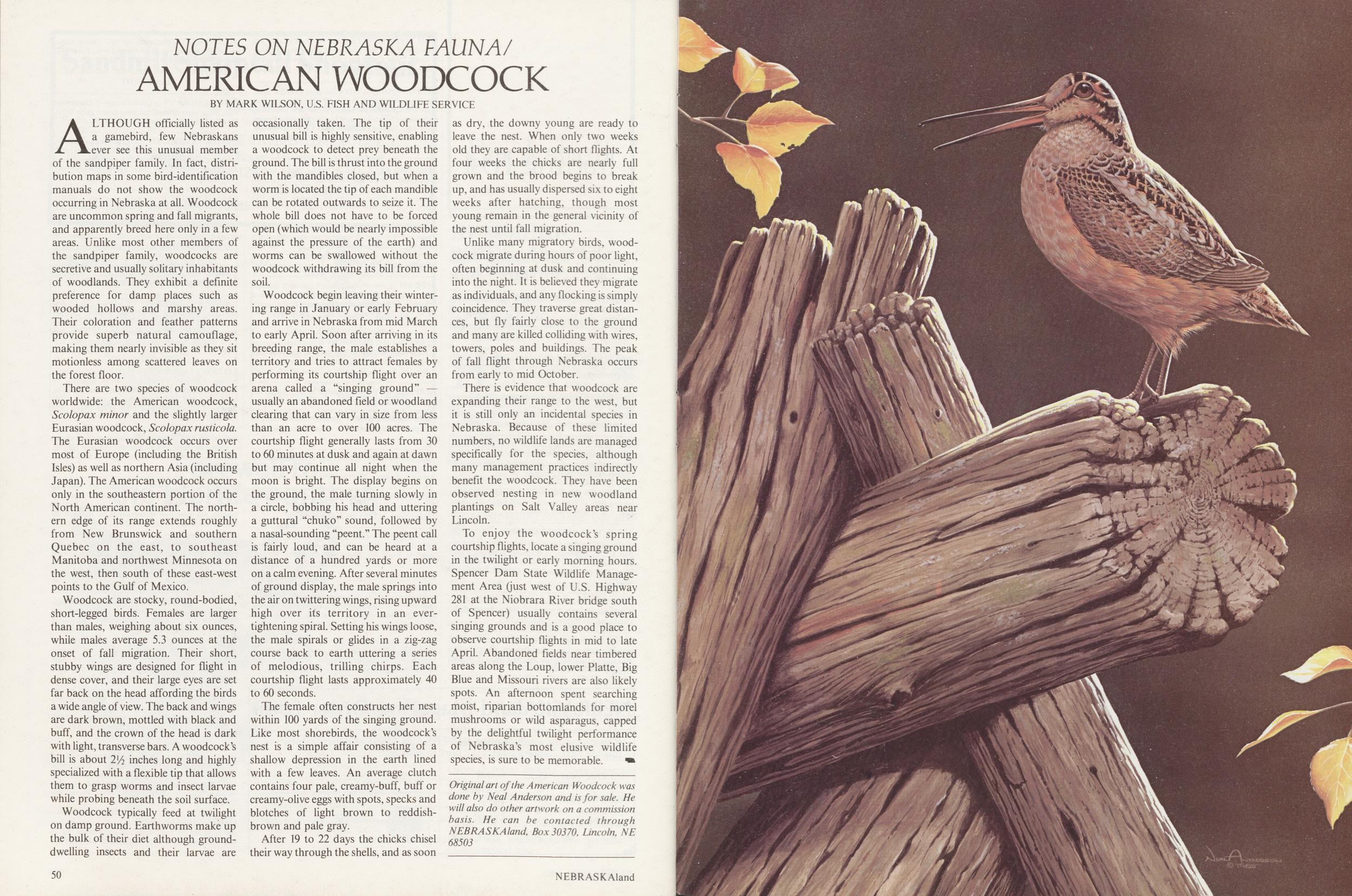
NOTES ON NEBRASKA FAUNA/ AMERICAN WOODCOCK
BY MARK WILSON, U.S. FISH AND WILDLIFE SERVICEALTHOUGH officially listed as a gamebird, few Nebraskans ever see this unusual member of the sandpiper family. In fact, distribution maps in some bird-identification manuals do not show the woodcock occurring in Nebraska at all. Woodcock are uncommon spring and fall migrants, and apparently breed here only in a few areas. Unlike most other members of the sandpiper family, woodcocks are secretive and usually solitary inhabitants of woodlands. They exhibit a definite preference for damp places such as wooded hollows and marshy areas. Their coloration and feather patterns provide superb natural camouflage, making them nearly invisible as they sit motionless among scattered leaves on the forest floor.
There are two species of woodcock worldwide: the American woodcock, Scolopax minor and the slightly larger Eurasian woodcock, Scolopax rusticola. The Eurasian woodcock occurs over most of Europe (including the British Isles) as well as northern Asia (including Japan). The American woodcock occurs only in the southeastern portion of the North American continent. The northern edge of its range extends roughly from New Brunswick and southern Quebec on the east, to southeast Manitoba and northwest Minnesota on the west, then south of these east-west points to the Gulf of Mexico.
Woodcock are stocky, round-bodied, short-legged birds. Females are larger than males, weighing about six ounces, while males average 5.3 ounces at the onset of fall migration. Their short, stubby wings are designed for flight in dense cover, and their large eyes are set far back on the head affording the birds a wide angle of view. The back and wings are dark brown, mottled with black and buff, and the crown of the head is dark with light, transverse bars. A woodcock's bill is about 2Vi inches long and highly specialized with a flexible tip that allows them to grasp worms and insect larvae while probing beneath the soil surface.
Woodcock typically feed at twilight on damp ground. Earthworms make up the bulk of their diet although ground dwelling insects and their larvae are occasionally taken. The tip of their unusual bill is highly sensitive, enabling a woodcock to detect prey beneath the ground. The bill is thrust into the ground with the mandibles closed, but when a worm is located the tip of each mandible can be rotated outwards to seize it. The whole bill does not have to be forced open (which would be nearly impossible against the pressure of the earth) and worms can be swallowed without the woodcock withdrawing its bill from the soil.
Woodcock begin leaving their wintering range in January or early February and arrive in Nebraska from mid March to early April. Soon after arriving in its breeding range, the male establishes a territory and tries to attract females by performing its courtship flight over an arena called a "singing ground" — usually an abandoned field or woodland clearing that can vary in size from less than an acre to over 100 acres. The courtship flight generally lasts from 30 to 60 minutes at dusk and again at dawn but may continue all night when the moon is bright. The display begins on the ground, the male turning slowly in a circle, bobbing his head and uttering a guttural "chuko" sound, followed by a nasal-sounding "peent." The peent call is fairly loud, and can be heard at a distance of a hundred yards or more on a calm evening. After several minutes of ground display, the male springs into the air on twittering wings, rising upward high over its territory in an ever- tightening spiral. Setting his wings loose, the male spirals or glides in a zig-zag course back to earth uttering a series of melodious, trilling chirps. Each courtship flight lasts approximately 40 to 60 seconds.
The female often constructs her nest within 100 yards of the singing ground. Like most shorebirds, the woodcock's nest is a simple affair consisting of a shallow depression in the earth lined with a few leaves. An average clutch contains four pale, creamy-buff, buff or creamy-olive eggs with spots, specks and blotches of light brown to reddish-brown and pale gray.
After 19 to 22 days the chicks chisel their way through the shells, and as soon as dry, the downy young are ready to leave the nest. When only two weeks old they are capable of short flights. At four weeks the chicks are nearly full grown and the brood begins to break up, and has usually dispersed six to eight weeks after hatching, though most young remain in the general vicinity of the nest until fall migration.
Unlike many migratory birds, woodcock migrate during hours of poor light, often beginning at dusk and continuing into the night. It is believed they migrate as individuals, and any flocking is simply coincidence. They traverse great distances, but fly fairly close to the ground and many are killed colliding with wires, towers, poles and buildings. The peak of fall flight through Nebraska occurs from early to mid October.
There is evidence that woodcock are expanding their range to the west, but it is still only an incidental species in Nebraska. Because of these limited numbers, no wildlife lands are managed specifically for the species, although many management practices indirectly benefit the woodcock. They have been observed nesting in new woodland plantings on Salt Valley areas near Lincoln.
To enjoy the woodcock's spring courtship flights, locate a singing ground in the twilight or early morning hours. Spencer Dam State Wildlife Management Area (just west of U.S. Highway 281 at the Niobrara River bridge south of Spencer) usually contains several singing grounds and is a good place to observe courtship flights in mid to late April. Abandoned fields near timbered areas along the Loup, lower Platte, Big Blue and Missouri rivers are also likely spots. An afternoon spent searching moist, riparian bottomlands for morel mushrooms or wild asparagus, capped by the delightful twilight performance of Nebraska's most elusive wildlife species, is sure to be memorable.
Original art of the American Woodcock was done by Neal Anderson and is for sale. He will also do other artwork on a commission basis. He can be contacted through NEBRASKAland, Box 30370, Lincoln, NE 68503
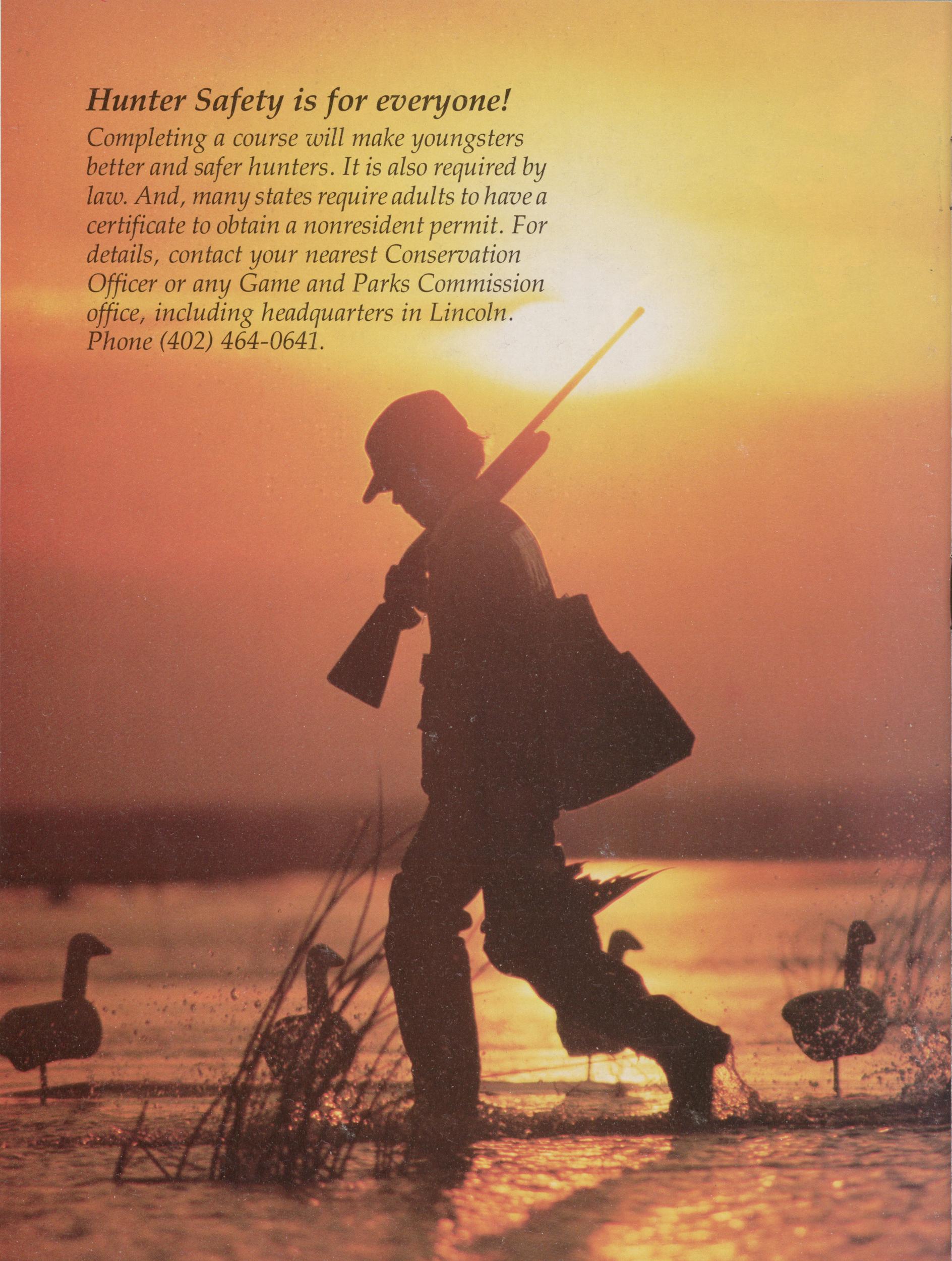
Position: 467 (22 views)