Volume 63, Issue 6, 1985
NEBRASKAland
JULY 1985 $1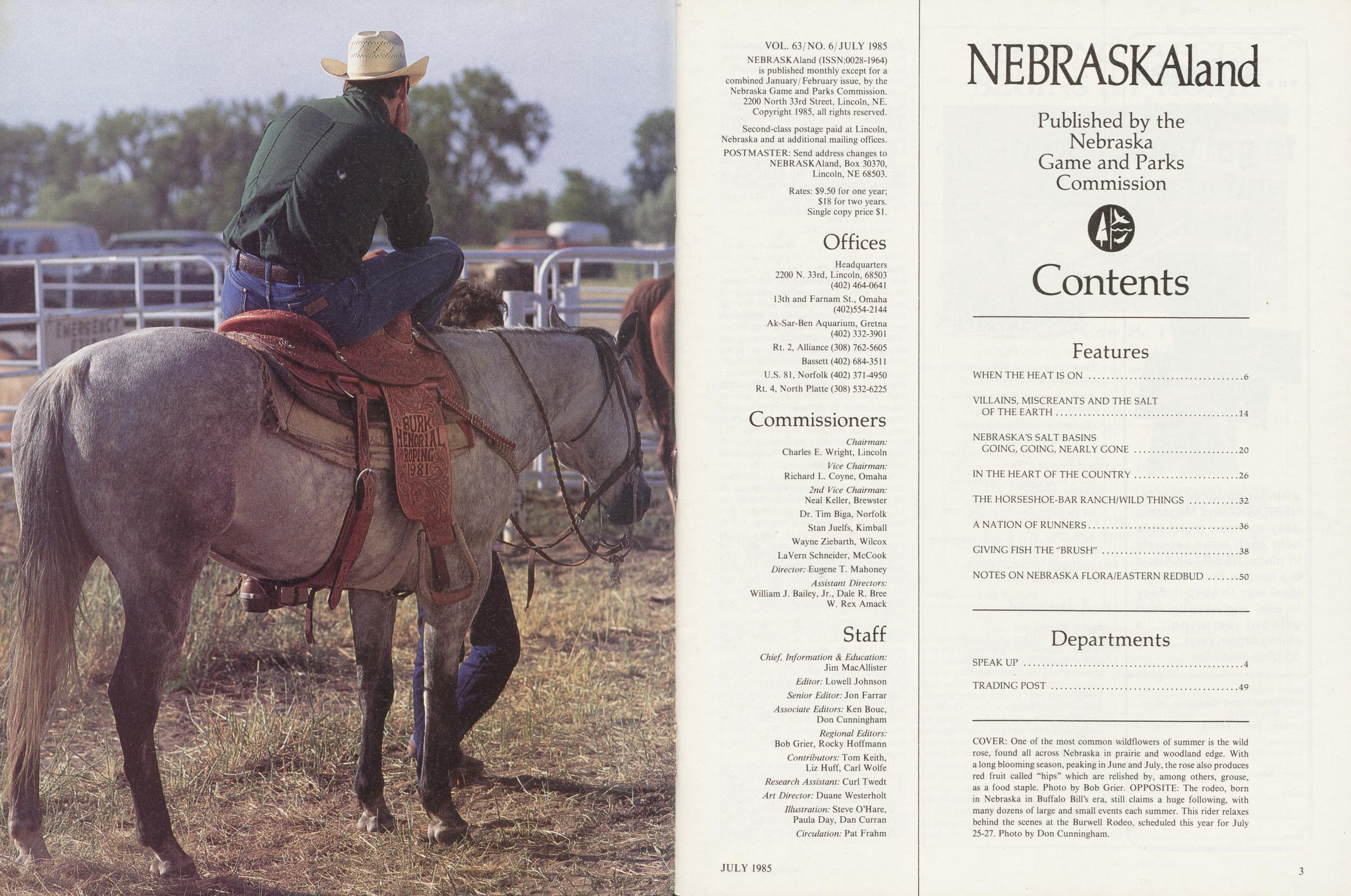
NEBRASKAland
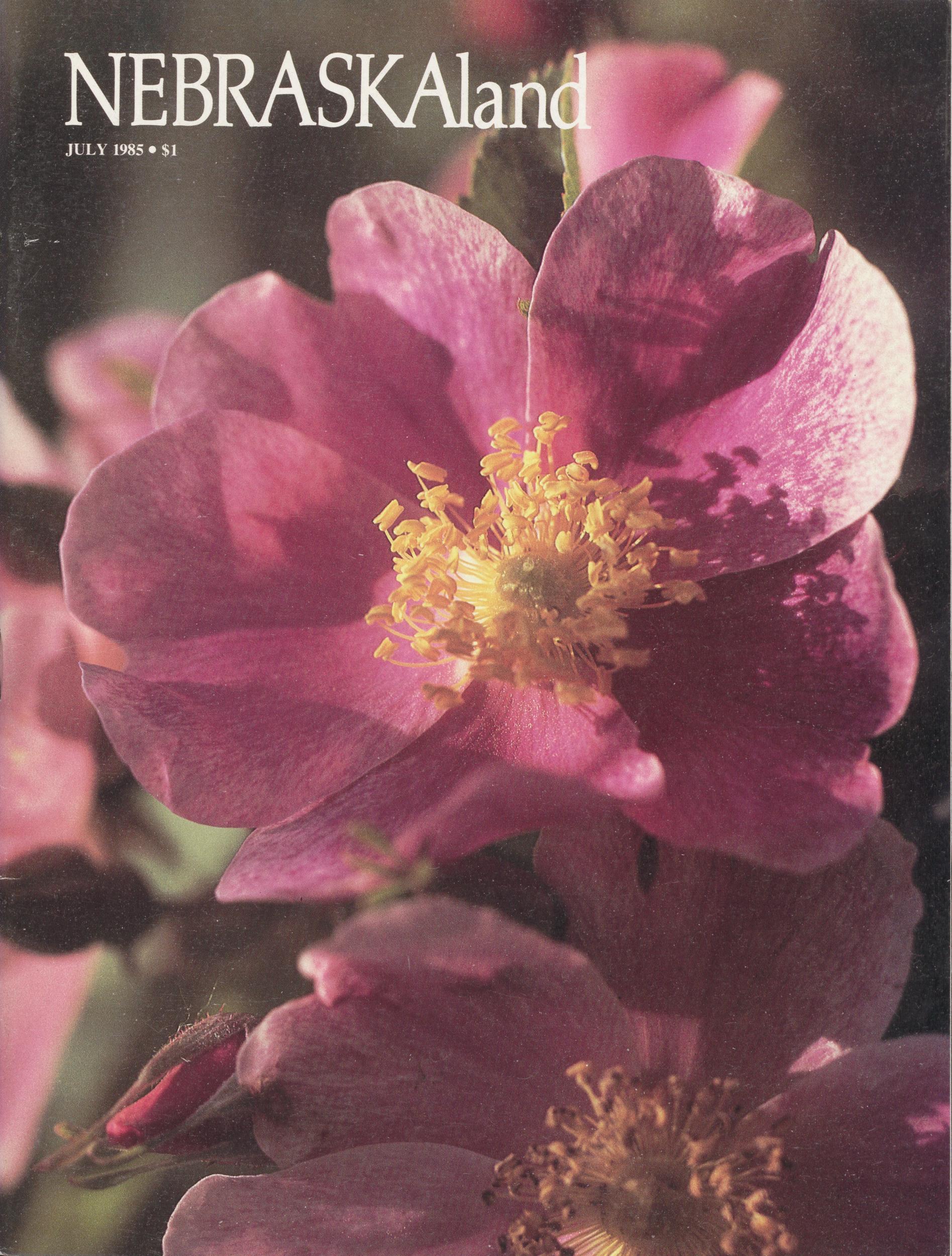
Published by the Nebraska Game and Parks Commission VOL. 63/NO. 6/JULY 1985 NEBRASKAland (ISSN:0028-1964) is published monthly except for a combined January/ February issue, by the Nebraska Game and Parks Commission. 2200 North 33rd Street, Lincoln, NE. Copyright 1985, all rights reserved. Second-class postage paid at Lincoln, Nebraska and at additional mailing offices. POSTMASTER: Send address changes to NEBRASKAland, Box 30370, Lincoln, NE 68503. Rates: $9.50 for one year; $18 for two years. Single copy price $1. Offices Headquarters 2200 N. 33rd, Lincoln, 68503 (402) 464-0641 13th and Farnam St., Omaha (402)554-2144 Ak-Sar-Ben Aquarium, Gretna (402) 332-3901 Rt. 2, Alliance (308) 762-5605 Bassett (402) 684-3511 U.S. 81, Norfolk (402) 371-4950 Rt. 4, North Platte (308) 532-6225 Commissioners Chairman: Charles E. Wright, Lincoln Vice Chairman: Richard L. Coyne, Omaha 2nd Vice Chairman: Neal Keller, Brewster Dr. Tim Biga, Norfolk Stan Juelfs, Kimball Wayne Ziebarth, Wilcox LaVern Schneider, McCook Director: Eugene T. Mahoney Assistant Directors: William J. Bailey, Jr., Dale R. Bree W. Rex Amack Staff Chief, Information & Education: Jim MacAllister Editor: Lowell Johnson Senior Editor: Jon Farrar Associate Editors: Ken Bouc, Don Cunningham Regional Editors: Bob Grier, Rocky Hoffmann Contributors: Tom Keith, Liz Huff, Carl Wolfe Research Assistant: Curl Twedt Art Director: Duane Westerholt Illustration: Steve O'Hare, Paula Day, Dan Curran Circulation: Pat Frahm Contents Features WHEN THE HEAT IS ON 6 VILLAINS, MISCREANTS AND THE SALT OF THE EARTH14 NEBRASKA'S SALT BASINS GOING, GOING, NEARLY GONE20 IN THE HEART OF THE COUNTRY26 THE HORSESHOE-BAR RANCH/WILD THINGS32 A NATION OF RUNNERS36 GIVING FISH THE "BRUSH"38 NOTES ON NEBRASKA FLORA/EASTERN REDBUD50 Departments SPEAK UP 4 TRADING POST49 COVER: One of the most common wildflowers of summer is the wild rose, found all across Nebraska in prairie and woodland edge. With a long blooming season, peaking in June and July, the rose also produces red fruit called "hips" which are relished by, among others, grouse, as a food staple. Photo by Bob Grier. OPPOSITE: The rodeo, born in Nebraska in Buffalo Bill's era, still claims a huge following, with many dozens of large and small events each summer. This rider relaxes behind the scenes at the Burwell Rodeo, scheduled this year for July 25-27. Photo by Don Cunningham. JULY 1985 3
Speak Up
and golfers add their score
While on the track the ponies run,
then racing cars will roar.
The barbeques are in full bloom
and picnic spreads galore
But some folk gather just for prayer,
as in the days of yore.
Speed boats dash across the lakes,
on high the flyers soar
For each one does his special thing
ere night will close his door.
'Tis then we think of those brave men
who gave their all and more
Nebraskans all revere that day
we know as July four.
Mildred Andrews Larson
Sir/1 am neither a banner-waving "womenVlibber" nor a staunch supporter of the Equal Rights Amendment, even though I find the ultra-conservative Jesse Helms mentality of my new home state, North Carolina, a real embarassment. However, Tom Keith's article, "The Why's and How's of Dog Ownership" (March'85) could easily coax me (and hopefully many Nebraska women as well) to join the ranks of the National Organization of Women.
It should be recognized that hunting is a man's sport by tradition alone, and that hunting-dog ownership is not an exclusive club for men. And Mr. Keith suggests that "Picking a hunting dog is like shopping for a wife .. ."That we women are shopped for like merchandise on a shelf or choice livestock might be the ultimate putdown. But Mr. Keith doesn't know when to quit. He suggests that "it will help immensely if your wife has a good sense of humor" toward this spirited dog. And "if she balks at letting your dog rule the entire backyard, maybe you can talk her into getting a part-time job for a few months to supplement the family income so you can afford to build a deluxe kennel."
If she is gullible enough to swallow this line of your "consideration for the little woman," I hope she is at least as spirited as your dog and sees to it that you are the one that ends up in the dog house.
Mrs. Ann Piehl Winston-Salem, N.C. * * * Picking on .410'ers?Sir/Recently, the Nebraska State Game and Parks Commission passed a regulation requiring steel shot for all hunting of waterfowl or in all waterfowl areas statewide. There is no exemption for .410 shotguns, for which this shot is not being manufactured (previous years exemptions were made when 10 and 20 gauge shells were not available); nor can this problem be solved by reloading shells with this shot. This shell will not be manufactured in the near future because there are design problems in the shot cup which have not been solved. The .410 hunters of this state have been told to "hang up their guns" at least for waterfowl and around area lakes.
While I share concern about shot contamination I feel that the majority of the problem is effectively controlled by the 10-, 12-, and 20-gauge use of steel shot. For instance, a 10-gauge shell contains 1 5/8ounces of shot; a 12-gauge has a 1 1/4ounces; the 20 carries 1 ounce; while the .410 contains only 1/2-ounce of shot. On a shot-per-shot basis, the popular 12-gauge carries 250 percent more shot than the .410. Therefore, for an equal number of shots the .410 contributes only 28 1/2 percent.
The actual percentage of .410 gauge shotguns in the field is probably quite small. That the manufacturers put steel shot priority on 12-gauge shells, indicates to me that they are in the majority. With so few of us one might be tempted to insist we conform to the vast majority (buy larger guns). However I feel that the essence of Democracy is to make allowances for the minority whenever possible. We are so few that allowing us to hunt will have a negligible impact.
I doubt that this exemption would cause more .410's in the field. As I said at the steel shot public hearing, I'm small framed and this is not just a matter of buying another gun. Even the so-called "youth" stock on my current gun had to be modified. In the meantime, what is gained by denying 4 NEBRASKAland ,410'ers this sport is negligible. What is lost is recreation for a minority.
Susan H. Connett Jerrison Lincoln, NebraskaYour point is noted. It was the decision not to allow exceptions to the steel shot requirement for waterfowl hunting. Certain other gauges of shotguns would also have to be considered for exclusion if the .410 were exempted. The .410, 28 and 16 gauges can still be used for upland game, cottontail, squirrel and other species. They simply cannot be used for waterfowl hunting under the regulations. (Ken Johnson, Game Division chief)
* * * Modern hazardsSir / I'm writing to you in regard to habitat. Very little good will come of it unless you can keep wildlife on the habitat land. When they spray a cornfield they warn people to stay out of the field for at least 24 hours. What happens to the wildlife in the field?
Last spring a farmer worked some poison into the ground and a few days later we had a small rain. Some of the water settled in the wheel tracks. A flock of gulls lit in the field and drank some of the water. None left the field as they all died right there. In the dry thirties, we had very little habitat as there were no crops and very few weeds. We had more pheasants at that time than we have ever had. The limit was 5 and you could get your limit in just a few hours. Have bird feeders out during the winter months and have fewer birds every year and no gold finches at all this winter.
Milton Jacobsen Dannebrog, Nebr. * * * On TargetSir / In the September 1984 issue, there was an article about lead poisoning and steel shot, etc. My question concerns the picture on page 30 that shows a target with a duck on it. Is this something printed and available? If possible to buy these targets, I would appreciate information. I want to do some pattern tests so I'll be ready to use steel shot effectively in the fall of 1985.
The article on lead poisoning was fantastic. I used to be of the old school and not want to use or accept steel shot, but I now realize that it is our only recourse if we want to preserve our duck and goose populations. Thanks for a great magazine with articles of interest to everyone.
Dan Lindblad Omaha, Nebr.The targets you refer to were printed by the Omaha World-Herald and the Game and Parks Commission to be used as you suggest, but were limited for workshops. Any paper or cardboard would work, however, and would be easy to make. Merely draw a 30-inch circle for comparison of pattern. (Editor)
BOATING SAFETY BEGINS AT HOME — Accidents Can Be Prevented— When out on the lake, especially in a fast boat, an operator must be conditioned to "think safety." Boating accidents are all preventable if proper behavior, consideration for others, and knowing what to look for, are part of the operator's very nature. Here is an easy, sensible way to become safety oriented. And, you can do it at your own pace—and at home. Boater Kit The Nebraska Game and Parks Commission has put together a home study boating safety program which is ideal for all ages, and it's free. For adults there is a Better Boating manual, a letter explaining the program, a current boating guide, boating safety tips, and brochures on hypothermia in the event of an accident. There is also a boat decal. Special School Package This kit involves an instructor or teacher kit with course outline, manual and registration cards, student manuals, boating guides and three films. This can offer from three to 20 hours of instruction. Details are available from Game Commission offices in Lincoln, (Box 30370, Lincoln, NE 68503), Omaha, Norfolk, North Platte, Bassett and Alliance or from the following boat dealers: Buzz's Marine & Supply, Kearney Sports Mart Inc., Ogallala Mel's Marine, McCook Harlan Marine Center, Alma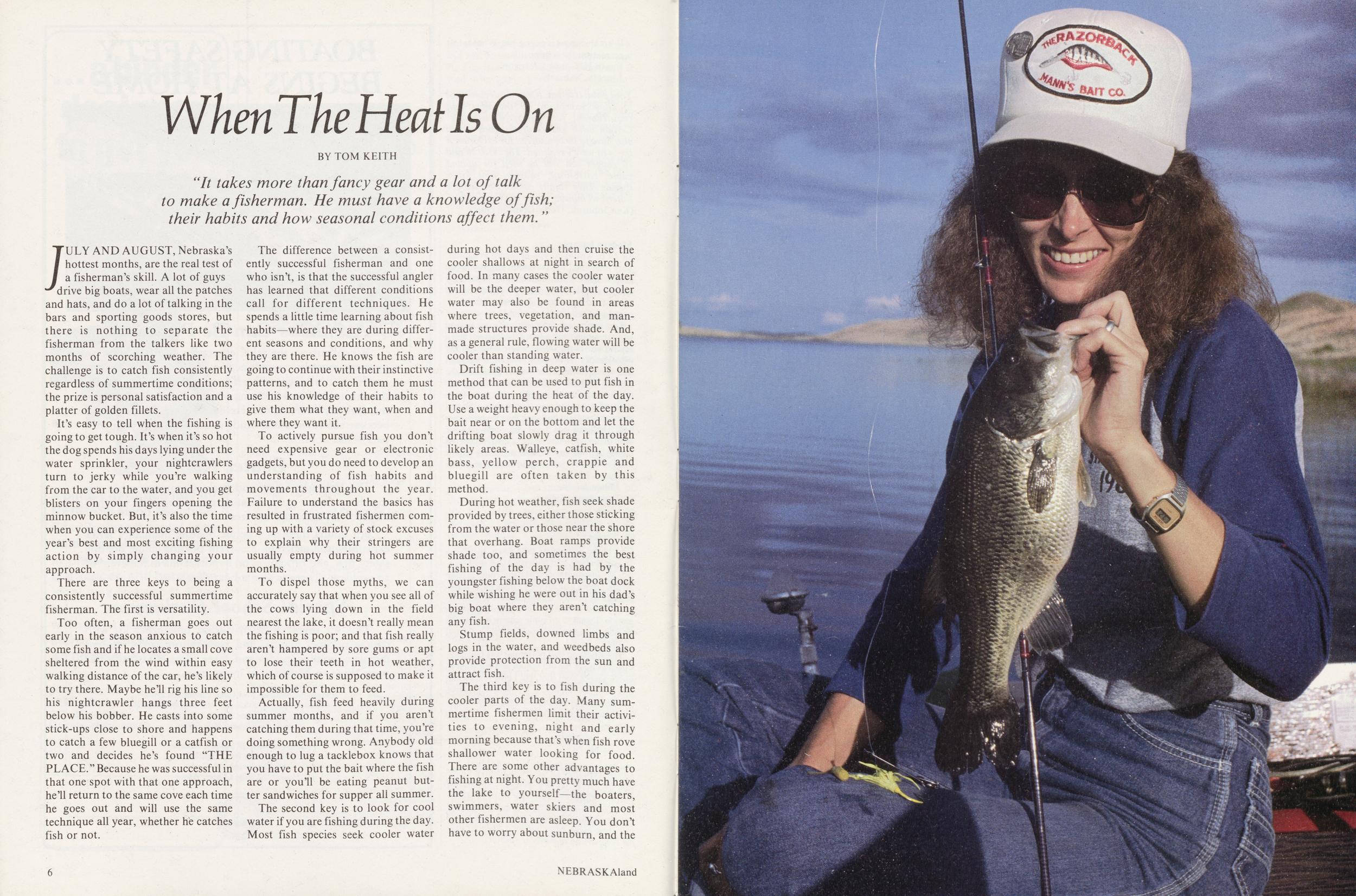
When The Heat Is On
BY TOM KEITH "It takes more than fancy gear and a lot of talk to make a fisherman. He must have a knowledge offish; their habits and how seasonal conditions affect them."TULY AND AUGUST, Nebraska's I hottest months, are the real test of I a fisherman's skill. A lot of guys drive big boats, wear all the patches and hats, and do a lot of talking in the bars and sporting goods stores, but there is nothing to separate the fisherman from the talkers like two months of scorching weather. The challenge is to catch fish consistently regardless of summertime conditions; the prize is personal satisfaction and a platter of golden fillets.
It's easy to tell when the fishing is going to get tough. It's when it's so hot the dog spends his days lying under the water sprinkler, your nightcrawlers turn to jerky while you're walking from the car to the water, and you get blisters on your fingers opening the minnow bucket. But, it's also the time when you can experience some of the year's best and most exciting fishing action by simply changing your approach.
There are three keys to being a consistently successful summertime fisherman. The first is versatility.
Too often, a fisherman goes out early in the season anxious to catch some fish and if he locates a small cove sheltered from the wind within easy walking distance of the car, he's likely to try there. Maybe he'll rig his line so his nightcrawler hangs three feet below his bobber. He casts into some stick-ups close to shore and happens to catch a few bluegill or a catfish or two and decides he's found "THE PLACE." Because he was successful in that one spot with that one approach, he'll return to the same cove each time he goes out and will use the same technique all year, whether he catches fish or not.
The difference between a consistently successful fisherman and one who isn't, is that the successful angler has learned that different conditions call for different techniques. He spends a little time learning about fish habits—where they are during different seasons and conditions, and why they are there. He knows the fish are going to continue with their instinctive patterns, and to catch them he must use his knowledge of their habits to give them what they want, when and where they want it.
To actively pursue fish you don't need expensive gear or electronic gadgets, but you do need to develop an understanding of fish habits and movements throughout the year. Failure to understand the basics has resulted in frustrated fishermen coming up with a variety of stock excuses to explain why their stringers are usually empty during hot summer months.
To dispel those myths, we can accurately say that when you see all of the cows lying down in the field nearest the lake, it doesn't really mean the fishing is poor; and that fish really aren't hampered by sore gums or apt to lose their teeth in hot weather, which of course is supposed to make it impossible for them to feed.
Actually, fish feed heavily during summer months, and if you aren't catching them during that time, you're doing something wrong. Anybody old enough to lug a tacklebox knows that you have to put the bait where the fish are or you'll be eating peanut butter sandwiches for supper all summer.
The second key is to look for cool water if you are fishing during the day. Most fish species seek cooler water during hot days and then cruise the cooler shallows at night in search of food. In many cases the cooler water will be the deeper water, but cooler water may also be found in areas where trees, vegetation, and man- made structures provide shade. And, as a general rule, flowing water will be cooler than standing water.
Drift fishing in deep water is one method that can be used to put fish in the boat during the heat of the day. Use a weight heavy enough to keep the bait near or on the bottom and let the drifting boat slowly drag it through likely areas. Walleye, catfish, white bass, yellow perch, crappie and bluegill are often taken by this method.
During hot weather, fish seek shade provided by trees, either those sticking from the water or those near the shore that overhang. Boat ramps provide shade too, and sometimes the best fishing of the day is had by the youngster fishing below the boat dock while wishing he were out in his dad's big boat where they aren't catching any fish.
Stump fields, downed limbs and logs in the water, and weedbeds also provide protection from the sun and attract fish.
The third key is to fish during the cooler parts of the day. Many summertime fishermen limit their activities to evening, night and early morning because that's when fish rove shallower water looking for food. There are some other advantages to fishing at night. You pretty much have the lake to yourself—the boaters, swimmers, water skiers and most other fishermen are asleep. You don't have to worry about sunburn, and the wind that sometimes plagues daytime anglers usually calms after sunset.
6 NEBRASKAland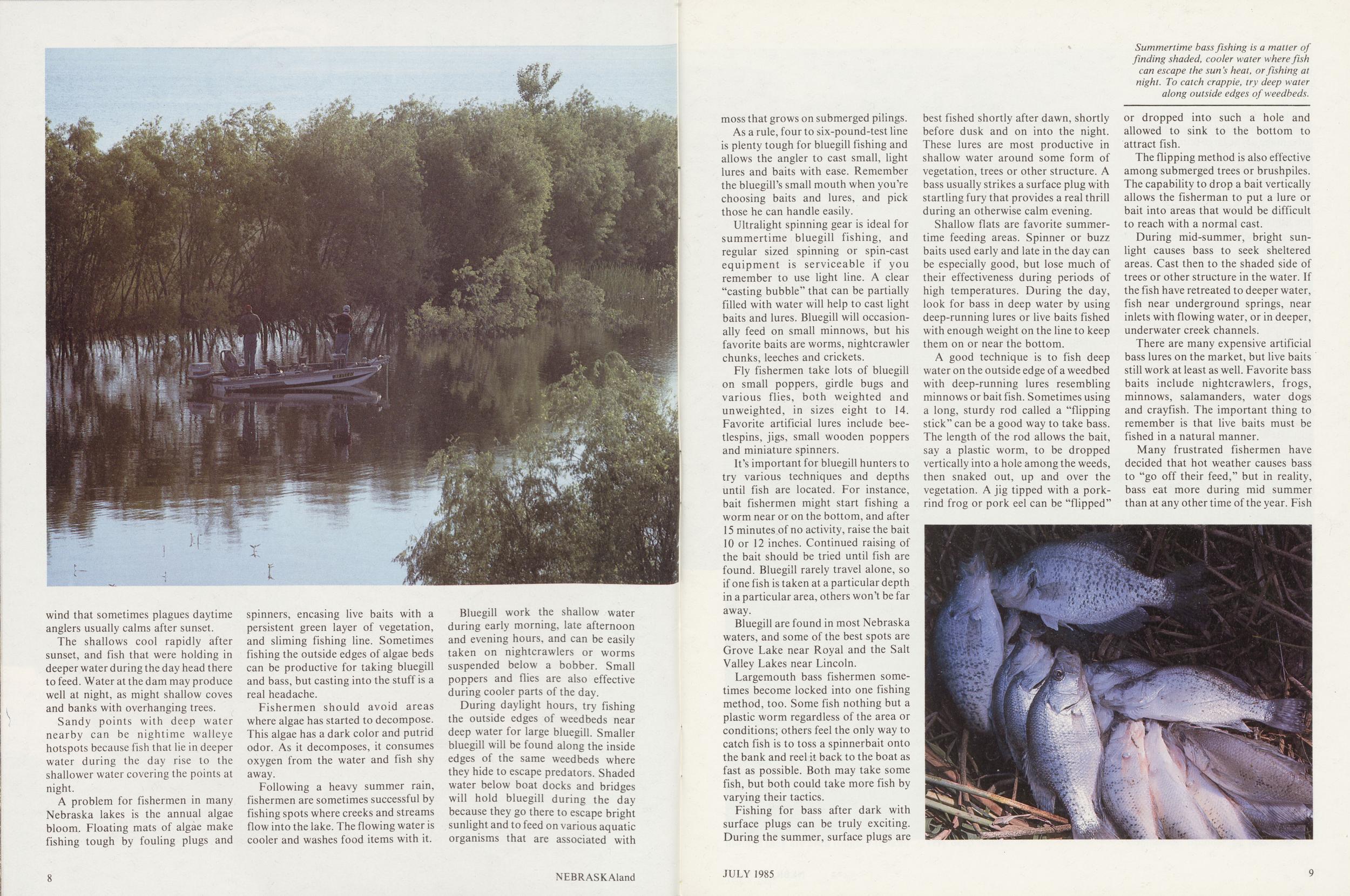
The shallows cool rapidly after sunset, and fish that were holding in deeper water during the day head there to feed. Water at the dam may produce well at night, as might shallow coves and banks with overhanging trees.
Sandy points with deep water nearby can be nightime walleye hotspots because fish that lie in deeper water during the day rise to the shallower water covering the points at night.
A problem for fishermen in many Nebraska lakes is the annual algae bloom. Floating mats of algae make fishing tough by fouling plugs and spinners, encasing live baits with a persistent green layer of vegetation, and sliming fishing line. Sometimes fishing the outside edges of algae beds can be productive for taking bluegill and bass, but casting into the stuff is a real headache.
Fishermen should avoid areas where algae has started to decompose. This algae has a dark color and putrid odor. As it decomposes, it consumes oxygen from the water and fish shy away.
Following a heavy summer rain, fishermen are sometimes successful by fishing spots where creeks and streams flow into the lake. The flowing water is cooler and washes food items with it.
Bluegill work the shallow water during early morning, late afternoon and evening hours, and can be easily taken on nightcrawlers or worms suspended below a bobber. Small poppers and flies are also effective during cooler parts of the day.
During daylight hours, try fishing the outside edges of weedbeds near deep water for large bluegill. Smaller bluegill will be found along the inside edges of the same weedbeds where they hide to escape predators. Shaded water below boat docks and bridges will hold bluegill during the day because they go there to escape bright sunlight and to feed on various aquatic organisms that are associated with 8 NEBRASKAland moss that grows on submerged pilings.
As a rule, four to six-pound-test line is plenty tough for bluegill fishing and allows the angler to cast small, light lures and baits with ease. Remember the bluegill's small mouth when you're choosing baits and lures, and pick those he can handle easily.
Ultralight spinning gear is ideal for summertime bluegill fishing, and regular sized spinning or spin-cast equipment is serviceable if you remember to use light line. A clear "casting bubble" that can be partially filled with water will help to cast light baits and lures. Bluegill will occasionally feed on small minnows, but his favorite baits are worms, nightcrawler chunks, leeches and crickets.
Fly fishermen take lots of bluegill on small poppers, girdle bugs and various flies, both weighted and unweighted, in sizes eight to 14. Favorite artificial lures include beetlespins, jigs, small wooden poppers and miniature spinners.
It's important for bluegill hunters to try various techniques and depths until fish are located. For instance, bait fishermen might start fishing a worm near or on the bottom, and after 15 minutes of no activity, raise the bait 10 or 12 inches. Continued raising of the bait should be tried until fish are found. Bluegill rarely travel alone, so if one fish is taken at a particular depth in a particular area, others won't be far away.
Bluegill are found in most Nebraska waters, and some of the best spots are Grove Lake near Royal and the Salt Valley Lakes near Lincoln.
Largemouth bass fishermen sometimes become locked into one fishing method, too. Some fish nothing but a plastic worm regardless of the area or conditions; others feel the only way to catch fish is to toss a spinnerbait onto the bank and reel it back to the boat as fast as possible. Both may take some fish, but both could take more fish by varying their tactics.
Fishing for bass after dark with surface plugs can be truly exciting. During the summer, surface plugs are best fished shortly after dawn, shortly before dusk and on into the night. These lures are most productive in shallow water around some form of vegetation, trees or other structure. A bass usually strikes a surface plug with startling fury that provides a real thrill during an otherwise calm evening.
Shallow flats are favorite summertime feeding areas. Spinner or buzz baits used early and late in the day can be especially good, but lose much of their effectiveness during periods of high temperatures. During the day, look for bass in deep water by using deep-running lures or live baits fished with enough weight on the line to keep them on or near the bottom.
A good technique is to fish deep water on the outside edge of a weedbed with deep-running lures resembling minnows or bait fish. Sometimes using a long, sturdy rod called a "flipping stick" can be a good way to take bass. The length of the rod allows the bait, say a plastic worm, to be dropped vertically into a hole among the weeds, then snaked out, up and over the vegetation. A jig tipped with a porkrind frog or pork eel can be "flipped" or dropped into such a hole and allowed to sink to the bottom to attract fish.
The flipping method is also effective among submerged trees or brushpiles. The capability to drop a bait vertically allows the fisherman to put a lure or bait into areas that would be difficult to reach with a normal cast.
During mid-summer, bright sunlight causes bass to seek sheltered areas. Cast then to the shaded side of trees or other structure in the water. If the fish have retreated to deeper water, fish near underground springs, near inlets with flowing water, or in deeper, underwater creek channels.
There are many expensive artificial bass lures on the market, but live baits still work at least as well. Favorite bass baits include nightcrawlers, frogs, minnows, salamanders, water dogs and crayfish. The important thing to remember is that live baits must be fished in a natural manner.
Many frustrated fishermen have decided that hot weather causes bass to "go off their feed," but in reality, bass eat more during mid summer than at any other time of the year. Fish hatched in the spring have attained a size attractive to the bass and they take advantage of the large number of such small fish.
JULY 1985 9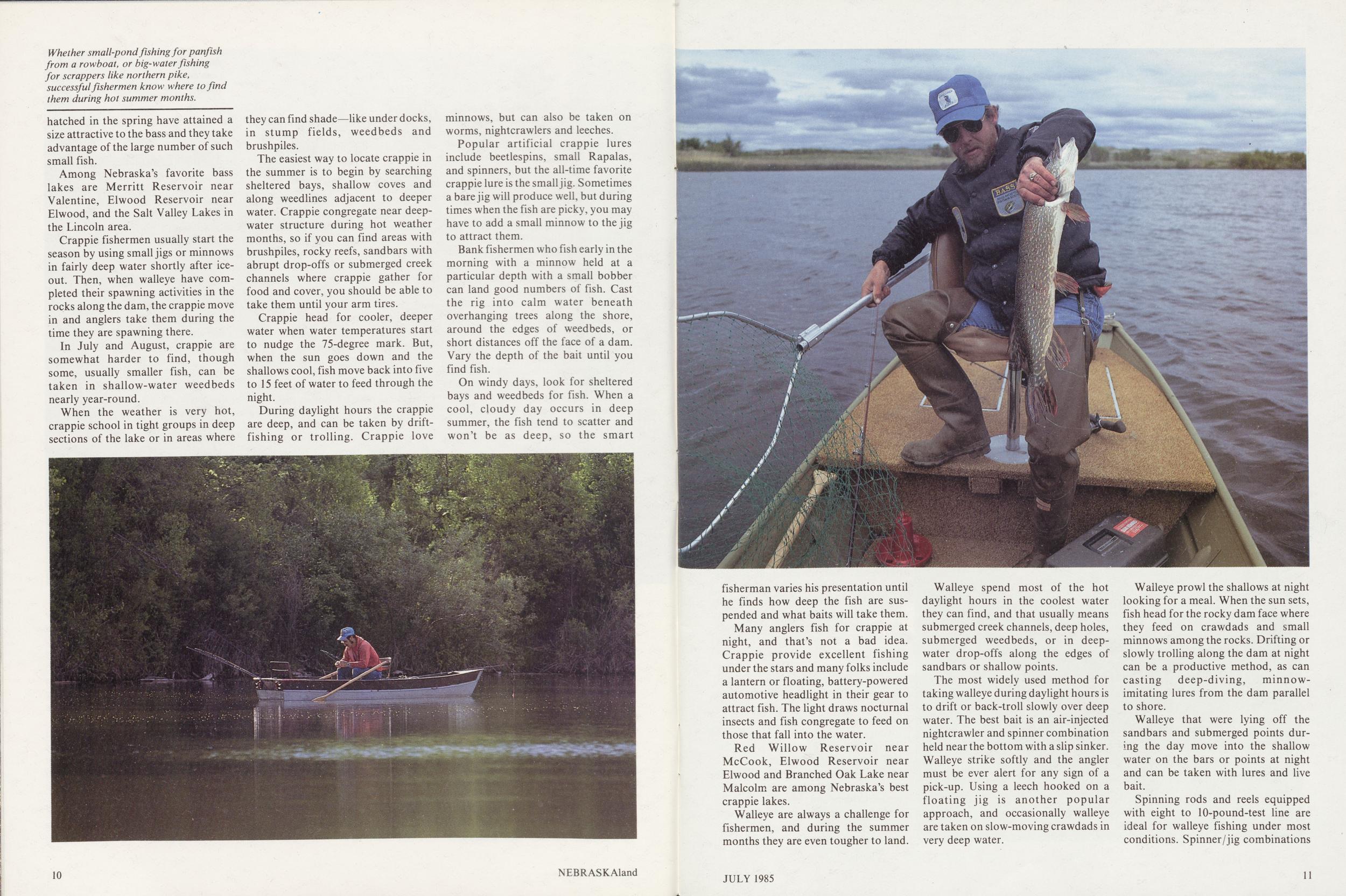 Whether small-pond fishing for panfish
from a row boat, or big-water fishing
for scrappers like northern pike,
successful fishermen know where to find
them during hot summer months.
Whether small-pond fishing for panfish
from a row boat, or big-water fishing
for scrappers like northern pike,
successful fishermen know where to find
them during hot summer months.
Among Nebraska's favorite bass lakes are Merritt Reservoir near Valentine, Elwood Reservoir near Elwood, and the Salt Valley Lakes in the Lincoln area.
Crappie fishermen usually start the season by using small jigs or minnows in fairly deep water shortly after iceout. Then, when walleye have completed their spawning activities in the rocks along the dam, the crappie move in and anglers take them during the time they are spawning there.
In July and August, crappie are somewhat harder to find, though some, usually smaller fish, can be taken in shallow-water weedbeds nearly year-round.
When the weather is very hot, crappie school in tight groups in deep sections of the lake or in areas where they can find shade—like under docks, in stump fields, weedbeds and brushpiles.
The easiest way to locate crappie in the summer is to begin by searching sheltered bays, shallow coves and along weedlines adjacent to deeper water. Crappie congregate near deepwater structure during hot weather months, so if you can find areas with brushpiles, rocky reefs, sandbars with abrupt drop-offs or submerged creek channels where crappie gather for food and cover, you should be able to take them until your arm tires.
Crappie head for cooler, deeper water when water temperatures start to nudge the 75-degree mark. But, when the sun goes down and the shallows cool, fish move back into five to 15 feet of water to feed through the night.
During daylight hours the crappie are deep, and can be taken by driftfishing or trolling. Crappie love minnows, but can also be taken on worms, nightcrawlers and leeches.
Popular artificial crappie lures include beetlespins, small Rapalas, and spinners, but the all-time favorite crappie lure is the small jig. Sometimes a bare jig will produce well, but during times when the fish are picky, you may have to add a small minnow to the jig to attract them.
Bank fishermen who fish early in the morning with a minnow held at a particular depth with a small bobber can land good numbers of fish. Cast the rig into calm water beneath overhanging trees along the shore, around the edges of weedbeds, or short distances off the face of a dam. Vary the depth of the bait until you find fish.
On windy days, look for sheltered bays and weedbeds for fish. When a cool, cloudy day occurs in deep summer, the fish tend to scatter and won't be as deep, so the smart 10 NEBRASKAland fisherman varies his presentation until he finds how deep the fish are suspended and what baits will take them.
Many anglers fish for crappie at night, and that's not a bad idea. Crappie provide excellent fishing under the stars and many folks include a lantern or floating, battery-powered automotive headlight in their gear to attract fish. The light draws nocturnal insects and fish congregate to feed on those that fall into the water.
Red Willow Reservoir near McCook, Elwood Reservoir near Elwood and Branched Oak Lake near Malcolm are among Nebraska's best crappie lakes.
Walleye are always a challenge for fishermen, and during the summer months they are even tougher to land.
Walleye spend most of the hot daylight hours in the coolest water they can find, and that usually means submerged creek channels, deep holes, submerged weedbeds, or in deepwater drop-offs along the edges of sandbars or shallow points.
The most widely used method for taking walleye during daylight hours is to drift or back-troll slowly over deep water. The best bait is an air-injected nightcrawler and spinner combination held near the bottom with a slip sinker. Walleye strike softly and the angler must be ever alert for any sign of a pick-up. Using a leech hooked on a floating jig is another popular approach, and occasionally walleye are taken on slow-moving crawdads in very deep water.
Walleye prowl the shallows at night looking for a meal. When the sun sets, fish head for the rocky dam face where they feed on crawdads and small minnows among the rocks. Drifting or slowly trolling along the dam at night can be a productive method, as can casting deep-diving, minnow-imitating lures from the dam parallel to shore.
Walleye that were lying off the sandbars and submerged points during the day move into the shallow water on the bars or points at night and can be taken with lures and live bait.
Spinning rods and reels equipped with eight to 10-pound-test line are ideal for walleye fishing under most conditions. Spinner/jig combinations are popular, as are Lindy rigs, Will-O-Wood spinners, various minnow- imitating plugs and slow, deeprunning spinners.
JULY 1985 11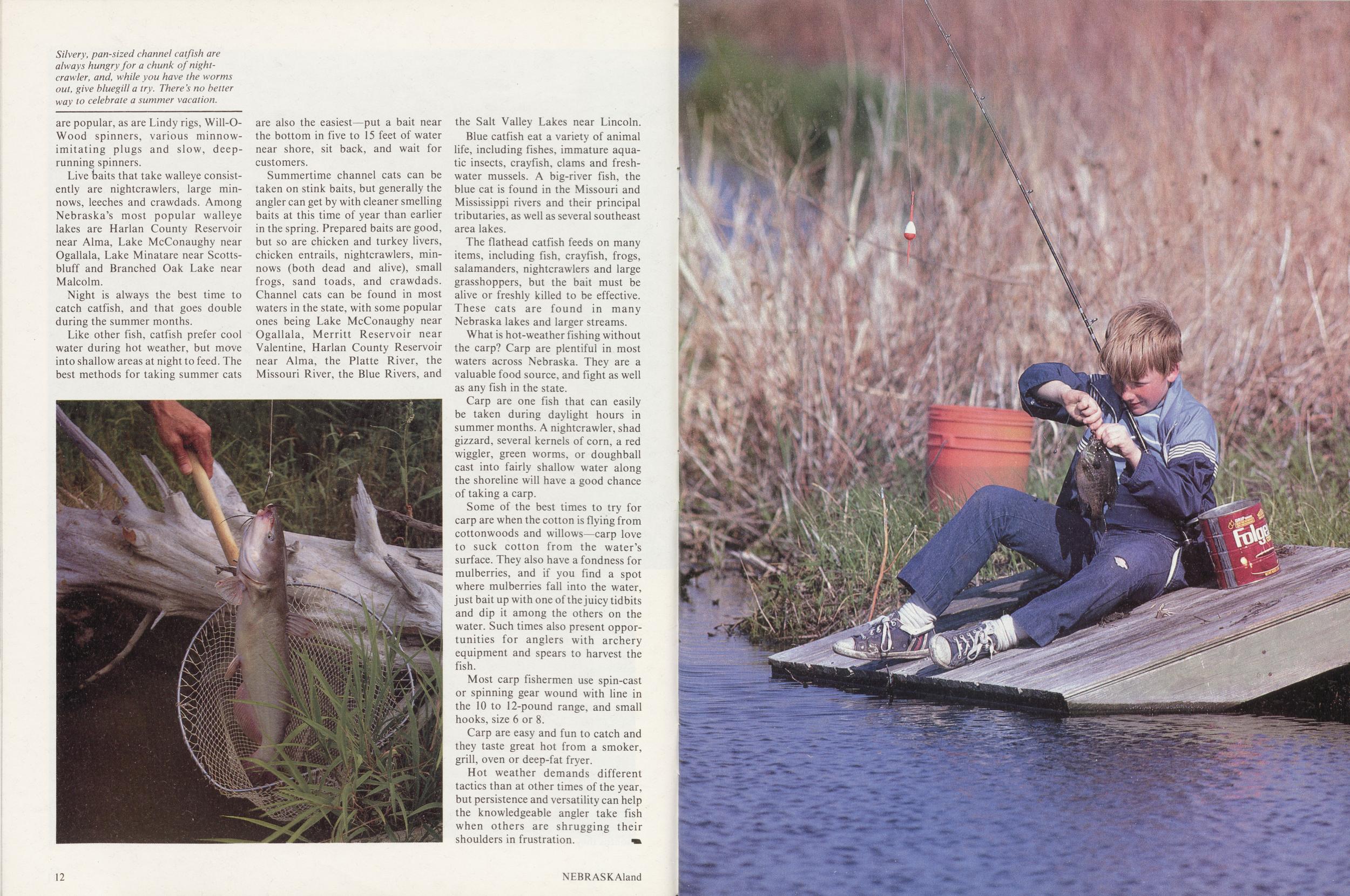 Silvery, pan-sized channel catfish are
always hungry for a chunk of nightcrawler, and, while you have the worms
out, give bluegill a try. There's no better
way to celebrate a summer vacation.
Silvery, pan-sized channel catfish are
always hungry for a chunk of nightcrawler, and, while you have the worms
out, give bluegill a try. There's no better
way to celebrate a summer vacation.
Live baits that take walleye consistently are nightcrawlers, large minnows, leeches and crawdads. Among Nebraska's most popular walleye lakes are Harlan County Reservoir near Alma, Lake McConaughy near Ogallala, Lake Minatare near Scottsbluff and Branched Oak Lake near Malcolm.
Night is always the best time to catch catfish, and that goes double during the summer months.
Like other fish, catfish prefer cool water during hot weather, but move into shallow areas at night to feed. The best methods for taking summer cats are also the easiest—put a bait near the bottom in five to 15 feet of water near shore, sit back, and wait for customers.
Summertime channel cats can be taken on stink baits, but generally the angler can get by with cleaner smelling baits at this time of year than earlier in the spring. Prepared baits are good, but so are chicken and turkey livers, chicken entrails, nightcrawlers, minnows (both dead and alive), small frogs, sand toads, and crawdads. Channel cats can be found in most waters in the state, with some popular ones being Lake McConaughy near Ogallala, Merritt Reservoir near Valentine, Harlan County Reservoir near Alma, the Platte River, the Missouri River, the Blue Rivers, and the Salt Valley Lakes near Lincoln.
Blue catfish eat a variety of animal life, including fishes, immature aquatic insects, crayfish, clams and freshwater mussels. A big-river fish, the blue cat is found in the Missouri and Mississippi rivers and their principal tributaries, as well as several southeast area lakes.
The flathead catfish feeds on many items, including fish, crayfish, frogs, salamanders, nightcrawlers and large grasshoppers, but the bait must be alive or freshly killed to be effective. These cats are found in many Nebraska lakes and larger streams.
What is hot-weather fishing without the carp? Carp are plentiful in most waters across Nebraska. They are a valuable food source, and fight as well as any fish in the state.
Carp are one fish that can easily be taken during daylight hours in summer months. A nightcrawler, shad gizzard, several kernels of corn, a red wiggler, green worms, or doughball cast into fairly shallow water along the shoreline will have a good chance of taking a carp.
Some of the best times to try for carp are when the cotton is flying from cottonwoods and willows—carp love to suck cotton from the water's surface. They also have a fondness for mulberries, and if you find a spot where mulberries fall into the water, just bait up with one of the juicy tidbits and dip it among the others on the water. Such times also present opportunities for anglers with archery equipment and spears to harvest the fish.
Most carp fishermen use spin-cast or spinning gear wound with line in the 10 to 12-pound range, and small hooks, size 6 or 8.
Carp are easy and fun to catch and they taste great hot from a smoker, grill, oven or deep-fat fryer.
Hot weather demands different tactics than at other times of the year, but persistence and versatility can help the knowledgeable angler take fish when others are shrugging their shoulders in frustration.
12 NEBRASKAland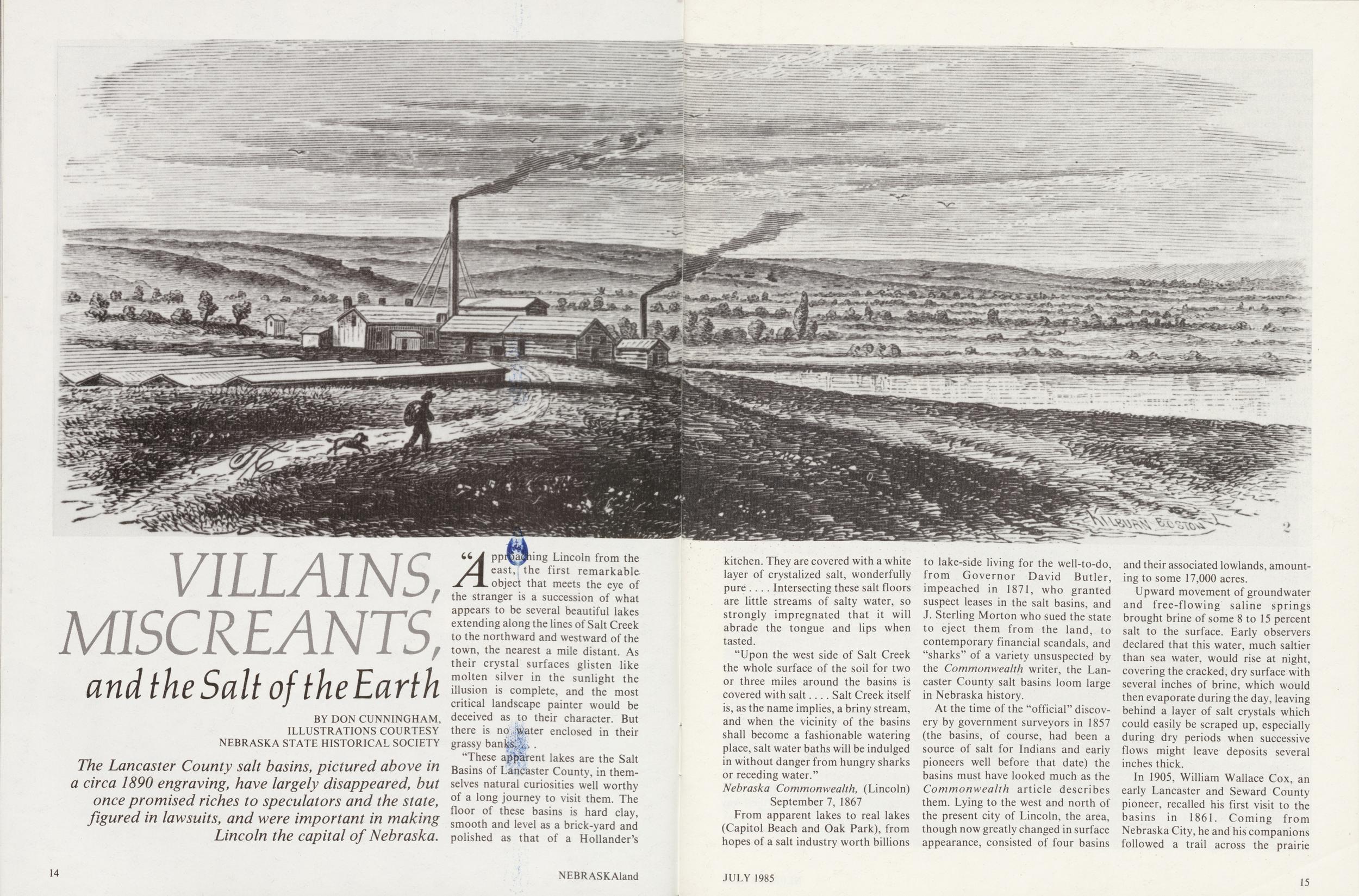
VILLAINS, MISCREANTS, and the Salt of the Earth
BY DON CUNNINGHAM ILLUSTRATIONS COURTESY NEBRASKA STATE HISTORICAL SOCIETY The Lancaster County salt basins, pictured above in a circa 1890 engraving, have largely disappeared, but once promised riches to speculators and the state, figured in lawsuits, and were important in making Lincoln the capit al of Nebraska.Approaching Lincoln from the east, the first remarkable object that meets the eye of the stranger is a succession of what appears to be several beautiful lakes extending along the lines of Salt Creek to the northward and westward of the town, the nearest a mile distant. As their crystal surfaces glisten like molten silver in the sunlight the illusion is complete, and the most critical landscape painter would be deceived as to their character. But there is no i^ater enclosed in their grassy banks.
"These apparent lakes are the Salt Basins of Lancaster County, in them- selves natural curiosities well worthy of a long journey to visit them. The floor of these basins is hard clay, smooth and level as a brick-yard and polished as that of a Hollander's 14 NEBRASKAland kitchen. They are covered with a white layer of crystalized salt, wonderfully pure Intersecting these salt floors are little streams of salty water, so strongly impregnated that it will abrade the tongue and lips when tasted.
"Upon the west side of Salt Creek the whole surface of the soil for two or three miles around the basins is covered with salt Salt Creek itself is, as the name implies, a briny stream, and when the vicinity of the basins shall become a fashionable watering place, salt water baths will be indulged in without danger from hungry sharks or receding water."
Nebraska Commonwealth, (Lincoln) September 7, 1867From apparent lakes to real lakes (Capitol Beach and Oak Park), from hopes of a salt industry worth billions JULY 1985 to lake-side living for the well-to-do, from Governor David Butler, impeached in 1871, who granted suspect leases in the salt basins, and J. Sterling Morton who sued the state to eject them from the land, to contemporary financial scandals, and "sharks" of a variety unsuspected by the Commonwealth writer, the Lancaster County salt basins loom large in Nebraska history.
At the time of the "official" discovery by government surveyors in 1857 (the basins, of course, had been a source of salt for Indians and early pioneers well before that date) the basins must have looked much as the Commonwealth article describes them. Lying to the west and north of the present city of Lincoln, the area, though now greatly changed in surface appearance, consisted of four basins and their associated lowlands, amounting to some 17,000 acres.
Upward movement of groundwater and free-flowing saline springs brought brine of some 8 to 15 percent salt to the surface. Early observers declared that this water, much saltier than sea water, would rise at night, covering the cracked, dry surface with several inches of brine, which would then evaporate during the day, leaving behind a layer of salt crystals which could easily be scraped up, especially during dry periods when successive flows might leave deposits several inches thick.
In 1905, William Wallace Cox, an early Lancaster and Seward County pioneer, recalled his first visit to the basins in 1861. Coming from Nebraska City, he and his companions followed a trail across the prairie where Lincoln is now located "down to the bottom and crossed O Street (to be) about where the U.P. palatial depot now graces the valley, and we found a ford just by the mouth of Oak Creek. Here was an old trail made by Salt Pilgrims in former years, but it was nearly overgrown by tall sunflow
JULY 1985 15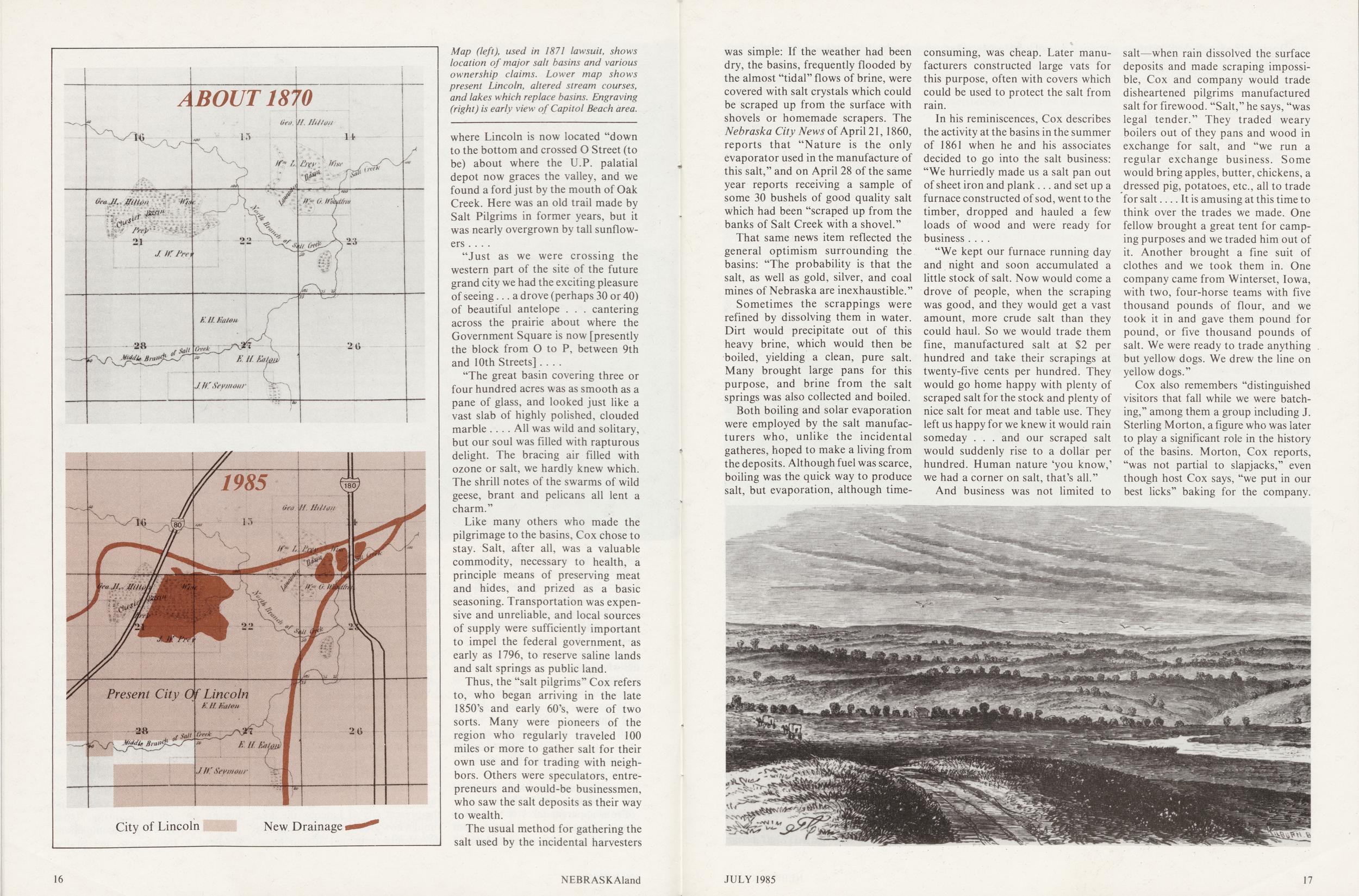
"Just as we were crossing the western part of the site of the future grand city we had the exciting pleasure of seeing... a drove (perhaps 30 or 40) of beautiful antelope cantering across the prairie about where the Government Square is now [presently the block from O to P, between 9th and 10th Streets
"The great basin covering three or four hundred acres was as smooth as a pane of glass, and looked just like a vast slab of highly polished, clouded marble .... All was wild and solitary, but our soul was filled with rapturous delight. The bracing air filled with ozone or salt, we hardly knew which. The shrill notes of the swarms of wild geese, brant and pelicans all lent a charm."
Like many others who made the pilgrimage to the basins, Cox chose to stay. Salt, after all, was a valuable commodity, necessary to health, a principle means of preserving meat and hides, and prized as a basic seasoning. Transportation was expensive and unreliable, and local sources of supply were sufficiently important to impel the federal government, as early as 1796, to reserve saline lands and salt springs as public land.
Thus, the "salt pilgrims" Cox refers to, who began arriving in the late 1850's and early 60's, were of two sorts. Many were pioneers of the region who regularly traveled 100 miles or more to gather salt for their own use and for trading with neighbors. Others were speculators, entrepreneurs and would-be businessmen, who saw the salt deposits as their way to wealth.
The usual method for gathering the salt used by the incidental harvesters 16 NEBRASKAland was simple: If the weather had been dry, the basins, frequently flooded by the almost "tidal" flows of brine, were covered with salt crystals which could be scraped up from the surface with shovels or homemade scrapers. The Nebraska City News of April 21, 1860, reports that "Nature is the only evaporator used in the manufacture of this salt," and on April 28 of the same year reports receiving a sample of some 30 bushels of good quality salt which had been "scraped up from the banks of Salt Creek with a shovel."
That same news item reflected the general optimism surrounding the basins: "The probability is that the salt, as well as gold, silver, and coal mines of Nebraska are inexhaustible."
Sometimes the scrappings were refined by dissolving them in water. Dirt would precipitate out of this heavy brine, which would then be boiled, yielding a clean, pure salt. Many brought large pans for this purpose, and brine from the salt springs was also collected and boiled.
Both boiling and solar evaporation were employed by the salt manufacturers who, unlike the incidental gatheres, hoped to make a living from the deposits. Although fuel was scarce, boiling was the quick way to produce salt, but evaporation, although timeconsuming, was cheap. Later manufacturers constructed large vats for this purpose, often with covers which could be used to protect the salt from rain.
In his reminiscences, Cox describes the activity at the basins in the summer of 1861 when he and his associates decided to go into the salt business: "We hurriedly made us a salt pan out of sheet iron and plank ... and set up a furnace constructed of sod, went to the timber, dropped and hauled a few loads of wood and were ready for business
"We kept our furnace running day and night and soon accumulated a little stock of salt. Now would come a drove of people, when the scraping was good, and they would get a vast amount, more crude salt than they could haul. So we would trade them fine, manufactured salt at $2 per hundred and take their scrapings at twenty-five cents per hundred. They would go home happy with plenty of scraped salt for the stock and plenty of nice salt for meat and table use. They left us happy for we knew it would rain someday . . . and our scraped salt would suddenly rise to a dollar per hundred. Human nature 'you know,' we had a corner on salt, that's all."
And business was not limited to salt—when rain dissolved the surface deposits and made scraping impossible, Cox and company would trade disheartened pilgrims manufactured salt for firewood. "Salt," he says, "was legal tender." They traded weary boilers out of they pans and wood in exchange for salt, and "we run a regular exchange business. Some would bring apples, butter, chickens, a dressed pig, potatoes, etc., all to trade for salt----It is amusing at this time to think over the trades we made. One fellow brought a great tent for camping purposes and we traded him out of it. Another brought a fine suit of clothes and we took them in. One company came from Winterset, Iowa, with two, four-horse teams with five thousand pounds of flour, and we took it in and gave them pound for pound, or five thousand pounds of salt. We were ready to trade anything but yellow dogs. We drew the line on yellow dogs."
Cox also remembers "distinguished visitors that fall while we were batching," among them a group including J. Sterling Morton, a figure who was later to play a significant role in the history of the basins. Morton, Cox reports, "was not partial to slapjacks," even though host Cox says, "we put in our best licks" baking for the company.
JULY 1985 17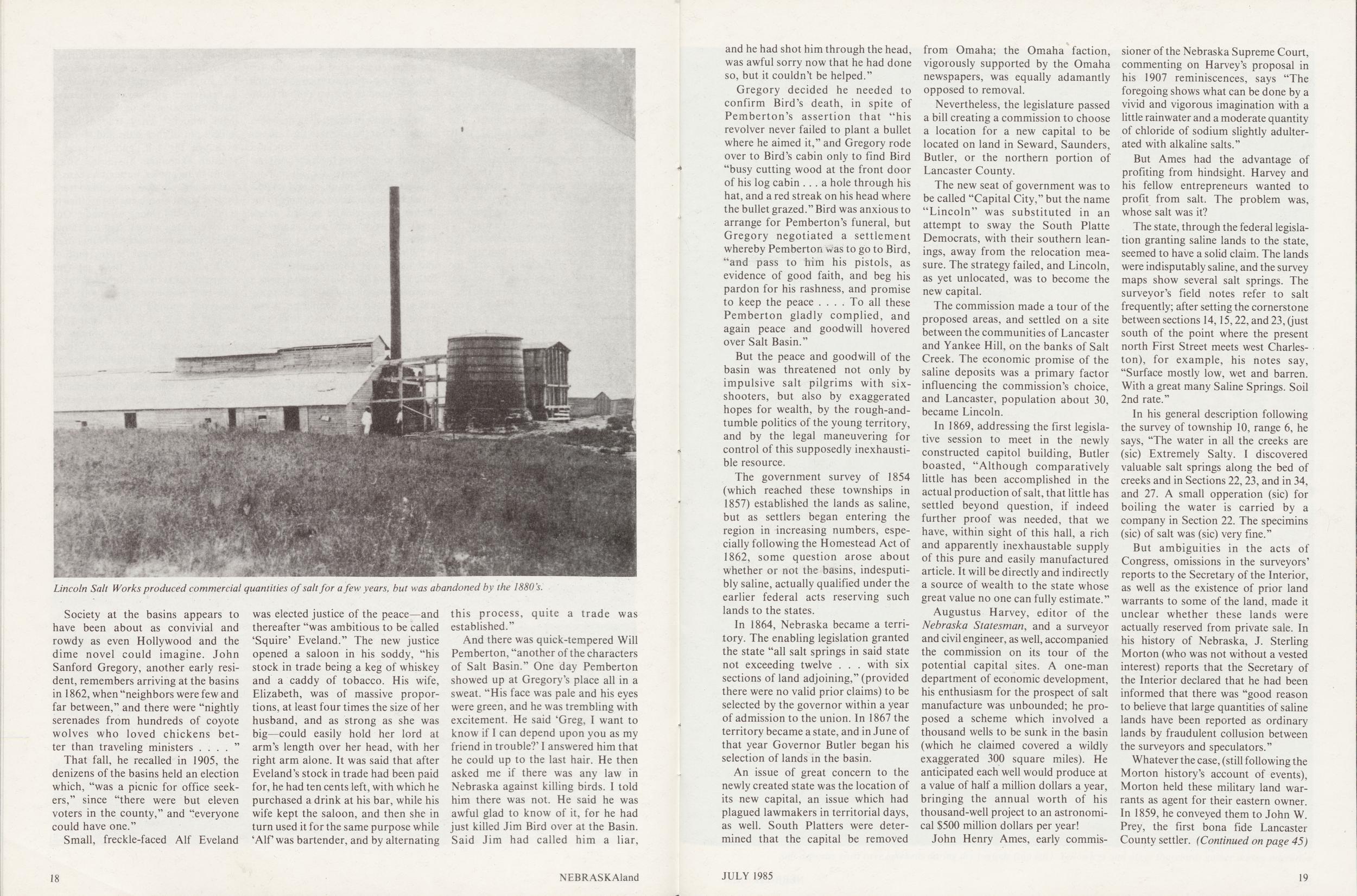
Society at the basins appears to have been about as convivial and rowdy as even Hollywood and the dime novel could imagine. John Sanford Gregory, another early resident, remembers arriving at the basins in 1862, when "neighbors were few and far between," and there were "nightly serenades from hundreds of coyote wolves who loved chickens better than traveling ministers "
That fall, he recalled in 1905, the denizens of the basins held an election which, "was a picnic for office seekers," since "there were but eleven voters in the county," and "everyone could have one."
Small, freckle-faced Alf Eveland was elected justice of the peace—and thereafter "was ambitious to be called 'Squire' Eveland." The new justice opened a saloon in his soddy, "his stock in trade being a keg of whiskey and a caddy of tobacco. His wife, Elizabeth, was of massive proportions, at least four times the size of her husband, and as strong as she was big—could easily hold her lord at arm's length over her head, with her right arm alone. It was said that after Eveland's stock in trade had been paid for, he had ten cents left, with which he purchased a drink at his bar, while his wife kept the saloon, and then she in turn used it for the same purpose while 'Alf was bartender, and by alternating this process, quite a trade was established."
And there was quick-tempered Will Pemberton, "another of the characters of Salt Basin." One day Pemberton showed up at Gregory's place all in a sweat. "His face was pale and his eyes were green, and he was trembling with excitement. He said 'Greg, I want to know if I can depend upon you as my friend in trouble?' I answered him that he could up to the last hair. He then asked me if there was any law in Nebraska against killing birds. I told him there was not. He said he was awful glad to know of it, for he had just killed Jim Bird over at the Basin. Said Jim had called him a liar, 18 NEBRASKAland and he had shot him through the head, was awful sorry now that he had done so, but it couldn't be helped."
Gregory decided he needed to confirm Bird's death, in spite of Pemberton's assertion that "his revolver never failed to plant a bullet where he aimed it," and Gregory rode over to Bird's cabin only to find Bird "busy cutting wood at the front door of his log cabin ... a hole through his hat, and a red streak on his head where the bullet grazed." Bird was anxious to arrange for Pemberton's funeral, but Gregory negotiated a settlement whereby Pemberton was to go to Bird, "and pass to him his pistols, as evidence of good faith, and beg his pardon for his rashness, and promise to keep the peace .... To all these Pemberton gladly complied, and again peace and goodwill hovered over Salt Basin."
But the peace and goodwill of the basin was threatened not only by impulsive salt pilgrims with sixshooters, but also by exaggerated hopes for wealth, by the rough-and-tumble politics of the young territory, and by the legal maneuvering for control of this supposedly inexhaustible resource.
The government survey of 1854 (which reached these townships in 1857) established the lands as saline, but as settlers began entering the region in increasing numbers, especially following the Homestead Act of 1862, some question arose about whether or not the basins, indesputibly saline, actually qualified under the earlier federal acts reserving such lands to the states.
In 1864, Nebraska became a territory. The enabling legislation granted the state "all salt springs in said state not exceeding twelve with six sections of land adjoining," (provided there were no valid prior claims) to be selected by the governor within a year of admission to the union. In 1867 the territory became a state, and in June of that year Governor Butler began his selection of lands in the basin.
An issue of great concern to the newly created state was the location of its new capital, an issue which had plagued lawmakers in territorial days, as well. South Platters were determined that the capital be removed from Omaha; the Omaha faction, vigorously supported by the Omaha newspapers, was equally adamantly opposed to removal.
Nevertheless, the legislature passed a bill creating a commission to choose a location for a new capital to be located on land in Seward, Saunders, Butler, or the northern portion of Lancaster County.
The new seat of government was to be called "Capital City." but the name "Lincoln" was substituted in an attempt to sway the South Platte Democrats, with their southern leanings, away from the relocation measure. The strategy failed, and Lincoln, as yet unlocated, was to become the new capital.
The commission made a tour of the proposed areas, and settled on a site between the communities of Lancaster and Yankee Hill, on the banks of Salt Creek. The economic promise of the saline deposits was a primary factor influencing the commission's choice, and Lancaster, population about 30, became Lincoln.
In 1869, addressing the first legislative session to meet in the newly constructed capitol building, Butler boasted, "Although comparatively little has been accomplished in the actual production of salt, that little has settled beyond question, if indeed further proof was needed, that we have, within sight of this hall, a rich and apparently inexhaustable supply of this pure and easily manufactured article. It will be directly and indirectly a source of wealth to the state whose great value no one can fully estimate."
Augustus Harvey, editor of the Nebraska Statesman, and a surveyor and civil engineer, as well, accompanied the commission on its tour of the potential capital sites. A one-man department of economic development, his enthusiasm for the prospect of salt manufacture was unbounded; he proposed a scheme which involved a thousand wells to be sunk in the basin (which he claimed covered a wildly exaggerated 300 square miles). He anticipated each well would produce at a value of half a million dollars a year, bringing the annual worth of his thousand-well project to an astronomical $500 million dollars per year!
John Henry Ames, early commissioner of the Nebraska Supreme Court, commenting on Harvey's proposal in his 1907 reminiscences, says "The foregoing shows what can be done by a vivid and vigorous imagination with a little rainwater and a moderate quantity of chloride of sodium slightly adulterated with alkaline salts."
But Ames had the advantage of profiting from hindsight. Harvey and his fellow entrepreneurs wanted to profit from salt. The problem was, whose salt was it?
The state, through the federal legislation granting saline lands to the state, seemed to have a solid claim. The lands were indisputably saline, and the survey maps show several salt springs. The surveyor's field notes refer to salt frequently; after setting the cornerstone between sections 14,15,22, and 23, (just south of the point where the present north First Street meets west Charleston), for example, his notes say, "Surface mostly low, wet and barren. With a great many Saline Springs. Soil 2nd rate."
In his general description following the survey of township 10, range 6, he says, "The water in all the creeks are (sic) Extremely Salty. I discovered valuable salt springs along the bed of creeks and in Sections 22, 23, and in 34, and 27. A small opperation (sic) for boiling the water is carried by a company in Section 22. The specimins (sic) of salt was (sic) very fine."
But ambiguities in the acts of Congress, omissions in the surveyors' reports to the Secretary of the Interior, as well as the existence of prior land warrants to some of the land, made it unclear whether these lands were actually reserved from private sale. In his history of Nebraska, J. Sterling Morton (who was not without a vested interest) reports that the Secretary of the Interior declared that he had been informed that there was "good reason to believe that large quantities of saline lands have been reported as ordinary lands by fraudulent collusion between the surveyors and speculators."
Whatever the case, (still following the Morton history's account of events), Morton held these military land warrants as agent for their eastern owner. In 1859, he conveyed them to John W. Prey, the first bona fide Lancaster County settler. (Continued on page 45)
JULY 1985 19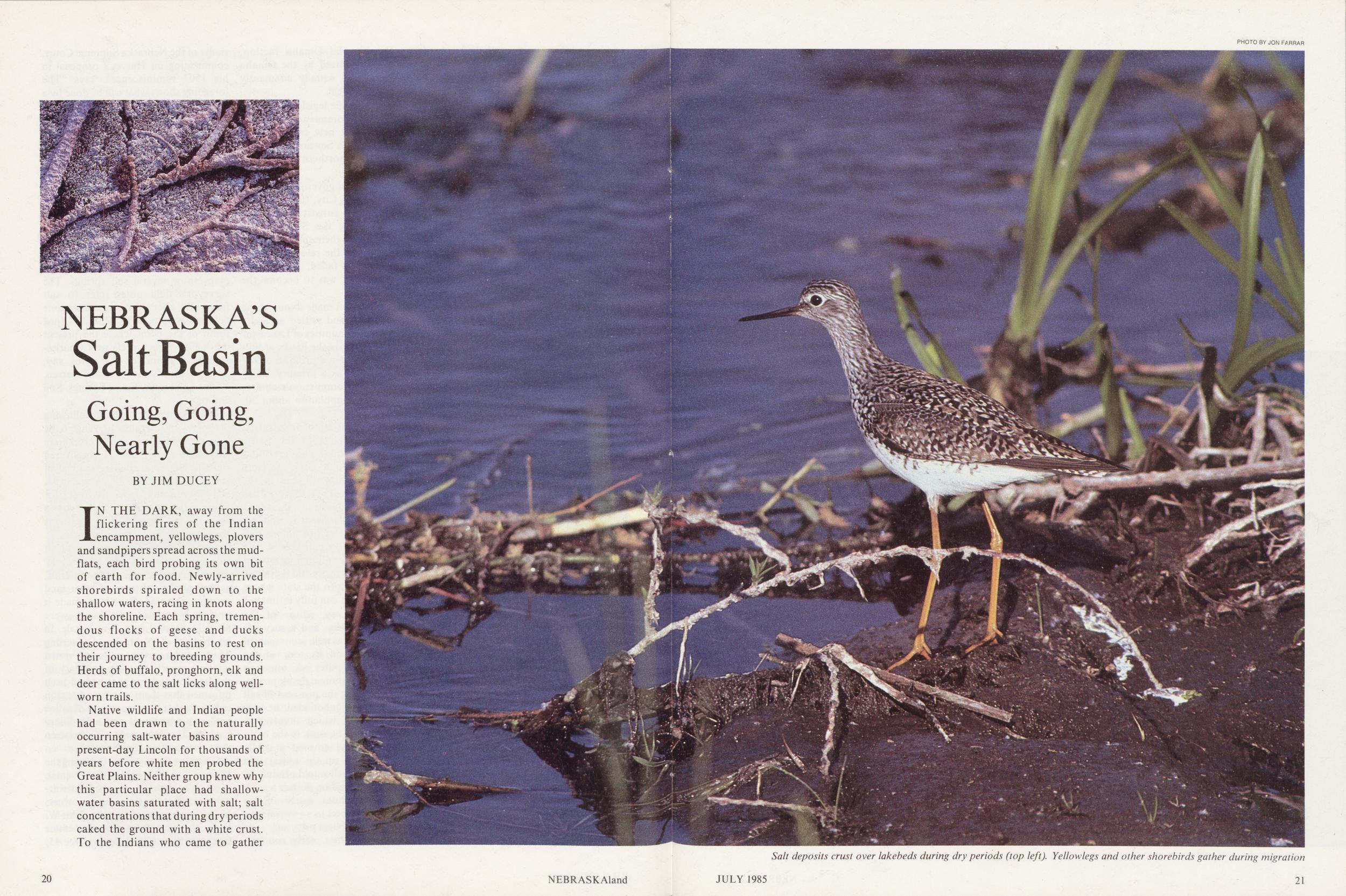
NEBRASKA'S Salt Basin Going, Going, Nearly Gone
BY JIM DUCEYIN THE DARK, away from the flickering fires of the Indian encampment, yellowlegs, plovers and sandpipers spread across the mudflats, each bird probing its own bit of earth for food. Newly-arrived shorebirds spiraled down to the shallow waters, racing in knots along the shoreline. Each spring, tremendous flocks of geese and ducks descended on the basins to rest on their journey to breeding grounds. Herds of buffalo, pronghorn, elk and deer came to the salt licks along wellworn trails.
Native wildlife and Indian people had been drawn to the naturally occurring salt-water basins around present-day Lincoln for thousands of years before white men probed the Great Plains. Neither group knew why this particular place had shallowwater basins saturated with salt; salt concentrations that during dry periods caked the ground with a white crust. To the Indians who came to gather their year's supply of salt, and to the waterbirds that paused during migration or lingered to nest, it mattered little how the basins came to be, only that they existed. The flowing springs and groundwater flows that carried alkaline water to the surface along Salt Creek, the extensive mud flats, and clumps of saline-tolerant plants would all be explained in time.
20 NEBRASKAland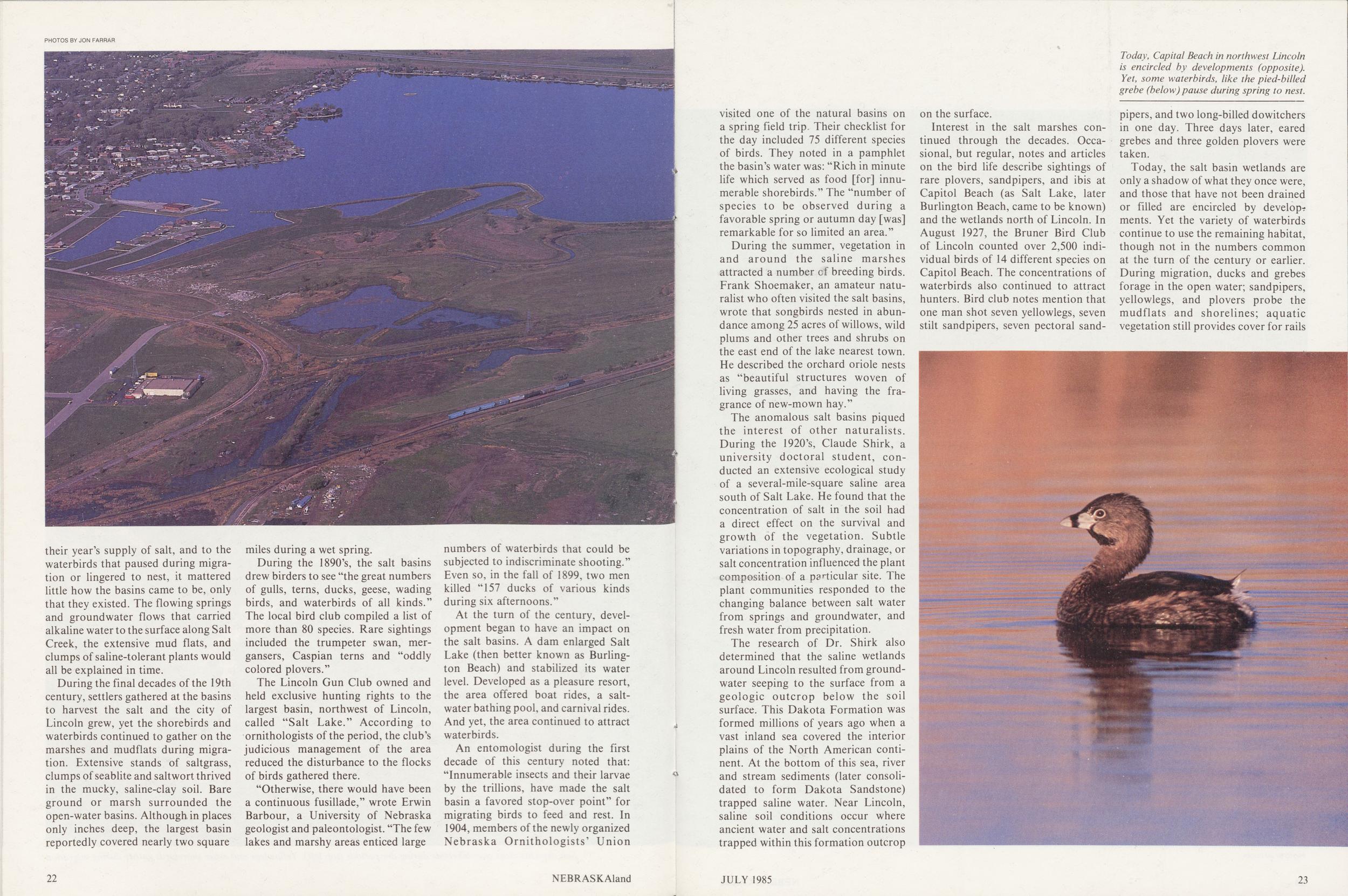
During the final decades of the 19th century, settlers gathered at the basins to harvest the salt and the city of Lincoln grew, yet the shorebirds and waterbirds continued to gather on the marshes and mudflats during migration. Extensive stands of saltgrass, clumps of seablite and saltwort thrived in the mucky, saline-clay soil. Bare ground or marsh surrounded the open-water basins. Although in places only inches deep, the largest basin reportedly covered nearly two square miles during a wet spring.
During the 1890's, the salt basins drew birders to see "the great numbers of gulls, terns, ducks, geese, wading birds, and waterbirds of all kinds." The local bird club compiled a list of more than 80 species. Rare sightings included the trumpeter swan, mergansers, Caspian terns and "oddly colored plovers."
The Lincoln Gun Club owned and held exclusive hunting rights to the largest basin, northwest of Lincoln, called "Salt Lake." According to ornithologists of the period, the club's judicious management of the area reduced the disturbance to the flocks of birds gathered there.
"Otherwise, there would have been a continuous fusillade," wrote Erwin Barbour, a University of Nebraska geologist and paleontologist. "The few lakes and marshy areas enticed large numbers of waterbirds that could be subjected to indiscriminate shooting." Even so, in the fall of 1899, two men killed "157 ducks of various kinds during six afternoons."
At the turn of the century, development began to have an impact on the salt basins. A dam enlarged Salt Lake (then better known as Burlington Beach) and stabilized its water level. Developed as a pleasure resort, the area offered boat rides, a saltwater bathing pool, and carnival rides. And yet, the area continued to attract waterbirds.
An entomologist during the first decade of this century noted that: "Innumerable insects and their larvae by the trillions, have made the salt basin a favored stop-over point" for migrating birds to feed and rest. In 1904, members of the newly organized Nebraska Ornithologists' Union 22 NEBRASKAland visited one of the natural basins on a spring field trip. Their checklist for the day included 75 different species of birds. They noted in a pamphlet the basin's water was: "Rich in minute life which served as food [for] innumerable shorebirds." The "number of species to be observed during a favorable spring or autumn day [was] remarkable for so limited an area."
During the summer, vegetation in and around the saline marshes attracted a number cf breeding birds. Frank Shoemaker, an amateur naturalist who often visited the salt basins, wrote that songbirds nested in abundance among 25 acres of willows, wild plums and other trees and shrubs on the east end of the lake nearest town. He described the orchard oriole nests as "beautiful structures woven of living grasses, and having the fragrance of new-mown hay."
The anomalous salt basins piqued the interest of other naturalists. During the 1920's, Claude Shirk, a university doctoral student, conducted an extensive ecological study of a several-mile-square saline area south of Salt Lake. He found that the concentration of salt in the soil had a direct effect on the survival and growth of the vegetation. Subtle variations in topography, drainage, or salt concentration influenced the plant composition of a particular site. The plant communities responded to the changing balance between salt water from springs and groundwater, and fresh water from precipitation.
The research of Dr. Shirk also determined that the saline wetlands around Lincoln resulted from ground water seeping to the surface from a geologic outcrop below the soil surface. This Dakota Formation was formed millions of years ago when a vast inland sea covered the interior plains of the North American continent. At the bottom of this sea, river and stream sediments (later consolidated to form Dakota Sandstone) trapped saline water. Near Lincoln, saline soil conditions occur where ancient water and salt concentrations trapped within this formation outcrop on the surface.
Interest in the salt marshes continued through the decades. Occasional, but regular, notes and articles on the bird life describe sightings of rare plovers, sandpipers, and ibis at Capitol Beach (as Salt Lake, later Burlington Beach, came to be known) and the wetlands north of Lincoln. In August 1927, the Bruner Bird Club of Lincoln counted over 2,500 individual birds of 14 different species on Capitol Beach. The concentrations of waterbirds also continued to attract hunters. Bird club notes mention that one man shot seven yellowlegs, seven stilt sandpipers, seven pectoral sand pipers, and two long-billed dowitchers in one day. Three days later, eared grebes and three golden plovers were taken.
Today, Capital Beach in northwest Lincoln is encircled by developments (opposite). Yet, some waterbirds, like the pied-billed grebe (below) pause during spring to nest.Today, the salt basin wetlands are only a shadow of what they once were, and those that have not been drained or filled are encircled by develop? ments. Yet the variety of waterbirds continue to use the remaining habitat, though not in the numbers common at the turn of the century or earlier. During migration, ducks and grebes forage in the open water; sandpipers, yellowlegs, and plovers probe the mudflats and shorelines; aquatic vegetation still provides cover for rails and blackbirds. During the last 90 years, more than 230 species of birds have been reported from the saline wetlands near Lincoln, more than half the total number of species reported for the entire state. Rare migrants like the whooping crane and trumpeter swan are no longer seen, but unusual species such as the black rail, blacknecked stilt, and black-legged kittiwake have been sighted, and recently, common moorhens (common gallinules) and least bitterns have nested in the remnant salt marshes.
JULY 1985 23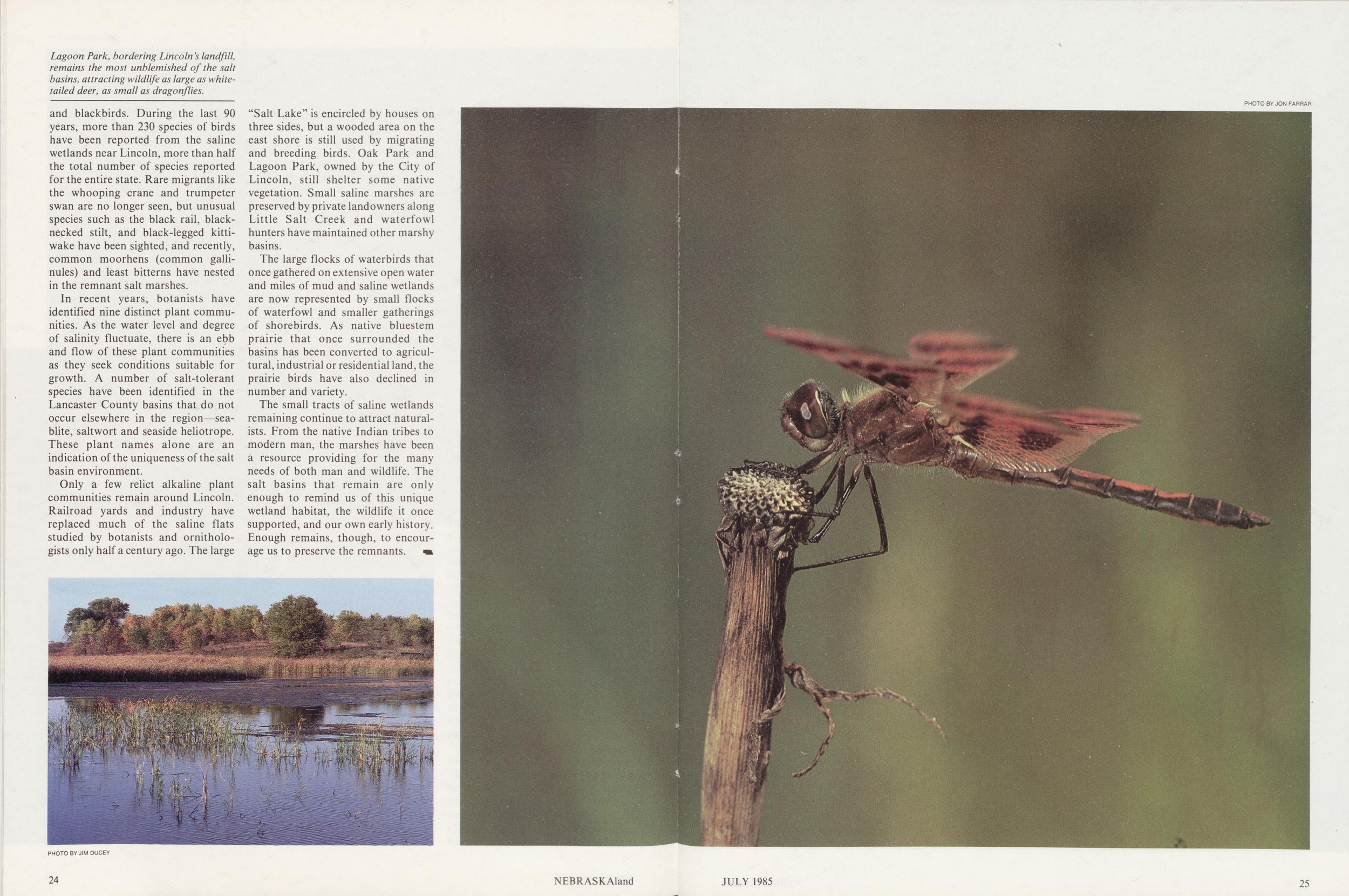 Lagoon Park, bordering Lincoln's landfill,
remains the most unblemished of the salt
basins, attracting wildlife as large as whitetailed deer, as small as dragonflies.
Lagoon Park, bordering Lincoln's landfill,
remains the most unblemished of the salt
basins, attracting wildlife as large as whitetailed deer, as small as dragonflies.
In recent years, botanists have identified nine distinct plant communities. As the water level and degree of salinity fluctuate, there is an ebb and flow of these plant communities as they seek conditions suitable for growth. A number of salt-tolerant species have been identified in the Lancaster County basins that do not occur elsewhere in the region—sea-blite, saltwort and seaside heliotrope. These plant names alone are an indication of the uniqueness of the salt basin environment.
Only a few relict alkaline plant communities remain around Lincoln. Railroad yards and industry have replaced much of the saline flats studied by botanists and ornithologists only half a century ago. The large PHOTO BY JON FARRAR "Salt Lake" is encircled by houses on three sides, but a wooded area on the east shore is still used by migrating and breeding birds. Oak Park and Lagoon Park, owned by the City of Lincoln, still shelter some native vegetation. Small saline marshes are preserved by private landowners along Little Salt Creek and waterfowl hunters have maintained other marshy basins.
The large flocks of waterbirds that once gathered on extensive open water and miles of mud and saline wetlands are now represented by small flocks of waterfowl and smaller gatherings of shorebirds. As native bluestem prairie that once surrounded the basins has been converted to agricultural, industrial or residential land, the prairie birds have also declined in number and variety.
The small tracts of saline wetlands remaining continue to attract naturalists. From the native Indian tribes to modern man, the marshes have been a resource providing for the many needs of both man and wildlife. The salt basins that remain are only enough to remind us of this unique wetland habitat, the wildlife it once supported, and our own early history. Enough remains, though, to encourage us to preserve the remnants.
In the Heart of the Country
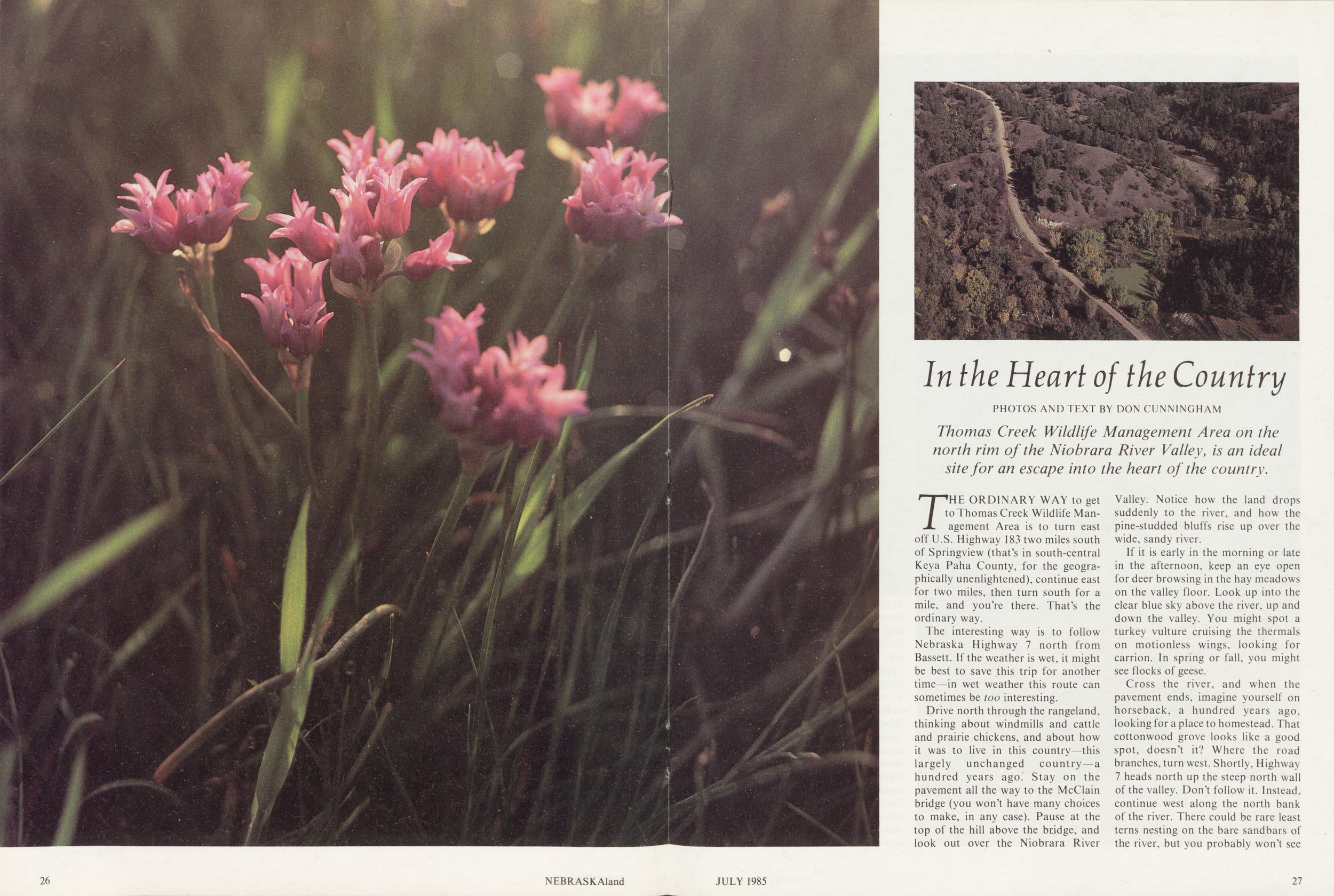
PHOTOS AND TEXT BY DON CUNNINGHAM Thomas Creek Wildlife Management Area on the north rim of the Niobrara River Valley, is an ideal site for an escape into the heart of the country.TfHE ORDINARY WAY to get to Thomas Creek Wildlife Management Area is to turn east off U.S. Highway 183 two miles south of Springview (that's in south-central Keya Paha County, for the geographically unenlightened), continue east for two miles, then turn south for a mile, and you're there. That's the ordinary way.
The interesting way is to follow Nebraska Highway 7 north from Bassett. If the weather is wet, it might be best to save this trip for another time—in wet weather this route can sometimes be too interesting.
Drive north through the rangeland, thinking about windmills and cattle and prairie chickens, and about how it was to live in this country—this largely unchanged country—a hundred years ago. Stay on the pavement all the way to the McClain bridge (you won't have many choices to make, in any case). Pause at the top of the hill above the bridge, and look out over the Niobrara River Valley. Notice how the land drops suddenly to the river, and how the pine-studded bluffs rise up over the wide, sandy river.
If it is early in the morning or late in the afternoon, keep an eye open for deer browsing in the hay meadows on the valley floor. Look up into the clear blue sky above the river, up and down the valley. You might spot a turkey vulture cruising the thermals on motionless wings, looking for carrion. In spring or fall, you might see flocks of geese.
Cross the river, and when the pavement ends, imagine yourself on horseback, a hundred years ago, looking for a place to homestead. That cottonwood grove looks like a good spot, doesn't it? Where the road branches, turn west. Shortly, Highway 7 heads north up the steep north wall of the valley. Don't follow it. Instead, continue west along the north bank of the river. There could be rare least terns nesting on the bare sandbars of the river, but you probably won't see them. It's satisfying to realize they might be out there, though.
JULY 1985 27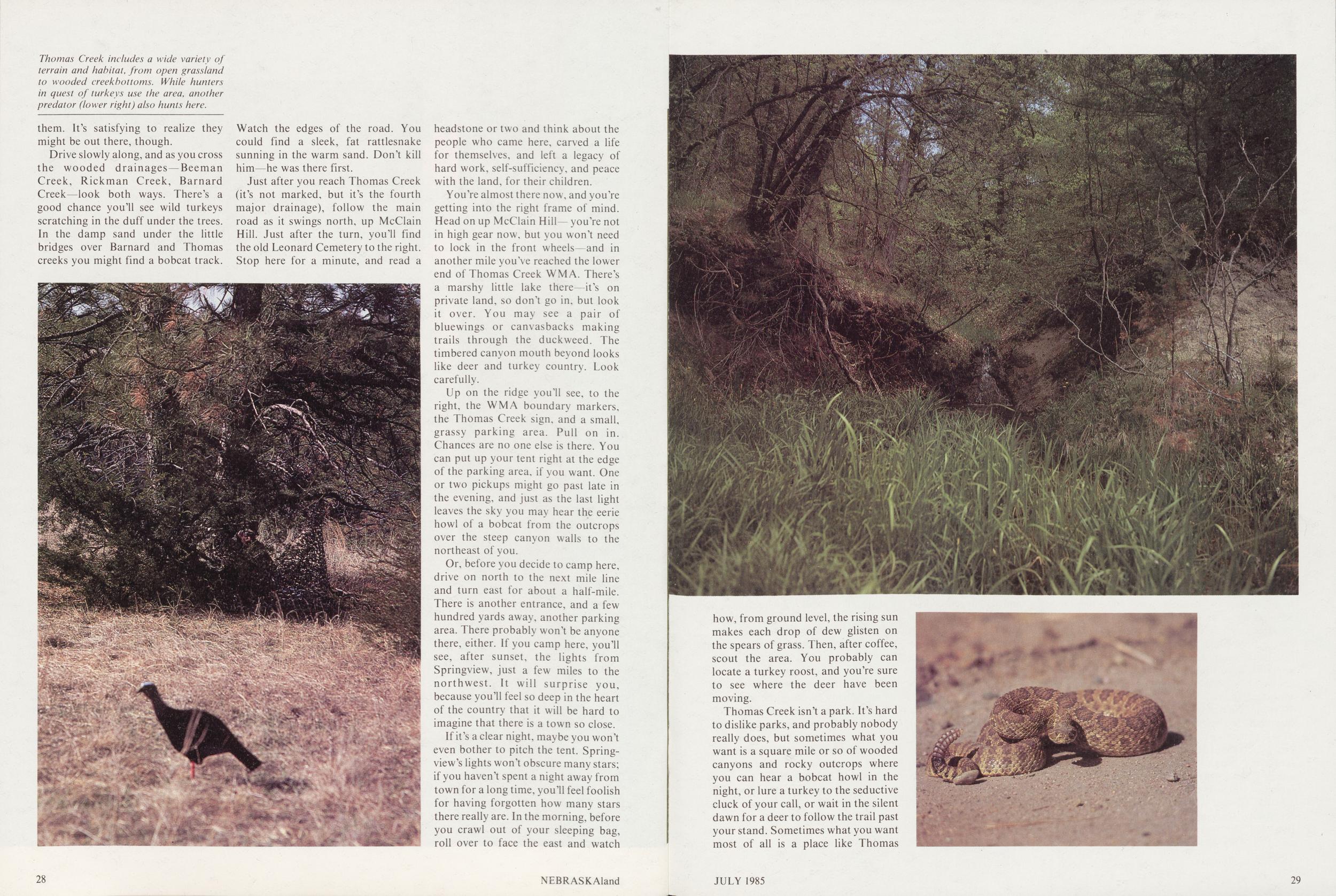 Thomas Creek includes a wide variety of
terrain and habitat, from open grassland
to wooded ereekbottoms. While hunters
in quest of turkeys use the area, another
predator (lower right) also hunts here.
Thomas Creek includes a wide variety of
terrain and habitat, from open grassland
to wooded ereekbottoms. While hunters
in quest of turkeys use the area, another
predator (lower right) also hunts here.
Drive slowly along, and as you cross the wooded drainages--Beeman Creek, Rickman Creek, Barnard Creek--look both ways. There's a good chance you'll see wild turkeys scratching in the duff under the trees. In the damp sand under the little bridges over Barnard and Thomas creeks you might find a bobcat track. Watch the edges of the road. You could find a sleek, fat rattlesnake sunning in the warm sand. Don't kill him—he was there first.
Just after you reach Thomas Creek (it's not marked, but it's the fourth major drainage), follow the main road as it swings north, up McClain Hill. Just after the turn, you'll find the old Leonard Cemetery to the right. Stop here for a minute, and read a headstone or two and think about the people who came here, carved a life for themselves, and left a legacy of hard work, self-sufficiency, and peace with the land, for their children.
You're almost there now, and you're getting into the right frame of mind. Head on up McClain Hill- you're not in high gear now, but you won't need to lock in the front wheels—and in another mile you've reached the lower end of Thomas Creek WMA. There's a marshy little lake there--it's on private land, so don't go in, but look it over. You may see a pair of bluewings or canvasbacks making trails through the duckweed. The timbered canyon mouth beyond looks like deer and turkey country. Look carefully.
Up on the ridge you'll see, to the right, the WMA boundary markers, the Thomas Creek sign, and a small, grassy parking area. Pull on in. Chances are no one else is there. You can put up your tent right at the edge of the parking area, if you want. One or two pickups might go past late in the evening, and just as the last light leaves the sky you may hear the eerie howl of a bobcat from the outcrops over the steep canyon walls to the northeast of you.
Or, before you decide to camp here, drive on north to the next mile line and turn east for about a half-mile. There is another entrance, and a few hundred yards away, another parking area. There probably won't be anyone there, either. If you camp here, you'll see, after sunset, the lights from Springview, just a few miles to the northwest. It will surprise you, because you'll feel so deep in the heart of the country that it will be hard to imagine that there is a town so close.
If it's a clear night, maybe you won't even bother to pitch the tent. Springview's lights won't obscure many stars; if you haven't spent a night away from town for a long time, you'll feel foolish for having forgotten how many stars there really are. In the morning, before you crawl out of your sleeping bag, roll over to face the east and watch 28 NEBRASKAland how, from ground level, the rising sun makes each drop of dew glisten on the spears of grass. Then, after coffee, scout the area. You probably can locate a turkey roost, and you're sure to see where the deer have been moving.
Thomas Creek isn't a park. It's hard to dislike parks, and probably nobody really does, but sometimes what you want is a square mile or so of wooded canyons and rocky outcrops where you can hear a bobcat howl in the night, or lure a turkey to the seductive cluck of your call, or wait in the silent dawn for a deer to follow the trail past your stand. Sometimes what you want most of all is a place like Thomas Creek Wildlife Management Area.
JULY 1985 29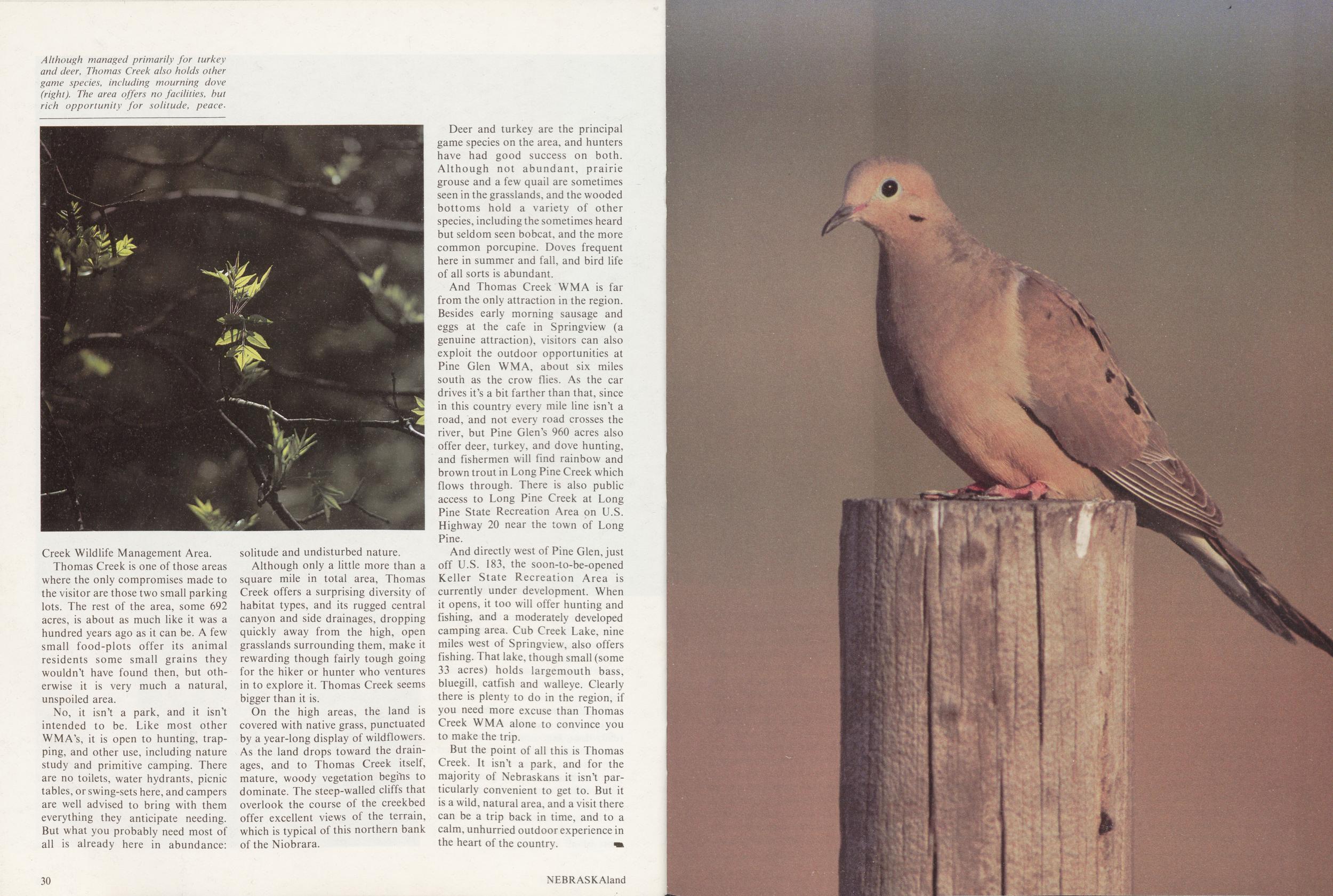 Although managed primarily for turkey
and deer, Thomas Creek also holds other
game species, including mourning dove
(right). The area offers no facilities, hut
rich opportunity for solitude, peace.
Although managed primarily for turkey
and deer, Thomas Creek also holds other
game species, including mourning dove
(right). The area offers no facilities, hut
rich opportunity for solitude, peace.
Thomas Creek is one of those areas where the only compromises made to the visitor are those two small parking lots. The rest of the area, some 692 acres, is about as much like it was a hundred years ago as it can be. A few small food-plots offer its animal residents some small grains they wouldn't have found then, but otherwise it is very much a natural, unspoiled area.
No, it isn't a park, and it isn't intended to be. Like most other WMA's, it is open to hunting, trapping, and other use, including nature study and primitive camping. There are no toilets, water hydrants, picnic tables, or swing-sets here, and campers are v/ell advised to bring with them everything they anticipate needing. But what you probably need most of all is already here in abundance: solitude and undisturbed nature.
Although only a little more than a square mile in total area, Thomas Creek offers a surprising diversity of habitat types, and its rugged central canyon and side drainages, dropping quickly away from the high, open grasslands surrounding them, make it rewarding though fairly tough going for the hiker or hunter who ventures in to explore it. Thomas Creek seems bigger than it is.
On the high areas, the land is covered with native grass, punctuated by a year-long display of wildflowers. As the land drops toward the drainages, and to Thomas Creek itself, mature, woody vegetation begins to dominate. The steep-walled cliffs that overlook the course of the creekbed offer excellent views of the terrain, which is typical of this northern bank of the Niobrara.
Deer and turkey are the principal game species on the area, and hunters have had good success on both. Although not abundant, prairie grouse and a few quail are sometimes seen in the grasslands, and the wooded bottoms hold a variety of other species, including the sometimes heard but seldom seen bobcat, and the more common porcupine. Doves frequent here in summer and fall, and bird life of all sorts is abundant.
And Thomas Creek WMA is far from the only attraction in the region. Besides early morning sausage and eggs at the cafe in Springview (a genuine attraction), visitors can also exploit the outdoor opportunities at Pine Glen WMA, about six miles south as the crow flies. As the car drives it's a bit farther than that, since in this country every mile line isn't a road, and not every road crosses the river, but Pine Glen's 960 acres also offer deer, turkey, and dove hunting, and fishermen will find rainbow and brown trout in Long Pine Creek which flows through. There is also public access to Long Pine Creek at Long Pine State Recreation Area on U.S. Highway 20 near the town of Long Pine.
And directly west of Pine Glen, just off U.S. 183, the soon-to-be-opened Keller State Recreation Area is currently under development. When it opens, it too will offer hunting and fishing, and a moderately developed camping area. Cub Creek Lake, nine miles west of Springview, also offers fishing. That lake, though small (some 33 acres) holds largemouth bass, bluegill, catfish and walleye. Clearly there is plenty to do in the region, if you need more excuse than Thomas Creek WMA alone to convince you to make the trip.
But the point of all this is Thomas Creek. It isn't a park, and for the majority of Nebraskans it isn't particularly convenient to get to. But it is a wild, natural area, and a visit there can be a trip back in time, and to a calm, unhurried outdoor experience in the heart of the country.
30 NEBRASKAland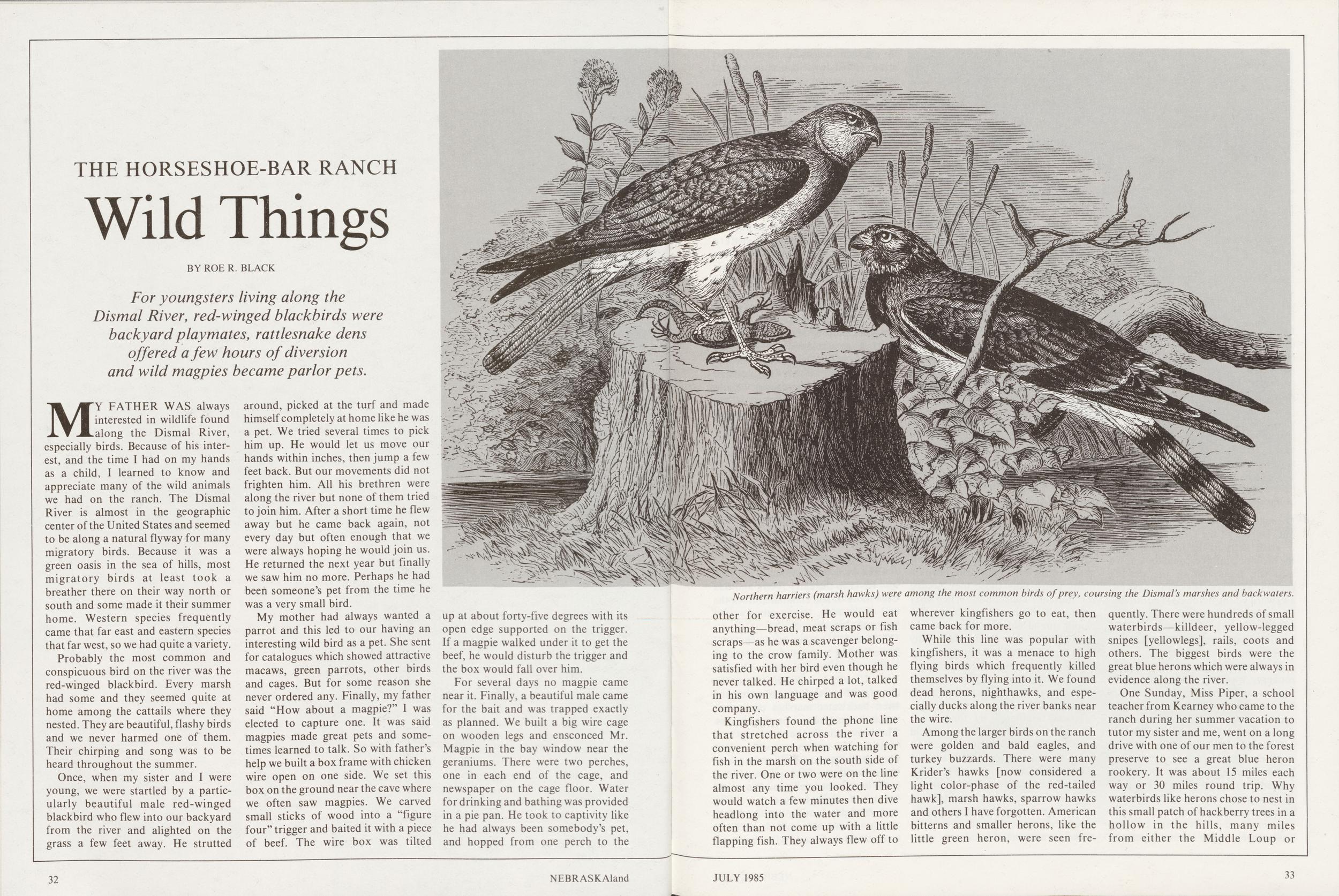
THE HORSESHOE-BAR RANCH Wild Things
BY ROE R. BLACK For youngsters living along the Dismal River, red-winged blackbirds were backyard playmates, rattlesnake dens offered a few hours of diversion and wild magpies became parlor pets.MY FATHER WAS always interested in wildlife found along the Dismal River, especially birds. Because of his interest, and the time I had on my hands as a child, I learned to know and appreciate many of the wild animals we had on the ranch. The Dismal River is almost in the geographic center of the United States and seemed to be along a natural flyway for many migratory birds. Because it was a green oasis in the sea of hills, most migratory birds at least took a breather there on their way north or south and some made it their summer home. Western species frequently came that far east and eastern species that far west, so we had quite a variety.
Probably the most common and conspicuous bird on the river was the red-winged blackbird. Every marsh had some and they seemed quite at home among the cattails where they nested. They are beautiful, flashy birds and we never harmed one of them. Their chirping and song was to be heard throughout the summer.
Once, when my sister and I were young, we were startled by a particularly beautiful male red-winged blackbird who flew into our backyard from the river and alighted on the grass a few feet away. He strutted around, picked at the turf and made himself completely at home like he was a pet. We tried several times to pick him up. He would let us move our hands within inches, then jump a few feet back. But our movements did not frighten him. All his brethren were along the river but none of them tried to join him. After a short time he flew away but he came back again, not every day but often enough that we were always hoping he would join us. He returned the next year but finally we saw him no more. Perhaps he had been someone's pet from the time he was a very small bird.
My mother had always wanted a parrot and this led to our having an interesting wild bird as a pet. She sent for catalogues which showed attractive macaws, green parrots, other birds and cages. But for some reason she never ordered any. Finally, my father said "How about a magpie?" I was elected to capture one. It was said magpies made great pets and sometimes learned to talk. So with father's help we built a box frame with chicken wire open on one side. We set this box on the ground near the cave where we often saw magpies. We carved small sticks of wood into a "figure four" trigger and baited it with a piece of beef. The wire box was tilted up at about forty-five degrees with its open edge supported on the trigger. If a magpie walked under it to get the beef, he would disturb the trigger and the box would fall over him.
For several days no magpie came near it. Finally, a beautiful male came for the bait and was trapped exactly as planned. We built a big wire cage on wooden legs and ensconced Mr. Magpie in the bay window near the geraniums. There were two perches, one in each end of the cage, and newspaper on the cage floor. Water for drinking and bathing was provided in a pie pan. He took to captivity like he had always been somebody's pet, and hopped from one perch to the 32 NEBRASKAland other for exercise. He would eat anything—bread, meat scraps or fish scraps—as he was a scavenger belonging to the crow family. Mother was satisfied with her bird even though he never talked. He chirped a lot, talked in his own language and was good company.
Kingfishers found the phone line that stretched across the river a convenient perch when watching for fish in the marsh on the south side of the river. One or two were on the line almost any time you looked. They would watch a few minutes then dive headlong into the water and more often than not come up with a little flapping fish. They always flew off to wherever kingfishers go to eat, then came back for more.
While this line was popular with kingfishers, it was a menace to high flying birds which frequently killed themselves by flying into it. We found dead herons, nighthawks, and especially ducks along the river banks near the wire.
Among the larger birds on the ranch were golden and bald eagles, and turkey buzzards. There were many Krider's hawks [now considered a light color-phase of the red-tailed hawk], marsh hawks, sparrow hawks and others I have forgotten. American bitterns and smaller herons, like the little green heron, were seen frequently. There were hundreds of small waterbirds—killdeer, yellow-legged snipes [yellowlegs], rails, coots and others. The biggest birds were the great blue herons which were always in evidence along the river.
One Sunday, Miss Piper, a school teacher from Kearney who came to the ranch during her summer vacation to tutor my sister and me, went on a long drive with one of our men to the forest preserve to see a great blue heron rookery. It was about 15 miles each way or 30 miles round trip. Why waterbirds like herons chose to nest in this small patch of hackberry trees in a hollow in the hills, many miles from either the Middle Loup or Dismal rivers, we could never figure out. Dozens of the birds nested there in great nests in the treetops. From the brow of a hill you could look down into the nests during the nesting season and see the long-necked, awkward young herons by the dozens. The parent birds paid little attention to visitors who kept their distance and continued to come and go feeding their young.
JULY 1985 33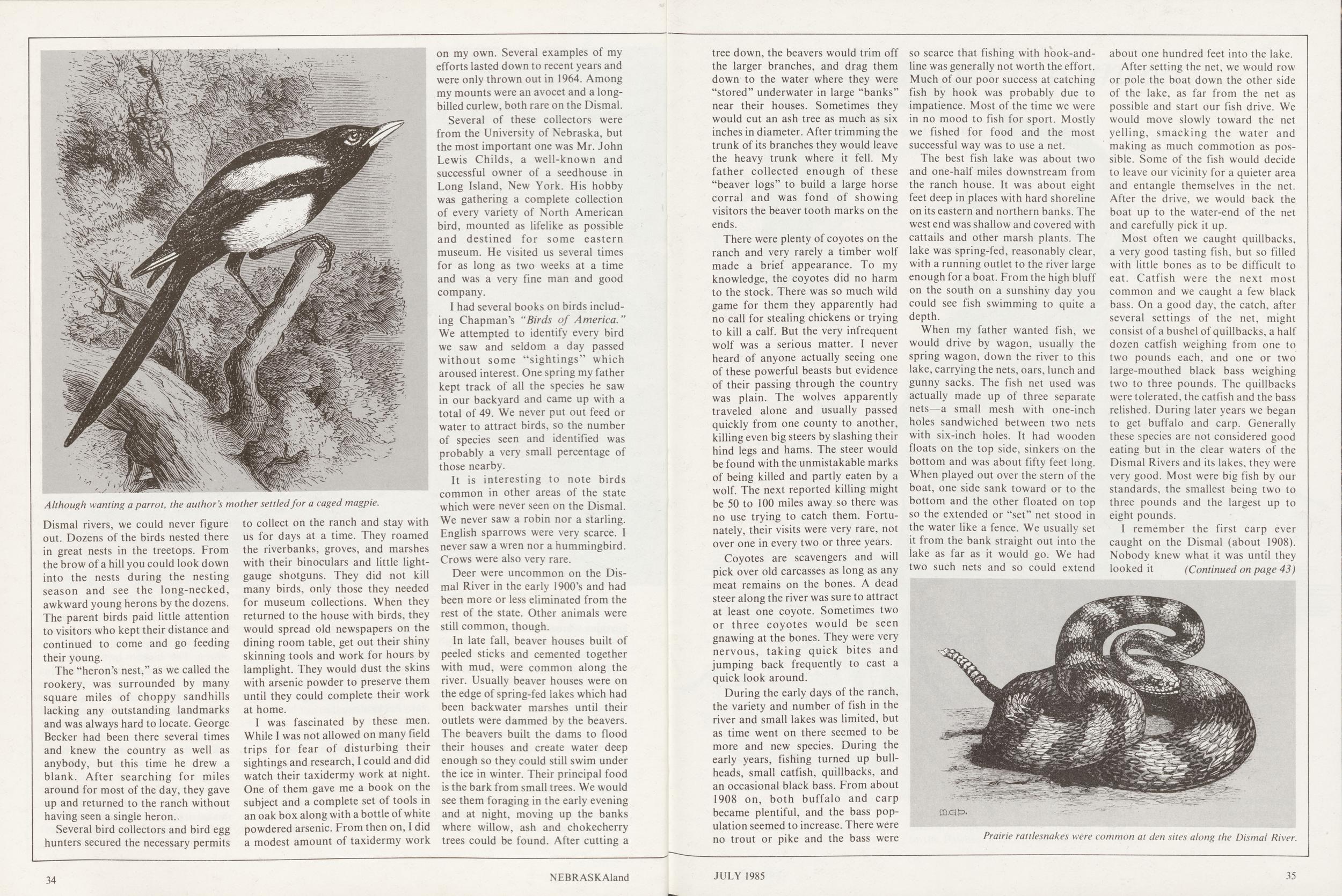
The "heron's nest," as we called the rookery, was surrounded by many square miles of choppy sandhills lacking any outstanding landmarks and was always hard to locate. George Becker had been there several times and knew the country as well as anybody, but this time he drew a blank. After searching for miles around for most of the day, they gave up and returned to the ranch without having seen a single heron.
Several bird collectors and bird egg hunters secured the necessary permits to collect on the ranch and stay with us for days at a time. They roamed the riverbanks, groves, and marshes with their binoculars and little lightgauge shotguns. They did not kill many birds, only those they needed for museum collections. When they returned to the house with birds, they would spread old newspapers on the dining room table, get out their shiny skinning tools and work for hours by lamplight. They would dust the skins with arsenic powder to preserve them until they could complete their work at home.
I was fascinated by these men. While I was not allowed on many field trips for fear of disturbing their sightings and research, I could and did watch their taxidermy work at night. One of them gave me a book on the subject and a complete set of tools in an oak box along with a bottle of white powdered arsenic. From then on, I did a modest amount of taxidermy work on my own. Several examples of my efforts lasted down to recent years and were only thrown out in 1964. Among my mounts were an avocet and a longbilled curlew, both rare on the Dismal.
Several of these collectors were from the University of Nebraska, but the most important one was Mr. John Lewis Childs, a well-known and successful owner of a seedhouse in Long Island, New York. His hobby was gathering a complete collection of every variety of North American bird, mounted as lifelike as possible and destined for some eastern museum. He visited us several times for as long as two weeks at a time and was a very fine man and good company.
I had several books on birds including Chapman's "Birds of America." We attempted to identify every bird we saw and seldom a day passed without some "sightings" which aroused interest. One spring my father kept track of all the species he saw in our backyard and came up with a total of 49. We never put out feed or water to attract birds, so the number of species seen and identified was probably a very small percentage of those nearby.
It is interesting to note birds common in other areas of the state which were never seen on the Dismal. We never saw a robin nor a starling. English sparrows were very scarce. I never saw a wren nor a hummingbird. Crows were also very rare.
Deer were uncommon on the Dismal River in the early 1900's and had been more or less eliminated from the rest of the state. Other animals were still common, though.
In late fall, beaver houses built of peeled sticks and cemented together with mud, were common along the river. Usually beaver houses were on the edge of spring-fed lakes which had been backwater marshes until their outlets were dammed by the beavers. The beavers built the dams to flood their houses and create water deep enough so they could still swim under the ice in winter. Their principal food is the bark from small trees. We would see them foraging in the early evening and at night, moving up the banks where willow, ash and chokecherry trees could be found. After cutting a 34 NEBRASKAland tree down, the beavers would trim off the larger branches, and drag them down to the water where they were "stored" underwater in large "banks" near their houses. Sometimes they would cut an ash tree as much as six inches in diameter. After trimming the trunk of its branches they would leave the heavy trunk where it fell. My father collected enough of these "beaver logs" to build a large horse corral and was fond of showing visitors the beaver tooth marks on the ends.
There were plenty of coyotes on the ranch and very rarely a timber wolf made a brief appearance. To my knowledge, the coyotes did no harm to the stock. There was so much wild game for them they apparently had no call for stealing chickens or trying to kill a calf. But the very infrequent wolf was a serious matter. I never heard of anyone actually seeing one of these powerful beasts but evidence of their passing through the country was plain. The wolves apparently traveled alone and usually passed quickly from one county to another, killing even big steers by slashing their hind legs and hams. The steer would be found with the unmistakable marks of being killed and partly eaten by a wolf. The next reported killing might be 50 to 100 miles away so there was no use trying to catch them. Fortunately, their visits were very rare, not over one in every two or three years.
Coyotes are scavengers and will pick over old carcasses as long as any meat remains on the bones. A dead steer along the river was sure to attract at least one coyote. Sometimes two or three coyotes would be seen gnawing at the bones. They were very nervous, taking quick bites and jumping back frequently to cast a quick look around.
During the early days of the ranch, the variety and number of fish in the river and small lakes was limited, but as time went on there seemed to be more and new species. During the early years, fishing turned up bullheads, small catfish, quillbacks, and an occasional black bass. From about 1908 on, both buffalo and carp became plentiful, and the bass population seemed to increase. There were no trout or pike and the bass were so scarce that fishing with hook-and-line was generally not worth the effort. Much of our poor success at catching fish by hook was probably due to impatience. Most of the time we were in no mood to fish for sport. Mostly we fished for food and the most successful way was to use a net.
The best fish lake was about two and one-half miles downstream from the ranch house. It was about eight feet deep in places with hard shoreline on its eastern and northern banks. The west end was shallow and covered with cattails and other marsh plants. The lake was spring-fed, reasonably clear, with a running outlet to the river large enough for a boat. From the high bluff on the south on a sunshiny day you could see fish swimming to quite a depth.
When my father wanted fish, we would drive by wagon, usually the spring wagon, down the river to this lake, carrying the nets, oars, lunch and gunny sacks. The fish net used was actually made up of three separate nets—a small mesh with one-inch holes sandwiched between two nets with six-inch holes. It had wooden floats on the top side, sinkers on the bottom and was about fifty feet long. When played out over the stern of the boat, one side sank toward or to the bottom and the other floated on top so the extended or "set" net stood in the water like a fence. We usually set it from the bank straight out into the lake as far as it would go. We had two such nets and so could extend about one hundred feet into the lake.
After setting the net, we would row or pole the boat down the other side of the lake, as far from the net as possible and start our fish drive. We would move slowly toward the net yelling, smacking the water and making as much commotion as possible. Some of the fish would decide to leave our vicinity for a quieter area and entangle themselves in the net. After the drive, we would back the boat up to the water-end of the net and carefully pick it up.
Most often we caught quillbacks, a very good tasting fish, but so filled with little bones as to be difficult to eat. Catfish were the next most common and we caught a few black bass. On a good day, the catch, after several settings of the net, might consist of a bushel of quillbacks, a half dozen catfish weighing from one to two pounds each, and one or two large-mouthed black bass weighing two to three pounds. The quillbacks were tolerated, the catfish and the bass relished. During later years we began to get buffalo and carp. Generally these species are not considered good eating but in the clear waters of the Dismal Rivers and its lakes, they were very good. Most were big fish by our standards, the smallest being two to three pounds and the largest up to eight pounds.
I remember the first carp ever caught on the Dismal (about 1908). Nobody knew what it was until they looked it (Continued on page 43)
JULY 1985 35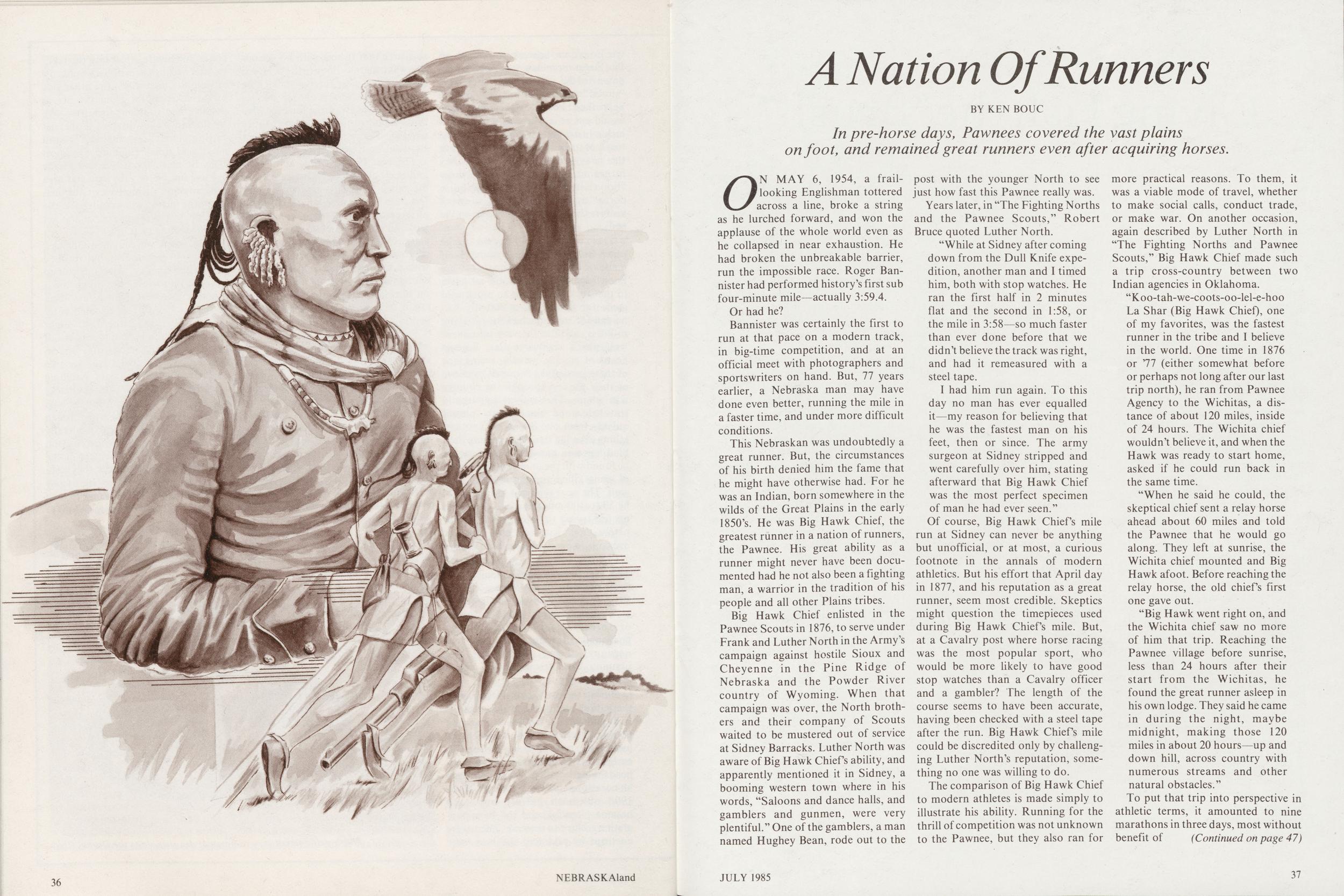
A Nation Of Runners
BY KEN BOUC In pre-horse days, Pawnees covered the vast plains on foot, and remained great runners even after acquiring horses.ON MAY 6, 1954, a fraillooking Englishman tottered across a line, broke a string as he lurched forward, and won the applause of the whole world even as he collapsed in near exhaustion. He had broken the unbreakable barrier, run the impossible race. Roger Bannister had performed history's first sub four-minute mile—actually 3:59.4.
Or had he?
Bannister was certainly the first to run at that pace on a modern track, in big-time competition, and at an official meet with photographers and sportswriters on hand. But, 77 years earlier, a Nebraska man may have done even better, running the mile in a faster time, and under more difficult conditions.
This Nebraskan was undoubtedly a great runner. But, the circumstances of his birth denied him the fame that he might have otherwise had. For he was an Indian, born somewhere in the wilds of the Great Plains in the early 1850's. He was Big Hawk Chief, the greatest runner in a nation of runners, the Pawnee. His great ability as a runner might never have been documented had he not also been a fighting man, a warrior in the tradition of his people and all other Plains tribes.
Big Hawk Chief enlisted in the Pawnee Scouts in 1876, to serve under Frank and Luther North in the Army's campaign against hostile Sioux and Cheyenne in the Pine Ridge of Nebraska and the Powder River country of Wyoming. When that campaign was over, the North brothers and their company of Scouts waited to be mustered out of service at Sidney Barracks. Luther North was aware of Big Hawk Chief's ability, and apparently mentioned it in Sidney, a booming western town where in his words, "Saloons and dance halls, and gamblers and gunmen, were very plentiful." One of the gamblers, a man named Hughey Bean, rode out to the post with the younger North to see just how fast this Pawnee really was.
Years later, in "The Fighting Norths and the Pawnee Scouts," Robert Bruce quoted Luther North.
"While at Sidney after coming down from the Dull Knife expedition, another man and I timed him, both with stop watches. He ran the first half in 2 minutes flat and the second in 1:58, or the mile in 3:58—so much faster than ever done before that we didn't believe the track was right, and had it remeasured with a steel tape.
I had him run again. To this day no man has ever equalled it—my reason for believing that he was the fastest man on his feet, then or since. The army surgeon at Sidney stripped and went carefully over him, stating afterward that Big Hawk Chief was the most perfect specimen of man he had ever seen."
Of course, Big Hawk Chief's mile run at Sidney can never be anything but unofficial, or at most, a curious footnote in the annals of modern athletics. But his effort that April day in 1877, and his reputation as a great runner, seem most credible. Skeptics might question the timepieces used during Big Hawk Chief's mile. But, at a Cavalry post where horse racing was the most popular sport, who would be more likely to have good stop watches than a Cavalry officer and a gambler? The length of the course seems to have been accurate, having been checked with a steel tape after the run. Big Hawk Chief's mile could be discredited only by challenging Luther North's reputation, something no one was willing to do.
The comparison of Big Hawk Chief to modern athletes is made simply to illustrate his ability. Running for the thrill of competition was not unknown to the Pawnee, but they also ran for more practical reasons. To them, it was a viable mode of travel, whether to make social calls, conduct trade, or make war. On another occasion, again described by Luther North in "The Fighting Norths and Pawnee Scouts," Big Hawk Chief made such a trip cross-country between two Indian agencies in Oklahoma.
"Koo-tah-we-coots-oo-lel-e-hoo La Shar (Big Hawk Chief), one of my favorites, was the fastest runner in the tribe and I believe in the world. One time in 1876 or '77 (either somewhat before or perhaps not long after our last trip north), he ran from Pawnee Agency to the Wichitas, a distance of about 120 miles, inside of 24 hours. The Wichita chief wouldn't believe it, and when the Hawk was ready to start home, asked if he could run back in the same time.
"When he said he could, the skeptical chief sent a relay horse ahead about 60 miles and told the Pawnee that he would go along. They left at sunrise, the Wichita chief mounted and Big Hawk afoot. Before reaching the relay horse, the old chief's first one gave out.
"Big Hawk went right on, and the Wichita chief saw no more of him that trip. Reaching the Pawnee village before sunrise, less than 24 hours after their start from the Wichitas, he found the great runner asleep in his own lodge. They said he came in during the night, maybe midnight, making those 120 miles in about 20 hours—up and down hill, across country with numerous streams and other natural obstacles."
To put that trip into perspective in athletic terms, it amounted to nine marathons in three days, most without benefit of (Continued on page 47)
JULY 1985 37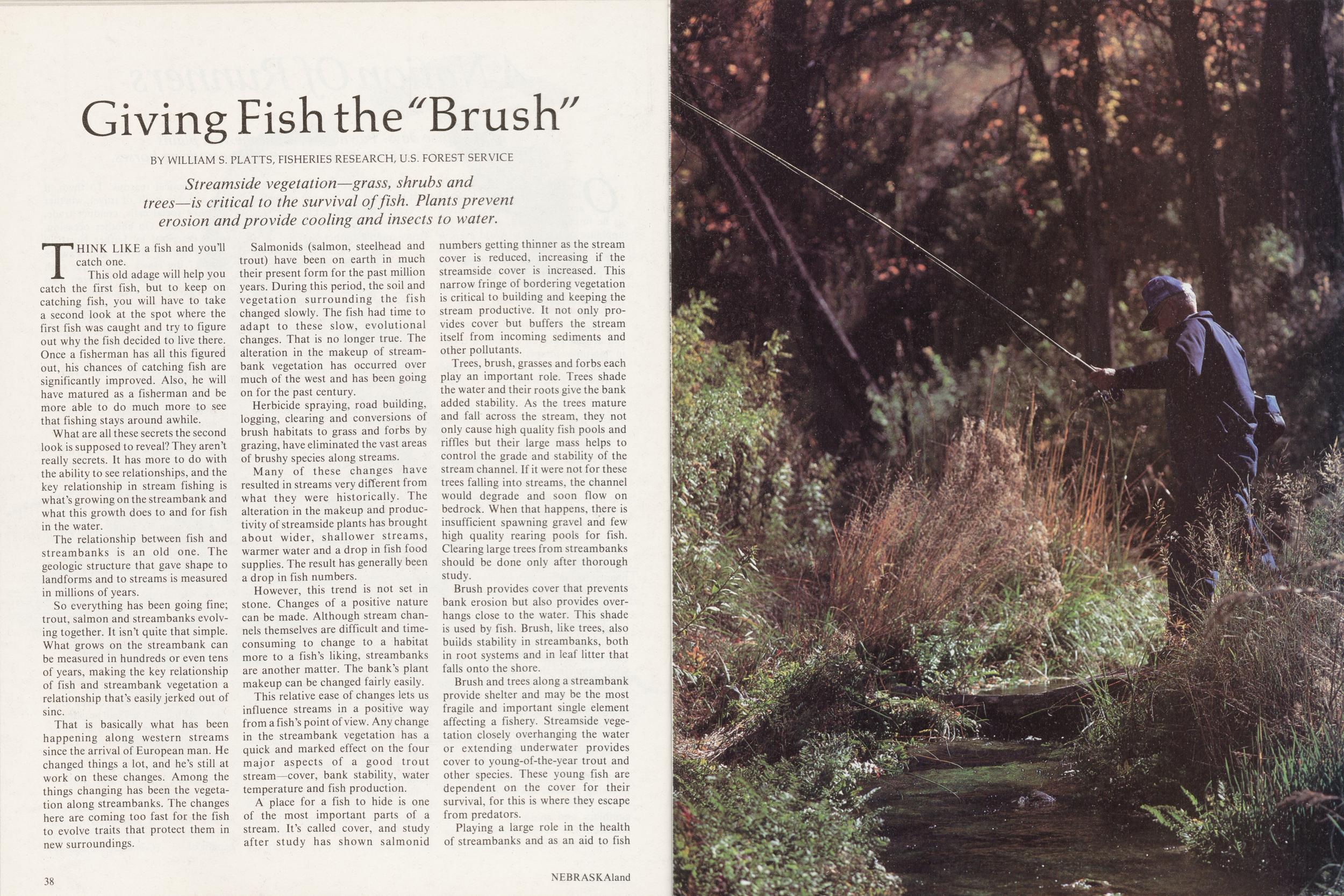
Giving Fish the "Brush
BY WILLIAM S. PLATTS, FISHERIES RESEARCH, U.S. FOREST SERVICE Streamside vegetation—grass, shrubs and trees—is critical to the survival offish. Plants prevent erosion and provide cooling and insects to water.THINK LIKE a fish and you'll catch one.
This old adage will help you catch the first fish, but to keep on catching fish, you will have to take a second look at the spot where the first fish was caught and try to figure out why the fish decided to live there. Once a fisherman has all this figured out, his chances of catching fish are significantly improved. Also, he will have matured as a fisherman and be more able to do much more to see that fishing stays around awhile.
What are all these secrets the second look is supposed to reveal? They aren't really secrets. It has more to do with the ability to see relationships, and the key relationship in stream fishing is what's growing on the streambank and what this growth does to and for fish in the water.
The relationship between fish and streambanks is an old one. The geologic structure that gave shape to landforms and to streams is measured in millions of years.
So everything has been going fine; trout, salmon and streambanks evolving together. It isn't quite that simple. What grows on the streambank can be measured in hundreds or even tens of years, making the key relationship of fish and streambank vegetation a relationship that's easily jerked out of sine.
That is basically what has been happening along western streams since the arrival of European man. He changed things a lot, and he's still at work on these changes. Among the things changing has been the vegetation along streambanks. The changes here are coming too fast for the fish to evolve traits that protect them in new surroundings.
Salmonids (salmon, steelhead and trout) have been on earth in much their present form for the past million years. During this period, the soil and vegetation surrounding the fish changed slowly. The fish had time to adapt to these slow, evolutional changes. That is no longer true. The alteration in the makeup of streambank vegetation has occurred over much of the west and has been going on for the past century.
Herbicide spraying, road building, logging, clearing and conversions of brush habitats to grass and forbs by grazing, have eliminated the vast areas of brushy species along streams.
Many of these changes have resulted in streams very different from what they were historically. The alteration in the makeup and productivity of streamside plants has brought about wider, shallower streams, warmer water and a drop in fish food supplies. The result has generally been a drop in fish numbers.
However, this trend is not set in stone. Changes of a positive nature can be made. Although stream channels themselves are difficult and timeconsuming to change to a habitat more to a fish's liking, streambanks are another matter. The bank's plant makeup can be changed fairly easily.
This relative ease of changes lets us influence streams in a positive way from a fish's point of view. Any change in the streambank vegetation has a quick and marked effect on the four major aspects of a good trout stream—cover, bank stability, water temperature and fish production.
A place for a fish to hide is one of the most important parts of a stream. It's called cover, and study after study has shown salmonid numbers getting thinner as the stream cover is reduced, increasing if the streamside cover is increased. This narrow fringe of bordering vegetation is critical to building and keeping the stream productive. It not only provides cover but buffers the stream itself from incoming sediments and other pollutants.
Trees, brush, grasses and forbs each play an important role. Trees shade the water and their roots give the bank added stability. As the trees mature and fall across the stream, they not only cause high quality fish pools and riffles but their large mass helps to control the grade and stability of the stream channel. If it were not for these trees falling into streams, the channel would degrade and soon flow on bedrock. When that happens, there is insufficient spawning gravel and few high quality rearing pools for fish. Clearing large trees from streambanks should be done only after thorough study.
Brush provides cover that prevents bank erosion but also provides overhangs close to the water. This shade is used by fish. Brush, like trees, also builds stability in streambanks, both in root systems and in leaf litter that falls onto the shore.
Brush and trees along a streambank provide shelter and may be the most fragile and important single element affecting a fishery. Streamside vegetation closely overhanging the water or extending underwater provides cover to young-of-the-year trout and other species. These young fish are dependent on the cover for their survival, for this is where they escape from predators.
Playing a large role in the health of streambanks and as an aid to fish is the variety of the plants found along the shoreline. The greater the variety, the greater the possibility that a fish will find support for its specific way of life.
38 NEBRASKAland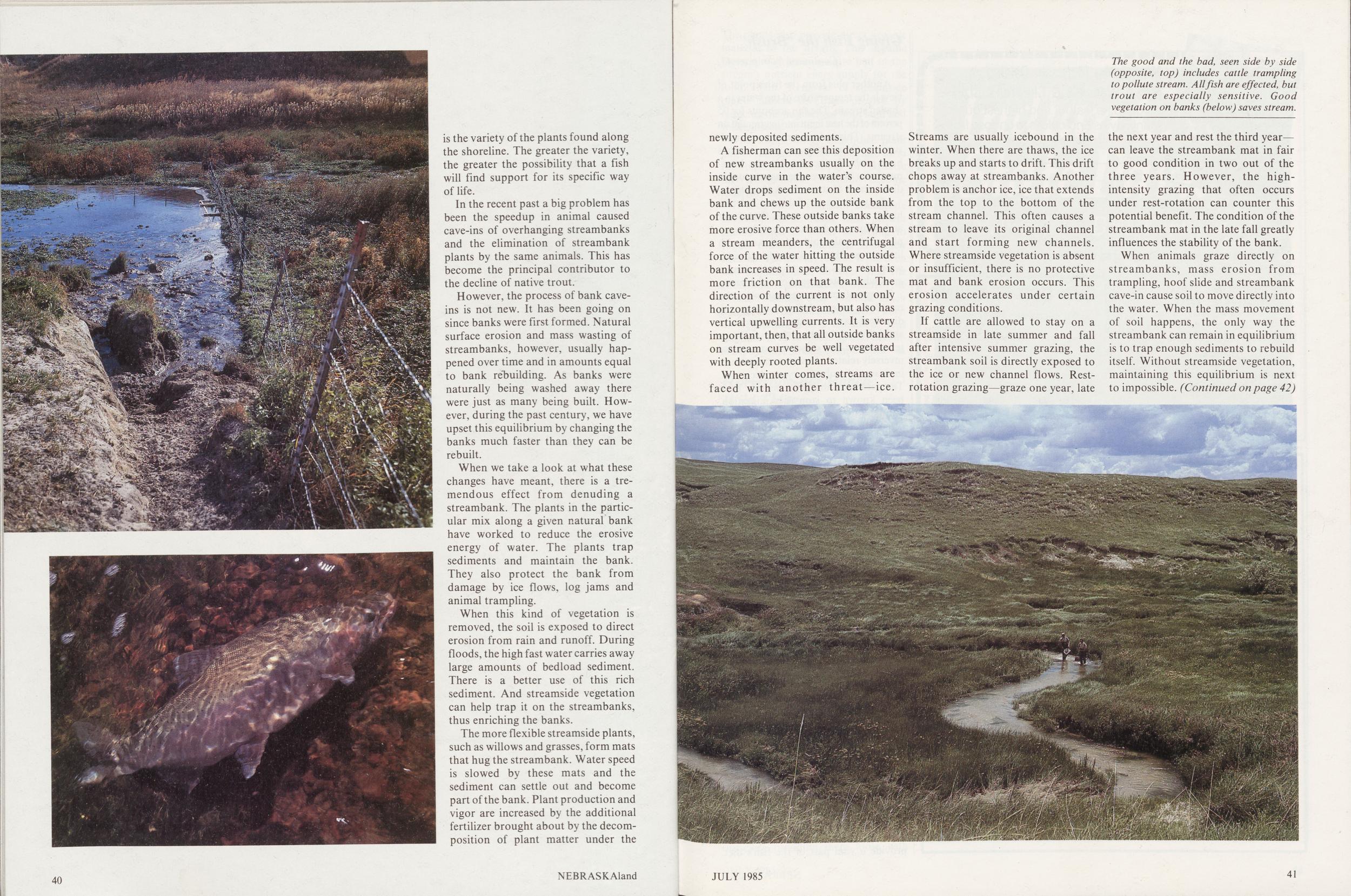
In the recent past a big problem has been the speedup in animal caused cave-ins of overhanging streambanks and the elimination of streambank plants by the same animals. This has become the principal contributor to the decline of native trout.
However, the process of bank caveins is not new. It has been going on since banks were first formed. Natural surface erosion and mass wasting of streambanks, however, usually happened over time and in amounts equal to bank rebuilding. As banks were naturally being washed away there were just as many being built. However, during the past century, we have upset this equilibrium by changing the banks much faster than they can be rebuilt.
When we take a look at what these changes have meant, there is a tremendous effect from denuding a streambank. The plants in the particular mix along a given natural bank have worked to reduce the erosive energy of water. The plants trap sediments and maintain the bank. They also protect the bank from damage by ice flows, log jams and animal trampling.
When this kind of vegetation is removed, the soil is exposed to direct erosion from rain and runoff. During floods, the high fast water carries away large amounts of bedload sediment. There is a better use of this rich sediment. And streamside vegetation can help trap it on the streambanks, thus enriching the banks.
The more flexible streamside plants, such as willows and grasses, form mats that hug the streambank. Water speed is slowed by these mats and the sediment can settle out and become part of the bank. Plant production and vigor are increased by the additional fertilizer brought about by the decomposition of plant matter under the 40 NEBRASKAland newly deposited sediments.
A fisherman can see this deposition of new streambanks usually on the inside curve in the water's course. Water drops sediment on the inside bank and chews up the outside bank of the curve. These outside banks take more erosive force than others. When a stream meanders, the centrifugal force of the water hitting the outside bank increases in speed. The result is more friction on that bank. The direction of the current is not only horizontally downstream, but also has vertical upwelling currents. It is very important, then, that all outside banks on stream curves be well vegetated with deeply rooted plants.
When winter comes, streams are faced with another threat—ice. Streams are usually icebound in the winter. When there are thaws, the ice breaks up and starts to drift. This drift chops away at streambanks. Another problem is anchor ice, ice that extends from the top to the bottom of the stream channel. This often causes a stream to leave its original channel and start forming new channels. Where streamside vegetation is absent or insufficient, there is no protective mat and bank erosion occurs. This erosion accelerates under certain grazing conditions.
If cattle are allowed to stay on a streamside in late summer and fall after intensive summer grazing, the streambank soil is directly exposed to the ice or new channel flows. Restrotation grazing—graze one year, late the next year and rest the third year can leave the streambank mat in fair to good condition in two out of the three years. However, the highintensity grazing that often occurs under rest-rotation can counter this potential benefit. The condition of the streambank mat in the late fall greatly influences the stability of the bank.
The good and the bad, seen side by side (opposite, top) includes cattle trampling to pollute stream. All fish are effected, but trout are especially sensitive. Good vegetation on banks (below) saves stream.When animals graze directly on streambanks, mass erosion from trampling, hoof slide and streambank cave-in cause soil to move directly into the water. When the mass movement of soil happens, the only way the streambank can remain in equilibrium is to trap enough sediments to rebuild itself. Without streamside vegetation, maintaining this equilibrium is next to impossible. (Continued on page 42)
JULY 1985 42 Minnetonka Moccasin Catalog
Men's, Women's & Children's Sizes
All genuine leather and highest quality
Many styles and colors to choose from
MOCCASINS
Name
Address
City
State
Zip.
Mail to: H & M Bootery, 275 N. Main, Valentine, Neb. 69201
For Full Color Catalog and Price List
The Great Buffalo Bill/Coca-Cola
CANOE RACE
18th Running
13 miles — from Hershey to North Platte
SUNDAY, JULY 28 - 10 a.m.
TROPHIES, HATS and
ONE ALUMINUM CANOE AWARDED
Entry Fees: $5.00 per person - $10 per canoe
EIGHT CLASSES: Cruising, Recreational. Mixed Couples,
Father/Son, Women. Teenage. Novice, News Media
Sponsored by
BUFFALO BILL KIWANIS CLUB and COCA-COLA
For Entry Blanks, contact DEL B0MBERGER
216 Boyd Ave , North Platte. NE 69101 - (308) 534-7626
GUN DOG TRAINING
All Sporting Breeds
Each dog trained on both
native game and pen-reared
birds. Ducks for retrievers.
All dogs worked individually.
Field Champion-sired
labrador pups for sale.
Midwest's finest facilities.
WILDERNESS KENNELS
Henry Sader-Roca. Nb.
(402)423-4212 68430
DON'T JUST FISH AROUND
FOR A VACATION SPOT,
LAKEVIEW OFFERS YOU
EVERYTHING.
on Lake McConaughy
Air-conditioned units, cooking facilities.
Up to four adults. Campground on the
beach—50 hookups, showers, playground, shade.
• MARINA
• CAMPGROUND
• GUIDE SERVICE
• LAUNCHING STORE Groceries,
Beer, Pop, Tackle, Live Bait
• BOAT & PONTOON RENTALS
South Shore Big Mac
at Gate 18
Rural Route
Brule, NE 69127
Ogallala, NE
(308) 284-4965
Minnetonka Moccasin Catalog
Men's, Women's & Children's Sizes
All genuine leather and highest quality
Many styles and colors to choose from
MOCCASINS
Name
Address
City
State
Zip.
Mail to: H & M Bootery, 275 N. Main, Valentine, Neb. 69201
For Full Color Catalog and Price List
The Great Buffalo Bill/Coca-Cola
CANOE RACE
18th Running
13 miles — from Hershey to North Platte
SUNDAY, JULY 28 - 10 a.m.
TROPHIES, HATS and
ONE ALUMINUM CANOE AWARDED
Entry Fees: $5.00 per person - $10 per canoe
EIGHT CLASSES: Cruising, Recreational. Mixed Couples,
Father/Son, Women. Teenage. Novice, News Media
Sponsored by
BUFFALO BILL KIWANIS CLUB and COCA-COLA
For Entry Blanks, contact DEL B0MBERGER
216 Boyd Ave , North Platte. NE 69101 - (308) 534-7626
GUN DOG TRAINING
All Sporting Breeds
Each dog trained on both
native game and pen-reared
birds. Ducks for retrievers.
All dogs worked individually.
Field Champion-sired
labrador pups for sale.
Midwest's finest facilities.
WILDERNESS KENNELS
Henry Sader-Roca. Nb.
(402)423-4212 68430
DON'T JUST FISH AROUND
FOR A VACATION SPOT,
LAKEVIEW OFFERS YOU
EVERYTHING.
on Lake McConaughy
Air-conditioned units, cooking facilities.
Up to four adults. Campground on the
beach—50 hookups, showers, playground, shade.
• MARINA
• CAMPGROUND
• GUIDE SERVICE
• LAUNCHING STORE Groceries,
Beer, Pop, Tackle, Live Bait
• BOAT & PONTOON RENTALS
South Shore Big Mac
at Gate 18
Rural Route
Brule, NE 69127
Ogallala, NE
(308) 284-4965
Giving Fish the "Brush"
(Continued from page 41)Another plus from the fish's point of view is the temperature of the water in a shaded stream. The sun accounts for 95 percent of the heat input into intermountain streams. This is during midday in midsummer. Summer stream temperatures have probably increased in the Intermountain West over the past century, a direct result of streambank clearing.
Many nongame fish can tolerate higher water temperatures than trout and salmon, and to an extent, have replaced the salmonids in streams with little or no cover. Salmonids are coldwater fish and most stocks no longer grow when water goes above 68 degrees.
Temperature changes can alter the metabolic rates of fish, change the dissolved oxygen content in the water and influence hatching success. Water temperature and dissolved oxygen are inversely related. As water temperature increases, dissolved oxygen decreases. Temperatures above 68 degrees have been known to stop fish migration. Temperatures above 77 degrees are often lethal to salmon and trout.
Unusual high stream temperatures can lead to disease outbreaks and the fish simply stop eating when water gets too warm. These problems of temperature are in addition to those already mentioned. Fish have evolved to survive under the natural temperature ranges in their home streams and when man modifies these ranges, the results are devastating.
Streamside vegetation not only intercepts and reduces the intensity of the sun's rays, but it also provides shade, especially along the edges of the stream. This type of shade can be critical to good fish survival from year to year, because shaded stream areas are those preferred by young fish.
Streams can also be too cold for trout survival. If winter temperatures fall too low, anchor ice can form on the bottom of the stream. This happens because there is no streamside cover to slow the stream's heat loss after the sun goes down. Heavy anchor ice can wipe out a fish population in a stream. It also can threaten the oxygen level so important to the fish eggs in the stream gravel.
There is one other connection between fish and streamside plants. Insects can grow amoung the plants and provide a vital part of the fish's diet. 42 NEBRASKAland The plants also provide direct organic material to the stream. This organic material will provide up to half of the stream's nutrient enery supply for the food chain. Removal of streamside plants affects the diets of fish by reducing the numbers of both land and water insects.
The leaves, twigs and other plant matter that fall into the water also form the basic food supply of aquatic invertebrates that eventually become food for fish.
It took many years for streamside environments to reach their present altered state. It would be wrong to expect these environments and their streams to be quickly rebuilt. It has been well demonstrated, however, that the streamside vegetation component of the stream's habitat does respond much quicker than the other components when the vegetation mix is replanted. This response, in turn, speeds up the rehabiliation of other stream components,
Horseshoe-Bar Ranch Wild Things
(Continued from page 35)up in a fish book. But when the carp came to the Dismal, the word to describe it was "invasion." They didn't drive out any other fish so far as I know but they certainly took over and became dominant fish. They loved the shallow marshes and rooted along the shorelines like hogs with their bodies half out of the water.
Though rattlesnakes were uncommon out in the hills, we did find them along the river. About one-half mile downriver from the house, near the corrals, was a cutbank about twenty feet high bordering a small marsh along the river. About halfway down this bank was a narrow shelf of clay and a shallow cave. Rattlesnakes by the dozens congregated here for the winter. We would see them clinging to the face of the bank and coiled in a solid mass in the hole. We paid little attention to them and never tried to get rid of them, as probably could have been done with dynamite. In fact, we used to show them off to guests.
One time while my father and the men were cutting cattle in the corrals, Frances and I got bored and wandered over to the snake den. There were snakes on top of the bank and we amused ourselves prodding them loose with sticks and watching them drop to the den. We also leaned over and pried some from the wall though the sticks weren't long enough to reach the den itself. After a half-hour or so we went back to the corrals. I have often wondered since why my father allowed us to fool with these poisonous snakes. He must have seen us at the den because it wasn't over 150 yards from the corrals but he did not come after us, nor make any comment when we returned.
JULY 1985 42 OFFERS A COMPLETE
TRAINING PROGRAM
For Retrievers, Pointers, Spaniels
Basic Obedience Program
For All Breeds
Field Trial Bloodline Lab Pups
For Sale
JOHN HONORE
Manager and Trainer
West Highway 30
RR 1 Box 433
Grand Island, NE 68801
Phone: (308)384-1517
-STATUE of UBERTYCANOE RACE
23 miles—from Wilson Island
to Freedom Park in Omaha
Thursday, July 4 starting at 9 a.m.
Trophies, T-shirts, refreshments
Entry fee—$20 per canoe
Contact Tony Pignotti,
1421 N. Saddle Creek Rd.
Omaha, NE 68132 (402) 553-5544
Take
a Kid
Fishing
STOCK YOUR LAKE
OR POND WITH
Channel cat, Bluegill,
Largemouth Bass,
Hybrid Bluegill, IX
Crappie, Triploid Grass
Carp, Minnows
ORDER NOW
WILLOW LAKE FISH HATCHERY
Rt. 3, Box 46, Hastings, Nebr. 68901
Gaylord L Crawford
Phone: (402) 463-8022
Day or Night
For April to October 15 stocking
BERGMAN'S RESORT
On Johnson Lake
Modern Lakefront Cabins
Groceries • Bait • Tackle
Full RV Hookups
Boats for Rent
Swim — Fish — Golf
Write or Call:
RR 2, Elwood, NE 68937
(308) 785-2298
OFFERS A COMPLETE
TRAINING PROGRAM
For Retrievers, Pointers, Spaniels
Basic Obedience Program
For All Breeds
Field Trial Bloodline Lab Pups
For Sale
JOHN HONORE
Manager and Trainer
West Highway 30
RR 1 Box 433
Grand Island, NE 68801
Phone: (308)384-1517
-STATUE of UBERTYCANOE RACE
23 miles—from Wilson Island
to Freedom Park in Omaha
Thursday, July 4 starting at 9 a.m.
Trophies, T-shirts, refreshments
Entry fee—$20 per canoe
Contact Tony Pignotti,
1421 N. Saddle Creek Rd.
Omaha, NE 68132 (402) 553-5544
Take
a Kid
Fishing
STOCK YOUR LAKE
OR POND WITH
Channel cat, Bluegill,
Largemouth Bass,
Hybrid Bluegill, IX
Crappie, Triploid Grass
Carp, Minnows
ORDER NOW
WILLOW LAKE FISH HATCHERY
Rt. 3, Box 46, Hastings, Nebr. 68901
Gaylord L Crawford
Phone: (402) 463-8022
Day or Night
For April to October 15 stocking
BERGMAN'S RESORT
On Johnson Lake
Modern Lakefront Cabins
Groceries • Bait • Tackle
Full RV Hookups
Boats for Rent
Swim — Fish — Golf
Write or Call:
RR 2, Elwood, NE 68937
(308) 785-2298
Rattlesnakes are not as dangerous as most people think. The prairie rattler, which we had in abundance on the ranch, is not large. Some, however, were three feet or more long and up to two inches in diameter at their middle. A small snake would have five or six segments to his rattle and the biggest ten to fifteen. The men killed most of the snakes they ran across and cut off the rattles which eventually filled several shotgun shell boxes on a shelf in the dining room.
The rattlesnakes could be depended upon to announce their presence by coiling with their head drawn back in striking position and rattles extended making a high-frequency singing sound. Since no snake could strike farther than half his length, not even two feet, there was little danger unless you accidently stepped on one. The snake would never attack but simply waited with his head drawn back for your next move. If you stood still long enough, a few feet away, he would gradually uncoil and attempt to slip away.
I remember several snake bites being reported in the country and two happened to our own men. But I never heard of any deaths. Once, one of the men went into the woodshed in the early morning before daylight and was struck on the forearm when he bent over to pick up some wood. His bite was lanced with a razor, blood and venom sucked out and he was taken to town to the doctor immediately. He said he felt shaky and sick but the bite didn't slow him up too much.
Another man was "bitten" by a dead snake. After killing it he put it in a gunny sack and tied it to his saddle to bring home. When he climbed down from the horse, the fangs of the dead snake were sticking through the sack and he snagged his hand on them. As I remember, his hand swelled up some, but he suffered no real ill effects. The whiskey he drank as medicine probably prevented too much complaint.
Even though there were plenty of rattlesnakes throughout the ranch, it is surprising that running across one was rare. I could hunt up and down the river all summer and never see more than two or three, and the men didn't bring rattles in as often as you would expect. However, their possible presence was always taken for granted, and it became second nature to never get down from a horse without searching the ground with your eyes before dismounting. And, of course nobody ever walked anywhere without constantly searching the ground ahead and never moved if thev heard a rattle until they could locate the owner.
As children, we had few regular duties and so for the most part we amused ourselves. We got along very well without playmates and I don't recall having time heavy on our hands. Perhaps we grew more resourceful and imaginative because of our isolation. We had a large field of play and playmates of a sort that most children never have—horses, burros, chickens and the wild animals that lived at our doorsteps.
This is the tenth and final in a series of excerpts from an unpublished book manuscript about ranching on the Dismal River in Thomas County at the turn of the century. Authur Roe R. Black lived on the ranch from 1900 to 1912 and now resides in Aurora, Nebraska. An upcoming issue will contain the concluding chapter as the author returns to the ranch of his childhood for the first time in 60 years. The Black Ranch manuscript will be published in book form by Media Productions of Lincoln within the next year. Announcement will be made in NEBRASKAland.
Villains, Miscreants and the Salt of the Earth
(Continued from page 19)Patents were sent to the land office, but were withheld by the commissioner of the general land office. Nevertheless, the following November, Prey made warranty deeds "of an undivided third interest in these lands" to Morton, Andrew Hopkins, and Charles A. Manners, who, interestingly enough, was, according to A. T. Andreas' 1882 History of Nebraska, "one of the surveyors who made the discovery of the basins in 1856."
The state, however, continued to treat them as reserved lands, and in 1869, the year of his optimistic address, Butler granted a lease to Anson C. Tichenor, who granted half his interest to the Nebraska Salt Company of Chicago. This company did not develop the basin, although Tichenor had invested a considerable amount of money. In February, the legislature voided the lease, and the governor reassigned it to Tichenor and Jesse T. Green, who began to produce salt, according to Morton, "by boiling in iron vats the brine which was pumped from a windmill from a shaft five feet deep." The Omaha Republican of August 26, 1867, reported that by that date Tichenor and Green's works were completed, and that they anticipated producing 50 barrels of salt per day from the brine produced by 20 wells. He expected each barrel of water to produce two bushels of salt, and promised 180 barrels of salt a day to any railroad which would "build to Lincoln and carry the product to the Missouri River." According to the terms of their lease, they were to pay the state a royalty of two cents per bushel of manufactured salt.
But during the winter of 1870, Morton decided to test the legality of Butler's leases. Butler's administration was, to put things in the kindest light, loose. There were significant legal questions about the state's right to the lands. By this time Tichenor had disposed of his interest in the works to Horace Smith (of Smith and Wesson Arms fame), who placed the salt works under the management of James P. Hebbard of Nebraska City.
Morton realized that the question of title could only be determined in court, and that his claim would fare better if he were defendant, in possession of the lands, than if he were to bring an action as plaintiff. So, in December 1870, he packed a wagonload of supplies and set out for Lincoln.
WELCOME to Merritt Dam Trading Post Located on beautiful Merritt Reservoir 26 Miles So. Of Valentine On Hwy. 16C Phone 402/376-3437 Bait*Tackle* Ammunition* Groceries* Gas* Beer* Ice Year-round Modern Cabins with Kitchen Facilities Campground Hook-ups* Boat and Motor Rental • Professional Guide Service Easy-access dock* Open year around Home of the State Record Perch, Muskellunge and Smallmouth bass — Your Hosts — JON AND MARIAN DAVENPORT DISCOVER AMERICA CEDAR LANE - Ranch Vacations - Working ranch in the heart of the Sandhills of Nebraska. Swimming, spa, horses, canoeing, trailrides, barbeques. BOOKING NOW Richard and Betty Schroeder HC 2 Box 9C Stapleton, Nebraska 69163 Ph. 308-587-2233 THE ADMIRAL'S COVE EXIT 6 ON THE NORTH SIDE VISIT THE AhtMKAVS QdLLEY RESTAURANT YOUR FAVORITE COCKTAILS • FANCY LARGE SALAD BAR TROPHY STRIPERS ON DISPLAY • CLOSE TO WATER Located on the north shore of Lake McConaughy, 7 miles west of dam • SERVICES Tackle, Bait, Gas, Oil, Ice, Beer, Pop, etc. • MOTEL Lake McConaughy's largest motel and apartment complex includes new units • BOAT AND MOTOR RENTAL • GUIDE SERVICE Ph: 308-355-2102 Lemoyne, Ne 69146 JULY 1985 45 For Sale
SNAKE RIVER
HOMESITES
Any Size, 1/2 acre to 5 acres, some with
complete package with or without home.
Financing available.
FOR MORE DETAILS CALL
(402) 376-1682
Make this your private retreat
for fishing, hiking, camping,
canoeing or year-round living.
Harold Stokey
Flying Diamond Lond Company
H.C. 02 Dox 21, Valentine, NE 69201
SUPPORT NEBRASKA'S
OPERATION
GAME THIEF
TOLL-FREE HOTUNE 800-742-7627
THIS
MAGAZINE
IS BROUGHT
TO YOU
BY THE FOREST.
And so are thousands of other
things we use every day.
Look around you. Oak desks.
Walnut panelling. Redwood benches.
Cedar chests. Spruce cabinets.
Mahogany tables.
Violins.Paper. Turpentine. Paint.
Printing ink. Books. Maple syrup.
Charcoal. Pianos. Boats. Bowling
pins. Baseball bats. Cutting boards.
Pencils.
They all come from trees. In fact,
so many things we use every day are
made from trees, it is estimated that
every man, woman and child in the
United States consumes the equivalent of a 100 foot tree every year.
That's more than 200 million trees
per year. And the demand is growing
every day.
So the next time you're in the
forest, think about the 1 billion trees
we destroyed in careless forest fires
last year. Then take an extra minute
to be careful.
You may help save a tree. And
at the rate we're going, we're going to
need it someday.
Gxncil
A Public Service of This Magazine & The Advertising Council
For Sale
SNAKE RIVER
HOMESITES
Any Size, 1/2 acre to 5 acres, some with
complete package with or without home.
Financing available.
FOR MORE DETAILS CALL
(402) 376-1682
Make this your private retreat
for fishing, hiking, camping,
canoeing or year-round living.
Harold Stokey
Flying Diamond Lond Company
H.C. 02 Dox 21, Valentine, NE 69201
SUPPORT NEBRASKA'S
OPERATION
GAME THIEF
TOLL-FREE HOTUNE 800-742-7627
THIS
MAGAZINE
IS BROUGHT
TO YOU
BY THE FOREST.
And so are thousands of other
things we use every day.
Look around you. Oak desks.
Walnut panelling. Redwood benches.
Cedar chests. Spruce cabinets.
Mahogany tables.
Violins.Paper. Turpentine. Paint.
Printing ink. Books. Maple syrup.
Charcoal. Pianos. Boats. Bowling
pins. Baseball bats. Cutting boards.
Pencils.
They all come from trees. In fact,
so many things we use every day are
made from trees, it is estimated that
every man, woman and child in the
United States consumes the equivalent of a 100 foot tree every year.
That's more than 200 million trees
per year. And the demand is growing
every day.
So the next time you're in the
forest, think about the 1 billion trees
we destroyed in careless forest fires
last year. Then take an extra minute
to be careful.
You may help save a tree. And
at the rate we're going, we're going to
need it someday.
Gxncil
A Public Service of This Magazine & The Advertising Council
Arriving in Lincoln on the 24th, Morton and his assistants, including Edward Roggen, later to become Nebraska's Secretary of State, drove to the big basin. Among the structures there was a small building intended as a headquarters and barracks for workers. The weather was cloudy and threatening, it was Christmas eve, and no manufacturing was going on. The building was unlocked and unguarded, and Morton and Roggen, according to Ames, "went into occupancy."
Hebbard and Green learned of Morton's invasion, and they went to Col. James E. Philpott, "one of the leading legal practitioners in the city." Philpott advised his clients simply to keep watch. Green and Hebbard had a large quantity of cordwood stacked nearby, and he said if Morton and Roggen used any of it they would be committing larceny and be liable to arrest and prosecution on that charge, conveniently skirting the complex issue of trespass on land whose ownership was in dispute.
Observers were sent, and they watched Morton and Roggen come out of the building and help themselves from the woodpile. A complaint was prepared and sworn before Ames as justice of the peace, and at about 10:30 p.m., the "constable appeared at my office with both the defendants in charge as prisoners," along with their lawyer. A hearing was set for the following Monday (December 26th), and Morton and Roggen were released.
In the meantime, Morton conferred with the State Attorney General, Seth Robinson, and agreed to desist from his attempt to take forcible possession of the property in return for charges being dropped. On Monday, the case was dismissed.
Two weeks later, Morton began an action against Hebbard and Green to recover $20,000 damages for malicious prosecution and false imprisonment, and in June of 1871 received a judgement of $100 for damages and costs. Ames declares that Morton was not actually seeking the large damage judgement, but vindication from the accusation of larceny. At the same time, Morton, Hopkins, and Manners began 46 NEBRASKAland an action in ejectment against the state to determine legal title to the land.
Morton lost in Lancaster County district court, appealed to the state Supreme Court and lost again, and finally carried the case to the U.S. Supreme Court. In 1875, that court also ruled in favor of the state of Nebraska. In spite of these setbacks, salt, for Morton, apparently had not lost its savor; and the familiar cylindrical blue boxes advertising a product which, unlike that scraped up from the ground near Lincoln, continued to pour even when it rained, still carry the Morton name.
Morton went on to other enterprises, though not, apparently, without some harbored resentment against the lesees. His history continues the salt story, recording the subsequent failures of salt manufacturing in the area and describing his opponents thus: "Tichenor was a hare-brained adventurer of that class who commonly float on the foremost tide of emigration and are soon stranded on its borders, and Green was an enthusiast who walked into and through the illusory experiment by faith and not by sight."
Eventually, hopes of a Nebraska salt industry were extinguished, but the story of the basins, and their evolution into a pleasure garden, an amusement park still remembered by virtually any Lincoln native older than 40, and finally a lake-side residential development that is currently part of a local financial scandal, will continue in our October issue.
A Nation of Runners
(Continued from page 37)track, roads or even trails.
Big Hawk Chief was the best runner among the Pawnees, but he was by no means the only runner. Just about any healthy Pawnee man was likely to take off afoot if no horse was available. Some, in fact, preferred to make long journeys afoot, demonstrating that their endurance for such distance was actually better than that of a horse.
In July of 1870, North and seven Pawnees were sent to Fort Harker, Kansas, to return, via the Indian agent, a herd of Cheyenne ponies that the Pawnee horse thief, Big Spotted Horse, had liberated the preceding fall (see "World's Greatest Horse Thief," Sept. 1979 NEBRASKAland). North's Paw- nee helpers rode Cheyenne horses to Fort Harker, but returned on foot, while North rode his own horse both ways.
In "The fighting Norths and Pawnee Scouts," North later wrote:
"They were mounted on the going trip, and seven days on the way; but we returned the 250 miles in five days, with them all afoot We would start around 5 o'clock in the morning, and by 9 be 25 miles on the way; then lay over during the heat of the day, taking another 25-mile j og in the evening. No matter how hilly it was, they would make those 25-mile jaunts in four hours ... I rode a mighty good horse, but he had about enough the last day."
On another occasion, in 1864, North was leaving Columbus carrying military dispatches to North Bend. In "Man of the Plains" (University of Nebraska Press, Lincoln) North recalled:
"I overtook a Pawnee boy who was on foot. He asked me where I was going and I told him. We were just at the edge of town and it was just noon. I was riding at a good jog trot and the boy trotted along with me. I asked where he had come from and he said from the village of Genoa, which was twenty-two miles from Columbus. He ran along with me all the way to North Bend, which was thirty-five miles from Columbus, and we got there at five o'clock, having made seven miles an hour for the whole distance.
"When I stopped at the stage station he asked, 'Are you going to stay here all night?' and when I said, 'Yes,' he said, 'My father is camped on the river at Fremont. I am going there tonight,' and as far as I could see him he was still running. Fremont was still sixteen miles farther on. That would be seventy-three miles from the Pawnee village and he had eaten nothing, and although the day was very hot he had taken only one drink of water. At the crossing of Shell Creek, where I stopped to water my pony, he dipped up a couple of handfuls of water and put them on his head, and then drank a very little, certainly not a glass full. This shows the endurance of the Pawnees. This boy was not one of their noted runners, but just an average runner."
In January of 1856, a Pawnee serving as a guide with a military column campaigning in southwest Nebraska turned in another considerable performance running alongside a mounted courier to deliver an important message to Fort Kearny. An officer of the expedition, Captain Eugene Ware, had little good to say about Indians, but he gave grudging approval to the scout in his book, "The Indian War of 1864."
Ware wrote:"There was a little
red-mustached Irish sergeant, but
from what command I do not
know, who volunteered to make
the trip if he could have a proper
guide, and he would strike right
out across country to Fort
Kearny. I think he belonged to one
of the Nebraska Militia companies. There were a couple of
Pawnees with us as guides, and
one of these Pawnees offered to go
across with the sergeant, and act as
scout, and deliver him safely to
Fort Kearny, provided that
General Mitchell would give him a
horse. The General promised to
do this; the Indian had no horse;
said he preferred to go on foot
anyhow, and that he could keep
up with the sergeant's horse all the
way to Fort Kearny. This was sort
of a funny proposition, and I
remember looking at the long,
gaunt, slim Pawnee, a young buck
about twenty-three, and wondering whether he could keep up all
day with the Cavalry horse or not.
Leo Palladie said that the Indian
JULY 1985
47
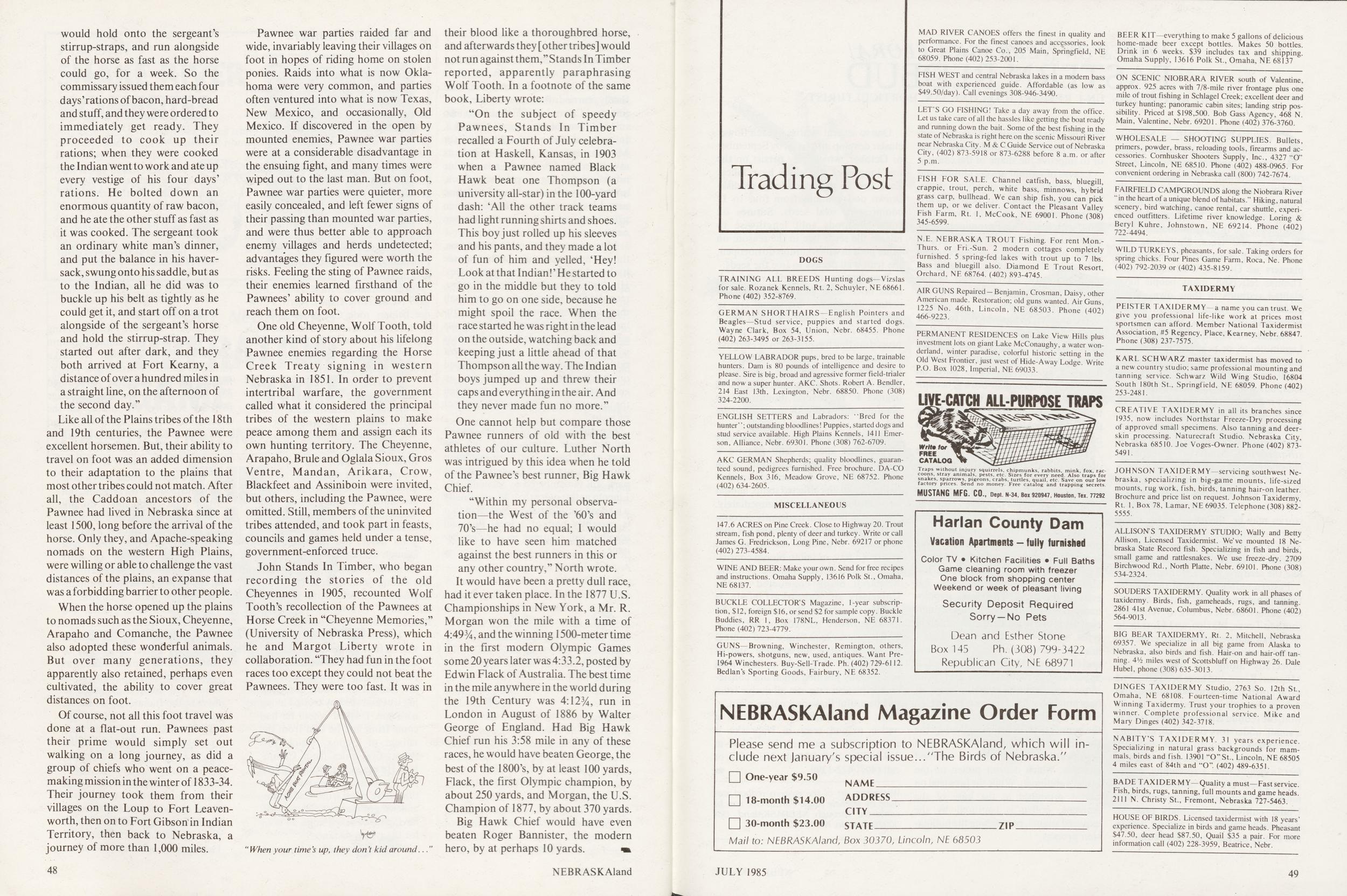 would hold onto the sergeant's
stirrup-straps, and run alongside
of the horse as fast as the horse
could go, for a week. So the
commissary issued them each four
days'rations of bacon, hard-bread
and stuff, and they were ordered to
immediately get ready. They
proceeded to cook up their
rations; when they were cooked
the Indian went to work and ate up
every vestige of his four days'
rations. He bolted down an
enormous quantity of raw bacon,
and he ate the other stuff as fast as
it was cooked. The sergeant took
an ordinary white man's dinner,
and put the balance in his haversack, swung onto his saddle, but as
to the Indian, all he did was to
buckle up his belt as tightly as he
could get it, and start off on a trot
alongside of the sergeant's horse
and hold the stirrup-strap. They
started out after dark, and they
both arrived at Fort Kearny, a
distance of over a hundred miles in
a straight line, on the afternoon of
the second day."
would hold onto the sergeant's
stirrup-straps, and run alongside
of the horse as fast as the horse
could go, for a week. So the
commissary issued them each four
days'rations of bacon, hard-bread
and stuff, and they were ordered to
immediately get ready. They
proceeded to cook up their
rations; when they were cooked
the Indian went to work and ate up
every vestige of his four days'
rations. He bolted down an
enormous quantity of raw bacon,
and he ate the other stuff as fast as
it was cooked. The sergeant took
an ordinary white man's dinner,
and put the balance in his haversack, swung onto his saddle, but as
to the Indian, all he did was to
buckle up his belt as tightly as he
could get it, and start off on a trot
alongside of the sergeant's horse
and hold the stirrup-strap. They
started out after dark, and they
both arrived at Fort Kearny, a
distance of over a hundred miles in
a straight line, on the afternoon of
the second day."
Like all of the Plains tribes of the 18th and 19th centuries, the Pawnee were excellent horsemen. But, their ability to travel on foot was an added dimension to their adaptation to the plains that most other tribes could not match. After all, the Caddoan ancestors of the Pawnee had lived in Nebraska since at least 1500, long before the arrival of the horse. Only they, and Apache-speaking nomads on the western High Plains, were willing or able to challenge the vast distances of the plains, an expanse that was a forbidding barrier to other people.
When the horse opened up the plains to nomads such as the Sioux, Cheyenne, Arapaho and Comanche, the Pawnee also adopted these wonderful animals. But over many generations, they apparently also retained, perhaps even cultivated, the ability to cover great distances on foot.
Of course, not all this foot travel was done at a flat-out run. Pawnees past their prime would simply set out walking on a long journey, as did a group of chiefs who went on a peacemaking mission in the winter of 1833-34. Their journey took them from their villages on the Loup to Fort Leavenworth, then on to Fort Gibson in Indian Territory, then back to Nebraska, a journey of more than 1,000 miles.
One old Cheyenne, Wolf Tooth, told another kind of story about his lifelong Pawnee enemies regarding the Horse Creek Treaty signing in western Nebraska in 1851. In order to prevent intertribal warfare, the government called what it considered the principal tribes of the western plains to make peace among them and assign each its own hunting territory. The Cheyenne, Arapaho, Brule and Oglala Sioux, Gros Ventre, Mandan, Arikara, Crow, Blackfeet and Assiniboin were invited, but others, including the Pawnee, were omitted. Still, members of the uninvited tribes attended, and took part in feasts, councils and games held under a tense, government-enforced truce.
John Stands In Timber, who began recording the stories of the old Cheyennes in 1905, recounted Wolf Tooth's recollection of the Pawnees at Horse Creek in "Cheyenne Memories," (University of Nebraska Press), which he and Margot Liberty wrote in collaboration. "They had fun in the foot races too except they could not beat the Pawnees. They were too fast. It was in their blood like a thoroughbred horse, and afterwards they [other tribes] would not run against them," Stands In Timber reported, apparently paraphrasing Wolf Tooth. In a footnote of the same book, Liberty wrote:
"On the subject of speedy Pawnees, Stands In Timber recalled a Fourth of July celebration at Haskell, Kansas, in 1903 when a Pawnee named Black Hawk beat one Thompson (a university all-star) in the 100-yard dash: 'All the other track teams had light running shirts and shoes. This boy just rolled up his sleeves and his pants, and they made a lot of fun of him and yelled, 'Hey! Look at that Indian!' He started to go in the middle but they to told him to go on one side, because he might spoil the race. When the race started he was right in the lead on the outside, watching back and keeping just a little ahead of that Thompson all the way. The Indian boys jumped up and threw their caps and everything in the air. And they never made fun no more."
One cannot help but compare those Pawnee runners of old with the best athletes of our culture. Luther North was intrigued by this idea when he told of the Pawnee's best runner, Big Hawk Chief.
"Within my personal observation—the West of the '60's and 70's—he had no equal; I would like to have seen him matched against the best runners in this or any other country," North wrote.
It would have been a pretty dull race, had it ever taken place. In the 1877 U.S. Championships in New York, a Mr. R. Morgan won the mile with a time of 4:49%, and the winning 1500-meter time in the first modern Olympic Games some 20 years later was 4:33.2, posted by Edwin Flack of Australia. The best time in the mile anywhere in the world during the 19th Century was 4:12%, run in London in August of 1886 by Walter George of England. Had Big Hawk Chief run his 3:58 mile in any of these races, he would have beaten George, the best of the 1800's, by at least 100 yards, Flack, the first Olympic champion, by about 250 yards, and Morgan, the U.S. Champion of 1877, by about 370 yards.
Big Hawk Chief would have even beaten Roger Bannister, the modern hero, by at perhaps 10 yards.
48 NEBRASKAlandTrading Post
DOGSTRAINING ALL BREEDS Hunting dogs— Vizslas for sale. Rozanek Kennels, Rt. 2, Schuyler, NE 68661. Phone (402) 352-8769.
GERMAN SHORTHAIRS—English Pointers and Beagles—Stud service, puppies and started dogs. Wayne Clark, Box 54, Union, Nebr. 68455. Phone (402) 263-3495 or 263-3155.
YELLOW LABRADOR pups, bred to be large, trainable hunters. Dam is 80 pounds of intelligence and desire to please. Sire is big, broad and agressive former field-trialer and now a super hunter. AKC. Shots. Robert A. Bendler, 214 East 13th, Lexington, Nebr. 68850. Phone (308) 324-2200.
ENGLISH SETTERS and Labradors: 'Bred for the hunter"; outstanding bloodlines! Puppies, started dogs and stud service available. High Plains Kennels, 1411 Emerson, Alliance, Nebr. 69301. Phone (308) 762-6709.
AKC GERMAN Shepherds; quality bloodlines, guaranteed sound, pedigrees furnished. Free brochure. DA-CO Kennels, Box 316, Meadow Grove, NE 68752. Phone (402)634-2605.
MISCELLANEOUS147.6 ACRES on Pine Creek. Close to Highway 20. Trout stream, fish pond, plenty of deer and turkey. Write or call James G. Fredrickson, Long Pine, Nebr. 69217 or phone (402) 273-4584.
WINE AND BEER: Make your own. Send for free recipes and instructions. Omaha Supply, 13616 Polk St., Omaha, NE 68137.
BUCKLE COLLECTORS Magazine, 1-year subscription, $12, foreign $16, or send $2 for sample copy. Buckle Buddies, RR 1, Box 178NL, Henderson, NE 68371. Phone (402) 723-4779.
GUNS—Browning, Winchester, Remington, others, Hi-powers, shotguns, new, used, antiques. Want Pre1964 Winchesters. Buy-Sell-Trade. Ph. (402) 729-6112. Bedlan's Sporting Goods, Fairbury, NE 68352.
MAD RIVER CANOES offers the finest in quality and performance. For the finest canoes and accessories, look to Great Plains Canoe Co., 205 Main, Springfield, NE 68059. Phone (402) 253-2001.
FISH WEST and central Nebraska lakes in a modern bass boat with experienced guide. Affordable (as low as $49.50/day). Call evenings 308-946-3490.
LET'S GO FISHING! Take a day away from the office. Let us take care of all the hassles like getting the boat ready and running down the bait. Some of the best fishing in the state of Nebraska is right here on the scenic Missouri River near Nebraska City. M & C Guide Service out of Nebraska City, (402) 873-5918 or 873-6288 before 8 a.m. or after 5 p.m.
FISH FOR SALE. Channel catfish, bass, bluegill, crappie, trout, perch, white bass, minnows, hybrid grass carp, bullhead. We can ship fish, you can pick them up, or we deliver. Contact the Pleasant Valley Fish Farm, Rt. 1, McCook, NE 69001. Phone (308) 345-6599.
N.E. NEBRASKA TROUT Fishing. For rent Mon.Thurs. or Fri.-Sun. 2 modern cottages completely furnished. 5 spring-fed lakes with trout up to 7 lbs. Bass and bluegill also. Diamond E Trout Resort, Orchard, NE 68764. (402) 893-4745.
AIR GUNS Repaired —Benjamin, Crosman, Daisy, other American made. Restoration; old guns wanted. Air Guns, 1225 No. 46th, Lincoln, NE 68503. Phone (402) 466-9223.
PERMANENT RESIDENCES on Lake View Hills plus investment lots on giant Lake McConaughy, a water wonderland, winter paradise, colorful historic setting in the Old West Frontier, just west of Hide-A way Lodge. Write P.O. Box 1028, Imperial, NE 69033.
BEER KIT—everything to make 5 gallons of delicious home-made beer except bottles. Makes 50 bottles. Drink in 6 weeks. $39 includes tax and shipping. Omaha Supply, 13616 Polk St., Omaha, NE 68137
ON SCENIC NIOBRARA RIVER south of Valentine, approx. 925 acres with 7/8-mile river frontage plus one mile of trout fishing in Schlagel Creek; excellent deer and turkey hunting; panoramic cabin sites; landing strip possibility. Priced at $198,500. Bob Gass Agency, 468 N. Main, Valentine, Nebr. 69201. Phone (402) 376-3760.
WHOLESALE SHOOTING SUPPLIES. Bullets, primers, powder, brass, reloading tools, firearms and accessories. Cornhusker Shooters Supply, Inc., 4327 "O" Street, Lincoln, NE 68510. Phone (402) 488-0965. For convenient ordering in Nebraska call (800) 742-7674.
FAIRFIELD CAMPGROUNDS along the Niobrara River "in the heart of a unique blend of habitats." Hiking, natural scenery, bird watching, canoe rental, car shuttle, experienced outfitters. Lifetime river knowledge. Loring & Beryl Kuhre, Johnstown, NE 69214. Phone (402) 722-4494.
WILD TURKEYS, pheasants, for sale. Taking orders for spring chicks. Four Pines Game Farm. Roca, Ne. Phone (402) 792-2039 or (402) 435-8159.
TAXIDERMYPEISTER TAXIDERMY a name you can trust. We give you professional life-like work at prices most sportsmen can afford. Member National Taxidermist Association, #5 Regency, Place, Kearney, Nebr. 68847. Phone (308) 237-7575.
KARL SCHWARZ master taxidermist has moved to a new country studio; same professional mounting and tanning service. Schwarz Wild Wing Studio, 16804 South 180th St., Springfield, NE 68059. Phone (402) 253-2481.
CREATIVE TAXIDERMY in all its branches since 1935, now includes Northstar Freeze-Dry processing of approved small specimens. Also tanning and deerskin processing. Naturecraft Studio. Nebraska City, Nebraska 68510. Joe Voges-Owner. Phone (402) 873-5491.
JOHNSON TAXIDERMY—servicing southwest Nebraska, specializing in big-game mounts, life-sized mounts, rug work, fish, birds, tanning hair-on leather. Brochure and price list on request. Johnson Taxidermy, Rt. 1, Box 78, Lamar, NE 69035. Telephone (308) 882-5555.
ALLISON'S TAXIDERMY STUDIO; Wally and Betty Allison, Licensed Taxidermist. We've mounted 18 Nebraska State Record fish. Specializing in fish and birds, small game and rattlesnakes. We use freeze-dry. 2709 Birchwood Rd., North Platte, Nebr. 69101. Phone (308) 534-2324.
SOUDERS TAXIDERMY. Quality work in all phases of taxidermy. Birds, fish, gameheads, rugs, and tanning. 2861 41st Avenue, Columbus, Nebr. 68601. Phone (402) 564-9013.
BIG BEAR TAXIDERMY, Rt. 2, Mitchell, Nebraska 69357. We specialize in all big game from Alaska to Nebraska, also birds and fish. Hair-on and hair-off tanning. 4'/2 miles west of Scottsbluff on Highway 26. Dale Hubel, phone (308) 635-3013.
DINGES TAXIDERMY Studio, 2763 So. 12th St., Omaha, NE 68108. Fourteen-time National Award Winning Taxidermy. Trust your trophies to a proven winner. Complete professional service. Mike and Mary Dinges (402) 342-3718.
NABITY'S TAXIDERMY. 31 years experience. Specializing in natural grass backgrounds for mammals, birds and fish. 13901 "0"St., Lincoln, NE 68505 4 miles east of 84th and "O". (402) 489-6351.
BADE TAXIDERMY—Quality a must—Fast service. Fish, birds, rugs, tanning, full mounts and game heads. 2111 N. Christy St., Fremont, Nebraska 727-5463.
HOUSE OF BIRDS. Licensed taxidermist with 18 years' experience. Specialize in birds and game heads. Pheasant $47.50, deer head $87.50, Quail $35 a pair. For more information call (402) 228-3959, Beatrice, Nebr.
JULY 1985 49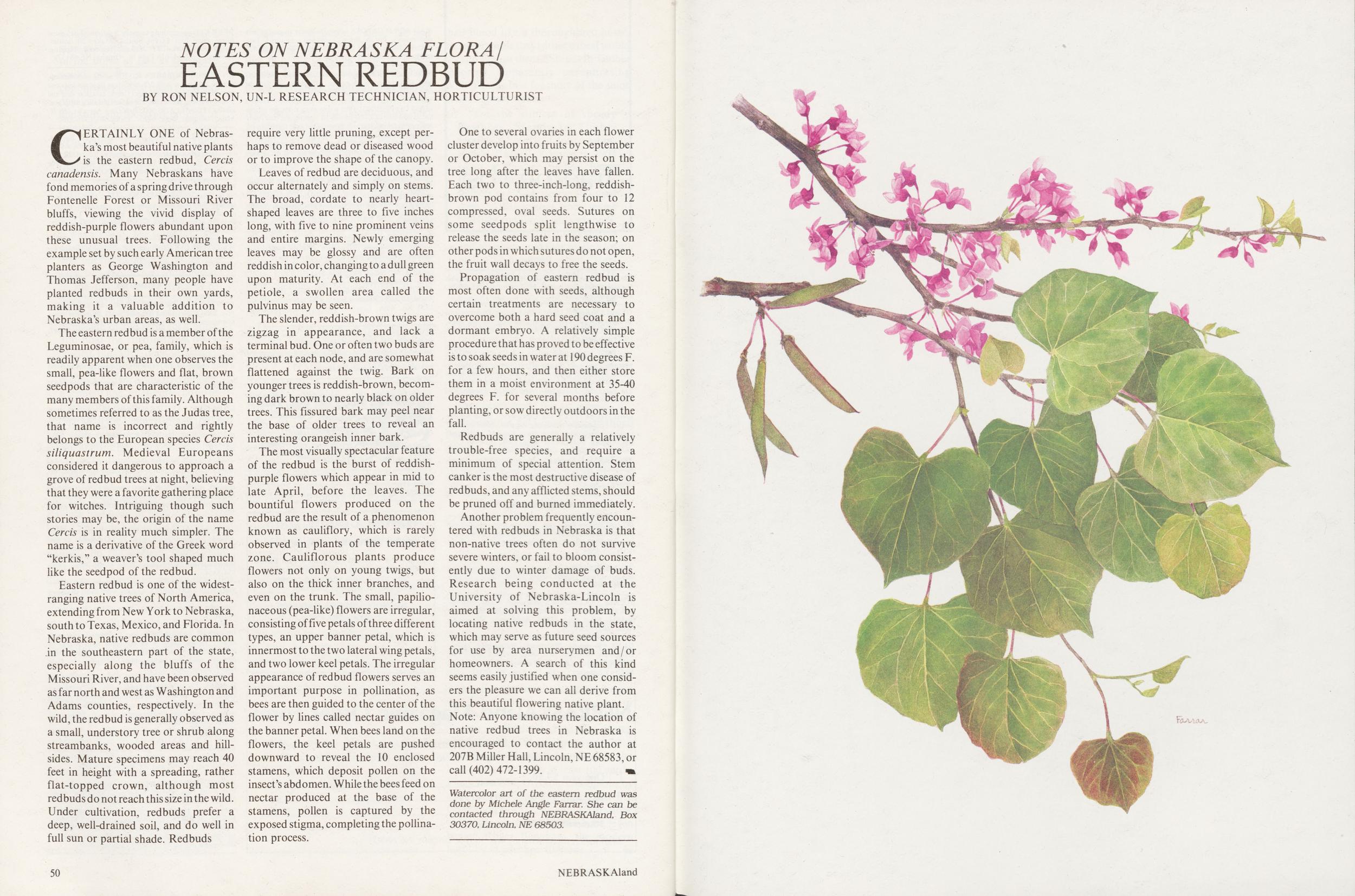
NOTES ON NEBRASKA FLORA/ EASTERN REDBUD
BY RON NELSON, UN-L RESEARCH TECHNICIAN, HORTICULTURISTCERTAINLY ONE of Nebraska's most beautiful native plants is the eastern redbud, Cercis canadensis. Many Nebraskans have fond memories of a spring drive through Fontenelle Forest or Missouri River bluffs, viewing the vivid display of reddish-purple flowers abundant upon these unusual trees. Following the example set by such early American tree planters as George Washington and Thomas Jefferson, many people have planted redbuds in their own yards, making it a valuable addition to Nebraska's urban areas, as well.
The eastern redbud is a member of the Leguminosae, or pea, family, which is readily apparent when one observes the small, pea-like flowers and flat, brown seedpods that are characteristic of the many members of this family. Although sometimes referred to as the Judas tree, that name is incorrect and rightly belongs to the European species Cercis siliquastrum. Medieval Europeans considered it dangerous to approach a grove of redbud trees at night, believing that they were a favorite gathering place for witches. Intriguing though such stories may be, the origin of the name Cercis is in reality much simpler. The name is a derivative of the Greek word "kerkis," a weaver's tool shaped much like the seedpod of the redbud.
Eastern redbud is one of the widestranging native trees of North America, extending from New York to Nebraska, south to Texas, Mexico, and Florida. In Nebraska, native redbuds are common in the southeastern part of the state, especially along the bluffs of the Missouri River, and have been observed as far north and west as Washington and Adams counties, respectively. In the wild, the redbud is generally observed as a small, understory tree or shrub along streambanks, wooded areas and hillsides. Mature specimens may reach 40 feet in height with a spreading, rather flat-topped crown, although most redbuds do not reach this size in the wild. Under cultivation, redbuds prefer a deep, well-drained soil, and do well in full sun or partial shade. Redbuds require very little pruning, except perhaps to remove dead or diseased wood or to improve the shape of the canopy.
Leaves of redbud are deciduous, and occur alternately and simply on stems. The broad, cordate to nearly heartshaped leaves are three to five inches long, with five to nine prominent veins and entire margins. Newly emerging leaves may be glossy and are often reddish in color, changing to a dull green upon maturity. At each end of the petiole, a swollen area called the pulvinus may be seen.
The slender, reddish-brown twigs are zigzag in appearance, and lack a terminal bud. One or often two buds are present at each node, and are somewhat flattened against the twig. Bark on younger trees is reddish-brown, becoming dark brown to nearly black on older trees. This fissured bark may peel near the base of older trees to reveal an interesting orangeish inner bark.
The most visually spectacular feature of the redbud is the burst of reddishpurple flowers which appear in mid to late April, before the leaves. The bountiful flowers produced on the redbud are the result of a phenomenon known as cauliflory, which is rarely observed in plants of the temperate zone. Cauliflorous plants produce flowers not only on young twigs, but also on the thick inner branches, and even on the trunk. The small, papilionaceous (pea-like) flowers are irregular, consisting of five petals of three different types, an upper banner petal, which is innermost to the two lateral wing petals, and two lower keel petals. The irregular appearance of redbud flowers serves an important purpose in pollination, as bees are then guided to the center of the flower by lines called nectar guides on the banner petal. When bees land on the flowers, the keel petals are pushed downward to reveal the 10 enclosed stamens, which deposit pollen on the insect's abdomen. While the bees feed on nectar produced at the base of the stamens, pollen is captured by the exposed stigma, completing the pollination process.
One to several ovaries in each flower cluster develop into fruits by September or October, which may persist on the tree long after the leaves have fallen. Each two to three-inch-long, reddishbrown pod contains from four to 12 compressed, oval seeds. Sutures on some seedpods split lengthwise to release the seeds late in the season; on other pods in which sutures do not open, the fruit wall decays to free the seeds.
Propagation of eastern redbud is most often done with seeds, although certain treatments are necessary to overcome both a hard seed coat and a dormant embryo. A relatively simple procedure that has proved to be effective is to soak seeds in water at 190 degrees F. for a few hours, and then either store them in a moist environment at 35-40 degrees F. for several months before planting, or sow directly outdoors in the fall.
Redbuds are generally a relatively trouble-free species, and require a minimum of special attention. Stem canker is the most destructive disease of redbuds, and any afflicted stems, should be pruned off and burned immediately.
Another problem frequently encoun- tered with redbuds in Nebraska is that non-native trees often do not survive severe winters, or fail to bloom consistently due to winter damage of buds. Research being conducted at the University of Nebraska-Lincoln is aimed at solving this problem, by locating native redbuds in the state, which may serve as future seed sources for use by area nurserymen and/or homeowners. A search of this kind seems easily justified when one considers the pleasure we can all derive from this beautiful flowering native plant. Note: Anyone knowing the location of native redbud trees in Nebraska is encouraged to contact the author at 207B Miller Hall, Lincoln, NE 68583, or call (402) 472-1399.
Watercolor art of the eastern redbud was done by Michele Angle Farrar. She can be contacted through NEBRASKAland. Box 30370, Lincoln, NE 68503.
50 NEBRASKAland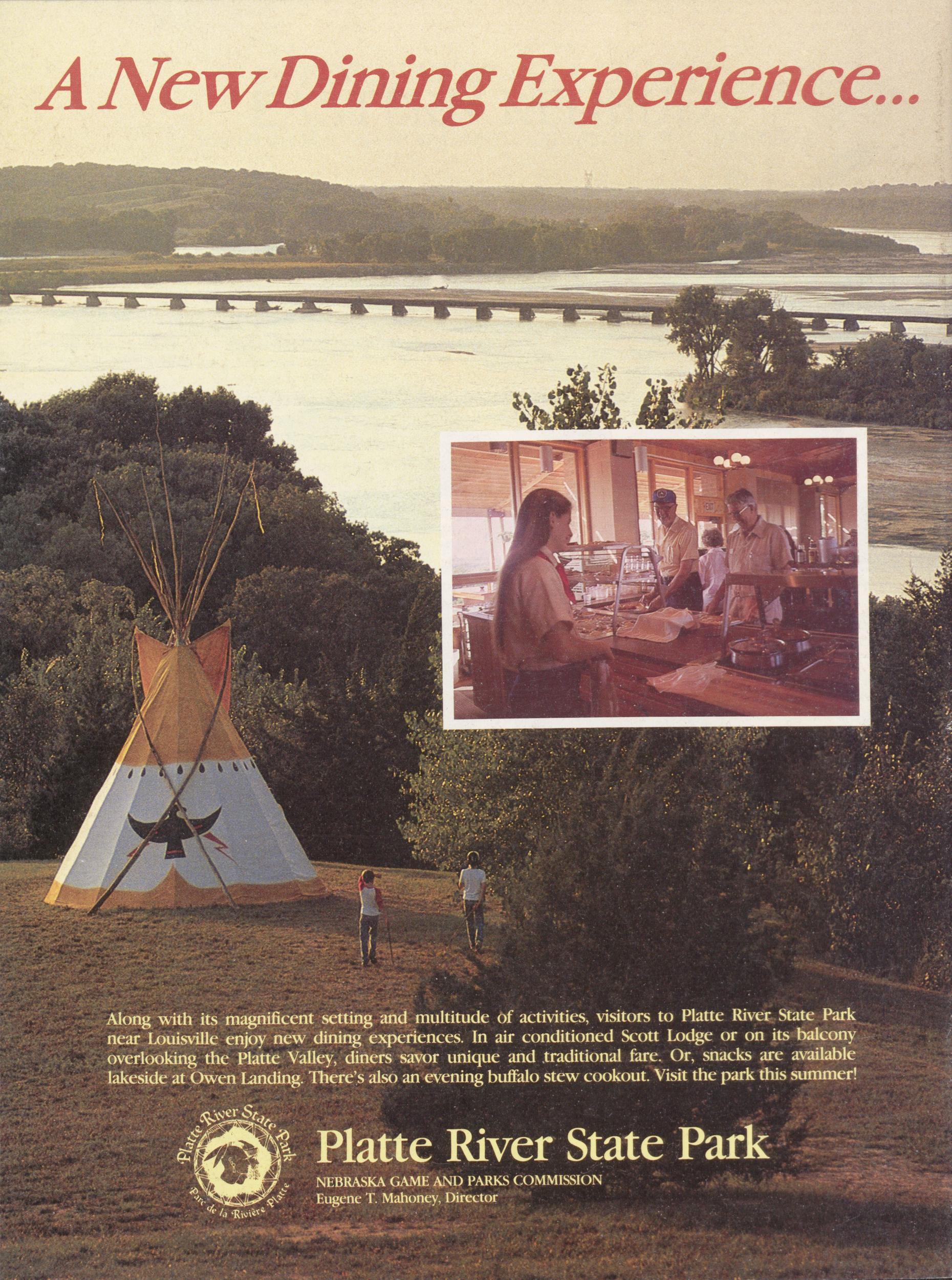
A New Dining Experience...
Long witn its magnincent setting ana multitude of activities, visitors to Platte River State Park near Louisville enjoy new dining experiences. In air conditioned Scott Lodge or on its balcony overlooking the Platte Valley, diners savor unique and traditional fare. Or, snacks are available lakeside at Owen Landing. There's also an evening buflfalo stew cookout. Visit the park this summer! Platte River State Park NEBRASKA GAME AND PARKS COMMISSION Eugene T. Mahoney, DirectorPosition: 737 (15 views)