Volume 63, Issue 5, 1985
NEBRASKAland
JUNE 1985 $1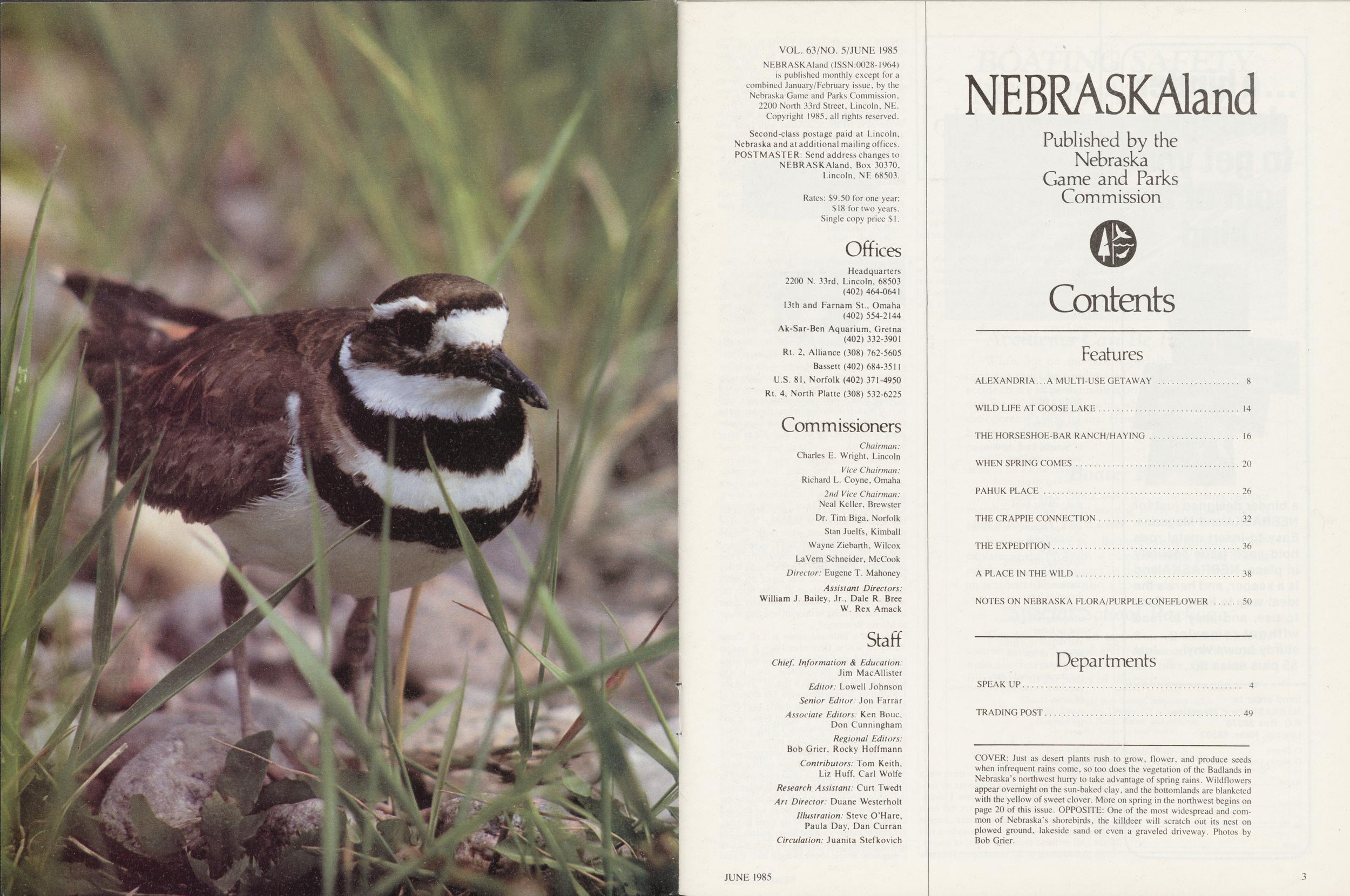
NEBRASKAland
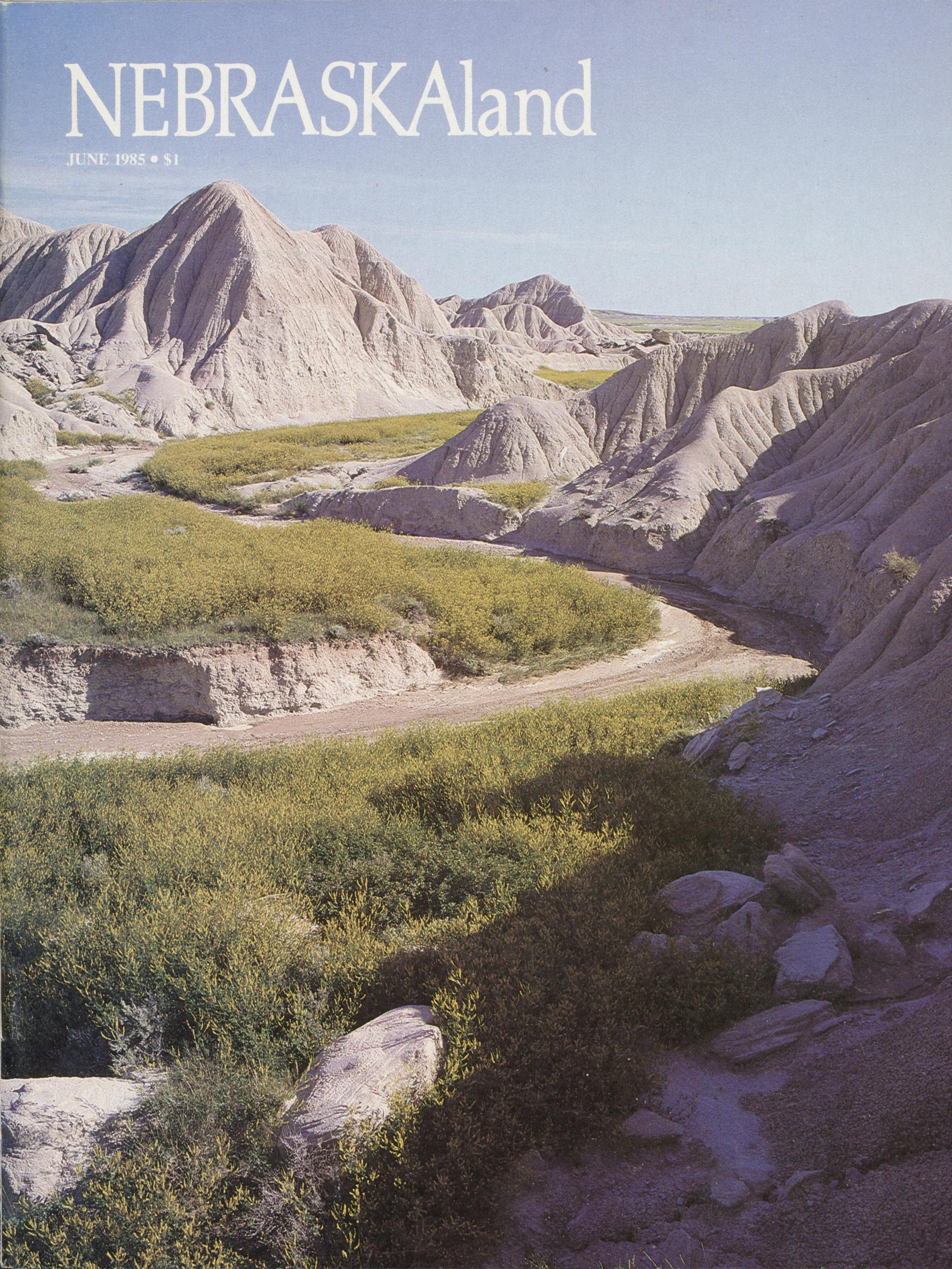
Publiched by the Nebraska Game and Parks Commission VOL. 63/NO. 5/JUNE 1985 NEBRASKAland (ISSN:0028-1964) is published monthly except for a combined January/February issue, by the Nebraska Game and Parks Commission, 2200 North 33rd Street, Lincoln, NE. Copyright 1985, all rights reserved. Second-class postage paid at Lincoln, Nebraska and at additional mailing offices. POSTMASTER: Send address changes to NEBRASKAland, Box 30370, Lincoln, NE 68503. Rates: $9.50 for one year; $18 for two years. Single copy price $1. Offices Headquarters 2200 N. 33rd, Lincoln, 68503 (402) 464-0641 13th and Farnam St., Omaha (402) 554-2144 Ak-Sar-Ben Aquarium, Gretna (402) 332-3901 Rt. 2, Alliance (308) 762-5605 Bassett (402) 684-3511 U.S. 81, Norfolk (402) 371-4950 Rt. 4, North Platte (308) 532-6225 Commissioners Chairman: Charles E. Wright, Lincoln Vice Chairman: Richard L. Coyne, Omaha 2nd Vice Chairman: Neal Keller, Brewster Dr. Tim Biga, Norfolk Stan Juelfs, Kimball Wayne Ziebarth, Wilcox LaVern Schneider, McCook Director: Eugene T. Mahoney Assistant Directors: William J. Bailey, Jr., Dale R. Bree W. Rex Amack Staff Chief, Information & Education: Jim MacAllister Editor: Lowell Johnson Senior Editor: Jon Farrar Associate Editors: Ken Bouc, Don Cunningham Regional Editors: Bob Grier, Rocky Hoffmann Contributors: Tom Keith, Liz Huff, Carl Wolfe Research Assistant: Curt Twedt Art Director: Duane Westerholt Illustration: Steve O'Hare, Paula Day, Dan Curran Circulation: Juanita Stefkovich Contents Features ALEXANDRIA...A MULTI-USE GETAWAY 8 WILD LIFE AT GOOSE LAKE14 THE HORSESHOE-BAR RANCH/HAYING16 WHEN SPRING COMES20 PAHUK PLACE26 THE CRAPPIE CONNECTION32 THE EXPEDITION36 A PLACE IN THE WILD38 NOTES ON NEBRASKA FLORA/PURPLE CONEFLOWER 50 Departments SPEAK UP 4 TRADING POST49 COVER: Just as desert plants rush to grow, flower, and produce seeds when infrequent rains come, so too does the vegetation of the Badlands in Nebraska's northwest hurry to take advantage of spring rains. Wildflowers appear overnight on the sun-baked clay, and the bottomlands are blanketed with the yellow of sweet clover. More on spring in the northwest begins on page 20 of this issue. OPPOSITE: One of the most widespread and common of Nebraska's shorebirds, the killdeer will scratch out its nest on plowed ground, lakeside sand or even a graveled driveway. Photos by Bob Grier. JUNE 1985 3
Speak Up
Ode to the craneSir / First, let me express my appreciation of your fine magazine. Our whole family looks forward to each issue. We especially liked the issues on Birds and Indians.
One photograph in the special issue on birds was more spectacular than usual for me. On page 94 I discovered a photo that contained the exact details of a poem I wrote some while ago. Thanks for a fine publication.
Ted Florea North Platte, Nebr. * * * Watching the Cranes Like mica peeling from a volcanic sky spring comes in a chorus line of bleached ash rhythms askew in the Platte River breeze, what's left of winter crawling up my arms and into the mists that veil the bank's shiver of saw-grass; stitched against the sunrise, into the fields the cranes, laughing like coots, dance like some drunken snake's dream of legs, and speak their rites of spring with voices old as Eden and depart in a din, anxious as my son to be away; but the river and I stay, sandbars swimming in shallows of time, watching the cranes go home. * * * Stealing from fishermenSir / Until recently I did not know there was a 10 percent manufacturer's excise tax on fishing products (D-J Act 1951). Now I understand that the Wallop-Breaux Act has been passed to include more equipment, import duties and also revenues from motorboat fuel tax. All of these increased costs, of course, are passed along to the consumers. That was alright, in that the monies were being returned to the states, matched 3 to 1 bv the federal dollars, for fishing improvements. I now understand Budget Director David Stockman has stopped the return of the money and plans to use it to try to offset the federal deficit.
If this is true, can we expect to see an article in the next NEBRASKAIand with facts and figures on the losses to the Nebraska fishing program? We need to encourage everyone to write to their Congressmen and ask them to get the money flowing again, before our fishing goes downhill.
I have seen estimates that Nebraska could lose from $800,000 to $1.4 million this year alone.
B.A. Kneeland, Jr. Ravenna, Nebr.You are absolutely right. The expansion program is estimated to bring in the amount of money you mention, and this has been proposed by the federal administration to be diverted to the federal deficit, rather than for the benefit of those paying the money. Efforts are even afoot, apparently, to close out the entire Dingell-Johnson program. Whether this would mean removing the tax, or merely taking all that money and using it for another purpose is uncertain. And, you are also right that we should encourage everyone interested to write both Senate and Congress with support of Wallop in the Senate and Breaux in the House, who have introduced opposition to the move to divert money from their bill to other uses. (Editor)
* * * Bed(bug) and boredSir / About 40 years ago, I was a surveyor for the roads department at Valentine. I worked there for some time and, while there, Tommy Little, a lad named Elliott and I, were loaned to the Game and Fish Department to run a line of levels to divert water from the Snake River to Hackberry Lake. It was about 30 miles from Valentine and about 10 miles from the nearest neighbor. I wonder if running these levels had anything to do with bringing water to Merritt Reservoir?
We had a little old cabin at Calf Camp Valley. It was in December 1940. It was an old cabin infested with bedbugs so that when you turned back the mattress cover it was alive with them. We had a box of "Swat the Fly" that we doused them with. On account of the bedbugs, we hung our duffle bags from the rafters! It was snowing and blowing and we were almost snowbound. I think we were able to work only three days in two weeks.
The cabin had an old wood-burning stove with a black tin chimney. It was really a rustic place. There were prairie chickens roosting in the trees and we could hear the bobcats around the cabin. There was a little lake behind the cabin and when we had the time, we decided to cut a hole in the ice and do some fishing. We caught minnows in the Snake and tried our luck. No good. One evening, we were reading a magazine article about bluegill bait. It said 4 NEBRASKAland to find a weed that had a bulb on it. Cutting it open, we found a little larva in it. We baited with the little larva and in no time at all we caught five nice bluegills.
About Christmas time Tommy Little sent some pictures which I will enclose. They are 44 years old. As 1 remember, there was one more picture of me out in the snow throwing a ii/ it basin of water on the snow. I had my white long Johns on and to my surprise, when I got back to the office in the Statehouse, the picture was on the bulletin board captioned'Klug in his drop-seat special."
When I first saw Snake River Falls, and mind you, it was some 40 years ago, it was a beautiful sight. It was way out away from anywhere. Some sportsmen must have been shooting ducks there, because I found a 12 gauge shotgun shell on the ground and beside it was a silver dollar. I don't believe I have it anymore; I wish I had kept it to remind me of the most beautiful falls and a great experience.
I am 75 years old and have been reading NEBRASKAIand for five years and am saving every copy along with the Sportsman Scrapbook, Travel Guide, Nebraska Rivers and other specials.
Delbert M. Klug Kearney, Nebr. * * * Edible trash?Sir / The first thing I turn to after receiving the current issue of NEBRASKAIand is the Speak Up section. Although there are always pros and cons on various subjects, I am prompted to reply to Mike McCormich (Mar. 1985 issue). I have visited the area which was the subject of his concern, about litter and trash in and along the scenic area of the Niobrara River. I am in total agreement with his statement that something should be done. Granted, those who commercialize the river may be indirectly responsible, but how about the individuals themselves? I'd be interested in any suggestions as I was appalled when I read Mr. McCormich's address Irving, Texas.
My husband and I have recently returned to Nebraska from Burleson, Texas, which is a small town approximately as far from Fort Worth in one direction as Irving lies in the other. While there, we attended a track meet at Joshua. When we bought our tickets, we were warned not to walk under the bleachers as a woman had been hit with flying debris from the spectators overhead. Trash was at least ankle deep under there, and the fences were catchalls for festoons of plastic and big squares of cardboard held there by the wind.
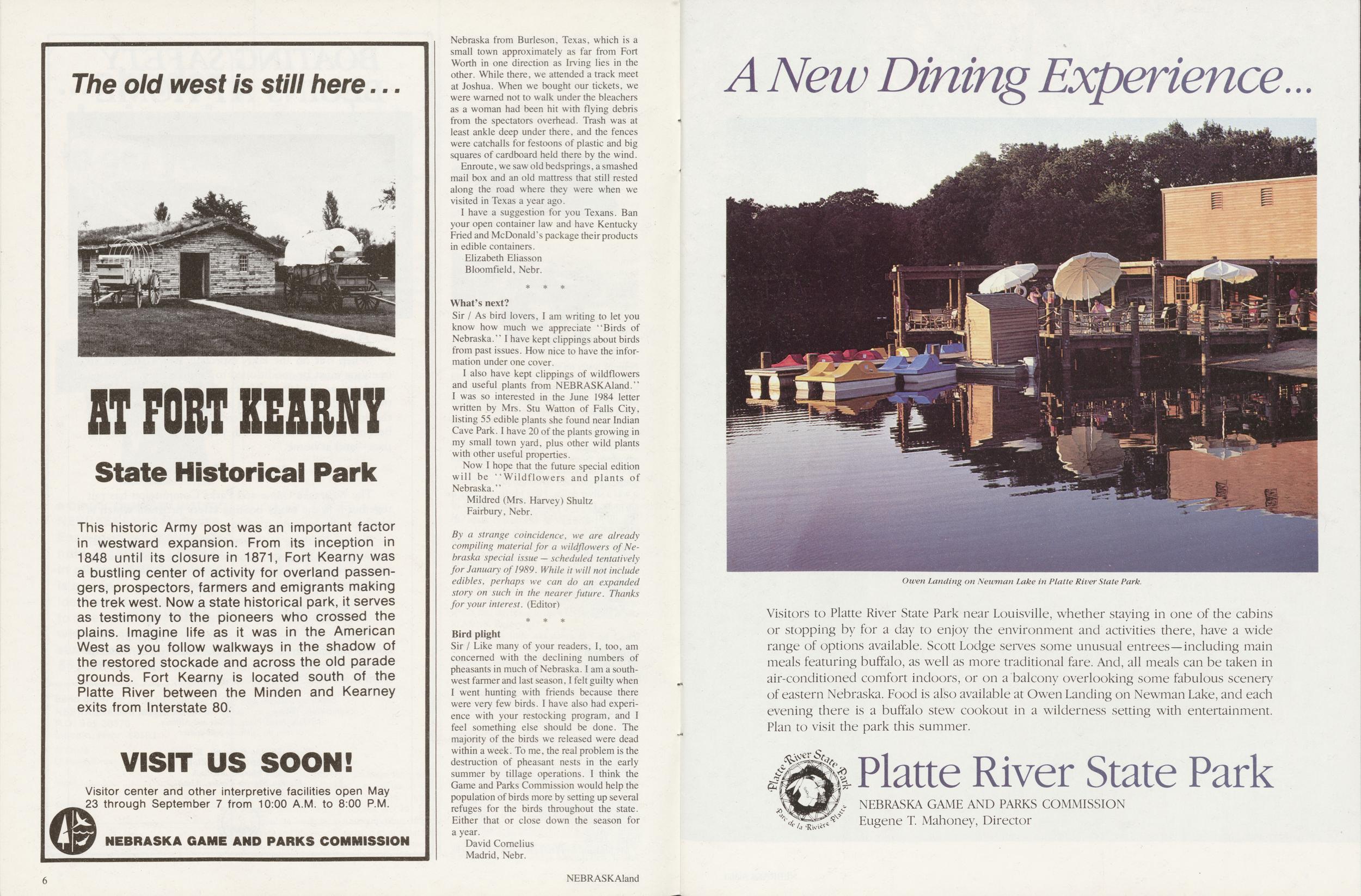
Enroute, we saw old bedsprings, a smashed mail box and an old mattress that still rested along the road where they were when we visited in Texas a year ago.
I have a suggestion for you Texans. Ban your open container law and have Kentucky Fried and McDonald's package their products in edible containers.
Elizabeth Eliasson Bloomfield, Nebr. * * * What's next?Sir / As bird lovers, I am writing to let you know how much we appreciate kk Birds of Nebraska." I have kept clippings about birds from past issues. How nice to have the infomation under one cover.
I also have kept clippings of wildflowers and useful plants from NEBRASKAland." I was so interested in the June 1984 letter written by Mrs. Stu Watton of Falls City, listing 55 edible plants she found near Indian Cave Park. I have 20 of the plants growing in my small town yard, plus other wild plants with other useful properties.
Now I hope that the future special edition will be "Wildflowers and plants of Nebraska."
Mildred (Mrs. Harvey) Shultz Fairbury, Nebr.By a strange coincidence, we are already compiling material for a wildflowers of Nebraska special issue — scheduled tentatively for January of 1989. While it will not include edibles, perhaps we can do an expanded story on such in the nearer future. Thanks for your interest. (Editor)
* * * Bird plightSir / Like many of your readers, I, too, am concerned with the declining numbers of pheasants in much of Nebraska. I am a southwest farmer and last season, I felt guilty when I went hunting with friends because there were very few birds. I have also had experience with your restocking program, and I feel something else should be done. The majority of the birds we released were dead within a week. To me, the real problem is the destruction of pheasant nests in the early summer by tillage operations. I think the Game and Parks Commission would help the population of birds more by setting up several refuges for the birds throughout the state. Either that or close down the season for a year.
David Cornelius Madrid, Nebr. 6 NEBRASKAland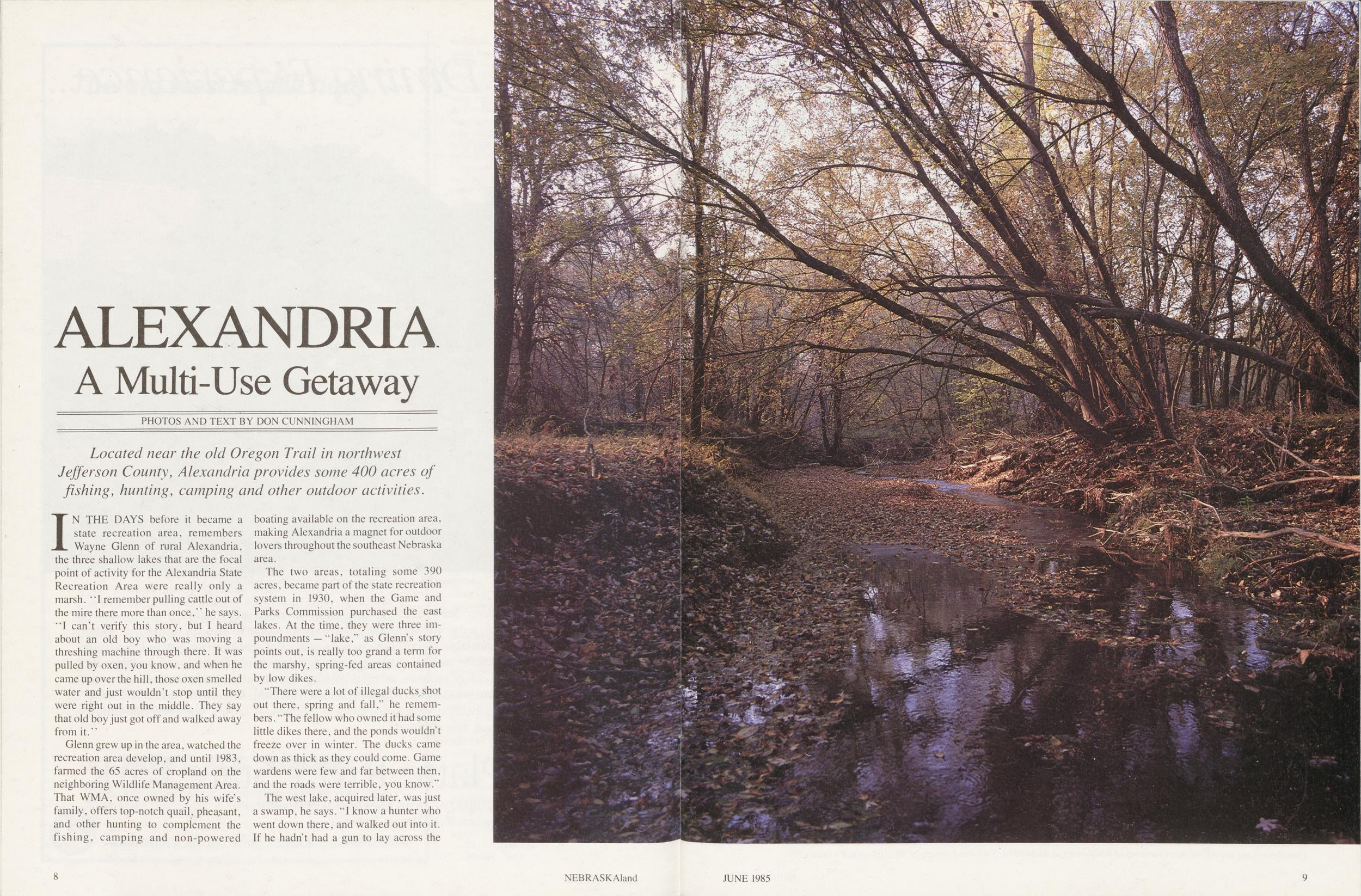
ALEXANDRIA A Multi-Use Getaway
PHOTOS AND TEXT BY DON CUNNINGHAM Located near the old Oregon Trail in northwest Jefferson County, Alexandria provides some 400 acres of fishing, hunting, camping and other outdoor activities.IN THE DAYS before it became a state recreation area, remembers Wayne Glenn of rural Alexandria, the three shallow lakes that are the focal point of activity for the Alexandria State Recreation Area were really only a marsh. 'w I remember pulling cattle out of the mire there more than once," he says. "I can't verify this story, but I heard about an old boy who was moving a threshing machine through there. It was pulled by oxen, you know, and when he came up over the hill, those oxen smelled water and just wouldn't stop until they were right out in the middle. They say that old boy just got off and walked away from it."
Glenn grew up in the area, watched the recreation area develop, and until 1983, farmed the 65 acres of cropland on the neighboring Wildlife Management Area. That WMA, once owned by his wife's family, offers top-notch quail, pheasant, and other hunting to complement the fishing, camping and non-powered boating available on the recreation area, making Alexandria a magnet for outdoor lovers throughout the southeast Nebraska area.
The two areas, totaling some 390 acres, became part of the state recreation system in 1930, when the Game and Parks Commission purchased the east lakes. At the time, they were three impoundments — kiake," as Glenn's story points out, is really too grand a term for the marshy, spring-fed areas contained by low dikes.
'There were a lot of illegal ducks shot out there, spring and fall," he remembers/The fellow who owned it had some little dikes there, and the ponds wouldn't freeze over in winter. The ducks came down as thick as they could come. Game wardens were few and far between then, and the roads were terrible, you know."
The west lake, acquired later, was just a swamp, he says. "I know a hunter who went down there, and walked out into it. If he hadn't had a gun to lay across the mud and hold himself, he'd have gone right on down."
8 NEBRASKAland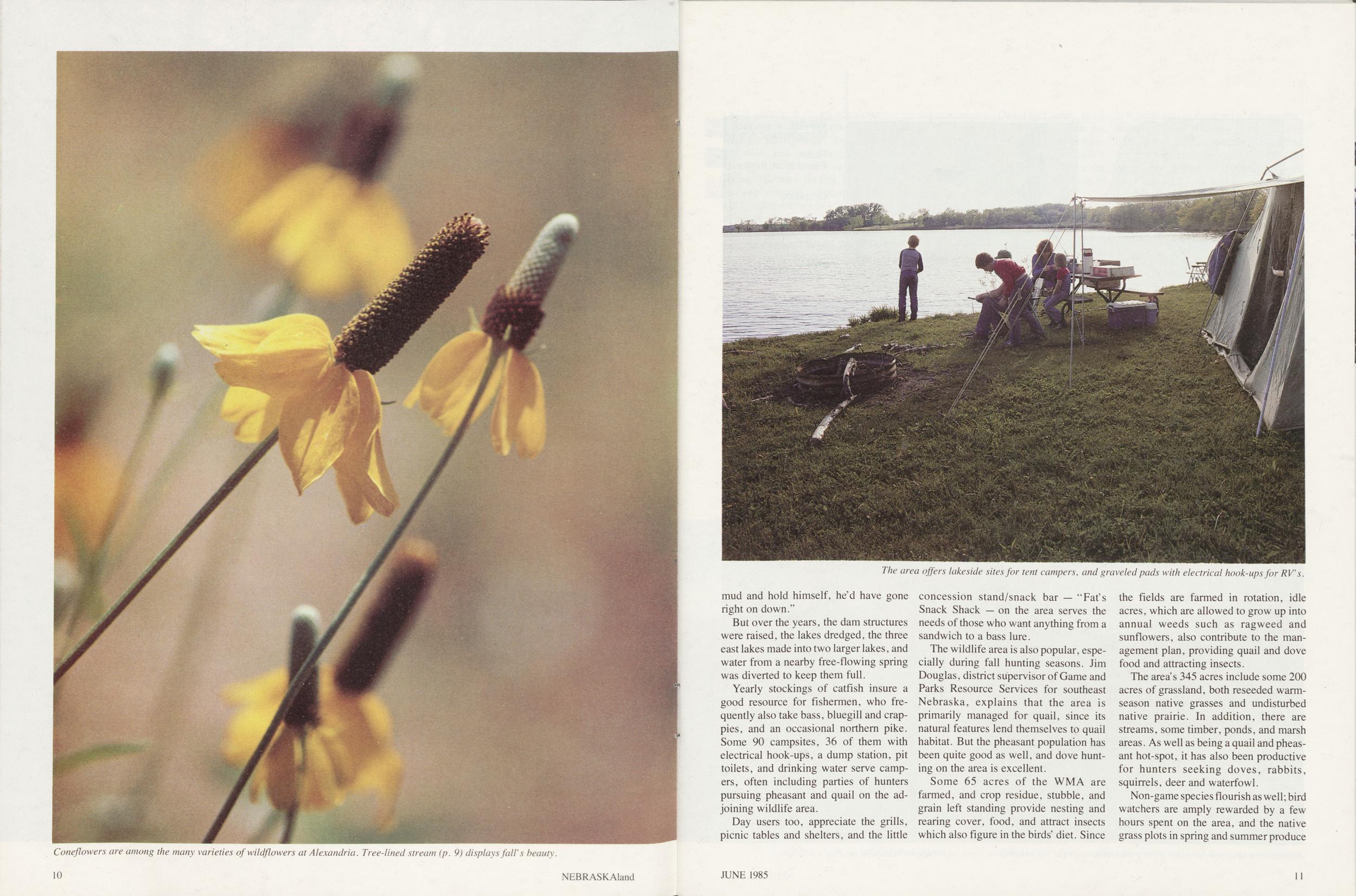
But over the years, the dam structures were raised, the lakes dredged, the three east lakes made into two larger lakes, and water from a nearby free-flowing spring was diverted to keep them full.
Yearly stockings of catfish insure a good resource for fishermen, who frequently also take bass, bluegill and crappies, and an occasional northern pike. Some 90 campsites, 36 of them with electrical hook-ups, a dump station, pit toilets, and drinking water serve campers, often including parties of hunters pursuing pheasant and quail on the adjoining wildlife area.
Day users too, appreciate the grills, picnic tables and shelters, and the little concession stand/snack bar — "Fat's Snack Shack — on the area serves the needs of those who want anything from a sandwich to a bass lure.
The wildlife area is also popular, especially during fall hunting seasons. Jim Douglas, district supervisor of Game and Parks Resource Services for southeast Nebraska, explains that the area is primarily managed for quail, since its natural features lend themselves to quail habitat. But the pheasant population has been quite good as well, and dove hunting on the area is excellent.
Some 65 acres of the WMA are farmed, and crop residue, stubble, and grain left standing provide nesting and rearing cover, food, and attract insects which also figure in the birds' diet. Since the fields are farmed in rotation, idle acres, which are allowed to grow up into annual weeds such as ragweed and sunflowers, also contribute to the management plan, providing quail and dove food and attracting insects.
The area's 345 acres include some 200 acres of grassland, both reseeded warmseason native grasses and undisturbed native prairie. In addition, there are streams, some timber, ponds, and marsh areas. As well as being a quail and pheasant hot-spot, it has also been productive for hunters seeking doves, rabbits, squirrels, deer and waterfowl.
Non-game species flourish as well; bird watchers are amply rewarded by a few hours spent on the area, and the native grass plots in spring and summer produce a wide variety of showy wildflowers.
JUNE 1985 11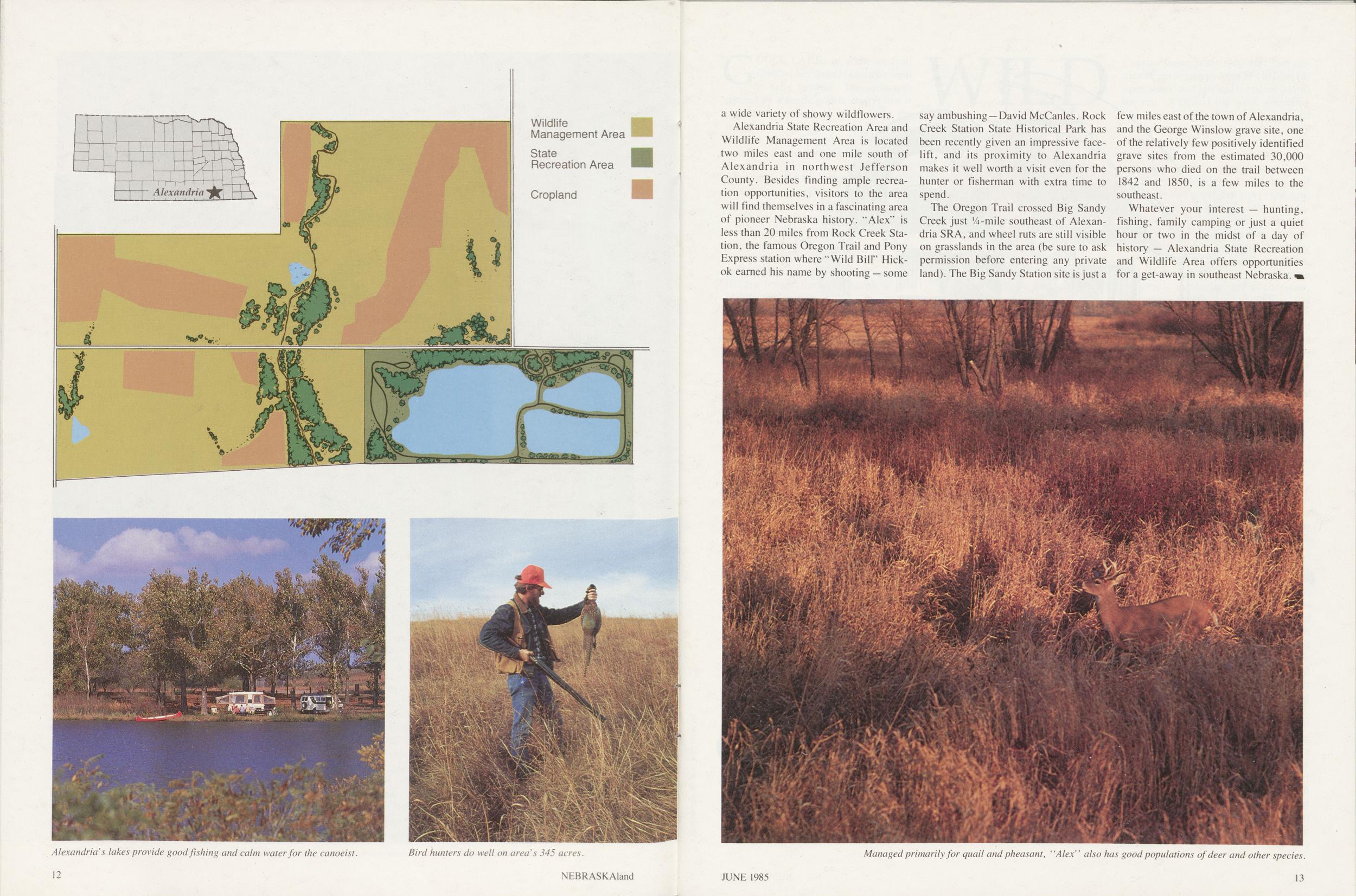
Alexandria State Recreation Area and Wildlife Management Area is located two miles east and one mile south of Alexandria in northwest Jefferson County. Besides finding ample recreation opportunities, visitors to the area will find themselves in a fascinating area of pioneer Nebraska history. "Alex" is less than 20 miles from Rock Creek Station, the famous Oregon Trail and Pony Express station where "Wild Bill" Hickok earned his name by shooting — some say ambushing —David McCanles. Rock Creek Station State Historical Park has been recently given an impressive facelift, and its proximity to Alexandria makes it well worth a visit even for the hunter or fisherman with extra time to spend.
The Oregon Trail crossed Big Sandy Creek just '/4-mile southeast of Alexandria SRA, and wheel ruts are still visible on grasslands in the area (be sure to ask permission before entering any private land). The Big Sandy Station site is just a few miles east of the town of Alexandria, and the George Winslow grave site, one of the relatively few positively identified grave sites from the estimated 30,000 persons who died on the trail between 1842 and 1850, is a few miles to the southeast.
Whatever your interest — hunting, fishing, family camping or just a quiet hour or two in the midst of a day of history — Alexandria State Recreation and Wildlife Area offers opportunities for a get-away in southeast Nebraska.
WILD LIFE At Goose Lake
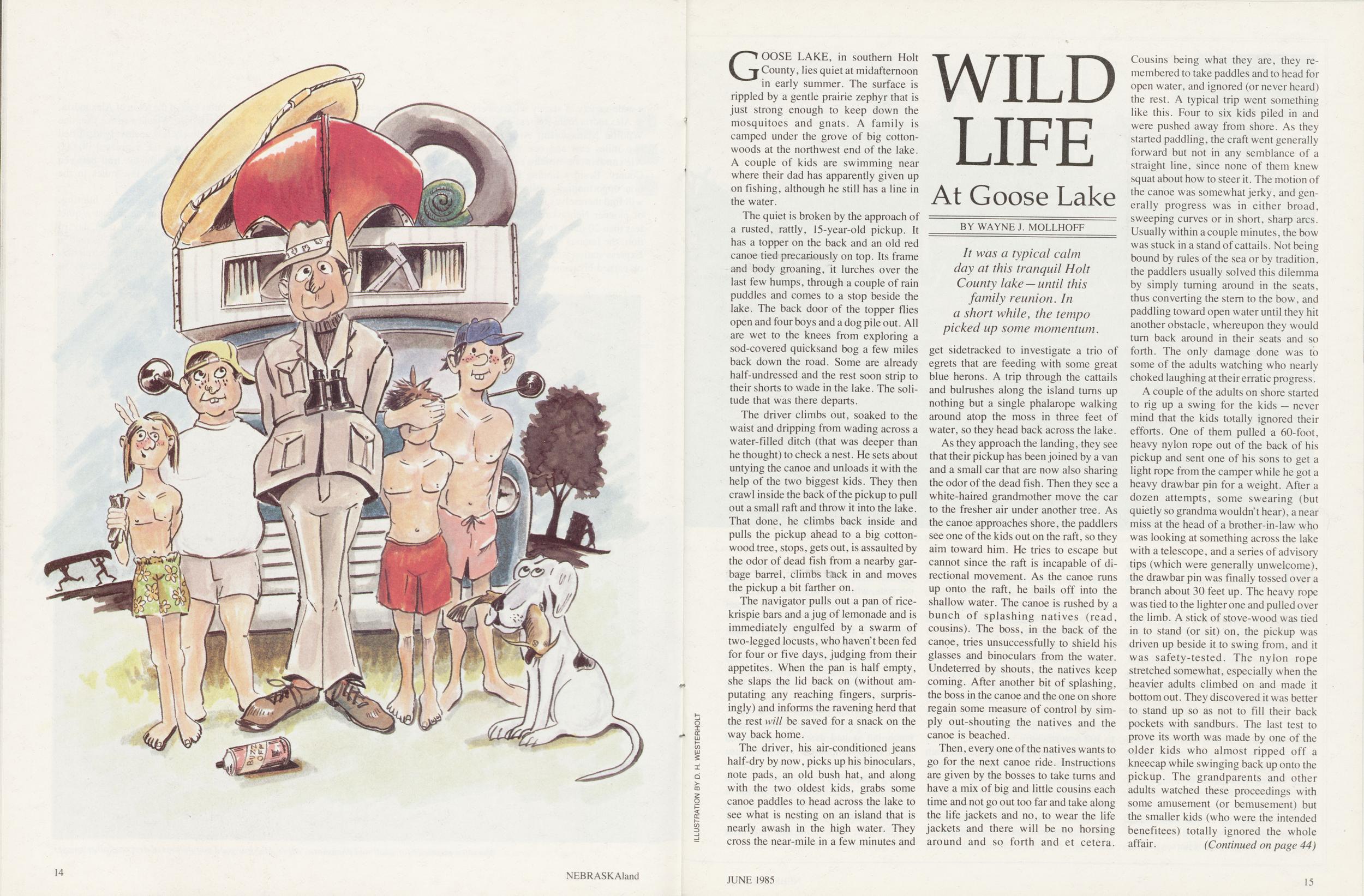
BY WAYNE J. MOLLHOFF It was a typical calm day at this tranquil Holt County lake — until this family reunion. In a short while, the tempo picked up some momentum.GOOSE LAKE, in southern Holt County, lies quiet at midafternoon in early summer. The surface is rippled by a gentle prairie zephyr that is just strong enough to keep down the mosquitoes and gnats. A family is camped under the grove of big cottonwoods at the northwest end of the lake. A couple of kids are swimming near where their dad has apparently given up on fishing, although he still has a line in the water.
The quiet is broken by the approach of a rusted, rattly, 15-year-old pickup. It has a topper on the back and an old red canoe tied precariously on top. Its frame and body groaning, it lurches over the last few humps, through a couple of rain puddles and comes to a stop beside the lake. The back door of the topper flies open and four boys and a dog pile out. All are wet to the knees from exploring a sod-covered quicksand bog a few miles back down the road. Some are already half-undressed and the rest soon strip to their shorts to wade in the lake. The solitude that was there departs.
The driver climbs out, soaked to the waist and dripping from wading across a water-filled ditch (that was deeper than he thought) to check a nest. He sets about untying the canoe and unloads it with the help of the two biggest kids. They then crawl inside the back of the pickup to pull out a small raft and throw it into the lake. That done, he climbs back inside and pulls the pickup ahead to a big cottonwood tree, stops, gets out, is assaulted by the odor of dead fish from a nearby garbage barrel, climbs fcUck in and moves the pickup a bit farther on.
The navigator pulls out a pan of ricekrispie bars and a jug of lemonade and is immediately engulfed by a swarm of two-legged locusts, who haven't been fed for four or five days, judging from their appetites. When the pan is half empty, she slaps the lid back on (without amputating any reaching fingers, surprisingly) and informs the ravening herd that the rest will be saved for a snack on the way back home.
The driver, his air-conditioned jeans half-dry by now, picks up his binoculars, note pads, an old bush hat, and along with the two oldest kids, grabs some canoe paddles to head across the lake to see what is nesting on an island that is nearly awash in the high water. They cross the near-mile in a few minutes and get sidetracked to investigate a trio of egrets that are feeding with some great blue herons. A trip through the cattails and bulrushes along the island turns up nothing but a single phalarope walking around atop the moss in three feet of water, so they head back across the lake.
As they approach the landing, they see that their pickup has been joined by a van and a small car that are now also sharing the odor of the dead fish. Then they see a white-haired grandmother move the car to the fresher air under another tree. As the canoe approaches shore, the paddlers see one of the kids out on the raft, so they aim toward him. He tries to escape but cannot since the raft is incapable of directional movement. As the canoe runs up onto the raft, he bails off into the shallow water. The canoe is rushed by a bunch of splashing natives (read, cousins). The boss, in the back of the canoe, tries unsuccessfully to shield his glasses and binoculars from the water. Undeterred by shouts, the natives keep coming. After another bit of splashing, the boss in the canoe and the one on shore regain some measure of control by simply out-shouting the natives and the canoe is beached.
Then, every one of the natives wants to go for the next canoe ride. Instructions are given by the bosses to take turns and have a mix of big and little cousins each time and not go out too far and take along the life jackets and no, to wear the life jackets and there will be no horsing around and so forth and et cetera. Cousins being what they are, they remembered to take paddles and to head for open water, and ignored (or never heard) the rest. A typical trip went something like this. Four to six kids piled in and were pushed away from shore. As they started paddling, the craft went generally forward but not in any semblance of a straight line, since none of them knew squat about how to steer it. The motion of the canoe was somewhat jerky, and generally progress was in either broad, sweeping curves or in short, sharp arcs. Usually within a couple minutes, the bow was stuck in a stand of cattails. Not being bound by rules of the sea or by tradition, the paddlers usually solved this dilemma by simply turning around in the seats, thus converting the stern to the bow, and paddling toward open water until they hit another obstacle, whereupon they would turn back around in their seats and so forth. The only damage done was to some of the adults watching who nearly choked laughing at their erratic progress.
A couple of the adults on shore started to rig up a swing for the kids — never mind that the kids totally ignored their efforts. One of them pulled a 60-foot, heavy nylon rope out of the back of his pickup and sent one of his sons to get a light rope from the camper while he got a heavy drawbar pin for a weight. After a dozen attempts, some swearing (but quietly so grandma wouldn't hear), a near miss at the head of a brother-in-law who was looking at something across the lake with a telescope, and a series of advisory tips (which were generally unwelcome), the drawbar pin was finally tossed over a branch about 30 feet up. The heavy rope was tied to the lighter one and pulled over the limb. A stick of stove-wood was tied in to stand (or sit) on, the pickup was driven up beside it to swing from, and it was safety-tested. The nylon rope stretched somewhat, especially when the heavier adults climbed on and made it bottom out. They discovered it was better to stand up so as not to fill their back pockets with sandburs. The last test to prove its worth was made by one of the older kids who almost ripped off a kneecap while swinging back up onto the pickup. The grandparents and other adults watched these proceedings with some amusement (or bemusement) but the smaller kids (who were the intended benefitees) totally ignored the whole affair. (Continued on page 44)
JUNE 1985 15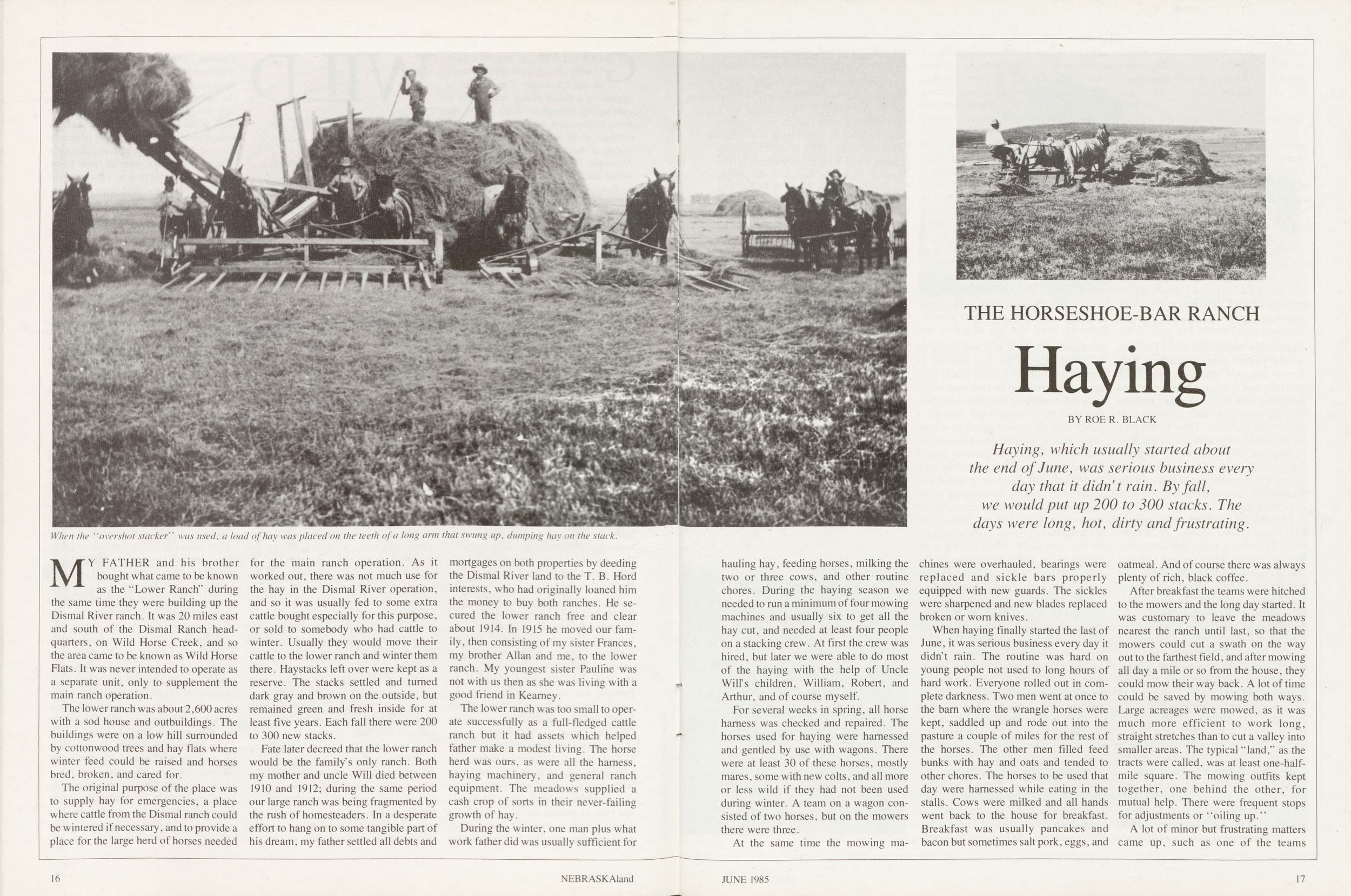
THE HORSESHOE-BAR RANCH Haying
BY ROE R. BLACK Haying, which usually started about the end of June, was serious business every day that it didnt rain. By fall, we would put up 200 to 300 stacks. The days were long, hot, dirty and frustrating.MY FATHER and his brother bought what came to be known as the "Lower Ranch" during the same time they were building up the Dismal River ranch. It was 20 miles east and south of the Dismal Ranch headquarters, on Wild Horse Creek, and so the area came to be known as Wild Horse Flats. It was never intended to operate as a separate unit, only to supplement the main ranch operation.
The lower ranch was about 2,600 acres with a sod house and outbuildings. The buildings were on a low hill surrounded by cottonwood trees and hay flats where winter feed could be raised and horses bred, broken, and cared for.
The original purpose of the place was to supply hay for emergencies, a place where cattle from the Dismal ranch could be wintered if necessary, and to provide a place for the large herd of horses needed for the main ranch operation. As it worked out, there was not much use for the hay in the Dismal River operation, and so it was usually fed to some extra cattle bought especially for this purpose, or sold to somebody who had cattle to winter. Usually they would move their cattle to the lower ranch and winter them there. Haystacks left over were kept as a reserve. The stacks settled and turned dark gray and brown on the outside, but remained green and fresh inside for at least five years. Each fall there were 200 to 300 new stacks.
Fate later decreed that the lower ranch would be the family's only ranch. Both my mother and uncle Will died between 1910 and 1912; during the same period our large ranch was being fragmented by the rush of homesteaders. In a desperate effort to hang on to some tangible part of his dream, my father settled all debts and mortgages on both properties by deeding the Dismal River land to the T. B. Hord interests, who had originally loaned him the money to buy both ranches. He secured the lower ranch free and clear about 1914. In 1915 he moved our family, then consisting of my sister Frances, my brother Allan and me, to the lower ranch. My youngest sister Pauline was not with us then as she was living with a good friend in Kearney.
The lower ranch was too small to operate successfully as a full-fledged cattle ranch but it had assets which helped father make a modest living. The horse herd was ours, as were all the harness, haying machinery, and general ranch equipment. The meadows supplied a cash crop of sorts in their never-failing growth of hay.
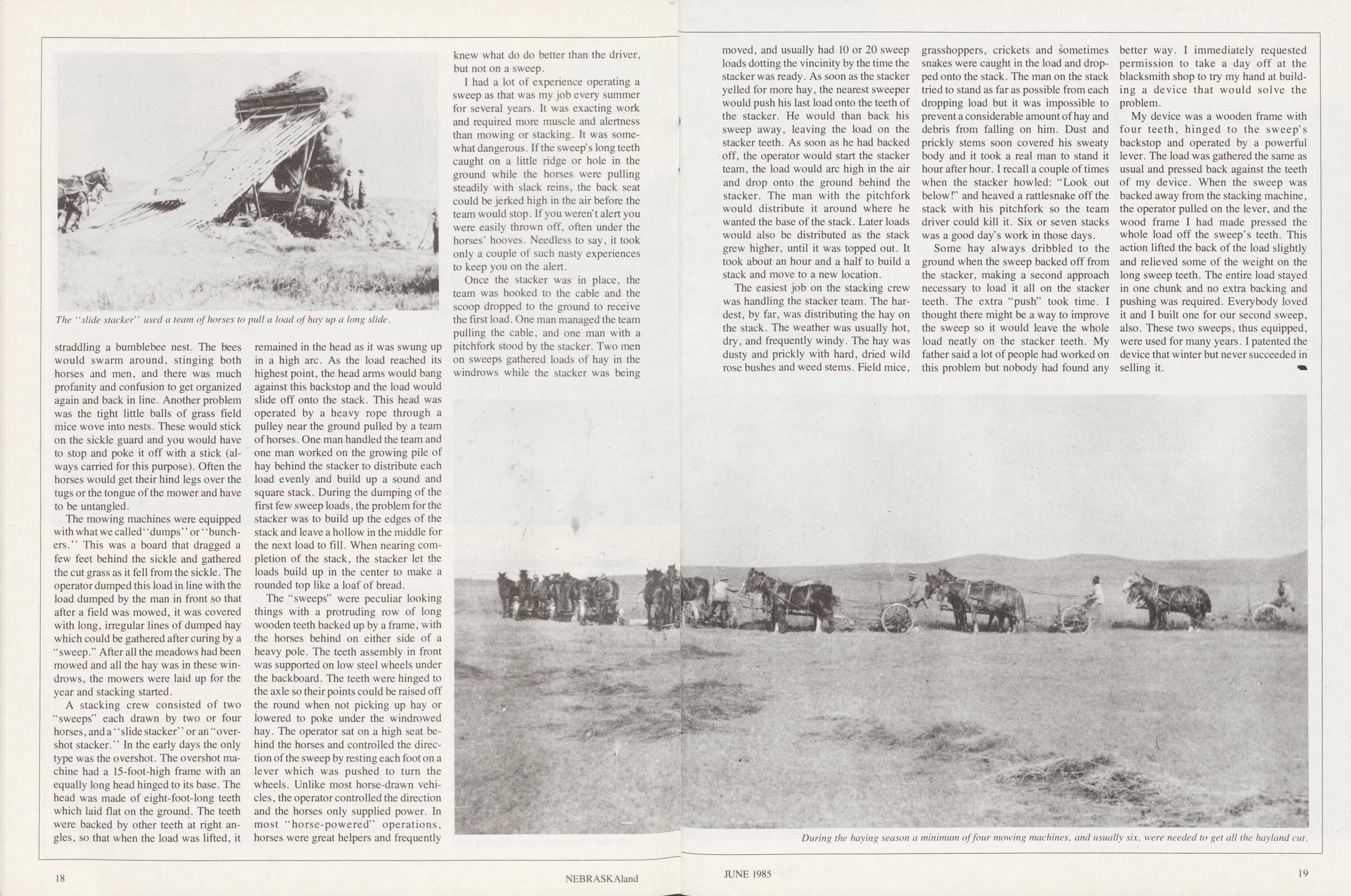
During the winter, one man plus what work father did was usually sufficient for 16 NEBRASKAland hauling hay, feeding horses, milking the two or three cows, and other routine chores. During the haying season we needed to run a minimum of four mowing machines and usually six to get all the hay cut, and needed at least four people on a stacking crew. At first the crew was hired, but later we were able to do most of the haying with the help of Uncle Will's children, William, Robert, and Arthur, and of course myself.
For several weeks in spring, all horse harness was checked and repaired. The horses used for haying were harnessed and gentled by use with wagons. There were at least 30 of these horses, mostly mares, some with new colts, and all more or less wild if they had not been used during winter. A team on a wagon consisted of two horses, but on the mowers there were three.
At the same time the mowing machines chines were overhauled, bearings were replaced and sickle bars properly equipped with new guards. The sickles were sharpened and new blades replaced broken or worn knives.
When haying finally started the last of June, it was serious business every day it didn't rain. The routine was hard on young people not used to long hours of hard work. Everyone rolled out in complete darkness. Two men went at once to the barn where the wrangle horses were kept, saddled up and rode out into the pasture a couple of miles for the rest of the horses. The other men filled feed bunks with hay and oats and tended to other chores. The horses to be used that day were harnessed while eating in the stalls. Cows were milked and all hands went back to the house for breakfast. Breakfast was usually pancakes and bacon but sometimes salt pork, eggs, and oatmeal. And of course there was always plenty of rich, black coffee.
After breakfast the teams were hitched to the mowers and the long day started. It was customary to leave the meadows nearest the ranch until last, so that the mowers could cut a swath on the way out to the farthest field, and after mowing all day a mile or so from the house, they could mow their way back. A lot of time could be saved by mowing both ways. Large acreages were mowed, as it was much more efficient to work long, straight stretches than to cut a valley into smaller areas. The typical "land," as the tracts were called, was at least one-half mile square. The mowing outfits kept together, one behind the other, for mutual help. There were frequent stops for adjustments or "oiling up."
A lot of minor but frustrating matters
came up, such as one of the teams
JUNE 1985
17
 straddling a bumblebee nest. The bees
would swarm around, stinging both
horses and men, and there was much
profanity and confusion to get organized
again and back in line. Another problem
was the tight little balls of grass field
mice wove into nests. These would stick
on the sickle guard and you would have
to stop and poke it off with a stick (always carried for this purpose). Often the
horses would get their hind legs over the
tugs or the tongue of the mower and have
to be untangled.
straddling a bumblebee nest. The bees
would swarm around, stinging both
horses and men, and there was much
profanity and confusion to get organized
again and back in line. Another problem
was the tight little balls of grass field
mice wove into nests. These would stick
on the sickle guard and you would have
to stop and poke it off with a stick (always carried for this purpose). Often the
horses would get their hind legs over the
tugs or the tongue of the mower and have
to be untangled.
The mowing machines were equipped with what we called' "dumps" or4 'bunchers.' This was a board that dragged a few feet behind the sickle and gathered the cut grass as it fell from the sickle. The operator dumped this load in line with the load dumped by the man in front so that after a field was mowed, it was covered with long, irregular lines of dumped hay which could be gathered after curing by a "sweep." After all the meadows had been mowed and all the hay was in these windrows, the mowers were laid up for the year and stacking started.
A stacking crew consisted of two "sweeps" each drawn by two or four horses, and a'' slide stacker'' or an " overshot stacker." In the early days the only type was the overshot. The overshot machine had a 15-foot-high frame with an equally long head hinged to its base. The head was made of eight-foot-long teeth which laid flat on the ground. The teeth were backed by other teeth at right angles, so that when the load was lifted, it remained in the head as it was swung up in a high arc. As the load reached its highest point, the head arms would bang against this backstop and the load would slide off onto the stack. This head was operated by a heavy rope through a pulley near the ground pulled by a team of horses. One man handled the team and one man worked on the growing pile of hay behind the stacker to distribute each load evenly and build up a sound and square stack. During the dumping of the first few sweep loads, the problem for the stacker was to build up the edges of the stack and leave a hollow in the middle for the next load to fill. When nearing completion of the stack, the stacker let the loads build up in the center to make a rounded top like a loaf of bread.
The "sweeps" were peculiar looking things with a protruding row of long wooden teeth backed up by a frame, with the horses behind on either side of a heavy pole. The teeth assembly in front was supported on low steel wheels under the backboard. The teeth were hinged to the axle so their points could be raised off the round when not picking up hay or lowered to poke under the windrowed hay. The operator sat on a high seat behind the horses and controlled the direction of the sweep by resting each foot on a lever which was pushed to turn the wheels. Unlike most horse-drawn vehicles, the operator controlled the direction and the horses only supplied power. In most "horse-powered" operations, horses were great helpers and frequently knew what do do better than the driver, but not on a sweep.
I had a lot of experience operating a sweep as that was my job every summer for several years. It was exacting work and required more muscle and alertness than mowing or stacking. It was somewhat dangerous. If the sweep's long teeth caught on a little ridge or hole in the ground while the horses were pulling steadily with slack reins, the back seat could be jerked high in the air before the team would stop. If you weren't alert you were easily thrown off, often under the horses' hooves. Needless to say, it took only a couple of such nasty experiences to keep you on the alert.
Once the stacker was in place, the team was hooked to the cable and the scoop dropped to the ground to receive the first load. One man managed the team pulling the cable, and one man with a pitchfork stood by the stacker. Two men on sweeps gathered loads of hay in the windrows while the stacker was being 18 NEBRASKAland moved, and usually had 10 or 20 sweep loads dotting the vincinity by the time the stacker was ready. As soon as the stacker yelled for more hay, the nearest sweeper would push his last load onto the teeth of the stacker. He would than back his sweep away, leaving the load on the stacker teeth. As soon as he had backed off, the operator would start the stacker team, the load would arc high in the air and drop onto the ground behind the stacker. The man with the pitchfork would distribute it around where he wanted the base of the stack. Later loads would also be distributed as the stack grew higher, until it was topped out. It took about an hour and a half to build a stack and move to a new location.
The easiest job on the stacking crew was handling the stacker team. The hardest, by far, was distributing the hay on the stack. The weather was usually hot, dry, and frequently windy. The hay was dusty and prickly with hard, dried wild rose bushes and weed stems. Field mice, grasshoppers, crickets and sometimes snakes were caught in the load and dropped onto the stack. The man on the stack tried to stand as far as possible from each dropping load but it was impossible to prevent a considerable amount of hay and debris from falling on him. Dust and prickly stems soon covered his sweaty body and it took a real man to stand it hour after hour. I recall a couple of times when the stacker howled: "Look out below!" and heaved a rattlesnake off the stack with his pitchfork so the team driver could kill it. Six or seven stacks was a good day's work in those days.
Some hay always dribbled to the ground when the sweep backed off from the stacker, making a second approach necessary to load it all on the stacker teeth. The extra "push" took time. I thought there might be a way to improve the sweep so it would leave the whole load neatly on the stacker teeth. My father said a lot of people had worked on this problem but nobody had found any better way. I immediately requested permission to take a day off at the blacksmith shop to try my hand at building a device that would solve the problem.
My device was a wooden frame with four teeth, hinged to the sweep's backstop and operated by a powerful lever. The load was gathered the same as usual and pressed back against the teeth of my device. When the sweep was backed away from the stacking machine, the operator pulled on the lever, and the wood frame I had made pressed the whole load off the sweep's teeth. This action lifted the back of the load slightly and relieved some of the weight on the long sweep teeth. The entire load stayed in one chunk and no extra backing and pushing was required. Everybody loved it and I built one for our second sweep, also. These two sweeps, thus equipped, were used for many years. I patented the device that winter but never succeeded in selling it.
When Spring Comes
PHOTOS BY BOB GRIER, TEXT BY LOWELL JOHNSON It is now a time of renewal, for both plants and animals. New growth and new generations appear, taking their places in the great outdoor theater.THERE ARE TIMES when the earth seems old, wrinkled, worn out. When winter winds whine through barren branches and drive everything before them, thoughts of comfort are primary in everyone's mind. It may be concern for safety, or the pleasure of snuggling down under covers, content to be in out of the cold.
But, watching the millions of jewellike facets of ice crystals glistening under a warming sun on a brilliant, calm day in winter when all is blanketed under a downy mantle of white can seem the epitomy of beauty — a scene which etches into the memory. Distant then seems the rasping, threatening blizzard.
It is, of course, the contrasts in life which give meaning to all. The extremes condition our appreciation for the "normal." But, the discomfort and danger of a winter blizzard swing to something of sheer beauty only a few times, and then both are gone. Spring comes.
On the high plateau country of Nebraska's northern Panhandle, spring seems nearly magical. Gone are winter's depressing, dark days. There is a time when one cannot tell what is happening, but as surely as the centuries pass, spring finds its way back. The very air is filled with promise. It is laden with some unseen but potent ingredient. It is a wondrous time, and we pity those who stare at the same tedious season year-round.
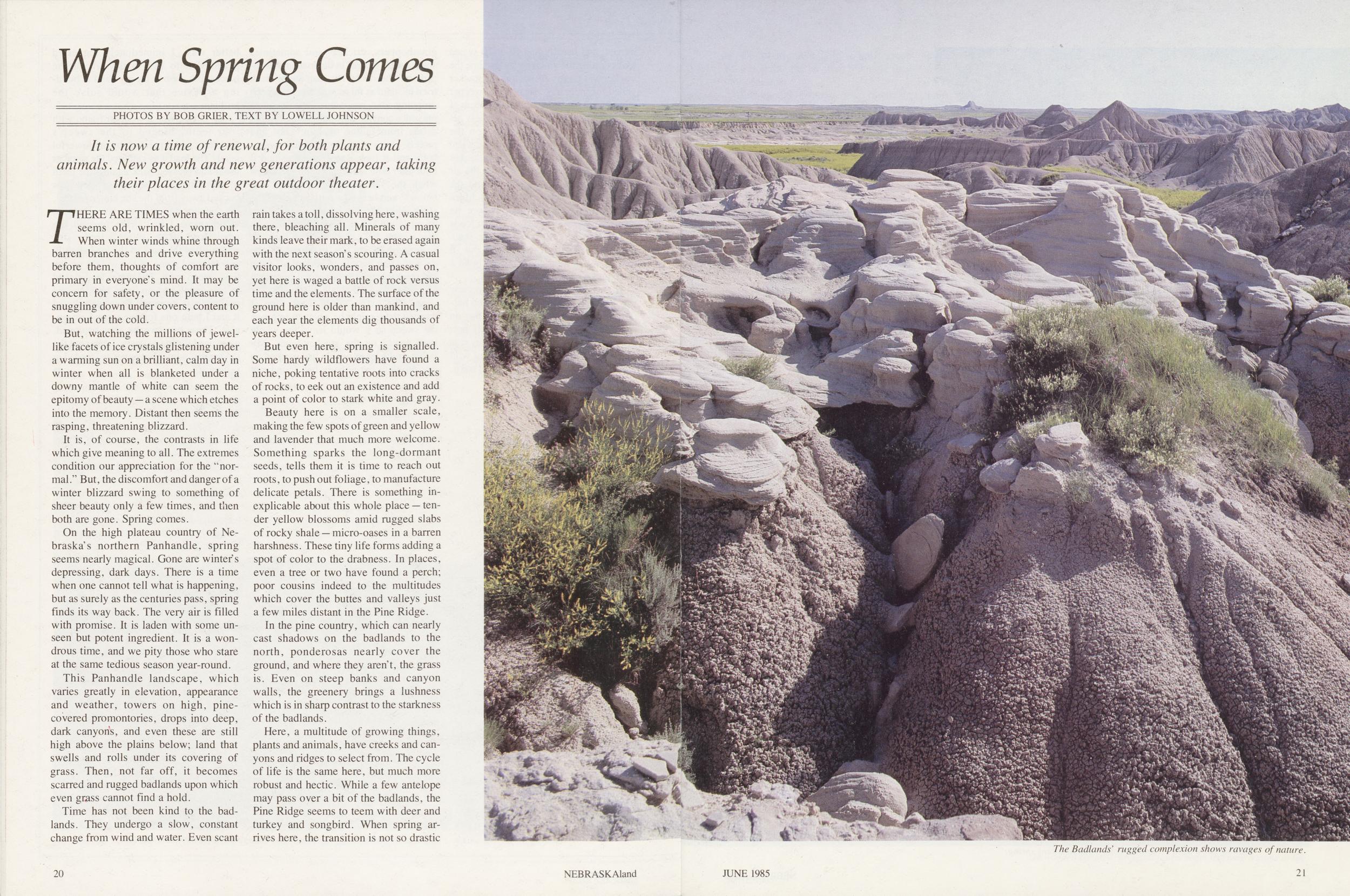
This Panhandle landscape, which varies greatly in elevation, appearance and weather, towers on high, pinecovered promontories, drops into deep, dark canyons, and even these are still high above the plains below; land that swells and rolls under its covering of grass. Then, not far off, it becomes scarred and rugged badlands upon which even grass cannot find a hold.
Time has not been kind to the bad- lands. They undergo a slow, constant change from wind and water. Even scant rain takes atoll, dissolving here, washing there, bleaching all. Minerals of many kinds leave their mark, to be erased again with the next season's scouring. A casual visitor looks, wonders, and passes on, yet here is waged a battle of rock versus time and the elements. The surface of the ground here is older than mankind, and each year the elements dig thousands of years deeper.
But even here, spring is signalled. Some hardy wildflowers have found a niche, poking tentative roots into cracks of rocks, to eek out an existence and add a point of color to stark white and gray.
Beauty here is on a smaller scale, making the few spots of green and yellow and lavender that much more welcome. Something sparks the long-dormant seeds, tells them it is time to reach out roots, to push out foliage, to manufacture delicate petals. There is something inexplicable about this whole place — tender yellow blossoms amid rugged slabs of rocky shale — micro-oases in a barren harshness. These tiny life forms adding a spot of color to the drabness. In places, even a tree or two have found a perch; poor cousins indeed to the multitudes which cover the buttes and valleys just a few miles distant in the Pine Ridge.
In the pine country, which can nearly cast shadows on the badlands to the north, ponderosas nearly cover the ground, and where they aren't, the grass is. Even on steep banks and canyon walls, the greenery brings a lushness which is in sharp contrast to the starkness of the badlands.
Here, a multitude of growing things, plants and animals, have creeks and canyons and ridges to select from. The cycle of life is the same here, but much more robust and hectic. While a few antelope may pass over a bit of the badlands, the Pine Ridge seems to teem with deer and turkey and songbird. When spring arrives here, the transition is not so drastic as the pines have held a dark green backdrop; but the bustling life more than compensates.
20 NEBRASKAland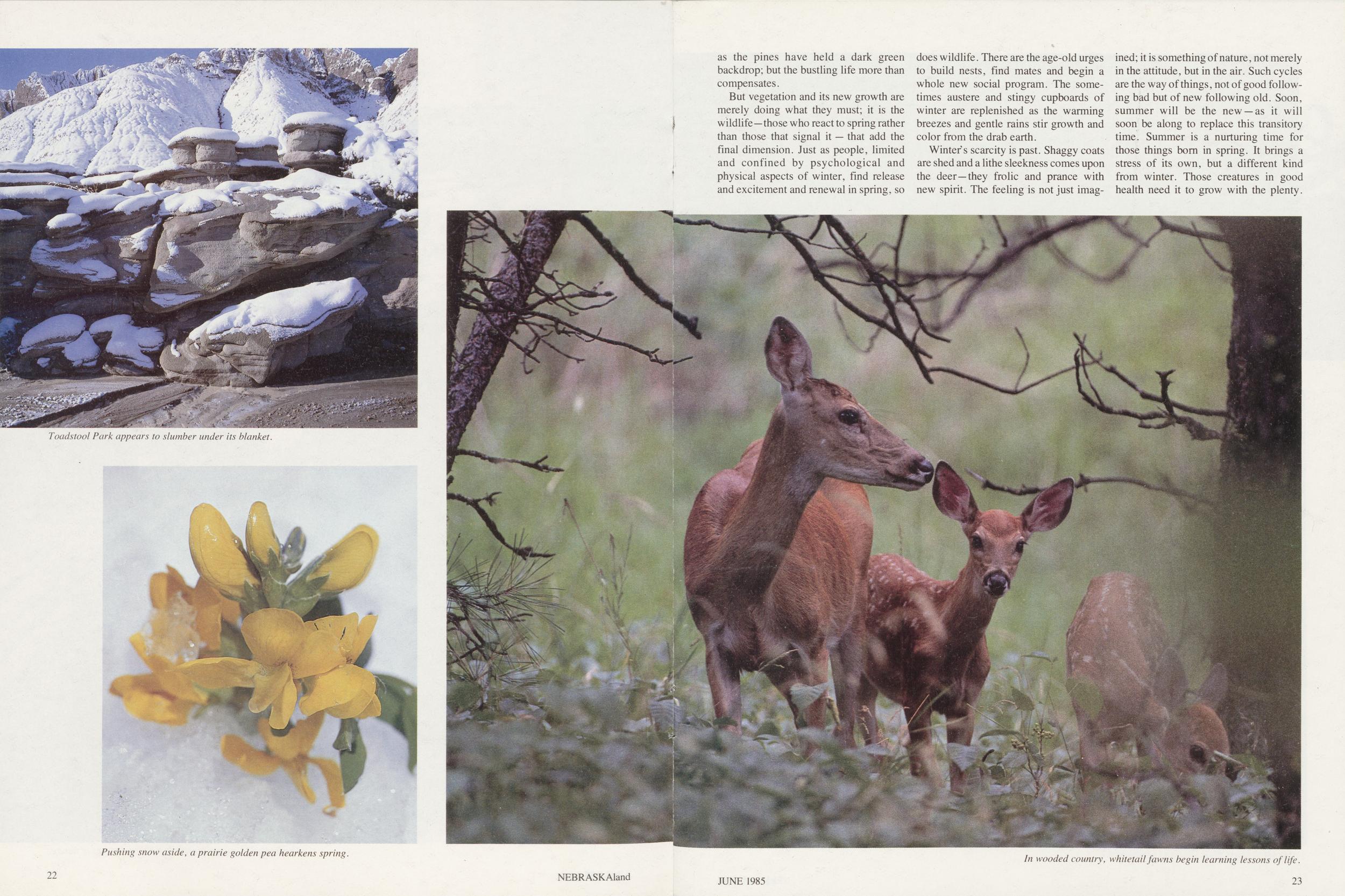
But vegetation and its new growth are merely doing what they must; it is the wildlife—those who react to spring rather than those that signal it — that add the final dimension. Just as people, limited and confined by psychological and physical aspects of winter, find release and excitement and renewal in spring, so does wildlife. There are the age-old urges to build nests, find mates and begin a whole new social program. The sometimes austere and stingy cupboards of winter are replenished as the warming breezes and gentle rains stir growth and color from the drab earth.
Winter's scarcity is past. Shaggy coats are shed and a lithe sleekness comes upon the deer—they frolic and prance with new spirit. The feeling is not just imagined; it is something of nature, not merely in the attitude, but in the air. Such cycles are the way of things, not of good following bad but of new following old. Soon, summer will be the new —as it will soon be along to replace this transitory time. Summer is a nurturing time for those things born in spring. It brings a stress of its own, but a different kind from winter. Those creatures in good health need it to grow with the plenty. Growth of the new generation locks in the survival of all living things, and spring is the key, controlling how many new things arrive.
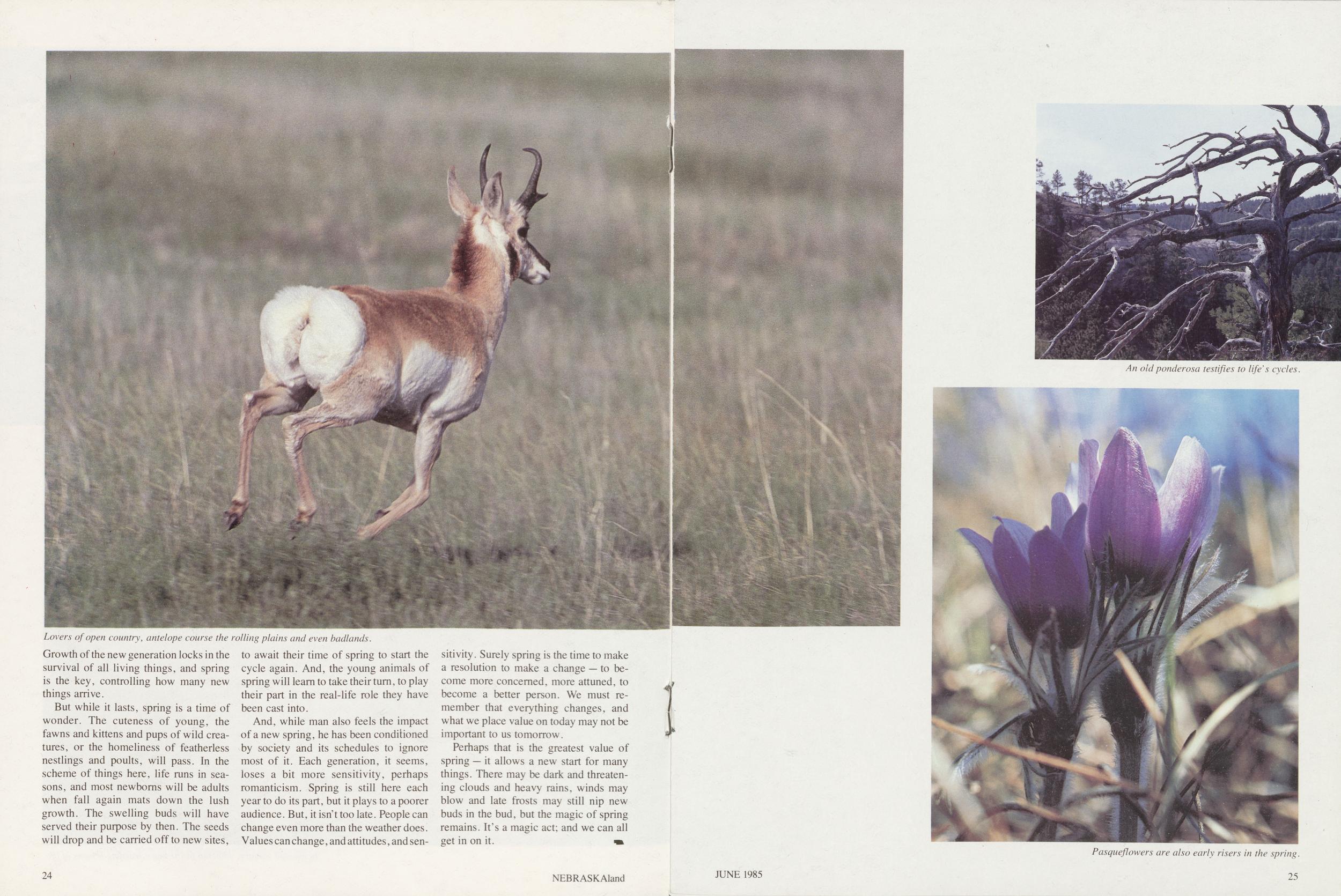
But while it lasts, spring is a time of wonder. The cuteness of young, the fawns and kittens and pups of wild creatures, or the homeliness of featherless nestlings and poults, will pass. In the scheme of things here, life runs in seasons, and most newborns will be adults when fall again mats down the lush growth. The swelling buds will have served their purpose by then. The seeds will drop and be carried off to new sites, to await their time of spring to start the cycle again. And, the young animals of spring will learn to take their turn, to play their part in the real-life role they have been cast into.
And, while man also feels the impact of a new spring, he has been conditioned by society and its schedules to ignore most of it. Each generation, it seems, loses a bit more sensitivity, perhaps romanticism. Spring is still here each year to do its part, but it plays to a poorer audience. But, it isn't too late. People can change even more than the weather does. Values can change, and attitudes, and sensitivity. Surely spring is the time to make a resolution to make a change — to become more concerned, more attuned, to become a better person. We must remember that everything changes, and what we place value on today may not be important to us tomorrow.
Perhaps that is the greatest value of spring — it allows a new start for many things. There may be dark and threatening clouds and heavy rains, winds may blow and late frosts may still nip new buds in the bud, but the magic of spring remains. It's a magic act; and we can all get in on it.
24 NEBRASKAland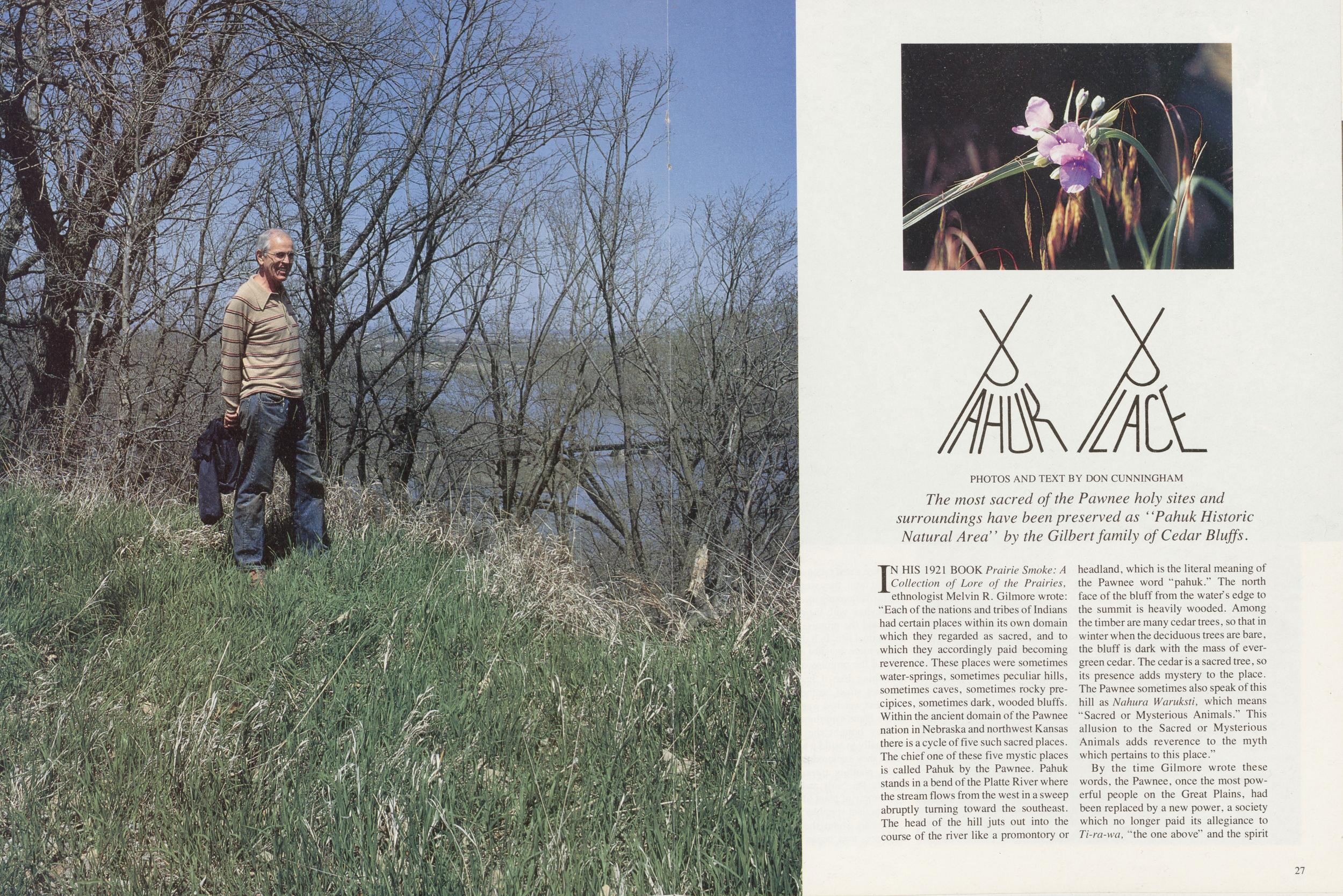
PAHUK PLACE
PHOTOS AND TEXT BY DON CUNNINGHAM The most sacred of the Pawnee holy sites and surroundings have been preserved as ' 'Pahuk Historic Natural Area' by the Gilbert family of Cedar Bluffs.IN HIS 1921 BOOK Prairie Smoke: A Collection of Lore of the Prairies, ethnologist Melvin R. Gilmore wrote: "Each of the nations and tribes of Indians had certain places within its own domain which they regarded as sacred, and to which they accordingly paid becoming reverence. These places were sometimes water-springs, sometimes peculiar hills, sometimes caves, sometimes rocky precipices, sometimes dark, wooded bluffs. Within the ancient domain of the Pawnee nation in Nebraska and northwest Kansas there is a cycle of five such sacred places. The chief one of these five mystic places is called Pahuk by the Pawnee. Pahuk stands in a bend of the Platte River where the stream flows from the west in a sweep abruptly turning toward the southeast. The head of the hill juts out into the course of the river like a promontory or headland, which is the literal meaning of the Pawnee word "pahuk." The north face of the bluff from the water's edge to the summit is heavily wooded. Among the timber are many cedar trees, so that in winter when the deciduous trees are bare, the bluff is dark with the mass of evergreen cedar. The cedar is a sacred tree, so its presence adds mystery to the place. The Pawnee sometimes also speak of this hill as Nahura Waruksti, which means "Sacred or Mysterious Animals." This allusion to the Sacred or Mysterious Animals adds reverence to the myth which pertains to this place."
By the time Gilmore wrote these words, the Pawnee, once the most powerful people on the Great Plains, had been replaced by a new power, a society which no longer paid its allegiance to Ti-ra-wa, "the one above" and the spirit animals — Nahu-rac — who dwelt at Pahuk. Instead, they looked more to the State Legislature and the Omaha grain market, and the holy hill Pahuk had become a cornfield. It was no longer the "place of the sacred animals" described to Gilmore by his Pawnee informants, but was instead designated as ''township 17 north, range 7 east, section 22, Saunders County, Nebraska."
JUNE 1985 27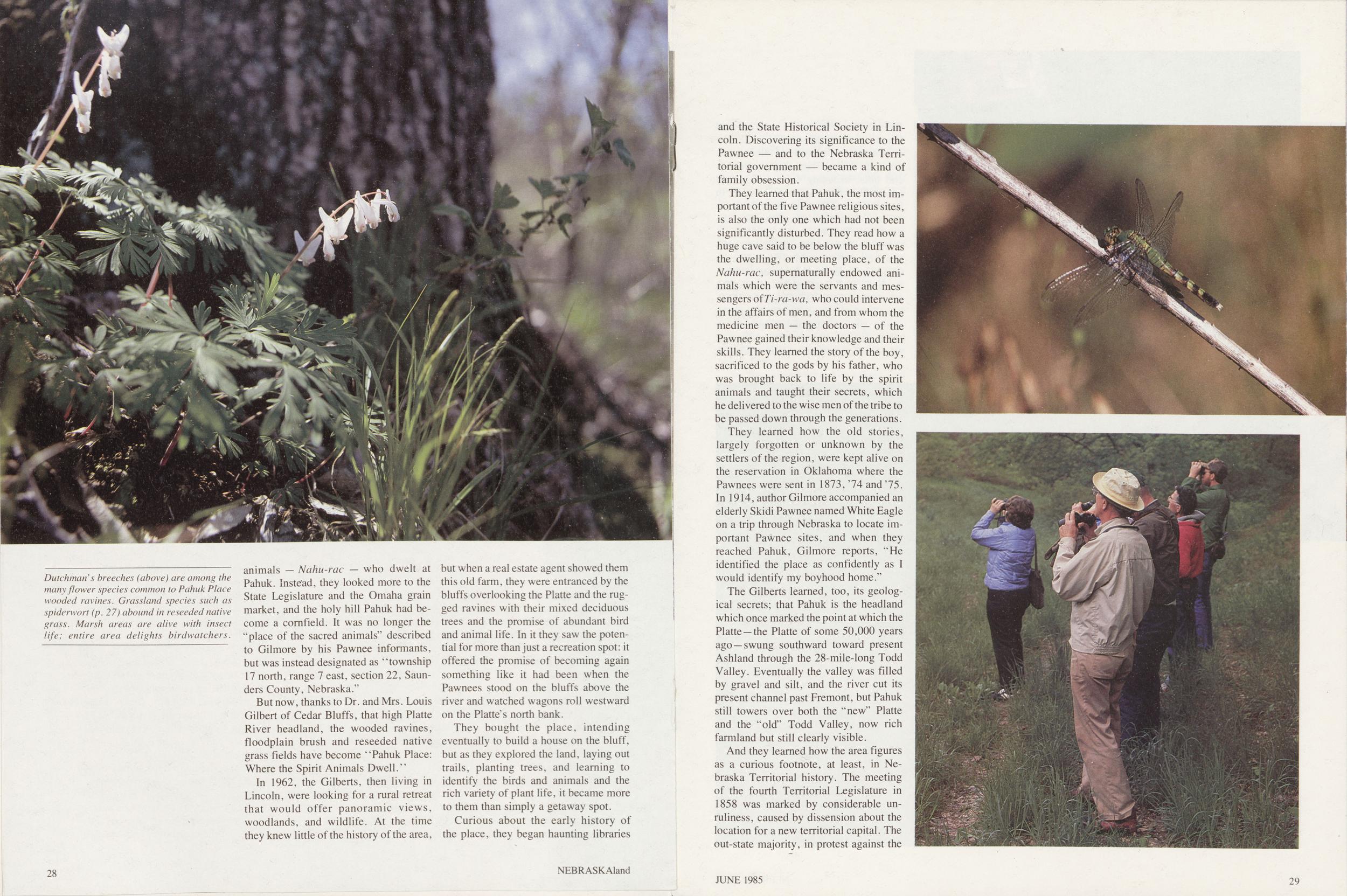
But now, thanks to Dr. and Mrs. Louis Gilbert of Cedar Bluffs, that high Platte River headland, the wooded ravines, floodplain brush and reseeded native grass fields have become ' 'Pahuk Place: Where the Spirit Animals Dwell.'
In 1962, the Gilberts, then living in Lincoln, were looking for a rural retreat that would offer panoramic views, woodlands, and wildlife. At the time they knew little of the history of the area, but when a real estate agent showed them this old farm, they were entranced by the bluffs overlooking the Platte and the rugged ravines with their mixed deciduous trees and the promise of abundant bird and animal life. In it they saw the potential for more than just a recreation spot: it offered the promise of becoming again something like it had been when the Pawnees stood on the bluffs above the river and watched wagons roll westward on the Platte's north bank.
They bought the place, intending eventually to build a house on the bluff, but as they explored the land, laying out trails, planting trees, and learning to identify the birds and animals and the rich variety of plant life, it became more to them than simply a getaway spot.
Curious about the early history of the place, they began haunting libraries 28 NEBRASKAland and the State Historical Society in Lincoln. Discovering its significance to the Pawnee — and to the Nebraska Territorial government — became a kind of family obsession.
They learned that Pahuk, the most important of the five Pawnee religious sites, is also the only one which had not been significantly disturbed. They read how a huge cave said to be below the bluff was the dwelling, or meeting place, of the Nahu-rac, supernaturally endowed animals which were the servants and messengers of Ti-ra-wa, who could intervene in the affairs of men, and from whom the medicine men — the doctors — of the Pawnee gained their knowledge and their skills. They learned the story of the boy, sacrificed to the gods by his father, who was brought back to life by the spirit animals and taught their secrets, which he delivered to the wise men of the tribe to be passed down through the generations.
They learned how the old stories, largely forgotten or unknown by the settlers of the region, were kept alive on the reservation in Oklahoma where the Pawnees were sent in 1873, '74 and '75. In 1914, author Gilmore accompanied an elderly Skidi Pawnee named White Eagle on a trip through Nebraska to locate important Pawnee sites, and when they reached Pahuk, Gilmore reports, "He identified the place as confidently as I would identify my boyhood home."
The Gilberts learned, too, its geological secrets; that Pahuk is the headland which once marked the point at which the Platte —the Platte of some 50,000 years ago —swung southward toward present Ashland through the 28- mile-long Todd Valley. Eventually the valley was filled by gravel and silt, and the river cut its present channel past Fremont, but Pahuk still towers over both the "new" Platte and the "old" Todd Valley, now rich farmland but still clearly visible.
And they learned how the area figures
as a curious footnote, at least, in Nebraska Territorial history. The meeting
of the fourth Territorial Legislature in
1858 was marked by considerable unruliness, caused by dissension about the
location for a new territorial capital. The
out-state majority, in protest against the
JUNE 1985
29
 Douglas County faction who wanted
Omaha to remain the state capital, left the
session and reconvened in Florence, just
north of Omaha. There they passed several bills, including one which would
establish the new capital at a townsite to
be called Neapolis —and Neapolis was to
be located on the southern slopes of the
bluffs near Pahuk.
Douglas County faction who wanted
Omaha to remain the state capital, left the
session and reconvened in Florence, just
north of Omaha. There they passed several bills, including one which would
establish the new capital at a townsite to
be called Neapolis —and Neapolis was to
be located on the southern slopes of the
bluffs near Pahuk.
But the ebb and flow of frontier politics kept what is now the Gilbert's wood-and-solar-heated remodeled farmhouse from becoming the parking lot for a state capitol building. The "Florence Session" of the legislature was declared void, and speculators and the few settlers who had come to the site moved on, leaving only the rather optimistic 30 NEBRASKAland nickname, ''Capitol Hill' behind them.
But perhaps as important to the Gilberts as the history of the land they had acquired was its natural history, the seasonal cycle of plant and animal life that, in spite of the changes worked on the land by generations of farmers, formed a direct link with the Pahuk of the past. Remnants of native prairie remained, and the possibility of restoring the entire site to very nearly what it once had been seemed a goal that would be not only personally satisfying, but valuable, as well, as undisturbed natural areas become rarer and rarer, and as we become more and more remote from the wilderness that supported our forefathers and the generations of Native Americans before them.
So, the Gilberts set out on a three-fold plan. Instead of building a new house up on the bluffs, they began to remodel the old farmhouse, and now live on the property. With the help of Emiel Christensen of Columbus, a trail and site plan was prepared which would allow trails to be laid out through the property, providing access and good views without interrupting the natural feel of the landscape or interfering with landforms. It was Christensen, too, who designed the "Pahuk Place' logo, which was used here in the title.
Finally, they commissioned A. T. Harrison, Ph.D., as ecological consultant, to develop an area inventory and master plan for forest and prairie management and restoration. Completed in 1984, this manuscript can be seen at the Nebraska State Historical Society.
Along the way, some additional recognition came to the Gilberts and their property. In 1973, the site was nominated and accepted for the National Register of Historic Places. In 1982, the Gilberts received the Nebraska Outstanding Tree Farmer Award sponsored by the American Forest Institute and the Nebraska Tree Program. Finally, in 1983, a preservation easement was negotiated with the Nebraska State Historical Society, which ensures that the Pahuk Historic Natural Area will never be disturbed.
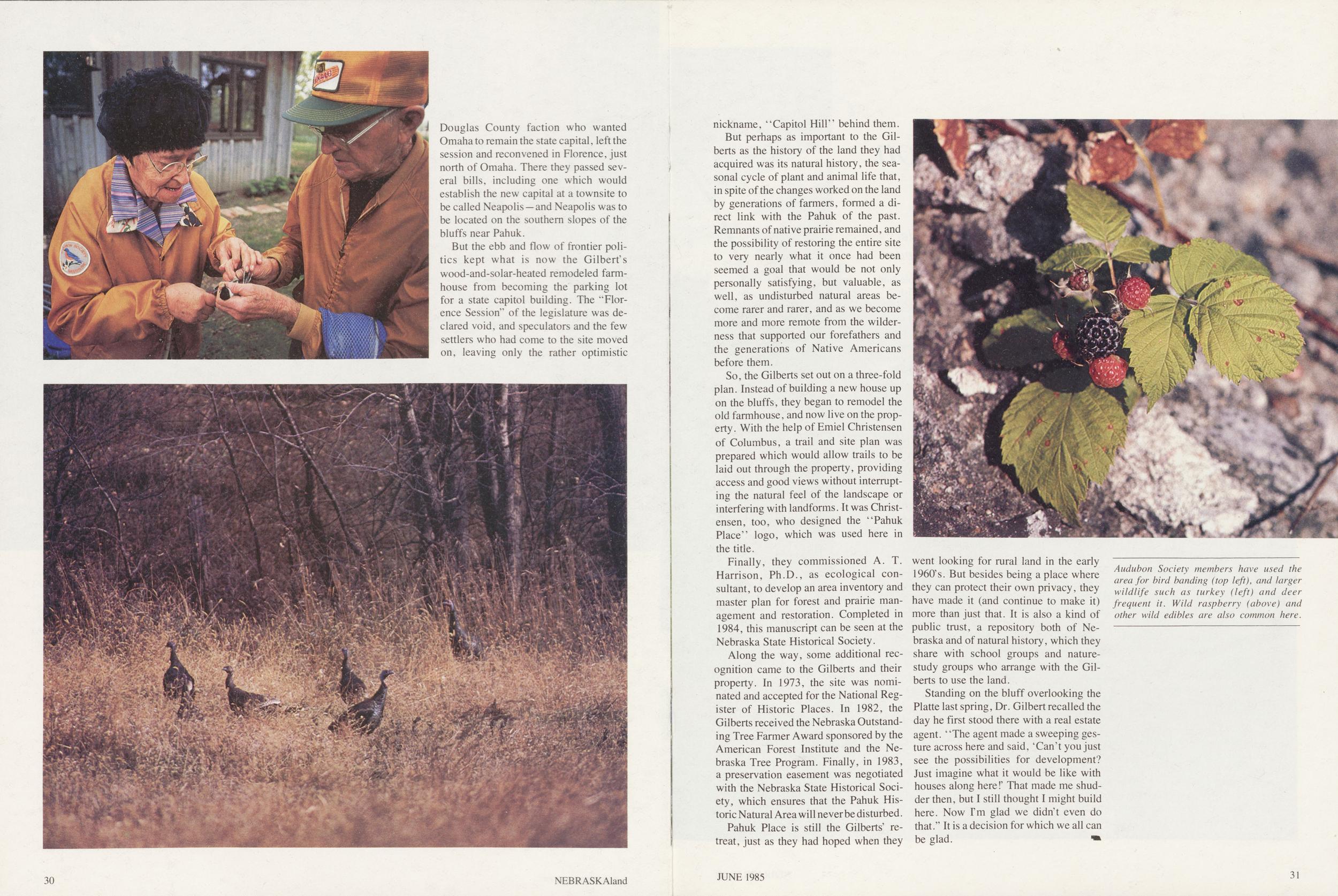
Pahuk Place is still the Gilberts' retreat, just as they had hoped when they went looking for rural land in the early 1960's. But besides being a place where they can protect their own privacy, they have made it (and continue to make it) more than just that. It is also a kind of public trust, a repository both of Nebraska and of natural history, which they share with school groups and naturestudy groups who arrange with the Gilberts to use the land.
Standing on the bluff overlooking the Platte last spring, Dr. Gilbert recalled the day he first stood there with a real estate agent. "The agent made a sweeping gesture across here and said, 'Can't you just see the possibilities for development? Just imagine what it would be like with houses along here!' That made me shudder then, but I still thought I might build here. Now I'm glad we didn't even do that." It is a decision for which we all can be glad.
The Crappie Connection
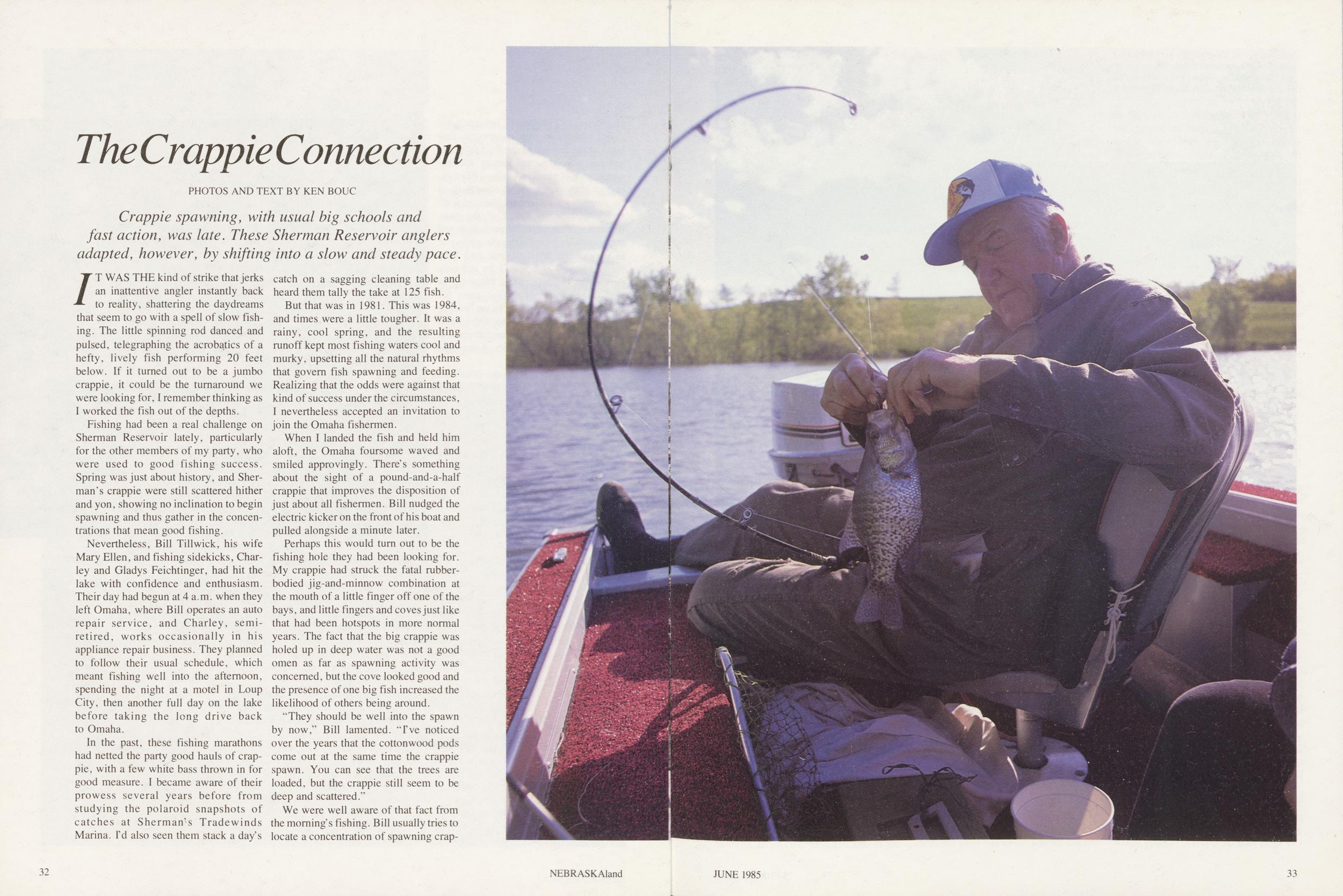
PHOTOS AND TEXT BY KEN BOUC Crappie spawning, with usual big schools and fast action, was late. These Sherman Reservoir anglers adapted, however, by shifting into a slow and steady pace.it WAS THE kind of strike that jerks an inattentive angler instantly back to reality, shattering the daydreams that seem to go with a spell of slow fishing. The little spinning rod danced and pulsed, telegraphing the acrobatics of a hefty, lively fish performing 20 feet below. If it turned out to be a jumbo crappie, it could be the turnaround we were looking for, I remember thinking as I worked the fish out of the depths.
Fishing had been a real challenge on Sherman Reservoir lately, particularly for the other members of my party, who were used to good fishing success. Spring was just about history, and Sherman's crappie were still scattered hither and yon, showing no inclination to begin spawning and thus gather in the concentrations that mean good fishing.
Nevertheless, Bill Tillwick, his wife Mary Ellen, and fishing sidekicks, Charley and Gladys Feichtinger, had hit the lake with confidence and enthusiasm. Their day had begun at 4 a.m. when they left Omaha, where Bill operates an auto repair service, and Charley, semiretired, works occasionally in his appliance repair business. They planned to follow their usual schedule, which meant fishing well into the afternoon, spending the night at a motel in Loup City, then another full day on the lake before taking the long drive back to Omaha.
In the past, these fishing marathons had netted the party good hauls of crappie, with a few white bass thrown in for good measure. I became aware of their prowess several years before from studying the polaroid snapshots of catches at Sherman's Tradewinds Marina. I'd also seen them stack a day's catch on a sagging cleaning table and heard them tally the take at 125 fish.
But that was in 1981. This was 1984, and times were a little tougher. It was a rainy, cool spring, and the resulting runoff kept most fishing waters cool and murky, upsetting all the natural rhythms that govern fish spawning and feeding. Realizing that the odds were against that kind of success under the circumstances, I nevertheless accepted an invitation to join the Omaha fishermen.
When I landed the fish and held him aloft, the Omaha foursome waved and smiled approvingly. There's something about the sight of a pound-and-a-half crappie that improves the disposition of just about all fishermen. Bill nudged the electric kicker on the front of his boat and pulled alongside a minute later.
Perhaps this would turn out to be the fishing hole they had been looking for. My crappie had struck the fatal rubberbodied jig-and-minnow combination at the mouth of a little finger off one of the bays, and little fingers and coves just like that had been hotspots in more normal years. The fact that the big crappie was holed up in deep water was not a good omen as far as spawning activity was concerned, but the cove looked good and the presence of one big fish increased the likelihood of others being around.
"They should be well into the spawn by now," Bill lamented. "Tve noticed over the years that the cottonwood pods come out at the same time the crappie spawn. You can see that the trees are loaded, but the crappie still seem to be deep and scattered."
We were well aware of that fact from the morning's fishing. Bill usually tries to locate a concentration of spawning crap pie by humming along slowly with the electric motor while he and the others cast to flooded brushpiles, weedbeds and other potential hangouts, or simply troll the deeper water a few feet away from the edges of cover. But the morning had been all humming, casting and trolling, and only infrequent catching. Nothing resembling a concentration had been detected. Some of the fish came from the deeper water, others from the cover.
32 NEBRASKAland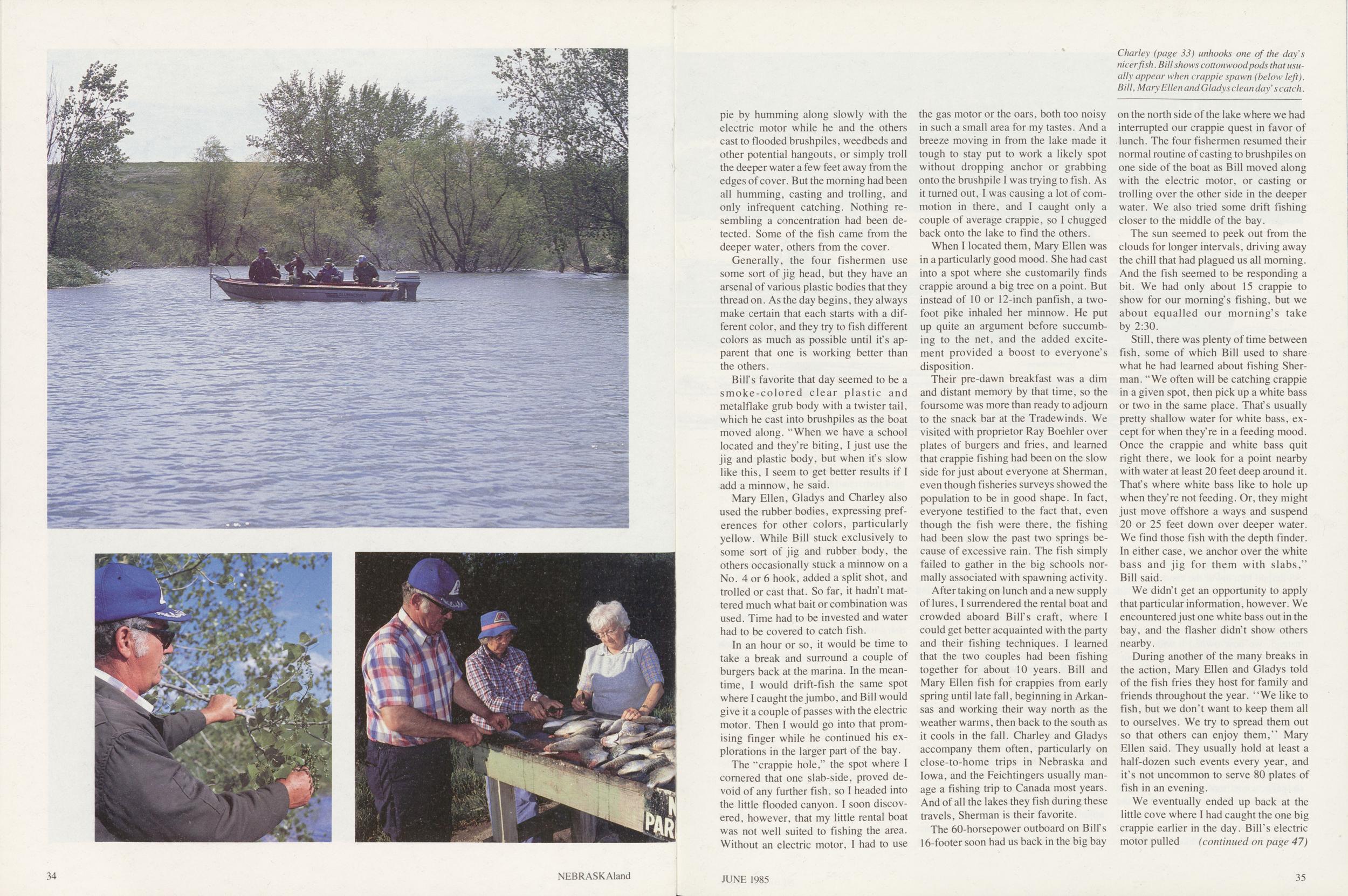
Generally, the four fishermen use some sort of jig head, but they have an arsenal of various plastic bodies that they thread on. As the day begins, they always make certain that each starts with a different color, and they try to fish different colors as much as possible until it's apparent that one is working better than the others.
Bill's favorite that day seemed to be a smoke-colored clear plastic and metalflake grub body with a twister tail, which he cast into brushpiles as the boat moved along. "When we have a school located and they're biting, I just use the jig and plastic body, but when it's slow like this, I seem to get better results if I add a minnow, he said.
Mary Ellen, Gladys and Charley also used the rubber bodies, expressing preferences for other colors, particularly yellow. While Bill stuck exclusively to some sort of jig and rubber body, the others occasionally stuck a minnow on a No. 4 or 6 hook, added a split shot, and trolled or cast that. So far, it hadn't mattered much what bait or combination was used. Time had to be invested and water had to be covered to catch fish.
In an hour or so, it would be time to take a break and surround a couple of burgers back at the marina. In the meantime, I would drift-fish the same spot where I caught the jumbo, and Bill would give it a couple of passes with the electric motor. Then I would go into that promising finger while he continued his explorations in the larger part of the bay.
The "crappie hole," the spot where I cornered that one slab-side, proved devoid of any further fish, so I headed into the little flooded canyon. I soon discovered, however, that my little rental boat was not well suited to fishing the area. Without an electric motor, I had to use the gas motor or the oars, both too noisy in such a small area for my tastes. And a breeze moving in from the lake made it tough to stay put to work a likely spot without dropping anchor or grabbing onto the brushpile I was trying to fish. As it turned out, I was causing a lot of commotion in there, and I caught only a couple of average crappie, so I chugged back onto the lake to find the others.
When I located them, Mary Ellen was in a particularly good mood. She had cast into a spot where she customarily finds crappie around a big tree on a point. But instead of 10 or 12-inch panfish, a two-foot pike inhaled her minnow. He put up quite an argument before succumbing to the net, and the added excitement provided a boost to everyone's disposition.
Their pre-dawn breakfast was a dim and distant memory by that time, so the foursome was more than ready to adjourn to the snack bar at the Tradewinds. We visited with proprietor Ray Boehler over plates of burgers and fries, and learned that crappie fishing had been on the slow side for just about everyone at Sherman, even though fisheries surveys showed the population to be in good shape. In fact, everyone testified to the fact that, even though the fish were there, the fishing had been slow the past two springs because of excessive rain. The fish simply failed to gather in the big schools normally associated with spawning activity.
After taking on lunch and a new supply of lures, I surrendered the rental boat and crowded aboard Bill's craft, where I could get better acquainted with the party and their fishing techniques. I learned that the two couples had been fishing together for about 10 years. Bill and Mary Ellen fish for crappies from early spring until late fall, beginning in Arkansas and working their way north as the weather warms, then back to the south as it cools in the fall. Charley and Gladys accompany them often, particularly on close-to-home trips in Nebraska and Iowa, and the Feichtingers usually manage a fishing trip to Canada most years. And of all the lakes they fish during these travels, Sherman is their favorite.
The 60-horsepower outboard on Bill's 16-footer soon had us back in the big bay on the north side of the lake where we had interrupted our crappie quest in favor of lunch. The four fishermen resumed their normal routine of casting to brushpiles on one side of the boat as Bill moved along with the electric motor, or casting or trolling over the other side in the deeper water. We also tried some drift fishing closer to the middle of the bay.
The sun seemed to peek out from the clouds for longer intervals, driving away the chill that had plagued us all morning. And the fish seemed to be responding a bit. We had only about 15 crappie to show for our morning's fishing, but we about equalled our morning's take by 2:30.
Still, there was plenty of time between fish, some of which Bill used to share what he had learned about fishing Sherman. "We often will be catching crappie in a given spot, then pick up a white bass or two in the same place. That's usually pretty shallow water for white bass, ecept for when they're in a feeding mood. Once the crappie and white bass quit right there, we look for a point nearby with water at least 20 feet deep around it. That's where white bass like to hole up when they're not feeding. Or, they might just move offshore a ways and suspend 20 or 25 feet down over deeper water. We find those fish with the depth finder. In either case, we anchor over the white bass and jig for them with slabs, Bill said.
We didn't get an opportunity to apply that particular information, however. We encountered just one white bass out in the bay, and the flasher didn't show others nearby.
During another of the many breaks in the action, Mary Ellen and Gladys told of the fish fries they host for family and friends throughout the year. "We like to fish, but we don't want to keep them all to ourselves. We try to spread them out so that others can enjoy them,' Mary Ellen said. They usually hold at least a half-dozen such events every year, and it's not uncommon to serve 80 plates of fish in an evening.
We eventually ended up back at the little cove where I had caught the one big crappie earlier in the day. Bill's electric motor pulled (continued on page 47)
JUNE 1985 35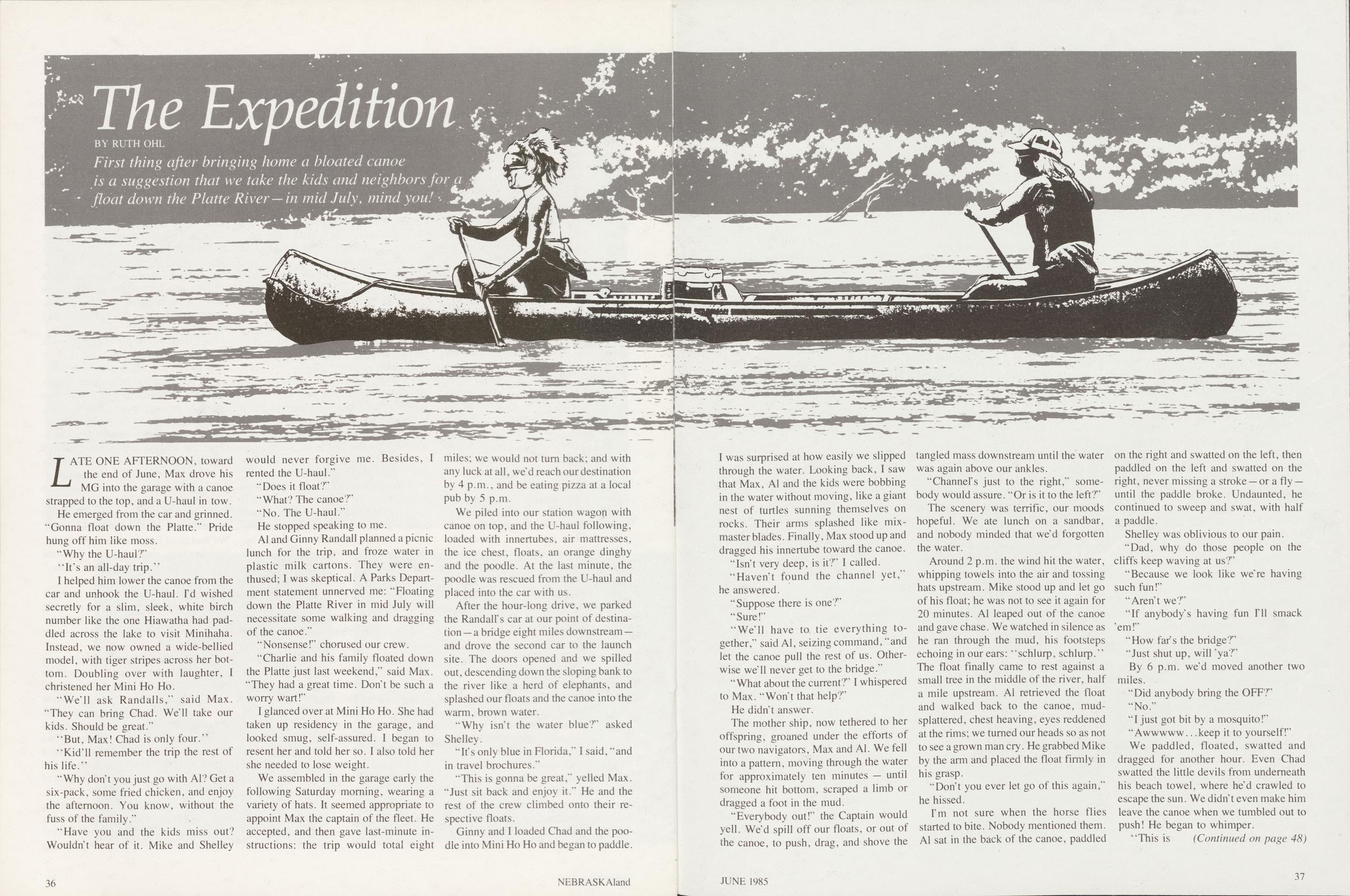
The Expedition
BY RUTH OHL First thing after home a bloated canoe is a suggestion that we take kids and neighbors for a float doen the Platte River—in mid July, mind you!LATE ONE AFTERNOON, toward the end of June, Max drove his MG into the garage with a canoe strapped to the top, and a U-haul in tow.
He emerged from the car and grinned. "Gonna float down the Platte." Pride hung off him like moss.
"Why the U-haul?"
"It's an all-day trip."
I helped him lower the canoe from the car and unhook the U-haul. Yd wished secretly for a slim, sleek, white birch number like the one Hiawatha had paddled across the lake to visit Minihaha. Instead, we now owned a wide-bellied model, with tiger stripes across her bottom. Doubling over with laughter, I christened her Mini Ho Ho.
"We'll ask Randalls/' said Max. "They can bring Chad. We 11 take our kids. Should be great."
4 But, Max! Chad is only four."
"Kid111 remember the trip the rest of his life."
"Why don t you just go with Al? Get a six-pack, some fried chicken, and enjoy the afternoon. You know, without the fuss of the family."
"Have you and the kids miss out? Wouldn't hear of it. Mike and Shelley would never forgive me. Besides, I rented the U-haul."
"Does it float?"
"What? The canoe?"
"No. The U-haul."
He stopped speaking to me.
Al and Ginny Randall planned a picnic lunch for the trip, and froze water in plastic milk cartons. They were enthused; I was skeptical. A Parks Department statement unnerved me: "Floating down the Platte River in mid July will necessitate some walking and dragging of the canoe."
"Nonsense!" chorused our crew.
"Charlie and his family floated down the Platte just last weekend," said Max. "They had a great time. Don't be such a worry wart!"
I glanced over at Mini Ho Ho. She had taken up residency in the garage, and looked smug, self-assured. I began to resent her and told her so. I also told her she needed to lose weight.
We assembled in the garage early the following Saturday morning, wearing a variety of hats. It seemed appropriate to appoint Max the captain of the fleet. He accepted, and then gave last-minute instructions: the trip would total eight miles; we would not turn back; and with any luck at all, we'd reach our destination by 4 p.m., and be eating pizza at a local pub by 5 p.m.
We piled into our station wagon with canoe on top, and the U-haul following, loaded with innertubes, air mattresses, the ice chest, floats, an orange dinghy and the poodle. At the last minute, the poodle was rescued from the U-haul and placed into the car with us.
After the hour-long drive, we parked the Randall's car at our point of destination — a bridge eight miles downstream — and drove the second car to the launch site. The doors opened and we spilled out, descending down the sloping bank to the river like a herd of elephants, and splashed our floats and the canoe into the warm, brown water.
"Why isn't the water blue?" asked Shelley.
"It's only blue in Florida," I said, "and in travel brochures."
"This is gonna be great," yelled Max. "Just sit back and enjoy it." He and the rest of the crew climbed onto their respective floats.
Ginny and I loaded Chad and the poodle into Mini Ho Ho and began to paddle. 36 NEBRASKAland I was surprised at how easily we slipped through the water. Looking back, I saw that Max, Al and the kids were bobbing in the water without moving, like a giant nest of turtles sunning themselves on rocks. Their arms splashed like mixmaster blades. Finally, Max stood up and dragged his innertube toward the canoe.
"Isn't very deep, is it?" I called.
"Haven't found the channel yet," he answered.
"Suppose there is one?"
"Sure!"
"We'll have to tie everything together," said Al, seizing command, "and let the canoe pull the rest of us. Otherwise we'll never get to the bridge."
"What about the current?" I whispered to Max. "Won't that help?"
He didn't answer.
The mother ship, now tethered to her offspring, groaned under the efforts of our two navigators, Max and Al. We fell into a pattern, moving through the water for approximately ten minutes — until someone hit bottom, scraped a limb or dragged a foot in the mud.
"Everybody out!" the Captain would yell. We'd spill off our floats, or out of the canoe, to push, drag, and shove the tangled mass downstream until the water was again above our ankles.
"Channel's just to the right," somebody would assure. "Or is it to the left?"
The scenery was terrific, our moods hopeful. We ate lunch on a sandbar, and nobody minded that we'd forgotten the water.
Around 2p.m. the wind hit the water, whipping towels into the air and tossing hats upstream. Mike stood up and let go of his float; he was not to see it again for 20 minutes. Al leaped out of the canoe and gave chase. We watched in silence as he ran through the mud, his footsteps echoing in our ears: "schlurp, schlurp.' The float finally came to rest against a small tree in the middle of the river, half a mile upstream. Al retrieved the float and walked back to the canoe, mudsplattered, chest heaving, eyes reddened at the rims; we turned our heads so as not to see a grown man cry. He grabbed Mike by the arm and placed the float firmly in his grasp.
"Don't you ever let go of this again," he hissed.
I'm not sure when the horse flies started to bite. Nobody mentioned them. Al sat in the back of the canoe, paddled on the right and swatted on the left, then paddled on the left and swatted on the right, never missing a stroke — or a fly — until the paddle broke. Undaunted, he continued to sweep and swat, with half a paddle.
Shelley was oblivious to our pain.
"Dad, why do those people on the cliffs keep waving at us?"
'Because we look like we're having such fun!"
"Aren't we?"
"If anybody's having fun I'll smack 'em!"
"How far's the bridge?"
"Just shut up, will 'ya?"
By 6 p.m. we'd moved another two miles.
"Did anybody bring the OFF?"
"No."
"I just got bit by a mosquito!"
"Awwwww.. .keep it to yourself!"
We paddled, floated, swatted and dragged for another hour. Even Chad swatted the little devils from underneath his beach towel, where he'd crawled to escape the sun. We didn't even make him leave the canoe when we tumbled out to push! He began to whimper.
"This is (Continued on page 48)
JUNE 1985 37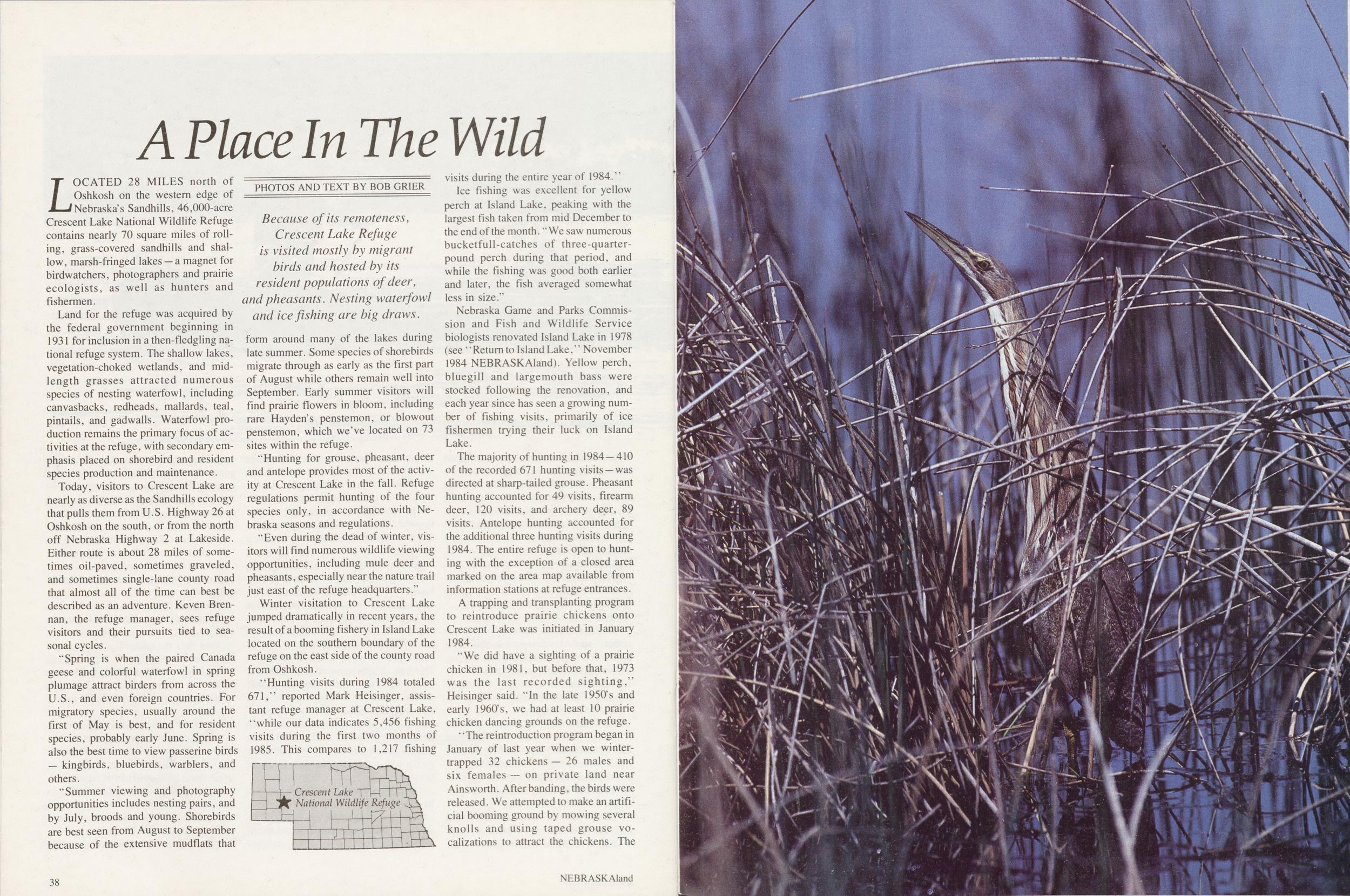
A Place In The Wild
PHOTOS AND TEXT BY BOB GRIER Because of its remoteness, Crescent Lake Refuge is visited mostly by migrant birds and hosted by its resident populations of deer, and pheasants. Nesting waterfowl and ice fishing are big draws.LOCATED 28 MILES north of Oshkosh on the western edge of Nebraska's Sandhills, 46,000-acre Crescent Lake National Wildlife Refuge contains nearly 70 square miles of rolling, grass-covered sandhills and shallow , marsh-fringed lakes — a magnet for birdwatchers, photographers and prairie ecologists, as well as hunters and fishermen.
Land for the refuge was acquired by the federal government beginning in 1931 for inclusion in a then-fledgling national refuge system. The shallow lakes, vegetation-choked wetlands, and midlength grasses attracted numerous species of nesting waterfowl, including canvasbacks, redheads, mallards, teal, pintails, and gad walls. Waterfowl production remains the primary focus of activities at the refuge, with secondary emphasis placed on shorebird and resident species production and maintenance.
Today, visitors to Crescent Lake are nearly as diverse as the Sandhills ecology that pulls them from U.S. Highway 26 at Oshkosh on the south, or from the north off Nebraska Highway 2 at Lakeside. Either route is about 28 miles of sometimes oil-paved, sometimes graveled, and sometimes single-lane county road that almost all of the time can best be described as an adventure. Keven Brennan, the refuge manager, sees refuge visitors and their pursuits tied to seasonal cycles.
"Spring is when the paired Canada geese and colorful waterfowl in spring plumage attract birders from across the U.S., and even foreign countries. For migratory species, usually around the first of May is best, and for resident species, probably early June. Spring is also the best time to view passerine birds — kingbirds, bluebirds, warblers, and others.
"Summer viewing and photography opportunities includes nesting pairs, and by July, broods and young. Shorebirds are best seen from August to September because of the extensive mudflats that form around many of the lakes during late summer. Some species of shorebirds migrate through as early as the first part of August while others remain well into September. Early summer visitors will find prairie flowers in bloom, including rare Hay den's penstemon, or blowout penstemon, which we've located on 73 sites within the refuge.
"Hunting for grouse, pheasant, deer and antelope provides most of the activity at Crescent Lake in the fall. Refuge regulations permit hunting of the four species only, in accordance with Nebraska seasons and regulations.
"Even during the dead of winter, visitors will find numerous wildlife viewing opportunities, including mule deer and pheasants, especially near the nature trail just east of the refuge headquarters."
Winter visitation to Crescent Lake jumped dramatically in recent years, the result of a booming fishery in Island Lake located on the southern boundary of the refuge on the east side of the county road from Oshkosh.
''Hunting visits during 1984 totaled 671,' reported Mark Heisinger, assistant refuge manager at Crescent Lake, "while our data indicates 5,456 fishing visits during the first two months of 1985. This compares to 1,217 fishing visits during the entire year of 1984."
Ice fishing was excellent for yellow perch at Island Lake, peaking with the largest fish taken from mid December to the end of the month. "We saw numerous bucketfull-catches of three-quarterpound perch during that period, and while the fishing was good both earlier and later, the fish averaged somewhat less in size."
Nebraska Game and Parks Commission and Fish and Wildlife Service biologists renovated Island Lake in 1978 (see '' Return to Island Lake,'' November 1984 NEBRASKAland). Yellow perch, bluegill and largemouth bass were stocked following the renovation, and each year since has seen a growing number of fishing visits, primarily of ice fishermen trying their luck on Island Lake.
The majority of hunting in 1984—410 of the recorded 671 hunting visits —was directed at sharp-tailed grouse. Pheasant hunting accounted for 49 visits, firearm deer, 120 visits, and archery deer, 89 visits. Antelope hunting accounted for the additional three hunting visits during 1984. The entire refuge is open to hunting with the exception of a closed area marked on the area map available from information stations at refuge entrances.
A trapping and transplanting program to reintroduce prairie chickens onto Crescent Lake was initiated in January 1984.
"We did have a sighting of a prairie chicken in 1981, but before that, 1973 was the last recorded sighting," Heisinger said. "In the late 1950's and early 1960's, we had at least 10 prairie chicken dancing grounds on the refuge.
"The reintroduction program began in January of last year when we winter- trapped 32 chickens — 26 males and six females -- on private land near Ainsworth. After banding, the birds were released. We attempted to make an artificial booming ground by mowing several knolls and using taped grouse vocalizations to attract the chickens. The birds did inspect the artificial grounds, but established their own booming grounds about a mile away.
38 NEBRASKAland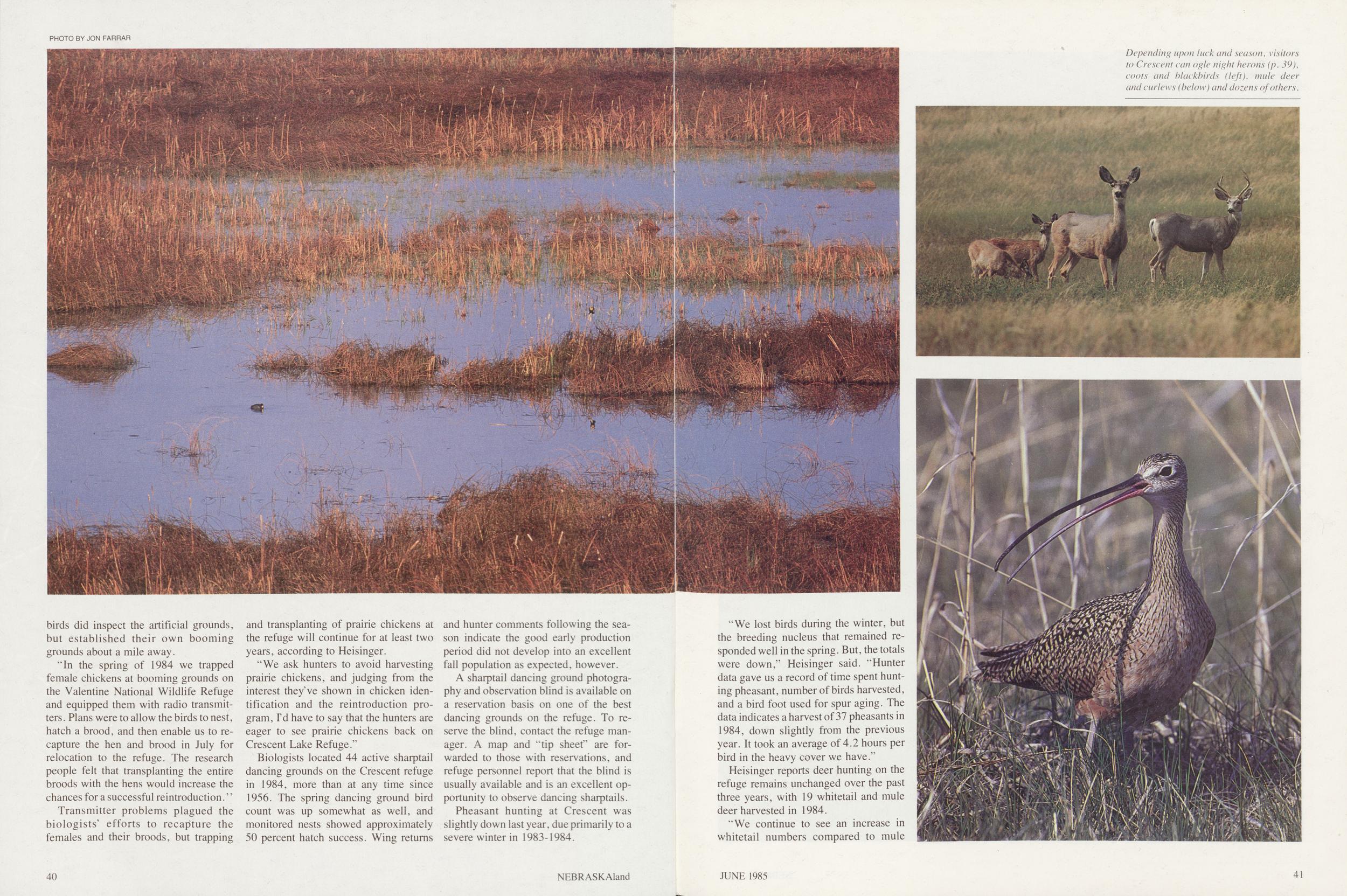
"In the spring of 1984 we trapped female chickens at booming grounds on the Valentine National Wildlife Refuge and equipped them with radio transmitters. Plans were to allow the birds to nest, hatch a brood, and then enable us to recapture the hen and brood in July for relocation to the refuge. The research people felt that transplanting the entire broods with the hens would increase the chances for a successful reintroduction."
Transmitter problems plagued the biologists' efforts to recapture the females and their broods, but trapping and transplanting of prairie chickens at the refuge will continue for at least two years, according to Heisinger.
"We ask hunters to avoid harvesting prairie chickens, and judging from the interest they've shown in chicken identification and the reintroduction program, Fd have to say that the hunters are eager to see prairie chickens back on Crescent Lake Refuge."
Biologists located 44 active sharptail dancing grounds on the Crescent refuge in 1984, more than at any time since 1956. The spring dancing ground bird count was up somewhat as well, and monitored nests showed approximately 50 percent hatch success. Wing returns and hunter comments following the season indicate the good early production period did not develop into an excellent fall population as expected, however.
A sharptail dancing ground photography and observation blind is available on a reservation basis on one of the best dancing grounds on the refuge. To reserve the blind, contact the refuge manager. A map and "tip sheet" are forwarded to those with reservations, and refuge personnel report that the blind is usually available and is an excellent opportunity to observe dancing sharptails.
Pheasant hunting at Crescent was slightly down last year, due primarily to a severe winter in 1983-1984.
40 NEBRASKAland Depending upon luck and season, visitors to Crescent can ogle night herons (p. 39), coots and blackbirds (left), mule deer and curlews (below) and dozens of others."We lost birds during the winter, but the breeding nucleus that remained responded well in the spring. But, the totals were down," Heisinger said. "Hunter data gave us a record of time spent hunting pheasant, number of birds harvested, and a bird foot used for spur aging. The data indicates a harvest of 37 pheasants in 1984, down slightly from the previous year. It took an average of 4.2 hours per bird in the heavy cover we have."
Heisinger reports deer hunting on the refuge remains unchanged over the past three years, with 19 whitetail and mule deer harvested in 1984.
"We continue to see an increase in whitetail numbers compared to mule deer. The refuge is the only large public-hunting area in the Plains Deer Management Unit, and we see fairly heavy hunting pressure. Hunters are not allowed to drive off established trails, and we closed a fair amount of trails in recent years to improve hunting quality."
JUNE 1985 41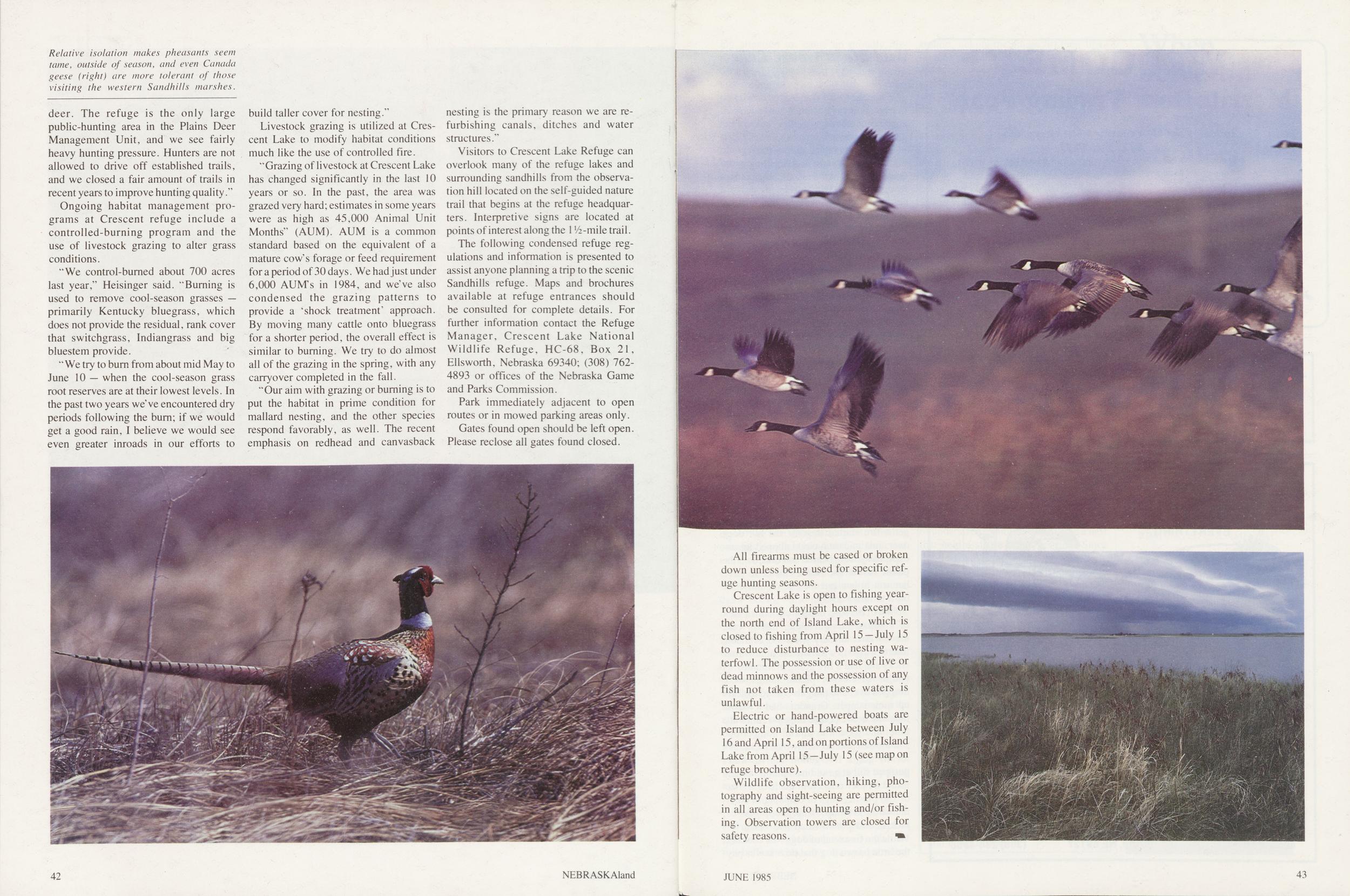 Relative isolation makes pheasants seem
tame, outside of season, and even Canada
geese (right) are more tolerant of those
visiting the western Sandhills marshes.
Relative isolation makes pheasants seem
tame, outside of season, and even Canada
geese (right) are more tolerant of those
visiting the western Sandhills marshes.
Ongoing habitat management programs at Crescent refuge include a controlled-burning program and the use of livestock grazing to alter grass conditions.
"We control-burned about 700 acres last year," Heisinger said. "Burning is used to remove cool-season grasses — primarily Kentucky bluegrass, which does not provide the residual, rank cover that switchgrass, Indiangrass and big bluestem provide.
"We try to burn from about mid May to June 10 — when the cool-season grass root reserves are at their lowest levels. In the past two years we've encountered dry periods following the burn; if we would get a good rain, I believe we would see even greater inroads in our efforts to build taller cover for nesting."
Livestock grazing is utilized at Crescent Lake to modify habitat conditions much like the use of controlled fire.
"Grazing of livestock at Crescent Lake has changed significantly in the last 10 years or so. In the past, the area was grazed very hard; estimates in some years were as high as 45,000 Animal Unit Months" (AUM). AUM is a common standard based on the equivalent of a mature cow's forage or feed requirement for a period of 30 days. We had just under 6,000 AUM's in 1984, and we've also condensed the grazing patterns to provide a 'shock treatment' approach. By moving many cattle onto bluegrass for a shorter period, the overall effect is similar to burning. We try to do almost all of the grazing in the spring, with any carryover completed in the fall.
"Our aim with grazing or burning is to put the habitat in prime condition for mallard nesting, and the other species respond favorably, as well. The recent emphasis on redhead and canvasback nesting is the primary reason we are refurbishing canals, ditches and water structures."
Visitors to Crescent Lake Refuge can overlook many of the refuge lakes and surrounding sandhills from the observation hill located on the self-guided nature trail that begins at the refuge headquarters. Interpretive signs are located at points of interest along the 1 1/2-mile trail.
The following condensed refuge regulations and information is presented to assist anyone planning a trip to the scenic Sandhills refuge. Maps and brochures available at refuge entrances should be consulted for complete details. For further information contact the Refuge Manager, Crescent Lake National Wildlife Refuge, HC-68, Box 21, Ellsworth, Nebraska 69340; (308) 762-4893 or offices of the Nebraska Game and Parks Commission.
Park immediately adjacent to open routes or in mowed parking areas only.
Gates found open should be left open. Please reclose all gates found closed.
All firearms must be cased or broken down unless being used for specific refuge hunting seasons.
Crescent Lake is open to fishing yearround during daylight hours except on the north end of Island Lake, which is closed to fishing from April 15 —July 15 to reduce disturbance to nesting waterfowl. The possession or use of live or dead minnows and the possession of any fish not taken from these waters is unlawful.
Electric or hand-powered boats are permitted on Island Lake between July 16 and April 15, and on portions of Island Lake from April 15—July 15 (see map on refuge brochure).
Wildlife observation, hiking, photography and sight-seeing are permitted in all areas open to hunting and/or fishing. Observation towers are closed for safety reasons.
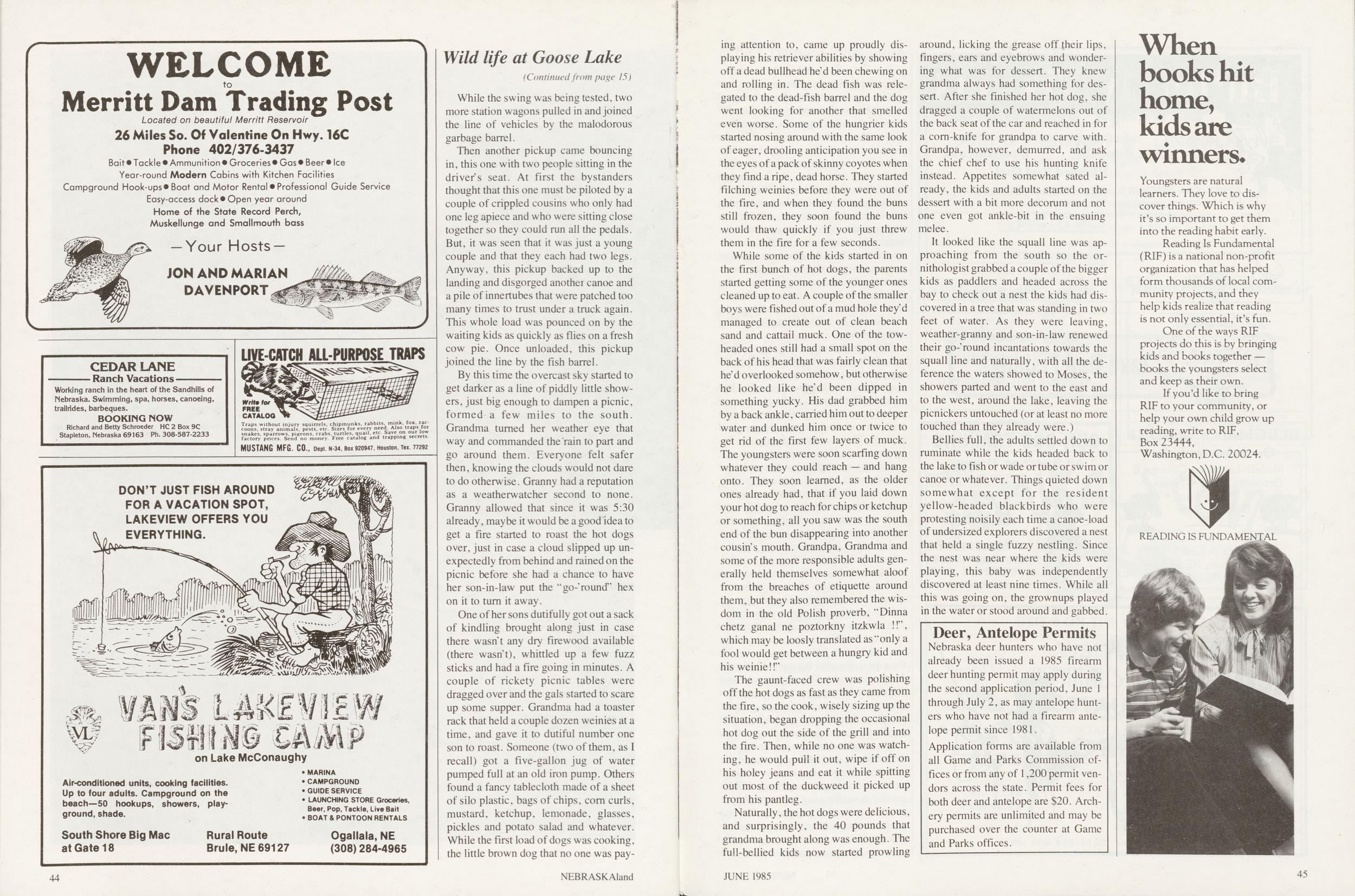 WELCOME
to
Merritt Dam Trading Post
Located on beautiful Merritt Reservoir
26 Miles So. Of Valentine On Hwy. 16C
Phone 402/376-3437
Bait •Tackle •Ammunition •Groceries* Gas* Beer* Ice
Year-round Modern Cabins with Kitchen Facilities
Campground Hook-ups* Boat and Motor Rental • Professional Guide Service
Easy-access dock*Open year around
Home of the State Record Perch,
Muskellunge and Smallmouth bass
— Your Hosts —
JON AND MARIAN
DAVENPORT
CEDAR LANE
- Ranch Vacations •
Working ranch in the heart of the Sandhills of
Nebraska. Swimming, spa, horses, canoeing,
trailrides, barbeques.
BOOKING NOW
Richard and Betty Schroeder HC 2 Box 9C
Stapleton, Nebraska 69163 Ph. 308-587-2233
LIVE-CATCH ALL-PURPOSE TRAPS
Writ
FREE
CATALOG
Traps without injury squirrels, chipmunks, rabbits, mink, fox, raccoons, stray animals,
pests, etc. Sizes for every need. Also traps for
snakes, sparrows, pigeons, crabs, turtles, quail, etc. Save on our low
factory prices Send no money Free catalog and trapping secrets
MUSTANG MFG. CO., Oept. N-34, Box 920947, Houston, Tex. 77292
DON'T JUST FISH AROUND
FOR A VACATION SPOT,
LAKEVIEW OFFERS YOU
EVERYTHING.
on Lake McConaughy
Air-conditioned units, cooking facilities.
Up to four adults. Campground on the
beach—50 hookups, showers, playground, shade.
• MARINA
• CAMPGROUND
•GUIDE SERVICE
• LAUNCHING STORE Groceries,
Beer, Pop, Tackle, Live Bait
• BOAT & PONTOON RENTALS
South Shore Big Mac
at Gate 18
Rural Route
Brule, NE 69127
Ogallala, NE
(308) 284-4965
WELCOME
to
Merritt Dam Trading Post
Located on beautiful Merritt Reservoir
26 Miles So. Of Valentine On Hwy. 16C
Phone 402/376-3437
Bait •Tackle •Ammunition •Groceries* Gas* Beer* Ice
Year-round Modern Cabins with Kitchen Facilities
Campground Hook-ups* Boat and Motor Rental • Professional Guide Service
Easy-access dock*Open year around
Home of the State Record Perch,
Muskellunge and Smallmouth bass
— Your Hosts —
JON AND MARIAN
DAVENPORT
CEDAR LANE
- Ranch Vacations •
Working ranch in the heart of the Sandhills of
Nebraska. Swimming, spa, horses, canoeing,
trailrides, barbeques.
BOOKING NOW
Richard and Betty Schroeder HC 2 Box 9C
Stapleton, Nebraska 69163 Ph. 308-587-2233
LIVE-CATCH ALL-PURPOSE TRAPS
Writ
FREE
CATALOG
Traps without injury squirrels, chipmunks, rabbits, mink, fox, raccoons, stray animals,
pests, etc. Sizes for every need. Also traps for
snakes, sparrows, pigeons, crabs, turtles, quail, etc. Save on our low
factory prices Send no money Free catalog and trapping secrets
MUSTANG MFG. CO., Oept. N-34, Box 920947, Houston, Tex. 77292
DON'T JUST FISH AROUND
FOR A VACATION SPOT,
LAKEVIEW OFFERS YOU
EVERYTHING.
on Lake McConaughy
Air-conditioned units, cooking facilities.
Up to four adults. Campground on the
beach—50 hookups, showers, playground, shade.
• MARINA
• CAMPGROUND
•GUIDE SERVICE
• LAUNCHING STORE Groceries,
Beer, Pop, Tackle, Live Bait
• BOAT & PONTOON RENTALS
South Shore Big Mac
at Gate 18
Rural Route
Brule, NE 69127
Ogallala, NE
(308) 284-4965
Wild life at Goose Lake
(Continued from page 15)While the swing was being tested, two more station wagons pulled in and joined the line of vehicles by the malodorous garbage barrel.
Then another pickup came bouncing in, this one with two people sitting in the drivers seat. At first the bystanders thought that this one must be piloted by a couple of crippled cousins who only had one leg apiece and who were sitting close together so they could run all the pedals. But, it was seen that it was just a young couple and that they each had two legs. Anyway, this pickup backed up to the landing and disgorged another canoe and a pile of innertubes that were patched too many times to trust under a truck again. This whole load was pounced on by the waiting kids as quickly as flies on a fresh cow pie. Once unloaded, this pickup joined the line by the fish barrel.
By this time the overcast sky started to get darker as a line of piddly little showers, just big enough to dampen a picnic, formed a few miles to the south. Grandma turned her weather eye that way and commanded the rain to part and go around them. Everyone felt safer then, knowing the clouds would not dare to do otherwise. Granny had a reputation as a weatherwatcher second to none. Granny allowed that since it was 5:30 already, maybe it would be a good idea to get a fire started to roast the hot dogs over, just in case a cloud slipped up unexpectedly from behind and rained on the picnic before she had a chance to have her son-in-law put the "go-' round" hex on it to turn it away.
One of her sons dutifully got out a sack of kindling brought along just in case there wasn't any dry firewood available (there wasn't), whittled up a few fuzz sticks and had a fire going in minutes. A couple of rickety picnic tables were dragged over and the gals started to scare up some supper. Grandma had a toaster rack that held a couple dozen weinies at a time, and gave it to dutiful number one son to roast. Someone (two of them, as I recall) got a five-gallon jug of water pumped full at an old iron pump. Others found a fancy tablecloth made of a sheet of silo plastic, bags of chips, corn curls, mustard, ketchup, lemonade, glasses, pickles and potato salad and whatever. While the first load of dogs was cooking, the little brown dog that no one was paying 44 NEBRASKAland attention to, came up proudly displaying his retriever abilities by showing off a dead bullhead he'd been chewing on and rolling in. The dead fish was relegated to the dead-fish barrel and the dog went looking for another that smelled even worse. Some of the hungrier kids started nosing around with the same look of eager, drooling anticipation you see in the eyes of a pack of skinny coyotes when they find a ripe, dead horse. They started filching weinies before they were out of the fire, and when they found the buns still frozen, they soon found the buns would thaw quickly if you just threw them in the fire for a few seconds.
While some of the kids started in on the first bunch of hot dogs, the parents started getting some of the younger ones cleaned up to eat. A couple of the smaller boys were fished out of a mud hole they'd managed to create out of clean beach sand and cattail muck. One of the towheaded ones still had a small spot on the back of his head that was fairly clean that he'd overlooked somehow, but otherwise he looked like he'd been dipped in something yucky. His dad grabbed him by a back ankle, carried him out to deeper water and dunked him once or twice to get rid of the first few layers of muck. The youngsters were soon scarfing down whatever they could reach — and hang onto. They soon learned, as the older ones already had, that if you laid down your hot dog to reach for chips or ketchup or something, all you saw was the south end of the bun disappearing into another cousin's mouth. Grandpa, Grandma and some of the more responsible adults generally held themselves somewhat aloof from the breaches of etiquette around them, but they also remembered the wisdom in the old Polish proverb, "Dinna chetz ganal ne poztorkny itzkwla !!", which may be loosly translated as "only a fool would get between a hungry kid and his weinie!!"
The gaunt-faced crew was polishing off the hot dogs as fast as they came from the fire, so the cook, wisely sizing up the situation, began dropping the occasional hot dog out the side of the grill and into the fire. Then, while no one was watching, he would pull it out, wipe if off on his holey jeans and eat it while spitting out most of the duckweed it picked up from his pantleg.
Naturally, the hot dogs were delicious, and surprisingly, the 40 pounds that grandma brought along was enough. The full-bellied kids now started prowling around, licking the grease off their lips, fingers, ears and eyebrows and wondering what was for dessert. They knew grandma always had something for dessert. After she finished her hot dog, she dragged a couple of watermelons out of the back seat of the car and reached in for a corn-knife for grandpa to carve with. Grandpa, however, demurred, and ask the chief chef to use his hunting knife instead. Appetites somewhat sated already, the kids and adults started on the dessert with a bit more decorum and not one even got ankle-bit in the ensuing melee.
It looked like the squall line was approaching from the south so the ornithologist grabbed a couple of the bigger kids as paddlers and headed across the bay to check out a nest the kids had discovered in a tree that was standing in two feet of water. As they were leaving, weather-granny and son-in-law renewed their go-'round incantations towards the squall line and naturally, with all the deference the waters showed to Moses, the showers parted and went to the east and to the west, around the lake, leaving the picnickers untouched (or at least no more touched than they already were.)
Bellies full, the adults settled down to ruminate while the kids headed back to the lake to fish or wade or tube or swim or canoe or whatever. Things quieted down somewhat except for the resident yellow-headed blackbirds who were protesting noisily each time a canoe-load of undersized explorers discovered a nest that held a single fuzzy nestling. Since the nest was near where the kids were playing, this baby was independently discovered at least nine times. While all this was going on, the grownups played in the water or stood around and gabbed. The gabbers would stand about in small groups and talk to each other (or themselves if no one was listening).
Deer, Antelope Permits Nebraska deer hunters who have not already been issued a 1985 firearm deer hunting permit may apply during the second application period, June 1 through July 2, as may antelope hunters who have not had a firearm antelope permit since 1981. Application forms are available from all Game and Parks Commission offices or from any of 1,200 permit vendors across the state. Permit fees for both deer and antelope are $20. Archery permits are unlimited and may be purchased over the counter at Game and Parks offices. When books hit home, kids are winners Youngsters are natural learners. They love to discover things. Which is why it's so important to get them into the reading habit early. Reading Is Fundamental (RIF) is a national non-profit organization that has helped form thousands of local community projects, and they help kids realize that reading is not only essential, it's fun. One of the ways RIF projects do this is by bringing kids and books together books the youngsters select and keep as their own. If you'd like to bring RIF to your community, or help your own child grow up reading, write to RIF, Box 23444, Washington, D.C. 20024. READING IS FUNDAMENTAL JUNE 1985 45
The inveterate ornithologist returned from the canoe ride and went trekking off through the tules, up to his belly-button in the lake, looking unsuccessfully for more birds. As he was leaving, one of the moms was leaving to push one of her kids on the long rope swing. As it started to cool off in the evening, the littler kids started coming out of the lake and drying off around the remains of the fire. As they got into dry clothes and looked for something else to get into, they discovered the cousin on the rope swing. Before long, a couple of the grownups were pressed into service as pushers and the kids lined up like at a carnival ride for a turn. With the grownups pushing, the kids swung in a 20-foot circle, yelling and squealing.
Through all the fun, the grownups and older kids started cleaning up and packing up. xMost of the watermelon rinds were already in a pile as grandma had ordered. The remains of the picnic were picked up and found their way either into trash cans or trash bags in the cars and pickups. The assortment of canoes, rafts, innertubes, paddles, life jackets, etc. was rinsed free of sand and waterweeds and spread out to drip off. A single grocery bag of dry, folded towels was converted into a soggy, sandy mass that filled the back of two pickups as people came out of the water for the last time, dried off and changed into dry clothes. Another unsolved mystery had them all wondering how only 16 grandkids could wind up with 47 wet tennis shoes, which contained no more than three complete pairs. Family scholars will long ponder that.
It was nearly dark by the time the canoes and kids, grandmas and towels, were all loaded. Last to come down was the rope swing after the last kid had gone for the last ride. The pickup with two drivers went bumping out the same way it came in, with room for at least six more people on the passenger side. Most of the goodbyes were brief, some were for a longer time and were more emotional. The assorted vehicles coughed into life and wended their way back to the road again, the younger passengers quickly settling down for a nap on the ride home, exhausted. The first pickup to pull in was the last to leave its place near the deadfish barrel, and the lake slowly became once again a quiet, peaceful place.
46 NEBRASKAlandThe Crappie Connection
(Continued from page 35)us quietly along and kept the boat in the right position to effectively work the banks and their flooded cottonwoods and brushpiles. Several crappie were added to the live wells, which had ever so slowly filled with a respectable number of fish, and Charley chipped in with a couple of drum.
All day long, we had been looking for indications of crappie spawning activity, without much luck. Toward the end of the day, we might have seen a tiny hint of what we were looking for, and we didn't recognize it at the time.
Bill had worked the boat close to some flooded stumps and roots along the bank that were protected by overhanging branches.
The overhead cover kept us from casting or flipping a bait in there, so I pulled the jig up tight to the rod tip, thrust it through the overhanging brush as far as I could, and released a little slack line that I was holding in the other hand to let the jig gently into the water. I twitched and danced the bait for a moment or two before I felt a strike.
Landing the fish was an awkward task, since I was not able to raise the rod and hoist him out in the normal manner, but I somehow managed to back the rod out of there with an 11-inch crappie thrashing about on just 18 inches of line. I caught another a minute later using exactly the same technique, and someone in the back of the boat, either Charley or Gladys, hooked a fish at the edge of the cover, before things quieted down.
As we left the area, someone commented that we had apparently found some black crappie at that last spot, since all the fish v/ere noticeably darker in color.
Later I remembered that Sherman has few black crappie. White crappie are by far the predominant species. But at spawning time, crappie males turn darker in color, and they move in ahead of the females to set up territories in the spawning beds —places like the brushy banks where we had found those darker fish.
There was no way of knowing for sure without closely examining the fish. Color, alone, is a poor way to identify crappie, since individual fish can vary so much, and since colors vary somewhat with the time of year and clarity of water. Their dorsal fins, however, are dead giveaways. White crappie have five or six spiny rays in that long fin along the top of the back, while black crappie have seven or more. Of course, it didnt matter by that time. Fishing was done for the day, and the fillets were on ice before the question arose. But when I considered the matter, I was convinced that we had found a spawning bed with the first of the dark-colored white crappie males defending territories.
D2LLMOTS O 56th & HIGHWAY 2 LINCOLN, NE Right on the way to Wagon Train, Hedge field and Stagecoach lakes OPEN 24 HOURS PHONE 423-7181 See us for all your picnic needs • Full-service Bakery and Delicatessen • Plant and Floral shop • Money Services STOCK YOUR LAKE OR POND WITH Channel cat, Bluegill, Largemouth Bass, Hybrid Bluegill, Crappie, Triploid Grass Carp, Minnows ORDER NOW WILLOW LAKE FISH HATCHERY Rt. 3, Box 46, Hastings, Nebr. 68901 Gaylord L. Crawford Phone: (402) 463-8022 Day or Night For April to October 15 stocking Honore Kennels OFFERS A COMPLETE TRAINING PROGRAM For Retrievers, Pointers, Spaniels Basic Obedience Program For All Breeds Field Trial Bloodline Lab Pups For Sale JOHN HONORE Manager and Trainer West Highway 30 RR 1 Box 433 Grand Island, NE 68801 Phone: (308) 384-1517 The ADMIRAL'S COVE EXIT 6 ON THE NORTH SIDE VISIT THE flbrllRflL'5 QflLLEY RESTAURANT YOUR FAVORITE COCKTAILS • FANCY LARGE SALAD BAR TROPHY STRIPERS ON DISPLAY • CLOSE TO WATER Located on the north shore of Lake McConaughy, 7 miles west of dam • SERVICES Tackle, Bait, Gas, Oil, Ice, Beer, Pop, etc. • MOTEL Lake McConaughy's largest motel and apartment complex includes new units • BOAT AND MOTOR RENTAL • GUIDE SERVICE Ph: 308-355-2102 Lemoyne, Ne 69146 JUNE 1985 47 Harlan County Dam
Vacation Apartments - fully furnished
Color TV • Kitchen Facilities • Full Baths
Game cleaning room with freezer
One block from shopping center
Weekend or week of pleasant living
Security Deposit Required
Sorry —No Pets
Dean and Esther Stone
Box 145 Ph. (308) 799-3422
Republican City, NE 68971
The Great Buffalo Bill/Coca-Cola
CANOE RACE
18th Running
13 miles — from Hershey to North Platte
SUNDAY, JULY 28-10 a.m.
TROPHIES, HATS and
ONE ALUMINUM CANOE AWARDED
Entry Fees: $5.00 per person - $10 per canoe
EIGHT CLASSES: Cruising, Recreational, Mixed Couples,
Father/Son. Women, Teenage. Novice, News Media
Sponsored by
BUFFALO BILL KIWANIS CLUB and COCA-COLA
For Entry Blanks, contact: DEL B0MBERGER
216 Boyd Ave., North Platte, NE 69101 - (308) 534-7626
DISCOVER AMERICA
Save energy in style
and comfort.
QUALITY CONSTRUCTION
Full, round logs with unique
triple tongue-and-groove for
tight, weatherproof fit.
ENERGY EFFICIENT
Snug in winter, mountain-cool in
summer — with the rugged
beauty only natural wood can bring.
YOUR PLANS OR OURS
Year-round home, vacation hideaway or
commercial building, well deliver to your site
and supervise wall erection.
Joel A. Plettner
RR-1 Box 70C
Waterloo, NE 68069
(402) 359-5744
Write for free, informative folder. Or send
$5.00 for full-color catalog with floor plans.
Member: Log Homes Council. National
Association of Home Manufacturers.
Harlan County Dam
Vacation Apartments - fully furnished
Color TV • Kitchen Facilities • Full Baths
Game cleaning room with freezer
One block from shopping center
Weekend or week of pleasant living
Security Deposit Required
Sorry —No Pets
Dean and Esther Stone
Box 145 Ph. (308) 799-3422
Republican City, NE 68971
The Great Buffalo Bill/Coca-Cola
CANOE RACE
18th Running
13 miles — from Hershey to North Platte
SUNDAY, JULY 28-10 a.m.
TROPHIES, HATS and
ONE ALUMINUM CANOE AWARDED
Entry Fees: $5.00 per person - $10 per canoe
EIGHT CLASSES: Cruising, Recreational, Mixed Couples,
Father/Son. Women, Teenage. Novice, News Media
Sponsored by
BUFFALO BILL KIWANIS CLUB and COCA-COLA
For Entry Blanks, contact: DEL B0MBERGER
216 Boyd Ave., North Platte, NE 69101 - (308) 534-7626
DISCOVER AMERICA
Save energy in style
and comfort.
QUALITY CONSTRUCTION
Full, round logs with unique
triple tongue-and-groove for
tight, weatherproof fit.
ENERGY EFFICIENT
Snug in winter, mountain-cool in
summer — with the rugged
beauty only natural wood can bring.
YOUR PLANS OR OURS
Year-round home, vacation hideaway or
commercial building, well deliver to your site
and supervise wall erection.
Joel A. Plettner
RR-1 Box 70C
Waterloo, NE 68069
(402) 359-5744
Write for free, informative folder. Or send
$5.00 for full-color catalog with floor plans.
Member: Log Homes Council. National
Association of Home Manufacturers.
Back at the marina, the live wells yielded 40 crappie, five drum, one white bass and, of course, Mary Ellen's pike. They made a respectable pile of fish, although the take was modest by the quartet's standards.
"You cant expect a full stringer every time you go fishing. If everyone caught that many fish, it would be hard on the population, and fishing wouldn't be as interesting," Bill said. Of course, it doesn't hurt, once in a while, to have the kind of day that puts pictures on the bait shop wall. And as they turned their attention to the fish on the cleaning table, the two couples began to speculate when that might be tomorrow or if the crappie started spawning, next week or maybe next year.
The expedition
(Continued from page 37)the last straw, Max!" I snarled. "This isn't a canoe trip. It's a torture trip. Go get the car!"
"Max quit paddling and stood up in the canoe.
"Here? Just like that?"
"Yes. Go get the car. ive had it! I'm miserable. Feel like ive been staked out by Indians!"
"You wanna give up?"
"YES! I WANT TO GIVE UP! WATCH MY MOUTH -- GO GET THE CAR!"
"O.K.," he yelled. "O.K. If you wanna give in, O.K. We 11 beg for help at the next cabin! But/'/;? not a quitter!"
"Stop shouting!"
Ten minutes later, as we rounded a bend, Mike spotted a cabin.
"There, Dad!" he shouted. "Up there!"
"Where?" Max strained his eyes.
"On the cliff," I yelled. "I see people."
"That's a 30-foot cliff!"
"So?"
After a heated debate between Max and Al, we stationed ourselves along the side of the cliff, each attached to a rock or a tree stump. Shelley and Chad handed up the equipment piece by piece, which was then ferried water-bucket style up the cliff to Max, who was stationed at the top.
The poodle proved to be the most difficult. After failing at three attempts to hand her up the cliff, Max climbed down, draped the frightened creature around his neck, and threatened to strangle her with her rhinestone collar if she jumped.
Driving home, the kids whispered in the back seat of the car.
"Is Dad O.K.?"
"I dunno."
"Why's he driving like that — all hunched over the steering wheel?"
I glanced over at Max, his body curved in defeat; he stared at the road in front of us.
'Think we'll ever go back for the canoe, Mom?"
I didn't answer. All I could think of was Mini Ho Ho, lodged on a stump half-way up the 30-foot cliff. I knew she needed to lose weight!
MEBRASKAland Magazine invites all readers to submit their comments, suggestions, and gripes to Speak Up. Each month the magazine will publish as many letters as space permits. Pictures are also welcome. NEBRASKAland does reserve the right to edit and condense letters. (Editor)
48 NEBRASKAlandTrading Post
DOGSTRAINING ALL BREEDS Hunting dogs—Vizslas for sale. Rozanek Kennels, Rt. 2, Schuvler, NE 68661. Phone (402) 352-8769.
GERMAN SHORTHAIRS English Pointers and Beagles—Stud service, puppies and started dogs. Wayne Clark, Box 54, Union, Nebr. 68455. Phone (402) 263-3495 or 263-3155.
AKC GERMAN Shepherds, quality bloodlines; guaranteed sound, pedigrees furnished. Free brochure. DA-CO Kennels, Box 316, Meadow Grove, NE 68752. Phone (402) 634-2605.
ENGLISH SETTERS and Pointers: Outstanding bloodlines! Puppies, started dogs, and stud service available. High Plains Kennels, 1411 Emerson, Alliance, NE 69301. Phone (308) 762-6709.
AKC CHOCOLATE Labs. Bred to hunt. River Oaks Corky and Super Chief bloodlines. Call (402) 468-5880.
WALKER coyote hound pups (Croghan and Pepto breeding) $50. Call (402) 298-8109, Plattsmouth, Nebr. 68048.
FOR SALE: AKC Labrador retriever puppies, excellent bloodlines, quality dogs. Will make fine hunting companions; shots and wormed. Please contact Shay McGowan, 1107 South Greenwhich, Grand Island, Nebr. 68801. Phone (308) 382-8260.
MISCELLANEOUSACREAGE WITH stocked sandpit between Albion and St. Edward, Nebraska. 46 acres of habitat bordering Beaver Creek on main road, served by rural power. Ideal site for retirement home or weekend cabin. Phone (402) 564-1333.
147.6 ACRES on Pine Creek. Close to Highway 20. Trout stream, fish pond, plenty of deer and turkey. Write or call James G. Fredrickson, Long Pine, Nebr. 69217 or phone (402) 273-4584.
WINE AND BEER: Make your own. Send for free recipes and instructions. Omaha Supply, 13616 Polk St., Omaha, NE 68137.
MAD RIVER CANOES offers the finest in quality and performance. For the finest canoes and accessories, look to Great Plains Canoe Co., 205 Main, Springfield, NE 68059. Phone (402) 253-2001.
FISH WEST and central Nebraska lakes in a modern bass boat with experienced guide. Affordable (as low as $49.50/day). Call evenings 308-946-3490.
LETS GO FISHING! Take a day away from the office. Let us take care of all the hassles like getting the boat ready and running down the bait. Some of the best fishing in the state of Nebraska is right here on the scenic Missouri River near Nebraska City. M & C Guide Service out of Nebraska City, (402) 873-5918 or 873-6288 before 8 a.m. or after 5 p.m.
GET YOUR COPY — "Memories of Brown County." Book of 105 historic photographs of life in Sandhills Nebraska towns and prairies in the early days. $5 a copy. E. C. Terry, 440 N. Main, Ainsworth, NE 69210.
BUCKLE COLLECTORS Magazine, 1-year subscription, $12, foreign $16, or send $2 for sample copy. Buckle Buddies, RR 1, Box 178NL, Henderson, NE 68371. Phone (402)723-4779.
AIR GUNS Repaired — Benjamin, Crosman, Daisy, other American made. Resoration; old guns wanted. Air Guns, 1225 No. 46th, Lincoln, NE 68503. Phone (402) 466-9223.
BROWN TROUT for borderline trout waters such as cooler sandpits. They will tolerate up to 82°F. Available January-February. Rainbow available March through May. Fattig Fish Hatchery, Brady, NE69123. Phone(308) 584-3451.
GUNS—Browning, Winchester, Remington, others, Hi-powers, shotguns, new, used, antiques. Want Pre1964 Winchesters. Buy-Sell-Trade. Ph. (402) 729-6112. Bedlan's Sporting Goods. Fairbury, NE 68352.
FISH FOR SALE. Channel catfish, bass, bluegill, crappie, trout, perch, white bass, minnows, hybrid grass carp, bullhead. We can ship fish, you can pick them up, or we deliver. Contact the Pleasant Valley Fish Farm, Rt. 1, McCook, NE 69001. Phone (308) 345-6599.
WILD TURKEYS, pheasants, for sale. Taking orders for spring chicks. Four Pines Game Farm, Roca. Ne. Phone (402) 792-2039 or (402) 435-8159.
N.E. NEBRASKA TROUT Fishing. For rent Mon.Thurs. or Fri.-Sun. 2 modern cottages completely furnished. 5 spring-fed lakes with trout up to 7 lbs. Bass and bluegill also. Diamond E Trout Resort, Orchard, NF 68764. (402) 893-4745.
HISTORY repeat itself? Experience the Pawnee Pioneer Panorama in Pawnee City June 15 and 16 for an exciting glimpse of the "Good Old Days." Black powder shoot, entertainment, parade, flea market, craft fair, historical displays. Free admission. For more information call (402) 852-2019.
BROWN COUNTY, Nebraska. Hunter's Haven. 1,000 acres at $100 per acre. Rugged canyons with jackpines. Stream offers fishing and hunting. Adjoins Nature Conservancy Wildlife Preserve. Shonka Real Estate, Inc., Box 528, O'Neill, NE 68763.
NEBRASKAland Magazine Order Form Please send me a subscription to NEBRASKAland, which will include January's special issue..."The Birds of Nebraska." One-year $9.50 I | Two-year $18 Three-year $27 NAME ADDRESS CITY STATE ZIP Mail to: NEBRASKAland, Box 30370, Lincoln, NE 68503ON SCENIC NIOBRARA RIVER south of Valentine, appro.x. 925 acres with 7/8-mile river frontage plus one mile of trout fishing in Schlagel Creek; excellent deer and turkey hunting; panoramic cabin sites; landing strip possibility. Priced at $198,500. Bob Gass Agency, 468 N. Main. Valentine, Nebr. 69201. Phone (402) 376-3760.
WHOLESALE SHOOTING SUPPLIES. Bullets, primers, powder, brass, reloading tools, firearms and accessories. Cornhusker Shooters Supply, Inc., 4327 *'0" Street, Lincoln. NE 68510. Phone (402) 488-0965. For convenient ordering in Nebraska call (800) 742-7674.
PHEASANTS-CHUKAR and Hungarian partridges-wild turkeys. Eggs-chix-started and mature birds. N.P.I.P. pullorum-typhoid clean. Free brochure. Toubl Game Bird Farms, R. 2, Box 358, Beloit, WI 53511.
FAIRFIELD CAMPGROUNDS along the Niobrara River "in the heart of a unique blend of habitats.'" Hiking, natural scenery, bird watching, canoe rental, car shuttle, experienced outfitters. Lifetime river knowledge. Loring & Beryl Kuhre, Johnstown, NE 69214. Phone (402) 722-4494.
TAXIDERMYPEISTER TAXIDERMY a name you can trust. We give you professional life-like work at prices most sportsmen can afford. Member National Taxidermist Association, #5 Regency, Place, Kearney, Nebr. 68847. Phone (308) 237-7575.
KARL SCHWARZ master taxidermist has moved to a new country studio; same professional mounting and tanning service. Schwarz Wild Wing Studio, 16804 South 180th St., Springfield. NE 68059. Phone (402) 253-2481.
CREATIVE TAXIDERMY in all its branches since 1935, now includes Northstar Freeze-Dry processing of approved small specimens. Also tanning and deerskin processing. Naturecraft Studio. Nebraska City, Nebraska 68510. Joe Voges-Owner. Phone (402) 873-5491.
JOHNSON TAXIDERMY servicing southwest Nebraska, specializing in big-game mounts, life-sized mounts, rug work, fish, birds, tanning hair-on leather. Brochure and price list on request. Johnson Taxidermy, Rt. 1, Box 78, Lamar, NE 69035. Telephone (308) 882-5555.
ALLISON'S TAXIDERMY STUDIO; Wally and Betty Allison, Licensed Taxidermist. We've mounted 18 Nebraska State Record fish. Specializing in Fish and birds, small game and rattlesnakes. We use freeze-dry. 2709 Birchwood Rd.. North Platte, Nebr. 69101. Phone (308) 534-2324.
SOUDERS TAXIDERMY. Quality work in all phases of taxidermy. Birds, fish, gameheads. rugs, and tanning. 2861 41st Avenue, Columbus, Nebr. 68601. Phone (402) 564-9013.
BIG BEAR TAXIDERMY, Rt. 2, Mitchell, Nebraska 69357. We specialize in all big game from Alaska to Nebraska, also birds and fish. Hair-on and hair-off tanning. 41/? miles west of Scottsbluff on Highway 26. Dale Hubel, phone (308) 635-3013.
DINGES TAXIDERMY Studio, 2763 So. 12th St., Omaha, NE 68108. Fourteen-time National Award Winning Taxidermy. Trust your trophies to a proven winner. Complete professional service. Mike and Mary Dinges (402) 342-3718.
NABITY'S TAXIDERMY. 31 years experience. Specializing in natural grass backgrounds for mammals, birds and fish. 13901 "O" St., Lincoln, NE 68505 4 miles east of 84th and "O". (402) 489-6351.
BADE TAXIDERMY—Quality a must—Fast service. Fish, birds, rugs, tanning, full mounts and game heads. 2111 N. Christy St., Fremont, Nebraska 727-5463.
HOUSE OF BIRDS. Licensed taxidermist with 18 years experience. Specialize in birds and game heads. Pheasant $47.50, deer head $87.50, Quail $35 a pair. For more information call (402) 228-3959.
JUNE 1985 49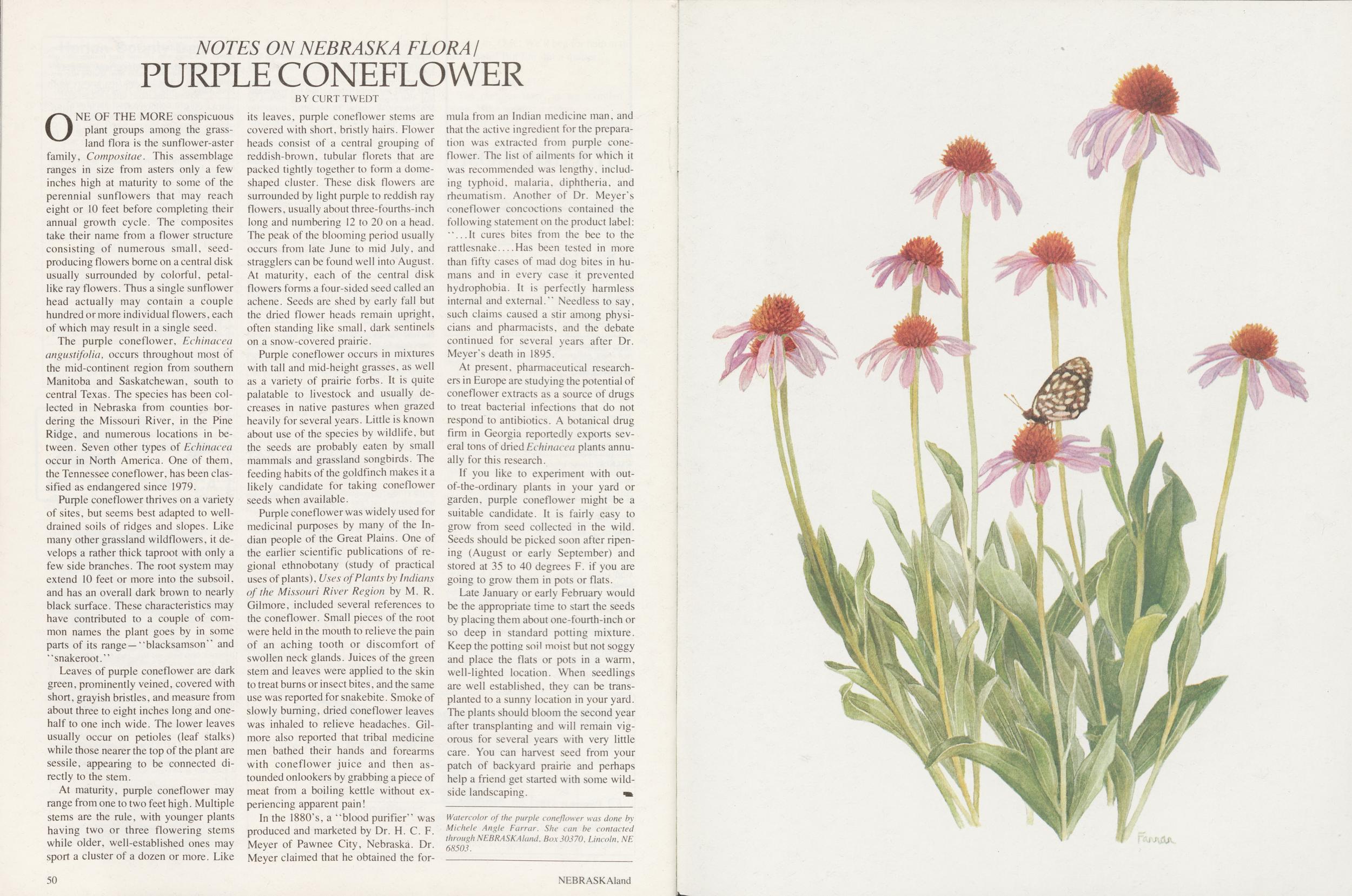
NOTES ON NEBRASKA FLORA I PURPLE CONEFLOWER
BY CURT TWEDTONE OF THE MORE conspicuous plant groups among the grassland flora is the sunflower-aster family, Compositae. This assemblage ranges in size from asters only a few inches high at maturity to some of the perennial sunflowers that may reach eight or 10 feet before completing their annual growth cycle. The composites take their name from a flower structure consisting of numerous small, seedproducing flowers borne on a central disk usually surrounded by colorful, petallike ray flowers. Thus a single sunflower head actually may contain a couple hundred or more individual flowers, each of which may result in a single seed.
The purple coneflower, Echinacea angustifolia, occurs throughout most of the mid-continent region from southern Manitoba and Saskatchewan, south to central Texas. The species has been collected in Nebraska from counties bordering the Missouri River, in the Pine Ridge, and numerous locations in between. Seven other types of Echinacea occur in North America. One of them, the Tennessee coneflower, has been classified as endangered since 1979.
Purple coneflower thrives on a variety of sites, but seems best adapted to welldrained soils of ridges and slopes. Like many other grassland wildflowers, it develops a rather thick taproot with only a few side branches. The root system may extend 10 feet or more into the subsoil, and has an overall dark brown to nearly black surface. These characteristics may have contributed to a couple of common names the plant goes by in some parts of its range—^blacksamson' and "snakeroot."
Leaves of purple coneflower are dark green, prominently veined, covered with short, grayish bristles, and measure from about three to eight inches long and onehalf to one inch wide. The lower leaves usually occur on petioles (leaf stalks) while those nearer the top of the plant are sessile, appearing to be connected directly to the stem.
At maturity, purple coneflower may range from one to two feet high. Multiple stems are the rule, with younger plants having two or three flowering stems while older, well-established ones may sport a cluster of a dozen or more. Like its leaves, purple coneflower stems are covered with short, bristly hairs. Flower heads consist of a central grouping of reddish-brown, tubular florets that are packed tightly together to form a domeshaped cluster. These disk flowers are surrounded by light purple to reddish ray flowers, usually about three-fourths-inch long and numbering 12 to 20 on a head. The peak of the blooming period usually occurs from late June to mid July, and stragglers can be found well into August. At maturity, each of the central disk flowers forms a four-sided seed called an achene. Seeds are shed by early fall but the dried flower heads remain upright, often standing like small, dark sentinels on a snow-covered prairie.
Purple coneflower occurs in mixtures with tall and mid-height grasses, as well as a variety of prairie forbs. It is quite palatable to livestock and usually decreases in native pastures when grazed heavily for several years. Little is known about use of the species by wildlife, but the seeds are probably eaten by small mammals and grassland songbirds. The feeding habits of the goldfinch makes it a likely candidate for taking coneflower seeds when available.
Purple coneflower was widely used for medicinal purposes by many of the Indian people of the Great Plains. One of the earlier scientific publications of regional ethnobotany (study of practical uses of plants), Uses of Plants by Indians of the Missouri River Region by M. R. Gilmore, included several references to the coneflower. Small pieces of the root were held in the mouth to relieve the pain of an aching tooth or discomfort of swollen neck glands. Juices of the green stem and leaves were applied to the skin to treat burns or insect bites, and the same use was reported for snakebite. Smoke of slowly burning, dried coneflower leaves was inhaled to relieve headaches. Gilmore also reported that tribal medicine men bathed their hands and forearms with coneflower juice and then astounded onlookers by grabbing a piece of meat from a boiling kettle without experiencing apparent pain!
In the 1880's, a wwblood purifier" was produced and marketed by Dr. H. C. F. Meyer of Pawnee City, Nebraska. Dr. Meyer claimed that he obtained the formula from an Indian medicine man, and that the active ingredient for the preparation was extracted from purple cone- flower. The list of ailments for which it was recommended was lengthy, including typhoid, malaria, diphtheria, and rheumatism. Another of Dr. Meyer's coneflower concoctions contained the following statement on the product label: "...It cures bites from the bee to the rattlesnake — Has been tested in more than fifty cases of mad dog bites in humans and in every case it prevented hydrophobia. It is perfectly harmless internal and external/ Needless to say, such claims caused a stir among physicians and pharmacists, and the debate continued for several years after Dr. Meyer's death in 1895.
At present, pharmaceutical researchers in Europe are studying the potential of coneflower extracts as a source of drugs to treat bacterial infections that do not respond to antibiotics. A botanical drug firm in Georgia reportedly exports several tons of dried Echinacea plants annually for this research.
If you like to experiment with outof-the-ordinary plants in your yard or garden, purple coneflower might be a suitable candidate. It is fairly easy to grow from seed collected in the wild. Seeds should be picked soon after ripening (August or early September) and stored at 35 to 40 degrees F. if you are going to grow them in pots or flats.
Late January or early February would be the appropriate time to start the seeds by placing them about one-fourth-inch or so deep in standard potting mixture. Keep the potting soil moist but not soggy and place the flats or pots in a warm, well-lighted location. When seedlings are well established, they can be transplanted to a sunny location in your yard. The plants should bloom the second year after transplanting and will remain vigorous for several years with very little care. You can harvest seed from your patch of backyard prairie and perhaps help a friend get started with some wildside landscaping.
Watercolor of the purple coneflower was done by Michele Angle Farrar. She can be contacted through NEBRASKAUmd, Box 30370, Lincoln, NE
50 NEBRASKAland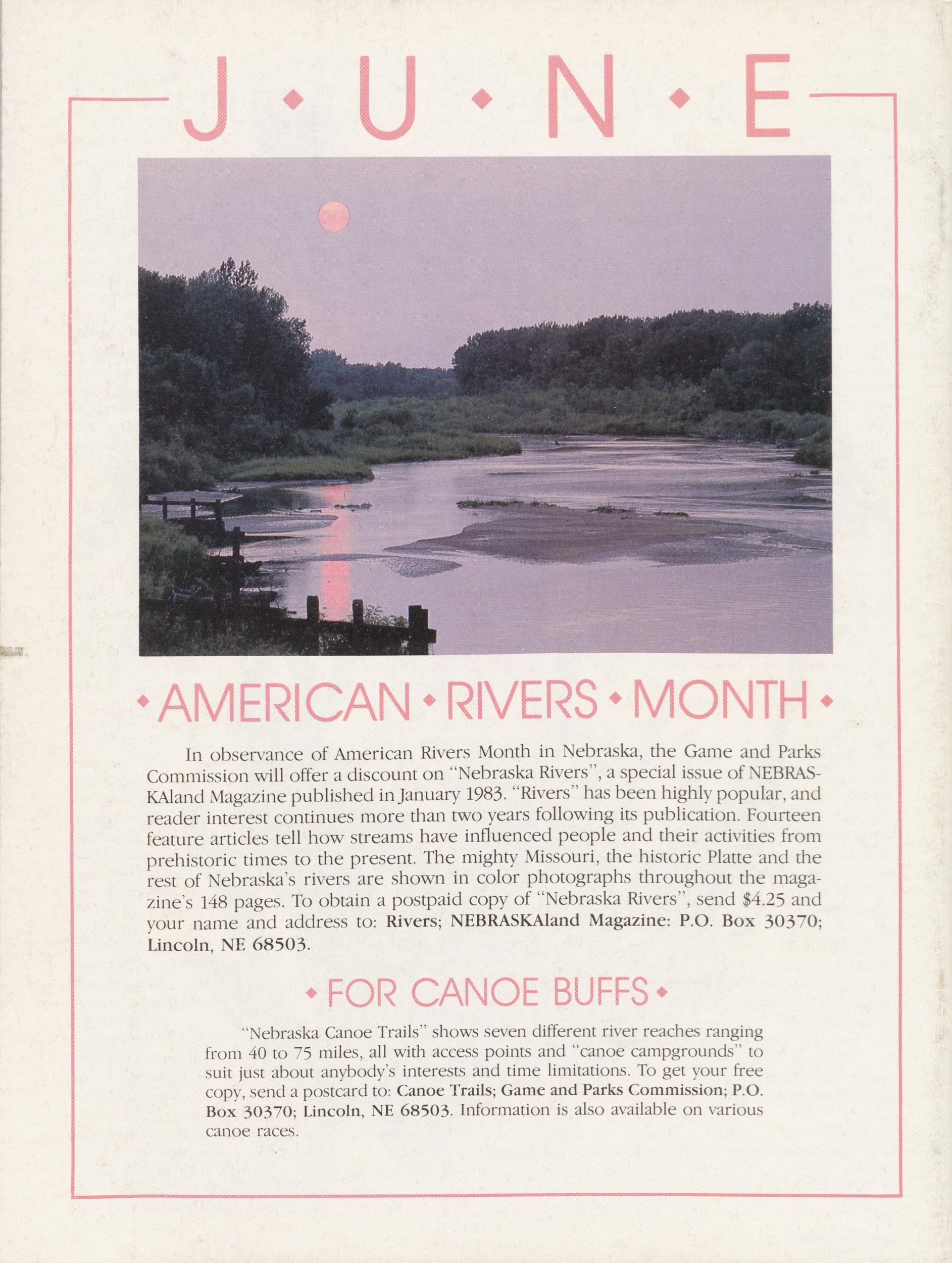
J U N E
In observance of American Rivers Ivlonth in Nebraska, the Game and Parks Commission will offer a discount on "Nebraska Rivers", a special issue of NEBRASKAland Magazine published in January 1983. "Rivers" has been highly popular, and reader interest continues more than two years following its publication. Fourteen feature articles tell how streams have influenced people and their activities from prehistoric times to the present. The mighty Missouri, the historic Platte and the rest of Nebraska's rivers are shown in color photographs throughout the magazine's 148 pages. To obtain a postpaid copy of "Nebraska Rivers", send $4.25 and your name and address to: Rivers; NEBRASKAland Magazine: P.O. Box 30370; Lincoln, NE 68503.
FOR CONOE BUFFS"Nebraska Canoe Trails" shows seven different river reaches ranging from 40 to 75 miles, all with access points and "canoe campgrounds" to suit just about anybody's interests and time limitations. To get your free copy, send a postcard to: Canoe Trails; Game and Parks Commission; P.O. Box 30370; Lincoln, NE 68503. Information is also available on various canoe races.
Position: 541 (20 views)