Volume 63, Issue 4, 1985
NEBRASKAland
MAY 1985 $1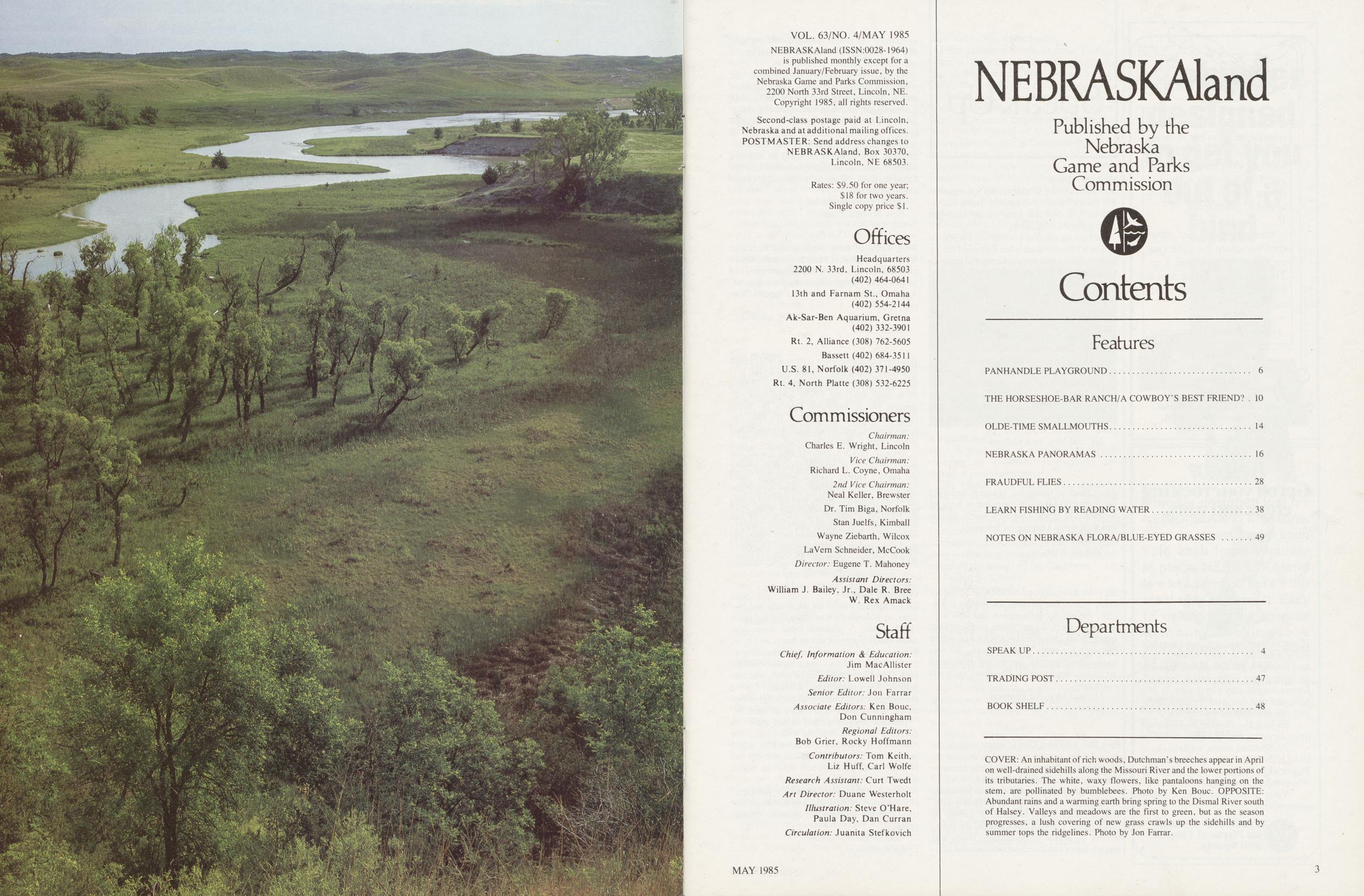
NEBRASKAland
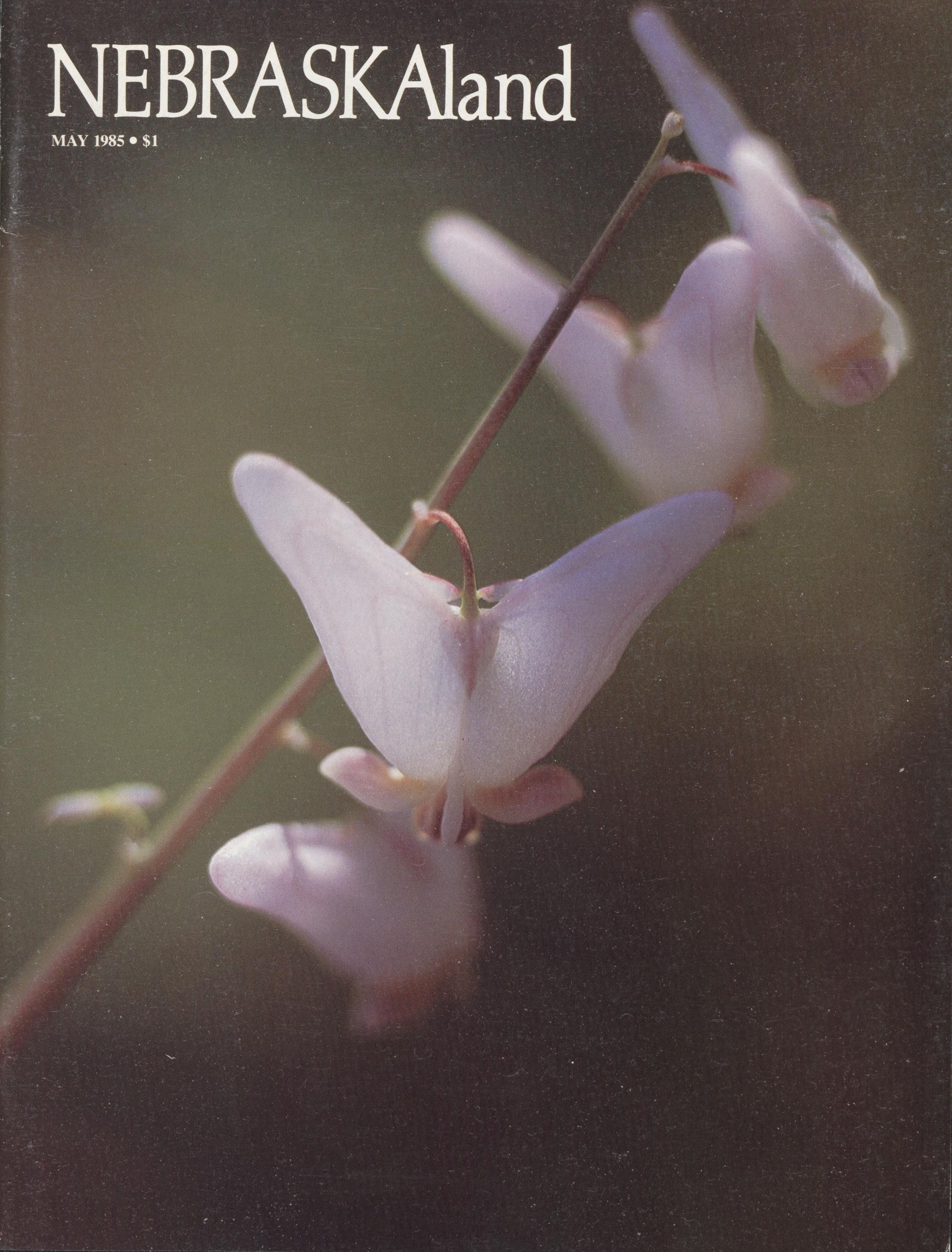
Puiblished by the Nebraska Game and Parks Commission VOL. 63/NO. 4/MAY 1985 NEBRASKAland (ISSN:0028-1964) is published monthly except for a combined January/February issue, by the Nebraska Game and Parks Commission, 2200 North 33rd Street, Lincoln, NE. Copyright 1985, all rights reserved. Second-class postage paid at Lincoln, Nebraska and at additional mailing offices. POSTMASTER: Send address changes to NEBRASKAland, Box 30370, Lincoln, NE 68503. Rates: $9.50 for one year; $18 for two years. Single copy price $1. Offices Headquarters 2200 N. 33rd, Lincoln, 68503 (402) 464-0641 13th and Farnam St., Omaha (402) 554-2144 Ak-Sar-Ben Aquarium, Gretna (402) 332-3901 Rt. 2, Alliance (308) 762-5605 Bassett (402) 684-3511 U.S. 81, Norfolk (402) 371-4950 Rt. 4, North Platte (308) 532-6225 Commissioners Chairman: Charles E. Wright, Lincoln Vice Chairman: Richard L. Coyne, Omaha 2nd Vice Chairman: Neal Keller, Brewster Dr. Tim Biga, Norfolk Stan Juelfs, Kimball Wayne Ziebarth, Wilcox LaVern Schneider, McCook Director: Eugene T. Mahoney Assistant Directors: William J. Bailey, Jr., Dale R. Bree W. Rex Amack Staff Chief, Information & Education: Jim MacAllister Editor: Lowell Johnson Senior Editor: Jon Farrar Associate Editors: Ken Bouc, Don Cunningham Regional Editors: Bob Grier, Rocky Hoffmann Contributors: Tom Keith, Liz Huff, Carl Wolfe Research Assistant: Curt Twedt Art Director: Duane Westerholt Illustration: Steve O'Hare, Paula Day, Dan Curran Circulation: Juanita Stefkovich Contents Features PANHANDLE PLAYGROUND 6 THE HORSESHOE-BAR RANCH/A COWBOYS BEST FRIEND? 10 OLDE-TIME SMALLMOUTHS14 NEBRASKA PANORAMAS16 FRAUDFUL FLIES28 LEARN FISHING BY READING WATER38 NOTES ON NEBRASKA FLORA/BLUE-EYED GRASSES 49 SPEAK UPDepartments 4 TRADING POST47 BOOK SHELF 48 COVER: An inhabitant of rich woods, Dutchman's breeches appear in April on well-drained sidehills along the Missouri River and the lower portions of its tributaries. The white, waxy flowers, like pantaloons hanging on the stem, are pollinated by bumblebees. Photo by Ken Bouc. OPPOSITE: Abundant rains and a warming earth bring spring to the Dismal River south of Halsey. Valleys and meadows are the first to green, but as the season progresses, a lush covering of new grass crawls up the sidehills and by summer tops the ridgelines. Photo by Jon Farrar. MAY 1985 3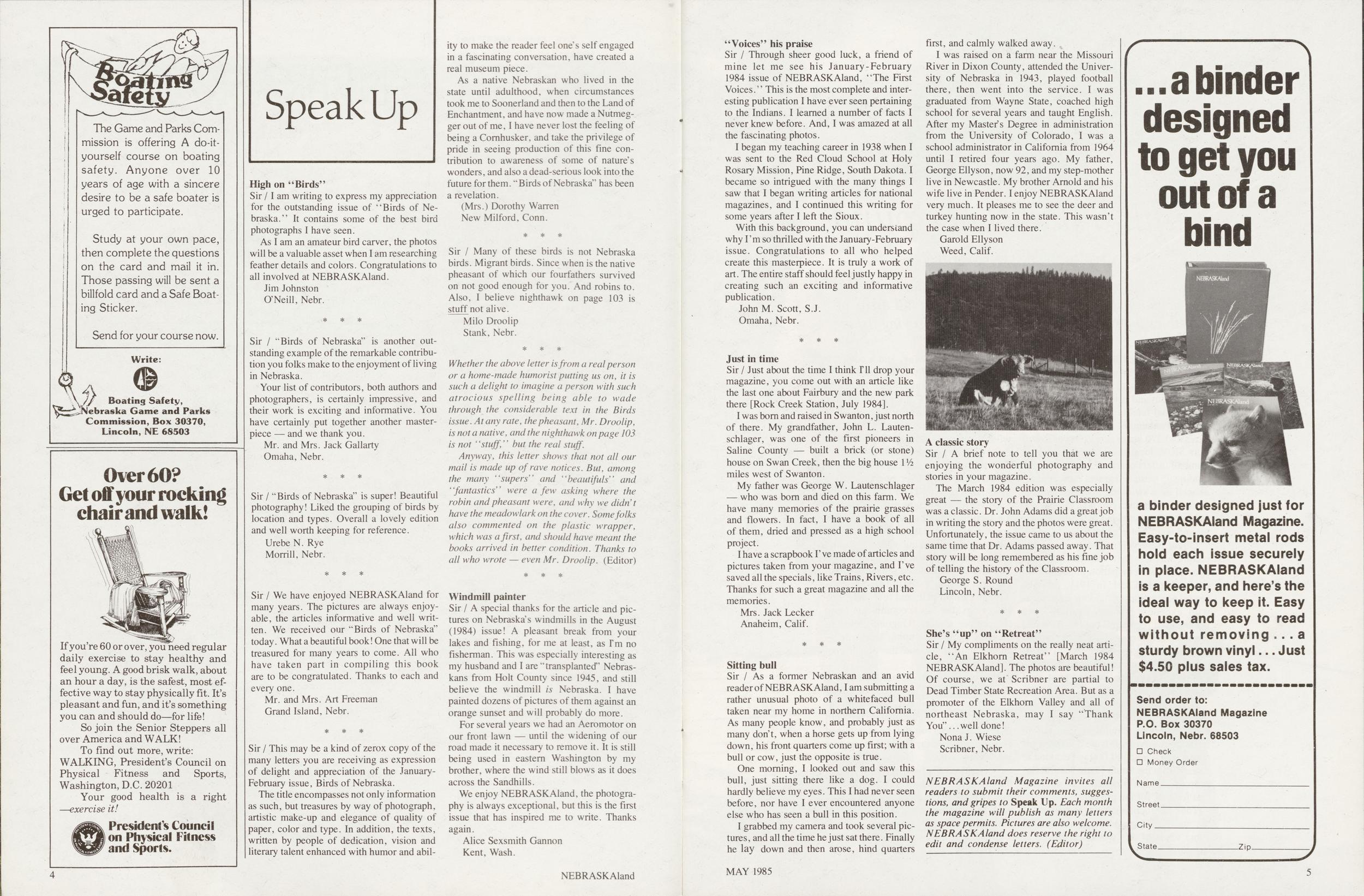
Speak Up
High on "Birds"Sir /1 am writing to express my appreciation for the outstanding issue of "Birds of Nebraska." It contains some of the best bird photographs I have seen.
As I am an amateur bird carver, the photos will be a valuable asset when I am researching feather details and colors. Congratulations to all involved at NEBRASKAland.
Jim Johnston O'Neill, Nebr. * * *Sir / "Birds of Nebraska" is another outstanding example of the remarkable contribution you folks make to the enjoyment of living in Nebraska.
Your list of contributors, both authors and photographers, is certainly impressive, and their work is exciting and informative. You have certainly put together another masterpiece — and we thank you.
Mr. and Mrs. Jack Gallarty Omaha, Nebr. * * *Sir / "Birds of Nebraska" is super! Beautiful photography! Liked the grouping of birds by location and types. Overall a lovely edition and well worth keeping for reference.
Urebe N. Rye Morrill, Nebr. * * *Sir / We have enjoyed NEBRASKAland for many years. The pictures are always enjoyable, the articles informative and well written. We received our "Birds of Nebraska" today. What a beautiful book! One that will be treasured for many years to come. All who have taken part in compiling this book are to be congratulated. Thanks to each and every one.
Mr. and Mrs. Art Freeman Grand Island, Nebr. * * *Sir / This may be a kind of zerox copy of the many letters you are receiving as expression of delight and appreciation of the January February issue, Birds of Nebraska.
The title encompasses not only information as such, but treasures by way of photograph, artistic make-up and elegance of quality of paper, color and type. In addition, the texts, written by people of dedication, vision and literary talent enhanced with humor and ability to make the reader feel one's self engaged in a fascinating conversation, have created a real museum piece.
As a native Nebraskan who lived in the state until adulthood, when circumstances took me to Soonerland and then to the Land of Enchantment, and have now made a Nutmegger out of me, I have never lost the feeling of being a Cornhusker, and take the privilege of pride in seeing production of this fine contribution to awareness of some of nature's wonders, and also a dead-serious look into the future for them. "Birds of Nebraska" has been a revelation.
(Mrs.) Dorothy Warren New Milford, Conn. * * *Sir / Many of these birds is not Nebraska birds. Migrant birds. Since when is the native pheasant of which our fourfathers survived on not good enough for you. And robins to. Also, I believe nighthawk on page 103 is stuff not alive.
Milo Droolip Stank, Nebr. * * *Whether the above letter is from a real person or a home-made humorist putting us on, it is such a delight to imagine a person with such atrocious spelling being able to wade through the considerable text in the Birds issue. At any rate, the pheasant, Mr. Droolip, is not a native, and the nighthawk on page 103 is not ' 'stuff,'' but the real stuff.
Anyway, this letter shows that not all our mail is made up of rave notices. But, among the many "supers" and "beautifuls" and "fantastics" were a few asking where the robin and pheasant were, and why we didn't have the meadowlark on the cover. Some folks also commented on the plastic wrapper, which was a first, and should have meant the books arrived in better condition. Thanks to all who wrote — even Mr. Droolip. (Editor)
* * * Windmill painterSir / A special thanks for the article and pictures on Nebraska's windmills in the August (1984) issue! A pleasant break from your lakes and fishing, for me at least, as Tm no fisherman. This was especially interesting as my husband and I are "transplanted" Nebraskans from Holt County since 1945, and still believe the windmill is Nebraska. I have painted dozens of pictures of them against an orange sunset and will probably do more.
For several years we had an Aeromotor on our front lawn — until the widening of our road made it necessary to remove it. It is still being used in eastern Washington by my brother, where the wind still blows as it does across the Sandhills.
We enjoy NEBRASKAland, the photography is always exceptional, but this is the first issue that has inspired me to write. Thanks again.
Alice Sexsmith Gannon Kent, Wash. 4 NEBRASKAland "Voices" his praiseSir / Through sheer good luck, a friend of mine let me see his January-February 1984 issue of NEBRASKAland, "The First Voices.'' This is the most complete and interesting publication I have ever seen pertaining to the Indians. I learned a number of facts I never knew before. And, I was amazed at all the fascinating photos.
I began my teaching career in 1938 when I was sent to the Red Cloud School at Holy Rosary Mission, Pine Ridge, South Dakota. I became so intrigued with the many things I saw that I began writing articles for national magazines, and I continued this writing for some years after I left the Sioux.
With this background, you can understand why I'm so thrilled with the January-February issue. Congratulations to all who helped create this masterpiece. It is truly a work of art. The entire staff should feel justly happy in creating such an exciting and informative publication.
John M. Scott, S.J. Omaha, Nebr. * * * Just in timeSir / Just about the time I think F11 drop your magazine, you come out with an article like the last one about Fairbury and the new park there [Rock Creek Station, July 1984].
I was born and raised in Swan ton, just north of there. My grandfather, John L. Lautenschlager, was one of the first pioneers in Saline County — built a brick (or stone) house on Swan Creek, then the big house 1 Vi miles west of Swan ton.
My father was George W. Lautenschlager — who was born and died on this farm. We have many memories of the prairie grasses and flowers. In fact, I have a book of all of them, dried and pressed as a high school project.
I have a scrapbook I've made of articles and pictures taken from your magazine, and I've saved all the specials, like Trains, Rivers, etc. Thanks for such a great magazine and all the memories.
Mrs. Jack Lecker Anaheim, Calif. * * * Sitting bullSir / As a former Nebraskan and an avid reader of NEBRASKAland, I am submitting a rather unusual photo of a whitefaced bull taken near my home in northern California. As many people know, and probably just as many don't, when a horse gets up from lying down, his front quarters come up first; with a bull or cow, just the opposite is true.
One morning, I looked out and saw this bull, just sitting there like a dog. I could hardly believe my eyes. This I had never seen before, nor have I ever encountered anyone else who has seen a bull in this position.
I grabbed my camera and took several pictures, and all the time he just sat there. Finally he lay down and then arose, hind quarters first, and calmly walked away.
I was raised on a farm near the Missouri River in Dixon County, attended the University of Nebraska in 1943, played football there, then went into the service. I was graduated from Wayne State, coached high school for several years and taught English. After my Master's Degree in administration from the University of Colorado, I was a school administrator in California from 1964 until I retired four years ago. My father, George Ellyson, now 92, and my step-mother live in Newcastle. My brother Arnold and his wife live in Pender. I enjoy NEBRASKAland very much. It pleases me to see the deer and turkey hunting now in the state. This wasn't the case when I lived there.
Garold Ellyson Weed, Calif.Sir / A brief note to tell you that we are enjoying the wonderful photography and stories in your magazine.
The March 1984 edition was especially great — the story of the Prairie Classroom was a classic. Dr. John Adams did a great job in writing the story and the photos were great. Unfortunately, the issue came to us about the same time that Dr. Adams passed away. That story will be long remembered as his fine job of telling the history of the Classroom.
George S. Round Lincoln, Nebr. * * * She's "up" on "Retreat"Sir / My compliments on the really neat article, "An Elkhorn Retreat" [March 1984 NEBRASKAland]. The photos are beautiful! Of course, we at Scribner are partial to Dead Timber State Recreation Area. But as a promoter of the Elkhorn Valley and all of northeast Nebraska, may I say "Thank You" well done!
Nona J. Wiese Scribner, Nebr.NEBRASKAland Magazine invites all readers to submit their comments, suggestions, and gripes to Speak Up. Each month the magazine will publish as many letters as space permits. Pictures are also welcome. NEBRASKAland does reserve the right to edit and condense letters. (Editor)
a binder designed to get you outofa bind a binder designed just for NEBRASKAland Magazine. Easy-to-insert metal rods hold each issue securely in place. NEBRASKAland is a keeper, and here's the ideal way to keep it. Easy to use, and easy to read without removing a sturdy brown vinyl Just $4.50 plus sales tax. Send order to: NEBRASKAland Magazine P.O. Box 30370 Lincoln, Nebr. 68503 Check Money Order Name Street. City State. Zip. MAY 1985 5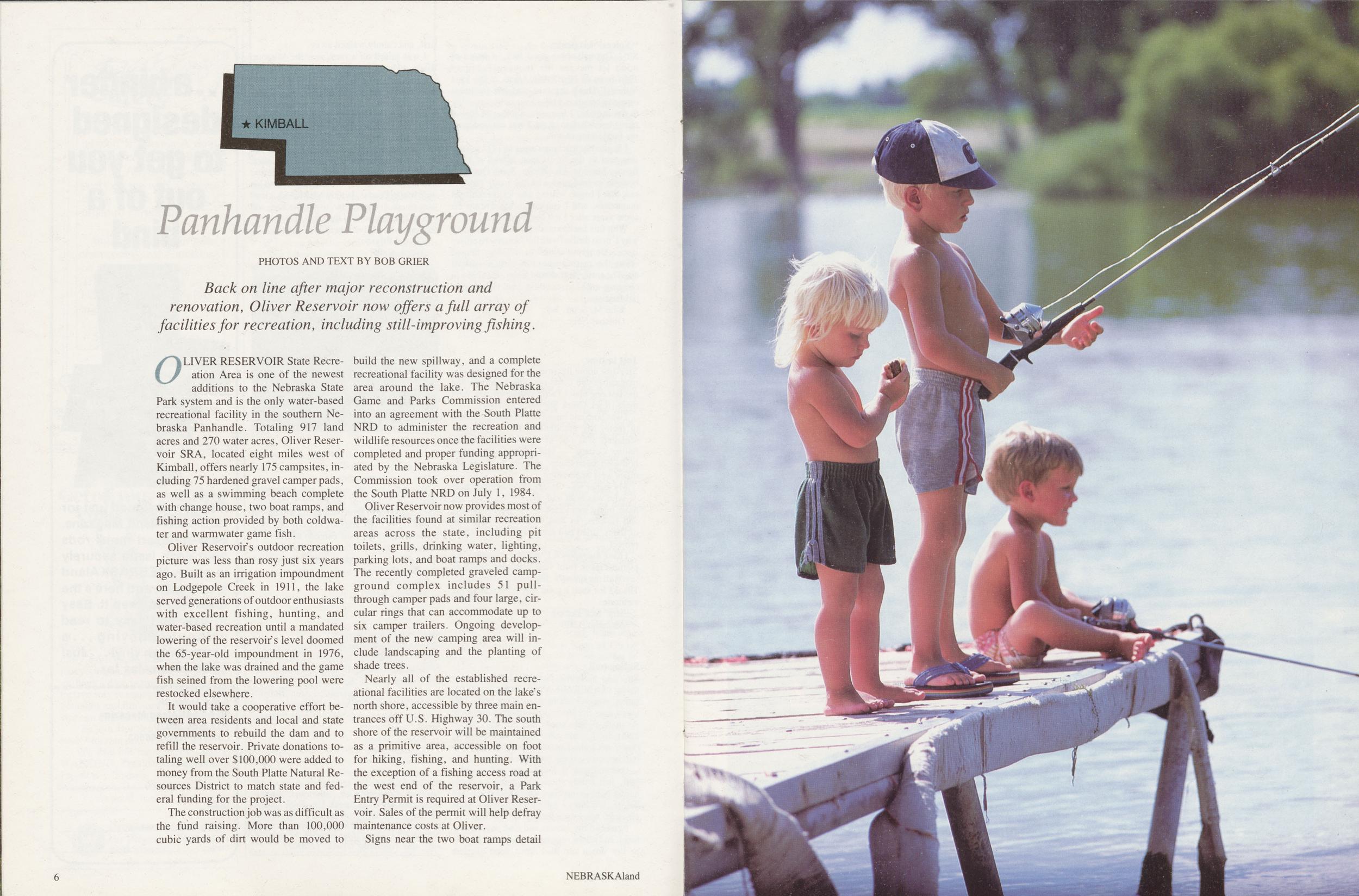
Panhandle Playground
PHOTOS AND TEXT BY BOB GRIER Back on line after major reconstruction and renovation, Oliver Reservoir now offers a full array of facilities for recreation, including still-improving fishing.LIVER RESERVOIR State Recreation Area is one of the newest additions to the Nebraska State Park system and is the only water-based recreational facility in the southern Nebraska Panhandle. Totaling 917 land acres and 270 water acres, Oliver Reservoir SRA, located eight miles west of Kimball, offers nearly 175 campsites, including 75 hardened gravel camper pads, as well as a swimming beach complete with change house, two boat ramps, and fishing action provided by both coldwater and warmwater game fish.
Oliver Reservoir's outdoor recreation picture was less than rosy just six years ago. Built as an irrigation impoundment on Lodgepole Creek in 1911, the lake served generations of outdoor enthusiasts with excellent fishing, hunting, and water-based recreation until a mandated lowering of the reservoir's level doomed the 65-year-old impoundment in 1976, when the lake was drained and the game fish seined from the lowering pool were restocked elsewhere.
It would take a cooperative effort between area residents and local and state governments to rebuild the dam and to refill the reservoir. Private donations totaling well over $100,000 were added to money from the South Platte Natural Resources District to match state and federal funding for the project.
The construction job was as difficult as the fund raising. More than 100,000 cubic yards of dirt would be moved to build the new spillway, and a complete recreational facility was designed for the area around the lake. The Nebraska Game and Parks Commission entered into an agreement with the South Platte NRD to administer the recreation and wildlife resources once the facilities were completed and proper funding appropriated by the Nebraska Legislature. The Commission took over operation from the South Platte NRD on July 1, 1984.
Oliver Reservoir now provides most of the facilities found at similar recreation areas across the state, including pit toilets, grills, drinking water, lighting, parking lots, and boat ramps and docks. The recently completed graveled campground complex includes 51 pullthrough camper pads and four large, circular rings that can accommodate up to six camper trailers. Ongoing development of the new camping area will include landscaping and the planting of shade trees.
Nearly all of the established recreational facilities are located on the lake's north shore, accessible by three main entrances off U.S. Highway 30. The south shore of the reservoir will be maintained as a primitive area, accessible on foot for hiking, fishing, and hunting. With the exception of a fishing access road at the west end of the reservoir, a Park Entry Permit is required at Oliver Reservoir, Sales of the permit will help defray maintenance costs at Oliver.
Signs near the two boat ramps detail regulations and restrictions on the 270acre lake to reduce conflicts between swimmers, fishermen, skiers and recreational boaters. Buoys mark a fivemile-per-hour area at the lake's west end. Additionally, a buoy-marked swimming area is provided on the north side.
6 NEBRASKAland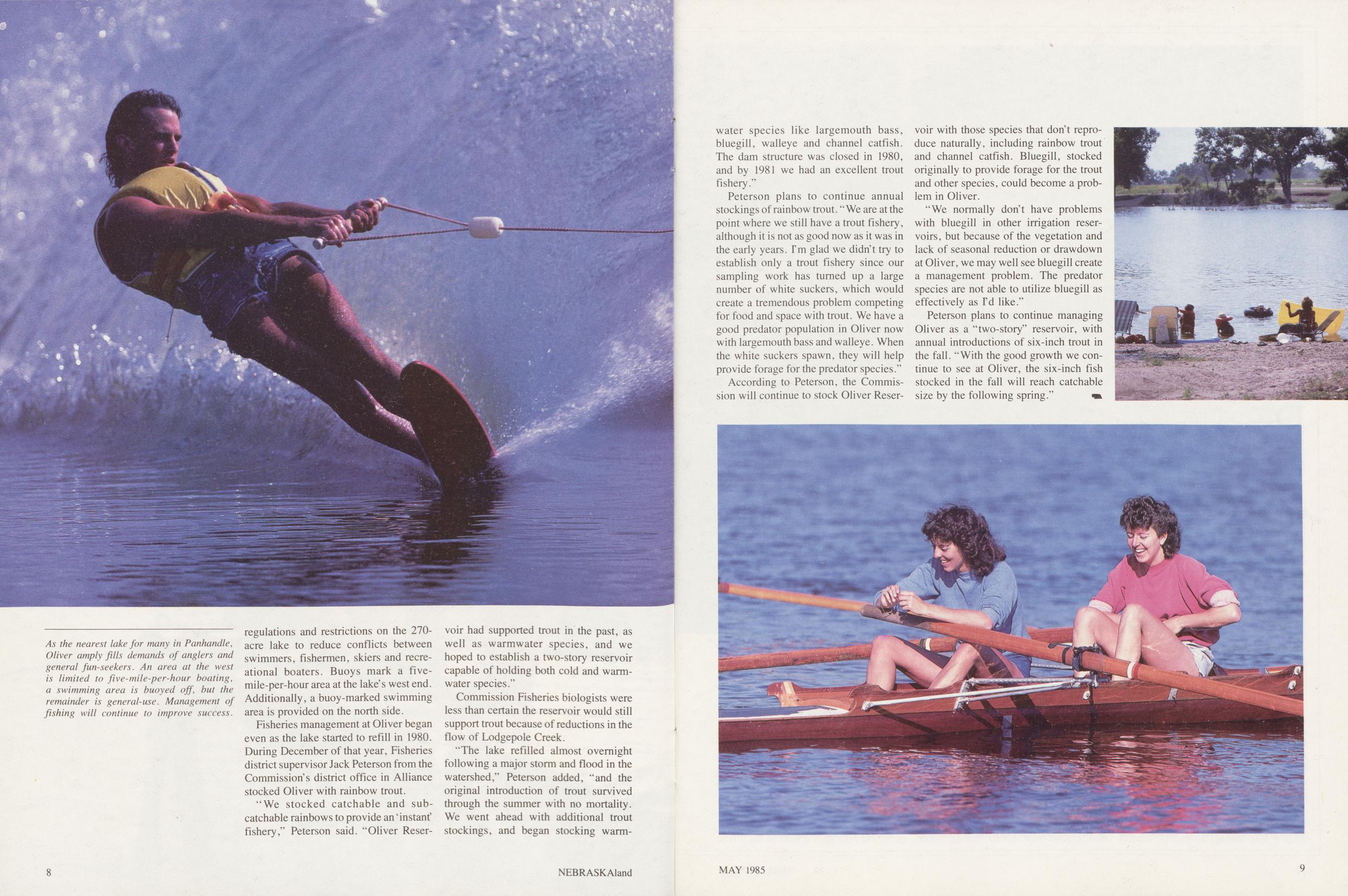
Fisheries management at Oliver began even as the lake started to refill in 1980. During December of that year, Fisheries district supervisor Jack Peterson from the Commission's district office in Alliance stocked Oliver with rainbow trout.
"We stocked catchable and subcatchable rainbows to provide an 'instant' fishery," Peterson said. "Oliver Reservoir had supported trout in the past, as well as warmwater species, and we hoped to establish a two-story reservoir capable of holding both cold and warmwater species."
Commission Fisheries biologists were less than certain the reservoir would still support trout because of reductions in the flow of Lodgepole Creek.
"The lake refilled almost overnight following a major storm and flood in the watershed," Peterson added, "and the original introduction of trout survived through the summer with no mortality. We went ahead with additional trout stockings, and began stocking warmwater 8 NEBRASKaland species like largemouth bass, bluegill, walleye and channel catfish. The dam structure was closed in 1980, and by 1981 we had an excellent trout fishery."
Peterson plans to continue annual stockings of rainbow trout. "We are at the point where we still have a trout fishery, although it is not as good now as it was in the early years. Fm glad we didn't try to establish only a trout fishery since our sampling work has turned up a large number of white suckers, which would create a tremendous problem competing for food and space with trout. We have a good predator population in Oliver now with largemouth bass and walleye. When the white suckers spawn, they will help provide forage for the predator species."
According to Peterson, the Commission will continue to stock Oliver Reservoir with those species that don't reproduce naturally, including rainbow trout and channel catfish. Bluegill, stocked originally to provide forage for the trout and other species, could become a problem in Oliver.
"We normally don't have problems with bluegill in other irrigation reservoirs, but because of the vegetation and lack of seasonal reduction or drawdown at Oliver, we may well see bluegill create a management problem. The predator species are not able to utilize bluegill as effectively as Fd like."
Peterson plans to continue managing Oliver as a "two-story" reservoir, with annual introductions of six-inch trout in the fall. "With the good growth we continue to see at Oliver, the six-inch fish stocked in the fall will reach catchable size by the following spring."
THE HORSESHOE-BAR RANCH A Cowboy's Best Friend?
BY ROE R. BLACK Ranch horses at the turn of the century were a varied lot, as different as the men who rode them. Some were unreliable and always full of shenanigans, others trusting, loyal and reliable.DURING THE EARLY 1900' s, all ranch work, transportation and recreation in the Sandhills revolved around horses. Our nearest neighbor was seven miles away, and it was 15 miles to town. In good weather a man on foot could walk either of these distances, but in winter it was a dangerous adventure to try to walk anywhere. Picture, if you can, the real isolation of the ranch. There was no traffic of any kind through, and neighbors and strangers came seldom and almost never in winter. The telephone line from the ranch to Thedford was frequently broken by storms. The only way for anyone to communicate from the ranch to the outside world was by riding horseback or driving a carriage or wagon. So long as horses were easily available, this situation was no hardship, but if horses strayed or were stolen or you were prevented access to them for any reason, the situation could be difficult.
As a large working ranch, we were usually stocked with thousands of steers on the ranges and naturally had a good herd of riding horses. These horses were allowed to range over a large "horse pasture" south of the barn and corrals. This pasture was about one mile square, mostly hills and deep little valleys affording excellent grazing summer and winter. In winter it also gave plenty of protection from the wind. The number of horses on the ranch would average about 25 or 30 of which at least four would be broken to harness for the "yellow buggy" or wagon use. Several of the rest would be two-year-olds, just beginning to be useful, and possibly 15 would be "broke" cow horses. Among the latter were three or four considered "gentled" sufficiently for kids or guests to ride.
The main ranch produced only a few tons of hay, which was stacked behind the barn and fed sparingly to the cows and such horses as might be in the barn. The horses never received hay but were fed oats when in hard use and not allowed time for proper grazing. All the horses went into the winter fat and came out lean.
Of all the horses on the ranch the most important one was the wrangle horse. He was always a small, fast pony, kept tied at all times in a barn stall to be available for rounding up the horse herd. No rule of ranch life was more strictly observed than the one requiring the wrangle horse to be used for the sole purpose of wrangling.
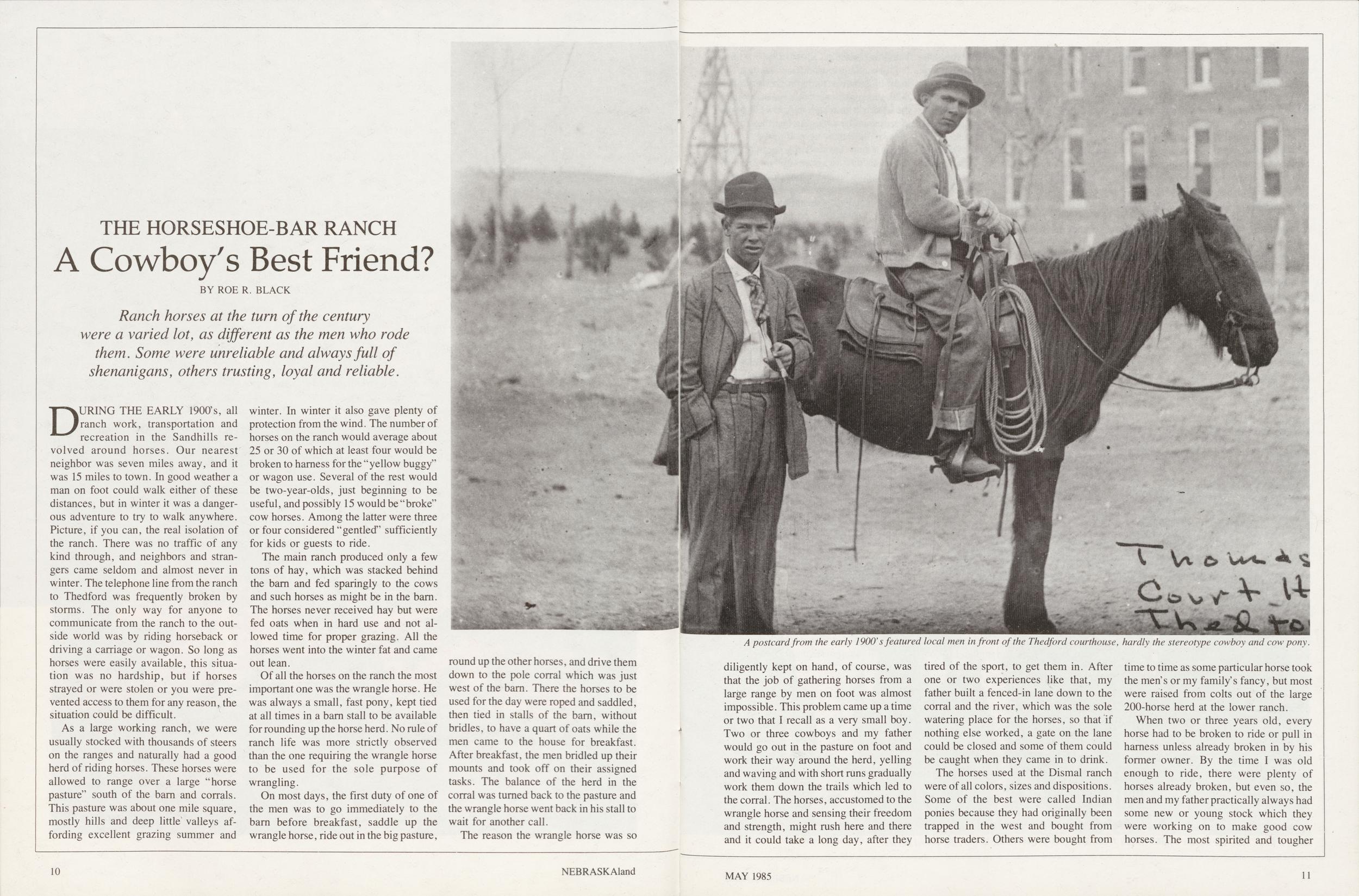
On most days, the first duty of one of the men was to go immediately to the barn before breakfast, saddle up the wrangle horse, ride out in the big pasture, A postcard from the early 1900' s featured local men in front of the Thedford courthouse, hardly the stereotype cowboy and cow pony. round up the other horses, and drive them down to the pole corral which was just west of the barn. There the horses to be used for the day were roped and saddled, then tied in stalls of the barn, without bridles, to have a quart of oats while the men came to the house for breakfast. After breakfast, the men bridled up their mounts and took off on their assigned tasks. The balance of the herd in the corral was turned back to the pasture and the wrangle horse went back in his stall to wait for another call.
The reason the wrangle horse was so 10 NEBRASKaland diligently kept on hand, of course, was that the job of gathering horses from a large range by men on foot was almost impossible. This problem came up a time or two that I recall as a very small boy. Two or three cowboys and my father would go out in the pasture on foot and work their way around the herd, yelling and waving and with short runs gradually work them down the trails which led to the corral. The horses, accustomed to the wrangle horse and sensing their freedom and strength, might rush here and there and it could take a long day, after they tired of the sport, to get them in. After one or two experiences like that, my father built a fenced-in lane down to the corral and the river, which was the sole watering place for the horses, so that if nothing else worked, a gate on the lane could be closed and some of them could be caught when they came in to drink.
The horses used at the Dismal ranch were of all colors, sizes and dispositions. Some of the best were called Indian ponies because they had originally been trapped in the west and bought from horse traders. Others were bought from time to time as some particular horse took the men's or my family's fancy, but most were raised from colts out of the large 200-horse herd at the lower ranch.
When two or three years old, every
horse had to be broken to ride or pull in
harness unless already broken in by his
former owner. By the time I was old
enough to ride, there were plenty of
horses already broken, but even so, the
men and my father practically always had
some new or young stock which they
were working on to make good cow
horses. The most spirited and tougher
 ones were selected for breaking, usually
horses not too small to do a day's work or
too large to be clumsy. The men, who
were all lightweights, went in for the
Indian ponies and smaller, faster mounts,
and my father and Uncle Will, weighing
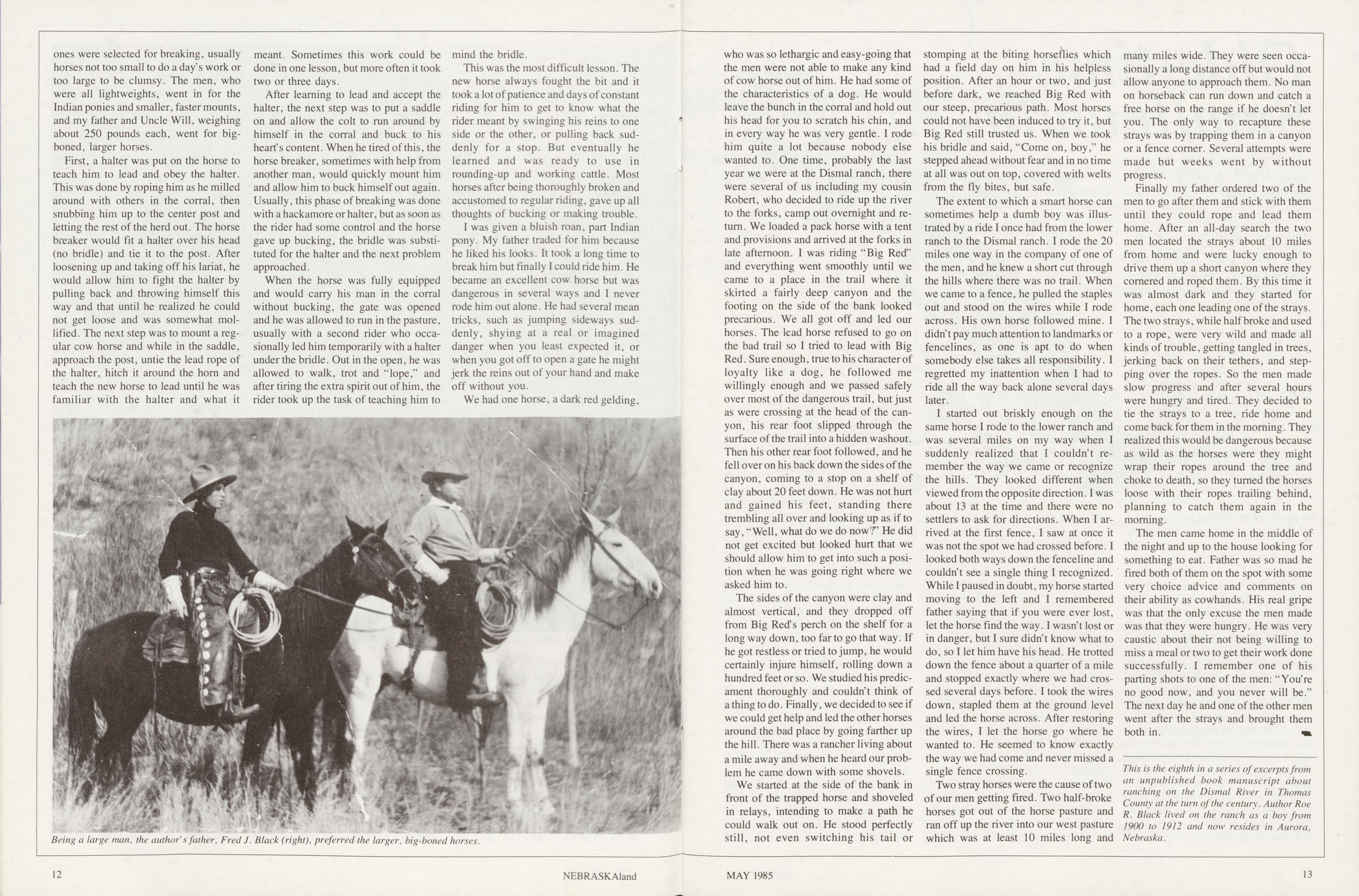
about 250 pounds each, went for bigboned, larger horses.
ones were selected for breaking, usually
horses not too small to do a day's work or
too large to be clumsy. The men, who
were all lightweights, went in for the
Indian ponies and smaller, faster mounts,
and my father and Uncle Will, weighing
about 250 pounds each, went for bigboned, larger horses.
First, a halter was put on the horse to teach him to lead and obey the halter. This was done by roping him as he milled around with others in the corral, then snubbing him up to the center post and letting the rest of the herd out. The horse breaker would fit a halter over his head (no bridle) and tie it to the post. After loosening up and taking off his lariat, he would allow him to fight the halter by pulling back and throwing himself this way and that until he realized he could not get loose and was somewhat mollified. The next step was to mount a regular cow horse and while in the saddle, approach the post, untie the lead rope of the halter, hitch it around the horn and teach the new horse to lead until he was familiar with the halter and what it meant. Sometimes this work could be done in one lesson, but more often it took two or three days.
After learning to lead and accept the halter, the next step was to put a saddle on and allow the colt to run around by himself in the corral and buck to his heart's content. When he tired of this, the horse breaker, sometimes with help from another man, would quickly mount him and allow him to buck himself out again. Usually, this phase of breaking was done with a hackamore or halter, but as soon as the rider had some control and the horse gave up bucking, the bridle was substituted for the halter and the next problem approached.
When the horse was fully equipped and would carry his man in the corral without bucking, the gate was opened and he was allowed to run in the pasture, usually with a second rider who occasionally led him temporarily with a halter under the bridle. Out in the open, he was allowed to walk, trot and "lope," and after tiring the extra spirit out of him, the rider took up the task of teaching him to mind the bridle.
This was the most difficult lesson. The new horse always fought the bit and it took a lot of patience and days of constant riding for him to get to know what the rider meant by swinging his reins to one side or the other, or pulling back suddenly for a stop. But eventually he learned and was ready to use in rounding-up and working cattle. Most horses after being thoroughly broken and accustomed to regular riding, gave up all thoughts of bucking or making trouble.
I was given a bluish roan, part Indian pony. My father traded for him because he liked his looks. It took a long time to break him but finally I could ride him. He became an excellent cow horse but was dangerous in several ways and I never rode him out alone. He had several mean tricks, such as jumping sideways suddenly, shying at a real or imagined danger when you least expected it, or when you got off to open a gate he might jerk the reins out of your hand and make off without you.
We had one horse, a dark red gelding, 12 NEBRASKAland who was so lethargic and easy-going that the men were not able to make any kind of cow horse out of him. He had some of the characteristics of a dog. He would leave the bunch in the corral and hold out his head for you to scratch his chin, and in every way he was very gentle. I rode him quite a lot because nobody else wanted to. One time, probably the last year we were at the Dismal ranch, there were several of us including my cousin Robert, who decided to ride up the river to the forks, camp out overnight and return. We loaded a pack horse with a tent and provisions and arrived at the forks in late afternoon. I was riding "Big Red" and everything went smoothly until we came to a place in the trail where it skirted a fairly deep canyon and the footing on the side of the bank looked precarious. We all got off and led our horses. The lead horse refused to go on the bad trail so I tried to lead with Big Red. Sure enough, true to his character of loyalty like a dog, he followed me willingly enough and we passed safely over most of the dangerous trail, but just as were crossing at the head of the canyon, his rear foot slipped through the surface of the trail into a hidden washout. Then his other rear foot followed, and he fell over on his back down the sides of the canyon, coming to a stop on a shelf of clay about 20 feet down. He was not hurt and gained his feet, standing there trembling all over and looking up as if to say, "Well, what do we do now?' He did not get excited but looked hurt that we should allow him to get into such a position when he was going right where we asked him to.
The sides of the canyon were clay and almost vertical, and they dropped off from Big Red's perch on the shelf for a long way down, too far to go that way. If he got restless or tried to jump, he would certainly injure himself, rolling down a hundred feet or so. We studied his predicament thoroughly and couldn't think of a thing to do. Finally, we decided to see if we could get help and led the other horses around the bad place by going farther up the hill. There was a rancher living about a mile away and when he heard our problem he came down with some shovels.
We started at the side of the bank in front of the trapped horse and shoveled in relays, intending to make a path he could walk out on. He stood perfectly still, not even switching his tail or stomping at the biting horseflies which had a field day on him in his helpless position. After an hour or two, and just before dark, we reached Big Red with our steep, precarious path. Most horses could not have been induced to try it, but Big Red still trusted us. When we took his bridle and said, "Come on, boy," he stepped ahead without fear and in no time at all was out on top, covered with welts from the fly bites, but safe.
The extent to which a smart horse can sometimes help a dumb boy was illustrated by a ride I once had from the lower ranch to the Dismal ranch. I rode the 20 miles one way in the company of one of the men, and he knew a short cut through the hills where there was no trail. When we came to a fence, he pulled the staples out and stood on the wires while I rode across. His own horse followed mine. I didn't pay much attention to landmarks or fencelines, as one is apt to do when somebody else takes all responsibility. I regretted my inattention when I had to ride all the way back alone several days later.
I started out briskly enough on the same horse I rode to the lower ranch and was several miles on my way when I suddenly realized that I couldn't remember the way we came or recognize the hills. They looked different when viewed from the opposite direction. I was about 13 at the time and there were no settlers to ask for directions. When I arrived at the first fence, I saw at once it was not the spot we had crossed before. I looked both ways down the fenceline and couldn't see a single thing I recognized. While I paused in doubt, my horse started moving to the left and I remembered father saying that if you were ever lost, let the horse find the way. I wasn't lost or in danger, but I sure didn't know what to do, so I let him have his head. He trotted down the fence about a quarter of a mile and stopped exactly where we had crossed several days before. I took the wires down, stapled them at the ground level and led the horse across. After restoring the wires, I let the horse go where he wanted to. He seemed to know exactly the way we had come and never missed a single fence crossing.
Two stray horses were the cause of two of our men getting fired. Two half-broke horses got out of the horse pasture and ran off up the river into our west pasture which was at least 10 miles long and many miles wide. They were seen occasionally a long distance off but would not allow anyone to approach them. No man on horseback can run down and catch a free horse on the range if he doesn't let you. The only way to recapture these strays was by trapping them in a canyon or a fence corner. Several attempts were made but weeks went by without progress.
Finally my father ordered two of the men to go after them and stick with them until they could rope and lead them home. After an all-day search the two men located the strays about 10 miles from home and were lucky enough to drive them up a short canyon where they cornered and roped them. By this time it was almost dark and they started for home, each one leading one of the strays. The two strays, while half broke and used to a rope, were very wild and made all kinds of trouble, getting tangled in trees, jerking back on their tethers, and stepping over the ropes. So the men made slow progress and after several hours were hungry and tired. They decided to tie the strays to a tree, ride home and come back for them in the morning. They realized this would be dangerous because as wild as the horses were they might wrap their ropes around the tree and choke to death, so they turned the horses loose with their ropes trailing behind, planning to catch them again in the morning.
The men came home in the middle of the night and up to the house looking for something to eat. Father was so mad he fired both of them on the spot with some very choice advice and comments on their ability as cowhands. His real gripe was that the only excuse the men made was that they were hungry. He was very caustic about their not being willing to miss a meal or two to get their work done successfully. I remember one of his parting shots to one of the men: "You're no good now, and you never will be." The next day he and one of the other men went after the strays and brought them both in.
This is the eighth in a series of excerpts from an unpublished book manuscript about ranching on the Dismal River in Thomas County at the turn of the century. Author Roe R. Black lived on the ranch as a boy from 1900 to 1912 and now resides in Aurora, Nebraska. MAY 1985 13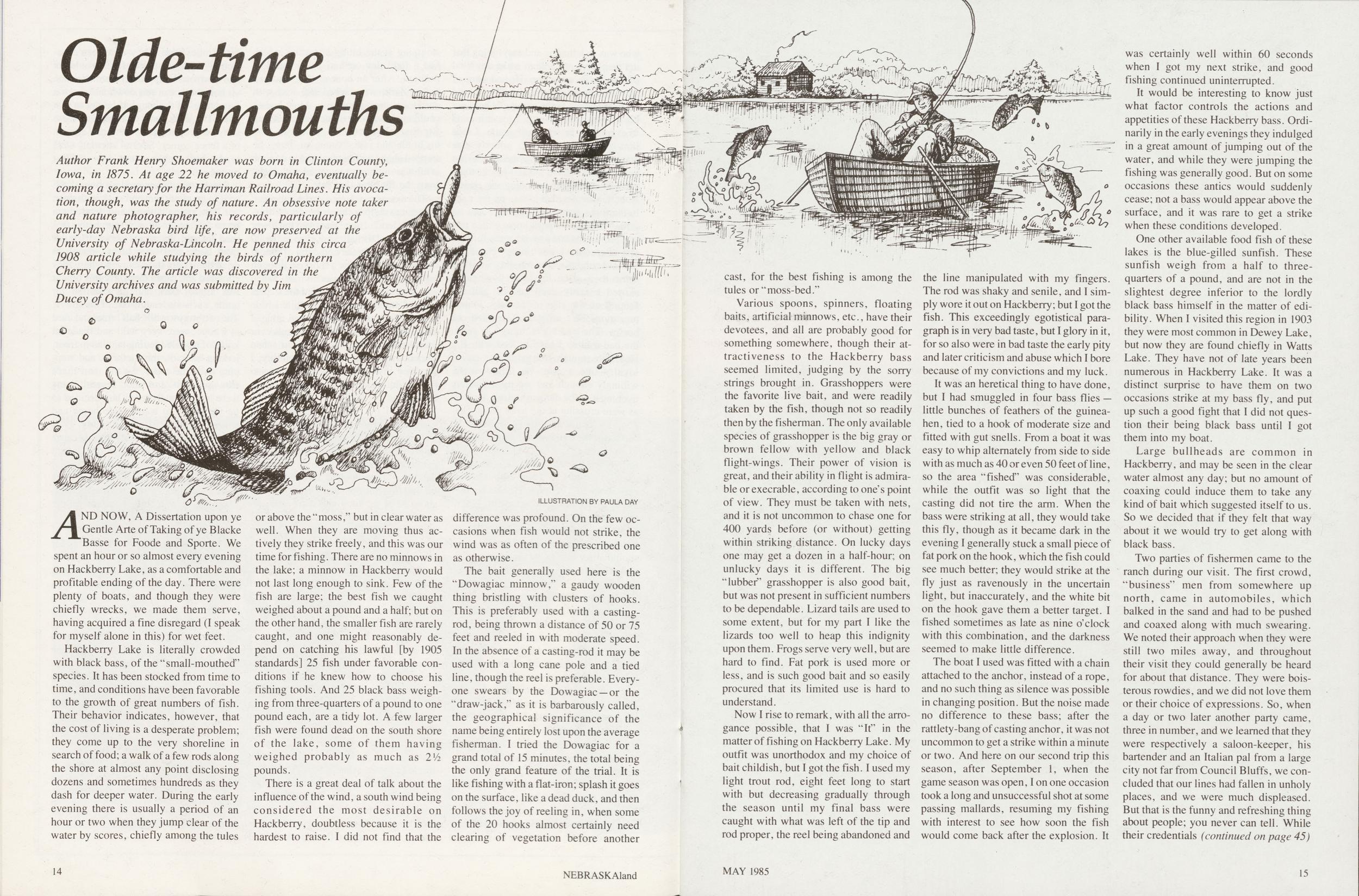
Olde-time Smallmouths
Author Frank Henry Shoemaker was born in Clinton County, Iowa, in 1875. At age 22 he moved to Omaha, eventually becoming a secretary for the Harriman Railroad Lines. His avocation, though, was the study of nature. An obsessive note taker and nature photographer, his records, particularly of early-day Nebraska bird life, are now preserved at the University of Nebraska-Lincoln. He penned this circa 1908 article while studying the birds of northern Cherry County. The article was discovered in the University archives and was submitted by Jim Ducey of Omaha.ND NOW, A Dissertation upon ye Gentle Arte of Taking of ye Blacke Basse for Foode and Sporte. We spent an hour or so almost every evening on Hackberry Lake, as a comfortable and profitable ending of the day. There were plenty of boats, and though they were chiefly wrecks, we made them serve, having acquired a fine disregard (I speak for myself alone in this) for wet feet.
Hackberry Lake is literally crowded with black bass, of the "small-mouthed" species. It has been stocked from time to time, and conditions have been favorable to the growth of great numbers of fish. Their behavior indicates, however, that the cost of living is a desperate problem; they come up to the very shoreline in search of food; a walk of a few rods along the shore at almost any point disclosing dozens and sometimes hundreds as they dash for deeper water. During the early evening there is usually a period of an hour or two when they jump clear of the water by scores, chiefly among the tules or above the "moss," but in clear water as well. When they are moving thus actively they strike freely, and this was our time for fishing. There are no minnows in the lake; a minnow in Hackberry would not last long enough to sink. Few of the fish are large; the best fish we caught weighed about a pound and a half; but on the other hand, the smaller fish are rarely caught, and one might reasonably depend on catching his lawful [by 1905 standards] 25 fish under favorable conditions if he knew how to choose his fishing tools. And 25 black bass weighing from three-quarters of a pound to one pound each, are a tidy lot. A few larger fish were found dead on the south shore of the lake, some of them having weighed probably as much as 2xh pounds.
There is a great deal of talk about the influence of the wind, a south wind being considered the most desirable on Hackberry, doubtless because it is the hardest to raise. I did not find that the difference was profound. On the few occasions when fish would not strike, the wind was as often of the prescribed one as otherwise.
The bait generally used here is the "Dowagiac minnow," a gaudy wooden thing bristling with clusters of hooks. This is preferably used with a castingrod, being thrown a distance of 50 or 75 feet and reeled in with moderate speed. In the absence of a casting-rod it may be used with a long cane pole and a tied line, though the reel is preferable. Everyone swears by the Dowagiac —or the "draw-jack," as it is barbarously called, the geographical significance of the name being entirely lost upon the average fisherman. I tried the Dowagiac for a grand total of 15 minutes, the total being the only grand feature of the trial. It is like fishing with a flat-iron; splash it goes on the surface, like a dead duck, and then follows the joy of reeling in, when some of the 20 hooks almost certainly need clearing of vegetation before another 14 NEBRSAKAland cast, for the best fishing is among the tules or "moss-bed."
Various spoons, spinners, floating baits, artificial minnows, etc., have their devotees, and all are probably good for something somewhere, though their attractiveness to the Hackberry bass seemed limited, judging by the sorry strings brought in. Grasshoppers were the favorite live bait, and were readily taken by the fish, though not so readily then by the fisherman. The only available species of grasshopper is the big gray or brown fellow with yellow and black flight-wings. Their power of vision is great, and their ability in flight is admirable or execrable, according to one's point of view. They must be taken with nets, and it is not uncommon to chase one for 400 yards before (or without) getting within striking distance. On lucky days one may get a dozen in a half-hour; on unlucky days it is different. The big "lubber" grasshopper is also good bait, but was not present in sufficient numbers to be dependable. Lizard tails are used to some extent, but for my part I like the lizards too well to heap this indignity upon them. Frogs serve very well, but are hard to find. Fat pork is used more or less, and is such good bait and so easily procured that its limited use is hard to understand.
Now I rise to remark, with all the arrogance possible, that I was "It" in the matter of fishing on Hackberry Lake. My outfit was unorthodox and my choice of bait childish, but I got the fish. I used my light trout rod, eight feet long to start with but decreasing gradually through the season until my final bass were caught with what was left of the tip and rod proper, the reel being abandoned and the line manipulated with my fingers. The rod was shaky and senile, and I simply wore it out on Hackberry; but I got the fish. This exceedingly egotistical paragraph is in very bad taste, but I glory in it, for so also were in bad taste the early pity and later criticism and abuse which I bore because of my convictions and my luck.
It was an heretical thing to have done, but I had smuggled in four bass flies — little bunches of feathers of the guineahen, tied to a hook of moderate size and fitted with gut snells. From a boat it was easy to whip alternately from side to side with as much as 40 or even 50 feet of line, so the area "fished" was considerable, while the outfit was so light that the casting did not tire the arm. When the bass were striking at all, they would take this fly, though as it became dark in the evening I generally stuck a small piece of fat pork on the hook, which the fish could see much better; they would strike at the fly just as ravenously in the uncertain light, but inaccurately, and the white bit on the hook gave them a better target. I fished sometimes as late as nine o'clock with this combination, and the darkness seemed to make little difference.
The boat I used was fitted with a chain attached to the anchor, instead of a rope, and no such thing as silence was possible in changing position. But the noise made no difference to these bass; after the rattlety-bang of casting anchor, it was not uncommon to get a strike within a minute or two. And here on our second trip this season, after September 1, when the game season was open, I on one occasion took a long and unsuccessful shot at some passing mallards, resuming my fishing with interest to see how soon the fish would come back after the explosion. It was certainly well within 60 seconds when I got my next strike, and good fishing continued uninterrupted.
It would be interesting to know just what factor controls the actions and appetities of these Hackberry bass. Ordinarily in the early evenings they indulged in a great amount of jumping out of the water, and while they were jumping the fishing was generally good. But on some occasions these antics would suddenly cease; not a bass would appear above the surface, and it was rare to get a strike when these conditions developed.
One other available food fish of these lakes is the blue-gilled sunfish. These sunfish weigh from a half to threequarters of a pound, and are not in the slightest degree inferior to the lordly black bass himself in the matter of edibility. When I visited this region in 1903 they were most common in Dewey Lake, but now they are found chiefly in Watts Lake. They have not of late years been numerous in Hackberry Lake. It was a distinct surprise to have them on two occasions strike at my bass fly, and put up such a good fight that I did not question their being black bass until I got them into my boat.
Large bullheads are common in Hackberry, and may be seen in the clear water almost any day; but no amount of coaxing could induce them to take any kind of bait which suggested itself to us. So we decided that if they felt that way about it we would try to get along with black bass.
Two parties of fishermen came to the ranch during our visit. The first crowd, "business" men from somewhere up north, came in automobiles, which balked in the sand and had to be pushed and coaxed along with much swearing. We noted their approach when they were still two miles away, and throughout their visit they could generally be heard for about that distance. They were boisterous rowdies, and we did not love them or their choice of expressions. So, when a day or two later another party came, three in number, and we learned that they were respectively a saloon-keeper, his bartender and an Italian pal from a large city not far from Council Bluffs, we concluded that our lines had fallen in unholy places, and we were much displeased. But that is the funny and refreshing thing about people; you never can tell. While their credentials (continued on page 45)
MAY 1985 15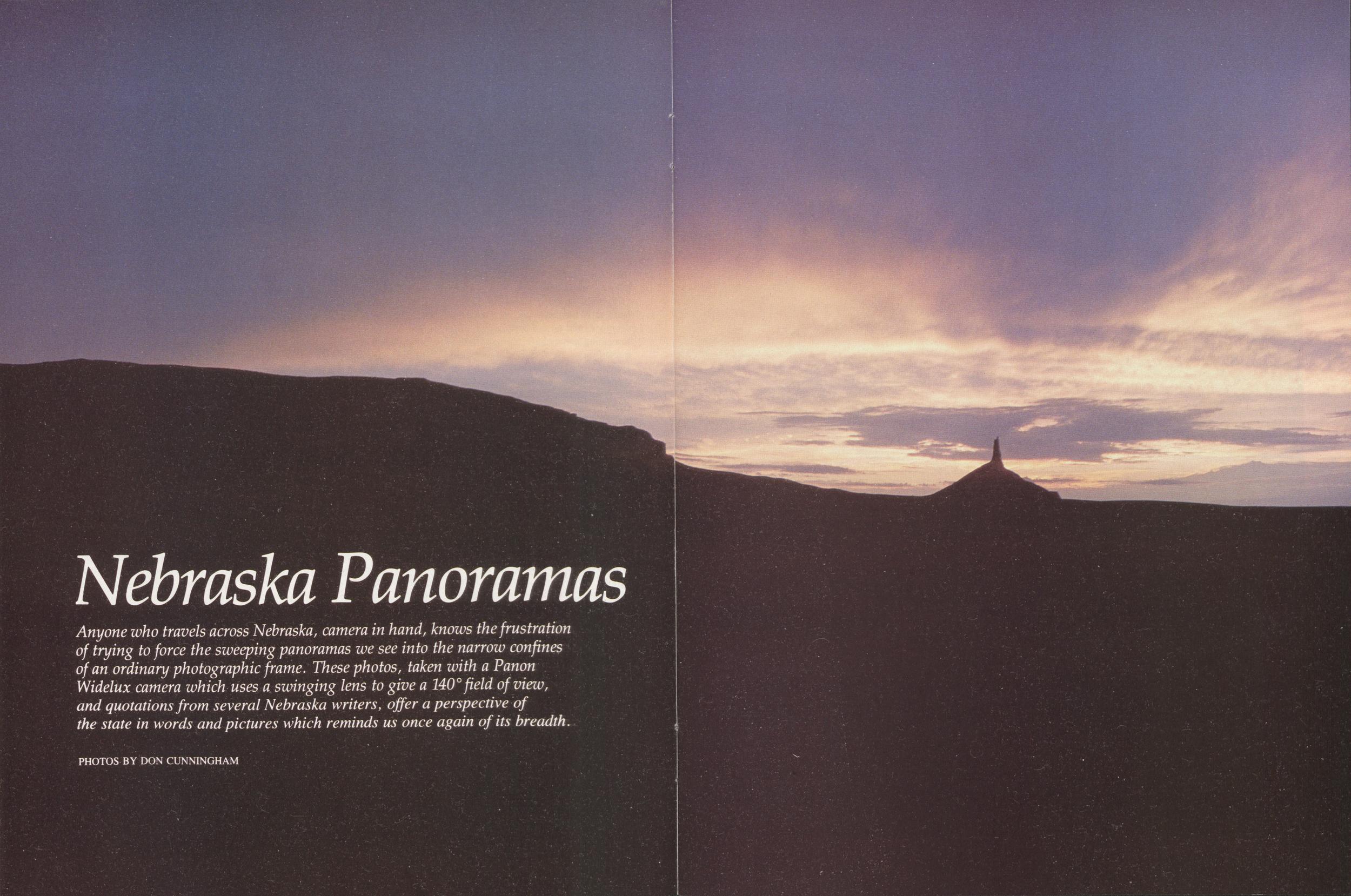
Nebraska Panoramas
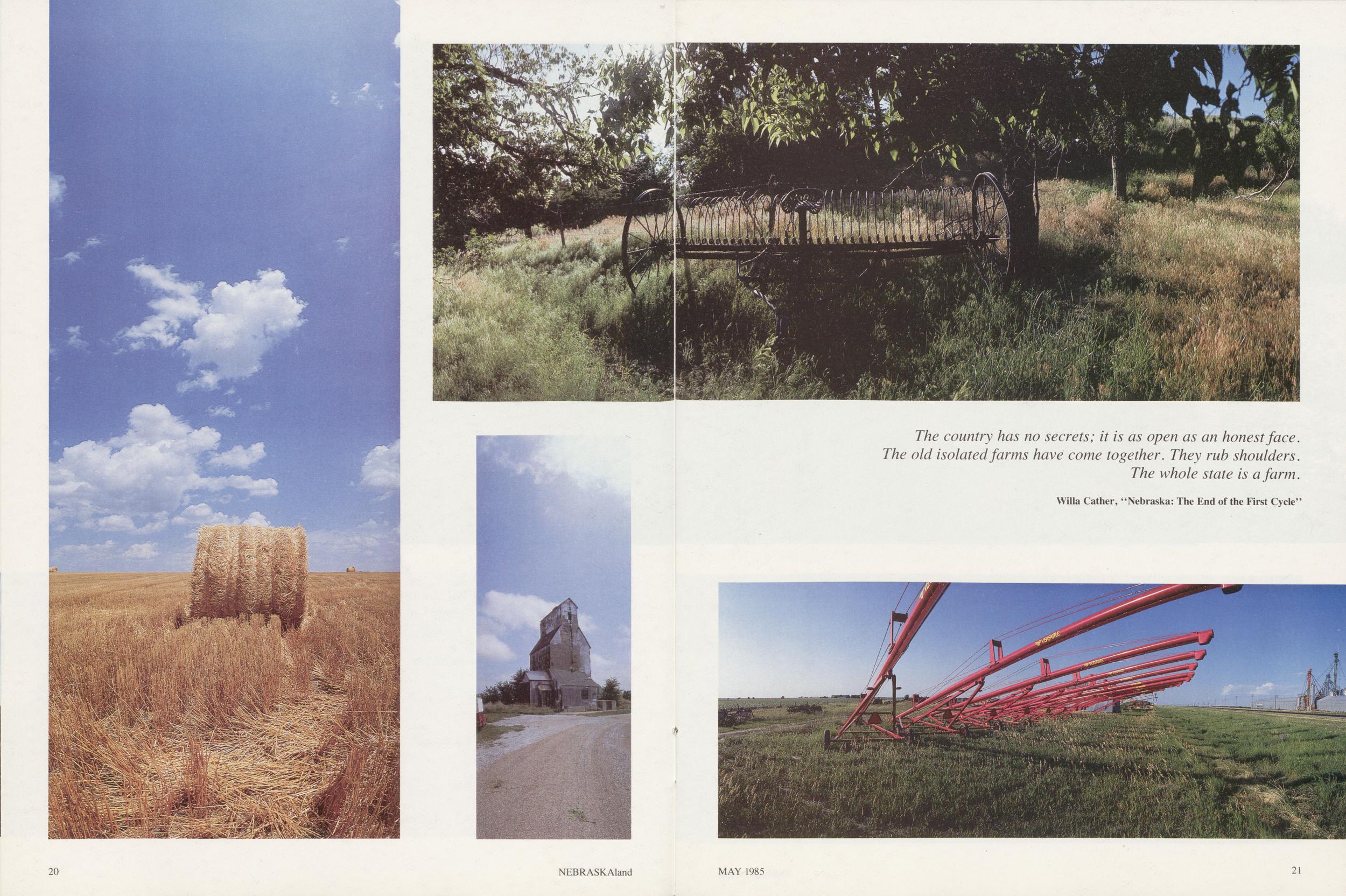
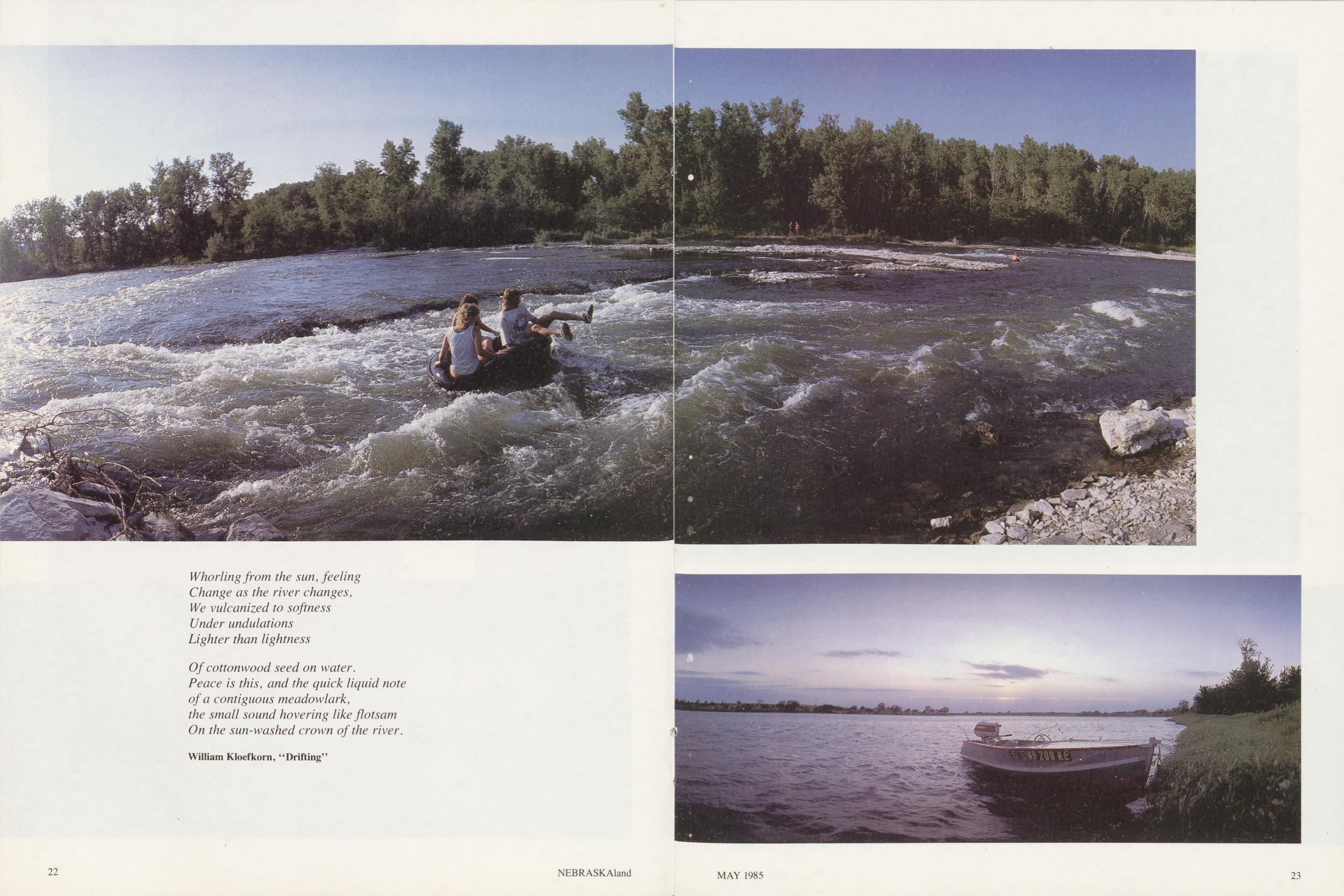
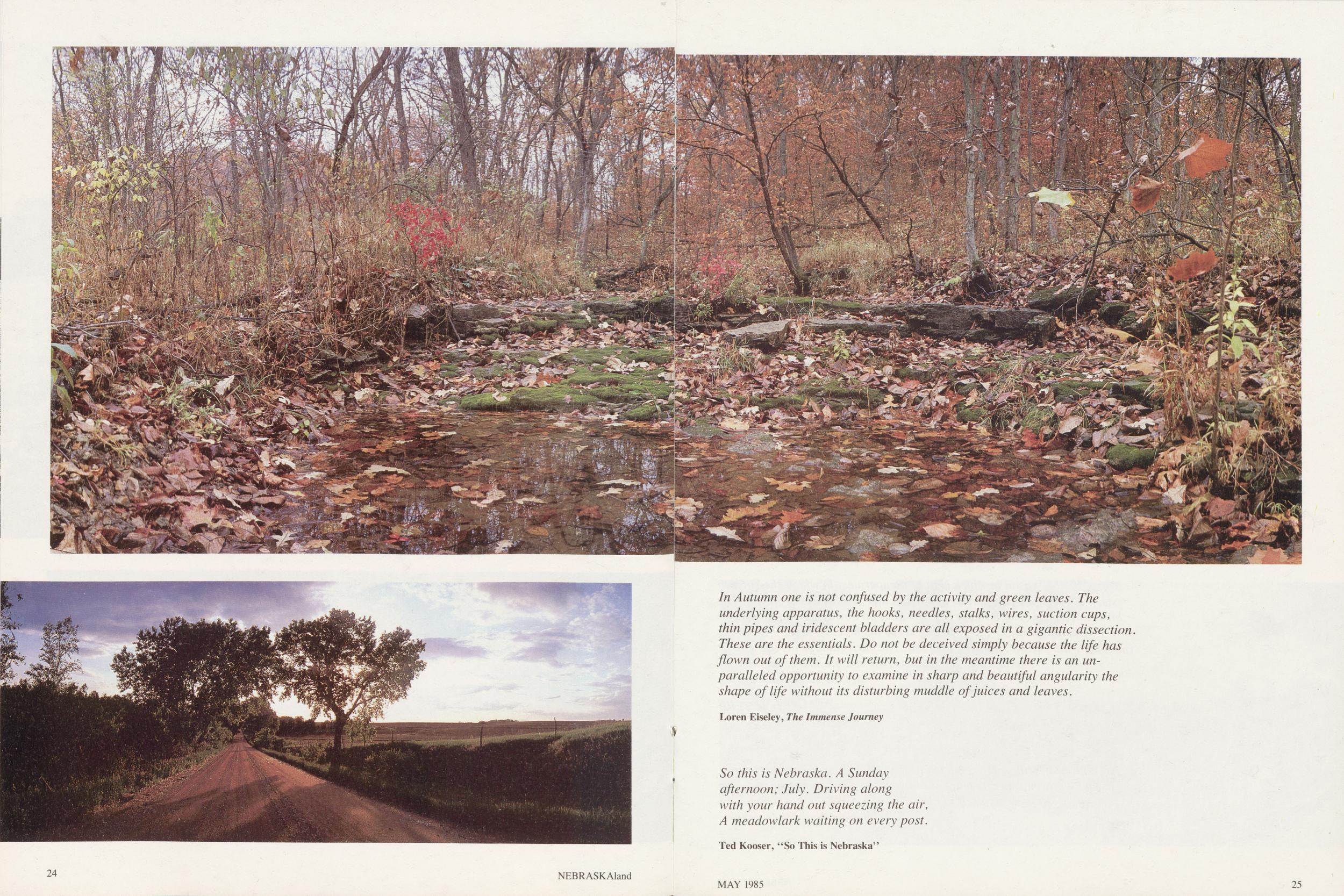
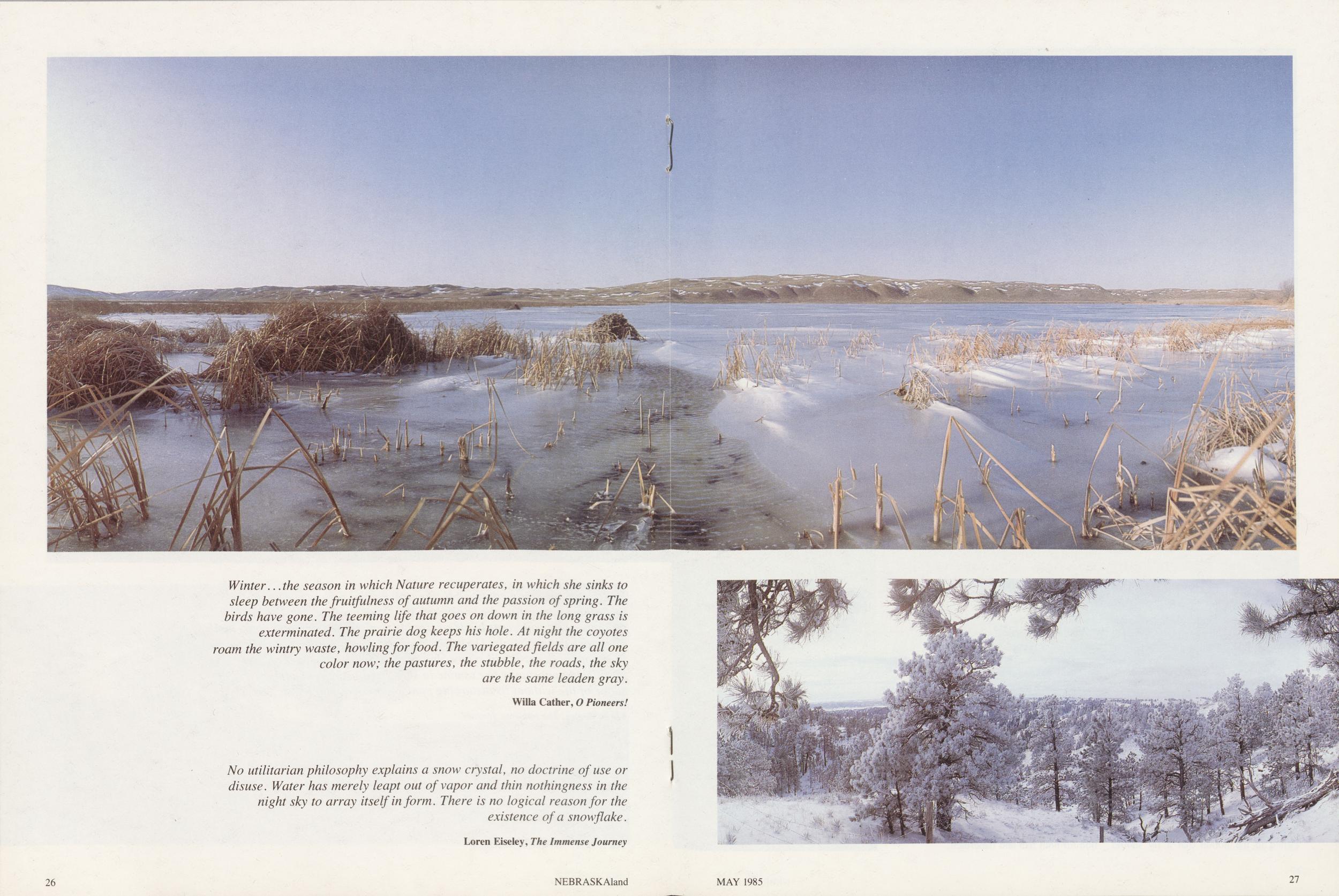
Anyone who travels across Nebraska, camera in hand, knows the frustration of trying to force the sweeping panoramas we see into the narrow confines of an ordinary photographic frame. These photos, taken with a Panon Widelux camera which uses a swinging lens to give a 140° field of view, and quotations from several Nebraska writers, offer a perspective of the state in words and pictures which reminds us once again of its breadth. PHOTOS BY DON CUNNINGHAM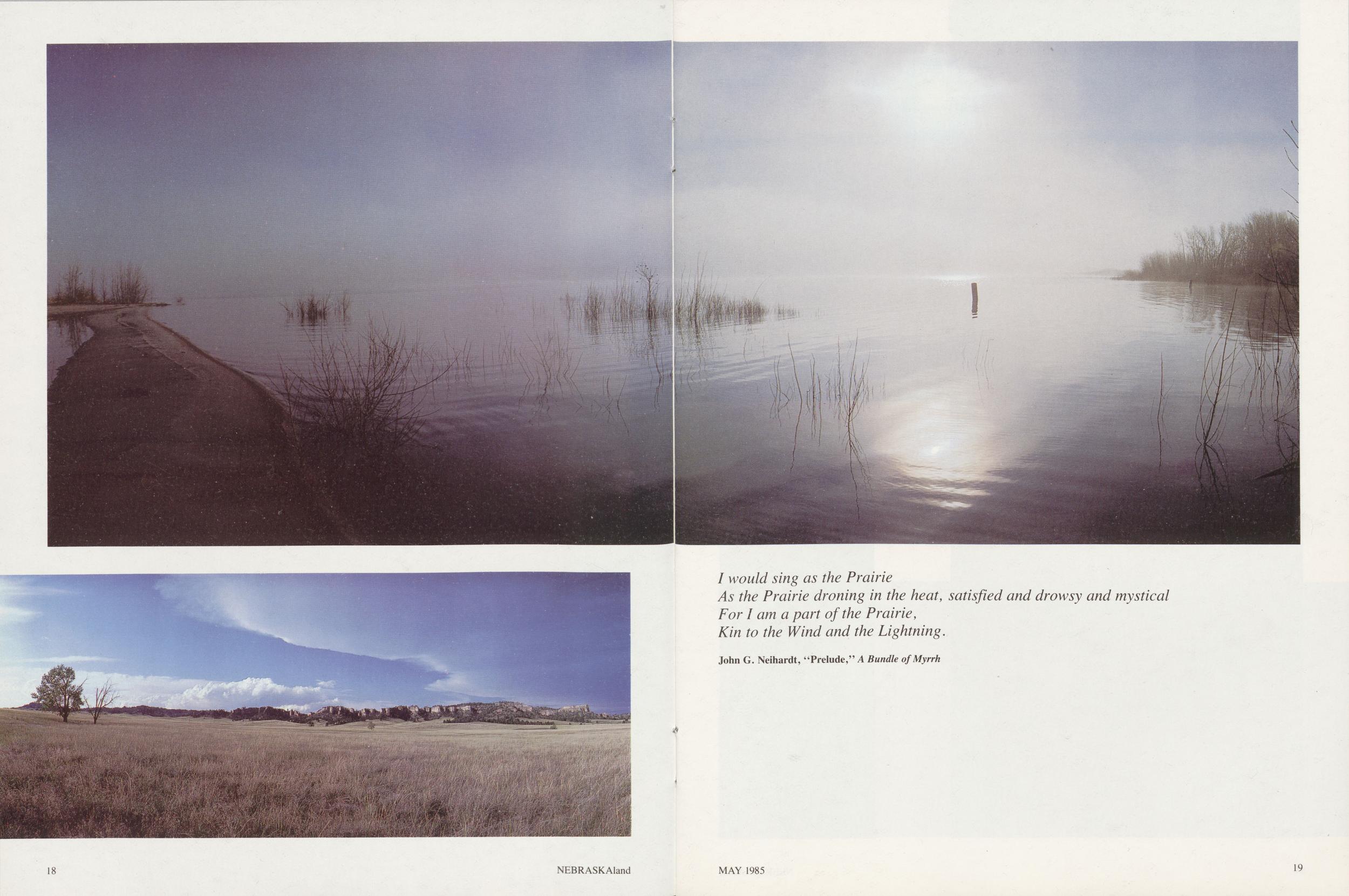
Fraudfiil Flies
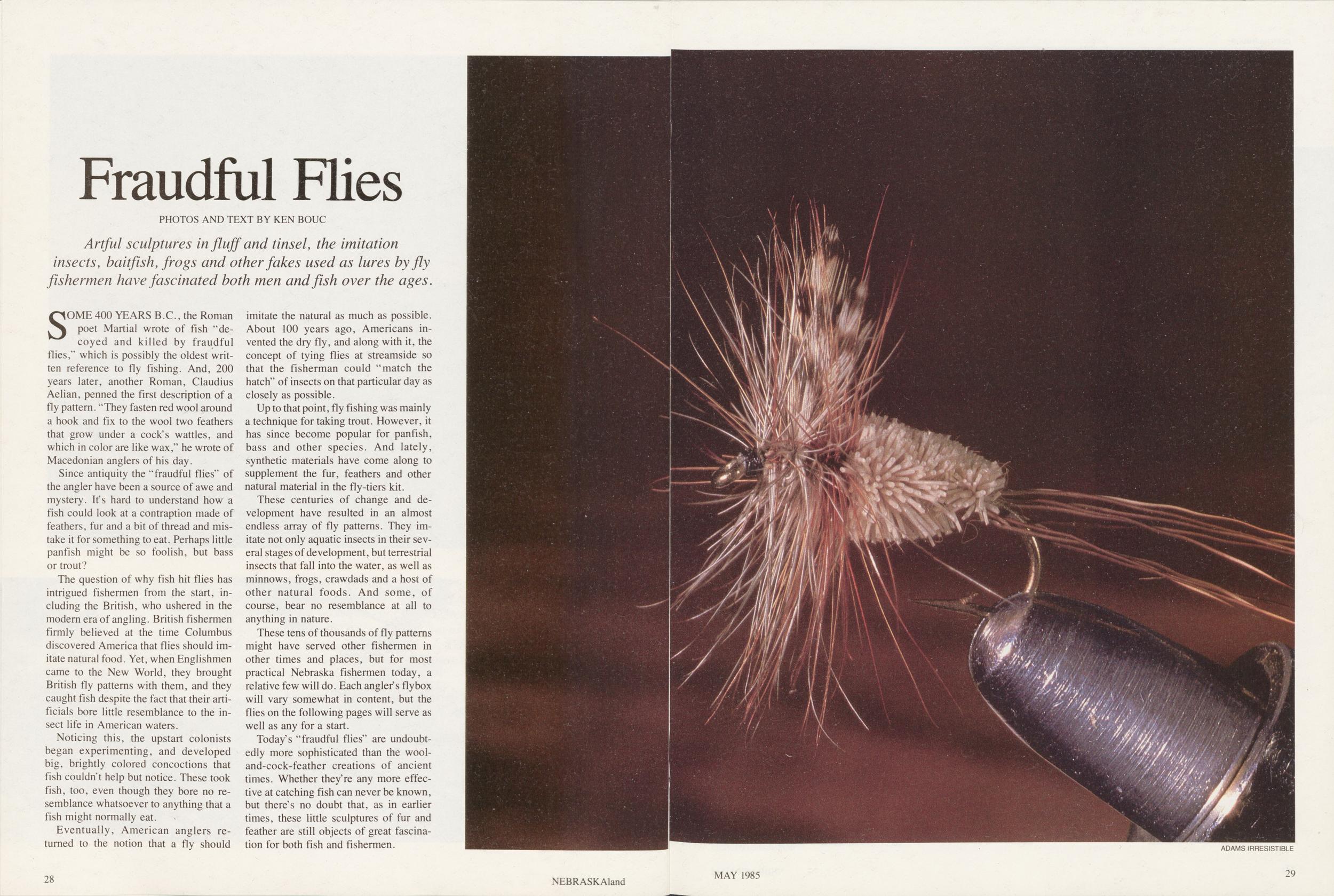
PHOTOS AND TEXT BY KEN BOUC Artful sculptures in fluff and tinsel, the imitation insects, baitfish, frogs and other fakes used as lures by fly fishermen have fascinated both men and fish over the ages.SOME 400 YEARS B.C., the Roman poet Martial wrote of fish "decoyed and killed by fraudful flies," which is possibly the oldest written reference to fly fishing. And, 200 years later, another Roman, Claudius Aelian, penned the first description of a fly pattern. 'They fasten red wool around a hook and fix to the wool two feathers that grow under a cock's wattles, and which in color are like wax," he wrote of Macedonian anglers of his day.
Since antiquity the "fraudful flies" of the angler have been a source of awe and mystery. It's hard to understand how a fish could look at a contraption made of feathers, fur and a bit of thread and mistake it for something to eat. Perhaps little panfish might be so foolish, but bass or trout?
The question of why fish hit flies has intrigued fishermen from the start, including the British, who ushered in the modern era of angling. British fishermen firmly believed at the time Columbus discovered America that flies should imitate natural food. Yet, when Englishmen came to the New World, they brought British fly patterns with them, and they caught fish despite the fact that their artificials bore little resemblance to the insect life in American waters.
Noticing this, the upstart colonists began experimenting, and developed big, brightly colored concoctions that fish couldn't help but notice. These took fish, too, even though they bore no resemblance whatsoever to anything that a fish might normally eat.
Eventually, American anglers returned to the notion that a fly should imitate the natural as much as possible. About 100 years ago, Americans invented the dry fly, and along with it, the concept of tying flies at streamside so that the fisherman could "match the hatch" of insects on that particular day as closely as possible.
Up to that point, fly fishing was mainly a technique for taking trout. However, it has since become popular for panfish, bass and other species. And lately, synthetic materials have come along to supplement the fur, feathers and other natural material in the fly-tiers kit.
These centuries of change and development have resulted in an almost endless array of fly patterns. They imitate not only aquatic insects in their several stages of development, but terrestrial insects that fall into the water, as well as minnows, frogs, crawdads and a host of other natural foods. And some, of course, bear no resemblance at all to anything in nature.
These tens of thousands of fly patterns might have served other fishermen in other times and places, but for most practical Nebraska fishermen today, a relative few will do. Each angler's flybox will vary somewhat in content, but the flies on the following pages will serve as well as any for a start.
Today's "fraudful flies" are undoubtedly more sophisticated than the wooland-cock-feather creations of ancient times. Whether they're any more effective at catching fish can never be known, but there's no doubt that, as in earlier times, these little sculptures of fur and feather are still objects of great fascination for both fish and fishermen.
28 NEBRASKAland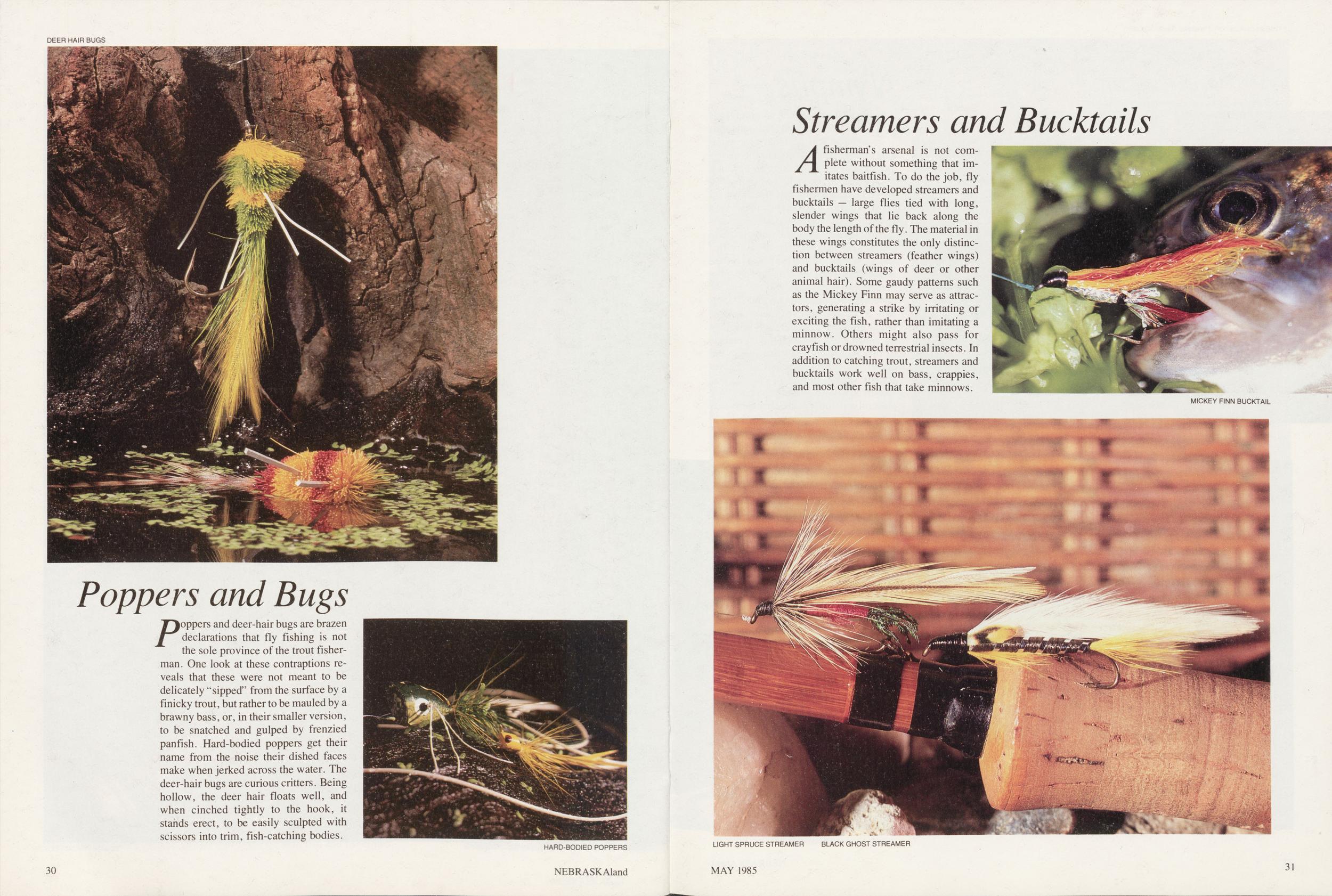
Toppers and deer-hair bugs are brazen declarations that fly fishing is not the sole province of the trout fisherman. One look at these contraptions reveals that these were not meant to be delicately "sipped" from the surface by a finicky trout, but rather to be mauled by a brawny bass, or, in their smaller version, to be snatched and gulped by frenzied panfish. Hard-bodied poppers get their name from the noise their dished faces make when jerked across the water. The deer-hair bugs are curious critters. Being hollow, the deer hair floats well, and when cinched tightly to the hook, it stands erect, to be easily sculpted with scissors into trim, fish-catching bodies.
A fisherman's arsenal is not complete without something that imitates baitfish. To do the job, fly fishermen have developed streamers and bucktails — large flies tied with long, slender wings that lie back along the body the length of the fly. The material in these wings constitutes the only distinction between streamers (feather wings) and bucktails (wings of deer or other animal hair). Some gaudy patterns such as the Mickey Finn may serve as attractors, generating a strike by irritating or exciting the fish, rather than imitating a minnow. Others might also pass for crayfish or drowned terrestrial insects. In addition to catching trout, streamers and bucktails work well on bass, crappies, and most other fish that take minnows.
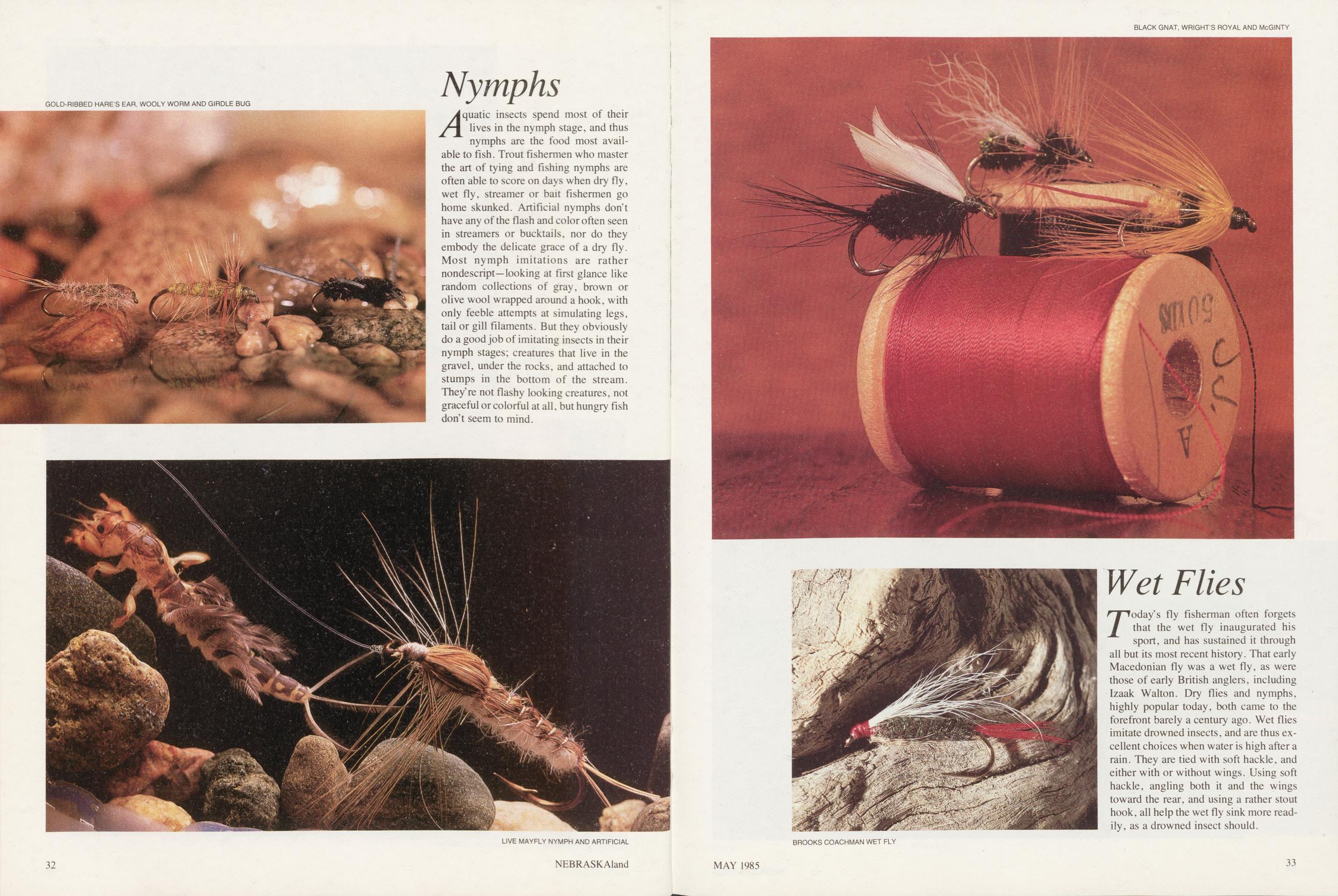
quatic insects spend most of their lives in the nymph stage, and thus nymphs are the food most available to fish. Trout fishermen who master the art of tying and fishing nymphs are often able to score on days when dry fly, wet fly, streamer or bait fishermen go home skunked. Artificial nymphs don't have any of the flash and color often seen in streamers or bucktails, nor do they embody the delicate grace of a dry fly. Most nymph imitations are rather nondescript—looking at first glance like random collections of gray, brown or olive wool wrapped around a hook, with only feeble attempts at simulating legs, tail or gill filaments. But they obviously do a good job of imitating insects in their nymph stages; creatures that live in the gravel, under the rocks, and attached to stumps in the bottom of the stream. They're not flashy looking creatures, not graceful or colorful at all, but hungry fish don't seem to mind.
Troday's fly fisherman often forgets that the wet fly inaugurated his sport, and has sustained it through all but its most recent history. That early Macedonian fly was a wet fly, as were those of early British anglers, including Izaak Walton. Dry flies and nymphs, highly popular today, both came to the forefront barely a century ago. Wet flies imitate drowned insects, and are thus excellent choices when water is high after a rain. They are tied with soft hackle, and either with or without wings. Using soft hackle, angling both it and the wings toward the rear, and using a rather stout hook, all help the wet fly sink more readily, as a drowned insect should.
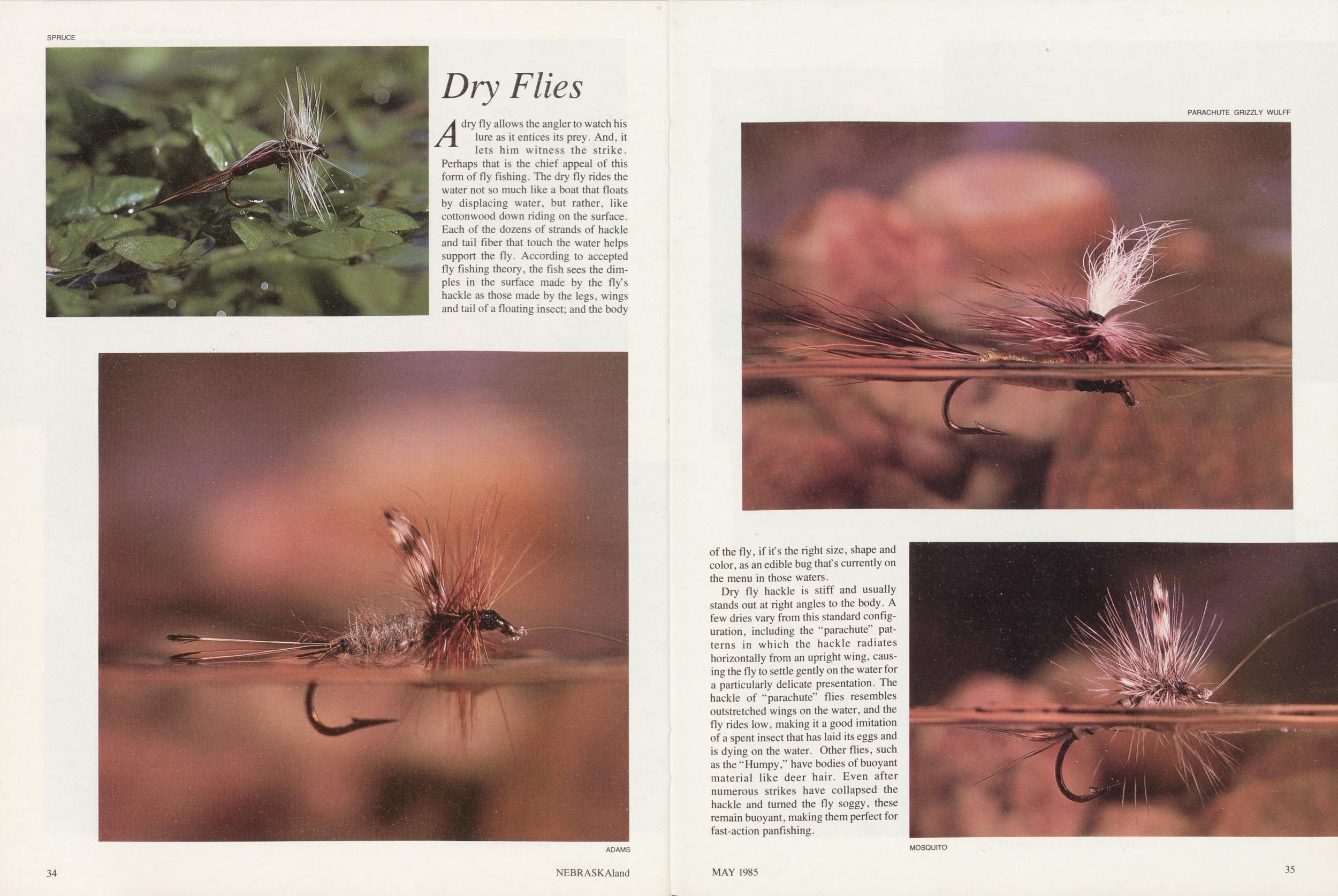
A dry fly allows the angler to watch his A lure as it entices its prey. And, it lets him witness the strike. Perhaps that is the chief appeal of this form of fly fishing. The dry fly rides the water not so much like a boat that floats by displacing water, but rather, like cottonwood down riding on the surface. Each of the dozens of strands of hackle and tail fiber that touch the water helps support the fly. According to accepted fly fishing theory, the fish sees the dimples in the surface made by the fly's hackle as those made by the legs, wings and tail of a floating insect; and the body of the fly, if it's the right size, shape and color, as an edible bug that's currently on the menu in those waters.
Dry fly hackle is stiff and usually stands out at right angles to the body. A few dries vary from this standard configuration, including the "parachute" patterns in which the hackle radiates horizontally from an upright wing, causing the fly to settle gently on the water for a particularly delicate presentation. The hackle of "parachute" flies resembles outstretched wings on the water, and the fly rides low, making it a good imitation of a spent insect that has laid its eggs and is dying on the water. Other flies, such as the "Humpy," have bodies of buoyant material like deer hair. Even after numerous strikes have collapsed the hackle and turned the fly soggy, these remain buoyant, making them perfect for fast-action panfishing.
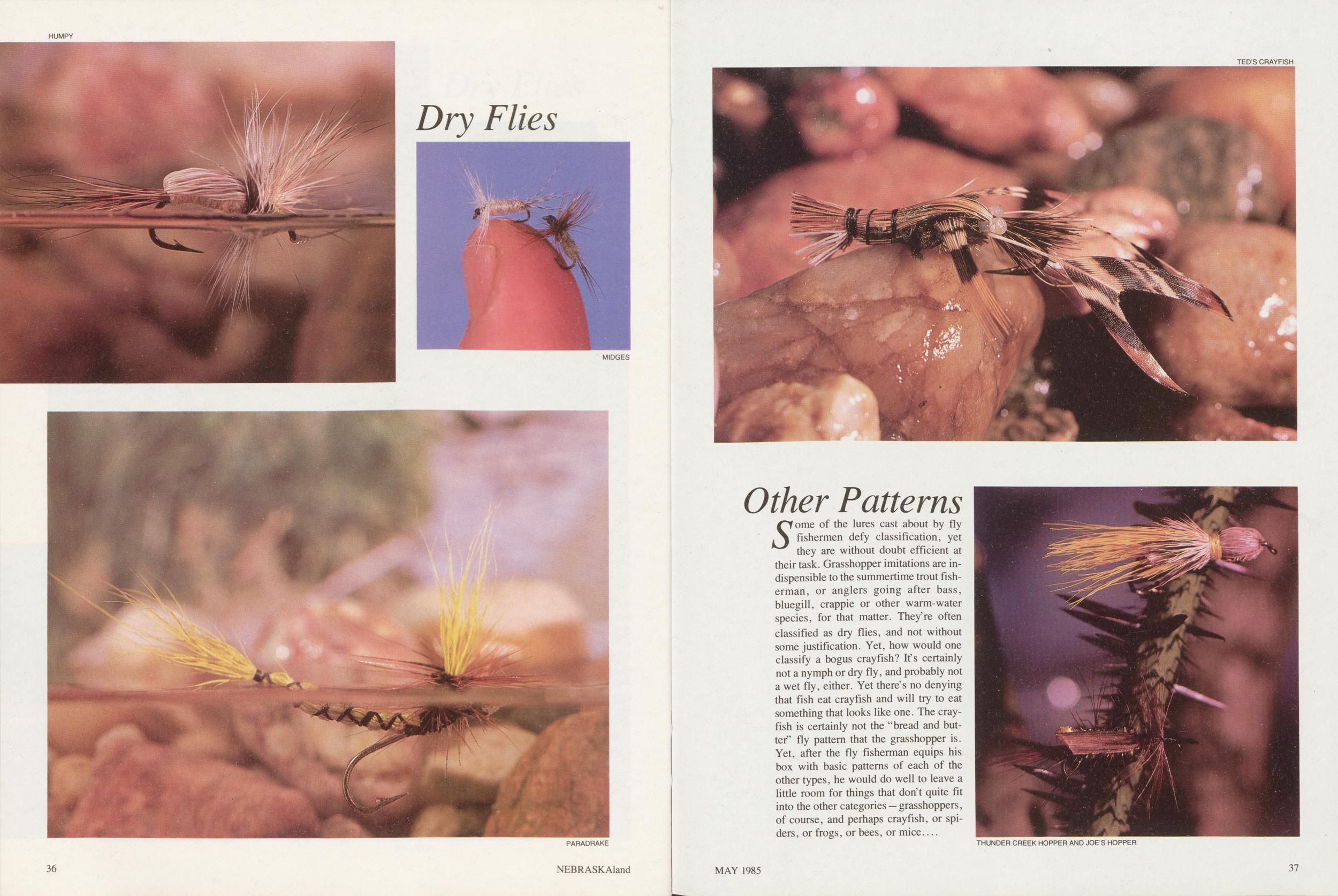
some of the lures cast about by fly fishermen defy classification, yet they are without doubt efficient at their task. Grasshopper imitations are indispensible to the summertime trout fisherman, or anglers going after bass, bluegill, crappie or other warm-water species, for that matter. They're often classified as dry flies, and not without some justification. Yet, how would one classify a bogus crayfish? It's certainly not a nymph or dry fly, and probably not a wet fly, either. Yet there's no denying that fish eat crayfish and will try to eat something that looks like one. The crayfish is certainly not the "bread and butter" fly pattern that the grasshopper is. Yet, after the fly fisherman equips his box with basic patterns of each of the other types, he would do well to leave a little room for things that don't quite fit into the other categories — grasshoppers, of course, and perhaps crayfish, or spiders, or frogs, or bees, or mice—
LEARN FISHING by Reading Water
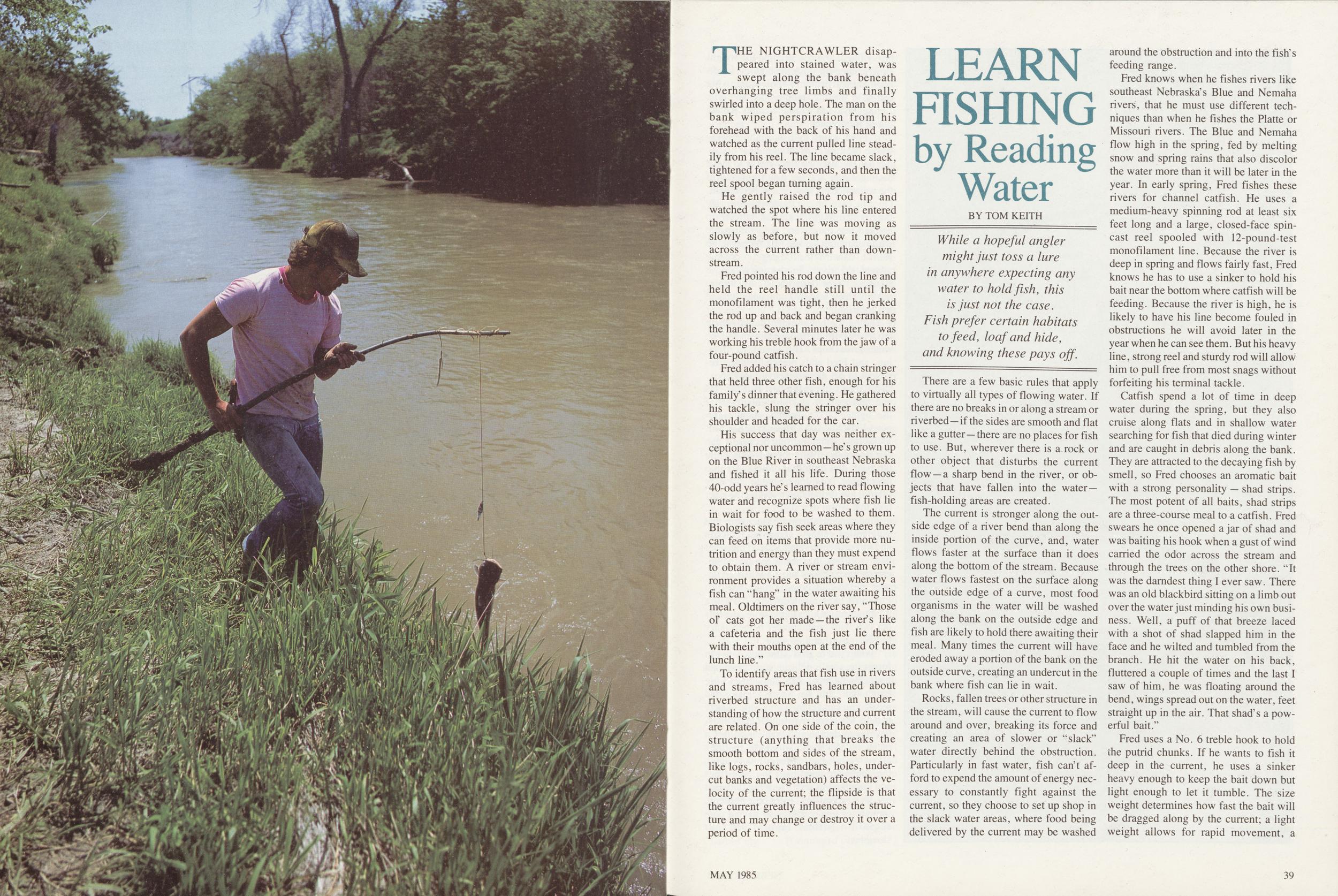
BY TOM KEITH While a hopeful angler might just toss a lure in anywhere expecting any water to hold fish, this is just not the case. Fish prefer certain habitats to feed, loaf and hide, and knowing these pays off.THE NIGHTCRAWLER disappeared into stained water, was swept along the bank beneath overhanging tree limbs and finally swirled into a deep hole. The man on the bank wiped perspiration from his forehead with the back of his hand and watched as the current pulled line steadily from his reel. The line became slack, tightened for a few seconds, and then the reel spool began turning again.
He gently raised the rod tip and watched the spot where his line entered the stream. The line was moving as slowly as before, but now it moved across the current rather than downstream.
Fred pointed his rod down the line and held the reel handle still until the monofilament was tight, then he jerked the rod up and back and began cranking the handle. Several minutes later he was working his treble hook from the jaw of a four-pound catfish.
Fred added his catch to a chain stringer that held three other fish, enough for his family's dinner that evening. He gathered his tackle, slung the stringer over his shoulder and headed for the car.
His success that day was neither exceptional nor uncommon—he's grown up on the Blue River in southeast Nebraska and fished it all his life. During those 40-odd years he's learned to read flowing water and recognize spots where fish lie in wait for food to be washed to them. Biologists say fish seek areas where they can feed on items that provide more nutrition and energy than they must expend to obtain them. A river or stream environment provides a situation whereby a fish can "hang" in the water awaiting his meal. Oldtimers on the river say, "Those of cats got her made —the river's like a cafeteria and the fish just lie there with their mouths open at the end of the lunch line."
To identify areas that fish use in rivers and streams, Fred has learned about riverbed structure and has an understanding of how the structure and current are related. On one side of the coin, the structure (anything that breaks the smooth bottom and sides of the stream, like logs, rocks, sandbars, holes, undercut banks and vegetation) affects the velocity of the current; the flipside is that the current greatly influences the structure and may change or destroy it over a period of time.
There are a few basic rules that apply to virtually all types of flowing water. If there are no breaks in or along a stream or riverbed—if the sides are smooth and flat like a gutter—there are no places for fish to use. But, wherever there is a rock or other object that disturbs the current flow —a sharp bend in the river, or objects that have fallen into the waterfish-holding areas are created.
The current is stronger along the outside edge of a river bend than along the inside portion of the curve, and, water flows faster at the surface than it does along the bottom of the stream. Because water flows fastest on the surface along the outside edge of a curve, most food organisms in the water will be washed along the bank on the outside edge and fish are likely to hold there awaiting their meal. Many times the current will have eroded away a portion of the bank on the outside curve, creating an undercut in the bank where fish can lie in wait.
Rocks, fallen trees or other structure in the stream, will cause the current to flow around and over, breaking its force and creating an area of slower or "slack" water directly behind the obstruction. Particularly in fast water, fish can't afford to expend the amount of energy necessary to constantly fight against the current, so they choose to set up shop in the slack water areas, where food being delivered by the current may be washed around the obstruction and into the fish's feeding range.
Fred knows when he fishes rivers like southeast Nebraska's Blue and Nemaha rivers, that he must use different techniques than when he fishes the Platte or Missouri rivers. The Blue and Nemaha flow high in the spring, fed by melting snow and spring rains that also discolor the water more than it will be later in the year. In early spring, Fred fishes these rivers for channel catfish. He uses a medium-heavy spinning rod at least six feet long and a large, closed-face spincast reel spooled with 12-pound-test monofilament line. Because the river is deep in spring and flows fairly fast, Fred knows he has to use a sinker to hold his bait near the bottom where catfish will be feeding. Because the river is high, he is likely to have his line become fouled in obstructions he will avoid later in the year when he can see them. But his heavy line, strong reel and sturdy rod will allow him to pull free from most snags without forfeiting his terminal tackle.
Catfish spend a lot of time in deep water during the spring, but they also cruise along flats and in shallow water searching for fish that died during winter and are caught in debris along the bank. They are attracted to the decaying fish by smell, so Fred chooses an aromatic bait with a strong personality — shad strips. The most potent of all baits, shad strips are a three-course meal to a catfish. Fred swears he once opened a jar of shad and was baiting his hook when a gust of wind carried the odor across the stream and through the trees on the other shore. "It was the darndest thing I ever saw. There was an old blackbird sitting on a limb out over the water just minding his own business. Well, a puff of that breeze laced with a shot of shad slapped him in the face and he wilted and tumbled from the branch. He hit the water on his back, fluttered a couple of times and the last I saw of him, he was floating around the bend, wings spread out on the water, feet straight up in the air. That shad's a powerful bait."
Fred uses a No. 6 treble hook to hold the putrid chunks. If he wants to fish it deep in the current, he uses a sinker heavy enough to keep the bait down but light enough to let it tumble. The size weight determines how fast the bait will be dragged along by the current; a light weight allows for rapid movement, a heavy one, slow. By keeping the weight slowly bumping along the bottom, Fred's hoping it will drift into a hole where a big catfish is waiting, mouth open and gills flaring, trying to work the empty feeling out of its stomach.
MAY 1985 39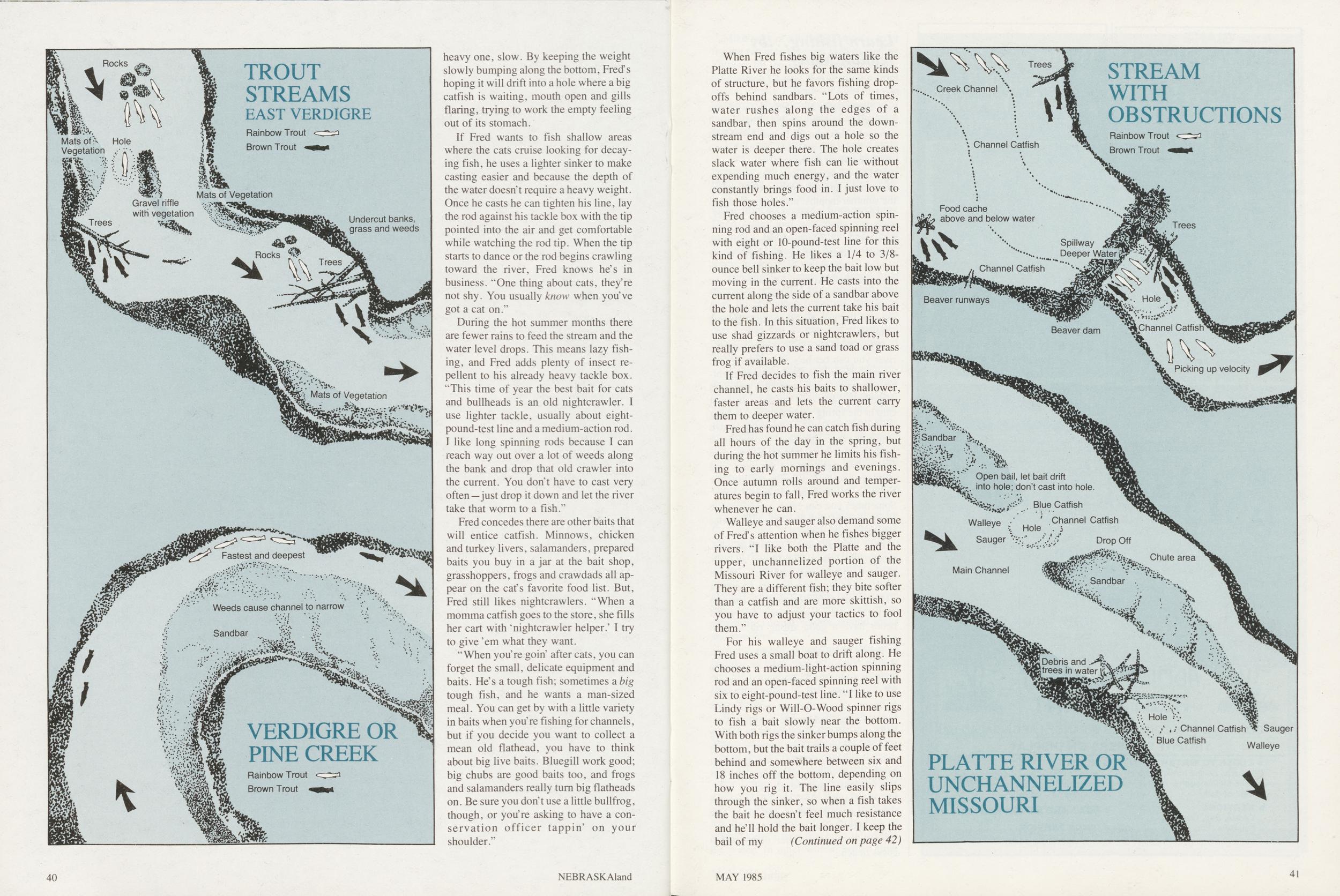
If Fred wants to fish shallow areas where the cats cruise looking for decaying fish, he uses a lighter sinker to make casting easier and because the depth of the water doesn't require a heavy weight. Once he casts he can tighten his line, lay the rod against his tackle box with the tip pointed into the air and get comfortable while watching the rod tip. When the tip starts to dance or the rod begins crawling toward the river, Fred knows he's in business. "One thing about cats, they're not shy. You usually know when you've got a cat on."
During the hot summer months there are fewer rains to feed the stream and the water level drops. This means lazy fishing, and Fred adds plenty of insect repellent to his already heavy tackle box. "This time of year the best bait for cats and bullheads is an old nightcrawler. I use lighter tackle, usually about eightpound-test line and a medium-action rod. I like long spinning rods because I can reach way out over a lot of weeds along the bank and drop that old crawler into the current. You don't have to cast very often—just drop it down and let the river take that worm to a fish."
Fred concedes there are other baits that will entice catfish. Minnows, chicken and turkey livers, salamanders, prepared baits you buy in a jar at the bait shop, grasshoppers, frogs and crawdads all appear on the cat's favorite food list. But, Fred still likes nightcrawlers. "When a momma catfish goes to the store, she fills her cart with 'nightcrawler helper.' I try to give 'em what they want.
"When you're goin' after cats, you can forget the small, delicate equipment and baits. He's a tough fish; sometimes a big tough fish, and he wants a man-sized meal. You can get by with a little variety in baits when you're fishing for channels, but if you decide you want to collect a mean old flathead, you have to think about big live baits. Bluegill work good; big chubs are good baits too, and frogs and salamanders really turn big flatheads on. Be sure you don't use a little bullfrog, though, or you're asking to have a conservation officer tappin' on your shoulder."
40 NEBRASKAlandWhen Fred fishes big waters like the Platte River he looks for the same kinds of structure, but he favors fishing dropoffs behind sandbars. "Lots of times, water rushes along the edges of a sandbar, then spins around the downstream end and digs out a hole so the water is deeper there. The hole creates slack water where fish can lie without expending much energy, and the water constantly brings food in. I just love to fish those holes."
Fred chooses a medium-action spinning rod and an open-faced spinning reel with eight or 10-pound-test line for this kind of fishing. He likes a 1/4 to 3/8 ounce bell sinker to keep the bait low but moving in the current. He casts into the current along the side of a sandbar above the hole and lets the current take his bait to the fish. In this situation, Fred likes to use shad gizzards or nightcrawlers, but really prefers to use a sand toad or grass frog if available.
If Fred decides to fish the main river channel, he casts his baits to shallower, faster areas and lets the current carry them to deeper water.
Fred has found he can catch fish during all hours of the day in the spring, but during the hot summer he limits his fish-ing to early mornings and evenings. Once autumn rolls around and temperatures begin to fall, Fred works the river whenever he can.
Walleye and sauger also demand some of Fred's attention when he fishes bigger rivers. "I like both the Platte and the upper, unchannelized portion of the Missouri River for walleye and sauger. They are a different fish; they bite softer than a catfish and are more skittish, so you have to adjust your tactics to fool them."
For his walleye and sauger fishing Fred uses a small boat to drift along. He chooses a medium-light-action spinning rod and an open-faced spinning reel with six to eight-pound-test line. "I like to use Lindy rigs or Will-O-Wood spinner rigs to fish a bait slowly near the bottom. With both rigs the sinker bumps along the bottom, but the bait trails a couple of feet behind and somewhere between six and 18 inches off the bottom, depending on how you rig it. The line easily slips through the sinker, so when a fish takes the bait he doesn't feel much resistance and he'll hold the bait longer. I keep the bail of my (Continued on page 42)
 GIANT
HEAVY DUTY
INFLATABLE BOATS
2 MAN $38
3 MAN $50
4 MAN $65
Call Free
Before Midnight For The Next 30 Days
As part of an advertising test, Dunlap Boat Mfg. will
send any of the above size boats to anyone who
reads and responds to this test before the next 30
days. Each Boat Lot No. (Z-26 PVC) is constructed
of tough high density fabric (resistant to abrasions,
sunlight, salt & oil), electronically welded embossed seams, nylon safety line grommeted
all around,
heavy duty oar locks, 3 separate air chambers for
extra safety (4 air chambers in 4-man), self-locking
safety valves, bow lifting & towing handle and are
recommended for marine, ocean and fresh water
recreation, camping, fishing or a family fun boat.
Each boat will be accompanied with a LIFETIME
guarantee that it must perform 100% or it will be
replaced free. Add $7 handling & crating for each
boat requested, Dunlap Boat Mfg. pays all shipping.
If your order is received within the next ten days
you will receive FREE a combined hand/foot inflator/deflator bellows style pump for
each boat requested. Should you wish to return your boat you
may do so for a full refund. Any letter postmarked
after 30 days will be returned. LIMIT three (3) boats
per address, no exceptions. Send appropriate sum
together with your name and address to: Boat Dept.
#970, Dunlap Boat Mfg., 2940 W. Pico Blvd., Los
Angeles, CA 90006, or for fastest service from any
part of the country call 1-800-824-9988 for Boat
Dept. #970 (Calif, residents call collect 213
735-9363), before midnight seven days a week.
Have credit card ready.
By the year 2000,
2outof3
Americans could
be illiterate.
It's true.
Today, 75 million adults
about one American in three,
can't read adequately. And by
the year 2000, U.S. News &
World Report envisions an
America with a literacy rate of
only 30%.
Before that America comes
to be, you can stop it
by joining the fight against
illiteracy today.
Call the Coalition for Literacy
at toll-free 1-800-228-8813 and
volunteer.
Volunteer Against Illiteracy.
The only degree you need
is a degree of caring.
Cornell Coalition for Literacy
EXIT 6 ON THE NORTH SIDE
VISIT THE
flNTDMLS QflLLEY
RESTAURANT
YOUR FAVORITE COCKTAILS FANCY LARGE SALAD BAR
TROPHY STRIPERS ON DISPLAY
CLOSE TO WATER
Located on the north shore of
Lake McConaughy, 7 miles
west of dam
SERVICES
Tackle, Bait, Gas, Oil,
Ice, Beer, Pop, etc.
MOTEL
Lake McConaughy's largest motel
and apartment complex-
includes new units
BOAT AND MOTOR RENTAL
GUIDE SERVICE
Ph: 308-355-2102 Lemoyne, Ne 69146
GIANT
HEAVY DUTY
INFLATABLE BOATS
2 MAN $38
3 MAN $50
4 MAN $65
Call Free
Before Midnight For The Next 30 Days
As part of an advertising test, Dunlap Boat Mfg. will
send any of the above size boats to anyone who
reads and responds to this test before the next 30
days. Each Boat Lot No. (Z-26 PVC) is constructed
of tough high density fabric (resistant to abrasions,
sunlight, salt & oil), electronically welded embossed seams, nylon safety line grommeted
all around,
heavy duty oar locks, 3 separate air chambers for
extra safety (4 air chambers in 4-man), self-locking
safety valves, bow lifting & towing handle and are
recommended for marine, ocean and fresh water
recreation, camping, fishing or a family fun boat.
Each boat will be accompanied with a LIFETIME
guarantee that it must perform 100% or it will be
replaced free. Add $7 handling & crating for each
boat requested, Dunlap Boat Mfg. pays all shipping.
If your order is received within the next ten days
you will receive FREE a combined hand/foot inflator/deflator bellows style pump for
each boat requested. Should you wish to return your boat you
may do so for a full refund. Any letter postmarked
after 30 days will be returned. LIMIT three (3) boats
per address, no exceptions. Send appropriate sum
together with your name and address to: Boat Dept.
#970, Dunlap Boat Mfg., 2940 W. Pico Blvd., Los
Angeles, CA 90006, or for fastest service from any
part of the country call 1-800-824-9988 for Boat
Dept. #970 (Calif, residents call collect 213
735-9363), before midnight seven days a week.
Have credit card ready.
By the year 2000,
2outof3
Americans could
be illiterate.
It's true.
Today, 75 million adults
about one American in three,
can't read adequately. And by
the year 2000, U.S. News &
World Report envisions an
America with a literacy rate of
only 30%.
Before that America comes
to be, you can stop it
by joining the fight against
illiteracy today.
Call the Coalition for Literacy
at toll-free 1-800-228-8813 and
volunteer.
Volunteer Against Illiteracy.
The only degree you need
is a degree of caring.
Cornell Coalition for Literacy
EXIT 6 ON THE NORTH SIDE
VISIT THE
flNTDMLS QflLLEY
RESTAURANT
YOUR FAVORITE COCKTAILS FANCY LARGE SALAD BAR
TROPHY STRIPERS ON DISPLAY
CLOSE TO WATER
Located on the north shore of
Lake McConaughy, 7 miles
west of dam
SERVICES
Tackle, Bait, Gas, Oil,
Ice, Beer, Pop, etc.
MOTEL
Lake McConaughy's largest motel
and apartment complex-
includes new units
BOAT AND MOTOR RENTAL
GUIDE SERVICE
Ph: 308-355-2102 Lemoyne, Ne 69146
Learn fishing ...by reading water
(Continued from page 41)reel open while I'm drifting, with the line lying over my finger. That way I can feel a fish take the bait and give him a line for a few seconds before I snap the bail and set the hook.
"I like to use minnows with these rigs early in the spring, nightcrawlers during the summer months, and minnows again late in the fall and through the winter. Fishing a minnow on a jig can be very productive if you jig it through deep holes, in areas where drop-offs occur behind sandbars, or in the deepest part of a channel. Always be aware of the structure you can see and anticipate what's under the surface because fish movements are directly related to that structure."
When Fred is fishing snags along the river you can bet he's after carp for the smoker. "Carp like shad gizzards, nightcrawlers and other stuff like corn and doughballs. It's easy to see spawning carp in the spring when they're thrashing around in the shallows throwing spawn onto rocks and vegetation. At other times look for them in the worst water you can find — fish right among the snags and stick-ups, car bodies and rocks used for rip-rap, or in little still-water bays. Sometimes you can catch one out in the main channel, but they usually prefer slower or slack water."
Fred likes to use a closed-face spinning reel, a short, sturdy rod and 12pound-test line for his carp fishing. "You don't need fancy gear for carp; they're a fishin' man's fish. You don't have to cast very far or use fancy lures, but you'd better have a good strong rig to land him."
Fred's brother-in-law, Mike, is addicted to another type of stream fishing —he likes going after trout. "Trout fishing is a whole different ballgame. If you liken cat and carp fishing to a rough and tumble sport like football, you would have to say trout fishing is like gymnastics. In cat and carp fishing you have heavy equipment, are stomping in the mud with ugly opponents—just like football. Trout fishing gear is light, like gym shorts and tennis shoes; the techniques are deliberate and subtle, like in gymnastics. At their best, it's the difference between a roller derby and a chess match."
42 NEBRASKAlandMike says of all fishing sports, trout fishing requires the most skill in reading a stream for the angler to be consistently successful. "It isn't that reading a trout stream is more difficult—it's just that you have to be accurate in your assessment of the situation and be able to fish the areas accordingly."
Trout streams have three types of areas or "lies" where the fish choose to spend their time. All of these lies are protected from swift current and all offer other qualities, too. A "shelter lie" is an area where trout are protected from predators. Deep water and weedbeds are good examples. Fishermen should know how to recognize these areas because they are where hooked fish will head.
"Feeding lies" may not offer a high degree of protection from predators, but they do provide a perpetual parade of food organisms for the trout to eat. Eddies beside fast current and sometimes "flats" in the river are good examples of feeding lies.
"Prime lies" offer both food and protection. Rippling water is such an area because the action of the current makes it hard for predators to see into the water and trout can't see out. Deep-water areas are sometimes considered to be prime lies because the depth of the water offers protection and frequently, feeding opportunities are provided by nymphs either resting on the bottom or rising to the surface.
Rippling water is a favorite place for fly fishermen to try their skill because a wading fisherman can approach close to trout in rippling water, sometimes within 25 feet, without frightening them. Trout prefer to feed in fairly shallow water, along the edges of ripples, beside gravel bars, behind small islands and areas where the current washes around rocks and boulders.
Water on the downstream side of a boulder or large rock will move slower and the current on either side will wash food organisms to fish waiting in the slack water.
Rainbow trout can be found in a variety of locations in the stream, while brown trout are more apt to take advantage of specific types of structure if available. Mike may take rainbows from slack water behind rocks or from deep-water drop-offs behind bars or flats, but he will be more likely to pull browns from beneath overhanging tree branches or around logs or trees that have fallen into the water. In other words, brown trout
prefer denser cover than rainbows and will most often be found around that type of structure if available.
When Mike is fly fishing he uses dry flies, nymphs and terrestrial patterns for rainbows; nymphs, streamers and terrestrial patterns for brown trout. If he decides to use baits instead of flies, he'll choose live grasshoppers, nightcrawlers or a hook baited with salmon eggs for most fishing situations.
Flies should be presented to the fish as naturally as possible, and the fisherman should study the insects and aquatic life of the stream he's fishing to determine what types and patterns of flies to use.
Mike uses a basic small-stream fly fishing outfit for most of his fishing in Nebraska's trout streams. He uses a IVi-foot rod and a single-action reel filled with No. 7 floating fly line. A seven-foot leader is plenty for this type of fishing and Mike prefers using a 4X leader tippet when fishing his size 12 fly patterns.
When Mike fishes live grasshoppers he uses his fly rod or a long, light-action spinning rod and open-face spinning reel wound with four to six-pound-test line. He uses a size eight hook to hold the hopper and lets it drift in the current with no additional weight, trying to duplicate the natural float of the insect had it fallen into the water.
If he uses nightcrawlers or salmon eggs, Mike uses the same fishing equipment, but pinches a small split shot 18 to 36 inches above the bait to keep it under water as it tumbles in the current. Most often the current will take the bait to the fish, but it is to the angler's advantage to recognize which current tongues pass by the most appealing forms of structure, and use them to transport the bait.
Occasionally, when the wind hampers fly casting and there is no live bait available, Mike chooses to fish a small spinner for trout. For this method he uses a short, ultralight spinning rod and small, open-face spinning reel with four-pound monofilament. He prefers a 1/8 or 1/16-ounce straight-line spinner with a crawdad-colored body, a copper blade, and a treble hook dressed with brown hackle. Mike allows the spinner to tumble in the current, then slowly reels it back, guiding it past productive-looking structure. By varying the speed of the retrieve and the height or position of his rod tip he can fish the spinner at various depths.
There are 13 river basins that drain the 44 NEBRASKAland state through about 23,686 miles of streams and canals, excluding the Missouri River proper. Of that total, 11,106 stream miles are considered to be valuable fisheries resources. Some 90 percent of Nebraska's productive streams are warm water fisheries; six percent are coldwater, and the remainder are classified as mixed-water types.
That stream fishing is a popular sport is no surprise to Wes Sheets, assistant chief of the Game and Parks Commission's Fisheries Division. He says about one-third of all Nebraska fishing is done on flowing water.
A lot of river fishing is pretty localized. A guy gets off work and heads to the nearby river for a few hours of fishing. That accounts for a tremendous amount of fishing each year." Sheets says catfish and trout are the principal targets of flowing-water fishermen, and walleye, sauger and smallmouth bass aren't far behind. Paddlefish snagging is also very popular, but it is done only in season on the Missouri River.
Olde-time smallmouths and big fun
(Continued from page 15)did not appeal to us, their behavior and their geniality did, and within 24 hours we were hobnobbing quite cheerfully with these people. They had come out to fish, and to have a good, wholesome time in the open, and their conduct was in marked contrast to those supposedly reputable people with the automobiles. Of course they had liquid refreshment along, in abundance; but it was beer, and they were accustomed to it, and never was there the slightest indication that they had taken too much. And how they did fish! — early and late, and between times; their one aim being to take back a creditable lot. Unfortunately, their luck was not good; in spite of the fact that they fished almost all the time, their "live-box" out in the lake filled very slowly. So I got in the habit of adding my surplus to their box, for Dr. Wolcott and I caught more than we needed for the table. When they departed, nearly half of their 140 fish were of my taking. This conduct on my part was very popular with them, and what I might have done to their beer after they had given me carte blanche is measurable only by what it would have done to me. My needs in that direction, however, were limited; and while I do not propose to compromise any other member of our extremely temperate and well-behaved party, I am frank to state that on two or three occasions, when I came back from the hot blow-outs with my tongue parched and my soul burning in advance of the theologically appointed time, I found an iced half-pint bottle of amber tonic the most comforting thing in Cherry County.
MAY 1985 45
One sad memory lingers. When Tobe the saloon-keeper, fighting with a bass early one morning, lost his two- hundred-pound balance and splashed merilly into five feet of water, why, oh why was I not there with my camera! I am not given to photographing people, on account of the superior interest in animals and things, but this subject would have appealed to me. And Tobe joined in the mourning; if only he had a picture to hang up over the bar and show th' fellers when they ranged up on th' firing' line, it would be bully, wouldn't it? My suggestion of a repetition was turned down after consideration.
Tobe and Louie and the Dago; they linger pleasantly in my memory — Tobe on account of his big heart and body, Louie on account of his loyalty to his "0088," and the Dago on account of his boyish delight over the new experiences of the passing days. The latter is quite a man of affairs — a commission merchant, a banker, an agent for an Atlantic steamship line. Never before had he bestridden a horse, and part of his fun was found in going after the cows, from which expeditions he would return with enthusiasm and sore legs, generally with a story of his thrilling adventures. He declared himself very much pleased with the " horse-riding"; he should like to have horse-riding every day, and maybe perhaps he might get him a horse when he came home, who knows?
As a matter of psychological interest only, and not with the least intent of reflecting upon our whilom chums from other walks of life, I may state that they never took kindly to our snakes. When my hog-nosed snake ran amuck one night and I had to fish him out from under my bed and tie him up, Tobe and Louie and the Dago were sleeping the glorious but stertorous sleep of tired fishermen, and knew naught of it; and when I mentioned it in the morning, simply as an interesting bit of camp gossip, hours after the great danger had passed, Tobe grew faint and pale and had to open another bottle!
46 NEBRASKAlandTrading Post
DOGSTRAINING ALL BREEDS Hunting dogs—Vizslas for sale. Rozanek Kennels, Rt. 2, Schuyler, NE 68661. Phone (402) 352-8769.
ENGLISH SETTERS and Pointers: Outstanding bloodlines! Puppies, started dogs, and stud service available. High Plains Kennels, 1411 Emerson, Alliance, NE 69301. Phone (308) 762-6709.
GERMAN SHORTHAIRS—English Pointers and Beagles—Stud service, puppies and started dogs. Wayne Clark, Box 54, Union, Nebr. 68455. Phone (402) 263-3495 or 263-3155.
BRITTANY GUN DOGS. Puppies-started, trained. Bred to hunting standards. Free brochure. Grouseway Gundogs, Rt. 2, Box 158, Meadow Grove, NE 68752. (402) 634-2469.
AKC GERMAN Shepherds, quality bloodlines; guaranteed sound, pedigrees furnished. Free brochure. DA-CO Kennels, Box 316, Meadow Grove, NE 68752. Phone (402) 634-2605.
LABRADOR RETRIEVERS: excellent working bloodlines, quality puppies. Puppies: shots and wormed. Stud service available. W. D. Kennels, Rt. 1, Box 116, Stanton, NE 68779. Phone (402) 439-5073.
ENGLISH SETTERS: excellent working bloodlines, quality puppies. Puppies shots and wormed. Stud service available. W D Kennels, Rt. 1, Box 116, Stanton, NE 68779. Phone (402) 439-5073.
AKC CHESAPEAKES, light brown, good dispositions. 12 weeks old (May 20). Phone (402) 654-2337 or 654-3464. AKC Weimaraner puppies for sale — Parents good hunters. Box 277, Curtis, Nebr. 69025. Phone (308) 367-4153.
ENGLISH SETTERS and Labradors: "Bred for the hunter"; outstanding bloodlines! Puppies, started dogs and stud service available. High Plains Kennels, 1411 Emerson, Alliance, Nebr. 69301. Phone (308) 762-6709.
MISCELLANEOUSACREAGE WITH stocked sandpit between Albion and St. Edward, Nebraska. 46 acres of habitat bordering Beaver Creek on main road, served by rural power. Ideal site for retirement home or weekend cabin. Phone (402) 564-1333.
N.E. NEBRASKA TROUT Fishing. For rent Mon.Thurs. or Fri.-Sun. 2 modern cottages completely furnished. 5 spring-fed lakes with trout up to 7 lbs. Bass and bluegill also. Diamond E Trout Resort, Orchard, NE 68764. (402) 893-4745.
BROWN TROUT for borderline trout waters such as cooler sandpits. They will tolerate up to 82°F. Available January-February. Rainbow available March through May. Fattig Fish Hatchery, Brady, NE 69123. Phone (308) 584-3451.
GUNS—Browning, Winchester, Remington, others, Hi-powers, shotguns, new, used, antiques. Want Pre1964 Winchesters. Buy-Sell-Trade. Ph. (402) 729-6112.
Bedlan's Sporting Goods, Fairbury, NE 68352. FISH FOR SALE. Channel catfish, bass, bluegill, crappie, trout, perch, white bass, minnows, hybrid grass carp, bullhead. We can ship fish, you can pick them up, or we deliver. Contact the Pleasant Valley Fish Farm, Rt. 1, McCook, NE 69001. Phone (308) 345-6599.
WILD TURKEYS, pheasants, for sale. Taking orders for spring chicks. Four Pines Game Farm, Roca, Ne. Phone (402) 792-2039 or (402) 435-8159.
CANOE ENTHUSIASTS. Quality and performance important? Mad River is the canoe for you! Mad River of Nebraska, 1231 Saunders, Lincoln, Nebraska 68521, Phone (402) 435-6588 or 205 Main, Springfield, NE 68059. Phone (402) 253-2000.
FOR SALE: NEBRASKAland Magazine collection. From July 1964, including 1984. Complete in NEBRASKAland binders. Also 12 issues of OUTDOOR NEBRASKA 1961 to 1964. Very nice. Make offer or write for more information. Royal Farmer, Syracuse, Nebr. 68446.
WINE AND BEER: Make your own. Send for free recipes and instructions. Omaha Supply, 13616 Polk St., Omaha, NE 68137.
LET'S GO FISHING! Take a day away from the office. Let us take care of all the hassles like getting the boat ready and running down the bait. Some of the best fishing in the state of Nebraska is right here on the scenic Missouri River near Nebraska City. M & C Guide Service out of Nebraska City, (402) 873-5918 or 873-6288 before 8 a.m. or after 5 p.m.
GET YOUR COPY — "Memories of Brown County." Book of 105 historic photographs of life in Sandhills Nebraska towns and prairies in the early days. $5 a copy. E. C. Terry, 440 N. Main, Ainsworth, NE 69210.
FLY FISHERMEN NEEDED — for each name, take one dollar off order (limit four). Write Mountain Moods, Box 431, Manhattan, MT 59741.
BUCKLE COLLECTOR'S Magazine, 1-year subscription, $12, foreign $16, or send $2 for sample copy. Buckle Buddies, RR 1, Box 178NL, Henderson, NE 68371. Phone (402) 723-4779.
WHOLESALE — SHOOTING SUPPLIES. Bullets, primers, powder, brass, reloading tools, firearms and accessories. Cornhusker Shooters Supply, Inc., 4327 "O" Street, Lincoln, NE 68510. Phone (402) 488-0965. For convenient ordering in Nebraska call (800) 742-7674.
PHEASANTS-CHUKAR and Hungarian partridges-wild turkeys. Eggs-chix-started and mature birds. N.P.I.P.pullorum-typhoid clean. Free brochure. Toubl Game Bird Farms, R. 2, Box 358, Beloit, WI 53511.
FAIRFIELD CAMPGROUNDS along the Niobrara River "in the heart of a unique blend of habitats." Hiking, natural scenery, bird watching, canoe rental, car shuttle, experienced outfitters. Lifetime river knowledge. Loring & Beryl Kuhre, Johnstown, NE 69214. Phone (402) 722-4494.
BROWN COUNTY, Nebraska. Hunter's Haven. 1,000 acres at $100 per acre. Rugged canyons with jackpines. Stream offers fishing and hunting. Adjoins Nature Conservancy Wildlife Preserve. Shonka Real Estate, Inc.. Box 528, O'Neill, NE 68763.
TAXIDERMYPEISTER TAXIDERMY-a name you can trust. We give you professional life-like work at prices most sportsmen can afford. Member National Taxidermist Association, #5 Regency, Place, Kearney, Nebr. 68847. Phone (308) 237-7575.
KARL SCHWARZ master taxidermist has moved to a new country studio; same professional mounting and tanning service. Schwarz Wild Wing Studio, 16804 South 180th St., Springfield, NE 68059. Phone (402) 253-2481.
CREATIVE TAXIDERMY in all its branches since 1935, now includes Northstar Freeze-Dry processing of approved small specimens. Also tanning and deerskin processing. Naturecraft Studio. Nebraska City, Nebraska 68510. Joe Voges-Owner. Phone (402) 873-5491.
JOHNSON TAXIDERMY—servicing southwest Nebraska, specializing in big-game mounts, life-sized mounts, rug work, fish, birds, tanning hair-on leather. Brochure and price list on request. Johnson Taxidermy, Rt. 1, Box 78, Lamar, NE 69035. Telephone (308) 882-5555.
ALLISON'S TAXIDERMY STUDIO; Wally and Betty Allison, Licensed Taxidermist. We've mounted 18 Nebraska State Record fish. Specializing in fish and birds, small game and rattlesnakes. We use freeze-dry. 2709 Birchwood Rd., North Platte, Nebr. 69101. Phone (308) 534-2324.
SOUDERS TAXIDERMY. Quality work in all phases of taxidermy. Birds, fish, gameheads, rugs, and tanning. 2861 41st Avenue, Columbus, Nebr. 68601. Phone (402) 564-9013.
BIG BEAR TAXIDERMY, Rt 2, Mitchell, Nebraska 69357. We specialize in all big game from Alaska to Nebraska, also birds and fish. Hair-on and hair-off tanning. 4'/2 miles west of Scottsbluff on Highway 26. Dale Hubel, phone (308) 635-3013.
DINGES TAXIDERMY Studio, 2763 So. 12th St., Omaha, NE 68108. Fourteen-time National Award Winning Taxidermy. Trust your trophies to a proven winner. Complete professional service. Mike and Mary Dinges (402) 342-3718.
NABITY'S TAXIDERMY. 31 years experience. Specializing in natural grass backgrounds for mammals, birds and fish. 13901 "0"St., Lincoln, NE 68505 4 miles east of 84th and "O". (402) 489-6351.
BADE TAXIDERMY—Quality a must—Fast service. Fish, birds, rugs, tanning, full mounts and game heads. 2111 N. Christy St., Fremont, Nebraska 727-5463.
HOUSE OF BIRDS. Licensed taxidermist with 18 years experience. Specialize in birds and game heads. Pheasant $47.50, deer head $87.50, Quail $35 a pair. For more information call (402) 228-3959.
MAY 1985 47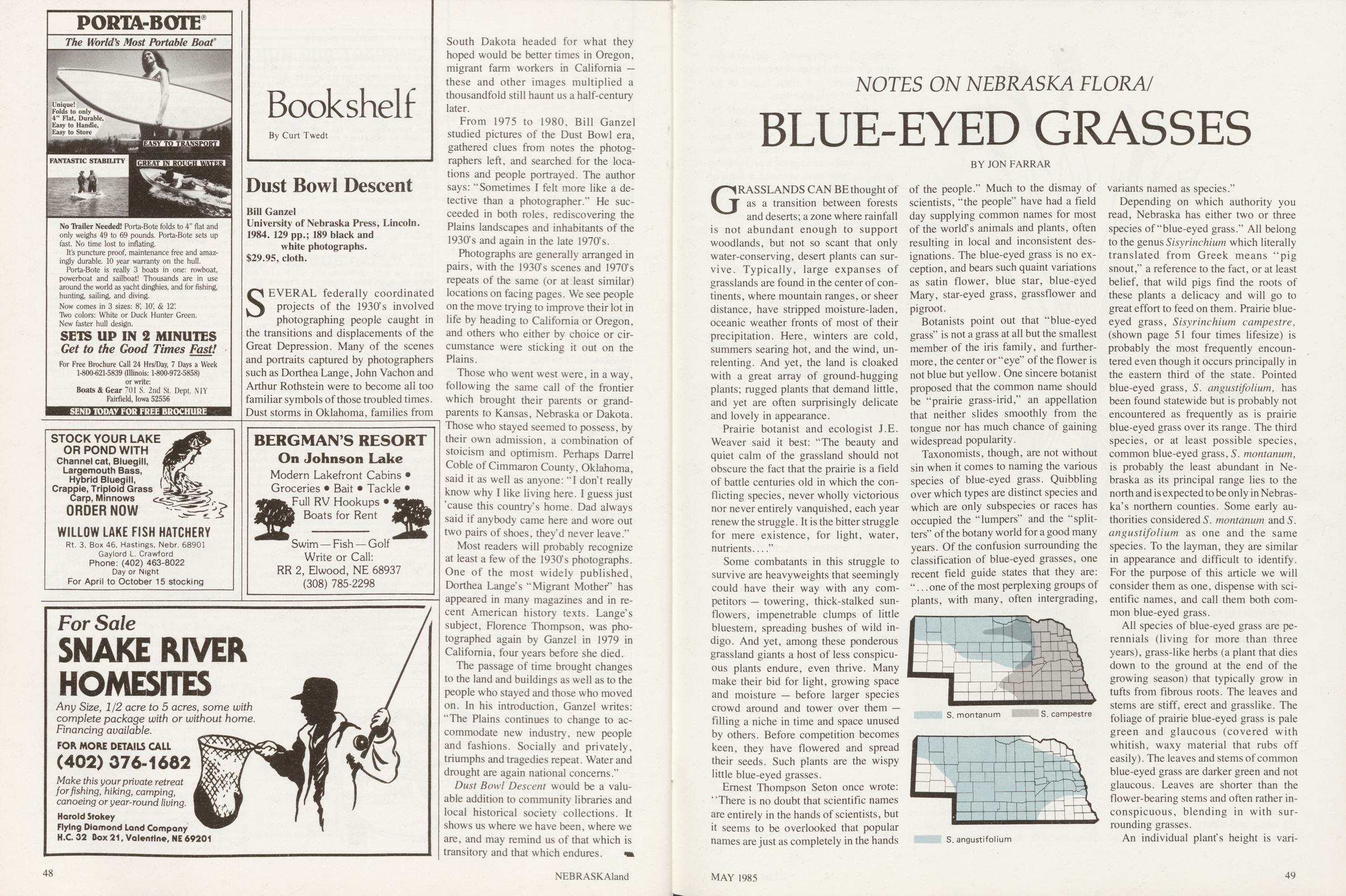 The World's Most Portable Boat
No TVailer Needed! Porta-Bote folds to 4" flat and
only weighs 49 to 69 pounds. Porta-Bote sets up
fast. No time lost to inflating.
It's puncture proof, maintenance free and amazingly durable. 10 year warranty on the
hull.
Porta-Bote is really 3 boats in one: rowboat,
powerboat and sailboat! Thousands are in use
around the world as yacht dinghies, and for fishing,
hunting, sailing, and diving.
Now comes in 3 sizes: 8', 10', & 12'.
Two colors: White or Duck Hunter Green.
New faster hull design.
SETS UP IN 2 MINUTES
Get to the Good Times Fast!
For Free Brochure Call 24 Hrs/Day, 7 Days a Week
1-800-621-5839 (Illinois: 1-800-972-5858)
or write:
Boats & Gear 701 S. 2nd St. Dept. N1Y
Fairfield, Iowa 52556
SEND TODAY FOR FREE BROCHURE
STOCK YOUR LAKE
OR POND WITH
Channel cat, Bluegill,
Largemouth Bass,
Hybrid Bluegill,
Crappie, Triploid Grass
Carp, Minnows
ORDER NOW
WILLOW LAKE FISH HATCHERY
Rt. 3, Box 46, Hastings, Nebr. 68901
Gaylord L. Crawford
Phone: (402) 463-8022
Day or Night
For April to October 15 stocking
BERGMAN'S RESORT
On Johnson Lake
Modern Lakefront Cabins •
Groceries • Bait • Tackle •
Full RV Hookups «
Boats for Rent
Swim — Fish — Golf
Write or Call:
RR 2, Elwood, NE 68937
(308) 785-2298
For Sale
SNAKE RIVER
HOMESITES
Any Size, 1/2 acre to 5 acres, some with
complete package with or without home
Financing available.
FOR MOKE DETAILS CALL
(402)376-1662
Make this your private retreat
for fishing, hiking, camping,
canoeing or year-round living.
Harold Sfokey
Flying Diamond Land Company
H.C. 32 Dox 21, Valentine, NE 69201
The World's Most Portable Boat
No TVailer Needed! Porta-Bote folds to 4" flat and
only weighs 49 to 69 pounds. Porta-Bote sets up
fast. No time lost to inflating.
It's puncture proof, maintenance free and amazingly durable. 10 year warranty on the
hull.
Porta-Bote is really 3 boats in one: rowboat,
powerboat and sailboat! Thousands are in use
around the world as yacht dinghies, and for fishing,
hunting, sailing, and diving.
Now comes in 3 sizes: 8', 10', & 12'.
Two colors: White or Duck Hunter Green.
New faster hull design.
SETS UP IN 2 MINUTES
Get to the Good Times Fast!
For Free Brochure Call 24 Hrs/Day, 7 Days a Week
1-800-621-5839 (Illinois: 1-800-972-5858)
or write:
Boats & Gear 701 S. 2nd St. Dept. N1Y
Fairfield, Iowa 52556
SEND TODAY FOR FREE BROCHURE
STOCK YOUR LAKE
OR POND WITH
Channel cat, Bluegill,
Largemouth Bass,
Hybrid Bluegill,
Crappie, Triploid Grass
Carp, Minnows
ORDER NOW
WILLOW LAKE FISH HATCHERY
Rt. 3, Box 46, Hastings, Nebr. 68901
Gaylord L. Crawford
Phone: (402) 463-8022
Day or Night
For April to October 15 stocking
BERGMAN'S RESORT
On Johnson Lake
Modern Lakefront Cabins •
Groceries • Bait • Tackle •
Full RV Hookups «
Boats for Rent
Swim — Fish — Golf
Write or Call:
RR 2, Elwood, NE 68937
(308) 785-2298
For Sale
SNAKE RIVER
HOMESITES
Any Size, 1/2 acre to 5 acres, some with
complete package with or without home
Financing available.
FOR MOKE DETAILS CALL
(402)376-1662
Make this your private retreat
for fishing, hiking, camping,
canoeing or year-round living.
Harold Sfokey
Flying Diamond Land Company
H.C. 32 Dox 21, Valentine, NE 69201
Bookshelf
By Curt Twedt Dust Bowl Descent Bill Ganzel University of Nebraska Press, Lincoln, 1984. 129 pp.; 189 black and white photographs. $29.95, cloth.SEVERAL federally coordinated projects of the 1930's involved photographing people caught in the transitions and displacements of the Great Depression. Many of the scenes and portraits captured by photographers such as Dorthea Lange, John Vachon and Arthur Rothstein were to become all too familiar symbols of those troubled times. Dust storms in Oklahoma, families from South Dakota headed for what they hoped would be better times in Oregon, migrant farm workers in California these and other images multiplied a thousandfold still haunt us a half-century later.
From 1975 to 1980, Bill Ganzel studied pictures of the Dust Bowl era, gathered clues from notes the photographers left, and searched for the locations and people portrayed. The author says: "Sometimes I felt more like a detective than a photographer." He succeeded in both roles, rediscovering the Plains landscapes and inhabitants of the 1930's and again in the late 1970's.
Photographs are generally arranged in pairs, with the 1930's scenes and 1970's repeats of the same (or at least similar) locations on facing pages. We see people on the move trying to improve their lot in life by heading to California or Oregon, and others who either by choice or circumstance were sticking it out on the Plains.
Those who went west were, in a way, following the same call of the frontier which brought their parents or grandparents to Kansas, Nebraska or Dakota. Those who stayed seemed to possess, by their own admission, a combination of stoicism and optimism. Perhaps Darrel Coble of Cimmaron County, Oklahoma, said it as well as anyone: "I don't really know why I like living here. I guess just 'cause this country's home. Dad always said if anybody came here and wore out two pairs of shoes, they'd never leave."
Most readers will probably recognize at least a few of the 1930's photographs. One of the most widely published, Dorthea Lange's "Migrant Mother" has appeared in many magazines and in recent American history texts. Lange's subject, Florence Thompson, was photographed again by Ganzel in 1979 in California, four years before she died.
The passage of time brought changes to the land and buildings as well as to the people who stayed and those who moved on. In his introduction, Ganzel writes: "The Plains continues to change to accommodate new industry, new people and fashions. Socially and privately, triumphs and tragedies repeat. Water and drought are again national concerns."
Dust Bowl Descent would be a valuable addition to community libraries and local historical society collections. It shows us where we have been, where we are, and may remind us of that which is transitory and that which endures.
48 NEBRASKAlandNOTES ON NEBRASKA FLORA/ BLUE-EYED GRASSES
BY JON FARRARGRASSLANDS CAN BE thought of as a transition between forests and deserts; a zone where rainfall is not abundant enough to support woodlands, but not so scant that only water-conserving, desert plants can survive. Typically, large expanses of grasslands are found in the center of continents, where mountain ranges, or sheer distance, have stripped moisture-laden, oceanic weather fronts of most of their precipitation. Here, winters are cold, summers searing hot, and the wind, unrelenting. And yet, the land is cloaked with a great array of ground-hugging plants; rugged plants that demand little, and yet are often surprisingly delicate and lovely in appearance.
Prairie botanist and ecologist J.E. Weaver said it best: "The beauty and quiet calm of the grassland should not obscure the fact that the prairie is a field of battle centuries old in which the conflicting species, never wholly victorious nor never entirely vanquished, each year renew the struggle. It is the bitter struggle for mere existence, for light, water, nutrients___"
Some combatants in this struggle to survive are heavyweights that seemingly could have their way with any competitors — towering, thick-stalked sunflowers, impenetrable clumps of little bluestem, spreading bushes of wild indigo. And yet, among these ponderous grassland giants a host of less conspicuous plants endure, even thrive. Many make their bid for light, growing space and moisture — before larger species crowd around and tower over them — filling a niche in time and space unused by others. Before competition becomes keen, they have flowered and spread their seeds. Such plants are the wispy little blue-eyed grasses.
Ernest Thompson Seton once wrote: There is no doubt that scientific names are entirely in the hands of scientists, but it seems to be overlooked that popular names are just as completely in the hands of the people." Much to the dismay of scientists, "the people" have had a field day supplying common names for most of the world's animals and plants, often resulting in local and inconsistent designations. The blue-eyed grass is no exception, and bears such quaint variations as satin flower, blue star, blue-eyed Mary, star-eyed grass, grassflower and pigroot.
Botanists point out that "blue-eyed grass" is not a grass at all but the smallest member of the iris family, and furthermore, the center or "eye" of the flower is not blue but yellow. One sincere botanist proposed that the common name should be "prairie grass-irid," an appellation that neither slides smoothly from the tongue nor has much chance of gaining widespread popularity.
Taxonomists, though, are not without sin when it comes to naming the various species of blue-eyed grass. Quibbling over which types are distinct species and which are only subspecies or races has occupied the "lumpers" and the "splitters" of the botany world for a good many years. Of the confusion surrounding the classification of blue-eyed grasses, one recent field guide states that they are: "... one of the most perplexing groups of plants, with many, often intergrading, variants named as species."
Depending on which authority you read, Nebraska has either two or three species of "blue-eyed grass." All belong to the genus Sisyrinchium which literally translated from Greek means "pig snout," a reference to the fact, or at least belief, that wild pigs find the roots of these plants a delicacy and will go to great effort to feed on them. Prairie blue-eyed grass, Sisyrinchium campestre, (shown page 51 four times lifesize) is probably the most frequently encountered even though it occurs principally in the eastern third of the state. Pointed blue-eyed grass, S. angustifolium, has been found statewide but is probably not encountered as frequently as is prairie blue-eyed grass over its range. The third species, or at least possible species, common blue-eyed grass, S. montanum, is probably the least abundant in Nebraska as its principal range lies to the north and is expected to be only in Nebraska's northern counties. Some early au- thorities considered S. montanum and S. angustifolium as one and the same species. To the layman, they are similar in appearance and difficult to identify. For the purpose of this article we will consider them as one, dispense with scientific names, and call them both common blue-eyed grass.
All species of blue-eyed grass are perennials (living for more than three years), grass-like herbs (a plant that dies down to the ground at the end of the growing season) that typically grow in tufts from fibrous roots. The leaves and stems are stiff, erect and grasslike. The foliage of prairie blue-eyed grass is pale green and glaucous (covered with whitish, waxy material that rubs off easily). The leaves and stems of common blue-eyed grass are darker green and not glaucous. Leaves are shorter than the flower-bearing stems and often rather inconspicuous, blending in with surrounding grasses.
An individual plant's height is vari 48
MAY 1985
49
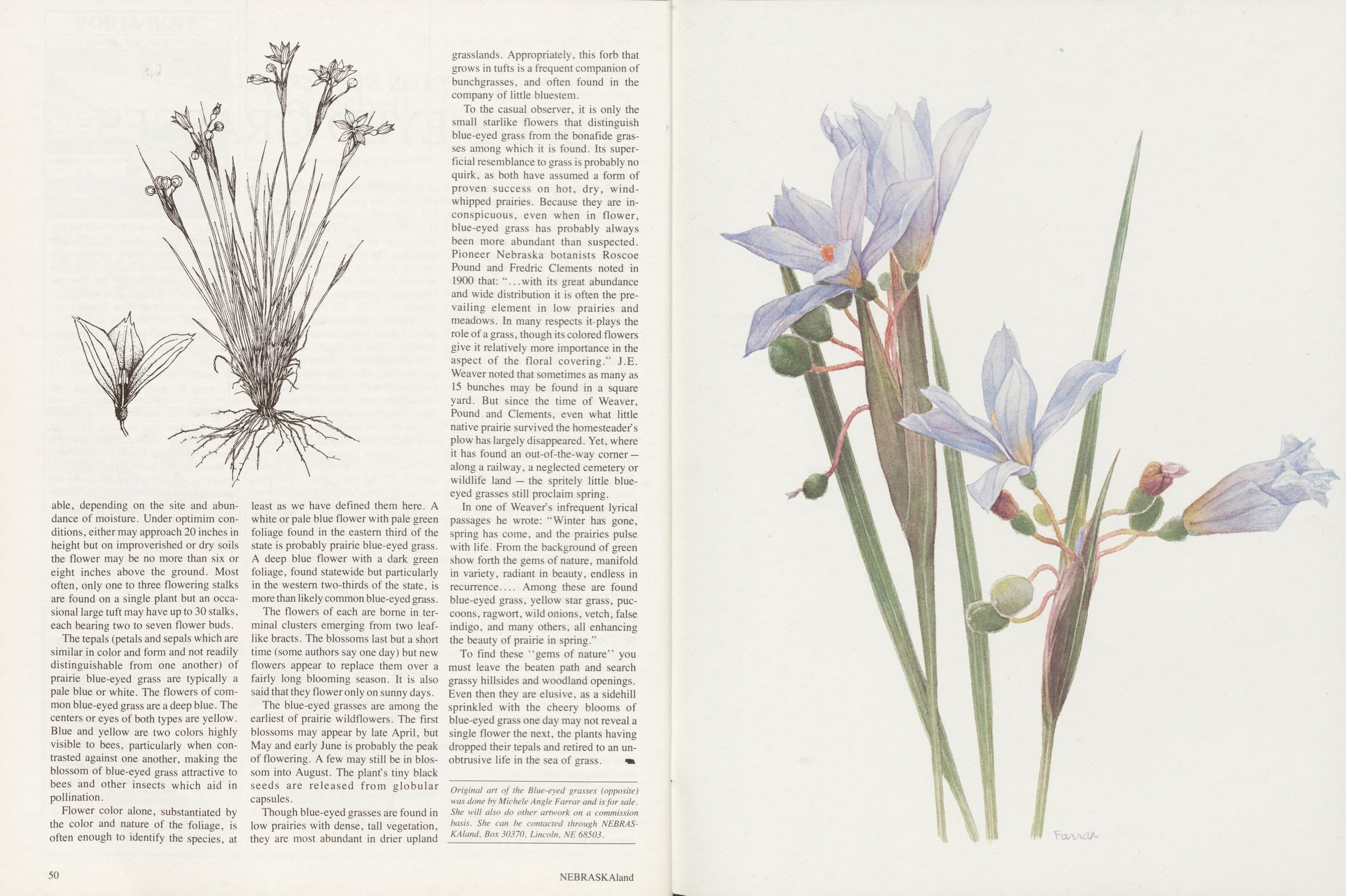 able, depending on the site and abundance of moisture. Under optimim conditions, either
may approach 20 inches in
height but on improverished or dry soils
the flower may be no more than six or
eight inches above the ground. Most
often, only one to three flowering stalks
are found on a single plant but an occasional large tuft may have up to 30 stalks,
each bearing two to seven flower buds.
able, depending on the site and abundance of moisture. Under optimim conditions, either
may approach 20 inches in
height but on improverished or dry soils
the flower may be no more than six or
eight inches above the ground. Most
often, only one to three flowering stalks
are found on a single plant but an occasional large tuft may have up to 30 stalks,
each bearing two to seven flower buds.
The tepals (petals and sepals which are similar in color and form and not readily distinguishable from one another) of prairie blue-eyed grass are typically a pale blue or white. The flowers of common blue-eyed grass are a deep blue. The centers or eyes of both types are yellow. Blue and yellow are two colors highly visible to bees, particularly when contrasted against one another, making the blossom of blue-eyed grass attractive to bees and other insects which aid in pollination.
Flower color alone, substantiated by the color and nature of the foliage, is often enough to identify the species, at least as we have defined them here. A white or pale blue flower with pale green foliage found in the eastern third of the state is probably prairie blue-eyed grass. A deep blue flower with a dark green foliage, found statewide but particularly in the western two-thirds of the state, is more than likely common blue-eyed grass.
The flowers of each are borne in terminal clusters emerging from two leaflike bracts. The blossoms last but a short time (some authors say one day) but new flowers appear to replace them over a fairly long blooming season. It is also said that they flower only on sunny days.
The blue-eyed grasses are among the earliest of prairie wildflowers. The first blossoms may appear by late April, but May and early June is probably the peak of flowering. A few may still be in blossom into August. The plant's tiny black seeds are released from globular capsules.
Though blue-eyed grasses are found in low prairies with dense, tall vegetation, they are most abundant in drier upland grasslands. Appropriately, this forb that grows in tufts is a frequent companion of bunchgrasses, and often found in the company of little bluestem.
To the casual observer, it is only the small starlike flowers that distinguish blue-eyed grass from the bonafide grasses among which it is found. Its superficial resemblance to grass is probably no quirk, as both have assumed a form of proven success on hot, dry, windwhipped prairies. Because they are inconspicuous, even when in flower, blue-eyed grass has probably always been more abundant than suspected. Pioneer Nebraska botanists Roscoe Pound and Fredric Clements noted in 1900 that: "...with its great abundance and wide distribution it is often the prevailing element in low prairies and meadows. In many respects it-plays the role of a grass, though its colored flowers give it relatively more importance in the aspect of the floral covering." J.E. Weaver noted that sometimes as many as 15 bunches may be found in a square yard. But since the time of Weaver, Pound and Clements, even what little native prairie survived the homesteader's plow has largely disappeared. Yet, where it has found an out-of-the-wav corner along a railway, a neglected cemetery or wildlife land — the spritely little blueeyed grasses still proclaim spring.
In one of Weaver's infrequent lyrical passages he wrote: "Winter has gone, spring has come, and the prairies pulse with life. From the background of green show forth the gems of nature, manifold in variety, radiant in beauty, endless in recurrence___ Among these are found blue-eyed grass, yellow star grass, puccoons, ragwort, wild onions, vetch, false indigo, and many others, all enhancing the beauty of prairie in spring."
To find these "gems of nature' you must leave the beaten path and search grassy hillsides and woodland openings. Even then they are elusive, as a sidehill sprinkled with the cheery blooms of blue-eyed grass one day may not reveal a single flower the next, the plants having dropped their tepals and retired to an unobtrusive life in the sea of grass.
Original art of the Blue-eyed grasses (opposite) was done by Michele Angle Farrar and is for sale. She will also do other artwork on a commission basis. She can be contacted through NEBRASKAland, Box 30370, Lincoln, NE 68503. 50 NEBRASKAland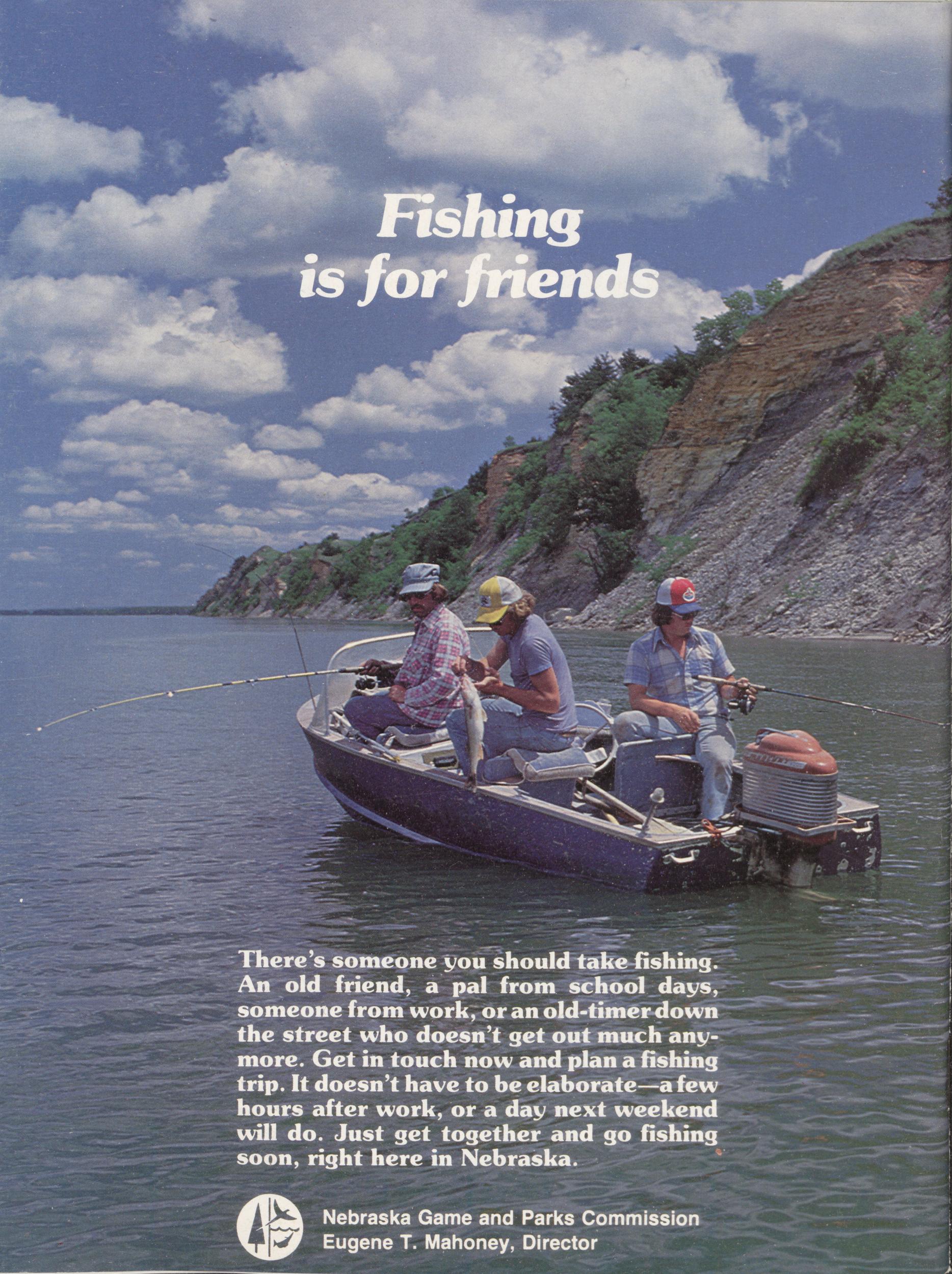
Fishing is for freinds
There s someone you should take fishing. An old friend, a pal from school days, someone from work, or an old-timer down the street who doesn't get out much anymore. Get in touch now and plan a fishing trip. It doesn't have to be elaborate—a few hours after work, or a day next weekend 11 do. Just get together and go fishing oon, right here in Nebraska. Nebraska Game and Parks Commission Eugene T. Mahoney, DirectorPosition: 443 (23 views)