Volume 63, Issue 3, 1985
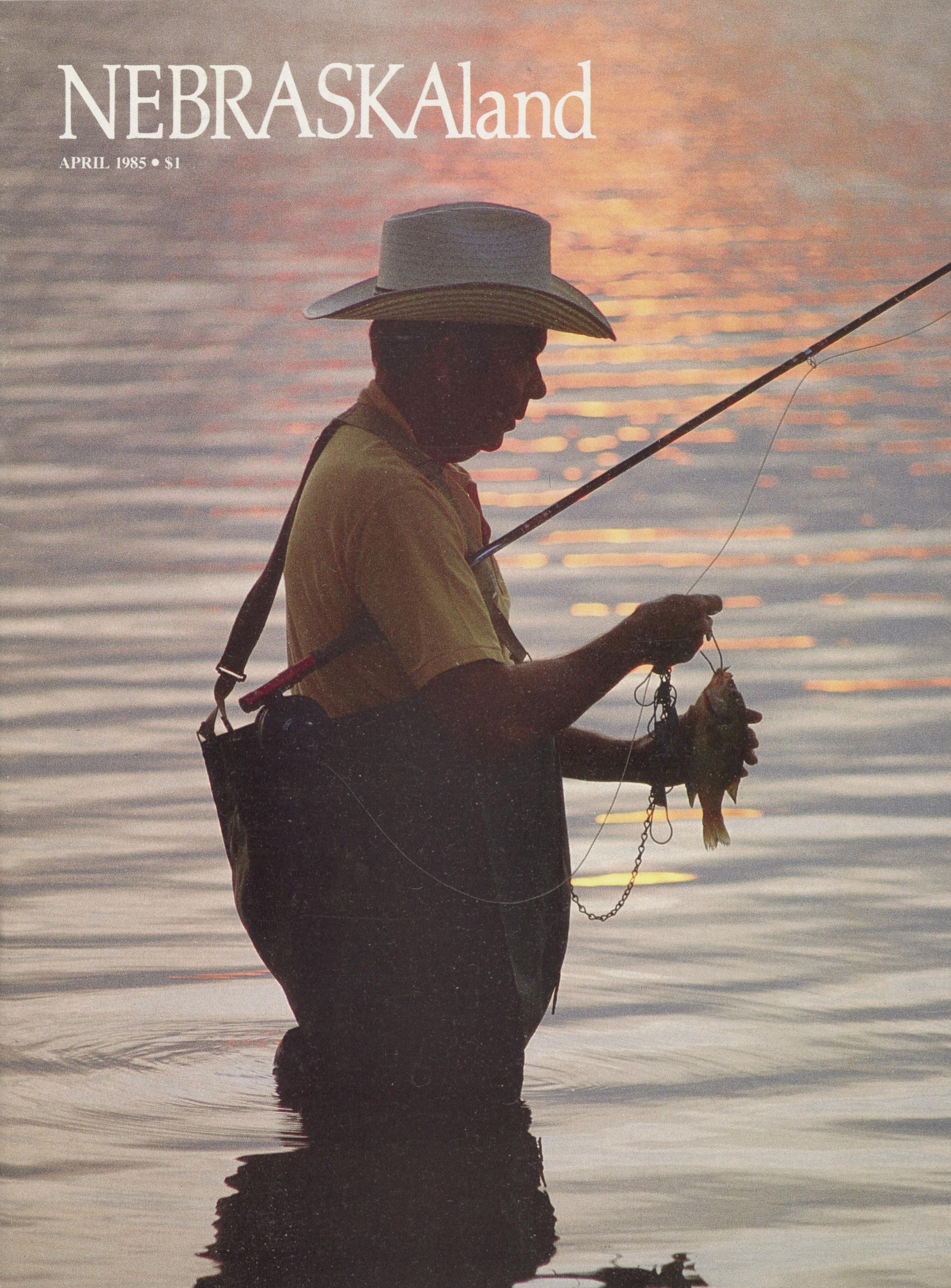
NEBRASKAland
APRIL 1985 $1
NEBRASKAland
Published by the Nebraska Game and Parks Commission VOL. 63/NO. 3/APR. 1985 NEBRASKAland (ISSN:0028-1964) is published monthly except for a combined January/February issue, by the Nebraska Game and Parks Commission, 2200 North 33rd Street, Lincoln, NE. Copyright 1985, all rights reserved. Second-class postage paid at Lincoln, Nebraska and at additional mailing offices. POSTMASTER: Send address changes to NEBRASKAland, Box 30370, Lincoln, NE 68503. Rates: $9.50 for one year; $18 for two years. Single copy price $1. Offices Headquarters 2200 N. 33rd, Lincoln, 68503 (402) 464-0641 13th and Farnam St., Omaha (402) 554-2144 Ak-Sar-Ben Aquarium, Gretna (402) 332-3901 Rt. 2, Alliance (308) 762-5605 Bassett (402) 684-3511 U.S. 81, Norfolk (402) 371-4950 Rt. 4, North Platte (308) 532-6225 Commissioners Chairman: Richard Prasch, Lexington Vice Chairman: Charles E. Wright, Lincoln 2nd Vice Chairman: Richard L. Coyne, Omaha Neal Keller, Brewster Dr. Tim Biga, Norfolk Stan Juelfs, Kimball Wayne Ziebarth, Wiicox Director: Eugene T. Ma honey Assistant Directors: William J. Bailey, Jr., Dale R. Bree W. Rex Amack Staff fix Chief, Information & Education: Jim MacAllister Editor: Lowell Johnson Senior Editor: Jon Farrar Associate Editors: Ken Bouc, Don Cunningham Regional Editors: Bob Grier, Rocky Hoffmann Contributors: Tom Keith, Liz Huff, Carl Wolfe Research Assistant: Curt Twedt Art Director: Duane Westerholt Illustration: Steve O'Hare, Paula Day, Dan Curran Circulation: Juanita Stefkovich Contents Features TROUT WATERS.. .NOT SO FAR AWAY 6 THE HORSESHOE-BAR RANCH/PRAIRIE FIRES 12 THE "NETS AND VOLTS" OF FISH MANAGEMENT 14 BIOGRAPHY OF A POND 20 A FLOOD OF FISH 26 OFFICERS OF THE OUTDOORS 30 TO CATCH A THIEF 38 THE EMPTY PEN 40 NOTES ON NEBRASKA FAUNA/WOOD RAT 50 SPEAK UP Departments 4 BOOK SHELF 48 TRADING POST 49 COVER: Ah, spring, when a young mans fancy turns to fishing— in fact, people of all ages, who have grown restless over winter, find themselves lured to the water to try out a new selection of lures on resident fish. Here an angler tries out the waters of a Salt Valley lake near Lincoln. Photo by Ken Bouc. OPPOSITE: With the change of season also comes increasing color of sunsets, with this splendid example being over the Wildcat Range in the North Platte River Valley of western Nebraska. Photo by Don Cunningham. APRIL 1985 3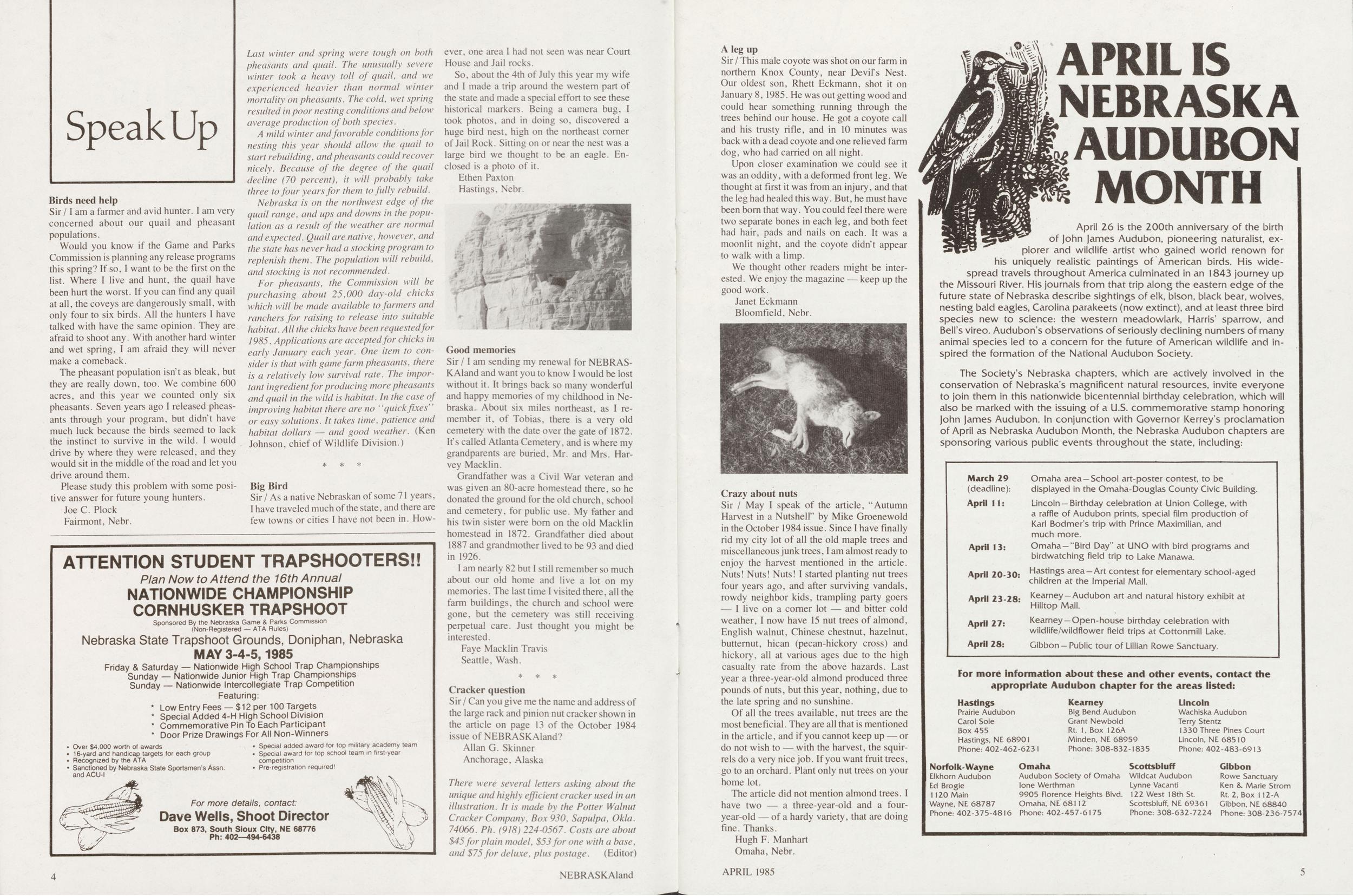
Speak Up
Birds need helpSir 1 am a farmer and avid hunter. 1 am very concerned about our quail and pheasant populations.
Would you know if the Game and Parks Commission is planning any release programs this spring? If so, I want to be the first on the list. Where I live and hunt, the quail have been hurt the worst. If you can find any quail at all, the coveys are dangerously small, with only four to six birds. All the hunters I have talked with have the same opinion. They are afraid to shoot any. With another hard winter and wet spring, I am afraid they will never make a comeback.
The pheasant population isn't as bleak, but they are really down, too. We combine 600 acres, and this year we counted only six pheasants. Seven years ago I released pheasants through your program, but didnt have much luck because the birds seemed to lack the instinct to survive in the wild. I would drive by where they were released, and they would sit in the middle of the road and let you drive around them.
Please study this problem with some positive answer for future young hunters.
Joe C. Plock Fairmont, Nebr.Last winter and spring were tough on both pheasants and quail. The unusually severe winter took a heavy toll of quail, and we experienced heavier than normal winter mortality on pheasants. The cold, wet spring resulted in poor nesting conditions and below average production of both species.
A mild winter and favorable conditions for nesting this year should allow the quail to start rebuilding, and pheasants could recover nicely. Because of the degree of the quail decline (70 percent), it will probably take three to four years for them to fully rebuild.
Nebraska is on the northwest edge of the quail range, and ups and downs in the population as a result of the weather are normal and expected. Quail are native, however, and the state has never had a stocking program to replenish them. The population will rebuild, and stocking is not recommended.
For pheasants, the Commission will be purchasing about 25,000 day-old chicks which will be made available to farmers and ranchers for raising to release into suitable habitat. All the chicks have been requested for 1985. Applications are accepted for chicks in early January each year. One item to consider is that with game farm pheasants, there is a relatively low survival rate. The important ingredient for producing more pheasants and quail in the wild is habitat. In the case of improving habitat there are no ' 'quick fixes'' or easy solutions. It takes time, patience and habitat dollars — and good weather. (Ken Johnson, chief of Wildlife Division.)
* * * Big BirdSir / As a native Nebraskan of some 71 years, I have traveled much of the state, and there are few towns or cities I have not been in. However, one area I had not seen was near Court House and Jail rocks.
So, about the 4th of July this year my wife and I made a trip around the western part of the state and made a special effort to see these historical markers. Being a camera bug, I took photos, and in doing so, discovered a huge bird nest, high on the northeast corner of Jail Rock. Sitting on or near the nest was a large bird we thought to be an eagle. Enclosed is a photo of it.
Ethen Pax ton Hastings, Nebr.Sir /1 am sending my renewal for NEBRASKAland and want you to know I would be lost without it. It brings back so many wonderful and happy memories of my childhood in Nebraska. About six miles northeast, as I remember it, of Tobias, there is a very old cemetery with the date over the gate of 1872. It's called Atlanta Cemetery, and is where my grandparents are buried, Mr. and Mrs. Harvey Macklin.
Grandfather was a Civil War veteran and was given an 80-acre homestead there, so he donated the ground for the old church, school and cemetery, for public use. My father and his twin sister were born on the old Macklin homestead in 1872. Grandfather died about 1887 and grandmother lived to be 93 and died in 1926.
I am nearly 82 but I still remember so much about our old home and live a lot on my memories. The last time I visited there, all the farm buildings, the church and school were gone, but the cemetery was still receiving perpetual care. Just thought you might be interested.
Faye Macklin Travis Seattle, Wash. * * * Cracker questionSir / Can you give me the name and address of the large rack and pinion nut cracker shown in the article on page 13 of the October 1984 issue of NEBRASKAland?
Allan G. Skinner Anchorage, AlaskaThere were several letters asking about the unique and highly efficient cracker used in an illustration. It is made by the Potter Walnut Cracker Company, Box 930, Sapulpa, Okla. 74066. Ph. (918)224-0567. Costs are about $45 for plain model, $53 for one with a base, and $75 for deluxe, plus postage. (Editor)
4 NEBRASKAland A leg upSir / This male coyote was shot on our farm in northern Knox County, near Devil's Nest. Our oldest son, Rhett Eckmann, shot it on January 8, 1985. He was out getting wood and could hear something running through the trees behind our house. He got a coyote call and his trusty rifle, and in 10 minutes was back with a dead coyote and one relieved farm dog, who had carried on all night.
Upon closer examination we could see it was an oddity, with a deformed front leg. We thought at first it was from an injury, and that the leg had healed this way. But, he must have been born that way. You could feel there were two separate bones in each leg, and both feet had hair, pads and nails on each. It was a moonlit night, and the coyote didn't appear to walk with a limp.
We thought other readers might be interested. We enjoy the magazine — keep up the good work.
Janet Eckmann Bloomfield, Nebr.Sir / May I speak of the article, "Autumn Harvest in a Nutshell" by Mike Groenewold in the October 1984 issue. Since I have finally rid my city lot of all the old maple trees and miscellaneous junk trees, I am almost ready to enjoy the harvest mentioned in the article. Nuts! Nuts! Nuts! I started planting nut trees four years ago, and after surviving vandals, rowdy neighbor kids, trampling party goers — I live on a corner lot — and bitter cold weather, I now have 15 nut trees of almond, English walnut, Chinese chestnut, hazelnut, butternut, hican (pecan-hickory cross) and hickory, all at various ages due to the high casualty rate from the above hazards. Last year a three-year-old almond produced three pounds of nuts, but this year, nothing, due to the late spring and no sunshine.
Of all the trees available, nut trees are the most beneficial. They are all that is mentioned in the article, and if you cannot keep up — or do not wish to — with the harvest, the squirrels do a very nice job. If you want fruit trees, go to an orchard. Plant only nut trees on your home lot.
The article did not mention almond trees. I have two — a three-year-old and a four-year-old — of a hardy variety, that are doing fine. Thanks.
Hugh F. Manhart Omaha, Nebr. AUDUBON MONTH April 26 is the 200th anniversary of the birth of John James Audubon, pioneering naturalist, explorer and wildlife artist who gained world renown for his uniquely realistic paintings of American birds. His widespread travels throughout America culminated in an 1843 journey up the Missouri River. His journals from that trip along the eastern edge of the future state of Nebraska describe sightings of elk, bison, black bear, wolves, nesting bald eagles, Carolina parakeets (now extinct), and at least three bird species new to science: the western meadowlark, Harris' sparrow, and Bell's vireo. Audubon's observations of seriously declining numbers of many animal species led to a concern for the future of American wildlife and inspired the formation of the National Audubon Society. The Society's Nebraska chapters, which are actively involved in the conservation of Nebraska's magnificent natural resources, invite everyone to join them in this nationwide bicentennial birthday celebration, which will also be marked with the issuing of a U.S. commemorative stamp honoring John James Audubon. In conjunction with Governor Kerrey's proclamation of April as Nebraska Audubon Month, the Nebraska Audubon chapters are sponsoring various public events throughout the state, including: March 29 (deadline): April 11: April 13: April 20-30: April 23-28: April 27: April 28: Omaha area —School art-poster contest, to be displayed in the Omaha-Douglas County Civic Building. Lincoln - Birthday celebration at Union College, with a raffle of Audubon prints, special film production of Karl Bodmer's trip with Prince Maximilian, and much more. Omaha-"Bird Day" at UNO with bird programs and birdwatching field trip to Lake Manawa. Hastings area-Art contest for elementary school-aged children at the Imperial Mall. Kearney-Audubon art and natural history exhibit at Hilltop Mall. Kearney-Open-house birthday celebration with wildlife/wildflower field trips at Cottonmill Lake. Gibbon- Public tour of Lillian Rowe Sanctuary. For more information about these and other events, contact the appropriate Audubon chapter for the areas listed: Hastings Prairie Audubon Carol Sole Box 455 Hastings, NE 68901 Phone: 402-462-6231 Kearney Big Bend Audubon Grant Newbold Rt. 1, Box 126A Minden, NE 68959 Phone: 308-832-1835 Lincoln Wachiska Audubon Terry Stentz 1330 Three Pines Court Lincoln, NE 68510 Phone: 402-483-6913 Norfolk-Wayne Elkhorn Audubon Ed Brogie 1120 Main Wayne, NE 68787 Omaha Audubon Society of Omaha lone Werthman 9905 Florence Heights Blvd. Omana, NE 68112 Scottsbluff Wildcat Audubon Lynne Vacanti 122 West 18th St. Scottsbluff, NE 69361 Gibbon Rowe Sanctuary Ken & Marie Strom Rt. 2, Box 112-A Gibbon, NE 68840 Phone: 402-375-4816 Phone: 402-457-6175 Phone: 308-632-7224 Phone: 308-236-7574 APRIL 1985 5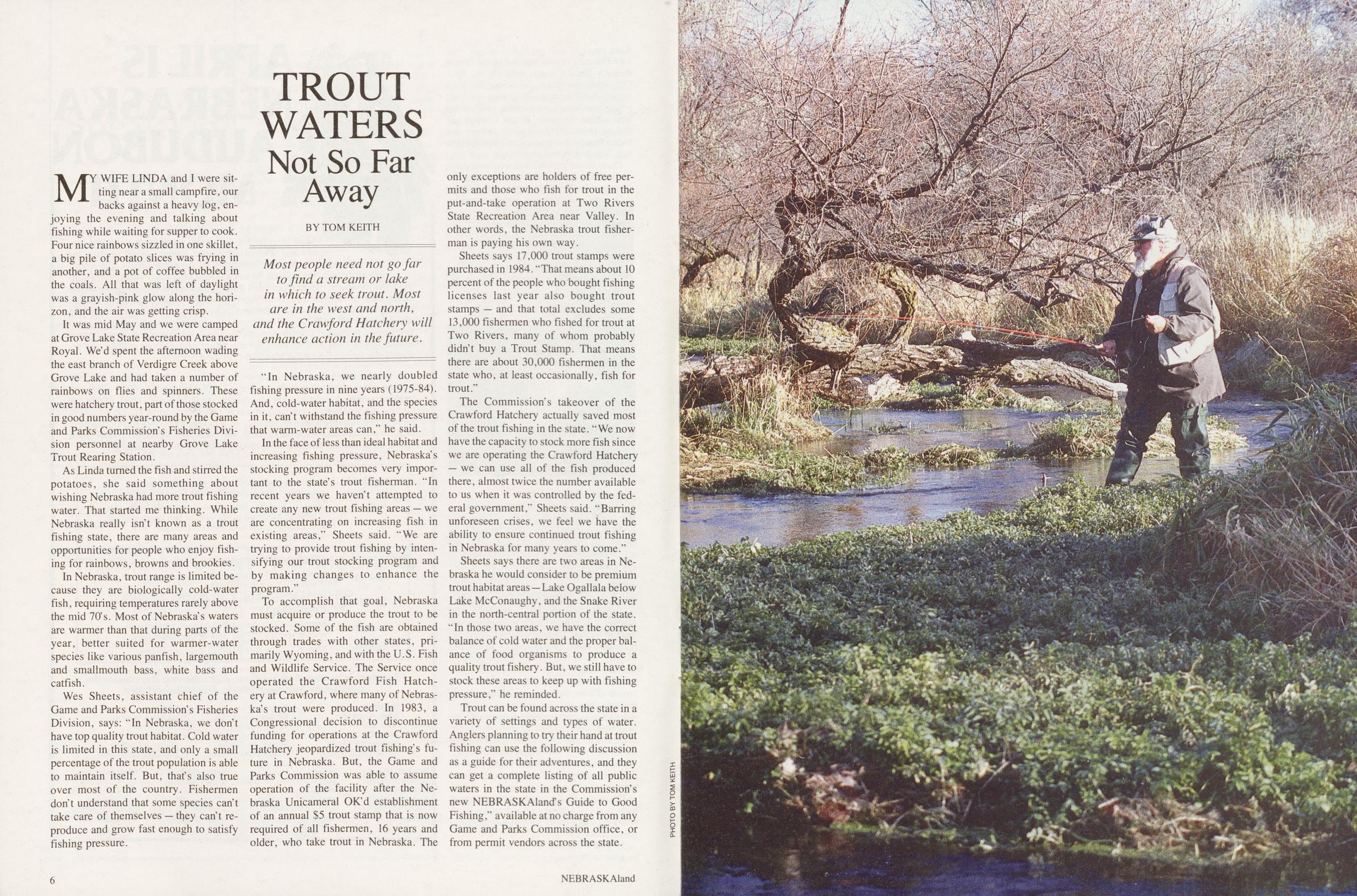
TROUT WATERS Not So Far Away
BY TOM KEITH Most people need not go far to find a stream or lake in which to seek trout. Most are in the west and north, and the Crawford Hatchery will enhance action in the future.A WIFE LINDA and l were sitting near a small campfire, our backs against a heavy log, enjoying the evening and talking about fishing while waiting for supper to cook. Four nice rainbows sizzled in one skillet, a big pile of potato slices was frying in another, and a pot of coffee bubbled in the coals. All that was left of daylight was a grayish-pink glow along the horizon, and the air was getting crisp.
It was mid May and we were camped at Grove Lake State Recreation Area near Royal. We'd spent the afternoon wading the east branch of Verdigre Creek above Grove Lake and had taken a number of rainbows on flies and spinners. These were hatchery trout, part of those stocked in good numbers year-round by the Game and Parks Commission's Fisheries Division personnel at nearby Grove Lake Trout Rearing Station.
As Linda turned the fish and stirred the potatoes, she said something about wishing Nebraska had more trout fishing water. That started me thinking. While Nebraska really isn't known as a trout fishing state, there are many areas and opportunities for people who enjoy fishing for rainbows, browns and brookies.
In Nebraska, trout range is limited because they are biologically cold-water fish, requiring temperatures rarely above the mid 70's. Most of Nebraska's waters are warmer than that during parts of the year, better suited for warmer-water species like various panfish, largemouth and smallmouth bass, white bass and catfish.
Wes Sheets, assistant chief of the Game and Parks Commission's Fisheries Division, says: "In Nebraska, we don't have top quality trout habitat. Cold water is limited in this state, and only a small percentage of the trout population is able to maintain itself. But, that's also true over most of the country. Fishermen don't understand that some species can't take care of themselves — they can't reproduce and grow fast enough to satisfy fishing pressure.
"In Nebraska, we nearly doubled fishing pressure in nine years (1975-84). And, cold-water habitat, and the species in it, can't withstand the fishing pressure that warm-water areas can," he said.
In the face of less than ideal habitat and increasing fishing pressure, Nebraska's stocking program becomes very important to the state's trout fisherman. "In recent years we haven't attempted to create any new trout fishing areas — we are concentrating on increasing fish in existing areas," Sheets said. "We are trying to provide trout fishing by intensifying our trout stocking program and by making changes to enhance the program."
To accomplish that goal, Nebraska must acquire or produce the trout to be stocked. Some of the fish are obtained through trades with other states, primarily Wyoming, and with the U.S. Fish and Wildlife Service. The Service once operated the Crawford Fish Hatchery at Crawford, where many of Nebraska's trout were produced. In 1983, a Congressional decision to discontinue funding for operations at the Crawford Hatchery jeopardized trout fishing's future in Nebraska. But, the Game and Parks Commission was able to assume operation of the facility after the Nebraska Unicameral OK'd establishment of an annual $5 trout stamp that is now required of all fishermen, 16 years and older, who take trout in Nebraska. The only exceptions are holders of free permits and those who fish for trout in the put-and-take operation at Two Rivers State Recreation Area near Valley. In other words, the Nebraska trout fisherman is paying his own way.
Sheets says 17,000 trout stamps were purchased in 1984. "That means about 10 percent of the people who bought fishing licenses last year also bought trout stamps — and that total excludes some 13,000 fishermen who fished for trout at Two Rivers, many of whom probably didn't buy a Trout Stamp. That means there are about 30,000 fishermen in the state who, at least occasionally, fish for trout."
The Commission's takeover of the Crawford Hatchery actually saved most of the trout fishing in the state. "We now have the capacity to stock more fish since we are operating the Crawford Hatchery — we can use all of the fish produced there, almost twice the number available to us when it was controlled by the federal government," Sheets said. "Barring unforeseen crises, we feel we have the ability to ensure continued trout fishing in Nebraska for many years to come."
Sheets says there are two areas in Nebraska he would consider to be premium trout habitat areas — Lake Ogallala below Lake McConaughy, and the Snake River in the north-central portion of the state. "In those two areas, we have the correct balance of cold water and the proper balance of food organisms to produce a quality trout fishery. But, we still have to stock these areas to keep up with fishing pressure," he reminded.
Trout can be found across the state in a variety of settings and types of water. Anglers planning to try their hand at trout fishing can use the following discussion as a guide for their adventures, and they can get a complete listing of all public waters in the state in the Commission's new NEBRASKAland's Guide to Good Fishing," available at no charge from any Game and Parks Commission office, or from permit vendors across the state.
6 NEBRASKAland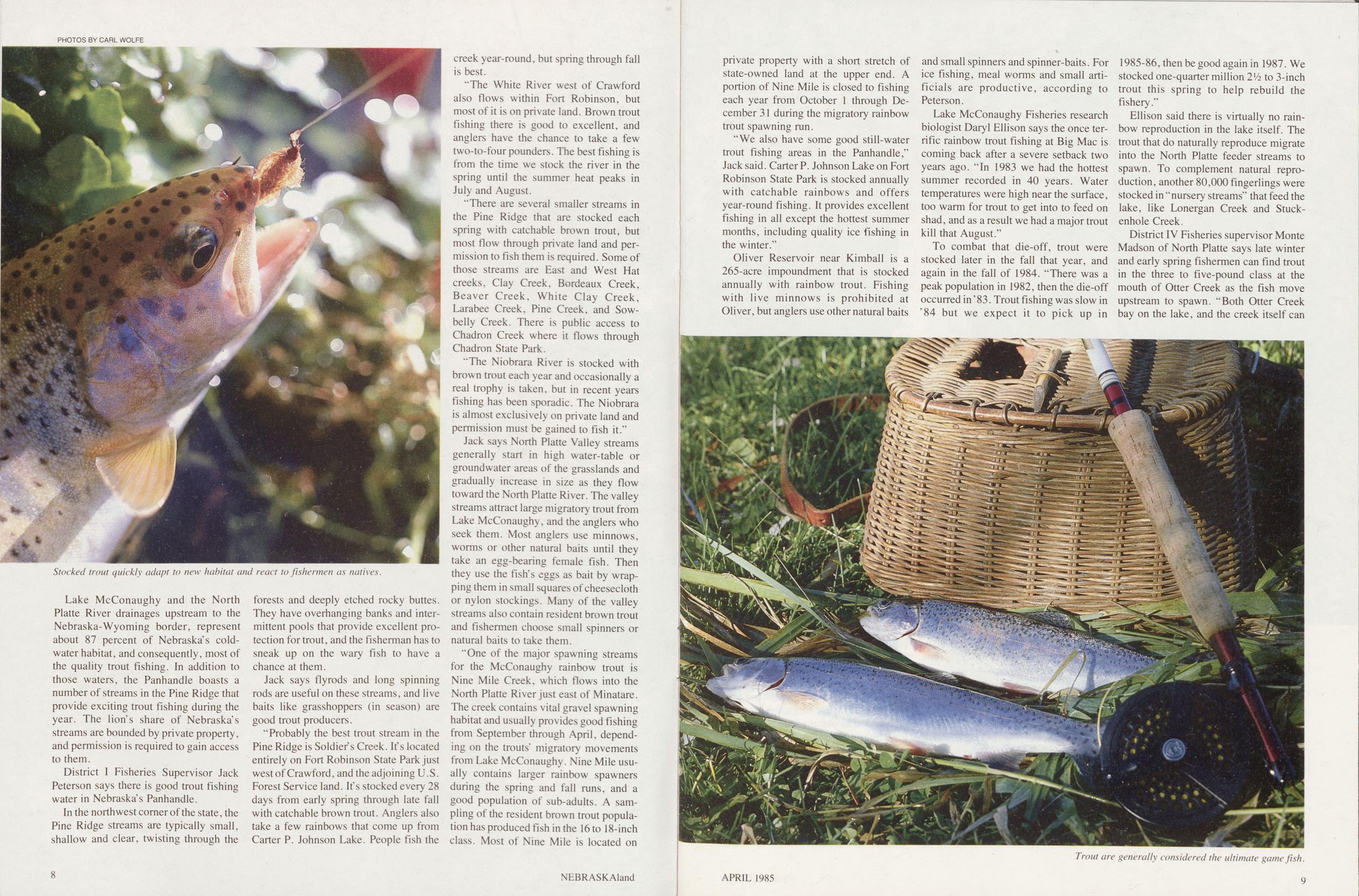
Lake McConaughy and the North Platte River drainages upstream to the Nebraska-Wyoming border, represent about 87 percent of Nebraska's cold- water habitat, and consequently, most of the quality trout fishing. In addition to those waters, the Panhandle boasts a number of streams in the Pine Ridge that provide exciting trout fishing during the year. The lion's share of Nebraska's streams are bounded by private property, and permission is required to gain access to them.
District I Fisheries Supervisor Jack Peterson says there is good trout fishing water in Nebraska's Panhandle.
In the northwest corner of the state, the Pine Ridge streams are typically small, shallow and clear, twisting through the forests and deeply etched rocky buttes. They have overhanging banks and intermittent pools that provide excellent protection for trout, and the fisherman has to sneak up on the wary fish to have a chance at them.
Jack says flyrods and long spinning rods are useful on these streams, and live baits like grasshoppers (in season) are good trout producers.
"Probably the best trout stream in the Pine Ridge is Soldier's Creek. It's located entirely on Fort Robinson State Park just west of Crawford, and the adjoining U.S. Forest Service land. It's stocked every 28 days from early spring through late fall with catchable brown trout. Anglers also take a few rainbows that come up from Carter P. Johnson Lake. People fish the creek year-round, but spring through fall is best.
"The White River west of Crawford also flows within Fort Robinson, but most of it is on private land. Brown trout fishing there is good to excellent, and anglers have the chance to take a few two-to-four pounders. The best fishing is from the time we stock the river in the spring until the summer heat peaks in July and August.
"There are several smaller streams in the Pine Ridge that are stocked each spring with catchable brown trout, but most flow through private land and permission to fish them is required. Some of those streams are East and West Hat creeks, Clay Creek, Bordeaux Creek, Beaver Creek, White Clay Creek, Larabee Creek, Pine Creek, and Sowbelly Creek. There is public access to Chadron Creek where it flows through Chadron State Park.
"The Niobrara River is stocked with brown trout each year and occasionally a real trophy is taken, but in recent years fishing has been sporadic. The Niobrara is almost exclusively on private land and permission must be gained to fish it."
Jack says North Platte Valley streams generally start in high water-table or groundwater areas of the grasslands and gradually increase in size as they flow toward the North Platte River. The valley streams attract large migratory trout from Lake McConaughy, and the anglers who seek them. Most anglers use minnows, worms or other natural baits until they take an egg-bearing female fish. Then they use the fish's eggs as bait by wrapping them in small squares of cheesecloth or nylon stockings. Many of the valley streams also contain resident brown trout and fishermen choose small spinners or natural baits to take them.
"One of the major spawning streams for the McConaughy rainbow trout is Nine Mile Creek, which flows into the North Platte River just east of Minatare. The creek contains vital gravel spawning habitat and usually provides good fishing from September through April, depending on the trouts' migratory movements from Lake McConaughy. Nine Mile usually contains larger rainbow spawners during the spring and fall runs, and a good population of sub-adults. A sampling of the resident brown trout population has produced fish in the 16 to 18-inch class. Most of Nine Mile is located on 8 NEBRASKAland private property with a short stretch of state-owned land at the upper end. A portion of Nine Mile is closed to fishing each year from October 1 through December 31 during the migratory rainbow trout spawning run.
"We also have some good still-water trout fishing areas in the Panhandle," Jack said. Carter P. Johnson Lake on Fort Robinson State Park is stocked annually with catchable rainbows and offers year-round fishing. It provides excellent fishing in all except the hottest summer months, including quality ice fishing in the winter."
Oliver Reservoir near Kimball is a 265-acre impoundment that is stocked annually with rainbow trout. Fishing with live minnows is prohibited at Oliver, but anglers use other natural baits and small spinners and spinner-baits. For ice fishing, meal worms and small artificials are productive, according to Peterson.
Lake McConaughy Fisheries research biologist Daryl Ellison says the once terrific rainbow trout fishing at Big Mac is coming back after a severe setback two years ago. "In 1983 we had the hottest summer recorded in 40 years. Water temperatures were high near the surface, too warm for trout to get into to feed on shad, and as a result we had a major trout kill that August."
To combat that die-off, trout were stocked later in the fall that year, and again in the fall of 1984. "There was a peak population in 1982, then the die-off occurred in' 83. Trout fishing was slow in '84 but we expect it to pick up in 1985-86, then be good again in 1987. We stocked one-quarter million 2Vi to 3-inch trout this spring to help rebuild the fishery."
Ellison said there is virtually no rainbow reproduction in the lake itself. The trout that do naturally reproduce migrate into the North Platte feeder streams to spawn. To complement natural reproduction, another 80,000 fingerlings were stocked in "nursery streams" that feed the lake, like Lonergan Creek and Stuckenhole Creek.
District IV Fisheries supervisor Monte Madson of North Platte says late winter and early spring fishermen can find trout in the three to five-pound class at the mouth of Otter Creek as the fish move upstream to spawn. "Both Otter Creek bay on the lake, and the creek itself can produce good fishing," he said, "but the creek above Highway 92 is bounded by private land and permission must be gained to fish."
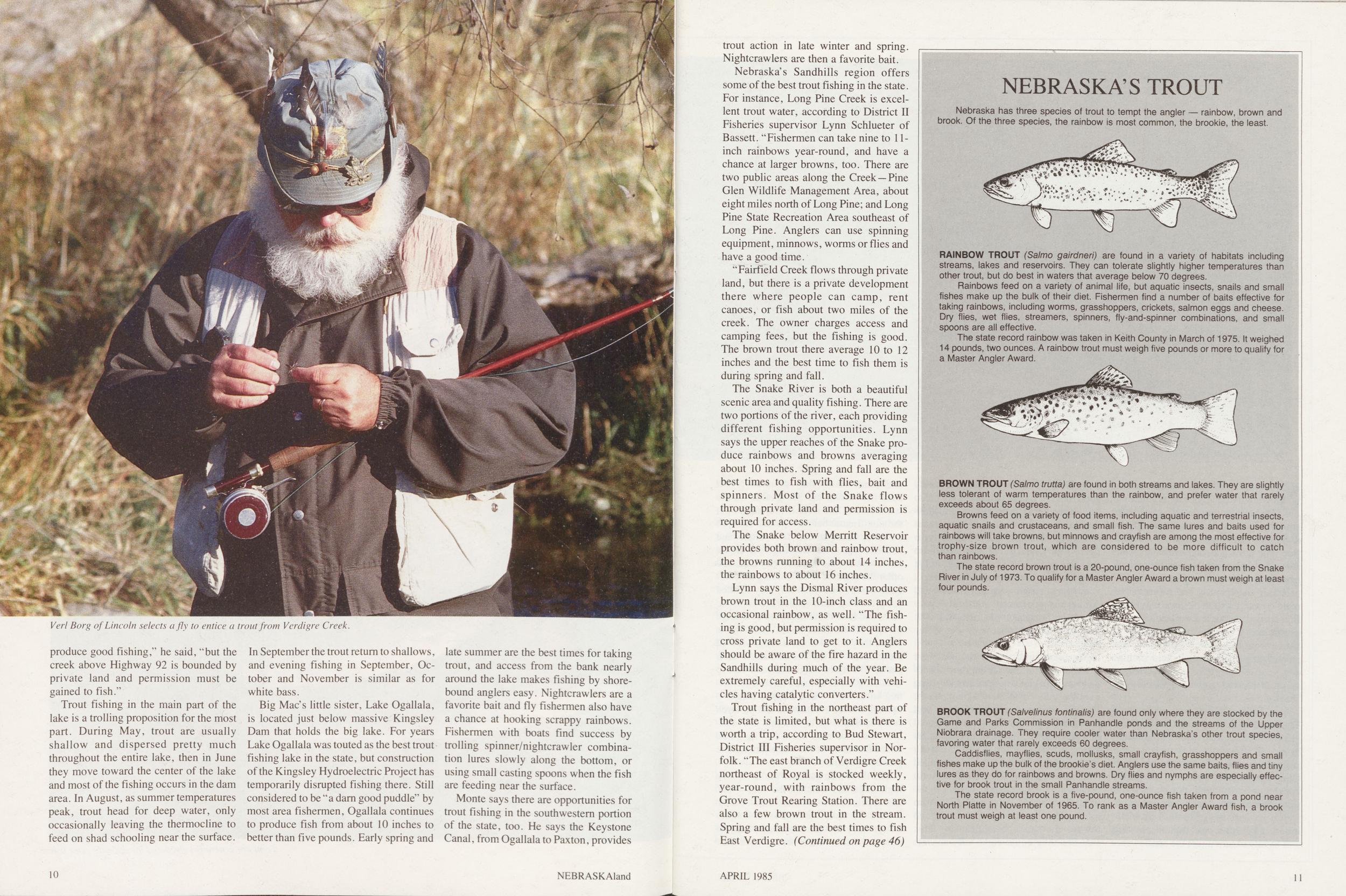
Trout fishing in the main part of the lake is a trolling proposition for the most part. During May, trout are usually shallow and dispersed pretty much throughout the entire lake, then in June they move toward the center of the lake and most of the fishing occurs in the dam area. In August, as summer temperatures peak, trout head for deep water, only occasionally leaving the thermocline to feed on shad schooling near the surface. In September the trout return to shallows, and evening fishing in September, October and November is similar as for white bass.
Big Mac's little sister, Lake Ogallala, is located just below massive Kingsley Dam that holds the big lake. For years Lake Ogallala was touted as the best trout fishing lake in the state, but construction of the Kingsley Hydroelectric Project has temporarily disrupted fishing there. Still considered to be "a darn good puddle" by most area fishermen, Ogallala continues to produce fish from about 10 inches to better than five pounds. Early spring and late summer are the best times for taking trout, and access from the bank nearly around the lake makes fishing by shorebound anglers easy. Nightcrawlers are a favorite bait and fly fishermen also have a chance at hooking scrappy rainbows. Fishermen with boats find success by trolling spinner/nightcrawler combination lures slowly along the bottom, or using small casting spoons when the fish are feeding near the surface.
Monte says there are opportunities for trout fishing in the southwestern portion of the state, too. He says the Keystone Canal, from Ogallala to Paxton, provides 10 NEBRASKAland trout action in late winter and spring. Nightcrawlers are then a favorite bait.
Nebraska's Sandhills region offers some of the best trout fishing in the state. For instance, Long Pine Creek is excellent trout water, according to District II Fisheries supervisor Lynn Schlueter of Bassett. "Fishermen can take nine to 11inch rainbows year-round, and have a chance at larger browns, too. There are two public areas along the Creek —Pine Glen Wildlife Management Area, about eight miles north of Long Pine; and Long Pine State Recreation Area southeast of Long Pine. Anglers can use spinning equipment, minnows, worms or flies and have a good time.
"Fairfield Creek flows through private land, but there is a private development there where people can camp, rent canoes, or fish about two miles of the creek. The owner charges access and camping fees, but the fishing is good. The brown trout there average 10 to 12 inches and the best time to fish them is during spring and fall.
The Snake River is both a beautiful scenic area and quality fishing. There are two portions of the river, each providing different fishing opportunities. Lynn says the upper reaches of the Snake produce rainbows and browns averaging about 10 inches. Spring and fall are the best times to fish with flies, bait and spinners. Most of the Snake flows through private land and permission is required for access.
The Snake below Merritt Reservoir provides both brown and rainbow trout, the browns running to about 14 inches, the rainbows to about 16 inches. Lynn says the Dismal River produces brown trout in the 10-inch class and an occasional rainbow, as well. The fishing is good, but permission is required to cross private land to get to it. Anglers should be aware of the fire hazard in the Sandhills during much of the year. Be extremely careful, especially with vehicles having catalytic converters."
Trout fishing in the northeast part of the state is limited, but what is there is worth a trip, according to Bud Stewart, District III Fisheries supervisor in Norfolk. "The east bianch of Verdigre Creek northeast of Royal is stocked weekly, year-round, with rainbows from the Grove Trout Rearing Station. There are also a few brown trout in the stream. Spring and fall are the best times to fish East Verdigre. (Continued on page 46)
THE HORSESHOE-BAR RANCH Prairie Fires
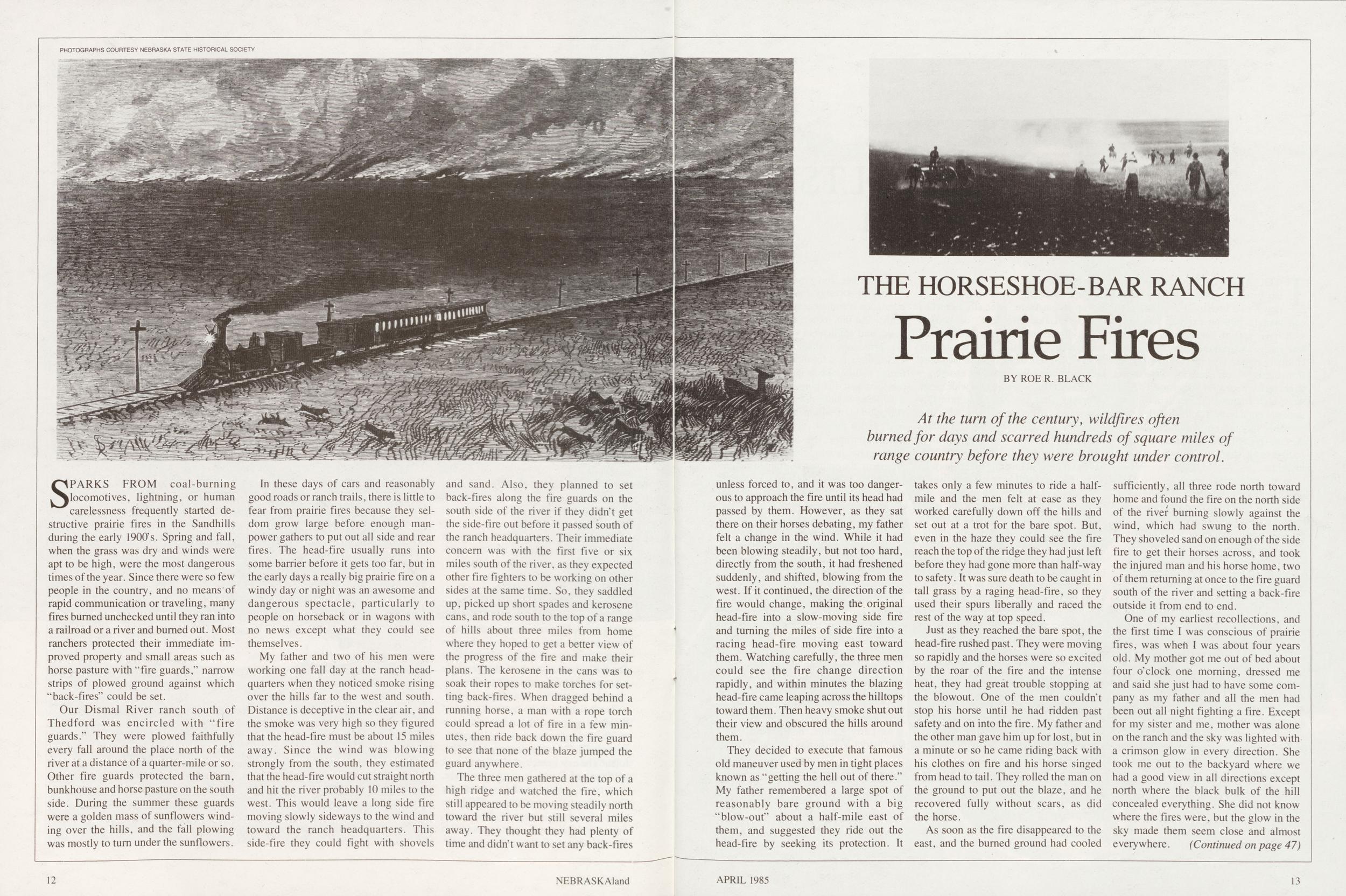
BY ROE R. BLACK At the turn of the century, wildfires often burned for days and scarred hundreds of square miles of range country before they were brought under control.SPARKS FROM coal-burning locomotives, lightning, or human carelessness frequently started de- structive prairie fires in the Sandhills during the early 1900's. Spring and fall, when the grass was dry and winds were apt to be high, were the most dangerous times of the year. Since there were so few people in the country, and no means of rapid communication or traveling, many fires burned unchecked until they ran into a railroad or a river and burned out. Most ranchers protected their immediate improved property and small areas such as horse pasture with "fire guards," narrow strips of plowed ground against which "back-fires" could be set.
Our Dismal River ranch south of Thedford was encircled with "fire guards." They were plowed faithfully every fall around the place north of the river at a distance of a quarter-mile or so. Other fire guards protected the barn, bunkhouse and horse pasture on the south side. During the summer these guards were a golden mass of sunflowers winding over the hills, and the fall plowing was mostly to turn under the sunflowers.
In these days of cars and reasonably good roads or ranch trails, there is little to fear from prairie fires because they seldom grow large before enough man- power gathers to put out all side and rear fires. The head-fire usually runs into some barrier before it gets too far, but in the early days a really big prairie fire on a windy day or night was an awesome and dangerous spectacle, particularly to people on horseback or in wagons with no news except what they could see themselves.
My father and two of his men were working one fall day at the ranch headquarters when they noticed smoke rising over the hills far to the west and south. Distance is deceptive in the clear air, and the smoke was very high so they figured that the head-fire must be about 15 miles away. Since the wind was blowing strongly from the south, they estimated that the head-fire would cut straight north and hit the river probably 10 miles to the west. This would leave a long side fire moving slowly sideways to the wind and toward the ranch headquarters. This side-fire they could fight with shovels and sand. Also, they planned to set back-fires along the fire guards on the south side of the river if they didn't get the side-fire out before it passed south of the ranch headquarters. Their immediate concern was with the first five or six miles south of the river, as they expected other fire fighters to be working on other sides at the same time. So, they saddled up, picked up short spades and kerosene cans, and rode south to the top of a range of hills about three miles from home where they hoped to get a better view of the progress of the fire and make their plans. The kerosene in the cans was to soak their ropes to make torches for setting back-fires. When dragged behind a running horse, a man with a rope torch could spread a lot of fire in a few minutes, then ride back down the fire guard to see that none of the blaze jumped the guard anywhere.
The three men gathered at the top of a high ridge and watched the fire, which still appeared to be moving steadily north toward the river but still several miles away. They thought they had plenty of time and didn't want to set any back-fires 12 NEBRASKAland unless forced to, and it was too dangerous to approach the fire until its head had passed by them. However, as they sat there on their horses debating, my father felt a change in the wind. While it had been blowing steadily, but not too hard, directly from the south, it had freshened suddenly, and shifted, blowing from the west. If it continued, the direction of the fire would change, making the original head-fire into a slow-moving side fire and turning the miles of side fire into a racing head-fire moving east toward them. Watching carefully, the three men could see the fire change direction rapidly, and within minutes the blazing head-fire came leaping across the hilltops toward them. Then heavy smoke shut out their view and obscured the hills around them.
They decided to execute that famous old maneuver used by men in tight places known as "getting the hell out of there." My father remembered a large spot of reasonably bare ground with a big "blow-out" about a half-mile east of them, and suggested they ride out the head-fire by seeking its protection. It takes only a few minutes to ride a half mile and the men felt at ease as they worked carefully down off the hills and set out at a trot for the bare spot. But, even in the haze they could see the fire reach the top of the ridge they had just left before they had gone more than half-way to safety. It was sure death to be caught in tall grass by a raging head-fire, so they used their spurs liberally and raced the rest of the way at top speed.
Just as they reached the bare spot, the head-fire rushed past. They were moving so rapidly and the horses were so excited by the roar of the fire and the intense heat, they had great trouble stopping at the blowout. One of the men couldn't stop his horse until he had ridden past safety and on into the fire. My father and the other man gave him up for lost, but in a minute or so he came riding back with his clothes on fire and his horse singed from head to tail. They rolled the man on the ground to put out the blaze, and he recovered fully without scars, as did the horse.
As soon as the fire disappeared to the east, and the burned ground had cooled sufficiently, all three rode north toward home and found the fire on the north side of the river burning slowly against the wind, which had swung to the north. They shoveled sand on enough of the side fire to get their horses across, and took the injured man and his horse home, two of them returning at once to the fire guard south of the river and setting a back-fire outside it from end to end.
One of my earliest recollections, and the first time I was conscious of prairie fires, was when I was about four years old. My mother got me out of bed about four o'clock one morning, dressed me and said she just had to have some company as my father and all the men had been out all night fighting a fire. Except for my sister and me, mother was alone on the ranch and the sky was lighted with a crimson glow in every direction. She took me out to the backyard where we had a good view in all directions except north where the black bulk of the hill concealed everything. She did not know where the fires were, but the glow in the sky made them seem close and almost everywhere. (Continued on page 47)
APRIL 1985 13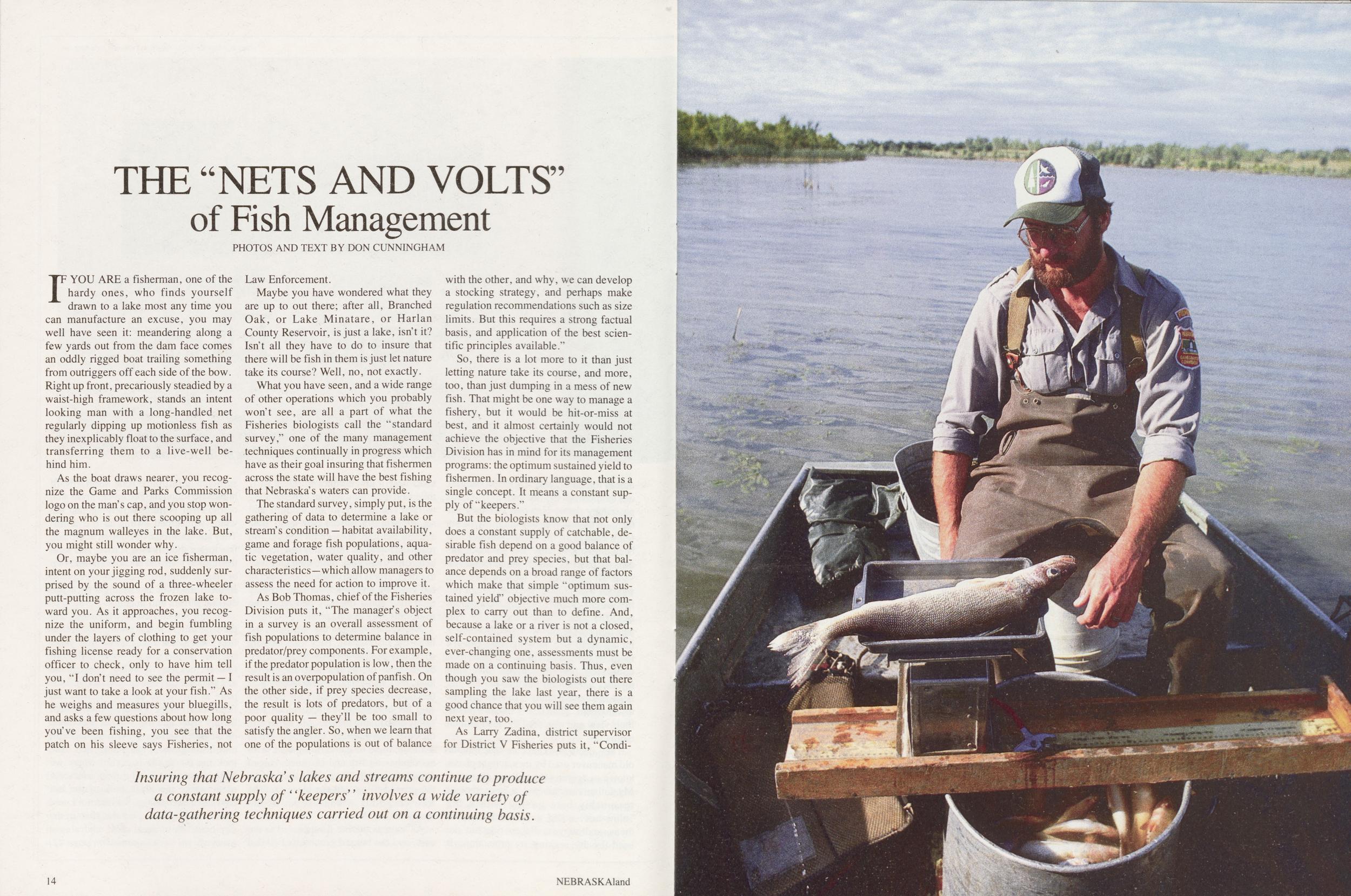
THE "NETS AND VOLTS" of Fish Management
PHOTOS AND TEXT BY DON CUNNINGHAMYOU ARE a fisherman, one of the hardy ones, who finds yourself drawn to a lake most any time you can manufacture an excuse, you may well have seen it: meandering along a few yards out from the dam face comes an oddly rigged boat trailing something from outriggers off each side of the bow. Right up front, precariously steadied by a waist-high framework, stands an intent looking man with a long-handled net regularly dipping up motionless fish as they inexplicably float to the surface, and transferring them to a live-well behind him.
As the boat draws nearer, you recognize the Game and Parks Commission logo on the man's cap, and you stop wondering who is out there scooping up all the magnum walleyes in the lake. But, you might still wonder why.
Or, maybe you are an ice fisherman, intent on your jigging rod, suddenly surprised by the sound of a three-wheeler putt-putting across the frozen lake toward you. As it approaches, you recognize the uniform, and begin fumbling under the layers of clothing to get your fishing license ready for a conservation officer to check, only to have him tell you, "I don't need to see the permit — I just want to take a look at your fish." As he weighs and measures your bluegills, and asks a few questions about how long you've been fishing, you see that the patch on his sleeve says Fisheries, not Law Enforcement.
Maybe you have wondered what they are up to out there; after all, Branched Oak, or Lake Minatare, or Harlan County Reservoir, is just a lake, isn't it? Isn't all they have to do to insure that there will be fish in them is just let nature take its course? Well, no, not exactly.
What you have seen, and a wide range of other operations which you probably won't see, are all a part of what the Fisheries biologists call the "standard survey," one of the many management techniques continually in progress which have as their goal insuring that fishermen across the state will have the best fishing that Nebraska's waters can provide.
The standard survey, simply put, is the gathering of data to determine a lake or stream's condition — habitat availability, game and forage fish populations, aquatic vegetation, water quality, and other characteristics—which allow managers to assess the need for action to improve it.
As Bob Thomas, chief of the Fisheries Division puts it, "The manager's object in a survey is an overall assessment of fish populations to determine balance in predator/prey components. For example, if the predator population is low, then the result is an overpopulation of panfish. On the other side, if prey species decrease, the result is lots of predators, but of a poor quality — they'll be too small to satisfy the angler. So, when we learn that one of the populations is out of balance with the other, and why, we can develop a stocking strategy, and perhaps make regulation recommendations such as size limits. But this requires a strong factual basis, and application of the best scientific principles available."
So, there is a lot more to it than just letting nature take its course, and more, too, than just dumping in a mess of new fish. That might be one way to manage a fishery, but it would be hit-or-miss at best, and it almost certainly would not achieve the objective that the Fisheries Division has in mind for its management programs: the optimum sustained yield to fishermen. In ordinary language, that is a single concept. It means a constant supply of "keepers."
But the biologists know that not only does a constant supply of catchable, desirable fish depend on a good balance of predator and prey species, but that balance depends on a broad range of factors which make that simple "optimum sustained yield" objective much more complex to carry out than to define. And, because a lake or a river is not a closed, self-contained system but a dynamic, ever-changing one, assessments must be made on a continuing basis. Thus, even though you saw the biologists out there sampling the lake last year, there is a good chance that you will see them again next year, too.
As Larry Zadina, district supervisor for District V Fisheries puts it, "Conditions
Insuring that Nebraska s lakes and streams continue to produce a constant supply of * 'keepers'' involves a wide variety of data-gathering techniques carried out on a continuing basis. 14 NEBRASKAland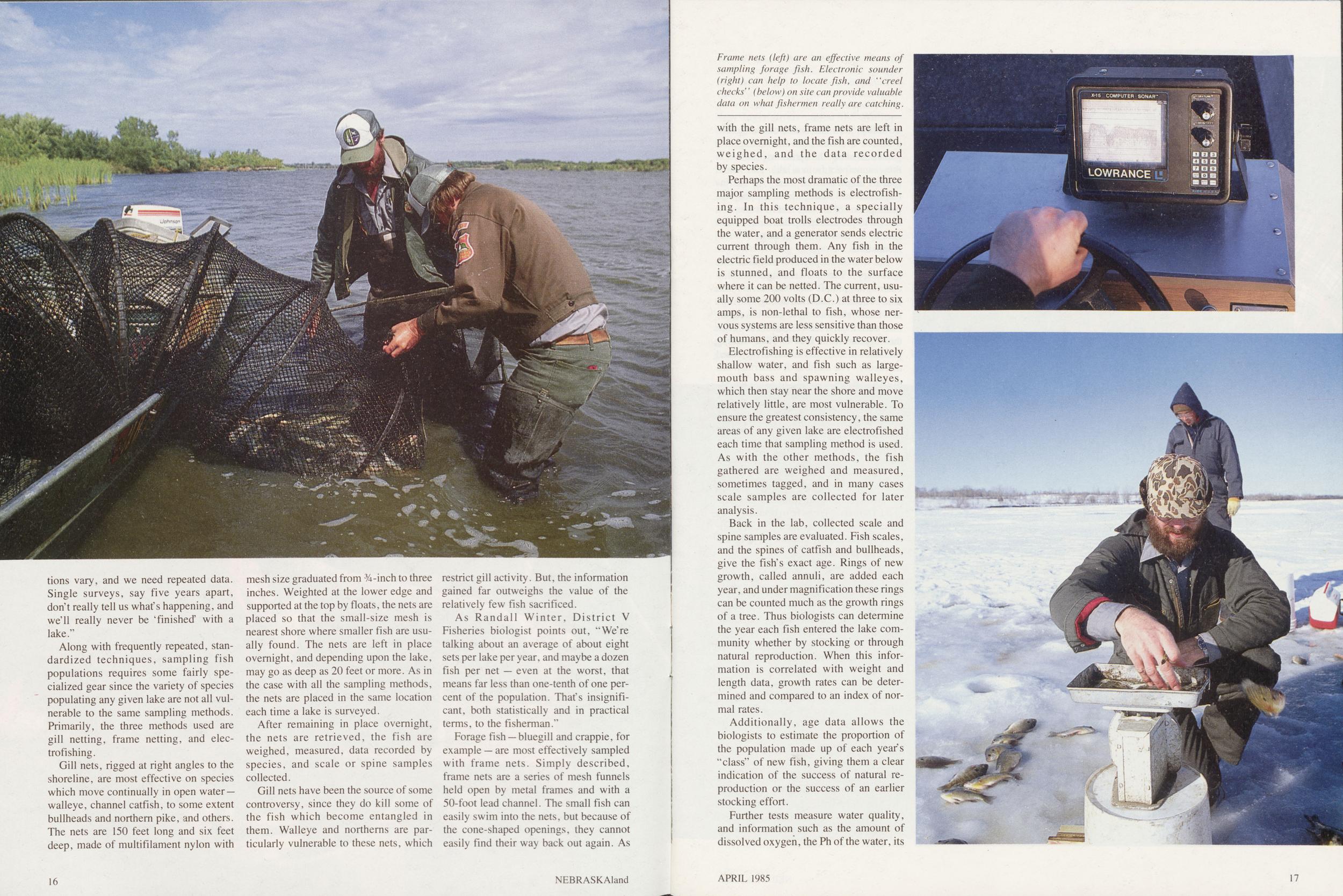
vary, and we need repeated data. Single surveys, say five years apart, don't really tell us what's happening, and we'll really never be 'finished' with a lake."
Along with frequently repeated, standardized techniques, sampling fish populations requires some fairly specialized gear since the variety of species populating any given lake are not all vulnerable to the same sampling methods. Primarily, the three methods used are gill netting, frame netting, and electrofishing.
Gill nets, rigged at right angles to the shoreline, are most effective on species which move continually in open water walleye, channel catfish, to some extent bullheads and northern pike, and others. The nets are 150 feet long and six feet deep, made of multifilament nylon with mesh size graduated from 3A-inch to three inches. Weighted at the lower edge and supported at the top by floats, the nets are placed so that the small-size mesh is nearest shore where smaller fish are usually found. The nets are left in place overnight, and depending upon the lake, may go as deep as 20 feet or more. As in the case with all the sampling methods, the nets are placed in the same location each time a lake is surveyed.
After remaining in place overnight, the nets are retrieved, the fish are weighed, measured, data recorded by species, and scale or spine samples collected.
Gill nets have been the source of some controversy, since they do kill some of the fish which become entangled in them. Walleye and northerns are particularly vulnerable to these nets, which restrict gill activity. But, the information gained far outweighs the value of the relatively few fish sacrificed.
As Randall Winter, District Fisheries biologist points out, "We're talking about an average of about eight sets per lake per year, and maybe a dozen fish per net — even at the worst, that means far less than one-tenth of one percent of the population. That's insignificant, both statistically and in practical terms, to the fisherman
Forage fish —bluegill and crappie, for example — are most effectively sampled with frame nets. Simply described, frame nets are a series of mesh funnels held open by metal frames and with a 50-foot lead channel. The small fish can easily swim into the nets, but because of the cone-shaped openings, they cannot easily find their way back out again. As 16 NEBRASKAland with the gill nets, frame nets are left in place overnight, and the fish are counted, weighed, and the data recorded by species.
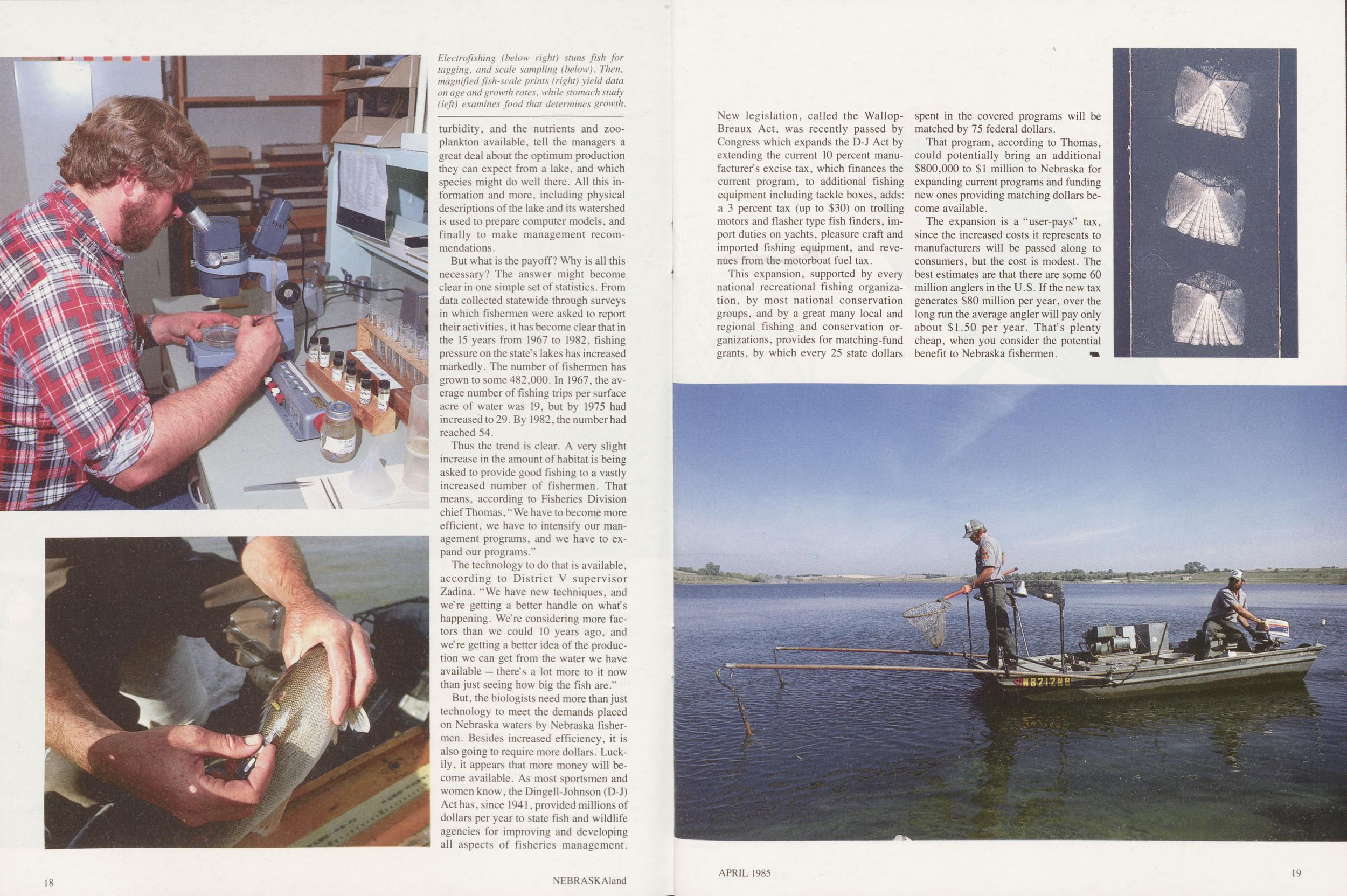
Frame nets (left) are an effective means of sampling forage fish. Electronic sounder (right) can help to locate fish, and "creel checks ' (below) on site can provide valuable data on what fishermen really are catching.Perhaps the most dramatic of the three major sampling methods is electrofishing. In this technique, a specially equipped boat trolls electrodes through the water, and a generator sends electric current through them. Any fish in the electric field produced in the water below is stunned, and floats to the surface where it can be netted. The current, usually some 200 volts (D.C.) at three to six amps, is non-lethal to fish, whose nervous systems are less sensitive than those of humans, and they quickly recover.
Electrofishing is effective in relatively shallow water, and fish such as largemouth bass and spawning walleyes, which then stay near the shore and move relatively little, are most vulnerable. To ensure the greatest consistency, the same areas of any given lake are electrofished each time that sampling method is used. As with the other methods, the fish gathered are weighed and measured, sometimes tagged, and in many cases scale samples are collected for later analysis.
Back in the lab, collected scale and spine samples are evaluated. Fish scales, and the spines of catfish and bullheads, give the fish's exact age. Rings of new growth, called annuli, are added each year, and under magnification these rings can be counted much as the growth rings of a tree. Thus biologists can determine the year each fish entered the lake community whether by stocking or through natural reproduction. When this information is correlated with weight and length data, growth rates can be determined and compared to an index of normal rates.
Additionally, age data allows the biologists to estimate the proportion of the population made up of each year's "class" of new fish, giving them a clear indication of the success of natural reproduction or the success of an earlier stocking effort.
Further tests measure water quality,
and information such as the amount of
dissolved oxygen, the Ph of the water, its
APRIL 1985
17
But what is the payoff? Why is all this necessary? The answer might become clear in one simple set of statistics. From data collected statewide through surveys in which fishermen were asked to report their activities, it has become clear that in the 15 years from 1967 to 1982, fishing pressure on the state's lakes has increased markedly. The number of fishermen has grown to some 482,000. In 1967, the average number of fishing trips per surface acre of water was 19, but by 1975 had increased to 29. By 1982, the number had reached 54.
Thus the trend is clear. A very slight increase in the amount of habitat is being asked to provide good fishing to a vastly increased number of fishermen. That means, according to Fisheries Division chief Thomas, "We have to become more efficient, we have to intensify our management programs, and we have to expand our programs."
The technology to do that is available, according to District V supervisor Zadina. "We have new techniques, and we're getting a better handle on what's happening. We're considering more factors than we could 10 years ago, and we're getting a better idea of the production we can get from the water we have available — there's a lot more to it now than just seeing how big the fish are."
But, the biologists need more than just technology to meet the demands placed on Nebraska waters by Nebraska fishermen. Besides increased efficiency, it is also going to require more dollars. Luckily, it appears that more money will become available. As most sportsmen and women know, the Dingell-Johnson (D-J) Act has, since 1941, provided millions of dollars per year to state fish and wildlife agencies for improving and developing all aspects of fisheries management.
18 NEBRASKAlandNew legislation, called the WallopBreaux Act, was recently passed by Congress which expands the D-J Act by extending the current 10 percent manufacturer's excise tax, which finances the current program, to additional fishing equipment including tackle boxes, adds: a 3 percent tax (up to $30) on trolling motors and flasher type fish finders, import duties on yachts, pleasure craft and imported fishing equipment, and revenues from the motorboat fuel tax.
This expansion, supported by every national recreational fishing organization, by most national conservation groups, and by a great many local and regional fishing and conservation organizations, provides for matching-fund grants, by which every 25 state dollars spent in the covered programs will be matched by 75 federal dollars.
That program, according to Thomas, could potentially bring an additional $800,000 to $1 million to Nebraska for expanding current programs and funding new ones providing matching dollars become available.
The expansion is a "user-pays" tax, since the increased costs it represents to manufacturers will be passed along to consumers, but the cost is modest. The best estimates are that there are some 60 million anglers in the U.S. If the new tax generates $80 million per year, over the long run the average angler will pay only about $1.50 per year. That's plenty cheap, when you consider the potential benefit to Nebraska fishermen.
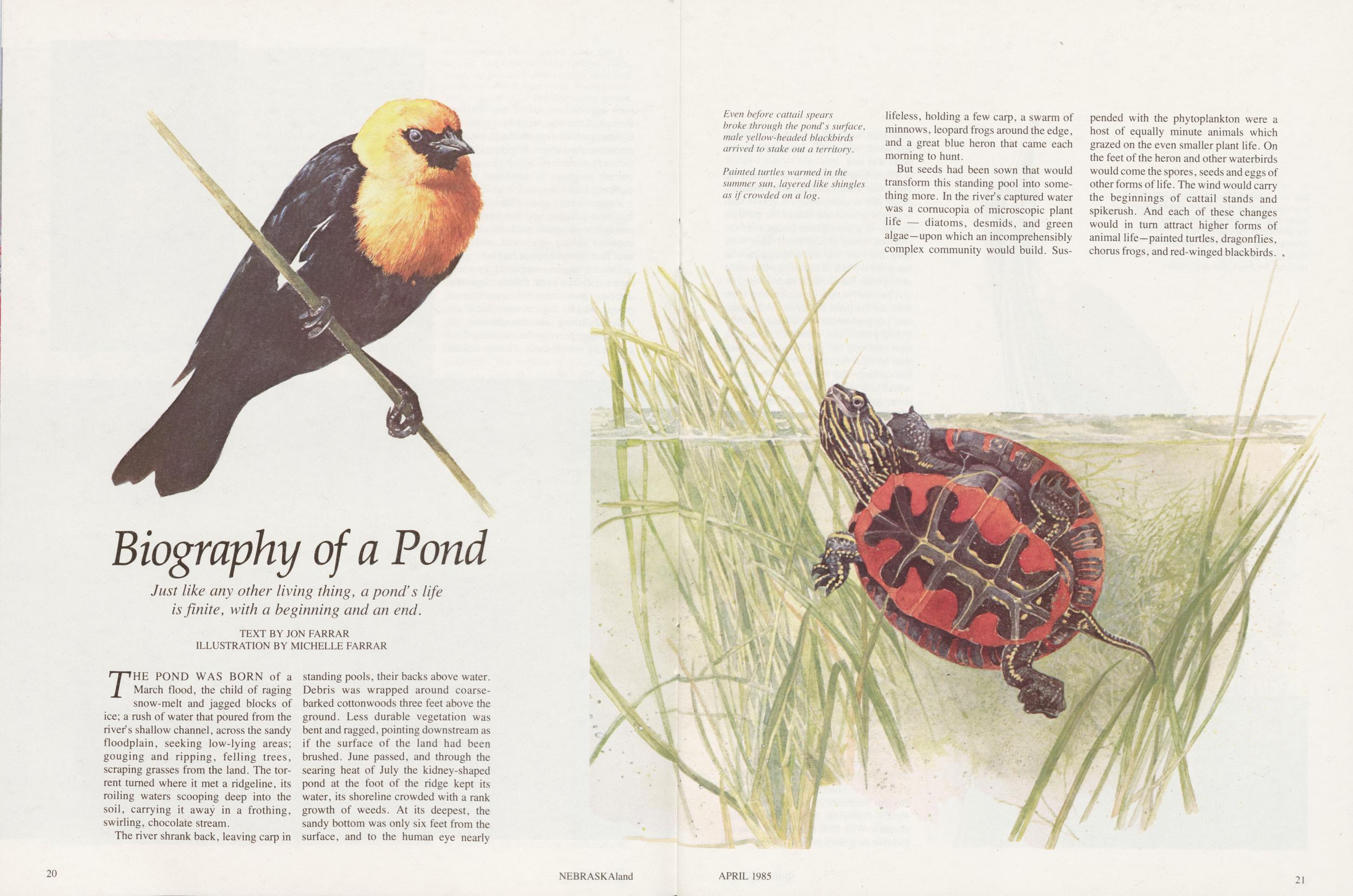
Biography of a Pond
Just like any other living thing, a pond s life is finite, with a beginning and an end. TEXT BY JON FARRAR ILLUSTRATION BY MICHELLE FARRARTHE POND WAS BORN of a March flood, the child of raging snow-melt and jagged blocks of ice; a rush of water that poured from the river's shallow channel, across the sandy floodplain, seeking low-lying areas; gouging and ripping, felling trees, scraping grasses from the land. The torrent turned where it met a ridgeline, its roiling waters scooping deep into the soil, carrying it away in a frothing, swirling, chocolate stream.
The river shrank back, leaving carp in standing pools, their backs above water. Debris was wrapped around coarsebarked cottonwoods three feet above the ground. Less durable vegetation was bent and ragged, pointing downstream as if the surface of the land had been brushed. June passed, and through the searing heat of July the kidney-shaped pond at the foot of the ridge kept its water, its shoreline crowded with a rank growth of weeds. At its deepest, the sandy bottom was only six feet from the surface, and to the human eye nearly 20 NEBRASKAland lifeless, holding a few carp, a swarm of minnows, leopard frogs around the edge, and a great blue heron that came each morning to hunt.
But seeds had been sown that would transform this standing pool into something more. In the river's captured water was a cornucopia of microscopic plant life — diatoms, desmids, and green algae—upon which an incomprehensibly complex community would build. Suspended with the phytoplankton were a host of equally minute animals which grazed on the even smaller plant life. On the feet of the heron and other waterbirds would come the spores, seeds and eggs of other forms of life. The wind would carry the beginnings of cattail stands and spikerush. And each of these changes would in turn attract higher forms of animal life—painted turtles, dragonflies, chorus frogs, and red-winged blackbirds. But this was decades ago, Teddy Roosevelt was in his second term, the pond was new.
APRIL 1985 21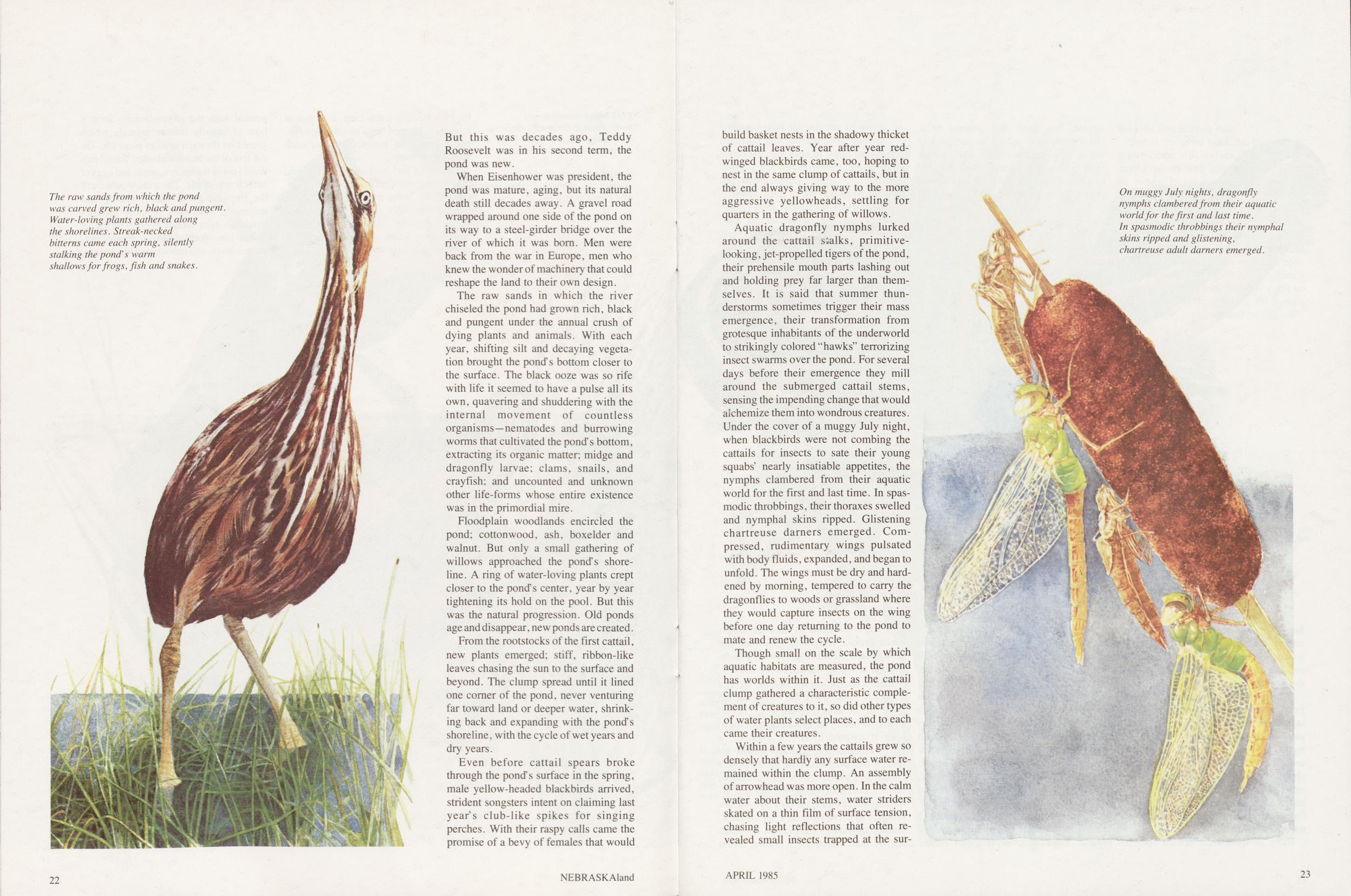
When Eisenhower was president, the pond was mature, aging, but its natural death still decades away. A gravel road wrapped around one side of the pond on its way to a steel-girder bridge over the river of which it was born. Men were back from the war in Europe, men who knew the wonder of machinery that could reshape the land to their own design.
The raw sands in which the river chiseled the pond had grown rich, black and pungent under the annual crush of dying plants and animals. With each year, shifting silt and decaying vegetation brought the pond's bottom closer to the surface. The black ooze was so rife with life it seemed to have a pulse all its own, quavering and shuddering with the internal movement of countless organisms—nematodes and burrowing worms that cultivated the pond's bottom, extracting its organic matter; midge and dragonfly larvae; clams, snails, and crayfish; and uncounted and unknown other life-forms whose entire existence was in the primordial mire.
Floodplain woodlands encircled the pond; cottonwood, ash, boxelder and walnut. But only a small gathering of willows approached the pond's shoreline. A ring of water-loving plants crept closer to the pond's center, year by year tightening its hold on the pool. But this was the natural progression. Old ponds age and disappear, new ponds are created.
From the rootstocks of the first cattail, new plants emerged; stiff, ribbon-like leaves chasing the sun to the surface and beyond. The clump spread until it lined one corner of the pond, never venturing far toward land or deeper water, shrinking back and expanding with the pond's shoreline, with the cycle of wet years and dry years.
Even before cattail spears broke through the pond's surface in the spring, male yellow-headed blackbirds arrived, strident songsters intent on claiming last year's club-like spikes for singing perches. With their raspy calls came the promise of a bevy of females that would 22 NEBRASKAland build basket nests in the shadowy thicket of cattail leaves. Year after year redwinged blackbirds came, too, hoping to nest in the same clump of cattails, but in the end always giving way to the more aggressive yellowheads, settling for quarters in the gathering of willows.
Aquatic dragonfly nymphs lurked around the cattail sialks, primitivelooking, jet-propelled tigers of the pond, their prehensile mouth parts lashing out and holding prey far larger than theselves. It is said that summer thunderstorms sometimes trigger their mass emergence, their transformation from grotesque inhabitants of the underworld to strikingly colored "hawks" terrorizing insect swarms over the pond. For several days before their emergence they mill around the submerged cattail stems, sensing the impending change that would alchemize them into wondrous creatures. Under the cover of a muggy July night, when blackbirds were not combing the cattails for insects to sate their young squabs' nearly insatiable appetites, the nymphs clambered from their aquatic world for the first and last time. In spasmodic throbbings, their thoraxes swelled and nymphal skins ripped. Glistening chartreuse darners emerged. Compressed, rudimentary wings pulsated with body fluids, expanded, and began to unfold. The wings must be dry and hardened by morning, tempered to carry the dragonflies to woods or grassland where they would capture insects on the wing before one day returning to the pond to mate and renew the cycle.
Though small on the scale by which aquatic habitats are measured, the pond has worlds within it. Just as the cattail clump gathered a characteristic complement of creatures to it, so did other types of water plants select places, and to each came their creatures.
Within a few years the cattails grew so densely that hardly any surface water remained within the clump. An assembly of arrowhead was more open. In the calm water about their stems, water striders skated on a thin film of surface tension, chasing light reflections that often revealed small insects trapped at the sur face. The strider's fragile prey, bound only by the attraction of molecules, were sucked of their vital juices, one after another through the day and through the summer.
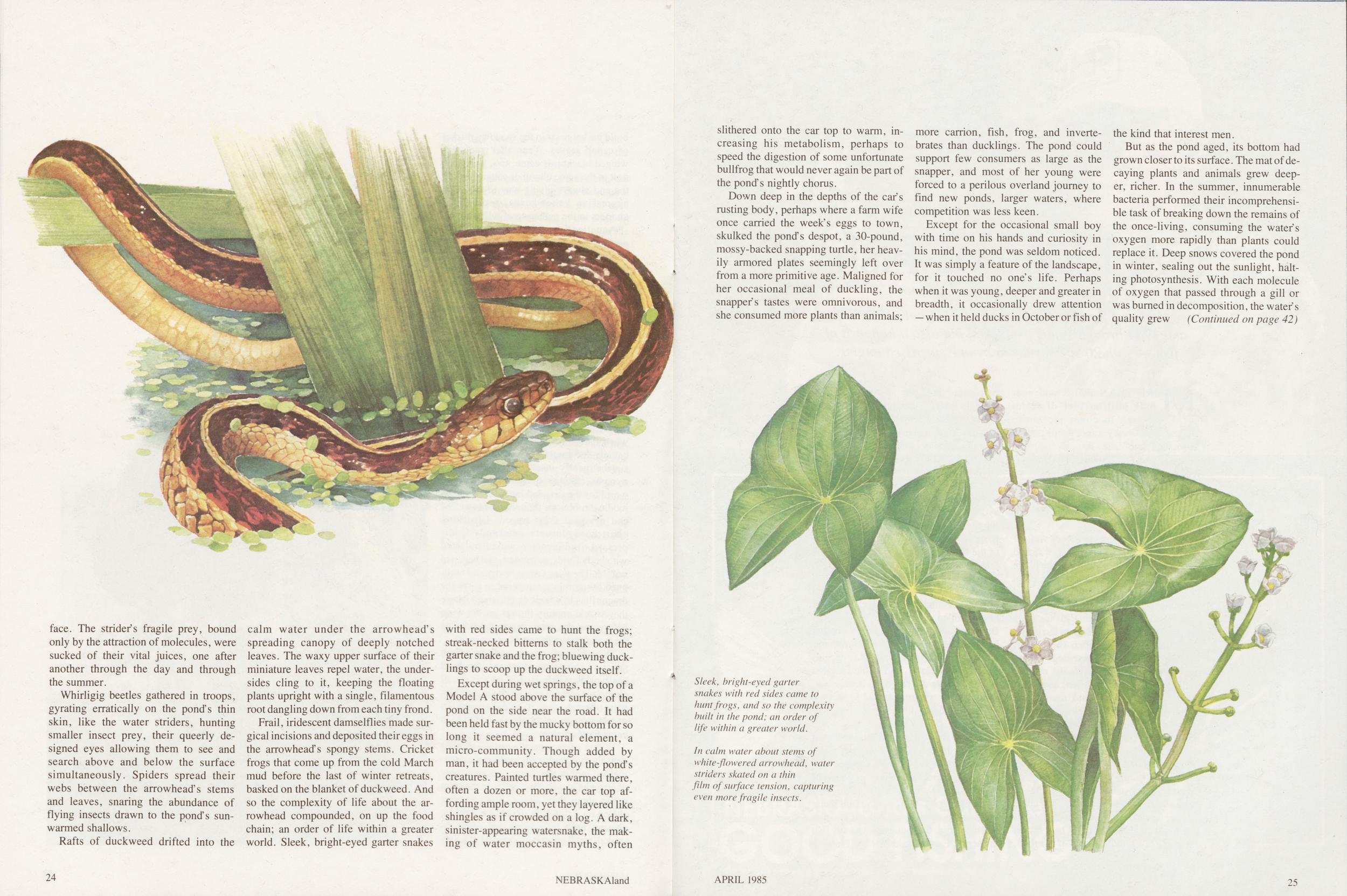
Whirligig beetles gathered in troops, gyrating erratically on the pond's thin skin, like the water striders, hunting smaller insect prey, their queerly designed eyes allowing them to see and search above and below the surface simultaneously. Spiders spread their webs between the arrowhead's stems and leaves, snaring the abundance of flying insects drawn to the pond's sunwarmed shallows.
Rafts of duckweed drifted into the calm water under the arrowhead's spreading canopy of deeply notched leaves. The waxy upper surface of their miniature leaves repel water, the undersides cling to it, keeping the floating plants upright with a single, filamentous root dangling down from each tiny frond.
Frail, iridescent damselflies made surgical incisions and deposited their eggs in the arrowhead's spongy stems. Cricket frogs that come up from the cold March mud before the last of winter retreats, basked on the blanket of duckweed. And so the complexity of life about the arrowhead compounded, on up the food chain; an order of life within a greater world. Sleek, bright-eyed garter snakes with red sides came to hunt the frogs; streak-necked bitterns to stalk both the garter snake and the frog; bluewing ducklings to scoop up the duckweed itself.
Except during wet springs, the top of a Model A stood above the surface of the pond on the side near the road. It had been held fast by the mucky bottom for so long it seemed a natural element, a micro-community. Though added by man, it had been accepted by the pond's creatures. Painted turtles warmed there, often a dozen or more, the car top affording ample room, yet they layered like shingles as if crowded on a log. A dark, sinister-appearing watersnake, the making of water moccasin myths, often 24 NEBRASKAland slithered onto the car top to warm, increasing his metabolism, perhaps to speed the digestion of some unfortunate bullfrog that would never again be part of the pond's nightly chorus.
Down deep in the depths of the car's rusting body, perhaps where a farm wife once carried the week's eggs to town, skulked the pond's despot, a 30-pound, mossy-backed snapping turtle, her heavily armored plates seemingly left over from a more primitive age. Maligned for her occasional meal of duckling, the snapper's tastes were omnivorous, and she consumed more plants than animals; more carrion, fish, frog, and invertebrates than ducklings. The pond could support few consumers as large as the snapper, and most of her young were forced to a perilous overland journey to find new ponds, larger waters, where competition was less keen.
Except for the occasional small boy with time on his hands and curiosity in his mind, the pond was seldom noticed. It was simply a feature of the landscape, for it touched no one's life. Perhaps when it was young, deeper and greater in breadth, it occasionally drew attention — when it held ducks in October or fish of the kind that interest men.
But as the pond aged, its bottom had grown closer to its surface. The mat of decaying plants and animals grew deeper, richer. In the summer, innumerable bacteria performed their incomprehensible task of breaking down the remains of the once-living, consuming the water's oxygen more rapidly than plants could replace it. Deep snows covered the pond in winter, sealing out the sunlight, halting photosynthesis. With each molecule of oxygen that passed through a gill or was burned in decomposition, the water's quality grew (Continued on page 42)
A Flood of Fish
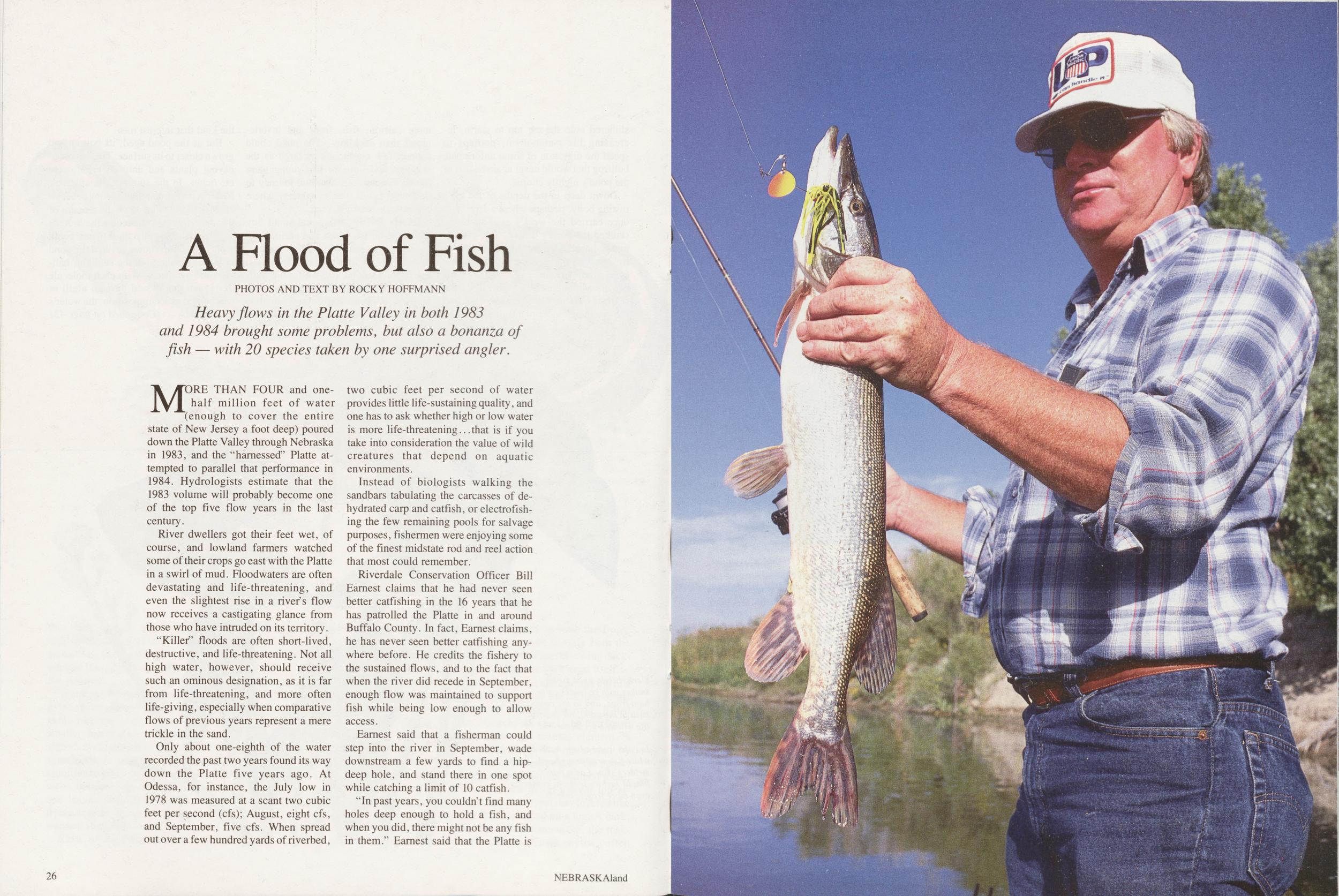
PHOTOS AND TEXT BY ROCKY HOFFMANN Heavy flows in the Platte Valley in both 1983 and 1984 brought some problems, but also a bonanza of fish — with 20 species taken by one surprised angler.MORE THAN FOUR and onehalf million feet of water (enough to cover the entire state of New Jersey a foot deep) poured down the Platte Valley through Nebraska in 1983, and the "harnessed" Platte attempted to parallel that performance in 1984. Hydrologists estimate that the 1983 volume will probably become one of the top five flow years in the last century.
River dwellers got their feet wet, of course, and lowland farmers watched some of their crops go east with the Platte in a swirl of mud. Floodwaters are often devastating and life-threatening, and even the slightest rise in a river's flow now receives a castigating glance from those who have intruded on its territory.
"Killer" floods are often short-lived, destructive, and life-threatening. Not all high water, however, should receive such an ominous designation, as it is far from life-threatening, and more often life-giving, especially when comparative flows of previous years represent a mere trickle in the sand.
Only about one-eighth of the water recorded the past two years found its way down the Platte five years ago. At Odessa, for instance, the July low in 1978 was measured at a scant two cubic feet per second (cfs); August, eight cfs, and September, five cfs. When spread out over a few hundred yards of riverbed, two cubic feet per second of water provides little life-sustaining quality, and one has to ask whether high or low water is more life-threatening... that is if you take into consideration the value of wild creatures that depend on aquatic environments.
Instead of biologists walking the sandbars tabulating the carcasses of dehydrated carp and catfish, or electrofishing the few remaining pools for salvage purposes, fishermen were enjoying some of the finest midstate rod and reel action that most could remember.
Riverdale Conservation Officer Bill Earnest claims that he had never seen better catfishing in the 16 years that he has patrolled the Platte in and around Buffalo County. In fact, Earnest claims, he has never seen better catfishing anywhere before. He credits the fishery to the sustained flows, and to the fact that when the river did recede in September, enough flow was maintained to support fish while being low enough to allow access.
Earnest said that a fisherman could step into the river in September, wade downstream a few yards to find a hipdeep hole, and stand there in one spot while catching a limit of 10 catfish.
"In past years, you couldn't find many holes deep enough to hold a fish, and when you did, there might not be any fish in them." Earnest said that the Platte is pretty well devoid of fish during low water, and there are those who ask where all the fish came from last year that so amply populated the river.
26 NEBRASKAland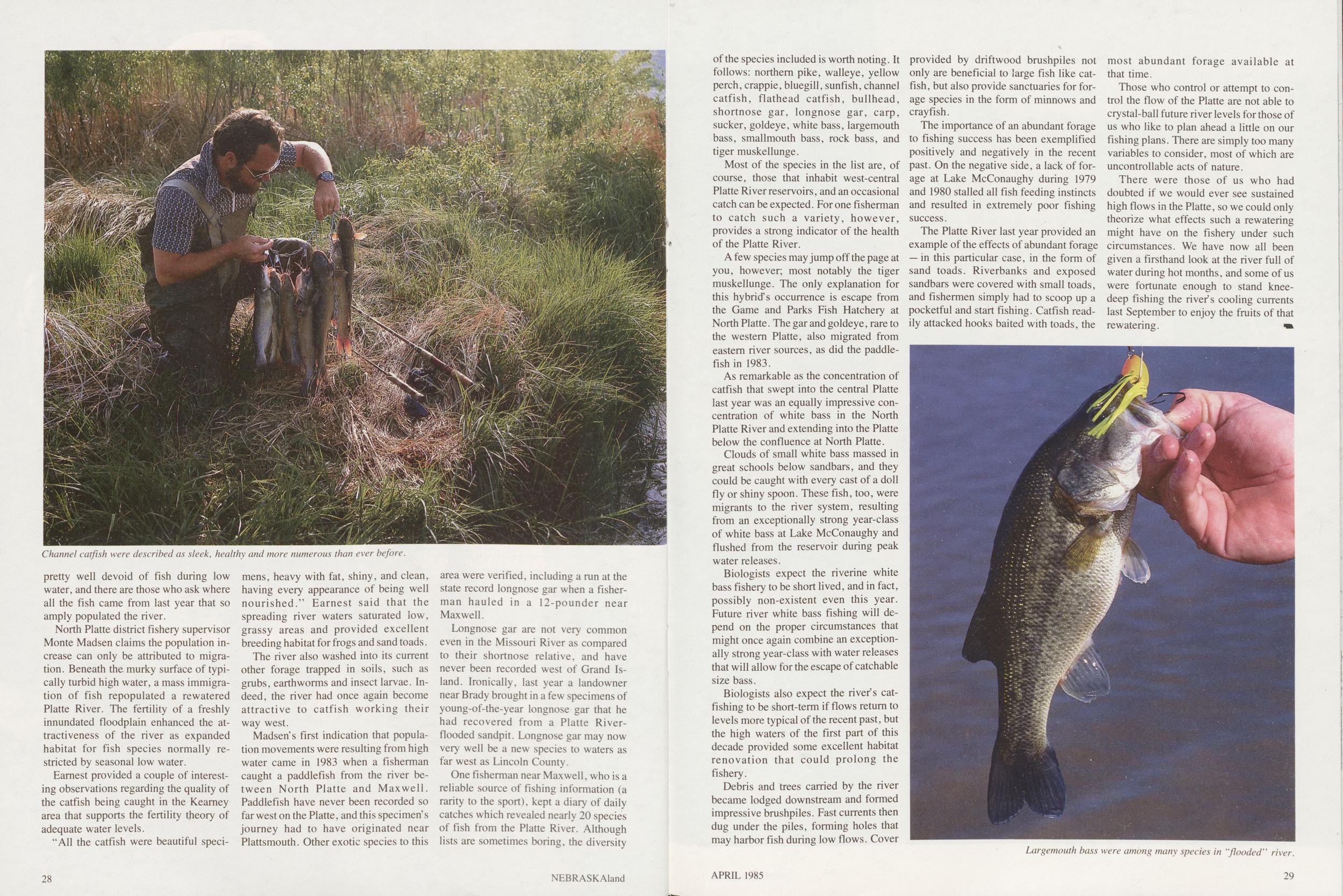
North Platte district fishery supervisor Monte Madsen claims the population increase can only be attributed to migration. Beneath the murky surface of typically turbid high water, a mass immigration of fish repopulated a rewatered Platte River. The fertility of a freshly innundated floodplain enhanced the attractiveness of the river as expanded habitat for fish species normally restricted by seasonal low water.
Earnest provided a couple of interesting observations regarding the quality of the catfish being caught in the Kearney area that supports the fertility theory of adequate water levels. "All the catfish were beautiful specimens, heavy with fat, shiny, and clean, having every appearance of being well nourished." Earnest said that the spreading river waters saturated low, grassy areas and provided excellent breeding habitat for frogs and sand toads.
The river also washed into its current other forage trapped in soils, such as grubs, earthworms and insect larvae. Indeed, the river had once again become attractive to catfish working their way west.
Madsen's first indication that population movements were resulting from high water came in 1983 when a fisherman caught a paddlefish from the river between North Platte and Maxwell. Paddlefish have never been recorded so far west on the Platte, and this specimen's journey had to have originated near Plattsmouth. Other exotic species to this area were verified, including a run at the state record longnose gar when a fisherman hauled in a 12-pounder near Maxwell.
Longnose gar are not very common even in the Missouri River as compared to their shortnose relative, and have never been recorded west of Grand Island. Ironically, last year a landowner near Brady brought in a few specimens of young-of-the-year longnose gar that he had recovered from a Platte Riverflooded sandpit. Longnose gar may now very well be a new species to waters as far west as Lincoln County.
One fisherman near Maxwell, who is a reliable source of fishing information (a rarity to the sport), kept a diary of daily catches which revealed nearly 20 species of fish from the Platte River. Although lists are sometimes boring, the diversity 28 NEBRASKAland of the species included is worth noting. It follows: northern pike, walleye, yellow perch, crappie, bluegill, sunfish, channel catfish, flathead catfish, bullhead, shortnose gar, longnose gar, carp, sucker, goldeye, white bass, largemouth bass, smallmouth bass, rock bass, and tiger muskellunge.
Most of the species in the list are, of course, those that inhabit west-central Platte River reservoirs, and an occasional catch can be expected. For one fisherman to catch such a variety, however, provides a strong indicator of the health of the Platte River.
A few species may jump off the page at you, however; most notably the tiger muskellunge. The only explanation for this hybrid's occurrence is escape from the Game and Parks Fish Hatchery at North Platte. The gar and goldeye, rare to the western Platte, also migrated from eastern river sources, as did the paddlefish in 1983.
As remarkable as the concentration of catfish that swept into the central Platte last year was an equally impressive concentration of white bass in the North Platte River and extending into the Platte below the confluence at North Platte.
Clouds of small white bass massed in great schools below sandbars, and they could be caught with every cast of a doll fly or shiny spoon. These fish, too, were migrants to the river system, resulting from an exceptionally strong year-class of white bass at Lake McConaughy and flushed from the reservoir during peak water releases.
Biologists expect the riverine white bass fishery to be short lived, and in fact, possibly non-existent even this year. Future river white bass fishing will depend on the proper circumstances that might once again combine an exceptionally strong year-class with water releases that will allow for the escape of catchable size bass.
Biologists also expect the river's catfishing to be short-term if flows return to levels more typical of the recent past, but the high waters of the first part of this decade provided some excellent habitat renovation that could prolong the fishery.
Debris and trees carried by the river became lodged downstream and formed impressive brushpiles. Fast currents then dug under the piles, forming holes that may harbor fish during low flows. Cover provided by driftwood brushpiles not only are beneficial to large fish like catfish, but also provide sanctuaries for forage species in the form of minnows and crayfish.
The importance of an abundant forage to fishing success has been exemplified positively and negatively in the recent past. On the negative side, a lack of forage at Lake McConaughy during 1979 and 1980 stalled all fish feeding instincts and resulted in extremely poor fishing success.
The Platte River last year provided an example of the effects of abundant forage — in this particular case, in the form of sand toads. Riverbanks and exposed sandbars were covered with small toads, and fishermen simply had to scoop up a pocketful and start fishing. Catfish readily attacked hooks baited with toads, the most abundant forage available at that time.
Those who control or attempt to control the flow of the Platte are not able to crystal-ball future river levels for those of us who like to plan ahead a little on our fishing plans. There are simply too many variables to consider, most of which are uncontrollable acts of nature.
There were those of us who had doubted if we would ever see sustained high flows in the Platte, so we could only theorize what effects such a rewatering might have on the fishery under such circumstances. We have now all been given a firsthand look at the river full of water during hot months, and some of us were fortunate enough to stand knee-deep fishing the river's cooling currents last September to enjoy the fruits of that rewatering.
Officers of the Outdoors
PHOTOS AND TEXT BY BOB GRIER A wide range of activities, service and enforcement duties are heaped upon this force of 58 men. They cover the state's 93 counties, and logged 1A million miles in 1984SINCE THE ENACTMENT of game laws in Nebraska, a small group of dedicated peace officers has worked a specialized trade, almost always alone, usually miles from assistance, and often as not, during hours when most Nebraskans are enjoying the comforts of family and home. Today, 58 such officers, conservation officers, are thinly scattered throughout Nebraska's 93 counties, enforcing an increasingly complex body of law designed to protect wildlife resources, ensure public safety, and manage a growing population of hunters, fishermen, campers, tourists and other seekers of the good life.
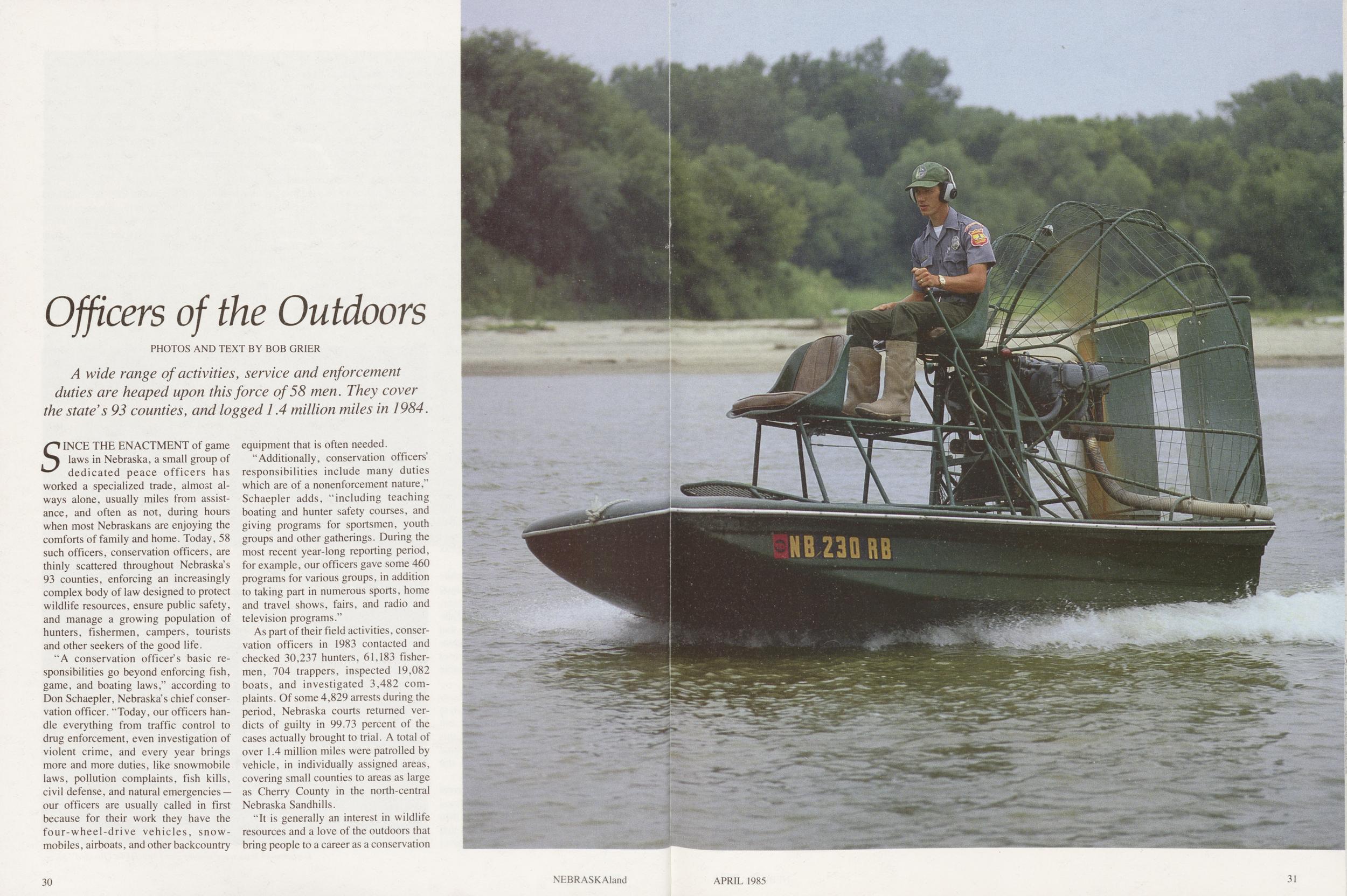
"A conservation officer's basic responsibilities go beyond enforcing fish, game, and boating laws," according to Don Schaepler, Nebraska's chief conservation officer. "Today, our officers handle everything from traffic control to drug enforcement, even investigation of violent crime, and every year brings more and more duties, like snowmobile laws, pollution complaints, fish kills, civil defense, and natural emergencies our officers are usually called in first because for their work they have the four-wheel-drive vehicles, snowmobiles, airboats, and other backcountry equipment that is often needed.
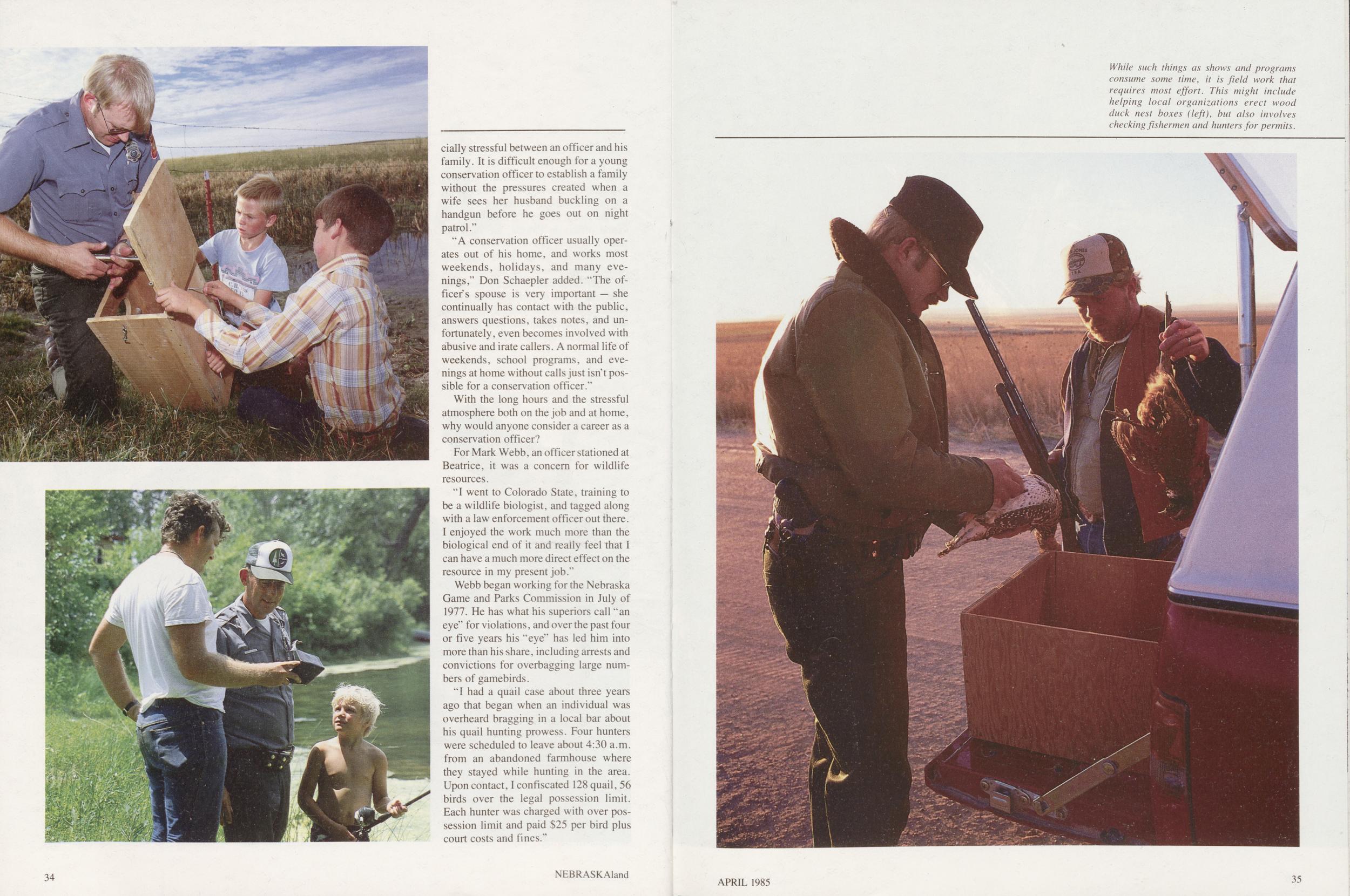
"Additionally, conservation officers' responsibilities include many duties which are of a nonenforcement nature," Schaepler adds, "including teaching boating and hunter safety courses, and giving programs for sportsmen, youth groups and other gatherings. During the most recent year-long reporting period, for example, our officers gave some 460 programs for various groups, in addition to taking part in numerous sports, home and travel shows, fairs, and radio and television programs."
As part of their field activities, conservation officers in 1983 contacted and checked 30,237 hunters, 61,183 fishermen, 704 trappers, inspected 19,082 boats, and investigated 3,482 complaints. Of some 4,829 arrests during the period, Nebraska courts returned verdicts of guilty in 99.73 percent of the cases actually brought to trial. A total of over 1.4 million miles were patrolled by vehicle, in individually assigned areas, covering small counties to areas as large as Cherry County in the north-central Nebraska Sandhills.
It is generally an interest in wildlife resources and a love of the outdoors that bring people to a career as a conservation officer," according to Ted Blume, assistant chief of the Law Enforcement Division of the Nebraska Game and Parks Commission. "Most officers are avid hunters and fishermen," Blume said, "and people with sincere concern for the resource. Many of our officers have other law enforcement experience but find that wildlife and recreation enforcement are more to their liking."
30 NEBRASKAland APRIL 1985 31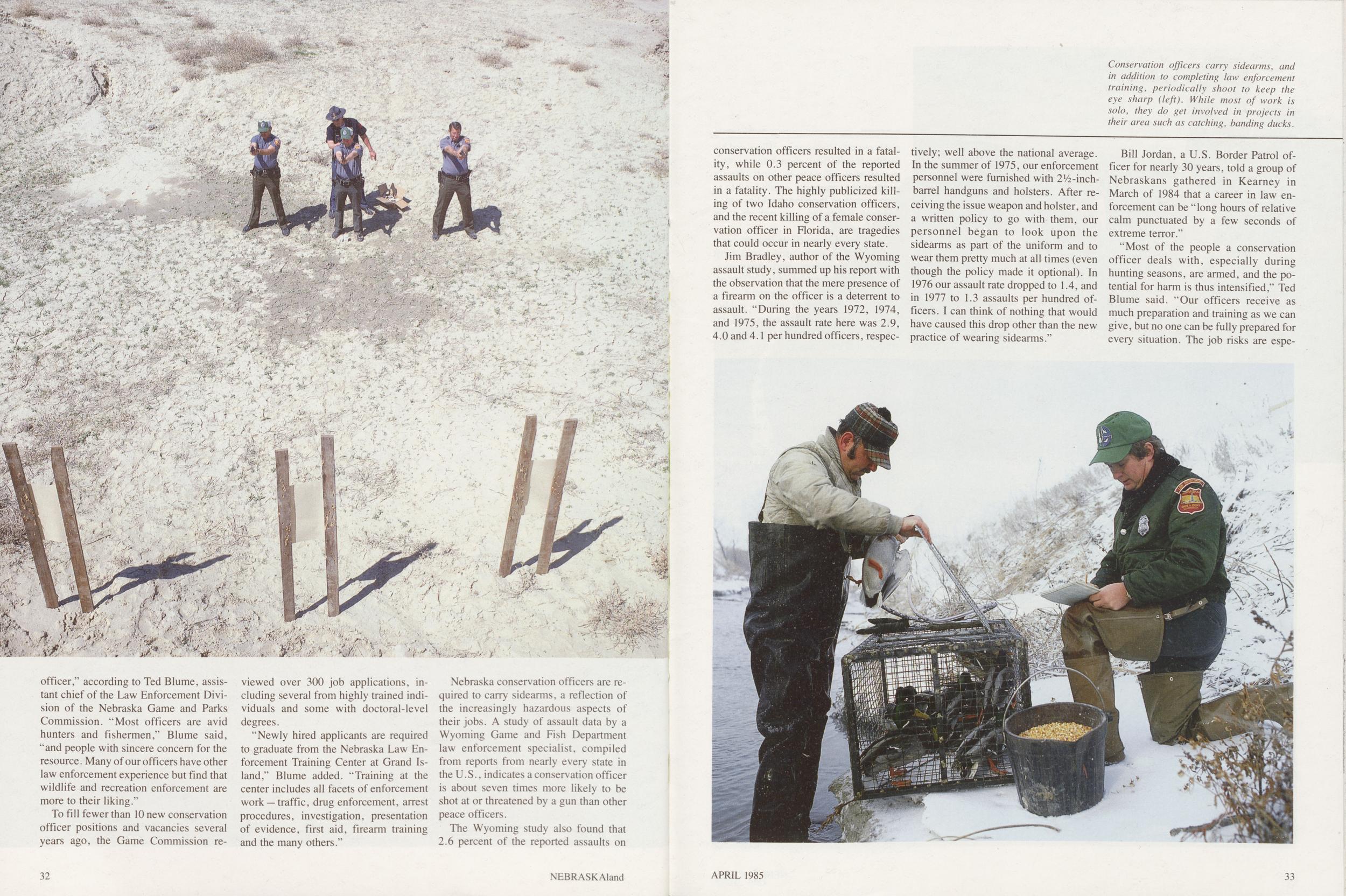
To fill fewer than 10 new conservation officer positions and vacancies several years ago, the Game Commission reviewed over 300 job applications, including several from highly trained individuals and some with doctoral-level degrees.
"Newly hired applicants are required to graduate from the Nebraska Law Enforcement Training Center at Grand Island," Blume added. "Training at the center includes all facets of enforcement work — traffic, drug enforcement, arrest procedures, investigation, presentation of evidence, first aid, firearm training and the many others."
Nebraska conservation officers are required to carry sidearms, a reflection of the increasingly hazardous aspects of their jobs. A study of assault data by a Wyoming Game and Fish Department law enforcement specialist, compiled from reports from nearly every state in the U.S., indicates a conservation officer is about seven times more likely to be shot at or threatened by a gun than other peace officers.
The Wyoming study also found that 2.6 percent of the reported assaults on 32 NEBRASKAland conservation officers resulted in a fatality, while 0.3 percent of the reported assaults on other peace officers resulted in a fatality. The highly publicized killing of two Idaho conservation officers, and the recent killing of a female conservation officer in Florida, are tragedies that could occur in nearly every state.
Jim Bradley, author of the Wyoming assault study, summed up his report with the observation that the mere presence of a firearm on the officer is a deterrent to assault. "During the years 1972, 1974, and 1975, the assault rate here was 2.9, 4.0 and 4.1 per hundred officers, respectively; well above the national average. In the summer of 1975, our enforcement personnel were furnished with 2Vi -inchbarrel handguns and holsters. After receiving the issue weapon and holster, and a written policy to go with them, our personnel began to look upon the sidearms as part of the uniform and to wear them pretty much at all times (even though the policy made it optional). In 1976 our assault rate dropped to 1.4, and in 1977 to 1.3 assaults per hundred officers. I can think of nothing that would have caused this drop other than the new practice of wearing sidearms."
Bill Jordan, a U.S. Border Patrol officer for nearly 30 years, told a group of Nebraskans gathered in Kearney in March of 1984 that a career in law enforcement can be "long hours of relative calm punctuated by a few seconds of extreme terror."
"Most of the people a conservation officer deals with, especially during hunting seasons, are armed, and the potential for harm is thus intensified," Ted Blume said. "Our officers receive as much preparation and training as we can give, but no one can be fully prepared for every situation. The job risks are especially stressful between an officer and his family. It is difficult enough for a young conservation officer to establish a family without the pressures created when a wife sees her husband buckling on a handgun before he goes out on night patrol."
"A conservation officer usually operates out of his home, and works most weekends, holidays, and many evenings," Don Schaepler added. "The officer's spouse is very important — she continually has contact with the public, answers questions, takes notes, and unfortunately, even becomes involved with abusive and irate callers. A normal life of weekends, school programs, and evenings at home without calls just isn't possible for a conservation officer."
With the long hours and the stressful atmosphere both on the job and at home, why would anyone consider a career as a conservation officer?
For Mark Webb, an officer stationed at Beatrice, it was a concern for wildlife resources.
"I went to Colorado State, training to be a wildlife biologist, and tagged along with a law enforcement officer out there. I enjoyed the work much more than the biological end of it and really feel that I can have a much more direct effect on the resource in my present job."
Webb began working for the Nebraska Game and Parks Commission in July of 1977. He has what his superiors call "an eye" for violations, and over the past four or five years his "eye" has led him into more than his share, including arrests and convictions for overbagging large numbers of gamebirds.
"I had a quail case about three years ago that began when an individual was overheard bragging in a local bar about his quail hunting prowess. Four hunters were scheduled to leave about 4:30 a.m. from an abandoned farmhouse where they stayed while hunting in the area. Upon contact, I confiscated 128 quail, 56 birds over the legal possession limit. Each hunter was charged with over possession limit and paid $25 per bird plus court costs and fines."
34 NEBRASKAland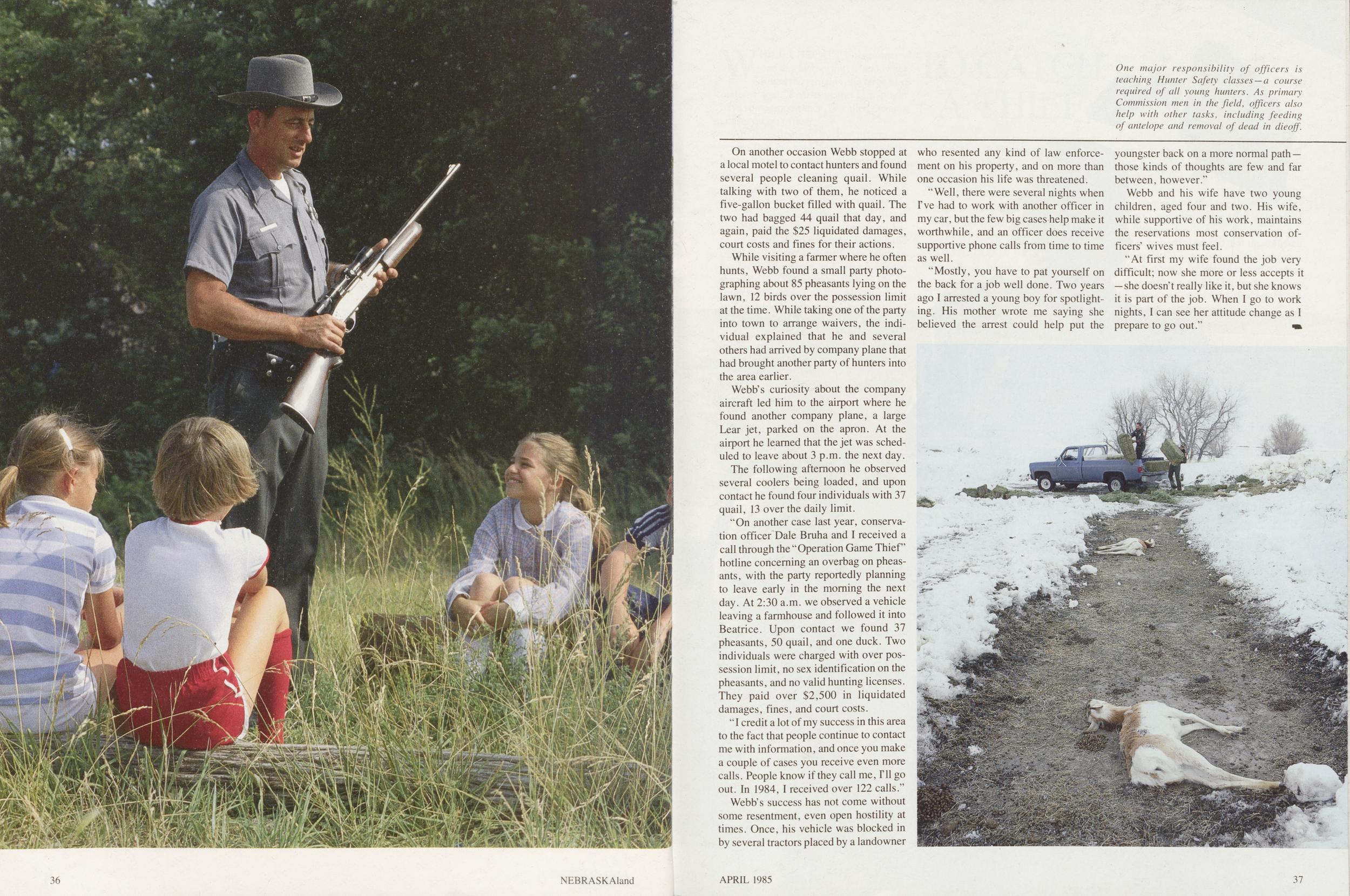
On another occasion Webb stopped at a local motel to contact hunters and found several people cleaning quail. While talking with two of them, he noticed a five-gallon bucket filled with quail. The two had bagged 44 quail that day, and again, paid the $25 liquidated damages, court costs and fines for their actions.
While visiting a farmer where he often hunts, Webb found a small party photographing about 85 pheasants lying on the lawn, 12 birds over the possession limit at the time. While taking one of the party into town to arrange waivers, the individual explained that he and several others had arrived by company plane that had brought another party of hunters into the area earlier.
Webb's curiosity about the company aircraft led him to the airport where he found another company plane, a large Lear jet, parked on the apron. At the airport he learned that the jet was scheduled to leave about 3 p.m. the next day.
The following afternoon he observed several coolers being loaded, and upon contact he found four individuals with 37 quail, 13 over the daily limit.
"On another case last year, conservation officer Dale Bruha and I received a call through the "Operation Game Thief" hotline concerning an overbag on pheasants, with the party reportedly planning to leave early in the morning the next day. At 2:30 a.m. we observed a vehicle leaving a farmhouse and followed it into Beatrice. Upon contact we found 37 pheasants, 50 quail, and one duck. Two individuals were charged with over possession limit, no sex identification on the pheasants, and no valid hunting licenses. They paid over $2,500 in liquidated damages, fines, and court costs.
"I credit a lot of my success in this area to the fact that people continue to contact me with information, and once you make a couple of cases you receive even more calls. People know if they call me, Til go out. In 1984, I received over 122 calls."
Webb's success has not come without some resentment, even open hostility at times. Once, his vehicle was blocked in by several tractors placed by a landowner who resented any kind of law enforcement on his property, and on more than one occasion his life was threatened.
"Well, there were several nights when Fve had to work with another officer in my car, but the few big cases help make it worthwhile, and an officer does receive supportive phone calls from time to time as well.
"Mostly, you have to pat yourself on the back for a job well done. Two years ago I arrested a young boy for spotlighting. His mother wrote me saying she believed the arrest could help put the youngster back on a more normal path — those kinds of thoughts are few and far between, however."
Webb and his wife have two young children, aged four and two. His wife, while supportive of his work, maintains the reservations most conservation officers' wives must feel.
"At first my wife found the job very difficult; now she more or less accepts it — she doesn't really like it, but she knows it is part of the job. When I go to work nights, I can see her attitude change as I prepare to go out."
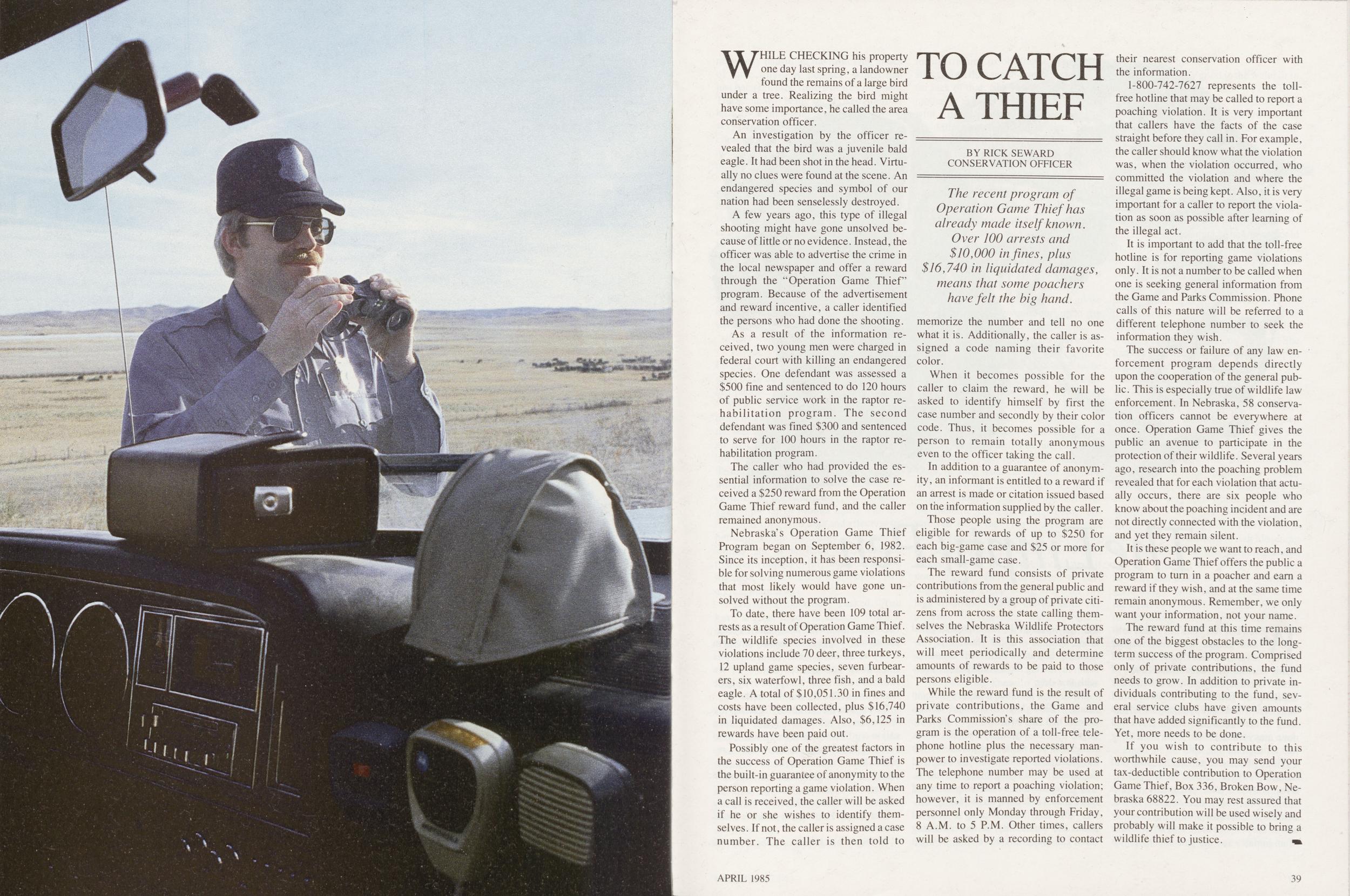
TO CATCH A THIEF
BY RICK SEWARD CONSERVATION OFFICER The recent program of Operation Game Thief has already made itself known. Over 100 arrests and $10,000 in fines, plus $16,740 in liquidated damages, means that some poachers have felt the big hand.WHILE CHECKING his property one day last spring, a landowner found the remains of a large bird under a tree. Realizing the bird might have some importance, he called the area conservation officer.
An investigation by the officer revealed that the bird was a juvenile bald eagle. It had been shot in the head. Virtually no clues were found at the scene. An endangered species and symbol of our nation had been senselessly destroyed.
A few years ago, this type of illegal shooting might have gone unsolved because of little or no evidence. Instead, the officer was able to advertise the crime in the local newspaper and offer a reward through the "Operation Game Thief" program. Because of the advertisement and reward incentive, a caller identified the persons who had done the shooting.
As a result of the information received, two young men were charged in federal court with killing an endangered species. One defendant was assessed a $500 fine and sentenced to do 120 hours of public service work in the raptor rehabilitation program. The second defendant was fined $300 and sentenced to serve for 100 hours in the raptor rehabilitation program.
The caller who had provided the essential information to solve the case received a $250 reward from the Operation Game Thief reward fund, and the caller remained anonymous.
Nebraska's Operation Game Thief Program began on September 6, 1982. Since its inception, it has been responsible for solving numerous game violations that most likely would have gone unsolved without the program.
To date, there have been 109 total arrests as a result of Operation Game Thief. The wildlife species involved in these violations include 70 deer, three turkeys, 12 upland game species, seven furbearers, six waterfowl, three fish, and a bald eagle. A total of $10,051.30 in fines and costs have been collected, plus $16,740 in liquidated damages. Also, $6,125 in rewards have been paid out.
Possibly one of the greatest factors in the success of Operation Game Thief is the built-in guarantee of anonymity to the person reporting a game violation. When a call is received, the caller will be asked if he or she wishes to identify themselves. Ifnot, the caller is assigned a case number. The caller is then told to memorize the number and tell no one what it is. Additionally, the caller is assigned a code naming their favorite color.
When it becomes possible for the caller to claim the reward, he will be asked to identify himself by first the case number and secondly by their color code. Thus, it becomes possible for a person to remain totally anonymous even to the officer taking the call.
In addition to a guarantee of anonymity, an informant is entitled to a reward if an arrest is made or citation issued based on the information supplied by the caller.
Those people using the program are eligible for rewards of up to $250 for each big-game case and $25 or more for each small-game case.
The reward fund consists of private contributions from the general public and is administered by a group of private citizens from across the state calling themselves the Nebraska Wildlife Protectors Association. It is this association that will meet periodically and determine amounts of rewards to be paid to those persons eligible.
While the reward fund is the result of private contributions, the Game and Parks Commission's share of the program is the operation of a toll-free telephone hotline plus the necessary manpower to investigate reported violations. The telephone number may be used at any time to report a poaching violation; however, it is manned by enforcement personnel only Monday through Friday, 8 A.M. to 5 P.M. Other times, callers will be asked by a recording to contact their nearest conservation officer with the information.
1-800-742-7627 represents the tollfree hotline that may be called to report a poaching violation. It is very important that callers have the facts of the case straight before they call in. For example, the caller should know what the violation was, when the violation occurred, who committed the violation and where the illegal game is being kept. Also, it is very important for a caller to report the violation as soon as possible after learning of the illegal act.
It is important to add that the toll-free hotline is for reporting game violations only. It is not a number to be called when one is seeking general information from the Game and Parks Commission. Phone calls of this nature will be referred to a different telephone number to seek the information they wish.
The success or failure of any law enforcement program depends directly upon the cooperation of the general public. This is especially true of wildlife law enforcement. In Nebraska, 58 conservation officers cannot be everywhere at once. Operation Game Thief gives the public an avenue to participate in the protection of their wildlife. Several years ago, research into the poaching problem revealed that for each violation that actually occurs, there are six people who know about the poaching incident and are not directly connected with the violation, and yet they remain silent.
It is these people we want to reach, and Operation Game Thief offers the public a program to turn in a poacher and earn a reward if they wish, and at the same time remain anonymous. Remember, we only want your information, not your name.
The reward fund at this time remains one of the biggest obstacles to the longterm success of the program. Comprised only of private contributions, the fund needs to grow. In addition to private individuals contributing to the fund, several service clubs have given amounts that have added significantly to the fund. Yet, more needs to be done.
If you wish to contribute to this worthwhile cause, you may send your tax-deductible contribution to Operation Game Thief, Box 336, Broken Bow, Nebraska 68822. You may rest assured that your contribution will be used wisely and probably will make it possible to bring a wildlife thief to justice.
APRIL 1985 39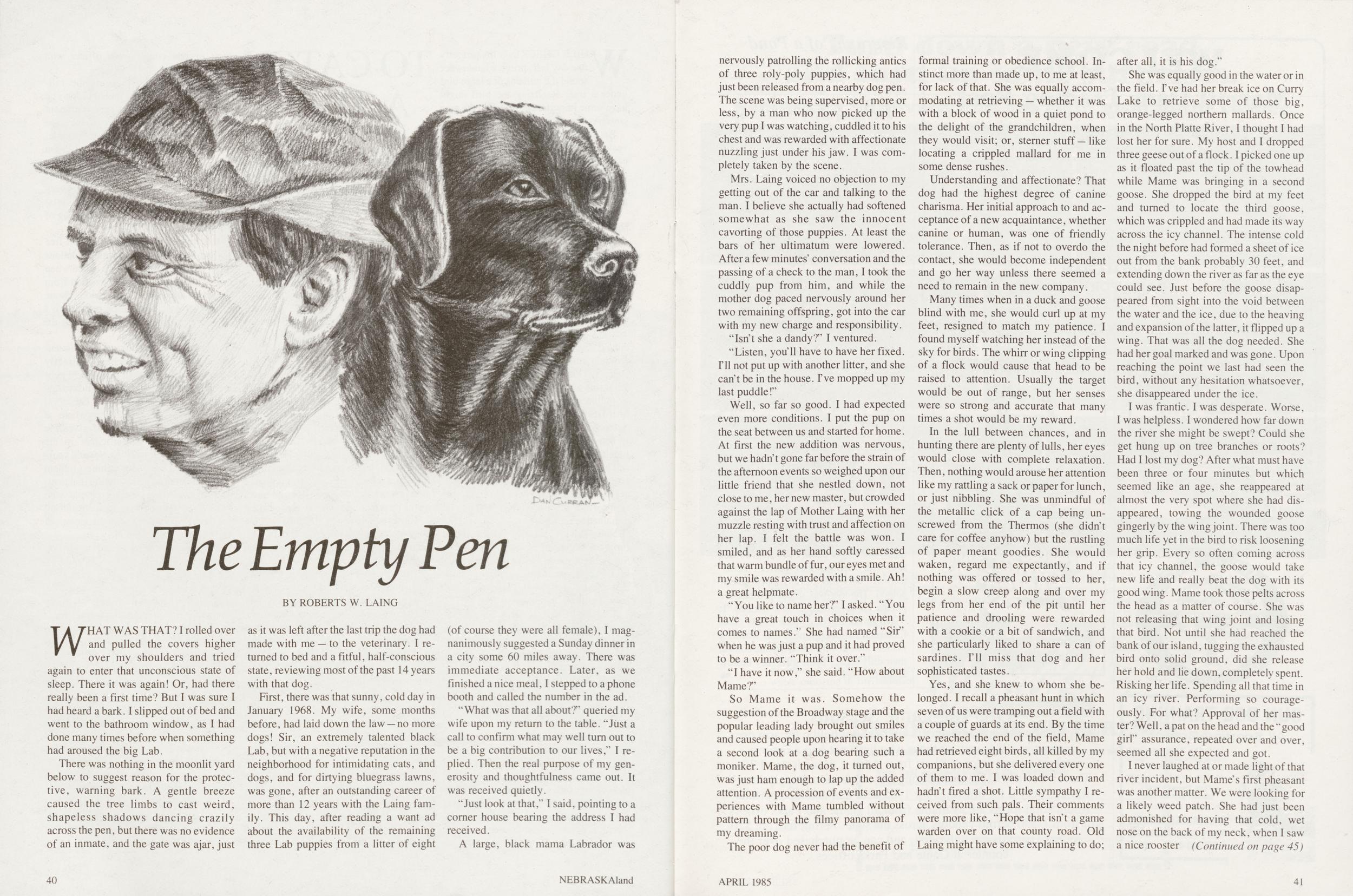
The Empty Pen
BY ROBERTS W. LAINGWHAT WAS THAT? I rolled over and pulled the covers higher over my shoulders and tried again to enter that unconscious state of sleep. There it was again! Or, had there really been a first time? But I was sure I had heard a bark. I slipped out of bed and went to the bathroom window, as I had done many times before when something had aroused the big Lab.
There was nothing in the moonlit yard below to suggest reason for the protective, warning bark. A gentle breeze caused the tree limbs to cast weird, shapeless shadows dancing crazily across the pen, but there was no evidence of an inmate, and the gate was ajar, just as it was left after the last trip the dog had made with me — to the veterinary. I returned to bed and a fitful, half-conscious state, reviewing most of the past 14 years with that dog.
First, there was that sunny, cold day in January 1968. My wife, some months before, had laid down the law — no more dogs! Sir, an extremely talented black Lab, but with a negative reputation in the neighborhood for intimidating cats, and dogs, and for dirtying bluegrass lawns, was gone, after an outstanding career of more than 12 years with the Laing family. This day, after reading a want ad about the availability of the remaining three Lab puppies from a litter of eight (of course they were all female), I magnanimously suggested a Sunday dinner in a city some 60 miles away. There was immediate acceptance. Later, as we finished a nice meal, I stepped to a phone booth and called the number in the ad.
"What was that all aboutT queried my wife upon my return to the table. "Just a call to confirm what may well turn out to be a big contribution to our lives," I replied. Then the real purpose of my gen- erosity and thoughtfulness came out. It was received quietly.
"Just look at that," I said, pointing to a corner house bearing the address I had received.
A large, black mama Labrador was 40 NEBRASKAland nervously patrolling the rollicking antics of three roly-poly puppies, which had just been released from a nearby dog pen. The scene was being supervised, more or less, by a man who now picked up the very pup I was watching, cuddled it to his chest and was rewarded with affectionate nuzzling just under his jaw. I was completely taken by the scene.
Mrs. Laing voiced no objection to my getting out of the car and talking to the man. I believe she actually had softened somewhat as she saw the innocent cavorting of those puppies. At least the bars of her ultimatum were lowered. After a few minutes' conversation and the passing of a check to the man, I took the cuddly pup from him, and while the mother dog paced nervously around her two remaining offspring, got into the car with my new charge and responsibility.
"Isn't she a dandy?" I ventured.
"Listen, you'll have to have her fixed. Til not put up with another litter, and she can't be in the house. I've mopped up my last puddle!"
Well, so far so good. I had expected even more conditions. I put the pup on the seat between us and started for home. At first the new addition was nervous, but we hadn't gone far before the strain of the afternoon events so weighed upon our little friend that she nestled down, not close to me, her new master, but crowded against the lap of Mother Laing with her muzzle resting with trust and affection on her lap. I felt the battle was won. I smiled, and as her hand softly caressed that warm bundle of fur, our eyes met and my smile was rewarded with a smile. Ah! a great helpmate.
"You like to name her?" I asked. "You have a great touch in choices when it comes to names." She had named "Sir" when he was just a pup and it had proved to be a winner. "Think it over."
"I have it now," she said. "How about Mame?"
So Mame it was. Somehow the suggestion of the Broadway stage and the popular leading lady brought out smiles and caused people upon hearing it to take a second look at a dog bearing such a moniker. Mame, the dog, it turned out, was just ham enough to lap up the added attention. A procession of events and experiences with Mame tumbled without pattern through the filmy panorama of my dreaming.
The poor dog never had the benefit of formal training or obedience school. Instinct more than made up, to me at least, for lack of that. She was equally accommodating at retrieving — whether it was with a block of wood in a quiet pond to the delight of the grandchildren, when they would visit; or, sterner stuff— like locating a crippled mallard for me in some dense rushes.
Understanding and affectionate? That dog had the highest degree of canine charisma. Her initial approach to and acceptance of a new acquaintance, whether canine or human, was one of friendly tolerance. Then, as if not to overdo the contact, she would become independent and go her way unless there seemed a need to remain in the new company.
Many times when in a duck and goose blind with me, she would curl up at my feet, resigned to match my patience. I found myself watching her instead of the sky for birds. The whirr or wing clipping of a flock would cause that head to be raised to attention. Usually the target would be out of range, but her senses were so strong and accurate that many times a shot would be my reward.
In the lull between chances, and in hunting there are plenty of lulls, her eyes would close with complete relaxation. Then, nothing would arouse her attention like my rattling a sack or paper for lunch, or just nibbling. She was unmindful of the metallic click of a cap being unscrewed from the Thermos (she didn't care for coffee anyhow) but the rustling of paper meant goodies. She would waken, regard me expectantly, and if nothing was offered or tossed to her, begin a slow creep along and over my legs from her end of the pit until her patience and drooling were rewarded with a cookie or a bit of sandwich, and she particularly liked to share a can of sardines. I'll miss that dog and her sophisticated tastes.
Yes, and she knew to whom she be- longed. I recall a pheasant hunt in which seven of us were tramping out a field with a couple of guards at its end. By the time we reached the end of the field, Mame had retrieved eight birds, all killed by my companions, but she delivered every one of them to me. I was loaded down and hadn't fired a shot. Little sympathy I received from such pals. Their comments were more like, "Hope that isn't a game warden over on that county road. Old Laing might have some explaining to do; after all, it is his dog."
She was equally good in the water or in the field. Tve had her break ice on Curry Lake to retrieve some of those big, orange-legged northern mallards. Once in the North Platte River, I thought I had lost her for sure. My host and I dropped three geese out of a flock. I picked one up as it floated past the tip of the towhead while Mame was bringing in a second goose. She dropped the bird at my feet and turned to locate the third goose, which was crippled and had made its way across the icy channel. The intense cold the night before had formed a sheet of ice out from the bank probably 30 feet, and extending down the river as far as the eye could see. Just before the goose disappeared from sight into the void between the water and the ice, due to the heaving and expansion of the latter, it flipped up a wing. That was all the dog needed. She had her goal marked and was gone. Upon reaching the point we last had seen the bird, without any hesitation whatsoever, she disappeared under the ice.
I was frantic. I was desperate. Worse, I was helpless. I wondered how far down the river she might be swept? Could she get hung up on tree branches or roots? Had I lost my dog? After what must have been three or four minutes but which seemed like an age, she reappeared at almost the very spot where she had disappeared, towing the wounded goose gingerly by the wing joint. There was too much life yet in the bird to risk loosening her grip. Every so often coming across that icy channel, the goose would take new life and really beat the dog with its good wing. Mame took those pelts across the head as a matter of course. She was not releasing that wing joint and losing that bird. Not until she had reached the bank of our island, tugging the exhausted bird onto solid ground, did she release her hold and lie down, completely spent. Risking her life. Spending all that time in an icy river. Performing so courageously. For what? Approval of her master? Well, a pat on the head and the "good girl" assurance, repeated over and over, seemed all she expected and got.
I never laughed at or made light of that river incident, but Mames first pheasant was another matter. We were looking for a likely weed patch. She had just been admonished for having that cold, wet nose on the back of my neck, when I saw a nice rooster (Continued on page 45)
APRIL 1985 41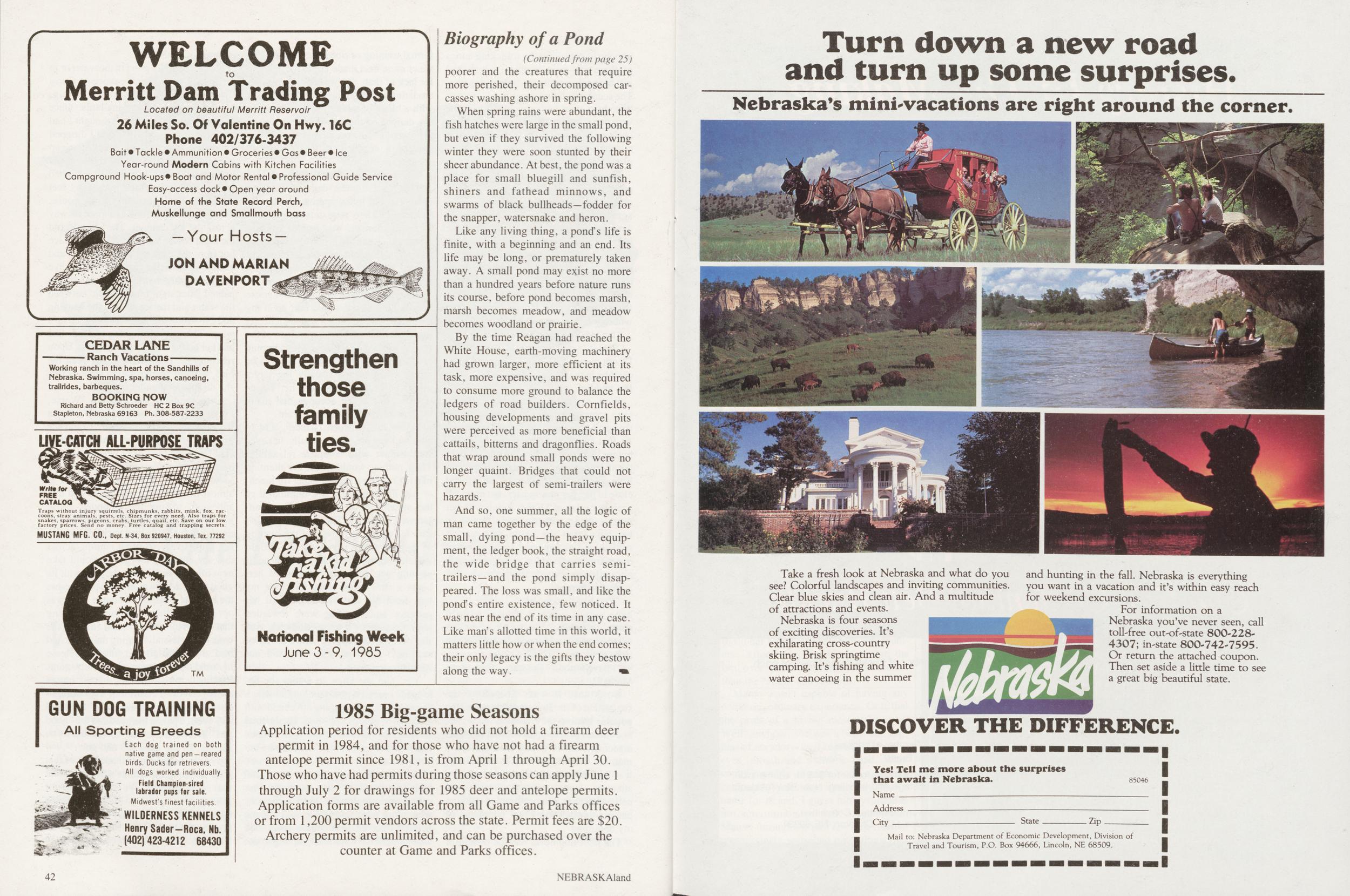 WELCOME
to
Merritt Dam Trading Post
Located on beautiful Merritt Reservoir
26 Miles So. Of Valentine On Hwy. 16C
Phone 402/376-3437
Bait*Tackle* Ammunition* Groceries* Gas* Beer* Ice
Year-round Modern Cabins with Kitchen Facilities
Campground Hook-ups* Boat and Motor Rental • Professional Guide Service
Easy-access dock* Open year around
Home of the State Record Perch,
Muskellunge and Smallmouth bass
— Your Hosts —
JON AND MARIAN
DAVENPORT
CEDAR LANE
• Ranch Vacations •
Working ranch in the heart of the Sandhills of
Nebraska. Swimming, spa, horses, canoeing,
trailrides, barbeques.
BOOKING NOW
Richard and Betty Schroeder HC 2 Box 9C
Stapleton, Nebraska 69163 Ph. 308-587-2233
LIVE-CATCH ALL-PURPOSE TRAPS
Write for
FREE
CATALOG
Traps without injury squirrels, chipmunks, rabbits, mink, fox, rac-
coons, stray animals, pests, etc. Sires for every need. Also traps for
snakes, sparrows pigeons, crabs, turtles, quail, etc. Save on our low
factory prices Send no money. Free catalog and trapping secrets.
MUSTANG MFG. CO., Dept. N-34, Box 920947, Houston, Tex. 77292
GUN DOG TRAINING
All Sporting Breeds
Each dog trained on both
native game and pen-reared
birds. Ducks for retrievers.
All dogs worked individually.
Field Champion-sired
labrador pups for sale.
Midwest's finest facilities.
WILDERNESS KENNELS
Henry Sader-Roca, Nb.
(402)423-4212 68430
Strengthen
those
National Fishing Week
June 3-9, 1985
ARBOR DAY
Trees... a joy forever
TM
WELCOME
to
Merritt Dam Trading Post
Located on beautiful Merritt Reservoir
26 Miles So. Of Valentine On Hwy. 16C
Phone 402/376-3437
Bait*Tackle* Ammunition* Groceries* Gas* Beer* Ice
Year-round Modern Cabins with Kitchen Facilities
Campground Hook-ups* Boat and Motor Rental • Professional Guide Service
Easy-access dock* Open year around
Home of the State Record Perch,
Muskellunge and Smallmouth bass
— Your Hosts —
JON AND MARIAN
DAVENPORT
CEDAR LANE
• Ranch Vacations •
Working ranch in the heart of the Sandhills of
Nebraska. Swimming, spa, horses, canoeing,
trailrides, barbeques.
BOOKING NOW
Richard and Betty Schroeder HC 2 Box 9C
Stapleton, Nebraska 69163 Ph. 308-587-2233
LIVE-CATCH ALL-PURPOSE TRAPS
Write for
FREE
CATALOG
Traps without injury squirrels, chipmunks, rabbits, mink, fox, rac-
coons, stray animals, pests, etc. Sires for every need. Also traps for
snakes, sparrows pigeons, crabs, turtles, quail, etc. Save on our low
factory prices Send no money. Free catalog and trapping secrets.
MUSTANG MFG. CO., Dept. N-34, Box 920947, Houston, Tex. 77292
GUN DOG TRAINING
All Sporting Breeds
Each dog trained on both
native game and pen-reared
birds. Ducks for retrievers.
All dogs worked individually.
Field Champion-sired
labrador pups for sale.
Midwest's finest facilities.
WILDERNESS KENNELS
Henry Sader-Roca, Nb.
(402)423-4212 68430
Strengthen
those
National Fishing Week
June 3-9, 1985
ARBOR DAY
Trees... a joy forever
TM
Biography of a Pond
(Continued from page 25)poorer and the creatures that require more perished, their decomposed carcasses washing ashore in spring.
When spring rains were abundant, the fish hatches were large in the small pond, but even if they survived the following winter they were soon stunted by their sheer abundance. At best, the pond was a place for small bluegill and sunfish, shiners and fathead minnows, and swarms of black bullheads—fodder for the snapper, watersnake and heron.
Like any living thing, a pond's life is finite, with a beginning and an end. Its life may be long, or prematurely taken away. A small pond may exist no more than a hundred years before nature runs its course, before pond becomes marsh, marsh becomes meadow, and meadow becomes woodland or prairie.
By the time Reagan had reached the White House, earth-moving machinery had grown larger, more efficient at its task, more expensive, and was required to consume more ground to balance the ledgers of road builders. Cornfields, housing developments and gravel pits were perceived as more beneficial than cattails, bitterns and dragonflies. Roads that wrap around small ponds were no longer quaint. Bridges that could not carry the largest of semi-trailers were hazards.
And so, one summer, all the logic of man came together by the edge of the small, dying pond—the heavy equipment, the ledger book, the straight road, the wide bridge that carries semitrailers—and the pond simply disappeared. The loss was small, and like the pond's entire existence, few noticed. It was near the end of its time in any case. Like mans allotted time in this world, it matters little how or when the end comes; their only legacy is the gifts they bestow along the way.
1985 Big-game Seasons
Application period for residents who did not hold a firearm deer permit in 1984, and for those who have not had a firearm antelope permit since 1981, is from April 1 through April 30. Those who have had permits during those seasons can apply June 1 through July 2 for drawings for 1985 deer and antelope permits. Application forms are available from all Game and Parks offices or from 1,200 permit vendors across the state. Permit fees are $20. Archery permits are unlimited, and can be purchased over the counter at Game and Parks offices.
42 NEBRASKAlandTurn down a new road and turn up some surprises.
Nebraska's mini-vacations are right around the corner.
History In The Making
The empty pen
(Continued from page 41)run across an open area and into a patch of grass and weeds. Mame saw him too, and almost went berserk with excitement. I stopped the car and we took after the bird. Getting across the borrow pit and through the fence was no problem for the dog, but by the time I could shoot legally, she was into that weed patch pell mell. The bird exploded out over a field of winter wheat with Mame in hot pursuit. I dropped Mr. Pheasant with my first shot, but he had plenty of life left in him. He was flopping crazily, and to the dog that meant he was getting away. She hit him with a vengeance. There was a cloud of feathers, and for her reckless abandon Mame received a vicious slash across the nose from the bird's spur. That meant only one thing —clamp down on this wriggling bird and prevent any recurrence of such impudence. When she brought the bird to me, she had taken him by the back and those strong young jaws were clamped together.
If I had any complaint on Maine's retrieving, it was on her retrieving pheasants, especially if they had any show of life left in them. If the bird was dead and still, she didn't treat it the same way, but she sure wasn't taking any chances of getting another slash across the nose. With ducks it was different. There was never a tooth mark on any duck that she retrieved.
Occasionally she was called upon to retrieve a grouse. That was almost ludicrous. Invariably she would pick up the bird and then literally spit it out. I had never seen a dog spit before, but that seems the best description of her attempts to rid her mouth of those soft, dry feathers. Afterwards, she would nudge the bird over, pick it up from the back rather than the breast, and retrieve.
Mame wasn't capable of having any common, ordinary experience. Or is that the pride of a loving master showing? Well, anyhow, she was a beautiful, big, black Labrador—well kept and with good eyes, mouth and a classic head. What could possibly torment such a perfect creature? Well, the veterinary had a name for it; and, I guess hip dysplasia is not uncommon in that breed. With Mame, through the past few years, it had progressively worsened until almost her
 Save energy in style
and comfort.
QUALITY CONSTRUCTION
Full, round logs with unique
triple tongue-and-groove for
tight, weatherproof fit.
ENERGY EFFICIENT
Snug in winter, mountain-cool in
summer — with the rugged
beauty only natural wood can bring.
YOUR PLANS OR OURS
Year-round home, vacation hideaway or
commercial building, we'll deliver to your site
and supervise wall erection.
Joel A. Plettner
RR1 Box 70C
Waterloo, NE 68069
(402) 359-5744
Write for free, informative folder. Or send
$5.00 for full-color catalog with floor plans.
Member: Log Homes Council. National
Association of Home Manufacturers.
YOU
PLAN TO BUILD?
Get a Head Start
We construct the shell for you,
and include labor for framing,
roofing, siding and insulation. We
will build almost anywhere in Nebraska. You finish or sub-contract
the rest.
Plans
We will draw plans and build from
your ideas, or you can select from
hundreds in our files.
Well-built
The standard operating windows
are wood with insulated glass and
a full storm. Framing is conventional: without panels or
modules, and is all on 16-inch centers. The shell is left clean and
weathertight.
Energy Efficient
Our homes meet the OwensCorning "Thermal-crafted" standards. Standard ceilings are
R-38;
The
THERMAL CRAFTED Home
sidewalls are R-17.5.
Proper-Built Homes
"All that
the name
implies..."
ENERGY DESIGN TECHNOLOGY
FROM OWENS-CORNING FIBERGIAS
Send me a free color catalogue!
PROPER-BUILT HOMES, INC. Name
2812 E. Bijou, #205 Address
P.0.Box15347 Citystate
Colorado Springs, CO 80935 ph0ne( )
Phone (303) 578-1331 where?
Zip
Save energy in style
and comfort.
QUALITY CONSTRUCTION
Full, round logs with unique
triple tongue-and-groove for
tight, weatherproof fit.
ENERGY EFFICIENT
Snug in winter, mountain-cool in
summer — with the rugged
beauty only natural wood can bring.
YOUR PLANS OR OURS
Year-round home, vacation hideaway or
commercial building, we'll deliver to your site
and supervise wall erection.
Joel A. Plettner
RR1 Box 70C
Waterloo, NE 68069
(402) 359-5744
Write for free, informative folder. Or send
$5.00 for full-color catalog with floor plans.
Member: Log Homes Council. National
Association of Home Manufacturers.
YOU
PLAN TO BUILD?
Get a Head Start
We construct the shell for you,
and include labor for framing,
roofing, siding and insulation. We
will build almost anywhere in Nebraska. You finish or sub-contract
the rest.
Plans
We will draw plans and build from
your ideas, or you can select from
hundreds in our files.
Well-built
The standard operating windows
are wood with insulated glass and
a full storm. Framing is conventional: without panels or
modules, and is all on 16-inch centers. The shell is left clean and
weathertight.
Energy Efficient
Our homes meet the OwensCorning "Thermal-crafted" standards. Standard ceilings are
R-38;
The
THERMAL CRAFTED Home
sidewalls are R-17.5.
Proper-Built Homes
"All that
the name
implies..."
ENERGY DESIGN TECHNOLOGY
FROM OWENS-CORNING FIBERGIAS
Send me a free color catalogue!
PROPER-BUILT HOMES, INC. Name
2812 E. Bijou, #205 Address
P.0.Box15347 Citystate
Colorado Springs, CO 80935 ph0ne( )
Phone (303) 578-1331 where?
Zip
every movement was a painful effort. As a last resort, I took her to the lake and she seemed to enjoy fetching the block of wood, but it was very apparent that she could not cope with that river current. Then I took her grouse hunting, knowing full well what the outcome of that would be — she just couldn't make it and keep it.
Our next trip was to the veterinary. Old Mame nuzzled his hand as he administered the shot — the same hand that had pricked her with a needle before—for distemper when she was a puppy, and later, periodically for her rabies shots. Then she just laid her head down and passed into dog heaven without even a whimper.
* * * * * * * *When I came down for breakfast the next morning, I stood at the window with a cup of coffee in hand and gazed thoughtfully and sadly at that pen. It had been a daily routine — to first feed Mame and see that she had a clean pan of fresh water. I wondered what now would take the place of that daily little chore before we ate? The pen was empty.
Trout Waters not so far away
(Continued from page 11)because there is considerable vegetation to contend with during the summer.
"There is public access to much of the creek, though it does flow through private land in some areas. Flies, cheese, marshmallows, salmon eggs and spinners all produce well in the creek."
The east branch of Verdigre Creek flows into Grove Lake, located on Grove Lake State Recreation Area, and there is public access to the creek from the recreation area. Bud says personnel from the Grove Rearing Station stock some 3,000 rainbows in Grove through the ice during winter to give fishermen a chance to take them, along with several warm-weather species in the lake. w'The trout can survive in the lake into June, then when the water warms, they head for the stream."
Ice fishermen use waxworms to take the trout, and then after ice-out they use salmon eggs, nightcrawlers, cheese and marshmallows. Small spinners and a variety of flies also entice hungry trout.
Southeastern Nebraska is not known for its trout fishing, but there are two notable exceptions. District V Fisheries supervisor Larry Zadina says the only stream in his part of the state that supports trout is Elm Creek in the Red Cloud area.
"We stock about 1,000 10 to 11-inch rainbows in Elm Creek each year. Some fish are tagged and we ask anglers to return the tags so we can keep tabs on the trout. We've gotten quite a few tags back, so we think people are enjoying the fishing. There is public access to the creek at Elm Creek Wildlife Management Area, but the rest of the creek flows through private land."
Trout fishing to many southeast Nebraskans means traveling to Two Rivers State Recreation Area near Venice to fish the Commissions pay-to-fish trout lake. Each angler purchases a tag that allows him to take four rainbows; and each angler may purchase two tags per day. The fish come from the Grove Rearing Station and are stocked periodically. During 1984, a total of 29,598 trout tags were sold and some 80,865 trout were reported taken from the lake. Nightcrawlers, marshmallows, corn and flies are favorite baits at Two Rivers. The trout lake there is open to public fishing from April 1 through October 31.
46 NEBRASKalandThe Horseshoe-Bar Ranch.. .Prairie Fires
(Continued from page 13)Black skeletons of burned grass stems drifted on the wind and dropped around us. We were in no danger whatever, as there was nothing to burn on the banks of the river, and even if the hill back of the house was to catch fire it would not be dangerous as the fire would burn slowly downhill. But it must have been frightening for my mother, with no company, the responsibility of two young children and the anxiety of not knowing where her husband or the men were.
We finally left the yard and played cards in the kitchen where it was warmer. My father came home at daylight, black with ashes but in good spirits. He had been setting back-fires both north and south of the river and said it was the first time he ever had to fight two fires at once.
Some of the settlers who came to the Sandhills were ignorant of the danger of prairie fires. Many neglected to plow fire guards or set back-fires and had their places burned to the ground. Bill Saunders, a man who occasionally worked for my father, was badly burned when caught in his pasture by a head-fire. His face and hands were scarred all of his life. He was a gunsmith by trade and I remember seeing him using our blacksmith shop when he was tinkering with guns. It was awkward work for him as his fingers were twisted out of shape from his encounter with the prairie fire.
The frequent prairie fires kept grasses from covering the Sandhills range as it is today. I recall lots of areas where the grass cover was thin and blowouts were more common and larger. Cedar trees, bushes and other woody vegetation seen frequently now, were uncommon in the years just after the turn of the century and testify to changes in the area since fires have been mostly controlled. When the grasses are burned off in the early fall, the bare ground takes a beating from the wind. Even though grass comes up again in the spring, as its roots are not damaged by fire, the loss of that year's seed crop must be total on the burned area. As far as improving the range, by controlling prairie fires, civilization seems to have helped the Sandhills.
This is the seventh in a series of excerpts from an unpublished book manuscript about ranching on the Dismal River in Thomas County at the turn of the century. Author Roe R. Black lived on the ranch as a boy from 1900 to 1912 and now resides in Aurora, Nebraska.
Bookshelf
By Curt Twedt A TREASURY OF NEBRASKA PIONEER FOLKLORE. Roger L. Welsch. 1984 University of Nebraska Press, Lincoln. Bison Book paperback reprint. 391 pp.; $9.95The original edition of this work, also published by University Press, ap- peared nearly 20 years ago. In addition to collections of earlier folklorists. Welsch also made extensive use of 30 Federal Writers' Project Nebraska Folklore pamphlets published from 1937 to 1940. The present work is divided into three principal sections: Songs and Dances; Tales; and Customs. Further subdivisions include sayings, children s games, pioneer cooking and folk cures.
If a single word were used to describe the Treasury, that word would have to be "diversity." The richness of Nebraska's ethnic heritage can be determined simply by scanning "names in the news" sections of weekly newspapers. In addition, numerous festivals celebrating old-country customs are held somewhere in the state nearly every summer weekend. Some of these call attention to Czech, German, and Scandinavian origins of communities.
With such a varied citizenry, folklorists must have a difficult time deciding on what to collect and record. Roger Welsch seems to avoid such difficulties by giving attention to just about everything imaginable in the world of folklore. Some samples from the Treasury include: spelling bees, community and church gatherings, shivarees, holiday observances, preparation of food (when everything was "made from scratch") and folk cures or other do-it-yourself medicine (sometimes it seems you'd be better off keeping the disease rather than taking the cure).
Borrow a copy of Treasury and flip through the pages for a half-hour or so. If you don't decide to get a "keeper" copy, you'll be the poorer for not enjoying its pages for a long time to come.
Trading Post
DOGSTRAINING ALL BREEDS Hunting dogs—Vizslas for sale. Rozanek Kennels, Rt. 2, Schuyler, NE 68661. Phone (402) 352-8769.
ENGLISH SETTERS and Pointers: Outstanding bloodlines! Puppies, started dogs, and stud service available. High Plains Kennels, 1411 Emerson, Alliance, NE 69301. Phone (308) 762-6709.
GERMAN SHORTHAIRS—English Pointers and Beagles—Stud service, puppies and started dogs. Wayne Clark, Box 54, Union, Nebr. 68455. Phone (402)263-3495 or 263-3155.
BRITTANY GUN DOGS. Puppies-started, trained. Bred to hunting standards. Free brochure. Grouseway Gundogs, Rt. 2, Box 158, Meadow Grove, NE 68752. (402) 634-2469.
AKC GERMAN Shepherds, quality bloodlines; guaranteed sound, pedigrees furnished. Free brochure. DA-CO Kennels, Box 316, Meadow Grove, NE 68752. Phone (402)634-2605.
FOR SALE: AKC Registered Brittanies. Excellent hunting quality. Also Brittany standing stud, puppies and standing dogs. Contact Adams Family Kennels, phone (308) 532-2639.
LABRADOR RETRIEVERS: excellent working bloodlines, quality puppies. Puppies: shots and wormed. Stud service available. W. D. Kennels, Rt. l,Box 116, Stanton, NE 68779. Phone (402) 439-5073.
MISCELLANEOUSGUNS—Browning, Winchester, Remington, others, Hi-powers, shotguns, new, used, antiques. Want Pre-1964 Winchesters. Buy-Sell-Trade. Ph. (402) 729-6112. Bedlan's Sporting Goods, Fairbury, NE 68352.
FISH FOR SALE. Channel catfish, bass, bluegill, crappie, trout, perch, white bass, minnows, hybrid grass carp, bullhead. We can ship fish, you can pick them up, or we deliver. Contact the Pleasant Valley Fish Farm, Rt. 1, McCook, NE 69001. Phone (308) 345-6599.
WILD TURKEYS, pheasants, for sale. Taking orders for spring chicks. Four Pines Game Farm, Roca, Ne. Phone (402) 792-2039 or (402) 435-8159.
CANOE ENTHUSIASTS. Quality and performance important? Mad River is the canoe for you! Mad River of Nebraska, 1231 Saunders, Lincoln, Nebraska 68521, Phone (402) 435-6588 or 205 Main, Springfield, NE 68059. Phone (402) 253-2000.
N.E. NEBRASKA TROUT Fishing. For rent Mon. Thurs. or Fri.-Sun. 2 modern cottages completely furnished. 5 spring-fed lakes with trout up to 7 lbs. Bass and bluegill also. Diamond E Trout Resort, Orchard, NF 68764. (402) 893-4745.
BROWN TROUT for borderline trout waters such as cooler sandpits. They will tolerate up to 82°F. Available January-February. Rainbow available March through May. Fattig Fish Hatchery, Brady, NE69123. Phone (308) 584-3451.
LET'S GO FISHING! Take a day away from the office. Let us take care of all the hassles like getting the boat ready and running down the bait. Some of the best fishing in the state of Nebraska is right here on the scenic Missouri River near Nebraska City. M & C Guide Service out of Nebraska City, (402) 873-5918 or 873-6288 before 8 a.m. or after 5 p.m.
AT $260 PER ACRE, approximately 925 acres on scenic Niobrara River south of Valentine with 7/8-mile river frontage plus one mile of trout fishing in Schlagel Creek; excellent deer and turkey hunting, panoramic cabin sites, landing strip possibility. Bob Gass Agency, 468 N. Main, Valentine, NE 69201. Phone (402) 376-3760.
GET YOUR COPY — "Memories of Brown County." Book of 105 historic photographs of life in Sandhills Nebraska towns and prairies in the early days. $5 a copy. E. C. Terry, 440 N. Main, Ainsworth, NE 69210.
GOOD FISHING year-round. Beautiful sandy beaches. Country-western Ogallala. Acre building lots. New 3 bedroom A-frame cabin on Nebraska's ocean, Lake McConaughy; Lake view, Gate 18. Write travel agent Tim Kimberling, Champion, Nebraska.
FLY FISHERMEN NEEDED — for each name, take one dollar off order (limit four). Write Mountain Moods, Box 431, Manhattan, MT 59741.
BUCKLE COLLECTOR'S Magazine, 1-year subscrip- tion, $12, foreign $16, or send $2 for sample copy. Buckle Buddies, RR 1, Box 178NL, Henderson, NE 68371 Phone (402) 723-4779.
WHOLESALE — SHOOTING SUPPLIES. Bullets, primers, powder, brass, reloading tools, firearms and accessories. Cornhusker Shooters Supply, Inc., 4327 "O" Street, Lincoln, NE 68510. Phone (402) 488-0965. For convenient ordering in Nebraska call (800) 742-7674.
PHEASANTS-CHUKAR and Hungarian partridges-wild turkeys. Eggs-chix-started and mature birds. N.P.I.P. pullorum-typhoid clean. Free brochure. Toubl Game Bird Farms, R. 2, Box 358, Beloit, WI 53511.
FAIRFIELD CAMPGROUNDS along the Niobrara River " in the heart of a unique blend of habitats." Hiking, natural scenery, bird watching, canoe rental, car shuttle, experienced outfitters. Lifetime river knowledge. Loring & Beryl Kuhre, Johnstown, NE 69214. Phone (402) 722-4494.
BEER KIT-everything to make 5 gallons of delicious homemade beer except bottles. Makes 50 bottles. Drink in 6 weeks. $39 includes tax and shipping. Omaha Supply Co., 13616 Polk St., Omaha, NE 68137. (402) 895-2803.
TAXIDERMYPEISTER TAXIDERMY- a name you can trust. We give you professional life-like work at prices most sportsmen can afford. Member National Taxidermist Association, #5 Regency, Place, Kearney, Nebr 68847 Phone (308) 237-7575.
FREEZE-DRY TAXIDERMY Wally Allison's State Record Taxidermy, 2709 Birchwood, North Platte, NE 69101. Phone: (308) 534-2324. Specializing in Fishand Small Game, Snake and Lizard and Novelties. (Nothing too small) Newest of all taxidermy methods employed.
KARL SCHWARZ master taxidermist has moved to a new country studio; same professional mounting and tanning service. Schwarz Wild Wing Studio, 16804 South 180th St., Springfield, NE 68059. Phone (402) 253-2481.
CREATIVE TAXIDERMY in all its branches since 1935, now includes Northstar Freeze-Dry processing of approved small specimens. Also tanning and deerskin processing. Naturecraft Studio. Nebraska City, Nebraska 68510. Joe Voges-Owner. Phone (402) 873-5491.
JOHNSON TAXIDERMY—servicing southwest Ne- braska, specializing in big-game mounts, life-sized mounts, rug work, fish, birds, tanning hair-on leather. Brochure and price list on request. Johnson Taxidermy, Rt. 1, Box 78, Lamar, NE 69035. Telephone (308) 882-5555.
BIG BEAR TAXIDERMY, Rt. 2, Mitchell, Nebraska 69357. We specialize in all big game from Alaska to Nebraska, also birds and fish. Hair-on and hair-off tanning. 4'/2 miles west of Scottsbluff on Highway 26. Dale Hubel, phone (308) 635-3013.
DINGES TAXIDERMY Studio, 2763 So. 12th St Omaha, NE 68108. Fourteen-time National Award Winning Taxidermy. Trust your trophies to a proven winner. Complete professional service. Mike and Mary Dinges (402) 342-3718.
NABITY'S TAXIDERMY. 31 years experience. Specializing in natural grass backgrounds for mammals, birds and fish. 13901 "0"St., Lincoln, NE 68505 4 miles east of 84th and "O" (402) 489-6351.
BADE TAXIDERMY— Quality a must—Fast service. Fish, birds, rugs, tanning, full mounts and game heads. 2111 N. Christy St., Fremont, Nebraska 727-5463.
HOUSE OF BIRDS. Licensed taxidermist with 18 years experience. Specialize in birds and game heads. Pheasant $47.50, deer head $87.50, Quail S35 a pair. For more information call (402) 228-3959.
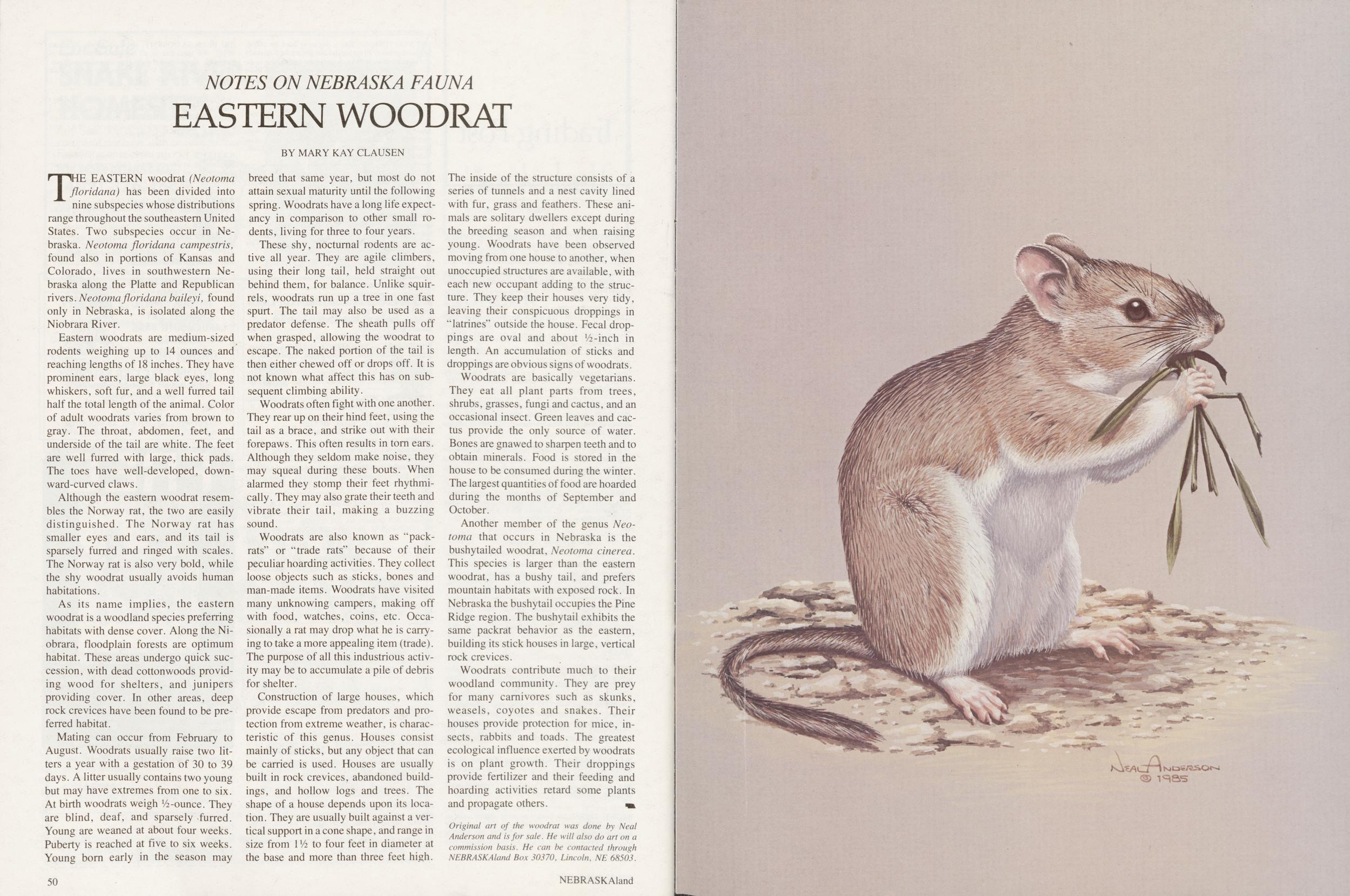
NOTES ON NEBRASKA FAUNA EASTERN WOODRAT
BY MARY KAY CLAUSENTIHE EASTERN woodrat (Neotoma floridana) has been divided into nine subspecies whose distributions range throughout the southeastern United States. Two subspecies occur in Nebraska. Neotoma floridana campestris, found also in portions of Kansas and Colorado, lives in southwestern Nebraska along the Platte and Republican rivers. Neotoma floridana baileyi, found only in Nebraska, is isolated along the Niobrara River.
Eastern woodrats are medium-sized rodents weighing up to 14 ounces and reaching lengths of 18 inches. They have prominent ears, large black eyes, long whiskers, soft fur, and a well furred tail half the total length of the animal. Color of adult woodrats varies from brown to gray. The throat, abdomen, feet, and underside of the tail are white. The feet are well furred with large, thick pads. The toes have well-developed, downward-curved claws.
Although the eastern woodrat resembles the Norway rat, the two are easily distinguished. The Norway rat has smaller eyes and ears, and its tail is sparsely furred and ringed with scales. The Norway rat is also very bold, while the shy woodrat usually avoids human habitations.
As its name implies, the eastern woodrat is a woodland species preferring habitats with dense cover. Along the Niobrara, floodplain forests are optimum habitat. These areas undergo quick succession, with dead cotton woods providing wood for shelters, and junipers providing cover. In other areas, deep rock crevices have been found to be preferred habitat.
Mating can occur from February to August. Woodrats usually raise two litters a year with a gestation of 30 to 39 days. A litter usually contains two young but may have extremes from one to six. At birth woodrats weigh Vi-ounce. They are blind, deaf, and sparsely furred. Young are weaned at about four weeks. Puberty is reached at five to six weeks. Young born early in the season may breed that same year, but most do not attain sexual maturity until the following spring. Woodrats have a long life expectancy in comparison to other small rodents, living for three to four years.
These shy, nocturnal rodents are active all year. They are agile climbers, using their long tail, held straight out behind them, for balance. Unlike squirrels, woodrats run up a tree in one fast spurt. The tail may also be used as a predator defense. The sheath pulls off when grasped, allowing the woodrat to escape. The naked portion of the tail is then either chewed off or drops off. It is not known what affect this has on subsequent climbing ability.
Woodrats often fight with one another. They rear up on their hind feet, using the tail as a brace, and strike out with their forepaws. This often results in torn ears. Although they seldom make noise, they may squeal during these bouts. When alarmed they stomp their feet rhythmically. They may also grate their teeth and vibrate their tail, making a buzzing sound.
Woodrats are also known as "packrats" or "trade rats" because of their peculiar hoarding activities. They collect loose objects such as sticks, bones and man-made items. Woodrats have visited many unknowing campers, making off with food, watches, coins, etc. Occasionally a rat may drop what he is carrying to take a more appealing item (trade). The purpose of all this industrious activity may be to accumulate a pile of debris for shelter.
Construction of large houses, which provide escape from predators and protection from extreme weather, is characteristic of this genus. Houses consist mainly of sticks, but any object that can be carried is used. Houses are usually built in rock crevices, abandoned buildings, and hollow logs and trees. The shape of a house depends upon its location. They are usually built against a vertical support in a cone shape, and range in size from 1 Vi to four feet in diameter at the base and more than three feet high. The inside of the structure consists of a series of tunnels and a nest cavity lined with fur, grass and feathers. These animals are solitary dwellers except during the breeding season and when raising young. Woodrats have been observed moving from one house to another, when unoccupied structures are available, with each new occupant adding to the structure. They keep their houses very tidy, leaving their conspicuous droppings in "latrines" outside the house. Fecal droppings are oval and about ^-inch in length. An accumulation of sticks and droppings are obvious signs of woodrats.
Woodrats are basically vegetarians. They eat all plant parts from trees, shrubs, grasses, fungi and cactus, and an occasional insect. Green leaves and cactus provide the only source of water. Bones are gnawed to sharpen teeth and to obtain minerals. Food is stored in the house to be consumed during the winter. The largest quantities of food are hoarded during the months of September and October.
Another member of the genus Neotoma that occurs in Nebraska is the bushy tailed woodrat, Neotoma cinerea. This species is larger than the eastern woodrat, has a bushy tail, and prefers mountain habitats with exposed rock. In Nebraska the bushytail occupies the Pine Ridge region. The bushytail exhibits the same packrat behavior as the eastern, building its stick houses in large, vertical rock crevices.
Woodrats contribute much to their woodland community. They are prey for many carnivores such as skunks, weasels, coyotes and snakes. Their houses provide protection for mice, insects, rabbits and toads. The greatest ecological influence exerted by woodrats is on plant growth. Their droppings provide fertilizer and their feeding and hoarding activities retard some plants and propagate others.
Original art of the woodrat was done by Neal Anderson and is for sale. He will also do art on a commission basis. He can be contacted through NEBRASKAland Box 30370, Lincoln. NE 68503. 50 NEBRASKAland
Find more than you imagined...
Position: 28 (284 views)