Volume 63, Issue 2, 1985
NEBRASKAland
MARCH 1985 $1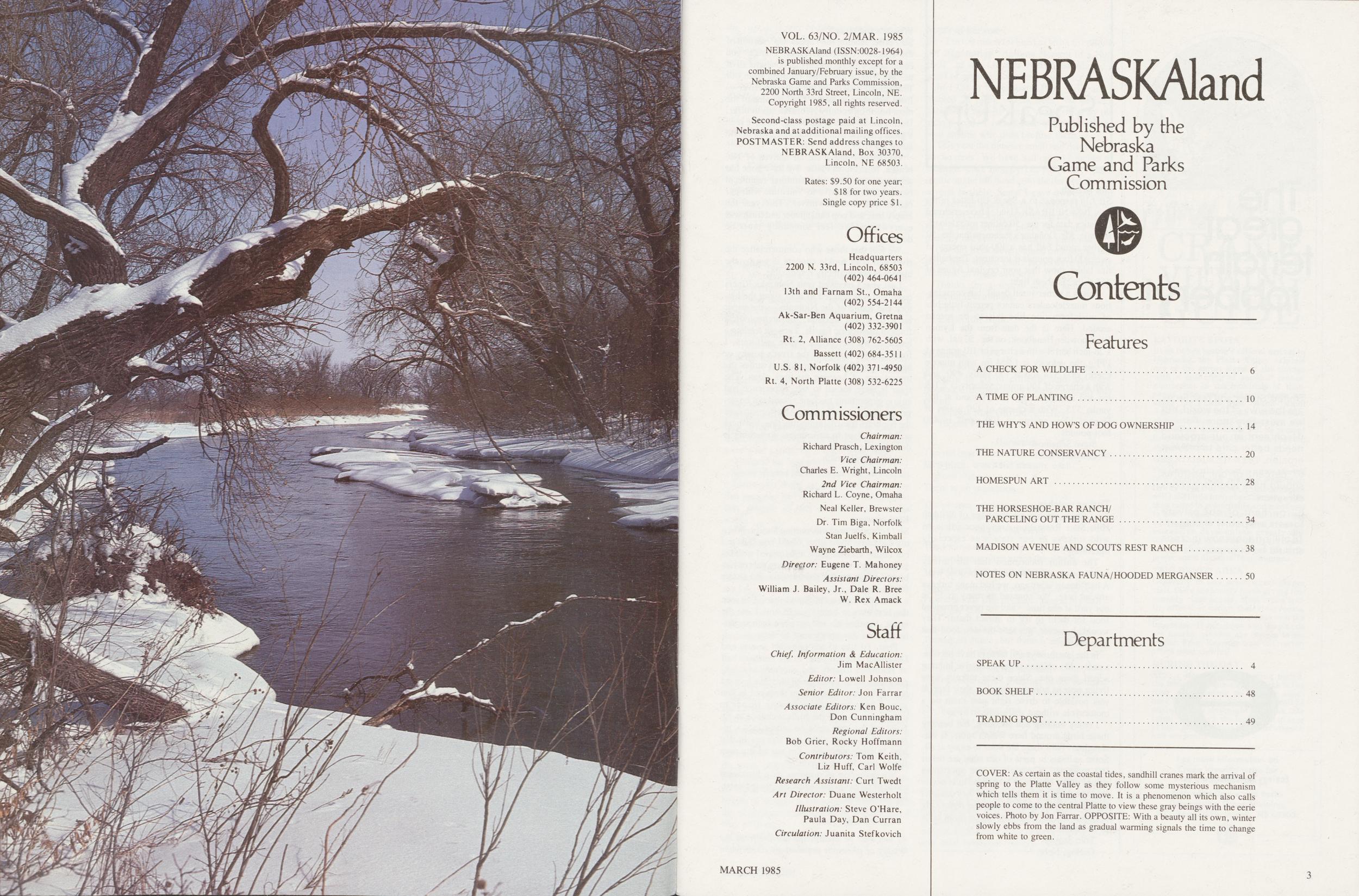
NEBRASKAland
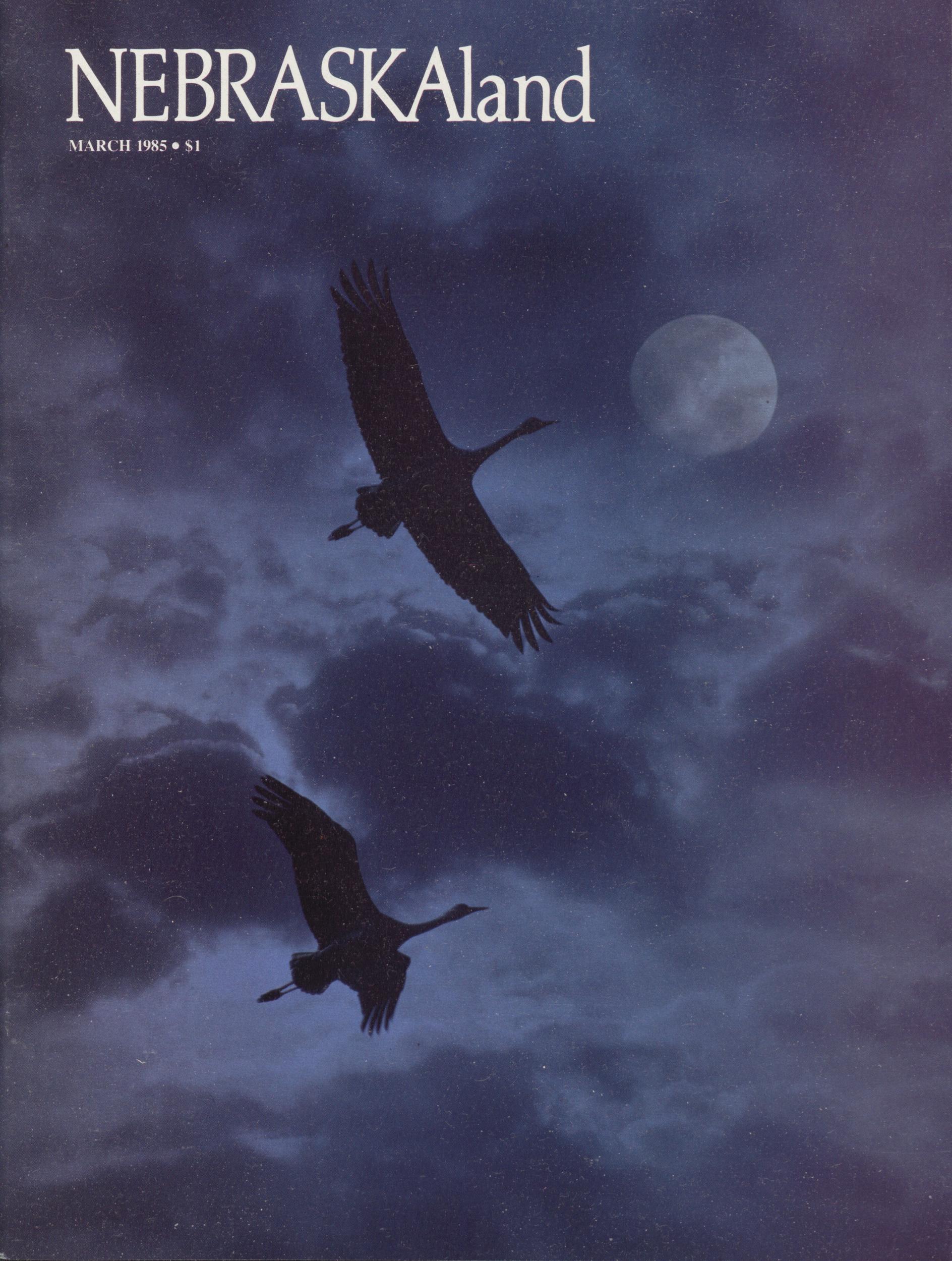
Published by the Nebraska Game and Parks Commission VOL. 63/NO. 2/MAR. 1985 NEBRASKAland (ISSN.0028-1964) is published monthly except for a combined January/February issue, by the Nebraska Game and Parks Commission, 2200 North 33rd Street, Lincoln, NE. Copyright 1985, all rights reserved. Second-class postage paid at Lincoln, Nebraska and at additional mailing offices. POSTMASTER: Send address changes to NEBRASKAland, Box 30370, Lincoln, NE 68503. Rates: $9.50 for one year; $18 for two years. Single copy price $1. Offiices Headquarters 2200 N. 33rd, Lincoln, 68503 (402) 464-0641 13th and Farnam St., Omaha (402) 554-2144 Ak-Sar-Ben Aquarium, Gretna (402) 332-3901 Rt. 2, Alliance (308) 762-5605 Bassett (402) 684-3511 U.S. 81, Norfolk (402) 371-4950 Rt. 4, North Platte (308) 532-6225 Commissioners Chairman: Richard Prasch, Lexington Vice Chairman: Charles E. Wright, Lincoln 2nd Vice Chairman: Richard L. Coyne, Omaha Neal Keller, Brewster Dr. Tim Biga, Norfolk Stan Juelfs, Kimball Wayne Ziebarth, Wilcox Director: Eugene T. Ma honey Assistant Directors: William J. Bailey, Jr., Dale R. Bree W. Rex Amack Staff Chief, Information & Education: Jim MacAllister Editor: Lowell Johnson Senior Editor: Jon Farrar Associate Editors: Ken Bouc, Don Cunningham Regional Editors: Bob Grier, Rocky Hoffmann Contributors: Tom Keith, Liz Huff, Carl Wolfe Research Assistant: Curt Twedt Art Director: Duane Westerholt Illustration: Steve O'Hare, Paula Day, Dan Curran Circulation: Juanita Stefkovich Contents Features A CHECK FOR WILDLIFE 6 A TIME OF PLANTING 10 THE WHY'S AND HOW'S OF DOG OWNERSHIP 14 THE NATURE CONSERVANCY 20 HOMESPUN ART 28 THE HORSESHOE-BAR RANCH/ PARCELING OUT THE RANGE 34 MADISON AVENUE AND SCOUTS REST RANCH 38 NOTES ON NEBRASKA FAUNA/HOODED MERGANSER 50 Departments SPEAK UP 4 BOOK SHELF 48 TRADING POST 49 COVER: As certain as the coastal tides, sandhill cranes mark the airival of spring to the Platte Valley as they follow some mysterious mechanism which tells them it is time to move. It is a phenomenon which also calls people to come to the central Platte to view these gray beings with the eerie voices. Photo by Jon Farrar. OPPOSITE: With a beauty all its own, winter slowly ebbs from the land as gradual warming signals the time to change from white to green. 3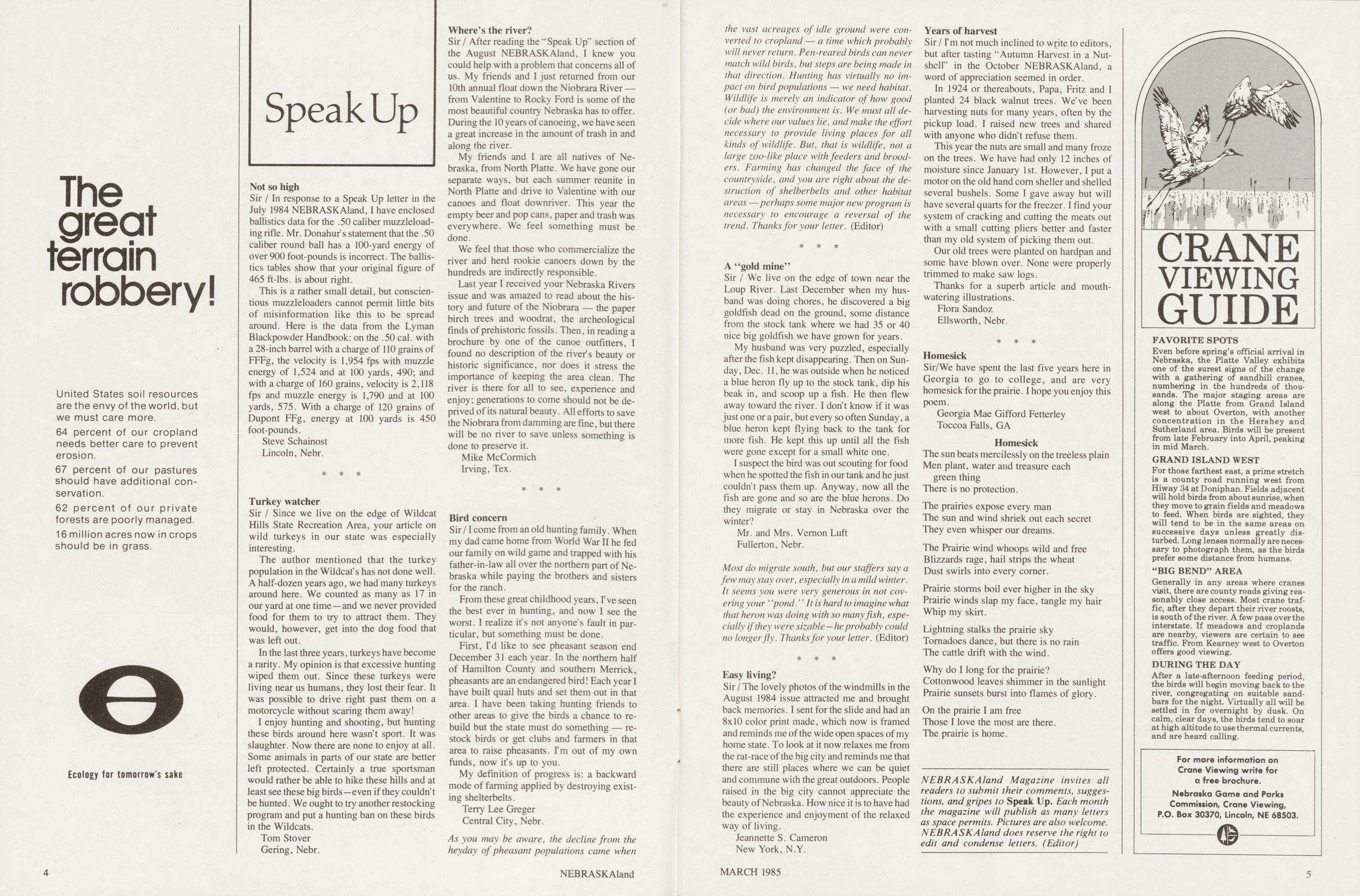
Speak Up
Not so highSir In response to a Speak Up letter in the July 1984 NEBRASKAland, I have enclosed ballistics data for the .50 caliber muzzleloading rifle. Mr. Donahufs statement that the .50 caliber round ball has a 100-yard energy of over 900 foot-pounds is incorrect. The ballistics tables show that your original figure of 465 ft-lbs. is about right.
This is a rather small detail, but conscientious muzzleloaders cannot permit little bits of misinformation like this to be spread around. Here is the data from the Lyman Blackpowder Handbook: on the .50 cal. with a 28-inch barrel with a charge of 110 grains of FFFg, the velocity is 1,954 fps with muzzle energy of 1,524 and at 100 yards, 490; and with a charge of 160 grains, velocity is 2,118 fps and muzzle energy is 1,790 and at 100 yards, 575. With a charge of 120 grains of Dupont FFg, energy at 100 yards is 450 foot-pounds.
Steve Schainost Lincoln, Nebr. * * * Turkey watcherSir / Since we live on the edge of Wildcat Hills State Recreation Area, your article on wild turkeys in our state was especially interesting.
The author mentioned that the turkey population in the Wildcat's has not done well. A half-dozen years ago, we had many turkeys around here. We counted as many as 17 in our yard at one time — and we never provided food for them to try to attract them. They would, however, get into the dog food that was left out.
In the last three years, turkeys have become a rarity. My opinion is that excessive hunting wiped them out. Since these turkeys were living near us humans, they lost their fear. It was possible to drive right past them on a motorcycle without scaring them away!
I enjoy hunting and shooting, but hunting these birds around here wasn't sport. It was slaughter. Now there are none to enjoy at all. Some animals in parts of our state are better left protected. Certainly a true sportsman would rather be able to hike these hills and at least see these big birds—even if they couldn't be hunted. We ought to try another restocking program and put a hunting ban on these birds in the Wildcats.
Tom Stover Gering, Nebr. Where's the river?Sir / After reading the "Speak Up'' section of the August NEBR ASK Aland, I knew you could help with a problem that concerns all of us. My friends and I just returned from our 10th annual float down the Niobrara River from Valentine to Rocky Ford is some of the most beautiful country Nebraska has to offer. During the 10 years of canoeing, we have seen a great increase in the amount of trash in and along the river.
My friends and I are all natives of Nebraska, from North Platte. We have gone our separate ways, but each summer reunite in North Platte and drive to Valentine with our canoes and float downriver. This year the empty beer and pop cans, paper and trash was everywhere. We feel something must be done.
We feel that those who commercialize the river and herd rookie canoers down by the hundreds are indirectly responsible.
Last year I received your Nebraska Rivers issue and was amazed to read about the history and future of the Niobrara — the paper birch trees and woodrat, the archeological finds of prehistoric fossils. Then, in reading a brochure by one of the canoe outfitters, I found no description of the river's beauty or historic significance, nor does it stress the importance of keeping the area clean. The river is there for all to see, experience and enjoy; generations to come should not be deprived of its natural beauty. All efforts to save the Niobrara from damming are fine, but there will be no river to save unless something is done to preserve it.
Mike McCormich Irving, Tex. * * * Bird concernSir /1 come from an old hunting family. When my dad came home from World War II he fed our family on wild game and trapped with his father-in-law all over the northern part of Nebraska while paying the brothers and sisters for the ranch.
From these great childhood years, Tve seen the best ever in hunting, and now I see the worst. I realize it's not anyone's fault in particular, but something must be done.
First, Td like to see pheasant season end December 31 each year. In the northern half of Hamilton County and southern Merrick, pheasants are an endangered bird! Each year I have built quail huts and set them out in that area. I have been taking hunting friends to other areas to give the birds a chance to rebuild but the state must do something restock birds or get clubs and farmers in that area to raise pheasants. Tm out of my own funds, now it's up to you.
My definition of progress is: a backward mode of farming applied by destroying existing shelterbelts.
Terry Lee Greger Central City, Nebr.As you may be aware, the decline from the heyday of pheasant populations came when 4 NEBRASKAland the vast acreages of idle ground were converted to cropland — a time which probably will never return. Pen-reared birds can never match wild birds, but steps are being made in that direction. Hunting has virtually no impact on bird populations — we need habitat. Wildlife is merely an indicator of how good (or bad) the environment is. We must all decide where our values lie, and make the effort necessary to provide living places for all kinds of wildlife. But, that is wildlife, not a large zoo-like place with feeders and brooders. Farming has changed the face of the countryside, and you are right about the destruction of shelberbelts and other habitat areas —perhaps some major new program is necessary to encourage a reversal of the trend. Thanks for your letter. (Editor)
* * * A "gold mine'Sir / We live on the edge of town near the Loup River. Last December when my husband was doing chores, he discovered a big goldfish dead on the ground, some distance from the stock tank where we had 35 or 40 nice big goldfish we have grown for years.
My husband was very puzzled, especially after the fish kept disappearing. Then on Sunday, Dec. 11, he was outside when he noticed a blue heron fly up to the stock tank, dip his beak in, and scoop up a fish. He then flew away toward the river. I don't know if it was just one or a pair, but every so often Sunday, a blue heron kept flying back to the tank for more fish. He kept this up until all the fish were gone except for a small white one.
I suspect the bird was out scouting for food when he spotted the fish in our tank and he just couldn't pass them up. Anyway, now all the fish are gone and so are the blue herons. Do they migrate or stay in Nebraska over the winter?
Mr. and Mrs. Vernon Luft Fullerton, Nebr.Most do migrate south, but our staffers say a few may stay over, especially in a mild winter. It seems you were very generous in not covering your * 'pond.'' It is hard to imagine what that heron was doing with so many fish, especially if they were sizable—he probably could no longer fly. Thanks for your letter. (Editor)
* * * Easy living?Sir / The lovely photos of the windmills in the August 1984 issue attracted me and brought back memories. I sent for the slide and had an 8x10 color print made, which now is framed and reminds me of the wide open spaces of my home state. To look at it now relaxes me from the rat-race of the big city and reminds me that there are still places where we can be quiet and commune with the great outdoors. People raised in the big city cannot appreciate the beauty of Nebraska. How nice it is to have had the experience and enjoyment of the relaxed way of living.
Jeannette S. Cameron New York, N.Y. Years of harvestSir / I'm not much inclined to write to editors, but after tasting "Autumn Harvest in a Nutshell" in the October NEBRASKAland, a word of appreciation seemed in order.
In 1924 or thereabouts, Papa, Fritz and I planted 24 black walnut trees. We've been harvesting nuts for many years, often by the pickup load. I raised new trees and shared with anyone who didn't refuse them.
This year the nuts are small and many froze on the trees. We have had only 12 inches of moisture since January 1st. However, I put a motor on the old hand corn sheller and shelled several bushels. Some I gave away but will have several quarts for the freezer. I find your system of cracking and cutting the meats out with a small cutting pliers better and faster than my old system of picking them out.
Our old trees were planted on hardpan and some have blown over. None were properly trimmed to make saw logs.
Thanks for a superb article and mouthwatering illustrations.
Flora Sandoz Ellsworth, Nebr. * * * HomesickSir/We have spent the last five years here in Georgia to go to college, and are very homesick for the prairie. I hope you enjoy this poem.
Georgia Mae Gifford Fetterley Toccoa Falls, GA HomesickThe sun beats mercilessly on the treeless plain Men plant, water and treasure each green thing There is no protection. The prairies expose every man The sun and wind shriek out each secret They even whisper our dreams. The Prairie wind whoops wild and free Blizzards rage, hail strips the wheat Dust swirls into every corner. Prairie storms boil ever higher in the sky Prairie winds slap my face, tangle my hair Whip my skirt. Lightning stalks the prairie sky Tornadoes dance, but there is no rain The cattle drift with the wind. Why do I long for the prairie? Cottonwood leaves shimmer in the sunlight Prairie sunsets burst into flames of glory. On the prairie I am free Those I love the most are there. The prairie is home. NEBRASKAland Magazine invites all readers to submit their comments, suggestions, and gripes to Speak Up. Each month the magazine will publish as many letters as space permits. Pictures are also welcome. NEBRASKAland does reserve the right to edit and condense letters. (Editor) CRANE VIEWING GUIDE FAVORITE SPOTS
FAVORITE SPOTS Even before spring's official arrival in Nebraska, the Platte Valley exhibits one of the surest signs of the change with a gathering of sandhill cranes, numbering in the hundreds of thousands. The major staging areas are along the Platte from Grand Island west to about Overton, with another concentration in the Hershey and Sutherland area. Birds will be present from late February into April, peaking in mid March.
GRAND ISLAND WEST For those farthest east, a prime stretch is a county road running west from Hiway 34 at Doniphan. Fields adjacent will hold birds from about sunrise, when they move to grain fields and meadows to feed. When birds are sighted, they will tend to be in the same areas on successive days unless greatly disturbed. Long lenses normally are necessary to photograph them, as the birds prefer some distance from humans.
"BIG BEND" AREA Generally in any areas where cranes visit, there are county roads giving reasonably close access. Most crane traffic, after they depart their river roosts, is south of the river. A few pass over the interstate. If meadows and croplands are nearby, viewers are certain to see traffic. From Kearney west to Overton offers good viewing.
DURING THE DAY After a late-afternoon feeding period, the birds will begin moving back to the river, congregating on suitable sandbars for the night. Virtually all will be settled in for overnight by dusk. On calm, clear days, the birds tend to soar at high altitude to use thermal currents, and are heard calling.
For more information on Crane Viewing write for a free brochure. Nebraska Game and Parks Commission, Crane Viewing, P.O. Box 30370, Lincoln, NE 68503. MARCH 1985 5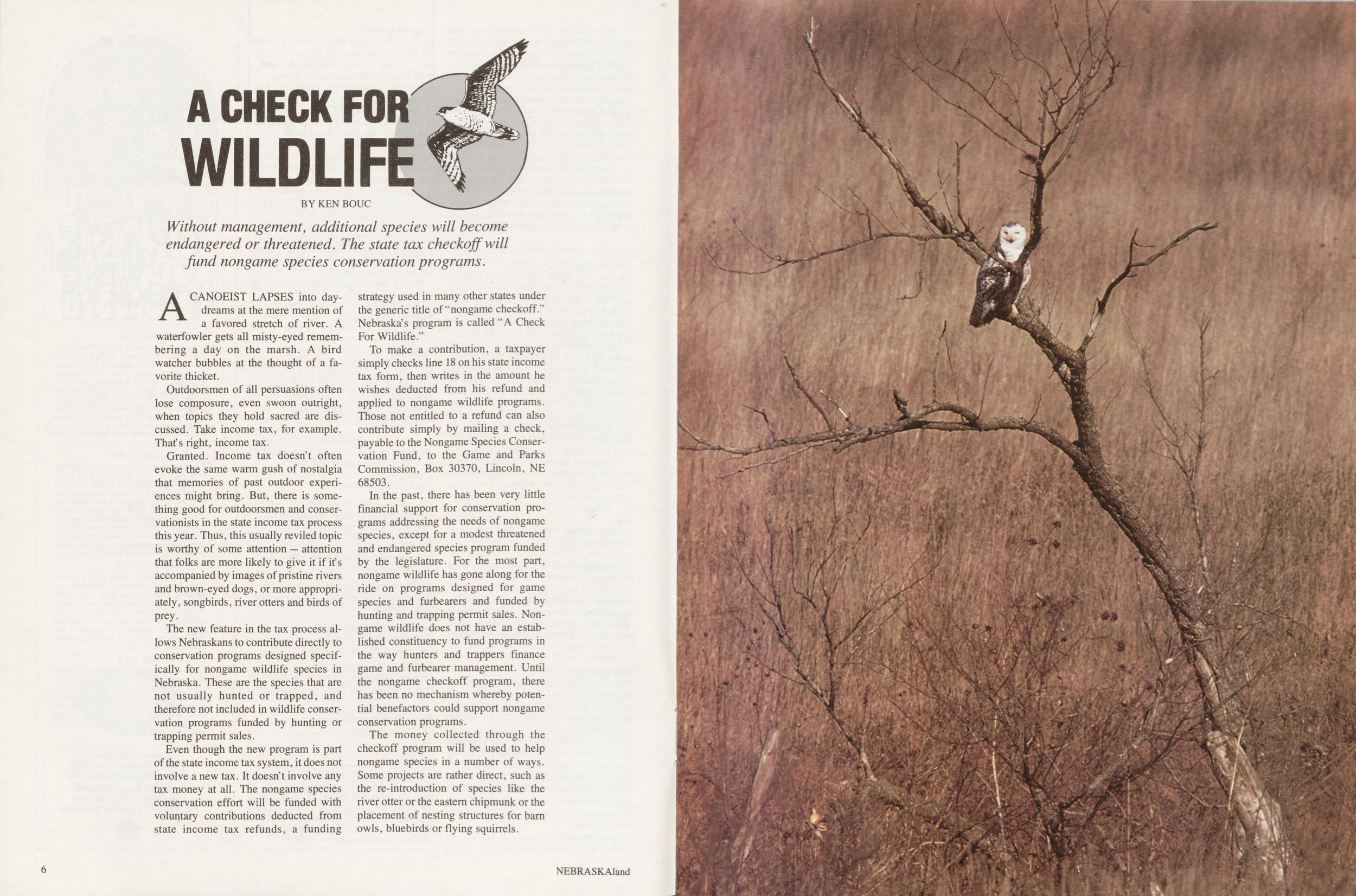
A CHECK FOR WILDLIFE
BY KEN BOUC Without management, additional species will become endangered or threatened. The state tax checkoff will fund nongame species conservation programs.A CANOEIST LAPSES into daydreams at the mere mention of a favored stretch of river. A waterfowler gets all misty-eyed remembering a day on the marsh. A bird watcher bubbles at the thought of a favorite thicket.
Outdoorsmen of all persuasions often lose composure, even swoon outright, when topics they hold sacred are discussed. Take income tax, for example. That's right, income tax.
Granted. Income tax doesn't often evoke the same warm gush of nostalgia that memories of past outdoor experiences might bring. But, there is something good for outdoorsmen and conservationists in the state income tax process this year. Thus, this usually reviled topic is worthy of some attention — attention that folks are more likely to give it if it's accompanied by images of pristine rivers and brown-eyed dogs, or more appropriately, songbirds, river otters and birds of prey.
The new feature in the tax process allows Nebraskans to contribute directly to conservation programs designed specifically for nongame wildlife species in Nebraska. These are the species that are not usually hunted or trapped, and therefore not included in wildlife conservation programs funded by hunting or trapping permit sales.
Even though the new program is part of the state income tax system, it does not involve a new tax. It doesn't involve any tax money at all. The nongame species conservation effort will be funded with voluntary contributions deducted from state income tax refunds, a funding strategy used in many other states under the generic title of unongame checkoff." Nebraska's program is called "A Check For Wildlife."
To make a contribution, a taxpayer simply checks line 18 on his state income tax form, then writes in the amount he wishes deducted from his refund and applied to nongame wildlife programs. Those not entitled to a refund can also contribute simply by mailing a check, payable to the Nongame Species Conservation Fund, to the Game and Parks Commission, Box 30370, Lincoln, NE 68503.
In the past, there has been very little financial support for conservation programs addressing the needs of nongame species, except for a modest threatened and endangered species program funded by the legislature. For the most part, nongame wildlife has gone along for the ride on programs designed for game species and furbearers and funded by hunting and trapping permit sales. Nongame wildlife does not have an established constituency to fund programs in the way hunters and trappers finance game and furbearer management. Until the nongame checkoff program, there has been no mechanism whereby potential benefactors could support nongame conservation programs.
The money collected through the checkoff program will be used to help nongame species in a number of ways. Some projects are rather direct, such as the re-introduction of species like the river otter or the eastern chipmunk or the placement of nesting structures for barn owls, bluebirds or flying squirrels.
6 NEBRASKAland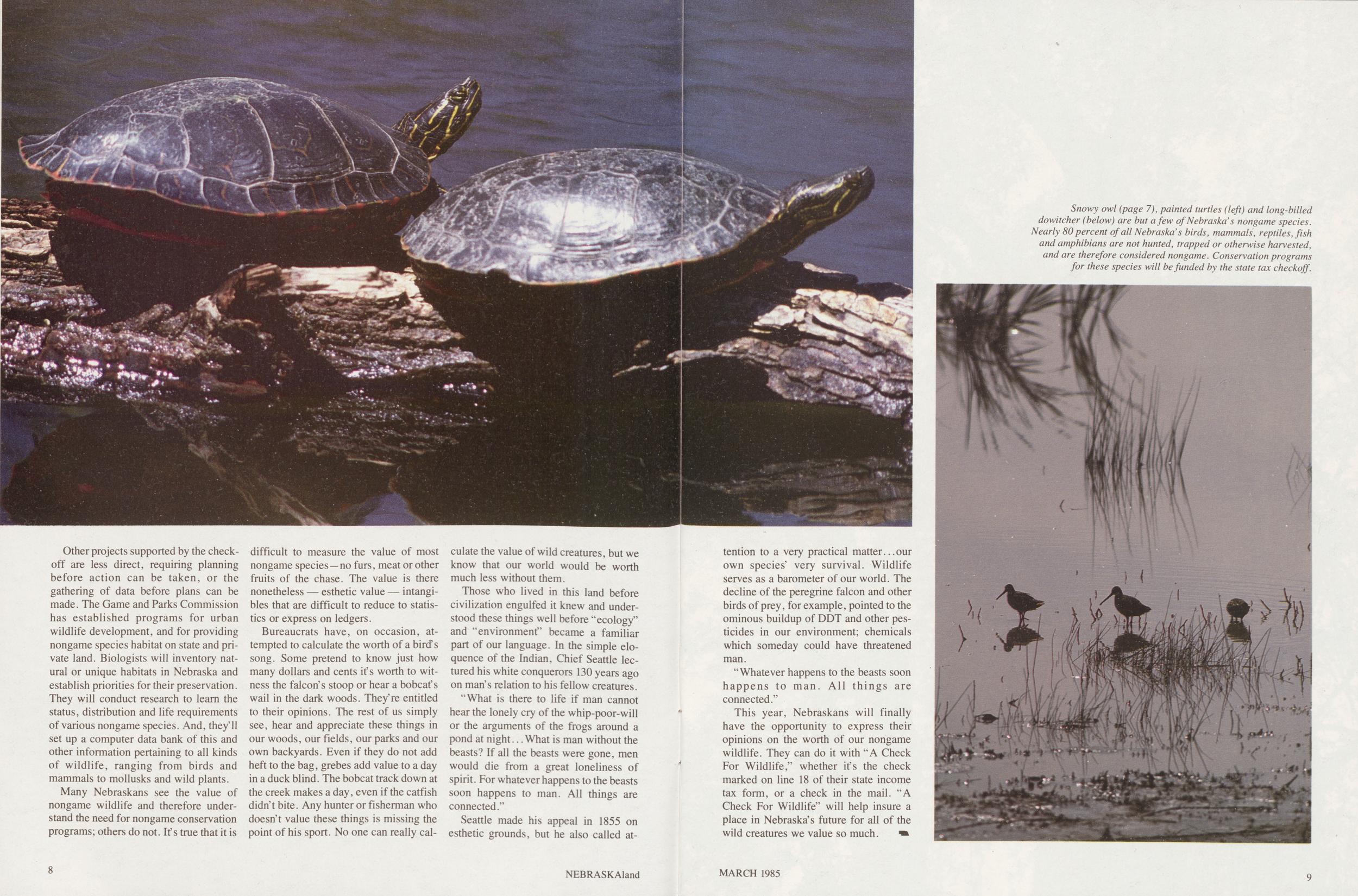
Other projects supported by the checkoff are less direct, requiring planning before action can be taken, or the gathering of data before plans can be made. The Game and Parks Commission has established programs for urban wildlife development, and for providing nongame species habitat on state and private land. Biologists will inventory natural or unique habitats in Nebraska and establish priorities for their preservation. They will conduct research to learn the status, distribution and life requirements of various nongame species. And, they'll set up a computer data bank of this and other information pertaining to all kinds of wildlife, ranging from birds and mammals to mollusks and wild plants.
Many Nebraskans see the value of nongame wildlife and therefore understand the need for nongame conservation programs; others do not. If s true that it is difficult to measure the value of most nongame species—no furs, meat or other fruits of the chase. The value is there nonetheless — esthetic value — intangibles that are difficult to reduce to statistics or express on ledgers.
Bureaucrats have, on occasion, attempted to calculate the worth of a bird's song. Some pretend to know just how many dollars and cents it's worth to witness the falcon's stoop or hear a bobcat's wail in the dark woods. They're entitled to their opinions. The rest of us simply see, hear and appreciate these things in our woods, our fields, our parks and our own backyards. Even if they do not add heft to the bag, grebes add value to a day in a duck blind. The bobcat track down at the creek makes a day, even if the catfish didn't bite. Any hunter or fisherman who doesn't value these things is missing the point of his sport. No one can really calculate the value of wild creatures, but we know that our world would be worth much less without them.
Those who lived in this land before civilization engulfed it knew and understood these things well before "ecology" and "environment" became a familiar part of our language. In the simple eloquence of the Indian, Chief Seattle lectured his white conquerors 130 years ago on man's relation to his fellow creatures.
"What is there to life if man cannot hear the lonely cry of the whip-poor-will or the arguments of the frogs around a pond at night... What is man without the beasts? If all the beasts were gone, men would die from a great loneliness of spirit. For whatever happens to the beasts soon happens to man. All things are connected."
Seattle made his appeal in 1855 on esthetic grounds, but he also called attention 8 NEBRASKAland to a very practical matter... our own species' very survival. Wildlife serves as a barometer of our world. The decline of the peregrine falcon and other birds of prey, for example, pointed to the ominous buildup of DDT and other pesticides in our environment; chemicals which someday could have threatened man.
"Whatever happens to the beasts soon happens to man. All things are connected."
This year, Nebraskans will finally have the opportunity to express their opinions on the worth of our nongame wildlife. They can do it with "A Check For Wildlife," whether it's the check marked on line 18 of their state income tax form, or a check in the mail. "A Check For Wildlife" will help insure a place in Nebraska's future for all of the wild creatures we value so much.
A Time of Planting
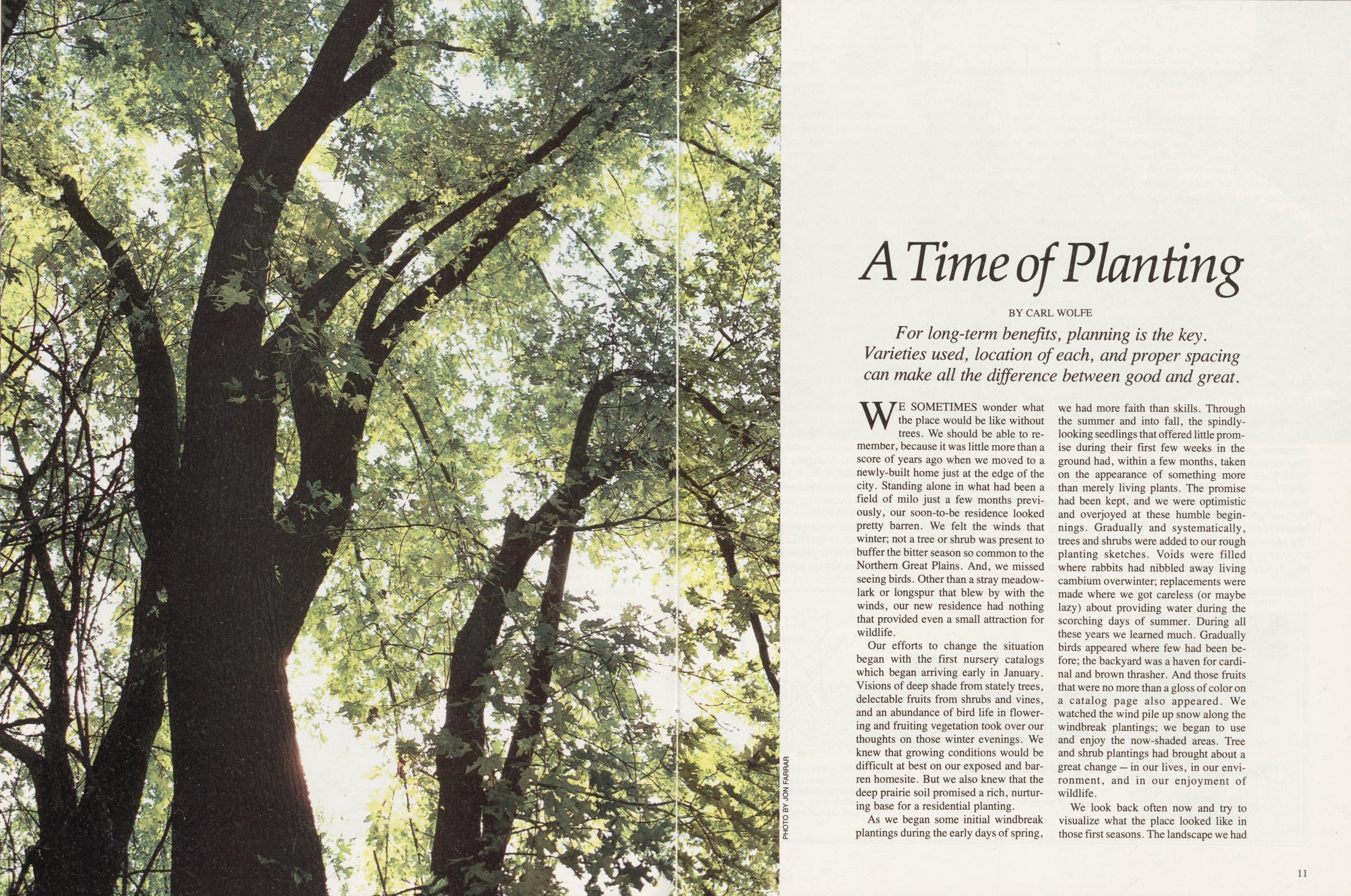
BY CARL WOLFE For long-term benefits, planning is the key. Varieties used, location of each, and proper spacing can make all the difference between good and great.WE SOMETIMES wonder what the place would be like without trees. We should be able to remember, because it was little more than a score of years ago when we moved to a newly-built home just at the edge of the city. Standing alone in what had been a field of milo just a few months previously, our soon-to-be residence looked pretty barren. We felt the winds that winter; not a tree or shrub was present to buffer the bitter season so common to the Northern Great Plains. And, we missed seeing birds. Other than a stray meadowlark or longspur that blew by with the winds, our new residence had nothing that provided even a small attraction for wildlife.
Our efforts to change the situation began with the first nursery catalogs which began arriving early in January. Visions of deep shade from stately trees, delectable fruits from shrubs and vines, and an abundance of bird life in flowering and fruiting vegetation took over our thoughts on those winter evenings. We knew that growing conditions would be difficult at best on our exposed and barren homesite. But we also knew that the deep prairie soil promised a rich, nurturing base for a residential planting.
As we began some initial windbreak plantings during the early days of spring, we had more faith than skills. Through the summer and into fall, the spindlylooking seedlings that offered little promise during their first few weeks in the ground had, within a few months, taken on the appearance of something more than merely living plants. The promise had been kept, and we were optimistic and overjoyed at these humble beginnings. Gradually and systematically, trees and shrubs were added to our rough planting sketches. Voids were filled where rabbits had nibbled away living cambium overwinter; replacements were made where we got careless (or maybe lazy) about providing water during the scorching days of summer. During all these years we learned much. Gradually birds appeared where few had been before; the backyard was a haven for cardinal and brown thrasher. And those fruits that were no more than a gloss of color on a catalog page also appeared. We watched the wind pile up snow along the windbreak plantings; we began to use and enjoy the now-shaded areas. Tree and shrub plantings had brought about a great change — in our lives, in our environment, and in our enjoyment of wildlife.
We look back often now and try to visualize what the place looked like in those first seasons. The landscape we had hoped for has become a reality and in a relatively short time. We still continue to add trees from time to time. We're now trimming and cutting some of those first plantings which have become too thick. We chuckle as we trim away limbs and branches now larger and more massive than anything we ever put into the ground. The land has been good to our plantings. And the plantings have been good to us.
MARCH 1985 12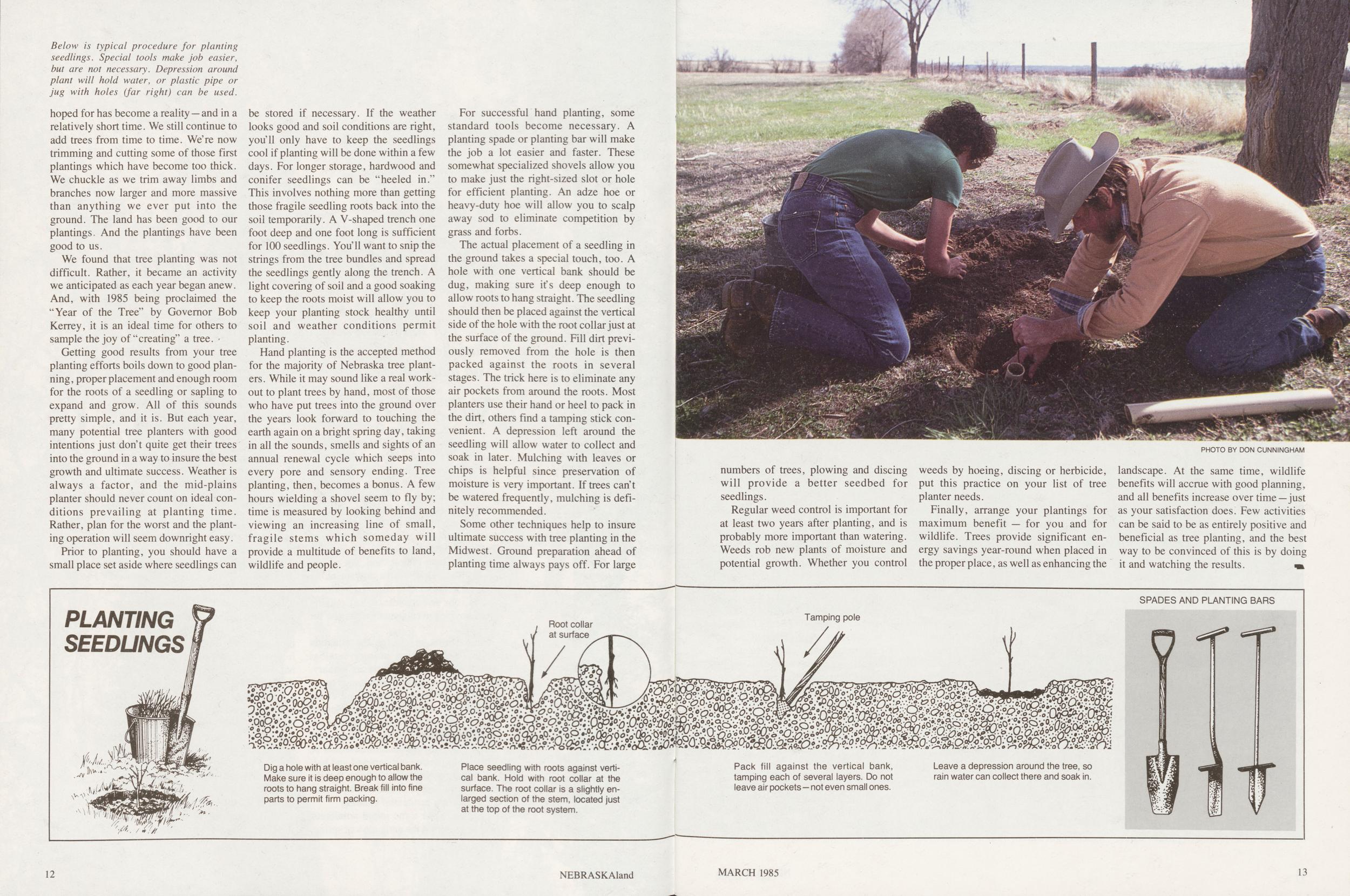 Below is typical procedure for planting seedlings. Special tools make job easier, but are not necessary. Depression around plant will hold water, or plastic pipe or jug with holes (far right) can be used.
We found that tree planting was not difficult. Rather, it became an activity we anticipated as each year began anew. And, with 1985 being proclaimed the "Year of the Tree" by Governor Bob Kerrey, it is an ideal time for others to sample the joy of "creating" a tree.
Getting good results from your tree planting efforts boils down to good planning, proper placement and enough room for the roots of a seedling or sapling to expand and grow. All of this sounds pretty simple, and it is. But each year, many potential tree planters with good intentions just don't quite get their trees into the ground in a way to insure the best growth and ultimate success. Weather is always a factor, and the mid-plains planter should never count on ideal conditions prevailing at planting time. Rather, plan for the worst and the planting operation will seem downright easy.
Prior to planting, you should have a small place set aside where seedlings can be stored if necessary. If the weather looks good and soil conditions are right, you'll only have to keep the seedlings cool if planting will be done within a few days. For longer storage, hardwood and conifer seedlings can be "heeled in." This involves nothing more than getting those fragile seedling roots back into the soil temporarily. A V-shaped trench one foot deep and one foot long is sufficient for 100 seedlings. You'll want to snip the strings from the tree bundles and spread the seedlings gently along the trench. A light covering of soil and a good soaking to keep the roots moist will allow you to keep your planting stock healthy until soil and weather conditions permit planting.
Hand planting is the accepted method for the majority of Nebraska tree planters. While it may sound like a real workout to plant trees by hand, most of those who have put trees into the ground over the years look forward to touching the earth again on a bright spring day, taking in all the sounds, smells and sights of an annual renewal cycle which seeps into every pore and sensory ending. Tree planting, then, becomes a bonus. A few hours wielding a shovel seem to fly by; time is measured by looking behind and viewing an increasing line of small, fragile stems which someday will provide a multitude of benefits to land, wildlife and people.
For successful hand planting, some standard tools become necessary. A planting spade or planting bar will make the job a lot easier and faster. These somewhat specialized shovels allow you to make just the right-sized slot or hole for efficient planting. An adze hoe or heavy-duty hoe will allow you to scalp away sod to eliminate competition by grass and forbs.
The actual placement of a seedling in the ground takes a special touch, too. A hole with one vertical bank should be dug, making sure ifs deep enough to allow roots to hang straight. The seedling should then be placed against the vertical side of the hole with the root collar just at the surface of the ground. Fill dirt previously removed from the hole is then packed against the roots in several stages. The trick here is to eliminate any air pockets from around the roots. Most planters use their hand or heel to pack in the dirt, others find a tamping stick convenient. A depression left around the seedling will allow water to collect and soak in later. Mulching with leaves or chips is helpful since preservation of moisture is very important. If trees can't be watered frequently, mulching is definitely recommended.
Some other techniques help to insure ultimate success with tree planting in the Midwest. Ground preparation ahead of planting time always pays off. For large 12 NEBRASKAland numbers of trees, plowing and discing will provide a better seedbed for seedlings.
Regular weed control is important for at least two years after planting, and is probably more important than watering. Weeds rob new plants of moisture and potential growth. Whether you control weeds by hoeing, discing or herbicide, put this practice on your list of tree planter needs.
Finally, arrange your plantings for maximum benefit — for you and for wildlife. Trees provide significant energy savings year-round when placed in the proper place, as well as enhancing the PHOTO BY DON CUNNINGHAM landscape. At the same time, wildlife benefits will accrue with good planning, and all benefits increase over time just as your satisfaction does. Few activities can be said to be as entirely positive and beneficial as tree planting, and the best way to be convinced of this is by doing it and watching the results.
THE WHY'S AND HOW'S of Dog Ownership
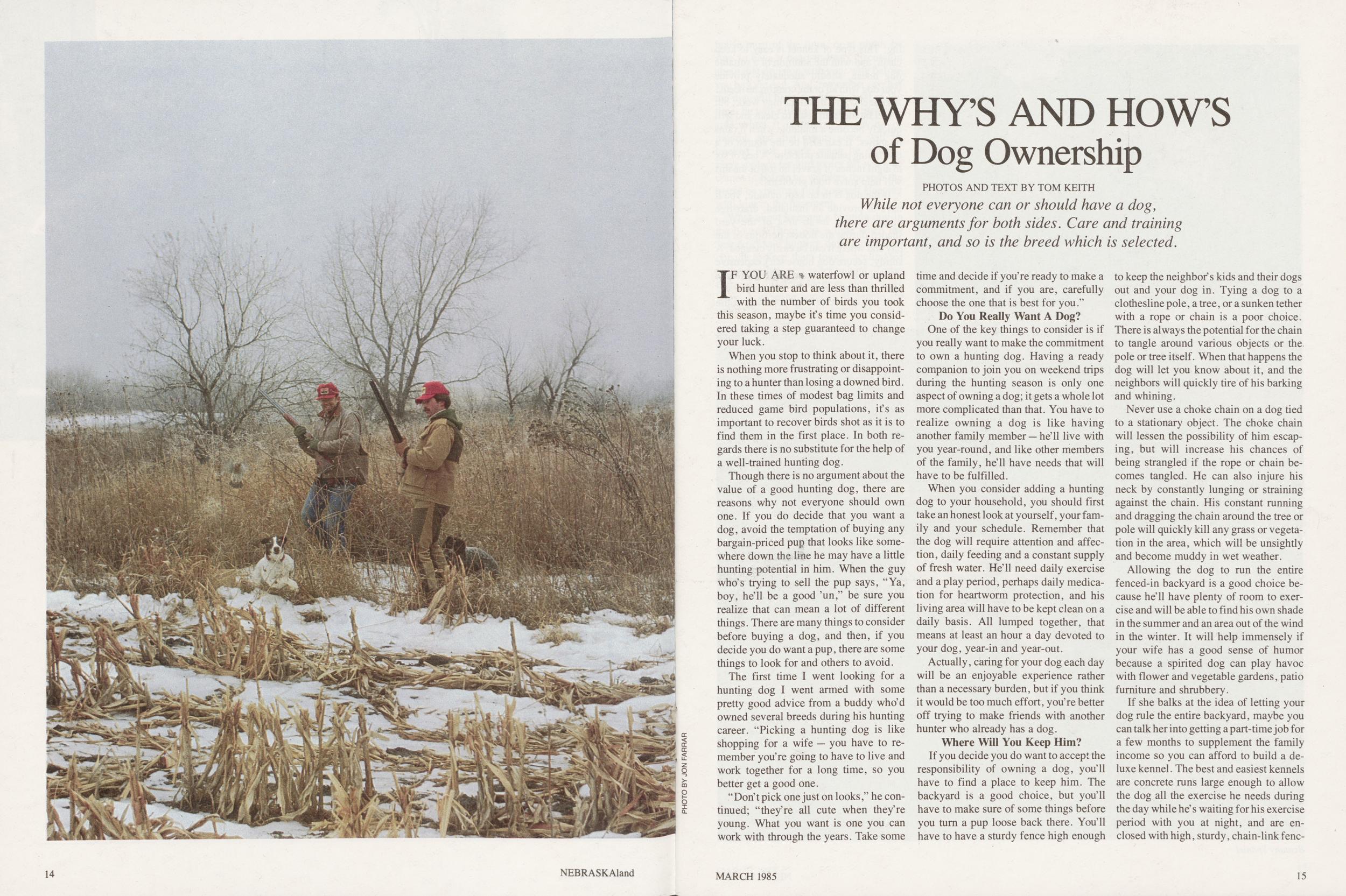
PHOTOS AND TEXT BY TOM KEITH While not everyone can or should have a dog, there are arguments for both sides. Care and training are important, and so is the breed which is selected.IF YOU ARE waterfowl or upland bird hunter and are less than thrilled with the number of birds you took this season, maybe it's time you considered taking a step guaranteed to change your luck.
When you stop to think about it, there is nothing more frustrating or disappointing to a hunter than losing a downed bird. In these times of modest bag limits and reduced game bird populations, it's as important to recover birds shot as it is to find them in the first place. In both regards there is no substitute for the help of a well-trained hunting dog.
Though there is no argument about the value of a good hunting dog, there are reasons why not everyone should own one. If you do decide that you want a dog, avoid the temptation of buying any bargain-priced pup that looks like somewhere down the line he may have a little hunting potential in him. When the guy who's trying to sell the pup says, "Ya, boy, he'll be a good 'un," be sure you realize that can mean a lot of different things. There are many things to consider before buying a dog, and then, if you decide you do want a pup, there are some things to look for and others to avoid.
The first time 1 went looking for a hunting dog I went armed with some pretty good advice from a buddy who'd owned several breeds during his hunting career. "Picking a hunting dog is like shopping for a wife — you have to remember you're going to have to live and work together for a long time, so you better get a good one.
"Don't pick one just on looks," he continued; "they're all cute when they're young. W^hat you want is one you can work with through the years. Take some time and decide if you're ready to make a commitment, and if you are, carefully choose the one that is best for you."
Do You Really Want A Dog?One of the key things to consider is if you really want to make the commitment to own a hunting dog. Having a ready companion to join you on weekend trips during the hunting season is only one aspect of owning a dog; it gets a whole lot more complicated than that. You have to realize owning a dog is like having another family member — he'll live with you year-round, and like other members of the family, he'll have needs that will have to be fulfilled.
When you consider adding a hunting dog to your household, you should first take an honest look at yourself, your family and your schedule. Remember that the dog will require attention and affection, daily feeding and a constant supply of fresh water. He'll need daily exercise and a play period, perhaps daily medication for heartworm protection, and his living area will have to be kept clean on a daily basis. All lumped together, that means at least an hour a day devoted to your dog, year-in and year-out.
Actually, caring for your dog each day will be an enjoyable experience rather than a necessary burden, but if you think it would be too much effort, you're better off trying to make friends with another hunter who already has a dog.
Where Will You Keep Him?If you decide you do want to accept the responsibility of owning a dog, you'll have to find a place to keep him. The backyard is a good choice, but you'll have to make sure of some things before you turn a pup loose back there. You'll have to have a sturdy fence high enough to keep the neighbor's kids and their dogs out and your dog in. Tying a dog to a clothesline pole, a tree, or a sunken tether with a rope or chain is a poor choice. There is always the potential for the chain to tangle around various objects or the pole or tree itself. WTien that happens the dog will let you know about it, and the neighbors will quickly tire of his barking and whining.
Never use a choke chain on a dog tied to a stationary object. The choke chain will lessen the possibility of him escaping, but will increase his chances of being strangled if the rope or chain becomes tangled. He can also injure his neck by constantly lunging or straining against the chain. His constant running and dragging the chain around the tree or pole will quickly kill any grass or vegetation in the area, which will be unsightly and become muddy in wet weather.
Allowing the dog to run the entire fenced-in backyard is a good choice because he'll have plenty of room to exercise and will be able to find his own shade in the summer and an area out of the wind in the winter. It will help immensely if your wife has a good sense of humor because a spirited dog can play havoc with flower and vegetable gardens, patio furniture and shrubbery.
If she balks at the idea of letting your dog rule the entire backyard, maybe you can talk her into getting a part-time job for a few months to supplement the family income so you can afford to build a deluxe kennel. The best and easiest kennels are concrete runs large enough to allow the dog all the exercise he needs during the day while he's waiting for his exercise period with you at night, and are enclosed with high, sturdy, chain-linkfenc MARCH 1985 16 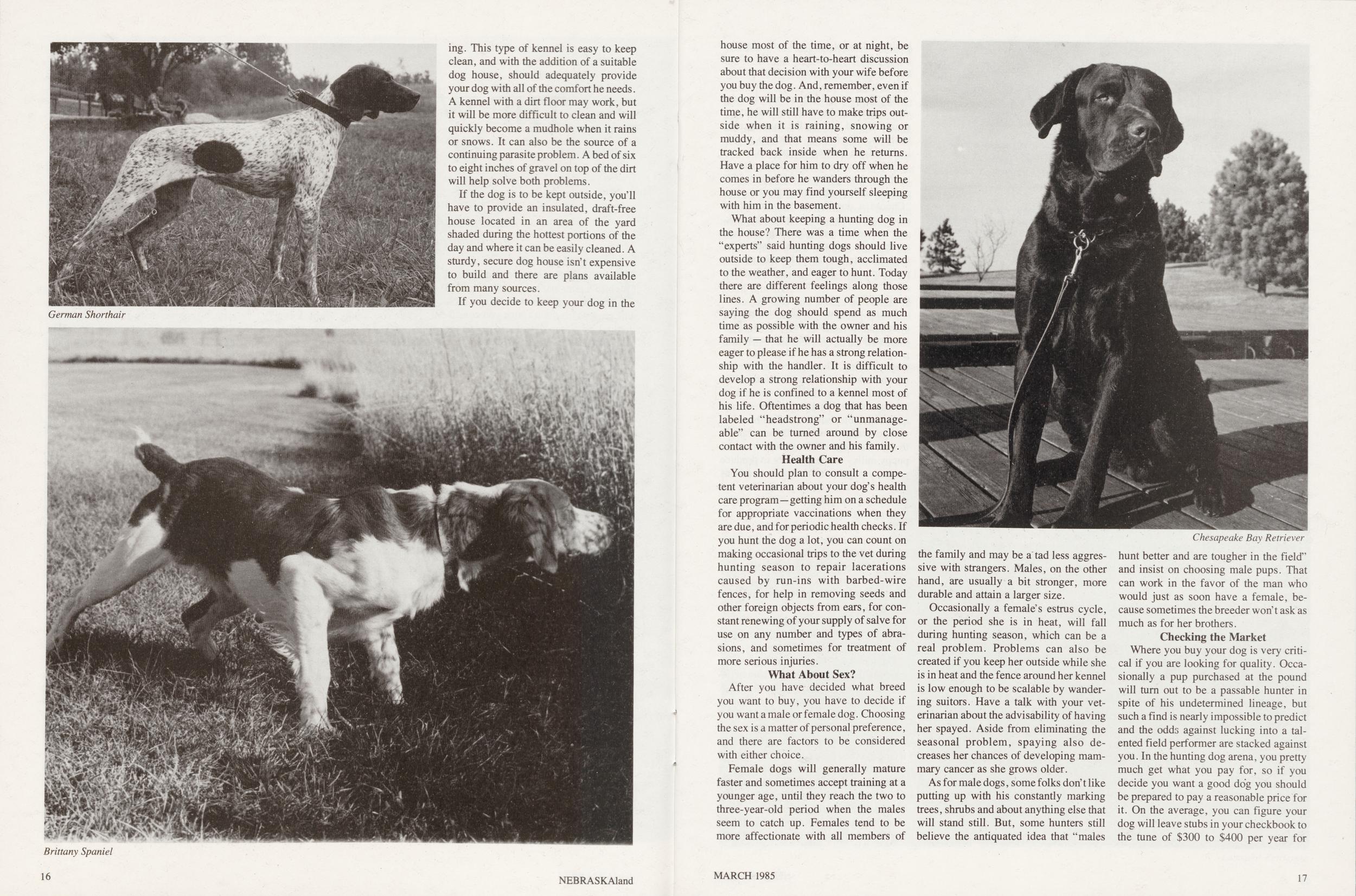 ing. This type of kennel is easy to keep clean, and with the addition of a suitable dog house, should adequately provide your dog with all of the comfort he needs. A kennel with a dirt floor may work, but it will be more difficult to clean and will quickly become a mudhole when it rains or snows. It can also be the source of a continuing parasite problem. A bed of six to eight inches of gravel on top of the dirt will help solve both problems.
If the dog is to be kept outside, you'll have to provide an insulated, draft-free house located in an area of the yard shaded during the hottest portions of the day and where it can be easily cleaned. A sturdy, secure dog house isn't expensive to build and there are plans available from many sources.
If you decide to keep your dog in the 16 NEBRASKAland house most of the time, or at night, be sure to have a heart-to-heart discussion about that decision with your wife before you buy the dog. And, remember, even if the dog will be in the house most of the time, he will still have to make trips outside when it is raining, snowing or muddy, and that means some will be tracked back inside when he returns. Have a place for him to dry off when he comes in before he wanders through the house or you may find yourself sleeping with him in the basement.
What about keeping a hunting dog in the house? There was a time when the "experts" said hunting dogs should live outside to keep them tough, acclimated to the weather, and eager to hunt. Today there are different feelings along those lines. A growing number of people are saying the dog should spend as much time as possible with the owner and his family — that he will actually be more eager to please if he has a strong relationship with the handler. It is difficult to develop a strong relationship with your dog if he is confined to a kennel most of his life. Oftentimes a dog that has been labeled "headstrong" or "unmanageable" can be turned around by close contact with the owner and his family.
Health CareYou should plan to consult a competent veterinarian about your dog's health care program—getting him on a schedule for appropriate vaccinations when they are due, and for periodic health checks. If you hunt the dog a lot, you can count on making occasional trips to the vet during hunting season to repair lacerations caused by run-ins with barbed-wire fences, for help in removing seeds and other foreign objects from ears, for constant renewing of your supply of salve for use on any number and types of abrasions, and sometimes for treatment of more serious injuries.
What About Sex?After you have decided what breed you want to buy, you have to decide if you want a male or female dog. Choosing the sex is a matter of personal preference, and there are factors to be considered with either choice.
Female dogs will generally mature faster and sometimes accept training at a younger age, until they reach the two to three-year-old period when the males seem to catch up. Females tend to be more affectionate with all members of the family and may be a tad less aggressive with strangers. Males, on the other hand, are usually a bit stronger, more durable and attain a larger size.
Occasionally a female's estrus cycle, or the period she is in heat, will fall during hunting season, which can be a real problem. Problems can also be created if you keep her outside while she is in heat and the fence around her kennel is low enough to be scalable by wandering suitors. Have a talk with your veterinarian about the advisability of having her spayed. Aside from eliminating the seasonal problem, spaying also decreases her chances of developing mammary cancer as she grows older.
As for male dogs, some folks don't like putting up with his constantly marking trees, shrubs and about anything else that will stand still. But, some hunters still believe the antiquated idea that "males Chesapeake Bay Retriever hunt better and are tougher in the field" and insist on choosing male pups. That can work in the favor of the man who would just as soon have a female, because sometimes the breeder won't ask as much as for her brothers.
Checking the MarketWhere you buy your dog is very critical if you are looking for quality. Occasionally a pup purchased at the pound will turn out to be a passable hunter in spite of his undetermined lineage, but such a find is nearly impossible to predict and the odds against lucking into a talented field performer are stacked against you. In the hunting dog arena, you pretty much get what you pay for, so if you decide you want a good dog you should be prepared to pay a reasonable price for it. On the average, you can figure your dog will leave stubs in your checkbook to the tune of $300 to $400 per year for MARCH 1985 17 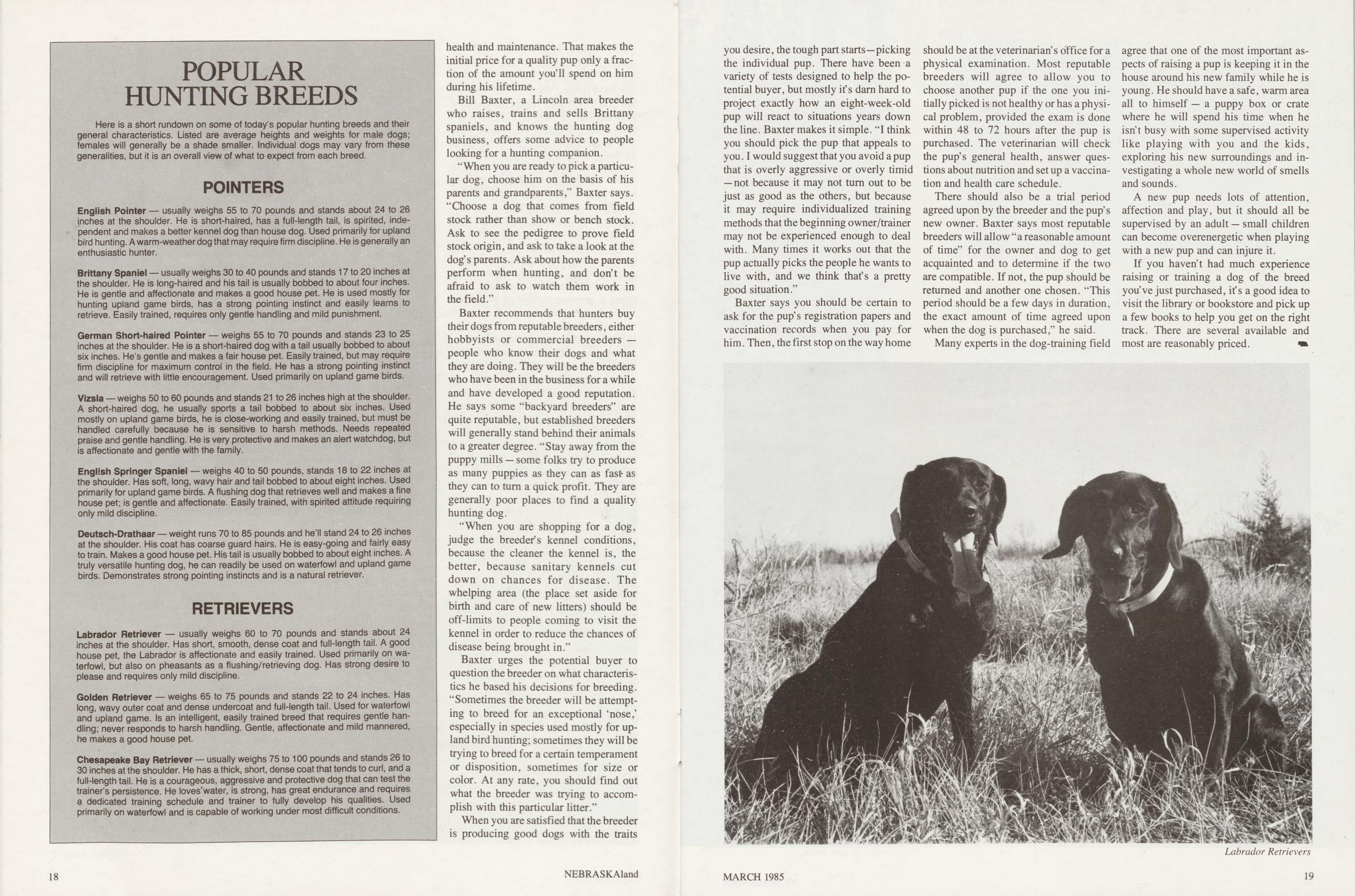 health and maintenance. That makes the initial price for a quality pup only a fraction of the amount you'll spend on him during his lifetime.
Bill Baxter, a Lincoln area breeder who raises, trains and sells Brittany spaniels, and knows the hunting dog business, offers some advice to people looking for a hunting companion.
"When you are ready to pick a particular dog, choose him on the basis of his parents and grandparents," Baxter says. "Choose a dog that comes from field stock rather than show or bench stock. Ask to see the pedigree to prove field stock origin, and ask to take a look at the dog's parents. Ask about how the parents perform when hunting, and don't be afraid to ask to watch them work in the field."
Baxter recommends that hunters buy their dogs from reputable breeders, either hobbyists or commercial breeders people who know their dogs and what they are doing. They will be the breeders who have been in the business for a while and have developed a good reputation. He says some "backyard breeders" are quite reputable, but established breeders will generally stand behind their animals to a greater degree. "Stay away from the puppy mills — some folks try to produce as many puppies as they can as fast- as they can to turn a quick profit. They are generally poor places to find a quality hunting dog.
"When you are shopping for a dog, judge the breeder's kennel conditions, because the cleaner the kennel is, the better, because sanitary kennels cut down on chances for disease. The whelping area (the place set aside for birth and care of new litters) should be off-limits to people coming to visit the kennel in order to reduce the chances of disease being brought in."
Baxter urges the potential buyer to question the breeder on what characteristics he based his decisions for breeding. "Sometimes the breeder will be attempting to breed for an exceptional 'nose,' especially in species used mostly for upland bird hunting; sometimes they will be trying to breed for a certain temperament or disposition, sometimes for size or color. At any rate, you should find out what the breeder was trying to accomplish with this particular litter."
When you are satisfied that the breeder is producing good dogs with the traits 18 NEBRASKAland you desire, the tough part starts—picking the individual pup. There have been a variety of tests designed to help the potential buyer, but mostly it's darn hard to project exactly how an eight-week-old pup will react to situations years down the line. Baxter makes it simple. "I think you should pick the pup that appeals to you. I would suggest that you avoid a pup that is overly aggressive or overly timid not because it may not turn out to be just as good as the others, but because it may require individualized training methods that the beginning owner/trainer may not be experienced enough to deal with. Many times it works out that the pup actually picks the people he wants to live with, and we think that's a pretty good situation."
Baxter says you should be certain to ask for the pup's registration papers and vaccination records when you pay for him. Then, the first stop on the way home should be at the veterinarian's office for a physical examination. Most reputable breeders will agree to allow you to choose another pup if the one you initially picked is not healthy or has a physical problem, provided the exam is done within 48 to 72 hours after the pup is purchased. The veterinarian will check the pup's general health, answer questions about nutrition and set up a vaccination and health care schedule.
There should also be a trial period agreed upon by the breeder and the pup's new owner. Baxter says most reputable breeders will allow "a reasonable amount of time" for the owner and dog to get acquainted and to determine if the two are compatible. If not, the pup should be returned and another one chosen. "This period should be a few days in duration, the exact amount of time agreed upon when the dog is purchased," he said.
Many experts in the dog-training field agree that one of the most important aspects of raising a pup is keeping it in the house around his new family while he is young. He should have a safe, warm area all to himself — a puppy box or crate where he will spend his time when he isn't busy with some supervised activity like playing with you and the kids, exploring his new surroundings and investigating a whole new world of smells and sounds.
A new pup needs lots of attention, affection and play, but it should all be supervised by an adult — small children can become overenergetic when playing with a new pup and can injure it.
If you haven't had much experience raising or training a dog of the breed you've just purchased, if s a good idea to visit the library or bookstore and pick up a few books to help you get on the right track. There are several available and most are reasonably priced.
The Nature Conservancy
BY KEN BOUC Unique habitats in Nebraska are protected by the Nature Conservancy, a highly effective conservation group with projects throughout U.S., Canada, Latin AmericaA RARE, highly-specialized A wildflower is assured survival A on its own refuge remnants of tall-grass prairie are preserved endangered and migratory birds are guaranteed vital habitats a preserve is established for a one-of-a-kind community of plants and animals.
If you think this is the work of a big, high-powered conservation organization operating in far-flung mountain ranges, pristine seashores and steamy, southern swamps, you're right. But, the outfit is also at work in less exotic locales. The four projects just described, in fact, are right here in Nebraska.
These projects are the work of the Nature Conservancy, a private non-profit organization devoted to the protection of our finest natural areas and the plants and animals that live there. Since its founding in 1951, the Conservancy has assembled the largest system of privately-owned nature sanctuaries in the world.
The Conservancy's statistics are impressive. The organization has safeguarded more than 2,300,000 acres, with 637,451 of these acres owned outright by the Conservancy. It operates 800 sanctuaries in 48 states, and has projects in all 50 states, Latin America, the Caribbean and Canada. Its conservation efforts are supported by 200,000 individual members, 421 corporate associates and various gifts and endowments.
But, its deeds tell more about the Nature Conservancy than do mere statistics. It is an action organization, able and willing to move quickly and decisively when necessary, yet striving to maintain a low profile. Its one guiding objective is the preservation of natural diversity, which is why the Conservancy is particularly interested in threatened or endangered species. The organization does not try to preserve each and every bit of the countryside, but concentrates instead on picking as best it can jeopardized areas of the "highest ecological significance."
Its decisions might revolve around manatees in Florida, sea turtles in Costa Rica, prairie orchids in Illinois, or whooping cranes and paper birch trees in Nebraska. Once an area, with its plant and animal community, is found to be worthy of protection, the Nature Conservancy may take one of several courses to insure its survival.
The simplest strategy is outright purchase of the land involved, or acceptance of the land as a gift. Ownership by the Conservancy or some other conservation agency is not the only answer, however. Sometimes, agreements with the owner to maintain the land can be made, or the landowner might allow the Conservancy or some other conservation organization to manage the property in a way to safeguard its unique life forms.
20 NEBRASKAland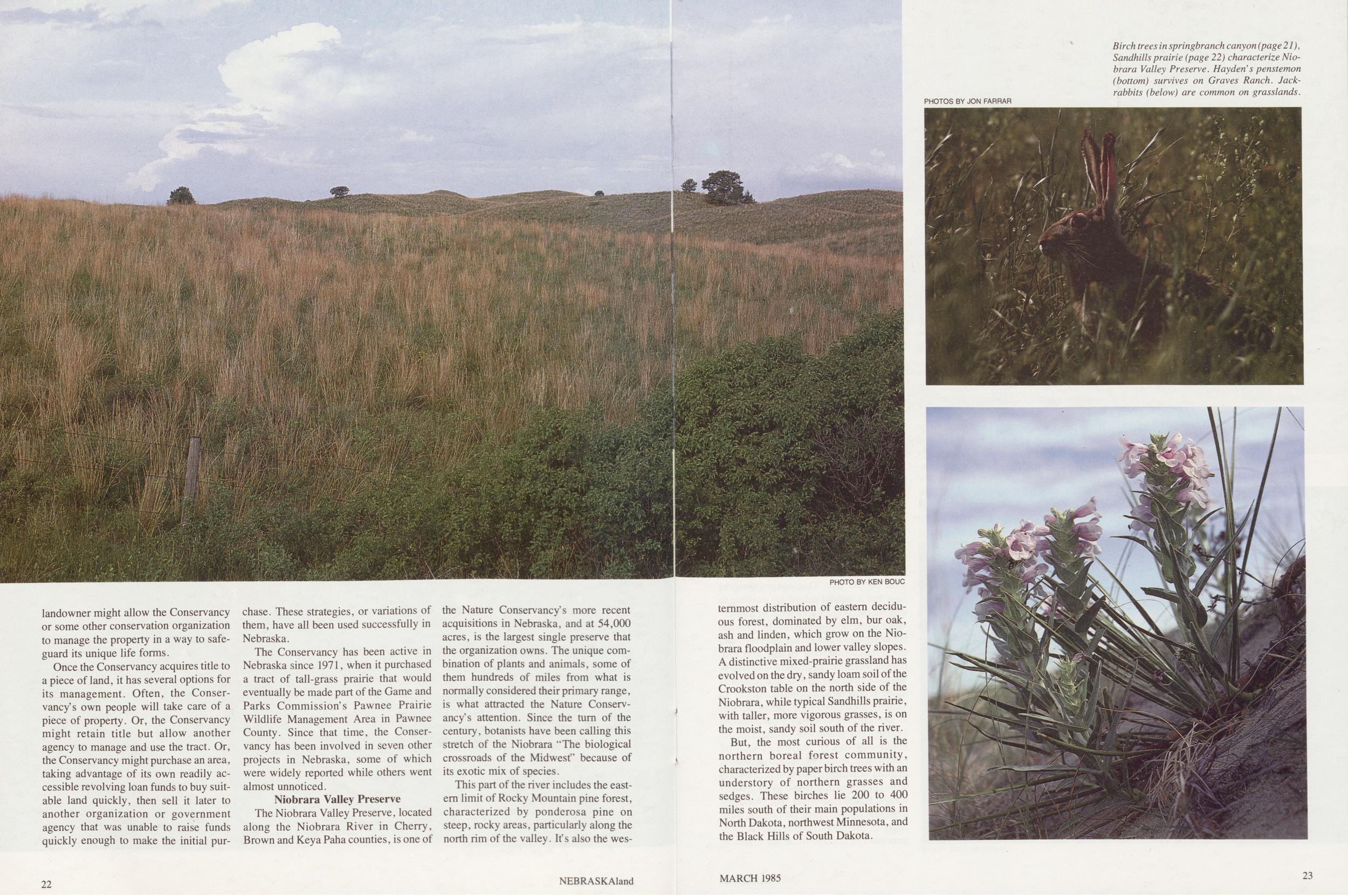
Once the Conservancy acquires title to a piece of land, it has several options for its management. Often, the Conservancy's own people will take care of a piece of property. Or, the Conservancy might retain title but allow another agency to manage and use the tract. Or, the Conservancy might purchase an area, taking advantage of its own readily accessible revolving loan funds to buy suitable land quickly, then sell it later to another organization or government agency that was unable to raise funds quickly enough to make the initial purchase. These strategies, or variations of them, have all been used successfully in Nebraska.
The Conservancy has been active in Nebraska since 1971, when it purchased a tract of tall-grass prairie that would eventually be made part of the Game and Parks Commission's Pawnee Prairie Wildlife Management Area in Pawnee County. Since that time, the Conservancy has been involved in seven other projects in Nebraska, some of which were widely reported while others went almost unnoticed.
Niobrara Valley PreserveThe Niobrara Valley Preserve, located along the Niobrara River in Cherry, Brown and Key a Paha counties, is one of the Nature Conservancy's more recent acquisitions in Nebraska, and at 54,000 acres, is the largest single preserve that the organization owns. The unique combination of plants and animals, some of them hundreds of miles from what is normally considered their primary range, is what attracted the Nature Conservancy's attention. Since the turn of the century, botanists have been calling this stretch of the Niobrara "The biological crossroads of the Midwest" because of its exotic mix of species.
This part of the river includes the eastern limit of Rocky Mountain pine forest, characterized by ponderosa pine on steep, rocky areas, particularly along the north rim of the valley. It's also the westernmost 22 NEBRASKAland ternmost distribution of eastern deciduous forest, dominated by elm, bur oak, ash and linden, which grow on the Niobrara floodplain and lower valley slopes. A distinctive mixed-prairie grassland has evolved on the dry, sandy loam soil of the Crookston table on the north side of the Niobrara, while typical Sandhills prairie, with taller, more vigorous grasses, is on the moist, sandy soil south of the river.
But, the most curious of all is the northern boreal forest community, characterized by paper birch trees with an understory of northern grasses and sedges. These birches lie 200 to 400 miles south of their main populations in North Dakota, northwest Minnesota, and the Black Hills of South Dakota.
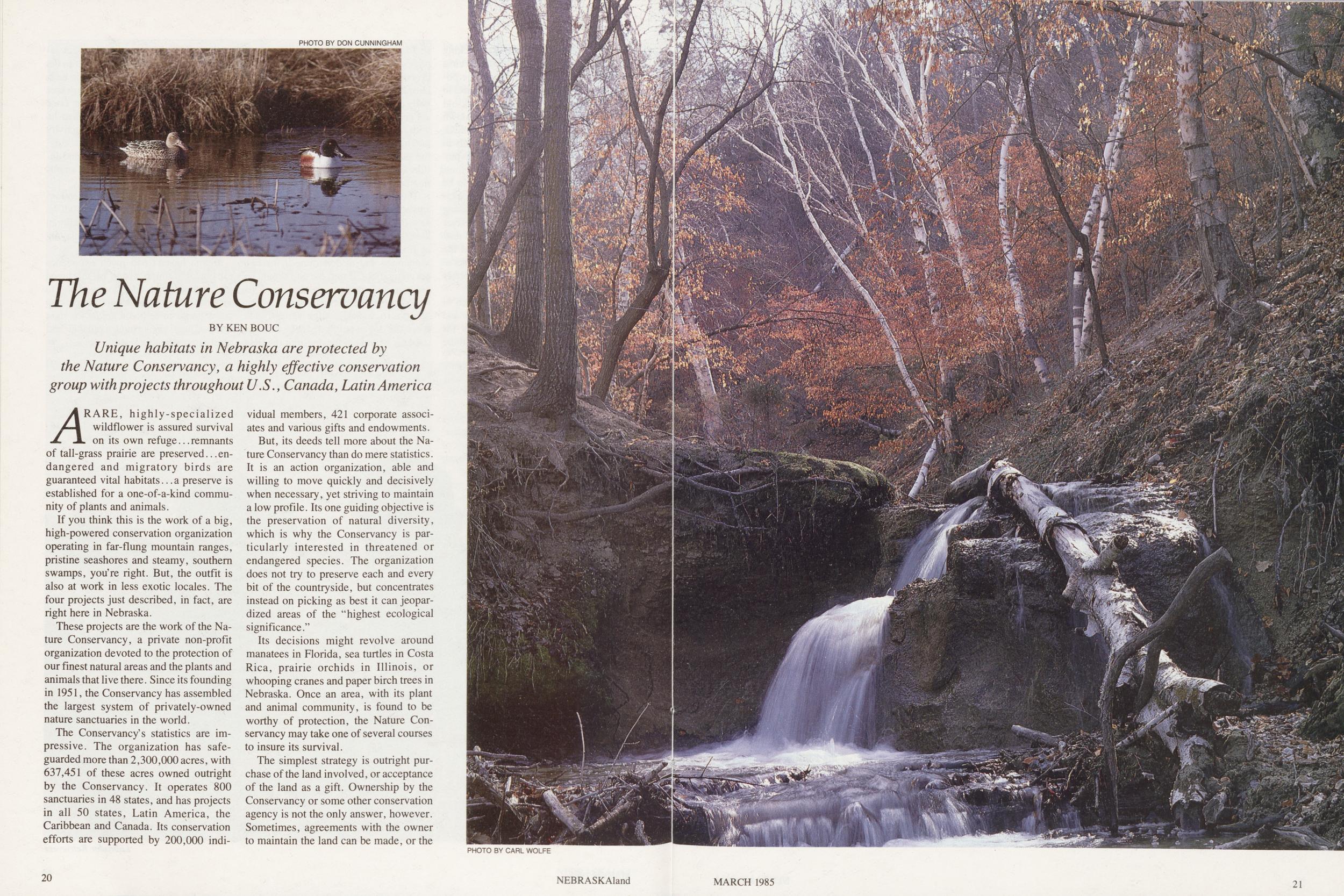
Birch trees in springbranch canyon (page 21), Sandhills prairie (page 22) characterize Niobrara Valley Preserve. Hayden s penstemon (bottom) survives on Graves Ranch. Jackrabbits (below) are common on grasslands.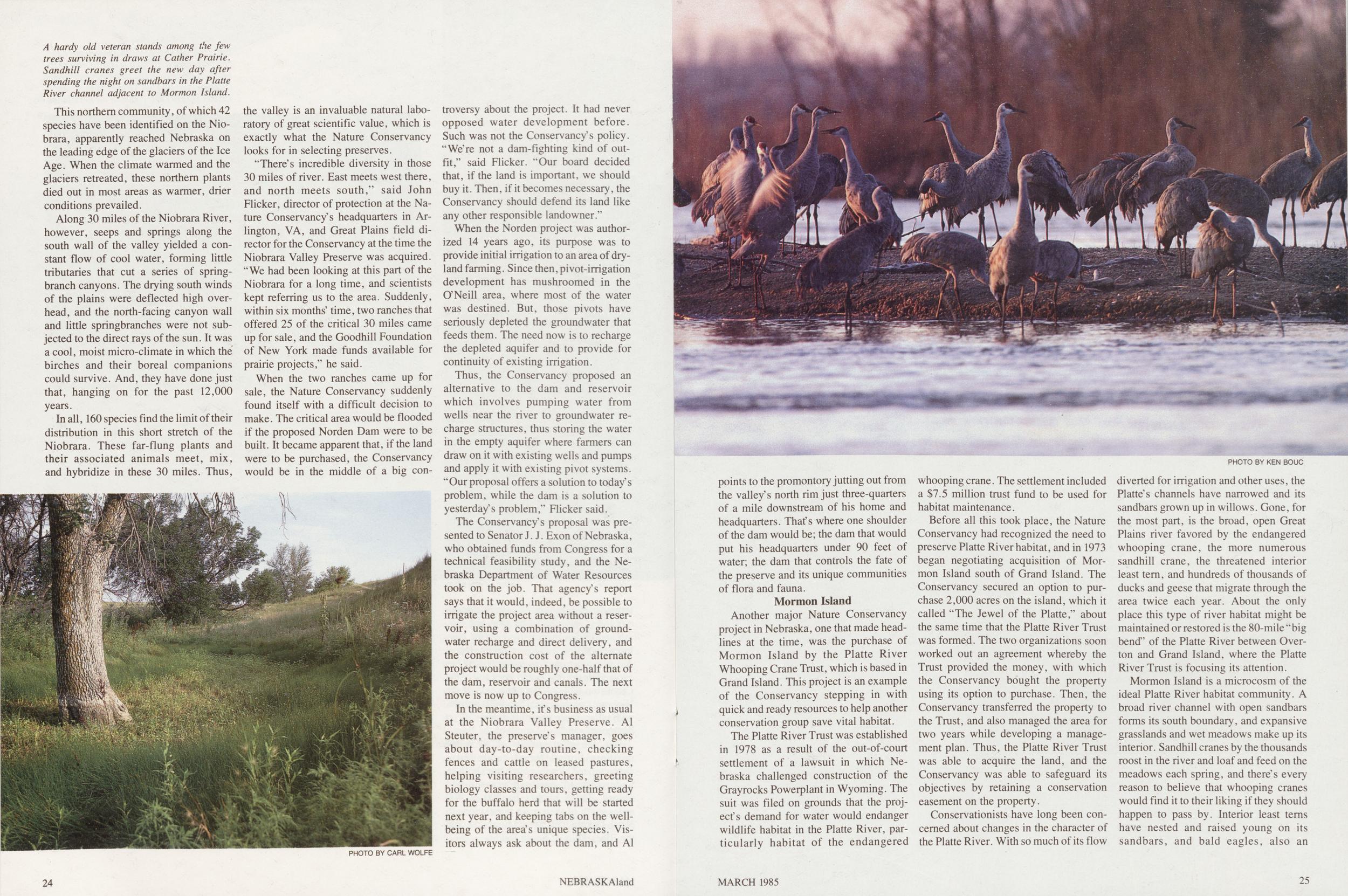 A hardy old veteran stands among the few trees surviving in draws at Gather Prairie. Sandhill cranes greet the new day after spending the night on sandbars in the Platte River channel adjacent to Mormon Island.
This northern community, of which 42 species have been identified on the Niobrara, apparently reached Nebraska on the leading edge of the glaciers of the Ice Age. When the climate warmed and the glaciers retreated, these northern plants died out in most areas as warmer, drier conditions prevailed.
Along 30 miles of the Niobrara River, however, seeps and springs along the south wall of the valley yielded a constant flow of cool water, forming little tributaries that cut a series of springbranch canyons. The drying south winds of the plains were deflected high overhead, and the north-facing canyon wall and little springbranches were not subjected to the direct rays of the sun. It was a cool, moist micro-climate in which the birches and their boreal companions could survive. And, they have done just that, hanging on for the past 12,000 years.
In all, 160 species find the limit of their distribution in this short stretch of the Niobrara. These far-flung plants and their associated animals meet, mix, and hybridize in these 30 miles. Thus, the valley is an invaluable natural laboratory of great scientific value, which is exactly what the Nature Conservancy looks for in selecting preserves.
"There's incredible diversity in those 30 miles of river. East meets west there, and north meets south," said John Flicker, director of protection at the Nature Conservancy's headquarters in Arlington, VA, and Great Plains field director for the Conservancy at the time the Niobrara Valley Preserve was acquired. "We had been looking at this part of the Niobrara for a long time, and scientists kept referring us to the area. Suddenly, within six months' time, two ranches that offered 25 of the critical 30 miles came up for sale, and the Goodhill Foundation of New York made funds available for prairie projects," he said.
When the two ranches came up for sale, the Nature Conservancy suddenly found itself with a difficult decision to make. The critical area would be flooded if the proposed Norden Dam were to be built. It became apparent that, if the land were to be purchased, the Conservancy would be in the middle of a big controversy about the project. It had never opposed water development before. Such was not the Conservancy's policy. "We're not a dam-fighting kind of outfit," said Flicker. "Our board decided that, if the land is important, we should buy it. Then, if it becomes necessary, the Conservancy should defend its land like any other responsible landowner."
When the Norden project was authorized 14 years ago, its purpose was to provide initial irrigation to an area of dryland farming. Since then, pivot-irrigation development has mushroomed in the O'Neill area, where most of the water was destined. But, those pivots have seriously depleted the groundwater that feeds them. The need now is to recharge the depleted aquifer and to provide for continuity of existing irrigation.
Thus, the Conservancy proposed an alternative to the dam and reservoir which involves pumping water from wells near the river to groundwater recharge structures, thus storing the water in the empty aquifer where farmers can draw on it with existing wells and pumps and apply it with existing pivot systems. "Our proposal offers a solution to today's problem, while the dam is a solution to yesterday's problem," Flicker said.
The Conservancy's proposal was presented to Senator J. J. Exon of Nebraska, who obtained funds from Congress for a technical feasibility study, and the Nebraska Department of Water Resources took on the job. That agency's report says that it would, indeed, be possible to irrigate the project area without a reservoir, using a combination of groundwater recharge and direct delivery, and the construction cost of the alternate project would be roughly one-half that of the dam, reservoir and canals. The next move is now up to Congress.
In the meantime, it's business as usual at the Niobrara Valley Preserve. Al Steuter, the preserve's manager, goes about day-to-day routine, checking fences and cattle on leased pastures, helping visiting researchers, greeting biology classes and tours, getting ready for the buffalo herd that will be started next year, and keeping tabs on the wellbeing of the area's unique species. Visitors always ask about the dam, and Al 24 NEBRASKAland points to the promontory jutting out from the valley's north rim just three-quarters of a mile downstream of his home and headquarters. That's where one shoulder of the dam would be; the dam that would put his headquarters under 90 feet of water; the dam that controls the fate of the preserve and its unique communities of flora and fauna.
Mormon IslandAnother major Nature Conservancy project in Nebraska, one that made headlines at the time, was the purchase of Mormon Island by the Platte River Whooping Crane Trust, which is based in Grand Island. This project is an example of the Conservancy stepping in with quick and ready resources to help another conservation group save vital habitat.
The Platte River Trust was established in 1978 as a result of the out-of-court settlement of a lawsuit in which Nebraska challenged construction of the Gray rocks Powerplant in Wyoming. The suit was filed on grounds that the project's demand for water would endanger wildlife habitat in the Platte River, particularly habitat of the endangered whooping crane. The settlement included a $7.5 million trust fund to be used for habitat maintenance.
Before all this took place, the Nature Conservancy had recognized the need to preserve Platte River habitat, and in 1973 began negotiating acquisition of Mormon Island south of Grand Island. The Conservancy secured an option to purchase 2,000 acres on the island, which it called "The Jewel of the Platte," about the same time that the Platte River Trust was formed. The two organizations soon worked out an agreement whereby the Trust provided the money, with which the Conservancy bought the property using its option to purchase. Then, the Conservancy transferred the property to the Trust, and also managed the area for two years while developing a management plan. Thus, the Platte River Trust was able to acquire the land, and the Conservancy was able to safeguard its objectives by retaining a conservation easement on the property.
Conservationists have long been concerned about changes in the character of the Platte River. With so much of its flow PHCTO BY KEN BOUC diverted for irrigation and other uses, the Platte's channels have narrowed and its sandbars grown up in willows. Gone, for the most part, is the broad, open Great Plains river favored by the endangered whooping crane, the more numerous sandhill crane, the threatened interior least tern, and hundreds of thousands of ducks and geese that migrate through the area twice each year. About the only place this type of river habitat might be maintained or restored is the 80-mile "big bend" of the Platte River between Overton and Grand Island, where the Platte River Trust is focusing its attention.
Mormon Island is a microcosm of the ideal Platte River habitat community. A broad river channel with open sandbars forms its south boundary, and expansive grasslands and wet meadows make up its interior. Sandhill cranes by the thousands roost in the river and loaf and feed on the meadows each spring, and there's every reason to believe that whooping cranes would find it to their liking if they should happen to pass by. Interior least terns have nested and raised young on its sandbars, and bald eagles, also an endangered species, roost and feed there.
MARCH 1985 25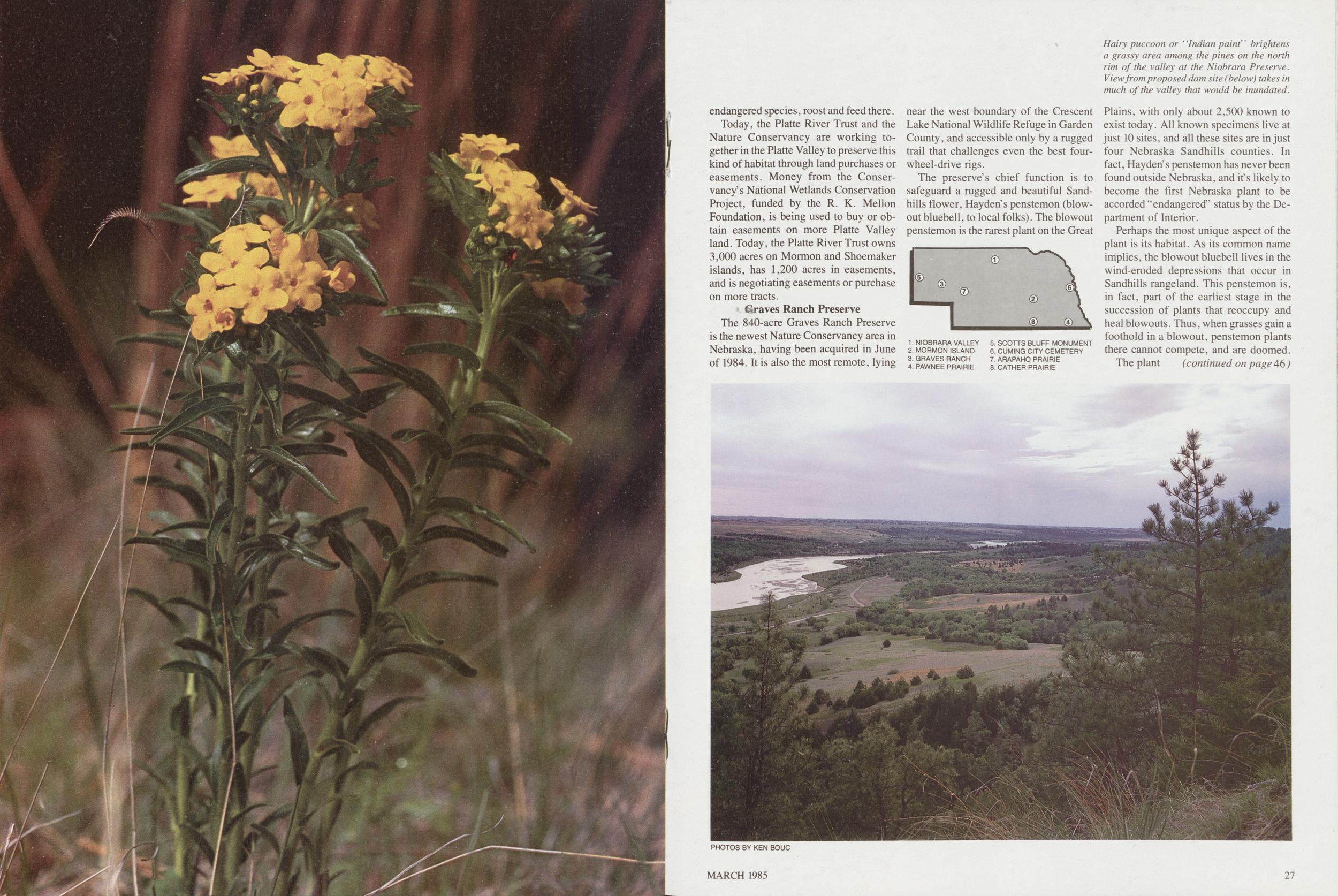
Today, the Platte River Trust and the Nature Conservancy are working together in the Platte Valley to preserve this kind of habitat through land purchases or easements. Money from the Conservancy's National Wetlands Conservation Project, funded by the R. K. Mellon Foundation, is being used to buy or obtain easements on more Platte Valley land. Today, the Platte River Trust owns 3,000 acres on Mormon and Shoemaker islands, has 1,200 acres in easements, and is negotiating easements or purchase on more tracts.
Graves Ranch PreserveThe 840-acre Graves Ranch Preserve is the newest Nature Conservancy area in Nebraska, having been acquired in June of 1984. It is also the most remote, lying near the west boundary of the Crescent Lake National Wildlife Refuge in Garden County, and accessible only by a rugged trail that challenges even the best four-wheel-drive rigs.
The preserve's chief function is to safeguard a rugged and beautiful Sandhills flower, Hayden's penstemon (blowout bluebell, to local folks). The blowout penstemon is the rarest plant on the Great Plains, with only about 2,500 known to exist today. All known specimens live at just 10 sites, and all these sites are in just four Nebraska Sandhills counties. In fact, Hayden's penstemon has never been found outside Nebraska, and it's likely to become the first Nebraska plant to be accorded "endangered" status by the Department of Interior.
Perhaps the most unique aspect of the plant is its habitat. As its common name implies, the blowout bluebell lives in the wind-eroded depressions that occur in Sandhills rangeland. This penstemon is, in fact, part of the earliest stage in the succession of plants that reoccupy and heal blowouts. Thus, when grasses gain a foothold in a blowout, penstemon plants there cannot compete, and are doomed.
The plant (continued on page 46)
Homespun Art
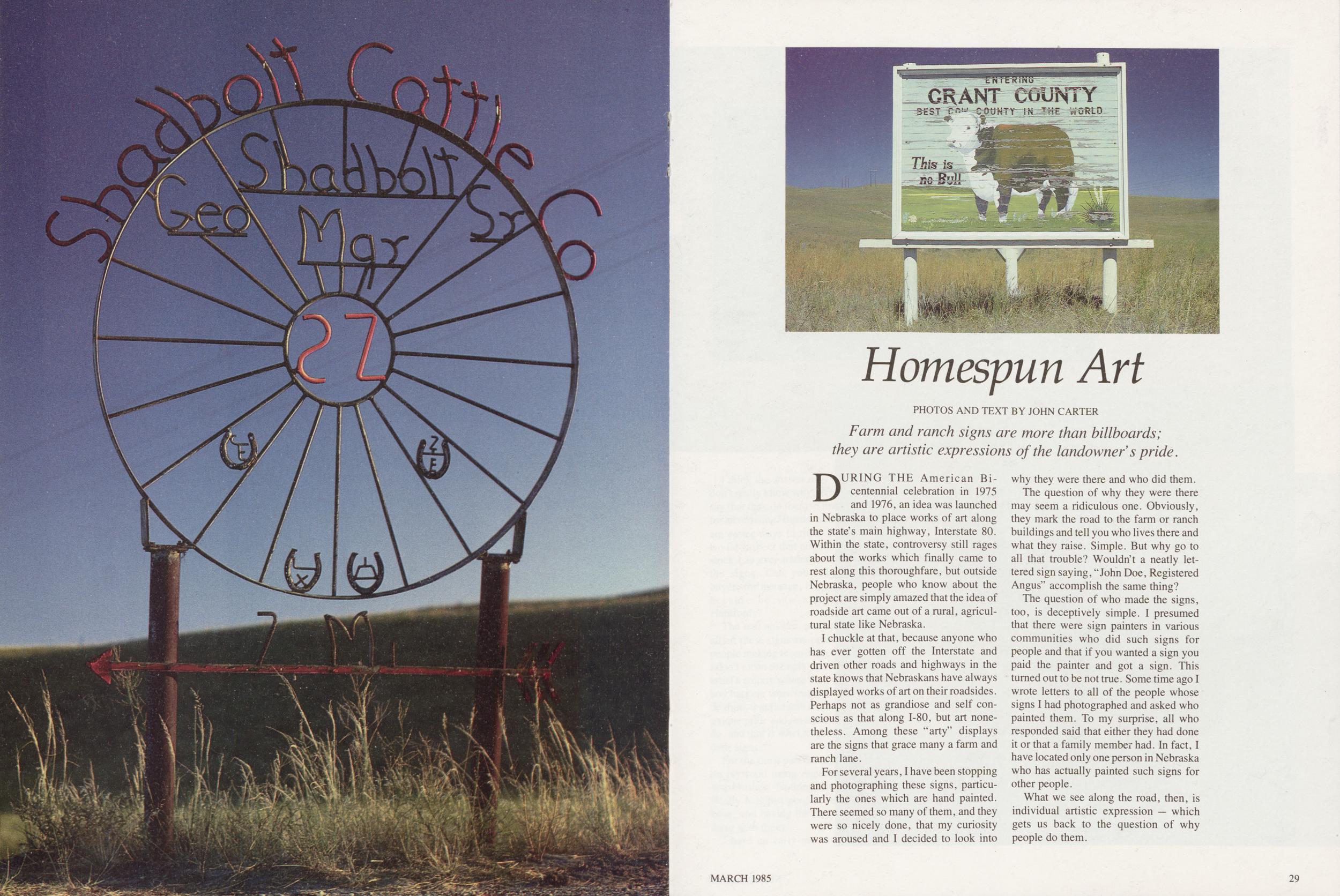
PHOTOS AND TEXT BY JOHN CARTER Farm and ranch signs are more than billboards; they are artistic expressions of the landowner s prideDURING THE American Bicentennial celebration in 1975 and 1976, an idea was launched in Nebraska to place works of art along the state's main highway, Interstate 80. Within the state, controversy still rages about the works which finally came to rest along this thoroughfare, but outside Nebraska, people who know about the project are simply amazed that the idea of roadside art came out of a rural, agricultural state like Nebraska.
I chuckle at that, because anyone who has ever gotten off the Interstate and driven other roads and highways in the state knows that Nebraskans have always displayed works of art on their roadsides. Perhaps not as grandiose and self conscious as that along 1-80, but art nonetheless. Among these "arty" displays are the signs that grace many a farm and ranch lane.
For several years, I have been stopping and photographing these signs, particularly the ones which are hand painted. There seemed so many of them, and they were so nicely done, that my curiosity was aroused and I decided to look into why they were there and who did them.
The question of why they were there may seem a ridiculous one. Obviously, they mark the road to the farm or ranch buildings and tell you who lives there and what they raise. Simple. But why go to all that trouble? Wouldn't a neatly lettered sign saying, "John Doe, Registered Angus" accomplish the same thing?
The question of who made the signs, too, is deceptively simple. I presumed that there were sign painters in various communities who did such signs for people and that if you wanted a sign you paid the painter and got a sign. This turned out to be not true. Some time ago I wrote letters to all of the people whose signs I had photographed and asked who painted them. To my surprise, all who responded said that either they had done it or that a family member had. In fact, I have located only one person in Nebraska who has actually painted such signs for other people.
What we see along the road, then, is individual artistic expression — which gets us back to the question of why people do them.
MARCH 1985 29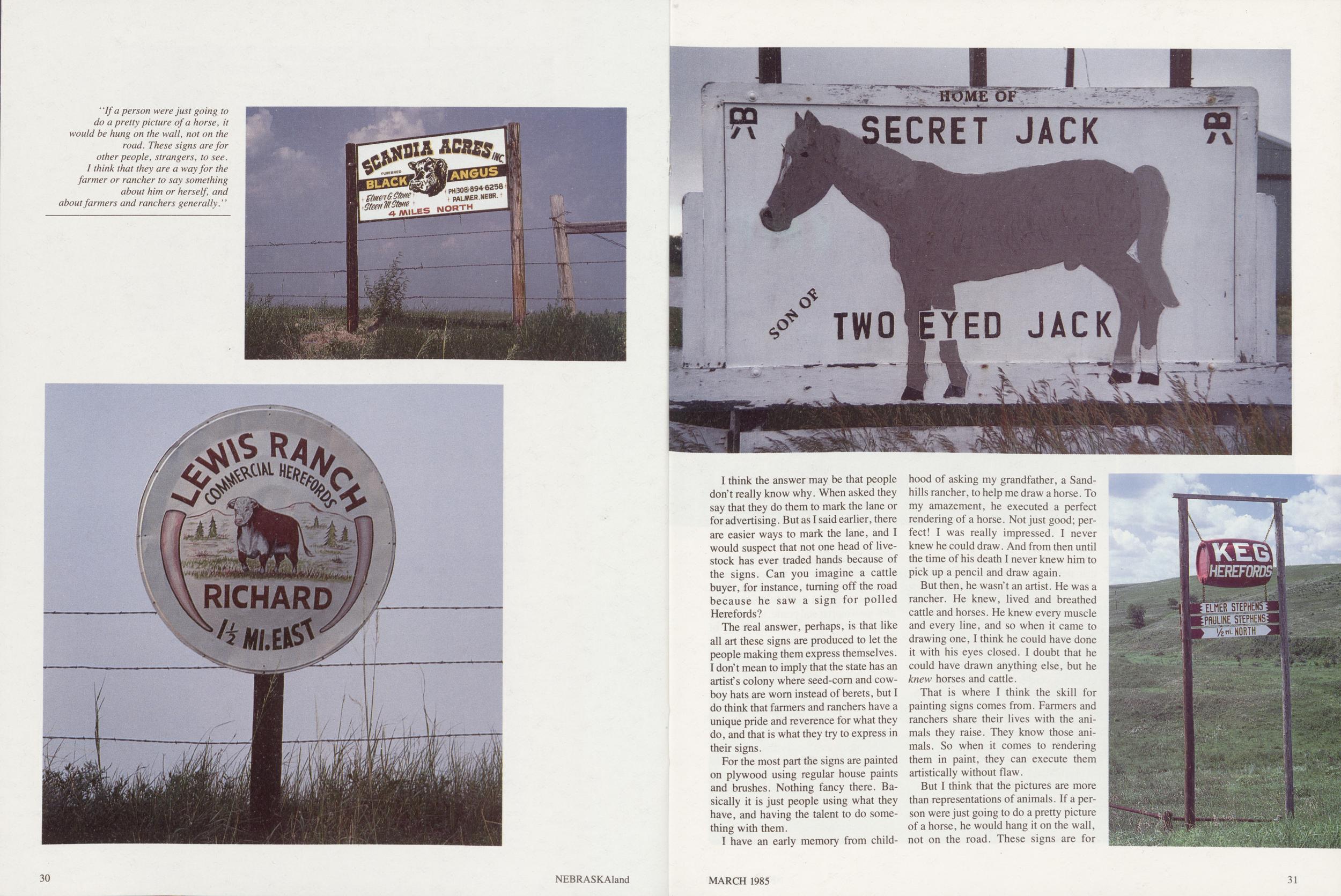
I think the answer may be that people don't really know why. When asked they say that they do them to mark the lane or for advertising. But as I said earlier, there are easier ways to mark the lane, and I would suspect that not one head of livestock has ever traded hands because of the signs. Can you imagine a cattle buyer, for instance, turning off the road because he saw a sign for polled Herefords?
The real answer, perhaps, is that like all art these signs are produced to let the people making them express themselves. I don't mean to imply that the state has an artist's colony where seed-corn and cowboy hats are worn instead of berets, but I do think that farmers and ranchers have a unique pride and reverence for what they do, and that is what they try to express in their signs.
For the most part the signs are painted on plywood using regular house paints and brushes. Nothing fancy there. Basically it is just people using what they have, and having the talent to do something with them.
I have an early memory from childhood of asking my grandfather, a Sandhills rancher, to help me draw a horse. To my amazement, he executed a perfect rendering of a horse. Not just good; perfect! I was really impressed. I never knew he could draw. And from then until the time of his death I never knew him to pick up a pencil and draw again.
But then, he wasn't an artist. He was a rancher. He knew, lived and breathed cattle and horses. He knew every muscle and every line, and so when it came to drawing one, I think he could have done it with his eyes closed. I doubt that he could have drawn anything else, but he knew horses and cattle.
That is where I think the skill for painting signs comes from. Farmers and ranchers share their lives with the animals they raise. They know those animals. So when it comes to rendering them in paint, they can execute them artistically without flaw.
But I think that the pictures are more than representations of animals. If a person were just going to do a pretty picture of a horse, he would hang it on the wall, not on the road. These signs are for MARCH 1985 31 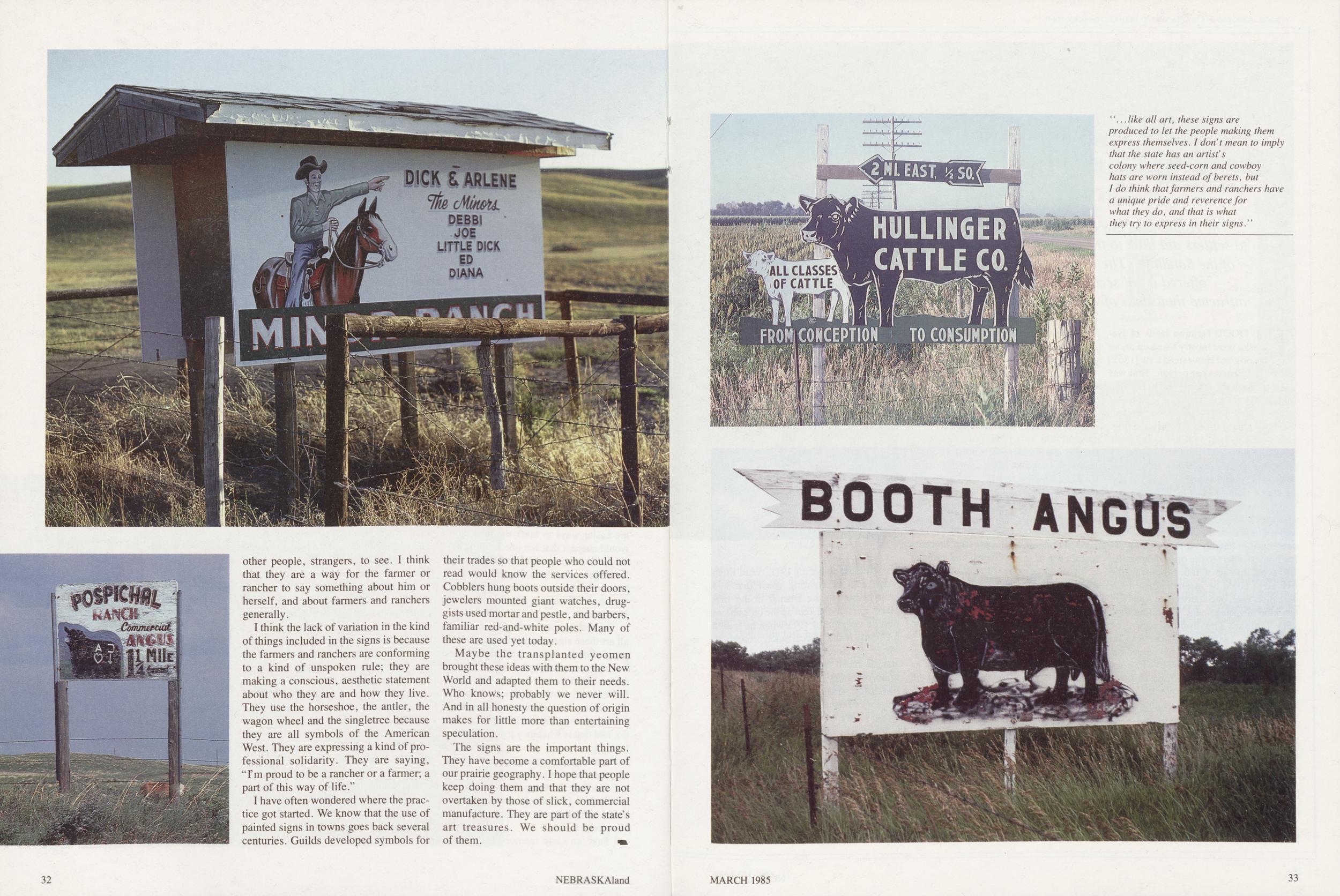 other people, strangers, to see. I think that they are a way for the farmer or rancher to say something about him or herself, and about farmers and ranchers generally.
I think the lack of variation in the kind of things included in the signs is because the farmers and ranchers are conforming to a kind of unspoken rule; they are making a conscious, aesthetic statement about who they are and how they live. They use the horseshoe, the antler, the wagon wheel and the singletree because they are all symbols of the American West. They are expressing a kind of professional solidarity. They are saying, "I'm proud to be a rancher or a farmer; a part of this way of life."
I have often wondered where the practice got started. We know that the use of painted signs in towns goes back several centuries. Guilds developed symbols for their trades so that people who could not read would know the services offered. Cobblers hung boots outside their doors, jewelers mounted giant watches, druggists used mortar and pestle, and barbers, familiar red-and-white poles. Many of these are used yet today.
Maybe the transplanted yeomen brought these ideas with them to the New World and adapted them to their needs. Who knows; probably we never will. And in all honesty the question of origin makes for little more than entertaining speculation.
The signs are the important things. They have become a comfortable part of our prairie geography. I hope that people keep doing them and that they are not overtaken by those of slick, commercial manufacture. They are part of the state's art treasures. We should be proud of them.
32 NEBRASKAland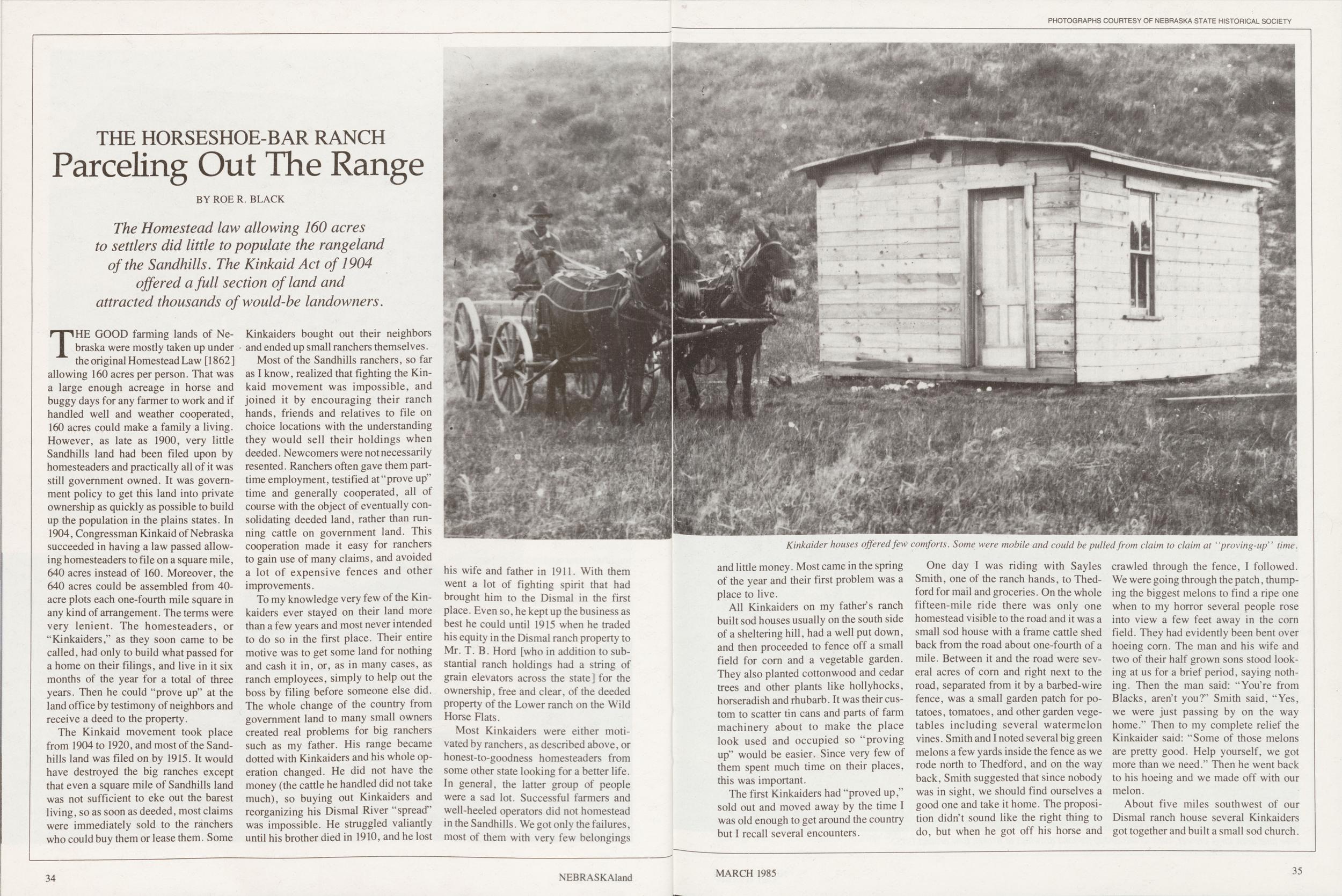
THE HORSESHOE-BAR RANCH Parceling Out The Range
BY ROE R. BLACK The Homestead law allowing 160 acres to settlers did little to populate the rangeland of the Sandhills. The Kinkaid Act of 1904 offered a full section of land and attracted thousands of would-be landowners.THE GOOD farming lands of Ne- braska were mostly taken up under the original Homestead Law [1862 ] allowing 160 acres per person. That was a large enough acreage in horse and buggy days for any farmer to work and if handled well and weather cooperated, 160 acres could make a family a living. However, as late as 1900, very little Sandhills land had been filed upon by homesteaders and practically all of it was still government owned. It was govern- ment policy to get this land into private ownership as quickly as possible to build up the population in the plains states. In 1904, Congressman Kinkaid of Nebraska succeeded in having a law passed allowing homesteaders to file on a square mile, 640 acres instead of 160. Moreover, the 640 acres could be assembled from 40 acre plots each one-fourth mile square in any kind of arrangement. The terms were very lenient. The homesteaders, or "Kinkaiders," as they soon came to be called, had only to build what passed for a home on their filings, and live in it six months of the year for a total of three years. Then he could "prove up" at the land office by testimony of neighbors and receive a deed to the property.
The Kinkaid movement took place from 1904 to 1920, and most of the Sandhills land was filed on by 1915. It would have destroyed the big ranches except that even a square mile of Sandhills land was not sufficient to eke out the barest living, so as soon as deeded, most claims were immediately sold to the ranchers who could buy them or lease them. Some Kinkaiders bought out their neighbors and ended up small ranchers themselves.
Most of the Sandhills ranchers, so far as I know, realized that fighting the Kinkaid movement was impossible, and joined it by encouraging their ranch hands, friends and relatives to file on choice locations with the understanding they would sell their holdings when deeded. Newcomers were not necessarily resented. Ranchers often gave them parttime employment, testified at "prove up" time and generally cooperated, all of course with the object of eventually consolidating deeded land, rather than running cattle on government land. This cooperation made it easy for ranchers to gain use of many claims, and avoided a lot of expensive fences and other improvements.
To my knowledge very few of the Kinkaiders ever stayed on their land more than a few years and most never intended to do so in the first place. Their entire motive was to get some land for nothing and cash it in, or, as in many cases, as ranch employees, simply to help out the boss by filing before someone else did. The whole change of the country from government land to many small owners created real problems for big ranchers such as my father. His range became dotted with Kinkaiders and his whole operation changed. He did not have the money (the cattle he handled did not take much), so buying out Kinkaiders and reorganizing his Dismal River "spread" was impossible. He struggled valiantly until his brother died in 1910, and he lost his wife and father in 1911. With them went a lot of fighting spirit that had brought him to the Dismal in the first place. Even so, he kept up the business as best he could until 1915 when he traded his equity in the Dismal ranch property to Mr. T. B. Hord [who in addition to substantial ranch holdings had a string of grain elevators across the state] for the ownership, free and clear, of the deeded property of the Lower ranch on the Wild Horse Flats.
Most Kinkaiders were either motivated by ranchers, as described above, or honest-to-goodness homesteaders from some other state looking for a better life. In general, the latter group of people were a sad lot. Successful farmers and well-heeled operators did not homestead in the Sandhills. We got only the failures, most of them with very few belongings 34 NEBRASKAland and little money. Most came in the spring of the year and their first problem was a place to live.
All Kinkaiders on my father's ranch built sod houses usually on the south side of a sheltering hill, had a well put down, and then proceeded to fence off a small field for corn and a vegetable garden. They also planted cottonwood and cedar trees and other plants like hollyhocks, horseradish and rhubarb. It was their custom to scatter tin cans and parts of farm machinery about to make the place look used and occupied so "proving up" would be easier. Since very few of them spent much time on their places, this was important.
The first Kinkaiders had "proved up," sold out and moved away by the time I was old enough to get around the country but I recall several encounters.
One day I was riding with Sayles Smith, one of the ranch hands, to Thedford for mail and groceries. On the whole fifteen-mile ride there was only one homestead visible to the road and it was a small sod house with a frame cattle shed back from the road about one-fourth of a mile. Between it and the road were several acres of corn and right next to the road, separated from it by a barbed-wire fence, was a small garden patch for potatoes, tomatoes, and other garden vegetables including several watermelon vines. Smith and I noted several big green melons a few yards inside the fence as we rode north to Thedford, and on the way back, Smith suggested that since nobody was in sight, we should find ourselves a good one and take it home. The proposition didn't sound like the right thing to do, but when he got off his horse and crawled through the fence, I followed. We were going through the patch, thumping the biggest melons to find a ripe one when to my horror several people rose into view a few feet away in the corn field. They had evidently been bent over hoeing corn. The man and his wife and two of their half grown sons stood looking at us for a brief period, saying nothing. Then the man said: "You're from Blacks, aren't you?" Smith said, "Yes, we were just passing by on the way home." Then to my complete relief the Kinkaider said: "Some of those melons are pretty good. Help yourself, we got more than we need." Then he went back to his hoeing and we made off with our melon.
About five miles southwest of our Dismal ranch house several Kinkaiders got together and built a small sod church. MARCH 1985 35 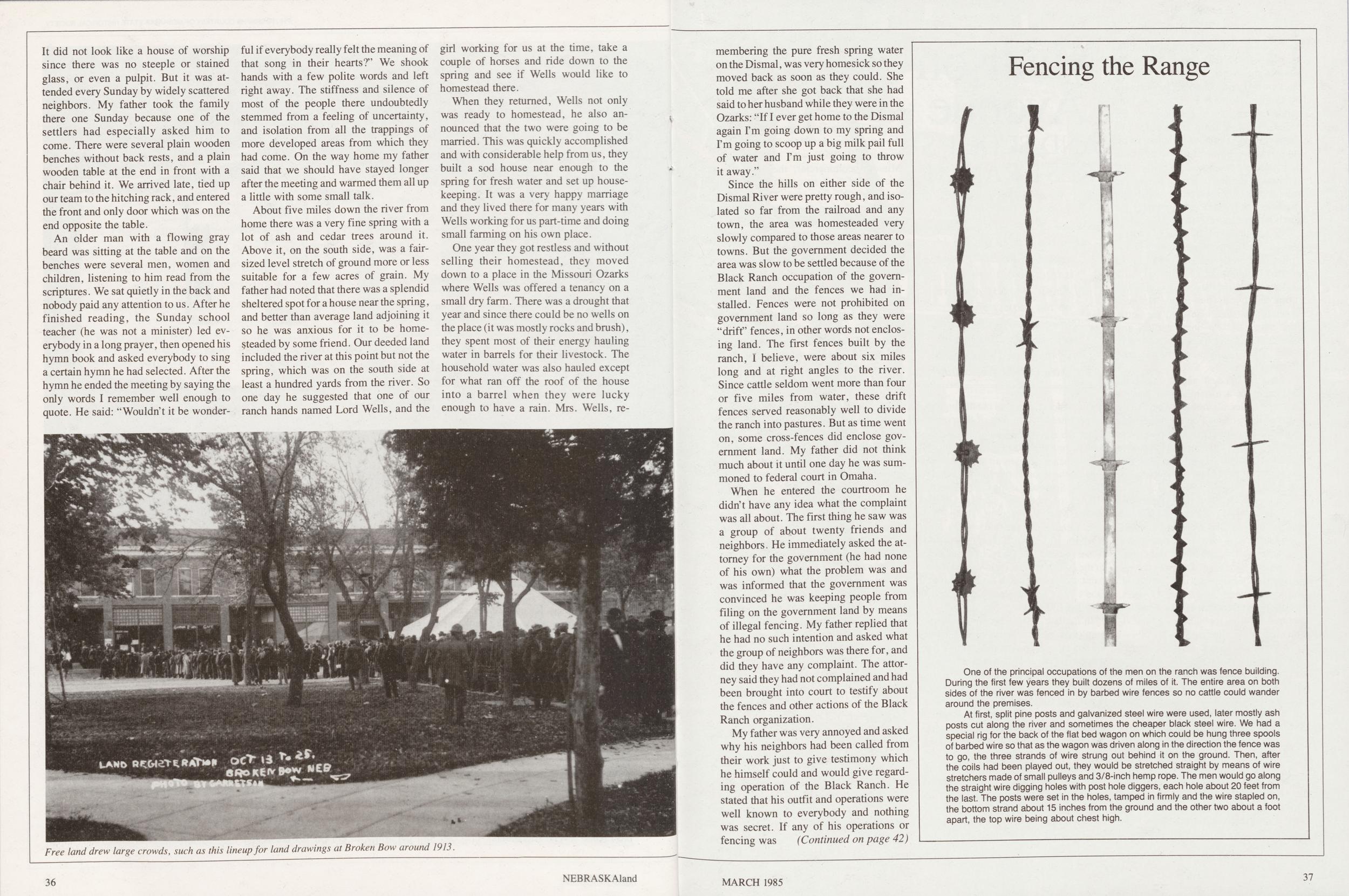 It did not look like a house of worship since there was no steeple or stained glass, or even a pulpit. But it was attended every Sunday by widely scattered neighbors. My father took the family there one Sunday because one of the settlers had especially asked him to come. There were several plain wooden benches without back rests, and a plain wooden table at the end in front with a chair behind it. We arrived late, tied up our team to the hitching rack, and entered the front and only door which was on the end opposite the table.
An elder man with a flowing gray beard was sitting at the table and on the benches were several men, women and children, listening to him read from the scriptures. We sat quietly in the back and nobody paid any attention to us. After he finished reading, the Sunday school teacher (he was not a minister) led everybody in a long prayer, then opened his hymn book and asked everybody to sing a certain hymn he had selected. After the hymn he ended the meeting by saying the only words I remember well enough to quote. He said: "Wouldn't it be wonderful if everybody really felt the meaning of that song in their hearts?" We shook hands with a few polite words and left right away. The stiffness and silence of most of the people there undoubtedly stemmed from a feeling of uncertainty, and isolation from all the trappings of more developed areas from which they had come. On the way home my father said that we should have stayed longer after the meeting and warmed them all up a little with some small talk.
About five miles down the river from home there was a very fine spring with a lot of ash and cedar trees around it. Above it, on the south side, was a fairsized level stretch of ground more or less suitable for a few acres of grain. My father had noted that there was a splendid sheltered spot for a house near the spring, and better than average land adjoining it so he was anxious for it to be homesteaded by some friend. Our deeded land included the river at this point but not the spring, which was on the south side at least a hundred yards from the river. So one day he suggested that one of our ranch hands named Lord Wells, and the girl working for us at the time, take a couple of horses and ride down to the spring and see if Wells would like to homestead there.
When they returned, Wells not only was ready to homestead, he also announced that the two were going to be married. This was quickly accomplished and with considerable help from us, they built a sod house near enough to the spring for fresh water and set up housekeeping. It was a very happy marriage and they lived there for many years with Wells working for us part-time and doing small farming on his own place.
One year they got restless and without selling their homestead, they moved down to a place in the Missouri Ozarks where Wells was offered a tenancy on a small dry farm. There was a drought that year and since there could be no wells on the place (it was mostly rocks and brush), they spent most of their energy hauling water in barrels for their livestock. The household water was also hauled except for what ran off the roof of the house into a barrel when they were lucky enough to have a rain. Mrs. Wells, remembering 36 NEBRASKAland the pure fresh spring water on the Dismal, was very homesick so they moved back as soon as they could. She told me after she got back that she had said to her husband while they were in the Ozarks: "If I ever get home to the Dismal again I'm going down to my spring and I'm going to scoop up a big milk pail full of water and I'm just going to throw it away."
Since the hills on either side of the Dismal River were pretty rough, and isolated so far from the railroad and any town, the area was homesteaded very slowly compared to those areas nearer to towns. But the government decided the area was slow to be settled because of the Black Ranch occupation of the government land and the fences we had installed. Fences were not prohibited on government land so long as they were "drift" fences, in other words not enclosing land. The first fences built by the ranch, I believe, were about six miles long and at right angles to the river. Since cattle seldom went more than four or five miles from water, these drift fences served reasonably well to divide the ranch into pastures. But as time went on, some cross-fences did enclose government land. My father did not think much about it until one day he was summoned to federal court in Omaha.
When he entered the courtroom he didn't have any idea what the complaint was all about. The first thing he saw was a group of about twenty friends and neighbors, He immediately asked the attorney for the government (he had none of his own) what the problem was and was informed that the government was convinced he was keeping people from filing on the government land by means of illegal fencing. My father replied that he had no such intention and asked what the group of neighbors was there for, and did they have any complaint. The attorney said they had not complained and had been brought into court to testify about the fences and other actions of the Black Ranch organization.
My father was very annoyed and asked why his neighbors had been called from their work just to give testimony which he himself could and would give regarding operation of the Black Ranch. He stated that his outfit and operations were well known to everybody and nothing was secret. If any of his operations or fencing was (Continued on page 42)
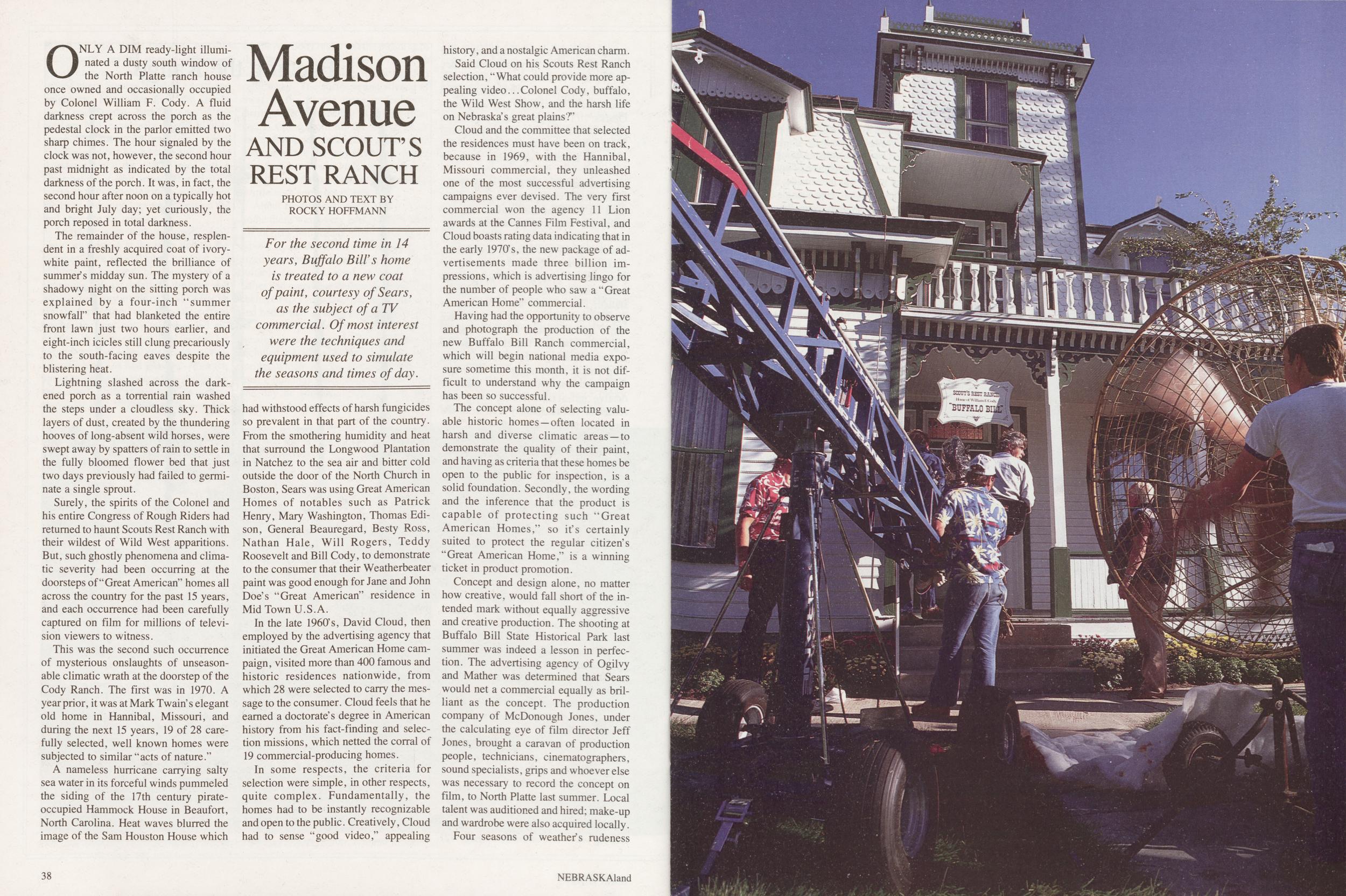
Madison Avenue AND SCOUT'S REST RANCH
PHOTOS AND TEXT BY ROCKY HOFFMANN For the second time in 14 years, Buffalo Bill's home is treated to a new coat of paint, courtesy of Sears, as the subject of a TV commercial. Of most interest were the techniques and equipement used to simulate the seasons and times of day.ONLY A DIM ready-light illuminated a dusty south window of the North Platte ranch house once owned and occasionally occupied by Colonel William F. Cody. A fluid darkness crept across the porch as the pedestal clock in the parlor emitted two sharp chimes. The hour signaled by the clock was not, however, the second hour past midnight as indicated by the total darkness of the porch. It was, in fact, the second hour after noon on a typically hot and bright July day; yet curiously, the porch reposed in total darkness.
The remainder of the house, resplendent in a freshly acquired coat of ivorywhite paint, reflected the brilliance of summer's midday sun. The mystery of a shadowy night on the sitting porch was explained by a four-inch ''summer snowfall" that had blanketed the entire front lawn just two hours earlier, and eight-inch icicles still clung precariously to the south-facing eaves despite the blistering heat.
Lightning slashed across the darkened porch as a torrential rain washed the steps under a cloudless sky. Thick layers of dust, created by the thundering hooves of long-absent wild horses, were swept away by spatters of rain to settle in the fully bloomed flower bed that just two days previously had failed to germinate a single sprout.
Surely, the spirits of the Colonel and his entire Congress of Rough Riders had returned to haunt Scouts Rest Ranch with their wildest of Wild West apparitions. But, such ghostly phenomena and climatic severity had been occurring at the doorsteps of "Great American" homes all across the country for the past 15 years, and each occurrence had been carefully captured on film for millions of television viewers to witness.
This was the second such occurrence of mysterious onslaughts of unseasonable climatic wrath at the doorstep of the Cody Ranch. The first was in 1970. A year prior, it was at Mark Twain's elegant old home in Hannibal, Missouri, and during the next 15 years, 19 of 28 carefully selected, well known homes were subjected to similar "acts of nature."
A nameless hurricane carrying salty sea water in its forceful winds pummeled the siding of the 17th century pirateoccupied Hammock House in Beaufort, North Carolina. Heat waves blurred the image of the Sam Houston House which had withstood effects of harsh fungicides so prevalent in that part of the country. From the smothering humidity and heat that surround the Longwood Plantation in Natchez to the sea air and bitter cold outside the door of the North Church in Boston, Sears was using Great American Homes of notables such as Patrick Henry, Mary Washington, Thomas Edison, General Beauregard, Besty Ross, Nathan Hale, Will Rogers, Teddy Roosevelt and Bill Cody, to demonstrate to the consumer that their Weatherbeater paint was good enough for Jane and John Doe's "Great American" residence in Mid Town U.S.A.
In the late 1960's, David Cloud, then employed by the advertising agency that initiated the Great American Home campaign, visited more than 400 famous and historic residences nationwide, from which 28 were selected to carry the message to the consumer. Cloud feels that he earned a doctorate's degree in American history from his fact-finding and selection missions, which netted the corral of 19 commercial-producing homes.
In some respects, the criteria for selection were simple, in other respects, quite complex. Fundamentally, the homes had to be instantly recognizable and open to the public. Creatively, Cloud had to sense "good video," appealing history, and a nostalgic American charm.
Said Cloud on his Scouts Rest Ranch selection, "What could provide more appealing video... Colonel Cody, buffalo, the Wild West Show, and the harsh life on Nebraska's great plains?'
Cloud and the committee that selected the residences must have been on track, because in 1969, with the Hannibal, Missouri commercial, they unleashed one of the most successful advertising campaigns ever devised. The very first commercial won the agency 11 Lion awards at the Cannes Film Festival, and Cloud boasts rating data indicating that in the early 1970's, the new package of advertisements made three billion im- pressions, which is advertising lingo for the number of people who saw a "Great American Home" commercial.
Having had the opportunity to observe and photograph the production of the new Buffalo Bill Ranch commercial, which will begin national media exposure sometime this month, it is not difficult to understand why the campaign has been so successful.
The concept alone of selecting valuable historic homes —often located in harsh and diverse climatic areas to demonstrate the quality of their paint, and having as criteria that these homes be open to the public for inspection, is a solid foundation. Secondly, the wording and the inference that the product is capable of protecting such "Great American Homes," so it's certainly suited to protect the regular citizen's "Great American Home," is a winning ticket in product promotion.
Concept and design alone, no matter how creative, would fall short of the intended mark without equally aggressive and creative production. The shooting at Buffalo Bill State Historical Park last summer was indeed a lesson in perfection. The advertising agency of Ogilvy and Mather was determined that Sears would net a commercial equally as brilliant as the concept. The production company of McDonough Jones, under the calculating eye of film director Jeff Jones, brought a caravan of production people, technicians, cinematographers, sound specialists, grips and whoever else was necessary to record the concept on film, to North Platte last summer. Local talent was auditioned and hired; make-up and wardrobe were also acquired locally.
Four seasons of weather's rudeness were incorporated into one 30-second commercial during a week of filming. To produce sandstorms on calm days, rain on clear days, snow on hot days and night during just plain days, Jones required the services of AA Special Effects, a company from Hollywood, actually Van Nuys, California.
38 NEBRASKAland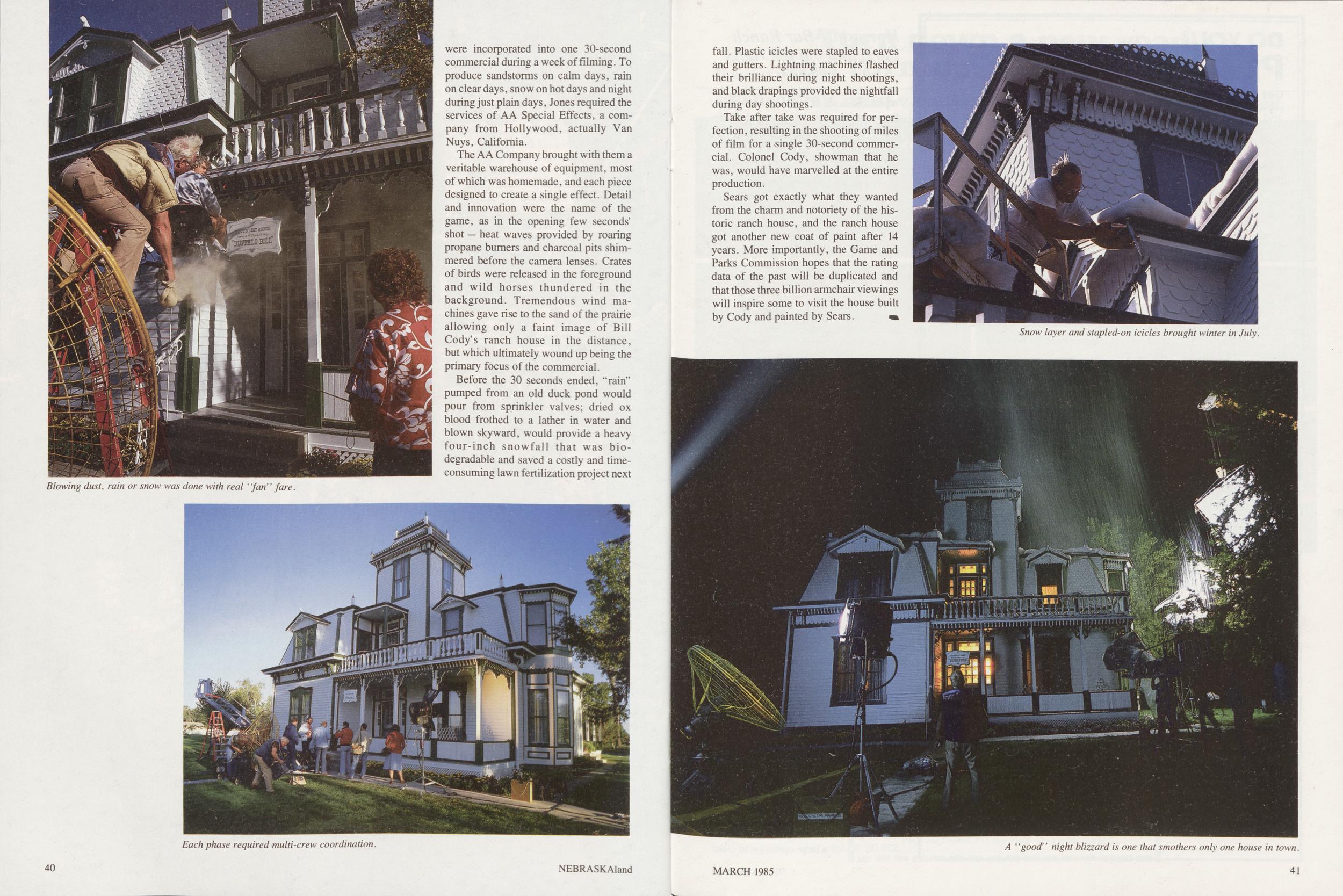
The AA Company brought with them a veritable warehouse of equipment, most of which was homemade, and each piece designed to create a single effect. Detail and innovation were the name of the game, as in the opening few seconds' shot — heat waves provided by roaring propane burners and charcoal pits shimmered before the camera lenses. Crates of birds were released in the foreground and wild horses thundered in the background. Tremendous wind machines gave rise to the sand of the prairie allowing only a faint image of Bill Cody's ranch house in the distance, but which ultimately wound up being the primary focus of the commercial.
Before the 30 seconds ended, "rain" pumped from an old duck pond would pour from sprinkler valves; dried ox blood frothed to a lather in water and blown skyward, would provide a heavy four-inch snowfall that was biodegradable and saved a costly and timeconsuming lawn fertilization project next 40 NEBRASKAland fall. Plastic icicles were stapled to eaves and gutters. Lightning machines flashed their brilliance during night shootings, and black drapings provided the nightfall during day shootings.
Take after take was required for perfection, resulting in the shooting of miles of film for a single 30-second commercial. Colonel Cody, showman that he was, would have marvelled at the entire production.
Sears got exactly what they wanted from the charm and notoriety of the historic ranch house, and the ranch house got another new coat of paint after years. More importantly, the Game and Parks Commission hopes that the rating data of the past will be duplicated and that those three billion armchair viewings will inspire some to visit the house built by Cody and painted by Sears.
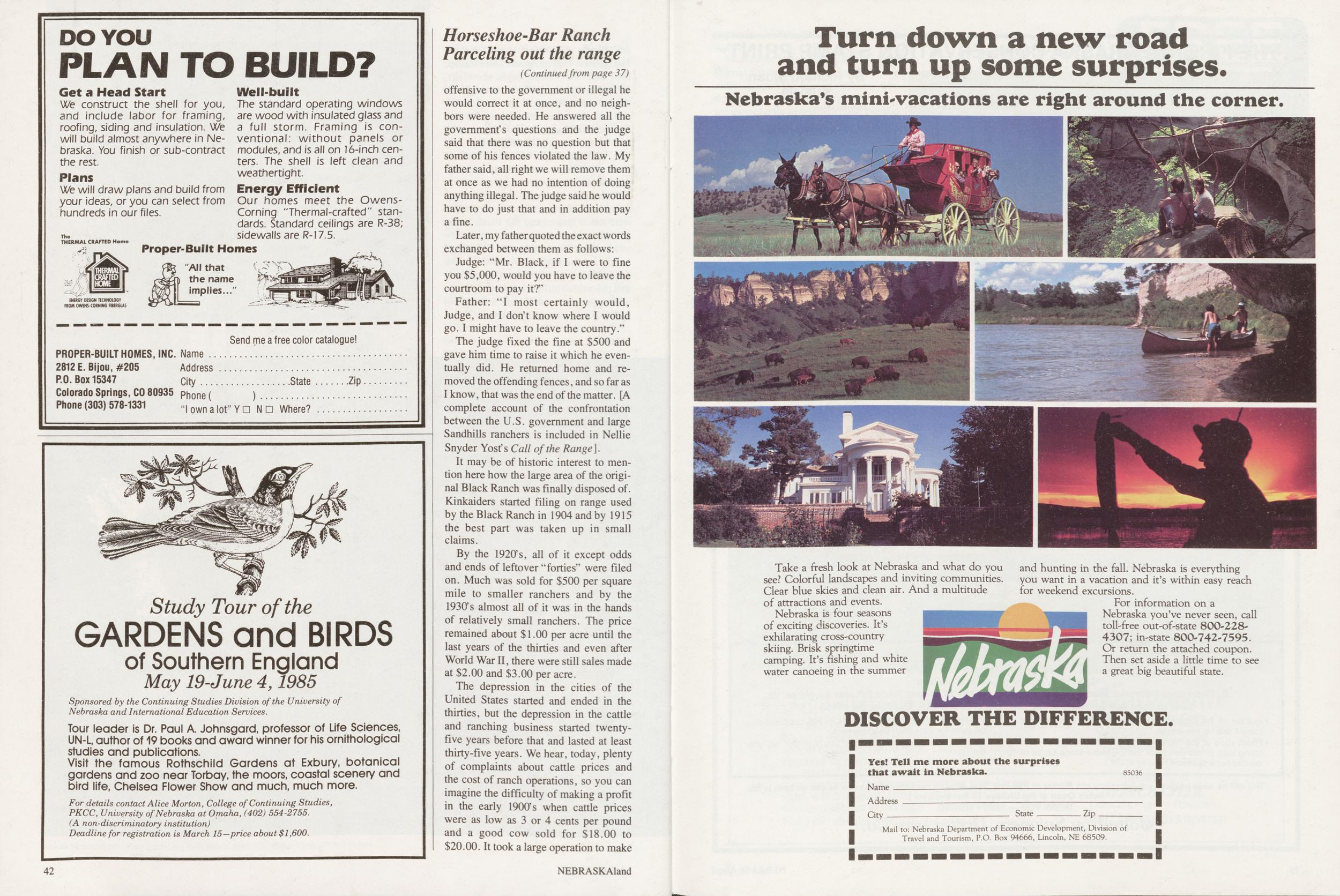 YOU PLAN TO BUILD? Get a Head Start We construct the shell for you, and include labor for framing, roofing, siding and insulation. We will build almost anywhere in Nebraska. You finish or sub-contract the rest. Plans We will draw plans and build from your ideas, or you can select from hundreds in our files. Well-built The standard operating windows are wood with insulated glass and a full storm. Framing is conventional: without panels or modules, and is all on 16-inch centers. The shell is left clean and weathertight. Energy Efficient Our homes meet the OwensCorning "Thermal-crafted" standards. Standard ceilings are R-38; The THERMAL CRAFTED Home sidewalls are R-17.5. Proper-Built Homes All that the name implies" ENERGY DESIGN TECHNOLOGY FROM OWENS-CORNING FIBERGUS Send me a free color catalogue! PROPER-BUILT HOMES, INC. Name 2812 E. Bijou, #205 Address P.O.Box15347 city State Colorado Springs, CO 80935 phone Phone (303) 578-1331 Where? Zip Study Tour of the GARDENS and BIRDS of Southern England May 19-June 4,1985 Sponsored by the Continuing Studies Division of the University of Nebraska and International Education Services. Tour leader is Dr. Paul A. Johnsgard, professor of Life Sciences, UNL, author of 19 books and award winner for his ornithological studies and publications. Visit the famous Rothschild Gardens at Exbury, botanical gardens and zoo near Torbay, the moors, coastal scenery and bird life, Chelsea Flower Show and much, much more. For details contact Alice Morton, College of Continuing Studies, PKCC, University of Nebraska at Omaha, (402) 554-2755. (A non-discriminatory institution) Deadline for registration is March 15—price about $1,600.
Horseshoe-Bar Ranch Parceling out the range
Continued from page 37)offensive to the government or illegal he would correct it at once, and no neighbors were needed. He answered all the government's questions and the judge said that there was no question but that some of his fences violated the law. My father said, all right we will remove them at once as we had no intention of doing anything illegal. The judge said he would have to do just that and in addition pay a fine.
Later, my father quoted the exact words exchanged between them as follows:
Judge: "Mr. Black, if I were to fine you $5,000, would you have to leave the courtroom to pay it?"
Father: "I most certainly would, Judge, and I don't know where I would go. I might have to leave the country."
The judge fixed the fine at $500 and gave him time to raise it which he eventually did. He returned home and removed the offending fences, and so far as I know, that was the end of the matter. A complete account of the confrontation between the U.S. government and large Sandhills ranchers is included in Nellie Snyder Yost's Call of the Range].
It may be of historic interest to mention here how the large area of the original Black Ranch was finally disposed of. Kinkaiders started filing on range used by the Black Ranch in 1904 and by 1915 the best part was taken up in small claims.
By the 1920's, all of it except odds and ends of leftover "forties" were filed on. Much was sold for $500 per square mile to smaller ranchers and by the 1930' s almost all of it was in the hands of relatively small ranchers. The price remained about $1.00 per acre until the last years of the thirties and even after World War II, there were still sales made at $2.00 and $3.00 per acre.
The depression in the cities of the United States started and ended in the thirties, but the depression in the cattle and ranching business started twentyfive years before that and lasted at least thirty-five years. We hear, today, plenty of complaints about cattle prices and the cost of ranch operations, so you can imagine the difficulty of making a profit in the early 1900' s when cattle prices were as low as 3 or 4 cents per pound and a good cow sold for $18.00 to $20.00. It took a large operation to make expenses. Money and credit were very scarce.
42 NEBRASKAland
Most cattle bought by my father for the Dismal River Ranch were southwestern cattle shipped up by big ranchers who were able to "carry the paper^; in other words, not only to sell the cattle, prepaid freight, but also furnish the financing for them.
Some were willing to do this because their market in the southwest was even worse than ours and they got more per head by making a deal with a northern rancher.
However, these deals were hard to come by and the entire history of the Black Ranch from its inception was one long fight to obtain enough cattle to make the operation pay. The operation was beginning to show substantial improvement by 1904 when the Kinkaid law went into effect, halting the progress and ultimately contributing significantly to its demise.
This is the sixth in a series of excerpts from an unpublished book manuscript about ranching on the Dismal River in Thomas County at the turn of the century. Author Roe R. Black lived on the ranch as a boy from 1900 to 1912 and now resides in Aurora. Nebraska.
The Nature Conservancy
(Continued from page 27)is a bit more than a foot high, with a strong stem and long, thin leaves. It grows from a tough, leathery, horizontal root that sends smaller, fibrous root structures down into the sand, thus enabling the plant to hang on in its unstable environment. About mid June, it issues striking flowers, densely set in compact, cylindrical clusters. The relatively large blossoms are milky blue at their peak of coloration, with delicate, internal lines providing magenta highlights.
According to one authority on Hay den's penstemon, Dr. Jim Stubben dieck of the University of Nebraska Lincoln, the Graves Ranch Preserve has some 800 of these plants, nearly one-third of the world's known population.
Al Steuter of the Niobrara Valley Preserve is also in charge of the Graves Ranch Preserve. "This plant needs raw, active blowouts to thrive, and it's not hard to achieve that—we would only have to run a few too many cows, and toss a bale of hay into the blowouts now and then to encourage cattle to go in and stir things up a bit. We hope that will keep us in penstemons," he said.
Blowout penstemons were numerous in the Sandhills during periods when wind erosion and blowouts were common. Modern range management has drastically reduced blowouts and improved grass cover, however, and thus eliminated most of the areas where the plants can grow. Paradoxically, these beautiful plants become endangered by what are otherwise considered good conservation practices.
Pawnee PrairieIn 1971, the Nature Conservancy purchased 320 acres adjacent to the Game and Parks Commission's Pawnee Prairie Wildlife Management Area in Pawnee County, and transferred the land to the Commission two years later. The Conservancy was able to act quickly when the land was placed on the market, and thus was able to preserve it until the state agency was able to act.
Today, Pawnee Prairie is managed as wildlife habitat for public hunting and fishing, along with remnants of the tallgrass prairie typical of eastern Nebraska before the region was settled.
Scotts Bluff National Monument AdditionThe Nature Conservancy purchased a 40-acre wheatfield at the base of Scotts Bluff, which was a critical inholding within Scotts Bluff National Monument. The property has been transferred to the National Park Service.
Cuming City Cemetery PrairieThis 11-acre remnant of tall-grass prairie near Blair was purchased by the Nature Conservancy, but is now owned and managed by Dana College. Its plant community includes big bluestem, little bluestem, Indiangrass and broadleaf plants.
Arapaho PrairieArapaho Prairie is 1,298 acres in the Sandhills of Arthur County. It was purchased by the Nature Conservancy in 1976, and leased to the University of Nebraska primarily for use as a research site and teaching laboratory under direction of UNL's Cedar Point Biological Station at Keystone.
Dr. Royce Ballinger of UNL calls the tract a good example of western Sandhills prairie, with a mix of tall-grass and short-grass prairie plants. Part of the area is recovering from abuse in the past, which included ill-advised farming during the Kinkaider era of the early 1900's, followed by a period of overgrazing.
Today, the tract is heavily used by scientists studying the components of its grasslands ecosystem. Present and past studies include grasshopper ecology; soil moisture and texture, and their relationship NEBRASKAland ship to various grass species; the Platte thistle and the insects that pollinate it and those that prey on its seeds; Sandhills lizards; and Sandhills small mammals.
Cather PrairieWilla Cather Memorial Prairie south of Red Cloud is a remnant of a mixed grass plant community, which combines characteristics of the tall-grass prairies of the east and the short-grass prairies of the west. The 610-acre tract was purchased by the Nature Conservancy in 1974, and is managed by a volunteer committee chaired by Dr. Hal Nagel of Kearney State College.
It was intended as a memorial to Red Cloud's famous author, whose writings were profoundly influenced by the prairie of her childhood. She reminisced about the beautiful wildflowers of the prairie, and was awed by the stands of big and little bluestem — "Miles of copperred grass drenched in sunlight that was stronger and fiercer than at any other time of the day." Many years of grazing have reduced the bluestem, giving other grasses a chance to become established. But, the wildflowers are still there, making up about 25 percent of a prairie plant community that includes about 250 species.
Wildlife is part of the prairie. Of course, the big animals native to the area, the bison and antelope, have been gone since before Willa Gather's time. But, white-tailed deer and coyotes still pass through, and bird life is abundant. More than 30 species have been identified there, including meadowlarks, grasshopper sparrows and upland sandpipers. And since the prairie's purchase in 1974, prairie chickens have returned to nest.
Dr. Nagel and his volunteers are slowly working Cather Prairie back to its original condition, coaxing its grasses and flowers through various stages of succession to heal the effects of years of overgrazing. Prescribed burning is one tool being used, with about half of the area treated each year.
The prairie is used to some extent for research. But, according to Dr. Nagel, its chief value is its easy accessibility to visitors. Cather Prairie lies right along U.S. Highway 281 just five miles south of Red Cloud, and travelers often stop to read the historical marker and admire the view. And, the prairie is included in the Cather Country Tour and Webster County Historical Tour. Dr. Nagel feels that more people might gain an appreciation for native grasslands with exposure to Cather Prairie and places like it.
Bookshelf
By Curt Twedt Mari Sandoz: Story Catcher of the Plains Helen Winter Stauffer University of Nebraska Press, Lincoln. 322 pp; black and white photographs; index; bibliography. $22.50, cloth; $10.95, paperback.WITH THE publication of Old Jules in 1935, Mari Sandoz came into prominence as a Great Plains novelist and historian. Her star continued to shine for more than 30 years, and the light remains undimmed over the years since her death in 1966. She wrote prolifically and authoritatively about many subjects, but her best writings bear the imprint of the Sandhills and High Plains country.
Helen W. Stauffer, professor of English at Kearney State College, has given us a highly readable, absorbing account of the life and literature of Mari Sandoz. The present work grew out of the author's doctoral research at the University of Nebraska-Lincoln.
Interviews and correspondence, 50 or more of each category, served as primary sources for Professor Stauffer. Additional sources included scores of articles from scholarly journals, newspapers and magazines, as well as material from archives held by UNL and Nebraska State Historical Society.
Several photographs offer glimpses of the writer from childhood to maturity. One picture shows Sandoz in conversation with another giant of Great Plains literature, John G. Neihardt.
Stauffer s biography is generally chronological. Sandoz's early years were spent in Sheridan County, followed by several stints at Lincoln where she attended University classes and worked at a number of jobs, including various duties with the State Historical Society. One of the more welcome touches employed by Stauffer is her use of excerpts from correspondence such as this one from a letter in which Sandoz described her reactions to the news that Old Jules had been selected the best non-fiction work by the Atlantic Press in 1935:
"nothing has ever had the same impact on me___I sent notice to Mother and then I had to go Vans [Melvin VandenBark, a University of Nebraska literature professor] to tell him. He stood leaning on a shovel...and after a while he began to talk naturally agai
After several years of publisher rejections and other frustrations that would have permanently discouraged most others, Mari Sandoz had won her first major battle. Many more triumphs were in store.
Aside from Old Jules, which for many and obvious reasons must have remained the author's personal high point, the "Trans-Missouri Series" gave Sandoz tremendous satisfaction. Three titles in that series — The Beaver Men, The Buffalo Hunters, and The Cattlemen trace the rich history of the roles played by these vanguards of settlement. Sandoz had, at one time or another, planned to write additional histories of Great Plains irrigated agriculture and petroleum development but neither project ever came to completion.
If you are one of those readers who may not have even browsed through a biography since student days, Mari Sandoz: Story Catcher of the Plains would be an excellent place to pick up again. It is likely that there were others whose youthful years could have forged a thoughtful view of Plains history as did the Story Catcher's Sheridan County days. We regret that more such views were not written down, but at the same time rejoice that Sandoz persisted and prevailed. We also rejoice that Professor Stauffer shows her talents so well as a guide over some interesting literary trails.
Old Jules and the three titles in the Trans-Missouri series are all available as University of Nebraska Press Bison Book paperbacks at prices ranging from $4.95 for Old Jules to $7.95 for The Cattlemen. Other Sandoz works reprinted by the press include Sandhills Sundays and Other Recollections; Old Jules Country; and Love Song to the Plains, all collected short pieces or excerpts from the major works.
48 NEBRASKAlandTrading Post
DOGSTRAINING ALL BREEDS Hunting dogs—Vizslas for sale. Rozanek Kennels, Rt. 2, Schuyler, NE 68661. Phone (402) 352-8769)
ENGLISH SETTERS and Pointers: Outstanding bloodlines! Puppies, started dogs, and stud service available. High Plains Kennels, 1411 Emerson, Alliance, NE 69301. Phone (308) 762-6709.
GERMAN SHORTHAIRS—English Pointers and Beagles—Stud service, puppies and started dogs. Wayne Clark, Box 54, Union, Nebr. 68455. Phone (402)263-3495 or 263-3155.
BRITTANY GUN DOGS. Puppies-started, trained. Bred to hunting standards. Free brochure. Grouseway Gundogs, Rt. 2, Box 158, Meadow Grove, NE 68752. (402) 634-2469.
AKC GERMAN Shepherds, quality bloodlines; guaran- teed sound, pedigrees furnished. Free brochure. DA-CO Kennels, Box 316, Meadow Grove, NE 68752. Phone (402)634-2605.
MISCELLANEOUSGUNS—Browning, Winchester, Remington, others, Hi-powers, shotguns, new, used, antiques. Want Pre-1964 Winchesters. Buy-Sell-Trade. Ph. (402) 729-6112. Bedlan's Sporting Goods, Fairbury, NE 68352.
FISH FOR SALE. Channel catfish, bass, bluegill, crappie, trout, perch, white bass, minnows, hybrid grass carp, bullhead. We can ship fish, you can pick them up, or we deliver. Contact the Pleasant Valley Fish Farm, Rt. 1, McCook, NE 69001. Phone (308) 345-6599.
CUT COFFEE COSTS: National coffee producer sells diiect, for fresher flavor and no middle-man markup. Packaged in 10-cup convenient packets. Ideal for home, office, and all outdoor activities. Samples and order details $ 10, refundable on first order. Coffee Fax, Dept. 251, Box 52, Greendale, WI 53129-0052.
WILD TURKEYS, pheasants, for sale. Taking orders for spring chicks. Four Pines Game Farm, Roca, Ne. Phone (402) 792-2039 or (402) 435-8159.
ON SCENIC Niobrara River south of Valentine, Nebraska, approximately 925 acres with 7/8-mile river frontage plus one mile trout fishing in Schlagel Creek; excellent deer and turkey hunting, panoramic cabin sites, landing strip possibility. Priced at $260 per acre for entire tract. Bob Gass Agency, 468 N. Main, Valentine, NE 69201.
AIR GUNS Repaired-Benjamin, Crosman, Daisy, other American made. Restoration; old guns wanted. Air Guns, 1225 No. 46th, Lincoln, NE 68503. Phone (402) 466-9223.
BEER KIT-everything to make 5 gallons of delicious homemade beer except bottles. Makes 50 bottles. Drink in 6 weeks. $39 includes tax and shipping. Omaha Supply Co., 13616 Polk St., Omaha, NE 68137. (402) 895-2803.
WE HAVE five two-year-old Buffalo bulls for sale outright or dressed, or you may spend a weekend at our Wildcat Hills Ranch and take a buffalo. For prices call Terry P. Brown (308) 783-1264 from 6 a.m. to 7 a.m.
CANOE ENTHUSIASTS. Quality and performance important? Mad River is the canoe for you! Mad River of Nebraska, 1231 Saunders, Lincoln, Nebraska 68521, Phone (402) 435-6588 or 205 Main, Springfield, NE 68059. Phone (402) 253-2000.
N.E. NEBRASKA TROUT Fishing. For rent Mon. Thurs. or Fri.-Sun. 2 modern cottages completely furnished. 5 spring-fed lakes with trout up to 7 lbs. Bass and bluegill also. Diamond E Trout Resort, Orchard, NE 68764. (402) 893-4745.
PRE-1914 NEBRASKA hunting licenses wanted for $30 and up in good condition. (402) 475-8279. Phil Pfeiffer, 641 So. 21st, Lincoln, NE 68510.
BROWN TROUT for borderline trout waters such as cooler sandpits. They will tolerate up to 82°F. Available January-February. Rainbow available March through May. Fattig Fish Hatchery, Brady, NE 69123. Phone (308) 584-3451.
LET'S GO FISHING! Take a day away from the office. Let us take care of all the hassles like getting the boat ready and running down the bait. Some of the best fishing in the state of Nebraska is right here on the scenic Missouri River near Nebraska City. M & C Guide Service out of Nebraska City, (402) 873-5981 or 873-6288 before 8 a.m. or after 5 p.m.
WESTERN BOOK CATALOG. Hundreds of titles on American West, ghost towns, old forts, etc. Free catalog. Research Unlimited, Box N., Main Street, Ames, NE 68621. Phone (402) 727-9833.
ATTENTION: Motor home and fifth-wheel owners who would like to drive to Alaska but don't have time to make a round trip, phone (402) 647-2265 between 7-10 p.m.
READY TO MOVE into 3-bedroom? A-Frame, full basement and building lots on beautiful Lake McConaughy. Call Jim Kimberling, Champion, Nebr. Phone (308) 882- 5898.
TAXIDERMYPE1STER TAXIDERMY~a name you can trust. We give you professional life-like work at prices most sportsmen can afford. Member National Taxidermist Association, #5 Regency, Place, Kearney, Nebr. 68847. Phone (308) 237-7575.
FREEZE-DRY TAXIDERMY Wally Allison's State Record Taxidermy, 2709 Birchwood, North Platte, NE 69101. Phone: (308) 534-2324. Specializing in Fish and Small Game, Snake and Lizard and Novelties. (Nothing too small) Newest of all taxidermy methods employed.
KARL SCHWARZ master taxidermist has moved to a new country studio; same professional mounting and tanning service. Schwarz Wild Wing Studio, 16804 South I80th St., Springfield, NE 68059. Phone (402) 253-2481.
BADE TAXIDERMY—Quality a must—Fast service. Fish, birds, rugs, tanning, full mounts and game heads. 2111 N. Christy St., Fremont, Nebraska 727-5463.
HOUSE OF BIRDS. Licensed taxidermist with 18 years experience. Specialize in birds and game heads. Pheasant $47.50, deer head $87.50, Quail $35 a pair. For more information call (402) 228-3959.
WHITETAIL TAXIDERMY. Federal and state licensed. Specialist in deer mounts and game birds. Unique poses and low prices. Phone (402) 564-6885, Columbus, Nebr.
CREATIVE TAXIDERMY in all its branches since 1935, now includes Northstar Freeze-Dry processing of approved small specimens. Also tanning and deer-skin processing. Naturecraft Studio. Nebraska City, Nebraska 68510. Joe Voges-Owner. Phone (402) 873-5491.
DINGES TAXIDERMY Studio, 2763 So. 12th St., Omaha, NE 68108. Fourteen-time National Award Winning Taxidermy. Trust your trophies to a proven winner. Complete professional service. Mike and Mary Dinges (402) 342-3718.
NABITY'S TAXIDERMY. 31 years experience. Specializing in natural grass backgrounds for mammals, birds and fish. 13901 "0"St., Lincoln, NE 68505 4 miles east of 84th and "O". (402) 489-6351.
BIG BEAR TAXIDERMY, Rt. 2, Mitchell, Nebraska 69357. We specialize in all big game from Alaska to Nebraska, also birds and fish. Hair-on and hair-eff tanning. 4V2 miles west of Scottsbluff on Highway 26. Dale Hubel, phone (308) 635-3013.
JOHNSON TAXIDERMY—servicing southwest Nebraska, specializing in big-game mounts, life-sized mounts, rug work, fish, birds, tanning hair-on leather. Brochure and price list on request. Johnson Taxidermy, Rt. 1, Box 78, Lamar, NE 69035. Telephone (308) 882- 5555.
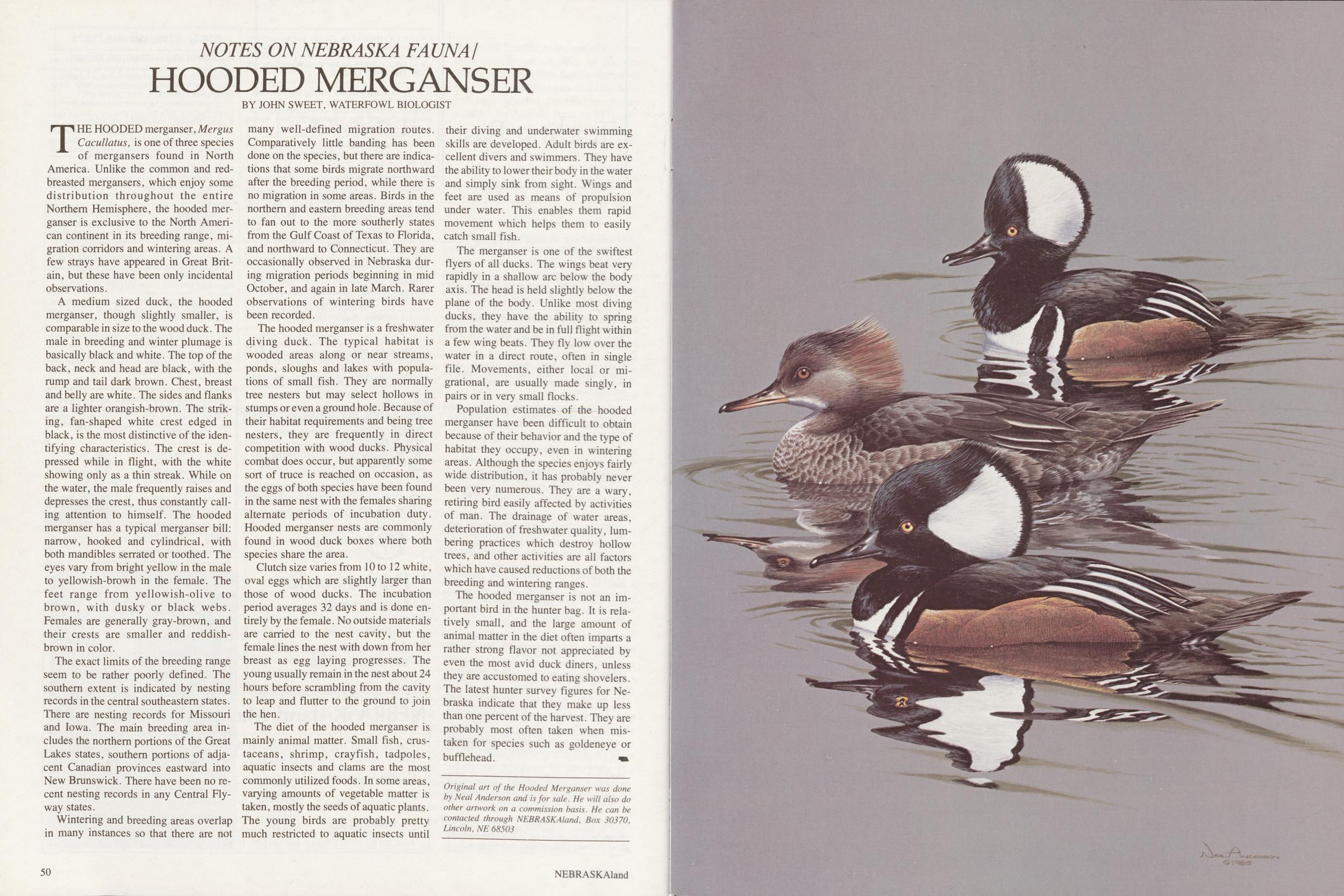
NOTES ON NEBRASKA FAUNA HOODED MERGANSER
BY JOHN SWEET, WATERFOWL BIOLOGISTTHE HOODED merganser,Mergus Cacullatus, is one of three species of mergansers found in North America. Unlike the common and redbreasted mergansers, which enjoy some distribution throughout the entire Northern Hemisphere, the hooded merganser is exclusive to the North American continent in its breeding range, migration corridors and wintering areas. A few strays have appeared in Great Britain, but these have been only incidental observations.
A medium sized duck, the hooded merganser, though slightly smaller, is comparable in size to the wood duck. The male in breeding and winter plumage is basically black and white. The top of the back, neck and head are black, with the rump and tail dark brown. Chest, breast and belly are white. The sides and flanks are a lighter orangish-brown. The striking, fan-shaped white crest edged in black, is the most distinctive of the identifying characteristics. The crest is depressed while in flight, with the white showing only as a thin streak. While on the water, the male frequently raises and depresses the crest, thus constantly calling attention to himself. The hooded merganser has a typical merganser bill: narrow, hooked and cylindrical, with both mandibles serrated or toothed. The eyes vary from bright yellow in the male to yellowish-browh in the female. The feet range from yellowish-olive to brown, with dusky or black webs. Females are generally gray-brown, and their crests are smaller and reddishbrown in color.
The exact limits of the breeding range seem to be rather poorly defined. The southern extent is indicated by nesting records in the central southeastern states. There are nesting records for Missouri and Iowa. The main breeding area includes the northern portions of the Great Lakes states, southern portions of adjacent Canadian provinces eastward into New Brunswick. There have been no recent nesting records in any Central Flyway states.
Wintering and breeding areas overlap in many instances so that there are not many well-defined migration routes. Comparatively little banding has been done on the species, but there are indications that some birds migrate northward after the breeding period, while there is no migration in some areas. Birds in the northern and eastern breeding areas tend to fan out to the more southerly states from the Gulf Coast of Texas to Florida, and northward to Connecticut. They are occasionally observed in Nebraska during migration periods beginning in mid October, and again in late March. Rarer observations of wintering birds have been recorded.
The hooded merganser is a freshwater diving duck. The typical habitat is wooded areas along or near streams, ponds, sloughs and lakes with populations of small fish. They are normally tree nesters but may select hollows in stumps or even a ground hole. Because of their habitat requirements and being tree nesters, they are frequently in direct competition with wood ducks. Physical combat does occur, but apparently some sort of truce is reached on occasion, as the eggs of both species have been found in the same nest with the females sharing alternate periods of incubation duty. Hooded merganser nests are commonly found in wood duck boxes where both species share the area.
Clutch size varies from 10 to 12 white, oval eggs which are slightly larger than those of wood ducks. The incubation period averages 32 days and is done entirely by the female. No outside materials are carried to the nest cavity, but the female lines the nest with down from her breast as egg laying progresses. The young usually remain in the nest about 24 hours before scrambling from the cavity to leap and flutter to the ground to join the hen.
The diet of the hooded merganser is mainly animal matter. Small fish, crustaceans, shrimp, crayfish, tadpoles, aquatic insects and clams are the most commonly utilized foods. In some areas, varying amounts of vegetable matter is taken, mostly the seeds of aquatic plants. The young birds are probably pretty much restricted to aquatic insects until their diving and underwater swimming skills are developed. Adult birds are excellent divers and swimmers. They have the ability to lower their body in the water and simply sink from sight. Wings and feet are used as means of propulsion under water. This enables them rapid movement which helps them to easily catch small fish.
The merganser is one of the swiftest flyers of all ducks. The wings beat very rapidly in a shallow arc below the body axis. The head is held slightly below the plane of the body. Unlike most diving ducks, they have the ability to spring from the water and be in full flight within a few wing beats. They fly low over the water in a direct route, often in single file. Movements, either local or migrational, are usually made singly, in pairs or in very small flocks.
Population estimates of the hooded merganser have been difficult to obtain because of their behavior and the type of habitat they occupy, even in wintering areas. Although the species enjoys fairly wide distribution, it has probably never been very numerous. They are a wary, retiring bird easily affected by activities of man. The drainage of water areas, deterioration of freshwater quality, lumbering practices which destroy hollow trees, and other activities are all factors which have caused reductions of both the breeding and wintering ranges.
The hooded merganser is not an important bird in the hunter bag. It is relatively small, and the large amount of animal matter in the diet often imparts a rather strong flavor not appreciated by even the most avid duck diners, unless they are accustomed to eating shovelers. The latest hunter survey figures for Nebraska indicate that they make up less than one percent of the harvest. They are probably most often taken when mistaken for species such as goldeneye or bufflehead.
Original art of the Hooded Merganser was done by Neal Anderson and is for sale. He will also do other artwork on a commission basis. He can be contacted through NEBRASKA land, Box 30370, Lincoln, NE 68503 50 NEBRASKAland
Position: 541 (20 views)