Volume 63, Issue 1, 1985
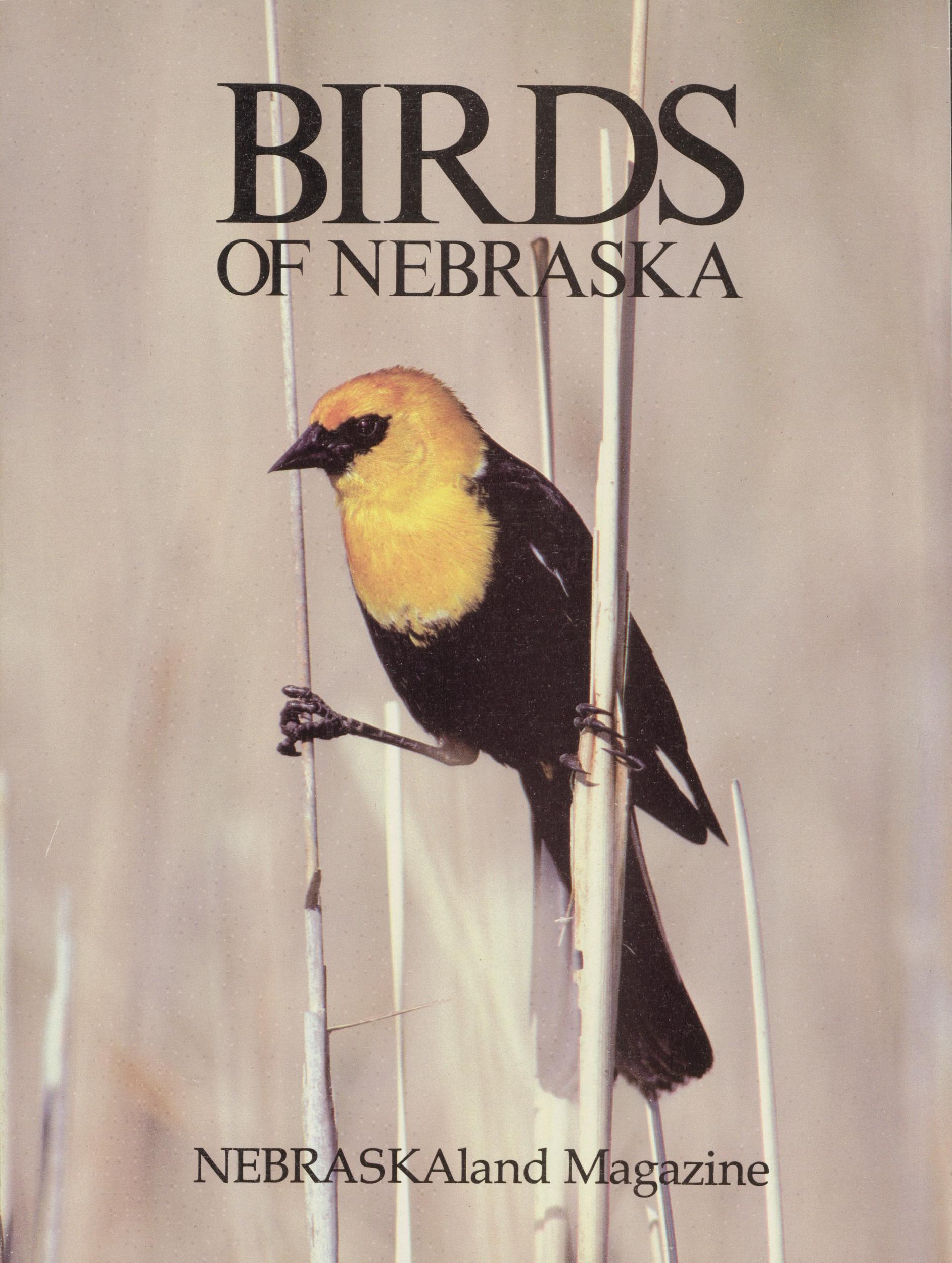
BIRDS OF NEBRASKA
NEBRASKAland Magazine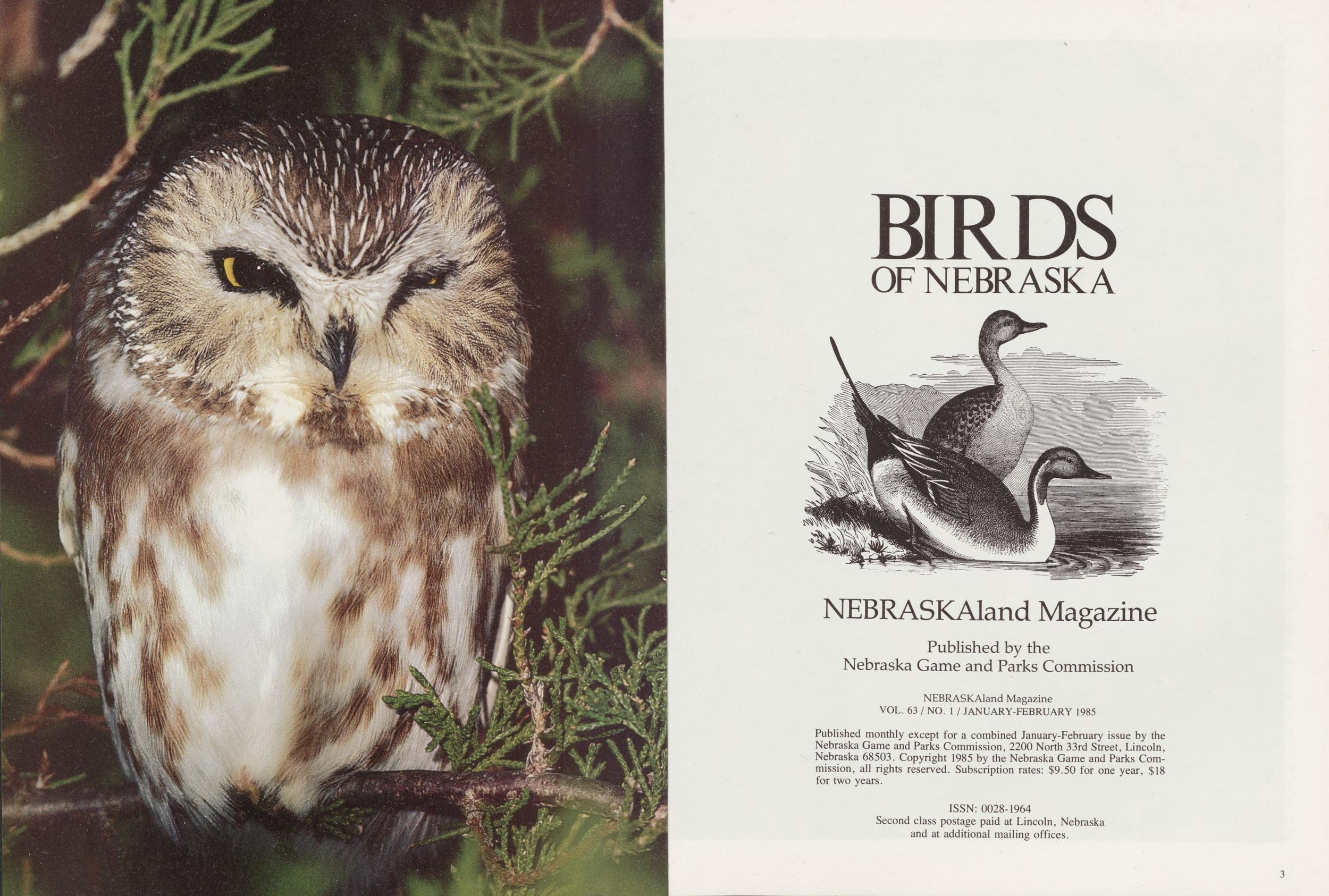
BIRDS OF NEBRASKA
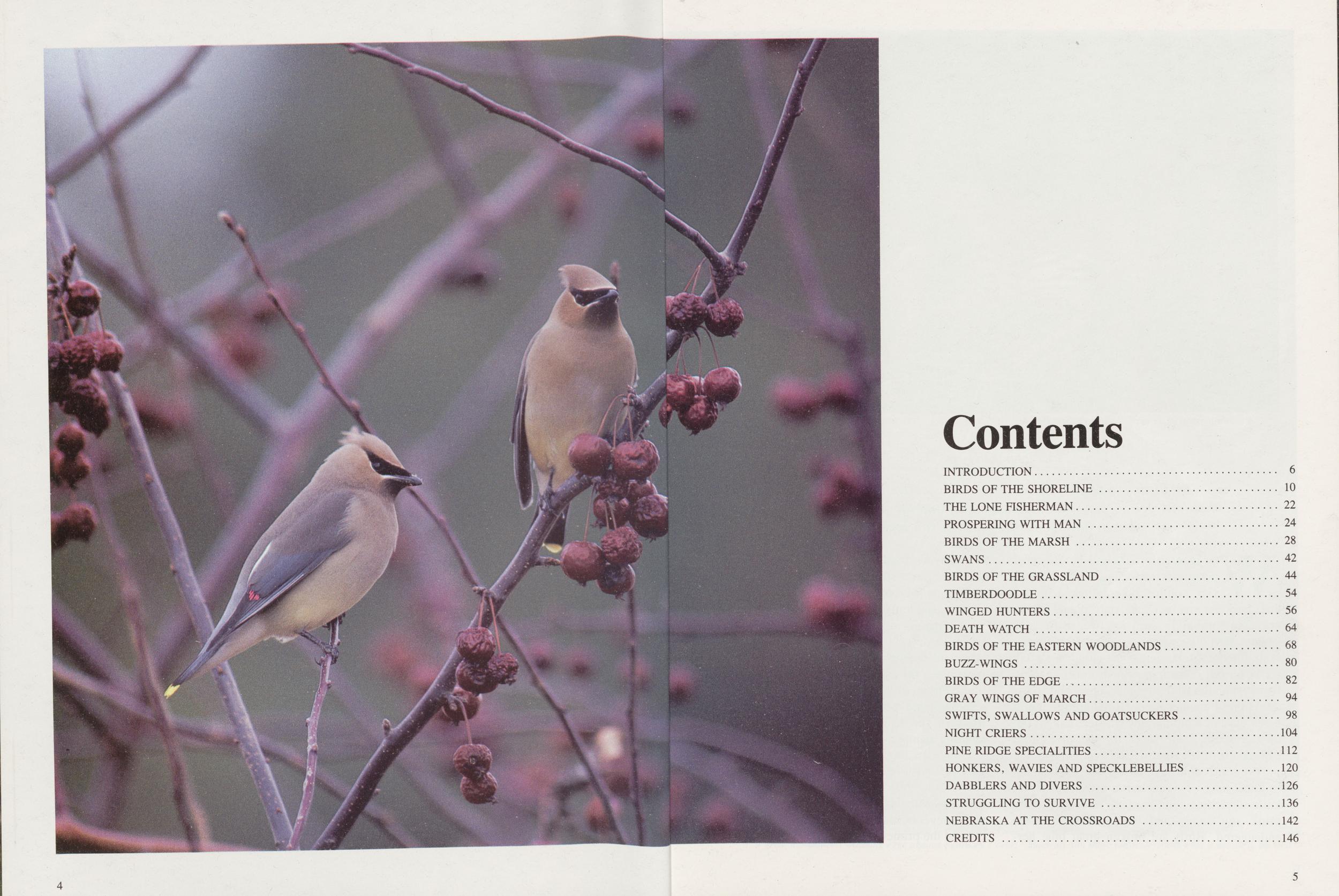
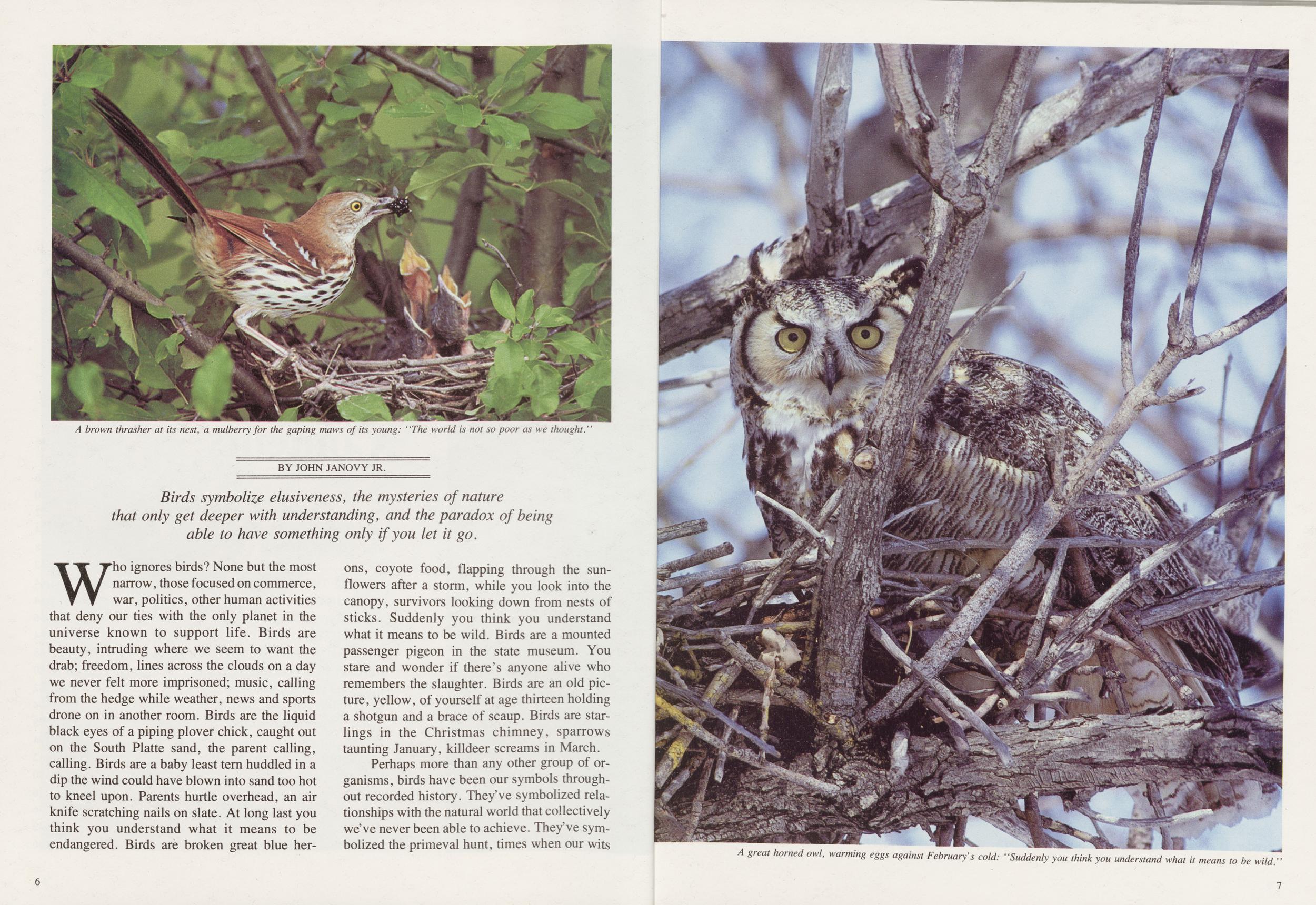
Who ignores birds? None but the most narrow, those focused on commerce, war, politics, other human activities that deny our ties with the only planet in the universe known to support life. Birds are beauty, intruding where we seem to want the drab; freedom, lines across the clouds on a day we never felt more imprisoned; music, calling from the hedge while weather, news and sports drone on in another room. Birds are the liquid black eyes of a piping plover chick, caught out on the South Platte sand, the parent calling, calling. Birds are a baby least tern huddled in a dip the wind could have blown into sand too hot to kneel upon. Parents hurtle overhead, an air knife scratching nails on slate. At long last you think you understand what it means to be endangered. Birds are broken great blue herons, coyote food, flapping through the sunflowers after a storm, while you look into the canopy, survivors looking down from nests of sticks. Suddenly you think you understand what it means to be wild. Birds are a mounted passenger pigeon in the state museum. You stare and wonder if there's anyone alive who remembers the slaughter. Birds are an old picture, yellow, of yourself at age thirteen holding a shotgun and a brace of scaup. Birds are starlings in the Christmas chimney, sparrows taunting January, killdeer screams in March.
Perhaps more than any other group of organisms, birds have been our symbols through- out recorded history. They've symbolized relationships with the natural world that collectively we've never been able to achieve. They've symbolized the primeval hunt, times when our wits were matched against something less tamed than our fellow humans. They've symbolized elusiveness, the mysteries of nature that only get deeper with understanding, and the paradox of being able to have something only if you let it go. Of all the things that birds have symbolized, it is perhaps this last that puts into perspective our demands that things be "of value." A cardinal is not a cardinal if it's in a cage. A new idea dies as the baby robin if it can't fledge.
6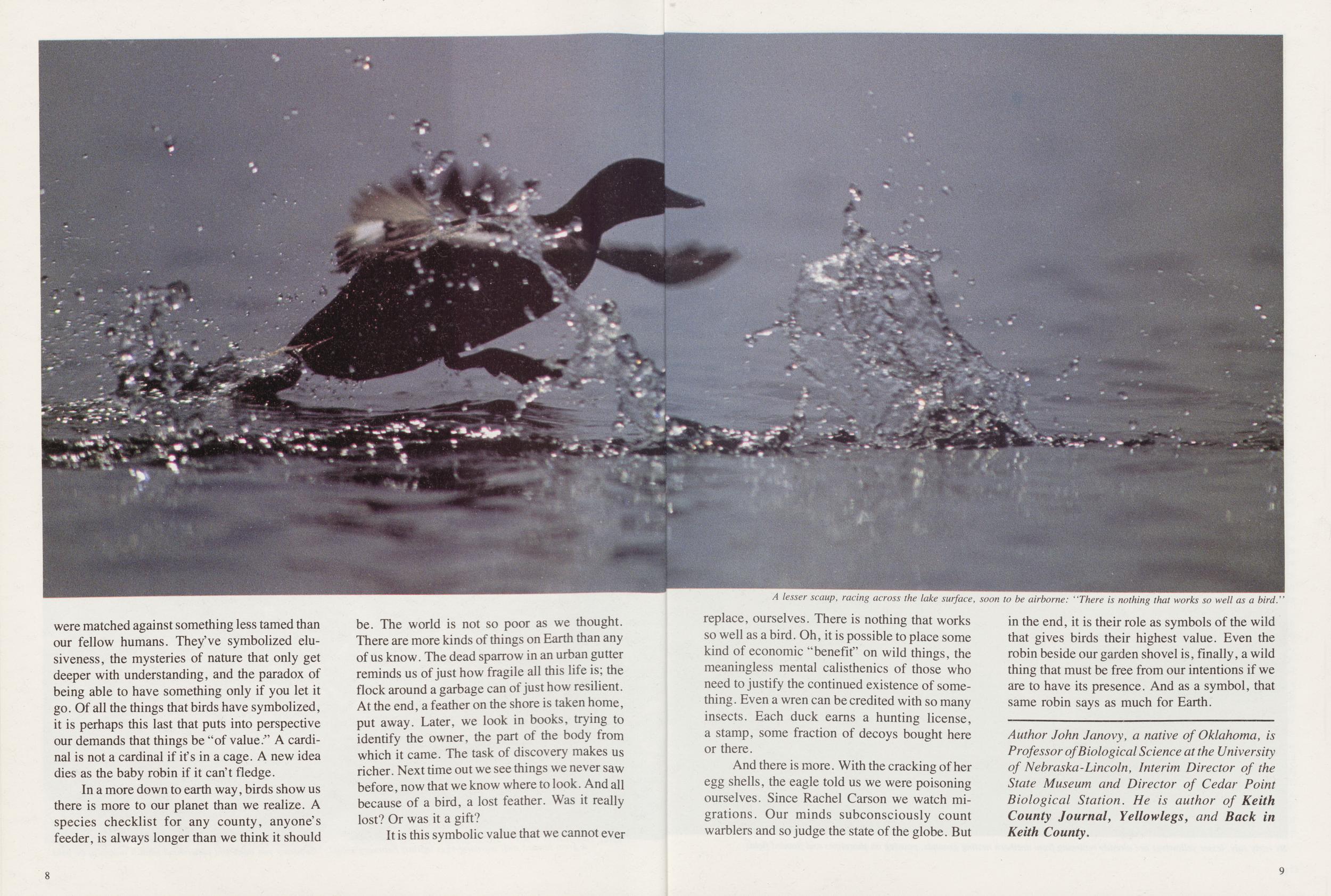
In a more down to earth way, birds show us there is more to our planet than we realize. A species checklist for any county, anyone's feeder, is always longer than we think it should be. The world is not so poor as we thought. There are more kinds of things on Earth than any of us know. The dead sparrow in an urban gutter reminds us of just how fragile all this life is; the flock around a garbage can of just how resilient. At the end, a feather on the shore is taken home, put away. Later, we look in books, trying to identify the owner, the part of the body from which it came. The task of discovery makes us richer. Next time out we see things we never saw before, now that we know where to look. And all because of a bird, a lost feather. Was it really lost? Or was it a gift?
It is this symbolic value that we cannot ever 8 replace, ourselves. There is nothing that works so well as a bird. Oh, it is possible to place some kind of economic "benefit" on wild things, the meaningless mental calisthenics of those who need to justify the continued existence of something. Even a wren can be credited with so many insects. Each duck earns a hunting license, a stamp, some fraction of decoys bought here or there.
And there is more. With the cracking of her egg shells, the eagle told us we were poisoning ourselves. Since Rachel Carson we watch migrations. Our minds subconsciously count warblers and so judge the state of the globe. But in the end, it is their role as symbols of the wild that gives birds their highest value. Even the robin beside our garden shovel is, finally, a wild thing that must be free from our intentions if we are to have its presence. And as a symbol, that same robin says as much for Earth.
Author John Janovy, a native of Oklahoma, is Professor of Biological Science at the University of Nebraska-Lincoln, Interim Director of the State Museum and Director of Cedar Point Biological Station. He is author of Keith County Journal, Yellowlegs, and Back in Keith County. 9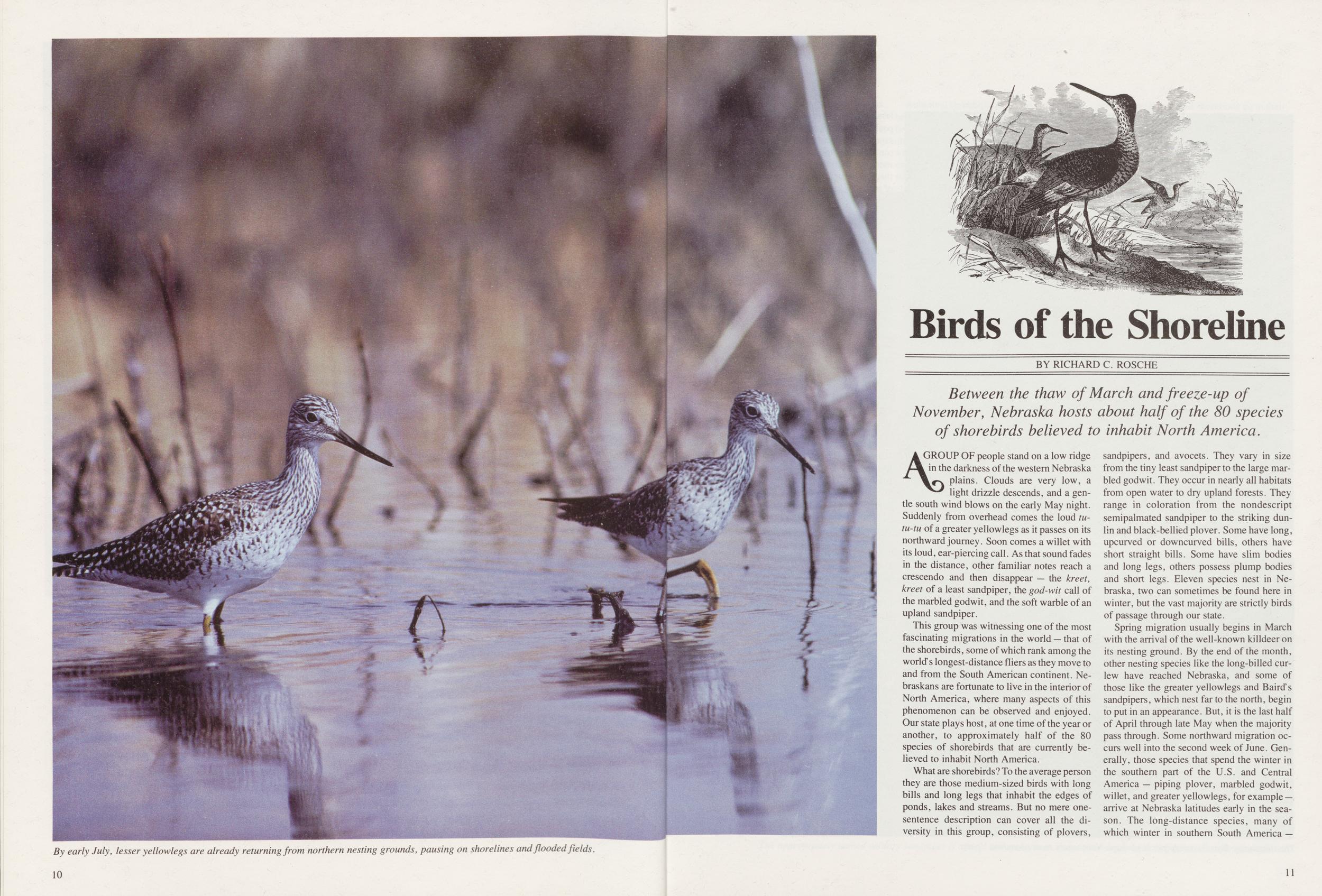
Birds of the Shoreline
BY RICHARD C. ROSCHE Between the thaw of March and freeze-up of November, Nebraska hosts about half of the 80 species of shorebirds believed to inhabit North America.A GROUP OF people stand on a low ridge in the darkness of the western Nebraska plains. Clouds are very low, a light drizzle descends, and a gentle south wind blows on the early May night. Suddenly from overhead comes the loud tu-tu-tu of a greater yellowlegs as it passes on its northward journey. Soon comes a willet with its loud, ear-piercing call. As that sound fades in the distance, other familiar notes reach a crescendo and then disappear — the kreet, kreet of a least sandpiper, the god-wit call of the marbled godwit, and the soft warble of an upland sandpiper.
This group was witnessing one of the most fascinating migrations in the world — that of the shorebirds, some of which rank among the world's longest-distance fliers as they move to and from the South American continent. Nebraskans are fortunate to live in the interior of North America, where many aspects of this phenomenon can be observed and enjoyed. Our state plays host, at one time of the year or another, to approximately half of the 80 species of shorebirds that are currently believed to inhabit North America.
What are shorebirds? To the average person they are those medium-sized birds with long bills and long legs that inhabit the edges of ponds, lakes and streams. But no mere onesentence description can cover all the diversity in this group, consisting of plovers, sandpipers, and avocets. They vary in size from the tiny least sandpiper to the large marbled godwit. They occur in nearly all habitats from open water to dry upland forests. They range in coloration from the nondescript semipalmated sandpiper to the striking dunlin and black-bellied plover. Some have long, upcurved or downcurved bills, others have short straight bills. Some have slim bodies and long legs, others possess plump bodies and short legs. Eleven species nest in Nebraska, two can sometimes be found here in winter, but the vast majority are strictly birds of passage through our state.
Spring migration usually begins in March with the arrival of the well-known killdeer on its nesting ground. By the end of the month, other nesting species like the long-billed curlew have reached Nebraska, and some of those like the greater yellowlegs and Baird's sandpipers, which nest far to the north, begin to put in an appearance. But, it is the last half of April through late May when the majority pass through. Some northward migration occurs well into the second week of June. Generally, those species that spend the winter in the southern part of the U.S. and Central America — piping plover, marbled godwit, willet, and greater yellowlegs, for example arrive at Nebraska latitudes early in the season. The long-distance species, many of which winter in southern South America — lesser golden plover, Hudsonian godwit, and pectoral, Baird's, upland, and buff-breasted sandpipers — pass northward later in the season. The later migrants also seem to be much more in a hurry to get to their nesting grounds than the earlier ones, for the whole migration of a species can occur within only a few days, especially if weather conditions are favorable for flying.
11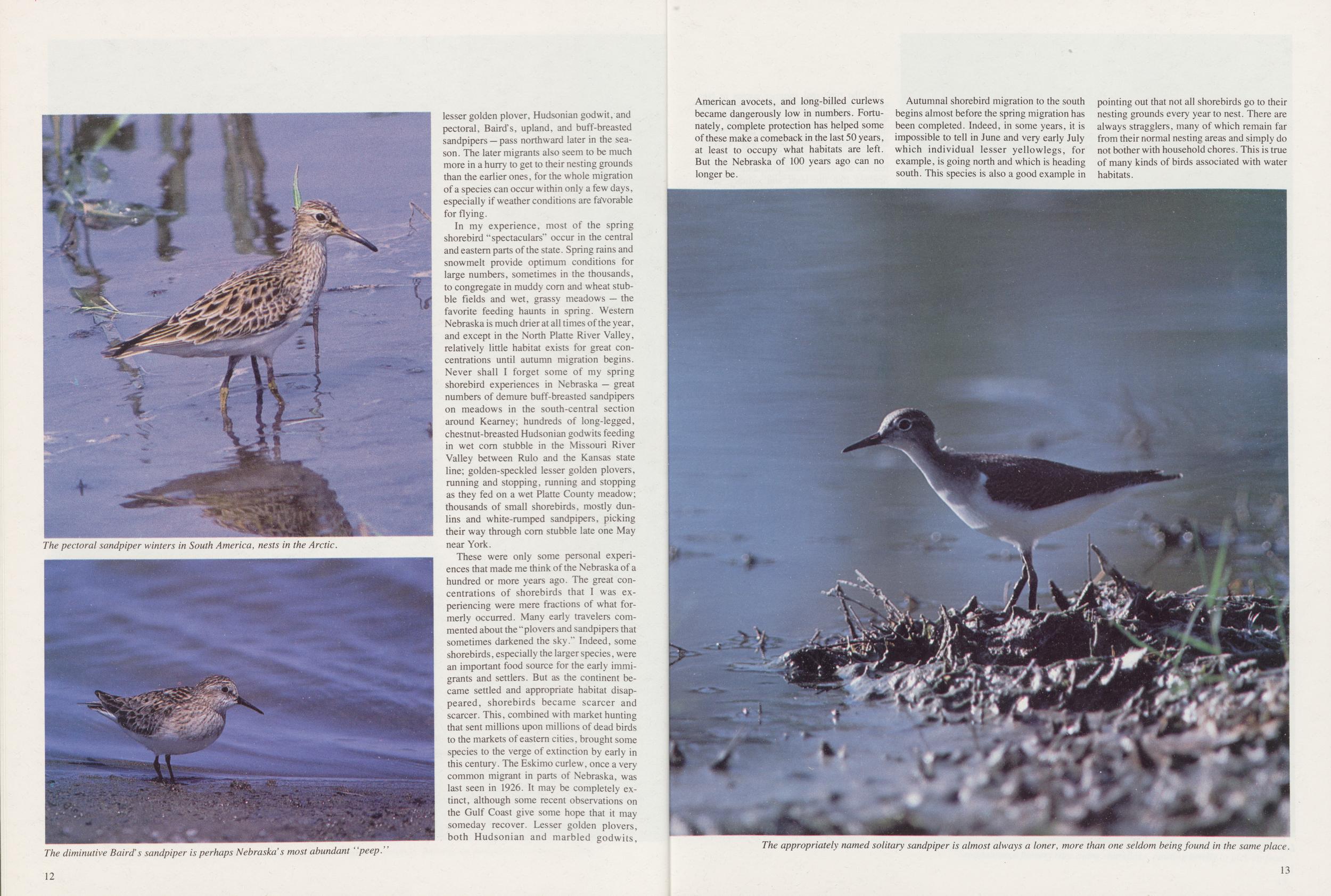
In my experience, most of the spring shorebird "spectaculars"' occur in the central and eastern parts of the state. Spring rains and snowmelt provide optimum conditions for large numbers, sometimes in the thousands, to congregate in muddy corn and wheat stubble fields and wet, grassy meadows — the favorite feeding haunts in spring. Western Nebraska is much drier at all times of the year, and except in the North Platte River Valley, relatively little habitat exists for great concentrations until autumn migration begins. Never shall I forget some of my spring shorebird experiences in Nebraska — great numbers of demure buff-breasted sandpipers on meadows in the south-central section around Kearney; hundreds of long-legged, chestnut-breasted Hudsonian godwits feeding in wet corn stubble in the Missouri River Valley between Rulo and the Kansas state line; golden-speckled lesser golden plovers, running and stopping, running and stopping as they fed on a wet Platte County meadow; thousands of small shorebirds, mostly dunlins and white-rumped sandpipers, picking their way through corn stubble late one May near York.
These were only some personal experiences that made me think of the Nebraska of a hundred or more years ago. The great concentrations of shorebirds that I was experiencing were mere fractions of what formerly occurred. Many early travelers commented about the "plovers and sandpipers that sometimes darkened the sky." Indeed, some shorebirds, especially the larger species, were an important food source for the early immigrants and settlers. But as the continent be- came settled and appropriate habitat disappeared, shorebirds became scarcer and scarcer. This, combined with market hunting that sent millions upon millions of dead birds to the markets of eastern cities, brought some species to the verge of extinction by early in this century. The Eskimo curlew, once a very common migrant in parts of Nebraska, was last seen in 1926. It may be completely extinct, although some recent observations on the Gulf Coast give some hope that it may someday recover. Lesser golden plovers, both Hudsonian and marbled godwits, 12 American avocets, and long-billed curlews became dangerously low in numbers. Fortunately, complete protection has helped some of these make a comeback in the last 50 years, at least to occupy what habitats are left. But the Nebraska of 100 years ago can no longer be.
Autumnal shorebird migration to the south begins almost before the spring migration has been completed. Indeed, in some years, it is impossible to tell in June and very early July which individual lesser yellowlegs, for example, is going north and which is heading south. This species is also a good example in pointing out that not all shorebirds go to their nesting grounds every year to nest. There are always stragglers, many of which remain far from their normal nesting areas and simply do not bother with household chores. This is true of many kinds of birds associated with water habitats.
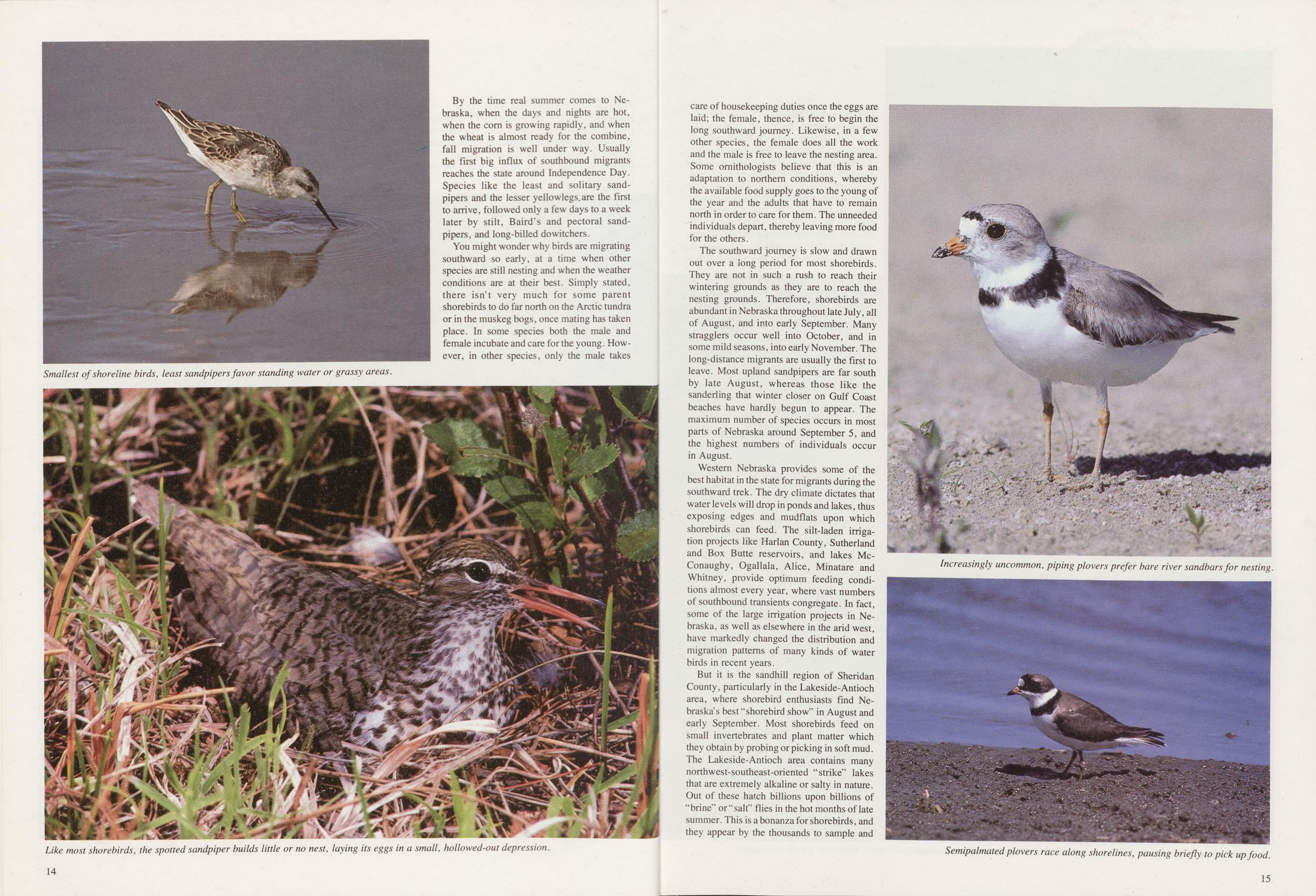
By the time real summer comes to Nebraska, when the days and nights are hot, when the corn is growing rapidly, and when the wheat is almost ready for the combine, fall migration is well under way. Usually the first big influx of southbound migrants reaches the state around Independence Day. Species like the least and solitary sandpipers and the lesser yellowlegs. are the first to arrive, followed only a few days to a week later by stilt, Baird's and pectoral sandpipers, and long-billed dowitchers.
You might wonder why birds are migrating southward so early, at a time when other species are still nesting and when the weather conditions are at their best. Simply stated, there isn't very much for some parent shorebirds to do far north on the Arctic tundra or in the muskeg bogs, once mating has taken place. In some species both the male and female incubate and care for the young. However, in other species, only the male takes Smallest of shoreline birds, least sandpipers favor standing water or grassy areas. care of housekeeping duties once the eggs are laid; the female, thence, is free to begin the long southward journey. Likewise, in a few other species, the female does all the work and the male is free to leave the nesting area. Some ornithologists believe that this is an adaptation to northern conditions, whereby the available food supply goes to the young of the year and the adults that have to remain north in order to care for them. The unneeded individuals depart, thereby leaving more food for the others.
The southward journey is slow and drawn out over a long period for most shorebirds. They are not in such a rush to reach their wintering grounds as they are to reach the nesting grounds. Therefore, shorebirds are abundant in Nebraska throughout late July, all of August, and into early September. Many stragglers occur well into October, and in some mild seasons, into early November. The long-distance migrants are usually the first to leave. Most upland sandpipers are far south by late August, whereas those like the sanderling that winter closer on Gulf Coast beaches have hardly begun to appear. The maximum number of species occurs in most parts of Nebraska around September 5, and the highest numbers of individuals occur in August.
Western Nebraska provides some of the best habitat in the state for migrants during the southward trek. The dry climate dictates that water levels will drop in ponds and lakes, thus exposing edges and mudflats upon which shorebirds can feed. The silt-laden irrigation projects like Harlan County, Sutherland and Box Butte reservoirs, and lakes McConaughy, Ogallala, Alice, Minatare and Whitney, provide optimum feeding conditions almost every year, where vast numbers of southbound transients congregate. In fact, some of the large irrigation projects in Nebraska, as well as elsewhere in the arid west, have markedly changed the distribution and migration patterns of many kinds of water birds in recent years.
But it is the sandhill region of Sheridan County, particularly in the Lakeside-Antioch area, where shorebird enthusiasts find Nebraska's best"shorebird show" in August and early September. Most shorebirds feed on small invertebrates and plant matter which they obtain by probing or picking in soft mud. The Lakeside-Antioch area contains many northwest-southeast-oriented "strike" lakes that are extremely alkaline or salty in nature. Out of these hatch billions upon billions of "brine" or "salt" flies in the hot months of late summer. This is a bonanza for shorebirds, and they appear by the thousands to sample and feed upon those delicacies in preparation for the continuance of flight.
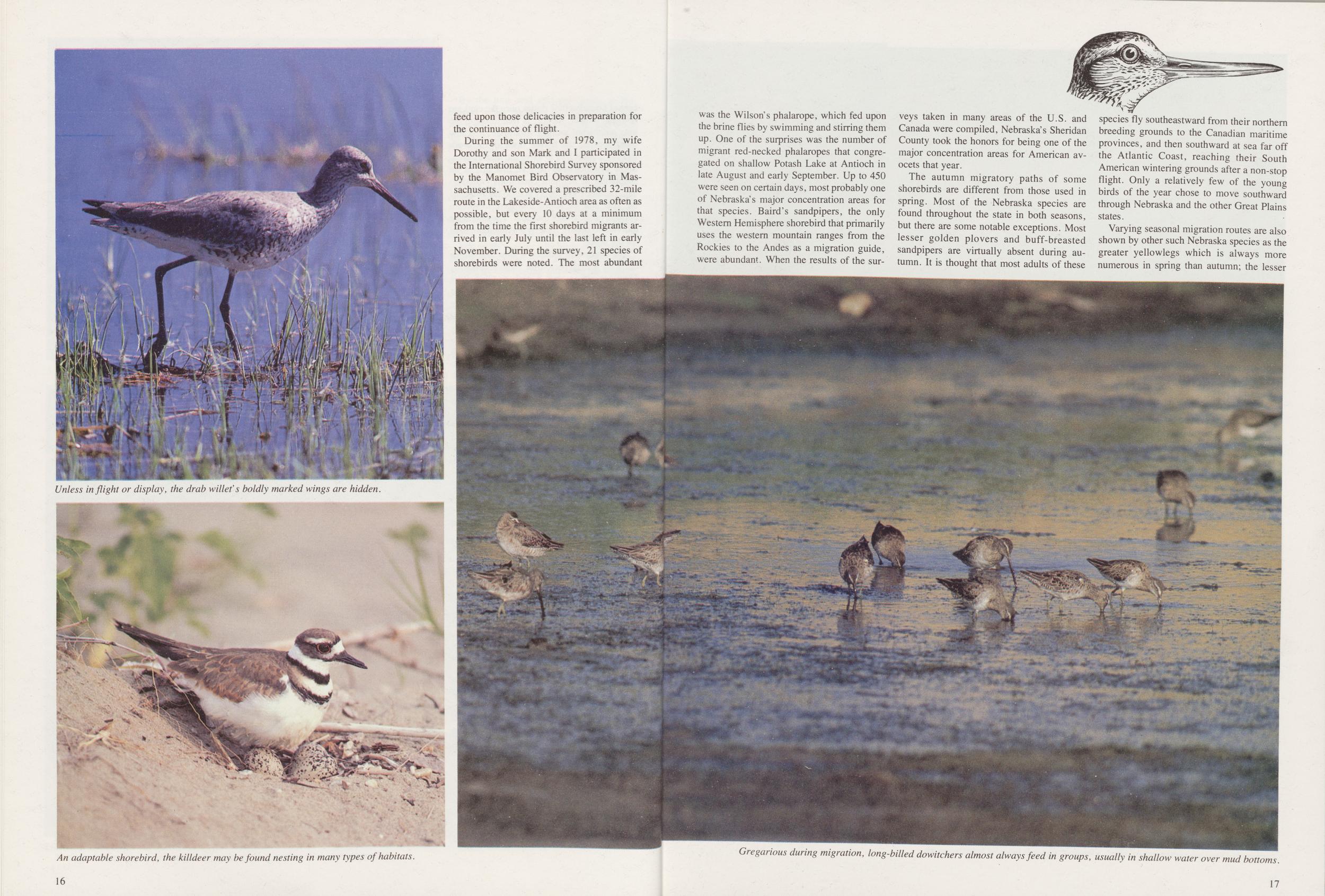
During the summer of 1978, my wife Dorothy and son Mark and I participated in the International Shorebird Survey sponsored by the Manomet Bird Observatory in Massachusetts. We covered a prescribed 32-mile route in the Lakeside-Antioch area as often as possible, but every 10 days at a minimum from the time the first shorebird migrants arrived in early July until the last left in early November. During the survey, 21 species of shorebirds were noted. The most abundant 16 was the Wilson's phalarope, which fed upon the brine flies by swimming and stirring them up. One of the surprises was the number of migrant red-necked phalaropes that congregated on shallow Potash Lake at Antioch in late August and early September. Up to 450 were seen on certain days, most probably one of Nebraska's major concentration areas for that species. Baird's sandpipers, the only Western Hemisphere shorebird that primarily uses the western mountain ranges from the Rockies to the Andes as a migration guide, were abundant. When the results of the surveys taken in many areas of the U.S. and Canada were compiled, Nebraska's Sheridan County took the honors for being one of the major concentration areas for American av- ocets that year.
The autumn migratory paths of some shorebirds are different from those used in spring. Most of the Nebraska species are found throughout the state in both seasons, but there are some notable exceptions. Most lesser golden plovers and buff-breasted sandpipers are virtually absent during autumn. It is thought that most adults of these species fly southeastward from their northern breeding grounds to the Canadian maritime provinces, and then southward at sea far off the Atlantic Coast, reaching their South American wintering grounds after a non-stop flight. Only a relatively few of the young birds of the year chose to move southward through Nebraska and the other Great Plains states.
Varying seasonal migration routes are also shown by other such Nebraska species as the greater yellowlegs which is always more numerous in spring than autumn; the lesser yellowlegs which is always more common in autumn than spring; and the pectoral sandpiper, rare in the west but common in the east in spring, and common everywhere in autumn. A few species like the Hudsonian godwit, dunlin, and ruddy turnstone pass through the state primarily in the eastern part, while others like the long-billed curlew, American avocet, and Baird's sandpipers are most abundant in the western part.
Most shorebirds travel in flocks of varying size, from a few individuals to many hundreds. But like most rules, there is one notable exception. The appropriately named solitary sandpiper is almost always a loner, with more than one seldom being found in the same place, and on those rare occasions there is little social interaction between individuals.
This is in marked contrast to the majority of gather on the mudflats by the thousands. These high concentrations usually consist of many species, and it is often possible to find up to 15 in one place. To many people, picking them out and identifying one from another as they defend their feeding territories is one of the most difficult challenges in field bird identification. Many are extremely difficult to classify, even under optimum conditions.
Fortunately for shorebird enthusiasts, most species, except for some of the larger ones, are relatively tame and the observer can learn how to approach them quite closely by stalking them on the mudflats and then sitting down without making sudden motions with arms or legs. An easier way is to slowly apshorebird migrants that travel in groups and proach feeding shorebirds by enclosed vehicles at roadside ponds where they have congregated, and to observe from the windows, again keeping arms and other sudden move ments to a minimum. Quality binoculars are a must for the casual observer, and at least a 20-power spotting scope is essential for the serious or "dedicated" observer.
When identifying shorebirds, there are certain things that one must keep in mind. They are probably the most notable bird group for color being least important in identification. Most shorebirds tend to be rather drab, although there are exceptions, and quite a few, as the dunlin, black-bellied and lesser
18golden plovers, ruddy turnstone, and long-billed dowitcher, molt from rather bright plumages to rather dull ones from the breeding to the winter season. As they pass through Nebraska, many are molting and one sees plumages typical of neither season, making identification sometimes difficult.
However, there are a number of other characteristics of the various species that, often taken in combination, help with identification. Dark and light patterning is probably the most important. The observer often needs to ask himself some of the following types of questions: Does the back have light stripes on a dark background as in a pectoral sandpiper or common snipe, or is each feather outlined in light, thus giving a scaly appearance as in the Baird's sandpiper? Is the tail light as in a black-bellied plover or dark as in a lesser golden plover? When a shorebird flies is there a light stripe down the length of the otherwise dark wing as in a sanderling, or is it uniform in color as in a solitary sandpiper? Is the rump, that area on top of the bird at the base of the tail, light as in a white-rumped sandpiper, or dark as in a western sandpiper? It is often crucial to note whether the legs are dark or light, always remembering that wet shorebird legs can shine in the sun and appear to be light when their actual coloration is ebony!
Another important identification key is the bill — does it curve up as in godwits and avocets, or down as in the dunlin or curlews? If it curves down, is the entire bill downcurved as in the dunlin, or just the outer one-third as in the western sandpiper? The length of the bill in relation to the width of the head is important to note, as well as the width of the bill at its base. Quite often, especially in autumn, the length of the bill in relation to the width of the head is the key in separating the greater from the lesser yellowlegs, when other measurements often overlap.
Shorebird behavior is another aspect that is often helpful in identification, particularly feeding behavior. Stilt sandpipers and both species of dowitchers probe. The least sandpiper, both yellowlegs, and many others, pick. And, of course, there is the ruddy turnstone that turns over debris and then picks underneath for morsels. Plovers have interesting feeding behavior whereby they run very fast, stop, pick up food, then run again, stop, pick up food, repeating this all the way across a mudflat.
Posture is a help in identification too. The upland sandpiper, pectoral sandpiper, and buff-breasted sandpiper, commonly assume a stance whereby they appear very long-legged and long necked, in relation to the shortlegged, plump-bodied appearance of many other species. Other characteristics to watch for might include swimming so often seen in the phalaropes; "teetering" or pumping the posterior up and down as in the yellowlegs, spotted and solitary sandpipers; or the "running after the waves" behavior so typical of the whitish sanderling on lakeshores where wave action occurs.
Even after you have sharpened your observation skills, there is one group of shorebirds that will always give you difficulty: The group collectively known as the "peeps" provides a real challenge. It includes the least, semipalmated, white-rumped, Baird's, and western sandpipers. They are all small and rather nondescript. But even many individuals of these can be less of a problem if one methodically separates the least by its yellowish legs and thin, short bill; the white-rumped by its rump pattern; the western by its longer bill that is decurved at the tip; and the Bahxfs by its scaly back pattern and elongated posterior one-third of the body. This leaves the semipalmated sandpiper, many of which, even to the practiced observer, must virtually be identified by the process of elimination. Often, familiarity with the call notes of the species in this group is the only sure method of identification. Each species has a call unlike that of any other.
Except for a few individual killdeer and an occasional common snipe that winter regularly in ice-free areas, most often in the Platte River Valley, all Nebraska nesting shorebirds are also migratory. Eleven species nest in the state, some regularly and commonly, and a few very rarely. Among the latter is the American woodcock, an upland game species to the hunter. It has been known to nest in the extreme eastern part of the state in and among deciduous forest and floodplain vegetation. In the west, the once more widespread mountain plover has been found nesting in recent years only on some remnant short-grass plains in Kimball County near the Wyoming state line.
The mountain plover is included on the list of threatened and endangered species in Nebraska. Another plover, the piping, is threatened in many, many parts of the country. The broad sandbars of major Nebraska rivers — the Platte, Missouri, Niobrara — are the home of the piping plover. It has also been nesting sparingly on the white sand beaches at Lake McConaughy in the last few years. Both of these plovers, requiring very specialized places in which to nest, are decreasing, primarily because of man's activities that make their chosen habitats unsuitable. The plow destroys the native short-grass plains for the mountain plover. Reduced river flows that allow open sandbars to become overgrown with vegetation, and direct human interference, such as off-the-road vehicle use and walking on sandbars, destroys nesting habitat for the piping plover. Will Nebraska eventually lose these inhabitants?
Another plover, the well-known killdeer, is one of the most common and widespread nesting shorebirds in the state. Unlike the two "threatened" plovers, the killdeer has become very adaptable in its nesting requirements, often choosing to nest very close to human activity, bustle, and noise. So adaptable has it become that it sometimes nests on flat roofs covered with gravel, much like the common nighthawk does in eastern cities. Unlike some of its shorebird cousins, it often nests far from water.
The spotted sandpiper, another fairly common and widespread Nebraska nesting species, can also set up housekeeping activities far from water. Like most shorebirds, it builds little or no nest, preferring to lay its three or four eggs in a small hollowed-out area on sand, gravel, or bare dirt. The young are well advanced when they hatch — their eyes are open and they are heavily covered with soft down. These are characteristics of precocial birds that leave the nest soon after hatching, often never to return.
It is at this time of the nesting cycle when the adults defend their territories and young, sometimes in very aggressive ways. People in the Sandhills region have often been "strafed" when riding or walking the grasslands by curlews, avocets, or willets, which fly rapidly and directly toward the intruder, only to suddenly swerve during the final few seconds, seemingly to avoid direct contact between those long bills and the intruder's head and eyes.
Another interesting method of territorial defense is shown by the killdeer and a few other shorebird species. This is the familiar "broken-wing" act, whereby the adult flies ahead of the intruder and feigns a broken wing, rufous tail outspread. As the intruder nears the adult, it simply flies ahead again and repeats the same act, thereby drawing the intruder farther and farther away from the eggs or young.
Most shorebirds are extremely protective of their nesting and feeding territories and their young. Many engage in spectacular aerial displays as the long-billed curlew does upon its arrival on its nesting grounds. The common snipe, another uncommon nester in Nebraska, circles its territory by flying high in the sky and producing a winnowing sound as 20 the air rushes through its tail and wing feathers. The American woodcock has a flight performance at dawn and dusk each day that is partly vocal and partly caused by air rushing through the feathers. Being conspicuous is the name of the game in defending territory perching in trees is even fairly common in some species, often to the surprise of the layman. Our fairly common upland sandpiper often perches on fenceposts in order to be conspicuous to intruders.
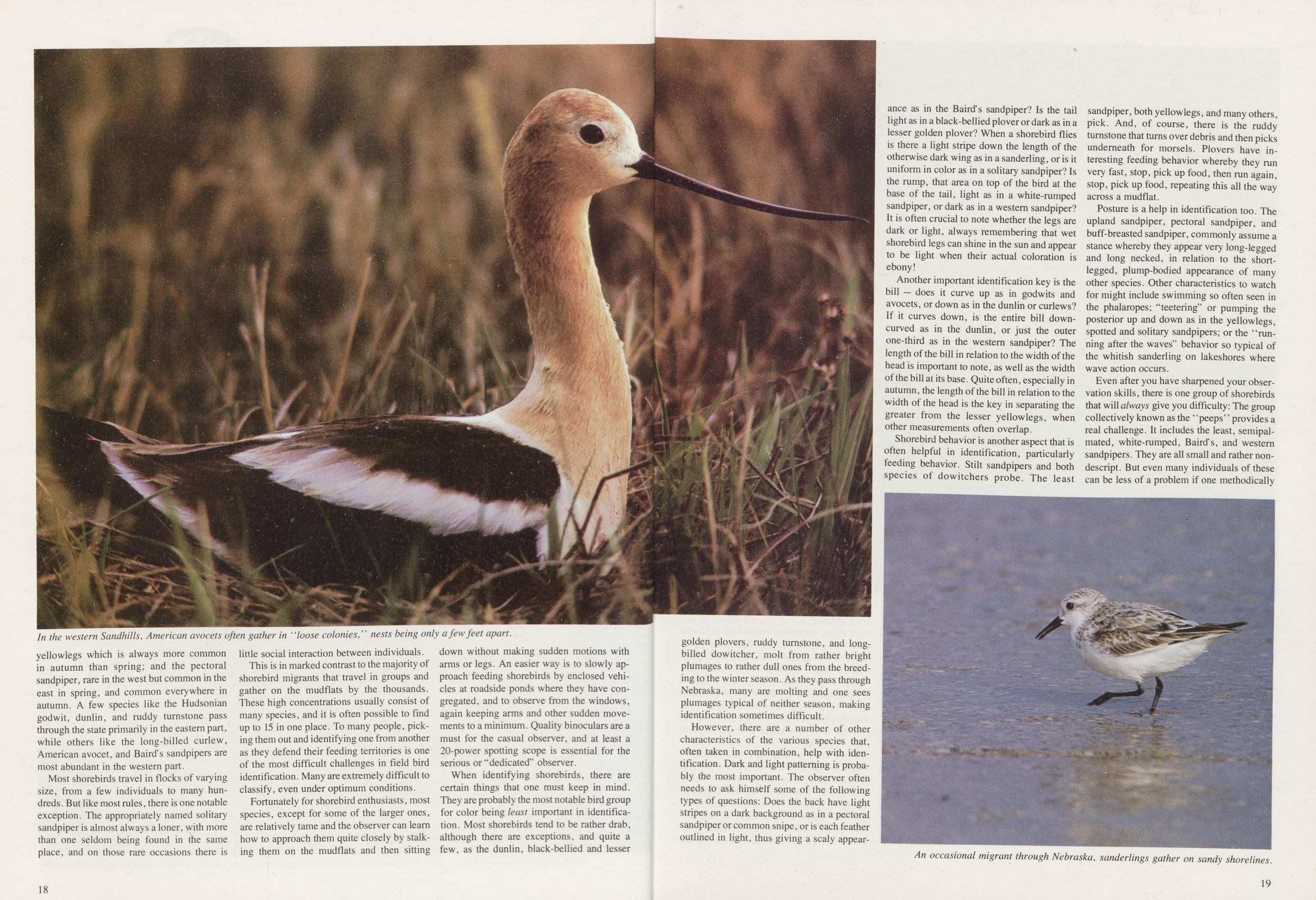
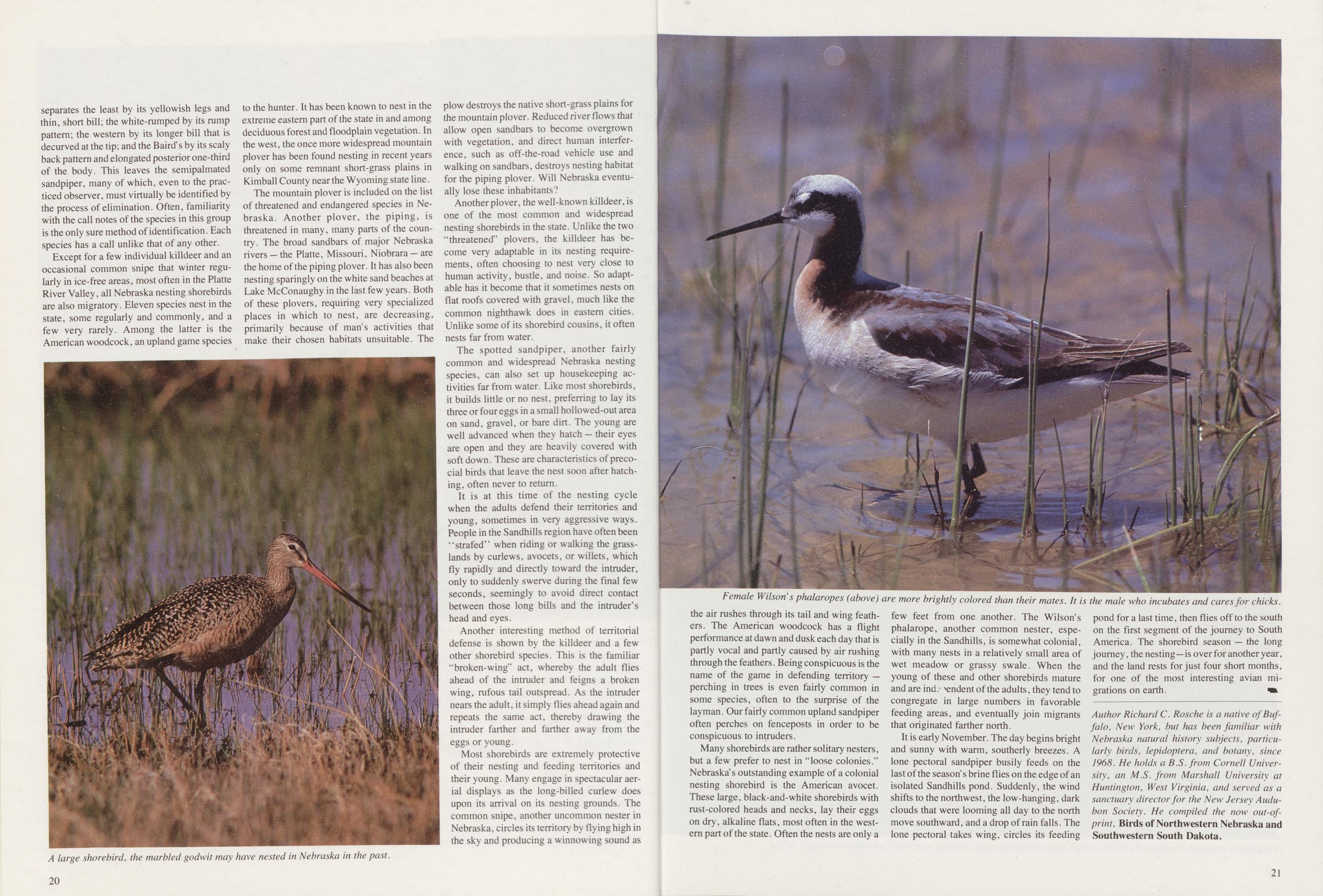
Many shorebirds are rather solitary nesters, but a few prefer to nest in "loose colonies." Nebraska's outstanding example of a colonial nesting shorebird is the American avocet. These large, black-and-white shorebirds with rust-colored heads and necks, lay their eggs on dry, alkaline flats, most often in the western part of the state. Often the nests are only a are more brightly colored than their mates. It is few feet from one another. The Wilson's phalarope, another common nester, especially in the Sandhills, is somewhat colonial, with many nests in a relatively small area of wet meadow or grassy swale. When the young of these and other shorebirds mature and are ind.1 indent of the adults, they tend to congregate in large numbers in favorable feeding areas, and eventually join migrants that originated farther north.
It is early November. The day begins bright and sunny with warm, southerly breezes. A lone pectoral sandpiper busily feeds on the last of the season's brine flies on the edge of an isolated Sandhills pond. Suddenly, the wind shifts to the northwest, the low-hanging, dark clouds that were looming all day to the north move southward, and a drop of rain falls. The lone pectoral takes wing, circles its feeding pond for a last time, then flies off to the south on the first segment of the journey to South America. The shorebird season — the long journey, the nesting—is over for another year, and the land rests for just four short months, for one of the most interesting avian migrations on earth.
Author Richard C. Rosche is a native of Buffalo, New York, but has been familiar with Nebraska natural history subjects, particularly birds, lepidoptera, and botany, since 1968. He holds a B.S. from Cornell University, an M.S. from Marshall University at Huntington, West Virginia, and served as a sanctuary director for the New Jersey Audubon Society. He compiled the now out-ofprint, Birds of Northwestern Nebraska and Southwestern South Dakota. 21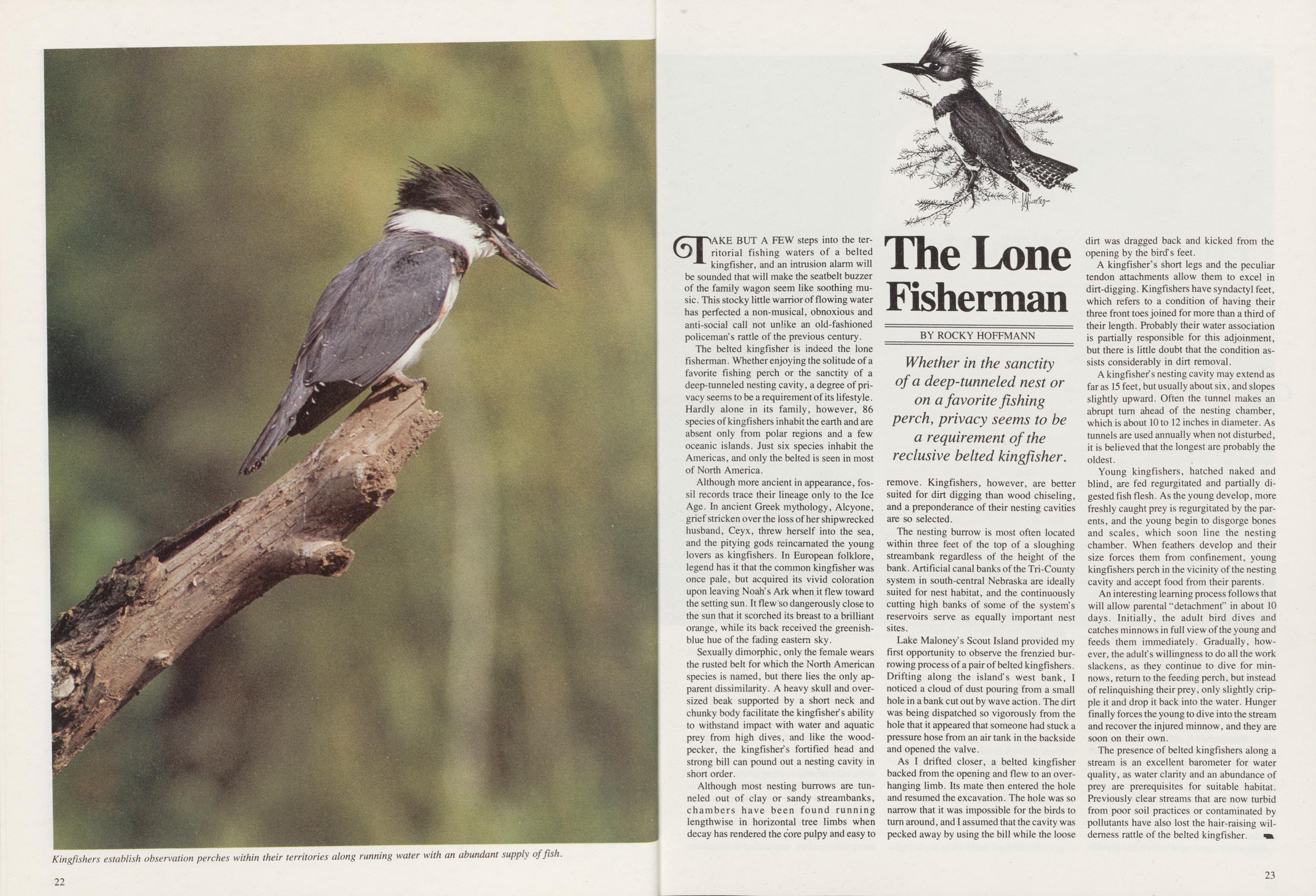
The Lone Fisherman
BY ROCKY HOFFMAN Whether in the sanctity of a deep-tunneled nest or on a favorite fishing perch, privacy seems to be a requirmenet of the reclusive belted kingfisherTAKE BUT A FEW steps into the teriritorial fishing waters of a belted kingfisher, and an intrusion alarm will be sounded that will make the seatbelt buzzer of the family wagon seem like soothing music. This stocky little warrior of flowing water has perfected a non-musical, obnoxious and anti-social call not unlike an old-fashioned policeman rattle of the previous century.
The belted kingfisher is indeed the lone fisherman. Whether enjoying the solitude of a favorite fishing perch or the sanctity of a deep-tunneled nesting cavity, a degree of privacy seems to be a requirement of its lifestyle. Hardly alone in its family, however, 86 species of kingfishers inhabit the earth and are absent only from polar regions and a few oceanic islands. Just six species inhabit the Americas, and only the belted is seen in most of North America.
Although more ancient in appearance, fos- sil records trace their lineage only to the Ice Age. In ancient Greek mythology, Alcyone, grief stricken over the loss of her shipwrecked husband, Ceyx, threw herself into the sea, and the pitying gods reincarnated the young lovers as kingfishers. In European folklore, legend has it that the common kingfisher was once pale, but acquired its vivid coloration upon leaving Noah's Ark when it flew toward the setting sun. It flew so dangerously close to the sun that it scorched its breast to a brilliant orange, while its back received the greenishblue hue of the fading eastern sky.
Sexually dimorphic, only the female wears the rusted belt for which the North American species is named, but there lies the only apparent dissimilarity. A heavy skull and oversized beak supported by a short neck and chunky body facilitate the kingfisher's ability to withstand impact with water and aquatic prey from high dives, and like the woodpecker, the kingfisher's fortified head and strong bill can pound out a nesting cavity in short order.
Although most nesting burrows are tunneled out of clay or sandy streambanks, chambers have been found running lengthwise in horizontal tree limbs when decay has rendered the core pulpy and easy to remove. Kingfishers, however, are better suited for dirt digging than wood chiseling, and a preponderance of their nesting cavities are so selected.
The nesting burrow is most often located within three feet of the top of a sloughing streambank regardless of the height of the bank. Artificial canal banks of the Tri-County system in south-central Nebraska are ideally suited for nest habitat, and the continuously cutting high banks of some of the system's reservoirs serve as equally important nest sites.
Lake Maloney's Scout Island provided my first opportunity to observe the frenzied burrowing process of a pair of belted kingfishers. Drifting along the island's west bank, I noticed a cloud of dust pouring from a small hole in a bank cut out by wave action. The dirt was being dispatched so vigorously from the hole that it appeared that someone had stuck a pressure hose from an air tank in the backside and opened the valve.
As I drifted closer, a belted kingfisher backed from the opening and flew to an overhanging limb. Its mate then entered the hole and resumed the excavation. The hole was so narrow that it was impossible for the birds to turn around, and I assumed that the cavity was pecked away by using the bill while the loose dirt was dragged back and kicked from the opening by the bird's feet.
A kingfisher's short legs and the peculiar tendon attachments allow them to excel in dirt-digging. Kingfishers have syndactyl feet, which refers to a condition of having their three front toes joined for more than a third of their length. Probably their water association is partially responsible for this adjoinment, but there is little doubt that the condition assists considerably in dirt removal.
A kingfisher's nesting cavity may extend as far as 15 feet, but usually about six, and slopes slightly upward. Often the tunnel makes an abrupt turn ahead of the nesting chamber, which is about 10 to 12 inches in diameter. As tunnels are used annually when not disturbed, it is believed that the longest are probably the oldest.
Young kingfishers, hatched naked and blind, are fed regurgitated and partially digested fish flesh. As the young develop, more freshly caught prey is regurgitated by the parents, and the young begin to disgorge bones and scales, which soon line the nesting chamber. When feathers develop and their size forces them from confinement, young kingfishers perch in the vicinity of the nesting cavity and accept food from their parents.
An interesting learning process follows that will allow parental "detachment" in about 10 days. Initially, the adult bird dives and catches minnows in full view of the young and feeds them immediately. Gradually, however, the adult's willingness to do all the work slackens, as they continue to dive for minnows, return to the feeding perch, but instead of relinquishing their prey, only slightly cripple it and drop it back into the water. Hunger finally forces the young to dive into the stream and recover the injured minnow, and they are soon on their own.
The presence of belted kingfishers along a stream is an excellent barometer for water quality, as water clarity and an abundance of prey are prerequisites for suitable habitat. Previously clear streams that are now turbid from poor soil practices or contaminated by pollutants have also lost the hair-raising wilderness rattle of the belted kingfisher.
23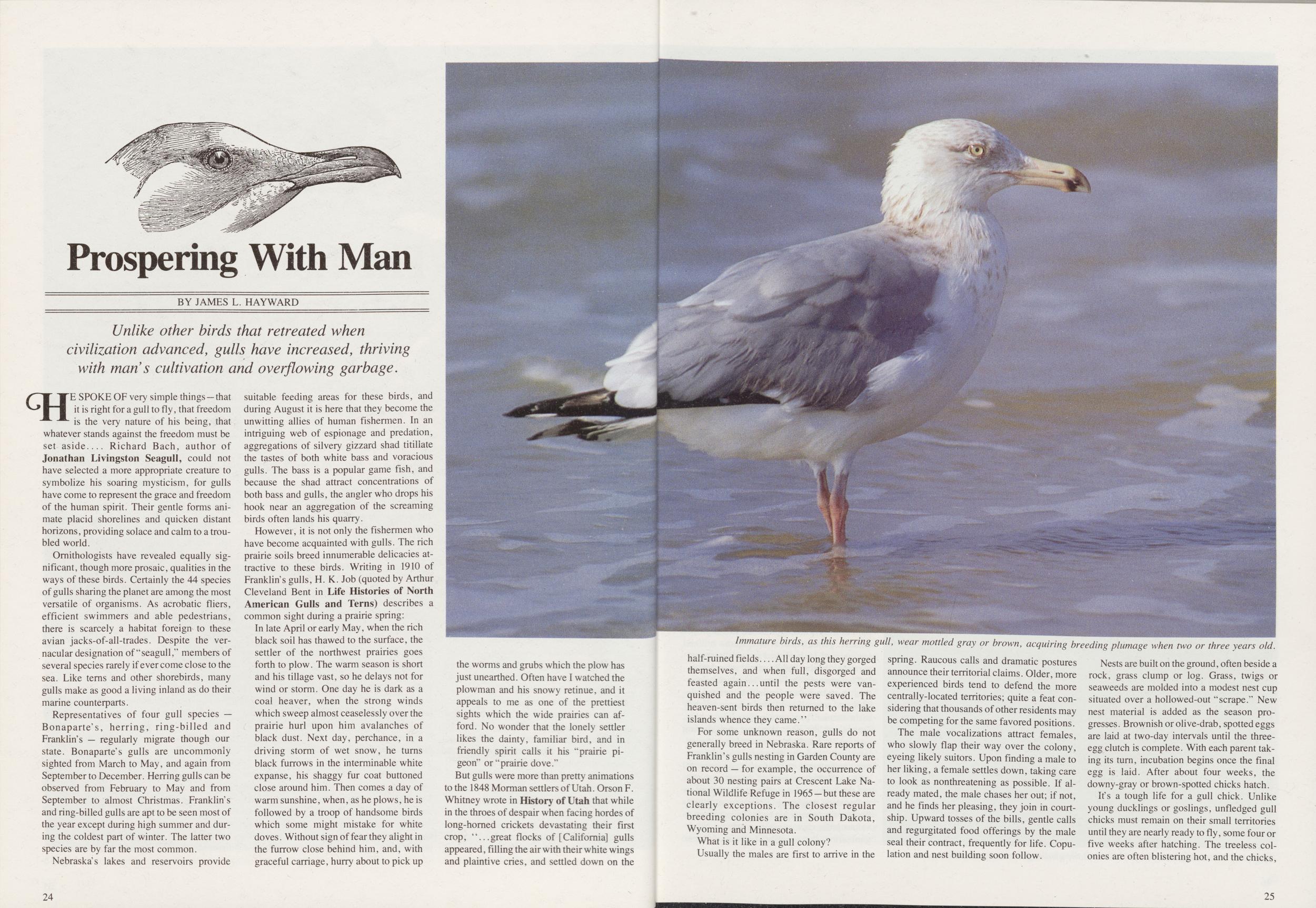
Prospering With Man
BY JAMES L. HAY WARD Unlike other birds that retreated when civilization advanced, gulls have increased, thriving with mans cultivation and overflowing garbage.E SPOKE OF very simple things that it is right for a gull to fly, that freedom is the very nature of his being, that whatever stands against the freedom must be set aside---- Richard Bach, author of Jonathan Livingston Seagull, could not have selected a more appropriate creature to symbolize his soaring mysticism, for gulls have come to represent the grace and freedom of the human spirit. Their gentle forms animate placid shorelines and quicken distant horizons, providing solace and calm to a troubled world.
Ornithologists have revealed equally significant, though more prosaic, qualities in the ways of these birds. Certainly the 44 species of gulls sharing the planet are among the most versatile of organisms. As acrobatic fliers, efficient swimmers and able pedestrians, there is scarcely a habitat foreign to these avian jacks-of-all-trades. Despite the vernacular designation of "seagull," members of several species rarely if ever come close to the sea. Like terns and other shorebirds, many gulls make as good a living inland as do their marine counterparts.
Representatives of four gull species Bonaparte's, herring, ring-billed and Franklin's — regularly migrate though our state. Bonaparte's gulls are uncommonly sighted from March to May, and again from September to December. Herring gulls can be observed from February to May and from September to almost Christmas. Franklin's and ring-billed gulls are apt to be seen most of the year except during high summer and during the coldest part of winter. The latter two species are by far the most common.
Nebraska's lakes and reservoirs provide suitable feeding areas for these birds, and during August it is here that they become the unwitting allies of human fishermen. In an intriguing web of espionage and predation, aggregations of silvery gizzard shad titillate the tastes of both white bass and voracious gulls. The bass is a popular game fish, and because the shad attract concentrations of both bass and gulls, the angler who drops his hook near an aggregation of the screaming birds often lands his quarry.
However, it is not only the fishermen who have become acquainted with gulls. The rich prairie soils breed innumerable delicacies attractive to these birds. Writing in 1910 of Franklin's gulls, H. K. Job (quoted by Arthur Cleveland Bent in Life Histories of North American Gulls and Terns) describes a common sight during a prairie spring:
In late April or early May, when the rich black soil has thawed to the surface, the settler of the northwest prairies goes forth to plow. The warm season is short and his tillage vast, so he delays not for wind or storm. One day he is dark as a coal heaver, when the strong winds which sweep almost ceaselessly over the prairie hurl upon him avalanches of black dust. Next day, perchance, in a driving storm of wet snow, he turns black furrows in the interminable white expanse, his shaggy fur coat buttoned close around him. Then comes a day of warm sunshine, when, as he plows, he is followed by a troop of handsome birds which some might mistake for white doves. Without sign of fear they alight in the furrow close behind him, and, with graceful carriage, hurry about to pick up Immature birds, as this herring gull, wear mottled gray or brown, acquiring breeding plumage when two or three years old. the worms and grubs which the plow has just unearthed. Often have I watched the plowman and his snowy retinue, and it appeals to me as one of the prettiest sights which the wide prairies can afford. No wonder that the lonely settler likes the dainty, familiar bird, and in friendly spirit calls it his "prairie pigeon" or "prairie dove."
But gulls were more than pretty animations to the 1848 Morman settlers of Utah. Orson F. Whitney wrote in History of Utah that while in the throes of despair when facing hordes of long-horned crickets devastating their first crop, "...great flocks of [California] gulls appeared, filling the air with their white wings and plaintive cries, and settled down on the 24 half-ruined fields.... All day long they gorged themselves, and when full, disgorged and feasted again... until the pests were vanquished and the people were saved. The heaven-sent birds then returned to the lake islands whence they came."
For some unknown reason, gulls do not generally breed in Nebraska. Rare reports of Franklin's gulls nesting in Garden County are on record — for example, the occurrence of about 30 nesting pairs at Crescent Lake National Wildlife Refuge in 1965 — but these are clearly exceptions. The closest regular breeding colonies are in South Dakota, Wyoming and Minnesota.
What is it like in a gull colony?
Usually the males are first to arrive in the spring. Raucous calls and dramatic postures announce their territorial claims. Older, more experienced birds tend to defend the more centrally-located territories; quite a feat considering that thousands of other residents may be competing for the same favored positions.
The male vocalizations attract females, who slowly flap their way over the colony, eyeing likely suitors. Upon finding a male to her liking, a female settles down, taking care to look as nonthreatening as possible. If already mated, the male chases her out; if not, and he finds her pleasing, they join in courtship. Upward tosses of the bills, gentle calls and regurgitated food offerings by the male seal their contract, frequently for life. Copulation and nest building soon follow.
Nests are built on the ground, often beside a rock, grass clump or log. Grass, twigs or seaweeds are molded into a modest nest cup situated over a hollowed-out "scrape." New nest material is added as the season progresses. Brownish or olive-drab, spotted eggs are laid at two-day intervals until the threeegg clutch is complete. With each parent taking its turn, incubation begins once the final egg is laid. After about four weeks, the downy-gray or brown-spotted chicks hatch.
It's a tough life for a gull chick. Unlike young ducklings or goslings, unfledged gull chicks must remain on their small territories until they are nearly ready to fly, some four or five weeks after hatching. The treeless colonies are often blistering hot, and the chicks, who only slowly develop thermoregulatory efficiency, depend on their parents for shade. Even with this help, however, an early heat wave can be devastating.
25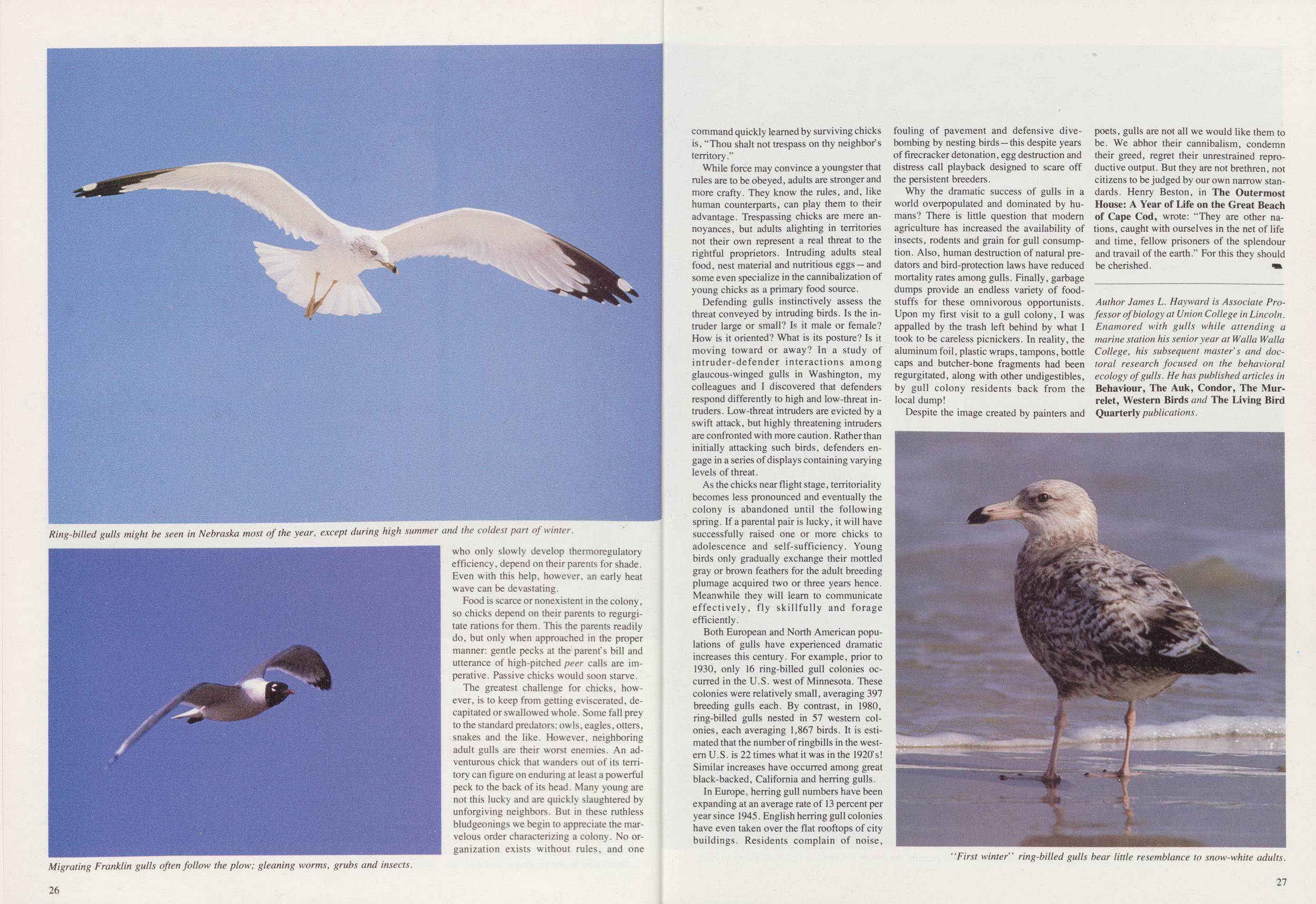
Food is scarce or nonexistent in the colony, so chicks depend on their parents to regurgitate rations for them. This the parents readily do, but only when approached in the proper manner: gentle pecks at the parent's bill and utterance of high-pitched peer calls are imperative. Passive chicks would soon starve.
The greatest challenge for chicks, however, is to keep from getting eviscerated, decapitated or swallowed whole. Some fall prey to the standard predators: owls, eagles, otters, snakes and the like. However, neighboring adult gulls are their worst enemies. An adventurous chick that wanders out of its territory can figure on enduring at least a powerful peck to the back of its head. Many young are not this lucky and are quickly slaughtered by unforgiving neighbors. But in these ruthless bludgeonings we begin to appreciate the marvelous order characterizing a colony. No organization exists without rules, and one 24 command quickly learned by surviving chicks is, "Thou shalt not trespass on thy neighbor's territory."
While force may convince a youngster that rules are to be obeyed, adults are stronger and more crafty. They know the rules, and, like human counterparts, can play them to their advantage. Trespassing chicks are mere annoyances, but adults alighting in territories not their own represent a real threat to the rightful proprietors. Intruding adults steal food, nest material and nutritious eggs and some even specialize in the cannibalization of young chicks as a primary food source.
Defending gulls instinctively assess the threat conveyed by intruding birds. Is the intruder large or small? Is it male or female? How is it oriented? What is its posture? Is it moving toward or away? In a study of intruder-defender interactions among glaucous-winged gulls in Washington, my colleagues and I discovered that defenders respond differently to high and low-threat intruders. Low-threat intruders are evicted by a swift attack, but highly threatening intruders are confronted with more caution. Rather than initially attacking such birds, defenders engage in a series of displays containing varying levels of threat.
As the chicks near flight stage, territoriality becomes less pronounced and eventually the colony is abandoned until the following spring. If a parental pair is lucky, it will have successfully raised one or more chicks to adolescence and self-sufficiency. Young birds only gradually exchange their mottled gray or brown feathers for the adult breeding plumage acquired two or three years hence. Meanwhile they will learn to communicate effectively, fly skillfully and forage efficiently.
Both European and North American populations of gulls have experienced dramatic increases this century. For example, prior to 1930, only 16 ring-billed gull colonies occurred in the U.S. west of Minnesota. These colonies were relatively small, averaging 397 breeding gulls each. By contrast, in 1980, ring-billed gulls nested in 57 western colonies, each averaging 1,867 birds. It is estimated that the number of ringbills in the western U.S. is 22 times what it was in the 1920' s! Similar increases have occurred among great black-backed, California and herring gulls.
In Europe, herring gull numbers have been expanding at an average rate of 13 percent per year since 1945. English herring gull colonies have even taken over the flat rooftops of city buildings. Residents complain of noise, fouling of pavement and defensive dive- bombing by nesting birds this despite years of firecracker detonation, egg destruction and distress call playback designed to scare off the persistent breeders.
Why the dramatic success of gulls in a world overpopulated and dominated by humans? There is little question that modern agriculture has increased the availability of insects, rodents and grain for gull consumption. Also, human destruction of natural predators and bird-protection laws have reduced mortality rates among gulls. Finally, garbage dumps provide an endless variety of food-stuffs for these omnivorous opportunists. Upon my first visit to a gull colony, I was appalled by the trash left behind by what I took to be careless picnickers. In reality, the aluminum foil, plastic wraps, tampons, bottle caps and butcher-bone fragments had been regurgitated, along with other undigestibles, by gull colony residents back from the local dump!
Despite the image created by painters and poets, gulls are not all we would like them to be. We abhor their cannibalism, condemn their greed, regret their unrestrained reproductive output. But they are not brethren, not citizens to be judged by our own narrow standards. Henry Beston, in The Outermost House: A Year of Life on the Great Beach of Cape Cod, wrote: "They are other nations, caught with ourselves in the net of life and time, fellow prisoners of the splendour and travail of the earth." For this they should be cherished.
Author James L. Hayward is Associate Professor of biology at Union College in Lincoln. Enamored with gulls while attending a marine station his senior year at Walla Walla College, his subsequent master s and doctoral research focused on the behavioral ecology of gulls. He has published articles in Behaviour, The Auk, Condor, The Murrelet, Western Birds and The Living Bird Quarterly publications.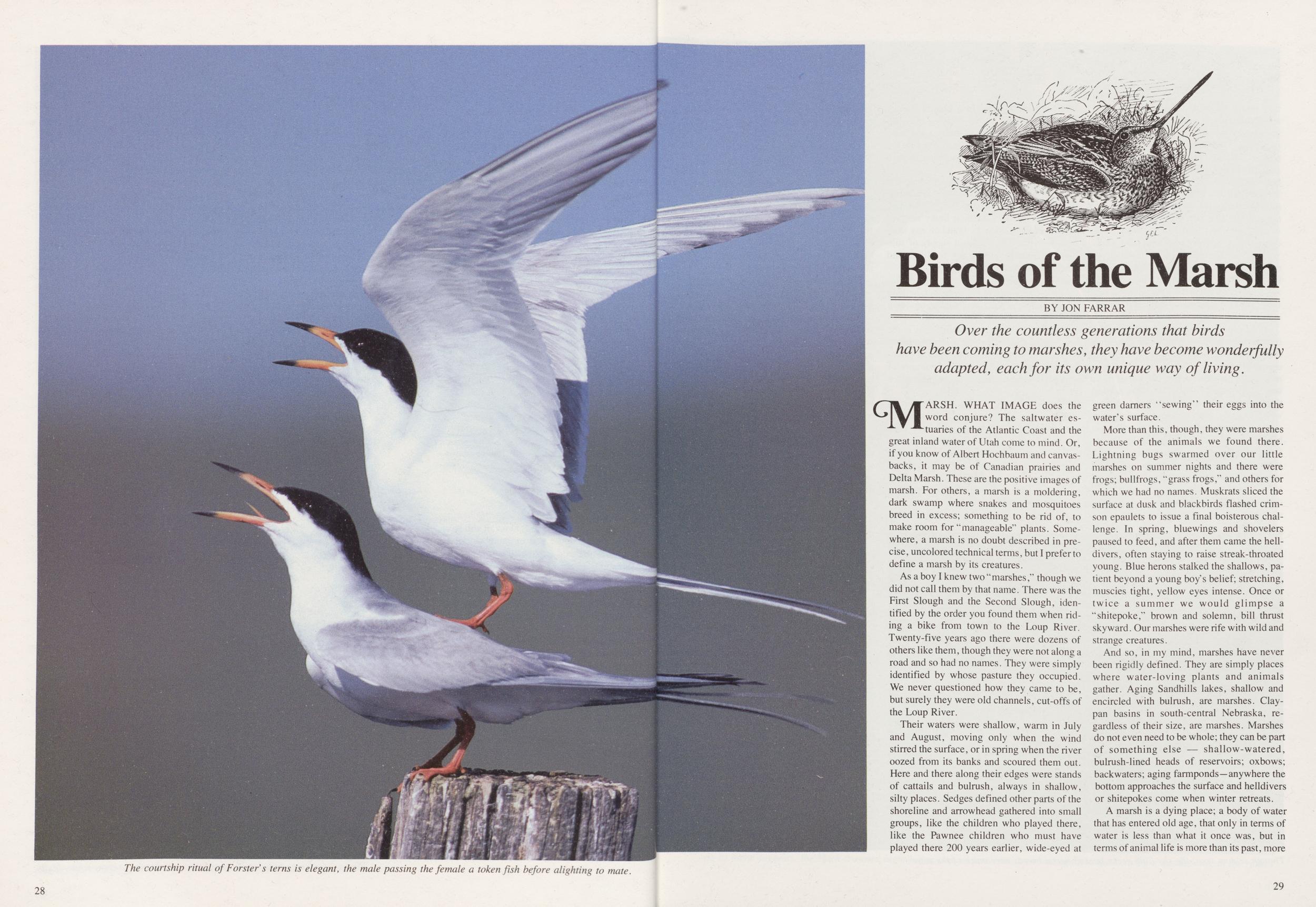
Birds of the Marsh
BY JON FARRAR Over the countless generations that birds have been coming to marshes, they have become wonderfully adapted, each for its own unique way of living.TARSH- WHAT IMAGE does the word conjure? The saltwater estuaries of the Atlantic Coast and the great inland water of Utah come to mind. Or, if you know of Albert Hochbaum and canvasbacks, it may be of Canadian prairies and Delta Marsh. These are the positive images of marsh. For others, a marsh is a moldering, dark swamp where snakes and mosquitoes breed in excess; something to be rid of, to make room for "manageable" plants. Somewhere, a marsh is no doubt described in precise, uncolored technical terms, but I prefer to define a marsh by its creatures.
As a boy I knew two "marshes," though we did not call them by that name. There was the First Slough and the Second Slough, identified by the order you found them when riding a bike from town to the Loup River. Twenty-five years ago there were dozens of others like them, though they were not along a road and so had no names. They were simply identified by whose pasture they occupied. We never questioned how they came to be, but surely they were old channels, cut-offs of the Loup River.
Their waters were shallow, warm in July and August, moving only when the wind stirred the surface, or in spring when the river oozed from its banks and scoured them out. Here and there along their edges were stands of cattails and bulrush, always in shallow, silty places. Sedges defined other parts of the shoreline and arrowhead gathered into small groups, like the children who played there, like the Pawnee children who must have played there 200 years earlier, wide-eyed at The courtship ritual of Forstesterns is elegant, the male passing the female a token fish before alighting to mate. green darners "sewing" their eggs into the water's surface.
More than this, though, they were marshes because of the animals we found there. Lightning bugs swarmed over our little marshes on summer nights and there were frogs; bullfrogs, "grass frogs," and others for which we had no names. Muskrats sliced the surface at dusk and blackbirds flashed crimson epaulets to issue a final boisterous challenge. In spring, bluewings and shovelers paused to feed, and after them came the helldivers, often staying to raise streak-throated young. Blue herons stalked the shallows, patient beyond a young boys belief; stretching, muscies tight, yellow eyes intense. Once or twice a summer we would glimpse a "shitepoke," brown and solemn, bill thrust skyward. Our marshes were rife with wild and strange creatures.
And so, in my mind, marshes have never been rigidly defined. They are simply places where water-loving plants and animals gather. Aging Sandhills lakes, shallow and encircled with bulrush, are marshes. Claypan basins in south-central Nebraska, re- gardless of their size, are marshes. Marshes do not even need to be whole; they can be part of something else — shallow-watered, bulrush-lined heads of reservoirs; oxbows; backwaters; aging farmponds—anywhere the bottom approaches the surface and helldivers or shitepokes come when winter retreats.
A marsh is a dying place; a body of water
that has entered old age, that only in terms of
water is less than what it once was, but in
terms of animal life is more than its past, more
29
 than it will be in the future. It is a rank assemblage of plants, and microscopic
animals,
upon which more complex life forms build in
incredible kind and numbers. Perhaps no
other ecosystem can match its richness. It is
aquatic yet terrestrial, and the fecund edges
between; a roiling broth of life where business
is conducted at a furious pace; where territorial boundaries are defined again and
again
throughout the breeding season—mates
wooed, won and lost; where gaping maws
demand food at every parting of the rushes.
than it will be in the future. It is a rank assemblage of plants, and microscopic
animals,
upon which more complex life forms build in
incredible kind and numbers. Perhaps no
other ecosystem can match its richness. It is
aquatic yet terrestrial, and the fecund edges
between; a roiling broth of life where business
is conducted at a furious pace; where territorial boundaries are defined again and
again
throughout the breeding season—mates
wooed, won and lost; where gaping maws
demand food at every parting of the rushes.
Of all the creatures that come to the marsh, none is better known, more ubiquitous, or better suited to its hurly-burly pace than the American coot. All marsh birds squabble over territories, but none seems to relish it so much as the coots.
By late June, most coots are off their nests trailing broods of all ages, from grotesque, black-bodied downies with snarly yellow and orange plumes to birds nearly as large as their parents. Although nesting territories have been abandoned by then, coots have not lost their appetite for squabbling. Like tag-team wrestlers, they often fight pair against pair; cruising low in the water, head and neck extended, wings arched up, tail held high to flash white, horseshoe-shaped feathers on the rump. Side by side the mates come to the open water for confrontations with neighbors; head to head in a stare-down like sharptails on a dancing ground, tense in concentration until some subtle insult, some imperceptible violation triggers a melee. In a blur of flailing wings, punching feet and snapping bills, the battle may rage for several minutes and then, like poker players trying a bluff, the four are again head to head, a tail pointing to each cardinal point.
It is such aggressive defense of young and territory that helps make the coot so successful. They breed across much of the western U.S., and in Nebraska their bulky nests of bulrush or cattail may be found on any shallow water with an abundant supply of submerged aquatic plants for feeding, and emergent plants for nest building.
Unlike some waterbirds, notably ducks, the male coot is an exemplary parent, helping in nest construction, incubation, brooding and feeding of young. Their courtship is even rather touching — birds gently nibbling at the head and neck feathers of a mate, rubbing bills and bowing. If coots dressed as ostentatiously as, say, a wood duck, volumes of praise would be written to the commonplace mudhen.
While the coot is well-known but unsung, other species of its family are both unknown and unsung. Six species of rails have been reported from Nebraska (the king, clapper, yellow and black being either accidental vagrants or rare visitors), but only two, the Virginia and sora, are at all common during migration and linger in significant numbers to nest and rear young.
All rails are secretive birds, seldom emerging from dense stands of shoreline vegetation, and migrating at night. So mysterious are their comings and goings that an early legend explained the overnight disappearance of thousands of rails by having the birds bury themselves in the mud. Even when heard, their strange noises were often attributed to frogs or other creatures. So unaccustomed are rails to encountering humans in their secluded haunts that Dillon Ripley, in his book Rails of the World, noted: That is why rails seem relatively fearless if you come on them in the open... [they] may behave as if [they were] still in cover."
Unless viewed closely or in the hand, the sora and Virginia rail are rather undistinguished in appearance. Wonderfully adapted to their way of life in the rushes, both are small (about nine inches long) brownish birds with relatively long legs and long toes that serve them admirably when walking on mucky soils and floating vegetation. They have narrow, compressed, nearly wedgeshaped bodies that allow them to squeeze between stems of cattails or bulrush that seemingly would not permit their passage.
Though agile, even capable of climbing slender rushes, rails move deliberately, pausing to probe with their bills for worms, slugs, snails or insect larvae. In late summer and early fail, seeds become a more important part of their diet, particularly of the sora. The seeds of certain aquatic plants are favored, and legend has it they became so fat on smartweed and wild rice they could no longer fly and were easily gathered by certain Indian tribes.
Rails are notoriously weak, reluctant flyers. When flushed from the marsh they climb feebly into the air, legs dangling, and after a few yards tumble back into the rushes. During migration, though, they tuck their gangly legs under their bodies and apparently are strong flyers, as some cover over 2,000 miles between their breeding grounds and winter quarters.
Like rails, common snipes frequent waterlogged haunts (though are less inclined to spend much time in cattail and bulrush), migrate at night, and during most of the year are seldom seen, even by hunters, although they are one of few shorebirds still considered game birds. Snipes, particularly males, are conspicuous over their nesting grounds, though such places are seldom frequented by man.
I recall with pleasure the first time I watched the snipe s "winnowing" courtship display. A companion and I were canoeing the Calamus River during the last week of June. We pulled into our second night's camp on a sloping, grassy bank just before sundown. At first, the eerie, ethereal sound was faint, or at least easily missed. We were like the villagers of whom Thoreau wrote: "Persons walking up and down our village in still evenings at this season hear the singular winnowing sound in the sky over the meadows and know not what it is. Perhaps no one dreamed of a snipe an hour ago, the sky seemed empty of such as they; but as soon as the dusk begins, so that a bird's flight is concealed, you hear this peculiar spirit-suggesting sound, now heard through and above the evening din of the village."
30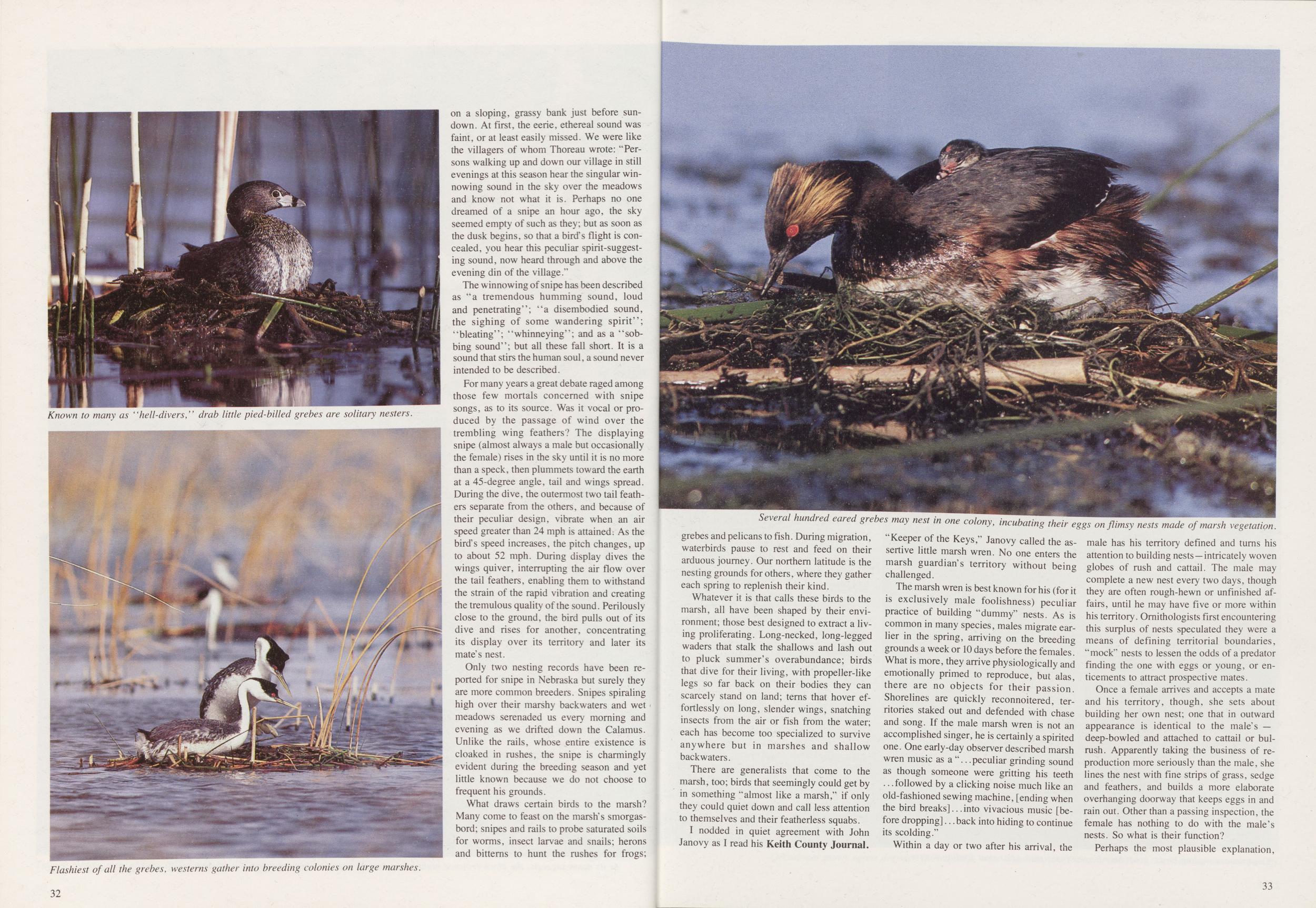
The winnowing of snipe has been described as "a tremendous humming sound, loud and penetrating"; "a disembodied sound, the sighing of some wandering spirit"; "bleating"; "whinneying"; and as a "sobbing sound"; but all these fall short. It is a sound that stirs the human soul, a sound never intended to be described.
For many years a great debate raged among those few mortals concerned with snipe songs, as to its source. Was it vocal or produced by the passage of wind over the trembling wing feathers? The displaying snipe (almost always a male but occasionally the female) rises in the sky until it is no more than a speck, then plummets toward the earth at a 45-degree angle, tail and wings spread. During the dive, the outermost two tail feathers separate from the others, and because of their peculiar design, vibrate when an air speed greater than 24 mph is attained. As the bird's speed increases, the pitch changes, up to about 52 mph. During display dives the wings quiver, interrupting the air flow over the tail feathers, enabling them to withstand the strain of the rapid vibration and creating the tremulous quality of the sound. Perilously close to the ground, the bird pulls out of its dive and rises for another, concentrating its display over its territory and later its mate's nest.
Only two nesting records have been reported for snipe in Nebraska but surely they are more common breeders. Snipes spiraling high over their marshy backwaters and wet meadows serenaded us every morning and evening as we drifted down the Calamus. Unlike the rails, whose entire existence is cloaked in rushes, the snipe is charmingly evident during the breeding season and yet little known because we do not choose to frequent his grounds.
What draws certain birds to the marsh? Many come to feast on the marsh's smorgasbord; snipes and rails to probe saturated soils for worms, insect larvae and snails; herons and bitterns to hunt the rushes for frogs; 32 grebes and pelicans to fish. During migration, waterbirds pause to rest and feed on their arduous journey. Our northern latitude is the nesting grounds for others, where they gather each spring to replenish their kind.
Whatever it is that calls these birds to the marsh, all have been shaped by their environment; those best designed to extract a living proliferating. Long-necked, long-legged waders that stalk the shallows and lash out to pluck summer's overabundance; birds that dive for their living, with propeller-like legs so far back on their bodies they can scarcely stand on land; terns that hover effortlessly on long, slender wings, snatching insects from the air or fish from the water; each has become too specialized to survive anywhere but in marshes and shallow backwaters.
There are generalists that come to the marsh, too; birds that seemingly could get by in something "almost like a marsh," if only they could quiet down and call less attention to themselves and their featherless squabs.
I nodded in quiet agreement with John Janovy as I read his Keith County Journal. "Keeper of the Keys," Janovy called the assertive little marsh wren. No one enters the marsh guardian's territory without being challenged.
The marsh wren is best known for his (for it attention to building nests —intricately woven globes of rush and cattail. The male may complete a new nest every two days, though they are often rough-hewn or unfinished afis exclusively male foolishness) peculiar fairs, until he may have five or more within practice of building "dummy" nests. As is common in many species, males migrate earlier in the spring, arriving on the breeding grounds a week or 10 days before the females. What is more, they arrive physiologically and emotionally primed to reproduce, but alas, there are no objects for their passion.' Shorelines are quickly reconnoitered, territories staked out and defended with chase and song. If the male marsh wren is not an accomplished singer, he is certainly a spirited one. One early-day observer described marsh wren music as a ".. .peculiar grinding sound as though someone were gritting his teeth .. .followed by a clicking noise much like an old-fashioned sewing machine, [ending when the bird breaks].. .into vivacious music [before dropping]... back into hiding to continue its scolding."
Within a day or two after his arrival, the Flashiest of all the grebes, westerns gather into breeding colonies on large marshes. his territory. Ornithologists first encountering this surplus of nests speculated they were a means of defining territorial boundaries, "mock" nests to lessen the odds of a predator finding the one with eggs or young, or enticements to attract prospective mates.
Once a female arrives and accepts a mate and his territory, though, she sets about building her own nest; one that in outward appearance is identical to the male's deep-bowled and attached to cattail or bulrush. Apparently taking the business of reproduction more seriously than the male, she lines the nest with fine strips of grass, sedge and feathers, and builds a more elaborate overhanging doorway that keeps eggs in and rain out. Other than a passing inspection, the female has nothing to do with the male's nests. So what is their function?
Perhaps the most plausible explanation,
33
 one easily accepted by anyone who has observed a marsh wren's frantic nature, is that
nest building is simply the male's way of
venting his raging hormones. The building of
dummy nests is an emotion outlet, a letting off
of pent-up desire.
one easily accepted by anyone who has observed a marsh wren's frantic nature, is that
nest building is simply the male's way of
venting his raging hormones. The building of
dummy nests is an emotion outlet, a letting off
of pent-up desire.
In reality, the fiery-tempered little marsh wren is only the symbolic guardian of the marsh. The practicing custodians are the yellow-headed blackbirds. They are the '' marsh criers''; vociferous protesters quick to gather the local militia to mob all intruders.
Several years ago I was sitting on the shoreline of a large marsh watching eared grebes court in midlake. Off to my right a short distance was a colony of eight yellowhead nests, each holding three to five brown-mottled eggs. Before me a bullsnake, nearly four feet long, crossed the water lane I had cleared through the rushes for my boat, moving in the direction of the yellowhead colony. When the snake neared the colony a female yellowhead spotted it, issued the first alarm, and flew down to a clump of bulrush within two feet of the snake. The other females followed, hovering over the snake, scolding, diving, taking up posts on bulrush around the threatening intruder. The male ceremoniously assumed a lofty perch, seemingly more disturbed by the disruption of his harem than the threat of a predator.
The bullsnake was amazingly at home in the water, writhing across the surface with head and three or four inches of its body held like a periscope above the water. It obviously wanted no part of such a publicized feeding raid, though. Over a 10-minute period, the bullsnake managed to cover only 30 yards of shoreline, darting from clump to clump of bulrush where it would pause, crawl out of the water, assume a strike pose and force the blackbirds to back off. On the open water the snake appeared more vulnerable, and the yellowheads sensed it, hovering or diving within two or three inches of the snake's head, causing it to recoil like a spring.
Because yellowheads make such excellent watchdogs, other species habitually nest closeby, relying on them to warn of the approach of predators that feed on eggs or young — marsh hawks, herons, bitterns, and even red-winged blackbirds which reportedly have a taste for eggs. Forstefs terns and yellowheads often are found nesting close to one another, establishing an early-alert assault force without equal. The yellowhead, unlike the redwing, is an honorable neighbor allowed to trespass on the nests of other waterbirds, from coots to trumpeter swans.
On many marshes, particularly those in central and western Nebraska, these two 34 species of blackbirds share the shoreline. Although the redwings often arrive earlier, it is the yellowheads that claim preferred stands of bulrush and cattail, usually selecting those over deeper water, leaving the redwings to nest closer to shore and occasionally on the ground in meadows. In both species the males arrive on the breeding grounds before the females to stake their claims to a bit of marsh edge. As females breed when only one year old, and the males usually not until two years old, there are more breeding females than males. The males readily take this in stridegathering as many females as they can with aggressive courtship chases, warding off neighboring males with raucous song and spread-wing threats. Long after dark, the yellowhead males are the voice of the marsh.
To the human eye, this seething cauldron of song, display and territorial battles is a grand spectacle, but to the marsh birds it is essential to their kind's survival. In the natural scheme, an individual's success is not measured in escaping predators, collisions with television and radio towers, the gun, or delaying old age, but in escaping these hazards until they have replaced themselves. Success on the breeding grounds supercedes all else, and exposes the individual to dangers that could otherwise be avoided.
Perhaps no better example of this commitment to reproduce at any cost exists than the western grebe. Once adults arrive at the breeding grounds, the flight muscles of their breasts atrophy, so believes Gary Nuechterlein, a research biologist who has probably spent more days studying western grebes than any other person. Until the birds are ready to leave the marsh in late summer, they are prisoners by choice, having made a total commitment to reproduction.
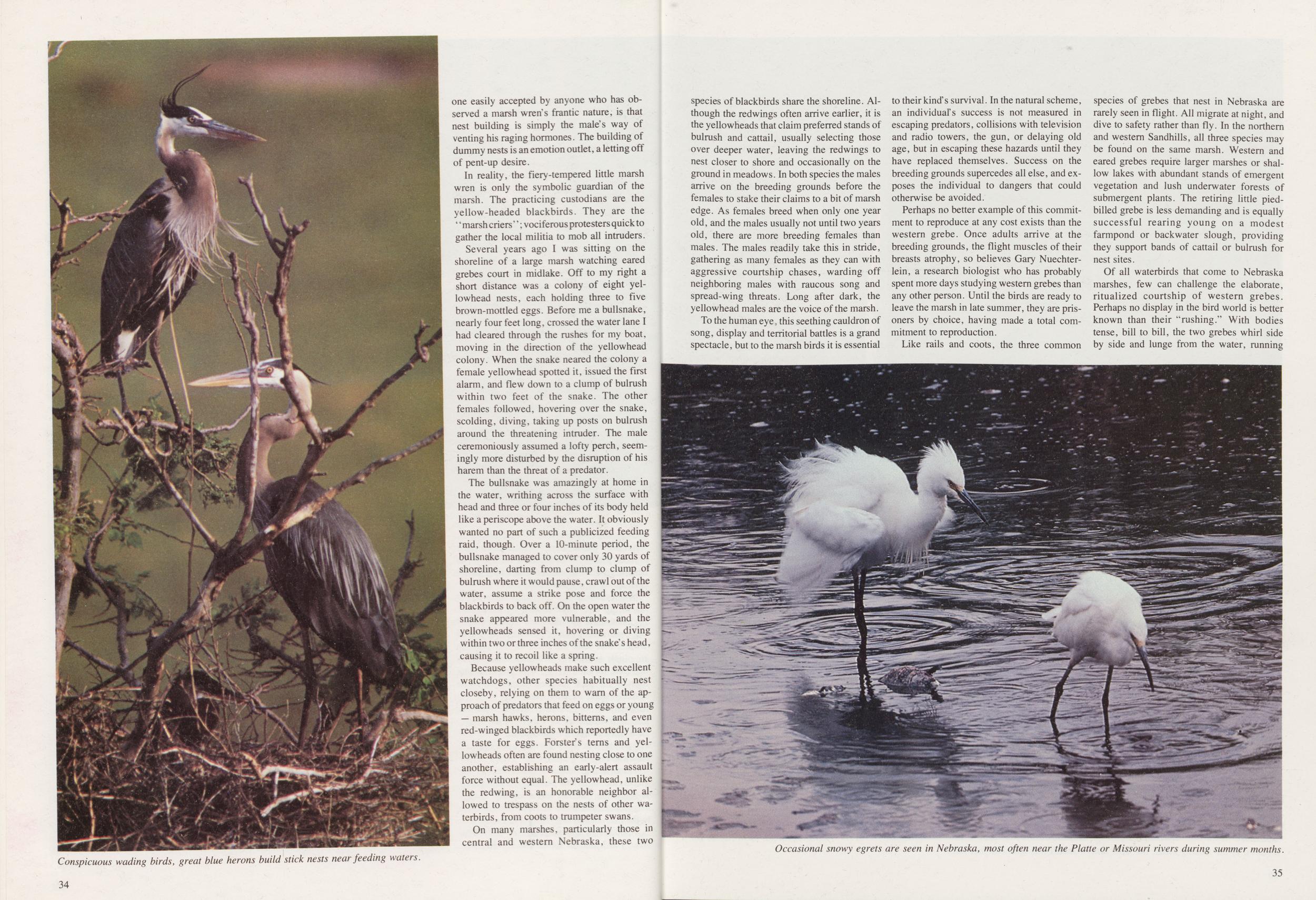
Like rails and coots, the three common species of grebes that nest in Nebraska are rarely seen in flight. All migrate at night, and dive to safety rather than fly. In the northern and western Sandhills, all three species may be found on the same marsh. Western and eared grebes require larger marshes or shallow lakes with abundant stands of emergent vegetation and lush underwater forests of submergent plants. The retiring little piedbilled grebe is less demanding and is equally successful rearing young on a modest farmpond or backwater slough, providing they support bands of cattail or bulrush for nest sites.
Of all waterbirds that come to Nebraska marshes, few can challenge the elaborate, ritualized courtship of western grebes. Perhaps no display in the bird world is better known than their "rushing." With bodies tense, bill to bill, the two grebes whirl side by side and lunge from the water, running across the surface with wings lifted and serpentine necks arched. The rush may be only a second or two long and cover but a dozen feet, or last six or seven seconds covering 20 yards. At the end of the rush, in perfect synchronization, both birds dive or belly-glide to a stop.
The eared grebe's display is less flamboyant, more scaled down and befitting their petite size and nature. In their "penguin dance," two birds stand erect, belly to belly, treading water. Occasionally they will turn and race side-by-side a short distance like the western grebe, but for the most part the eared grebe's displays are subtle, laced with meaning only to other eared grebes.
By contrast, the courtship of the pied-billed grebe is rather ordinary, comprised of ritualized diving, carrying water plants in the bill and synchronized posturing. It is uncommon for them to race across the water.
Outside of the breeding season the piedbilled grebe is usually silent, but its call is intrinsic to a spring marsh. The English language fails us miserably in describing sounds (resorting to musical terminology or wavelength physics) and in no case is this more evident than when trying to describe the courting pied-bill. The call is not spectacular; more haunting, with a watery quality like a sound percolating from a wooden barrel filled with water; a call ending with far-carrying wup-wup-wup-wup-wup-wups. Without the pied-bill's call, a marsh could be mistaken for something else, a place just as well planted to corn or milo.
Western and eared grebes are conspicuous on a marsh because of their display and choice of open water for both courtship and nesting. Both typically nest in colonies, often of a hundred pairs or more, and are not easily overlooked. Most marsh birds, as the rails, snipes and dowdy pied-billed grebes, are shy birds whose specialty is blending into rush and cattail. Several species have been at this game for so many generations, over thousands of years, that their plumage has come to resemble marsh plants, and their behavior enhances the camouflage.
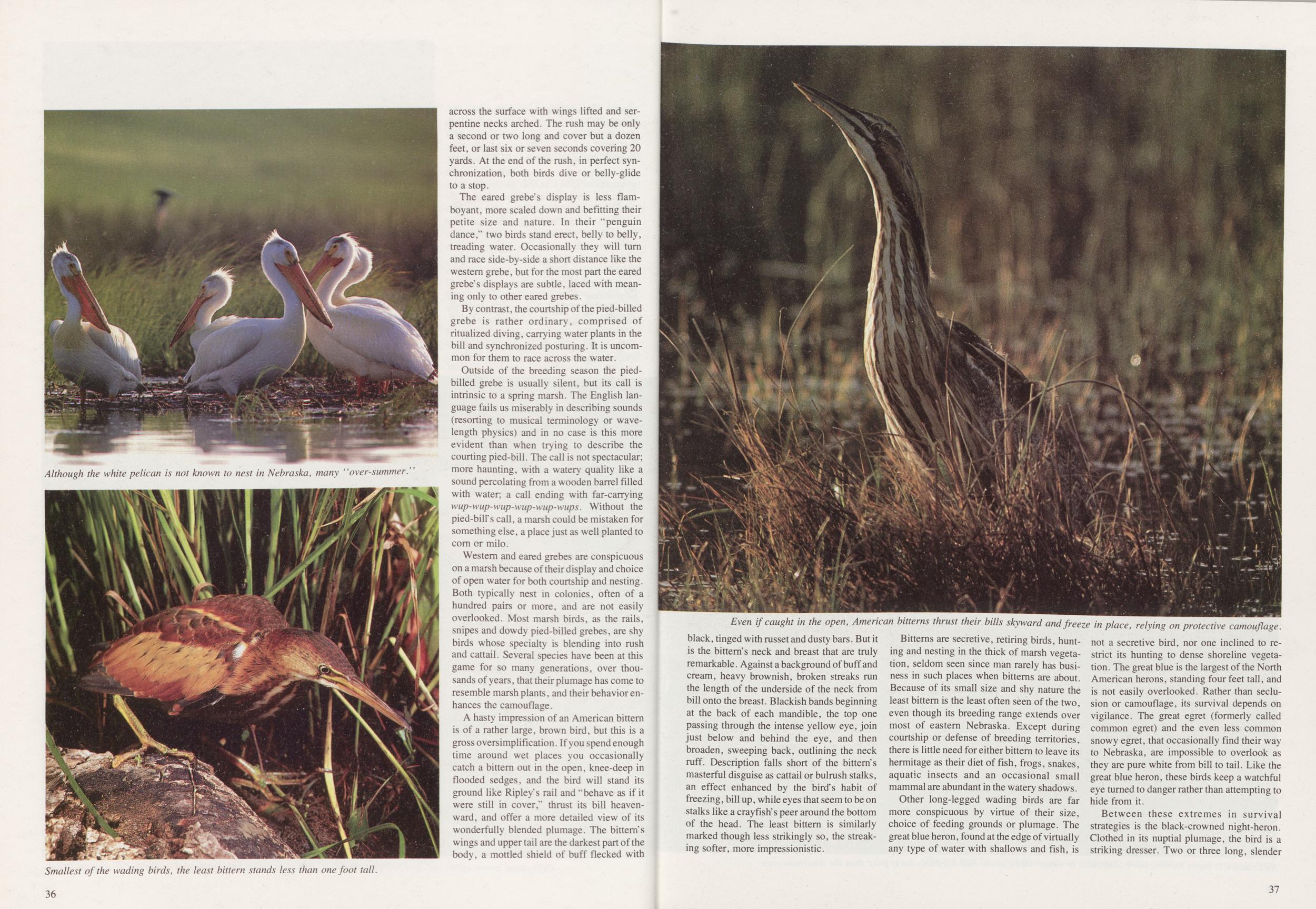
A hasty impression of an American bittern is of a rather large, brown bird, but this is a gross oversimplification. If you spend enough time around wet places you occasionally catch a bittern out in the open, knee-deep in flooded sedges, and the bird will stand its ground like Ripley's rail and "behave as if it were still in cover," thrust its bill heavenward, and offer a more detailed view of its wonderfully blended plumage. The bittern's wings and upper tail are the darkest part of the body, a mottled shield of buff flecked with 36 black, tinged with russet and dusty bars. But it is the bittern's neck and breast that are truly remarkable. Against a background of buff and cream, heavy brownish, broken streaks run the length of the underside of the neck from bill onto the breast. Blackish bands beginning at the back of each mandible, the top one passing through the intense yellow eye, join just below and behind the eye, and then broaden, sweeping back, outlining the neck ruff. Description falls short of the bittern's masterful disguise as cattail or bulrush stalks, an effect enhanced by the bird's habit of freezing, bill up, while eyes that seem to be on stalks like a crayfish's peer around the bottom of the head. The least bittern is similarly marked though less strikingly so, the streaking softer, more impressionistic.
Bitterns are secretive, retiring birds, hunting and nesting in the thick of marsh vegetation, seldom seen since man rarely has business in such places when bitterns are about. Because of its small size and shy nature the least bittern is the least often seen of the two, even though its breeding range extends over most of eastern Nebraska. Except during courtship or defense of breeding territories, there is little need for either bittern to leave its hermitage as their diet of fish, frogs, snakes, aquatic insects and an occasional small mammal are abundant in the watery shadows.
Other long-legged wading birds are far more conspicuous by virtue of their size, choice of feeding grounds or plumage. The great blue heron, found at the edge of virtually any type of water with shallows and fish, is not a secretive bird, nor one inclined to restrict its hunting to dense shoreline vegetation. The great blue is the largest of the North American herons, standing four feet tall, and is not easily overlooked. Rather than seclusion or camouflage, its survival depends on vigilance. The great egret (formerly called common egret) and the even less common snowy egret, that occasionally find their way to Nebraska, are impossible to overlook as they are pure white from bill to tail. Like the great blue heron, these birds keep a watchful eye turned to danger rather than attempting to hide from it.
Between these extremes in survival
strategies is the black-crowned night-heron.
Clothed in its nuptial plumage, the bird is a
striking dresser. Two or three long, slender
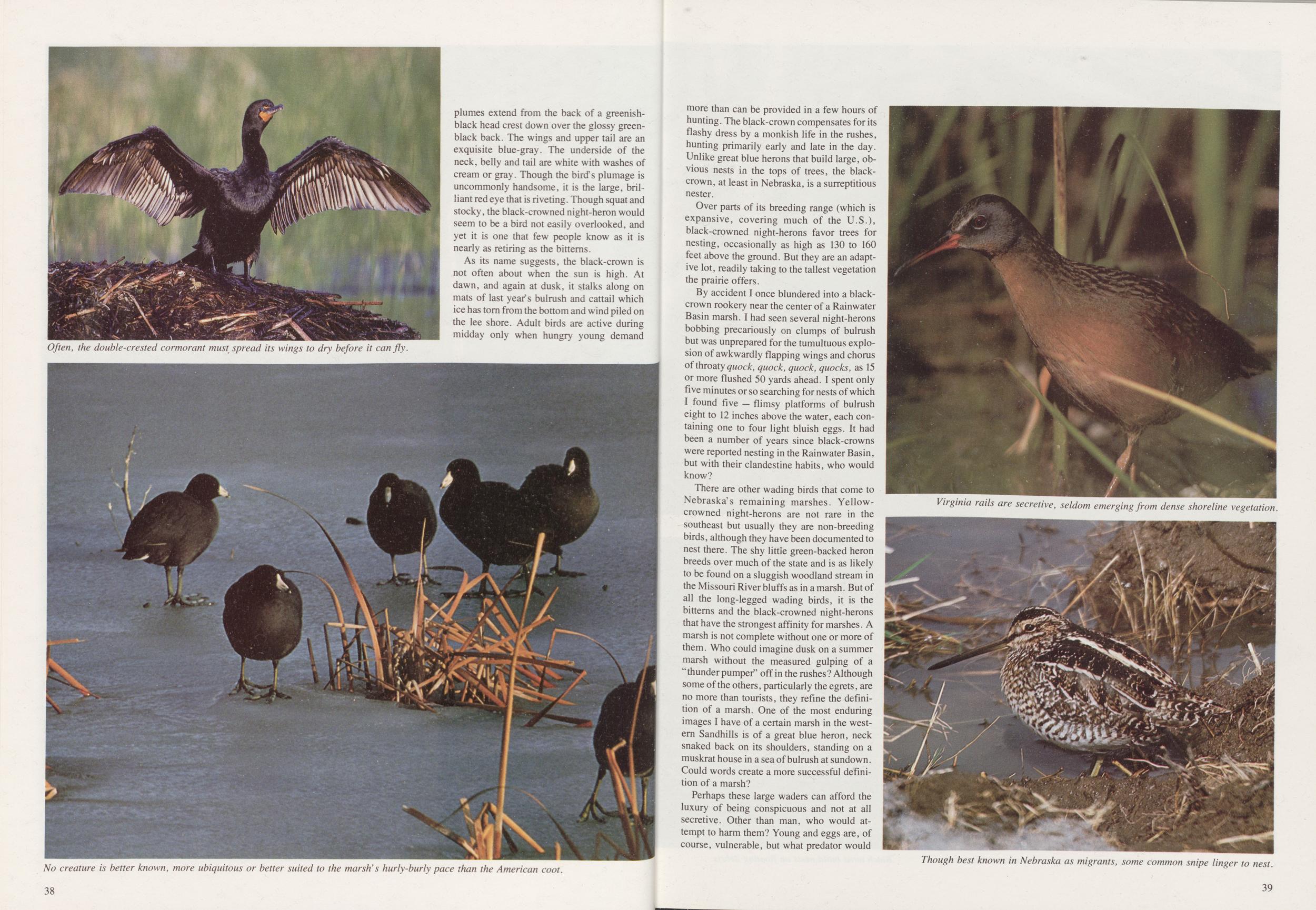 plumes extend from the back of a greenishblack head crest down over the glossy greenblack
back. The wings and upper tail are an
exquisite blue-gray. The underside of the
neck, belly and tail are white with washes of
cream or gray. Though the bird's plumage is
uncommonly handsome, it is the large, brilliant red eye that is riveting. Though squat
and
stocky, the black-crowned night-heron would
seem to be a bird not easily overlooked, and
yet it is one that few people know as it is
nearly as retiring as the bitterns.
plumes extend from the back of a greenishblack head crest down over the glossy greenblack
back. The wings and upper tail are an
exquisite blue-gray. The underside of the
neck, belly and tail are white with washes of
cream or gray. Though the bird's plumage is
uncommonly handsome, it is the large, brilliant red eye that is riveting. Though squat
and
stocky, the black-crowned night-heron would
seem to be a bird not easily overlooked, and
yet it is one that few people know as it is
nearly as retiring as the bitterns.
As its name suggests, the black-crown is not often about when the sun is high. At dawn, and again at dusk, it stalks along on mats of last year's bulrush and cattail which ice has torn from the bottom and wind piled on the lee shore. Adult birds are active during midday only when hungry young demand more than can be provided in a few hours of hunting. The black-crown compensates for its flashy dress by a monkish life in the rushes, hunting primarily early and late in the day. Unlike great blue herons that build large, obvious nests in the tops of trees, the blackcrown, at least in Nebraska, is a surreptitious nester.
Over parts of its breeding range (which is expansive, covering much of the U.S.), black-crowned night-herons favor trees for nesting, occasionally as high as 130 to 160 feet above the ground. But they are an adaptive lot, readily taking to the tallest vegetation the prairie offers.
By accident I once blundered into a blackcrown rookery near the center of a Rainwater Basin marsh. I had seen several night-herons bobbing precariously on clumps of bulrush but was unprepared for the tumultuous explosion of awkwardly flapping wings and chorus of throaty quock, quock, quock, quocks, as 15 or more flushed 50 yards ahead. I spent only five minutes or so searching for nests of which I found five — flimsy platforms of bulrush eight to 12 inches above the water, each containing one to four light bluish eggs. It had been a number of years since black-crowns were reported nesting in the Rainwater Basin, but with their clandestine habits, who would know?
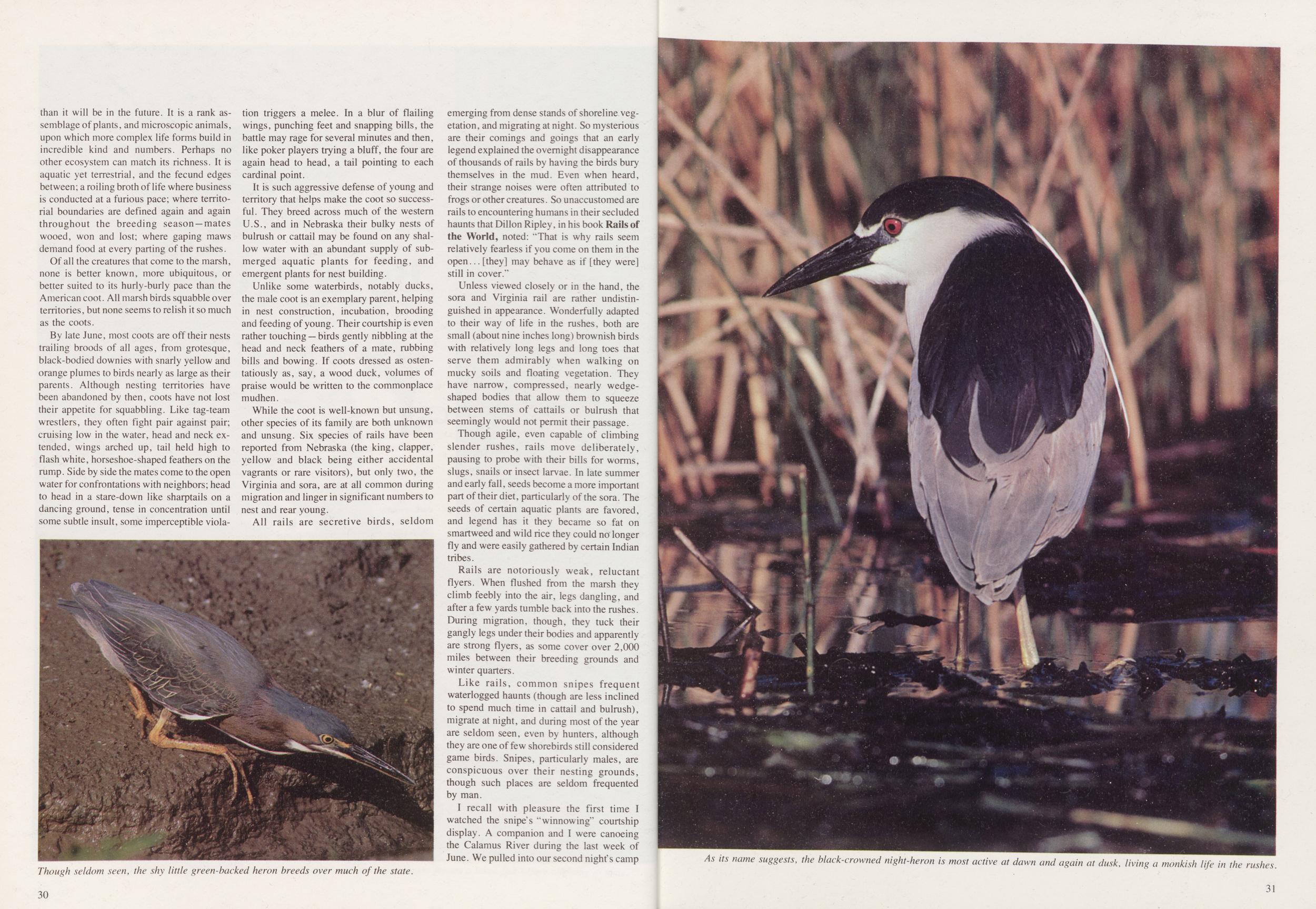
There are other wading birds that come to Nebraska's remaining marshes. Yellowcrowned night-herons are not rare in the southeast but usually they are non-breeding birds, although they have been documented to nest there. The shy little green-backed heron breeds over much of the state and is as likely to be found on a sluggish woodland stream in the Missouri River bluffs as in a marsh. But of all the long-legged wading birds, it is the bitterns and the black-crowned night-herons that have the strongest affinity for marshes. A marsh is not complete without one or more of them. Who could imagine dusk on a summer marsh without the measured gulping of a "thunder pumper" off in the rushes? Although some of the others, particularly the egrets, are no more than tourists, they refine the definition of a marsh. One of the most enduring images I have of a certain marsh in the western Sandhills is of a great blue heron, neck snaked back on its shoulders, standing on a muskrat house in a sea of bulrush at sundown. Could words create a more successful definition of a marsh?
Perhaps these large waders can afford the luxury of being conspicuous and not at all secretive. Other than man, who would attempt to harm them? Young and eggs are, of course, vulnerable, but what predator would have the cunning or gall to approach a great blue heron nest and face the lightning-strike of a rapier-billed opponent.
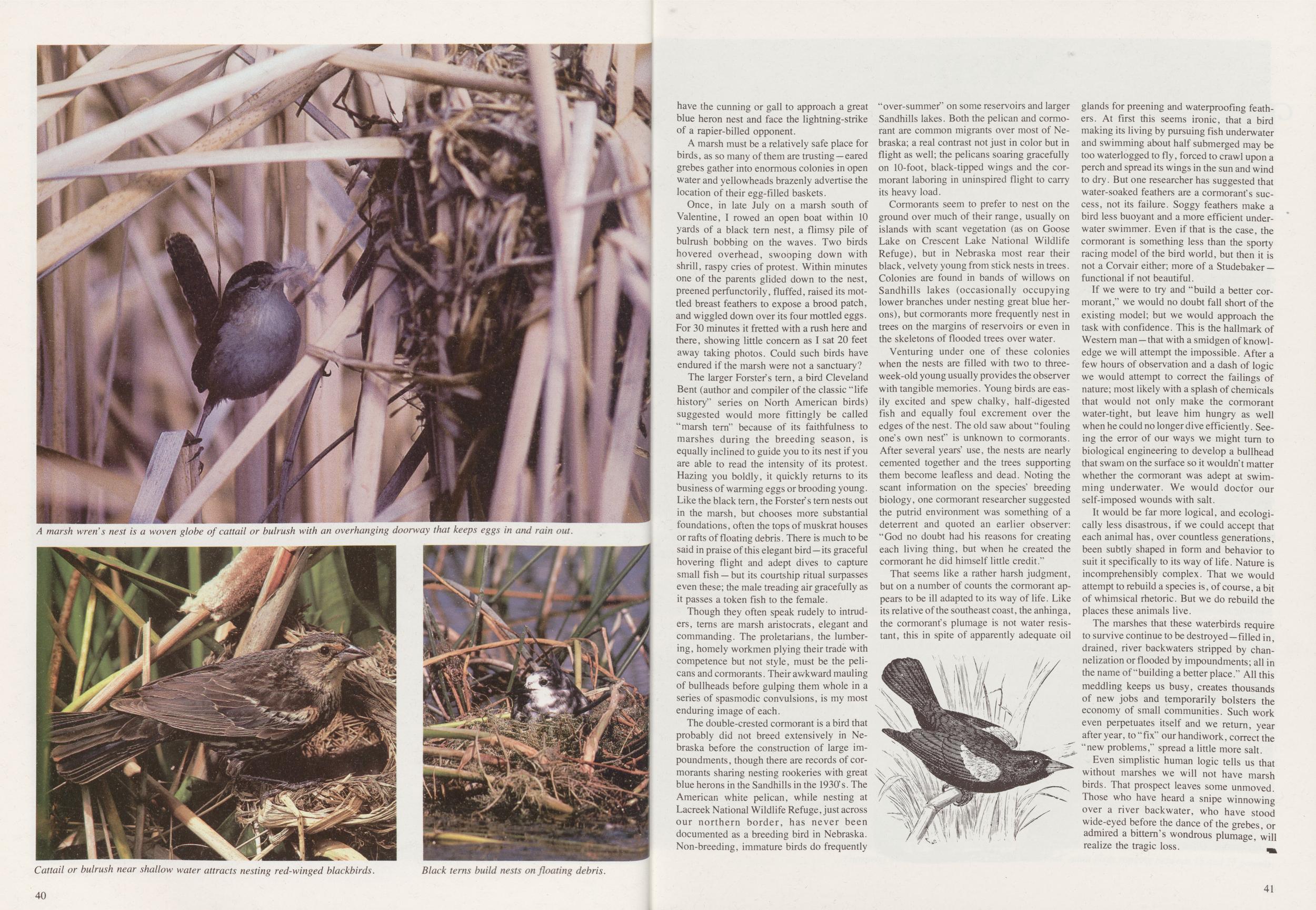
A marsh must be a relatively safe place for birds, as so many of them are trusting— eared grebes gather into enormous colonies in open water and yellowheads brazenly advertise the location of their egg-filled baskets.
Once, in late July on a marsh south of Valentine, I rowed an open boat within 10 yards of a black tern nest, a flimsy pile of bulrush bobbing on the waves. Two birds hovered overhead, swooping down with shrill, raspy cries of protest. Within minutes one of the parents glided down to the nest, preened perfunctorily, fluffed, raised its mottled breast feathers to expose a brood patch, and wiggled down over its four mottled eggs. For 30 minutes it fretted with a rush here and there, showing little concern as I sat 20 feet away taking photos. Could such birds have endured if the marsh were not a sanctuary?
The larger Forster's tern, a bird Cleveland Bent (author and compiler of the classic "life history" series on North American birds) suggested would more fittingly be called "marsh tern' because of its faithfulness to marshes during the breeding season, is equally inclined to guide you to its nest if you are able to read the intensity of its protest. Hazing you boldly, it quickly returns to its business of warming eggs or brooding young. Like the black tern, the Forster's tern nests out in the marsh, but chooses more substantial foundations, often the tops of muskrat houses or rafts of floating debris. There is much to be said in praise of this elegant bird—its graceful hovering flight and adept dives to capture small fish — but its courtship ritual surpasses even these; the male treading air gracefully as it passes a token fish to the female.
Though they often speak rudely to intruders, terns are marsh aristocrats, elegant and commanding. The proletarians, the lumbering, homely workmen plying their trade with competence but not style, must be the pelicans and cormorants. Their awkward mauling of bullheads before gulping them whole in a series of spasmodic convulsions, is my most enduring image of each.
The double-crested cormorant is a bird that probably did not breed extensively in Nebraska before the construction of large impoundments, though there are records of cormorants sharing nesting rookeries with great blue herons in the Sandhills in the 1930's. The American white pelican, while nesting at Lacreek National Wildlife Refuge, just across our northern border, has never been documented as a breeding bird in Nebraska. Non-breeding, immature birds do frequently "over-summer" on some reservoirs and larger Sandhills lakes. Both the pelican and cormorant are common migrants over most of Nebraska; a real contrast not just in color but in flight as well; the pelicans soaring gracefully on 10-foot, black-tipped wings and the cormorant laboring in uninspired flight to carry its heavy load.
Cormorants seem to prefer to nest on the ground over much of their range, usually on islands with scant vegetation (as on Goose Lake on Crescent Lake National Wildlife Refuge), but in Nebraska most rear their black, velvety young from stick nests in trees. Colonies are found in bands of willows on Sandhills lakes (occasionally occupying lower branches under nesting great blue herons), but cormorants more frequently nest in trees on the margins of reservoirs or even in the skeletons of flooded trees over water.
Venturing under one of these colonies when the nests are filled with two to threeweek-old young usually provides the observer with tangible memories. Young birds are easily excited and spew chalky, half-digested fish and equally foul excrement over the edges of the nest. The old saw about "fouling one's own nest" is unknown to cormorants. After several years' use, the nests are nearly cemented together and the trees supporting them become leafless and dead. Noting the scant information on the species' breeding biology, one cormorant researcher suggested the putrid environment was something of a deterrent and quoted an earlier observer: "God no doubt had his reasons for creating each living thing, but when he created the cormorant he did himself little credit."
That seems like a rather harsh judgment, but on a number of counts the cormorant appears to be ill adapted to its way of life. Like its relative of the southeast coast, the anhinga, the cormorant's plumage is not water resistant, this in spite of apparently adequate oil glands for preening and waterproofing feathers. At first this seems ironic, that a bird making its living by pursuing fish underwater and swimming about half submerged may be too waterlogged to fly, forced to crawl upon a perch and spread its wings in the sun and wind to dry. But one researcher has suggested that water-soaked feathers are a cormorant's success, not its failure. Soggy feathers make a bird less buoyant and a more efficient underwater swimmer. Even if that is the case, the cormorant is something less than the sporty racing model of the bird world, but then it is not a Corvair either; more of a Studebaker functional if not beautiful.
If we were to try and "build a better cormorant," we would no doubt fall short of the existing model; but we would approach the task with confidence. This is the hallmark of Western man —that with a smidgen of knowledge we will attempt the impossible. After a few hours of observation and a dash of logic we would attempt to correct the failings of nature; most likely with a splash of chemicals that would not only make the cormorant water-tight, but leave him hungry as well when he could no longer dive efficiently. Seeing the error of our ways we might turn to biological engineering to develop a bullhead that swam on the surface so it wouldn't matter whether the cormorant was adept at swimming underwater. We would doctor our self-imposed wounds with salt.
It would be far more logical, and ecologically less disastrous, if we could accept that each animal has, over countless generations, been subtly shaped in form and behavior to suit it specifically to its way of life. Nature is incomprehensibly complex. That we would attempt to rebuild a species is, of course, a bit of whimsical rhetoric. But we do rebuild the places these animals live.
The marshes that these waterbirds require to survive continue to be destroyed—filled in, drained, river backwaters stripped by channelization or flooded by impoundments; all in the name of "building a better place." All this meddling keeps us busy, creates thousands of new jobs and temporarily bolsters the economy of small communities. Such work even perpetuates itself and we return, year after year, to "fix" our handiwork, correct the "new problems," spread a little more salt.
Even simplistic human logic tells us that without marshes we will not have marsh birds. That prospect leaves some unmoved. Those who have heard a snipe winnowing over a river backwater, who have stood wide-eyed before the dance of the grebes, or admired a bittern's wondrous plumage, will realize the tragic loss.
41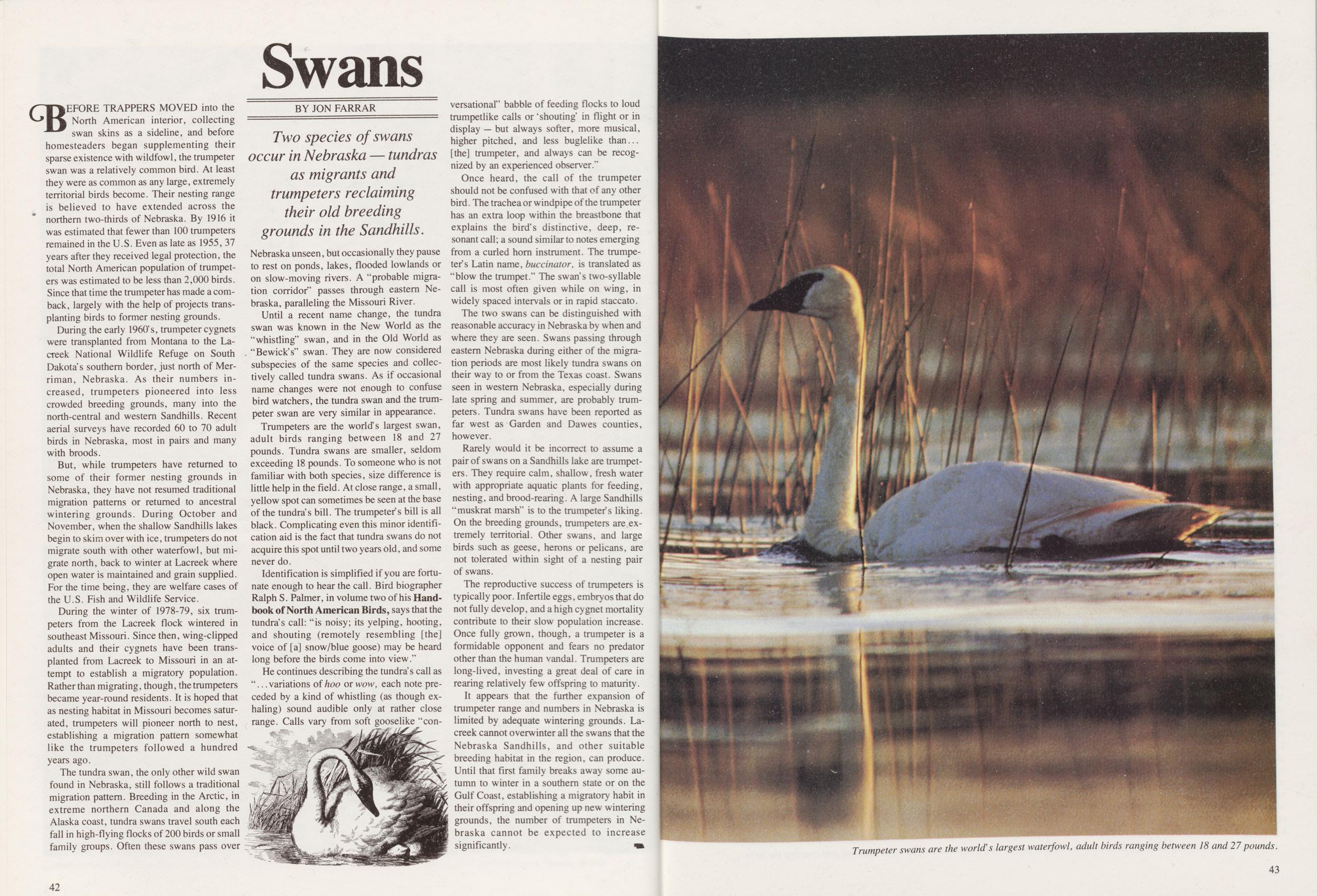
Swans
BY JON FARRAR Two species of swans occur in Nebraska - tundras as mugrants and trumpeters reclaiming their old breeding grounds in Sandhills.EFORE TRAPPERS MOVED into the North American interior, collecting swan skins as a sideline, and before homesteaders began supplementing their sparse existence with wildfowl, the trumpeter swan was a relatively common bird. At least they were as common as any large, extremely territorial birds become. Their nesting range is believed to have extended across the northern two-thirds of Nebraska. By 1916 it was estimated that fewer than 100 trumpeters remained in the U.S. Even as late as 1955, 37 years after they received legal protection, the total North American population of trumpeters was estimated to be less than 2,000 birds. Since that time the trumpeter has made a cornback, largely with the help of projects transplanting birds to former nesting grounds.
During the early 1960's, trumpeter cygnets were transplanted from Montana to the Lacreek National Wildlife Refuge on South Dakota's southern border, just north of Merriman, Nebraska. As their numbers increased, trumpeters pioneered into less crowded breeding grounds, many into the north-central and western Sandhills. Recent aerial surveys have recorded 60 to 70 adult birds in Nebraska, most in pairs and many with broods.
But, while trumpeters have returned to some of their former nesting grounds in Nebraska, they have not resumed traditional migration patterns or returned to ancestral wintering grounds. During October and November, when the shallow Sandhills lakes begin to skim over with ice, trumpeters do not migrate south with other waterfowl, but migrate north, back to winter at Lacreek where open water is maintained and grain supplied. For the time being, they are welfare cases of the U.S. Fish and Wildlife Service.
During the winter of 1978-79, six trumpeters from the Lacreek flock wintered in southeast Missouri. Since then, wing-clipped adults and their cygnets have been transplanted from Lacreek to Missouri in an attempt to establish a migratory population. Rather than migrating, though, the trumpeters became year-round residents. It is hoped that as nesting habitat in Missouri becomes saturated, trumpeters will pioneer north to nest, establishing a migration pattern somewhat like the trumpeters followed a hundred years ago. The tundra swan, the only other wild swan found in Nebraska, still follows a traditional migration pattern. Breeding in the Arctic, in extreme northern Canada and along the Alaska coast, tundra swans travel south each fall in high-flying flocks of 200 birds or small family groups. Often these swans pass over Nebraska unseen, but occasionally they pause to rest on ponds, lakes, flooded lowlands or on slow-moving rivers. A "probable migration corridor" passes through eastern Nebraska, paralleling the Missouri River.
Until a recent name change, the tundra swan was known in the New World as the "whistling" swan, and in the Old World as "Bewick's" swan. They are now considered subspecies of the same species and collectively called tundra swans. As if occasional name changes were not enough to confuse bird watchers, the tundra swan and the trumpeter swan are very similar in appearance.
Trumpeters are the world's largest swan, adult birds ranging between 18 and 27 pounds. Tundra swans are smaller, seldom exceeding 18 pounds. To someone who is not familiar with both species, size difference is little help in the field. At close range, a small, yellow spot can sometimes be seen at the base of the tundra's bill. The trumpeter's bill is all black. Complicating even this minor identification aid is the fact that tundra swans do not acquire this spot until two years Old, and some never do.
Identification is simplified if you are fortunate enough to hear the call. Bird biographer Ralph S. Palmer, in volume two of his Handbook of North American Birds, says that the tundra's call: "is noisy; its yelping, hooting, and shouting (remotely resembling [the] voice of [a] snow/blue goose) may be heard long before the birds come into view."
He continues describing the tundra's call as "... variations of hoo or wow, each note preceded by a kind of whistling (as though exhaling) sound audible only at rather close range. Calls vary from soft gooselike "conversational" babble of feeding flocks to loud trumpetlike calls or 'shouting' in flight or in display — but always softer, more musical, higher pitched, and less buglelike than... [the] trumpeter, and always can be recognized by an experienced observer."
Once heard, the call of the trumpeter should not be confused with that of any other bird. The trachea or windpipe of the trumpeter has an extra loop within the breastbone that explains the bird's distinctive, deep, resonant call; a sound similar to notes emerging from a curled horn instrument. The trumpeter's Latin name, buccinator, is translated as "blow the trumpet." The swan's two-syllable call is most often given while on wing, in widely spaced intervals or in rapid staccato.
The two swans can be distinguished with reasonable accuracy in Nebraska by when and where they are seen. Swans passing through eastern Nebraska during either of the migration periods are most likely tundra swans on their way to or from the Texas coast. Swans seen in western Nebraska, especially during late spring and summer, are probably trumpeters. Tundra swans have been reported as far west as Garden and Dawes counties, however.
Rarely would it be incorrect to assume a pair of swans on a Sandhills lake are trumpeters. They require calm, shallow, fresh water with appropriate aquatic plants for feeding, nesting, and brood-rearing. A large Sandhills "muskrat marsh" is to the trumpeter's liking. On the breeding grounds, trumpeters are extremely territorial. Other swans, and large birds such as geese, herons or pelicans, are not tolerated within sight of a nesting pair of swans.
The reproductive success of trumpeters is typically poor. Infertile eggs, embryos that do not fully develop, and a high cygnet mortality contribute to their slow population increase. Once fully grown, though, a trumpeter is a formidable opponent and fears no predator other than the human vandal. Trumpeters are long-lived, investing a great deal of care in rearing relatively few offspring to maturity.
It appears that the further expansion of trumpeter range and numbers in Nebraska is limited by adequate wintering grounds. Lacreek cannot overwinter all the swans that the Nebraska Sandhills, and other suitable breeding habitat in the region, can produce. Until that first family breaks away some autumn to winter in a southern state or on the Gulf Coast, establishing a migratory habit in their offspring and opening up new wintering grounds, the number of trumpeters in Nebraska cannot be expected to increase significantly.
42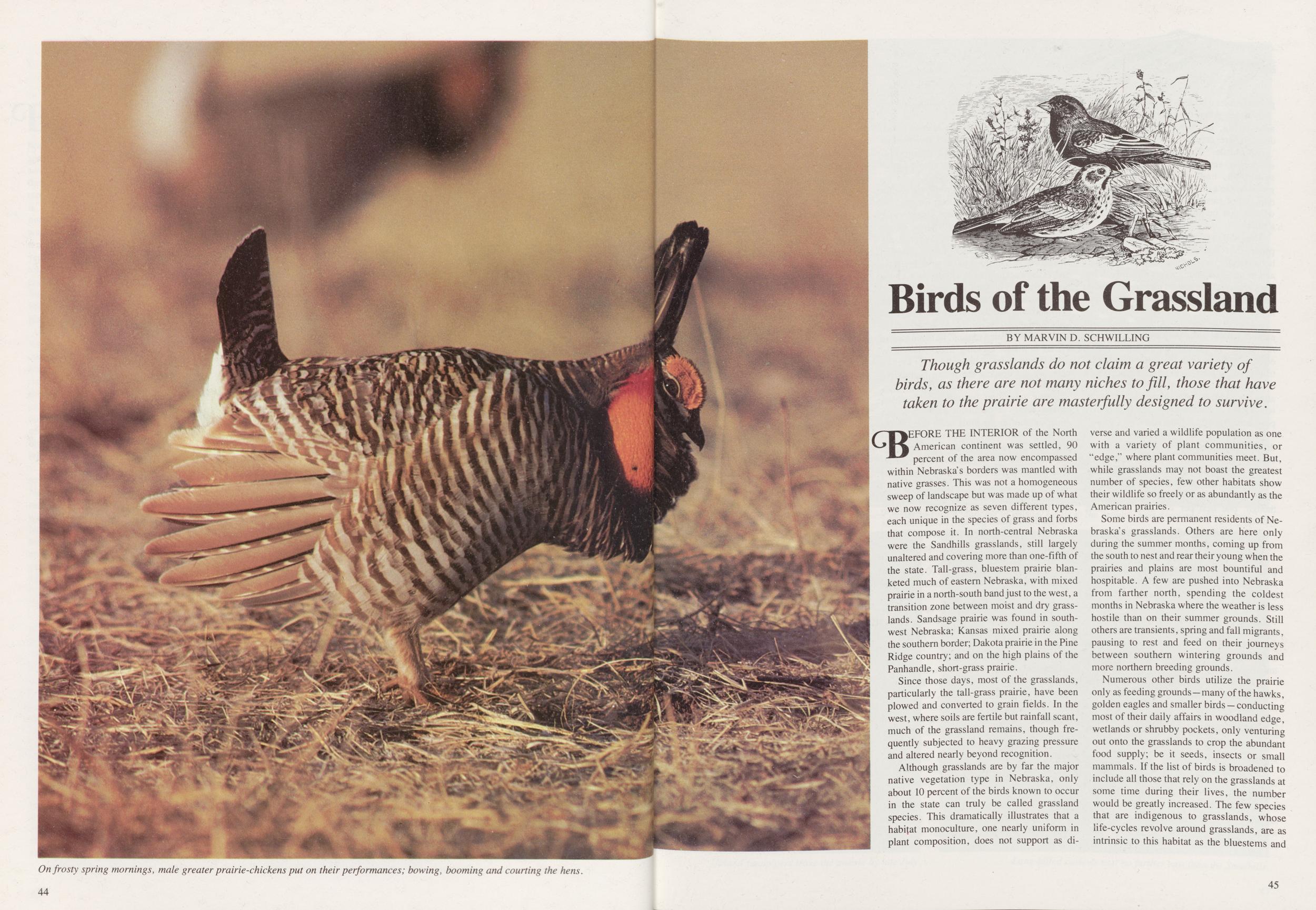
Birds of the Grassland
BY MARVIN D. SCHWILLING Though grasslands do not claim a great variety of birds, as there are not many niches to fill, those that have taken to the prairie are masterfully designed to survive.BEFORE THE INTERIOR of the North American continent was settled, 90 percent of the area now encompassed within Nebraska's borders was mantled with native grasses. This was not a homogeneous sweep of landscape but was made up of what we now recognize as seven different types, each unique in the species of grass and forbs that compose it. In north-central Nebraska were the Sandhills grasslands, still largely unaltered and covering more than one-fifth of the state. Tall-grass, bluestem prairie blanketed much of eastern Nebraska, with mixed prairie in a north-south band just to the west, a transition zone between moist and dry grasslands. Sandsage prairie was found in southwest Nebraska; Kansas mixed prairie along the southern border; Dakota prairie in the Pine Ridge country; and on the high plains of the Panhandle, short-grass prairie.
Since those days, most of the grasslands, particularly the tall-grass prairie, have been plowed and converted to grain fields. In the west, where soils are fertile but rainfall scant, much of the grassland remains, though frequently subjected to heavy grazing pressure and altered nearly beyond recognition.
Although grasslands are by far the major native vegetation type in Nebraska, only about 10 percent of the birds known to occur in the state can truly be called grassland species. This dramatically illustrates that a habitat monoculture, one nearly uniform in plant composition, does not support as diverse and varied a wildlife population as one with a variety of plant communities, or "edge," where plant communities meet. But, while grasslands may not boast the greatest number of species, few other habitats show their wildlife so freely or as abundantly as the American prairies.
Some birds are permanent residents of Nebraska's grasslands. Others are here only during the summer months, coming up from the south to nest and rear their young when the prairies and plains are most bountiful and hospitable. A few are pushed into Nebraska from farther north, spending the coldest months in Nebraska where the weather is less hostile than on their summer grounds. Still others are transients, spring and fall migrants, pausing to rest and feed on their journeys between southern wintering grounds and more northern breeding grounds.
Some birds are permanent residents of Nebraska's grasslands. Others are here only during the summer months, coming up from the south to nest and rear their young when the prairies and plains are most bountiful and hospitable. A few are pushed into Nebraska from farther north, spending the coldest months in Nebraska where the weather is less hostile than on their summer grounds. Still others are transients, spring and fall migrants, pausing to rest and feed on their journeys between southern wintering grounds and more northern breeding grounds.
Numerous other birds utilize the prairie
only as feeding grounds — many of the hawks,
golden eagles and smaller birds — conducting
most of their daily affairs in woodland edge,
wetlands or shrubby pockets, only venturing
out onto the grasslands to crop the abundant
food supply; be it seeds, insects or small
mammals. If the list of birds is broadened to
include all those that rely on the grasslands at
some time during their lives, the number
would be greatly increased. The few species
that are indigenous to grasslands, whose
life-cycles revolve around grasslands, are as
intrinsic to this habitat as the bluestems and
45
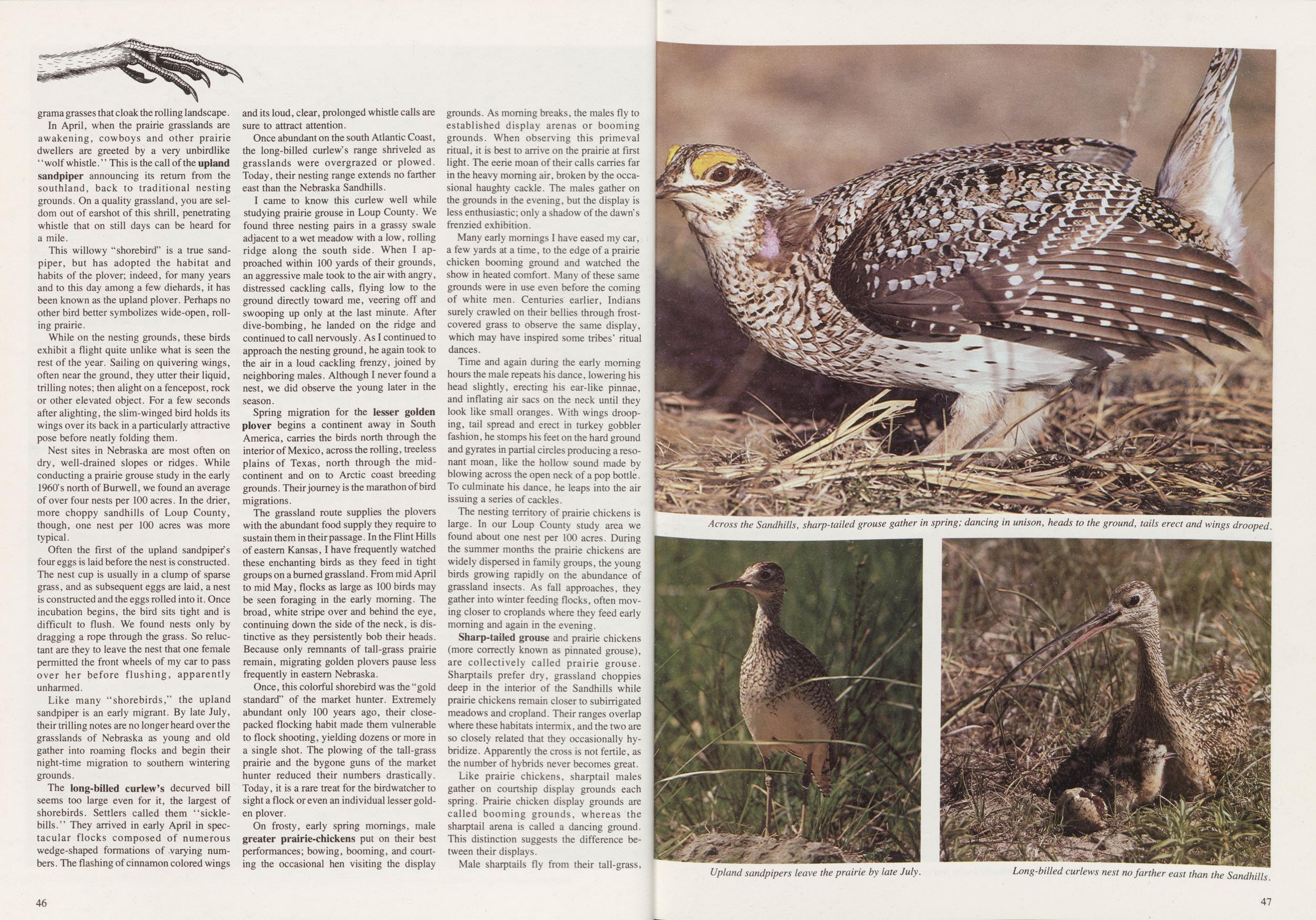 grama grasses that cloak the rolling landscape.
In April, when the prairie grasslands are awakening, cowboys and other prairie dwellers are greeted by a very unbirdlike "wolf whistle.' This is the call of the upland sandpiper announcing its return from the southland, back to traditional nesting grounds. On a quality grassland, you are seldom out of earshot of this shrill, penetrating whistle that on still days can be heard for a mile.
This willowy "shorebird" is a true sandpiper, but has adopted the habitat and habits of the plover; indeed, for many years and to this day among a few diehards, it has been known as the upland plover. Perhaps no other bird better symbolizes wide-open, rolling prairie.
While on the nesting grounds, these birds exhibit a flight quite unlike what is seen the rest of the year. Sailing on quivering wings, often near the ground, they utter their liquid, trilling notes; then alight on a fencepost, rock or other elevated object. For a few seconds after alighting, the slim-winged bird holds its wings over its back in a particularly attractive pose before neatly folding them.
Nest sites in Nebraska are most often on dry, well-drained slopes or ridges. While conducting a prairie grouse study in the early 1960's north of Burwell, we found an average of over four nests per 100 acres. In the drier, more choppy sandhills of Loup County, though, one nest per 100 acres was more typical.
Often the first of the upland sandpipers four eggs is laid before the nest is constructed. The nest cup is usually in a clump of sparse grass, and as subsequent eggs are laid, a nest is constructed and the eggs rolled into it. Once incubation begins, the bird sits tight and is difficult to flush. We found nests only by dragging a rope through the grass. So reluctant are they to leave the nest that one female permitted the front wheels of my car to pass over her before flushing, apparently unharmed.
Like many "shorebirds," the upland sandpiper is an early migrant. By late July, their trilling notes are no longer heard over the grasslands of Nebraska as young and old gather into roaming flocks and begin their night-time migration to southern wintering grounds.
The long-billed curlew's decurved bill seems too large even for it, the largest of shorebirds. Settlers called them "sickle- bills.' They arrived in early April in spectacular flocks composed of numerous wedge-shaped formations of varying numbers. The flashing of cinnamon colored wings and its loud, clear, prolonged whistle calls are sure to attract attention.
Once abundant on the south Atlantic Coast, the long-billed curlew's range shriveled as grasslands were overgrazed or plowed. Today, their nesting range extends no farther east than the Nebraska Sandhills.
I came to know this curlew well while studying prairie grouse in Loup County. We found three nesting pairs in a grassy swale adjacent to a wet meadow with a low, rolling ridge along the south side. When I approached within 100 yards of their grounds, an aggressive male took to the air with angry, distressed cackling calls, flying low to the ground directly toward me, veering off and swooping up only at the last minute. After dive-bombing, he landed on the ridge and continued to call nervously. As I continued to approach the nesting ground, he again took to the air in a loud cackling frenzy, joined by neighboring males. Although I never found a nest, we did observe the young later in the season.
Spring migration for the lesser golden plover begins a continent away in South America, carries the birds north through the interior of Mexico, across the rolling, treeless plains of Texas, north through the midcontinent and on to Arctic coast breeding grounds. Their journey is the marathon of bird migrations.
The grassland route supplies the plovers with the abundant food supply they require to sustain them in their passage. In the Flint Hills of eastern Kansas, I have frequently watched these enchanting birds as they feed in tight groups on a burned grassland. From mid April to mid May, flocks as large as 100 birds may be seen foraging in the early morning. The broad, white stripe over and behind the eye, continuing down the side of the neck, is distinctive as they persistently bob their heads. Because only remnants of tall-grass prairie remain, migrating golden plovers pause less frequently in eastern Nebraska.
Once, this colorful shorebird was the "gold standard" of the market hunter. Extremely abundant only 100 years ago, their closepacked flocking habit made them vulnerable to flock shooting, yielding dozens or more in a single shot. The plowing of the tall-grass prairie and the bygone guns of the market hunter reduced their numbers drastically. Today, it is a rare treat for the birdwatcher to sight a flock or even an individual lesser golden plover.
On frosty, early spring mornings, male greater prairie-chickens put on their best performances; bowing, booming, and courting the occasional hen visiting the display grounds. As morning breaks, the males fly to established display arenas or booming grounds. When observing this primeval ritual, it is best to arrive on the prairie at first light. The eerie moan of their calls carries far in the heavy morning air, broken by the occasional haughty cackle. The males gather on the grounds in the evening, but the display is less enthusiastic; only a shadow of the dawn's frenzied exhibition.
Many early mornings I have eased my car, a few yards at a time, to the edge of a prairie chicken booming ground and watched the show in heated comfort. Many of these same grounds were in use even before the coming of white men. Centuries earlier, Indians surely crawled on their bellies through frostcovered grass to observe the same display, which may have inspired some tribes' ritual dances.
Time and again during the early morning hours the male repeats his dance, lowering his head slightly, erecting his ear-like pinnae, and inflating air sacs on the neck until they look like small oranges. With wings drooping, tail spread and erect in turkey gobbler fashion, he stomps his feet on the hard ground and gyrates in partial circles producing a resonant moan, like the hollow sound made by blowing across the open neck of a pop bottle. To culminate his dance, he leaps into the air issuing a series of cackles.
The nesting territory of prairie chickens is large. In our Loup County study area we found about one nest per 100 acres. During the summer months the prairie chickens are widely dispersed in family groups, the young birds growing rapidly on the abundance of grassland insects. As fall approaches, they gather into winter feeding flocks, often moving closer to croplands where they feed early morning and again in the evening.
Sharp-tailed grouse and prairie chickens (more correctly known as pinnated grouse), are collectively called prairie grouse. Sharptails prefer dry, grassland choppies deep in the interior of the Sandhills while prairie chickens remain closer to subirrigated meadows and cropland. Their ranges overlap where these habitats intermix, and the two are so closely related that they occasionally hybridize. Apparently the cross is not fertile, as the number of hybrids never becomes great.
Like prairie chickens, sharptail males gather on courtship display grounds each spring. Prairie chicken display grounds are called booming grounds, whereas the sharptail arena is called a dancing ground. This distinction suggests the difference between their displays.
Male sharptails fly from their tall-grass, hillside roosts to the dancing grounds at the first hint of morning light. As with the prairie chickens, the evening display is less intense. Unique among displays in the grouse family, sharptails have synchronized performances during which several males display in unison. With heads close to the ground, tails erect and wings drooped, necks outstretched and purple air sacs inflated, they stomp their feet in a "rata-tat-tat" fashion as they buzz in semicircles through their established bit of territory. Suddenly, all birds stop as though frozen motionless, then as if on command the display starts again. This almost mechanical display cannot help but bring to mind an oversized wind-up toy.
46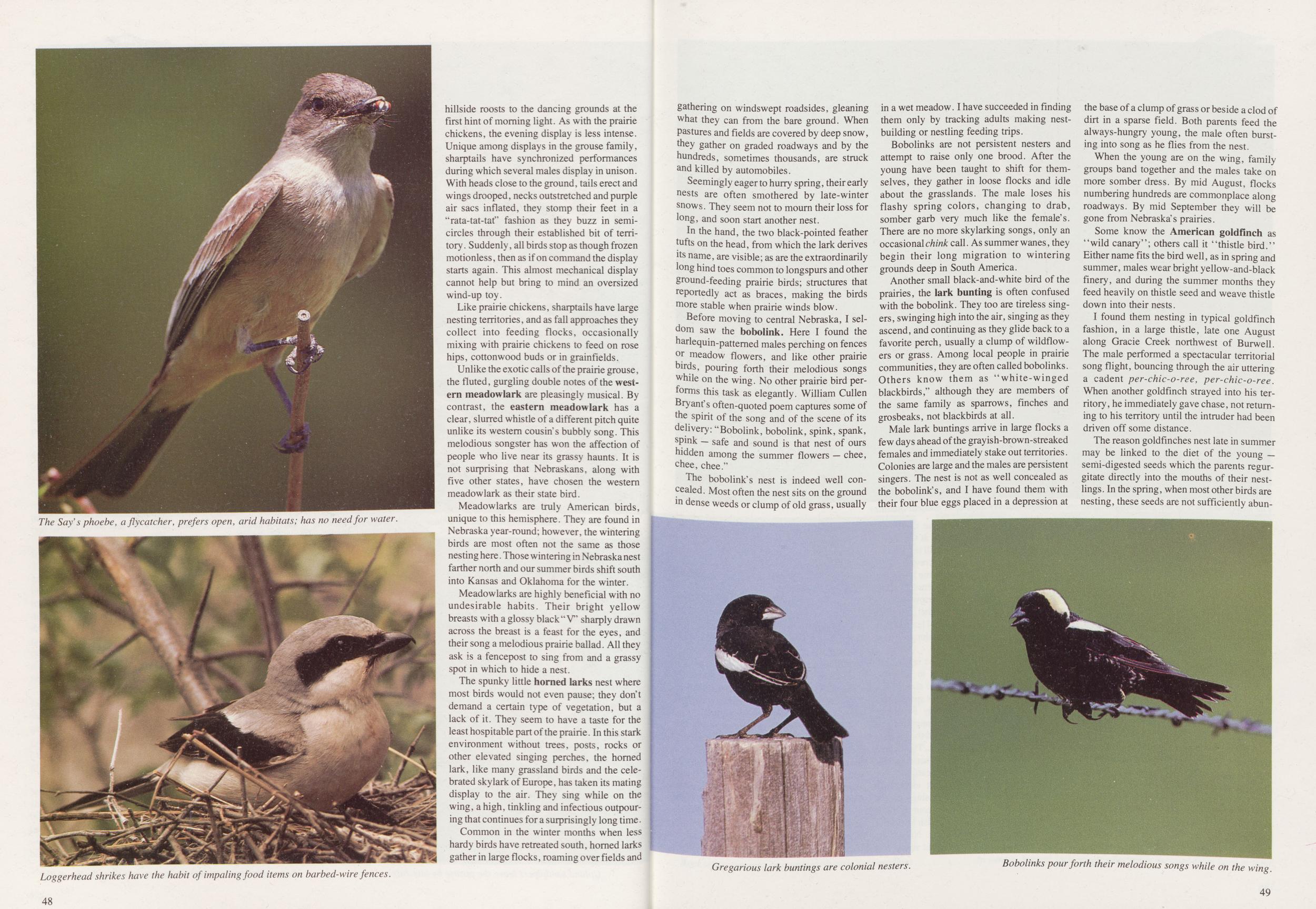
Like prairie chickens, sharptails have large nesting territories, and as fall approaches they collect into feeding flocks, occasionally mixing with prairie chickens to feed on rose hips, cottonwood buds or in grainfields.
Unlike the exotic calls of the prairie grouse, the fluted, gurgling double notes of the western meadowlark are pleasingly musical. By contrast, the eastern meadowlark has a clear, slurred whistle of a different pitch quite unlike its western cousin's bubbly song. This melodious songster has won the affection of people who live near its grassy haunts. It is not surprising that Nebraskans, along with five other states, have chosen the western meadowlark as their state bird.
Meadowlarks are truly American birds, unique to this hemisphere. They are found in Nebraska year-round; however, the wintering birds are most often not the same as those nesting here. Those wintering in Nebraska nest farther north and our summer birds shift south into Kansas and Oklahoma for the winter.
Meadowlarks are highly beneficial with no undesirable habits. Their bright yellow breasts with a glossy black" V" sharply drawn across the breast is a feast for the eyes, and their song a melodious prairie ballad. All they ask is a fencepost to sing from and a grassy spot in which to hide a nest.
The spunky little horned larks nest where most birds would not even pause; they don't demand a certain type of vegetation, but a lack of it. They seem to have a taste for the least hospitable part of the prairie. In this stark environment without trees, posts, rocks or other elevated singing perches, the horned lark, like many grassland birds and the celebrated skylark of Europe, has taken its mating display to the air. They sing while on the wing, a high, tinkling and infectious outpouring that continues for a surprisingly long time. Common in the winter months when less hardy birds have retreated south, horned larks gather in large flocks, roaming over fields and 49 gathering on windswept roadsides, gleaning what they can from the bare ground. When pastures and fields are covered by deep snow, they gather on graded roadways and by the hundreds, sometimes thousands, are struck and killed by automobiles.
Seemingly eager to hurry spring, their early nests are often smothered by late-winter snows. They seem not to mourn their loss for long, and soon start another nest.
In the hand, the two black-pointed feather tufts on the head, from which the lark derives its name, are visible; as are the extraordinarily long hind toes common to longspurs and other ground-feeding prairie birds; structures that reportedly act as braces, making the birds more stable when prairie winds blow.
Before moving to central Nebraska, I seldom saw the bobolink. Here I found the harlequin-patterned males perching on fences or meadow flowers, and like other prairie birds, pouring forth their melodious songs while on the wing. No other prairie bird performs this task as elegantly. William Cullen Bryant's often-quoted poem captures some of the spirit of the song and of the scene of its delivery: "Bobolink, bobolink, spink, spank, spink — safe and sound is that nest of ours hidden among the summer flowers — chee, chee, chee."
The bobolink's nest is indeed well concealed. Most often the nest sits on the ground in dense weeds or clump of old grass, usually in a wet meadow. I have succeeded in finding them only by tracking adults making nestbuilding or nestling feeding trips.
Bobolinks are not persistent nesters and attempt to raise only one brood. After the young have been taught to shift for themselves, they gather in loose flocks and idle about the grasslands. The male loses his flashy spring colors, changing to drab, somber garb very much like the female's. There are no more skylarking songs, only an occasional chink call. As summer wanes, they begin their long migration to wintering grounds deep in South America.
Another small black-and-white bird of the prairies, the lark bunting is often confused with the bobolink. They too are tireless singers, swinging high into the air, singing as they ascend, and continuing as they glide back to a favorite perch, usually a clump of wildflowers or grass. Among local people in prairie communities, they are often called bobolinks. Others know them as "white-winged blackbirds," although they are members of the same family as sparrows, finches and grosbeaks, not blackbirds at all.
Male lark buntings arrive in large flocks a few days ahead of the grayish-brown-streaked females and immediately stake out territories. Colonies are large and the males are persistent singers. The nest is not as well concealed as the bobolink's, and I have found them with their four blue eggs placed in a depression at the base of a clump of grass or beside a clod of dirt in a sparse field. Both parents feed the always-hungry young, the male often bursting into song as he flies from the nest.
When the young are on the wing, family groups band together and the males take on more somber dress. By mid August, flocks numbering hundreds are commonplace along roadways. By mid September they will be gone from Nebraska's prairies.
Some know the American goldfinch as "wild canary"; others call it "thistle bird." Either name fits the bird well, as in spring and summer, males wear bright yellow-and-black finery, and during the summer months they feed heavily on thistle seed and weave thistle down into their nests.
I found them nesting in typical goldfinch fashion, in a large thistle, late one August along Gracie Creek northwest of Burwell. The male performed a spectacular territorial song flight, bouncing through the air uttering a cadent per-chic-o-ree, per-chic-o-ree. When another goldfinch strayed into his territory, he immediately gave chase, not returning to his territory until the intruder had been driven off some distance.
The reason goldfinches nest late in summer may be linked to the diet of the young semi-digested seeds which the parents regurgitate directly into the mouths of their nestlings. In the spring, when most other birds are nesting, these seeds are not sufficiently abun dant to support both adults and young.
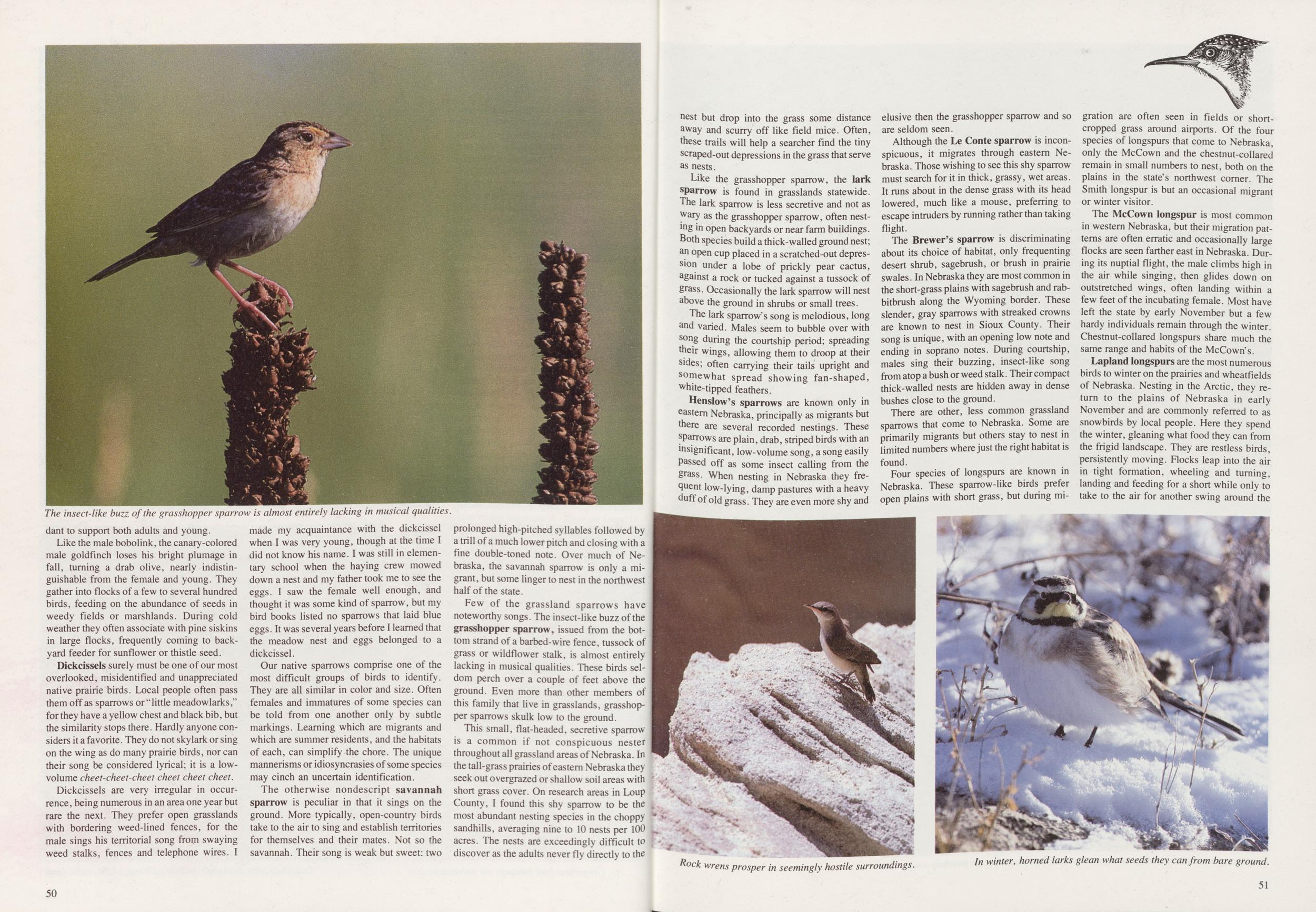
Like the male bobolink, the canary-colored male goldfinch loses his bright plumage in fall, turning a drab olive, nearly indistinguishable from the female and young. They gather into flocks of a few to several hundred birds, feeding on the abundance of seeds in weedy fields or marshlands. During cold weather they often associate with pine siskins in large flocks, frequently coming to backyard feeder for sunflower or thistle seed.
Dickcissels surely must be one of our most overlooked, misidentified and unappreciated native prairie birds. Local people often pass them off as sparrows or "little meadowlarks," for they have a yellow chest and black bib, but the similarity stops there. Hardly anyone considers it a favorite. They do not skylark or sing on the wing as do many prairie birds, nor can their song be considered lyrical; it is a low-volume cheet-cheet-cheet cheet cheet cheet.
Dickcissels are very irregular in occurrence, being numerous in an area one year but rare the next. They prefer open grasslands with bordering weed-lined fences, for the male sings his territorial song from swaying weed stalks, fences and telephone wires. I made my acquaintance with the dickcissel when I was very young, though at the time I did not know his name. I was still in elementary school when the haying crew mowed down a nest and my father took me to see the eggs. I saw the female well enough, and thought it was some kind of sparrow, but my bird books listed no sparrows that laid blue eggs. It was several years before I learned that the meadow nest and eggs belonged to a dickcissel.
Our native sparrows comprise one of the most difficult groups of birds to identify. They are all similar in color and size. Often females and immatures of some species can be told from one another only by subtle markings. Learning which are migrants and which are summer residents, and the habitats of each, can simplify the chore. The unique mannerisms or idiosyncrasies of some species may cinch an uncertain identification.
The otherwise nondescript savannah sparrow is peculiar in that it sings on the ground. More typically, open-country birds take to the air to sing and establish territories for themselves and their mates. Not so the savannah. Their song is weak but sweet: two prolonged high-pitched syllables followed by a trill of a much lower pitch and closing with a fine double-toned note. Over much of Nebraska, the savannah sparrow is only a migrant, but some linger to nest in the northwest half of the state.
Few of the grassland sparrows have noteworthy songs. The insect-like buzz of the grasshopper sparrow, issued from the bottom strand of a barbed-wire fence, tussock of grass or wildflower stalk, is almost entirely lacking in musical qualities. These birds seldom perch over a couple of feet above the ground. Even more than other members of this family that live in grasslands, grasshopper sparrows skulk low to the ground.
This small, flat-headed, secretive sparrow is a common if not conspicuous nester throughout all grassland areas of Nebraska. In the tall-grass prairies of eastern Nebraska they seek out overgrazed or shallow soil areas with short grass cover. On research areas in Loup County, I found this shy sparrow to be the most abundant nesting species in the choppy sandhills, averaging nine to 10 nests per 100 acres. The nests are exceedingly difficult to discover as the adults never fly directly to the 50 nest but drop into the grass some distance away and scurry off like field mice. Often, these trails will help a searcher find the tiny scraped-out depressions in the grass that serve as nests.
Like the grasshopper sparrow, the lark sparrow is found in grasslands statewide. The lark sparrow is less secretive and not as wary as the grasshopper sparrow, often nesting in open backyards or near farm buildings. Both species build a thick-walled ground nest; an open cup placed in a scratched-out depression under a lobe of prickly pear cactus, against a rock or tucked against a tussock of grass. Occasionally the lark sparrow will nest above the ground in shrubs or small trees.
The lark sparrow's song is melodious, long and varied. Males seem to bubble over with song during the courtship period; spreading their wings, allowing them to droop at their sides; often carrying their tails upright and somewhat spread showing fan-shaped, white-tipped feathers.
Henslow's sparrows are known only in eastern Nebraska, principally as migrants but there are several recorded nestings. These sparrows are plain, drab, striped birds with an ^significant, low-volume song, a song easily Passed off as some insect calling from the grass. When nesting in Nebraska they frequent low-lying, damp pastures with a heavy duff of old grass. They are even more shy and elusive then the grasshopper sparrow and so are seldom seen.
Although the Le Conte sparrow is inconspicuous, it migrates through eastern Nebraska. Those wishing to see this shy sparrow must search for it in thick, grassy, wet areas. It runs about in the dense grass with its head lowered, much like a mouse, preferring to escape intruders by running rather than taking flight.
The Brewer's sparrow is discriminating about its choice of habitat, only frequenting desert shrub, sagebrush, or brush in prairie swales. In Nebraska they are most common in the short-grass plains with sagebrush and rabbitbrush along the Wyoming border. These slender, gray sparrows with streaked crowns are known to nest in Sioux County. Their song is unique, with an opening low note and ending in soprano notes. During courtship, males sing their buzzing, insect-like song from atop a bush or weed stalk. Their compact thick-walled nests are hidden away in dense bushes close to the ground.
There are other, less common grassland sparrows that come to Nebraska. Some are primarily migrants but others stay to nest in limited numbers where just the right habitat is found.
Four species of longspurs are known in Nebraska. These sparrow-like birds prefer open plains with short grass, but during migration are often seen in fields or shortcropped grass around airports. Of the four species of longspurs that come to Nebraska, only the McCown and the chestnut-collared remain in small numbers to nest, both on the plains in the state's northwest corner. The Smith longspur is but an occasional migrant or winter visitor.
The McCown longspur is most common in western Nebraska, but their migration patterns are often erratic and occasionally large flocks are seen farther east in Nebraska. During its nuptial flight, the male climbs high in the air while singing, then glides down on outstretched wings, often landing within a few feet of the incubating female. Most have left the state by early November but a few hardy individuals remain through the winter. Chestnut-collared longspurs share much the same range and habits of the McCown's.
Lapland longspurs are the most numerous birds to winter on the prairies and wheatfields of Nebraska. Nesting in the Arctic, they return to the plains of Nebraska in early November and are commonly referred to as snowbirds by local people. Here they spend the winter, gleaning what food they can from the frigid landscape. They are restless birds, persistently moving. Flocks leap into the air in tight formation, wheeling and turning, landing and feeding for a short while only to take to the air for another swing around the prairie. Their distinctive "tinkling" flight call can only be heard a short distance. During winter they are drab, brownish, nondescript birds, streaked with black and with lighter underparts. Before the flocks move north in late February, though, the males are beginning to take on their colorful breeding season garb — a bright chestnut nape; jet-black crown, face and chest contrasted with a broad white line looping down from the back of the eye.
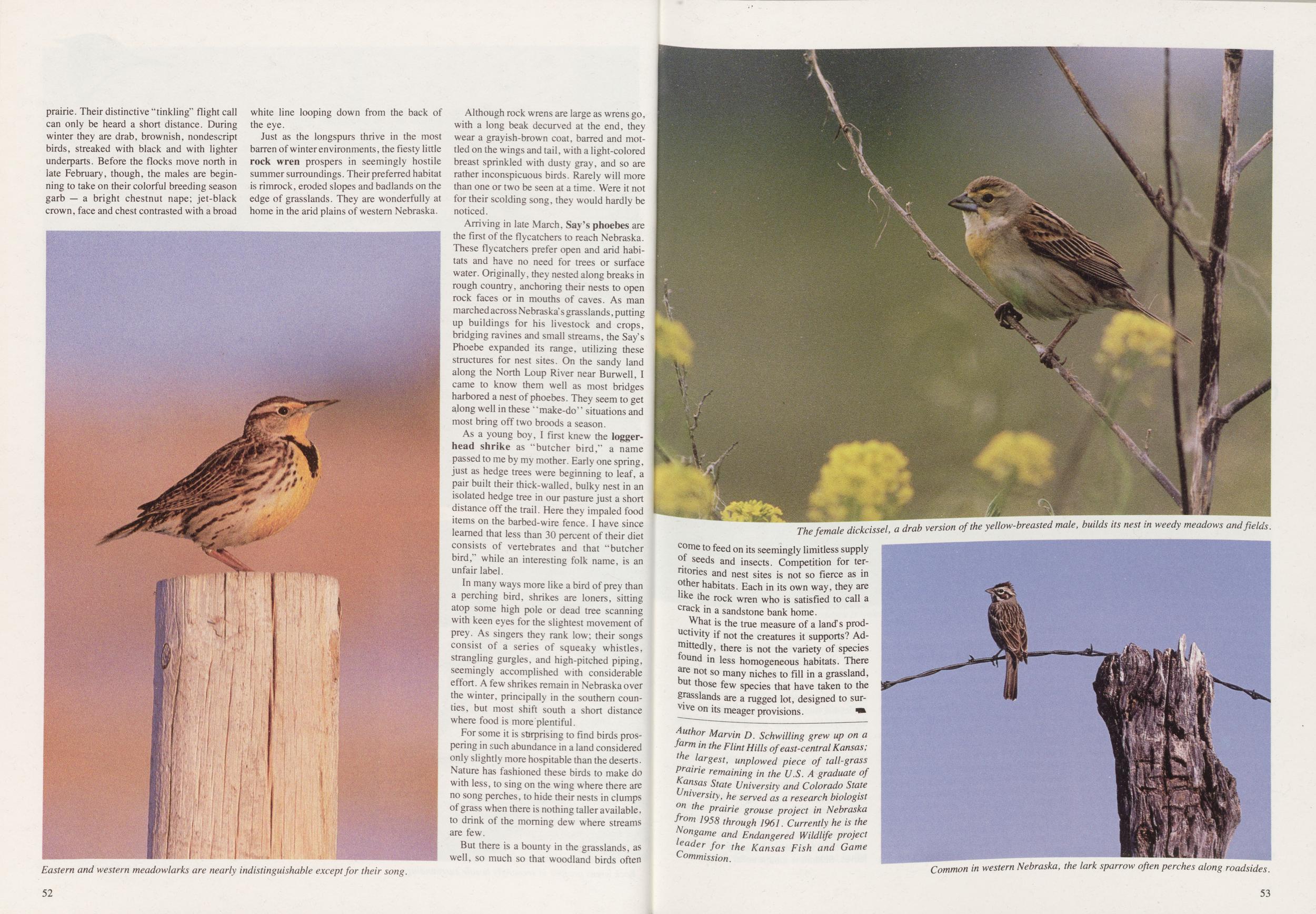
Just as the longspurs thrive in the most barren of winter environments, the fiesty little rock wren prospers in seemingly hostile summer surroundings. Their preferred habitat is rimrock, eroded slopes and badlands on the edge of grasslands. They are wonderfully at home in the arid plains of western Nebraska. Eastern and western meadowlarks are nearly indistinguishable except for their song.
Although rock wrens are large as wrens go, with a long beak decurved at the end, they wear a grayish-brown coat, barred and mottled on the wings and tail, with a light-colored breast sprinkled with dusty gray, and so are rather inconspicuous birds. Rarely will more than one or two be seen at a time. Were it not for their scolding song, they would hardly be noticed.
Arriving in late March, Say's phoebes are the first of the flycatchers to reach Nebraska. These flycatchers prefer open and arid habitats and have no need for trees or surface water. Originally, they nested along breaks in rough country, anchoring their nests to open rock faces or in mouths of caves. As man marched across Nebraska s grasslands, putting up buildings for his livestock and crops, bridging ravines and small streams, the Say's Phoebe expanded its range, utilizing these structures for nest sites. On the sandy land along the North Loup River near Burwell, I came to know them well as most bridges harbored a nest of phoebes. They seem to get along well in these 'k make-do" situations and most bring off two broods a season.
As a young boy, I first knew the loggerhead shrike as "butcher bird," a name passed to me by my mother. Early one spring, just as hedge trees were beginning to leaf, a pair built their thick-walled, bulky nest in an isolated hedge tree in our pasture just a short distance off the trail. Here they impaled food items on the barbed-wire fence. I have since learned that less than 30 percent of their diet consists of vertebrates and that "butcher bird," while an interesting folk name, is an unfair label.
In many ways more like a bird of prey than a perching bird, shrikes are loners, sitting atop some high pole or dead tree scanning with keen eyes for the slightest movement of prey. As singers they rank low; their songs consist of a series of squeaky whistles, strangling gurgles, and high-pitched piping, seemingly accomplished with considerable effort. A few shrikes remain in Nebraska over the winter, principally in the southern counties, but most shift south a short distance where food is more plentiful.
For some it is surprising to find birds prospering in such abundance in a land considered only slightly more hospitable than the deserts. Nature has fashioned these birds to make do with less, to sing on the wing where there are no song perches, to hide their nests in clumps of grass when there is nothing taller available, to drink of the morning dew where streams are few.
But there is a bounty in the grasslands, as well, so much so that woodland birds often come to feed on its seemingly limitless supply °f seeds and insects. Competition for territories and nest sites is not so fierce as in °ther habitats. Each in its own way, they are lke the rock wren who is satisfied to call a °rack in a sandstone bank home.
52What is the true measure of a land's productivity if not the creatures it supports? Admittedly, there is not the variety of species found in less homogeneous habitats. There are not so many niches to fill in a grassland, ut th°se few species that have taken to the grasslands are a rugged lot, designed to survive on its meager provisions.
Author Marvin D. Schwilling grew up on a Mm in the Flint Hills of east-central Kansas; the , largest, unplowed piece of tall-grass Prairie remaining in the U.S. A graduate of Kansas State University and Colorado State niversity, he served as a research biologist °n the prairie grouse project in Nebraska from 1958 through 1961. Currently he is the Mongame and Endangered Wildlife project leader for the Kansas Fish and Game cAmission.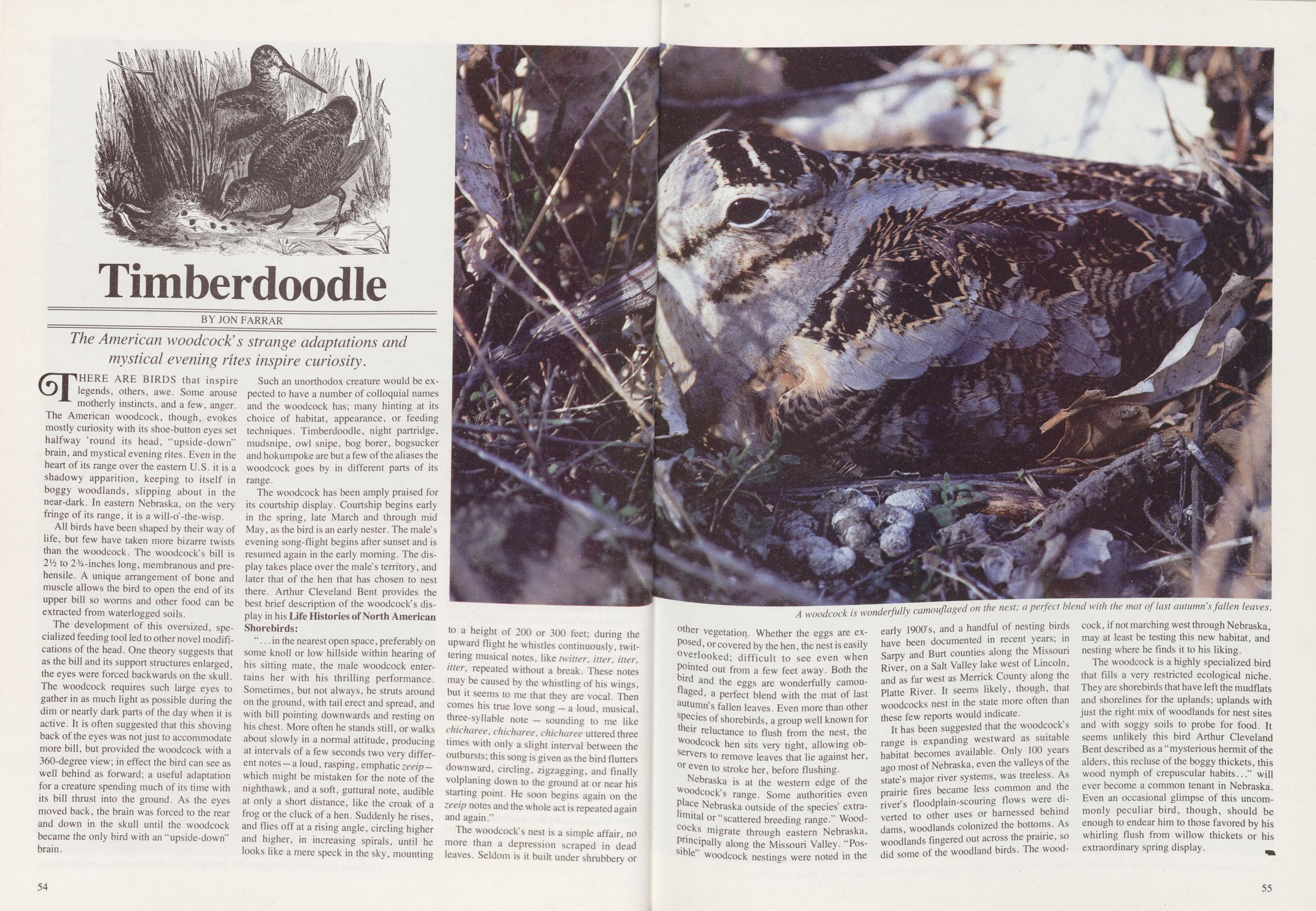
Timberdoodle
BY JON FARRAR The American woodcock's strange adaptations and mystical evening rites inspire curiosity.HERE ARE BIRDS that inspire legends, others, awe. Some arouse motherly instincts, and a few, anger. The American woodcock, though, evokes mostly curiosity with its shoe-button eyes set halfway 'round its head, "upside-down" brain, and mystical evening rites. Even in the heart of its range over the eastern U.S. it is a shadowy apparition, keeping to itself in boggy woodlands, slipping about in the near-dark. In eastern Nebraska, on the very fringe of its range, it is a will-o'-the-wisp
All birds have been shaped bty their way of life, but few have taken more bizarre twists than the woodcock. The woodcock's bill is V/i to 2%-inches long, membranous and prehensile. A unique arrangement of bone and muscle allows the bird to open the end of its upper bill so worms and other food can be extracted from waterlogged soils.
The development of this oversized, specialized feeding tool led to other novel modifications of the head. One theory suggests that as the bill and its support structures enlarged, the eyes were forced backwards on the skull. The woodcock requires such large eyes to gather in as much light as possible during the dim or nearly dark parts of the day when it is active. It is often suggested that this shoving back of the eyes was not just to accommodate more bill, but provided the woodcock with a 360-degree view; in effect the bird can see as well behind as forward; a useful adaptation for a creature spending much of its time with its bill thrust into the ground. As the eyes moved back, the brain was forced to the rear and down in the skull until the woodcock became the only bird with an "upside-down" brain.
Such an unorthodox creature would be expected to have a number of colloquial names and the woodcock has; many hinting at its choice of habitat, appearance, or feeding techniques. Timberdoodle, night partridge, mudsnipe, owl snipe, bog borer, bogsucker and hokumpoke are but a few of the aliases the woodcock goes by in different parts of its range.
The woodcock has been amply praised for its courtship display. Courtship begins early in the spring, late March and through mid All birds have been shaped by their way of May, as the bird is an early nester. The male's evening song-flight begins after sunset and is resumed again in the early morning. The display takes place over the male's territory, and later that of the hen that has chosen to nest there. Arthur Cleveland Bent provides the best brief description of the woodcock's display in his Life Histories of North American Shorebirds:
"... in the nearest open space, preferably on some knoll or low hillside within hearing of his sitting mate, the male woodcock entertains her with his thrilling performance. Sometimes, but not always, he struts around on the ground, with tail erect and spread, and with bill pointing downwards and resting on his chest. More often he stands still, or walks about slowly in a normal attitude, producing at intervals of a few seconds two very different notes —a loud, rasping, emphatic zeeip — which might be mistaken for the note of the nighthawk, and a soft, guttural note, audible at only a short distance, like the croak of a frog or the cluck of a hen. Suddenly he rises, and flies off at a rising angle, circling higher and higher, in increasing spirals, until he looks like a mere speck in the sky, mounting A^oodcoc^wonderfully camouflaged on the nest; a perfect blend with the mat of last autumn s fallen leaves. to a height of 200 or 300 feet; during the upward flight he whistles continuously, twittering musical notes, like twitter, itter, itter, itter, repeated without a break. These notes may be caused by the whistling of his wings, but it seems to me that they are vocal. Then comes his true love song - a loud, musical, three-syllable note - sounding to me like chicharee, chicharee, chickaree uttered three times with only a slight interval between the outbursts; this song is given as the bird flutters downward, circling, zigzagging, and finally volplaning down to the ground at or near his starting point. He soon begins again on the zeeip notes and the whole act is repeated again and again."
The woodcock's nest is a simple affair, no more than a depression scraped in dead leaves. Seldom is it built under shrubbery or 54 °ther vegetation. Whether the eggs are exPosed, or covered by the hen, the nest is easily overlooked; difficult to see even when Pointed out from a few feet away. Both the *rd and the eggs are wonderfully camouflaged, a perfect blend with the mat of last autumn's fallen leaves. Even more than other sPecies of shorebirds, a group well known for their reluctance to flush from the nest, the woodcock hen sits very tight, allowing observers to remove leaves that lie against her, 0r even to stroke her, before flushing.
Nebraska is at the western edge of the woodcock's range. Some authorities even Ptece Nebraska outside of the species' extraurnital or "scattered breeding range." Woodcocks migrate through eastern Nebraska, Principally along the Missouri Valley. "Possible" woodcock nestings were noted in the early 1900's, and a handful of nesting birds have been documented in recent years; in Sarpy and Burt counties along the Missouri River, on a Salt Valley lake west of Lincoln, and as far west as Merrick County along the Platte River. It seems likely, though, that woodcocks nest in the state more often than these few reports would indicate.
It has been suggested that the woodcock's range is expanding westward as suitable habitat becomes available. Only 100 years ago most of Nebraska, even the valleys of the state's major river systems, was treeless. As prairie fires became less common and the river's floodplain-scouring flows were diverted to other uses or harnessed behind dams, woodlands colonized the bottoms. As woodlands fingered out across the prairie, so did some of the woodland birds. The woodcock, if not marching west through Nebraska, may at least be testing this new habitat, and nesting where he finds it to his liking.
The woodcock is a highly specialized bird that fills a very restricted ecological niche. They are shorebirds that have left the mudflats and shorelines for the uplands; uplands with just the right mix of woodlands for nest sites and with soggy soils to probe for food. It seems unlikely this bird Arthur Cleveland Bent described as a "mysterious hermit of the alders, this recluse of the boggy thickets, this wood nymph of crepuscular habits..." will ever become a common tenant in Nebraska. Even an occasional glimpse of this uncommonly peculiar bird, though, should be enough to endear him to those favored by his whirling flush from willow thickets or his extraordinary spring display.
55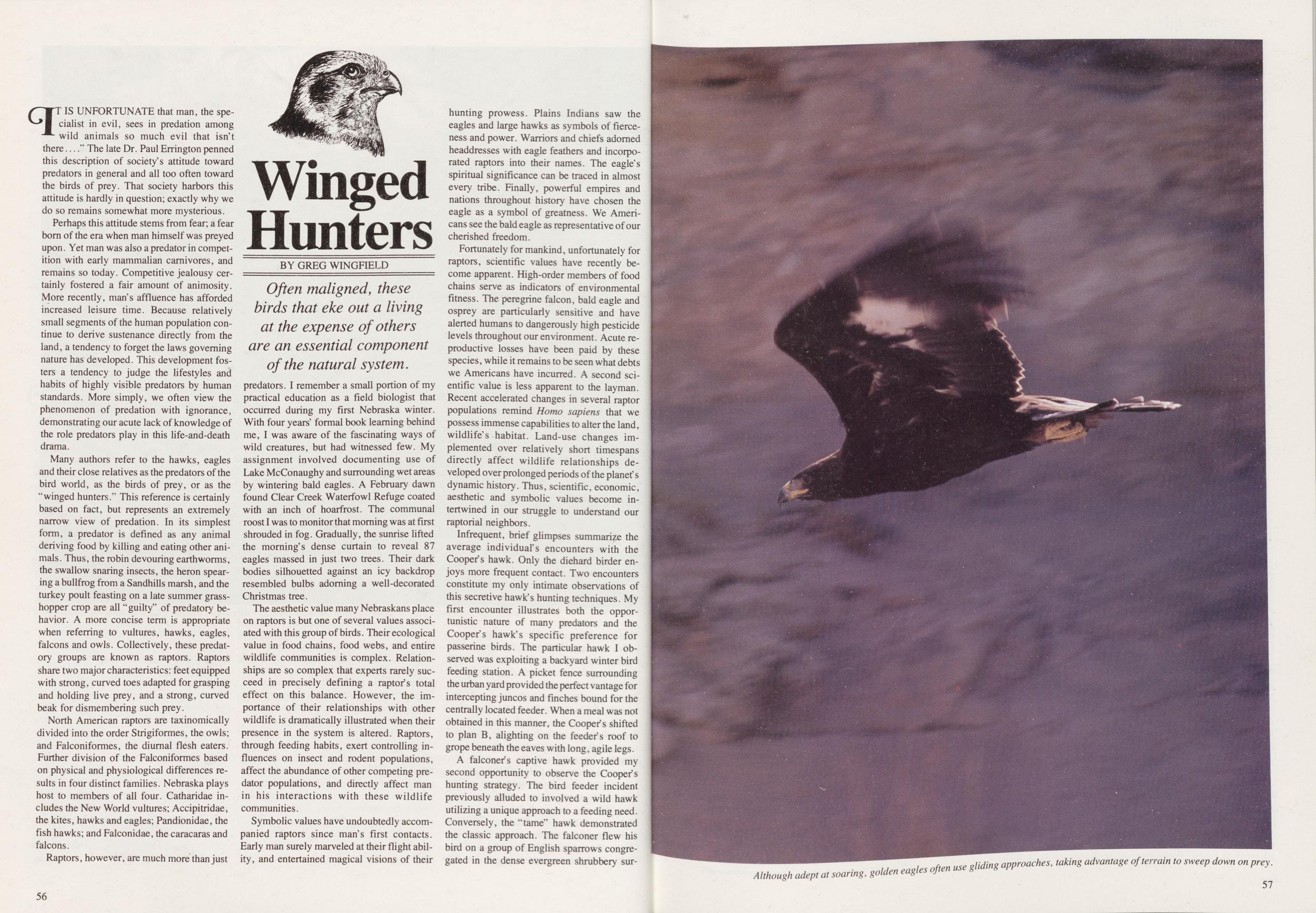
Winged Hunters
BY GREG WINGFIELD Often maligned, these birds that eke out a living at the expense of other are an essential component of the natural systemIS UNFORTUNATE that man, the specialist in evil, sees in predation among wild animals so much evil that isn't there___" The late Dr. Paul Errington penned this description of society's attitude toward predators in general and all too often toward the birds of prey. That society harbors this attitude is hardly in question; exactly why we do so remains somewhat more mysterious.
Perhaps this attitude stems from fear; a fear born of the era when man himself was preyed upon. Yet man was also a predator in competition with early mammalian carnivores, and remains so today. Competitive jealousy certainly fostered a fair amount of animosity. More recently, man's affluence has afforded increased leisure time. Because relatively small segments of the human population continue to derive sustenance directly from the land, a tendency to forget the laws governing nature has developed. This development fosters a tendency to judge the lifestyles and habits of highly visible predators by human standards. More simply, we often view the phenomenon of predation with ignorance, demonstrating our acute lack of knowledge of the role predators play in this life-and-death drama.
Many authors refer to the hawks, eagles and their close relatives as the predators of the bird world, as the birds of prey, or as the "winged hunters." This reference is certainly based on fact, but represents an extremely narrow view of predation. In its simplest form, a predator is defined as any animal deriving food by killing and eating other animals. Thus, the robin devouring earthworms, the swallow snaring insects, the heron spearing a bullfrog from a Sandhills marsh, and the turkey poult feasting on a late summer grasshopper crop are all "guilty" of predatory behavior. A more concise term is appropriate when referring to vultures, hawks, eagles, falcons and owls. Collectively, these predatory groups are known as raptors. Raptors share two major characteristics: feet equipped with strong, curved toes adapted for grasping and holding live prey, and a strong, curved beak for dismembering such prey.
North American raptors are taxinomically divided into the order Strigiformes, the owls; and Falconiformes, the diurnal flesh eaters. Further division of the Falconiformes based on physical and physiological differences results in four distinct families. Nebraska plays host to members of all four. Catharidae includes the New World vultures; Accipitridae, the kites, hawks and eagles; Pandionidae, the fish hawks; and Falconidae, the caracaras and falcons.
Raptors, however, are much more than just predators. I remember a small portion of my practical education as a field biologist that occurred during my first Nebraska winter. With four years' formal book learning behind me, I was aware of the fascinating ways of wild creatures, but had witnessed few. My assignment involved documenting use of Lake McConaughy and surrounding wet areas by wintering bald eagles. A February dawn found Clear Creek Waterfowl Refuge coated with an inch of hoarfrost. The communal roost I was to monitor that morning was at first shrouded in fog. Gradually, the sunrise lifted the morning's dense curtain to reveal 87 eagles massed in just two trees. Their dark bodies silhouetted against an icy backdrop resembled bulbs adorning a well-decorated Christmas tree.
The aesthetic value many Nebraskans place on raptors is but one of several values associated with this group of birds. Their ecological value in food chains, food webs, and entire wildlife communities is complex. Relationships are so complex that experts rarely succeed in precisely defining a raptor's total effect on this balance. However, the importance of their relationships with other wildlife is dramatically illustrated when their presence in the system is altered. Raptors, through feeding habits, exert controlling influences on insect and rodent populations, affect the abundance of other competing predator populations, and directly affect man in his interactions with these wildlife communities.
Symbolic values have undoubtedly accompanied raptors since man's first contacts. Early man surely marveled at their flight ability, and entertained magical visions of their hunting prowess. Plains Indians saw the eagles and large hawks as symbols of fierceness and power. Warriors and chiefs adorned headdresses with eagle feathers and incorporated raptors into their names. The eagle's spiritual significance can be traced in almost every tribe. Finally, powerful empires and nations throughout history have chosen the eagle as a symbol of greatness. We Americans see the bald eagle as representative of our cherished freedom.
Fortunately for mankind, unfortunately for raptors, scientific values have recently become apparent. High-order members of food chains serve as indicators of environmental fitness. The peregrine falcon, bald eagle and osprey are particularly sensitive and have alerted humans to dangerously high pesticide levels throughout our environment. Acute reproductive losses have been paid by these species, while it remains to be seen what debts we Americans have incurred. A second scientific value is less apparent to the layman. Recent accelerated changes in several raptor populations remind Homo sapiens that we possess immense capabilities to alter the land, wildlife's habitat. Land-use changes implemented over relatively short timespans directly affect wildlife relationships developed over prolonged periods of the planet's dynamic history. Thus, scientific, economic, aesthetic and symbolic values become intertwined in our struggle to understand our raptorial neighbors.
Infrequent, brief glimpses summarize the average individual's encounters with the Cooper's hawk. Only the diehard birder enjoys more frequent contact. Two encounters constitute my only intimate observations of this secretive hawk's hunting techniques. My first encounter illustrates both the opportunistic nature of many predators and the Cooper's hawk's specific preference for passerine birds. The particular hawk I observed was exploiting a backyard winter bird feeding station. A picket fence surrounding the urban yard provided the perfect vantage for intercepting juncos and finches bound for the centrally located feeder. When a meal was not obtained in this manner, the Cooper's shifted to plan B, alighting on the feeder's roof to grope beneath the eaves with long, agile legs.
A falconer's captive hawk provided my second opportunity to observe the Cooper's hunting strategy. The bird feeder incident previously alluded to involved a wild hawk utilizing a unique approach to a feeding need. Conversely, the "tame" hawk demonstrated the classic approach. The falconer flew his bird on a group of English sparrows congregated in the dense evergreen shrubbery surrounding the Game and Parks Commission's North Platte headquarters. Maneuverable, agile, erratic, determined — these adjectives defined this hawk's flight. She dived into the dense cover in pursuit, was seen half-flying, half-chasing her quarry around trunks, up and over limbs, through smaller branches until persistence and skill paid their dividends.
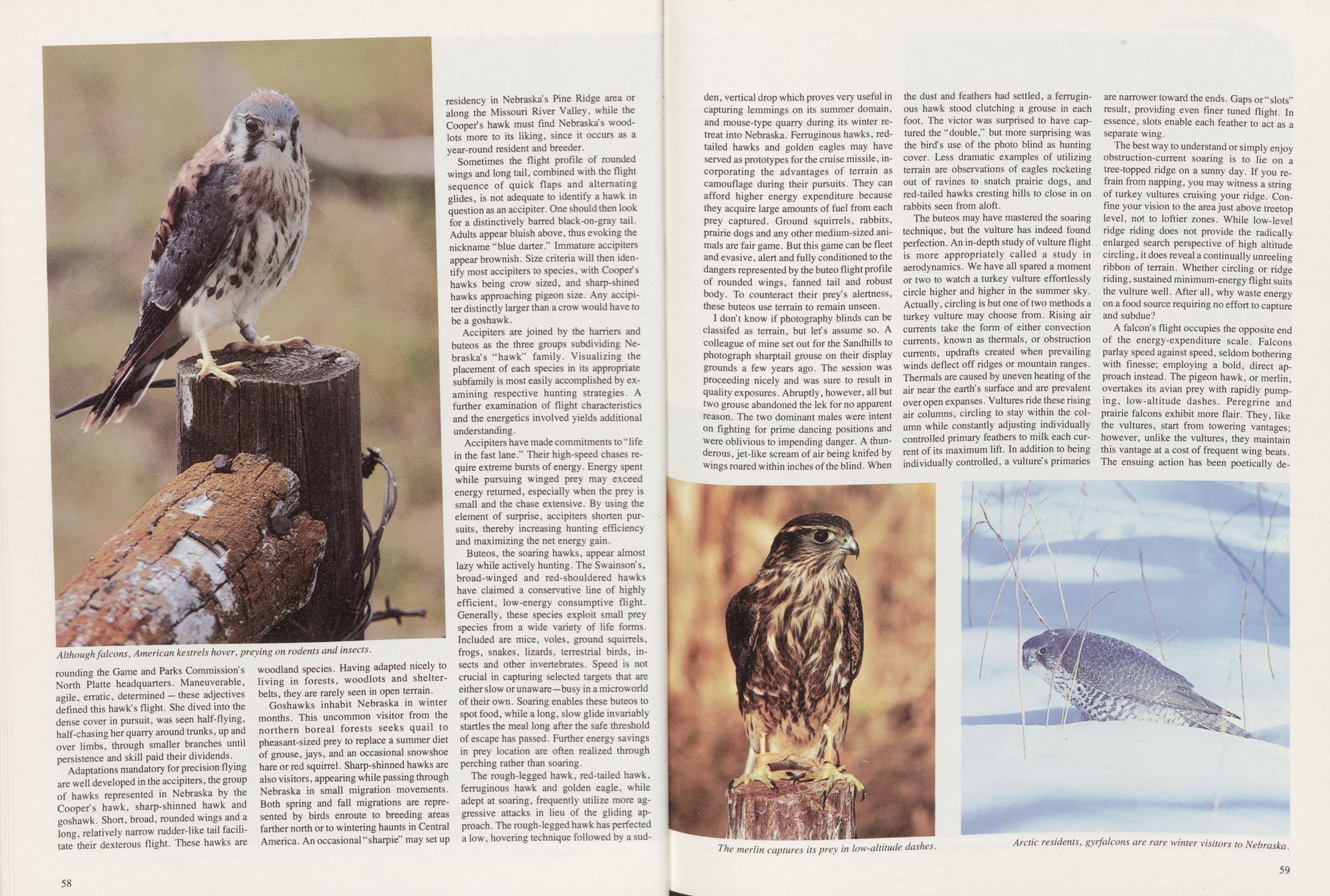
Adaptations mandatory for precision flying are well developed in the accipiters, the group of hawks represented in Nebraska by the Cooper's hawk, sharp-shinned hawk and goshawk. Short, broad, rounded wings and a long, relatively narrow rudder-like tail facilitate their dexterous flight. These hawks are woodland species. Having adapted nicely to living in forests, woodlots and shelterbelts, they are rarely seen in open terrain.
Goshawks inhabit Nebraska in winter months. This uncommon visitor from the northern boreal forests seeks quail to pheasant-sized prey to replace a summer diet of grouse, jays, and an occasional snowshoe hare or red squirrel. Sharp-shinned hawks are also visitors, appearing while passing through Nebraska in small migration movements. Both spring and fall migrations are represented by birds enroute to breeding areas farther north or to wintering haunts in Central America. An occasional "sharpie" may set up residency in Nebraska's Pine Ridge area or along the Missouri River Valley, while the Cooper's hawk must find Nebraska's woodlots more to its liking, since it occurs as a year-round resident and breeder.
Sometimes the flight profile of rounded wings and long tail, combined with the flight sequence of quick flaps and alternating glides, is not adequate to identify a hawk in question as an accipiter. One should then look for a distinctively barred black-on-gray tail. Adults appear bluish above, thus evoking the nickname "blue darter." Immature accipiters appear brownish. Size criteria will then identify most accipiters to species, with Cooper's hawks being crow sized, and sharp-shined hawks approaching pigeon size. Any accipiter distinctly larger than a crow would have to be a goshawk.
Accipiters are joined by the harriers and buteos as the three groups subdividing Nebraska's "hawk" family. Visualizing the placement of each species in its appropriate subfamily is most easily accomplished by examining respective hunting strategies. A further examination of flight characteristics and the energetics involved yields additional understanding.
Accipiters have made commitments to "life in the fast lane." Their high-speed chases require extreme bursts of energy. Energy spent while pursuing winged prey may exceed energy returned, especially when the prey is small and the chase extensive. By using the element of surprise, accipiters shorten pursuits, thereby increasing hunting efficiency and maximizing the net energy gain.
Buteos, the soaring hawks, appear almost lazy while actively hunting. The Swainson's, broad-winged and red-shouldered hawks have claimed a conservative line of highly efficient, low-energy consumptive flight. Generally, these species exploit small prey species from a wide variety of life forms. Included are mice, voles, ground squirrels, frogs, snakes, lizards, terrestrial birds, insects and other invertebrates. Speed is not crucial in capturing selected targets that are either slow or unaware—busy in a microworld of their own. Soaring enables these buteos to spot food, while a long, slow glide invariably startles the meal long after the safe threshold of escape has passed. Further energy savings in prey location are often realized through perching rather than soaring.
The rough-legged hawk, red-tailed hawk, ferruginous hawk and golden eagle, while adept at soaring, frequently utilize more aggressive attacks in lieu of the gliding approach. The rough-legged hawk has perfected a low, hovering technique followed by a sudden, 58 vertical drop which proves very useful in capturing lemmings on its summer domain, and mouse-type quarry during its winter retreat into Nebraska. Ferruginous hawks, redtailed hawks and golden eagles may have served as prototypes for the cruise missile, incorporating the advantages of terrain as camouflage during their pursuits. They can afford higher energy expenditure because they acquire large amounts of fuel from each prey captured. Ground squirrels, rabbits, prairie dogs and any other medium-sized animals are fair game. But this game can be fleet and evasive, alert and fully conditioned to the dangers represented by the buteo flight profile of rounded wings, fanned tail and robust body. To counteract their prey's alertness, these buteos use terrain to remain unseen.
I don't know if photography blinds can be classifed as terrain, but let's assume so. A colleague of mine set out for the Sandhills to photograph sharptail grouse on their display grounds a few years ago. The session was proceeding nicely and was sure to result in quality exposures. Abruptly, however, all but two grouse abandoned the lek for no apparent reason. The two dominant males were intent on fighting for prime dancing positions and were oblivious to impending danger. A thunderous, jet-like scream of air being knifed by wings roared within inches of the blind. When the dust and feathers had settled, a ferruginous hawk stood clutching a grouse in each foot. The victor was surprised to have captured the "double," but more surprising was the bird's use of the photo blind as hunting cover. Less dramatic examples of utilizing terrain are observations of eagles rocketing out of ravines to snatch prairie dogs, and red-tailed hawks cresting hills to close in on rabbits seen from aloft.
The buteos may have mastered the soaring technique, but the vulture has indeed found perfection. An in-depth study of vulture flight is more appropriately called a study in aerodynamics. We have all spared a moment or two to watch a turkey vulture effortlessly circle higher and higher in the summer sky. Actually, circling is but one of two methods a turkey vulture may choose from. Rising air currents take the form of either convection currents, known as thermals, or obstruction currents, updrafts created when prevailing winds deflect off ridges or mountain ranges. Thermals are caused by uneven heating of the air near the earth's surface and are prevalent over open expanses. Vultures ride these rising air columns, circling to stay within the column while constantly adjusting individually controlled primary feathers to milk each current of its maximum lift. In addition to being individually controlled, a vulture's primaries are narrower toward the ends. Gaps or "slots" result, providing even finer tuned flight. In essence, slots enable each feather to act as a separate wing.
The best way to understand or simply enjoy obstruction-current soaring is to lie on a tree-topped ridge on a sunny day. If you refrain from napping, you may witness a string of turkey vultures cruising your ridge. Confine your vision to the area just above treetop level, not to loftier zones. While low-level ridge riding does not provide the radically enlarged search perspective of high altitude circling, it does reveal a continually unreeling ribbon of terrain. Whether circling or ridge riding, sustained minimum-energy flight suits the vulture well. After all, why waste energy on a food source requiring no effort to capture and subdue?
A falcon's flight occupies the opposite end of the energy-expenditure scale. Falcons parlay speed against speed, seldom bothering with finesse; employing a bold, direct approach instead. The pigeon hawk, or merlin, overtakes its avian prey with rapidly pumping, low-altitude dashes. Peregrine and prairie falcons exhibit more flair. They, like the vultures, start from towering vantages; however, unlike the vultures, they maintain this vantage at a cost of frequent wing beats. The ensuing action has been poetically described by many admiring abservers. Launching their attack from on high, falcons become "hurtling wedges," "plummeting rockets," or "piercing bullets," striking their prey from the sky at the apex of near-vertical "stoops." Perhaps most impressive is the fact that just as vultures enlist earth's external forces in the form of thermals, peregrine and prairie falcons triumph using another external force —gravity.
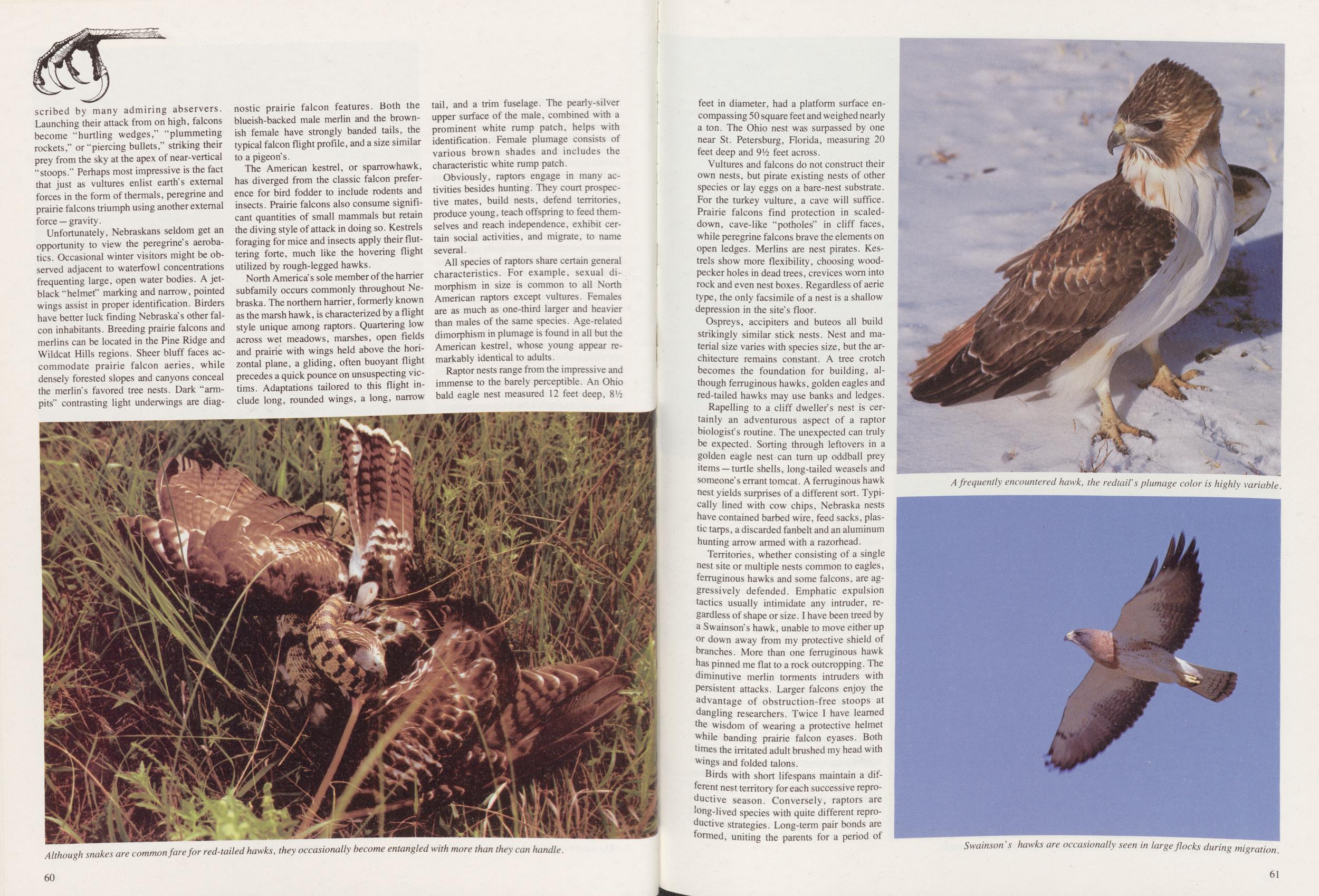
Unfortunately, Nebraskans seldom get an opportunity to view the peregrine's aerobatics. Occasional winter visitors might be ob- served adjacent to waterfowl concentrations frequenting large, open water bodies. A jetblack "helmet" marking and narrow, pointed wings assist in proper identification. Birders have better luck finding Nebraska's other falcon inhabitants. Breeding prairie falcons and merlins can be located in the Pine Ridge and Wildcat Hills regions. Sheer bluff faces accommodate prairie falcon aeries, while densely forested slopes and canyons conceal the merlin's favored tree nests. Dark "arpits" contrasting light underwings are diagnostic prairie falcon features. Both the blueish-backed male merlin and the brownish female have strongly banded tails, the typical falcon flight profile, and a size similar to a pigeon's.
The American kestrel, or sparrowhawk, has diverged from the classic falcon preference for bird fodder to include rodents and insects. Prairie falcons also consume significant quantities of small mammals but retain the diving style of attack in doing so. Kestrels foraging for mice and insects apply their fluttering forte, much like the hovering flight utilized by rough-legged hawks.
North America's sole member of the harrier subfamily occurs commonly throughout Nebraska. The northern harrier, formerly known as the marsh hawk, is characterized by a flight style unique among raptors. Quartering low across wet meadows, marshes, open fields and prairie with wings held above the horizontal plane, a gliding, often buoyant flight precedes a quick pounce on unsuspecting victims. Adaptations tailored to this flight include long, rounded wings, a long, narrow tail, and a trim fuselage. The pearly-silver upper surface of the male, combined with a prominent white rump patch, helps with identification. Female plumage consists of various brown shades and includes the characteristic white rump patch.
Obviously, raptors engage in many activities besides hunting. They court prospective mates, build nests, defend territories, produce young, teach offspring to feed themselves and reach independence, exhibit certain social activities, and migrate, to name several.
All species of raptors share certain general characteristics. For example, sexual dimorphism in size is common to all North American raptors except vultures. Females are as much as one-third larger and heavier than males of the same species. Age-related dimorphism in plumage is found in all but the American kestrel, whose young appear remarkably identical to adults.
Raptor nests range from the impressive and immense to the barely perceptible. An Ohio bald eagle nest measured 12 feet deep, 8 60 feet in diameter, had a platform surface encompassing 50 square feet and weighed nearly a ton. The Ohio nest was surpassed by one near St. Petersburg, Florida, measuring 20 feet deep and 9 feet across.
Vultures and falcons do not construct their own nests, but pirate existing nests of other species or lay eggs on a bare-nest substrate. For the turkey vulture, a cave will suffice. Prairie falcons find protection in scaleddown, cave-like "potholes" in cliff faces, while peregrine falcons brave the elements on open ledges. Merlins are nest pirates. Kestrels show more flexibility, choosing woodpecker holes in dead trees, crevices worn into rock and even nest boxes. Regardless of aerie type, the only facsimile of a nest is a shallow depression in the site's floor.
Ospreys, accipiters and buteos all build strikingly similar stick nests. Nest and material size varies with species size, but the architecture remains constant. A tree crotch becomes the foundation for building, although ferruginous hawks, golden eagles and red-tailed hawks may use banks and ledges.
Rapelling to a cliff dweller's nest is certainly an adventurous aspect of a raptor biologist's routine. The unexpected can truly be expected. Sorting through leftovers in a golden eagle nest can turn up oddball prey items —turtle shells, long-tailed weasels and someone's errant tomcat. A ferruginous hawk nest yields surprises of a different sort. Typically lined with cow chips, Nebraska nests have contained barbed wire, feed sacks, plastic tarps, a discarded fanbelt and an aluminum hunting arrow armed with a razorhead.
Territories, whether consisting of a single nest site or multiple nests common to eagles, ferruginous hawks and some falcons, are aggressively defended. Emphatic expulsion tactics usually intimidate any intruder, regardless of shape or size. I have been treed by a Swainson's hawk, unable to move either up or down away from my protective shield of branches. More than one ferruginous hawk has pinned me flat to a rock outcropping. The diminutive merlin torments intruders with persistent attacks. Larger falcons enjoy the advantage of obstruction-free stoops at dangling researchers. Twice I have learned the wisdom of wearing a protective helmet while banding prairie falcon eyases. Both times the irritated adult brushed my head with wings and folded talons.
Birds with short lifespans maintain a different nest territory for each successive reproductive season. Conversely, raptors are iong-Hved species with quite different reproductive strategies. Long-term pair bonds are formed, uniting the parents for a period of years. However, a widowed adult will seek a new mate, often succeeding in time to continue an ongoing nest effort. Long-term pair bonding allows raptors to utilize the same territory year after year as well as the same nest several times.
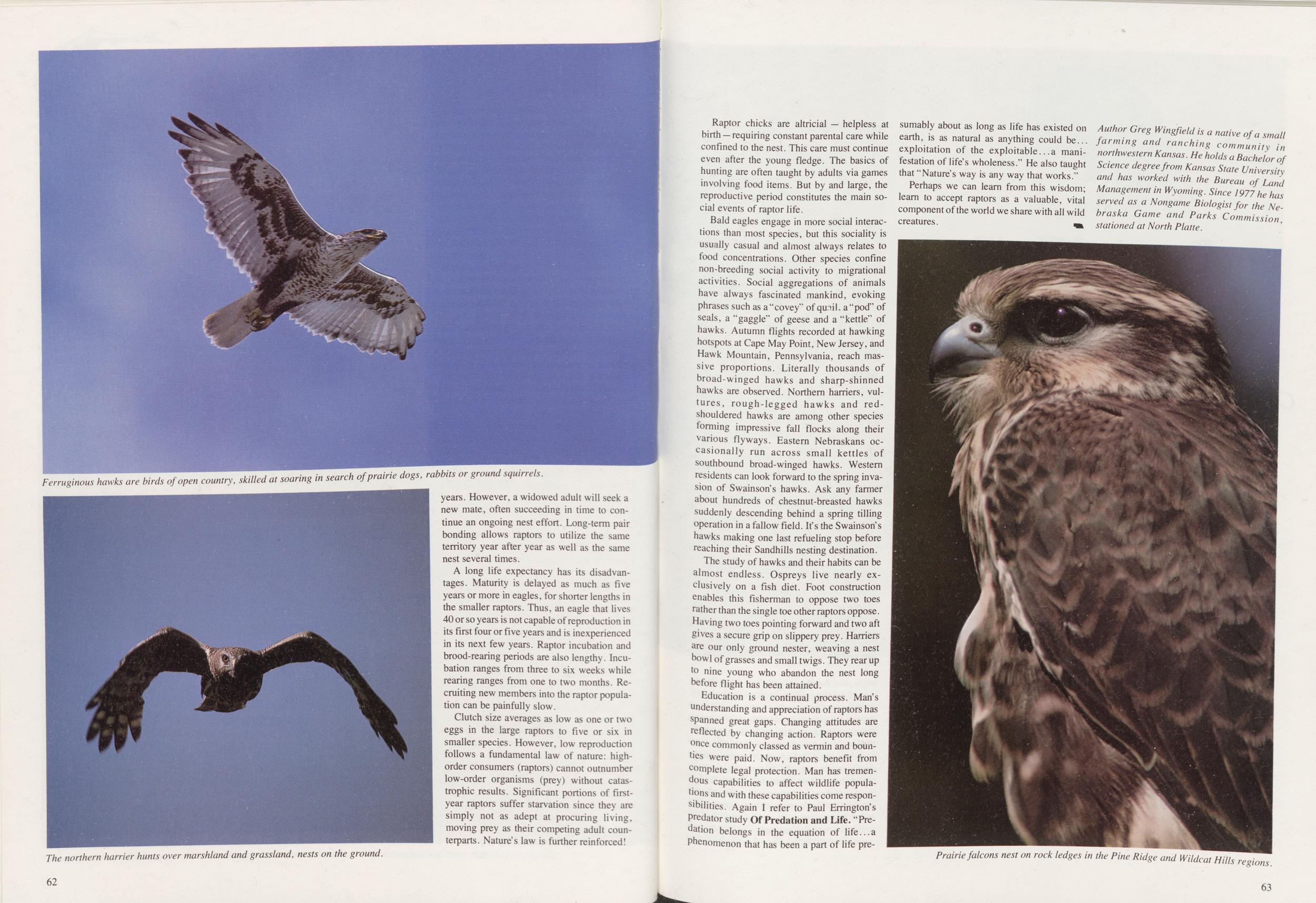
A long life expectancy has its disadvantages. Maturity is delayed as much as five years or more in eagles, for shorter lengths in the smaller raptors. Thus, an eagle that lives 40 or so years is not capable of reproduction in its first four or five years and is inexperienced in its next few years. Raptor incubation and brood-rearing periods are also lengthy. Incubation ranges from three to six weeks while rearing ranges from one to two months. Recruiting new members into the raptor population can be painfully slow.
Clutch size averages as low as one or two eggs in the large raptors to five or six in smaller species. However, low reproduction follows a fundamental law of nature: highorder consumers (raptors) cannot outnumber low-order organisms (prey) without catastrophic results. Significant portions of first-year raptors suffer starvation since they are simply not as adept at procuring living, moving prey as their competing adult counterparts. Nature s law is further reinforced!
62Raptor chicks are altricial — helpless at birth — requiring constant parental care while confined to the nest. This care must continue even after the young fledge. The basics of hunting are often taught by adults via games involving food items. But by and large, the reproductive period constitutes the main social events of raptor life.
Bald eagles engage in more social interactions than most species, but this sociality is usually casual and almost always relates to food concentrations. Other species confine non-breeding social activity to migrational activities. Social aggregations of animals have always fascinated mankind, evoking phrases such as a "covey" of qmil. a "pod" of seals, a "gaggle" of geese and a "kettle" of hawks. Autumn flights recorded at hawking hotspots at Cape May Point, New Jersey, and Hawk Mountain, Pennsylvania, reach massive proportions. Literally thousands of broad-winged hawks and sharp-shinned hawks are observed. Northern harriers, vultures, rough-legged hawks and red- shouldered hawks are among other species forming impressive fall flocks along their various fly ways. Eastern Nebraskans occasionally run across small kettles of southbound broad-winged hawks. Western residents can look forward to the spring invasion of Swain son's hawks. Ask any farmer about hundreds of chestnut-breasted hawks suddenly descending behind a spring tilling operation in a fallow field. It's the Swainson's hawks making one last refueling stop before reaching their Sandhills nesting destination.
The study of hawks and their habits can be almost endless. Ospreys live nearly exclusively on a fish diet. Foot construction enables this fisherman to oppose two toes rather than the single toe other raptors oppose. Having two toes pointing forward and two aft gives a secure grip on slippery prey. Haniers are our only ground nester, weaving a nest bowl of grasses and small twigs. They rear up to nine young who abandon the nest long before flight has been attained.
Education is a continual process. Man's understanding and appreciation of raptors has spanned great gaps. Changing attitudes are reflected by changing action. Raptors were °nce commonly classed as vermin and bounties were paid. Now, raptors benefit from complete legal protection. Man has tremendous capabilities to affect wildlife populations and with these capabilities come responsibilities. Again I refer to Paul Errington's Predator study Of Predation and Life. "Predation belongs in the equation of life...a Phenomenon that has been a part of life presumably about as long as life has existed on earth, is as natural as anything could be... exploitation of the exploitable.. .a manifestation of life's wholeness." He also taught that "Nature's way is any way that works."
Perhaps we can learn from this wisdom; learn to accept raptors as a valuable, vital component of the world we share with all wild creatures.
Author Greg Wingfield is a native of a small farming and ranching community in northwestern Kansas. He holds a Bachelor of Science degree from Kansas State University and has worked with the Bureau of Land Management in Wyoming. Since 1977 he has served as a Nongame Biologist for the Nebraska Game and Parks Commission stationed at North Platte.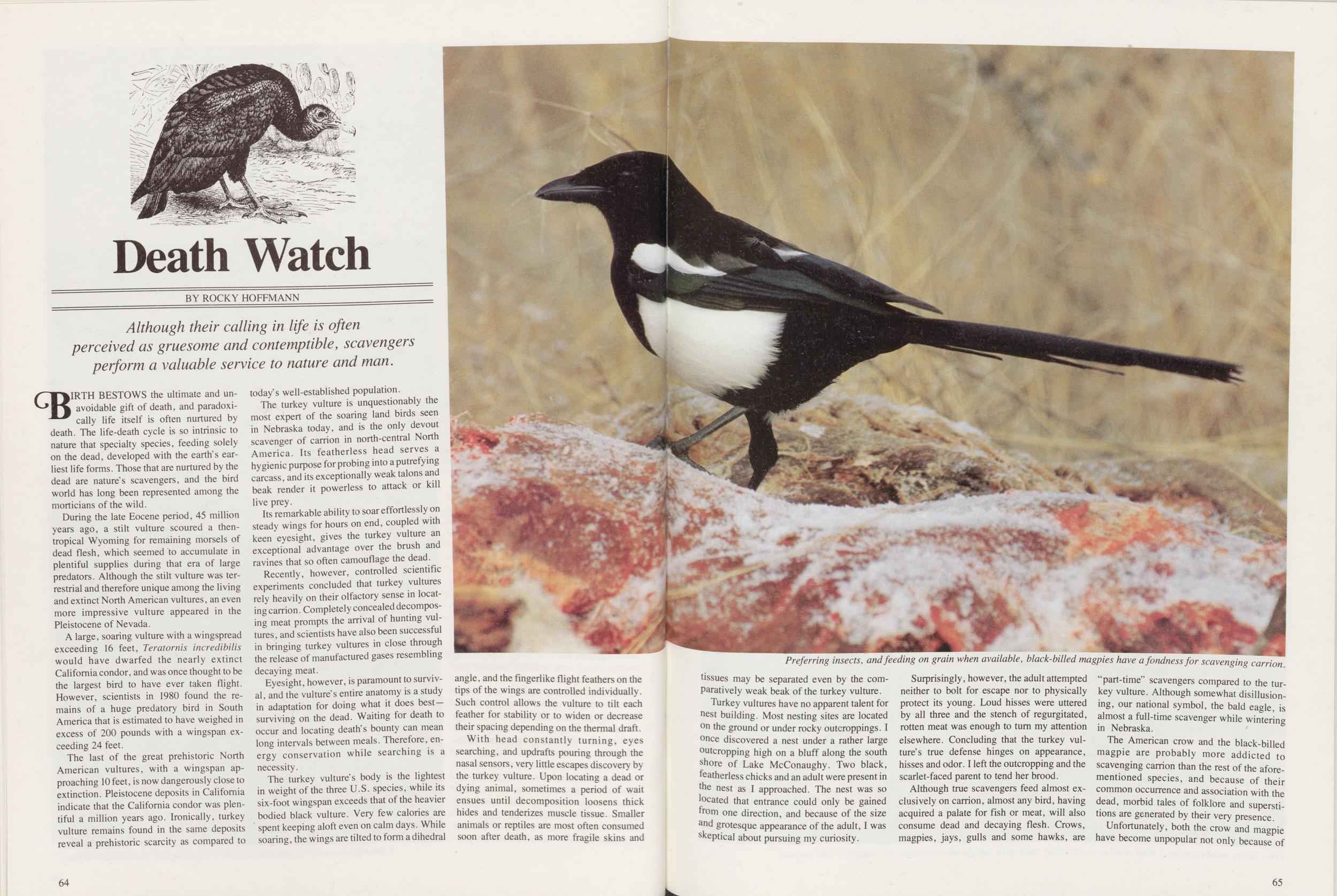
Death Watch
BY ROCKY HOFFMANN Although their calling in life is often perceived as gruesome and contemptible, scavengers perform a valuable service to nature and man.BIRTH BESTOWS the ultimate and unavoidable gift of death, and paradoxically life itself is often nurtured by death. The life-death cycle is so intrinsic to nature that specialty species, feeding solely on the dead, developed with the earth's earliest life forms. Those that are nurtured by the dead are natures scavengers, and the bird world has long been represented among the morticians of the wild.
During the late Eocene period, 45 million years ago, a stilt vulture scoured a thentropical Wyoming for remaining morsels of dead flesh, which seemed to accumulate in plentiful supplies during that era of large predators. Although the stilt vulture was terrestrial and therefore unique among the living and extinct North American vultures, an even more impressive vulture appeared in the Pleistocene of Nevada.
A large, soaring vulture with a wingspread exceeding 16 feet, Teratornis incredibilis would have dwarfed the nearly extinct California condor, and was once thought to be the largest bird to have ever taken flight. However, scientists in 1980 found the remains of a huge predatory bird in South America that is estimated to have weighed in excess of 200 pounds with a wingspan exceeding 24 feet.
The last of the great prehistoric North American vultures, with a wingspan approaching 10 feet, is now dangerously close to extinction. Pleistocene deposits in California indicate that the California condor was plentiful a million years ago. Ironically, turkey vulture remains found in the same deposits reveal a prehistoric scarcity as compared to today s well-established population.
The turkey vulture is unquestionably the most expert of the soaring land birds seen in Nebraska today, and is the only devout scavenger of carrion in north-central North America. Its featherless head serves a hygienic purpose for probing into a putrefying carcass, and its exceptionally weak talons and beak render it powerless to attack or kill live prey.
Its remarkable ability to soar effortlessly on steady wings for hours on end, coupled with keen eyesight, gives the turkey vulture an exceptional advantage over the brush and ravines that so often camouflage the dead.
Recently, however, controlled scientific experiments concluded that turkey vultures rely heavily on their olfactory sense in locating carrion. Completely concealed decomposing meat prompts the arrival of hunting vultures, and scientists have also been successful in bringing turkey vultures in close through the release of manufactured gases resembling decaying meat.
Eyesight, however, is paramount to survival, and the vulture's entire anatomy is a study in adaptation for doing what it does bestsurviving on the dead. Waiting for death to occur and locating death's bounty can mean long intervals between meals. Therefore, energy conservation while searching is a necessity.
The turkey vulture's body is the lightest in weight of the three U.S. species, while its six-foot wingspan exceeds that of the heavier bodied black vulture. Very few calories are spent keeping aloft even on calm days. While soaring, the wings are tilted to form a dihedral angle, and the fingerlike flight feathers on the tips of the wings are controlled individually. Such control allows the vulture to tilt each feather for stability or to widen or decrease their spacing depending on the thermal draft.
With head constantly turning, eyes searching, and updrafts pouring through the nasal sensors, very little escapes discovery by the turkey vulture. Upon locating a dead or dying animal, sometimes a period of wait ensues until decomposition loosens thick hides and tenderizes muscle tissue. Smaller animals or reptiles are most often consumed soon after death, as more fragile skins and 64 tissues may be separated even by the comparatively weak beak of the turkey vulture.
Turkey vultures have no apparent talent for nest building. Most nesting sites are located on the ground or under rocky outcroppings. I once discovered a nest under a rather large outcropping high on a bluff along the south shore of Lake McConaughy. Two black, featherless chicks and an adult were present in the nest as I approached. The nest was so located that entrance could only be gained from one direction, and because of the size and grotesque appearance of the adult, I was skeptical about pursuing my curiosity.
Surprisingly, however, the adult attempted neither to bolt for escape nor to physically protect its young. Loud hisses were uttered by all three and the stench of regurgitated, rotten meat was enough to turn my attention elsewhere. Concluding that the turkey vulture's true defense hinges on appearance, hisses and odor. I left the outcropping and the scarlet-faced parent to tend her brood.
Although true scavengers feed almost exclusively on carrion, almost any bird, having acquired a palate for fish or meat, will also consume dead and decaying flesh. Crows, magpies, jays, gulls and some hawks, are part-time scavengers compared to the turkey vulture. Although somewhat disillusioning, our national symbol, the bald eagle, is almost a full-time scavenger while wintering in Nebraska.
The American crow and the black-billed magpie are probably more addicted to scavenging carrion than the rest of the aforementioned species, and because of their common occurrence and association with the dead, morbid tales of folklore and superstitions are generated by their very presence.
Unfortunately, both the crow and magpie
have become unpopular not only because of
65
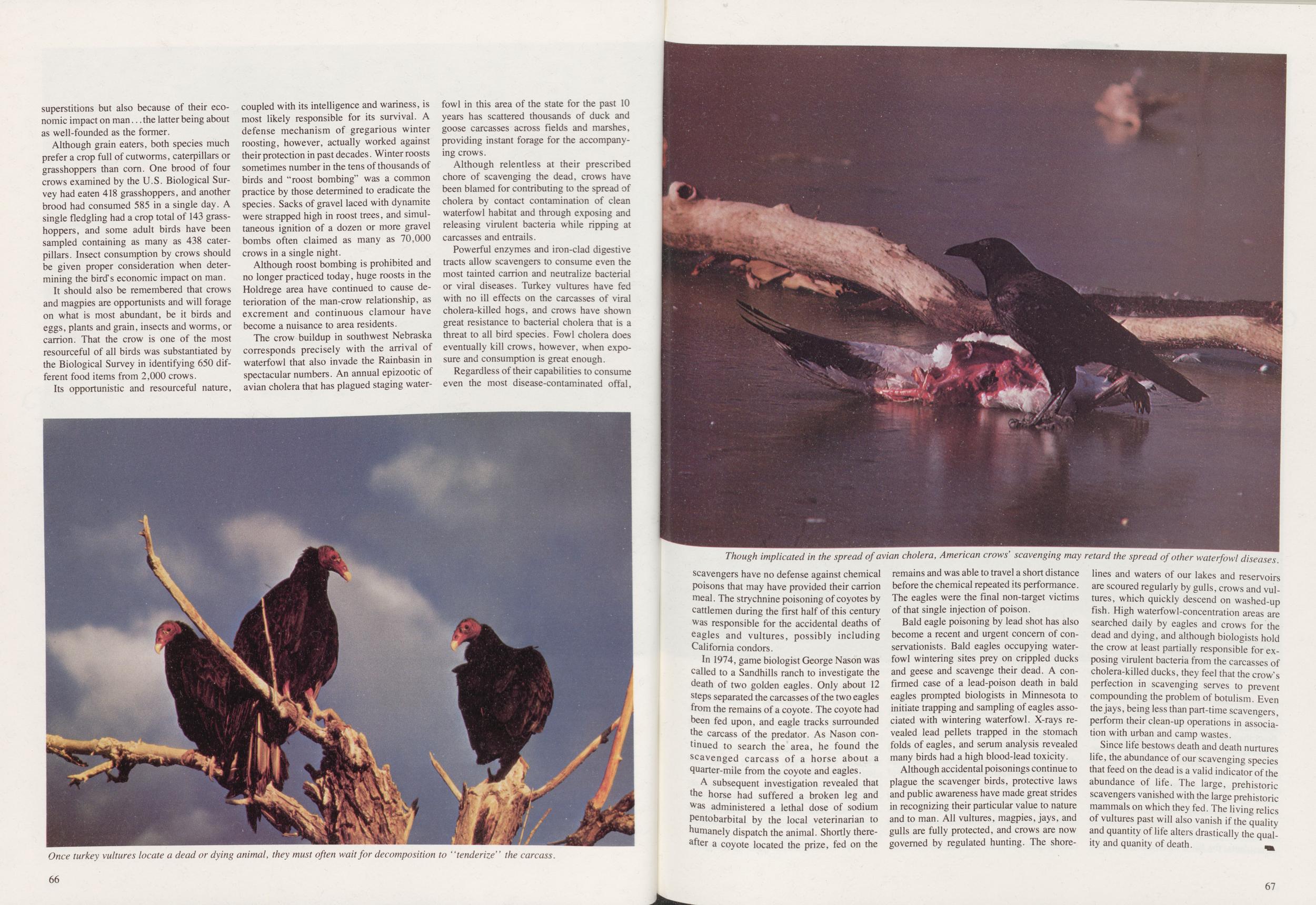 superstitions but also because of their economic impact on man the latter being about
as well-founded as the former.
superstitions but also because of their economic impact on man the latter being about
as well-founded as the former.
Although grain eaters, both species much prefer a crop full of cutworms, caterpillars or grasshoppers than corn. One brood of four crows examined by the U.S. Biological Survey had eaten 418 grasshoppers, and another brood had consumed 585 in a single day. A single fledgling had a crop total of 143 grasshoppers, and some adult birds have been sampled containing as many as 438 caterpillars. Insect consumption by crows should be given proper consideration when determining the bird's economic impact on man.
It should also be remembered that crows and magpies are opportunists and will forage on what is most abundant, be it birds and eggs, plants and grain, insects and worms, or carrion. That the crow is one of the most resourceful of all birds was substantiated by the Biological Survey in identifying 650 different food items from 2,000 crows.
Its opportunistic and resourceful nature, coupled with its intelligence and wariness, is most likely responsible for its survival. A defense mechanism of gregarious winter roosting, however, actually worked against their protection in past decades. Winter roosts sometimes number in the tens of thousands of birds and "roost bombing" was a common practice by those determined to eradicate the species. Sacks of gravel laced with dynamite were strapped high in roost trees, and simultaneous ignition of a dozen or more gravel bombs often claimed as many as 70,000 crows in a single night.
Although roost bombing is prohibited and no longer practiced today, huge roosts in the Holdrege area have continued to cause deterioration of the man-crow relationship, as excrement and continuous clamour have become a nuisance to area residents.
The crow buildup in southwest Nebraska corresponds precisely with the arrival of waterfowl that also invade the Rainbasin in spectacular numbers. An annual epizootic of avian cholera that has plagued staging waterfowl in this area of the state for the past 10 years has scattered thousands of duck and goose carcasses across fields and marshes, providing instant forage for the accompanying crows.
Although relentless at their prescribed chore of scavenging the dead, crows have been blamed for contributing to the spread of cholera by contact contamination of clean waterfowl habitat and through exposing and releasing virulent bacteria while ripping at carcasses and entrails.
Powerful enzymes and iron-clad digestive tracts allow scavengers to consume even the most tainted carrion and neutralize bacterial or viral diseases. Turkey vultures have fed with no ill effects on the carcasses of viral cholera-killed hogs, and crows have shown great resistance to bacterial cholera that is a threat to all bird species. Fowl cholera does eventually kill crows, however, when exposure and consumption is great enough.
Regardless of their capabilities to consume even the most disease-contaminated offal, 66 scavengers have no defense against chemical poisons that may have provided their carrion meal. The strychnine poisoning of coyotes by cattlemen during the first half of this century was responsible for the accidental deaths of eagles and vultures, possibly including California condors.
In 1974, game biologist George Nason was called to a Sandhills ranch to investigate the death of two golden eagles. Only about 12 steps separated the carcasses of the two eagles from the remains of a coyote. The coyote had been fed upon, and eagle tracks surrounded the carcass of the predator. As Nason continued to search the area, he found the scavenged carcass of a horse about a quarter-mile from the coyote and eagles.
A subsequent investigation revealed that the horse had suffered a broken leg and was administered a lethal dose of sodium Pentobarbital by the local veterinarian to humanely dispatch the animal. Shortly thereafter a coyote located the prize, fed on the remains and was able to travel a short distance before the chemical repeated its performance. The eagles were the final non-target victims of that single injection of poison.
Bald eagle poisoning by lead shot has also become a recent and urgent concern of conservationists. Bald eagles occupying waterfowl wintering sites prey on crippled ducks and geese and scavenge their dead. A confirmed case of a lead-poison death in bald eagles prompted biologists in Minnesota to initiate trapping and sampling of eagles associated with wintering waterfowl. X-rays revealed lead pellets trapped in the stomach folds of eagles, and serum analysis revealed many birds had a high blood-lead toxicity.
Although accidental poisonings continue to plague the scavenger birds, protective laws and public awareness have made great strides in recognizing their particular value to nature and to man. All vultures, magpies, jays, and gulls are fully protected, and crows are now governed by regulated hunting. The shore- retard the spread of other waterfowl diseases lines and waters of our lakes and reservoirs are scoured regularly by gulls, crows and vultures, which quickly descend on washed-up fish. High waterfowl-concentration areas are searched daily by eagles and crows for the dead and dying, and although biologists hold the crow at least partially responsible for exposing virulent bacteria from the carcasses of cholera-killed ducks, they feel that the crow's perfection in scavenging serves to prevent compounding the problem of botulism. Even the jays, being less than part-time scavengers, perform their clean-up operations in association with urban and camp wastes.
Since life bestows death and death nurtures life, the abundance of our scavenging species that feed on the dead is a valid indicator of the abundance of life. The large, prehistoric scavengers vanished with the large prehistoric mammals on which they fed. The living relics of vultures past will also vanish if the quality and quantity of life alters drastically the quality and quanity of death.
67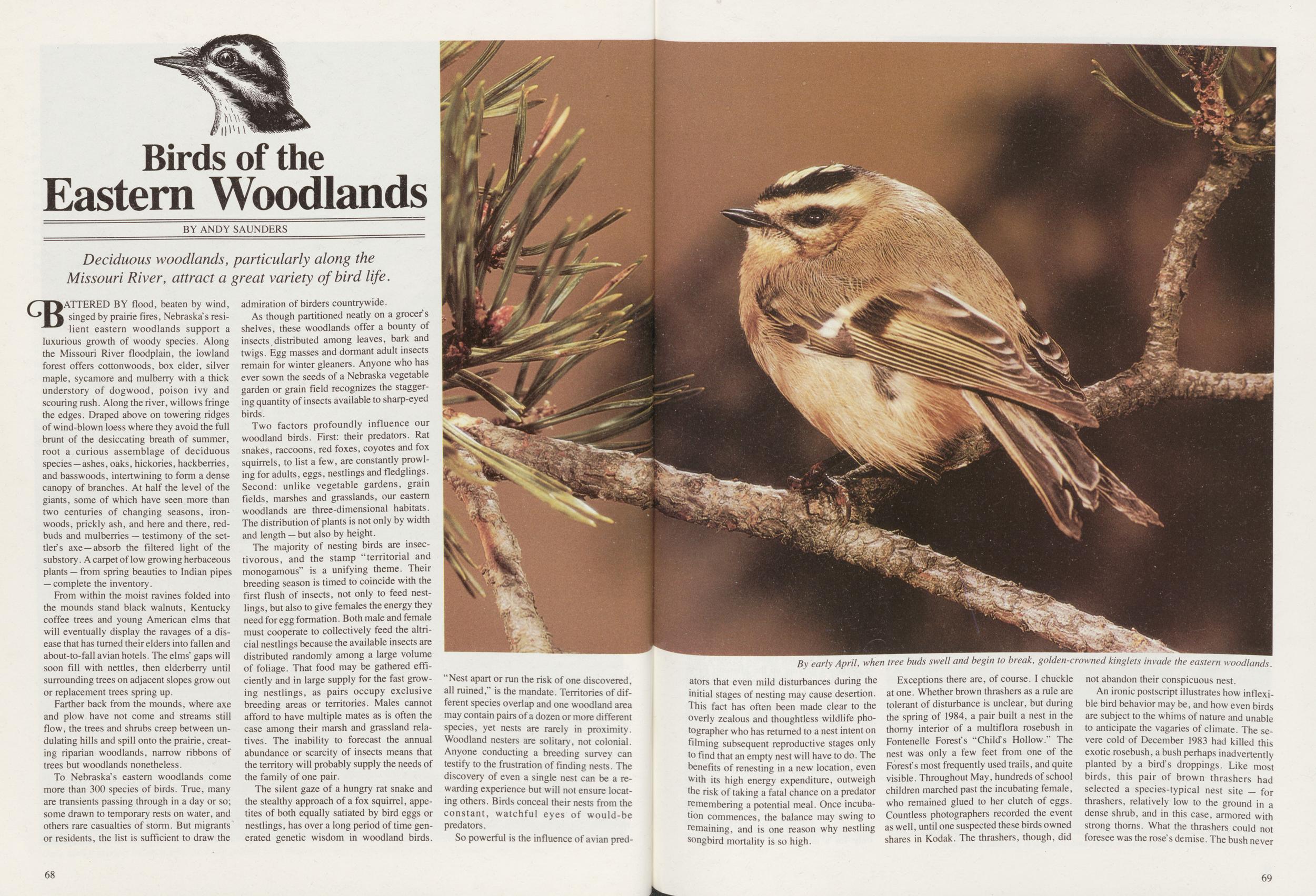
Birds of the Eastern Woodlands
BY ANDY SAUNDERS Deciduous woodlands, particularly along the Missouri River, attract a great variety of bird life.ATTERED BY flood, beaten by wind, singed by prairie fires, Nebraska's resilient eastern woodlands support a luxurious growth of woody species. Along the Missouri River floodplain, the lowland forest offers cotton woods, box elder, silver maple, sycamore and mulberry with a thick understory of dogwood, poison ivy and scouring rush. Along the river, willows fringe the edges. Draped above on towering ridges of wind-blown loess where they avoid the full brunt of the desiccating breath of summer, root a curious assemblage of deciduous species — ashes, oaks, hickories, blackberries, and basswoods, intertwining to form a dense canopy of branches. At half the level of the giants, some of which have seen more than two centuries of changing seasons, ironwoods, prickly ash, and here and there, redbuds and mulberries — testimony of the settler's axe —absorb the filtered light of the substory. A carpet of low growing herbaceous plants — from spring beauties to Indian pipes — complete the inventory.
From within the moist ravines folded into the mounds stand black walnuts, Kentucky coffee trees and young American elms that will eventually display the ravages of a disease that has turned their elders into fallen and about-to-fall avian hotels. The elms' gaps will soon fill with nettles, then elderberry until surrounding trees on adjacent slopes grow out or replacement trees spring up.
Farther back from the mounds, where axe and plow have not come and streams still flow, the trees and shrubs creep between undulating hills and spill onto the prairie, creat- ing riparian woodlands, narrow ribbons of trees but woodlands nonetheless.
To Nebraska's eastern woodlands come more than 300 species of birds. True, many are transients passing through in a day or so; some drawn to temporary rests on water, and others rare casualties of storm. But migrants or residents, the list is sufficient to draw the admiration of birders countrywide.
As though partitioned neatly on a grocer's shelves, these woodlands offer a bounty of insects distributed among leaves, bark and twigs. Egg masses and dormant adult insects remain for winter gleaners. Anyone who has ever sown the seeds of a Nebraska vegetable garden or grain field recognizes the staggering quantity of insects available to sharp-eyed birds.
Two factors profoundly influence our woodland birds. First: their predators. Rat snakes, raccoons, red foxes, coyotes and fox squirrels, to list a few, are constantly prowling for adults, eggs, nestlings and fledglings. Second: unlike vegetable gardens, grain fields, marshes and grasslands, our eastern woodlands are three-dimensional habitats. The distribution of plants is not only by width and length — but also by height.
The majority of nesting birds are insetivorous, and the stamp "territorial and monogamous" is a unifying theme. Their breeding season is timed to coincide with the first flush of insects, not only to feed nestlings, but also to give females the energy they need for egg formation. Both male and female must cooperate to collectively feed the altricial nestlings because the available insects are distributed randomly among a large volume of foliage. That food may be gathered efficiently and in large supply for the fast growing nestlings, as pairs occupy exclusive breeding areas or territories. Males cannot afford to have multiple mates as is often the case among their marsh and grassland relatives. The inability to forecast the annual abundance or scarcity of insects means that the territory will probably supply the needs of the family of one pair.
The silent gaze of a hungry rat snake and the stealthy approach of a fox squirrel, appetites of both equally satiated by bird eggs or nestlings, has over a long period of time generated genetic wisdom in woodland birds. "Nest apart or run the risk of one discovered, all ruined," is the mandate. Territories of different species overlap and one woodland area may contain pairs of a dozen or more different species, yet nests are rarely in proximity. Woodland nesters are solitary, not colonial. Anyone conducting a breeding survey can testify to the frustration of finding nests. The discovery of even a single nest can be a rewarding experience but will not ensure locating others. Birds conceal their nests from the constant, watchful eyes of would-be predators.
So powerful is the influence of avian predators 68 that even mild disturbances during the initial stages of nesting may cause desertion. This fact has often been made clear to the overly zealous and thoughtless wildlife photographer who has returned to a nest intent on filming subsequent reproductive stages only to find that an empty nest will have to do. The benefits of renesting in a new location, even with its high energy expenditure, outweigh the risk of taking a fatal chance on a predator remembering a potential meal. Once incubation commences, the balance may swing to remaining, and is one reason why nestling songbird mortality is so high.
Exceptions there are, of course. I chuckle at one. Whether brown thrashers as a rule are tolerant of disturbance is unclear, but during the spring of 1984, a pair built a nest in the thorny interior of a multiflora rosebush in Fontenelle Forest's "Child's Hollow." The nest was only a few feet from one of the Forest's most frequently used trails, and quite visible. Throughout May, hundreds of school children marched past the incubating female, who remained glued to her clutch of eggs. Countless photographers recorded the event as well, until one suspected these birds owned shares in Kodak. The thrashers, though, did not abandon their conspicuous nest.
An ironic postscript illustrates how inflexible bird behavior may be, and how even birds are subject to the whims of nature and unable to anticipate the vagaries of climate. The severe cold of December 1983 had killed this exotic rosebush, a bush perhaps inadvertently planted by a bird's droppings. Like most birds, this pair of brown thrashers had selected a species-typical nest site — for thrashers, relatively low to the ground in a dense shrub, and in this case, armored with strong thorns. What the thrashers could not foresee was the rose's demise. The bush never leafed out, and the nestlings eventually succumbed to the hot noonday sun.
69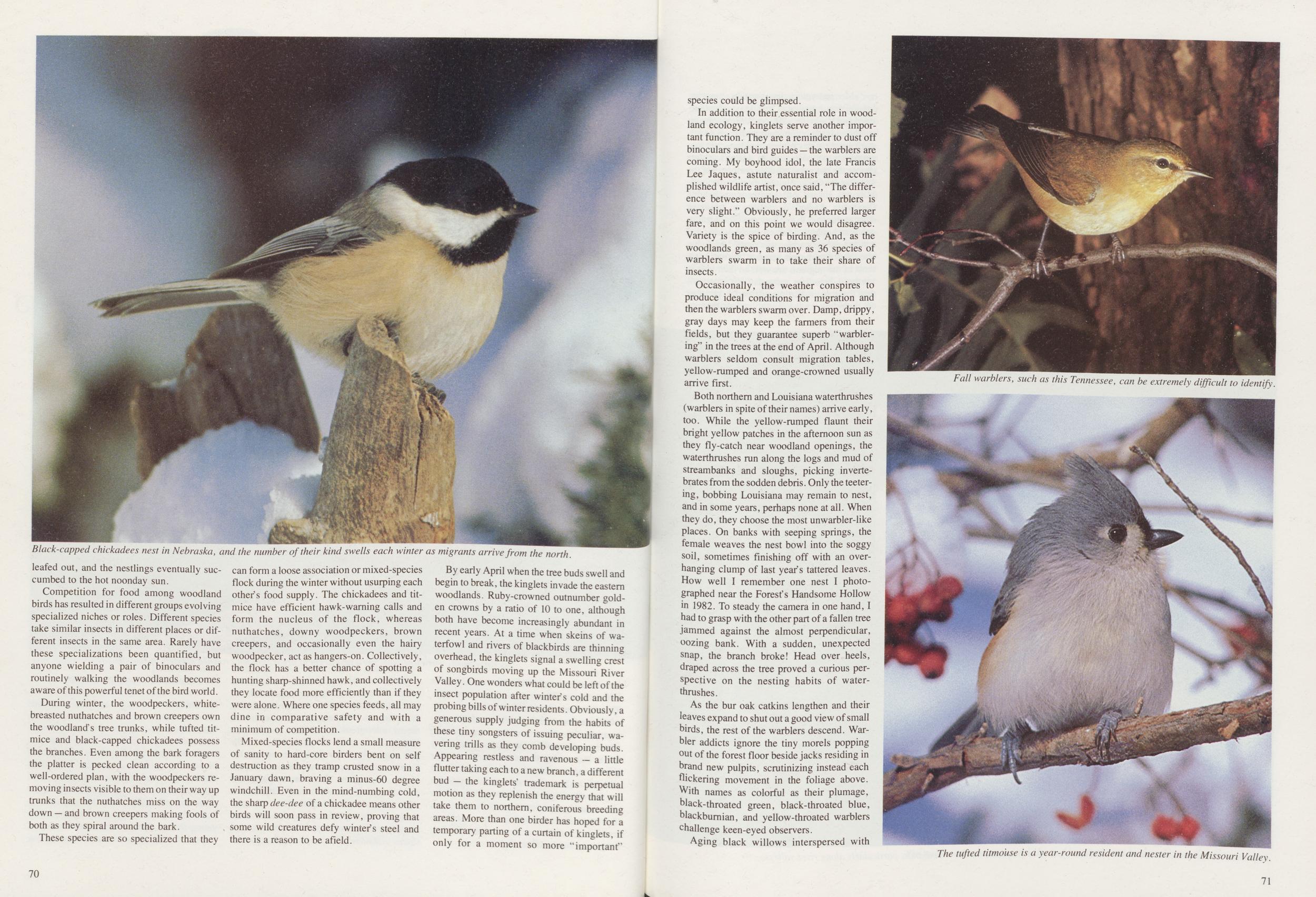
Competition for food among woodland birds has resulted in different groups evolving specialized niches or roles. Different species take similar insects in different places or different insects in the same area. Rarely have these specializations been quantified, but anyone wielding a pair of binoculars and routinely walking the woodlands becomes aware of this powerful tenet of the bird world.
During winter, the woodpeckers, whitebreasted nuthatches and brown creepers own the woodland's tree trunks, while tufted titmice and black-capped chickadees possess the branches. Even among the bark foragers the platter is pecked clean according to a well-ordered plan, with the woodpeckers removing insects visible to them on their way up trunks that the nuthatches miss on the way down — and brown creepers making fools of both as they spiral around the bark.
These species are so specialized that they can form a loose association or mixed-species flock during the winter without usurping each other's food supply. The chickadees and titmice have efficient hawk-warning calls and form the nucleus of the flock, whereas nuthatches, downy woodpeckers, brown creepers, and occasionally even the hairy woodpecker, act as hangers-on. Collectively, the flock has a better chance of spotting a hunting sharp-shinned hawk, and collectively they locate food more efficiently than if they were alone. Where one species feeds, all may dine in comparative safety and with a minimum of competition.
Mixed-species flocks lend a small measure of sanity to hard-core birders bent on self destruction as they tramp crusted snow in a January dawn, braving a minus-60 degree windchill. Even in the mind-numbing cold, the sharp dee-dee of a chickadee means other birds will soon pass in review, proving that some wild creatures defy winter's steel and there is a reason to be afield.
By early April when the tree buds swell and begin to break, the kinglets invade the eastern woodlands. Ruby-crowned outnumber golden crowns by a ratio of 10 to one, although both have become increasingly abundant in recent years. At a time when skeins of waterfowl and rivers of blackbirds are thinning overhead, the kinglets signal a swelling crest of songbirds moving up the Missouri River Valley. One wonders what could be left of the insect population after winter's cold and the probing bills of winter residents. Obviously, a generous supply judging from the habits of these tiny songsters of issuing peculiar, wavering trills as they comb developing buds. Appearing restless and ravenous - a little flutter taking each to a new branch, a different bud - the kinglets' trademark is perpetual motion as they replenish the energy that will take them to northern, coniferous breeding areas. More than one birder has hoped for a temporary parting of a curtain of kinglets, if only for a moment so more "important" 70 species could be glimpsed.
In addition to their essential role in woodland ecology, kinglets serve another important function. They are a reminder to dust off binoculars and bird guides — the warblers are coming. My boyhood idol, the late Francis Lee Jaques, astute naturalist and accomplished wildlife artist, once said, "The difference between warblers and no warblers is very slight." Obviously, he preferred larger fare, and on this point we would disagree. Variety is the spice of birding. And, as the woodlands green, as many as 36 species of warblers swarm in to take their share of insects.
Occasionally, the weather conspires to produce ideal conditions for migration and then the warblers swarm over. Damp, drippy, gray days may keep the farmers from their fields, but they guarantee superb "warblering" in the trees at the end of April. Although warblers seldom consult migration tables, yellow-rumped and orange-crowned usually arrive first.
Both northern and Louisiana waterthrushes (warblers in spite of their names) arrive early, too. While the yellow-rumped flaunt their bright yellow patches in the afternoon sun as they fly-catch near woodland openings, the waterthrushes run along the logs and mud of streambanks and sloughs, picking invertebrates from the sodden debris. Only the teetering, bobbing Louisiana may remain to nest, and in some years, perhaps none at all. When they do, they choose the most unwarbler-like places. On banks with seeping springs, the female weaves the nest bowl into the soggy soil, sometimes finishing off with an overhanging clump of last year's tattered leaves. How well I remember one nest I photographed near the Forest's Handsome Hollow in 1982. To steady the camera in one hand, I had to grasp with the other part of a fallen tree jammed against the almost perpendicular, oozing bank. With a sudden, unexpected snap, the branch broke! Head over heels, draped across the tree proved a curious perspective on the nesting habits of waterthrushes.
As the bur oak catkins lengthen and their leaves expand to shut out a good view of small birds, the rest of the warblers descend. Warbler addicts ignore the tiny morels popping out of the forest floor beside jacks residing in brand new pulpits, scrutinizing instead each flickering movement in the foliage above. With names as colorful as their plumage, black-throated green, black-throated blue, blackburnian, and yellow-throated warblers challenge keen-eyed observers.
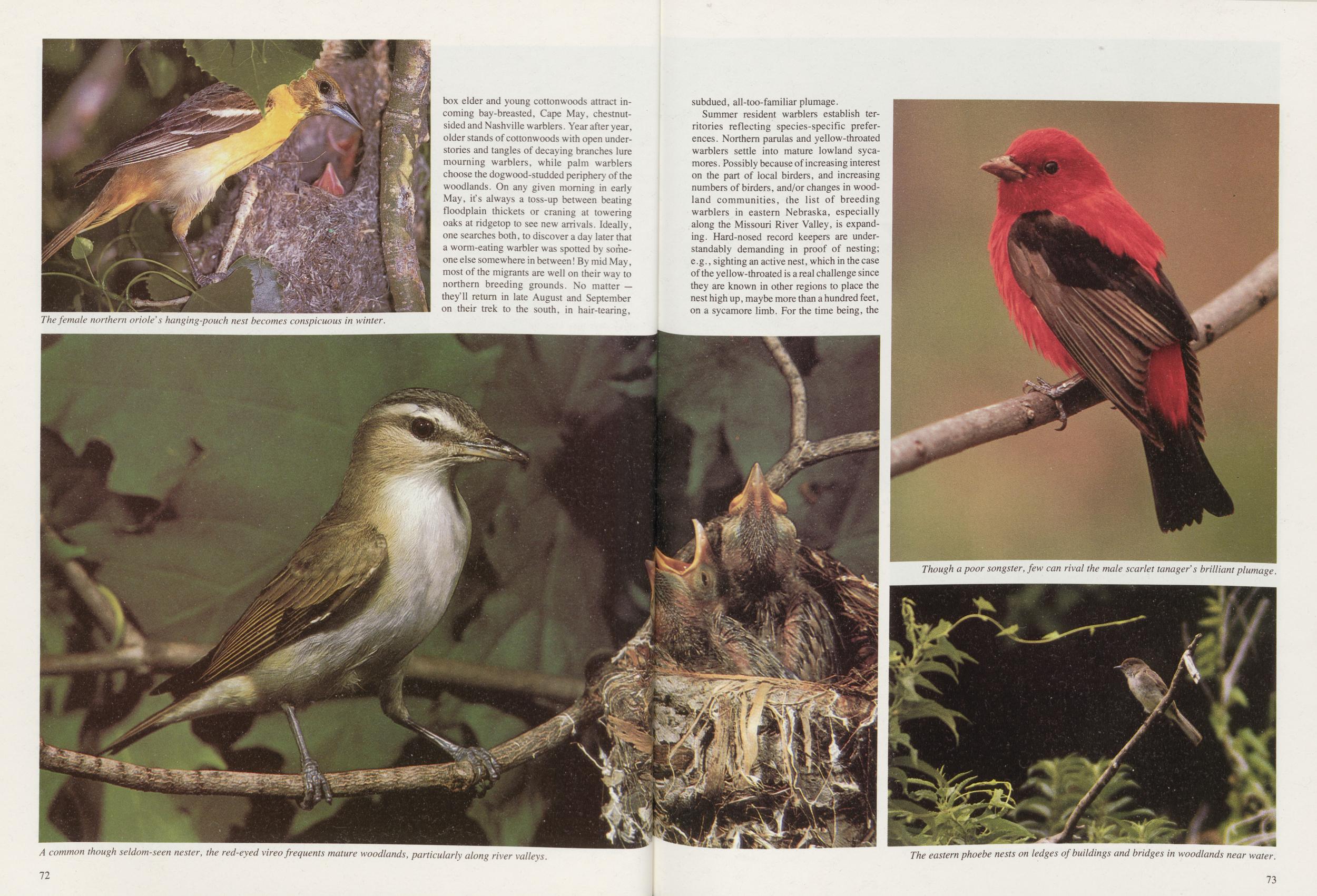
box elder and young cottonwoods attract incoming bay-breasted, Cape May, chestnutsided and Nashville warblers. Year after year, older stands of cottonwoods with open understories and tangles of decaying branches lure mourning warblers, while palm warblers choose the dogwood-studded periphery of the woodlands. On any given morning in early May, it's always a toss-up between beating floodplain thickets or craning at towering oaks at ridgetop to see new arrivals. Ideally, one searches both, to discover a day later that a worm-eating warbler was spotted by someone else somewhere in between! By mid May, most of the migrants are well on their way to northern breeding grounds. No matter they'll return in late August and September on their trek to the south, in hair-tearing, 72 subdued, all-too-familiar plumage.
Summer resident warblers establish territories reflecting species-specific preferences. Northern parulas and yellow-throated warblers settle into mature lowland sycamores. Possibly because of increasing interest on the part of local birders, and increasing numbers of birders, and/or changes in woodland communities, the list of breeding warblers in eastern Nebraska, especially along the Missouri River Valley, is expanding. Hard-nosed record keepers are understandably demanding in proof of nesting; e.g., sighting an active nest, which in the case of the yellow-throated is a real challenge since they are known in other regions to place the nest high up, maybe more than a hundred feet, on a sycamore limb. For the time being, the annual appearance of singing males, and females observed carrying nesting material, would officially make the yellow-throated warbler a "presumed" nesting species.
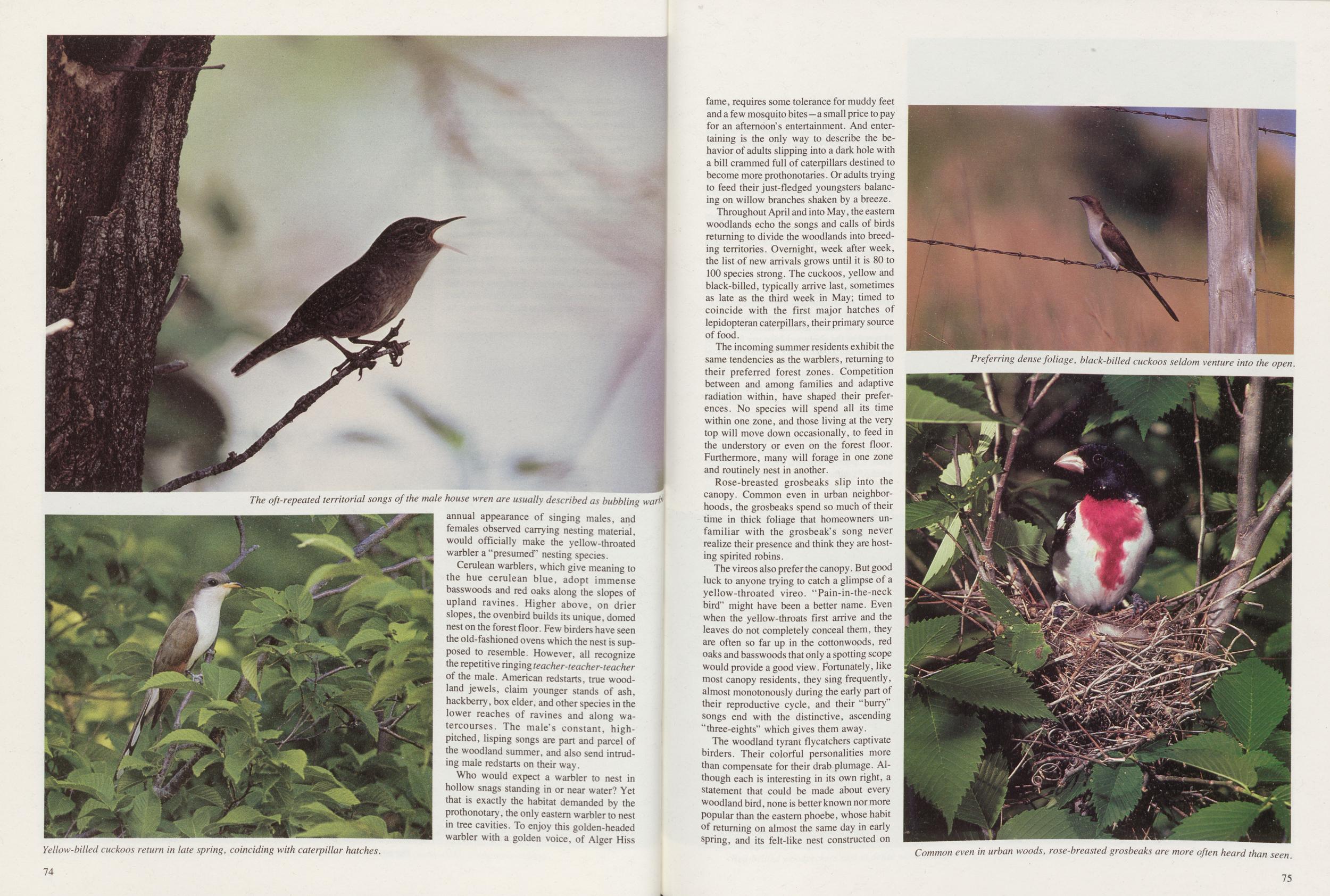
Cerulean warblers, which give meaning to the hue cerulean blue, adopt immense basswoods and red oaks along the slopes of upland ravines. Higher above, on drier slopes, the ovenbird builds its unique, domed nest on the forest floor. Few birders have seen the old-fashioned ovens which the nest is supposed to resemble. However, all recognize the repetitive ringing teacher-teacher-teacher of the male. American redstarts, true woodland jewels, claim younger stands of ash, hackberry, box elder, and other species in the lower reaches of ravines and along watercourses. The male's constant, highpitched, lisping songs are part and parcel of the woodland summer, and also send intruding male redstarts on their way.
Who would expect a warbler to nest in hollow snags standing in or near water? Yet that is exactly the habitat demanded by the prothonotary, the only eastern warbler to nest in tree cavities. To enjoy this golden-headed warbler with a golden voice, of Alger Hiss 74 fame, requires some tolerance for muddy feet and a few mosquito bites—a small price to pay for an afternoon's entertainment. And entertaining is the only way to describe the behavior of adults slipping into a dark hole with a bill crammed full of caterpillars destined to become more prothonotaries. Or adults trying to feed their just-fledged youngsters balancing on willow branches shaken by a breeze.
Throughout April and into May, the eastern woodlands echo the songs and calls of birds returning to divide the woodlands into breeding territories. Overnight, week after week, the list of new arrivals grows until it is 80 to 100 species strong. The cuckoos, yellow and black-billed, typically arrive last, sometimes as late as the third week in May; timed to coincide with the first major hatches of lepidopteran caterpillars, their primary source of food.
The incoming summer residents exhibit the same tendencies as the warblers, returning to their preferred forest zones. Competition between and among families and adaptive radiation within, have shaped their preferences. No species will spend all its time within one zone, and those living at the very top will move down occasionally, to feed in the understory or even on the forest floor. Furthermore, many will forage in one zone and routinely nest in another.
Rose-breasted grosbeaks slip into the canopy. Common even in urban neighborhoods, the grosbeaks spend so much of their time in thick foliage that homeowners unfamiliar with the grosbeak's song never realize their presence and think they are hosting spirited robins.
The vireos also prefer the canopy. But good luck to anyone trying to catch a glimpse of a yellow-throated vireo. "Pain-in-the-neck bird" might have been a better name. Even when the yellow-throats first arrive and the leaves do not completely conceal them, they are often so far up in the cottonwoods, red oaks and basswoods that only a spotting scope would provide a good view. Fortunately, like most canopy residents, they sing frequently, almost monotonously during the early part of their reproductive cycle, and their "burry" songs end with the distinctive, ascending "three-eights" which gives them away.
The woodland tyrant flycatchers captivate birders. Their colorful personalities more than compensate for their drab plumage. Although each is interesting in its own right, a statement that could be made about every woodland bird, none is better known nor more popular than the eastern phoebe, whose habit of returning on almost the same day in early spring, and its felt-like nest constructed on ledges, often buildings, endear it to many. Many whose acquaintance with birds is casual, will eternally confuse the musical see-saws or fee-bees of black-capped chickadees with the coarser fee-bees of this tailpumping flycatcher.
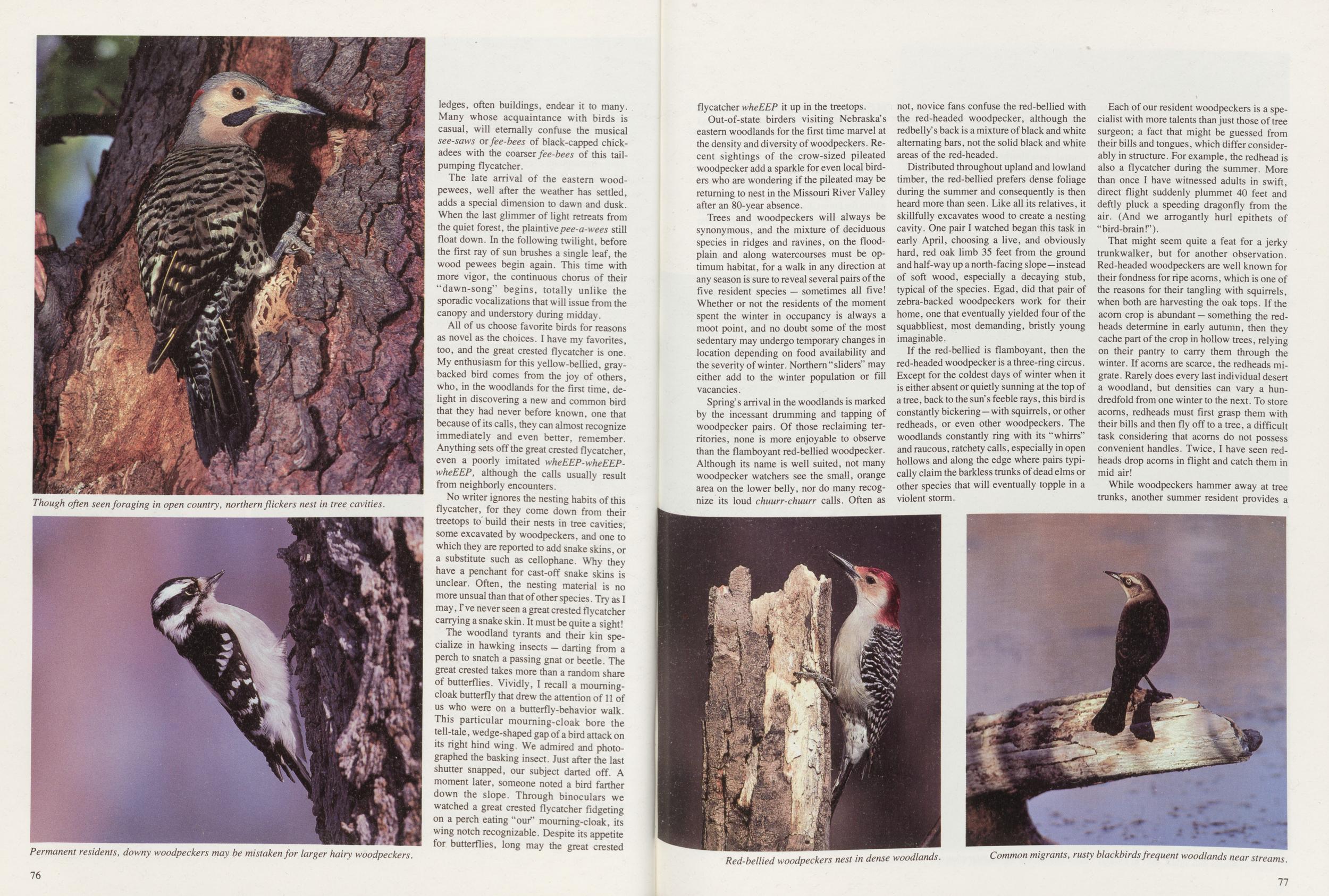
The late arrival of the eastern woodpewees, well after the weather has settled, adds a special dimension to dawn and dusk. When the last glimmer of light retreats from the quiet forest, the plaintivepee-a-wees still float down. In the following twilight, before the first ray of sun brushes a single leaf, the wood pewees begin again. This time with more vigor, the continuous chorus of their "dawn-song" begins, totally unlike the sporadic vocalizations that will issue from the canopy and understory during midday.
All of us choose favorite birds for reasons as novel as the choices. I have my favorites, too, and the great crested flycatcher is one. My enthusiasm for this yellow-bellied, graybacked bird comes from the joy of others, who, in the woodlands for the first time, delight in discovering a new and common bird that they had never before known, one that because of its calls, they can almost recognize immediately and even better, remember. Anything sets off the great crested flycatcher, even a poorly imitated wheEEP-wheEEP-wheEEP, although the calls usually result from neighborly encounters.
No writer ignores the nesting habits of this flycatcher, for they come down from their treetops to build their nests in tree cavities, some excavated by woodpeckers, and one to which they are reported to add snake skins, or a substitute such as cellophane. Why they have a penchant for cast-off snake skins is unclear. Often, the nesting material is no more unsual than that of other species. Try as I may, I've never seen a great crested flycatcher carrying a snake skin. It must be quite a sight!
The woodland tyrants and their kin specialize in hawking insects — darting from a perch to snatch a passing gnat or beetle. The great crested takes more than a random share of butterflies. Vividly, I recall a mourningcloak butterfly that drew the attention of 11 of us who were on a butterfly-behavior walk. This particular mourning-cloak bore the tell-tale, wedge-shaped gap of a bird attack on its right hind wing We admired and photographed the basking insect. Just after the last shutter snapped, our subject darted off. A moment later, someone noted a bird farther down the slope. Through binoculars we watched a great crested flycatcher fidgeting on a perch eating "our" mourning-doak, its wing notch recognizable. Despite its appetite for butterflies, long may the great crested 76 flycatcher wheEEP it up in the treetops.
Out-of-state birders visiting Nebraska's eastern woodlands for the first time marvel at the density and diversity of woodpeckers. Recent sightings of the crow-sized pileated woodpecker add a sparkle for even local birders who are wondering if the pileated may be returning to nest in the Missouri River Valley after an 80-year absence.
Trees and woodpeckers will always be synonymous, and the mixture of deciduous species in ridges and ravines, on the floodplain and along watercourses must be op- timum habitat, for a walk in any direction at any season is sure to reveal several pairs of the five resident species — sometimes all five! Whether or not the residents of the moment spent the winter in occupancy is always a moot point, and no doubt some of the most sedentary may undergo temporary changes in location depending on food availability and the severity of winter. Northern "sliders" may either add to the winter population or fill vacancies.
Spring's arrival in the woodlands is marked by the incessant drumming and tapping of woodpecker pairs. Of those reclaiming territories, none is more enjoyable to observe than the flamboyant red-bellied woodpecker. Although its name is well suited, not many woodpecker watchers see the small, orange area on the lower belly, nor do many recognize its loud chuurr-chuurr calls. Often as not, novice fans confuse the red-bellied with the red-headed woodpecker, although the redbelly's back is a mixture of black and white alternating bars, not the solid black and white areas of the red-headed.
Distributed throughout upland and lowland timber, the red-bellied prefers dense foliage during the summer and consequently is then heard more than seen. Like all its relatives, it skillfully excavates wood to create a nesting cavity. One pair I watched began this task in early April, choosing a live, and obviously hard, red oak limb 35 feet from the ground and half-way up a north-facing slope—instead of soft wood, especially a decaying stub, typical of the species. Egad, did that pair of zebra-backed woodpeckers work for their home, one that eventually yielded four of the squabbliest, most demanding, bristly young imaginable.
If the red-bellied is flamboyant, then the red-headed woodpecker is a three-ring circus. Except for the coldest days of winter when it is either absent or quietly sunning at the top of a tree, back to the sun's feeble rays, this bird is constantly bickering — with squirrels, or other redheads, or even other woodpeckers. The woodlands constantly ring with its "whirrs" and raucous, ratchety calls, especially in open hollows and along the edge where pairs typically claim the barkless trunks of dead elms or other species that will eventually topple in a violent storm.
Each of our resident woodpeckers is a specialist with more talents than just those of tree surgeon; a fact that might be guessed from their bills and tongues, which differ considerably in structure. For example, the redhead is also a flycatcher during the summer. More than once I have witnessed adults in swift, direct flight suddenly plummet 40 feet and deftly pluck a speeding dragonfly from the air. (And we arrogantly hurl epithets of "bird-brain!").
That might seem quite a feat for a jerky trunkwalker, but for another observation. Red-headed woodpeckers are well known for their fondness for ripe acorns, which is one of the reasons for their tangling with squirrels, when both are harvesting the oak tops. If the acorn crop is abundant — something the redheads determine in early autumn, then they cache part of the crop in hollow trees, relying on their pantry to carry them through the winter. If acorns are scarce, the redheads migrate. Rarely does every last individual desert a woodland, but densities can vary a hundredfold from one winter to the next. To store acorns, redheads must first grasp them with their bills and then fly off to a tree, a difficult task considering that acorns do not possess convenient handles. Twice, I have seen redheads drop acorns in flight and catch them in mid air!
While woodpeckers hammer away at tree
trunks, another summer resident provides a
77
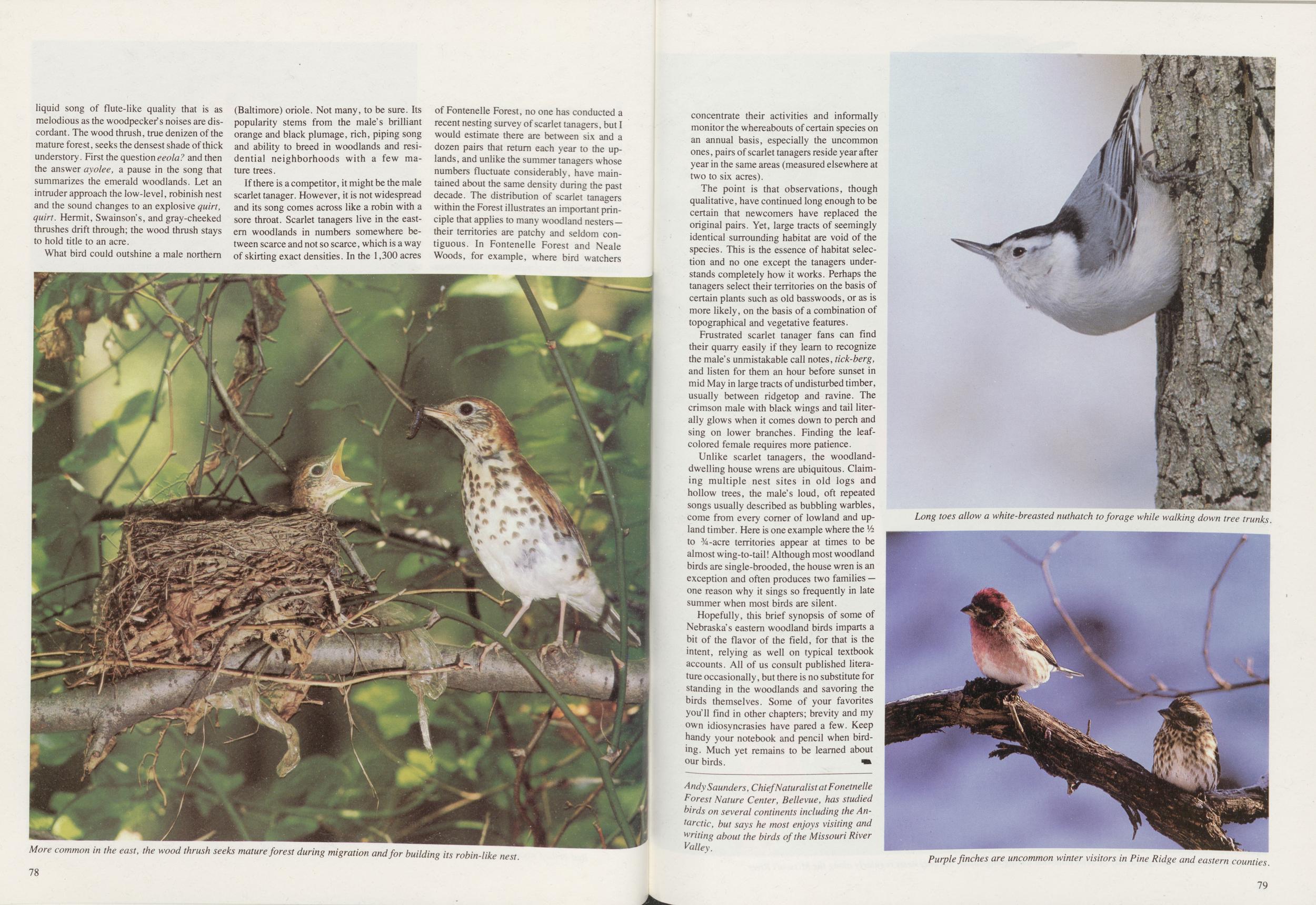 liquid song of flute-like quality that is as
melodious as the woodpecker's noises are discordant. The wood thrush, true denizen
of the
mature forest, seeks the densest shade of thick
understory. First the question eeola? and then
the answer ayolee, a pause in the song that
summarizes the emerald woodlands. Let an
intruder approach the low-level, robinish nest
and the sound changes to an explosive quirt,
quirt. Hermit, Swainson's, and gray-cheeked
thrushes drift through; the wood thrush stays
to hold title to an acre.
liquid song of flute-like quality that is as
melodious as the woodpecker's noises are discordant. The wood thrush, true denizen
of the
mature forest, seeks the densest shade of thick
understory. First the question eeola? and then
the answer ayolee, a pause in the song that
summarizes the emerald woodlands. Let an
intruder approach the low-level, robinish nest
and the sound changes to an explosive quirt,
quirt. Hermit, Swainson's, and gray-cheeked
thrushes drift through; the wood thrush stays
to hold title to an acre.
What bird could outshine a male northern (Baltimore) oriole. Not many, to be sure. Its popularity stems from the male's brilliant orange and black plumage, rich, piping song and ability to breed in woodlands and residential neighborhoods with a few ma- ture trees.
If there is a competitor, it might be the male scarlet tanager. However, it is not widespread and its song comes across like a robin with a sore throat. Scarlet tanagers live in the eastern woodlands in numbers somewhere be- tween scarce and not so scarce, which is a way of skirting exact densities. In the 1,300 acres of Fontenelle Forest, no one has conducted a recent nesting survey of scarlet tanagers, but I would estimate there are between six and a dozen pairs that return each year to the uplands, and unlike the summer tanagers whose numbers fluctuate considerably, have maintained about the same density during the past decade. The distribution of scarlet tanagers within the Forest illustrates an important principle that applies to many woodland nesters their territories are patchy and seldom contiguous. In Fontenelle Forest and Neale Woods, for example, where bird watchers 78 concentrate their activities and informally monitor the whereabouts of certain species on an annual basis, especially the uncommon ones, pairs of scarlet tanagers reside year after year in the same areas (measured elsewhere at two to six acres).
The point is that observations, though qualitative, have continued long enough to be certain that newcomers have replaced the original pairs. Yet, large tracts of seemingly identical surrounding habitat are void of the species. This is the essence of habitat selection and no one except the tanagers understands completely how it works. Perhaps the tanagers select their territories on the basis of certain plants such as old basswoods, or as is more likely, on the basis of a combination of topographical and vegetative features.
Frustrated scarlet tanager fans can find their quarry easily if they learn to recognize the male's unmistakable call notes, tick-berg, and listen for them an hour before sunset in mid May in large tracts of undisturbed timber, usually between ridgetop and ravine. The crimson male with black wings and tail literally glows when it comes down to perch and sing on lower branches. Finding the leafcolored female requires more patience.
sing on lower branches. Finding the leafcolored female requires more patience. Unlike scarlet tanagers, the woodlanddwelling house wrens are ubiquitous. Claiming multiple nest sites in old logs and hollow trees, the male's loud, oft repeated songs usually described as bubbling warbles, come from every corner of lowland and upland timber. Here is one example where the V2 to 3A-acre territories appear at times to be almost wing-to-tail! Although most woodland birds are single-brooded, the house wren is an exception and often produces two families one reason why it sings so frequently in late summer when most birds are silent.
Hopefully, this brief synopsis of some of Nebraska's eastern woodland birds imparts a bit of the flavor of the field, for that is the intent, relying as well on typical textbook accounts. All of us consult published literature occasionally, but there is no substitute for standing in the woodlands and savoring the birds themselves. Some of your favorites you'll find in other chapters; brevity and my own idiosyncrasies have pared a few. Keep handy your notebook and pencil when birding. Much yet remains to be learned about our birds.
Andy Saunders, Chief Naturalist at Fonetnelle Forest Nature Center, Bellevue, has studied birds on several continents including the Antarctic, but says he most enjoys visiting and Writing about the birds of the Missouri River Valley.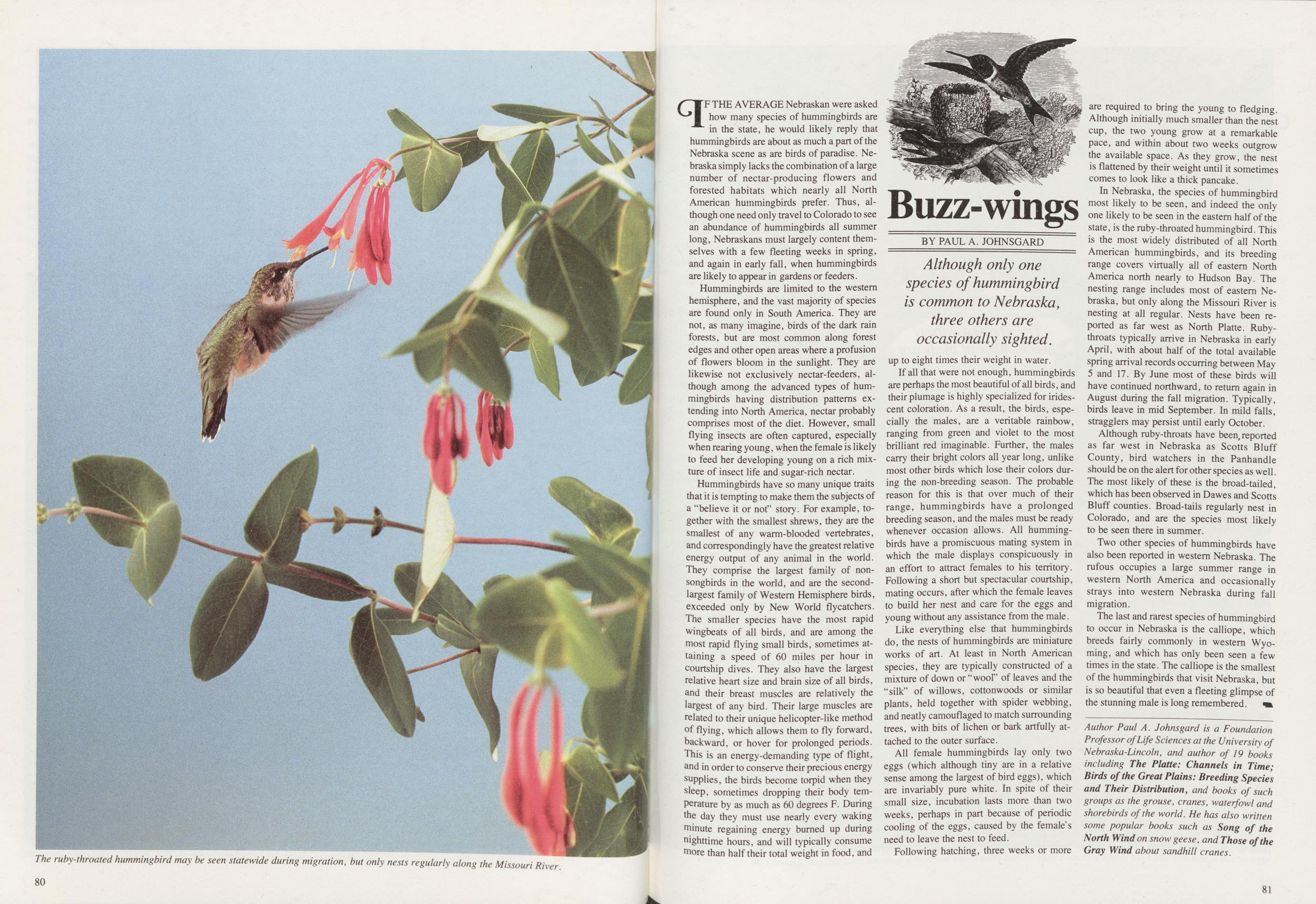
Buzz-wings
BY PAULA A. JOHNSGARD Although only one species of hummingbird is common to Nebraska, three others are occasionally sightedTHE AVERAGE Nebraskan were asked how many species of hummingbirds are in the state, he would likely reply that hummingbirds are about as much a part of the Nebraska scene as are birds of paradise. Nebraska simply lacks the combination of a large number of nectar-producing flowers and forested habitats which nearly all North American hummingbirds prefer. Thus, although one need only travel to Colorado to see an abundance of hummingbirds all summer long, Nebraskans must largely content themselves with a few fleeting weeks in spring, and again in early fall, when hummingbirds are likely to appear in gardens or feeders.
Hummingbirds are limited to the western hemisphere, and the vast majority of species are found only in South America. They are not, as many imagine, birds of the dark rain forests, but are most common along forest edges and other open areas where a profusion of flowers bloom in the sunlight. They are likewise not exclusively nectar-feeders, although among the advanced types of hum- mingbirds having distribution patterns extending into North America, nectar probably comprises most of the diet. However, small flying insects are often captured, especially when rearing young, when the female is likely to feed her developing young on a rich mixture of insect life and sugar-rich nectar.
Hummingbirds have so many unique traits that it is tempting to make them the subjects of a "believe it or not" story. For example, together with the smallest shrews, they are the smallest of any warm-blooded vertebrates, and correspondingly have the greatest relative energy output of any animal in the world. They comprise the largest family of non-songbirds in the world, and are the second-largest family of Western Hemisphere birds, exceeded only by New World flycatchers. The smaller species have the most rapid wingbeats of all birds, and are among the most rapid flying small birds, sometimes attaining a speed of 60 miles per hour in courtship dives. They also have the largest relative heart size and brain size of all birds, and their breast muscles are relatively the largest of any bird. Their large muscles are related to their unique helicopter-like method of flying, which allows them to fly forward, backward, or hover for prolonged periods. This is an energy-demanding type of flight, and in order to conserve their precious energy supplies, the birds become torpid when they sleep, sometimes dropping their body temperature by as much as 60 degrees F. During the day they must use nearly every waking minute regaining energy burned up during nighttime hours, and will typically consume more than half their total weight in food, and up to eight times their weight in water.
If all that were not enough, hummingbirds are perhaps the most beautiful of all birds, and their plumage is highly specialized for iridescent coloration. As a result, the birds, especially the males, are a veritable rainbow, ranging from green and violet to the most brilliant red imaginable. Further, the males carry their bright colors all year long, unlike most other birds which lose their colors during the non-breeding season. The probable reason for this is that over much of their range, hummingbirds have a prolonged breeding season, and the males must be ready whenever occasion allows. All hummingbirds have a promiscuous mating system in which the male displays conspicuously in an effort to attract females to his territory. Following a short but spectacular courtship, mating occurs, after which the female leaves to build her nest and care for the eggs and young without any assistance from the male.
Like everything else that hummingbirds do, the nests of hummingbirds are miniature works of art. At least in North American species, they are typically constructed of a mixture of down or "wool" of leaves and the "silk" of willows, cottonwoods or similar plants, held together with spider webbing, and neatly camouflaged to match surrounding trees, with bits of lichen or bark artfully attached to the outer surface.
All female hummingbirds lay only two eggs (which although tiny are in a relative sense among the largest of bird eggs), which are invariably pure white. In spite of their small size, incubation lasts more than two weeks, perhaps in part because of periodic cooling of the eggs, caused by the female's need to leave the nest to feed.
Following hatching, three weeks or more are required to bring the young to fledging. Although initially much smaller than the nest cup, the two young grow at a remarkable pace, and within about two weeks outgrow the available space. As they grow, the nest is flattened by their weight until it sometimes comes to look like a thick pancake.
In Nebraska, the species of hummingbird most likely to be seen, and indeed the only one likely to be seen in the eastern half of the state, is the ruby-throated hummingbird. This is the most widely distributed of all North American hummingbirds, and its breeding range covers virtually all of eastern North America north nearly to Hudson Bay. The nesting range includes most of eastern Nebraska, but only along the Missouri River is nesting at all regular. Nests have been reported as far west as North Platte. Rubythroats typically arrive in Nebraska in early April, with about half of the total available spring arrival records occurring between May 5 and 17. By June most of these birds will have continued northward, to return again in August during the fall migration. Typically, birds leave in mid September. In mild falls, stragglers may persist until early October.
Although ruby-throats have been, reported as far west in Nebraska as Scotts Bluff County, bird watchers in the Panhandle should be on the alert for other species as well. The most likely of these is the broad-tailed, which has been observed in Dawes and Scotts Bluff counties. Broad-tails regularly nest in Colorado, and are the species most likely to be seen there in summer.
Two other species of hummingbirds have also been reported in western Nebraska. The rufous occupies a large summer range in western North America and occasionally strays into western Nebraska during fall migration.
The last and rarest species of hummingbird to occur in Nebraska is the calliope, which breeds fairly commonly in western Wyoming, and which has only been seen a few times in the state. The calliope is the smallest of the hummingbirds that visit Nebraska, but is so beautiful that even a fleeting glimpse of the stunning male is long remembered.
Author Paul A. Johnsgard is a Foundation Professor of Life Sciences at the University of Nebraska-Lincoln, and author of 19 books including The Platte: Channels in Time; Birds of the Great Plains: Breeding Species and Their Distribution, and books of such groups as the grouse, cranes, waterfowl and shorebirds of the world. He has also written some popular books such as Song of the North Wind on snow geese, and Those of the Gray Wind about sandhill cranes. 81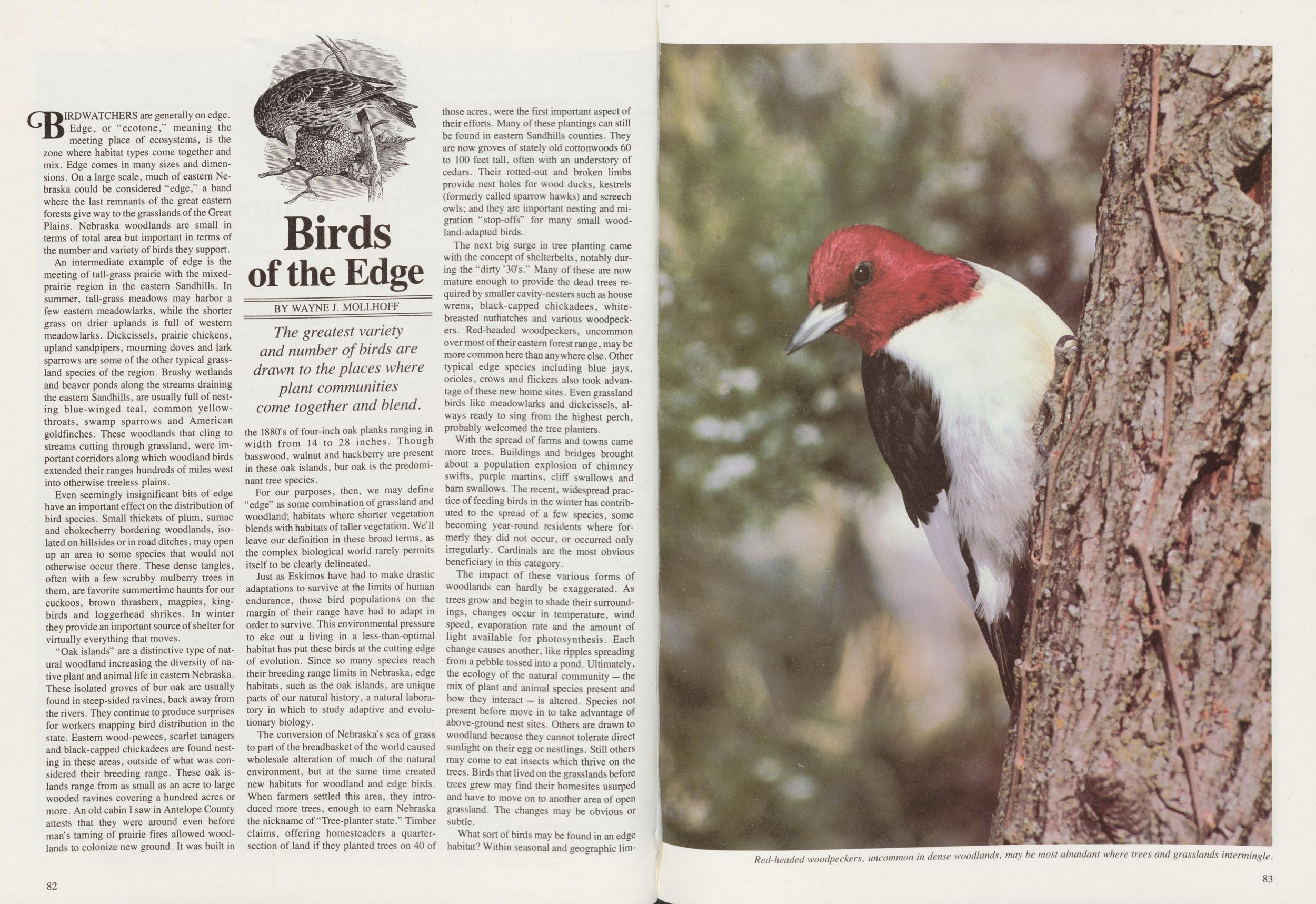
Birds of the Edge
BY WAYNE J. MOLLHOFF The greatest variety and number of birds are drawn to the places where plant communities come together and blend.BIRDWATCHERS are generally on edge. Edge, or "ecotone," meaning the meeting place of ecosystems, is the zone where habitat types come together and mix. Edge comes in many sizes and dimensions. On a large scale, much of eastern Nebraska could be considered "edge," a band where the last remnants of the great eastern forests give way to the grasslands of the Great Plains. Nebraska woodlands are small in terms of total area but important in terms of the number and variety of birds they support.
An intermediate example of edge is the meeting of tall-grass prairie with the mixedprairie region in the eastern Sandhills. In summer, tall-grass meadows may harbor a few eastern meadowlarks, while the shorter grass on drier uplands is full of western meadowlarks. Dickcissels, prairie chickens, upland sandpipers, mourning doves and lark sparrows are some of the other typical grassland species of the region. Brushy wetlands and beaver ponds along the streams draining the eastern Sandhills, are usually full of nesting blue-winged teal, common yellow- throats, swamp sparrows and American goldfinches. These woodlands that cling to streams cutting through grassland, were important corridors along which woodland birds extended their ranges hundreds of miles west into otherwise treeless plains.
Even seemingly insignificant bits of edge have an important effect on the distribution of bird species. Small thickets of plum, sumac and chokecherry bordering woodlands, isolated on hillsides or in road ditches, may open up an area to some species that would not otherwise occur there. These dense tangles, often with a few scrubby mulberry trees in them, are favorite summertime haunts for our cuckoos, brown thrashers, magpies, kingbirds and loggerhead shrikes. In winter they provide an important source of shelter for virtually everything that moves.
"Oak islands" are a distinctive type of natural woodland increasing the diversity of native plant and animal life in eastern Nebraska. These isolated groves of bur oak are usually found in steep-sided ravines, back away from the rivers. They continue to produce surprises for workers mapping bird distribution in the state. Eastern wood-pewees, scarlet tanagers and black-capped chickadees are found nesting in these areas, outside of what was considered their breeding range. These oak is- lands range from as small as an acre to large wooded ravines covering a hundred acres or more. An old cabin I saw in Antelope County attests that they were around even before man's taming of prairie fires allowed woodlands to colonize new ground. It was built in the 1880's of four-inch oak planks ranging in width from 14 to 28 inches. Though basswood, walnut and hackberry are present in these oak islands, bur oak is the predominant tree species.
For our purposes, then, we may define "edge" as some combination of grassland and woodland; habitats where snorter vegetation blends with habitats of taller vegetation. We'll leave our definition in these broad terms, as the complex biological world rarely permits itself to be clearly delineated.
Just as Eskimos have had to make drastic adaptations to survive at the limits of human endurance, those bird populations on the margin of their range have had to adapt in order to survive. This environmental pressure to eke out a living in a less-than-optimal habitat has put these birds at the cutting edge of evolution. Since so many species reach their breeding range limits in Nebraska, edge habitats, such as the oak islands, are unique parts of our natural history, a natural laboratory in which to study adaptive and evolutionary biology.
The conversion of Nebraska's sea of grass to part of the breadbasket of the world caused wholesale alteration of much of the natural environment, but at the same time created new habitats for woodland and edge birds. When farmers settled this area, they introduced more trees, enough to earn Nebraska the nickname of "Tree-planter state." Timber claims, offering homesteaders a quartersection of land if they planted trees on 40 of those acres, were the first important aspect of their efforts. Many of these plantings can still be found in eastern Sandhills counties. They are now groves of stately old cottonwoods 60 to 100 feet tall, often with an understory of cedars. Their rotted-out and broken limbs provide nest holes for wood ducks, kestrels (formerly called sparrow hawks) and screech owls; and they are important nesting and migration "stop-offs" for many small wood- land-adapted birds.
The next big surge in tree planting came with the concept of shelterbelts, notably during the "dirty '30's." Many of these are now mature enough to provide the dead trees required by smaller cavity-nesters such as house wrens, black-capped chickadees, whitebreasted nuthatches and various woodpeckers. Red-headed woodpeckers, uncommon over most of their eastern forest range, may be more common here than anywhere else. Other typical edge species including blue jays, orioles, crows and flickers also took advantage of these new home sites. Even grassland birds like meadowlarks and dickcissels, always ready to sing from the highest perch, probably welcomed the tree planters.
With the spread of farms and towns came more trees. Buildings and bridges brought about a population explosion of chimney swifts, purple martins, cliff swallows and barn swallows. The recent, widespread practice of feeding birds in the winter has contributed to the spread of a few species, some becoming year-round residents where formerly they did not occur, or occurred only irregularly. Cardinals are the most obvious beneficiary in this category.
The impact of these various forms of woodlands can hardly be exaggerated. As trees grow and begin to shade their surroundings, changes occur in temperature, wind speed, evaporation rate and the amount of light available for photosynthesis. Each change causes another, like ripples spreading from a pebble tossed into a pond. Ultimately, the ecology of the natural community - the mix of plant and animal species present and how they interact - is altered. Species not present before move in to take advantage of above-ground nest sites. Others are drawn to woodland because they cannot tolerate direct sunlight on their egg or nestlings. Still others may come to eat insects which thrive on the trees. Birds that lived on the grasslands before trees grew may find their homesites usurped and have to move on to another area of open grassland. The changes may be obvious or subtle.
82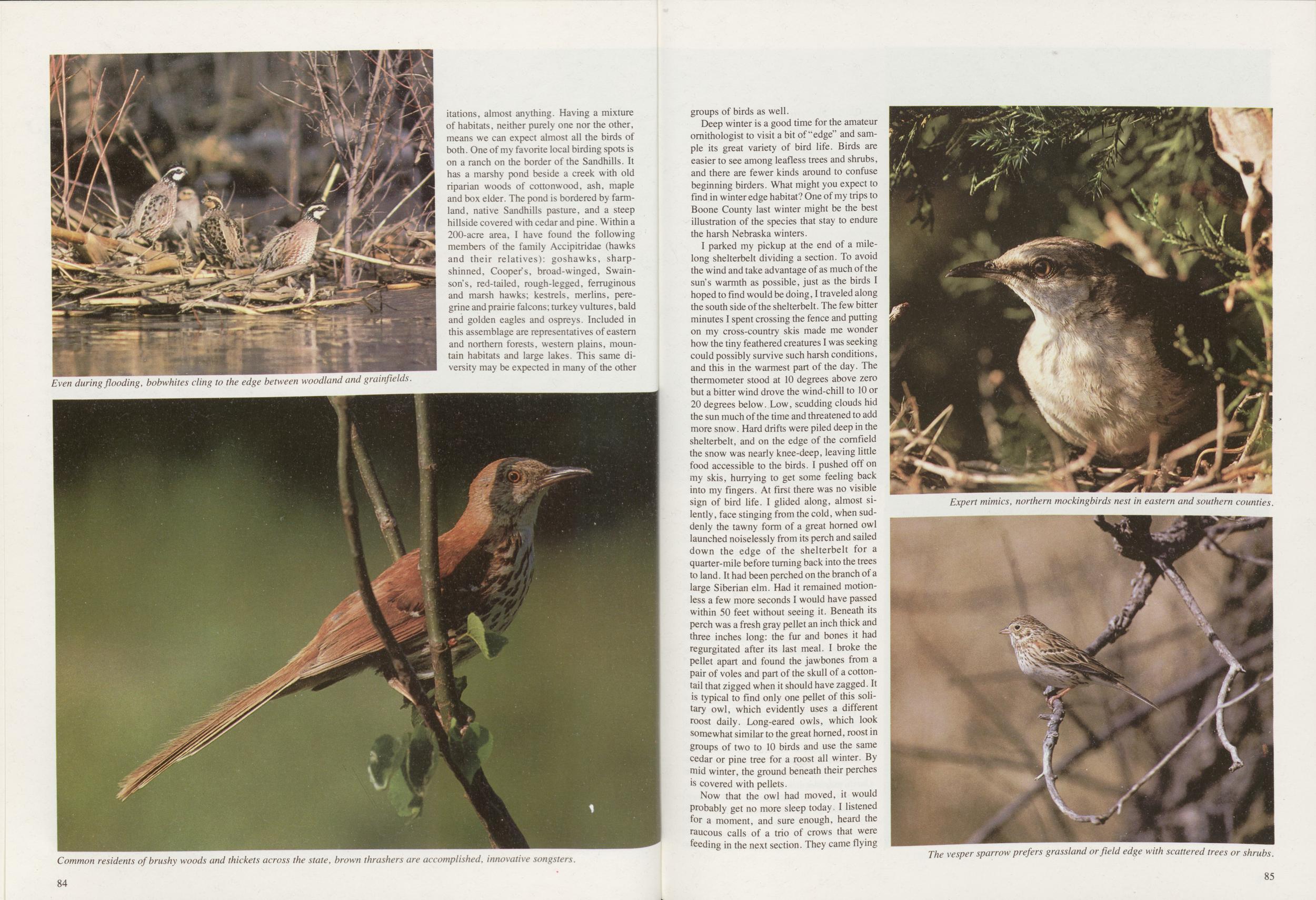
What sort of birds may be found in an edge habitat? Within seasonal and geographic limitations, almost anything. Having a mixture of habitats, neither purely one nor the other, means we can expect almost all the birds of both. One of my favorite local birding spots is on a ranch on the border of the Sandhills. It has a marshy pond beside a creek with old riparian woods of cottonwood, ash, maple and box elder. The pond is bordered by farmland, native Sandhills pasture, and a steep hillside covered with cedar and pine. Within a 200-acre area, I have found the following members of the family Accipitridae (hawks and their relatives): goshawks, sharpshinned, Cooper's, broad-winged, Swainson's, red-tailed, rough-legged, ferruginous and marsh hawks; kestrels, merlins, peregrine and prairie falcons; turkey vultures, bald and golden eagles and ospreys. Included in this assemblage are representatives of eastern and northern forests, western plains, mountain habitats and large lakes. This same diversity may be expected in many of the other 84 groups of birds as well.
Deep winter is a good time for the amateur ornithologist to visit a bit of "edge" and sample its great variety of bird life. Birds are easier to see among leafless trees and shrubs, and there are fewer kinds around to confuse beginning birders. What might you expect to find in winter edge habitat? One of my trips to Boone County last winter might be the best illustration of the species that stay to endure the harsh Nebraska winters.
I parked my pickup at the end of a milelong shelterbelt dividing a section. To avoid the wind and take advantage of as much of the sun's warmth as possible, just as the birds I hoped to find would be doing, I traveled along the south side of the shelterbelt. The few bitter minutes I spent crossing the fence and putting on my cross-country skis made me wonder how the tiny feathered creatures I was seeking could possibly survive such harsh conditions, and this in the warmest part of the day. The thermometer stood at 10 degrees above zero but a bitter wind drove the wind-chill to 10 or 20 degrees below. Low, scudding clouds hid the sun much of the time and threatened to add more snow. Hard drifts were piled deep in the shelterbelt, and on the edge of the cornfield the snow was nearly knee-deep, leaving little food accessible to the birds. I pushed off on my skis, hurrying to get some feeling back into my fingers. At first there was no visible sign of bird life. I glided along, almost silently, face stinging from the cold, when suddenly the tawny form of a great horned owl launched noiselessly from its perch and sailed down the edge of the shelterbelt for a quarter-mile before turning back into the trees to land. It had been perched on the branch of a large Siberian elm. Had it remained motionless a few more seconds I would have passed within 50 feet without seeing it. Beneath its perch was a fresh gray pellet an inch thick and three inches long: the fur and bones it had regurgitated after its last meal. I broke the pellet apart and found the jawbones from a pair of voles and part of the skull of a cottontail that zigged when it should have zagged. It is typical to find only one pellet of this solitary owl, which evidently uses a different roost daily. Long-eared owls, which look somewhat similar to the great horned, roost in groups of two to 10 birds and use the same cedar or pine tree for a roost all winter. By mid winter, the ground beneath their perches is covered with pellets.
Now that the owl had moved, it would probably get no more sleep today. I listened for a moment, and sure enough, heard the raucous calls of a trio of crows that were feeding in the next section. They came flying across the wind to harass their ancient enemy while they still had the advantage of daylight. Although the owl could see perfectly well in the daylight, the crows could outmaneuver and were safe in mobbing it. When night comes, the glossy-black rascals would be more humble, since then it would be the owfs turn. The trio landed in trees around the owl and were soon joined by half a dozen more crows, a family of boldly colored magpies and a couple of blue jays. Twenty years ago, the lynch mob might have grown to at least a hundred, but now, crows are more scarce. 85
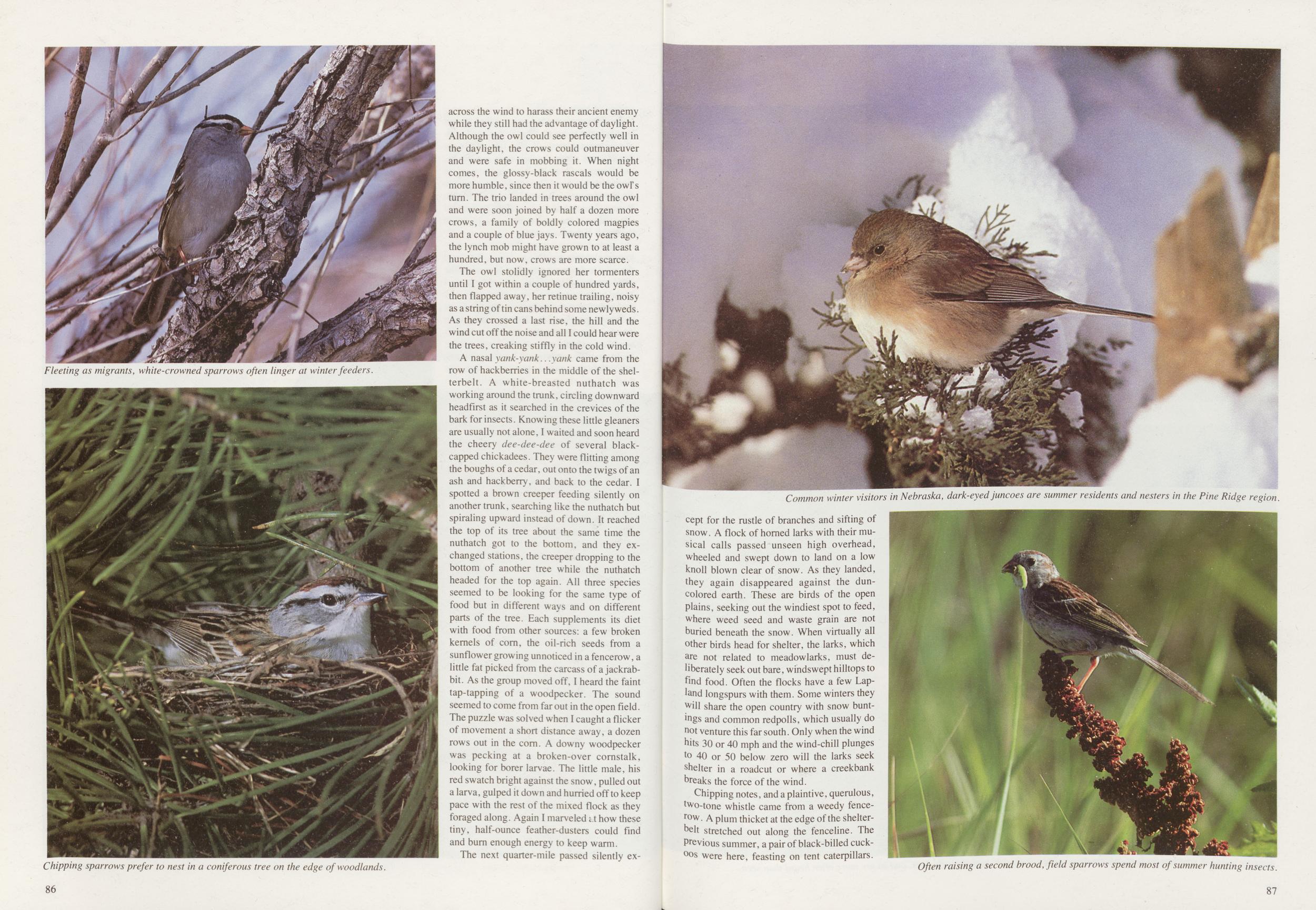
The owl stolidly ignored her tormenters until I got within a couple of hundred yards, then flapped away, her retinue trailing, noisy as a string of tin cans behind some newly weds. As they crossed a last rise, the hill and the wind cut off the noise and all I could hear were the trees, creaking stiffly in the cold wind.
A nasal yank-yank.. .yank came from the row of hackberries in the middle of the shelterbelt. A white-breasted nuthatch was working around the trunk, circling downward headfirst as it searched in the crevices of the bark for insects. Knowing these little gleaners are usually not alone, I waited and soon heard the cheery dee-dee-dee of several blackcapped chickadees. They were flitting among the boughs of a cedar, out onto the twigs of an ash and hackberry, and back to the cedar. I spotted a brown creeper feeding silently on another trunk, searching like the nuthatch but spiraling upward instead of down. It reached the top of its tree about the same time the nuthatch got to the bottom, and they exchanged stations, the creeper dropping to the bottom of another tree while the nuthatch headed for the top again. All three species seemed to be looking for the same type of food but in different ways and on different parts of the tree. Each supplements its diet with food from other sources: a few broken kernels of corn, the oil-rich seeds from a sunflower growing unnoticed in a fencerow, a little fat picked from the carcass of a jackrabbit. As the group moved off, I heard the faint tap-tapping of a woodpecker. The sound seemed to come from far out in the open field. The puzzle was solved when I caught a flicker of movement a short distance away, a dozen rows out in the corn. A downy woodpecker was pecking at a broken-over cornstalk, looking for borer larvae. The little male, his red swatch bright against the snow, pulled out a larva, gulped it down and hurried off to keep pace with the rest of the mixed flock as they foraged along. Again I marveled Lt how these tiny, half-ounce feather-dusters could find and burn enough energy to keep warm.
The next quarter-mile passed silently ex 86 cept for the rustle of branches and sifting of snow. A flock of horned larks with their musical calls passed unseen high overhead, wheeled and swept down to land on a low knoll blown clear of snow. As they landed, they again disappeared against the duncolored earth. These are birds of the open plains, seeking out the windiest spot to feed, where weed seed and waste grain are not buried beneath the snow. When virtually all other birds head for shelter, the larks, which are not related to meadowlarks, must deliberately seek out bare, windswept hilltops to find food. Often the flocks have a few Lapland longspurs with them. Some winters they will share the open country with snow buntings and common redpolls, which usually do not venture this far south. Only when the wind hits 30 or 40 mph and the wind-chill plunges to 40 or 50 below zero will the larks seek shelter in a roadcut or where a creekbank breaks the force of the wind.
Chipping notes, and a plaintive, querulous, two-tone whistle came from a weedy fencerow. A plum thicket at the edge of the shelterbelt stretched out along the fenceline. The Previous summer, a pair of black-billed cuckoos were here, feasting on tent caterpillars. A pair of loggerhead shrikes used the thorns for a storage rack, impaling grasshoppers and an occasional deer mouse until they were ready to eat. Now that winter snows are deep, and the plum's leafy cover is gone, the thicket is infested with a flock of nondescript "sparrows" of two sizes. They seemed in perpetual motion; flitting about in the weeds, out into the first few corn rows, ducking about some clumps of foxtail that are not quite buried, back into the weeds, over to the plum brush, up to a branch, down to the ground. The larger ones were the source of the sad, pretty whistle. They were Harris' sparrows, in the drab winter plumage that field guides label as immatures. Bird banders and museum workers have proven that birds in this plumage may be young or old, female or male.
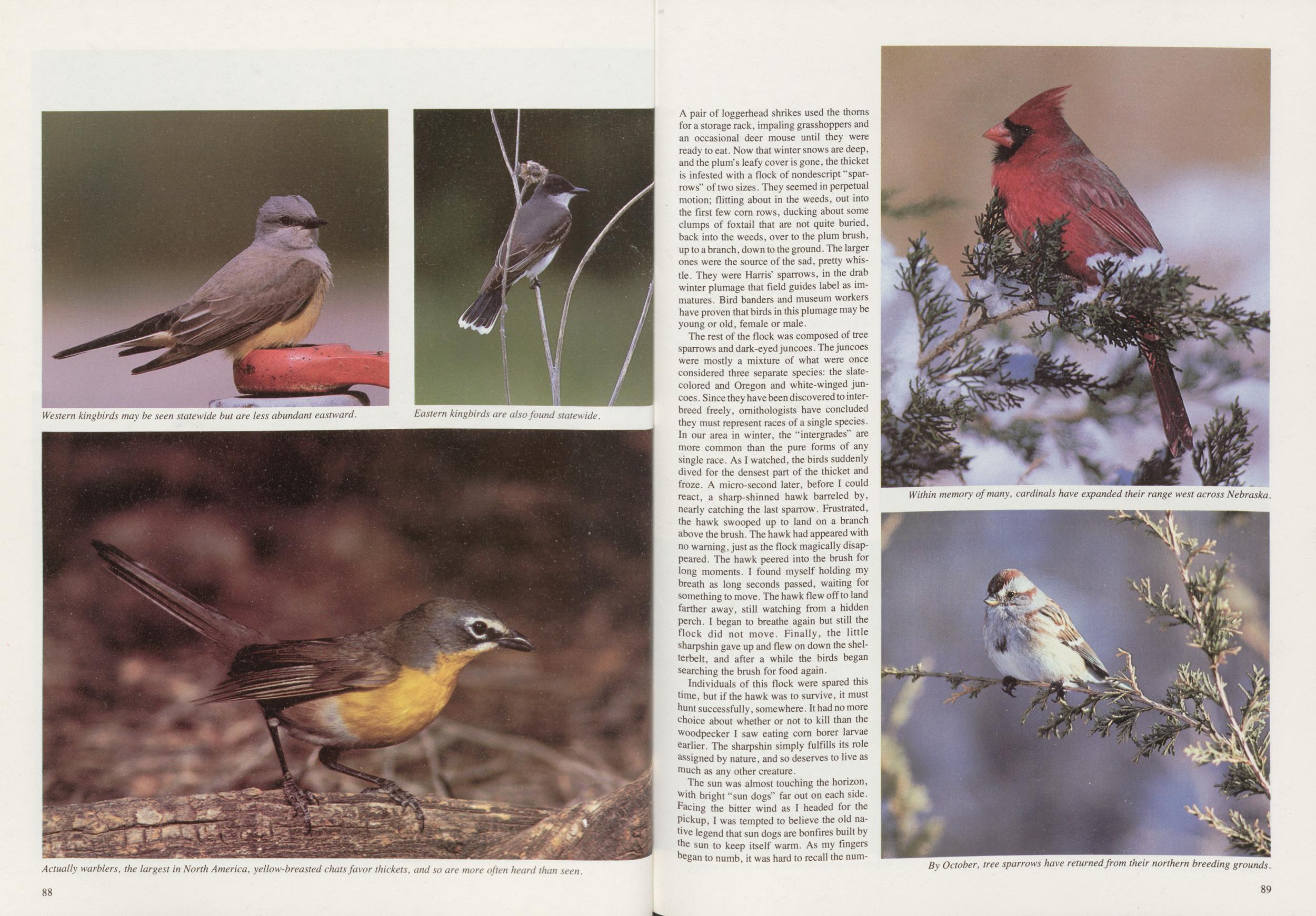
The rest of the flock was composed of tree sparrows and dark-eyed juncoes. The juncoes were mostly a mixture of what were once considered three separate species: the slatecolored and Oregon and white-winged juncoes . Since they have been discovered to interbreed freely, ornithologists have concluded they must represent races of a single species. In our area in winter, the "intergrades" are more common than the pure forms of any single race. As I watched, the birds suddenly dived for the densest part of the thicket and froze. A micro-second later, before I could react, a sharp-shinned hawk barreled by, nearly catching the last sparrow. Frustrated, the hawk swooped up to land on a branch above the brush. The hawk had appeared with no warning, just as the flock magically disappeared. The hawk peered into the brush for long moments. I found myself holding my breath as long seconds passed, waiting for something to move. The hawk flew off to land farther away, still watching from a hidden perch. I began to breathe again but still the flock did not move. Finally, the little sharpshin gave up and flew on down the shelterbelt, and after a while the birds began searching the brush for food again.
Individuals of this flock were spared this time, but if the hawk was to survive, it must hunt successfully, somewhere. It had no more choice about whether or not to kill than the woodpecker I saw eating corn borer larvae earlier. The sharpshin simply fulfills its role assigned by nature, and so deserves to live as much as any other creature.
The sun was almost touching the horizon, with bright "sun dogs" far out on each side. Pacing the bitter wind as I headed for the Pickup, I was tempted to believe the old native legend that sun dogs are bonfires built by the sun to keep itself warm. As my fingers hegan to numb, it was hard to recall the num bers of birds present during October migration, when flocks of garrulous blue jays passed through and the thickets were alive with ruby-crowned kinglets, immature warblers and a half-dozen kinds of sparrows.
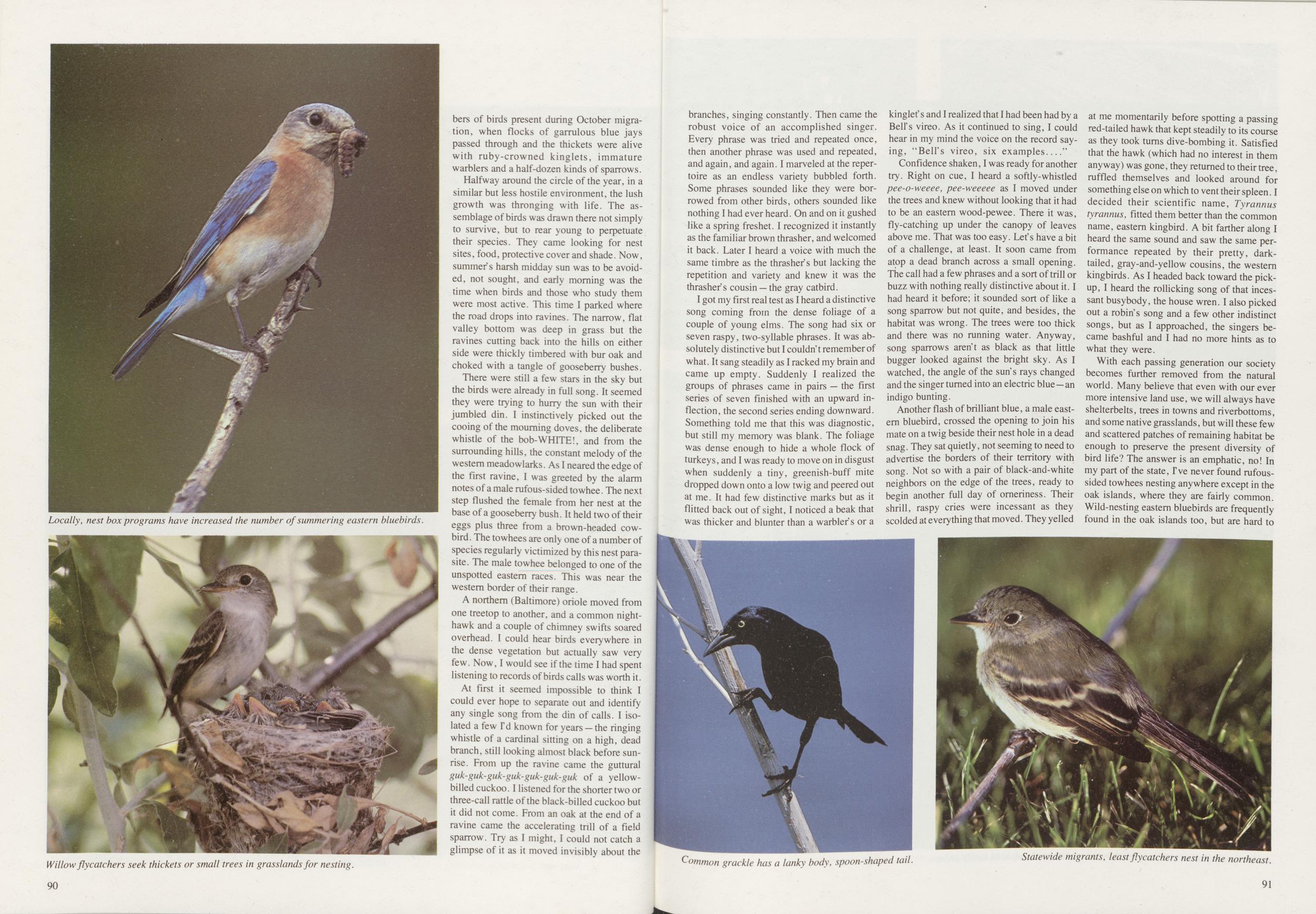
Halfway around the circle of the year, in a similar but less hostile environment, the lush growth was thronging with life. The assemblage of birds was drawn there not simply to survive, but to rear young to perpetuate their species. They came looking for nest sites, food, protective cover and shade. Now, summer's harsh midday sun was to be avoided, not sought, and early morning was the time when birds and those who study them were most active. This time I parked where the road drops into ravines. The narrow, flat valley bottom was deep in grass but the ravines cutting back into the hills on either side were thickly timbered with bur oak and choked with a tangle of gooseberry bushes.
There were still a few stars in the sky but the birds were already in full song. It seemed they were trying to hurry the sun with their jumbled din. I instinctively picked out the cooing of the mourning doves, the deliberate whistle of the bob-WHITE!, and from the surrounding hills, the constant melody of the western meadowlarks. As I neared the edge of the first ravine, I was greeted by the alarm notes of a male rufous-sided to whee. The next step flushed the female from her nest at the base of a gooseberry bush. It held two of their eggs plus three from a brown-headed cowbird. The towhees are only one of a number of species regularly victimized by this nest parasite. The male towhee belonged to one of the unspotted eastern races. This was near the western border of their range.
A northern (Baltimore) oriole moved from one treetop to another, and a common nighthawk and a couple of chimney swifts soared overhead. I could hear birds everywhere in the dense vegetation but actually saw very few. Now, I would see if the time I had spent listening to records of birds calls was worth it.
At first it seemed impossible to think I could ever hope to separate out and identify any single song from the din of calls. I isolated a few Td known for years — the ringing whistle of a cardinal sitting on a high, dead branch, still looking almost black before sunrise. From up the ravine came the guttural guk-guk-guk-guk-guk-guk-guk of a yellowbilled cuckoo. I listened for the shorter two or three-call rattle of the black-billed cuckoo but it did not come. From an oak at the end of a ravine came the accelerating trill of a field sparrow. Try as I might, I could not catch a glimpse of it as it moved invisibly about the 90 branches, singing constantly. Then came the robust voice of an accomplished singer. Every phrase was tried and repeated once, then another phrase was used and repeated, and again, and again. I marveled at the repertoire as an endless variety bubbled forth. Some phrases sounded like they were bor- rowed from other birds, others sounded like nothing I had ever heard. On and on it gushed like a spring freshet. I recognized it instantly as the familiar brown thrasher, and welcomed it back. Later I heard a voice with much the same timbre as the thrasher's but lacking the repetition and variety and knew it was the thrasher's cousin —the gray catbird.
I got my first real test as I heard a distinctive song coming from the dense foliage of a couple of young elms. The song had six or seven raspy, two-syllable phrases. It was absolutely distinctive but I couldn't remember of what. It sang steadily as I racked my brain and came up empty. Suddenly I realized the groups of phrases came in pairs — the first series of seven finished with an upward inflection, the second series ending downward. Something told me that this was diagnostic, but still my memory was blank. The foliage was dense enough to hide a whole flock of turkeys, and I was ready to move on in disgust when suddenly a tiny, greenish-buff mite dropped down onto a low twig and peered out at me. It had few distinctive marks but as it flitted back out of sight, I noticed a beak that was thicker and blunter than a warbler's or a kinglet's and I realized that I had been had by a Bell's vireo. As it continued to sing, I could hear in my mind the voice on the record saying, "Bell's vireo, six examples"
Confidence shaken, I was ready for another try. Right on cue, I heard a softly-whistled pee-o-weeee, pee-weeeee as I moved under the trees and knew without looking that it had to be an eastern wood-pewee. There it was, fly-catching up under the canopy of leaves above me. That was too easy. Let's have a bit of a challenge, at least. It soon came from atop a dead branch across a small opening. The call had a few phrases and a sort of trill or buzz with nothing really distinctive about it. I had heard it before; it sounded sort of like a song sparrow but not quite, and besides, the habitat was wrong. The trees were too thick and there was no running water. Anyway, song sparrows aren't as black as that little bugger looked against the bright sky. As I watched, the angle of the sun's rays changed and the singer turned into an electric blue—an indigo bunting.
Another flash of brilliant blue, a male eastern bluebird, crossed the opening to join his mate on a twig beside their nest hole in a dead snag. They sat quietly, not seeming to need to advertise the borders of their territory with song. Not so with a pair of black-and-white neighbors on the edge of the trees, ready to begin another full day of orneriness. Their shrill, raspy cries were incessant as they scolded at everything that moved. They yelled at me momentarily before spotting a passing red-tailed hawk that kept steadily to its course as they took turns dive-bombing it. Satisfied that the hawk (which had no interest in them anyway) was gone, they returned to their tree, ruffled themselves and looked around for something else on which to vent their spleen. I decided their scientific name, Tyrannus tyrannus, fitted them better than the common name, eastern kingbird. A bit farther along I heard the same sound and saw the same performance repeated by their pretty, darktailed, gray-and-yellow cousins, the western kingbirds. As I headed back toward the pickup, I heard the rollicking song of that incessant busybody, the house wren. I also picked out a robin's song and a few other indistinct songs, but as I approached, the singers became bashful and I had no more hints as to what they were.
With each passing generation our society becomes further removed from the natural world. Many believe that even with our ever more intensive land use, we will always have shelterbelts, trees in towns and riverbottoms, and some native grasslands, but will these few and scattered patches of remaining habitat be enough to preserve the present diversity of bird life? The answer is an emphatic, no! In my part of the state, Tve never found rufoussided towhees nesting anywhere except in the oak islands, where they are fairly common. Wild-nesting eastern bluebirds are frequently found in the oak islands too, but are hard to find elsewhere. The structure of some riparian woodlands looks to man to be similar, but apparently to the birds they are not.
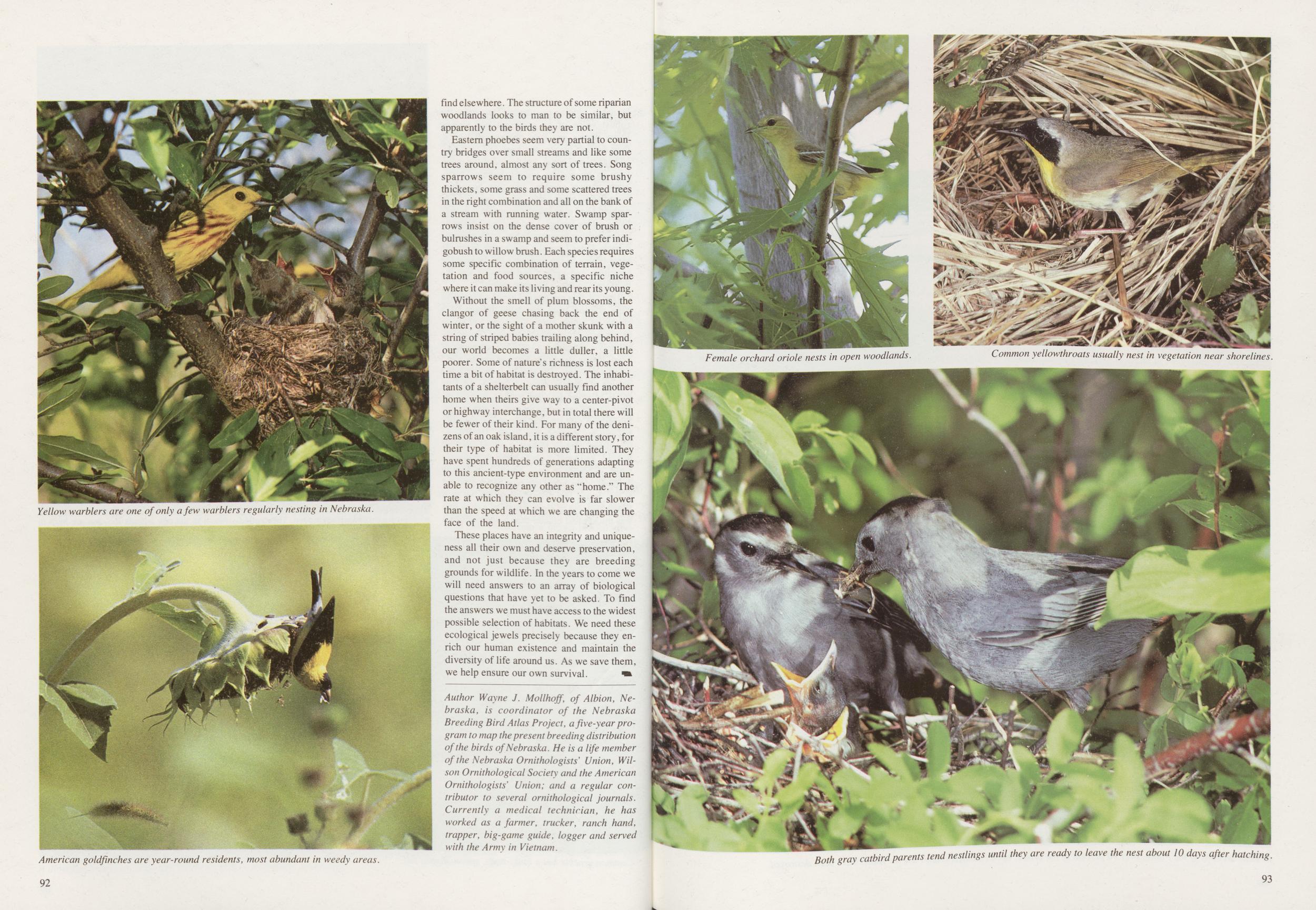
Eastern phoebes seem very partial to country bridges over small streams and like some trees around, almost any sort of trees. Song sparrows seem to require some brushy thickets, some grass and some scattered trees in the right combination and all on the bank of a stream with running water. Swamp sparrows insist on the dense cover of brush or bulrushes in a swamp and seem to prefer indigobush to willow brush. Each species requires some specific combination of terrain, vegetation and food sources, a specific niche where it can make its living and rear its young.
Without the smell of plum blossoms, the clangor of geese chasing back the end of winter, or the sight of a mother skunk with a string of striped babies trailing along behind, our world becomes a little duller, a little poorer. Some of nature's richness is lost each time a bit of habitat is destroyed. The inhabitants of a shelterbelt can usually find another home when theirs give way to a center-pivot or highway interchange, but in total there will be fewer of their kind. For many of the denizens of an oak island, it is a different story, for their type of habitat is more limited. They have spent hundreds of generations adapting to this ancient-type environment and are unable to recognize any other as "home." The rate at which they can evolve is far slower than the speed at which we are changing the face of the land.
These places have an integrity and uniqueness all their own and deserve preservation, and not just because they are breeding grounds for wildlife. In the years to come we will need answers to an array of biological questions that have yet to be asked. To find the answers we must have access to the widest possible selection of habitats. We need these ecological jewels precisely because they enrich our human existence and maintain the diversity of life around us. As we save them, we help ensure our own survival.
Author Wayne J. Mollhoff, of Albion, Nebraska, is coordinator of the Nebraska Breeding Bird Atlas Project, a five-year program to map the present breeding distribution of the birds of Nebraska. He is a life member of the Nebraska Ornithologists' Union, Wilson Ornithological Society and the American Ornithologists' Union; and a regular contributor to several ornithological journals. Currently a medical technician, he has worked as a farmer, trucker, ranch hand, trapper, big-game guide, logger and served with the Army in Vietnam. 92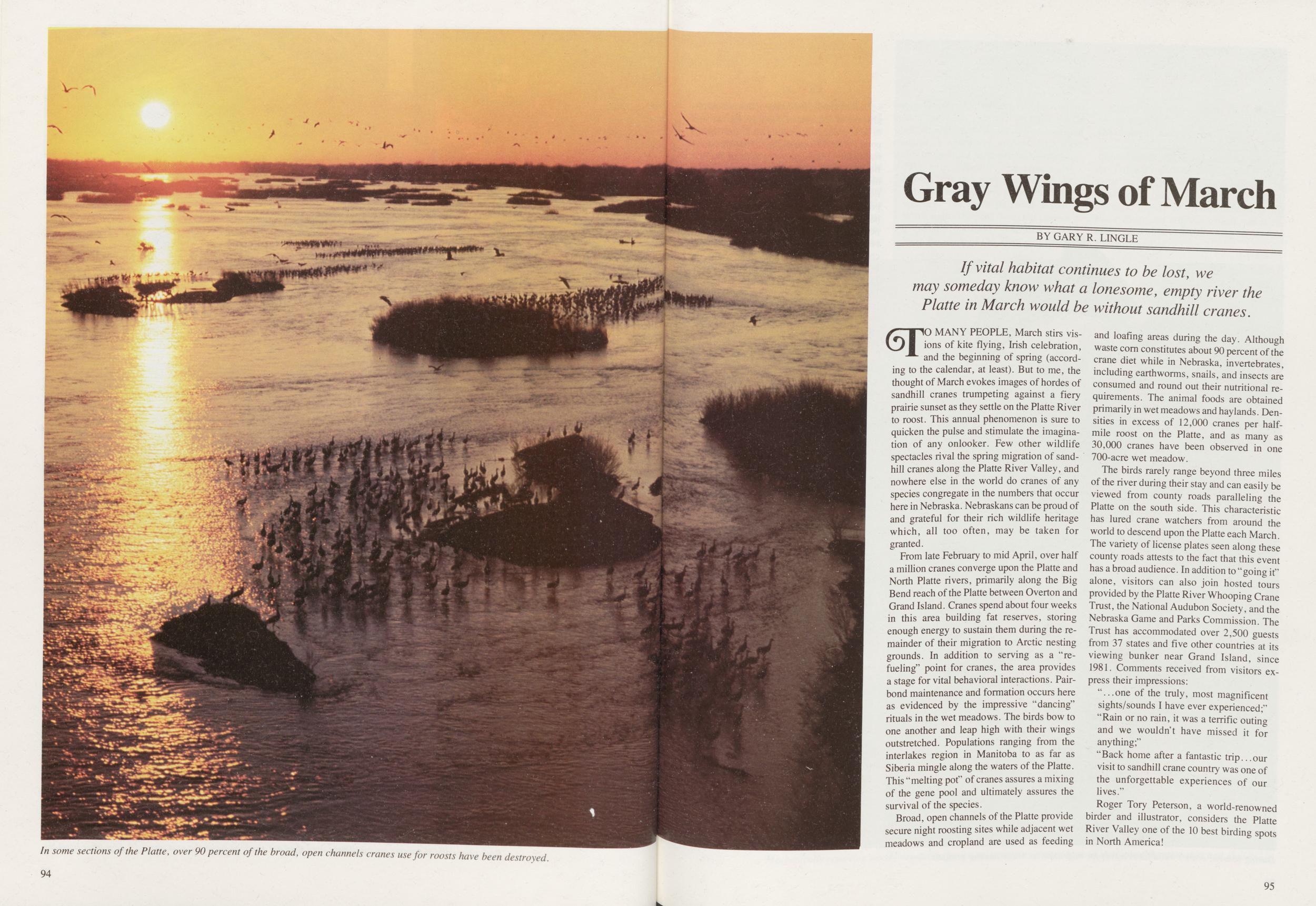
Gray Wings of March
BY GARY R. LINGLE If vital habitat continues to be lost, we may someday know what a lonesome, empty river the Platte in March would be without sandhill cranes.S—TIO MANY PEOPLE, March stirs visions of kite flying, Irish celebration, and the beginning of spring (according to the calendar, at least). But to me, the thought of March evokes images of hordes of sandhill cranes trumpeting against a fiery prairie sunset as they settle on the Platte River to roost. This annual phenomenon is sure to quicken the pulse and stimulate the imagination of any onlooker. Few other wildlife spectacles rival the spring migration of sandhill cranes along the Platte River Valley, and nowhere else in the world do cranes of any species congregate in the numbers that occur here in Nebraska. Nebraskans can be proud of and grateful for their rich wildlife heritage which, all too often, may be taken for granted.
From late February to mid April, over half a million cranes converge upon the Platte and North Platte rivers, primarily along the Big Bend reach of the Platte between Overton and Grand Island. Cranes spend about four weeks in this area building fat reserves, storing enough energy to sustain them during the remainder of their migration to Arctic nesting grounds. In addition to serving as a "refueling" point for cranes, the area provides a stage for vital behavioral interactions. Pairbond maintenance and formation occurs here as evidenced by the impressive "dancing" rituals in the wet meadows. The birds bow to one another and leap high with their wings outstretched. Populations ranging from the interlakes region in Manitoba to as far as Siberia mingle along the waters of the Platte. This "melting pot" of cranes assures a mixing of the gene pool and ultimately assures the survival of the species.
Broad, open channels of the Platte provide secure night roosting sites while adjacent wet meadows and cropland are used as feeding and loafing areas during the day. Although waste corn constitutes about 90 percent of the crane diet while in Nebraska, invertebrates, including earthworms, snails, and insects are consumed and round out their nutritional requirements. The animal foods are obtained primarily in wet meadows and haylands. Densities in excess of 12,000 cranes per halfmile roost on the Platte, and as many as 30,000 cranes have been observed in one 700-acre wet meadow.
The birds rarely range beyond three miles of the river during their stay and can easily be viewed from county roads paralleling the Platte on the south side. This characteristic has lured crane watchers from around the world to descend upon the Platte each March. The variety of license plates seen along these county roads attests to the fact that this event has a broad audience. In addition to "going it" alone, visitors can also join hosted tours provided by the Platte River Whooping Crane Trust, the National Audubon Society, and the Nebraska Game and Parks Commission. The Trust has accommodated over 2,500 guests from 37 states and five other countries at its viewing bunker near Grand Island, since 1981. Comments received from visitors express their impressions:
"...one of the truly, most magnificent sights/sounds I have ever experienced;"
"Rain or no rain, it was a terrific outing and we wouldn't have missed it for anything;"
"Back home after a fantastic trip.. .our visit to sandhill crane country was one of the unforgettable experiences of our lives."
Roger Tory Peterson, a world-renowned birder and illustrator, considers the Platte River Valley one of the 10 best birding spots in North America!
95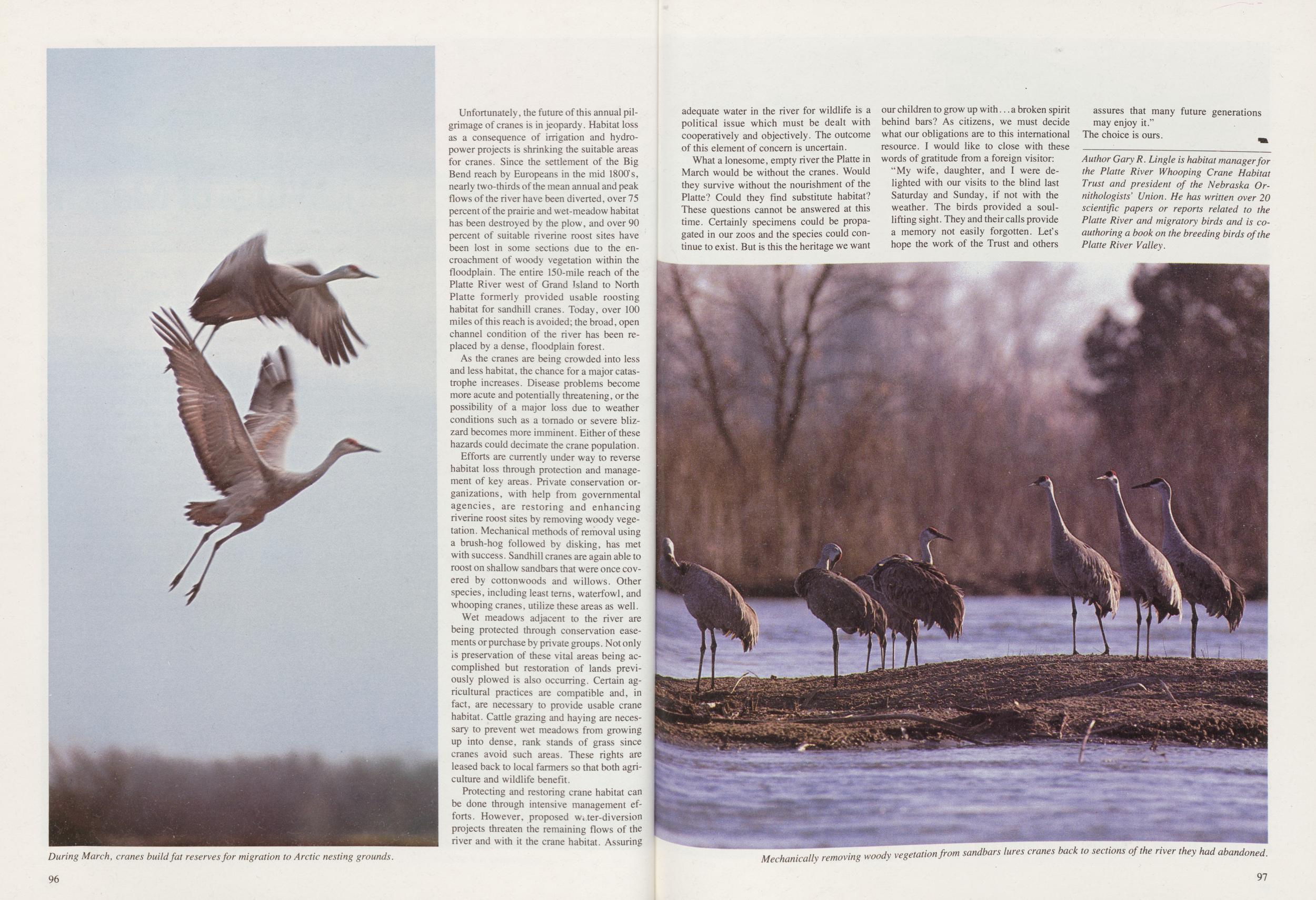
Unfortunately, the future of this annual pilgrimage of cranes is in jeopardy. Habitat loss as a consequence of irrigation and hydropower projects is shrinking the suitable areas for cranes. Since the settlement of the Big Bend reach by Europeans in the mid 1800's, nearly two-thirds of the mean annual and peak flows of the river have been diverted, over 75 percent of the prairie and wet-meadow habitat has been destroyed by the plow, and over 90 percent of suitable riverine roost sites have been lost in some sections due to the encroachment of woody vegetation within the floodplain. The entire 150-mile reach of the Platte River west of Grand Island to North Platte formerly provided usable roosting habitat for sandhill cranes. Today, over 100 miles of this reach is avoided; the broad, open channel condition of the river has been replaced by a dense, floodplain forest.
As the cranes are being crowded into less and less habitat, the chance for a major catastrophe increases. Disease problems become more acute and potentially threatening, or the possibility of a major loss due to weather conditions such as a tornado or severe blizzard becomes more imminent. Either of these hazards could decimate the crane population.
Efforts are currently under way to reverse habitat loss through protection and management of key areas. Private conservation organizations, with help from governmental agencies, are restoring and enhancing riverine roost sites by removing woody vegetation. Mechanical methods of removal using a brush-hog followed by disking, has met with success. Sandhill cranes are again able to roost on shallow sandbars that were once covered by cottonwoods and willows. Other species, including least terns, waterfowl, and whooping cranes, utilize these areas as well.
Wet meadows adjacent to the river are being protected through conservation easements or purchase by private groups. Not only is preservation of these vital areas being accomplished but restoration of lands previously plowed is also occurring. Certain agricultural practices are compatible and, in fact, are necessary to provide usable crane habitat. Cattle grazing and haying are necessary to prevent wet meadows from growing up into dense, rank stands of grass since cranes avoid such areas. These rights are leased back to local farmers so that both agriculture and wildlife benefit.
Protecting and restoring crane habitat can be done through intensive management efforts. However, proposed Witer-diversion projects threaten the remaining flows of the river and with it the crane habitat. Assuring 96 adequate water in the river for wildlife is a political issue which must be dealt with cooperatively and objectively. The outcome of this element of concern is uncertain.
What a lonesome, empty river the Platte in March would be without the cranes. Would they survive without the nourishment of the Platte? Could they find substitute habitat? These questions cannot be answered at this time. Certainly specimens could be propagated in our zoos and the species could continue to exist. But is this the heritage we want our children to grow up with... a broken spirit behind bars? As citizens, we must decide what our obligations are to this international resource. I would like to close with these words of gratitude from a foreign visitor:
"My wife, daughter, and I were delighted with our visits to the blind last Saturday and Sunday, if not with the weather. The birds provided a soullifting sight. They and their calls provide a memory not easily forgotten. Let's hope the work of the Trust and others assures that many future generations may enjoy it."
The choice is ours.
Author Gary R. Lingle is habitat manager for the Platte River Whooping Crane Habitat Trust and president of the Nebraska Ornithologists1 Union. He has written over 20 scientific papers or reports related to the Platte River and migratory birds and is coauthoring a book on the breeding birds of the Platte River Valley.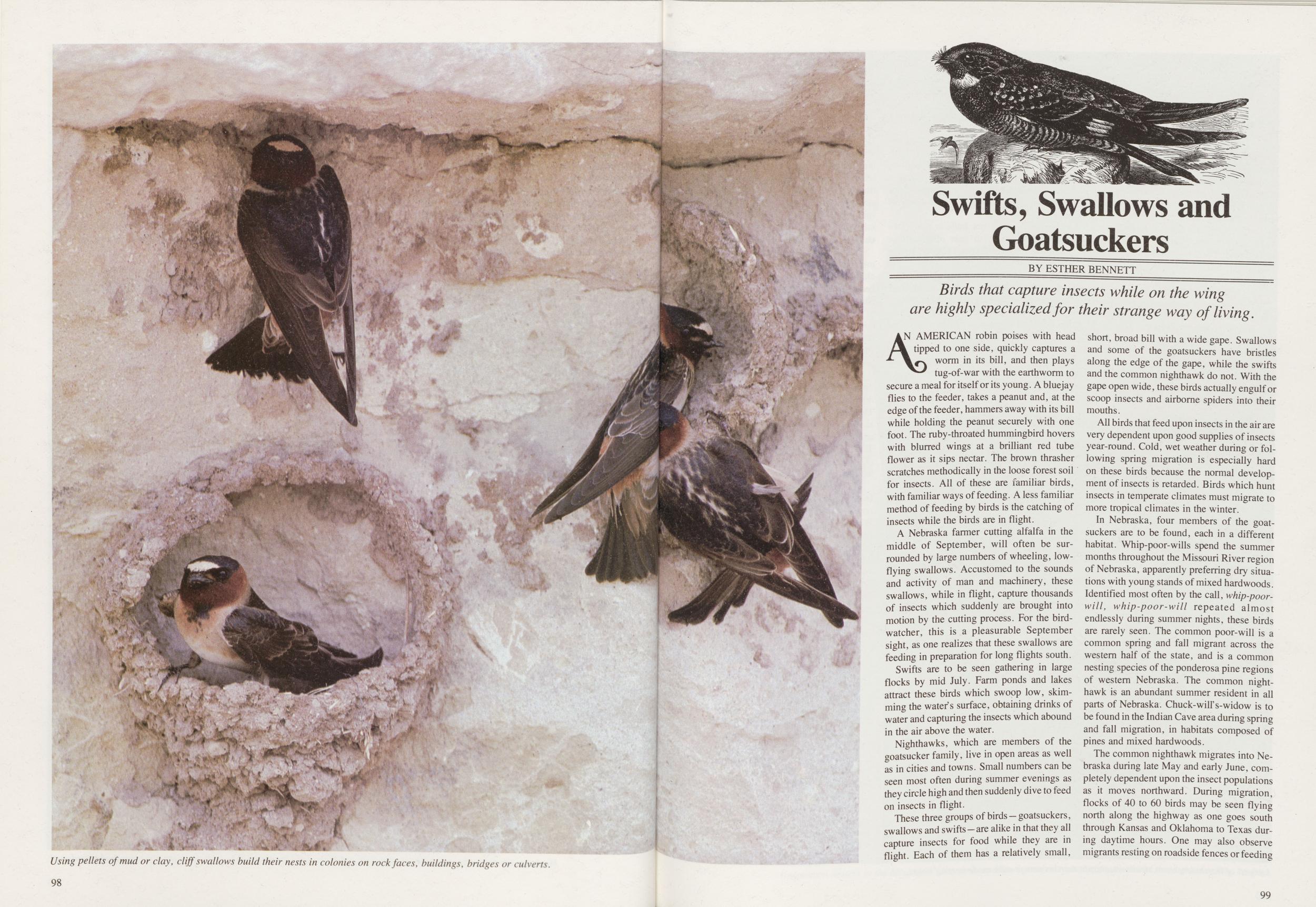
Swifts, Swallows and Goatsuckers
BY ESTHER BENNETT Birds that capture insects while on the wing are highly specialized for their strange way of livingAN AMERICAN robin poises with head ZA tipped to one side, quickly captures a worm in its bill, and then plays tug-of-war with the earthworm to secure a meal for itself or its young. A bluejay flies to the feeder, takes a peanut and, at the edge of the feeder, hammers away with its bill while holding the peanut securely with one foot. The ruby-throated hummingbird hovers with blurred wings at a brilliant red tube flower as it sips nectar. The brown thrasher scratches methodically in the loose forest soil for insects. All of these are familiar birds, with familiar ways of feeding. A less familiar method of feeding by birds is the catching of insects while the birds are in flight.
A Nebraska farmer cutting alfalfa in the middle of September, will often be surrounded by large numbers of wheeling, low-flying swallows. Accustomed to the sounds and activity of man and machinery, these swallows, while in flight, capture thousands of insects which suddenly are brought into motion by the cutting process. For the bird-watcher, this is a pleasurable September sight, as one realizes that these swallows are feeding in preparation for long flights south.
Swifts are to be seen gathering in large flocks by mid July. Farm ponds and lakes attract these birds which swoop low, skimming the water's surface, obtaining drinks of water and capturing the insects which abound in the air above the water.
Nighthawks, which are members of the goatsucker family, live in open areas as well as in cities and towns. Small numbers can be seen most often during summer evenings as they circle high and then suddenly dive to feed on insects in flight.
These three groups of birds-goatsuckers, swallows and swifts-are alike in that they all capture insects for food while they are in flight. Each of them has a relatively small, short, broad bill with a wide gape. Swallows and some of the goatsuckers have bristles along the edge of the gape, while the swifts and the common nighthawk do not. With the gape open wide, these birds actually engulf or scoop insects and airborne spiders into their mouths.
All birds that feed upon insects in the air are very dependent upon good supplies of insects year-round. Cold, wet weather during or following spring migration is especially hard on these birds because the normal development of insects is retarded. Birds which hunt insects in temperate climates must migrate to more tropical climates in the winter.
In Nebraska, four members of the goatsuckers are to be found, each in a different habitat. Whip-poor-wills spend the summer months throughout the Missouri River region of Nebraska, apparently preferring dry situations with young stands of mixed hardwoods. Identified most often by the call, whip-poorwill, whip-poor-will repeated almost endlessly during summer nights, these birds are rarely seen. The common poor-will is a common spring and fall migrant across the western half of the state, and is a common nesting species of the ponderosa pine regions of western Nebraska. The common nighthawk is an abundant summer resident in all parts of Nebraska. Chuck-will's-widow is to be found in the Indian Cave area during spring and fall migration, in habitats composed of pines and mixed hardwoods.
The common nighthawk migrates into Nebraska during late May and early June, completely
dependent upon the insect populations
as it moves northward. During migration,
flocks of 40 to 60 birds may be seen flying
north along the highway as one goes south
through Kansas and Oklahoma to Texas during daytime hours. One may also observe
migrants resting on roadside fences or feeding
99
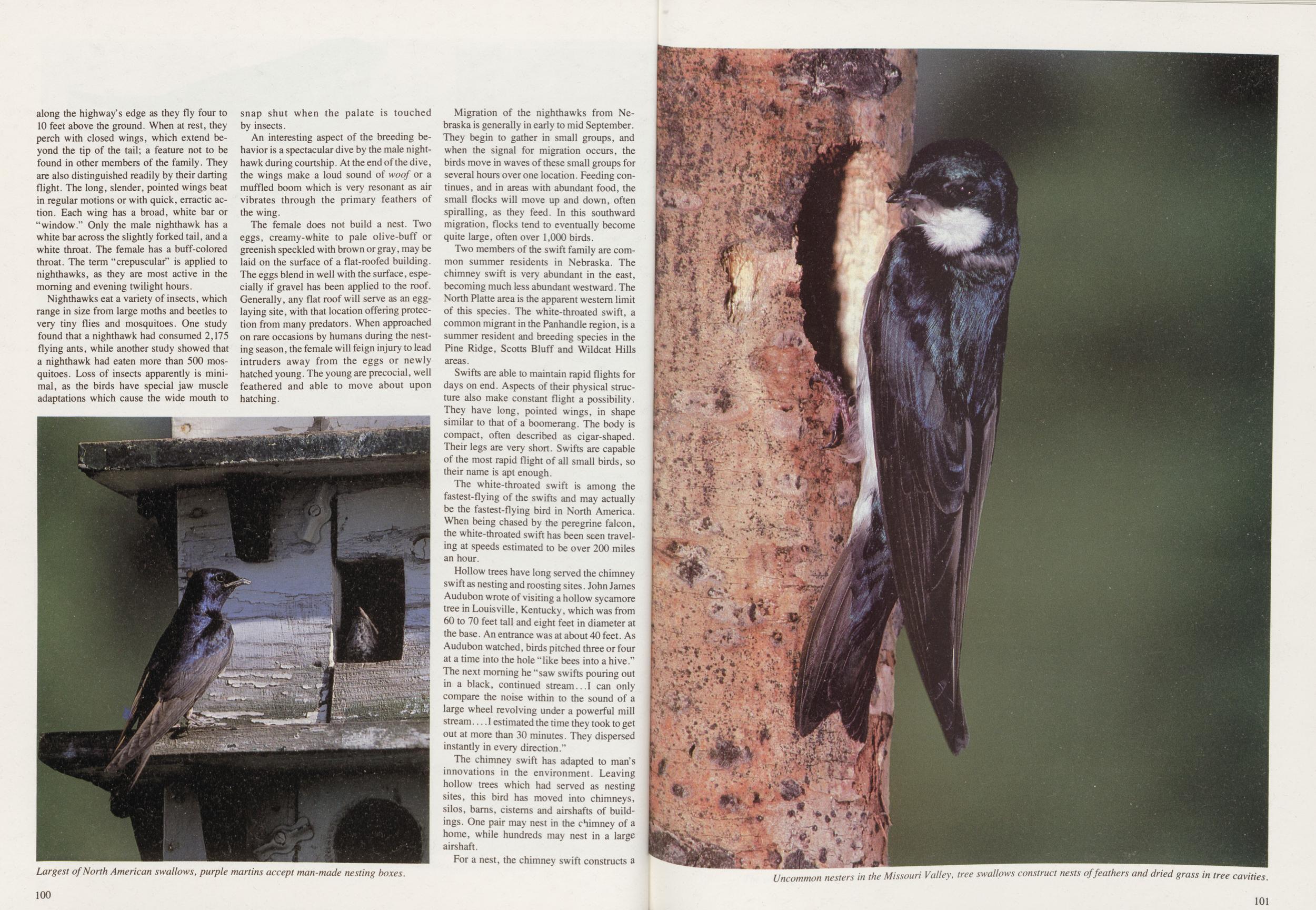 along the highway's edge as they fly four to
10 feet above the ground. When at rest, they
perch with closed wings, which extend beyond the tip of the tail; a feature not to
be
found in other members of the family. They
are also distinguished readily by their darting
flight. The long, slender, pointed wings beat
in regular motions or with quick, erractic action. Each wing has a broad, white bar
or
"window." Only the male nighthawk has a
white bar across the slightly forked tail, and a
white throat. The female has a buff-colored
throat. The term "crepuscular" is applied to
nighthawks, as they are most active in the
morning and evening twilight hours.
along the highway's edge as they fly four to
10 feet above the ground. When at rest, they
perch with closed wings, which extend beyond the tip of the tail; a feature not to
be
found in other members of the family. They
are also distinguished readily by their darting
flight. The long, slender, pointed wings beat
in regular motions or with quick, erractic action. Each wing has a broad, white bar
or
"window." Only the male nighthawk has a
white bar across the slightly forked tail, and a
white throat. The female has a buff-colored
throat. The term "crepuscular" is applied to
nighthawks, as they are most active in the
morning and evening twilight hours.
Nighthawks eat a variety of insects, which range in size from large moths and beetles to very tiny flies and mosquitoes. One study found that a nighthawk had consumed 2,175 flying ants, while another study showed that a nighthawk had eaten more than 500 mosquitoes. Loss of insects apparently is minimal, as the birds have special jaw muscle adaptations which cause the wide mouth to snap shut when the palate is touched by insects.
An interesting aspect of the breeding behavior is a spectacular dive by the male nighthawk during courtship. At the end of the dive, the wings make a loud sound of woof or a muffled boom which is very resonant as air vibrates through the primary feathers of the wing.
The female does not build a nest. Two eggs, creamy-white to pale olive-buff or greenish speckled with brown or gray, may be laid on the surface of a flat-roofed building. The eggs blend in well with the surface, especially if gravel has been applied to the roof. Generally, any flat roof will serve as an egglaying site, with that location offering protection from many predators. When approached on rare occasions by humans during the nesting season, the female will feign injury to lead intruders away from the eggs or newly hatched young. The young are precocial, well feathered and able to move about upon hatching.
Migration of the nighthawks from Nebraska is generally in early to mid September. They begin to gather in small groups, and when the signal for migration occurs, the birds move in waves of these small groups for several hours over one location. Feeding continues, and in areas with abundant food, the small flocks will move up and down, often spiralling, as they feed. In this southward migration, flocks tend to eventually become quite large, often over 1,000 birds.
Two members of the swift family are common summer residents in Nebraska. The chimney swift is very abundant in the east, becoming much less abundant westward. The North Platte area is the apparent western limit of this species. The white-throated swift, a common migrant in the Panhandle region, is a summer resident and breeding species in the Pine Ridge, Scotts Bluff and Wildcat Hills areas.
Swifts are able to maintain rapid flights for days on end. Aspects of their physical structure also make constant flight a possibility. They have long, pointed wings, in shape similar to that of a boomerang. The body is compact, often described as cigar-shaped. Their legs are very short. Swifts are capable of the most rapid flight of all small birds, so their name is apt enough.
The white-throated swift is among the fastest-flying of the swifts and may actually be the fastest-flying bird in North America. When being chased by the peregrine falcon, the white-throated swift has been seen traveling at speeds estimated to be over 200 miles an hour.
Hollow trees have long served the chimney swift as nesting and roosting sites. John James Audubon wrote of visiting a hollow sycamore tree in Louisville, Kentucky, which was from 60 to 70 feet tall and eight feet in diameter at the base. An entrance was at about 40 feet. As Audubon watched, birds pitched three or four at a time into the hole "like bees into a hive." The next morning he "saw swifts pouring out in a black, continued stream I can only compare the noise within to the sound of a large wheel revolving under a powerful mill stream—I estimated the time they took to get out at more than 30 minutes. They dispersed instantly in every direction."
The chimney swift has adapted to man's innovations in the environment. Leaving hollow trees which had served as nesting sites, this bird has moved into chimneys, silos, barns, cisterns and airshafts of buildings. One pair may nest in the chimney of a home, while hundreds may nest in a large airshaft.
For a nest, the chimney swift constructs a shallow cup on a chimney or other wall with twigs which it breaks off while in flight. A glue-like saliva, secreted by special glands in the mouth of the bird, is used to securely fasten the twigs to the wall surface. Into this sturdy structure, four or five white eggs are laid, which hatch in 19 to 21 days. The young are capable of flight at about 30 days of age.
100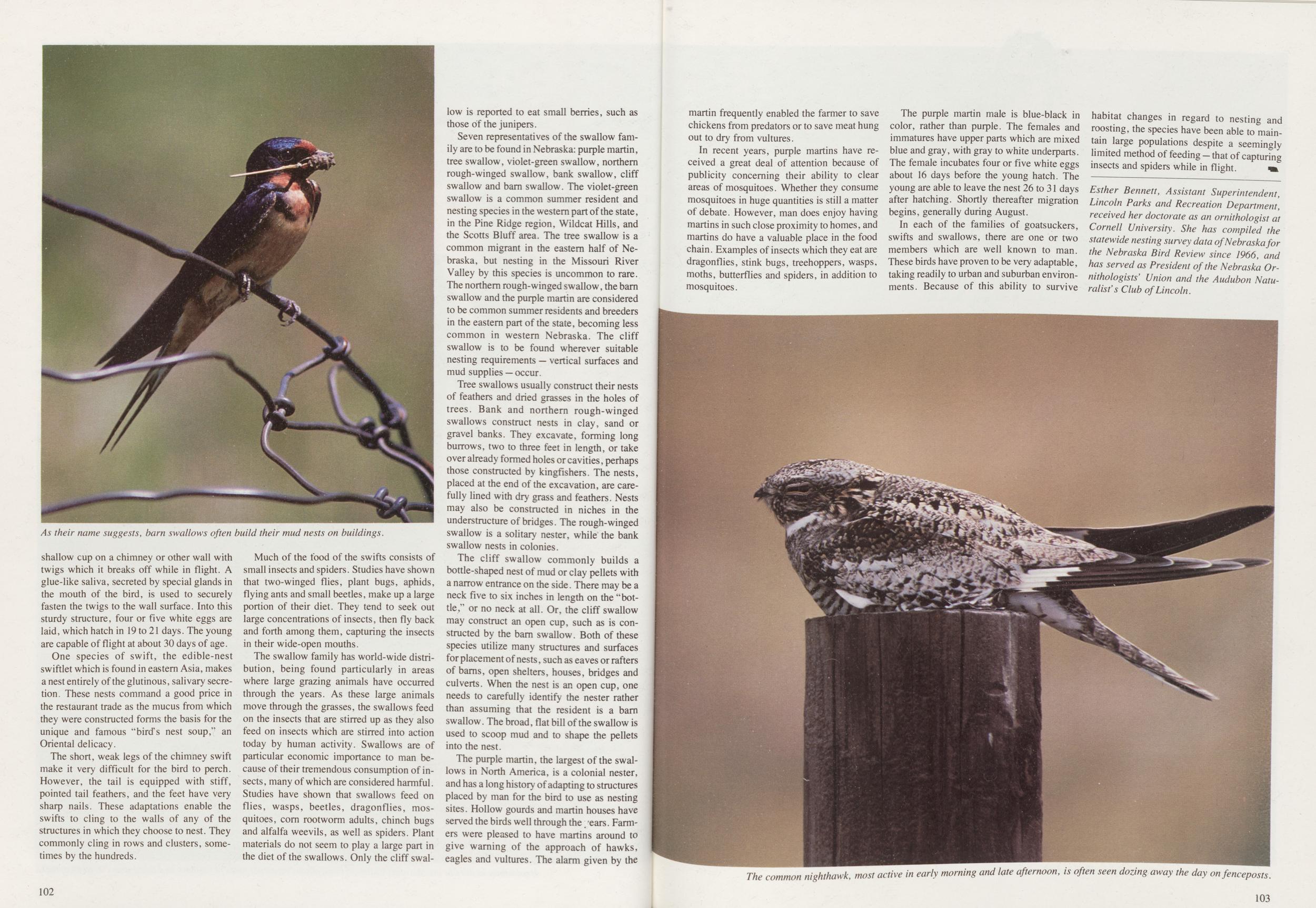
One species of swift, the edible-nest swiftlet which is found in eastern Asia, makes a nest entirely of the glutinous, salivary secretion. These nests command a good price in the restaurant trade as the mucus from which they were constructed forms the basis for the unique and famous "bird's nest soup," an Oriental delicacy.
The short, weak legs of the chimney swift make it very difficult for the bird to perch. However, the tail is equipped with stiff, pointed tail feathers, and the feet have very sharp nails. These adaptations enable the swifts to cling to the walls of any of the structures in which they choose to nest. They commonly cling in rows and clusters, sometimes by the hundreds.
Much of the food of the swifts consists of small insects and spiders. Studies have shown that two-winged flies, plant bugs, aphids, flying ants and small beetles, make up a large portion of their diet. They tend to seek out large concentrations of insects, then fly back and forth among them, capturing the insects in their wide-open mouths.
The swallow family has world-wide distribution, being found particularly in areas where large grazing animals have occurred through the years. As these large animals move through the grasses, the swallows feed on the insects that are stirred up as they also feed on insects which are stirred into action today by human activity. Swallows are of particular economic importance to man because of their tremendous consumption of insects, many of which are considered harmful. Studies have shown that swallows feed on flies, wasps, beetles, dragonflies, mosquitoes, corn rootworm adults, chinch bugs and alfalfa weevils, as well as spiders. Plant materials do not seem to play a large part in the diet of the swallows. Only the cliff swallow is reported to eat small berries, such as those of the junipers.
Seven representatives of the swallow family are to be found in Nebraska: purple martin, tree swallow, violet-green swallow, northern rough-winged swallow, bank swallow, cliff swallow and barn swallow. The violet-green swallow is a common summer resident and nesting species in the western part of the state, in the Pine Ridge region, Wildcat Hills, and the Scotts Bluff area. The tree swallow is a common migrant in the eastern half of Nebraska, but nesting in the Missouri River Valley by this species is uncommon to rare. The northern rough-winged swallow, the barn swallow and the purple martin are considered to be common summer residents and breeders in the eastern part of the state, becoming less common in western Nebraska. The cliff swallow is to be found wherever suitable nesting requirements — vertical surfaces and mud supplies — occur.
Tree swallows usually construct their nests of feathers and dried grasses in the holes of trees. Bank and northern rough-winged swallows construct nests in clay, sand or gravel banks. They excavate, forming long burrows, two to three feet in length, or take over already formed holes or cavities, perhaps those constructed by kingfishers. The nests, placed at the end of the excavation, are carefully lined with dry grass and feathers. Nests may also be constructed in niches in the understructure of bridges. The rough-winged swallow is a solitary nester, while the bank swallow nests in colonies.
The cliff swallow commonly builds a bottle-shaped nest of mud or clay pellets with a narrow entrance on the side. There may be a neck five to six inches in length on the "bottle," or no neck at all. Or, the cliff swallow may construct an open cup, such as is constructed by the barn swallow. Both of these species utilize many structures and surfaces for placement of nests, such as eaves or rafters of barns, open shelters, houses, bridges and culverts. When the nest is an open cup, one needs to carefully identify the nester rather than assuming that the resident is a barn swallow. The broad, flat bill of the swallow is used to scoop mud and to shape the pellets into the nest.
The purple martin, the largest of the swallows in North America, is a colonial nester, and has a long history of adapting to structures placed by man for the bird to use as nesting sites. Hollow gourds and martin houses have served the birds well through the ears. Farmers were pleased to have martins around to give warning of the approach of hawks, eagles and vultures. The alarm given by the 102 martin frequently enabled the farmer to save chickens from predators or to save meat hung out to dry from vultures.
In recent years, purple martins have received a great deal of attention because of publicity concerning their ability to clear areas of mosquitoes. Whether they consume mosquitoes in huge quantities is still a matter of debate. However, man does enjoy having martins in such close proximity to homes, and martins do have a valuable place in the food chain. Examples of insects which they eat are dragonflies, stink bugs, treehoppers, wasps, moths, butterflies and spiders, in addition to mosquitoes.
The purple martin male is blue-black in color, rather than purple. The females and immatures have upper parts which are mixed blue and gray, with gray to white underparts. The female incubates four or five white eggs about 16 days before the young hatch. The young are able to leave the nest 26 to 31 days after hatching. Shortly thereafter migration begins, generally during August.
In each of the families of goatsuckers, swifts and swallows, there are one or two members which are well known to man. These birds have proven to be very adaptable, taking readily to urban and suburban environments. Because of this ability to survive habitat changes in regard to nesting and roosting, the species have been able to maintain large populations despite a seemingly limited method of feeding — that of capturing insects and spiders while in flight.
Esther Bennett, Assistant Superintendent, Lincoln Parks and Recreation Department, received her doctorate as an ornithologist at Cornell University. She has compiled the statewide nesting survey data of Nebraska for the Nebraska Bird Review since 1966, and has served as President of the Nebraska Ornithologists' Union and the Audubon Naturalist's Club of Lincoln.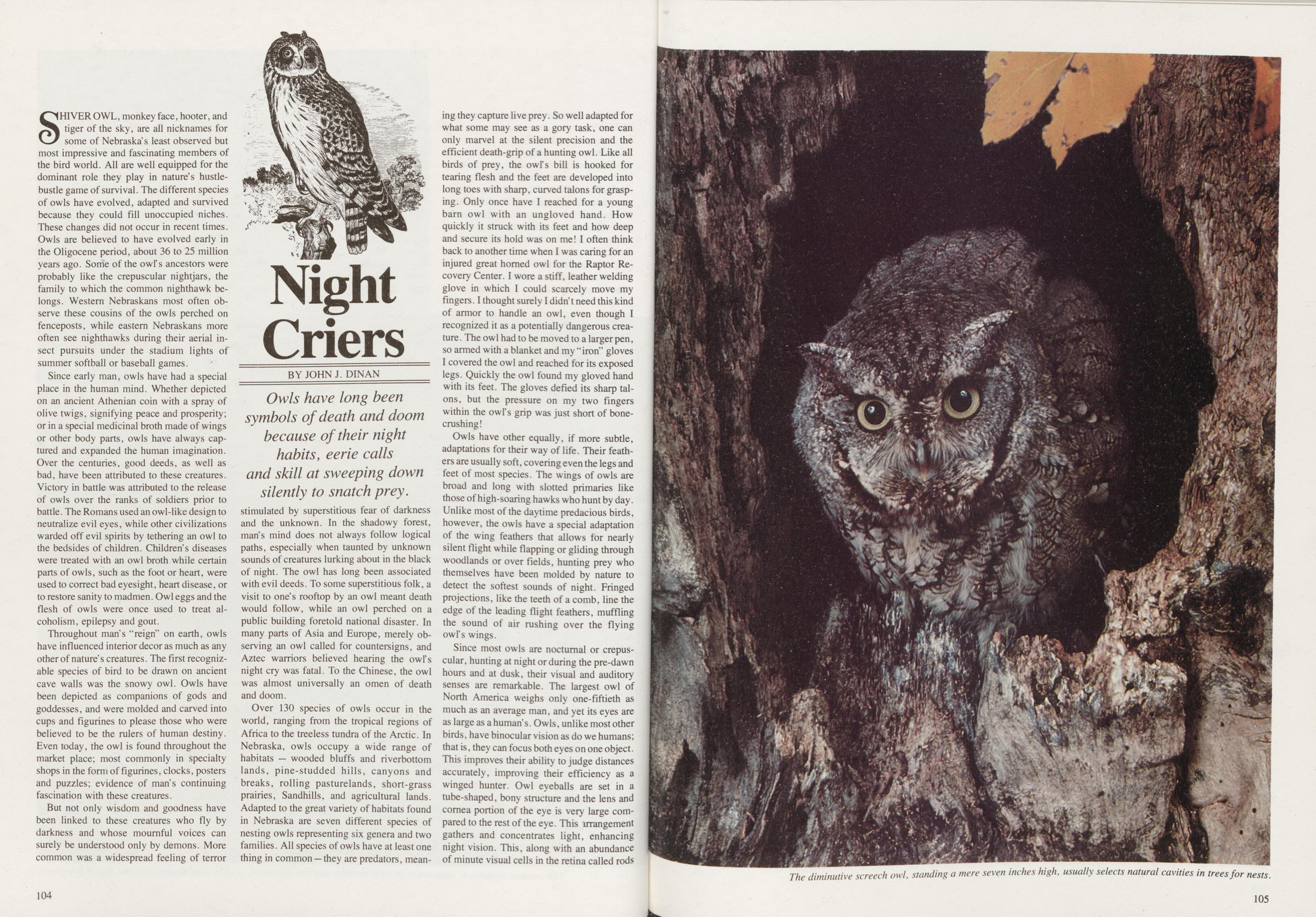
Night Criers
BY JOHN J. DINAN Owls have lonf been symbols of death and doom because of their night havbits, eerie calls and skill at sweeing sdown silently to snatch prey.SHIVER OWL, monkey face, hooter, and tiger of the sky, are all nicknames for some of Nebraska's least observed but most impressive and fascinating members of the bird world. All are well equipped for the dominant role they play in nature's hustlebustle game of survival. The different species of owls have evolved, adapted and survived because they could fill unoccupied niches. These changes did not occur in recent times. Owls are believed to have evolved early in the Oligocene period, about 36 to 25 million years ago. Sortie of the owl's ancestors were probably like the crepuscular nightjars, the family to which the common nighthawk belongs. Western Nebraskans most often observe these cousins of the owls perched on fenceposts, while eastern Nebraskans more often see nighthawks during their aerial insect pursuits under the stadium lights of summer softball or baseball games.
Since early man, owls have had a special place in the human mind. Whether depicted on an ancient Athenian coin with a spray of olive twigs, signifying peace and prosperity; or in a special medicinal broth made of wings or other body parts, owls have always captured and expanded the human imagination. Over the centuries, good deeds, as well as bad, have been attributed to these creatures. Victory in battle was attributed to the release of owls over the ranks of soldiers prior to battle. The Romans used an owl-like design to neutralize evil eyes, while other civilizations warded off evil spirits by tethering an owl to the bedsides of children. Children's diseases were treated with an owl broth while certain parts of owls, such as the foot or heart, were used to correct bad eyesight, heart disease, or to restore sanity to madmen. Owl eggs and the flesh of owls were once used to treat alcoholism, epilepsy and gout.
Throughout man's "reign" on earth, owls have influenced interior decor as much as any other of nature's creatures. The first recognizable species of bird to be drawn on ancient cave walls was the snowy owl. Owls have been depicted as companions of gods and goddesses, and were molded and carved into cups and figurines to please those who were believed to be the rulers of human destiny. Even today, the owl is found throughout the market place; most commonly in specialty shops in the form of figurines, clocks, posters and puzzles; evidence of man's continuing fascination with these creatures.
But not only wisdom and goodness have been linked to these creatures who fly by darkness and whose mournful voices can surely be understood only by demons. More common was a widespread feeling of terror stimulated by superstitious fear of darkness and the unknown. In the shadowy forest, man's mind does not always follow logical paths, especially when taunted by unknown sounds of creatures lurking about in the black of night. The owl has long been associated with evil deeds. To some superstitious folk, a visit to one's rooftop by an owl meant death would follow, while an owl perched on a public building foretold national disaster. In many parts of Asia and Europe, merely observing an owl called for countersigns, and Aztec warriors believed hearing the owl's night cry was fatal. To the Chinese, the owl was almost universally an omen of death and doom.
Over 130 species of owls occur in the world, ranging from the tropical regions of Africa to the treeless tundra of the Arctic. In Nebraska, owls occupy a wide range of habitats — wooded bluffs and riverbottom lands, pine-studded hills, canyons and breaks, rolling pasturelands, short-grass prairies, Sandhills, and agricultural lands. Adapted to the great variety of habitats found in Nebraska are seven different species of nesting owls representing six genera and two families. All species of owls have at least one thing in common —they are predators, meaning they capture live prey. So well adapted for what some may see as a gory task, one can only marvel at the silent precision and the efficient death-grip of a hunting owl. Like all birds of prey, the owl's bill is hooked for tearing flesh and the feet are developed into long toes with sharp, curved talons for grasping. Only once have I reached for a young barn owl with an ungloved hand. How quickly it struck with its feet and how deep and secure its hold was on me! I often think back to another time when I was caring for an injured great horned owl for the Raptor Recovery Center. I wore a stiff, leather welding glove in which I could scarcely move my fingers. I thought surely I didn't need this kind of armor to handle an owl, even though I recognized it as a potentially dangerous creature. The owl had to be moved to a larger pen, so armed with a blanket and my "iron" gloves I covered the owl and reached for its exposed legs. Quickly the owl found my gloved hand with its feet. The gloves defied its sharp talons, but the pressure on my two fingers within the owl's grip was just short of bonecrushing !
Owls have other equally, if more subtle, adaptations for their way of life. Their feathers are usually soft, covering even the legs and feet of most species. The wings of owls are broad and long with slotted primaries like those of high-soaring hawks who hunt by day. Unlike most of the daytime predacious birds, however, the owls have a special adaptation of the wing feathers that allows for nearly silent flight while flapping or gliding through woodlands or over fields, hunting prey who themselves have been molded by nature to detect the softest sounds of night. Fringed projections, like the teeth of a comb, line the edge of the leading flight feathers, muffling the sound of air rushing over the flying owl's wings.
Since most owls are nocturnal or crepuscular, hunting at night or during the pre-dawn hours and at dusk, their visual and auditory senses are remarkable. The largest owl of North America weighs only one-fiftieth as much as an average man, and yet its eyes are as large as a human's. Owls, unlike most other birds, have binocular vision as do we humans; that is, they can focus both eyes on one object. This improves their ability to judge distances accurately, improving their efficiency as a winged hunter. Owl eyeballs are set in a tube-shaped, bony structure and the lens and cornea portion of the eye is very large compared to the rest of the eye. This irrangement gathers and concentrates light, enhancing night vision. This, along with an abundance of minute visual cells in the retina called rods which act as receptors in low light conditions, provide the owl with night vision 100 times more sensitive than that of a human. But, since the owl's eyes are fixed in their sockets, the owl must turn and raise or lower its head to see in different directions. This extreme immobility of the eyes, however, is compen- sated for by a well developed set of neck muscles which allows the owl to swivel its head 270 degrees.
104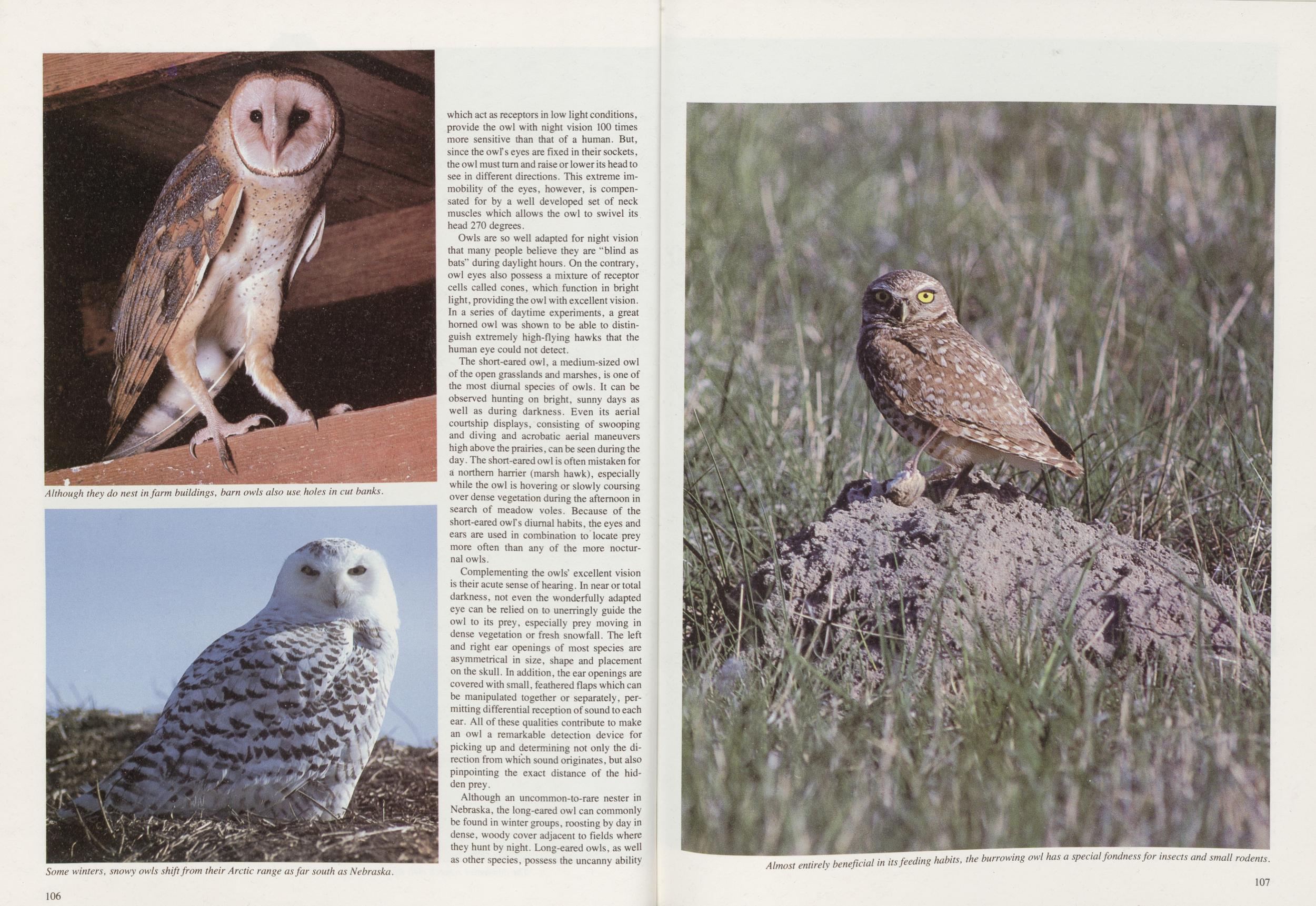
Owls are so well adapted for night vision that many people believe they are "blind as bats" during daylight hours. On the contrary, owl eyes also possess a mixture of receptor cells called cones, which function in bright light, providing the owl with excellent vision. In a series of daytime experiments, a great horned owl was shown to be able to distinguish extremely high-flying hawks that the human eye could not detect.
The short-eared owl, a medium-sized owl of the open grasslands and marshes, is one of the most diurnal species of owls. It can be observed hunting on bright, sunny days as well as during darkness. Even its aerial courtship displays, consisting of swooping and diving and acrobatic aerial maneuvers high above the prairies, can be seen during the day. The short-eared owl is often mistaken for a northern harrier (marsh hawk), especially while the owl is hovering or slowly coursing over dense vegetation during the afternoon in search of meadow voles. Because of the short-eared owl's diurnal habits, the eyes and ears are used in combination to locate prey more often than any of the more nocturnal owls.
Complementing the owls' excellent vision is their acute sense of hearing. In near or total darkness, not even the wonderfully adapted eye can be relied on to unerringly guide the owl to its prey, especially prey moving in dense vegetation or fresh snowfall. The left and right ear openings of most species are asymmetrical in size, shape and placement on the skull. In addition, the ear openings are covered with small, feathered flaps which can be manipulated together or separately, permitting differential reception of sound to each ear. All of these qualities contribute to make an owl a remarkable detection device for picking up and determining not only the direction from which sound originates, but also pinpointing the exact distance of the hidden prey.
Although an uncommon-to-rare nester in Nebraska, the long-eared owl can commonly be found in winter groups, roosting by day in dense, woody cover adjacent to fields where they hunt by night. Long-eared owls, as well as other species, possess the uncanny ability to pinpoint unseen prey from the air while hunting. Over 90 percent of the prey taken by long-eared owls consists of voles and other small rodents who move unseen but not unheard by this nocturnal hunter.
106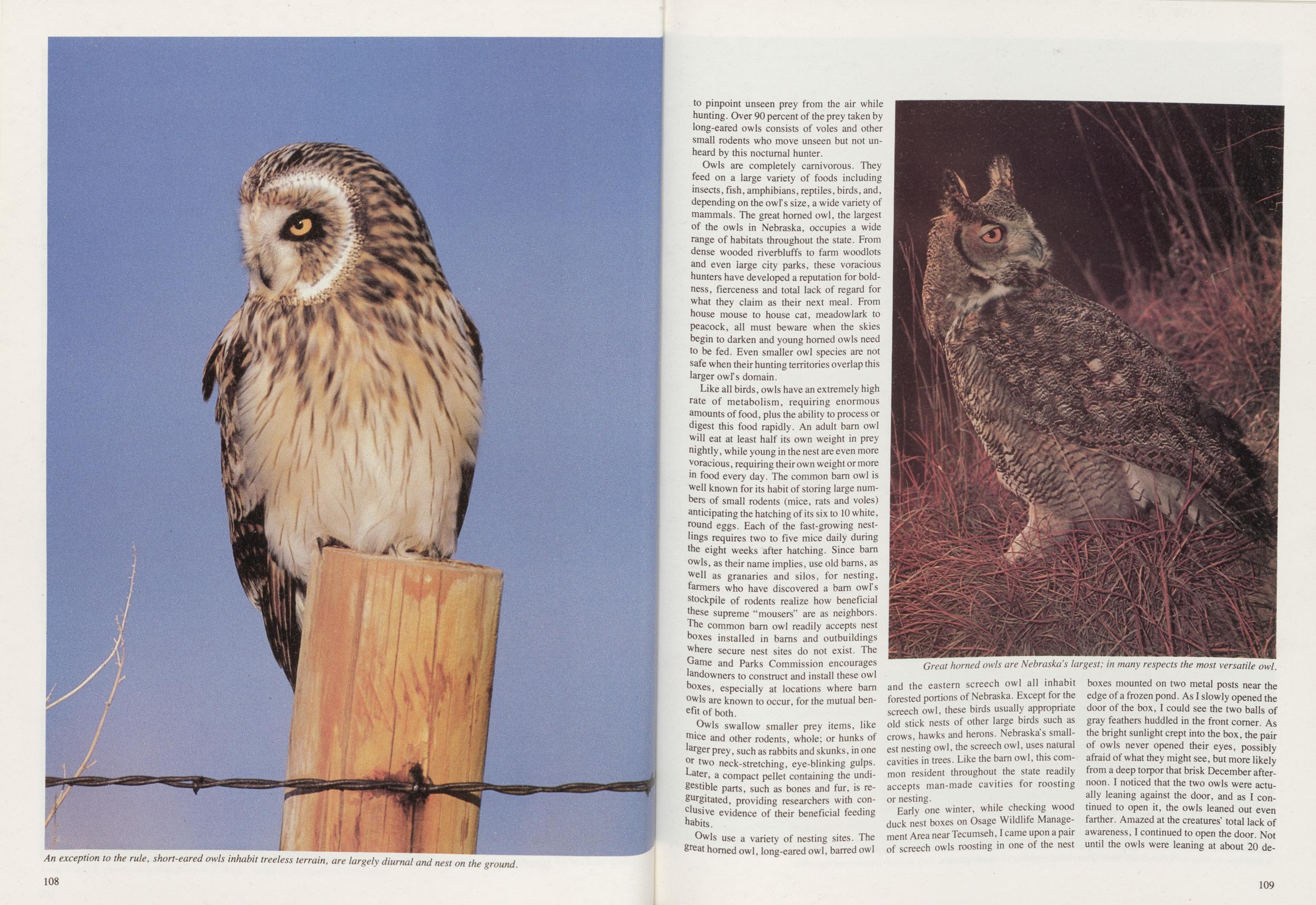
Owls are completely carnivorous. They feed on a large variety of foods including insects, fish, amphibians, reptiles, birds, and, depending on the owl's size, a wide variety of mammals. The great horned owl, the largest of the owls in Nebraska, occupies a wide range of habitats throughout the state. From dense wooded riverbluffs to farm woodlots and even large city parks, these voracious hunters have developed a reputation for boldness, fierceness and total lack of regard for what they claim as their next meal. From house mouse to house cat, meadowlark to peacock, all must beware when the skies begin to darken and young horned owls need to be fed. Even smaller owl species are not safe when their hunting territories overlap this larger owl's domain.
Like all birds, owls have an extremely high rate of metabolism, requiring enormous amounts of food, plus the ability to process or digest this food rapidly. An adult barn owl will eat at least half its own weight in prey nightly, while young in the nest are even more voracious, requiring their own weight or more in food every day. The common barn owl is well known for its habit of storing large numbers of small rodents (mice, rats and voles) anticipating the hatching of its six to 10 white, round eggs. Each of the fast-growing nestlings requires two to five mice daily during the eight weeks after hatching. Since barn owls, as their name implies, use old barns, as well as granaries and silos, for nesting, farmers who have discovered a barn owl's stockpile of rodents realize how beneficial these supreme "mousers" are as neighbors. The common barn owl readily accepts nest boxes installed in barns and outbuildings where secure nest sites do not exist. The Game and Parks Commission encourages landowners to construct and install these owl boxes, especially at locations where barn owls are known to occur, for the mutual benefit of both.
Owls swallow smaller prey items, like mice and other rodents, whole; or hunks of larger prey, such as rabbits and skunks, in one or two neck-stretching, eye-blinking gulps. Later, a compact pellet containing the undi§estible parts, such as bones and fur, is regurgitated, providing researchers with conclusive evidence of their beneficial feeding habits.
Owls use a variety of nesting sites. The great horned owl, long-eared owl, barred owl and the eastern screech owl all inhabit forested portions of Nebraska. Except for the screech owl, these birds usually appropriate old stick nests of other large birds such as crows, hawks and herons. Nebraska's smallest nesting owl, the screech owl, uses natural cavities in trees. Like the barn owl, this common resident throughout the state readily accepts man-made cavities for roosting or nesting.
Early one winter, while checking wood
duck nest boxes on Osage Wildlife Management Area near Tecumseh, I came upon a pair
of screech owls roosting in one of the nest
boxes mounted on two metal posts near the
edge of a frozen pond. As I slowly opened the
door of the box, I could see the two balls of
gray feathers huddled in the front corner. As
the bright sunlight crept into the box, the pair
of owls never opened their eyes, possibly
afraid of what they might see, but more likely
from a deep torpor that brisk December afternoon. I noticed that the two owls were
actually leaning against the door, and as I continued to open it, the owls leaned
out even
farther. Amazed at the creatures' total lack of
awareness, I continued to open the door. Not
until the owls were leaning at about 20 degrees
109
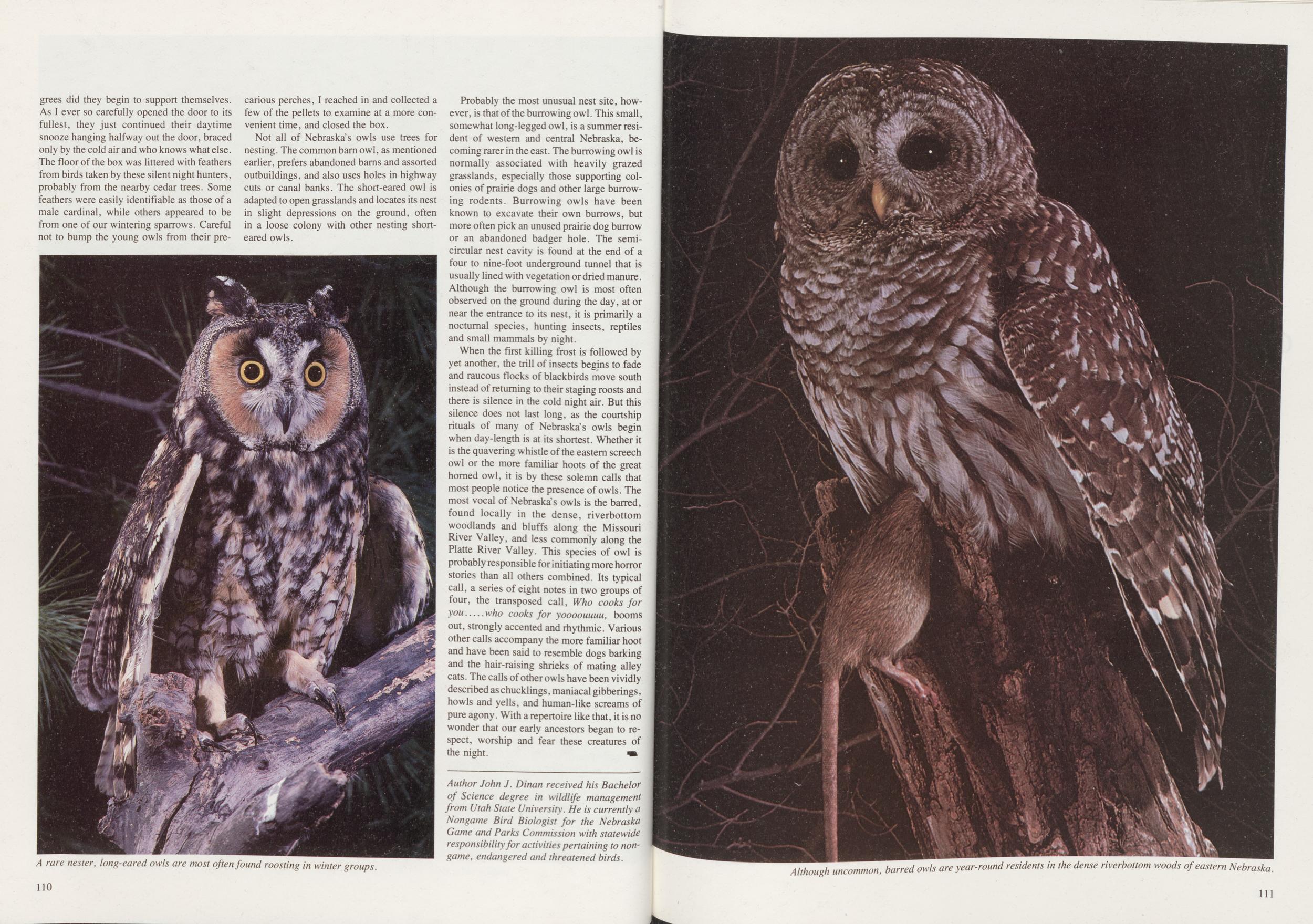 did they begin to support themselves.
As I ever so carefully opened the door to its
fullest, they just continued their daytime
snooze hanging halfway out the door, braced
only by the cold air and who knows what else.
The floor of the box was littered with feathers
from birds taken by these silent night hunters,
probably from the nearby cedar trees. Some
feathers were easily identifiable as those of a
male cardinal, while others appeared to be
from one of our wintering sparrows. Careful
not to bump the young owls from their precarious perches, I reached in and collected
a
few of the pellets to examine at a more convenient time, and closed the box.
did they begin to support themselves.
As I ever so carefully opened the door to its
fullest, they just continued their daytime
snooze hanging halfway out the door, braced
only by the cold air and who knows what else.
The floor of the box was littered with feathers
from birds taken by these silent night hunters,
probably from the nearby cedar trees. Some
feathers were easily identifiable as those of a
male cardinal, while others appeared to be
from one of our wintering sparrows. Careful
not to bump the young owls from their precarious perches, I reached in and collected
a
few of the pellets to examine at a more convenient time, and closed the box.
Not all of Nebraska's owls use trees for nesting. The common barn owl, as mentioned earlier, prefers abandoned barns and assorted outbuildings, and also uses holes in highway cuts or canal banks. The short-eared owl is adapted to open grasslands and locates its nest in slight depressions on the ground, often in a loose colony with other nesting shorteared owls.
Probably the most unusual nest site, however, is that of the burrowing owl. This small, somewhat long-legged owl, is a summer resident of western and central Nebraska, becoming rarer in the east. The burrowing owl is normally associated with heavily grazed grasslands, especially those supporting colonies of prairie dogs and other large burrowing rodents. Burrowing owls have been known to excavate their own burrows, but more often pick an unused prairie dog burrow or an abandoned badger hole. The semi- circular nest cavity is found at the end of a four to nine-foot underground tunnel that is usually lined with vegetation or dried manure. Although the burrowing owl is most often observed on the ground during the day, at or near the entrance to its nest, it is primarily a nocturnal species, hunting insects, reptiles and small mammals by night.
When the first killing frost is followed by yet another, the trill of insects begins to fade and raucous flocks of blackbirds move south instead of returning to their staging roosts and there is silence in the cold night air. But this silence does not last long, as the courtship rituals of many of Nebraska's owls begin when day-length is at its shortest. Whether it is the quavering whistle of the eastern screech owl or the more familiar hoots of the great horned owl, it is by these solemn calls that most people notice the presence of owls. The most vocal of Nebraska's owls is the barred, found locally in the dense, riverbottom woodlands and bluffs along the Missouri River Valley, and less commonly along the Platte River Valley. This species of owl is probably responsible for initiating more horror stories than all others combined. Its typical call, a series of eight notes in two groups of four, the transposed call, Who cooks for you who cooks for yoooouuuu, booms out, strongly accented and rhythmic. Various other calls accompany the more familiar hoot and have been said to resemble dogs barking and the hair-raising shrieks of mating alley cats. The calls of other owls have been vividly described as chucklings, maniacal gibberings, howls and yells, and human-like screams of pure agony. With a repertoire like that, it is no wonder that our early ancestors began to respect, worship and fear these creatures of the night. ^ A rare nester, long-eared owls are most often found roosting in winter groups.
Author John J. Dinan received his Bachelor of Science degree in wildlife management from Utah State University. He is currently Nongame Bird Biologist for the Nebraska Game and Parks Commission with statewide responsibility for activities pertaining to nongame, endangered and threatened birds. 110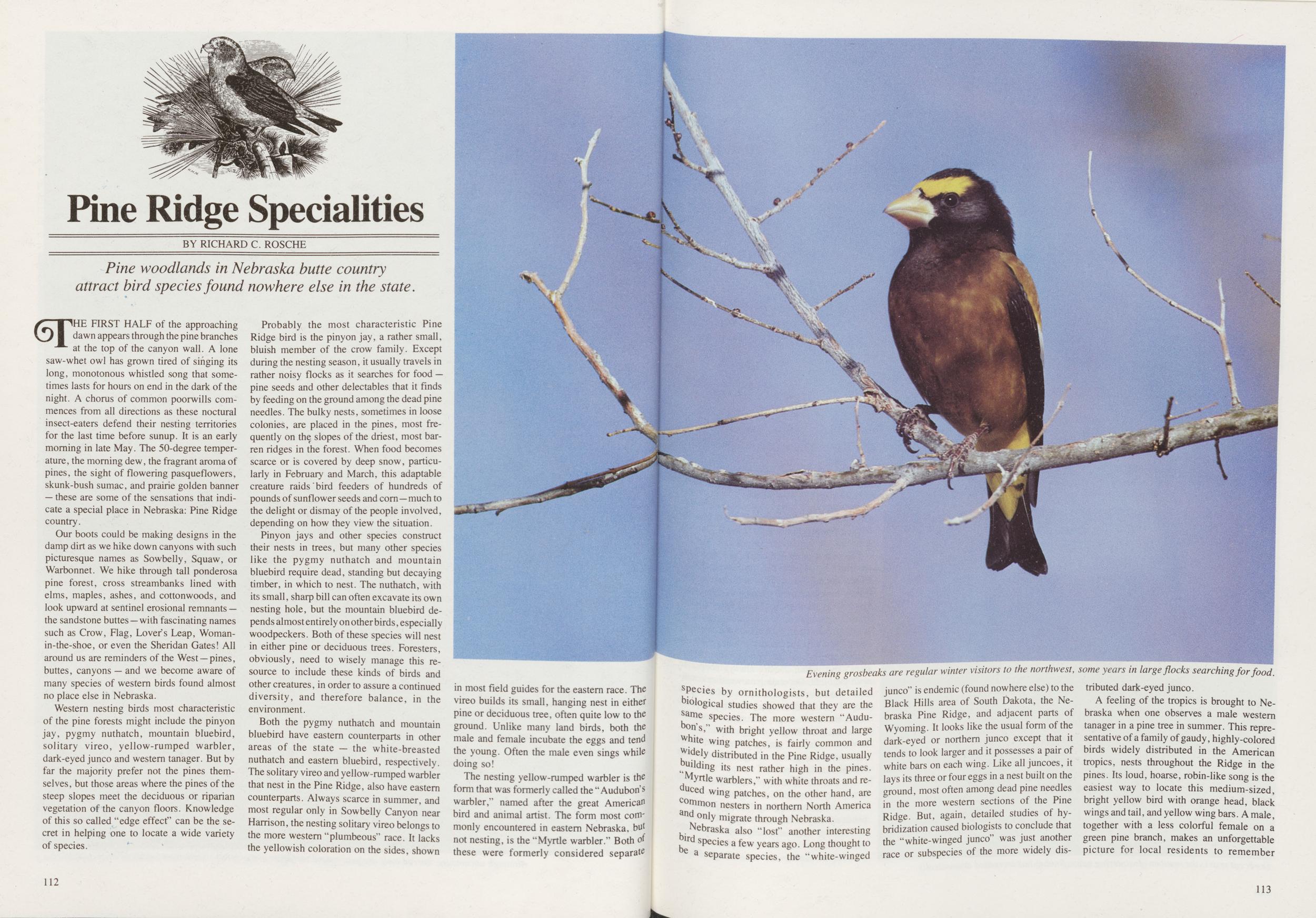
Pine Ridge Specialities
BY RICHARD C. ROSCHE Pine woodlands in Nebraska butte country attract bird species found nowhere else in the state.THE FIRST HALF of the approaching dawn appears through the pine branches at the top of the canyon wall. A lone saw-whet owl has grown tired of singing its long, monotonous whistled song that some- times lasts for hours on end in the dark of the night. A chorus of common poorwills com- mences from all directions as these noctural insect-eaters defend their nesting territories for the last time before sunup. It is an early morning in late May. The 50-degree temperature, the morning dew, the fragrant aroma of pines, the sight of flowering pasqueflowers, skunk-bush sumac, and prairie golden banner these are some of the sensations that indicate a special place in Nebraska: Pine Ridge country.
Our boots could be making designs in the damp dirt as we hike down canyons with such picturesque names as Sowbelly, Squaw, or Warbonnet. We hike through tall ponderosa pine forest, cross streambanks lined with elms, maples, ashes, and cottonwoods, and look upward at sentinel erosional remnants the sandstone buttes — with fascinating names such as Crow, Flag, Lover's Leap, Womanin-the-shoe, or even the Sheridan Gates! All around us are reminders of the West—pines, buttes, canyons — and we become aware of many species of western birds found almost no place else in Nebraska.
Western nesting birds most characteristic of the pine forests might include the pinyon jay, pygmy nuthatch, mountain bluebird, solitary vireo, yellow-rumped warbler, dark-eyed junco and western tanager. But by far the majority prefer not the pines themselves, but those areas where the pines of the steep slopes meet the deciduous or riparian vegetation of the canyon floors. Knowledge of this so called "edge effect" can be the secret in helping one to locate a wide variety of species.
Probably the most characteristic Pine Ridge bird is the pinyon jay, a rather small, bluish member of the crow family. Except during the nesting season, it usually travels in rather noisy flocks as it searches for food — pine seeds and other delectables that it finds by feeding on the ground among the dead pine needles. The bulky nests, sometimes in loose colonies, are placed in the pines, most frequently on the slopes of the driest, most barren ridges in the forest. When food becomes scarce or is covered by deep snow, particularly in February and March, this adaptable creature raids bird feeders of hundreds of pounds of sunflower seeds and corn—much to the delight or dismay of the people involved, depending on how they view the situation.
Pinyon jays and other species construct their nests in trees, but many other species like the pygmy nuthatch and mountain bluebird require dead, standing but decaying timber, in which to nest. The nuthatch, with its small, sharp bill can often excavate its own nesting hole, but the mountain bluebird depends almost entirely on other birds, especially woodpeckers. Both of these species will nest in either pine or deciduous trees. Foresters, obviously, need to wisely manage this resource to include these kinds of birds and other creatures, in order to assure a continued diversity, and therefore balance, in the environment.
Both the pygmy nuthatch and mountain bluebird have eastern counterparts in other areas of the state — the white-breasted nuthatch and eastern bluebird, respectively. The solitary vireo and yellow-rumped warbler that nest in the Pine Ridge, also have eastern counterparts. Always scarce in summer, and most regular only in Sowbelly Canyon near Harrison, the nesting solitary vireo belongs to the more western "plumbeous" race. It lacks the yellowish coloration on the sides, shown in most field guides for the eastern race. The vireo builds its small, hanging nest in either pine or deciduous tree, often quite low to the ground. Unlike many land birds, both the male and female incubate the eggs and tend the young. Often the male even sings while doing so!
The nesting yellow-rumped warbler is the form that was formerly called the "Audubon's warbler," named after the great American bird and animal artist. The form most commonly encountered in eastern Nebraska, but not nesting, is the "Myrtle warbler." Both of these were formerly considered separate 112 species by ornithologists, but detailed biological studies showed that they are the game species. The more western "Auduon's," with bright yellow throat and large nite wing patches, is fairly common and widely distributed in the Pine Ridge, usually Mding its nest rather hiSh in the pineS' Myrtle warblers," with white throats and reduced wing patches, on the other hand, are cominon nesters in northern North America and only migrate through Nebraska.
Nebraska also "lost" another interesting lrd species a few years ago. Long thought to a separate species, the "white-winged Evening grosbeaks are regular winter visitors to the northwest, junco" is endemic (found nowhere else) to the Black Hills area of South Dakota, the Nebraska Pine Ridge, and adjacent parts of Wyoming. It looks like the usual form of the dark-eyed or northern junco except that it tends to look larger and it possesses a pair of white bars on each wing. Like all juncoes, it lays its three or four eggs in a nest built on the ground, most often among dead pine needles in the more western sections of the Pine Ridge. But, again, detailed studies of hybridization caused biologists to conclude that the "white-winged junco" was just another race or subspecies of the more widely dissome years in large flocks searching for food. tributed dark-eyed junco.
A feeling of the tropics is brought to Nebraska when one observes a male western tanager in a pine tree in summer. This representative of a family of gaudy, highly-colored birds widely distributed in the American tropics, nests throughout the Ridge in the pines. Its loud, hoarse, robin-like song is the easiest way to locate this medium-sized, bright yellow bird with orange head, black wings and tail, and yellow wing bars. A male, together with a less colorful female on a green pine branch, makes an unforgettable picture for local residents to remember through the long Nebraska winter, when the tanagers wisely join their kin in Central America.
113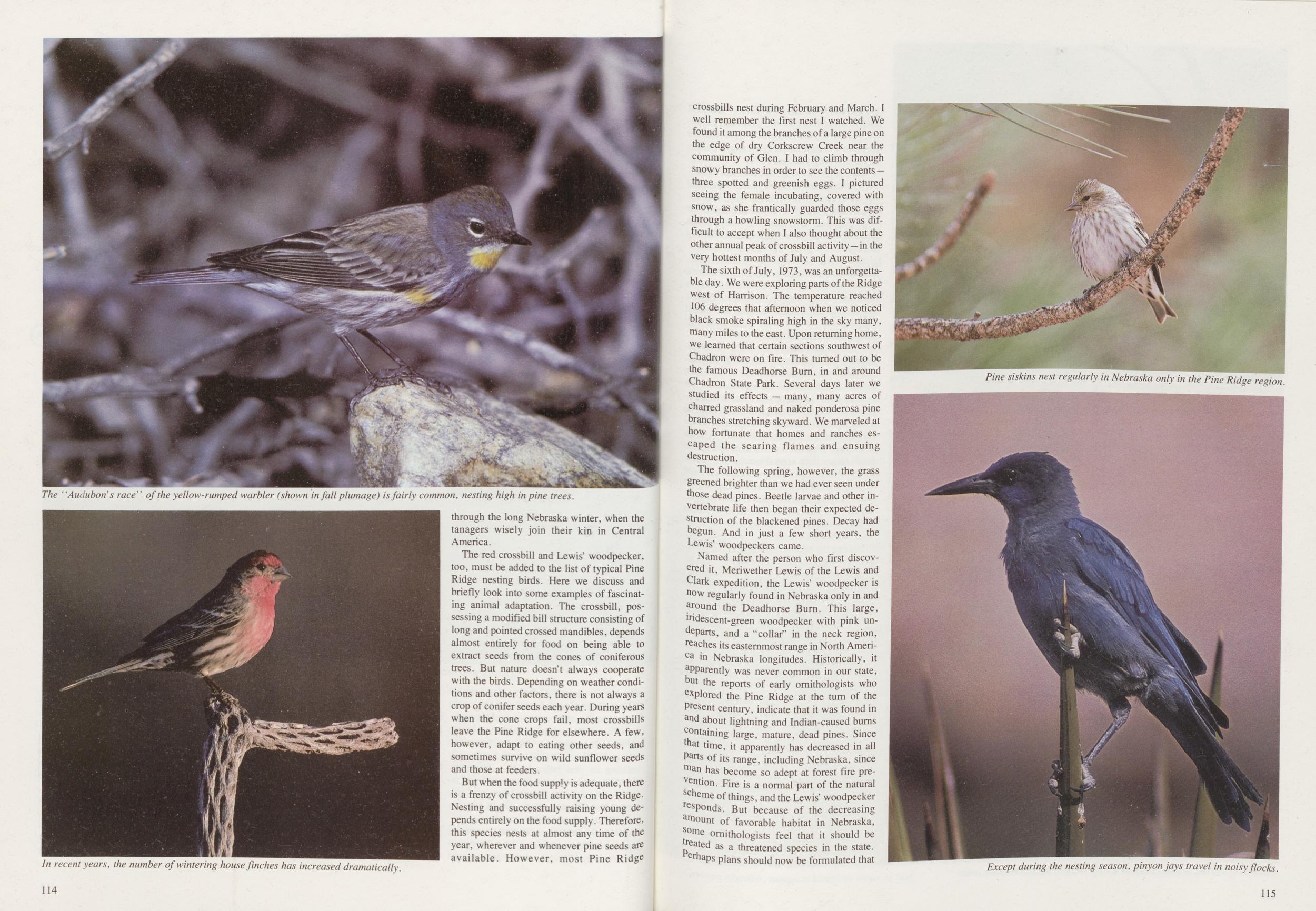
The red crossbill and Lewis' woodpecker, too, must be added to the list of typical Pine Ridge nesting birds. Here we discuss and briefly look into some examples of fascinating animal adaptation. The crossbill, pos- sessing a modified bill structure consisting of long and pointed crossed mandibles, depends almost entirely for food on being able to extract seeds from the cones of coniferous trees. But nature doesnt always cooperate with the birds. Depending on weather conditions and other factors, there is not always a crop of conifer seeds each year. During years when the cone crops fail, most crossbills leave the Pine Ridge for elsewhere. A few, however, adapt to eating other seeds, and sometimes survive on wild sunflower seeds and those at feeders.
But when the food supply is adequate, there is a frenzy of crossbill activity on the Ridge Nesting and successfully raising young de- pends entirely on the food supply. Therefore, this species nests at almost any time of the year, wherever and whenever pine seeds are available. However, most Pine Ridge 114 crossbills nest during February and March. I well remember the first nest I watched. We found it among the branches of a large pine on the edge of dry Corkscrew Creek near the community of Glen. I had to climb through snowy branches in order to see the contents three spotted and greenish eggs. I pictured seeing the female incubating, covered with snow, as she frantically guarded those eggs through a howling snowstorm. This was difficult to accept when I also thought about the other annual peak of crossbill activity— in the very hottest months of July and August.
The sixth of July, 1973, was an unforgettable day. We were exploring parts of the Ridge west of Harrison. The temperature reached 106 degrees that afternoon when we noticed black smoke spiraling high in the sky many, many miles to the east. Upon returning home, we learned that certain sections southwest of Chadron were on fire. This turned out to be the famous Deadhorse Burn, in and around Chadron State Park. Several days later we studied its effects — many, many acres of charred grassland and naked ponderosa pine branches stretching skyward. We marveled at how fortunate that homes and ranches escaped the searing flames and ensuing destruction.
The following spring, however, the grass greened brighter than we had ever seen under those dead pines. Beetle larvae and other invertebrate life then began their expected destruction of the blackened pines. Decay had begun. And in just a few short years, the Lewis1 woodpeckers came.
Named after the person who first discovercd it, Meriwether Lewis of the Lewis and Clark expedition, the Lewis1 woodpecker is now regularly found in Nebraska only in and around the Deadhorse Burn. This large, lrjdescent-green woodpecker with pink undeParts, and a "collar" in the neck region, reaches its easternmost range in North America in Nebraska longitudes. Historically, it apparently was never common in our state, but the reports of early ornithologists who explored the Pine Ridge at the turn of the Present century, indicate that it was found in and about lightning and Indian-caused burns containing large, mature, dead pines. Since at time, it apparently has decreased in all Parts of its range, including Nebraska, since man has become so adept at forest fire prevention. Fire is a normal part of the natural Scheme of things, and the Lewis' woodpecker resPonds. But because of the decreasing amount of favorable habitat in Nebraska, nie ornithologists feel that it should be reated as a threatened species in the state. erhaps plans should now be formulated that will ensure that this spectacular bird will forever remain a part of the Nebraska avifauna. What will happen to it when the Deadhorse Burn follows its natural evolution to green, living pine forest?
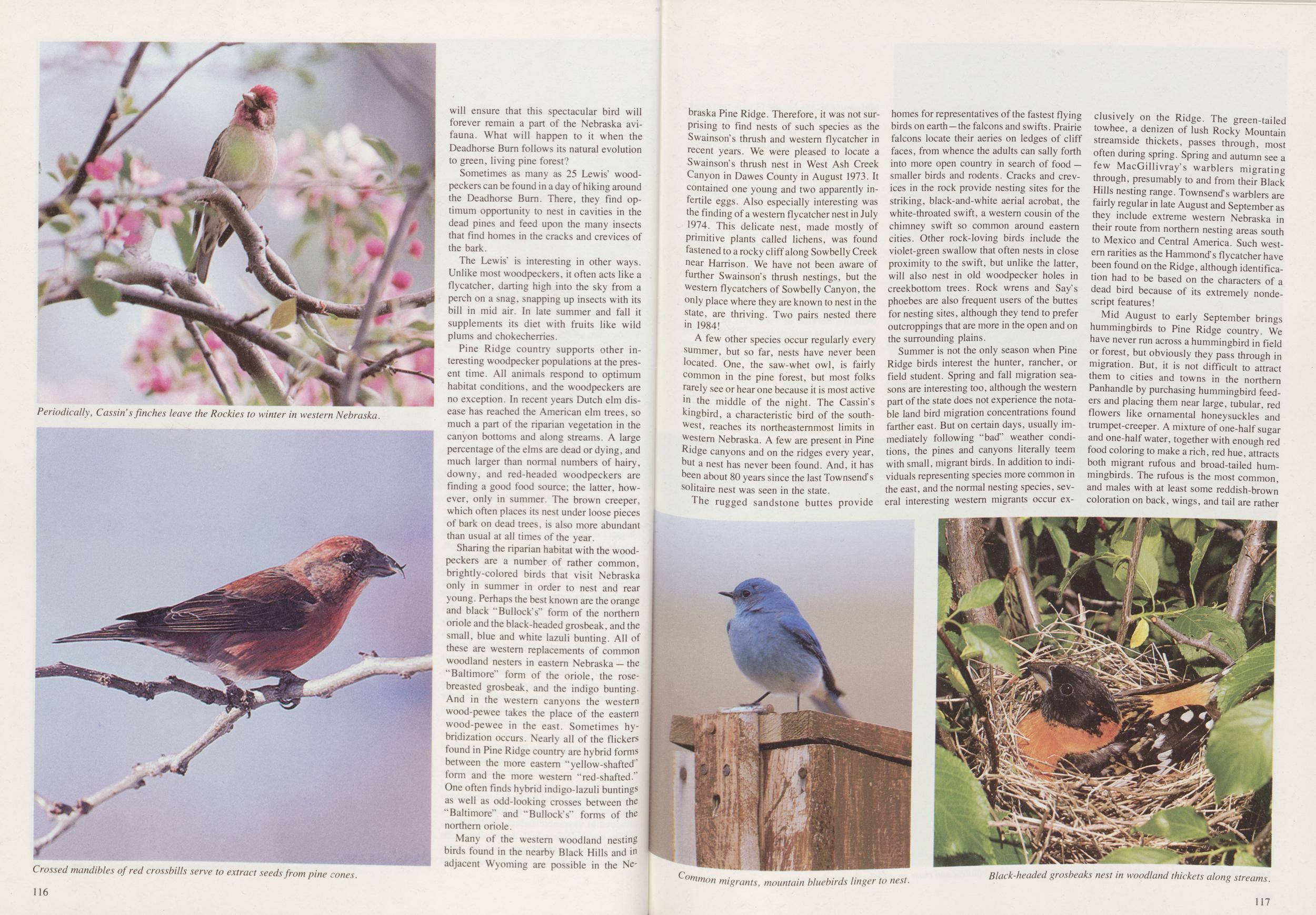
Sometimes as many as 25 Lewis1 woodpeckers can be found in a day of hiking around the Deadhorse Burn. There, they find optimum opportunity to nest in cavities in the dead pines and feed upon the many insects that find homes in the cracks and crevices of the bark.
The Lewis' is interesting in other ways. Unlike most woodpeckers, it often acts like a flycatcher, darting high into the sky from a perch on a snag, snapping up insects with its bill in mid air. In late summer and fall it supplements its diet with fruits like wild plums and chokecherries.
Pine Ridge country supports other interesting woodpecker populations at the present time. All animals respond to optimum habitat conditions, and the woodpeckers are no exception. In recent years Dutch elm disease has reached the American elm trees, so much a part of the riparian vegetation in the canyon bottoms and along streams. A large percentage of the elms are dead or dying, and much larger than normal numbers of hairy, downy, and red-headed woodpeckers are finding a good food source; the latter, however, only in summer. The brown creeper, which often places its nest under loose pieces of bark on dead trees, is also more abundant than usual at all times of the year.
Sharing the riparian habitat with the woodpeckers are a number of rather common, brightly-colored birds that visit Nebraska only in summer in order to nest and rear young. Perhaps the best known are the orange and black "Bullock's" form of the northern oriole and the black-headed grosbeak, and the small, blue and white lazuli bunting. All of these are western replacements of common woodland nesters in eastern Nebraska the "Baltimore" form of the oriole, the rosebreasted grosbeak, and the indigo bunting. And in the western canyons the western wood-pewee takes the place of the eastern wood-pewee in the east. Sometimes hybridization occurs. Nearly all of the flickers found in Pine Ridge country are hybrid forms between the more eastern "yellow-shafted' form and the more western "red-shafted." One often finds hybrid indigo-lazuli buntings as well as odd-looking crosses between the "Baltimore" and "Bullock's" forms of the northern oriole.
Many of the western woodland nesting birds found in the nearby Black Hills and in adjacent Wyoming are possible in the Nebraska 116 Pine Ridge. Therefore, it was not surprising to find nests of such species as the Swainson's thrush and western flycatcher in recent years. We were pleased to locate a Swainson's thrush nest in West Ash Creek Canyon in Dawes County in August 1973. It contained one young and two apparently in- fertile eggs. Also especially interesting was the finding of a western flycatcher nest in July 1974. This delicate nest, made mostly of primitive plants called lichens, was found fastened to a rocky cliff along Sowbelly Creek near Harrison. We have not been aware of further Swainson's thrush nestings, but the western flycatchers of Sowbelly Canyon, the only place where they are known to nest in the state, are thriving. Two pairs nested there in 1984!
A few other species occur regularly every summer, but so far, nests have never been located. One, the saw-whet owl, is fairly common in the pine forest, but most folks rarely see or hear one because it is most active in the middle of the night. The Cassin's kingbird, a characteristic bird of the southwest, reaches its northeasternmost limits in western Nebraska. A few are present in Pine Ridge canyons and on the ridges every year, but a nest has never been found. And, it has been about 80 years since the last Townsend's solitaire nest was seen in the state.
The rugged sandstone buttes provide homes for representatives of the fastest flying birds on earth —the falcons and swifts. Prairie falcons locate their aeries on ledges of cliff faces, from whence the adults can sally forth into more open country in search of food smaller birds and rodents. Cracks and crevices in the rock provide nesting sites for the striking, black-and-white aerial acrobat, the white-throated swift, a western cousin of the chimney swift so common around eastern cities. Other rock-loving birds include the violet-green swallow that often nests in close proximity to the swift, but unlike the latter, will also nest in old woodpecker holes in creekbottom trees. Rock wrens and Say's phoebes are also frequent users of the buttes for nesting sites, although they tend to prefer outcroppings that are more in the open and on the surrounding plains.
Summer is not the only season when Pine Ridge birds interest the hunter, rancher, or field student. Spring and fall migration seasons are interesting too, although the western part of the state does not experience the notable land bird migration concentrations found farther east. But on certain days, usually immediately following "bad" weather condi- tions, the pines and canyons literally teem with small, migrant birds. In addition to individuals representing species more common in the east, and the normal nesting species, several interesting western migrants occur exclusively on the Ridge. The green-tailed towhee, a denizen of lush Rocky Mountain streamside thickets, passes through, most often during spring. Spring and autumn see a few MacGillivray's warblers migrating through, presumably to and from their Black Hills nesting range. Townsend's warblers are fairly regular in late August and September as they include extreme western Nebraska in their route from northern nesting areas south to Mexico and Central America. Such western rarities as the Hammond's flycatcher have been found on the Ridge, although identification had to be based on the characters of a dead bird because of its extremely nondescript features!
Mid August to early September brings
hummingbirds to Pine Ridge country. We
have never run across a hummingbird in field
or forest, but obviously they pass through in
migration. But, it is not difficult to attract
them to cities and towns in the northern
Panhandle by purchasing hummingbird feeders and placing them near large, tubular,
red
flowers like ornamental honeysuckles and
trumpet-creeper. A mixture of one-half sugar
and one-half water, together with enough red
food coloring to make a rich, red hue, attracts
both migrant rufous and broad-tailed hummingbirds. The rufous is the most common,
and males with at least some reddish-brown
coloration on back, wings, and tail are rather
117
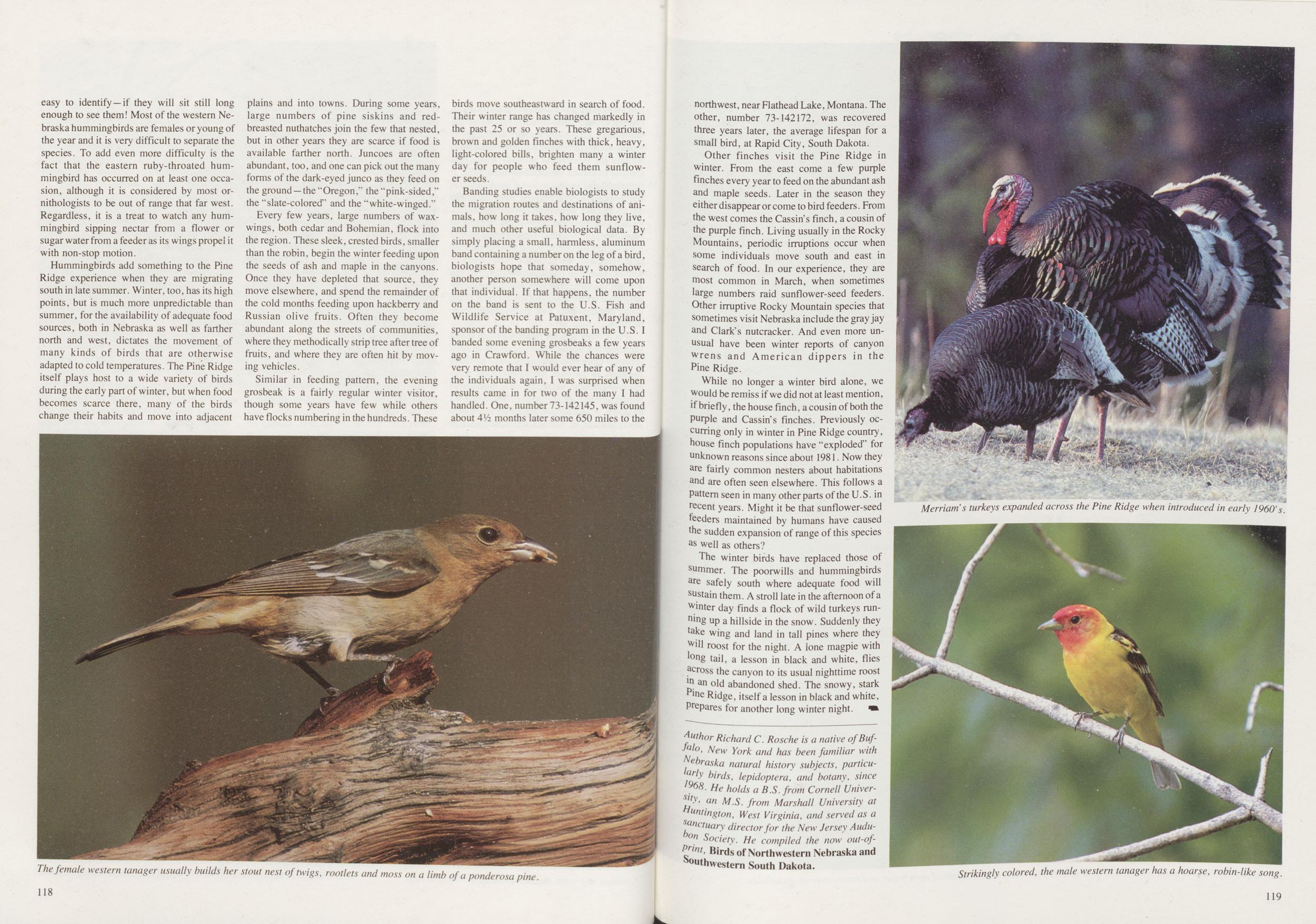 easy to identify —if they will sit still long
enough to see them! Most of the western Nebraska hummingbirds are females or young
of
the year and it is very difficult to separate the
species. To add even more difficulty is the
fact that the eastern ruby-throated hummingbird has occurred on at least one occasion,
although it is considered by most ornithologists to be out of range that far west.
Regardless, it is a treat to watch any hummingbird sipping nectar from a flower or
sugar water from a feeder as its wings propel it
with non-stop motion.
easy to identify —if they will sit still long
enough to see them! Most of the western Nebraska hummingbirds are females or young
of
the year and it is very difficult to separate the
species. To add even more difficulty is the
fact that the eastern ruby-throated hummingbird has occurred on at least one occasion,
although it is considered by most ornithologists to be out of range that far west.
Regardless, it is a treat to watch any hummingbird sipping nectar from a flower or
sugar water from a feeder as its wings propel it
with non-stop motion.
Hummingbirds add something to the Pine Ridge experience when they are migrating south in late summer. Winter, too, has its high points, but is much more unpredictable than summer, for the availability of adequate food sources, both in Nebraska as well as farther north and west, dictates the movement of many kinds of birds that are otherwise adapted to cold temperatures. The Pine Ridge itself plays host to a wide variety of birds during the early part of winter, but when food becomes scarce there, many of the birds change their habits and move into adjacent plains and into towns. During some years, large numbers of pine siskins and redbreasted nuthatches join the few that nested, but in other years they are scarce if food is available farther north. Juncoes are often abundant, too, and one can pick out the many forms of the dark-eyed junco as they feed on the ground —the''Oregon/' the "pink-sided," the "slate-colored" and the "white-winged."
Every few years, large numbers of waxwings, both cedar and Bohemian, flock into the region. These sleek, crested birds, smaller than the robin, begin the winter feeding upon the seeds of ash and maple in the canyons. Once they have depleted that source, they move elsewhere, and spend the remainder of the cold months feeding upon hackberry and Russian olive fruits. Often they become abundant along the streets of communities, where they methodically strip tree after tree of fruits, and where they are often hit by moving vehicles.
Similar in feeding pattern, the evening grosbeak is a fairly regular winter visitor, though some years have few while others have flocks numbering in the hundreds. These birds move southeastward in search of food. Their winter range has changed markedly in the past 25 or so years. These gregarious, brown and golden finches with thick, heavy, light-colored bills, brighten many a winter day for people who feed them sunflower seeds.
Banding studies enable biologists to study the migration routes and destinations of animals, how long it takes, how long they live, and much other useful biological data. By simply placing a small, harmless, aluminum band containing a number on the leg of a bird, biologists hope that someday, somehow, another person somewhere will come upon that individual. If that happens, the number on the band is sent to the U.S. Fish and Wildlife Service at Patuxent, Maryland, sponsor of the banding program in the U.S. I banded some evening grosbeaks a few years ago in Crawford. While the chances were very remote that I would ever hear of any of the individuals again, I was surprised when results came in for two of the many I had handled. One, number 73-142145, was found about 4l months later some 650 miles to the 118 northwest, near Flathead Lake, Montana. The other, number 73-142172, was recovered three years later, the average lifespan for a small bird, at Rapid City, South Dakota.
Other finches visit the Pine Ridge in winter. From the east come a few purple finches every year to feed on the abundant ash and maple seeds. Later in the season they either disappear or come to bird feeders. From the west comes the Cassin's finch, a cousin of the purple finch. Living usually in the Rocky Mountains, periodic irruptions occur when some individuals move south and east in search of food. In our experience, they are most common in March, when sometimes large numbers raid sunflower-seed feeders. Other irruptive Rocky Mountain species that sometimes visit Nebraska include the gray jay and Clark's nutcracker. And even more unusual have been winter reports of canyon wrens and American dippers in the Pine Ridge.
While no longer a winter bird alone, we would be remiss if we did not at least mention, if briefly, the house finch, a cousin of both the purple and Cassins finches. Previously occurring only in winter in Pine Ridge country, house finch populations have "exploded" for unknown reasons since about 1981. Now they are fairly common nesters about habitations and are often seen elsewhere. This follows a Pattern seen in many other parts of the U.S. in recent years. Might it be that sunflower-seed feeders maintained by humans have caused the sudden expansion of range of this species as well as others?
The winter birds have replaced those of summer. The poorwills and hummingbirds are safely south where adequate food will sustain them. A stroll late in the afternoon of a winter day finds a flock of wild turkeys running up a hillside in the snow. Suddenly they take wing and land in tall pines where they wiH roost for the night. A lone magpie with loug tail, a lesson in black and white, flies across the canyon to its usual nighttime roost an old abandoned shed. The snowy, stark pine Ridge, itself a lesson in black and white, Prepares for another long winter night.
Author Richard C. Rosche is a native of Buffalo, New York and has been familiar with Nebraska natural history subjects, particuurly birds, lepidoptera, and botany, since. He holds a B.S. from Cornell UniverMy. an M.S. from Marshall University at Huntington, West Virginia, and served as a sunctuary director for the New Jersey Audu°n Society. He compiled the now out-of Birds of North western Nebraska and southwestern South Dakota.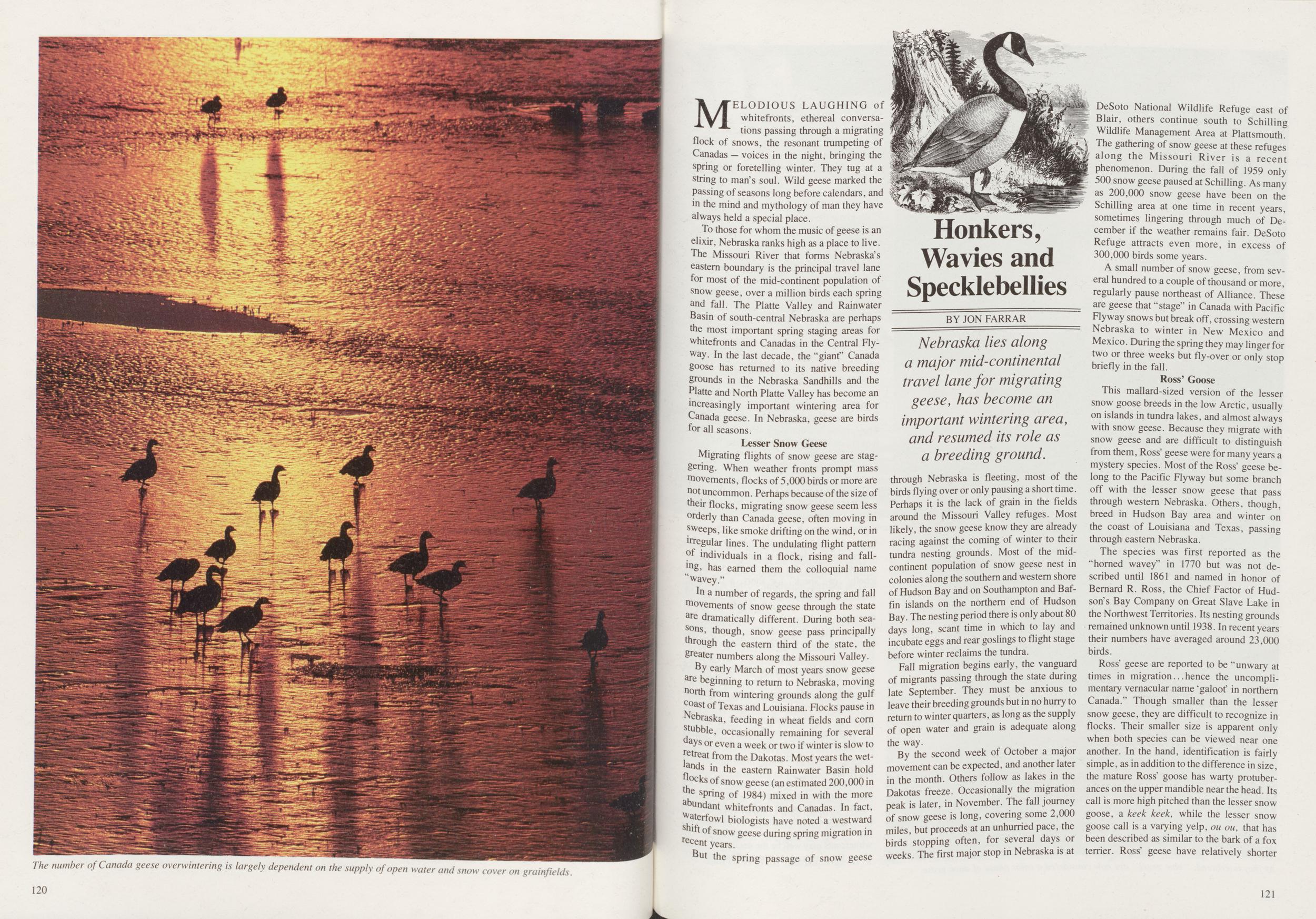
Honkers, Wavies and Specklebellies
BY JON FARRAR Nebraska lies along a major mid-continental travel lande for migrating geese, has become an important wintering area, and resumed its role as a breeding ground.MELODIOUS LAUGHING of whitefronts, ethereal conversations passing through a migrating flock of snows, the resonant trumpeting of Canadas — voices in the night, bringing the spring or foretelling winter. They tug at a string to man's soul. Wild geese marked the passing of seasons long before calendars, and the mind and mythology of man they have always held a special place.
To those for whom the music of geese is an elixir, Nebraska ranks high as a place to live. The Missouri River that forms Nebraska's eastern boundary is the principal travel lane for most of the mid-continent population of snow geese, over a million birds each spring and fall. The Platte Valley and Rainwater Basin of south-central Nebraska are perhaps the most important spring staging areas for whitefronts and Canadas in the Central Flyway. In the last decade, the "giant" Canada goose has returned to its native breeding grounds in the Nebraska Sandhills and the Platte and North Platte Valley has become an mcreasingly important wintering area for Canada geese. In Nebraska, geese are birds for all seasons.
Lesser Snow GeeseMigrating flights of snow geese are stag- gering. When weather fronts prompt mass movements, flocks of 5,000 birds or more are not uncommon. Perhaps because of the size of their flocks, migrating snow geese seem less orderly than Canada geese, often moving in sweeps, like smoke drifting on the wind, or in Regular lines. The undulating flight pattern of individuals in a flock, rising and falling, has earned them the colloquial name "wavey."
In a number of regards, the spring and fall Movements of snow geese through the state dramatically different. During both seasons, though, snow geese pass principally through the eastern third of the state, the greater numbers along the Missouri Valley.
By early March of most years snow geese are beginning to return to Nebraska, moving north from wintering grounds along the gulf coast of Texas and Louisiana. Flocks pause in Nebraska, feeding in wheat fields and corn stubble, occasionally remaining for several ays or even a week or two if winter is slow to retreat from the Dakotas. Most years the wetands m the eastern Rainwater Basin hold flocks of snow geese (an estimated 200,000 in me spring of 1984) mixed in with the more aoundant whitefronts and Canadas. In fact, waterfowl biologists have noted a westward lrt of snow geese during spring migration in recent years.
But the spring passage of snow geese through Nebraska is fleeting, most of the birds flying over or only pausing a short time. Perhaps it is the lack of grain in the fields around the Missouri Valley refuges. Most likely, the snow geese know they are already racing against the coming of winter to their tundra nesting grounds. Most of the midcontinent population of snow geese nest in colonies along the southern and western shore of Hudson Bay and on Southampton and Baffin islands on the northern end of Hudson Bay. The nesting period there is only about 80 days long, scant time in which to lay and incubate eggs and rear goslings to flight stage before winter reclaims the tundra.
Fall migration begins early, the vanguard of migrants passing through the state during late September. They must be anxious to leave their breeding grounds but in no hurry to return to winter quarters, as long as the supply of open water and grain is adequate along the way.
By the second week of October a major movement can be expected, and another later in the month. Others follow as lakes in the Dakotas freeze. Occasionally the migration peak is later, in November. The fall journey of snow geese is long, covering some 2,000 miles, but proceeds at an unhurried pace, the birds stopping often, for several days or weeks. The first major stop in Nebraska is at DeSoto National Wildlife Refuge east of Blair, others continue south to Schilling Wildlife Management Area at Plattsmouth. The gathering of snow geese at these refuges along the Missouri River is a recent phenomenon. During the fall of 1959 only 500 snow geese paused at Schilling. As many as 200,000 snow geese have been on the Schilling area at one time in recent years, sometimes lingering through much of December if the weather remains fair. DeSoto Refuge attracts even more, in excess of 300,000 birds some years.
A small number of snow geese, from several hundred to a couple of thousand or more, regularly pause northeast of Alliance. These are geese that "stage" in Canada with Pacific Fly way snows but break off, crossing western Nebraska to winter in New Mexico and Mexico. During the spring they may linger for two or three weeks but fly-over or only stop briefly in the fall.
Ross' GooseThis mallard-sized version of the lesser snow goose breeds in the low Arctic, usually on islands in tundra lakes, and almost always with snow geese. Because they migrate with snow geese and are difficult to distinguish from them, Ross' geese were for many years a mystery species. Most of the Ross' geese belong to the Pacific Flyway but some branch off with the lesser snow geese that pass through western Nebraska. Others, though, breed in Hudson Bay area and winter on the coast of Louisiana and Texas, passing through eastern Nebraska.
The species was first reported as the "horned wavey" in 1770 but was not described until 1861 and named in honor of Bernard R. Ross, the Chief Factor of Hudson's Bay Company on Great Slave Lake in the Northwest Territories. Its nesting grounds remained unknown until 1938. In recent years their numbers have averaged around 23,000 birds.
Ross' geese are reported to be "unwary at
times in migration.. .hence the uncompli-
mentary vernacular name 'galoot' in northern
Canada." Though smaller than the lesser
snow geese, they are difficult to recognize in
flocks. Their smaller size is apparent only
when both species can be viewed near one
another. In the hand, identification is fairly
simple, as in addition to the difference in size,
the mature Ross' goose has warty protuber-
ances on the upper mandible near the head. Its
call is more high pitched than the lesser snow
goose, a keek keek, while the lesser snow
goose call is a varying yelp, ou ou, that has
been described as similar to the bark of a fox
terrier. Ross' geese have relatively shorter
121
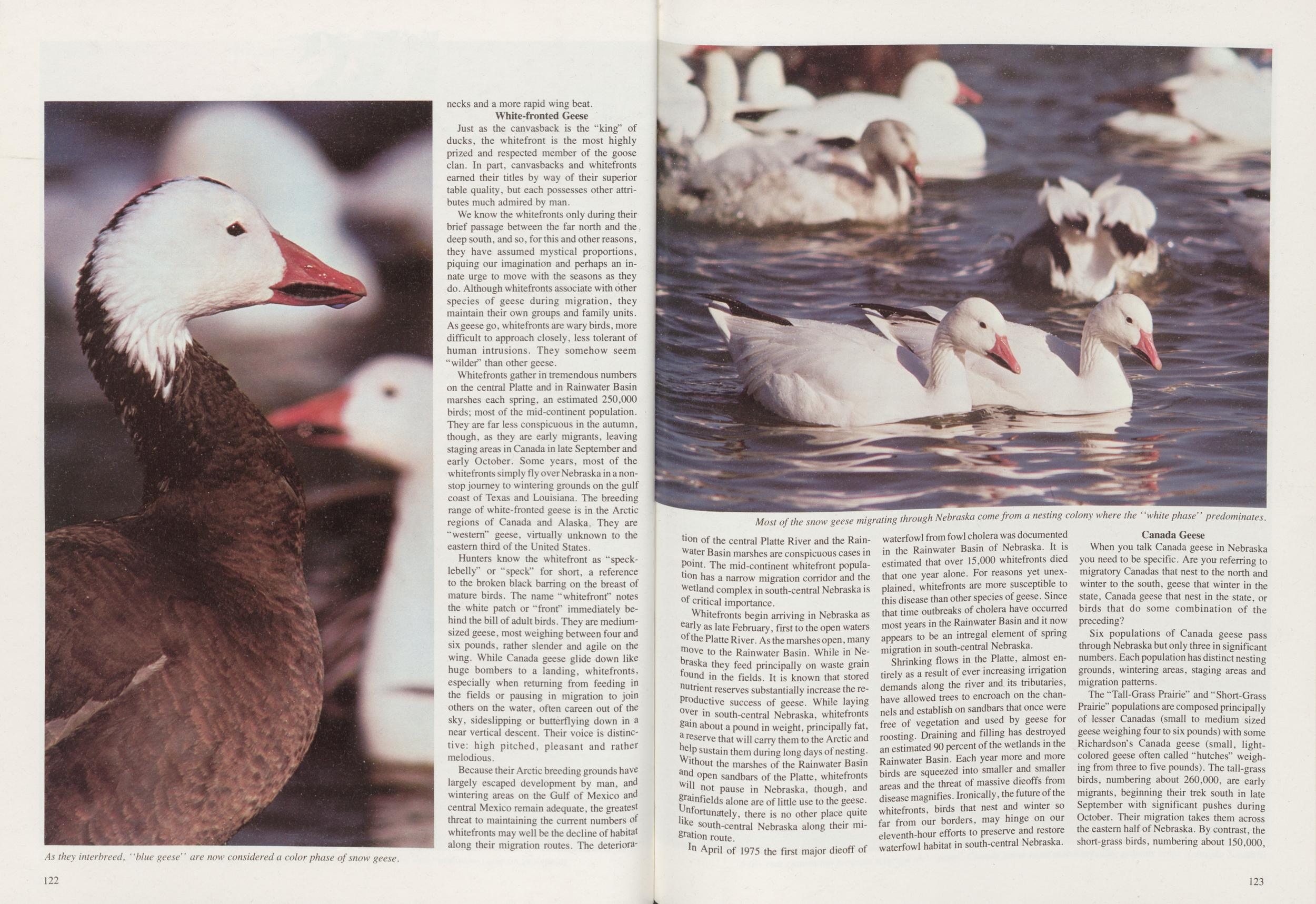 necks and a more rapid wing beat.
Just as the canvasback is the "king" of ducks, the whitefront is the most highly prized and respected member of the goose clan. In part, canvasbacks and whitefronts earned their titles by way of their superior table quality, but each possesses other attributes much admired by man.
We know the whitefronts only during their brief passage between the far north and the deep south, and so, for this and other reasons, they have assumed mystical proportions, piquing our imagination and perhaps an innate urge to move with the seasons as they do. Although whitefronts associate with other species of geese during migration, they maintain their own groups and family units. As geese go, whitefronts are wary birds, more difficult to approach closely, less tolerant of human intrusions. They somehow seem "wilder" than other geese.
Whitefronts gather in tremendous numbers on the central Platte and in Rainwater Basin marshes each spring, an estimated 250,000 birds; most of the mid-continent population. They are far less conspicuous in the autumn, though, as they are early migrants, leaving staging areas in Canada in late September and early October. Some years, most of the whitefronts simply fly over Nebraska in a nonstop journey to wintering grounds on the gulf coast of Texas and Louisiana. The breeding range of white-fronted geese is in the Arctic regions of Canada and Alaska They are "western" geese, virtually unknown to the eastern third of the United States.
Hunters know the whitefront as "specklebelly" or "speck" for short, a reference to the broken black barring on the breast of mature birds. The name "whitefront" notes the white patch or "front" immediately behind the bill of adult birds. They are mediumsized geese, most weighing between four and six pounds, rather slender and agile on the wing. While Canada geese glide down like huge bombers to a landing, whitefronts, especially when returning from feeding in the fields or pausing in migration to join others on the water, often careen out of the sky, sideslipping or butterflying down in a near vertical descent. Their voice is distinctive: high pitched, pleasant and rather melodious.
Because their Arctic breeding grounds have largely escaped development by man, and wintering areas on the Gulf of Mexico and central Mexico remain adequate, the greatest threat to maintaining the current numbers of whitefronts may well be the decline of habitat along their migration routes. The deterioration 122 of the central Platte River and the Rainwater Basin marshes are conspicuous cases in Point. The mid-continent whitefront population has a narrow migration corridor and the wetland complex in south-central Nebraska is °f critical importance.
Whitefronts begin arriving in Nebraska as early as late February, first to the open waters °f the Platte River. As the marshes open, many move to the Rainwater Basin. While in Nebraska they feed principally on waste grain found in the fields. It is known that stored nutrient reserves substantially increase the reProductive success of geese. While laying over in south-central Nebraska, whitefronts ain about a pound in weight, principally fat, reserve that will carry them to the Arctic and sustain them during long days of nesting. Without the marshes of the Rainwater Basin and open sandbars of the Platte, whitefronts Wll| not pause in Nebraska, though, and grainfields alone are of little use to the geese. Unfortunately, there is no other place quite lke south-central Nebraska along their miration route.
In April of 1975 the first major dieoff of migrating through Nebraska come from a nesting colony where the "white phase" predominates. waterfowl from fowl cholera was documented in the Rainwater Basin of Nebraska. It is estimated that over 15,000 whitefronts died that one year alone. For reasons yet unexplained, whitefronts are more susceptible to this disease than other species of geese. Since that time outbreaks of cholera have occurred most years in the Rainwater Basin and it now appears to be an intregal element of spring migration in south-central Nebraska.
Shrinking flows in the Platte, almost entirely as a result of ever increasing irrigation demands along the river and its tributaries, have allowed trees to encroach on the channels and establish on sandbars that once were free of vegetation and used by geese for roosting. Draining and filling has destroyed an estimated 90 percent of the wetlands in the Rainwater Basin. Each year more and more birds are squeezed into smaller and smaller areas and the threat of massive dieoffs from disease magnifies. Ironically, the future of the whitefronts, birds that nest and winter so far from our borders, may hinge on our eleventh-hour efforts to preserve and restore waterfowl habitat in south-central Nebraska.
Canada GeeseWhen you talk Canada geese in Nebraska you need to be specific. Are you referring to migratory Canadas that nest to the north and winter to the south, geese that winter in the state, Canada geese that nest in the state, or birds that do some combination of the preceding?
Six populations of Canada geese pass through Nebraska but only three in significant numbers. Each population has distinct nesting grounds, wintering areas, staging areas and migration patterns.
The "Tall-Grass Prairie" and "Short-Grass
Prairie" populations are composed principally
of lesser Canadas (small to medium sized
geese weighing four to six pounds) with some
Richardson's Canada geese (small, lightcolored geese often called "hutches" weighing
from three to five pounds). The tall-grass
birds, numbering about 260,000, are early
migrants, beginning their trek south in late
September with significant pushes during
October. Their migration takes them across
the eastern half of Nebraska. By contrast, the
short-grass birds, numbering about 150,000,
123
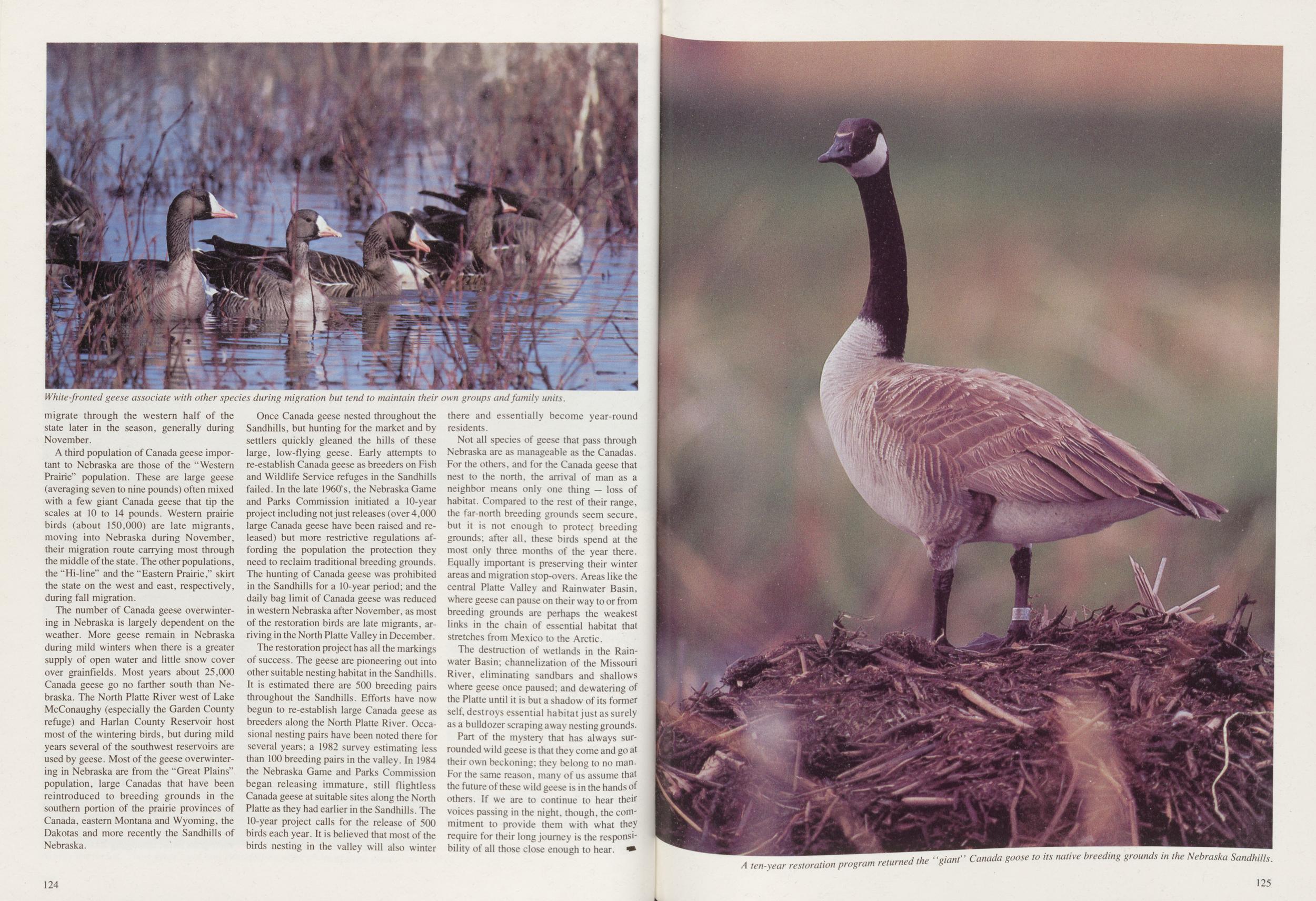 migrate through the western half of the
state later in the season, generally during
November.
migrate through the western half of the
state later in the season, generally during
November.
A third population of Canada geese important to Nebraska are those of the "Western Prairie" population. These are large geese (averaging seven to nine pounds) often mixed with a few giant Canada geese that tip the scales at 10 to 14 pounds. Western prairie birds (about 150,000) are late migrants, moving into Nebraska during November, their migration route carrying most through the middle of the state. The other populations, the "Hi-line" and the "Eastern Prairie," skirt the state on the west and east, respectively, during fall migration.
The number of Canada geese overwinter- ing in Nebraska is largely dependent on the weather. More geese remain in Nebraska during mild winters when there is a greater supply of open water and little snow cover over grainfields. Most years about 25,000 Canada geese go no farther south than Nebraska. The North Platte River west of Lake McConaughy (especially the Garden County refuge) and Harlan County Reservoir host most of the wintering birds, but during mild years several of the southwest reservoirs are used by geese. Most of the geese overwintering in Nebraska are from the "Great Plains" population, large Canadas that have been reintroduced to breeding grounds in the southern portion of the prairie provinces of Canada, eastern Montana and Wyoming, the Dakotas and more recently the Sandhills of Nebraska.
Once Canada geese nested throughout the Sandhills, but hunting for the market and by settlers quickly gleaned the hills of these large, low-flying geese. Early attempts to re-establish Canada geese as breeders on Fish and Wildlife Service refuges in the Sandhills failed. In the late 1960's, the Nebraska Game and Parks Commission initiated a 10-year project including not just releases (over 4,000 large Canada geese have been raised and released) but more restrictive regulations affording the population the protection they need to reclaim traditional breeding grounds. The hunting of Canada geese was prohibited in the Sandhills for a 10-year period; and the daily bag limit of Canada geese was reduced in western Nebraska after November, as most of the restoration birds are late migrants, arriving in the North Platte Valley in December.
The restoration project has all the markings of success. The geese are pioneering out into other suitable nesting habitat in the Sandhills. It is estimated there are 500 breeding pairs throughout the Sandhills. Efforts have now begun to re-establish large Canada geese as breeders along the North Platte River. Occasional nesting pairs have been noted there for several years; a 1982 survey estimating less than 100 breeding pairs in the valley. In 1984 the Nebraska Game and Parks Commission began releasing immature, still flightless Canada geese at suitable sites along the North Platte as they had earlier in the Sandhills. The 10-year project calls for the release of 500 birds each year. It is believed that most of the birds nesting in the valley will also winter there and essentially become year-round residents.
Not all species of geese that pass through Nebraska are as manageable as the Canadas. For the others, and for the Canada geese that nest to the north, the arrival of man as a neighbor means only one thing — loss of habitat. Compared to the rest of their range, the far-north breeding grounds seem secure, but it is not enough to protect breeding grounds; after all, these birds spend at the most only three months of the year there. Equally important is preserving their winter areas and migration stop-overs. Areas like the central Platte Valley and Rainwater Basin, where geese can pause on their way to or from breeding grounds are perhaps the weakest links in the chain of essential habitat that stretches from Mexico to the Arctic.
The destruction of wetlands in the Rainwater Basin; channelization of the Missouri River, eliminating sandbars and shallows where geese once paused; and dewatering of the Platte until it is but a shadow of its former self, destroys essential habitat just as surely as a bulldozer scraping away nesting grounds.
Part of the mystery that has always surrounded wild geese is that they come and go at their own beckoning; they belong to no manFor the same reason, many of us assume that the future ofthese wild geese is in the hands of others. If we are to continue to hear their voices passing in the night, though, the commitment to provide them with what they require for their long journey is the responsibility of all those close enough to hear.
124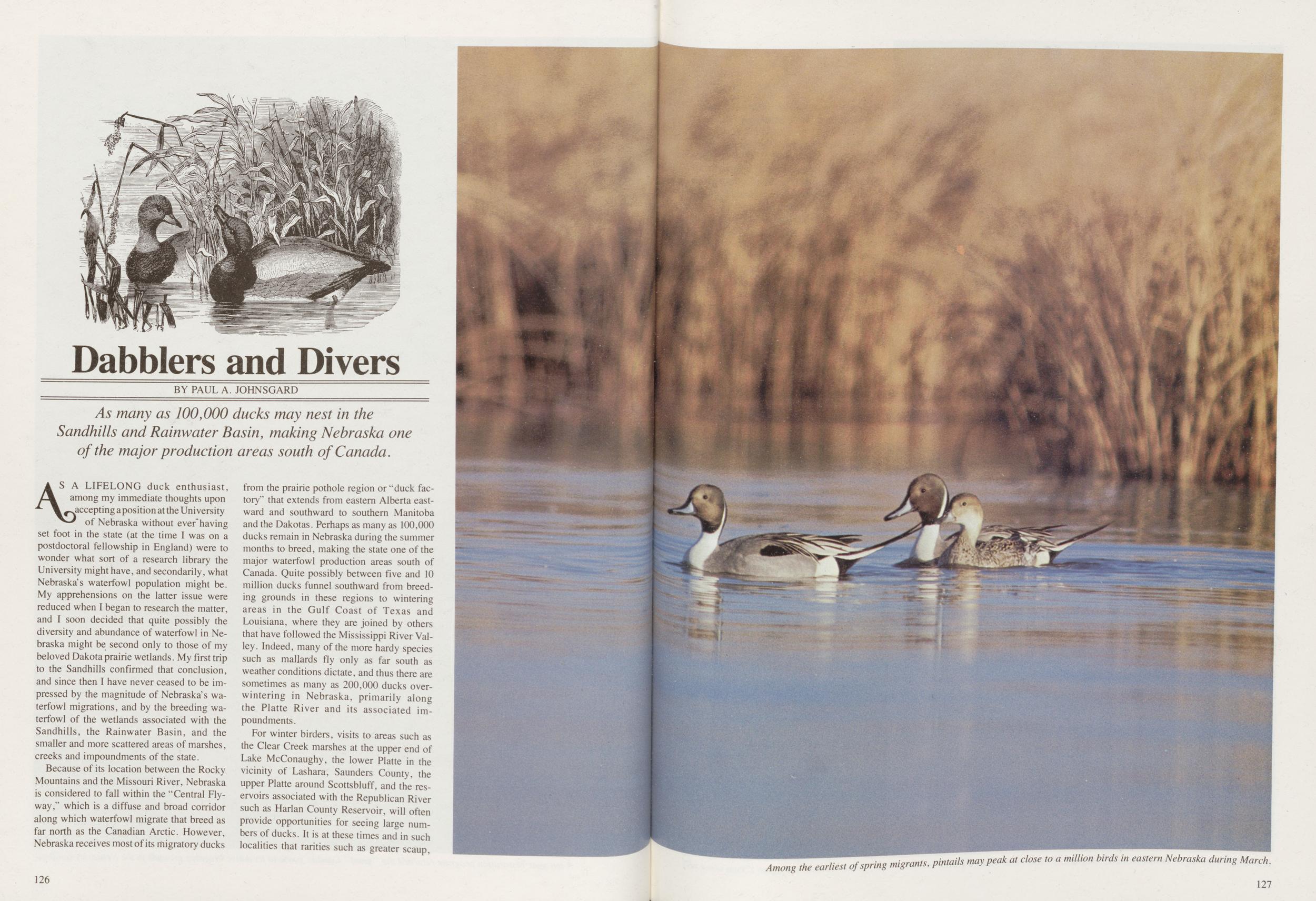
Dabblers and Divers
BY PAUL A. JOHNSGARD As many as 100,000 ducks may nest in the Sandhills and Rainwater Basin, making Nebraska one of the major production areas south of Canada.AS A LIFELONG duck enthusiast, among my immediate thoughts upon accepting a position at the University of Nebraska without ever"having set foot in the state (at the time I was on a postdoctoral fellowship in England) were to wonder what sort of a research library the University might have, and secondarily, what Nebraska's waterfowl population might be. My apprehensions on the latter issue were reduced when I began to research the matter, and I soon decided that quite possibly the diversity and abundance of waterfowl in Nebraska might be second only to those of my beloved Dakota prairie wetlands. My first trip to the Sandhills confirmed that conclusion, and since then I have never ceased to be impressed by the magnitude of Nebraska's waterfowl migrations, and by the breeding waterfowl of the wetlands associated with the Sandhills, the Rainwater Basin, and the smaller and more scattered areas of marshes, creeks and impoundments of the state.
Because of its location between the Rocky Mountains and the Missouri River, Nebraska is considered to fall within the "Central Flyway," which is a diffuse and broad corridor along which waterfowl migrate that breed as far north as the Canadian Arctic. However, Nebraska receives most of its migratory ducks from the prairie pothole region or "duck factory" that extends from eastern Alberta eastward and southward to southern Manitoba and the Dakotas. Perhaps as many as 100,000 ducks remain in Nebraska during the summer months to breed, making the state one of the major waterfowl production areas south of Canada. Quite possibly between five and 10 million ducks funnel southward from breeding grounds in these regions to wintering areas in the Gulf Coast of Texas and Louisiana, where they are joined by others that have followed the Mississippi River Valley. Indeed, many of the more hardy species such as mallards fly only as far south as weather conditions dictate, and thus there are sometimes as many as 200,000 ducks overwintering in Nebraska, primarily along the Platte River and its associated impoundments.
For winter birders, visits to areas such as the Clear Creek marshes at the upper end of Lake McConaughy, the lower Platte in the vicinity of Lashara, Saunders County, the upper Platte around Scottsbluff, and the reservoirs associated with the Republican River such as Harlan County Reservoir, will often provide opportunities for seeing large numbers of ducks. It is at these times and in such localities that rarities such as greater scaup, oldsquaws, scoters, and other exciting sea ducks that rarely visit the state, are most likely to be observed.
126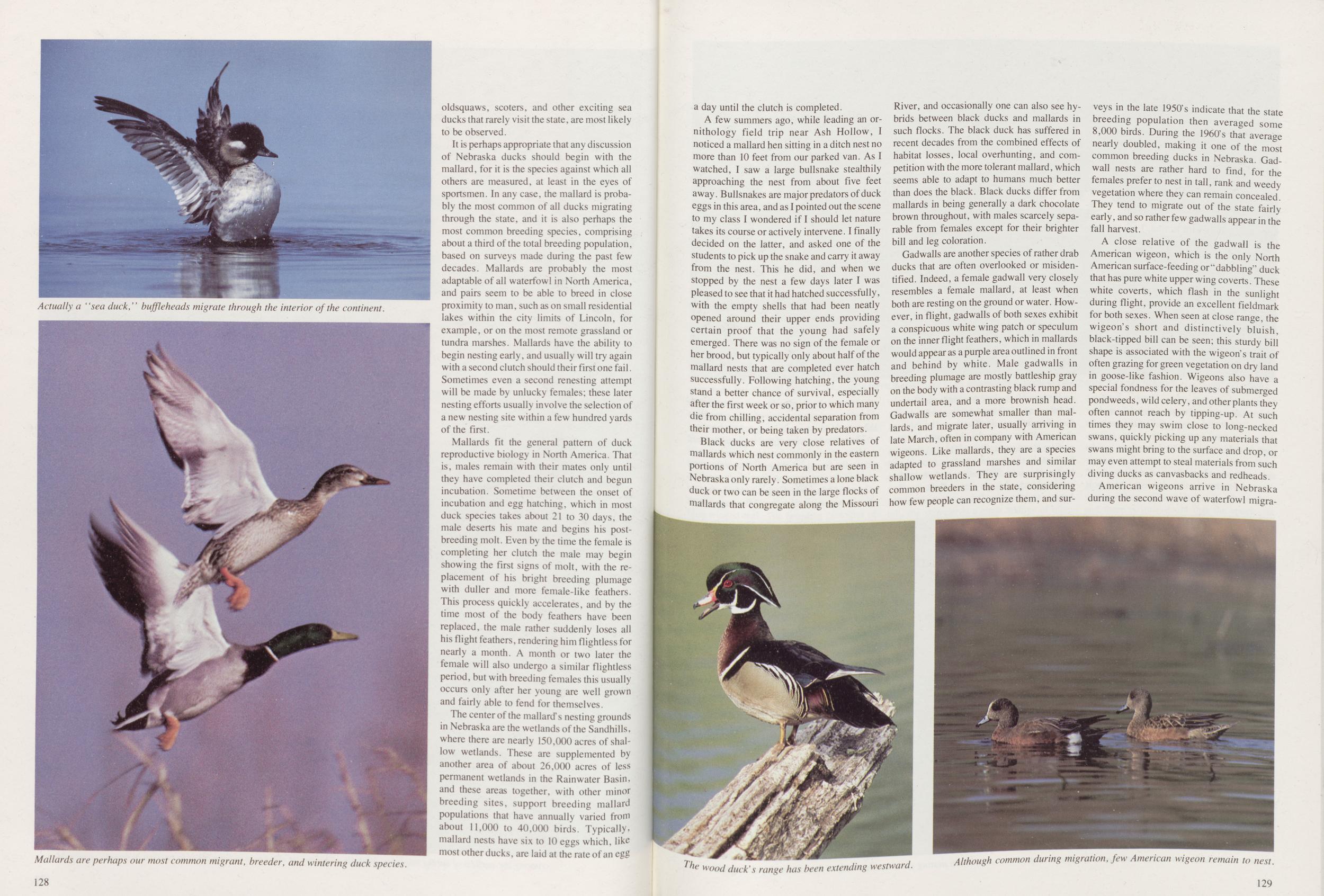
It is perhaps appropriate that any discussion of Nebraska ducks should begin with the mallard, for it is the species against which all others are measured, at least in the eyes of sportsmen. In any case, the mallard is probably the most common of all ducks migrating through the state, and it is also perhaps the most common breeding species, comprising about a third of the total breeding population, based on surveys made during the past few decades. Mallards are probably the most adaptable of all waterfowl in North America, and pairs seem to be able to breed in close proximity to man, such as on small residential lakes within the city limits of Lincoln, for example, or on the most remote grassland or tundra marshes. Mallards have the ability to begin nesting early, and usually will try again with a second clutch should their first one fail. Sometimes even a second renesting attempt will be made by unlucky females; these later nesting efforts usually involve the selection of a new nesting site within a few hundred yards of the first.
Mallards fit the general pattern of duck reproductive biology in North America. That is, males remain with their mates only until they have completed their clutch and begun incubation. Sometime between the onset of incubation and egg hatching, which in most duck species takes about 21 to 30 days, the male deserts his mate and begins his post-breeding molt. Even by the time the female is completing her clutch the male may begin showing the first signs of molt, with the replacement of his bright breeding plumage with duller and more female-like feathers. This process quickly accelerates, and by the time most of the body feathers have been replaced, the male rather suddenly loses all his flight feathers, rendering him flightless for nearly a month. A month or two later the female will also undergo a similar flightless period, but with breeding females this usually occurs only after her young are well grown and fairly able to tend tor themselves.
The center of the mallard's nesting grounds in Nebraska are the wetlands of the Sandhills, where there are nearly 150,000 acres of shallow wetlands. These are supplemented by another area of about 26,000 acres of less permanent wetlands in the Rainwater Basin, and these areas together, with other minor breeding sites, support breeding mallard populations that have annually varied Iron1 about 11,000 to 40,000 birds. Typically mallard nests have six to 10 eggs which, like most other ducks, are laid at the rate of an egg 128 a day until the clutch is completed.
A few summers ago, while leading an ornithology field trip near Ash Hollow, I noticed a mallard hen sitting in a ditch nest no more than 10 feet from our parked van. As I watched, I saw a large bullsnake stealthily approaching the nest from about five feet away. Bullsnakes are major predators of duck eggs in this area, and as I pointed out the scene to my class I wondered if I should let nature takes its course or actively intervene. I finally decided on the latter, and asked one of the students to pick up the snake and carry it away from the nest. This he did, and when we stopped by the nest a few days later I was pleased to see that it had hatched successfully, with the empty shells that had been neatly opened around their upper ends providing certain proof that the young had safely emerged. There was no sign of the female or her brood, but typically only about half of the mallard nests that are completed ever hatch successfully. Following hatching, the young stand a better chance of survival, especially after the first week or so, prior to which many die from chilling, accidental separation from their mother, or being taken by predators.
Black ducks are very close relatives of mallards which nest commonly in the eastern portions of North America but are seen in Nebraska only rarely. Sometimes a lone black duck or two can be seen in the large flocks of mallards that congregate along the Missouri River, and occasionally one can also see hybrids between black ducks and mallards in such flocks. The black duck has suffered in recent decades from the combined effects of habitat losses, local overhunting, and competition with the more tolerant mallard, which seems able to adapt to humans much better than does the black. Black ducks differ from mallards in being generally a dark chocolate brown throughout, with males scarcely separable from females except for their brighter bill and leg coloration.
Gadwalls are another species of rather drab ducks that are often overlooked or mis identified. Indeed, a female gadwall very closely resembles a female mallard, at least when both are resting on the ground or water. However, in flight, gadwalls of both sexes exhibit a conspicuous white wing patch or speculum on the inner flight feathers, which in mallards would appear as a purple area outlined in front and behind by white. Male gadwalls in breeding plumage are mostly battleship gray on the body with a contrasting black rump and undertail area, and a more brownish head. Gadwalls are somewhat smaller than mallards, and migrate later, usually arriving in late March, often in company with American wigeons. Like mallards, they are a species adapted to grassland marshes and similar shallow wetlands. They are surprisingly common breeders in the state, considering how few people can recognize them, and surveys in the late 1950's indicate that the state breeding population then averaged some 8,000 birds. During the 1960's that average nearly doubled, making it one of the most common breeding ducks in Nebraska. Gadwall nests are rather hard to find, for the females prefer to nest in tall, rank and weedy vegetation where they can remain concealed. They tend to migrate out of the state fairly early, and so rather few gadwalls appear in the fall harvest.
A close relative of the gadwall is the American wigeon, which is the only North American surface-feeding or "dabbling" duck that has pure white upper wing coverts. These white coverts, which flash in the sunlight during flight, provide an excellent fieldmark for both sexes. When seen at close range, the wigeon's short and distinctively bluish, black-tipped bill can be seen; this sturdy bill shape is associated with the wigeon s trait of often grazing for green vegetation on dry land in goose-like fashion. Wigeons also have a special fondness for the leaves of submerged pondweeds, wild celery, and other plants they often cannot reach by tipping-up. At such times they may swim close to long-necked swans, quickly picking up any materials that swans might bring to the surface and drop, or may even attempt to steal materials from such diving ducks as canvasbacks and redheads.
American wigeons arrive in Nebraska
during the second wave of waterfowl migration
129
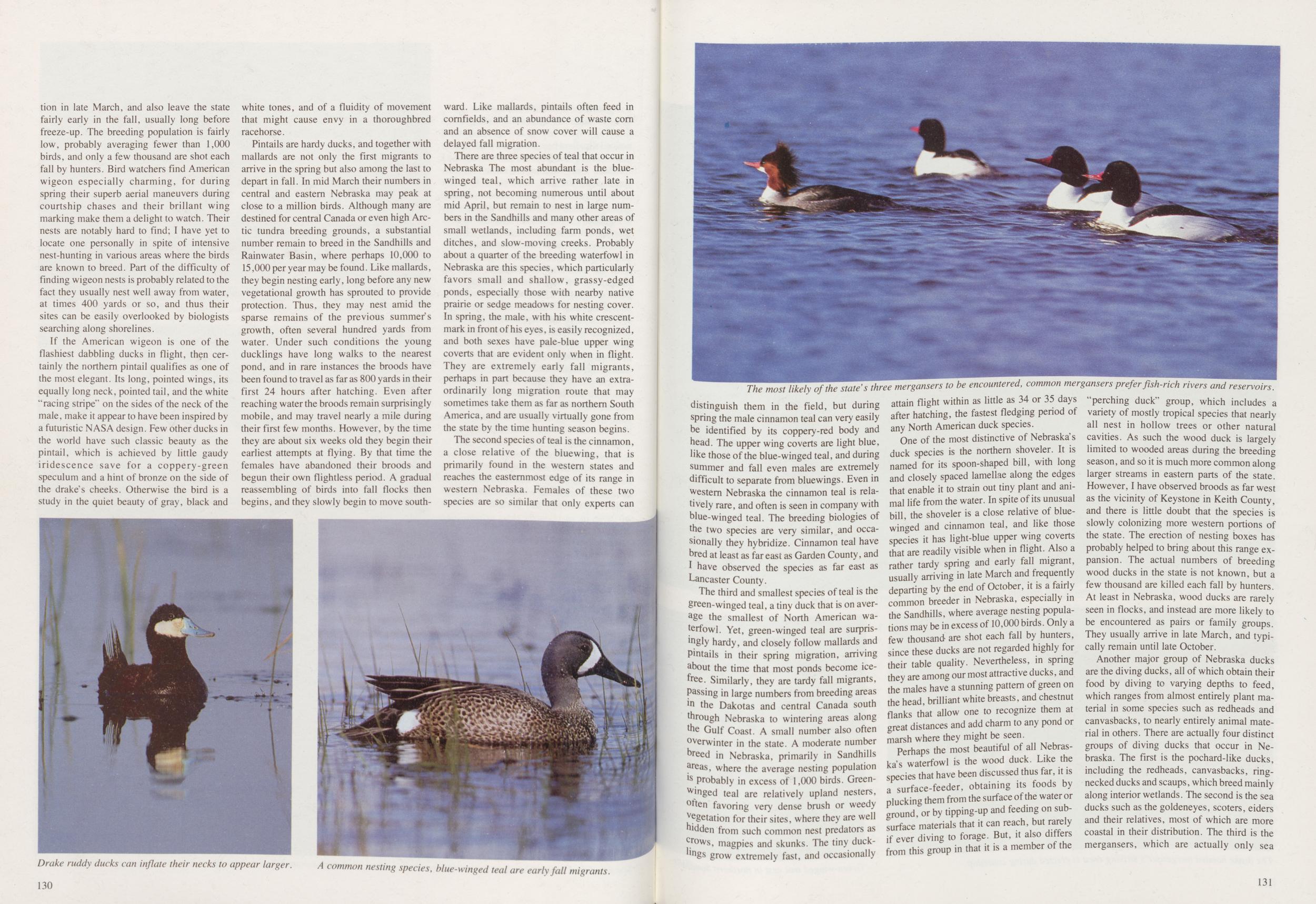 in late March, and also leave the state
fairly early in the fall, usually long before
freeze-up. The breeding population is fairly
low, probably averaging fewer than 1,000
birds, and only a few thousand are shot each
fall by hunters. Bird watchers find American
wigeon especially charming, for during
spring their superb aerial maneuvers during
courtship chases and their brillant wing
marking make them a delight to watch. Their
nests are notably hard to find; I have yet to
locate one personally in spite of intensive
nest-hunting in various areas where the birds
are known to breed. Part of the difficulty of
finding wigeon nests is probably related to the
fact they usually nest well away from water,
at times 400 yards or so, and thus their
sites can be easily overlooked by biologists
searching along shorelines.
in late March, and also leave the state
fairly early in the fall, usually long before
freeze-up. The breeding population is fairly
low, probably averaging fewer than 1,000
birds, and only a few thousand are shot each
fall by hunters. Bird watchers find American
wigeon especially charming, for during
spring their superb aerial maneuvers during
courtship chases and their brillant wing
marking make them a delight to watch. Their
nests are notably hard to find; I have yet to
locate one personally in spite of intensive
nest-hunting in various areas where the birds
are known to breed. Part of the difficulty of
finding wigeon nests is probably related to the
fact they usually nest well away from water,
at times 400 yards or so, and thus their
sites can be easily overlooked by biologists
searching along shorelines.
If the American wigeon is one of the flashiest dabbling ducks in flight, then certainly the northern pintail qualifies as one of the most elegant. Its long, pointed wings, its equally long neck, pointed tail, and the white "racing stripe" on the sides of the neck of the male, make it appear to have been inspired by a futuristic NASA design. Few other ducks in the world have such classic beauty as the pintail, which is achieved by little gaudy iridescence save for a coppery-green speculum and a hint of bronze on the side of the drake's cheeks. Otherwise the bird is a study in the quiet beauty of gray, black and white tones, and of a fluidity of movement that might cause envy in a thoroughbred racehorse.
Pintails are hardy ducks, and together with mallards are not only the first migrants to arrive in the spring but also among the last to depart in fall. In mid March their numbers in central and eastern Nebraska may peak at close to a million birds. Although many are destined for central Canada or even high Arctic tundra breeding grounds, a substantial number remain to breed in the Sandhills and Rainwater Basin, where perhaps 10,000 to 15,000 per year may be found. Like mallards, they begin nesting early, long before any new vegetational growth has sprouted to provide protection. Thus, they may nest amid the sparse remains of the previous summer's growth, often several hundred yards from water. Under such conditions the young ducklings have long walks to the nearest pond, and in rare instances the broods have been found to travel as far as 800 yards in their first 24 hours after hatching. Even after reaching water the broods remain surprisingly mobile, and may travel nearly a mile during their first few months. However, by the time they are about six weeks old they begin their earliest attempts at flying. By that time the females have abandoned their broods and begun their own flightless period. A gradual reassembling of birds into fall flocks then begins, and they slowly begin to move southward. Like mallards, pintails often feed in cornfields, and an abundance of waste corn and an absence of snow cover will cause a delayed fall migration.
There are three species of teal that occur in Nebraska The most abundant is the bluewinged teal, which arrive rather late in spring, not becoming numerous until about mid April, but remain to nest in large numbers in the Sandhills and many other areas of small wetlands, including farm ponds, wet ditches, and slow-moving creeks. Probably about a quarter of the breeding waterfowl in Nebraska are this species, which particularly favors small and shallow, grassy-edged ponds, especially those with nearby native prairie or sedge meadows for nesting cover. In spring, the male, with his white crescentmark in front of his eyes, is easily recognized, and both sexes have pale-blue upper wing coverts that are evident only when in flight. They are extremely early fall migrants, perhaps in part because they have an extraordinarily long migration route that may sometimes take them as far as northern South America, and are usually virtually gone from the state by the time hunting season begins.
The second species of teal is the cinnamon, a close relative of the bluewing, that is primarily found in the western states and reaches the easternmost edge of its range in western Nebraska. Females of these two species are so similar that only experts can 130 distinguish them in the field, but during spring the male cinnamon teal can very easily be identified by its coppery-red body and head. The upper wing coverts are light blue, like those of the blue-winged teal, and during summer and fall even males are extremely difficult to separate from bluewings. Even in western Nebraska the cinnamon teal is relatively rare, and often is seen in company with blue-winged teal. The breeding biologies of the two species are very similar, and occasionally they hybridize. Cinnamon teal have bred at least as far east as Garden County, and I have observed the species as far east as Lancaster County.
The third and smallest species of teal is the green-winged teal, a tiny duck that is on averse the smallest of North American waterfowl. Yet, green-winged teal are surprisingly hardy, and closely follow mallards and Pintails in their spring migration, arriving about the time that most ponds become icefree. Similarly, they are tardy fall migrants, Passing in large numbers from breeding areas in the Dakotas and central Canada south through Nebraska to wintering areas along the Gulf Coast. A small number also often overwinter in the state. A moderate number breed in Nebraska, primarily in Sandhills areas, where the average nesting population ls Probably in excess of 1,000 birds. Greenwinged teal are relatively upland nesters, often favoring very dense brush or weedy Vegetation for their sites, where they are well hidden from such common nest predators as crows, magpies and skunks. The tiny duckings grow extremely fast, and occasionally attain flight within as little as 34 or 35 days after hatching, the fastest fledging period of any North American duck species.
One of the most distinctive of Nebraska's duck species is the northern shoveler. It is named for its spoon-shaped bill, with long and closely spaced lamellae along the edges that enable it to strain out tiny plant and animal life from the water. In spite of its unusual bill, the shoveler is a close relative of bluewinged and cinnamon teal, and like those species it has light-blue upper wing coverts that are readily visible when in flight. Also a rather tardy spring and early fall migrant, usually arriving in late March and frequently departing by the end of October, it is a fairly common breeder in Nebraska, especially in the Sandhills, where average nesting populations may be in excess of 10,000 birds. Only a few thousand are shot each fall by hunters, since these ducks are not regarded highly for their table quality. Nevertheless, in spring they are among our most attractive ducks, and the males have a stunning pattern of green on the head, brilliant white breasts, and chestnut flanks that allow one to lecognize them at great distances and add charm to any pond or marsh where they might be seen.
Perhaps the most beautiful of all Nebraska's waterfowl is the wood duck. Like the species that have been discussed thus far, it is a surface-feeder, obtaining its foods by plucking them from the surface of the water or ground, or by tipping-up and feeding on subsurface materials that it can reach, but rarely if ever diving to forage. But, it also differs from this group in that it is a member of the "perching duck" group, which includes a variety of mostly tropical species that nearly all nest in hollow trees or other natural cavities. As such the wood duck is largely limited to wooded areas during the breeding season, and so it is much more common along larger streams in eastern parts of the state. However, I have observed broods as far west as the vicinity of Keystone in Keith County, and there is little doubt that the species is slowly colonizing more western portions of the state. The erection of nesting boxes has probably helped to bring about this range expansion. The actual numbers of breeding wood ducks in the state is not known, but a few thousand are killed each fall by hunters. At least in Nebraska, wood ducks are rarely seen in flocks, and instead are more likely to be encountered as pairs or family groups. They usually arrive in late March, and typically remain until late October.
Another major group of Nebraska ducks are the diving ducks, all of which obtain their food by diving to varying depths to feed, which ranges from almost entirely plant material in some species such as redheads and canvasbacks, to nearly entirely animal material in others. There are actually four distinct groups of diving ducks that occur in Nebraska. The first is the pochard-like ducks, including the redheads, canvasbacks, ringnecked ducks and scaups, which breed mainly along interior wetlands. The second is the sea ducks such as the goldeneyes, scoters, eiders and their relatives, most of which are more coastal in their distribution. The third is the mergansers, which are actually only sea ducks that have become specialized for foraging on fish. Lastly, the ruddy duck is a member of the "stiff-tailed" group of specialized diving ducks that have elongated tail feathers that are used as underwater rudders, and feet placed so far to the rear that the birds can barely walk about on land.
131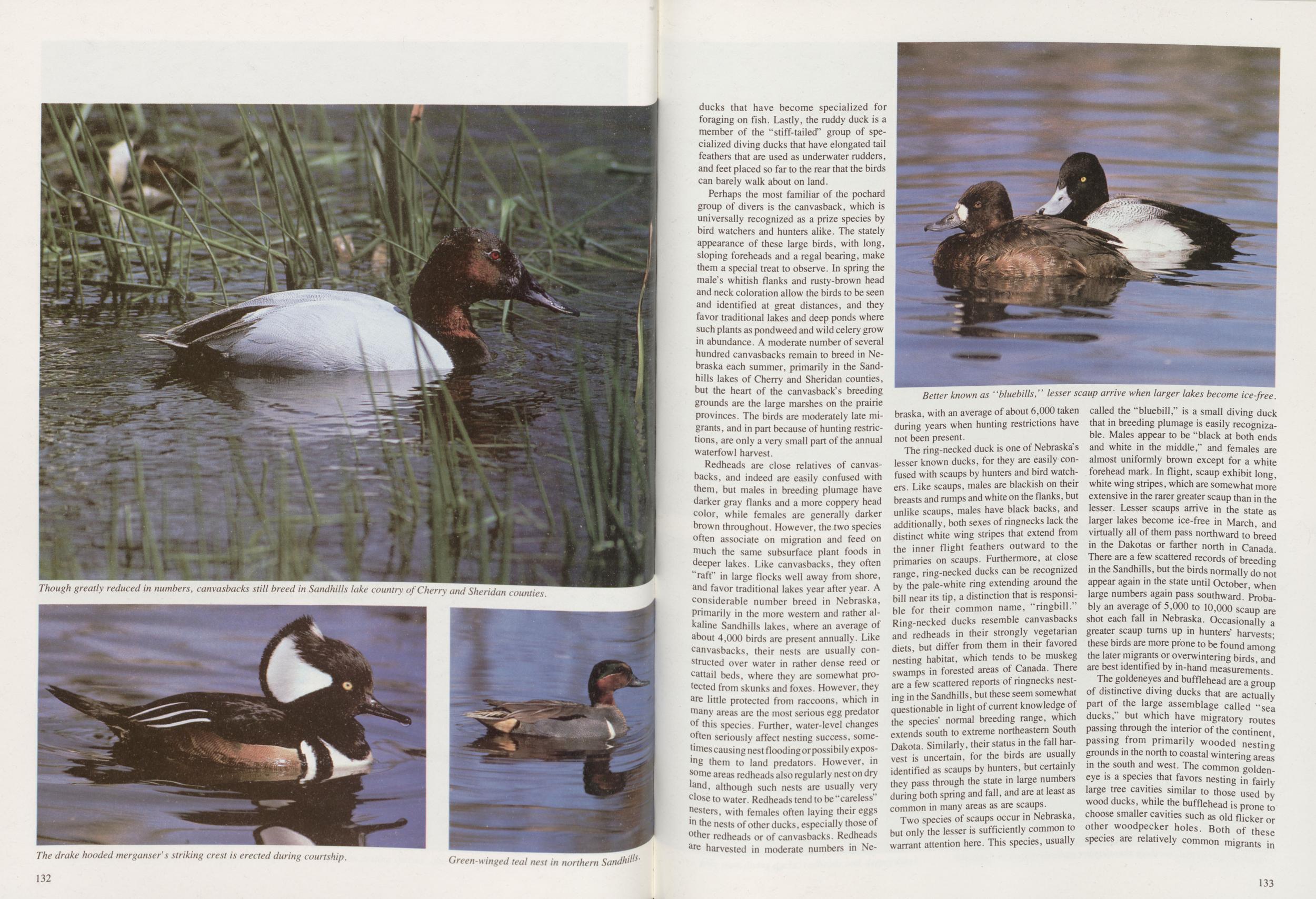
Perhaps the most familiar of the pochard group of divers is the canvasback, which is universally recognized as a prize species by bird watchers and hunters alike. The stately appearance of these large birds, with long, sloping foreheads and a regal bearing, make them a special treat to observe. In spring the male's whitish flanks and rusty-brown head and neck coloration allow the birds to be seen and identified at great distances, and they favor traditional lakes and deep ponds where such plants as pondweed and wild celery grow in abundance. A moderate number of several hundred canvasbacks remain to breed in Nebraska each summer, primarily in the Sandhills lakes of Cherry and Sheridan counties, but the heart of the canvasback's breeding grounds are the large marshes on the prairie provinces. The birds are moderately late migrants, and in part because of hunting restrictions, are only a very small part of the annual waterfowl harvest.
Redheads are close relatives of canvasbacks, and indeed are easily confused with them, but males in breeding plumage have darker gray flanks and a more coppery head color, while females are generally darker brown throughout. However, the two species often associate on migration and feed on much the same subsurface plant foods in deeper lakes. Like canvasbacks, they often "raft" in large flocks well away from shore, and favor traditional lakes year after year. A considerable number breed in Nebraska, Primarily in the more western and rather alkaline Sandhills lakes, where an average of about 4,000 birds are present annually. Like canvasbacks, their nests are usually constructed over water in rather dense reed or cattail beds, where they are somewhat protected from skunks and foxes. However, they are little protected from raccoons, which in many areas are the most serious egg predator of this species. Further, water-level changes often seriously affect nesting success, sometimes causing nest flooding or possibily exposing them to land predators. However, in some areas redheads also regularly nest on dry,and, although such nests are usually very close to water. Redheads tend to be "careless" "esters, with females often laying their eggs in the nests of other ducks, especially those of other redheads or of canvasbacks. Redheads are harvested in moderate numbers in Nebraska, braska, with an average of about 6,000 taken called the "bluebill," is a small divine during years when hunting restrictions have not been present.
The ring-necked duck is one of Nebraska's lesser known ducks, for they are easily confused with scaups by hunters and bird watchers. Like scaups, males are blackish on their breasts and rumps and white on the flanks, but unlike scaups, males have black backs, and additionally, both sexes of ringnecks lack the distinct white wing stripes that extend from the inner flight feathers outward to the primaries on scaups. Furthermore, at close range, ring-necked ducks can be recognized by the pale-white ring extending around the bill near its tip, a distinction that is responsible for their common name, "ringbill." Ring-necked ducks resemble canvasbacks shot each fall in Nebraska. Occasionally a and redheads in their strongly vegetarian greater scaup turns up in hunters' harvests; diets but differ from them in their favored these birds are more prone to be found among nesting habitat, which tends to be muskeg the later migrants or overwintering birds, and swamps in forested areas of Canada. There are best identified by in-hand measurements are a few scattered reports of ringnecks nest The goldeneyes and bufflehead are a group ine in the Sandhills, but these seem somewhat of distinctive diving ducks that are actually questionable in light of current knowledge of part of the large assemblage called "sea the species' normal breeding range, which ducks," but which have migratory routes extends south to extreme northeastern South passing through the interior of the continent, Dakota. Similarly, their status in the fall harvest is uncertain, for the birds are usually identified as scaups by hunters, but certainly they pass through the state in large numbers during both spring and fall, and are at least as common in many areas as are scaups.
Two species of scaups occur in Nebraska, but only the lesser is sufficiently common to warrant attention here. This species, usually called the "bluebill," is a small diving duck that in breeding plumage is easily recognizable. Males appear to be "black at both ends and white in the middle," and females are almost uniformly brown except for a white forehead mark. In flight, scaup exhibit long, white wing stripes, which are somewhat more extensive in the rarer greater scaup than in the lesser. Lesser scaups arrive in the state as larger lakes become ice-free in March and virtually all of them pass northward to breed in the Dakotas or farther north in Canada There are a few scattered records of breeding in the Sandhills, but the birds normally do not appear again in the state until October, when large numbers again pass southward. Probable for their common name, "ringbill." bly an average of 5,000 to 10,000 scaup are shot each fall in Nebraska. Occasionally a greater scaup turns up in hunters; harvests; these birds are more prone to be founf among the later migrants or overwintering birds, and are best identified by in-hand measurements.
The goldeneyes and bufflehead are a group
of distinctive diving ducks that are actually
part of the large assemblagfe called "sea
ducks," but which have migratory routes
passing through me interior or the continent
passing from primarily wooded nesting
grounds in the north to coastal wintering areas
in the south and west. The common goldeneye is a species that favors nesting in fairly
large tree cavities similar to those used by
wood ducks, while the bufflehead is prone to
choose smaller cavities such as old flicker or
other woodpecker holes. Both of these
species are relatively common migrants in
133
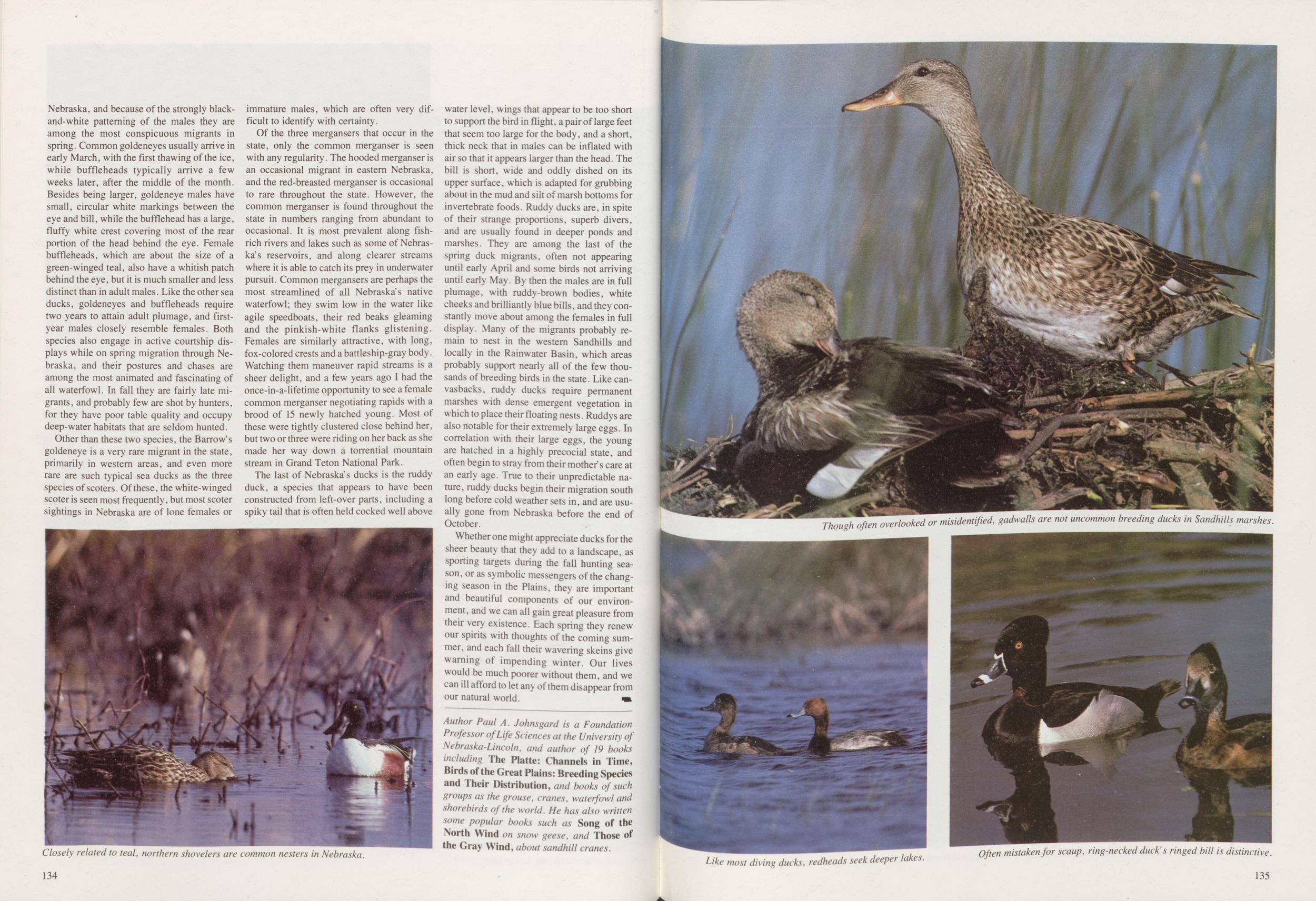 Nebraska, and because of the strongly blackand-white patterning of the males they
are
among the most conspicuous migrants in
spring. Common goldeneyes usually arrive in
early March, with the first thawing of the ice,
while buffleheads typically arrive a few
weeks later, after the middle of the month.
Besides being larger, goldeneye males have
small, circular white markings between the
eye and bill, while the bufflehead has a large,
fluffy white crest covering most of the rear
portion of the head behind the eye. Female
buffleheads, which are about the size of a
green-winged teal, also have a whitish patch
behind the eye, but it is much smaller and less
distinct than in adult males. Like the other sea
ducks, goldeneyes and buffleheads require
two years to attain adult plumage, and firstyear males closely resemble females. Both
species also engage in active courtship displays while on spring migration through
Nebraska, and their postures and chases are
among the most animated and fascinating of
all waterfowl. In fall they are fairly late migrants, and probably few are shot by
hunters,
for they have poor table quality and occupy
deep-water habitats that are seldom hunted.
Nebraska, and because of the strongly blackand-white patterning of the males they
are
among the most conspicuous migrants in
spring. Common goldeneyes usually arrive in
early March, with the first thawing of the ice,
while buffleheads typically arrive a few
weeks later, after the middle of the month.
Besides being larger, goldeneye males have
small, circular white markings between the
eye and bill, while the bufflehead has a large,
fluffy white crest covering most of the rear
portion of the head behind the eye. Female
buffleheads, which are about the size of a
green-winged teal, also have a whitish patch
behind the eye, but it is much smaller and less
distinct than in adult males. Like the other sea
ducks, goldeneyes and buffleheads require
two years to attain adult plumage, and firstyear males closely resemble females. Both
species also engage in active courtship displays while on spring migration through
Nebraska, and their postures and chases are
among the most animated and fascinating of
all waterfowl. In fall they are fairly late migrants, and probably few are shot by
hunters,
for they have poor table quality and occupy
deep-water habitats that are seldom hunted.
Other than these two species, the Barrow's goldeneye is a very rare migrant in the state, primarily in western areas, and even more rare are such typical sea ducks as the three species of scoters. Of these, the white-winged scoter is seen most frequently, but most scoter sightings in Nebraska are of lone females or immature males, which are often very difficult to identify with certainty.
Of the three mergansers that occur in the state, only the common merganser is seen with any regularity. The hooded merganser is an occasional migrant in eastern Nebraska, and the red-breasted merganser is occasional to rare throughout the state. However, the common merganser is found throughout the state in numbers ranging from abundant to occasional. It is most prevalent along fishrich rivers and lakes such as some of Nebraska's reservoirs, and along clearer streams where it is able to catch its prey in underwater pursuit. Common mergansers are perhaps the most streamlined of all Nebraska's native waterfowl; they swim low in the water like agile speedboats, their red beaks gleaming and the pinkish-white flanks glistening. Females are similarly attractive, with long, fox-colored crests and a battleship-gray body. Watching them maneuver rapid streams is a sheer delight, and a few years ago I had the once-in-a-lifetime opportunity to see a female common merganser negotiating rapids with a brood of 15 newly hatched young. Most of these were tightly clustered close behind her, but two or three were riding on her back as she made her way down a torrential mountain stream in Grand Teton National Park.
The last of Nebraska's ducks is the ruddy duck, a species that appears to have been constructed from left-over parts, including a spiky tail that is often held cocked well above water level, wings that appear to be too short to support the bird in flight, a pair of large feet that seem too large for the body, and a short, thick neck that in males can be inflated with air so that it appears larger than the head. The bill is short, wide and oddly dished on its upper surface, which is adapted for grubbing about in the mud and silt of marsh bottoms for invertebrate foods. Ruddy ducks are, in spite of their strange proportions, superb divers, and are usually found in deeper ponds and marshes. They are among the last of the spring duck migrants, often not appearing until early April and some birds not arriving until early May. By then the males are in full plumage, with ruddy-brown bodies, white cheeks and brilliantly blue bills, and they constantly move about among the females in full display. Many of the migrants probably remain to nest in the western Sandhills and locally in the Rainwater Basin, which areas probably support nearly all of the few thousands of breeding birds in the state. Like can- vasbacks, ruddy ducks require permanent marshes with dense emergent vegetation in which to place their floating nests. Ruddys are also notable for their extremely large eggs. In correlation with their large eggs, the young are hatched in a highly precocial state, and often begin to stray from their mother's care at an early age. True to their unpredictable nature, ruddy ducks begin their migration south long before cold weather sets in, and are usually gone from Nebraska before the end of October.
Whether one might appreciate ducks for the sheer beauty that they add to a landscape, as sporting targets during the fall hunting season, or as symbolic messengers of the changing season in the Plains, they are important and beautiful components of our environment, and we can all gain great pleasure from their very existence. Each spring they renew our spirits with thoughts of the coming summer, and each fall their wavering skeins give warning of impending winter. Our lives would be much poorer without them, and we can ill afford to let any of them disappear from our natural world.
Author Paul A. Johnsgard is a Foundation Professor of Life Sciences at the University of Nebraska-Lincoln, and author of 19 books including The Platte: Channels in Time, Birds of the Great Plains: Breeding Species and Their Distribution, and books of such groups as the grouse, cranes, waterfowl and shorebirds of the world. He has also written some popular books such as Song of the North Wind on snow geese, and Those of the Gray Wind, about sandhill cranes. 134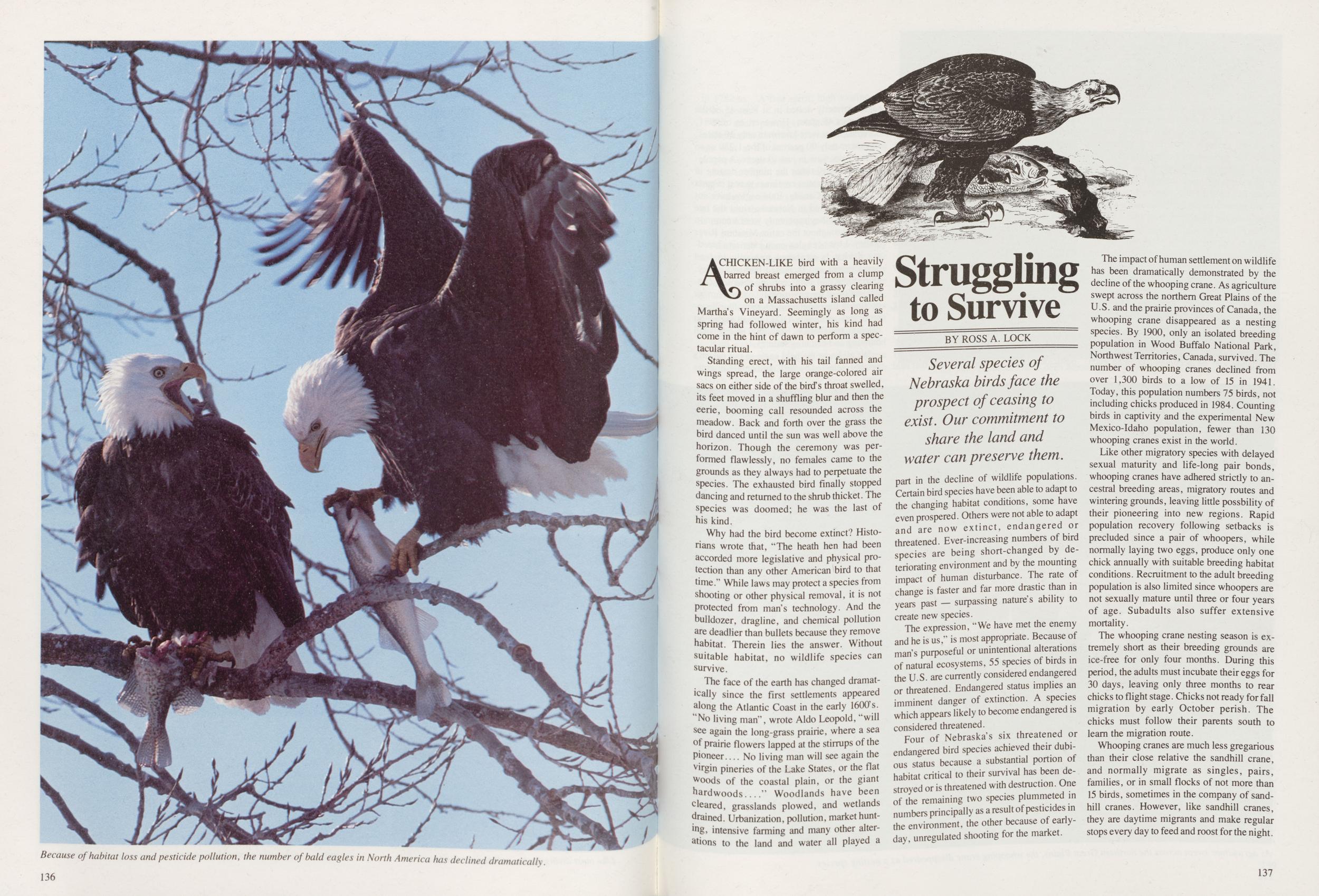
Struggling to Survive
BY ROSS A,. LOCK Several species of Nebraska birds face the prospect of ceasing to exist. Our commitment to share the land and water can preserve them.A CHICKEN-LIKE bird with a heavily barred breast emerged from a clump of shrubs into a grassy clearing on a Massachusetts island called Martha's Vineyard. Seemingly as long as spring had followed winter, his kind had come in the hint of dawn to perform a spectacular ritual.
Standing erect, with his tail fanned and wings spread, the large orange-colored air sacs on either side of the bird's throat swelled, its feet moved in a shuffling blur and then the eerie, booming call resounded across the meadow. Back and forth over the grass the bird danced until the sun was well above the horizon. Though the ceremony was performed flawlessly, no females came to the grounds as they always had to perpetuate the species. The exhausted bird finally stopped dancing and returned to the shrub thicket. The species was doomed; he was the last of his kind.
Why had the bird become extinct? Historians wrote that, "The heath hen had been accorded more legislative and physical protection than any other American bird to that time: While laws may protect a species from shooting or other physical removal, it is not protected from man's technology. And the bulldozer, dragline, and chemical pollution are deadlier than bullets because they remove habitat. Therein lies the answer. Without suitable habitat, no wildlife species can survive.
The face of the earth has changed dramatically since the first settlements appeared along the Atlantic Coast in the early 1600's. "No living man", wrote Aldo Leopold, "will see again the long-grass prairie, where a sea of prairie flowers lapped at the stirrups of the Pioneer.... No living man will see again the virgin pineries of the Lake States, or the flat woods of the coastal plain, or the giant hardwoods...." Woodlands have been cleared, grasslands plowed, and wetlands Gained. Urbanization, pollution, market hunting, intensive farming and many other alterations to the land and water all played a part in the decline of wildlife populations. Certain bird species have been able to adapt to the changing habitat conditions, some have even prospered. Others were not able to adapt and are now extinct, endangered or threatened. Ever-increasing numbers of bird species are being short-changed by deteriorating environment and by the mounting impact of human disturbance. The rate of change is faster and far more drastic than in years past - surpassing nature's ability to create new species.
The expression, "We have met the enemy and he is us," is most appropriate. Because of man's purposeful or unintentional alterations of natural ecosystems, 55 species of birds in the U S. are currently considered endangered or threatened. Endangered status implies an imminent danger of extinction. A species which appears likely to become endangered is considered threatened.
Four of Nebraska's six threatened or endangered bird species achieved their dubious status because a substantial portion of habitat critical to their survival has been destroyed or is threatened with destruction. One of the remaining two species plummeted in numbers principally as a result of pesticides in the environment, the other because of earlyday unregulated shooting for the market. Because of habitat loss and pesticide pollution, the number of bald eagles in North America has declined dramatically
The impact of human settlement on wildlife has been dramatically demonstrated by the decline of the whooping crane. As agriculture swept across the northern Great Plains of the U.S. and the prairie provinces of Canada, the whooping crane disappeared as a nesting species. By 1900, only an isolated breeding population in Wood Buffalo National Park, Northwest Territories, Canada, survived. The number of whooping cranes declined from over 1,300 birds to a low of 15 in 1941. Today, this population numbers 75 birds, not including chicks produced in 1984. Counting birds in captivity and the experimental New Mexico-Idaho population, fewer than 130 whooping cranes exist in the world.
Like other migratory species with delayed sexual maturity and life-long pair bonds, whooping cranes have adhered strictly to ancestral breeding areas, migratory routes and wintering grounds, leaving little possbility of their pioneering into new regions. Rapid population recovery following setbacks is precluded since a pair of whoopers, while normally laying two eggs, produce only one chick annually with suitable breeding habitat conditions. Recruitment to the adult breeding population is also limited since whoopers are not sexually mature until three or four years of age. Subadults also suffer extensive mortality.
The whooping crane nesting season is extremely short as their breeding grounds are ice-free for only four months. During this period, the adults must incubate their eggs for 30 days, leaving only three months to rear chicks to flight stage. Chicks not ready for fall migration by early October perish. The chicks must follow their parents south to learn the migration route.
Whooping cranes are much less gregarious
than their close relative the sandhill crane,
and normally migrate as singles, pairs,
families, or in small flocks of not more than
15 birds, sometimes in the company of sandhill cranes. However, like sandhill cranes,
they are daytime migrants and make regular
stops every day to feed and roost for the night.
137
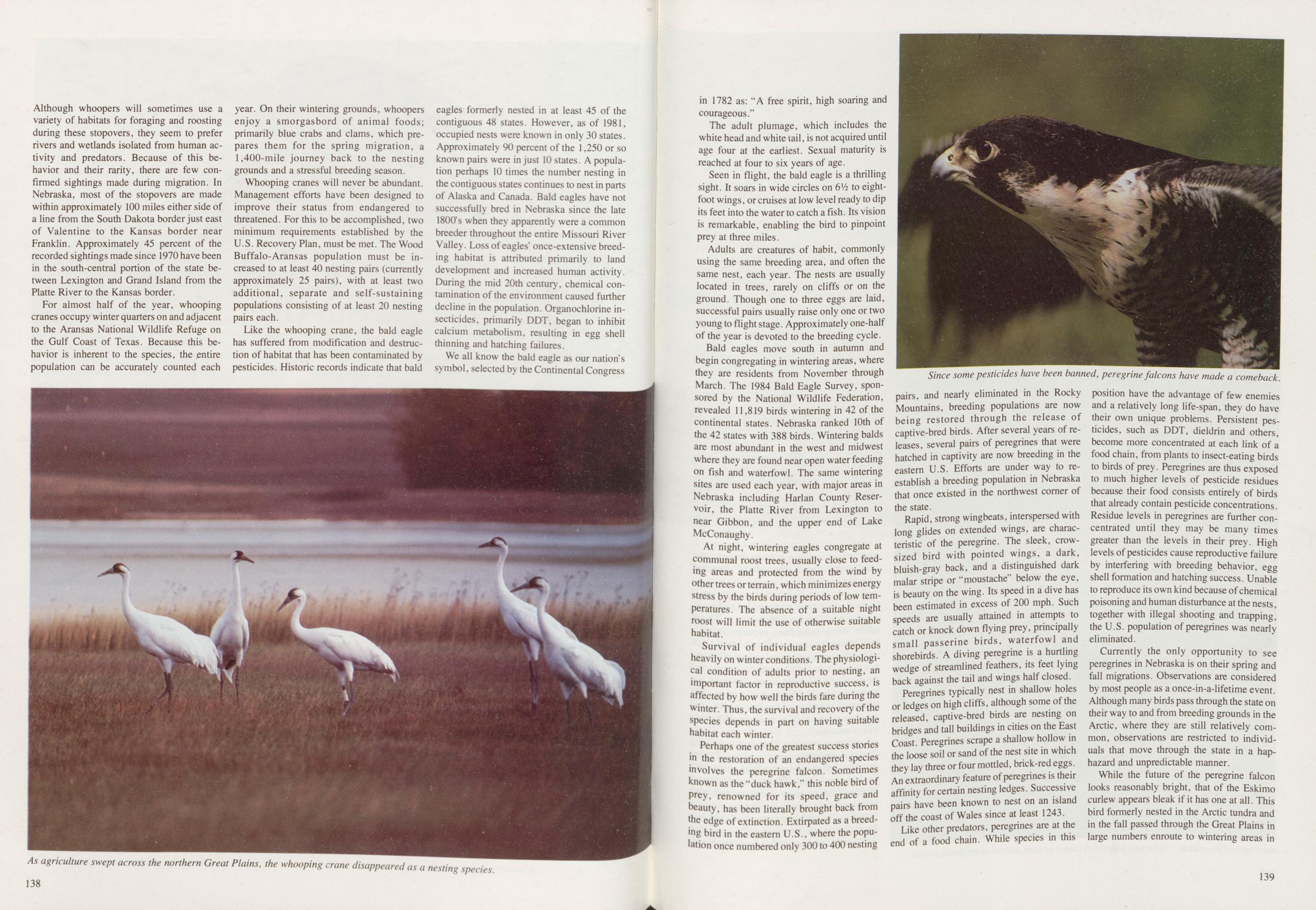 Although whoopers will sometimes use a
variety of habitats for foraging and roosting
during these stopovers, they seem to prefer
rivers and wetlands isolated from human activity and predators. Because of this behavior
and their rarity, there are few confirmed sightings made during migration. In
Nebraska, most of the stopovers are made
within approximately 100 miles either side of
a line from the South Dakota border just east
of Valentine to the Kansas border near
Franklin. Approximately 45 percent of the
recorded sightings made since 1970 have been
in the south-central portion of the state between Lexington and Grand Island from
the
Platte River to the Kansas border.
Although whoopers will sometimes use a
variety of habitats for foraging and roosting
during these stopovers, they seem to prefer
rivers and wetlands isolated from human activity and predators. Because of this behavior
and their rarity, there are few confirmed sightings made during migration. In
Nebraska, most of the stopovers are made
within approximately 100 miles either side of
a line from the South Dakota border just east
of Valentine to the Kansas border near
Franklin. Approximately 45 percent of the
recorded sightings made since 1970 have been
in the south-central portion of the state between Lexington and Grand Island from
the
Platte River to the Kansas border.
For almost half of the year, whooping cranes occupy winter quarters on and adjacent to the Aransas National Wildlife Refuge on the Gulf Coast of Texas. Because this behavior is inherent to the species, the entire population can be accurately counted each year. On their wintering grounds, whoopers enjoy a smorgasbord of animal foods; primarily blue crabs and clams, which prepares them for the spring migration, a 1,400-mile journey back to the nesting grounds and a stressful breeding season.
Whooping cranes will never be abundant. Management efforts have been designed to improve their status from endangered to threatened. For this to be accomplished, two minimum requirements established by the U.S. Recovery Plan, must be met. The Wood Buffalo-Aransas population must be increased to at least 40 nesting pairs (currently approximately 25 pairs), with at least two additional, separate and self-sustaining populations consisting of at least 20 nesting pairs each.
Like the whooping crane, the bald eagle has suffered from modification and destruction of habitat that has been contaminated by pesticides. Historic records indicate that bald eagles formerly nested in at least 45 of the contiguous 48 states. However, as of 1981, occupied nests were known in only 30 states. Approximately 90 percent of the 1,250 or so known pairs were in just 10 states. A population perhaps 10 times the number nesting in the contiguous states continues to nest in parts of Alaska and Canada. Bald eagles have not successfully bred in Nebraska since the late 1800's when they apparently were a common breeder throughout the entire Missouri River Valley. Loss of eagles' once-extensive breeding habitat is attributed primarily to land development and increased human activity. During the mid 20th century, chemical contamination of the environment caused further decline in the population. Organochlorine insecticides, primarily DDT, began to inhibit calcium metabolism, resulting in egg shell thinning and hatching failures.
We all know the bald eagle as our nation symbol, selected by the Continental Congress 138 in 1782 as: "A free spirit, high soaring and courageous."
The adult plumage, which includes the white head and white tail, is not acquired until age four at the earliest. Sexual maturity is reached at four to six years of age.
Seen in flight, the bald eagle is a thrilling sight. It soars in wide circles on six to eight-foot wings, or cruises at low level ready to dip its feet into the water to catch a fish. Its vision is remarkable, enabling the bird to pinpoint prey at three miles.
Adults are creatures of habit, commonly using the same breeding area, and often the same nest, each year. The nests are usually located in trees, rarely on cliffs or on the ground. Though one to three eggs are laid, successful pairs usually raise only one or two young to flight stage. Approximately one-half of the year is devoted to the breeding cycle.
Bald eagles move south in autumn and begin congregating in wintering areas, where they are residents from November through March. The 1984 Bald Eagle Survey, sponsored by the National Wildlife Federation, revealed 11,819 birds wintering in 42 of the continental states. Nebraska ranked 10th of the 42 states with 388 birds. Wintering balds are most abundant in the west and midwest where they are found near open water feeding on fish and waterfowl. The same wintering sites are used each year, with major areas in Nebraska including Harlan County Reservoir, the Platte River from Lexington to near Gibbon, and the upper end of Lake McConaughy.
At night, wintering eagles congregate at communal roost trees, usually close to feeding areas and protected from the wind by other trees or terrain, which minimizes energy stress by the birds during periods of low temperatures. The absence of a suitable night roost will limit the use of otherwise suitable habitat.
Survival of individual eagles depends heavily on winter conditions. The physiological condition of adults prior to nesting, an important factor in reproductive success, is affected by how well the birds fare during the winter. Thus, the survival and recovery of the species depends in part on having suitable habitat each winter.
Perhaps one of the greatest success stories in the restoration of an endangered species involves the peregrine falcon. Sometimes known as the "duck hawk," this noble bird of Prey, renowned for its speed, grace and heauty, has been literally brought back from the edge of extinction. Extirpated as a breeding bird in the eastern U.S., where the population once numbered only 300 to 400 nesting pairs, and nearly eliminated in the Rocky Mountains, breeding populations are now being restored through the release of captive-bred birds. After several years of releases, several pairs of peregrines that were hatched in captivity are now breeding in the eastern U.S. Efforts are under way to reestablish a breeding population in Nebraska that once existed in the northwest corner of the state.
Rapid, strong wingbeats, interspersed with long glides on extended wings, are characteristic of the peregrine. The sleek, crowsized bird with pointed wings, a dark, bluish-gray back, and a distinguished dark malar stripe or "moustache" below the eye, is beauty on the wing. Its speed in a dive has been estimated in excess of 200 mph. Such speeds are usually attained in attempts to catch or knock down flying prey, principally small passerine birds, waterfowl and shorebirds. A diving peregrine is a hurtling wedge of streamlined feathers, its feet lying back against the tail and wings half closed.
Peregrines typically nest in shallow holes or ledges on high cliffs, although some of the released, captive-bred birds are nesting on bridges and tall buildings in cities on the East Coast. Peregrines scrape a shallow hollow in the loose soil or sand of the nest site in which they lay three or four mottled, brick-red eggs. An extraordinary feature of peregrines is their affinity for certain nesting ledges. Successive pairs have been known to nest on an island off the coast of Wales since at least 1243.
Like other predators, peregrines are at the end of a food chain. While species in this position have the advantage of few enemies and a relatively long life-span, they do have their own unique problems. Persistent pesticides, such as DDT, dieldrin and others, become more concentrated at each link of a food chain, from plants to insect-eating birds to birds of prey. Peregrines are thus exposed to much higher levels of pesticide residues because their food consists entirely of birds that already contain pesticide concentrations. Residue levels in peregrines are further concentrated until they may be many times greater than the levels in their prey. High levels of pesticides cause reproductive failure by interfering with breeding behavior, egg shell formation and hatching success. Unable to reproduce its own kind because of chemical poisoning and human disturbance at the nests, together with illegal shooting and trapping, the U.S. population of peregrines was nearly eliminated.
Currently the only opportunity to see peregrines in Nebraska is on their spring and fall migrations. Observations are considered by most people as a once-in-a-lifetime event. Although many birds pass through the state on their way to and from breeding grounds in the Arctic, where they are still relatively common, observations are restricted to individuals that move through the state in a haphazard and unpredictable manner.
While the future of the peregrine falcon
looks reasonably bright, that of the Eskimo
curlew appears bleak if it has one at all. This
bird formerly nested in the Arctic tundra and
in the fall passed through the Great Plains in
large numbers enroute to wintering areas in
139
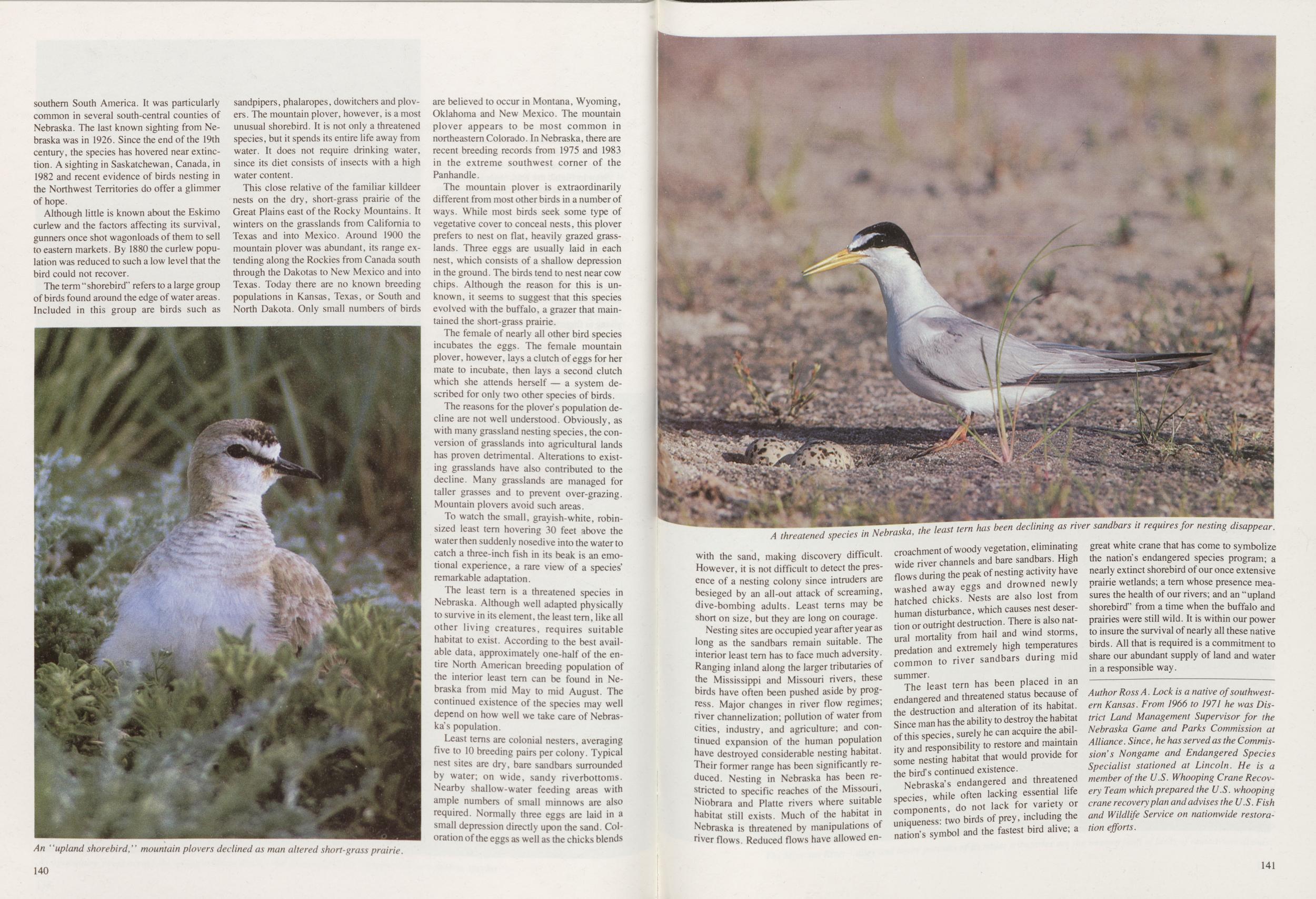 southern South America. It was particularly
common in several south-central counties of
Nebraska. The last known sighting from Nebraska was in 1926. Since the end of the
19th
century, the species has hovered near extinction. A sighting in Saskatchewan, Canada,
in
1982 and recent evidence of birds nesting in
the Northwest Territories do offer a glimmer
of hope.
southern South America. It was particularly
common in several south-central counties of
Nebraska. The last known sighting from Nebraska was in 1926. Since the end of the
19th
century, the species has hovered near extinction. A sighting in Saskatchewan, Canada,
in
1982 and recent evidence of birds nesting in
the Northwest Territories do offer a glimmer
of hope.
Although little is known about the Eskimo curlew and the factors affecting its survival, gunners once shot wagonloads of them to sell to eastern markets. By 1880 the curlew population was reduced to such a low level that the bird could not recover.
The term "shorebird" refers to a large group of birds found around the edge of water areas. Included in this group are birds such as sandpipers, phalaropes, dowitchers and plovers. The mountain plover, however, is a most unusual shorebird. It is not only a threatened species, but it spends its entire life away from water. It does not require drinking water, since its diet consists of insects with a high water content.
This close relative of the familiar killdeer nests on the dry, short-grass prairie of the Great Plains east of the Rocky Mountains. It winters on the grasslands from California to Texas and into Mexico. Around 1900 the mountain plover was abundant, its range extending along the Rockies from Canada south through the Dakotas to New Mexico and into Texas. Today there are no known breeding populations in Kansas, Texas, or South and North Dakota. Only small numbers of birds are believed to occur in Montana, Wyoming, Oklahoma and New Mexico. The mountain plover appears to be most common in northeastern Colorado. In Nebraska, there are recent breeding records from 1975 and 1983 in the extreme southwest corner of the Panhandle.
The mountain plover is extraordinarily different from most other birds in a number of ways. While most birds seek some type of vegetative cover to conceal nests, this plover prefers to nest on flat, heavily grazed grasslands. Three eggs are usually laid in each nest, which consists of a shallow depression in the ground. The birds tend to nest near cow chips. Although the reason for this is unknown, it seems to suggest that this species evolved with the buffalo, a grazer that maintained the short-grass prairie.
The female of nearly all other bird species incubates the eggs. The female mountain plover, however, lays a clutch of eggs for her mate to incubate, then lays a second clutch which she attends herself — a system described for only two other species of birds.
The reasons for the plover s population decline are not well understood. Obviously, as with many grassland nesting species, the conversion of grasslands into agricultural lands has proven detrimental. Alterations to existing grasslands have also contributed to the decline. Many grasslands are managed for taller grasses and to prevent over-grazing. Mountain plovers avoid such areas.
To watch the small, grayish-white, robinsized least tern hovering 30 feet above the water then suddenly nosedive into the water to catch a three-inch fish in its beak is an emotional experience, a rare view of a species' remarkable adaptation.
The least tern is a threatened species in Nebraska. Although well adapted physically to survive in its element, the least tern, like all other living creatures, requires suitable habitat to exist. According to the best available data, approximately one-half of the entire North American breeding population of the interior least tern can be found in Nebraska from mid May to mid August. The continued existence of the species may will depend on how well we take care of Nebraska's population.
Least terns are colonial nesters, averaging five to 10 breeding pairs per colony. Typical nest sites are dry, bare sandbars surrounded by water; on wide, sandy riverbottoms. Nearby shallow-water feeding areas with ample numbers of small minnows are also required. Normally three eggs are laid in a small depression directly upon the sand. Coloration of the eggs as well as the chicks blends 140 with the sand, making discovery difficult. However, it is not difficult to detect the presence of a nesting colony since intruders are besieged by an all-out attack of screaming, dive-bombing adults. Least terns may be short on size, but they are long on courage.
Nesting sites are occupied year after year as long as the sandbars remain suitable. The interior least tern has to face much adversity. Ranging inland along the larger tributaries of the Mississippi and Missouri rivers, these birds have often been pushed aside by progress. Major changes in river flow regimes; river channelization; pollution of water from cities, industry, and agriculture; and continued expansion of the human population have destroyed considerable nesting habitat. Their former range has been significantly reduced. Nesting in Nebraska has been restricted to specific reaches of the Missouri, Niobrara and Platte rivers where suitable habitat still exists. Much of the habitat in Nebraska is threatened by manipulations of river flows. Reduced flows have allowed encroachment croachment of woody vegetation, eliminating wide river channels and bare sandbars. High flows during the peak of nesting activity have washed away eggs and drowned newly hatched chicks. Nests are also lost from human disturbance, which causes nest desertion or outright destruction. There is also natural mortality from hail and wind storms, predation and extremely high temperatures common to river sandbars during mid summer.
The least tern has been placed in an neered and threatened status because of Author Ross A. Lock is a native of southwest the destruction and alteration of its habitat, ern Kansas. From 1966 to 1971 he was Dis Since man has the ability to destroy the habitat of this species, surely he can acquire the ability and responsibility to restore and maintain some nesting habitat that would provide for the bird's continued existence.
Nebraska's endangered and threatened species, while often lacking essential life components, do not lack for variety or uniqueness: two birds of prey, including the nation's symbol and the fastest bird alive; a great white crane that has come to symbolize the nation's endangered species program; a nearly extinct shorebird of our once extensive prairie wetlands; a tern whose presence measures the health of our rivers; and an "upland shorebird" from a time when the buffalo and prairies were still wild. It is within our power to insure the survival of nearly all these native birds. All that is required is a commitment to share our abundant supply of land and water in a responsible way.
Author Ross A. Lock is a native of southwestern Kansas. From 1966 to 1971 was District Land Management Supervisor for the Nebraska Game and Parks Commission at Alliance. Since, he has served as the Commission's Nongame and Endangered Species Specialist stationed at Lincoln. He is a member of the U.S. Whooping Crane Recovery Team which prepared the U.S. whooping crane recovery plan and advises the U.S. Fish and Wildlife Service on nationwide restoration efforts. 141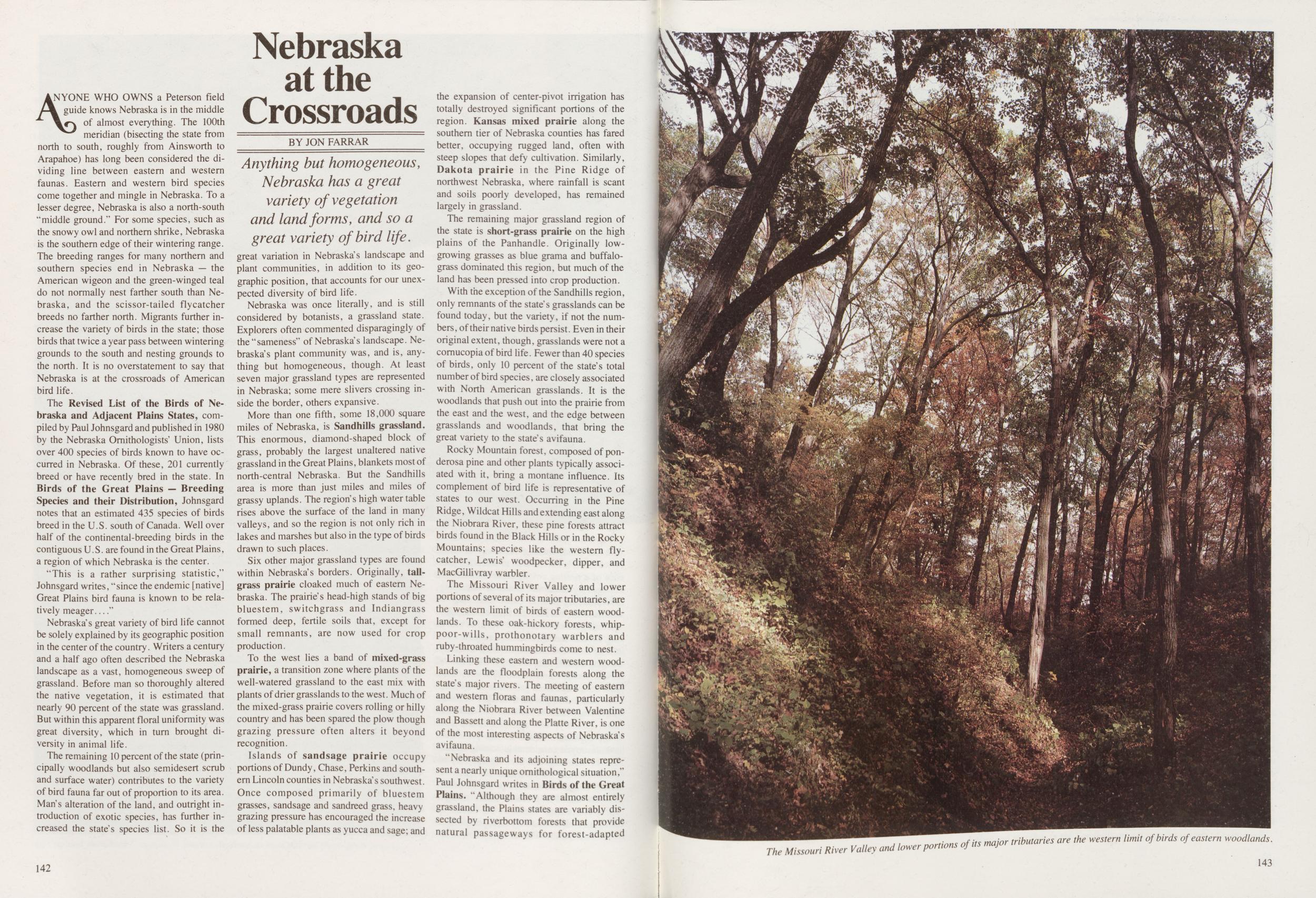
Nebraska at the Crossroads
BY JON FARRAR Anything but homogeneous, Nebraska has a great variety of vegetation and land forms, and so a great variety of bird life.ANYONE WHO OWNS a Peterson field guide knows Nebraska is in the middle of almost everything. The 100th meridian (bisecting the state from north to south, roughly from Ainsworth to Arapahoe) has long been considered the dividing line between eastern and western faunas. Eastern and western bird species come together and mingle in Nebraska. To a lesser degree, Nebraska is also a north-south "middle ground." For some species, such as the snowy owl and northern shrike, Nebraska is the southern edge of their wintering range. The breeding ranges for many northern and southern species end in Nebraska — the American wigeon and the green-winged teal do not normally nest farther south than Nebraska, and the scissor-tailed flycatcher breeds no farther north. Migrants further increase the variety of birds in the state; those birds that twice a year pass between wintering grounds to the south and nesting grounds to the north. It is no overstatement to say that Nebraska is at the crossroads of American bird life.
The Revised List of the Birds of Nebraska and Adjacent Plains States, compiled by Paul Johnsgard and published in 1980 by the Nebraska Ornithologists' Union, lists over 400 species of birds known to have occurred in Nebraska. Of these, 201 currently breed or have recently bred in the state. In Birds of the Great Plains — Breeding Species and their Distribution, Johnsgard notes that an estimated 435 species of birds breed in the U.S. south of Canada. Well over half of the continental-breeding birds in the contiguous U.S. are found in the Great Plains, a region of which Nebraska is the center.
'This is a rather surprising statistic," Johnsgard writes, "since the endemic [native] Great Plains bird fauna is known to be relatively meager...."
Nebraska's great variety of bird life cannot be solely explained by its geographic position in the center of the country. Writers a century and a half ago often described the Nebraska landscape as a vast, homogeneous sweep of grassland. Before man so thoroughly altered the native vegetation, it is estimated that nearly 90 percent of the state was grassland. But within this apparent floral uniformity was great diversity, which in turn brought diversity in animal life.
The remaining 10 percent of the state (principally woodlands but also semidesert scrub and surface water) contributes to the variety of bird fauna far out of proportion to its area. Man's alteration of the land, and outright introduction of exotic species, has further increased the state's species list. So it is the great variation in Nebraska's landscape and plant communities, in addition to its geographic position, that accounts for our unexpected diversity of bird life.
Nebraska was once literally, and is still considered by botanists, a grassland state. Explorers often commented disparagingly of the "sameness" of Nebraska's landscape. Nebraska's plant community was, and is, anything but homogeneous, though. At least seven major grassland types are represented in Nebraska; some mere slivers crossing inside the border, others expansive.
More than one fifth, some 18,000 square miles of Nebraska, is Sandhills grassland. This enormous, diamond-shaped block of grass, probably the largest unaltered native grassland in the Great Plains, blankets most of north-central Nebraska. But the Sandhills area is more than just miles and miles of grassy uplands. The region's high water table rises above the surface of the land in many valleys, and so the region is not only rich in lakes and marshes but also in the type of birds drawn to such places.
Six other major grassland types are found within Nebraska's borders. Originally, tall grass prairie cloaked much of eastern Nebraska. The prairie's head-high stands of big bluestem, switchgrass and Indiangrass formed deep, fertile soils that, except for small remnants, are now used for crop production.
To the west lies a band of mixed-grass prairie, a transition zone where plants of the well-watered grassland to the east mix with plants of drier grasslands to the west. Much of the mixed-grass prairie covers rolling or hilly country and has been spared the plow though grazing pressure often alters it beyond recognition.
Islands of sandsage prairie occupy portions of Dundy, Chase, Perkins and southern Lincoln counties in Nebraska's southwest. Once composed primarily of bluestem grasses, sandsage and sandreed grass, heavy grazing pressure has encouraged the increase of less palatable plants as yucca and sage; and the expansion of center-pivot irrigation has totally destroyed significant portions of the region. Kansas mixed prairie along the southern tier of Nebraska counties has fared better, occupying rugged land, often with steep slopes that defy cultivation. Similarly, Dakota prairie in the Pine Ridge of northwest Nebraska, where rainfall is scant and soils poorly developed, has remained largely in grassland.
The remaining major grassland region of the state is short-grass prairie on the high plains of the Panhandle. Originally lowgrowing grasses as blue grama and buffalograss dominated this region, but much of the land has been pressed into crop production.
With the exception of the Sandhills region, only remnants of the state's grasslands can be found today, but the variety, if not the numbers, of their native birds persist. Even in their original extent, though, grasslands were not a cornucopia of bird life. Fewer than 40 species of birds, only 10 percent of the state's total number of bird species, are closely associated with North American grasslands. It is the woodlands that push out into the prairie from the east and the west, and the edge between grasslands and woodlands, that bring the great variety to the state's avifauna.
Rocky Mountain forest, composed of ponderosa pine and other plants typically associated with it, bring a montane influence. Its complement of bird life is representative of states to our west. Occurring in the Pine Ridge, Wildcat Hills and extending east along the Niobrara River, these pine forests attract birds found in the Black Hills or in the Rocky Mountains; species like the western flycatcher, Lewis' woodpecker, dipper, and MacGillivray warbler.
The Missouri River Valley and lower portions of several of its major tributaries, are the western limit of birds of eastern woodlands. To these oak-hickory forests, whippoor-wills, prothonotary warblers and ruby-throated hummingbirds come to nest.
Linking these eastern and western woodlands are the floodplain forests along the state's major rivers. The meeting of eastern and western floras and faunas, particularly along the Niobrara River between Valentine and Bassett and along the Platte River, is one of the most interesting aspects of Nebraska s avifauna.
"Nebraska and its adjoining states repre- sent a nearly unique ornithological situation," Paul Johnsgard writes in Birds of the Great Plains. "Although they are almost entirely grassland, the Plains states are variably dissected by riverbottom forests that provide natural passageways for forest-adapted species to enter the plains and sometimes to cross them. Although eastern and western bird faunas tend to be separated by the plains, they often mingle to some degree, resulting in competition and sometimes hybridization.
142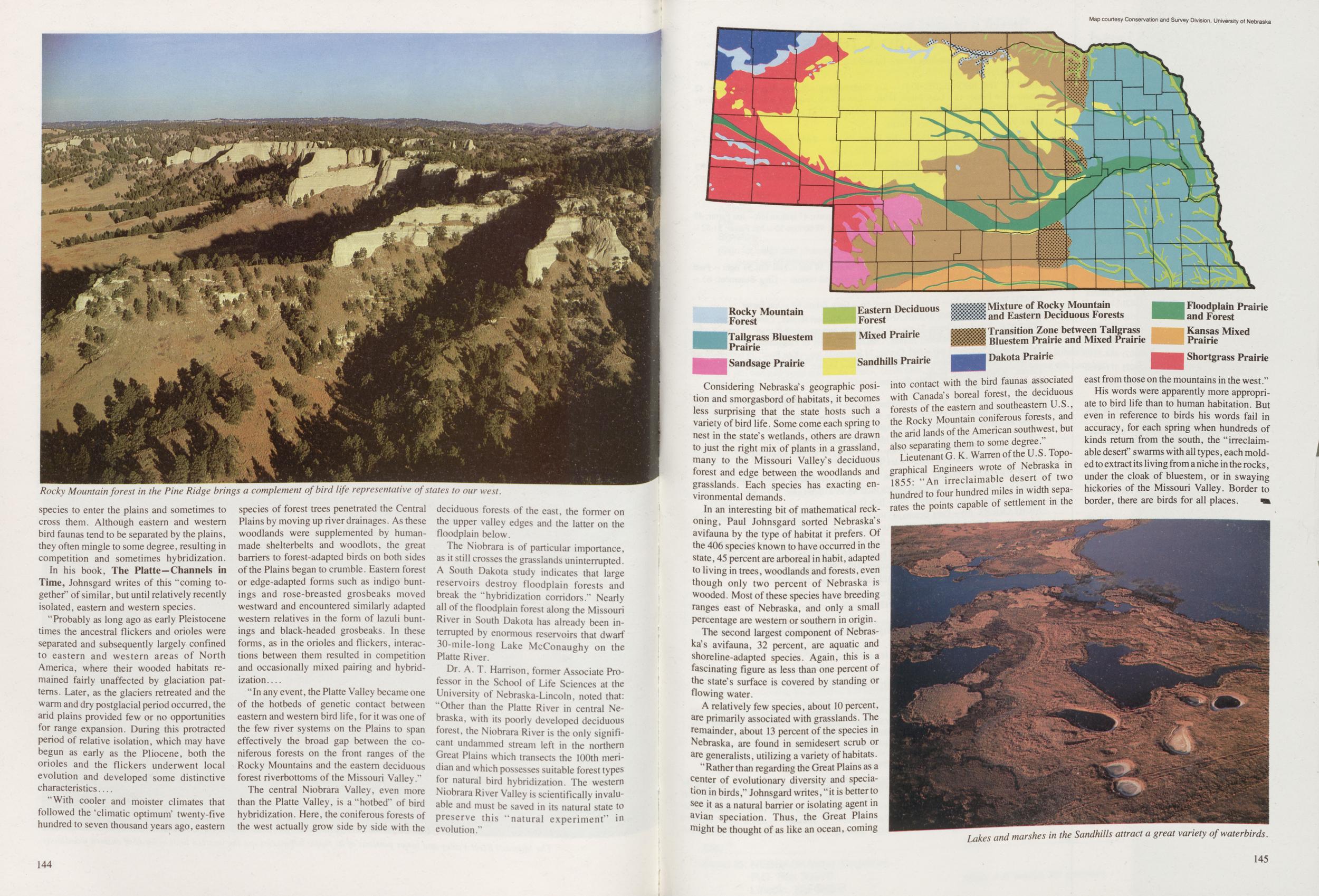
In his book, The Platte—Channels in Time, Johnsgard writes of this "coming together" of similar, but until relatively recently isolated, eastern and western species.
"Probably as long ago as early Pleistocene times the ancestral flickers and orioles were separated and subsequently largely confined to eastern and western areas of North America, where their wooded habitats remained fairly unaffected by glaciation patterns. Later, as the glaciers retreated and the warm and dry postglacial period occurred, the arid plains provided few or no opportunities for range expansion. During this protracted period of relative isolation, which may have begun as early as the Pliocene, both the orioles and the flickers underwent local evolution and developed some distinctive characteristics
"With cooler and moister climates that followed the 'climatic optimum' twenty-five hundred to seven thousand years ago, eastern species of forest trees penetrated the Central Plains by moving up river drainages. As these woodlands were supplemented by humanmade shelterbelts and woodlots, the great barriers to forest-adapted birds on both sides of the Plains began to crumble. Eastern forest or edge-adapted forms such as indigo buntings and rose-breasted grosbeaks moved westward and encountered similarly adapted western relatives in the form of lazuli buntings and black-headed grosbeaks. In these forms, as in the orioles and flickers, interactions between them resulted in competition and occasionally mixed pairing and hybridization
"In any event, the Platte Valley became one of the hotbeds of genetic contact between eastern and western bird life, for it was one of the few river systems on the Plains to span effectively the broad gap between the coniferous forests on the front ranges of the Rocky Mountains and the eastern deciduous forest riverbottoms of the Missouri Valley."
The central Niobrara Valley, even more than the Platte Valley, is a "hotbed" of bird hybridization. Here, the coniferous forests of the west actually grow side by side with the deciduous forests of the east, the former on the upper valley edges and the latter on the floodplain below.
The Niobrara is of particular importance, as it still crosses the grasslands uninterrupted. A South Dakota study indicates that large reservoirs destroy floodplain forests and break the "hybridization corridors." Nearly all of the floodplain forest along the Missouri River in South Dakota has already been interrupted by enormous reservoirs that dwarf 30-mile-Iong Lake McConaughy on the Platte River.
Dr. A. T. Harrison, former Associate Professor in the School of Life Sciences at the University of Nebraska-Lincoln, noted that: "Other than the Platte River in central Nebraska, with its poorly developed deciduous forest, the Niobrara River is the only significant undammed stream left in the northern Great Plains which transects the 100th meridian and which possesses suitable forest types tor natural bird hybridization. The western Niobrara River Valley is scientifically invaluable and must be saved in its natural state to preserve this ''natural experimenf in evolution."
144Considering Nebraska's geographic position and smorgasbord of habitats, it becomes less surprising that the state hosts such a variety of bird life. Some come each spring to nest in the state's wetlands, others are drawn to just the right mix of plants in a grassland, many to the Missouri Valley's deciduous forest and edge between the woodlands and grasslands. Each species has exacting environmental demands.
In an interesting bit of mathematical reckoning, Paul Johnsgard sorted Nebraska's avifauna by the type of habitat it prefers. Of the 406 species known to have occurred in the state, 45 percent are arboreal in habit, adapted to living in trees, woodlands and forests, even though only two percent of Nebraska is wooded. Most of these species have breeding ranges east of Nebraska, and only a small percentage are western or southern in origin.
The second largest component of Nebraska's avifauna, 32 percent, are aquatic and shoreline-adapted species. Again, this is a fascinating figure as less than one percent of the state's surface is covered by standing or flowing water.
A relatively few species, about 10 percent, are primarily associated with grasslands. The remainder, about 13 percent of the species in Nebraska, are found in semidesert scrub or are generalists, utilizing a variety of habitats.
"Rather than regarding the Great Plains as a center of evolutionary diversity and speciation in birds," Johnsgard writes, "it is better to see it as a natural barrier or isolating agent in avian speciation. Thus, the Great Plains night be thought of as like an ocean, coming into contact with the bird faunas associated with Canada's boreal forest, the deciduous forests of the eastern and southeastern U.S., the Rocky Mountain coniferous forests, and the arid lands of the American southwest, but also separating them to some degree."
Lieutenant G. K. Warren of the U.S. Topographical Engineers wrote of Nebraska in 1855: "An irreclaimable desert of two hundred to four hundred miles in width separates the points capable of settlement in the east from those on the mountains in the west."
His words were apparently more appropriate to bird life than to human habitation. But even in reference to birds his words fail in accuracy, for each spring when hundreds of kinds return from the south, the "irreclaimable desert" swarms with all types, each molded to extract its living from a niche in the rocks, under the cloak of bluestem, or in swaying hickories of the Missouri Valley. Border to border, there are birds for all places.
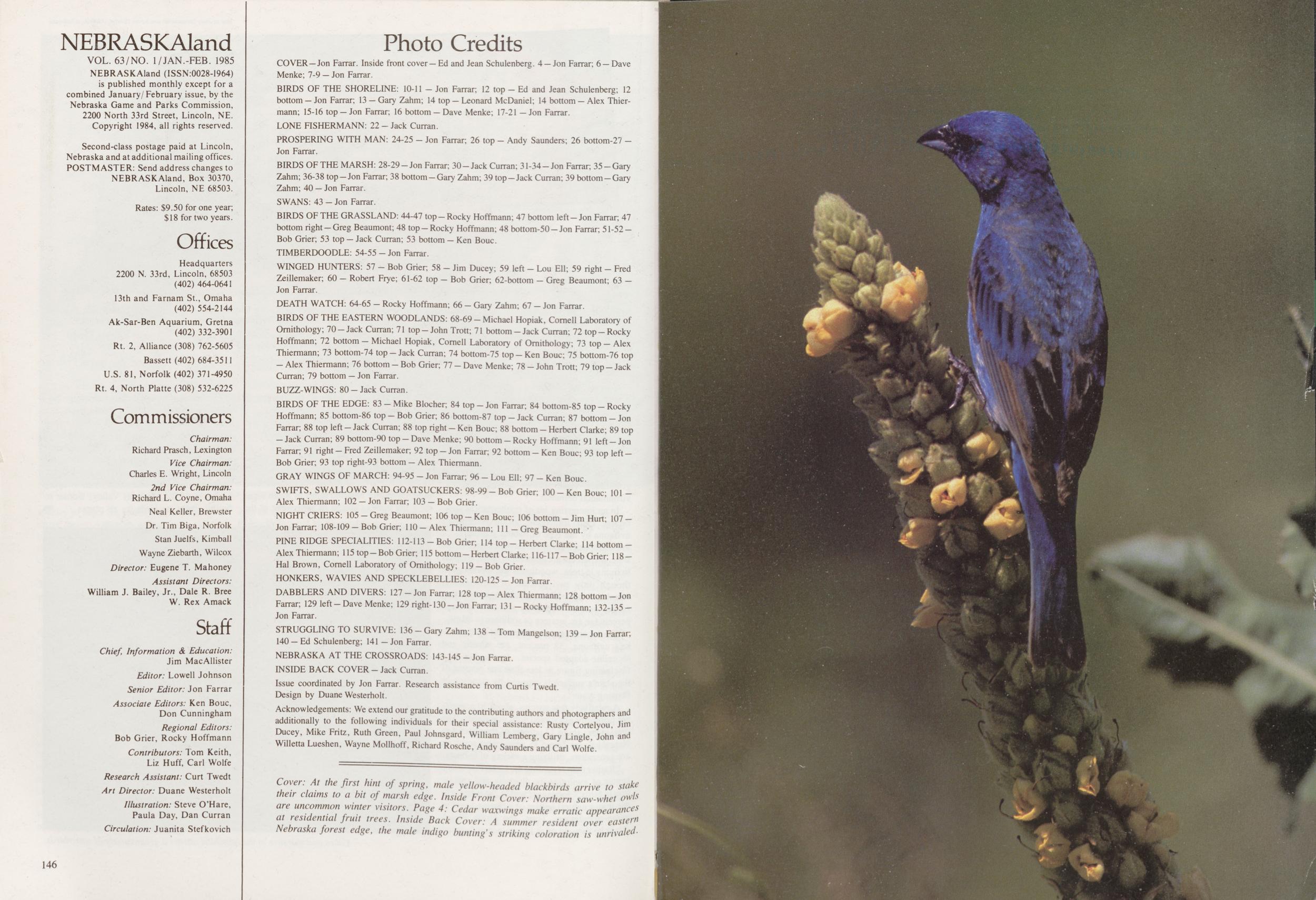
NEBRASKAland
VOL. 63/NO. l/JAN.-FEB. 1985 NEBRASKAland (ISSN:0028-1964) is published monthly except for a combined January/ February issue, by the Nebraska Game and Parks Commission, 2200 North 33rd Street, Lincoln, NE. Copyright 1984, all rights reserved. Second-class postage paid at Lincoln, Nebraska and at additional mailing offices. POSTMASTER: Send address changes to NEBRASKAland, Box 30370, Lincoln, NE 68503. Rates: $9.50 for one year; $18 for two years. Offiices Headquarters 2200 N. 33rd, Lincoln, 68503 (402) 464-0641 13th and Farnam St., Omaha (402) 554-2144 Ak-Sar-Ben Aquarium, Gretna (402)332-3901 Rt. 2, Alliance (308) 762-5605 Bassett (402) 684-3511 U.S. 81, Norfolk (402) 371-4950 Rt. 4, North Platte (308) 532-6225 Commissioners Chairman: Richard Prasch, Lexington Vice Chairman: Charles E. Wright, Lincoln 2nd Vice Chairman: Richard L. Coyne, Omaha Neal Keller, Brewster Dr. Tim Biga, Norfolk Stan Juelfs, Kimball Wayne Ziebarth, Wilcox Director: Eugene T. Ma honey Assistant Directors: William J. Bailey, Jr., Dale R. Bree W. Rex Amack Staff Chief, Information & Education: Jim MacAllister Editor: Lowell Johnson Senior Editor: Jon Farrar Associate Editors: Ken Bouc, Don Cunningham Regional Editors: Bob Grier, Rocky Hoffmann Contributors: lorn Keith, Liz Huff, Carl Wolfe Research Assistant: Curt Twedt Art Director: Duane Westerholt Illustration: Steve O'Hare, Paula Day, Dan Curran Circulation: Juanita Stefkovich Photo Credits COVER —Jon Farrar. Inside front cover— Ed and Jean Schulenberg. 4 — Jon Farrar; 6 — Dave Menke; 7-9 — Jon Farrar. BIRDS OF THE SHORELINE: 10-11 - Jon Farrar; 12 top - Ed and Jean Schulenberg; 12 bottom — Jon Farrar; 13 — Gary Zahm; 14 top — Leonard McDaniel; 14 bottom — Alex Thiermann; 15-16 top — Jon Farrar; 16 bottom — Dave Menke; 17-21 — Jon Farrar. LONE FISHERMANN: 22 - Jack Curran. PROSPERING WITH MAN: 24-25 - Jon Farrar; 26 top - Andy Saunders; 26 bottom-27 - Jon Farrar. BIRDS OF THE MARSH: 28-29-Jon Farrar; 30-Jack Curran; 31-34-Jon Farrar; 35-Gary Zahm; 36-38 top-Jon Farrar; 38 bottom-Gary Zahm; 39 top-Jack Curran; 39 bottom-Gary Zahm; 40 — Jon Farrar. SWANS: 43-Jon Farrar. BIRDS OF THE GRASSLAND: 44-47 top - Rocky Hoffmann; 47 bottom left - Jon Farrar; 47 bottom right-Greg Beaumont; 48 top-Rocky Hoffmann; 48 bottom-50 - Jon Farrar; 51-52- Bob Grier; 53 top — Jack Curran; 53 bottom — Ken Bouc. TIMBERDOODLE: 54-55 - Jon Farrar. WINGED HUNTERS: 57 - Bob Grier; 58 - Jim Ducey; 59 left - Lou Ell; 59 right - Fred Zeillemaker; 60 - Robert Frye; 61-62 top - Bob Grier; 62-bottom - Greg Beaumont; 63 - Jon Farrar. DEATH WATCH: 64-65 - Rocky Hoffmann; 66 - Gary Zahm; 67 - Jon Farrar. BIRDS OF THE EASTERN WOODLANDS: 68-69 - Michael Hopiak, Cornell Laboratory of Ornithology; 70-Jack Curran; 71 top-John Trott; 71 bottom-Jack Curran; 72 top-Rocky Hoffmann; 72 bottom - Michael Hopiak, Cornell Laboratory of Ornithology; 73 top - Alex Thiemann; 73 bottom-74 top-Jack Curran; 74 bottom-75 top- Ken Bouc: 75 bottom-76 top - Alex Thiermann; 76 bottom - Bob Grier; 77 - Dave Menke; 78 - John Trott; 79 top - Jack Curran; 79 bottom — Jon Farrar. BUZZ-WINGS: 80-Jack Curran. BIRDS OF THE EDGE: 83 - Mike Blocher; 84 top - Jon Farrar; 84 bottom-85 top - Rocky Hoffmann; 85 bottom-86 top - Bob Grier; 86 bottom-87 top - Jack Curran: 87 bottom - Jon Farrar; 88 top left - Jack Curran; 88 top right - Ken Bouc; 88 bottom - Herbert Clarke; 89 top - Jack Curran; 89 bottom-90 top - Dave Menke; 90 bottom - Rocky Hoffmann; 91 left - Jon Farrar; 91 right - Fred Zeillemaker; 92 top - Jon Farrar; 92 bottom - Ken Bouc; 93 top left - Bob Grier; 93 top right-93 bottom — Alex Thiermann. GRAY WINGS OF MARCH: 94-95 - Jon Farrar; 96 - Lou Ell; 97 - Ken Bouc. SWIFTS, SWALLOWS AND GOATSUCKERS: 98-99 - Bob Grier; 100- Ken Bouc; 101 - Alex Thiermann; 102 — Jon Farrar; 103 — Bob Grier. NIGHT CRIERS: 105 - Greg Beaumont; 106 top - Ken Bouc; 106 bottom - Jim Hurt; 107 - Jon Farrar; 108-109-Bob Grier; 110-Alex Thiermann; 111 -Greg Beaumont. PINE RIDGE SPECIALITIES: 112-113 - Bob Grier; 114 top - Herbert Clarke; 114 bottom - Alex Thiermann; 115 top-Bob Grier; 115 bottom-Herbert Clarke; 116-117-Bob Grier; 118- Hal Brown, Cornell Laboratory of Ornithology; 119 — Bob Grier. HONKERS, WAVIES AND SPECKLEBELLIES: 120-125-Jon Farrar. DABBLERS AND DIVERS: 127-Jon Farrar; 128 top-Alex Thiermann; 128 bottom-Jon Farrar; 129 left-Dave Menke; 129 right-130-Jon Farrar; 131 -Rocky Hoffmann; 132-135- Jon Farrar. STRUGGLING TO SURVIVE: 136-Gary Zahm; 138-Tom Mangelson; 139-Jon Farrar; 140 —Ed Schulenberg; 141 —Jon Farrar. NEBRASKA AT THE CROSSROADS: 143-145 -Jon Farrar. INSIDE BACK COVER - Jack Curran. Issue coordinated by Jon Farrar. Research assistance from Curtis Twedt. Design by Duane Westerholt. Acknowledgements: We extend our gratitude to the contributing authors and photographers and additionally to the following individuals for their special assistance: Rustv Cortelyou. Jim Ducey, Mike Fritz, Ruth Green, Paul Johnsgard, William Lemberg, Gary Lingle John and Willetta Lueshen, Wayne Mollhoft, Richard Rosche, Andy Saunders and Carl Wolfe Cover: At the first hint of spring, male yellow-headed blackbirds arrive to Stake their claims to a bit of marsh edge. Inside Front Cover: Northern saw-whet owl* are uncommon winter visitors. Page 4: Cedar waxwings make erratic appearand at residential fruit trees. Inside Back Cover: A summer resident over eastern Nebraska forest edget the male indigo bunting's Striking coloration is unrivaled 146
Position: 240 (32 views)