Volume 62, Issue 11, 1984
NEBRASKAland
December 1984 $1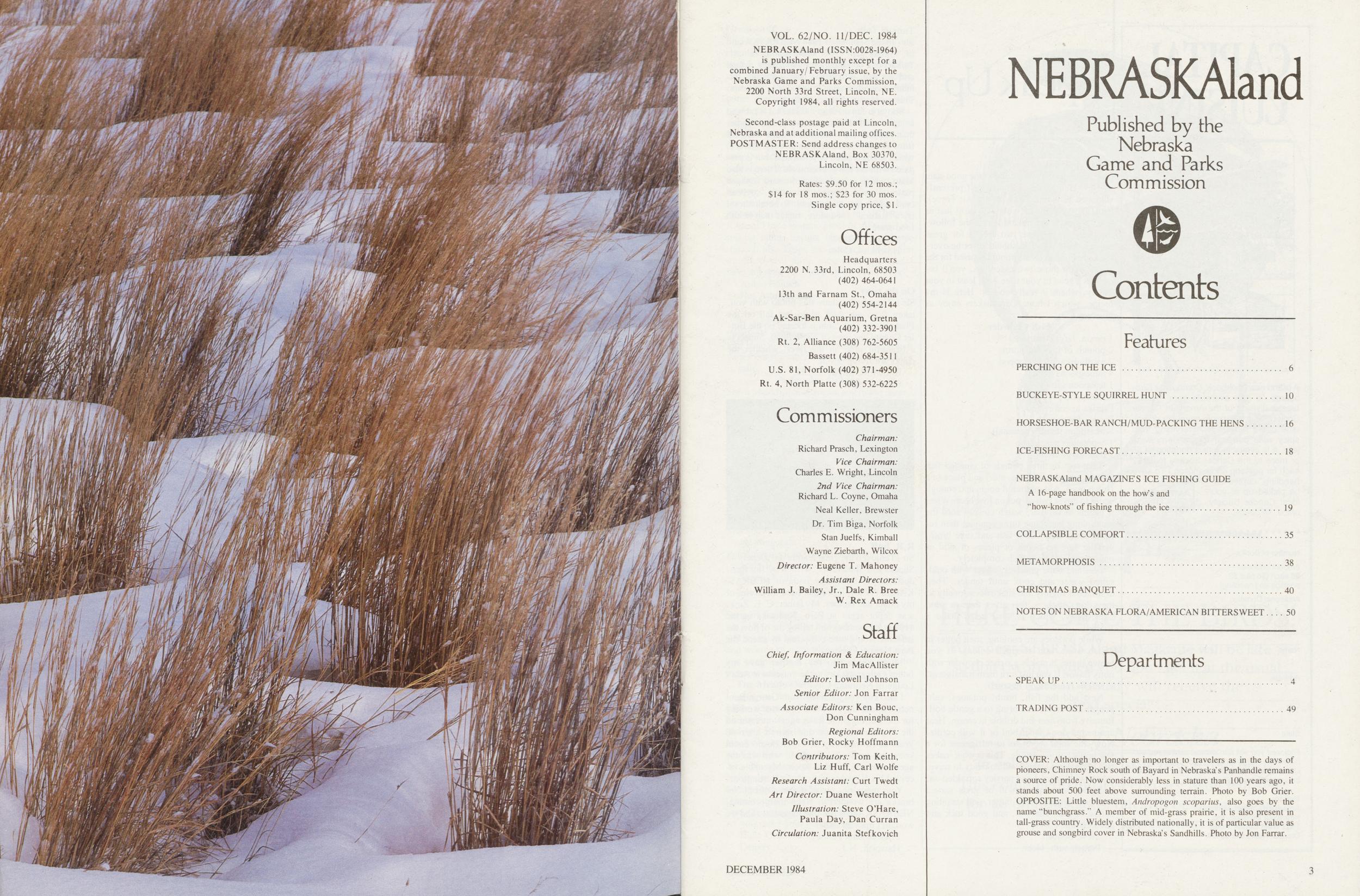
NEBRASKAland
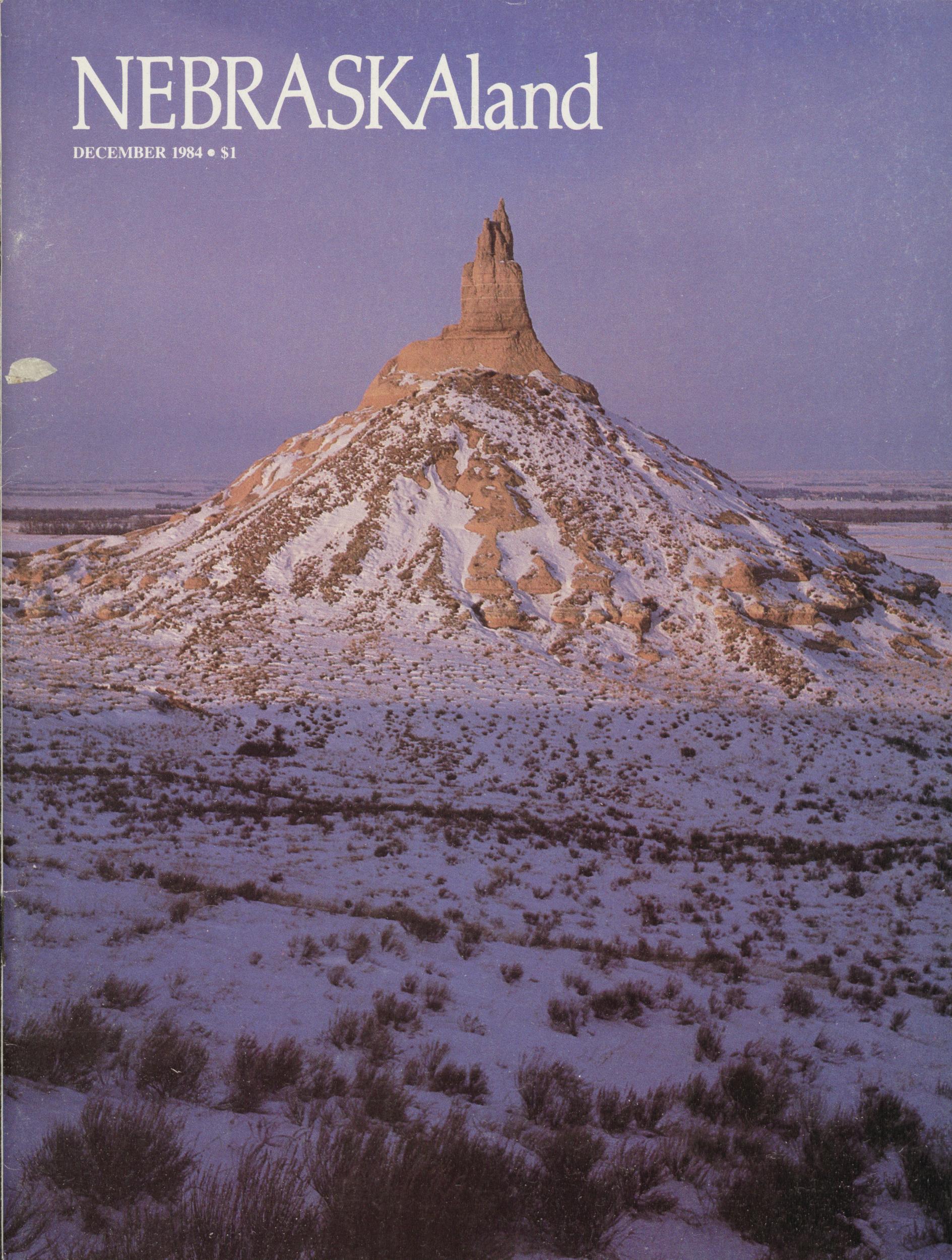
Published by the Nebraska Game and Parks Commission VOL. 62/NO. 11/DEC. 1984 NEBRASKAland (ISSN:0028-1964) is published monthly except for a combined January/ February issue, by the Nebraska Game and Parks Commission, 2200 North 33rd Street, Lincoln, NE. Copyright 1984, all rights reserved. Second-class postage paid at Lincoln, Nebraska and at additional mailing offices. POSTMASTER: Send address changes to NEBRASKAland, Box 30370, Lincoln, NE 68503. Rates: $9.50 for 12 mos.; $14 for 18 mos.; $23 for 30 mos. Single copy price, $1. Offices Headquarters 2200 N. 33rd, Lincoln, 68503 (402)464-0641 13th and Farnam St., Omaha (402) 554-2144 Ak-Sar-Ben Aquarium, Gretna (402) 332-3901 Rt. 2, Alliance (308) 762-5605 Bassett (402) 684-3511 U.S. 81, Norfolk (402) 371-4950 Rt. 4, North Platte (308) 532-6225 Commissioners Chairman: Richard Prasch, Lexington Vice Chairman: Charles E. Wright, Lincoln 2nd Vice Chairman: Richard L. Coyne, Omaha Neal Keller, Brewster Dr. Tim Biga, Norfolk Stan Juelfs, Kimball Wayne Ziebarth, Wilcox Director: Eugene T. Ma honey Assistant Directors: William J. Bailey, Jr., Dale R. Bree W. Rex Amack Staff Chief, Information & Education: Jim MacAllister Editor: Lowell Johnson Senior Editor: Jon Farrar Associate Editors: Ken Bouc, Don Cunningham Regional Editors: Bob Grier, Rocky Hoffmann Contributors: Tom Keith, Liz Huff, Carl Wolfe Research Assistant: Curt Twedt Art Director: Duane Westerholt Illustration: Steve O'Hare, Paula Day, Dan Curran Circulation: Juanita Stefkovich Contents Features PERCHING ON THE ICE 6 BUCKEYE-STYLE SQUIRREL HUNT 10 HORSESHOE-BAR RANCH/MUD-PACKING THE HENS 16 ICE-FISHING FORECAST 18 NEBRASKAland MAGAZINES ICE FISHING GUIDE A 16-page handbook on the how's and "how-knots" of fishing through the ice 19 COLLAPSIBLE COMFORT 35 METAMORPHOSIS 38 CHRISTMAS BANQUET 40 NOTES ON NEBRASKA FLORA/AMERICAN BITTERSWEET 50 Departments SPEAK UP 4 TRADING POST 49 COVER: Although no longer as important to travelers as in the days of pioneers, Chimney Rock south of Bayard in Nebraska's Panhandle remains a source of pride. Now considerably less in stature than 100 years ago, it stands about 500 feet above surrounding terrain. Photo by Bob Grier. OPPOSITE: Little bluestem, Andropogon scoparius, also goes by the name "bunchgrass." A member of mid-grass prairie, it is also present in tall-grass country. Widely distributed nationally, it is of particular value as grouse and songbird cover in Nebraska's Sandhills. Photo by Jon Farrar. DECEMBER 1984 3Speak Up
Super chowderSir/ Being from New England, the good state of New Hampshire, I find myself presently stationed in Nebraska (with the Air Force), and I have found that your fish taste just as good as our New England fish in the following recipe. There are two secrets for great fish chowder. The fish should never be overcooked, and real cream should be used for the broth. With those two essentials, you'll become a legend in your time — at least in your family, where it really counts. Here is my recipe, which I hope Cornhuskers enjoy as much as I do.
Fish Chowder 1 onion, large, quartered 2 pounds of fish (or more) 2 medium onions, chopped 4 tablespoons butter 1 teaspoon salt Vi teaspoon pepper Paprika to color Parsley for garnish lA teaspoon thyme (optional) 1 Vi potatoes per person 1 pint heavy creamTake two or three pounds of cleaned fish (perch, crappie, walleye, etc.) and place in a Dutch oven, add quartered onion and enough water to cover fish — put on low heat. When it begins to simmer, watch closely until the meat along backbone turns opaque, then remove from heat. Cool fish and save broth, making sure no bones or pieces of skin or onions remain. Bone fish completely.
Peel and cube potatoes, cover with cold, salted water and cook until tender. Then drain, cool slightly and shake occasionally so they don't stick — this gives them a good consistency, which is what helps make a legend!
While potatoes are cooking, melt butter in Dutch oven, add chopped onions. If you brown them, it makes a richer chowder with nutty flavor; if you just turn them translucent, it will be more onion flavored.
Next add the fish, broth, potatoes, salt, pepper and thyme and bring to a gentle boil. Remove from heat and dribble in cream. Heat again, but dont let it boil or it will curdle. Now, the final secret, is to refrigerate for a few hours before serving. This is what makes fish chowder a legend. When ready to serve, reheat with paprika and parsley sprinkled on, and your masterpiece will be great served with corn bread, lots of butter, and steaming coffee or tea. Thafs it, and good luck and good eating!
Steve Bennett Plattsmouth, Nebr. Tamari TalkSir/ In the September 1984 NEBRASKAland in "Speak Up" you wrote about tamari. Tamari is a combination of soybeans, wheat and sea salt, which has been naturally fermented and then aged in wood for two years. This gives it its distinctive flavor.
Shoyu is Japanese soy sauce that is brewed using a natural fermentation process rather than temperature control. It is quite different from the soy sauce on our grocery shelves, which is not brewed or fermented, but is prepared with the use of chemicals. There is also Miso, which is basically fermented soybean paste — quite different from tofu, soybean curd, which is not fermented. To obtain these, try a "natural" food store, rather than health food store.
Martha Mohan Hotchkiss, Colo. On the riverSir / Thought Td share this photo with you, taken from our duck blind last fall on the Platte River. Our cabin is located on the Butler County line west of North Bend. Sunset is a beautiful time on the river, whether the ducks are flying or not.
Robert M. Stryker, M.D. Omaha, Nebr.Sir /1 enjoyed the great feature on " Depots — Shacks and Showcases" written by Jim Reisdorff in the December issue of NEBRASKAland (1983). It brought back memories of my father and mother. My father, C. E. Zink, was depot agent at Peru, Nebraska in the 1900's. I remember him telling me of how the students would arrive by train to attend the Peru Normal College.
Many years ago my mother gave my father s telegraph key to the museum at Arbor Lodge in Nebraska City.
I also enjoyed the letter from George Bennett in Speak Up. He stated he started working for the Burlington R.R. as agent-operator on the Wymore Division and retired after 40 years at Pawnee City in 1957. He no doubt knew my uncle, R. C. Zink, who was the agent-operator at Table Rock. My uncle received his 50-year pin from the Burlington.
Your memories out of the past of old Nebraska are wonderful. Keep them coming. NEBRASKAland is a fine magazine, and we wouldn't miss an issue.
Frances Zink Penney Haworth, N.J. 4 NEBRASKAland Great stuffSir / It continues to amaze me, in this day and age, that you are able to continue publishing such a high-quality magazine at such a low subscription price. It really must be unique. As I recall the monthly issues, as well as the bonus specials about Nebraska Rivers, Railroads, etc., I feel the quality only improves.
NEBRASKAland is certaintly worthy of the great state it represents. I am very proud to display it prominently in my home for our many visitors from Germany, Holland, England, Switzerland, Scandinavia and Israel to read and enjoy. Needless to say, they are quite surprised and delighted with what they see, for some of them have known little about Nebraska before. Thanks to NEBRASKAland I have graphic proof of the value and special rather unsung beauty of my home state It also keeps me in touch, and determined to visit those most inviting places I have not seen yet. Keep up the good work.
Arden Bausch Nes Ammin, Israel Fallen" womanSir / Here is a poem on Nebraska's fall, which varies considerably each year, but the idea is valid.
Nebraska AutumnShe is a handsome, arrogant and fickle dame, And she swaggers sensuously down Time's freeway dressed In gypsy colors, yellow, crimson, flame, A flamboyant gown, And to her breast is pressed A basket richly piled, With all the treasures harvest time supplies Displayed in lavish style. Loving her, we are utterly beguiled, But on her painted lips there lies A gently mocking smile; She knows that winter with its icy, whistling gale
Is following close behind her on the trail.
Mary R. Moseley Tustin, Calif. Song of the larkSir / My roots are in Nebraska as I was born and reared in Nuckolls County. I do painting and writing of memories of life in Nebraska, and enclosed is a poem about our beautiful meadowlark.
The MeadowlarkI await you in the spring I hear you in the breeze I sight you on the wing and spot you in the trees. You bring beauty to my kind And gladness to my soul You awaken and remind Nature has its goal. So my feathered friend Open your voice and sing Some faint heart you may mend As you make your echoes ring.
Halle Grummert Denver, Colo. HERE COME THE BIRDS! Your next NEBRASKAland Magazine will be late... so don't worry when you don't get it at the usual time. Late in January will receive the next special... Birds of Nebraska ...an enlarged, colorful issue devoted to birds. This combined January-February issue will sell for $6 on newstands, but will be included as part of your subscription. DECEMBER 1984 5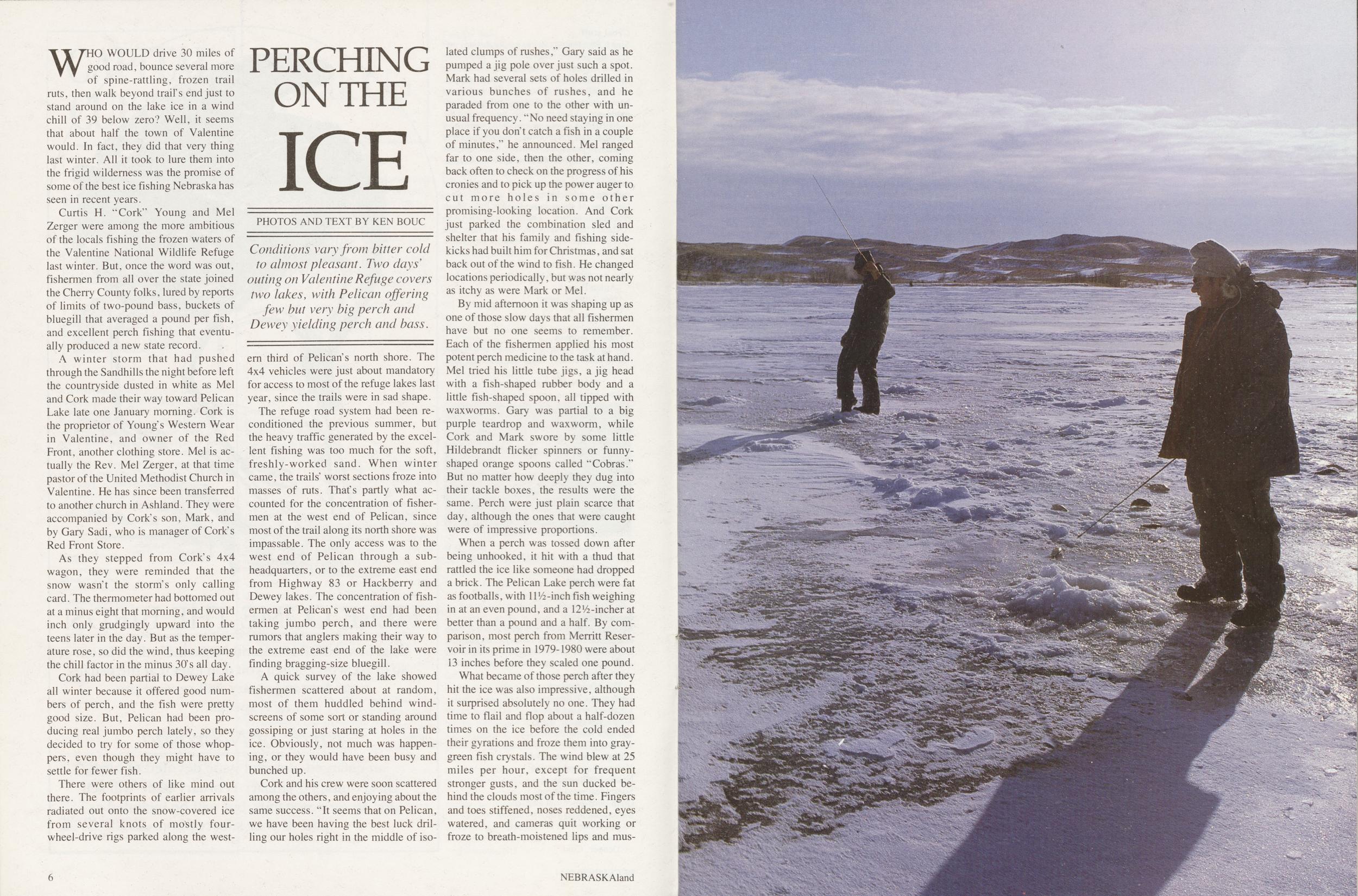
WHO WOULD drive 30 miles of good road, bounce several more of spine-rattling, frozen trail ruts, then walk beyond trail's end just to stand around on the lake ice in a wind chill of 39 below zero? Well, it seems that about half the town of Valentine would. In fact, they did that very thing last winter. All it took to lure them into the frigid wilderness was the promise of some of the best ice fishing Nebraska has seen in recent years.
Curtis H. "Cork" Young and Mel Zerger were among the more ambitious of the locals fishing the frozen waters of the Valentine National Wildlife Refuge last winter. But, once the word was out, fishermen from all over the state joined the Cherry County folks, lured by reports of limits of two-pound bass, buckets of bluegill that averaged a pound per fish, and excellent perch fishing that eventually produced a new state record.
A winter storm that had pushed through the Sandhills the night before left the countryside dusted in white as Mel and Cork made their way toward Pelican Lake late one January morning. Cork is the proprietor of Young's Western Wear in Valentine, and owner of the Red Front, another clothing store. Mel is actually the Rev. Mel Zerger, at that time pastor of the United Methodist Church in Valentine. He has since been transferred to another church in Ashland. They were accompanied by Cork's son, Mark, and by Gary Sadi, who is manager of Cork's Red Front Store.
As they stepped from Cork's 4x4 wagon, they were reminded that the snow wasn't the storm's only calling card. The thermometer had bottomed out at a minus eight that morning, and would inch only grudgingly upward into the teens later in the day. But as the temperature rose, so did the wind, thus keeping the chill factor in the minus 30's all day.
Cork had been partial to Dewey Lake all winter because it offered good numbers of perch, and the fish were pretty good size. But, Pelican had been producing real jumbo perch lately, so they decided to try for some of those whoppers, even though they might have to settle for fewer fish.
There were others of like mind out there. The footprints of earlier arrivals radiated out onto the snow-covered ice from several knots of mostly four-wheel-drive rigs parked along the western
PERCHING ON THE ICE PHOTOS AND TEXT BY KEN BOUC Conditions vary from bitter cold to almost pleasant. Two days' outing on Valentine Refuge covers two lakes, with Pelican offering few but very big perch and Dewey yielding perch and bass.third of Pelican's north shore. The 4x4 vehicles were just about mandatory for access to most of the refuge lakes last year, since the trails were in sad shape.
The refuge road system had been reconditioned the previous summer, but the heavy traffic generated by the excellent fishing was too much for the soft, freshly-worked sand. When winter came, the trails' worst sections froze into masses of ruts. That's partly what accounted for the concentration of fishermen at the west end of Pelican, since most of the trail along its north shore was impassable. The only access was to the west end of Pelican through a sub-headquarters, or to the extreme east end from Highway 83 or Hackberry and Dewey lakes. The concentration of fishermen at Pelican's west end had been taking jumbo perch, and there were rumors that anglers making their way to the extreme east end of the lake were finding bragging-size bluegill.
A quick survey of the lake showed fishermen scattered about at random, most of them huddled behind windscreens of some sort or standing around gossiping or just staring at holes in the ice. Obviously, not much was happening, or they would have been busy and bunched up.
Cork and his crew were soon scattered among the others, and enjoying about the same success. "It seems that on Pelican, we have been having the best luck drilling our holes right in the middle of isolated clumps of rushes," Gary said as he pumped a jig pole over just such a spot. Mark had several sets of holes drilled in various bunches of rushes, and he paraded from one to the other with unusual frequency. "No need staying in one place if you don't catch a fish in a couple of minutes," he announced. Mel ranged far to one side, then the other, coming back often to check on the progress of his cronies and to pick up the power auger to cut more holes in some other promising-looking location. And Cork just parked the combination sled and shelter that his family and fishing sidekicks had built him for Christmas, and sat back out of the wind to fish. He changed locations periodically, but was not nearly as itchy as were Mark or Mel.
By mid afternoon it was shaping up as one of those slow days that all fishermen have but no one seems to remember. Each of the fishermen applied his most potent perch medicine to the task at hand. Mel tried his little tube jigs, a jig head with a fish-shaped rubber body and a little fish-shaped spoon, all tipped with waxworms. Gary was partial to a big purple teardrop and wax worm, while Cork and Mark swore by some little Hildebrandt flicker spinners or funny-shaped orange spoons called "Cobras." But no matter how deeply they dug into their tackle boxes, the results were the same. Perch were just plain scarce that day, although the ones that were caught were of impressive proportions.
When a perch was tossed down after being unhooked, it hit with a thud that rattled the ice like someone had dropped a brick. The Pelican Lake perch were fat as footballs, with HVi-inch fish weighing in at an even pound, and a 12V2-incher at better than a pound and a half. By comparison, most perch from Merritt Reservoir in its prime in 1979-1980 were about 13 inches before they scaled one pound.
What became of those perch after they hit the ice was also impressive, although it surprised absolutely no one. They had time to flail and flop about a half-dozen times on the ice before the cold ended their gyrations and froze them into gray-green fish crystals. The wind blew at 25 miles per hour, except for frequent stronger gusts, and the sun ducked behind the clouds most of the time. Fingers and toes stiffened, noses reddened, eyes watered, and cameras quit working or froze to breath-moistened lips and mustache
6 NEBRASKAland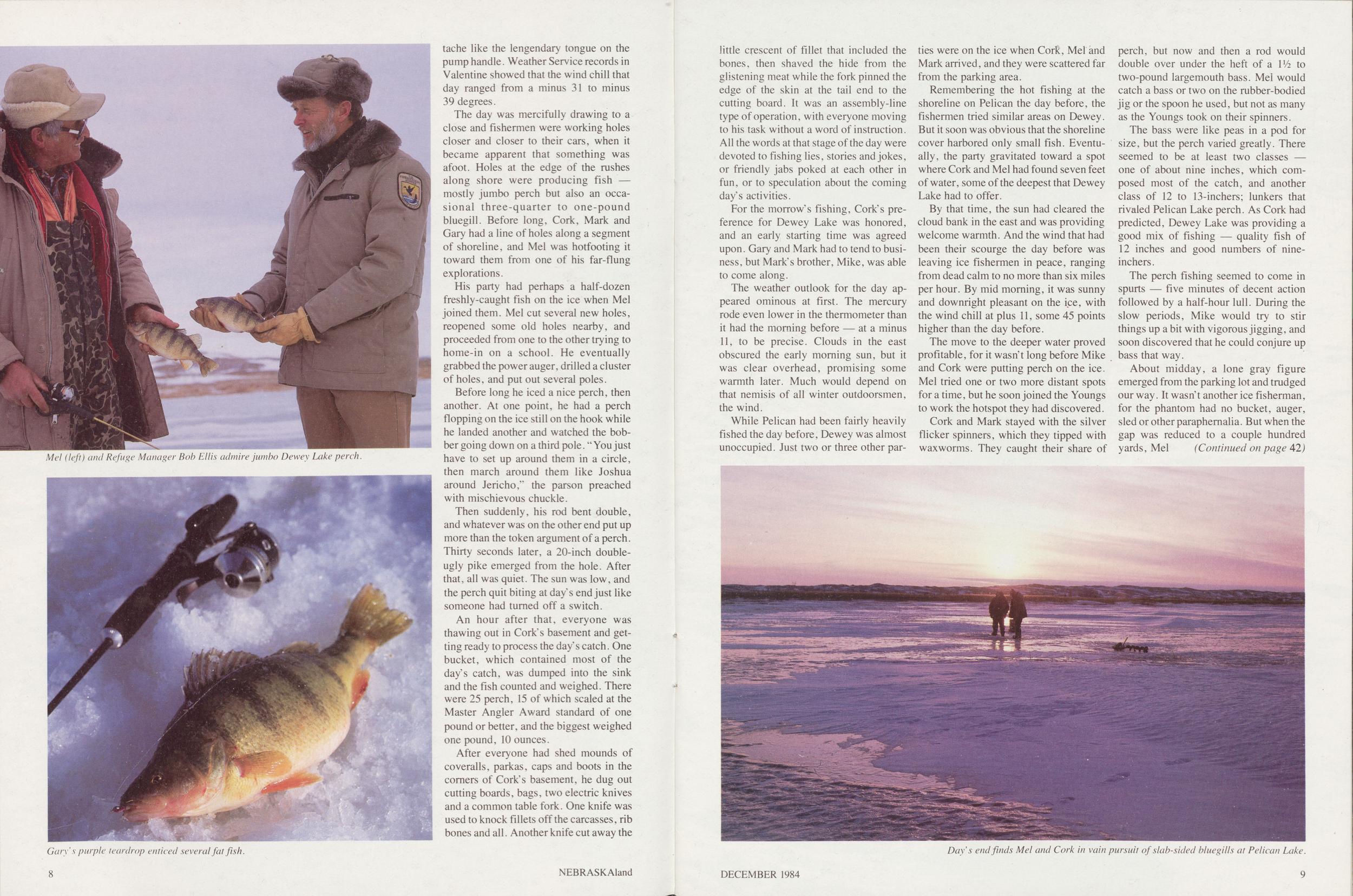
like the lengendary tongue on the pump handle. Weather Service records in Valentine showed that the wind chill that day ranged from a minus 31 to minus 39 degrees.
The day was mercifully drawing to a close and fishermen were working holes closer and closer to their cars, when it became apparent that something was afoot. Holes at the edge of the rushes along shore were producing fish — mostly jumbo perch but also an occasional three-quarter to one-pound bluegill. Before long, Cork, Mark and Gary had a line of holes along a segment of shoreline, and Mel was hotfooting it toward them from one of his far-flung explorations.
His party had perhaps a half-dozen freshly-caught fish on the ice when Mel joined them. Mel cut several new holes, reopened some old holes nearby, and proceeded from one to the other trying to home-in on a school. He eventually grabbed the power auger, drilled a cluster of holes, and put out several poles.
Before long he iced a nice perch, then another. At one point, he had a perch flopping on the ice still on the hook while he landed another and watched the bobber going down on a third pole. "You just have to set up around them in a circle, then march around them like Joshua around Jericho," the parson preached with mischievous chuckle.
Then suddenly, his rod bent double, and whatever was on the other end put up more than the token argument of a perch. Thirty seconds later, a 20-inch double-ugly pike emerged from the hole. After that, all was quiet. The sun was low, and the perch quit biting at days end just like someone had turned off a switch.
An hour after that, everyone was thawing out in Cork's basement and getting ready to process the day s catch. One bucket, which contained most of the day's catch, was dumped into the sink and the fish counted and weighed. There were 25 perch, 15 of which scaled at the Master Angler Award standard of one pound or better, and the biggest weighed one pound, 10 ounces.
After everyone had shed mounds of coveralls, parkas, caps and boots in the corners of Cork's basement, he dug out cutting boards, bags, two electric knives and a common table fork. One knife was used to knock fillets off the carcasses, rib bones and all. Another knife cut away the
little crescent of fillet that included the bones, then shaved the hide from the glistening meat while the fork pinned the edge of the skin at the tail end to the cutting board. It was an assembly-line type of operation, with everyone moving to his task without a word of instruction. All the words at that stage of the day were devoted to fishing lies, stories and jokes, or friendly jabs poked at each other in fun, or to speculation about the coming day's activities.
For the morrow's fishing, Cork's preference for Dewey Lake was honored, and an early starting time was agreed upon. Gary and Mark had to tend to business, but Mark's brother, Mike, was able to come along.
The weather outlook for the day appeared ominous at first. The mercury rode even lower in the thermometer than it had the morning before — at a minus 11, to be precise. Clouds in the east obscured the early morning sun, but it was clear overhead, promising some warmth later. Much would depend on that nemisis of all winter outdoorsmen, the wind.
While Pelican had been fairly heavily fished the day before, Dewey was almost unoccupied. Just two or three other parties were on the ice when Cork, Mel and Mark arrived, and they were scattered far from the parking area.
Remembering the hot fishing at the shoreline on Pelican the day before, the fishermen tried similar areas on Dewey. But it soon was obvious that the shoreline cover harbored only small fish. Eventually, the party gravitated toward a spot where Cork and Mel had found seven feet of water, some of the deepest that Dewey Lake had to offer.
By that time, the sun had cleared the cloud bank in the east and was providing welcome warmth. And the wind that had been their scourge the day before was leaving ice fishermen in peace, ranging from dead calm to no more than six miles per hour. By mid morning, it was sunny and downright pleasant on the ice, with the wind chill at plus 11, some 45 points higher than the day before.
The move to the deeper water proved profitable, for it wasn't long before Mike and Cork were putting perch on the ice. Mel tried one or two more distant spots for a time, but he soon joined the Youngs to work the hotspot they had discovered.
Cork and Mark stayed with the silver flicker spinners, which they tipped with wax worms. They caught their share of perch, but now and then a rod would double over under the heft of a VA to two-pound largemouth bass. Mel would catch a bass or two on the rubber-bodied jig or the spoon he used, but not as many as the Youngs took on their spinners.
The bass were like peas in a pod for size, but the perch varied greatly. There seemed to be at least two classes — one of about nine inches, which composed most of the catch, and another class of 12 to 13-inchers; lunkers that rivaled Pelican Lake perch. As Cork had predicted, Dewey Lake was providing a good mix of fishing — quality fish of 12 inches and good numbers of nine-inchers.
The perch fishing seemed to come in spurts — five minutes of decent action followed by a half-hour lull. During the slow periods, Mike would try to stir things up a bit with vigorous jigging, and soon discovered that he could conjure up bass that way.
About midday, a lone gray figure emerged from the parking lot and trudged our way. It wasn't another ice fisherman, for the phantom had no bucket, auger, sled or other paraphernalia. But when the gap was reduced to a couple hundred yards, Mel (Continued on page 42)
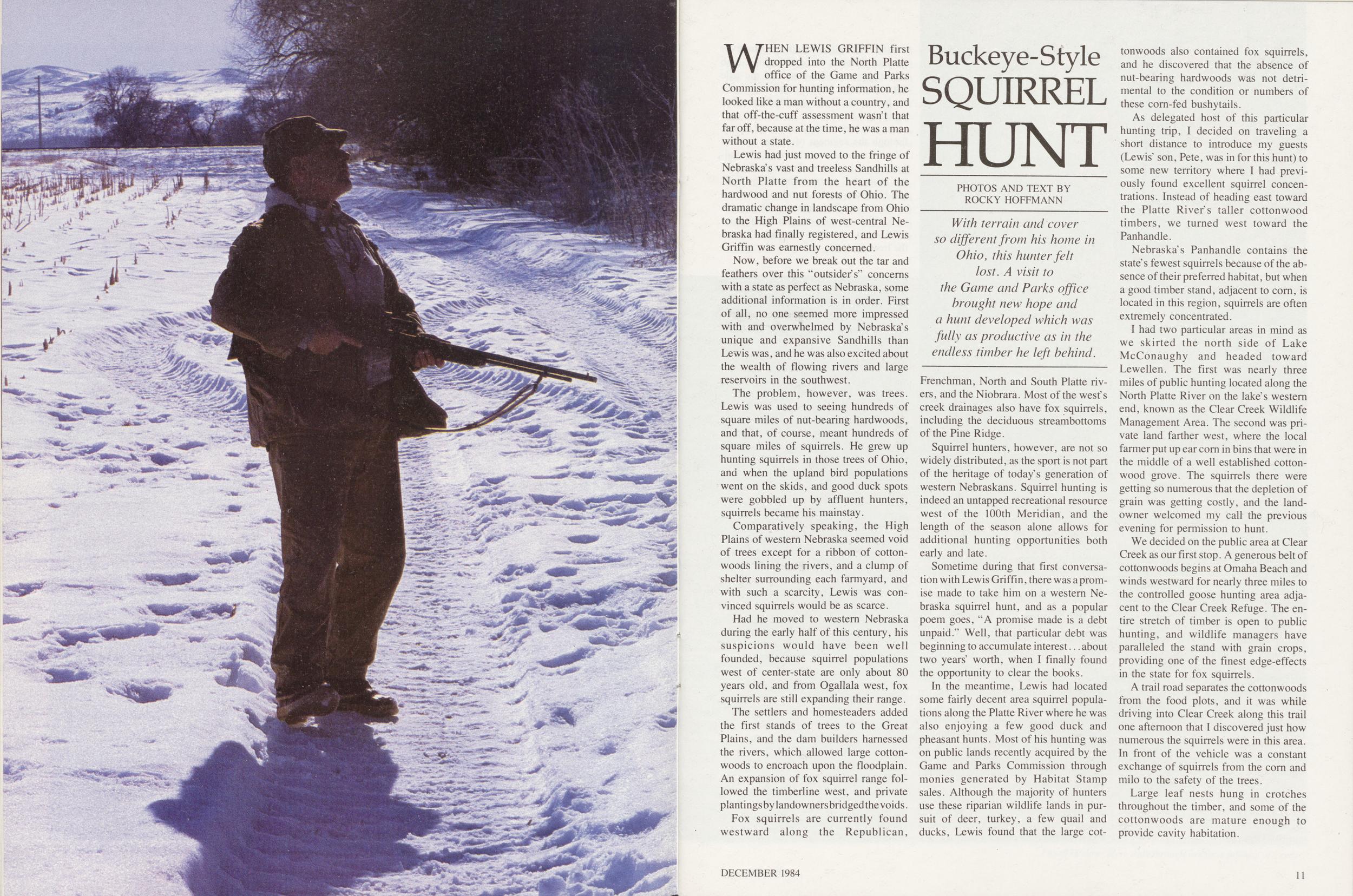
WHEN LEWIS GRIFFIN first dropped into the North Platte office of the Game and Parks Commission for hunting information, he looked like a man without a country, and that off-the-cuff assessment wasn't that far off, because at the time, he was a man without a state.
Lewis had just moved to the fringe of Nebraska's vast and treeless Sandhills at North Platte from the heart of the hardwood and nut forests of Ohio. The dramatic change in landscape from Ohio to the High Plains of west-central Nebraska had finally registered, and Lewis Griffin was earnestly concerned.
Now, before we break out the tar and feathers over this "outsider's" concerns with a state as perfect as Nebraska, some additional information is in order. First of all, no one seemed more impressed with and overwhelmed by Nebraska's unique and expansive Sandhills than Lewis was, and he was also excited about the wealth of flowing rivers and large reservoirs in the southwest.
The problem, however, was trees. Lewis was used to seeing hundreds of square miles of nut-bearing hardwoods, and that, of course, meant hundreds of square miles of squirrels. He grew up hunting squirrels in those trees of Ohio, and when the upland bird populations went on the skids, and good duck spots were gobbled up by affluent hunters, squirrels became his mainstay.
Comparatively speaking, the High Plains of western Nebraska seemed void of trees except for a ribbon of cottonwoods lining the rivers, and a clump of shelter surrounding each farmyard, and with such a scarcity, Lewis was convinced squirrels would be as scarce.
Had he moved to western Nebraska during the early half of this century, his suspicions would have been well founded, because squirrel populations west of center-state are only about 80 years old, and from Ogallala west, fox squirrels are still expanding their range.
The settlers and homesteaders added the first stands of trees to the Great Plains, and the dam builders harnessed the rivers, which allowed large cottonwoods to encroach upon the floodplain. An expansion of fox squirrel range followed the timberline west, and private plantingsby landowners bridged the voids.
Fox squirrels are currently found westward along the Republican,
Buckeye-Style SQUIRREL HUNT PHOTOS AND TEXT BY ROCKY HOFFMANN With terrain and cover so different from his home in Ohio, this hunter felt lost. A visit to the Game and Parks office brought new hope and a hunt developed which was fully as productive as in the endless timber he left behind.Frenchman, North and South Platte rivers, and the Niobrara. Most of the west's creek drainages also have fox squirrels, including the deciduous streambottoms of the Pine Ridge.
Squirrel hunters, however, are not so widely distributed, as the sport is not part of the heritage of today's generation of western Nebraskans. Squirrel hunting is indeed an untapped recreational resource west of the 100th Meridian, and the length of the season alone allows for additional hunting opportunities both early and late.
Sometime during that first conversation with Lewis Griffin, there was a promise made to take him on a western Nebraska squirrel hunt, and as a popular poem goes, "A promise made is a debt unpaid." Well, that particular debt was beginning to accumulate interest... about two years' worth, when I finally found the opportunity to clear the books.
In the meantime, Lewis had located some fairly decent area squirrel populations along the Platte River where he was also enjoying a few good duck and pheasant hunts. Most of his hunting was on public lands recently acquired by the Game and Parks Commission through monies generated by Habitat Stamp sales. Although the majority of hunters use these riparian wildlife lands in pursuit of deer, turkey, a few quail and ducks, Lewis found that the large cottonwoods also contained fox squirrels, and he discovered that the absence of nut-bearing hardwoods was not detrimental to the condition or numbers of these corn-fed bushy tails.
As delegated host of this particular hunting trip, I decided on traveling a short distance to introduce my guests (Lewis' son, Pete, was in for this hunt) to some new territory where I had previously found excellent squirrel concentrations. Instead of heading east toward the Platte River's taller cottonwood timbers, we turned west toward the Panhandle.
Nebraska's Panhandle contains the state's fewest squirrels because of the absence of their preferred habitat, but when a good timber stand, adjacent to corn, is located in this region, squirrels are often extremely concentrated.
I had two particular areas in mind as we skirted the north side of Lake McConaughy and headed toward Lewellen. The first was nearly three miles of public hunting located along the North Platte River on the lake's western end, known as the Clear Creek Wildlife Management Area. The second was private land farther west, where the local farmer put up ear corn in bins that were in the middle of a well established cottonwood grove. The squirrels there were getting so numerous that the depletion of grain was getting costly, and the landowner welcomed my call the previous evening for permission to hunt.
We decided on the public area at Clear Creek as our first stop. A generous belt of cottonwoods begins at Omaha Beach and winds westward for nearly three miles to the controlled goose hunting area adjacent to the Clear Creek Refuge. The entire stretch of timber is open to public hunting, and wildlife managers have paralleled the stand with grain crops, providing one of the finest edge-effects in the state for fox squirrels.
A trail road separates the cottonwoods from the food plots, and it was while driving into Clear Creek along this trail one afternoon that I discovered just how numerous the squirrels were in this area. In front of the vehicle was a constant exchange of squirrels from the corn and milo to the safety of the trees.
Large leaf nests hung in crotches throughout the timber, and some of the cottonwoods are mature enough to provide cavity habitation.
DECEMBER 1984 11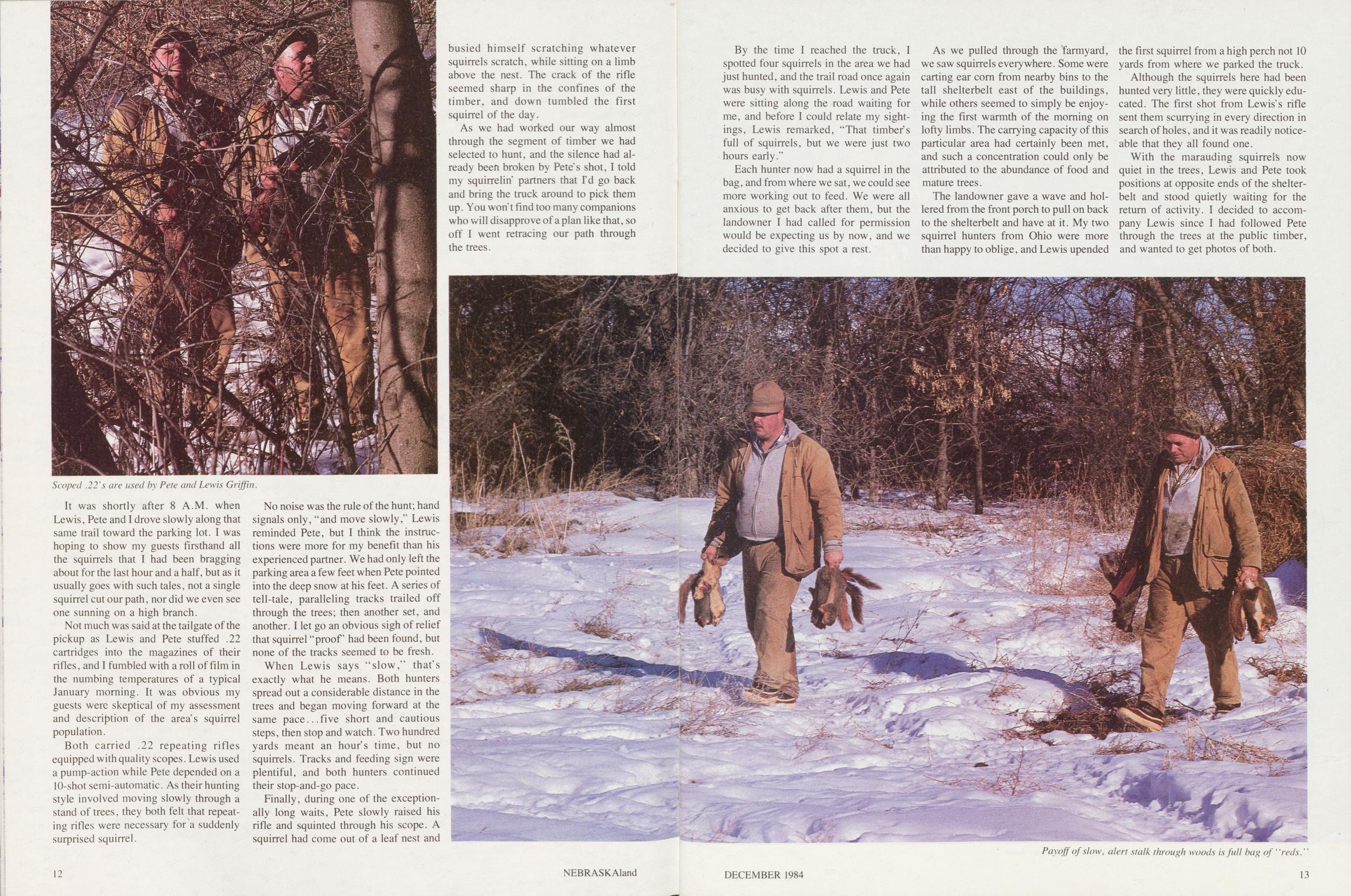
It was shortly after 8 A.M. when Lewis, Pete and I drove slowly along that same trail toward the parking lot. I was hoping to show my guests firsthand all the squirrels that I had been bragging about for the last hour and a half, but as it usually goes with such tales, not a single squirrel cut our path, nor did we even see one sunning on a high branch.
Not much was said at the tailgate of the pickup as Lewis and Pete stuffed .22 cartridges into the magazines of their rifles, and I fumbled with a roll of film in the numbing temperatures of a typical January morning. It was obvious my guests were skeptical of my assessment and description of the area's squirrel population.
Both carried .22 repeating rifles equipped with quality scopes. Lewis used a pump-action while Pete depended on a 10-shot semi-automatic. As their hunting style involved moving slowly through a stand of trees, they both felt that repeating rifles were necessary for a suddenly surprised squirrel.
No noise was the rule of the hunt; hand signals only, "and move slowly," Lewis reminded Pete, but I think the instructions were more for my benefit than his experienced partner. We had only left the parking area a few feet when Pete pointed into the deep snow at his feet. A series of tell-tale, paralleling tracks trailed off through the trees; then another set, and another. I let go an obvious sigh of relief that squirrel "proof had been found, but none of the tracks seemed to be fresh.
When Lewis says "slow," that's exactly what he means. Both hunters spread out a considerable distance in the trees and began moving forward at the same pace...five short and cautious steps, then stop and watch. Two hundred yards meant an hour's time, but no squirrels. Tracks and feeding sign were plentiful, and both hunters continued their stop-and-go pace.
Finally, during one of the exceptionally long waits, Pete slowly raised his rifle and squinted through his scope. A squirrel had come out of a leaf nest and busied himself scratching whatever squirrels scratch, while sitting on a limb above the nest. The crack of the rifle seemed sharp in the confines of the timber, and down tumbled the first squirrel of the day.
As we had worked our way almost through the segment of timber we had selected to hunt, and the silence had already been broken by Petes shot, I told my squirrelin' partners that I'd go back and bring the truck around to pick them up. You wont find too many companions who will disapprove of a plan like that, so off I went retracing our path through the trees.
12 NEBRASKAlandBy the time I reached the truck, I spotted four squirrels in the area we had just hunted, and the trail road once again was busy with squirrels. Lewis and Pete were sitting along the road waiting for me, and before I could relate my sightings, Lewis remarked, "That timber's full of squirrels, but we were just two hours early."
Each hunter now had a squirrel in the bag, and from where we sat, we could see more working out to feed. We were all anxious to get back after them, but the landowner I had called for permission would be expecting us by now, and we decided to give this spot a rest.
As we pulled through the farmyard, we saw squirrels everywhere. Some were carting ear corn from nearby bins to the tall shelterbelt east of the buildings, while others seemed to simply be enjoying the first warmth of the morning on lofty limbs. The carrying capacity of this particular area had certainly been met, and such a concentration could only be attributed to the abundance of food and mature trees.
The landowner gave a wave and hollered from the front porch to pull on back to the shelterbelt and have at it. My two squirrel hunters from Ohio were more than happy to oblige, and Lewis upended the first squirrel from a high perch not 10 yards from where we parked the truck. Although the squirrels here had been hunted very little, they were quickly educated. The first shot from Lewis's rifle sent them scurrying in every direction in search of holes, and it was readily noticeable that they all found one.
With the marauding squirrel's now quiet in the trees, Lewis and Pete took positions at opposite ends of the shelterbelt and stood quietly waiting for the return of activity. I decided to accompany Lewis since I had followed Pete through the trees at the public timber, and wanted to get photos of both.
No sooner had Lewis and I found a place to stand in the shadow of a large Cottonwood, than we heard Pete's first shot. Shortly thereafter we heard another report from the small caliber rifle; then another and another.
"They're starting to move again, and it sounds like Pete's right in the middle of them," Lewis whispered, as he scanned the branches of the surrounding trees. Lewis knew from experience that if a hunter stands completely still, he can shoot his limit of squirrels from one spot. "It's really not the sound of the shot that spooks the squirrels. It's the movement and commotion of the hunter before and after the shot."
We heard Pete take another shot, and at the same time Lewis noticed a set of rounded ears protruding over the knurled bark of an old tree. There wasn't enough of this bushytail showing for either a clean shot or a "barking" shot, so Lewis employed another backwoods trick. He gave a short chatter from somewhere back in his throat that sounded like an authentically mad squirrel. Up came the head and down came the squirrel.
Two more squirrels were shortly retired from the same tree before Lewis decided to move down the shelterbelt to another large cottonwood that contained a lot of cavities, and it wasn't long before a squirrel or two there got too curious.
Lewis scratched another one out of a nearby tree, and the silence from Pete's end of the shelterbelt indicated his limit was complete and he was back at the truck enjoying lunch. We decided to join him and, hopefully, pick up one more squirrel before leaving.
Pete said that he had positioned himself between the corn bin and the shelterbelt and had met a constant parade of squirrels attempting to pillage from the bin. Pete had seven fat squirrels cooling in the snow by the pickup, indicating that he had been reasonably efficient at protecting the corn, and he gave his dad a friendly rub about coming up one short.
Lewis leaned across the hood of the pickup, with his eyes fixed on the nearby corn bin, as he polished off the last half of his sandwich. Suddenly his eyes gave a bit of a sparkle, and he picked up his rifle and stalked quietly off in the direction of the bin. Slowly, he disappeared behind the cage of corn, and the muffled crack of his rifle followed. Pete smiled as Lewis returned to the truck toting the last squirrel of the day.
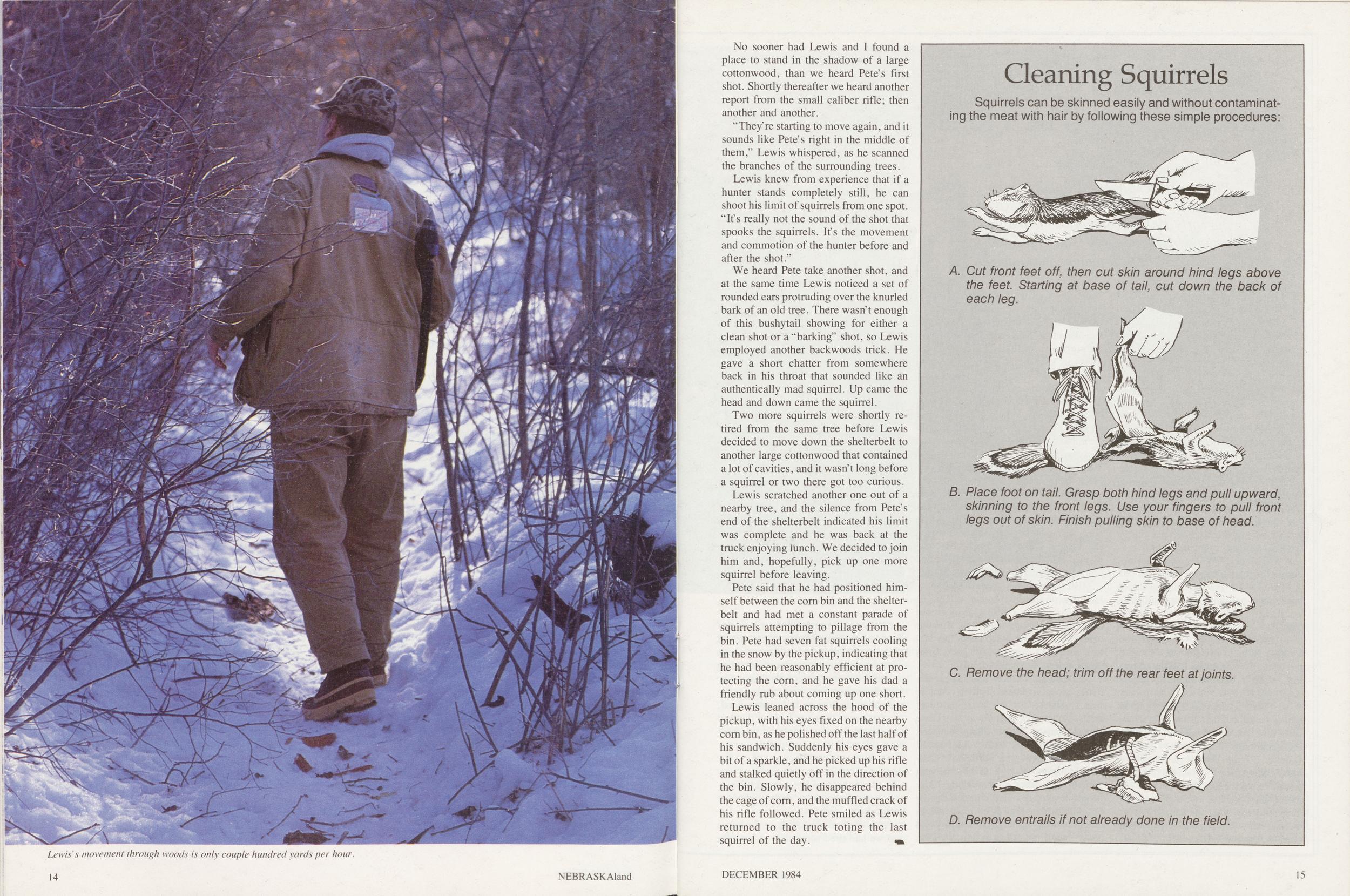
Cleaning Squirrels Squirrels can be skinned easily and without contaminating the meat with hair by following these simple procedures: A. Cut front feet off, then cut skin around hind legs above the feet Starting at base of tail, cut down the back of each leg. B. Place foot on tail. Grasp both hind legs and pull upward, skinning to the front legs. Use your fingers to pull front legs out of skin. Finish pulling skin to base of head. C. Remove the head; trim off the rear feet at joints. D. Remove entrails if not already done in the field. DECEMBER 1984 15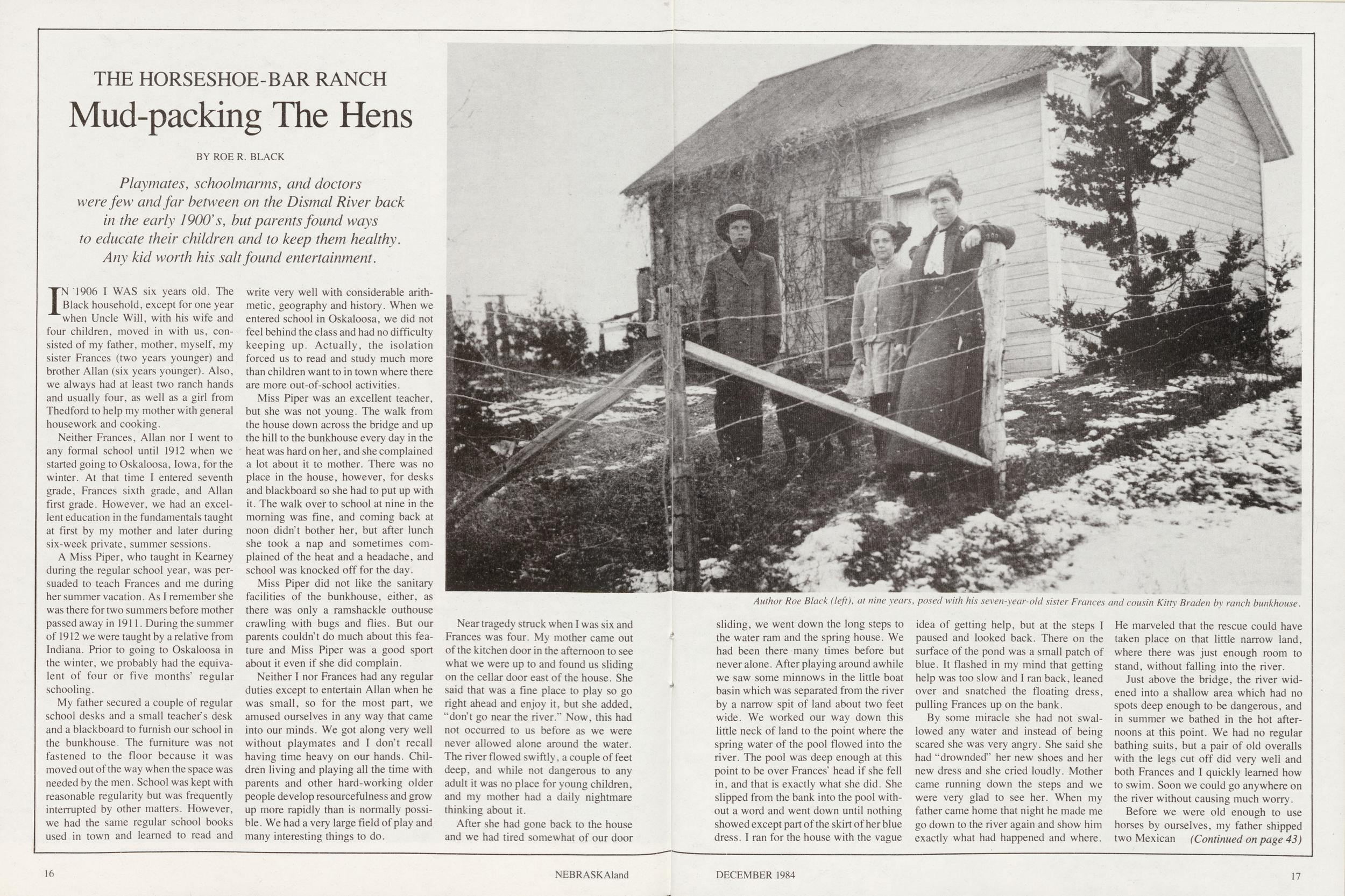
THE HORSESHOE-BAR RANCH Mud-packing The Hens
BY ROE R. BLACK Playmates, schoolmarms, and doctors were few and far between on the Dismal River back in the early 1900' s, but parents found ways to educate their children and to keep them healthy. Any kid worth his salt found entertainment.IN 1906 I WAS six years old. The Black household, except for one year when Uncle Will, with his wife and four children, moved in with us, consisted of my father, mother, myself, my sister Frances (two years younger) and brother Allan (six years younger). Also, we always had at least two ranch hands and usually four, as well as a girl from Thedford to help my mother with general housework and cooking.
Neither Frances, Allan nor I went to any formal school until 1912 when we started going to Oskaloosa, Iowa, for the winter. At that time I entered seventh grade, Frances sixth grade, and Allan first grade. However, we had an excellent education in the fundamentals taught at first by my mother and later during six-week private, summer sessions.
A Miss Piper, who taught in Kearney during the regular school year, was persuaded to teach Frances and me during her summer vacation. As I remember she was there for two summers before mother passed away in 1911. During the summer of 1912 we were taught by a relative from Indiana. Prior to going to Oskaloosa in the winter, we probably had the equivalent of four or five months' regular schooling.
My father secured a couple of regular school desks and a small teacher's desk and a blackboard to furnish our school in the bunkhouse. The furniture was not fastened to the floor because it was moved out of the way when the space was needed by the men. School was kept with reasonable regularity but was frequently interrupted by other matters. However, we had the same regular school books used in town and learned to read and write very well with considerable arithmetic, geography and history. When we entered school in Oskaloosa, we did not feel behind the class and had no difficulty keeping up. Actually, the isolation forced us to read and study much more than children want to in town where there are more out-of-school activities.
Miss Piper was an excellent teacher, but she was not young. The walk from the house down across the bridge and up the hill to the bunkhouse every day in the heat was hard on her, and she complained a lot about it to mother. There was no place in the house, however, for desks and blackboard so she had to put up with it. The walk over to school at nine in the morning was fine, and coming back at noon didn't bother her, but after lunch she took a nap and sometimes complained of the heat and a headache, and school was knocked off for the day.
Miss Piper did not like the sanitary facilities of the bunkhouse, either, as there was only a ramshackle outhouse crawling with bugs and flies. But our parents couldn't do much about this feature and Miss Piper was a good sport about it even if she did complain.
Neither I nor Frances had any regular duties except to entertain Allan when he was small, so for the most part, we amused ourselves in any way that came into our minds. We got along very well without playmates and I don't recall having time heavy on our hands. Children living and playing all the time with parents and other hard-working older people develop resourcefulness and grow up more rapidly than is normally possible. We had a very large field of play and many interesting things to do.
Near tragedy struck when I was six and Frances was four. My mother came out of the kitchen door in the afternoon to see what we were up to and found us sliding on the cellar door east of the house. She said that was a fine place to play so go right ahead and enjoy it, but she added, "don't go near the river." Now, this had not occurred to us before as we were never allowed alone around the water. The river flowed swiftly, a couple of feet deep, and while not dangerous to any adult it was no place for young children, and my mother had a daily nightmare thinking about it.
After she had gone back to the house and we had tired somewhat of our door
16 NEBRASKAlandsliding, we went down the long steps to the water ram and the spring house. We had been there many times before but never alone. After playing around awhile we saw some minnows in the little boat basin which was separated from the river by a narrow spit of land about two feet wide. We worked our way down this little neck of land to the point where the spring water of the pool flowed into the river. The pool was deep enough at this point to be over Frances' head if she fell in, and that is exactly what she did. She slipped from the bank into the pool without a word and went down until nothing showed except part of the skirt of her blue dress. I ran for the house with the vague idea of getting help, but at the steps I paused and looked back. There on the surface of the pond was a small patch of blue. It flashed in my mind that getting help was too slow and I ran back, leaned over and snatched the floating dress, pulling Frances up on the bank.
By some miracle she had not swallowed any water and instead of being scared she was very angry. She said she had "drownded" her new shoes and her new dress and she cried loudly. Mother came running down the steps and we were very glad to see her. When my father came home that night he made me go down to the river again and show him exactly what had happened and where. He marveled that the rescue could have taken place on that little narrow land, where there was just enough room to stand, without falling into the river.
Just above the bridge, the river widened into a shallow area which had no spots deep enough to be dangerous, and in summer we bathed in the hot afternoons at this point. We had no regular bathing suits, but a pair of old overalls with the legs cut off did very well and both Frances and I quickly learned how to swim. Soon we could go anywhere on the river without causing much worry.
Before we were old enough to use horses by ourselves, my father shipped two Mexican (Continued on page 43)
DECEMBER 1984 17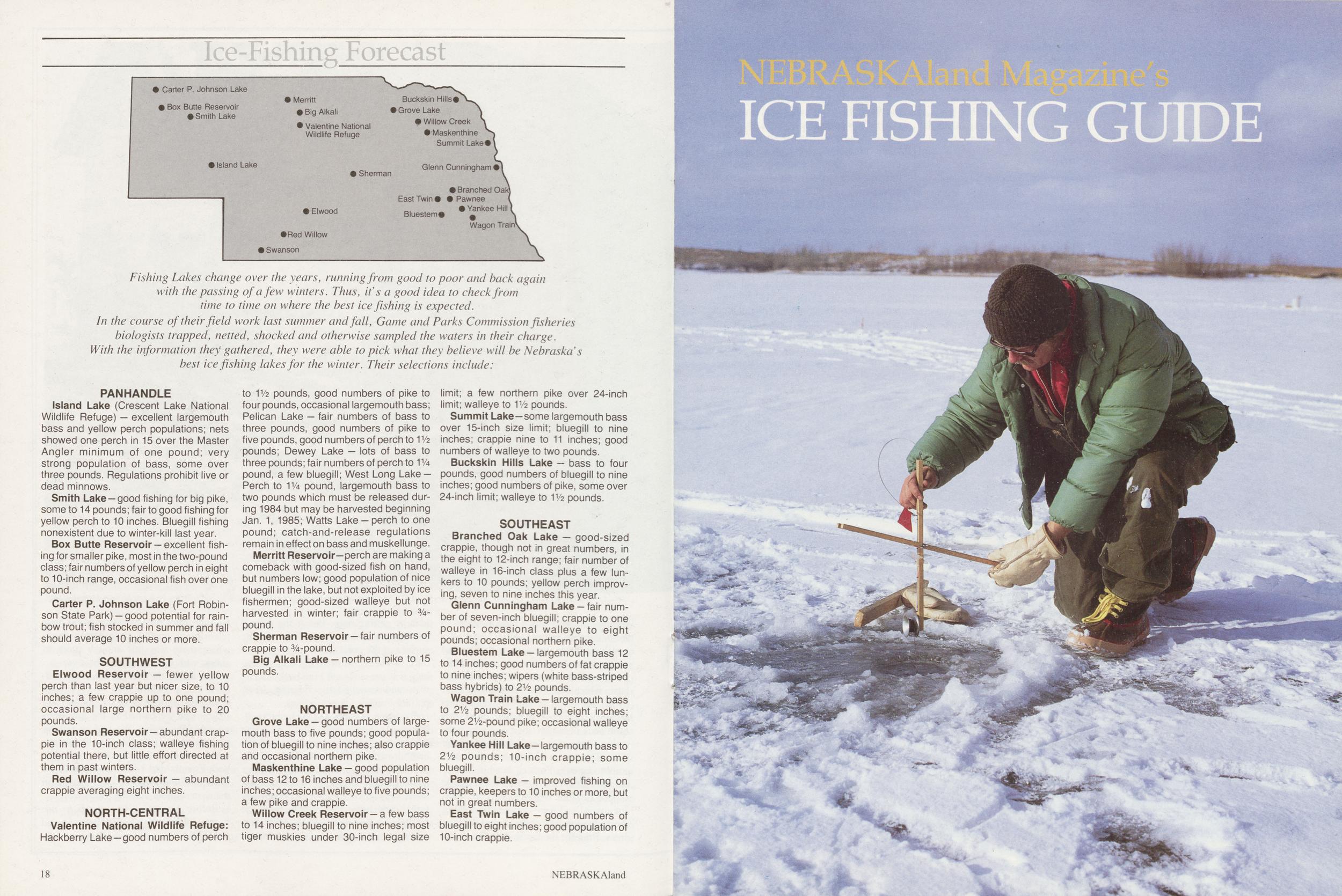
Island Lake (Crescent Lake National Wildlife Refuge) — excellent largemouth bass and yellow perch populations; nets showed one perch in 15 over the Master Angler minimum of one pound; very strong population of bass, some over three pounds. Regulations prohibit live or dead minnows.
Smith Lake —good fishing for big pike, some to 14 pounds; fair to good fishing for yellow perch to 10 inches. Bluegill fishing nonexistent due to winter-kill last year.
Box Butte Reservoir-excellent fishing for smaller pike, most in the two-pound class; fair numbers of yellow perch in eight to 10-inch range, occasional fish over one pound.
Carter P. Johnson Lake (Fort Robinson State Park) — good potential for rainbow trout; fish stocked in summer and fall should average 10 inches or more.
SOUTHWESTElwood Reservoir — fewer yellow perch than last year but nicer size, to 10 inches; a few crappie up to one pound; occasional large northern pike to 20 pounds.
Swanson Reservoir —abundant crappie in the 10-inch class; walleye fishing potential there, but little effort directed at them in past winters.
Red Willow Reservoir — abundant crappie averaging eight inches.
NORTH-CENTRALValentine National Wildlife Refuge: Hackberry Lake-good numbers of perch to 11/2 pounds, good numbers of pike to four pounds, occasional largemouth bass; Pelican Lake — fair numbers of bass to three pounds, good numbers of pike to five pounds, good numbers of perch to 1V2 pounds; Dewey Lake — lots of bass to three pounds; fair numbers of perch to VM pound, a few bluegill; West Long Lake — Perch to VA pound, largemouth bass to two pounds which must be released during 1984 but may be harvested beginning Jan. 1, 1985; Watts Lake - perch to one pound; catch-and-release regulations remain in effect on bass and muskellunge.
Merritt Reservoir-perch are making a comeback with good-sized fish on hand, but numbers low; good population of nice bluegill in the lake, but not exploited by ice fishermen; good-sized walleye but not harvested in winter; fair crappie to 3A-pound.
Sherman Reservoir-fair numbers of crappie to 3/4-pound.
Big Alkali Lake - northern pike to 15 pounds.
NORTHEASTGrove Lake - good numbers of largemouth bass to five pounds; good population of bluegill to nine inches; also crappie and occasional northern pike.
Maskenthine Lake — good population of bass 12 to 16 inches and bluegill to nine inches; occasional walleye to five pounds; a few pike and crappie.
Willow Creek Reservoir — a few bass to 14 inches; bluegill to nine inches; most tiger muskies under 30-inch legal size limit; a few northern pike over 24-inch limit; walleye to IV2 pounds.
Summit Lake-some largemouth bass over 15-inch size limit; bluegill to nine inches; crappie nine to 11 inches; good numbers of walleye to two pounds.
Buckskin Hills Lake — bass to four pounds, good numbers of bluegill to nine inches; good numbers of pike, some over 24-inch limit; walleye to IV2 pounds.
SOUTHEASTBranched Oak Lake — good-sized crappie, though not in great numbers, in the eight to 12-inch range; fair number of walleye in 16-inch class plus a few lunkers to 10 pounds; yellow perch improving, seven to nine inches this year.
Glenn Cunningham Lake-fair number of seven-inch bluegill; crappie to one pound; occasional walleye to eight pounds; occasional northern pike.
Bluestem Lake - largemouth bass 12 to 14 inches; good numbers of fat crappie to nine inches; wipers (white bass-striped bass hybrids) to 21/2 pounds.
Wagon Train Lake - largemouth bass to 2V2 pounds; bluegill to eight inches; some 21/2-pound pike; occasional walleye to four pounds.
Yankee Hill Lake-largemouth bass to 2V2 pounds; 10-inch crappie; some bluegill.
Pawnee Lake — improved fishing on crappie, keepers to 10 inches or more, but not in great numbers.
East Twin Lake - good numbers of bluegill to eight inches; good population of 10-inch crappie.
18 NEBRASKAland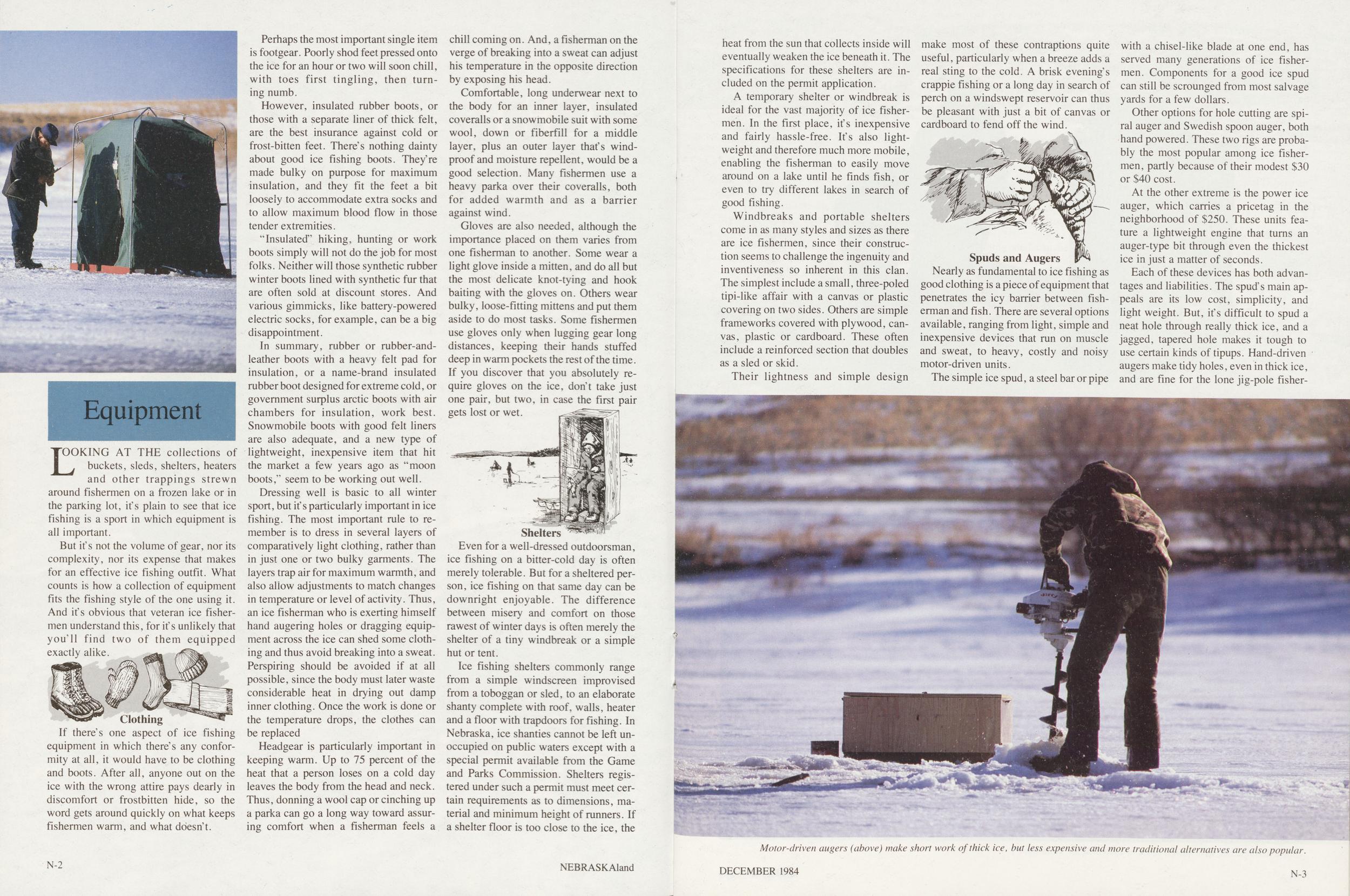
LOOKING AT THE collections of buckets, sleds, shelters, heaters and other trappings strewn around fishermen on a frozen lake or in the parking lot, it's plain to see that ice fishing is a sport in which equipment is all important.
But it's not the volume of gear, nor its complexity, nor its expense that makes for an effective ice fishing outfit. What counts is how a collection of equipment fits the fishing style of the one using it. And it's obvious that veteran ice fishermen understand this, for it's unlikely that you'll find two of them equipped exactly alike.
ClothingIf there's one aspect of ice fishing equipment in which there's any conformity at all, it would have to be clothing and boots. After all, anyone out on the ice with the wrong attire pays dearly in discomfort or frostbitten hide, so the word gets around quickly on what keeps fishermen warm, and what doesn't.
Perhaps the most important single item is footgear. Poorly shod feet pressed onto the ice for an hour or two will soon chill, with toes first tingling, then turning numb.
However, insulated rubber boots, or those with a separate liner of thick felt, are the best insurance against cold or frost-bitten feet. There's nothing dainty about good ice fishing boots. They're made bulky on purpose for maximum insulation, and they fit the feet a bit loosely to accommodate extra socks and to allow maximum blood flow in those tender extremities.
"Insulated" hiking, hunting or work boots simply will not do the job for most folks. Neither will those synthetic rubber winter boots lined with synthetic fur that are often sold at discount stores. And various gimmicks, like battery-powered electric socks, for example, can be a big disappointment.
In summary, rubber or rubber-and-leather boots with a heavy felt pad for insulation, or a name-brand insulated rubber boot designed for extreme cold, or government surplus arctic boots with air chambers for insulation, work best. Snowmobile boots with good felt liners are also adequate, and a new type of lightweight, inexpensive item that hit the market a few years ago as "moon boots," seem to be working out well.
Dressing well is basic to all winter sport, but if s particularly important in ice fishing. The most important rule to remember is to dress in several layers of comparatively light clothing, rather than in just one or two bulky garments. The layers trap air for maximum warmth, and also allow adjustments to match changes in temperature or level of activity. Thus, an ice fisherman who is exerting himself hand augering holes or dragging equipment across the ice can shed some clothing and thus avoid breaking into a sweat. Perspiring should be avoided if at all possible, since the body must later waste considerable heat in drying out damp inner clothing. Once the work is done or the temperature drops, the clothes can be replaced
Headgear is particularly important in keeping warm. Up to 75 percent of the heat that a person loses on a cold day leaves the body from the head and neck. Thus, donning a wool cap or cinching up a parka can go a long way toward assuring comfort when a fisherman feels a chill coming on. And, a fisherman on the verge of breaking into a sweat can adjust his temperature in the opposite direction by exposing his head.
Comfortable, long underwear next to the body for an inner layer, insulated coveralls or a snowmobile suit with some wool, down or fiberfill for a middle layer, plus an outer layer that's windproof and moisture repellent, would be a good selection. Many fishermen use a heavy parka over their coveralls, both for added warmth and as a barrier against wind.
Gloves are also needed, although the importance placed on them varies from one fisherman to another. Some wear a light glove inside a mitten, and do all but the most delicate knot-tying and hook baiting with the gloves on. Others wear bulky, loose-fitting mittens and put them aside to do most tasks. Some fishermen use gloves only when lugging gear long distances, keeping their hands stuffed deep in warm pockets the rest of the time. If you discover that you absolutely require gloves on the ice, don't take just one pair, but two, in case the first pair gets lost or wet.
SheltersEven for a well-dressed outdoorsman, ice fishing on a bitter-cold day is often merely tolerable. But for a sheltered person, ice fishing on that same day can be downright enjoyable. The difference between misery and comfort on those rawest of winter days is often merely the shelter of a tiny windbreak or a simple hut or tent.
Ice fishing shelters commonly range from a simple windscreen improvised from a toboggan or sled, to an elaborate shanty complete with roof, walls, heater and a floor with trapdoors for fishing. In Nebraska, ice shanties cannot be left unoccupied on public waters except with a special permit available from the Game and Parks Commission. Shelters registered under such a permit must meet certain requirements as to dimensions, material and minimum height of runners. If a shelter floor is too close to the ice, the
N-2 NEBRASKAlandheat from the sun that collects inside will eventually weaken the ice beneath it. The specifications for these shelters are included on the permit application.
A temporary shelter or windbreak is ideal for the vast majority of ice fishermen. In the first place, it's inexpensive and fairly hassle-free. It's also lightweight and therefore much more mobile, enabling the fisherman to easily move around on a lake until he finds fish, or even to try different lakes in search of good fishing.
Windbreaks and portable shelters come in as many styles and sizes as there are ice fishermen, since their construction seems to challenge the ingenuity and inventiveness so inherent in this clan. The simplest include a small, three-poled tipi-like affair with a canvas or plastic covering on two sides. Others are simple frameworks covered with plywood, canvas, plastic or cardboard. These often include a reinforced section that doubles as a sled or skid.
Their lightness and simple design make most of these contraptions quite useful, particularly when a breeze adds a real sting to the cold. A brisk evening's crappie fishing or a long day in search of perch on a windswept reservoir can thus be pleasant with just a bit of canvas or cardboard to fend off the wind.
Spuds and AugersNearly as fundamental to ice fishing as good clothing is a piece of equipment that penetrates the icy barrier between fisherman and fish. There are several options available, ranging from light, simple and inexpensive devices that run on muscle and sweat, to heavy, costly and noisy motor-driven units.
The simple ice spud, a steel bar or pipe with a chisel-like blade at one end, has served many generations of ice fishermen. Components for a good ice spud can still be scrounged from most salvage yards for a few dollars.
Other options for hole cutting are spiral auger and Swedish spoon auger, both hand powered. These two rigs are probably the most popular among ice fishermen, partly because of their modest $30 or $40 cost.
At the other extreme is the power ice auger, which carries a pricetag in the neighborhood of $250. These units feature a lightweight engine that turns an auger-type bit through even the thickest ice in just a matter of seconds.
Each of these devices has both advantages and liabilities. The spud's main appeals are its low cost, simplicity, and light weight. But, it's difficult to spud a neat hole through really thick ice, and a jagged, tapered hole makes it tough to use certain kinds of tipups. Hand-driven augers make tidy holes, even in thick ice, and are fine for the lone jig-pole fisherman.
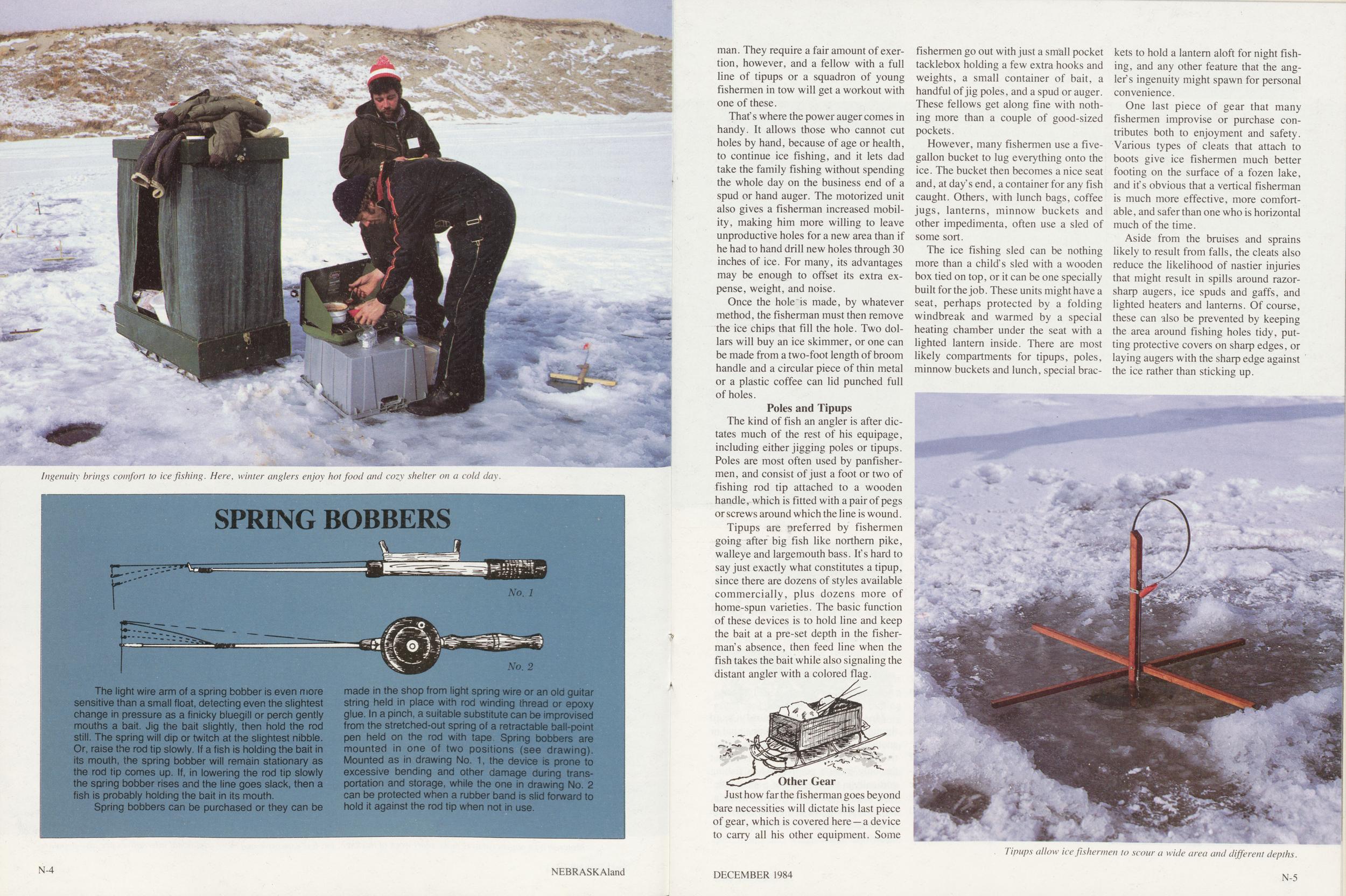
They require a fair amount of exertion, however, and a fellow with a full line of tipups or a squadron of young fishermen in tow will get a workout with one of these.
That's where the power auger comes in handy. It allows those who cannot cut holes by hand, because of age or health, to continue ice fishing, and it lets dad take the family fishing without spending the whole day on the business end of a spud or hand auger. The motorized unit also gives a fisherman increased mobility, making him more willing to leave unproductive holes for a new area than if he had to hand drill new holes through 30 inches of ice. For many, its advantages may be enough to offset its extra expense, weight, and noise.
Once the hole is made, by whatever method, the fisherman must then remove the ice chips that fill the hole. Two dollars will buy an ice skimmer, or one can be made from a two-foot length of broom handle and a circular piece of thin metal or a plastic coffee can lid punched full of holes.
Poles and TipupsThe kind of fish an angler is after dictates much of the rest of his equipage, including either jigging poles or tipups. Poles are most often used by panfishermen, and consist of just a foot or two of fishing rod tip attached to a wooden handle, which is fitted with a pair of pegs or screws around which the line is wound.
Tipups are ^referred by fishermen going after big fish like northern pike, walleye and largemouth bass. It's hard to say just exactly what constitutes a tipup, since there are dozens of styles available commercially, plus dozens more of home-spun varieties. The basic function of these devices is to hold line and keep the bait at a pre-set depth in the fisherman's absence, then feed line when the fish takes the bait while also signaling the distant angler with a colored flag.
Other GearJust how far the fisherman goes beyond bare necessities will dictate his last piece of gear, which is covered here — a device to carry all his other equipment. Some fishermen go out with just a small pocket tacklebox holding a few extra hooks and weights, a small container of bait, a handful of jig poles, and a spud or auger. These fellows get along fine with nothing more than a couple of good-sized pockets.
However, many fishermen use a five-gallon bucket to lug everything onto the ice. The bucket then becomes a nice seat and, at day's end, a container for any fish caught. Others, with lunch bags, coffee jugs, lanterns, minnow buckets and other impedimenta, often use a sled of some sort.
The ice fishing sled can be nothing more than a child's sled with a wooden box tied on top, or it can be one specially built for the job. These units might have a seat, perhaps protected by a folding windbreak and warmed by a special heating chamber under the seat with a lighted lantern inside. There are most likely compartments for tipups, poles, minnow buckets and lunch, special brackets to hold a lantern aloft for night fishing, and any other feature that the angler's ingenuity might spawn for personal convenience.
One last piece of gear that many fishermen improvise or purchase contributes both to enjoyment and safety. Various types of cleats that attach to boots give ice fishermen much better footing on the surface of a fozen lake, and it's obvious that a vertical fisherman is much more effective, more comfortable, and safer than one who is horizontal much of the time.
Aside from the bruises and sprains likely to result from falls, the cleats also reduce the likelihood of nastier injuries that might result in spills around razor-sharp augers, ice spuds and gaffs, and lighted heaters and lanterns. Of course, these can also be prevented by keeping the area around fishing holes tidy, putting protective covers on sharp edges, or laying augers with the sharp edge against the ice rather than sticking up.
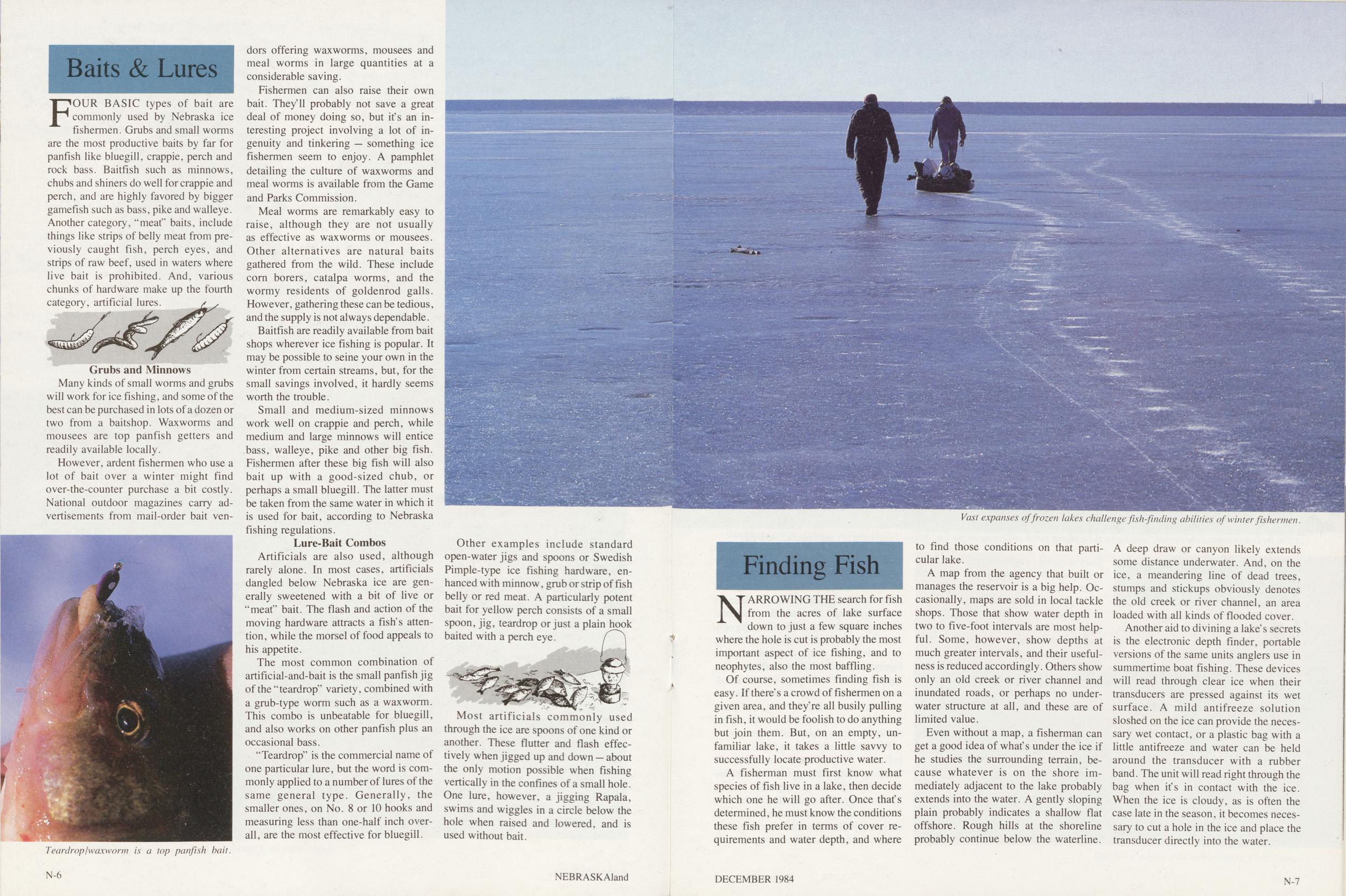 Baits & Lures
FOUR BASIC types of bait are commonly used by Nebraska ice fishermen. Grubs and small worms are the most productive baits by far for panfish like bluegill, crappie, perch and rock bass. Baitfish such as minnows, chubs and shiners do well for crappie and perch, and are highly favored by bigger gamefish such as bass, pike and walleye. Another category, "meat" baits, include things like strips of belly meat from previously caught fish, perch eyes, and strips of raw beef, used in waters where live bait is prohibited. And, various chunks of hardware make up the fourth category, artificial lures.
Grubs and MinnowsMany kinds of small worms and grubs will work for ice fishing, and some of the best can be purchased in lots of a dozen or two from a baitshop. Wax worms and mousees are top panfish getters and readily available locally.
However, ardent fishermen who use a lot of bait over a winter might find over-the-counter purchase a bit costly. National outdoor magazines carry advertisements from mail-order bait vendors
offering waxworms, mousees and meal worms in large quantities at a considerable saving.
Fishermen can also raise their own bait. They'll probably not save a great deal of money doing so, but it's an interesting project involving a lot of ingenuity and tinkering — something ice fishermen seem to enjoy. A pamphlet detailing the culture of waxworms and meal worms is available from the Game and Parks Commission.
Meal worms are remarkably easy to raise, although they are not usually as effective as waxworms or mousees. Other alternatives are natural baits gathered from the wild. These include corn borers, catalpa worms, and the wormy residents of goldenrod galls. However, gathering these can be tedious, and the supply is not always dependable.
Baitfish are readily available from bait shops wherever ice fishing is popular. It may be possible to seine your own in the winter from certain streams, but, for the small savings involved, it hardly seems worth the trouble.
Small and medium-sized minnows work well on crappie and perch, while medium and large minnows will entice bass, walleye, pike and other big fish. Fishermen after these big fish will also bait up with a good-sized chub, or perhaps a small bluegill. The latter must be taken from the same water in which it is used for bait, according to Nebraska fishing regulations.
Lure-Bait CombosArtificials are also used, although rarely alone. In most cases, artificials dangled below Nebraska ice are generally sweetened with a bit of live or "meat" bait. The flash and action of the moving hardware attracts a fish's attention, while the morsel of food appeals to his appetite.
The most common combination of artificial-and-bait is the small panfish jig of the "teardrop" variety, combined with a grub-type worm such as a wax worm. This combo is unbeatable for bluegill, and also works on other panfish plus an occasional bass.
"Teardrop" is the commercial name of one particular lure, but the word is commonly applied to a number of lures of the same general type. Generally, the smaller ones, on No. 8 or 10 hooks and measuring less than one-half inch overall, are the most effective for bluegill.
Other examples include standard open-water jigs and spoons or Swedish Pimple-type ice fishing hardware, enhanced with minnow, grub or strip of fish belly or red meat. A particularly potent bait for yellow perch consists of a small spoon, jig, teardrop or just a plain hook baited with a perch eye.
Most artificials commonly used through the ice are spoons of one kind or another. These flutter and flash effectively when jigged up and down — about the only motion possible when fishing vertically in the confines of a small hole. One lure, however, a jigging Rapala, swims and wiggles in a circle below the hole when raised and lowered, and is used without bait.
N-6 NEBRASKAland Finding FishNARROWING THE search for fish from the acres of lake surface down to just a few square inches where the hole is cut is probably the most important aspect of ice fishing, and to neophytes, also the most baffling.
Of course, sometimes finding fish is easy. If there's a crowd of fishermen on a given area, and they're all busily pulling in fish, it would be foolish to do anything but join them. But, on an empty, unfamiliar lake, it takes a little savvy to successfully locate productive water.
A fisherman must first know what species of fish live in a lake, then decide which one he will go after. Once that's determined, he must know the conditions these fish prefer in terms of cover requirements and water depth, and where to find those conditions on that particular lake.
A map from the agency that built or manages the reservoir is a big help. Occasionally, maps are sold in local tackle shops. Those that show water depth in two to five-foot intervals are most helpful. Some, however, show depths at much greater intervals, and their usefulness is reduced accordingly. Others show only an old creek or river channel and inundated roads, or perhaps no underwater structure at all, and these are of limited value.
Even without a map, a fisherman can get a good idea of whats under the ice if he studies the surrounding terrain, because whatever is on the shore immediately adjacent to the lake probably extends into the water. A gently sloping plain probably indicates a shallow flat offshore. Rough hills at the shoreline probably continue below the waterline. A deep draw or canyon likely extends some distance underwater. And, on the ice, a meandering line of dead trees, stumps and stickups obviously denotes the old creek or river channel, an area loaded with all kinds of flooded cover.
Another aid to divining a lake's secrets is the electronic depth finder, portable versions of the same units anglers use in summertime boat fishing. These devices will read through clear ice when their transducers are pressed against its wet surface. A mild antifreeze solution sloshed on the ice can provide the necessary wet contact, or a plastic bag with a little antifreeze and water can be held around the transducer with a rubber band. The unit will read right through the bag when it's in contact with the ice. When the ice is cloudy, as is often the case late in the season, it becomes necessary to cut a hole in the ice and place the transducer directly into the water.
DECEMBER 1984 N-7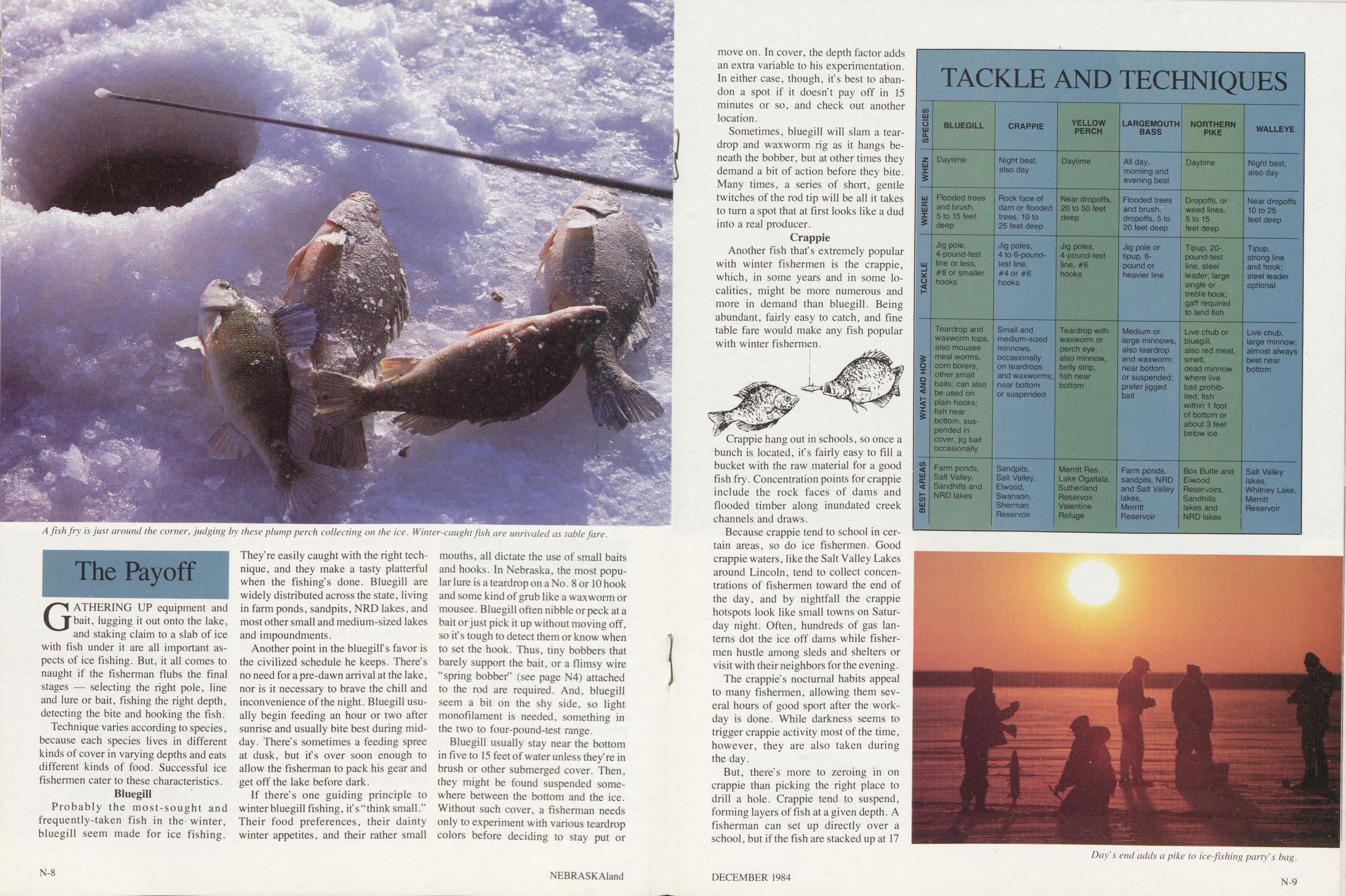
GATHERING UP equipment and bait, lugging it out onto the lake, and staking claim to a slab of ice with fish under it are all important aspects of ice fishing. But, it all comes to naught if the fisherman flubs the final stages — selecting the right pole, line and lure or bait, fishing the right depth, detecting the bite and hooking the fish. Technique varies according to species, because each species lives in different kinds of cover in varying depths and eats different kinds of food. Successful ice fishermen cater to these characteristics.
BluegillProbably the most-sought and frequently-taken fish in the winter, bluegill seem made for ice fishing. They're easily caught with the right technique, and they make a tasty platterful when the fishing's done. Bluegill are widely distributed across the state, living in farm ponds, sandpits, NRD lakes, and most other small and medium-sized lakes and impoundments.
Another point in the bluegill's favor is the civilized schedule he keeps. There's no need for a pre-dawn arrival at the lake, nor is it necessary to brave the chill and inconvenience of the night. Bluegill usually begin feeding an hour or two after sunrise and usually bite best during midday. There's sometimes a feeding spree at dusk, but it's over soon enough to allow the fisherman to pack his gear and get off the lake before dark.
If there's one guiding principle to winter bluegill fishing, if s "think small." Their food preferences, their dainty winter appetites, and their rather small mouths, all dictate the use of small baits and hooks. In Nebraska, the most popular lure is a teardrop on a No. 8 or 10 hook and some kind of grub like a waxworm or mousee. Bluegill often nibble or peck at a bait or just pick it up without moving off, so it's tough to detect them or know when to set the hook. Thus, tiny bobbers that barely support the bait, or a flimsy wire "spring bobber" (see page N4) attached to the rod are required. And, bluegill seem a bit on the shy side, so light monofilament is needed, something in the two to four-pound-test range.
Bluegill usually stay near the bottom in five to 15 feet of water unless they're in brush or other submerged cover. Then, they might be found suspended somewhere between the bottom and the ice. Without such cover, a fisherman needs only to experiment with various teardrop colors before deciding to stay put or
N-8 NEBRASKAlandmove on. In cover, the depth factor adds an extra variable to his experimentation. In either case, though, it's best to abandon a spot if it doesn't pay off in 15 minutes or so, and check out another location.
Sometimes, bluegill will slam a teardrop and waxworm rig as it hangs beneath the bobber, but at other times they demand a bit of action before they bite. Many times, a series of short, gentle twitches of the rod tip will be all it takes to turn a spot that at first looks like a dud into a real producer.
CrappieAnother fish that's extremely popular with winter fishermen is the crappie, which, in some years and in some localities, might be more numerous and more in demand than bluegill. Being abundant, fairly easy to catch, and fine table fare would make any fish popular with winter fishermen.
Crappie hang out in schools, so once a bunch is located, it's fairly easy to fill a bucket with the raw material for a good fish fry. Concentration points for crappie include the rock faces of dams and flooded timber along inundated creek channels and draws.
Because crappie tend to school in certain areas, so do ice fishermen. Good crappie waters, like the Salt Valley Lakes around Lincoln, tend to collect concentrations of fishermen toward the end of the day, and by nightfall the crappie hotspots look like small towns on Saturday night. Often, hundreds of gas lanterns dot the ice off dams while fishermen hustle among sleds and shelters or visit with their neighbors for the evening.
The crappie's nocturnal habits appeal to many fishermen, allowing them several hours of good sport after the workday is done. While darkness seems to trigger crappie activity most of the time, however, they are also taken during the day.
But, there's more to zeroing in on crappie than picking the right place to drill a hole. Crappie tend to suspend, forming layers offish at a given depth. A fisherman can set up directly over a school, but if the fish are stacked up at 17
TACKLE AND TECHNIQUES BLUEGILL CRAPPIE Daytime Night best, Flooded trees also day and brush, Rock face of 5 to 15 feet dam or flooded deep trees, 10 to Jig pole, 25 feet deep 4-pound-test Jig poles, line or less, 4 to 6-pound- #8 or smaller test line, hooks #4 or #6 Teardrop and hooks waxworm tops, Smail and also mousee medium-sized meal worms, minnows, corn borers, occasionally other small on teardrops baits; can also and waxworms; be used on near bottom plain hooks; or suspended fish near Sandpits, bottom, suspended Salt Valley, in Elwood, cover, jig bait Swanson, occasionally Sherman Farm ponds, Reservoir Salt Valley, Sandhills and NRD lakes YELLOW LARGEMOUTH PERCH BASS Daytime All day, Near dropoffs, morning and 20 to 50 feet evening best deep Flooded trees Jig poles, and brush, 4-pound-test dropoffs, 5 to line, #6 20 feet deep hooks Jig pole or Teardrop with tipup, waxworm or 6-pound or perch eye, heavier line also minnow, Medium or belly strip, large minnows, fish near also teardrop bottom and waxworm; Merritt Res., near bottom Lake Ogallala, or suspended; Sutherland prefer jigged Reservoir, bait Valentine Farm ponds, Refuge sandpits, NRD and Salt Valley lakes, Merritt Reservoir NORTHERN WALLEYE PIKE Night best, Daytime also day Dropoffs, or Near dropoffs weed lines, 10 to 25 5 to 15 feet deep feet deep Tipup, Tipup, 20- strong line pound-test and hook; line, steel steel leader leader; large optional single or Live chub, treble hook; large minnow; gaff required almost always to land fish best near Live chub or bottom bluegill, Box Butte and also red meat, Elwood smelt, Reservoirs, dead minnow Sandhills where live lakes and bait prohibited; NRD lakes fish Salt Valley within 1 foot lakes, of bottom or Whitney Lake, about 3 feet Merritt below ice Reservoir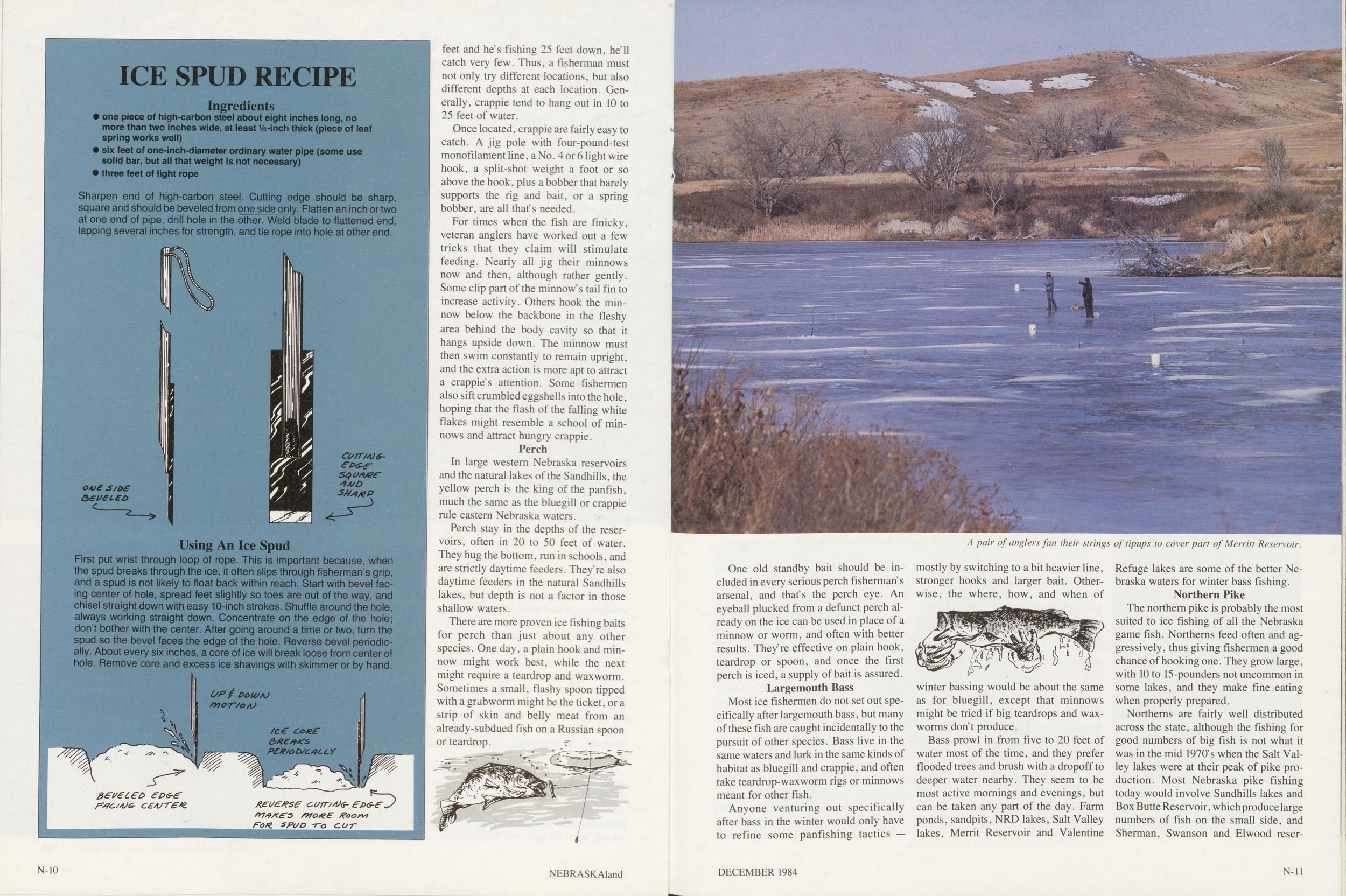 ICE SPUD RECIPE
Ingredients
one piece of high-carbon steel about eight inches long, no
more than two inches wide, at least 1/4-inch thick (piece of leaf
spring works well)
six feet of one-inch-diameter ordinary water pipe (some use
solid bar, but all that weight is not necessary)
three feet of light rope
Sharpen end of high-carbon steel. Cutting edge should be sharp,
square and should be beveled from one side only. Flatten an inch or two
at one end of pipe, drill hole in the other. Weld blade to flattened end,
lapping several inches for strength, and tie rope into hole at other end.
Using An Ice Spud
First put wrist through loop of rope. This is important because, when
the spud breaks through the ice, it often slips through fisherman's grip,
and a spud is not likely to float back within reach. Start with bevel facing center
of hole, spread feet slightly so toes are out of the way, and
chisel straight down with easy 10-inch strokes. Shuffle around the hole,
always working straight down. Concentrate on the edge of the hole;
don't bother with the center. After going around a time or two, turn the
spud so the bevel faces the edge of the hole. Reverse bevel periodically. About every
six inches, a core of ice will break loose from center of
hole. Remove core and excess ice shavings with skimmer or by hand.
ICE SPUD RECIPE
Ingredients
one piece of high-carbon steel about eight inches long, no
more than two inches wide, at least 1/4-inch thick (piece of leaf
spring works well)
six feet of one-inch-diameter ordinary water pipe (some use
solid bar, but all that weight is not necessary)
three feet of light rope
Sharpen end of high-carbon steel. Cutting edge should be sharp,
square and should be beveled from one side only. Flatten an inch or two
at one end of pipe, drill hole in the other. Weld blade to flattened end,
lapping several inches for strength, and tie rope into hole at other end.
Using An Ice Spud
First put wrist through loop of rope. This is important because, when
the spud breaks through the ice, it often slips through fisherman's grip,
and a spud is not likely to float back within reach. Start with bevel facing center
of hole, spread feet slightly so toes are out of the way, and
chisel straight down with easy 10-inch strokes. Shuffle around the hole,
always working straight down. Concentrate on the edge of the hole;
don't bother with the center. After going around a time or two, turn the
spud so the bevel faces the edge of the hole. Reverse bevel periodically. About every
six inches, a core of ice will break loose from center of
hole. Remove core and excess ice shavings with skimmer or by hand.
feet and he's fishing 25 feet down, he'll catch very few. Thus, a fisherman must not only try different locations, but also different depths at each location. Generally, crappie tend to hang out in 10 to 25 feet of water.
Once located, crappie are fairly easy to catch. A jig pole with four-pound-test monofilament line, a No. 4 or 6 light wire hook, a split-shot weight a foot or so above the hook, plus a bobber that barely supports the rig and bait, or a spring bobber, are all thaf s needed.
For times when the fish are finicky, veteran anglers have worked out a few tricks that they claim will stimulate feeding. Nearly all jig their minnows now and then, although rather gently. Some clip part of the minnow's tail fin to increase activity. Others hook the minnow below the backbone in the fleshy area behind the body cavity so that it hangs upside down. The minnow must then swim constantly to remain upright, and the extra action is more apt to attract a crappie's attention. Some fishermen also sift crumbled eggshells into the hole, hoping that the flash of the falling white flakes might resemble a school of minnows and attract hungry crappie.
PerchIn large western Nebraska reservoirs and the natural lakes of the Sandhills, the yellow perch is the king of the panfish, much the same as the bluegill or crappie rule eastern Nebraska waters.
Perch stay in the depths of the reservoirs, often in 20 to 50 feet of water. They hug the bottom, run in schools, and are strictly daytime feeders. They're also daytime feeders in the natural Sandhills lakes, but depth is not a factor in those shallow waters.
There are more proven ice fishing baits for perch than just about any other species. One day, a plain hook and minnow might work best, while the next might require a teardrop and waxworm. Sometimes a small, flashy spoon tipped with a grub worm might be the ticket, or a strip of skin and belly meat from an already-subdued fish on a Russian spoon or teardrop.
N-10 NEBRASKAlandOne old standby bait should be included in every serious perch fisherman's arsenal, and that's the perch eye. An eyeball plucked from a defunct perch already on the ice can be used in place of a minnow or worm, and often with better results. They're effective on plain hook, teardrop or spoon, and once the first perch is iced, a supply of bait is assured.
Largemouth BassMost ice fishermen do not set out specifically after largemouth bass, but many of these fish are caught incidentally to the pursuit of other species. Bass live in the same waters and lurk in the same kinds of habitat as bluegill and crappie, and often take teardrop-waxworm rigs or minnows meant for other fish.
Anyone venturing out specifically after bass in the winter would only have to refine some panfishing tactics — mostly by switching to a bit heavier line, stronger hooks and larger bait. Otherwise, the where, how, and when of winter bassing would be about the same as for bluegill, except that minnows might be tried if big teardrops and waxworms don't produce.
Bass prowl in from five to 20 feet of water most of the time, and they prefer flooded trees and brush with a dropoff to deeper water nearby. They seem to be most active mornings and evenings, but can be taken any part of the day. Farm ponds, sandpits, NRD lakes, Salt Valley lakes, Merrit Reservoir and Valentine Refuge lakes are some of the better Nebraska waters for winter bass fishing.
Northern PikeThe northern pike is probably the most suited to ice fishing of all the Nebraska game fish. Northerns feed often and aggressively, thus giving fishermen a good chance of hooking one. They grow large, with 10 to 15-pounders not uncommon in some lakes, and they make fine eating when properly prepared.
Northerns are fairly well distributed across the state, although the fishing for good numbers of big fish is not what it was in the mid 1970's when the Salt Valley lakes were at their peak of pike production. Most Nebraska pike fishing today would involve Sandhills lakes and Box Butte Reservoir, which produce large numbers of fish on the small side, and Sherman, Swanson and El wood reservoirs
DECEMBER 1984 N-ll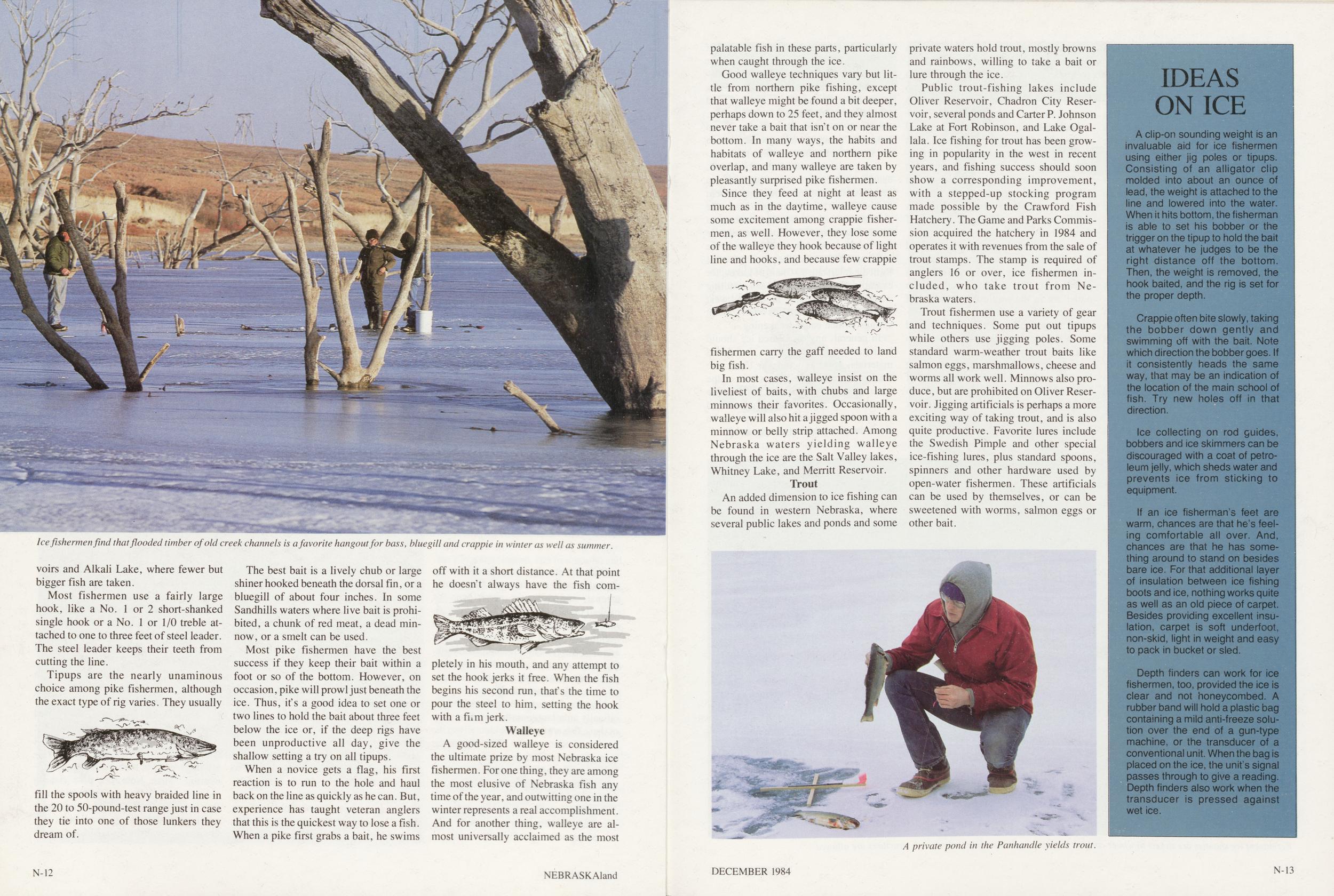
and Alkali Lake, where fewer but bigger fish are taken.
Most fishermen use a fairly large hook, like a No. 1 or 2 short-shanked single hook or a No. 1 or 1/0 treble attached to one to three feet of steel leader. The steel leader keeps their teeth from cutting the line.
Tipups are the nearly unaminous choice among pike fishermen, although the exact type of rig varies. They usually fill the spools with heavy braided line in the 20 to 50-pound-test range just in case they tie into one of those lunkers they dream of.
The best bait is a lively chub or large shiner hooked beneath the dorsal fin, or a bluegill of about four inches. In some Sandhills waters where live bait is prohibited, a chunk of red meat, a dead minnow, or a smelt can be used.
Most pike fishermen have the best success if they keep their bait within a foot or so of the bottom. However, on occasion, pike will prowl just beneath the ice. Thus, it's a good idea to set one or two lines to hold the bait about three feet below the ice or, if the deep rigs have been unproductive all day, give the shallow setting a try on all tipups.
When a novice gets a flag, his first reaction is to run to the hole and haul back on the line as quickly as he can. But, experience has taught veteran anglers that this is the quickest way to lose a fish. When a pike first grabs a bait, he swims off with it a short distance. At that point he doesn't always have the fish completely in his mouth, and any attempt to set the hook jerks it free. When the fish begins his second run, that's the time to pour the steel to him, setting the hook with a fum jerk.
WalleyeA good-sized walleye is considered the ultimate prize by most Nebraska ice fishermen. For one thing, they are among the most elusive of Nebraska fish any time of the year, and outwitting one in the winter represents a real accomplishment. And for another thing, walleye are almost universally acclaimed as the most
N-12 NEBRASKAlandpalatable fish in these parts, particularly when caught through the ice.
Good walleye techniques vary but little from northern pike fishing, except that walleye might be found a bit deeper, perhaps down to 25 feet, and they almost never take a bait that isn't on or near the bottom. In many ways, the habits and habitats of walleye and northern pike overlap, and many walleye are taken by pleasantly surprised pike fishermen.
Since they feed at night at least as much as in the daytime, walleye cause some excitement among crappie fishermen, as well. However, they lose some of the walleye they hook because of light line and hooks, and because few crappie fishermen carry the gaff needed to land big fish.
In most cases, walleye insist on the liveliest of baits, with chubs and large minnows their favorites. Occasionally, walleye will also hit a jigged spoon with a minnow or belly strip attached. Among Nebraska waters yielding walleye through the ice are the Salt Valley lakes, Whitney Lake, and Merritt Reservoir.
TroutAn added dimension to ice fishing can be found in western Nebraska, where several public lakes and ponds and some private waters hold trout, mostly browns and rainbows, willing to take a bait or lure through the ice.
Public trout-fishing lakes include Oliver Reservoir, Chadron City Reservoir, several ponds and Carter P. Johnson Lake at Fort Robinson, and Lake Ogallala. Ice fishing for trout has been growing in popularity in the west in recent years, and fishing success should soon show a corresponding improvement, with a stepped-up stocking program made possible by the Crawford Fish Hatchery. The Game and Parks Commission acquired the hatchery in 1984 and operates it with revenues from the sale of trout stamps. The stamp is required of anglers 16 or over, ice fishermen included, who take trout from Nebraska waters.
Trout fishermen use a variety of gear and techniques. Some put out tipups while others use jigging poles. Some standard warm-weather trout baits like salmon eggs, marshmallows, cheese and worms all work well. Minnows also produce, but are prohibited on Oliver Reservoir. Jigging artificials is perhaps a more exciting way of taking trout, and is also quite productive. Favorite lures include the Swedish Pimple and other special ice-fishing lures, plus standard spoons, spinners and other hardware used by open-water fishermen. These artificials can be used by themselves, or can be sweetened with worms, salmon eggs or other bait.
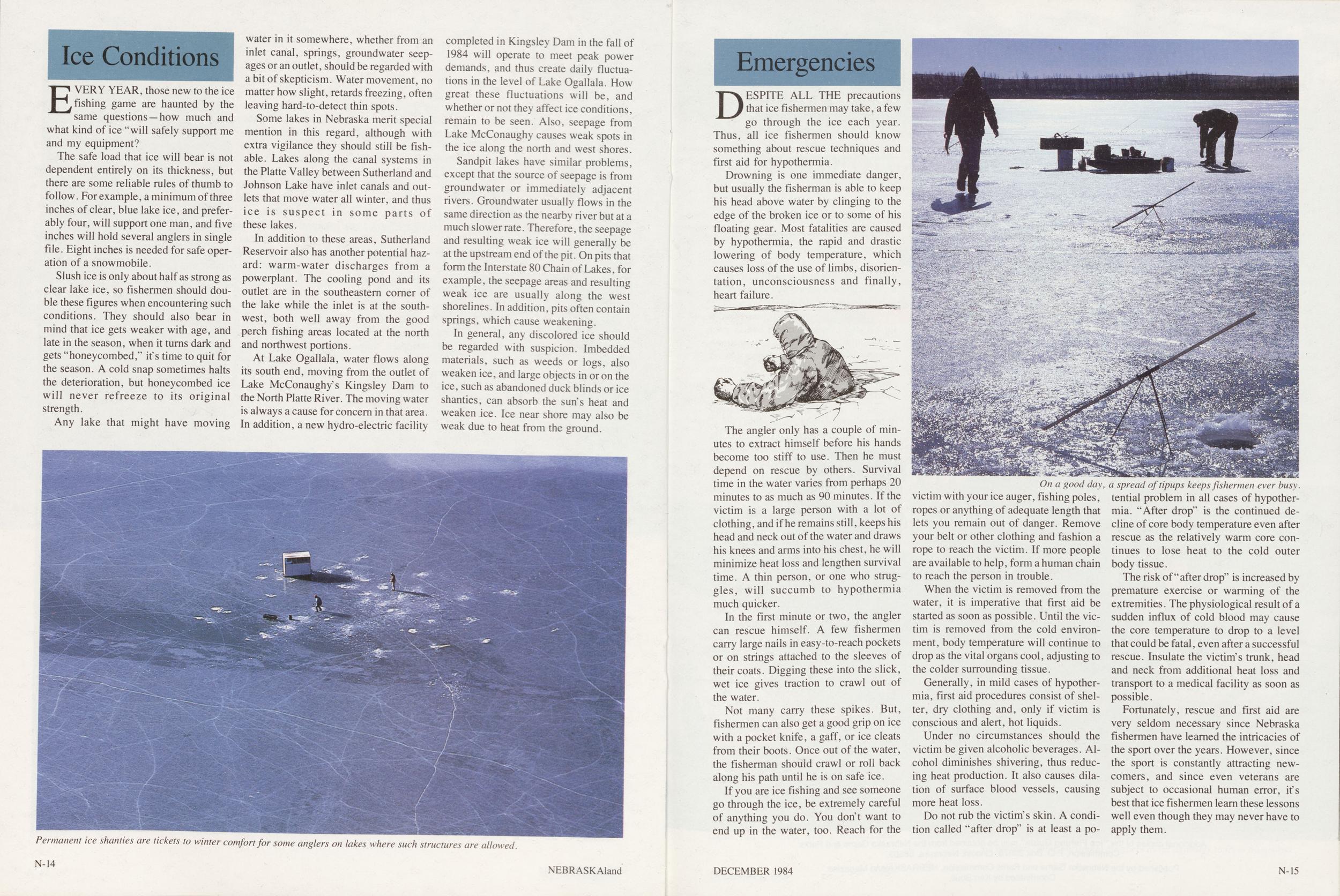 Ice Conditions
EVERY YEAR, those new to the ice fishing game are haunted by the same questions —how much and what kind of ice "will safely support me and my equipment?
The safe load that ice will bear is not dependent entirely on its thickness, but there are some reliable rules of thumb to follow. For example, a minimum of three inches of clear, blue lake ice, and preferably four, will support one man, and five inches will hold several anglers in single file. Eight inches is needed for safe operation of a snowmobile.
Slush ice is only about half as strong as clear lake ice, so fishermen should double these figures when encountering such conditions. They should also bear in mind that ice gets weaker with age, and late in the season, when it turns dark and gets "honeycombed," it's time to quit for the season. A cold snap sometimes halts the deterioration, but honeycombed ice will never refreeze to its original strength.
Any lake that might have moving water in it somewhere, whether from an inlet canal, springs, groundwater seepages or an outlet, should be regarded with a bit of skepticism. Water movement, no matter how slight, retards freezing, often leaving hard-to-detect thin spots.
Some lakes in Nebraska merit special mention in this regard, although with extra vigilance they should still be fishable. Lakes along the canal systems in the Platte Valley between Sutherland and Johnson Lake have inlet canals and outlets that move water all winter, and thus ice is suspect in some parts of these lakes.
In addition to these areas, Sutherland Reservoir also has another potential hazard: warm-water discharges from a powerplant. The cooling pond and its outlet are in the southeastern corner of the lake while the inlet is at the southwest, both well away from the good perch fishing areas located at the north and northwest portions.
At Lake Ogallala, water flows along its south end, moving from the outlet of Lake McConaughy's Kingsley Dam to the North Platte River. The moving water is always a cause for concern in that area. In addition, a new hydro-electric facility completed in Kingsley Dam in the fall of 1984 will operate to meet peak power demands, and thus create daily fluctuations in the level of Lake Ogallala. How great these fluctuations will be, and whether or not they affect ice conditions, remain to be seen. Also, seepage from Lake McConaughy causes weak spots in the ice along the north and west shores.
Sandpit lakes have similar problems, except that the source of seepage is from groundwater or immediately adjacent rivers. Groundwater usually flows in the same direction as the nearby river but at a much slower rate. Therefore, the seepage and resulting weak ice will generally be at the upstream end of the pit. On pits that form the Interstate 80 Chain of Lakes, for example, the seepage areas and resulting weak ice are usually along the west shorelines. In addition, pits often contain springs, which cause weakening.
In general, any discolored ice should be regarded with suspicion. Imbedded materials, such as weeds or logs, also weaken ice, and large objects in or on the ice, such as abandoned duck blinds or ice shanties, can absorb the suns heat and weaken ice. Ice near shore may also be weak due to heat from the ground.
DESPITE ALL THE precautions that ice fishermen may take, a few go through the ice each year. Thus, all ice fishermen should know something about rescue techniques and first aid for hypothermia.
Drowning is one immediate danger, but usually the fisherman is able to keep his head above water by clinging to the edge of the broken ice or to some of his floating gear. Most fatalities are caused by hypothermia, the rapid and drastic lowering of body temperature, which causes loss of the use of limbs, disorientation, unconsciousness and finally, heart failure.
The angler only has a couple of minutes to extract himself before his hands become too stiff to use. Then he must depend on rescue by others. Survival time in the water varies from perhaps 20 minutes to as much as 90 minutes. If the victim is a large person with a lot of clothing, and if he remains still, keeps his head and neck out of the water and draws his knees and arms into his chest, he will minimize heat loss and lengthen survival time. A thin person, or one who struggles, will succumb to hypothermia much quicker.
In the first minute or two, the angler can rescue himself. A few fishermen carry large nails in easy-to-reach pockets or on strings attached to the sleeves of their coats. Digging these into the slick, wet ice gives traction to crawl out of the water.
Not many carry these spikes. But, fishermen can also get a good grip on ice with a pocket knife, a gaff, or ice cleats from their boots. Once out of the water, the fisherman should crawl or roll back along his path until he is on safe ice.
If you are ice fishing and see someone go through the ice, be extremely careful of anything you do. You don't want to end up in the water, too. Reach for the
victim with your ice auger, fishing poles, ropes or anything of adequate length that lets you remain out of danger. Remove your belt or other clothing and fashion a rope to reach the victim. If more people are available to help, form a human chain to reach the person in trouble.
When the victim is removed from the water, it is imperative that first aid be started as soon as possible. Until the victim is removed from the cold environment, body temperature will continue to drop as the vital organs cool, adjusting to the colder surrounding tissue.
Generally, in mild cases of hypothermia, first aid procedures consist of shelter, dry clothing and, only if victim is conscious and alert, hot liquids.
Under no circumstances should the victim be given alcoholic beverages. Alcohol diminishes shivering, thus reducing heat production. It also causes dilation of surface blood vessels, causing more heat loss.
Do not rub the victim's skin. A condition called "after drop" is at least a potential problem in all cases of hypothermia. "After drop" is the continued decline of core body temperature even after rescue as the relatively warm core continues to lose heat to the cold outer body tissue.
The risk of "after drop" is increased by premature exercise or warming of the extremities. The physiological result of a sudden influx of cold blood may cause the core temperature to drop to a level that could be fatal, even after a successful rescue. Insulate the victim's trunk, head and neck from additional heat loss and transport to a medical facility as soon as possible.
Fortunately, rescue and first aid are very seldom necessary since Nebraska fishermen have learned the intricacies of the sport over the years. However, since the sport is constantly attracting newcomers, and since even veterans are subject to occasional human error, it's best that ice fishermen learn these lessons well even though they may never have to apply them.
DECEMBER 1984 N-15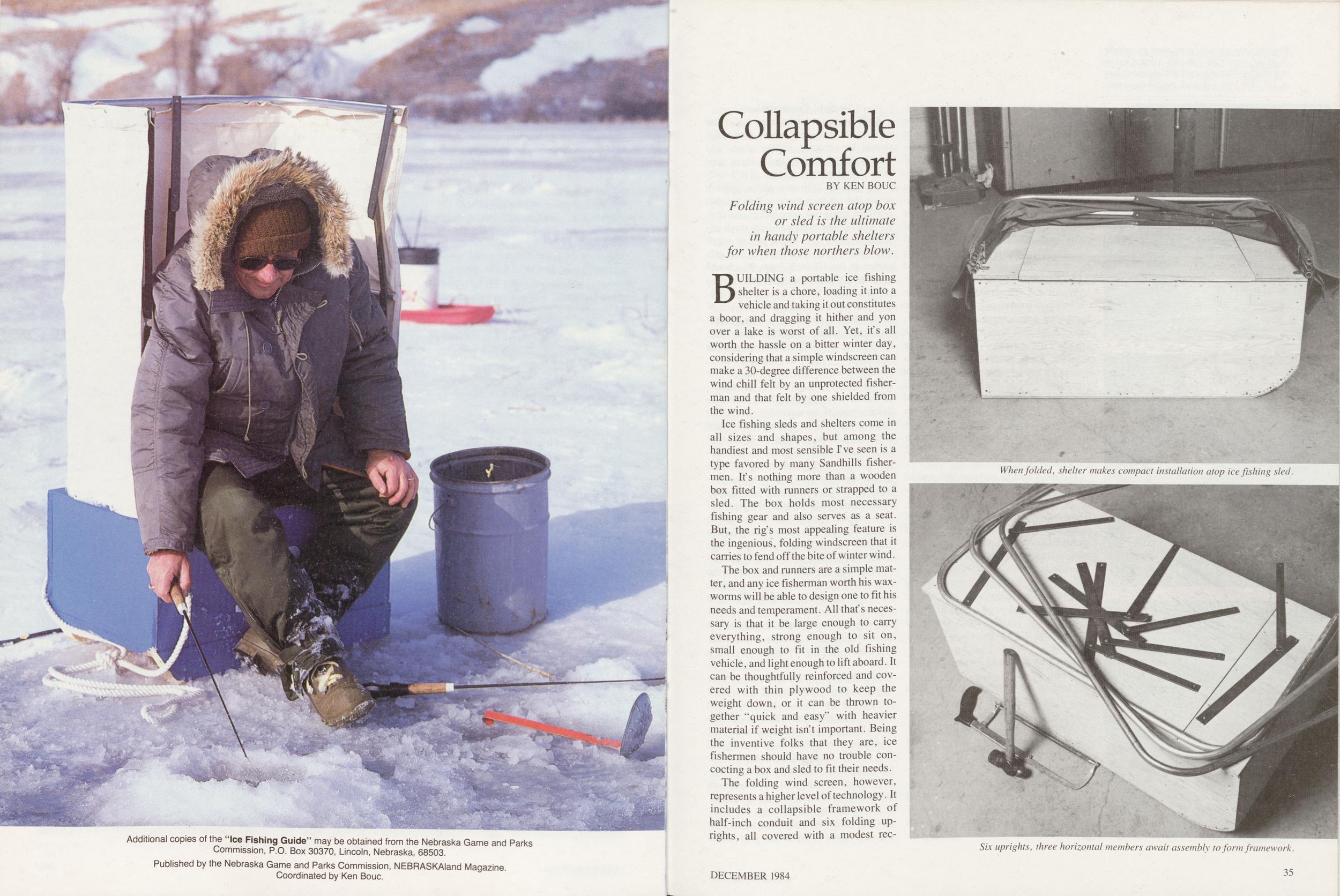
Collapsible Comfort
BY KEN BOUC Folding wind screen atop box or sled is the ultimate in handy portable shelters for when those northers blow.BUILDING a portable ice fishing shelter is a chore, loading it into a vehicle and taking it out constitutes a boor, and dragging it hither and yon over a lake is worst of all. Yet, it's all worth the hassle on a bitter winter day, considering that a simple windscreen can make a 30-degree difference between the wind chill felt by an unprotected fisherman and that felt by one shielded from the wind.
Ice fishing sleds and shelters come in all sizes and shapes, but among the handiest and most sensible I've seen is a type favored by many Sandhills fishermen. It's nothing more than a wooden box fitted with runners or strapped to a sled. The box holds most necessary fishing gear and also serves as a seat. But, the rig's most appealing feature is the ingenious, folding windscreen that it carries to fend off the bite of winter wind.
The box and runners are a simple matter, and any ice fisherman worth his wax- worms will be able to design one to fit his needs and temperament. All that's necessary is that it be large enough to carry everything, strong enough to sit on, small enough to fit in the old fishing vehicle, and light enough to lift aboard. It can be thoughtfully reinforced and covered with thin plywood to keep the weight down, or it can be thrown together "quick and easy" with heavier material if weight isn't important. Being the inventive folks that they are, ice fishermen should have no trouble concocting a box and sled to fit their needs.
The folding wind screen, however, represents a higher level of technology. It includes a collapsible framework of half-inch conduit and six folding uprights, all covered with a modest rectangle
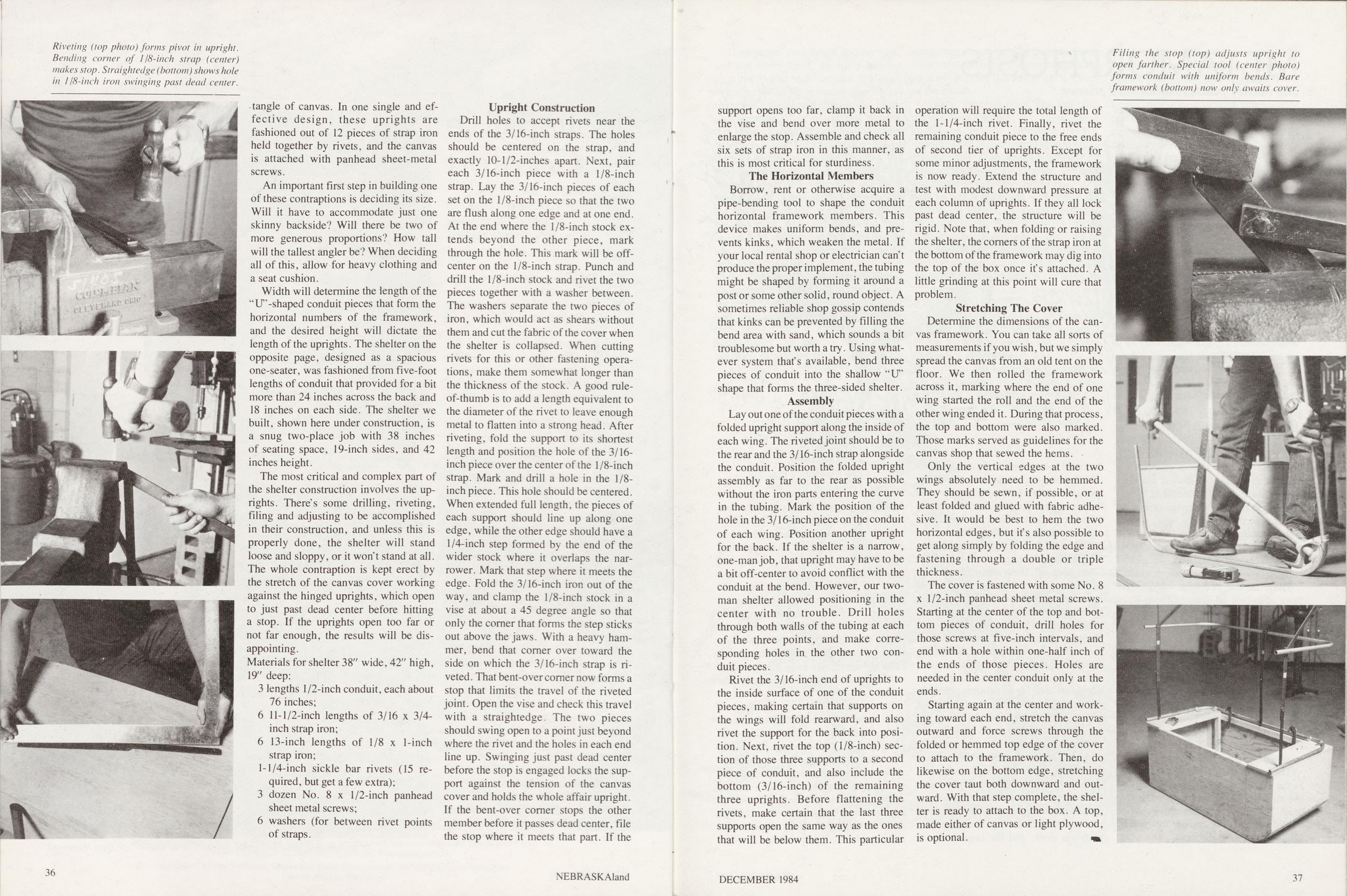
of canvas. In one single and effective design, these uprights are fashioned out of 12 pieces of strap iron held together by rivets, and the canvas is attached with panhead sheet-metal screws.
An important first step in building one of these contraptions is deciding its size. Will it have to accommodate just one skinny backside? Will there be two of more generous proportions? How tall will the tallest angler be? When deciding all of this, allow for heavy clothing and a seat cushion.
Width will determine the length of the "IT-shaped conduit pieces that form the horizontal numbers of the framework, and the desired height will dictate the length of the uprights. The shelter on the opposite page, designed as a spacious one-seater, was fashioned from five-foot lengths of conduit that provided for a bit more than 24 inches across the back and 18 inches on each side. The shelter we built, shown here under construction, is a snug two-place job with 38 inches of seating space, 19-inch sides, and 42 inches height.
The most critical and complex part of the shelter construction involves the uprights. There's some drilling, riveting, filing and adjusting to be accomplished in their construction, and unless this is properly done, the shelter will stand loose and sloppy, or it won't stand at all. The whole contraption is kept erect by the stretch of the canvas cover working against the hinged uprights, which open to just past dead center before hitting a stop. If the uprights open too far or not far enough, the results will be disappointing.
Materials for shelter 38" wide, 42" high, 19" deep:
3 lengths 1/2-inch conduit, each about 76 inches; 6 11-1/2-inch lengths of 3/16 x 3/4-inch strap iron; 6 13-inch lengths of 1/8 x 1-inch strap iron; 1-1/4-inch sickle bar rivets (15 required, but get a few extra); 3 dozen No. 8 x 1/2-inch panhead sheet metal screws; 6 washers (for between rivet points of straps.
Upright ConstructionDrill holes to accept rivets near the ends of the 3/ 16-inch straps. The holes should be centered on the strap, and exactly 10-1/2-inches apart. Next, pair each 3/16-inch piece with a 1/8-inch strap. Lay the 3/16-inch pieces of each set on the 1/8-inch piece so that the two are flush along one edge and at one end. At the end where the 1/8-inch stock extends beyond the other piece, mark through the hole. This mark will be off-center on the 1/8-inch strap. Punch and drill the 1/8-inch stock and rivet the two pieces together with a washer between. The washers separate the two pieces of iron, which would act as shears without them and cut the fabric of the cover when the shelter is collapsed. When cutting rivets for this or other fastening operations, make them somewhat longer than the thickness of the stock. A good rule-of-thumb is to add a length equivalent to the diameter of the rivet to leave enough metal to flatten into a strong head. After riveting, fold the support to its shortest length and position the hole of the 3/16-inch piece over the center of the 1/8-inch strap. Mark and drill a hole in the 1/8-inch piece. This hole should be centered. When extended full length, the pieces of each support should line up along one edge, while the other edge should have a 1/4-inch step formed by the end of the wider stock where it overlaps the narrower. Mark that step where it meets the edge. Fold the 3/16-inch iron out of the way, and clamp the 1/8-inch stock in a vise at about a 45 degree angle so that only the corner that forms the step sticks out above the jaws. With a heavy hammer, bend that corner over toward the side on which the 3/16-inch strap is riveted. That bent-over corner now forms a stop that limits the travel of the riveted joint. Open the vise and check this travel with a straightedge. The two pieces should swing open to a point just beyond where the rivet and the holes in each end line up. Swinging just past dead center before the stop is engaged locks the support against the tension of the canvas cover and holds the whole affair upright. If the bent-over corner stops the other member before it passes dead center, file the stop where it meets that part. If the
36 NEBRASKAlandFiling the stop (top) adjusts upright to open farther. Special tool (center photo) forms conduit with uniform bends. Bare framework (bottom) now only awaits cover.
support opens too far, clamp it back in the vise and bend over more metal to enlarge the stop. Assemble and check all six sets of strap iron in this manner, as this is most critical for sturdiness.
The Horizontal MembersBorrow, rent or otherwise acquire a pipe-bending tool to shape the conduit horizontal framework members. This device makes uniform bends, and prevents kinks, which weaken the metal. If your local rental shop or electrician can't produce the proper implement, the tubing might be shaped by forming it around a post or some other solid, round object. A sometimes reliable shop gossip contends that kinks can be prevented by filling the bend area with sand, which sounds a bit troublesome but worth a try. Using whatever system that's available, bend three pieces of conduit into the shallow "U" shape that forms the three-sided shelter.
AssemblyLay out one of the conduit pieces with a folded upright support along the inside of each wing. The riveted joint should be to the rear and the 3/ 16-inch strap alongside the conduit. Position the folded upright assembly as far to the rear as possible without the iron parts entering the curve in the tubing. Mark the position of the hole in the 3/16-inch piece on the conduit of each wing. Position another upright for the back. If the shelter is a narrow, one-man job, that upright may have to be a bit off-center to avoid conflict with the conduit at the bend. However, our two-man shelter allowed positioning in the center with no trouble. Drill holes through both walls of the tubing at each of the three points, and make corresponding holes in the other two conduit pieces.
Rivet the 3/16-inch end of uprights to the inside surface of one of the conduit pieces, making certain that supports on the wings will fold rearward, and also rivet the support for the back into position. Next, rivet the top (1/8-inch) section of those three supports to a second piece of conduit, and also include the bottom (3/16-inch) of the remaining three uprights. Before flattening the rivets, make certain that the last three supports open the same way as the ones that will be below them. This particular operation will require the total length of the 1-1/4-inch rivet. Finally, rivet the remaining conduit piece to the free ends of second tier of uprights. Except for some minor adjustments, the framework is now ready. Extend the structure and test with modest downward pressure at each column of uprights. If they all lock past dead center, the structure will be rigid. Note that, when folding or raising the shelter, the corners of the strap iron at the bottom of the framework may dig into the top of the box once it's attached. A little grinding at this point will cure that problem.
Stretching The CoverDetermine the dimensions of the canvas framework. You can take all sorts of measurements if you wish, but we simply spread the canvas from an old tent on the floor. We then rolled the framework across it, marking where the end of one wing started the roll and the end of the other wing ended it. During that process, the top and bottom were also marked. Those marks served as guidelines for the canvas shop that sewed the hems.
Only the vertical edges at the two wings absolutely need to be hemmed. They should be sewn, if possible, or at least folded and glued with fabric adhesive. It would be best to hem the two horizontal edges, but it's also possible to get along simply by folding the edge and fastening through a double or triple thickness.
The cover is fastened with some No. 8 x 1/2-inch panhead sheet metal screws. Starting at the center of the top and bottom pieces of conduit, drill holes for those screws at five-inch intervals, and end with a hole within one-half inch of the ends of those pieces. Holes are needed in the center conduit only at the ends.
Starting again at the center and working toward each end, stretch the canvas outward and force screws through the folded or hemmed top edge of the cover to attach to the framework. Then, do likewise on the bottom edge, stretching the cover taut both downward and outward. With that step complete, the shelter is ready to attach to the box. A top, made either of canvas or light plywood, is optional.
DECEMBER 1984 37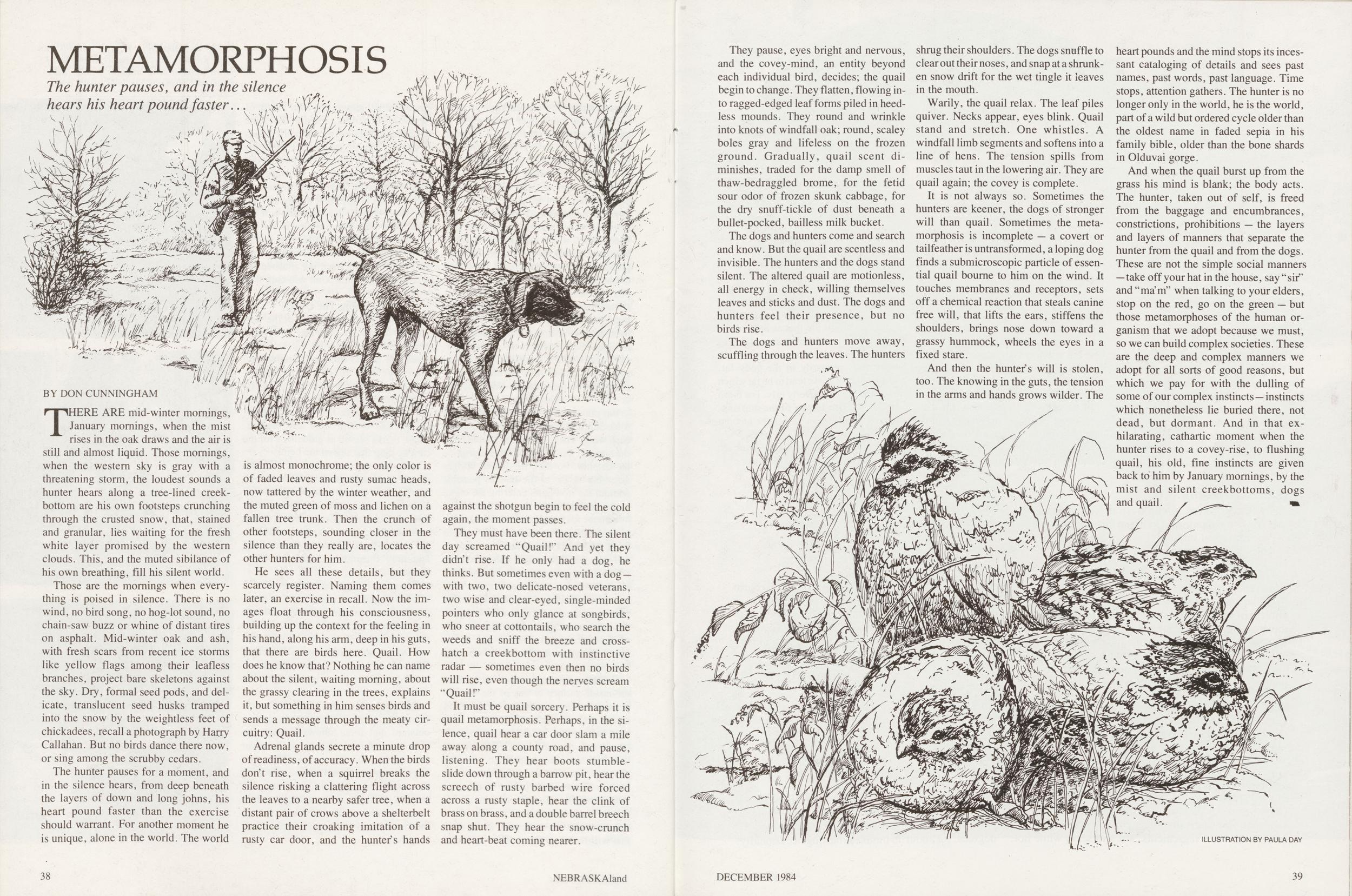
METAMORPHOSIS
The hunter pauses, and in the silence hears his heart pound faster... BY DON CUNNINGHAMTHERE ARE mid-winter morning January mornings, when the mist rises in the oak draws and the air is still and almost liquid. Those mornings, when the western sky is gray with a threatening storm, the loudest sounds a hunter hears along a tree-lined creek-bottom are his own footsteps crunching through the crusted snow, that, stained and granular, lies waiting for the fresh white layer promised by the western clouds. This, and the muted sibilance of his own breathing, fill his silent world.
Those are the mornings when everything is poised in silence. There is no wind, no bird song, no hog-lot sound, no chain-saw buzz or whine of distant tires on asphalt. Mid-winter oak and ash, with fresh scars from recent ice storms like yellow flags among their leafless branches, project bare skeletons against the sky. Dry, formal seed pods, and delicate, translucent seed husks tramped into the snow by the weightless feet of chickadees, recall a photograph by Harry Callahan. But no birds dance there now, or sing among the scrubby cedars.
The hunter pauses for a moment, and in the silence hears, from deep beneath the layers of down and long Johns, his heart pound faster than the exercise should warrant. For another moment he is unique, alone in the world. The world is almost monochrome; the only color is of faded leaves and rusty sumac heads, now tattered by the winter weather, and the muted green of moss and lichen on a fallen tree trunk. Then the crunch of other footsteps, sounding closer in the silence than they really are, locates the other hunters for him.
He sees all these details, but they scarcely register. Naming them comes later, an exercise in recall. Now the images float through his consciousness, building up the context for the feeling in his hand, along his arm, deep in his guts, that there are birds here. Quail. How does he know that? Nothing he can name about the silent, waiting morning, about the grassy clearing in the trees, explains it, but something in him senses birds and sends a message through the meaty circuitry: Quail.
Adrenal glands secrete a minute drop of readiness, of accuracy. When the birds don't rise, when a squirrel breaks the silence risking a clattering flight across the leaves to a nearby safer tree, when a distant pair of crows above a shelterbelt practice their croaking imitation of a rusty car door, and the hunter's hands against the shotgun begin to feel the cold again, the moment passes.
They must have been there. The silent day screamed "Quail!" And yet they didn't rise. If he only had a dog, he thinks. But sometimes even with a dog — with two, two delicate-nosed veterans, two wise and clear-eyed, single-minded pointers who only glance at songbirds, who sneer at cottontails, who search the weeds and sniff the breeze and cross-hatch a creekbottom with instinctive radar — sometimes even then no birds will rise, even though the nerves scream "Quail!"
It must be quail sorcery. Perhaps it is quail metamorphosis. Perhaps, in the silence, quail hear a car door slam a mile away along a county road, and pause, listening. They hear boots stumble-slide down through a barrow pit, hear the screech of rusty barbed wire forced across a rusty staple, hear the clink of brass on brass, and a double barrel breech snap shut. They hear the snow-crunch and heart-beat coming nearer.
38 NEBRASKAlandThey pause, eyes bright and nervous, and the covey-mind, an entity beyond each individual bird, decides; the quail begin to change. They flatten, flowing into ragged-edged leaf forms piled in heedless mounds. They round and wrinkle into knots of windfall oak; round, scaley boles gray and lifeless on the frozen ground. Gradually, quail scent diminishes, traded for the damp smell of thaw-bedraggled brome, for the fetid sour odor of frozen skunk cabbage, for the dry snuff-tickle of dust beneath a bullet-pocked, bailless milk bucket.
The dogs and hunters come and search and know. But the quail are scentless and invisible. The hunters and the dogs stand silent. The altered quail are motionless, all energy in check, willing themselves leaves and sticks and dust. The dogs and hunters feel their presence, but no birds rise.
The dogs and hunters move away, scuffling through the leaves. The hunters shrug their shoulders. The dogs snuffle to clear out their noses, and snap at a shrunken snow drift for the wet tingle it leaves in the mouth.
Warily, the quail relax. The leaf piles quiver. Necks appear, eyes blink. Quail stand and stretch. One whistles. A windfall limb segments and softens into a line of hens. The tension spills from muscles taut in the lowering air. They are quail again; the covey is complete.
It is not always so. Sometimes the hunters are keener, the dogs of stronger will than quail. Sometimes the metamorphosis is incomplete — a covert or tailfeather is untransformed, a loping dog finds a submicroscopic particle of essential quail bourne to him on the wind. It touches membranes and receptors, sets off a chemical reaction that steals canine free will, that lifts the ears, stiffens the shoulders, brings nose down toward a grassy hummock, wheels the eyes in a fixed stare.
And then the hunter's will is stolen, too. The knowing in the guts, the tension in the arms and hands grows wilder. The heart pounds and the mind stops its incessant cataloging of details and sees past names, past words, past language. Time stops, attention gathers. The hunter is no longer only in the world, he is the world, part of a wild but ordered cycle older than the oldest name in faded sepia in his family bible, older than the bone shards in Olduvai gorge.
And when the quail burst up from the grass his mind is blank; the body acts. The hunter, taken out of self, is freed from the baggage and encumbrances, constrictions, prohibitions — the layers and layers of manners that separate the hunter from the quail and from the dogs. These are not the simple social manners —take off your hat in the house, say "sir" and "ma'm" when talking to your elders, stop on the red, go on the green — but those metamorphoses of the human organism that we adopt because we must, so we can build complex societies. These are the deep and complex manners we adopt for all sorts of good reasons, but which we pay for with the dulling of some of our complex instincts — instincts which nonetheless lie buried there, not dead, but dormant. And in that exhilarating, cathartic moment when the hunter rises to a covey-rise, to flushing quail, his old, fine instincts are given back to him by January mornings, by the mist and silent creekbottoms, dogs and quail.
ILLUSTRATION BY PAULA DAY DECEMBER 1984 39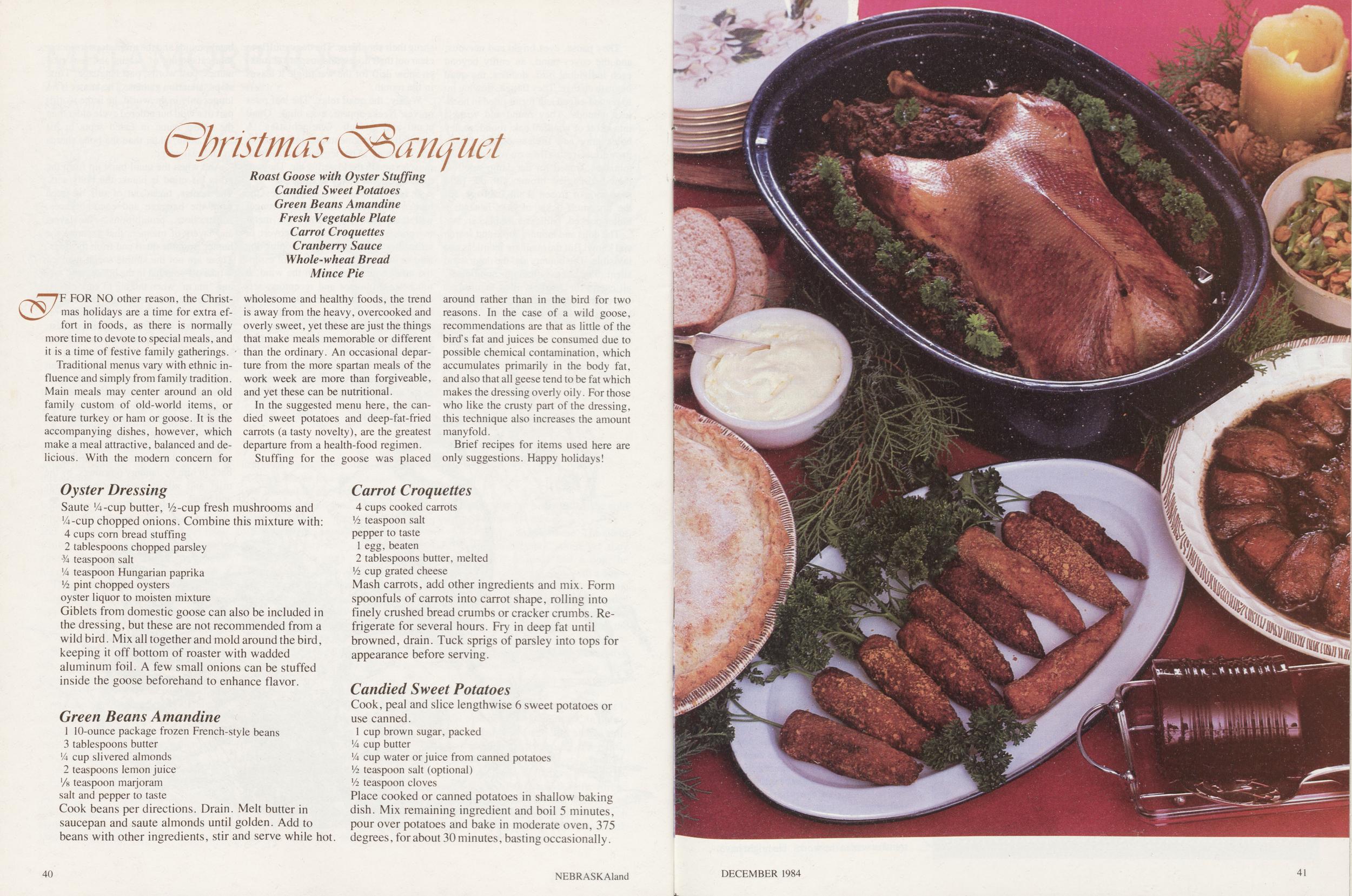
Christmas Banquet
Roast Goose with Oyster Stuffing Candied Sweet Potatoes Green Beans Amandine Fresh Vegetable Plate Carrot Croquettes Cranberry Sauce Whole-wheat Bread Mince PieIF FOR NO other reason, the Christmas holidays are a time for extra effort in foods, as there is normally more time to devote to special meals, and it is a time of festive family gatherings.
Traditional menus vary with ethnic influence and simply from family tradition. Main meals may center around an old family custom of old-world items, or feature turkey or ham or goose. It is the accompanying dishes, however, which make a meal attractive, balanced and delicious. With the modern concern for wholesome and healthy foods, the trend is away from the heavy, overcooked and overly sweet, yet these are just the things that make meals memorable or different than the ordinary. An occasional departure from the more spartan meals of the work week are more than forgiveable, and yet these can be nutritional.
In the suggested menu here, the candied sweet potatoes and deep-fat-fried carrots (a tasty novelty), are the greatest departure from a health-food regimen.
Stuffing for the goose was placed around rather than in the bird for two reasons. In the case of a wild goose, recommendations are that as little of the bird's fat and juices be consumed due to possible chemical contamination, which accumulates primarily in the body fat, and also that all geese tend to be fat which makes the dressing overly oily. For those who like the crusty part of the dressing, this technique also increases the amount manyfold.
Brief recipes for items used here are only suggestions. Happy holidays!
Oyster Dressing Saute 1/4-cup butter, 1/2-cup fresh mushrooms and 14-cup chopped onions. Combine this mixture with: 4 cups com bread stuffing 2 tablespoons chopped parsley 3/4 teaspoon salt 1/4 teaspoon Hungarian paprika 1/2 pint chopped oysters oyster liquor to moisten mixture Giblets from domestic goose can also be included in the dressing, but these are not recommended from a wild bird. Mix all together and mold around the bird, keeping it off bottom of roaster with wadded aluminum foil. A few small onions can be stuffed inside the goose beforehand to enhance flavor. Green Beans Amandine 1 10-ounce package frozen French-style beans 3 tablespoons butter Va cup slivered almonds 2 teaspoons lemon juice Vs teaspoon marjoram salt and pepper to taste Cook beans per directions. Drain. Melt butter in saucepan and saute almonds until golden. Add to beans with other ingredients, stir and serve while hot. Carrot Croquettes 4 cups cooked carrots V2 teaspoon salt pepper to taste 1 egg, beaten 2 tablespoons butter, melted V2 cup grated cheese Mash carrots, add other ingredients and mix. Form spoonfuls of carrots into carrot shape, rolling into finely crushed bread crumbs or cracker crumbs. Refrigerate for several hours. Fry in deep fat until browned, drain. Tuck sprigs of parsley into tops for appearance before serving. Candied Sweet Potatoes Cook, peal and slice lengthwise 6 sweet potatoes or use canned. 1 cup brown sugar, packed Va cup butter Va cup water or juice from canned potatoes V2 teaspoon salt (optional) V2 teaspoon cloves Place cooked or canned potatoes in shallow baking dish. Mix remaining ingredient and boil 5 minutes, pour over potatoes and bake in moderate oven, 375 degrees, for about 30 minutes, basting occasionally. 40 NEBRASKAland DECEMBER 1984 41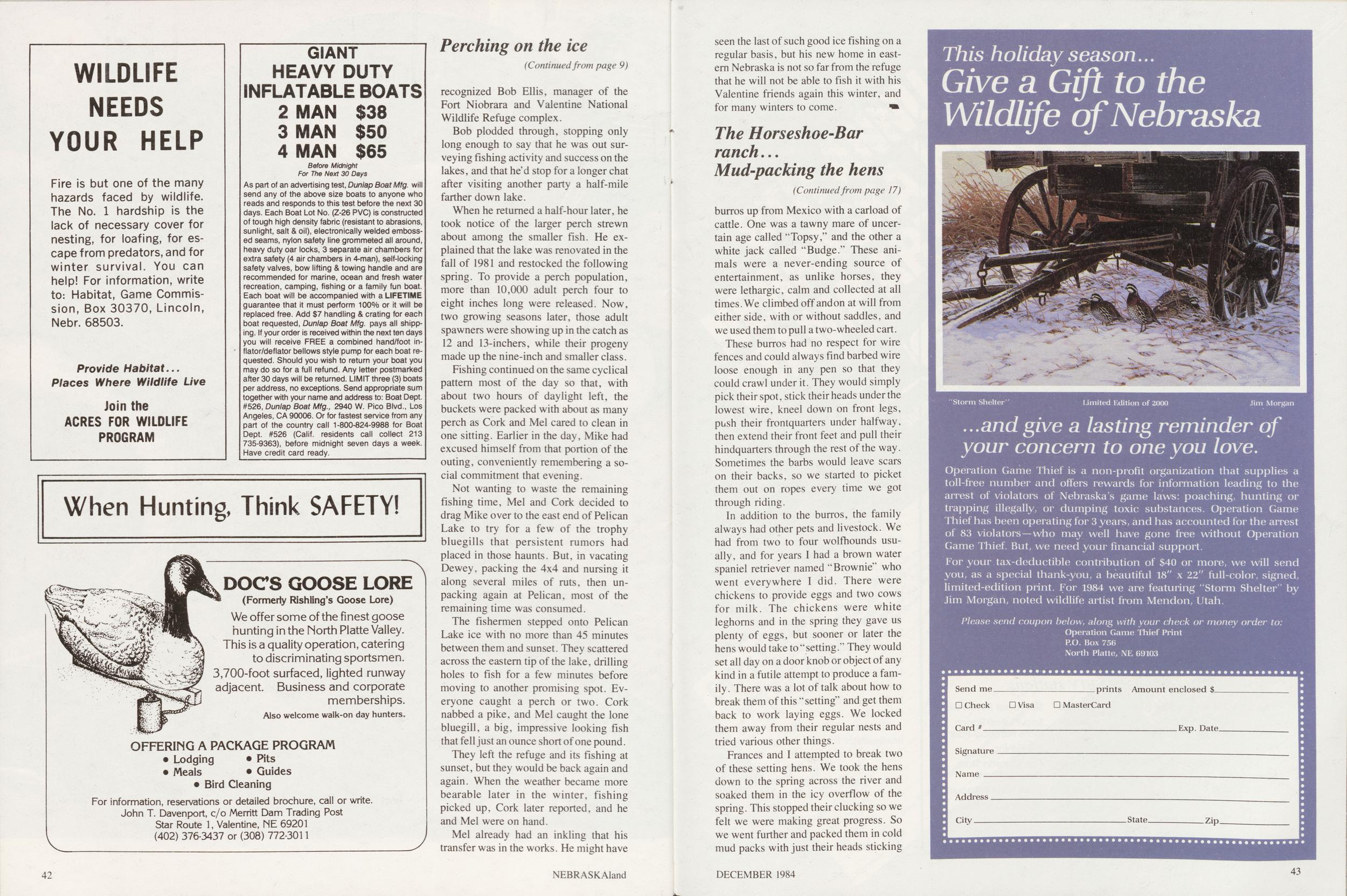
recognized Bob Ellis, manager of the Fort Niobrara and Valentine National Wildlife Refuge complex.
Bob plodded through, stopping only long enough to say that he was out surveying fishing activity and success on the lakes, and that he'd stop for a longer chat after visiting another party a half-mile farther down lake.
When he returned a half-hour later, he took notice of the larger perch strewn about among the smaller fish. He explained that the lake was renovated in the fall of 1981 and restocked the following spring. To provide a perch population, more than 10,000 adult perch four to eight inches long were released. Now, two growing seasons later, those adult spawners were showing up in the catch as 12 and 13-inchers, while their progeny made up the nine-inch and smaller class.
Fishing continued on the same cyclical pattern most of the day so that, with about two hours of daylight left, the buckets were packed with about as many perch as Cork and Mel cared to clean in one sitting. Earlier in the day, Mike had excused himself from that portion of the outing, conveniently remembering a social commitment that evening.
Not wanting to waste the remaining fishing time, Mel and Cork decided to drag Mike over to the east end of Pelican Lake to try for a few of the trophy bluegills that persistent rumors had placed in those haunts. But, in vacating Dewey, packing the 4x4 and nursing it along several miles of ruts, then unpacking again at Pelican, most of the remaining time was consumed.
The fishermen stepped onto Pelican Lake ice with no more than 45 minutes between them and sunset. They scattered across the eastern tip of the lake, drilling holes to fish for a few minutes before moving to another promising spot. Everyone caught a perch or two. Cork nabbed a pike, and Mel caught the lone bluegill, a big, impressive looking fish that fell just an ounce short of one pound.
They left the refuge and its fishing at sunset, but they would be back again and again. When the weather became more bearable later in the winter, fishing picked up, Cork later reported, and he and Mel were on hand.
Mel already had an inkling that his transfer was in the works. He might have
42 NEBRASKAlandseen the last of such good ice fishing on a regular basis, but his new home in eastern Nebraska is not so far from the refuge that he will not be able to fish it with his Valentine friends again this winter, and for many winters to come.
burros up from Mexico with a carload of cattle. One was a tawny mare of uncertain age called "Topsy," and the other a white jack called "Budge." These animals were a never-ending source of entertainment, as unlike horses, they were lethargic, calm and collected at all times. We climbed off and on at will from either side, with or without saddles, and we used them to pull a two-wheeled cart.
These burros had no respect for wire fences and could always find barbed wire loose enough in any pen so that they could crawl under it. They would simply pick their spot, stick their heads under the lowest wire, kneel down on front legs, push their frontquarters under halfway, then extend their front feet and pull their hindquarters through the rest of the way. Sometimes the barbs would leave scars on their backs, so we started to picket them out on ropes every time we got through riding.
In addition to the burros, the family always had other pets and livestock. We had from two to four wolfhounds usually, and for years I had a brown water spaniel retriever named "Brownie" who went everywhere I did. There were chickens to provide eggs and two cows for milk. The chickens were white leghorns and in the spring they gave us plenty of eggs, but sooner or later the hens would take to "setting." They would set all day on a door knob or object of any kind in a futile attempt to produce a family. There was a lot of talk about how to break them of this "setting" and get them back to work laying eggs. We locked them away from their regular nests and tried various other things.
Frances and I attempted to break two of these setting hens. We took the hens down to the spring across the river and soaked them in the icy overflow of the spring. This stopped their clucking so we felt we were making great progress. So we went further and packed them in cold mud packs with just their heads sticking
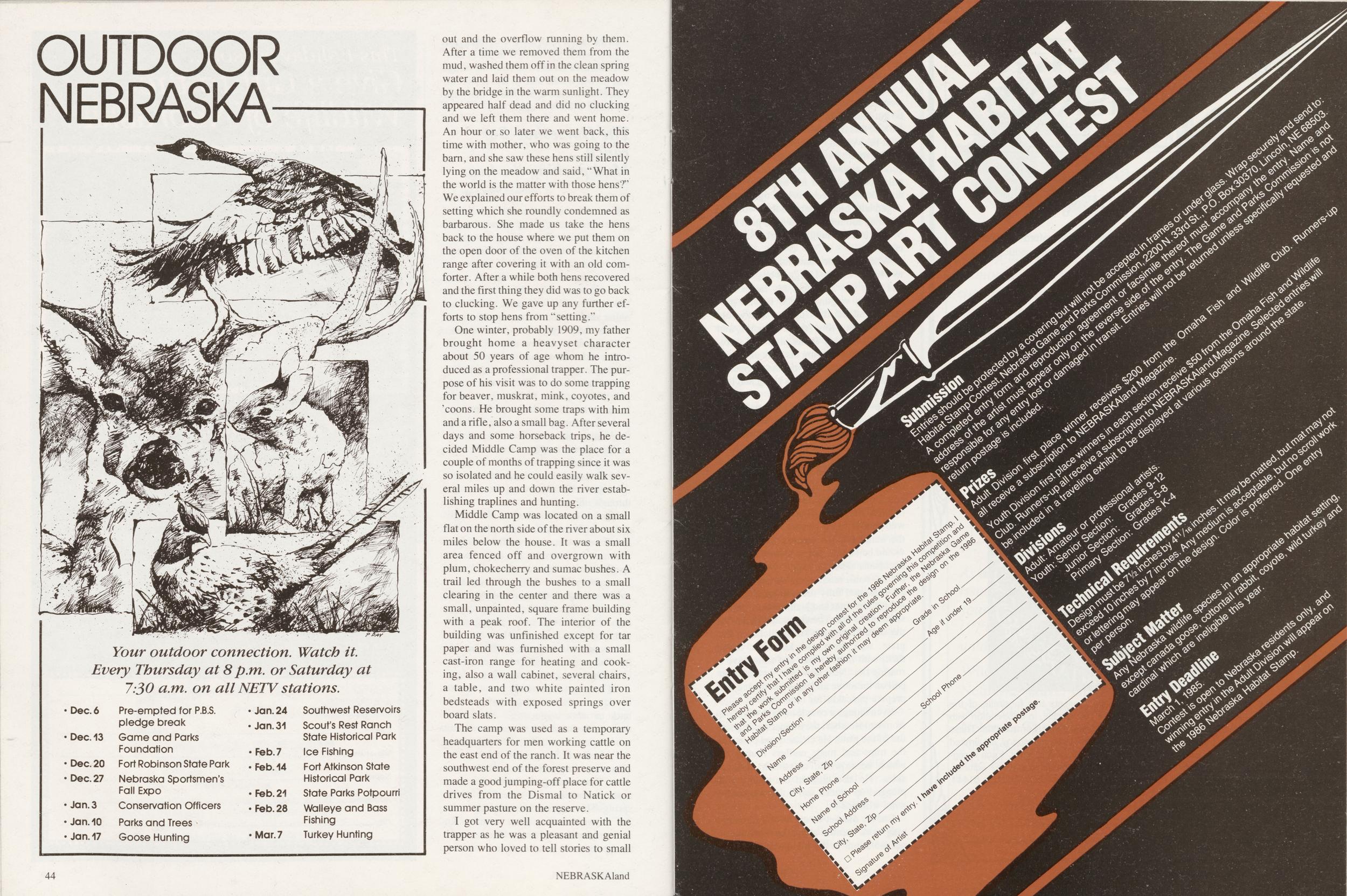
out and the overflow running by them. After a time we removed them from the mud, washed them off in the clean spring water and laid them out on the meadow by the bridge in the warm sunlight. They appeared half dead and did no clucking and we left them there and went home. An hour or so later we went back, this time with mother, who was going to the bam, and she saw these hens still silently lying on the meadow and said, "What in the world is the matter with those hens?' We explained our efforts to break them of setting which she roundly condemned as barbarous. She made us take the hens back to the house where we put them on the open door of the oven of the kitchen range after covering it with an old comforter. After a while both hens recovered and the first thing they did was to go back to clucking. We gave up any further efforts to stop hens from "setting."
One winter, probably 1909, my father brought home a heavyset character about 50 years of age whom he introduced as a professional trapper. The purpose of his visit was to do some trapping for beaver, muskrat, mink, coyotes, and 'coons. He brought some traps with him and a rifle, also a small bag. After several days and some horseback trips, he decided Middle Camp was the place for a couple of months of trapping since it was so isolated and he could easily walk several miles up and down the river establishing traplines and hunting.
Middle Camp was located on a small flat on the north side of the river about six miles below the house. It was a small area fenced off and overgrown with plum, chokecherry and sumac bushes. A trail led through the bushes to a small clearing in the center and there was a small, unpainted, square frame building with a peak roof. The interior of the building was unfinished except for tar paper and was furnished with a small cast-iron range for heating and cooking, also a wall cabinet, several chairs, a table, and two white painted iron bedsteads with exposed springs over board slats.
The camp was used as a temporary headquarters for men working cattle on the east end of the ranch. It was near the southwest end of the forest preserve and made a good jumping-off place for cattle drives from the Dismal to Natick or summer pasture on the reserve.
I got very well acquainted with the trapper as he was a pleasant and genial person who loved to tell stories to small
boys or anybody who would listen. He had been sheriff of some Wyoming town and gotten into a shooting scrape with someone he was trying to arrest and was badly injured. He recovered from his wounds but his legs gave him trouble and he got around only with some difficulty. He said that if he didn't exercise and walk a lot he wouldn't be able to walk at all. During an active day his legs appeared as good as anybody's and he could walk miles per day with his trapline, but at night he had to keep his legs tightly bandaged with binding tape so they wouldn't swell up too much. He was in pain most of the time but laughed it off and didn't complain.
When the time came for him to move to Middle Camp, I begged to go along, and so it was arranged. My father took the spring wagon, loaded it with groceries and all the supplies we would need for some time, traps and guns, and off we went. My father promised to return in a week to bring me back and see if anything was needed by the trapper. I recall feeling homesick as I watched him drive off.
The weather was sunshiny and fairly warm for December when we set up camp, but very shortly it turned cold and stormed for over a day, leaving snow on the ground and the river about half frozen with a dark, angry looking channel full of gray pack ice. The shanty was kept comfortable by the stove that glowed red hot most of the time, but of course the fire went out at night and by morning even the canned tomatoes and the potatoes would be frozen, not to mention the two occupants. The old trapper would rise in the icy cold, remove the bandages from his legs, and fully dress himself including his overcoat and leather boots before starting the fire. Then he would shake out the dead ashes, put small sticks on the grate, soak them with kerosene, cover them with larger sticks and soon have a roaring fire. Next he would set the water pail on the stove and thaw out the ice and prepare pancakes for breakfast.
Even though a couple of days were lost from bad weather, the trapper made good use of the time. He cleaned and polished the traps and made endless frames on which he expected to stretch muskrat skins. He also cleaned the shanty and plugged up cracks and holes where the wind whistled in.
I never did get to see any of his trapping work because about the third day of our isolation, in the middle of the afternoon
NEBRASKAlandof a gray, bitter cold but not stormy day, I heard someone yelling in the distance. The trapper passed it off as some wild geese honking as they flew over. It didn't sound like geese to me so I threw on my overcoat and cap and went out. Across the river was my father and one of his rancher neighbors. They had been yelling to rouse us as they had been out all day looking at cattle and passed by on the opposite side of the river.
My father yelled that if I wanted to come home he would come across and get me and I could ride back with him. It seemed my mother was worried and wished he would bring me home. I was delighted, already having exhausted my original enthusiasm, as boys will, so both men rode down to the bank of the stream and tried to cross. There was solid ice for several feet out from each bank with swift flow between. The horses wanted no part of it. The two men made every effort, but each time they got to the strip of ice, the horses would rear back and scramble up the bank again. Finally, the neighbor got his horse and himself across but the horse was so trembly and excited by this time that he wouldn't permit me to get on with his master. After several attempts to mount, even with the help of the trapper who had joined us, the neighbor said he thought it was too dangerous to try further, so he rode back across, joined my father and they rode off.
My father promised to be back the next day and come down on our side of the river with a horse for me. This he surely did and the ride home was the coldest experience I ever had on the ranch. It was not snowing but it was blowing and well below zero. We got off and walked several times to warm up. My mother put me right to bed to warm up with a hot water bottle and it took a long time to get feeling normal.
A week or so later, when one of the men stopped by Middle Camp to see how the trapper was getting along, he was found dead in bed. So far as I know, he never got his trapline going at all. I was thankful I wasn't with him at the end. It struck me seriously enough to just hear about it.
I didn't think much about the difficulties of raising a young family in such isolation when I was a boy, but I have appreciated it since. Take the doctor problem. There was no good doctor at Thedford, but an excellent one at Gandy, 20 miles across the hills to the south.
Dr. McClay, a wiry little hardworking Scotchman who, like the storybook doctor of legend, was always ready with his little black bag, day or night. When sickness struck one of us children, usually at night, of course, my father or one of the men had to saddle up and ride 20 miles to Gandy. The doctor had to hitch up and drive 20 miles to the ranch, make his diagnosis, do what he could, leave his pills, and drive all the way back. It was a four-hour drive each way and Dr. McClay did it many times, often at night. The "roads" were just two trails through the grass, over hills and valleys. Only someone who has traveled through the Sandhills by horse and buggy on a cloudy night, without even stars to light the way, can possibly realize how dark the hills can be. These trips would have been impossible without the horses' sixth sense for keeping to the trail even in the dark. Flashlights hadn't yet been invented, and Dr. McClay didn't even have a lantern.
I recall one of his visits to attend me when I had the croup. I developed a chest cold which got very bad in early evening. My mother was seriously worried. I heard whispering between her and father as the lamps were lit and I was put to bed. I could hardly breathe except in gasps. Finally the phlem in my throat was so bad I choked and couldn't breathe at all. My mother suddenly picked up one of the kerosene lamps, blew it out, removed the chimney and unscrewed the wick holder,
and poured kerosene into my mouth. It cut through the phlem and gagged me, causing me to throw up, but I could breathe again.
I must have gone to sleep then because my next recollection was the doctor sitting on the edge of the bed thumping my back and listening with his stethoscope. He was there only a short time, gave my mother some instructions and started his long trip back. It was winter, and cold. The bedroom reeked of kerosene smell from the burning lamps and the heater.
The day of Allan's birth there was a doctor and a nurse at the house, and Frances and I were hustled off in the morning with John Aden, the Missourian handyman, on the wood wagon to spend the day gathering wood. It was a warm and pleasant eighth of May and we drove up the river on the north side about three miles. We were provided with a lunch and John evidently had his orders to keep us away until late afternoon. I was six and Frances was four, and we were too young to be of any help to John, who took his time so we arrived back at the house about four o'clock. We approached the vine-covered porch on the west side of the house, and hanging on the screen door was my mother's pin cushion, and behind the door was the nurse, watching for us. Now I knew perfectly well that a pin cushion on a door meant a new baby had arrived but I was too embarrassed to admit it. The nurse said, "Do you children know what this pin cushion means?' I hung my head and said, "No" so she said, "You have a beautiful new baby brother, isn't that nice?" I didn't feel thrilled. I felt like somebody had put one over on me while my back was turned and it took several days to feel comfortable about the new family member.
This is the fifth in a series of excerpts from an unpublished book manuscript about ranching on the Dismal River in Thomas County at the turn of the century. Author Roe R. Black lived on the ranch as a boy from 1900 to 1912 and now resides in Aurora, Nebraska. His younger brother, Allan Black, mentioned in this article, is a long-time resident of Broken Bow, Nebraska. NEBRASKAIand proudly presents the stories of its readers. Here is the opportunity so many have requested-a chance to tell their own outdoor tales. Hunting trips, the "big fish that got away", unforgettable characters, outdoor impressions-all have a place here. If you have a story to tell, jot it down and send it to Editor, NEBRASKAIand, Box 30370, Lincoln, Nebr. 68503. Send photographs, black and white or color, too, if any are available. 48 NEBRASKAlandTrading Post
DOGSTRAINING ALL BREEDS Hunting dogs—Vizslas for sale. Rozanek Kennels, Rt. 2, Schuyler, NE 68661. Phone (402) 352-8769.
ENGLISH SETTERS and Pointers: Outstanding bloodlines! Puppies, started dogs, and stud service available. High Plains Kennels, 1411 Emerson, Alliance, NE 69301. Phone (308) 762-6709.
GERMAN SHORTHAIRS —English Pointers and Beagles—Stud service, puppies and started dogs. Wayne Clark, Box 54, Union, Nebr. 68455. Phone (402) 263-3495 or 263-3155.
AKC GERMAN wirehaired pointers started this fall. Also new pups ready by Christmas. Phone (402) 253-8228.
MISCELLANEOUSWINE AND BEER: Make your own. Send for free recipes and instructions. Omaha Supply, 13616 Polk, Omaha, Nebr. 68137.
GUNS—Browning, Winchester, Remington, others, Hi-powers, shotguns, new, used, antiques. Want Pre-1964 Winchesters. Buy-Sell-Trade. Ph. (402) 729-6112. Bedlan's Sporting Goods, Fairbury, NE 68352.
FISH FOR SALE. Channel catfish, bass, bluegill, crappie, trout, perch, white bass, minnows, hybrid grass carp, bullhead. We can ship fish, you can pick them up, or we deliver. Contact the Pleasant Valley Fish Farm, Rt. 1, McCook, NE 69001. Phone (308) 345-6599.
MISSOURI RIVER — Three, 75-foot lots across from Niobrara, Nebraska. Perfect for retirement or vacation home. Excellent hunting, fishing, bird watching. Above flood plain yet easy access to river. Your pick, $7500. Howard Lovrien (612) 571-9498.
CANOE ENTHUSIASTS. Quality and performance important? Mad River is the canoe for you! Mad River of Nebraska, 1231 Saunders, Lincoln, Nebraska 68521, Phone (402) 435-6588 or 205 Main, Springfield, NE 68059. Phone (402) 253-2000.
ATTENTION: Motor home and fifth-wheel owners who would like to drive to Alaska but don't have time to make a round trip, phone (402) 647-2265 between 7-10 p.m.
WESTERN BOOK CATALOG. Hundreds of titles on American West, ghost towns, old forts, etc. Free catalog. Research Unlimited, Box N., Main Street, Ames, NE 68621. Phone (402) 727-9833.
N.E. NEBRASKA TROUT Fishing. For rent Mon.- Thurs. or Fri.-Sun. 2 modern cottages completely furnished. 5 spring-fed lakes with trout up to 7 lbs. Bass and bluegill also. Diamond E Trout Resort, Orchard, NE 68764. (402) 893-4745.
HERBS-SPICES! Wholesale prices! Get ready for the holidays with our top quality spices. Over 160 to choose from. Send self-addressed stamped envelope now and receive our free catalog. Dakota Prairie Products, Rt. 1, Box 268K, Tabor, SD 57063.
RECIPE BOOK, $2.50. Make your own Kahlua, Amaretto, Galianno, cremes and more. Write Recipe Book, Box 508, Broken Bow, NE 68822.
ON SCENIC Niobrara River south of Valentine, Nebraska, approximately 925 acres with 7/8-mile of river frontage plus one mile of trout fishing in Schlagel Creek; excellent deer and turkey hunting, panoramic cabin sites, landing strip possibility. Priced at $295 per acre for entire tract. Bob Gass Agency, 468 N. Main, Valentine, Nebr. 69201.
WAX WORMS-500-$8.25; 1,000-$14.50. Add Vh% sales tax. Postpaid first class. No C.O.D. Harold Malicky, Burwell, NE 68823.
BOTTLE COLLECTION: good variety; bitters, medicines of all kinds, fish oil, whiskeys, many others. Priced right for entire collection. Phone (402) 462-4513.
WANTED—Music magazines (old and new), such as Etude, Musician, Perry's, Melody, Clavier, Keyboard Classics, sheet music, books, etc. Please write E. Byrd Carnohan, 123 34th St., Newport News, VA 23607.
TAXIDERMYCREATIVE TAXIDERMY in all its branches since 1935, now includes Northstar Freeze-Dry processing of approved small specimens. Also tanning and deerskin processing. Naturecraft Studio. Nebraska City, Nebraska 68510. Joe Voges-Owner. Phone (402) 873-5491. DINGES TAXIDERMY Studio, 2763 So. 12th St., Omaha, NE 68108. Fourteen-time National Award Winning Taxidermy. Trust your trophies to a proven winner. Complete professional service. Mike and Mary Dinges (402) 342-3718.
NABITY'S TAXIDERMY. 31 years experience. Specializing in natural grass backgrounds for mammals, birds and fish. 13901 "0"St., Lincoln, NE 68505 4 miles east of 84th and "O". (402) 489-6351.
BIG BEAR TAXIDERMY, Rt. 2, Mitchell, Nebraska 69357. We specialize in all big game from Alaska to Nebraska, also birds and fish. Hair-on and hair-off tanning. 4'/2 miles west of Scottsbluff on Highway 26. Dale Hubel, phone (308) 635-3013.
JOHNSON TAXIDERMY—servicing southwest Nebraska, specializing in big-game mounts, life-sized mounts, rug work, fish, birds, tanning hair-on leather. Brochure and price list on request. Johnson Taxidermy, Rt. 1, Box 78, Lamar, NE 69035. Telephone (308) 882-5555.
PEISTER TAXIDERMY—a name you can trust. We give you professional life-like work at prices most sportsmen can afford. Member National Taxidermist Association, #5 Regency, Place, Kearney, Nebr. 68847. Phone (308) 237-7575.
FREEZE-DRY TAXIDERMY Wally Allison's State Record Taxidermy, 2709 Birchwood, North Platte, NE 69101. Phone: (308) 534-2324. Specializing in Fish and Small Game, Snake and Lizard and Novelties. (Nothing too small) Newest of all taxidermy methods employed. KARL SCHWARZ master taxidermist has moved to a new country studio; same professional mounting and tanning service. Schwarz Wild Wing Studio, 16804 South 180th St., Springfield, NE 68059. Phone (402) 253-2481.
BADE TAXIDERMY— Quality a must—Fast service. Fish, birds, rugs, tanning, full mounts and game heads. 2111 N. Christy St., Fremont, Nebraska 727-5463. HASTINGS TAXIDERMY: Life-like mounting of big game, rugs, birds, fish. Please stop in and compare our work with others. I specialize in big game head mounts. Call or write: Hastings Taxidermy, RR 3, Ord, NE 68862. Phone (308) 728-5322.
HOUSE OF BIRDS. Licensed taxidermist with 18 years experience. Specialize in birds and game heads. Pheasant $47.50, deer head $87.50, Quail $35 a pair For more information call (402) 228-3959.
WHITETAIL TAXIDERMY. Federal and state licensed. Specialist in deer mounts and game birds. Unique poses and low prices. Phone (402) 564-6885, Columbus, Nebr.
LIVE-CATCH ALL-PURPOSE TRAPS Write for FREE CATALOG Traps without injury squirrels, chipmunks, rabbits, mink, fox, raccoons, stray animals, pests, etc. Sizes for every need. Also traps 'or snakes, sparrows, pigeons, crabs, turtles, quail, etc. Save on our low factory prices Send no money Free catalog and trapping secrets MUSTANG MFG. CO., Dept. N-34, Box 920947, Houston, Tex. 77292 Statement of ownership, management, and monthly circulation of NEBRASKAland Magazine OWNER AND PUBLISHER Nebraska Game and Parks Commission EDITOR AND MANAGING EDITOR: Lowell A. Johnson HEADQUARTERS OF PUBLISHER AND PUBLICATION 2200 N. 33rd Street, Lincoln, NE 68503 STOCKHOLDERS: BONDHOLDERS. MORTGAGE: OTHER SECURITY HOLDERS: None Average No. of copies each Issue during preceding 12 months Single issue nearest to filing date A. TOTAL COPIES PRINTED Oct. '83 (net press run) Sept. 84 Sept. 84 62,230 67,564 B. PAID CIRCULATION 1. Single-copy sales 1,527 1,500 2. Mail subscription 54,348 60,083 C. TOTAL PAID CIRCULATION 55,875 61,583 D. FREE DISTRIBUTION (incl. samples) BY MAIL, or OTHER MEANS, (no news agents) 4,000 3,478 E. TOTAL DISTRIBUTION (sum of C and D) 59,875 65,061 F. OFFICE USE, LEFTOVERS, ETC. 1,455 1,603 RETURNS FROM 900 900 NEWS AGENTS G. TOTAL (sum of E and F) 62,230 67,564 DECEMBER 1984 49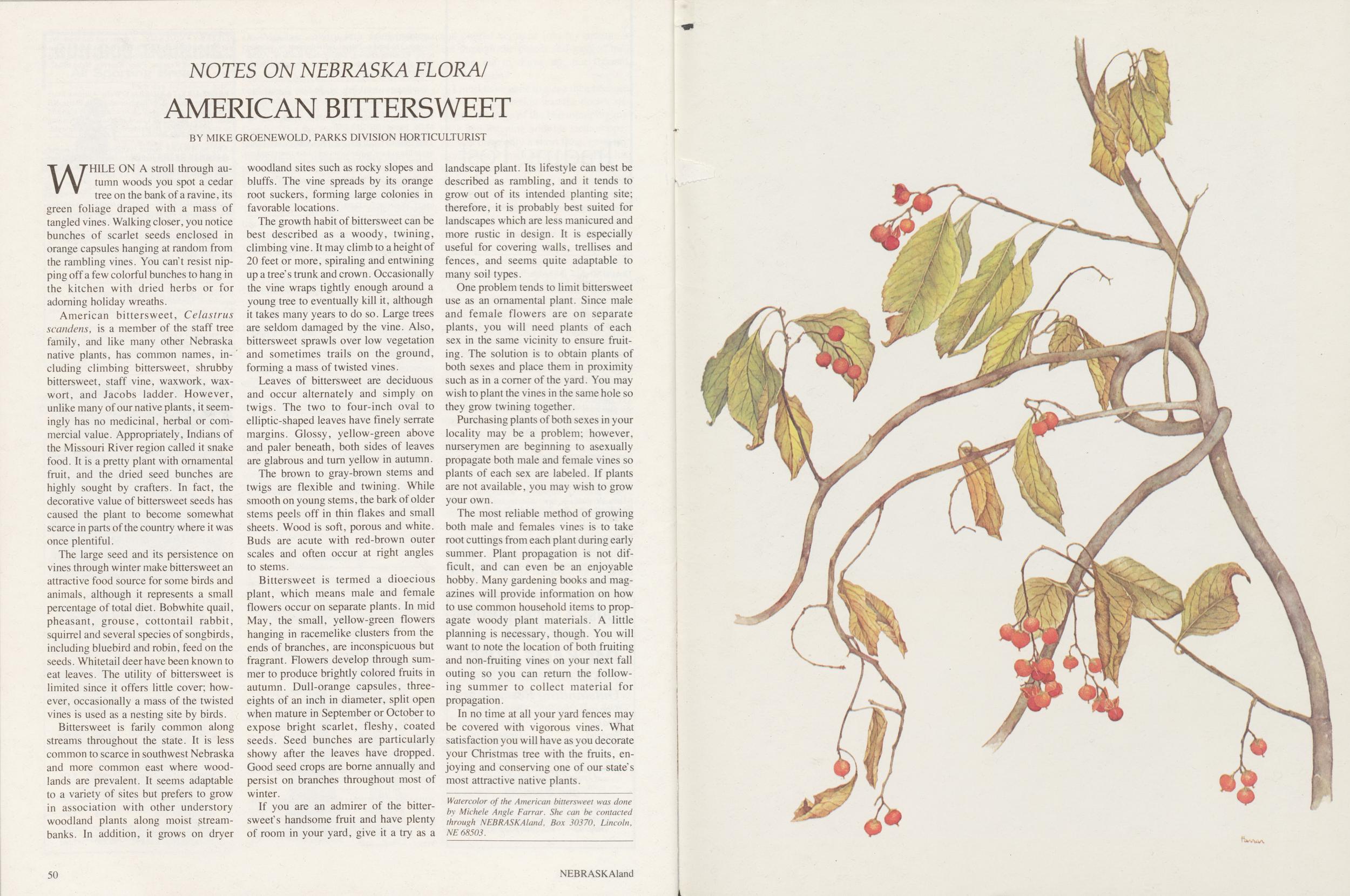
NOTES ON NEBRASKA FLORA/ AMERICAN BITTERSWEET
BY MIKE GROENEWOLD, PARKS DIVISION HORTICULTURISTWHILE ON A stroll through autumn woods you spot a cedar tree on the bank of a ravine, its green foliage draped with a mass of tangled vines. Walking closer, you notice bunches of scarlet seeds enclosed in orange capsules hanging at random from the rambling vines. You can't resist nipping off a few colorful bunches to hang in the kitchen with dried herbs or for adorning holiday wreaths.
American bittersweet, Celastrus scandens, is a member of the staff tree family, and like many other Nebraska native plants, has common names, including climbing bittersweet, shrubby bittersweet, staff vine, waxwork, waxwort, and Jacobs ladder. However, unlike many of our native plants, it seemingly has no medicinal, herbal or commercial value. Appropriately, Indians of the Missouri River region called it snake food. It is a pretty plant with ornamental fruit, and the dried seed bunches are highly sought by crafters. In fact, the decorative value of bittersweet seeds has caused the plant to become somewhat scarce in parts of the country where it was once plentiful.
The large seed and its persistence on vines through winter make bittersweet an attractive food source for some birds and animals, although it represents a small percentage of total diet. Bobwhite quail, pheasant, grouse, cottontail rabbit, squirrel and several species of songbirds, including bluebird and robin, feed on the seeds. Whitetail deer have been known to eat leaves. The utility of bittersweet is limited since it offers little cover; however, occasionally a mass of the twisted vines is used as a nesting site by birds.
Bittersweet is farily common along streams throughout the state. It is less common to scarce in southwest Nebraska and more common east where woodlands are prevalent. It seems adaptable to a variety of sites but prefers to grow in association with other understory woodland plants along moist streambanks. In addition, it grows on dryer woodland sites such as rocky slopes and bluffs. The vine spreads by its orange root suckers, forming large colonies in favorable locations.
The growth habit of bittersweet can be best described as a woody, twining, climbing vine. It may climb to a height of 20 feet or more, spiraling and entwining up a tree's trunk and crown. Occasionally the vine wraps tightly enough around a young tree to eventually kill it, although it takes many years to do so. Large trees are seldom damaged by the vine. Also, bittersweet sprawls over low vegetation and sometimes trails on the ground, forming a mass of twisted vines.
Leaves of bittersweet are deciduous and occur alternately and simply on twigs. The two to four-inch oval to elliptic-shaped leaves have finely serrate margins. Glossy, yellow-green above and paler beneath, both sides of leaves are glabrous and turn yellow in autumn.
The brown to gray-brown stems and twigs are flexible and twining. While smooth on young stems, the bark of older stems peels off in thin flakes and small sheets. Wood is soft, porous and white. Buds are acute with red-brown outer scales and often occur at right angles to stems.
Bittersweet is termed a dioecious plant, which means male and female flowers occur on separate plants. In mid May, the small, yellow-green flowers hanging in racemelike clusters from the ends of branches, are inconspicuous but fragrant. Flowers develop through summer to produce brightly colored fruits in autumn. Dull-orange capsules, three-eights of an inch in diameter, split open when mature in September or October to expose bright scarlet, fleshy, coated seeds. Seed bunches are particularly showy after the leaves have dropped. Good seed crops are borne annually and persist on branches throughout most of winter.
If you are an admirer of the bittersweet's handsome fruit and have plenty of room in your yard, give it a try as a landscape plant. Its lifestyle can best be described as rambling, and it tends to grow out of its intended planting site; therefore, it is probably best suited for landscapes which are less manicured and more rustic in design. It is especially useful for covering walls, trellises and fences, and seems quite adaptable to many soil types.
One problem tends to limit bittersweet use as an ornamental plant. Since male and female flowers are on separate plants, you will need plants of each sex in the same vicinity to ensure fruiting. The solution is to obtain plants of both sexes and place them in proximity such as in a corner of the yard. You may wish to plant the vines in the same hole so they grow twining together.
Purchasing plants of both sexes in your locality may be a problem; however, nurserymen are beginning to asexually propagate both male and female vines so plants of each sex are labeled. If plants are not available, you may wish to grow your own.
The most reliable method of growing both male and females vines is to take root cuttings from each plant during early summer. Plant propagation is not difficult, and can even be an enjoyable hobby. Many gardening books and magazines will provide information on how to use common household items to propagate woody plant materials. A little planning is necessary, though. You will want to note the location of both fruiting and non-fruiting vines on your next fall outing so you can return the following summer to collect material for propagation.
In no time at all your yard fences may be covered with vigorous vines. What satisfaction you will have as you decorate your Christmas tree with the fruits, enjoying and conserving one of our state's most attractive native plants.
Watercolor of the American bittersweet was done by Michele Angle Farrar. She can be contacted through NEBRASKAland, Box 30370, Lincoln, NE 68503.Position: 583 (19 views)