Volume 62, Issue 10, 1984
NEBRASKAland
MARCH 1985 $1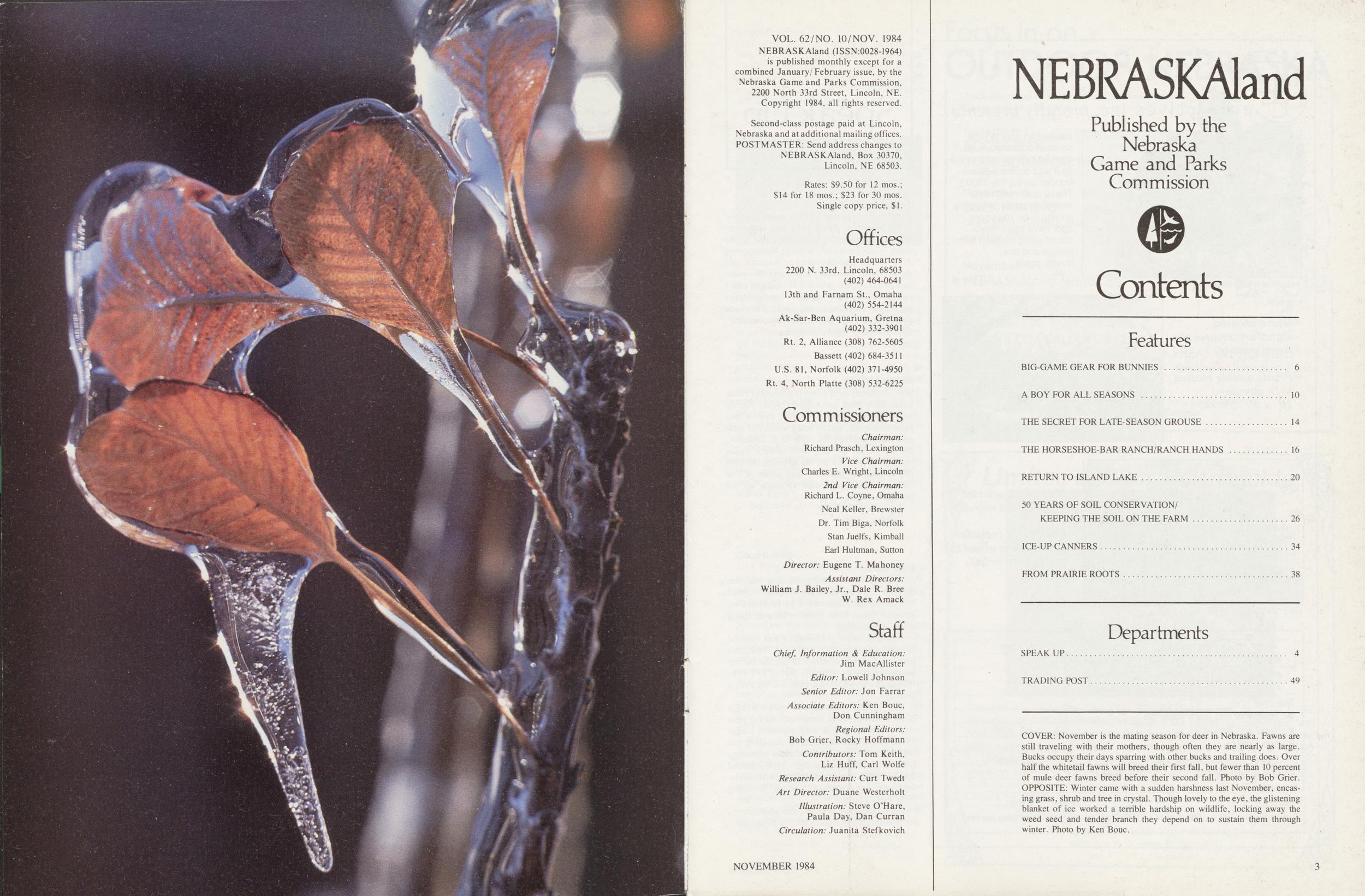
NEBRASKAland
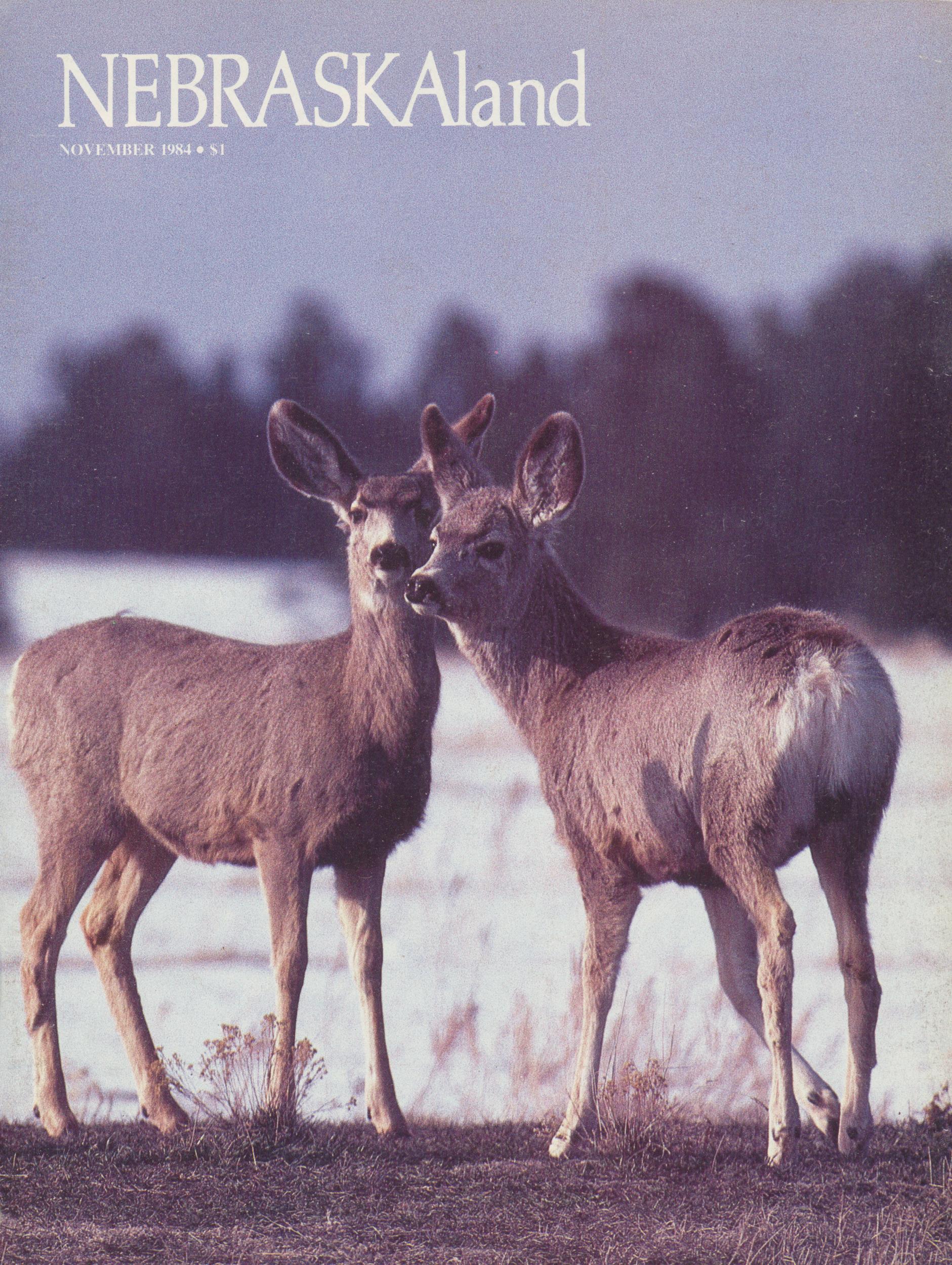
Published by the Nebraska Game and Parks Commission VOL. 62/NO. 10/NOV. 1984 NEBRASKAland (ISSN:0028-1964) is published monthly except for a combined January/ February issue, by the Nebraska Game and Parks Commission, 2200 North 33rd Street, Lincoln, NE. Copyright 1984, all rights reserved. Second-class postage paid at Lincoln, Nebraska and at additional mailing offices. POSTMASTER: Send address changes to NEBRASKAland, Box 30370, Lincoln, NE 68503. Rates: $9.50 for 12 mos.; $14 for 18 mos.; $23 for 30 mos. Single copy price, $1. Offices Headquarters 2200 N. 33rd, Lincoln, 68503 (402) 464-0641 13th and Farnam St., Omaha (402) 554-2144 Ak-Sar-Ben Aquarium, Gretna (402) 332-3901 Rt. 2, Alliance (308) 762-5605 Bassett (402) 684-3511 U.S. 81, Norfolk (402) 371-4950 Rt. 4, North Platte (308) 532-6225 Commissioners Chairman: Richard Prasch, Lexington Vice Chairman: Charles E. Wright, Lincoln 2nd Vice Chairman: Richard L. Coyne, Omaha Neal Keller, Brewster Dr. Tim Biga, Norfolk Stan Juelfs, Kimball Earl Hultman, Sutton Director: Eugene T. Ma honey Assistant Directors: William J. Bailey, Jr., Dale R. Bree W. Rex Amack Staff Chief, Information & Education: Jim MacAllister Editor: Lowell Johnson Senior Editor: Jon Farrar Associate Editors: Ken Bouc, Don Cunningham Regional Editors: Bob Grier, Rocky Hoffmann Contributors: Tom Keith, Liz Huff, Carl Wolfe Research Assistant: Curt Twedt Art Director: Duane Westerholt Illustration: Steve O'Hare, Paula Day, Dan Curran Circulation: Juanita Stefkovich Contents Features BIG-GAME GEAR FOR BUNNIES 6 A BOY FOR ALL SEASONS 10 THE SECRET FOR LATE-SEASON GROUSE 14 THE HORSESHOE-BAR RANCH/RANCH HANDS 16 RETURN TO ISLAND LAKE 20 50 YEARS OF SOIL CONSERVATION/ KEEPING THE SOIL ON THE FARM 26 ICE-UP CANNERS 34 FROM PRAIRIE ROOTS 38 Departments SPEAK UP 4 TRADING POST 49 COVER: November is the mating season for deer in Nebraska. Fawns are still traveling with their mothers, though often they are nearly as large. Bucks occupy their days sparring with other bucks and trailing does. Over half the whitetail fawns will breed their first fall, but fewer than 10 percent of mule deer fawns breed before their second fall. Photo by Bob Grier. OPPOSITE: Winter came with a sudden harshness last November, encasing grass, shrub and tree in crystal. Though lovely to the eye, the glistening blanket of ice worked a terrible hardship on wildlife, locking away the weed seed and tender branch they depend on to sustain them through winter. Photo by Ken Bouc. November 1984 3
#850 "The Whisky Peddler..."
#851 "Sioux Indians in Ambush..."
Speak Up
Feeling lost? Persons interested in visiting areas featured in the September NEBRASKAland have been somewhat frustrated in reaching one of the areas — the Twin Oaks Wildlife Management Area. A map and directions in the issue said the area was two miles south and two miles east of Tecumseh, which it is, but you can't get there that way, as there is no bridge across the Nemaha at that point. The route should be the two miles east of Tecumseh first, then two miles south. (Editor) Happy parkersSir / My family held a family reunion at Platte River State Park on August 29-31. Family members came from Colorado, Illinois and Massachusettes, and all had a wonderful time and really enjoyed the park. It is beautiful, and the people working there make it a nice place to be — they are all so polite, helpful and anxious to please. I was proud of our Nebraska park, and want to thank all the people involved.
Mrs. Dorothy Ruge Gretna, Nebr. Kind wordsSir/Having been in the publishing business for over 32 years, and ready to retire, you can be assured that I understand the problems we have all faced with postal rates and rising costs of publishing.
Born and raised in Lincoln, I was with the Nebraska Farmer from 1952 until 1960, then had a regional sales office in Omaha for my present company, which is part of ITT Publishing. I moved to Colorado a little over a year ago.
The purpose of this letter is not only to get in my renewal, but to commend you and your staff for publishing a very excellent magazine. Not only are the articles outstanding, but the layout, photography and color reproduction are of the highest quality. Your Railroad and Nebraska Rivers issues are collector issues, and Tm looking forward to receiving "The First Voices."
Continued success to you and your cohorts on profiling "The Good Life" of Nebraska.
Bob Hopkins Loveland, CO 4 NEBRASKAland Summer helperSir/I wondered if you might be interested in some photos taken in Jefferson County, on the Charles E. Houser farm 2l/2 miles southwest of Daykin. We enjoy your magazine very much — there are always so many interesting articles and pictures.
Mrs. Richard Schwan Omaha, Nebr.Sir/As avid fishermen, we enjoy fishing for nearly all species found in Nebraska waters. The exception is northern pike, when they are in such numbers as in Box Butte Reservoir. We were pleased to see that your magazine, presumably speaking for the Commission, admitted that a suitable forage base cannot be maintained to support a large population of pike and produce sizable fish (May 1984 insert "Goin' Fishin' "). It's a shame that the number of pike are not reduced to allow the lake to become a better fishery for large pike as well as walleye, perch and crappie.
When discussing fishing with other people in the northern Panhandle, it's amazing how many people go out of state — South Dakota and Wyoming — to avoid the pike population in Box Butte.
Signed by six Chadron fishermen. Good fishingSir / Congratulations and a super thank-you for the job the Commission is doing for the outdoor sportsmen in Nebraska — especially those of us who thoroughly enjoy fishing.
The Commission's success was especially pointed our this past weekend (August 20) as Frank Brumbaugh and I fished Elwood Reservoir and briefly at Johnson Lake. We came away with the most diverse catch at Elwood either of us has experienced, including a few well-fed walleye, northern pike, largemouth bass, rock bass, bluegills, perch, catfish and white bass. We were especially happy not only with the variety but numbers, and how well-fed most appeared to be.
Your success has also been appreciated during a June trip to Merritt Reservoir and the Snake River. The walleye fishing was excellent and the rainbow and brown trout were fun to catch. We just wanted you to know how we appreciate the efforts and hard work involved — keep up the good work. You are helping all of us who love the sport and enjoy the results.
Dick Berthold Bradshaw, Nebr.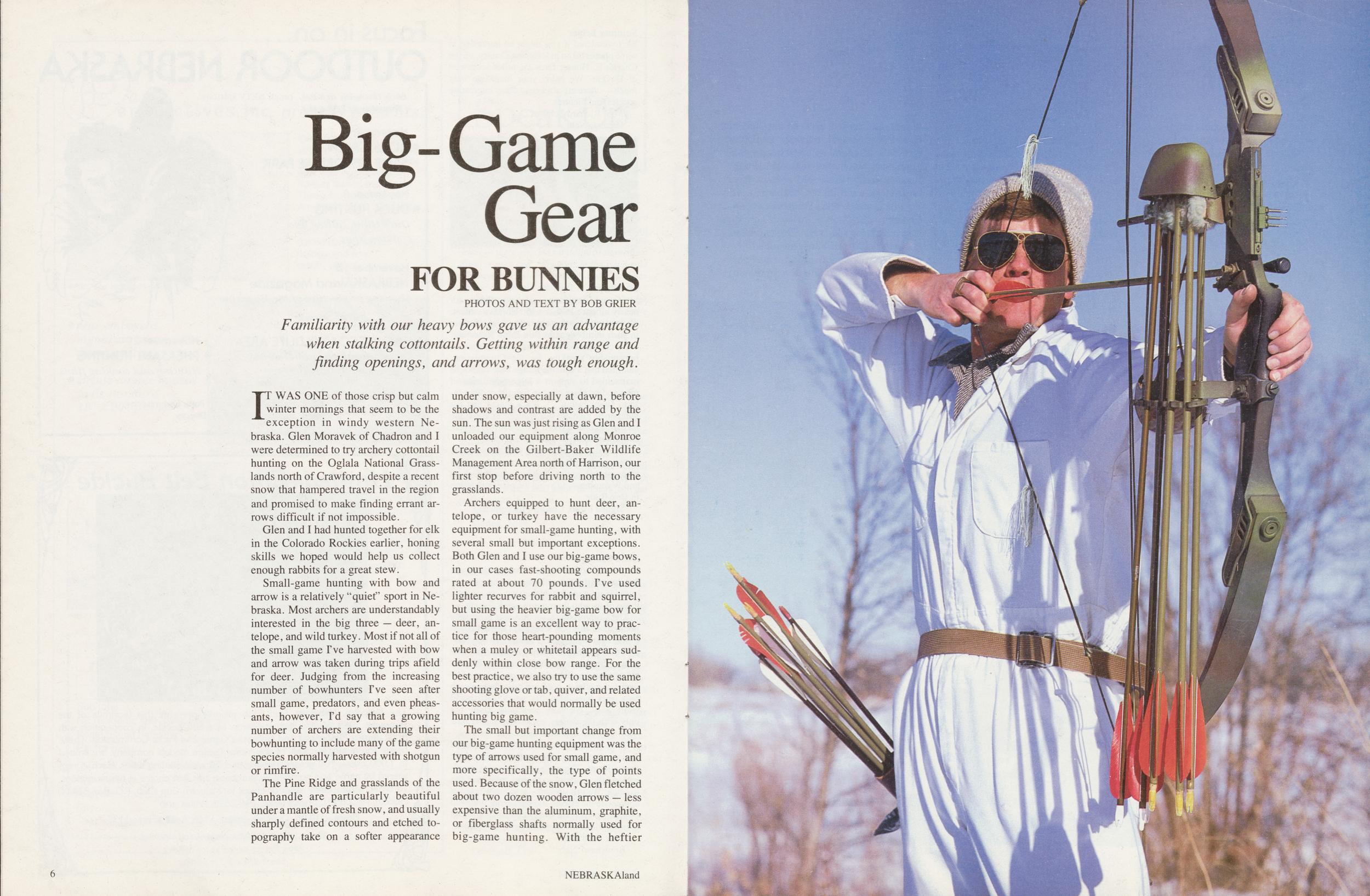
Big- Game Gear
FOR BUNNIES PHOTOS AND TEXT BY BOB GRIER Familiarity with our heavy bows gave us an advantage when stalking cottontails. Getting within range and finding openings, and arrowsy was tough enough.IT WAS ONE of those crisp but calm winter mornings that seem to be the exception in windy western Nebraska. Glen Moravek of Chadron and I were determined to try archery cottontail hunting on the Oglala National Grasslands north of Crawford, despite a recent snow that hampered travel in the region and promised to make finding errant arrows difficult if not impossible.
Glen and I had hunted together for elk in the Colorado Rockies earlier, honing skills we hoped would help us collect enough rabbits for a great stew.
Small-game hunting with bow and arrow is a relatively "quiet" sport in Nebraska. Most archers are understandably interested in the big three — deer, antelope, and wild turkey. Most if not all of the small game Fve harvested with bow and arrow was taken during trips afield for deer. Judging from the increasing number of bowhunters Fve seen after small game, predators, and even pheasants, however, I'd say that a growing number of archers are extending their bowhunting to include many of the game species normally harvested with shotgun or rimfire.
The Pine Ridge and grasslands of the Panhandle are particularly beautiful under a mantle of fresh snow, and usually sharply defined contours and etched topography take on a softer appearance under snow, especially at dawn, before shadows and contrast are added by the sun. The sun was just rising as Glen and I unloaded our equipment along Monroe Creek on the Gilbert-Baker Wildlife Management Area north of Harrison, our first stop before driving north to the grasslands.
Archers equipped to hunt deer, antelope, or turkey have the necessary equipment for small-game hunting, with several small but important exceptions. Both Glen and I use our big-game bows, in our cases fast-shooting compounds rated at about 70 pounds. Fve used lighter recurves for rabbit and squirrel, but using the heavier big-game bow for small game is an excellent way to practice for those heart-pounding moments when a muley or whitetail appears suddenly within close bow range. For the best practice, we also try to use the same shooting glove or tab, quiver, and related accessories that would normally be used hunting big game.
The small but important change from our big-game hunting equipment was the type of arrows used for small game, and more specifically, the type of points used. Because of the snow, Glen fletched about two dozen wooden arrows — less expensive than the aluminum, graphite, or fiberglass shafts normally used for big-game hunting. With the heftier
6 NEBRASKAland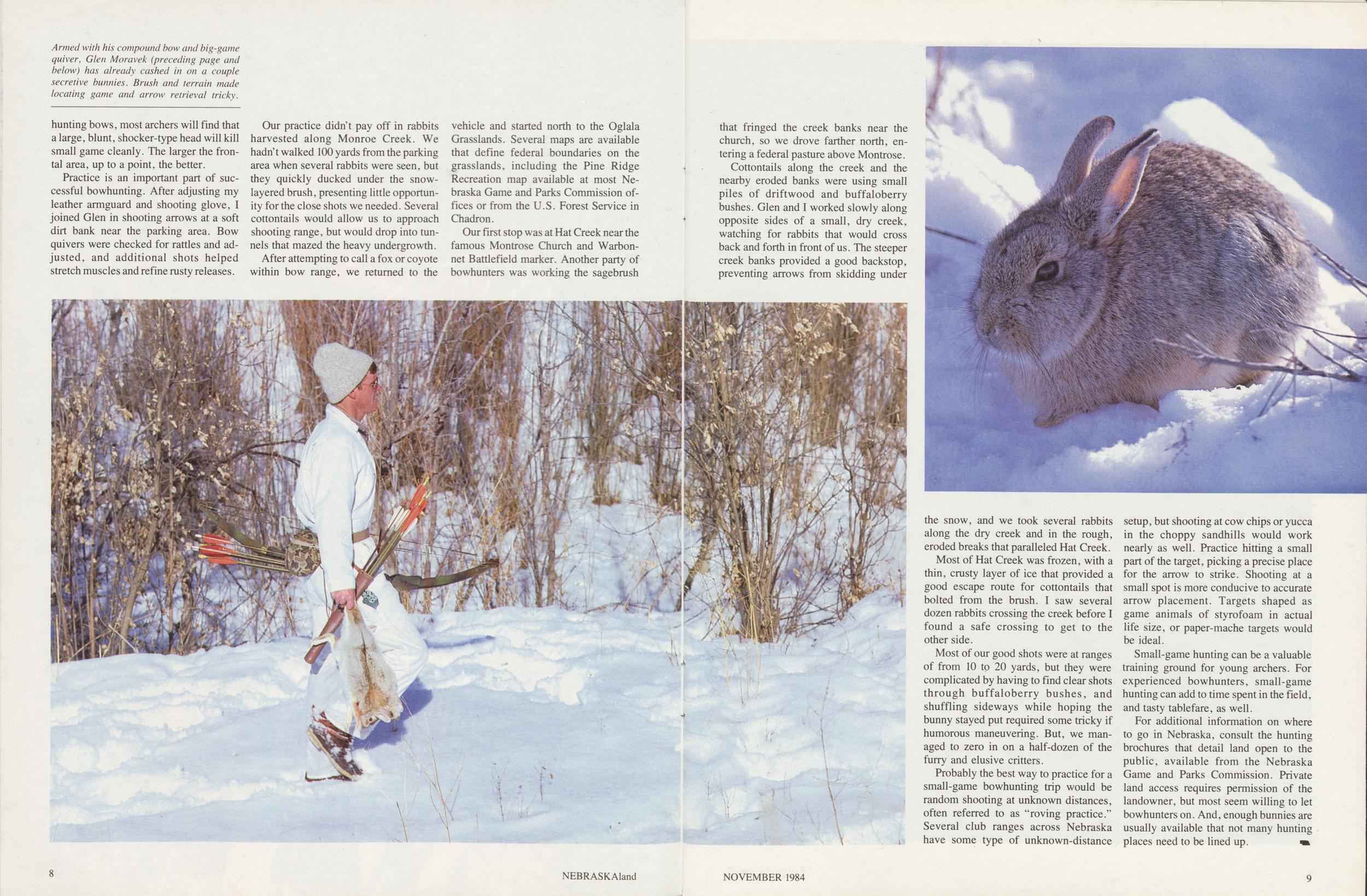
hunting bows, most archers will find that a large, blunt, shocker-type head will kill small game cleanly. The larger the frontal area, up to a point, the better.
Practice is an important part of successful bowhunting. After adjusting my leather armguard and shooting glove, I joined Glen in shooting arrows at a soft dirt bank near the parking area. Bow quivers were checked for rattles and adjusted, and additional shots helped stretch muscles and refine rusty releases.
Our practice didn't pay off in rabbits harvested along Monroe Creek. We hadn't walked 100 yards from the parking area when several rabbits were seen, but they quickly ducked under the snow-layered brush, presenting little opportunity for the close shots we needed. Several cottontails would allow us to approach shooting range, but would drop into tunnels that mazed the heavy undergrowth.
After attempting to call a fox or coyote within bow range, we returned to the vehicle and started north to the Oglala Grasslands. Several maps are available that define federal boundaries on the grasslands, including the Pine Ridge Recreation map available at most Nebraska Game and Parks Commission offices or from the U.S. Forest Service in Chadron.
Our first stop was at Hat Creek near the famous Montrose Church and Warbonnet Battlefield marker. Another party of bowhunters was working the sagebrush
that fringed the creek banks near the church, so we drove farther north, entering a federal pasture above Montrose.
Cottontails along the creek and the nearby eroded banks were using small piles of driftwood and buffaloberry bushes. Glen and I worked slowly along opposite sides of a small, dry creek, watching for rabbits that would cross back and forth in front of us. The steeper creek banks provided a good backstop, preventing arrows from skidding under
the snow, and we took several rabbits along the dry creek and in the rough, eroded breaks that paralleled Hat Creek.
Most of Hat Creek was frozen, with a thin, crusty layer of ice that provided a good escape route for cottontails that bolted from the brush. I saw several dozen rabbits crossing the creek before I found a safe crossing to get to the other side.
Most of our good shots were at ranges of from 10 to 20 yards, but they were complicated by having to find clear shots through buffaloberry bushes, and shuffling sideways while hoping the bunny stayed put required some tricky if humorous maneuvering. But, we managed to zero in on a half-dozen of the furry and elusive critters.
Probably the best way to practice for a small-game bowhunting trip would be random shooting at unknown distances, often referred to as "roving practice." Several club ranges across Nebraska have some type of unknown-distance setup, but shooting at cow chips or yucca in the choppy sandhills would work nearly as well. Practice hitting a small part of the target, picking a precise place for the arrow to strike. Shooting at a small spot is more conducive to accurate arrow placement. Targets shaped as game animals of styrofoam in actual life size, or paper-mache targets would be ideal.
Small-game hunting can be a valuable training ground for young archers. For experienced bowhunters, small-game hunting can add to time spent in the field, and tasty tablefare, as well.
For additional information on where to go in Nebraska, consult the hunting brochures that detail land open to the public, available from the Nebraska Game and Parks Commission. Private land access requires permission of the landowner, but most seem willing to let bowhunters on. And, enough bunnies are usually available that not many hunting places need to be lined up.
NOVEMBER 1984 9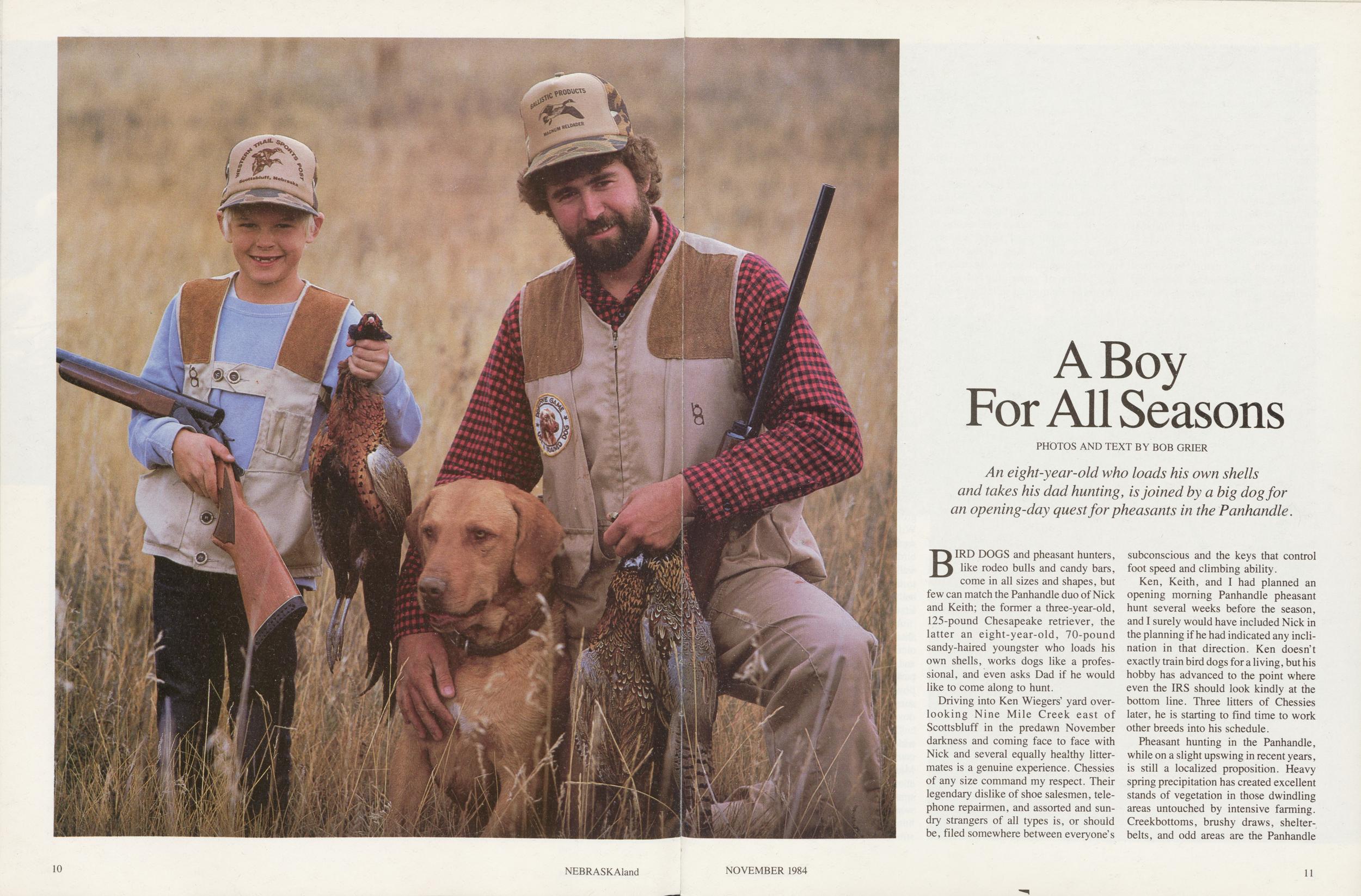
A Boy For All Seasons
PHOTOS AND TEXT BY BOB GRIER An eight-year-old who loads his own shells and takes his dad hunting, is joined by a big dog for an opening-day quest for pheasants in the Panhandle.BIRD DOGS and pheasant hunters, like rodeo bulls and candy bars, come in all sizes and shapes, but few can match the Panhandle duo of Nick and Keith; the former a three-year-old, 125-pound Chesapeake retriever, the latter an eight-year-old, 70-pound sandy-haired youngster who loads his own shells, works dogs like a professional, and even asks Dad if he would like to come along to hunt.
Driving into Ken Wiegers' yard overlooking Nine Mile Creek east of Scottsbluff in the predawn November darkness and coming face to face with Nick and several equally healthy littermates is a genuine experience. Chessies of any size command my respect. Their legendary dislike of shoe salesmen, telephone repairmen, and assorted and sundry strangers of all types is, or should be, filed somewhere between everyone's subconscious and the keys that control foot speed and climbing ability.
Ken, Keith, and I had planned an opening morning Panhandle pheasant hunt several weeks before the season, and I surely would have included Nick in the planning if he had indicated any inclination in that direction. Ken doesn't exactly train bird dogs for a living, but his hobby has advanced to the point where even the IRS should look kindly at the bottom line. Three litters of Chessies later, he is starting to find time to work other breeds into his schedule.
Pheasant hunting in the Panhandle, while on a slight upswing in recent years, is still a localized proposition. Heavy spring precipitation has created excellent stands of vegetation in those dwindling areas untouched by intensive farming. Creekbottoms, brushy draws, shelter-belts, and odd areas are the Panhandle
NOVEMBER 1984 11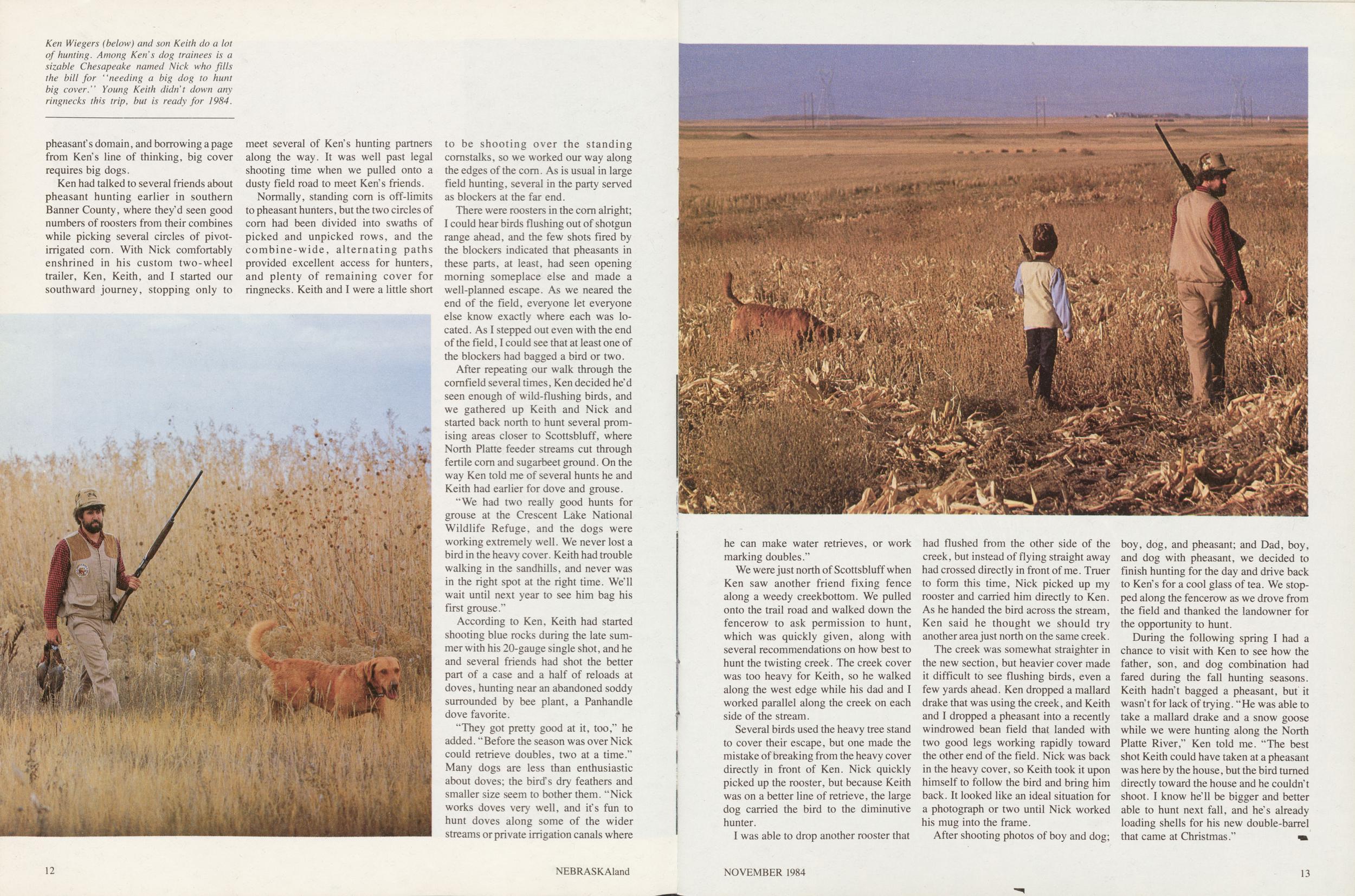
pheasant's domain, and borrowing a page from Ken's line of thinking, big cover requires big dogs.
Ken had talked to several friends about pheasant hunting earlier in southern Banner County, where they'd seen good numbers of roosters from their combines while picking several circles of pivot-irrigated corn. With Nick comfortably enshrined in his custom two-wheel trailer, Ken, Keith, and I started our southward journey, stopping only to meet several of Ken's hunting partners along the way. It was well past legal shooting time when we pulled onto a dusty field road to meet Ken's friends.
Normally, standing corn is off-limits to pheasant hunters, but the two circles of corn had been divided into swaths of picked and unpicked rows, and the combine-wide, alternating paths provided excellent access for hunters, and plenty of remaining cover for ringnecks. Keith and I were a little short
to be shooting over the standing cornstalks, so we worked our way along the edges of the corn. As is usual in large field hunting, several in the party served as blockers at the far end.
There were roosters in the corn alright; I could hear birds flushing out of shotgun range ahead, and the few shots fired by the blockers indicated that pheasants in these parts, at least, had seen opening morning someplace else and made a well-planned escape. As we neared the end of the field, everyone let everyone else know exactly where each was located. As I stepped out even with the end of the field, I could see that at least one of the blockers had bagged a bird or two.
After repeating our walk through the cornfield several times, Ken decided he'd seen enough of wild-flushing birds, and we gathered up Keith and Nick and started back north to hunt several promising areas closer to Scottsbluff, where North Platte feeder streams cut through fertile corn and sugarbeet ground. On the way Ken told me of several hunts he and Keith had earlier for dove and grouse.
"We had two really good hunts for grouse at the Crescent Lake National Wildlife Refuge, and the dogs were working extremely well. We never lost a bird in the heavy cover. Keith had trouble walking in the sandhills, and never was in the right spot at the right time. We'll wait until next year to see him bag his first grouse."
According to Ken, Keith had started shooting blue rocks during the late summer with his 20-gauge single shot, and he and several friends had shot the better part of a case and a half of reloads at doves, hunting near an abandoned soddy surrounded by bee plant, a Panhandle dove favorite.
"They got pretty good at it, too," he added. "Before the season was over Nick could retrieve doubles, two at a time." Many dogs are less than enthusiastic about doves; the bird's dry feathers and smaller size seem to bother them. "Nick works doves very well, and it's fun to hunt doves along some of the wider streams or private irrigation canals where
12 NEBRASKAlandhe can make water retrieves, or work marking doubles."
We were just north of Scottsbluff when Ken saw another friend fixing fence along a weedy creekbottom. We pulled onto the trail road and walked down the fencerow to ask permission to hunt, which was quickly given, along with several recommendations on how best to hunt the twisting creek. The creek cover was too heavy for Keith, so he walked along the west edge while his dad and I worked parallel along the creek on each side of the stream.
Several birds used the heavy tree stand to cover their escape, but one made the mistake of breaking from the heavy cover directly in front of Ken. Nick quickly picked up the rooster, but because Keith was on a better line of retrieve, the large dog carried the bird to the diminutive hunter.
I was able to drop another rooster that had flushed from the other side of the creek, but instead of flying straight away had crossed directly in front of me. Truer to form this time, Nick picked up my rooster and carried him directly to Ken. As he handed the bird across the stream, Ken said he thought we should try another area just north on the same creek.
The creek was somewhat straighter in the new section, but heavier cover made it difficult to see flushing birds, even a few yards ahead. Ken dropped a mallard drake that was using the creek, and Keith and I dropped a pheasant into a recently windrowed bean field that landed with two good legs working rapidly toward the other end of the field. Nick was back in the heavy cover, so Keith took it upon himself to follow the bird and bring him back. It looked like an ideal situation for a photograph or two until Nick worked his mug into the frame.
After shooting photos of boy and dog; boy, dog, and pheasant; and Dad, boy, and dog with pheasant, we decided to finish hunting for the day and drive back to Ken's for a cool glass of tea. We stopped along the fencerow as we drove from the field and thanked the landowner for the opportunity to hunt.
During the following spring I had a chance to visit with Ken to see how the father, son, and dog combination had fared during the fall hunting seasons. Keith hadn't bagged a pheasant, but it wasn't for lack of trying. "He was able to take a mallard drake and a snow goose while we were hunting along the North Platte River," Ken told me. "The best shot Keith could have taken at a pheasant was here by the house, but the bird turned directly toward the house and he couldn't shoot. I know he'll be bigger and better able to hunt next fall, and he's already loading shells for his new double-barrel that came at Christmas."
NOVEMBER 1984 13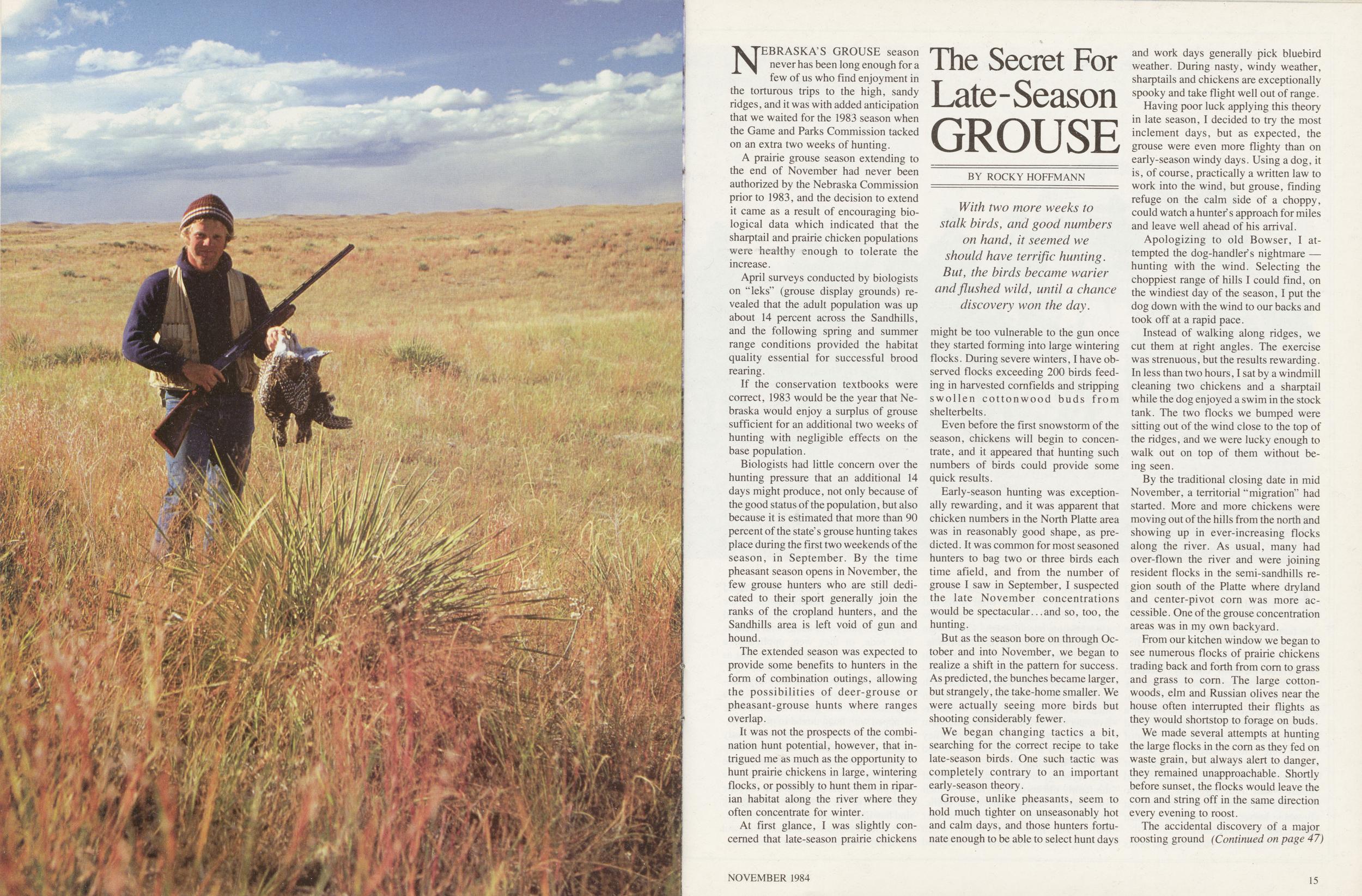
The Secret For Late-Season GROUSE
BY ROCKY HOFFMANN With two more weeks to stalk birds, and good numbers on hand, it seemed we should have terrific hunting. But, the birds became warier and flushed wild, until a chance discovery won the day.NEBRASKA'S GROUSE season never has been long enough for a few of us who find enjoyment in the torturous trips to the high, sandy ridges, and it was with added anticipation that we waited for the 1983 season when the Game and Parks Commission tacked on an extra two weeks of hunting.
A prairie grouse season extending to the end of November had never been authorized by the Nebraska Commission prior to 1983, and the decision to extend it came as a result of encouraging biological data which indicated that the sharptail and prairie chicken populations were healthy enough to tolerate the increase.
April surveys conducted by biologists on "leks" (grouse display grounds) revealed that the adult population was up about 14 percent across the Sandhills, and the following spring and summer range conditions provided the habitat quality essential for successful brood rearing.
If the conservation textbooks were correct, 1983 would be the year that Nebraska would enjoy a surplus of grouse sufficient for an additional two weeks of hunting with negligible effects on the base population.
Biologists had little concern over the hunting pressure that an additional 14 days might produce, not only because of the good status of the population, but also because it is estimated that more than 90 percent of the state's grouse hunting takes place during the first two weekends of the season, in September. By the time pheasant season opens in November, the few grouse hunters who are still dedicated to their sport generally join the ranks of the cropland hunters, and the Sandhills area is left void of gun and hound.
The extended season was expected to provide some benefits to hunters in the form of combination outings, allowing the possibilities of deer-grouse or pheasant-grouse hunts where ranges overlap.
It was not the prospects of the combination hunt potential, however, that intrigued me as much as the opportunity to hunt prairie chickens in large, wintering flocks, or possibly to hunt them in riparian habitat along the river where they often concentrate for winter.
At first glance, I was slightly concerned that late-season prairie chickens might be too vulnerable to the gun once they started forming into large wintering flocks. During severe winters, I have observed flocks exceeding 200 birds feeding in harvested cornfields and stripping swollen cottonwood buds from shelterbelts.
Even before the first snowstorm of the season, chickens will begin to concentrate, and it appeared that hunting such numbers of birds could provide some quick results.
Early-season hunting was exceptionally rewarding, and it was apparent that chicken numbers in the North Platte area was in reasonably good shape, as predicted. It was common for most seasoned hunters to bag two or three birds each time afield, and from the number of grouse I saw in September, I suspected the late November concentrations would be spectacular.. .and so, too, the hunting.
But as the season bore on through October and into November, we began to realize a shift in the pattern for success. As predicted, the bunches became larger, but strangely, the take-home smaller. We were actually seeing more birds but shooting considerably fewer.
We began changing tactics a bit, searching for the correct recipe to take late-season birds. One such tactic was completely contrary to an important early-season theory.
Grouse, unlike pheasants, seem to hold much tighter on unseasonably hot and calm days, and those hunters fortunate enough to be able to select hunt days and work days generally pick bluebird weather. During nasty, windy weather, sharptails and chickens are exceptionally spooky and take flight well out of range.
Having poor luck applying this theory in late season, I decided to try the most inclement days, but as expected, the grouse were even more flighty than on early-season windy days. Using a dog, it is, of course, practically a written law to work into the wind, but grouse, finding refuge on the calm side of a choppy, could watch a hunter's approach for miles and leave well ahead of his arrival.
Apologizing to old Bowser, I attempted the dog-handler's nightmare — hunting with the wind. Selecting the choppiest range of hills I could find, on the windiest day of the season, I put the dog down with the wind to our backs and took off at a rapid pace.
Instead of walking along ridges, we cut them at right angles. The exercise was strenuous, but the results rewarding. In less than two hours, I sat by a windmill cleaning two chickens and a sharptail while the dog enjoyed a swim in the stock tank. The two flocks we bumped were sitting out of the wind close to the top of the ridges, and we were lucky enough to walk out on top of them without being seen.
By the traditional closing date in mid November, a territorial '"migration" had started. More and more chickens were moving out of the hills from the north and showing up in ever-increasing flocks along the river. As usual, many had over-flown the river and were joining resident flocks in the semi-sandhills region south of the Platte where dryland and center-pivot corn was more accessible. One of the grouse concentration areas was in my own backyard.
From our kitchen window we began to see numerous flocks of prairie chickens trading back and forth from corn to grass and grass to corn. The large cottonwoods, elm and Russian olives near the house often interrupted their flights as they would shortstop to forage on buds.
We made several attempts at hunting the large flocks in the corn as they fed on waste grain, but always alert to danger, they remained unapproachable. Shortly before sunset, the flocks would leave the corn and string off in the same direction every evening to roost.
The accidental discovery of a major roosting ground
(Continued on page 47) NOVEMBER 1984 15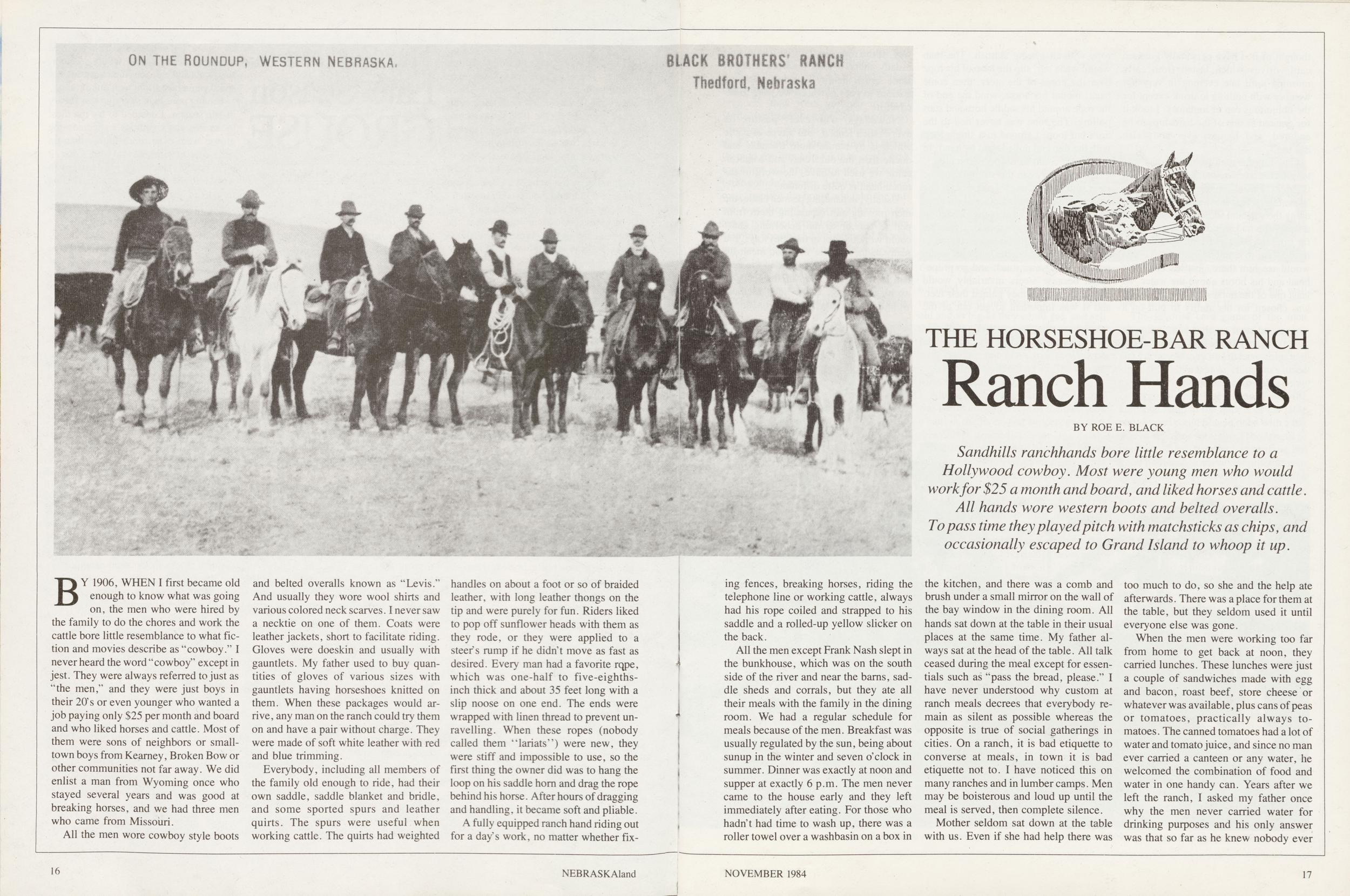
The Horseshoe-Bar Ranch Ranch Hands
By Roe E. Black Sandhills ranchhands bore little resemblance to a Hollywood cowboy. Most were young men who would work for $25 a month and board, and liked horses and cattle. All hands wore western boots and belted overalls. To pass time they played pitch with matchsticks as chips, and occasionally escaped to Grand Island to whoop it up.BY 1906, WHEN I first became old enough to know what was going on, the men who were hired by the family to do the chores and work the cattle bore little resemblance to what fiction and movies describe as "cowboy." I never heard the word "cowboy" except in jest. They were always referred to just as 'the men," and they were just boys in their 20's or even younger who wanted a job paying only $25 per month and board and who liked horses and cattle. Most of them were sons of neighbors or smalltown boys from Kearney, Broken Bow or other communities not far away. We did enlist a man from Wyoming once who stayed several years and was good at breaking horses, and we had three men who came from Missouri.
All the men wore cowboy style boots and belted overalls known as "Levis." And usually they wore wool shirts and various colored neck scarves. I never saw a necktie on one of them. Coats were leather jackets, short to facilitate riding. Gloves were doeskin and usually with gauntlets. My father used to buy quantities of gloves of various sizes with gauntlets having horseshoes knitted on them. When these packages would arrive, any man on the ranch could try them on and have a pair without charge. They were made of soft white leather with red and blue trimming.
Everybody, including all members of the family old enough to ride, had their own saddle, saddle blanket and bridle, and some sported spurs and leather quirts. The spurs were useful when working cattle. The quirts had weighted handles on about a foot or so of braided leather, with long leather thongs on the tip and were purely for fun. Riders liked to pop off sunflower heads with them as they rode, or they were applied to a steer's rump if he didn't move as fast as desired. Every man had a favorite rope, which was one-half to five-eighths-inch thick and about 35 feet long with a slip noose on one end. The ends were wrapped with linen thread to prevent unravelling. When these ropes (nobody called them "iariats") were new, they were stiff and impossible to use, so the first thing the owner did was to hang the loop on his saddle horn and drag the rope behind his horse. After hours of dragging and handling, it became soft and pliable.
A fully equipped ranch hand riding out for a day's work, no matter whether fixing
16 NEBRASKAlandfences, breaking horses, riding the telephone line or working cattle, always had his rope coiled and strapped to his saddle and a rolled-up yellow slicker on the back.
All the men except Frank Nash slept in the bunkhouse, which was on the south side of the river and near the barns, saddle sheds and corrals, but they ate all their meals with the family in the dining room. We had a regular schedule for meals because of the men. Breakfast was usually regulated by the sun, being about sunup in the winter and seven o'clock in summer. Dinner was exactly at noon and supper at exactly 6 p.m. The men never came to the house early and they left immediately after eating. For those who hadn't had time to wash up, there was a roller towel over a washbasin on a box in the kitchen, and there was a comb and brush under a small mirror on the wall of the bay window in the dining room. All hands sat down at the table in their usual places at the same time. My father always sat at the head of the table. All talk ceased during the meal except for essentials such as "pass the bread, please." I have never understood why custom at ranch meals decrees that everybody remain as silent as possible whereas the opposite is true of social gatherings in cities. On a ranch, it is bad etiquette to converse at meals, in town it is bad etiquette not to. I have noticed this on many ranches and in lumber camps. Men may be boisterous and loud up until the meal is served, then complete silence.
Mother seldom sat down at the table with us. Even if she had help there was too much to do, so she and the help ate afterwards. There was a place for them at the table, but they seldom used it until everyone else was gone.
When the men were working too far from home to get back at noon, they carried lunches. These lunches were just a couple of sandwiches made with egg and bacon, roast beef, store cheese or whatever was available, plus cans of peas or tomatoes, practically always tomatoes. The canned tomatoes had a lot of water and tomato juice, and since no man ever carried a canteen or any water, he welcomed the combination of food and water in one handy can. Years after we left the ranch, I asked my father once why the men never carried water for drinking purposes and his only answer was that so far as he knew nobody ever
NOVEMBER 1984 17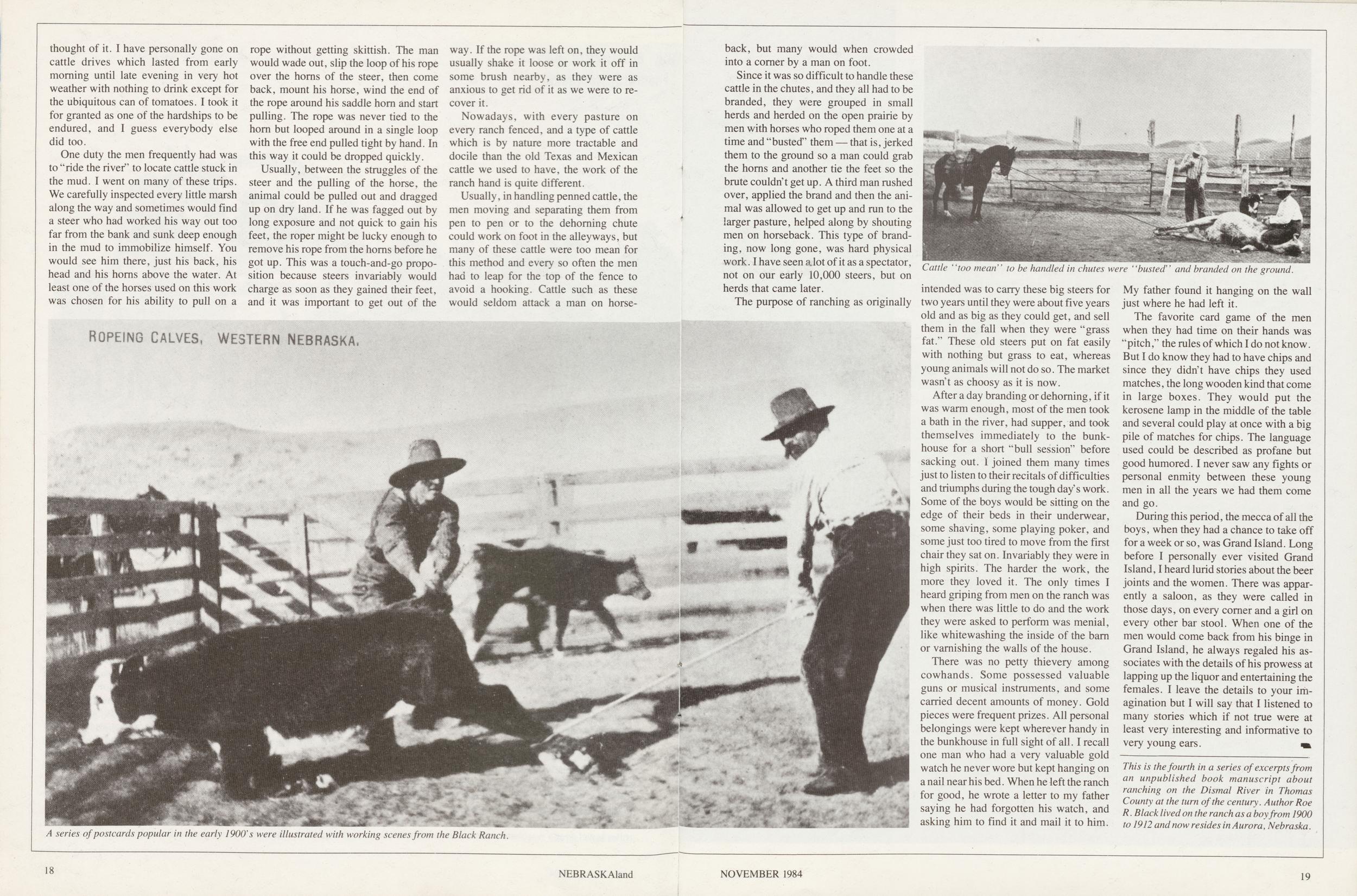
thought of it. I have personally gone on cattle drives which lasted from early morning until late evening in very hot weather with nothing to drink except for the ubiquitous can of tomatoes. I took it for granted as one of the hardships to be endured, and I guess everybody else did too.
One duty the men frequently had was to "ride the river" to locate cattle stuck in the mud. I went on many of these trips. We carefully inspected every little marsh along the way and sometimes would find a steer who had worked his way out too far from the bank and sunk deep enough in the mud to immobilize himself. You would see him there, just his back, his head and his horns above the water. At least one of the horses used on this work was chosen for his ability to pull on a rope without getting skittish. The man would wade out, slip the loop of his rope over the horns of the steer, then come back, mount his horse, wind the end of the rope around his saddle horn and start pulling. The rope was never tied to the horn but looped around in a single loop with the free end pulled tight by hand. In this way it could be dropped quickly.
Usually, between the struggles of the steer and the pulling of the horse, the animal could be pulled out and dragged up on dry land. If he was fagged out by long exposure and not quick to gain his feet, the roper might be lucky enough to remove his rope from the horns before he got up. This was a touch-and-go proposition because steers invariably would charge as soon as they gained their feet, and it was important to get out of the way. If the rope was left on, they would usually shake it loose or work it off in some brush nearby, as they were as anxious to get rid of it as we were to recover it.
Nowadays, with every pasture on every ranch fenced, and a type of cattle which is by nature more tractable and docile than the old Texas and Mexican cattle we used to have, the work of the ranch hand is quite different.
Usually, in handling penned cattle, the men moving and separating them from pen to pen or to the dehorning chute could work on foot in the alleyways, but many of these cattle were too mean for this method and every so often the men had to leap for the top of the fence to avoid a hooking. Cattle such as these would seldom attack a man on horseback,
A series of postcards popular in the early 1900's were illustrated with working scenes from the Black Ranch.
but many would when crowded into a corner by a man on foot.
Since it was so difficult to handle these cattle in the chutes, and they all had to be branded, they were grouped in small herds and herded on the open prairie by men with horses who roped them one at a time and "busted" them — that is, jerked them to the ground so a man could grab the horns and another tie the feet so the brute couldn't get up. A third man rushed over, applied the brand and then the animal was allowed to get up and run to the larger pasture, helped along by shouting men on horseback. This type of branding, now long gone, was hard physical work. I have seen alot of it as a spectator, not on our early 10,000 steers, but on herds that came later.
The purpose of ranching as originally
Cattle "too mean" to be handled in chutes were "busted" and branded on the ground.
intended was to carry these big steers for two years until they were about five years old and as big as they could get, and sell them in the fall when they were "grass fat." These old steers put on fat easily with nothing but grass to eat, whereas young animals will not do so. The market wasn't as choosy as it is now.
After a day branding or dehorning, if it was warm enough, most of the men took a bath in the river, had supper, and took themselves immediately to the bunkhouse for a short "bull session" before sacking out. I joined them many times just to listen to their recitals of difficulties and triumphs during the tough day's work. Some of the boys would be sitting on the edge of their beds in their underwear, some shaving, some playing poker, and some just too tired to move from the first chair they sat on. Invariably they were in high spirits. The harder the work, the more they loved it. The only times I heard griping from men on the ranch was when there was little to do and the work they were asked to perform was menial, like whitewashing the inside of the barn or varnishing the walls of the house.
There was no petty thievery among cowhands. Some possessed valuable guns or musical instruments, and some carried decent amounts of money. Gold pieces were frequent prizes. All personal belongings were kept wherever handy in the bunkhouse in full sight of all. I recall one man who had a very valuable gold watch he never wore but kept hanging on a nail near his bed. When he left the ranch for good, he wrote a letter to my father saying he had forgotten his watch, and asking him to find it and mail it to him. My father found it hanging on the wall just where he had left it.
The favorite card game of the men when they had time on their hands was "pitch," the rules of which I do not know. But I do know they had to have chips and since they didn't have chips they used matches, the long wooden kind that come in large boxes. They would put the kerosene lamp in the middle of the table and several could play at once with a big pile of matches for chips. The language used could be described as profane but good humored. I never saw any fights or personal enmity between these young men in all the years we had them come and go.
During this period, the mecca of all the boys, when they had a chance to take off for a week or so, was Grand Island. Long before I personally ever visited Grand Island, I heard lurid stories about the beer joints and the women. There was apparently a saloon, as they were called in those days, on every corner and a girl on every other bar stool. When one of the men would come back from his binge in Grand Island, he always regaled his associates with the details of his prowess at lapping up the liquor and entertaining the females. I leave the details to your imagination but I will say that I listened to many stories which if not true were at least very interesting and informative to very young ears.
This is the fourth in a series of excerpts from an unpublished book manuscript about ranching on the Dismal River in Thomas County at the turn of the century. Author Roe R. Black lived on the ranch as a boy from 1900 to 1912 and now resides in Aurora, Nebraska. NOVEMBER 1984 19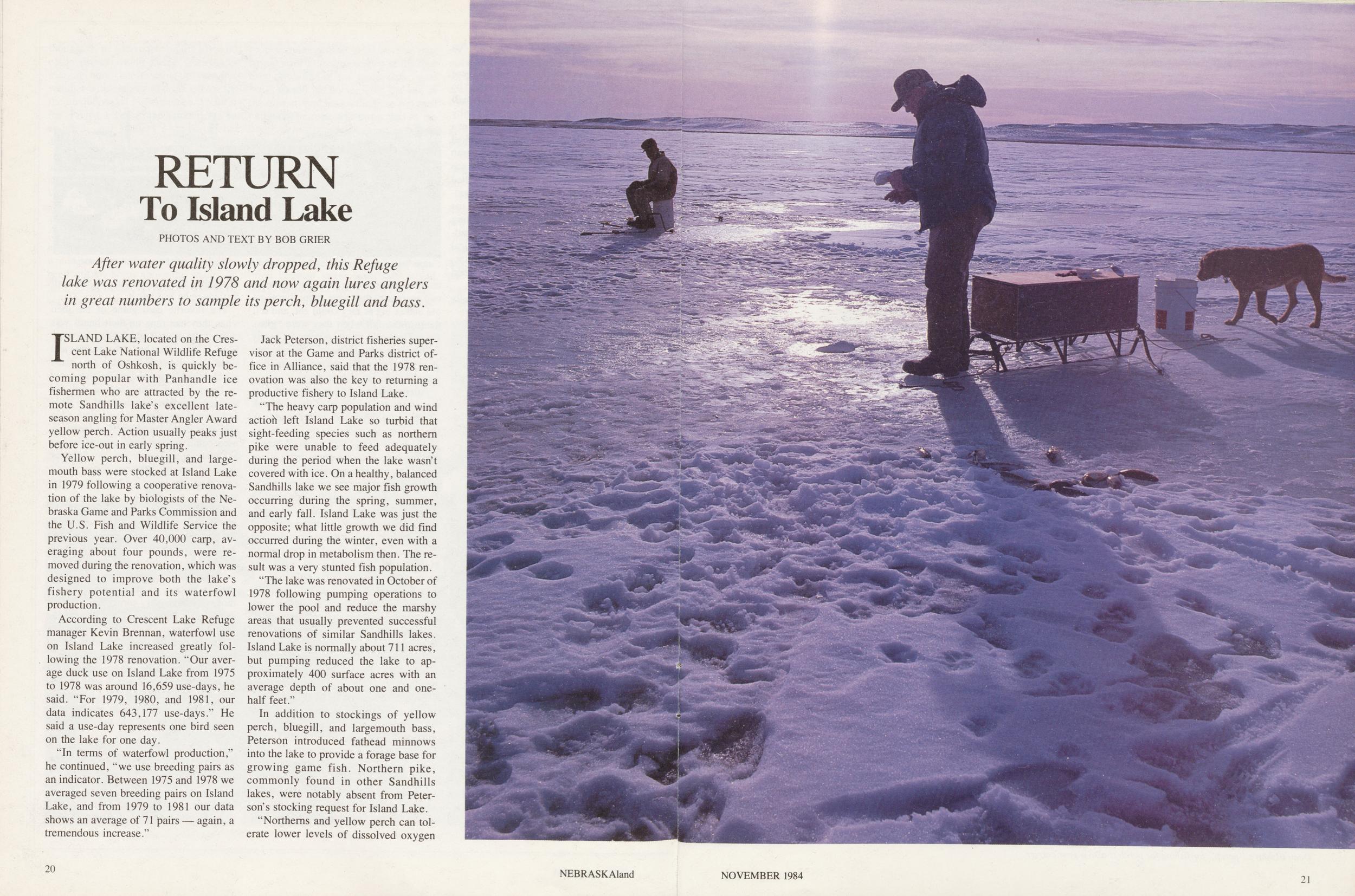
RETURN To Island Lake
PHOTOS AND TEXT BY BOB GRIER After water quality slowly dropped, this Refuge lake was renovated in 1978 and now again lures anglers in great numbers to sample its perch, blue gill and bass.ISLAND LAKE, located on the Crescent Lake National Wildlife Refuge north of Oshkosh, is quickly becoming popular with Panhandle ice fishermen who are attracted by the remote Sandhills lake's excellent late-season angling for Master Angler Award yellow perch. Action usually peaks just before ice-out in early spring.
Yellow perch, bluegill, and largemouth bass were stocked at Island Lake in 1979 following a cooperative renovation of the lake by biologists of the Nebraska Game and Parks Commission and the U.S. Fish and Wildlife Service the previous year. Over 40,000 carp, averaging about four pounds, were removed during the renovation, which was designed to improve both the lake's fishery potential and its waterfowl production.
According to Crescent Lake Refuge manager Kevin Brennan, waterfowl use on Island Lake increased greatly following the 1978 renovation. "Our average duck use on Island Lake from 1975 to 1978 was around 16,659 use-days, he said. 'Tor 1979, 1980, and 1981, our data indicates 643,177 use-days." He said a use-day represents one bird seen on the lake for one day.
"In terms of waterfowl production," he continued, "we use breeding pairs as an indicator. Between 1975 and 1978 we averaged seven breeding pairs on Island Lake, and from 1979 to 1981 our data shows an average of 71 pairs — again, a tremendous increase."
Jack Peterson, district fisheries supervisor at the Game and Parks district office in Alliance, said that the 1978 renovation was also the key to returning a productive fishery to Island Lake.
"The heavy carp population and wind action left Island Lake so turbid that sight-feeding species such as northern pike were unable to feed adequately during the period when the lake wasn't covered with ice. On a healthy, balanced Sandhills lake we see major fish growth occurring during the spring, summer, and early fall. Island Lake was just the opposite; what little growth we did find occurred during the winter, even with a normal drop in metabolism then. The result was a very stunted fish population.
"The lake was renovated in October of 1978 following pumping operations to lower the pool and reduce the marshy areas that usually prevented successful renovations of similar Sandhills lakes. Island Lake is normally about 711 acres, but pumping reduced the lake to approximately 400 surface acres with an average depth of about one and one-half feet."
In addition to stockings of yellow perch, bluegill, and largemouth bass, Peterson introduced fathead minnows into the lake to provide a forage base for growing game fish. Northern pike, commonly found in other Sandhills lakes, were notably absent from Peterson's stocking request for Island Lake. "Northerns and yellow perch can tolerate lower levels of dissolved oxygen
20 NEBRASKAland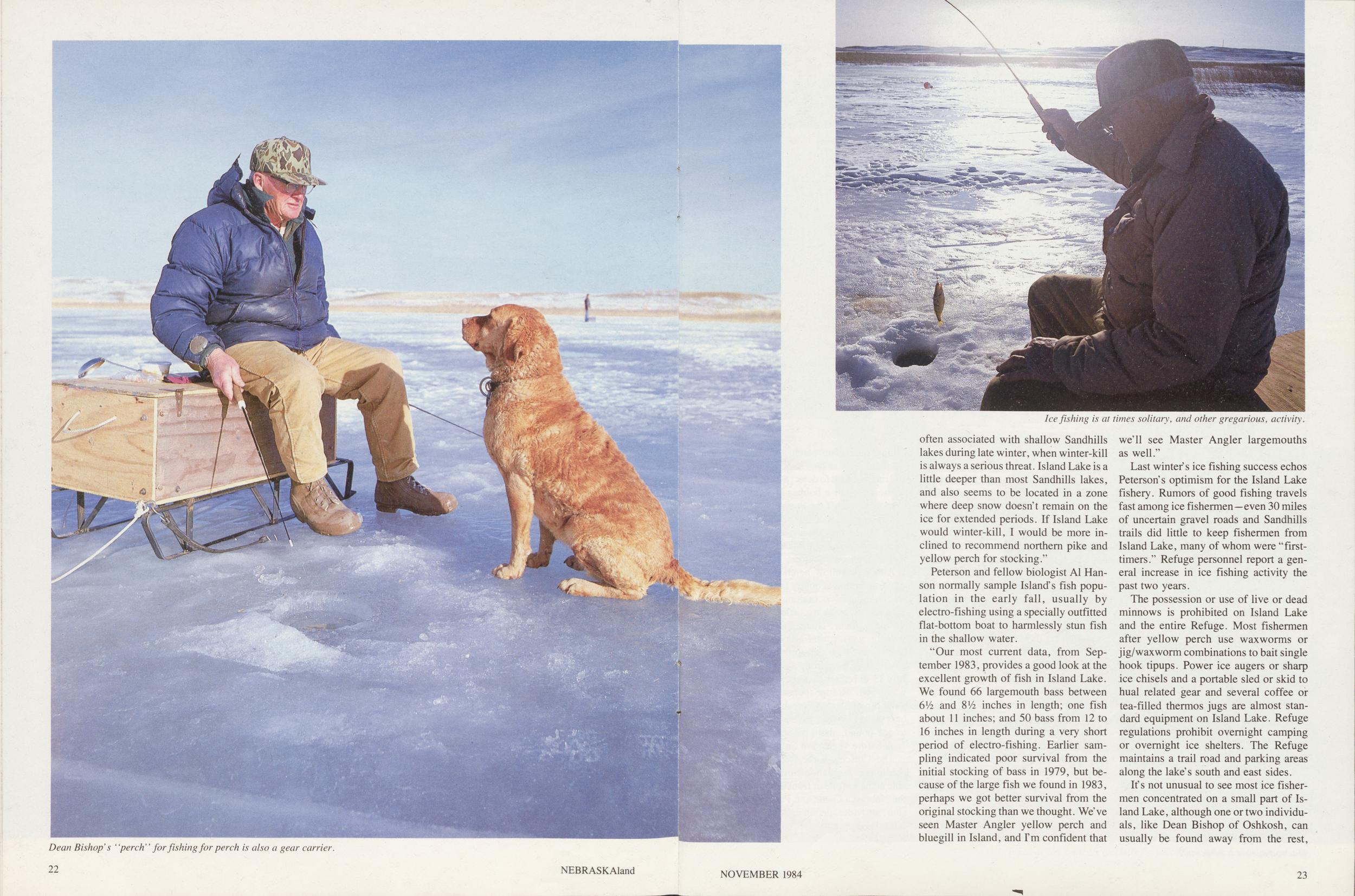
Dean Bishop's '"perch" for fishing for perch is also a gear carrier.
Ice fishing is at times solitary, and other gregarious, activity.
often associated with shallow Sandhills lakes during late winter, when winter-kill is always a serious threat. Island Lake is a little deeper than most Sandhills lakes, and also seems to be located in a zone where deep snow doesn't remain on the ice for extended periods. If Island Lake would winter-kill, I would be more inclined to recommend northern pike and yellow perch for stocking."
Peterson and fellow biologist Al Hanson normally sample Island's fish population in the early fall, usually by electro-fishing using a specially outfitted flat-bottom boat to harmlessly stun fish in the shallow water.
"Our most current data, from September 1983, provides a good look at the excellent growth of fish in Island Lake. We found 66 largemouth bass between 6 1/2 and 8 1/2 inches in length; one fish about 11 inches; and 50 bass from 12 to 16 inches in length during a very short period of electro-fishing. Earlier sampling indicated poor survival from the initial stocking of bass in 1979, but because of the large fish we found in 1983, perhaps we got better survival from the original stocking than we thought. We've seen Master Angler yellow perch and bluegill in Island, and Fm confident that we'll see Master Angler largemouths as well."
Last winter's ice fishing success echos Peterson's optimism for the Island Lake fishery. Rumors of good fishing travels fast among ice fishermen—even 30 miles of uncertain gravel roads and Sandhills trails did little to keep fishermen from Island Lake, many of whom were "first-timers." Refuge personnel report a general increase in ice fishing activity the past two years.
The possession or use of live or dead minnows is prohibited on Island Lake and the entire Refuge. Most fishermen after yellow perch use waxworms or jig/waxworm combinations to bait single hook tipups. Power ice augers or sharp ice chisels and a portable sled or skid to hual related gear and several coffee or tea-filled thermos jugs are almost standard equipment on Island Lake. Refuge regulations prohibit overnight camping or overnight ice shelters. The Refuge maintains a trail road and parking areas along the lake's south and east sides.
It's not unusual to see most ice fishermen concentrated on a small part of Island Lake, although one or two individuals, like Dean Bishop of Oshkosh, can usually be found away from the rest,
NOVEMBER 1984 23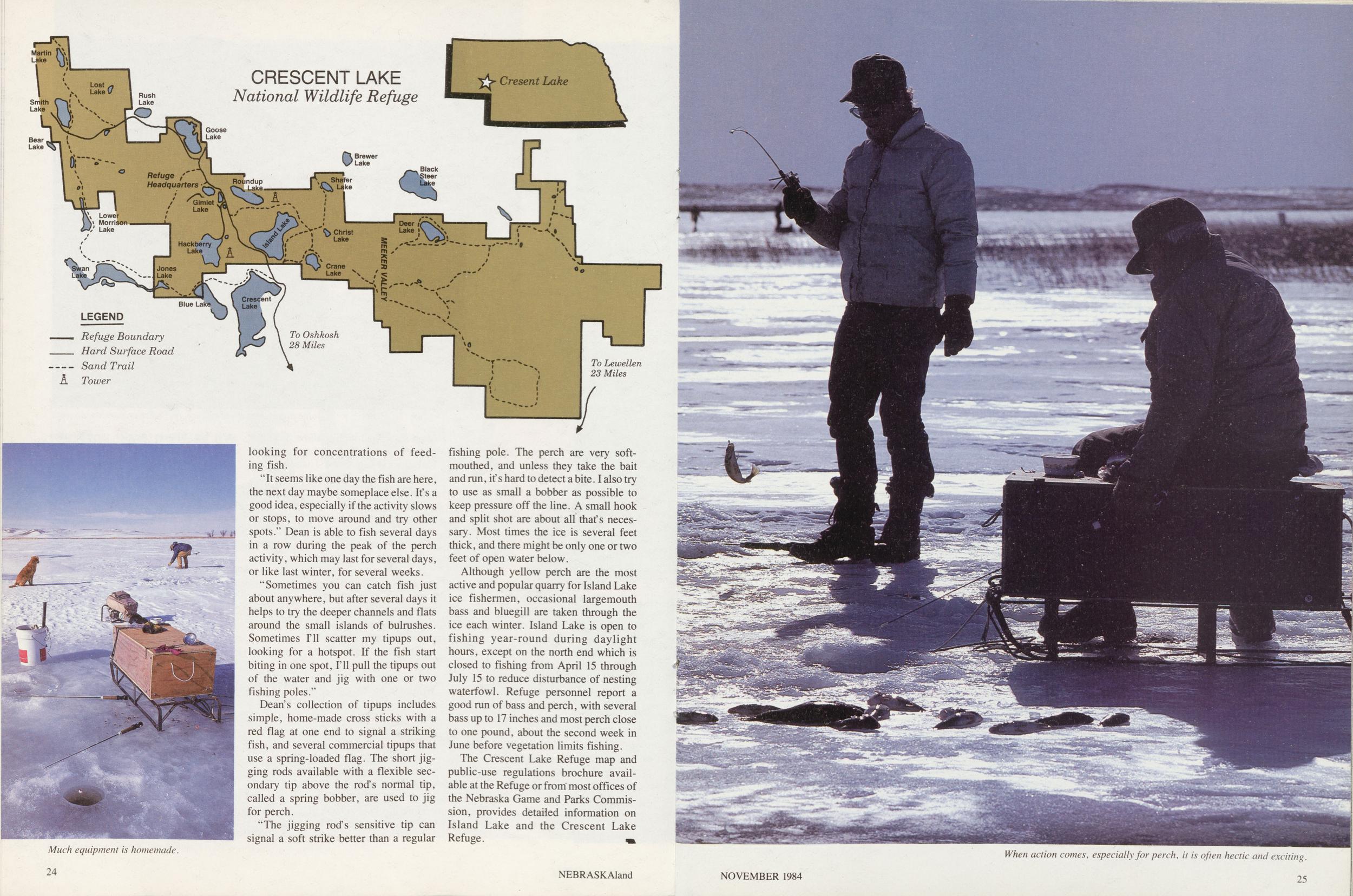
Crescent Lake National Wildlife Refuge
Much equipment is homemade.
looking for concentrations of feeding fish.
"It seems like one day the fish are here, the next day maybe someplace else. It's a good idea, especially if the activity slows or stops, to move around and try other spots." Dean is able to fish several days in a row during the peak of the perch activity, which may last for several days, or like last winter, for several weeks.
"Sometimes you can catch fish just about anywhere, but after several days it helps to try the deeper channels and flats around the small islands of bulrushes. Sometimes Til scatter my tipups out, looking for a hotspot. If the fish start biting in one spot, I'll pull the tipups out of the water and jig with one or two fishing poles."
Dean's collection of tipups includes simple, home-made cross sticks with a red flag at one end to signal a striking fish, and several commercial tipups that use a spring-loaded flag. The short jigging rods available with a flexible secondary tip above the rod's normal tip, called a spring bobber, are used to jig for perch.
"The jigging rod's sensitive tip can signal a soft strike better than a regular fishing pole. The perch are very soft-mouthed, and unless they take the bait and run, it's hard to detect a bite. I also try to use as small a bobber as possible to keep pressure off the line. A small hook and split shot are about all that's necessary. Most times the ice is several feet thick, and there might be only one or two feet of open water below.
Although yellow perch are the most active and popular quarry for Island Lake ice fishermen, occasional largemouth bass and bluegill are taken through the ice each winter. Island Lake is open to fishing year-round during daylight hours, except on the north end which is closed to fishing from April 15 through July 15 to reduce disturbance of nesting waterfowl. Refuge personnel report a good run of bass and perch, with several bass up to 17 inches and most perch close to one pound, about the second week in June before vegetation limits fishing.
The Crescent Lake Refuge map and public-use regulations brochure available at the Refuge or from most offices of the Nebraska Game and Parks Commission, provides detailed information on Island Lake and the Crescent Lake Refuge.
24 NEBRASKAlandWhen action comes, especially for perch, it is often hectic and exciting.
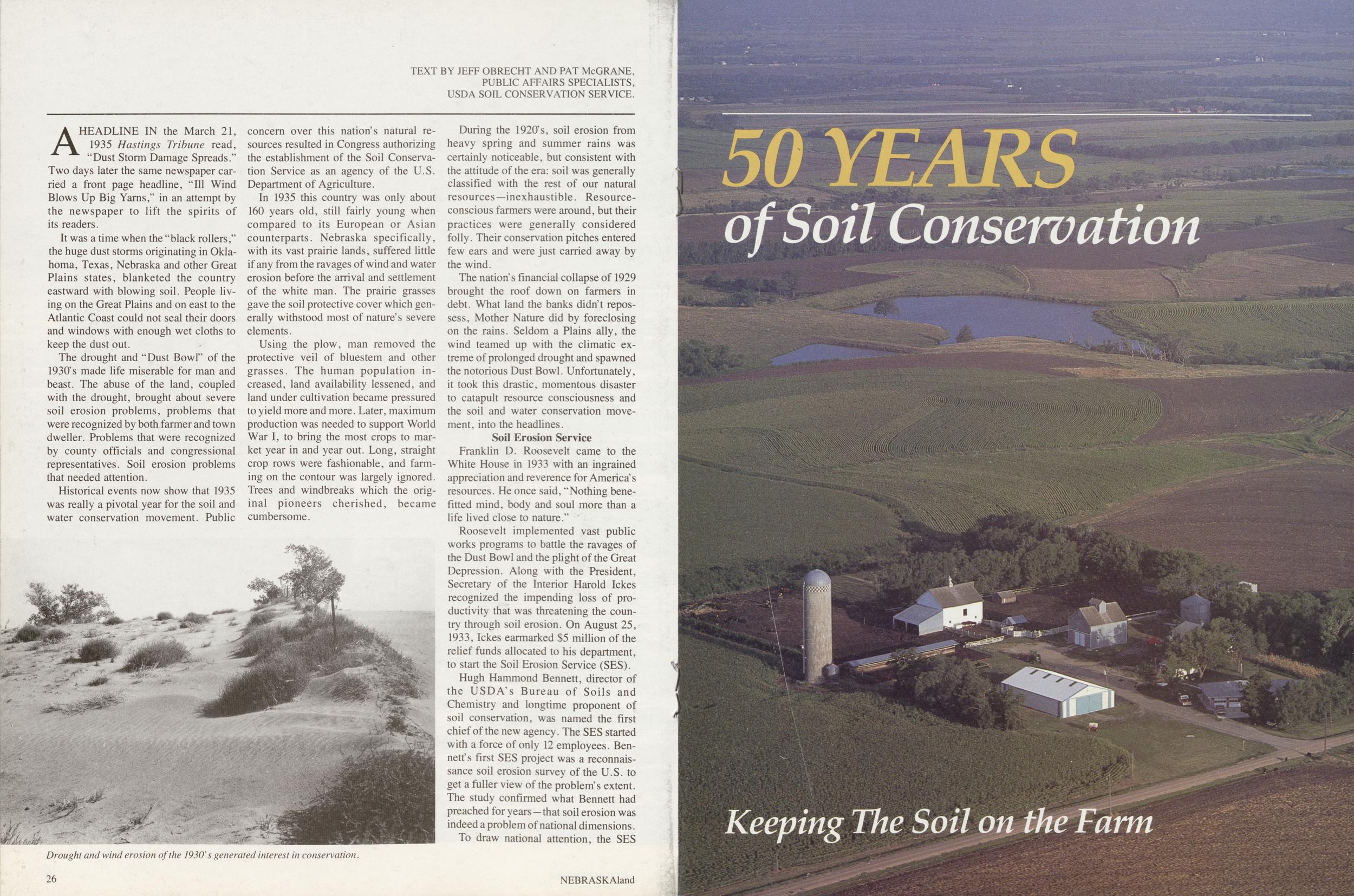
50 Years of Soil Conservation
Keeping the soil on the farm TEXT BY JEFF OBRECHT AND PAT McGRANE, PUBLIC AFFAIRS SPECIALISTS, USDA SOIL CONSERVATION SERVICE.A HEADLINE IN the March 21, 1935 Hastings Tribune read, "Dust Storm Damage Spreads." Two days later the same newspaper carried a front page headline, "111 Wind Blows Up Big Yarns," in an attempt by the newspaper to lift the spirits of its readers.
It was a time when the "black rollers," the huge dust storms originating in Oklahoma, Texas, Nebraska and other Great Plains states, blanketed the country eastward with blowing soil. People living on the Great Plains and on east to the Atlantic Coast could not seal their doors and windows with enough wet cloths to keep the dust out.
The drought and "Dust Bowl" of the 1930's made life miserable for man and beast. The abuse of the land, coupled with the drought, brought about severe soil erosion problems, problems that were recognized by both farmer and town dweller. Problems that were recognized by county officials and congressional representatives. Soil erosion problems that needed attention.
Historical events now show that 1935 was really a pivotal year for the soil and water conservation movement. Public concern over this nation's natural resources resulted in Congress authorizing the establishment of the Soil Conservation Service as an agency of the U.S. Department of Agriculture.
In 1935 this country was only about 160 years old, still fairly young when compared to its European or Asian counterparts. Nebraska specifically, with its vast prairie lands, suffered little if any from the ravages of wind and water erosion before the arrival and settlement of the white man. The prairie grasses gave the soil protective cover which generally withstood most of nature's severe elements.
Using the plow, man removed the protective veil of bluestem and other grasses. The human population increased, land availability lessened, and land under cultivation became pressured to yield more and more. Later, maximum production was needed to support World War I, to bring the most crops to market year in and year out. Long, straight crop rows were fashionable, and farming on the contour was largely ignored. Trees and windbreaks which the original pioneers cherished, became cumbersome.
Drought and wind erosion of the 1930's generated interest in conservation.
During the 1920's, soil erosion from heavy spring and summer rains was certainly noticeable, but consistent with the attitude of the era: soil was generally classified with the rest of our natural resources—inexhaustible. Resource-conscious farmers were around, but their practices were generally considered folly. Their conservation pitches entered few ears and were just carried away by the wind.
The nation's financial collapse of 1929 brought the roof down on farmers in debt. What land the banks didn't repossess, Mother Nature did by foreclosing on the rains. Seldom a Plains ally, the wind teamed up with the climatic extreme of prolonged drought and spawned the notorious Dust Bowl. Unfortunately, it took this drastic, momentous disaster to catapult resource consciousness and the soil and water conservation movement, into the headlines.
Soil Erosion ServiceFranklin D. Roosevelt came to the White House in 1933 with an ingrained appreciation and reverence for America's resources. He once said, "Nothing benefitted mind, body and soul more than a life lived close to nature."
Roosevelt implemented vast public works programs to battle the ravages of the Dust Bowl and the plight of the Great Depression. Along with the President, Secretary of the Interior Harold Ickes recognized the impending loss of productivity that was threatening the country through soil erosion. On August 25, 1933, Ickes earmarked $5 million of the relief funds allocated to his department, to start the Soil Erosion Service (SES).
Hugh Hammond Bennett, director of the USDA's Bureau of Soils and Chemistry and longtime proponent of soil conservation, was named the first chief of the new agency. The SES started with a force of only 12 employees. Bennett's first SES project was a reconnaissance soil erosion survey of the U.S. to get a fuller view of the problem's extent. The study confirmed what Bennett had preached for years—that soil erosion was indeed a problem of national dimensions.
To draw national attention, the SES
26 NEBRASKAland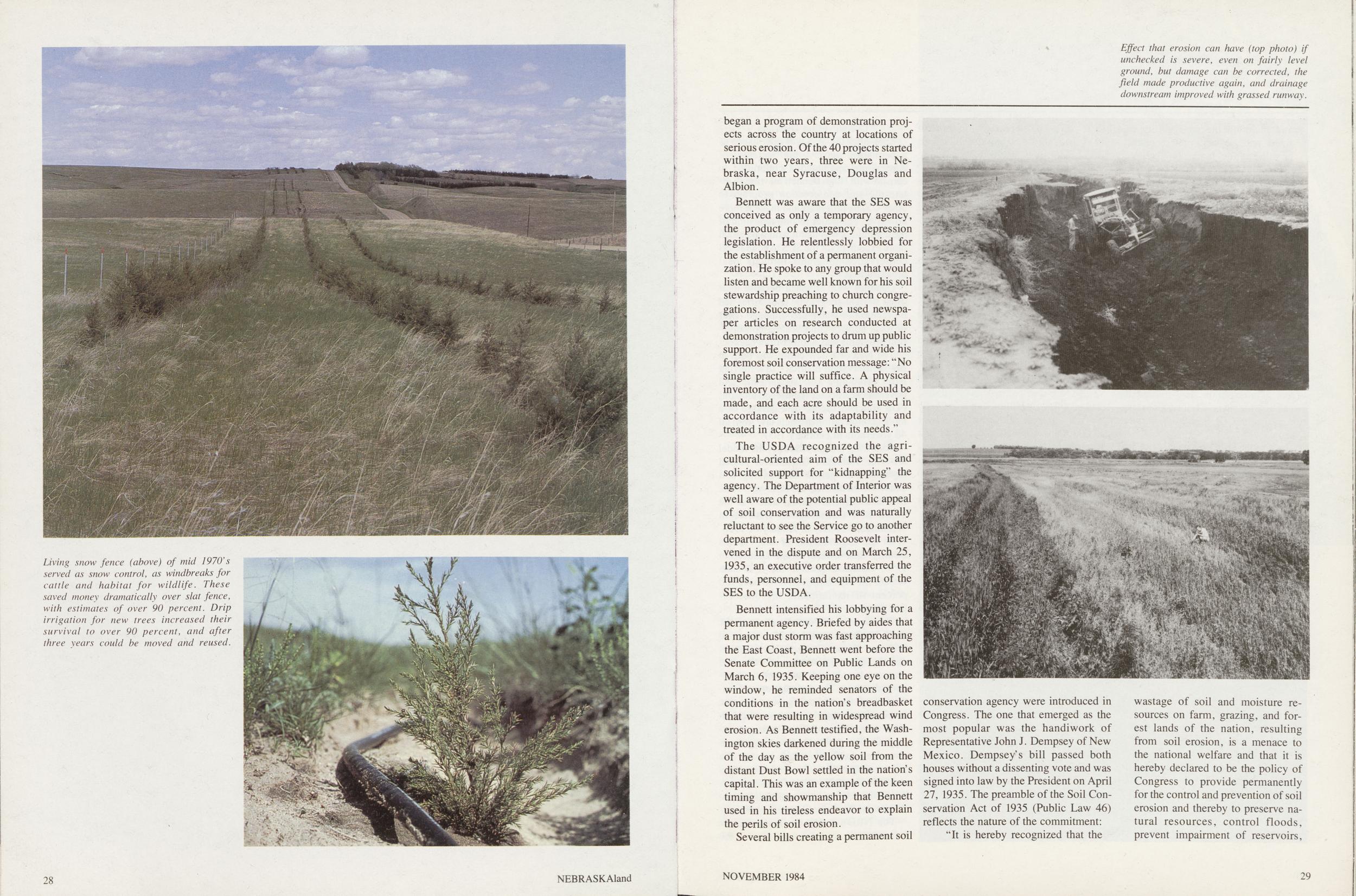
Living snow fence (above) of mid 1970's served as snow control, as windbreaks for cattle and habitat for wildlife. These saved money dramatically over slat fence, with estimates of over 90 percent. Drip irrigation for new trees increased their survival to over 90 percent, and after three years could be moved and reused.
began a program of demonstration projects across the country at locations of serious erosion. Of the 40 projects started within two years, three were in Nebraska, near Syracuse, Douglas and Albion.
Bennett was aware that the SES was conceived as only a temporary agency, the product of emergency depression legislation. He relentlessly lobbied for the establishment of a permanent organization. He spoke to any group that would listen and became well known for his soil stewardship preaching to church congregations. Successfully, he used newspaper articles on research conducted at demonstration projects to drum up public support. He expounded far and wide his foremost soil conservation message: "No single practice will suffice. A physical inventory of the land on a farm should be made, and each acre should be used in accordance with its adaptability and treated in accordance with its needs."
The USDA recognized the agricultural-oriented aim of the SES and solicited support for "kidnapping" the agency. The Department of Interior was well aware of the potential public appeal of soil conservation and was naturally reluctant to see the Service go to another department. President Roosevelt intervened in the dispute and on March 25, 1935, an executive order transferred the funds, personnel, and equipment of the SES to the USDA.
Bennett intensified his lobbying for a permanent agency. Briefed by aides that a major dust storm was fast approaching the East Coast, Bennett went before the Senate Committee on Public Lands on March 6, 1935. Keeping one eye on the window, he reminded senators of the conditions in the nation's breadbasket that were resulting in widespread wind erosion. As Bennett testified, the Washington skies darkened during the middle of the day as the yellow soil from the distant Dust Bowl settled in the nation's capital. This was an example of the keen timing and showmanship that Bennett used in his tireless endeavor to explain the perils of soil erosion.
Several bills creating a permanent soil
conservation agency were introduced in Congress. The one that emerged as the most popular was the handiwork of Representative John J. Dempsey of New Mexico. Dempsey's bill passed both houses without a dissenting vote and was signed into law by the President on April 27, 1935. The preamble of the Soil Conservation Act of 1935 (Public Law 46) reflects the nature of the commitment:
"It is hereby recognized that the wastage of soil and moisture resources on farm, grazing, and forest lands of the nation, resulting from soil erosion, is a menace to the national welfare and that it is hereby declared to be the policy of Congress to provide permanently for the control and prevention of soil erosion and thereby to preserve natural resources, control floods, prevent impairment of reservoirs,
NOVEMBER 1984 29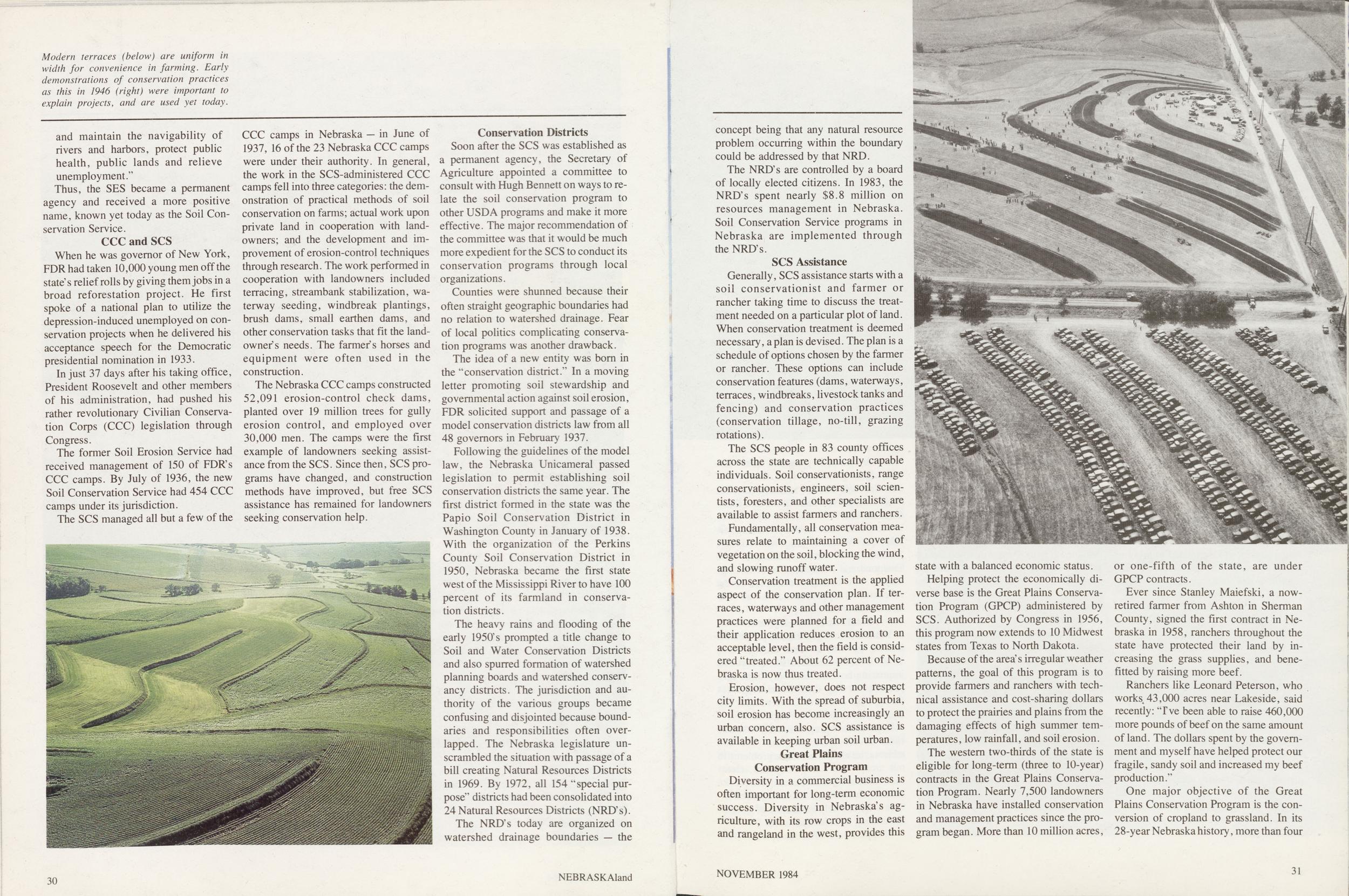
and maintain the navigability of rivers and harbors, protect public health, public lands and relieve unemployment."
Thus, the SES became a permanent agency and received a more positive name, known yet today as the Soil Conservation Service.
CCC and SCSWhen he was governor of New York, FDR had taken 10,000 young men off the state's relief rolls by giving them jobs in a broad reforestation project. He first spoke of a national plan to utilize the depression-induced unemployed on conservation projects when he delivered his acceptance speech for the Democratic presidential nomination in 1933.
In just 37 days after his taking office, President Roosevelt and other members of his administration, had pushed his rather revolutionary Civilian Conservation Corps (CCC) legislation through Congress.
The former Soil Erosion Service had received management of 150 of FDR's CCC camps. By July of 1936, the new Soil Conservation Service had 454 CCC camps under its jurisdiction.
The SCS managed all but a few of the CCC camps in Nebraska — in June of 1937, 16 of the 23 Nebraska CCC camps were under their authority. In general, the work in the SCS-administered CCC camps fell into three categories: the demonstration of practical methods of soil conservation on farms; actual work upon private land in cooperation with landowners; and the development and improvement of erosion-control techniques through research. The work performed in cooperation with landowners included terracing, streambank stabilization, waterway seeding, windbreak plantings, brush dams, small earthen dams, and other conservation tasks that fit the landowner's needs. The farmer's horses and equipment were often used in the construction.
The Nebraska CCC camps constructed 52,091 erosion-control check dams, planted over 19 million trees for gully erosion control, and employed over 30,000 men. The camps were the first example of landowners seeking assistance from the SCS. Since then, SCS programs have changed, and construction methods have improved, but free SCS assistance has remained for landowners seeking conservation help.
Soon after the SCS was established as a permanent agency, the Secretary of Agriculture appointed a committee to consult with Hugh Bennett on ways to relate the soil conservation program to other USDA programs and make it more effective. The major recommendation of the committee was that it would be much more expedient for the SCS to conduct its conservation programs through local organizations.
Counties were shunned because their often straight geographic boundaries had no relation to watershed drainage. Fear of local politics complicating conservation programs was another drawback.
The idea of a new entity was born in the "conservation district." In a moving letter promoting soil stewardship and governmental action against soil erosion, FDR solicited support and passage of a model conservation districts law from all 48 governors in February 1937.
Following the guidelines of the model law, the Nebraska Unicameral passed legislation to permit establishing soil conservation districts the same year. The first district formed in the state was the Papio Soil Conservation District in Washington County in January of 1938. With the organization of the Perkins County Soil Conservation District in 1950, Nebraska became the first state west of the Mississippi River to have 100 percent of its farmland in conservation districts.
The heavy rains and flooding of the early 1950's prompted a title change to Soil and Water Conservation Districts and also spurred formation of watershed planning boards and watershed conservancy districts. The jurisdiction and authority of the various groups became confusing and disjointed because boundaries and responsibilities often overlapped. The Nebraska legislature unscrambled the situation with passage of a bill creating Natural Resources Districts in 1969. By 1972, all 154 "special purpose" districts had been consolidated into 24 Natural Resources Districts (NRD's).
The NRD's today are organized on watershed drainage boundaries — the
30 NEBRASKAlandconcept being that any natural resource problem occurring within the boundary could be addressed by that NRD.
The NRD's are controlled by a board of locally elected citizens. In 1983, the NRD's spent nearly $8.8 million on resources management in Nebraska. Soil Conservation Service programs in Nebraska are implemented through the NRD's.
SCS AssistanceGenerally, SCS assistance starts with a soil conservationist and farmer or rancher taking time to discuss the treatment needed on a particular plot of land. When conservation treatment is deemed necessary, a plan is devised. The plan is a schedule of options chosen by the farmer or rancher. These options can include conservation features (dams, waterways, terraces, windbreaks, livestock tanks and fencing) and conservation practices (conservation tillage, no-till, grazing rotations).
The SCS people in 83 county offices across the state are technically capable individuals. Soil conservationists, range conservationists, engineers, soil scientists, foresters, and other specialists are available to assist farmers and ranchers.
Fundamentally, all conservation measures relate to maintaining a cover of vegetation on the soil, blocking the wind, and slowing runoff water.
Conservation treatment is the applied aspect of the conservation plan. If terraces, waterways and other management practices were planned for a field and their application reduces erosion to an acceptable level, then the field is considered "treated." About 62 percent of Nebraska is now thus treated.
Erosion, however, does not respect city limits. With the spread of suburbia, soil erosion has become increasingly an urban concern, also. SCS assistance is available in keeping urban soil urban.
Great Plains Conservation ProgramDiversity in a commercial business is often important for long-term economic success. Diversity in Nebraska's agriculture, with its row crops in the east and rangeland in the west, provides this
state with a balanced economic status.
Helping protect the economically diverse base is the Great Plains Conservation Program (GPCP) administered by SCS. Authorized by Congress in 1956, this program now extends to 10 Midwest states from Texas to North Dakota.
Because of the area's irregular weather patterns, the goal of this program is to provide farmers and ranchers with technical assistance and cost-sharing dollars to protect the prairies and plains from the damaging effects of high summer temperatures, low rainfall, and soil erosion.
The western two-thirds of the state is eligible for long-term (three to 10-year) contracts in the Great Plains Conservation Program. Nearly 7,500 landowners in Nebraska have installed conservation and management practices since the program began. More than 10 million acres, or one-fifth of the state, are under GPCP contracts.
Ever since Stanley Maiefski, a now-retired farmer from Ashton in Sherman County, signed the first contract in Nebraska in 1958, ranchers throughout the state have protected their land by increasing the grass supplies, and benefitted by raising more beef.
Ranchers like Leonard Peterson, who works, 43,000 acres near Lakeside, said recently: "I've been able to raise 460,000 more pounds of beef on the same amount of land. The dollars spent by the government and myself have helped protect our fragile, sandy soil and increased my beef production."
One major objective of the Great Plains Conservation Program is the conversion of cropland to grassland. In its 28-year Nebraska history, more than four
NOVEMBER 1984 31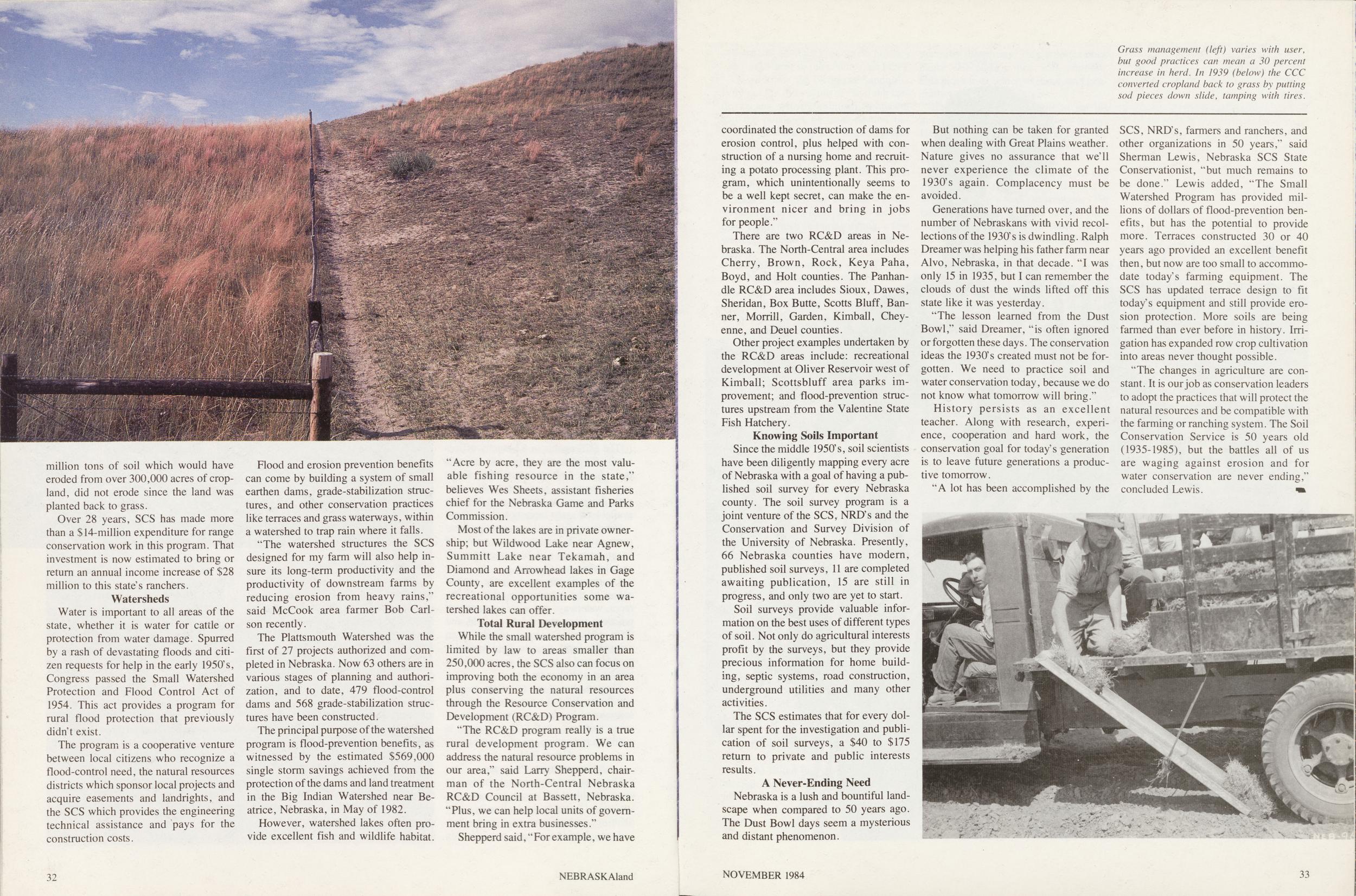
million tons of soil which would have eroded from over 300,000 acres of cropland, did not erode since the land was planted back to grass.
Over 28 years, SCS has made more than a $14-million expenditure for range conservation work in this program. That investment is now estimated to bring or return an annual income increase of $28 million to this state's ranchers.
WatershedsWater is important to all areas of the state, whether it is water for cattle or protection from water damage. Spurred by a rash of devastating floods and citizen requests for help in the early 1950's, Congress passed the Small Watershed Protection and Flood Control Act of 1954. This act provides a program for rural flood protection that previously didn't exist.
The program is a cooperative venture between local citizens who recognize a flood-control need, the natural resources districts which sponsor local projects and acquire easements and landrights, and the SCS which provides the engineering technical assistance and pays for the construction costs.
Flood and erosion prevention benefits can come by building a system of small earthen dams, grade-stabilization structures, and other conservation practices like terraces and grass waterways, within a watershed to trap rain where it falls.
"The watershed structures the SCS designed for my farm will also help insure its long-term productivity and the productivity of downstream farms by reducing erosion from heavy rains," said McCook area farmer Bob Carlson recently.
The Plattsmouth Watershed was the first of 27 projects authorized and completed in Nebraska. Now 63 others are in various stages of planning and authorization, and to date, 479 flood-control dams and 568 grade-stabilization structures have been constructed.
The principal purpose of the watershed program is flood-prevention benefits, as witnessed by the estimated $569,000 single storm savings achieved from the protection of the dams and land treatment in the Big Indian Watershed near Beatrice, Nebraska, in May of 1982.
However, watershed lakes often provide excellent fish and wildlife habitat. "Acre by acre, they are the most valuable fishing resource in the state," believes Wes Sheets, assistant fisheries chief for the Nebraska Game and Parks Commission.
Most of the lakes are in private ownership; but Wildwood Lake near Agnew, Summitt Lake near Tekamah, and Diamond and An-owhead lakes in Gage County, are excellent examples of the recreational opportunities some watershed lakes can offer.
Total Rural DevelopmentWhile the small watershed program is limited by law to areas smaller than 250,000 acres, the SCS also can focus on improving both the economy in an area plus conserving the natural resources through the Resource Conservation and Development (RC&D) Program.
"The RC&D program really is a true rural development program. We can address the natural resource problems in our area," said Larry Shepperd, chairman of the North-Central Nebraska RC&D Council at Bassett, Nebraska. "Plus, we can help local units of government bring in extra businesses."
Shepperd said, "For example, we have
32 NEBRASKAlandcoordinated the construction of dams for erosion control, plus helped with construction of a nursing home and recruiting a potato processing plant. This program, which unintentionally seems to be a well kept secret, can make the environment nicer and bring in jobs for people."
There are two RC&D areas in Nebraska. The North-Central area includes Cherry, Brown, Rock, Keya Paha, Boyd, and Holt counties. The Panhandle RC&D area includes Sioux, Dawes, Sheridan, Box Butte, Scotts Bluff, Banner, Morrill, Garden, Kimball, Cheyenne, and Deuel counties.
Other project examples undertaken by the RC&D areas include: recreational development at Oliver Reservoir west of Kimball; Scottsbluff area parks improvement; and flood-prevention structures upstream from the Valentine State Fish Hatchery.
Knowing Soils ImportantSince the middle 1950's, soil scientists have been diligently mapping every acre of Nebraska with a goal of having a published soil survey for every Nebraska county. The soil survey program is a joint venture of the SCS, NRD's and the Conservation and Survey Division of the University of Nebraska. Presently, 66 Nebraska counties have modern, published soil surveys, 11 are completed awaiting publication, 15 are still in progress, and only two are yet to start.
Soil surveys provide valuable information on the best uses of different types of soil. Not only do agricultural interests profit by the surveys, but they provide precious information for home building, septic systems, road construction, underground utilities and many other activities.
The SCS estimates that for every dollar spent for the investigation and publication of soil surveys, a $40 to $175 return to private and public interests results.
A Never-Ending NeedNebraska is a lush and bountiful landscape when compared to 50 years ago. The Dust Bowl days seem a mysterious and distant phenomenon.
But nothing can be taken for granted when dealing with Great Plains weather. Nature gives no assurance that we'll never experience the climate of the 1930's again. Complacency must be avoided.
Generations have turned over, and the number of Nebraskans with vivid recollections of the 1930's is dwindling. Ralph Dreamer was helping his father farm near Alvo, Nebraska, in that decade. "I was only 15 in 1935, but I can remember the clouds of dust the winds lifted off this state like it was yesterday.
"The lesson learned from the Dust Bowl," said Dreamer, "is often ignored or forgotten these days. The conservation ideas the 1930's created must not be forgotten. We need to practice soil and water conservation today, because we do not know what tomorrow will bring."
History persists as an excellent teacher. Along with research, experience, cooperation and hard work, the conservation goal for today's generation is to leave future generations a productive tomorrow.
"A lot has been accomplished by the SCS, NRD's, farmers and ranchers, and other organizations in 50 years," said Sherman Lewis, Nebraska SCS State Conservationist, "but much remains to be done." Lewis added, "The Small Watershed Program has provided millions of dollars of flood-prevention benefits, but has the potential to provide more. Terraces constructed 30 or 40 years ago provided an excellent benefit then, but now are too small to accommodate today's farming equipment. The SCS has updated terrace design to fit today's equipment and still provide erosion protection. More soils are being farmed than ever before in history. Irrigation has expanded row crop cultivation into areas never thought possible.
"The changes in agriculture are constant. It is our job as conservation leaders to adopt the practices that will protect the natural resources and be compatible with the farming or ranching system. The Soil Conservation Service is 50 years old (1935-1985), but the battles all of us are waging against erosion and for water conservation are never ending," concluded Lewis.
ICE-UP CANNERS
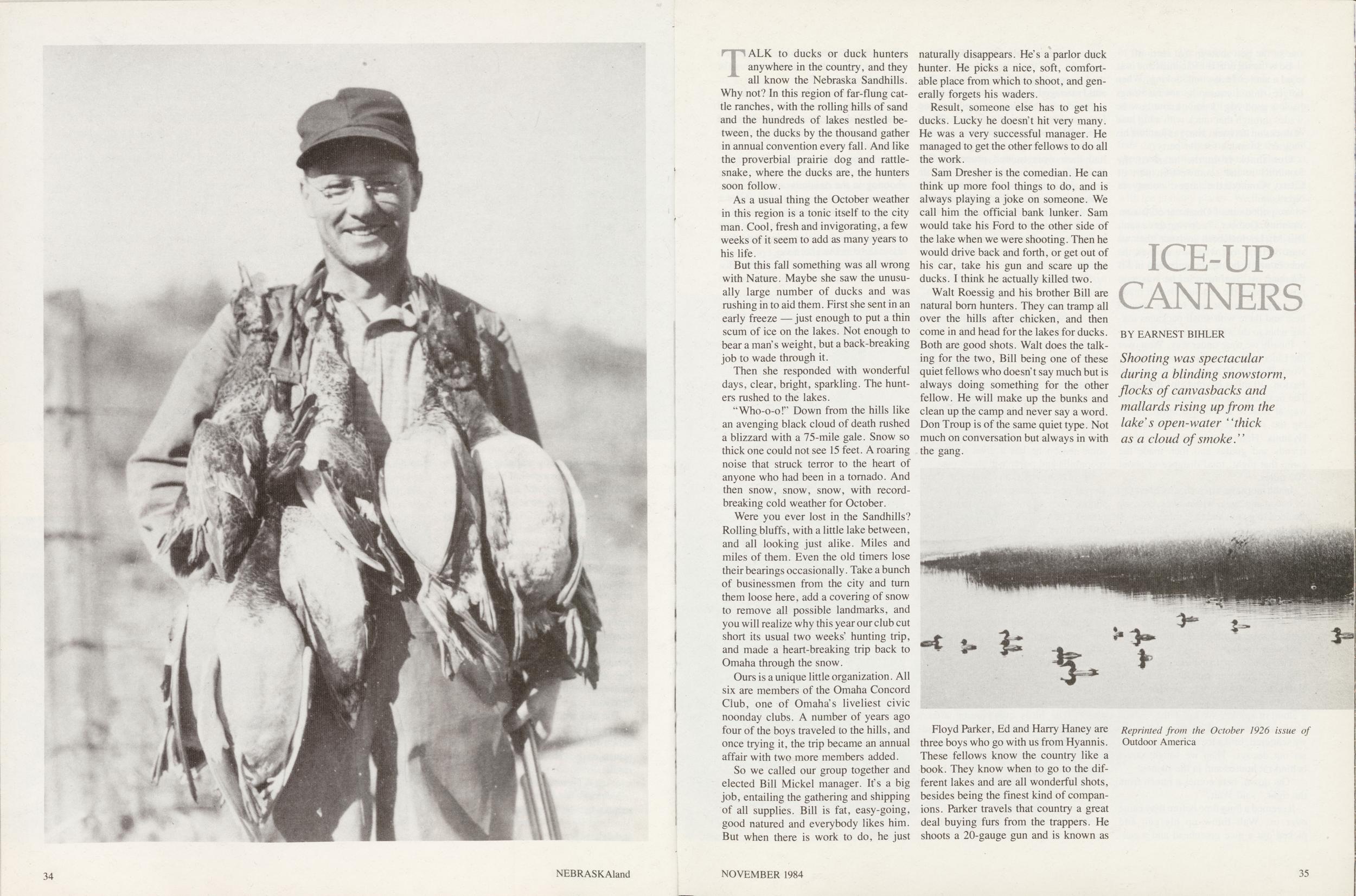
BY EARNEST BIHLER Shooting was spectacular during a blinding snowstorm, flocks of canvasbacks and mallards rising up from the lake s open-water "thick as a cloud of smoke."TALK to ducks or duck hunters anywhere in the country, and they all know the Nebraska Sandhills. Why not? In this region of far-flung cattle ranches, with the rolling hills of sand and the hundreds of lakes nestled between, the ducks by the thousand gather in annual convention every fall. And like the proverbial prairie dog and rattlesnake, where the ducks are, the hunters soon follow.
As a usual thing the October weather in this region is a tonic itself to the city man. Cool, fresh and invigorating, a few weeks of it seem to add as many years to his life.
But this fall something was all wrong with Nature. Maybe she saw the unusually large number of ducks and was rushing in to aid them. First she sent in an early freeze — just enough to put a thin scum of ice on the lakes. Not enough to bear a man's weight, but a back-breaking job to wade through it.
Then she responded with wonderful days, clear, bright, sparkling. The hunters rushed to the lakes.
Who-o-o!" Down from the hills like an avenging black cloud of death rushed a blizzard with a 75-mile gale. Snow so thick one could not see 15 feet. A roaring noise that struck terror to the heart of anyone who had been in a tornado. And then snow, snow, snow, with record-breaking cold weather for October.
Were you ever lost in the Sandhills? Rolling bluffs, with a little lake between, and all looking just alike. Miles and miles of them. Even the old timers lose their bearings occasionally. Take a bunch of businessmen from the city and turn them loose here, add a covering of snow to remove all possible landmarks, and you will realize why this year our club cut short its usual two weeks' hunting trip, and made a heart-breaking trip back to Omaha through the snow.
Ours is a unique little organization. All six are members of the Omaha Concord Club, one of Omaha's liveliest civic noonday clubs. A number of years ago four of the boys traveled to the hills, and once trying it, the trip became an annual affair with two more members added.
So we called our group together and elected Bill Mickel manager. It's a big job, entailing the gathering and shipping of all supplies. Bill is fat, easy-going, good natured and everybody likes him. But when there is work to do, he just naturally disappears. He's a parlor duck hunter. He picks a nice, soft, comfortable place from which to shoot, and generally forgets his waders.
Result, someone else has to get his ducks. Lucky he doesn't hit very many. He was a very successful manager. He managed to get the other fellows to do all the work.
Sam Dresher is the comedian. He can think up more fool things to do, and is always playing a joke on someone. We call him the official bank lunker. Sam would take his Ford to the other side of the lake when we were shooting. Then he would drive back and forth, or get out of his car, take his gun and scare up the ducks. I think he actually killed two.
Walt Roessig and his brother Bill are natural born hunters. They can tramp all over the hills after chicken, and then come in and head for the lakes for ducks. Both are good shots. Walt does the talking for the two, Bill being one of these quiet fellows who doesn't say much but is always doing something for the other fellow. He will make up the bunks and clean up the camp and never say a word. Don Troup is of the same quiet type. Not much on conversation but always in with the gang.
Floyd Parker, Ed and Harry Haney are three boys who go with us from Hyannis. These fellows know the country like a book. They know when to go to the different lakes and are all wonderful shots, besides being the finest kind of companions. Parker travels that country a great deal buying furs from the trappers. He shoots a 20-gauge gun and is known as
Reprinted from the October 1926 issue of Outdoor America
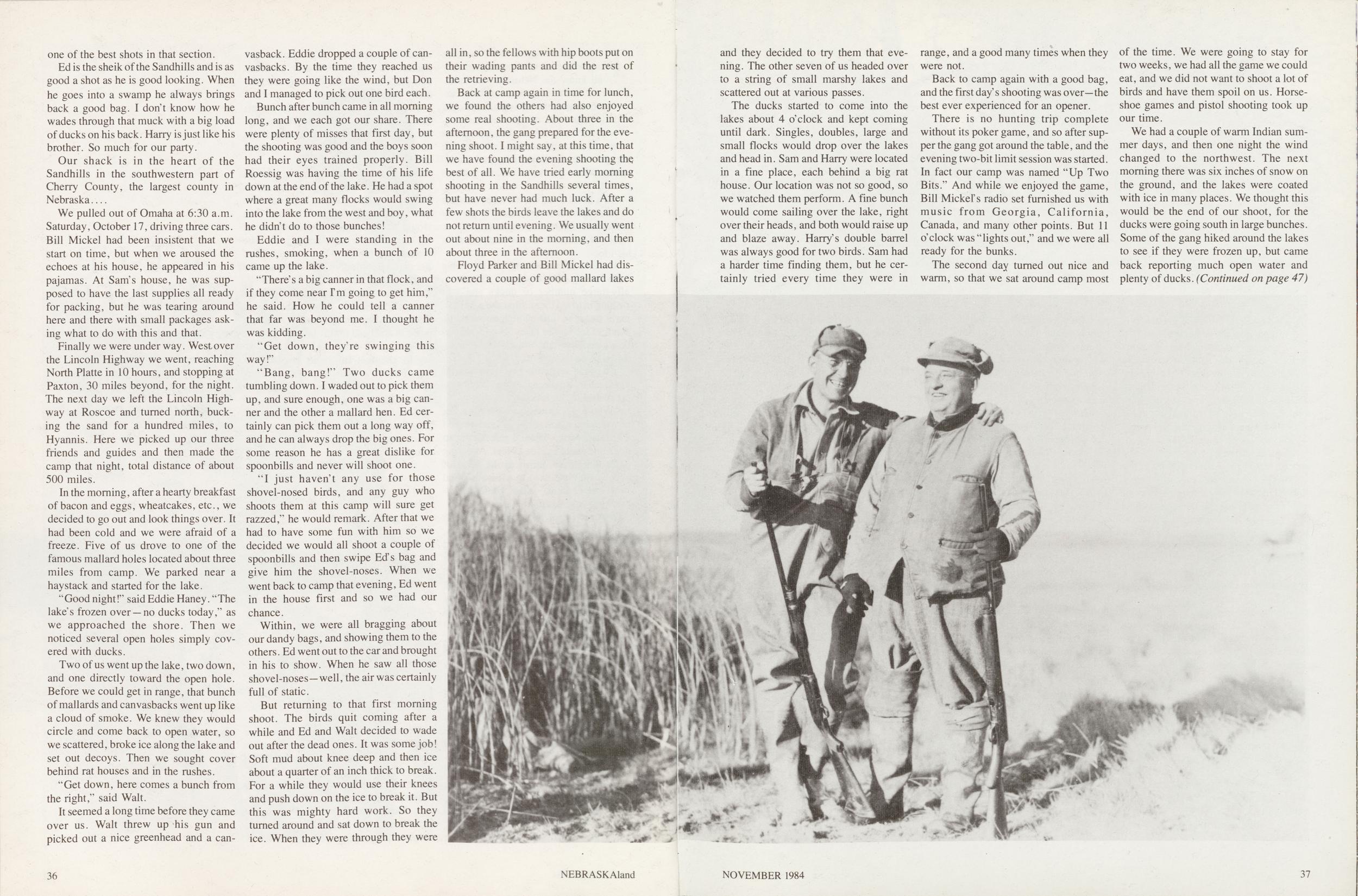
one of the best shots in that section.
Ed is the sheik of the Sandhills and is as good a shot as he is good looking. When he goes into a swamp he always brings back a good bag. I don't know how he wades through that muck with a big load of ducks on his back. Harry is just like his brother. So much for our party.
Our shack is in the heart of the Sandhills in the southwestern part of Cherry County, the largest county in Nebraska....
We pulled out of Omaha at 6:30 a.m. Saturday, October 17, driving three cars. Bill Mickel had been insistent that we start on time, but when we aroused the echoes at his house, he appeared in his pajamas. At Sam's house, he was supposed to have the last supplies all ready for packing, but he was tearing around here and there with small packages asking what to do with this and that.
Finally we were under way. West over the Lincoln Highway we went, reaching North Platte in 10 hours, and stopping at Paxton, 30 miles beyond, for the night. The next day we left the Lincoln Highway at Roscoe and turned north, bucking the sand for a hundred miles, to Hyannis. Here we picked up our three friends and guides and then made the camp that night, total distance of about 500 miles.
In the morning, after a hearty breakfast of bacon and eggs, wheatcakes, etc., we decided to go out and look things over. It had been cold and we were afraid of a freeze. Five of us drove to one of the famous mallard holes located about three miles from camp. We parked near a haystack and started for the lake.
"Good night!" said Eddie Haney. "The lake's frozen over —no ducks today," as we approached the shore. Then we noticed several open holes simply covered with ducks.
Two of us went up the lake, two down, and one directly toward the open hole. Before we could get in range, that bunch of mallards and canvasbacks went up like a cloud of smoke. We knew they would circle and come back to open water, so we scattered, broke ice along the lake and set out decoys. Then we sought cover behind rat houses and in the rushes.
"Get down, here comes a bunch from the right," said Walt.
It seemed a long time before they came over us. Walt threw up his gun and picked out a nice greenhead and a canvasback. Eddie dropped a couple of canvasbacks. By the time they reached us they were going like the wind, but Don and I managed to pick out one bird each.
Bunch after bunch came in all morning long, and we each got our share. There were plenty of misses that first day, but the shooting was good and the boys soon had their eyes trained properly. Bill Roessig was having the time of his life down at the end of the lake. He had a spot where a great many flocks would swing into the lake from the west and boy, what he didn't do to those bunches!
Eddie and I were standing in the rushes, smoking, when a bunch of 10 came up the lake.
"There's a big canner in that flock, and if they come near Tm going to get him," he said. How he could tell a canner that far was beyond me. I thought he was kidding.
"Get down, they're swinging this way!"
"Bang, bang!" Two ducks came tumbling down. I waded out to pick them up, and sure enough, one was a big canner and the other a mallard hen. Ed certainly can pick them out a long way off, and he can always drop the big ones. For some reason he has a great dislike for spoonbills and never will shoot one.
"I just haven't any use for those shovel-nosed birds, and any guy who shoots them at this camp will sure get razzed," he would remark. After that we had to have some fun with him so we decided we would all shoot a couple of spoonbills and then swipe Ed's bag and give him the shovel-noses. When we went back to camp that evening, Ed went in the house first and so we had our chance.
Within, we were all bragging about our dandy bags, and showing them to the others. Ed went out to the car and brought in his to show. When he saw all those shovel-noses—well, the air was certainly full of static.
But returning to that first morning shoot. The birds quit coming after a while and Ed and Walt decided to wade out after the dead ones. It was some job! Soft mud about knee deep and then ice about a quarter of an inch thick to break. For a while they would use their knees and push down on the ice to break it. But this was mighty hard work. So they turned around and sat down to break the ice. When they were through they were all in, so the fellows with hip boots put on their wading pants and did the rest of the retrieving.
Back at camp again in time for lunch, we found the others had also enjoyed some real shooting. About three in the afternoon, the gang prepared for the evening shoot. I might say, at this time, that we have found the evening shooting the. best of all. We have tried early morning shooting in the Sandhills several times, but have never had much luck. After a few shots the birds leave the lakes and do not return until evening. We usually went out about nine in the morning, and then about three in the afternoon.
Floyd Parker and Bill Mickel had discovered a couple of good mallard lakes
36 NEBRASKAlandand they decided to try them that evening. The other seven of us headed over to a string of small marshy lakes and scattered out at various passes.
The ducks started to come into the lakes about 4 o'clock and kept coming until dark. Singles, doubles, large and small flocks would drop over the lakes and head in. Sam and Harry were located in a fine place, each behind a big rat house. Our location was not so good, so we watched them perform. A fine bunch would come sailing over the lake, right over their heads, and both would raise up and blaze away. Harry's double barrel was always good for two birds. Sam had a harder time finding them, but he certainly tried every time they were in range, and a good many times when they were not.
Back to camp again with a good bag, and the first day's shooting was over—the best ever experienced for an opener.
There is no hunting trip complete without its poker game, and so after supper the gang got around the table, and the evening two-bit limit session was started. In fact our camp was named "Up Two Bits." And while we enjoyed the game, Bill Mickel's radio set furnished us with music from Georgia, California, Canada, and many other points. But 11 o'clock was "lights out," and we were all ready for the bunks.
The second day turned out nice and warm, so that we sat around camp most of the time. We were going to stay for two weeks, we had all the game we could eat, and we did not want to shoot a lot of birds and have them spoil on us. Horseshoe games and pistol shooting took up our time.
We had a couple of warm Indian summer days, and then one night the wind changed to the northwest. The next morning there was six inches of snow on the ground, and the lakes were coated with ice in many places. We thought this would be the end of our shoot, for the ducks were going south in large bunches. Some of the gang hiked around the lakes to see if they were frozen up, but came back reporting much open water and plenty of ducks.
(Continued on page 47)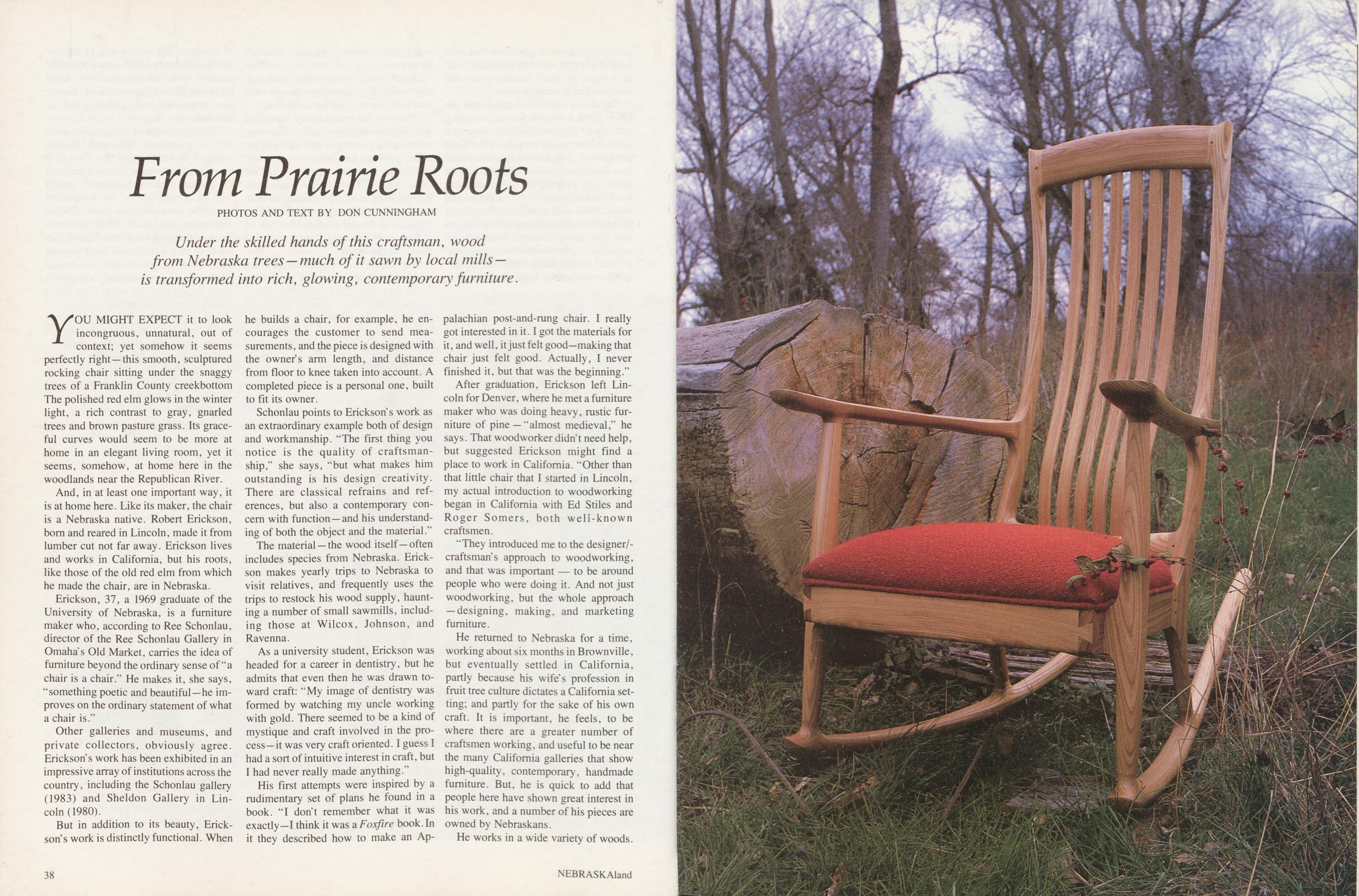
From Prairie Roots
PHOTOS AND TEXT BY DON CUNNINGHAM Under the skilled hands of this craftsman, wood from Nebraska trees — much of it sawn by local mills — is transformed into rich, glowing, contemporary furniture.YOU MIGHT EXPECT it to look incongruous, unnatural, out of context; yet somehow it seems perfectly right —this smooth, sculptured rocking chair sitting under the snaggy trees of a Franklin County creekbottom The polished red elm glows in the winter light, a rich contrast to gray, gnarled trees and brown pasture grass. Its graceful curves would seem to be more at home in an elegant living room, yet it seems, somehow, at home here in the woodlands near the Republican River.
And, in at least one important way, it is at home here. Like its maker, the chair is a Nebraska native. Robert Erickson, born and reared in Lincoln, made it from lumber cut not far away. Erickson lives and works in California, but his roots, like those of the old red elm from which he made the chair, are in Nebraska.
Erickson, 37, a 1969 graduate of the University of Nebraska, is a furniture maker who, according to Ree Schonlau, director of the Ree Schonlau Gallery in Omaha's Old Market, carries the idea of furniture beyond the ordinary sense of "a chair is a chair." He makes it, she says, "something poetic and beautiful—he improves on the ordinary statement of what a chair is."
Other galleries and museums, and private collectors, obviously agree. Erickson's work has been exhibited in an impressive array of institutions across the country, including the Schonlau gallery (1983) and Sheldon Gallery in Lincoln (1980).
But in addition to its beauty, Erickson's work is distinctly functional. When he builds a chair, for example, he encourages the customer to send measurements, and the piece is designed with the owner's arm length, and distance from floor to knee taken into account. A completed piece is a personal one, built to fit its owner.
Schonlau points to Erickson's work as an extraordinary example both of design and workmanship. "The first thing you notice is the quality of craftsmanship," she says, "but what makes him outstanding is his design creativity. There are classical refrains and references, but also a contemporary concern with function —and his understanding of both the object and the material."
The material —the wood itself—often includes species from Nebraska. Erickson makes yearly trips to Nebraska to visit relatives, and frequently uses the trips to restock his wood supply, haunting a number of small sawmills, including those at Wilcox, Johnson, and Ravenna.
As a university student, Erickson was headed for a career in dentistry, but he admits that even then he was drawn toward craft: "My image of dentistry was formed by watching my uncle working with gold. There seemed to be a kind of mystique and craft involved in the process—it was very craft oriented. I guess I had a sort of intuitive interest in craft, but I had never really made anything."
His first attempts were inspired by a rudimentary set of plans he found in a book. "I don't remember what it was exactly—I think it was a Foxfire book. In it they described how to make an Appalachian post-and-rung chair. I really got interested in it. I got the materials for it, and well, it just felt good—making that chair just felt good. Actually, I never finished it, but that was the beginning."
After graduation, Erickson left Lincoln for Denver, where he met a furniture maker who was doing heavy, rustic furniture of pine —"almost medieval," he says. That woodworker didn't need help, but suggested Erickson might find a place to work in California. "Other than that little chair that I started in Lincoln, my actual introduction to woodworking began in California with Ed Stiles and Roger Somers, both well-known craftsmen.
"They introduced me to the designer/-craftsman's approach to woodworking, and that was important — to be around people who were doing it. And not just woodworking, but the whole approach — designing, making, and marketing furniture.
He returned to Nebraska for a time, working about six months in Brownville, but eventually settled in California, partly because his wife's profession in fruit tree culture dictates a California setting; and partly for the sake of his own craft. It is important, he feels, to be where there are a greater number of craftsmen working, and useful to be near the many California galleries that show high-quality, contemporary, handmade furniture. But, he is quick to add that people here have shown great interest in his work, and a number of his pieces are owned by Nebraskans.
He works in a wide variety of woods.
38 NEBRASKAland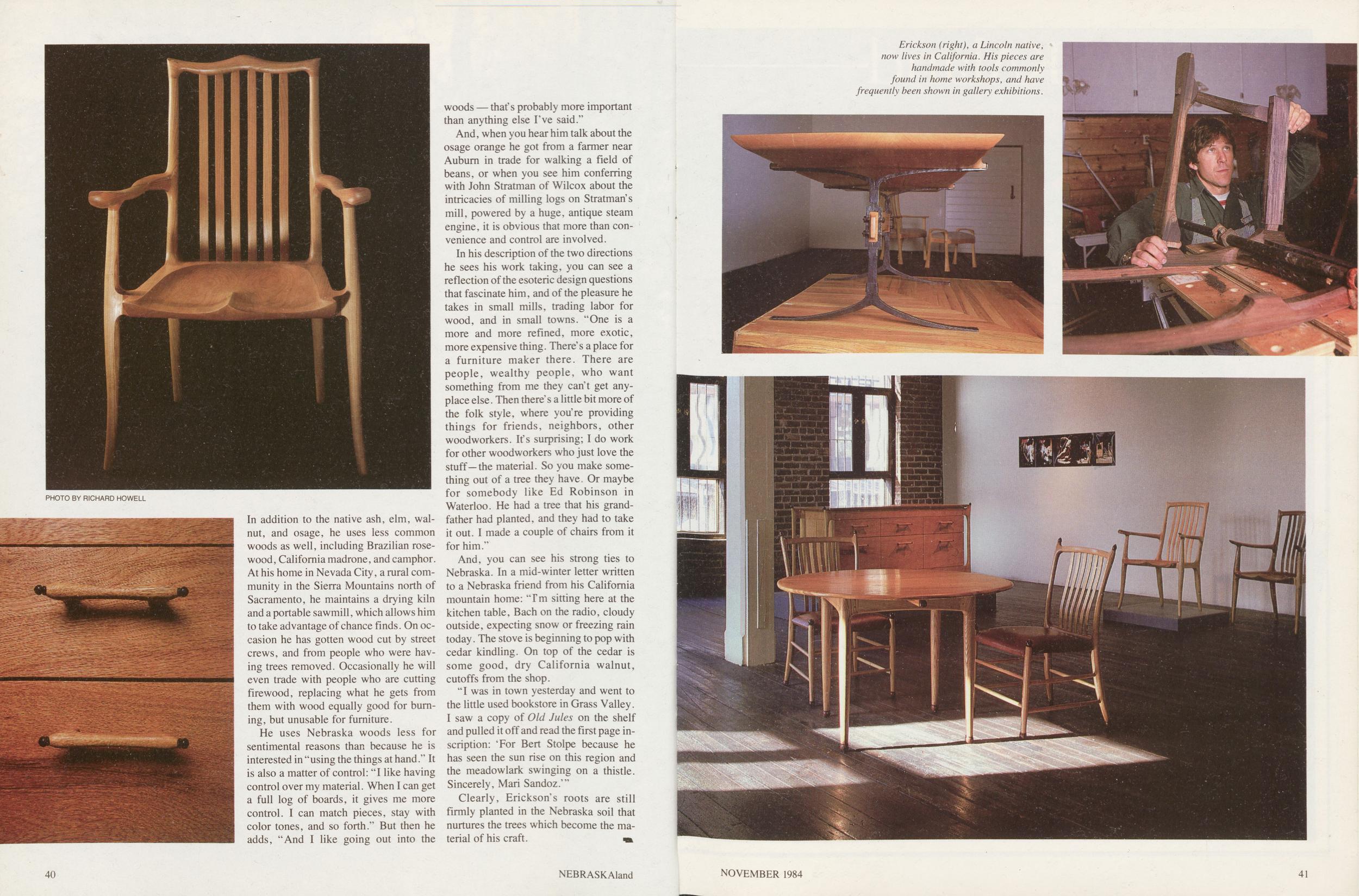
In addition to the native ash, elm, walnut, and osage, he uses less common woods as well, including Brazilian rosewood, California madrone, and camphor. At his home in Nevada City, a rural community in the Sierra Mountains north of Sacramento, he maintains a drying kiln and a portable sawmill, which allows him to take advantage of chance finds. On occasion he has gotten wood cut by street crews, and from people who were having trees removed. Occasionally he will even trade with people who are cutting firewood, replacing what he gets from them with wood equally good for burning, but unusable for furniture.
He uses Nebraska woods less for sentimental reasons than because he is interested in "using the things at hand." It is also a matter of control: "I like having control over my material. When I can get a full log of boards, it gives me more control. I can match pieces, stay with color tones, and so forth." But then he adds, "And I like going out into the woods — that's probably more important than anything else I've said."
And, when you hear him talk about the osage orange he got from a farmer near Auburn in trade for walking a field of beans, or when you see him conferring with John Stratman of Wilcox about the intricacies of milling logs on Stratman's mill, powered by a huge, antique steam engine, it is obvious that more than convenience and control are involved.
In his description of the two directions he sees his work taking, you can see a reflection of the esoteric design questions that fascinate him, and of the pleasure he takes in small mills, trading labor for wood, and in small towns. "One is a more and more refined, more exotic, more expensive thing. There's a place for a furniture maker there. There are people, wealthy people, who want something from me they can't get anyplace else. Then there's a little bit more of the folk style, where you're providing things for friends, neighbors, other woodworkers. It's surprising; I do work for other woodworkers who just love the stuff—the material. So you make something out of a tree they have. Or maybe for somebody like Ed Robinson in Waterloo. He had a tree that his grandfather had planted, and they had to take it out. I made a couple of chairs from it for him."
And, you can see his strong ties to Nebraska. In a mid-winter letter written to a Nebraska friend from his California mountain home: "Tm sitting here at the kitchen table, Bach on the radio, cloudy outside, expecting snow or freezing rain today. The stove is beginning to pop with cedar kindling. On top of the cedar is some good, dry California walnut, cutoffs from the shop.
"I was in town yesterday and went to the little used bookstore in Grass Valley. I saw a copy of Old Jules on the shelf and pulled it off and read the first page inscription: Tor Bert Stolpe because he has seen the sun rise on this region and the meadowlark swinging on a thistle. Sincerely, Mari Sandoz."
Clearly, Erickson's roots are still firmly planted in the Nebraska soil that nurtures the trees which become the material of his craft.
40 NEBRASKAland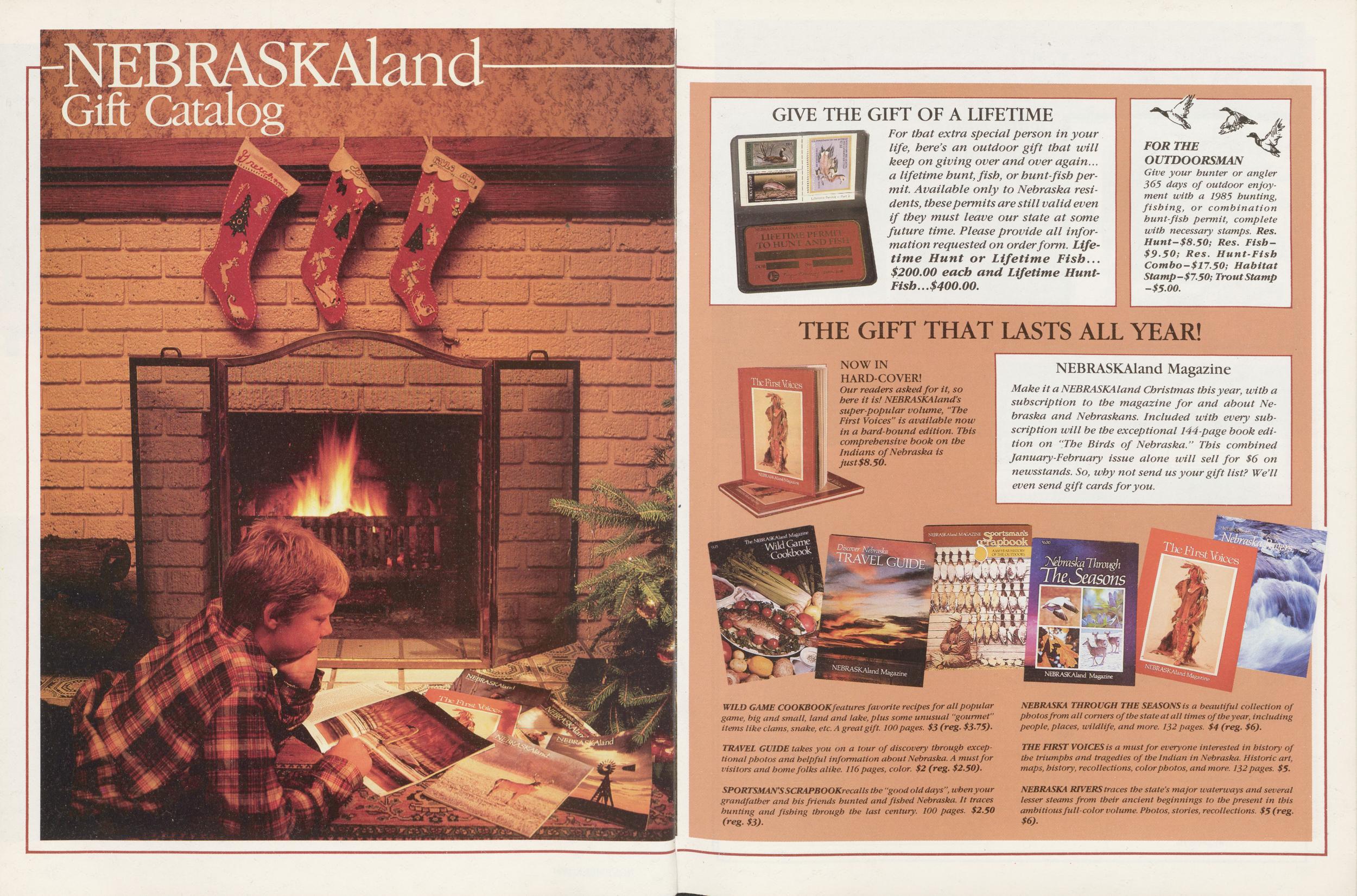
NEBRASKAland Gift Catalog
NOW IN HARD-COVER! Our readers asked for it, so here it is! NEBRASKAland's super-popular volume, "The First Voices" is available now in a hard-bound edition. This comprehensive book on the Indians of Nebraska is just $8.50.
NEBRASKAland Magazine Make it a NEBRASKAland Christmas this year, with a subscription to the magazine for and about Nebraska and Nebraskans. Included with every sub- scription will be the exceptional 144-page book edition on "The Birds of Nebraska." This combined January-February issue alone will sell for $6 on newsstands. So, why not send us your gift list? Well even send gift cards for you. WILD GAME COOKBOOKfeatures favorite recipes for unpopular game, big and small, land and lake, plus some unusual "gourmet" items like clams, snake, etc. A great gift. 100 pages. $3 (reg. $3-75). TRAVEL GUIDE takes you on a tour of discovery through exceptional photos ana helpful information about Nebraska. A must for visitors and home folks alike. 116 pages, color. $2 (reg. $2.50). SPORTSMAN'S SCRAPBOOKrecalls the "good old days", when your grandfather and his friends hunted and fished Nebraska. It traces hunting and fishing through the last century. 100 pages. $2.50 (reg. $3). NEBRASKA THROUGH THE SEASONS is a beautiful collection of photos from all corners of the state at all times of the year, including people, places, wildlife, and more. 132 pages. $4 (reg. $6). THE FIRST VOICES is a must for everyone interested in history of the triumphs and tragedies of the Indian in Nebraska. Historic art, maps, history, recollections, color photos, and more. 132 pages. $5. NEBRASKA RIVERS traces the state's major waterways and several lesser steams from their ancient beginnings to the present in this ambitious full-color volume. Photos, stories, recollections. $5 (reg. $6).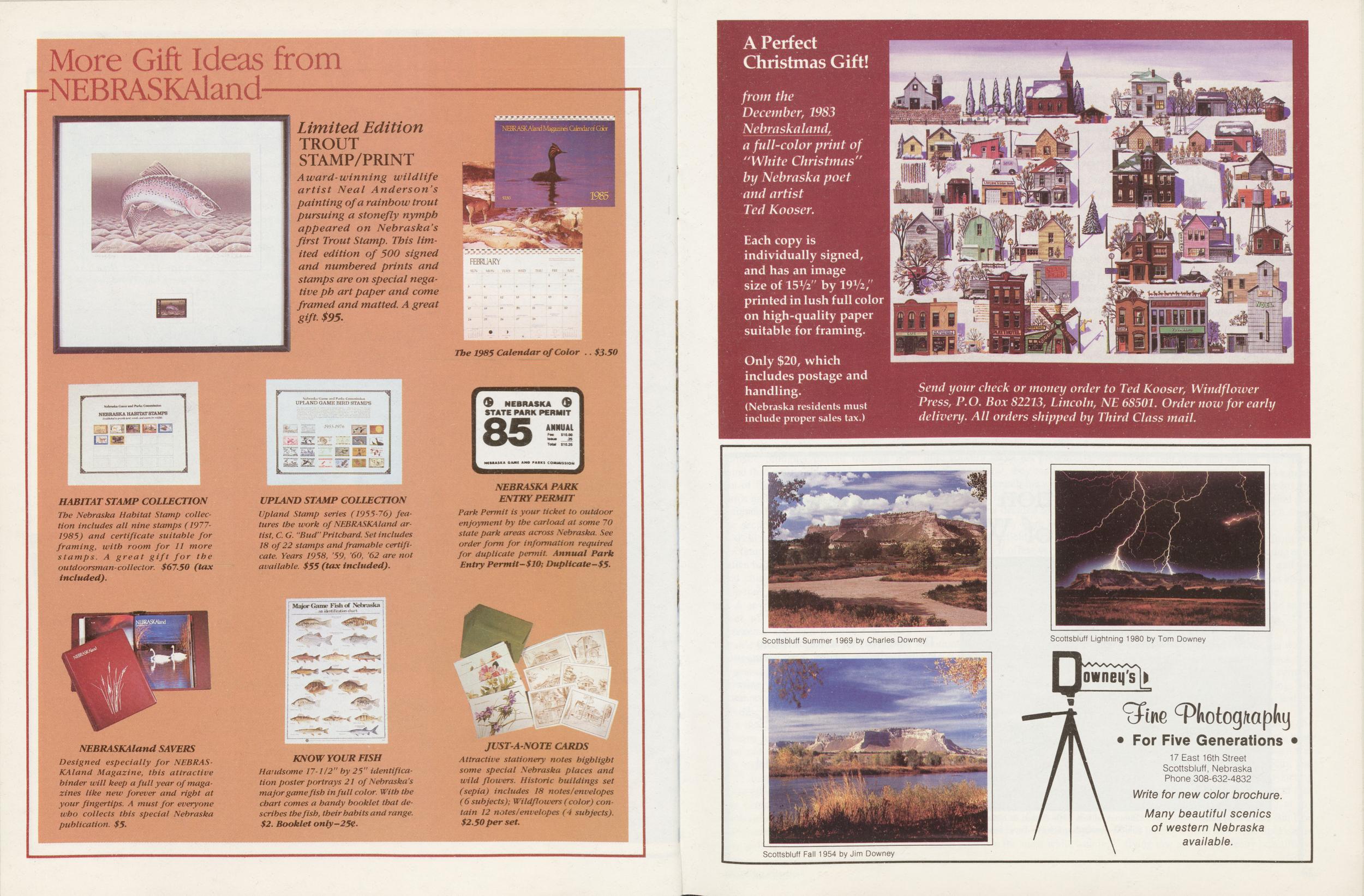 More Gift Ideas from
NEBRASKAland
More Gift Ideas from
NEBRASKAland
The 1985 Calendar of Color .. $3.50
Scottsbluff Summer 1969 by Charles Downey
Scottsbluff Lightning 1980 by Tom Downey
Scottsbluff Fall 1954 by Jim Downey
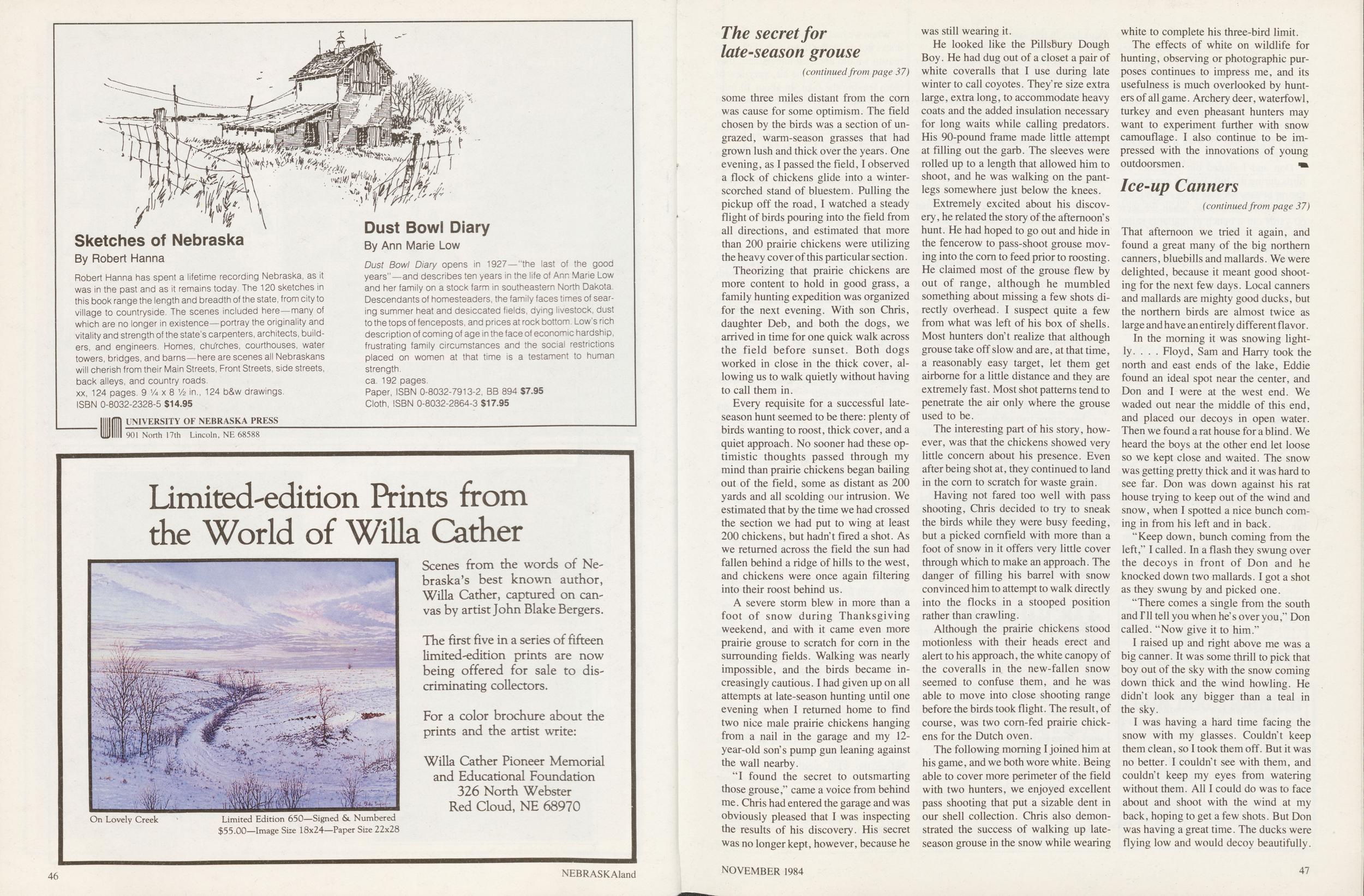
Robert Hanna has spent a lifetime recording Nebraska, as it was in the past and as it remains today. The 120 sketches in this book range the length and breadth of the state, from city to village to countryside. The scenes included here—many of which are no longer in existence—portray the originality and vitality and strength of the state's carpenters, architects, builders, and engineers. Homes, churches, courthouses, water towers, bridges, and barns—here are scenes all Nebraskans will cherish from their Main Streets, Front Streets, side streets, back alleys, and country roads.
xx, 124 pages. 9 1/4 x 8 1/2 in., 124 b&w drawings. ISBN 0-8032-2328-5 $14.95 Dust Bowl Dairy By Ann Marie LowDust Bowl Diary opens in 1927—"the last of the good years"—and describes ten years in the life of Ann Marie Low and her family on a stock farm in southeastern North Dakota. Descendants of homesteaders, the family faces times of searing summer heat and desiccated fields, dying livestock, dust to the tops of fenceposts, and prices at rock bottom. Low's rich description of coming of age in the face of economic hardship, frustrating family circumstances and the social restrictions placed on women at that time is a testament to human strength.
ca. 192 pages. Paper, ISBN 0-8032-7913-2, BB 894 $7.95 Cloth, ISBN 0-8032-2864-3 $17.95 UNIVERSITY OF NEBRASKA PRESS 901 North 17th Lincoln, NE 68588 Limited-edition Prints from the World of Willa Cather [image] On Lovely Creek Limited Edition 650—Signed &. Numbered $55.00—Image Size 18x24—Paper Size 22x28 Scenes from the words of Nebraska's best known author, Willa Cather, captured on canvas by artist John Blake Bergers. The first five in a series of fifteen limited-edition prints are now being offered for sale to discriminating collectors. For a color brochure about the prints and the artist write: Willa Cather Pioneer Memorial and Educational Foundation 326 North Webster Red Cloud, NE 68970 46 NEBRASKAlandThe secret for late-season grouse
(continued from page 37)some three miles distant from the corn was cause for some optimism. The field chosen by the birds was a section of ungrazed, warm-season grasses that had grown lush and thick over the years. One evening, as I passed the field, I observed a flock of chickens glide into a winter-scorched stand of bluestem. Pulling the pickup off the road, I watched a steady flight of birds pouring into the field from all directions, and estimated that more than 200 prairie chickens were utilizing the heavy cover of this particular section.
Theorizing that prairie chickens are more content to hold in good grass, a family hunting expedition was organized for the next evening. With son Chris, daughter Deb, and both the dogs, we arrived in time for one quick walk across the field before sunset. Both dogs worked in close in the thick cover, allowing us to walk quietly without having to call them in.
Every requisite for a successful late-season hunt seemed to be there: plenty of birds wanting to roost, thick cover, and a quiet approach. No sooner had these optimistic thoughts passed through my mind than prairie chickens began bailing out of the field, some as distant as 200 yards and all scolding our intrusion. We estimated that by the time we had crossed the section we had put to wing at least 200 chickens, but hadn't fired a shot. As we returned across the field the sun had fallen behind a ridge of hills to the west, and chickens were once again filtering into their roost behind us.
A severe storm blew in more than a foot of snow during Thanksgiving weekend, and with it came even more prairie grouse to scratch for corn in the surrounding fields. Walking was nearly impossible, and the birds became increasingly cautious. I had given up on all attempts at late-season hunting until one evening when I returned home to find two nice male prairie chickens hanging from a nail in the garage and my 12-year-old son's pump gun leaning against the wall nearby.
"I found the secret to outsmarting those grouse," came a voice from behind me. Chris had entered the garage and was obviously pleased that I was inspecting the results of his discovery. His secret was no longer kept, however, because he was still wearing it.
He looked like the Pillsbury Dough Boy. He had dug out of a closet a pair of white coveralls that I use during late winter to call coyotes. They're size extra large, extra long, to accommodate heavy coats and the added insulation necessary for long waits while calling predators. His 90-pound frame made little attempt at filling out the garb. The sleeves were rolled up to a length that allowed him to shoot, and he was walking on the pant-legs somewhere just below the knees.
Extremely excited about his discovery, he related the story of the afternoon's hunt. He had hoped to go out and hide in the fencerow to pass-shoot grouse moving into the corn to feed prior to roosting. He claimed most of the grouse flew by out of range, although he mumbled something about missing a few shots directly overhead. I suspect quite a few from what was left of his box of shells. Most hunters don't realize that although grouse take off slow and are, at that time, a reasonably easy target, let them get airborne for a little distance and they are extremely fast. Most shot patterns tend to penetrate the air only where the grouse used to be.
The interesting part of his story, however, was that the chickens showed very little concern about his presence. Even after being shot at, they continued to land in the corn to scratch for waste grain. Having not fared too well with pass shooting, Chris decided to try to sneak the birds while they were busy feeding, but a picked cornfield with more than a foot of snow in it offers very little cover through which to make an approach. The danger of filling his barrel with snow convinced him to attempt to walk directly into the flocks in a stooped position rather than crawling.
Although the prairie chickens stood motionless with their heads erect and alert to his approach, the white canopy of the coveralls in the new-fallen snow seemed to confuse them, and he was able to move into close shooting range before the birds took flight. The result, of course, was two corn-fed prairie chickens for the Dutch oven.
The following morning I joined him at his game, and we both wore white. Being able to cover more perimeter of the field with two hunters, we enjoyed excellent pass shooting that put a sizable dent in our shell collection. Chris also demonstrated the success of walking up late-season grouse in the snow while wearing white to complete his three-bird limit.
The effects of white on wildlife for hunting, observing or photographic purposes continues to impress me, and its usefulness is much overlooked by hunters of all game. Archery deer, waterfowl, turkey and even pheasant hunters may want to experiment further with snow camouflage. I also continue to be impressed with the innovations of young outdoorsmen.
Ice-up Canners
(continued from page 37)That afternoon we tried it again, and found a great many of the big northern canners, bluebills and mallards. We were delighted, because it meant good shooting for the next few days. Local canners and mallards are mighty good ducks, but the northern birds are almost twice as large and have an entirely different flavor.
In the morning it was snowing lightly.... Floyd, Sam and Harry took the north and east ends of the lake, Eddie found an ideal spot near the center, and Don and I were at the west end. We waded out near the middle of this end, and placed our decoys in open water. Then we found a rat house for a blind. We heard the boys at the other end let loose so we kept close and waited. The snow was getting pretty thick and it was hard to see far. Don was down against his rat house trying to keep out of the wind and snow, when I spotted a nice bunch coming in from his left and in back.
"Keep down, bunch coming from the left," I called. In a flash they swung over the decoys in front of Don and he knocked down two mallards. I got a shot as they swung by and picked one.
"There comes a single from the south and Til tell you when he's over you," Don called. "Now give it to him."
I raised up and right above me was a big canner. It was some thrill to pick that boy out of the sky with the snow coming down thick and the wind howling. He didn't look any bigger than a teal in the sky.
I was having a hard time facing the snow with my glasses. Couldn't keep them clean, so I took them off. But it was no better. I couldn't see with them, and couldn't keep my eyes from watering without them. All I could do was to face about and shoot with the wind at my back, hoping to get a few shots. But Don was having a great time. The ducks were flying low and would decoy beautifully.
NOVEMBER 1984 47
Time after time I saw him knock his two and three birds out of a bunch as they swung in over the decoys.
The snow thinned out a little and we could see Ed wading in the middle of the lake, picking up his birds. As he returned to his rat house a big flock of canners flew high over his head and he picked out two. From where we were it looked like an impossible shot.
Don and I started out to gather our birds during the lull. We left our guns on the rat houses because it was such tough wading, and of course, when we were 60 yards out a bunch of mallards sailed right over our heads, not more than 30 yards above the water.
"Next time I keep my gun right with me," said Don. We hurried back and saw another flock circling toward us. We waited, and sure enough they spotted the decoys and swung toward them.
"Here they are, let's go."
We raised up ready to shoot, and there was the biggest bunch of spoonbills you ever saw.
"Oh hell," said Don. "All that trouble for a bunch of spoonbills." We let them go, and saw Ed prepare to shoot them. But when he saw what they were, he fired ejaculations after them instead of bullets. The birds stopped flying so we drove up the lake to pick up the others. Ed had a bag of canners, mallards and northern wigeon. Don and I had mostly mallards and wigeon, and the others mostly canvasbacks.
That afternoon Floyd, Bill Mickel, Walt and I went to another lake known as the dipping vat. The boys had put up a
sink box in this lake and also had a boat there. It was too deep to wade.
Bill Mickel being the parlor shooter who wanted the easy place, we put him in the sink box — a steel barrel sunk and fastened so that the top is about six inches above the water. It's a mighty comfortable blind —otherwise Bill would not have used it. I was left on a rat house nearby and the boys put the decoys between us. Walt and Floyd took the boat into some rushes. The others were scattered on nearby lakes.
A flock soon appeared over the boat and they knocked out three before they were out of range. Bill was a funny sight, crouched over the sink box, his nose about six inches above the water, waiting for those birds. They swung over too high for us to reach. I could hear Bill grunt and give a sigh of relief as he straightened up. Then he cussed the ducks.
A moment later he spotted two canners flying low down the lake, like the wind. When they were at the edge of the decoys we fired. Bill knocked the lead duck and I took the other. From then on it was "look out here comes a bunch from the west," or "here come two up the lake."
Some of those canners were too fast for us, but we got a nice bag anyway.
A bunch of four came over us. Bill knocked one out and I missed my shot. He snickered wickedly and started a line of remarks about my shooting ability. The bird dropped close to him and he reached out to pick it up. It was a spoonbill and you can imagine the razzing he got when the boys saw him bringing it in. Floyd and Walt came over to pick us up, and that night we had the best bag of ducks.
Coulee swamp, about 10 miles from our camp, is one of the best duck lakes in that section. Weather conditions were ideal for that lake one day, so we drove over for the evening shoot. The lake is a mile long and at least a mile wide. It is about waist deep and has the toughest mud bottom imaginable. If a fellow wades a hundred yards in that lake, he has done a day's work. But the ducks were flying, so of course we went.
Floyd and Bill Roessig waded to a couple of rat houses near the middle. Walt, Don and Harry took the west end, and I was near the east end. Sam decided to stick to the shore and would move all around. He would see a bunch of ducks light way down the lake, and would hop in his "flivver" and scare them up.
When we had approached the lake, the ducks got up by the thousands. For some reason we did not then understand, they kept circling high in the air, very few of them leaving the lake. In about 10 minutes we knew why. It had been nice and sunny when we started. Then it began to cloud up and a chilly wind came from the northwest.
All at once a big cloud rushed down from the hills and in two minutes we were in the midst of a howling blizzard. When I saw that cloud coming I thought it was a tornado. It was black and rolled over the hills like a big cloud of smoke.
I have been in two tornadoes and right then I was more interested in getting to a safe place than in duck shooting. Here we were out in the middle of a swamp with no chance of getting to any shelter.
It was impossible to face that north wind and the snow was so thick you could not see 15 feet ahead. The only thing we could do was to get behind a rat house and wait until it abated. In about 20 minutes it did slacken enough so that you could see about 75 yards. Then the fun began.
It was thrilling to see those canners come up the lake against the wind, fighting it with all their might, their big bull necks stretched way out, and their heads turning this way and that, looking for a better place to light. It was just like a slow moving picture, to watch them as they came over. The snow and the howling wind gave me a sensation I will never forget.
As the birds came over and were within range, you could take your time, pick the ones you wanted and drop them. This was the first time I ever shot canvasbacks and found I had plenty of time to look them over.
But it was a different story when they came down the lake with the wind. You had to lead the first duck about 15 feet, and then you might hit the third one. And when they dropped they had so much momentum they would sail about 75 yards before they hit the water.
In most places the water was really thin mud, and when those canners hit they went under and stayed there. You had to wade right over and dig them out before the wind would cover the spot where they went down. The ducks were certainly a muddy looking mess when we brought them in and we had to wash every one of them before hanging them up to cool.
I waded down to where Bill Roessig
48 NEBRASKAlandTrading Post
DOGS TRAINING ALL BREEDS Hunting dogs—Vizslas for sale. Rozanek Kennels, Rt. 2, Schuyler, NE 68661. Phone (402) 352-8769. ENGLISH SETTERS and Pointers: Outstanding bloodlines! Puppies, started dogs, and stud service available. High Plains Kennels, 1411 Emerson, Alliance, NE 69301. Phone (308) 762-6709. GERMAN SHORTHAIRS —English Pointers and Beagles—Stud service, puppies and started dogs. Wayne Clark, Box 54, Union, Nebr. 68455. Phone (402)263-3495 or 263-3155. AKC BRITTANIES — started dogs ready for upcoming season. Call Marion North (308) 345-3816. AKC GERMAN wirehaired pointers started this fall. Also new pups ready by Christmas. Phone (402) 253-8228. REGISTERED ENGLISH pointer pups — bloodline. Riggins White Knight — Dam and Sire both real good gun dogs. George Reichart, Box 84, Louisville, Nebr. 68037. Phone (402) 234-4485. MISCELLANEOUS WINE AND BEER: Make your own. Send for free recipes and instructions. Omaha Supply, 13616 Polk, Omaha, Nebr. 68137. GUNS—Browning, Winchester, Remington, others, Hi-powers, shotguns, new, used, antiques. Want Pre-1964 Winchesters. Buy-Sell-Trade. Ph. (402) 729-6112. Bedlan's Sporting Goods, Fairbury, NE 68352. FISH FOR SALE. Channel catfish, bass, bluegill, crappie, trout, perch, white bass, minnows, hybrid grass carp, bullhead. We can ship fish, you can pick them up, or we deliver. Contact the Pleasant Valley Fish Farm, Rt. 1, McCook, NE 69001. Phone (308) 345-6599. MISSOURI RIVER — Three, 75-foot lots across from Niobrara, Nebraska. Perfect for retirement or vacation home. Excellent hunting, fishing, bird watching. Above flood plain yet easy access to river. Your pick, $7500. Howard Lovrien (612) 571-9498. CANOE ENTHUSIASTS. Quality and performance important? Mad River is the canoe for you! Mad River of Nebraska, 1231 Saunders, Lincoln, Nebraska 68521, Phone (402) 435-6588 or 205 Main, Springfield, NE 68059. Phone (402) 253-2000. N.E. NEBRASKA TROUT Fishing. For rent Mon.-Thurs. or Fri.-Sun. 2 modern cottages completely furnished. 5 spring-fed lakes with trout up to 7 lbs. Bass and bluegill also. Diamond E Trout Resort, Orchard, NE 68764. (402) 893-4745. DUCK HUNTERS — guided duck hunts on the Platte River near Schuyler. Good dogs, good decoys, good blinds and a good time. $25 per day. Make your reservations early. Call Frank Hoppe, North Bend, (402) 652-8725. FOR SALE: Wild turkeys, all ages and sizes. Phone (402) 643-2365 or 643-2586. HERBS-SPICES! Wholesale prices! Get ready for the holidays with our top quality spices. Over 160 to choose from. Send self-addressed stamped envelope now and receive our free catalog. Dakota Prairie Products, Rt. 1, Box 268K, Tabor, SD 57063. CHRISTMAS SHOPPERS — Send a friend a taste of Nebraska. Attractive gift box containing 2 lbs. Nebraska Clover Honey, Honey Naturally Cookbook, Wooden honey dipper, and honey-apricot-coconut fruit bar sampler. Gift card enclosed upon request. Shipped anywhere in the U.S.A. postpaid $11.95. If shipped to Nebraska address add appropriate sales tax. Send check or money order to: Husker Honey Farms, 3600 "C Street, Lincoln, NE 68510. AIR GUNS Repaired — Benjamin, Crosman, Daisy, other American made. Restoration; old guns wanted. Air Guns, 1225 No. 46th, Lincoln, NE 68503. Phone (402) 466-9223. WE HAVE five two-year-old Buffalo bulls for sale outright or dressed, or you may spend a weekend at our Wildcat Hills Ranch and take a buffalo. For prices call Terry P. Brown (308) 783-1264 from 6 a.m. to 7 a.m. ATTENTION: Motor home and fifth-wheel owners who would like to drive to Alaska but dont have time to make a round trip, phone (402) 647-2265 between 7-10 p.m. FOR SALE: Hunting paradise with excellent investment potential. Approximately 3,000-acre-ranch in Keya Paha County, Nebraska. Possibly most scenic and well conserved ranch on market today. No better turkey hunting anywhere. Lots of other wildlife. Just below proposed Norden Dam site. Includes 200 acres of good farm land. For more information phone (605) 557-3391. WESTERN BOOK CATALOG. Hundreds of titles on American West, ghost towns, old forts, etc. Free catalog. Research Unlimited, Box N., Main Street, Ames, NE 68621. Phone (402) 727-9833. NEBRASKA TROUT BUCKLE A commemorative buckle of Nebraska's first trout stamp. Art by Neal Anderson. Top-quality, heavy metal with sturdy swivel, 3-3/4 x 2-3/4 inches. Numbers 1-50 reserved for matching sets of 3. Numbers 51-100 reserved for matching brass and gold-silver. 1000 Brass 200 Gold & Silver $19.95 $49.95 100 Sterling Silver $149.95 Nebr. res. add 31/2% sales tax All orders plus $1.50 postage & handling Add $1.70 for insurance if desired Order from: Nebraska LTD Buckles Malcolm, Nebraska 68402 TAXIDERMY CREATIVE TAXIDERMY in all its branches since 1935, now includes Northstar Freeze-Dry processing of approved small specimens. Also tanning and deerskin processing. Naturecraft Studio. Nebraska City, Nebraska 68510. Joe Voges-Owner. Phone (402) 873-5491. DiNGES TAXIDERMY Studio, 2763 So. 12th St., Omaha, NE 68108. Fourteen-time National Award Winning Taxidermy. Trust your trophies to a proven winner. Complete professional service. Mike and Mary Dinges (402) 342-3718. NABITY'S TAXIDERMY. 31 years experience. Specializing in natural grass backgrounds for mammals, birds and fish. 13901 "CTSt., Lincoln, NE 68505 4 miles east of 84th and "O" (402) 489-6351. PEISTER TAXIDERMY—a name you can trust. We give you professional life-like work at prices most sportsmen can afford. Member National Taxidermist Association, #5 Regency, Place, Kearney, Nebr. 68847. Phone (308) 237-7575. JOHNSON TAXIDERMY—servicing southwest Nebraska, specializing in big-game mounts, life-sized mounts, rug work, fish, birds, tanning hair-on leather. Brochure and price list on request. Johnson Taxidermy, Rt. 1, Box 78, Lamar, NE 69035. Telephone (308) 882-5555. FREEZE-DRY TAXIDERMY Wally Allison's State Record Taxidermy, 2709 Birchwood, North Platte, NE 69101. Phone: (308) 534-2324. Specializing in Fish and Small Game, Snake and Lizard and Novelties. (Nothing too small) Newest of all taxidermy methods employed. KARL SCHWARZ master taxidermist has moved to a new country studio; same professional mounting and tanning service. Schwarz Wild Wing Studio, 16804 South 180th St., Springfield, NE 68059. Phone (402) 253-2481. BADE TAXIDERMY—Quality a must—Fast service. Fish, birds, rugs, tanning, full mounts and game heads. 2111 N. Christy St., Fremont, Nebraska 727-5463. HASTINGS TAXIDERMY: Life-like mounting of big game, rugs, birds, fish. Please stop in and compare our work with others. I specialize in big game head mounts. Call or write: Hastings Taxidermy, RR 3, Ord, NE 68862. Phone (308) 728-5322. HOUSE OF BIRDS. Licensed taxidermist with 18 years experience. Specialize in birds and game heads. Pheasant $47.50, deer head $87.50, Quail $35 a pair. For more information call (402) 228-3959. WHITETAIL TAXIDERMY. Federal and state licensed. Specialist in deer mounts and game birds. Unique poses and low prices. Phone (402) 564-6885, Columbus, Nebr. BIG BEAR TAXIDERMY, Rt. 2, Mitchell, Nebraska 69357. We specialize in all big game from Alaska to Nebraska, also birds and fish. Hair-on and hair-off tanning. 4V2 miles west of Scottsbluff on Highway 26. Dale Hubel, phone (308) 635-3013. GUN DOG TRAINING All Sporting Breeds Each dog trained on both native game and pen-reared birds. Ducks for retrievers. All dogs worked individually. Field Champion-sired labrador pups for sale. . Midwest's finest facilities. WILDERNESS KENNELS Henry Sader-Roca. Nb. (402) 4234212 68430 NOVEMBER 1984 49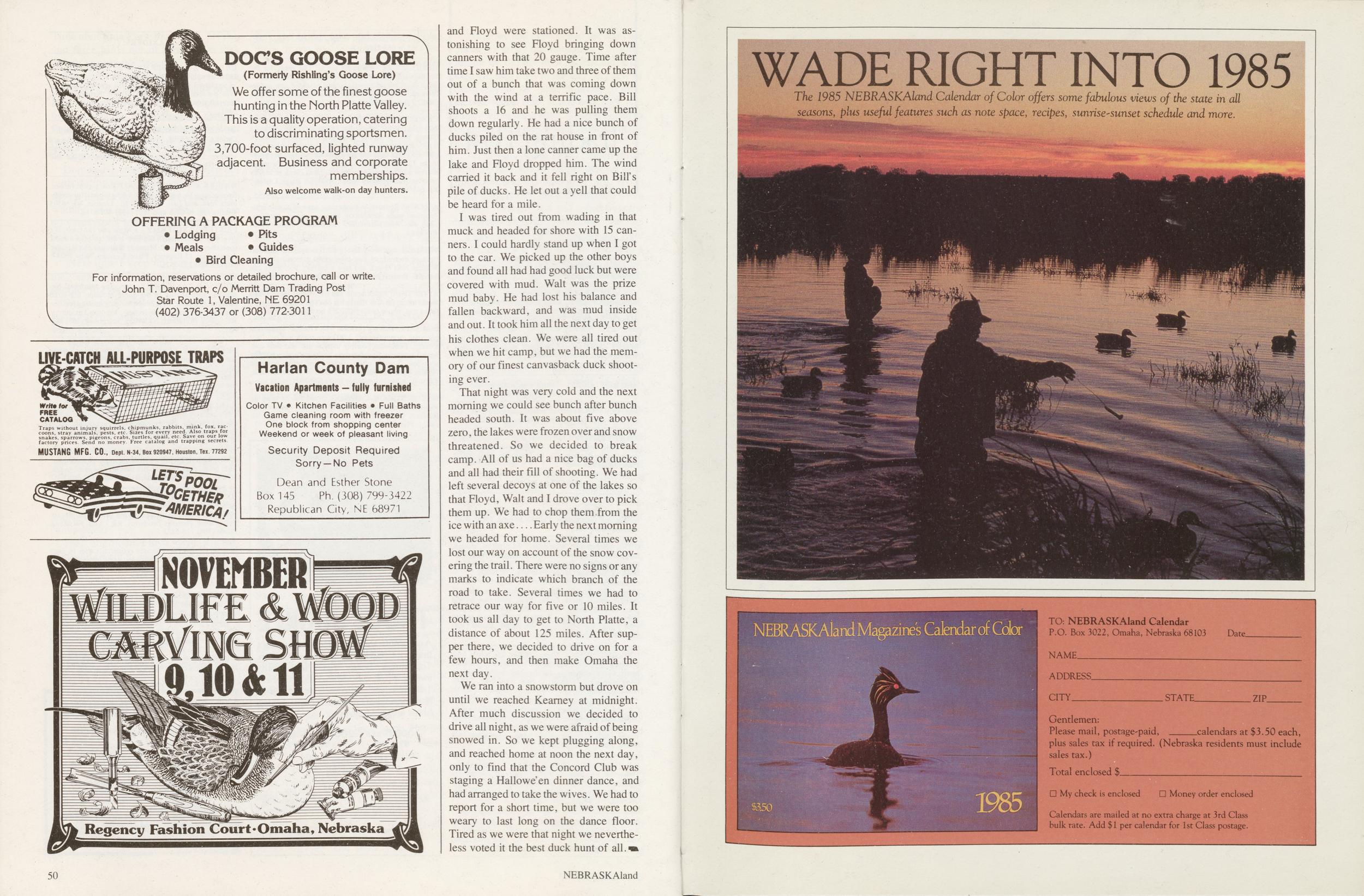
and Floyd were stationed. It was astonishing to see Floyd bringing down canners with that 20 gauge. Time after time I saw him take two and three of them out of a bunch that was coming down with the wind at a terrific pace. Bill shoots a 16 and he was pulling them down regularly. He had a nice bunch of ducks piled on the rat house in front of him. Just then a lone canner came up the lake and Floyd dropped him. The wind carried it back and it fell right on Bill's pile of ducks. He let out a yell that could be heard for a mile.
I was tired out from wading in that muck and headed for shore with 15 canners. I could hardly stand up when I got to the car. We picked up the other boys and found all had had good luck but were covered with mud. Walt was the prize mud baby. He had lost his balance and fallen backward, and was mud inside and out. It took him all the next day to get his clothes clean. We were all tired out when we hit camp, but we had the memory of our finest canvasback duck shooting ever.
That night was very cold and the next morning we could see bunch after bunch headed south. It was about five above zero, the lakes were frozen over and snow threatened. So we decided to break camp. All of us had a nice bag of ducks and all had their fill of shooting. We had left several decoys at one of the lakes so that Floyd, Walt and I drove over to pick them up. We had to chop them from the ice with an axe — Early the next morning we headed for home. Several times we lost our way on account of the snow covering the trail. There were no signs or any marks to indicate which branch of the road to take. Several times we had to retrace our way for five or 10 miles. It took us all day to get to North Platte, a distance of about 125 miles. After supper there, we decided to drive on for a few hours, and then make Omaha the next day.
We ran into a snowstorm but drove on until we reached Kearney at midnight. After much discussion we decided to drive all night, as we were afraid of being snowed in. So we kept plugging along, and reached home at noon the next day, only to find that the Concord Club was staging a Hallowe'en dinner dance, and had arranged to take the wives. We had to report for a short time, but we were too weary to last long on the dance floor. Tired as we were that night we nevertheless voted it the best duck hunt of all.
50 NEBRASKAland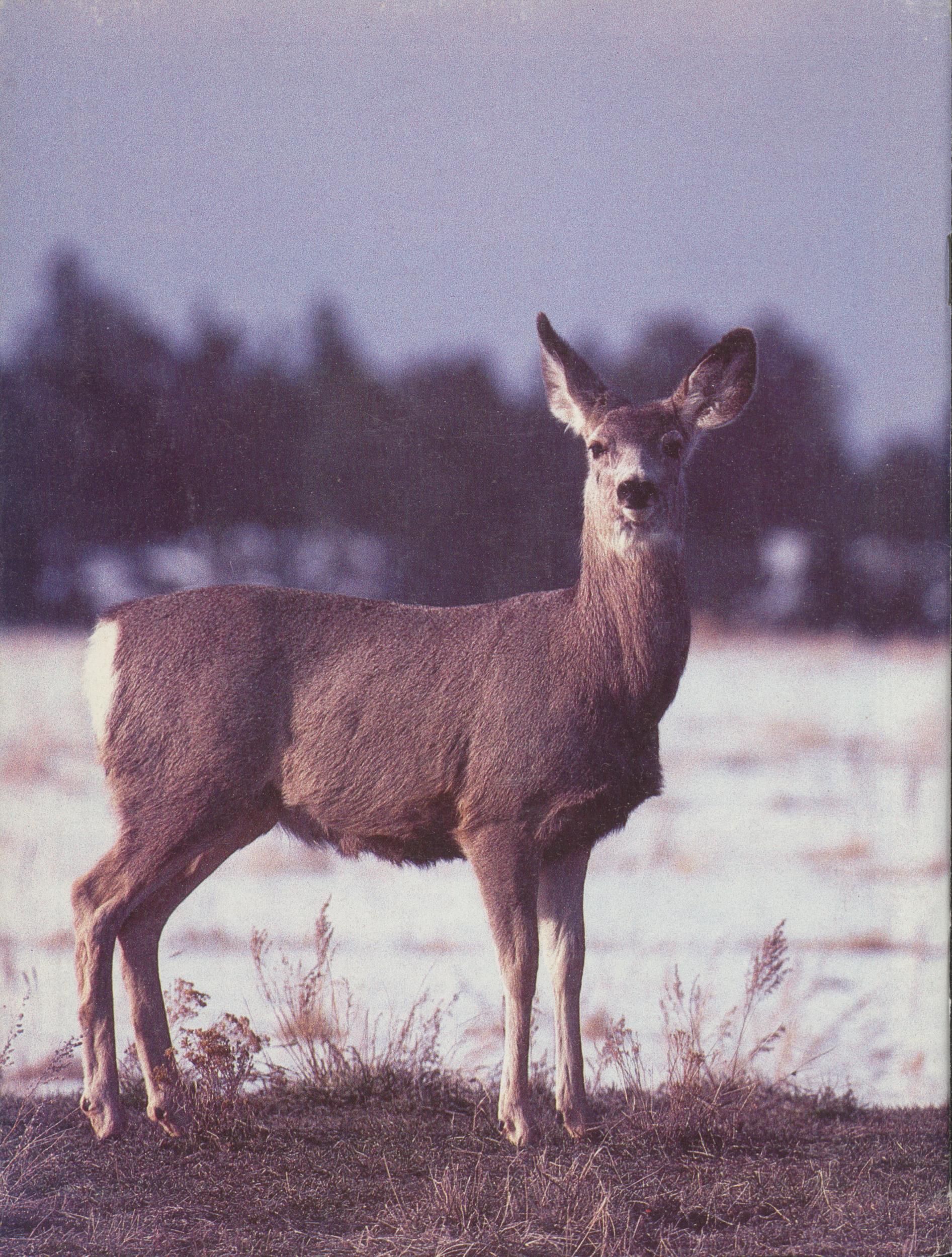
Position: 443 (23 views)