Volume 62, Issue 9, 1984
NEBRASKAland
October 1984 $1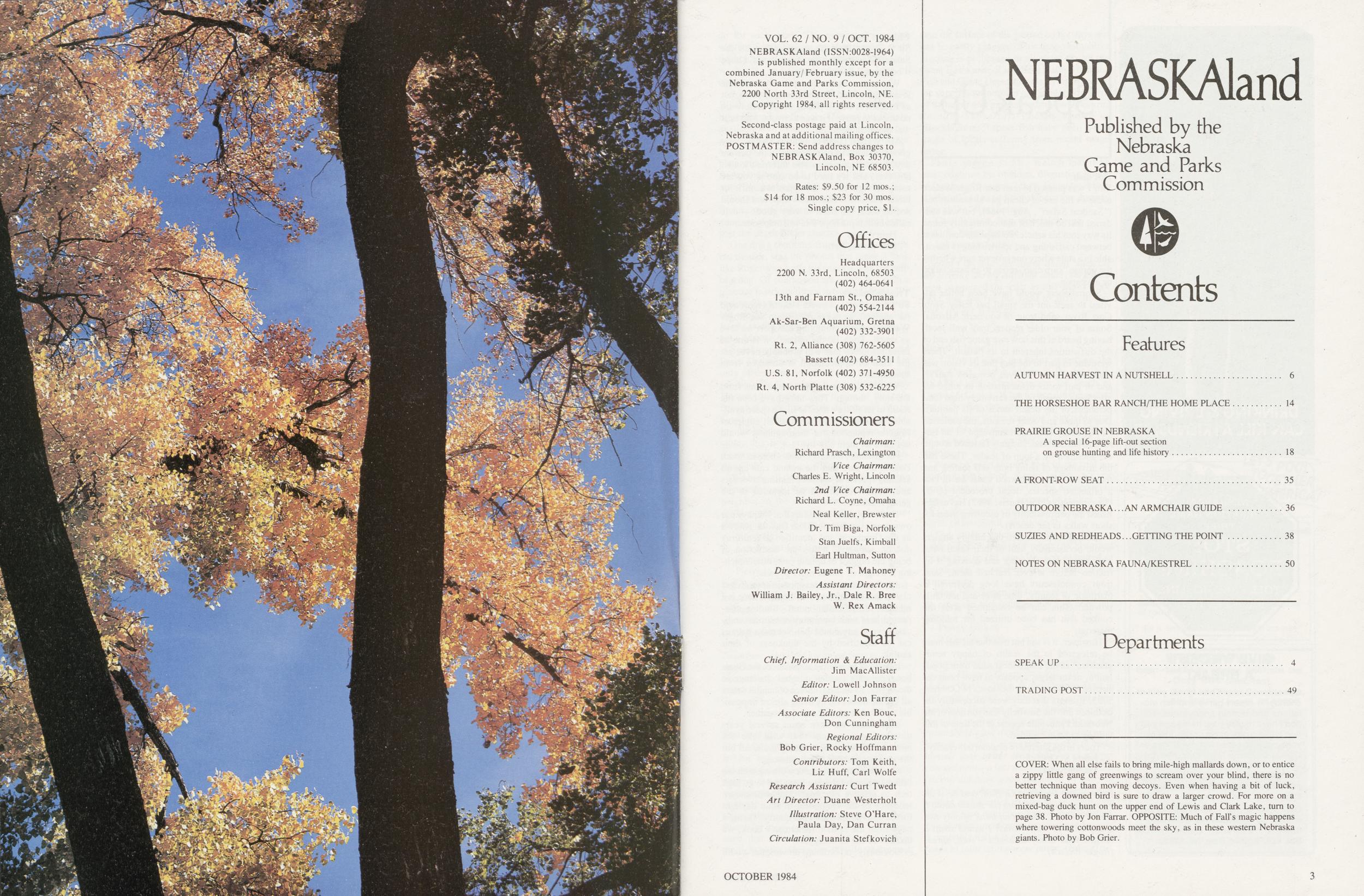
NEBRASKAland
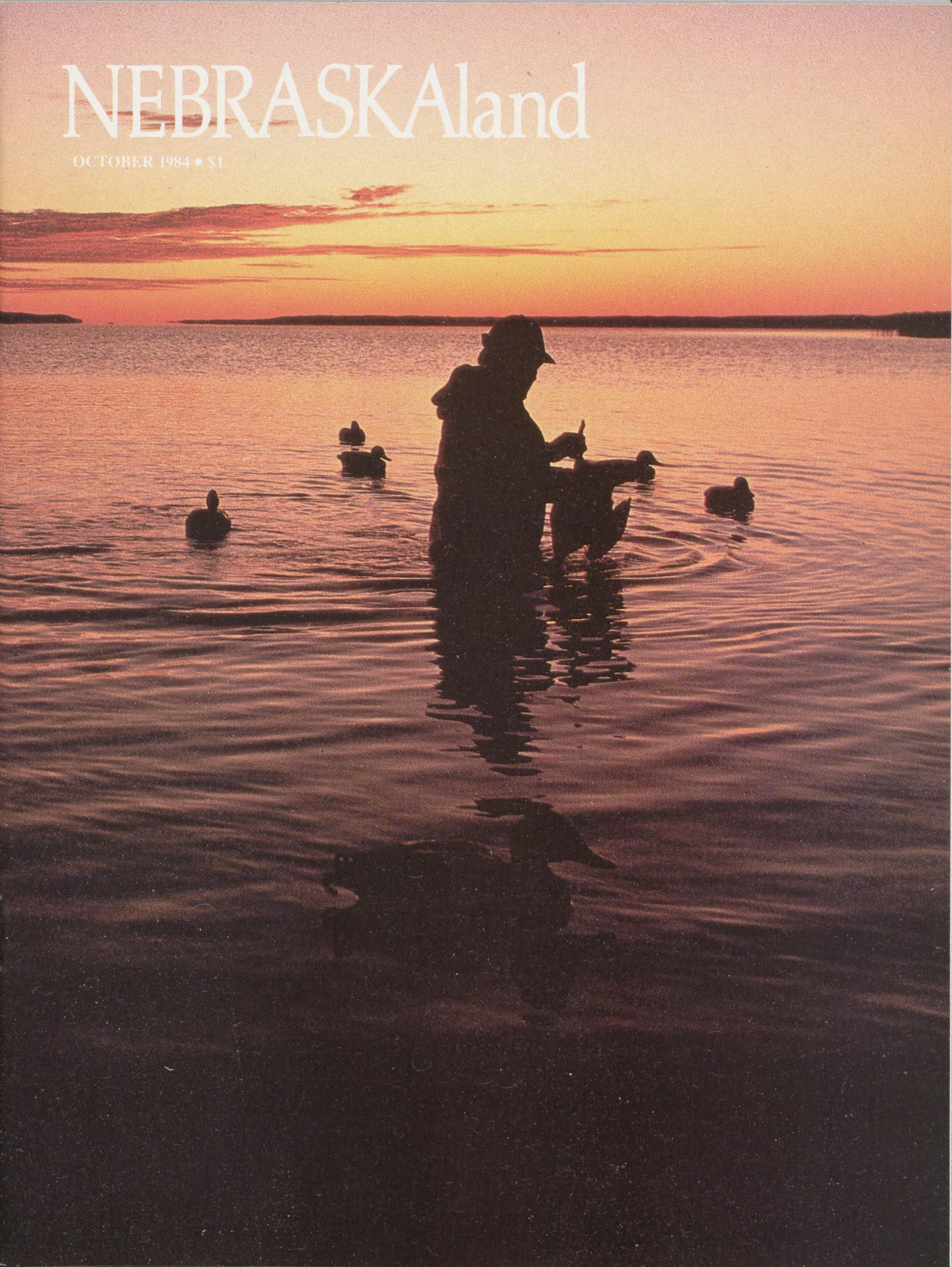
Published by the Nebraska Game and Parks Commisson VOL. 62 / NO. 9 / OCT. 1984 NEBRASKAland (ISSN:0028-1964) is published monthly except for a combined January/ February issue, by the Nebraska Game and Parks Commission, 2200 North 33rd Street, Lincoln, NE. Copyright 1984, all rights reserved. Second-class postage paid at Lincoln, Nebraska and at additional mailing offices. POSTMASTER: Send address changes to NEBRASKAland, Box 30370, Lincoln, NE 68503. Rates: $9.50 for 12 mos.; $14 for 18 mos.; $23 for 30 mos. Single copy price, $1. Offices Headquarters 2200 N. 33rd, Lincoln, 68503 (402) 464-0641 13th and Farnam St., Omaha (402) 554-2144 Ak-Sar-Ben Aquarium, Gretna (402) 332-3901 Rt. 2, Alliance (308) 762-5605 Bassett (402) 684-3511 U.S. 81, Norfolk (402) 371-4950 Rt. 4, North Platte (308) 532-6225 Commissioners Chairman: Richard Prasch, Lexington Vice Chairman: Charles E. Wright, Lincoln 2nd Vice Chairman: Richard L. Coyne, Omaha Neal Keller, Brewster Dr. Tim Biga, Norfolk Stan Juelfs, Kimball Earl Hultman, Sutton Director: Eugene T. Ma honey Assistant Directors: William J. Bailey, Jr., Dale R. Bree W. Rex Amack Staff Chief, Information & Education: Jim MacAllister Editor: Lowell Johnson Senior Editor: Jon Farrar Associate Editors: Ken Bouc, Don Cunningham Regional Editors: Bob Grier, Rocky Hoffmann Contributors: Tom Keith, Liz Huff, Carl Wolfe Research Assistant: Curt Twedt Art Director: Duane Westerholt Illustration: Steve O'Hare, Paula Day, Dan Curran Circulation: Juanita Stefkovich Contents Features AUTUMN HARVEST IN A NUTSHELL 6 THE HORSESHOE BAR RANCH/THE HOME PLACE 14 PRAIRIE GROUSE IN NEBRASKA A special 16-page lift-out section on grouse hunting and life history 18 A FRONT-ROW SEAT 35 OUTDOOR NEBRASKA...AN ARMCHAIR GUIDE 36 SUZIES AND REDHEADS...GETTING THE POINT 38 NOTES ON NEBRASKA FAUNA/KESTREL 50 Departments SPEAK UP 4 TRADING POST 49 COVER: When all else fails to bring mile-high mallards down, or to entice a zippy little gang of greenwings to scream over your blind, there is no better technique than moving decoys. Even when having a bit of luck, retrieving a downed bird is sure to draw a larger crowd. For more on a mixed-bag duck hunt on the upper end of Lewis and Clark Lake, turn to page 38. Photo by Jon Farrar. OPPOSITE: Much of Fall's magic happens where towering cotton woods meet the sky, as in these western Nebraska giants. Photo by Bob Grier. OCTOBER 1984 3
Speak Up
Hot dishSir / I was pleased to read that Roger Welsch eschews the use of cheap gas as sandcat bait ("Sandcat Safari", Aug. 1984), but was saddened that so much of that commodity found its way into his article. Perhaps his confusion between catfishing and sportfishing is inevitable in a state where one is never sure whether the phrase "carp club" refers to an association or a weapon.
Sportsfishers would have been better advised to seek out the small but feisty Santa Cruz River sand trout of southern Arizona. Some of your older readers may well recall having heard of this now rare game fish and of the difficulties inherent in its pursuit. These were due in part to the fact that its vision was abnormally keen (its eyes being on stalks), and in part to its disinclination to lunge far after bait (a result of the extremely high temperatures of the desert sands of its habitat). Due to these and other reasons, the preferred bait of many fishermen consisted of an immature horned toad, securely fastened around the abdomen by a loop of leader. These had the advantage of being both self-seating and reusable. (Although horned toads are in fact a protected species, legal precedent (U.S. Government vs. Joe Harris, 1962) has established the permissibility of escorting them for short walks in the desert).
Although it is rumored that hungry anglers would occasionally haul in their catch hand over hand, thus skinning and cooking it by friction before it ever reached them, sand trout connoisseurs have long preferred a marinade of tequila, lime juice and red chili powder. This can be consumed after the cooked fish has been utilized for building material.
However, it is sad but true that all this must be relegated to the realm of happy reminiscence, as the entire local sand trout population, never large, appears to have been destroyed by drowning in the floods of October, 1983. Rumors that they were successfully introduced into the Sowbelly Canyon area of the Nebraska Panhandle appear at the time of this writing to be unfounded.
Yours in the interest of piscatorial veracity. James S. Griffith Tucson, Ariz. I personally know Jim Griffith, and he is an even bigger liar than I am (he stands about 6 feet, 8 inches). And, I can think of only two circumstances under which I would strap a horned toad to my abdomen — well, three. (Roger Welsch). Chipped baitSir / Roger Welsch's experience with the Sandcat is something out of this world. I hope it becomes a favorite pastime.
When we were on the ranch, we had some loss of calves and blamed it onto coyotes, but as I recall, it was in places where there were no tracks to prove if it was a coyote. Maybe it was the great Sandcat.
Mr. Welsch failed to mention another very good lure that can be picked up in the pasture anywhere. It comes in two different kinds, however, and it's hard to be sure if you are using the right one as the opposite is unfit for lures. The one is called cowchip, and should not be used; the other is very good — it is called bullchip. I hope this will help someone.
Henry Voss Ainsworth, Neb. Trench trollersSir / As a couple of South Dakota's most avid cat anglers, we were pleased to see Roger Welsch's article promoting the sport we love so much. Truth is, the upland cat is one of those resources that will probably never get the kind of appreciation it deserves from sportsmen.
We did notice a couple of omissions from the story, though. They must have been the result of an editor's need to fit the space available, because we are sure that an angler of Roger's reputation for thoroughness would not have let them slip by.
For instance, the taxonomists here in South Dakota are sure that the upland cats are all actually species of the more familiar river cats and, therefore, should be included in the genus Ictalurus.
Then, too, there is the fact that we have our own species up here in South Dakota. Known as the Gumbocat and identified as Ictalurus dakota, slipperyi, it has the distinction of being the biggest of upland cats, often reaching a weight of 100 or more pounds.
Another interesting taxonomic note: Roger claims that the thickness of the skull bone is a reliable identification point. Studies conducted here with laboratory specimens indicate beyond any doubt that Nebraska natives can be identified by the thickness of their skull.
In spite of its relative abundance, the Gumbocat presents a rather unusual challenge to the angler. Its unusual choice of habitat deters all but the most avid by being almost impossible to fish in both wet and dry weather.
Undaunted, we have spent several years developing a system that will take the monsters of the prairie reliably under all but the most impossible circumstances.
As sportsmen who prefer working with the basics, we regret that we have had to go high tech to achieve our goal. The well-known tendency of the Gumbocat to shun daylight forced us to go deep after our quarry. Taking a page from the salmon fisherman's book, we decided to use downriggers.
Obviously, no ordinary downrigger would
4 NEBRASKAlanddo for such work. The gumbo pastures of western South Dakota are shot through with fishholding structure like gullies, trails and washouts, and would require the best of equipment.
Working hand-in-hand with the Ditch Witch people, we finally developed a down-rigger suited for the job. Currently it is only available with mounts for Steiger tractors, but we expect the Cat Pro Shop to offer a package based on a fully equipped International complete with swivel seats, trolling engine, depth finder and trailer. All of this will be sold for an attractive package price.
We have found that in addition to the depth finder, most fishermen should invest in a good set of geologic strata maps to help interpret the depth finder charts.
One thing about the article that did concern us, though, was the photos that make it look like Roger was doing his angling with the help of a dog. Of course you are aware that such a practice is strictly illegal in South Dakota. We realize that your state has no such prohibition, but we are surprised that a sportsman like Roger would stoop to such tactics simply to get a Master Angler Award.
Speaking of which, the Game, Fish and Parks Department here in South Dakota not only offers entry into its Proud Angler Club for cats over 50 pounds, it also allows Trophy Hunter Club recognition if one of the cat's horns has more than 5 points. It should also be noted that while Roger recommends removing the head and horns in preparation for the table, this is a practice which has spoiled many possible entries to the Dingell and Johnson Club.
We hope all this constructive criticism isn't misunderstood. We are delighted to see our neighbor to the south take the lead role in development of a potentially valuable resource like this. Bravo to you all!
Sincerely, Ken Mourn and Bruce Coonrod Game, Fish & Parks Pierre, SDP.S. Any time Roger wants to try a new challenge, we would love to take him on an expedition for the famous Black Hills mountain stonecats. Tell him January is the best month, so he'll need to bring his longies.
To anyone who thinks it an advantage that my dog Slump accompanied me on that sandcat excursion, I hereby offer three full weeks with him. (Roger Welsch). Sun-bathing sandcatsSir / My recent reading of "Sandcat Safari" left me sick at heart and three days ill. I was dismayed at the total lack of credibility on the part of the editors, and the baldfaced prevarications presented by the author.
Having fished for "Sanders" (Ictalurus silicas-Major), throughout the Northern Plains for many years, it has been my experience that "Sanders" never "strike" during daylight hours. However, they do tend to bask near the surface of the ground on hot days and can be easily snagged! This unsportsmanlike practice is prohibited in all states except the Great Basin area of southern Idaho where the Fish and Game Department is trying to reduce the superfluous number of "Sanders" in favor of its larger and gamier cousin, the Ictalurus Basaltus-Subvaria). Locally known as "Rockbottoms," these fish have been a real staple of locals suffering from recent tough times.
Please suggest to Mr. Welsch that if he must continue his obvious, disgusting hobby of snagging "Sanders," there is a place where it is legal, and as additional incentive, he may even strike "Rockbottom."
Cecil Wilson, Reg. Special Agent U.S. Forest Service Lake wood, Colo. Contrary to your statement about sandcats not striking during daylight hours, they have been organized (at least in this state) since 1953 and reserve the right to strike at any time. (Roger Welsch). Hickok "hype?"Sir / I have some questions regarding the Rock Creek Station article in the July NEBRASKAland. They concern the death of David McCanles. What source did the author use to recreate the conversation in the station building prior to the shooting? Since Monroe was not allowed to testify at the trial, I assume this is based only on McCanles family oral history.
Were no court records kept of the trial acquitting Hickok of murder? Does no one wonder what his version of the conversation was? Why wasn't the account of Hickok and McCanles having quarreled over a woman, Sarah (Kate) Shull, mentioned?
The article defames Hickok on hearsay evidence 123 years old when the historical fact is that he, an outsider, was acquitted of murdering an established member of the community.
Most biographers of James Butler Hickok do not paint him quite as black as does this article.
Denny Hickok Atkinson, Nebr. Various sources were used, primarily the Nebraska History Quarterly, Vol. 49, No. 1 (Spring 1968), Tales of the Oregon Trail in Jefferson County, Nebraska by Larson, and American Heritage. Certainly some degree of speculation entered into any recreation, and certainly Hickok did some imaginative work himself in telling of the tale in order to make himself look better than that he shot from concealment—a fact that everyone agrees on. Hickok did have good reason to be wary of McCanles, who was a known bully with quick temper and a cruel streak, but we relied on sources now considered most authoritative. The woman you mention was omitted because it probably was not a direct factor, and only tends to taint an innocent party. (Editor)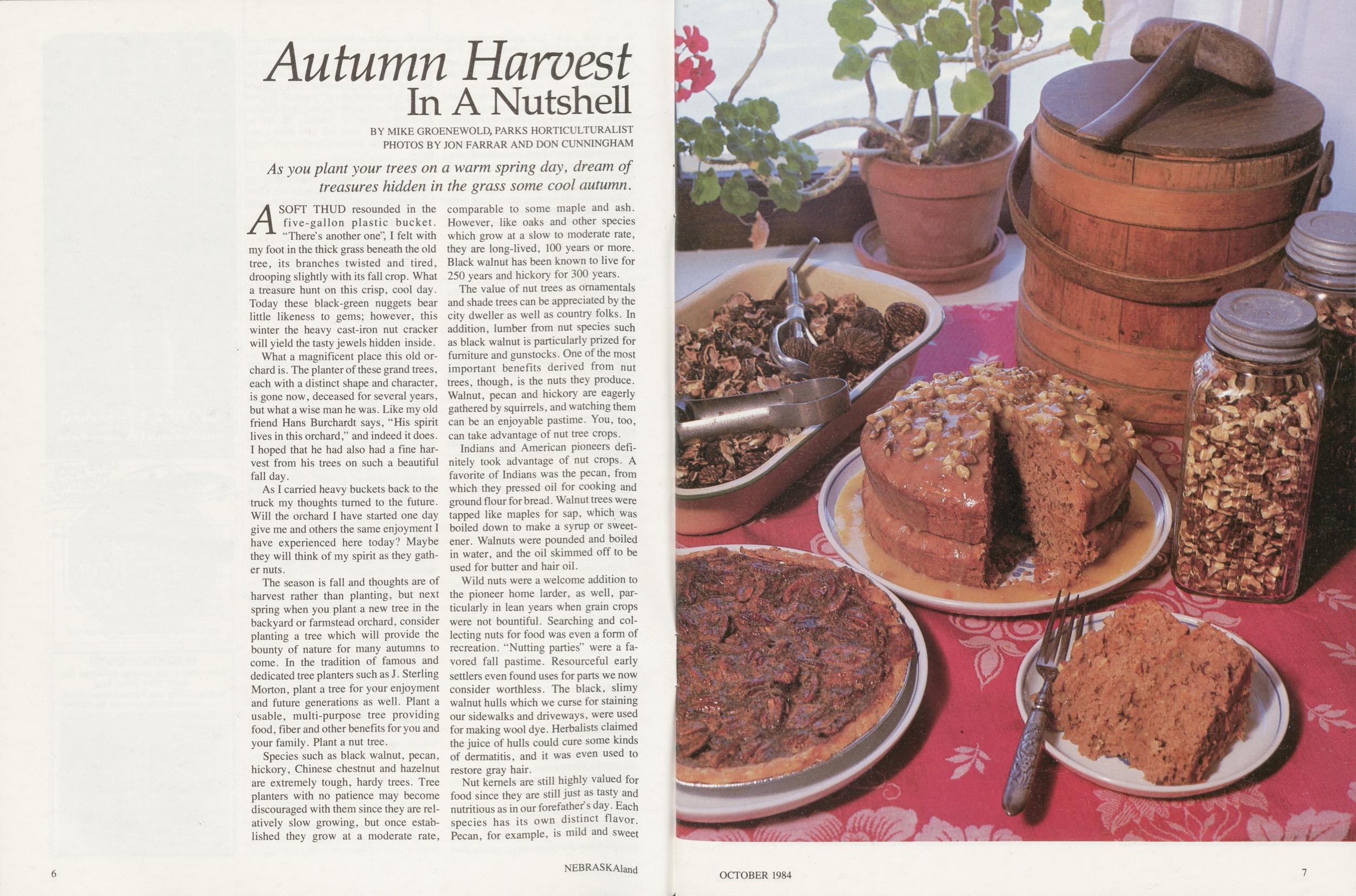
Autumn Harvest In A Nutshell
BY MIKE GROENEWOLD, PARKS HORTICULTURALIST PHOTOS BY JON FARRAR AND DON CUNNINGHAM As you plant your trees on a warm spring day, dream of treasures hidden in the grass some cool autumn.A SOFT THUD resounded in the five-gallon plastic bucket. "There's another one", I felt with my foot in the thick grass beneath the old tree, its branches twisted and tired, drooping slightly with its fall crop. What a treasure hunt on this crisp, cool day. Today these black-green nuggets bear little likeness to gems; however, this winter the heavy cast-iron nut cracker will yield the tasty jewels hidden inside.
What a magnificent place this old orchard is. The planter of these grand trees, each with a distinct shape and character, is gone now, deceased for several years, but what a wise man he was. Like my old friend Hans Burchardt says, "His spirit lives in this orchard," and indeed it does. I hoped that he had also had a fine harvest from his trees on such a beautiful fall day.
As I carried heavy buckets back to the truck my thoughts turned to the future. Will the orchard I have started one day give me and others the same enjoyment I have experienced here today? Maybe they will think of my spirit as they gather nuts.
The season is fall and thoughts are of harvest rather than planting, but next spring when you plant a new tree in the backyard or farmstead orchard, consider planting a tree which will provide the bounty of nature for many autumns to come. In the tradition of famous and dedicated tree planters such as J. Sterling Morton, plant a tree for your enjoyment and future generations as well. Plant a usable, multi-purpose tree providing food, fiber and other benefits for you and your family. Plant a nut tree.
Species such as black walnut, pecan, hickory, Chinese chestnut and hazelnut are extremely tough, hardy trees. Tree planters with no patience may become discouraged with them since they are relatively slow growing, but once established they grow at a moderate rate, comparable to some maple and ash. However, like oaks and other species which grow at a slow to moderate rate, they are long-lived, 100 years or more. Black walnut has been known to live for 250 years and hickory for 300 years.
The value of nut trees as ornamentals and shade trees can be appreciated by the city dweller as well as country folks. In addition, lumber from nut species such as black walnut is particularly prized for furniture and gunstocks. One of the most important benefits derived from nut trees, though, is the nuts they produce. Walnut, pecan and hickory are eagerly gathered by squirrels, and watching them can be an enjoyable pastime. You, too, can take advantage of nut tree crops.
Indians and American pioneers definitely took advantage of nut crops. A favorite of Indians was the pecan, from which they pressed oil for cooking and ground flour for bread. Walnut trees were tapped like maples for sap, which was boiled down to make a syrup or sweetener. Walnuts were pounded and boiled in water, and the oil skimmed off to be used for butter and hair oil.
Wild nuts were a welcome addition to the pioneer home larder, as well, particularly in lean years when grain crops were not bountiful. Searching and collecting nuts for food was even a form of recreation. "Nutting parties" were a favored fall pastime. Resourceful early settlers even found uses for parts we now consider worthless. The black, slimy walnut hulls which we curse for staining our sidewalks and driveways, were used for making wool dye. Herbalists claimed the juice of hulls could cure some kinds of dermatitis, and it was even used to restore gray hair.
Nut kernels are still highly valued for food since they are still just as tasty and nutritious as in our forefather's day. Each species has its own distinct flavor. Pecan, for example, is mild and sweet
6 NEBRASKAland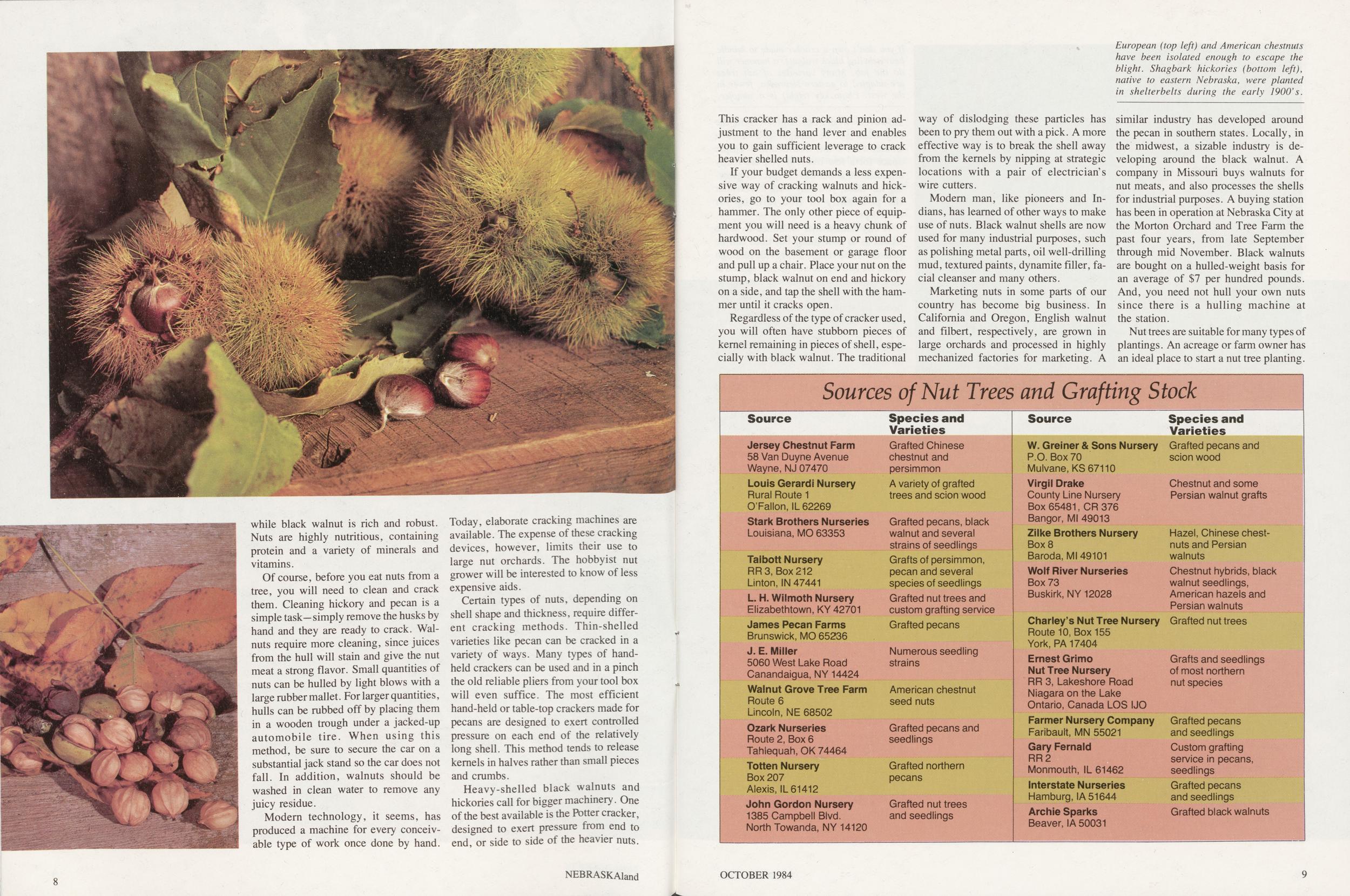
while black walnut is rich and robust. Nuts are highly nutritious, containing protein and a variety of minerals and vitamins.
Of course, before you eat nuts from a tree, you will need to clean and crack them. Cleaning hickory and pecan is a simple task— simply remove the husks by hand and they are ready to crack. Walnuts require more cleaning, since juices from the hull will stain and give the nut meat a strong flavor. Small quantities of nuts can be hulled by light blows with a large rubber mallet. For larger quantities, hulls can be rubbed off by placing them in a wooden trough under a jacked-up automobile tire. When using this method, be sure to secure the car on a substantial jack stand so the car does not fall. In addition, walnuts should be washed in clean water to remove any juicy residue.
Modern technology, it seems, has produced a machine for every conceivable type of work once done by hand. Today, elaborate cracking machines are available. The expense of these cracking devices, however, limits their use to large nut orchards. The hobbyist nut grower will be interested to know of less expensive aids.
Certain types of nuts, depending on shell shape and thickness, require different cracking methods. Thin-shelled varieties like pecan can be cracked in a variety of ways. Many types of handheld crackers can be used and in a pinch the old reliable pliers from your tool box will even suffice. The most efficient hand-held or table-top crackers made for pecans are designed to exert controlled pressure on each end of the relatively long shell. This method tends to release kernels in halves rather than small pieces and crumbs.
Heavy-shelled black walnuts and hickories call for bigger machinery. One of the best available is the Potter cracker, designed to exert pressure from end to end, or side to side of the heavier nuts.
8 NEBRASKAlandThis cracker has a rack and pinion adjustment to the hand lever and enables you to gain sufficient leverage to crack heavier shelled nuts.
If your budget demands a less expensive way of cracking walnuts and hickories, go to your tool box again for a hammer. The only other piece of equipment you will need is a heavy chunk of hardwood. Set your stump or round of wood on the basement or garage floor and pull up a chair. Place your nut on the stump, black walnut on end and hickory on a side, and tap the shell with the hammer until it cracks open.
Regardless of the type of cracker used, you will often have stubborn pieces of kernel remaining in pieces of shell, especially with black walnut. The traditional way of dislodging these particles has been to pry them out with a pick. A more effective way is to break the shell away from the kernels by nipping at strategic locations with a pair of electrician's wire cutters.
Modern man, like pioneers and Indians, has learned of other ways to make use of nuts. Black walnut shells are now used for many industrial purposes, such as polishing metal parts, oil well-drilling mud, textured paints, dynamite filler, facial cleanser and many others.
Marketing nuts in some parts of our country has become big business. In California and Oregon, English walnut and filbert, respectively, are grown in large orchards and processed in highly mechanized factories for marketing. A similar industry has developed around the pecan in southern states. Locally, in the midwest, a sizable industrv is developing around the black walnut. A company in Missouri buys walnuts for nut meats, and also processes the shells for industrial purposes. A buying station has been in operation at Nebraska City at the Morton Orchard and Tree Farm the past four years, from late September through mid November. Black walnuts are bought on a hulled-weight basis for an average of $7 per hundred pounds. And, you need not hull your own nuts since there is a hulling machine at the station.
Nut trees are suitable for many types of plantings. An acreage or farm owner has an ideal place to start a nut tree planting.
Sources of Nut Trees and Grafting Stock Source Species and Source Species and Varieties Varieties Jersey Chestnut Farm Grafted Chinese W. Greiner & Sons Nursery Grafted pecans and 58 Van Duyne Avenue chestnut and P.O. Box 70 scion wood Wayne, NJ 07470 persimmon Mulvane, KS 67110 Louis Gerardi Nursery A variety of grafted Virgil Drake Chestnut and some Rural Route 1 trees and scion wood County Line Nursery Persian walnut grafts O'Fallon, IL 62269 Box 65481, CR 376 Stark Brothers Nurseries Grafted pecans, black Bangor, MI 49013 Louisiana, MO 63353 walnut and several Zilke Brothers Nursery Hazel, Chinese strains of seedlings Box 8 chestnuts and Persian Talbott Nursery Grafts of persimmon, Baroda, MI 49101 walnuts RR 3, Box 212 pecan and several Wolf River Nurseries Chestnut hybrids, black Linton, IN 47441 species of seedlings Box 73 walnut seedlings, L. H. Wilmoth Nursery Grafted nut trees and Buskirk, NY 12028 American hazels and Elizabethtown, KY 42701 custom grafting service Persian walnuts James Pecan Farms Grafted pecans Charley's Nut Tree Nursery Grafted nut trees Brunswick, MO 65236 Route 10, Box 155 York, PA 17404 J. E. Miller Numerous seedling 5060 West Lake Road strains Ernest Grimo Grafts and seedlings Canandaiqua, NY 14424 Nut Tree Nursery of most northern Walnut Grove Tree Farm American chestnut RR 3, Lakeshore Road nut species Niagara on the Lake Route 6 seed nuts Ontario, Canada LOS IJO Lincoln, NE 68502 Ozark Nurseries Grafted pecans and Farmer Nursery Company Grafted pecans Route 2, Box 6 seedlings Faribault, MN 55021 and seedlings Tahlequah, OK 74464 Gary Fernald Custom grafting Totten Nursery Grafted northern RR2 service in pecans, Box 207 pecans Monmouth, IL 61462 seedlings Alexis, IL 61412 Interstate Nurseries Grafted pecans John Gordon Nursery Grafted nut trees Hamburg, IA 51644 and seedlings 1385 Campbell Blvd. and seedlings Archie Sparks Grafted black walnuts North Towanda, NY 14120 Beaver, IA 50031 OCTOBER 1984 9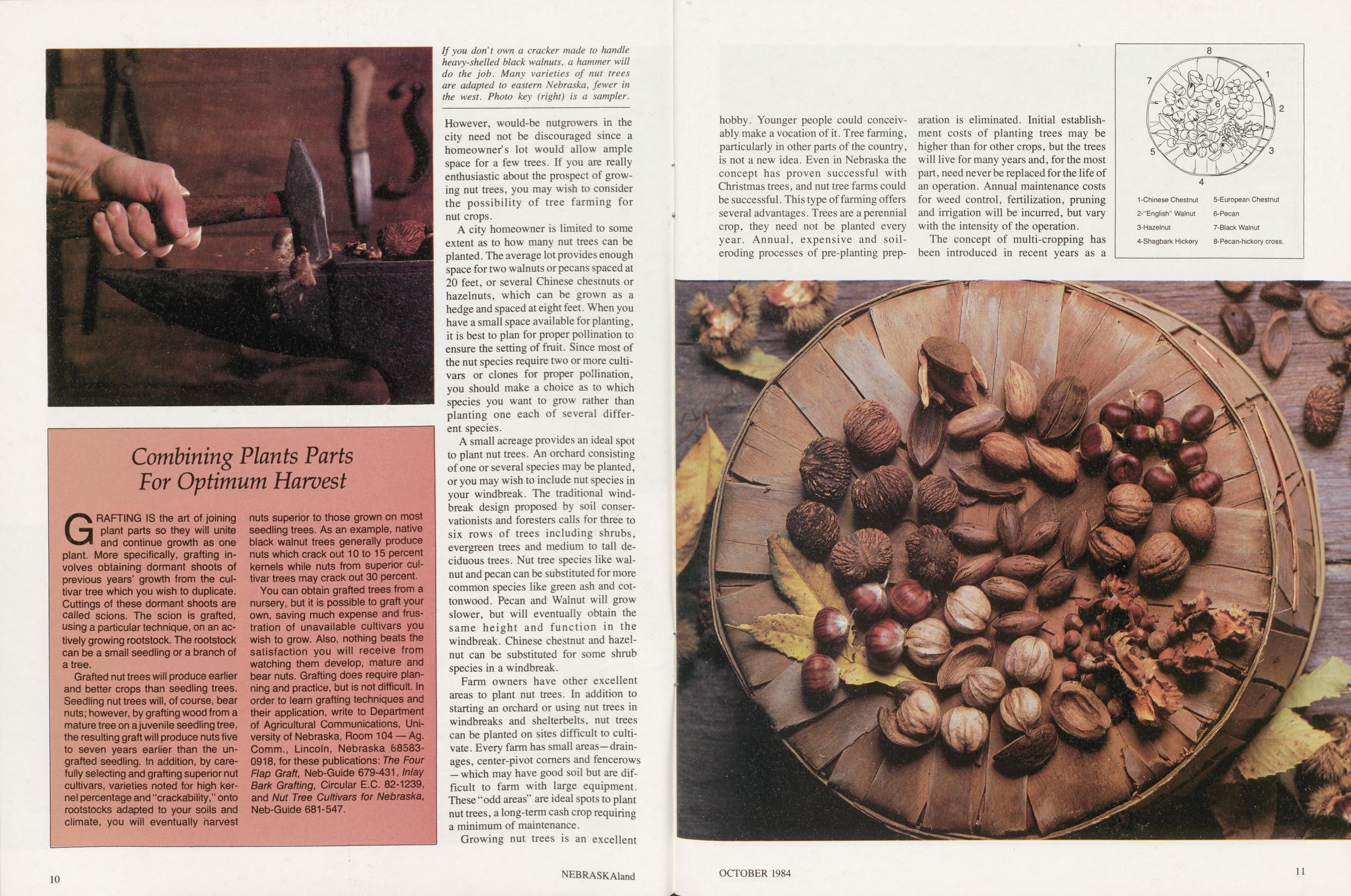
Combining Plants Parts For Optimum Harvest
GRAFTING IS the art of joining plant parts so they will unite and continue growth as one plant. More specifically, grafting involves obtaining dormant shoots of previous years' growth from the cultivar tree which you wish to duplicate. Cuttings of these dormant shoots are called scions. The scion is grafted, using a particular technique, on an actively growing rootstock. The rootstock can be a small seedling or a branch of a tree. Grafted nut trees will produce earlier and better crops than seedling trees. Seedling nut trees will, of course, bear nuts; however, by grafting wood from a mature tree on a juvenile seedling tree, the resulting graft will produce nuts five to seven years earlier than the ungrafted seedling. In addition, by carefully selecting and grafting superior nut cultivars, varieties noted for high kernel percentage and "crackability," onto rootstocks adapted to your soils and climate, you will eventually harvest nuts superior to those grown on most seedling trees. As an example, native black walnut trees generally produce nuts which crack out 10 to 15 percent kernels while nuts from superior cultivar trees may crack out 30 percent. You can obtain grafted trees from a nursery, but it is possible to graft your own, saving much expense and frustration of unavailable cultivars you wish to grow. Also, nothing beats the satisfaction you will receive from watching them develop, mature and bear nuts. Grafting does require planning and practice, but is not difficult. In order to learn grafting techniques and their application, write to Department of Agricultural Communications, University of Nebraska, Room 104 — Ag. Comm., Lincoln, Nebraska 68583-0918, for these publications: The Four Flap Graft, Neb-Guide 679-431, Inlay Bark Grafting, Circular E.C. 82-1239, and Nut Tree Cultivars for Nebraska, Neb-Guide 681-547.However, would-be nutgrowers in the city need not be discouraged since a homeowner's lot would allow ample space for a few trees. If you are really enthusiastic about the prospect of growing nut trees, you may wish to consider the possibility of tree farming for nut crops.
A city homeowner is limited to some extent as to how many nut trees can be planted. The average lot provides enough space for two walnuts or pecans spaced at 20 feet, or several Chinese chestnuts or hazelnuts, which can be grown as a hedge and spaced at eight feet. When you have a small space available for planting, it is best to plan for proper pollination to ensure the setting of fruit. Since most of the nut species require two or more cultivars or clones for proper pollination, you should make a choice as to which species you want to grow rather than planting one each of several different species.
A small acreage provides an ideal spot to plant nut trees. An orchard consisting of one or several species may be planted, or you may wish to include nut species in your windbreak. The traditional windbreak design proposed by soil conservationists and foresters calls for three to six rows of trees including shrubs, evergreen trees and medium to tall deciduous trees. Nut tree species like walnut and pecan can be substituted for more common species like green ash and Cottonwood. Pecan and Walnut will grow slower, but will eventually obtain the same height and function in the windbreak. Chinese chestnut and hazelnut can be substituted for some shrub species in a windbreak.
Farm owners have other excellent areas to plant nut trees. In addition to starting an orchard or using nut trees in windbreaks and shelterbelts, nut trees can be planted on sites difficult to cultivate. Every farm has small areas—drainages, center-pivot corners and fencerows — which may have good soil but are difficult to farm with large equipment. These "odd areas" are ideal spots to plant nut trees, a long-term cash crop requiring a minimum of maintenance.
Growing nut trees is an excellent
10 NEBRASKAlandhobby. Younger people could conceivably make a vocation of it. Tree farming, particularly in other parts of the country, is not a new idea. Even in Nebraska the concept has proven successful with Christmas trees, and nut tree farms could be successful. This type of farming offers several advantages. Trees are a perennial crop, they need not be planted every year. Annual, expensive and soil-eroding processes of pre-planting preparation is eliminated. Initial establishment costs of planting trees may be higher than for other crops, but the trees will live for many years and, for the most part, need never be replaced for the life of an operation. Annual maintenance costs for weed control, fertilization, pruning and irrigation will be incurred, but vary with the intensity of the operation.
The concept of multi-cropping has been introduced in recent years as a
1-Chinese Chestnut 2-"English" Walnut 3-Hazelnut 4-Shagbark Hickory 5-European Chestnut 6-Pecan 7-Black Walnut 8-Pecan-hickory cross.
method of gaining profit from a long-rotation crop like black walnut. Trees are planted in sufficiently wide rows to allow farming the land between the rows by traditional methods. Growing grains or hay between the tree rows produces income during the early years, while the trees are developing. After approximately 10 years, the trees will produce enough nuts for an additional annual income. More income can be realized after 25 to 40 years as trees are thinned from the plantation. Finally, the main harvest will be realized after 45 to 60 years by harvesting remaining trees for veneer and sawlogs. Considering all costs of establishing and maintaining a plantation for 45 years, a total income of approximately $30,000 per acre could be gained by the end of the 45-year term.
Unfortunately, not all of the climatic and soil conditions of Nebraska are well suited to establishment of nut tree species. Therefore, before beginning any type of plantings, consider your location. If needed, ask for help. Your local district forester can determine if your site is suitable for nut trees. Soil quality and quantity of rainfall make eastern Nebraska far better suited than western Nebraska; however, there are English walnuts growing in North Platte and black walnuts at a farmstead on the south side of
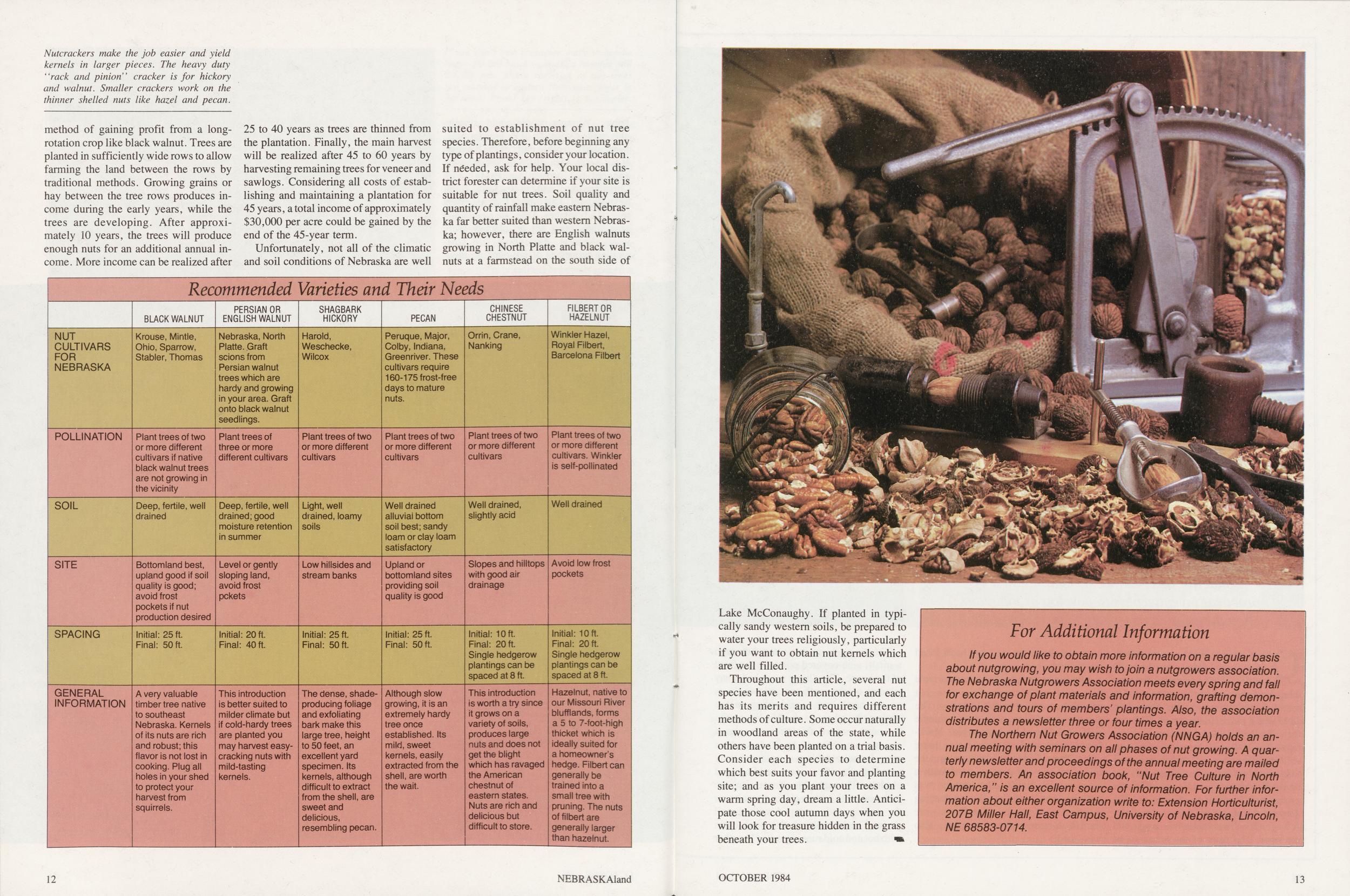
Recommended Varieties and Their Needs BLACK WALNUT PERSIAN OR SHAGBARK PECAN CHINESE FILBERT OR ENGLISH WALNUT HICKORY CHESTNUT HAZELNUT NUT Krouse, Mintle, Nebraska, North Harold, Peruque, Orrin, Winkler CULTIVARS Ohio, Sparrow, Platte. Graft Weschecke, Major, Crane, Hazel, FOR Stabler, Thomas scions from Wilcox Colby, Nanking Royal NEBRASKA Persian walnut Indiana, Filbert, trees which are Greenriver. Barcelona hardy and growing These Filbert in your area. Graft cultivars onto black walnut require seedlings. 160-175 frost-free days to mature nuts. POLLINATION Plant trees Plant trees of Plant trees Plant trees Plant treesPlant trees of two or three or more of two or of two or of two or of two or more different more more more more different cultivars different different different different cultivars if cultivars cultivars cultivars cultivars native black Winkler walnut trees is self- are not growing pollinated in the vicinity SOIL Deep, fertile, Deep, fertile, Light, well Well Well Well well drained well drained; drained, drained drained, drained good moisture loamy alluvial slightly retention in soils bottom acid summer soil best; sandy loam or clay loam satis- factory SITE Bottomland Level or Low Upland or Slopes Avoid best, upland gently hillsides bottomland and low frost good if soil sloping and stream sites hilltops pockets quality is good; land, avoid banks providing with avoid frost frost pckets soil good pockets if nut quality air production desired is good drainage SPACING Initial: 25 ft. Initial: Initial: Initial: Initial: Initial: Final: 50 ft. 20 ft. 25 ft. 25 ft. 10 ft. 10 ft. Final: 40 ft. Final: Final: Final: Final: 50 ft. 50 ft. 20 ft. 20 ft. Single Single hedgerow hedgerow plantings plantings can be can be spaced at spaced at 8 ft. 8 ft. GENERAL INFORMATION A very This The dense, Although This Hazelnut, valuable introduction shade- slow intro- native timber tree is better producing growing, duction to our native to suited to foliage it is an is worth Missouri southeast milder and extremely a try River Nebraska. climate exfoliating hardy since it blufflands, Kernels of but if bark make tree once grows on forms a its nuts are cold-hardy this large established. a variety 5 to 7-foot rich and trees are tree, height Its mild, of soils, -high robust; this planted you to 50 feet, sweet produces thicket flavor is not may harvest an excellent kernels, large which is lost in easy-cracking yard easily nuts and ideally cooking. Plug nuts with specimen. extracted does not suited all holes in mild-tasting Its kernels, from the get the for a your shed to kernels. although shell, are blight homeowner's protect your difficult worth the which has hedge. harvest from to extract wait. ravaged Filbert squirrels. from the the can shell, are American generally sweet and chestnut be trained delicious, of into a resembling eastern small tree pecan. states. with Nuts are pruning. rich and The nuts delicious of filbert but are difficult generally to store. larger than hazelnut. 12 NEBRASKAlandLake McConaughy. If planted in typically sandy western soils, be prepared to water your trees religiously, particularly if you want to obtain nut kernels which are well filled.
Throughout this article, several nut species have been mentioned, and each has its merits and requires different methods of culture. Some occur naturally in woodland areas of the state, while others have been planted on a trial basis. Consider each species to determine which best suits your favor and planting site; and as you plant your trees on a warm spring day, dream a little. Anticipate those cool autumn days when you will look for treasure hidden in the grass beneath your trees.
For Additional Information If you would like to obtain more information on a regular basis about nutgrowing, you may wish to join a nutgrowers association. The Nebraska Nutgrowers Association meets every spring and fall for exchange of plant materials and information, grafting demonstrations and tours of members' plantings. Also, the association distributes a newsletter three or four times a year. The Northern Nut Growers Association (NNGA) holds an annual meeting with seminars on all phases of nut growing. A quarterly newsletter and proceedings of the annual meeting are mailed to members. An association book, "Nut Tree Culture in North America," is an excellent source of information. For further information about either organization write to: Extension Horticulturist 207B Miller Hall, East Campus, University of Nebraska, Lincoln, NE 68583-0714. OCTOBER 1984 13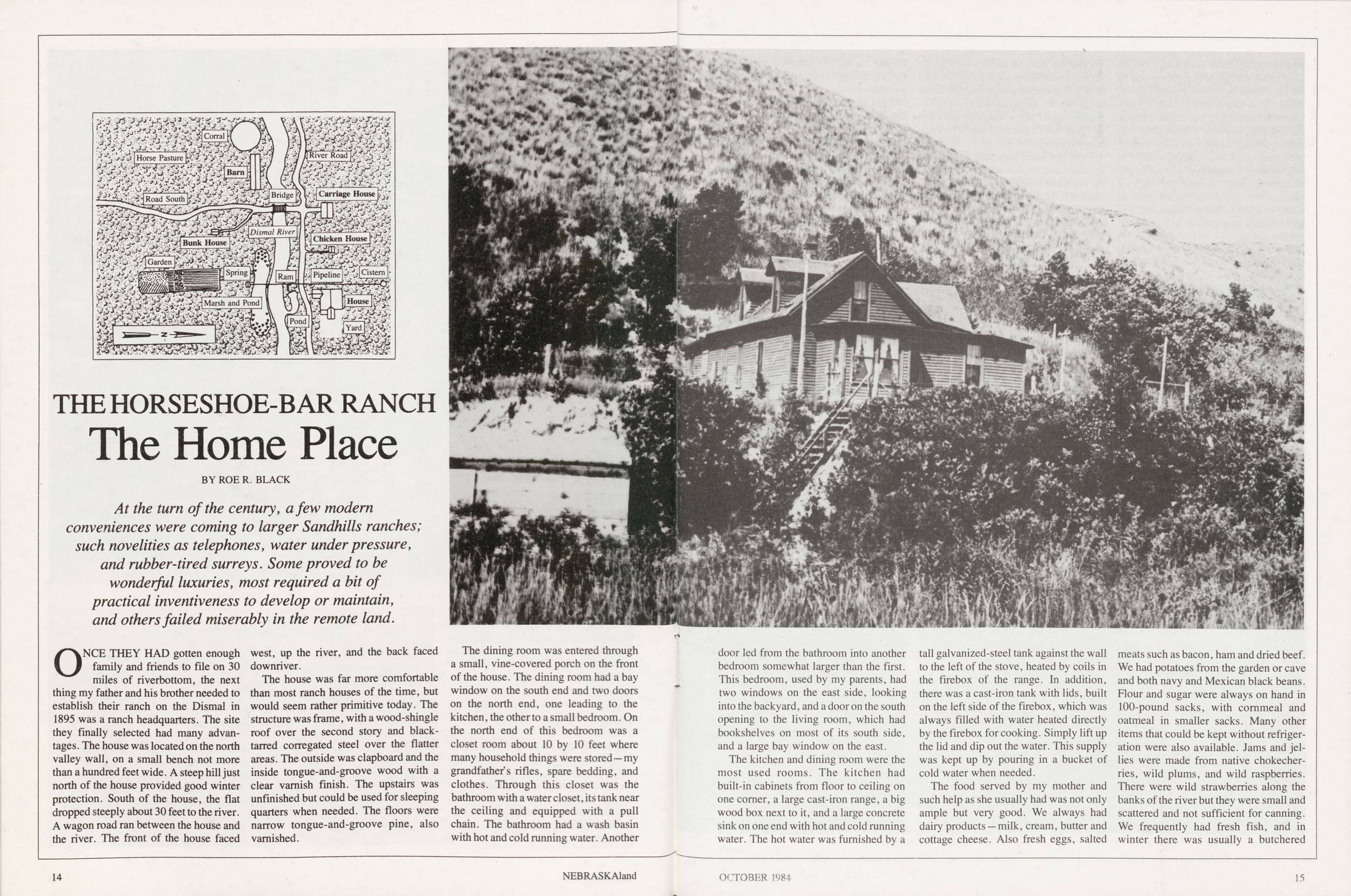
THE HORSESHOE-BAR RANCH
The Home Place BY ROE R. BLACK At the turn of the century, a few modern conveniences were coming to larger Sandhills ranches; such novelities as telephones, water under pressure, and rubber-tired surreys. Some proved to be wonderful luxuries, most required a bit of practical inventiveness to develop or maintain, and others failed miserably in the remote land.ONCE THEY HAD gotten enough family and friends to file on 30 miles of riverbottom, the next thing my father and his brother needed to establish their ranch on the Dismal in 1895 was a ranch headquarters. The site they finally selected had many advantages. The house was located on the north valley wall, on a small bench not more than a hundred feet wide. A steep hill just north of the house provided good winter protection. South of the house, the flat dropped steeply about 30 feet to the river. A wagon road ran between the house and the river. The front of the house faced west, up the river, and the back faced downriver.
The house was far more comfortable than most ranch houses of the time, but would seem rather primitive today. The structure was frame, with a wood-shingle roof over the second story and black-tarred corregated steel over the flatter areas. The outside was clapboard and the inside tongue-and-groove wood with a clear varnish finish. The upstairs was unfinished but could be used for sleeping quarters when needed. The floors were narrow tongue-and-groove pine, also varnished.
The dining room was entered through a small, vine-covered porch on the front of the house. The dining room had a bay window on the south end and two doors on the north end, one leading to the kitchen, the other to a small bedroom. On the north end of this bedroom was a closet room about 10 by 10 feet where many household things were stored—my grandfather's rifles, spare bedding, and clothes. Through this closet was the bathroom with a water closet, its tank near the ceiling and equipped with a pull chain. The bathroom had a wash basin with hot and cold running water. Another
14 NEBRASKAlanddoor led from the bathroom into another bedroom somewhat larger than the first. This bedroom, used by my parents, had two windows on the east side, looking into the backyard, and a door on the south opening to the living room, which had bookshelves on most of its south side, and a large bay window on the east.
The kitchen and dining room were the most used rooms. The kitchen had built-in cabinets from floor to ceiling on one corner, a large cast-iron range, a big wood box next to it, and a large concrete sink on one end with hot and cold running water. The hot water was furnished by a tall galvanized-steel tank against the wall to the left of the stove, heated by coils in the firebox of the range. In addition, there was a cast-iron tank with lids, built on the left side of the firebox, which was always filled with water heated directly by the firebox for cooking. Simply lift up the lid and dip out the water. This supply was kept up by pouring in a bucket of cold water when needed.
The food served by my mother and such help as she usually had was not only ample but very good. We always had dairy products —milk, cream, butter and cottage cheese. Also fresh eggs, salted meats such as bacon, ham and dried beef. We had potatoes from the garden or cave and both navy and Mexican black beans. Flour and sugar were always on hand in 100-pound sacks, with cornmeal and oatmeal in smaller sacks. Many other items that could be kept without refrigeration were also available. Jams and jellies were made from native chokecherries, wild plums, and wild raspberries. There were wild strawberries along the banks of the river but they were small and scattered and not sufficient for canning. We frequently had fresh fish, and in winter there was usually a butchered
OCTOBER 1984 15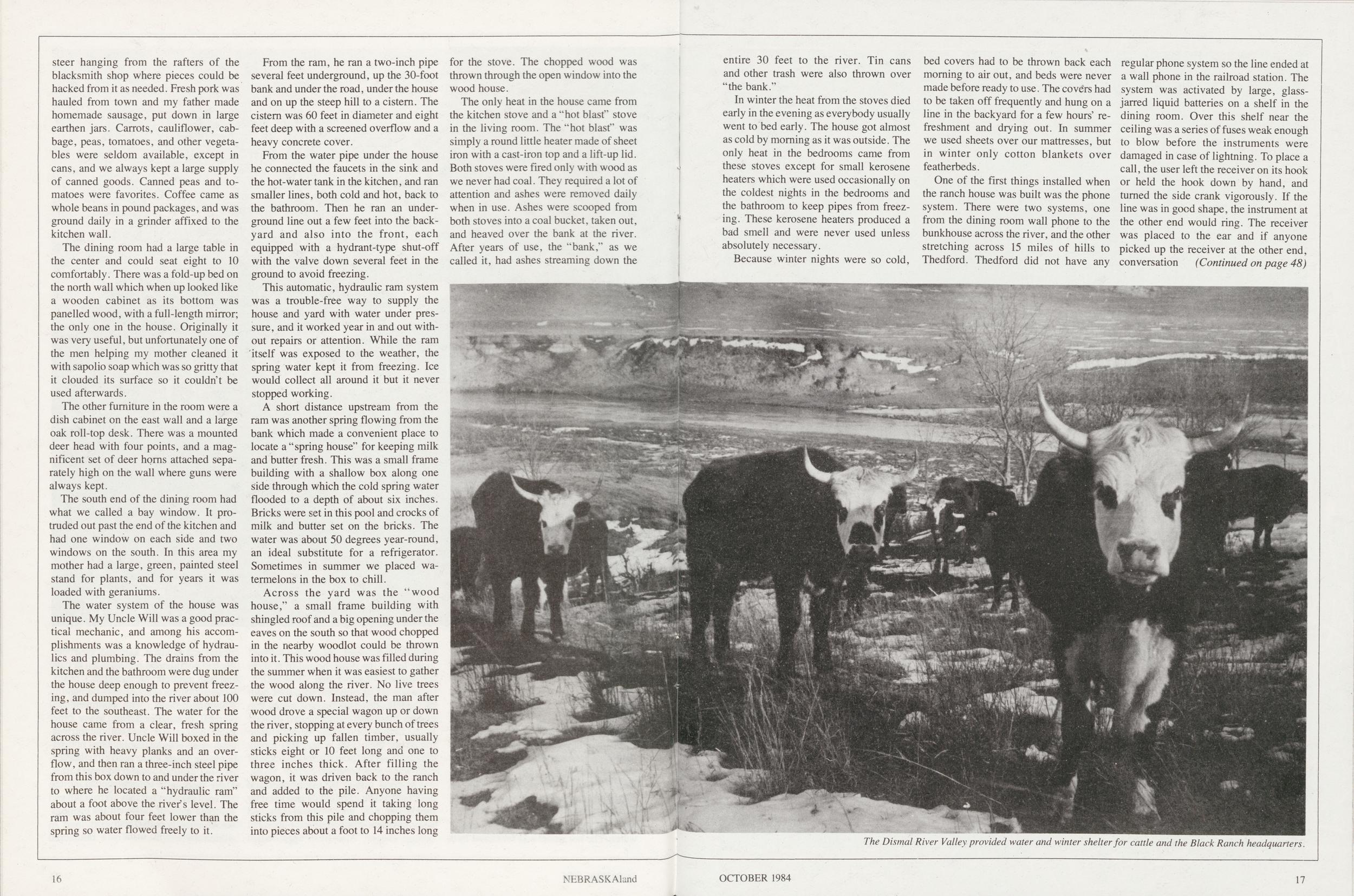
steer hanging from the rafters of the blacksmith shop where pieces could be hacked from it as needed. Fresh pork was hauled from town and my father made homemade sausage, put down in large earthen jars. Carrots, cauliflower, cabbage, peas, tomatoes, and other vegetables were seldom available, except in cans, and we always kept a large supply of canned goods. Canned peas and tomatoes were favorites. Coffee came as whole beans in pound packages, and was ground daily in a grinder affixed to the kitchen wall.
The dining room had a large table in the center and could seat eight to 10 comfortably. There was a fold-up bed on the north wall which when up looked like a wooden cabinet as its bottom was panelled wood, with a full-length mirror; the only one in the house. Originally it was very useful, but unfortunately one of the men helping my mother cleaned it with sapolio soap which was so gritty that it clouded its surface so it couldn't be used afterwards.
The other furniture in the room were a dish cabinet on the east wall and a large oak roll-top desk. There was a mounted deer head with four points, and a magnificent set of deer horns attached separately high on the wall where guns were always kept.
The south end of the dining room had what we called a bay window. It protruded out past the end of the kitchen and had one window on each side and two windows on the south. In this area my mother had a large, green, painted steel stand for plants, and for years it was loaded with geraniums.
The water system of the house was unique. My Uncle Will was a good practical mechanic, and among his accomplishments was a knowledge of hydraulics and plumbing. The drains from the kitchen and the bathroom were dug under the house deep enough to prevent freezing, and dumped into the river about 100 feet to the southeast. The water for the house came from a clear, fresh spring across the river. Uncle Will boxed in the spring with heavy planks and an overflow, and then ran a three-inch steel pipe from this box down to and under the river to where he located a "hydraulic ram" about a foot above the river's level. The ram was about four feet lower than the spring so water flowed freely to it.
From the ram, he ran a two-inch pipe several feet underground, up the 30-foot bank and under the road, under the house and on up the steep hill to a cistern. The cistern was 60 feet in diameter and eight feet deep with a screened overflow and a heavy concrete cover.
From the water pipe under the house he connected the faucets in the sink and the hot-water tank in the kitchen, and ran smaller lines, both cold and hot, back to the bathroom. Then he ran an underground line out a few feet into the backyard and also into the front, each equipped with a hydrant-type shut-off with the valve down several feet in the ground to avoid freezing.
This automatic, hydraulic ram system was a trouble-free way to supply the house and yard with water under pressure, and it worked year in and out without repairs or attention. While the ram itself was exposed to the weather, the spring water kept it from freezing. Ice would collect all around it but it never stopped working.
A short distance upstream from the ram was another spring flowing from the bank which made a convenient place to locate a "spring house" for keeping milk and butter fresh. This was a small frame building with a shallow box along one side through which the cold spring water flooded to a depth of about six inches. Bricks were set in this pool and crocks of milk and butter set on the bricks. The water was about 50 degrees year-round, an ideal substitute for a refrigerator. Sometimes in summer we placed watermelons in the box to chill.
Across the yard was the "wood house," a small frame building with shingled roof and a big opening under the eaves on the south so that wood chopped in the nearby woodlot could be thrown into it. This wood house was filled during the summer when it was easiest to gather the wood along the river. No live trees were cut down. Instead, the man after wood drove a special wagon up or down the river, stopping at every bunch of trees and picking up fallen timber, usually sticks eight or 10 feet long and one to three inches thick. After filling the wagon, it was driven back to the ranch and added to the pile. Anyone having free time would spend it taking long sticks from this pile and chopping them into pieces about a foot to 14 inches long for the stove. The chopped wood was thrown through the open window into the wood house.
The only heat in the house came from the kitchen stove and a "hot blast" stove in the living room. The "hot blast" was simply a round little heater made of sheet iron with a cast-iron top and a lift-up lid. Both stoves were fired only with wood as we never had coal. They required a lot of attention and ashes were removed daily when in use. Ashes were scooped from both stoves into a coal bucket, taken out, and heaved over the bank at the river. After years of use, the "bank," as we called it, had ashes streaming down the
16 NEBRASKAlandentire 30 feet to the river. Tin cans and other trash were also thrown over "the bank."
In winter the heat from the stoves died early in the evening as everybody usually went to bed early. The house got almost as cold by morning as it was outside. The only heat in the bedrooms came from these stoves except for small kerosene heaters which were used occasionally on the coldest nights in the bedrooms and the bathroom to keep pipes from freezing. These kerosene heaters produced a bad smell and were never used unless absolutely necessary.
Because winter nights were so cold, bed covers had to be thrown back each morning to air out, and beds were never made before ready to use, The covers had to be taken off frequently and hung on a line in the backyard for a few hours' refreshment and drying out. In summer we used sheets over our mattresses, but in winter only cotton blankets over featherbeds.
One of the first things installed when the ranch house was built was the phone system. There were two systems, one from the dining room wall phone to the bunkhouse across the river, and the other stretching across 15 miles of hills to Thedford. Thedford did not have any regular phone system so the line ended at a wall phone in the railroad station. The system was activated by large, glass-jarred liquid batteries on a shelf in the dining room. Over this shelf near the ceiling was a series of fuses weak enough to blow before the instruments were damaged in case of lightning. To place a call, the user left the receiver on its hook or held the hook down by hand, and turned the side crank vigorously. If the line was in good shape, the instrument at the other end would ring. The receiver was placed to the ear and if anyone picked up the receiver at the other end, conversation
(Continued on page 48)The Dismal River Valley provided water and winter shelter for cattle and the Black Ranch headquarters.
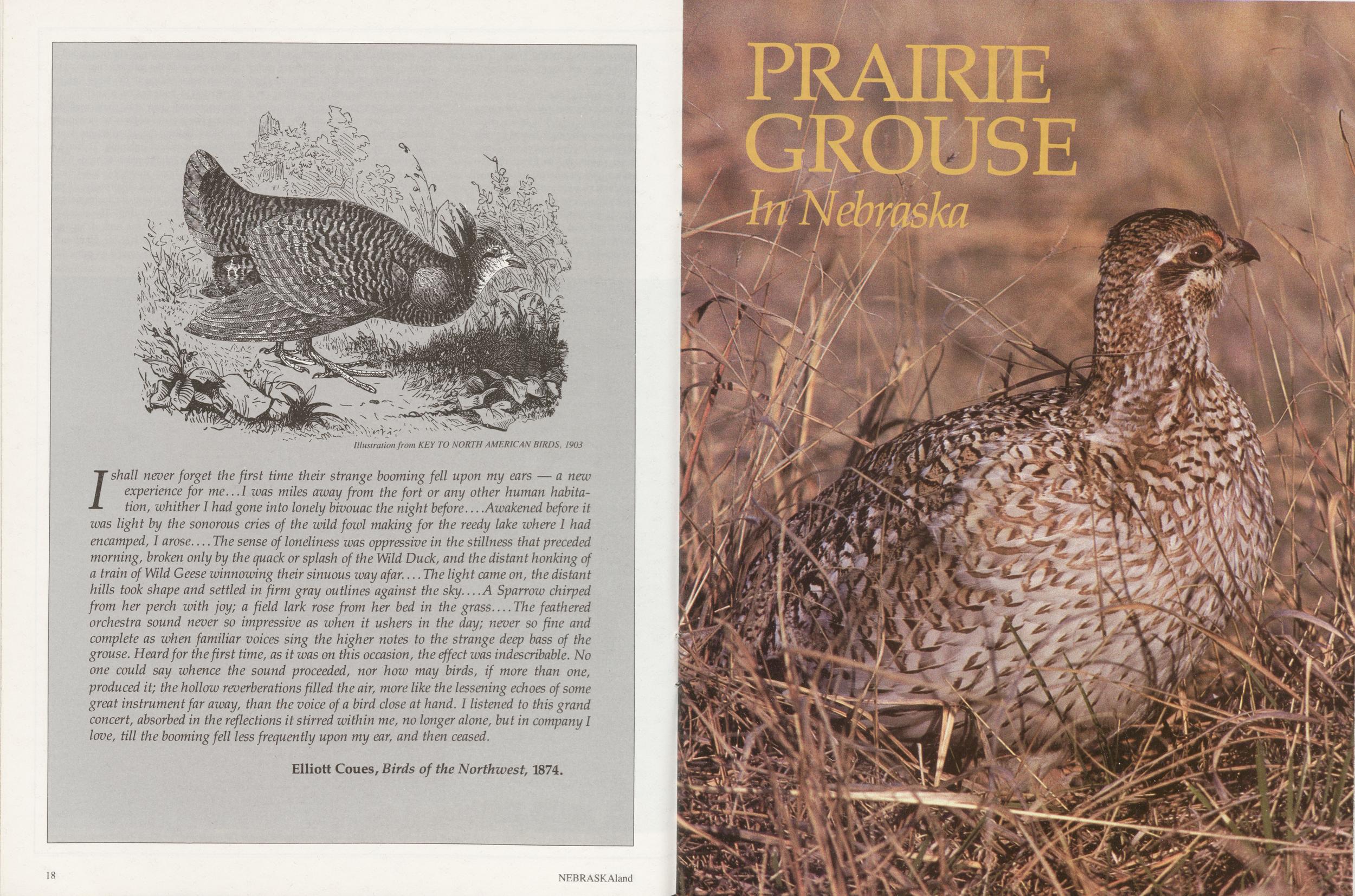
I shall never forget the first time their strange booming fell upon my ears — a new experience for me.. J was miles away from the fort or any other human habitation, whither I had gone into lonely bivouac the night before....Awakened before it was light by the sonorous cries of the wild fowl making for the reedy lake where I had encamped, I arose....The sense of loneliness was oppressive in the stillness that preceded morning, broken only by the quack or splash of the Wild Duck, and the distant honking of a train of Wild Geese winnowing their sinuous way afar....The light came on, the distant hills took shape and settled in firm gray outlines against the sky....A Sparrow chirped from her perch with joy; a field lark rose from her bed in the grass—The feathered orchestra sound never so impressive as when it ushers in the day; never so fine and complete as when familiar voices sing the higher notes to the strange deep bass of the grouse. Heard for the first time, as it was on this occasion, the effect was indescribable. No one could say whence the sound proceeded, nor how may birds, if more than one, produced it; the hollow reverberations filled the air, more like the lessening echoes of some great instrument far away, than the voice of a bird close at hand. I listened to this grand concert, absorbed in the reflections it stirred within me, no longer alone, but in company I love, till the booming fell less frequently upon my ear, and then ceased.
Elliott Coues, Birds of the Northwest, 1874. 18 NEBRASKAlandPraire Grouse in Nebraska
Nebraska Natives
Past and PresentNEBRASKA'S PRAIRIE GROUSE — the sharptail and the greater prairie chicken — have for centuries greeted spring Sandhills mornings with the booming calls and frenetic dancing of a courtship ritual repeated since long before there were human eyes or ears present to record the event. The ritual, virtually as old as the hills themselves, goes on today, still often unheeded by the humans who now control the rolling grassland home of these hardy birds. But in our heedlessness, we have threatened these unassuming but spectacular prairie residents. What is their story? More importantly, what is their future?
Early colonists in North America encountered the heath hen, an eastern relative of the prairie chicken, as soon as they arrived in Massachusetts and Virginia, and as they ranged beyond the eastern mountains onto the plains, pioneers encountered prairie chickens in numbers that seemed as abundant as "the sands of the seashore," in the words of an early observer.
The promise of a great network of fur-rich waterways beckoned 18th century trappers deeper into the continent's interior, where Europeans first discovered sharptail grouse, the "hen of the prairie," apparently as inexhaustible as the great herds of bison blanketing the plains. One early account reads, "We put up grouse in such numbers that scarcely had the laggers from one flock disappeared from sight before another covey rose."
Predictably, pioneers and settlers immediately began to use — and to overuse — the plentiful fowl. Sharptails and prairie chickens provided victuals for many a hungry family, and the birds were shot and trapped for commercial marketing, as well. Reports from hunters' day-books are striking: in Iowa, three men killed 410 prairie chickens in three hours on one 80-acre field. In Nebraska, one writer recalled that 300,000 prairie chickens were shipped out of the eastern part of the state in 1874 alone.
The demand for the birds in eastern markets, the development of efficient railway shipping, and the willingness of individuals to exploit a seemingly unlimited resource, combined to dramatically reduce grouse and prairie chicken populations. The slow rate of settlement in Nebraska's Sandhills insured temporary sanctuary there for the prairie grouse, but in other parts of their range they were extirpated. Encroaching agriculture, resulting in the reduction of suitable habitat, was a further blow, and by the early years of the 20th century, prairie chickens had declined to remnant populations; sharptails fared only a little better.
The original range of the sharptail (Pedioecetes phasianellus) was expansive, extending from Hudson Bay on the northeast to northern Kansas and western Iowa on the southeast, west across the plains and intermountain region, north to north-central Alaska and south to northern New Mexico. Pushed from much of that range by intensified agriculture, the sharptail again broadened its range as farming ventures failed, leaving more favorable habitats in their wake. Second-growth timber on cutover lands also provided excellent sharptail habitat. But later agricultural successes, specifically the extensive conversion of grassland to row crops, again reduced the range.
One of several subspecies, the plains sharptail grouse in Nebraska is now confined largely to the 20,000-square-mile Sandhills region.
The greater prairie chicken (Tympanuchus cupido pinnatus) originally occupied a breeding range bounded on the east by western Pennsylvania, on the north by southern Michigan, Wisconsin and Minnesota, on the west by eastern Nebraska, Kansas and Oklahoma, and on the south by northern Texas, southern Arkansas, Missouri, Illinois and northern Kentucky. Present distribution in the original range includes only isolated pockets in Missouri, Illinois, Michigan, Wisconsin, Kansas, and Nebraska. To a greater extent than the sharptail, prairie chickens followed the plow west and north into once unsuitable areas.
While limited agricultural production proved beneficial for prairie chickens in these new areas, large-scale crop production reduced the grassland habitat below the level required for their survival. Their current range is quite limited, and Nebraska is one of the few states with sufficient numbers to warrant hunting seasons.
In Nebraska, insufficient grassland nesting cover or a shortage of winter food seems to limit prairie chicken expansion into new areas. Its primary range is located
N-2 NEBRASKAlandon the southern and eastern borders of the Sandhills where grain is available. In areas where the conversion from grass to cropland exceeds 60 percent, the chicken has been almost entirely eliminated. In southeast Nebraska, several isolated flocks continue to survive where small pockets of grassland remain.
Early accounts often used prairie chicken and sharptail interchangeably, leading to considerable confusion in historical literature, and superficially they are quite similar, both in habits and appearance. Yet, there are distinct differences which become apparent when one compares the two.
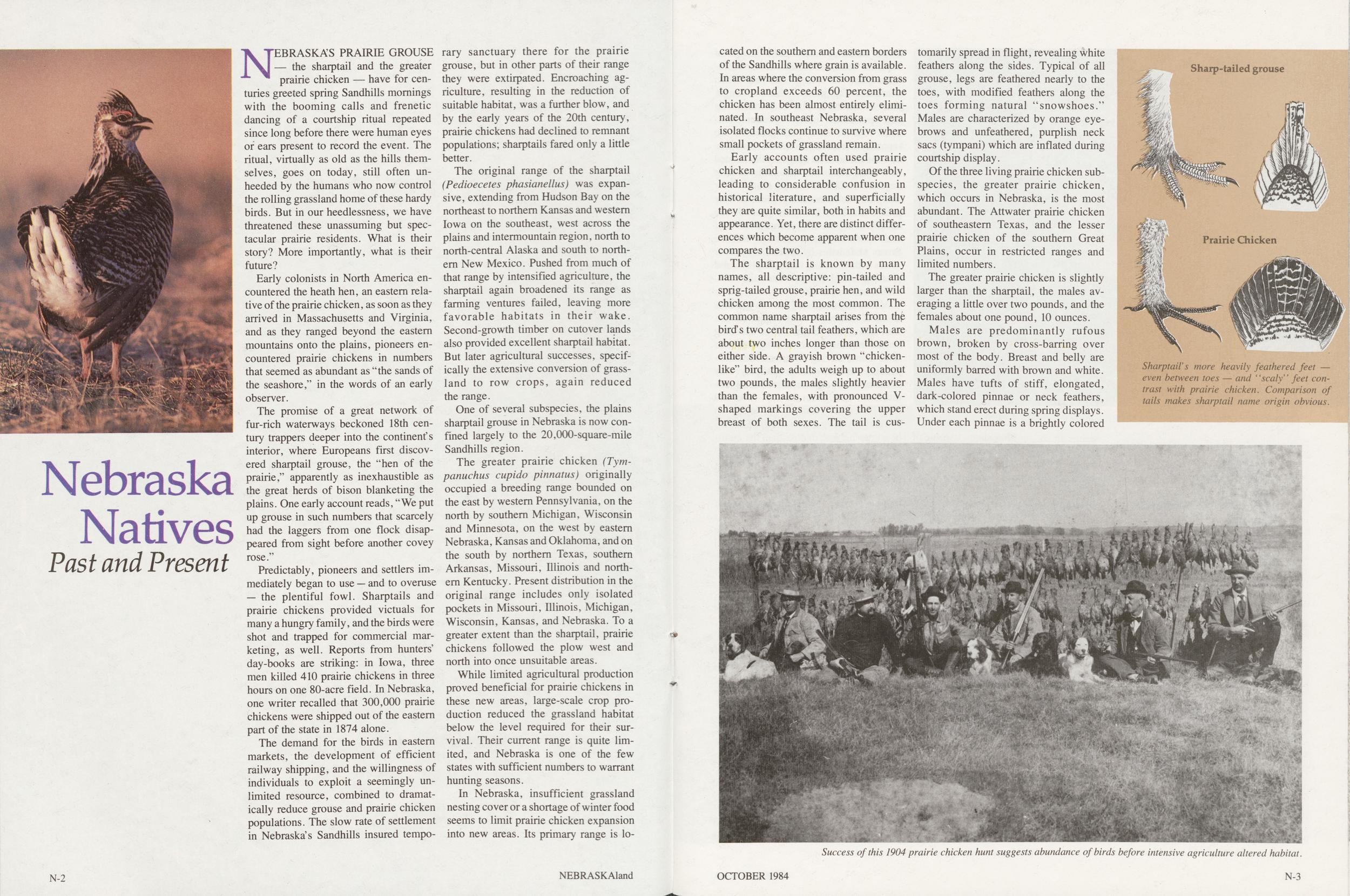
The sharptail is known by many names, all descriptive: pin-tailed and sprig-tailed grouse, prairie hen, and wild chicken among the most common. The common name sharptail arises from the bird's two central tail feathers, which are about two inches longer than those on either side. A grayish brown "chicken-like" bird, the adults weigh up to about two pounds, the males slightly heavier than the females, with pronounced V-shaped markings covering the upper breast of both sexes. The tail is customarily spread in flight, revealing white feathers along the sides. Typical of all grouse, legs are feathered nearly to the toes, with modified feathers along the toes forming natural "snowshoes." Males are characterized by orange eyebrows and unfeathered, purplish neck sacs (tympani) which are inflated during courtship display.
Of the three living prairie chicken subspecies, the greater prairie chicken, which occurs in Nebraska, is the most abundant. The Attwater prairie chicken of southeastern Texas, and the lesser prairie chicken of the southern Great Plains, occur in restricted ranges and limited numbers.
The greater prairie chicken is slightly larger than the sharptail, the males averaging a little over two pounds, and the females about one pound, 10 ounces.
Males are predominantly rufous brown, broken by cross-barring over most of the body. Breast and belly are uniformly barred with brown and white. Males have tufts of stiff, elongated, dark-colored pinnae or neck feathers, which stand erect during spring displays. Under each pinnae is a brightly colored
Sharp-tailed grouse Prairie Chicken Sharptail's more heavily feathered feet — even between toes — and "scaly" feet contrast with prairie chicken. Comparison of tails makes sharptail name origin obvious.
Success of this 1904 prairie chicken hunt suggests abundance of birds before intensive agriculture altered habitat.
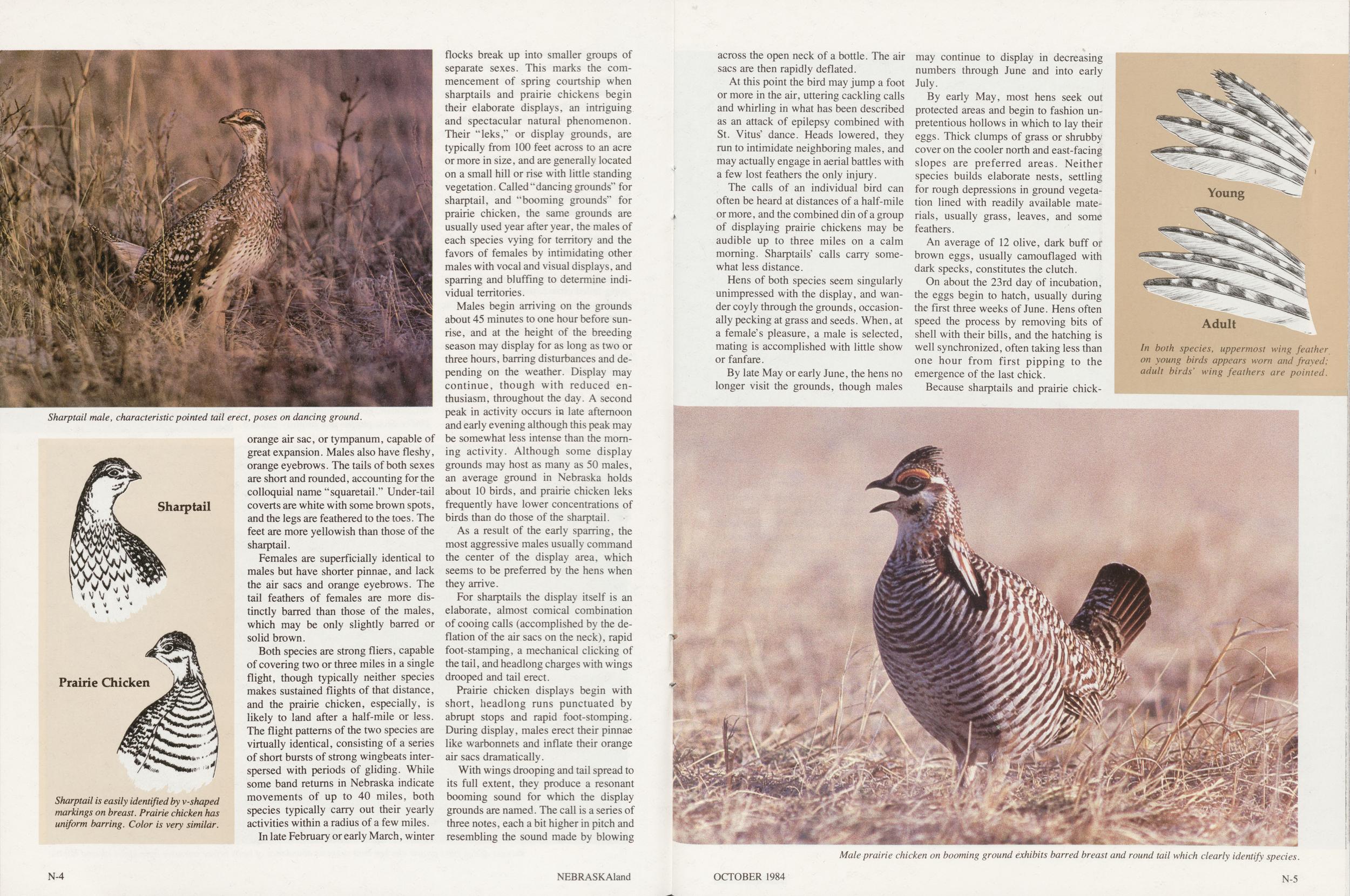
Sharptail male, characteristic pointed tail erect, poses on dancing ground.
Sharp tail Prairie Chicken Sharptail is easily identified by v-shaped markings on breast. Prairie chicken has uniform barring. Color is very similar.
orange air sac, or tympanum, capable of great expansion. Males also have fleshy, orange eyebrows. The tails of both sexes are short and rounded, accounting for the colloquial name "squaretail." Under-tail coverts are white with some brown spots, and the legs are feathered to the toes. The feet are more yellowish than those of the sharptail.
Females are superficially identical to males but have shorter pinnae, and lack the air sacs and orange eyebrows. The tail feathers of females are more distinctly barred than those of the males, which may be only slightly barred or solid brown.
Both species are strong fliers, capable of covering two or three miles in a single flight, though typically neither species makes sustained flights of that distance, and the prairie chicken, especially, is likely to land after a half-mile or less. The flight patterns of the two species are virtually identical, consisting of a series of short bursts of strong wingbeats interspersed with periods of gliding. While some band returns in Nebraska indicate movements of up to 40 miles, both species typically carry out their yearly activities within a radius of a few miles.
In late February or early March, winter flocks break up into smaller groups of separate sexes. This marks the commencement of spring courtship when sharptails and prairie chickens begin their elaborate displays, an intriguing and spectacular natural phenomenon. Their "leks," or display grounds, are typically from 100 feet across to an acre or more in size, and are generally located on a small hill or rise with little standing vegetation. Called "dancing grounds" for sharptail, and "booming grounds" for prairie chicken, the same grounds are usually used year after year, the males of each species vying for territory and the favors of females by intimidating other males with vocal and visual displays, and sparring and bluffing to determine individual territories.
Males begin arriving on the grounds about 45 minutes to one hour before sunrise, and at the height of the breeding season may display for as long as two or three hours, barring disturbances and depending on the weather. Display may continue, though with reduced enthusiasm, throughout the day. A second peak in activity occurs in late afternoon and early evening although this peak may be somewhat less intense than the morning activity. Although some display grounds may host as many as 50 males, an average ground in Nebraska holds about 10 birds, and prairie chicken leks frequently have lower concentrations of birds than do those of the sharptail.
As a result of the early sparring, the most aggressive males usually command the center of the display area, which seems to be preferred by the hens when they arrive.
For sharptails the display itself is an elaborate, almost comical combination of cooing calls (accomplished by the deflation of the air sacs on the neck), rapid foot-stamping, a mechanical clicking of the tail, and headlong charges with wings drooped and tail erect.
Prairie chicken displays begin with short, headlong runs punctuated by abrupt stops and rapid foot-stomping. During display, males erect their pinnae like warbonnets and inflate their orange air sacs dramatically.
With wings drooping and tail spread to its full extent, they produce a resonant booming sound for which the display grounds are named. The call is a series of three notes, each a bit higher in pitch and resembling the sound made by blowing
N-4 NEBRASKAlandacross the open neck of a bottle. The air sacs are then rapidly deflated.
At this point the bird may jump a foot or more in the air, uttering cackling calls and whirling in what has been described as an attack of epilepsy combined with St. Vitus' dance. Heads lowered, they run to intimidate neighboring males, and may actually engage in aerial battles with a few lost feathers the only injury.
The calls of an individual bird can often be heard at distances of a half-mile or more, and the combined din of a group of displaying prairie chickens may be audible up to three miles on a calm morning. Sharptails' calls carry somewhat less distance.
Hens of both species seem singularly unimpressed with the display, and wander coyly through the grounds, occasionally pecking at grass and seeds. When, at a female's pleasure, a male is selected, mating is accomplished with little show or fanfare.
By late May or early June, the hens no longer visit the grounds, though males may continue to display in decreasing numbers through June and into early July.
By early May, most hens seek out protected areas and begin to fashion unpretentious hollows in which to lay their eggs. Thick clumps of grass or shrubby cover on the cooler north and east-facing slopes are preferred areas. Neither species builds elaborate nests, settling for rough depressions in ground vegetation lined with readily available materials, usually grass, leaves, and some feathers.
An average of 12 olive, dark buff or brown eggs, usually camouflaged with dark specks, constitutes the clutch.
On about the 23rd day of incubation, the eggs begin to hatch, usually during the first three weeks of June. Hens often speed the process by removing bits of shell with their bills, and the hatching is well synchronized, often taking less than one hour from first pipping to the emergence of the last chick.
Because sharptails and prairie chickens
Young Adult In both species, uppermost wing feather on young birds appears worn and frayed; adult birds' wing feathers are pointed.
Male prairie chicken on booming ground exhibits barred breast and round tail which clearly identify species.
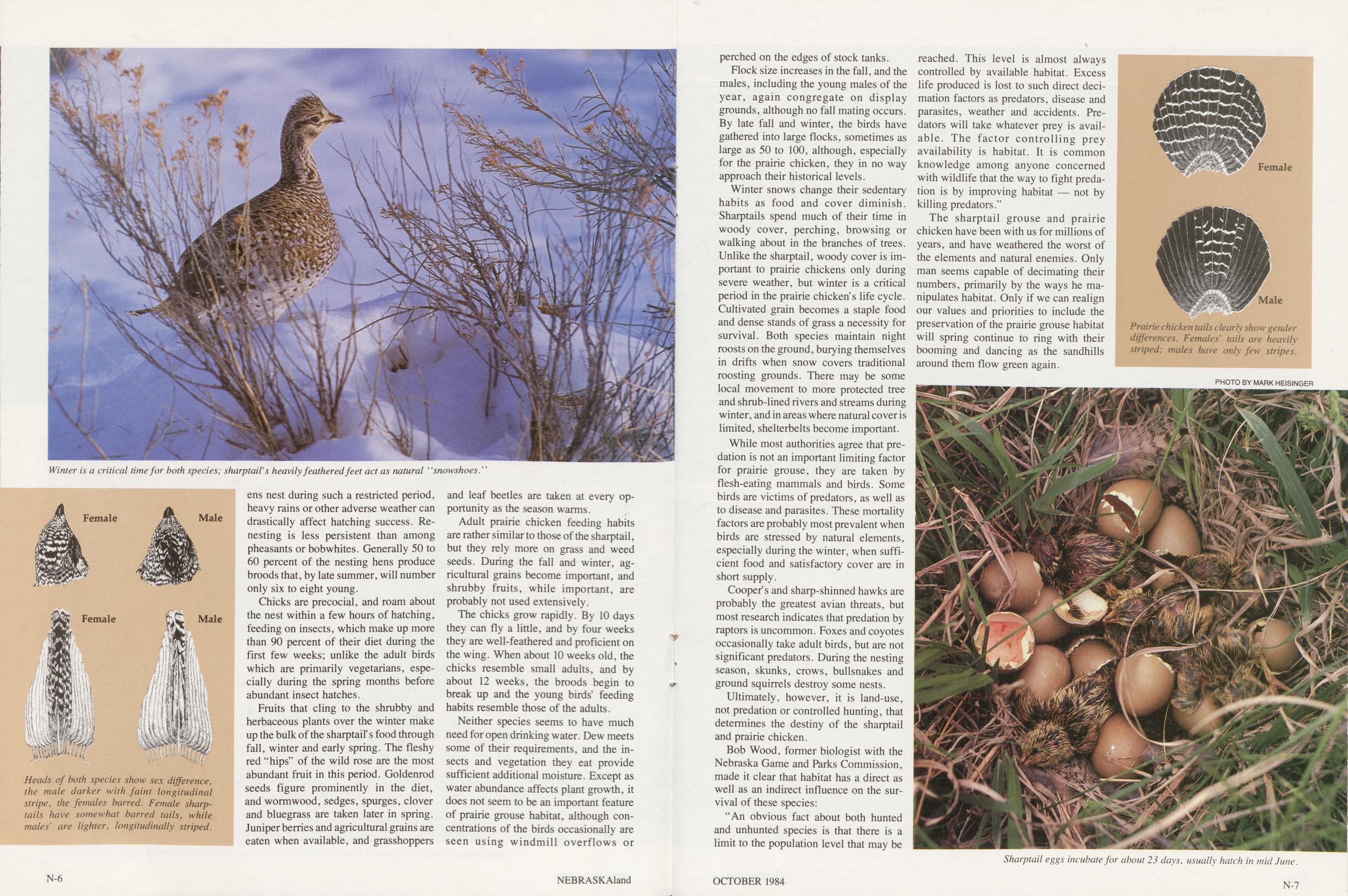
Winter is a critical time for both species; sharptail's heavily feathered feet act as natural "snowshoes."
Female Male Female Male Heads of both species show sex difference, the male darker with faint longitudinal stripe, the females barred. Female sharptails have somewhat barred tails, while males' are lighter, longitudinally striped.
nest during such a restricted period, heavy rains or other adverse weather can drastically affect hatching success. Re-nesting is less persistent than among pheasants or bob whites. Generally 50 to 60 percent of the nesting hens produce broods that, by late summer, will number only six to eight young.
Chicks are precocial, and roam about the nest within a few hours of hatching, feeding on insects, which make up more than 90 percent of their diet during the first few weeks; unlike the adult birds which are primarily vegetarians, especially during the spring months before abundant insect hatches.
Fruits that cling to the shrubby and herbaceous plants over the winter make up the bulk of the sharptail's food through fall, winter and early spring. The fleshy red "hips" of the wild rose are the most abundant fruit in this period. Goldenrod seeds figure prominently in the diet, and wormwood, sedges, spurges, clover and bluegrass are taken later in spring. Juniper berries and agricultural grains are eaten when available, and grasshoppers and leaf beetles are taken at every opportunity as the season warms.
Adult prairie chicken feeding habits are rather similar to those of the sharptail, but they rely more on grass and weed seeds. During the fall and winter, agricultural grains become important, and shrubby fruits, while important, are probably not used extensively.
The chicks grow rapidly. By 10 days they can fly a little, and by four weeks they are well-feathered and proficient on the wing. When about 10 weeks old, the chicks resemble small adults, and by about 12 weeks, the broods begin to break up and the young birds' feeding habits resemble those of the adults.
Neither species seems to have much need for open drinking water. Dew meets some of their requirements, and the insects and vegetation they eat provide sufficient additional moisture. Except as water abundance affects plant growth, it does not seem to be an important feature of prairie grouse habitat, although concentrations of the birds occasionally are seen using windmill overflows or
N-6 NEBRASKAlandperched on the edges of stock tanks.
Flock size increases in the fall, and the males, including the young males of the year, again congregate on display grounds, although no fall mating occurs. By late fall and winter, the birds have gathered into large flocks, sometimes as large as 50 to 100, although, especially for the prairie chicken, they in no way approach their historical levels.
Winter snows change their sedentary habits as food and cover diminish. Sharptails spend much of their time in woody cover, perching, browsing or walking about in the branches of trees. Unlike the sharptail, woody cover is important to prairie chickens only during severe weather, but winter is a critical period in the prairie chicken's life cycle. Cultivated grain becomes a staple food and dense stands of grass a necessity for survival. Both species maintain night roosts on the ground, burying themselves in drifts when snow covers traditional roosting grounds. There may be some local movement to more protected tree and shrub-lined rivers and streams during winter, and in areas where natural cover is limited, shelterbelts become important. While most authorities agree that predation is not an important limiting factor for prairie grouse, they are taken by flesh-eating mammals and birds. Some birds are victims of predators, as well as to disease and parasites. These mortality factors are probably most prevalent when birds are stressed by natural elements, especially during the winter, when sufficient food and satisfactory cover are in short supply.
Cooper's and sharp-shinned hawks are probably the greatest avian threats, but most research indicates that predation by raptors is uncommon. Foxes and coyotes occasionally take adult birds, but are not significant predators. During the nesting season, skunks, crows, bullsnakes and ground squirrels destroy some nests.
Ultimately, however, it is land-use, not predation or controlled hunting, that determines the destiny of the sharptail and prairie chicken.
Bob Wood, former biologist with the Nebraska Game and Parks Commission, made it clear that habitat has a direct as well as an indirect influence on the survival of these species:
"An obvious fact about both hunted and unhunted species is that there is a limit to the population level that may be reached. This level is almost always controlled by available habitat. Excess life produced is lost to such direct decimation factors as predators, disease and parasites, weather and accidents. Predators will take whatever prey is available. The factor controlling prey availability is habitat. It is common knowledge among anyone concerned with wildlife that the way to fight predation is by improving habitat — not by killing predators."
The sharptail grouse and prairie chicken have been with us for millions of years, and have weathered the worst of the elements and natural enemies. Only man seems capable of decimating their numbers, primarily by the ways he manipulates habitat. Only if we can realign our values and priorities to include the preservation of the prairie grouse habitat will spring continue to ring with their booming and dancing as the sandhills around them flow green again.
Female Male Prairie chicken tails clearly show gender differences. Females' tails are heavily striped; males have only few stripes.
Sharptail eggs incubate for about 23 days, usually hatch in mid June,
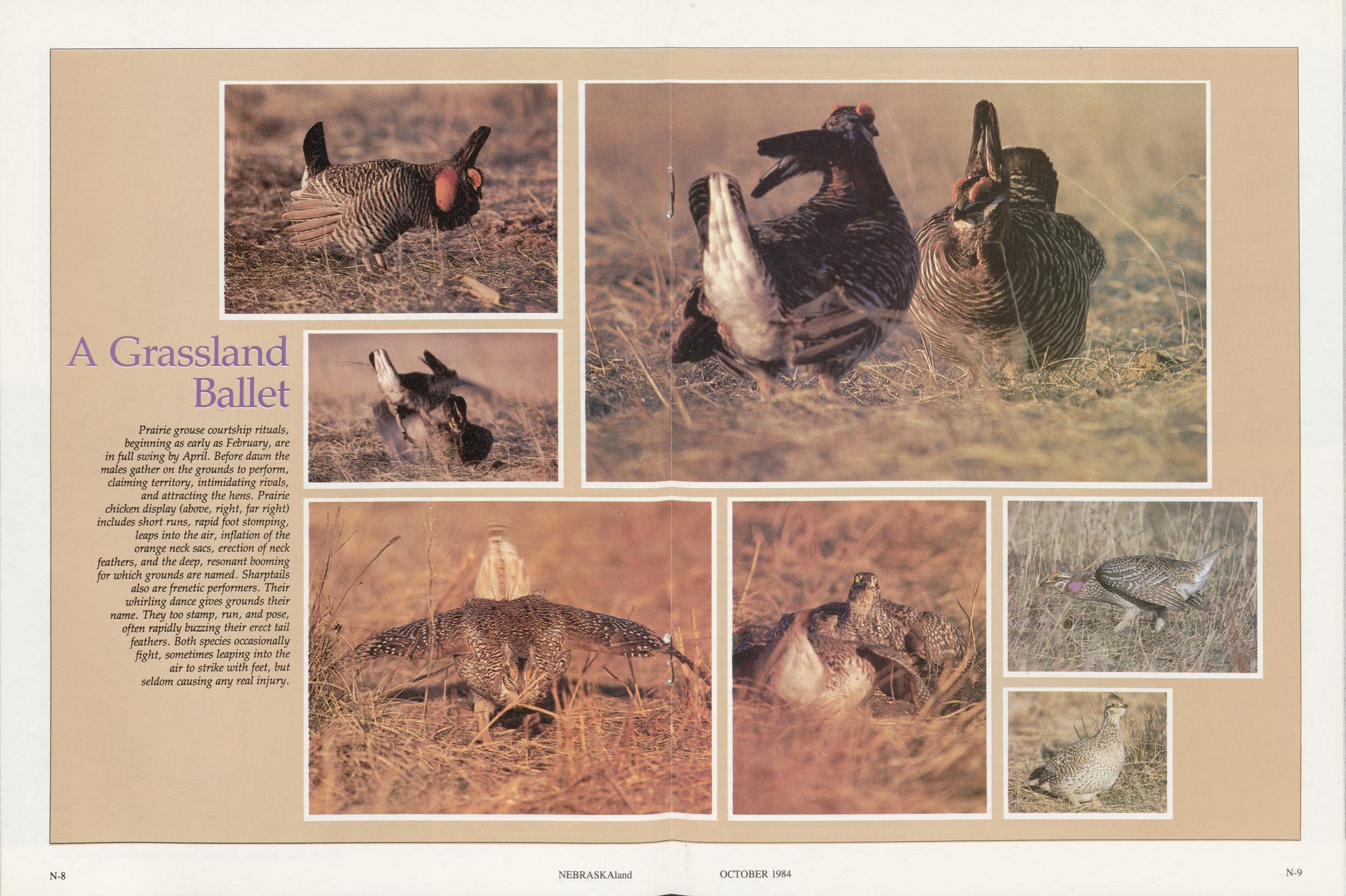
A Grassland Ballet
Prairie grouse courtship rituals, beginning as early as February, are in full swing by April. Before dawn the males gather on the grounds to perform, claiming territory, intimidating rivals, and attracting the hens. Prairie chicken display (above, right, far right) includes short runs, rapid foot stomping, leaps into the air, inflation of the orange neck sacs, erection of neck feathers, and the deep, resonant booming for which grounds are named. Sharptails also are frenetic performers. Their whirling dance gives grounds their name. They too stamp, run, and pose, often rapidly buzzing their erect tail feathers. Both species occasionally fight, sometimes leaping into the air to strike with feet, but seldom causing any real injury.
N-8 NEBRASKAland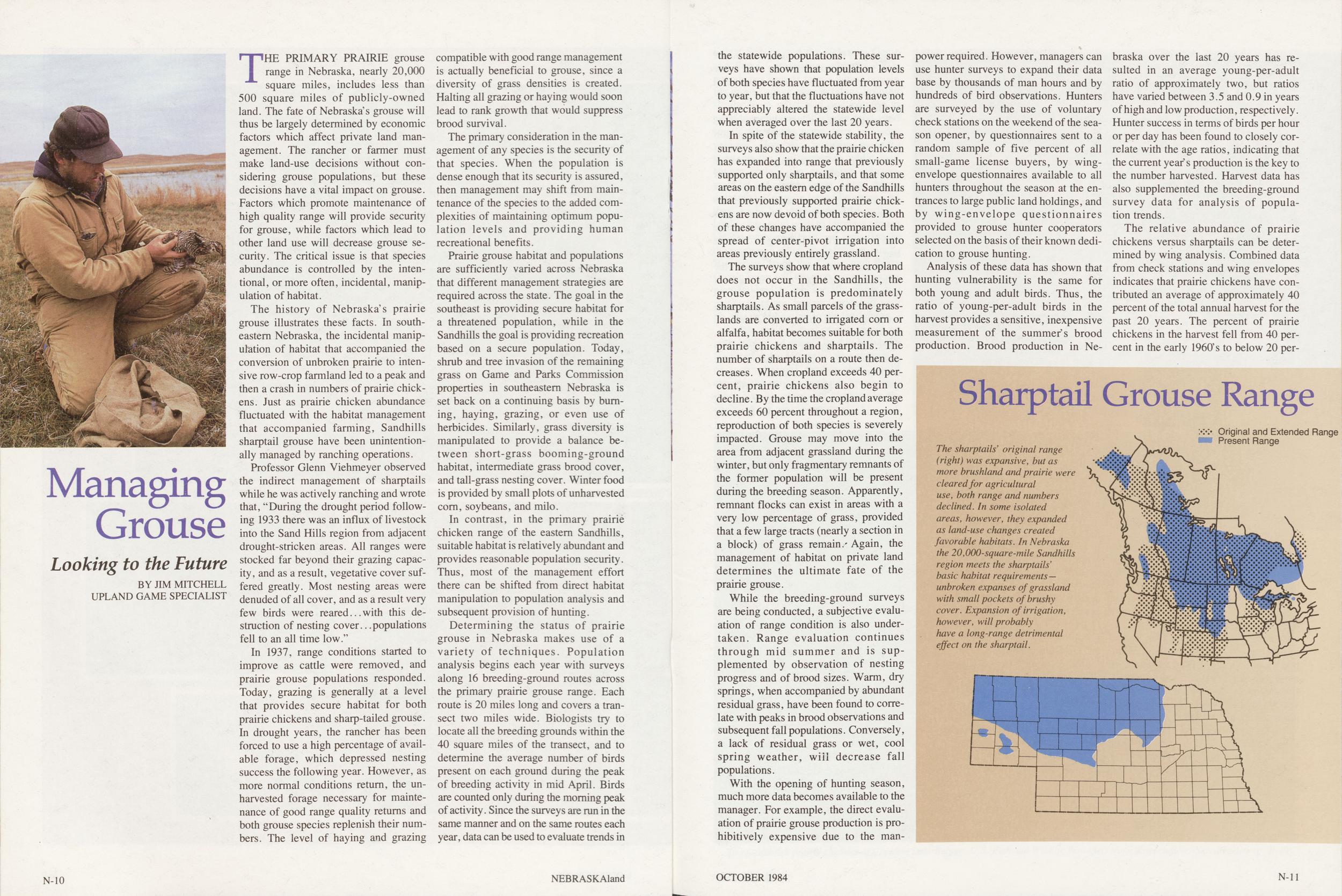
Managing Grouse
Looking to the Future BY JIM MITCHELL UPLAND GAME SPECIALISTTHE PRIMARY PRAIRIE grouse range in Nebraska, nearly 20,000 square miles, includes less than 500 square miles of publicly-owned land. The fate of Nebraska's grouse will thus be largely determined by economic factors which affect private land management. The rancher or farmer must make land-use decisions without considering grouse populations, but these decisions have a vital impact on grouse. Factors which promote maintenance of high quality range will provide security for grouse, while factors which lead to other land use will decrease grouse security. The critical issue is that species abundance is controlled by the intentional, or more often, incidental, manipulation of habitat.
The history of Nebraska's prairie grouse illustrates these facts. In southeastern Nebraska, the incidental manipulation of habitat that accompanied the conversion of unbroken prairie to intensive row-crop farmland led to a peak and then a crash in numbers of prairie chickens. Just as prairie chicken abundance fluctuated with the habitat management that accompanied farming, Sandhills sharptail grouse have been unintentionally managed by ranching operations.
Professor Glenn Viehmeyer observed the indirect management of sharptails while he was actively ranching and wrote that, "During the drought period following 1933 there was an influx of livestock into the Sand Hills region from adjacent drought-stricken areas. All ranges were stocked far beyond their grazing capacity, and as a result, vegetative cover suffered greatly. Most nesting areas were denuded of all cover, and as a result very few birds were reared... with this destruction of nesting cover.. .populations fell to an all time low."
In 1937, range conditions started to improve as cattle were removed, and prairie grouse populations responded. Today, grazing is generally at a level that provides secure habitat for both prairie chickens and sharp-tailed grouse. In drought years, the rancher has been forced to use a high percentage of available forage, which depressed nesting success the following year. However, as more normal conditions return, the unharvested forage necessary for maintenance of good range quality returns and both grouse species replenish their numbers. The level of haying and grazing compatible with good range management is actually beneficial to grouse, since a diversity of grass densities is created. Halting all grazing or haying would soon lead to rank growth that would suppress brood survival.
The primary consideration in the management of any species is the security of that species. When the population is dense enough that its security is assured, then management may shift from maintenance of the species to the added complexities of maintaining optimum population levels and providing human recreational benefits.
Prairie grouse habitat and populations are sufficiently varied across Nebraska that different management strategies are required across the state. The goal in the southeast is providing secure habitat for a threatened population, while in the Sandhills the goal is providing recreation based on a secure population. Today, shrub and tree invasion of the remaining grass on Game and Parks Commission properties in southeastern Nebraska is set back on a continuing basis by burning, haying, grazing, or even use of herbicides. Similarly, grass diversity is manipulated to provide a balance between short-grass booming-ground habitat, intermediate grass brood cover, and tall-grass nesting cover. Winter food is provided by small plots of unharvested corn, soybeans, and milo.
In contrast, in the primary prairie chicken range of the eastern Sandhills, suitable habitat is relatively abundant and provides reasonable population security. Thus, most of the management effort there can be shifted from direct habitat manipulation to population analysis and subsequent provision of hunting.
Determining the status of prairie grouse in Nebraska makes use of a variety of techniques. Population analysis begins each year with surveys along 16 breeding-ground routes across the primary prairie grouse range. Each route is 20 miles long and covers a transect two miles wide. Biologists try to locate all the breeding grounds within the 40 square miles of the transect, and to determine the average number of birds present on each ground during the peak of breeding activity in mid April. Birds are counted only during the morning peak of activity. Since the surveys are run in the same manner and on the same routes each year, data can be used to evaluate trends in
N-10 NEBRASKAlandthe statewide populations. These surveys have shown that population levels of both species have fluctuated from year to year, but that the fluctuations have not appreciably altered the statewide level when averaged over the last 20 years.
In spite of the statewide stability, the surveys also show that the prairie chicken has expanded into range that previously supported only sharptails, and that some areas on the eastern edge of the Sandhills that previously supported prairie chickens are now devoid of both species. Both of these changes have accompanied the spread of center-pivot irrigation into areas previously entirely grassland.
The surveys show that where cropland does not occur in the Sandhills, the grouse population is predominately sharptails. As small parcels of the grasslands are converted to irrigated corn or alfalfa, habitat becomes suitable for both prairie chickens and sharptails. The number of sharptails on a route then decreases. When cropland exceeds 40 percent, prairie chickens also begin to decline. By the time the cropland average exceeds 60 percent throughout a region, reproduction of both species is severely impacted. Grouse may move into the area from adjacent grassland during the winter, but only fragmentary remnants of the former population will be present during the breeding season. Apparently, remnant flocks can exist in areas with a very low percentage of grass, provided that a few large tracts (nearly a section in a block) of grass remain- Again, the management of habitat on private land determines the ultimate fate of the prairie grouse.
While the breeding-ground surveys are being conducted, a subjective evaluation of range condition is also undertaken. Range evaluation continues through mid summer and is supplemented by observation of nesting progress and of brood sizes. Warm, dry springs, when accompanied by abundant residual grass, have been found to correlate with peaks in brood observations and subsequent fall populations. Conversely, a lack of residual grass or wet, cool spring weather, will decrease fall populations.
With the opening of hunting season, much more data becomes available to the manager. For example, the direct evaluation of prairie grouse production is prohibitively expensive due to the manpower required. However, managers can use hunter surveys to expand their data base by thousands of man hours and by hundreds of bird observations. Hunters are surveyed by the use of voluntary check stations on the weekend of the season opener, by questionnaires sent to a random sample of five percent of all small-game license buyers, by wing-envelope questionnaires available to all hunters throughout the season at the entrances to large public land holdings, and by wing-envelope questionnaires provided to grouse hunter cooperators selected on the basis of their known dedication to grouse hunting.
Analysis of these data has shown that hunting vulnerability is the same for both young and adult birds. Thus, the ratio of young-per-adult birds in the harvest provides a sensitive, inexpensive measurement of the summer's brood production. Brood production in Nebraska over the last 20 years has resulted in an average young-per-adult ratio of approximately two, but ratios have varied between 3.5 and 0.9 in years of high and low production, respectively. Hunter success in terms of birds per hour or per day has been found to closely correlate with the age ratios, indicating that the current year's production is the key to the number harvested. Harvest data has also supplemented the breeding-ground survey data for analysis of population trends.
The relative abundance of prairie chickens versus sharptails can be determined by wing analysis. Combined data from check stations and wing envelopes indicates that prairie chickens have contributed an average of approximately 40 percent of the total annual harvest for the past 20 years. The percent of prairie chickens in the harvest fell from 40 percent in the early 1960's to below 20 percent
Original and Extended Range Present Range
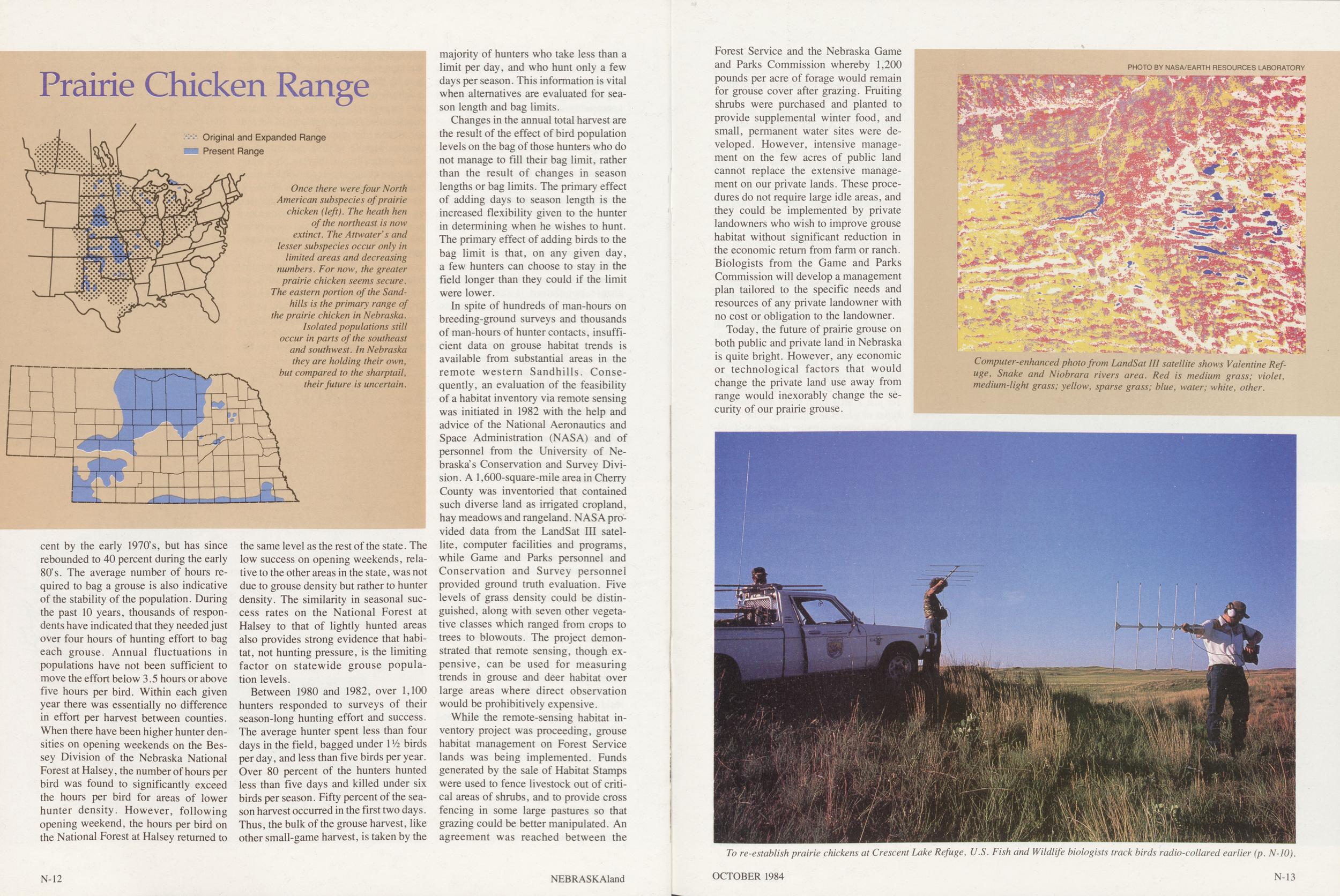
Original and Expanded Range Present Range
Prairie Chicken Range Once there were four North American subspecies of prairie chicken (left). The heath hen of the northeast is now extinct. The Attwater's and lesser subspecies occur only in limited areas and decreasing numbers. For now, the greater prairie chicken seems secure. The eastern portion of the Sandhills is the primary range of the prairie chicken in Nebraska. Isolated populations still occur in parts of the southeast and southwest. In Nebraska they are holding their own, but compared to the sharptail, their future is uncertain.by the early 1970's, but has since rebounded to 40 percent during the early 80's. The average number of hours required to bag a grouse is also indicative of the stability of the population. During the past 10 years, thousands of respondents have indicated that they needed just over four hours of hunting effort to bag each grouse. Annual fluctuations in populations have not been sufficient to move the effort below 3.5 hours or above five hours per bird. Within each given year there was essentially no difference in effort per harvest between counties. When there have been higher hunter densities on opening weekends on the Bessey Division of the Nebraska National Forest at Halsey, the number of hours per bird was found to significantly exceed the hours per bird for areas of lower hunter density. However, following opening weekend, the hours per bird on the National Forest at Halsey returned to the same level as the rest of the state. The low success on opening weekends, relative to the other areas in the state, was not due to grouse density but rather to hunter density. The similarity in seasonal success rates on the National Forest at Halsey to that of lightly hunted areas also provides strong evidence that habitat, not hunting pressure, is the limiting factor on statewide grouse population levels.
Between 1980 and 1982, over 1,100 hunters responded to surveys of their season-long hunting effort and success. The average hunter spent less than four days in the field, bagged under 1 1/2 birds per day, and less than five birds per year. Over 80 percent of the hunters hunted less than five days and killed under six birds per season. Fifty percent of the season harvest occurred in the first two days. Thus, the bulk of the grouse harvest, like other small-game harvest, is taken by the majority of hunters who take less than a limit per day, and who hunt only a few days per season. This information is vital when alternatives are evaluated for season length and bag limits.
Changes in the annual total harvest are the result of the effect of bird population levels on the bag of those hunters who do not manage to fill their bag limit, rather than the result of changes in season lengths or bag limits. The primary effect of adding days to season length is the increased flexibility given to the hunter in determining when he wishes to hunt. The primary effect of adding birds to the bag limit is that, on any given day, a few hunters can choose to stay in the field longer than they could if the limit were lower.
In spite of hundreds of man-hours on breeding-ground surveys and thousands of man-hours of hunter contacts, insufficient data on grouse habitat trends is available from substantial areas in the remote western Sandhills. Consequently, an evaluation of the feasibility of a habitat inventory via remote sensing was initiated in 1982 with the help and advice of the National Aeronautics and Space Administration (NASA) and of personnel from the University of Nebraska's Conservation and Survey Division. A 1,600-square-mile area in Cherry County was inventoried that contained such diverse land as irrigated cropland, hay meadows and rangeland. NASA provided data from the LandSat III satellite, computer facilities and programs, while Game and Parks personnel and Conservation and Survey personnel provided ground truth evaluation. Five levels of grass density could be distinguished, along with seven other vegetative classes which ranged from crops to trees to blowouts. The project demonstrated that remote sensing, though expensive, can be used for measuring trends in grouse and deer habitat over large areas where direct observation would be prohibitively expensive.
While the remote-sensing habitat inventory project was proceeding, grouse habitat management on Forest Service lands was being implemented. Funds generated by the sale of Habitat Stamps were used to fence livestock out of critical areas of shrubs, and to provide cross fencing in some large pastures so that grazing could be better manipulated. An agreement was reached between the
N-12 NEBRASKAlandForest Service and the Nebraska Game and Parks Commission whereby 1,200 pounds per acre of forage would remain for grouse cover after grazing. Fruiting shrubs were purchased and planted to provide supplemental winter food, and small, permanent water sites were developed. However, intensive management on the few acres of public land cannot replace the extensive management on our private lands. These procedures do not require large idle areas, and they could be implemented by private landowners who wish to improve grouse habitat without significant reduction in the economic return from farm or ranch. Biologists from the Game and Parks Commission will develop a management plan tailored to the specific needs and resources of any private landowner with no cost or obligation to the landowner.
Today, the future of prairie grouse on both public and private land in Nebraska is quite bright. However, any economic or technological factors that would change the private land use away from range would inexorably change the security of our prairie grouse.
PHOTO BY NASA/EARTH RESOURCES LABORATORYComputer-enhanced photo from LandSat III satellite shows Valentine Refuge, Snake and Niobrara rivers area. Red is medium grass; violet, medium-light grass; yellow, sparse grass; blue, water; white, other.
To re-establish prairie chickens at Crescent Lake Refuge, U.S. Fish and Wildlife biologists track birds radio-collared earlier (p. N-10).
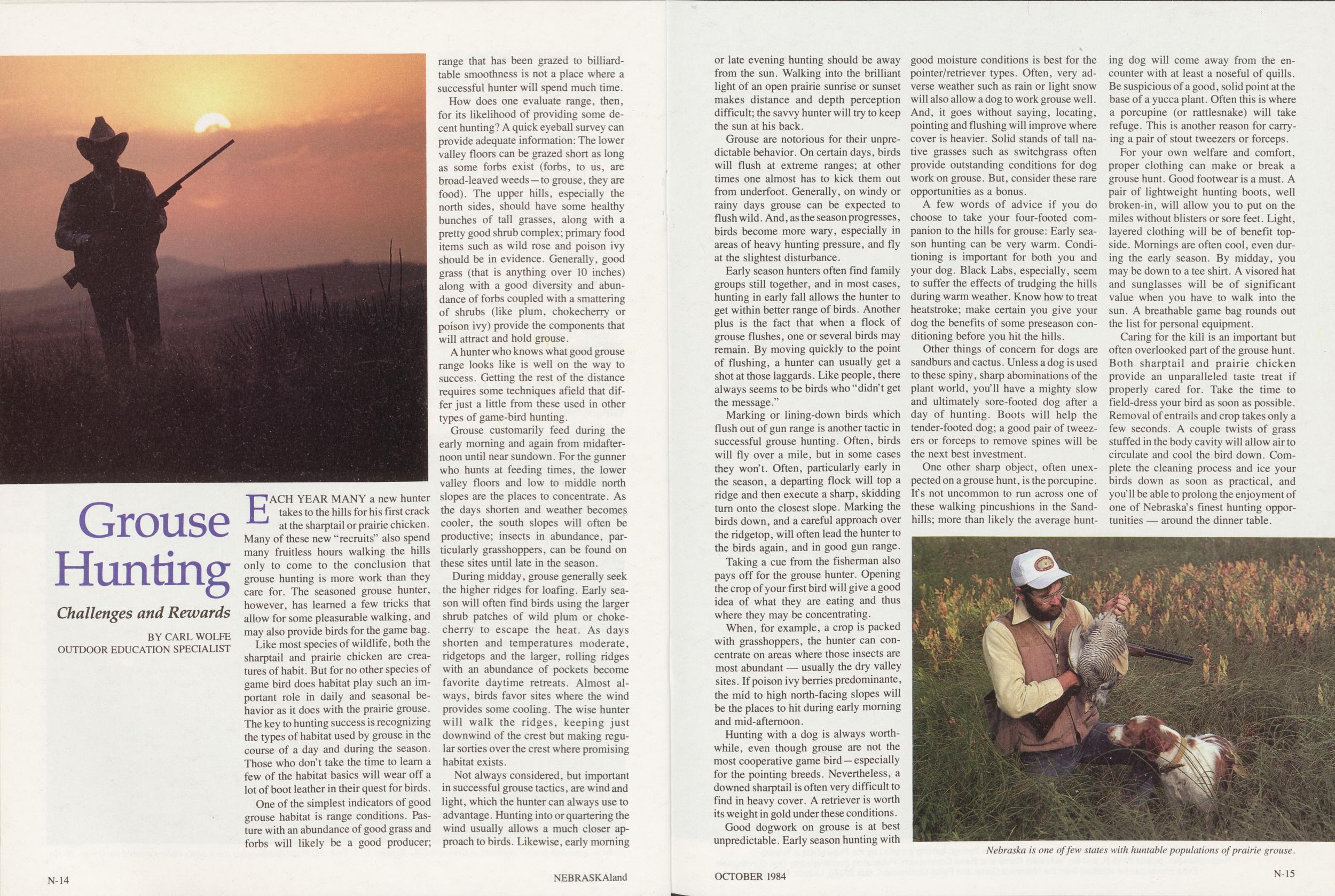
Grouse Hunting
Challenges and Rewards BY CARL WOLFE OUTDOOR EDUCATION SPECIALISTEACH YEAR MANY a new hunter takes to the hills for his first crack at the sharptail or prairie chicken. Many of these new "recruits" also spend many fruitless hours walking the hills only to come to the conclusion that grouse hunting is more work than they care for. The seasoned grouse hunter, however, has learned a few tricks that allow for some pleasurable walking, and may also provide birds for the game bag.
Like most species of wildlife, both the sharptail and prairie chicken are creatures of habit. But for no other species of game bird does habitat play such an important role in daily and seasonal behavior as it does with the prairie grouse. The key to hunting success is recognizing the types of habitat used by grouse in the course of a day and during the season. Those who don't take the time to learn a few of the habitat basics will wear off a lot of boot leather in their quest for birds.
One of the simplest indicators of good grouse habitat is range conditions. Pasture with an abundance of good grass and forbs will likely be a good producer; range that has been grazed to billiard-table smoothness is not a place where a successful hunter will spend much time.
How does one evaluate range, then, for its likelihood of providing some decent hunting? A quick eyeball survey can provide adequate information: The lower valley floors can be grazed short as long as some forbs exist (forbs, to us, are broad-leaved weeds —to grouse, they are food). The upper hills, especially the north sides, should have some healthy bunches of tall grasses, along with a pretty good shrub complex; primary food items such as wild rose and poison ivy should be in evidence. Generally, good grass (that is anything over 10 inches) along with a good diversity and abundance of forbs coupled with a smattering of shrubs (like plum, chokecherry or poison ivy) provide the components that will attract and hold grouse.
A hunter who knows what good grouse range looks like is well on the way to success. Getting the rest of the distance requires some techniques afield that differ just a little from these used in other types of game-bird hunting.
Grouse customarily feed during the early morning and again from midafternoon until near sundown. For the gunner who hunts at feeding times, the lower valley floors and low to middle north slopes are the places to concentrate. As the days shorten and weather becomes cooler, the south slopes will often be productive; insects in abundance, particularly grasshoppers, can be found on these sites until late in the season.
During midday, grouse generally seek the higher ridges for loafing. Early season will often find birds using the larger shrub patches of wild plum or chokecherry to escape the heat. As days shorten and temperatures moderate, ridgetops and the larger, rolling ridges with an abundance of pockets become favorite daytime retreats. Almost always, birds favor sites where the wind provides some cooling. The wise hunter will walk the ridges, keeping just downwind of the crest but making regular sorties over the crest where promising habitat exists.
Not always considered, but important in successful grouse tactics, are wind and light, which the hunter can always use to advantage. Hunting into or quartering the wind usually allows a much closer approach to birds. Likewise, early morning
N-14 NEBRASKAlandor late evening hunting should be away from the sun. Walking into the brilliant light of an open prairie sunrise or sunset makes distance and depth perception difficult; the savvy hunter will try to keep the sun at his back.
Grouse are notorious for their unpredictable behavior. On certain days, birds will flush at extreme ranges; at other times one almost has to kick them out from underfoot. Generally, on windy or rainy days grouse can be expected to flush wild. And, as the season progresses, birds become more wary, especially in areas of heavy hunting pressure, and fly at the slightest disturbance.
Early season hunters often find family groups still together, and in most cases, hunting in early fall allows the hunter to get within better range of birds. Another plus is the fact that when a flock of grouse flushes, one or several birds may remain. By moving quickly to the point of flushing, a hunter can usually get a shot at those laggards. Like people, there always seems to be birds who "didn't get the message."
Marking or lining-down birds which flush out of gun range is another tactic in successful grouse hunting. Often, birds will fly over a mile, but in some cases they won't. Often, particularly early in the season, a departing flock will top a ridge and then execute a sharp, skidding turn onto the closest slope. Marking the birds down, and a careful approach over the ridgetop, will often lead the hunter to the birds again, and in good gun range.
Taking a cue from the fisherman also pays off for the grouse hunter. Opening the crop of your first bird will give a good idea of what they are eating and thus where they may be concentrating.
When, for example, a crop is packed with grasshoppers, the hunter can concentrate on areas where those insects are most abundant — usually the dry valley sites. If poison ivy berries predominante, the mid to high north-facing slopes will be the places to hit during early morning and mid-afternoon.
Hunting with a dog is always worthwhile, even though grouse are not the most cooperative game bird — especially for the pointing breeds. Nevertheless, a downed sharptail is often very difficult to find in heavy cover. A retriever is worth its weight in gold under these conditions.
Good dogwork on grouse is at best unpredictable. Early season hunting with good moisture conditions is best for the pointer/retriever types. Often, very adverse weather such as rain or light snow will also allow a dog to work grouse well. And, it goes without saying, locating, pointing and flushing will improve where cover is heavier. Solid stands of tall native grasses such as switchgrass often provide outstanding conditions for dog work on grouse. But, consider these rare opportunities as a bonus.
A few words of advice if you do choose to take your four-footed companion to the hills for grouse: Early season hunting can be very warm. Conditioning is important for both you and your dog. Black Labs, especially, seem to suffer the effects of trudging the hills during warm weather. Know how to treat heatstroke; make certain you give your dog the benefits of some preseason conditioning before you hit the hills.
Other things of concern for dogs are sandburs and cactus. Unless a dog is used to these spiny, sharp abominations of the plant world, you'll have a mighty slow and ultimately sore-footed dog after a day of hunting. Boots will help the tender-footed dog; a good pair of tweezers or forceps to remove spines will be the next best investment.
One other sharp object, often unexpected on a grouse hunt, is the porcupine. It's not uncommon to run across one of these walking pincushions in the Sandhills; more than likely the average hunting dog will come away from the encounter with at least a noseful of quills. Be suspicious of a good, solid point at the base of a yucca plant. Often this is where a porcupine (or rattlesnake) will take refuge. This is another reason for carrying a pair of stout tweezers or forceps.
For your own welfare and comfort, proper clothing can make or break a grouse hunt. Good footwear is a must. A pair of lightweight hunting boots, well broken-in, will allow you to put on the miles without blisters or sore feet. Light, layered clothing will be of benefit topside. Mornings are often cool, even during the early season. By midday, you may be down to a tee shirt. A visored hat and sunglasses will be of significant value when you have to walk into the sun. A breathable game bag rounds out the list for personal equipment.
Caring for the kill is an important but often overlooked part of the grouse hunt. Both sharptail and prairie chicken provide an unparalleled taste treat if properly cared for. Take the time to field-dress your bird as soon as possible. Removal of entrails and crop takes only a few seconds. A couple twists of grass stuffed in the body cavity will allow air to circulate and cool the bird down. Complete the cleaning process and ice your birds down as soon as practical, and you'll be able to prolong the enjoyment of one of Nebraska's finest hunting opportunities — around the dinner table.
Nebraska is one of few states with huntable populations of prairie grouse.
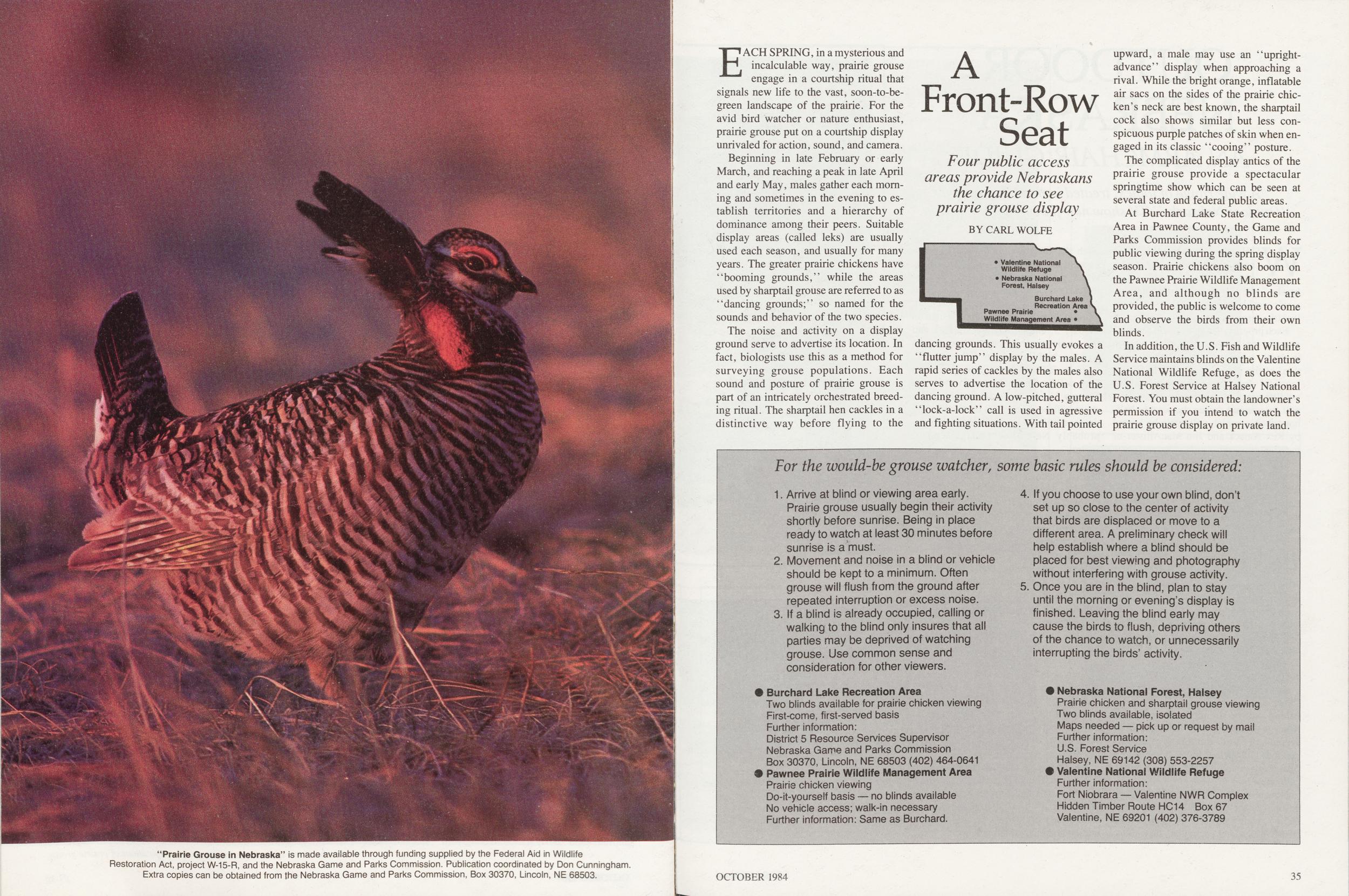
A Front-Row Seat
Four public access areas provide Nebraskans the chance to see prairie grouse display BY CARL WOLFE• Valentine National Wildlife Refuge • Nebraska National Forest, Halsey Burchard take Recreation Area Pawnee Prairie Wildlife Management Area
EACH SPRING, in a mysterious and incalculable way, prairie grouse engage in a courtship ritual that signals new life to the vast, soon-to-be-green landscape of the prairie. For the avid bird watcher or nature enthusiast, prairie grouse put on a courtship display unrivaled for action, sound, and camera.
Beginning in late February or early March, and reaching a peak in late April and early May, males gather each morning and sometimes in the evening to establish territories and a hierarchy of dominance among their peers. Suitable display areas (called leks) are usually used each season, and usually for many years. The greater prairie chickens have "booming grounds,' while the areas used by sharptail grouse are referred to as "dancing grounds;' so named for the sounds and behavior of the two species.
The noise and activity on a display ground serve to advertise its location. In fact, biologists use this as a method for surveying grouse populations. Each sound and posture of prairie grouse is part of an intricately orchestrated breeding ritual. The sharptail hen cackles in a distinctive way before flying to the dancing grounds. This usually evokes a "flutter jump" display by the males. A rapid series of cackles by the males also serves to advertise the location of the dancing ground. A low-pitched, gutteral "lock-a-lock" call is used in agressive and fighting situations. With tail pointed upward, a male may use an "upright-advance' display when approaching a rival. While the bright orange, inflatable air sacs on the sides of the prairie chicken's neck are best known, the sharptail cock also shows similar but less conspicuous purple patches of skin when engaged in its classic "cooing" posture.
The complicated display antics of the prairie grouse provide a spectacular springtime show which can be seen at several state and federal public areas.
At Burchard Lake State Recreation Area in Pawnee County, the Game and Parks Commission provides blinds for public viewing during the spring display season. Prairie chickens also boom on the Pawnee Prairie Wildlife Management Area, and although no blinds are provided, the public is welcome to come and observe the birds from their own blinds.
In addition, the U.S. Fish and Wildlife Service maintains blinds on the Valentine National Wildlife Refuge, as does the U.S. Forest Service at Halsey National Forest. You must obtain the landowner's permission if you intend to watch the prairie grouse display on private land.
For the would-be grouse watcher, some basic rules should be considered:
1. Arrive at blind or viewing area early. Prairie grouse usually begin their activity shortly before sunrise. Being in place ready to watch at least 30 minutes before sunrise is a must. 2. Movement and noise in a blind or vehicle should be kept to a minimum. Often grouse will flush from the ground after repeated interruption or excess noise. 3. If a blind is already occupied, calling or walking to the blind only insures that all parties may be deprived of watching grouse. Use common sense and consideration for other viewers. 4. If you choose to use your own blind, don't set up so close to the center of activity that birds are displaced or move to a different area. A preliminary check will help establish where a blind should be placed for best viewing and photography without interfering with grouse activity. 5. Once you are in the blind, plan to stay until the morning or evening's display is finished. Leaving the blind early may cause the birds to flush, depriving others of the chance to watch, or unnecessarily interrupting the birds' activity. Burchard Lake Recreation Area Two blinds available for prairie chicken viewing First-come, first-served basis Further information: District 5 Resource Services Supervisor Nebraska Game and Parks Commission Box 30370, Lincoln, NE 68503 (402) 464-0641 Pawnee Prairie Wildlife Management Area Prairie chicken viewing Do-it-yourself basis — no blinds available No vehicle access; walk-in necessary Further information: Same as Burchard. Nebraska National Forest, Halsey Prairie chicken and sharptail grouse viewing Two blinds available, isolated Maps needed — pick up or request by mail Further information: U.S. Forest Service Halsey, NE 69142 (308) 553-2257 Valentine National Wildlife Refuge Further information: Fort Niobrara — Valentine NWR Complex Hidden Timber Route HC14 Box 67 Valentine, NE 69201 (402) 376-3789 OCTOBER 1984 35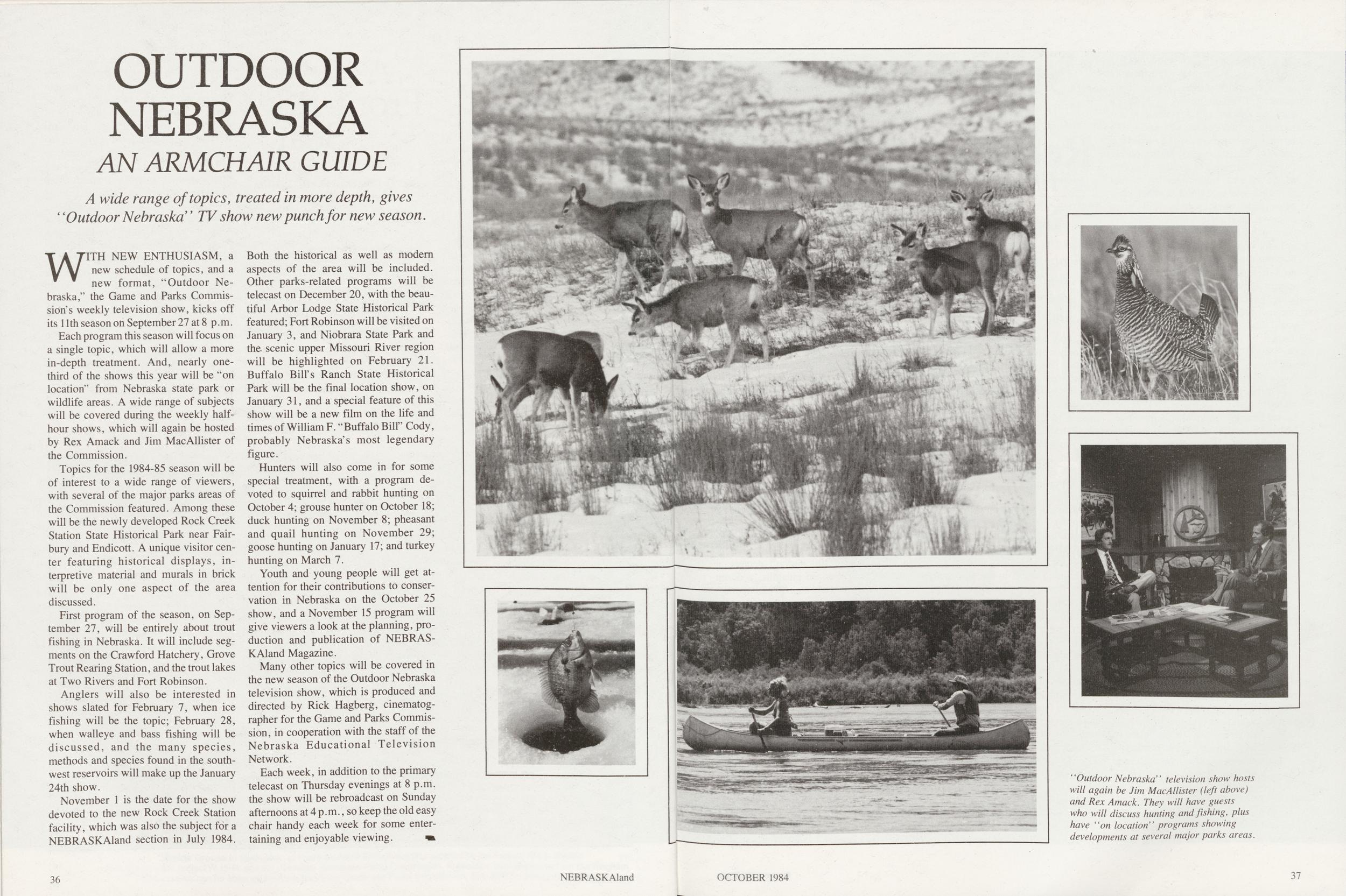
OUTDOOR NEBRASKA
AN ARMCHAIR GUIDE A wide range of topics, treated in more depth, gives "Outdoor Nebraska" TV show new punch for new season.WITH NEW ENTHUSIASM, a new schedule of topics, and a new format, "Outdoor Nebraska," the Game and Parks Commission's weekly television show, kicks off its 11th season on September 27 at 8 p.m.
Each program this season will focus on a single topic, which will allow a more in-depth treatment. And, nearly one-third of the shows this year will be "on location" from Nebraska state park or wildlife areas. A wide range of subjects will be covered during the weekly half-hour shows, which will again be hosted by Rex Amack and Jim MacAllister of the Commission.
Topics for the 1984-85 season will be of interest to a wide range of viewers, with several of the major parks areas of the Commission featured. Among these will be the newly developed Rock Creek Station State Historical Park near Fairbury and Endicott. A unique visitor center featuring historical displays, interpretive material and murals in brick will be only one aspect of the area discussed.
First program of the season, on September 27, will be entirely about trout fishing in Nebraska. It will include segments on the Crawford Hatchery, Grove Trout Rearing Station, and the trout lakes at Two Rivers and Fort Robinson.
Anglers will also be interested in shows slated for February 7, when ice fishing will be the topic; February 28, when walleye and bass fishing will be discussed, and the many species, methods and species found in the southwest reservoirs will make up the January 24th show.
November 1 is the date for the show devoted to the new Rock Creek Station facility, which was also the subject for a NEBRASKAland section in July 1984. Both the historical as well as modern aspects of the area will be included. Other parks-related programs will be telecast on December 20, with the beautiful Arbor Lodge State Historical Park featured; Fort Robinson will be visited on January 3, and Niobrara State Park and the scenic upper Missouri River region will be highlighted on February 21. Buffalo Bill's Ranch State Historical Park will be the final location show, on January 31, and a special feature of this show will be a new film on the life and times of William F. "Buffalo Bill" Cody, probably Nebraska's most legendary figure.
Hunters will also come in for some special treatment, with a program devoted to squirrel and rabbit hunting on October 4; grouse hunter on October 18; duck hunting on November 8; pheasant and quail hunting on November 29; goose hunting on January 17; and turkey hunting on March 7.
Youth and young people will get attention for their contributions to conservation in Nebraska on the October 25 show, and a November 15 program will give viewers a look at the planning, production and publication of NEBRASKAland Magazine.
Many other topics will be covered in the new season of the Outdoor Nebraska television show, which is produced and directed by Rick Hagberg, cinematographer for the Game and Parks Commission, in cooperation with the staff of the Nebraska Educational Television Network.
Each week, in addition to the primary telecast on Thursday evenings at 8 p.m. the show will be rebroadcast on Sunday afternoons at 4 p.m., so keep the old easy chair handy each week for some entertaining and enjoyable viewing.
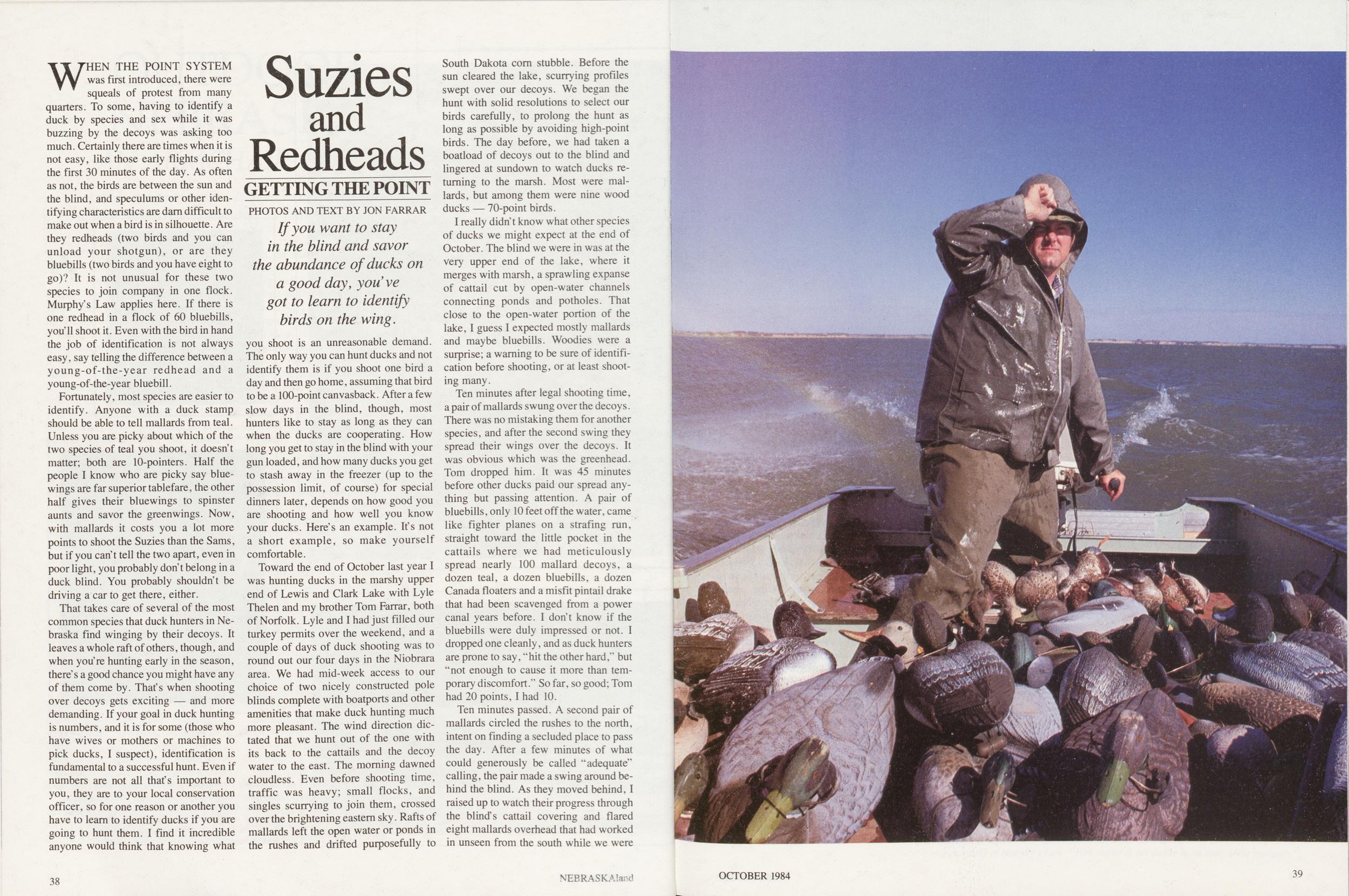
Suzies and Redheads
GETTING THE POINT PHOTOS AND TEXT BY JON FARRAR If you want to stay in the blind and savor the abundance of ducks on a good day, you've got to learn to identify birds on the wing.WHEN THE POINT SYSTEM was first introduced, there were squeals of protest from many quarters. To some, having to identify a duck by species and sex while it was buzzing by the decoys was asking too much. Certainly there are times when it is not easy, like those early flights during the first 30 minutes of the day. As often as not, the birds are between the sun and the blind, and speculums or other identifying characteristics are darn difficult to make out when a bird is in silhouette. Are they redheads (two birds and you can unload your shotgun), or are they bluebills (two birds and you have eight to go)? It is not unusual for these two species to join company in one flock. Murphy's Law applies here. If there is one redhead in a flock of 60 bluebills, you'll shoot it. Even with the bird in hand the job of identification is not always easy, say telling the difference between a young-of-the-year redhead and a young-of-the-year bluebill.
Fortunately, most species are easier to identify. Anyone with a duck stamp should be able to tell mallards from teal. Unless you are picky about which of the two species of teal you shoot, it doesn't matter; both are 10-pointers. Half the people I know who are picky say blue-wings are far superior tablefare, the other half gives their bluewings to spinster aunts and savor the greenwings. Now, with mallards it costs you a lot more points to shoot the Suzies than the Sams, but if you can't tell the two apart, even in poor light, you probably don't belong in a duck blind. You probably shouldn't be driving a car to get there, either.
That takes care of several of the most common species that duck hunters in Nebraska find winging by their decoys. It leaves a whole raft of others, though, and when you're hunting early in the season, there's a good chance you might have any of them come by. That's when shooting over decoys gets exciting — and more demanding. If your goal in duck hunting is numbers, and it is for some (those who have wives or mothers or machines to pick ducks, I suspect), identification is fundamental to a successful hunt. Even if numbers are not all that's important to you, they are to your local conservation officer, so for one reason or another you have to learn to identify ducks if you are going to hunt them. I find it incredible anyone would think that knowing what you shoot is an unreasonable demand. The only way you can hunt ducks and not identify them is if you shoot one bird a day and then go home, assuming that bird to be a 100-point canvasback. After a few slow days in the blind, though, most hunters like to stay as long as they can when the ducks are cooperating. How long you get to stay in the blind with your gun loaded, and how many ducks you get to stash away in the freezer (up to the possession limit, of course) for special dinners later, depends on how good you are shooting and how well you know your ducks. Here's an example. It's not a short example, so make yourself comfortable.
Toward the end of October last year I was hunting ducks in the marshy upper end of Lewis and Clark Lake with Lyle Thelen and my brother Tom Farrar, both of Norfolk. Lyle and I had just filled our turkey permits over the weekend, and a couple of days of duck shooting was to round out our four days in the Niobrara area. We had mid-week access to our choice of two nicely constructed pole blinds complete with boatports and other amenities that make duck hunting much more pleasant. The wind direction dictated that we hunt out of the one with its back to the cattails and the decoy water to the east. The morning dawned cloudless. Even before shooting time, traffic was heavy; small flocks, and singles scurrying to join them, crossed over the brightening eastern sky. Rafts of mallards left the open water or ponds in the rushes and drifted purposefully to South Dakota corn stubble. Before the sun cleared the lake, scurrying profiles swept over our decoys. We began the hunt with solid resolutions to select our birds carefully, to prolong the hunt as long as possible by avoiding high-point birds. The day before, we had taken a boatload of decoys out to the blind and lingered at sundown to watch ducks returning to the marsh. Most were mallards, but among them were nine wood ducks — 70-point birds.
I really didn't know what other species of ducks we might expect at the end of October. The blind we were in was at the very upper end of the lake, where it merges with marsh, a sprawling expanse of cattail cut by open-water channels connecting ponds and potholes. That close to the open-water portion of the lake, I guess I expected mostly mallards and maybe bluebills. Woodies were a surprise; a warning to be sure of identification before shooting, or at least shooting many.
Ten minutes after legal shooting time, a pair of mallards swung over the decoys. There was no mistaking them for another species, and after the second swing they spread their wings over the decoys. It was obvious which was the greenhead. Tom dropped him. It was 45 minutes before other ducks paid our spread anything but passing attention. A pair of bluebills, only 10 feet off the water, came like fighter planes on a strafing run, straight toward the little pocket in the cattails where we had meticulously spread nearly 100 mallard decoys, a dozen teal, a dozen bluebills, a dozen Canada floaters and a misfit pintail drake that had been scavenged from a power canal years before. I don't know if the bluebills were duly impressed or not. I dropped one cleanly, and as duck hunters are prone to say, "hit the other hard," but "not enough to cause it more than temporary discomfort." So far, so good; Tom had 20 points, I had 10.
Ten minutes passed. A second pair of mallards circled the rushes to the north, intent on finding a secluded place to pass the day. After a few minutes of what could generously be called "adequate" calling, the pair made a swing around behind the blind. As they moved behind, I raised up to watch their progress through the blind's cattail covering and flared eight mallards overhead that had worked in unseen from the south while we were
38 NEBRASKAland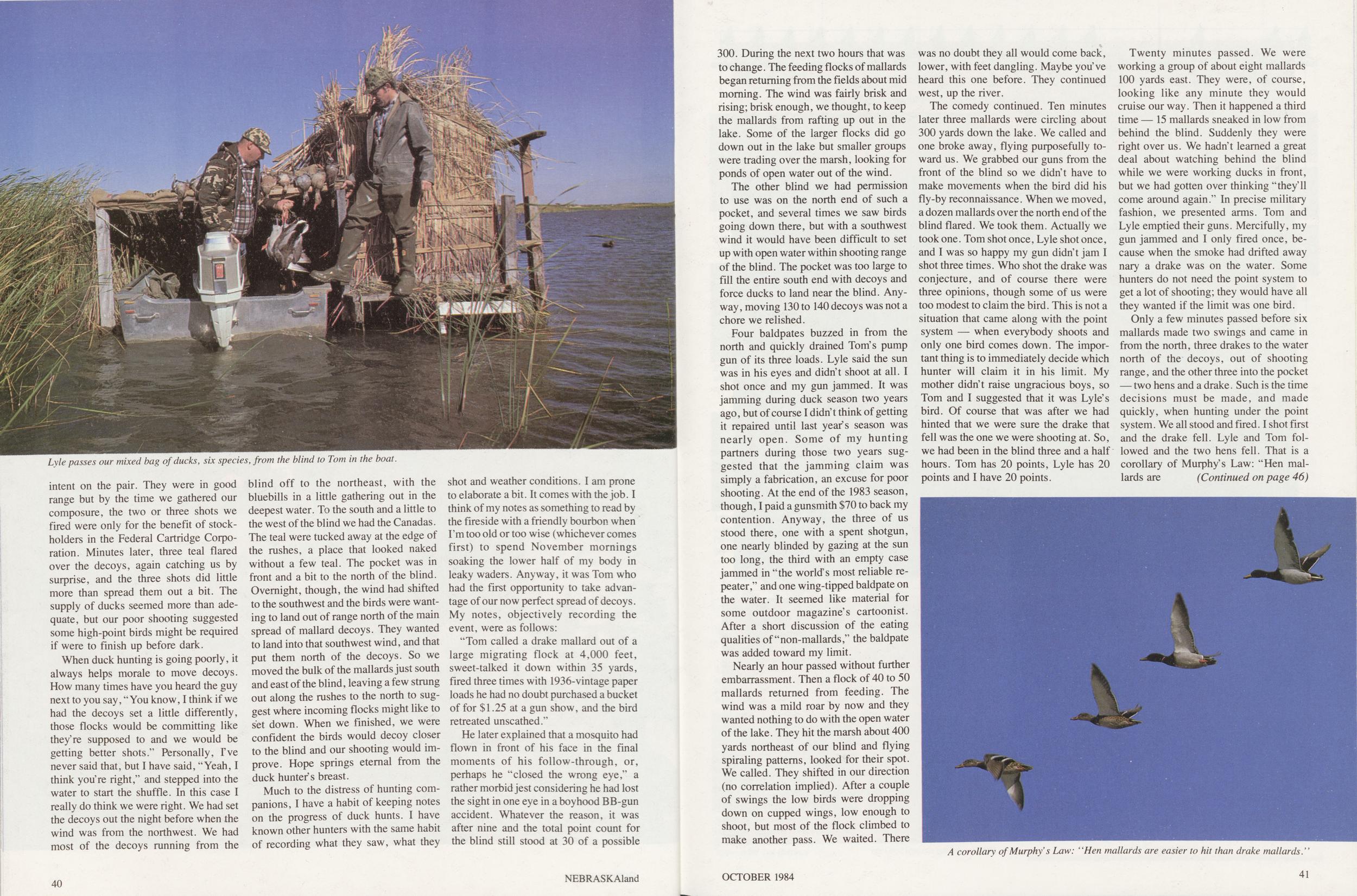
Lyle passes our mixed bag of ducks, six species, from the blind to Tom in the boat.
intent on the pair. They were in good range but by the time we gathered our composure, the two or three shots we fired were only for the benefit of stockholders in the Federal Cartridge Corporation. Minutes later, three teal flared over the decoys, again catching us by surprise, and the three shots did little more than spread them out a bit. The supply of ducks seemed more than adequate, but our poor shooting suggested some high-point birds might be required if were to finish up before dark.
When duck hunting is going poorly, it always helps morale to move decoys. How many times have you heard the guy next to you say, "You know, I think if we had the decoys set a little differently, those flocks would be committing like they're supposed to and we would be getting better shots." Personally, I've never said that, but I have said, "Yeah, I think you're right," and stepped into the water to start the shuffle. In this case I really do think we were right. We had set the decoys out the night before when the wind was from the northwest. We had most of the decoys running from the blind off to the northeast, with the bluebills in a little gathering out in the deepest water. To the south and a little to the west of the blind we had the Canadas. The teal were tucked away at the edge of the rushes, a place that looked naked without a few teal. The pocket was in front and a bit to the north of the blind. Overnight, though, the wind had shifted to the southwest and the birds were wanting to land out of range north of the main spread of mallard decoys. They wanted to land into that southwest wind, and that put them north of the decoys. So we moved the bulk of the mallards just south and east of the blind, leaving a few strung out along the rushes to the north to suggest where incoming flocks might like to set down. When we finished, we were confident the birds would decoy closer to the blind and our shooting would improve. Hope springs eternal from the duck hunter's breast.
Much to the distress of hunting companions, I have a habit of keeping notes on the progress of duck hunts. I have known other hunters with the same habit of recording what they saw, what they shot and weather conditions. I am prone to elaborate a bit. It comes with the job. I think of my notes as something to read by the fireside with a friendly bourbon when I'm too old or too wise (whichever comes first) to spend November mornings soaking the lower half of my body in leaky waders. Anyway, it was Tom who had the first opportunity to take advantage of our now perfect spread of decoys. My notes, objectively recording the event, were as follows:
"Tom called a drake mallard out of a large migrating flock at 4,000 feet, sweet-talked it down within 35 yards, fired three times with 1936-vintage paper loads he had no doubt purchased a bucket of for $1.25 at a gun show, and the bird retreated unscathed."
He later explained that a mosquito had flown in front of his face in the final moments of his follow-through, or, perhaps he "closed the wrong eye," a rather morbid jest considering he had lost the sight in one eye in a boyhood BB-gun accident. Whatever the reason, it was after nine and the total point count for the blind still stood at 30 of a possible
40 NEBRASKAland300. During the next two hours that was to change. The feeding flocks of mallards began returning from the fields about mid morning. The wind was fairly brisk and rising; brisk enough, we thought, to keep the mallards from rafting up out in the lake. Some of the larger flocks did go down out in the lake but smaller groups were trading over the marsh, looking for ponds of open water out of the wind.
The other blind we had permission to use was on the north end of such a pocket, and several times we saw birds going down there, but with a southwest wind it would have been difficult to set up with open water within shooting range of the blind. The pocket was too large to fill the entire south end with decoys and force ducks to land near the blind. Anyway, moving 130 to 140 decoys was not a chore we relished.
Four baldpates buzzed in from the north and quickly drained Tom's pump gun of its three loads. Lyle said the sun was in his eyes and didn't shoot at all. I shot once and my gun jammed. It was jamming during duck season two years ago, but of course I didn't think of getting it repaired until last year's season was nearly open. Some of my hunting partners during those two years suggested that the jamming claim was simply a fabrication, an excuse for poor shooting. At the end of the 1983 season, though, I paid a gunsmith $70 to back my contention. Anyway, the three of us stood there, one with a spent shotgun, one nearly blinded by gazing at the sun too long, the third with an empty case jammed in "the world's most reliable repeater," and one wing-tipped baldpate on the water. It seemed like material for some outdoor magazine's cartoonist. After a short discussion of the eating qualities of "non-mallards," the baldpate was added toward my limit.
Nearly an hour passed without further embarrassment. Then a flock of 40 to 50 mallards returned from feeding. The wind was a mild roar by now and they wanted nothing to do with the open water of the lake. They hit the marsh about 400 yards northeast of our blind and flying spiraling patterns, looked for their spot. We called. They shifted in our direction (no correlation implied). After a couple of swings the low birds were dropping down on cupped wings, low enough to shoot, but most of the flock climbed to make another pass. We waited. There was no doubt they all would come back, lower, with feet dangling. Maybe you've heard this one before. They continued west, up the river.
The comedy continued. Ten minutes later three mallards were circling about 300 yards down the lake. We called and one broke away, flying purposefully toward us. We grabbed our guns from the front of the blind so we didn't have to make movements when the bird did his fly-by reconnaissance. When we moved, a dozen mallards over the north end of the blind flared. We took them. Actually we took one. Tom shot once, Lyle shot once, and I was so happy my gun didn't jam I shot three times. Who shot the drake was conjecture, and of course there were three opinions, though some of us were too modest to claim the bird. This is not a situation that came along with the point system — when everybody shoots and only one bird comes down. The important thing is to immediately decide which hunter will claim it in his limit. My mother didn't raise ungracious boys, so Tom and I suggested that it was Lyle's bird. Of course that was after we had hinted that we were sure the drake that fell was the one we were shooting at. So, we had been in the blind three and a half hours. Tom has 20 points, Lyle has 20 points and I have 20 points.
Twenty minutes passed. We were working a group of about eight mallards 100 yards east. They were, of course, looking like any minute they would cruise our way. Then it happened a third time — 15 mallards sneaked in low from behind the blind. Suddenly they were right over us. We hadn't learned a great deal about watching behind the blind while we were working ducks in front, but we had gotten over thinking "they'll come around again." In precise military fashion, we presented arms. Tom and Lyle emptied their guns. Mercifully, my gun jammed and I only fired once, because when the smoke had drifted away nary a drake was on the water. Some hunters do not need the point system to get a lot of shooting; they would have all they wanted if the limit was one bird.
Only a few minutes passed before six mallards made two swings and came in from the north, three drakes to the water north of the decoys, out of shooting range, and the other three into the pocket — two hens and a drake. Such is the time decisions must be made, and made quickly, when hunting under the point system. We all stood and fired. I shot first and the drake fell. Lyle and Tom followed and the two hens fell. That is a corollary of Murphy's Law: "Hen mallards are
(Continued on page 46)A corollary of Murphy's Law: "Hen mallards are easier to hit than drake mallards."
LEANIN' TREE
Box 9500-R-BK26, Boulder,CO 80301 Western Christmans Cards 2298 "A Cowboy's Prayer' (poem by Badger Clark inside) Merry Christmas and a Happy New Year—artist Bill Moyers 2280 Merry Christmas and best wishes for a Happy New Year—artist Mille Funk 1986 May Christmas bring Friends to your Fireside, Peace to your Pathway, and Good Health throughout the New Year—R. Wagoner 2296 Ho, ho, ho...It's Christmas again! May yours be a joyful one and your New Year happy!—artist Richard Earth 3253 "Take Time to See" (inspirational nature poem inside) Merry Christmas and a Happy New Year—artist TedBlaylock 3261 May Christmas bring to you the music of laughter.. .the warmth of friendship and the spirit of love—artist Richard Barth 2262 Never a Christmas...but someone thinks of.. .old friends. Merry Christmas and...a Happy New Year—artist Stewart 2252 It's Christmas again! May yours be a joyful one and your New Year happy!—artist Hildred Goodwine 2309 The splendor of Christ's ...birth, the love of friend for friend. Merry Christmas and a Happy New Year—artist CJ. Smith 2278 Never too cold for kindness, never too deep the snow, to wish you the Merriest Christmas our Good Lord can bestow!—Winter Box 9500-R-BK26, Boulder, CO 80301 2285 Merry Christmas and a Happy New Year—artist Hildred Goodwine 2033 May Christmas bring Friends to your Fireside, Peace to your Pathway, and Good Health throughout the New Year—artist Russ Vickers Free Gift Offer! See Coupon For Details. We 're proud to call you Pardner when it comes to having a true Western Christmas,
Our beautiful 5" x 7" cards show all the fun and flavor of the great West with color
and character. Order your cards today, from a company whose business has been Western
for 35 years. See coupon for details.
2276 May Christmas bring
Friends to your Fireside, and
Peace...Merry Christmas and a
Happy New Year—C. Cummings
2257 To those we love and see
each day and other loved ones far
away...Merry Christmas from the
two of us!—artist J. W. Claflin
2304 May Christmas bring Friends
to your Fireside, Peace to Your Pathway, and Good Health throughout
the New Year—artist Parkinson
2277 May your blessings be... a
warmth to remember. Merry
Christmas and a Happy New
Year—artist Buck Teeter
1903 Greetings.. .May there
come to you at this holiday time
...Health, Happiness and Enduring
Friendships—artist Ron Crooks
2284 To those we love and see
each day and other loved ones far
away...Merry Christmas and Happy
New Year!—artist Russ Vickers
2299 Hello there, folks! any
time you're here about, you'll find
our latch string hanging out. Merry
Christmas...Happy New Year—Deuel
2302 Merry Christmas and Best
Wishes for a Happy New Year—artist Lisa Danielle Lorimer
2308 This time of year when
the air's full of cheer... Merry
Christmas and a Happy New
Year—artist Melvin C. Warren
1151 (Quotation from Keats
inside) May every happiness be
yours at Christmas and throughout
the New Year—artist Lowdermilk
1602 CHRISTMAS WISHES
COME TRUE Merry Christmas and
best wishes for a Happy New Year
artist Hildred Goodwine
1822 Christmas Greetings
Wishing you a Merry Christmas
and a Happy New Year—artist
Charles M. Russell
1897 Britches patched. Vittles
skeerce...Both horses lame, but
Merry Christmas just the same! (S.
Omar Barker)—artist Jack Roberts
3310 (Quotation from William
Cullen Bryant inside) May Peace be
your Gift at Christmas and your
Treasure...all the Year—H. Lyon
1304 May God hold you in
the hollow of His hand. Merry
Christmas and Best Wishes for a
Happy New Year—artist Snidow
1140 May Christmas bring Friends
to your Fireside, Peace to your
Pathway, and Good Health throughout the New Year—artist Shaddix
1872 May the Christmas Spirit
remain within your hearts and
home throughout the Coming
Year—artist Duane Bryers
2011 To those we love and see
each day and other loved ones far
away...Merry Christmas and Happy
New Year—L.K. Parkinson
Turns chanse, and urn with time,
but not in the ways of friendship.
2173 Times change... but not
...friendship. Let us keep
Christmas...the warmth and joy of
remembering friends.—J. Claflin
2205 Whatever else changes...
Christmas remains...May its light...
bless you with joy and happiness
throughout the...Year.—Blaylock
Order Your Western
Christmas Cards Today By Mail!
4192 "Glory to God..." (Luke
2:14 inside) May the Peace and Joy
of Christmas be with you through
all the Year—photo by F. Manley
3252 Never a Christmas...ends,
but someone thinks of...old friends.
Merry Christmas and Best Wishes
for a Happy New Year—artist Wise
1674 Merry Christmas...and
best wishes for a Happy New Year
from our Outfit to Yours—artist
Vic Donahue
2313 "A Cowboy's Christmas
Prayer" (Western poem by S. Omar
Barker inside) Merry Christmas and
a Happy New Year—artist Marks
1979 This time of year.. .what
could be better.. .than to wish
Merry Christmas to all whom we
know!—artist Melvin C Warren
2259 To those we love and
see each day and other loved
ones...Merry Christmas and Happy New Year—artist J. W. Claflin
1462 "Peace on Earth" May
Peace be your Gift at Christmas and
your Treasure through all the Year
artist Brummett EchoHawk
1315 Whatever else...changes,
Christmas remains...May the Spirit
of Christmas abide with you throughout the Coming Year—B. Thomas
2022 Greetings... May you
have the Spirit of Christmas which
is Peace.. .the Heart of Christmas
which is Love—artist T Blaylock
1657 CHRISTMAS EVE IN A
MANGER May the blessings of
Christmas be with you today and
always—artist Hildred Goodwine
HOW TO ORDER: Order cards of all one design or
assort in any combination totaling 15, 20, 25, 30, etc. Indicate number
of cards to right of order code. Remember to include postage and
handling. Enclose payment with order form. MasterCard and VISA
accepted. No C.O.D.'s. (Canadian orders will be charged a customs
duty at the border.) Thank you for your order.
1140 1903 2262 2304
1151 1979 2276 2308
1304 1986 2277 2309
1315 2011 2278 2313
1462 2022 2280 3252
1602 2033 2284 3253
1657 2173 2285 3261
1674 2205 2296 3310
1822 2252 2298 4192
1872 2257 2299
1897 2259 2302
CHRISTMAS CARD PRICE LIST
Cards
Cost
15 $5.85
20 $7.80
25 $9-75
30 $11.70
40 $15.60
50 $19.50
75 $29.25
100 $39-00
125 $48.75
150 $58.50
175 $68.25
200 $78.00
over 200 - 34 cents per card
Imprinting Services (optional)
Your name can be printed inside
cards and your address on
envelopes. Costs listed below are
for each separate service.
# Cards Ordered
50 & under
51-100
101-200
Over 200
Cost
$4.00
$5.00
$6.00
$7.00
Number of cards
Cost of cards $
Name printing (cards only) $
Address printmg(enJnejy7s $
CO. res. add 3% sales
tax; CA. res. add
6% use tax. $
Postage and Handling
Total Order P&H
Under $9.99 $2.00 $
$10-19.99 $2.50
$20 & Over $3.00
TOTAL $
Choose one envelope color.
(If no choice,white will be shipped)
□ FREE GIFT!
Check the box above if
total order is $20.00 or
more and receive an
assortment of 10
Western all-occasion
cards free, worth $7.00.
FREE catalog
Check the box above to
receive a FREE full-color,
full-length catalog showing many more Leanin'
Tree products.
Names to be printed
on Christmas cards
Send cards and/or
free catalog to
Rte.,St.,BoxNo.
City
State
Zip
MasterCard VISA
Signature
Expiration Date
Box 9500-R-BK26, Boulder, CO 80301
Satisfaction Guaranteed or Your Money Back!
Our 35 th Year in Business
We 're proud to call you Pardner when it comes to having a true Western Christmas,
Our beautiful 5" x 7" cards show all the fun and flavor of the great West with color
and character. Order your cards today, from a company whose business has been Western
for 35 years. See coupon for details.
2276 May Christmas bring
Friends to your Fireside, and
Peace...Merry Christmas and a
Happy New Year—C. Cummings
2257 To those we love and see
each day and other loved ones far
away...Merry Christmas from the
two of us!—artist J. W. Claflin
2304 May Christmas bring Friends
to your Fireside, Peace to Your Pathway, and Good Health throughout
the New Year—artist Parkinson
2277 May your blessings be... a
warmth to remember. Merry
Christmas and a Happy New
Year—artist Buck Teeter
1903 Greetings.. .May there
come to you at this holiday time
...Health, Happiness and Enduring
Friendships—artist Ron Crooks
2284 To those we love and see
each day and other loved ones far
away...Merry Christmas and Happy
New Year!—artist Russ Vickers
2299 Hello there, folks! any
time you're here about, you'll find
our latch string hanging out. Merry
Christmas...Happy New Year—Deuel
2302 Merry Christmas and Best
Wishes for a Happy New Year—artist Lisa Danielle Lorimer
2308 This time of year when
the air's full of cheer... Merry
Christmas and a Happy New
Year—artist Melvin C. Warren
1151 (Quotation from Keats
inside) May every happiness be
yours at Christmas and throughout
the New Year—artist Lowdermilk
1602 CHRISTMAS WISHES
COME TRUE Merry Christmas and
best wishes for a Happy New Year
artist Hildred Goodwine
1822 Christmas Greetings
Wishing you a Merry Christmas
and a Happy New Year—artist
Charles M. Russell
1897 Britches patched. Vittles
skeerce...Both horses lame, but
Merry Christmas just the same! (S.
Omar Barker)—artist Jack Roberts
3310 (Quotation from William
Cullen Bryant inside) May Peace be
your Gift at Christmas and your
Treasure...all the Year—H. Lyon
1304 May God hold you in
the hollow of His hand. Merry
Christmas and Best Wishes for a
Happy New Year—artist Snidow
1140 May Christmas bring Friends
to your Fireside, Peace to your
Pathway, and Good Health throughout the New Year—artist Shaddix
1872 May the Christmas Spirit
remain within your hearts and
home throughout the Coming
Year—artist Duane Bryers
2011 To those we love and see
each day and other loved ones far
away...Merry Christmas and Happy
New Year—L.K. Parkinson
Turns chanse, and urn with time,
but not in the ways of friendship.
2173 Times change... but not
...friendship. Let us keep
Christmas...the warmth and joy of
remembering friends.—J. Claflin
2205 Whatever else changes...
Christmas remains...May its light...
bless you with joy and happiness
throughout the...Year.—Blaylock
Order Your Western
Christmas Cards Today By Mail!
4192 "Glory to God..." (Luke
2:14 inside) May the Peace and Joy
of Christmas be with you through
all the Year—photo by F. Manley
3252 Never a Christmas...ends,
but someone thinks of...old friends.
Merry Christmas and Best Wishes
for a Happy New Year—artist Wise
1674 Merry Christmas...and
best wishes for a Happy New Year
from our Outfit to Yours—artist
Vic Donahue
2313 "A Cowboy's Christmas
Prayer" (Western poem by S. Omar
Barker inside) Merry Christmas and
a Happy New Year—artist Marks
1979 This time of year.. .what
could be better.. .than to wish
Merry Christmas to all whom we
know!—artist Melvin C Warren
2259 To those we love and
see each day and other loved
ones...Merry Christmas and Happy New Year—artist J. W. Claflin
1462 "Peace on Earth" May
Peace be your Gift at Christmas and
your Treasure through all the Year
artist Brummett EchoHawk
1315 Whatever else...changes,
Christmas remains...May the Spirit
of Christmas abide with you throughout the Coming Year—B. Thomas
2022 Greetings... May you
have the Spirit of Christmas which
is Peace.. .the Heart of Christmas
which is Love—artist T Blaylock
1657 CHRISTMAS EVE IN A
MANGER May the blessings of
Christmas be with you today and
always—artist Hildred Goodwine
HOW TO ORDER: Order cards of all one design or
assort in any combination totaling 15, 20, 25, 30, etc. Indicate number
of cards to right of order code. Remember to include postage and
handling. Enclose payment with order form. MasterCard and VISA
accepted. No C.O.D.'s. (Canadian orders will be charged a customs
duty at the border.) Thank you for your order.
1140 1903 2262 2304
1151 1979 2276 2308
1304 1986 2277 2309
1315 2011 2278 2313
1462 2022 2280 3252
1602 2033 2284 3253
1657 2173 2285 3261
1674 2205 2296 3310
1822 2252 2298 4192
1872 2257 2299
1897 2259 2302
CHRISTMAS CARD PRICE LIST
Cards
Cost
15 $5.85
20 $7.80
25 $9-75
30 $11.70
40 $15.60
50 $19.50
75 $29.25
100 $39-00
125 $48.75
150 $58.50
175 $68.25
200 $78.00
over 200 - 34 cents per card
Imprinting Services (optional)
Your name can be printed inside
cards and your address on
envelopes. Costs listed below are
for each separate service.
# Cards Ordered
50 & under
51-100
101-200
Over 200
Cost
$4.00
$5.00
$6.00
$7.00
Number of cards
Cost of cards $
Name printing (cards only) $
Address printmg(enJnejy7s $
CO. res. add 3% sales
tax; CA. res. add
6% use tax. $
Postage and Handling
Total Order P&H
Under $9.99 $2.00 $
$10-19.99 $2.50
$20 & Over $3.00
TOTAL $
Choose one envelope color.
(If no choice,white will be shipped)
□ FREE GIFT!
Check the box above if
total order is $20.00 or
more and receive an
assortment of 10
Western all-occasion
cards free, worth $7.00.
FREE catalog
Check the box above to
receive a FREE full-color,
full-length catalog showing many more Leanin'
Tree products.
Names to be printed
on Christmas cards
Send cards and/or
free catalog to
Rte.,St.,BoxNo.
City
State
Zip
MasterCard VISA
Signature
Expiration Date
Box 9500-R-BK26, Boulder, CO 80301
Satisfaction Guaranteed or Your Money Back!
Our 35 th Year in Business
Suzies and redheads... getting the point
(Continued from page 41)easier to hit than drake mallards."
Well, you can see I am finally getting back to making a point about the point system. Tom and Lyle each had two mallards, a drake and a hen apiece, 90 points; one more bird, any bird, and they would have a limit. I had three birds, a drake mallard, a baldpate and bluebill — 40 points worth. If I shot only 10-point birds, I legally could shoot six more ducks.
A lone greenwing came to the decoys without hesitation and my count went up to 50 points. At 90 points each, Tom and Lyle had become a bit more selective about what species they would shoot at, so when a flock of shovelers came out of the northeast, directly to the decoys, as shovelers often do, I added two more birds, 10 points each, and brought my count up to 70.
Now indulge me a bit. I cannot leave the subject of shooting shovelers without expanding. Over the years I have earned something of a reputation, notoriety if you prefer, for a rather brazen defense of the shoveler as a sporting bird worthy of attention in a crock pot. Several of my hunting companions, a couple of them still relatively young, have capitalized on my penchant for "scoopers" and freely participate in the shooting, if not the claiming, of them.
Though my identification of all duck species on the wing still requires some fine honing, I find hunting a "mixed bag" of ducks much more interesting than glumly waiting for one with a green head to come by. If you spend any time at all watching ducks (especially at times when you are not intent on shooting them), you come to appreciate all species.
Now don't misunderstand me: I have absolutely nothing against eating mallards. In fact, mallards, along with a couple of other species, are usually saved for special occasions or friends and frequently escape being skinned, as is recommended since accumulations of pesticides started showing up in the fatty tissue of waterfowl. It's just that I find very little pleasure in the boast, or those who boast, "I only shoot mallards." Of all ducks, mallards are probably the most bland tasting; most like a domestic bird. Americans seem to prefer processed cheese over real cheese, and similarly want their fowl to taste like it came from a Georgia chicken factory. In part, this fixation with mallards accounts for the fact that under the point system, hunters are allowed 10 bluebills or 10 teal a day, but only two hen mallards.Among some waterfowl hunters, shooting only mallards has become something of a status symbol.
You have been indulgent so I will return to my story. By the time we retrieved my shovelers, it was nearly noon. Tom and Lyle were 10 points short of a limit and I had 30 points to go. Without so much as a swing, a lone hen mallard dropped her landing gear over the decoys. I guess when you are at 90 points a mallard is a mallard regardless of the kind of clothes it's wearing, and Tom took her. That put him over 100 points and he cased his shotgun.
We hadn't even sat there long enough for Tom to start encouraging Lyle and me to finish up so we could go to town for lunch when from mid lake, flying low and fast, about 15 divers were homing in on our decoys. Even at 200 yards it was obvious they were going to dump in. I assumed they were bluebills. Our view
through the cracks in the wind-whipped cattails tied to the blind was not the best and it was clear there would not be a fly-by to give us a better look. We decided to take them. Lyle and I each fired once and two redheads dropped to the water. At 70 points each, both Lyle and I passed 100 points.
We finished the day with 13 birds: six mallards, three hens, three drakes; two shovelers; two redheads; one bluebill; one green-winged teal; and one baldpate. It had taken three birds to fill Tom's limit — a drake mallard and two hens. Lyle had filled with three birds as well — a drake mallard, a hen mallard and a redhead. I had seven birds — a drake mallard, five 10-point birds and a 70-point redhead. We had shot six species.
For my own amusement, I dug out a set of the hunting regulations from 1965, before the point system; the year I graduated from high school and about the same time I started shooting ducks over decoys. In 1965 a hunter was allowed four ducks a day but of those four only one mallard was allowed, one pintail, two canvasbacks and two wood ducks. You had to be able to identify your species back then, too. How would those regulations have changed our Santee duck hunt?
After Tom shot his first mallard, he would have been allowed three more ducks, but no more mallards. He could have filled out with three more redheads or three more teal or any other combination as long as it did not include more than two wood ducks, two canvasbacks, one pintail, or any more mallards. Lyle would have been in exactly the same position having killed a mallard first.
After I shot the bluebill, the baldpate, the mallard and the greenwing, I would have been finished. I would have quit three birds short of the limit I was allowed under the point system. There is a point to be made here. It's not that you can legally shoot more ducks with the point system, though that is certainly true. The point is that under the point system, a hunter who can identify his ducks, either in the air or one at a time in the hand, has a lot more flexibility in "determining his own limit." If it is the right day and the right place, he can shoot 10 pintails or 10 teal or 10 bluebills. If it is not the right day or the right place and he has the opportunity, he can find out why canvasbacks brought more on the market at the turn of the century than any other species — he can shoot one and go home. Obviously, this is good for the duck hunter. But it is equally good for our waterfowl resource. The beauty of the point system is that it allows duck hunters to harvest more of those species with surplus numbers, while discouraging the harvest of species that need a chance to increase. In short, the point system makes it possible to manage individual species, not just "ducks." The option is more restrictive regulations, limits set for all species to protect the one that can take the least amount of hunting pressure — the old "weakest-link" concept.
But for the point system to work, and hence for the hunter to continue to "set his own limits" by determining what species he will and will not shoot, we must do two things — learn to identify ducks and scrupulously accept the order in which ducks are shot. "Reordering," counting high-point birds as being taken last so that more can be shot, is of course, illegal. It is also detectable. When a conservation officer or federal warden slips a thermometer up the vent of your hen mallard and finds its body cavity is 20 degrees cooler than the five bluebills you've got, you're on your way to court. More than that, though, the hunter who reorders, or leaves "undesirable" birds in the marsh, is cheating himself and all other waterfowl hunters, particularly those who go by the book. More importantly, they are cheating our waterfowl resource.
The Horseshoe-Bar Ranch
The home place (Continued from page 17)could begin. Shouting into the mouthpiece was usually necessary as there was always a great humming on the line.
Electrical thunderstorms in summer took a great toll. Many times telephone poles would be struck by lightning and either shattered or their wires burned in two. After every such break, somebody had to "ride the line/' This was done on horseback because the line was built as directly as possible across the hills to town. The rider would carry a coil of wire on his saddle, a pair of wire cutters, pliers, nails and a hammer, and a wire stretcher. He would follow the line, pole by pole until he found the break, which he patched up as best he could. He always rode to the end of the line because even if he found one break he couldn't be sure it was the only one. Then he would call back to the ranch to prove his repair was okay.
When the phone line was first installed by Uncle Will, all the poles were tall pine about six inches in diameter and about 12 feet high. Near the top was nailed a special wooden bracket which had wooden threads that a glass knob-type insulator screwed onto. The wire was strung alongside this insulator and a separate piece of wire attached it to the insulator. But, as years went by, many poles were lost to lightning and insulators broken and lost. Repairs were made of anything handy, like a pole made of an ash tree with wire simply stapled on without an insulator. In dry weather this worked fairly well, but when new poles were soaked by rain the line could be grounded.
The standard "easy-blow" fuses were a great problem. The fuse plate was near the ceiling in the dining room and sometimes the first inkling of a thundershower was the loud crackling of these fuses popping off. The storm might be miles away, passing over the line between the ranch and Thedford, but if lightning hit this line, it blew the fuses. Once, when we were fresh out of fuses, my father stuck table knife blades in the fuse slots, which of course connected the line, but had the same effect as no fuse at all. It worked, however, and we quit buying fuses. The knives served the purpose for several years. When there was a storm, everybody avoided the phone because of the great popping and crackling from these knives.
The phone line to the bunkhouse stretched in one long strand from a pole on top of one bank to a pole at the top of the other side. It was at least 40 feet long. Kingfishers found it very convenient as a perch when watching for little fish in the marsh on the south side of the river. You could find one or two there almost anytime you looked. They would watch a few minutes, dive headlong into the water, usually coming up with a little flapping fish, and fly off to wherever kingfishers go to eat, then come back for more.
While this line was popular with kingfishers, and of course many other birds used it from time to time, it was a menace to night-flying birds, which could not see it in the dark and frequently killed themselves by flying into it. Herons, night hawks, and especially ducks flying low up and down the river, frequently hit it and I used to find them along the river from time to time.
Near the house and about 100 feet from the back door, was a blacksmith shop excavated from the side of the bank near the river. There were several steps down to its entrance and it had two dirt walls and a dirt floor. The east and south walls overlooking the river had frame windows covered with corrugated steel. A long bench with a vise ran the length of the east wall and in the center were a forge and anvil. Tools of various kinds and miscellaneous supplies were on benches and hung on the walls. There was a large permanent tank of kerosene in one coiner which was replenished from five-gallon cans freighted in.
East of the blacksmith shop, on the same level as the house, was a large root cellar with a ventilation window and substantial wood doors. It was built mostly for potatoes. One potato patch was very near it and a larger one was across the river.
West of the house was a small front yard with a swing under an ash tree. A little farther west, probably 100 feet, were two small buildings concealed by a thick grove of chokecherry bushes. The first one was known as the salt house where we stored bags of salt for cattle and other ranch supplies. The second was a carriage house.
Various types of carriages were tried. The typical rubber-tired surrey or single-seater common at that time did not work well in the soft sand trails which served as roads. The narrow, sharp tires would sink deeply in the sand causing great difficulty for a team of horses. The first successful passenger vehicle we had was a spring wagon with steel wheels about two inches wide, but it was slow and uncomfortable. It had two movable seats that fit over cleats on the sides and a holder for a large beach-type umbrella. It was in frequent use for many years and finally made its last trip on a family trip to Yellowstone Park in 1914.
My father was convinced that some type of carriage could be made that was more successful than any then available. The Studebaker Company, then one of the most successful carriage makers, volunteered to try and came up with a two-wheeled cart with a cushioned seat wide enough for four people. The wheels were extra large and rolled easily on their three-inch-wide steel rims. Ball bearings made greasing unnecessary. The team could easily pull it at a trot, and we used it from about 1906 until we left the ranch. It had no large place for supplies or freight, just a small cabinet under the seat which opened at the back, and was useful only for suitcases or small items.
The bridge across the river, between the barn and bunkhouse on the south side and the carriage house and the main house on the north, was made of heavy wooden planks with strong rail sides.
The bunkhouse was a square frame house with peaked roof and an attic with a stairway up the back. During the early years it was equipped with beds, a table and chairs and was used strictly by the cowboys as their "home on the range." Water had to be carried in a bucket, and bathroom facilities were outside. The spring which supplied the ram for the main house was just below the bunkhouse and was a convenient place to fill large milk pails to keep the men supplied with fresh water.
There usually were two milk cows at the barn or in their own small pasture, and at all times there was at least one horse in the barn, tied in the stall and fed hay and oats. This horse was known as the "wrangle horse." Without him no operation was possible as he had to be available to bring other horses from the pasture, as they could not be caught by a man on foot.
This is the third in a series of excerpts from an unpublished book manuscript about ranching on the Dismal River in Thomas County at the turn of the century. Author Roe R. Black lived on the ranch as a boy from 1900 to 1912 and now resides in Au- rora, Nebraska. 48 NEBRASKAlandTrading Post
DOGS TRAINING ALL BREEDS Hunting dogs—Vizslas for sale. Rozanek Kennels, Rt. 2, Schuyler, NE 68661. Phone (402) 352-8769. ENGLISH SETTERS and Pointers: Outstanding bloodlines! Puppies, started dogs, and stud service available. High Plains Kennels, 1411 Emerson, Alliance, NE 69301. Phone (308) 762-6709. GERMAN SHORTHAIRS —English Pointers and Beagles—Stud service, puppies and started dogs. Wayne Clark, Box 54, Union, Nebr. 68455. Phone (402)263-3495 or 263-3155. AKC — BLACK and yellow labradors. Great hunting prospects. National field-trial champions on both sides of pedigree. Will hunt this fall. Char-El Kennels, Phone (402)721-0247. BRITTANIES: Puppies, started and trained dogs from avid hunter. Free brochure. Satisfaction assured. Grouseway Gun Dogs, Rt. 2, Box 158, Meadow Grove, NE 68752. Phone (402) 634-2469. AKC WEIMERANER puppies, blue and fawn. Excellent bloodlines, contact Dan Anthony. Also, at stud, Rudi Blue Velvet, contact Jerry Klima. Call (402) 529-6834 or (402) 529-6412, Wisner, Nebraska 68791. A.K.C. BRITTANY Spaniel sired by the Fantastic Runnin Good out of N.C. and D.C. Bandee. Super quail, pheasant dog, also loving pet. Phone (402) 725-3821. BRITTANIES, GERMAN shorthairs, English setters — puppies and young dogs. Darrell Yentes, 1118 McMillan, Holdrege, Nebr., 68949. Phone (308) 995-8570 or (308) 995-4797. AKC BRITTANIES — started dogs ready for upcoming season. Cail Marion North (308) 345-3816. FOR SALE: AKC registered German shorthair male puppies. These pups are out of excellent hunting and retrieving parents. They are 4 months old, have had shots and been wormed. Call (402) 254-3324. AKC GERMAN wirehair pointers started this fall. Phone (402) 253-8228. GUN DOG TRAINING All Sporting Breeds Each dog trained on both native game and pen-reared birds. Ducks for retrievers. All dogs worked individually. Field Champion-sired labrador pups for sale. Midwest's finest facilities. 'WILDERNESS KENNELS Henry Sader-Roca.Nb. (402) 423-4212 68430 MISCELLANEOUS WINE AND BEER: Make your own. Send for free recipes and instructions. Omaha Supply, 13616 Polk, Omaha, Nebr. 68137. GUNS—Browning, Winchester, Remington, others, Hi-powers, shotguns, new, used, antiques. Want Pre-1964 Winchesters. Buy-Sell-Trade. Ph. (402) 729-6112. Bedlan's Sporting Goods, Fairbury, NE 68352. FISH FOR SALE. Channel catfish, bass, bluegill, crappie, trout, perch, white bass, minnows, hybrid grass carp, bullhead. We can ship fish, you can pick them up, or we deliver. Contact the Pleasant Valley Fish Farm, Rt. 1, McCook, NE 69001. Phone (308) 345-6599. AUTUMN WINGS Hunting Club. Goose and duck hunting at its finest. A few memberships left. Located in Tekamah-Missouri River Basin. Phone (402) 393-1271. FOR SALE: Wild turkeys, all ages and sizes. Phone (402) 643-2365 or 643-2586. MISSOURI RIVER — Three, 75-foot lots across from Niobrara, Nebraska. Perfect for retirement or vacation home. Excellent hunting, fishing, bird watching. Above flood plain yet easy access to river. Your pick, $7500. Howard Lovrien (612) 571-9498. CANOE ENTHUSIASTS. Quality and performance important? Mad River is the canoe for you! Mad River of Nebraska, 1231 Saunders, Lincoln, Nebraska 68521, Phone (402) 435-6588 or 205 Main, Springfield, NE 68059. Phone (402) 253-2000. N.E. NEBRASKA TROUT Fishing. For rent Mon.- Thurs. or Fri.-Sun. 2 modern cottages completely furnished. 5 spring-fed lakes with trout up to 7 lbs. Bass and bluegill also. Diamond E Trout Resort, Orchard, NE 68764. (402) 893-4745. NEW A-FRAME cabin home and building lots. 2,600-square-foot, sits on full basement. 3-bedroom, spiral staircase. Shake shingles, 3 skylights, 2 decks, fully carpeted. Gate 18, west of Hide Away Lodge, Lake McConaughy-Ogallala. Wrtite Box 1028, Imperial, NE 69033. MISSOURI RIVER — Three 75-foot lots across from Niobrara, Nebr. Perfect for retirement or vacation home. Excellent hunting, fishing, bird watching. Above flood plain yet easy access to river. Your pick, $7,500. Howard Lovrien (612) 571-9498. DUCK HUNTERS — guided duck hunts on the Platte River near Schuyler. Good dogs, good decoys, good blinds and a good time. $25 per day. Make your reservations early. Call Frank Hoppe, North Bend, (402) 652-8725. GOOSE & DUCK-HUNTING SPECIAL PACKAGE HUNT MOTEL-MEALS-GUIDES Outstanding Restaurant • Broasted Chicken • Sandwiches • Steaks • Mixed Drinks • Seafood • House Wine Monday-thru-Thursday Special: "All You Can Eat" Great Fall Fishing and Hunting J's OTTER CREEK MARINA North side of Lake McConaughy Hwy. 92 Ph. (308) 355-2341 TAXIDERMY CREATIVE TAXIDERMY in all its branches since 1935, now includes Northstar Freeze-Dry processing of approved small specimens. Also tanning and deerskin processing. Naturecraft Studio. Nebraska City, Nebraska 68510. Joe Voges-Owner. Phone (402) 873-5491. DINGES TAXIDERMY Studio, 2763 So. I2th St., Omaha, NE 68108. Fourteen-time National Award Winning Taxidermy. Trust your trophies to a proven winner. Complete professional service. Mike and Mary Dinges (402) 342-3718. NABITY'S TAXIDERMY. 31 years experience. Specializing in natural grass backgrounds for mammals, birds and fish. 13901 "0"St., Lincoln, NE 68505 4 miles east of 84th and "O". (402) 489-6351. PEISTER TAXIDERMY—a name you can trust. We give you professional life-like work at prices most sportsmen can afford. Member National Taxidermist Association, #5 Regency, Place, Kearney, Nebr. 68847. Phone (308) 237-7575. JOHNSON TAXIDERMY—servicing southwest Nebraska, specializing in big-game mounts, life-sized mounts, rug work, fish, birds, tanning hair-on leather. Brochure and price list on request. Johnson Taxidermy, Rt. 1, Box 78, Lamar, NE 69035. Telephone (308) 882-5555. FREEZE-DRY TAXIDERMY Wally Allison's State Record Taxidermy, 2709 Birchwood, North Platte, NE 69101. Phone: (308) 534-2324. Specializing in Fish and Small Game, Snake and Lizard and Novelties. (Nothing too small) Newest of all taxidermy methods employed. KARL SCHWARZ master taxidermist has moved to a new country studio; same professional mounting and tanning service. Schwarz Wild Wing Studio, 16804 South 180th St., Springfield, NE 68059. Phone (402) 253-248L BADE TAXIDERMY—Quality a must—Fast service. Fish, birds, rugs, tanning, full mounts and game heads. 2111 N. Christy St., Fremont, Nebraska 727-5463. HASTINGS TAXIDERMY: Life-like mounting of big game, rugs, birds, fish. Please stop in and compare our work with others. I specialize in big game head mounts. Call or write: Hastings Taxidermy, RR 3, Ord, NE 68862. Phone (308) 728-5322. LIVE-CATCH ALL-PURPOSE TRAPS Write for FREE CATALOG Traps without injury squirrels, chipmunks, rabbits, mink, fox, raccoons, stray animals, pests, etc. Sizes for every need. Also traps for snakes, sparrows, pigeons, crabs, turtles, quail, etc. Save on our low factory prices. Send no money. Free catalog and trapping secrets. MUSTANG MFG. CO., Dept. N-34, Box 10880, Houston, Tex. 77018 Harlan County Dam Vacation Apartments - fully furnished Color TV • Kitchen Facilities • Full Baths Game cleaning room with freezer One block from shopping center Weekend or week of pleasant living Security Deposit Required Sorry —No Pets Dean and Esther Stone Box 145 Ph. (308) 799-3422 Republican City, NE 68971 OCTOBER 1984 49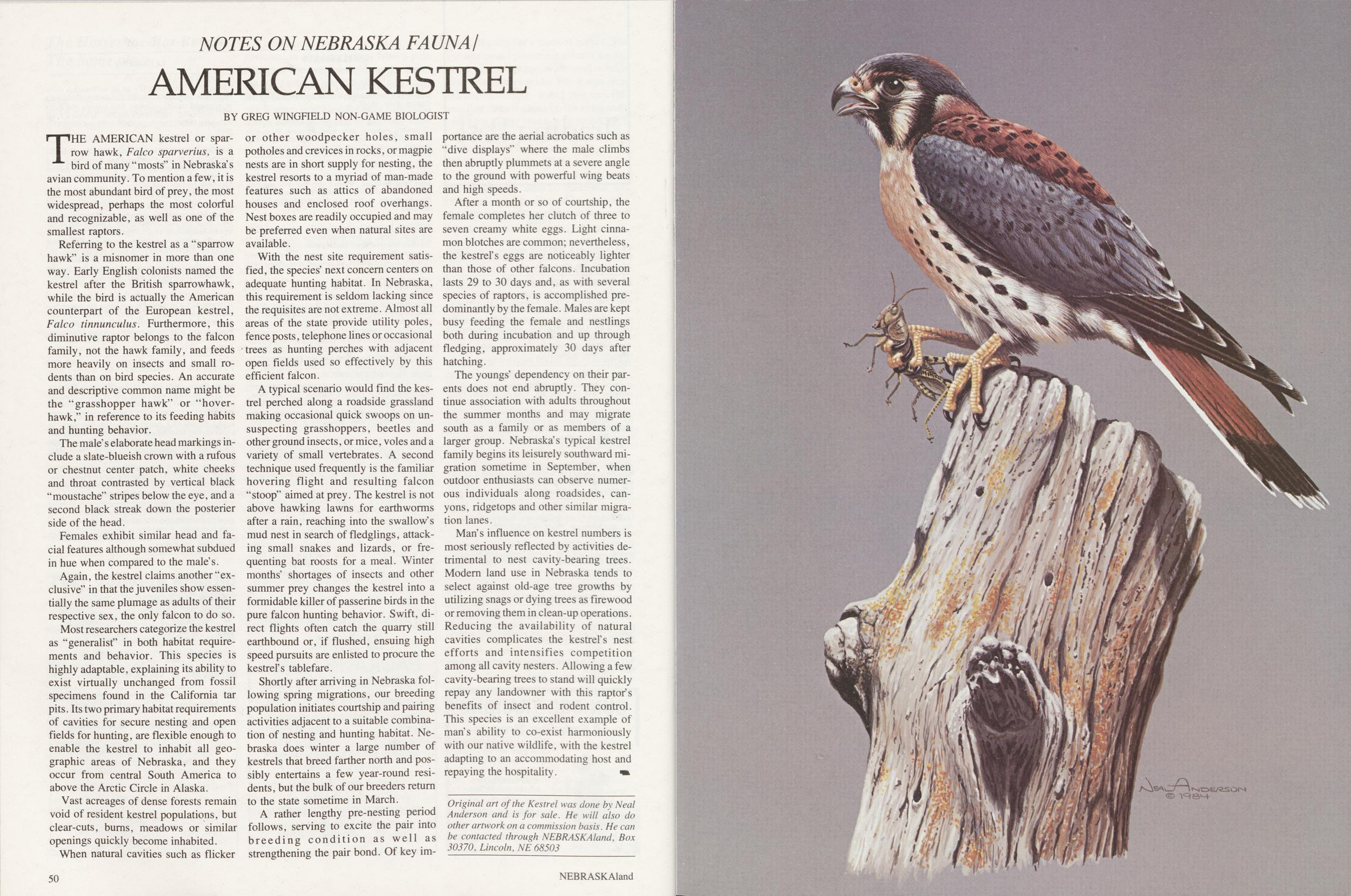
NOTES ON NEBRASKA FAUNA / AMERICAN KESTREL
BY GREG WINGFIELD NON-GAME BIOLOGISTTHE AMERICAN kestrel or sparrow hawk, Falco sparverius, is a bird of many "mosts" in Nebraska's avian community. To mention a few, it is the most abundant bird of prey, the most widespread, perhaps the most colorful and recognizable, as well as one of the smallest raptors.
Referring to the kestrel as a "sparrow hawk" is a misnomer in more than one way. Early English colonists named the kestrel after the British sparrowhawk, while the bird is actually the American counterpart of the European kestrel, Falco tinnunculus. Furthermore, this diminutive raptor belongs to the falcon family, not the hawk family, and feeds more heavily on insects and small rodents than on bird species. An accurate and descriptive common name might be the "grasshopper hawk" or "hoverhawk," in reference to its feeding habits and hunting behavior.
The male's elaborate head markings include a slate-blueish crown with a rufous or chestnut center patch, white cheeks and throat contrasted by vertical black "moustache" stripes below the eye, and a second black streak down the posterier side of the head.
Females exhibit similar head and facial features although somewhat subdued in hue when compared to the male's.
Again, the kestrel claims another "exclusive" in that the juveniles show essentially the same plumage as adults of their respective sex, the only falcon to do so.
Most researchers categorize the kestrel as "generalist" in both habitat requirements and behavior. This species is highly adaptable, explaining its ability to exist virtually unchanged from fossil specimens found in the California tar pits. Its two primary habitat requirements of cavities for secure nesting and open fields for hunting, are flexible enough to enable the kestrel to inhabit all geographic areas of Nebraska, and they occur from central South America to above the Arctic Circle in Alaska.
Vast acreages of dense forests remain void of resident kestrel populations, but clear-cuts, burns, meadows or similar openings quickly become inhabited. When natural cavities such as flicker or other woodpecker holes, small potholes and crevices in rocks, or magpie nests are in short supply for nesting, the kestrel resorts to a myriad of man-made features such as attics of abandoned houses and enclosed roof overhangs. Nest boxes are readily occupied and may be preferred even when natural sites are available.
With the nest site requirement satisfied, the species' next concern centers on adequate hunting habitat. In Nebraska, this requirement is seldom lacking since the requisites are not extreme. Almost all areas of the state provide utility poles, fence posts, telephone lines or occasional trees as hunting perches with adjacent open fields used so effectively by this efficient falcon.
A typical scenario would find the kestrel perched along a roadside grassland making occasional quick swoops on unsuspecting grasshoppers, beetles and other ground insects, or mice, voles and a variety of small vertebrates. A second technique used frequently is the familiar hovering flight and resulting falcon "stoop" aimed at prey. The kestrel is not above hawking lawns for earthworms after a rain, reaching into the swallow's mud nest in search of fledglings, attacking small snakes and lizards, or frequenting bat roosts for a meal. Winter months' shortages of insects and other summer prey changes the kestrel into a formidable killer of passerine birds in the pure falcon hunting behavior. Swift, direct flights often catch the quarry still earthbound or, if flushed, ensuing high speed pursuits are enlisted to procure the kestrel's tablefare.
Shortly after arriving in Nebraska following spring migrations, our breeding population initiates courtship and pairing activities adjacent to a suitable combination of nesting and hunting habitat. Nebraska does winter a large number of kestrels that breed farther north and possibly entertains a few year-round residents, but the bulk of our breeders return to the state sometime in March.
A rather lengthy pre-nesting period follows, serving to excite the pair into breeding condition as well as strengthening the pair bond. Of key importance are the aerial acrobatics such as "dive displays" where the male climbs then abruptly plummets at a severe angle to the ground with powerful wing beats and high speeds.
After a month or so of courtship, the female completes her clutch of three to seven creamy white eggs. Light cinnamon blotches are common; nevertheless, the kestrel's eggs are noticeably lighter than those of other falcons. Incubation lasts 29 to 30 days and, as with several species of raptors, is accomplished predominantly by the female. Males are kept busy feeding the female and nestlings both during incubation and up through fledging, approximately 30 days after hatching.
The youngs' dependency on their parents does not end abruptly. They continue association with adults throughout the summer months and may migrate south as a family or as members of a larger group. Nebraska's typical kestrel family begins its leisurely southward migration sometime in September, when outdoor enthusiasts can observe numerous individuals along roadsides, canyons, ridgetops and other similar migration lanes.
Man's influence on kestrel numbers is most seriously reflected by activities detrimental to nest cavity-bearing trees. Modem land use in Nebraska tends to select against old-age tree growths by utilizing snags or dying trees as firewood or removing them in clean-up operations. Reducing the availability of natural cavities complicates the kestrel's nest efforts and intensifies competition among all cavity nesters. Allowing a few cavity-bearing trees to stand will quickly repay any landowner with this raptor's benefits of insect and rodent control. This species is an excellent example of man's ability to co-exist harmoniously with our native wildlife, with the kestrel adapting to an accommodating host and repaying the hospitality.
Original art of the Kestrel was done by Neal Anderson and is for sale. He will also do other artwork on a commission basis. He can be contacted through NEBRASKAland, Box 30370, Lincoln, NE 68503 50 NEBRASKAland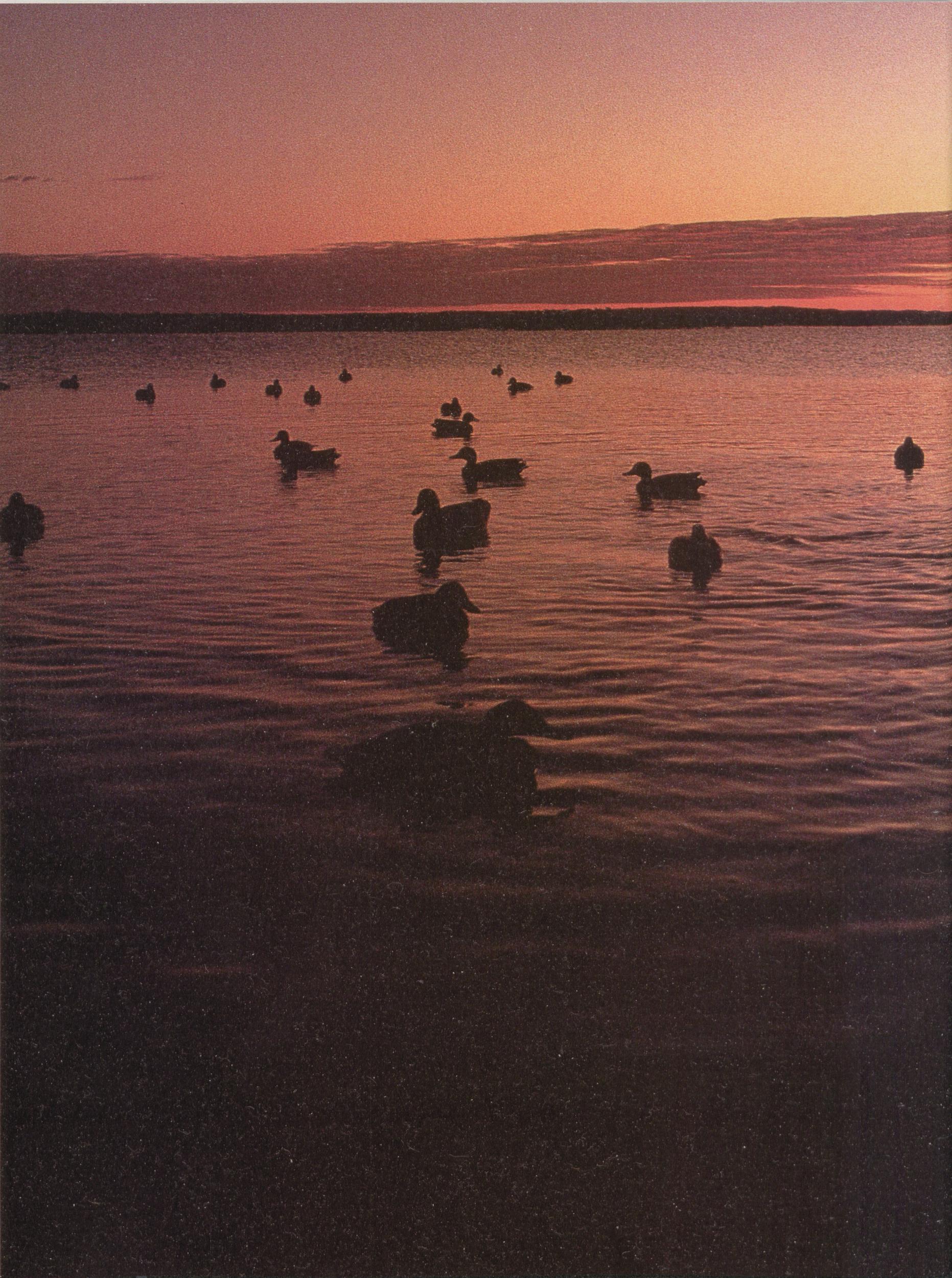
Position: 265 (31 views)