Volume 62, Issue 8, 1984
NEBRASKAland
SEPTEMBER 1984 • $1
NEBRASKAland
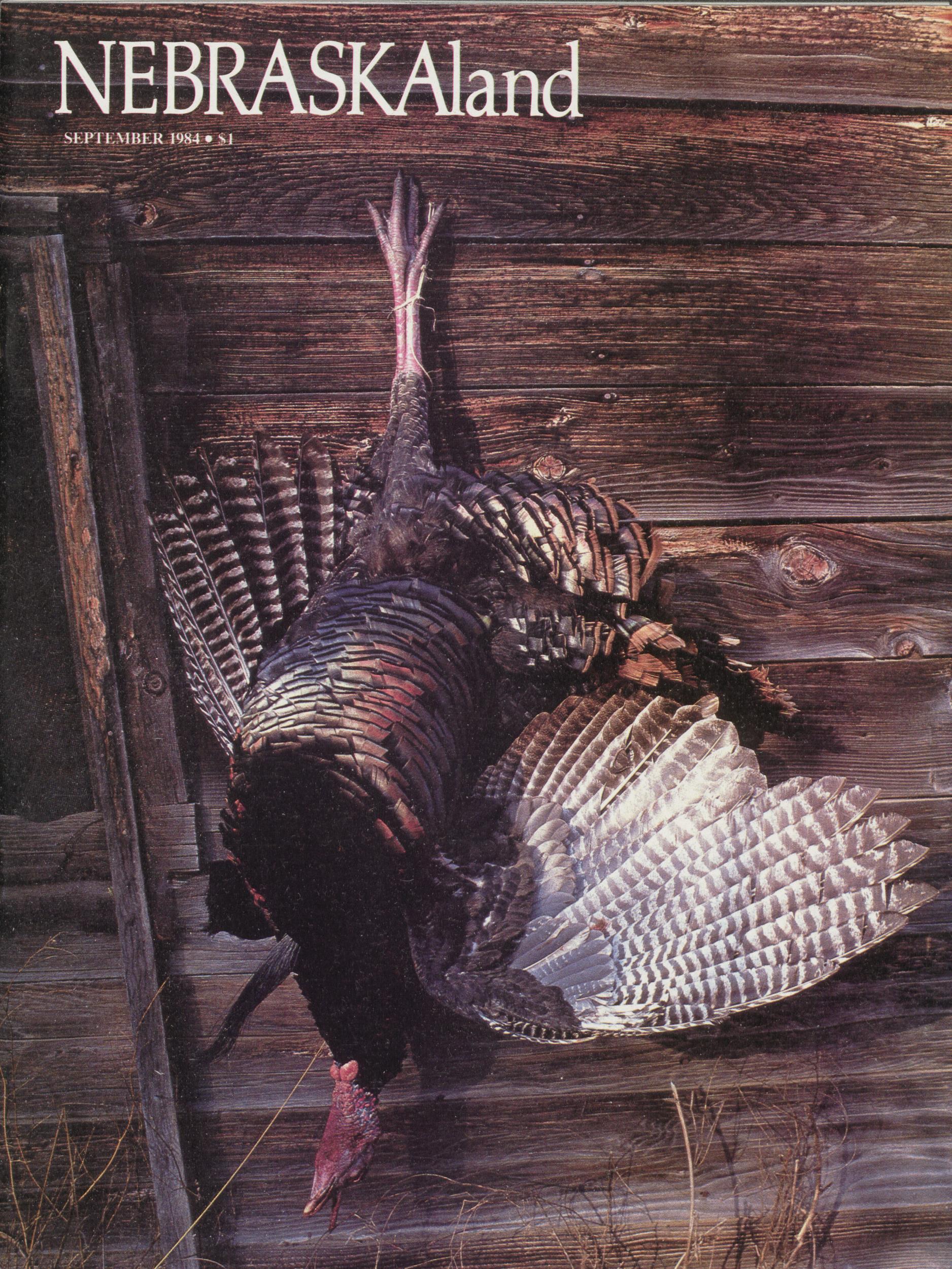
Published by the Nebraska Game and Parks Commission VOL. 62 / NO. 8 / SEPT. 1984 NEBRASKAland (ISSN:0028-1964) is published monthly except for a combined January/ February issue, by the Nebraska Game and Parks Commission, 2200 North 33rd Street, Lincoln, NE. Copyright 1984, all rights reserved. Second-class postage paid at Lincoln, Nebraska and at additional mailing offices. POSTMASTER: Send address changes to NEBRASKAland, Box 30370, Lincoln, NE 68503. Rates: $9.50 for 12 mos.; $14 for 18 mos.; $23 for 30 mos. Single copy price, $1. Offices Headquarters 2200 N. 33rd, Lincoln, 68503 (402) 464-0641 13th and Farnam St., Omaha (402) 554-2144 Ak-Sar-Ben Aquarium, Gretna (402) 332-3901 Rt. 2, Alliance (308) 762-5605 Bassett (402) 684-3511 U.S. 81, Norfolk (402) 371-4950 Rt. 4, North Platte (308) 532-6225 Commissioners Chairman: Earl Hultman, Sutton Vice Chairman: Richard Prasch, Lexington 2nd Vice Chairman: Charles E. Wright, Lincoln Neal Keller, Brewster Dr. Tim Biga, Norfolk Stan Juelfs, Kimball Richard L. Coyne, Omaha Director: Eugene T. Ma honey Assistant Directors: William J. Bailey, Jr., Dale R. Bree W. Rex Amack Staff Chief, Information & Education: Jim MacAllister Editor: Lowell Johnson Senior Editor: Jon Farrar Associate Editors: Ken Bouc, Don Cunningham Regional Editors: Bob Grier, Rocky Hoffmann Contributors: Tom Keith, Liz Huff, Carl Wolfe Research Assistant: Curt Twedt Art Director: Duane Westerholt Illustration: Steve O'Hare, Paula Day, Dan Curran Circulation: Juanita Stefkovich Contents Features LUCK OF THE DRAW 6 THE HORSESHOE BAR RANCH/30 MILES OF PARADISE 12 OSAGE AND TWIN OAKS WILDLIFE RETREATS 14 DID I TELL YOU ABOUT THE PHEASANTS IN THE QUEENS FOREST? 22 LEAD POISONING.. .THE PROBLEM AND THE SOLUTION 28 "BLIND" DATE WITH THE FAMILY 32 50 YEARS OF DUCK STAMPS 38 INVESTMENT OF A LIFETIME 40 SPEAK UP....... Departments 4 TRADING POST 49 IN THE KITCHEN 50 COVER: Turkey hunting can be extremely frustrating or simple, depending upon weather, local bird populations, hunter stealth and downright luck. Each year new hunters join the ranks of perennial stalkers of this regal big-game bird, and details of one such hunt begin on page 6. Photo by Jon Farrar. OPPOSITE: The magic of fall, the crisp November air when the sun dapples the autumn grass, are important ingredients to the deer hunt. The few hours afield are the catalyst creating great memories long enjoyed by hunters such as this along Soldier Creek at Fort Robinson. Photo by Don Cunningham. September 1984 3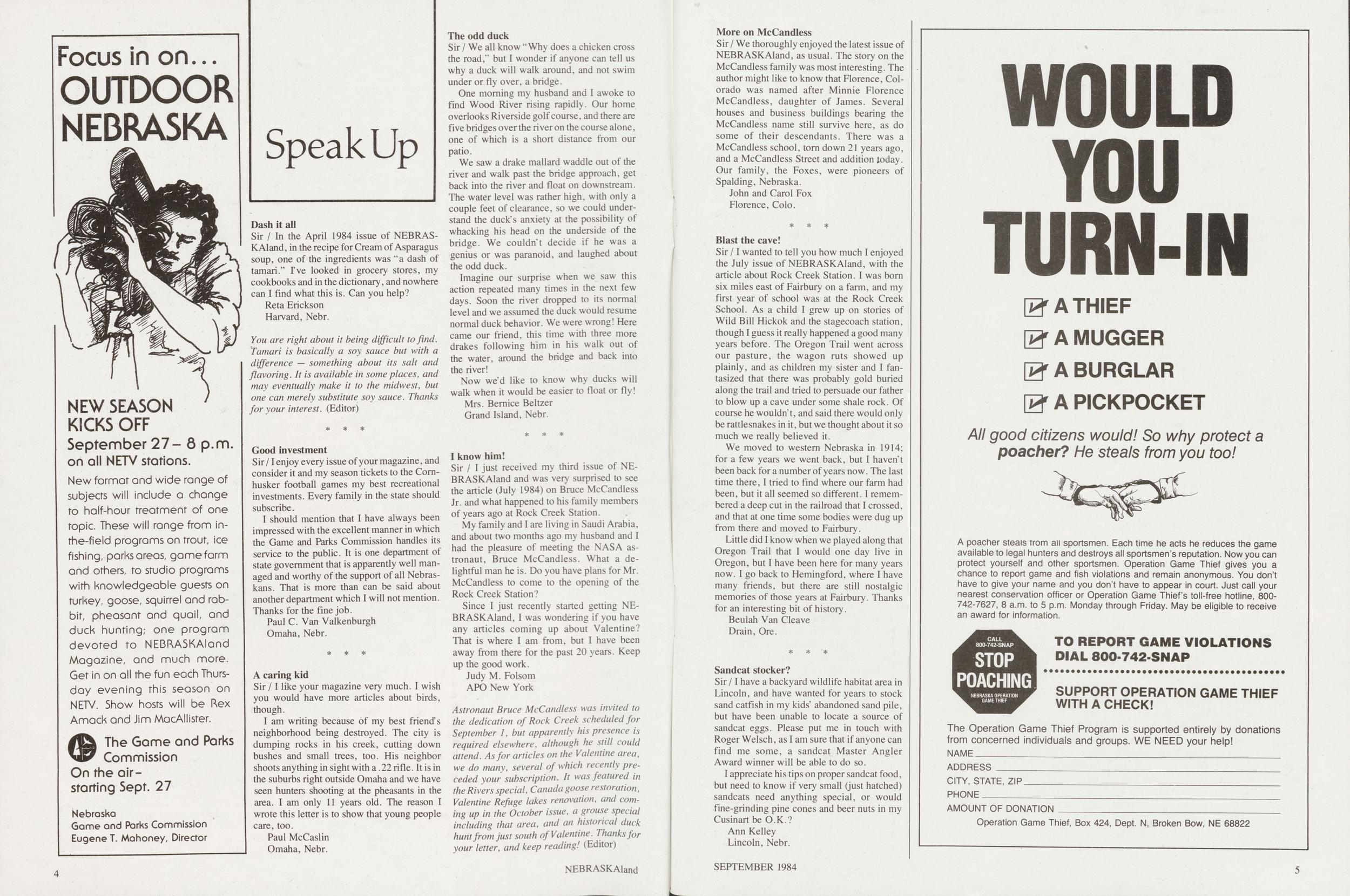
Speak Up
Dash it allSir / In the April 1984 issue of NEBRASKA Aland, in the recipe for Cream of Asparagus soup, one of the ingredients was "a dash of tamari." I've looked in grocery stores, my cookbooks and in the dictionary, and nowhere can I find what this is. Can you help?
Reta Erickson Harvard, Nebr. You are right about it being difficult to find. Tamari is basically a soy sauce but with a difference — something about its salt and flavoring. It is available in some places, and may eventually make it to the midwest, but one can merely substitute soy sauce. Thanks for your interest. (Editor) Good investmentSir / I enjoy every issue of your magazine, and consider it and my season tickets to the Cornhusker football games my best recreational investments. Every family in the state should subscribe.
I should mention that I have always been impressed with the excellent manner in which the Game and Parks Commission handles its service to the public. It is one department of state government that is apparently well managed and worthy of the support of all Nebraskans. That is more than can be said about another department which I will not mention. Thanks for the fine job.
Paul C. Van Valkenburgh Omaha, Nebr. A caring kidSir / I like your magazine very much. I wish you would have more articles about birds, though.
I am writing because of my best friend's neighborhood being destroyed. The city is dumping rocks in his creek, cutting down bushes and small trees, too. His neighbor shoots anything in sight with a .22 rifle. It is in the suburbs right outside Omaha and we have seen hunters shooting at the pheasants in the area. I am only 11 years old. The reason I wrote this letter is to show that young people care, too.
Paul McCaslin Omaha, Nebr. The odd duckSir / We all know "Why does a chicken cross the road?' but I wonder if anyone can tell us why a duck will walk around, and not swim under or fly over, a bridge.
One morning my husband and I awoke to find Wood River rising rapidly. Our home overlooks Riverside golf course, and there are five bridges over the river on the course alone, one of which is a short distance from our patio.
We saw a drake mallard waddle out of the river and walk past the bridge approach, get back into the river and float on downstream. The water level was rather high, with only a couple feet of clearance, so we could understand the duck's anxiety at the possibility of whacking his head on the underside of the bridge. We couldn't decide if he was a genius or was paranoid, and laughed about the odd duck.
Imagine our surprise when we saw this action repeated many times in the next few days. Soon the river dropped to its normal level and we assumed the duck would resume normal duck behavior. We were wrong! Here came our friend, this time with three more drakes following him in his walk out of the water, around the bridge and back into the river!
Now we'd like to know why ducks will walk when it would be easier to float or fly!
Mrs. Bernice Beltzer Grand Island, Nebr. I know him!Sir / I just received my third issue of NEBRASKAland and was very surprised to see the article (July 1984) on Bruce McCandless Jr. and what happened to his family members of years ago at Rock Creek Station.
My family and I are living in Saudi Arabia, and about two months ago my husband and I had the pleasure of meeting the NASA astronaut, Bruce McCandless. What a delightful man he is. Do you have plans for Mr. McCandless to come to the opening of the Rock Creek Station?
Since I just recently started getting NEBRASKAland, I was wondering if you have any articles coming up about Valentine? That is where I am from, but I have been away from there for the past 20 years. Keep up the good work.
Judy M. Folsom APO New York Astronaut Bruce McCandless was invited to the dedication of Rock Creek scheduled for September 1, but apparently his presence is required elsewhere, although he still could attend. As for articles on the Valentine area, we do many, several of which recently preceded your subscription. It was featured in the Rivers special, Canada goose restoration, Valentine Refuge lakes renovation, and coming up in the October issue, a grouse special including that area, and an historical duck hunt from just south of Valentine. Thanks for your letter, and keep reading! (Editor) 4 NEBRASKAland More on McCandlessSir / We thoroughly enjoyed the latest issue of NEBRASKAland, as usual. The story on the McCandless family was most interesting. The author might like to know that Florence, Colorado was named after Minnie Florence McCandless, daughter of James. Several houses and business buildings bearing the McCandless name still survive here, as do some of their descendants. There was a McCandless school, torn down 21 years ago, and a McCandless Street and addition today. Our family, the Foxes, were pioneers of Spalding, Nebraska.
John and Carol Fox Florence, Colo. Blast the cave!Sir /1 wanted to tell you how much I enjoyed the July issue of NEBRASKAland, with the article about Rock Creek Station. I was born six miles east of Fairbury on a farm, and my first year of school was at the Rock Creek School. As a child I grew up on stories of Wild Bill Hickok and the stagecoach station, though I guess it really happened a good many years before. The Oregon Trail went across our pasture, the wagon ruts showed up plainly, and as children my sister and I fantasized that there was probably gold buried along the trail and tried to persuade our father to blow up a cave under some shale rock. Of course he wouldn't, and said there would only be rattlesnakes in it, but we thought about it so much we really believed it.
We moved to western Nebraska in 1914; for a few years we went back, but I haven't been back for a number of years now. The last time there, I tried to find where our farm had been, but it all seemed so different. I remembered a deep cut in the railroad that I crossed, and that at one time some bodies were dug up from there and moved to Fairbury.
Little did I know when we played along that Oregon Trail that I would one day live in Oregon, but I have been here for many years now. I go back to Hemingford, where I have many friends, but there are still nostalgic memories of those years at Fairbury. Thanks for an interesting bit of history.
Beulah Van Cleave Drain, Ore. Sandcat stocker?Sir / I have a backyard wildlife habitat area in Lincoln, and have wanted for years to stock sand catfish in my kids' abandoned sand pile, but have been unable to locate a source of sandcat eggs. Please put me in touch with Roger Welsch, as I am sure that if anyone can find me some, a sandcat Master Angler Award winner will be able to do so.
I appreciate his tips on proper sandcat food, but need to know if very small (just hatched) sandcats need anything special, or would fine-grinding pine cones and beer nuts in my Cusinartbe O.K.?
Ann Kelley Lincoln, Nebr.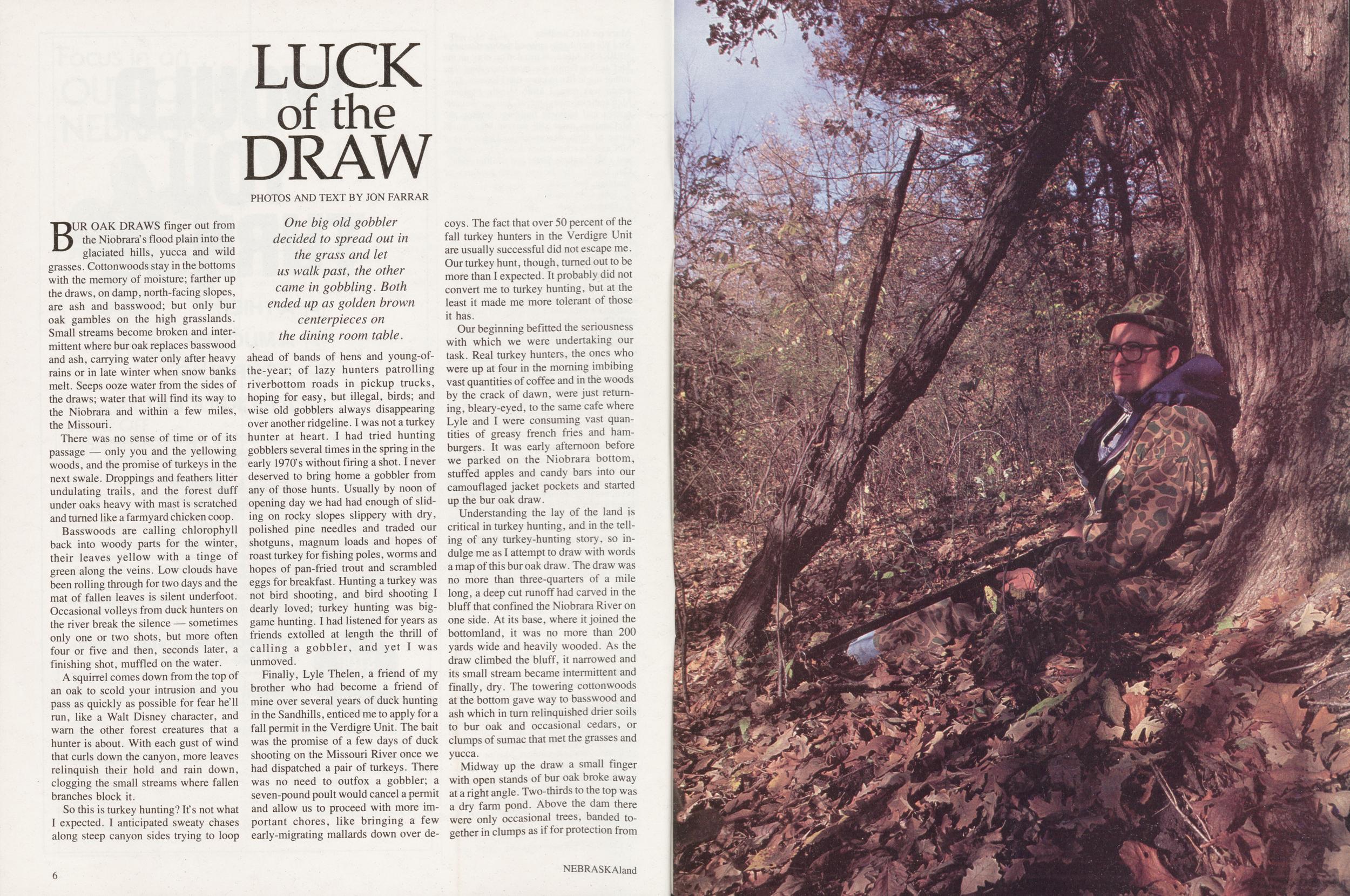
LUCK of the DRAW
PHOTOS AND TEXT BY JON FARRAR One big old gobbler decided to spread out in the grass and let us walk past, the other came in gobbling. Both ended up as golden brown centerpieces on the dining room table.BUR OAK DRAWS finger out from the Niobrara's flood plain into the glaciated hills, yucca and wild grasses. Cotton woods stay in the bottoms with the memory of moisture; farther up the draws, on damp, north-facing slopes, are ash and basswood; but only bur oak gambles on the high grasslands. Small streams become broken and intermittent where bur oak replaces basswood and ash, carrying water only after heavy rains or in late winter when snow banks melt. Seeps ooze water from the sides of the draws; water that will find its way to the Niobrara and within a few miles, the Missouri.
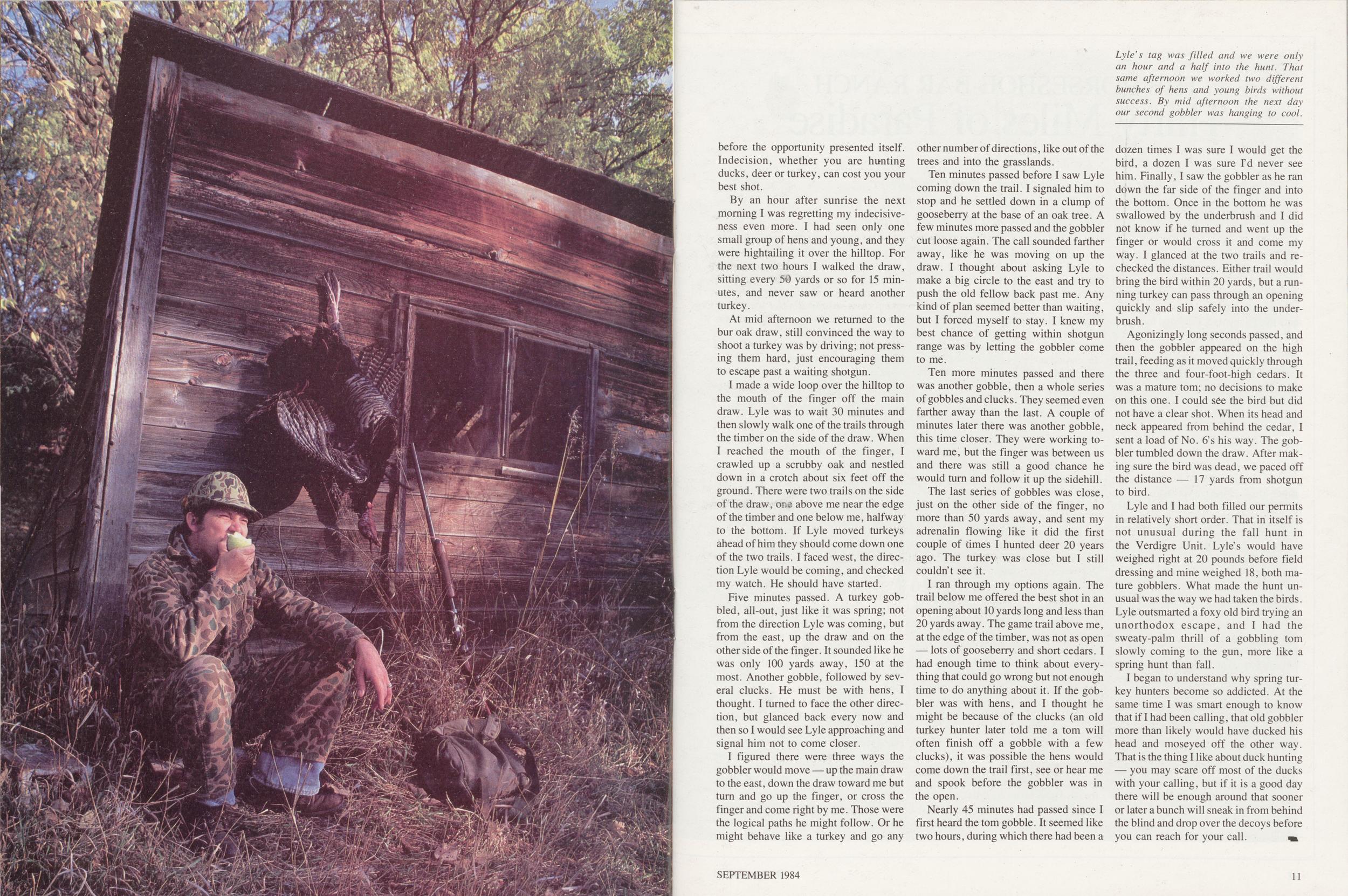
There was no sense of time or of its passage — only you and the yellowing woods, and the promise of turkeys in the next swale. Droppings and feathers litter undulating trails, and the forest duff under oaks heavy with mast is scratched and turned like a farmyard chicken coop.
Basswoods are calling chlorophyll back into woody parts for the winter, their leaves yellow with a tinge of green along the veins. Low clouds have been rolling through for two days and the mat of fallen leaves is silent underfoot. Occasional volleys from duck hunters on the river break the silence — sometimes only one or two shots, but more often four or five and then, seconds later, a finishing shot, muffled on the water.
A squirrel comes down from the top of an oak to scold your intrusion and you pass as quickly as possible for fear he'll run, like a Walt Disney character, and warn the other forest creatures that a hunter is about. With each gust of wind that curls down the canyon, more leaves relinquish their hold and rain down, clogging the small streams where fallen branches block it.
So this is turkey hunting? It's not what I expected. I anticipated sweaty chases along steep canyon sides trying to loop ahead of bands of hens and young-of-the-year; of lazy hunters patrolling riverbottom roads in pickup trucks, hoping for easy, but illegal, birds; and wise old gobblers always disappearing over another ridgeline. I was not a turkey hunter at heart. I had tried hunting gobblers several times in the spring in the early 1970's without firing a shot. I never deserved to bring home a gobbler from any of those hunts. Usually by noon of opening day we had had enough of sliding on rocky slopes slippery with dry, polished pine needles and traded our shotguns, magnum loads and hopes of roast turkey for fishing poles, worms and hopes of pan-fried trout and scrambled eggs for breakfast. Hunting a turkey was not bird shooting, and bird shooting I dearly loved; turkey hunting was biggame hunting. I had listened for years as friends extolled at length the thrill of calling a gobbler, and yet I was unmoved.
Finally, Lyle Thelen, a friend of my brother who had become a friend of mine over several years of duck hunting in the Sandhills, enticed me to apply for a fall permit in the Verdigre Unit. The bait was the promise of a few days of duck shooting on the Missouri River once we had dispatched a pair of turkeys. There was no need to outfox a gobbler; a seven-pound poult would cancel a permit and allow us to proceed with more important chores, like bringing a few early-migrating mallards down over decoys. The fact that over 50 percent of the fall turkey hunters in the Verdigre Unit are usually successful did not escape me. Our turkey hunt, though, turned out to be more than I expected. It probably did not convert me to turkey hunting, but at the least it made me more tolerant of those it has.
Our beginning befitted the seriousness with which we were undertaking our task. Real turkey hunters, the ones who were up at four in the morning imbibing vast quantities of coffee and in the woods by the crack of dawn, were just returning, bleary-eyed, to the same cafe where Lyle and I were consuming vast quantities of greasy french fries and hamburgers. It was early afternoon before we parked on the Niobrara bottom, stuffed apples and candy bars into our camouflaged jacket pockets and started up the bur oak draw.
Understanding the lay of the land is critical in turkey hunting, and in the telling of any turkey-hunting story, so indulge me as I attempt to draw with words a map of this bur oak draw. The draw was no more than three-quarters of a mile long, a deep cut runoff had carved in the bluff that confined the Niobrara River on one side. At its base, where it joined the bottomland, it was no more than 200 yards wide and heavily wooded. As the draw climbed the bluff, it narrowed and its small stream became intermittent and finally, dry. The towering cottonwoods at the bottom gave way to basswood and ash which in turn relinquished drier soils to bur oak and occasional cedars, or clumps of sumac that met the grasses and yucca.
Midway up the draw a small finger with open stands of bur oak broke away at a right angle. Two-thirds to the top was a dry farm pond. Above the dam there were only occasional trees, banded together in clumps as if for protection from
6 NEBRASKAland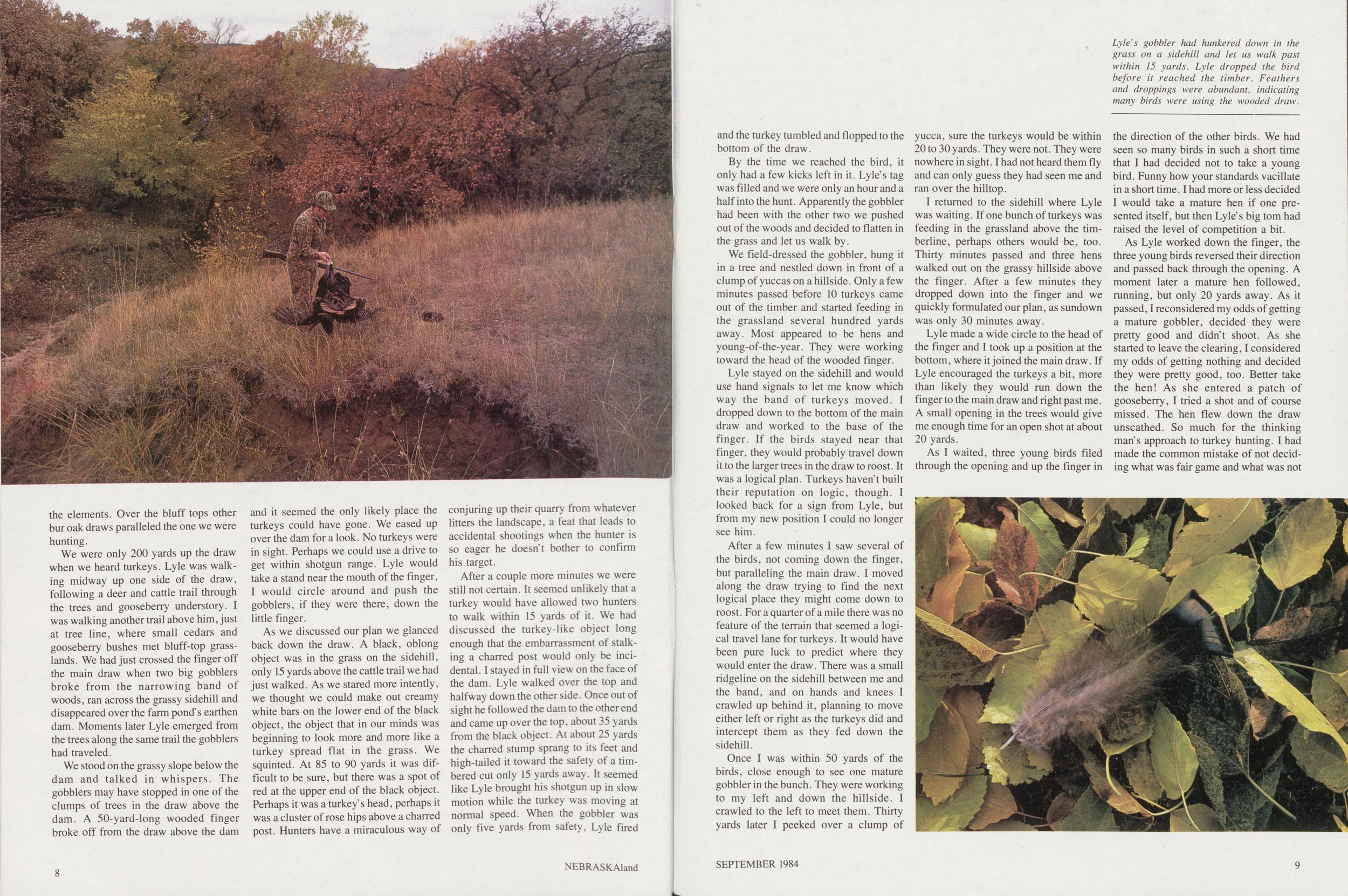
the elements. Over the bluff tops other bur oak draws paralleled the one we were hunting.
We were only 200 yards up the draw when we heard turkeys. Lyle was walking midway up one side of the draw, following a deer and cattle trail through the trees and gooseberry understory. I was walking another trail above him, just at tree line, where small cedars and gooseberry bushes met bluff-top grasslands. We had just crossed the finger off the main draw when two big gobblers broke from the narrowing band of woods, ran across the grassy sidehill and disappeared over the farm pond's earthen dam. Moments later Lyle emerged from the trees along the same trail the gobblers had traveled.
We stood on the grassy slope below the dam and talked in whispers. The gobblers may have stopped in one of the clumps of trees in the draw above the dam. A 50-yard-long wooded finger broke off from the draw above the dam and it seemed the only likely place the turkeys could have gone. We eased up over the dam for a look. No turkeys were in sight. Perhaps we could use a drive to get within shotgun range. Lyle would take a stand near the mouth of the finger, I would circle around and push the gobblers, if they were there, down the little finger.
As we discussed our plan we glanced back down the draw. A black, oblong object was in the grass on the sidehill, only 15 yards above the cattle trail we had just walked. As we stared more intently, we thought we could make out creamy white bars on the lower end of the black object, the object that in our minds was beginning to look more and more like a turkey spread flat in the grass. We squinted. At 85 to 90 yards it was difficult to be sure, but there was a spot of red at the upper end of the black object. Perhaps it was a turkey's head, perhaps it was a cluster of rose hips above a charred post. Hunters have a miraculous way of conjuring up their quarry from whatever litters the landscape, a feat that leads to accidental shootings when the hunter is so eager he doesn't bother to confirm his target.
After a couple more minutes we were still not certain. It seemed unlikely that a turkey would have allowed two hunters to walk within 15 yards of it. We had discussed the turkey-like object long enough that the embarrassment of stalking a charred post would only be incidental . I stayed in full view on the face of the dam. Lyle walked over the top and halfway down the other side. Once out of sight he followed the dam to the other end and came up over the top, about 35 yards from the black object. At about 25 yards the charred stump sprang to its feet and high-tailed it toward the safety of a timbered cut only 15 yards away. It seemed like Lyle brought his shotgun up in slow motion while the turkey was moving at normal speed. When the gobbler was only five yards from safety, Lyle fired
8 NEBRASKAlandand the turkey tumbled and flopped to the bottom of the draw.
By the time we reached the bird, it only had a few kicks left in it. Lyle's tag was filled and we were only an hour and a half into the hunt. Apparently the gobbler had been with the other two we pushed out of the woods and decided to flatten in the grass and let us walk by.
We field-dressed the gobbler, hung it in a tree and nestled down in front of a clump of yuccas on a hillside. Only a few minutes passed before 10 turkeys came out of the timber and started feeding in the grassland several hundred yards away. Most appeared to be hens and young-of-the-year. They were working toward the head of the wooded finger.
Lyle stayed on the sidehill and would use hand signals to let me know which way the band of turkeys moved. I dropped down to the bottom of the main draw and worked to the base of the finger. If the birds stayed near that finger, they would probably travel down it to the larger trees in the draw to roost. It was a logical plan. Turkeys haven't built their reputation on logic, though. I looked back for a sign from Lyle, but from my new position I could no longer see him.
After a few minutes I saw several of the birds, not coming down the finger, but paralleling the main draw. I moved along the draw trying to find the next logical place they might come down to roost. For a quarter of a mile there was no feature of the terrain that seemed a logical travel lane for turkeys. It would have been pure luck to predict where they would enter the draw. There was a small ridgeline on the sidehill between me and the band, and on hands and knees I crawled up behind it, planning to move either left or right as the turkeys did and intercept them as they fed down the sidehill.
Once I was within 50 yards of the birds, close enough to see one mature gobbler in the bunch. They were working to my left and down the hillside. I crawled to the left to meet them. Thirty yards later I peeked over a clump of yucca, sure the turkeys would be within 20 to 30yards. They were not. They were nowhere in sight. I had not heard them fly and can only guess they had seen me and ran over the hilltop.
I returned to the sidehill where Lyle was waiting. If one bunch of turkeys was feeding in the grassland above the timberline, perhaps others would be, too. Thirty minutes passed and three hens walked out on the grassy hillside above the finger. After a few minutes they dropped down into the finger and we quickly formulated our plan, as sundown was only 30 minutes away.
Lyle made a wide circle to the head of the finger and I took up a position at the bottom, where it joined the main draw. If Lyle encouraged the turkeys a bit, more than likely they would run down the finger to the main draw and right past me. A small opening in the trees would give me enough time for an open shot at about 20 yards.
As I waited, three young birds filed through the opening and up the finger in the direction of the other birds. We had seen so many birds in such a short time that I had decided not to take a young bird. Funny how your standards vacillate in a short time. I had more or less decided I would take a mature hen if one presented itself, but then Lyle's big torn had raised the level of competition a bit.
As Lyle worked down the finger, the three young birds reversed their direction and passed back through the opening. A moment later a mature hen followed, running, but only 20 yards away. As it passed, I reconsidered my odds of getting a mature gobbler, decided they were pretty good and didn't shoot. As she started to leave the clearing, I considered my odds of getting nothing and decided they were pretty good, too. Better take the hen! As she entered a patch of gooseberry, I tried a shot and of course missed. The hen flew down the draw unscathed. So much for the thinking man's approach to turkey hunting. I had made the common mistake of not deciding what was fair game and what was not
before the opportunity presented itself. Indecision, whether you are hunting ducks, deer or turkey, can cost you your best shot.
By an hour after sunrise the next morning I was regretting my indecisiveness even more. I had seen only one small group of hens and young, and they were hightailing it over the hilltop. For the next two hours I walked the draw, sitting every 50 yards or so for 15 minutes, and never saw or heard another turkey.
At mid afternoon we returned to the bur oak draw, still convinced the way to shoot a turkey was by driving; not pressing them hard, just encouraging them to escape past a waiting shotgun.
I made a wide loop over the hilltop to the mouth of the finger off the main draw. Lyle was to wait 30 minutes and then slowly walk one of the trails through the timber on the side of the draw. When I reached the mouth of the finger, I crawled up a scrubby oak and nestled down in a crotch about six feet off the ground. There were two trails on the side of the draw, one above me near the edge of the timber and one below me, halfway to the bottom. If Lyle moved turkeys ahead of him they should come down one of the two trails. I faced west, the direction Lyle would be coming, and checked my watch. He should have started.
Five minutes passed. A turkey gobbled, all-out, just like it was spring; not from the direction Lyle was coming, but from the east, up the draw and on the other side of the finger. It sounded like he was only 100 yards away, 150 at the most. Another gobble, followed by several clucks. He must be with hens, I thought. I turned to face the other direction, but glanced back every now and then so I would see Lyle approaching and signal him not to come closer.
I figured there were three ways the gobbler would move — up the main draw to the east, down the draw toward me but turn and go up the finger, or cross the finger and come right by me. Those were the logical paths he might follow. Or he might behave like a turkey and go any other number of directions, like out of the trees and into the grasslands.
Ten minutes passed before I saw Lyle coming down the trail. I signaled him to stop and he settled down in a clump of gooseberry at the base of an oak tree. A few minutes more passed and the gobbler cut loose again. The call sounded farther away, like he was moving on up the draw. I thought about asking Lyle to make a big circle to the east and try to push the old fellow back past me. Any kind of plan seemed better than waiting, but I forced myself to stay. I knew my best chance of getting within shotgun range was by letting the gobbler come to me.
Ten more minutes passed and there was another gobble, then a whole series of gobbles and clucks. They seemed even farther away than the last. A couple of minutes later there was another gobble, this time closer. They were working toward me, but the finger was between us and there was still a good chance he would turn and follow it up the sidehill.
The last series of gobbles was close, just on the other side of the finger, no more than 50 yards away, and sent my adrenalin flowing like it did the first couple of times I hunted deer 20 years ago. The turkey was close but I still couldn't see it.
I ran through my options again. The trail below me offered the best shot in an opening about 10 yards long and less than 20 yards away. The game trail above me, at the edge of the timber, was not as open — lots of gooseberry and short cedars. I had enough time to think about everything that could go wrong but not enough time to do anything about it. If the gobbler was with hens, and I thought he might be because of the clucks (an old turkey hunter later told me a tom will often finish off a gobble with a few clucks), it was possible the hens would come down the trail first, see or hear me and spook before the gobbler was in the open.
Nearly 45 minutes had passed since I first heard the tom gobble. It seemed like two hours, during which there had been a dozen times I was sure I would get the bird, a dozen I was sure Fd never see him. Finally, I saw the gobbler as he ran down the far side of the finger and into the bottom. Once in the bottom he was swallowed by the underbrush and I did not know if he turned and went up the finger or would cross it and come my way. I glanced at the two trails and rechecked the distances. Either trail would bring the bird within 20 yards, but a running turkey can pass through an opening quickly and slip safely into the underbrush.
Agonizingly long seconds passed, and then the gobbler appeared on the high trail, feeding as it moved quickly through the three and four-foot-high cedars. It was a mature tom; no decisions to make on this one. I could see the bird but did not have a clear shot. When its head and neck appeared from behind the cedar, I sent a load of No. 6's his way. The gobbler tumbled down the draw. After making sure the bird was dead, we paced off the distance — 17 yards from shotgun to bird.
Lyle and I had both filled our permits in relatively short order. That in itself is not unusual during the fall hunt in the Verdigre Unit. Lyle's would have weighed right at 20 pounds before field dressing and mine weighed 18, both mature gobblers. What made the hunt unusual was the way we had taken the birds. Lyle outsmarted a foxy old bird trying an unorthodox escape, and I had the sweaty-palm thrill of a gobbling tom slowly coming to the gun, more like a spring hunt than fall.
I began to understand why spring turkey hunters become so addicted. At the same time I was smart enough to know that if I had been calling, that old gobbler more than likely would have ducked his head and moseyed off the other way. That is the thing I like about duck hunting — you may scare off most of the ducks with your calling, but if it is a good day there will be enough around that sooner or later a bunch will sneak in from behind the blind and drop over the decoys before you can reach for your call.
SEPTEMBER 1984 11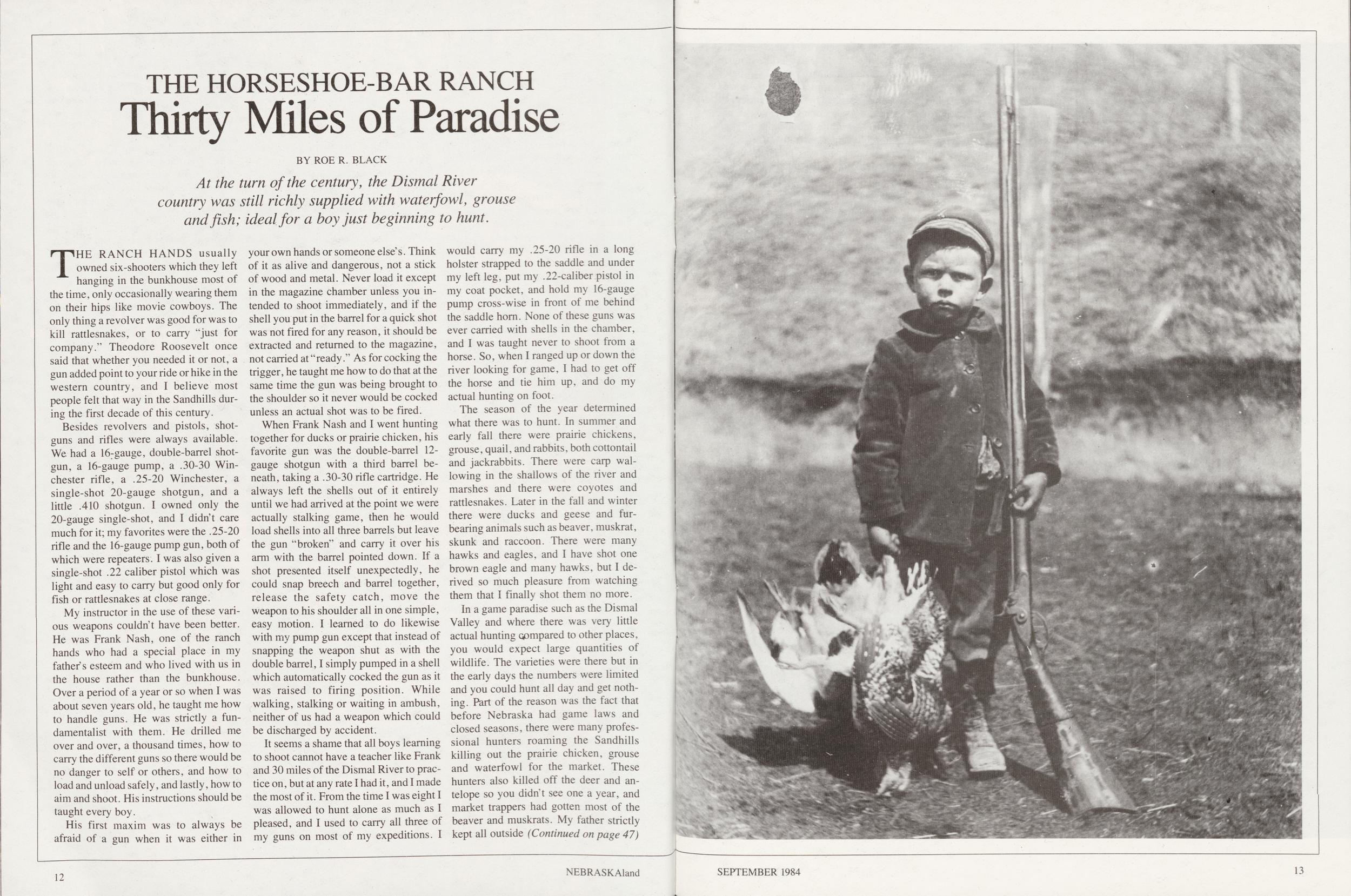
THE HORSESHOE-BAR RANCH Thirty Miles of Paradise
BY ROE R. BLACK At the turn of the century, the Dismal River country was still richly supplied with waterfowl, grouse and fish; ideal for a boy just beginning to hunt.THE RANCH HANDS usually owned six-shooters which they left hanging in the bunkhouse most of the time, only occasionally wearing them on their hips like movie cowboys. The only thing a revolver was good for was to kill rattlesnakes, or to carry "just for company." Theodore Roosevelt once said that whether you needed it or not, a gun added point to your ride or hike in the western country, and I believe most people felt that way in the Sandhills during the first decade of this century.
Besides revolvers and pistols, shotguns and rifles were always available. We had a 16:gauge, double-barrel shotgun, a 16-gauge pump, a .30-30 Winchester rifle, a .25-20 Winchester, a single-shot 20-gauge shotgun, and a little .410 shotgun. I owned only the 20-gauge single-shot, and I didn't care much for it; my favorites were the .25-20 rifle and the 16-gauge pump gun, both of which were repeaters. I was also given a single-shot .22 caliber pistol which was light and easy to carry but good only for fish or rattlesnakes at close range.
My instructor in the use of these various weapons couldn't have been better. He was Frank Nash, one of the ranch hands who had a special place in my father's esteem and who lived with us in the house rather than the bunkhouse. Over a period of a year or so when I was about seven years old, he taught me how to handle guns. He was strictly a fundamentalist with them. He drilled me over and over, a thousand times, how to carry the different guns so there would be no danger to self or others, and how to load and unload safely, and lastly, how to aim and shoot. His instructions should be taught every boy.
His first maxim was to always be afraid of a gun when it was either in your own hands or someone else's. Think of it as alive and dangerous, not a stick of wood and metal. Never load it except in the magazine chamber unless you intended to shoot immediately, and if the shell you put in the barrel for a quick shot was not fired for any reason, it should be extracted and returned to the magazine, not carried at "ready." As for cocking the trigger, he taught me how to do that at the same time the gun was being brought to the shoulder so it never would be cocked unless an actual shot was to be fired.
When Frank Nash and I went hunting together for ducks or prairie chicken, his favorite gun was the double-barrel 12-gauge shotgun with a third barrel beneath, taking a .30-30 rifle cartridge. He always left the shells out of it entirely until we had arrived at the point we were actually stalking game, then he would load shells into all three barrels but leave the gun "broken" and carry it over his arm with the barrel pointed down. If a shot presented itself unexpectedly, he could snap breech and barrel together, release the safety catch, move the weapon to his shoulder all in one simple, easy motion. I learned to do likewise with my pump gun except that instead of snapping the weapon shut as with the double barrel, I simply pumped in a shell which automatically cocked the gun as it was raised to firing position. While walking, stalking or waiting in ambush, neither of us had a weapon which could be discharged by accident.
It seems a shame that all boys learning to shoot cannot have a teacher like Frank and 30 miles of the Dismal River to practice on, but at any rate I had it, and I made the most of it. From the time I was eight I was allowed to hunt alone as much as I pleased, and I used to carry all three of my guns on most of my expeditions. I would carry my .25-20 rifle in a long holster strapped to the saddle and under my left leg, put my .22-caliber pistol in my coat pocket, and hold my 16-gauge pump cross-wise in front of me behind the saddle horn. None of these guns was ever carried with shells in the chamber, and I was taught never to shoot from a horse. So, when I ranged up or down the river looking for game, I had to get off the horse and tie him up, and do my actual hunting on foot.
The season of the year determined what there was to hunt. In summer and early fall there were prairie chickens, grouse, quail, and rabbits, both cottontail and jackrabbits. There were carp wallowing in the shallows of the river and marshes and there were coyotes and rattlesnakes. Later in the fall and winter there were ducks and geese and fur-bearing animals such as beaver, muskrat, skunk and raccoon. There were many hawks and eagles, and I have shot one brown eagle and many hawks, but I derived so much pleasure from watching them that I finally shot them no more.
In a game paradise such as the Dismal Valley and where there was very little actual hunting compared to other places, you would expect large quantities of wildlife. The varieties were there but in the early days the numbers were limited and you could hunt all day and get nothing. Part of the reason was the fact that before Nebraska had game laws and closed seasons, there were many professional hunters roaming the Sandhills killing out the prairie chicken, grouse and waterfowl for the market. These hunters also killed off the deer and antelope so you didn't see one a year, and market trappers had gotten most of the beaver and muskrats. My father strictly kept all outside
(Continued on page 47) 12 NEBRASKAland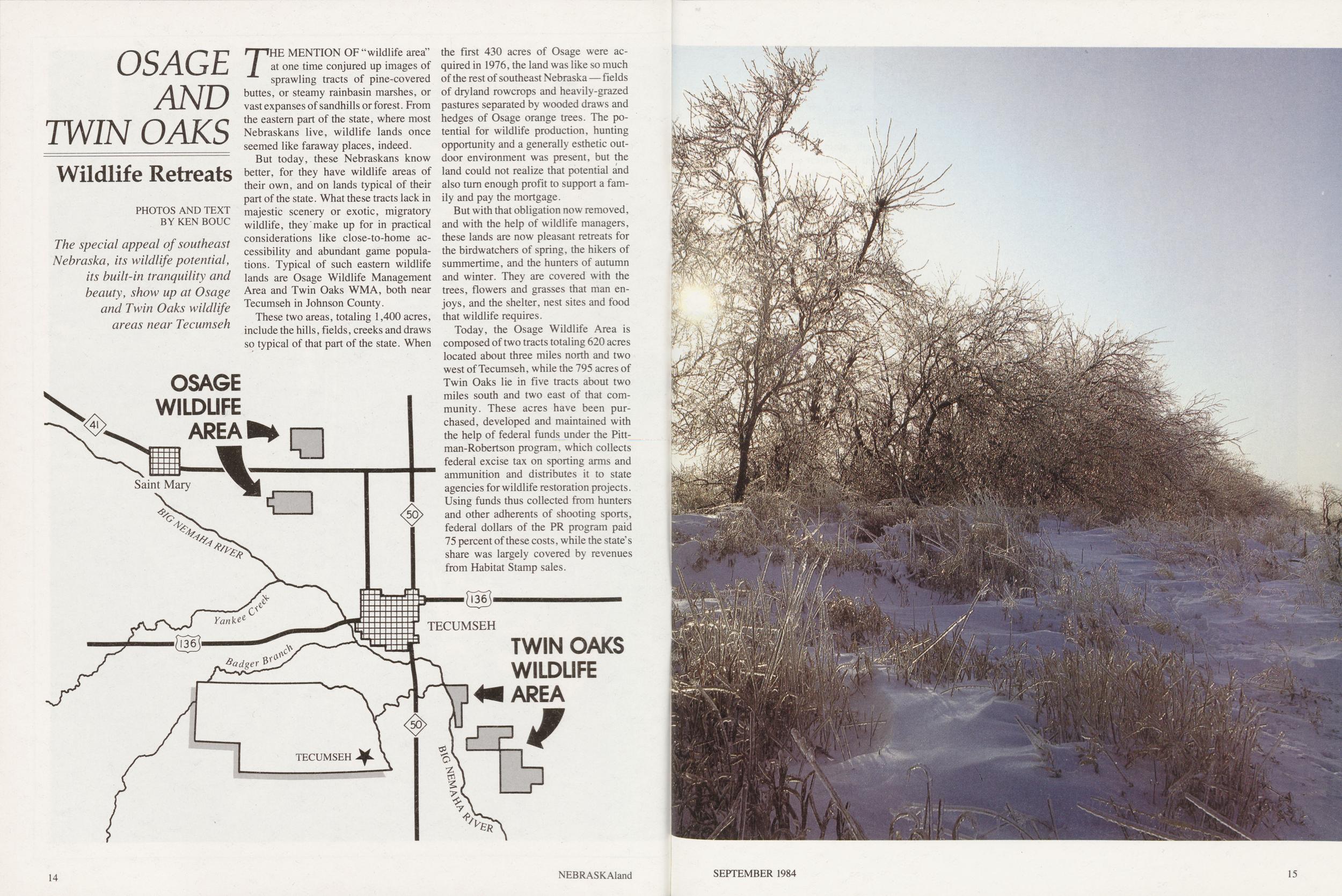
OSAGE AND TWIN OAKS
Wildlife Retreats PHOTOS AND TEXT BYKEN BOUCThe special appeal of southeast Nebraska, its wildlife potential, its built-in tranquility and beauty, show up at Osage and Twin Oaks wildlife areas near Tecumseh
THE MENTION OF "wildlife area" at one time conjured up images of sprawling tracts of pine-covered buttes, or steamy rainbasin marshes, or vast expanses of sandhills or forest. From the eastern part of the state, where most Nebraskans live, wildlife lands once seemed like faraway places, indeed.
But today, these Nebraskans know better, for they have wildlife areas of their own, and on lands typical of their part of the state. What these tracts lack in majestic scenery or exotic, migratory wildlife, they make up for in practical considerations like close-to-home accessibility and abundant game populations. Typical of such eastern wildlife lands are Osage Wildlife Management Area and Twin Oaks WMA, both near Tecumseh in Johnson County.
These two areas, totaling 1,400 acres, include the hills, fields, creeks and draws so typical of that part of the state. When
the first 430 acres of Osage were acquired in 1976, the land was like so much of the rest of southeast Nebraska — fields of dryland rowcrops and heavily-grazed pastures separated by wooded draws and hedges of Osage orange trees. The potential for wildlife production, hunting opportunity and a generally esthetic outdoor environment was present, but the land could not realize that potential and also turn enough profit to support a family and pay the mortgage.
But with that obligation now removed, and with the help of wildlife managers, these lands are now pleasant retreats for the birdwatchers of spring, the hikers of summertime, and the hunters of autumn and winter. They are covered with the trees, flowers and grasses that man enjoys, and the shelter, nest sites and food that wildlife requires.
Today, the Osage Wildlife Area is composed of two tracts totaling 620 acres located about three miles north and two west of Tecumseh, while the 795 acres of Twin Oaks lie in five tracts about two miles south and two east of that community. These acres have been purchased, developed and maintained with the help of federal funds under the Pittman-Robertson program, which collects federal excise tax on sporting arms and ammunition and distributes it to state agencies for wildlife restoration projects. Using funds thus collected from hunters and other adherents of shooting sports, federal dollars of the PR program paid 75 percent of these costs, while the state's share was largely covered by revenues from Habitat Stamp sales.
14 NEBRASKAland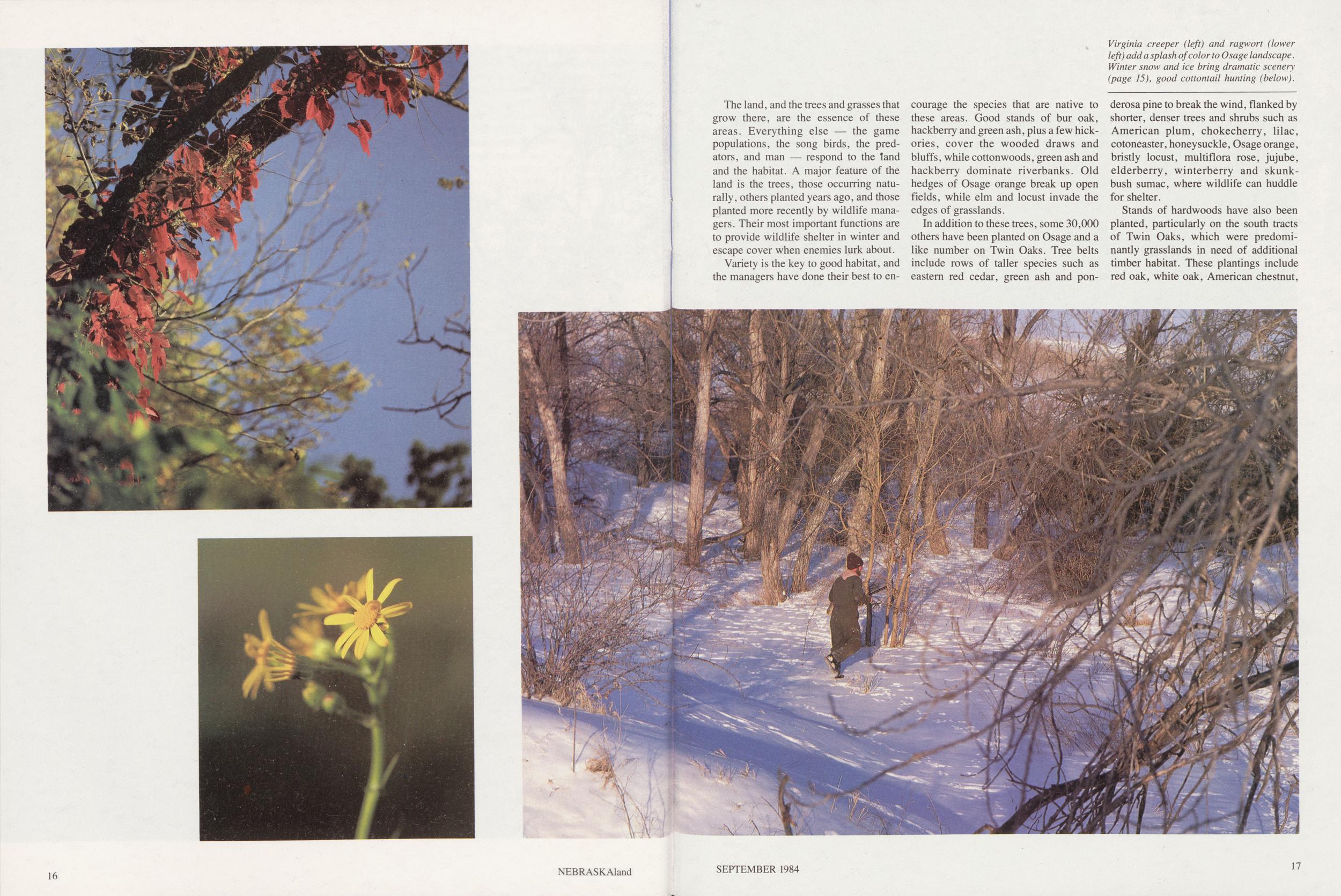
The land, and the trees and grasses that grow there, are the essence of these areas. Everything else — the game populations, the song birds, the predators, and man — respond to the land and the habitat. A major feature of the land is the trees, those occurring naturally, others planted years ago, and those planted more recently by wildlife managers. Their most important functions are to provide wildlife shelter in winter and escape cover when enemies lurk about.
Variety is the key to good habitat, and the managers have done their best to encourage the species that are native to these areas. Good stands of bur oak, blackberry and green ash, plus a few hickories, cover the wooded draws and bluffs, while cottonwoods, green ash and hackberry dominate riverbanks. Old hedges of Osage orange break up open fields, while elm and locust invade the edges of grasslands.
In addition to these trees, some 30,000 others have been planted on Osage and a like number on Twin Oaks. Tree belts include rows of taller species such as eastern red cedar, green ash and ponderosa pine to break the wind, flanked by shorter, denser trees and shrubs such as American plum, chokecherry, lilac, cotoneaster, honeysuckle, Osage orange, bristly locust, multiflora rose, jujube, elderberry, winterberry and skunk-bush sumac, where wildlife can huddle for shelter.
Stands of hardwoods have also been planted, particularly on the south tracts of Twin Oaks, which were predominantly grasslands in need of additional timber habitat. These plantings include red oak, white oak, American chestnut,
sassafras, Ohio buckeye, shagbark hickory, black walnut, hackberry and silver maple.
Another important aspect of habitat on Osage and Twin Oaks are the grasslands, which are particularly important nesting and brooding cover for pheasants, quail and various grasslands songbirds. There are stands of native warm-season grasses such as big and little bluestem, Indiangrass, switchgrass and side-oats grama. And, mixed stands of cool-season grass and legumes like intermediate wheatgrass, orchard grass, sweetclover, alfalfa and red clover have also been planted.
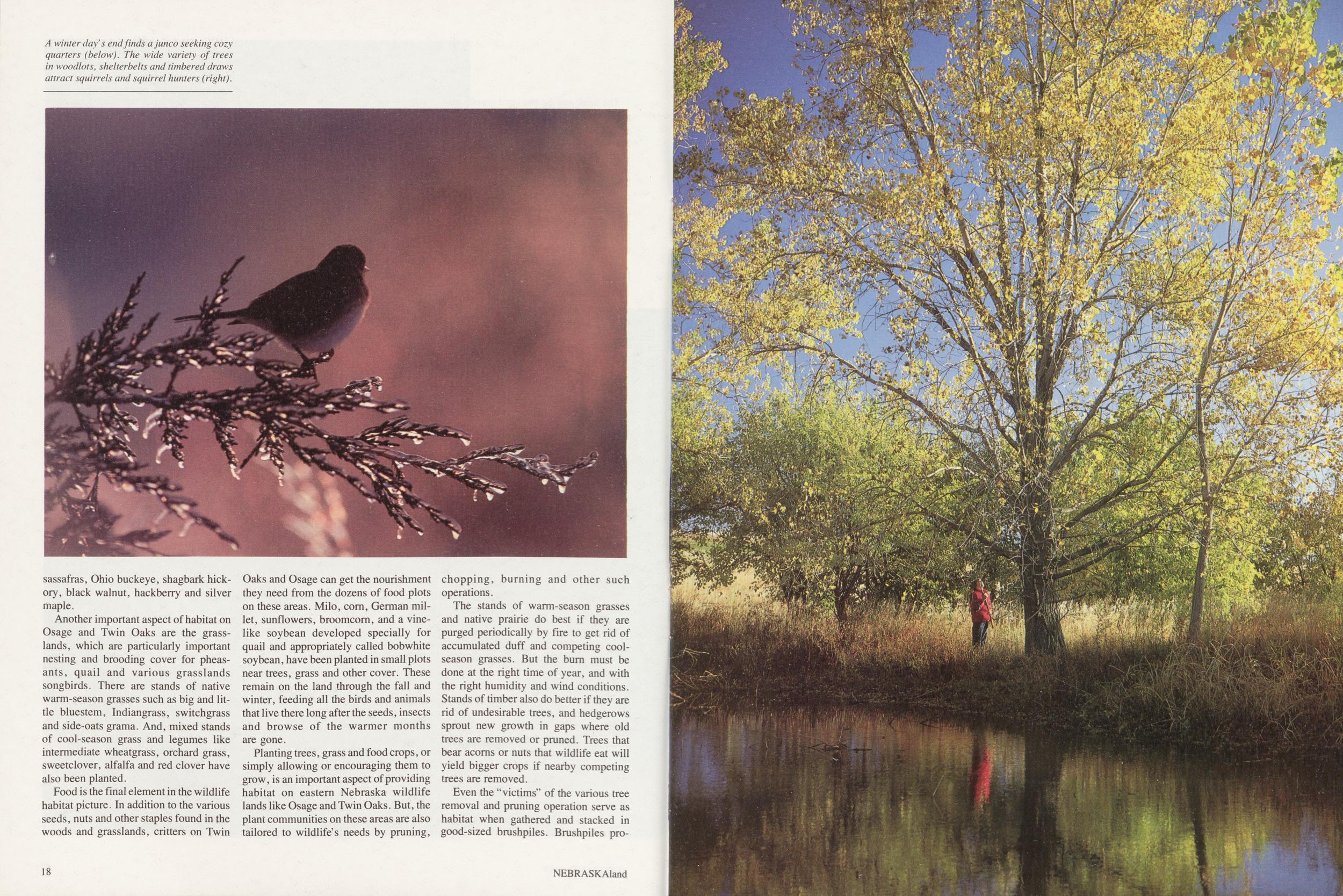
Food is the final element in the wildlife habitat picture. In addition to the various seeds, nuts and other staples found in the woods and grasslands, critters on Twin Oaks and Osage can get the nourishment they need from the dozens of food plots on these areas. Milo, corn, German millet, sunflowers, broomcorn, and a vine-like soybean developed specially for quail and appropriately called bobwhite soybean, have been planted in small plots near trees, grass and other cover. These remain on the land through the fall and winter, feeding all the birds and animals that live there long after the seeds, insects and browse of the warmer months are gone.
Planting trees, grass and food crops, or simply allowing or encouraging them to grow, is an important aspect of providing habitat on eastern Nebraska wildlife lands like Osage and Twin Oaks. But, the plant communities on these areas are also tailored to wildlife's needs by pruning, chopping, burning and other such operations.
The stands of warm-season grasses and native prairie do best if they are purged periodically by fire to get rid of accumulated duff and competing cool-season grasses. But the burn must be done at the right time of year, and with the right humidity and wind conditions. Stands of timber also do better if they are rid of undesirable trees, and hedgerows sprout new growth in gaps where old trees are removed or pruned. Trees that bear acorns or nuts that wildlife eat will yield bigger crops if nearby competing trees are removed.
Even the "victims" of the various tree removal and pruning operation serve as habitat when gathered and stacked in good-sized brushpiles. Brushpiles provide
18 NEBRASKAland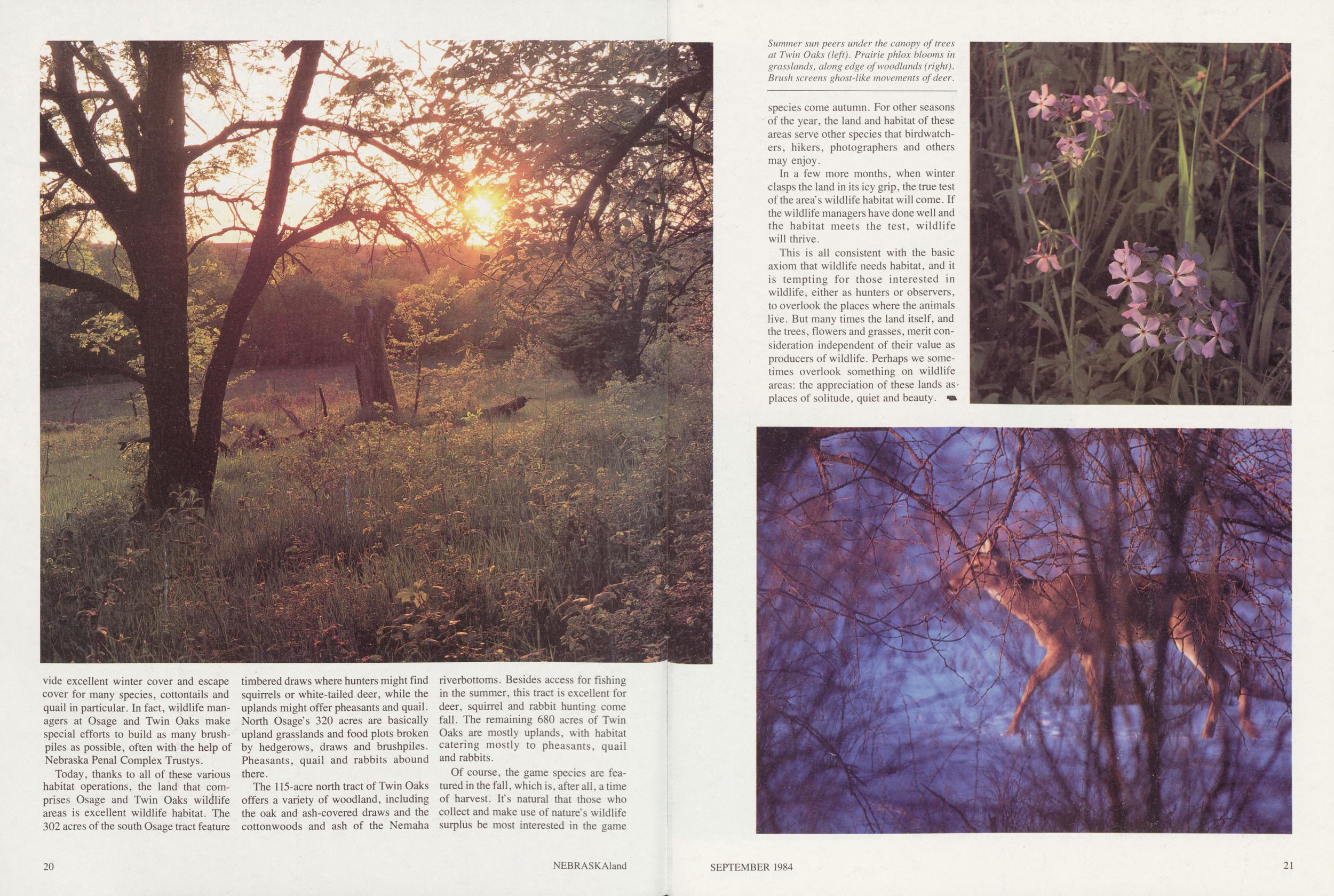
excellent winter cover and escape cover for many species, cottontails and quail in particular. In fact, wildlife managers at Osage and Twin Oaks make special efforts to build as many brush-piles as possible, often with the help of Nebraska Penal Complex Trustys.
Today, thanks to all of these various habitat operations, the land that comprises Osage and Twin Oaks wildlife areas is excellent wildlife habitat. The 302 acres of the south Osage tract feature timbered draws where hunters might find squirrels or white-tailed deer, while the uplands might offer pheasants and quail. North Osage's 320 acres are basically upland grasslands and food plots broken by hedgerows, draws and brushpiles. Pheasants, quail and rabbits abound there.
The 115-acre north tract of Twin Oaks offers a variety of woodland, including the oak and ash-covered draws and the cottonwoods and ash of the Nemaha riverbottoms. Besides access for fishing in the summer, this tract is excellent for deer, squirrel and rabbit hunting come fall. The remaining 680 acres of Twin Oaks are mostly uplands, with habitat catering mostly to pheasants, quail and rabbits.
Of course, the game species are featured in the fall, which is, after all, a time of harvest. It's natural that those who collect and make use of nature's wildlife surplus be most interested in the game
20 NEBRASKAlandspecies come autumn. For other seasons of the year, the land and habitat of these areas serve other species that birdwatchers, hikers, photographers and others may enjoy.
In a few more months, when winter clasps the land in its icy grip, the true test of the area's wildlife habitat will come. If the wildlife managers have done well and the habitat meets the test, wildlife will thrive.
This is all consistent with the basic axiom that wildlife needs habitat, and it is tempting for those interested in wildlife, either as hunters or observers, to overlook the places where the animals live. But many times the land itself, and the trees, flowers and grasses, merit consideration independent of their value as producers of wildlife. Perhaps we sometimes overlook something on wildlife areas: the appreciation of these lands as places of solitude, quiet and beauty.
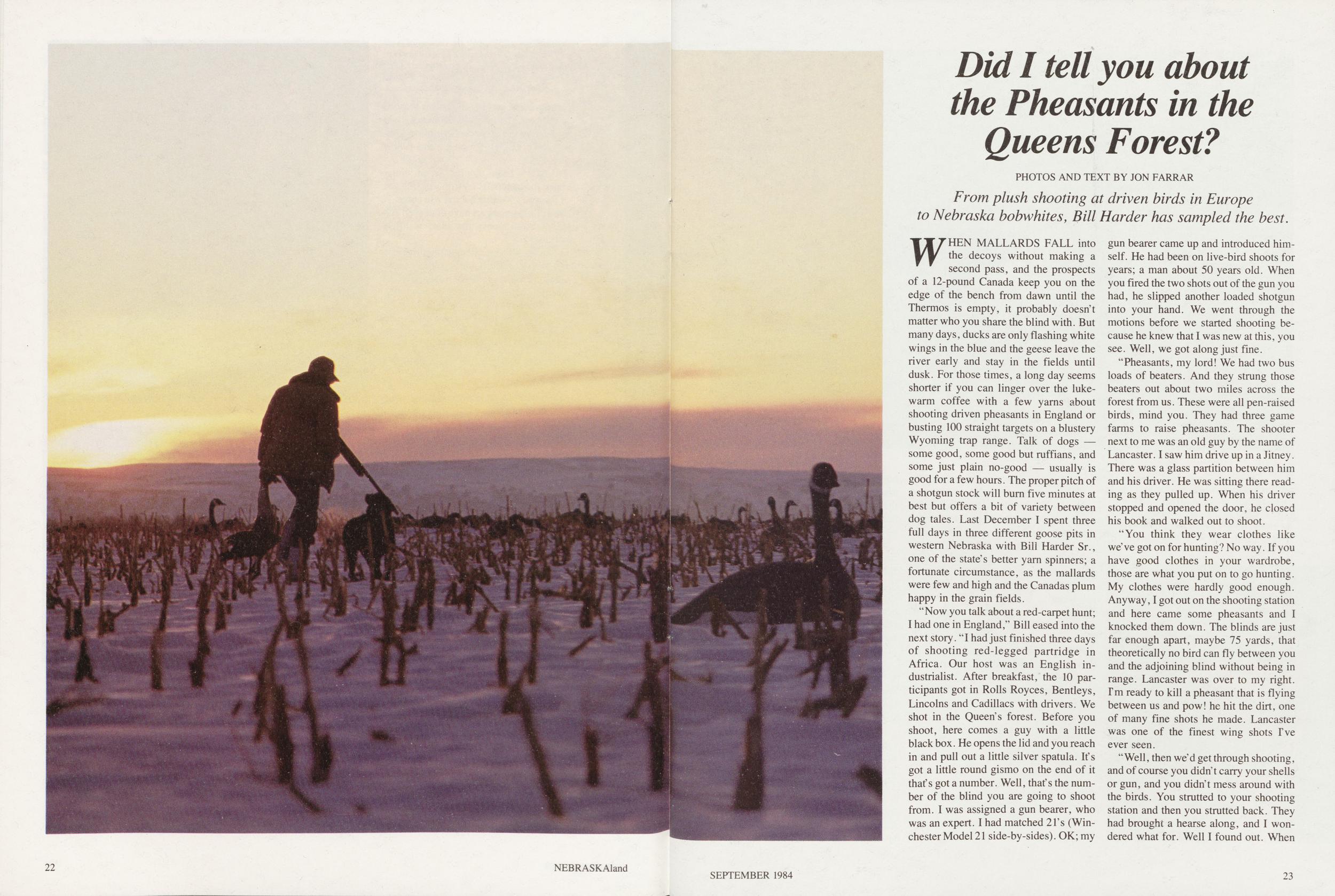
Did I tell you about the Pheasants in the Queens Forest?
PHOTOS AND TEXT BY JON FARRARFrom plush shooting at driven birds in Europe to Nebraska bobwhites, Bill Harder has sampled the best.
WHEN MALLARDS FALL into the decoys without making a second pass, and the prospects of a 12-pound Canada keep you on the edge of the bench from dawn until the Thermos is empty, it probably doesn't matter who you share the blind with. But many days, ducks are only flashing white wings in the blue and the geese leave the river early and stay in the fields until dusk. For those times, a long day seems shorter if you can linger over the lukewarm coffee with a few yarns about shooting driven pheasants in England or busting 100 straight targets on a blustery Wyoming trap range. Talk of dogs — some good, some good but ruffians, and some just plain no-good — usually is good for a few hours. The proper pitch of a shotgun stock will burn five minutes at best but offers a bit of variety between dog tales. Last December I spent three full days in three different goose pits in western Nebraska with Bill Harder Sr., one of the state's better yarn spinners; a fortunate circumstance, as the mallards were few and high and the Canadas plum happy in the grain fields.
"Now you talk about a red-carpet hunt; I had one in England," Bill eased into the next story. "I had just finished three days of shooting red-legged partridge in Africa. Our host was an English industrialist. After breakfast, the 10 participants got in Rolls Royces, Bentleys, Lincolns and Cadillacs with drivers. We shot in the Queen's forest. Before you shoot, here comes a guy with a little black box. He opens the lid and you reach in and pull out a little silver spatula. It's got a little round gismo on the end of it that's got a number. Well, that's the number of the blind you are going to shoot from. I was assigned a gun bearer, who was an expert. I had matched 21's (Winchester Model 21 side-by-sides). OK; my gun bearer came up and introduced himself. He had been on live-bird shoots for years; a man about 50 years old. When you fired the two shots out of the gun you had, he slipped another loaded shotgun into your hand. We went through the motions before we started shooting because he knew that I was new at this, you see. Well, we got along just fine.
"Pheasants, my lord! We had two bus loads of beaters. And they strung those beaters out about two miles across the forest from us. These were all pen-raised birds, mind you. They had three game farms to raise pheasants. The shooter next to me was an old guy by the name of Lancaster. I saw him drive up in a Jitney. There was a glass partition between him and his driver. He was sitting there reading as they pulled up. When his driver stopped and opened the door, he closed his book and walked out to shoot.
"You think they wear clothes like we've got on for hunting? No way. If you have good clothes in your wardrobe, those are what you put on to go hunting. My clothes were hardly good enough. Anyway, I got out on the shooting station and here came some pheasants and I knocked them down. The blinds are just far enough apart, maybe 75 yards, that theoretically no bird can fly between you and the adjoining blind without being in range. Lancaster was over to my right. I'm ready to kill a pheasant that is flying between us and pow! he hit the dirt, one of many fine shots he made. Lancaster was one of the finest wing shots I've ever seen.
"Well, then we'd get through shooting, and of course you didn't carry your shells or gun, and you didn't mess around with the birds. You strutted to your shooting station and then you strutted back. They had brought a hearse along, and I wondered what for. Well I found out. When
SEPTEMBER 1984 23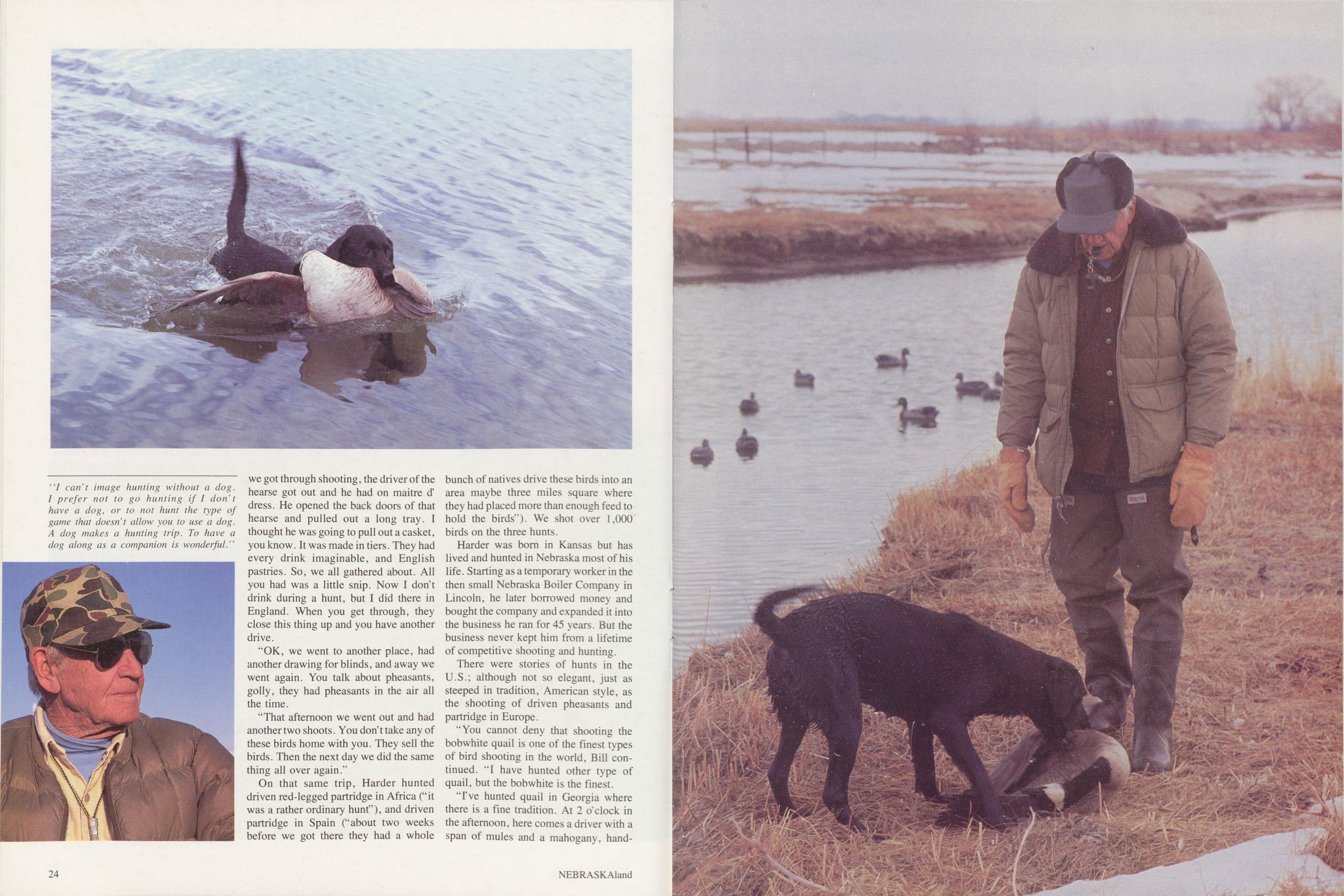
we got through shooting, the driver of the hearse got out and he had on maitre d' dress. He opened the back doors of that hearse and pulled out a long tray. I thought he was going to pull out a casket, you know. It was made in tiers. They had every drink imaginable, and English pastries. So, we all gathered about. All you had was a little snip. Now I don't drink during a hunt, but I did there in England. When you get through, they close this thing up and you have another drive.
"OK, we went to another place, had another drawing for blinds, and away we went again. You talk about pheasants, golly, they had pheasants in the air all the time.
"That afternoon we went out and had another two shoots. You don't take any of these birds home with you. They sell the birds. Then the next day we did the same thing all over again."
On that same trip, Harder hunted driven red-legged partridge in Africa ("it was a rather ordinary hunt"), and driven partridge in Spain ("about two weeks before we got there they had a whole bunch of natives drive these birds into an area maybe three miles square where they had placed more than enough feed to hold the birds"). We shot over 1,000 birds on the three hunts.
Harder was born in Kansas but has lived and hunted in Nebraska most of his life. Starting as a temporary worker in the then small Nebraska Boiler Company in Lincoln, he later borrowed money and bought the company and expanded it into the business he ran for 45 years. But the business never kept him from a lifetime of competitive shooting and hunting.
There were stories of hunts in the U.S.; although not so elegant, just as steeped in tradition, American style, as the shooting of driven pheasants and partridge in Europe.
"You cannot deny that shooting the bobwhite quail is one of the finest types of bird shooting in the world, Bill continued. "I have hunted other type of quail, but the bobwhite is the finest.
"I've hunted quail in Georgia where there is a fine tradition. At 2 o'clock in the afternoon, here comes a driver with a span of mules and a mahogany, handmade
24 NEBRASKAland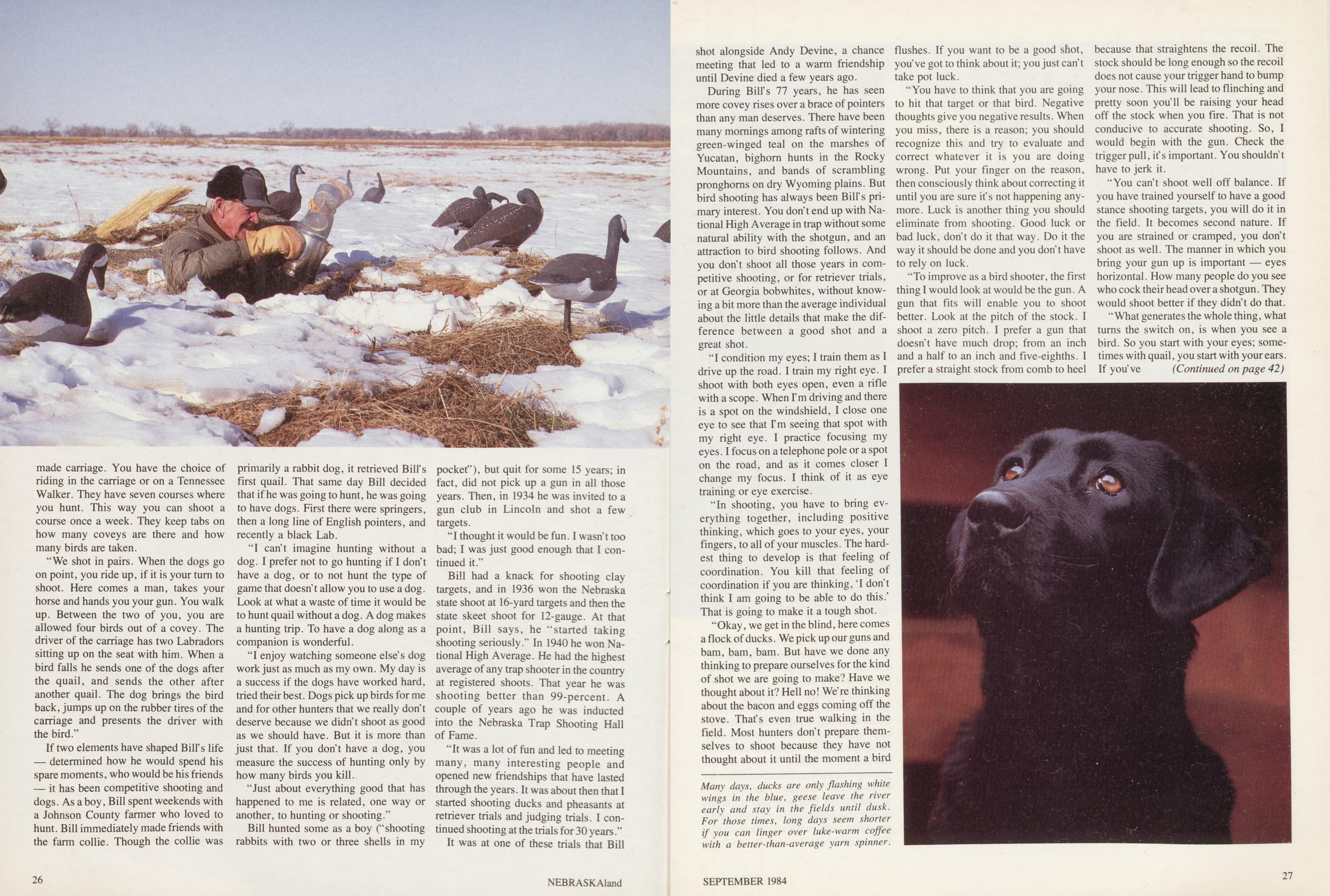
carriage. You have the choice of riding in the carriage or on a Tennessee Walker. They have seven courses where you hunt. This way you can shoot a course once a week. They keep tabs on how many coveys are there and how many birds are taken.
"We shot in pairs. When the dogs go on point, you ride up, if it is your turn to shoot. Here comes a man, takes your horse and hands you your gun. You walk up. Between the two of you, you are allowed four birds out of a covey. The driver of the carriage has two Labradors sitting up on the seat with him. When a bird falls he sends one of the dogs after the quail, and sends the other after another quail. The dog brings the bird back, jumps up on the rubber tires of the carriage and presents the driver with the bird."
If two elements have shaped Bill's life — determined how he would spend his spare moments, who would be his friends — it has been competitive shooting and dogs. As a boy, Bill spent weekends with a Johnson County farmer who loved to hunt. Bill immediately made friends with the farm collie. Though the collie was primarily a rabbit dog, it retrieved Bill's first quail. That same day Bill decided that if he was going to hunt, he was going to have dogs. First there were springers, then a long line of English pointers, and recently a black Lab.
"I can't imagine hunting without a dog. I prefer not to go hunting if I don't have a dog, or to not hunt the type of game that doesn't allow you to use a dog. Look at what a waste of time it would be to hunt quail without a dog. A dog makes a hunting trip. To have a dog along as a companion is wonderful.
"I enjoy watching someone else's dog work just as much as my own. My day is a success if the dogs have worked hard, tried their best. Dogs pick up birds for me and for other hunters that we really don't deserve because we didn't shoot as good as we should have. But it is more than just that. If you don't have a dog, you measure the success of hunting only by how many birds you kill.
"Just about everything good that has happened to me is related, one way or another, to hunting or shooting."
Bill hunted some as a boy ("shooting rabbits with two or three shells in my pocket"), but quit for some 15 years; in fact, did not pick up a gun in all those years. Then, in 1934 he was invited to a gun club in Lincoln and shot a few targets.
"I thought it would be fun. I wasn't too bad; I was just good enough that I continued it."
Bill had a knack for shooting clay targets, and in 1936 won the Nebraska state shoot at 16-yard targets and then the state skeet shoot for 12-gauge. At that point, Bill says, he "started taking shooting seriously." In 1940 he won National High Average. He had the highest average of any trap shooter in the country at registered shoots. That year he was shooting better than 99-percent. A couple of years ago he was inducted into the Nebraska Trap Shooting Hall of Fame.
"It was a lot of fun and led to meeting many, many interesting people and opened new friendships that have lasted through the years. It was about then that I started shooting ducks and pheasants at retriever trials and judging trials. I continued shooting at the trials for 30 years."
It was at one of these trials that Bill
26 NEBRASKAlandshot alongside Andy Devine, a chance meeting that led to a warm friendship until Devine died a few years ago.
During Bill's 77 years, he has seen more covey rises over a brace of pointers than any man deserves. There have been many mornings among rafts of wintering green-winged teal on the marshes of Yucatan, bighorn hunts in the Rocky Mountains, and bands of scrambling pronghorns on dry Wyoming plains. But bird shooting has always been Bill's primary interest. You don't end up with National High Average in trap without some natural ability with the shotgun, and an attraction to bird shooting follows. And you don't shoot all those years in competitive shooting, or for retriever trials, or at Georgia bob whites, without knowing a bit more than the average individual about the little details that make the difference between a good shot and a great shot.
"I condition my eyes; I train them as I drive up the road. I train my right eye. I shoot with both eyes open, even a rifle with a scope. When Fm driving and there is a spot on the windshield, I close one eye to see that Fm seeing that spot with my right eye. I practice focusing my eyes. I focus on a telephone pole or a spot on the road, and as it comes closer I change my focus. I think of it as eye training or eye exercise.
"In shooting, you have to bring everything together, including positive thinking, which goes to your eyes, your fingers, to all of your muscles. The hardest thing to develop is that feeling of coordination. You kill that feeling of coordination if you are thinking, T don't think I am going to be able to do this.' That is going to make it a tough shot.
"Okay, we get in the blind, here comes a flock of ducks. We pick up our guns and bam, bam, bam. But have we done any thinking to prepare ourselves for the kind of shot we are going to make? Have we thought about it? Hell no! We're thinking about the bacon and eggs coming off the stove. That's even true walking in the field. Most hunters don't prepare themselves to shoot because they have not thought about it until the moment a bird flushes. If you want to be a good shot, you've got to think about it; you just can't take pot luck.
"You have to think that you are going to hit that target or that bird. Negative thoughts give you negative results. When you miss, there is a reason; you should recognize this and try to evaluate and correct whatever it is you are doing wrong. Put your finger on the reason, then consciously think about correcting it until you are sure it's not happening anymore. Luck is another thing you should eliminate from shooting. Good luck or bad luck, don't do it that way. Do it the way it should be done and you don't have to rely on luck.
"To improve as a bird shooter, the first thing I would look at would be the gun. A gun that fits will enable you to shoot better. Look at the pitch of the stock. I shoot a zero pitch. I prefer a gun that doesn't have much drop; from an inch and a half to an inch and five-eighths. I prefer a straight stock from comb to heel because that straightens the recoil. The stock should be long enough so the recoil does not cause your trigger hand to bump your nose. This will lead to flinching and pretty soon you'll be raising your head off the stock when you fire. That is not conducive to accurate shooting. So, I would begin with the gun. Check the trigger pull, it's important. You shouldn't have to jerk it.
"You can't shoot well off balance. If you have trained yourself to have a good stance shooting targets, you will do it in the field. It becomes second nature. If you are strained or cramped, you don't shoot as well. The manner in which you bring your gun up is important — eyes horizontal. How many people do you see who cock their head over a shotgun. They would shoot better if they didn't do that.
"What generates the whole thing, what turns the switch on, is when you see a bird. So you start with your eyes; sometimes with quail, you start with your ears. If you've
(Continued on page 42)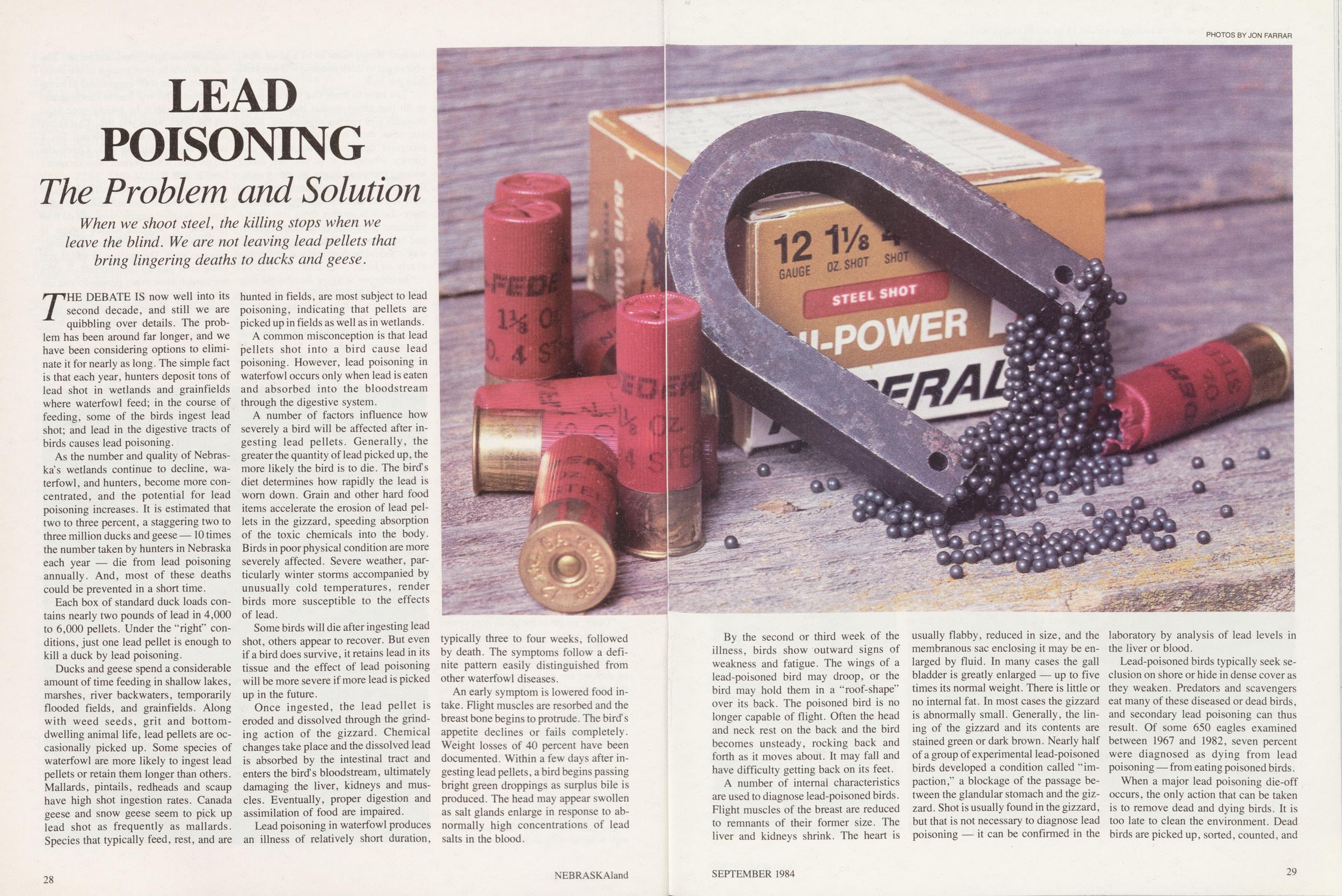
LEAD POISONING
The Problem and Solution When we shoot steel, the killing stops when we leave the blind. We are not leaving lead pellets that bring lingering deaths to ducks and geese.THE DEBATE IS now well into its second decade, and still we are quibbling over details. The problem has been around far longer, and we have been considering options to eliminate it for nearly as long. The simple fact is that each year, hunters deposit tons of lead shot in wetlands and grainfields where waterfowl feed; in the course of feeding, some of the birds ingest lead shot; and lead in the digestive tracts of birds causes lead poisoning.
As the number and quality of Nebraska's wetlands continue to decline, waterfowl, and hunters, become more concentrated, and the potential for lead poisoning increases. It is estimated that two to three percent, a staggering two to three million ducks and geese — 10 times the number taken by hunters in Nebraska each year — die from lead poisoning annually. And, most of these deaths could be prevented in a short time.
Each box of standard duck loads contains nearly two pounds of lead in 4,000 to 6,000 pellets. Under the "right" conditions, just one lead pellet is enough to kill a duck by lead poisoning.
Ducks and geese spend a considerable amount of time feeding in shallow lakes, marshes, river backwaters, temporarily flooded fields, and grainfields. Along with weed seeds, grit and bottom-dwelling animal life, lead pellets are occasionally picked up. Some species of waterfowl are more likely to ingest lead pellets or retain them longer than others. Mallards, pintails, redheads and scaup have high shot ingestion rates. Canada geese and snow geese seem to pick up lead shot as frequently as mallards. Species that typically feed, rest, and are hunted in fields, are most subject to lead poisoning, indicating that pellets are picked up in fields as well as in wetlands.
A common misconception is that lead pellets shot into a bird cause lead poisoning. However, lead poisoning in waterfowl occurs only when lead is eaten and absorbed into the bloodstream through the digestive system.
A number of factors influence how severely a bird will be affected after ingesting lead pellets. Generally, the greater the quantity of lead picked up, the more likely the bird is to die. The bird's diet determines how rapidly the lead is worn down. Grain and other hard food items accelerate the erosion of lead pellets in the gizzard, speeding absorption of the toxic chemicals into the body. Birds in poor physical condition are more severely affected. Severe weather, particularly winter storms accompanied by unusually cold temperatures, render birds more susceptible to the effects of lead.
Some birds will die after ingesting lead shot, others appear to recover. But even if a bird does survive, it retains lead in its tissue and the effect of lead poisoning will be more severe if more lead is picked up in the future.
Once ingested, the lead pellet is eroded and dissolved through the grinding action of the gizzard. Chemical changes take place and the dissolved lead is absorbed by the intestinal tract and enters the bird's bloodstream, ultimately damaging the liver, kidneys and muscles. Eventually, proper digestion and assimilation of food are impaired.
Lead poisoning in waterfowl produces an illness of relatively short duration, typically three to four weeks, followed by death. The symptoms follow a definite pattern easily distinguished from other waterfowl diseases.
An early symptom is lowered food intake. Flight muscles are resorbed and the breast bone begins to protrude. The bird's appetite declines or fails completely. Weight losses of 40 percent have been documented. Within a few days after ingesting lead pellets, a bird begins passing bright green droppings as surplus bile is produced. The head may appear swollen as salt glands enlarge in response to abnormally high concentrations of lead salts in the blood.
28 NEBRASKAlandBy the second or third week of the illness, birds show outward signs of weakness and fatigue. The wings of a lead-poisoned bird may droop, or the bird may hold them in a "roof-shape" over its back. The poisoned bird is no longer capable of flight. Often the head and neck rest on the back and the bird becomes unsteady, rocking back and forth as it moves about. It may fall and have difficulty getting back on its feet.
A number of internal characteristics are used to diagnose lead-poisoned birds. Flight muscles of the breast are reduced to remnants of their former size. The liver and kidneys shrink. The heart is usually flabby, reduced in size, and the membranous sac enclosing it may be enlarged by fluid. In many cases the gall bladder is greatly enlarged — up to five times its normal weight. There is little or no internal fat. In most cases the gizzard is abnormally small. Generally, the lining of the gizzard and its contents are stained green or dark brown. Nearly half of a group of experimental lead-poisoned birds developed a condition called "impaction," a blockage of the passage between the glandular stomach and the gizzard. Shot is usually found in the gizzard, but that is not necessary to diagnose lead poisoning — it can be confirmed in the laboratory by analysis of lead levels in the liver or blood.
Lead-poisoned birds typically seek seclusion on shore or hide in dense cover as they weaken. Predators and scavengers eat many of these diseased or dead birds, and secondary lead poisoning can thus result. Of some 650 eagles examined between 1967 and 1982, seven percent were diagnosed as dying from lead poisoning — from eating poisoned birds.
When a major lead poisoning die-off occurs, the only action that can be taken is to remove dead and dying birds. It is too late to clean the environment. Dead birds are picked up, sorted, counted, and
SEPTEMBER 1984 29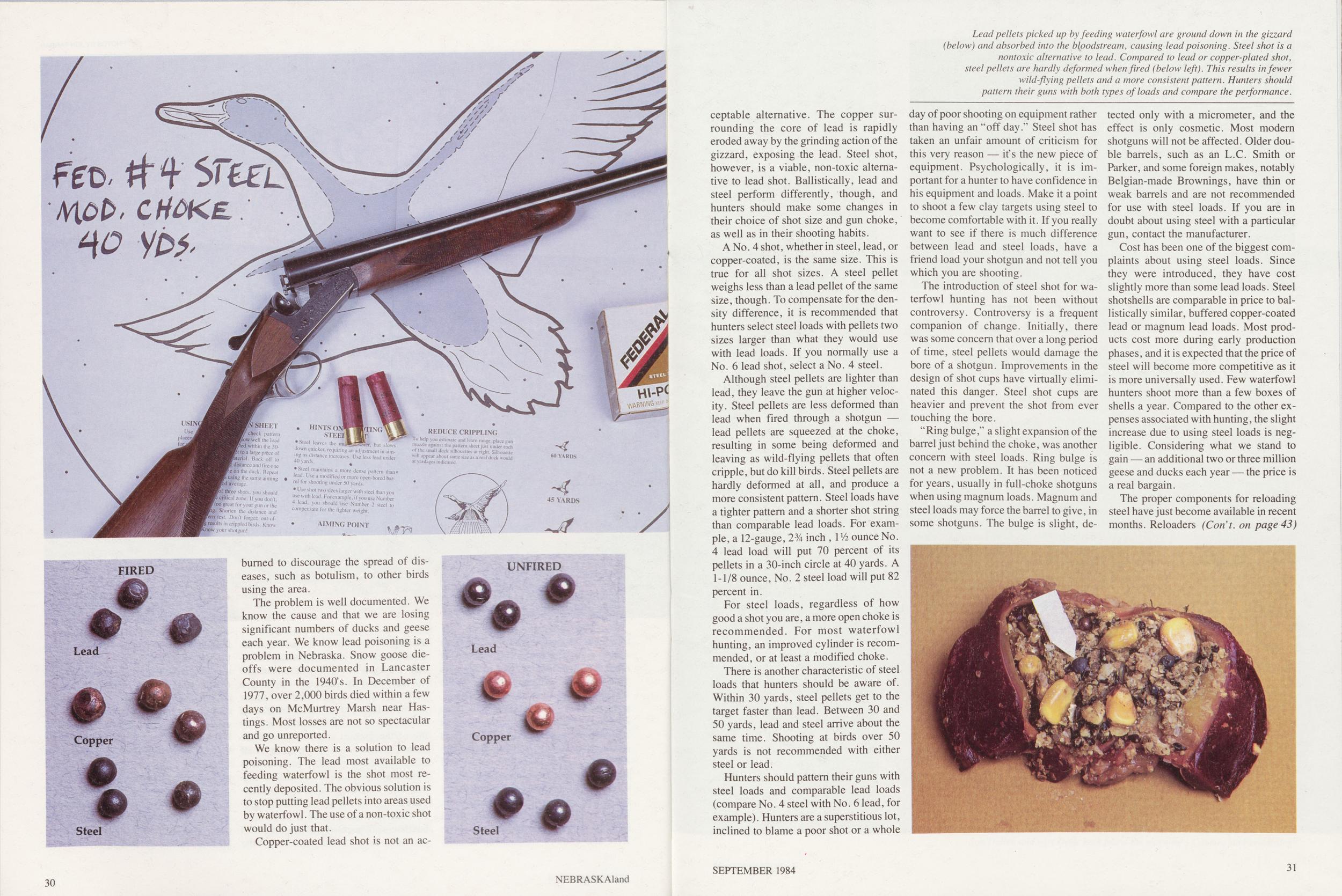
burned to discourage the spread of diseases, such as botulism, to other birds using the area.
The problem is well documented. We know the cause and that we are losing significant numbers of ducks and geese each year. We know lead poisoning is a problem in Nebraska. Snow goose die-offs were documented in Lancaster County in the 1940's. In December of 1977, over 2,000 birds died within a few days on McMurtrey Marsh near Hastings. Most losses are not so spectacular and go unreported.
We know there is a solution to lead poisoning. The lead most available to feeding waterfowl is the shot most recently deposited. The obvious solution is to stop putting lead pellets into areas used by waterfowl. The use of a non-toxic shot would do just that.
Copper-coated lead shot is not an acceptable
alternative. The copper surrounding the core of lead is rapidly eroded away by the grinding action of the gizzard, exposing the lead. Steel shot, however, is a viable, non-toxic alternative to lead shot. Ballistically, lead and steel perform differently, though, and hunters should make some changes in their choice of shot size and gun choke, as well as in their shooting habits.
A No. 4 shot, whether in steel, lead, or copper-coated, is the same size. This is true for all shot sizes. A steel pellet weighs less than a lead pellet of the same size, though. To compensate for the density difference, it is recommended that hunters select steel loads with pellets two sizes larger than what they would use with lead loads. If you normally use a No. 6 lead shot, select a No. 4 steel.
Although steel pellets are lighter than lead, they leave the gun at higher velocity. Steel pellets are less deformed than lead when fired through a shotgun — lead pellets are squeezed at the choke, resulting in some being deformed and leaving as wild-flying pellets that often cripple, but do kill birds. Steel pellets are hardly deformed at all, and produce a more consistent pattern. Steel loads have a tighter pattern and a shorter shot string than comparable lead loads. For example, a 12-gauge, 23A inch , Wi ounce No. 4 lead load will put 70 percent of its pellets in a 30-inch circle at 40 yards. A 1-1/8 ounce, No. 2 steel load will put 82 percent in.
For steel loads, regardless of how good a shot you are, a more open choke is recommended. For most waterfowl hunting, an improved cylinder is recommended, or at least a modified choke.
There is another characteristic of steel loads that hunters should be aware of. Within 30 yards, steel pellets get to the target faster than lead. Between 30 and 50 yards, lead and steel arrive about the same time. Shooting at birds over 50 yards is not recommended with either steel or lead.
Hunters should pattern their guns with steel loads and comparable lead loads (compare No. 4 steel with No. 6 lead, for example). Hunters are a superstitious lot, inclined to blame a poor shot or a whole day of poor shooting on equipment rather than having an "off day." Steel shot has taken an unfair amount of criticism for this very reason — it's the new piece of equipment. Psychologically, it is important for a hunter to have confidence in his equipment and loads. Make it a point to shoot a few clay targets using steel to become comfortable with it. If you really want to see if there is much difference between lead and steel loads, have a friend load your shotgun and not tell you which you are shooting.
The introduction of steel shot for waterfowl hunting has not been without controversy. Controversy is a frequent companion of change. Initially, there was some concern that over a long period of time, steel pellets would damage the bore of a shotgun. Improvements in the design of shot cups have virtually eliminated this danger. Steel shot cups are heavier and prevent the shot from ever touching the bore.
"Ring bulge," a slight expansion of the barrel just behind the choke, was another concern with steel loads. Ring bulge is not a new problem. It has been noticed for years, usually in full-choke shotguns when using magnum loads. Magnum and steel loads may force the barrel to give, in some shotguns. The bulge is slight, detected only with a micrometer, and the effect is only cosmetic. Most modern shotguns will not be affected. Older double barrels, such as an L.C. Smith or Parker, and some foreign makes, notably Belgian-made Brownings, have thin or weak barrels and are not recommended for use with steel loads. If you are in doubt about using steel with a particular gun, contact the manufacturer.
Cost has been one of the biggest complaints about using steel loads. Since they were introduced, they have cost slightly more than some lead loads. Steel shotshells are comparable in price to ballistically similar, buffered copper-coated lead or magnum lead loads. Most products cost more during early production phases, and it is expected that the price of steel will become more competitive as it is more universally used. Few waterfowl hunters shoot more than a few boxes of shells a year. Compared to the other expenses associated with hunting, the slight increase due to using steel loads is negligible. Considering what we stand to gain — an additional two or three million geese and ducks each year — the price is a real bargain.
The proper components for reloading steel have just become available in recent months. Reloaders
(Cont. on page 43)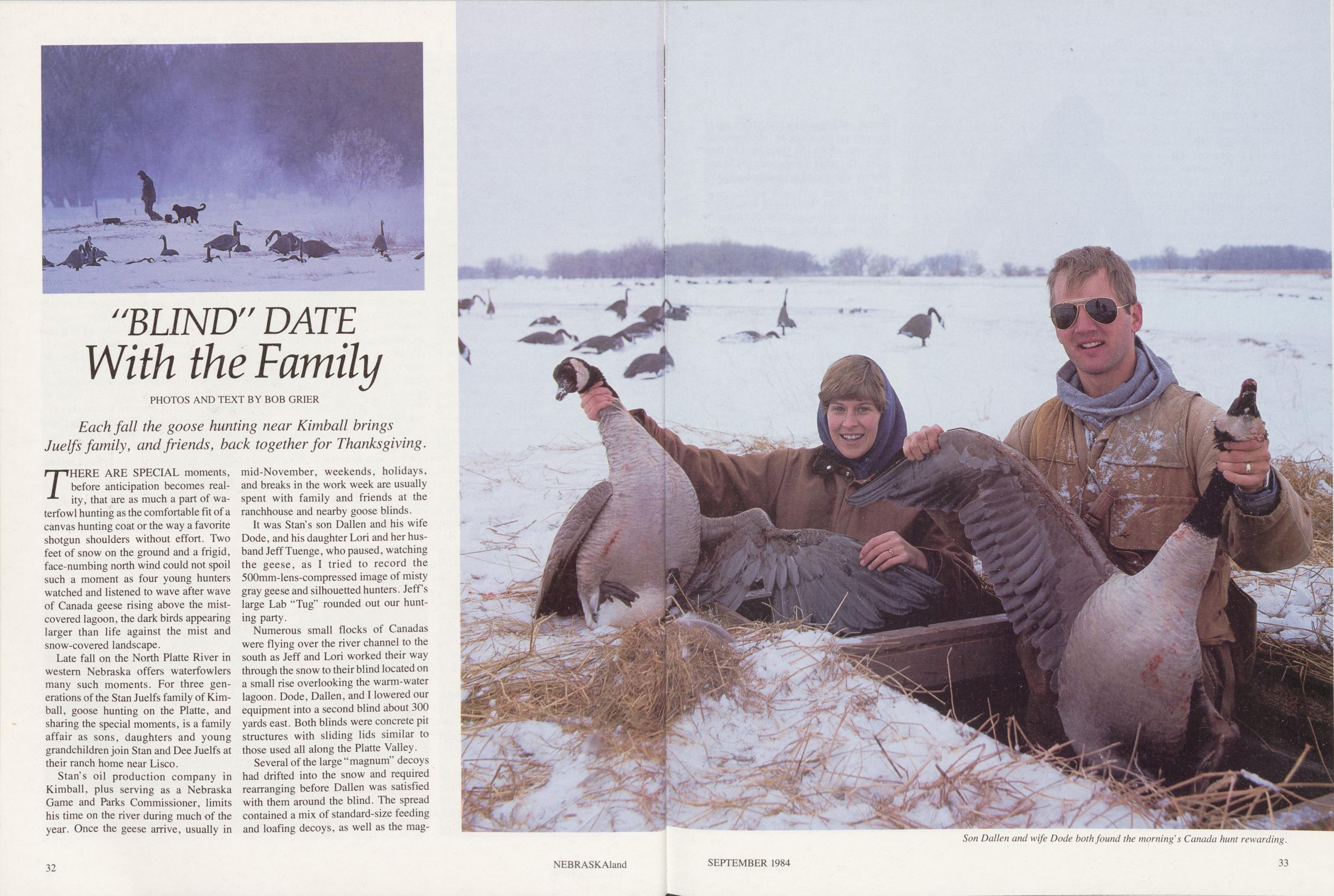
"BLIND" DATE With the Family
PHOTOS AND TEXT BY BOB GRIER Each fall the goose hunting near Kimball brings Juelfs family, and friends, back together for Thanksgiving.THERE ARE SPECIAL moments, before anticipation becomes reality, that are as much a part of waterfowl hunting as the comfortable fit of a canvas hunting coat or the way a favorite shotgun shoulders without effort. Two feet of snow on the ground and a frigid, face-numbing north wind could not spoil such a moment as four young hunters watched and listened to wave after wave of Canada geese rising above the mist-covered lagoon, the dark birds appearing larger than life against the mist and snow-covered landscape.
Late fall on the North Platte River in western Nebraska offers waterfowlers many such moments. For three generations of the Stan Juelfs family of Kimball, goose hunting on the Platte, and sharing the special moments, is a family affair as sons, daughters and young grandchildren join Stan and Dee Juelfs at their ranch home near Lisco.
Stan's oil production company in Kimball, plus serving as a Nebraska Game and Parks Commissioner, limits his time on the river during much of the year. Once the geese arrive, usually in mid-November, weekends, holidays, and breaks in the work week are usually spent with family and friends at the ranchhouse and nearby goose blinds.
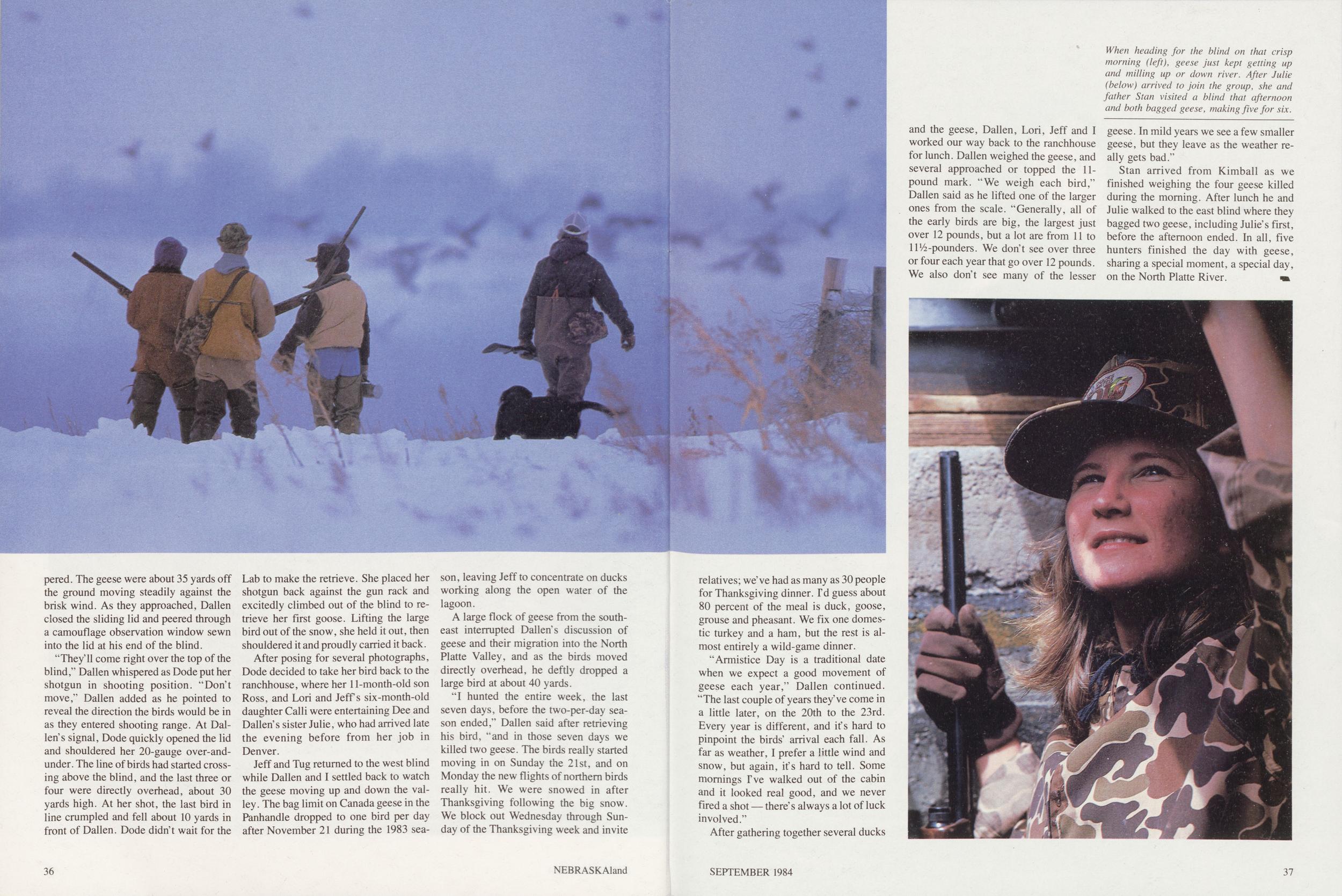
It was Stan's son Dallen and his wife Dode, and his daughter Lori and her husband Jeff Tuenge, who paused, watching the geese, as I tried to record the 500mm-lens-compressed image of misty gray geese and silhouetted hunters. Jeff's large Lab "Tug" rounded out our hunting party.
Numerous small flocks of Canadas were flying over the river channel to the south as Jeff and Lori worked their way through the snow to their blind located on a small rise overlooking the warm-water lagoon. Dode, Dallen, and I lowered our equipment into a second blind about 300 yards east. Both blinds were concrete pit structures with sliding lids similar to those used all along the Platte Valley.
Several of the large "magnum" decoys had drifted into the snow and required rearranging before Dallen was satisfied with them around the blind. The spread contained a mix of standard-size feeding and loafing decoys, as well as the magnums,
32 NEBRASKAlandSon Dallen and wife Dode both found the morning s Canada hunt rewarding.
which were of pretty impressive proportions
"I'm convinced having a few large decoys, even mixed in with smaller ones, will help attract geese," Dallen said as we joined Dode in the blind. "It's fun to try different decoys. We have even used kites, which seemed to draw birds toward us. Once the birds are about 200 yards, though, they begin to notice that something is wrong.
"The biggest part of hunting geese to me is when the birds come into the decoys," Dallen continued as we rearranged our equipment and lit the propane hotplate. "My pleasure comes from watching the birds set their wings and decoy. I enjoy having people in the blind who have not had as much opportunity to hunt geese as I've had," he added. "Decoying geese into close range reduces the chance a bird may be crippled, and helps the inexperienced hunter be more successful."
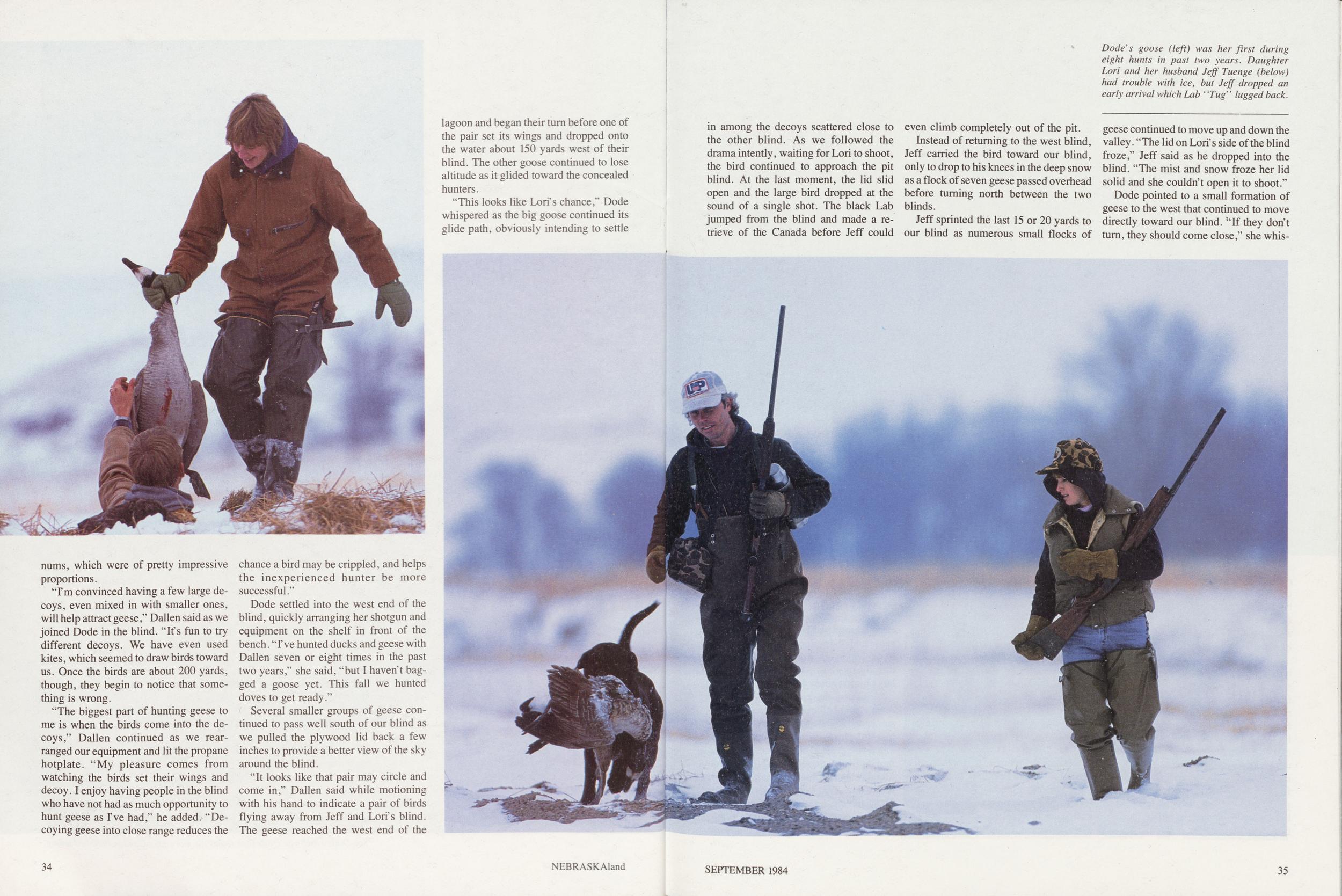
Dode settled into the west end of the blind, quickly arranging her shotgun and equipment on the shelf in front of the bench. "I've hunted ducks and geese with Dallen seven or eight times in the past two years," she said, "but I haven't bagged a goose yet. This fall we hunted doves to get ready."
Several smaller groups of geese continued to pass well south of our blind as we pulled the plywood lid back a few inches to provide a better view of the sky around the blind.
"It looks like that pair may circle and come in," Dallen said while motioning with his hand to indicate a pair of birds flying away from Jeff and Lori's blind. The geese reached the west end of the lagoon and began their turn before one of the pair set its wings and dropped onto the water about 150 yards west of their blind. The other goose continued to lose altitude as it glided toward the concealed hunters.
"This looks like Lori's chance," Dode whispered as the big goose continued its glide path, obviously intending to settle
34 NEBRASKAlandin among the decoys scattered close to the other blind. As we followed the drama intently, waiting for Lori to shoot, the bird continued to approach the pit blind. At the last moment, the lid slid open and the large bird dropped at the sound of a single shot. The black Lab jumped from the blind and made a retrieve of the Canada before Jeff could even climb completely out of the pit.
Instead of returning to the west blind, Jeff carried the bird toward our blind, only to drop to his knees in the deep snow as a flock of seven geese passed overhead before turning north between the two blinds.
Jeff sprinted the last 15 or 20 yards to our blind as numerous small flocks of geese continued to move up and down the valley. "The lid on Lori's side of the blind froze," Jeff said as he dropped into the blind. "The mist and snow froze her lid solid and she couldn't open it to shoot."
Dode pointed to a small formation of geese to the west that continued to move directly toward our blind. ;Tf they don't turn, they should come close," she whispered.
The geese were about 35 yards off the ground moving steadily against the brisk wind. As they approached, Dallen closed the sliding lid and peered through a camouflage observation window sewn into the lid at his end of the blind.
"They'll come right over the top of the blind," Dallen whispered as Dode put her shotgun in shooting position. "Don't move," Dallen added as he pointed to reveal the direction the birds would be in as they entered shooting range. At Dallen's signal, Dode quickly opened the lid and shouldered her 20-gauge over-and-under. The line of birds had started crossing above the blind, and the last three or four were directly overhead, about 30 yards high. At her shot, the last bird in line crumpled and fell about 10 yards in front of Dallen. Dode didn't wait for the Lab to make the retrieve. She placed her shotgun back against the gun rack and excitedly climbed out of the blind to retrieve her first goose. Lifting the large bird out of the snow, she held it out, then shouldered it and proudly carried it back.
After posing for several photographs, Dode decided to take her bird back to the ranchhouse, where her 11-month-old son Ross, and Lori and Jeffs six-month-old daughter Calli were entertaining Dee and Dallen's sister Julie, who had arrived late the evening before from her job in Denver.
Jeff and Tug returned to the west blind while Dallen and I settled back to watch the geese moving up and down the valley. The bag limit on Canada geese in the Panhandle dropped to one bird per day after November 21 during the 1983 season, leaving Jeff to concentrate on ducks working along the open water of the lagoon.
A large flock of geese from the southeast interrupted Dallen's discussion of geese and their migration into the North Platte Valley, and as the birds moved directly overhead, he deftly dropped a large bird at about 40 yards.
"I hunted the entire week, the last seven days, before the two-per-day season ended," Dallen said after retrieving his bird, "and in those seven days we killed two geese. The birds really started moving in on Sunday the 21st, and on Monday the new flights of northern birds really hit. We were snowed in after Thanksgiving following the big snow. We block out Wednesday through Sunday of the Thanksgiving week and invite
36 NEBRASKAlandrelatives; we've had as many as 30 people for Thanksgiving dinner. Fd guess about 80 percent of the meal is duck, goose, grouse and pheasant. We fix one domestic turkey and a ham, but the rest is almost entirely a wild-game dinner.
"Armistice Day is a traditional date when we expect a good movement of geese each year," Dallen continued. The last couple of years they've come in a little later, on the 20th to the 23rd. Every year is different, and it's hard to pinpoint the birds' arrival each fall. As far as weather, I prefer a little wind and snow, but again, it's hard to tell. Some mornings Fve walked out of the cabin and it looked real good, and we never fired a shot — there's always a lot of luck involved."
After gathering together several ducks and the geese, Dallen, Lori, Jeff and I worked our way back to the ranchhouse for lunch. Dallen weighed the geese, and several approached or topped the 11-pound mark. "We weigh each bird," Dallen said as he lifted one of the larger ones from the scale. "Generally, all of the early birds are big, the largest just over 12 pounds, but a lot are from 11 to 11 1/2-pounders. We don't see over three or four each year that go over 12 pounds. We also don't see many of the lesser geese. In mild years we see a few smaller geese, but they leave as the weather really gets bad."
Stan arrived from Kimball as we finished weighing the four geese killed during the morning. After lunch he and Julie walked to the east blind where they bagged two geese, including Julie's first, before the afternoon ended. In all, five hunters finished the day with geese, sharing a special moment, a special day, on the North Platte River.
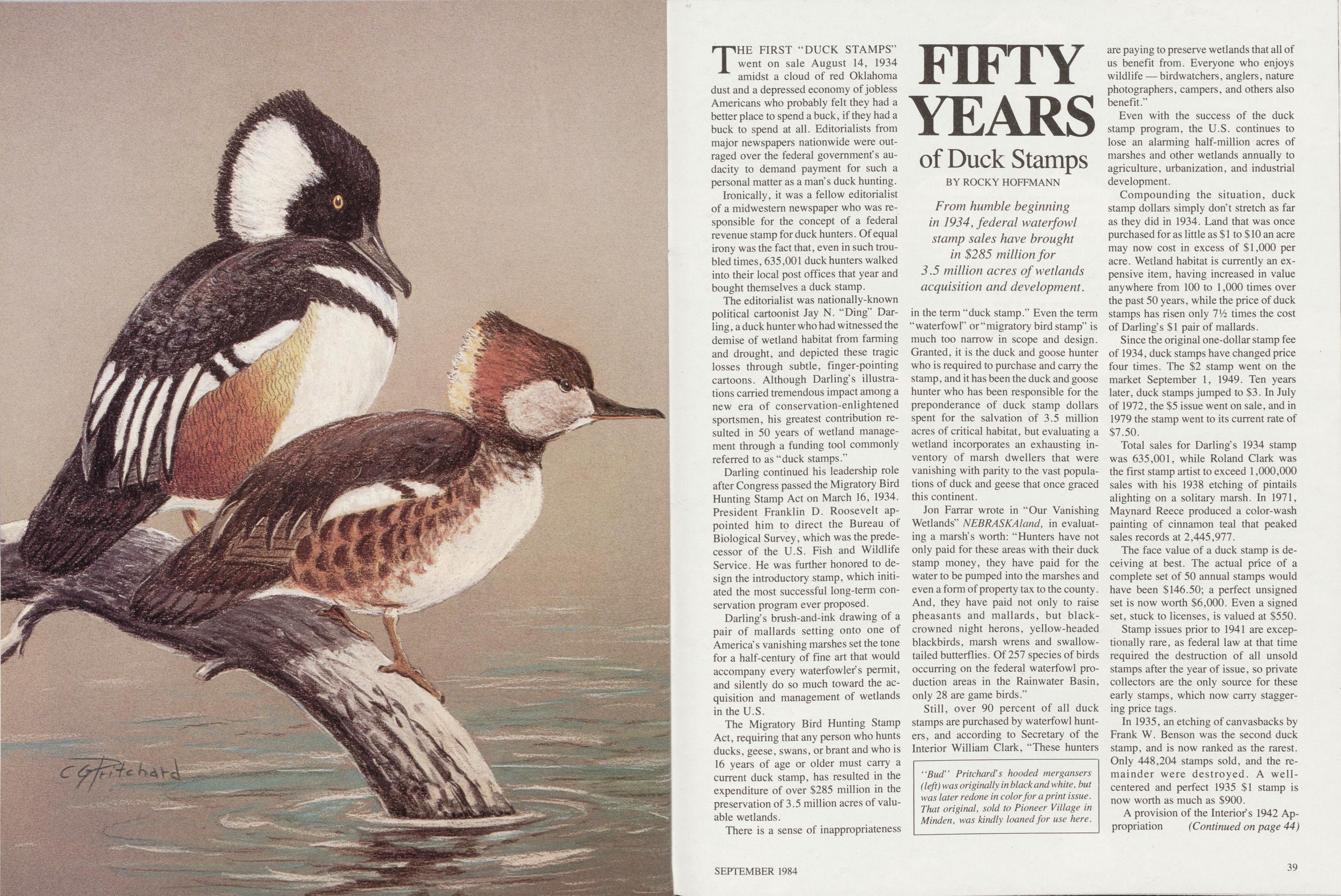
FIFTY YEARS of Duck Stamps
BY ROCKY HOFFMANN From humble beginning in 1934, federal waterfowl stamp sales have brought in $285 million for 3.5 million acres of wetlands acquisition and development.THE FIRST "DUCK STAMPS" went on sale August 14, 1934 amidst a cloud of red Oklahoma dust and a depressed economy of jobless Americans who probably felt they had a better place to spend a buck, if they had a buck to spend at all. Editorialists from major newspapers nationwide were outraged over the federal government's audacity to demand payment for such a personal matter as a man's duck hunting.
Ironically, it was a fellow editorialist of a midwestern newspaper who was responsible for the concept of a federal revenue stamp for duck hunters. Of equal irony was the fact that, even in such troubled times, 635,001 duck hunters walked into their local post offices that year and bought themselves a duck stamp.
The editorialist was nationally-known political cartoonist Jay N. "Ding" Darling , a duck hunter who had witnessed the demise of wetland habitat from farming and drought, and depicted these tragic losses through subtle, finger-pointing cartoons. Although Darling's illustrations carried tremendous impact among a new era of conservation-enlightened sportsmen, his greatest contribution resulted in 50 years of wetland management through a funding tool commonly referred to as "duck stamps."
Darling continued his leadership role after Congress passed the Migratory Bird Hunting Stamp Act on March 16, 1934. President Franklin D. Roosevelt appointed him to direct the Bureau of Biological Survey, which was the predecessor of the U.S. Fish and Wildlife Service. He was further honored to design the introductory stamp, which initiated the most successful long-term conservation program ever proposed.
Darling's brush-and-ink drawing of a pair of mallards setting onto one of America's vanishing marshes set the tone for a half-century of fine art that would accompany every water-fowler's permit, and silently do so much toward the acquisition and management of wetlands in the U.S.
The Migratory Bird Hunting Stamp Act, requiring that any person who hunts ducks, geese, swans, or brant and who is 16 years of age or older must carry a current duck stamp, has resulted in the expenditure of over $285 million in the preservation of 3.5 million acres of valuable wetlands.
There is a sense of inappropriateness in the term "duck stamp." Even the term "waterfowl" or "migratory bird stamp" is much too narrow in scope and design. Granted, it is the duck and goose hunter who is required to purchase and carry the stamp, and it has been the duck and goose hunter who has been responsible for the preponderance of duck stamp dollars spent for the salvation of 3.5 million acres of critical habitat, but evaluating a wetland incorporates an exhausting inventory of marsh dwellers that were vanishing with parity to the vast populations of duck and geese that once graced this continent.
Jon Farrar wrote in "Our Vanishing Wetlands" NEBRASKAland, in evaluating a marsh's worth: "Hunters have not only paid for these areas with their duck stamp money, they have paid for the water to be pumped into the marshes and even a form of property tax to the county. And, they have paid not only to raise pheasants and mallards, but black-crowned night herons, yellow-headed blackbirds, marsh wrens and swallow-tailed butterflies. Of 257 species of birds occurring on the federal waterfowl production areas in the Rainwater Basin, only 28 are game birds."
Still, over 90 percent of all duck stamps are purchased by waterfowl hunters, and according to Secretary of the Interior William Clark, "These hunters
are paying to preserve wetlands that all of us benefit from. Everyone who enjoys wildlife — birdwatchers, anglers, nature photographers, campers, and others also benefit."
Even with the success of the duck stamp program, the U.S. continues to lose an alarming half-million acres of marshes and other wetlands annually to agriculture, urbanization, and industrial development.
Compounding the situation, duck stamp dollars simply don't stretch as far as they did in 1934. Land that was once purchased for as little as $1 to $10 an acre may now cost in excess of $1,000 per acre. Wetland habitat is currently an expensive item, having increased in value anywhere from 100 to 1,000 times over the past 50 years, while the price of duck stamps has risen only IVi times the cost of Darling's $1 pair of mallards.
Since the original one-dollar stamp fee of 1934, duck stamps have changed price four times. The $2 stamp went on the market September 1, 1949. Ten years later, duck stamps jumped to $3. In July of 1972, the $5 issue went on sale, and in 1979 the stamp went to its current rate of $7.50.
Total sales for Darling's 1934 stamp was 635,001, while Roland Clark was the first stamp artist to exceed 1,000,000 sales with his 1938 etching of pintails alighting on a solitary marsh. In 1971, Maynard Reece produced a color-wash painting of cinnamon teal that peaked sales records at 2,445,977.
The face value of a duck stamp is deceiving at best. The actual price of a complete set of 50 annual stamps would have been $146.50; a perfect unsigned set is now worth $6,000. Even a signed set, stuck to licenses, is valued at $550.
Stamp issues prior to 1941 are exceptionally rare, as federal law at that time required the destruction of all unsold stamps after the year of issue, so private collectors are the only source for these early stamps, which now carry staggering price tags.
In 1935, an etching of canvasbacks by Frank W. Benson was the second duck stamp, and is now ranked as the rarest. Only 448,204 stamps sold, and the remainder were destroyed. A well-centered and perfect 1935 $1 stamp is now worth as much as $900.
A provision of the Interior's 1942 Appropriation
(Continued on page 44) SEPTEMBER 1984 39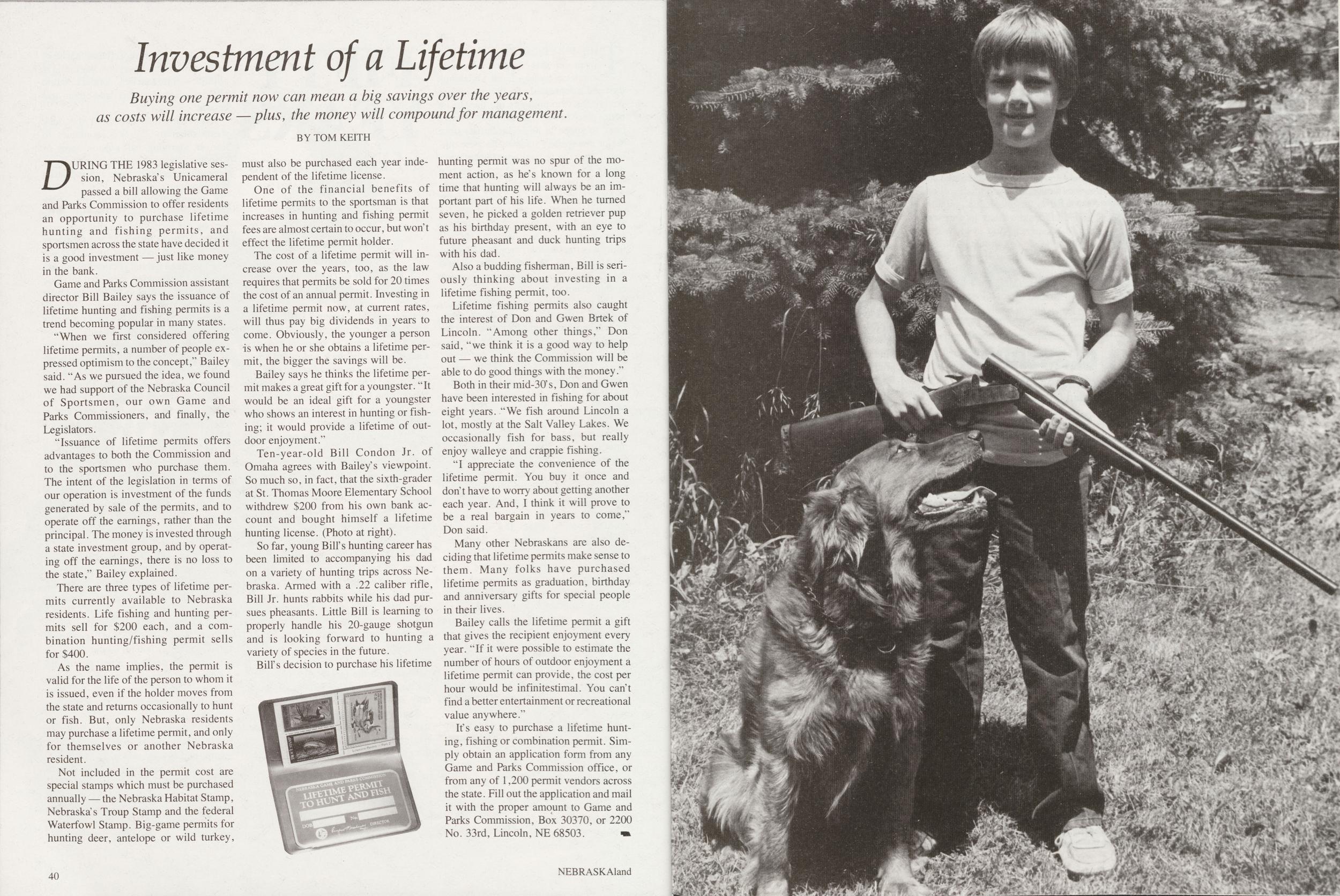
Investment of a Lifetime
Buying one permit now can mean a big savings over the years, as costs will increase —plus, the money will compound for management. BY TOM KEITHDURING THE 1983 legislative session, Nebraska's Unicameral passed a bill allowing the Game and Parks Commission to offer residents an opportunity to purchase lifetime hunting and fishing permits, and sportsmen across the state have decided it is a good investment — just like money in the bank.
Game and Parks Commission assistant director Bill Bailey says the issuance of lifetime hunting and fishing permits is a trend becoming popular in many states.
"When we first considered offering lifetime permits, a number of people expressed optimism to the concept," Bailey said. "As we pursued the idea, we found we had support of the Nebraska Council of Sportsmen, our own Game and Parks Commissioners, and finally, the Legislators.
"Issuance of lifetime permits offers advantages to both the Commission and to the sportsmen who purchase them. The intent of the legislation in terms of our operation is investment of the funds generated by sale of the permits, and to operate off the earnings, rather than the principal. The money is invested through a state investment group, and by operating off the earnings, there is no loss to the state," Bailey explained.
There are three types of lifetime permits currently available to Nebraska residents. Life fishing and hunting permits sell for $200 each, and a combination hunting/fishing permit sells for $400.
As the name implies, the permit is valid for the life of the person to whom it is issued, even if the holder moves from the state and returns occasionally to hunt or fish. But, only Nebraska residents may purchase a lifetime permit, and only for themselves or another Nebraska resident.
Not included in the permit cost are special stamps which must be purchased annually — the Nebraska Habitat Stamp, Nebraska's Troup Stamp and the federal Waterfowl Stamp. Big-game permits for hunting deer, antelope or wild turkey, must also be purchased each year independent of the lifetime license.
One of the financial benefits of lifetime permits to the sportsman is that increases in hunting and fishing permit fees are almost certain to occur, but won't effect the lifetime permit holder.
The cost of a lifetime permit will increase over the years, too, as the law requires that permits be sold for 20 times the cost of an annual permit. Investing in a lifetime permit now, at current rates, will thus pay big dividends in years to come. Obviously, the younger a person is when he or she obtains a lifetime permit, the bigger the savings will be.
Bailey says he thinks the lifetime permit makes a great gift for a youngster. "It would be an ideal gift for a youngster who shows an interest in hunting or fishing; it would provide a lifetime of outdoor enjoyment."
Ten-year-old Bill Condon Jr. of Omaha agrees with Bailey's viewpoint. So much so, in fact, that the sixth-grader at St. Thomas Moore Elementary School withdrew $200 from his own bank account and bought himself a lifetime hunting license.
(Photo at right).So far, young Bill's hunting career has been limited to accompanying his dad on a variety of hunting trips across Nebraska. Armed with a .22 caliber rifle, Bill Jr. hunts rabbits while his dad pursues pheasants. Little Bill is learning to properly handle his 20-gauge shotgun and is looking forward to hunting a variety of species in the future.
Bill's decision to purchase his lifetime hunting permit was no spur of the moment action, as he's known for a long time that hunting will always be an important part of his life. When he turned seven, he picked a golden retriever pup as his birthday present, with an eye to future pheasant and duck hunting trips with his dad.
Also a budding fisherman, Bill is seriously thinking about investing in a lifetime fishing permit, too.
Lifetime fishing permits also caught the interest of Don and Gwen Brtek of Lincoln. "Among other things," Don said, "we think it is a good way to help out — we think the Commission will be able to do good things with the money."
Both in their mid-30' s, Don and Gwen have been interested in fishing for about eight years. "We fish around Lincoln a lot, mostly at the Salt Valley Lakes. We occasionally fish for bass, but really enjoy walleye and crappie fishing.
"I appreciate the convenience of the lifetime permit. You buy it once and don't have to worry about getting another each year. And, I think it will prove to be a real bargain in years to come," Don said.
Many other Nebraskans are also deciding that lifetime permits make sense to them. Many folks have purchased lifetime permits as graduation, birthday and anniversary gifts for special people in their lives.
Bailey calls the lifetime permit a gift that gives the recipient enjoyment every year. "If it were possible to estimate the number of hours of outdoor enjoyment a lifetime permit can provide, the cost per hour would be infinitestimal. You can't find a better entertainment or recreational value anywhere."
It's easy to purchase a lifetime hunting, fishing or combination permit. Simply obtain an application form from any Game and Parks Commission office, or from any of 1,200 permit vendors across the state. Fill out the application and mail it with the proper amount to Game and Parks Commission, Box 30370, or 2200 No. 33rd, Lincoln, NE 68503.
40 NEBRASKAland
Did I Tell You About the Pheasants in the Queen's Forest?
(Continued from Page 27)trained yourself to bring that gun up, practiced bringing it up and swinging it, that gun will come up into the right position all on its own. But keep looking at that target. Your gun will become an image. You don't look at it, but still your peripheral vision will see that gun and the first thing you know that gun and target will come together, and you shoot. The mistake most people make is that at that instant they look elsewhere; they take the gun down to watch that bird drop. Don't do it, even if you hit your target. Keep looking because you can see where that gun was in relationship to that bird and the image will be retained of how things should look to successfully hit your target. You will remember that's how the gun should be held, that is the kind of movement you need. If you take your eyes away from it, what do you know? Nothing. You may have hit the bird but you don't learn anything.
"I shoot with both eyes open because with one closed you do not have complete vision. If you train your dominant eye, you don't need to close the other. Most good trap shooters keep both eyes open. Some start with both eyes open and then when they get to where they want to be, they close one. Most, though, keep both eyes open.
"Analyze your shooting to improve it, but then forget about it. When you are up on the line shooting targets or in the field and a bird is flushing in front of you, your shooting will reflect what you have learned. You don't have the opportunity then to analyze your shooting. Don't think of these things at that time but prepare yourself beforehand."
Well, the Thermos is dry, the ducks are still flying high and it doesn't look like the geese will come back to the river before sundown. Bill's voice is getting a bit hoarse. It's been a long day. Later, after a toddy or two, maybe it will come back and there will be talk of hunting Huns in North Dakota and Saskatchewan, or of Mike the gun-shy pointer, or days when there were more ducks and liberal limits and Bill and four other hunters came in with 125 mallards, or how Art Storz tended the quail in a Missouri kitchen. What could you change in a life so full?
"I wouldn't change a dog-gone thing.
42 NEBRASKAlandToo many good things have happened. Maybe if I had it to do over again they wouldn't happen. Along my life I have run into good fortune. You don't think about it because it is not something you can depend on. During my life I have had more than my share of good fortune; good luck. Fve had a great life, and, I'm not through!"
Lead Poisoning... the Problem and the Solution
(Continued from Page 31)should not attempt to "make do" with available wads and shot as gun damage and personal injury are possible with improperly prepared loads.
Since steel shotshells were first introduced, there was concern about crippling losses. Much of this can be attributed, as mentioned earlier, to the tendency to blame equipment rather than shooting skills. Several studies have measured crippling rates, and in nearly all cases there was no significant difference between lead and steel. Much of the misinformation concerning steel loads and crippling losses originated from early-generation, less-efficient steel loads. Subsequent developments have vastly improved them. Essentially, with steel you either hit the bird or miss it entirely.
Birds are crippled and killed with both lead and steel. What consistently kills birds is shooting them in good range and hitting them with the full pattern. The use of a well-trained retriever is also recommended when hunting waterfowl, regardless of the type of load you shoot.
Steel shot was first required in Clay, Fillmore, Kearney, and Phelps counties (except on the Platte River) during the 1978 season. At that time, steel shot was available only in 12 gauge, and lead shot was allowed for other gauges. In 1980, steel shot was required for all waterfowl hunting in those same counties. For a time, exemptions were made for hunters 16 years of age and under using standard-chamber, 20-gauge shotguns. In 1982, other areas were included in steel shot zones, including several southwest reservoirs, several wildlife management areas with a history or potential for lead poisoning, and the upper end of Lake McConaughy. Additional areas were added in 1983, and the 1984 regulations will require steel shot for waterfowl hunting in the Panhandle. The Nebraska Game and Parks Commission intends to require steel shot for waterfowl hunting statewide.
Nebraska is not alone in this move to steel shot for waterfowl hunting — 34 states have areas where steel is required for waterfowl hunting. The really unfortunate thing about the conversion to steel shot is that it is taking so long. Every year that we delay in eliminating toxic lead pellets from waterfowl habitat, we loose more ducks and geese that would be available to hunters.
The destruction of waterfowl habitat by draining, either directly or indirectly by lowering of water tables, continues. Waterfowl have only a remnant of the habitat of a century ago. In spite of efforts by hunters and other conservationists, we have only slowed the loss of wetlands. Diseases such as cholera and botulism continue to take their toll. The solutions to these problems remain elusive, and we should be concentrating on solving these serious disease problems. Instead, we continue the debate over the exact extent of lead poisoning, and whether or not conversion to steel might prevent a handful of hunters from shooting their favorite old double barrels.
There is a solution to the lead poisoning problem. It's time to make the conversion to steel shot for waterfowl hunting, and to intensify our search for solutions to other problems threatening our waterfowl resource — disease and declining habitat.
When we shoot steel, the killing stops when we leave the blind. We will not leave lead pellets behind for ducks and geese to pick up. We will no longer be contributing to their lingering deaths in secluded rushes. The choice is ours.
50 Years of Duck Stamps
(Continued from Page 39)Act allowed all unsold stamps to the turned over to the Philatelic Agency of the U.S. Post Office to be sold until disposed of or until Congress otherwise provides.
In selecting each year's stamp design, an annual contest has been conducted since 1949 by the Fish and Wildlife Service, and is open to all interested artists. Prior to 1949, only select artists were invited to compete.
Pen and ink, oil, watercolor, etching, or pencil are among the choices of medium available, and designs may be submitted in black and white or color.
A panel of specialists in waterfowl and art make the winning selection, but grants no special compensation to the winner except for an album containing a full sheet of stamps, and whatever revenues the artist can generate from autographed prints.
The process of stamp production has had few changes over the past 50 years, but it's interesting to note modifications and procedures.
Having selected a winning design, the judges deliver the original 5x7 artwork to the U.S. Postal Service, which in turn delivers it to the Bureau of Engraving and Printing.
An actual-size model is prepared by a team of engravers, combining artwork and legal inscriptions. Following joint approval from the Postmaster General and the Fish and Wildlife Service, a steel die is engraved and color proofs manufactured. Again, approval is required prior to production.
Basically, five printing changes have resulted from 50 years of duck stamps. Current-issue stamps are reproduced on sheet-fed Giori rotary presses, applying one to three ink colors on a single pass and carrying two electrolytic plates. Prior to 1959, printing was done totally by flatbed presses. A wet process, prior to 1954, was utilized which employed dampened, ungummed paper, as compared to the current dry process utilizing dry, pregummed paper.
In 1940, engraving plates were laid out with central, vertical and horizontal gutters, dividing the plates of 112 impressions into four panes of 28 stamps. Such a layout design allowed for perforations on all four sides of each stamp instead of one or two straight-edge sides on 10 out of every 28 stamps.
44 NEBRASKAlandSince 1959 sheets have been issued containing 30 individual stamps instead of 28, a change resulting from the conversion to rotary presses from flatbed.
The first multi-colored stamp was issued in 1959, with Maynard Reece's drawing of a Labrador retriever carrying a mallard drake. Reece also became the first artist to win the competition three times with that particular stamp issue.
The stamp of 1959 was also the first year of inscribed messages. "Retrievers Save Game" was placed on the Reece Labrador and mallard stamp. Inscription messages lasted only three years, with the 1960 stamp stating, "Wildlife Needs Water: Preserve Wetlands", and in 1961, "Habitat Produces Ducks."
A total of 38 individual artists have had winning entries over the past 50 years, seven of which have repeated as stamp artist. Maynard Reece had five wins in 25 years with his 1948 buffleheads, 1951 gadwalls, 1959 Labrador and mallard, 1969 white-winged scoters and 1971 cinnamon teal.
Both Stanley Stearns and Edward J. Bierly were awarded three wins each, while Walter A. Weber, Leslie C. Kouba, Edward A. Morris, and David A. Maass each recorded two wins.
Brush and ink, wash paintings, etchings, pencil, dry point on copper, tempera, India-ink wash, watercolor, ink and pencil, opaque watercolor, oil, India-ink scratchboard, acrylic, and gouache, have carried winning entries of ducks, swans, dogs and decoys.
A favorite of the NEBR ASK Aland staff was the 1968 stamp by the late C. G. "Bud" Pritchard, who joined the Game and Parks Commission in 1948 as a staff illustrator. Pritchard's black-and-white wash drawing of a pair of hooded mergansers was selected as the 35th duck stamp and sold 1,811,754 copies.
Now approaching 100 million stamps sold in 50 years, more than 2,000 artists compete annually to have their work honored on a migratory bird hunting and conservation stamp. There is also a growing number of conservationists, stamp collectors, and backyard bird watchers purchasing stamps, and the acquisition of critical habitat through their duck stamp dollars, as well as funding from hunters, is more important than ever. To help insure one of our most precious resources — wetlands and the wildlife that dwell there — a single duck stamp purchase annually is a significant investment.
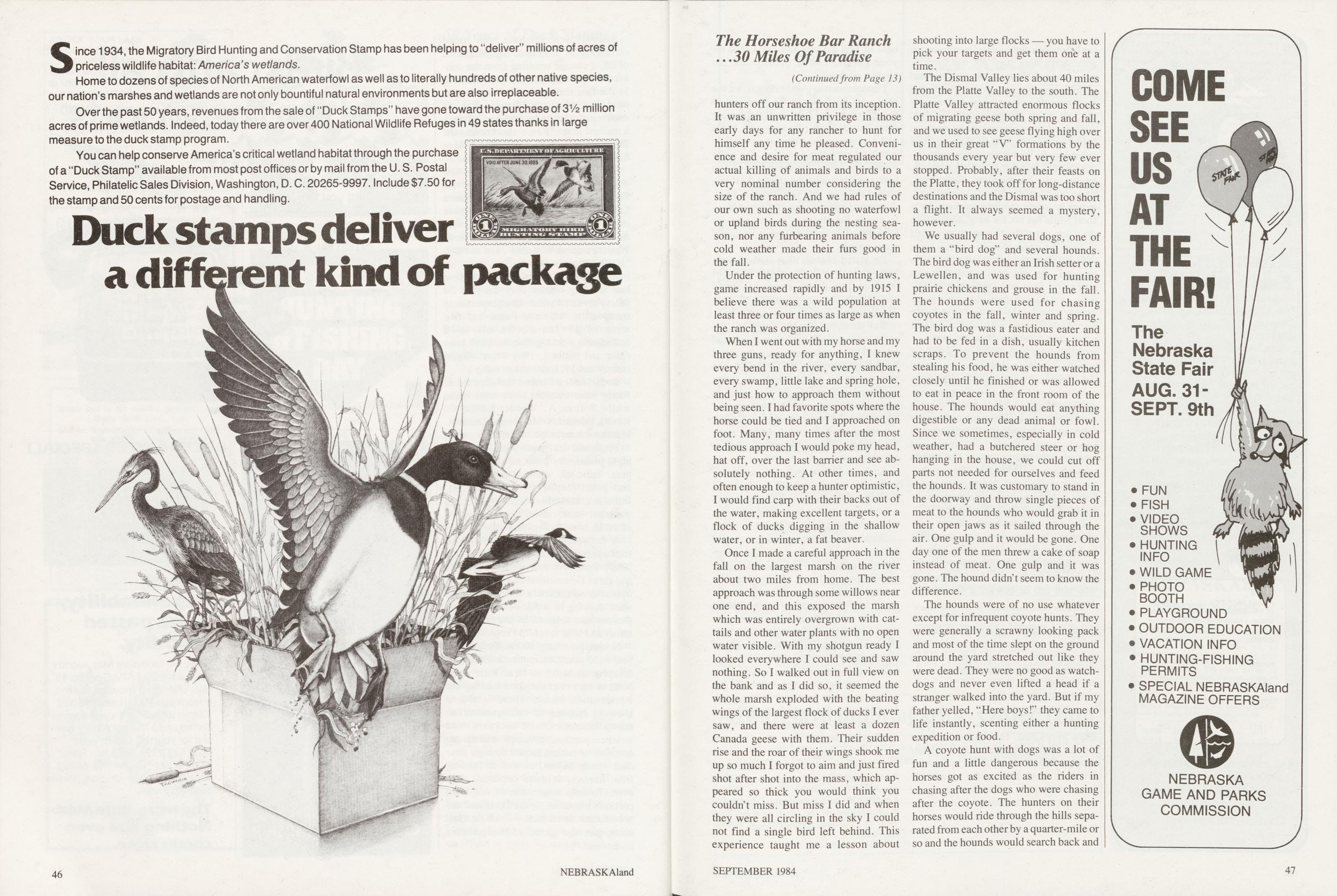
Duck stamps deliver rent kind of package
Since 1934, the Migratory Bird Hunting and Conservation Stamp has been helping to "deliver" millions of acres of priceless wildlife habitat: America's wetlands. Home to dozens of species of North American waterfowl as well as to literally hundreds of other native species, our nation's marshes and wetlands are not only bountiful natural environments but are also irreplaceable.
Over the past 50 years, revenues from the sale of "Duck Stamps" have gone toward the purchase of 31/2 million acres of prime wetlands. Indeed, today there are over 400 National Wildlife Refuges in 49 states thanks in large measure to the duck stamp program.
You can help conserve America's critical wetland habitat through the purchase of a "Duck Stamp" available from most post offices or by mail from the U. S. Postal Service, Philatelic Sales Division, Washington, D. C. 20265-9997. Include $7.50 for the stamp and 50 cents for postage and handling.
46 NEBRASKAlandThe Horseshoe Bar Ranch ...30 Miles Of Paradise
(Continued from Page 13)hunters off our ranch from its inception. It was an unwritten privilege in those early days for any rancher to hunt for himself any time he pleased. Convenience and desire for meat regulated our actual killing of animals and birds to a very nominal number considering the size of the ranch. And we had rules of our own such as shooting no waterfowl or upland birds during the nesting season, nor any furbearing animals before cold weather made their furs good in the fall.
Under the protection of hunting laws, game increased rapidly and by 1915 I believe there was a wild population at least three or four times as large as when the ranch was organized.
When I went out with my horse and my three guns, ready for anything, I knew every bend in the river, every sandbar, every swamp, little lake and spring hole, and just how to approach them without being seen. I had favorite spots where the horse could be tied and I approached on foot. Many, many times after the most tedious approach I would poke my head, hat off, over the last barrier and see absolutely nothing. At other times, and often enough to keep a hunter optimistic, I would find carp with their backs out of the water, making excellent targets, or a flock of ducks digging in the shallow water, or in winter, a fat beaver.
Once I made a careful approach in the fall on the largest marsh on the river about two miles from home. The best approach was through some willows near one end, and this exposed the marsh which was entirely overgrown with cattails and other water plants with no open water visible. With my shotgun ready I looked everywhere I could see and saw nothing. So I walked out in full view on the bank and as I did so, it seemed the whole marsh exploded with the beating wings of the largest flock of ducks I ever saw, and there were at least a dozen Canada geese with them. Their sudden rise and the roar of their wings shook me up so much I forgot to aim and just fired shot after shot into the mass, which appeared so thick you would think you couldn't miss. But miss I did and when they were all circling in the sky I could not find a single bird left behind. This experience taught me a lesson about shooting into large flocks — you have to pick your targets and get them one at a time.
The Dismal Valley lies about 40 miles from the Platte Valley to the south. The Platte Valley attracted enormous flocks of migrating geese both spring and fall, and we used to see geese flying high over us in their great "V" formations by the thousands every year but very few ever stopped. Probably, after their feasts on the Platte, they took off for long-distance destinations and the Dismal was too short a flight. It always seemed a mystery, however.
We usually had several dogs, one of them a "bird dog" and several hounds. The bird dog was either an Irish setter or a Lewellen, and was used for hunting prairie chickens and grouse in the fall. The hounds were used for chasing coyotes in the fall, winter and spring. The bird dog was a fastidious eater and had to be fed in a dish, usually kitchen scraps. To prevent the hounds from stealing his food, he was either watched closely until he finished or was allowed to eat in peace in the front room of the house. The hounds would eat anything digestible or any dead animal or fowl. Since we sometimes, especially in cold weather, had a butchered steer or hog hanging in the house, we could cut off parts not needed for ourselves and feed the hounds. It was customary to stand in the doorway and throw single pieces of meat to the hounds who would grab it in their open jaws as it sailed through the air. One gulp and it would be gone. One day one of the men threw a cake of soap instead of meat. One gulp and it was gone. The hound didn't seem to know the difference.
The hounds were of no use whatever except for infrequent coyote hunts. They were generally a scrawny looking pack and most of the time slept on the ground around the yard stretched out like they were dead. They were no good as watchdogs and never even lifted a head if a stranger walked into the yard. But if my father yelled, "Here boys!" they came to life instantly, scenting either a hunting expedition or food.
A coyote hunt with dogs was a lot of fun and a little dangerous because the horses got as excited as the riders in chasing after the dogs who were chasing after the coyote. The hunters on their horses would ride through the hills separated from each other by a quarter-mile or so and the hounds would search back and
forth between them, usually running in great leaps until they got too tired. It would seem that any coyote caught ahead of this sweeping party would spot them a long way off and get away, but most of the time it was coyote nature to sit tight until the dogs were practically on them before jumping up out of the grass and streaking off. With their prey in sight, the dogs would join forces and take after it, baying as loud as possible. The coyote, being fresh, and the hounds usually tired, meant he could outdistance them for a short while but not for long. Meanwhile the riders urged their horses to top speed to keep the chase in sight and ran some risks of plunging into a deep trail or a blowout. On one hunt my father was riding Old Blue and came up unexpectedly on a 20-foot-deep blowout. He escaped injury only because his horse leaped into the hole and landed on his feet rather than tumbling down the side.
I never saw a coyote outrun a pack of hounds more than a half-mile or so, but I did see one outwit them by leading them over a canyon bank and disappearing. Another thing which saved some coyotes was having a jackrabbit jump up between them and the hounds. Sometimes the hounds would abandon the coyote and take after the nearer rabbit. The rabbits couldn't outrun the hounds either but they were very clever at dodging and much faster at doubling back, thus wearing out the dogs, especially in hot weather.
On one coyote hunt which I remember, the chase went right through a barbed-wire fence. One of the hounds, less careful than the other three in the pack, struck the wire hard enough to stop him and he howled a new tune of anguish.
The others, who were in full chase ahead, immediately came back, not to help but to set upon him furiously. Only the timely arrival of the riders saved him from being killed. As it was he was badly chewed up.
While coyotes did no harm, they were considered predators and were shot at every time there was a chance, and quite a few were killed. The skins were sent to Omaha for tanning. We always had a fair supply, a dozen or so, rolled up in a big box with moth balls in the closet. My father frequently gave them away as souvenirs to ranch visitors. And a coyote hunt was usually on the agenda for every visiting party to the ranch. It was not too hard to find coyotes and get a shot for your guests, and it usually did the coyotes no harm.
I remember one guest riding down the river with my father in the front seat of the spring wagon just on a sightseeing drive, but he had a rifle across his knees and was hoping for a shot at a coyote or rabbit, or something exciting. He questioned my father for details of coyote habits and just what he should do if one should show up. My father was in a kidding mood and said one of the best ways to handle the situation was to take advantage of a coyote's great curiosity about people.
He stated blandly that if they were lucky enough to flush a coyote ahead of them as they drove along, he would undoubtedly run across ahead of them and disappear over the nearest little hill.
But then, my father went on, his curiosity would get the better of him and he would stop and creep back to the top of the hill and watch as we drove by. The best way to get a shot at him, my father explained with a straight face, was to jump off the wagon when opposite the spot where the coyote disappeared, walk quietly up the hill, and shoot him as he was creeping up on the opposite side to take his look.
So far as I know, this trick was never pulled by anyone and was made up on the spur of the moment just to entertain a tenderfoot, but as luck would have it, all turned out exactly according to script.
Within a short time, a fine coyote did break across the path ahead and disappear over the hill. The excited hunter leaped down and took off after him. He walked carefully up the hill with his rifle ready and there met his coyote just as expected and shot him right between the eyes. I recall the exclamations made over the groove the bullet made in the top of the coyote s head. If the aim had been one half-inch higher, the shot would have missed. My father went on with the gag by saying it was just what he expected, but later, after the visitor had gone home, my father and the other men had many laughs over the episode.
This is the second in a series of excerpts from an unpublished book manuscript about ranching on the Dismal River in Thomas County at the turn of the century. Author Roe R. Black lived on the ranch as a boy from 1900 to 1912 and now resides in Aurora, Nebraska. 48 NEBRASKAlandTrading Post
DOGS TRAINING ALL BREEDS Hunting dogs—Vizslas for sale. Rozanek Kennels, Rt. 2, Schuyler, NE 68661. Phone (402) 352-8769. ENGLISH SETTERS and Pointers: Outstanding bloodlines! Puppies, started dogs, and stud service available. High Plains Kennels, 1411 Emerson, Alliance, NE 69301. Phone (308) 762-6709. GERMAN SHORTHAIRS—English Pointers and Beagles—Stud service, puppies and started dogs. Wayne Clark, Box 54, Union, Nebr. 68455. Phone (402) 263-3495 or 263-3155. BRITTANIES: Puppies, started and trained dogs from avid hunter. Free brochure. Satisfaction assured. Grouseway Gun Dogs, Rt. 2, Box 158, Meadow Grove, NE 68752. Phone (402) 634-2469. AKC — BLACK and yellow labradors. Great hunting prospects. National field-trial champions on both sides of pedigree. Will hunt this fall. Char-El Kennels, Phone (402)721-0247. FOR SALE—AKC registered golden retriever puppies from excellent bloodline. Contact Neil Hamm, 308 W. 8th, Neligh, NE 68756. Phone (402) 887-4935 or 887-4066. FOR SALE: AKC Registered brittanies. Excellent hunting quality. Also brittany standing stud, puppies and standing dogs. Contact Adams Family Kennels, phone (308) 532-2639. MISCELLANEOUS WINE AND BEER: Make your own. Send for free recipes and instructions. Omaha Supply, 13616 Polk, Omaha, Nebr. 68137. GUNS—Browning, Winchester, Remington, others, Hi-powers, shotguns, new, used, antiques. Want Pre-1964 Winchesters. Buy-Sell-Trade. Ph. (402) 729-6112. Bedlan's Sporting Goods, Fairbury, NE 68352. FISH FOR SALE. Channel catfish, bass, bluegill, crappie, trout, perch, white bass, minnows, hybrid grass carp, bullhead. We can ship fish, you can pick them up, or we deliver. Contact the Pleasant Valley Fish Farm, Rt. 1, McCook, NE 69001 Phone (308) 345-6599. MISSOURI RIVER — Three, 75-foot lots across from Niobrara, Nebraska. Perfect for retirement or vacation home. Excellent hunting, fishing, bird watching. Above flood plain yet easy access to river. Your pick, $7500. Howard Lovrien (612) 571-9498. FOR SALE on scenic Niobrara River, south of Valentine, approx. 925 acres with 7/8-mile river frontage plus one mile of Schlagel Creek with good trout fishing, excellent deer and turkey hunting in tree-covered canyons; panoramic getaway cabin sites, landing strip possibility! Priced at $375 per acre. Contact the Bob Gass Agency, 468 No. Main. Valentine, NE 69201 BY CONTRACT or trade for anything movable on any of 16 lots in Pine Tree Heights Subdivision, 2V2 miles southeast of Valentine, from 5 to 23 acres in size, overlooking Niobrara River Valley with Valentine and bluffs of Minnechaduza Creek in background. Pretty, panoramic view, 3 miles from airport with 5,000-foot hard-surfaced runway. Contact the Bob Gass Agency, 468 No. Main Valentine, NE 69201. AUTUMN WINGS Hunting Club. Goose and duck hunting at its finest. A few memberships left. Located in Tekamah-Missouri River Basin. Phone (402) 393-1271. FOR SALE: Wild turkeys, all ages and sizes. Phone (402) 643-2365 or 643-2586. AIR GUNS repaired; Benjamin, Crosman, Daisy, other American made. Restoration, old guns wanted. Air Guns, 1225 No. 46th, Lincoln, NE 68503. Phone (402) 466-9223. CANOE ENTHUSIASTS. Quality and performance important? Mad River is the canoe for you! Mad River of Nebraska, 1231 Saunders, Lincoln, Nebraska 68521 Phone (402) 435-6588 or 205 Main, Springfield NE 68059. Phone (402) 253-2000. N.E. NEBRASKA TROUT Fishing. For rent Mon.-Thurs. or Fri.-Sun. 2 modern cottages completely furnished. 5 spring-fed lakes with trout up to 7 lbs. Bass and bluegill also. Diamond E Trout Resort Orchard, NE 68764. (402) 893-4745 TAXIDERMY JOHNSON TAXIDERMY—servicing southwest Nebraska, specializing in big-game mounts, life-sized mounts, rug work, fish, birds, tanning hair-on leather. Brochure and price list on request. Johnson Taxidermy, Rt. 1, Box 78, Lamar, NE 69035, Telephone (308) 882-5555. FREEZE-DRY TAXIDERMY Wally Allison's State Record Taxidermy, 2709 Birchwood, North Platte NE 69101. Phone: (308) 534-2324. Specializing in Fishand Small Game, Snake and Lizard and Novelties. (Nothing too small) Newest of all taxidermy methods employed. KARL SCHWARZ master taxidermist has moved to a new country studio; same professional mounting and tanning service. Schwarz Wild Wing Studio, 16804 South 180th St., Springfield, NE 68059. Phone (402) 253-2481. BADE TAXIDERMY—Quality a must—Fast service. Fish, birds, rugs, tanning, full mounts and game heads. 2111 N. Christy St., Fremont, Nebraska 727-5463. NEBRASKAland Magazine Order Form Please send me a subscription to NEBRASKAIand, which will include next January's special issue..."The Birds of Nebraska." One-year $9.50 NAME 18-month $14.00 ADDRESS CITY 30-month $23.00 STATE ZIP Mail to: NEBRASKAland, Box 30370, Lincoln, NE 68503 CREATIVE TAXIDERMY in all its branches since 1935, now includes Northstar Freeze-Dry processing of approved small specimens. Also tanning and deerskin processing. Naturecraft Studio. Nebraska City, Nebraska 68510. Joe Voges-Owner. Phone (402) 873-5491. DINGES TAXIDERMY Studio, 2763 So. 12th St., Omaha, NE 68108. Fourteen-time National Award Winning Taxidermy. Trust your trophies to a proven winner. Complete professional service. Mike and Mary Dinges (402) 342-3718. NABITY'S TAXIDERMY. 31 years experience. Specializing in natural grass backgrounds for mammals, birds and fish. 13901 "0" St., Lincoln, NE 68505 4 miles east of 84th and "O". (402) 489-6351. PEISTER TAXIDERMY—a name you can trust. We give you professional life-like work at prices most sportsmen can afford. Member National Taxidermist Association, #5 Regency, Place, Kearney, Nebr. 68847. Phone (308) 237-7575. LINCOLN ARCHERY Bowhunting Headquarters Compound Bow Specialists Crossbows Longbows, Recurves Full line of hunting supplies 48th & Prescott Lincoln, NE (402) 483-4661 LIVE-CATCH ALL-PURPOSE TRAPS Write for FREE CATALOG Traps without injury squirrels, chipmunks, rabbits, mink, fox, raccoons, stray animals, pests, etc. Sizes for every need. Also traps for snakes, sparrows, pigeons, crabs, turtles, quail, etc. Save on our low factory prices. Send no money. Free catalog and trapping secrets. MUSTANG MFG. CO., Dept. n 34, Box 10880, Houston, Tex. 77018 NEBRASKAland 35mm Slides Select photos in this issue are now available from NEBRASKAland Magazine as 35mm slides in 2" mounts. The slides may be used to round out your home slide file, or to make color enlargement prints to adorn your home or office walls. The slides may not be used in any commercial manner. Slides of other photos in this issue are not readily available. The slides cost $1 each plus appropriate sales tax Please allow 4-6 weeks delivery. Slides available from this issue include: 98415 Snow Scene p. 15 98418 Junco p. is 98419 Autumn Hunter p. 19 98421T Prairie Phlox p 21 98421B Deer p. 21 Please indicate number and description of slides desired, and include check or money order for the full amount made to: NEBRASKAland Magazine. Send orders to-NEBRASKAland Slides, P.O. Box 30370, Lincoln, NE 68503. Nebraskans, please include appropriate sales tax. SEPTEMBER 1984 49
In The Kitchen
Baked Grouse with Stuffing 2 grouse (split in half) 2 cups bread stuffing seasoned with sage seasoned flour cooking oilPat the bread stuffing in a 9-inch-square pan. Roll grouse halves in flour seasoned with pepper and salt. Brown in cooking oil. Lay grouse on the stuffing and cover with foil. Bake at 325° for 1 hour. Remove foil and return to oven for 10 minutes. Serves 4.
Grouse a la Caraway 1 grouse 1 tbls. lard 1/4 tsp. pepper 1 small onion, chopped 1 tbls. butter 1 1/4 tsp. salt 1 tsp. caraway seed 1 cup waterClean and use like chicken. Cut into serving pieces, and place in heavy frying pan with butter and lard. Add other ingredients. Cover and simmer slowly over medium heat, turning while browning, adding a little water from time to time as it cooks. When nicely browned and tender, add enough flour to the drippings to make gravy, adding milk and more seasoning to make gravy the way you like it. Good with mashed potatoes, dumplings, or fried apples.
Lemon Prairie Chicken 2 prairie chickens salt pepper paprika flour 1/4 lb. butter 1 cup stock Juice of 1 lemon 1 onion, finely diced 4 carrots, diced parsley 2 cloves 3 bay leaves 4 peppercorns, crushed 1/2 cup claret or burgundy wineCut in sections for frying (similar to chicken), wipe dry and season with salt, pepper and paprika. Dredge in flour and brown in butter. When brown, add stock, lemon juice, onion, carrots, several sprigs of parsley, cloves and bay leaves. Cover and cook until tender. Add wine during the last 30 min. of cooking.
Doves in Wine Sauce Doves Bacon slices 4 tbls. butter 4 tbls. flour 2 cups cold milk Salt and pepper 1 1/2 cups white wineMelt butter in double-boiler or small, heavy saucepan; stir in flour. Blend well over low heat. Stir in milk. To keep sauce smooth, use blending fork or wire whisk. Bring slowly to boiling point. Cook 2 minutes, stirring constantly. Season to taste with salt and pepper. Wrap each dove with bacon slice. Cover doves with sauce in deep pan. Bake at 350° for about 1 hour. Pour half of wine over doves, stirring into sauce. Continue to bake until done. Pour remaining wine over doves and serve.
Creamy Onion Catfish 2 pounds catfish steaks 1 teaspoon salt 1/4 teaspoon pepper 1 (8 ounce) bottle green onion dressing 1 1/2 cups com flake crumbs 1 tablespoon chopped parsley 4 teaspoons grated Romano cheese 1/2 teaspoon paprika 1/2 teaspoon salt lemon wedgesCut into serving-size portions. Season fish with 1 teaspoon salt and pepper. Combine crumbs, parsley, cheese, paprika, and 1/2 teaspoon salt. Dip fish in dressing and roll in crumb mixture. Place fish in a well-greased baking pan, 15x10x1 inches. Bake in an extremely hot oven, 500°F., for 15 to 20 minutes or until fish flakes easily when tested with a fork. Garnish with lemon wedges. Makes 6 servings.
Catfish-Potato Scallop 6 skinned, pan-dressed catfish 2 teaspoons salt 1/2 teaspoon pepper 4 cups thinly sliced cooked potatoes 1 (1- 1/2 oz.) can cream of celery soup 1 cup dairy sour cream 1 tablespoon chopped chives 2 tablespoons chopped parsley 3 tablespoons chopped pimiento 1/4 cup water 6 slices bacon pimiento stripsClean, wash, and dry fish. Season fish inside and out with IV2 teaspoons salt and Va teaspoon pepper. Combine soup, sour cream, chives, parsley, chopped pimiento, water, and remaining 1/2 teaspoon salt and Va teaspoon pepper. Reserve1/2 cup soup mixture for topping. Place alternate layers of potatoes and soup mixture in a well-greased baking dish, 12x8x2 inches. Place fish on top of potatoes. Spread reserved soup mixture over fish. Place one slice of bacon on top of each fish. Bake in a hot oven, 400° F., for 35 to 40 minutes until bacon is crisp and fish flakes easily when tested with a fork. Garnish with pimiento strips. Makes 6 servings.
Sesame Catfish 2 pounds catfish steaks 1 cup buttermilk 1 egg, beaten 1 cup flour 1 tablespoon salt 1 tablespoon paprika 1/8 teaspoon pepper 1 cup ground pecans 1/4 cup sesame seed 1/2 cup margarine, melted 1/4 cup pecan halves lemon wedges parsley sprigsCombine egg with milk. Sift together flour, salt, paprika, and pepper. Add to ground pecans and sesame seed. Add dry ingredients to milk; blend well. Place margarine in baking dish, 14 x 9 x 2 inches. Dip fish in batter and place in baking dish. Place pecan halves on top of fish. Bake in a moderate oven, 350°F., for 25 to 30 minutes or until fish is golden brown and flakes easily when tested with a fork. Garnish with lemon wedges and parsley sprigs. Makes 6 servings.
Saucy Orange Duckling 2 2-lb. ducks, cut in pieces 1/2 cup orange juice 2 tsp. salt 1 tsp. beef seasoning base 1/4 tsp. pepper 1/2 cup orange marmalade 2 tbls. light sherry 1/4 cup flourIn four-quart pressure cooker, brown duckling a few pieces at a time until lightly browned. Spoon off fat as it accumulates. Remove duck and pour off all fat. Place rack in bottom of pressure pan. Add duck, orange juice, salt, beef seasoning base, and pepper. Cover and lock. Place weight at 15 pounds pressure. Cook over high heat until regulator starts to jiggle. Reduce heat. Cook 15 minutes. Remove from heat and reduce pressure immediately under cold, running water. Remove cover. Reserve duck and pan juices. Meanwhile, in a small sauce pan, melt marmalade over low heat. Stir in sherry. Set aside. Place cooked duck on broiler pan. Place under broiler until well-browned. Brush marmalade sauce over ducks. Broil until bubbling and glazed.
50 NEBRASKAland
Position: 38 (226 views)