Volume 62, Issue 7, 1984
NEBRASKAland
August 1984 $1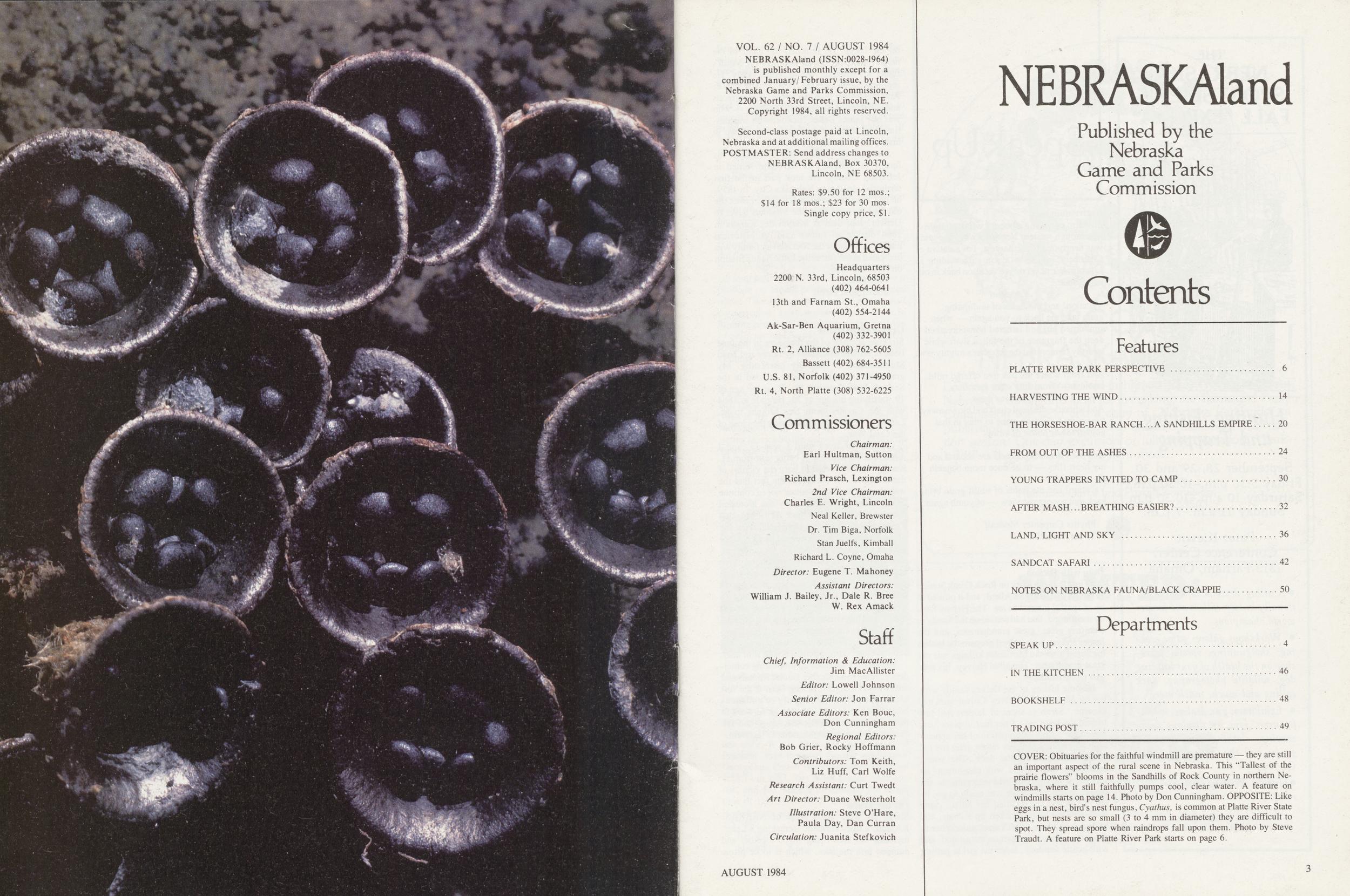
NEBRASKAland
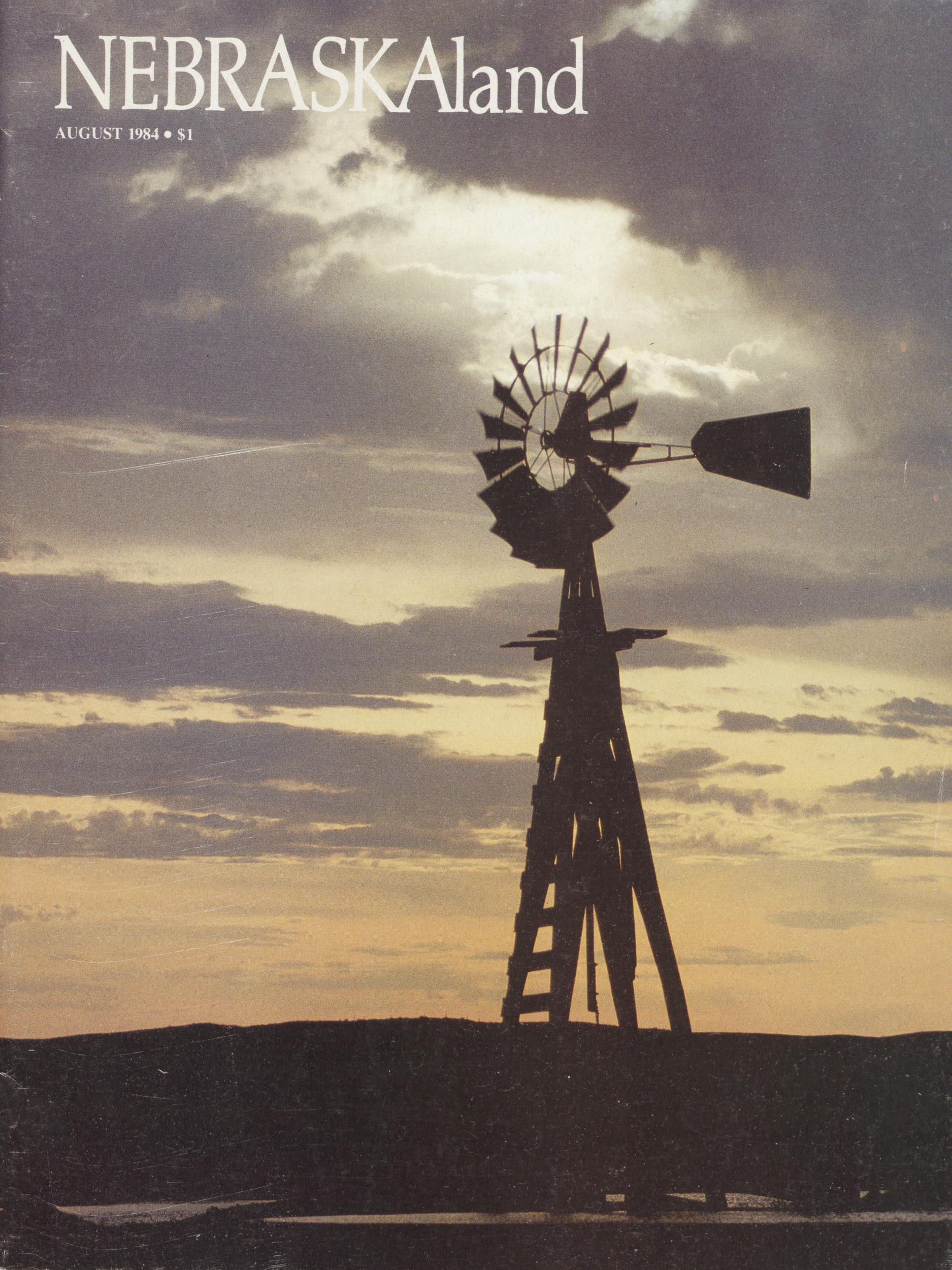
Published by the Nebraska Game and Parks Commission VOL. 62 / NO. 7 / AUGUST 1984 NEBRASKAland (ISSN:0028-1964) is published monthly except for a combined January/ February issue, by the Nebraska Game and Parks Commission, 2200 North 33rd Street, Lincoln, NE. Copyright 1984, all rights reserved. Second-class postage paid at Lincoln, Nebraska and at additional mailing offices. POSTMASTER: Send address changes to NEBRASKAland, Box 30370, Lincoln, NE 68503. Rates: $9.50 for 12 mos.; $14 for 18 mos.; $23 for 30 mos. Single copy price, $1. Offices Headquarters 2200 N. 33rd, Lincoln, 68503 (402) 464-0641 13th and Farnam St., Omaha (402) 554-2144 Ak-Sar-Ben Aquarium, Gretna (402) 332-3901 Rt. 2, Alliance (308) 762-5605 Bassett (402) 684-3511 U.S. 81, Norfolk (402) 371-4950 Rt. 4, North Platte (308) 532-6225 Commissioners Chairman: Earl Hultman, Sutton Vice Chairman: Richard Prasch, Lexington 2nd Vice Chairman: Charles E. Wright, Lincoln Neal Keller, Brewster Dr. Tim Biga, Norfolk Stan Juelfs, Kimball Richard L. Coyne, Omaha Director: Eugene T. Mahoney Assistant Directors: William J. Bailey, Jr., Dale R. Bree W. Rex Amack Staff Chief, Information & Education: Jim MacAllister Editor: Lowell Johnson Senior Editor: Jon Farrar Associate Editors: Ken Bouc, Don Cunningham Regional Editors: Bob Grier, Rocky Hoffmann Contributors: Tom Keith, Liz Huff, Carl Wolfe Research Assistant: Curt Twedt Art Director: Duane Westerholt Illustration: Steve O'Hare, Paula Day, Dan Curran Circulation: Juanita Stefkovich AUGUST 1984 Contents Features PLATTE RIVER PARK PERSPECTIVE 6 HARVESTING THE WIND. 14 THE HORSESHOE-BAR RANCH... A SANDHILLS EMPIRE 20 FROM OUT OF THE ASHES 24 YOUNG TRAPPERS INVITED TO CAMP 30 AFTER MASH... BREATHING EASIER? 32 LAND, LIGHT AND SKY 36 SANDCAT SAFARI 42 NOTES ON NEBRASKA FAUNA/BLACK CRAPPIE 50 Departments SPEAK UP 4 IN THE KITCHEN 46 BOOKSHELF 48 TRADING POST 49 COVER: Obituaries for the faithful windmill are premature — they are still an important aspect of the rural scene in Nebraska. This "Tallest of the prairie flowers" blooms in the Sandhills of Rock County in northern Nebraska, where it still faithfully pumps cool, clear water. A feature on windmills starts on page 14. Photo by Don Cunningham. OPPOSITE: Like eggs in a nest, bird's nest fungus, Cyathus, is common at Platte River State Park, but nests are so small (3 to 4 mm in diameter) they are difficult to spot. They spread spore when raindrops fall upon them. Photo by Steve Traudt. A feature on Platte River Park starts on page 6. 3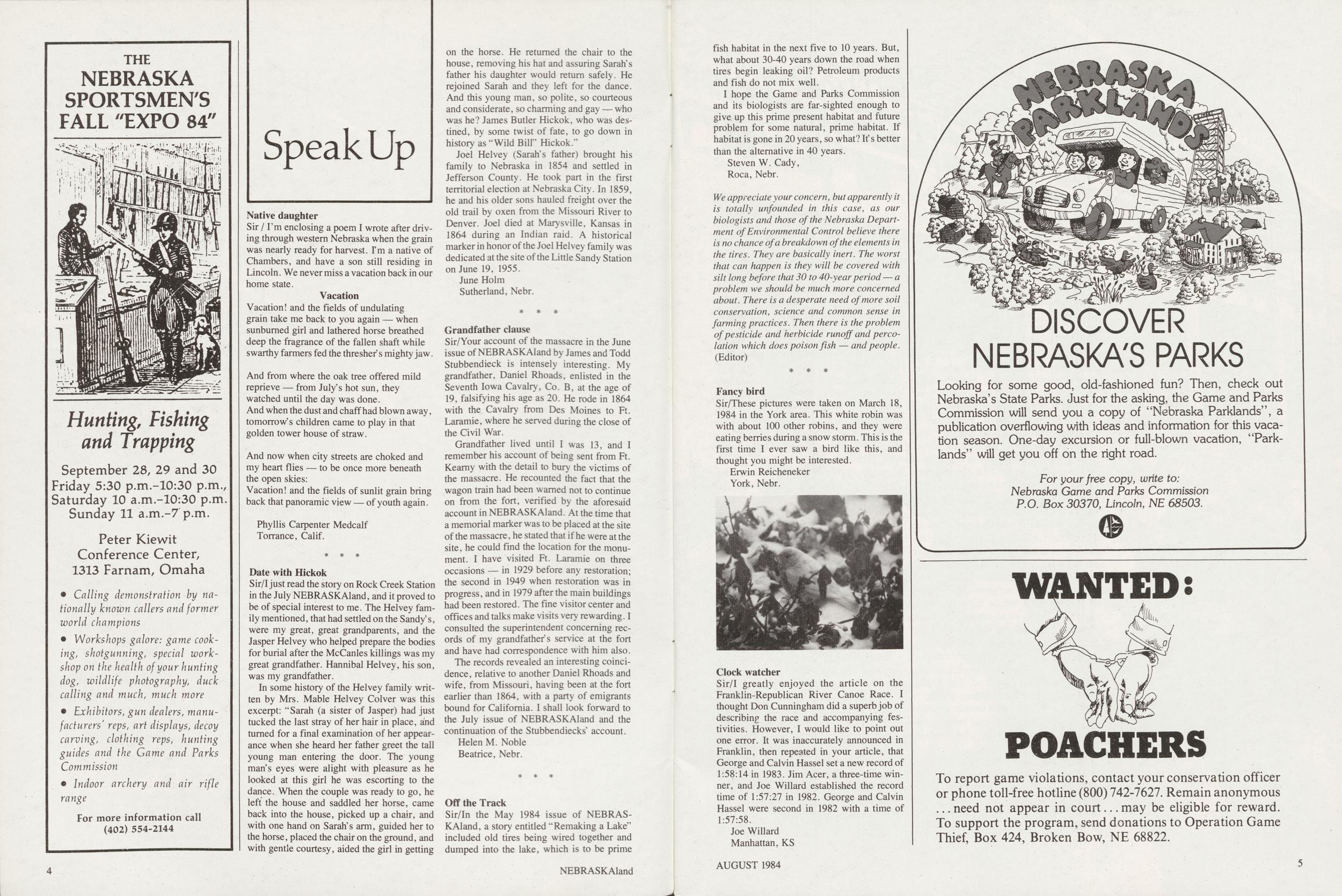
Speak Up
THE NEBRASKA SPORTSMEN'S FALL "EXPO 84" Hunting, Fishing and Trapping September 28, 29 and 30 Friday 5:30 p.m.-10:30 p.m., Saturday 10 a.m.-10:30 p.m. Sunday 11 a.m.-7 p.m. Peter Kiewit Conference Center, 1313 Farnam, Omaha • Calling demonstration by nationally known callers and former world champions • Workshops galore: game cooking, shotgunning, special workshop on the health of your hunting dog, wildlife photography, duck calling and much, much more • Exhibitors, gun dealers, manufacturers' reps, art displays, decoy carving, clothing reps, hunting guides and the Game and Parks Commission • Indoor archery and air rifle range For more information call (402) 554-2144Sir / I'm enclosing a poem I wrote after driving through western Nebraska when the grain was nearly ready for harvest. I'm a native of Chambers, and have a son still residing in Lincoln. We never miss a vacation back in our home state.
VacationVacation! and the fields of undulating grain take me back to you again — when sunburned girl and lathered horse breathed deep the fragrance of the fallen shaft while swarthy farmers fed the thresher's mighty jaw.
And from where the oak tree offered mild reprieve — from July's hot sun, they watched until the day was done. And when the dust and chaff had blown away, tomorrow's children came to play in that golden tower house of straw.
And now when city streets are choked and my heart flies — to be once more beneath the open skies: Vacation! and the fields of sunlit grain bring back that panoramic view — of youth again.
Phyllis Carpenter Medcalf Torrance, Calif. Date with HickokSir/I just read the story on Rock Creek Station in the July NEBRASKAland, and it proved to be of special interest to me. The Helvey family mentioned, that had settled on the Sandy's, were my great, great grandparents, and the Jasper Helvey who helped prepare the bodies for burial after the McCanles killings was my great grandfather. Hannibal Helvey, his son, was my grandfather.
In some history of the Helvey family written by Mrs. Mable Helvey Colver was this excerpt: "Sarah (a sister of Jasper) had just tucked the last stray of her hair in place, and turned for a final examination of her appearance when she heard her father greet the tall young man entering the door. The young man's eyes were alight with pleasure as he looked at this girl he was escorting to the dance. When the couple was ready to go, he left the house and saddled her horse, came back into the house, picked up a chair, and with one hand on Sarah's arm, guided her to the horse, placed the chair on the ground, and with gentle courtesy, aided the girl in getting on the horse. He returned the chair to the house, removing his hat and assuring Sarah's father his daughter would return safely. He rejoined Sarah and they left for the dance. And this young man, so polite, so courteous and considerate, so charming and gay — who was he? James Butler Hickok, who was destined, by some twist of fate, to go down in history as "Wild Bill" Hickok."
Joel Helvey (Sarah's father) brought his family to Nebraska in 1854 and settled in Jefferson County. He took part in the first territorial election at Nebraska City. In 1859, he and his older sons hauled freight over the old trail by oxen from the Missouri River to Denver. Joel died at Marysville, Kansas in 1864 during an Indian raid. A historical marker in honor of the Joel Helvey family was dedicated at the site of the Little Sandy Station on June 19, 1955.
June Holm Sutherland, Nebr. Grandfather clauseSir/Your account of the massacre in the June issue of NEBRASKAland by James and Todd Stubbendieck is intensely interesting. My grandfather, Daniel Rhoads, enlisted in the Seventh Iowa Cavalry, Co. B, at the age of 19, falsifying his age as 20. He rode in 1864 with the Cavalry from Des Moines to Ft. Laramie, where he served during the close of the Civil War.
Grandfather lived until I was 13, and I remember his account of being sent from Ft. Kearny with the detail to bury the victims of the massacre. He recounted the fact that the wagon train had been warned not to continue on from the fort, verified by the aforesaid account in NEBRASKAland. At the time that a memorial marker was to be placed at the site of the massacre, he stated that if he were at the site, he could find the location for the monument. I have visited Ft. Laramie on three occasions — in 1929 before any restoration; the second in 1949 when restoration was in progress, and in 1979 after the main buildings had been restored. The fine visitor center and offices and talks make visits very rewarding. I consulted the superintendent concerning records of my grandfather's service at the fort and have had correspondence with him also.
The records revealed an interesting coincidence, relative to another Daniel Rhoads and wife, from Missouri, having been at the fort earlier than 1864, with a party of emigrants bound for California. I shall look forward to the July issue of NEBRASKAland and the continuation of the Stubbendiecks' account.
Helen M. Noble Beatrice, Nebr. Off the TrackSir/In the May 1984 issue of NEBRASKAland, a story entitled "Remaking a Lake" included old tires being wired together and dumped into the lake, which is to be prime
4 NEBRASKAlandfish habitat in the next five to 10 years. But, what about 30-40 years down the road when tires begin leaking oil? Petroleum products and fish do not mix well.
I hope the Game and Parks Commission and its biologists are far-sighted enough to give up this prime present habitat and future problem for some natural, prime habitat. If habitat is gone in 20 years, so what? It's better than the alternative in 40 years.
Steven W. Cady, Roca, Nebr. We appreciate your concern, but apparently it is totally unfounded in this case, as our biologists and those of the Nebraska Department of Environmental Control believe there is no chance of a breakdown of the elements in the tires. They are basically inert. The worst that can happen is they will be covered with silt long before that 30 to 40-year period — a problem we should be much more concerned about. There is a desperate need of more soil conservation, science and common sense in farming practices. Then there is the problem of pesticide and herbicide runoff and percolation which does poison fish — and people. (Editor) Fancy birdSir/These pictures were taken on March 18, 1984 in the York area. This white robin was with about 100 other robins, and they were eating berries during a snow storm. This is the first time I ever saw a bird like this, and thought you might be interested.
Erwin Reicheneker York, Nebr.Sir/I greatly enjoyed the article on the Franklin-Republican River Canoe Race. I thought Don Cunningham did a superb job of describing the race and accompanying festivities. However, I would like to point out one error. It was inaccurately announced in Franklin, then repeated in your article, that George and Calvin Hassel set a new record of 1:58:14 in 1983. Jim Acer, a three-time winner, and Joe Willard established the record time of 1:57:27 in 1982. George and Calvin Hassel were second in 1982 with a time of 1:57:58.
Joe Willard Manhattan, KS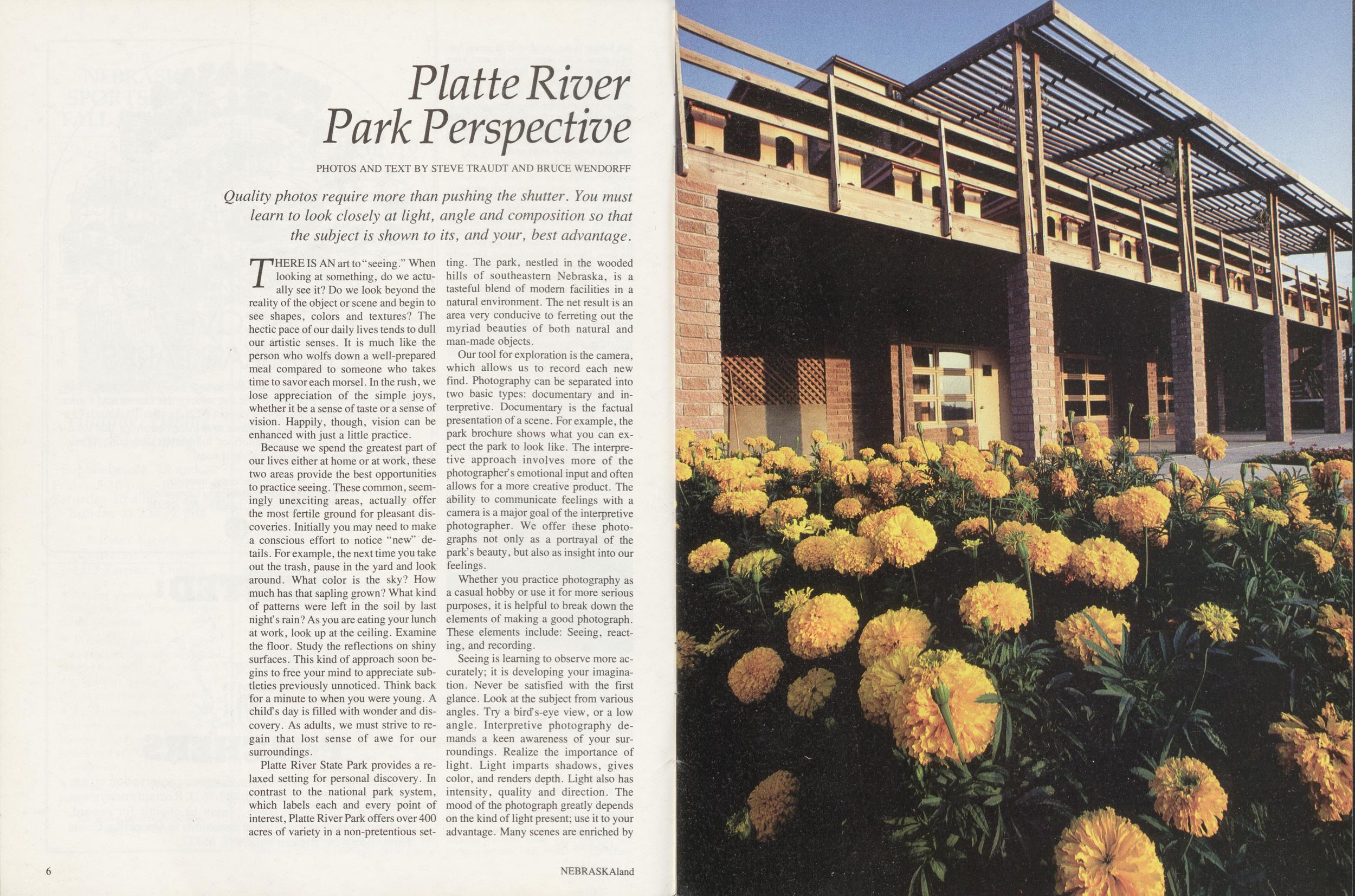
Platte River Park Perspective
PHOTOS AND TEXT BY STEVE TRAUDT AND BRUCE WENDORFF Quality photos require more than pushing the shutter. You must learn to look closely at light, angle and composition so that the subject is shown to its, and your, best advantage.THERE IS AN art to "seeing." When looking at something, do we actually see it? Do we look beyond the reality of the object or scene and begin to see shapes, colors and textures? The hectic pace of our daily lives tends to dull our artistic senses. It is much like the person who wolfs down a well-prepared meal compared to someone who takes time to savor each morsel. In the rush, we lose appreciation of the simple joys, whether it be a sense of taste or a sense of vision. Happily, though, vision can be enhanced with just a little practice.
Because we spend the greatest part of our lives either at home or at work, these two areas provide the best opportunities to practice seeing. These common, seemingly unexciting areas, actually offer the most fertile ground for pleasant discoveries. Initially you may need to make a conscious effort to notice "new" details . For example, the next time you take out the trash, pause in the yard and look around. What color is the sky? How much has that sapling grown? What kind of patterns were left in the soil by last night's rain? As you are eating your lunch at work, look up at the ceiling. Examine the floor. Study the reflections on shiny surfaces. This kind of approach soon begins to free your mind to appreciate subtleties previously unnoticed. Think back for a minute to when you were young. A child's day is filled with wonder and discovery. As adults, we must strive to regain that lost sense of awe for our surroundings.
Platte River State Park provides a relaxed setting for personal discovery. In contrast to the national park system, which labels each and every point of interest, Platte River Park offers over 400 acres of variety in a non-pretentious setting. The park, nestled in the wooded hills of southeastern Nebraska, is a tasteful blend of modern facilities in a natural environment. The net result is an area very conducive to ferreting out the myriad beauties of both natural and man-made objects.
Our tool for exploration is the camera, which allows us to record each new find. Photography can be separated into two basic types: documentary and interpretive. Documentary is the factual presentation of a scene. For example, the park brochure shows what you can expect the park to look like. The interpretive approach involves more of the photographer's emotional input and often allows for a more creative product. The ability to communicate feelings with a camera is a major goal of the interpretive photographer. We offer these photographs not only as a portrayal of the park's beauty, but also as insight into our feelings.
Whether you practice photography as a casual hobby or use it for more serious purposes, it is helpful to break down the elements of making a good photograph. These elements include: Seeing, reacting, and recording.
Seeing is learning to observe more accurately; it is developing your imagination. Never be satisfied with the first glance. Look at the subject from various angles. Try a bird's-eye view, or a low angle. Interpretive photography demands a keen awareness of your surroundings. Realize the importance of light. Light imparts shadows, gives color, and renders depth. Light also has intensity, quality and direction. The mood of the photograph greatly depends on the kind of light present; use it to your advantage. Many scenes are enriched by
6 NEBRASKAland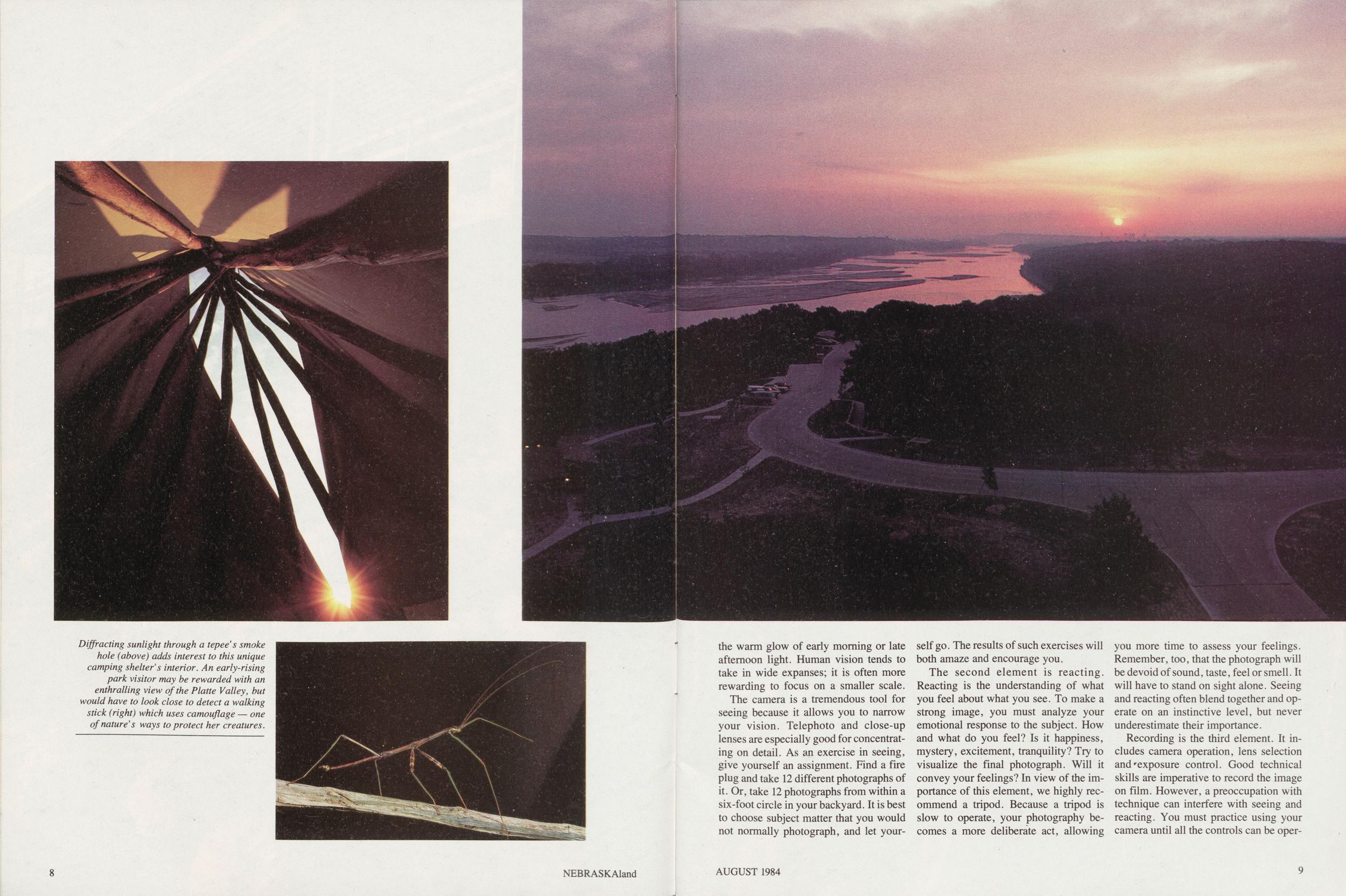
the warm glow of early morning or late afternoon light. Human vision tends to take in wide expanses; it is often more rewarding to focus on a smaller scale.
The camera is a tremendous tool for seeing because it allows you to narrow your vision. Telephoto and close-up lenses are especially good for concentrating on detail. As an exercise in seeing, give yourself an assignment. Find a fire plug and take 12 different photographs of it. Or, take 12 photographs from within a six-foot circle in your backyard. It is best to choose subject matter that you would not normally photograph, and let yourself go. The results of such exercises will both amaze and encourage you.
The second element is reacting. Reacting is the understanding of what you feel about what you see. To make a strong image, you must analyze your emotional response to the subject. How and what do you feel? Is it happiness, mystery, excitement, tranquility? Try to visualize the final photograph. Will it convey your feelings? In view of the importance of this element, we highly recommend a tripod. Because a tripod is slow to operate, your photography becomes a more deliberate act, allowing you more time to assess your feelings. Remember, too, that the photograph will be devoid of sound, taste, feel or smell. It will have to stand on sight alone. Seeing and reacting often blend together and operate on an instinctive level, but never underestimate their importance.
Recording is the third element. It includes camera operation, lens selection and "exposure control. Good technical skills are imperative to record the image on film. However, a preoccupation with technique can interfere with seeing and reacting. You must practice using your camera until all the controls can be operated
AUGUST 1984 9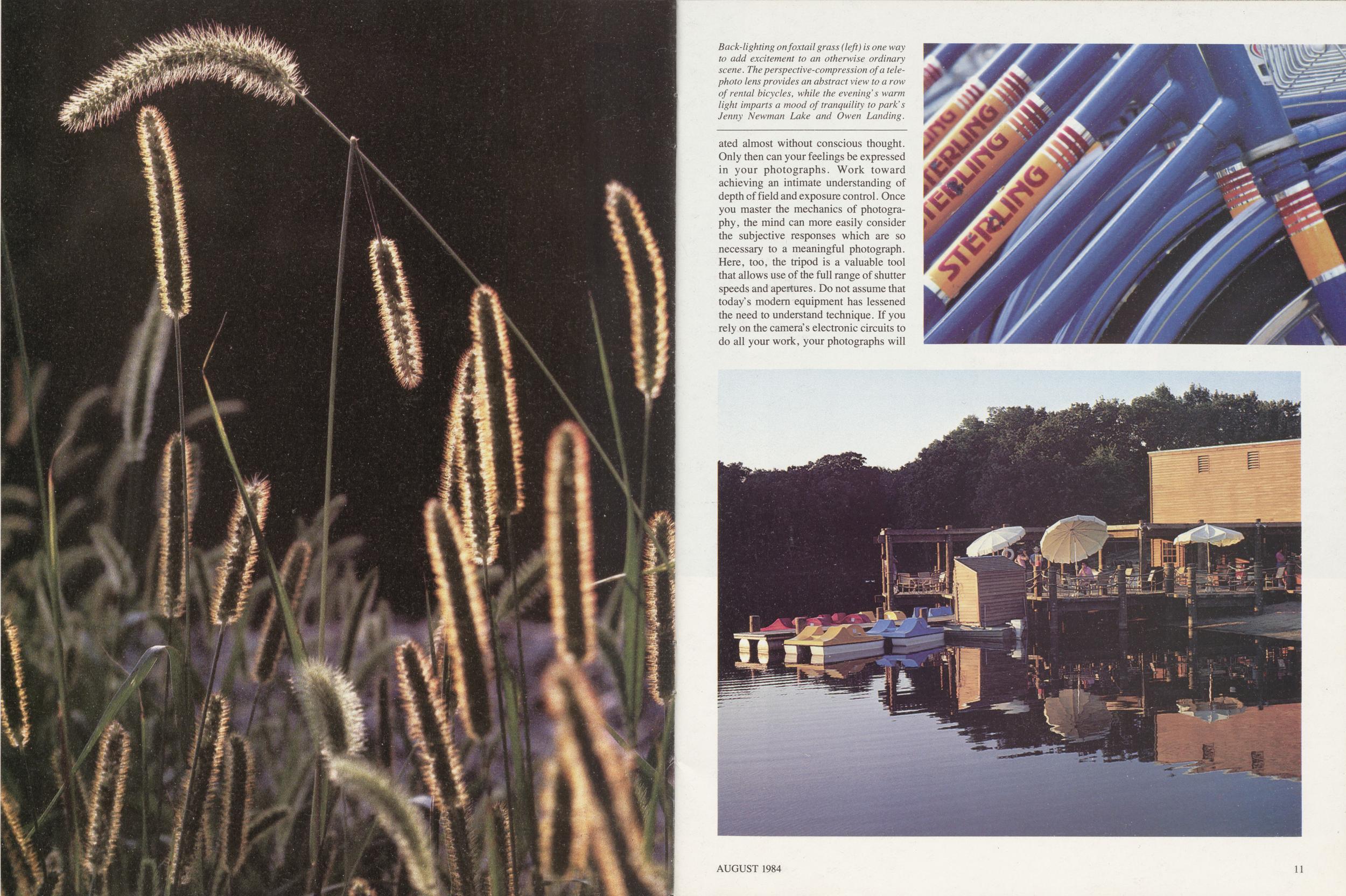
almost without conscious thought. Only then can your feelings be expressed in your photographs. Work toward achieving an intimate understanding of depth of field and exposure control. Once you master the mechanics of photography, the mind can more easily consider the subjective responses which are so necessary to a meaningful photograph. Here, too, the tripod is a valuable tool that allows use of the full range of shutter speeds and apertures. Do not assume that today's modern equipment has lessened the need to understand technique. If you rely on the camera's electronic circuits to do all your work, your photographs will
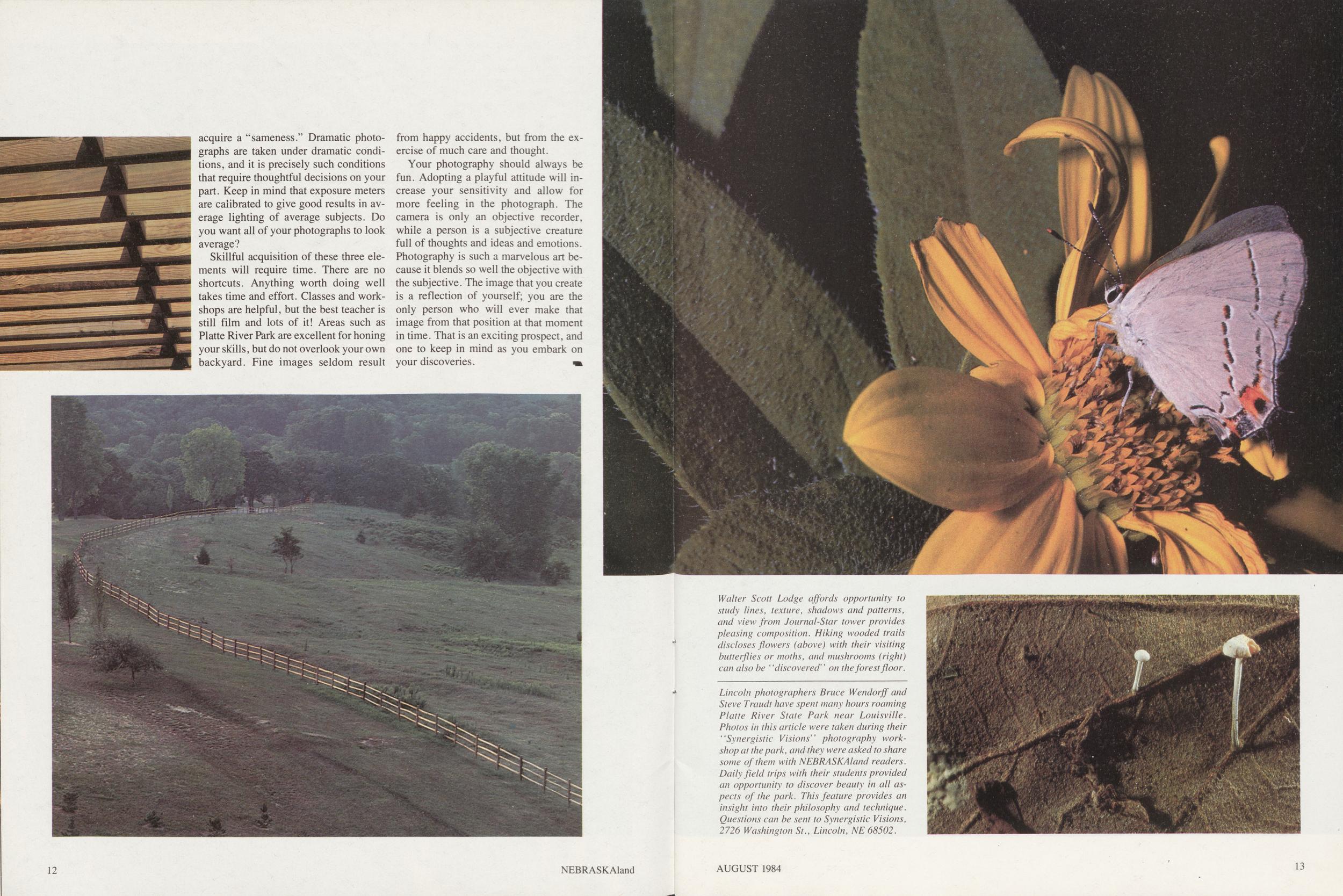
acquire a "sameness." Dramatic photographs are taken under dramatic conditions, and it is precisely such conditions that require thoughtful decisions on your part. Keep in mind that exposure meters are calibrated to give good results in average lighting of average subjects. Do you want all of your photographs to look average?
Skillful acquisition of these three elements will require time. There are no shortcuts. Anything worth doing well takes time and effort. Classes and workshops are helpful, but the best teacher is still film and lots of it! Areas such as Platte River Park are excellent for honing your skills, but do not overlook your own backyard. Fine images seldom result from happy accidents, but from the exercise of much care and thought.
Your photography should always be fun. Adopting a playful attitude will increase your sensitivity and allow for more feeling in the photograph. The camera is only an objective recorder, while a person is a subjective creature full of thoughts and ideas and emotions. Photography is such a marvelous art because it blends so well the objective with the subjective. The image that you create is a reflection of yourself; you are the only person who will ever make that image from that position at that moment in time. That is an exciting prospect, and one to keep in mind as you embark on your discoveries.
Harvesting The Wind
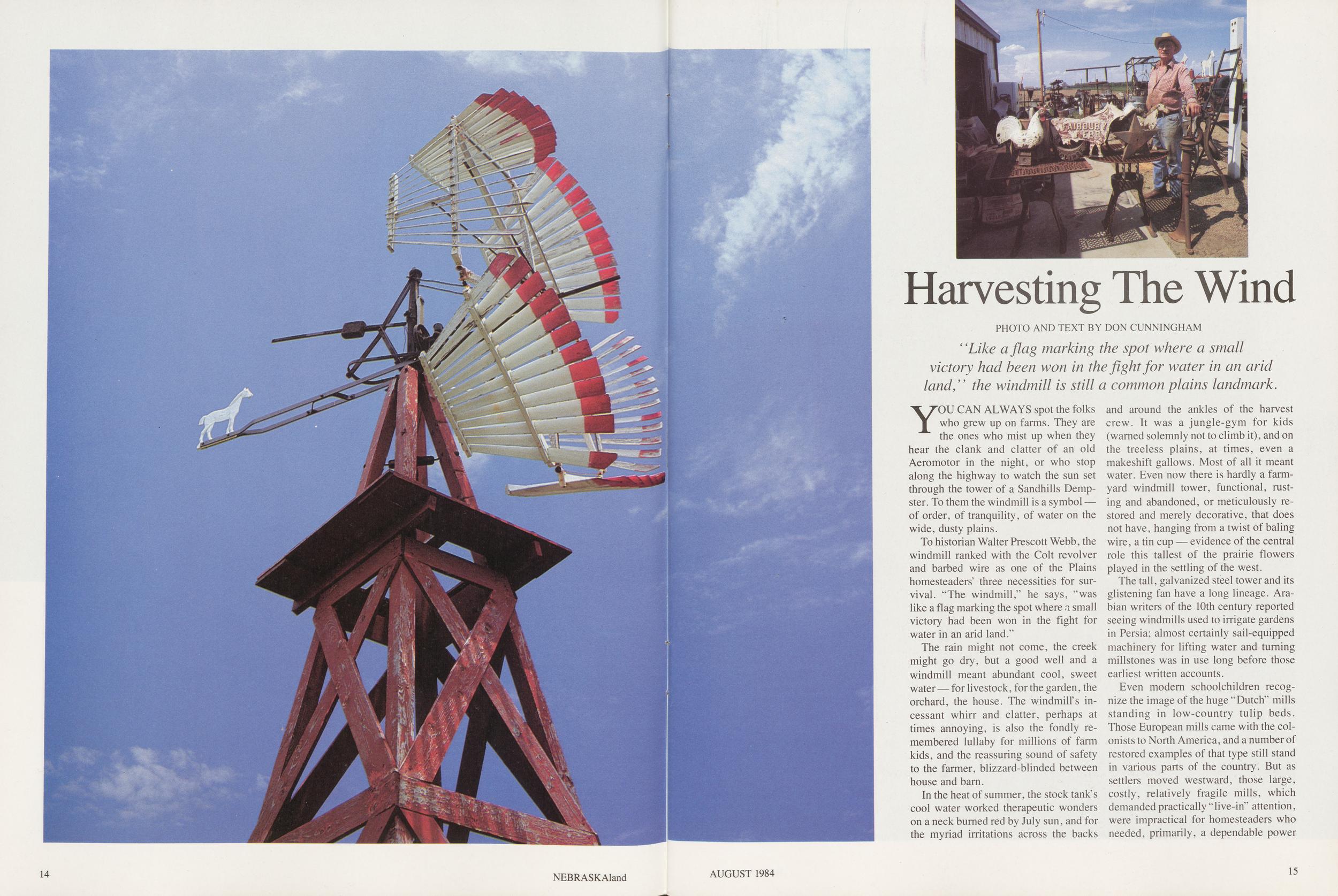
PHOTO AND TEXT BY DON CUNNINGHAM '"Like a flag marking the spot where a small victory had been won in the fight for water in an arid land," the windmill is still a common plains landmark.YOU CAN ALWAYS spot the folks who grew up on farms. They are the ones who mist up when they hear the clank and clatter of an old Aeromotor in the night, or who stop along the highway to watch the sun set through the tower of a Sandhills Dempster. To them the windmill is a symbol — of order, of tranquility, of water on the wide, dusty plains.
To historian Walter Prescott Webb, the windmill ranked with the Colt revolver and barbed wire as one of the Plains homesteaders' three necessities for survival. "The windmill," he says, "was like a flag marking the spot where a small victory had been won in the fight for water in an arid land."
The rain might not come, the creek might go dry, but a good well and a windmill meant abundant cool, sweet water — for livestock, for the garden, the orchard, the house. The windmill's incessant whirr and clatter, perhaps at times annoying, is also the fondly remembered lullaby for millions of farm kids, and the reassuring sound of safety to the farmer, blizzard-blinded between house and barn.
In the heat of summer, the stock tank's cool water worked therapeutic wonders on a neck burned red by July sun, and for the myriad irritations across the backs and around the ankles of the harvest crew. It was a jungle-gym for kids (warned solemnly not to climb it), and on the treeless plains, at times, even a makeshift gallows. Most of all it meant water. Even now there is hardly a farmyard windmill tower, functional, rusting and abandoned, or meticulously restored and merely decorative, that does not have, hanging from a twist of baling wire, a tin cup — evidence of the central role this tallest of the prairie flowers played in the settling of the west.
The tall, galvanized steel tower and its glistening fan have a long lineage. Arabian writers of the 10th century reported seeing windmills used to irrigate gardens in Persia; almost certainly sail-equipped machinery for lifting water and turning millstones was in use long before those earliest written accounts.
Even modern schoolchildren recognize the image of the huge "Dutch" mills standing in low-country tulip beds. Those European mills came with the colonists to North America, and a number of restored examples of that type still stand in various parts of the country. But as settlers moved westward, those large, costly, relatively fragile mills, which demanded practically "live-in" attention, were impractical for homesteaders who needed, primarily, a dependable power
AUGUST 1984 15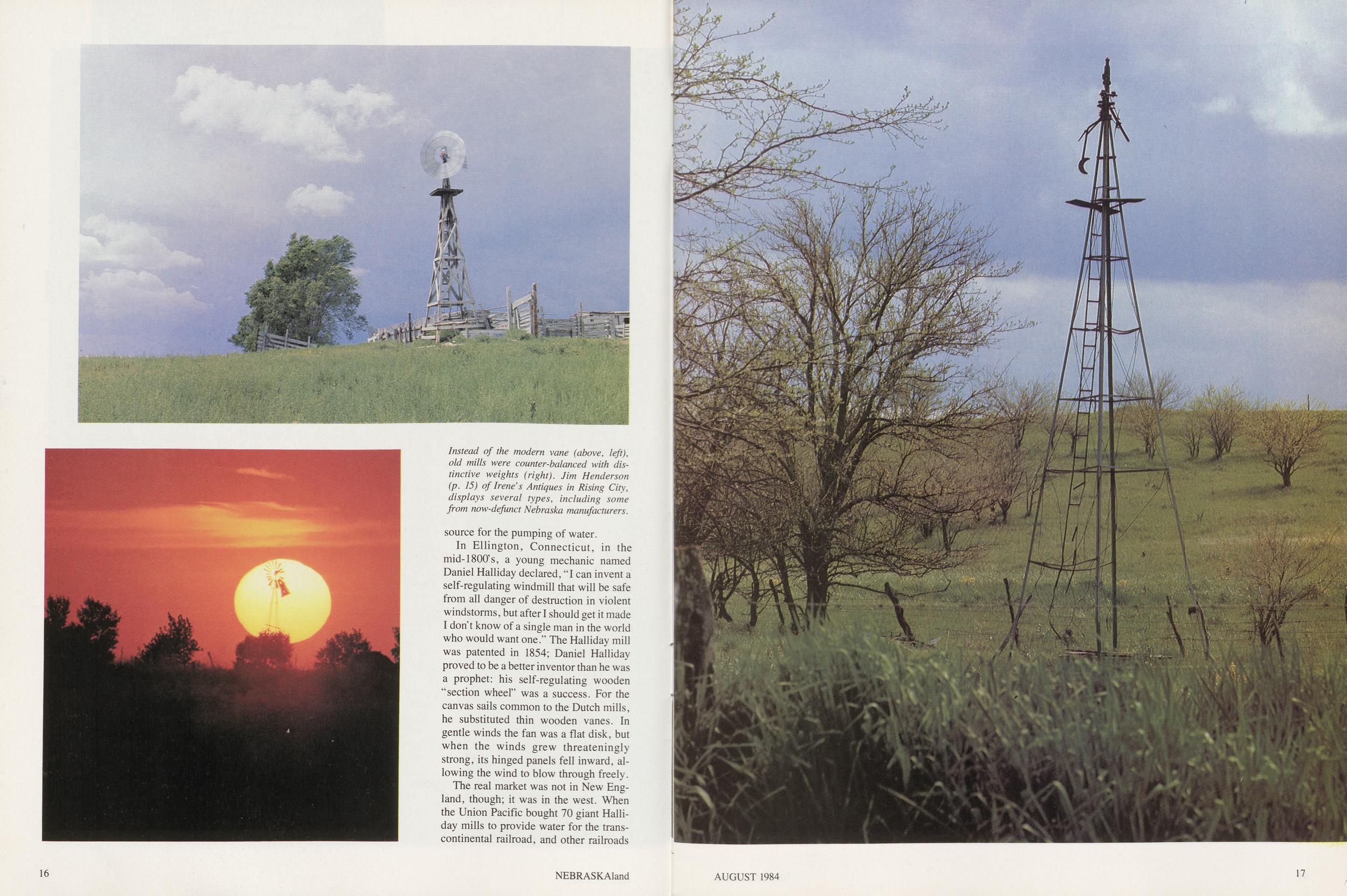
source for the pumping of water.
In Ellington, Connecticut, in the mid-1800's, a young mechanic named Daniel Halliday declared, "I can invent a self-regulating windmill that will be safe from all danger of destruction in violent windstorms, but after I should get it made I don't know of a single man in the world who would want one." The Halliday mill was patented in 1854; Daniel Halliday proved to be a better inventor than he was a prophet: his self-regulating wooden "section wheel" was a success. For the canvas sails common to the Dutch mills, he substituted thin wooden vanes. In gentle winds the fan was a flat disk, but when the winds grew threateningly strong, its hinged panels fell inward, allowing the wind to blow through freely.
The real market was not in New England, though; it was in the west. When the Union Pacific bought 70 giant Halliday mills to provide water for the transcontinental railroad, and other railroads
16 NEBRASKAland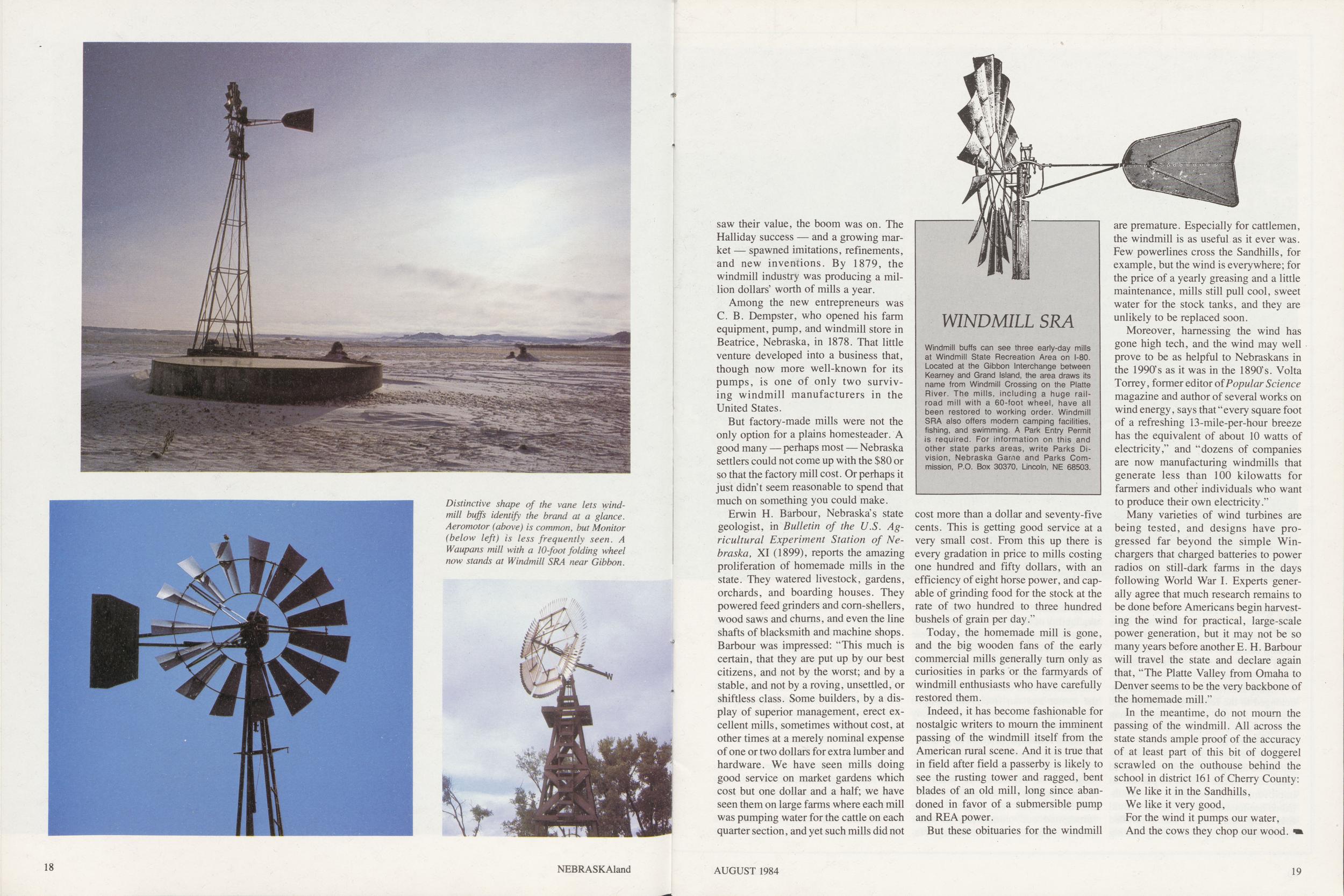
saw their value, the boom was on. The Halliday success — and a growing market — spawned imitations, refinements, and new inventions. By 1879, the windmill industry was producing a million dollars' worth of mills a year.
Among the new entrepreneurs was C. B. Dempster, who opened his farm equipment, pump, and windmill store in Beatrice, Nebraska, in 1878. That little venture developed into a business that, though now more well-known for its pumps, is one of only two surviving windmill manufacturers in the United States.
But factory-made mills were not the only option for a plains homesteader. A good many — perhaps most — Nebraska settlers could not come up with the $80 or so that the factory mill cost. Or perhaps it just didn't seem reasonable to spend that much on something you could make.
Erwin H. Barbour, Nebraska's state geologist, in Bulletin of the U.S. Agricultural Experiment Station of Nebraska, XI (1899), reports the amazing proliferation of homemade mills in the state. They watered livestock, gardens, orchards, and boarding houses. They powered feed grinders and corn-shellers, wood saws and churns, and even the line shafts of blacksmith and machine shops. Barbour was impressed: 'This much is certain, that they are put up by our best citizens, and not by the worst; and by a stable, and not by a roving, unsettled, or shiftless class. Some builders, by a display of superior management, erect excellent mills, sometimes without cost, at other times at a merely nominal expense of one or two dollars for extra lumber and hardware. We have seen mills doing good service on market gardens which cost but one dollar and a half; we have seen them on large farms where each mill was pumping water for the cattle on each quarter section, and yet such mills did not
WINDMILL SRA Windmill buffs can see three early-day mills at Windmill State Recreation Area on 1-80. Located at the Gibbon Interchange between Kearney and Grand Island, the area draws its name from Windmill Crossing on the Platte River. The mills, including a huge railroad mill with a 60-foot wheel, have all been restored to working order. Windmill SRA also offers modern camping facilities, fishing, and swimming. A Park Entry Permit is required. For information on this and other state parks areas, write Parks Division, Nebraska Game and Parks Commission, P.O. Box 30370, Lincoln, NE 68503.cost more than a dollar and seventy-five cents. This is getting good service at a very small cost. From this up there is every gradation in price to mills costing one hundred and fifty dollars, with an efficiency of eight horse power, and capable of grinding food for the stock at the rate of two hundred to three hundred bushels of grain per day."
Today, the homemade mill is gone, and the big wooden fans of the early commercial mills generally turn only as curiosities in parks or the farmyards of windmill enthusiasts who have carefully restored them.
Indeed, it has become fashionable for nostalgic writers to mourn the imminent passing of the windmill itself from the American rural scene. And it is true that in field after field a passerby is likely to see the rusting tower and ragged, bent blades of an old mill, long since abandoned in favor of a submersible pump and REA power.
But these obituaries for the windmill are premature. Especially for cattlemen, the windmill is as useful as it ever was. Few powerlines cross the Sandhills, for example, but the wind is everywhere; for the price of a yearly greasing and a little maintenance, mills still pull cool, sweet water for the stock tanks, and they are unlikely to be replaced soon.
Moreover, harnessing the wind has gone high tech, and the wind may well prove to be as helpful to Nebraskans in the 1990's as it was in the 1890's. Volta Torrey, former editor of Popular Science magazine and author of several works on wind energy, says that "every square foot of a refreshing 13-mile-per-hour breeze has the equivalent of about 10 watts of electricity," and "dozens of companies are now manufacturing windmills that generate less than 100 kilowatts for farmers and other individuals who want to produce their own electricity."
Many varieties of wind turbines are being tested, and designs have progressed far beyond the simple Win-chargers that charged batteries to power radios on still-dark farms in the days following World War I. Experts generally agree that much research remains to be done before Americans begin harvesting the wind for practical, large-scale power generation, but it may not be so many years before another E. H. Barbour will travel the state and declare again that, "The Platte Valley from Omaha to Denver seems to be the very backbone of the homemade mill."
In the meantime, do not mourn the passing of the windmill. All across the state stands ample proof of the accuracy of at least part of this bit of doggerel scrawled on the outhouse behind the school in district 161 of Cherry County: We like it in the Sandhills, We like it very good, For the wind it pumps our water, And the cows they chop our wood.
AUGUST 1984 19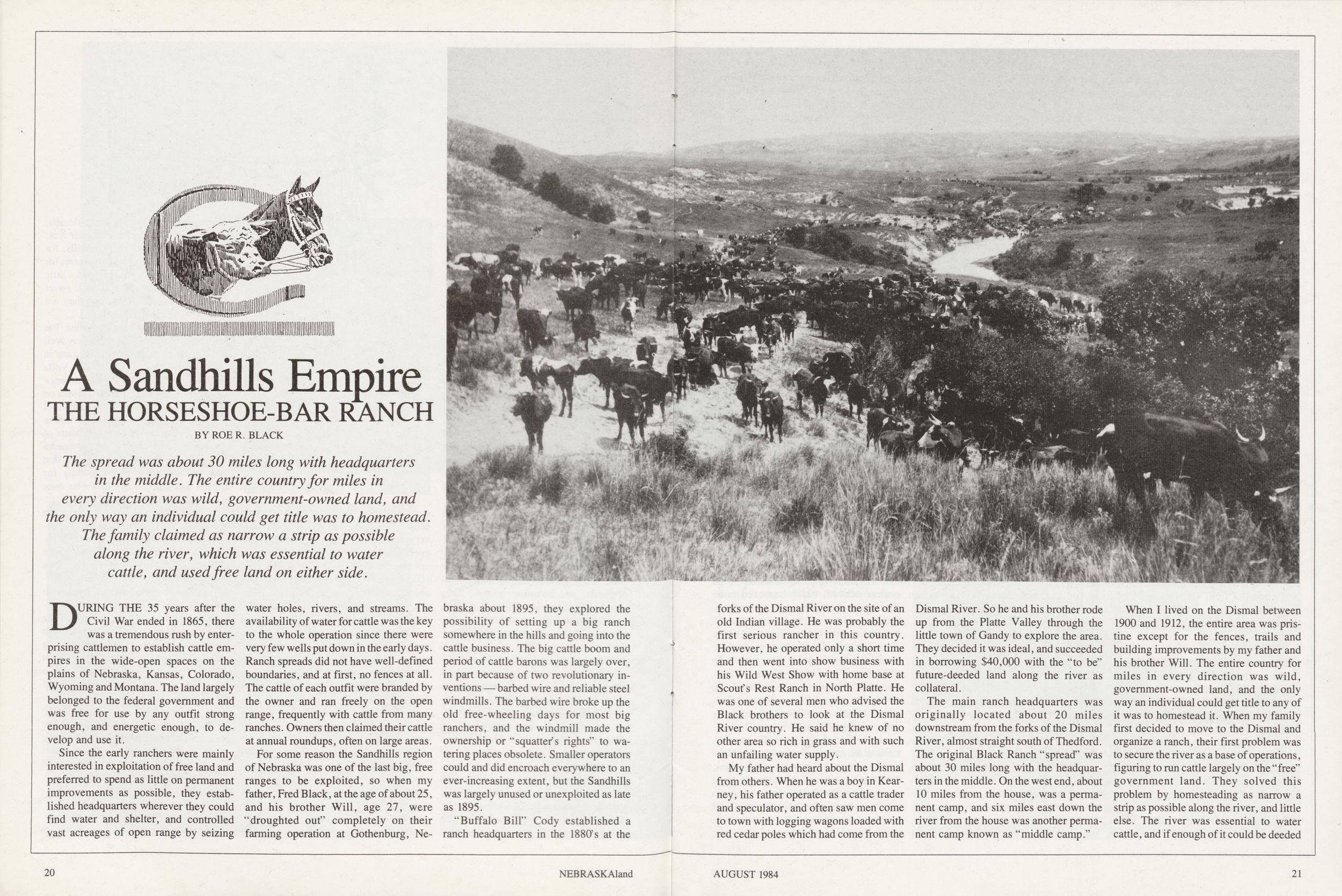
A Sandhills Empire
THE HORSESHOE-BAR RANCH BY ROE R. BLACKThe spread was about 30 miles long with headquarters in the middle. The entire country for miles in every direction was wild, government-owned land, and the only way an individual could get title was to homestead. The family claimed as narrow a strip as possible along the river, which was essential to water cattle, and used free land on either side.
DURING THE 35 years after the Civil War ended in 1865, there was a tremendous rush by enterprising cattlemen to establish cattle empires in the wide-open spaces on the plains of Nebraska, Kansas, Colorado, Wyoming and Montana. The land largely belonged to the federal government and was free for use by any outfit strong enough, and energetic enough, to develop and use it.
Since the early ranchers were mainly interested in exploitation of free land and preferred to spend as little on permanent improvements as possible, they established headquarters wherever they could find water and shelter, and controlled vast acreages of open range by seizing water holes, rivers, and streams. The availability of water for cattle was the key to the whole operation since there were very few wells put down in the early days. Ranch spreads did not have well-defined boundaries, and at first, no fences at all. The cattle of each outfit were branded by the owner and ran freely on the open range, frequently with cattle from many ranches. Owners then claimed their cattle at annual roundups, often on large areas.
For some reason the Sandhills region of Nebraska was one of the last big, free ranges to be exploited, so when my father, Fred Black, at the age of about 25, and his brother Will, age 27, were "draughted out" completely on their farming operation at Gothenburg, Nebraska about 1895, they explored the possibility of setting up a big ranch somewhere in the hills and going into the cattle business. The big cattle boom and period of cattle barons was largely over, in part because of two revolutionary inventions — barbed wire and reliable steel windmills. The barbed wire broke up the old free-wheeling days for most big ranchers, and the windmill made the ownership or "squatter's rights" to watering places obsolete. Smaller operators could and did encroach everywhere to an ever-increasing extent, but the Sandhills was largely unused or unexploited as late as 1895.
"Buffalo Bill" Cody established a ranch headquarters in the 1880's at the
20 NEBRASKAlandforks of the Dismal River on the site of an old Indian village. He was probably the first serious rancher in this country. However, he operated only a short time and then went into show business with his Wild West Show with home base at Scout's Rest Ranch in North Platte. He was one of several men who advised the Black brothers to look at the Dismal River country. He said he knew of no other area so rich in grass and with such an unfailing water supply.
My father had heard about the Dismal from others. When he was a boy in Kearney, his father operated as a cattle trader and speculator, and often saw men come to town with logging wagons loaded with red cedar poles which had come from the Dismal River. So he and his brother rode up from the Platte Valley through the little town of Gandy to explore the area. They decided it was ideal, and succeeded in borrowing $40,000 with the "to be" future-deeded land along the river as collateral.
The main ranch headquarters was originally located about 20 miles downstream from the forks of the Dismal River, almost straight south of Thedford. The original Black Ranch "spread" was about 30 miles long with the headquarters in the middle. On the west end, about 10 miles from the house, was a permanent camp, and six miles east down the river from the house was another permanent camp known as "middle camp."
When I lived on the Dismal between 1900 and 1912, the entire area was pristine except for the fences, trails and building improvements by my father and his brother Will. The entire country for miles in every direction was wild, government-owned land, and the only way an individual could get title to any of it was to homestead it. When my family first decided to move to the Dismal and organize a ranch, their first problem was to secure the river as a base of operations, figuring to run cattle largely on the "free" government land. They solved this problem by homesteading as narrow a strip as possible along the river, and little else. The river was essential to water cattle, and if enough of it could be deeded
AUGUST 1984 21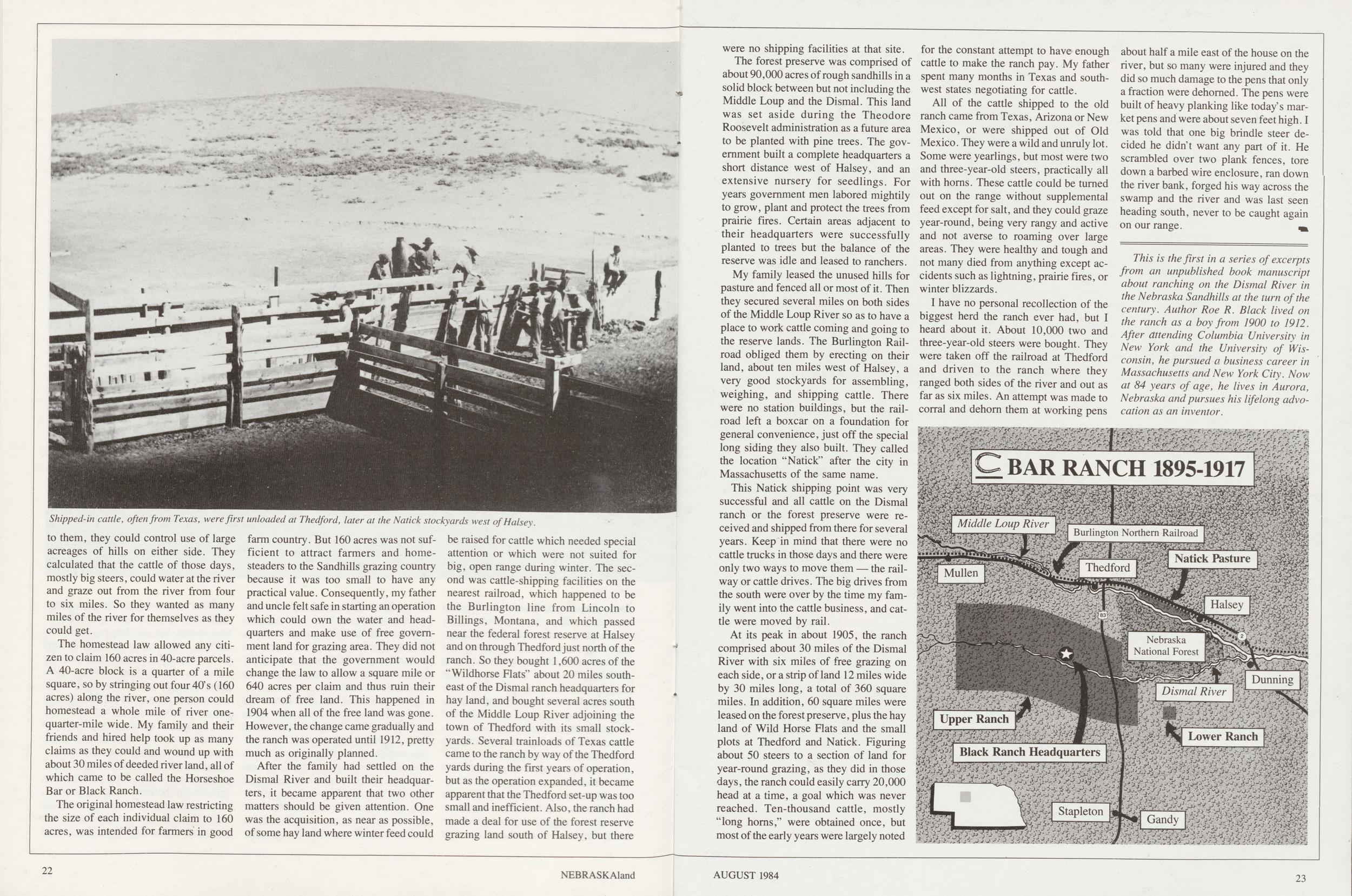
Shipped-in cattle, often from Texas, were first unloaded at Thedford, later at the Natick stockyards west of Halsey.
to them, they could control use of large acreages of hills on either side. They calculated that the cattle of those days, mostly big steers, could water at the river and graze out from the river from four to six miles. So they wanted as many miles of the river for themselves as they could get.
The homestead law allowed any citizen to claim 160 acres in 40-acre parcels. A 40-acre block is a quarter of a mile square, so by stringing out four 40's (160 acres) along the river, one person could homestead a whole mile of river one-quarter-mile wide. My family and their friends and hired help took up as many claims as they could and wound up with about 30 miles of deeded river land, all of which came to be called the Horseshoe Bar or Black Ranch.
The original homestead law restricting the size of each individual claim to 160 acres, was intended for farmers in good farm country. But 160 acres was not sufficient to attract farmers and homesteaders to the Sandhills grazing country because it was too small to have any practical value. Consequently, my father and uncle felt safe in starting an operation which could own the water and headquarters and make use of free government land for grazing area. They did not anticipate that the government would change the law to allow a square mile or 640 acres per claim and thus ruin their dream of free land. This happened in 1904 when all of the free land was gone. However, the change came gradually and the ranch was operated until 1912, pretty much as originally planned.
After the family had settled on the Dismal River and built their headquarters, it became apparent that two other matters should be given attention. One was the acquisition, as near as possible, of some hay land where winter feed could be raised for cattle which needed special attention or which were not suited for big, open range during winter. The second was cattle-shipping facilities on the nearest railroad, which happened to be the Burlington line from Lincoln to Billings, Montana, and which passed near the federal forest reserve at Halsey and on through Thedford just north of the ranch. So they bought 1,600 acres of the "Wildhorse Flats" about 20 miles southeast of the Dismal ranch headquarters for hay land, and bought several acres south of the Middle Loup River adjoining the town of Thedford with its small stockyards. Several trainloads of Texas cattle came to the ranch by way of the Thedford yards during the first years of operation, but as the operation expanded, it became apparent that the Thedford set-up was too small and inefficient. Also, the ranch had made a deal for use of the forest reserve grazing land south of Halsey, but there
22 NEBRASKAlandwere no shipping facilities at that site.
The forest preserve was comprised of about 90,000 acres of rough sandhills in a solid block between but not including the Middle Loup and the Dismal. This land was set aside during the Theodore Roosevelt administration as a future area to be planted with pine trees. The government built a complete headquarters a short distance west of Halsey, and an extensive nursery for seedlings. For years government men labored mightily to grow, plant and protect the trees from prairie fires. Certain areas adjacent to their headquarters were successfully planted to trees but the balance of the reserve was idle and leased to ranchers.
My family leased the unused hills for pasture and fenced all or most of it. Then they secured several miles on both sides of the Middle Loup River so as to have a place to work cattle coming and going to the reserve lands. The Burlington Railroad obliged them by erecting on their land, about ten miles west of Halsey, a very good stockyards for assembling, weighing, and shipping cattle. There were no station buildings, but the railroad left a boxcar on a foundation for general convenience, just off the special long siding they also built. They called the location "Natick" after the city in Massachusetts of the same name.
This Natick shipping point was very successful and all cattle on the Dismal ranch or the forest preserve were received and shipped from there for several years. Keep in mind that there were no cattle trucks in those days and there were only two ways to move them — the railway or cattle drives. The big drives from the south were over by the time my family went into the cattle business, and cattle were moved by rail.
At its peak in about 1905, the ranch comprised about 30 miles of the Dismal River with six miles of free grazing on each side, or a strip of land 12 miles wide by 30 miles long, a total of 360 square miles. In addition, 60 square miles were leased on the forest preserve, plus the hay land of Wild Horse Flats and the small plots at Thedford and Natick. Figuring about 50 steers to a section of land for year-round grazing, as they did in those days, the ranch could easily carry 20,000 head at a time, a goal which was never reached. Ten-thousand cattle, mostly "long horns," were obtained once, but most of the early years were largely noted for the constant attempt to have enough cattle to make the ranch pay. My father spent many months in Texas and southwest states negotiating for cattle.
All of the cattle shipped to the old ranch came from Texas, Arizona or New Mexico, or were shipped out of Old Mexico. They were a wild and unruly lot. Some were yearlings, but most were two and three-year-old steers, practically all with horns. These cattle could be turned out on the range without supplemental feed except for salt, and they could graze year-round, being very rangy and active and not averse to roaming over large areas. They were healthy and tough and not many died from anything except accidents such as lightning, prairie fires, or winter blizzards.
I have no personal recollection of the biggest herd the ranch ever had, but I heard about it. About 10,000 two and three-year-old steers were bought. They were taken off the railroad at Thedford and driven to the ranch where they ranged both sides of the river and out as far as six miles. An attempt was made to corral and dehorn them at working pens about half a mile east of the house on the river, but so many were injured and they did so much damage to the pens that only a fraction were dehorned. The pens were built of heavy planking like today's market pens and were about seven feet high. I was told that one big brindle steer decided he didn't want any part of it. He scrambled over two plank fences, tore down a barbed wire enclosure, ran down the river bank, forged his way across the swamp and the river and was last seen heading south, never to be caught again on our range.
This is the first in a series of excerpts from an unpublished book manuscript about ranching on the Dismal River in the Nebraska Sandhills at the turn of the century. Author Roe R. Black lived on the ranch as a boy from 1900 to 1912. After attending Columbia University in New York and the University of Wisconsin, he pursued a business career in Massachusetts and New York City. Now at 84 years of age, he lives in Aurora, Nebraska and pursues his lifelong advocation as an inventor.BAR RANCH 1895-1917
FROM out of the ASHES
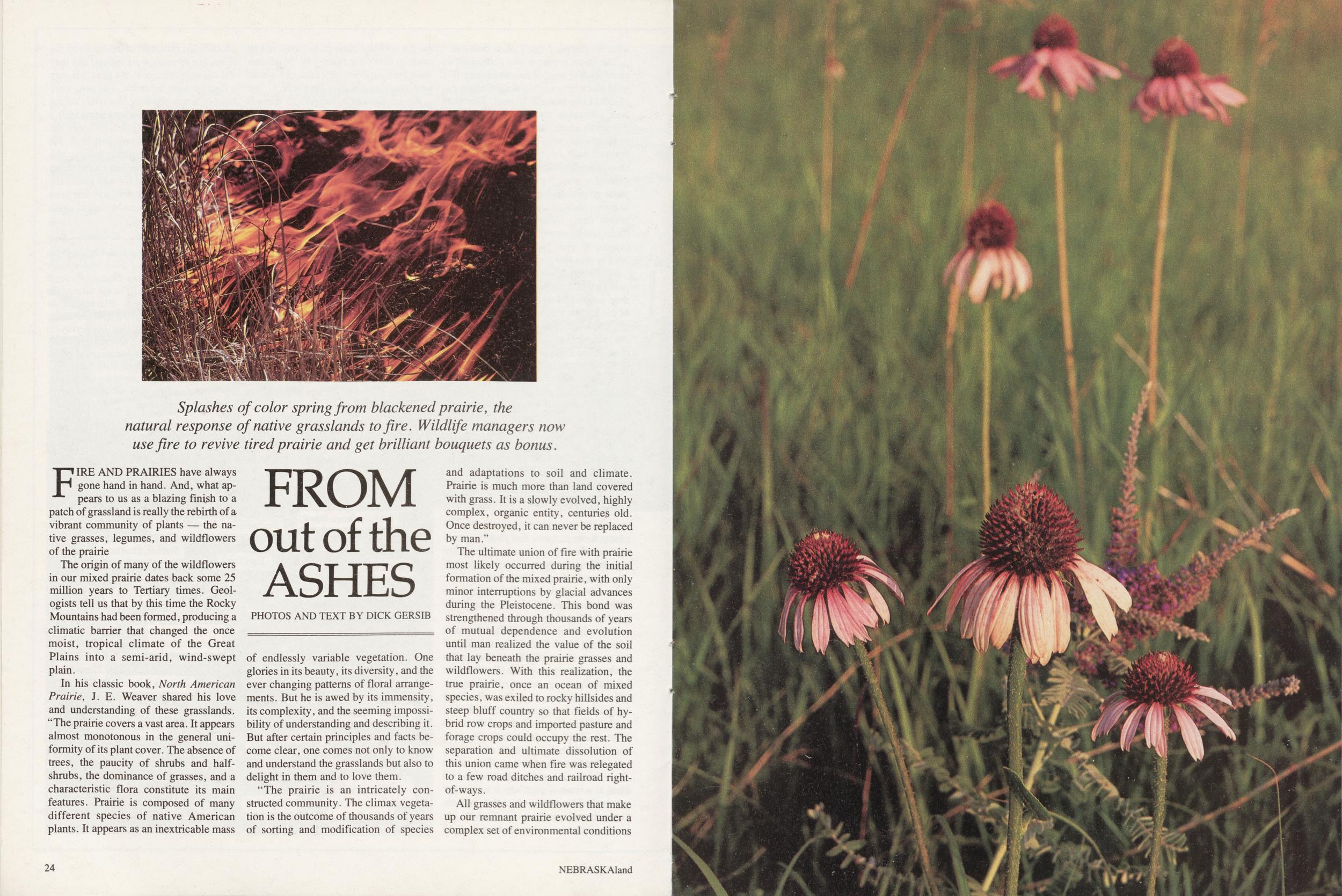
Splashes of color spring from blackened prairie, the natural response of native grasslands to fire. Wildlife managers now use fire to revive tired prairie and get brilliant bouquets as bonus. PHOTOS AND TEXT BY DICK GERSIBFIRE AND PRAIRIES have always gone hand in hand. And, what appears to us as a blazing finish to a patch of grassland is really the rebirth of a vibrant community of plants — the native grasses, legumes, and wildflowers of the prairie
The origin of many of the wildflowers in our mixed prairie dates back some 25 million years to Tertiary times. Geologists tell us that by this time the Rocky Mountains had been formed, producing a climatic barrier that changed the once moist, tropical climate of the Great Plains into a semi-arid, wind-swept plain.
In his classic book, North American Prairie, J. E. Weaver shared his love and understanding of these grasslands. 'The prairie covers a vast area. It appears almost monotonous in the general uniformity of its plant cover. The absence of trees, the paucity of shrubs and half-shrubs, the dominance of grasses, and a characteristic flora constitute its main features. Prairie is composed of many different species of native American plants. It appears as an inextricable mass of endlessly variable vegetation. One glories in its beauty, its diversity, and the ever changing patterns of floral arrangements. But he is awed by its immensity, its complexity, and the seeming impossibility of understanding and describing it. But after certain principles and facts become clear, one comes not only to know and understand the grasslands but also to delight in them and to love them.
"The prairie is an intricately constructed community. The climax vegetation is the outcome of thousands of years of sorting and modification of species and adaptations to soil and climate. Prairie is much more than land covered with grass. It is a slowly evolved, highly complex, organic entity, centuries old. Once destroyed, it can never be replaced by man."
The ultimate union of fire with prairie most likely occurred during the initial formation of the mixed prairie, with only minor interruptions by glacial advances during the Pleistocene. This bond was strengthened through thousands of years of mutual dependence and evolution until man realized the value of the soil that lay beneath the prairie grasses and wildflowers. With this realization, the true prairie, once an ocean of mixed species, was exiled to rocky hillsides and steep bluff country so that fields of hybrid row crops and imported pasture and forage crops could occupy the rest. The separation and ultimate dissolution of this union came when fire was relegated to a few road ditches and railroad right-of-ways.
All grasses and wildflowers that make up our remnant prairie evolved under a complex set of environmental conditions
24 NEBRASKAland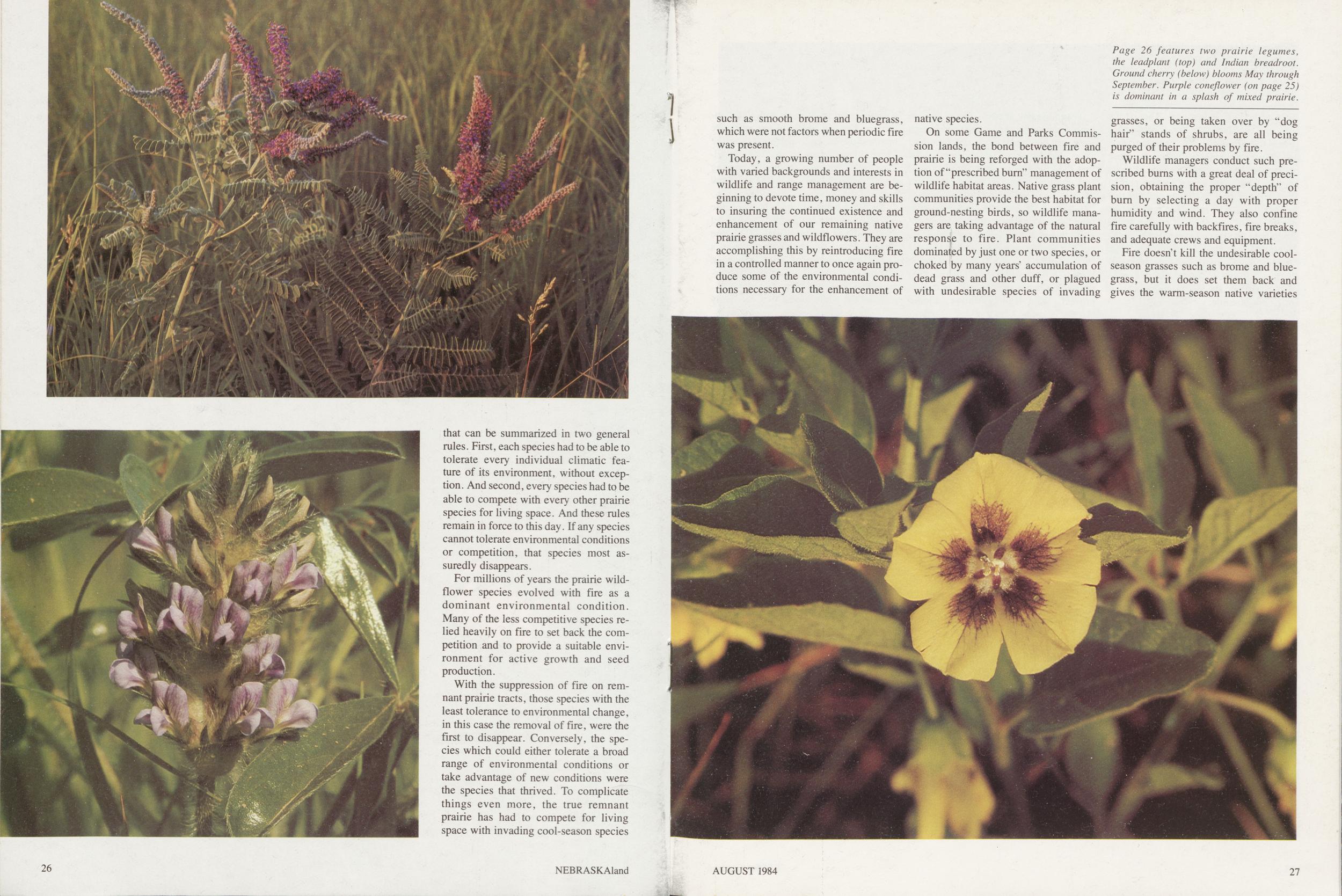
that can be summarized in two general rules. First, each species had to be able to tolerate every individual climatic feature of its environment, without exception. And second, every species had to be able to compete with every other prairie species for living space. And these rules remain in force to this day. If any species cannot tolerate environmental conditions or competition, that species most assuredly disappears.
For millions of years the prairie wildflower species evolved with fire as a dominant environmental condition. Many of the less competitive species relied heavily on fire to set back the competition and to provide a suitable environment for active growth and seed production.
With the suppression of fire on remnant prairie tracts, those species with the least tolerance to environmental change, in this case the removal of fire, were the first to disappear. Conversely, the species which could either tolerate a broad range of environmental conditions or take advantage of new conditions were the species that thrived. To complicate things even more, the true remnant prairie has had to compete for living space with invading cool-season species
26 NEBRASKAlandsuch as smooth brome and bluegrass, which were not factors when periodic fire was present.
Today, a growing number of people with varied backgrounds and interests in wildlife and range management are beginning to devote time, money and skills to insuring the continued existence and enhancement of our remaining native prairie grasses and wildflowers. They are accomplishing this by reintroducing fire in a controlled manner to once again produce some of the environmental conditions necessary for the enhancement of native species.
On some Game and Parks Commission lands, the bond between fire and prairie is being reforged with the adoption of "prescribed burn" management of wildlife habitat areas. Native grass plant communities provide the best habitat for ground-nesting birds, so wildlife managers are taking advantage of the natural response to fire. Plant communities dominated by just one or two species, or choked by many years' accumulation of dead grass and other duff, or plagued with undesirable species of invading grasses, or being taken over by "dog hair" stands of shrubs, are all being purged of their problems by fire.
Wildlife managers conduct such prescribed burns with a great deal of precision, obtaining the proper "depth" of burn by selecting a day with proper humidity and wind. They also confine fire carefully with backfires, fire breaks, and adequate crews and equipment.
Fire doesn't kill the undesirable cool-season grasses such as brome and bluegrass, but it does set them back and gives the warm-season native varieties
that necessary advantage. The native grasses come back quickly, some species even requiring fire for optimum germination and growth. After all, these grasses evolved over thousands of years during which fire was a regular part of life on the prairie. Botanists estimate that before mankind's influence was felt on the Plains, a given plot of prairie would be burned about once every five years by naturally-occurring fires. Under ideal conditions, Commission habitat managers would try to burn selected areas about once in six years, although it is often not possible.
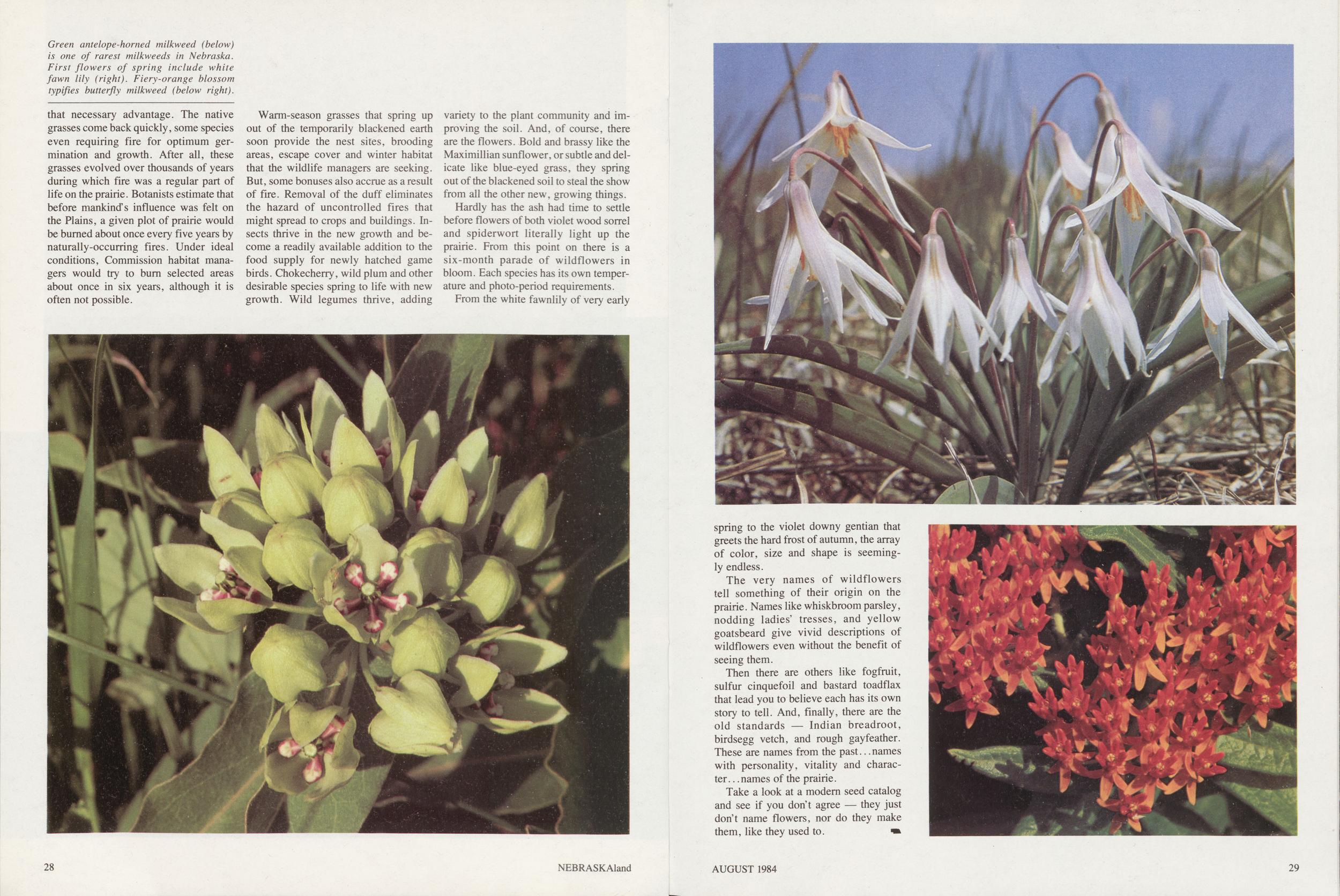
Warm-season grasses that spring up out of the temporarily blackened earth soon provide the nest sites, brooding areas, escape cover and winter habitat that the wildlife managers are seeking. But, some bonuses also accrue as a result of fire. Removal of the duff eliminates the hazard of uncontrolled fires that might spread to crops and buildings. Insects thrive in the new growth and become a readily available addition to the food supply for newly hatched game birds. Chokecherry, wild plum and other desirable species spring to life with new growth. Wild legumes thrive, adding variety to the plant community and improving the soil. And, of course, there are the flowers. Bold and brassy like the Maximillian sunflower, or subtle and delicate like blue-eyed grass, they spring out of the blackened soil to steal the show from all the other new, growing things.
Hardly has the ash had time to settle before flowers of both violet wood sorrel and spiderwort literally light up the prairie. From this point on there is a six-month parade of wildflowers in bloom. Each species has its own temperature and photo-period requirements.
From the white fawnlily of very early
28 NEBRASKAlandspring to the violet downy gentian that greets the hard frost of autumn, the array of color, size and shape is seemingly endless.
The very names of wildflowers tell something of their origin on the prairie. Names like whiskbroom parsley, nodding ladies' tresses, and yellow goatsbeard give vivid descriptions of wildflowers even without the benefit of seeing them.
Then there are others like fogfruit, sulfur cinquefoil and bastard toadflax that lead you to believe each has its own story to tell. And, finally, there are the old standards — Indian breadroot, birdsegg vetch, and rough gay feather. These are names from the past.. .names with personality, vitality and character. . .names of the prairie.
Take a look at a modern seed catalog and see if you don't agree — they just don't name flowers, nor do they make them, like they used to.
Young Trappers Invited To Camp
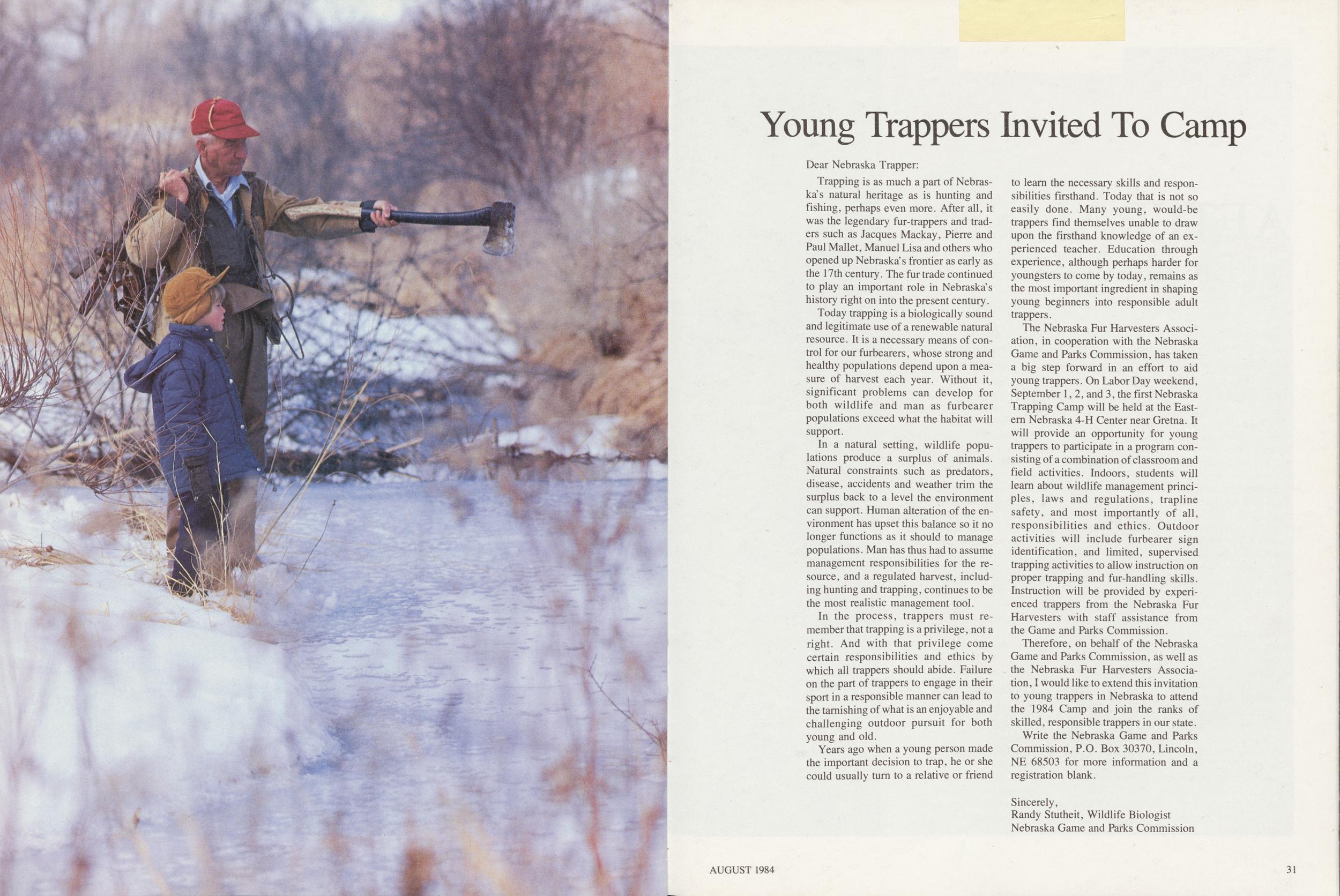
Dear Nebraska Trapper: Trapping is as much a part of Nebraska's natural heritage as is hunting and fishing, perhaps even more. After all, it was the legendary fur-trappers and traders such as Jacques Mackay, Pierre and Paul Mallet, Manuel Lisa and others who opened up Nebraska's frontier as early as the 17th century. The fur trade continued to play an important role in Nebraska's history right on into the present century.
Today trapping is a biologically sound and legitimate use of a renewable natural resource. It is a necessary means of control for our furbearers, whose strong and healthy populations depend upon a measure of harvest each year. Without it, significant problems can develop for both wildlife and man as furbearer populations exceed what the habitat will support.
In a natural setting, wildlife populations produce a surplus of animals. Natural constraints such as predators, disease, accidents and weather trim the surplus back to a level the environment can support. Human alteration of the environment has upset this balance so it no longer functions as it should to manage populations. Man has thus had to assume management responsibilities for the resource, and a regulated harvest, including hunting and trapping, continues to be the most realistic management tool.
In the process, trappers must remember that trapping is a privilege, not a right. And with that privilege come certain responsibilities and ethics by which all trappers should abide. Failure on the part of trappers to engage in their sport in a responsible manner can lead to the tarnishing of what is an enjoyable and challenging outdoor pursuit for both young and old.
Years ago when a young person made the important decision to trap, he or she could usually turn to a relative or friend to learn the necessary skills and responsibilities firsthand. Today that is not so easily done. Many young, would-be trappers find themselves unable to draw upon the firsthand knowledge of an experienced teacher. Education through experience, although perhaps harder for youngsters to come by today, remains as the most important ingredient in shaping young beginners into responsible adult trappers.
The Nebraska Fur Harvesters Association, in cooperation with the Nebraska Game and Parks Commission, has taken a big step forward in an effort to aid young trappers. On Labor Day weekend, September 1,2, and 3, the first Nebraska Trapping Camp will be held at the Eastern Nebraska 4-H Center near Gretna. It will provide an opportunity for young trappers to participate in a program consisting of a combination of classroom and field activities. Indoors, students will learn about wildlife management principles, laws and regulations, trapline safety, and most importantly of all, responsibilities and ethics. Outdoor activities will include furbearer sign identification, and limited, supervised trapping activities to allow instruction on proper trapping and fur-handling skills. Instruction will be provided by experienced trappers from the Nebraska Fur Harvesters with staff assistance from the Game and Parks Commission.
Therefore, on behalf of the Nebraska Game and Parks Commission, as well as the Nebraska Fur Harvesters Association, I would like to extend this invitation to young trappers in Nebraska to attend the 1984 Camp and join the ranks of skilled, responsible trappers in our state.
Write the Nebraska Game and Parks Commission, P.O. Box 30370, Lincoln, NE 68503 for more information and a registration blank.
Sincerely, Randy Stutheit, Wildlife Biologist Nebraska Game and Parks Commission AUGUST 1984 31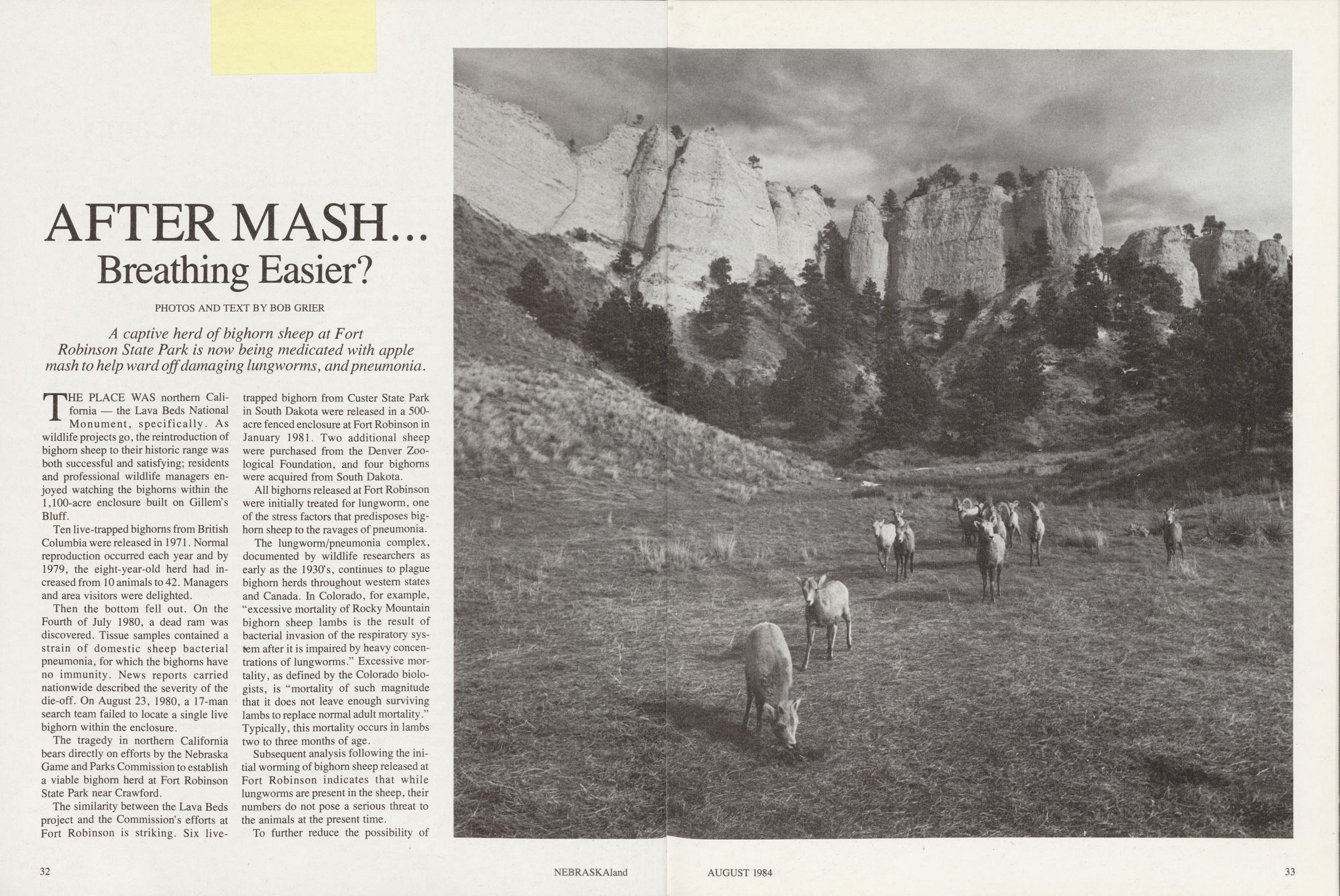
AFTER MASH... Breathing Easier?
PHOTOS AND TEXT BY BOB GRIER A captive herd of bighorn sheep at Fort Robinson State Park is now being medicated with apple mash to help ward off damaging lungworms, and pneumonia.THE PLACE WAS northern California — the Lava Beds National Monument, specifically. As wildlife projects go, the reintroduction of bighorn sheep to their historic range was both successful and satisfying; residents and professional wildlife managers enjoyed watching the bighorns within the 1,100-acre enclosure built on Gillem's Bluff.
Ten live-trapped bighorns from British Columbia were released in 1971. Normal reproduction occurred each year and by 1979, the eight-year-old herd had increased from 10 animals to 42. Managers and area visitors were delighted.
Then the bottom fell out. On the Fourth of July 1980, a dead ram was discovered. Tissue samples contained a strain of domestic sheep bacterial pneumonia, for which the bighorns have no immunity. News reports carried nationwide described the severity of the die-off. On August 23, 1980, a 17-man search team failed to locate a single live bighorn within the enclosure.
The tragedy in northern California bears directly on efforts by the Nebraska Game and Parks Commission to establish a viable bighorn herd at Fort Robinson State Park near Crawford.
The similarity between the Lava Beds project and the Commission's efforts at Fort Robinson is striking. Six live-trapped bighorn from Custer State Park in South Dakota were released in a 500-acre fenced enclosure at Fort Robinson in January 1981. Two additional sheep were purchased from the Denver Zoological Foundation, and four bighorns were acquired from South Dakota.
All bighorns released at Fort Robinson were initially treated for lung worm, one of the stress factors that predisposes bighorn sheep to the ravages of pneumonia.
The lung worm/pneumonia complex, documented by wildlife researchers as early as the 1930's, continues to plague bighorn herds throughout western states and Canada. In Colorado, for example, "excessive mortality of Rocky Mountain bighorn sheep lambs is the result of bacterial invasion of the respiratory system after it is impaired by heavy concentrations of lungworms." Excessive mortality, as defined by the Colorado biologists, is "mortality of such magnitude that it does not leave enough surviving lambs to replace normal adult mortality." Typically, this mortality occurs in lambs two to three months of age.
Subsequent analysis following the initial worming of bighorn sheep released at Fort Robinson indicates that while lungworms are present in the sheep, their numbers do not pose a serious threat to the animals at the present time.
To further reduce the possibility of
32 NEBRASKAland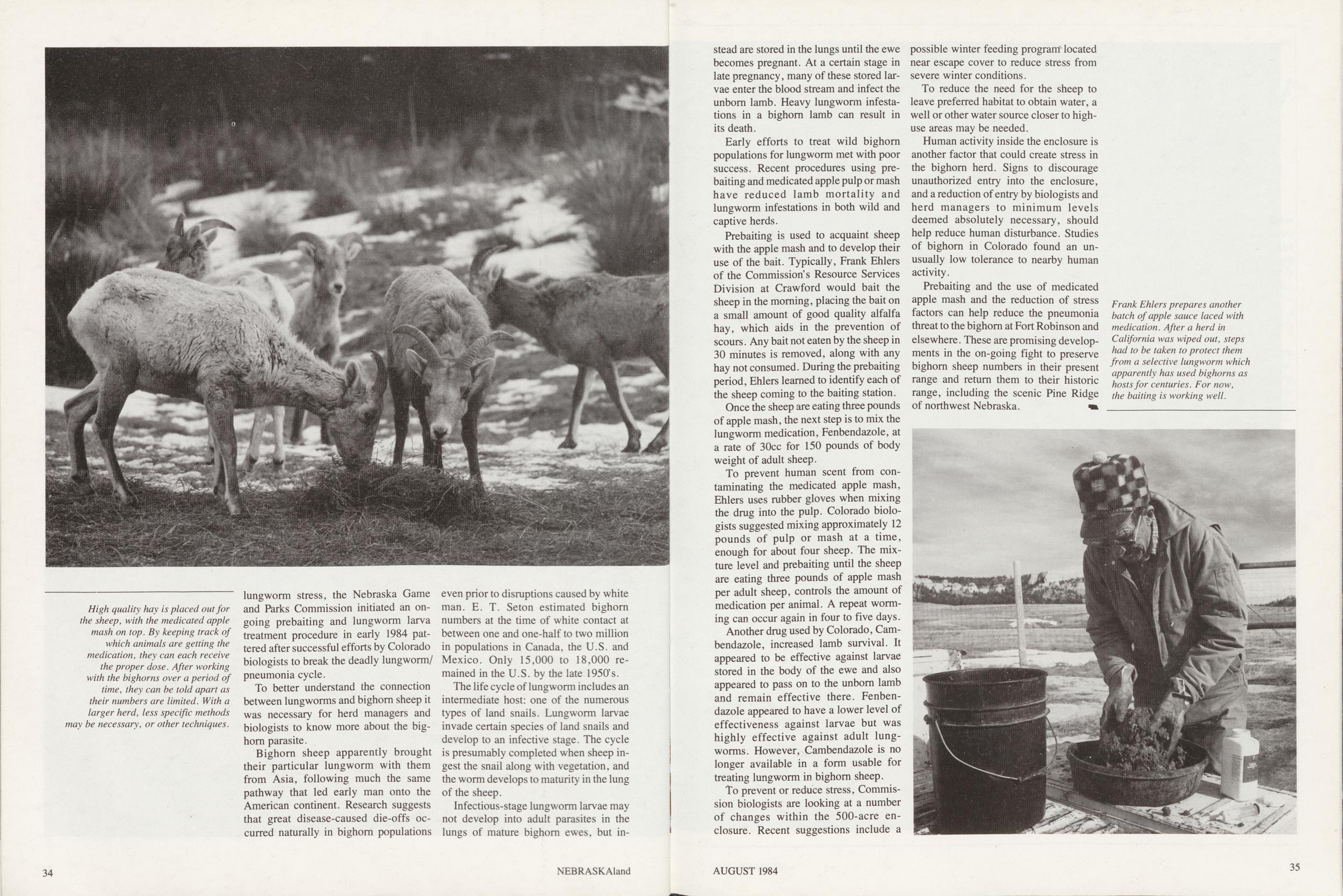
High quality hay is placed out for the sheep, with the medicated apple mash on top. By keeping track of which animals are getting the medication, they can each receive the proper dose. After working with the bighorns over a period of time, they can be told apart as their numbers are limited. With a larger herd, less specific methods may be necessary, or other techniques.
lungworm stress, the Nebraska Game and Parks Commission initiated an ongoing prebaiting and lungworm larva treatment procedure in early 1984 pattered after successful efforts by Colorado biologists to break the deadly lungworm/ pneumonia cycle.
To better understand the connection between lungworms and bighorn sheep it was necessary for herd managers and biologists to know more about the bighorn parasite.
Bighorn sheep apparently brought their particular lungworm with them from Asia, following much the same pathway that led early man onto the American continent. Research suggests that great disease-caused die-offs occurred naturally in bighorn populations even prior to disruptions caused by white man. E. T. Seton estimated bighorn numbers at the time of white contact at between one and one-half to two million in populations in Canada, the U.S. and Mexico. Only 15,000 to 18,000 remained in the U.S. by the late 1950's.
The life cycle of lungworm includes an intermediate host: one of the numerous types of land snails. Lungworm larvae invade certain species of land snails and develop to an infective stage. The cycle is presumably completed when sheep ingest the snail along with vegetation, and the worm develops to maturity in the lung of the sheep.
Infectious-stage lungworm larvae may not develop into adult parasites in the lungs of mature bighorn ewes, but instead
34 NEBRASKAlandare stored in the lungs until the ewe becomes pregnant. At a certain stage in late pregnancy, many of these stored larvae enter the blood stream and infect the unborn lamb. Heavy lungworm infestations in a bighorn lamb can result in its death.
Early efforts to treat wild bighorn populations for lungworm met with poor success. Recent procedures using pre-baiting and medicated apple pulp or mash have reduced lamb mortality and lungworm infestations in both wild and captive herds.
Prebaiting is used to acquaint sheep with the apple mash and to develop their use of the bait. Typically, Frank Ehlers of the Commission's Resource Services Division at Crawford would bait the sheep in the morning, placing the bait on a small amount of good quality alfalfa hay, which aids in the prevention of scours. Any bait not eaten by the sheep in 30 minutes is removed, along with any hay not consumed. During the prebaiting period, Ehlers learned to identify each of the sheep coming to the baiting station.
Once the sheep are eating three pounds of apple mash, the next step is to mix the lungworm medication, Fenbendazole, at a rate of 30cc for 150 pounds of body weight of adult sheep.
To prevent human scent from contaminating the medicated apple mash, Ehlers uses rubber gloves when mixing the drug into the pulp. Colorado biologists suggested mixing approximately 12 pounds of pulp or mash at a time, enough for about four sheep. The mixture level and prebaiting until the sheep are eating three pounds of apple mash per adult sheep, controls the amount of medication per animal. A repeat worming can occur again in four to five days.
Another drug used by Colorado, Cambendazole, increased lamb survival. It appeared to be effective against larvae stored in the body of the ewe and also appeared to pass on to the unborn lamb and remain effective there. Fenbendazole appeared to have a lower level of effectiveness against larvae but was highly effective against adult lungworms. However, Cambendazole is no longer available in a form usable for treating lungworm in bighorn sheep.
To prevent or reduce stress, Commission biologists are looking at a number of changes within the 500-acre enclosure. Recent suggestions include a possible winter feeding program located near escape cover to reduce stress from severe winter conditions.
To reduce the need for the sheep to leave preferred habitat to obtain water, a well or other water source closer to high-use areas may be needed.
Human activity inside the enclosure is another factor that could create stress in the bighorn herd. Signs to discourage unauthorized entry into the enclosure, and a reduction of entry by biologists and herd managers to minimum levels deemed absolutely necessary, should help reduce human disturbance. Studies of bighorn in Colorado found an unusually low tolerance to nearby human activity.
Prebaiting and the use of medicated apple mash and the reduction of stress factors can help reduce the pneumonia threat to the bighorn at Fort Robinson and elsewhere. These are promising developments in the on-going fight to preserve bighorn sheep numbers in their present range and return them to their historic range, including the scenic Pine Ridge of northwest Nebraska.
Frank Ehlers prepares another batch of apple sauce laced with medication. After a herd in California was wiped out, steps had to be taken to protect them from a selective lungworm which apparently has used bighorns as hosts for centuries. For now, the baiting is working well.
Land, Light, and Sky
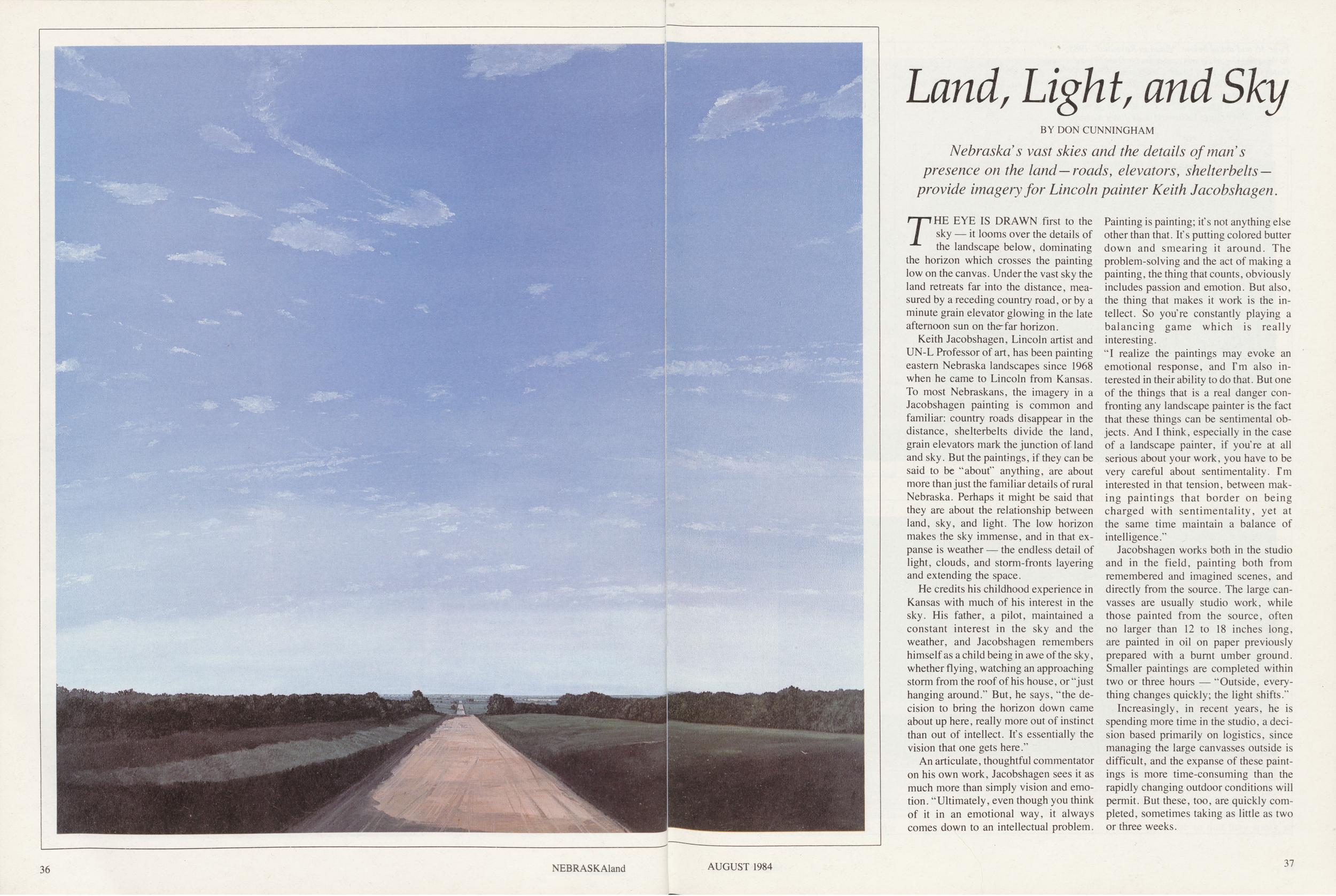
BY DON CUNNINGHAM Nebraska's vast skies and the details of man's presence on the land—roads, elevators, shelterbelts — provide imagery for Lincoln painter Keith Jacobshagen.THE EYE IS DRAWN first to the sky — it looms over the details of the landscape below, dominating the horizon which crosses the painting low on the canvas. Under the vast sky the land retreats far into the distance, measured by a receding country road, or by a minute grain elevator glowing in the late afternoon sun on the-far horizon.
Keith Jacobshagen, Lincoln artist and UN-L Professor of art, has been painting eastern Nebraska landscapes since 1968 when he came to Lincoln from Kansas. To most Nebraskans, the imagery in a Jacobshagen painting is common and familiar: country roads disappear in the distance, shelterbelts divide the land, grain elevators mark the junction of land and sky. But the paintings, if they can be said to be "about" anything, are about more than just the familiar details of rural Nebraska. Perhaps it might be said that they are about the relationship between land, sky, and light. The low horizon makes the sky immense, and in that expanse is weather — the endless detail of light, clouds, and storm-fronts layering and extending the space.
He credits his childhood experience in Kansas with much of his interest in the sky. His father, a pilot, maintained a constant interest in the sky and the weather, and Jacobshagen remembers himself as a child being in awe of the sky, whether flying, watching an approaching storm from the roof of his house, or "just hanging around." But, he says, "the decision to bring the horizon down came about up here, really more out of instinct than out of intellect. It's essentially the vision that one gets here."
An articulate, thoughtful commentator on his own work, Jacobshagen sees it as much more than simply vision and emotion. "Ultimately, even though you think of it in an emotional way, it always comes down to an intellectual problem. Painting is painting; it's not anything else other than that. It's putting colored butter down and smearing it around. The problem-solving and the act of making a painting, the thing that counts, obviously includes passion and emotion. But also, the thing that makes it work is the intellect. So you're constantly playing a balancing game which is really interesting.
"I realize the paintings may evoke an emotional response, and I'm also interested in their ability to do that. But one of the things that is a real danger confronting any landscape painter is the fact that these things can be sentimental objects. And I think, especially in the case of a landscape painter, if you're at all serious about your work, you have to be very careful about sentimentality. I'm interested in that tension, between making paintings that border on being charged with sentimentality, yet at the same time maintain a balance of intelligence."
Jacobshagen works both in the studio and in the field, painting both from remembered and imagined scenes, and directly from the source. The large canvasses are usually studio work, while those painted from the source, often no larger than 12 to 18 inches long, are painted in oil on paper previously prepared with a burnt umber ground. Smaller paintings are completed within two or three hours — "Outside, everything changes quickly; the light shifts."
Increasingly, in recent years, he is spending more time in the studio, a decision based primarily on logistics, since managing the large canvasses outside is difficult, and the expanse of these paintings is more time-consuming than the rapidly changing outdoor conditions will permit. But these, too, are quickly completed, sometimes taking as little as two or three weeks.
AUGUST 1984 37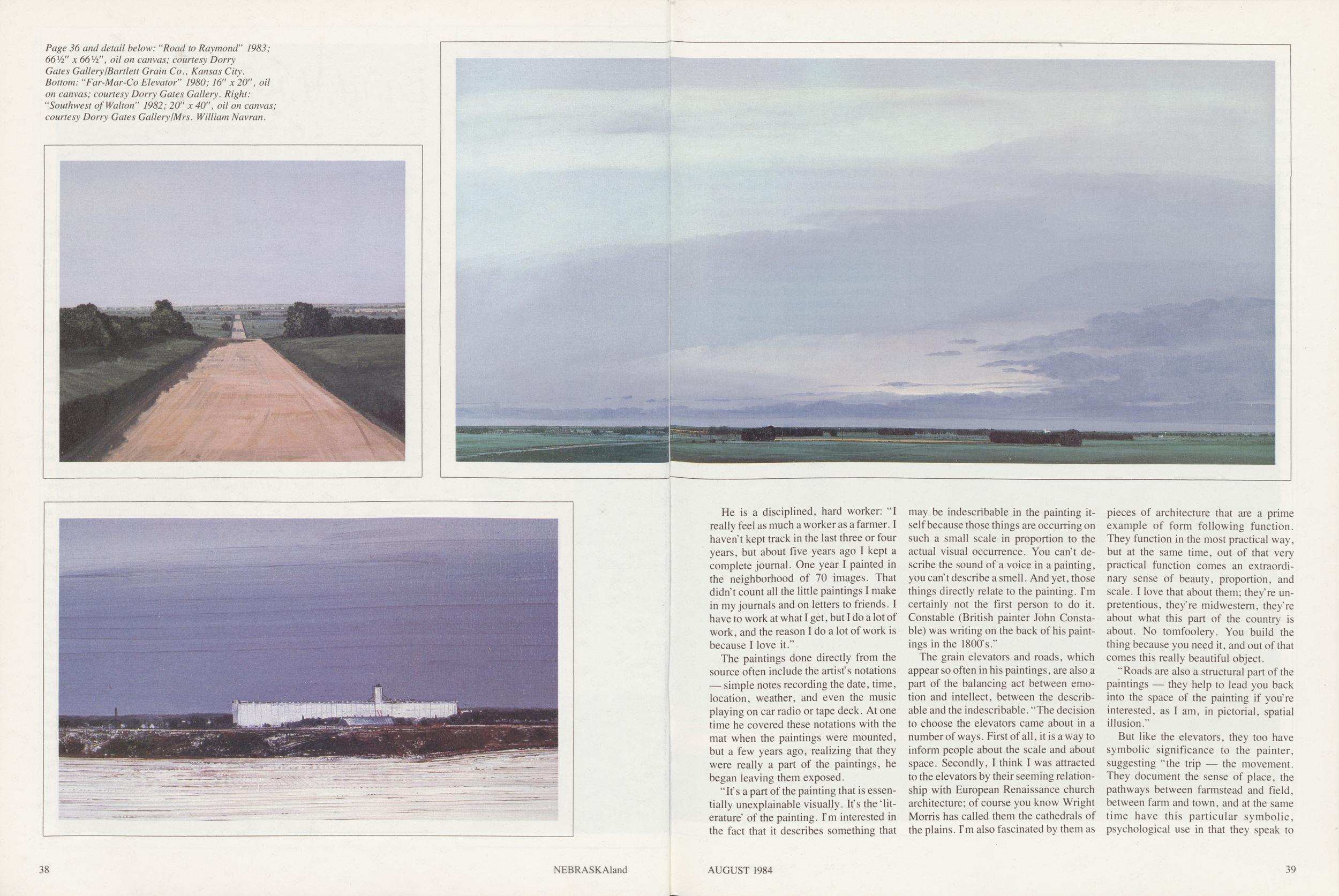 Page 36 and detail below: "Road to Raymond" 1983;
66 1/2" x 66 1/2", oil on canvas; courtesy Dorry
Gates Gallery/Bartlett Grain Co., Kansas City.
Bottom; "Far-Mar-Co Elevator 1980; 16" x20", oil
on canvas; courtesy Dorry Gates Gallery. Right:
"Southwest of Walton" 1982; 20" x 40", oil on canvas;
courtesy Dorry Gates Gallery / Mrs. William Navran.
Page 36 and detail below: "Road to Raymond" 1983;
66 1/2" x 66 1/2", oil on canvas; courtesy Dorry
Gates Gallery/Bartlett Grain Co., Kansas City.
Bottom; "Far-Mar-Co Elevator 1980; 16" x20", oil
on canvas; courtesy Dorry Gates Gallery. Right:
"Southwest of Walton" 1982; 20" x 40", oil on canvas;
courtesy Dorry Gates Gallery / Mrs. William Navran.
He is a disciplined, hard worker: "I really feel as much a worker as a farmer. I haven t kept track in the last three or four years, but about five years ago I kept a complete journal. One year I painted in the neighborhood of 70 images. That didn't count all the little paintings I make in my journals and on letters to friends. I have to work at what I get, but I do a lot of work, and the reason I do a lot of work is because I love it."
The paintings done directly from the source often include the artist's notations — simple notes recording the date, time, location, weather, and even the music playing on car radio or tape deck. At one time he covered these notations with the mat when the paintings were mounted, but a few years ago, realizing that they were really a part of the paintings, he began leaving them exposed.
"It's a part of the painting that is essentially unexplainable visually. It's the 'literature' of the painting. I'm interested in the fact that it describes something that may be indescribable in the painting itself because those things are occurring on such a small scale in proportion to the actual visual occurrence. You can't describe the sound of a voice in a painting, you can't describe a smell. And yet, those things directly relate to the painting. I'm certainly not the first person to do it. Constable (British painter John Constable) was writing on the back of his paintings in the 1800's."
The grain elevators and roads, which appear so often in his paintings, are also a part of the balancing act between emotion and intellect, between the describable and the indescribable. "The decision to choose the elevators came about in a number of ways. First of all, it is a way to inform people about the scale and about space. Secondly, I think I was attracted to the elevators by their seeming relationship with European Renaissance church architecture; of course you know Wright Morris has called them the cathedrals of the plains. Tm also fascinated by them as pieces of architecture that are a prime example of form following function. They function in the most practical way, but at the same time, out of that very practical function comes an extraordinary sense of beauty, proportion, and scale. I love that about them; they're unpretentious, they're mid western, they're about what this part of the country is about. No tomfoolery. You build the thing because you need it, and out of that comes this really beautiful object.
"Roads are also a structural part of the paintings — they help to lead you back into the space of the painting if you're interested, as I am, in pictorial, spatial illusion."
But like the elevators, they too have symbolic significance to the painter, suggesting "the trip — the movement. They document the sense of place, the pathways between farmstead and field, between farm and town, and at the same time have this particular symbolic, psychological use in that they speak to
AUGUST 1984 39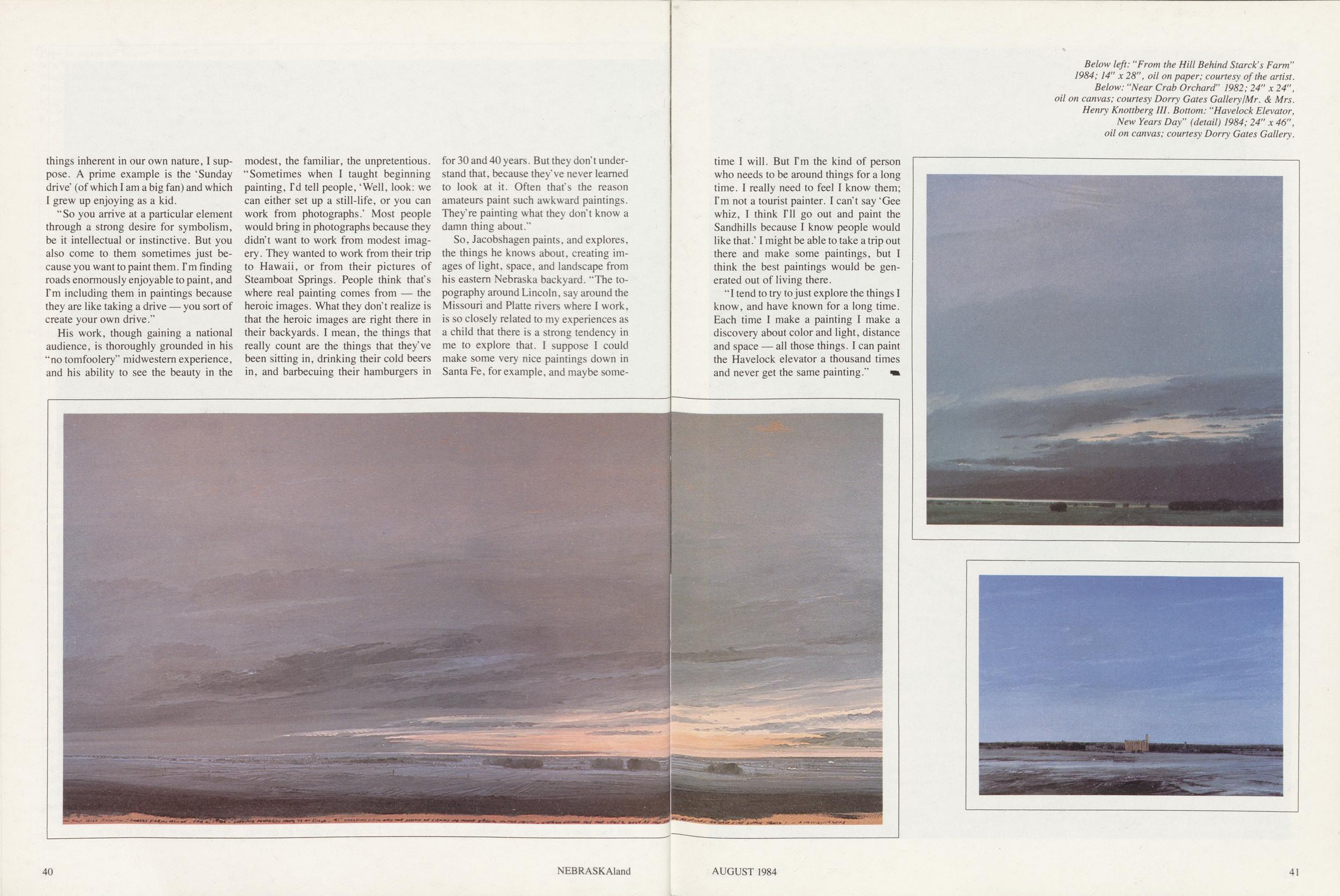
things inherent in our own nature, I suppose. A prime example is the 'Sunday drive' (of which I am a big fan) and which I grew up enjoying as a kid.
"So you arrive at a particular element through a strong desire for symbolism, be it intellectual or instinctive. But you also come to them sometimes just because you want to paint them. Tm finding roads enormously enjoyable to paint, and Fm including them in paintings because they are like taking a drive — you sort of create your own drive."
His work, though gaining a national audience, is thoroughly grounded in his "no tomfoolery" mid western experience, and his ability to see the beauty in the modest, the familiar, the unpretentious. "Sometimes when I taught beginning painting, Td tell people, 'Well, look: we can either set up a still-life, or you can work from photographs.' Most people would bring in photographs because they didn't want to work from modest imagery. They wanted to work from their trip to Hawaii, or from their pictures of Steamboat Springs. People think that's where real painting comes from — the heroic images. What they don't realize is that the heroic images are right there in their backyards. I mean, the things that really count are the things that they've been sitting in, drinking their cold beers in, and barbecuing their hamburgers in for 30 and 40 years. But they don't understand that, because they've never learned to look at it. Often that's the reason amateurs paint such awkward paintings. They're painting what they don't know a damn thing about."
So, Jacobshagen paints, and explores, the things he knows about, creating images of light, space, and landscape from his eastern Nebraska backyard. "The topography around Lincoln, say around the Missouri and Platte rivers where I work, is so closely related to my experiences as a child that there is a strong tendency in me to explore that. I suppose I could make some very nice paintings down in Santa Fe, for example, and maybe sometime
I will. But I'm the kind of person who needs to be around things for a long time. I really need to feel I know them; Tm not a tourist painter. I can't say 'Gee whiz, I think I'll go out and paint the Sandhills because I know people would like that.' I might be able to take a trip out there and make some paintings, but I think the best paintings would be generated out of living there.
"I tend to try to just explore the things I know, and have known for a long time. Each time I make a painting I make a discovery about color and light, distance and space — all those things. I can paint the Havelock elevator a thousand times and never get the same painting."
Below left: "From the Hill Behind Starck's Farm" 1984; 14" x 28", oil on paper; courtesy of the artist. Below: "Near Crab Orchard" 1982; 24" x 24", oil on canvas; courtesy Dorry Gates Gallery / Mr. & Mrs. Henry Knottberg III. Bottom: "Havelock Elevator, New Years Day" (detail) 1984; 24" x 46", oil on canvas; courtesy Dorry Gates Gallery.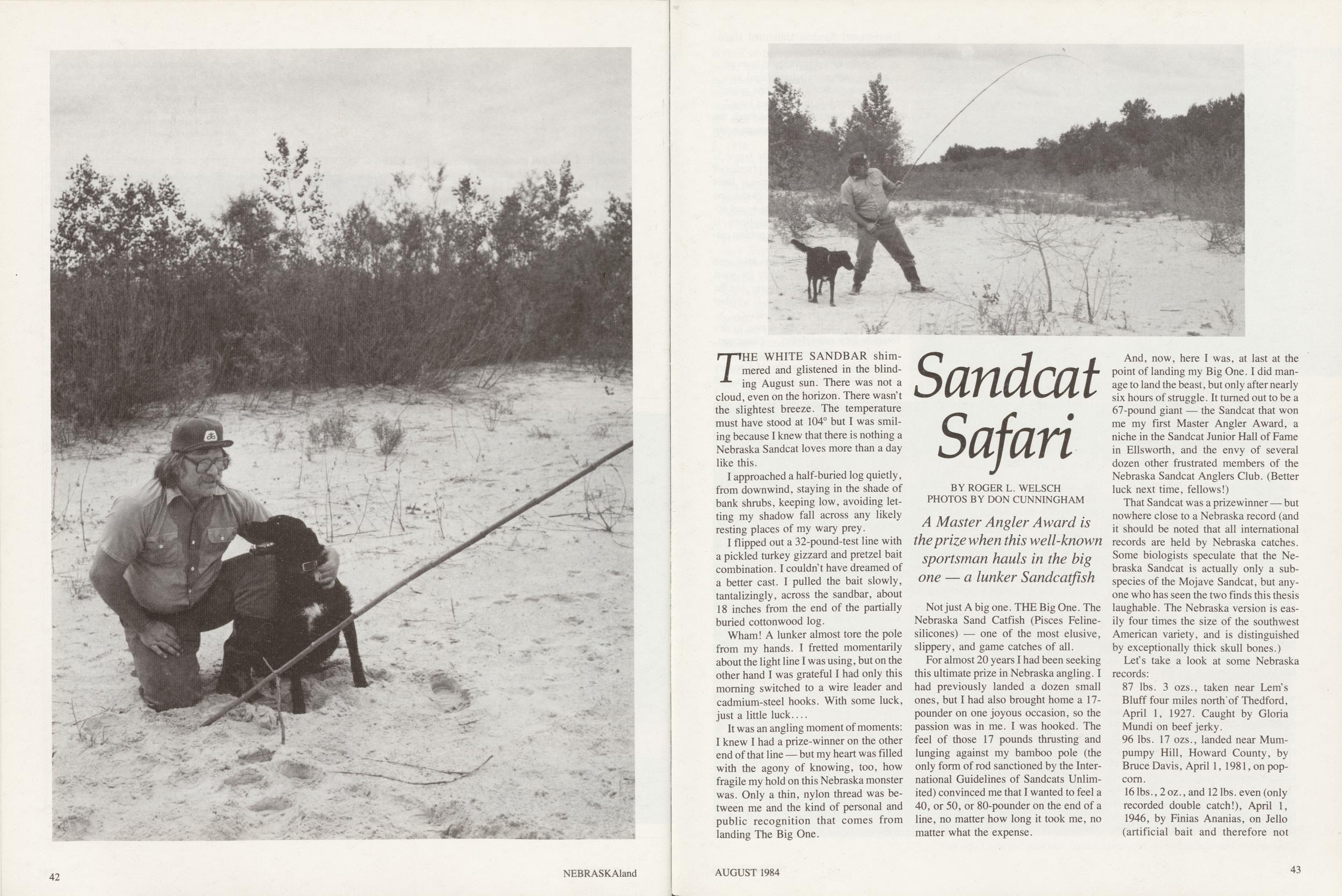
Sandcat Safari
BY ROGER L. WELSCH PHOTOS BY DON CUNNINGHAM A Master Angler Award is the prize when this well-known sportsman hauls in the big one — a lunker SandcatfishTHE WHITE SANDBAR shimmered and glistened in the blinding August sun. There was not a cloud, even on the horizon. There wasn't the slightest breeze. The temperature must have stood at 104° but I was smiling because I knew that there is nothing a Nebraska Sandcat loves more than a day like this.
I approached a half-buried log quietly, from downwind, staying in the shade of bank shrubs, keeping low, avoiding letting my shadow fall across any likely resting places of my wary prey.
I flipped out a 32-pound-test line with a pickled turkey gizzard and pretzel bait combination. I couldn't have dreamed of a better cast. I pulled the bait slowly, tantalizingly, across the sandbar, about 18 inches from the end of the partially buried cotton wood log.
Wham! A lunker almost tore the pole from my hands. I fretted momentarily about the light line I was using, but on the other hand I was grateful I had only this morning switched to a wire leader and cadmium-steel hooks. With some luck, just a little luck....
It was an angling moment of moments: I knew I had a prize-winner on the other end of that line — but my heart was filled with the agony of knowing, too, how fragile my hold on this Nebraska monster was. Only a thin, nylon thread was between me and the kind of personal and public recognition that comes from landing The Big One.
Not just A big one. THE Big One. The Nebraska Sand Catfish (Pisces Feline-silicones) — one of the most elusive, slippery, and game catches of all.
For almost 20 years I had been seeking this ultimate prize in Nebraska angling. I had previously landed a dozen small ones, but I had also brought home a 17-pounder on one joyous occasion, so the passion was in me. I was hooked. The feel of those 17 pounds thrusting and lunging against my bamboo pole (the only form of rod sanctioned by the International Guidelines of Sandcats Unlimited) convinced me that I wanted to feel a 40, or 50, or 80-pounder on the end of a line, no matter how long it took me, no matter what the expense.
And, now, here I was, at last at the point of landing my Big One. I did manage to land the beast, but only after nearly six hours of struggle. It turned out to be a 67-pound giant — the Sandcat that won me my first Master Angler Award, a niche in the Sandcat Junior Hall of Fame in Ellsworth, and the envy of several dozen other frustrated members of the Nebraska Sandcat Anglers Club. (Better luck next time, fellows!)
That Sandcat was a prizewinner — but nowhere close to a Nebraska record (and it should be noted that all international records are held by Nebraska catches. Some biologists speculate that the Nebraska Sandcat is actually only a sub-species of the Mojave Sandcat, but anyone who has seen the two finds this thesis laughable. The Nebraska version is easily four times the size of the southwest American variety, and is distinguished by exceptionally thick skull bones.)
Let's take a look at some Nebraska records: 87 lbs. 3 ozs., taken near Lem's Bluff four miles north'of Thedford, April 1, 1927. Caught by Gloria Mundi on beef jerky. 96 lbs. 17 ozs., landed near Mumpumpy Hill, Howard County, by Bruce Davis, April 1, 1981, on popcorn. 16 lbs., 2 oz., and 12 lbs. even (only recorded double catch!), April 1, 1946, by Finias Ananias, on Jello (artificial bait and therefore not
AUGUST 1984 43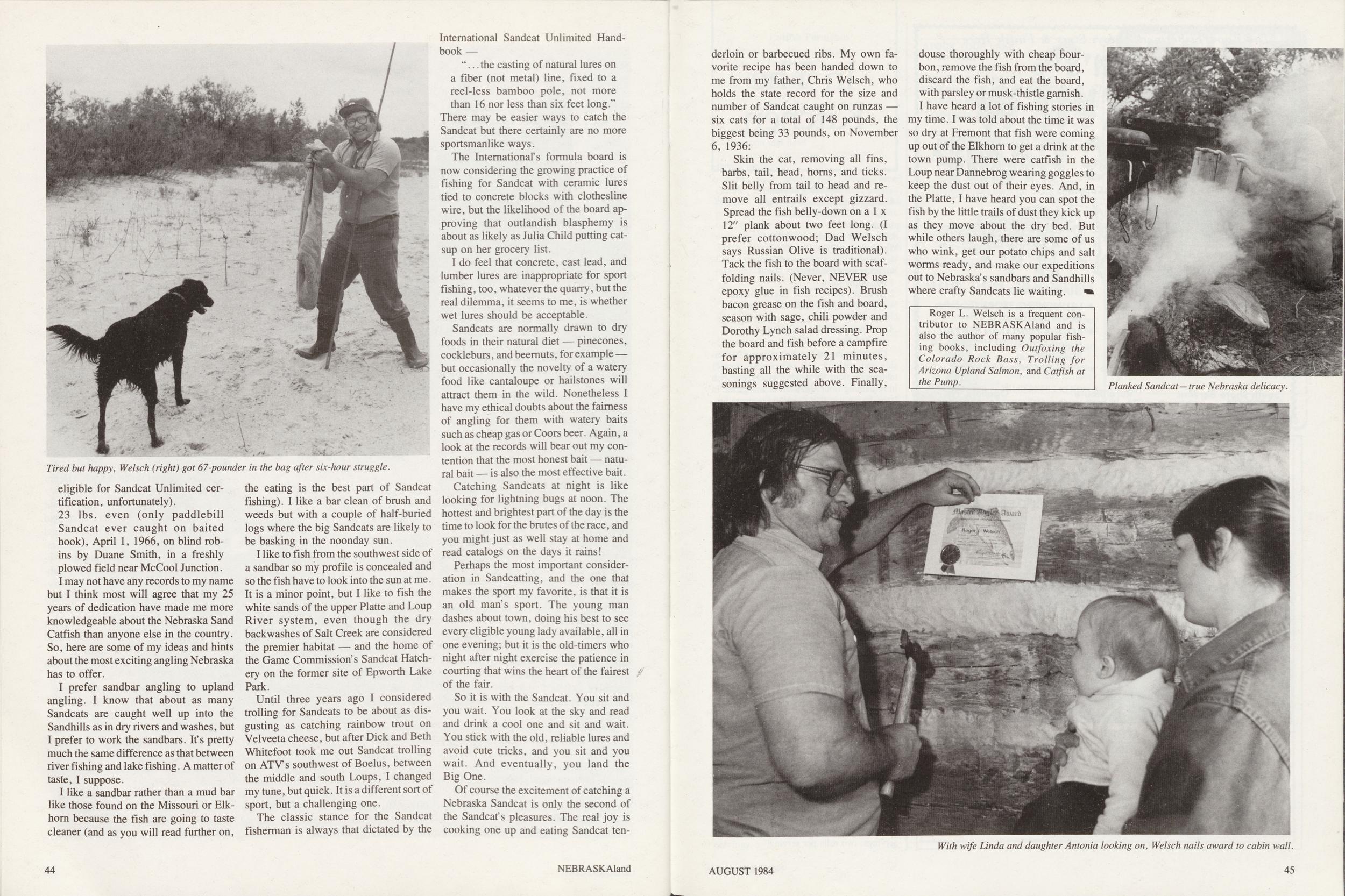
Tired but happy, Welsch (right) got 67-pounder in the bag after six-hour struggle.
eligible for Sandcat Unlimited certification, unfortunately). 23 lbs. even (only paddlebill Sandcat ever caught on baited hook), April 1, 1966, on blind robins by Duane Smith, in a freshly plowed field near McCool Junction.
I may not have any records to my name but I think most will agree that my 25 years of dedication have made me more knowledgeable about the Nebraska Sand Catfish than anyone else in the country. So, here are some of my ideas and hints about the most exciting angling Nebraska has to offer.
I prefer sandbar angling to upland angling. I know that about as many Sandcats are caught well up into the Sandhills as in dry rivers and washes, but I prefer to work the sandbars. It's pretty much the same difference as that between river fishing and lake fishing. A matter of taste, I suppose.
I like a sandbar rather than a mud bar like those found on the Missouri or Elkhorn because the fish are going to taste cleaner (and as you will read further on, the eating is the best part of Sandcat fishing). I like a bar clean of brush and weeds but with a couple of half-buried logs where the big Sandcats are likely to be basking in the noonday sun.
I like to fish from the southwest side of a sandbar so my profile is concealed and so the fish have to look into the sun at me. It is a minor point, but I like to fish the white sands of the upper Platte and Loup River system, even though the dry backwashes of Salt Creek are considered the premier habitat — and the home of the Game Commission's Sandcat Hatchery on the former site of Epworth Lake Park.
Until three years ago I considered trolling for Sandcats to be about as disgusting as catching rainbow trout on Velveeta cheese, but after Dick and Beth Whitefoot took me out Sandcat trolling on ATVs southwest of Boelus, between the middle and south Loups, I changed my tune, but quick. It is a different sort of sport, but a challenging one.
The classic stance for the Sandcat fisherman is always that dictated by the International Sandcat Unlimited Handbook — "... the casting of natural lures on a fiber (not metal) line, fixed to a reel-less bamboo pole, not more than 16 nor less than six feet long." There may be easier ways to catch the Sandcat but there certainly are no more sportsmanlike ways.
The International's formula board is now considering the growing practice of fishing for Sandcat with ceramic lures tied to concrete blocks with clothesline wire, but the likelihood of the board approving that outlandish blasphemy is about as likely as Julia Child putting catsup on her grocery list.
I do feel that concrete, cast lead, and lumber lures are inappropriate for sport fishing, too, whatever the quarry, but the real dilemma, it seems to me, is whether wet lures should be acceptable.
Sandcats are normally drawn to dry foods in their natural diet — pinecones, cockleburs, andbeernuts, for example — but occasionally the novelty of a watery food like cantaloupe or hailstones will attract them in the wild. Nonetheless I have my ethical doubts about the fairness of angling for them with watery baits such as cheap gas or Coors beer. Again, a look at the records will bear out my contention that the most honest bait — natural bait — is also the most effective bait.
Catching Sandcats at night is like looking for lightning bugs at noon. The hottest and brightest part of the day is the time to look for the brutes of the race, and you might just as well stay at home and read catalogs on the days it rains!
Perhaps the most important consideration in Sandcatting, and the one that makes the sport my favorite, is that it is an old man's sport. The young man dashes about town, doing his best to see every eligible young lady available, all in one evening; but it is the old-timers who night after night exercise the patience in courting that wins the heart of the fairest of the fair.
So it is with the Sandcat. You sit and you wait. You look at the sky and read and drink a cool one and sit and wait. You stick with the old, reliable lures and avoid cute tricks, and you sit and you wait. And eventually, you land the Big One.
Of course the excitement of catching a Nebraska Sandcat is only the second of the Sandcat's pleasures. The real joy is cooking one up and eating Sandcat tenderloin
44 NEBRASKAlandor barbecued ribs. My own favorite recipe has been handed down to me from my father, Chris Welsch, who holds the state record for the size and number of Sandcat caught on runzas — six cats for a total of 148 pounds, the biggest being 33 pounds, on November 6, 1936:
Skin the cat, removing all fins, barbs, tail, head, horns, and ticks. Slit belly from tail to head and remove all entrails except gizzard. Spread the fish belly-down on a 1 x 12" plank about two feet long. (I prefer cottonwood; Dad Welsch says Russian Olive is traditional). Tack the fish to the board with scaffolding nails. (Never, NEVER use epoxy glue in fish recipes). Brush bacon grease on the fish and board, season with sage, chili powder and Dorothy Lynch salad dressing. Prop the board and fish before a campfire for approximately 21 minutes, basting all the while with the seasonings suggested above. Finally, douse thoroughly with cheap bourbon, remove the fish from the board, discard the fish, and eat the board, with parsley or musk-thistle garnish.
I have heard a lot of fishing stories in my time. I was told about the time it was so dry at Fremont that fish were coming up out of the Elkhorn to get a drink at the town pump. There were catfish in the Loup near Dannebrog wearing goggles to keep the dust out of their eyes. And, in the Platte, I have heard you can spot the fish by the little trails of dust they kick up as they move about the dry bed. But while others laugh, there are some of us who wink, get our potato chips and salt worms ready, and make our expeditions out to Nebraska's sandbars and Sandhills where crafty Sandcats lie waiting.
Roger L. Welsch is a frequent contributor to NEBRASKAland and is also the author of many popular fishing books, including Outfoxing the Colorado Rock Bass, Trolling for Arizona Upland Salmon, and Catfish at the Pump.Planked Sandcat—true Nebraska delicacy.
With wife Linda and daughter Antonia looking on, Welsch nails award to cabin wall.
In The Kitchen
Catfish Panama 4 skinned, pan-dressed catfish (about 10 ounces each) 1 teaspoon salt 1/8 teaspoon pepper 1/3 cup flour 1/4 cup cooking oil or margarine 1/4 cup prepared mustard 1 cup apple juice 2 bananas, cut in 1% to 2-inch chunks 1/4 cup coarsely chopped salted peanuts chopped parsley 4 servings fluffy hot seasoned cooked riceClean, wash and dry fish. Season fish inside and out with salt and pepper. Save 1 tablespoon flour for making sauce. Roll fish in remaining flour. Heat oil or margarine in large frying pan to a moderate temperature. Place fish in pan and fry 8 to 10 minutes or until lightly browned; turn carefully. Fry 8 to 10 minutes longer or until fish flakes easily when tested with a fork. Carefully remove fish from pan and keep warm. Blend reserved 1 tablespoon flour and mustard into remaining fat in pan. Stir in apple juice and cook, stirring constantly, about 1 minute or until thickened and smooth. Return fish to frying pan and add banana chunks. Spoon a small amount of the sauce over fish and bananas. Cover and heat 5 to 7 minutes or until bananas are hot. Sprinkle with peanuts and parsley. Serve with hot fluffy seasoned cooked rice. Makes 4 servings.
Catfish Turnovers 2 cups flaked catfish 3 hard cooked eggs, chopped 3/4 cup finely chopped celery 1 cup dairy sour cream 1 teaspoon salt 1/4 cup chopped pecans 1 1/4 cup grated Cheddar cheese 3 (10-ounce) packages crescent roll doughCombine all ingredients except roll dough. Mix well. Unroll crescent dough and separate into 12 rectangles, leaving two triangles together. Seal perforated line. Portion fish mixture on half the rectangle. Fold remaining half rectangle over filling. Seal edges with tines of fork. Place on ungreased baking sheet. Prick top to allow steam to escape. Bake in a hot oven, 375°F., for 15 to 20 minutes or until golden brown. Makes 6 servings; two rolls per serving.
46 NEBRASKAland Catfish Parmesan 6 skinned, pan-dressed catfish 2 cups dry bread crumbs 3/4 cup Parmesan cheese 1/4 cup chopped parsley 1 teaspoon paprika 1/2 teaspoon leaf oregano 1/2 teaspoon pepper 2 teaspoons salt 1/4 teaspoon leaf basil 3/4 cup melted margarine or cooking oil lemon wedgesClean, wash, and dry fish. Combine bread crumbs, Parmesan cheese, parsley, paprika, oregano, basil, salt and pepper. Dip catfish in melted margarine and roll in crumb mixture. Arrange fish in a well-greased baking dish, 14 x 9 x 2 inches. Bake in a hot oven, 375° F., for 20 to 25 minutes or until fish flakes easily when tested with a fork. Garnish with lemon wedges. Makes 6 servings.
Catfish Loaf 3 cups flaked catfish 1 egg, beaten 1/4 cup minced onion 2 tablespoons minced green pepper 1 1/2 teaspoons salt 1/2 teaspoon white pepper 1 cup evaporated milk 2 cups soft bread crumbs 1/2 cup catsupCombine all ingredients except catsup. Mix well. Place mixture in a well-greased loaf pan, 9x5x3 inches. Pour catsup over top of loaf. Bake in a 350° oven for 45 to 50 minutes. Makes 6 servings.
Catfish Omelet 2 cups flaked catfish 6 egg whites 6 egg yolks 1/2 cup milk 2 tablespoons chopped parsley 2 tablespoons grated onion 3 tablespoons lemon juice 2 teaspoons salt 1/4 teaspoon pepper 4 tablespoons melted margarine or cooking oil 1 (10 1/2 ounce) can golden mushroom soup 1/4 cup waterBeat egg whites until stiff. Beat egg yolks until thick and lemon colored. Add milk, parsley, onion, lemon juice, salt, and pepper; beat well. Add fish flakes; mix well. Fold into egg whites. Place margarine in a 10-inch frying pan; heat to moderate temperature. Pour omelet mixture into pan and spread evenly. Cook over low heat for 3 to 5 minutes or until lightly browned on bottom. Bake in a moderate oven, 350°F., for 15 to 20 minutes or until knife inserted in the center comes out clean. Cut part way through center of omelet and fold in half. Combine soup and water; heat. Serve omelet immediately with mushroom sauce. Makes 6 servings.
Bookshelf
By Curt Twedt Suburban Wildlife: an introduction to the common animals of your backyard and local park. Richard Headstrom. 1984. Prentice-Hall, Inc.; Englewood Cliffs, NJ. Paperback; 232 pp. $8.95.As even the most casual observer could confirm, there's still a lot of wildlife in city, town and suburb. Recent trends in landscaping offer additional ways to make residential areas attractive to wildlife without alienating the neighbors.
Author Headstrom has put together about 70 thoroughly readable and enjoyable short chapters that cover insects, birds, snakes, mammals and other adaptable creatures that thrive in urban surroundings. Two of his earlier works, Adventures with a Microscope and Adventures with a Hand-Lens, also draw upon subjects that are readily available and fairly easily studied without elaborate equipment.
It seems reasonable and eminently fair that the numerous, adaptable insects should get the most coverage in a general natural history. More than one-third of the chapters deal with insects, from the honeybee (chapter subtitle "a matter of conservation") to the less-than-well-known lace wing ("A study in contrasts") and all sorts of their relatives.
Birds and mammals together account for another one-third of the book. Headstrom discusses the fox, raccoon, opossum and others that are familiar even to most city dwellers. (Sometimes the superstitions and folklore involving these animals are even more interesting than the more subdued scientific natural history). Birds and their various impacts on city dwellers are covered from different perspectives.
The chapter-head drawings by Jennifer Dewey are well-fitted to the subject matter. Her closeups of insects and spiders are especially effective.
Suburban Wildlife would be a welcome addition to libraries of all sorts, from personal bookshelf to community public library. It would also be an excellent gift for naturalists, from seasoned veteran to junior-high or older beginners.
48 NEBRASKAlandTrading Post
DOGS TRAINING ALL BREEDS Hunting dogs—Vizslas for sale. Rozanek Kennels, Rt. 2, Schuyler, NE 68661. Phone (402) 352-8769. ENGLISH SETTERS and Pointers: Outstanding bloodlines! Puppies, started dogs, and stud service available. High Plains Kennels, 1411 Emerson, Alliance, NE 69301. Phone (308) 762-6709. GERMAN SHORTHAIRS—English Pointers and Beagles—Stud service, puppies and started dogs. Wayne Clark, Box 54, Union, Nebr. 68455. Phone (402)263-3495 or 263-3155. BRITTANIES, GERMAN shorthairs, English setters — puppies and young dogs. Darrell Yentes, 1118 McMillan, Holdrege, Nebr. 68949. Phone (308) 995-8570 or (308) 995-4797. FOR SALE: AKC Registered brittanies. Excellent hunting quality. Also brittany standing stud, puppies and standing dogs. Contact Adams Family Kennels, phone (308) 532-2639. MISCELLANEOUS WINE AND BEER: Make your own. Send for free recipes and instructions. Omaha Supply, 13616 Polk, Omaha, Nebr. 68137. GUNS—Browning, Winchester, Remington, others, Hi-powers, shotguns, new, used, antiques. Want Pre-1964 Winchesters. Buy-Sell-Trade. Ph. (402) 729-6112. Bedlan's Sporting Goods, Fairbury, NE 68352. CAMPING, BACKPACKING and climbing gear — tents, sleeping bags, backpacks, clothes, boots, accessories. The Moose's Tooth Outdoor Sports, 1640 Holdrege, Lincoln, Nebr. Phone (402) 475-4453. LAKE VIEW HOMESITFS and A-frame. Just west of fabulous Hideaway Cafe and Van's at Lake Mac. Only 20 minutes from historic Ogallala. Write Box 1028, Imperial, NE 69033. FISH FOR SALE. Channel catfish, bass, bluegill, crappie, trout, perch, white bass, minnows, hybrid grass carp, bullhead. We can ship fish, you can pick them up, or we deliver. Contact the Pleasant Valley Fish Farm, Rt. 1, McCook, NE 69001. Phone (308) 345-6599. CANOE ENTHUSIASTS. Quality and performance important? Mad River is the canoe for you! Mad River of Nebraska, 1231 Saunders, Lincoln, Nebraska 68521, Phone (402) 435-6588 or 205 Main, Springfield, NE 68059. Phone (402) 253-2000. N.E. NEBRASKA TROUT Fishing. For rent Mon.- Thurs. or Fri.-Sun. 2 modern cottages completely furnished. 5 spring-fed lakes with trout up to 7 lbs. Bass and bluegill also. Diamond E Trout Resort, Orchard, NE 68764. (402) 893-4745. AUTHENTIC PIECE of Pawnee Indian Pottery... includes educational information. A bit of Nebraska history for a collection, Scout or school classes, or a unique gift. Only $1.50. (Wholesale prices available). Relics Int., Rt. 2, Box 70, Holdrege, NE 68949. TAXIDERMY JOHNSON TAXIDERMY—servicing southwest Nebraska, specializing in big-game mounts, life-sized mounts, rug work, fish, birds, tanning hair-on leather. Brochure and price list on request. Johnson Taxidermy, Rt. 1, Box 78, Lamar, NE 69035. Telephone (308) 882-5555. FREEZE-DRY TAXIDERMY Wally Allison's State Record Taxidermy, 2709 Birchwood, North Platte, NE 69101. Phone: (308) 534-2324. Specializing in Fish and Small Game, Snake and Lizard and Novelties. (Nothing too small) Newest of all taxidermy methods employed. KARL SCHWARZ master taxidermist has moved to a new country studio; same professional mounting and tanning service. Schwarz Wild Wing Studio, 16804 South 180th St., Springfield, NE 68059. Phone (402) 253-2481. CREATIVE TAXIDERMY in all its branches since 1935, now includes Northstar Freeze-Dry processing of approved small specimens. Also tanning and deerskin processing. Naturecraft Studio. Nebraska City, Nebraska 68510. Joe Voges-Owner. Phone (402) 873-5491. DINGES TAXIDERMY Studio, 2763 So. 12th St., Omaha, NE 68108. Fourteen-time National Award Winning Taxidermy. Trust your trophies to a proven winner. Complete professional service. Mike and Mary Dinges (402) 342-3718. NABITY'S TAXIDERMY. 31 years experience. Specializing in natural grass backgrounds for mammals, birds and fish. 13901 "0"St., Lincoln, NE 68505 4 miles east of 84th and "O". (402) 489-6351. BADE TAXIDERMY— Quality a must—Fast service. Fish, birds, rugs, tanning, full mounts and game heads. 2111 N. Christy St., Fremont, Nebraska 727-5463. PEISTER TAXIDERMY—a name you can trust. We give you professional life-like work at prices most sportsmen can afford. Member National Taxidermist Association, #5 Regency, Place, Kearney, Nebr. 68847. Phone (30$) 237-7575. Harlan County Dam Vacation Apartments - fully furnished Color TV • Kitchen Facilities • Full Baths Game cleaning room with freezer One block from shopping center Weekend or week of pleasant living Security Deposit Required Sorry —No Pets Dean and Esther Stone Box 145 Ph. (308) 799-3422 Republican City, NE 68971 BERGMAN'S RESORT On Johnson Lake Modern Lakefront Cabins • Groceries • Bait • Tackle • Full RV Hookups Boats for Rent Swim — Fish — Golf Write or Call: RR 2, Elwood, NE 68937 (308) 785-2298 LINCOLN ARCHERY Bowhunting Headquarters Compound Bow Specialists Crossbows Longbows, Recurves Full line of hunting supplies 48th & Prescott Lincoln, NE (402) 483-4661 NEBRASKAland 35mm Slides Select photos in this issue are now available from NEBRASKAland Magazine as 35mm slides in 2" mounts. The slides may be used to round out your home slide file, or to make color enlargement prints to adorn your home or office walls. The slides may not be used in any commercial manner. Slides of other photos in this issue are not readily available. The slides cost $1 each plus appropriate sales tax. Please allow 4-6 weeks delivery. Slides available from this issue include: 8841 Windmill..............Cover 88416 Windmill...............p. 16 88418 Windmill...............p. 18 88427 Ground Cherry.........p. 27 88429 Butterfly weed.........p. 29 Please indicate number and description of slides desired, and include check or money order for the full amount made to: NEBRASKAland Magazine. Send orders to: NEBRASKAland Slides. P.O. Box 30370, Lincoln, NE 68503. Nebraskans, please include appropriate sales tax. NEBRASKAland Magazine Order Form Please send me a subscription to NEBRASKAland, which will include next January's special issue..."The Birds of Nebraska." □ One-year $9.50 □ 18-month $14.00 NAME ADDRESS CITY 30-month $23.00 STATE ZIP Mail to: NEBRASKAland, Box 30370, Lincoln, NE 68503 AUGUST 1984 49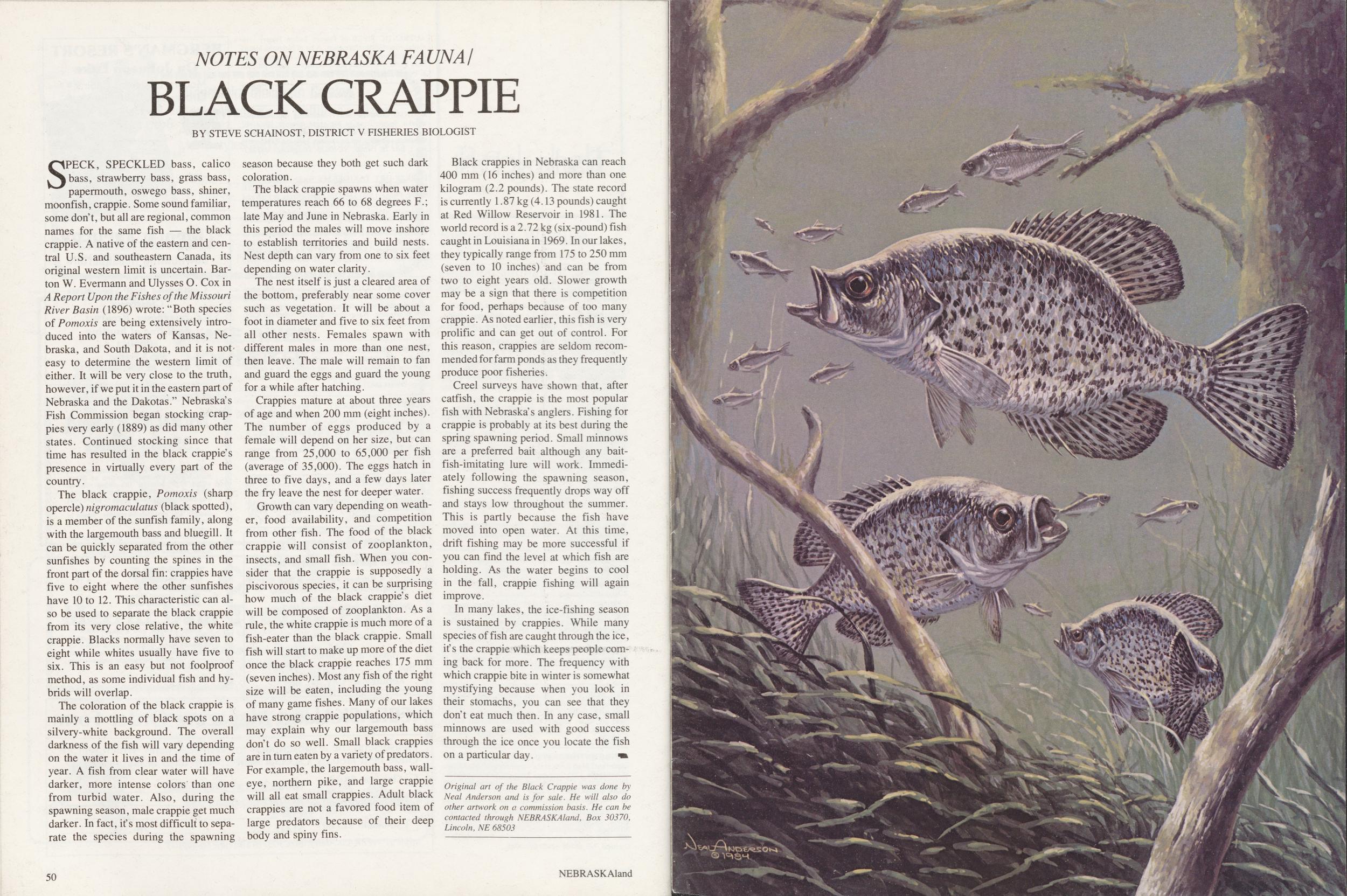
NOTES ON NEBRASKA FAUNA / BLACK CRAPPIE
BY STEVE SCHAINOST, DISTRICT V FISHERIES BIOLOGISTSPECK, SPECKLED bass, calico bass, strawberry bass, grass bass, papermouth, oswego bass, shiner, moonfish, crappie. Some sound familiar, some don't, but all are regional, common names for the same fish — the black crappie. A native of the eastern and central U.S. and southeastern Canada, its original western limit is uncertain. Barton W. Evermann and Ulysses O. Cox in A Report Upon the Fishes of the Missouri River Basin (1896) wrote: "Both species of Pomoxis are being extensively introduced into the waters of Kansas, Nebraska, and South Dakota, and it is not easy to determine the western limit of either. It will be very close to the truth, however, if we put it in the eastern part of Nebraska and the Dakotas." Nebraska's Fish Commission began stocking crappies very early (1889) as did many other states. Continued stocking since that time has resulted in the black crappie's presence in virtually every part of the country.
The black crappie, Pomoxis (sharp opercle)nigromaculatus (black spotted), is a member of the sunfish family, along with the largemouth bass and bluegill. It can be quickly separated from the other sunfishes by counting the spines in the front part of the dorsal fin: crappies have five to eight where the other sunfishes have 10 to 12. This characteristic can also be used to separate the black crappie from its very close relative, the white crappie. Blacks normally have seven to eight while whites usually have five to six. This is an easy but not foolproof method, as some individual fish and hybrids will overlap. The coloration of the black crappie is mainly a mottling of black spots on a silvery-white background. The overall darkness of the fish will vary depending on the water it lives in and the time of year. A fish from clear water will have darker, more intense colors than one from turbid water. Also, during the spawning season, male crappie get much darker. In fact, it's most difficult to separate the species during the spawning season because they both get such dark coloration.
The black crappie spawns when water temperatures reach 66 to 68 degrees F.; late May and June in Nebraska. Early in this period the males will move inshore to establish territories and build nests. Nest depth can vary from one to six feet depending on water clarity.
The nest itself is just a cleared area of the bottom, preferably near some cover such as vegetation. It will be about a foot in diameter and five to six feet from all other nests. Females spawn with different males in more than one nest, then leave. The male will remain to fan and guard the eggs and guard the young for a while after hatching.
Crappies mature at about three years of age and when 200 mm (eight inches). The number of eggs produced by a female will depend on her size, but can range from 25,000 to 65,000 per fish (average of 35,000). The eggs hatch in three to five days, and a few days later the fry leave the nest for deeper water.
Growth can vary depending on weather, food availability, and competition from other fish. The food of the black crappie will consist of zooplankton, insects, and small fish. When you consider that the crappie is supposedly a piscivorous species, it can be surprising how much of the black crappie's diet will be composed of zooplankton. As a rule, the white crappie is much more of a fish-eater than the black crappie. Small fish will start to make up more of the diet once the black crappie reaches 175 mm (seven inches). Most any fish of the right size will be eaten, including the young of many game fishes. Many of our lakes have strong crappie populations, which may explain why our largemouth bass don't do so well. Small black crappies are in turn eaten by a variety of predators. For example, the largemouth bass, walleye, northern pike, and large crappie will all eat small crappies. Adult black crappies are not a favored food item of large predators because of their deep body and spiny fins.
Black crappies in Nebraska can reach 400 mm (16 inches) and more than one kilogram (2.2 pounds). The state record is currently 1.87 kg (4.13 pounds) caught at Red Willow Reservoir in 1981. The world record is a 2.72 kg (six-pound) fish caught in Louisiana in 1969. In our lakes, they typically range from 175 to 250 mm (seven to 10 inches) and can be from two to eight years old. Slower growth may be a sign that there is competition for food, perhaps because of too many crappie. As noted earlier, this fish is very prolific and can get out of control. For this reason, crappies are seldom recommended for farm ponds as they frequently produce poor fisheries.
Creel surveys have shown that, after catfish, the crappie is the most popular fish with Nebraska's anglers. Fishing for crappie is probably at its best during the spring spawning period. Small minnows are a preferred bait although any bait-fish-imitating lure will work. Immediately following the spawning season, fishing success frequently drops way off and stays low throughout the summer. This is partly because the fish have moved into open water. At this time, drift fishing may be more successful if you can find the level at which fish are holding. As the water begins to cool in the fall, crappie fishing will again improve.
In many lakes, the ice-fishing season is sustained by crappies. While many species offish are caught through the ice, it's the crappie which keeps people coming back for more. The frequency with which crappie bite in winter is somewhat mystifying because when you look in their stomachs, you can see that they don't eat much then. In any case, small minnows are used with good success through the ice once you locate the fish on a particular day.
Original art of the Black Crappie was done by Neal Anderson and is far sale. He will also do other artwork on a commission basis. He can be contacted through NEBRASKAland, Box 30370, Lincoln, NE 68503 50 NEBRASKAland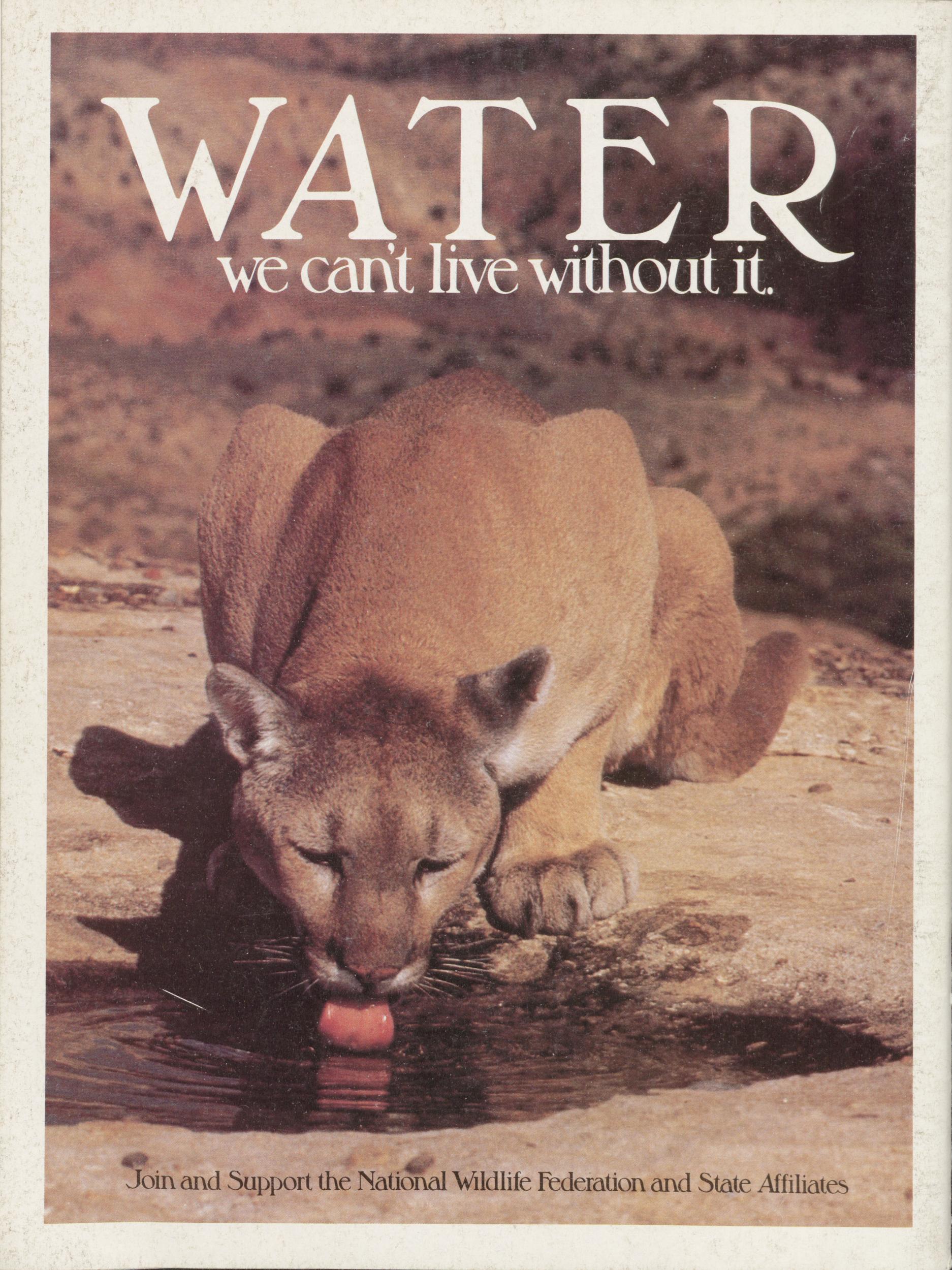
WATER we can't live without it.
Join and Support the National Wildlife Federation and State AffiliatesPosition: 583 (19 views)