Volume 62, Issue 5, 1984
NEBRASKAland June 1984 $1
NEBRASKAland
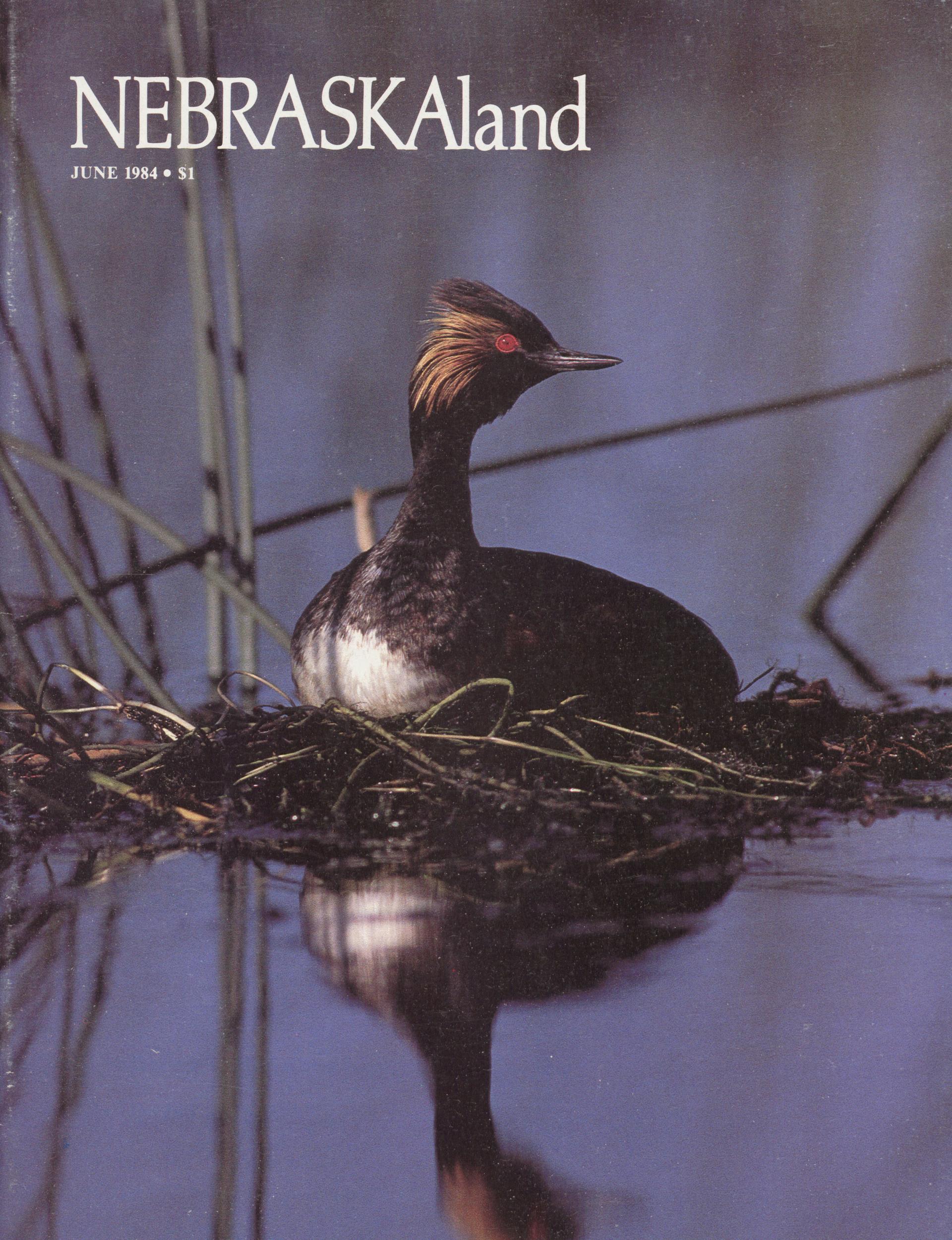
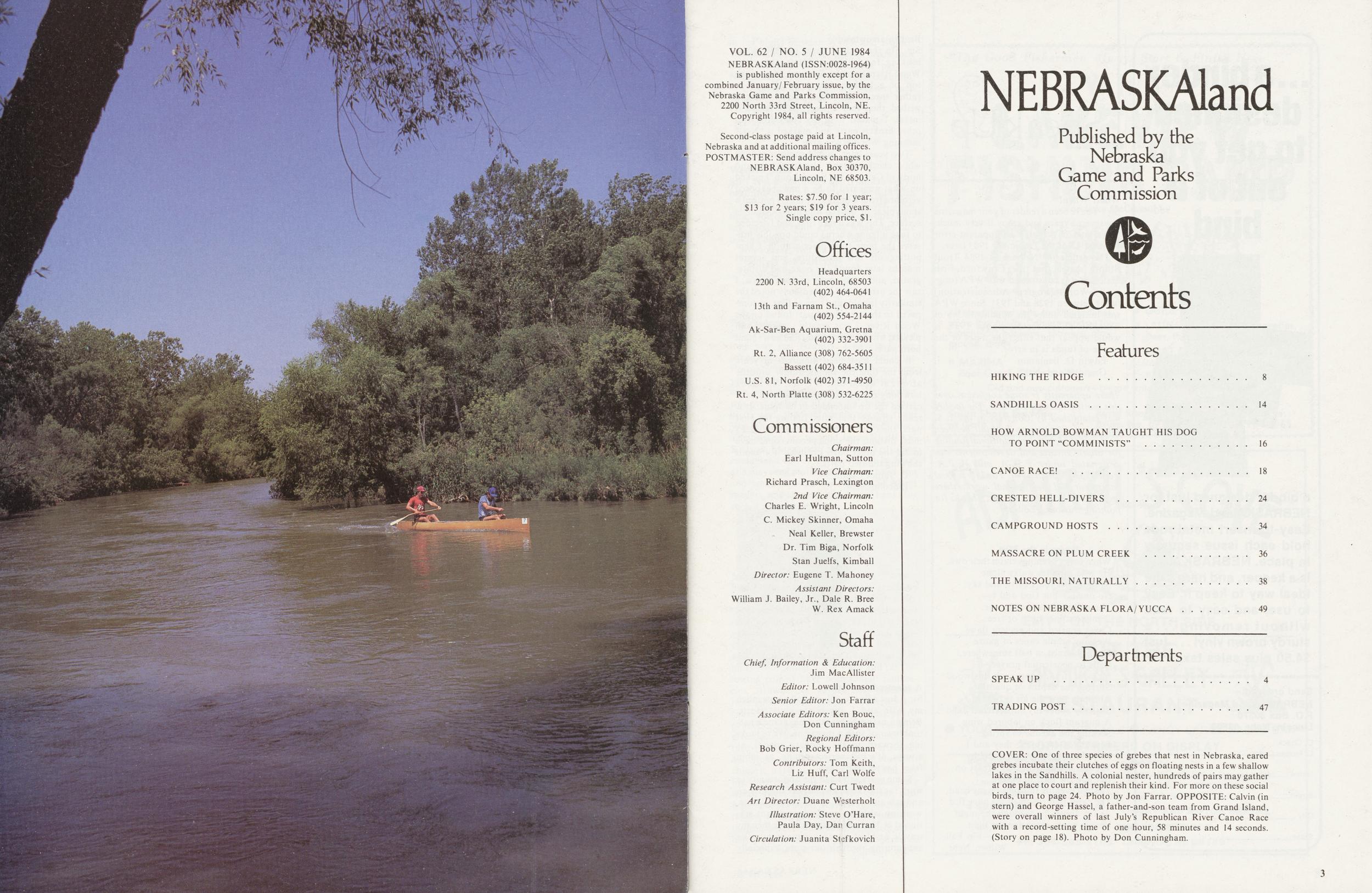
Published by the Nebraska Game and Parks Commission VOL. 62 / NO. 5 / JUNE 1984 NEBRASKAland (1SSN:0028-1964) is published monthly except for a combined January/ February issue, by the Nebraska Game and Parks Commission, 2200 North 33rd Street, Lincoln, NE. Copyright 1984, all rights reserved. Second-class postage paid at Lincoln, Nebraska and at additional mailing offices. POSTMASTER: Send address changes to NEBRASKAland, Box 30370, Lincoln, NE 68503. Rates: $7.50 for 1 year; $13 for 2 years; $19 for 3 years. Single copy price, $1. Offices Headquarters 2200 N. 33rd, Lincoln, 68503 (402) 464-0641 13th and Farnam St., Omaha (402) 554-2144 Ak-Sar-Ben Aquarium, Gretna (402) 332-3901 Rt. 2, Alliance (308) 762-5605 Bassett (402) 684-3511 U.S. 81, Norfolk (402) 371-4950 Rt. 4, North Platte (308) 532-6225 Commissioners Chairman: Earl Hultman, Sutton Vice Chairman: Richard Prasch, Lexington 2nd Vice Chairman: Charles E. Wright, Lincoln C. Mickey Skinner, Omaha Neal Keller, Brewster Dr. Tim Biga, Norfolk Stan Juelfs, Kimball Director: Eugene T. Mahoney Assistant Directors: William J. Bailey, Jr., Dale R. Bree W. Rex Amack Staff Chief, Information & Education: Jim MacAllister Editor: Lowell Johnson Senior Editor: Jon Farrar Associate Editors: Ken Bouc, Don Cunningham Regional Editors: Bob Grier, Rocky Hoffmann Contributors: Tom Keith, Liz Huff, Carl Wolfe Research Assistant: Curt Twedt Art Director: Duane Westerholt Illustration: Steve O'Hare, Paula Day, Dan Curran Circulation: Juanita Stefkovich Contents Features HIKING THE RIDGE 8 SANDHILLS OASIS 14 HOW ARNOLD BOWMAN TAUGHT HIS DOG TO POINT "COMMINISTS" 16 CANOE RACE! 18 CRESTED HELL-DIVERS 24 CAMPGROUND HOSTS 34 MASSACRE ON PLUM CREEK 36 THE MISSOURI, NATURALLY 38 NOTES ON NEBRASKA FLORA/YUCCA 49 Departments SPEAK UP 4 TRADING POST 47 COVER: One of three species of grebes that nest in Nebraska, eared grebes incubate their clutches of eggs on floating nests in a few shallow lakes in the Sandhills. A colonial nester, hundreds of pairs may gather at one place to court and replenish their kind. For more on these social birds, turn to page 24. Photo by Jon Farrar. OPPOSITE: Calvin (in stern) and George Hassel, a father-and-son team from Grand Island, were overall winners of last July's Republican River Canoe Race with a record-setting time of one hour, 58 minutes and 14 seconds. (Story on page 18). Photo by Don Cunningham. 3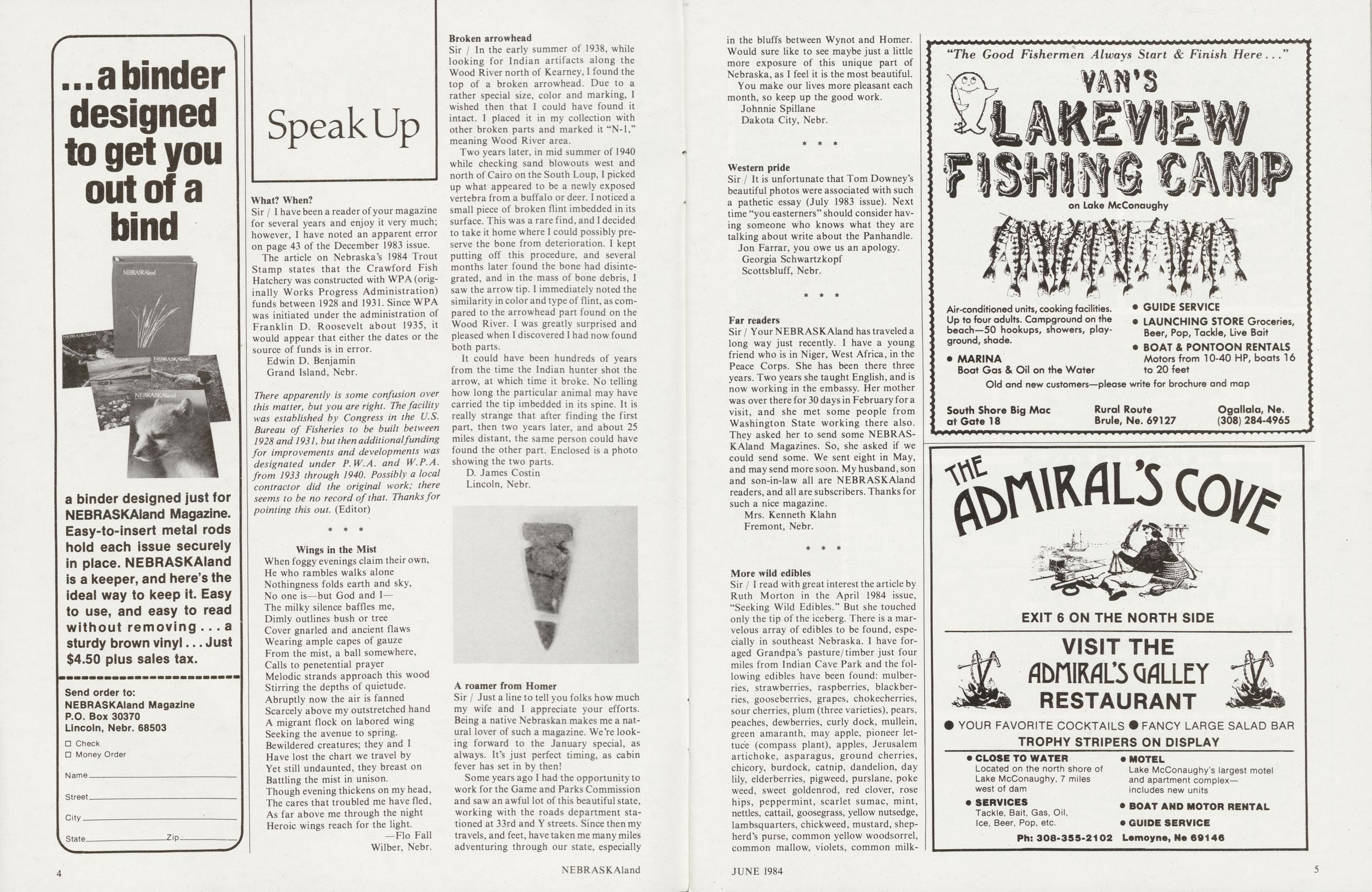
Speak Up
What? When?Sir / I have been a reader of your magazine for several years and enjoy it very much; however, I have noted an apparent error on page 43 of the December 1983 issue.
The article on Nebraska's 1984 Trout Stamp states that the Crawford Fish Hatchery was constructed with WPA (originally Works Progress Administration) funds between 1928 and 1931. Since WPA was initiated under the administration of Franklin D. Roosevelt about 1935, it would appear that either the dates or the source of funds is in error.
Edwin D. Benjamin Grand Island, Nebr. There apparently is some confusion over this matter, but you are right. The facility was established by Congress in the U.S. Bureau of Fisheries to be built between 1928 and 1931, but then additional funding for improvements and developments was designated under P.W.A. and W.P.A. from 1933 through 1940. Possibly a local contractor did the original work; there seems to be no record of that. Thanks for pointing this out. (Editor) Wings in the Mist When foggy evenings claim their own, He who rambles walks alone Nothingness folds earth and sky, No one is—but God and I—The milky silence baffles me, Dimly outlines bush or tree Cover gnarled and ancient flaws Wearing ample capes of gauze From the mist, a ball somewhere, Calls to penetential prayer Melodic strands approach this wood Stirring the depths of quietude. Abruptly now the air is fanned Scarcely above my outstretched hand A migrant flock on labored wing Seeking the avenue to spring. Bewildered creatures; they and I Have lost the chart we travel by Yet still undaunted, they breast on Battling the mist in unison. Though evening thickens on my head, The cares that troubled me have fled, As far above me through the night Heroic wings reach for the light. —Flo Fall Wilber, Nebr. Broken arrowheadSir / In the early summer of 1938, while looking for Indian artifacts along the Wood River north of Kearney, I found the top of a broken arrowhead. Due to a rather special size, color and marking, I wished then that I could have found it intact. I placed it in my collection with other broken parts and marked it "N-l," meaning Wood River area.
Two years later, in mid summer of 1940 while checking sand blowouts west and north of Cairo on the South Loup, I picked up what appeared to be a newly exposed vertebra from a buffalo or deer. I noticed a small piece of broken flint imbedded in its surface. This was a rare find, and I decided to take it home where I could possibly preserve the bone from deterioration. I kept putting off this procedure, and several months later found the bone had disintegrated, and in the mass of bone debris, I saw the arrow tip. I immediately noted the similarity in color and type of flint, as compared to the arrowhead part found on the Wood River. I was greatly surprised and pleased when 1 discovered I had now found both parts.
It could have been hundreds of years from the time the Indian hunter shot the arrow, at which time it broke. No telling how long the particular animal may have carried the tip imbedded in its spine. It is really strange that after finding the first part, then two years later, and about 25 miles distant, the same person could have found the other part. Enclosed is a photo showing the two parts.
D. James Costin Lincoln, Nebr.Sir / Just a line to tell you folks how much my wife and I appreciate your efforts. Being a native Nebraskan makes me a natural lover of such a magazine. We're looking forward to the January special, as always. It's just perfect timing, as cabin fever has set in by then!
Some years ago I had the opportunity to work for the Game and Parks Commission and saw an awful lot of this beautiful state, working with the roads department stationed at 33rd and Y streets. Since then mv travels, and feet, have taken me many miles adventuring through our state, especially
4 NEBRASKAlandin the bluffs between Wynot and Homer. Would sure like to see maybe just a little more exposure of this unique part of Nebraska, as I feel it is the most beautiful. You make our lives more pleasant each month, so keep up the good work.
Johnnie Spillane Dakota City, Nebr. Western prideSir / It is unfortunate that Tom Downey's beautiful photos were associated with such a pathetic essay (July 1983 issue). Next time "you easterners" should consider having someone who knows what they are talking about write about the Panhandle. Jon Farrar, you owe us an apology.
Georgia Schwartzkopf Scottsbluff, Nebr. Far readersSir / Your NEBRASKAland has traveled a long way just recently. I have a young friend who is in Niger, West Africa, in the Peace Corps. She has been there three years. Two years she taught English, and is now working in the embassy. Her mother was over there for 30 days in February for a visit, and she met some people from Washington State working there also. They asked her to send some NEBRASKAland Magazines. So, she asked if we could send some. We sent eight in May, and may send more soon. My husband, son and son-in-law all are NEBRASKAland readers, and all are subscribers. Thanks for such a nice magazine.
Mrs. Kenneth Klahn Fremont, Nebr. More wild ediblesSir / I read with great interest the article by Ruth Morton in the April 1984 issue, "Seeking Wild Edibles." But she touched only the tip of the iceberg. There is a marvelous array of edibles to be found, especially in southeast Nebraska. I have for-aged Grandpa's pasture/timber just four miles from Indian Cave Park and the following edibles have been found: mulberries, strawberries, raspberries, blackberries, gooseberries, grapes, chokecherries, sour cherries, plum (three varieties), pears, peaches, dewberries, curly dock, mullein, green amaranth, may apple, pioneer lettuce (compass plant), apples, Jerusalem artichoke, asparagus, ground cherries, chicory, burdock, catnip, dandelion, day lily, elderberries, pigweed, purslane, poke weed, sweet goldenrod, red clover, rose hips, peppermint, scarlet sumac, mint, nettles, cattail, goosegrass, yellow nutsedge, lambsquarters, chickweed, mustard, shepherd's purse, common yellow woodsorrel, common mallow, violets, common milk-days
weed, eastern salsify, acorns, butternuts, black walnuts, hazel nuts, hickory nuts, pine nuts.
And, last but most certainly not least, the morel mushroom. I have personally identified at least nine edible fungi in the timber, but being an amateur in the mushroom business, I stick to picking the morel ... but who could ask for better!
Interestingly, of the 55 edible plants I've listed, 28 are classified as weeds. As a farmer's wife, I don't plan on spraying any herbicide on our weeds ... we're going to eat them!
Diana (Mrs. Stu) Watton Falls City, Nebr. Although a few on your list must be feral domestics, that is an amazing compilation, and it is great to be reminded of the tremendous variety of not only edible but often delicious items out there. A big thanks for your letter—I'm sure it will be appreciated by many other present and future foragers. (Editor) Cut it short!Sir / I have been a subscriber of NEBRASKAland for many years and enjoy your articles and pictures very much. I was very displeased and frustrated, though, when I read the article about "Seeking Wild Edibles" by Ruth Morton in the April issue. Our family has gathered asparagus for 30 years along the Platte River and every time I find a stalk cut 12 to 16 inches above the ground, I feel very frustrated. Until that stalk wilts, the roots will not send up a new shoot, which takes about 10 days. Asparagus should be cut off at ground level, even if it is 16 inches high, so it can begin reproducing right away. Also, cutting stalks that high in late summer can kill a plant if dry weather prevails. I was surprised there was no comment about the way Ruth Morton was cutting her stalks so high.
More people can share in gathering this delicious vegetable if it is harvested properly. Please help educate people about this.
Rober Reutlinger Lexington, Nebr. Voicing" an opinionSir / I resided in Nebraska (born there) for about 64 years in the Grand Island-Hastings area and have a lasting love for the state.
The last issue of NEBRASKAland, "The First Voices," is superb. The best by far I've seen anywhere on the American Indian in Nebraska. You've had many outstanding issues though, and I expect many more. Nebraska's Rivers being another. I'm 79 years of age and hope to read many more issues of Nebraska's great magazine.
Maurice L. Dory Denver, Colo. 6 NEBRASKAlandFor the Future... NEBRASKA GAME AND PARKS FOUNDATION
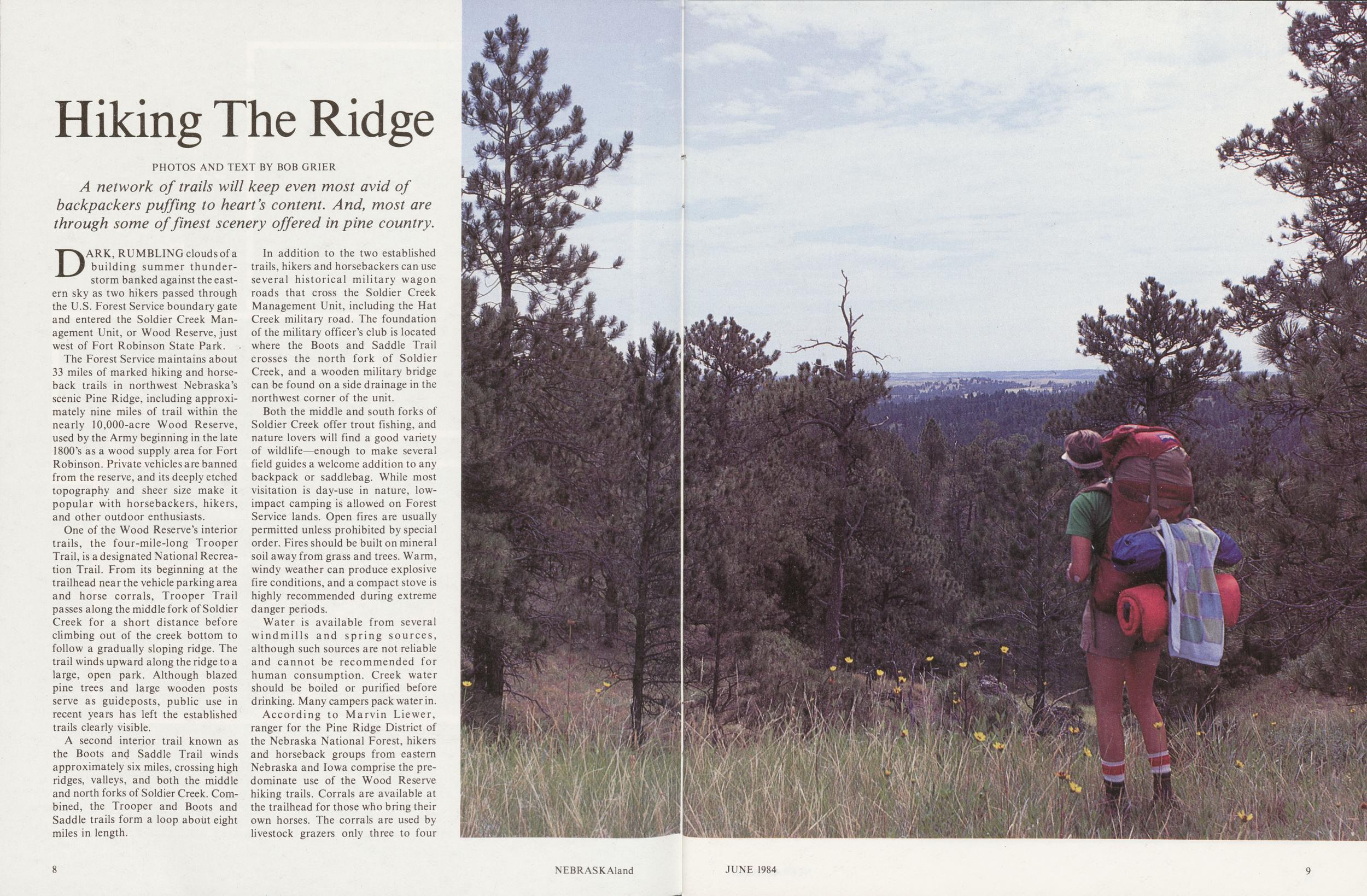
Hiking The Ridge
PHOTOS AND TEXT BY BOB GRIER A network of trails will keep even most avid of backpackers puffing to heart's content. And, most are through some of finest scenery offered in pine country.DARK, RUMBLING clouds of a building summer thunderstorm banked against the eastern sky as two hikers passed through the U.S. Forest Service boundary gate and entered the Soldier Creek Management Unit, or Wood Reserve, just west of Fort Robinson State Park.
The Forest Service maintains about 33 miles of marked hiking and horseback trails in northwest Nebraska's scenic Pine Ridge, including approximately nine miles of trail within the nearly 10,000-acre Wood Reserve, used by the Army beginning in the late 1800's as a wood supply area for Fort Robinson. Private vehicles are banned from the reserve, and its deeply etched topography and sheer size make it popular with horsebackers, hikers, and other outdoor enthusiasts.
One of the Wood Reserve's interior trails, the four-mile-long Trooper Trail, is a designated National Recreation Trail. From its beginning at the trailhead near the vehicle parking area and horse corrals, Trooper Trail passes along the middle fork of Soldier Creek for a short distance before climbing out of the creek bottom to follow a gradually sloping ridge. The trail winds upward along the ridge to a large, open park. Although blazed pine trees and large wooden posts serve as guideposts, public use in recent years has left the established trails clearly visible.
A second interior trail known as the Boots and Saddle Trail winds approximately six miles, crossing high ridges, valleys, and both the middle and north forks of Soldier Creek. Combined, the Trooper and Boots and Saddle trails form a loop about eight miles in length.
In addition to the two established trails, hikers and horsebackers can use several historical military wagon roads that cross the Soldier Creek Management Unit, including the Hat Creek military road. The foundation of the military officer's club is located where the Boots and Saddle Trail crosses the north fork of Soldier Creek, and a wooden military bridge can be found on a side drainage in the northwest corner of the unit.
Both the middle and south forks of Soldier Creek offer trout fishing, and nature lovers will find a good variety of wildlife—enough to make several field guides a welcome addition to any backpack or saddlebag. While most visitation is day-use in nature, low-impact camping is allowed on Forest Service lands. Open fires are usually permitted unless prohibited by special order. Fires should be built on mineral soil away from grass and trees. Warm, windy weather can produce explosive fire conditions, and a compact stove is highly recommended during extreme danger periods.
Water is available from several windmills and spring sources, although such sources are not reliable and cannot be recommended for human consumption. Creek water should be boiled or purified before drinking. Many campers pack water in.
According to Marvin Liewer, ranger for the Pine Ridge District of the Nebraska National Forest, hikers and horseback groups from eastern Nebraska and Iowa comprise the predominate use of the Wood Reserve hiking trails. Corrals are available at the trailhead for those who bring their own horses. The corrals are used by livestock grazers only three to four
8 NEBRASKAland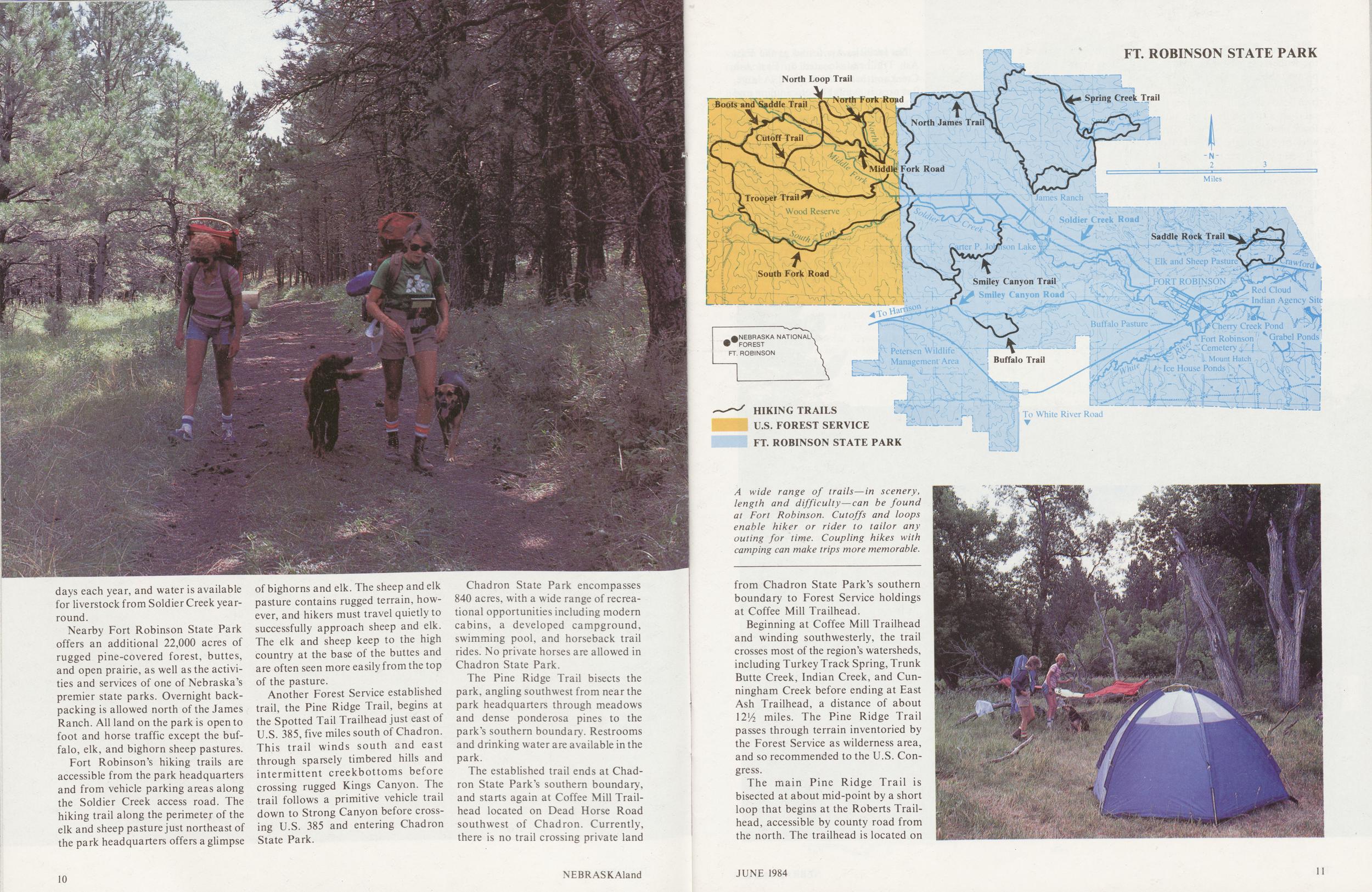
days each year, and water is available for liverstock from Soldier Creek year-round.
Nearby Fort Robinson State Park offers an additional 22,000 acres of rugged pine-covered forest, buttes, and open prairie, as well as the activities and services of one of Nebraska's premier state parks. Overnight backpacking is allowed north of the James Ranch. All land on the park is open to foot and horse traffic except the buffalo, elk, and bighorn sheep pastures.
Fort Robinson's hiking trails are accessible from the park headquarters and from vehicle parking areas along the Soldier Creek access road. The hiking trail along the perimeter of the elk and sheep pasture just northeast of the park headquarters offers a glimpse of bighorns and elk. The sheep and elk pasture contains rugged terrain, however, and hikers must travel quietly to successfully approach sheep and elk. The elk and sheep keep to the high country at the base of the buttes and are often seen more easily from the top of the pasture.
Another Forest Service established trail, the Pine Ridge Trail, begins at the Spotted Tail Trailhead just east of U.S. 385, five miles south of Chadron. This trail winds south and east through sparsely timbered hills and intermittent creekbottoms before crossing rugged Kings Canyon. The trail follows a primitive vehicle trail down to Strong Canyon before crossing U.S. 385 and entering Chadron State Park.
Chadron State Park encompasses 840 acres, with a wide range of recreational opportunities including modern cabins, a developed campground, swimming pool, and horseback trail rides. No private horses are allowed in Chadron State Park.
The Pine Ridge Trail bisects the park, angling southwest from near the park headquarters through meadows and dense ponderosa pines to the park's southern boundary. Restrooms and drinking water are available in the park.
The established trail ends at Chadron State Park's southern boundary, and starts again at Coffee Mill Trailhead located on Dead Horse Road southwest of Chadron. Currently, there is no trail crossing private land
10 NEBRASKAlandFT. ROBINSON STATE PARK HIKING TRAILS U.S. FOREST SERVICE FT. ROBINSON STATE PARK White River Road A wide range of trails—in scenery, length and difficulty—can be found at Fort Robinson. Cutoffs and loops enable hiker or rider to tailor any outing for time. Coupling hikes with camping can make trips more memorable.
from Chadron State Park's southern boundary to Forest Service holdings at Coffee Mill Trailhead.
Beginning at Coffee Mill Trailhead and winding southwesterly, the trail crosses most of the region's watersheds, including Turkey Track Spring, Trunk Butte Creek, Indian Creek, and Cunningham Creek before ending at East Ash Trailhead, a distance of about 12 1/2 miles. The Pine Ridge Trail passes through terrain inventoried by the Forest Service as wilderness area, and so recommended to the U.S. Congress.
The main Pine Ridge Trail is bisected at about mid-point by a short loop that begins at the Roberts Trailhead, accessible by county road from the north. The trailhead is located on
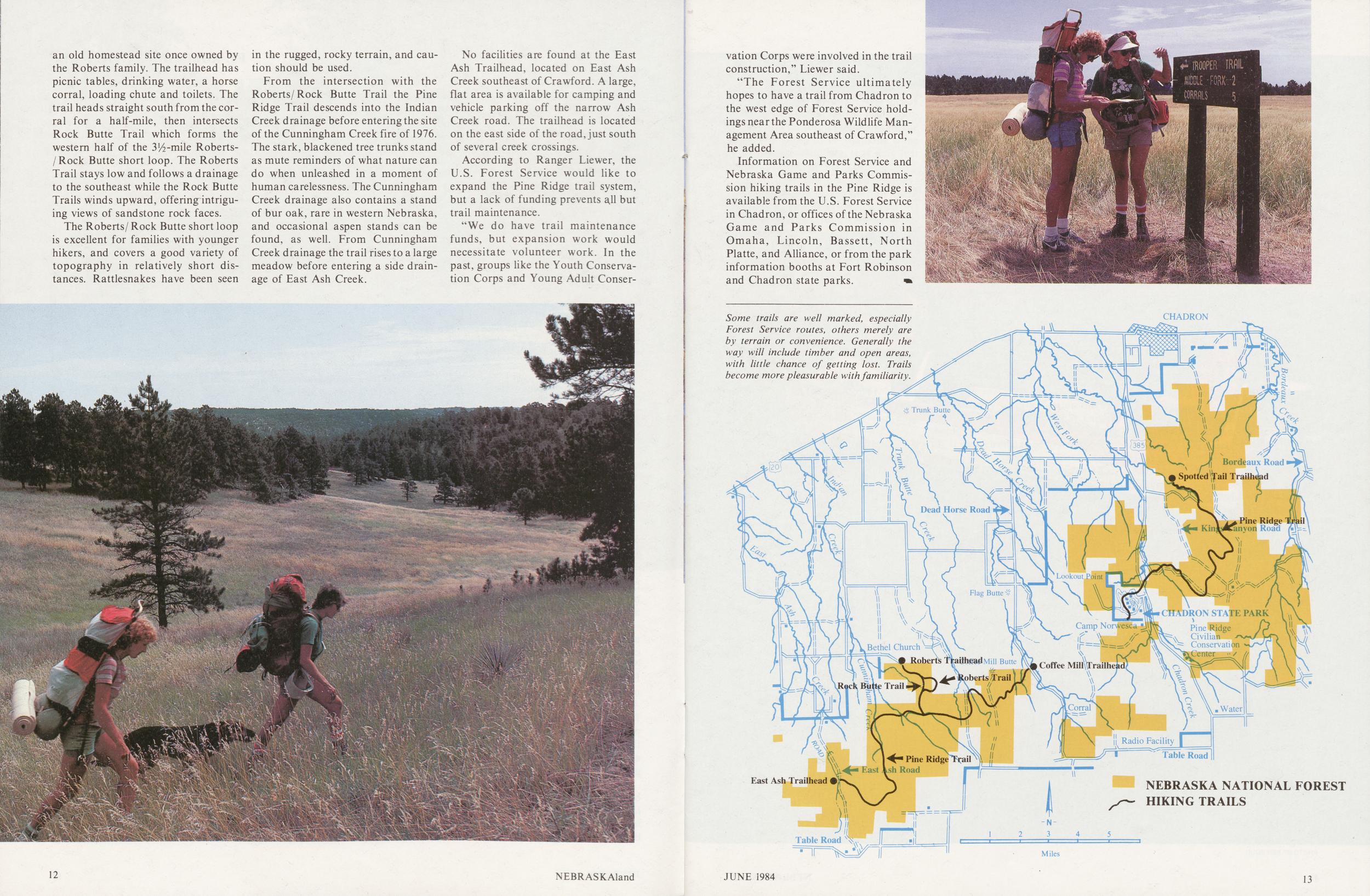
an old homestead site once owned by the Roberts family. The trailhead has picnic tables, drinking water, a horse corral, loading chute and toilets. The trail heads straight south from the corral for a half-mile, then intersects Rock Butte Trail which forms the western half of the 3 1/2-mile Roberts-/Rock Butte short loop. The Roberts Trail stays low and follows a drainage to the southeast while the Rock Butte Trails winds upward, offering intriguing views of sandstone rock faces.
The Roberts/ Rock Butte short loop is excellent for families with younger hikers, and covers a good variety of topography in relatively short distances. Rattlesnakes have been seen in the rugged, rocky terrain, and caution should be used.
From the intersection with the Roberts/Rock Butte Trail the Pine Ridge Trail descends into the Indian Creek drainage before entering the site of the Cunningham Creek fire of 1976. The stark, blackened tree trunks stand as mute reminders of what nature can do when unleashed in a moment of human carelessness. The Cunningham Creek drainage also contains a stand of bur oak, rare in western Nebraska, and occasional aspen stands can be found, as well. From Cunningham Creek drainage the trail rises to a large meadow before entering a side drainage of East Ash Creek.
No facilities are found at the East Ash Trailhead, located on East Ash Creek southeast of Crawford. A large, flat area is available for camping and vehicle parking off the narrow Ash Creek road. The trailhead is located on the east side of the road, just south of several creek crossings.
According to Ranger Liewer, the U.S. Forest Service would like to expand the Pine Ridge trail system, but a lack of funding prevents all but trail maintenance.
"We do have trail maintenance funds, but expansion work would necessitate volunteer work. In the past, groups like the Youth Conservation Corps and Young Adult Conservation
Corps were involved in the trail construction," Liewer said.
"The Forest Service ultimately hopes to have a trail from Chadron to the west edge of Forest Service holdings near the Ponderosa Wildlife Management Area southeast of Crawford, he added.
Information on Forest Service and Nebraska Game and Parks Commission hiking trails in the Pine Ridge is available from the U.S. Forest Service in Chadron, or offices of the Nebraska Game and Parks Commission in Omaha, Lincoln, Bassett, North Platte, and Alliance, or from the park information booths at Fort Robinson and Chadron state parks.
NEBRASKA NATIONAL FOREST HIKING TRAILS
Sandhills Oasis
BY LOWELL JOHNSON Long popular with few locals and steady customers, Valentine Refuge lakes have undergone major renovation and are now better than ever for fishermen.WHEN THE AVERAGE fisherman casts out his favorite plug and it's greeted by a swirling splash and a lunker fish heads toward its aquatic lair or leaps frantically into the air, it's unlikely that the angler is going to be thanking some duck hunter. And yet, that may just be who should be thanked.
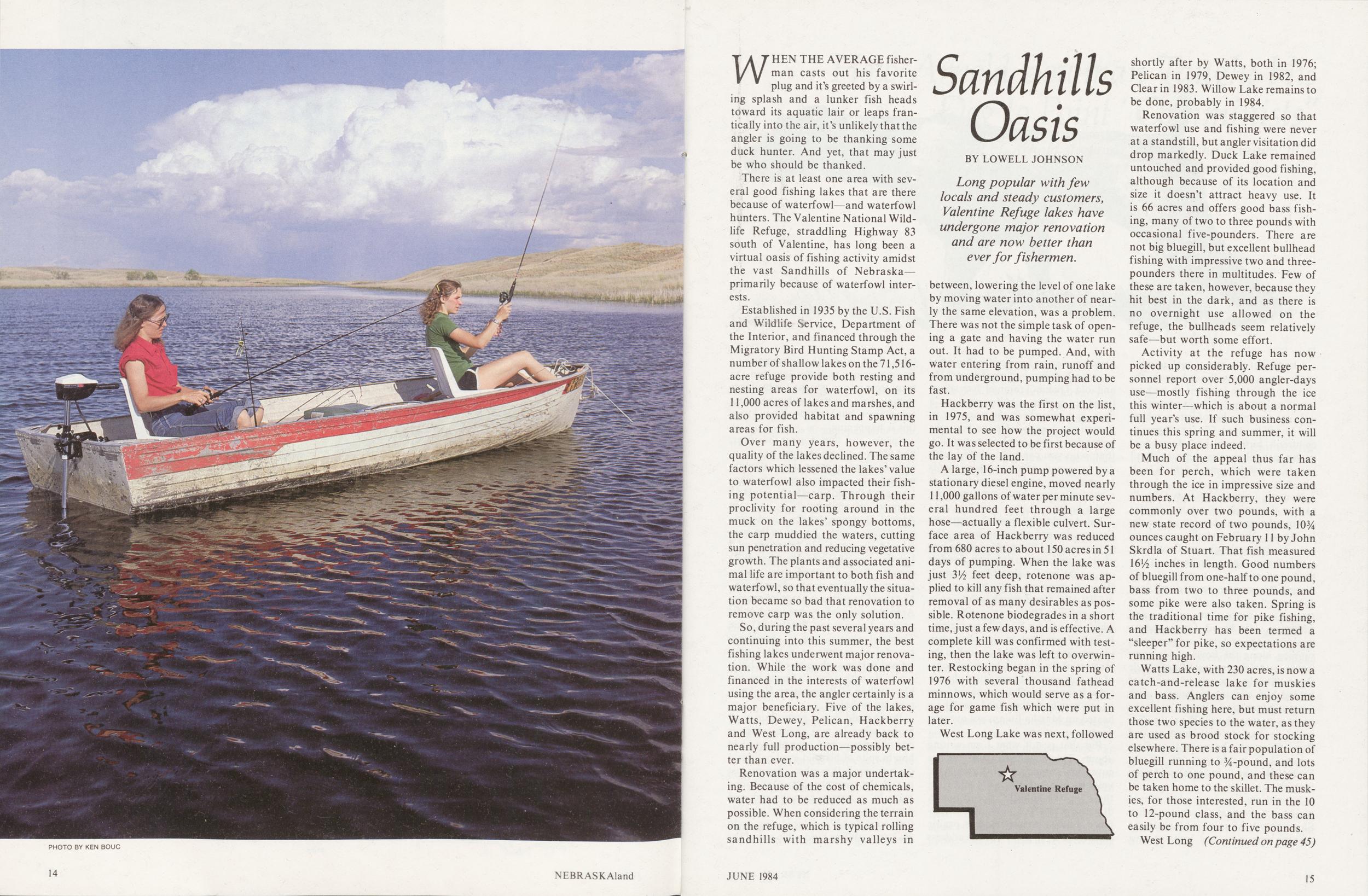
There is at least one area with several good fishing lakes that are there because of waterfowl—and waterfowl hunters. The Valentine National Wildlife Refuge, straddling Highway 83 south of Valentine, has long been a virtual oasis of fishing activity amidst the vast Sandhills of Nebraska—primarily because of waterfowl interests.
Established in 1935 by the U.S. Fish and Wildlife Service, Department of the Interior, and financed through the Migratory Bird Hunting Stamp Act, a number of shallow lakes on the 71,516-acre refuge provide both resting and nesting areas for waterfowl, on its 11,000 acres of lakes and marshes, and also provided habitat and spawning areas for fish.
Over many years, however, the quality of the lakes declined. The same factors which lessened the lakes' value to waterfowl also impacted their fishing potential—carp. Through their proclivity for rooting around in the muck on the lakes' spongy bottoms, the carp muddied the waters, cutting sun penetration and reducing vegetative growth. The plants and associated animal life are important to both fish and waterfowl, so that eventually the situation became so bad that renovation to remove carp was the only solution.
So, during the past several years and continuing into this summer, the best fishing lakes underwent major renovation. While the work was done and financed in the interests of waterfowl using the area, the angler certainly is a major beneficiary. Five of the lakes, Watts, Dewey, Pelican, Hackberry and West Long, are already back to nearly full production—possibly better than ever.
Renovation was a major undertaking. Because of the cost of chemicals, water had to be reduced as much as possible. When considering the terrain on the refuge, which is typical rolling sandhills with marshy valleys in between, lowering the level of one lake by moving water into another of nearly the same elevation, was a problem. There was not the simple task of opening a gate and having the water run out. It had to be pumped. And, with water entering from rain, runoff and from underground, pumping had to be fast.
Hackberry was the first on the list, in 1975, and was somewhat experimental to see how the project would go. It was selected to be first because of the lay of the land.
A large, 16-inch pump powered by a stationary diesel engine, moved nearly 11,000 gallons of water per minute several hundred feet through a large hose—actually a flexible culvert. Surface area of Hackberry was reduced from 680 acres to about 150 acres in 51 days of pumping. When the lake was just 3!/2 feet deep, rotenone was applied to kill any fish that remained after removal of as many desirables as possible. Rotenone biodegrades in a short time, just a few days, and is effective. A complete kill was confirmed with testing, then the lake was left to overwinter. Restocking began in the spring of 1976 with several thousand fathead minnows, which would serve as a forage for game fish which were put in later.
West Long Lake was next, followed Valentine Refuge shortly after by Watts, both in 1976; Pelican in 1979, Dewey in 1982, and Clear in 1983. Willow Lake remains to be done, probably in 1984.
Renovation was staggered so that waterfowl use and fishing were never at a standstill, but angler visitation did drop markedly. Duck Lake remained untouched and provided good fishing, although because of its location and size it doesn't attract heavy use. It is 66 acres and offers good bass fishing, many of two to three pounds with occasional five-pounders. There are not big bluegill, but excellent bullhead fishing with impressive two and three-pounders there in multitudes. Few of these are taken, however, because they hit best in the dark, and as there is no overnight use allowed on the refuge, the bullheads seem relatively safe—but worth some effort.
Activity at the refuge has now picked up considerably. Refuge personnel report over 5,000 angler-days use—mostly fishing through the ice this winter—which is about a normal full year's use. If such business continues this spring and summer, it will be a busy place indeed.
Much of the appeal thus far has been for perch, which were taken through the ice in impressive size and numbers. At Hackberry, they were commonly over two pounds, with a new state record of two pounds, 10% ounces caught on February 11 by John Skrdla of Stuart. That fish measured I6V2 inches in length. Good numbers of bluegill from one-half to one pound, bass from two to three pounds, and some pike were also taken. Spring is the traditional time for pike fishing, and Hackberry has been termed a "sleeper" for pike, so expectations are running high.
Watts Lake, with 230 acres, is now a catch-and-release lake for muskies and bass. Anglers can enjoy some excellent fishing here, but must return those two species to the water, as they are used as brood stock for stocking elsewhere. There is a fair population of bluegill running to %-pound, and lots of perch to one pound, and these can be taken home to the skillet. The muskies, for those interested, run in the 10 to 12-pound class, and the bass can easily be from four to five pounds.
West Long (Continued on page 45)
JUNE 1984 15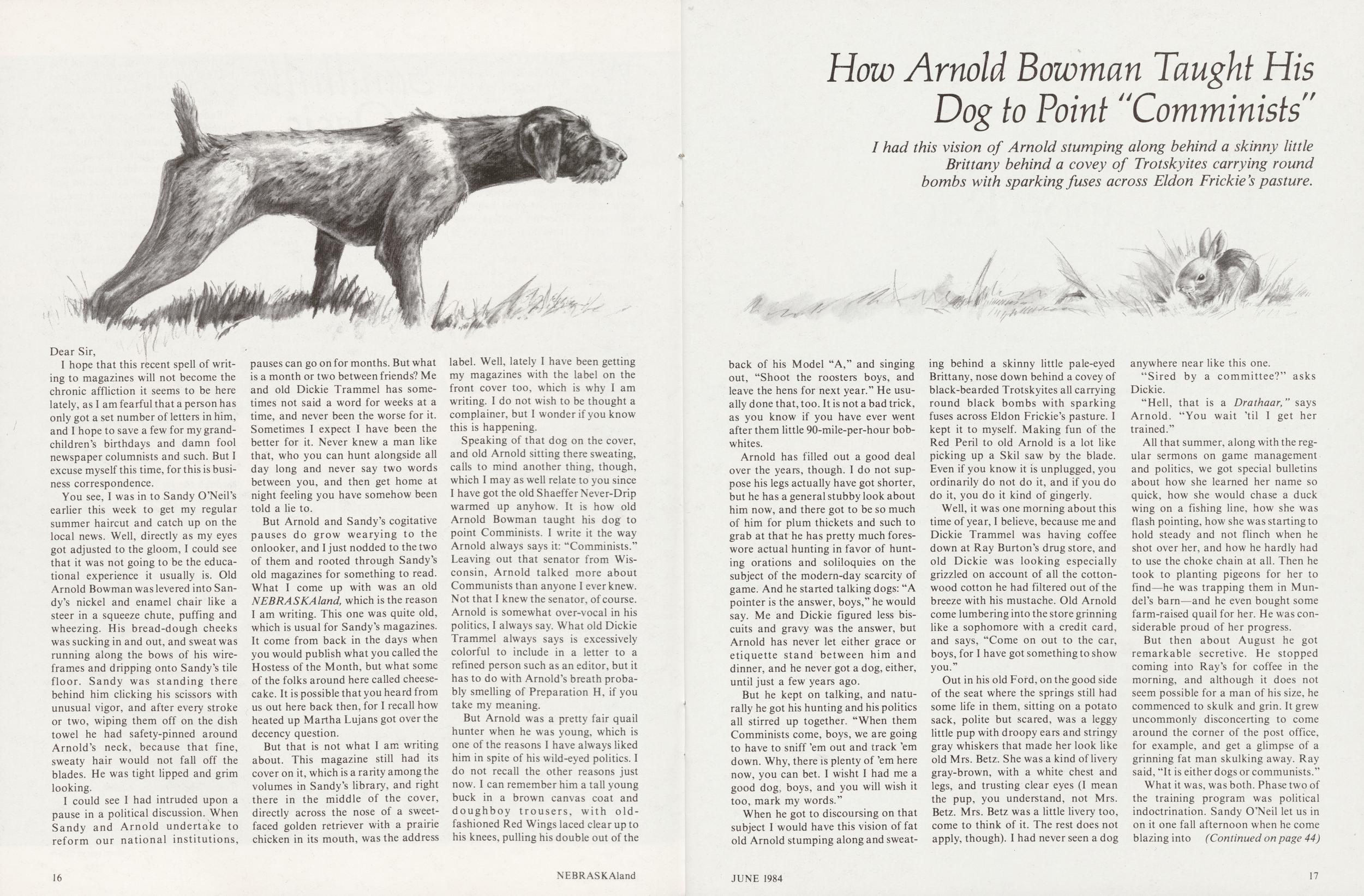
How Arnold Bowman Taught His Dog to Point "Comminists"
I had this vision of Arnold stumping along behind a skinny little Brittany behind a covey of Trotskyites carrying round bombs with sparking fuses across Eldon Frickie's pasture.Dear Sir,
I hope that this recent spell of writing to magazines will not become the chronic affliction it seems to be here lately, as I am fearful that a person has only got a set number of letters in him, and I hope to save a few for my grandchildren's birthdays and damn fool newspaper columnists and such. But I excuse myself this time, for this is business correspondence.
You see, I was in to Sandy O'Neil's earlier this week to get my regular summer haircut and catch up on the local news. Well, directly as my eyes got adjusted to the gloom, I could see that it was not going to be the educational experience it usually is. Old Arnold Bowman was levered into Sandy's nickel and enamel chair like a steer in a squeeze chute, puffing and wheezing. His bread-dough cheeks was sucking in and out, and sweat was running along the bows of his wireframes and dripping onto Sandy's tile floor. Sandy was standing there behind him clicking his scissors with unusual vigor, and after every stroke or two, wiping them off on the dish towel he had safety-pinned around Arnold's neck, because that fine, sweaty hair would not fall off the blades. He was tight lipped and grim looking.
I could see I had intruded upon a pause in a political discussion. When Sandy and Arnold undertake to reform our national institutions, pauses can go on for months. But what is a month or two between friends? Me and old Dickie Trammel has sometimes not said a word for weeks at a time, and never been the worse for it. Sometimes I expect I have been the better for it. Never knew a man like that, who you can hunt alongside all day long and never say two words between you, and then get home at night feeling you have somehow been told a lie to.
But Arnold and Sandy's cogitative pauses do grow wearying to the onlooker, and I just nodded to the two of them and rooted through Sandy's old magazines for something to read. What I come up with was an old NEBRASKAland, which is the reason I am writing. This one was quite old, which is usual for Sandy's magazines. It come from back in the days when you would publish what you called the Hostess of the Month, but what some of the folks around here called cheesecake. It is possible that you heard from us out here back then, for I recall how heated up Martha Lujans got over the decency question.
But that is not what I am writing about. This magazine still had its cover on it, which is a rarity among the volumes in Sandy's library, and right there in the middle of the cover, directly across the nose of a sweet-faced golden retriever with a prairie chicken in its mouth, was the address label. Well, lately I have been getting my magazines with the label on the front cover too, which is why I am writing. I do not wish to be thought a complainer, but I wonder if you know this is happening.
Speaking of that dog on the cover, and old Arnold sitting there sweating, calls to mind another thing, though, which I may as well relate to you since I have got the old Shaeffer Never-Drip warmed up anyhow. It is how old Arnold Bowman taught his dog to point Comminists. I write it the way Arnold always says it: "Comminists." Leaving out that senator from Wisconsin, Arnold talked more about Communists than anyone I ever knew. Not that I knew the senator, of course. Arnold is somewhat over-vocal in his politics, I always say. What old Dickie Trammel always says is excessively colorful to include in a letter to a refined person such as an editor, but it has to do with Arnold's breath probably smelling of Preparation H, if you take my meaning.
But Arnold was a pretty fair quail hunter when he was young, which is one of the reasons I have always liked him in spite of his wild-eyed politics. I do not recall the other reasons just now. I can remember him a tall young buck in a brown canvas coat and doughboy trousers, with old-fashioned Red Wings laced clear up to his knees, pulling his double out of the
16 NEBRASKAlandback of his Model "A," and singing out, "Shoot the roosters boys, and leave the hens for next year." He usually done that, too. It is not a bad trick, as you know if you have ever went after them little 90-mile-per-hour bobwhites.
Arnold has filled out a good deal over the years, though. I do not suppose his legs actually have got shorter, but he has a general stubby look about him now, and there got to be so much of him for plum thickets and such to grab at that he has pretty much foreswore actual hunting in favor of hunting orations and soliloquies on the subject of the modern-day scarcity of game. And he started talking dogs: "A pointer is the answer, boys," he would say. Me and Dickie figured less biscuits and gravy was the answer, but Arnold has never let either grace or etiquette stand between him and dinner, and he never got a dog, either, until just a few years ago.
But he kept on talking, and naturally he got his hunting and his politics all stirred up together. "When them Communists come, boys, we are going to have to sniff 'em out and track 'em down. Why, there is plenty of 'em here now, you can bet. I wisht I had me a good dog, boys, and you will wish it too, mark my words."
When he got to discoursing on that subject I would have this vision of fat old Arnold stumping along and sweating behind a skinny little pale-eyed Brittany, nose down behind a covey of black-bearded Trotskyites all carrying round black bombs with sparking fuses across Eldon Frickie's pasture. I kept it to myself. Making fun of the Red Peril to old Arnold is a lot like picking up a Skil saw by the blade. Even if you know it is unplugged, you ordinarily do not do it, and if you do do it, you do it kind of gingerly.
Well, it was one morning about this time of year, I believe, because me and Dickie Trammel was having coffee down at Ray Burton's drug store, and old Dickie was looking especially grizzled on account of all the cottonwood cotton he had filtered out of the breeze with his mustache. Old Arnold come lumbering into the store grinning like a sophomore with a credit card, and says, "Come on out to the car, boys, for I have got something to show you."
Out in his old Ford, on the good side of the seat where the springs still had some life in them, sitting on a potato sack, polite but scared, was a leggy little pup with droopy ears and stringy gray whiskers that made her look like old Mrs. Betz. She was a kind of livery gray-brown, with a white chest and legs, and trusting clear eyes (I mean the pup, you understand, not Mrs. Betz. Mrs. Betz was a little livery too, come to think of it. The rest does not apply, though). I had never seen a dog anywhere near like this one.
"Sired by a committee?" asks Dickie.
"Hell, that is a Drathaar," says Arnold. "You wait 'til I get her trained."
All that summer, along with the regular sermons on game management and politics, we got special bulletins about how she learned her name so quick, how she would chase a duck wing on a fishing line, how she was flash pointing, how she was starting to hold steady and not flinch when he shot over her, and how he hardly had to use the choke chain at all. Then he took to planting pigeons for her to find—he was trapping them in Mundel's barn—and he even bought some farm-raised quail for her. He was considerable proud of her progress.
But then about August he got remarkable secretive. He stopped coming into Ray's for coffee in the morning, and although it does not seem possible for a man of his size, he commenced to skulk and grin. It grew uncommonly disconcerting to come around the corner of the post office, for example, and get a glimpse of a grinning fat man skulking away. Ray said, "It is either dogs or communists."
What it was, was both. Phase two of the training program was political indoctrination. Sandy O'Neil let us in on it one fall afternoon when he come blazing into (Continued on page 44)
JUNE 1984 17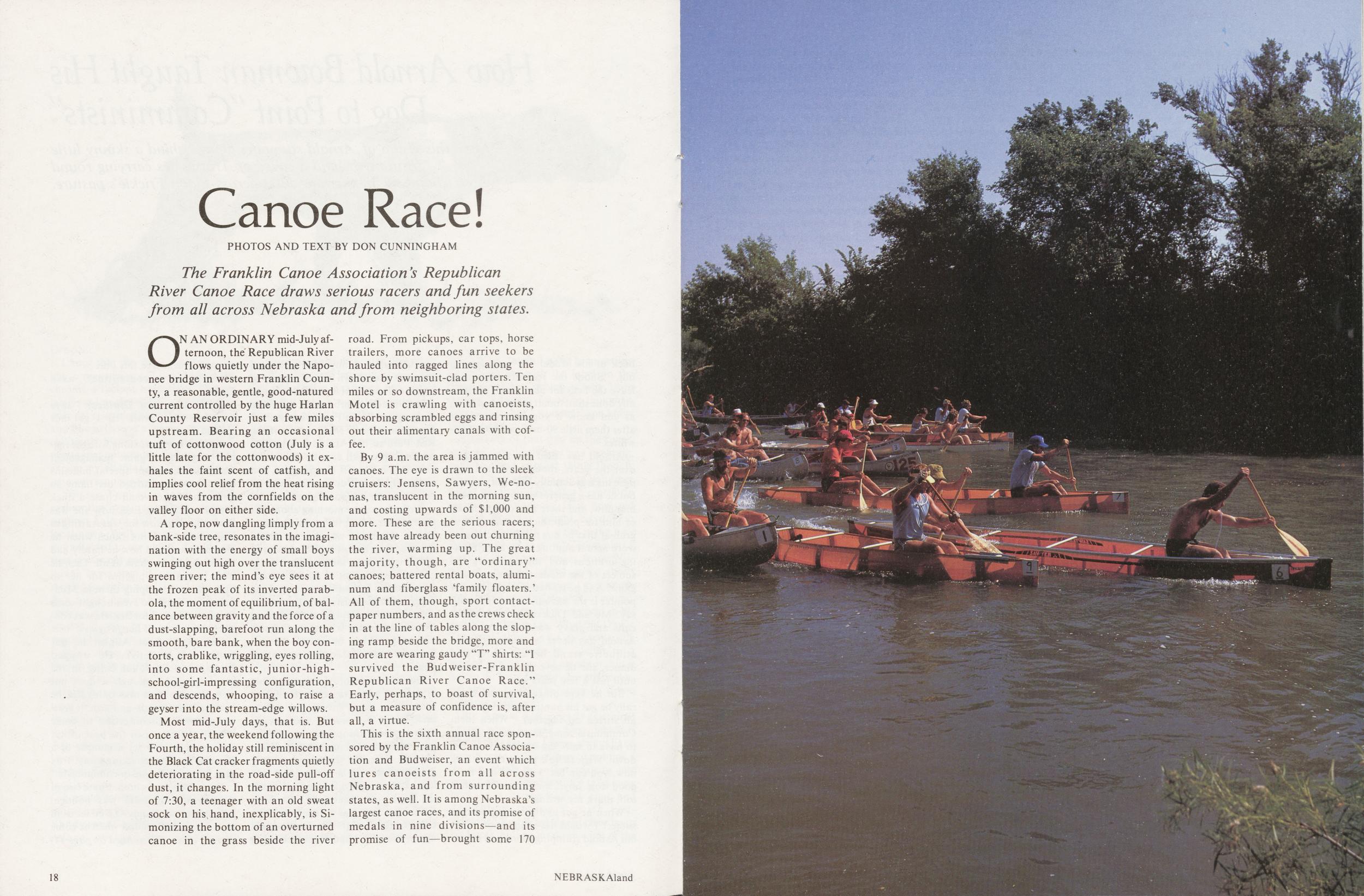
Canoe Race!
PHOTOS AND TEXT BY DON CUNNINGHAM The Franklin Canoe Association s Republican River Canoe Race draws serious racers and fun seekers from all across Nebraska and from neighboring states.ON AN ORDINARY mid-July afternoon, the Republican River flows quietly under the Naponee bridge in western Franklin County, a reasonable, gentle, good-natured current controlled by the huge Harlan County Reservoir just a few miles upstream. Bearing an occasional tuft of cottonwood cotton (July is a little late for the cottonwoods) it exhales the faint scent of catfish, and implies cool relief from the heat rising in waves from the cornfields on the valley floor on either side.
A rope, now dangling limply from a bank-side tree, resonates in the imagination with the energy of small boys swinging out high over the translucent green river; the mind's eye sees it at the frozen peak of its inverted parabola, the moment of equilibrium, of balance between gravity and the force of a dust-slapping, barefoot run along the smooth, bare bank, when the boy contorts, crablike, wriggling, eyes rolling, into some fantastic, junior-high-school-girl-impressing configuration, and descends, whooping, to raise a geyser into the stream-edge willows.
Most mid-July days, that is. But once a year, the weekend following the Fourth, the holiday still reminiscent in the Black Cat cracker fragments quietly deteriorating in the road-side pull-off dust, it changes. In the morning light of 7:30, a teenager with an old sweat sock on his hand, inexplicably, is Simonizing the bottom of an overturned canoe in the grass beside the river road. From pickups, car tops, horse trailers, more canoes arrive to be hauled into ragged lines along the shore by swimsuit-clad porters. Ten miles or so downstream, the Franklin Motel is crawling with canoeists, absorbing scrambled eggs and rinsing out their alimentary canals with coffee.
By 9 a.m. the area is jammed with canoes. The eye is drawn to the sleek cruisers: Jensens, Sawyers, We-nonas, translucent in the morning sun, and costing upwards of $1,000 and more. These are the serious racers; most have already been out churning the river, warming up. The great majority, though, are "ordinary" canoes; battered rental boats, aluminum and fiberglass 'family floaters.' All of them, though, sport contact-paper numbers, and as the crews check in at the line of tables along the sloping ramp beside the bridge, more and more are wearing gaudy "T" shirts: "I survived the Budweiser-Franklin Republican River Canoe Race." Early, perhaps, to boast of survival, but a measure of confidence is, after all, a virtue.
This is the sixth annual race sponsored by the Franklin Canoe Association and Budweiser, an event which lures canoeists from all across Nebraska, and from surrounding states, as well. It is among Nebraska's largest canoe races, and its promise of medals in nine divisions—and its promise of fun—brought some 170
18 NEBRASKAland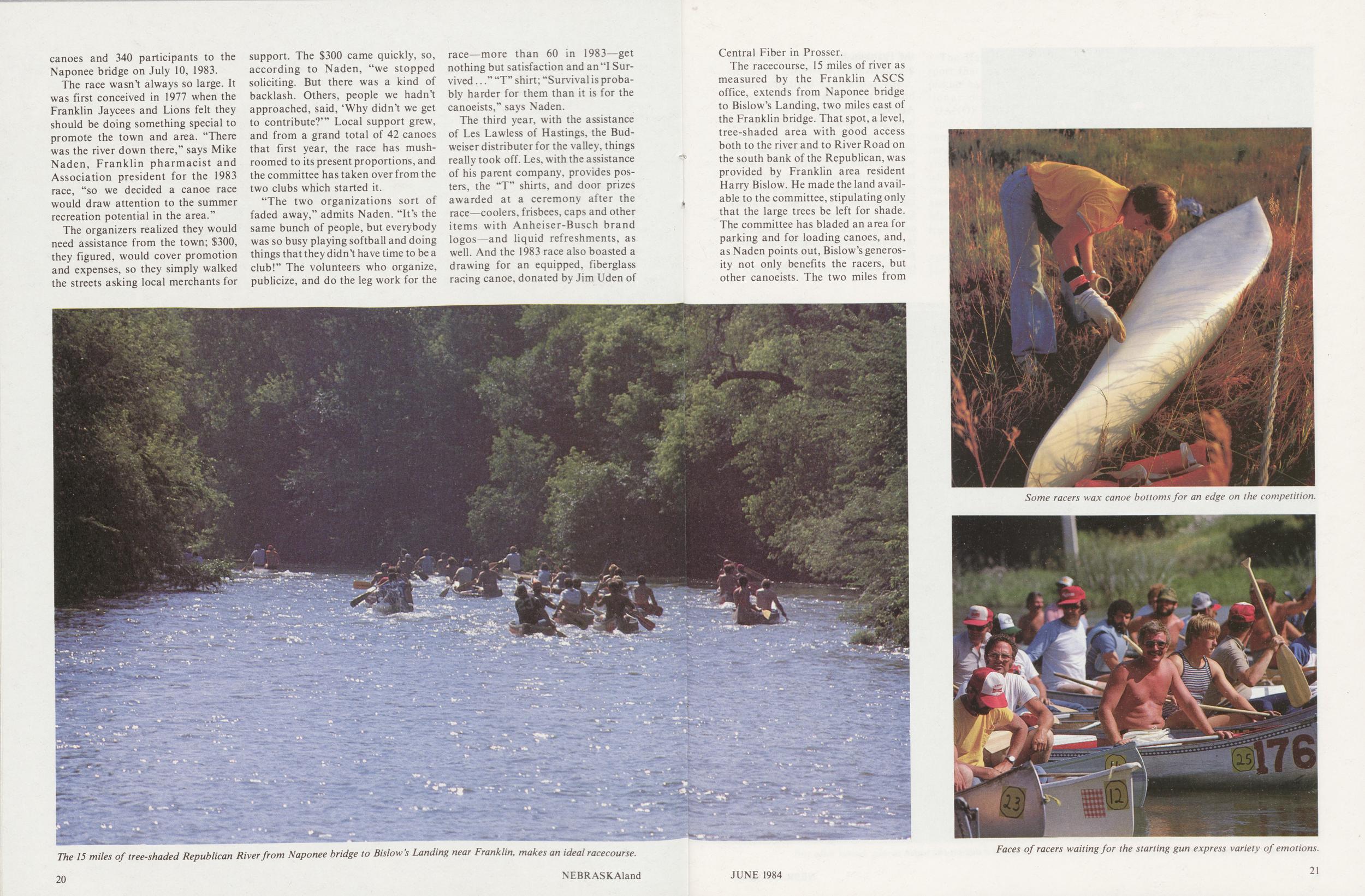
canoes and 340 participants to the Naponee bridge on July 10, 1983.
The race wasn't always so large. It was first conceived in 1977 when the Franklin Jaycees and Lions felt they should be doing something special to promote the town and area. "There was the river down there," says Mike Naden, Franklin pharmacist and Association president for the 1983 race, "so we decided a canoe race would draw attention to the summer recreation potential in the area."
The organizers realized they would need assistance from the town; $300, they figured, would cover promotion and expenses, so they simply walked the streets asking local merchants for support. The $300 came quickly, so, according to Naden, "we stopped soliciting. But there was a kind of backlash. Others, people we hadn't approached, said, 'Why didn't we get to contribute?'" Local support grew, and from a grand total of 42 canoes that first year, the race has mushroomed to its present proportions, and the committee has taken over from the two clubs which started it.
"The two organizations sort of faded away," admits Naden. "It's the same bunch of people, but everybody was so busy playing softball and doing things that they didn't have time to be a club!" The volunteers who organize, publicize, and do the leg work for the race—more than 60 in 1983—get nothing but satisfaction and an "I Survived ..." "T" shirt; "Survival is probably harder for them than it is for the canoeists," says Naden.
The third year, with the assistance of Les Lawless of Hastings, the Budweiser distributer for the valley, things really took off. Les, with the assistance of his parent company, provides posters, the "T" shirts, and door prizes awarded at a ceremony after the race—coolers, frisbees, caps and other items with Anheiser-Busch brand logos—and liquid refreshments, as well. And the 1983 race also boasted a drawing for an equipped, fiberglass racing canoe, donated by Jim Uden of
The 15 miles of tree-shaded Republican River from Naponee bridge to Bislow's Landing near Franklin, makes an ideal racecourse.
Central Fiber in Prosser.
The racecourse, 15 miles of river as measured by the Franklin ASCS office, extends from Naponee bridge to Bislow's Landing, two miles east of the Franklin bridge. That spot, a level, tree-shaded area with good access both to the river and to River Road on the south bank of the Republican, was provided by Franklin area resident Harry Bislow. He made the land available to the committee, stipulating only that the large trees be left for shade. The committee has bladed an area for parking and for loading canoes, and, as Naden points out, Bislow's generosity not only benefits the racers, but other canoeists. The two miles from
Some racers wax canoe bottoms for an edge on the competition.
Faces of racers waiting for the starting gun express variety of emotions.
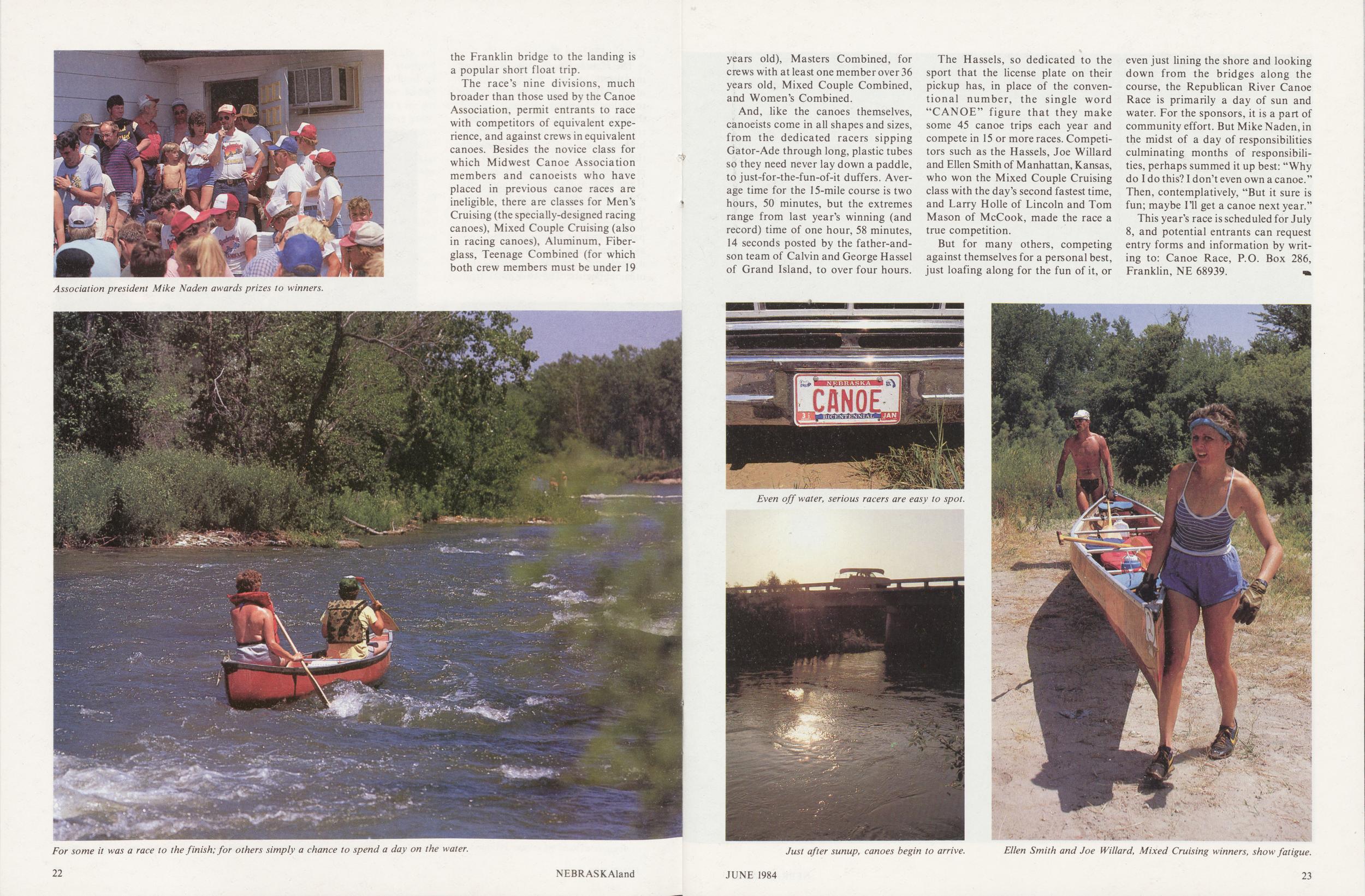
Association president Mike Naden awards prizes to winners.
the Franklin bridge to the landing is a popular short float trip.
The race's nine divisions, much broader than those used by the Canoe Association, permit entrants to race with competitors of equivalent experience, and against crews in equivalent canoes. Besides the novice class for which Midwest Canoe Association members and canoeists who have placed in previous canoe races are ineligible, there are classes for Men's Cruising (the specially-designed racing canoes), Mixed Couple Cruising (also in racing canoes), Aluminum, Fiberglass, Teenage Combined (for which both crew members must be under 19
For some it was a race to the finish; for others simply a chance to spend a day on the water.
years old), Masters Combined, for crews with at least one member over 36 years old, Mixed Couple Combined, and Women's Combined.
And, like the canoes themselves, canoeists come in all shapes and sizes, from the dedicated racers sipping Gator-Ade through long, plastic tubes so they need never lay down a paddle, to just-for-the-fun-of-it duffers. Average time for the 15-mile course is two hours, 50 minutes, but the extremes range from last year's winning (and record) time of one hour, 58 minutes, 14 seconds posted by the father-and-son team of Calvin and George Hassel of Grand Island, to over four hours.
The Hassels, so dedicated to the sport that the license plate on their pickup has, in place of the conventional number, the single word "CANOE" figure that they make some 45 canoe trips each year and compete in 15 or more races. Competitors such as the Hassels, Joe Willard and Ellen Smith of Manhattan, Kansas, who won the Mixed Couple Cruising class with the day's second fastest time, and Larry Holle of Lincoln and Tom Mason of McCook, made the race a true competition.
But for many others, competing against themselves for a personal best, just loafing along for the fun of it, or even just lining the shore and looking down from the bridges along the course, the Republican River Canoe Race is primarily a day of sun and water. For the sponsors, it is a part of community effort. But Mike Naden, in the midst of a day of responsibilities culminating months of responsibilities, perhaps summed it up best: "Why do I do this? I don't even own a canoe." Then, contemplatively, "But it sure is fun; maybe I'll get a canoe next year."
This year's race is scheduled for July 8, and potential entrants can request entry forms and information by writing to: Canoe Race, P.O. Box 286, Franklin, NE 68939.
Even off water, serious racers are easy to spot.
Just after sunup, canoes begin to arrive.
Ellen Smith and Joe Willard, Mixed Cruising winners, show fatigue.
Crested Hell-Divers
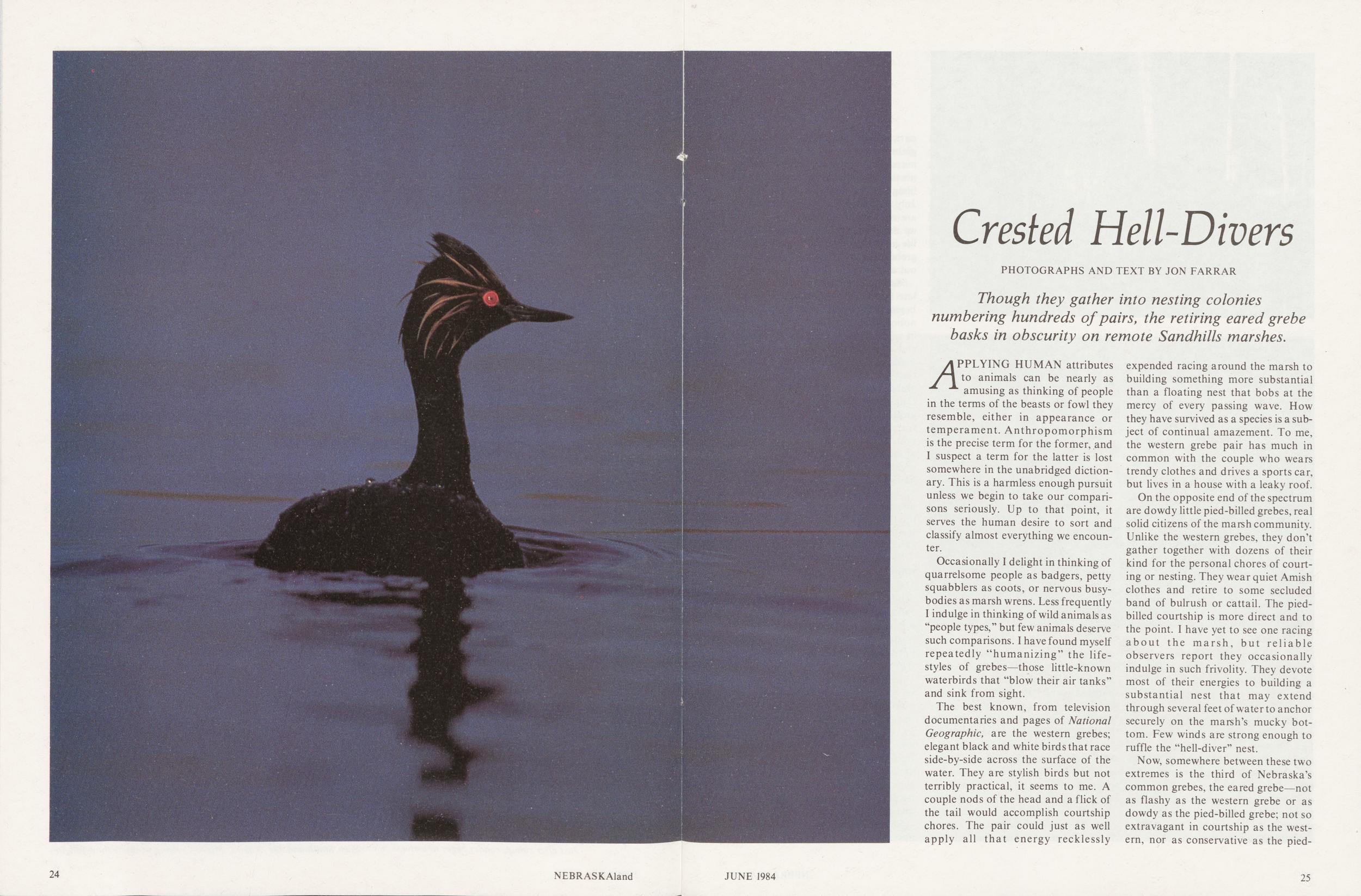
PHOTOGRAPHS AND TEXT BY JON FARRAR Though they gather into nesting colonies numbering hundreds of pairs, the retiring eared grebe basks in obscurity on remote Sandhills marshes.APPLYING HUMAN attributes to animals can be nearly as amusing as thinking of people in the terms of the beasts or fowl they resemble, either in appearance or temperament. Anthropomorphism is the precise term for the former, and I suspect a term for the latter is lost somewhere in the unabridged dictionary. This is a harmless enough pursuit unless we begin to take our comparisons seriously. Up to that point, it serves the human desire to sort and classify almost everything we encounter.
Occasionally I delight in thinking of quarrelsome people as badgers, petty squabblers as coots, or nervous busy-bodies as marsh wrens. Less frequently I indulge in thinking of wild animals as "people types," but few animals deserve such comparisons. I have found myself repeatedly "humanizing" the lifestyles of grebes—those little-known waterbirds that "blow their air tanks" and sink from sight.
The best known, from television documentaries and pages of National Geographic, are the western grebes; elegant black and white birds that race side-by-side across the surface of the water. They are stylish birds but not terribly practical, it seems to me. A couple nods of the head and a flick of the tail would accomplish courtship chores. The pair could just as well apply all that energy recklessly expended racing around the marsh to building something more substantial than a floating nest that bobs at the mercy of every passing wave. How they have survived as a species is a subject of continual amazement. To me, the western grebe pair has much in common with the couple who wears trendy clothes and drives a sports car, but lives in a house with a leaky roof.
On the opposite end of the spectrum are dowdy little pied-billed grebes, real solid citizens of the marsh community. Unlike the western grebes, they don't gather together with dozens of their kind for the personal chores of courting or nesting. They wear quiet Amish clothes and retire to some secluded band of bulrush or cattail. The pied-billed courtship is more direct and to the point. I have yet to see one racing about the marsh, but reliable observers report they occasionally indulge in such frivolity. They devote most of their energies to building a substantial nest that may extend through several feet of water to anchor securely on the marsh's mucky bottom. Few winds are strong enough to ruffle the "hell-diver" nest.
Now, somewhere between these two extremes is the third of Nebraska's common grebes, the eared grebe—not as flashy as the western grebe or as dowdy as the pied-billed grebe; not so extravagant in courtship as the western, nor as conservative as the pied-billed.
JUNE 1984 25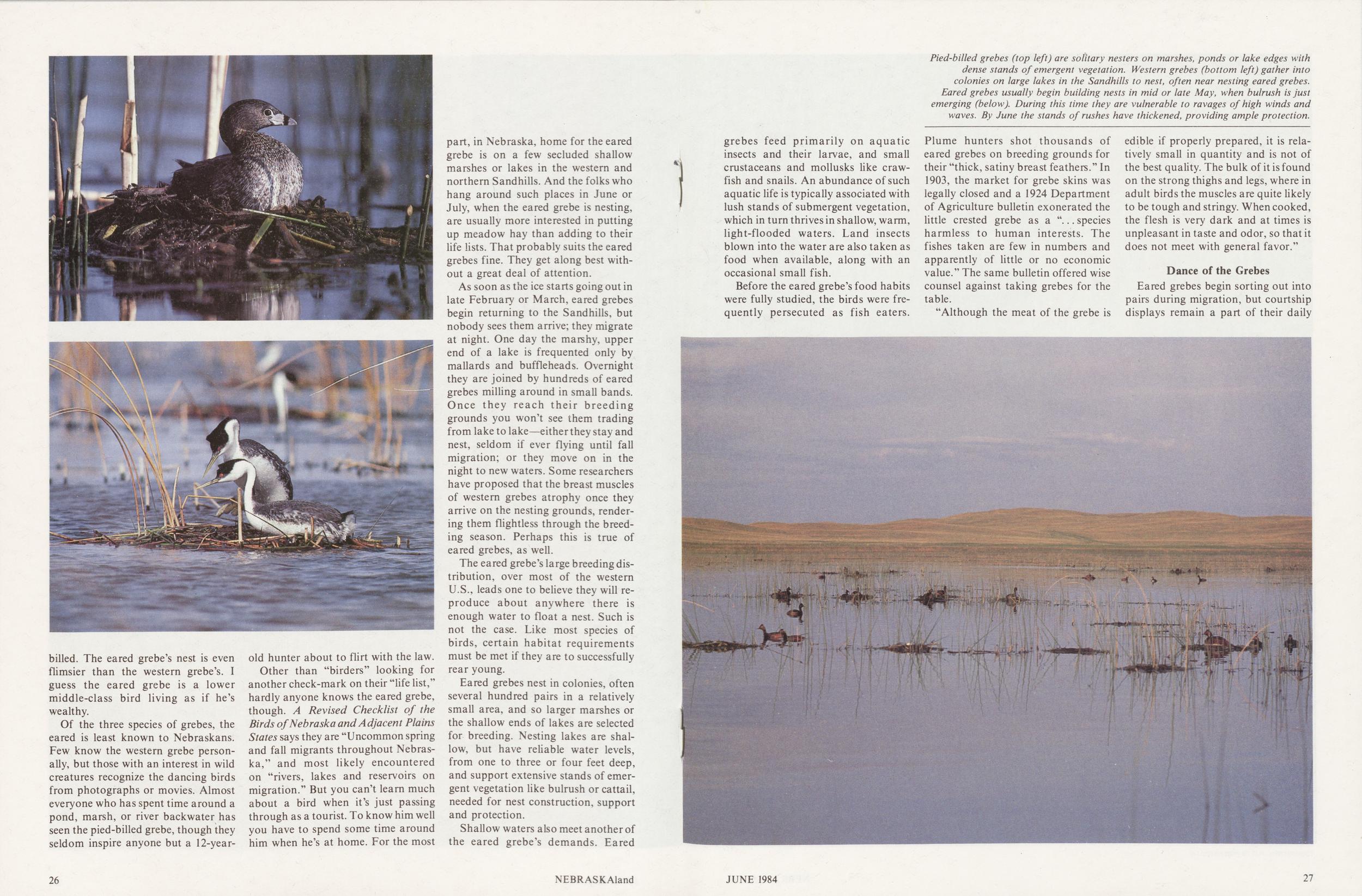
The eared grebe's nest is even flimsier than the western grebe's. I guess the eared grebe is a lower middle-class bird living as if he's wealthy.
Of the three species of grebes, the eared is least known to Nebraskans. Few know the western grebe personally, but those with an interest in wild creatures recognize the dancing birds from photographs or movies. Almost everyone who has spent time around a pond, marsh, or river backwater has seen the pied-billed grebe, though they seldom inspire anyone but a 12-year-old hunter about to flirt with the law.
Other than "birders" looking for another check-mark on their "life list," hardly anyone knows the eared grebe, though. A Revised Checklist of the Birds of Nebraska and Adjacent Plains States says they are "Uncommon spring and fall migrants throughout Nebraska," and most likely encountered on "rivers, lakes and reservoirs on migration." But you can't learn much about a bird when it's just passing through as a tourist. To know him well you have to spend some time around him when he's at home. For the most part, in Nebraska, home for the eared grebe is on a few secluded shallow marshes or lakes in the western and northern Sandhills. And the folks who hang around such places in June or July, when the eared grebe is nesting, are usually more interested in putting up meadow hay than adding to their life lists. That probably suits the eared grebes fine. They get along best without a great deal of attention.
As soon as the ice starts going out in late February or March, eared grebes begin returning to the Sandhills, but nobody sees them arrive; they migrate at night. One day the marshy, upper end of a lake is frequented only by mallards and buffleheads. Overnight they are joined by hundreds of eared grebes milling around in small bands. Once they reach their breeding grounds you won't see them trading from lake to lake—either they stay and nest, seldom if ever flying until fall migration; or they move on in the night to new waters. Some researchers have proposed that the breast muscles of western grebes atrophy once they arrive on the nesting grounds, rendering them flightless through the breeding season. Perhaps this is true of eared grebes, as well.
The eared grebe's large breeding distribution, over most of the western U.S., leads one to believe they will reproduce about anywhere there is enough water to float a nest. Such is not the case. Like most species of birds, certain habitat requirements must be met if they are to successfully rear young.
Eared grebes nest in colonies, often several hundred pairs in a relatively small area, and so larger marshes or the shallow ends of lakes are selected for breeding. Nesting lakes are shallow, but have reliable water levels, from one to three or four feet deep, and support extensive stands of emergent vegetation like bulrush or cattail, needed for nest construction, support and protection.
Shallow waters also meet another of the eared grebe's demands. Eared
26 NEBRASKAland Pied-billed grebes (top left) are solitary nesters on marshes, ponds or lake edges with dense stands of emergent vegetation. Western grebes (bottom left) gather into colonies on large lakes in the Sandhills to nest, often near nesting eared grebes. Eared grebes usually begin building nests in mid or late May, when bulrush is just emerging (below). During this time they are vulnerable to ravages of high winds and waves. By June the stands of rushes have thickened, providing ample protection.grebes feed primarily on aquatic insects and their larvae, and small crustaceans and mollusks like crawfish and snails. An abundance of such aquatic life is typically associated with lush stands of submergent vegetation, which in turn thrives in shallow, warm, light-flooded waters. Land insects blown into the water are also taken as food when available, along with an occasional small fish.
Before the eared grebe's food habits were fully studied, the birds were frequently persecuted as fish eaters. Plume hunters shot thousands of eared grebes on breeding grounds for their "thick, satiny breast feathers." In 1903, the market for grebe skins was legally closed and a 1924 Department of Agriculture bulletin exonerated the little crested grebe as a "... species harmless to human interests. The fishes taken are few in numbers and apparently of little or no economic value." The same bulletin offered wise counsel against taking grebes for the table.
"Although the meat of the grebe is edible if properly prepared, it is relatively small in quantity and is not of the best quality. The bulk of it is found on the strong thighs and legs, where in adult birds the muscles are quite likely to be tough and stringy. When cooked, the flesh is very dark and at times is unpleasant in taste and odor, so that it does not meet with general favor."
Dance of the GrebesEared grebes begin sorting out into pairs during migration, but courtship displays remain a part of their daily
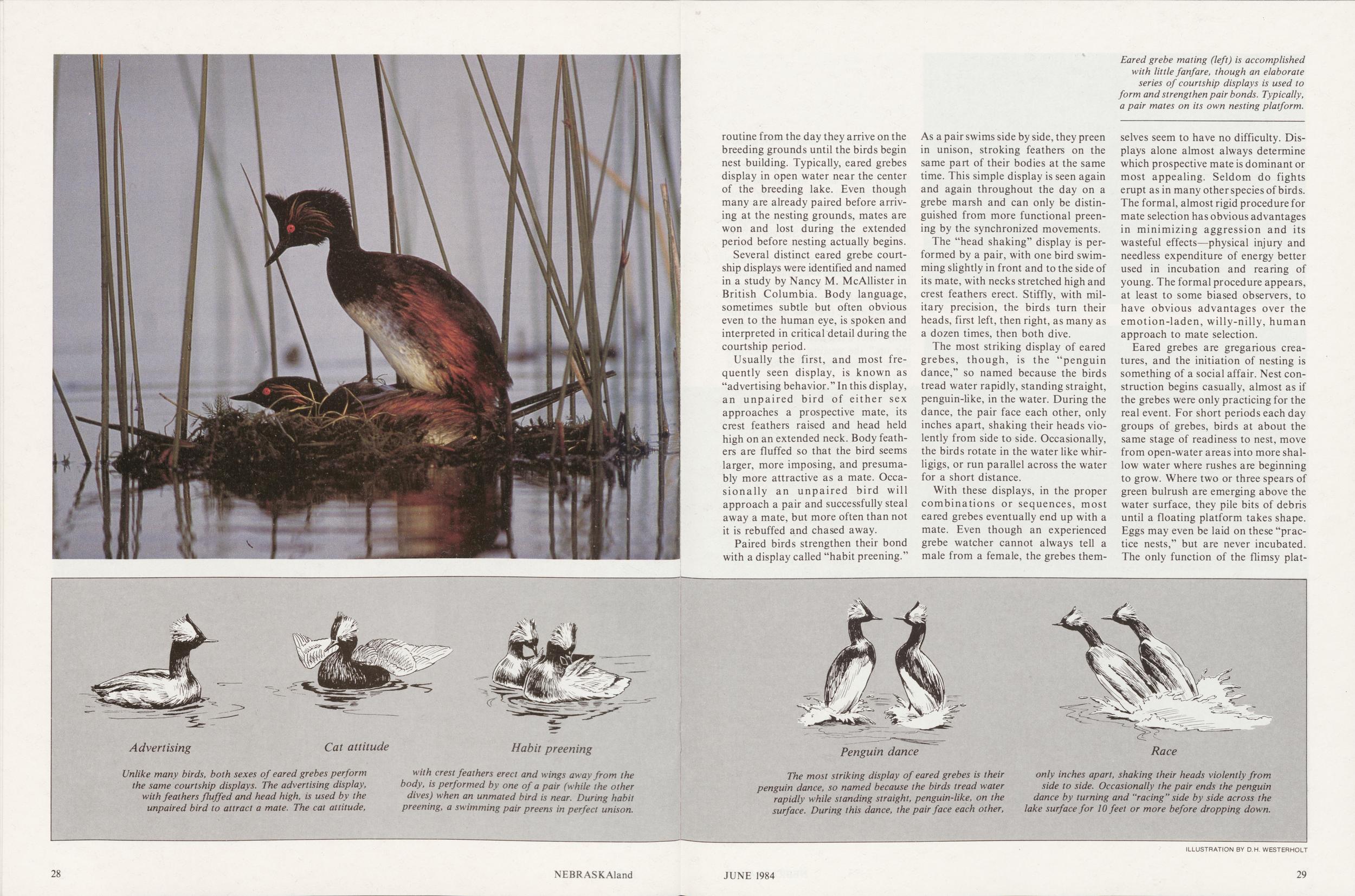
Advertising Cat attitude Habit preening
Unlike many birds, both sexes of eared grebes perform the same courtship displays. The advertising display, with feathers fluffed and head high is used by the unpaired bird to attract a mate. The cat attitude, with crest feathers erect and wings away from the body, is performed by one of a pair (while the other dives) when an unmated bird is near. During habit preening, a swimming pair preens in perfect unison.
Penguin dance
The most striking display of eared grebes is their penguin dance, so named because the birds tread water rapidly while standing straight, penguin-like, on the surface. During this dance, the pair face each other,
Race
only inches apart, shaking their heads violently from side to side. Occasionally the pair ends the penguin dance by turning and "racing" side by side across the lake surface for 10 feet or more before dropping down.
routine from the day they arrive on the breeding grounds until the birds begin nest building. Typically, eared grebes display in open water near the center of the breeding lake. Even though many are already paired before arriving at the nesting grounds, mates are won and lost during the extended period before nesting actually begins.
Several distinct eared grebe courtship displays were identified and named in a study by Nancy M. McAllister in British Columbia. Body language, sometimes subtle but often obvious even to the human eye, is spoken and interpreted in critical detail during the courtship period.
Usually the first, and most frequently seen display, is known as "advertising behavior." In this display, an unpaired bird of either sex approaches a prospective mate, its crest feathers raised and head held high on an extended neck. Body feathers are fluffed so that the bird seems larger, more imposing, and presumably more attractive as a mate. Occasionally an unpaired bird will approach a pair and successfully steal away a mate, but more often than not it is rebuffed and chased away.
Paired birds strengthen their bond with a display called "habit preening." As a pair swims side by side, they preen in unison, stroking feathers on the same part of their bodies at the same time. This simple display is seen again and again throughout the day on a grebe marsh and can only be distinguished from more functional preening by the synchronized movements.
The "head shaking" display is performed by a pair, with one bird swimming slightly in front and to the side of its mate, with necks stretched high and crest feathers erect. Stiffly, with military precision, the birds turn their heads, first left, then right, as many as a dozen times, then both dive.
The most striking display of eared grebes, though, is the "penguin dance," so named because the birds tread water rapidly, standing straight, penguin-like, in the water. During the dance, the pair face each other, only inches apart, shaking their heads violently from side to side. Occasionally, the birds rotate in the water like whirligigs, or run parallel across the water for a short distance.
With these displays, in the proper combinations or sequences, most eared grebes eventually end up with a mate. Even though an experienced grebe watcher cannot always tell a male from a female, the grebes themselves
Eared grebe mating (left) is accomplished with little fanfare, though an elaborate series of courtship displays is used to form and strengthen pair bonds. Typically, a pair mates on its own nesting platform.seem to have no difficulty. Displays alone almost always determine which prospective mate is dominant or most appealing. Seldom do fights erupt as in many other species of birds. The formal, almost rigid procedure for mate selection has obvious advantages in minimizing aggression and its wasteful effects—physical injury and needless expenditure of energy better used in incubation and rearing of young. The formal procedure appears, at least to some biased observers, to have obvious advantages over the emotion-laden, willy-nilly, human approach to mate selection.
Eared grebes are gregarious creatures, and the initiation of nesting is something of a social affair. Nest construction begins casually, almost as if the grebes were only practicing for the real event. For short periods each day groups of grebes, birds at about the same stage of readiness to nest, move from open-water areas into more shallow water where rushes are beginning to grow. Where two or three spears of green bulrush are emerging above the water surface, they pile bits of debris until a floating platform takes shape. Eggs may even be laid on these "practice nests," but are never incubated. The only function of the flimsy platform
JUNE 1984 29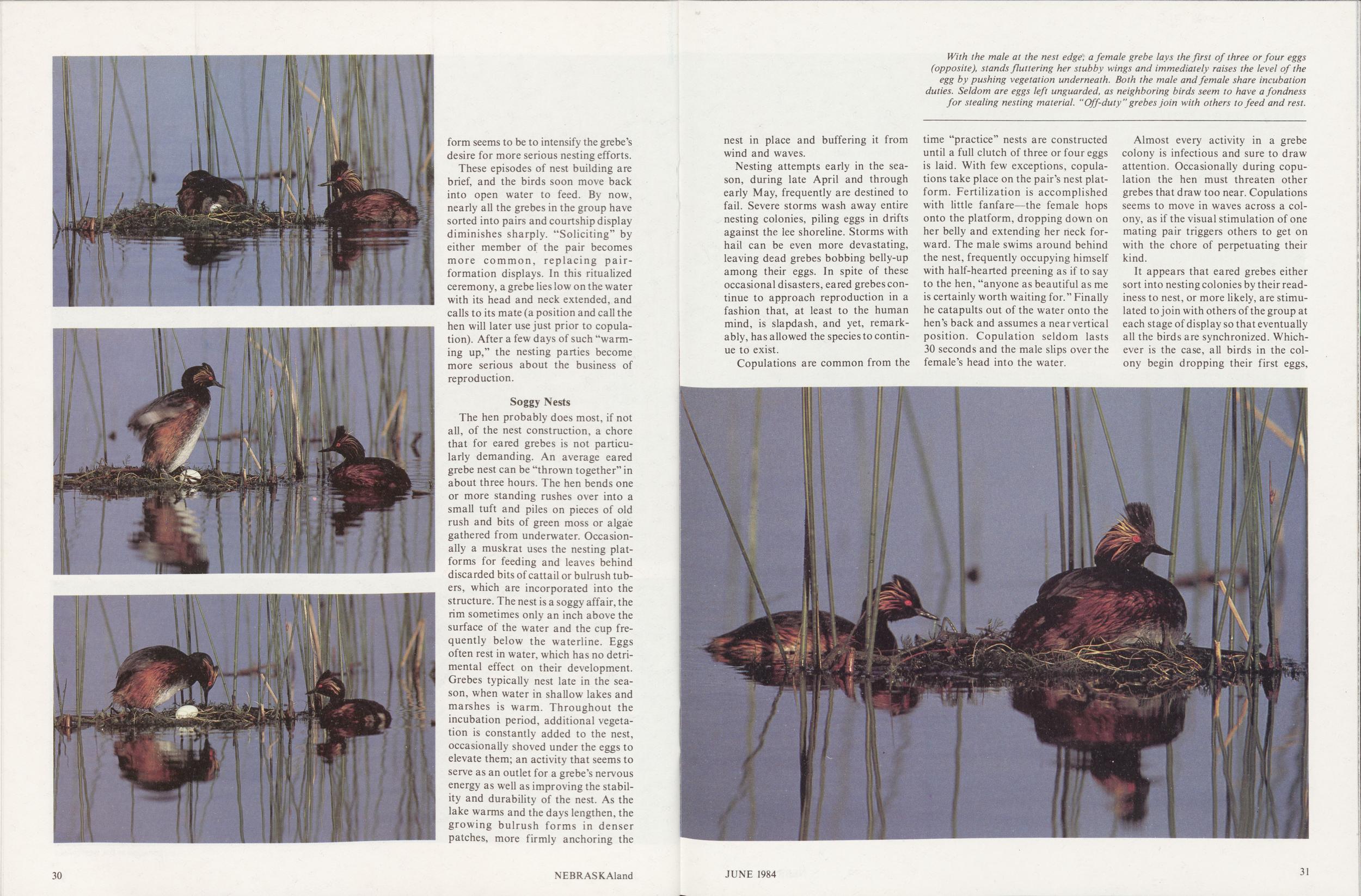
seems to be to intensify the grebe's desire for more serious nesting efforts.
These episodes of nest building are brief, and the birds soon move back into open water to feed. By now, nearly all the grebes in the group have sorted into pairs and courtship display diminishes sharply. "Soliciting" by either member of the pair becomes more common, replacing pair-formation displays. In this ritualized ceremony, a grebe lies low on the water with its head and neck extended, and calls to its mate (a position and call the hen will later use just prior to copulation). After a few days of such "warming up," the nesting parties become more serious about the business of reproduction.
Soggy NestsThe hen probably does most, if not all, of the nest construction, a chore that for eared grebes is not particularly demanding. An average eared grebe nest can be "thrown together" in about three hours. The hen bends one or more standing rushes over into a small tuft and piles on pieces of old rush and bits of green moss or algae gathered from underwater. Occasionally a muskrat uses the nesting platforms for feeding and leaves behind discarded bits of cattail or bulrush tubers, which are incorporated into the structure. The nest is a soggy affair, the rim sometimes only an inch above the surface of the water and the cup frequently below the waterline. Eggs often rest in water, which has no detrimental effect on their development. Grebes typically nest late in the season, when water in shallow lakes and marshes is warm. Throughout the incubation period, additional vegetation is constantly added to the nest, occasionally shoved under the eggs to elevate them; an activity that seems to serve as an outlet for a grebe's nervous energy as well as improving the stability and durability of the nest. As the lake warms and the days lengthen, the growing bulrush forms in denser patches, more firmly anchoring the
30 NEBRASKAland With the male at the nest edge, a female grebe lays the first of three or four eggs (opposite), stands fluttering her stubby wings and immediately raises the level of the egg by pushing vegetation underneath. Both the male and female share incubation duties. Seldom are eggs left unguarded, as neighboring birds seem to have a fondness for stealing nesting material. "Off-duty" grebes join with others to feed and rest.nest in place and buffering it from wind and waves.
Nesting attempts early in the season, during late April and through early May, frequently are destined to fail. Severe storms wash away entire nesting colonies, piling eggs in drifts against the lee shoreline. Storms with hail can be even more devastating, leaving dead grebes bobbing belly-up among their eggs. In spite of these occasional disasters, eared grebes continue to approach reproduction in a fashion that, at least to the human mind, is slapdash, and yet, remarkably, has allowed the species to continue to exist.
Copulations are common from the time "practice" nests are constructed until a full clutch of three or four eggs is laid. With few exceptions, copulations take place on the pair's nest platform. Fertilization is accomplished with little fanfare—the female hops onto the platform, dropping down on her belly and extending her neck forward. The male swims around behind the nest, frequently occupying himself with half-hearted preening as if to say to the hen, "anyone as beautiful as me is certainly worth waiting for." Finally he catapults out of the water onto the hen's back and assumes a near-vertical position. Copulation seldom lasts 30 seconds and the male slips over the female's head into the water.
Almost every activity in a grebe colony is infectious and sure to draw attention. Occasionally during copulation the hen must threaten other grebes that draw too near. Copulations seems to move in waves across a colony, as if the visual stimulation of one mating pair triggers others to get on with the chore of perpetuating their kind.
It appears that eared grebes either sort into nesting colonies by their readiness to nest, or more likely, are stimulated to join with others of the group at each stage of display so that eventually all the birds are synchronized. Whichever is the case, all birds in the colony begin dropping their first eggs,
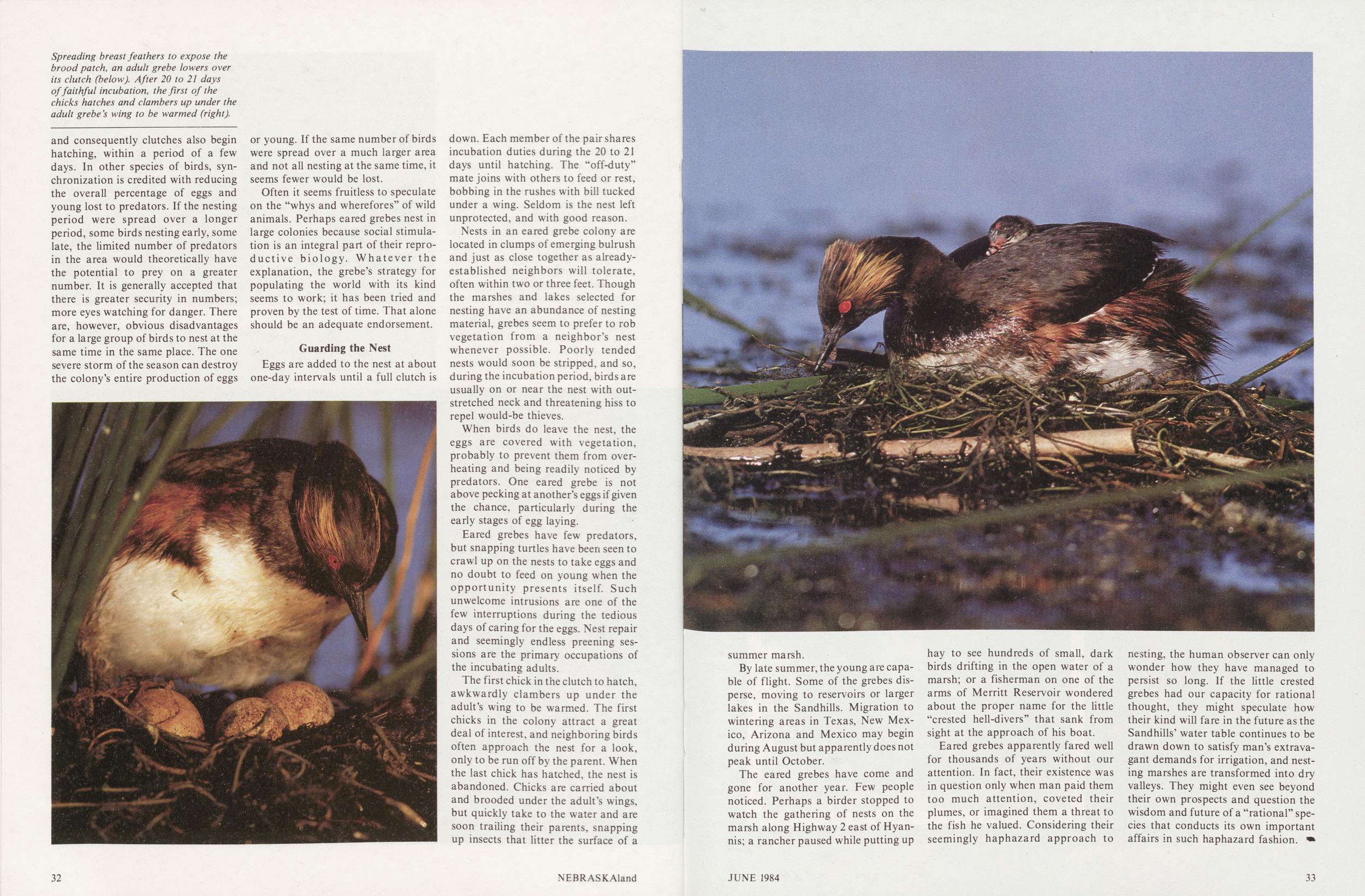 Spreading breast feathers to expose the
brood patch, an adult grebe lowers over
its clutch (below). After 20 to 21 days
of faithful incubation, the first of the
chicks hatches and clambers up under the
adult grebe's wing to be warmed (right).
Spreading breast feathers to expose the
brood patch, an adult grebe lowers over
its clutch (below). After 20 to 21 days
of faithful incubation, the first of the
chicks hatches and clambers up under the
adult grebe's wing to be warmed (right).
and consequently clutches also begin hatching, within a period of a few days. In other species of birds, synchronization is credited with reducing the overall percentage of eggs and young lost to predators. If the nesting period were spread over a longer period, some birds nesting early, some late, the limited number of predators in the area would theoretically have the potential to prey on a greater number. It is generally accepted that there is greater security in numbers; more eyes watching for danger. There are, however, obvious disadvantages for a large group of birds to nest at the same time in the same place. The one severe storm of the season can destroy the colony's entire production of eggs or young. If the same number of birds were spread over a much larger area and not all nesting at the same time, it seems fewer would be lost.
Often it seems fruitless to speculate on the "whys and wherefores" of wild animals. Perhaps eared grebes nest in large colonies because social stimulation is an integral part of their reproductive biology. Whatever the explanation, the grebe's strategy for populating the world with its kind seems to work; it has been tried and proven by the test of time. That alone should be an adequate endorsement.
Guarding the NestEggs are added to the nest at about one-day intervals until a full clutch is
down. Each member of the pair shares incubation duties during the 20 to 21 days until hatching. The "off-duty" mate joins with others to feed or rest, bobbing in the rushes with bill tucked under a wing. Seldom is the nest left unprotected, and with good reason.
Nests in an eared grebe colony are located in clumps of emerging bulrush and just as close together as already-established neighbors will tolerate, often within two or three feet. Though the marshes and lakes selected for nesting have an abundance of nesting material, grebes seem to prefer to rob vegetation from a neighbor's nest whenever possible. Poorly tended nests would soon be stripped, and so, during the incubation period, birds are usually on or near the nest with outstretched neck and threatening hiss to repel would-be thieves.
When birds do leave the nest, the eggs are covered with vegetation, probably to prevent them from overheating and being readily noticed by predators. One eared grebe is not above pecking at another's eggs if given the chance, particularly during the early stages of egg laying.
Eared grebes have few predators, but snapping turtles have been seen to crawl up on the nests to take eggs and no doubt to feed on young when the opportunity presents itself. Such unwelcome intrusions are one of the few interruptions during the tedious days of caring for the eggs. Nest repair and seemingly endless preening sessions are the primary occupations of the incubating adults.
The first chick in the clutch to hatch, awkwardly clambers up under the adult's wing to be warmed. The first chicks in the colony attract a great deal of interest, and neighboring birds often approach the nest for a look, only to be run off by the parent. When the last chick has hatched, the nest is abandoned. Chicks are carried about and brooded under the adult's wings, but quickly take to the water and are soon trailing their parents, snapping up insects that litter the surface of a
32 NEBRASKAlandsummer marsh.
By late summer, the young are capable of flight. Some of the grebes disperse, moving to reservoirs or larger lakes in the Sandhills. Migration to wintering areas in Texas, New Mexico, Arizona and Mexico may begin during August but apparently does not peak until October.
The eared grebes have come and gone for another year. Few people noticed. Perhaps a birder stopped to watch the gathering of nests on the marsh along Highway 2 east of Hyannis; a rancher paused while putting up hay to see hundreds of small, dark birds drifting in the open water of a marsh; or a fisherman on one of the arms of Merritt Reservoir wondered about the proper name for the little "crested hell-divers" that sank from sight at the approach of his boat.
Eared grebes apparently fared well for thousands of years without our attention. In fact, their existence was in question only when man paid them too much attention, coveted their plumes, or imagined them a threat to the fish he valued. Considering their seemingly haphazard approach to nesting, the human observer can only wonder how they have managed to persist so long. If the little crested grebes had our capacity for rational thought, they might speculate how their kind will fare in the future as the Sandhills' water table continues to be drawn down to satisfy man's extravagant demands for irrigation, and nesting marshes are transformed into dry valleys. They might even see beyond their own prospects and question the wisdom and future of a "rational" species that conducts its own important affairs in such haphazard fashion.
JUNE 1984 33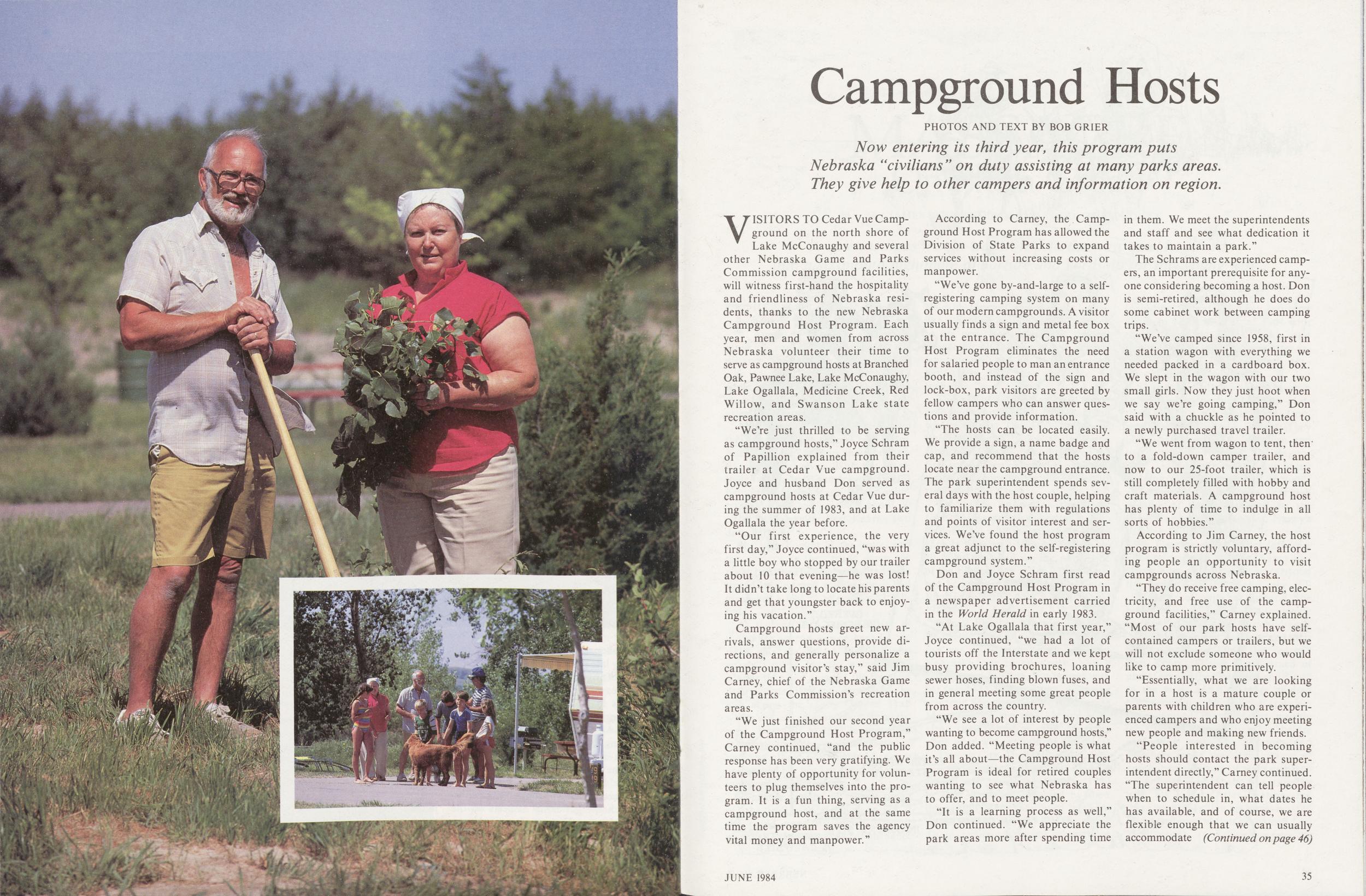
Campground Hosts
PHOTOS AND TEXT BY BOB GR1ER Now entering its third year, this program puts Nebraska "civilians " on duty assisting at many parks areas. They give help to other campers and information on region.VISITORS TO Cedar Vue Campground on the north shore of Lake McConaughy and several other Nebraska Game and Parks Commission campground facilities, will witness first-hand the hospitality and friendliness of Nebraska residents, thanks to the new Nebraska Campground Host Program. Each year, men and women from across Nebraska volunteer their time to serve as campground hosts at Branched Oak, Pawnee Lake, Lake McConaughy, Lake Ogallala, Medicine Creek, Red Willow, and Swanson Lake state recreation areas.
"We're just thrilled to be serving as campground hosts," Joyce Schram of Papillion explained from their trailer at Cedar Vue campground. Joyce and husband Don served as campground hosts at Cedar Vue during the summer of 1983, and at Lake Ogallala the year before.
"Our first experience, the very first day," Joyce continued, "was with a little boy who stopped by our trailer about 10 that evening—he was lost! It didn't take long to locate his parents and get that youngster back to enjoying his vacation."
Campground hosts greet new arrivals, answer questions, provide directions, and generally personalize a campground visitor's stay," said Jim Carney, chief of the Nebraska Game and Parks Commission's recreation areas.
"We just finished our second year of the Campground Host Program," Carney continued, "and the public response has been very gratifying. We have plenty of opportunity for volunteers to plug themselves into the program. It is a fun thing, serving as a campground host, and at the same time the program saves the agency vital money and manpower.
According to Carney, the Campground Host Program has allowed the Division of State Parks to expand services without increasing costs or manpower.
"We've gone by-and-large to a self-registering camping system on many of our modern campgrounds. A visitor usually finds a sign and metal fee box at the entrance. The Campground Host Program eliminates the need for salaried people to man an entrance booth, and instead of the sign and lock-box, park visitors are greeted by fellow campers who can answer questions and provide information.
"The hosts can be located easily. We provide a sign, a name badge and cap, and recommend that the hosts locate near the campground entrance. The park superintendent spends several days with the host couple, helping to familiarize them with regulations and points of visitor interest and services. We've found the host program a great adjunct to the self-registering campground system."
Don and Joyce Schram first read of the Campground Host Program in a newspaper advertisement carried in the World Herald in early 1983.
"At Lake Ogallala that first year," Joyce continued, "we had a lot of tourists off the Interstate and we kept busy providing brochures, loaning sewer hoses, finding blown fuses, and in general meeting some great people from across the country.
"We see a lot of interest by people wanting to become campground hosts," Don added. "Meeting people is what it's all about—the Campground Host Program is ideal for retired couples wanting to see what Nebraska has to offer, and to meet people.
"It is a learning process as well," Don continued. "We appreciate the park areas more after spending time in them. We meet the superintendents and staff and see what dedication it takes to maintain a park."
The Schrams are experienced campers, an important prerequisite for anyone considering becoming a host. Don is semi-retired, although he does do some cabinet work between camping trips.
"We've camped since 1958, first in a station wagon with everything we needed packed in a cardboard box. We slept in the wagon with our two small girls. Now they just hoot when we say we're going camping," Don said with a chuckle as he pointed to a newly purchased travel trailer.
"We went from wagon to tent, then' to a fold-down camper trailer, and now to our 25-foot trailer, which is still completely filled with hobby and craft materials. A campground host has plenty of time to indulge in all sorts of hobbies."
According to Jim Carney, the host program is strictly voluntary, affording people an opportunity to visit campgrounds across Nebraska.
"They do receive free camping, electricity, and free use of the campground facilities," Carney explained. "Most of our park hosts have self-contained campers or trailers, but we will not exclude someone who would like to camp more primitively.
"Essentially, what we are looking for in a host is a mature couple or parents with children who are experienced campers and who enjoy meeting new people and making new friends.
"People interested in becoming hosts should contact the park superintendent directly," Carney continued. "The superintendent can tell people when to schedule in, what dates he has available, and of course, we are flexible enough that we can usually accommodate (Continued on page 46)
JUNE 1984 35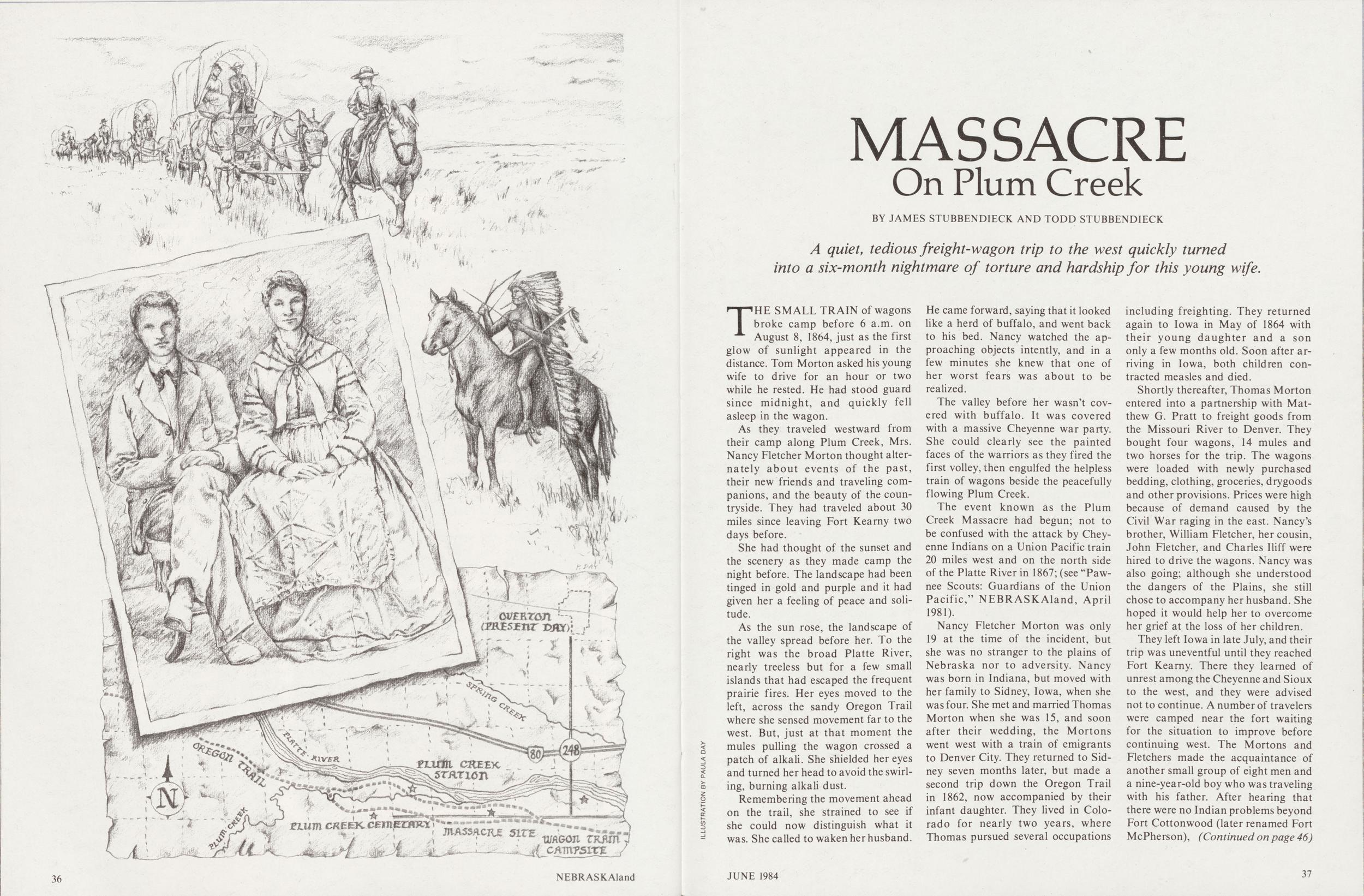
MASSACRE On Plum Creek
BY JAMES STUBBENDIECK AND TODD STUBBENDIECK A quiet, tedious freight-wagon trip to the west quickly turned into a six-month nightmare of torture and hardship for this young wife.THE SMALL TRAIN of wagons broke camp before 6 a.m. on August 8, 1864, just as the first glow of sunlight appeared in the distance. Tom Morton asked his young wife to drive for an hour or two while he rested. He had stood guard since midnight, and quickly fell asleep in the wagon.
As they traveled westward from their camp along Plum Creek, Mrs. Nancy Fletcher Morton thought alternately about events of the past, their new friends and traveling companions, and the beauty of the countryside. They had traveled about 30 miles since leaving Fort Kearny two days before.
She had thought of the sunset and the scenery as they made camp the night before. The landscape had been tinged in gold and purple and it had given her a feeling of peace and solitude.
As the sun rose, the landscape of the valley spread before her. To the right was the broad Platte River, nearly treeless but for a few small islands that had escaped the frequent prairie fires. Her eyes moved to the left, across the sandy Oregon Trail where she sensed movement far to the west. But, just at that moment the mules pulling the wagon crossed a patch of alkali. She shielded her eyes and turned her head to avoid the swirling, burning alkali dust.
Remembering the movement ahead on the trail, she strained to see if she could now distinguish what it was. She called to waken her husband. He came forward, saying that it looked like a herd of buffalo, and went back to his bed. Nancy watched the approaching objects intently, and in a few minutes she knew that one of her worst fears was about to be realized.
The valley before her wasn't covered with buffalo. It was covered with a massive Cheyenne war party. She could clearly see the painted faces of the warriors as they fired the first volley, then engulfed the helpless train of wagons beside the peacefully flowing Plum Creek.
The event known as the Plum Creek Massacre had begun; not to be confused with the attack by Cheyenne Indians on a Union Pacific train 20 miles west and on the north side of the Platte River in 1867; (see "Pawnee Scouts: Guardians of the Union Pacific," NEBRASKAland, April 1981).
Nancy Fletcher Morton was only 19 at the time of the incident, but she was no stranger to the plains of Nebraska nor to adversity. Nancy was born in Indiana, but moved with her family to Sidney, Iowa, when she was four. She met and married Thomas Morton when she was 15, and soon after their wedding, the Mortons went west with a train of emigrants to Denver City. They returned to Sidney seven months later, but made a second trip down the Oregon Trail in 1862, now accompanied by their infant daughter. They lived in Colorado for nearly two years, where Thomas pursued several occupations including freighting. They returned again to Iowa in May of 1864 with their young daughter and a son only a few months old. Soon after arriving in Iowa, both children contracted measles and died.
Shortly thereafter, Thomas Morton entered into a partnership with Matthew G. Pratt to freight goods from the Missouri River to Denver. They bought four wagons, 14 mules and two horses for the trip. The wagons were loaded with newly purchased bedding, clothing, groceries, drygoods and other provisions. Prices were high because of demand caused by the Civil War raging in the east. Nancy's brother, William Fletcher, her cousin, John Fletcher, and Charles Iliff were hired to drive the wagons. Nancy was also going; although she understood the dangers of the Plains, she still chose to accompany her husband. She hoped it would help her to overcome her grief at the loss of her children.
They left Iowa in late July, and their trip was uneventful until they reached Fort Kearny. There they learned of unrest among the Cheyenne and Sioux to the west, and they were advised not to continue. A number of travelers were camped near the fort waiting for the situation to improve before continuing west. The Mortons and Fletchers made the acquaintance of another small group of eight men and a nine-year-old boy who was traveling with his father. After hearing that there were no Indian problems beyond Fort Cottonwood (later renamed Fort McPherson), (Continued on page 46)
JUNE 1984 37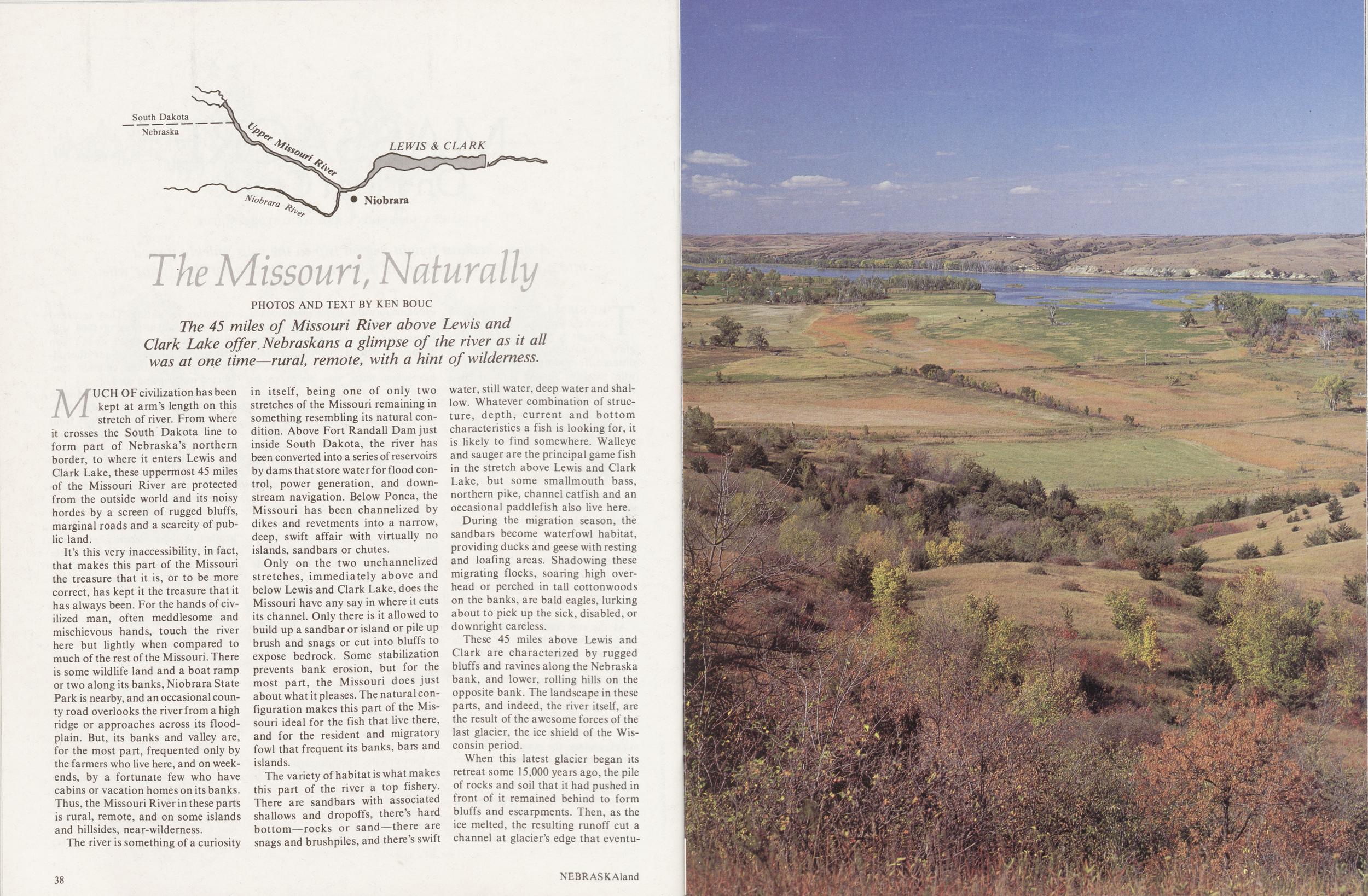
South Dakota Nebraska Niobrara Upper Missouri River Niobrara River Lewis & Clark
The Missouri. Naturally
PHOTOS AND TEXT BY KEN BOUC The 45 miles of Missouri River above Lewis and Clark Lake offer Nebraskans a glimpse of the river as it all was at one time—rural, remote, with a hint of wilderness.MUCH OF civilization has been kept at arm's length on this stretch of river. From where it crosses the South Dakota line to form part of Nebraska's northern border, to where it enters Lewis and Clark Lake, these uppermost 45 miles of the Missouri River are protected from the outside world and its noisy hordes by a screen of rugged bluffs, marginal roads and a scarcity of public land.
It's this very inaccessibility, in fact, that makes this part of the Missouri the treasure that it is, or to be more correct, has kept it the treasure that it has always been. For the hands of civilized man, often meddlesome and mischievous hands, touch the river here but lightly when compared to much of the rest of the Missouri. There is some wildlife land and a boat ramp or two along its banks, Niobrara State Park is nearby, and an occasional county road overlooks the river from a high ridge or approaches across its floodplain. But, its banks and valley are, for the most part, frequented only by the farmers who live here, and on weekends, by a fortunate few who have cabins or vacation homes on its banks. Thus, the Missouri River in these parts is rural, remote, and on some islands and hillsides, near-wilderness.
The river is something of a curiosity in itself, being one of only two stretches of the Missouri remaining in something resembling its natural condition. Above Fort Randall Dam just inside South Dakota, the river has been converted into a series of reservoirs by dams that store water for flood control, power generation, and downstream navigation. Below Ponca, the Missouri has been channelized by dikes and revetments into a narrow, deep, swift affair with virtually no islands, sandbars or chutes.
Only on the two unchannelized stretches, immediately above and below Lewis and Clark Lake, does the Missouri have any say in where it cuts its channel. Only there is it allowed to build up a sandbar or island or pile up brush and snags or cut into bluffs to expose bedrock. Some stabilization prevents bank erosion, but for the most part, the Missouri does just about what it pleases. The natural configuration makes this part of the Missouri ideal for the fish that live there, and for the resident and migratory fowl that frequent its banks, bars and islands.
The variety of habitat is what makes this part of the river a top fishery. There are sandbars with associated shallows and dropoffs, there's hard bottom—rocks or sand—there are snags and brushpiles, and there's swift water, still water, deep water and shallow. Whatever combination of structure, depth, current and bottom characteristics a fish is looking for, it is likely to find somewhere. Walleye and sauger are the principal game fish in the stretch above Lewis and Clark Lake, but some smallmouth bass, northern pike, channel catfish and an occasional paddlefish also live here.
During the migration season, the sandbars become waterfowl habitat, providing ducks and geese with resting and loafing areas. Shadowing these migrating flocks, soaring high overhead or perched in tall cottonwoods on the banks, are bald eagles, lurking about to pick up the sick, disabled, or downright careless.
These 45 miles above Lewis and Clark are characterized by rugged bluffs and ravines along the Nebraska bank, and lower, rolling hills on the opposite bank. The landscape in these parts, and indeed, the river itself, are the result of the awesome forces of the last glacier, the ice shield of the Wisconsin period.
When this latest glacier began its retreat some 15,000 years ago, the pile of rocks and soil that it had pushed in front of it remained behind to form bluffs and escarpments. Then, as the ice melted, the resulting runoff cut a channel at glacier's edge that eventually
38 NEBRASKAland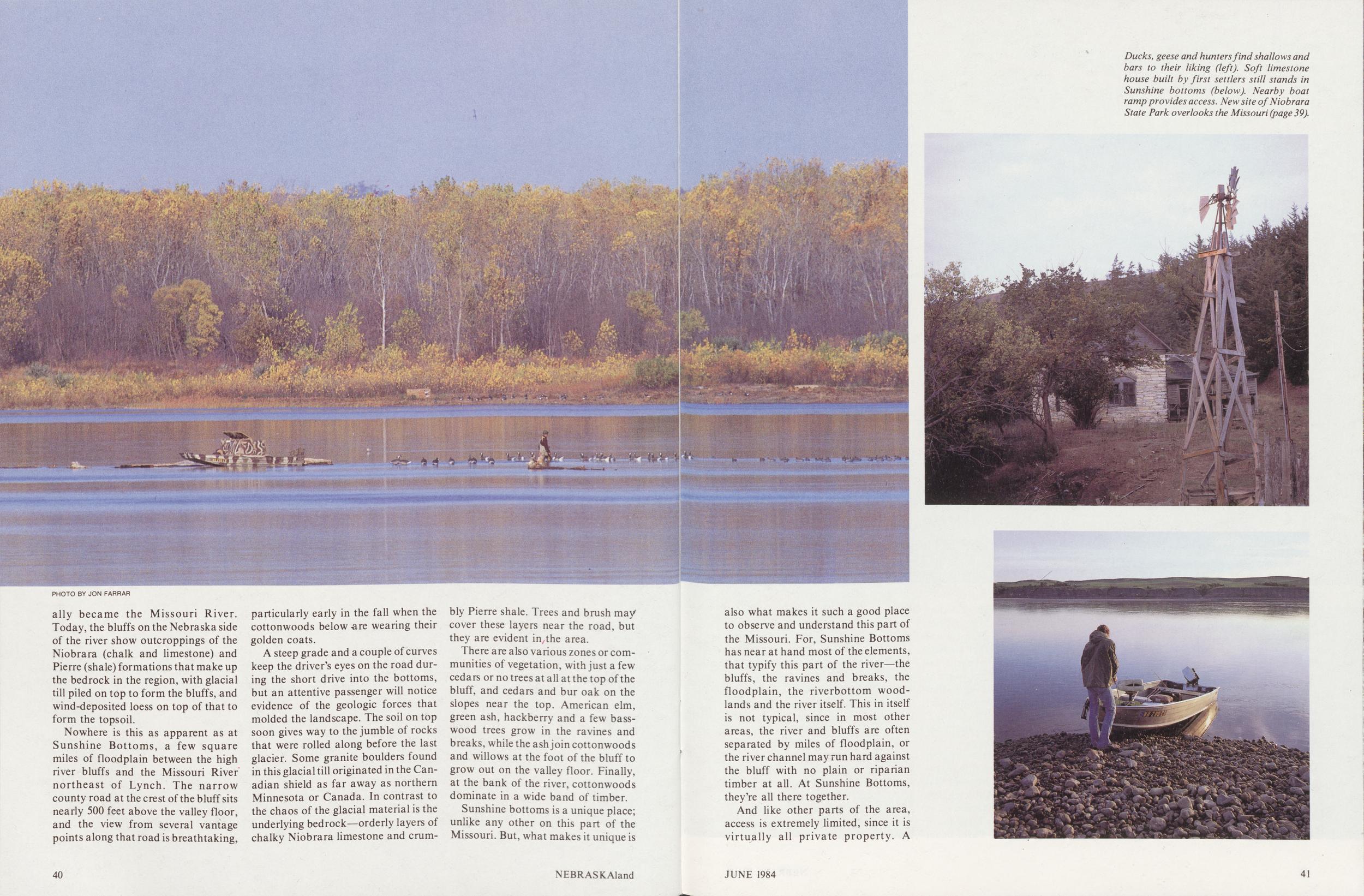
became the Missouri River. Today, the bluffs on the Nebraska side of the river show outcroppings of the Niobrara (chalk and limestone) and Pierre (shale) formations that make up the bedrock in the region, with glacial till piled on top to form the bluffs, and wind-deposited loess on top of that to form the topsoil.
Nowhere is this as apparent as at Sunshine Bottoms, a few square miles of floodplain between the high river bluffs and the Missouri River" northeast of Lynch. The narrow county road at the crest of the bluff sits nearly 500 feet above the valley floor, and the view from several vantage points along that road is breathtaking, particularly early in the fall when the cottonwoods below -are wearing their golden coats.
A steep grade and a couple of curves keep the driver's eyes on the road during the short drive into the bottoms, but an attentive passenger will notice evidence of the geologic forces that molded the landscape. The soil on top soon gives way to the jumble of rocks that were rolled along before the last glacier. Some granite boulders found in this glacial till originated in the Canadian shield as far away as northern Minnesota or Canada. In contrast to the chaos of the glacial material is the underlying bedrock—orderly layers of chalky Niobrara limestone and crumbly Pierre shale. Trees and brush may cover these layers near the road, but they are evident in^he area.
There are also various zones or communities of vegetation, with just a few cedars or no trees at all at the top of the bluff, and cedars and bur oak on the slopes near the top. American elm, green ash, hackberry and a few basswood trees grow in the ravines and breaks, while the ash join cottonwoods and willows at the foot of the bluff to grow out on the valley floor. Finally, at the bank of the river, cottonwoods dominate in a wide band of timber.
Sunshine bottoms is a unique place; unlike any other on this part of the Missouri. But, what makes it unique is
40 NEBRASKAlandalso what makes it such a good place to observe and understand this part of the Missouri. For, Sunshine Bottoms has near at hand most of the elements, that typify this part of the river—the bluffs, the ravines and breaks, the floodplain, the riverbottom woodlands and the river itself. This in itself is not typical, since in most other areas, the river and bluffs are often separated by miles of floodplain, or the river channel may run hard against the bluff with no plain or riparian timber at all. At Sunshine Bottoms, they're all there together.
And like other parts of the area, access is extremely limited, since it is virtually all private property. A
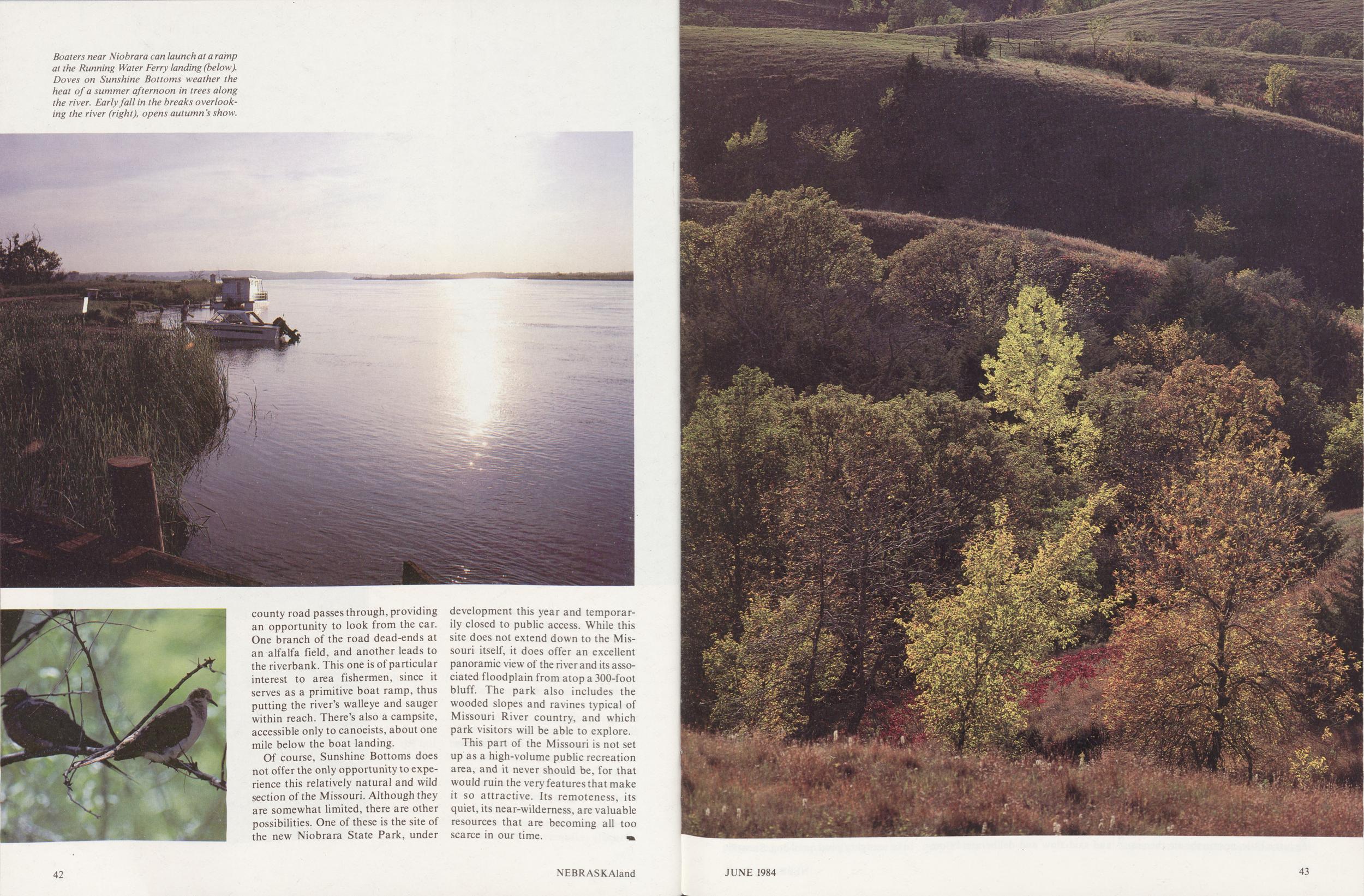
county road passes through, providing an opportunity to look from the car. One branch of the road dead-ends at an alfalfa field, and another leads to the riverbank. This one is of particular interest to area fishermen, since it serves as a primitive boat ramp, thus putting the river's walleye and sauger within reach. There's also a campsite, accessible only to canoeists, about one mile below the boat landing.
Of course, Sunshine Bottoms does not offer the only opportunity to experience this relatively natural and wild section of the Missouri. Although they are somewhat limited, there are other possibilities. One of these is the site of the new Niobrara State Park, under development this year and temporarily closed to public access. While this site does not extend down to the Missouri itself, it does offer an excellent panoramic view of the river and its associated floodplain from atop a 300-foot bluff. The park also includes the wooded slopes and ravines typical of Missouri River country, and which park visitors will be able to explore.
This part of the Missouri is not set up as a high-volume public recreation area, and it never should be, for that would ruin the very features that make it so attractive. Its remoteness, its quiet, its near-wilderness, are valuable resources that are becoming all too scarce in our time.
42 NEBRASKAland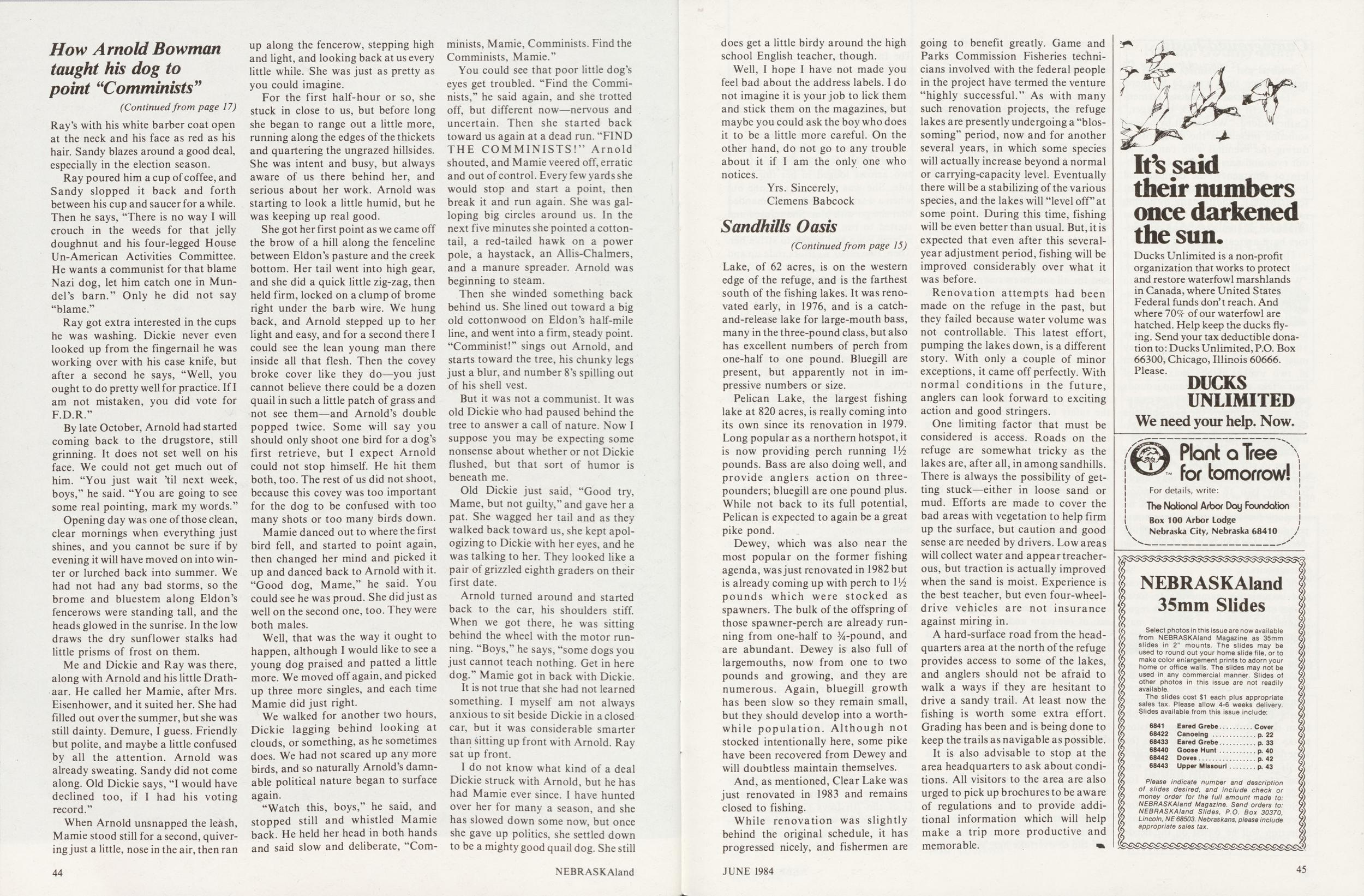
How Arnold Bowman taught his dog to point "Comminists"
(Continued from page 17)Ray's with his white barber coat open at the neck and his face as red as his hair. Sandy blazes around a good deal, especially in the election season.
Ray poured him a cup of coffee, and Sandy slopped it back and forth between his cup and saucer for a while. Then he says, "There is no way I will crouch in the weeds for that jelly doughnut and his four-legged House Un-American Activities Committee. He wants a communist for that blame Nazi dog, let him catch one in Mundel's barn." Only he did not say "blame."
Ray got extra interested in the cups he was washing. Dickie never even looked up from the fingernail he was working over with his case knife, but after a second he says, "Well, you ought to do pretty well for practice. If I am not mistaken, you did vote for F.D.R."
By late October, Arnold had started coming back to the drugstore, still grinning. It does not set well on his face. We could not get much out of him. "You just wait 'til next week, boys," he said. "You are going to see some real pointing, mark my words."
Opening day was one of those clean, clear mornings when everything just shines, and you cannot be sure if by evening it will have moved on into winter or lurched back into summer. We had not had any bad storms, so the brome and bluestem along Eldon's fencerows were standing tall, and the heads glowed in the sunrise. In the low draws the dry sunflower stalks had little prisms of frost on them.
Me and Dickie and Ray was there, along with Arnold and his little Drathaar. He called her Mamie, after Mrs. Eisenhower, and it suited her. She had filled out over the summer, but she was still dainty. Demure, I guess. Friendly but polite, and maybe a little confused by all the attention. Arnold was already sweating. Sandy did not come along. Old Dickie says, "I would have declined too, if I had his voting record."
When Arnold unsnapped the leash, Mamie stood still for a second, quivering just a little, nose in the air, then ran up along the fencerow, stepping high and light, and looking back at us every little while. She was just as pretty as you could imagine.
For the first half-hour or so, she stuck in close to us, but before long she began to range out a little more, running along the edges of the thickets and quartering the ungrazed hillsides. She was intent and busy, but always aware of us there behind her, and serious about her work. Arnold was starting to look a little humid, but he was keeping up real good.
She got her first point as we came off the brow of a hill along the fenceline between Eldon's pasture and the creek bottom. Her tail went into high gear, and she did a quick little zig-zag, then held firm, locked on a clump of brome right under the barb wire. We hung back, and Arnold stepped up to her light and easy, and for a second there I could see the lean young man there inside all that flesh. Then the covey broke cover like they do—you just cannot believe there could be a dozen quail in such a little patch of grass and not see them—and Arnold's double popped twice. Some will say you should only shoot one bird for a dog's first retrieve, but I expect Arnold could not stop himself. He hit them both, too. The rest of us did not shoot, because this covey was too important for the dog to be confused with too many shots or too many birds down.
Mamie danced out to where the first bird fell, and started to point again, then changed her mind and picked it up and danced back to Arnold with it. "Good dog, Mame," he said. You could see he was proud. She did just as well on the second one, too. They were both males.
Well, that was the way it ought to happen, although I would like to see a young dog praised and patted a little more. We moved off again, and picked up three more singles, and each time Mamie did just right.
We walked for another two hours, Dickie lagging behind looking at clouds, or something, as he sometimes does. We had not scared up any more birds, and so naturally Arnold's damnable political nature began to surface again.
"Watch this, boys," he said, and stopped still and whistled Mamie back. He held her head in both hands and said slow and deliberate, "Comminists, Mamie, Comminists. Find the Comminists, Mamie."
You could see that poor little dog's eyes get troubled. "Find the Comminists," he said again, and she trotted off, but different now—nervous and uncertain. Then she started back toward us again at a dead run. "FIND THE COMMINISTS!" Arnold shouted, and Mamie veered off, erratic and out of control. Every few yards she would stop and start a point, then break it and run again. She was galloping big circles around us. In the next five minutes she pointed a cottontail, a red-tailed hawk on a power pole, a haystack, an Allis-Chalmers, and a manure spreader. Arnold was beginning to steam.
Then she winded something back behind us. She lined out toward a big old cottonwood on Eldon's half-mile line, and went into a firm, steady point. "Comminist!" sings out Arnold, and starts toward the tree, his chunky legs just a blur, and number 8's spilling out of his shell vest.
But it was not a communist. It was old Dickie who had paused behind the tree to answer a call of nature. Now I suppose you may be expecting some nonsense about whether or not Dickie flushed, but that sort of humor is beneath me.
Old Dickie just said, "Good try, Mame, but not guilty," and gave her a pat. She wagged her tail and as they walked back toward us, she kept apologizing to Dickie with her eyes, and he was talking to her. They looked like a pair of grizzled eighth graders on their first date.
Arnold turned around and started back to the car, his shoulders stiff. When we got there, he was sitting behind the wheel with the motor running. "Boys," he says, "some dogs you just cannot teach nothing. Get in here dog." Mamie got in back with Dickie. It is not true that she had not learned something. I myself am not always anxious to sit beside Dickie in a closed car, but it was considerable smarter than sitting up front with Arnold. Ray sat up front.
I do not know what kind of a deal Dickie struck with Arnold, but he has had Mamie ever since. I have hunted over her for many a season, and she has slowed down some now, but once she gave up politics, she settled down to be a mighty good quail dog. She still
44 NEBRASKAlanddoes get a little birdy around the high school English teacher, though.
Well, I hope I have not made you feel bad about the address labels. I do not imagine it is your job to lick them and stick them on the magazines, but maybe you could ask the boy who does it to be a little more careful. On the other hand, do not go to any trouble about it if I am the only one who notices.
Yrs. Sincerely, Clemens BabcockSandhills Oasis
(Continued from page 15)Lake, of 62 acres, is on the western edge of the refuge, and is the farthest south of the fishing lakes. It was renovated early, in 1976, and is a catch-and-release lake for large-mouth bass, many in the three-pound class, but also has excellent numbers of perch from one-half to one pound. Bluegill are present, but apparently not in impressive numbers or size.
Pelican Lake, the largest fishing lake at 820 acres, is really coming into its own since its renovation in 1979. Long popular as a northern hotspot, it is now providing perch running 1 1/2 pounds. Bass are also doing well, and provide anglers action on three-pounders; bluegill are one pound plus. While not back to its full potential, Pelican is expected to again be a great pike pond.
Dewey, which was also near the most popular on the former fishing agenda, was just renovated in 1982 but is already coming up with perch to 1 1/2 pounds which were stocked as spawners. The bulk of the offspring of those spawner-perch are already running from one-half to %-pound, and are abundant. Dewey is also full of largemouths, now from one to two pounds and growing, and they are numerous. Again, bluegill growth has been slow so they remain small, but they should develop into a worthwhile population. Although not stocked intentionally here, some pike have been recovered from Dewey and will doubtless maintain themselves.
And, as mentioned, Clear Lake was just renovated in 1983 and remains closed to fishing.
While renovation was slightly behind the original schedule, it has progressed nicely, and fishermen are going to benefit greatly. Game and Parks Commission Fisheries technicians involved with the federal people in the project have termed the venture "highly successful." As with many such renovation projects, the refuge lakes are presently undergoing a "blossoming" period, now and for another several years, in which some species will actually increase beyond a normal or carrying-capacity level. Eventually there will be a stabilizing of the various species, and the lakes will "level off" at some point. During this time, fishing will be even better than usual. But, it is expected that even after this several-year adjustment period, fishing will be improved considerably over what it was before.
Renovation attempts had been made on the refuge in the past, but they failed because water volume was not controllable. This latest effort, pumping the lakes down, is a different story. With only a couple of minor exceptions, it came off perfectly. With normal conditions in the future, anglers can look forward to exciting action and good stringers.
One limiting factor that must be considered is access. Roads on the refuge are somewhat tricky as the lakes are, after all, in among sandhills. There is always the possibility of getting stuck—either in loose sand or mud. Efforts are made to cover the bad areas with vegetation to help firm up the surface, but caution and good sense are needed by drivers. Low areas will collect water and appear treacherous, but traction is actually improved when the sand is moist. Experience is the best teacher, but even four-wheel-drive vehicles are not insurance against miring in.
A hard-surface road from the headquarters area at the north of the refuge provides access to some of the lakes, and anglers should not be afraid to walk a ways if they are hesitant to drive a sandy trail. At least now the fishing is worth some extra effort. Grading has been and is being done to keep the trails as navigable as possible.
It is also advisable to stop at the area headquarters to ask about conditions. All visitors to the area are also urged to pick up brochures to be aware of regulations and to provide additional information which will help make a trip more productive and memorable.
Campground hosts
(Continued from page 35)people when they want to be there.
"The campground host is a tremendous benefit to the park manager," Carney added. "We benefit by having someone present in the campground during the evenings who can act as our eyes and ears—if there is a problem or emergency, the campground host can contact the superintendent for assistance. Additionally, by having an 'unofficial' presence, vandalism is reduced or eliminated, and our visitors have a greater sense of security."
The Campground Host Program is still in its infancy, according to Carney. "We are gratified by the response to date, and as our parks grow and mature, the program will grow as well."
Individuals over age 18 may serve as hosts, if they are veteran campers and are willing to help others. They must be willing to spend a minimum of two weeks, with a maximum of four weeks, at one of the campgrounds involved in the program. Other campers may accompany the host, but the Commission asks that there be no more than six in the party.
The Campground Host Program will be in effect from May 1 through September 15, and hosts may apply for any two to four-week period between those dates. Hosts will be on duty for only two to four hours per day, five days per week, including weekends and holidays. However, they will be on call at all times to assist in emergencies.
In addition to acting as a good host and acquainting campers with local points of interest, pertinent park regulations and facilities, volunteers may be requested to do some light maintenance chores. Hosts will not be involved in law enforcement.
Persons interested in serving as hosts should complete an application form found in the "Campground Hosts Program" brochure available from nearly all manned Commission parks and offices, and send it to the superintendent of the area interested in. If interested in more than one area, send separate applications for each.
Superintendents are responsible for selecting the hosts for their areas. Selection will be based on the needs at each area, an applicant's qualifications, his or her familiarity with camping in Nebraska parks, and knowledge of the surrounding area. A personal interview may be required.
Areas involved in the program include: Branched Oak State Recreation Area and Pawnee Lake SRA near Lincoln, Lake McConaughy SRA near Ogallala, Medicine Creek SRA near Cambridge, Red Willow SRA near McCook, and Swanson Lake SRA near Trenton.
Contacts for these areas are: for Branched Oak and Pawnee: Marvin Kunze, Box 30370, Lincoln, NE 68503, (402) 464-0641; for Lake McConaughy: Jack Johnson, Box 62 Z-2, RR 2, Ogallala, NE 69153; (308) 284-3542; and for all southwest reservoirs: Irvin Long, 602 Missouri Ave., McCook, NE 69001, (308) 345-6507.
Massacre on Plum Creek
(Continued from page 37)they decided there was safety in numbers and they would join forces for the 100-mile trip to the fort. As they left the safety of Fort Kearny, they had no idea of the risk they were taking nor of the tragedy they were to face in only two days.
The unexpected attack came with such swiftness that they had no time to make preparations for defense. Not a single shot was fired by the men in the wagon train. All they could do was run. Morton took the reins from his wife's hands and forced the team to run, but the wagon contained more than 5,000 pounds of freight, so flight was futile. The Cheyennes tried not to shoot the valuable animals, but some were hit and fell, stopping the rest of the team and wagon.
Thinking there might be some faint hope of escaping into the tall grass along the creek or river, Nancy jumped from the wagon. As she did, her husband called to her but she didn't have time to answer as she fell to the ground. Before she could get to her feet, one of the rear teams came dashing by. The mules avoided stepping on her, but the wagon wheels ran over her.
Fear and terror, amplified by the war whoops and wild screams of the Indians, forced her to her feet and toward the river. Her brother and cousin also jumped from their wagons and ran to overtake her. William said that there was no chance of escape. The Indians had encircled them, and the air was full of arrows. At that moment an arrow struck her cousin, who fell dead at her feet. Three arrows penetrated her brother and he fell, saying as he died, "Tell Susan I am killed. Good-bye, my dear sister."
Nancy's first impulse was to kneel by him. When she did, she discovered two arrows lodged in her thigh and side. She was trying to pull one out when a warrior rode up and demanded that she go with him. She refused and started to run, but the warrior drew a large whip and began to strike her. Then, two other warriors rode up and told her to stop or they would kill her.
Nancy was paralyzed with fear. As she looked back toward the wagon train, she could see the attack was over. She wanted to find her husband, but the Indians rode up with an old pony and ordered her to mount it. She prayed to die instantly, knowing that mounting the pony meant captivity. Before she could make further resistance, the Indians tossed her onto the old pony and took her back to the wagons.
The wagons had been plundered and were on fire. Some of the teams had been caught and others were being pursued over the prairie. One of the two horses, although wounded many times, escaped and was later picked up by travelers and returned to Sidney, Iowa.
All 11 men had been killed. Their bodies had been stripped of all clothing and they had been scalped and so mutilated that Nancy could not distinguish her husband from the others. Only the nine-year-old boy, Danny Marble, had been spared. Two old chiefs, Black Kettle and Two Face, ordered Nancy and Danny to go with them. Warriors boosted both of them onto horses behind the chiefs. The captives were threatened and severely whipped when they began to cry. The war party split and some started south with the captives, toward the main camp under Bull Bear on the Republican River.
The massacre did not go unobserved. At least three groups of people saw the attack. Lt. Joseph Bone, Company G of the 7th Iowa Cavalry, had become ill in the west and was being returned to Iowa with his wife under an escort of six troopers. Early that
46 NEBRASKAlandTrading Post
DOGS TRAINING ALL BREEDS Hunting dogs—Vizslas for sale. Rozanek Kennels, Rt. 2, Schuyler, NE 68661. Phone (402) 352-8769. ENGLISH SETTERS and Pointers: Outstanding bloodlines! Puppies, started dogs, and stud service available. High Plains Kennels, 1411 Emerson, Alliance, NE 69301. Phone (308) 762-6709. GERMAN SHORTHAIRS—English Pointers and Beagles—Stud service, puppies and started dogs. Wayne Clark, Box 54, Union, Nebr. 68455. Phone (402)263-3495 or 263-3155. VIZSLA PUPPIES available June 1. Good, versatile hunters, very trainable, also loving house pets. Paul Morrison 780-5847. AKC GERMAN Shepherds, top-quality blood lines. Bred for intelligence, retention and temperament. Guaranteed sound and healthy. All shots. Pedigrees furnished. Delivery available. Da-Co Kennels, Meadow Grove, NE. Phone (402) 634-2605. LAZY J LABS—chocolate puppies, started dogs, and stud service. Field champions and hunting bloodlines. Eyes and hips guaranteed. Contact Jim Penny, HC31, Box 10G, Alliance NE 69301. Phone (308) 762-5187. BRITTANY SPANIELS. Puppies sired by the fantastic DYNAMO. Super quail, pheasant and duck dogs. Dave Wickham, Kimball, NE. Phone (308) 235-3237. ENGLISH SPRINGER Spaniels. Outstanding pheasant, grouse and duck hunters. Affectionate home companions. Combining the finest imported lines direct from England. Dr. Jim and Georgia Nelson, Kimball, NE. Phone (308) 235-3392 or (308) 235-4611. MISCELLANEOUS WINE AND BEER: Make your own. Send for free recipes and instructions. Omaha Supply, 13616 Polk, Omaha, Nebr. 68137. GUNS—Browning, Winchester, Remington, others, Hi-powers, shotguns, new, used, antiques. Want Pre-1964 Winchesters. Buy-Sell-Trade. Ph. (402) 729-6112. Bedlan's Sporting Goods, Fairbury, NE 68352. FOR SALE on scenic Niobrara River, south of Valentine, approximately 925 acres with 7/8-mile river frontage plus one mile of Schlagei Creek with good trout fishing; excellent deer and turkey hunting in tree covered canyons, panoramic getaway cabin sites, landing strip possibility... also ... by contract or trade for anything moveable on any of 16 lots in Pine Tree Heights Subdivision, 2'/2 miles southeast of Valentine, from 5 to 23 acres in size, overlooking Niobrara River Valley with Valentine and bluffs of Minnechaduza Creek in background, pretty panoramic view, 3 miles from airport with 5,000-foot hard-surfaced runway. Bob Gass Agency, 468 No. Main, Valentine, Nebr., 69201. GAME BIRDS for sale. Wild turkeys, wood ducks, mandarins, mallards, teal, Canada geese, pheasants—5 breeds chukkar quail. Many others not listed. Frontier Birds, Wauneta, NE 69045. Phone: day (308) 394-5577/evening (308) 394-5715. 2ND ANNUAL BRANCHED Oak Trailride June 16-17, camping available. Sponsored by Midwest Trailriders Association. For information call 786-2962 after 6 p.m. AIR GUNS Repaired, Benjamin, Crosman, Daisy, other American made. Restoration, old guns wanted. Air Guns, 1225 No. 46th, Lincoln, NE 68503. Phone (402) 466-9223. FISH FOR SALE. Channel catfish, bass, bluegill, crappie, trout, perch, white bass, minnows, hybrid grass carp, bullhead. We can ship fish, you can pick them up, or we deliver. Contact the Pleasant Valley Fish Farm, Rt. 1, McCook, NE 69001. Phone (308) 345-6599. WILD TURKEYS for sale. Taking orders for chicks. Phone (402) 792-2039 or (402) 435-8159. CANOE ENTHUSIASTS. Quality and performance important? Mad River is the canoe for you! Mad River of Nebraska, 1231 Saunders, Lincoln, Nebraska 68521, Phone (402) 435-6588 or 205 Main, Springfield, NE 68059. Phone (402) 253-2000. N.E. NEBRASKA TROUT Fishing. For rent Mon.-Thurs. or Fri.-Sun. 2 modern cottages completely furnished. 5 spring-fed lakes with trout up to 7 lbs. Bass and bluegill also. Diamond E Trout Resort, Orchard, NE 68764. (402) 893-4745. TAXIDERMY JOHNSON TAXIDERMY—servicing southwest Nebraska, specializing in big-game mounts, life-sized mounts, rug work, fish, birds, tanning hair-on leather. Brochure and price list on request. Johnson Taxidermy, Rt. 1, Box 78, Lamar, NE 69035. Telephone (308) 882-5555. FREEZE-DRY TAXIDERMY Wally Allison's State Record Taxidermy, 2709 Birchwood, North Platte, NE 69101. Phone: (308) 534-2324. Specializing in Fish and Small Game, Snake and Lizard and Novelties. (Nothing too small) Newest of all taxidermy methods employed. KARL SCHWARZ master taxidermist has moved to a new country studio; same professional mounting and tanning service. Schwarz Wild Wing Studio, 16804 South 180th St., Springfield, NE 68059. Phone (402) 253-2481. CREATIVE TAXIDERMY in all its branches since 1935, now includes Northstar Freeze-Dry processing of approved small specimens. Also tanning and deerskin processing. Naturecraft Studio. Nebraska City, Nebraska 68510. Joe Voges-Owner. Phone (402) 873-5491. DINGES TAXIDERMY Studio, 2763 So. 12th St., Omaha, NE 68108. Fourteen-time National Award Winning Taxidermy. Trust your trophies to a proven winner. Complete professional service. Mike and Mary Dinges (402) 342-3718. NABITY'S TAXIDERMY. 31 years experience. Specializing in natural grass backgrounds for mammals, birds and fish. 13901 "0"St., Lincoln, NE 68505 4 miles east of 84th and "O". (402) 489-6351. BADE TAXIDERMY—Quality a must—Fast service. Fish, birds, rugs, tanning, full mounts and game heads. 2111 N. Christy St., Fremont, Nebraska 727-5463. PEISTER TAXIDERMY—a name you can trust. We give you professional life-like work at prices most sportsmen can afford. Member National Taxidermist Association, #5 Regency, Place, Kearney, Nebr. 68847. Phone (308) 237-7575. Harlan County Dam Vacation Apartments - fully furnished Color TV • Kitchen Facilities • Full Baths Game cleaning room with freezer One block from shopping center Weekend or week of pleasant living Security Deposit Required Sorry —No Pets Dean and Esther Stone Box 145 Ph. (308) 799-3422 Republican City, NE 68971 BERGMAN'S RESORT On Johnson Lake Modern Lakefront Cabins • Groceries • Bait • Tackle • Full RV Hookups Boats for Rent Swim — Fish — Golf Write or Call: RR 2, Elwood, NE 68937 (308) 785-2298 LIVE-CATCH ALL-PURPOSE TRAPS Write for FREE CATALOG Traps without injury squirrels, chipmunks, rabbits, mink, fox, raccoons, stray animals, pests, etc. Sizes for every need. Also traps for snakes, sparrows, pigeons, crabs, turtles, quail, etc. Save on our low factory prices. Send no money. Free catalog and trapping secrets. MUSTANG MFG. CO., Dept. N 34, Box 10880, Houston, Tex. 77018 GUN DOG TRAINING All Sporting Breeds Each dog trained on both native game and pen-reared birds. Ducks for retrievers. All dogs worked individually. Field Champion-sired labrador pups for sale. Midwest's finest facilities. WILDERNESS KENNELS Henry Sader-Roca, Nb. (402)423-4212 68430 STOCK YOUR LAKE OR POND with CHANNEL CAT LARGEMOUTH BASS BLUEGILL-CRAPPIE ORDER NOW WILLOW LAKE FISH HATCHERY Rt. 3, Box 46, Hastings, Nebr. 68901 Gaylord L. Crawford Phone: (402) 463-8022 Day or Night For April to October 15 stocking Hybrid grass carp for moss control JUNE 1984 47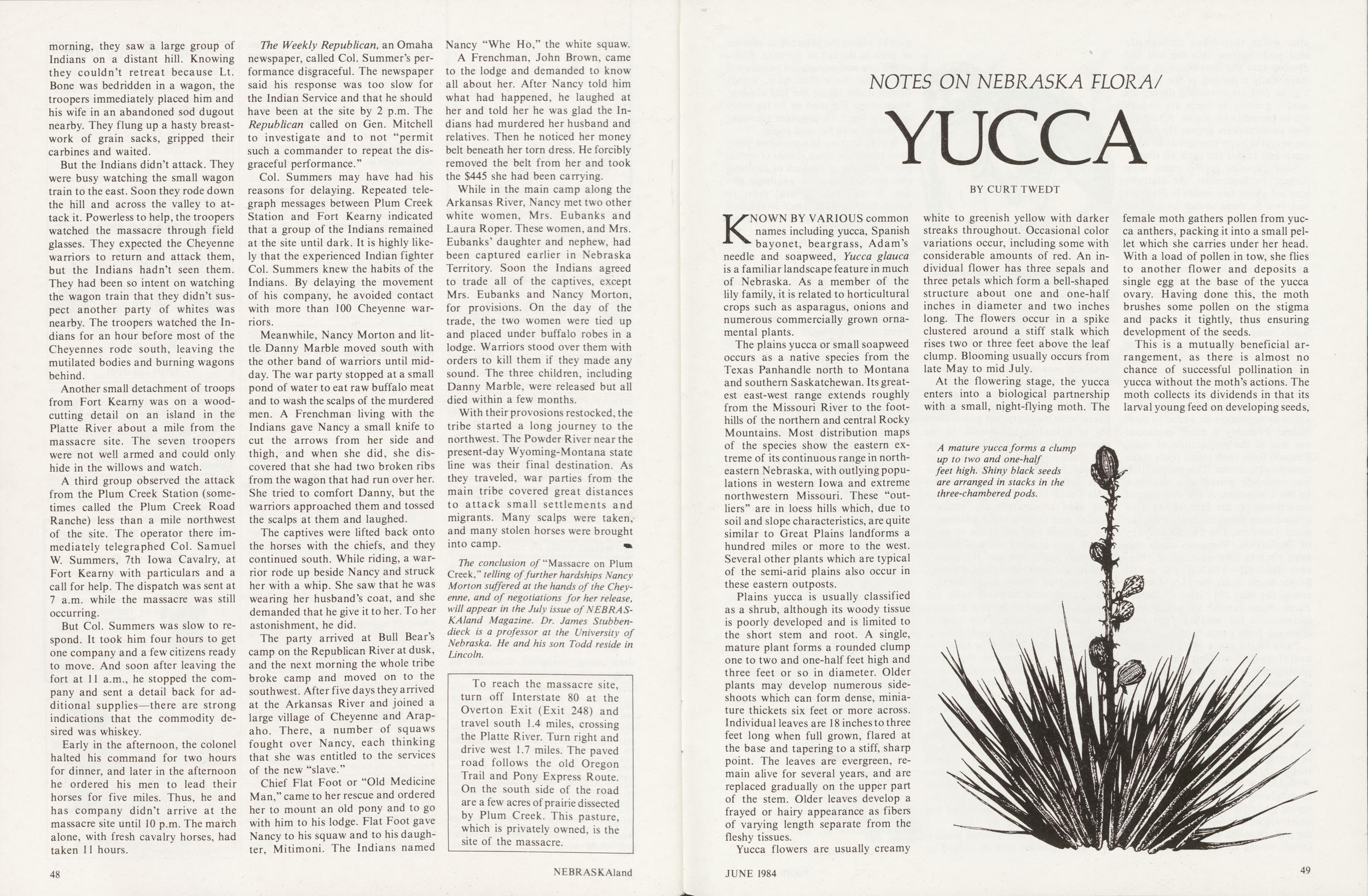
morning, they saw a large group of Indians on a distant hill. Knowing they couldn't retreat because Lt. Bone was bedridden in a wagon, the troopers immediately placed him and his wife in an abandoned sod dugout nearby. They flung up a hasty breastwork of grain sacks, gripped their carbines and waited.
But the Indians didn't attack. They were busy watching the small wagon train to the east. Soon they rode down the hill and across the valley to attack it. Powerless to help, the troopers watched the massacre through field glasses. They expected the Cheyenne warriors to return and attack them, but the Indians hadn't seen them. They had been so intent on watching the wagon train that they didn't suspect another party of whites was nearby. The troopers watched the Indians for an hour before most of the Cheyennes rode south, leaving the mutilated bodies and burning wagons behind.
Another small detachment of troops from Fort Kearny was on a woodcutting detail on an island in the Platte River about a mile from the massacre site. The seven troopers were not well armed and could only hide in the willows and watch. A third group observed the attack from the Plum Creek Station (sometimes called the Plum Creek Road Ranche) less than a mile northwest of the site. The operator there immediately telegraphed Col. Samuel W. Summers, 7th Iowa Cavalry, at Fort Kearny with particulars and a call for help. The dispatch was sent at 7 a.m. while the massacre was still occurring.
But Col. Summers was slow to respond. It took him four hours to get one company and a few citizens ready to move. And soon after leaving the fort at 11 a.m., he stopped the company and sent a detail back for additional supplies—there are strong indications that the commodity desired was whiskey.
Early in the afternoon, the colonel halted his command for two hours for dinner, and later in the afternoon he ordered his men to lead their horses for five miles. Thus, he and has company didn't arrive at the massacre site until 10 p.m. The march alone, with fresh cavalry horses, had taken 11 hours.
The Weekly Republican, an Omaha newspaper, called Col. Summer's performance disgraceful. The newspaper said his response was too slow for the Indian Service and that he should have been at the site by 2 p.m. The Republican called on Gen. Mitchell to investigate and to not "permit such a commander to repeat the disgraceful performance."
Col. Summers may have had his reasons for delaying. Repeated telegraph messages between Plum Creek Station and Fort Kearny indicated that a group of the Indians remained at the site until dark. It is highly likely that the experienced Indian fighter Col. Summers knew the habits of the Indians. By delaying the movement of his company, he avoided contact with more than 100 Cheyenne warriors.
Meanwhile, Nancy Morton and little Danny Marble moved south with the other band of warriors until midday. The war party stopped at a small pond of water to eat raw buffalo meat and to wash the scalps of the murdered men. A Frenchman living with the Indians gave Nancy a small knife to cut the arrows from her side and thigh, and when she did, she discovered that she had two broken ribs from the wagon that had run over her. She tried to comfort Danny, but the warriors approached them and tossed the scalps at them and laughed.
The captives were lifted back onto the horses with the chiefs, and they continued south. While riding, a warrior rode up beside Nancy and struck her with a whip. She saw that he was wearing her husband's coat, and she demanded that he give it to her. To her astonishment, he did.
The party arrived at Bull Bear's camp on the Republican River at dusk, and the next morning the whole tribe broke camp and moved on to the southwest. After five days they arrived at the Arkansas River and joined a large village of Cheyenne and Arapaho. There, a number of squaws fought over Nancy, each thinking that she was entitled to the services of the new "slave."
Chief Flat Foot or "Old Medicine Man," came to her rescue and ordered her to mount an old pony and to go with him to his lodge. Flat Foot gave Nancy to his squaw and to his daughter, Mitimoni. The Indians named Nancy "Whe Ho," the white squaw.
A Frenchman, John Brown, came to the lodge and demanded to know all about her. After Nancy told him what had happened, he laughed at her and told her he was glad the Indians had murdered her husband and relatives. Then he noticed her money belt beneath her torn dress. He forcibly removed the belt from her and took the $445 she had been carrying.
While in the main camp along the Arkansas River, Nancy met two other white women, Mrs. Eubanks and Laura Roper. These women, and Mrs. Eubanks' daughter and nephew, had been captured earlier in Nebraska Territory. Soon the Indians agreed to trade all of the captives, except Mrs. Eubanks and Nancy Morton, for provisions. On the day of the trade, the two women were tied up and placed under buffalo robes in a lodge. Warriors stood over them with orders to kill them if they made any sound. The three children, including Danny Marble, were released but all died within a few months.
With their provosions restocked, the tribe started a long journey to the northwest. The Powder River near the present-day Wyoming-Montana state line was their final destination. As they traveled, war parties from the main tribe covered great distances to attack small settlements and migrants. Many scalps were taken, and many stolen horses were brought into camp.
The conclusion of "Massacre on Plum Creek," telling of further hardships Nancy Morton suffered at the hands of the Cheyenne, and of negotiations for her release, will appear in the July issue of NEBRASKAland Magazine. Dr. James Stubbendieck is a professor at the University of Nebraska. He and his son Todd reside in Lincoln. To reach the massacre site, turn off Interstate 80 at the Overton Exit (Exit 248) and travel south 1.4 miles, crossing the Platte River. Turn right and drive west 1.7 miles. The paved road follows the old Oregon Trail and Pony Express Route. On the south side of the road are a few acres of prairie dissected by Plum Creek. This pasture, which is privately owned, is the site of the massacre. 48 NEBRASKAlandNOTES ON NEBRASKA FLORA/ YUCCA
BY CURT TWEDTKNOWN BY VARIOUS common names including yucca, Spanish bayonet, beargrass, Adam's needle and soapweed, Yucca glauca is a familiar landscape feature in much of Nebraska. As a member of the lily family, it is related to horticultural crops such as asparagus, onions and numerous commercially grown ornamental plants.
The plains yucca or small soapweed occurs as a native species from the Texas Panhandle north to Montana and southern Saskatchewan. Its greatest east-west range extends roughly from the Missouri River to the foothills of the northern and central Rocky Mountains. Most distribution maps of the species show the eastern extreme of its continuous range in northeastern Nebraska, with outlying populations in western Iowa and extreme northwestern Missouri. These "outliers" are in loess hills which, due to soil and slope characteristics, are quite similar to Great Plains landforms a hundred miles or more to the west. Several other plants which are typical of the semi-arid plains also occur in these eastern outposts.
Plains yucca is usually classified as a shrub, although its woody tissue is poorly developed and is limited to the short stem and root. A single, mature plant forms a rounded clump one to two and one-half feet high and three feet or so in diameter. Older plants may develop numerous side-shoots which can form dense, miniature thickets six feet or more across. Individual leaves are 18 inches to three feet long when full grown, flared at the base and tapering to a stiff, sharp point. The leaves are evergreen, remain alive for several years, and are replaced gradually on the upper part of the stem. Older leaves develop a frayed or hairy appearance as fibers of varying length separate from the fleshy tissues.
Yucca flowers are usually creamy white to greenish yellow with darker streaks throughout. Occasional color variations occur, including some with considerable amounts of red. An individual flower has three sepals and three petals which form a bell-shaped structure about one and one-half inches in diameter and two inches long. The flowers occur in a spike clustered around a stiff stalk which rises two or three feet above the leaf clump. Blooming usually occurs from late May to mid July.
A mature yucca forms a clump up to two and one-half feet high. Shiny black seeds are arranged in stacks in the three-chambered pods.
This is a mutually beneficial arrangement, as there is almost no chance of successful pollination in yucca without the moth's actions. The moth collects its dividends in that its larval young feed on developing seeds,
JUNE 1984 49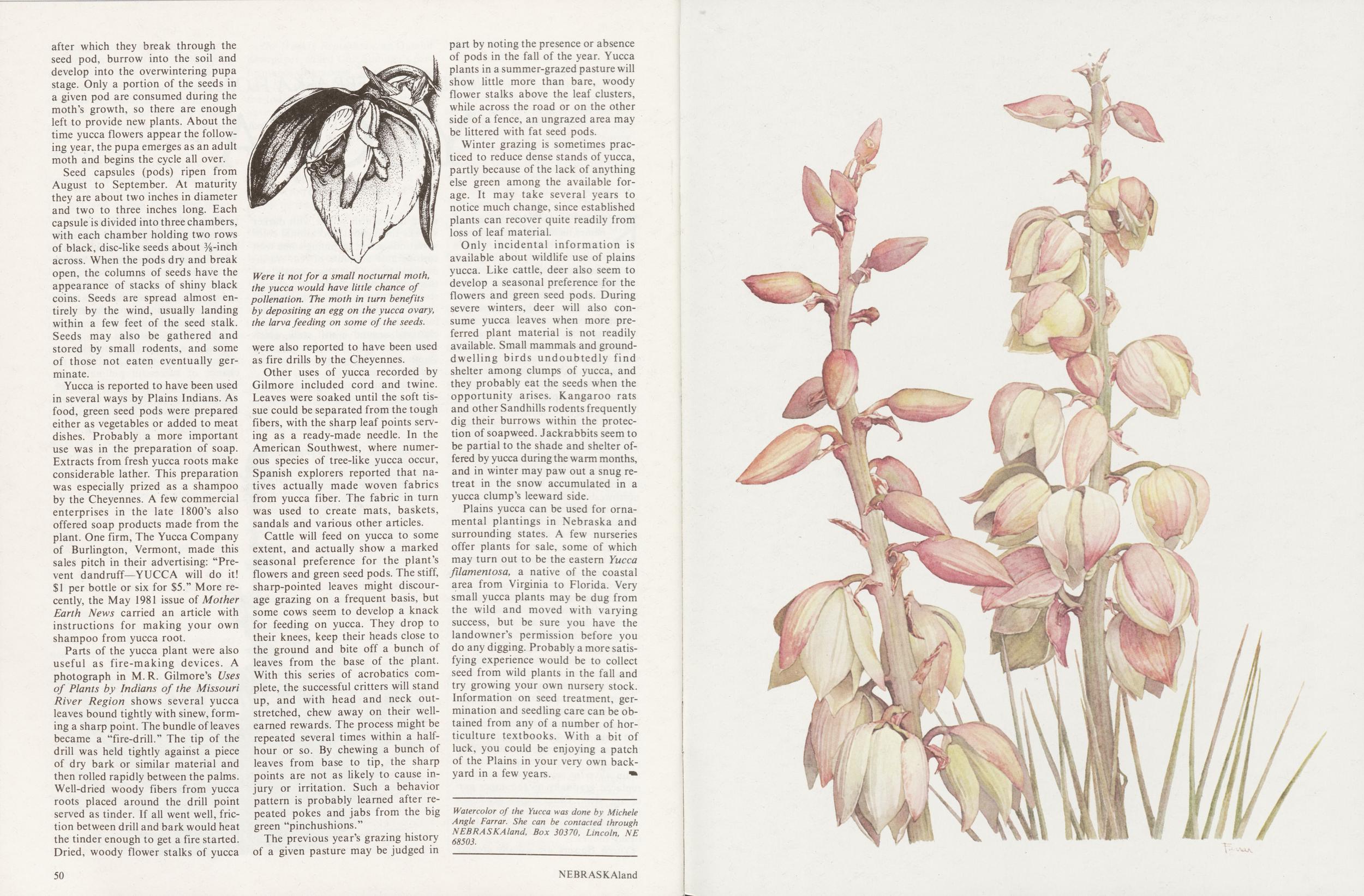
after which they break through the seed pod, burrow into the soil and develop into the overwintering pupa stage. Only a portion of the seeds in a given pod are consumed during the moth's growth, so there are enough left to provide new plants. About the time yucca flowers appear the following year, the pupa emerges as an adult moth and begins the cycle all over.
Seed capsules (pods) ripen from August to September. At maturity they are about two inches in diameter and two to three inches long. Each capsule is divided into three chambers, with each chamber holding two rows of black, disc-like seeds about 3/8-inch across. When the pods dry and break open, the columns of seeds have the appearance of stacks of shiny black coins. Seeds are spread almost entirely by the wind, usually landing within a few feet of the seed stalk. Seeds may also be gathered and stored by small rodents, and some of those not eaten eventually germinate.
Yucca is reported to have been used in several ways by Plains Indians. As food, green seed pods were prepared either as vegetables or added to meat dishes. Probably a more important use was in the preparation of soap. Extracts from fresh yucca roots make considerable lather. This preparation was especially prized as a shampoo by the Cheyennes. A few commercial enterprises in the late 1800's also offered soap products made from the plant. One firm, The Yucca Company of Burlington, Vermont, made this sales pitch in their advertising: "Prevent dandruff—YUCCA will do it! $1 per bottle or six for $5." More recently, the May 1981 issue of Mother Earth News carried an article with instructions for making your own shampoo from yucca root.
Parts of the yucca plant were also useful as fire-making devices. A photograph in M.R. Gilmore's Uses of Plants by Indians of the Missouri River Region shows several yucca leaves bound tightly with sinew, forming a sharp point. The bundle of leaves became a "fire-drill." The tip of the drill was held tightly against a piece of dry bark or similar material and then rolled rapidly between the palms. Well-dried woody fibers from yucca roots placed around the drill point served as tinder. If all went well, friction between drill and bark would heat the tinder enough to get a fire started. Dried, woody flower stalks of yucca
Were it not for a small nocturnal moth, the yucca would have little chance of pollenation. The moth in turn benefits by depositing an egg on the yucca ovary, the larva feeding on some of the seeds.
were also reported to have been used as fire drills by the Cheyennes.
Other uses of yucca recorded by Gilmore included cord and twine. Leaves were soaked until the soft tissue could be separated from the tough fibers, with the sharp leaf points serving as a ready-made needle. In the American Southwest, where numerous species of tree-like yucca occur, Spanish explorers reported that natives actually made woven fabrics from yucca fiber. The fabric in turn was used to create mats, baskets, sandals and various other articles.
Cattle will feed on yucca to some extent, and actually show a marked seasonal preference for the plant's flowers and green seed pods. The stiff, sharp-pointed leaves might discourage grazing on a frequent basis, but some cows seem to develop a knack for feeding on yucca. They drop to their knees, keep their heads close to the ground and bite off a bunch of leaves from the base of the plant. With this series of acrobatics complete, the successful critters will stand up, and with head and neck outstretched, chew away on their well-earned rewards. The process might be repeated several times within a half-hour or so. By chewing a bunch of leaves from base to tip, the sharp points are not as likely to cause injury or irritation. Such a behavior pattern is probably learned after repeated pokes and jabs from the big green "pinchushions."
The previous year's grazing history of a given pasture may be judged in part by noting the presence or absence of pods in the fall of the year. Yucca plants in a summer-grazed pasture will show little more than bare, woody flower stalks above the leaf clusters, while across the road or on the other side of a fence, an ungrazed area may be littered with fat seed pods.
Winter grazing is sometimes practiced to reduce dense stands of yucca, partly because of the lack of anything else green among the available forage. It may take several years to notice much change, since established plants can recover quite readily from loss of leaf material.
Only incidental information is available about wildlife use of plains yucca. Like cattle, deer also seem to develop a seasonal preference for the flowers and green seed pods. During severe winters, deer will also consume yucca leaves when more pre-ferred plant material is not readily available. Small mammals and ground-dwelling birds undoubtedly find shelter among clumps of yucca, and they probably eat the seeds when the opportunity arises. Kangaroo rats and other Sandhills rodents frequently dig their burrows within the protection of soapweed. Jackrabbits seem to be partial to the shade and shelter offered by yucca during the warm months, and in winter may paw out a snug retreat in the snow accumulated in a yucca clump's leeward side.
Plains yucca can be used for ornamental plantings in Nebraska and surrounding states. A few nurseries offer plants for sale, some of which may turn out to be the eastern Yucca filamentosa, a native of the coastal area from Virginia to Florida. Very small yucca plants may be dug from the wild and moved with varying success, but be sure you have the landowner's permission before you do any digging. Probably a more satisfying experience would be to collect seed from wild plants in the fall and try growing your own nursery stock. Information on seed treatment, germination and seedling care can be obtained from any of a number of horticulture textbooks. With a bit of luck, you could be enjoying a patch of the Plains in your very own backyard in a few years.
Watercolor of the Yucca was done by Michele Angle Farrar. She can be contacted through NEBRASKAland, Box 30370, Lincoln, NE 68503. 50 NEBRASKAland
Get Hooked on Fishing
Fishing is something that can be tailored to each person's individual desires, and Nebraska has it all. Start enjoying the fun, beauty, relaxation and excitement of this great sport!
Position: 541 (20 views)