Volume 62, Issue 4, 1984
Special Fishing Issue NEBRASKAland
May 1984 $1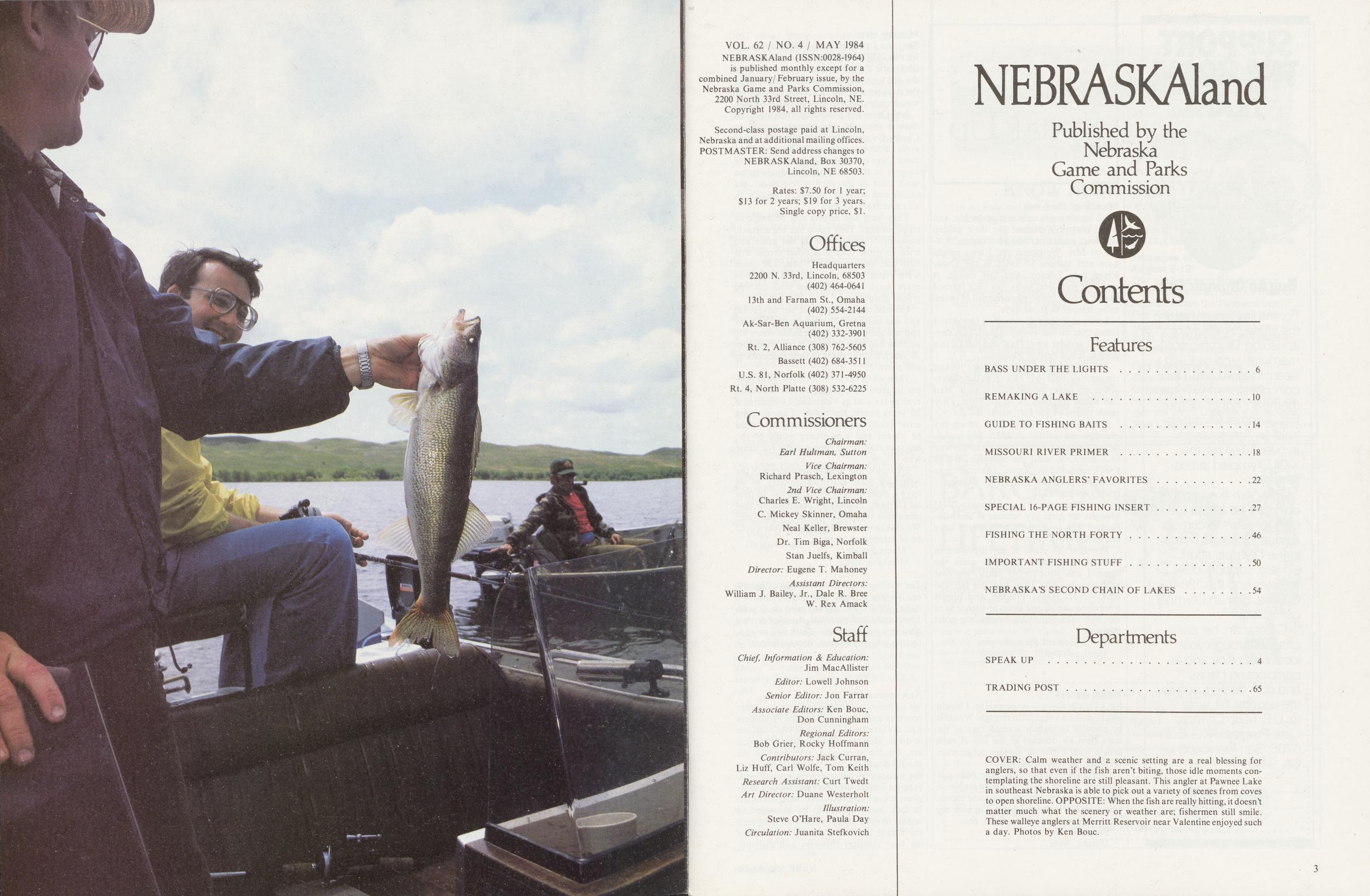
NEBRASKAland
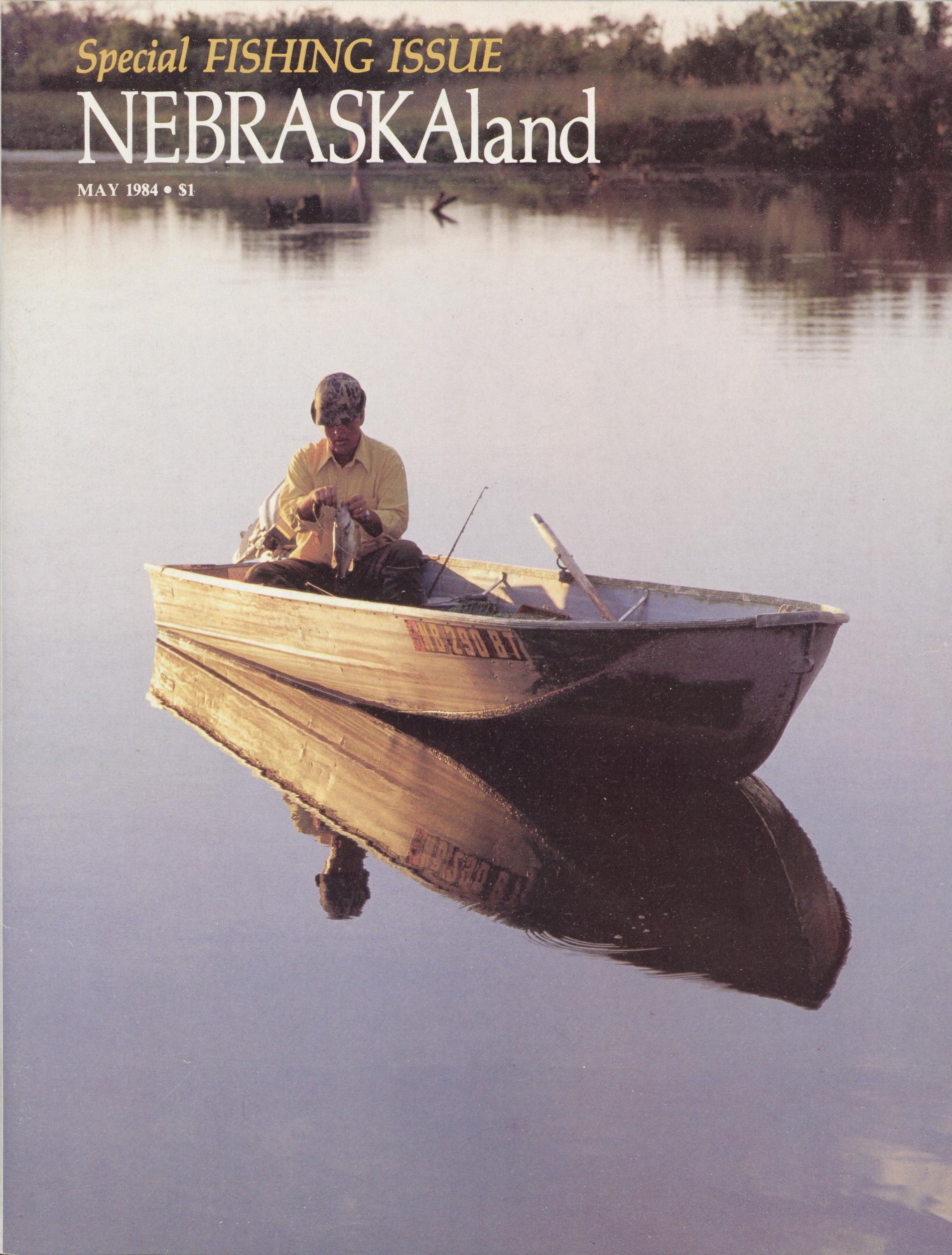
Published by the Nebraska Game and Parks Commission VOL. 62 / NO. 4 / MAY 1984 NEBRASKAland (ISSN:0028-1964) is published monthly except for a combined January/ February issue, by the Nebraska Game and Parks Commission, 2200 North 33rd Street, Lincoln, NE. Copyright 1984, all rights reserved. Second-class postage paid at Lincoln, Nebraska and at additional mailing offices. POSTMASTER: Send address changes to NEBRASKAland, Box 30370, Lincoln, NE 68503. Rates: $7.50 for 1 year; $13 for 2 years; $19 for 3 years. Single copy price, $1. Offices Headquarters 2200 N. 33rd, Lincoln, 68503 (402) 464-0641 13th and Farnam St., Omaha (402) 554-2144 Ak-Sar-Ben Aquarium, Gretna (402) 332-3901 Rt. 2, Alliance (308) 762-5605 Bassett (402)684-3511 U.S. 81, Norfolk (402) 371-4950 Rt. 4, North Platte (308) 532-6225 Commissioners Chairman: Earl Hultman, Sutton Vice Chairman: Richard Prasch, Lexington 2nd Vice Chairman: Charles E. Wright, Lincoln C. Mickey Skinner, Omaha Neal Keller, Brewster Dr. Tim Biga, Norfolk Stan Juelfs, Kimball Director: Eugene T. Ma honey Assistant Directors: William J. Bailey, Jr., Dale R. Bree W. Rex Amack Staff Chief, Information & Education: Jim MacAllister Editor: Lowell Johnson Senior Editor: Jon Farrar Associate Editors: Ken Bouc, Don Cunningham Regional Editors: Bob Grier, Rocky Hoffmann Contributors: Jack Curran, Liz Huff, Carl Wolfe, Tom Keith Research Assistant: Curt Twedt Art Director: Duane Westerholt Illustration: Steve O'Hare, Paula Day Circulation: Juanita Stefkovich Contents Features BASS UNDER THE LIGHTS 6 REMAKING A LAKE 10 GUIDE TO FISHING BAITS 14 MISSOURI RIVER PRIMER 18 NEBRASKA ANGLERS'FAVORITES 22 SPECIAL 16-PAGE FISHING INSERT 27 FISHING THE NORTH FORTY 46 IMPORTANT FISHING STUFF 50 NEBRASKA'S SECOND CHAIN OF LAKES 54 Departments SPEAK UP 4 TRADING POST 65 COVER: Calm weather and a scenic setting are a real blessing for anglers, so that even if the fish aren't biting, those idle moments contemplating the shoreline are still pleasant. This angler at Pawnee Lake in southeast Nebraska is able to pick out a variety of scenes from coves to open shoreline. OPPOSITE: When the fish are really hitting, it doesn't matter much what the scenery or weather are; fishermen still smile. These walleye anglers at Merritt Reservoir near Valentine enjoyed such a day. Photos by Ken Bouc. 3
SUPPORT THE HOME TEAM.
Buy An Olympic Coin.For the first time in history, the United States Mint is issuing Olympic commemorativecoins. Each beautiful gold and silver coin depicts an Olympic theme in honor of the first Summer Olympics held on American soil in over 50 years, the XXIII Olympiad in Los Angeles.
The gem-like, proof coins will be a treasure to own for years to come And all profits go directly to the Olympic effort. Help support our athletes and the 1984 Games. Buy an Olympic coin today.
Coins can be purchased through your local post office and at participating banks and coin dealers across the country. Or, write to: U.S. Mint, Olympic Coin Program, RQ Box 6766, San Francisco, CA 94101.
LA. Olympic Organizing CommitteeSpeak Up
"Paddling" the LoupSir / I gave a gift subscription to Mr. and Mrs. Wayne Wettstead for their golden wedding, and hope they get a copy of Rivers, as Mrs. Wettstead and I were neighbors and learned to swim in the Cedar River near Ericson. For this reason, it means a great deal to us. We only learned to dog paddle, for no one dreamed of swimming lessons in those days.
I was at Ericson last year in October. I heard that no one swims in the Cedar anymore. I wonder why? I still dog paddle in a pool at a spa here in Portland.
Lake Ericson and the spillway looked the same as it did in 1919, except the powerhouse my father helped build is gone. Men fish below the dam as we did then. They catch minnows for bait where we did.
I also lived at Loup City, where my grandparents settled in 1885. My grandfather freighted goods from Grand Island to Loup City, until the railroads, B&M and Union Pacific, came. Later, he was sheriff of Sherman County for 19 years—from 1904 to 1923.
Your Bicentennial issue [January 1976] brought me great joy because of the wildflowers. The spiderwort especially; I have one in my front yard.
The first 20 years of my life were in Nebraska—no other place is quite the same. I was gone for 43 years—my first visit was in 1969. Then and this fall, the many trees, lakes, wildlife, and places where one can sit and listen to silence as in the Nebraska Sandhills, brings one great pleasure.
Doris Howard Pierson Portland, Ore. Where are we?Sir / I really enjoy your magazine. I would like to make a suggestion though. Would it be possible to include a small map of the state (just an outline) at the top of each article with a star or similar designation marking the site, town, etc.
I grew up on a farm out near Alda and consider myself fairly knowledgeable of Nebraska towns, but the Swanson Reservoir and Elyria stumped me. I'm sure my idea might be helpful to others, too.
Sandy Wynn Omaha, Nebr. Planting errorSir / As a transplanted Nebraskan (came here in 1950), I still have roots in that beautiful state. Your magazine is a link between the life here and the pleasant memories of the days we spent in Nebraska. You have a wonderful magazine. It covers all the bases.
I was born in Kansas, but when I was less than a year old, my parents moved to Cherry County. They homesteaded on 640 acres about two miles east of Newton. They came there in wagons. There were 10 or 12 wagons in the train. My grandparents on both sides of the family, five aunts, six uncles and some of the folks's neighbors, all came from Kansas.
They built sod houses and burned cow chips for heat. They made one big mistake, however. They plowed up the grass and tried to grow corn and other crops. The first year or two weren't bad. The crops were pretty good, but then the supply of plant food was exhausted and nothing would grow.
I visited the old homesite last fall (1982) and was saddened by what I saw. The grass had not grown back in the fields where my parents had tried to farm. It had been over 70 years, and the mark of their mistake was still there.
Then when I saw the attempt of the people to grow corn in these same sandhills, even as far west as Valentine, I wondered if 70 years hence, the mark of another big error would be visible and the grass would be absent and sand dunes would be the heritage that these people leave for those who follow.
We would like to have the address of the Nebraska State Historical Society, as we have a contribution we would like to pass on to them. Is there an organization that researches the Lewis and Clark expedition? We also have some information that would be of interest to them.
Albert Frazey Gresham, Ore. The mailing address for the State Historical Society is P.O. Box 82554, Lincoln, Nebr. 68501. The society also deals with Lewis and Clark material. Another project dealing with Lewis and Clark will be contacting you in the near future. (Editor) New approach?Sir / I know you continually stress hunter courtesy and the ill will created by hunters who are litterbugs, and I hope you continue to do so. However, I've concluded that you are, for the most part, preaching to the choir. I doubt that many of the litterbugs or the obnoxious idiots driving around with vehicles loaded with beer and loaded shotguns, are subscribers to NEBRASKAland. In fact, many appear to be illiterate and unable to read. Has anyone connected with the Game Commission ever approached the beer industry (brewers and distributors)
4 NEBRASKAlandabout the possibility of a "hunter courtesy" line in some of their TV spots just before and during upland bird seasons? It might be worth a try. I know TV time is expensive, but all those Budweiser, Olympia, Hamms, Coors, Pabst and other cans littering the roadsides and the fields certainly do not create good will toward the makers nor the distributors of the beverage. Even the illiterates might get the message if they saw and heard it on TV.
Russell E. Klinginsmith San Antonio, Texas Smaller steelSir / I noticed in the March Speak Up an article on anti-steel from a gentleman from Hastings. Reference was made to the fact that none of the manufacturers of shotgun shells had developed a shot size smaller than No. 4 steel.
I am enclosing a 1984 Federal Cartridge catalog which has introduced a No. 6 shot size, both in 12 and 20 gauge, in the hi-power category. We are a hardware and sporting goods distributor covering several states including Nebraska, and this is being offered to sporting goods dealers for the upcoming season.
Mike Korth Hastings, Nebr. A masterpieceSir / Congratulations on "First Voices!" You have truly created a masterpiece of Indian history. I can think of no better presentation since Oliver LaFarge's Pictorial History of the American Indian. This is one issue of NEBRASKAland that will not be thrown away. Cheers!
Virgil R. Thomsen Charlestown, N.H. Whoop it upSir / Three big Indian war whoops, a couple of shots from the guns used at that time and perhaps a good stiff drink of "fire-water" to settle the dust, in recognition of the marvelous job well done and my congratulations to all who made "The First Voices" a reality, that appeared in the 1984 January-February issue of NEBRASKAland.
L. D. Fairbairn (retired) U.S. Dept. Interior Bureau Indian Affairs Indian Field Service Hemet, Calif. NEBRASKAland Magazine invites all readers to submit their comments, suggestions, and gripes to Speak Up. Each month the magazine will publish as many letters as space permits. Pictures are also welcome. NEBRASKAland does reserve the right to edit and condense letters. (Editor)
BASS UNDER THE LIGHTS
PHOTOS AND TEXT BY KEN BOUC Harlan Reservoir's white bass respond to bright lights and patient fishermen.IF YOU WERE a farmer who had just finished a dawn-to-dusk day of moving irrigation pipe, and more of the same was on tap for tomorrow, what would you do for relaxation come nightfall? Why not go fishing until 3 or 4 a.m.? That's what Larry Post of Naponee does.
At least, that's what he was doing a good many evenings last summer. His crops demanded attention those hot, dry days, but Harlan County Reservoir's white bass beckoned at night, and he apparently couldn't ignore either. Many a warm, windless, bug-filled summer evening found him, his wife Terri, and his cousin Tracy, out on the lake rigged and ready for fishing.
The locals call that particular brand of white bassing "lantern fishing," and it's easy to see why. The main ingredient is light, and lots of it; usually produced by a battery of gas lanterns hanging over the side of the boat. The idea is to illuminate an area around the boat to attract fish. The technique works, there's no doubt about that. But why it works is a matter of conjecture. Some say that the light attracts insects, which in turn attract baitfish, and the baitfish draw the white bass. Another theory says that the light excites plankton in the water, and that attracts the baitfish, which then attract the bass. Under this latter scenario, the bugs play no role except to impose a penance on the fishermen. But however it works, lantern fishing is one of the better ways to load a cooler with fish, and have a good time in the bargain.
With the sun dropping toward the horizon, the Posts loaded their big, roomy inboard/ outboard with tackle, bait, refreshments and fuel at the Patterson Harbor dock. Then, they motored out onto the lake and turned east toward the dam, where they rendezvoused with Don Lewton and his son Stacey. Don operates "The Island," a combination bait shop, gas station and sandwich and refreshments emporium in Republican City.
Larry and Don had agreed to meet near the dam to try one of Don's favorite spots, which was marked by one special rock that he claimed to recognize among the millions of others that line the structure. Of course, if anyone could pick out a special rock on the dam, or find a certain dropoff under 30 feet of water, or predict where the ducks would fly on a stormy morning, it would be Don. It seems that he spends just about all his free time fishing or hunting in the area, and passes his working time at "The Island" swapping fishing and hunting yarns with friends and customers.
They soon pinpointed Don's hot-spot, a dropoff in about 20 feet of water. But, the area was too exposed to the south wind to fish comfortably, so they decided to head up the lake to a spot where a pipeline enters and crosses under the lake. The calm, windless expanse of water needed for successful lantern fishing would be found leeward of the high bluffs that formed the south shoreline at that point.
With perhaps 30 minutes of sunlight left, Don and Larry throttled down as the pipeline hove into view. With depth finder humming, Don cruised the area in wide circles until he suddenly cranked the wheel tightly right, then left, making pretzel-like patterns in a small area. "This is what we're looking for," he said. "There's a drop-off below us in about 25 feet of water—just what the doctor ordered for lantern fishing."
Larry pulled up to the spot indicated and began making preparations.
The first order of business was to toss the anchors overboard—one off the bow and another at the stern. Each was a big, stout affair with a coffee can full of cement attached to increase its holding power. "That's why I bring him along,'1 Larry quipped good-naturedly, as his burly cousin set about the task. "About all he's good for is handling the anchors."
As Tracy secured the boat, Terri began setting out fishing rods and tackle, while Larry began readying lanterns. In the meantime, Don pulled his boat to within a few yards of Larry's port (for all you landlubbers, that means "left") side, anchored, and began similar preparations. There was no hurry. The sun was just setting, and the lanterns would not have much effect until dark.
While everyone fussed with fishing rods, lanterns and other gear, Don shared some of his considerable knowledge about lantern fishing. "The end of June through the end of August is usually lantern fishing time at Harlan. The new crop of shad is small then, and they must hang out in water like this, because that's where you'll find the bass. A ledge or dropoff in 20 to 25 feet of water is ideal.
"Once you find a place like that, it's best to stay put. If there are fish anywhere around, the light should draw them to the boat. It's important to use a good anchor at each end of the boat so that you can keep it positioned in the same spot as much as possible. After all, you're trying to focus all of the baitfish activity and game fish around your boat with those lights, but if your boat drifts around much, you'll keep moving away from them," he continued.
The more light you use in lantern fishing, the better you'll do, according to Don. "When lantern fishing was brought up here from Kansas, everyone just hung a plain white-gas lantern or two over the side. Since then, they've come up with sealed-beam headlights that ride on the water in plastic floats and run off car batteries in the boat, and they work real well.
6 NEBRASKAland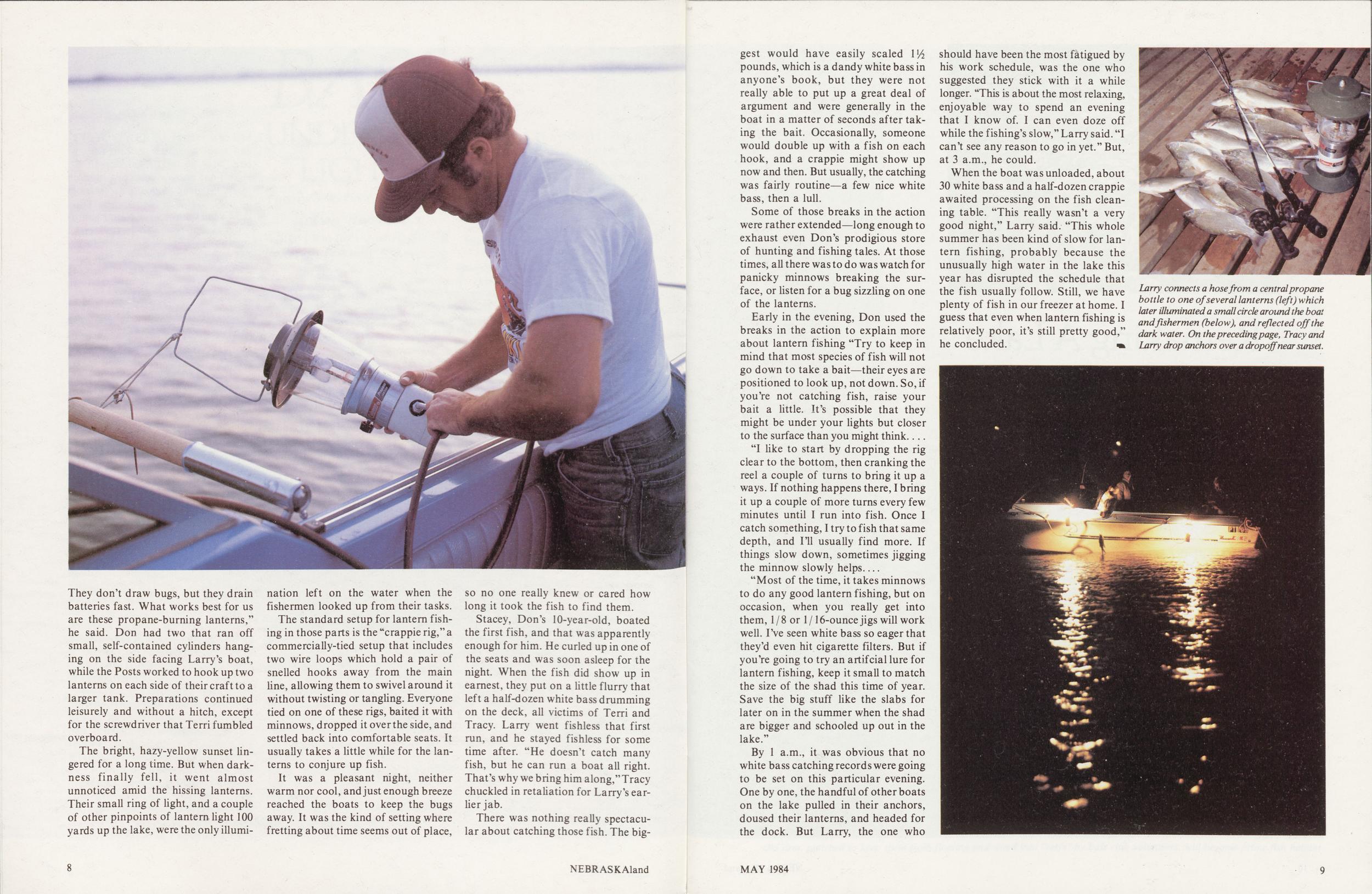
They don't draw bugs, but they drain batteries fast. What works best for us are these propane-burning lanterns," he said. Don had two that ran off small, self-contained cylinders hanging on the side facing Larry's boat, while the Posts worked to hook up two lanterns on each side of their craft to a larger tank. Preparations continued leisurely and without a hitch, except for the screwdriver that Terri fumbled overboard.
The bright, hazy-yellow sunset lingered for a long time. But when darkness finally fell, it went almost unnoticed amid the hissing lanterns. Their small ring of light, and a couple of other pinpoints of lantern light 100 yards up the lake, were the only illumination left on the water when the fishermen looked up from their tasks.
The standard setup for lantern fishing in those parts is the "crappie rig," a commercially-tied setup that includes two wire loops which hold a pair of snelled hooks away from the main line, allowing them to swivel around it without twisting or tangling. Everyone tied on one of these rigs, baited it with minnows, dropped it overthe side, and settled back into comfortable seats. It usually takes a little while for the lanterns to conjure up fish.
It was a pleasant night, neither warm nor cool, and just enough breeze reached the boats to keep the bugs away. It was the kind of setting where fretting about time seems out of place, so no one really knew or cared how long it took the fish to find them.
Stacey, Don's 10-year-old, boated the first fish, and that was apparently enough for him. He curled up in one of the seats and was soon asleep for the night. When the fish did show up in earnest, they put on a little flurry that left a half-dozen white bass drumming on the deck, all victims of Terri and Tracy. Larry went fishless that first run, and he stayed fishless for some time after. "He doesn't catch many fish, but he can run a boat all right. That's why we bring him along,"Tracy chuckled in retaliation for Larry's earlier jab.
There was nothing really spectacular about catching those fish. The biggest
8 NEBRASKAlandwould have easily scaled 1 1/2 pounds, which is a dandy white bass in anyone's book, but they were not really able to put up a great deal of argument and were generally in the boat in a matter of seconds after taking the bait. Occasionally, someone would double up with a fish on each hook, and a crappie might show up now and then. But usually, the catching was fairly routine—a few nice white bass, then a lull.
Some of those breaks in the action were rather extended—long enough to exhaust even Don's prodigious store of hunting and fishing tales. At those times, all there was to do was watch for panicky minnows breaking the surface, or listen for a bug sizzling on one of the lanterns.
Early in the evening, Don used the breaks in the action to explain more about lantern fishing "Try to keep in mind that most species of fish will not go down to take a bait—their eyes are positioned to look up, not down. So, if you're not catching fish, raise your bait a little. It's possible that they might be under your lights but closer to the surface than you might think....
"I like to start by dropping the rig clear to the bottom, then cranking the reel a couple of turns to bring it up a ways. If nothing happens there, I bring it up a couple of more turns every few minutes until I run into fish. Once I catch something, I try to fish that same depth, and I'll usually find more. If things slow down, sometimes jigging the minnow slowly helps....
"Most of the time, it takes minnows to do any good lantern fishing, but on occasion, when you really get into them, 1/8 or 1/16-ounce jigs will work well. I've seen white bass so eager that they'd even hit cigarette filters. But if you're going to try an artifcial lure for lantern fishing, keep it small to match the size of the shad this time of year. Save the big stuff like the slabs for later on in the summer when the shad are bigger and schooled up out in the lake."
By 1 a.m., it was obvious that no white bass catching records were going to be set on this particular evening. One by one, the handful of other boats on the lake pulled in their anchors, doused their lanterns, and headed for the dock. But Larry, the one who should have been the most fatigued by his work schedule, was the one who suggested they stick with it a while longer. "This is about the most relaxing, enjoyable way to spend an evening that I know of. I can even doze off while the fishing's slow," Larry said. "I can't see any reason to go in yet." But, at 3 a.m., he could.
When the boat was unloaded, about 30 white bass and a half-dozen crappie awaited processing on the fish cleaning table. "This really wasn't a very good night," Larry said. "This whole summer has been kind of slow for lantern fishing, probably because the unusually high water in the lake this year has disrupted the schedule that the fish usually follow. Still, we have plenty of fish in our freezer at home. I guess that even when lantern fishing is relatively poor, it's still pretty good," he concluded.
Remaking A Lake
BY DON CUNNINGHAM Removal of rough fish and habitat replacement will restore Burchard's reputation as a bass hotspot.LYING SERENELY in the rolling grasslands of west-central Pawnee County, a few miles northeast of the little town of Burchard, is Burchard Lake. It isn't exactly an inland sea—it has only about 150 surface acres—but since its creation in 1958-59, it has been a mecca for area fisherfolk, picnickers and nature lovers. Bass, channel catfish, crappies and other species kept the fishermen coming. During the waterfowl season, the lake, serving as a refuge, was alive with migrating ducks and geese, and at dawn on spring mornings, early risers were treated to the colorful display of prairie chickens dancing on their traditional booming grounds on the virgin prairie hills just west of the dam.
But, with the passage of time, fishermen began going home empty handed more often than they had in earlier years. Game and Parks Commission Fisheries Division population surveys confirmed the general suspicion: Burchard's fishery was not in good condition.
For several species—crappie, for example—the numbers were good, but quality was declining. There were large numbers of small crappies, some bass and channel cat, but in pounds of game fish per acre, the lake was well below its capability. From one of the state's best largemouth lakes in the 1960's, Burchard had declined to something decidedly second rate.
There were a number of problems: the voracious crappie were apparently out-competing the larger game fish for food. There had been large numbers of yellow bullheads—too great a population for the good of the lake—so in the early 1960's, flathead catfish, always partial to a tasty little bullhead, were introduced to help control them. But the carp population was also rising, no doubt introduced in periods of high water when other lakes in the watershed overflowed.
Rough fish, such as carp, increase a lake's turbidity so that sight feeders, such as largemouth, don't do as well as in clear water. It had become difficult to maintain a good-quality fishery for game species, and it was obvious something had to be done.
The opportunity to act came in 1982 when a large crack was discovered in
10 NEBRASKAlandOld tires, punched to keep them from floating and wired into "reefs" by bass club volunteers, will become prime fish habitat.
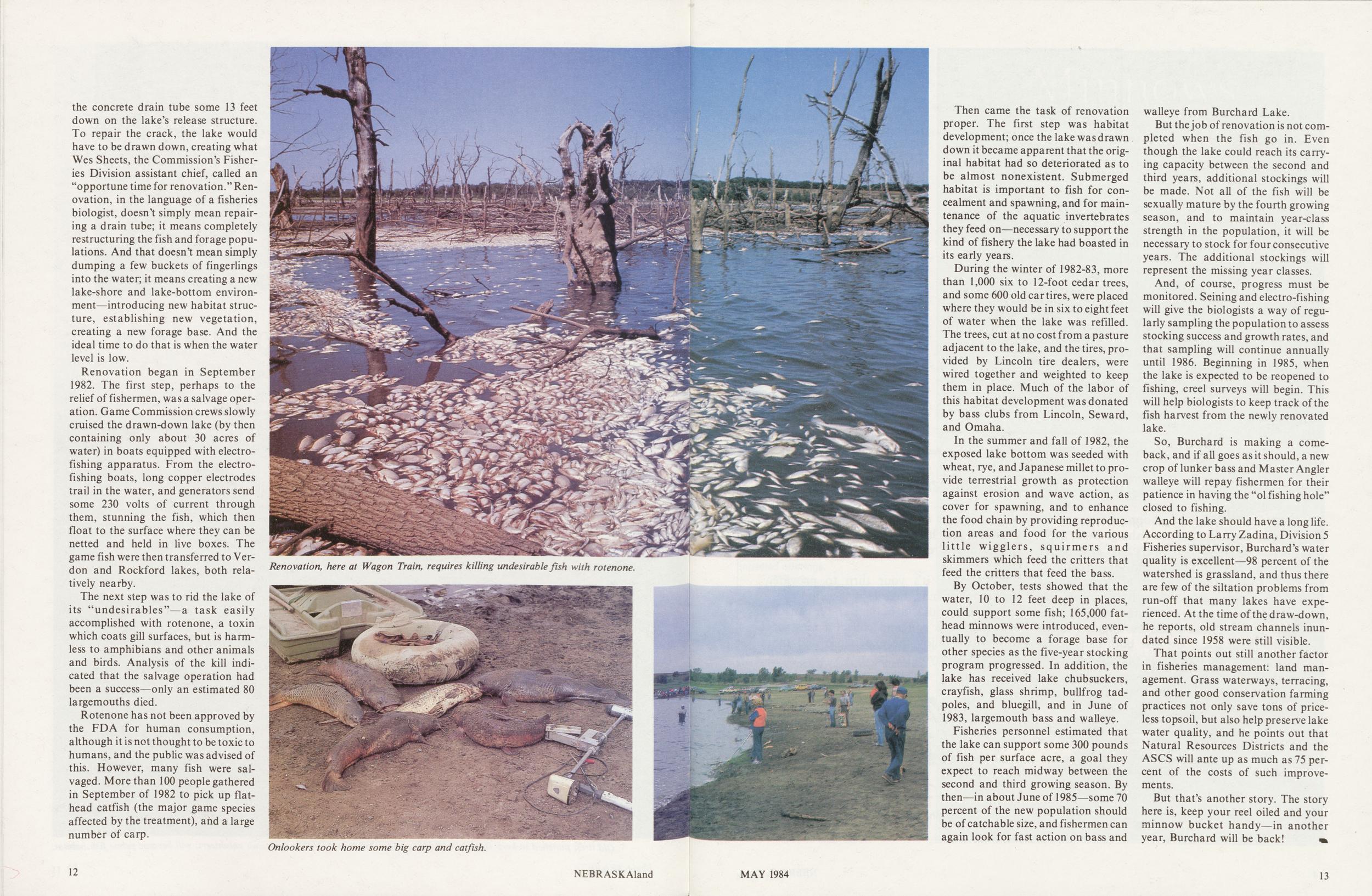
the concrete drain tube some 13 feet down on the lake's release structure. To repair the crack, the lake would have to be drawn down, creating what Wes Sheets, the Commission's Fisheries Division assistant chief, called an "opportune time for renovation." Renovation, in the language of a fisheries biologist, doesn't simply mean repairing a drain tube; it means completely restructuring the fish and forage populations. And that doesn't mean simply dumping a few buckets of fingerlings into the water; it means creating a new lake-shore and lake-bottom environment—introducing new habitat structure, establishing new vegetation, creating a new forage base. And the ideal time to do that is when the water level is low.
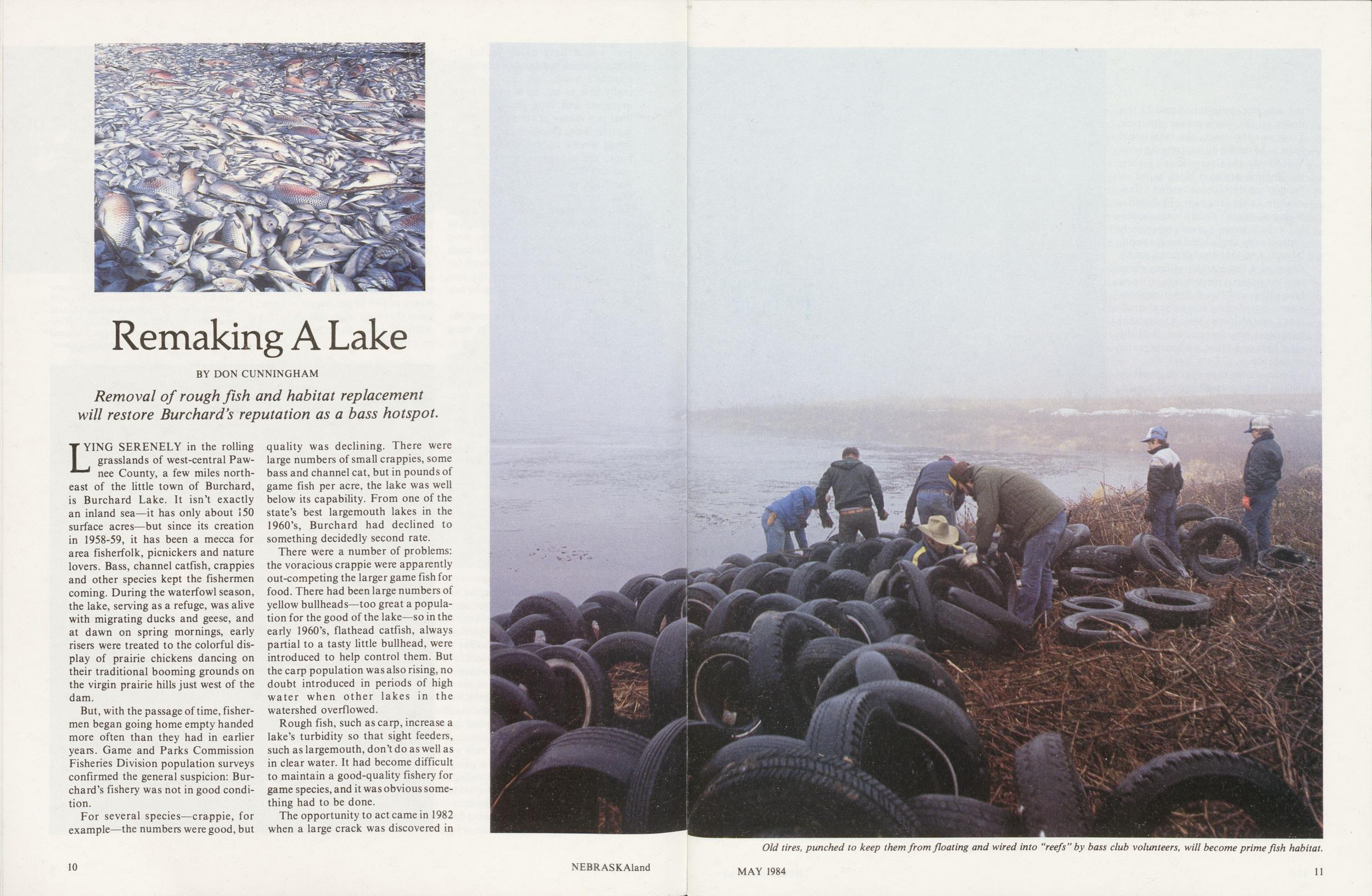
Renovation began in September 1982. The first step, perhaps to the relief of fishermen, was a salvage operation. Game Commission crews slowly cruised the drawn-down lake (by then containing only about 30 acres of water) in boats equipped with electro-fishing apparatus. From the electro-fishing boats, long copper electrodes trail in the water, and generators send some 230 volts of current through them, stunning the fish, which then float to the surface where they can be netted and held in live boxes. The game fish were then transferred to Verdon and Rockford lakes, both relatively nearby.
The next step was to rid the lake of its "undesirables"—a task easily accomplished with rotenone, a toxin which coats gill surfaces, but is harmless to amphibians and other animals and birds. Analysis of the kill indicated that the salvage operation had been a success—only an estimated 80 largemouths died.
Rotenone has not been approved by the FDA for human consumption, although it is not thought to be toxic to humans, and the public was advised of this. However, many fish were salvaged. More than 100 people gathered in September of 1982 to pick up flathead catfish (the major game species affected by the treatment), and a large number of carp.
Renovation, here at Wagon Train, requires killing undesirable fish with rotenone.
Onlookers took home some big carp and catfish.
Then came the task of renovation proper. The first step was habitat development; once the lake was drawn down it became apparent that the original habitat had so deteriorated as to be almost nonexistent. Submerged habitat is important to fish for concealment and spawning, and for maintenance of the aquatic invertebrates they feed on—necessary to support the kind of fishery the lake had boasted in its early years.
During the winter of 1982-83, more than 1,000 six to 12-foot cedar trees, and some 600 old car tires, were placed where they would be in six to eight feet of water when the lake was refilled. The trees, cut at no cost from a pasture adjacent to the lake, and the tires, provided by Lincoln tire dealers, were wired together and weighted to keep them in place. Much of the labor of this habitat development was donated by bass clubs from Lincoln, Seward, and Omaha.
In the summer and fall of 1982, the exposed lake bottom was seeded with wheat, rye, and Japanese millet to provide terrestrial growth as protection against erosion and wave action, as cover for spawning, and to enhance the food chain by providing reproduction areas and food for the various little wigglers, squirmers and skimmers which feed the critters that feed the critters that feed the bass.
By October, tests showed that the water, 10 to 12 feet deep in places, could support some fish; 165,000 fathead minnows were introduced, eventually to become a forage base for other species as the five-year stocking program progressed. In addition, the lake has received lake chub suckers, crayfish, glass shrimp, bullfrog tadpoles, and bluegill, and in June of 1983, largemouth bass and walleye.
Fisheries personnel estimated that the lake can support some 300 pounds of fish per surface acre, a goal they expect to reach midway between the second and third growing season. By then—in about June of 1985—some 70 percent of the new population should be of catchable size, and fishermen can again look for fast action on bass and walleye from Burchard Lake.
But the job of renovation is not completed when the fish go in. Even though the lake could reach its carrying capacity between the second and third years, additional stockings will be made. Not all of the fish will be sexually mature by the fourth growing season, and to maintain year-class strength in the population, it will be necessary to stock for four consecutive years. The additional stockings will represent the missing year classes.
And, of course, progress must be monitored. Seining and electro-fishing will give the biologists a way of regularly sampling the population to assess stocking success and growth rates, and that sampling will continue annually until 1986. Beginning in 1985, when the lake is expected to be reopened to fishing, creel surveys will begin. This will help biologists to keep track of the fish harvest from the newly renovated lake.
So, Burchard is making a come-back, and if all goes as it should, a new crop of lunker bass and Master Angler walleye will repay fishermen for their patience in having the "ol fishing hole" closed to fishing.
And the lake should have a long life. According to Larry Zadina, Division 5 Fisheries supervisor, Burchard's water quality is excellent—98 percent of the watershed is grassland, and thus there are few of the siltation problems from run-off that many lakes have experienced. At the time of the draw-down, he reports, old stream channels inundated since 1958 were still visible.
That points out still another factor in fisheries management: land management. Grass waterways, terracing, and other good conservation farming practices not only save tons of priceless topsoil, but also help preserve lake water quality, and he points out that Natural Resources Districts and the ASCS will ante up as much as 75 percent of the costs of such improvements.
But that's another story. The story here is, keep your reel oiled and your minnow bucket handy—in another year, Burchard will be back!
MAY 1984 13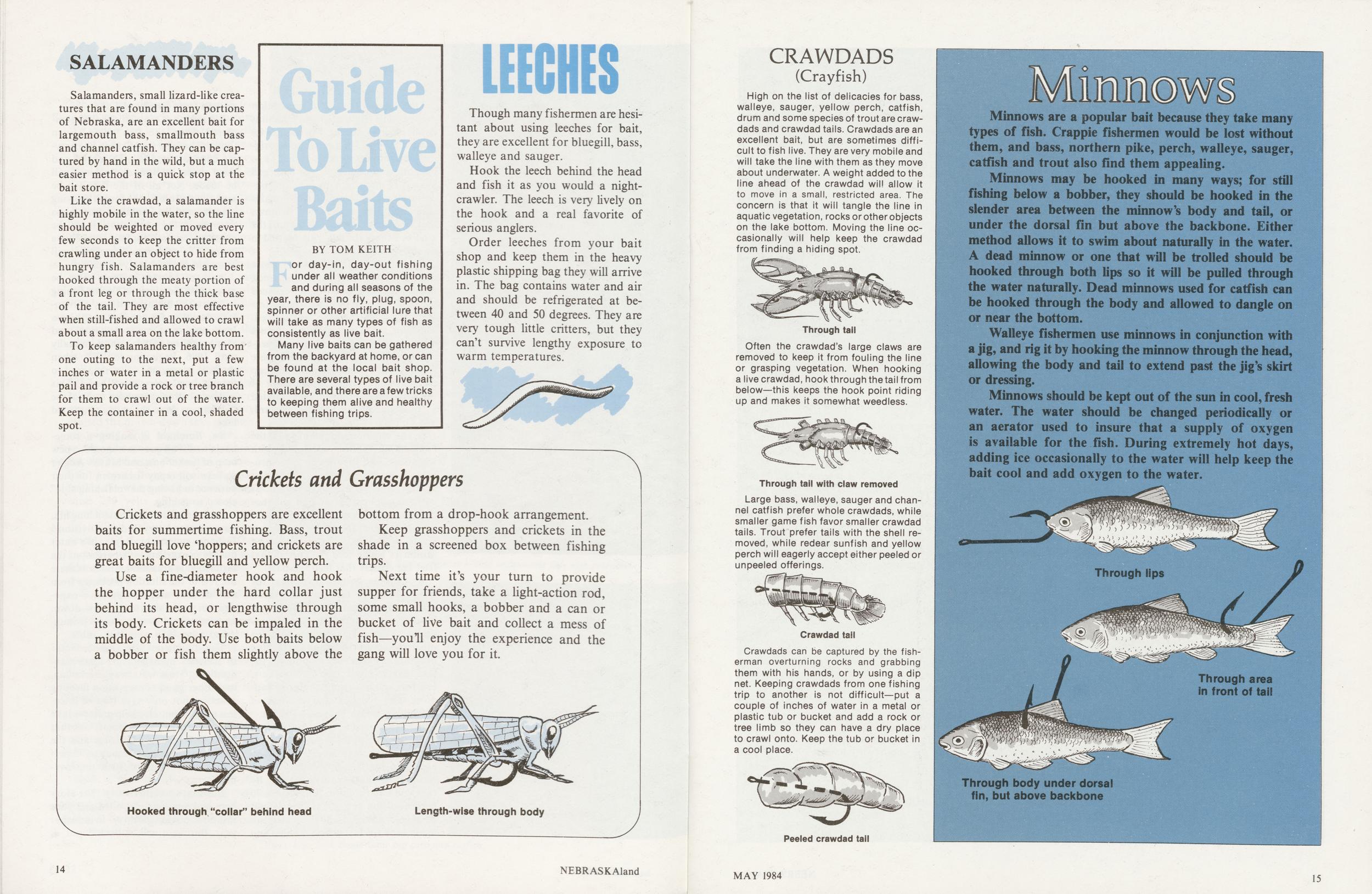
Guide To Live Baits
BY TOM KEITHFor day-in, day-out fishing wi under all weather conditions and during all seasons of the year, there is no fly, plug, spoon, spinner or other artificial lure that will take as many types of fish as consistently as live bait.
Many live baits can be gathered from the backyard at home, or can be found at the local bait shop. There are several types of live bait available, and there are a few tricks to keeping them alive and healthy between fishing trips.
SALAMANDERS
Salamanders, small lizard-like creatures that are found in many portions of Nebraska, are an excellent bait for largemouth bass, smallmouth bass and channel catfish. They can be captured by hand in the wild, but a much easier method is a quick stop at the bait store.
Like the crawdad, a salamander is highly mobile in the water, so the line should be weighted or moved every few seconds to keep the critter from crawling under an object to hide from hungry fish. Salamanders are best hooked through the meaty portion of a front leg or through the thick base of the tail. They are most effective when still-fished and allowed to crawl about a small area on the lake bottom.
To keep salamanders healthy from one outing to the next, put a few inches or water in a metal or plastic pail and provide a rock or tree branch for them to crawl out of the water. Keep the container in a cool, shaded spot.
LEECHES
Though many fishermen are hesitant about using leeches for bait, they are excellent for bluegill, bass, walleye and sauger.
Hook the leech behind the head and fish it as you would a nightcrawler. The leech is very lively on the hook and a real favorite of serious anglers.
Order leeches from your bait shop and keep them in the heavy plastic shipping bag they will arrive in. The bag contains water and air and should be refrigerated at between 40 and 50 degrees. They are very tough little critters, but they can't survive lengthy exposure to warm temperatures.
Crickets and Grasshoppers
Crickets and grasshoppers are excellent baits for summertime fishing. Bass, trout and bluegill love 'hoppers; and crickets are great baits for bluegill and yellow perch.
Use a fine-diameter hook and hook the hopper under the hard collar just behind its head, or lengthwise through its body. Crickets can be impaled in the middle of the body. Use both baits below a bobber or fish them slightly above the bottom from a drop-hook arrangement.
Keep grasshoppers and crickets in the shade in a screened box between fishing trips.
Next time it's your turn to provide supper for friends, take a light-action rod, some small hooks, a bobber and a can or bucket of live bait and collect a mess of fish—you'll enjoy the experience and the gang will love you for it.
Hooked through "collar" behind head
Length-wise through body
CRAWDADS
(Crayfish)High on the list of delicacies for bass, walleye, sauger, yellow perch, catfish, drum and some species of trout are crawdads and crawdad tails. Crawdads are an excellent bait, but are sometimes difficult to fish live. They are very mobile and will take the line with them as they move about underwater. A weight added to the line ahead of the crawdad will allow it to move in a small, restricted area. The concern is that it will tangle the line in aquatic vegetation, rocks or other objects on the lake bottom. Moving the line occasionally will help keep the crawdad from finding a hiding spot.
Through tail
Often the crawdad's large claws are removed to keep it from fouling the line or grasping vegetation. When hooking a live crawdad, hook through the tail from below—this keeps the hook point riding up and makes it somewhat weedless.
Through tail with claw removed
Large bass, walleye, sauger and channel catfish prefer whole crawdads, while smaller game fish favor smaller crawdad tails. Trout prefer tails with the shell removed, while redear sunfish and yellow perch will eagerly accept either peeled or unpeeled offerings.
Crawdad tail
Crawdads can be captured by the fisherman overturning rocks and grabbing them with his hands, or by using a dip net. Keeping crawdads from one fishing trip to another is not difficult—put a couple of inches of water in a metal or plastic tub or bucket and add a rock or tree limb so they can have a dry place to crawl onto. Keep the tub or bucket in a cool place.
Peeled crawdad tail
Minnows
Minnows are a popular bait because they take many types of fish. Crappie fishermen would be lost without them, and bass, northern pike, perch, walleye, sauger, catfish and trout also find them appealing.
Minnows may be hooked in many ways; for still fishing below a bobber, they should be hooked in the slender area between the minnow's body and tail, or under the dorsal fin but above the backbone. Either method allows it to swim about naturally in the water. A dead minnow or one that will be trolled should be hooked through both lips so it will be pulled through the water naturally. Dead minnows used for catfish can be hooked through the body and allowed to dangle on or near the bottom.
Walleye fishermen use minnows in conjunction with a jig, and rig it by hooking the minnow through the head, allowing the body and tail to extend past the jig's skirt or dressing.
Minnows should be kept out of the sun in cool, fresh water. The water should be changed periodically or an aerator used to insure that a supply of oxygen is available for the fish. During extremely hot days, adding ice occasionally to the water will help keep the bait cool and add oxygen to the water.
Through lips
Through area in front of tail
Through body under dorsal fin, but above backbone
FROGS
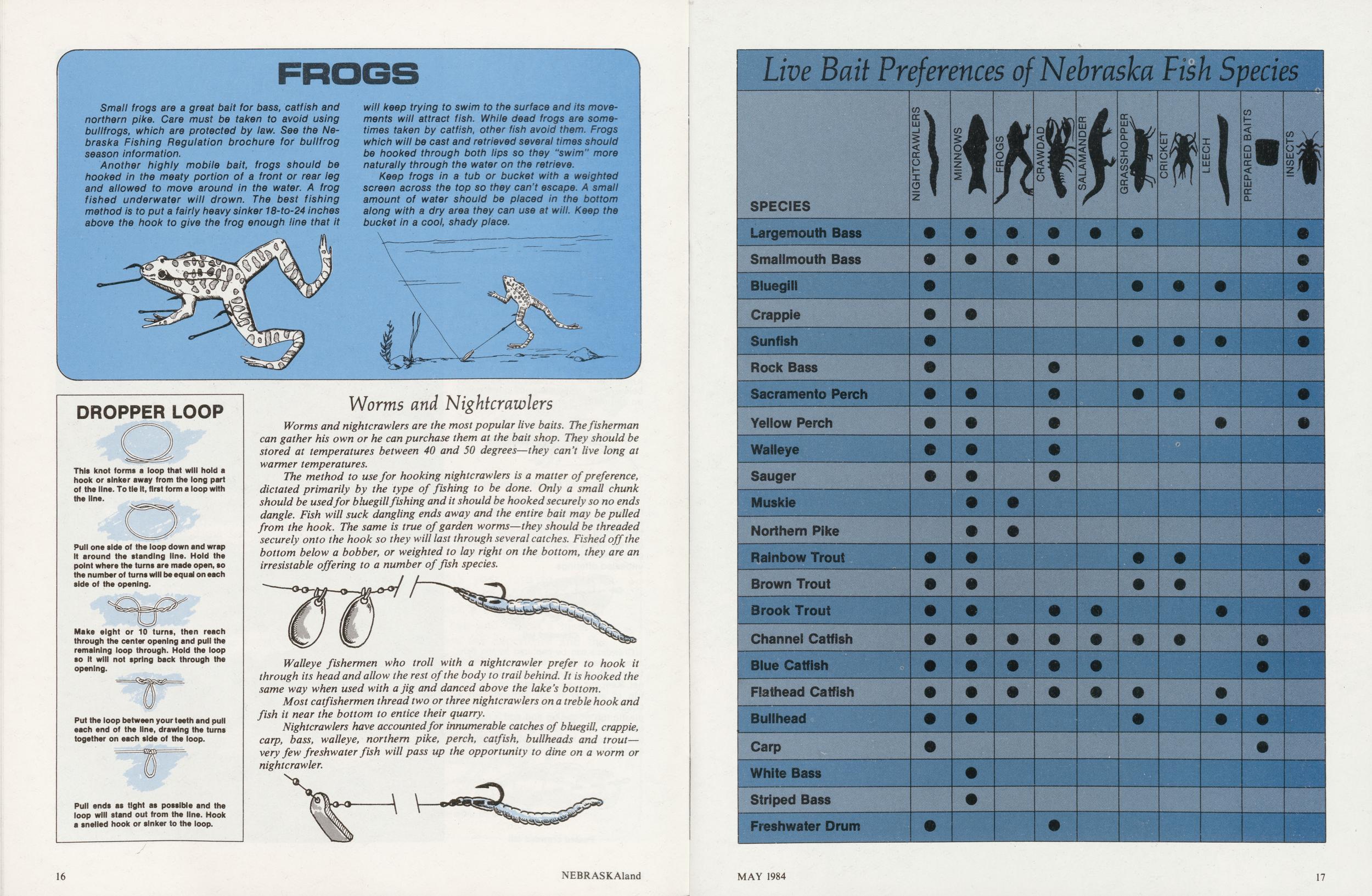
Small frogs are a great bait for bass, catfish and northern pike. Care must be taken to avoid using bullfrogs, which are protected by law. See the Nebraska Fishing Regulation brochure for bullfrog season information.
Another highly mobile bait, frogs should be hooked in the meaty portion of a front or rear leg and allowed to move around in the water. A frog fished underwater will drown. The best fishing method is to put a fairly heavy sinker 18~to-24 inches above the hook to give the frog enough line that it will keep trying to swim to the surface and its movements will attract fish. While dead frogs are sometimes taken by catfish, other fish avoid them. Frogs which will be cast and retrieved several times should be hooked through both lips so they "swim" more naturally through the water on the retrieve.
Keep frogs in a tub or bucket with a weighted screen across the top so they can't escape. A small amount of water should be placed in the bottom along with a dry area they can use at will. Keep the bucket in a cool, shady place.
DROPPER LOOP
This knot forms a loop that will hold a hook or sinker away from the long part of the line. To tie It, first form a loop with the line.
Pull one side of the loop down and wrap It around the standing line. Hold the point where the turns are made open, so the number of turns will be equal on each side of the opening.
Make eight or 10 turns, then reach through the center opening and pull the remaining loop through. Hold the loop so It will not spring back through the opening.
Put the loop between your teeth and pull each end of the line, drawing the turns together on each side of the loop.
Pull ends as tight as possible and the loop will stand out from the line. Hook a snelied hook or sinker to the loop.
Worms and Night crawlers
Worms and nightcrawlers are the most popular live baits. The fisherman can gather his own or he can purchase them at the bait shop. They should be stored at temperatures between 40 and 50 degrees—they can't live long at warmer temperatures.
The method to use for hooking nightcrawlers is a matter of preference, dictated primarily by the type of fishing to be done. Only a small chunk should be used for bluegill fishing and it should be hooked securely so no ends dangle. Fish will suck dangling ends away and the entire bait may be pulled from the hook. The same is true of garden worms—they should be threaded securely onto the hook so they will last through several catches. Fished off the bottom below a bobber, or weighted to lay right on the bottom, they are an irresistable offering to a number offish species.
Walleye fishermen who troll with a nightcrawler prefer to hook it through its head and allow the rest of the body to trail behind. It is hooked the same way when used with a jig and danced above the lake's bottom.
Most catfishermen thread two or three nightcrawlers on a treble hook and fish it near the bottom to entice their quarry.
Nightcrawlers have accounted for innumerable catches of bluegill, crappie, carp, bass, walleye, northern pike, perch, catfish, bullheads and trout-very few freshwater fish will pass up the opportunity to dine on a worm or nightcrawler.
16 NEBRASKAlandLive Bait Preferences of Nebraska Fish Species
SPECIES Largemouth Bass Smallmoutti Bass Bluegill Crappie Sunfish Rock Bass Sacramento Perch Yellow Perch Walleye Sauger Muskie Northern Pike Rainbow Trout Brown Trout Brook Trout Channel Catfish Blue Catfish Flatfiead Catfish Bullhead Carp White Bass Striped Bass Freshwater Drum MAY 1984 17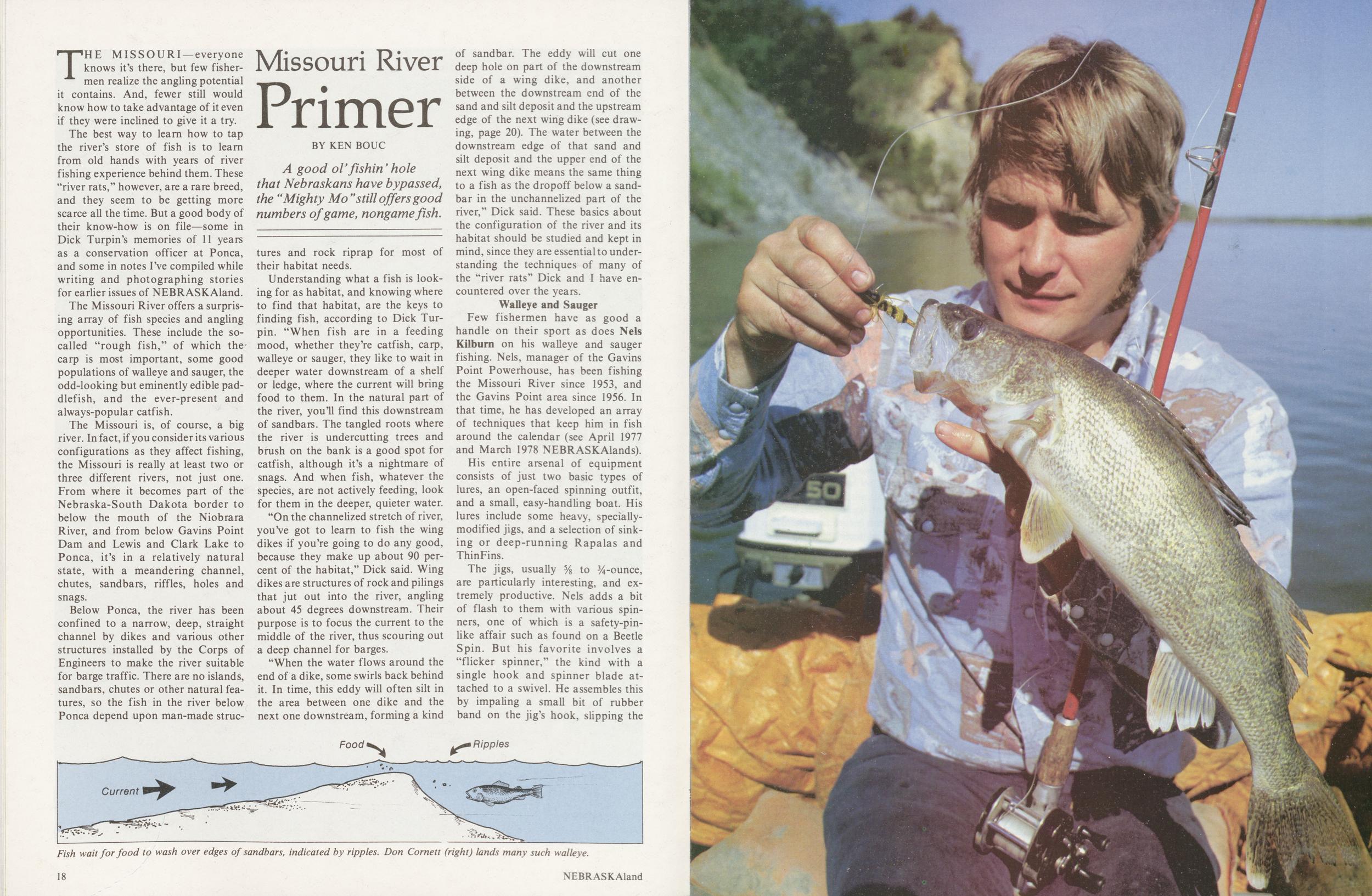
Missouri River Primer
BY KEN BOUC A good ol' fishin' hole that Nebraskans have bypassed, the "Mighty Mo" still offers good numbers of game, nongame fish.THE MISSOURI —everyone knows it's there, but few fishermen realize the angling potential it contains. And, fewer still would know how to take advantage of it even if they were inclined to give it a try.
The best way to learn how to tap the river's store of fish is to learn from old hands with years of river fishing experience behind them. These "river rats," however, are a rare breed, and they seem to be getting more scarce all the time. But a good body of their know-how is on file—some in Dick Turpin's memories of 11 years as a conservation officer at Ponca, and some in notes I've compiled while writing and photographing stories for earlier issues of NEBRASKAland.
The Missouri River offers a surprising array of fish species and angling opportunities. These include the so-called "rough fish," of which the carp is most important, some good populations of walleye and sauger, the odd-looking but eminently edible paddlefish, and the ever-present and always-popular catfish.
The Missouri is, of course, a big river. In fact, if you consider its various configurations as they affect fishing, the Missouri is really at least two or three different rivers, not just one. From where it becomes part of the Nebraska-South Dakota border to below the mouth of the Niobrara River, and from below Gavins Point Dam and Lewis and Clark Lake to Ponca, it's in a relatively natural state, with a meandering channel, chutes, sandbars, riffles, holes and snags.
Below Ponca, the river has been confined to a narrow, deep, straight channel by dikes and various other structures installed by the Corps of Engineers to make the river suitable for barge traffic. There are no islands, sandbars, chutes or other natural features, so the fish in the river below Ponca depend upon man-made structures
Fish wait for food to wash over edges of sandbars, indicated by ripples. Don Cornett (right) lands many such walleye.
and rock riprap for most of their habitat needs.
Understanding what a fish is looking for as habitat, and knowing where to find that habitat, are the keys to finding fish, according to Dick Turpin. "When fish are in a feeding mood, whether they're catfish, carp, walleye or sauger, they like to wait in deeper water downstream of a shelf or ledge, where the current will bring food to them. In the natural part of the river, you'll find this downstream of sandbars. The tangled roots where the river is undercutting trees and brush on the bank is a good spot for catfish, although it's a nightmare of snags. And when fish, whatever the species, are not actively feeding, look for them in the deeper, quieter water.
"On the channelized stretch of river, you've got to learn to fish the wing dikes if you're going to do any good, because they make up about 90 percent of the habitat," Dick said. Wing dikes are structures of rock and pilings that jut out into the river, angling about 45 degrees downstream. Their purpose is to focus the current to the middle of the river, thus scouring out a deep channel for barges.
"When the water flows around the end of a dike, some swirls back behind it. In time, this eddy will often silt in the area between one dike and the next one downstream, forming a kind
of sandbar. The eddy will cut one deep hole on part of the downstream side of a wing dike, and another between the downstream end of the sand and silt deposit and the upstream edge of the next wing dike (see drawing, page 20). The water between the downstream edge of that sand and silt deposit and the upper end of the next wing dike means the same thing to a fish as the dropoff below a sandbar in the unchannelized part of the river," Dick said. These basics about the configuration of the river and its habitat should be studied and kept in mind, since they are essential to understanding the techniques of many of the "river rats" Dick and I have encountered over the years.
Walleye and SaugerFew fishermen have as good a handle on their sport as does Nels Kilburn on his walleye and sauger fishing. Nels, manager of the Gavins Point Powerhouse, has been fishing the Missouri River since 1953, and the Gavins Point area since 1956. In that time, he has developed an array of techniques that keep him in fish around the calendar (see April 1977 and March 1978 NEBRASKAlands).
His entire arsenal of equipment consists of just two basic types of lures, an open-faced spinning outfit, and a small, easy-handling boat. His lures include some heavy, specially-modified jigs, and a selection of sinking or deep-running Rapalas and ThinFins.
The jigs, usually 5/8 to 3/4-ounce, are particularly interesting, and extremely productive. Nels adds a bit of flash to them with various spinners, one of which is a safety-pin-like affair such as found on a Beetle Spin. But his favorite involves a "flicker spinner," the kind with a single hook and spinner blade attached to a swivel. He assembles this by impaling a small bit of rubber band on the jig's hook, slipping the
18 NEBRASKAland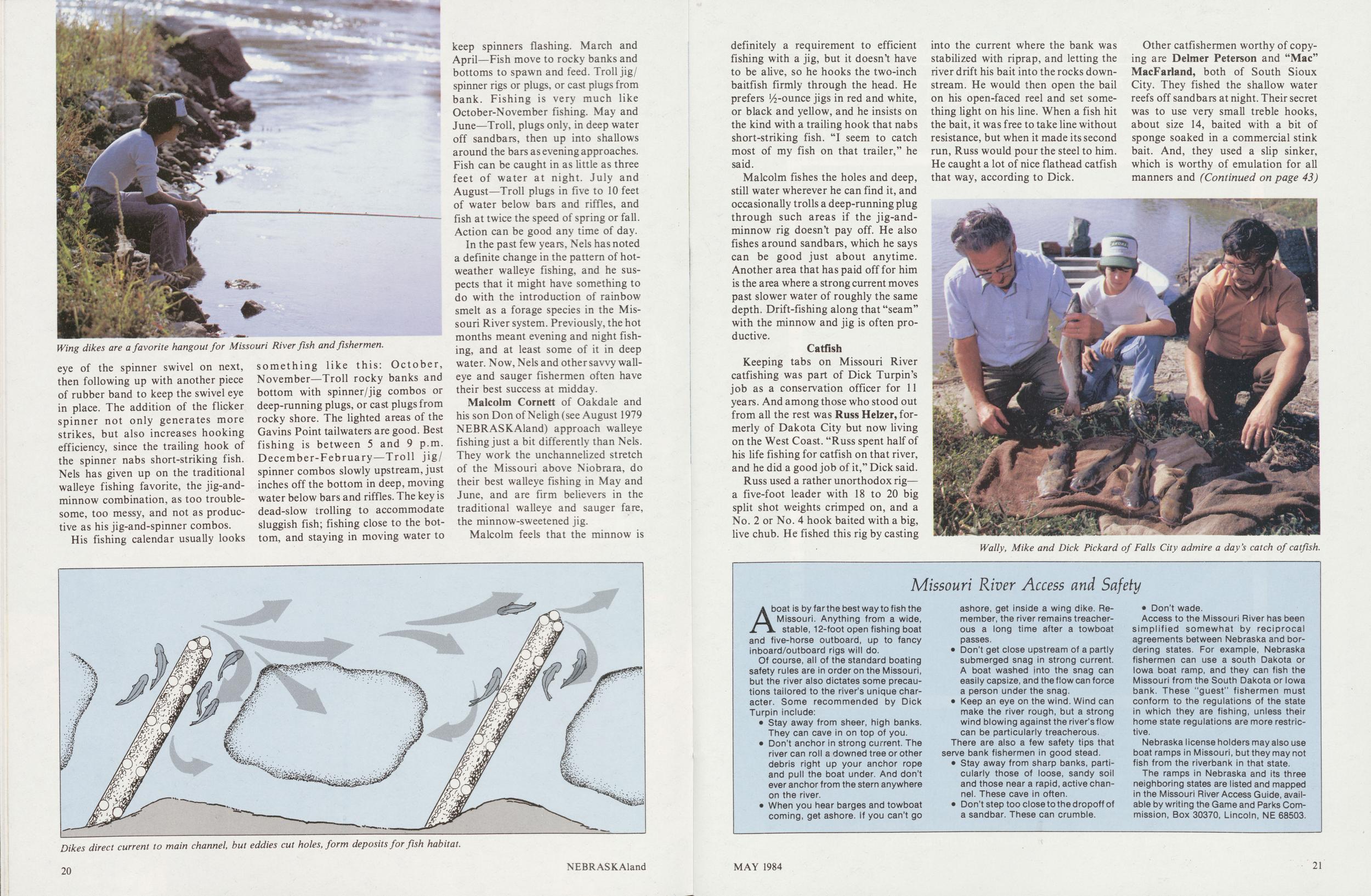
Wing dikes are a favorite hangout for Missouri River fish and fishermen.
eye of the spinner swivel on next, then following up with another piece of rubber band to keep the swivel eye in place. The addition of the flicker spinner not only generates more strikes, but also increases hooking efficiency, since the trailing hook of the spinner nabs short-striking fish. Nels has given up on the traditional walleye fishing favorite, the jig-and-minnow combination, as too troublesome, too messy, and not as productive as his jig-and-spinner combos.
His fishing calendar usually looks something like this: October, November—Troll rocky banks and bottom with spinner/jig combos or deep-running plugs, or cast plugs from rocky shore. The lighted areas of the Gavins Point tailwaters are good. Best fishing is between 5 and 9 p.m. December-February—Troll jig/spinner combos slowly upstream, just inches off the bottom in deep, moving water below bars and riffles. The key is dead-slow trolling to accommodate sluggish fish; fishing close to the bottom, and staying in moving water to keep spinners flashing. March and April—Fish move to rocky banks and bottoms to spawn and feed. Troll jig/spinner rigs or plugs, or cast plugs from bank. Fishing is very much like October-November fishing. May and June—Troll, plugs only, in deep water off sandbars, then up into shallows around the bars as evening approaches. Fish can be caught in as little as three feet of water at night. July and August—Troll plugs in five to 10 feet of water below bars and riffles, and fish at twice the speed of spring or fall. Action can be good any time of day.
In the past few years, Nels has noted a definite change in the pattern of hot-weather walleye fishing, and he suspects that it might have something to do with the introduction of rainbow smelt as a forage species in the Missouri River system. Previously, the hot months meant evening and night fishing, and at least some of it in deep water. Now, Nels and other savvy walleye and sauger fishermen often have their best success at midday.
Malcolm Cornett of Oakdale and his son Don of Neligh (see August 1979 NEBRASKAland) approach walleye fishing just a bit differently than Nels. They work the unchannelized stretch of the Missouri above Niobrara, do their best walleye fishing in May and June, and are firm believers in the traditional walleye and sauger fare, the minnow-sweetened jig.
Malcolm feels that the minnow is
Dikes direct current to main channel, but eddies cut holes, form deposits for fish habitat.
definitely a requirement to efficient fishing with a jig, but it doesn't have to be alive, so he hooks the two-inch baitfish firmly through the head. He prefers ^-ounce jigs in red and white, or black and yellow, and he insists on the kind with a trailing hook that nabs short-striking fish. "I seem to catch most of my fish on that trailer," he said.
Malcolm fishes the holes and deep, still water wherever he can find it, and occasionally trolls a deep-running plug through such areas if the jig-and-minnow rig doesn't pay off. He also fishes around sandbars, which he says can be good just about anytime. Another area that has paid off for him is the area where a strong current moves past slower water of roughly the same depth. Drift-fishing along that "seam" with the minnow and jig is often productive.
CatfishKeeping tabs on Missouri River catfishing was part of Dick Turpin's job as a conservation officer for 11 years. And among those who stood out from all the rest was Russ Helzer, formerly of Dakota City but now living on the West Coast. "Russ spent half of his life fishing for catfish on that river, and he did a good job of it," Dick said.
Russ used a rather unorthodox rig—a five-foot leader with 18 to 20 big split shot weights crimped on, and a No. 2 or No. 4 hook baited with a big, live chub. He fished this rig by casting into the current where the bank was stabilized with riprap, and letting the river drift his bait into the rocks downstream. He would then open the bail on his open-faced reel and set something light on his line. When a fish hit the bait, it was free to take line without resistance, but when it made its second run, Russ would pour the steel to him. He caught a lot of nice flathead catfish that way, according to Dick.
Other catfishermen worthy of copying are Delmer Peterson and "Mac" MacFarland, both of South Sioux City. They fished the shallow water reefs off sandbars at night. Their secret was to use very small treble hooks, about size 14, baited with a bit of sponge soaked in a commercial stink bait. And, they used a slip sinker, which is worthy of emulation for all manners and (Continued on page 43)
Wally, Mike and Dick Pickard of Falls City admire a day's catch of catfish.
A boat is by far the best way to fish the Missouri. Anything from a wide, stable, 12-foot open fishing boat and five-horse outboard, up to fancy inboard/outboard rigs will do.
Of course, all of the standard boating safety rules are in order on the Missouri, but the river also dictates some precautions tailored to the river's unique character. Some recommended by Dick Turpin include:
• Stay away from sheer, high banks. They can cave in on top of you. • Don't anchor in strong current. The river can roll a downed tree or other debris right up your anchor rope and pull the boat under. And don't ever anchor from the stern anywhere on the river. • When you hear barges and towboat coming, get ashore. If you can't go ashore, get inside a wing dike. Remember, the river remains treacherous a long time after a towboat passes. • Don't get close upstream of a partly submerged snag in strong current. A boat washed into the snag can easily capsize, and the flow can force a person under the snag. • Keep an eye on the wind. Wind can make the river rough, but a strong wind blowing against the river's flow can be particularly treacherous. There are also a few safety tips that serve bank fishermen in good stead. • Stay away from sharp banks, particularly those of loose, sandy soil and those near a rapid, active channel. These cave in often. • Don't step too close to the dropoff of a sandbar. These can crumble. • Don't wade. Access to the Missouri River has been simplified somewhat by reciprocal agreements between Nebraska and bordering states. For example, Nebraska fishermen can use a south Dakota or Iowa boat ramp, and they can fish the Missouri from the South Dakota or Iowa bank. These "guest" fishermen must conform to the regulations of the state in which they are fishing, unless their home state regulations are more restrictive. Nebraska license holders may also use boat ramps in Missouri, but they may not fish from the riverbank in that state. The ramps in Nebraska and its three neighboring states are listed and mapped in the Missouri River Access Guide, available by writing the Game and Parks Commission, Box 30370, Lincoln, NE 68503. MAY 1984 21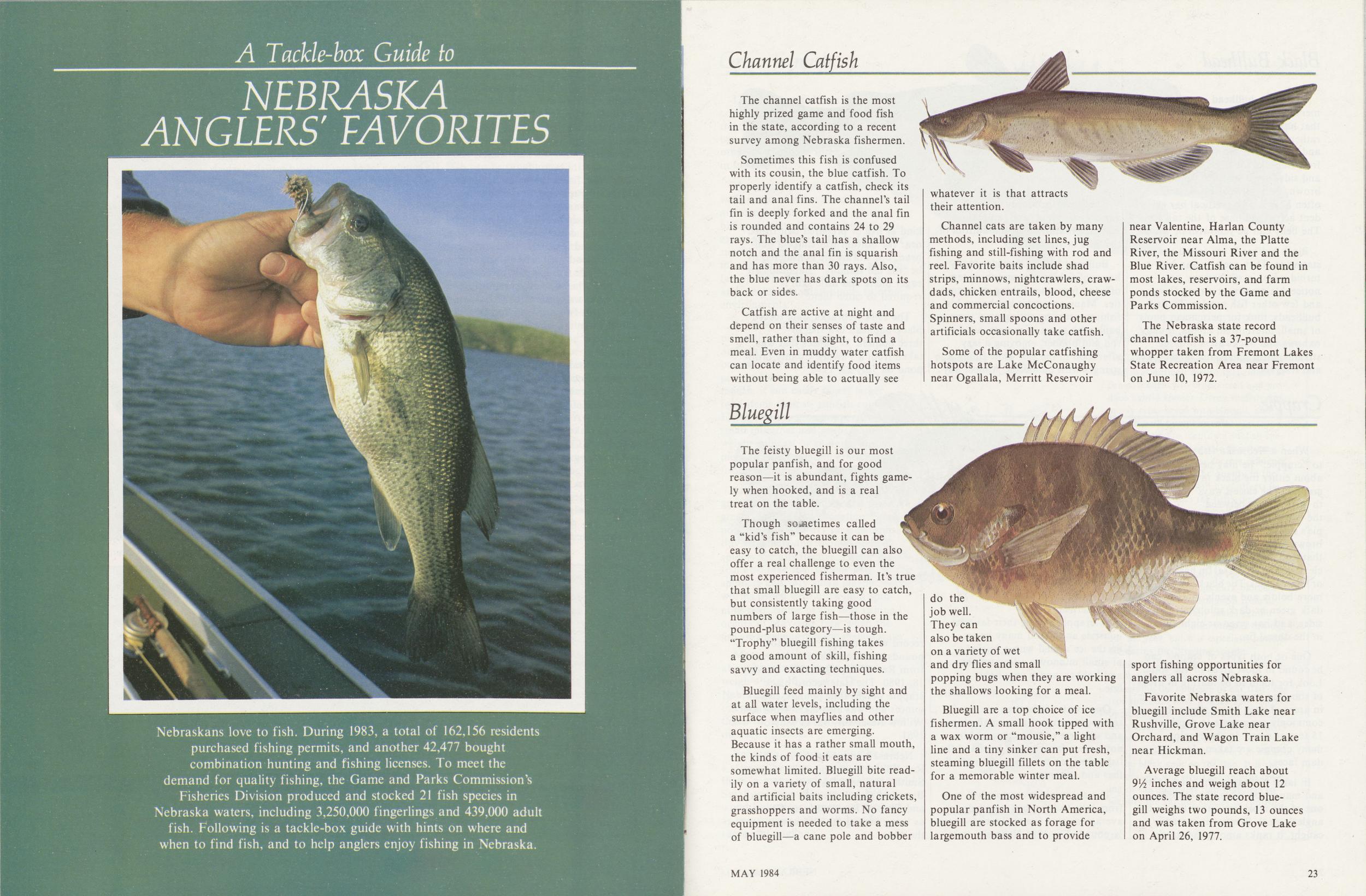
A Tackle-box Guide to NEBRASKA ANGLERS' FAVORITES
The channel catfish is the most highly prized game and food fish in the state, according to a recent survey among Nebraska fishermen.
Sometimes this fish is confused with its cousin, the blue catfish. To properly identify a catfish, check its tail and anal fins. The channel's tail fin is deeply forked and the anal fin is rounded and contains 24 to 29 rays. The blue's tail has a shallow notch and the anal fin is squarish and has more than 30 rays. Also, the blue never has dark spots on its back or sides.
Catfish are active at night and depend on their senses of taste and smell, rather than sight, to find a meal. Even in muddy water catfish can locate and identify food items without being able to actually see whatever it is that attracts their attention.
Channel cats are taken by many methods, including set lines, jug fishing and still-fishing with rod and reel. Favorite baits include shad strips, minnows, nightcrawlers, crawdads, chicken entrails, blood, cheese and commercial concoctions. Spinners, small spoons and other artificials occasionally take catfish.
Some of the popular catfishing hotspots are Lake McConaughy near Ogallala, Merritt Reservoir near Valentine, Harlan County Reservoir near Alma, the Platte River, the Missouri River and the Blue River. Catfish can be found in most lakes, reservoirs, and farm ponds stocked by the Game and Parks Commission.
The Nebraska state record channel catfish is a 37-pound whopper taken from Fremont Lakes State Recreation Area near Fremont on June 10, 1972.
BluegillThe feisty bluegill is our most popular panfish, and for good reason—it is abundant, fights gamely when hooked, and is a real treat on the table.
Though sometimes called a "kid's fish" because it can be easy to catch, the bluegill can also offer a real challenge to even the most experienced fisherman. It's true that small bluegill are easy to catch, but consistently taking good numbers of large fish—those in the pound-plus category—is tough. "Trophy" bluegill fishing takes a good amount of skill, fishing savvy and exacting techniques.
Bluegill feed mainly by sight and at all water levels, including the surface when mayflies and other aquatic insects are emerging. Because it has a rather small mouth, the kinds of food it eats are somewhat limited. Bluegill bite readily on a variety of small, natural and artificial baits including crickets, grasshoppers and worms. No fancy equipment is needed to take a mess of bluegill—a cane pole and bobber do the job well. They can also be taken on a variety of wet and dry flies and small popping bugs when they are working the shallows looking for a meal.
Bluegill are a top choice of ice fishermen. A small hook tipped with a wax worm or "mousie," a light line and a tiny sinker can put fresh, steaming bluegill fillets on the table for a memorable winter meal.
One of the most widespread and popular panfish in North America, bluegill are stocked as forage for largemouth bass and to provide sport fishing opportunities for anglers all across Nebraska.
Favorite Nebraska waters for bluegill include Smith Lake near Rushville, Grove Lake near Orchard, and Wagon Train Lake near Hickman.
Average bluegill reach about 9!/2 inches and weigh about 12 ounces. The state record bluegill weighs two pounds, 13 ounces and was taken from Grove Lake on April 26, 1977.
MAY 1984 23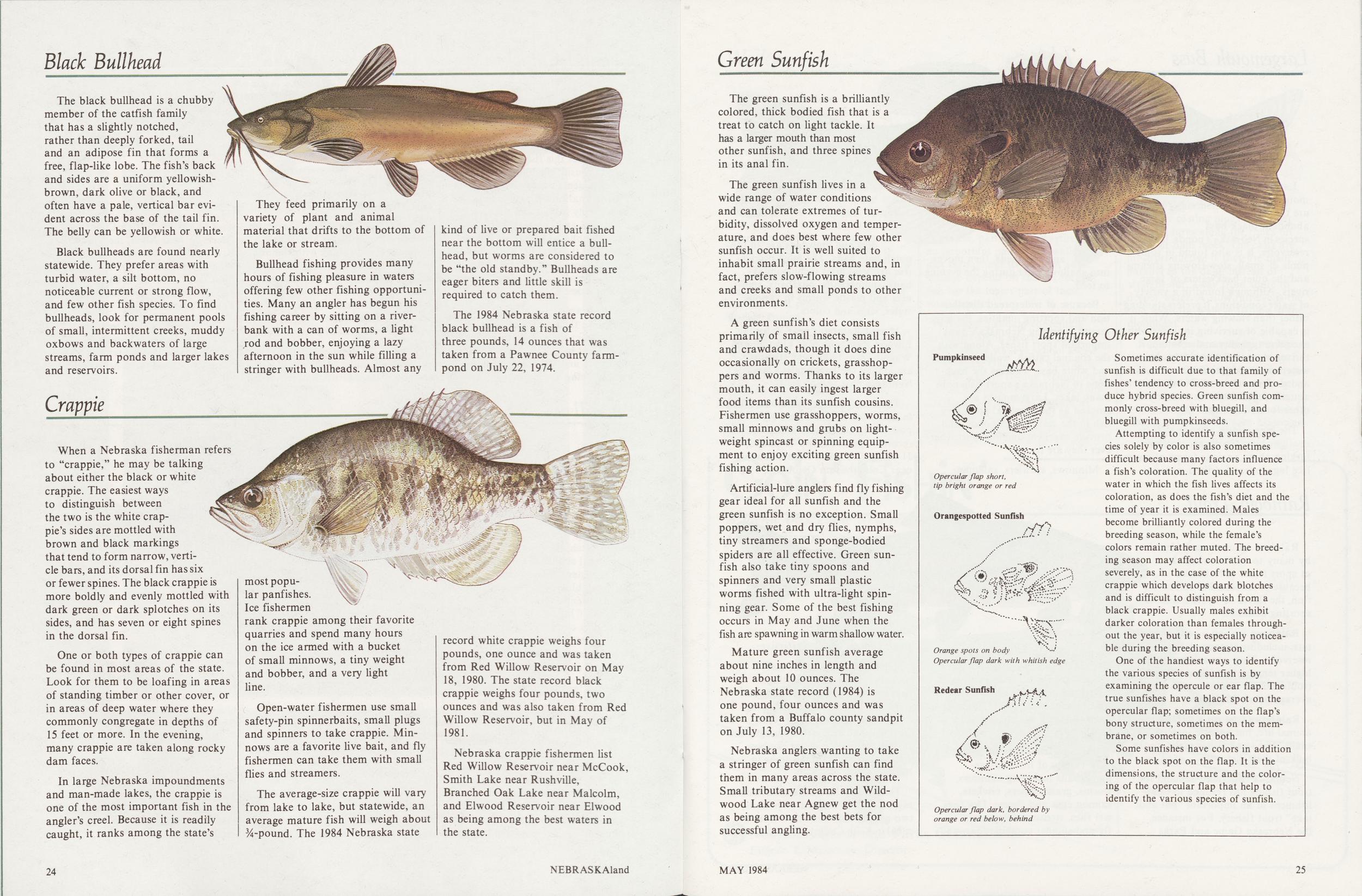 Black Bullhead
The black bullhead is a chubby member of the catfish family that has a slightly notched, rather than deeply forked, tail and an adipose fin that forms a free, flap-like lobe. The fish's back and sides are a uniform yellowish-brown, dark olive or black, and often have a pale, vertical bar evident across the base of the tail fin. The belly can be yellowish or white.
Black bullheads are found nearly statewide. They prefer areas with turbid water, a silt bottom, no noticeable current or strong flow, and few other fish species. To find bullheads, look for permanent pools of small, intermittent creeks, muddy oxbows and backwaters of large streams, farm ponds and larger lakes and reservoirs.
They feed primarily on a variety of plant and animal material that drifts to the bottom of the lake or stream.
Bullhead fishing provides many hours of fishing pleasure in waters offering few other fishing opportunities. Many an angler has begun his fishing career by sitting on a riverbank with a can of worms, a light rod and bobber, enjoying a lazy afternoon in the sun while filling a stringer with bullheads. Almost any kind of live or prepared bait fished near the bottom will entice a bullhead, but worms are considered to be "the old standby." Bullheads are eager biters and little skill is required to catch them.
The 1984 Nebraska state record black bullhead is a fish of three pounds, 14 ounces that was taken from a Pawnee County farm-pond on July 22, 1974.
CrappieWhen a Nebraska fisherman refers to "crappie," he may be talking about either the black or white crappie. The easiest ways to distinguish between the two is the white crappie's sides are mottled with brown and black markings that tend to form narrow, verticle bars, and its dorsal fin has six or fewer spines. The black crappie is more boldly and evenly mottled with dark green or dark splotches on its sides, and has seven or eight spines in the dorsal fin.
One or both types of crappie can be found in most areas of the state. Look for them to be loafing in areas of standing timber or other cover, or in areas of deep water where they commonly congregate in depths of 15 feet or more. In the evening, many crappie are taken along rocky dam faces.
In large Nebraska impoundments and man-made lakes, the crappie is one of the most important fish in the angler's creel. Because it is readily caught, it ranks among the state's most popular panfishes. Ice fishermen rank crappie among their favorite quarries and spend many hours on the ice armed with a bucket of small minnows, a tiny weight and bobber, and a very light line.
Open-water fishermen use small safety-pin spinnerbaits, small plugs and spinners to take crappie. Minnows are a favorite live bait, and fly fishermen can take them with small flies and streamers.
The average-size crappie will vary from lake to lake, but statewide, an average mature fish will weigh about %-pound. The 1984 Nebraska state record white crappie weighs four pounds, one ounce and was taken from Red Willow Reservoir on May 18, 1980. The state record black crappie weighs four pounds, two ounces and was also taken from Red Willow Reservoir, but in May of 1981.
Nebraska crappie fishermen list Red Willow Reservoir near McCook, Smith Lake near Rushville, Branched Oak Lake near Malcolm, and Elwood Reservoir near Elwood as being among the best waters in the state.
24 NEBRASKAland Green SunfishThe green sunfish is a brilliantly colored, thick bodied fish that is a treat to catch on light tackle. It has a larger mouth than most other sunfish, and three spines in its anal fin.
The green sunfish lives in a wide range of water conditions and can tolerate extremes of turbidity, dissolved oxygen and temperature, and does best where few other sunfish occur. It is well suited to inhabit small prairie streams and, in fact, prefers slow-flowing streams and creeks and small ponds to other environments.
A green sunfish's diet consists primarily of small insects, small fish and crawdads, though it does dine occasionally on crickets, grasshoppers and worms. Thanks to its larger mouth, it can easily ingest larger food items than its sunfish cousins. Fishermen use grasshoppers, worms, small minnows and grubs on light-weight spincast or spinning equipment to enjoy exciting green sunfish fishing action.
Artificial-lure anglers find fly fishing gear ideal for all sunfish and the green sunfish is no exception. Small poppers, wet and dry flies, nymphs, tiny streamers and sponge-bodied spiders are all effective. Green sunfish also take tiny spoons and spinners and very small plastic worms fished with ultra-light spinning gear. Some of the best fishing occurs in May and June when the fish are spawning in warm shallow water.
Mature green sunfish average about nine inches in length and weigh about 10 ounces. The Nebraska state record (1984) is one pound, four ounces and was taken from a Buffalo county sandpit on July 13, 1980.
Nebraska anglers wanting to take a stringer of green sunfish can find them in many areas across the state. Small tributary streams and Wildwood Lake near Agnew get the nod as being among the best bets for successful angling.
Identifying Other SunfishPumpkinseed Opercular flap short, tip bright orange or red
Orangespotted Sunfish Orange spots on body Opercular flap dark with whitish edge
Redear Sunfish Opercular flap dark, bordered by orange or red below, behind
Sometimes accurate identification of sunfish is difficult due to that family of fishes' tendency to cross-breed and produce hybrid species. Green sunfish commonly cross-breed with bluegill, and bluegill with pumpkinseeds.
Attempting to identify a sunfish species solely by color is also sometimes difficult because many factors influence a fish's coloration. The quality of the water in which the fish lives affects its coloration, as does the fish's diet and the time of year it is examined. Males become brilliantly colored during the breeding season, while the female's colors remain rather muted. The breeding season may affect coloration severely, as in the case of the white crappie which develops dark blotches and is difficult to distinguish from a black crappie. Usually males exhibit darker coloration than females throughout the year, but it is especially noticeable during the breeding season.
One of the handiest ways to identify the various species of sunfish is by examining the opercule or ear flap. The true sunfishes have a black spot on the opercular flap; sometimes on the flap's bony structure, sometimes on the membrane, or sometimes on both.
Some sunfishes have colors in addition to the black spot on the flap. It is the dimensions, the structure and the coloring of the opercular flap that help to identify the various species of sunfish.
MAY 1984 25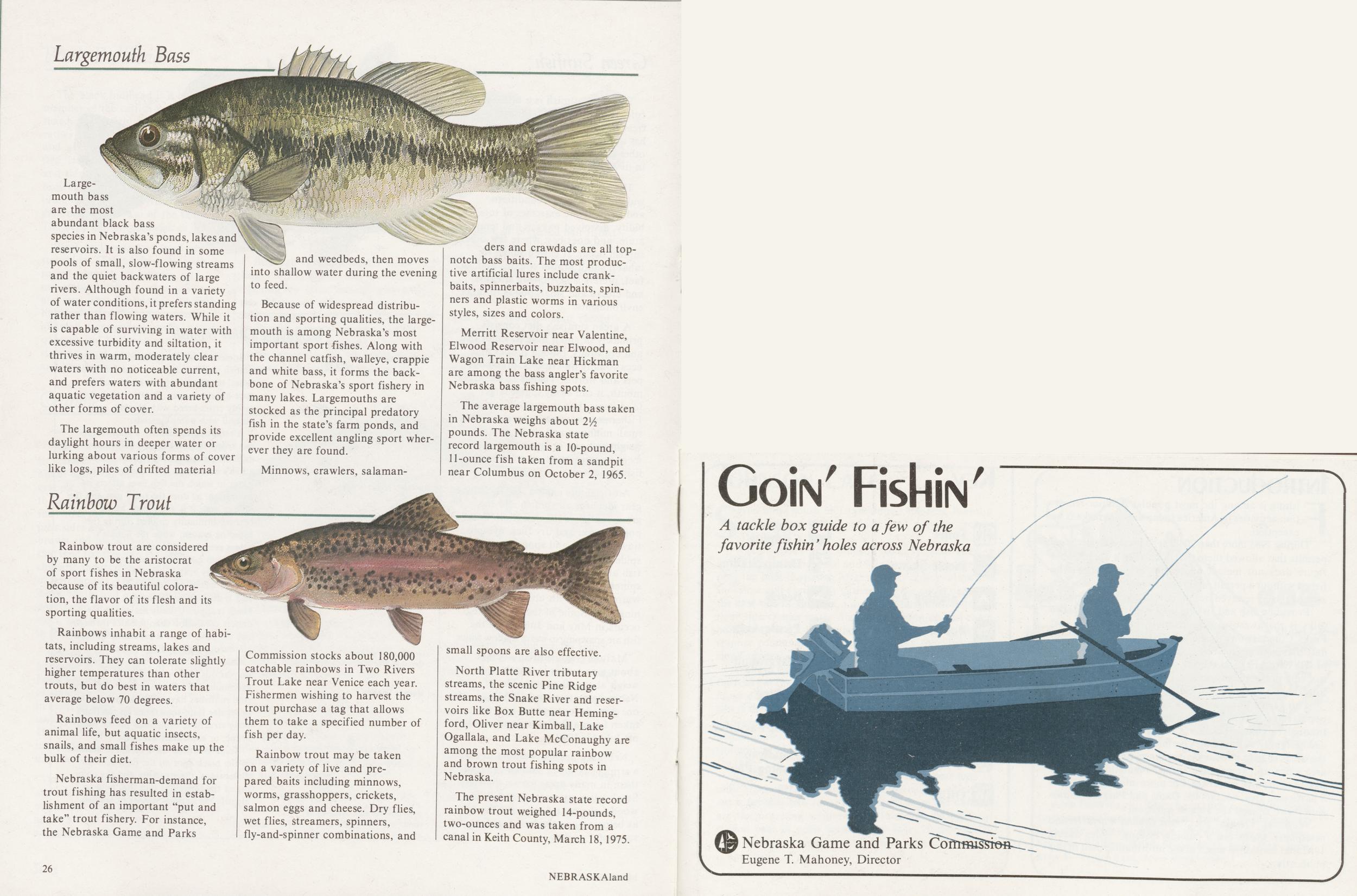 Largemouth Bass
Largemouth bass are the most abundant black bass species in Nebraska's ponds, lakes and reservoirs. It is also found in some pools of small, slow-flowing streams and the quiet backwaters of large rivers. Although found in a variety of water conditions, it prefers standing rather than flowing waters. While it is capable of surviving in water with excessive turbidity and siltation, it thrives in warm, moderately clear waters with no noticeable current, and prefers waters with abundant aquatic vegetation and a variety of other forms of cover.
The largemouth often spends its daylight hours in deeper water or lurking about various forms of cover like logs, piles of drifted material and weedbeds, then moves into shallow water during the evening to feed.
Because of widespread distribution and sporting qualities, the largemouth is among Nebraska's most important sport fishes. Along with the channel catfish, walleye, crappie and white bass, it forms the backbone of Nebraska's sport fishery in many lakes. Largemouths are stocked as the principal predatory fish in the state's farm ponds, and provide excellent angling sport wherever they are found.
Minnows, crawlers, salamanders and crawdads are all topnotch bass baits. The most productive artificial lures include crank-baits, spinnerbaits, buzzbaits, spinners and plastic worms in various styles, sizes and colors.
Merritt Reservoir near Valentine, Elwood Reservoir near Elwood, and Wagon Train Lake near Hickman are among the bass angler's favorite Nebraska bass fishing spots.
The average largemouth bass taken in Nebraska weighs about 2 l/2 pounds. The Nebraska state record largemouth is a 10-pound, 11-ounce fish taken from a sandpit near Columbus on October 2, 1965.
Rainbow TroutRainbow trout are considered by many to be the aristocrat of sport fishes in Nebraska because of its beautiful coloration, the flavor of its flesh and its sporting qualities.
Rainbows inhabit a range of habitats, including streams, lakes and reservoirs. They can tolerate slightly higher temperatures than other trouts, but do best in waters that average below 70 degrees.
Rainbows feed on a variety of animal life, but aquatic insects, snails, and small fishes make up the bulk of their diet.
Nebraska fisherman-demand for trout fishing has resulted in establishment of an important "put and take" trout fishery. For instance, the Nebraska Game and Parks Commission stocks about 180,000 catchable rainbows in Two Rivers Trout Lake near Venice each year. Fishermen wishing to harvest the trout purchase a tag that allows them to take a specified number of fish per day.
Rainbow trout may be taken on a variety of live and prepared baits including minnows, worms, grasshoppers, crickets, salmon eggs and cheese. Dry flies, wet flies, streamers, spinners, fly-and-spinner combinations, and small spoons are also effective.
North Platte River tributary streams, the scenic Pine Ridge streams, the Snake River and reservoirs like Box Butte near Hemingford, Oliver near Kimball, Lake Ogallala, and Lake McConaughy are among the most popular rainbow and brown trout fishing spots in Nebraska.
The present Nebraska state record rainbow trout weighed 14-pounds, two-ounces and was taken from a canal in Keith County, March 18, 1975.
26 NEBRASKAlandGoin' Fishin'
A tackle box guide to a few of the favorite fishin' holes across Nebraska Nebraska Game and Parks Commission Eugene T. Mahoney, Director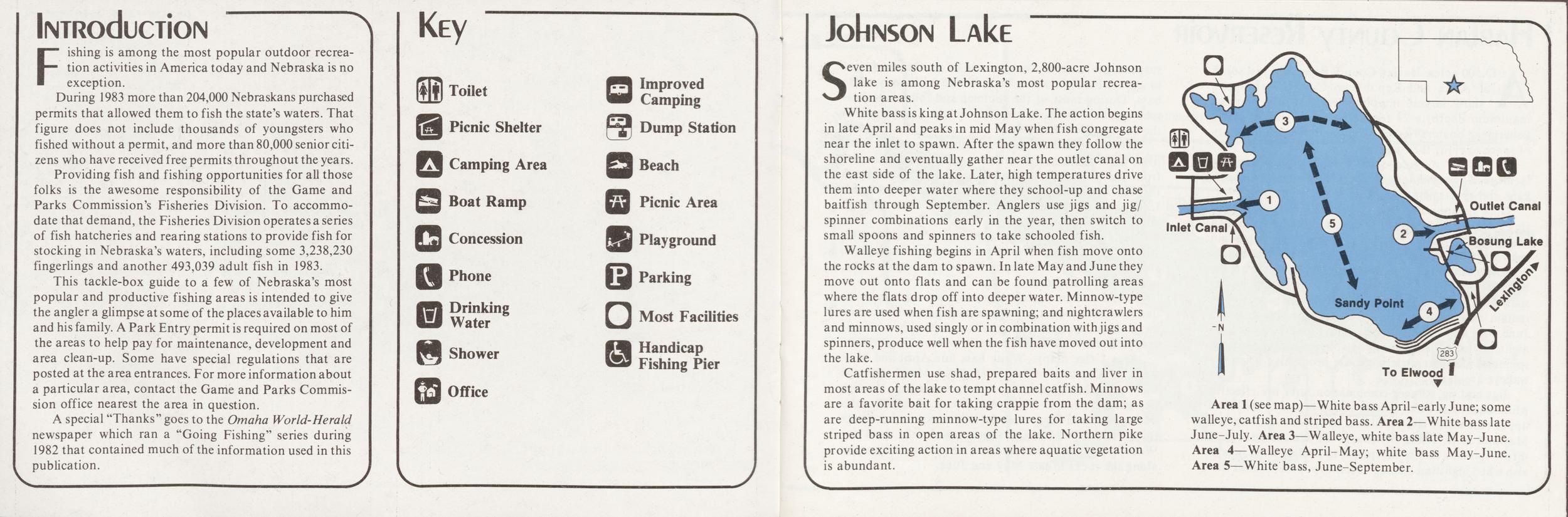 Introduction
Fishing is among the most popular outdoor recreation activities in America today and Nebraska is no exception.
During 1983 more than 204,000 Nebraskans purchased permits that allowed them to fish the state's waters. That figure does not include thousands of youngsters who fished without a permit, and more than 80,000 senior citizens who have received free permits throughout the years.
Providing fish and fishing opportunities for all those folks is the awesome responsibility of the Game and Parks Commission's Fisheries Division. To accommodate that demand, the Fisheries Division operates a series of fish hatcheries and rearing stations to provide fish for stocking in Nebraska's waters, including some 3,238,230 fingerlings and another 493,039 adult fish in 1983.
This tackle-box guide to a few of Nebraska's most popular and productive fishing areas is intended to give the angler a glimpse at some of the places available to him and his family. A Park Entry permit is required on most of the areas to help pay for maintenance, development and area clean-up. Some have special regulations that are posted at the area entrances. For more information about a particular area, contact the Game and Parks Commission office nearest the area in question.
A special "Thanks" goes to the Omaha World-Herald newspaper which ran a "Going Fishing" series during 1982 that contained much of the information used in this publication.
Key Toilet Picnic Shelter Camping Area Boat Ramp Concession Phone Drinking Water Improved Camping Dump Station Beach Picnic Area Playground Parking Shower Office Most Facilities Handicap Fishing PierJohnson Lake
Seven miles south of Lexington, 2,800-acre Johnson lake is among Nebraska's most popular recreation areas.
White bass is king at Johnson Lake. The action begins in late April and peaks in mid May when fish congregate near the inlet to spawn. After the spawn they follow the shoreline and eventually gather near the outlet canal on the east side of the lake. Later, high temperatures drive them into deeper water where they school-up and chase baitfish through September. Anglers use jigs and jig/spinner combinations early in the year, then switch to small spoons and spinners to take schooled fish.
Walleye fishing begins in April when fish move onto the rocks at the dam to spawn. In late May and June they move out onto flats and can be found patrolling areas where the flats drop off into deeper water. Minnow-type lures are used when fish are spawning; and nightcrawlers and minnows, used singly or in combination with jigs and spinners, produce well when the fish have moved out into the lake.
Catfishermen use shad, prepared baits and liver in most areas of the lake to tempt channel catfish. Minnows are a favorite bait for taking crappie from the dam; as are deep-running minnow-type lures for taking large striped bass in open areas of the lake. Northern pike provide exciting action in areas where aquatic vegetation is abundant.
Inlet Canal 283 To Elwood Area 1 (see map)—White bass April-early June; some walleye, catfish and striped bass. Area 2—White bass late June-July. Area 3—Walleye, white bass late May-June. Area 4—Walleye April-May; white bass May-June. Area 5—White bass, June-September.
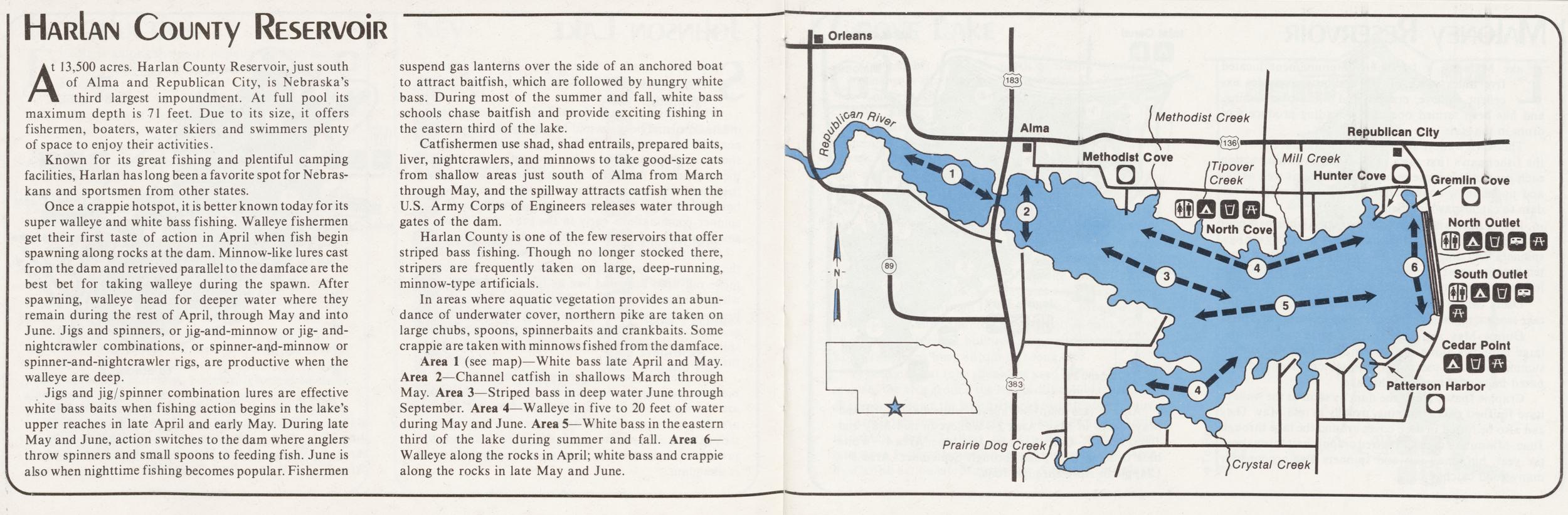
Harlan County Reservoir
At 13,500 acres. Harlan County Reservoir, just south of Alma and Republican City, is Nebraska's third largest impoundment. At full pool its maximum depth is 71 feet. Due to its size, it offers fishermen, boaters, water skiers and swimmers plenty of space to enjoy their activities.
Known for its great fishing and plentiful camping facilities, Harlan has long been a favorite spot for Nebraskans and sportsmen from other states.
Once a crappie hotspot, it is better known today for its super walleye and white bass fishing. Walleye fishermen get their first taste of action in April when fish begin spawning along rocks at the dam. Minnow-like lures cast from the dam and retrieved parallel to the damface are the best bet for taking walleye during the spawn. After spawning, walleye head for deeper water where they remain during the rest of April, through May and into June. Jigs and spinners, or jig-and-minnow or jig-and-nightcrawler combinations, or spinner-arid-minnow or spinner-and-nightcrawler rigs, are productive when the walleye are deep.
Jigs and jig/spinner combination lures are effective white bass baits when fishing action begins in the lake's upper reaches in late April and early May. During late May and June, action switches to the dam where anglers throw spinners and small spoons to feeding fish. June is also when nighttime fishing becomes popular. Fishermen suspend gas lanterns over the side of an anchored boat to attract baitfish, which are followed by hungry white bass. During most of the summer and fall, white bass schools chase baitfish and provide exciting fishing in the eastern third of the lake.
Catfishermen use shad, shad entrails, prepared baits, liver, nightcrawlers, and minnows to take good-size cats from shallow areas just south of Alma from March through May, and the spillway attracts catfish when the U.S. Army Corps of Engineers releases water through gates of the dam.
Harlan County is one of the few reservoirs that offer striped bass fishing. Though no longer stocked there, stripers are frequently taken on large, deep-running, minnow-type artificials.
In areas where aquatic vegetation provides an abundance of underwater cover, northern pike are taken on large chubs, spoons, spinnerbaits and crankbaits. Some crappie are taken with minnows fished from the damface.
Area 1 (see map)—White bass late April and May. Area 2—Channel catfish in shallows March through May. Area 3—Striped bass in deep water June through September. Area 4—Walleye in five to 20 feet of water during May and June. Area 5—White bass in the eastern third of the lake during summer and fall. Area 6—Walleye along the rocks in April; white bass and crappie along the rocks in late May and June.
Republican City Mill Creek Hunter Cove Gremlin Cove North Outlet South Outlet Cedar Point Patterson Harbor
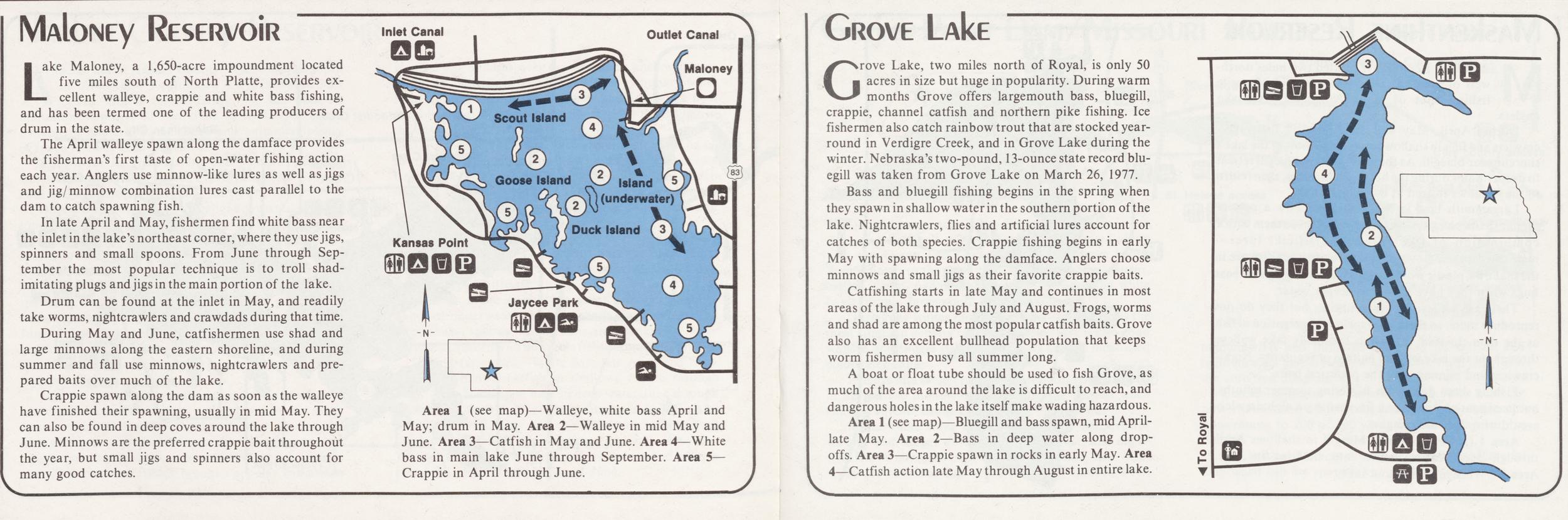
Maloney Reservoir
Lake Maloney, a 1,650-acre impoundment located five miles south of North Platte, provides excellent walleye, crappie and white bass fishing, and has been termed one of the leading producers of drum in the state.
The April walleye spawn along the damface provides the fisherman's first taste of open-water fishing action each year. Anglers use minnow-like lures as well as jigs and jig/ minnow combination lures cast parallel to the dam to catch spawning fish.
In late April and May, fishermen find white bass near the inlet in the lake's northeast corner, where they use jigs, spinners and small spoons. From June through September the most popular technique is to troll shad-imitating plugs and jigs in the main portion of the lake.
Drum can be found at the inlet in May, and readily take worms, nightcrawlers and crawdads during that time.
During May and June, catfishermen use shad and large minnows along the eastern shoreline, and during summer and fall use minnows, nightcrawlers and prepared baits over much of the lake.
Crappie spawn along the dam as soon as the walleye have finished their spawning, usually in mid May. They can also be found in deep coves around the lake through June. Minnows are the preferred crappie bait throughout the year, but small jigs and spinners also account for many good catches.
Inlet Canal Outlet Canal Area 1 (see map)—Walleye, white bass April and May; drum in May. Area 2—Walleye in mid May and June. Area 3—Catfish in May and June. Area 4—White bass in main lake June through September. Area 5—Crappie in April through June.
Grove Lake
Grove Lake, two miles north of Royal, is only 50 acres in size but huge in popularity. During warm months Grove offers largemouth bass, bluegill, crappie, channel catfish and northern pike fishing. Ice fishermen also catch rainbow trout that are stocked year-round in Verdigre Creek, and in Grove Lake during the winter. Nebraska's two-pound, 13-ounce state record bluegill was taken from Grove Lake on March 26, 1977.
Bass and bluegill fishing begins in the spring when they spawn in shallow water in the southern portion of the lake. Nightcrawlers, flies and artificial lures account for catches of both species. Crappie fishing begins in early May with spawning along the damface. Anglers choose minnows and small jigs as their favorite crappie baits.
Catfishing starts in late May and continues in most areas of the lake through July and August. Frogs, worms and shad are among the most popular catfish baits. Grove also has an excellent bullhead population that keeps worm fishermen busy all summer long.
A boat or float tube should be used to fish Grove, as much of the area around the lake is difficult to reach, and dangerous holes in the lake itself make wading hazardous.
Area 1 (see map)—Bluegill and bass spawn, mid April-late May. Area 2—Bass in deep water along drop-offs. Area 3—Crappie spawn in rocks in early May. Area 4—Catfish action late May through August in entire lake.
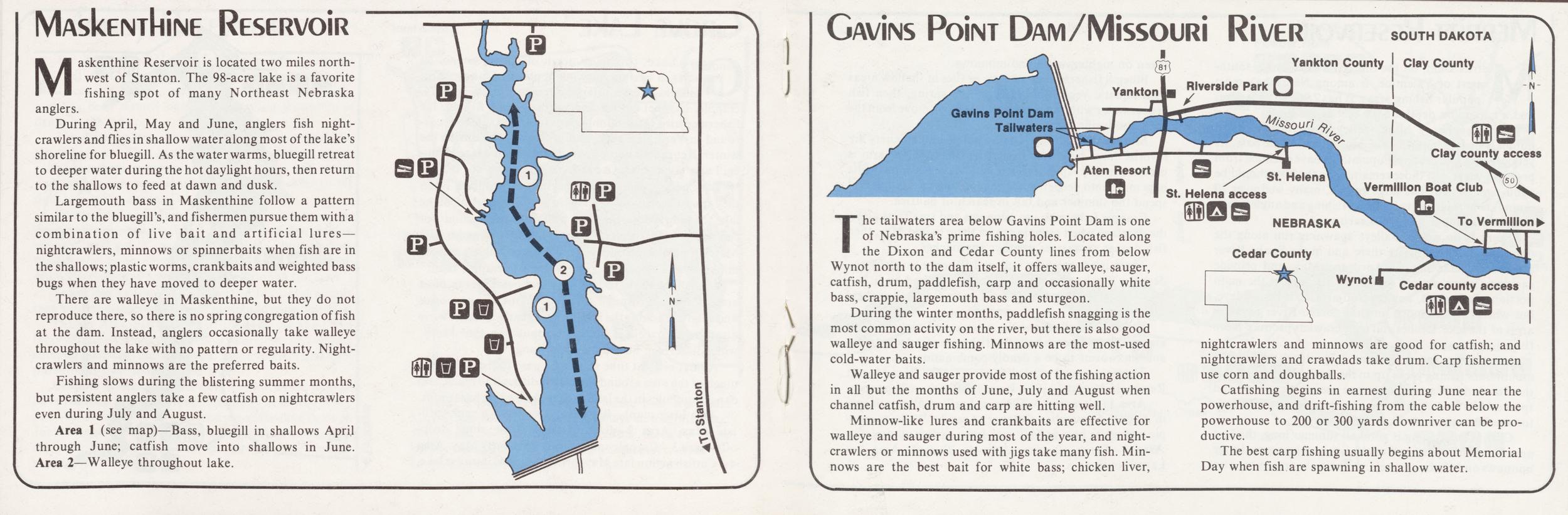
Maskenthine Reservoir
Maskenthine Reservoir is located two miles northwest of Stanton. The 98-acre lake is a favorite fishing spot of many Northeast Nebraska anglers.
During April, May and June, anglers fish nightcrawlers and flies in shallow water along most of the lake's shoreline for bluegill. As the water warms, bluegill retreat to deeper water during the hot daylight hours, then return to the shallows to feed at dawn and dusk.
Largemouth bass in Maskenthine follow a pattern similar to the bluegill's, and fishermen pursue them with a combination of live bait and artificial lures—nightcrawlers, minnows or spinnerbaits when fish are in the shallows; plastic worms, crankbaits and weighted bass bugs when they have moved to deeper water.
There are walleye in Maskenthine, but they do not reproduce there, so there is no spring congregation offish at the dam. Instead, anglers occasionally take walleye throughout the lake with no pattern or regularity. Nightcrawlers and minnows are the preferred baits.
Fishing slows during the blistering summer months, but persistent anglers take a few catfish on nightcrawlers even during July and August.
Area 1 (see map)—Bass, bluegill in shallows April through June; catfish move into shallows in June. Area 2—Walleye throughout lake.
Gavins Point Dam / Missouri River
The tailwaters area below Gavins Point Dam is one of Nebraska's prime fishing holes. Located along the Dixon and Cedar County lines from below Wynot north to the dam itself, it offers walleye, sauger, catfish, drum, paddlefish, carp and occasionally white bass, crappie, largemouth bass and sturgeon.
During the winter months, paddlefish snagging is the most common activity on the river, but there is also good walleye and sauger fishing. Minnows are the most-used cold-water baits.
Walleye and sauger provide most of the fishing action in all but the months of June, July and August when channel catfish, drum and carp are hitting well.
Minnow-like lures and crankbaits are effective for walleye and sauger during most of the year, and nightcrawlers or minnows used with jigs take many fish. Minnows are the best bait for white bass; chicken liver, nightcrawlers and minnows are good for catfish; and nightcrawlers and crawdads take drum. Carp fishermen use corn and doughballs.
Catfishing begins in earnest during June near the powerhouse, and drift-fishing from the cable below the powerhouse to 200 or 300 yards downriver can be productive.
The best carp fishing usually begins about Memorial Day when fish are spawning in shallow water.
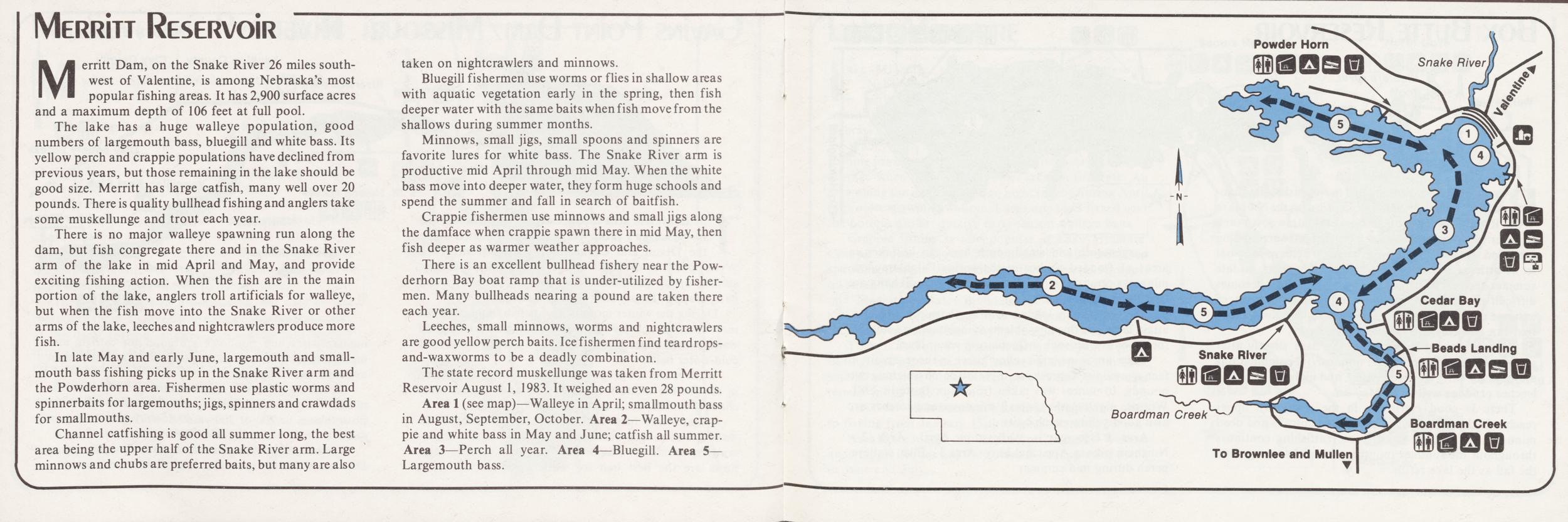
Merritt Reservoir
Merritt Dam, on the Snake River 26 miles southwest of Valentine, is among Nebraska's most popular fishing areas. It has 2,900 surface acres and a maximum depth of 106 feet at full pool.
The lake has a huge walleye population, good numbers of largemouth bass, bluegill and white bass. Its yellow perch and crappie populations have declined from previous years, but those remaining in the lake should be good size. Merritt has large catfish, many well over 20 pounds. There is quality bullhead fishing and anglers take some muskellunge and trout each year.
There is no major walleye spawning run along the dam, but fish congregate there and in the Snake River arm of the lake in mid April and May, and provide exciting fishing action. When the fish are in the main portion of the lake, anglers troll artificials for walleye, but when the fish move into the Snake River or other arms of the lake, leeches and nightcrawlers produce more fish.
In late May and early June, largemouth and smallmouth bass fishing picks up in the Snake River arm and the Powderhorn area. Fishermen use plastic worms and spinnerbaits for largemouths; jigs, spinners and crawdads for smallmouths.
Channel catfishing is good all summer long, the best area being the upper half of the Snake River arm. Large minnows and chubs are preferred baits, but many are also taken on nightcrawlers and minnows.
Bluegill fishermen use worms or flies in shallow areas with aquatic vegetation early in the spring, then fish deeper water with the same baits when fish move from the shallows during summer months.
Minnows, small jigs, small spoons and spinners are favorite lures for white bass. The Snake River arm is productive mid April through mid May. When the white bass move into deeper water, they form huge schools and spend the summer and fall in search of baitfish.
Crappie fishermen use minnows and small jigs along the damface when crappie spawn there in mid May, then fish deeper as warmer weather approaches.
There is an excellent bullhead fishery near the Powderhorn Bay boat ramp that is underutilized by fishermen. Many bullheads nearing a pound are taken there each year.
Leeches, small minnows, worms and nightcrawlers are good yellow perch baits. Ice fishermen find teardrops-and-waxworms to be a deadly combination.
The state record muskellunge was taken from Merritt Reservoir August 1, 1983. It weighed an even 28 pounds.
Area 1 (see map)—Walleye in April; smallmouth bass in August, September, October. Area 2—Walleye, crappie and white bass in May and June; catfish all summer. Area 3—Perch all year. Area 4—Bluegill. Area 5—Largemouth bass.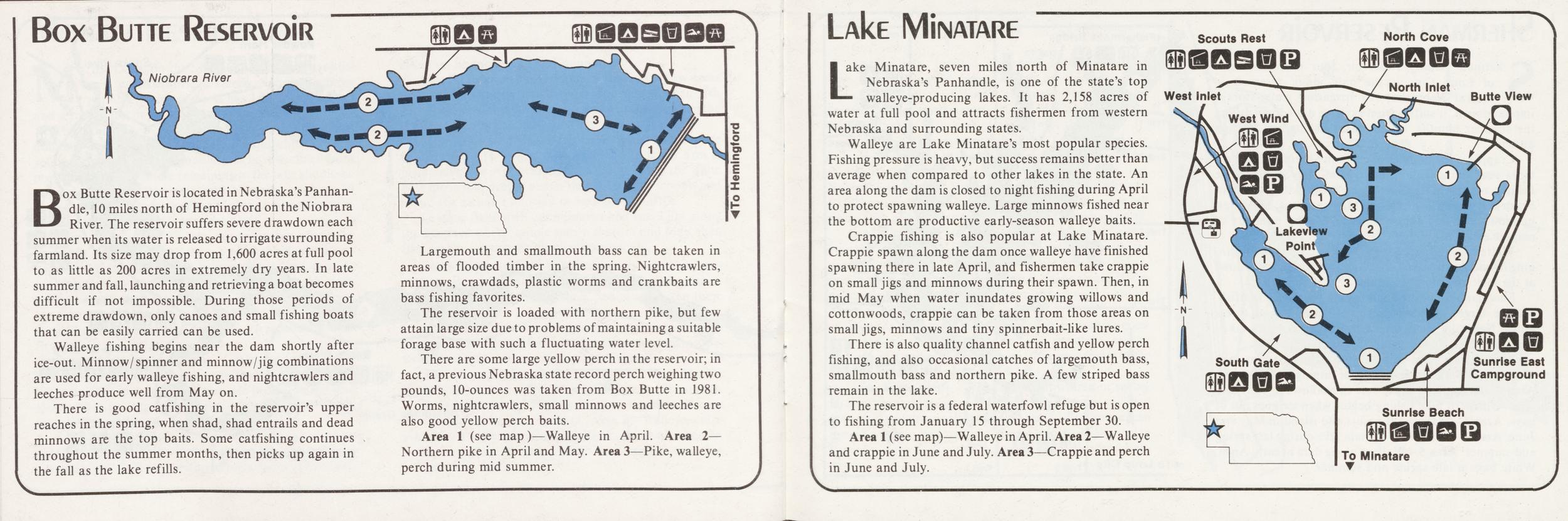
Box Butte Reservoir
Box Butte Reservoir is located in Nebraska's Panhandle, 10 miles north of Hemingford on the Niobrara River. The reservoir suffers severe drawdown each summer when its water is released to irrigate surrounding farmland. Its size may drop from 1,600 acres at full pool to as little as 200 acres in extremely dry years. In late summer and fall, launching and retrieving a boat becomes difficult if not impossible. During those periods of extreme drawdown, only canoes and small fishing boats that can be easily carried can be used.
Walleye fishing begins near the dam shortly after ice-out. Minnow/spinner and minnow/jig combinations are used for early walleye fishing, and nightcrawlers and leeches produce well from May on.
There is good catfishing in the reservoir's upper reaches in the spring, when shad, shad entrails and dead minnows are the top baits. Some catfishing continues throughout the summer months, then picks up again in the fall as the lake refills.
Largemouth and smallmouth bass can be taken in areas of flooded timber in the spring. Nightcrawlers, minnows, crawdads, plastic worms and crankbaits are bass fishing favorites.
The reservoir is loaded with northern pike, but few attain large size due to problems of maintaining a suitable forage base with such a fluctuating water level.
There are some large yellow perch in the reservoir; in fact, a previous Nebraska state record perch weighing two pounds, 10-ounces was taken from Box Butte in 1981. Worms, nightcrawlers, small minnows and leeches are also good yellow perch baits.
Area 1 (see map)—Walleye in April. Area 2—Northern pike in April and May. Area 3—Pike, walleye, perch during mid summer.
Lake Minatare
Lake Minatare, seven miles north of Minatare in Nebraska's Panhandle, is one of the state's top - walleye-producing lakes. It has 2,158 acres of water at full pool and attracts fishermen from western Nebraska and surrounding states.
Walleye are Lake Minatare's most popular species. Fishing pressure is heavy, but success remains better than average when compared to other lakes in the state. An area along the dam is closed to night fishing during April to protect spawning walleye. Large minnows fished near the bottom are productive early-season walleye baits.
Crappie fishing is also popular at Lake Minatare. Crappie spawn along the dam once walleye have finished spawning there in late April, and fishermen take crappie on small jigs and minnows during their spawn. Then, in mid May when water inundates growing willows and cottonwoods, crappie can be taken from those areas on small jigs, minnows and tiny spinnerbait-like lures.
There is also quality channel catfish and yellow perch fishing, and also occasional catches of largemouth bass, smallmouth bass and northern pike. A few striped bass remain in the lake.
The reservoir is a federal waterfowl refuge but is open to fishing from January 15 through September 30.
Area 1 (see map)—Walleye in April. Area 2—Walleye and crappie in June and July. Area 3—Crappie and perch in June and July.
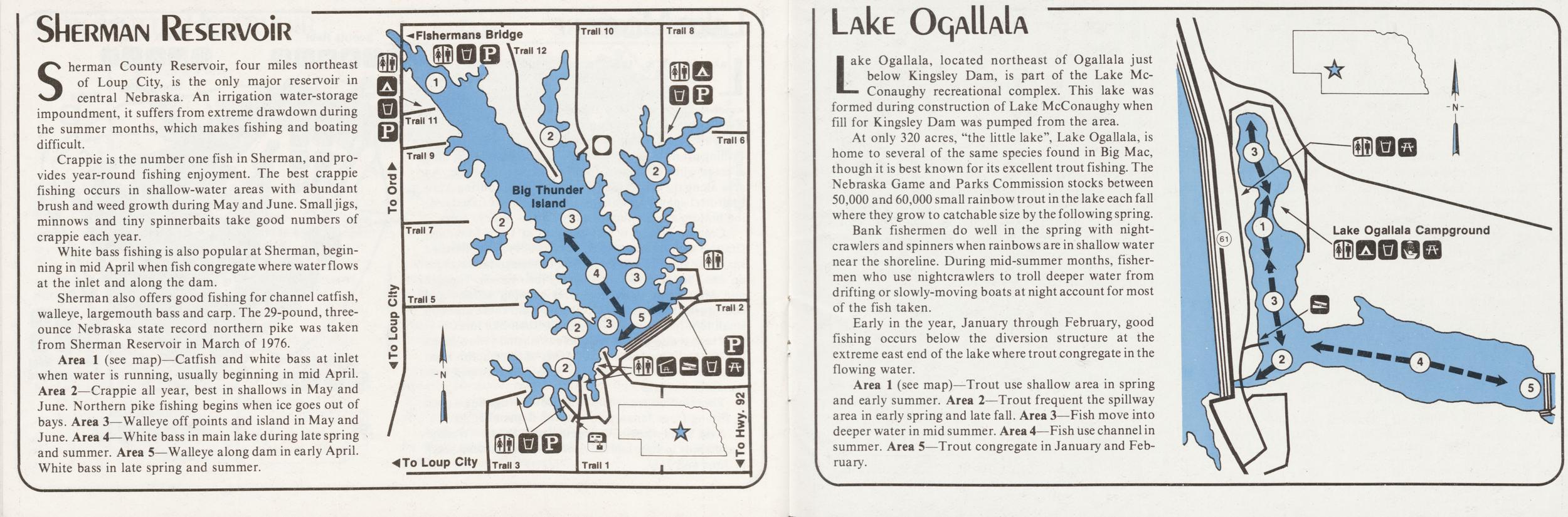
Sherman Reservoir
Sherman County Reservoir, four miles northeast of Loup City, is the only major reservoir in central Nebraska. An irrigation water-storage impoundment, it suffers from extreme drawdown during the summer months, which makes fishing and boating difficult.
Crappie is the number one fish in Sherman, and provides year-round fishing enjoyment. The best crappie fishing occurs in shallow-water areas with abundant brush and weed growth during May and June. Small jigs, minnows and tiny spinnerbaits take good numbers of crappie each year.
White bass fishing is also popular at Sherman, beginning in mid April when fish congregate where water flows at the inlet and along the dam.
Sherman also offers good fishing for channel catfish, walleye, largemouth bass and carp. The 29-pound, three-ounce Nebraska state record northern pike was taken from Sherman Reservoir in March of 1976.
Area 1 (see map)—Catfish and white bass at inlet when water is running, usually beginning in mid April. Area 2—Crappie all year, best in shallows in May and June. Northern pike fishing begins when ice goes out of bays. Area 3—Walleye off points and island in May and June. Area 4—White bass in main lake during late spring and summer. Area 5—Walleye along dam in early April. White bass in late spring and summer.
Lake Ogallala
Lake Ogallala, located northeast of Ogallala just below Kingsley Dam, is part of the Lake McConaughy recreational complex. This lake was formed during construction of Lake McConaughy when fill for Kingsley Dam was pumped from the area.
At only 320 acres, "the little lake", Lake Ogallala, is home to several of the same species found in Big Mac, though it is best known for its excellent trout fishing. The Nebraska Game and Parks Commission stocks between 50,000 and 60,000 small rainbow trout in the lake each fall where they grow to catchable size by the following spring.
Bank fishermen do well in the spring with nightcrawlers and spinners when rainbows are in shallow water near the shoreline. During mid-summer months, fishermen who use nightcrawlers to troll deeper water from drifting or slowly-moving boats at night account for most of the fish taken.
Early in the year, January through February, good fishing occurs below the diversion structure at the extreme east end of the lake where trout congregate in the flowing water.
Area 1 (see map)—Trout use shallow area in spring and early summer. Area 2—Trout frequent the spillway area in early spring and late fall. Area 3—Fish move into deeper water in mid summer. Area 4—Fish use channel in summer. Area 5—Trout congregate in January and February.
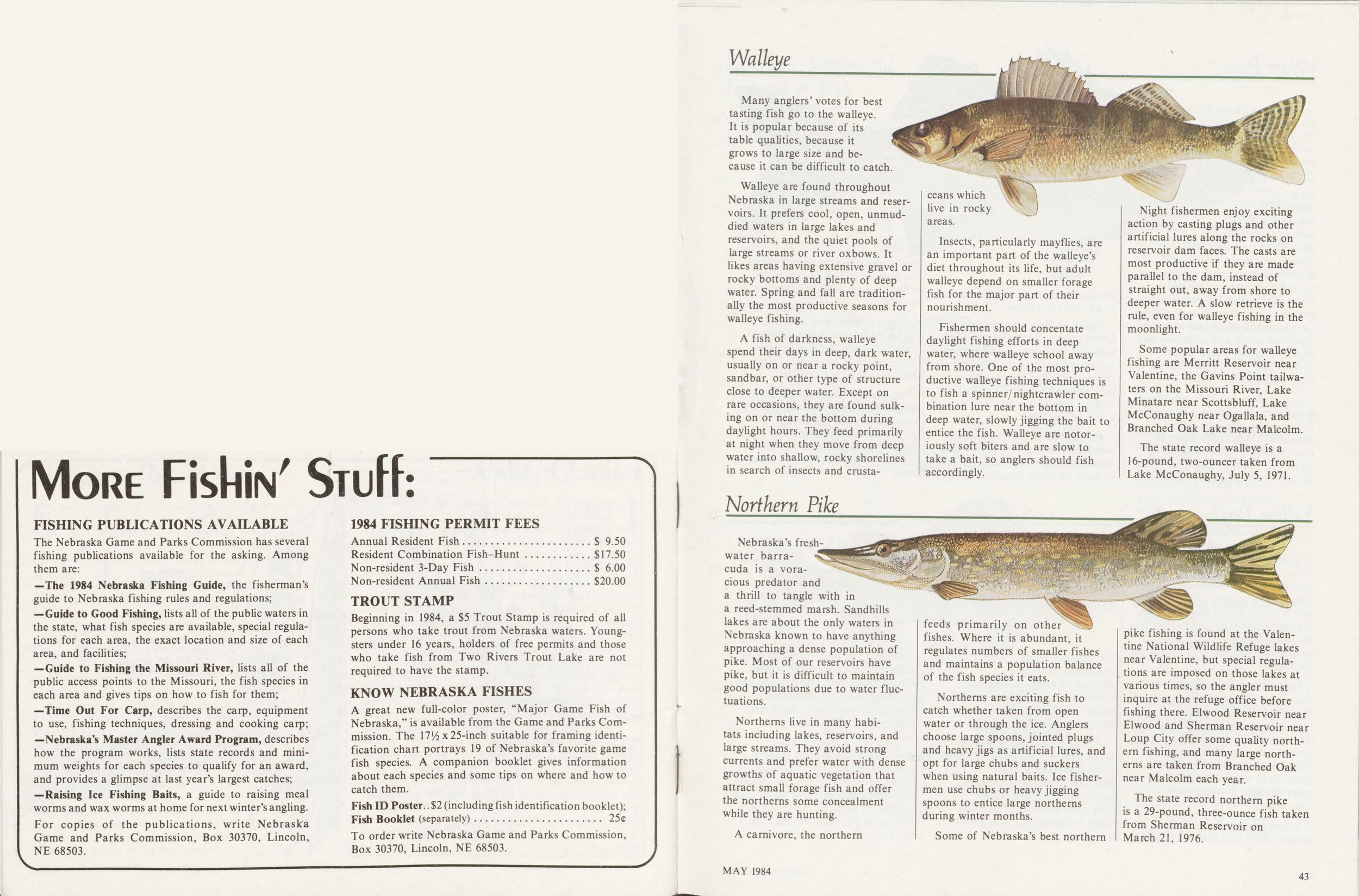
More Fishin' Stuff:
FISHING PUBLICATIONS AVAILABLE The Nebraska Game and Parks Commission has several fishing publications available for the asking. Among them are: —The 1984 Nebraska Fishing Guide, the fisherman's guide to Nebraska fishing rules and regulations; —Guide to Good Fishing, lists all of the public waters in the state, what fish species are available, special regulations for each area, the exact location and size of each area, and facilities; —Guide to Fishing the Missouri River, lists all of the public access points to the Missouri, the fish species in each area and gives tips on how to fish for them; —Time Out For Carp, describes the carp, equipment to use, fishing techniques, dressing and cooking carp; —Nebraska's Master Angler Award Program, describes how the program works, lists state records and minimum weights for each species to qualify for an award, and provides a glimpse at last year's largest catches; —Raising Ice Fishing Baits, a guide to raising meal worms and wax worms at home for next winter's angling. For copies of the publications, write Nebraska Game and Parks Commission, Box 30370, Lincoln, NE 68503. 1984 FISHING PERMIT FEES Annual Resident Fish $ 9.50 Resident Combination Fish-Hunt $17.50 Non-resident 3-Day Fish $ 6.00 Non-resident Annual Fish $20.00 TROUT STAMP Beginning in 1984, a $5 Trout Stamp is required of all persons who take trout from Nebraska waters. Youngsters under 16 years, holders of free permits and those who take fish from Two Rivers Trout Lake are not required to have the stamp. KNOW NEBRASKA FISHES A great new full-color poster, "Major Game Fish of Nebraska," is available from the Game and Parks Commission. The 17(4 x25-inch suitable for framing identification chart portrays 19 of Nebraska's favorite game fish species. A companion booklet gives information about each species and some tips on where and how to catch them. Fish ID Poster $2 (including fish identification booklet); Fish Booklet (separately) 25c To order write Nebraska Game and Parks Commission, Box 30370, Lincoln, NE 68503. WalleyeMany anglers' votes for best tasting fish go to the walleye. It is popular because of its table qualities, because it grows to large size and because it can be difficult to catch.
Walleye are found throughout Nebraska in large streams and reservoirs. It prefers cool, open, unmuddied waters in large lakes and reservoirs, and the quiet pools of large streams or river oxbows. It likes areas having extensive gravel or rocky bottoms and plenty of deep water. Spring and fall are traditionally the most productive seasons for walleye fishing.
A fish of darkness, walleye spend their days in deep, dark water, usually on or near a rocky point, sandbar, or other type of structure close to deeper water. Except on rare occasions, they are found sulking on or near the bottom during daylight hours. They feed primarily at night when they move from deep water into shallow, rocky shorelines in search of insects and crustaceans which live in rocky areas.
Insects, particularly mayflies, are an important part of the walleye's diet throughout its life, but adult walleye depend on smaller forage fish for the major part of their nourishment.
Fishermen should concentrate daylight fishing efforts in deep water, where walleye school away from shore. One of the most productive walleye fishing techniques is to fish a spinner/ nightcrawler combination lure near the bottom in deep water, slowly jigging the bait to entice the fish. Walleye are notoriously soft biters and are slow to take a bait, so anglers should fish accordingly.
Night fishermen enjoy exciting action by casting plugs and other artificial lures along the rocks on reservoir dam faces. The casts are most productive if they are made parallel to the dam, instead of straight out, away from shore to deeper water. A slow retrieve is the rule, even for walleye fishing in the moonlight.
Some popular areas for walleye fishing are Merritt Reservoir near Valentine, the Gavins Point tailwaters on the Missouri River, Lake Minatare near Scottsbluff, Lake McConaughy near Ogallala, and Branched Oak Lake near Malcolm.
The state record walleye is a 16-pound, two-ouncer taken from Lake McConaughy, July 5, 1971.
Northern PikeNebraska's freshwater barracuda is a voracious predator and a thrill to tangle with in a reed-stemmed marsh. Sandhills lakes are about the only waters in Nebraska known to have anything approaching a dense population of pike. Most of our reservoirs have pike, but it is difficult to maintain good populations due to water fluctuations.
Northerns live in many habitats including lakes, reservoirs, and large streams. They avoid strong currents and prefer water with dense growths of aquatic vegetation that attract small forage fish and offer the northerns some concealment while they are hunting.
A carnivore, the northern feeds primarily on other fishes. Where it is abundant, it regulates numbers of smaller fishes and maintains a population balance of the fish species it eats.
Northerns are exciting fish to catch whether taken from open water or through the ice. Anglers choose large spoons, jointed plugs and heavy jigs as artificial lures, and opt for large chubs and suckers when using natural baits. Ice fishermen use chubs or heavy jigging spoons to entice large northerns during winter months
Some of Nebraska's best northern pike fishing is found at the Valentine National Wildlife Refuge lakes near Valentine, but special regulations are imposed on those lakes at various times, so the angler must inquire at the refuge office before fishing there. Elwood Reservoir near Elwood and Sherman Reservoir near Loup City offer some quality northern fishing, and many large northerns are taken from Branched Oak near Malcolm each year.
The state record northern pike is a 29-pound, three-ounce fish taken from Sherman Reservoir on March 21, 1976.
MAY 1984 43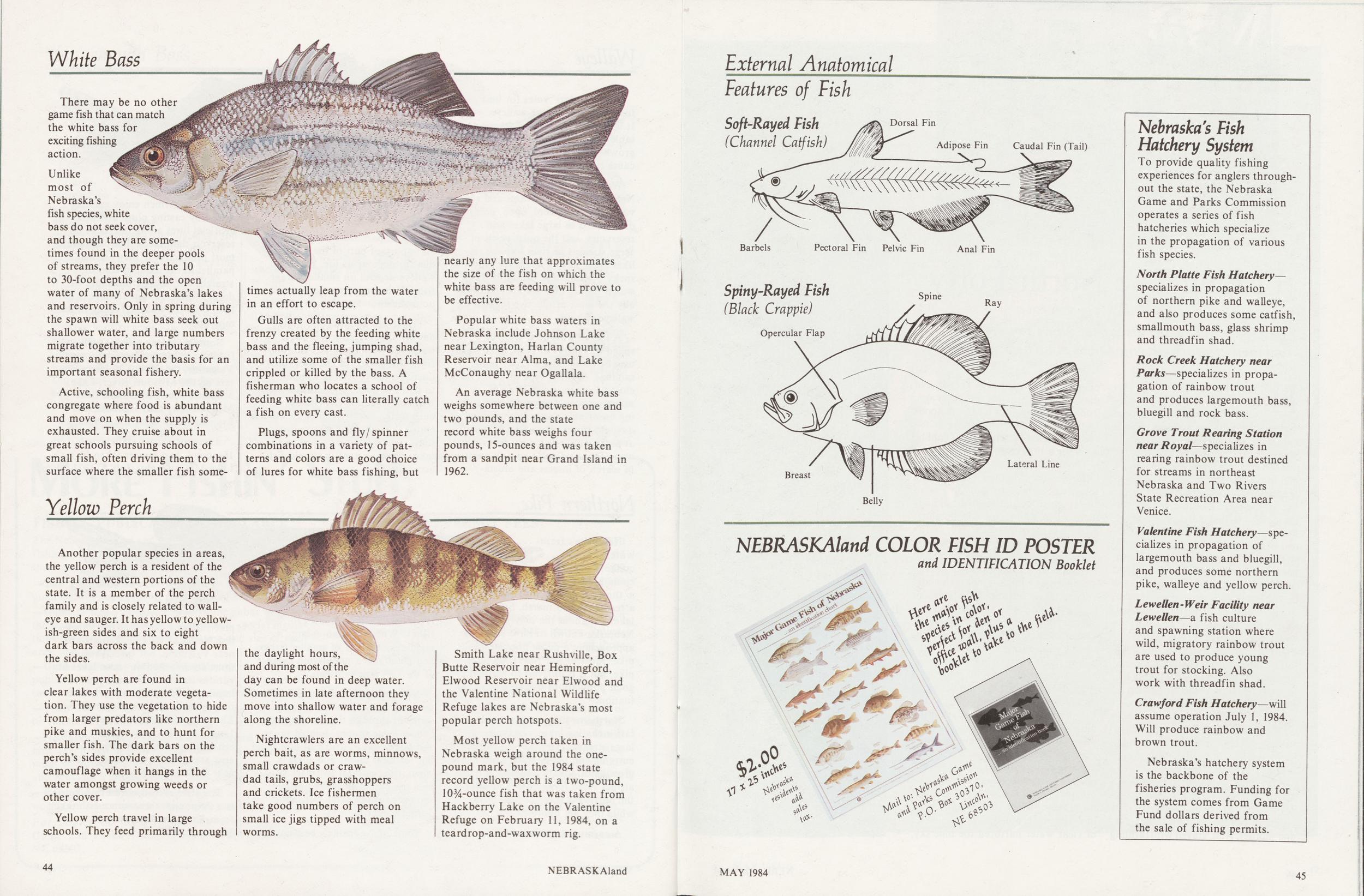 White Bass
There may be no other game fish that can match the white bass for exciting fishing action. Unlike most of Nebraska's fish species, white bass do not seek cover, and though they are sometimes found in the deeper pools of streams, they prefer the 10 to 30-foot depths and the open water of many of Nebraska's lakes and reservoirs. Only in spring during the spawn will white bass seek out shallower water, and large numbers migrate together into tributary streams and provide the basis for an important seasonal fishery.
Active, schooling fish, white bass congregate where food is abundant and move on when the supply is exhausted. They cruise about in great schools pursuing schools of small fish, often driving them to the surface where the smaller fish sometimes actually leap from the water in an effort to escape.
Gulls are often attracted to the frenzy created by the feeding white bass and the fleeing, jumping shad, and utilize some of the smaller fish crippled or killed by the bass. A fisherman who locates a school of feeding white bass can literally catch a fish on every cast.
Plugs, spoons and fly/ spinner combinations in a variety of patterns and colors are a good choice of lures for white bass fishing, but nearly any lure that approximates the size of the fish on which the white bass are feeding will prove to be effective.
Popular white bass waters in Nebraska include Johnson Lake near Lexington, Harlan County Reservoir near Alma, and Lake McConaughy near Ogallala.
An average Nebraska white bass weighs somewhere between one and two pounds, and the state record white bass weighs four pounds, 15-ounces and was taken from a sandpit near Grand Island in 1962.
Yellow PerchAnother popular species in areas, the yellow perch is a resident of the central and western portions of the state. It is a member of the perch family and is closely related to walleye and sauger. It has yellow to yellowish-green sides and six to eight dark bars across the back and down the sides.
Yellow perch are found in clear lakes with moderate vegetation. They use the vegetation to hide from larger predators like northern pike and muskies, and to hunt for smaller fish. The dark bars on the perch's sides provide excellent camouflage when it hangs in the water amongst growing weeds or other cover.
Yellow perch travel in large schools. They feed primarily through the daylight hours, and during most of the day can be found in deep water. Sometimes in late afternoon they move into shallow water and forage along the shoreline.
Nightcrawlers are an excellent perch bait, as are worms, minnows, small crawdads or crawdad tails, grubs, grasshoppers and crickets. Ice fishermen take good numbers of perch on small ice jigs tipped with meal worms.
Smith Lake near Rushville, Box Butte Reservoir near Hemingford, Elwood Reservoir near Elwood and the Valentine National Wildlife Refuge lakes are Nebraska's most popular perch hotspots.
Most yellow perch taken in Nebraska weigh around the one-pound mark, but the 1984 state record yellow perch is a two-pound, 10%-ounce fish that was taken from Hackberry Lake on the Valentine Refuge on February 11, 1984, on a teardrop-and-waxworm rig.
44 NEBRASKAland External AnatomicalFeatures of Fish Soft-Rayed Fish (Channel Catfish) Dorsal Fin Caudal Fin (Tail) Barbels Pectoral Fin Pelvic Fin Anal Fin
Spiny-Rayed Fish (Black Crappie) Spine Opercular Flap Lateral Line Breast Belly
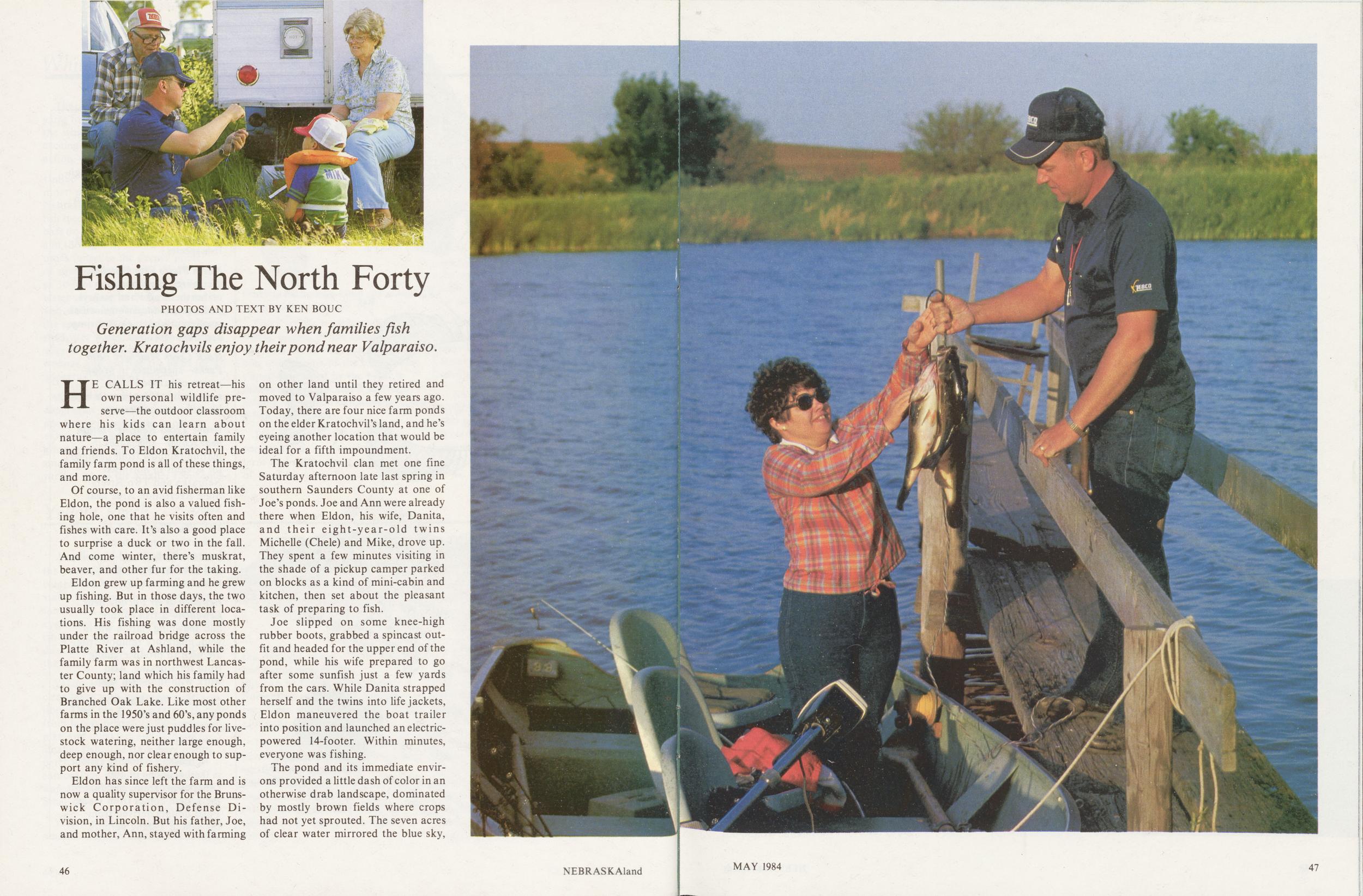
Fishing The North Forty
PHOTOS AND TEXT BY KEN BOUC Generation gaps disappear when families fish together. Kratochvils enjoy their pond near Valparaiso.HE CALLS IT his retreat—his own personal wildlife preserve—the outdoor classroom where his kids can learn about nature—a place to entertain family and friends. To Eldon Kratochvil, the family farm pond is all of these things, and more.
Of course, to an avid fisherman like Eldon, the pond is also a valued fishing hole, one that he visits often and fishes with care. It's also a good place to surprise a duck or two in the fall. And come winter, there's muskrat, beaver, and other fur for the taking.
Eldon grew up farming and he grew up fishing. But in those days, the two usually took place in different locations. His fishing was done mostly under the railroad bridge across the Platte River at Ashland, while the family farm was in northwest Lancaster County; land which his family had to give up with the construction of Branched Oak Lake. Like most other farms in the 1950's and 60's, any ponds on the place were just puddles for livestock watering, neither large enough, deep enough, nor clear enough to support any kind of fishery.
Eldon has since left the farm and is now a quality supervisor for the Brunswick Corporation, Defense Division, in Lincoln. But his father, Joe, and mother, Ann, stayed with farming on other land until they retired and moved to Valparaiso a few years ago. Today, there are four nice farm ponds on the elder Kratochvil's land, and he's eyeing another location that would be ideal for a fifth impoundment.
The Kratochvil clan met one fine Saturday afternoon late last spring in southern Saunders County at one of Joe's ponds. Joe and Ann were already there when Eldon, his wife, Danita, and their eight-year-old twins Michelle (Chele) and Mike, drove up. They spent a few minutes visiting in the shade of a pickup camper parked on blocks as a kind of mini-cabin and kitchen, then set about the pleasant task of preparing to fish.
Joe slipped on some knee-high rubber boots, grabbed a spincast outfit and headed for the upper end of the pond, while his wife prepared to go after some sunfish just a few yards from the cars. While Danita strapped herself and the twins into life jackets, Eldon maneuvered the boat trailer into position and launched an electric-powered 14-footer. Within minutes, everyone was fishing.
The pond and its immediate environs provided a little dash of color in an otherwise drab landscape, dominated by mostly brown fields where crops had not yet sprouted. The seven acres of clear water mirrored the blue sky,
46 NEBRASKAland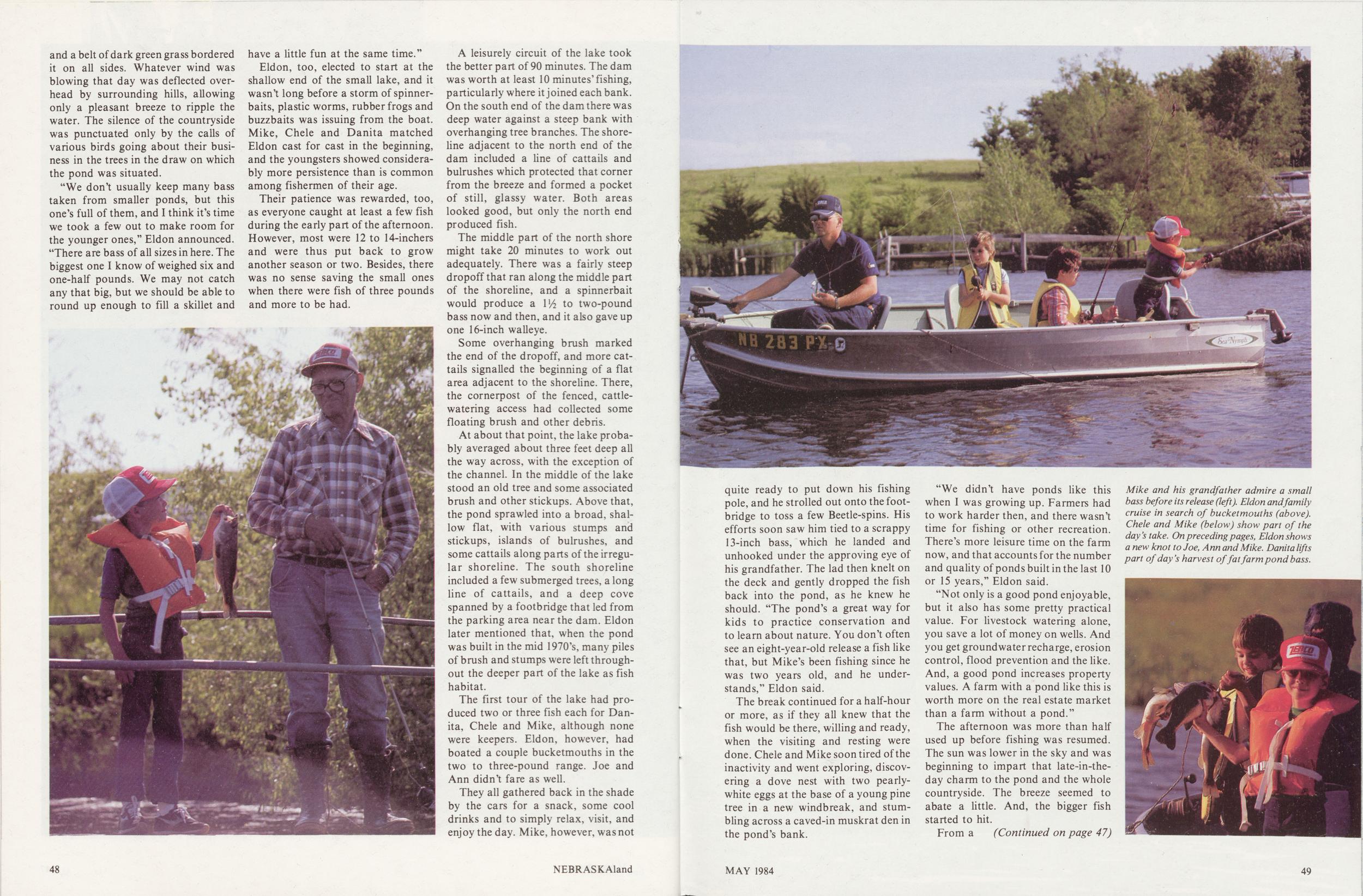
and a belt of dark green grass bordered it on all sides. Whatever wind was blowing that day was deflected overhead by surrounding hills, allowing only a pleasant breeze to ripple the water. The silence of the countryside was punctuated only by the calls of various birds going about their business in the trees in the draw on which the pond was situated.
"We don't usually keep many bass taken from smaller ponds, but this one's full of them, and I think it's time we took a few out to make room for the younger ones," Eldon announced. "There are bass of all sizes in here. The biggest one I know of weighed six and one-half pounds. We may not catch any that big, but we should be able to round up enough to fill a skillet and have a little fun at the same time."
Eldon, too, elected to start at the shallow end of the small lake, and it wasn't long before a storm of spinner-baits, plastic worms, rubber frogs and buzzbaits was issuing from the boat. Mike, Chele and Danita matched Eldon cast for cast in the beginning, and the youngsters showed considerably more persistence than is common among fishermen of their age.
Their patience was rewarded, too, as everyone caught at least a few fish during the early part of the afternoon. However, most were 12 to 14-inchers and were thus put back to grow another season or two. Besides, there was no sense saving the small ones when there were fish of three pounds and more to be had.
A leisurely circuit of the lake took the better part of 90 minutes. The dam was worth at least 10 minutes'fishing, particularly where it joined each bank. On the south end of the dam there was deep water against a steep bank with overhanging tree branches. The shoreline adjacent to the north end of the dam included a line of cattails and bulrushes which protected that corner from the breeze and formed a pocket of still, glassy water. Both areas looked good, but only the north end produced fish.
The middle part of the north shore might take 20 minutes to work out adequately. There was a fairly steep dropoff that ran along the middle part of the shoreline, and a spinnerbait would produce a \XA to two-pound bass now and then, and it also gave up one 16-inch walleye.
Some overhanging brush marked the end of the dropoff, and more cattails signaled the beginning of a flat area adjacent to the shoreline. There, the cornerpost of the fenced, cattle-watering access had collected some floating brush and other debris.
At about that point, the lake probably averaged about three feet deep all the way across, with the exception of the channel. In the middle of the lake stood an old tree and some associated brush and other stickups. Above that, the pond sprawled into a broad, shallow flat, with various stumps and stickups, islands of bulrushes, and some cattails along parts of the irregular shoreline. The south shoreline included a few submerged trees, a long line of cattails, and a deep cove spanned by a footbridge that led from the parking area near the dam. Eldon later mentioned that, when the pond was built in the mid 1970's, many piles of brush and stumps were left throughout the deeper part of the lake as fish habitat.
The first tour of the lake had produced two or three fish each for Danita, Chele and Mike, although none were keepers. Eldon, however, had boated a couple bucketmouths in the two to three-pound range. Joe and Ann didn't fare as well.
They all gathered back in the shade by the cars for a snack, some cool drinks and to simply relax, visit, and enjoy the day. Mike, however, was not
quite ready to put down his fishing pole, and he strolled out onto the foot-bridge to toss a few Beetle-spins. His efforts soon saw him tied to a scrappy 13-inch bass, which he landed and unhooked under the approving eye of his grandfather. The lad then knelt on the deck and gently dropped the fish back into the pond, as he knew he should. "The pond's a great way for kids to practice conservation and to learn about nature. You don't often see an eight-year-old release a fish like that, but Mike's been fishing since he was two years old, and he understands," Eldon said.
The break continued for a half-hour or more, as if they all knew that the fish would be there, willing and ready, when the visiting and resting were done. Chele and Mike soon tired of the inactivity and went exploring, discovering a dove nest with two pearly-white eggs at the base of a young pine tree in a new windbreak, and stumbling across a caved-in muskrat den in the pond's bank.
"We didn't have ponds like this when I was growing up. Farmers had to work harder then, and there wasn't time for fishing or other recreation. There's more leisure time on the farm now, and that accounts for the number and quality of ponds built in the last 10 or 15 years," Eldon said.
"Not only is a good pond enjoyable, but it also has some pretty practical value. For livestock watering alone, you save a lot of money on wells. And you get groundwater recharge, erosion control, flood prevention and the like. And, a good pond increases property values. A farm with a pond like this is worth more on the real estate market than a farm without a pond."
The afternoon was more than half used up before fishing was resumed. The sun was lower in the sky and was beginning to impart that late-in-the-day charm to the pond and the whole countryside. The breeze seemed to abate a little. And, the bigger fish started to hit.
From a (Continued on page 47)
Mike and his grandfather admire a small bass before its release (left). Eldon and family cruise in search of bucketmouths (above). Chele and Mike (below) show part of the day's take. On preceding pages, Eldon shows a new knot to Joe, Ann and Mike. Danita lifts part of day's harvest of fat farm pond bass.
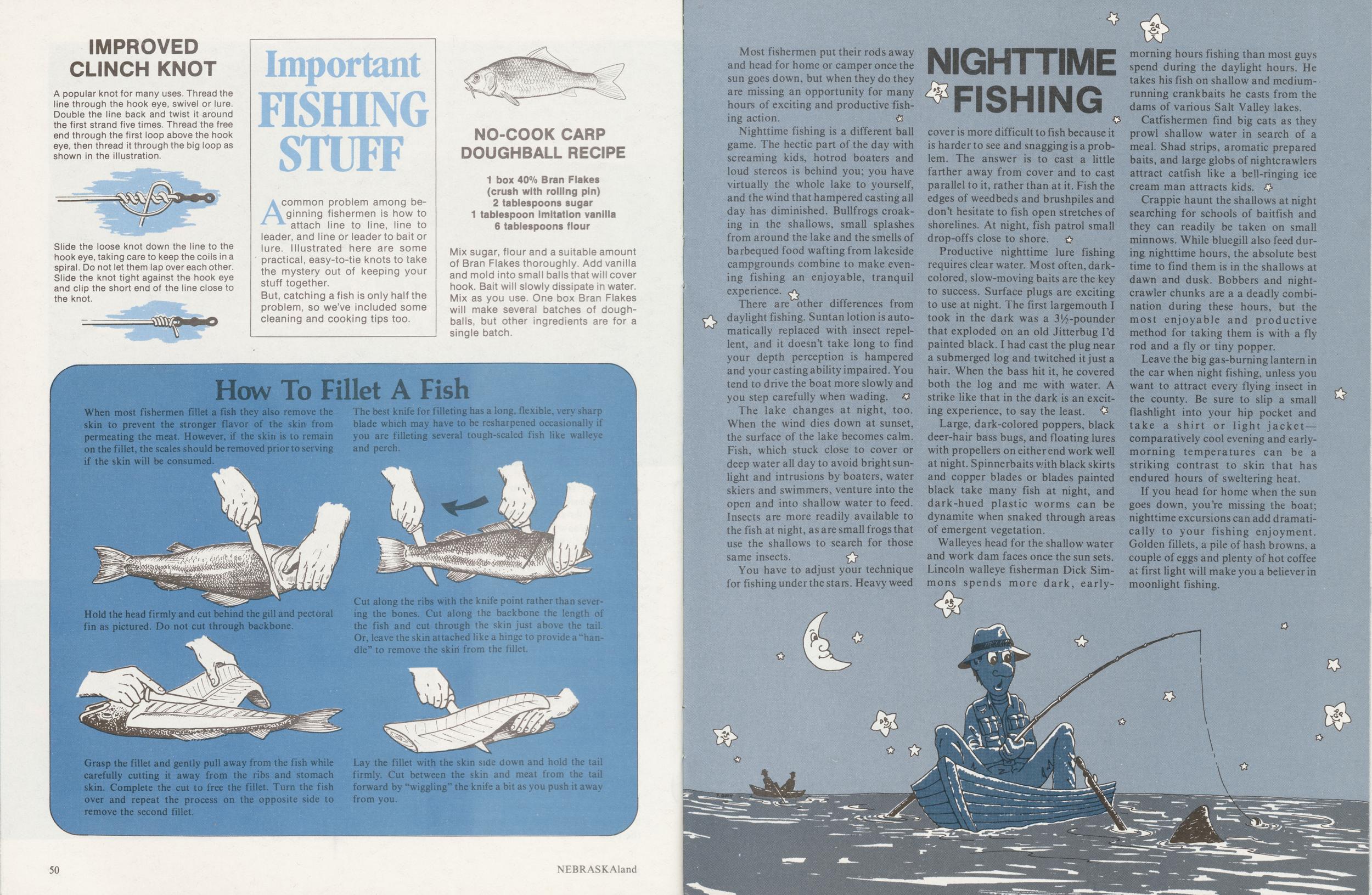
Important FISHING STUFF
A common problem among beginning fishermen is how to attach line to line, line to leader, and line or leader to bait or lure. Illustrated here are some practical, easy-to-tie knots to take the mystery out of keeping your stuff together. But, catching a fish is only half the problem, so we've included some cleaning and cooking tips too.
IMPROVED CLINCH KNOTA popular knot for many uses. Thread the line through the hook eye, swivel or lure. Double the line back and twist it around the first strand five times. Thread the free end through the first loop above the hook eye, then thread it through the big loop as shown in the illustration.
Slide the loose knot down the line to the hook eye, taking care to keep the coils in a spiral. Do not let them lap over each other. Slide the knot tight against the hook eye and clip the short end of the line close to the knot.
Mix sugar, flour and a suitable amount of Bran Flakes thoroughly. Add vanilla and mold into small balls that will cover hook. Bait will slowly dissipate in water. Mix as you use. One box Bran Flakes will make several batches of doughballs, but other ingredients are for a single batch.
How To Fillet A Fish When most fishermen fillet a fish they also remove the skin to prevent the stronger flavor of the skin from permeating the meat. However, if the skin is to remain on the fillet, the scales should be removed prior to serving if the skin will be consumed. The best knife for filleting has a long, flexible, very sharp blade which may have to be resharpened occasionally if you are filleting several tough-scaled fish like walleye and perch. Hold the head firmly and cut behind the gill and pectoral fin as pictured. Do not cut through backbone. Cut along the ribs with the knife point rather than severing the bones. Cut along the backbone the length of the fish and cut through the skin just above the tail. Or, leave the skin attached like a hinge to provide a "handle" to remove the skiri from the fillet. Grasp the fillet and gently pull away from the fish while carefully cutting it away from the ribs and stomach skin. Complete the cut to free the fillet. Turn the fish over and repeat the process on the opposite side to remove the second fillet. Lay the fillet with the skin side down and hold the tail firmly. Cut between the skin and meat from the tail forward by "wiggling" the knife a bit as you push it away from you. 50 NEBRASKAlandNIGHTTIME FISHING
Most fishermen put their rods away and head for home or camper once the sun goes down, but when they do they are missing an opportunity for many hours of exciting and productive fishing action.
Nighttime fishing is a different ball game. The hectic part of the day with screaming kids, hotrod boaters and loud stereos is behind you; you have virtually the whole lake to yourself, and the wind that hampered casting all day has diminished. Bullfrogs croaking in the shallows, small splashes from around the lake and the smells of barbequed food wafting from lakeside campgrounds combine to make evening fishing an enjoyable, tranquil experience.
There are other differences from daylight fishing. Suntan lotion is automatically replaced with insect repellent, and it doesn't take long to find your depth perception is hampered and your casting ability impaired. You tend to drive the boat more slowly and you step carefully when wading.
The lake changes at night, too. When the wind dies down at sunset, the surface of the lake becomes calm. Fish, which stuck close to cover or deep water all day to avoid bright sunlight and intrusions by boaters, water skiers and swimmers, venture into the open and into shallow water to feed. Insects are more readily available to the fish at night, as are small frogs that use the shallows to search for those same insects.
You have to adjust your technique for fishing under the stars. Heavy weed cover is more difficult to fish because it is harder to see and snagging is a problem. The answer is to cast a little farther away from cover and to cast parallel to it, rather than at it. Fish the edges of weedbeds and brushpiles and don't hesitate to fish open stretches of shorelines. At night, fish patrol small drop-offs close to shore.
Productive nighttime lure fishing requires clear water. Most often, dark-colored, slow-moving baits are the key to success. Surface plugs are exciting to use at night. The first largemouth I took in the dark was a 3 Impounder that exploded on an old Jitterbug I'd painted black. I had cast the plug near a submerged log and twitched it just a hair. When the bass hit it, he covered both the log and me with water. A strike like that in the dark is an exciting experience, to say the least.
Large, dark-colored poppers, black deer-hair bass bugs, and floating lures with propellers on either end work well at night. Spinnerbaits with black skirts and copper blades or blades painted black take many fish at night, and dark-hued plastic worms can be dynamite when snaked through areas of emergent vegetation.
Walleyes head for the shallow water and work dam faces once the sun sets. Lincoln walleye fisherman Dick Simmons spends more dark, early-morning hours fishing than most guys spend during the daylight hours. He takes his fish on shallow and medium-running crankbaits he casts from the dams of various Salt Valley lakes.
Catfishermen find big cats as they prowl shallow water in search of a meal. Shad strips, aromatic prepared baits, and large globs of nightcrawlers attract catfish like a bell-ringing ice cream man attracts kids.
Crappie haunt the shallows at night searching for schools of baitfish and they can readily be taken on small minnows. While bluegill also feed during nighttime hours, the absolute best time to find them is in the shallows at dawn and dusk. Bobbers and nightcrawler chunks are a a deadly combination during these hours, but the most enjoyable and productive method for taking them is with a fly rod and a fly or tiny popper.
Leave the big gas-burning lantern in the car when night fishing, unless you want to attract every flying insect in the county. Be sure to slip a small flashlight into your hip pocket and take a shirt or light jacket—comparatively cool evening and early-morning temperatures can be a striking contrast to skin that has endured hours of sweltering heat.
If you head for home when the sun goes down, you're missing the boat; nighttime excursions can add dramatically to your fishing enjoyment. Golden fillets, a pile of hash browns, a couple of eggs and plenty of hot coffee at first light will make you a believer in moonlight fishing.
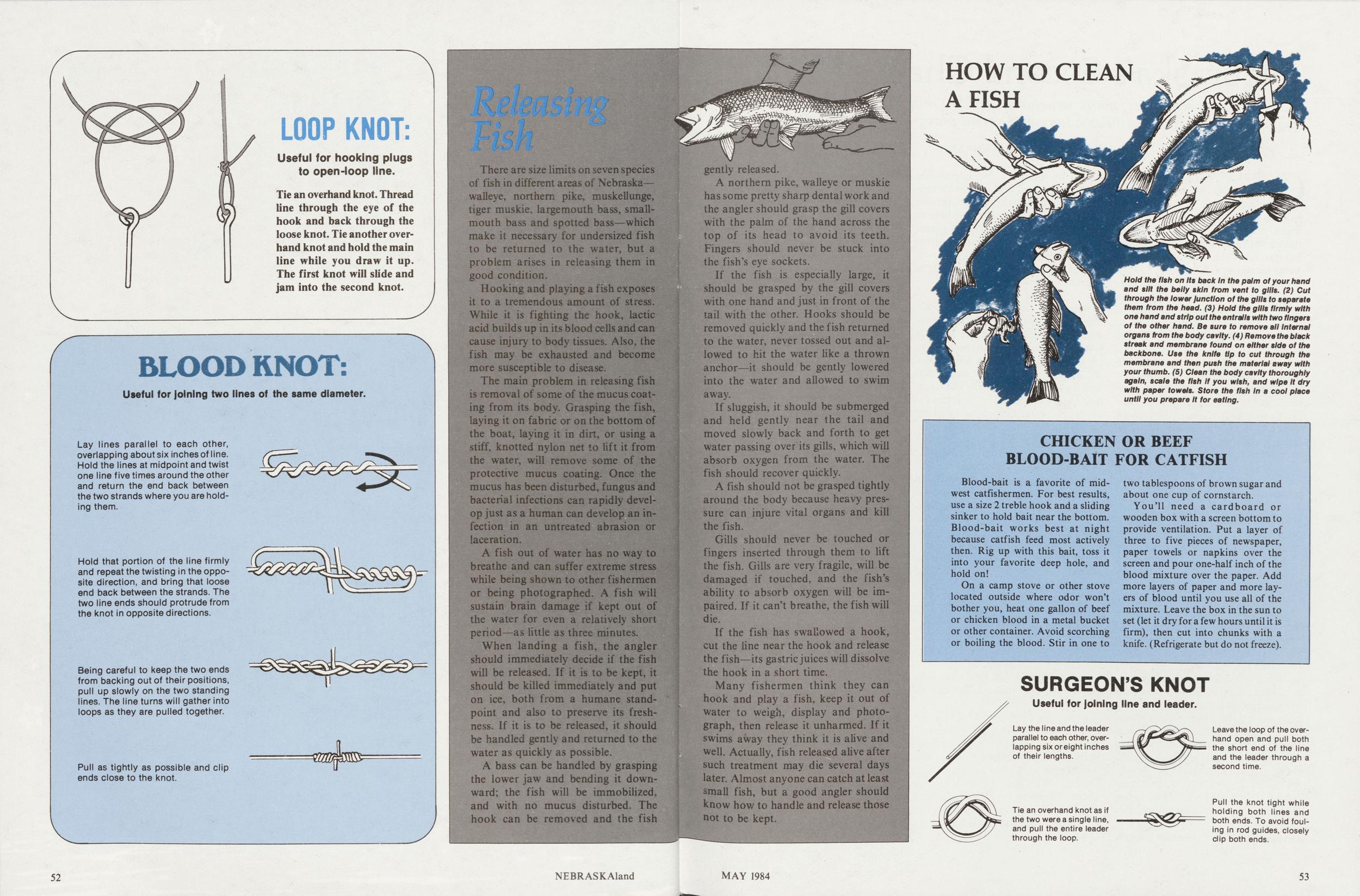
LOOP KNOT:
Useful for hooking plugs to open-loop line.Tie an overhand knot. Thread line through the eye of the hook and back through the loose knot. Tie another overhand knot and hold the main line while you draw it up. The first knot will slide and jam into the second knot.
BLOOD KNOT:
Useful for joining two lines of the same diameter.
Lay lines parallel to each other, overlapping about six inches of line. Hold the lines at midpoint and twist one line five times around the other and return the end back between the two strands where you are holding them.
Hold that portion of the line firmly and repeat the twisting in the opposite direction, and bring that loose end back between the strands. The two line ends should protrude from the knot in opposite directions.
Being careful to keep the two ends from backing out of their positions, pull up slowly on the two standing lines. The line turns will gather into loops as they are pulled together.
Pull as tightly as possible and clip ends close to the knot.
Releasing Fish
There are size limits on seven species of fish in different areas of Nebraska—walleye, northern pike, muskellunge, tiger muskie, largemouth bass, smallmouth bass and spotted bass—which make it necessary for undersized fish to be returned to the water, but a problem arises in releasing them in good condition.
Hooking and playing a fish exposes it to a tremendous amount of stress. While it is fighting the hook, lactic acid builds up in its blood cells and can cause injury to body tissues. Also, the fish may be exhausted and become more susceptible to disease.
The main problem in releasing fish is removal of some of the mucus coat ing from its body. Grasping the fish, laying it on fabric or on the bottom of the boat, laying it in dirt, or using a stiff, knotted nylon net to lift it from the water, will remove some of the protective mucus coating. Once the mucus has been disturbed, fungus and bacterial infections can rapidly develop just as a human can develop an infection in an untreated abrasion or laceration.
A fish out of water has no way to breathe and can suffer extreme stress while being shown to other fishermen or being photographed. A fish will sustain brain damage if kept out of the water for even a relatively short period—as little as three minutes.
When landing a fish, the angler should immediately decide if the fish will be released. If it is to be kept, it should be killed immediately and put on ice, both from a humane standpoint and also to preserve its freshness, if it is to be released, it should be handled gently and returned to the water as quickly as possible.
A bass can be handled by grasping the lower jaw and bending it downward; the fish will be immobilized, and with no mucus disturbed. The hook can be removed and the fish
52 NEBRASKAlandgently released.
A northern pike, walleye or muskie has some pretty sharp dental work and the angler should grasp the gill covers with the palm of the hand across the top of its head to avoid its teeth. Fingers should never be stuck into the fish's eye sockets.
If the fish is especially large, it should be grasped by the gill covers with one hand and just in front of the tail with the other. Hooks should be removed quickly and the fish returned to the water, never tossed out and allowed to hit the water like a thrown anchor—it should be gently lowered into the water and allowed to swim away.
If sluggish, it should be submerged and held gently near the tail and moved slowly back and forth to get water passing over its gills, which will absorb oxygen from the water. The fish should recover quickly.
A fish should not be grasped tightly around the body because heavy pressure can injure vital organs and kill the fish.
Gills should never be touched or fingers inserted through them to lift the fish. Gills are very fragile, will be damaged if touched, and the fish's ability to absorb oxygen will be impaired. If it can't breathe, the fish will die.
If the fish has swallowed a hook, cut the line near the hook and release the fish—its gastric juices will dissolve the hook in a short time.
Many fishermen think they can hook and play a fish, keep it out of water to weigh, display and photograph, then release it unharmed. If it swims away they think it is alive and well. Actually, fish released alive after such treatment may die several days later. Almost anyone can catch at least small fish, but a good angler should know how to handle and release those not to be kept.
HOW TO CLEAN A FISH
Hold the fish on Its back In the palm of your hand and silt the belly skin from vent to gills. (2) Cut through the lower junction of the gills to separate them from the head. (3) Hold the gills firmly with one hand and strip out the entrails with two fingers of the other hand. Be sure to remove all Internal organs from the body cavity. (4) Remove the black streak and membrane found on either side of the backbone. Use the knife tip to cut through the membrane and then push the material away with your thumb. (5) Clean the body cavity thoroughly again, scale the fish If you wish, and wipe It dry with paper towels. Store the fish In a cool place until you prepare It for eating.
CHICKEN OR BEEF BLOOD-BAIT FOR CATFISH
Blood-bait is a favorite of midwest catfishermen. For best results, use a size 2 treble hook and a sliding sinker to hold bait near the bottom. Blood-bait works best at night because catfish feed most actively then. Rig up with this bait, toss it into your favorite deep hole, and hold on!
On a camp stove or other stove located outside where odor won't bother you, heat one gallon of beef or chicken blood in a metal bucket or other container. Avoid scorching or boiling the blood. Stir in one to two tablespoons of brown sugar and about one cup of cornstarch.
You'll need a cardboard or wooden box with a screen bottom to provide ventilation. Put a layer of three to five pieces of newspaper, paper towels or napkins over the screen and pour one-half inch of the blood mixture over the paper. Add more layers of paper and more layers of blood until you use all of the mixture. Leave the box in the sun to set (let it dry for a few hours until it is firm), then cut into chunks with a knife. (Refrigerate but do not freeze).
SURGEON'S KNOT
Useful for joining line and leader.Lay the line and the leader parallel to each other, overlapping six or eight inches of their lengths.
Tie an overhand knot as if the two were a single line, and pull the entire leader through the loop.
Leave the loop of the overhand open and pull both the short end of the line and the leader through a second time.
Pull the knot tight while holding both lines and both ends. To avoid fouling in rod guides, closely clip both ends.
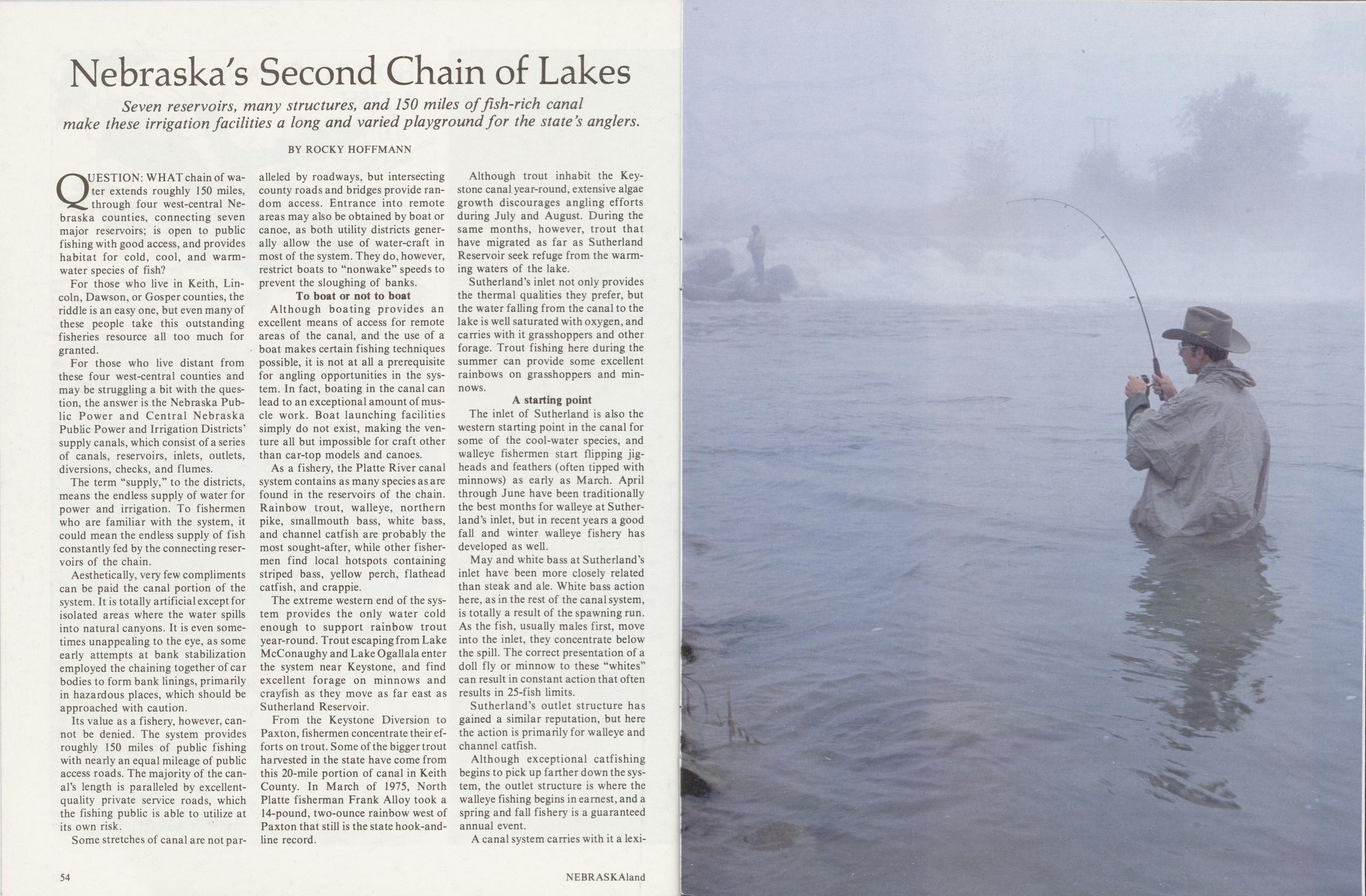
Nebraska's Second Chain of Lakes
Seven reservoirs, many structures, and 150 miles of fish-rich canal make these irrigation facilities a long and varied playground for the state's anglers. BY ROCKY HOFFMANNQUESTION: WHAT chain of water extends roughly 150 miles, through four west-central Nebraska counties, connecting seven major reservoirs; is open to public fishing with good access, and provides habitat for cold, cool, and warm-water species of fish?
For those who live in Keith, Lincoln, Dawson, or Gosper counties, the riddle is an easy one, but even many of these people take this outstanding fisheries resource all too much for granted.
For those who live distant from these four west-central counties and may be struggling a bit with the question, the answer is the Nebraska Public Power and Central Nebraska Public Power and Irrigation Districts' supply canals, which consist of a series of canals, reservoirs, inlets, outlets, diversions, checks, and flumes.
The term "supply," to the districts, means the endless supply of water for power and irrigation. To fishermen who are familiar with the system, it could mean the endless supply of fish constantly fed by the connecting reservoirs of the chain.
Aesthetically, very few compliments can be paid the canal portion of the system. It is totally artificial except for isolated areas where the water spills into natural canyons. It is even sometimes unappealing to the eye, as some early attempts at bank stabilization employed the chaining together of car bodies to form bank linings, primarily in hazardous places, which should be approached with caution.
Its value as a fishery, however, cannot be denied. The system provides roughly 150 miles of public fishing with nearly an equal mileage of public access roads. The majority of the canal's length is paralleled by excellent-quality private service roads, which the fishing public is able to utilize at its own risk.
Some stretches of canal are not paralleled by roadways, but intersecting county roads and bridges provide random access. Entrance into remote areas may also be obtained by boat or canoe, as both utility districts generally allow the use of water-craft in most of the system. They do, however, restrict boats to "nonwake" speeds to prevent the sloughing of banks.
To boat or not to boatAlthough boating provides an excellent means of access for remote areas of the canal, and the use of a boat makes certain fishing techniques possible, it is not at all a prerequisite for angling opportunities in the system. In fact, boating in the canal can lead to an exceptional amount of muscle work. Boat launching facilities simply do not exist, making the venture all but impossible for craft other than car-top models and canoes.
As a fishery, the Platte River canal system contains as many species as are found in the reservoirs of the chain. Rainbow trout, walleye, northern pike, smallmouth bass, white bass, and channel catfish are probably the most sought-after, while other fishermen find local hotspots containing striped bass, yellow perch, flathead catfish, and crappie.
The extreme western end of the system provides the only water cold enough to support rainbow trout year-round. Trout escaping from Lake McConaughy and Lake Ogallala enter the system near Keystone, and find excellent forage on minnows and crayfish as they move as far east as Sutherland Reservoir.
From the Keystone Diversion to Paxton, fishermen concentrate their efforts on trout. Some of the bigger trout harvested in the state have come from this 20-mile portion of canal in Keith County. In March of 1975, North Platte fisherman Frank Alloy took a 14-pound, two-ounce rainbow west of Paxton that still is the state hook-and-line record.
Although trout inhabit the Keystone canal year-round, extensive algae growth discourages angling efforts during July and August. During the same months, however, trout that have migrated as far as Sutherland Reservoir seek refuge from the warming waters of the lake.
Sutherland's inlet not only provides the thermal qualities they prefer, but the water falling from the canal to the lake is well saturated with oxygen, and carries with it grasshoppers and other forage. Trout fishing here during the summer can provide some excellent rainbows on grasshoppers and minnows.
A starting pointThe inlet of Sutherland is also the western starting point in the canal for some of the cool-water species, and walleye fishermen start flipping jig-heads and feathers (often tipped with minnows) as early as March. April through June have been traditionally the best months for walleye at Sutherland's inlet, but in recent years a good fall and winter walleye fishery has developed as well.
May and white bass at Sutherland's inlet have been more closely related than steak and ale. White bass action here, as in the rest of the canal system, is totally a result of the spawning run. As the fish, usually males first, move into the inlet, they concentrate below the spill. The correct presentation of a doll fly or minnow to these "whites" can result in constant action that often results in 25-fish limits.
Sutherland's outlet structure has gained a similar reputation, but here the action is primarily for walleye and channel catfish.
Although exceptional catfishing begins to pick up farther down the system, the outlet structure is where the walleye fishing begins in earnest, and a spring and fall fishery is a guaranteed annual event.
A canal system carries with it a lexicon
54 NEBRASKAland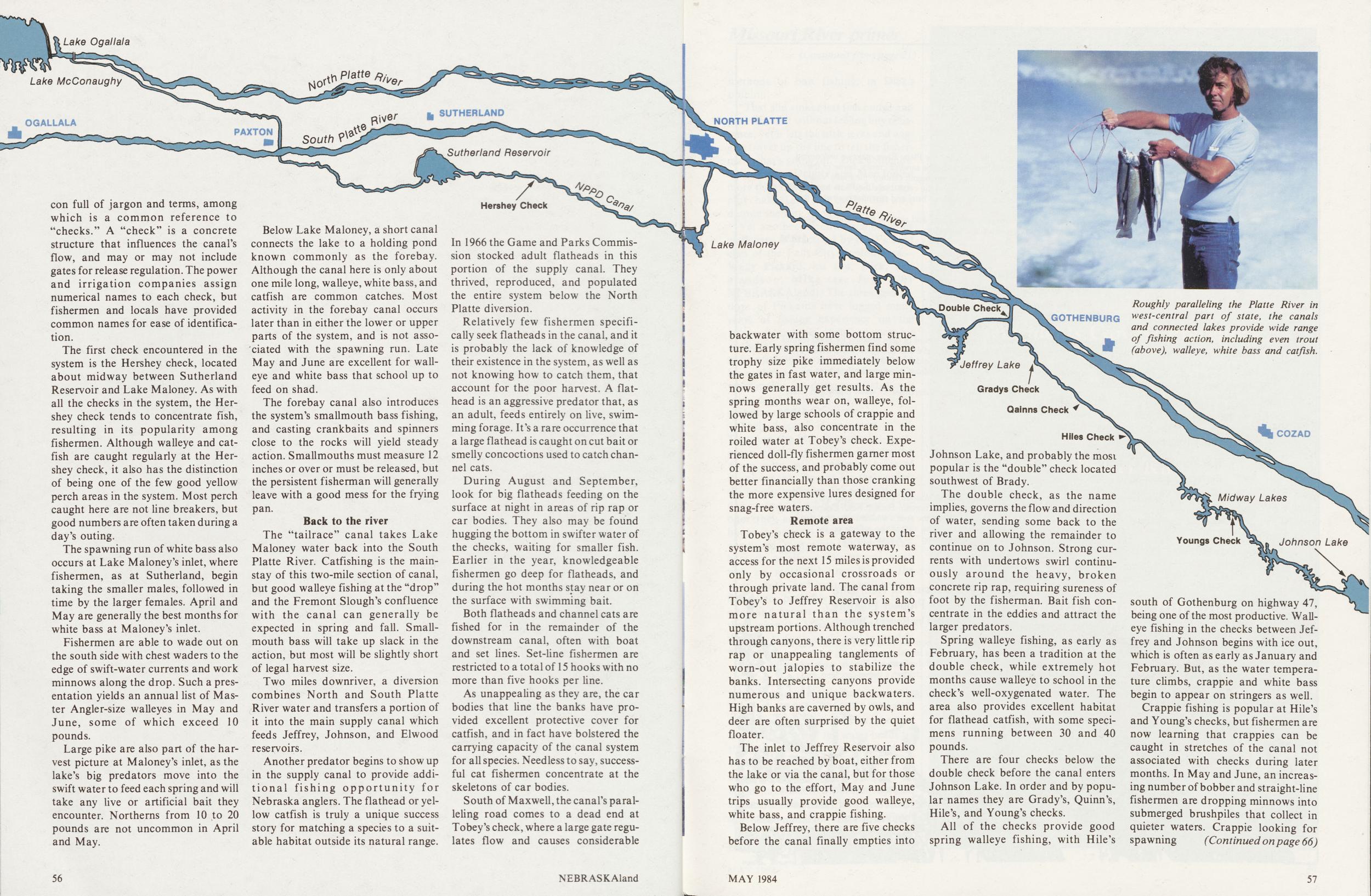
Lake Ogallala Lake McConaughy North Platte River OGALLALA PAXTON South Platte River SUTHERLAND Hershey Check NPPD Canal NORTH PLATTE Lake Maloney Platte River Double Check GOTHENBURG Jeffrey Lake Gradys Check Qainns Check Hiles Check COZAD Midway Lakes Youngs Check Johnson Lake
full of jargon and terms, among which is a common reference to "checks." A "check" is a concrete structure that influences the canal's flow, and may or may not include gates for release regulation. The power and irrigation companies assign numerical names to each check, but fishermen and locals have provided common names for ease of identification.
The first check encountered in the system is the Hershey check, located about midway between Sutherland Reservoir and Lake Maloney. As with all the checks in the system, the Hershey check tends to concentrate fish, resulting in its popularity among fishermen. Although walleye and catfish are caught regularly at the Hershey check, it also has the distinction of being one of the few good yellow perch areas in the system. Most perch caught here are not line breakers, but good numbers are often taken during a day's outing.
The spawning run of white bass also occurs at Lake Maloney's inlet, where fishermen, as at Sutherland, begin taking the smaller males, followed in time by the larger females. April and May are generally the best months for white bass at Maloney's inlet.
Fishermen are able to wade out on the south side with chest waders to the edge of swift-water currents and work minnows along the drop. Such a presentation yields an annual list of Master Angler-size walleyes in May and June, some of which exceed 10 pounds.
Large pike are also part of the harvest picture at Maloney's inlet, as the lake's big predators move into the swift water to feed each spring and will take any live or artificial bait they encounter. Northerns from 10 to 20 pounds are not uncommon in April and May.
Below Lake Maloney, a short canal connects the lake to a holding pond known commonly as the forebay. Although the canal here is only about one mile long, walleye, white bass, and catfish are common catches. Most activity in the forebay canal occurs later than in either the lower or upper parts of the system, and is not associated with the spawning run. Late May and June are excellent for walleye and white bass that school up to feed on shad.
The forebay canal also introduces the system's smallmouth bass fishing, and casting crankbaits and spinners close to the rocks will yield steady action. Smallmouths must measure 12 inches or over or must be released, but the persistent fisherman will generally leave with a good mess for the frying pan.
Back to the riverThe "tailrace" canal takes Lake Maloney water back into the South Platte River. Catfishing is the main-stay of this two-mile section of canal, but good walleye fishing at the "drop" and the Fremont Slough's confluence with the canal can generally be expected in spring and fall. Smallmouth bass will take up slack in the action, but most will be slightly short of legal harvest size.
Two miles downriver, a diversion combines North and South Platte River water and transfers a portion of it into the main supply canal which feeds Jeffrey, Johnson, and Elwood reservoirs.
Another predator begins to show up in the supply canal to provide additional fishing opportunity for Nebraska anglers. The flathead or yellow catfish is truly a unique success story for matching a species to a suitable habitat outside its natural range. Sutherland Reservoir Hershey Check In 1966 the Game and Parks Commission stocked adult flatheads in this portion of the supply canal. They thrived, reproduced, and populated the entire system below the North Platte diversion.
Relatively few fishermen specifically seek flatheads in the canal, and it is probably the lack of knowledge of their existence in the system, as well as not knowing how to catch them, that account for the poor harvest. A flathead is an aggressive predator that, as an adult, feeds entirely on live, swimming forage. It's a rare occurrence that a large flathead is caught on cut bait or smelly concoctions used to catch channel cats.
During August and September, look for big flatheads feeding on the surface at night in areas of rip rap or car bodies. They also may be found hugging the bottom in swifter water of the checks, waiting for smaller fish. Earlier in the year, knowledgeable fishermen go deep for flatheads, and during the hot months stay near or on the surface with swimming bait.
Both flatheads and channel cats are fished for in the remainder of the downstream canal, often with boat and set lines. Set-line fishermen are restricted to a total of 15 hooks with no more than five hooks per line.
As unappealing as they are, the car bodies that line the banks have provided excellent protective cover for catfish, and in fact have bolstered the carrying capacity of the canal system for all species. Needless to say, successful cat fishermen concentrate at the skeletons of car bodies.
South of Maxwell, the canal's paralleling road comes to a dead end at Tobey's check, where a large gate regulates flow and causes considerable
56 NEBRASKAlandRoughly paralleling the Platte River in west-central part of state, the canals and connected lakes provide wide range of fishing action, including even trout (above), walleye, white bass and catfish.
backwater with some bottom structure. Early spring fishermen find some trophy size pike immediately below the gates in fast water, and large minnows generally get results. As the spring months wear on, walleye, followed by large schools of crappie and white bass, also concentrate in the roiled water at Tobey's check. Experienced doll-fly fishermen garner most of the success, and probably come out better financially than those cranking the more expensive lures designed for snag-free waters.
Remote areaTobey's check is a gateway to the system's most remote waterway, as access for the next 15 miles is provided only by occasional crossroads or through private land. The canal from Tobey's to Jeffrey Reservoir is also more natural than the system's upstream portions. Although trenched through canyons, there is very little rip rap or unappealing tanglements of worn-out jalopies to stabilize the banks. Intersecting canyons provide numerous and unique backwaters. High banks are caverned by owls, and deer are often surprised by the quiet floater.
The inlet to Jeffrey Reservoir also has to be reached by boat, either from the lake or via the canal, but for those who go to the effort, May and June trips usually provide good walleye, white bass, and crappie fishing.
Below Jeffrey, there are five checks before the canal finally empties into Johnson Lake, and probably the most popular is the "double" check located southwest of Brady.
The double check, as the name implies, governs the flow and direction of water, sending some back to the river and allowing the remainder to continue on to Johnson. Strong currents with undertows swirl continuously around the heavy, broken concrete rip rap, requiring sureness of foot by the fisherman. Bait fish concentrate in the eddies and attract the larger predators.
Spring walleye fishing, as early as February, has been a tradition at the double check, while extremely hot months cause walleye to school in the check's well-oxygenated water. The area also provides excellent habitat for flathead catfish, with some specimens running between 30 and 40 pounds.
There are four checks below the double check before the canal enters Johnson Lake. In order and by popular names they are Grady's, Quinn's, Hile's, and Young's checks.
All of the checks provide good spring walleye fishing, with Hile's south of Gothenburg on highway 47, being one of the most productive. Walleye fishing in the checks between Jeffrey and Johnson begins with ice out, which is often as early as January and February. But, as the water temperature climbs, crappie and white bass begin to appear on stringers as well.
Crappie fishing is popular at Hile's and Young's checks, but fishermen are now learning that crappies can be caught in stretches of the canal not associated with checks during later months. In May and June, an increasing number of bobber and straight-line fishermen are dropping minnows into submerged brushpiles that collect in quieter waters. Crappie looking for spawning (Continued on page 66)
MAY 1984 57
The Platte Channels in Time
By Paul A. JohnsgardRising high in the Rockies and flowing east to meet the Missouri near Omaha, the Platte River makes a welcoming rendezvous for the geologic, plant, animal, and human worlds. Way station for the sandhill cranes, home of the protohistoric Plains Indians, arterial for the great westward migrations of the nineteenth century, the Platte Valley offers a rich diversity of life and history. Seeking to further an understanding of the central role the Platte has played in shaping Nebraska and its heritage, Paul A. Johnsgard presents in this book a "brief and personal portrait of the river as it has existed in the past and as it still exists today."
A fine selection of photographs, and checklists of birds, mammals, amphibians and reptiles, fishes and common plants of the Platte River and its valley enhance the book's interest and usefulness.
xiv, 154 pages. ISBN 0-8032-2560-1 $13-95 Water in Nebraska Use, Politics, Policies By James AucoinThe Nebraska water policy of the past eighty years has created an impressive record of dam building for flood control, hydropower, and recreational purposes, and of irrigation development, but at social and ecological costs. These costs have grave implications, including a threat to the Ogallala Aquifer that underlies much of the state, as well as environmental damage to the Sandhills. Aucoin argues, unless policy makers confront these implications now, all water users in Nebraska will soon suffer.
Water in Nebraska clears away the emotional rhetoric that has often impeded discussion of water policy and offers readers a full, intelligent understanding of this vital subject,
ca. 160 pages. ISBN 0-8032-1013-2 $15.95now available in paperback
Back in Keith County By John Janovy, Jr.John Janovy quickly gained national attention with his first book, Keith County Journal. The book "met with astonishing success, and some reviewers compared the author to Henry David Thoreau. Back in Keith County returns to that part of Nebraska that Mr. Janovy knows and loves. . . . The book shows the area's wildlife—tiger beetles, toads, swallows, owls and a variety of fish—to be as special as its people. . . . The author also reflects on the intangible aspects of life. . . . The rich ramblings of these 179 pages are fascinating."—Kansas City Star.
x, 180 pages. Paper, ISBN 0-8032-7560-9 (BB 875) $5.95 A Treasury of Nebraska Pioneer Folklore Compiled by Roger L. WelschThis rich and entertaining collection of Nebraska pioneer folklore, taken largely from the Nebraska Folklore Pamphlets issued by the Federal Writers' Project in the 1930s, is intended first and foremost for the general reader, for the people whose heritage it is. Welsch has gathered songs of trail and prairie and of the Farmers' Alliance, white man's" yarns and Indian tales, pioneer Nebraska folk customs, sayings, proverbs, beliefs, children's games, cooking, and cures. "A treasury indeed."—King Features Syndicate "Parade of Books."
xviii, 392 pages. Paper ISBN 0-8032-9707-6 (BB 883) $9.95 Cloth ISBN 0-8032-0192-3 $22.95Missouri River primer
(Continued from page 21)methods of bait fishing, in Dick's opinion.
"That slip sinker lets fish nudge and peck at a bait without feeling any resistance, yet it lets the little jerks and wiggles travel up the line to tell the fisherman what's going on," Dick contends. At any rate, Delmer and Mac fooled more than their share of big20-pound-plus channel and blue catfish that way, despite the tiny hooks.
Yet another effective technique for catfishery is practiced by the Pickard clan of the Falls City-Verdon area—Wally Pickard, his son, Dick, and grandson, Mike (see July 1981 NEBRASKAland). The three generations of Pickards have logged many years of fishing experience on the Missouri, and they absorbed every bit of the standard information on where to find fish and how to rig for them. As far as they are concerned, their bait is what makes the difference between a so-so catch now and then, and hefty stringers much of the time.
Their "secret" is no secret at all. They use the little government-issue-green earthworms that live in the damp, silty, willow-covered areas of the riverbank. Except for their color, the worms look just like ordinary garden worms. The big difference is the odor they emit when pierced with a hook—a pungent essence some have compared to rotting willow leaves, licorice, or silage. The worms work well on most fish that live in the river—drum and carp, as well as catfish. And, probably because of their odor and because the river is full of them when the Missouri is on the rise, they work particularly well in muddy water.
Dick offered some suggestions on where to apply the worms along the wing dikes that bristle from the bank. "One prime spot is on the upstream side ... where the current hits the dike and splits. Part of the water heads up the dike toward the bank and eddies back upstream, while the rest follows the dike toward the middle of the river. Right there where the current splits is an area of dead water, and it's the best spot on the dike for channel catfish."
The downstream side offers another good spot that produces both channel
cats and flatheads, according to Dick. "After the current rounds the end of the dike, it curls back up against the downstream side, maybe 15 feet from the end of the structure. Right where the current comes back is the second good spot on most dikes," he said.
PaddlefishIf you decide you want to try paddle-fishing, you have to put a lot of things aside that pertain to any other kind of fishing you've known. In particular, you have to abandon any ideas of rest and relaxation, because paddlefishing involves snagging, and snagging is hard work.
Although they can grow upwards of 100 pounds, paddlefish never eat anything larger than the microscopic plankton that they strain from the water with special gill rakers. Thus, they never hit a bait or lure, so snagging is the only way to take them.
A heavy, five to seven-foot surfcasting rod with about the same flexibility as a two-by-four, and a big saltwater reel are required. About 100 feet of braided dacron or monofilament line of 40 to 80-pound test, a three-ounce chunk of lead, and a pair of 7/0 to 9/0 treble hooks complete the rig. The lead goes at the end of the line, with the hooks at 18-inch intervals tied in above the weight.
The Gavins Point Dam tailwaters and the unchannelized stretch of river downstream to Ponca, provides the best paddlefishing, by far. In either
YOU SAY YOU'RE JUST SICK ABOUT YOUR NEBRASKAland SUBSCRIPTION RUNNING OUT?
of the two unchannelized stretches of river, a boat is needed to reach the quiet pools below sandbars, where the spoonbills like to hang out. If you have no boat, it's possible to snag from some rather crowded structures in the tailwaters, or from wing dikes in the channelized section.
Special regulations are in effect for padddlefishing. Above Gavins Point Dam, the season runs from November 1 through April 30, with a bag and possession limit of one paddlefish. Below the dam, the season runs from November 1 through March 30, with bag and possession limits of two paddlefish. Any paddlefish caught must be kept and counted in the bag limit. They can be field-dressed, but paddlefish carcasses must be left intact in the field.
CarpThe carp is one of the most abundant species in the Missouri, yet its sporting potential and eating qualities are largely ignored. Carp put up a respectable fight on rod and reel, and they can be caught in good numbers by anyone who knows how to go about fishing for them.
During his conservation officer days, Dick became well acquainted with fellow law enforcement officer, the late Eugene "Lousy" Bellar of the Ponca Police Department. "Over the years, ol' Lousy became a pretty fair carp fisherman. There were three things about his technique that I believe accounted for most of his success. The first was his bait. He'd soak whole-kernel canned corn in anise oil for two or three days before a fishing trip. The second feature of his approach was the small, short-shanked hooks he used. He could cover them completely, eye, shank, bend and point, with only four or five kernels. Hiding that hook is important, because carp are no dummies. And, when he took to using slip-sinkers, he really got to be some carp fisherman.... I think the slip sinker is the key to all baitfishing in the river," Dick said. Dick's friend would look for carp in shallow water, backwaters, and below sandbars in the natural stretch of river, or around wing dikes in the channelized portion.
Agreeably-scented baits seem to predominate in carp fishing; a welcome contrast to some of the vile concoctions that catfishermen find it necessary to use. Anise oil is but one
popular scent. Another is strawberry Jello, which is commonly used to spice up doughballs of various descriptions all along the Missouri in northeast Nebraska.
One simple recipe involves a dry mix of one cup cornmeal, one-half cup flour and one-half package of strawberry Jello mixed into a boiling concoction of one cup water, two tablespoons sugar, one teaspoon vanilla and a dash of garlic salt. It's cooked a few minutes until it thickens, then flattened onto waxed paper, cut into chunks, and rolled into balls when cool enough to handle.
Dick tells of another secret carp bait that he discovered all by himself. "I went crappie fishing one day on one of the backwaters. But it was windy and the crappie weren't interested in the little spinners I was using. So, I sat down for a little snack.
"Before I left town, I had stopped at Vi's Cafe, which I believe is out of business now. Vi made absolutely the best cinnamon rolls in the whole world, and I picked up a couple that morning. While I was eating one of those rolls, I noticed some carp activity. So, I pulled a small treble hook off one of my spinners, wadded a little cinnamon roll around it, and put it on a rock to kind of set up and get hard. Then, I tied it on, tossed it into the water, and caught a carp almost instantly. I caught 23 carp that day. After the word got around, you could hardly buy one of Vi's rolls to eat; the fishermen had them all. I almost had a great summer's fishing, but I had to give it up. I didn't catch many fish, and it was hard on my waistline because I kept eating up all my bait."
1984 Nebraska Fishing Permit Fees Annual Resident Fish........$ 9.50 Resident Combination Fish-Hunt...............$17.50 Non-resident 3-Day Fish.....$ 6.00 Non-resident Annual Fish .... $20.00 Lifetime Permits Fishing License............$200.00 Hunting License............$200.00 Hunt-Fish Combination.....$400.00 Regular permits are available from 1,200 vendors across the state. For lifetime permits, send for order form from Game and Parks Commission, P.O. Box 30370, Lincoln, NE 68503. 62 NEBRASKAlandFishing the North Forty
(Continued from page 49)collection of several rods fitted with assorted bass lures, Eldon grabbed one with a chartreuse "buzzbait." A white plastic grub trailer hung on the hook. A buzzbait is quite a mouthful, even for the bucketmouth bass, so that the fish it catches tend to be worthwhile specimens. And, since the buzzbait's big propeller keeps it at the surface where it can make plenty of fish-attracting commotion, the strikes that it generates can be the kind that make a fella lose track of his Skoal for an instant or two.
Eldon moved up the north shore of the pond, casting to stumps and little points of cattails that attracted his attention. When he neared the flat where the fence cornerpost stuck out of the water, he anchored within casting distance. He dropped several casts around the post, then started working along the brush caught up in the barbed wire, always starting his retrieve almost before the buzzbait touched the water to keep it at the surface where its action was most apparent.
But, on one cast, even before Eldon had a chance to start the retrieve, the lure disappeared in a boil of water as big around as a washtub. The set in his jaw and the dance of his rod told everyone that Eldon had a more respectable fish than the others hooked that day. The fish tried to get back to a fencepost without much success, then broke around the front of the boat for some unseen refuge toward the middle of the lake. When that failed, and Eldon's pressure turned him toward the boat, the bass announced his displeasure with a series of leaps that made the hardware in his mouth sound off like the bell on a rodeo bull.
Eldon and the bass played tug-of-war at boatside a couple of times before the fisherman finally boated his prize with a well-placed thumb in the jaw. The fish had fought like a heavyweight, but he weighed in at least one class lower—in the neighborhood of 3 1/2 to 3 3/4 pounds.
That fish would have been an adequate prize for one spot, but Eldon continued to pelt the area of the cornerpost, fenceline and adjacent shore with buzzbaits. Then, he turned toward the center of the pond and shot
a cast toward the tree and stickups there, with immediate and impressive results.
A green-and-black blur engulfed the lure, prompting Eldon to set the hook with an immediate and instinctive sweep of the rod. But, he didn't gain the yard or two of territory that setting the hook usually gets him with other fish. The rod stopped short, not quite over Eldon's head, and danced to the rhythm of a big fish at the other end of the line.
Eldon struggled for a few seconds to keep the fish from regaining his sanctuary among the stumps and logs, then worked him into more open water. A couple of leaps and rolls there and at the boat told everyone that this fish was even better than the previous one, although still short of "wall fish" status. In the end, Eldon won the contest, and "lipped" another largemouth aboard, the nicest of the day at better than 4 1/2 pounds.
The next 45 minutes saw more good fishing, although the bass were not of the same proportions as the two from near the cornerpost. One was a good 2 1/2 pounds, and the other a few ounces more. Then, the fishing simply stopped. No one had anything resembling a strike for 45 minutes, and it seemed like a good point to declare the day's fishing done.
There were two stringers with a total of six bass, a nice take for a leisurely afternoon's fishing. Eldon's fish made up a fairly routine stringer for him, whose personal fishing credentials include 10 years' fishing the best waters from Nebraska to Texas as a field tester for Brunswick's corporate kin, Zebco. His personal best in Nebraska bass fishing is an eight-pound, four-ounce lunker taken a few years ago from a farm pond in his old neighborhood.
"We had a pretty good day. We don't normally take this many fish home, but the pond is getting to the point where it could stand a little harvest. Most of the time we release our bass, or maybe just take one or two. If we want to eat fish, well, that's what the panfish are for.
"Regulating the harvest—that's a big part of good pond management, and that's up to the pond's owner. That's why he lets some people fish and turns others away, or why he'll let people fish one week and not the next,
Trading Post
DOGS TRAINING ALL BREEDS Hunting dogs—Vizslas for sale. Rozanek Kennels, Rt. 2, Schuyler, NE 68661. Phone (402) 352-8769. ENGLISH SETTERS and Pointers: Outstanding bloodlines! Puppies, started dogs, and stud service available. High Plains Kennels, 1411 Emerson, Alliance, NE 69301. Phone (308) 762-6709. GERMAN SHORTHAIRS—English Pointers and Beagles—Stud service, puppies and started dogs. Wayne Clark, Box 54, Union, Nebr. 68455. Phone (402)263-3495 or 263-3155. DONT SETTLE for cheap imitations! Buy a top-quality Labrador retriever from proven hunting and field trial lines. Pups available! Contact Mike Schafer, Wind Fall Retriever Kennel, (402) 782-6505. VIZSLA PUPPIES available June 1. Good, versatile hunters, very trainable, also loving house pets. Paul Morrison 780-5847. AKC GERMAN Shepherds, top-quality blood lines. Bred for intelligence, retention and temperament. Guaranteed sound and healthy. All shots. Pedigrees furnished Delivery available. Da-Co Kennels, Meadow Grove, NE. Phone (402) 634-2605. LAZY J LABS—chocolate puppies, started dogs, and stud service. Field champions and hunting bloodlines. Eyes and hips guaranteed. Pups ready to go May 7, 1984. Contact Jim Penny, HC31 Box 10G, Alliance, NE 69301. Phone (308) 762-5187. MISCELLANEOUS WINE AND BEER: Make your own. Send for free recipes and instructions. Omaha Supply, 13616 Polk, Omaha, Nebr. 68137. GAME BIRDS for sale. Wild turkeys, wood ducks, mandarins, mallards, teal, Canada geese, pheasants—5 breeds chukkar quail. Many others not listed. Frontier Birds, Wauneta, NE 69045. Phone: day (308) 394-5577/evening (308) 394-5715. GUNS—Browning, Winchester, Remington, others, Hi-powers, shotguns, new, used, antiques. Want Pre-1964 Winchesters. Buy-Sell-Trade. Ph. (402) 729-6112. Bedlan's Sporting Goods, Fairbury, NE 68352. YOUR TREASURED family recipes published. 50 cookbooks as low as $39.95. Send 25c for information: Leafie Mae's Kitchen, Box 1881 NL, Kearney, NE 68847. FOR SALE: Big beautiful Canada geese. These are the great giants (maxima). Some with white collars and breasts, others with gray foreheads. 1983 hatch—$80.00/pair; 1982 hatch—$150.00/pair; and 1981 —$200.00/ pair. Call or write Engaard E. Lynn, Gothenburg, NE 69138. (308) 537-2825. PERSONALIZED COOKBOOKS for your Church or Organization. Excellent, low-cost fund raiser, no investment, 90 days to pay, FREE shipping. Details: Cookbooks, Box 1881 NL, Kearney, NE 68847. FISH FOR SALE. Channel catfish, bass, bluegill, crappie, trout, perch, white bass, minnows, hybrid grass carp, bullhead. We can ship fish, you can pick them up, or we deliver. Contact the Pleasant Valley Fish Farm, Rt. 1, McCook, NE 69001. Phone (308) 345-6599. FORT ROBINSON booked for your vacation dates? Try our 100-year-old cottage, restored, modernized, only 50 miles from the Fort. Brochure. Dorothy C. Meade, Agate Springs Ranch, HC 79, Box 8, Harrison, NE 69346. CANOE ENTHUSIASTS. Quality and performance important? Mad River is the canoe for you! Mad River of Nebraska, 1231 Saunders, Lincoln, Nebraska 68521. Phone (402) 435-6588. FOR SALE: Make offer—Model 1897 Winchester Pump 12 ga. full choke. O.M. Hickerson, 915 Logan, Wayne, NE 68787. Phone (402) 375-2455. BEAUTIFUL HOME building lots. South side, Gate 18, Lake McConaughy. Plus new large A-frame west of Lake View. Write Box 1028, Imperial, NE 69033. N.E. NEBRASKA TROUT Fishing. For rent Mon.-Thurs. or Fri.-Sun. 2 modern cottages completely furnished. 5 spring-fed lakes with trout up to 7 lbs. Bass and bluegill also. Diamond E Trout Resort, Orchard, NE 68764. (402) 893-4745. TAXIDERMY JOHNSON TAXIDERMY—servicing southwest Nebraska, specializing in big-game mounts, life-sized mounts, rug work, fish, birds, tanning hair-on leather. Brochure and price list on request. Johnson Taxidermy, Rt. 1, Box 78, Lamar, NE 69035. Telephone (308) 882-5555. FREEZE-DRY TAXIDERMY Wally Allison's State Record Taxidermy, 2709 Birchwood, North Platte, NE 69101. Phone: (308) 534-2324. Specializing in Fish and Small Game, Snake and Lizard and Novelties. (Nothing too small) Newest of all taxidermy methods employed. KARL SCHWARZ master taxidermist has moved to a new country studio; same professional mounting and tanning service. Schwarz Wild Wing Studio, 16804 South 180th St., Springfield, NE 68059. Phone (402) 253-2481. NEBRASKAland Magazine Order Form Please send me a subscription to NEBRASKAland, which now also features 4 issues of the news edition (16 issues in all). One-year $7.50 NAME Two-year $13 ADDRESS CITY Three-year $19 STATE Mail to: NEBRASKAland Box 30370, Lincoln, NE 68503 ZIP CREATIVE TAXIDERMY in all its branches since 1935, now includes Northstar Freeze-Dry processing of approved small specimens. Also tanning and deerskin processing. Naturecraft Studio. Nebraska City, Nebraska 68510. Joe Voges-Owner. Phone (402) 873-5491. DINGES TAXIDERMY Studio, 2763 So. 12th St., Omaha, NE 68108. Fourteen-time National Award Winning Taxidermy. Trust your trophies to a proven winner. Complete professional service. Mike and Mary Dinges (402) 342-3718. NABITY'S TAXIDERMY. 31 years experience. Specializing in natural grass backgrounds for mammals, birds and fish. 13901 "0"St., Lincoln, NE 68505 4 miles east of 84th and "O". (402) 489-6351. BADE TAXIDERMY—Quality a must—Fast service. Fish, birds, rugs, tanning, full mounts and game heads. 2111 N. Christy St., Fremont, Nebraska 727-5463. PEISTER TAXIDERMY—a name you can trust. We give you professional life-like work at prices most sportsmen can afford. Member National Taxidermist Association, #5 Regency, Place, Kearney, Nebr. 68847. Phone (308) 237-7575. LINCOLN ARCHERY Bowhunting Headquarters Compound Bow Specialists Crossbows Longbows, Recurves Full line of hunting supplies 48th & Prescott Lincoln, NE (402) 483-4661 Are you supporting your child's drug habit? An ounce of pot costs about 60 dollars. Coke, a lot more. Quaaludes run about 4 dollars each. And if so many children are using drugs, they're spending a lot of money. Where are they getting it? Point is, your children might be spending their allowance on something other than video games. Learn about drugs. Watch for the possible signs. Sleeping a lot. Listlessness. Poor marks in school. Lack oi school attendance. Most of all, show your child that you care and you're concerned about the possibility that they may be using drugs. And send away for our booklet, "Parents: What You Can Do About Drug Abuse." Write Get Involved, P.O. Box 1706, Rockville, Maryland 20850. Get involved with drugs before your children do. A public service of this publication and the National Institute on Drug Abuse. 65 MAY 1984
or why he might let a bluegill fisherman in, but not a bass fisherman. Access to a good farm pond is a real privilege, and it's a good idea to cooperate with the owner's management program if you want to continue fishing," Eldon said.
While the day's fish might have seemed commonplace to Eldon, they obviously pleased Chele and Mike. After all, a 4!/2-pound bass and another over 31/. would look darned good to most grownup anglers, so they're bound to be pretty impressive to a pair of eight-year-olds.
When it became apparent that the youngsters were having a good time, that made the day for the grownups. Eldon summed it up for all of them, saying, "A pond is a great place for families. There are 60 years separating my parents and the twins, but they come here to fish our own little lake all the time. Fishing is something we all have in common, despite differences in age. There's no 'generation gap' out here on our pond."
Nebraska's second chain of lakes
(Continued from page 57)habitat concentrate in the submerged brush and provide fairly rapid action once located.
Another technique employed by walleye fishermen when not focusing on the early spring run at the checks, is to fish the shallow bars on the "off current" side of the canal at dawn and dusk. Walleyes in June run out of deep water onto shallow bars to take minnows during hours of low sun.
Casting upstream onto bars with jigs and crankbaits, and slowly working them with the current, will often yield a nice walleye or two. Many fishermen simply "still" fish the shallow bars with weights and minnows or nightcrawlers to catch prowling walleyes.
The final inlet of the system is at Johnson Lake, and it, too, produces good fishing for walleye and white bass. Johnson, however, adds yet another species to the canal fishery, striped bass.
Large stripers have been providing a trophy fishery at Johnson's inlet for the past five years, and in 1981, the first Nebraska striper to exceed 30 pounds was caught from the inlet, near Elwood and south of Lexington. Some of these "exotic" fish are thought to be escapees from Lake McConaughy, but biologists now feel that a reproducing population has been established in the lower portion of the system.
With an open-ended reservoir and canal system, many factors influence the fishery. Beneficial to the canals are the reservoirs, which provide a source for recruitment of species that infiltrate the canals from the lakes. Whatever species are present in the lakes will generally be found in the canals, and when canals are drained for maintenance or repair purposes, a natural restocking occurs.
The rewards of the system to Nebraska fishermen are not fully realized. When considering that most quality fish habitat is associated with shoreline structure, the 150-mile supply canal system of both Nebraska Public Power and Central Nebraska Public Power, provides about 300 miles of shoreline fishable water.
More than a dozen species of catchable fish, from rainbow trout to catfish, are available to the public with excellent access for year-round fishing. Boating or from the bank, this spring might be a good time to get acquainted with the fishing potential of the Platte River canals of west-central Nebraska.
Fishing publications available
Guide to Good Fishing... lists all public waters in state, fish species available, regulations, size of areas and facilities. Guide to Fishing the Missouri River... lists public access points, species available, tips on how to fish them. Time Out for Carp... discusses equipment, techniques, cooking of carp. Nebraska's Master Angler Award Program... tells how the program works, lists state records and minimum weights for each species to qualify for awards, and gives an idea of last year's largest catches. The 1984 Nebraska Guide.. .gives regulations and rules. For copies of the publications, write Nebraska Game and Parks Commission, P.O. Box 30370, Lincoln, NE 68503. 66 NEBRASKAlandMore fun for your money
Variety and value. Reasons why your vacation dollars buy a lot of vacation fun in Nebraska. There's something new and exciting in every part of the state that's yours to enjoy. You'll find nationally-renowned Pioneer Village museum, thoroughbred horse racing at Aksarben, cowboy heritage from the Old West, sun and fun on the waters of huge Lake McConaughy, and a host of other attractions and events. Add friendly people, sate cities, and typically-low Midwestern prices for every tiling, and you've got the fun-filled, carefree vacation you've been looking for. This year, make the most of your vacation—and your vacation budget. Send for your free travel planning packet today, and make plans to vacation Nebraska this summer. discover the difference
Name Address City Mail to Division of Travel and Tourism, Department of Economic Development, P.O. Box 94666 Lincoln NE 68509 Or call toll free, out-of-state (800) 228-4307; in-state (800) 742-7595; or (402) 471-3796. State Zip
Find more than you imagined...
Imagine a walleye making your reel scream in his plunge toward the cool depths of Harlan County Reservoir.. .a glittering brown trout rising to a Royal Coachman in the quiet water below Snake River Falls... an armor-plated largemouth shattering the smooth surface of an early June farm pond...For more information about how to stretch your imagination fishing in Nebraska, write us for the NEBR ASK Aland "Guide to Good Fishing."
fishing in Nebraska
NEBRASKA GAME AND PARKS COMMISSION Eugene T. Mahoney, DirectorPosition: 467 (22 views)