Volume 62, Issue 3, 1984
NEBRASKAland
APRIL 1984 $1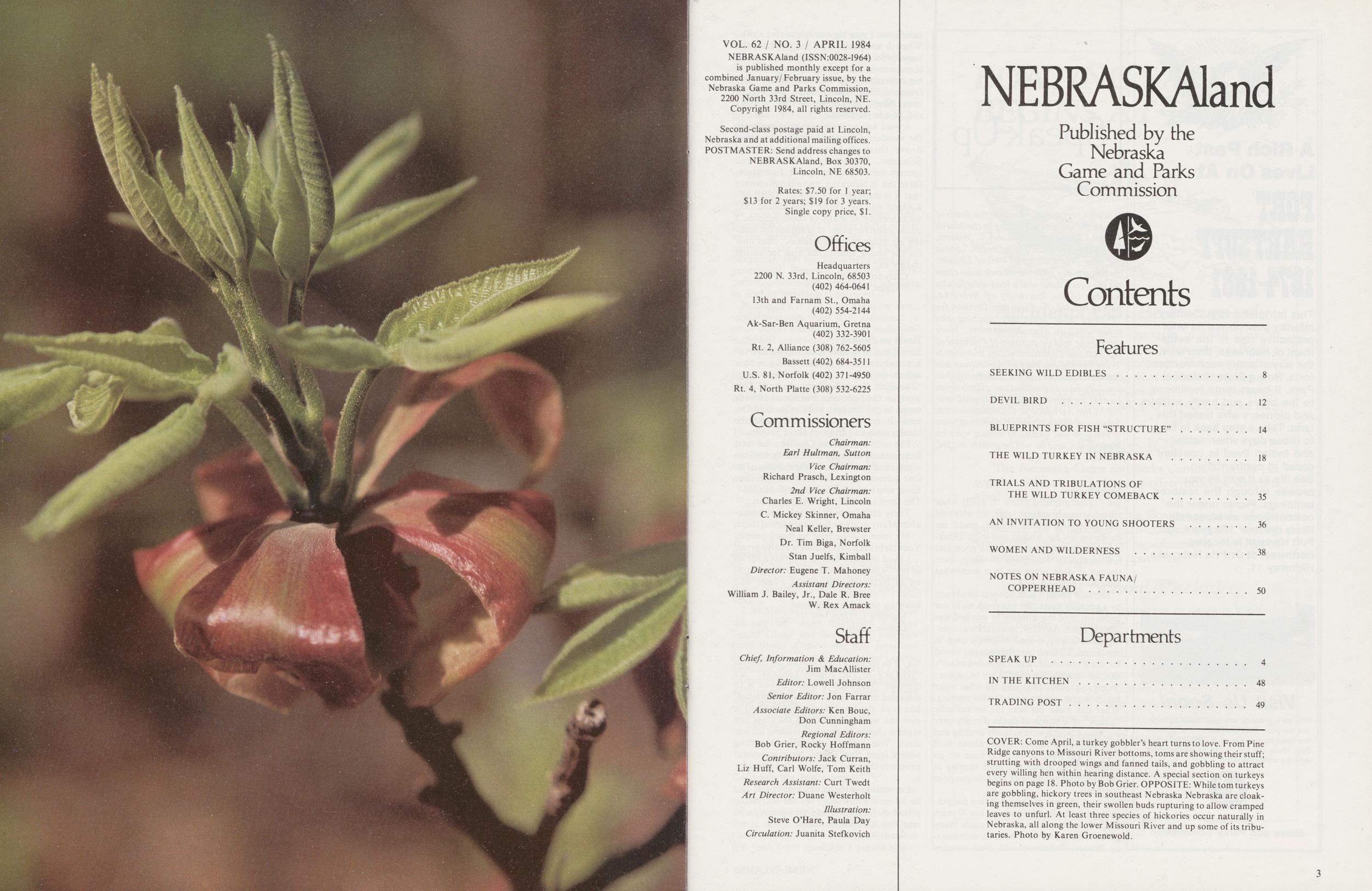
NEBRASKAland
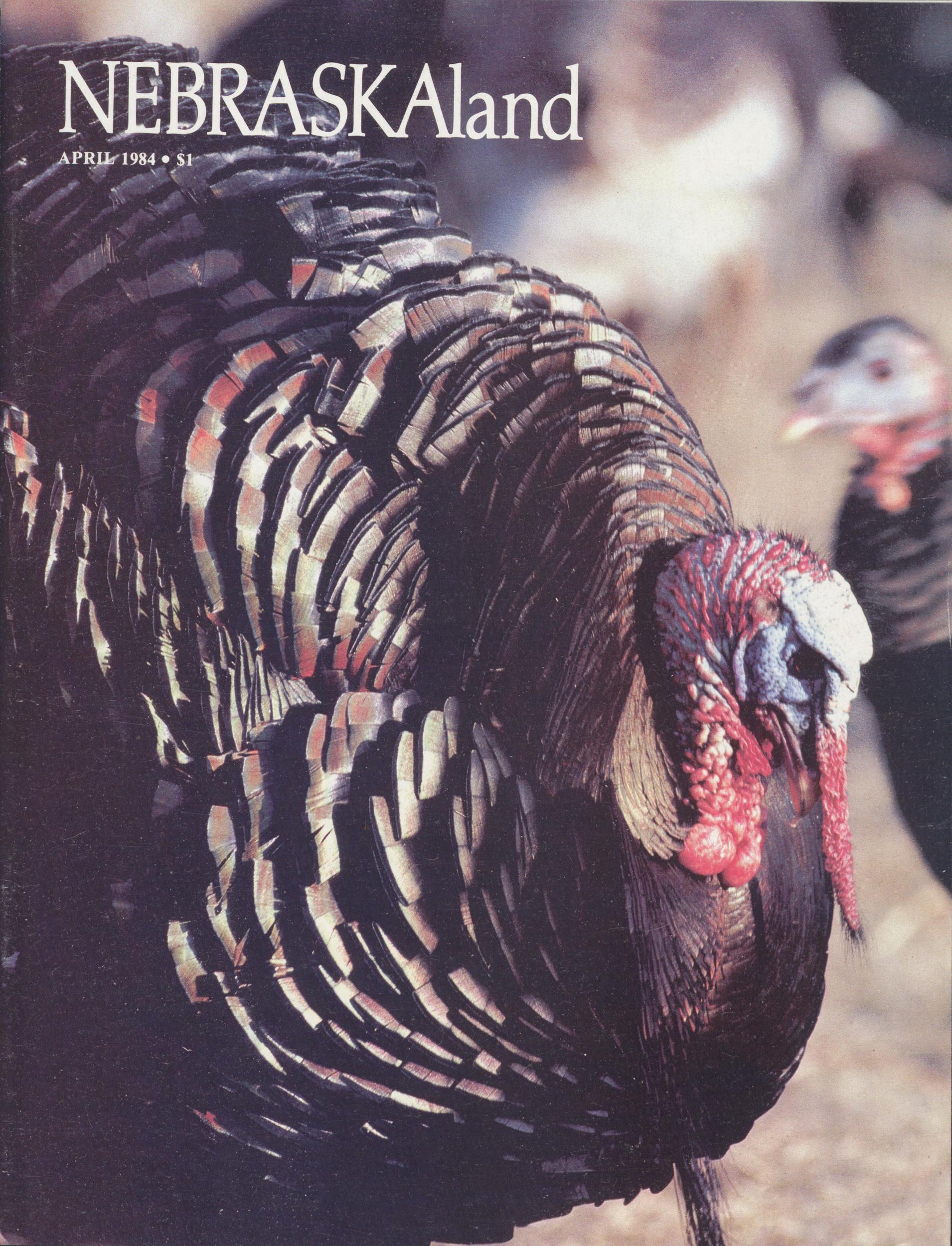
Published by the Nebraska Game and Parks Commission VOL. 62 / NO. 3 / APRIL 1984 NEBRASKAland (ISSN:0028-1964) is published monthly except for a combined January/ February issue, by the Nebraska Game and Parks Commission, 2200 North 33rd Street, Lincoln, NE. Copyright 1984, all rights reserved. Second-class postage paid at Lincoln, Nebraska and at additional mailing offices. POSTMASTER: Send address changes to NEBRASKAland, Box 30370, Lincoln, NE 68503. Rates: $7.50 for 1 year; $13 for 2 years; $19 for 3 years. Single copy price, $1. Offices Headquarters 2200 N. 33rd, Lincoln, 68503 (402) 464-0641 13th and Farnam St., Omaha (402) 554-2144 Ak-Sar-Ben Aquarium, Gretna (402) 332-3901 Rt. 2, Alliance (308) 762-5605 Bassett (402) 684-3511 U.S. 81, Norfolk (402) 371-4950 Rt. 4, North Platte (308) 532-6225 Commissioners Chairman: Earl Hultman, Sutton Vice Chairman: Richard Prasch, Lexington 2nd Vice Chairman: Charles E. Wright, Lincoln C. Mickey Skinner, Omaha Neal Keller, Brewster Dr. Tim Biga, Norfolk Stan Juelfs, Kimball Director: Eugene T. Ma honey Assistant Directors: William J. Bailey, Jr., Dale R. Bree W. Rex Amack Staff Chief, Information & Education: Jim MacAllister Editor: Lowell Johnson Senior Editor: Jon Farrar Associate Editors: Ken Bouc, Don Cunningham Regional Editors: Bob Grier, Rocky Hoffmann Contributors: Jack Curran, Liz Huff, Carl Wolfe, Tom Keith Research Assistant: Curt Twedt Art Director: Duane Westerholt Illustration: Steve O'Hare, Paula Day Circulation: Juanita Stefkovich Contents Features SEEKING WILD EDIBLES 8 DEVIL BIRD 12 BLUEPRINTS FOR FISH "STRUCTURE" 14 THE WILD TURKEY IN NEBRASKA 18 TRIALS AND TRIBULATIONS OF THE WILD TURKEY COMEBACK 35 AN INVITATION TO YOUNG SHOOTERS 36 WOMEN AND WILDERNESS 38 NOTES ON NEBRASKA FAUNA/ COPPERHEAD 50 Departments SPEAK UP 4 IN THE KITCHEN 48 TRADING POST 49 COVER: Come April, a turkey gobbler's heart turns to love. From Pine Ridge canyons to Missouri River bottoms, toms are showing their stuff; strutting with drooped wings and fanned tails, and gobbling to attract every willing hen within hearing distance. A special section on turkeys begins on page 18. Photo by Bob Grier. OPPOSITE: While torn turkeys are gobbling, hickory trees in southeast Nebraska Nebraska are cloaking themselves in green, their swollen buds rupturing to allow cramped leaves to unfurl. At least three species of hickories occur naturally in Nebraska, all along the lower Missouri River and up some of its tributaries. Photo by Karen Groenewold. 3
Speak Up
It is with regret that we report the death of one of the authors appearing in the March NEBRASKAland. Dr. John L. Adams, who wrote "A Prairie Classroom," about the Nine-Mile Prairie just west of Lincoln, died just a day after the March issue came off the press. John was a long-time faculty member of the University of Nebraska, having headed the Extension Division for 10 years after previously teaching and researching in that department. More recently he held the position of Professor of Agricultural Communications and science writer for the Institute of Agriculture and Natural Resources at the University. Just last July, he was awarded one of only seven awards for excellence in professional writing by the Agricultural Communicators in Education organization. His thoroughness of research and quality of writing were his trademarks, and he will be greatly missed. (Editor) Night hunterSir / This morning (Nov. 5, 1983) while seated at our breakfast table, my wife told me something which almost made me choke on my hot bisquit and jelly. Thinking about it later, I feel it is too good and too unusually humorous to keep, even though it does place me in a somewhat ludicrous position.
She said about 4 a.m. she was awakened by a peculiar noise. We like fresh air in our bedroom, and the window by our bed was slightly open. Anyhow, as usual I was snoring quite loudly; a kind of gurgle deep in my throat. I asked her to mimic the sound for me if she could, and it sounded exactly like the "feeding chuckle" I try to capture on my duck call. That was not what woke her, however, as she is used to my snoring. What did wake her was the enthusiastic "quack" of a bunch of ducks directly over our house, which were actually circling and hunting for the "feeder"—how about that?
All I will have to do next time we go hunting is fall asleep and start snoring in the blind and my buddies are going to be in business.
I must express my appreciation for putting out such a fine magazine. I am 70 years old, a retired mail carrier who made many game counts, and have been an enthusiastic hunter, fisherman and cross-country skier since I was big enough to tote a rifle. When I was only 10, I supplied all the bunnies for our table, which was no small contribution during the lean years of the big depression. We lived about two miles from the Platte near Phillips, and I spent many happy days along the river, which I still love to be around.
A week ago we went with relatives to see the wonderful Platte River Park and also drove through Louisville and on to Schramm. The beauty of the sights and scenery were most memorable. I am grateful to live in Nebraska, and am quite aware that it is through the efforts of NEBRASKAland and the Game Commission that we can enjoy so many of these benefits. I could go on for pages in gratitude for making life much more enjoyable . . . not only for the young sports, but also for an old codger like me.
Clarence V. Smith Phillips, Nebr. Raves on "Voices"Sir / I'm a long-time reader of NEBRASKAland, and must congratulate you on a superb magazine .. . and the latest issue, "The First Voices" among the best. This work on the Nebraska and Plains Indians seems to me the best work of its kind I've seen. It helps to better understand the ideals, aims and trials of these people.
The wife of Jarvis Chaffee, the first homesteader in Hamilton County, told me of the Indians' visits to their home. The first homestead at the forks of the Blue River south of Aurora, was settled in 1867. The farm is still in the Chaffee name.
These visits were in the fall, and peaceable. Many artifacts have been found there.
My issue will be read by many people. Your Nebraska Rivers issue was also great.
I lived in south-central Nebraska for 46 of my 79 years, so have a continuing interest in Nebraska. I'm also a hunter and fisher... also shot well on ducks in 1983. Keep up your fine magazine.
Maurice L. Dory Denver, Colo.Sir / The very day I was to start my class on "History of the Plains Indians," we received "The First Voices." I took it to class and my professor was very impressed. She took the book home and perused it over the weekend. She told the class last night it should be required reading for our class. You will undoubtedly be getting orders from San Diego, because several people in the class intend to send away for it.
I'm writing to thank you very much, and to let you know that we are incredibly proud of Nebraska, and very proud to be receiving NEBRASKAland.
Sandi Koetter San Diego, Calif. 4 NEBRASKAlandSir / I just received my Jan./Feb. NEBRASKAland and took time to look through it. I want to thank and congratulate all those who spent so much time and effort on the research about our Indian background. Now I look ahead to many hours of interesting reading. Thank you for a beautiful and informative publication about my home state.
Mrs. Jeannette Cameron New York, N.Y. Something for everyoneSir / As a native Nebraskan, long transplanted in Colorado, I never fail to marvel at the beauties, history and quality you carry of the state in NEBRASKAland Magazine. It is literally a handbook for a genealogist, historian, naturalist, sports-person, ornithologist, and anyone who likes to read or just look at pictures.
Nebraska's Rivers gave proof for some family research when R.E. Grinstead (a great uncle) was mentioned as both journalist and surveyor in the section on River Portraits—the Nemehas. Uncle Emmet had been a member of the Kentucky state legislature, and after coming to Nebraska in 1879, was elected as State Legislator from Richardson County in 1882.
Christine Delich is a splendid (and accurate) scientific writer and researcher. Thank you again for giving so much enjoyment for any age person, as well as reference material for a variety of professional writers. "Nebraska Rivers" was a magnificent edition.
Janice Waggener McGrew Littleton, Colo. Seasonal visitorSir / I want you to know how much I enjoyed "Nebraska Through the Season." It was delightful... both the text and photos.
Last March (1983) I was privileged to see the sandhill crane migration between Grand Island and Kearney. I also saw great flocks of snow and blue geese and ducks galore. I haven't as yet been to the Sandhills, but hope to see that area and a lot more of Nebraska. Your magazine has whetted my desire. Thank you for a very good magazine.
Myrtle Diamond Detroit, Mich. Good hunting, better peopleSir / Four years ago I had the good fortune to be invited by a friend, formerly of Omaha, to participate in the annual North Platte River Valley Sportsman's Club Canada goose hunt at Oshkosh. Since that first year, I and several of my friends have
been invited back to participate in the "Goose Shoot" and to enjoy some of the fine duck, pheasant and grouse hunting in the area. Last year one of our Louisiana group accepted an invitation to do some deer hunting near Oshkosh with great success.
In return for the kindness shown to us by several members of the Sportsman's Club, we have hosted fishing and hunting trips in southeastern Louisiana, the Gulf of Mexico and in Mexico for our friends from Nebraska. The result of our annual exchange has been the development of very deep and abiding friendships among all of us.
One of our Nebraska friends enrolled me as a subscriber to your excellent publication, "NEBRASKAland." As I have read the articles, I am reminded of the friendship and hospitality which we have experienced and which is described in your pages. We want you to know that, in our opinion, the greatest resource the state of Nebraska has to offer is its people.
C. T. Williams Jr. Metairie, LA Nice buckSir / I am sending you a photo of a 210-pound (dressed) whitetail buck I shot on the last day of the 1982 season. The antlers are 1 1/4-inches short to qualify for a state citation. I got my first permit in 1971 and have filled eight years. I have a lever-action Savage rifle with stock cut to fit me. I do take a lot of kidding because of my size—I'm only four feet, 11 1/2inches tall and weigh 94 pounds.
I first saw this buck the evening before as I was going back to the cabin. It was too dark to shoot. He was crossing a clearing headed for the woods. He spotted me and ran back south, but sometime later crossed anyway, for the next morning he came from behind me. I had time for one shot at 100 yards. I at first thought I had missed, but found him in the trees.
Marie Iwanski St. Paul, Nebr. 6 NEBRASKAland
Seeking Wild Edibles
BY RUTH MORTON, PHOTOS BY BOB GRIER Available nearly everywhere, a tasty selection of foods awaits merely for the taking.IT IS A TIME OF snakes, high water, ticks, poison ivy, thistles, unseen holes, and branches, barbedwire fences, and irritation.
It is also a time of warm spring sun, tender, green cattail shoots, droning bees, flitting birds, and a calm that reaches inside you and touches a place that knows the world as it was meant to be.
It is the same time, the light and dark sides of hours and effort spent hunting Nebraska's wild edible plants.
People who don't go wild plant hunting often have a whole list of reasons why. They say they don't have access to the "true outdoors," where wild plants grow. They hesitate because they have little knowledge about edible plant species in the area where they live. Some say they know there are wild edibles out there, but they don't know how to identify them, and they're not sure what they'd do with the plants if they did find them. Still others say they have no time to go tramping around, or they are easily deterred by such threats as ticks and thistles.
My advice is: Don't let anything stop you!
You don't have to live in the country to hunt edible plants. Lamb's quarters, which can be cooked and served like spinach, exists in many backyards and on vacant lots in the city. Information is readily available from books and from outdoor enthusiasts happy to help you learn to identify edible species, and willing to share recipes for preparing your finds.
As for the people who argue they have no time—well, I think they need to go wild plant hunting most of all!
I first started hunting wild edibles 10 or 11 years ago when I was living in eastern Nebraska. I didn't grow up in the country, nor was I raised on outdoor
8 NEBRASKAland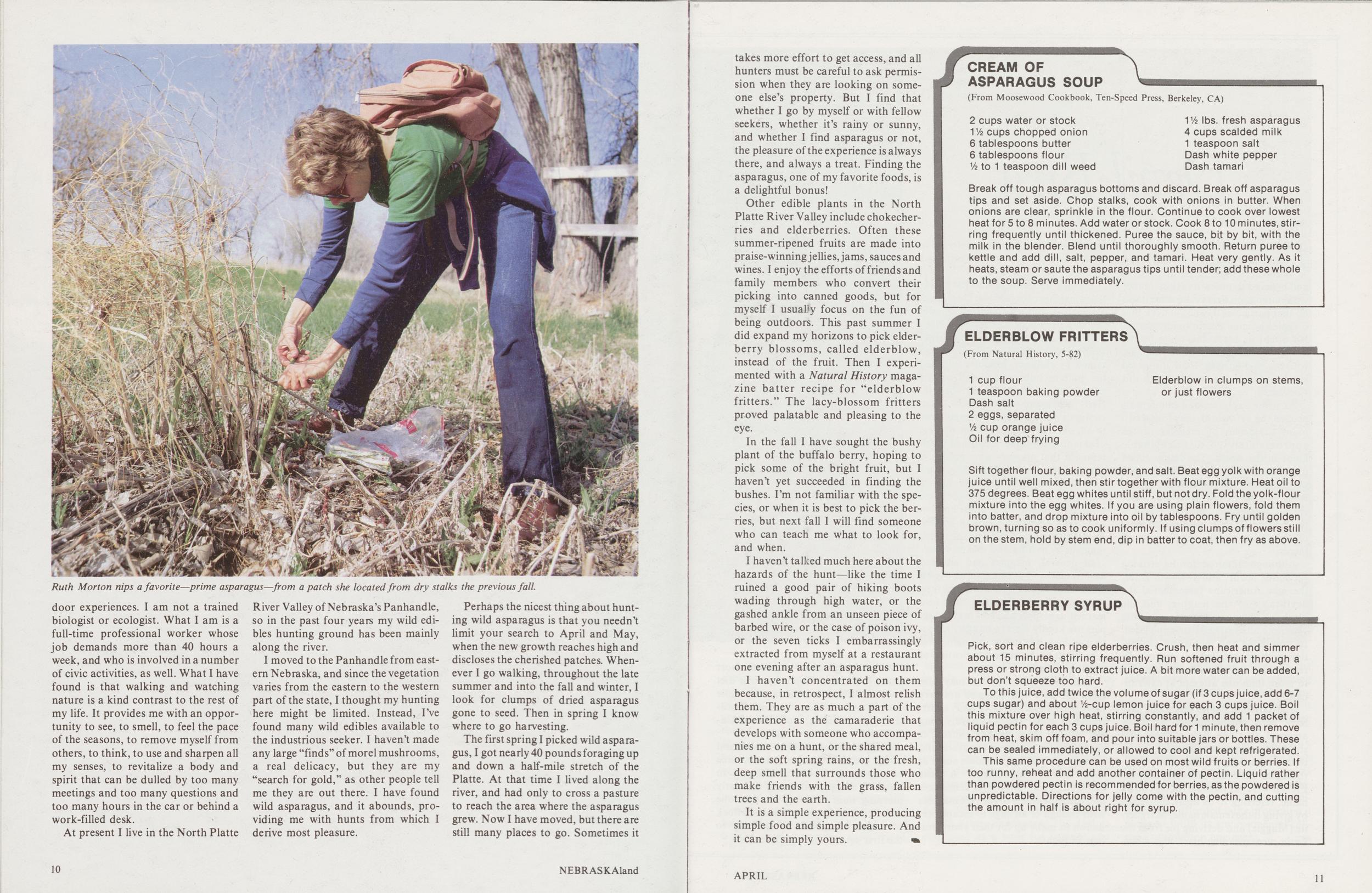
Ruth Morton nips a favorite—prime asparagus—from a patch she located from dry stalks the previous fall
experiences. I am not a trained biologist or ecologist. What I am is a full-time professional worker whose job demands more than 40 hours a week, and who is involved in a number of civic activities, as well. What I have found is that walking and watching nature is a kind contrast to the rest of my life. It provides me with an opportunity to see, to smell, to feel the pace of the seasons, to remove myself from others, to think, to use and sharpen all my senses, to revitalize a body and spirit that can be dulled by too many meetings and too many questions and too many hours in the car or behind a work-filled desk.
At present I live in the North Platte River Valley of Nebraska's Panhandle, so in the past four years my wild edibles hunting ground has been mainly along the river.
I moved to the Panhandle from eastern Nebraska, and since the vegetation varies from the eastern to the western part of the state, I thought my hunting here might be limited. Instead, I've found many wild edibles available to the industrious seeker. I haven't made any large "finds" of morel mushrooms, a real delicacy, but they are my "search for gold," as other people tell me they are out there. I have found wild asparagus, and it abounds, providing me with hunts from which I derive most pleasure.
Perhaps the nicest thing about hunting wild asparagus is that you needn't limit your search to April and May, when the new growth reaches high and discloses the cherished patches. Whenever I go walking, throughout the late summer and into the fall and winter, I look for clumps of dried asparagus gone to seed. Then in spring I know where to go harvesting.
The first spring I picked wild asparagus, I got nearly 40 pounds foraging up and down a half-mile stretch of the Platte. At that time I lived along the river, and had only to cross a pasture to reach the area where the asparagus grew. Now I have moved, but there are still many places to go. Sometimes it
10 NEBRASKAlandtakes more effort to get access, and all hunters must be careful to ask permission when they are looking on someone else's property. But I find that whether I go by myself or with fellow seekers, whether it's rainy or sunny, and whether I find asparagus or not, the pleasure of the experience is always there, and always a treat. Finding the asparagus, one of my favorite foods, is a delightful bonus!
Other edible plants in the North Platte River Valley include chokecherries and elderberries. Often these summer-ripened fruits are made into praise-winning jellies, jams, sauces and wines. I enjoy the efforts of friends and family members who convert their picking into canned goods, but for myself I usually focus on the fun of being outdoors. This past summer I did expand my horizons to pick elderberry blossoms, called elderblow, instead of the fruit. Then I experimented with a Natural History magazine batter recipe for "elderblow fritters." The lacy-blossom fritters proved palatable and pleasing to the eye.
In the fall I have sought the bushy plant of the buffalo berry, hoping to pick some of the bright fruit, but I haven't yet succeeded in finding the bushes. I'm not familiar with the species, or when it is best to pick the berries, but next fall I will find someone who can teach me what to look for, and when.
I haven't talked much here about the hazards of the hunt—like the time I ruined a good pair of hiking boots wading through high water, or the gashed ankle from an unseen piece of barbed wire, or the case of poison ivy, or the seven ticks I embarrassingly extracted from myself at a restaurant one evening after an asparagus hunt.
I haven't concentrated on them because, in retrospect, I almost relish them. They are as much a part of the experience as the camaraderie that develops with someone who accompanies me on a hunt, or the shared meal, or the soft spring rains, or the fresh, deep smell that surrounds those who make friends with the grass, fallen trees and the earth.
It is a simple experience, producing simple food and simple pleasure. And it can be simply yours.
Devil Bird
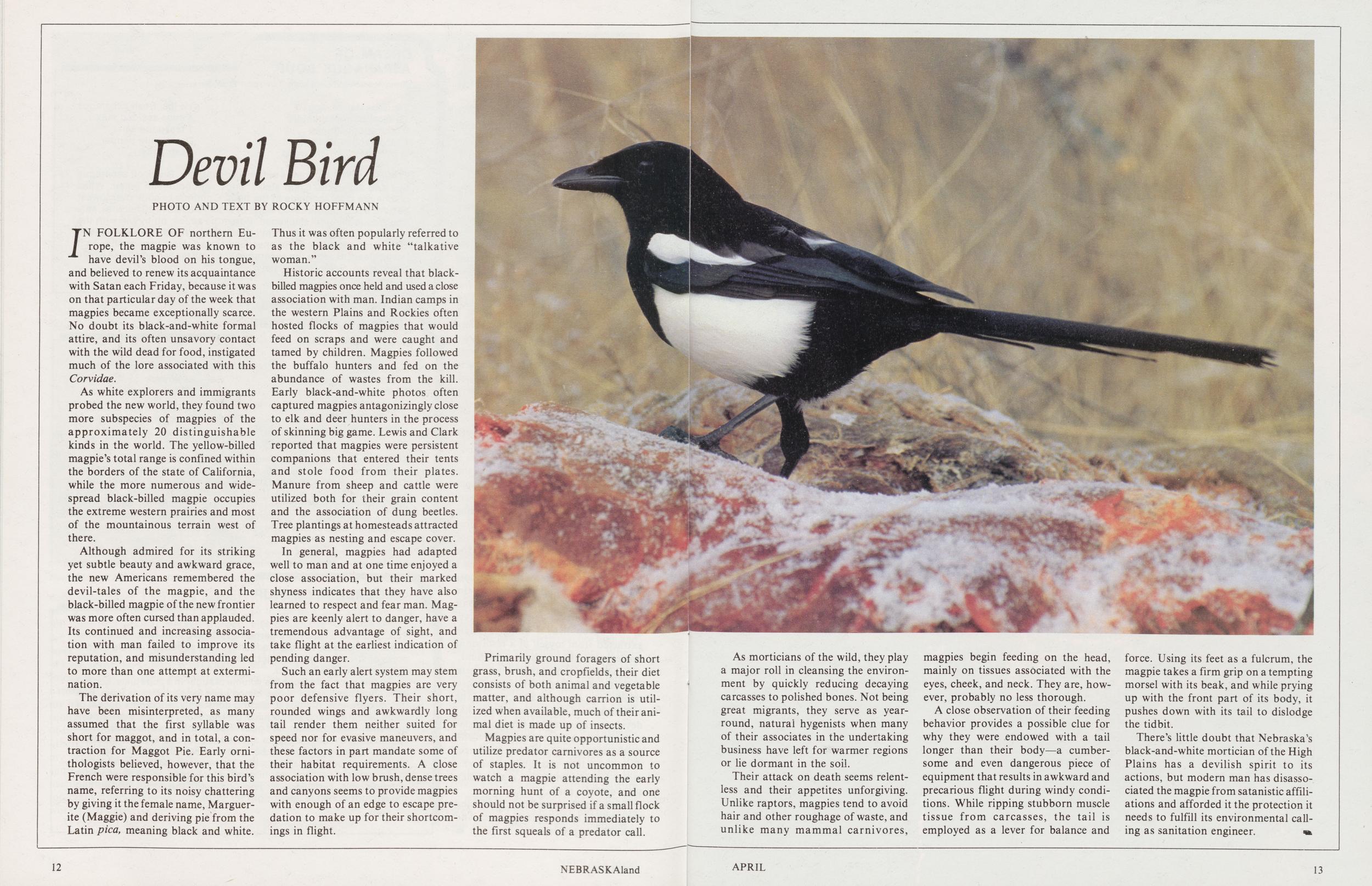
PHOTO AND TEXT BY ROCKY HOFFMANNIN FOLKLORE OF northern Europe, the magpie was known to have devil's blood on his tongue, and believed to renew its acquaintance with Satan each Friday, because it was on that particular day of the week that magpies became exceptionally scarce. No doubt its black-and-white formal attire, and its often unsavory contact with the wild dead for food, instigated much of the lore associated with this Corvidae.
As white explorers and immigrants probed the new world, they found two more subspecies of magpies of the approximately 20 distinguishable kinds in the world. The yellow-billed magpie's total range is confined within the borders of the state of California, while the more numerous and widespread black-billed magpie occupies the extreme western prairies and most of the mountainous terrain west of there.
Although admired for its striking yet subtle beauty and awkward grace, the new Americans remembered the devil-tales of the magpie, and the black-billed magpie of the new frontier was more often cursed than applauded. Its continued and increasing association with man failed to improve its reputation, and misunderstanding led to more than one attempt at extermination.
The derivation of its very name may have been misinterpreted, as many assumed that the first syllable was short for maggot, and in total, a contraction for Maggot Pie. Early ornithologists believed, however, that the French were responsible for this bird's name, referring to its noisy chattering by giving it the female name, Marguerite (Maggie) and deriving pie from the Latin pica, meaning black and white. Thus it was often popularly referred to as the black and white "talkative woman."
Historic accounts reveal that black-billed magpies once held and used a close association with man. Indian camps in the western Plains and Rockies often hosted flocks of magpies that would feed on scraps and were caught and tamed by children. Magpies followed the buffalo hunters and fed on the abundance of wastes from the kill. Early black-and-white photos often captured magpies antagonizingly close to elk and deer hunters in the process of skinning big game. Lewis and Clark reported that magpies were persistent companions that entered their tents and stole food from their plates. Manure from sheep and cattle were utilized both for their grain content and the association of dung beetles. Tree plantings at homesteads attracted magpies as nesting and escape cover.
In general, magpies had adapted well to man and at one time enjoyed a close association, but their marked shyness indicates that they have also learned to respect and fear man. Magpies are keenly alert to danger, have a tremendous advantage of sight, and take flight at the earliest indication of pending danger.
Such an early alert system may stem from the fact that magpies are very poor defensive flyers. Their short, rounded wings and awkwardly long tail render them neither suited for speed nor for evasive maneuvers, and these factors in part mandate some of their habitat requirements. A close association with low brush, dense trees and canyons seems to provide magpies with enough of an edge to escape predation to make up for their shortcomings in flight.
Primarily ground foragers of short grass, brush, and cropfields, their diet consists of both animal and vegetable matter, and although carrion is utilized when available, much of their animal diet is made up of insects.
Magpies are quite opportunistic and utilize predator carnivores as a source of staples. It is not uncommon to watch a magpie attending the early morning hunt of a coyote, and one should not be surprised if a small flock of magpies responds immediately to the first squeals of a predator call.
12 NEBRASKAlandAs morticians of the wild, they play a major roll in cleansing the environment by quickly reducing decaying carcasses to polished bones. Not being great migrants, they serve as year-round, natural hygenists when many of their associates in the undertaking business have left for warmer regions or lie dormant in the soil.
Their attack on death seems relentless and their appetites unforgiving. Unlike raptors, magpies tend to avoid hair and other roughage of waste, and unlike many mammal carnivores, magpies begin feeding on the head, mainly on tissues associated with the eyes, cheek, and neck. They are, however, probably no less thorough.
A close observation of their feeding behavior provides a possible clue for why they were endowed with a tail longer than their body—a cumbersome and even dangerous piece of equipment that results in awkward and precarious flight during windy conditions. While ripping stubborn muscle tissue from carcasses, the tail is employed as a lever for balance and force. Using its feet as a fulcrum, the magpie takes a firm grip on a tempting morsel with its beak, and while prying up with the front part of its body, it pushes down with its tail to dislodge the tidbit.
There's little doubt that Nebraska's black-and-white mortician of the High Plains has a devilish spirit to its actions, but modern man has disassociated the magpie from satanistic affiliations and afforded it the protection it needs to fulfill its environmental calling as sanitation engineer.
APRIL 13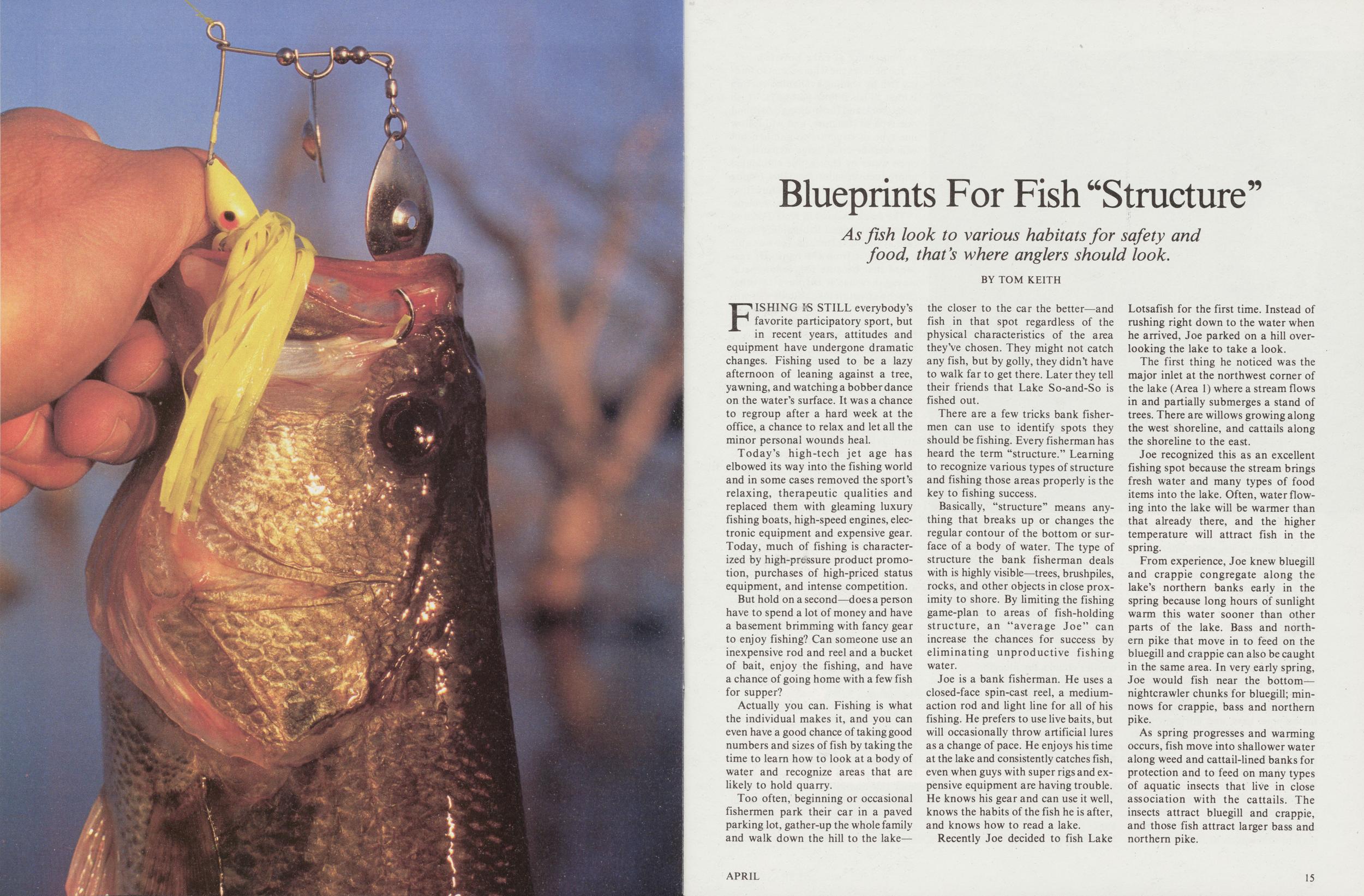
Blueprints For Fish "Structure"
As fish look to various habitats for safety and food, that's where anglers should look. BY TOM KEITHFISHING IS STILL everybody's favorite participatory sport, but in recent years, attitudes and equipment have undergone dramatic changes. Fishing used to be a lazy afternoon of leaning against a tree, yawning, and watching a bobber dance on the water's surface. It was a chance to regroup after a hard week at the office, a chance to relax and let all the minor personal wounds heal.
Today's high-tech jet age has elbowed its way into the fishing world and in some cases removed the sport's relaxing, therapeutic qualities and replaced them with gleaming luxury fishing boats, high-speed engines, electronic equipment and expensive gear. Today, much of fishing is characterized by high-pressure product promotion, purchases of high-priced status equipment, and intense competition.
But hold on a second—does a person have to spend a lot of money and have a basement brimming with fancy gear to enjoy fishing? Can someone use an inexpensive rod and reel and a bucket of bait, enjoy the fishing, and have a chance of going home with a few fish for supper?
Actually you can. Fishing is what the individual makes it, and you can even have a good chance of taking good numbers and sizes of fish by taking the time to learn how to look at a body of water and recognize areas that are likely to hold quarry.
Too often, beginning or occasional fishermen park their car in a paved parking lot, gather-up the whole family and walk down the hill to the lake—the closer to the car the better—and fish in that spot regardless of the physical characteristics of the area they've chosen. They might not catch any fish, but by golly, they didn't have to walk far to get there. Later they tell their friends that Lake So-and-So is fished out.
There are a few tricks bank fishermen can use to identify spots they should be fishing. Every fisherman has heard the term "structure." Learning to recognize various types of structure and fishing those areas properly is the key to fishing success.
Basically, "structure" means anything that breaks up or changes the regular contour of the bottom or surface of a body of water. The type of structure the bank fisherman deals with is highly visible—trees, brushpiles, rocks, and other objects in close proximity to shore. By limiting the fishing game-plan to areas of fish-holding structure, an "average Joe" can increase the chances for success by eliminating unproductive fishing water.
Joe is a bank fisherman. He uses a closed-face spin-cast reel, a medium-action rod and light line for all of his fishing. He prefers to use live baits, but will occasionally throw artificial lures as a change of pace. He enjoys his time at the lake and consistently catches fish, even when guys with super rigs and expensive equipment are having trouble. He knows his gear and can use it well, knows the habits of the fish he is after, and knows how to read a lake.
Recently Joe decided to fish Lake Lotsafish for the first time. Instead of rushing right down to the water when he arrived, Joe parked on a hill over-looking the lake to take a look.
The first thing he noticed was the major inlet at the northwest corner of the lake (Area 1) where a stream flows in and partially submerges a stand of trees. There are willows growing along the west shoreline, and cattails along the shoreline to the east.
Joe recognized this as an excellent fishing spot because the stream brings fresh water and many types of food items into the lake. Often, water flowing into the lake will be warmer than that already there, and the higher temperature will attract fish in the spring.
From experience, Joe knew bluegill and crappie congregate along the lake's northern banks early in the spring because long hours of sunlight warm this water sooner than other parts of the lake. Bass and northern pike that move in to feed on the bluegill and crappie can also be caught in the same area. In very early spring, Joe would fish near the bottom—nightcrawler chunks for bluegill; minnows for crappie, bass and northern pike.
As spring progresses and warming occurs, fish move into shallower water along weed and cattail-lined banks for protection and to feed on many types of aquatic insects that live in close association with the cattails. The insects attract bluegill and crappie, and those fish attract larger bass and northern pike.
APRIL 15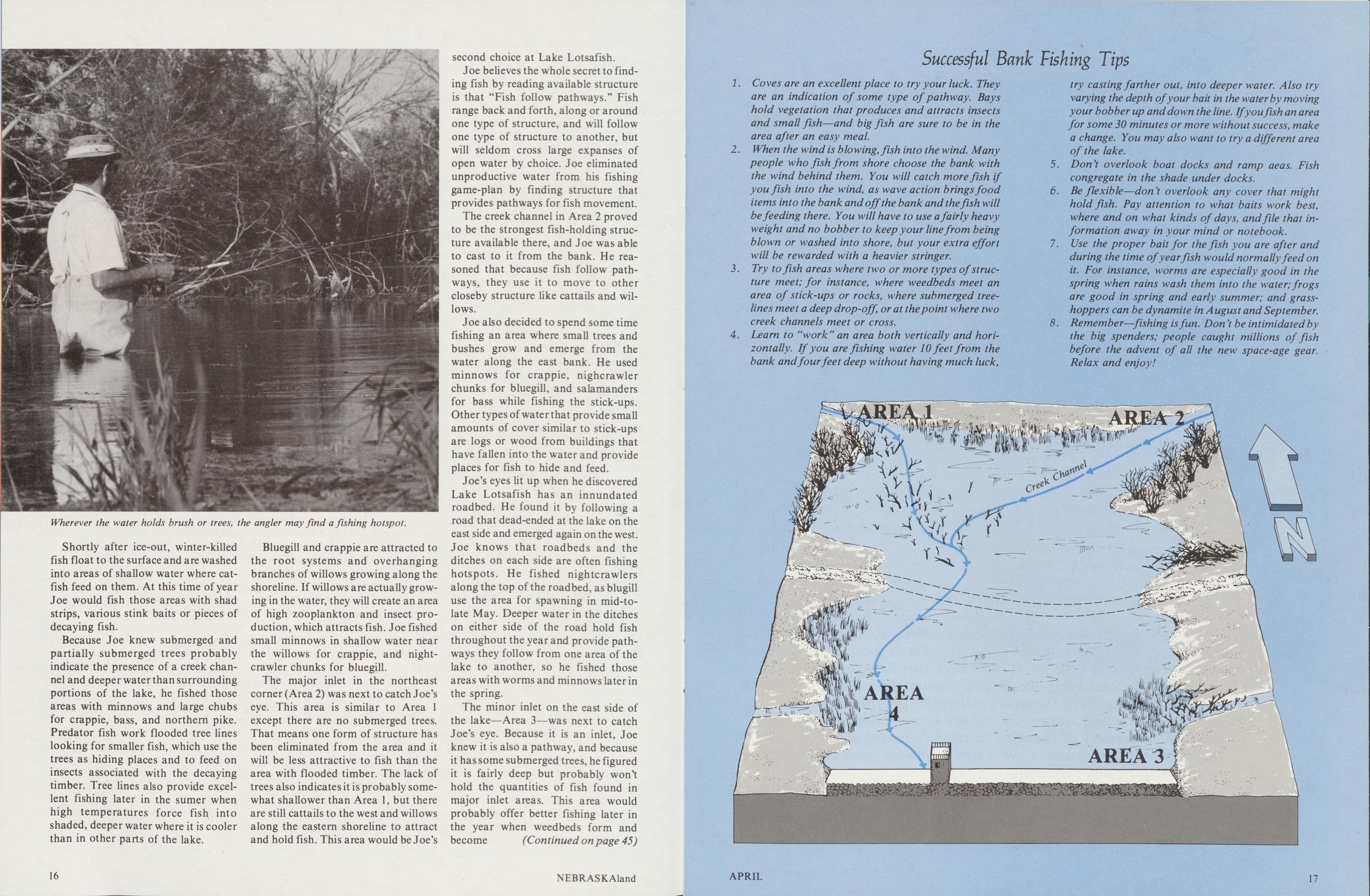
Wherever the water holds brush or trees, the angler may find a fishing hotspot.
Shortly after ice-out, winter-killed fish float to the surface and are washed into areas of shallow water where catfish feed on them. At this time of year Joe would fish those areas with shad strips, various stink baits or pieces of decaying fish.
Because Joe knew submerged and partially submerged trees probably indicate the presence of a creek channel and deeper water than surrounding portions of the lake, he fished those areas with minnows and large chubs for crappie, bass, and northern pike. Predator fish work flooded tree lines looking for smaller fish, which use the trees as hiding places and to feed on insects associated with the decaying timber. Tree lines also provide excellent fishing later in the summer when high temperatures force fish into shaded, deeper water where it is cooler than in other parts of the lake.
Bluegill and crappie are attracted to the root systems and overhanging branches of willows growing along the shoreline. If willows are actually growing in the water, they will create an area of high zooplankton and insect production, which attracts fish. Joe fished small minnows in shallow water near the willows for crappie, and night-crawler chunks for bluegill.
The major inlet in the northeast corner (Area 2) was next to catch Joe's eye. This area is similar to Area 1 except there are no submerged trees. That means one form of structure has been eliminated from the area and it will be less attractive to fish than the area with flooded timber. The lack of trees also indicates it is probably somewhat shallower than Area 1, but there are still cattails to the west and willows along the eastern shoreline to attract and hold fish. This area would be Joe's second choice at Lake Lotsafish.
Joe believes the whole secret to finding fish by reading available structure is that "Fish follow pathways." Fish range back and forth, along or around one type of structure, and will follow one type of structure to another, but will seldom cross large expanses of open water by choice. Joe eliminated unproductive water from his fishing game-plan by finding structure that provides pathways for fish movement.
The creek channel in Area 2 proved to be the strongest fish-holding structure available there, and Joe was able to cast to it from the bank. He reasoned that because fish follow pathways, they use it to move to other closeby structure like cattails and willows.
Joe also decided to spend some time fishing an area where small trees and bushes grow and emerge from the water along the east bank. He used minnows for crappie, nighcrawler chunks for bluegill, and salamanders for bass while fishing the stick-ups. Other types of water that provide small amounts of cover similar to stick-ups are logs or wood from buildings that have fallen into the water and provide places for fish to hide and feed.
Joe's eyes lit up when he discovered Lake Lotsafish has an innundated roadbed. He found it by following a road that dead-ended at the lake on the east side and emerged again on the west. Joe knows that roadbeds and the ditches on each side are often fishing hotspots. He fished nightcrawlers along the top of the roadbed, asblugill use the area for spawning in mid-to-late May. Deeper water in the ditches on either side of the road hold fish throughout the year and provide pathways they follow from one area of the lake to another, so he fished those areas with worms and minnows later in the spring.
The minor inlet on the east side of the lake—Area 3—was next to catch Joe's eye. Because it is an inlet, Joe knew it is also a pathway, and because it has some submerged trees, he figured it is fairly deep but probably won't hold the quantities of fish found in major inlet areas. This area would probably offer better fishing later in the year when weedbeds form and become
(Continued on page 45) 16 NEBRASKAland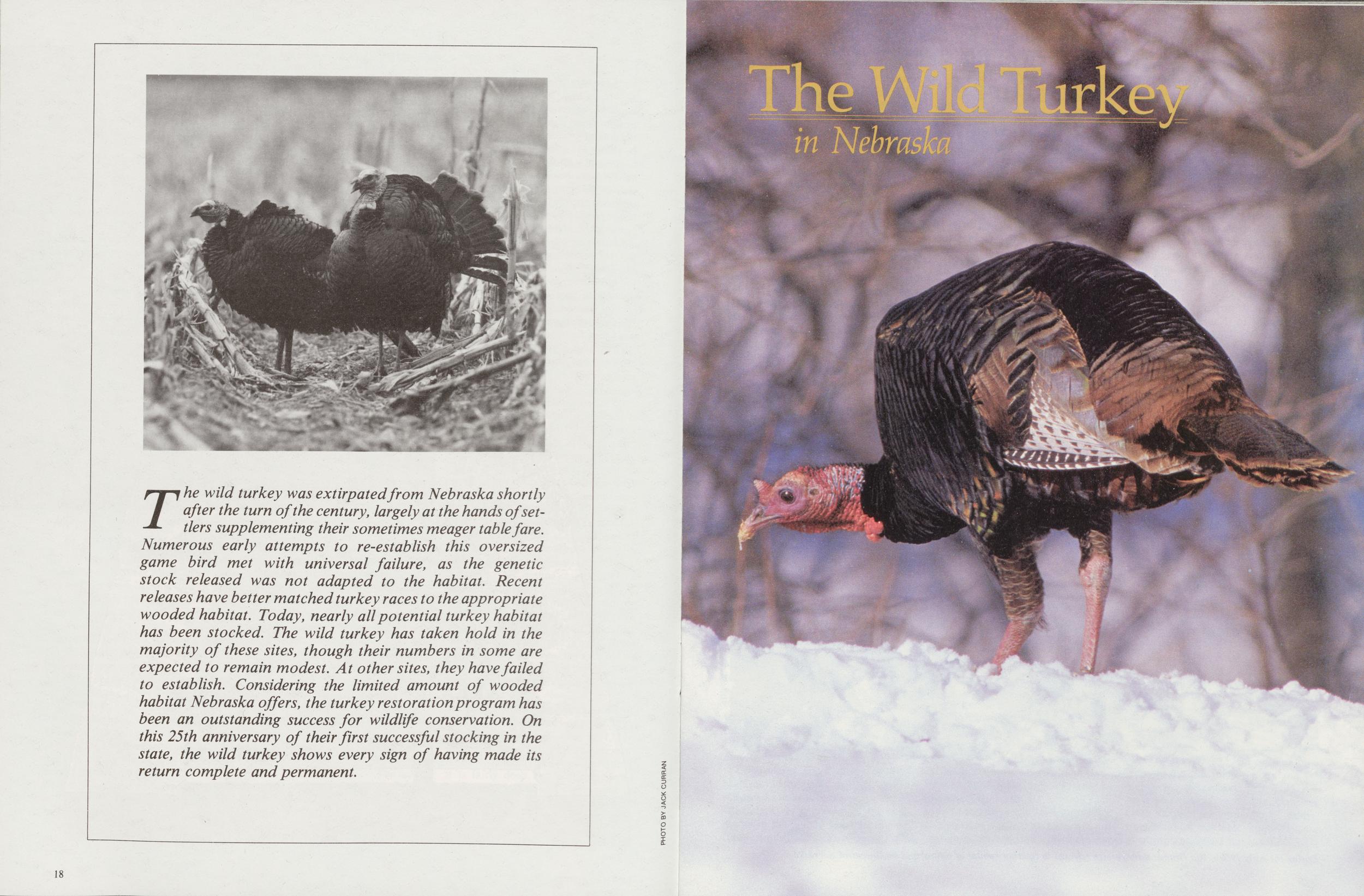
The wild turkey was extirpated from Nebraska shortly after the turn of the century, largely at the hands of settlers supplementing their sometimes meager table fare. Numerous early attempts to re-establish this oversized game bird met with universal failure, as the genetic stock released was not adapted to the habitat. Recent releases have better matched turkey races to the appropriate wooded habitat. Today, nearly all potential turkey habitat has been stocked. The wild turkey has taken hold in the majority of these sites, though their numbers in some are expected to remain modest. At other sites, they have failed to establish. Considering the limited amount of wooded habitat Nebraska offers, the turkey restoration program has been an outstanding success for wildlife conservation. On this 25th anniversary of their first successful stocking in the state, the wild turkey shows every sign of having made its return complete and permanent.
18The Wild Turkey in Nebraska
Return of the Wild Turkey
THE RETURN OF the wild turkey to Nebraska is one of the great success stories in wildlife management. Of the six recognized races or subspecies, two, the eastern and the Rio Grande, are believed to have been native to Nebraska. By about 1915, though, the wild turkey had been extirpated from the state. The modern history of wild turkeys in Nebraska began with the release of birds in the Pine Ridge in the late 1950's. In subsequent years, additional importations, transplants and natural expansion, have increased the number of wild turkeys and their range until today they occupy nearly all areas in Nebraska which have significant wooded habitat.
Over 38,000 turkeys have been taken legally by Nebraska hunters, including nearly 4,700 in 1983 alone. Nebraska ranks 14th in the nation in the harvest of wild turkeys. Not bad for a prairie state which places about 48th in woodland acreage!
Numerous early attempts were made to re-establish the wild turkey in Nebraska, both by private individuals and groups. Since all of the birds released were pen-reared and crossed with domestic strains, none possessed the traits necessary for survival in the wild. They soon succumbed to the rigors of an environment to which they were not adapted.
The Game and Parks Commission initiated its turkey restoration program with the release of 28 Merriam's turkeys in the Pine Ridge in 1959. In 1961 and 1962, 518 Rio Grande turkeys were released throughout the riparian-woodland habitat of central and south central Nebraska.
The Merriam's turkey stocking program (even though this race is not believed to have been native to the state) met with immediate success, while the Rio Grande program (a race that is believed to have been native to the state) showed only limited success and in many areas failed completely.
Nebraska does not have the rugged terrain and vast timber expanses found in the Merriam's historical range in New Mexico, Arizona, Colorado and possibly Texas. However, the Pine Ridge of northwest Nebraska is similar enough that the birds quickly adapted.
The initial release of Merriam's turkeys was in February and March at two sites in the Ridge. Three toms and 17 hens were released at Cottonwood Creek northwest of Crawford, and three toms and five hens on Deadhorse Creek southwest of Chadron. Following their release, the birds remained relatively close. As the breeding season approached the birds dispersed to select suitable nesting sites.
The initial 28 birds ranged within five miles of release sites during the first nesting period and wintered their broods in the same area. The Cottonwood Creek flock, where only juvenile toms were released, increased from 20 to 91, refuting previous evidence that only adult males were capable of mating successfully.
By the fourth year, turkeys had moved into Wyoming through an extension of the Pine Ridge, and into South Dakota through the Hat Creek drainage. Nesting birds and summer broods were reported in about 80 percent of the suitable habitat. Reports of birds traveling across rangeland and cropland indicated nesting sites were
PHOTO BY LOU ELLDuring the early 1960's, Rio Grande turkeys were released in riparian habitat of central and south-central Nebraska.
saturated in some areas, forcing hens to pioneer into new habitat. It was estimated that during the fall of 1962, after only four nesting seasons, a minimum of 3,000 birds existed in the Pine Ridge.
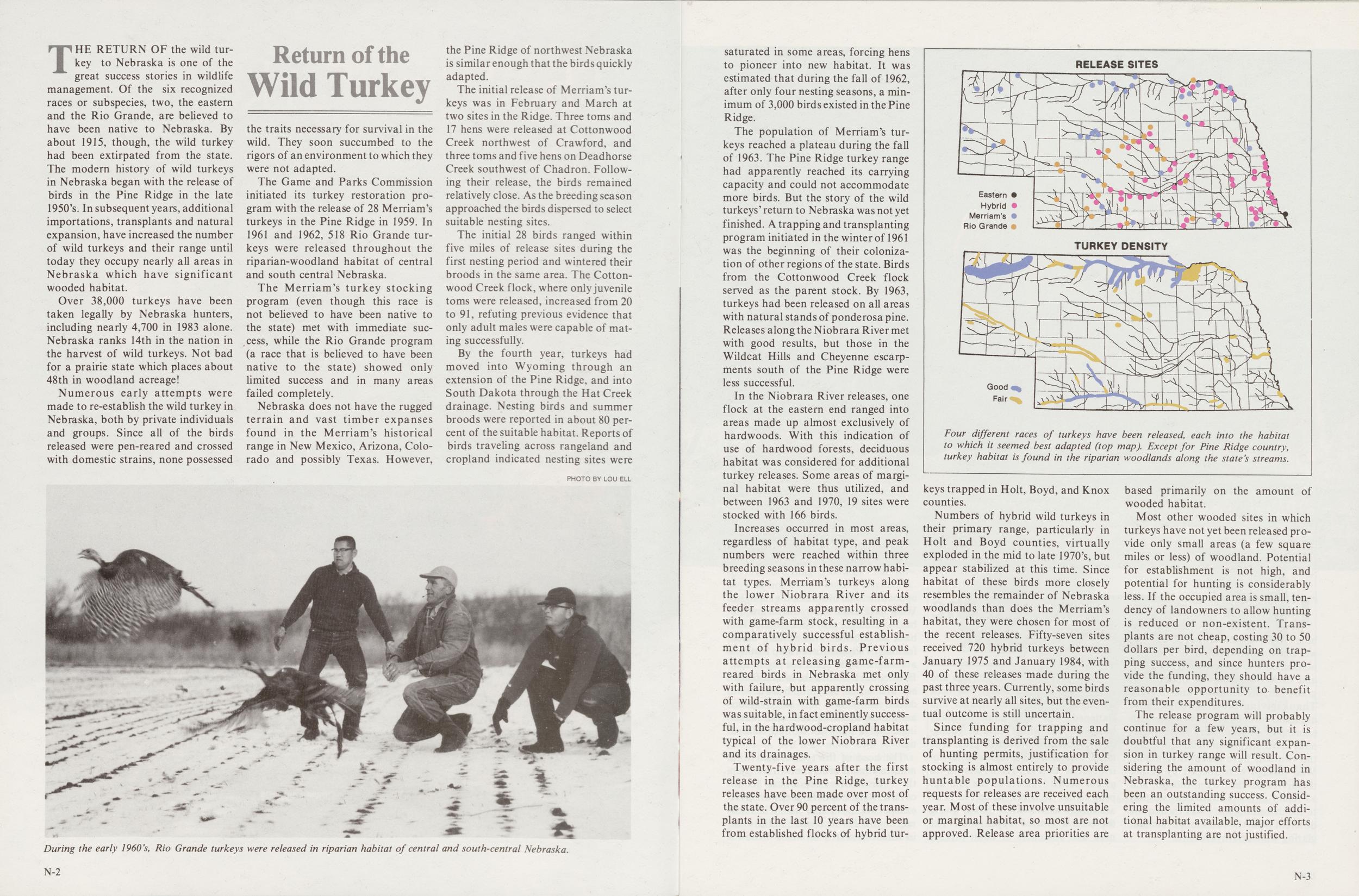
The population of Merriam's turkeys reached a plateau during the fall of 1963. The Pine Ridge turkey range had apparently reached its carrying capacity and could not accommodate more birds. But the story of the wild turkeys' return to Nebraska was not yet finished. A trapping and transplanting program initiated in the winter of 1961 was the beginning of their colonization of other regions of the state. Birds from the Cottonwood Creek flock served as the parent stock. By 1963, turkeys had been released on all areas with natural stands of ponderosa pine. Releases along the Niobrara River met with good results, but those in the Wildcat Hills and Cheyenne escarpments south of the Pine Ridge were less successful.
In the Niobrara River releases, one flock at the eastern end ranged into areas made up almost exclusively of hardwoods. With this indication of use of hardwood forests, deciduous habitat was considered for additional turkey releases. Some areas of marginal habitat were thus utilized, and between 1963 and 1970, 19 sites were stocked with 166 birds.
Increases occurred in most areas, regardless of habitat type, and peak numbers were reached within three breeding seasons in these narrow habitat types. Merriam's turkeys along the lower Niobrara River and its feeder streams apparently crossed with game-farm stock, resulting in a comparatively successful establishment of hybrid birds. Previous attempts at releasing game-farm-reared birds in Nebraska met only with failure, but apparently crossing of wild-strain with game-farm birds was suitable, in fact eminently successful, in the hardwood-cropland habitat typical of the lower Niobrara River and its drainages.
Twenty-five years after the first release in the Pine Ridge, turkey releases have been made over most of the state. Over 90 percent of the transplants in the last 10 years have been from established flocks of hybrid turkeys
RELEASE SITES Eastern • Hybrid • Merriam's • Rio Grande TURKEY DENSITY Four different races of turkeys have been released, each into the habitat to which it seemed best adapted (top map). Except for Pine Ridge country, turkey habitat is found in the riparian woodlands along the state's streams.
trapped in Holt, Boyd, and Knox counties.
Numbers of hybrid wild turkeys in their primary range, particularly in Holt and Boyd counties, virtually exploded in the mid to late 1970's, but appear stabilized at this time. Since habitat of these birds more closely resembles the remainder of Nebraska woodlands than does the Merriam's habitat, they were chosen for most of the recent releases. Fifty-seven sites received 720 hybrid turkeys between January 1975 and January 1984, with 40 of these releases made during the past three years. Currently, some birds survive at nearly all sites, but the eventual outcome is still uncertain.
Since funding for trapping and transplanting is derived from the sale of hunting permits, justification for stocking is almost entirely to provide huntable populations. Numerous requests for releases are received each year. Most of these involve unsuitable or marginal habitat, so most are not approved. Release area priorities are based primarily on the amount of wooded habitat.
Most other wooded sites in which turkeys have not yet been released provide only small areas (a few square miles or less) of woodland. Potential for establishment is not high, and potential for hunting is considerably less. If the occupied area is small, tendency of landowners to allow hunting is reduced or non-existent. Transplants are not cheap, costing 30 to 50 dollars per bird, depending on trapping success, and since hunters provide the funding, they should have a reasonable opportunity to benefit from their expenditures.
The release program will probably continue for a few years, but it is doubtful that any significant expansion in turkey range will result. Considering the amount of woodland in Nebraska, the turkey program has been an outstanding success. Considering the limited amounts of additional habitat available, major efforts at transplanting are not justified.
N-3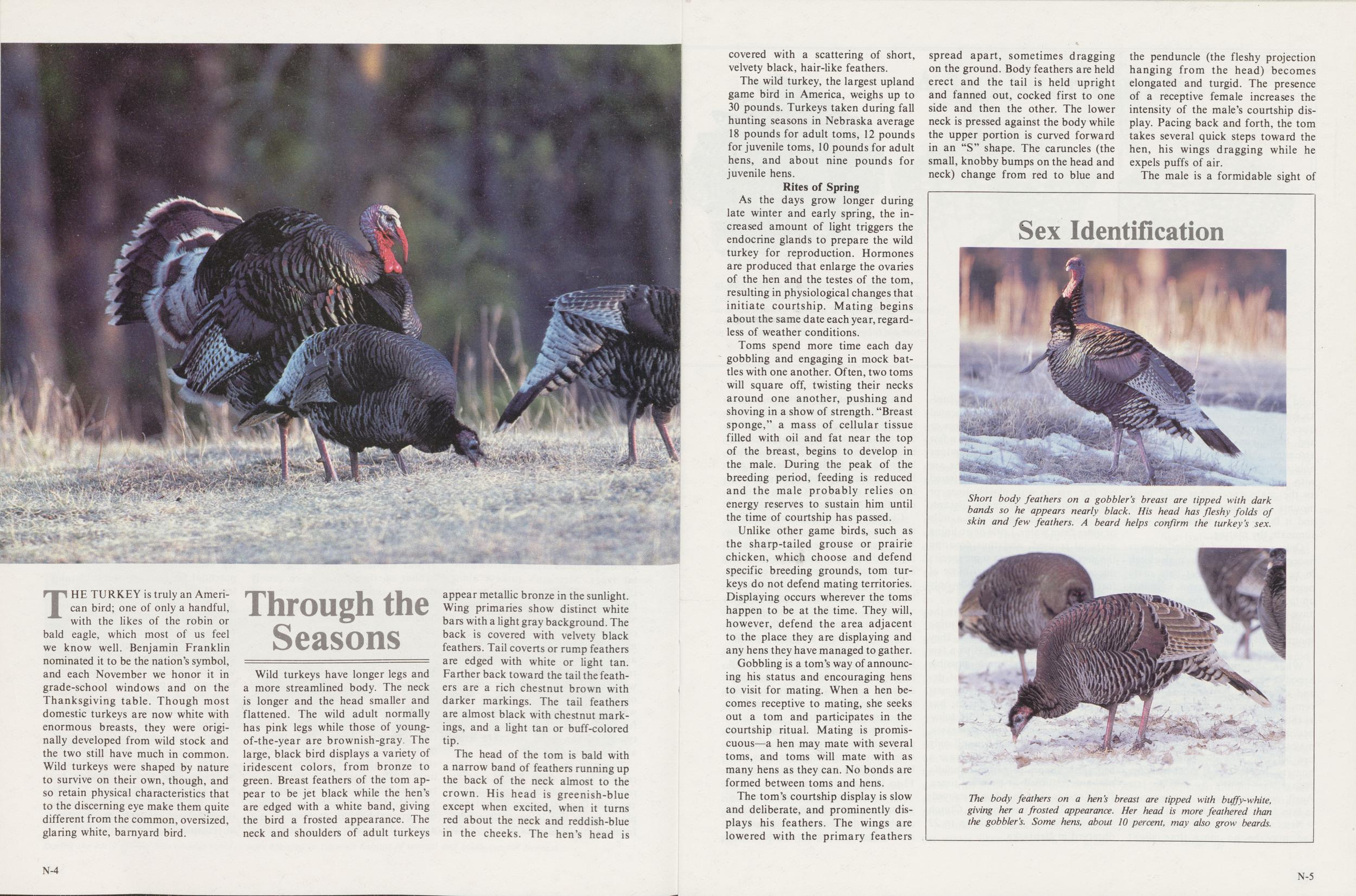
Through the Seasons
THE TURKEY is truly an American bird; one of only a handful, with the likes of the robin or bald eagle, which most of us feel we know well. Benjamin Franklin nominated it to be the nation's symbol, and each November we honor it in grade-school windows and on the Thanksgiving table. Though most domestic turkeys are now white with enormous breasts, they were originally developed from wild stock and the two still have much in common. Wild turkeys were shaped by nature to survive on their own, though, and so retain physical characteristics that to the discerning eye make them quite different from the common, oversized, glaring white, barnyard bird.
Wild turkeys have longer legs and a more streamlined body. The neck is longer and the head smaller and flattened. The wild adult normally has pink legs while those of young-of-the-year are brownish-gray The large, black bird displays a variety of iridescent colors, from bronze to green. Breast feathers of the tom appear to be jet black while the hen's are edged with a white band, giving the bird a frosted appearance. The neck and shoulders of adult turkeys appear metallic bronze in the sunlight. Wing primaries show distinct white bars with a light gray background. The back is covered with velvety black feathers. Tail coverts or rump feathers are edged with white or light tan. Farther back toward the tail the feathers are a rich chestnut brown with darker markings. The tail feathers are almost black with chestnut markings, and a light tan or buff-colored tip.
The head of the tom is bald with a narrow band of feathers running up the back of the neck almost to the crown. His head is greenish-blue except when excited, when it turns red about the neck and reddish-blue in the cheeks. The hen's head is
N-4covered with a scattering of short, velvety black, hair-like feathers.
The wild turkey, the largest upland game bird in America, weighs up to 30 pounds. Turkeys taken during fall hunting seasons in Nebraska average 18 pounds for adult toms, 12 pounds for juvenile toms, 10 pounds for adult hens, and about nine pounds for juvenile hens.
Rites of SpringAs the days grow longer during late winter and early spring, the increased amount of light triggers the endocrine glands to prepare the wild turkey for reproduction. Hormones are produced that enlarge the ovaries of the hen and the testes of the tom, resulting in physiological changes that initiate courtship. Mating begins about the same date each year, regardless of weather conditions.
Toms spend more time each day gobbling and engaging in mock battles with one another. Often, two toms will square off, twisting their necks around one another, pushing and shoving in a show of strength. "Breast sponge," a mass of cellular tissue filled with oil and fat near the top of the breast, begins to develop in the male. During the peak of the breeding period, feeding is reduced and the male probably relies on energy reserves to sustain him until the time of courtship has passed.
Unlike other game birds, such as the sharp-tailed grouse or prairie chicken, which choose and defend specific breeding grounds, tom turkeys do not defend mating territories. Displaying occurs wherever the toms happen to be at the time. They will, however, defend the area adjacent to the place they are displaying and any hens they have managed to gather.
Gobbling is a tom's way of announcing his status and encouraging hens to visit for mating. When a hen becomes receptive to mating, she seeks out a tom and participates in the courtship ritual. Mating is promiscuous—a hen may mate with several toms, and toms will mate with as many hens as they can. No bonds are formed between toms and hens.
The tom's courtship display is slow and deliberate, and prominently displays his feathers. The wings are lowered with the primary feathers spread apart, sometimes dragging on the ground. Body feathers are held erect and the tail is held upright and fanned out, cocked first to one side and then the other. The lower neck is pressed against the body while the upper portion is curved forward in an "S" shape. The caruncles (the small, knobby bumps on the head and neck) change from red to blue and the penduncle (the fleshy projection hanging from the head) becomes elongated and turgid. The presence of a receptive female increases the intensity of the male's courtship display. Pacing back and forth, the tom takes several quick steps toward the hen, his wings dragging while he expels puffs of air.
The male is a formidable sight of
Sex IdentificationShort body feathers on a gobbler's breast are tipped with dark bands so he appears nearly black. His head has fleshy folds of skin and few feathers. A beard helps confirm the turkey's sex.
The body feathers on a hen's breast are tipped with buffy-white, giving her a frosted appearance. Her head is more feathered than the gobbler's. Some hens, about 10 percent, may also grow beards.
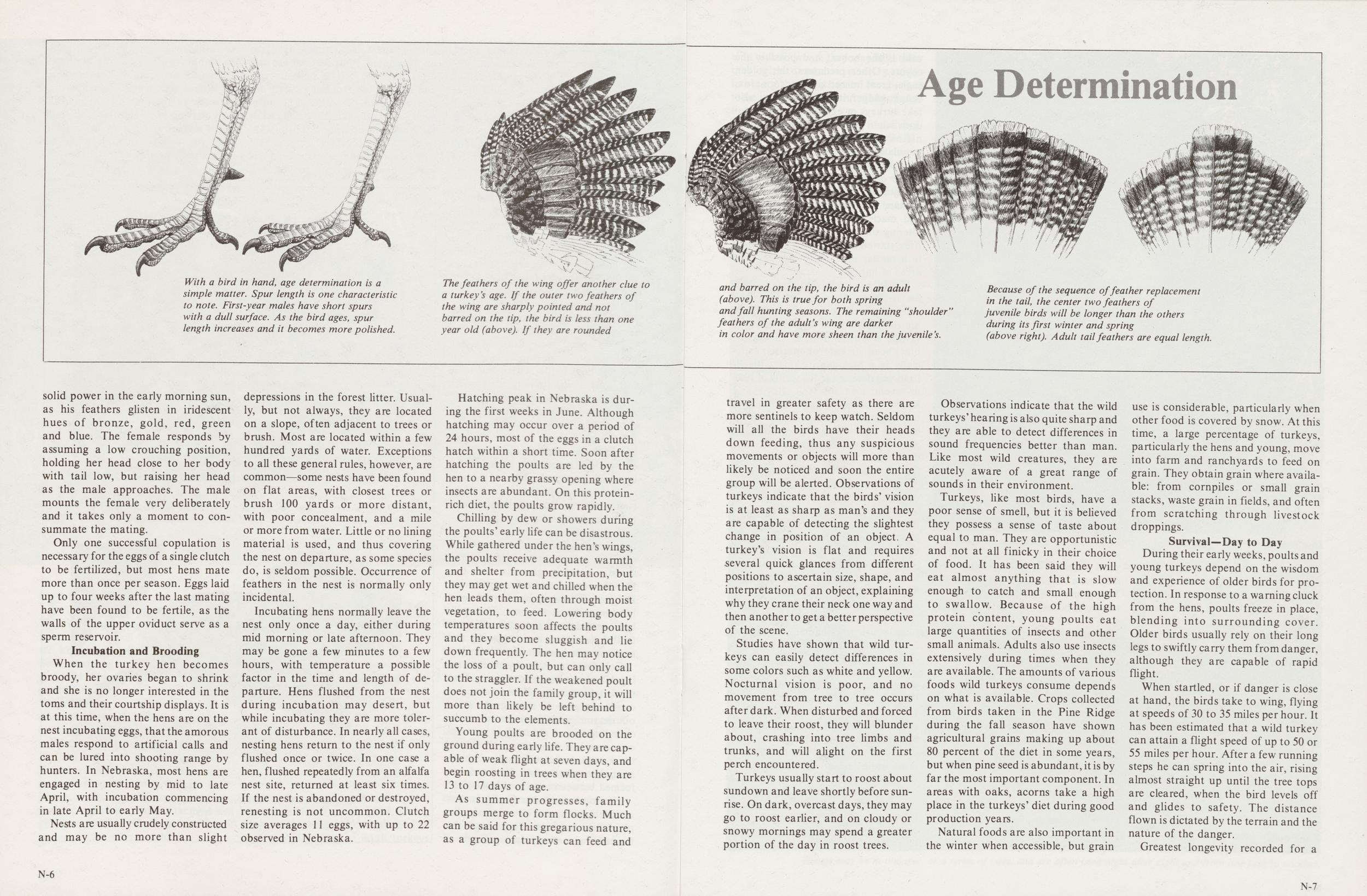
Age Determination With a bird in hand, age determination is a simple matter. Spur length is one characteristic to note. First-year males have short spurs with a dull surface. As the bird ages, spur length increases and it becomes more polished. The feathers of the wing offer another clue to a turkey's age. If the outer two feathers of the wing are sharply pointed and not barred on the tip, the bird is less than one year old (above). If they are rounded and barred on the tip, the bird is an adult (above). This is true for both spring and fall hunting seasons. The remaining "shoulder" feathers of the adult's wing are darker in color and have more sheen than the juvenile's. Because of the sequence of feather replacement in the tail, the center two feathers of juvenile birds will be longer than the others during its first winter and spring (above right). Adult tail feathers are equal length.
solid power in the early morning sun, as his feathers glisten in iridescent hues of bronze, gold, red, green and blue. The female responds by assuming a low crouching position, holding her head close to her body with tail low, but raising her head as the male approaches. The male mounts the female very deliberately and it takes only a moment to consummate the mating.
Only one successful copulation is necessary for the eggs of a single clutch to be fertilized, but most hens mate more than once per season. Eggs laid up to four weeks after the last mating have been found to be fertile, as the walls of the upper oviduct serve as a sperm reservoir.
Incubation and BroodingWhen the turkey hen becomes broody, her ovaries began to shrink and she is no longer interested in the toms and their courtship displays. It is at this time, when the hens are on the nest incubating eggs, that the amorous males respond to artificial calls and can be lured into shooting range by hunters. In Nebraska, most hens are engaged in nesting by mid to late April, with incubation commencing in late April to early May.
Nests are usually crudely constructed and may be no more than slight depressions in the forest litter. Usually, but not always, they are located on a slope, often adjacent to trees or brush. Most are located within a few hundred yards of water. Exceptions to all these general rules, however, are common—some nests have been found on flat areas, with closest trees or brush 100 yards or more distant, with poor concealment, and a mile or more from water. Little or no lining material is used, and thus covering the nest on departure, as some species do, is seldom possible. Occurrence of feathers in the nest is normally only incidental.
Incubating hens normally leave the nest only once a day, either during mid morning or late afternoon. They may be gone a few minutes to a few hours, with temperature a possible factor in the time and length of departure. Hens flushed from the nest during incubation may desert, but while incubating they are more tolerant of disturbance. In nearly all cases, nesting hens return to the nest if only flushed once or twice. In one case a hen, flushed repeatedly from an alfalfa nest site, returned at least six times. If the nest is abandoned or destroyed, renesting is not uncommon. Clutch size averages 11 eggs, with up to 22 observed in Nebraska.
Hatching peak in Nebraska is during the first weeks in June. Although hatching may occur over a period of 24 hours, most of the eggs in a clutch hatch within a short time. Soon after hatching the poults are led by the hen to a nearby grassy opening where insects are abundant. On this protein-rich diet, the poults grow rapidly.
Chilling by dew or showers during the poults' early life can be disastrous. While gathered under the hen's wings, the poults receive adequate warmth and shelter from precipitation, but they may get wet and chilled when the hen leads them, often through moist vegetation, to feed. Lowering body temperatures soon affects the poults and they become sluggish and lie down frequently. The hen may notice the loss of a poult, but can only call to the straggler. If the weakened poult does not join the family group, it will more than likely be left behind to succumb to the elements.
Young poults are brooded on the ground during early life. They are capable of weak flight at seven days, and begin roosting in trees when they are 13 to 17 days of age.
As summer progresses, family groups merge to form flocks. Much can be said for this gregarious nature, as a group of turkeys can feed and
N-6travel in greater safety as there are more sentinels to keep watch. Seldom will all the birds have their heads down feeding, thus any suspicious movements or objects will more than likely be noticed and soon the entire group will be alerted. Observations of turkeys indicate that the birds' vision is at least as sharp as man's and they are capable of detecting the slightest change in position of an object, A turkey's vision is flat and requires several quick glances from different positions to ascertain size, shape, and interpretation of an object, explaining why they crane their neck one way and then another to get a better perspective of the scene.
Studies have shown that wild turkeys can easily detect differences in some colors such as white and yellow. Nocturnal vision is poor, and no movement from tree to tree occurs after dark. When disturbed and forced to leave their roost, they will blunder about, crashing into tree limbs and trunks, and will alight on the first perch encountered.
Turkeys usually start to roost about sundown and leave shortly before sunrise. On dark, overcast days, they may go to roost earlier, and on cloudy or snowy mornings may spend a greater portion of the day in roost trees. Observations indicate that the wild turkeys' hearing is also quite sharp and they are able to detect differences in sound frequencies better than man. Like most wild creatures, they are acutely aware of a great range of sounds in their environment
Turkeys, like most birds, have a poor sense of smell, but it is believed they possess a sense of taste about equal to man. They are opportunistic and not at all finicky in their choice of food. It has been said they will eat almost anything that is slow enough to catch and small enough to swallow. Because of the high protein content, young poults eat large quantities of insects and other small animals. Adults also use insects extensively during times when they are available. The amounts of various foods wild turkeys consume depends on what is available. Crops collected from birds taken in the Pine Ridge during the fall season have shown agricultural grains making up about 80 percent of the diet in some years, but when pine seed is abundant, it is by far the most important component. In areas with oaks, acorns take a high place in the turkeys' diet during good production years.
Natural foods are also important in the winter when accessible, but grain use is considerable, particularly when other food is covered by snow. At this time, a large percentage of turkeys, particularly the hens and young, move into farm and ranchyards to feed on grain. They obtain grain where available: from compiles or small grain stacks, waste grain in fields, and often from scratching through livestock droppings.
Survival—Day to DayDuring their early weeks, poults and young turkeys depend on the wisdom and experience of older birds for protection. In response to a warning cluck from the hens, poults freeze in place, blending into surrounding cover. Older birds usually rely on their long legs to swiftly carry them from danger, although they are capable of rapid flight.
When startled, or if danger is close at hand, the birds take to wing, flying at speeds of 30 to 35 miles per hour. It has been estimated that a wild turkey can attain a flight speed of up to 50 or 55 miles per hour. After a few running steps he can spring into the air, rising almost straight up until the tree tops are cleared, when the bird levels off and glides to safety. The distance flown is dictated by the terrain and the nature of the danger.
Greatest longevity recorded for a
N-7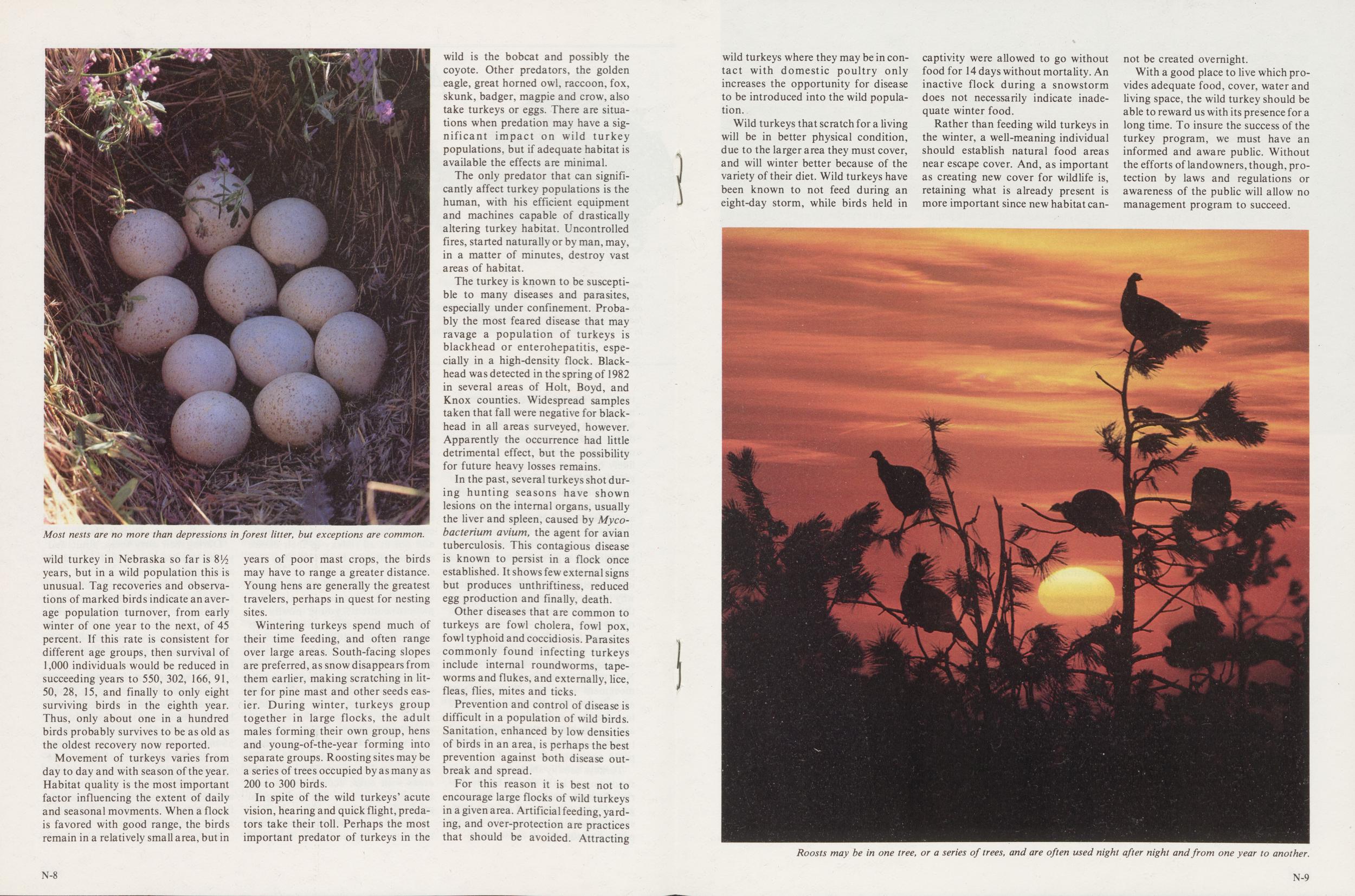
Most nests are no more than depressions in forest litter, but exceptions are common.
wild turkey in Nebraska so far is 8 1/2 years, but in a wild population this is unusual. Tag recoveries and observations of marked birds indicate an average population turnover, from early winter of one year to the next, of 45 percent. If this rate is consistent for different age groups, then survival of 1,000 individuals would be reduced in succeeding years to 550, 302, 166, 91, 50, 28, 15, and finally to only eight surviving birds in the eighth year. Thus, only about one in a hundred birds probably survives to be as old as the oldest recovery now reported.
Movement of turkeys varies from day to day and with season of the year. Habitat quality is the most important factor influencing the extent of daily and seasonal movments. When a flock is favored with good range, the birds remain in a relatively small area, but in years of poor mast crops, the birds may have to range a greater distance. Young hens are generally the greatest travelers, perhaps in quest for nesting sites.
Wintering turkeys spend much of their time feeding, and often range over large areas. South-facing slopes are preferred, as snow disappears from them earlier, making scratching in litter for pine mast and other seeds easier. During winter, turkeys group together in large flocks, the adult males forming their own group, hens and young-of-the-year forming into separate groups. Roosting sites may be a series of trees occupied by as many as 200 to 300 birds.
In spite of the wild turkeys' acute vision, hearing and quick flight, predators take their toll. Perhaps the most important predator of turkeys in the wild is the bobcat and possibly the coyote. Other predators, the golden eagle, great horned owl, raccoon, fox, skunk, badger, magpie and crow, also take turkeys or eggs. There are situations when predation may have a significant impact on wild turkey populations, but if adequate habitat is available the effects are minimal.
The only predator that can significantly affect turkey populations is the human, with his efficient equipment and machines capable of drastically altering turkey habitat. Uncontrolled fires, started naturally or by man, may, in a matter of minutes, destroy vast areas of habitat.
The turkey is known to be susceptible to many diseases and parasites, especially under confinement. Probably the most feared disease that may ravage a population of turkeys is blackhead or enterohepatitis, especially in a high-density flock. Blackhead was detected in the spring of 1982 in several areas of Holt, Boyd, and Knox counties. Widespread samples taken that fall were negative for blackhead in all areas surveyed, however. Apparently the occurrence had little detrimental effect, but the possibility for future heavy losses remains.
In the past, several turkeys shot during hunting seasons have shown lesions on the internal organs, usually the liver and spleen, caused by Mycobacterium avium, the agent for avian tuberculosis. This contagious disease is known to persist in a flock once established. It shows few external signs but produces unthriftiness, reduced egg production and finally, death.
Other diseases that are common to turkeys are fowl cholera, fowl pox, fowl typhoid and coccidiosis. Parasites commonly found infecting turkeys include internal roundworms, tapeworms and flukes, and externally, lice, fleas, flies, mites and ticks.
Prevention and control of disease is difficult in a population of wild birds. Sanitation, enhanced by low densities of birds in an area, is perhaps the best prevention against both disease outbreak and spread.
For this reason it is best not to encourage large flocks of wild turkeys in a given area. Artificial feeding, yarding, and over-protection are practices that should be avoided. Attracting
N-8wild turkeys where they may be in contact with domestic poultry only increases the opportunity for disease to be introduced into the wild population.
Wild turkeys that scratch for a living will be in better physical condition, due to the larger area they must cover, and will winter better because of the variety of their diet. Wild turkeys have been known to not feed during an eight-day storm, while birds held in captivity were allowed to go without food for 14 days without mortality. An inactive flock during a snowstorm does not necessarily indicate inadequate winter food.
Rather than feeding wild turkeys in the winter, a well-meaning individual should establish natural food areas near escape cover. And, as important as creating new cover for wildlife is, retaining what is already present is more important since new habitat cannot be created overnight.
With a good place to live which provides adequate food, cover, water and living space, the wild turkey should be able to reward us with its presence for a long time. To insure the success of the turkey program, we must have an informed and aware public. Without the efforts of landowners, though, protection by laws and regulations or awareness of the public will allow no management program to succeed.
Roosts may be in one tree, or a series of trees, and are often used night after night and from one year to another.
Monitoring the Flocks
WILDLIFE IS A renewable natural resource, and if managed wisely, can be cropped annually without depleting the stock. The goal of sound management is to provide the greatest amount of wildlife and recreational benefits while keeping the populations at levels consistent with agricultural interests.
Turkey management in Nebraska at present has two major aspects—transplanting, to introduce birds to new areas, and control of the harvest. With nearly all of the state in private ownership, opportunities for habitat management are limited. Some progress is being made in habitat acquisition through the Habitat Program, though, and in habitat improvement on public land. Flock and population inventories taken throughout the year, and analysis of harvest information, play major roles in managing the state's wild turkeys.
Information is gathered throughout the year by biologists. Population and harvest surveys provide the basis for hunting regulations—how many permits will be issued in each unit, length of the season, opening dates and other aspects of "setting the seasons." Winter flock counts, primarily through cooperating landowners, provide an indication of potential breeding populations that might be expected the following spring, as well as a minimum population estimate. Brood surveys, conducted in July and early August, provide an indication of relative reproductive success. The combination of winter numbers with spring poult-to-hen ratios is used by biologists to predict relative fall populations. Age composition (the ratio of young-of-the-year to mature birds) information gathered during the fall hunting season normally compares well with data gathered during summer surveys. Hunter success (taking into account any abnormal weather conditions that may have affected that success) is a good indicator of population levels.
Data gathered at check stations during hunting seasons, particularly the fall season, is especially important in management planning. It provides not only an indication of population, but success of the preceding reproduction period and general health of the birds.
Harvest data are analyzed and form the basis for determining the success of management plans.
If hunters were not selective for birds of a particular sex or age, the harvest would generally reflect the sex-age composition of the wild population. It is obvious, though, based on long-term data, that this is not the case. The percentage of categories varies from year to year, but during the fall 1982 season, for example, adult males made up 12 percent of the harvest, adult females 19 percent, juvenile males 41 percent, and juvenile females 28 percent. Adult gobblers are represented in the fall kill less frequently than they occur in the population, primarily due to being much more difficult to take than either adult hens or immature birds. Groups of hens and young are more often available to hunters, and from these there is an obvious selection, principally for young toms.
Turkeys taken during the fall harvest reveal other characteristics of the population. When a population is expanding, the ratio of young birds to old will be greater than in a stable population. The occurrence of disease or parasitic infestations in a population or flock may be revealed by the inspection of birds harvested during the hunting seasons. Weight information gathered at check stations can provide biologists with an indication of the physical condition of individual birds in a population and allows an estimate of the time of hatch.
The later the hatch, the smaller the young-of-the-year are during the fall hunting season. Late hatches have resulted in very young birds, some weighing as little as four pounds, being checked in. As a general rule, about 12 percent of a turkey's live weight is lost when it is eviscerated. The largest bird recorded from the Pine Ridge was 23.3 pounds, eviscerated, or about 26 pounds live weight. Heavier birds have been reported but these were suspected of being crossed with domestic strains.
Crop content examinations made during hunting seasons confirm that wild turkeys are opportunists, omnivorous in habit, and voracious in appetite. Wild turkeys have been known to have a crop capacity of nearly a pint. This may occur when birds come across some desirable and abundant food source. More typically, turkeys spend much of their day feeding and therefore need not gorge themselves.
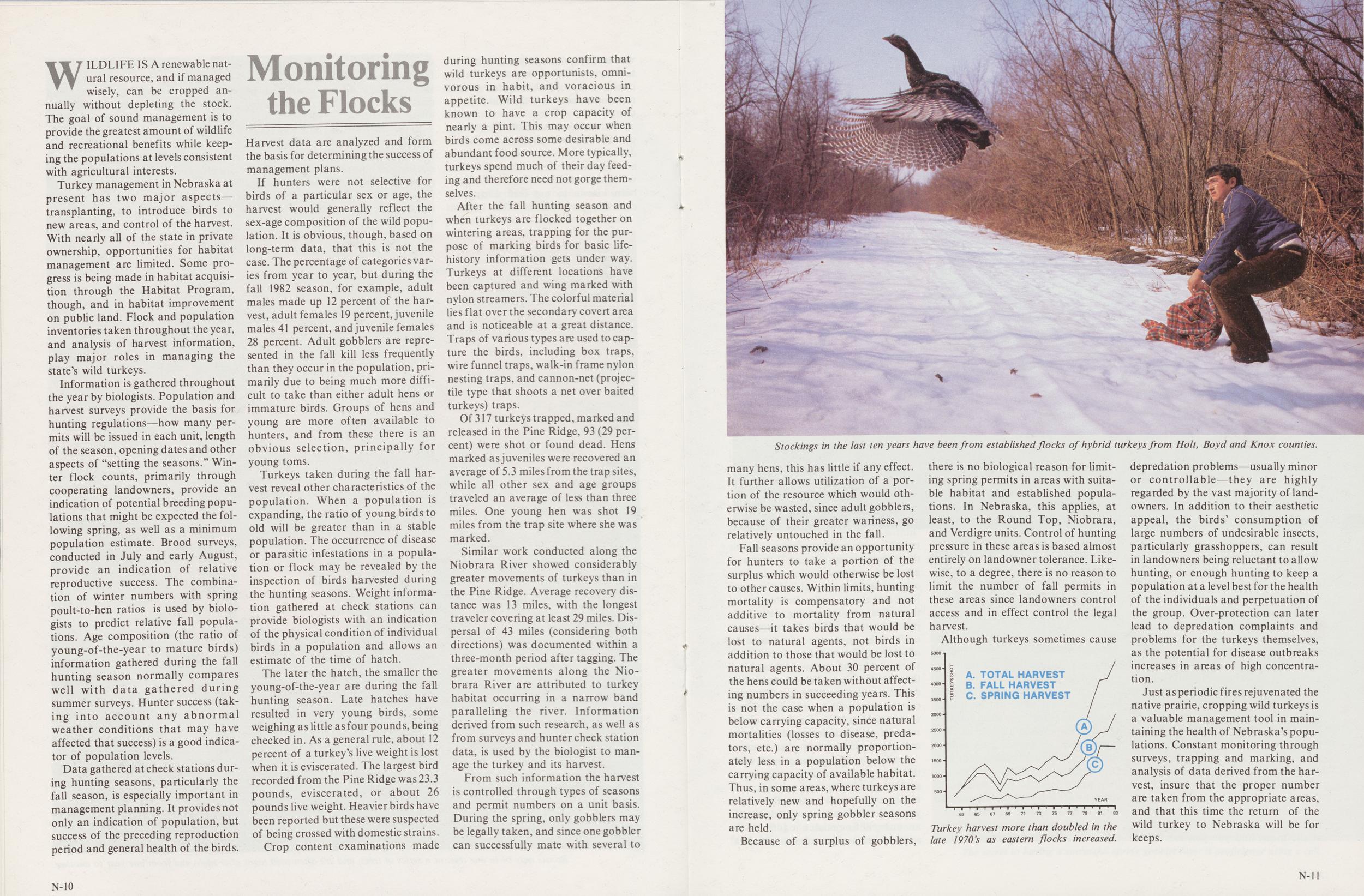
After the fall hunting season and when turkeys are flocked together on wintering areas, trapping for the purpose of marking birds for basic life-history information gets under way. Turkeys at different locations have been captured and wing marked with nylon streamers. The colorful material lies flat over the secondary covert area and is noticeable at a great distance. Traps of various types are used to capture the birds, including box traps, wire funnel traps, walk-in frame nylon nesting traps, and cannon-net (projectile type that shoots a net over baited turkeys) traps.
Of 317 turkeys trapped, marked and released in the Pine Ridge, 93 (29 percent) were shot or found dead. Hens marked as juveniles were recovered an average of 5.3 miles from the trap sites, while all other sex and age groups traveled an average of less than three miles. One young hen was shot 19 miles from the trap site where she was marked.
Similar work conducted along the Niobrara River showed considerably greater movements of turkeys than in the Pine Ridge. Average recovery distance was 13 miles, with the longest traveler covering at least 29 miles. Dispersal of 43 miles (considering both directions) was documented within a three-month period after tagging. The greater movements along the Niobrara River are attributed to turkey habitat occurring in a narrow band paralleling the river. Information derived from such research, as well as from surveys and hunter check station data, is used by the biologist to manage the turkey and its harvest.
From such information the harvest is controlled through types of seasons and permit numbers on a unit basis. During the spring, only gobblers may be legally taken, and since one gobbler can successfully mate with several to
N-10Stockings in the last ten years have been from established flocks of hybrid turkeys from Holt, Boyd and Knox counties.
many hens, this has little if any effect. It further allows utilization of a portion of the resource which would otherwise be wasted, since adult gobblers, because of their greater wariness, go relatively untouched in the fall.
Fall seasons provide an opportunity for hunters to take a portion of the surplus which would otherwise be lost to other causes. Within limits, hunting mortality is compensatory and not additive to mortality from natural causes—it takes birds that would be lost to natural agents, not birds in addition to those that would be lost to natural agents. About 30 percent of the hens could be taken without affecting numbers in succeeding years. This is not the case when a population is below carrying capacity, since natural mortalities (losses to disease, predators, etc.) are normally proportionately less in a population below the carrying capacity of available habitat. Thus, in some areas, where turkeys are relatively new and hopefully on the increase, only spring gobbler seasons are held.
Because of a surplus of gobblers, there is no biological reason for limiting spring permits in areas with suitable habitat and established populations. In Nebraska, this applies, at least, to the Round Top, Niobrara, and Verdigre units. Control of hunting pressure in these areas is based almost entirely on landowner tolerance. Likewise, to a degree, there is no reason to limit the number of fall permits in these areas since landowners control access and in effect control the legal harvest.
Although turkeys sometimes cause
5000 4500 4000 3500 3000 2500 2000 1500 1ooo 500 A. TOTAL HARVEST B. FALL HARVEST C. SPRING HARVEST YEAR 63 65 67 69 71 73 75 77 79 81 83 Turkey harvest more than doubled in the late 1970's as eastern flocks increased.
depredation problems—usually minor or controllable—they are highly regarded by the vast majority of landowners. In addition to their aesthetic appeal, the birds' consumption of large numbers of undesirable insects, particularly grasshoppers, can result in landowners being reluctant to allow hunting, or enough hunting to keep a population at a level best for the health of the individuals and perpetuation of the group. Over-protection can later lead to depredation complaints and problems for the turkeys themselves, as the potential for disease outbreaks increases in areas of high concentration.
Just as periodic fires rejuvenated the native prairie, cropping wild turkeys is a valuable management tool in maintaining the health of Nebraska's populations. Constant monitoring through surveys, trapping and marking, and analysis of data derived from the harvest, insure that the proper number are taken from the appropriate areas, and that this time the return of the wild turkey to Nebraska will be for keeps.
N-11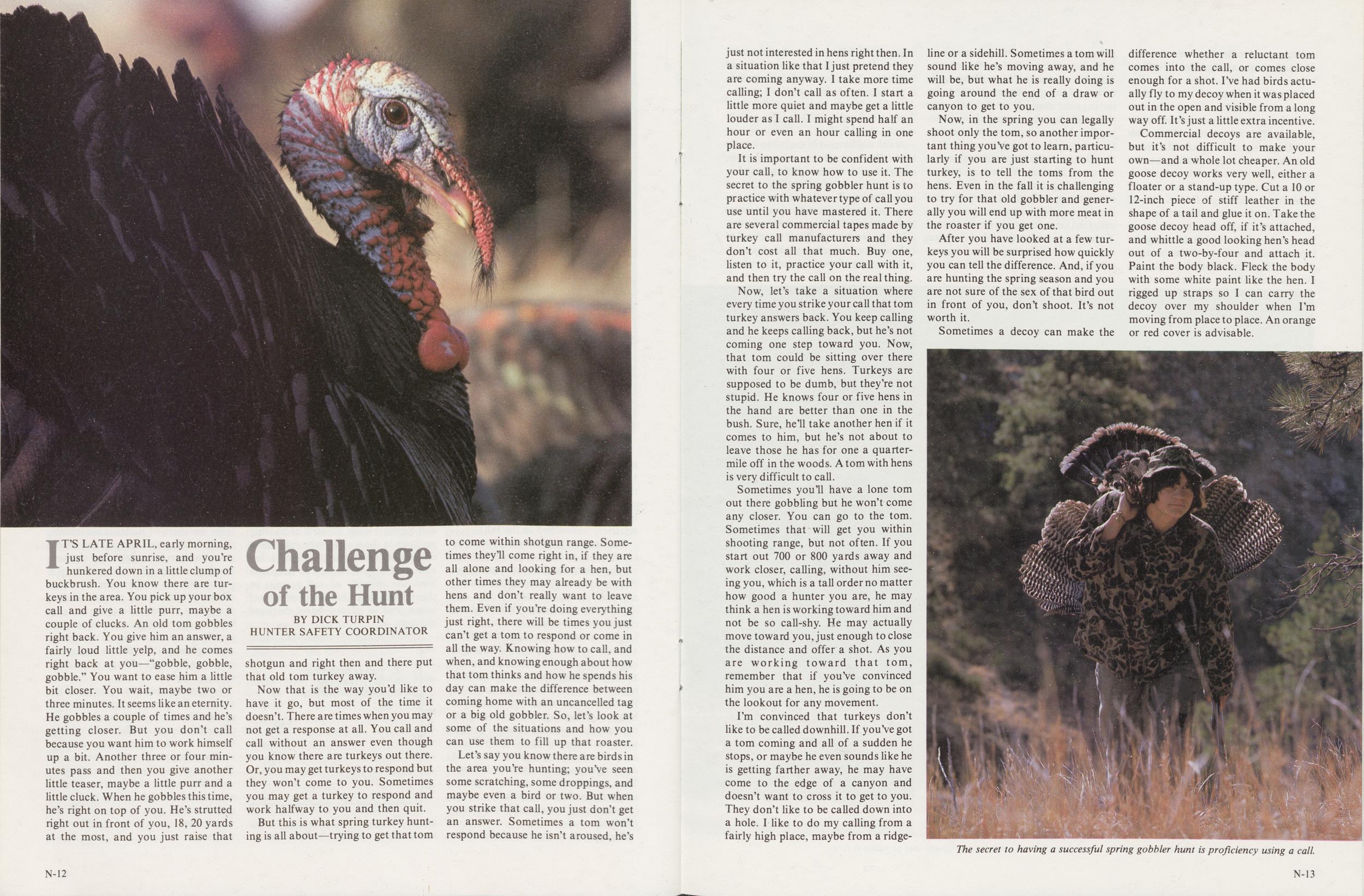
Challenge of the Hunt
BY DICK TURPIN HUNTER SAFETY COORDINATORIT'S LATE APRIL, early morning, just before sunrise, and you're hunkered down in a little clump of buckbrush. You know there are turkeys in the area. You pick up your box call and give a little purr, maybe a couple of clucks. An old torn gobbles right back. You give him an answer, a fairly loud little yelp, and he comes right back at you—"gobble, gobble, gobble." You want to ease him a little bit closer. You wait, maybe two or three minutes. It seems like an eternity. He gobbles a couple of times and he's getting closer. But you don't call because you want him to work himself up a bit. Another three or four minutes pass and then you give another little teaser, maybe a little purr and a little cluck. When he gobbles this time, he's right on top of you. He's strutted right out in front of you, 18, 20 yards at the most, and you just raise that shotgun and right then and there put that old torn turkey away.
Now that is the way you'd like to have it go, but most of the time it doesn't. There are times when you may not get a response at all. You call and call without an answer even though you know there are turkeys out there. Or, you may get turkeys to respond but they won't come to you. Sometimes you may get a turkey to respond and work halfway to you and then quit.
But this is what spring turkey hunting is all about—trying to get that torn to come within shotgun range. Sometimes they'll come right in, if they are all alone and looking for a hen, but other times they may already be with hens and don't really want to leave them. Even if you're doing everything just right, there will be times you just can't get a torn to respond or come in all the way. Knowing how to call, and when, and knowing enough about how that torn thinks and how he spends his day can make the difference between coming home with an uncancelled tag or a big old gobbler. So, let's look at some of the situations and how you can use them to fill up that roaster.
Let's say you know there are birds in the area you're hunting; you've seen some scratching, some droppings, and maybe even a bird or two. But when you strike that call, you just don't get an answer. Sometimes a torn won't respond because he isn't aroused, he's
N-12just not interested in hens right then. In a situation like that I just pretend they are coming anyway. I take more time calling; I don't call as often, I start a little more quiet and maybe get a little louder as I call. I might spend half an hour or even an hour calling in one place.
It is important to be confident with your call, to know how to use it. The secret to the spring gobbler hunt is to practice with whatever type of call you use until you have mastered it. There are several commercial tapes made by turkey call manufacturers and they don't cost all that much. Buy one, listen to it, practice your call with it, and then try the call on the real thing.
Now, let's take a situation where every time you strike your call that torn turkey answers back. You keep calling and he keeps calling back, but he's not coming one step toward you. Now, that torn could be sitting over there with four or five hens. Turkeys are supposed to be dumb, but they're not stupid. He knows four or five hens in the hand are better than one in the bush. Sure, he'll take another hen if it comes to him, but he's not about to leave those he has for one a quarter-mile off in the woods. A torn with hens is very difficult to call.
Sometimes you'll have a lone torn out there gobbling but he won't come any closer. You can go to the torn. Sometimes that will get you within shooting range, but not often. If you start out 700 or 800 yards away and work closer, calling, without him seeing you, which is a tall order no matter how good a hunter you are, he may think a hen is working toward him and not be so call-shy. He may actually move toward you, just enough to close the distance and offer a shot. As you are working toward that torn, remember that if you've convinced him you are a hen, he is going to be on the lookout for any movement.
I'm convinced that turkeys don't like to be called downhill. If you've got a torn coming and all of a sudden he stops, or maybe he even sounds like he is getting farther away, he may have come to the edge of a canyon and doesn't want to cross it to get to you. They don't like to be called down into a hole. I like to do my calling from a fairly high place, maybe from a ridgeline or a sidehill. Sometimes a torn will sound like he's moving away, and he will be, but what he is really doing is going around the end of a draw or canyon to get to you.
Now, in the spring you can legally shoot only the torn, so another important thing you've got to learn, particularly if you are just starting to hunt turkey, is to tell the toms from the hens. Even in the fall it is challenging to try for that old gobbler and generally you will end up with more meat in the roaster if you get one.
After you have looked at a few turkeys you will be surprised how quickly you can tell the difference. And, if you are hunting the spring season and you are not sure of the sex of that bird out in front of you, don't shoot. It's not worth it.
Sometimes a decoy can make the difference whether a reluctant torn comes into the call, or comes close enough for a shot. I've had birds actually fly to my decoy when it was placed out in the open and visible from a long way off. It's just a little extra incentive.
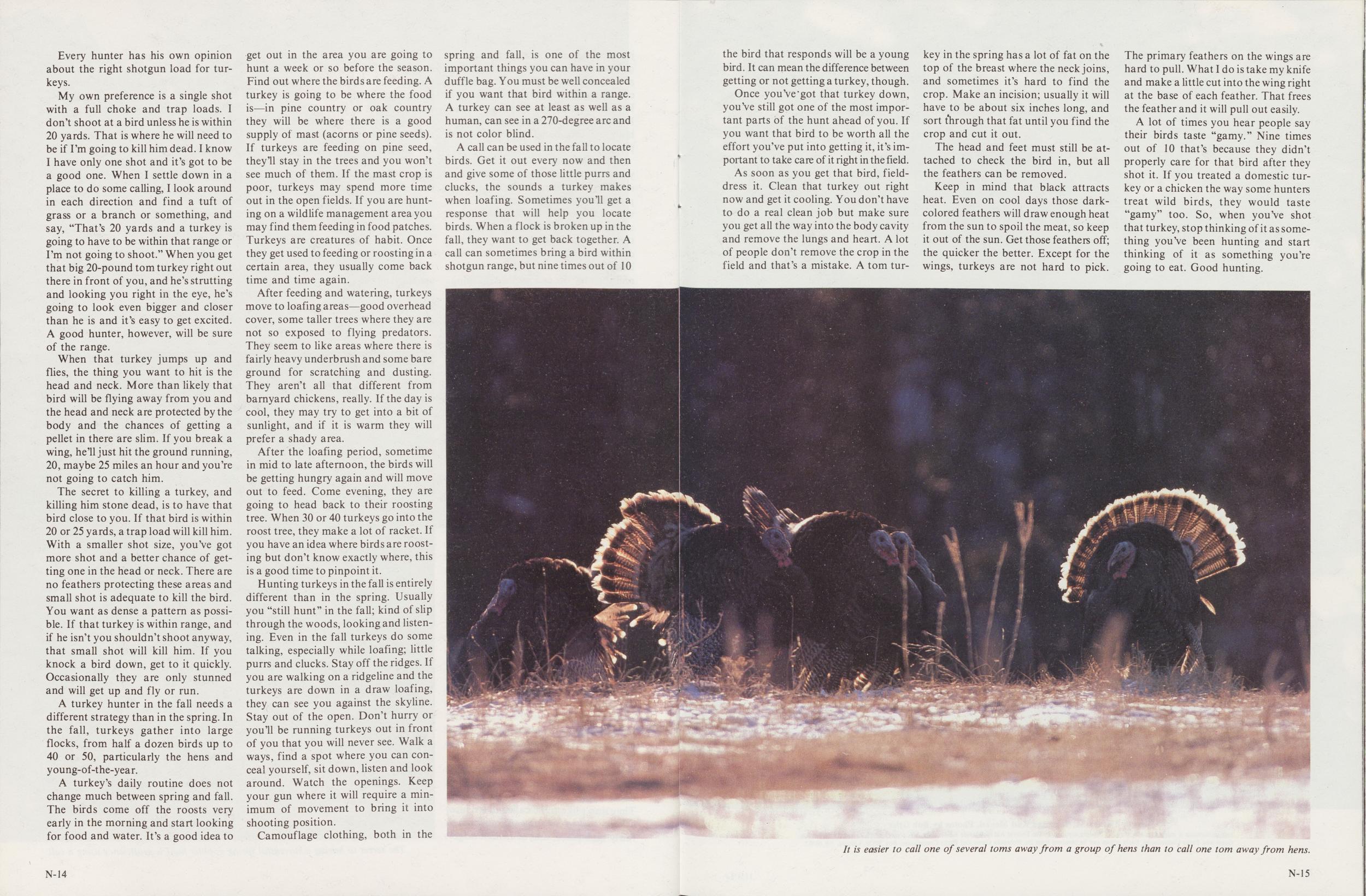
Commercial decoys are available, but it's not difficult to make your own—and a whole lot cheaper. An old goose decoy works very well, either a floater or a stand-up type. Cut a 10 or 12-inch piece of stiff leather in the shape of a tail and glue it on. Take the goose decoy head off, if it's attached, and whittle a good looking hen's head out of a two-by-four and attach it. Paint the body black. Fleck the body with some white paint like the hen. I rigged up straps so I can carry the decoy over my shoulder when I'm moving from place to place. An orange or red cover is advisable.
The secret to having a successful spring gobbler hunt is proficiency using a call
Every hunter has his own opinion about the right shotgun load for turkeys.
My own preference is a single shot with a full choke and trap loads. I don't shoot at a bird unless he is within 20 yards. That is where he will need to be if I'm going to kill him dead. I know I have only one shot and it's got to be a good one. When I settle down in a place to do some calling, I look around in each direction and find a tuft of grass or a branch or something, and say, "That's 20 yards and a turkey is going to have to be within that range or I'm not going to shoot." When you get that big 20-pound torn turkey right out there in front of you, and he's strutting and looking you right in the eye, he's going to look even bigger and closer than he is and it's easy to get excited. A good hunter, however, will be sure of the range.
When that turkey jumps up and flies, the thing you want to hit is the head and neck. More than likely that bird will be flying away from you and the head and neck are protected by the body and the chances of getting a pellet in there are slim. If you break a wing, he'll just hit the ground running, 20, maybe 25 miles an hour and you're not going to catch him.
The secret to killing a turkey, and killing him stone dead, is to have that bird close to you. If that bird is within 20 or 25 yards, a trap load will kill him. With a smaller shot size, you've got more shot and a better chance of getting one in the head or neck. There are no feathers protecting these areas and small shot is adequate to kill the bird. You want as dense a pattern as possible. If that turkey is within range, and if he isn't you shouldn't shoot anyway, that small shot will kill him. If you knock a bird down, get to it quickly. Occasionally they are only stunned and will get up and fly or run.
A turkey hunter in the fall needs a different strategy than in the spring. In the fall, turkeys gather into large flocks, from half a dozen birds up to 40 or 50, particularly the hens and young-of-the-year.
A turkey's daily routine does not change much between spring and fall. The birds come off the roosts very early in the morning and start looking for food and water. It's a good idea to get out in the area you are going to hunt a week or so before the season. Find out where the birds are feeding. A turkey is going to be where the food is—in pine country or oak country they will be where there is a good supply of mast (acorns or pine seeds). If turkeys are feeding on pine seed, they'll stay in the trees and you won't see much of them. If the mast crop is poor, turkeys may spend more time out in the open fields. If you are hunting on a wildlife management area you may find them feeding in food patches. Turkeys are creatures of habit. Once they get used to feeding or roosting in a certain area, they usually come back time and time again.
After feeding and watering, turkeys move to loafing areas—good overhead cover, some taller trees where they are not so exposed to flying predators. They seem to like areas where there is fairly heavy underbrush and some bare ground for scratching and dusting. They aren't all that different from barnyard chickens, really. If the day is cool, they may try to get into a bit of sunlight, and if it is warm they will prefer a shady area.
After the loafing period, sometime in mid to late afternoon, the birds will be getting hungry again and will move out to feed. Come evening, they are going to head back to their roosting tree. When 30 or 40 turkeys go into the roost tree, they make a lot of racket. If you have an idea where birds are roosting but don't know exactly where, this is a good time to pinpoint it.
Hunting turkeys in the fall is entirely different than in the spring. Usually you "still hunt" in the fall; kind of slip through the woods, looking and listening. Even in the fall turkeys do some talking, especially while loafing; little purrs and clucks. Stay off the ridges. If you are walking on a ridgeline and the turkeys are down in a draw loafing, they can see you against the skyline. Stay out of the open. Don't hurry or you'll be running turkeys out in front of you that you will never see. Walk a ways, find a spot where you can conceal yourself, sit down, listen and look around. Watch the openings. Keep your gun where it will require a minimum of movement to bring it into shooting position.
Camouflage clothing, both in the spring and fall, is one of the most important things you can have in your duffle bag. You must be well concealed if you want that bird within a range. A turkey can see at least as well as a human, can see in a 270-degree arc and is not color blind.
A call can be used in the fall to locate birds. Get it out every now and then and give some of those little purrs and clucks, the sounds a turkey makes when loafing. Sometimes you'll get a response that will help you locate birds. When a flock is broken up in the fall, they want to get back together. A call can sometimes bring a bird within shotgun range, but nine times out of 10
N-14the bird that responds will be a young bird. It can mean the difference between getting or not getting a turkey, though.
Once you've got that turkey down, you've still got one of the most important parts of the hunt ahead of you. If you want that bird to be worth all the effort you've put into getting it, it's important to take care of it right in the field.
As soon as you get that bird, field-dress it. Clean that turkey out right now and get it cooling. You don't have to do a real clean job but make sure you get all the way into the body cavity and remove the lungs and heart. A lot of people don't remove the crop in the field and that's a mistake. A torn turkey in the spring has a lot of fat on the top of the breast where the neck joins, and sometimes it's hard to find the crop. Make an incision; usually it will have to be about six inches long, and sort through that fat until you find the crop and cut it out.
The head and feet must still be attached to check the bird in, but all the feathers can be removed.
Keep in mind that black attracts heat. Even on cool days those dark-colored feathers will draw enough heat from the sun to spoil the meat, so keep it out of the sun. Get those feathers off; the quicker the better. Except for the wings, turkeys are not hard to pick. The primary feathers on the wings are hard to pull. What I do is take my knife and make a little cut into the wing right at the base of each feather. That frees the feather and it will pull out easily.
A lot of times you hear people say their birds taste "gamy." Nine times out of 10 that's because they didn't properly care for that bird after they shot it. If you treated a domestic turkey or a chicken the way some hunters treat wild birds, they would taste "gamy" too. So, when you've shot that turkey, stop thinking of it as something you've been hunting and start thinking of it as something you're going to eat. Good hunting.
It is easier to call one of several toms away from a group of hens than to call one torn away from hens.
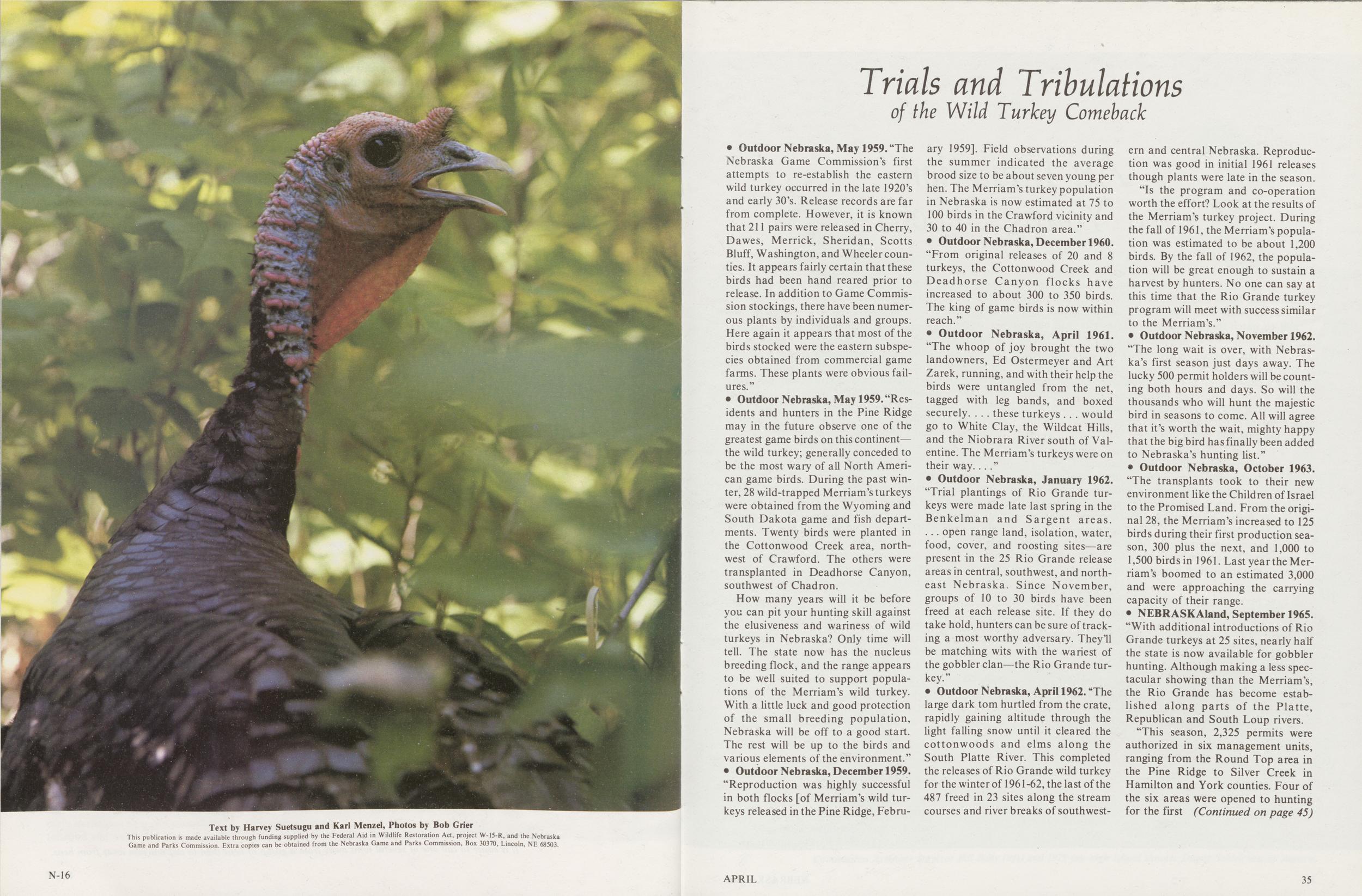
Trials and Tribulations of the Wild Turkey Comeback
• Outdoor Nebraska, May 1959. "The Nebraska Game Commission's first attempts to re-establish the eastern wild turkey occurred in the late 1920's and early 30's. Release records are far from complete. However, it is known that 211 pairs were released in Cherry, Dawes, Merrick, Sheridan, Scotts Bluff, Washington, and Wheeler counties. It appears fairly certain that these birds had been hand reared prior to release. In addition to Game Commission stockings, there have been numerous plants by individuals and groups. Here again it appears that most of the birds stocked were the eastern subspecies obtained from commercial game farms. These plants were obvious failures." • Outdoor Nebraska, May 1959. "Residents and hunters in the Pine Ridge may in the future observe one of the greatest game birds on this continent—the wild turkey; generally conceded to be the most wary of all North American game birds. During the past winter, 28 wild-trapped Merriam's turkeys were obtained from the Wyoming and South Dakota game and fish departments. Twenty birds were planted in the Cottonwood Creek area, northwest of Crawford. The others were transplanted in Deadhorse Canyon, southwest of Chadron. How many years will it be before you can pit your hunting skill against the elusiveness and wariness of wild turkeys in Nebraska? Only time will tell. The state now has the nucleus breeding flock, and the range appears to be well suited to support populations of the Merriam's wild turkey. With a little luck and good protection of the small breeding population, Nebraska will be off to a good start. The rest will be up to the birds and various elements of the environment." • Outdoor Nebraska, December 1959. "Reproduction was highly successful in both flocks [of Merriam's wild turkeys released in the Pine Ridge, February 1959]. Field observations during the summer indicated the average brood size to be about seven young per hen. The Merriam's turkey population in Nebraska is now estimated at 75 to 100 birds in the Crawford vicinity and 30 to 40 in the Chadron area." • Outdoor Nebraska, December 1960. "From original releases of 20 and 8 turkeys, the Cottonwood Creek and Deadhorse Canyon flocks have increased to about 300 to 350 birds. The king of game birds is now within reach." • Outdoor Nebraska, April 1961. "The whoop of joy brought the two landowners, Ed Ostermeyer and Art Zarek, running, and with their help the birds were untangled from the net, tagged with leg bands, and boxed securely. . . . these turkeys. . . would go to White Clay, the Wildcat Hills, and the Niobrara River south of Valentine. The Merriam's turkeys were on their way. ..." • Outdoor Nebraska, January 1962. "Trial plantings of Rio Grande turkeys were made late last spring in the Benkelman and Sargent areas. ... open range land, isolation, water, food, cover, and roosting sites—are present in the 25 Rio Grande release areas in central, southwest, and northeast Nebraska. Since November, groups of 10 to 30 birds have been freed at each release site. If they do take hold, hunters can be sure of tracking a most worthy adversary. They'll be matching wits with the wariest of the gobbler clan—the Rio Grande turkey." • Outdoor Nebraska, April 1962. "The large dark torn hurtled from the crate, rapidly gaining altitude through the light falling snow until it cleared the cottonwoods and elms along the South Platte River. This completed the releases of Rio Grande wild turkey for the winter of 1961-62, the last of the 487 freed in 23 sites along the stream courses and river breaks of southwestern and central Nebraska. Reproduction was good in initial 1961 releases though plants were late in the season. "Is the program and co-operation worth the effort? Look at the results of the Merriam's turkey project. During the fall of 1961, the Merriam's population was estimated to be about 1,200 birds. By the fall of 1962, the population will be great enough to sustain a harvest by hunters. No one can say at this time that the Rio Grande turkey program will meet with success similar to the Merriam's." • Outdoor Nebraska, November 1962. "The long wait is over, with Nebraska's first season just days away. The lucky 500 permit holders will be counting both hours and days. So will the thousands who will hunt the majestic bird in seasons to come. All will agree that it's worth the wait, mighty happy that the big bird has finally been added to Nebraska's hunting list." • Outdoor Nebraska, October 1963. "The transplants took to their new environment like the Children of Israel to the Promised Land. From the original 28, the Merriam's increased to 125 birds during their first production season, 300 plus the next, and 1,000 to 1,500 birds in 1961. Last year the Merriam's boomed to an estimated 3,000 and were approaching the carrying capacity of their range. • NEBRASKAland, September 1965. "With additional introductions of Rio Grande turkeys at 25 sites, nearly half the state is now available for gobbler hunting. Although making a less spectacular showing than the Merriam's, the Rio Grande has become established along parts of the Platte, Republican and South Loup rivers. "This season, 2,325 permits were authorized in six management units, ranging from the Round Top area in the Pine Ridge to Silver Creek in Hamilton and York counties. Four of the six areas were opened to hunting for the first (Continued on page 45) APRIL 35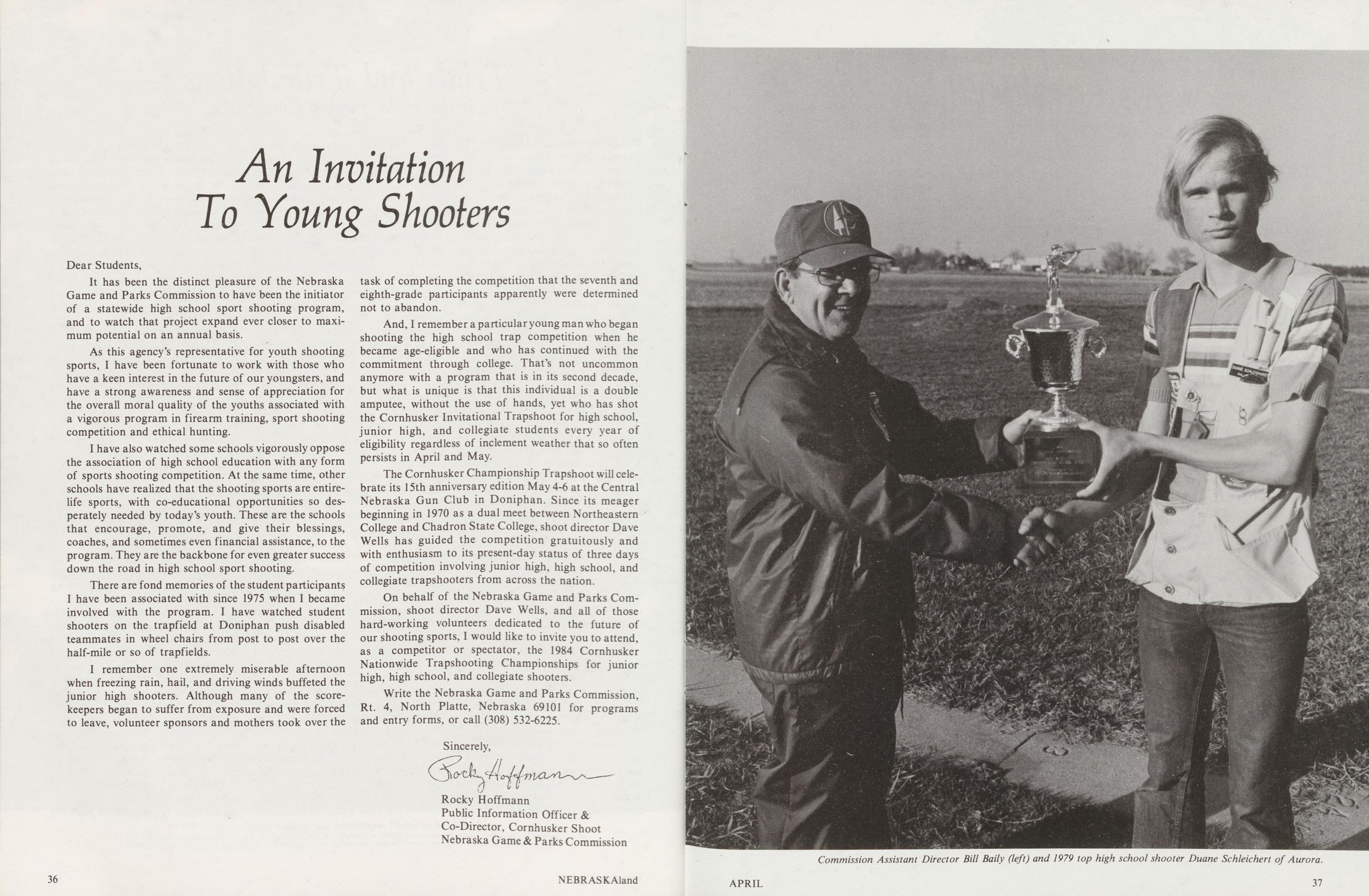
An Invitation To Young Shooters
Dear Students,It has been the distinct pleasure of the Nebraska Game and Parks Commission to have been the initiator of a statewide high school sport shooting program, and to watch that project expand ever closer to maximum potential on an annual basis.
As this agency's representative for youth shooting sports, I have been fortunate to work with those who have a keen interest in the future of our youngsters, and have a strong awareness and sense of appreciation for the overall moral quality of the youths associated with a vigorous program in firearm training, sport shooting competition and ethical hunting.
I have also watched some schools vigorously oppose the association of high school education with any form of sports shooting competition. At the same time, other schools have realized that the shooting sports are entire-life sports, with co-educational opportunities so desperately needed by today's youth. These are the schools that encourage, promote, and give their blessings, coaches, and sometimes even financial assistance, to the program. They are the backbone for even greater success down the road in high school sport shooting.
There are fond memories of the student participants I have been associated with since 1975 when I became involved with the program. I have watched student shooters on the trapfield at Doniphan push disabled teammates in wheel chairs from post to post over the half-mile or so of trapfields.
I remember one extremely miserable afternoon when freezing rain, hail, and driving winds buffeted the junior high shooters. Although many of the score-keepers began to suffer from exposure and were forced to leave, volunteer sponsors and mothers took over the task of completing the competition that the seventh and eighth-grade participants apparently were determined not to abandon.
And, I remember a particular young man who began shooting the high school trap competition when he became age-eligible and who has continued with the commitment through college. That's not uncommon anymore with a program that is in its second decade, but what is unique is that this individual is a double amputee, without the use of hands, yet who has shot the Cornhusker Invitational Trapshoot for high school, junior high, and collegiate students every year of eligibility regardless of inclement weather that so often persists in April and May.
The Cornhusker Championship Trapshoot will celebrate its 15th anniversary edition May 4-6 at the Central Nebraska Gun Club in Doniphan. Since its meager beginning in 1970 as a dual meet between Northeastern College and Chadron State College, shoot director Dave Wells has guided the competition gratuitously and with enthusiasm to its present-day status of three days of competition involving junior high, high school, and collegiate trapshooters from across the nation.
On behalf of the Nebraska Game and Parks Commission, shoot director Dave Wells, and all of those hard-working volunteers dedicated to the future of our shooting sports, I would like to invite you to attend, as a competitor or spectator, the 1984 Cornhusker Nationwide Trapshooting Championships for junior high, high school, and collegiate shooters.
Write the Nebraska Game and Parks Commission, Rt. 4, North Platte, Nebraska 69101 for programs and entry forms, or call (308) 532-6225.
Sincerely, Rocky Hoffmann Public Information Officer & Co-Director, Cornhusker Shoot Nebraska Game & Parks Commission 36 NEBRASKAlandCommission Assistant Director Bill Baily (left) and 1979 top high school shooter Duane Schleichert of Aurora.
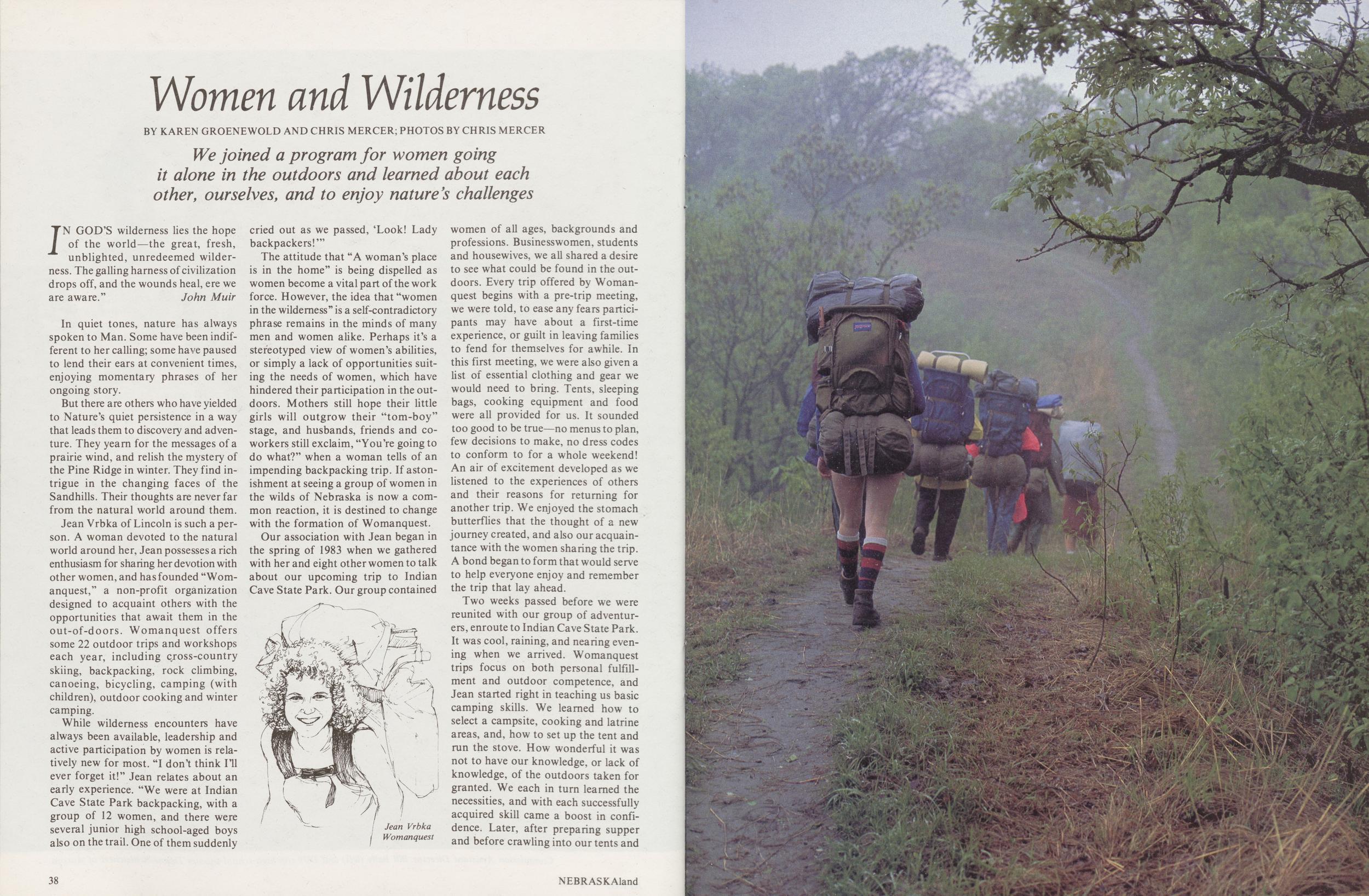
Women and Wilderness
BY KAREN GROENEWOLD AND CHRIS MERCER; PHOTOS BY CHRIS MERCER We joined a program for women going it alone in the outdoors and learned about each other, ourselves, and to enjoy nature's challenges IN GOD'S wilderness lies the hope of the world—the great, fresh, unblighted, unredeemed wilderness. The galling harness of civilization drops off, and the wounds heal, ere we are aware." John MuirIn quiet tones, nature has always spoken to Man. Some have been indifferent to her calling; some have paused to lend their ears at convenient times, enjoying momentary phrases of her ongoing story.
But there are others who have yielded to Nature's quiet persistence in a way that leads them to discovery and adventure. They yearn for the messages of a prairie wind, and relish the mystery of the Pine Ridge in winter. They find intrigue in the changing faces of the Sandhills. Their thoughts are never far from the natural world around them.
Jean Vrbka of Lincoln is such a person. A woman devoted to the natural world around her, Jean possesses a rich enthusiasm for sharing her devotion with other women, and has founded "Womanquest," a non-profit organization designed to acquaint others with the opportunities that await them in the out-of-doors. Womanquest offers some 22 outdoor trips and workshops each year, including cjoss-country skiing, backpacking, rock climbing, canoeing, bicycling, camping (with children), outdoor cooking and winter camping.
While wilderness encounters have always been available, leadership and active participation by women is relatively new for most. "I don't think I'll ever forget it!" Jean relates about an early experience. "We were at Indian Cave State Park backpacking, with a group of 12 women, and there were several junior high school-aged boys also on the trail. One of them suddenly cried out as we passed, 'Look! Lady backpackers!'"
The attitude that "A woman's place is in the home" is being dispelled as women become a vital part of the work force. However, the idea that "women in the wilderness" is a self-contradictory phrase remains in the minds of many men and women alike. Perhaps it's a stereotyped view of women's abilities, or simply a lack of opportunities suiting the needs of women, which have hindered their participation in the outdoors. Mothers still hope their little girls will outgrow their "torn-boy" stage, and husbands, friends and co-workers still exclaim, "You're going to do what?" when a woman tells of an impending backpacking trip. If astonishment at seeing a group of women in the wilds of Nebraska is now a common reaction, it is destined to change with the formation of Womanquest.
Our association with Jean began in the spring of 1983 when we gathered with her and eight other women to talk about our upcoming trip to Indian Cave State Park. Our group contained
Jean Vrbka Womanquest
women of all ages, backgrounds and professions. Businesswomen, students and housewives, we all shared a desire to see what could be found in the outdoors. Every trip offered by Womanquest begins with a pre-trip meeting, we were told, to ease any fears participants may have about a first-time experience, or guilt in leaving families to fend for themselves for awhile. In this first meeting, we were also given a list of essential clothing and gear we would need to bring. Tents, sleeping bags, cooking equipment and food were all provided for us. It sounded too good to be true—no menus to plan, few decisions to make, no dress codes to conform to for a whole weekend! An air of excitement developed as we listened to the experiences of others and their reasons for returning for another trip. We enjoyed the stomach butterflies that the thought of a new journey created, and also our acquaintance with the women sharing the trip. A bond began to form that would serve to help everyone enjoy and remember the trip that lay ahead.
Two weeks passed before we were reunited with our group of adventurers, enroute to Indian Cave State Park. It was cool, raining, and nearing evening when we arrived. Womanquest trips focus on both personal fulfillment and outdoor competence, and Jean started right in teaching us basic camping skills. We learned how to select a campsite, cooking and latrine areas, and, how to set up the tent and run the stove. How wonderful it was not to have our knowledge, or lack of knowledge, of the outdoors taken for granted. We each in turn learned the necessities, and with each successfully acquired skill came a boost in confidence. Later, after preparing supper and before crawling into our tents and
38 NEBRASKAland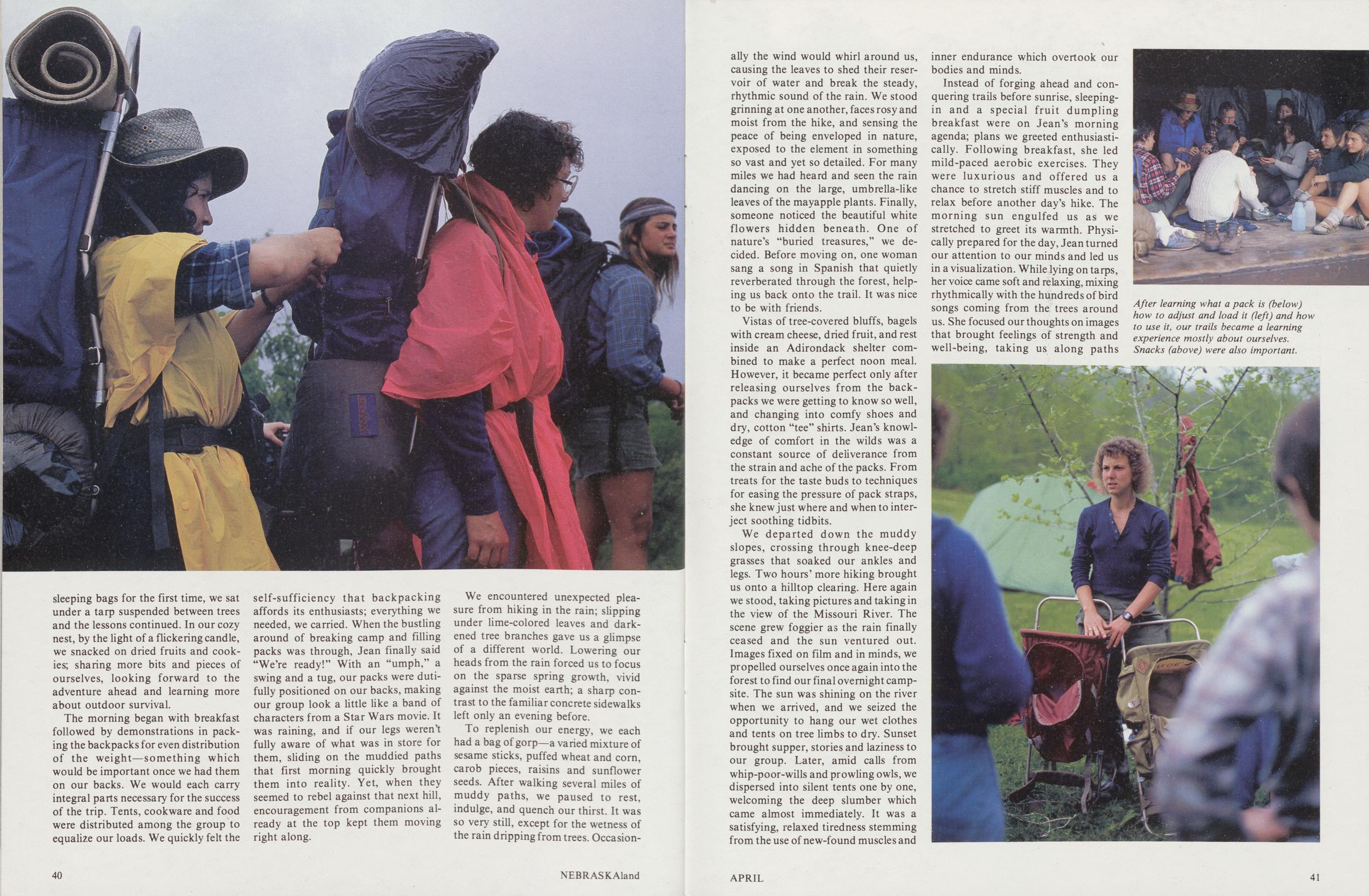
sleeping bags for the first time, we sat under a tarp suspended between trees and the lessons continued. In our cozy nest, by the light of a flickering candle, we snacked on dried fruits and cookies; sharing more bits and pieces of ourselves, looking forward to the adventure ahead and learning more about outdoor survival.
The morning began with breakfast followed by demonstrations in packing the backpacks for even distribution of the weight—something which would be important once we had them on our backs. We would each carry integral parts necessary for the success of the trip. Tents, cookware and food were distributed among the group to equalize our loads. We quickly felt the self-sufficiency that backpacking affords its enthusiasts; everything we needed, we carried. When the bustling around of breaking camp and filling packs was through, Jean finally said "We're ready!" With an "umph," a swing and a tug, our packs were dutifully positioned on our backs, making our group look a little like a band of characters from a Star Wars movie. It was raining, and if our legs weren't fully aware of what was in store for them, sliding on the muddied paths that first morning quickly brought them into reality. Yet, when they seemed to rebel against that next hill, encouragement from companions already at the top kept them moving right along.
We encountered unexpected pleasure from hiking in the rain; slipping under lime-colored leaves and darkened tree branches gave us a glimpse of a different world. Lowering our heads from the rain forced us to focus on the sparse spring growth, vivid against the moist earth; a sharp contrast to the familiar concrete sidewalks left only an evening before.
To replenish our energy, we each had a bag of gorp—a varied mixture of sesame sticks, puffed wheat and corn, carob pieces, raisins and sunflower seeds. After walking several miles of muddy paths, we paused to rest, indulge, and quench our thirst. It was so very still, except for the wetness of the rain dripping from trees. Occasionally
40 NEBRASKAlandthe wind would whirl around us, causing the leaves to shed their reservoir of water and break the steady, rhythmic sound of the rain. We stood grinning at one another, faces rosy and moist from the hike, and sensing the peace of being enveloped in nature, exposed to the element in something so vast and yet so detailed. For many miles we had heard and seen the rain dancing on the large, umbrella-like leaves of the mayapple plants. Finally, someone noticed the beautiful white flowers hidden beneath. One of nature's "buried treasures," we decided. Before moving on, one woman sang a song in Spanish that quietly reverberated through the forest, helping us back onto the trail. It was nice to be with friends.
Vistas of tree-covered bluffs, bagels with cream cheese, dried fruit, and rest inside an Adirondack shelter combined to make a perfect noon meal. However, it became perfect only after releasing ourselves from the backpacks we were getting to know so well, and changing into comfy shoes and dry, cotton "tee" shirts. Jean's knowledge of comfort in the wilds was a constant source of deliverance from the strain and ache of the packs. From treats for the taste buds to techniques for easing the pressure of pack straps, she knew just where and when to interject soothing tidbits.
We departed down the muddy slopes, crossing through knee-deep grasses that soaked our ankles and legs. Two hours' more hiking brought us onto a hilltop clearing. Here again we stood, taking pictures and taking in the view of the Missouri River. The scene grew foggier as the rain finally ceased and the sun ventured out. Images fixed on film and in minds, we propelled ourselves once again into the forest to find our final overnight campsite. The sun was shining on the river when we arrived, and we seized the opportunity to hang our wet clothes and tents on tree limbs to dry. Sunset brought supper, stories and laziness to our group. Later, amid calls from whip-poor-wills and prowling owls, we dispersed into silent tents one by one, welcoming the deep slumber which came almost immediately. It was a satisfying, relaxed tiredness stemming from the use of new-found muscles and inner endurance which overtook our bodies and minds.
Instead of forging ahead and conquering trails before sunrise, sleeping-in and a special fruit dumpling breakfast were on Jean's morning agenda; plans we greeted enthusiastically. Following breakfast, she led mild-paced aerobic exercises. They were luxurious and offered us a chance to stretch stiff muscles and to relax before another day's hike. The morning sun engulfed us as we stretched to greet its warmth. Physically prepared for the day, Jean turned our attention to our minds and led us in a visualization. While lying on tarps, her voice came soft and relaxing, mixing rhythmically with the hundreds of bird songs coming from the trees around us. She focused our thoughts on images that brought feelings of strength and well-being, taking us along paths
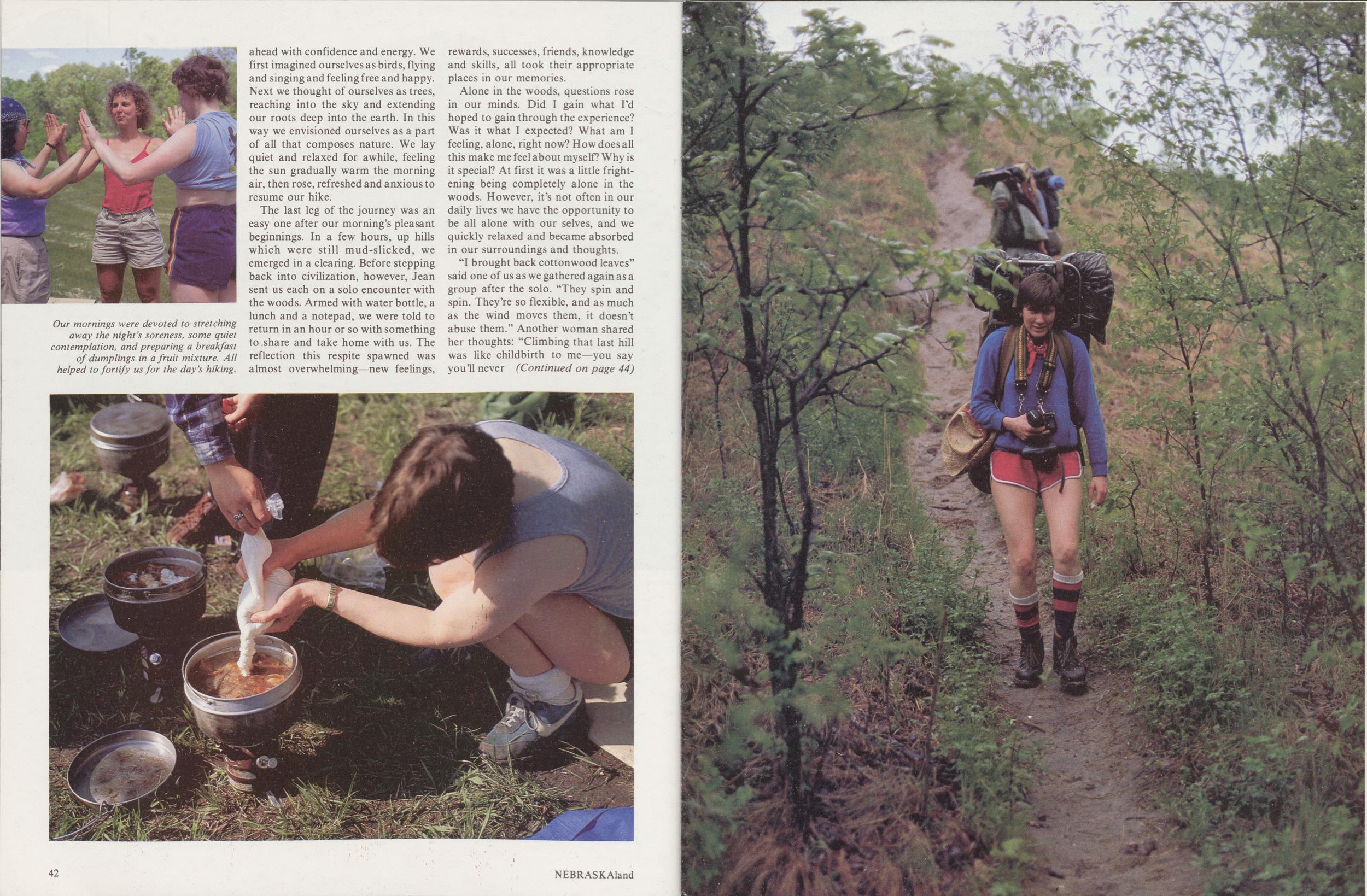
ahead with confidence and energy. We first imagined ourselves as birds, flying and singing and feeling free and happy. Next we thought of ourselves as trees, reaching into the sky and extending our roots deep into the earth. In this way we envisioned ourselves as a part of all that composes nature. We lay quiet and relaxed for awhile, feeling the sun gradually warm the morning air, then rose, refreshed and anxious to resume our hike.
The last leg of the journey was an easy one after our morning's pleasant beginnings. In a few hours, up hills which were still mud-slicked, we emerged in a clearing. Before stepping back into civilization, however, Jean sent us each on a solo encounter with the woods. Armed with water bottle, a lunch and a notepad, we were told to return in an hour or so with something to,share and take home with us. The reflection this respite spawned was almost overwhelming—new feelings, rewards, successes, friends, knowledge and skills, all took their appropriate places in our memories.
Alone in the woods, questions rose in our minds. Did I gain what I'd hoped to gain through the experience? Was it what I expected? What am I feeling, alone, right now? How does all this make me feel about myself? Why is it special? At first it was a little frightening being completely alone in the woods. However, it's not often in our daily lives we have the opportunity to be all alone with our selves, and we quickly relaxed and became absorbed in our surroundings and thoughts.
"I brought back cottonwood leaves" said one of us as we gathered again as a group after the solo. "They spin and spin. They're so flexible, and as much as the wind moves them, it doesn't abuse them." Another woman shared her thoughts: "Climbing that last hill was like childbirth to me—you say you'll never (Continued on page 44)
do it again while it's happening, but you forget the pain once you have the child. I'll remember that hill, and I'll do it again."
"I want to remember the rain," said another. "It's so cleansing and shows nature's continuous cycles. It's okay if it rains; after that everything is renewed and refreshed. I wish you all sunshine, but I also wish you rain." With that we broke into our own worlds, filled with the energy of our experiences.
The benefits of a trip outdoors can extend into the perceptions of our everyday lives. Jean tries to reinforce those feelings by organizing post-trip get-togethers. The strengths and awareness born in the wilds are nurtured into flourishing at home, and prepare everyone for their next wilderness encounter.
"I came back so full of the experience, that the building I work in wasn't large enough to contain me," was one woman's comment.
Keeping that spark alive involves only the memory of those special moments encountered in our wilderness journey—remembering the feeling of inner peace while seeing, hearing and touching the spring rain. Waking each morning and taking time to imagine flying and singing birds, and trees reaching deep into the earth—being part of her once again. Stopping during the course of a busy day to spend a moment alone with our thoughts, reflecting on those things which make us happy. And, ultimately, letting the confidence in new skills take us once again to the outdoors, with our families, friends or by ourselves.
Wilderness is where you choose to experience it. The type of encounter and growth attained varies from person to person, man or woman. Through Womanquest, Jean Vrbka and her co-leaders are offering unique outdoor opportunities for women. They provide an atmosphere for making the experience what you want: a physical challenge, a self-renewing experience or simply a fun, leisure-time activity.
Jean's philosophies and energy combine to make Womanquest outings fulfilling. The resulting satisfaction is a part of completing the natural cycle that ends one wilderness experience
44 NEBRASKAlandand compels us to seek another.
Jean can be contacted by writing: Womanquest, Inc., 215 Centennial Mall South, Lincoln, Nebraska 68508; or calling (402) 477-4170.Trials and tribulations of the wild turkey comeback
(Continued from page 35)time in the spring of 1965. They are Lincoln, Red Willow, Silver Creek (Prairie Island), and Wildcat Hills.
• NEBRASKAland, May 1966. "Technicians are attempting to establish Merriam's in areas of strictly deciduous timber, but the results of most of these releases are yet unknown. One plant, on Verdigre Creek in Knox County, was definitely successful although flock expansion was not as rapid as in the pine areas. Other releases of Merriam's have been made in Cedar and Dixon counties, adjacent to the Missouri River, in Knox County on Howe Creek, in Washington County on the Elkhorn River, in Thayer County on the Little Blue River, and in Pawnee County. Their status is still doubtful. A limited number of additional releases will be continued until it is determined whether the other releases are successful or failures. "In 1961 and 1962, Rio Grande turkeys were obtained from Texas and were released in 25 sites in central and southwestern Nebraska. The majority of these plants were failures, undoubtedly due to deficiencies in habitat. Present prospects are not bright for any significant expansion of the wild turkey range in Nebraska." • NEBRASKAland, April 1984. "Merriam's turkeys along the lower Niobrara River and its feeder streams apparently crossed with game-farm stock, resulting in a comparatively successful establishment of hybrid birds. Numbers of hybrid wild turkey in their primary range, particularly in Holt and Boyd counties, virtually exploded in the mid to late 1970's, but appear stabilized at this time. Since habitat of these birds more closely resembles the remainder of the wooded areas of Nebraska than does the Merriam's habitat, they were chosen for most of the recent releases. Fifty-seven sites received 720 hybrids between January 1975 and January 1984, with 40 of these releases made during the past three years. The release program will probably continue for a few years, but it is doubtful that any significant expansion in turkey range will result. For the amount of wooded area in Nebraska, the turkey program has been an outstanding success."Blueprints for fish structure
(Continued from page 16)life-support systems for insects and small fish, which in turn, attract larger fish. This is one of the areas Joe fished salamanders and small frogs to entice northern pike and bass.
Joe decided he would avoid fishing Area 4 on the west side of the lake until later in the year when weedbeds developed there. A minor inlet with no timber, it is very shallow and what little water flows there early in the spring will probably stop by late spring.
Still sitting in his car observing the area, Joe decided the lake's creek channels enter from the northwest and northeast and converge somewhere in the large area of partially submerged trees. That confluence would be very important to boat fishermen, but virtually impossible for a bank fisherman to reach. Joe had the option of using a topographical map of the lake's bottom to find the lay of the channel, which might show a spot where the channel bent close enough to shore that he could reach it with his line. He knew the channel would be used by fish moving from one area to another or as a cooler-water refuge when summer temperatures warmed the rest of the lake.
Many fishermen have fished Nebraska lakes all of their lives and never cast a line except from the face of a dam. There is a good reason for that—people catch a lot of fish from the dam. In spring the dam provides spawning areas for walleye and crappie. The rocks hold food organisms for fish to feed on throughout the year, and dams typically provide verticle drop-offs into deep water that is warmer in the winter and cooler in the
summer. In the spring, Joe used minnows for crappie and walleye, and used the same baits farther out from the dam as the fish moved into deeper water as temperatures became warmer. Joe found crawdads fished deep were effective walleye baits when used just off the rocks at the base of the dam.
In late July when fish congregated in the coolest, deepest water they could find to escape the heat, Joe fished his bait near the cement building-like outlet structure at the base of the dam. Placement of this structure is usually a tip-off to the creek channel's path, and thus the deepest water along the dam. Joe's rule of thumb, "Fish follow pathways," applies here too, as fish will tend to follow the creek channel to the dam and then work back and forth along the dam searching for food.
Joe enjoyed a successful fishing season that year, thanks to his ability to read visible structure and fish the proper baits for the fish using those areas. There are many types of structure all over a lake, but if the bank fisherman acquaints himself with these basic types and remembers Joe's rule, "Fish follow pathways," he can improve his enjoyment and his success.
IN THE KITCHEN
Filets Veronique 2 pounds fresh fish filets 2 tablespoons lemon juice 2 teaspoons salt 1 cup dry white wine 1 cup (l/4 pound) Thompson seedless grapes 1/4 teaspoon fines herbes 3 tablespoons margarine or butter 2 tablespoons flour Sprinkle filets with lemon juice and salt and arrange in a well-greased skillet in one or two layers. Combine wine, grapes and fines herbes. Pour mixture over fish and heat to simmering. Cover and poach for 5 minutes or until fish flakes easily when tested with a fork. Carefully transfer fish to oven-proof platter. Reserve liquid and grapes. In a small saucepan over medium heat, melt margarine and blend in flour. Add reserved liquid gradually and cook until smooth, but not thick, stirring constantly. Pour sauce over fish and garnish with reserved grapes. Fish may be heated under the broiler until lightly browned. Makes 4 to 6 servings. Note: Recipe is best prepared with fresh grapes, but canned grapes may be used out of season. Do not poach canned grapes. Frisco" Filets 2 pounds fresh fish filets 1 teaspoon ground ginger or 1 tablespoon peeled grated ginger root 2 teaspoons salt 4 whole green onions 1/3 cup salad oil, heated 1/3 cup soy sauce 1/2 cup diagonally sliced green onions including tops for garnish Sprinkle filets with ginger and salt and arrange on trivet or rack. Place whole green onions on top of fish. Place trivet or rack inside a steamer or large roaster containing 1 quart water. Do not submerge fish in water. Cover and steam for 8 to 10 minutes or until fish flakes easily when tested with a fork. Transfer fish to heated serving platter. Combine hot oil and soy sauce and pour over fish. Garnish with diagonally sliced green onions. Makes 4 to 6 servings. 48 NEBRASKAlandTrading Post
DOGS TRAINING ALL BREEDS Hunting dogs—Vizslas for sale. Rozanek Kennels, Rt. 2, Schuyler, NE 68661. Phone (402) 352-8769. ENGLISH SETTERS and Pointers: Outstanding bloodlines! Puppies, started dogs, and stud service available. High Plains Kennels, 1411 Emerson, Alliance, NE 69301. Phone (308) 762-6709. GERMAN SHORTHAIRS—English Pointers and Beagles—Stud service, puppies and started dogs. Wayne Clark, Box 54, Union, Nebr. 68455. Phone (402)263-3495 or 263-3155. WILL TRADE beautiful, vigorous, pedigreed, male, yellow Lab, age 5, champions both sides; for quiet, female Lab who loves to hunt ducks. Jerry Stirtz, Box 315, Minden, NE 68959. Phone (308) 832-1475 or 1986. LAZY J LABS—chocolate puppies, started dogs and stud service. Field champions and hunting bloodlines. Eyes and hips guaranteed. Litter due March 26, 1984. Contact Jim Penny, HC31 Box 10G, Alliance, NE 69301. Phone (308) 762-5187. DONT SETTLE for cheap imitations! Buy a top-quality Labrador retriever from proven hunting and field trial lines. Pups available! Contact Mike Schafer, Wind Fall Retriever Kennel, (402) 782-6505. MISCELLANEOUS WINE AND BEER: Make your own. Send for free recipes and instructions. Omaha Supply, 13616 Polk, Omaha, Nebr. 68137. GAME BIRDS for sale. Wild turkeys, wood ducks, mandarins, mallards, teal, Canada geese, pheasants—5 breeds chukkar quail. Many others not listed. Frontier Birds, Wauneta, NE 69045. Phone: day (308) 394-5577/evening (308) 394-5715. N.E. NEBRASKA TROUT Fishing. For rent Mon.-Thurs. or Fri.-Sun. 2 modern cottages completely furnished. 5 spring-fed lakes with trout up to 7 lbs. Bass and bluegill also. Diamond E Trout Resort, Orchard, NE 68764. (402) 893-4745. GUNS—Browning, Winchester, Remington, others, Hi-powers, shotguns, new, used, antiques. Want Pre-1964 Winchesters. Buy-Sell-Trade. Ph. (402) 729-6112. Bedlan's Sporting Goods, Fairbury, NE 68352. YOUR TREASURED family recipes published. 50 cookbooks as low as $39.95. Send 25c for information: Leafie Mae's Kitchen, Box 1881 NL, Kearney, NE 68847. FOR SALE: Big beautiful Canada geese. These are the great giants (maxima). Some with white collars and breasts, others with gray foreheads. 1983 hatch—$80.00/ pair; 1982 hatch—$150.00/pair; and 1981 —$200.00/ pair. Call or write Engaard E. Lynn, Gothenburg, NE 69138. (308) 537-2825. BEAR GUN SAFES: five models from 330 to 750 lbs. Interiors up to 36 long guns. Free 50-mile delivery. For brochure write or call Powers Firearms, 630 E. 3rd., Fremont, NE 68025. Phone (402) 721-1859. FOR SALE: Sika deer and golden pheasants. Contact Harold Kempf, Box 31, Glenville, NE 68941. PERSONALIZED COOKBOOKS for your Church or Organization. Excellent, low-cost fund raiser, no investment, 90 days to pay, FREE shipping. Details: Cookbooks, Box 1881 NL, Kearney, NE 68847. WANTED: OLD POSTCARDS picturing Nebraska, Iowa, Kansas small towns, railroad depots, main streets, buildings, store interiors. J. Farr, Box 6086, Omaha, Nebraska 68106. (402) 334-0284 evenings. FISH FOR SALE. Channel catfish, bass, bluegill, crappie, trout, perch, white bass, minnows, hybrid grass carp, bullhead. We can ship fish, you can pick them up, or we deliver. Contact the Pleasant Valley Fish Farm, Rt. 1, McCook, NE 69001. Phone (308) 345-6599. FORT ROBINSON booked for your vacation dates? Try our 100-year-old cottage, restored, modernized, only 50 miles from the Fort. Brochure. Dorothy C. Meade, Agate Springs Ranch, HC 79, Box 8, Harrison, NE 69346. FOR SALE: On the Niobrara River south of Valentine, Nebraska, approx. 925 acres with 78-mile of river frontage and one mile of Schlagel Creek; a good trout stream. Deer and Turkey country. Bob Gass Agency, 468 N. Main, Valentine, NE 69201. CANOE ENTHUSIASTS. Quality and performance important? Mad River is the canoe for you! Mad River of Nebraska, 1231 Saunders, Lincoln, Nebraska 68521 Phone (402) 435-6588. FOR SALE: Acreage 2y2 miles southeast of Valentine, Nebraska, 5 to 23 acres in size. Overlook the Niobrara River Valley with Valentine and bluffs of Minnechaduza Creek in the background. Contract offered. Bob Gass Agency, 468 N. Main, Valentine, Nebraska 69201. TAXIDERMY JOHNSON TAXIDERMY—servicing southwest Nebraska, specializing in big-game mounts, life-sized mounts, rug work, fish, birds, tanning hair-on leather. Brochure and price list on request. Johnson Taxidermy, Rt. 1, Box 78, Lamar, NE 69035. Telephone (308) 882-5555. FREEZE-DRY TAXIDERMY Wally Allison's State Record Taxidermy, 2709 Birchwood, North Platte, NE 69101. Phone: (308) 534-2324. Specializing in Fish and Small Game, Snake and Lizard and Novelties. (Nothing too small) Newest of all taxidermy methods employed. CREATIVE TAXIDERMY in all its branches since 1935, now includes Northstar Freeze-Dry processing of approved small specimens. Also tanning and deerskin processing. Naturecraft Studio. Nebraska City, Nebraska 68510. Joe Voges-Owner. Phone (402) 873-5491. DINGES TAXIDERMY Studio, 2763 So. 12th St., Omaha, NE 68108. Fourteen-time National Award Winning Taxidermy. Trust your trophies to a proven winner. Complete professional service. Mike and Mary Dinges (402) 342-3718. NABITY'S TAXIDERMY. 31 years experience. Specializing in natural grass backgrounds for mammals, birds and fish. 13901 "0"St., Lincoln, NE 68505 4 miles east of 84th and "O". (402) 489-6351. BADE TAXIDERMY—Quality a must—Fast service. Fish, birds, rugs, tanning, full mounts and game heads. 2111 N. Christy St., Fremont, Nebraska 727-5463. PEISTER TAXIDERMY—a name you can trust. We give you professional life-like work at prices most sportsmen can afford. Member National Taxidermist Association, #5 Regency, Place, Kearney, Nebr. 68847. Phone (308) 237-7575. KARL SCHWARZ master taxidermist has moved to a new country studio; same professional mounting and tanning service. Schwarz Wild Wing Studio, 16804 South 180th St., Springfield, NE 68059. Phone (402) 253-2481. LIVE-CATCH ALL-PURPOSE TRAPS Write for FREE CATALOG Traps without injury squirrels, chipmunks, rabbits, mink, fox, raccoons, stray animals, pests, etc. Sizes for every need. Also traps for snakes, sparrows, pigeons, crabs, turtles, quail, etc. Save on our low factory prices. Send no money. Free catalog and trapping secrets. MUSTANG MFG. CO., Dept N-34, Box 10880, Houston, Tex. 77018 NEBRASKAland Magazine Order Form Please send me a subscription to NEBRASKAland, which now also features 4 issues of the news edition (16 issues in all). NAME One-year $7.50 ADDRESS Two-year $13 CITY Three-year $19 STATE ZIP Mail to: NEBRASKAland Box 30370, Lincoln, NE 68503 NEBRASKAland 35mm Slides Select photos in this issue are now available from NEBRASKAland Magazine as 35mm slides in 2" mounts. The slides may be used to round out your home slide file, or to make color enlargement prints to adorn your home or office walls. The slides may not be used in any commercial manner. Slides of other photos in this issue are not readily available. The slides cost $1 each plus appropriate sales tax. Please allow 4-6 weeks delivery. Slides available from this issue include: 4841 Turkey...............Cover 4842 Hickory................p. 2 48412 Magpie................p. 12 484N1 Turkey...............p. N-1 484N4 Turkey...............p. N-4 Please indicate number and description of slides desired, and include check or money order for the full amount made to: NEBRASKAland Magazine. Send orders to-NEBRASKAland Slides, P.O. Box 30370. Lincoln, NE 68503. Nebraskans, please include appropriate sales tax. APRIL 49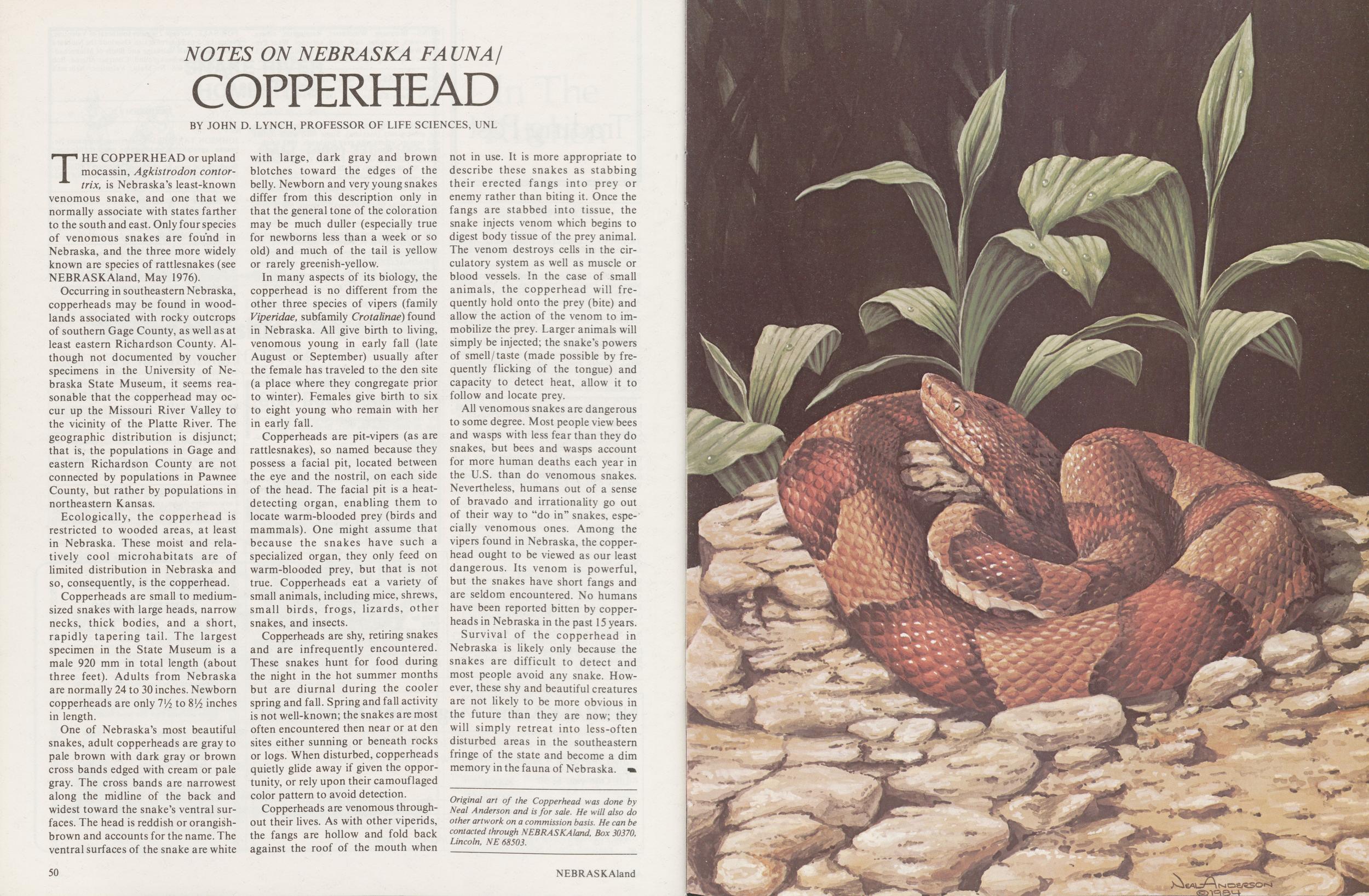
NOTES ON NEBRASKA FAUNA / COPPERHEAD
BY JOHN D. LYNCH, PROFESSOR OF LIFE SCIENCES, UNLTHE COPPERHEAD or upland mocassin, Agkistrodon contortrix, is Nebraska's least-known venomous snake, and one that we normally associate with states farther to the south and east. Only four species of venomous snakes are found in Nebraska, and the three more widely known are species of rattlesnakes (see NEBRASKAland, May 1976).
Occurring in southeastern Nebraska, copperheads may be found in woodlands associated with rocky outcrops of southern Gage County, as well as at least eastern Richardson County. Although not documented by voucher specimens in the University of Nebraska State Museum, it seems reasonable that the copperhead may occur up the Missouri River Valley to the vicinity of the Platte River. The geographic distribution is disjunct; that is, the populations in Gage and eastern Richardson County are not connected by populations in Pawnee County, but rather by populations in northeastern Kansas.
Ecologically, the copperhead is restricted to wooded areas, at least in Nebraska. These moist and relatively cool microhabitats are of limited distribution in Nebraska and so, consequently, is the copperhead.
Copperheads are small to medium-sized snakes with large heads, narrow necks, thick bodies, and a short, rapidly tapering tail. The largest specimen in the State Museum is a male 920 mm in total length (about three feet). Adults from Nebraska are normally 24 to 30 inches. Newborn copperheads are only IVi to SlA inches in length.
One of Nebraska's most beautiful snakes, adult copperheads are gray to pale brown with dark gray or brown cross bands edged with cream or pale gray. The cross bands are narrowest along the midline of the back and widest toward the snake's ventral surfaces. The head is reddish or orangish-brown and accounts for the name. The ventral surfaces of the snake are white with large, dark gray and brown blotches toward the edges of the belly. Newborn and very young snakes differ from this description only in that the general tone of the coloration may be much duller (especially true for newborns less than a week or so old) and much of the tail is yellow or rarely greenish-yellow.
In many aspects of its biology, the copperhead is no different from the other three species of vipers (family Viperidae, subfamily Crotalinae) found in Nebraska. All give birth to living, venomous young in early fall (late August or September) usually after the female has traveled to the den site (a place where they congregate prior to winter). Females give birth to six to eight young who remain with her in early fall.
Copperheads are pit-vipers (as are rattlesnakes), so named because they possess a facial pit, located between the eye and the nostril, on each side of the head. The facial pit is a heat-detecting organ, enabling them to locate warm-blooded prey (birds and mammals). One might assume that because the snakes have such a specialized organ, they only feed on warm-blooded prey, but that is not true. Copperheads eat a variety of small animals, including mice, shrews, small birds, frogs, lizards, other snakes, and insects.
Copperheads are shy, retiring snakes and are infrequently encountered. These snakes hunt for food during the night in the hot summer months but are diurnal during the cooler spring and fall. Spring and fall activity is not well-known; the snakes are most often encountered then near or at den sites either sunning or beneath rocks or logs. When disturbed, copperheads quietly glide away if given the opportunity, or rely upon their camouflaged color pattern to avoid detection.
Copperheads are venomous throughout their lives. As with other viperids, the fangs are hollow and fold back against the roof of the mouth when not in use. It is more appropriate to describe these snakes as stabbing their erected fangs into prey or enemy rather than biting it. Once the fangs are stabbed into tissue, the snake injects venom which begins to digest body tissue of the prey animal. The venom destroys cells in the circulatory system as well as muscle or blood vessels. In the case of small animals, the copperhead will frequently hold onto the prey (bite) and allow the action of the venom to immobilize the prey. Larger animals will simply be injected; the snake's powers of smell/taste (made possible by frequently flicking of the tongue) and capacity to detect heat, allow it to follow and locate prey.
All venomous snakes are dangerous to some degree. Most people view bees and wasps with less fear than they do snakes, but bees and wasps account for more human deaths each year in the U.S. than do venomous snakes. Nevertheless, humans out of a sense of bravado and irrationality go out of their way to "do in" snakes, especially venomous ones. Among the vipers found in Nebraska, the copperhead ought to be viewed as our least dangerous. Its venom is powerful, but the snakes have short fangs and are seldom encountered. No humans have been reported bitten by copperheads in Nebraska in the past 15 years.
Survival of the copperhead in Nebraska is likely only because the snakes are difficult to detect and most people avoid any snake. However, these shy and beautiful creatures are not likely to be more obvious in the future than they are now; they will simply retreat into less-often disturbed areas in the southeastern fringe of the state and become a dim memory in the fauna of Nebraska.
Original art of the Copperhead was done by Neal Anderson and is for sale. He will also do other artwork on a commission basis. He can be contacted through NEBRASKAland, Box 30370, Lincoln, NE 68503. 50 NEBRASKAland
Find more than you imagined at Nebraska's historical parks
Imagine the creak of wagons perilously lowered down Windlass Hill on the Oregon Trail...silver-haired Buffalo Bill on a rearing white stallion...blue-coated dragoons guarding America's vast the Missouri river...For more information about how Nebraska's state historical parks can stretch your imagination, write us for the "Nebraska Parklands" brochure.
NEBRASKA GAME AND PARKS COMMISSION Eugene T. Mahoney, DirectorPosition: 153 (41 views)