Volume 62, Issue 2, 1984
NEBRASKAland
MARCH 1984 • $1
Speak Up
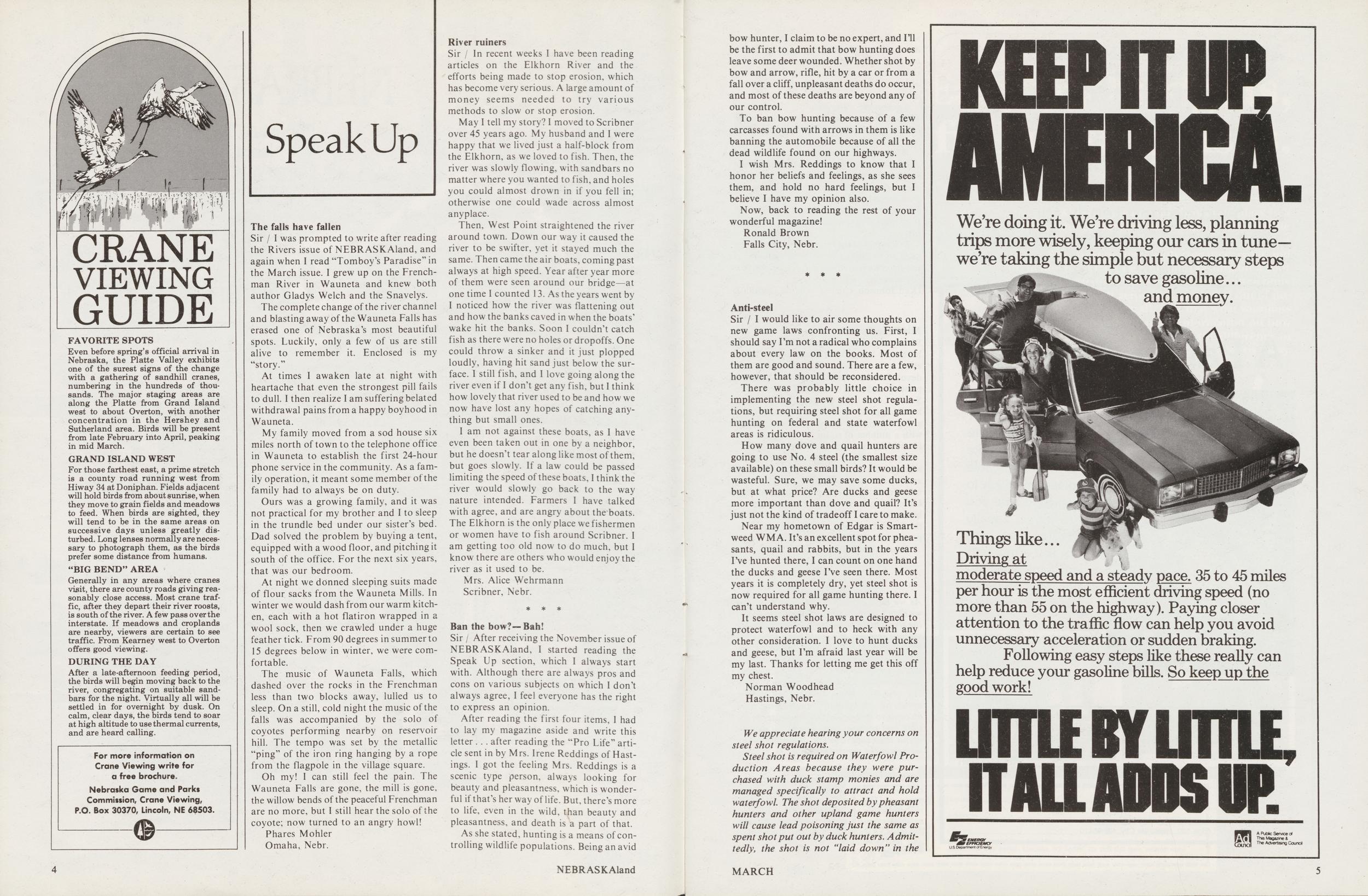
CRANE VIEWING GUIDE FAVORITE SPOTSEven before spring's official arrival in Nebraska, the Platte Valley exhibits one of the surest signs of the change with a gathering of sandhill cranes, numbering in the hundreds of thousands. The major staging areas are along the Platte from Grand Island west to about Overton, with another concentration in the Hershey and Sutherland area. Birds will be present from late February into April, peaking in mid March.
GRAND ISLAND WESTFor those farthest east, a prime stretch is a county road running west from Hiway 34 at Doniphan. Fields adjacent will hold birds from about sunrise, when they move to grain fields and meadows to feed. When birds are sighted, they will tend to be in the same areas on successive days unless greatly disturbed. Long lenses normally are necessary to photograph them, as the birds prefer some distance from humans.
"BIG BEND" AREAGenerally in any areas where cranes visit, there are county roads giving reasonably close access. Most crane traffic, after they depart their river roosts, is south of the river. A few pass over the interstate. If meadows and croplands are nearby, viewers are certain to see traffic. From Kearney west to Overton offers good viewing.
DURING THE DAYAfter a late-afternoon feeding period, the birds will begin moving back to the river, congregating on suitable sandbars for the night. Virtually all will be settled in for overnight by dusk. On calm, clear days, the birds tend to soar at high altitude to use thermal currents, and are heard calling.
For more information on Crane Viewing write for a free brochure. Nebraska Game and Parks Commission, Crane Viewing, P.O. Box 30370, Lincoln, NE 68503.Sir / I was prompted to write after reading the Rivers issue of NEBRASKAland, and again when I read "Tomboy's Paradise" in the March issue. I grew up on the Frenchman River in Wauneta and knew both author Gladys Welch and the Snavelys.
The complete change of the river channel and blasting away of the Wauneta Falls has erased one of Nebraska's most beautiful spots. Luckily, only a few of us are still alive to remember it. Enclosed is my "story."
At times I awaken late at night with heartache that even the strongest pill fails to dull. I then realize I am suffering belated withdrawal pains from a happy boyhood in Wauneta.
My family moved from a sod house six miles north of town to the telephone office in Wauneta to establish the first 24-hour phone service in the community. As a family operation, it meant some member of the family had to always be on duty.
Ours was a growing family, and it was not practical for my brother and I to sleep in the trundle bed under our sister's bed. Dad solved the problem by buying a tent, equipped with a wood floor, and pitching it south of the office. For the next six years, that was our bedroom.
At night we donned sleeping suits made of flour sacks from the Wauneta Mills. In winter we would dash from our warm kitchen, each with a hot flatiron wrapped in a wool sock, then we crawled under a huge feather tick. From 90 degrees in summer to 15 degrees below in winter, we were comfortable.
The music of Wauneta Falls, which dashed over the rocks in the Frenchman less than two blocks away, lulled us to sleep. On a still, cold night the music of the falls was accompanied by the solo of coyotes performing nearby on reservoir hill. The tempo was set by the metallic "ping" of the iron ring hanging by a rope from the flagpole in the village square.
Oh my! I can still feel the pain. The Wauneta Falls are gone, the mill is gone, the willow bends of the peaceful Frenchman are no more, but I still hear the solo of the coyote; now turned to an angry howl!
Phares Mohler Omaha, Nebr. River ruinersSir / In recent weeks I have been reading articles on the Elkhorn River and the efforts being made to stop erosion, which has become very serious. A large amount of money seems needed to try various methods to slow or stop erosion.
May I tell my story? I moved to Scribner over 45 years ago. My husband and I were happy that we lived just a half-block from the Elkhorn, as we loved to fish. Then, the river was slowly flowing, with sandbars no matter where you wanted to fish, and holes you could almost drown in if you fell in; otherwise one could wade across almost anyplace.
Then, West Point straightened the river around town. Down our way it caused the river to be swifter, yet it stayed much the same. Then came the air boats, coming past always at high speed. Year after year more of them were seen around our bridge—at one time I counted 13. As the years went by I noticed how the river was flattening out and how the banks caved in when the boats' wake hit the banks. Soon I couldn't catch fish as there were no holes or dropoffs. One could throw a sinker and it just plopped loudly, having hit sand just below the surface. I still fish, and I love going along the river even if I don't get any fish, but I think how lovely that river used to be and how we now have lost any hopes of catching anything but small ones.
I am not against these boats, as I have even been taken out in one by a neighbor, but he doesn't tear along like most of them, but goes slowly. If a law could be passed limiting the speed of these boats, I think the river would slowly go back to the way nature intended. Farmers I have talked with agree, and are angry about the boats. The Elkhorn is the only place we fishermen or women have to fish around Scribner. I am getting too old now to do much, but I know there are others who would enjoy the river as it used to be.
Mrs. Alice Wehrmann Scribner, Nebr. Ban the bow?—Bah!Sir / After receiving the November issue of NEBRASKAland, I started reading the Speak Up section, which I always start with. Although there are always pros and cons on various subjects on which I don't always agree, I feel everyone has the right to express an opinion.
After reading the first four items, I had to lay my magazine aside and write this letter . . . after reading the "Pro Life" article sent in by Mrs. Irene Reddings of Hastings. I got the feeling Mrs. Reddings is a scenic type person, always looking for beauty and pleasantness, which is wonderful if that's her way of life. But, there's more to life, even in the wild, than beauty and pleasantness, and death is a part of that.
As she stated, hunting is a means of controlling wildlife populations. Being an avid 4 NEBRASKAland bow hunter, I claim to be no expert, and 111 be the first to admit that bow hunting does leave some deer wounded. Whether shot by bow and arrow, rifle, hit by a car or from a fall over a cliff, unpleasant deaths do occur, and most of these deaths are beyond any of our control.
To ban bow hunting because of a few carcasses found with arrows in them is like banning the automobile because of all the dead wildlife found on our highways.
I wish Mrs. Reddings to know that I honor her beliefs and feelings, as she sees them, and hold no hard feelings, but I believe I have my opinion also.
Now, back to reading the rest of your wonderful magazine!
Ronald Brown Falls City, Nebr. Anti-steelSir / I would like to air some thoughts on new game laws confronting us. First, I should say I'm not a radical who complains about every law on the books. Most of them are good and sound. There are a few, however, that should be reconsidered.
There was probably little choice in implementing the new steel shot regulations, but requiring steel shot for all game hunting on federal and state waterfowl areas is ridiculous.
How many dove and quail hunters are going to use No. 4 steel (the smallest size available) on these small birds? It would be wasteful. Sure, we may save some ducks, but at what price? Are ducks and geese more important than dove and quail? It's just not the kind of tradeoff I care to make.
Near my hometown of Edgar is Smart-weed WMA. It's an excellent spot for pheasants, quail and rabbits, but in the years I've hunted there, I can count on one hand the ducks and geese I've seen there. Most years it is completely dry, yet steel shot is now required for all game hunting there. I can't understand why.
It seems steel shot laws are designed to protect waterfowl and to heck with any other consideration. I love to hunt ducks and geese, but I'm afraid last year will be my last. Thanks for letting me get this off my chest.
Norman Woodhead Hastings, Nebr.We appreciate hearing your concerns on steel shot regulations.
Steel shot is required on Waterfowl Production Areas because they were purchased with duck stamp monies and are managed specifically to attract and hold waterfowl. The shot deposited by pheasant hunters and other upland game hunters will cause lead poisoning just the same as spent shot put out by duck hunters. Admittedly, the shot is not "laid down" in the
same fashion, but some is deposited in areas that are flooded in the spring. Feeding ducks don't discern how the shot got there; they simply pick it up in their feeding efforts. Only one lead pellet in the gizzard can cause lead poisoning.
You made reference to Smartweed WMA. This area is quite often dry in the fall but has good water in the spring, and is heavily used by waterfowl.
With regard to using steel for doves and quail, No. 4 steel isn't that bad. While smaller shot would be preferred, it isn't on the market at this time. We certainly would encourage you to get some steel and try it before writing it off. As more steel is used, it should become more competitive in price.
In looking to the future, we as sportsmen need to be willing to make sacrifices that are necessary to insure a bright tomorrow for waterfowl and hunters. (Ken Johnson, chief of Wildlife Division).
Middle or SouthSir / Your recent Nebraska Rivers issue is both very beautiful and interesting. However, I find it rather incredible that you devoted so little space to one of Nebraska's prettiest and most underrated rivers ... the South Loup. The photo on page 80 is hardly typical of the many beauty spots along this river. I could have supplied you with a number of slides from my personal file which are much more representative.
Also, Ken Bouc is in error (on page 76) when he states: "The prisoners (Mitchell and Ketchum) were taken to a canyon a few miles from the Olive Ranch on the Middle Loup, hanged from an elm tree, and their bodies burned." This incident occurred in the South Loup area, a few miles below the present site of Callaway.
Francis Gschwind Callaway, Nebr.As we have explained previously, we feel we didn 't, and couldn't, do justice to any of the rivers in the space we were limited to for various reasons. We could have done a big issue on each river in the sate. Also, the matter of the burning of settlers Mitchell and Ketchum by the Olive cowboys varies a lot depending upon which source is used. The one Ken Bouc used located it as it appeared. Apparently few people were anxious to be involved in the matter at the time and perhaps were somewhat evasive about the exact location. If you are right, we regret the error. (Editor)
NEBRASKAland Magazine invites all readers to submit their comments, suggestions, and gripes to Speak Up. Each month the magazine will publish as many letters as space permits. Pictures are also welcome. NEBRASKAland does reserve the right to edit and condense letters. (Editor)
A Prairie Classroom
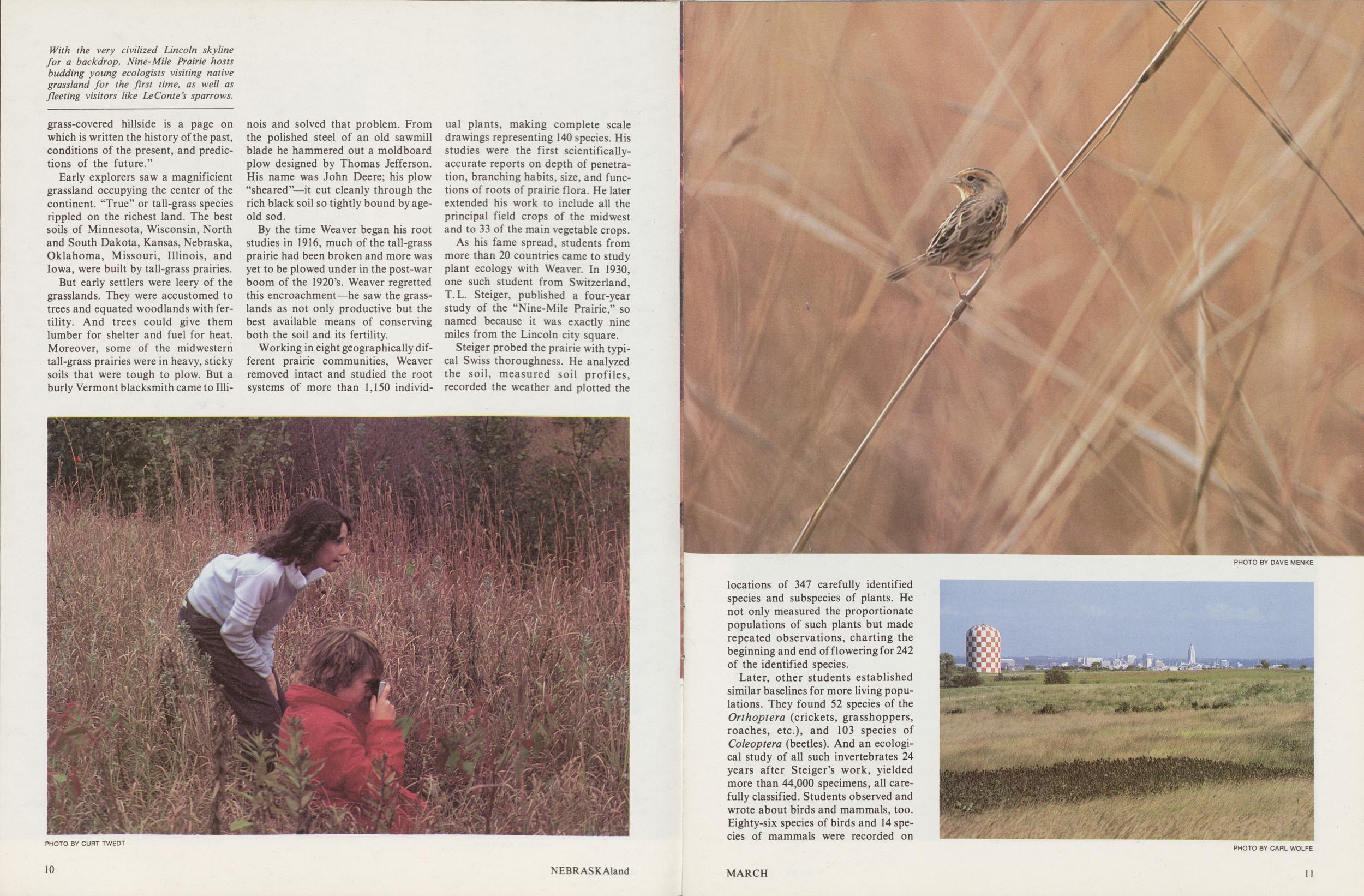
One of Nebraska's last tracts of native tall-grass prairie has been preserved for scientific study and appreciation by generations to come. DR. JOHN L. ADAMS, UNIVERSITY OF NEBRASKA-LINCOLNTALL GRASSES waved in numerous tracts of unplowed "original" prairie around Lincoln in 1917. But anyone passing by, perhaps in a buckboard or buggy, or even chugging along in one of the horseless carriages of that day, might have been sorely puzzled at what they saw. During the summers of 1917-18, a dignified man, in suit and tie and wearing a trim felt hat, dug more than 100 grave-like pits, usually measuring six feet deep, three feet wide and from six to 10 feet long, on the prairies around Lincoln. In the days before the back hoe and the "Ditch Witch," using nothing more than a hand spade, he cut some of his trenches much longer and deeper, sloping them steeply downward to a depth of over 20 feet into the rich prairie soil.
The man was Dr. J. E. Weaver. At that time he was applying his tremendous energy and dogged determination to the study of prairie plant roots. In 1917, he had just begun what was to be a 50-year career at the University of Nebraska. It was a career which was to make the University of Nebraska a leader for over 20 years in the scientific field of plant ecology. Weaver authored or co-authored more than 100 technical papers and a dozen books, and became the world's top authority on prairie vegetation.
Weaver found the prairies to be a written record. "Nature is an open book for those who care to read. Each
grass-covered hillside is a page on which is written the history of the past, conditions of the present, and predictions of the future."
Early explorers saw a magnificient grassland occupying the center of the continent. "True" or tall-grass species rippled on the richest land. The best soils of Minnesota, Wisconsin, North and South Dakota, Kansas, Nebraska, Oklahoma, Missouri, Illinois, and Iowa, were built by tall-grass prairies.
But early settlers were leery of the grasslands. They were accustomed to trees and equated woodlands with fertility. And trees could give them lumber for shelter and fuel for heat. Moreover, some of the midwestern tall-grass prairies were in heavy, sticky soils that were tough to plow. But a burly Vermont blacksmith came to Illinois and solved that problem. From the polished steel of an old sawmill blade he hammered out a moldboard plow designed by Thomas Jefferson. His name was John Deere; his plow "sheared"—it cut cleanly through the rich black soil so tightly bound by age-old sod.
By the time Weaver began his root studies in 1916, much of the tall-grass prairie had been broken and more was yet to be plowed under in the post-war boom of the 1920's. Weaver regretted this encroachment—he saw the grasslands as not only productive but the best available means of conserving both the soil and its fertility.
Working in eight geographically different prairie communities, Weaver removed intact and studied the root systems of more than 1,150 individual plants, making complete scale drawings representing 140 species. His studies were the first scientifically-accurate reports on depth of penetration, branching habits, size, and functions of roots of prairie flora. He later extended his work to include all the principal field crops of the midwest and to 33 of the main vegetable crops.
As his fame spread, students from more than 20 countries came to study plant ecology with Weaver. In 1930, one such student from Switzerland, T. L. Steiger, published a four-year study of the "Nine-Mile Prairie," so named because it was exactly nine miles from the Lincoln city square.
Steiger probed the prairie with typical Swiss thoroughness. He analyzed the soil, measured soil profiles, recorded the weather and plotted the
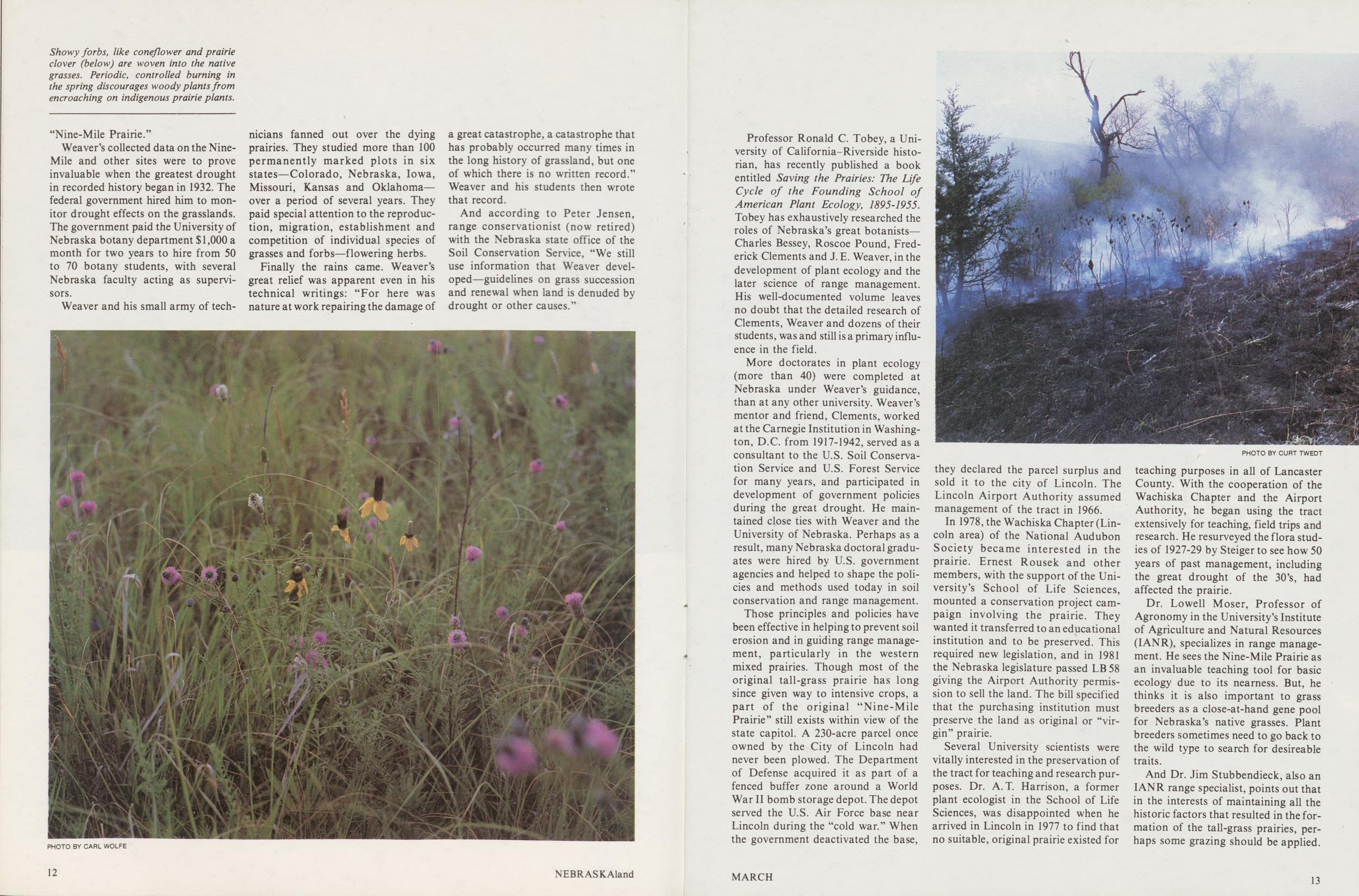
Later, other students established similar baselines for more living populations. They found 52 species of the Orthoptera (crickets, grasshoppers, roaches, etc.), and 103 species of Coleoptera (beetles). And an ecological study of all such invertebrates 24 years after Steiger's work, yielded more than 44,000 specimens, all carefully classified. Students observed and wrote about birds and mammals, too. Eighty-six species of birds and 14 species of mammals were recorded on
Weaver's collected data on the Nine-Mile and other sites were to prove invaluable when the greatest drought in recorded history began in 1932. The federal government hired him to monitor drought effects on the grasslands. The government paid the University of Nebraska botany department $1,000 a month for two years to hire from 50 to 70 botany students, with several Nebraska faculty acting as supervisors.
>Weaver and his small army of technicians fanned out over the dying prairies. They studied more than 100 permanently marked plots in six states—Colorado, Nebraska, Iowa, Missouri, Kansas and Oklahoma—over a period of several years. They paid special attention to the reproduction, migration, establishment and competition of individual species of grasses and forbs—flowering herbs.
Finally the rains came. Weaver's great relief was apparent even in his technical writings: "For here was nature at work repairing the damage of a great catastrophe, a catastrophe that has probably occurred many times in the long history of grassland, but one of which there is no written record." Weaver and his students then wrote that record.
And according to Peter Jensen, range conservationist (now retired) with the Nebraska state office of the Soil Conservation Service, "We still use information that Weaver developed—guidelines on grass succession and renewal when land is denuded by drought or other causes."
Professor Ronald C. Tobey, a University of California-Riverside historian, has recently published a book entitled Saving the Prairies: The Life Cycle of the Founding School of American Plant Ecology, 1895-1955. Tobey has exhaustively researched the roles of Nebraska's great botanists—Charles Bessey, Roscoe Pound, Frederick Clements and J. E. Weaver, in the development of plant ecology and the later science of range management. His well-documented volume leaves no doubt that the detailed research of Clements, Weaver and dozens of their students, was and still is a primary influence in the field.
More doctorates in plant ecology (more than 40) were completed at Nebraska under Weaver's guidance, than at any other university. Weaver's mentor and friend, Clements, worked at the Carnegie Institution in Washington, D.C. from 1917-1942, served as a consultant to the U.S. Soil Conservation Service and U.S. Forest Service for many years, and participated in development of government policies during the great drought. He maintained close ties with Weaver and the University of Nebraska. Perhaps as a result, many Nebraska doctoral graduates were hired by U.S. government agencies and helped to shape the policies and methods used today in soil conservation and range management.
Those principles and policies have been effective in helping to prevent soil erosion and in guiding range management, particularly in the western mixed prairies. Though most of the original tall-grass prairie has long since given way to intensive crops, a part of the original "Nine-Mile Prairie" still exists within view of the state capitol. A 230-acre parcel once owned by the City of Lincoln had never been plowed. The Department of Defense acquired it as part of a fenced buffer zone around a World War II bomb storage depot. The depot served the U.S. Air Force base near Lincoln during the "cold war." When the government deactivated the base,
In 1978, the Wachiska Chapter (Lincoln area) of the National Audubon Society became interested in the prairie. Ernest Rousek and other members, with the support of the University's School of Life Sciences, mounted a conservation project campaign involving the prairie. They wanted it transferred to an educational institution and to be preserved. This required new legislation, and in 1981 the Nebraska legislature passed LB 58 giving the Airport Authority permission to sell the land. The bill specified that the purchasing institution must preserve the land as original or "virgin" prairie.
Several University scientists were vitally interested in the preservation of the tract for teaching and research purposes. Dr. A.T. Harrison, a former plant ecologist in the School of Life Sciences, was disappointed when he arrived in Lincoln in 1977 to find that no suitable, original prairie existed for teaching purposes in all of Lancaster County. With the cooperation of the Wachiska Chapter and the Airport Authority, he began using the tract extensively for teaching, field trips and research. He resurveyed the flora studies of 1927-29 by Steiger to see how 50 years of past management, including the great drought of the 30's, had affected the prairie.
Dr. Lowell Moser, Professor of Agronomy in the University's Institute of Agriculture and Natural Resources (IANR), specializes in range management. He sees the Nine-Mile Prairie as an invaluable teaching tool for basic ecology due to its nearness. But, he thinks it is also important to grass breeders as a close-at-hand gene pool for Nebraska's native grasses. Plant breeders sometimes need to go back to the wild type to search for desireable traits.
And Dr. Jim Stubbendieck, also an IANR range specialist, points out that in the interests of maintaining all the historic factors that resulted in the formation of the tall-grass prairies, perhaps some grazing should be applied.
MARCH 13
In both historic and prehistoric times, and in addition to periodic drought and fires, the prairies have borne the tread of the grazing giants—mammoths, musk oxen, mastodonts, and later, the hordes of bison.
Dr. Sotero Salac, an IANR horticulturist, is breeding improved varieties of wildflowers for possible use as commercially grown cut flowers. His work with the thickspike gayfeather is particularly interesting. In the wild, the brilliant purple, multiflowered spikes of this plant measure eight to 10 inches in length. Salac has developed specimens that measure 18 inches.
Based on Steiger's work of 50 years ago, the Wachiska Audubon chapter recently published the flowering chronology of some of the most colorful of Nine-Mile's flowers. From that chart, we learn that visitors may expect to see ground plums (buffalo pea), prairie violets, blue-eyed grass and wild false-indigo in full blossom in late April or early May. Purple coneflowers bloom in most of June to mid-July. Then the Missouri goldenrod bursts forth in hot July and August. The gayfeathers and the tall and showy-wand goldenrods flaunt their colors in late August through September. The rare, reddish-blue downy gentian is usually the last wildflower to bloom on Nine-Mile Prairie in October.
As frost approaches, the prevalent big and little bluestem grasses change from green to a russet red background for the bright clusters of flowering forbs.
Almost 30 years ago, in one of those poetic passages that sprinkle his many writings, Weaver said of the prairie: "One glories in its beauty, its diversity, and in the ever-changing patterns of its floral arrangements."
In February of 1983 the preservation of this historic remnant of tallgrass prairie was insured. An anonymous donor pledged half of the purchase price of Nine-Mile Prairie ($68,000) if it could be matched by contributions. Within a few months, donations of $32,000 were received, and the University Foundation supplied the additional $36,000 to match the pledge. (Contributions to help defray the cost of maintaining the prairie are still welcome and may be made to the University Foundation, 3835 Holdrege, Lincoln, NE 68588).
Nebraskans have seized the opportunity to preserve this unique, original prairie. It will serve not only as a useful and invaluable teaching and research tool, but as a part of posterity's natural heritage. Perhaps it will serve as a monument to an unusual man who studied the prairie as has no one else.
One of Weaver's former students explained his mentor's unique ability: "There comes occasionally to every scientific field a man who is so enthusiastic and so devoted to his work that it becomes his very life. To him, nature seems to unfold her secrets in response to his devotion; his ability to understand and communicate with nature becomes an inspiration to students and fellow workers alike."
The Nine-Mile Prairie would wear his name proudly.
MARCH 15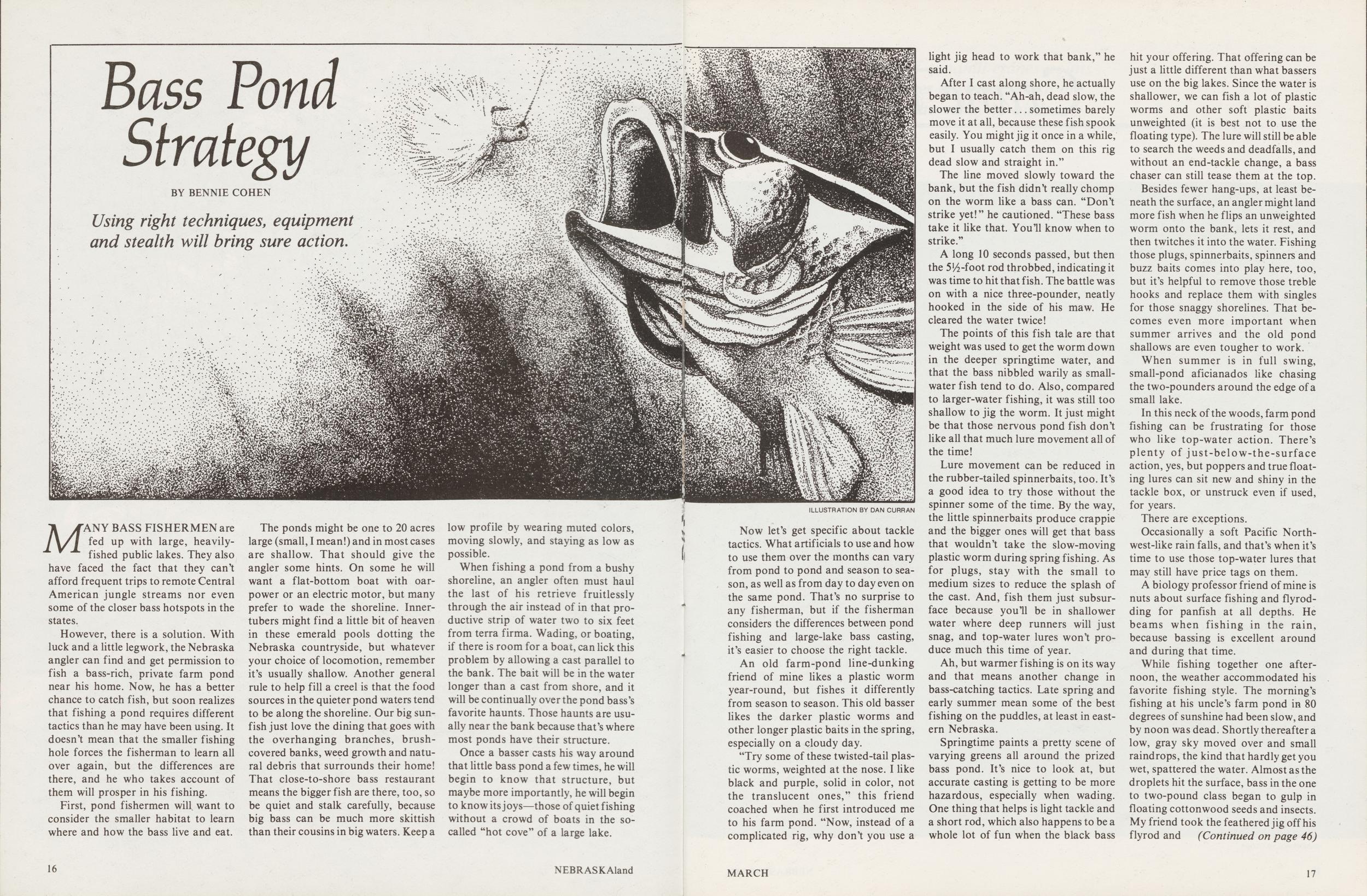
Bass Pond Strategy
Using right techniques, equipment and stealth will bring sure action.
MANY BASS FISHERMEN are fed up with large, heavily-fished public lakes. They also have faced the fact that they can't afford frequent trips to remote Central American jungle streams nor even some of the closer bass hotspots in the states.
However, there is a solution. With luck and a little legwork, the Nebraska angler can find and get permission to fish a bass-rich, private farm pond near his home. Now, he has a better chance to catch fish, but soon realizes that fishing a pond requires different tactics than he may have been using. It doesn't mean that the smaller fishing hole forces the fisherman to learn all over again, but the differences are there, and he who takes account of them will prosper in his fishing.
First, pond fishermen will want to consider the smaller habitat to learn where and how the bass live and eat.
The ponds might be one to 20 acres large (small, I mean!) and in most cases are shallow. That should give the angler some hints. On some he will want a flat-bottom boat with oar-power or an electric motor, but many prefer to wade the shoreline. Innertubers might find a little bit of heaven in these emerald pools dotting the Nebraska countryside, but whatever your choice of locomotion, remember it's usually shallow. Another general rule to help fill a creel is that the food sources in the quieter pond waters tend to be along the shoreline. Our big sunfish just love the dining that goes with the overhanging branches, brush-covered banks, weed growth and natural debris that surrounds their home! That close-to-shore bass restaurant means the bigger fish are there, too, so be quiet and stalk carefully, because big bass can be much more skittish than their cousins in big waters. Keep a
When fishing a pond from a bushy shoreline, an angler often must haul the last of his retrieve fruitlessly through the air instead of in that productive strip of water two to six feet from terra firma. Wading, or boating, if there is room for a boat, can lick this problem by allowing a cast parallel to the bank. The bait will be in the water longer than a cast from shore, and it will be continually over the pond bass's favorite haunts. Those haunts are usually near the bank because that's where most ponds have their structure.
Once a basser casts his way around that little bass pond a few times, he will begin to know that structure, but maybe more importantly, he will begin to know its joys—those of quiet fishing without a crowd of boats in the so-called "hot cove" of a large lake. 16 NEBRASKAland Now let's get specific about tackle tactics. What artificials to use and how to use them over the months can vary from pond to pond and season to season, as well as from day to day even on the same pond. That's no surprise to any fisherman, but if the fisherman considers the differences between pond fishing and large-lake bass casting, it's easier to choose the right tackle.
An old farm-pond line-dunking friend of mine likes a plastic worm year-round, but fishes it differently from season to season. This old basser likes the darker plastic worms and other longer plastic baits in the spring, especially on a cloudy day.
"Try some of these twisted-tail plastic worms, weighted at the nose. I like black and purple, solid in color, not the translucent ones," this friend coached when he first introduced me to his farm pond. "Now, instead of a complicated rig, why don't you use a light jig head to work that bank," he said.
After I cast along shore, he actually began to teach. "Ah-ah, dead slow, the slower the better... sometimes barely move it at all, because these fish spook easily. You might jig it once in a while, but I usually catch them on this rig dead slow and straight in."
The line moved slowly toward the bank, but the fish didn't really chomp on the worm like a bass can. "Don't strike yet!" he cautioned. "These bass take it like that. You'll know when to strike."
A long 10 seconds passed, but then the 5!/4-foot rod throbbed, indicating it was time to hit that fish. The battle was on with a nice three-pounder, neatly hooked in the side of his maw. He cleared the water twice!
The points of this fish tale are that weight was used to get the worm down in the deeper springtime water, and that the bass nibbled warily as smallwater fish tend to do. Also, compared to larger-water fishing, it was still too shallow to jig the worm. It just might be that those nervous pond fish don't like all that much lure movement all of the time!
Lure movement can be reduced in the rubber-tailed spinnerbaits, too. It's a good idea to try those without the spinner some of the time. By the way, the little spinnerbaits produce crappie and the bigger ones will get that bass that wouldn't take the slow-moving plastic worm during spring fishing. As for plugs, stay with the small to medium sizes to reduce the splash of the cast. And, fish them just subsurface because you'll be in shallower water where deep runners will just snag, and top-water lures won't produce much this time of year.
Ah, but warmer fishing is on its way and that means another change in bass-catching tactics. Late spring and early summer mean some of the best fishing on the puddles, at least in eastern Nebraska.
Springtime paints a pretty scene of varying greens all around the prized bass pond. It's nice to look at, but accurate casting is getting to be more hazardous, especially when wading. One thing that helps is light tackle and a short rod, which also happens to be a whole lot of fun when the black bass hit your offering. That offering can be just a little different than what bassers use on the big lakes. Since the water is shallower, we can fish a lot of plastic worms and other soft plastic baits unweighted (it is best not to use the floating type). The lure will still be able to search the weeds and deadfalls, and without an end-tackle change, a bass chaser can still tease them at the top.
Besides fewer hang-ups, at least beneath the surface, an angler might land more fish when he flips an unweighted worm onto the bank, lets it rest, and then twitches it into the water. Fishing those plugs, spinnerbaits, spinners and buzz baits comes into play here, too, but it's helpful to remove those treble hooks and replace them with singles for those snaggy shorelines. That becomes even more important when summer arrives and the old pond shallows are even tougher to work.
When summer is in full swing, small-pond aficianados like chasing the two-pounders around the edge of a small lake.
In this neck of the woods, farm pond fishing can be frustrating for those who like top-water action. There's plenty of just-below-the-surface action, yes, but poppers and true floating lures can sit new and shiny in the tackle box, or unstruck even if used, for years.
There are exceptions. Occasionally a soft Pacific Northwest-like rain falls, and that's when it's time to use those top-water lures that may still have price tags on them.
A biology professor friend of mine is nuts about surface fishing and flyrodding for panfish at all depths. He beams when fishing in the rain, because bassing is excellent around and during that time.
While fishing together one afternoon, the weather accommodated his favorite fishing style. The morning's fishing at his uncle's farm pond in 80 degrees of sunshine had been slow, and by noon was dead. Shortly thereafter a low, gray sky moved over and small raindrops, the kind that hardly get you wet, spattered the water. Almost as the droplets hit the surface, bass in the one to two-pound class began to gulp in floating cottonwood seeds and insects. My friend took the feathered jig off his flyrod and (Continued on page 46)
MARCH 17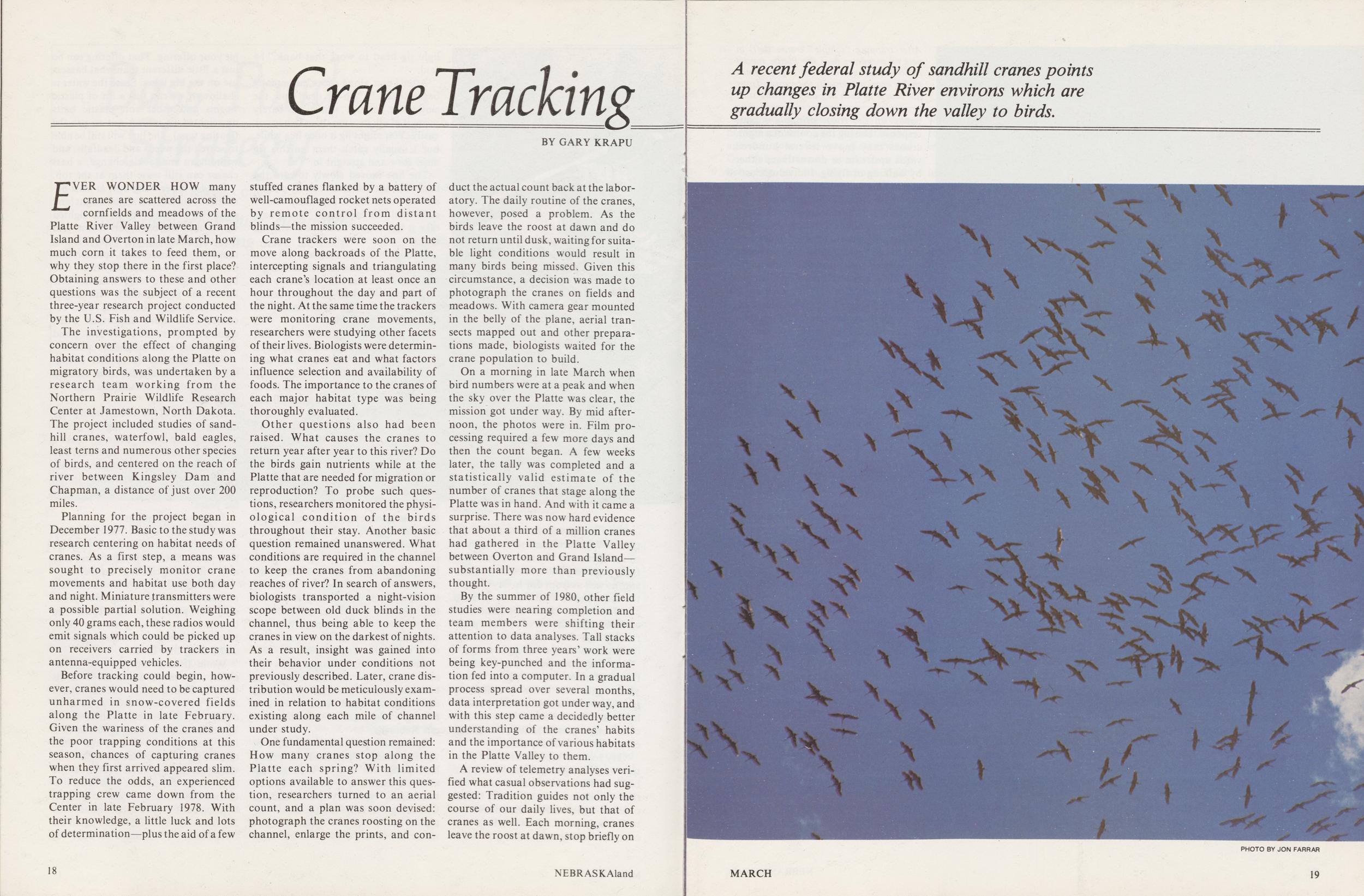
Crane Tracking
EVER WONDER HOW many cranes are scattered across the cornfields and meadows of the Platte River Valley between Grand Island and Overton in late March, how much corn it takes to feed them, or why they stop there in the first place? Obtaining answers to these and other questions was the subject of a recent three-year research project conducted by the U.S. Fish and Wildlife Service.
The investigations, prompted by concern over the effect of changing habitat conditions along the Platte on migratory birds, was undertaken by a research team working from the Northern Prairie Wildlife Research Center at Jamestown, North Dakota. The project included studies of sandhill cranes, waterfowl, bald eagles, least terns and numerous other species of birds, and centered on the reach of river between Kingsley Dam and Chapman, a distance of just over 200 miles.
Planning for the project began in December 1977. Basic to the study was research centering on habitat needs of cranes. As a first step, a means was sought to precisely monitor crane movements and habitat use both day and night. Miniature transmitters were a possible partial solution. Weighing only 40 grams each, these radios would emit signals which could be picked up on receivers carried by trackers in antenna-equipped vehicles.
Before tracking could begin, however, cranes would need to be captured unharmed in snow-covered fields along the Platte in late February. Given the wariness of the cranes and the poor trapping conditions at this season, chances of capturing cranes when they first arrived appeared slim. To reduce the odds, an experienced trapping crew came down from the Center in late February 1978. With their knowledge, a little luck and lots of determination—plus the aid of a few stuffed cranes flanked by a battery of well-camouflaged rocket nets operated by remote control from distant blinds—the mission succeeded.
Crane trackers were soon on the move along backroads of the Platte, intercepting signals and triangulating each crane's location at least once an hour throughout the day and part of the night. At the same time the trackers were monitoring crane movements, researchers were studying other facets of their lives. Biologists were determining what cranes eat and what factors influence selection and availability of foods. The importance to the cranes of each major habitat type was being thoroughly evaluated.
Other questions also had been raised. What causes the cranes to return year after year to this river? Do the birds gain nutrients while at the Platte that are needed for migration or reproduction? To probe such questions, researchers monitored the physiological condition of the birds throughout their stay. Another basic question remained unanswered. What conditions are required in the channel to keep the cranes from abandoning reaches of river? In search of answers, biologists transported a night-vision scope between old duck blinds in the channel, thus being able to keep the cranes in view on the darkest of nights. As a result, insight was gained into their behavior under conditions not previously described. Later, crane distribution would be meticulously examined in relation to habitat conditions existing along each mile of channel under study.
One fundamental question remained: How many cranes stop along the Platte each spring? With limited options available to answer this question, researchers turned to an aerial count, and a plan was soon devised: photograph the cranes roosting on the channel, enlarge the prints, and conduct the actual count back at the laboratory. The daily routine of the cranes, however, posed a problem. As the birds leave the roost at dawn and do not return until dusk, waiting for suitable light conditions would result in many birds being missed. Given this circumstance, a decision was made to photograph the cranes on fields and meadows. With camera gear mounted in the belly of the plane, aerial transects mapped out and other preparations made, biologists waited for the crane population to build.
On a morning in late March when bird numbers were at a peak and when the sky over the Platte was clear, the mission got under way. By mid afternoon, the photos were in. Film processing required a few more days and then the count began. A few weeks later, the tally was completed and a statistically valid estimate of the number of cranes that stage along the Platte was in hand. And with it came a surprise. There was now hard evidence that about a third of a million cranes had gathered in the Platte Valley between Overton and Grand Island—substantially more than previously thought.
By the summer of 1980, other field studies were nearing completion and team members were shifting their attention to data analyses. Tall stacks of forms from three years' work were being key-punched and the information fed into a computer. In a gradual process spread over several months, data interpretation got under way, and with this step came a decidedly better understanding of the cranes' habits and the importance of various habitats in the Platte Valley to them.
A review of telemetry analyses verified what casual observations had suggested: Tradition guides not only the course of our daily lives, but that of cranes as well. Each morning, cranes leave the roost at dawn, stop briefly on
18 NEBRASKAland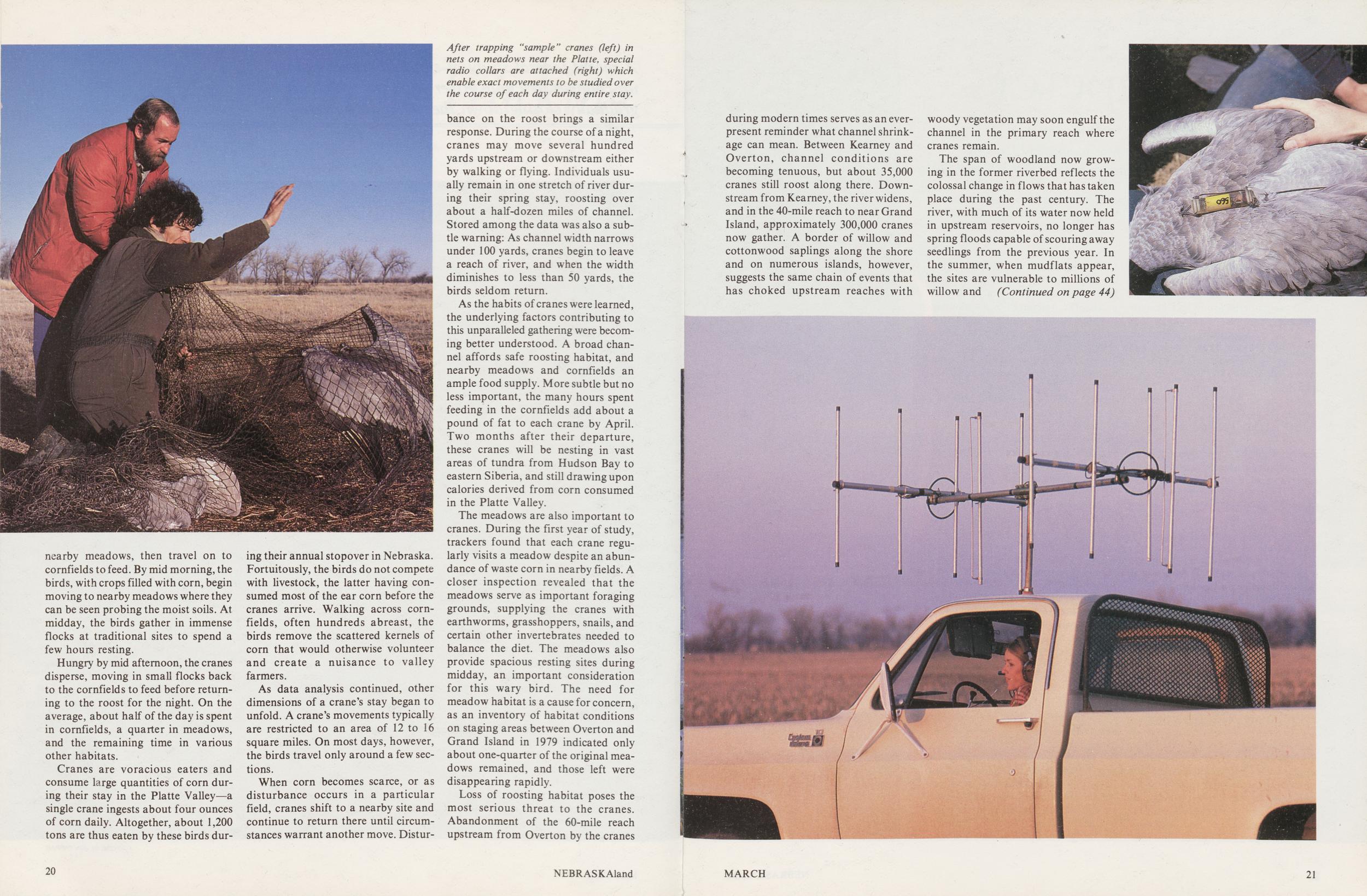
nearby meadows, then travel on to cornfields to feed. By mid morning, the birds, with crops filled with corn, begin moving to nearby meadows where they can be seen probing the moist soils. At midday, the birds gather in immense flocks at traditional sites to spend a few hours resting.
Hungry by mid afternoon, the cranes disperse, moving in small flocks back to the cornfields to feed before returning to the roost for the night. On the average, about half of the day is spent in cornfields, a quarter in meadows, and the remaining time in various other habitats.
Cranes are voracious eaters and consume large quantities of corn during their stay in the Platte Valley—a single crane ingests about four ounces of corn daily. Altogether, about 1,200 tons are thus eaten by these birds during their annual stopover in Nebraska. Fortuitously, the birds do not compete with livestock, the latter having consumed most of the ear corn before the cranes arrive. Walking across cornfields, often hundreds abreast, the birds remove the scattered kernels of corn that would otherwise volunteer and create a nuisance to valley farmers.
As data analysis continued, other dimensions of a crane's stay began to unfold. A crane's movements typically are restricted to an area of 12 to 16 square miles. On most days, however, the birds travel only around a few sections.
When corn becomes scarce, or as disturbance occurs in a particular field, cranes shift to a nearby site and continue to return there until circumstances warrant another move. Disturbance on the roost brings a similar response. During the course of a night, cranes may move several hundred yards upstream or downstream either by walking or flying. Individuals usually remain in one stretch of river during their spring stay, roosting over about a half-dozen miles of channel. Stored among the data was also a subtle warning: As channel width narrows under 100 yards, cranes begin to leave a reach of river, and when the width diminishes to less than 50 yards, the birds seldom return.
As the habits of cranes were learned, the underlying factors contributing to this unparalleled gathering were becoming better understood. A broad channel affords safe roosting habitat, and nearby meadows and cornfields an ample food supply. More subtle but no less important, the many hours spent feeding in the cornfields add about a pound of fat to each crane by April. Two months after their departure, these cranes will be nesting in vast areas of tundra from Hudson Bay to eastern Siberia, and still drawing upon calories derived from corn consumed in the Platte Valley.
The meadows are also important to cranes. During the first year of study, trackers found that each crane regularly visits a meadow despite an abundance of waste corn in nearby fields. A closer inspection revealed that the meadows serve as important foraging grounds, supplying the cranes with earthworms, grasshoppers, snails, and certain other invertebrates needed to balance the diet. The meadows also provide spacious resting sites during midday, an important consideration for this wary bird. The need for meadow habitat is a cause for concern, as an inventory of habitat conditions on staging areas between Overton and Grand Island in 1979 indicated only about one-quarter of the original meadows remained, and those left were disappearing rapidly.
Loss of roosting habitat poses the most serious threat to the cranes. Abandonment of the 60-mile reach upstream from Overton by the cranes
20 NEBRASKAlandduring modern times serves as an ever-present reminder what channel shrinkage can mean. Between Kearney and Overton, channel conditions are becoming tenuous, but about 35,000 cranes still roost along there. Down-stream from Kearney, the river widens, and in the 40-mile reach to near Grand Island, approximately 300,000 cranes now gather. A border of willow and cottonwood saplings along the shore and on numerous islands, however, suggests the same chain of events that has choked upstream reaches with woody vegetation may soon engulf the channel in the primary reach where cranes remain.
The span of woodland now growing in the former riverbed reflects the colossal change in flows that has taken place during the past century. The river, with much of its water now held in upstream reservoirs, no longer has spring floods capable of scouring away seedlings from the previous year. In the summer, when mudflats appear, the sites are vulnerable to millions of willow and (Continued on page 44)
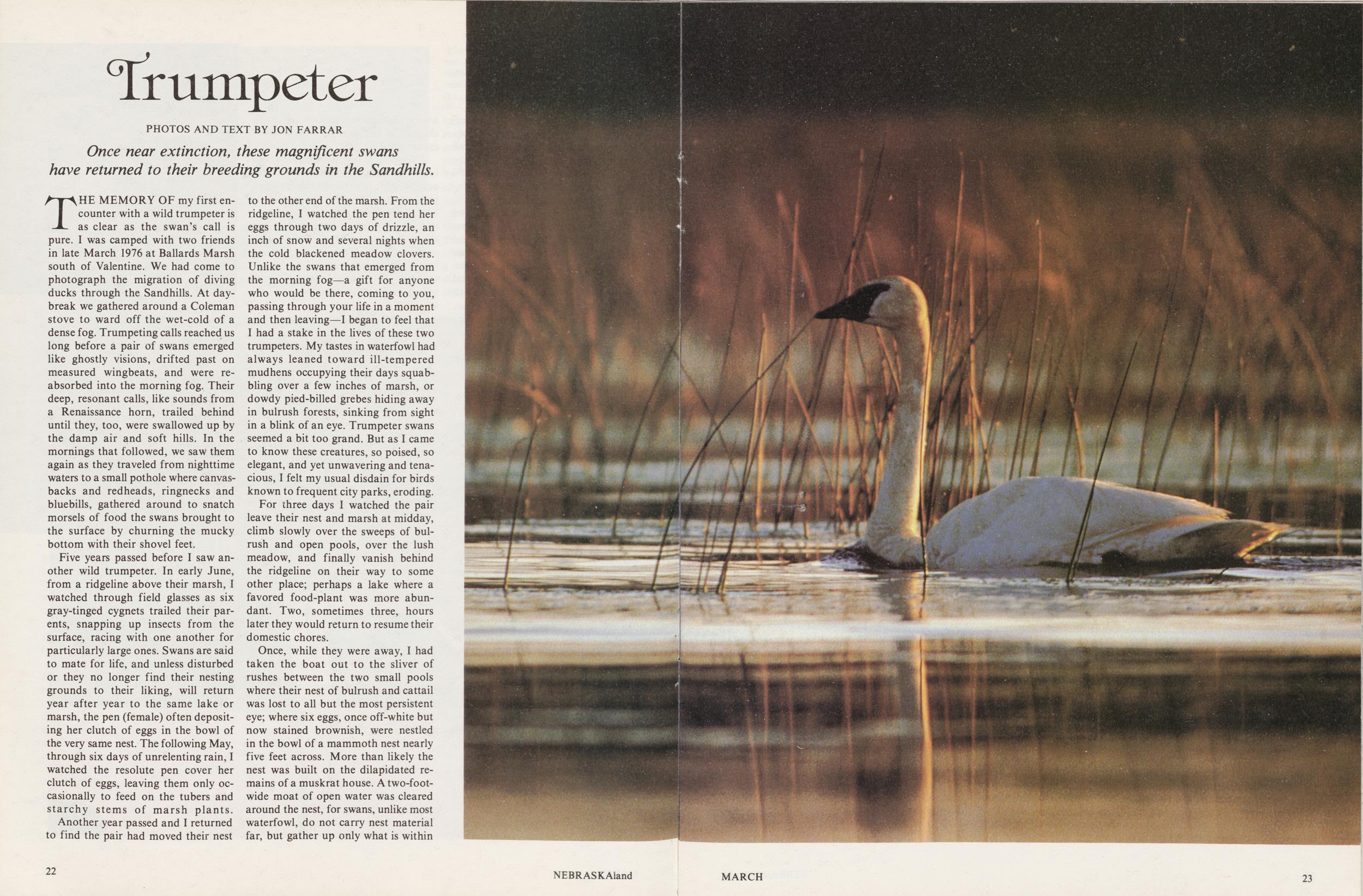
Trumpeter
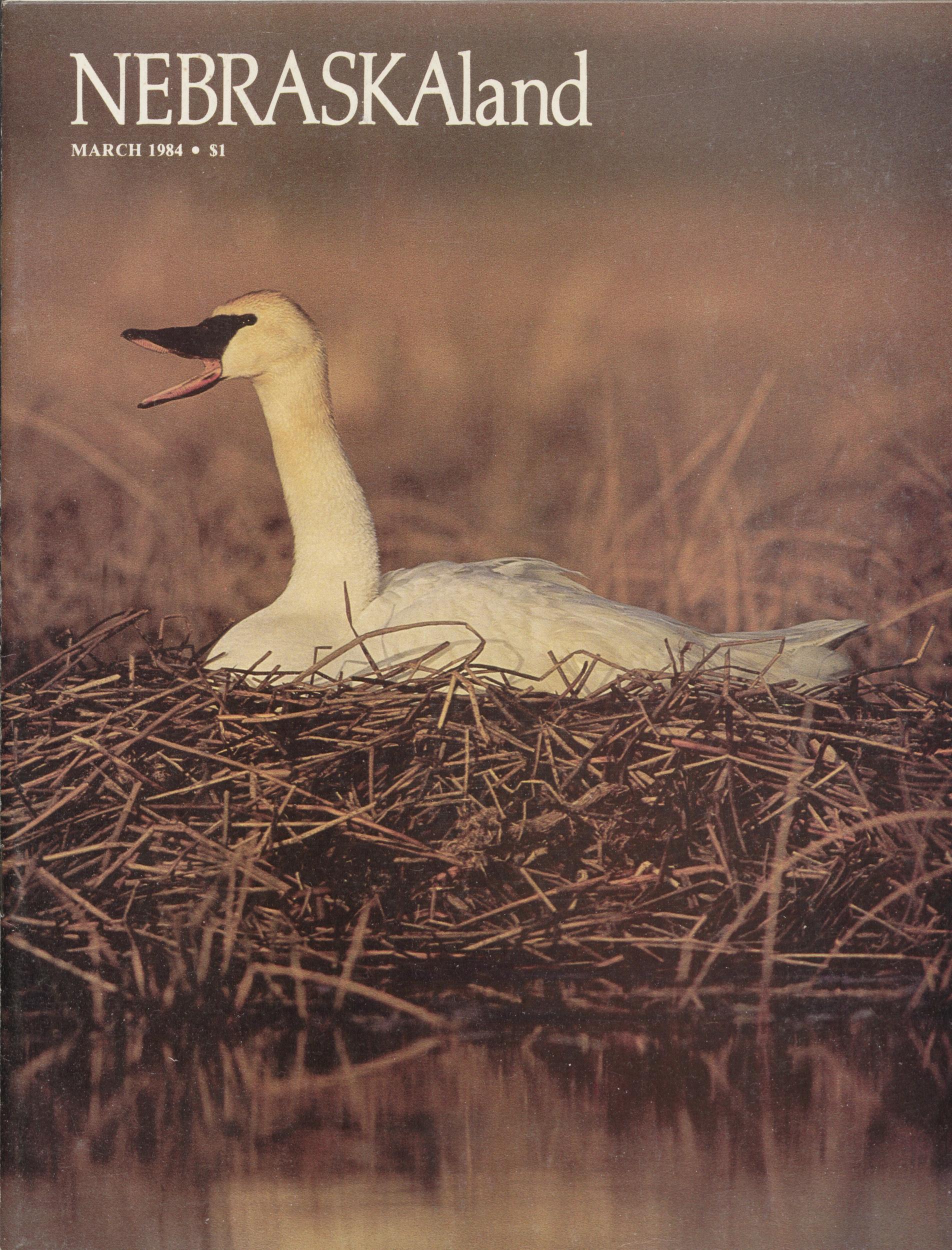
Once near extinction, these magnificent swans have returned to their breeding grounds in the Sandhills
THE MEMORY OF my first encounter with a wild trumpeter is as clear as the swan's call is pure. I was camped with two friends in late March 1976 at Ballards Marsh south of Valentine. We had come to photograph the migration of diving ducks through the Sandhills. At daybreak we gathered around a Coleman stove to ward off the wet-cold of a dense fog. Trumpeting calls reached us long before a pair of swans emerged like ghostly visions, drifted past on measured wingbeats, and were re-absorbed into the morning fog. Their deep, resonant calls, like sounds from a Renaissance horn, trailed behind until they, too, were swallowed up by the damp air and soft hills. In the mornings that followed, we saw them again as they traveled from nighttime waters to a small pothole where canvas-backs and redheads, ringnecks and bluebills, gathered around to snatch morsels of food the swans brought to the surface by churning the mucky bottom with their shovel feet.
Five years passed before I saw another wild trumpeter. In early June, from a ridgeline above their marsh, I watched through field glasses as six gray-tinged cygnets trailed their parents, snapping up insects from the surface, racing with one another for particularly large ones. Swans are said to mate for life, and unless disturbed or they no longer find their nesting grounds to their liking, will return year after year to the same lake or marsh, the pen (female) often depositing her clutch of eggs in the bowl of the very same nest. The following May, through six days of unrelenting rain, I watched the resolute pen cover her clutch of eggs, leaving them only occasionally to feed on the tubers and starchy stems of marsh plants.
Another year passed and I returned to find the pair had moved their nest to the other end of the marsh. From the ridgeline, I watched the pen tend her eggs through two days of drizzle, an inch of snow and several nights when the cold blackened meadow clovers. Unlike the swans that emerged from the morning fog—a gift for anyone who would be there, coming to you, passing through your life in a moment and then leaving—I began to feel that I had a stake in the lives of these two trumpeters. My tastes in waterfowl had always leaned toward ill-tempered mudhens occupying their days squabbling over a few inches of marsh, or dowdy pied-billed grebes hiding away in bulrush forests, sinking from sight in a blink of an eye. Trumpeter swans seemed a bit too grand. But as I came to know these creatures, so poised, so elegant, and yet unwavering and tenacious, I felt my usual disdain for birds known to frequent city parks, eroding.
For three days I watched the pair leave their nest and marsh at midday, climb slowly over the sweeps of bulrush and open pools, over the lush meadow, and finally vanish behind the ridgeline on their way to some other place; perhaps a lake where a favored food-plant was more abundant. Two, sometimes three, hours later they would return to resume their domestic chores.
Once, while they were away, I had taken the boat out to the sliver of rushes between the two small pools where their nest of bulrush and cattail was lost to all but the most persistent eye; where six eggs, once off-white but now stained brownish, were nestled in the bowl of a mammoth nest nearly five feet across. More than likely the nest was built on the dilapidated remains of a muskrat house. A two-foot-wide moat of open water was cleared around the nest, for swans, unlike most waterfowl, do not carry nest material far, but gather up only what is within
22 NEBRASKAland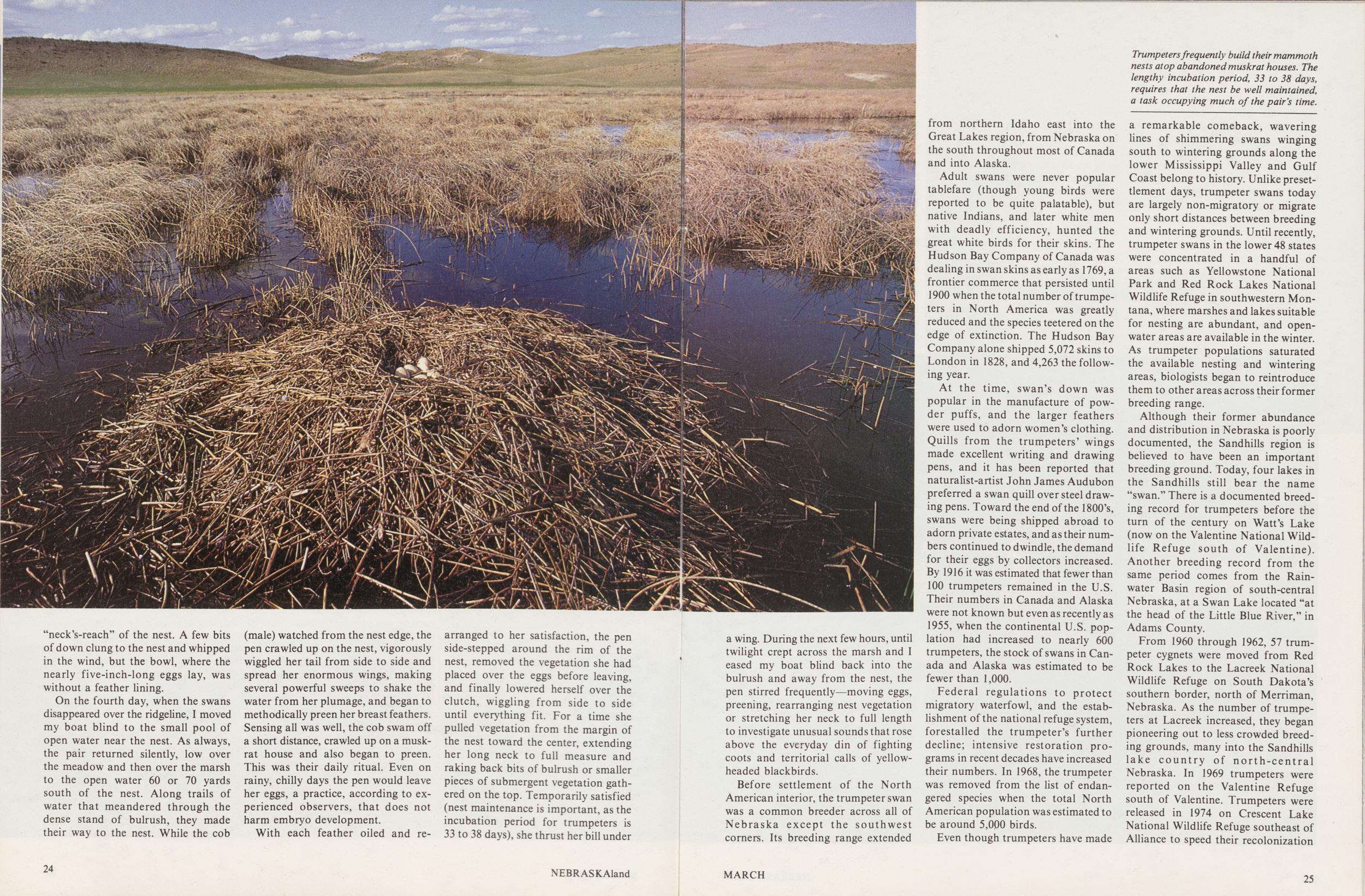
"neck's-reach" of the nest. A few bits of down clung to the nest and whipped in the wind, but the bowl, where the nearly five-inch-long eggs lay, was without a feather lining.
On the fourth day, when the swans disappeared over the ridgeline, I moved my boat blind to the small pool of open water near the nest. As always, the pair returned silently, low over the meadow and then over the marsh to the open water 60 or 70 yards south of the nest. Along trails of water that meandered through the dense stand of bulrush, they made their way to the nest. While the cob (male) watched from the nest edge, the pen crawled up on the nest, vigorously wiggled her tail from side to side and spread her enormous wings, making several powerful sweeps to shake the water from her plumage, and began to methodically preen her breast feathers. Sensing all was well, the cob swam off a short distance, crawled up on a muskrat house and also began to preen. This was their daily ritual. Even on rainy, chilly days the pen would leave her eggs, a practice, according to experienced observers, that does not harm embryo development.
With each feather oiled and rearranged to her satisfaction, the pen side-stepped around the rim of the nest, removed the vegetation she had placed over the eggs before leaving, and finally lowered herself over the clutch, wiggling from side to side until everything fit. For a time she pulled vegetation from the margin of the nest toward the center, extending her long neck to full measure and raking back bits of bulrush or smaller pieces of submergent vegetation gathered on the top. Temporarily satisfied (nest maintenance is important, as the incubation period for trumpeters is 33 to 38 days), she thrust her bill under 24 NEBRASKAland a wing. During the next few hours, until twilight crept across the marsh and I eased my boat blind back into the bulrush and away from the nest, the pen stirred frequently—moving eggs, preening, rearranging nest vegetation or stretching her neck to full length to investigate unusual sounds that rose above the everyday din of fighting coots and territorial calls of yellow-headed blackbirds.
Before settlement of the North American interior, the trumpeter swan was a common breeder across all of Nebraska except the southwest corners. Its breeding range extended from northern Idaho east into the Great Lakes region, from Nebraska on the south throughout most of Canada and into Alaska.
Adult swans were never popular tablefare (though young birds were reported to be quite palatable), but native Indians, and later white men with deadly efficiency, hunted the great white birds for their skins. The Hudson Bay Company of Canada was dealing in swan skins as early as 1769, a frontier commerce that persisted until 1900 when the total number of trumpeters in North America was greatly reduced and the species teetered on the edge of extinction. The Hudson Bay Company alone shipped 5,072 skins to London in 1828, and 4,263 the following year.
At the time, swan's down was popular in the manufacture of powder puffs, and the larger feathers were used to adorn women's clothing. Quills from the trumpeters' wings made excellent writing and drawing pens, and it has been reported that naturalist-artist John James Audubon preferred a swan quill over steel drawing pens. Toward the end of the 1800's, swans were being shipped abroad to adorn private estates, and as their numbers continued to dwindle, the demand for their eggs by collectors increased. By 1916 it was estimated that fewer than 100 trumpeters remained in the U.S. Their numbers in Canada and Alaska were not known but even as recently as 1955, when the continental U.S. poplation had increased to nearly 600 trumpeters, the stock of swans in Canada and Alaska was estimated to be fewer than 1,000.
Federal regulations to protect migratory waterfowl, and the establishment of the national refuge system, forestalled the trumpeter's further decline; intensive restoration programs in recent decades have increased their numbers. In 1968, the trumpeter was removed from the list of endangered species when the total North American population was estimated to be around 5,000 birds.
Even though trumpeters have made a remarkable comeback, wavering lines of shimmering swans winging south to wintering grounds along the lower Mississippi Valley and Gulf Coast belong to history. Unlike presettlement days, trumpeter swans today are largely non-migratory or migrate only short distances between breeding and wintering grounds. Until recently, trumpeter swans in the lower 48 states were concentrated in a handful of areas such as Yellowstone National Park and Red Rock Lakes National Wildlife Refuge in southwestern Montana, where marshes and lakes suitable for nesting are abundant, and open-water areas are available in the winter. As trumpeter populations saturated the available nesting and wintering areas, biologists began to reintroduce them to other areas across their former breeding range.
Although their former abundance and distribution in Nebraska is poorly documented, the Sandhills region is believed to have been an important breeding ground. Today, four lakes in the Sandhills still bear the name "swan." There is a documented breeding record for trumpeters before the turn of the century on Watt's Lake (now on the Valentine National Wildlife Refuge south of Valentine). Another breeding record from the same period comes from the Rainwater Basin region of south-central Nebraska, at a Swan Lake located "at the head of the Little Blue River," in Adams County.
From 1960 through 1962, 57 trumpeter cygnets were moved from Red Rock Lakes to the Lacreek National Wildlife Refuge on South Dakota's southern border, north of Merriman, Nebraska. As the number of trumpeters at Lacreek increased, they began pioneering out to less crowded breeding grounds, many into the Sandhills lake country of north-central Nebraska. In 1969 trumpeters were reported on the Valentine Refuge south of Valentine. Trumpeters were released in 1974 on Crescent Lake National Wildlife Refuge southeast of Alliance to speed their recolonization
MARCH 25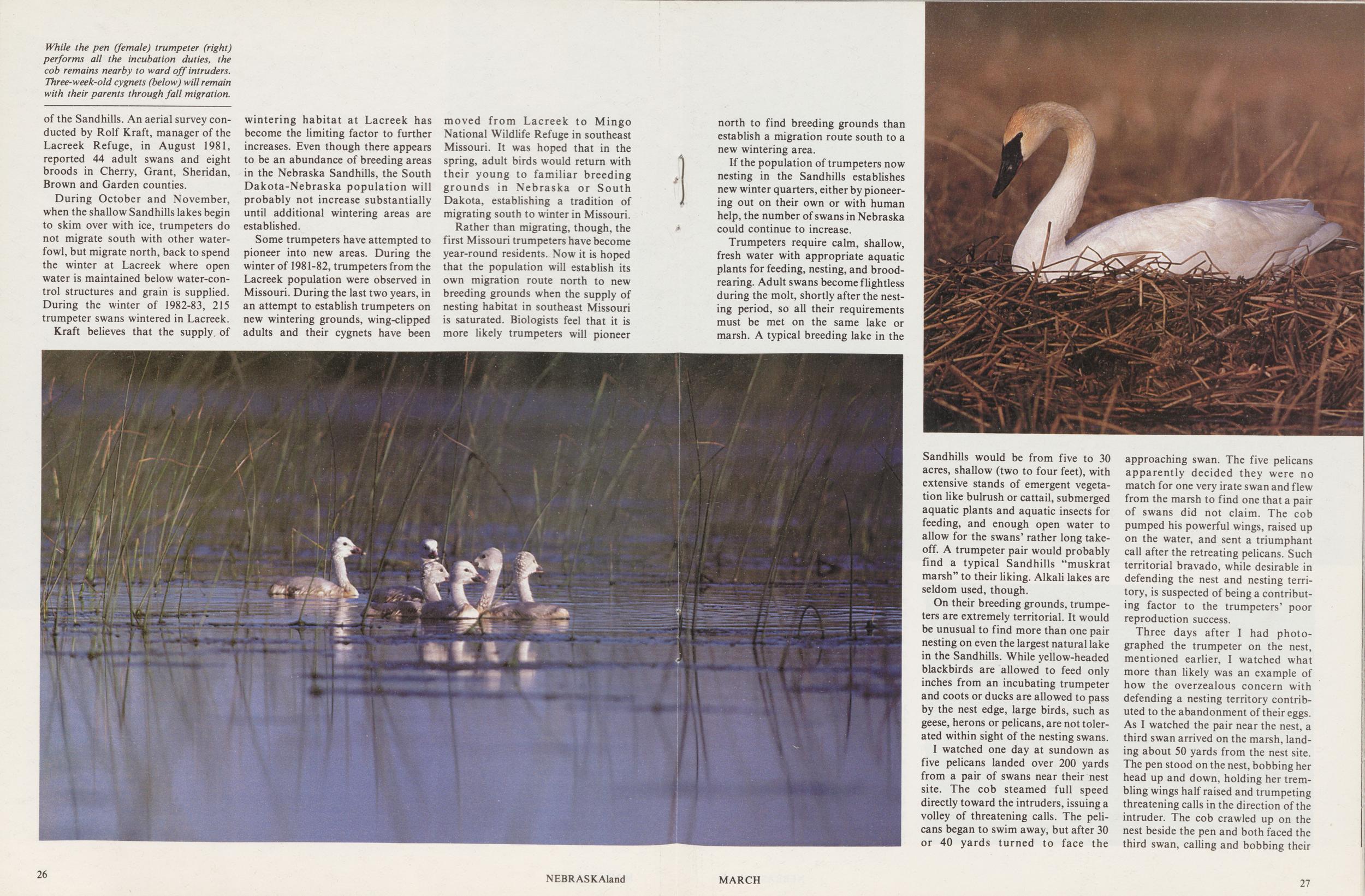
While the pen (female) trumpeter (right) performs all the incubation duties, the cob remains nearby to ward off intruders. Three-week-old cygnets (below) will remain with their parents through fall migration.
of the Sandhills. An aerial survey conducted by Rolf Kraft, manager of the Lacreek Refuge, in August 1981, reported 44 adult swans and eight broods in Cherry, Grant, Sheridan, Brown and Garden counties.
During October and November, when the shallow Sandhills lakes begin to skim over with ice, trumpeters do not migrate south with other waterfowl, but migrate north, back to spend the winter at Lacreek where open water is maintained below water-control structures and grain is supplied. During the winter of 1982-83, 215 trumpeter swans wintered in Lacreek.
Kraft believes that the supply, of wintering habitat at Lacreek has become the limiting factor to further increases. Even though there appears to be an abundance of breeding areas in the Nebraska Sandhills, the South Dakota-Nebraska population will probably not increase substantially until additional wintering areas are established.
Some trumpeters have attempted to pioneer into new areas. During the winter of 1981-82, trumpeters from the Lacreek population were observed in Missouri. During the last two years, in an attempt to establish trumpeters on new wintering grounds, wing-clipped adults and their cygnets have been moved from Lacreek to Mingo National Wildlife Refuge in southeast Missouri. It was hoped that in the spring, adult birds would return with their young to familiar breeding grounds in Nebraska or South Dakota, establishing a tradition of migrating south to winter in Missouri.
Rather than migrating, though, the first Missouri trumpeters have become year-round residents. Now it is hoped that the population will establish its own migration route north to new breeding grounds when the supply of nesting habitat in southeast Missouri is saturated. Biologists feel that it is more likely trumpeters will pioneer 26 NEBRASKAland north to find breeding grounds than establish a migration route south to a new wintering area.
If the population of trumpeters now nesting in the Sandhills establishes new winter quarters, either by pioneering out on their own or with human help, the number of swans in Nebraska could continue to increase.
Trumpeters require calm, shallow, fresh water with appropriate aquatic plants for feeding, nesting, and brood-rearing. Adult swans become flightless during the molt, shortly after the nesting period, so all their requirements must be met on the same lake or marsh. A typical breeding lake in the
On their breeding grounds, trumpeters are extremely territorial. It would be unusual to find more than one pair nesting on even the largest natural lake in the Sandhills. While yellow-headed blackbirds are allowed to feed only inches from an incubating trumpeter and coots or ducks are allowed to pass by the nest edge, large birds, such as geese, herons or pelicans, are not tolerated within sight of the nesting swans.
I watched one day at sundown as five pelicans landed over 200 yards from a pair of swans near their nest site. The cob steamed full speed directly toward the intruders, issuing a volley of threatening calls. The pelicans began to swim away, but after 30 or 40 yards turned to face the approaching swan. The five pelicans apparently decided they were no match for one very irate swan and flew from the marsh to find one that a pair of swans did not claim. The cob pumped his powerful wings, raised up on the water, and sent a triumphant call after the retreating pelicans. Such territorial bravado, while desirable in defending the nest and nesting territory, is suspected of being a contributing factor to the trumpeters' poor reproduction success.
Three days after I had photographed the trumpeter on the nest, mentioned earlier, I watched what more than likely was an example of how the overzealous concern with defending a nesting territory contributed to the abandonment of their eggs. As I watched the pair near the nest, a third swan arrived on the marsh, landing about 50 yards from the nest site. The pen stood on the nest, bobbing her head up and down, holding her trembling wings half raised and trumpeting threatening calls in the direction of the intruder. The cob crawled up on the nest beside the pen and both faced the third swan, calling and bobbing their
MARCH 27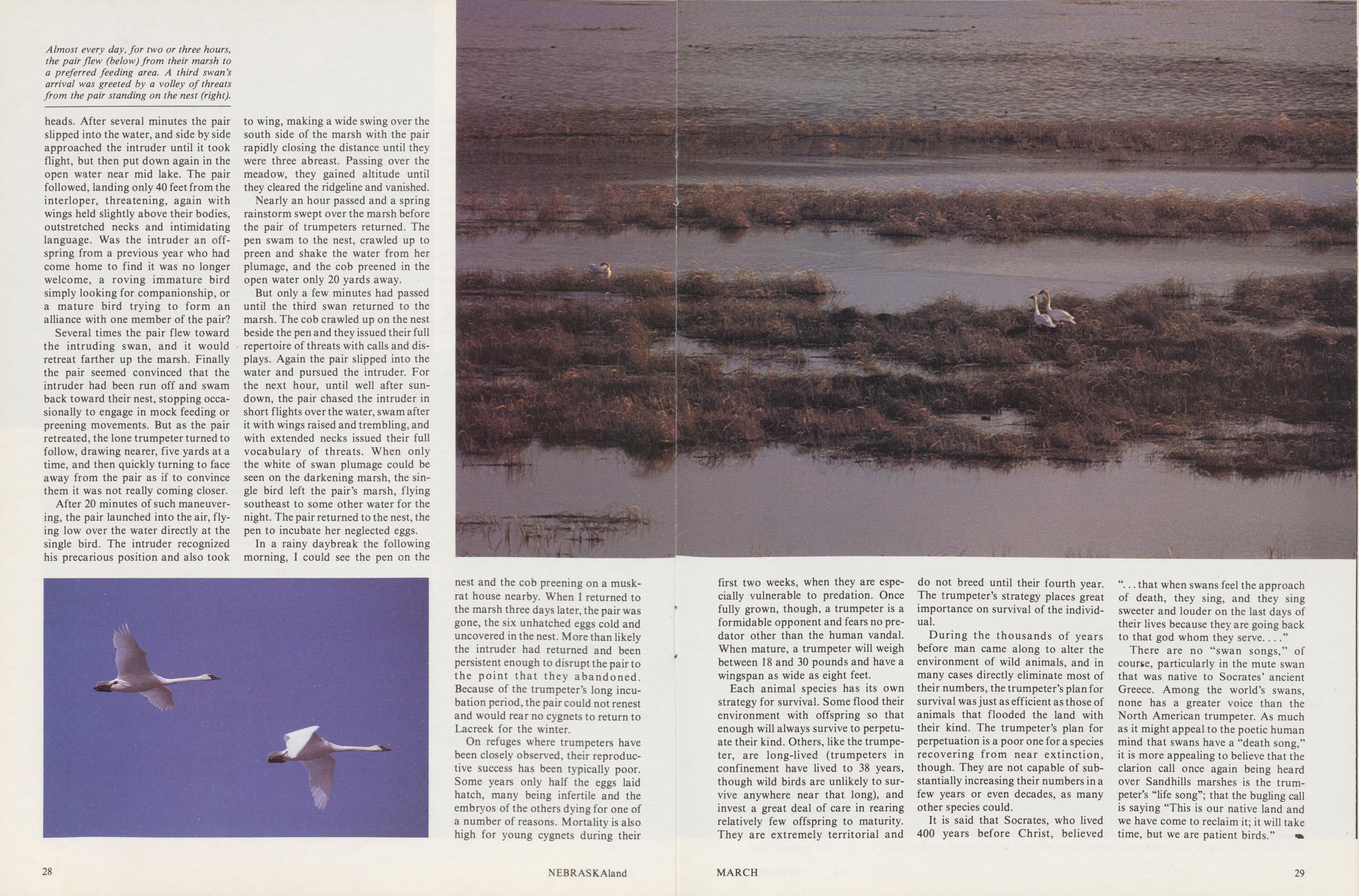
heads. After several minutes the pair slipped into the water, and side by side approached the intruder until it took flight, but then put down again in the open water near mid lake. The pair followed, landing only 40 feet from the interloper, threatening, again with wings held slightly above their bodies, outstretched necks and intimidating language. Was the intruder an off-spring from a previous year who had come home to find it was no longer welcome, a roving immature bird simply looking for companionship, or a mature bird trying to form an alliance with one member of the pair?
Several times the pair flew toward the intruding swan, and it would retreat farther up the marsh. Finally the pair seemed convinced that the intruder had been run off and swam back toward their nest, stopping occasionally to engage in mock feeding or preening movements. But as the pair retreated, the lone trumpeter turned to follow, drawing nearer, five yards at a time, and then quickly turning to face away from the pair as if to convince them it was not really coming closer.
After 20 minutes of such maneuvering, the pair launched into the air, flying low over the water directly at the single bird. The intruder recognized his precarious position and also took
Nearly an hour passed and a spring rainstorm swept over the marsh before the pair of trumpeters returned. The pen swam to the nest, crawled up to preen and shake the water from her plumage, and the cob preened in the open water only 20 yards away.
But only a few minutes had passed until the third swan returned to the marsh. The cob crawled up on the nest beside the pen and they issued their full repertoire of threats with calls and displays. Again the pair slipped into the water and pursued the intruder. For the next hour, until well after sundown, the pair chased the intruder in short flights over the water, swam after it with wings raised and trembling, and with extended necks issued their full vocabulary of threats. When only the white of swan plumage could be seen on the darkening marsh, the single bird left the pair's marsh, flying southeast to some other water for the night. The pair returned to the nest, the pen to incubate her neglected eggs.
In a rainy daybreak the following morning, I could see the pen on the nest and the cob preening on a muskrat house nearby. When I returned to the marsh three days later, the pair was gone, the six unhatched eggs cold and uncovered in the nest. More than likely the intruder had returned and been persistent enough to disrupt the pair to the point that they abandoned. Because of the trumpeter's long incubation period, the pair could not renest and would rear no cygnets to return to Lacreek for the winter.
On refuges where trumpeters have been closely observed, their reproductive success has been typically poor. Some years only half the eggs laid hatch, many being infertile and the embryos of the others dying for one of a number of reasons. Mortality is also high for young cygnets during their 28 NEBRASKAland first two weeks, when they are especially vulnerable to predation. Once fully grown, though, a trumpeter is a formidable opponent and fears no predator other than the human vandal. When mature, a trumpeter will weigh between 18 and 30 pounds and have a wingspan as wide as eight feet.
Each animal species has its own strategy for survival. Some flood their environment with offspring so that enough will always survive to perpetuate their kind. Others, like the trumpeter, are long-lived (trumpeters in confinement have lived to 38 years, though wild birds are unlikely to survive anywhere near that long), and invest a great deal of care in rearing relatively few offspring to maturity. They are extremely territorial and do not breed until their fourth year. The trumpeter's strategy places great importance on survival of the individual.
During the thousands of years before man came along to alter the environment of wild animals, and in many cases directly eliminate most of their numbers, the trumpeter's plan for survival was just as efficient as those of animals that flooded the land with their kind. The trumpeter's plan for perpetuation is a poor one for a species recovering from near extinction, though. They are not capable of substantially increasing their numbers in a few years or even decades, as many other species could.
It is said that Socrates, who lived 400 years before Christ, believed "... that when swans feel the approach of death, they sing, and they sing sweeter and louder on the last days of their lives because they are going back to that god whom they serve...."
There are no "swan songs," of course, particularly in the mute swan that was native to Socrates' ancient Greece. Among the world's swans, none has a greater voice than the North American trumpeter. As much as it might appeal to the poetic human mind that swans have a "death song," it is more appealing to believe that the clarion call once again being heard over Sandhills marshes is the trumpeter's "life song"; that the bugling call is saying "This is our native land and we have come to reclaim it; it will take time, but we are patient birds."
MARCH 29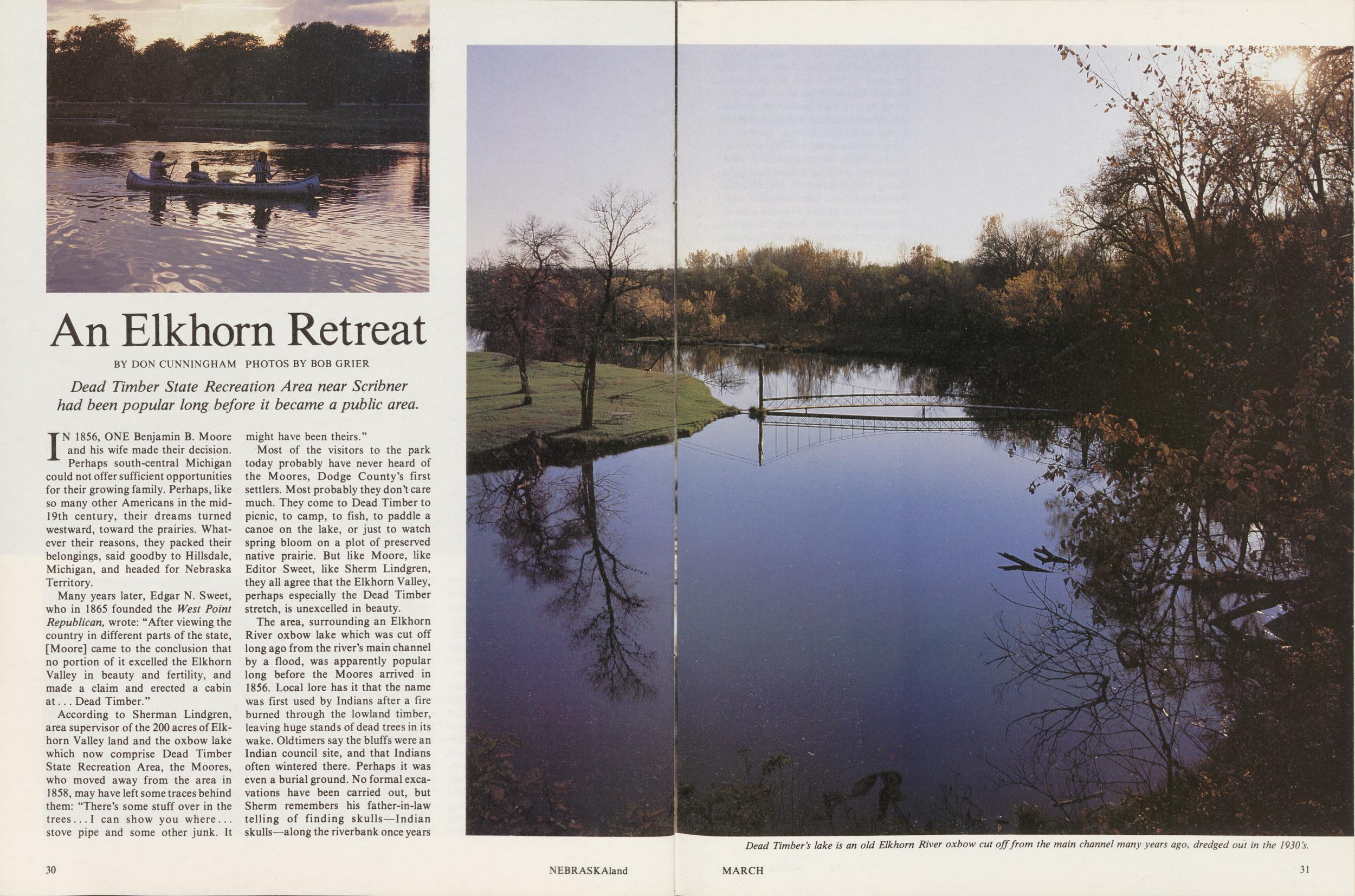
An Elkhorn Retreat
Dead Timber State Recreation Area near Scribner had been popular long before it became a public area.
IN 1856, ONE Benjamin B. Moore and his wife made their decision. Perhaps south-central Michigan could not offer sufficient opportunities for their growing family. Perhaps, like so many other Americans in the mid-19th century, their dreams turned westward, toward the prairies. Whatever their reasons, they packed their belongings, said goodby to Hillsdale, Michigan, and headed for Nebraska Territory.
Many years later, Edgar N. Sweet, who in 1865 founded the West Point Republican, wrote: "After viewing the country in different parts of the state, [Moore] came to the conclusion that no portion of it excelled the Elkhorn Valley in beauty and fertility, and made a claim and erected a cabin at... Dead Timber."
According to Sherman Lindgren, area supervisor of the 200 acres of Elkhorn Valley land and the oxbow lake which now comprise Dead Timber State Recreation Area, the Moores, who moved away from the area in 1858, may have left some traces behind them: "There's some stuff over in the trees ... I can show you where... stove pipe and some other junk. It might have been theirs."
Most of the visitors to the park today probably have never heard of the Moores, Dodge County's first settlers. Most probably they don't care much. They come to Dead Timber to picnic, to camp, to fish, to paddle a canoe on the lake, or just to watch spring bloom on a plot of preserved native prairie. But like Moore, like Editor Sweet, like Sherm Lindgren, they all agree that the Elkhorn Valley, perhaps especially the Dead Timber stretch, is unexcelled in beauty.
The area, surrounding an Elkhorn River oxbow lake which was cut off long ago from the river's main channel by a flood, was apparently popular long before the Moores arrived in 1856. Local lore has it that the name was first used by Indians after a fire burned through the lowland timber, leaving huge stands of dead trees in its wake. Oldtimers say the bluffs were an Indian council site, and that Indians often wintered there. Perhaps it was even a burial ground. No formal excavations have been carried out, but Sherm remembers his father-in-law telling of finding skulls—Indian skulls—along the riverbank once years
30 NEBRASKAland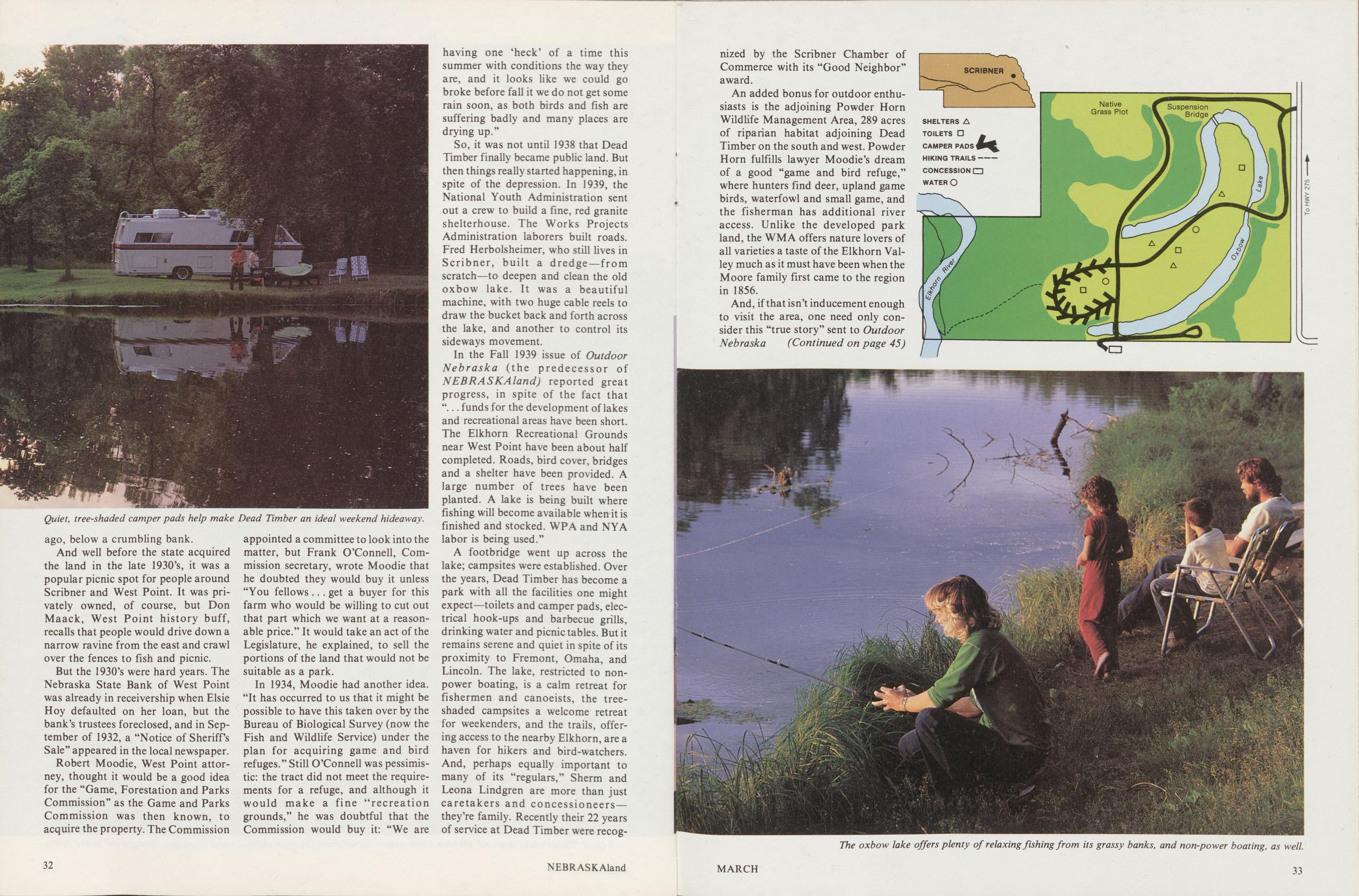
ago, below a crumbling bank.
And well before the state acquired the land in the late 1930's, it was a popular picnic spot for people around Scribner and West Point. It was privately owned, of course, but Don Maack, West Point history buff, recalls that people would drive down a narrow ravine from the east and crawl over the fences to fish and picnic.
But the 1930's were hard years. The Nebraska State Bank of West Point was already in receivership when Elsie Hoy defaulted on her loan, but the bank's trustees foreclosed, and in September of 1932, a "Notice of Sheriff's Sale" appeared in the local newspaper.
Robert Moodie, West Point attorney, thought it would be a good idea for the "Game, Forestation and Parks Commission" as the Game and Parks Commission was then known, to acquire the property. The Commission appointed a committee to look into the matter, but Frank O'Connell, Commission secretary, wrote Moodie that he doubted they would buy it unless "You fellows ... get a buyer for this farm who would be willing to cut out that part which we want at a reasonable price." It would take an act of the Legislature, he explained, to sell the portions of the land that would not be suitable as a park.
In 1934, Moodie had another idea. "It has occurred to us that it might be possible to have this taken over by the Bureau of Biological Survey (now the Fish and Wildlife Service) under the plan for acquiring game and bird refuges." Still O'Connell was pessimistic: the tract did not meet the requirements for a refuge, and although it would make a fine "recreation grounds," he was doubtful that the Commission would buy it: "We are having one 'heck' of a time this summer with conditions the way they are, and it looks like we could go broke before fall it we do not get some rain soon, as both birds and fish are suffering badly and many places are drying up."
So, it was not until 1938 that Dead Timber finally became public land. But then things really started happening, in spite of the depression. In 1939, the National Youth Administration sent out a crew to build a fine, red granite shelterhouse. The Works Projects Administration laborers built roads. Fred Herbolsheimer, who still lives in Scribner, built a dredge—from scratch—to deepen and clean the old oxbow lake. It was a beautiful machine, with two huge cable reels to draw the bucket back and forth across the lake, and another to control its sideways movement.
In the Fall 1939 issue of Outdoor Nebraska (the predecessor of NEBRASKAland) reported great progress, in spite of the fact that "... funds for the development of lakes and recreational areas have been short. The Elkhorn Recreational Grounds near West Point have been about half completed. Roads, bird cover, bridges and a shelter have been provided. A large number of trees have been planted. A lake is being built where fishing will become available when it is finished and stocked. WPA and NYA labor is being used."
A footbridge went up across the lake; campsites were established. Over the years, Dead Timber has become a park with all the facilities one might expect—toilets and camper pads, electrical hook-ups and barbecue grills, drinking water and picnic tables. But it remains serene and quiet in spite of its proximity to Fremont, Omaha, and Lincoln. The lake, restricted to non-power boating, is a calm retreat for fishermen and canoeists, the tree-shaded campsites a welcome retreat for weekenders, and the trails, offering access to the nearby Elkhorn, are a haven for hikers and bird-watchers. And, perhaps equally important to many of its "regulars," Sherm and Leona Lindgren are more than just caretakers and concessioneers—they're family. Recently their 22 years of service at Dead Timber were recognized 32 NEBRASKAland by the Scribner Chamber of Commerce with its "Good Neighbor" award.
An added bonus for outdoor enthusiasts is the adjoining Powder Horn Wildlife Management Area, 289 acres of riparian habitat adjoining Dead Timber on the south and west. Powder Horn fulfills lawyer Moodie's dream of a good "game and bird refuge," where hunters find deer, upland game birds, waterfowl and small game, and the fisherman has additional river access. Unlike the developed park land, the WMA offers nature lovers of all varieties a taste of the Elkhorn Valley much as it must have been when the Moore family first came to the region in 1856.
And, if that isn't inducement enough to visit the area, one need only consider this "true story" sent to Outdoor Nebraska (Continued on page 45)
SHELTERS TOILETS CAMPER PADS HIKING TRAILS CONCESSION WATER
The Journey
The call of migrating birds in the night brings a desire to be almost anywhere but where we are; an urging to take up the journey.
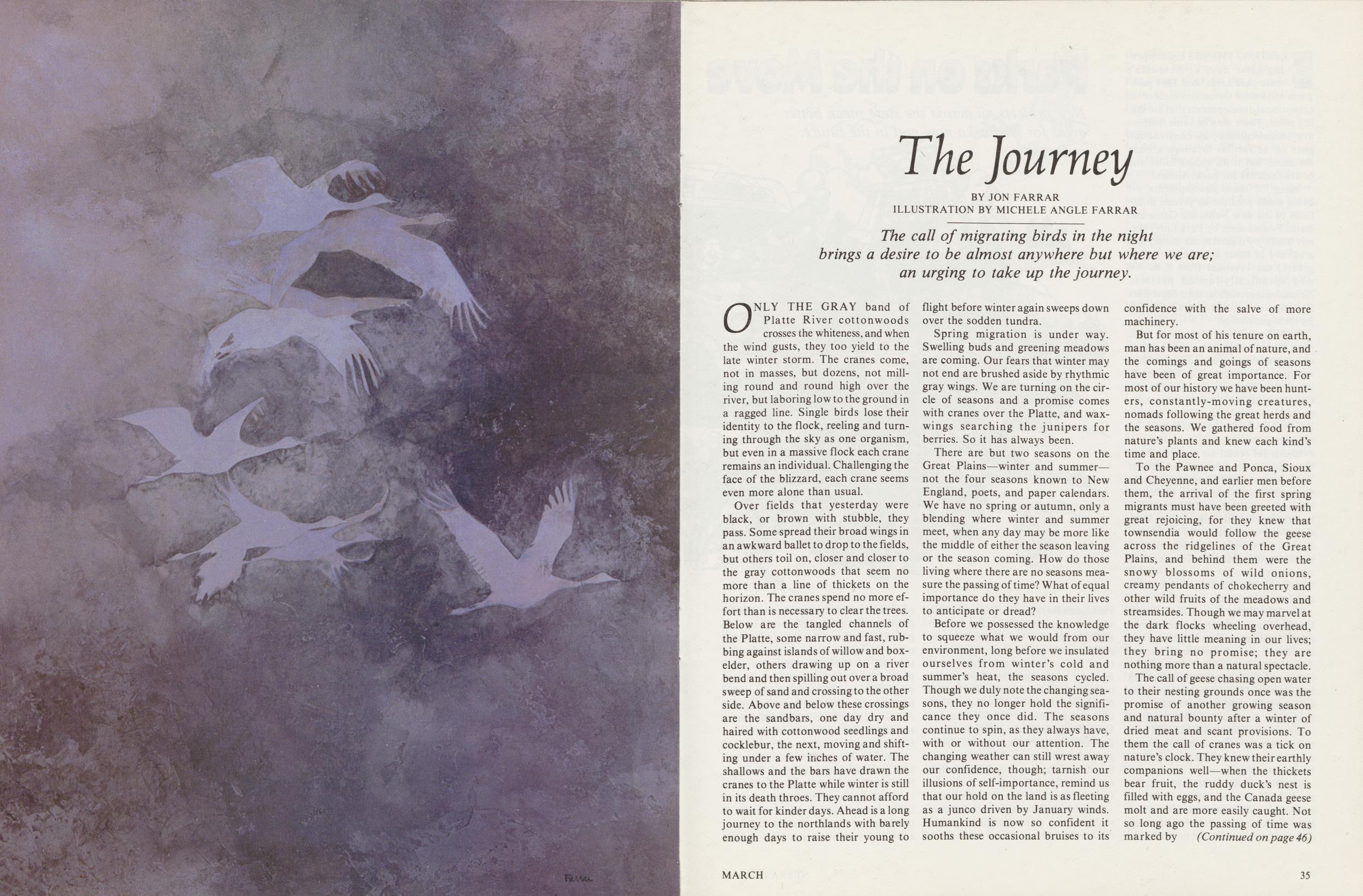
ONLY THE GRAY band of Platte River cottonwoods crosses the whiteness, and when the wind gusts, they too yield to the late winter storm. The cranes come, not in masses, but dozens, not milling round and round high over the river, but laboring low to the ground in a ragged line. Single birds lose their identity to the flock, reeling and turning through the sky as one organism, but even in a massive flock each crane remains an individual. Challenging the face of the blizzard, each crane seems even more alone than usual.
Over fields that yesterday were black, or brown with stubble, they pass. Some spread their broad wings in an awkward ballet to drop to the fields, but others toil on, closer and closer to the gray cottonwoods that seem no more than a line of thickets on the horizon. The cranes spend no more effort than is necessary to clear the trees. Below are the tangled channels of the Platte, some narrow and fast, rubbing against islands of willow and box- elder, others drawing up on a river bend and then spilling out over a broad sweep of sand and crossing to the other side. Above and below these crossings are the sandbars, one day dry and haired with cottonwood seedlings and cocklebur, the next, moving and shifting under a few inches of water. The shallows and the bars have drawn the cranes to the Platte while winter is still in its death throes. They cannot afford to wait for kinder days. Ahead is a long journey to the northlands with barely enough days to raise their young to flight before winter again sweeps down over the sodden tundra.
Spring migration is under way. Swelling buds and greening meadows are coming. Our fears that winter may not end are brushed aside by rhythmic gray wings. We are turning on the circle of seasons and a promise comes with cranes over the Platte, and wax-wings searching the junipers for berries. So it has always been.
There are but two seasons on the Great Plains—winter and summer—not the four seasons known to New England, poets, and paper calendars. We have no spring or autumn, only a blending where winter and summer meet, when any day may be more like the middle of either the season leaving or the season coming. How do those living where there are no seasons measure the passing of time? What of equal importance do they have in their lives to anticipate or dread?
Before we possessed the knowledge to squeeze what we would from our environment, long before we insulated ourselves from winter's cold and summer's heat, the seasons cycled. Though we duly note the changing seasons, they no longer hold the significance they once did. The seasons continue to spin, as they always have, with or without our attention. The changing weather can still wrest away our confidence, though; tarnish our illusions of self-importance, remind us that our hold on the land is as fleeting as a junco driven by January winds. Humankind is now so confident it sooths these occasional bruises to its confidence with the salve of more machinery.
But for most of his tenure on earth, man has been an animal of nature, and the comings and goings of seasons have been of great importance. For most of our history we have been hunters, constantly-moving creatures, nomads following the great herds and the seasons. We gathered food from nature's plants and knew each kind's time and place.
To the Pawnee and Ponca, Sioux and Cheyenne, and earlier men before them, the arrival of the first spring migrants must have been greeted with great rejoicing, for they knew that townsendia would follow the geese across the ridgelines of the Great Plains, and behind them were the snowy blossoms of wild onions, creamy pendants of chokecherry and other wild fruits of the meadows and streamsides. Though we may marvel at the dark flocks wheeling overhead, they have little meaning in our lives; they bring no promise; they are nothing more than a natural spectacle.
The call of geese chasing open water to their nesting grounds once was the promise of another growing season and natural bounty after a winter of dried meat and scant provisions. To them the call of cranes was a tick on nature's clock. They knew their earthly companions well—when the thickets bear fruit, the ruddy duck's nest is filled with eggs, and the Canada geese molt and are more easily caught. Not so long ago the passing of time was marked by (Continued on page 46)
MARCH 35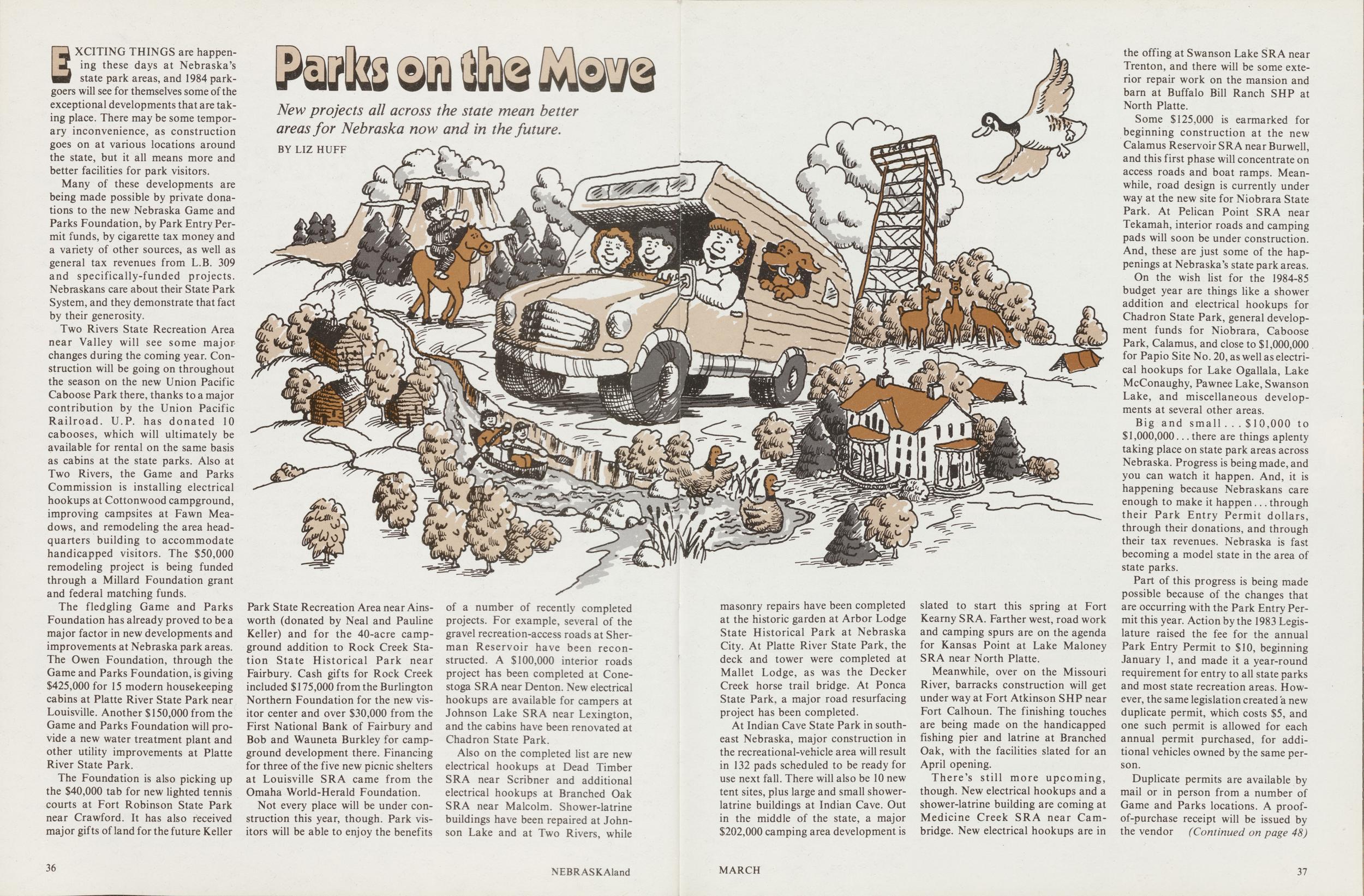
Parks on the Move
New projects all across the state mean better areas for Nebraska now and in the future.
EXCITING THINGS are happening these days at Nebraska's state park areas, and 1984 park-goers will see for themselves some of the exceptional developments that are taking place. There may be some temporary inconvenience, as construction goes on at various locations around the state, but it all means more and better facilities for park visitors.
Many of these developments are being made possible by private donations to the new Nebraska Game and Parks Foundation, by Park Entry Permit funds, by cigarette tax money and a variety of other sources, as well as general tax revenues from L.B. 309 and specifically-funded projects. Nebraskans care about their State Park System, and they demonstrate that fact by their generosity.
Two Rivers State Recreation Area near Valley will see some major changes during the coming year. Construction will be going on throughout the season on the new Union Pacific Caboose Park there, thanks to a major contribution by the Union Pacific Railroad. U.P. has donated 10 cabooses, which will ultimately be available for rental on the same basis as cabins at the state parks. Also at Two Rivers, the Game and Parks Commission is installing electrical hookups at Cottonwood campground, improving campsites at Fawn Meadows, and remodeling the area headquarters building to accommodate handicapped visitors. The $50,000 remodeling project is being funded through a Millard Foundation grant and federal matching funds.
The fledgling Game and Parks Foundation has already proved to be a major factor in new developments and improvements at Nebraska park areas. The Owen Foundation, through the Game and Parks Foundation, is giving $425,000 for 15 modern housekeeping cabins at Platte River State Park near Louisville. Another $150,000 from the Game and Parks Foundation will provide a new water treatment plant and other utility improvements at Platte River State Park.
The Foundation is also picking up the $40,000 tab for new lighted tennis courts at Fort Robinson State Park near Crawford. It has also received major gifts of land for the future Keller Park State Recreation Area near Ainsworth (donated by Neal and Pauline Keller) and for the 40-acre campground addition to Rock Creek Station State Historical Park near Fairbury. Cash gifts for Rock Creek included $175,000 from the Burlington Northern Foundation for the new visitor center and over $30,000 from the First National Bank of Fairbury and Bob and Wauneta Burkley for campground development there. Financing for three of the five new picnic shelters at Louisville SRA came from the Omaha World-Herald Foundation.
Not every place will be under construction this year, though. Park visitors will be able to enjoy the benefits of a number of recently completed projects. For example, several of the gravel recreation-access roads at Sherman Reservoir have been reconstructed. A $100,000 interior roads project has been completed at Conestoga SRA near Denton. New electrical hookups are available for campers at Johnson Lake SRA near Lexington, and the cabins have been renovated at Chadron State Park.
Also on the completed list are new electrical hookups at Dead Timber SRA near Scribner and additional electrical hookups at Branched Oak SRA near Malcolm. Shower-latrine buildings have been repaired at Johnson Lake and at Two Rivers, while 36 NEBRASKAland masonry repairs have been completed at the historic garden at Arbor Lodge State Historical Park at Nebraska City. At Platte River State Park, the deck and tower were completed at Mallet Lodge, as was the Decker Creek horse trail bridge. At Ponca State Park, a major road resurfacing project has been completed.
At Indian Cave State Park in southeast Nebraska, major construction in the recreational-vehicle area will result in 132 pads scheduled to be ready for use next fall. There will also be 10 new tent sites, plus large and small shower-latrine buildings at Indian Cave. Out in the middle of the state, a major $202,000 camping area development is slated to start this spring at Fort Kearny SRA. Farther west, road work and camping spurs are on the agenda for Kansas Point at Lake Maloney SRA near North Platte.
Meanwhile, over on the Missouri River, barracks construction will get under way at Fort Atkinson SHP near Fort Calhoun. The finishing touches are being made on the handicapped fishing pier and latrine at Branched Oak, with the facilities slated for an April opening.
There's still more upcoming, though. New electrical hookups and a shower-latrine building are coming at Medicine Creek SRA near Cambridge. New electrical hookups are in the offing at Swanson Lake SRA near Trenton, and there will be some exterior repair work on the mansion and barn at Buffalo Bill Ranch SHP at North Platte.
Some $125,000 is earmarked for beginning construction at the new Calamus Reservoir SRA near Burwell, and this first phase will concentrate on access roads and boat ramps. Meanwhile, road design is currently under way at the new site for Niobrara State Park. At Pelican Point SRA near Tekamah, interior roads and camping pads will soon be under construction. And, these are just some of the happenings at Nebraska's state park areas.
On the wish list for the 1984-85 budget year are things like a shower addition and electrical hookups for Chadron State Park, general development funds for Niobrara, Caboose Park, Calamus, and close to $1,000,000 for Papio Site No. 20, as well as electrical hookups for Lake Ogallala, Lake McConaughy, Pawnee Lake, Swanson Lake, and miscellaneous developments at several other areas.
Big and small . . . $10,000 to $1,000,000... there are things aplenty taking place on state park areas across Nebraska. Progress is being made, and you can watch it happen. And, it is happening because Nebraskans care enough to make it happen... through their Park Entry Permit dollars, through their donations, and through their tax revenues. Nebraska is fast becoming a model state in the area of state parks.
Part of this progress is being made possible because of the changes that are occurring with the Park Entry Permit this year. Action by the 1983 Legislature raised the fee for the annual Park Entry Permit to $10, beginning January 1, and made it a year-round requirement for entry to all state parks and most state recreation areas. However, the same legislation created a new duplicate permit, which costs $5, and one such permit is allowed for each annual permit purchased, for additional vehicles owned by the same person.
Duplicate permits are available by mail or in person from a number of Game and Parks locations. A proof-of-purchase receipt will be issued by the vendor (Continued on page 48)
MARCH 37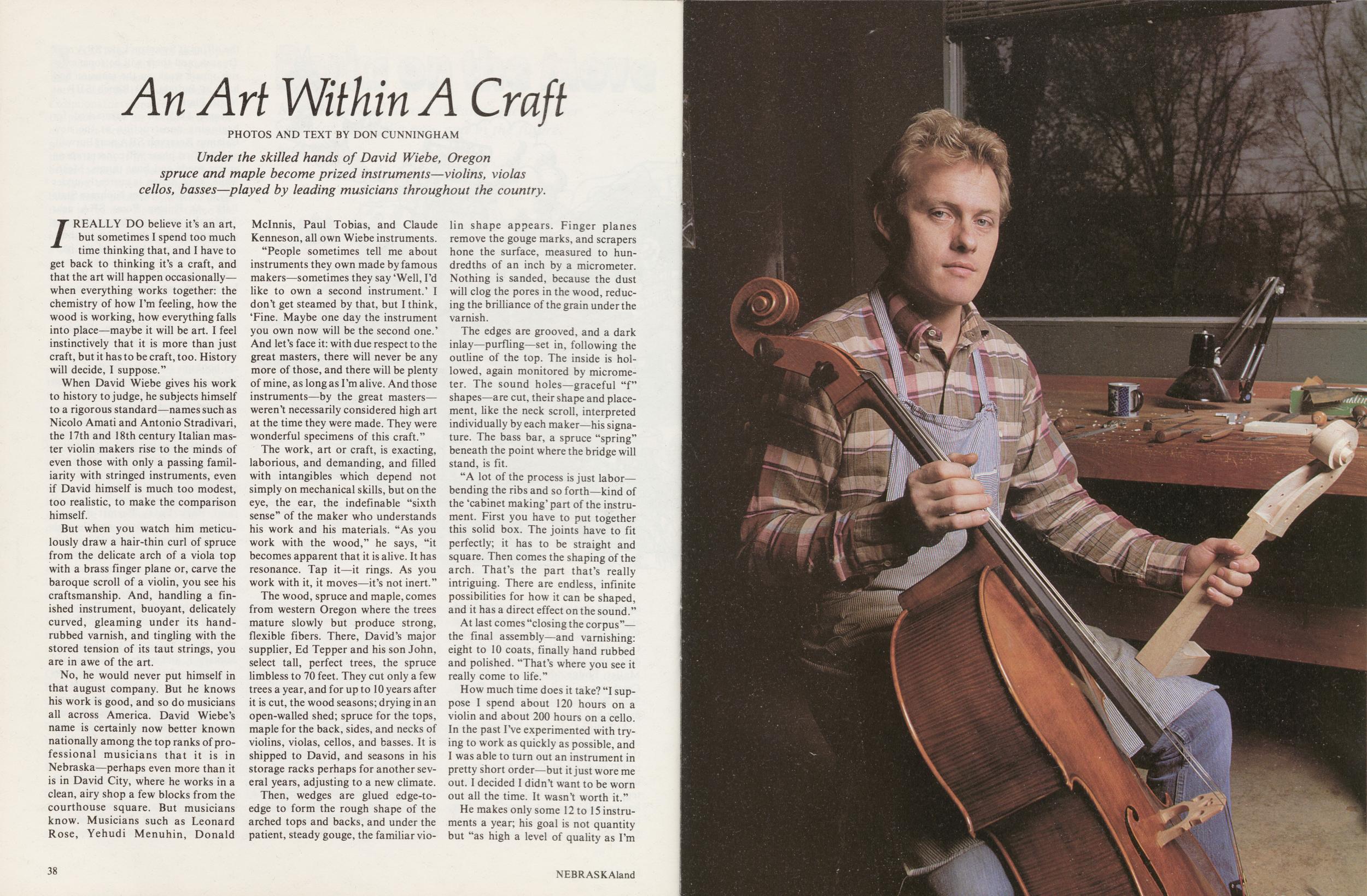
An Art Within A Craft
Under the skilled hands of David Wiebe, Oregon spruce and maple become prized instruments—violins, violas cellos, basses—played by leading musicians throughout the country.
I REALLY DO believe it's an art, but sometimes I spend too much time thinking that, and I have to get back to thinking it's a craft, and that the art will happen occasionally—when everything works together: the chemistry of how I'm feeling, how the wood is working, how everything falls into place—maybe it will be art. I feel instinctively that it is more than just craft, but it has to be craft, too. History will decide, I suppose."
When David Wiebe gives his work to history to judge, he subjects himself to a rigorous standard—names such as Nicolo Amati and Antonio Stradivari, the 17th and 18th century Italian master violin makers rise to the minds of even those with only a passing familiarity with stringed instruments, even if David himself is much too modest, too realistic, to make the comparison himself.
But when you watch him meticulously draw a hair-thin curl of spruce from the delicate arch of a viola top with a brass finger plane or, carve the baroque scroll of a violin, you see his craftsmanship. And, handling a finished instrument, buoyant, delicately curved, gleaming under its hand-rubbed varnish, and tingling with the stored tension of its taut strings, you are in awe of the art.
No, he would never put himself in that august company. But he knows his work is good, and so do musicians all across America. David Wiebe's name is certainly now better known nationally among the top ranks of professional musicians that it is in Nebraska—perhaps even more than it is in David City, where he works in a clean, airy shop a few blocks from the courthouse square. But musicians know. Musicians such as Leonard Rose, Yehudi Menuhin, Donald Mclnnis, Paul Tobias, and Claude Kenneson, all own Wiebe instruments.
"People sometimes tell me about instruments they own made by famous makers—sometimes they say 'Well, I'd like to own a second instrument.' I don't get steamed by that, but I think, 'Fine. Maybe one day the instrument you own now will be the second one.' And let's face it: with due respect to the great masters, there will never be any more of those, and there will be plenty of mine, as long as I'm alive. And those instruments—by the great masters—weren't necessarily considered high art at the time they were made. They were wonderful specimens of this craft."
The work, art or craft, is exacting, laborious, and demanding, and filled with intangibles which depend not simply on mechanical skills, but on the eye, the ear, the indefinable "sixth sense" of the maker who understands his work and his materials. "As you work with the wood," he says, "it becomes apparent that it is alive. It has resonance. Tap it—it rings. As you work with it, it moves—it's not inert."
The wood, spruce and maple, comes from western Oregon where the trees mature slowly but produce strong, flexible fibers. There, David's major supplier, Ed Tepper and his son John, select tall, perfect trees, the spruce limbless to 70 feet. They cut only a few trees a year, and for up to 10 years after it is cut, the wood seasons; drying in an open-walled shed; spruce for the tops, maple for the back, sides, and necks of violins, violas, cellos, and basses. It is shipped to David, and seasons in his storage racks perhaps for another several years, adjusting to a new climate.
Then, wedges are glued edge-to-edge to form the rough shape of the arched tops and backs, and under the patient, steady gouge, the familiar violin shape appears. Finger planes remove the gouge marks, and scrapers hone the surface, measured to hundredths of an inch by a micrometer. Nothing is sanded, because the dust will clog the pores in the wood, reducing the brilliance of the grain under the varnish.
The edges are grooved, and a dark inlay—purfling—set in, following the outline of the top. The inside is hollowed, again monitored by micrometer. The sound holes—graceful "f" shapes—are cut, their shape and placement, like the neck scroll, interpreted individually by each maker—his signature. The bass bar, a spruce "spring" beneath the point where the bridge will stand, is fit.
"A lot of the process is just labor—bending the ribs and so forth—kind of the 'cabinet making' part of the instrument. First you have to put together this solid box. The joints have to fit perfectly; it has to be straight and square. Then comes the shaping of the arch. That's the part that's really intriguing. There are endless, infinite possibilities for how it can be shaped, and it has a direct effect on the sound."
At last comes "closing the corpus"—the final assembly—and varnishing: eight to 10 coats, finally hand rubbed and polished. "That's where you see it really come to life."
How much time does it take? "I suppose I spend about 120 hours on a violin and about 200 hours on a cello. In the past I've experimented with trying to work as quickly as possible, and I was able to turn out an instrument in pretty short order—but it just wore me out. I decided I didn't want to be worn out all the time. It wasn't worth it."
He makes only some 12 to 15 instruments a year; his goal is not quantity
but "as high a level of quality as I'm
38 NEBRASKAland
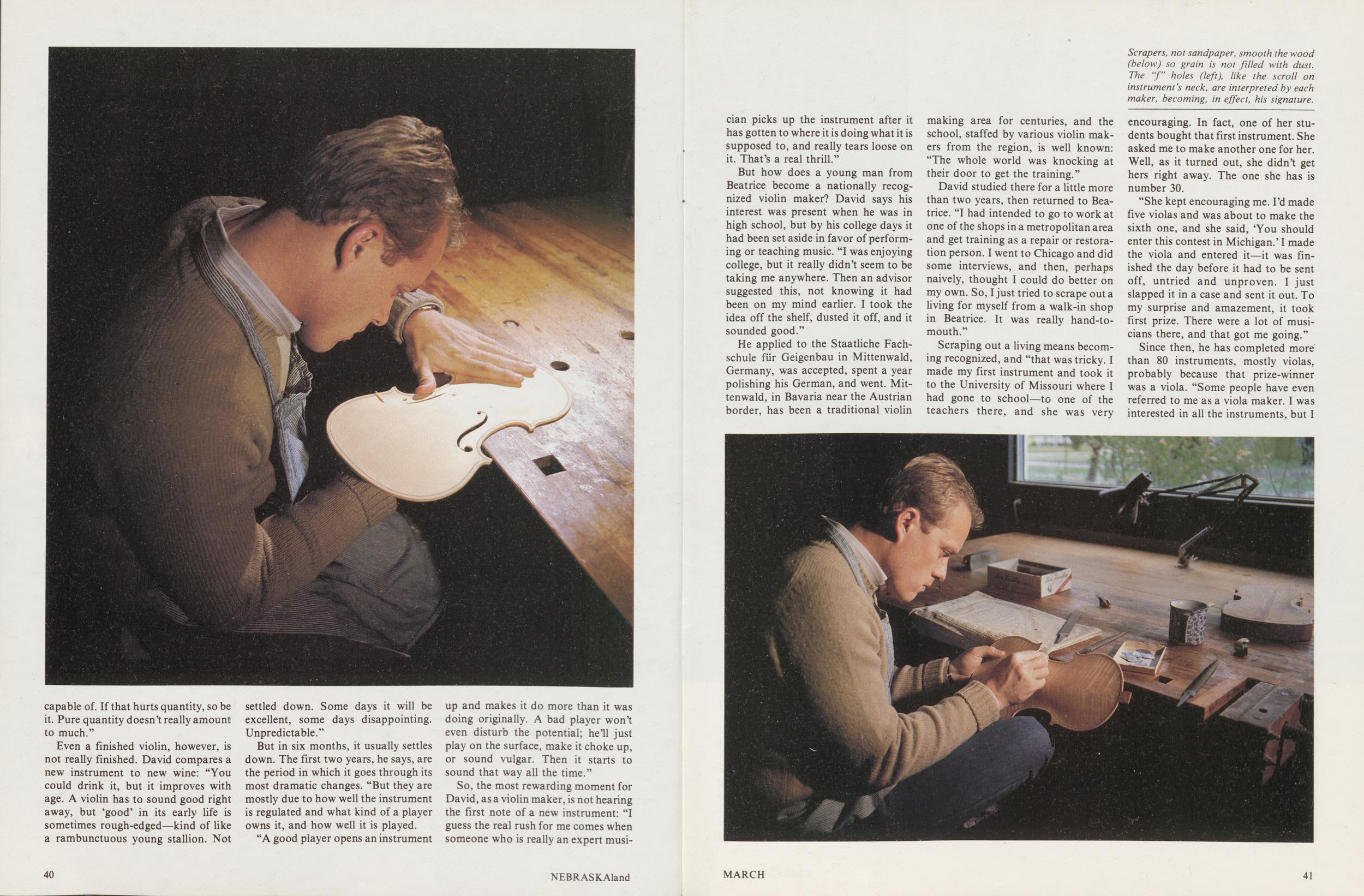
Even a finished violin, however, is not really finished. David compares a new instrument to new wine: "You could drink it, but it improves with age. A violin has to sound good right away, but 'good' in its early life is sometimes rough-edged—kind of like a rambunctuous young stallion. Not settled down. Some days it will be excellent, some days disappointing. Unpredictable."
But in six months, it usually settles down. The first two years, he says, are the period in which it goes through its most dramatic changes. "But they are mostly due to how well the instrument is regulated and what kind of a player owns it, and how well it is played.'
"A good player opens an instrument up and makes it do more than it was doing originally. A bad player won't even disturb the potential; he'll just play on the surface, make it choke up, or sound vulgar. Then it starts to sound that way all the time."
So, the most rewarding moment for David, as a violin maker, is not hearing the first note of a new instrument: "I guess the real rush for me comes when someone who is really an expert musician 40 NEBRASKAland picks up the instrument after it has gotten to where it is doing what it is supposed to, and really tears loose on it. That's a real thrill."
But how does a young man from Beatrice become a nationally recognized violin maker? David says his interest was present when he was in high school, but by his college days it had been set aside in favor of performing or teaching music. "I was enjoying college, but it really didn't seem to be taking me anywhere. Then an advisor suggested this, not knowing it had been on my mind earlier. I took the idea off the shelf, dusted it off, and it sounded good."
He applied to the Staatliche Fachschule fiir Geigenbau in Mittenwald, Germany, was accepted, spent a year polishing his German, and went. Mittenwald, in Bavaria near the Austrian border, has been a traditional violin making area for centuries, and the school, staffed by various violin makers from the region, is well known: "The whole world was knocking at their door to get the training."
David studied there for a little more than two years, then returned to Beatrice. "I had intended to go to work at one of the shops in a metropolitan area and get training as a repair or restoration person. I went to Chicago and did some interviews, and then, perhaps naively, thought I could do better on my own. So, I just tried to scrape out a living for myself from a walk-in shop in Beatrice. It was really hand-to-mouth."
Scraping out a living means becoming recognized, and "that was tricky. I made my first instrument and took it to the University of Missouri where I had gone to school—to one of the teachers there, and she was very
"She kept encouraging me. I'd made five violas and was about to make the sixth one, and she said, 'You should enter this contest in Michigan.' I made the viola and entered it—it was finished the day before it had to be sent off, untried and unproven. I just slapped it in a case and sent it out. To my surprise and amazement, it took first prize. There were a lot of musicians there, and that got me going."
Since then, he has completed more than 80 instruments, mostly violas, probably because that prize-winner was a viola. "Some people have even referred to me as a viola maker. I was interested in all the instruments, but I
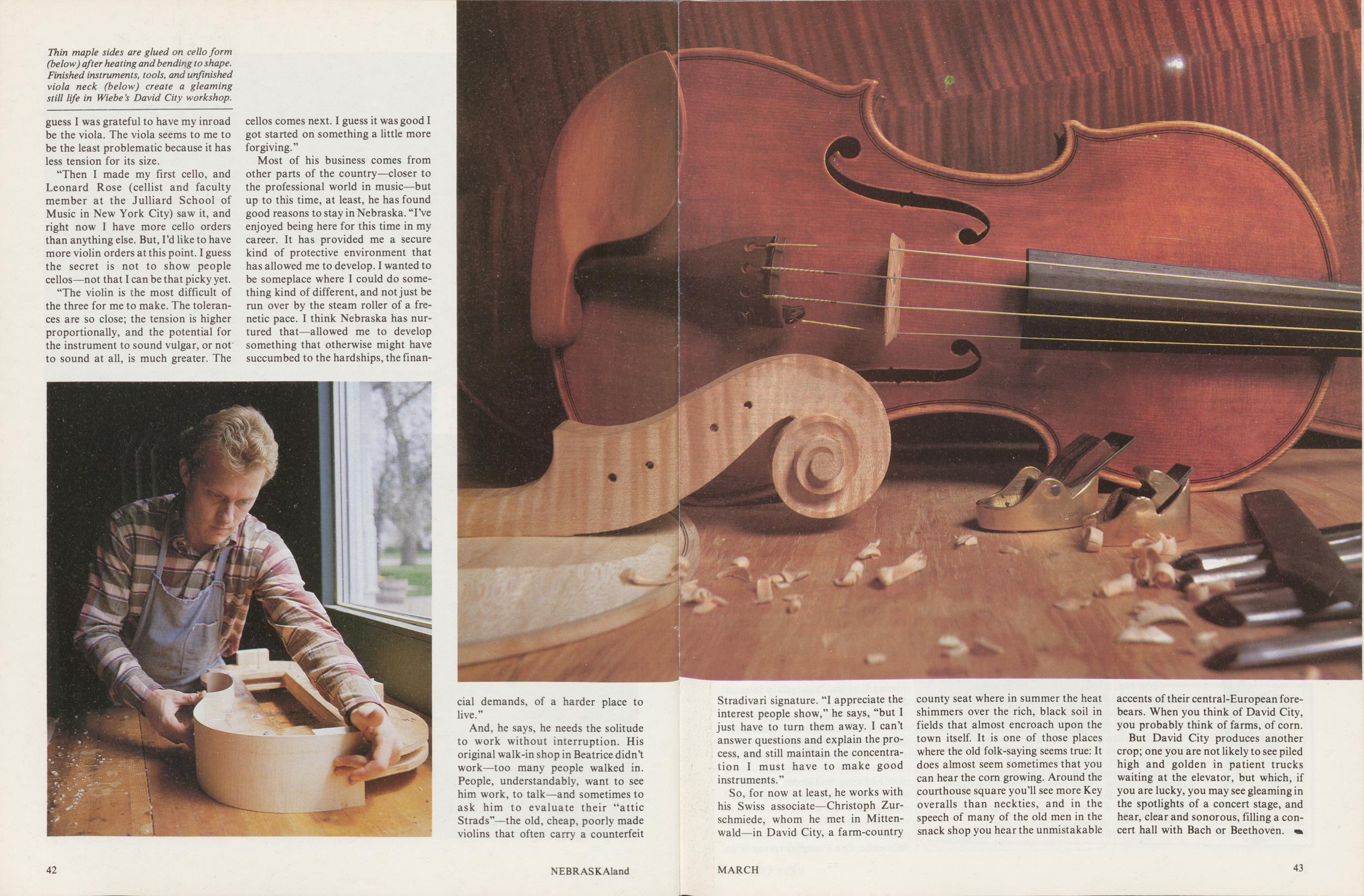
guess I was grateful to have my inroad be the viola. The viola seems to me to be the least problematic because it has less tension for its size.
"Then I made my first cello, and Leonard Rose (cellist and faculty member at the Julliard School of Music in New York City) saw it, and right now I have more cello orders than anything else. But, I'd like to have more violin orders at this point. I guess the secret is not to show people cellos—not that I can be that picky yet.
"The violin is the most difficult of the three for me to make. The tolerances are so close; the tension is higher proportionally, and the potential for the instrument to sound vulgar, or not to sound at all, is much greater. The cellos comes next. I guess it was good I got started on something a little more forgiving."
Most of his business comes from other parts of the country—closer to the professional world in music—but up to this time, at least, he has found good reasons to stay in Nebraska. "I've enjoyed being here for this time in my career. It has provided me a secure kind of protective environment that has allowed me to develop. I wanted to be someplace where I could do something kind of different, and not just be run over by the steam roller of a frenetic pace. I think Nebraska has nurtured that-allowed me to develop something that otherwise might have succumbed to the hardships, the financial
And, he says, he needs the solitude to work without interruption. His original walk-in shop in Beatrice didn't work—too many people walked in. People, understandably, want to see him work, to talk—and sometimes to ask him to evaluate their "attic Strads"—the old, cheap, poorly made violins that often carry a counterfeit 42 NEBRASKAland Stradivari signature. "I appreciate the interest people show," he says, "but I just have to turn them away. I can't answer questions and explain the process, and still maintain the concentration I must have to make good instruments."
So, for now at least, he works with his Swiss associate—Christoph Zurschmiede, whom he met in Mitten-wald—in David City, a farm-country county seat where in summer the heat shimmers over the rich, black soil in fields that almost encroach upon the town itself. It is one of those places where the old folk-saying seems true: It does almost seem sometimes that you can hear the corn growing. Around the courthouse square you'll see more Key overalls than neckties, and in the speech of many of the old men in the snack shop you hear the unmistakable accents of their central-European forebears. When you think of David City, you probably think of farms, of corn.
But David City produces another crop; one you are not likely to see piled high and golden in patient trucks waiting at the elevator, but which, if you are lucky, you may see gleaming in the spotlights of a concert stage, and hear, clear and sonorous, filling a concert hall with Bach or Beethoven.
MARCH 43
Crane Tracking
(Continued from page 21)cottonwood seeds that drift into the channel from nearby woodlands. When conditions are suitable, many germinate and take root. During years such as 1981 when flows cover the channel during the critical months of seed dissemination, few seedlings appear. In other years, however, seedlings abound. And, once firmly rooted, a seedling is likely to survive. Research revealed that seedlings only a few inches in height can withstand a month of total immersion and still recover.
With the studies now completed and a final report written, the relationship between the Platte, cranes, and other wildlife is much better known. The fate of the cranes now hinges on what happens to the channel and meadows. Fortunately, to maintain the channel of the Platte in a state suitable for cranes to roost, does not require turning back the clock, but rather in maintaining some semblance of status quo. Keeping adequate flows during summer in the Overton-to-Grand Island stretch can best solve the problem of shrinking channels, but other techniques will likely also need to be employed if the channels are to be kept open.
Outward from the channel, the cranes' needs can be met by setting aside scattered tracts, spaced a few miles apart, for intensive management in those reaches of river historically used by cranes, and by protecting other lands through conservation easements. Purchase of some tracts will also ensure sites to meet the needs of the many waterfowl that also stop here in spring. Easements hold promise as a means of preserving crane habitat while maintaining lands in private ownership. With channel conditions stabilized, only minor modification of existing land use is necessary to meet the cranes' needs.
To maintain this river and its surroundings in a condition suitable for cranes represents a significant challenge, but at the same time the opportunity to keep alive one of nature's most enduring traditions. Most of us seldom have the opportunity to see cranes, and when we do, they are usually but specks in the sky, distinguished only by the familiar sound of their calls. The Platte in spring is an 44 NEBRASKAland exception—it's a place where we can go to view this most unusual bird in impressive abundance. And with our help, it will stay that way.
An Elkhorn retreat
(Continued from page 33)in 1941 by the almost legendary former conservation officer Roy Owen:
"A TRUE STORY OF MY PIONEER FAMILY"To Outdoor Nebraska:
The story that I am about to relate is about the hunting and fishing ability and experiences of my relatives.
My people were very truthful hardworking people, back in the early 70's when Nebraska was in the raw and prairies stretched as far as the eye could see where antelope, coyotes, prairie chickens and grouse thrived and the streams were full of fish, and geese, ducks and cranes swarmed through the air in enormous flocks....
The greatest fisherman of all times was my Uncle Jim. Now folks, if you have never met my Uncle Jim you have missed something. He was a very pleasant, good-natured sportsman, always in possession of fast horses, a fighting dog and a greyhound, and the greatest fisherman of all times.
On this particular morning he was rowing the boat up the Elkhorn River in the vicinity of West Point with one dog sitting on the rear of the boat, the other one tied to the boat and swimming in the water. Now Uncle Jim did this to exercise and develop the leg muscles of his dogs to give them better stamina, and he could check his fish lines at the same time.
It seems as though there never was a time that the river was so infested with large catfish as at that time. Several people had disappeared while in swimming, but this didn't bother Uncle Jim—he just kept right on fishing. As he rounded the bend next to the north bank he heard a terrible swish and everything turned dark and, sure enough, one of those mammoth catfish had charged the dog swimming behind the boat and swallowed dogs, boat, Uncle Jim and all.
The dogs got to fighting and Uncle Jim started clubbing them over their heads with an oar and this so nauseated the fish that he became hysterical and started down the river at a terrific rate of speed. So great was the speed that he ploughed the water over both banks and left the dry sand behind him as he neared what is now known as Scribner. He had gained such speed he couldn't make the curve and he ploughed a furrow through the prairie eight feet deep and one hundred feet wide for two miles, striking the river again at that point, cutting off all the river that is now known as Dead Timbers, leaving a beautiful park and fishing ground for generations to come.
Now when the fish struck the opposite bank he still had speed enough to turn a somersault out on the prairie, and in so doing tossed Uncle Jim forward and the oar he had in his hand stuck in the throat of the fish, holding his jaws apart, letting Uncle Jim walk out.
Now this is a true story and my Uncle Jim says he thinks there were several fish larger than this one that got away.
The journey
(Continued from page 35)the yellowing of hills with sunflowers or the change of the deer's coat from summer red to autumn gray. We measure the passing of our days with numbers that hold no meaning.
Nature moves in cycles, many cycles, that repeat themselves endlessly, feeding one another, fueling a complex, interrelated system. Linear time is a recent and very human concept that grows out of a belief in progress and, perhaps, the great importance we assign to the individual. But the natural system, fine-tuned to minute details over millions of years, has no concern for the survival of individuals, only of the kind, the species. People in what we call primitive societies understood this concept. A prominent figure in many of their hunting myths was the "animal master," an individual who represented its species as a whole; a sort of "group soul," timeless and indestructible.
When man felt more at one with the natural world, his life journey echoed the cycle of the seasons. Winter and death were as necessary as spring and birth. But with each passing generation we are more reluctant to accept our place in nature, to accept the natural laws that govern living creatures; reluctant to accept that our time will come and go the same as it does for the geese calling in the night.
We live in a world that belies our tie to the earth and its other creatures. But, we are immensely complex and cannot cast off in a few generations the tugging of nature's forces. The changing of the seasons still stirs in man's heart. The great herds are almost gone but the flocks still move with the tilt of the earth, still feel the call. We feel it only faintly. We are estranged from the great spirit which lives deep in all wild things.
On the evolutionary clock, though, we are only a second from what we once were. We still hear the voices. Some may even summon up that organic response that at once seems to come from within and yet from outside of us. Some may call it to consciousness to be contemplated and savored until the call of migrating geese in the night brings a restlessness, a desire to be almost anywhere but where we are, an urging to take up the journey.
Bass pond strategy
(Continued from page 17)began wrestling those bass with dime-sized poppers, and was catching them on every cast!
Flyrodders will enjoy the top-water activity in the warmer months. My cronie recommends small poppers in all colors, and flies of all sorts for the panfishing when bigmouth is less active. In fact, this flyrodding has become an important factor.
He likes deer-hair flies like the Irresistible, Humpy, and Tom Thumb. Other casters will want to try their spin-size poppers and all those soft plastic imitations of bass food like the larger worms, mice, and frogs. Bigger plugs can be used more now, too, with improved reception by the fish.
By the time August and September roll around, a puddle-jumper might use those plastic worms as heavily as he did in the spring and early summer, and, depending on the pond's depth, he might be rigging a Carolina or a jighead rig on those squirmers. My friend likes an eighth-ounce jig, feathered, plain or a la pork tail, fished slow to probe the structure beneath, sometimes drifting in a jon boat over the bass.
Both of these fishing friends agree with the old saying, "Fall fishing might be slow, but the fish are big," and for some reason they can't figure out, that goes double for pond bass. These pond wallowers further suggest that fishing later in the year is another way to beat the crowds. Participation seems to wane as other activities siphon away from their sport.
This strategy for the changing seasons isn't meant to be cut in stone, and as in the case of most fishing advice, there are a lot of variables for the basser to sort through and use to his advantage. Much of the large-water knowledge the fisherman already has is ready to use—all he needs to do is adapt his methods and adjust them slightly for the smaller ponds.
Not every farm pond holds the bass that fishing daydreams are made of, and the ones that do are not necessarily easy to fish anyway. But, if the angler gives small-water bassing a try, it's a bet hell never stop, because it could be his ticket away from the over-fished public lakes that most fishermen flock to every weekend.
46 NEBRASKAlandTrading Post
DOGSTRAINING ALL BREEDS Hunting dogs—Vizslas for sale. Rozanek Kennels, Rt. 2, Schuyler, NE 68661. Phone (402) 352-8769.
ENGLISH SETTERS and Pointers: Outstanding bloodlines! Puppies, started dogs, and stud service available. High Plains Kennels, 1411 Emerson, Alliance, NE 69301. Phone (308) 762-6709.
GERMAN SHORTHAIRS—English Pointers and Beagles—Stud service, puppies and started dogs. Wayne Clark, Box 54, Union, Nebr. 68455. Phone (402) 263-3495 or 263-3155.
AKC WEIMARANER Puppies for sale. Parents good hunters. Phone (402) 467-2848, Lincoln, Ne.
AKC CHESAPEAKE Bay retriever puppies. Mother is 1981 Nebraska State Retriever Champion. Pups born in January. Love water. Excellent hunters. Good with kids. $350. Bill Burks, 716 E. 10th St., Ottawa, KS 66067. Phone (913) 242-7332 evenings; (913) 242-4875 days.
MISCELLANEOUSWINE AND BEER: Make your own. Send for free recipes and instructions. Omaha Supply, 13616 Polk, Omaha, Nebr. 68137.
GAME BIRDS for sale. Wild turkeys, wood ducks, mandarins, mallards, teal, Canada geese, pheasants—5 breeds chukkar quail. Many others not listed.
Frontier Birds, Wauneta, NE 69045. Phone: day (308) 394-5577/evening (308) 394-5715 N.E. NEBRASKA TROUT Fishing. For rent Mon.-Thurs. or Fri.-Sun. 2 modern cottages completely furnished. 5 spring-fed lakes with trout up to 7 lbs. Bass and bluegill also. Diamond E Trout Resort, Orchard, NE 68764. (402) 893-4745.
GUNS—Browning, Winchester, Remington, others, Hi-powers, shotguns, new, used, antiques. Want Pre-1964 Winchesters. Buy-Sell-Trade. Ph. (402) 729-6112. Bedlan's Sporting Goods, Fairbury, NE 68352.
WAX WORMS—500—$8.25; 1,000—$14.50. Add 4% sales tax. Postpaid first class. No C.O.D. Harold Malicky, Burwell, NE 68823.
YOUR TREASURED family recipes published. 50 cookbooks as low as $39.95. Send 25c for information: Leafie Mae's Kitchen, Box 1881 NL, Kearney, NE 68847.
FOR SALE: Big beautiful Canada geese. These are the great giants (maxima). Some with white collars and breasts, others with gray foreheads. 1983 hatch—$80.00/pair; 1982 hatch—$150.00/pair; and 1981 —$200.00/ pair. Call or write Engaard E. Lynn, Gothenburg, NE 69138. (308) 537-2825.
FOR FREE—1984 brochure on Wilson Outfitters Nebraska (WON). Full service canoe-camping trips; statewide canoe rentals; canoe—camping—shuttle-information at Rocky Ford Camp on the Niobrara River (complete with map). Send a stamped, self-addressed business envelope to WON, 1329 Dawes Ave., Lincoln, NE 68521. Our thirteenth season of providing commercial quality recreation for Nebraska!
AIR GUNS repaired; Benjamin, Crosman, Daisy, other American made. Restoration, old guns wanted. Air Guns, 1225 No. 46th, Lincoln, NE 68503. Phone (402) 466-9223.
BEAR GUN SAFES: five models from 330 to 750 lbs. Interiors up to 36 long guns. Free 50-mile delivery. For brochure write or call Powers Firearms, 630 E. 3rd., Fremont, NE 68025. Phone (402) 721-1859.
FOR SALE: Sika deer and golden pheasants. Contact Harold Kempf, Box 31, Glenville, NE 68941.
PERSONALIZED COOKBOOKS for your Church or Organization. Excellent, low-cost fund raiser, no investment, 90 days to pay, FREE shipping. Details: Cookbooks, Box 1881 NL, Kearney, NE 68847.
WANTED: OLD POSTCARDS picturing Nebraska, Iowa, Kansas small towns, railroad depots, main streets, buildings, store interiors. J. Farr, Box 6086, Omaha, Nebraska 68106. (402) 334-0284 evenings.
VACATION PARADISE. Beautiful large A frame cabin and lake view lots, Gate 18, Lake McConaughy, Ogallala. Good roads for year round living. Write Box 1028, Imperial, NE 69033.
TAXIDERMYJOHNSON TAXIDERMY—servicing southwest Nebraska, specializing in big-game mounts, life-sized mounts, rug work, fish, birds, tanning hair-on leather. Brochure and price list on request. Johnson Taxidermy, Rt. 1, Box 78, Lamar, NE 69035. Telephone (308) 882-5555.
FREEZE-DRY TAXIDERMY Wally Allison's State Record Taxidermy, 2709 Birchwood, North Platte, NE 69101. Phone: (308) 534-2324. Specializing in Fish and Small Game, Snake and Lizard and Novelties. (Nothing too small) Newest of all taxidermy methods employed.
CREATIVE TAXIDERMY in all its branches since 1935, now includes Northstar Freeze-Dry processing of approved small specimens. Also tanning and deerskin processing. Naturecraft Studio. Nebraska City, Nebraska 68510. Joe Voges-Owner. Phone (402) 873-5491.
LIVE-CATCH ALL-PURPOSE TRAPS Write for FREE CATALOG Traps without injury squirrels, chipmunks, rabbits, mink, fox, raccoons, stray animals, pests, etc. Sizes for every need. Also traps for snakes, sparrows, pigeons, crabs, turtles, quail, etc. Save on our low factory prices. Send no money. Free catalog and trapping secrets. MUSTANG MFG. CO., Dept. N-34, Box 10880, Houston, Tex. 77018
DINGES TAXIDERMY Studio, 2763 So. 12th St., Omaha, NE 68108. Fourteen-time National Award Winning Taxidermy. Trust your trophies to a proven winner. Complete professional service. Mike and Mary Dinges (402) 342-3718.
NABITY'S TAXIDERMY. 31 years experience. Specializing in natural grass backgrounds for mammals, birds and fish. 13901 "0"St., Lincoln, NE 68505 4 miles east of 84th and "O". (402) 489-6351.
BADE TAXIDERMY—Quality a must—Fast service. Fish, birds, rugs, tanning, full mounts and game heads. 2111 N. Christy St., Fremont, Nebraska 727-5463.
PEISTER TAXIDERMY—a name you can trust. We give you professional life-like work at prices most sportsmen can afford. Member National Taxidermist Association, #5 Regency, Place, Kearney, Nebr. 68847. Phone (308) 237-7575.
CARL SCHWARZ master taxidermist has moved to a new country studio; same professional mounting and tanning service. Schwarz Wild Wing Studio, 16804 South 180th St., Springfield, NE 68059. Phone (402) 253-2481.
NEBRASKAland 35mm Slides Select photos in this issue are now available from NEBRASKAland Magazine as 35mm slides in 2" mounts. The slides may be used to round out your home slide file, or to make color enlargement prints to adorn your home or office walls. The slides may not be used in any commercial manner. Slides of other photos in this issue are not readily available. The slides cost $1 each plus appropriate sales tax. Please allow 4-6 weeks delivery. Slides available from this issue include: 2841 Trumpeter Swan......Cover 2848 Black-eyed Susan ......p. 8 28414 Wild Bergamot ....... p. 14 28426 Cygnets...............p. 26 28427 Nesting Swan .........pi 27 Please indicate number and description of slides desired, and include check or money order for the full amount made to: NEBRASKAland Magazine. Send orders to: NEBRASKAland Slides, P.O. Box 30370, Lincoln, NE 68503. Nebraskans, please include appropriate sales tax.
FOR SALE SNAKE RIVER HOMESITES Any Size, 1/2 acre to 5 acres For More Details CALL (402) 376-3102 Make this your private retreat for fishing, hiking, camping, canoeing or year round living. Flying Diamond Company Box 10, Valentine, NE, 69201
MARCH 47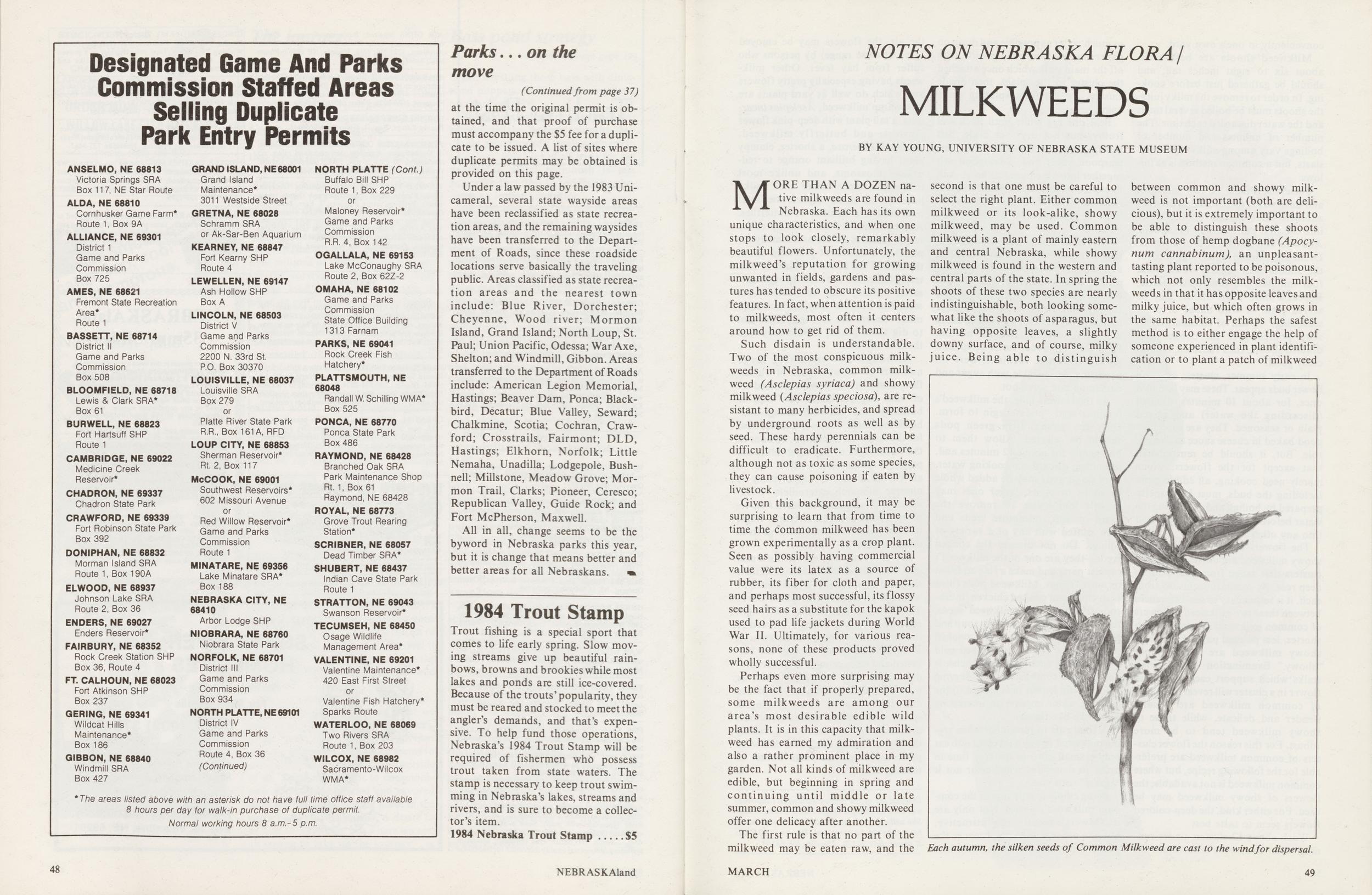
Parks... on the move
(Continued from page 37)at the time the original permit is obtained, and that proof of purchase must accompany the $5 fee for a duplicate to be issued. A list of sites where duplicate permits may be obtained is provided on this page.
Under a law passed by the 1983 Unicameral, several state wayside areas have been reclassified as state recreation areas, and the remaining waysides have been transferred to the Department of Roads, since these roadside locations serve basically the traveling public. Areas classified as state recreation areas and the nearest town include: Blue River, Dorchester; Cheyenne, Wood river; Mormon Island, Grand Island; North Loup, St. Paul; Union Pacific, Odessa; War Axe, Shelton; and Windmill, Gibbon. Areas transferred to the Department of Roads include: American Legion Memorial, Hastings; Beaver Dam, Ponca; Blackbird, Decatur; Blue Valley, Seward; Chalkmine, Scotia; Cochran, Crawford; Crosstrails, Fairmont; DLD, Hastings; Elkhorn, Norfolk; Little Nemaha, Unadilla; Lodgepole, Bushnell; Millstone, Meadow Grove; Mormon Trail, Clarks; Pioneer, Ceresco; Republican Valley, Guide Rock; and Fort McPherson, Maxwell.
All in all, change seems to be the byword in Nebraska parks this year, but it is change that means better and better areas for all Nebraskans.
1984 Trout Stamp
Trout fishing is a special sport that comes to life early spring. Slow moving streams give up beautiful rainbows, browns and brookies while most lakes and ponds are still ice-covered. Because of the trouts' popularity, they must be reared and stocked to meet the angler's demands, and that's expensive. To help fund those operations, Nebraska's 1984 Trout Stamp will be required of fishermen wh6 possess trout taken from state waters. The stamp is necessary to keep trout swimming in Nebraska's lakes, streams and rivers, and is sure to become a collector's item. 1984 Nebraska Trout Stamp.....$5
NOTES ON NEBRASKA FLORA /
MILKWEEDS
MORE THAN A DOZEN native milkweeds are found in Nebraska. Each has its own unique characteristics, and when one stops to look closely, remarkably beautiful flowers. Unfortunately, the milkweed's reputation for growing unwanted in fields, gardens and pastures has tended to obscure its positive features. In fact, when attention is paid to milkweeds, most often it centers around how to get rid of them.
Such disdain is understandable. Two of the most conspicuous milkweeds in Nebraska, common milkweed (Asclepias syriaca) and showy milkweed {Asclepias speciosa), are resistant to many herbicides, and spread by underground roots as well as by seed. These hardy perennials can be difficult to eradicate. Furthermore, although not as toxic as some species, they can cause poisoning if eaten by livestock.
Given this background, it may be surprising to learn that from time to time the common milkweed has been grown experimentally as a crop plant. Seen as possibly having commercial value were its latex as a source of rubber, its fiber for cloth and paper, and perhaps most successful, its flossy seed hairs as a substitute for the kapok used to pad life jackets during World War II. Ultimately, for various reasons, none of these products proved wholly successful.
Perhaps even more surprising may be the fact that if properly prepared, some milkweeds are among our area's most desirable edible wild plants. It is in this capacity that milkweed has earned my admiration and also a rather prominent place in my garden. Not all kinds of milkweed are edible, but beginning in spring and continuing until middle or late summer, common and showy milkweed offer one delicacy after another.
The first rule is that no part of the milkweed may be eaten raw, and the second is that one must be careful to select the right plant. Either common milkweed or its look-alike, showy milkweed, may be used. Common milkweed is a plant of mainly eastern and central Nebraska, while showy milkweed is found in the western and central parts of the state. In spring the shoots of these two species are nearly indistinguishable, both looking somewhat like the shoots of asparagus, but having opposite leaves, a slightly downy surface, and of course, milky juice. Being able to distinguish between common and showy milkweed is not important (both are delicious), but it is extremely important to be able to distinguish these shoots from those of hemp dogbane (Apocynum cannabinum), an unpleasant-tasting plant reported to be poisonous, which not only resembles the milkweeds in that it has opposite leaves and milky juice, but which often grows in the same habitat. Perhaps the safest method is to either engage the help of someone experienced in plant identification or to plant a patch of milkweed
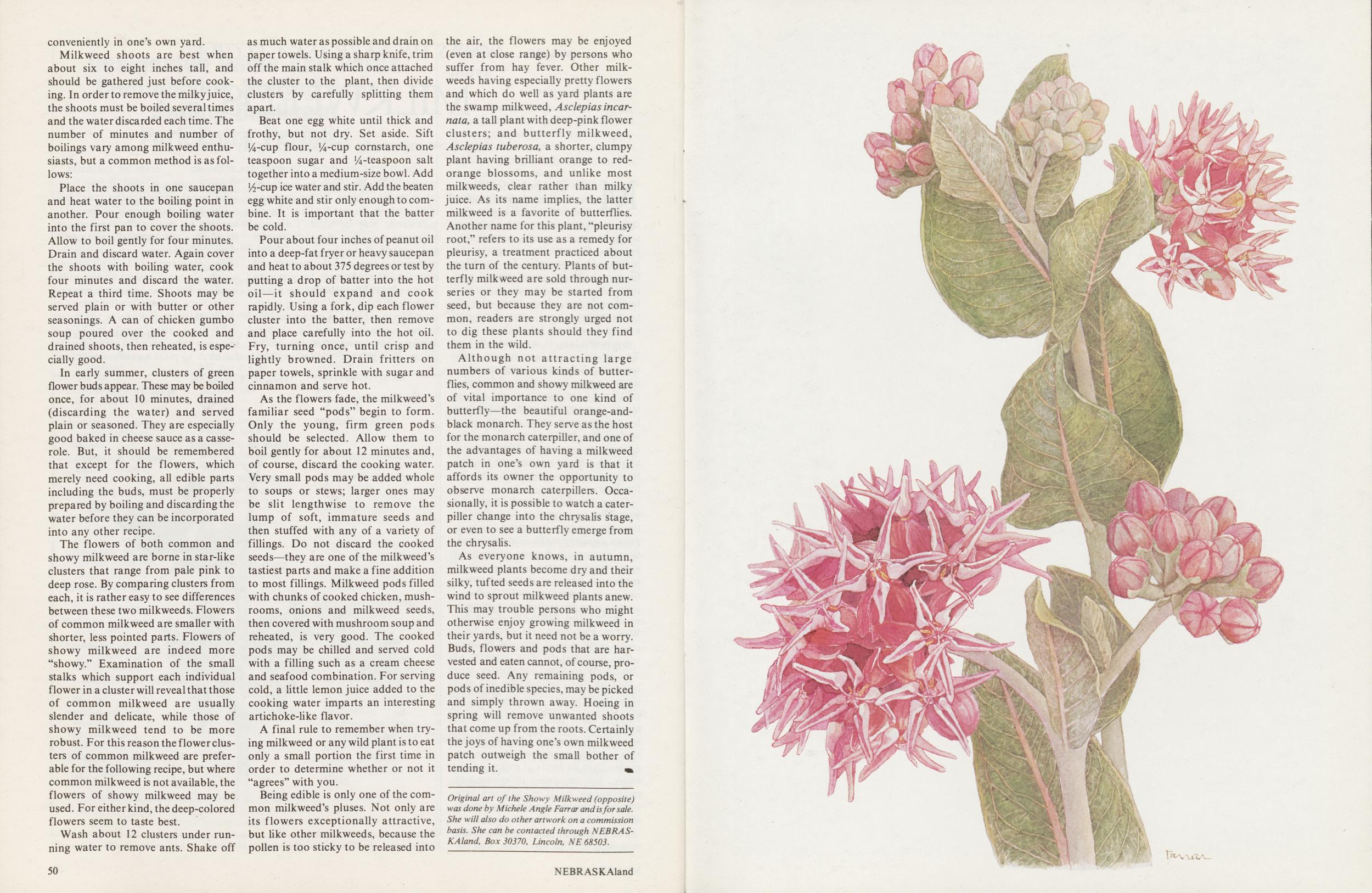
conveniently in one's own yard.
Milkweed shoots are best when about six to eight inches tall, and should be gathered just before cooking. In order to remove the milky juice, the shoots must be boiled several times and the water discarded each time. The number of minutes and number of boilings vary among milkweed enthusiasts, but a common method is as follows:
Place the shoots in one saucepan and heat water to the boiling point in another. Pour enough boiling water into the first pan to cover the shoots. Allow to boil gently for four minutes. Drain and discard water. Again cover the shoots with boiling water, cook four minutes and discard the water. Repeat a third time. Shoots may be served plain or with butter or other seasonings. A can of chicken gumbo soup poured over the cooked and drained shoots, then reheated, is especially good.
In early summer, clusters of green flower buds appear. These may be boiled once, for about 10 minutes, drained (discarding the water) and served plain or seasoned. They are especially good baked in cheese sauce as a casserole. But, it should be remembered that except for the flowers, which merely need cooking, all edible parts including the buds, must be properly prepared by boiling and discarding the water before they can be incorporated into any other recipe.
The flowers of both common and showy milkweed are borne in star-like clusters that range from pale pink to deep rose. By comparing clusters from each, it is rather easy to see differences between these two milkweeds. Flowers of common milkweed are smaller with shorter, less pointed parts. Flowers of showy milkweed are indeed more "showy." Examination of the small stalks which support each individual flower in a cluster will reveal that those of common milkweed are usually slender and delicate, while those of showy milkweed tend to be more robust. For this reason the flower clusters of common milkweed are preferable for the following recipe, but where common milkweed is not available, the flowers of showy milkweed may be used. For either kind, the deep-colored flowers seem to taste best.
Wash about 12 clusters under running water to remove ants. Shake off as much water as possible and drain on paper towels. Using a sharp knife, trim off the main stalk which once attached the cluster to the plant, then divide clusters by carefully splitting them apart.
Beat one egg white until thick and frothy, but not dry. Set aside. Sift lA-cup flour, !4-cup cornstarch, one teaspoon sugar and !4-teaspoon salt together into a medium-size bowl. Add 1/2-cup ice water and stir. Add the beaten egg white and stir only enough to combine. It is important that the batter be cold.
Pour about four inches of peanut oil into a deep-fat fryer or heavy saucepan and heat to about 375 degrees or test by putting a drop of batter into the hot oil—it should expand and cook rapidly. Using a fork, dip each flower cluster into the batter, then remove and place carefully into the hot oil. Fry, turning once, until crisp and lightly browned. Drain fritters on paper towels, sprinkle with sugar and cinnamon and serve hot.
As the flowers fade, the milkweed's familiar seed "pods" begin to form. Only the young, firm green pods should be selected. Allow them to boil gently for about 12 minutes and, of course, discard the cooking water. Very small pods may be added whole to soups or stews; larger ones may be slit lengthwise to remove the lump of soft, immature seeds and then stuffed with any of a variety of fillings. Do not discard the cooked seeds—they are one of the milkweed's tastiest parts and make a fine addition to most fillings. Milkweed pods filled with chunks of cooked chicken, mushrooms, onions and milkweed seeds, then covered with mushroom soup and reheated, is very good. The cooked pods may be chilled and served cold with a filling such as a cream cheese and seafood combination. For serving cold, a little lemon juice added to the cooking water imparts an interesting artichoke-like flavor.
A final rule to remember when trying milkweed or any wild plant is to eat only a small portion the first time in order to determine whether or not it "agrees" with you.
Being edible is only one of the common milkweed's pluses. Not only are its flowers exceptionally attractive, but like other milkweeds, because the pollen is too sticky to be released into the air, the flowers may be enjoyed (even at close range) by persons who suffer from hay fever. Other milkweeds having especially pretty flowers and which do well as yard plants are the swamp milkweed, Asclepias incarnata, a tall plant with deep-pink flower clusters; and butterfly milkweed, Asclepias tuberosa, a shorter, clumpy plant having brilliant orange to red-orange blossoms, and unlike most milkweeds, clear rather than milky juice. As its name implies, the latter milkweed is a favorite of butterflies. Another name for this plant, "pleurisy root," refers to its use as a remedy for pleurisy, a treatment practiced about the turn of the century. Plants of butterfly milkweed are sold through nurseries or they may be started from seed, but because they are not common, readers are strongly urged not to dig these plants should they find them in the wild.
Although not attracting large numbers of various kinds of butterflies, common and showy milkweed are of vital importance to one kind of butterfly—the beautiful orange-and-black monarch. They serve as the host for the monarch caterpiller, and one of the advantages of having a milkweed patch in one's own yard is that it affords its owner the opportunity to observe monarch caterpillers. Occasionally, it is possible to watch a caterpiller change into the chrysalis stage, or even to see a butterfly emerge from the chrysalis.
As everyone knows, in autumn, milkweed plants become dry and their silky, tufted seeds are released into the wind to sprout milkweed plants anew. This may trouble persons who might otherwise enjoy growing milkweed in their yards, but it need not be a worry. Buds, flowers and pods that are harvested and eaten cannot, of course, produce seed. Any remaining pods, or pods of inedible species, may be picked and simply thrown away. Hoeing in spring will remove unwanted shoots that come up from the roots. Certainly the joys of having one's own milkweed patch outweigh the small bother of tending it.
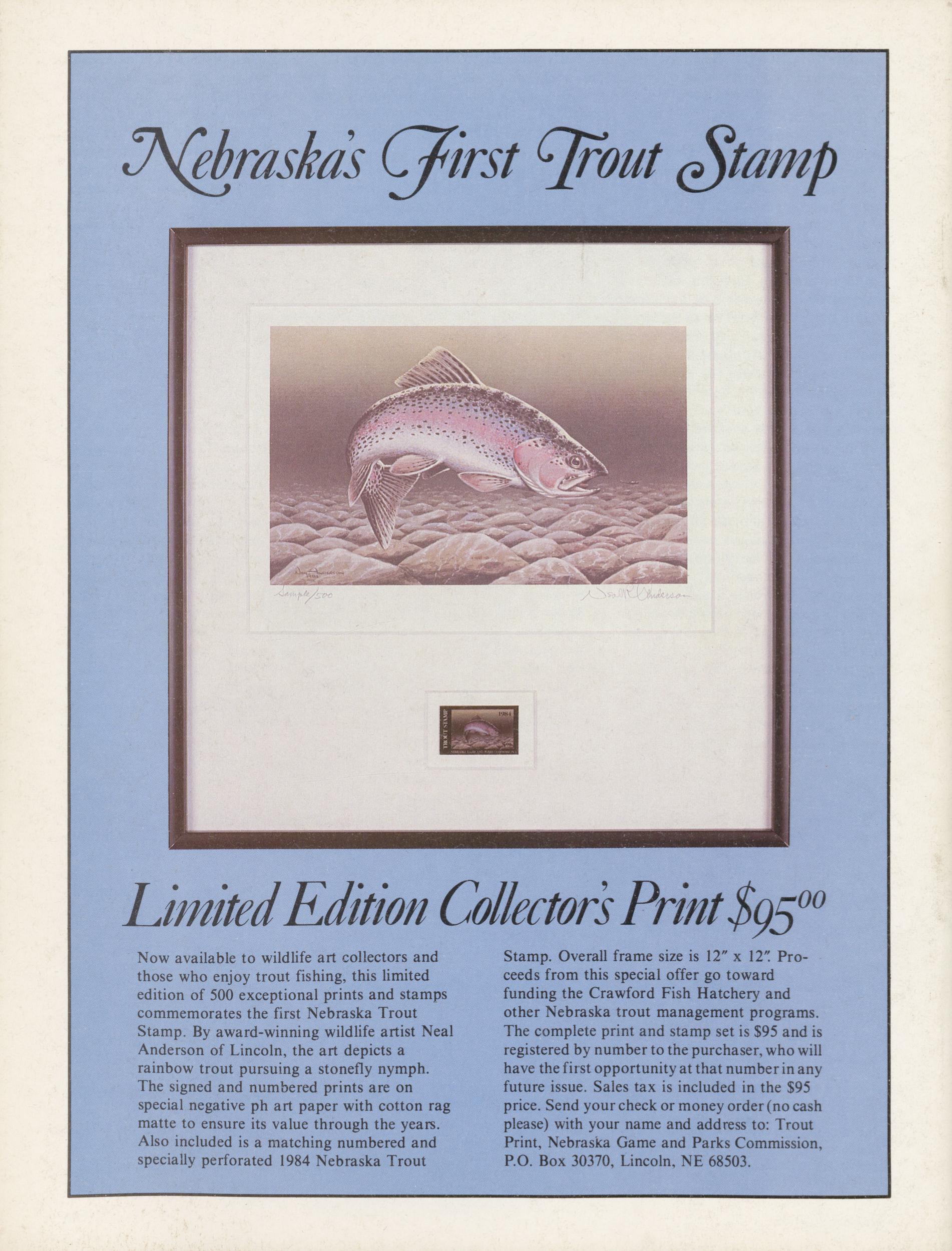
Position: 233 (33 views)