Volume 62, Issue 1, 1984
NEBRASKAland
JANUARY-FEBRURARY 1984 • $1
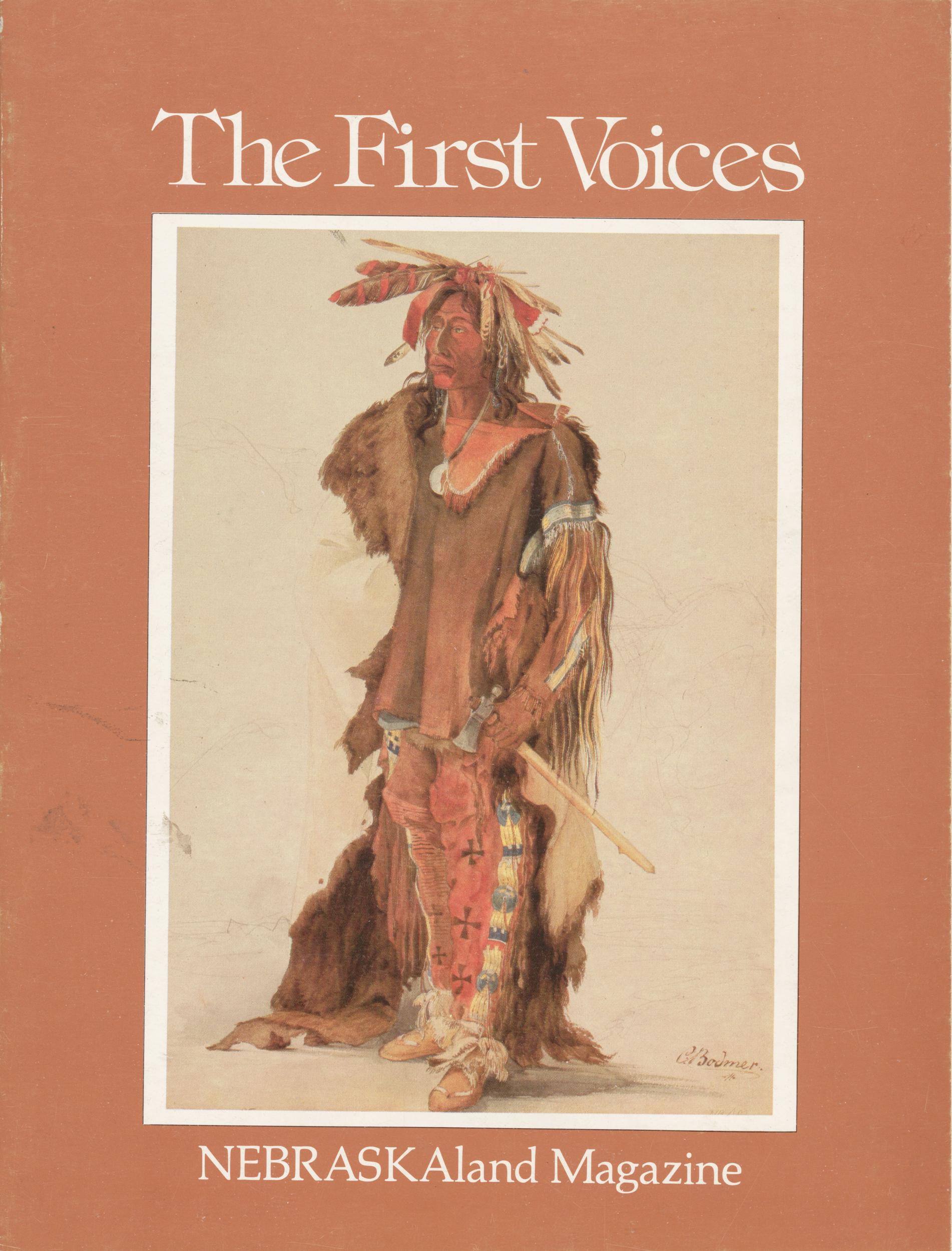
The First Voices NEBRASKAland Magazine
The First Voices NEBRASKAland Magazine Published by the Nebraska Game and Parks Commission with special assistance of The InterNorth Foundation NEBRASKAland Magazine VOL. 62 / NO. 1 / JANUARY-FEBRUARY 1984 Published monthly except for a combined January-February issue by the Nebraska Game and Parks Commission, 2200 North 33rd Street, Lincoln, Nebraska 68503. Copyright 1984 by the Nebraska Game and Parks Commission, all rights reserved. Subscription rates: $7.50 for one year, $13 for two years, $19 for three years. ISSN: 0028-1964 Second class postage paid at Lincoln, Nebraska and at additional mailing offices. 3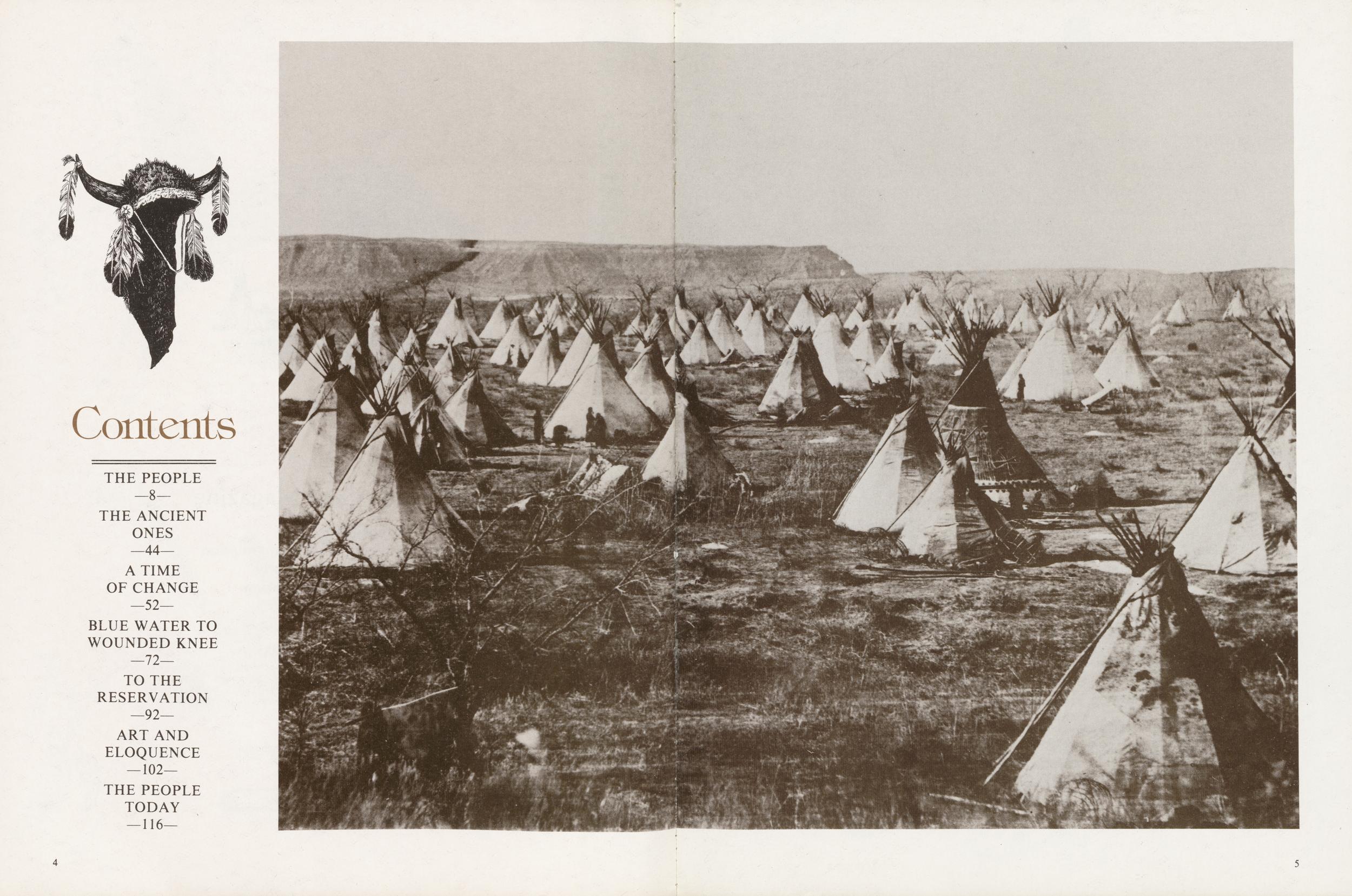 Contents
THE PEOPLE
—8—
THE ANCIENT
ONES
—44—
A TIME
OF CHANGE
—52—
BLUE WATER TO
WOUNDED KNEE
—72—
TO THE
RESERVATION
—92—
ART AND
ELOQUENCE
— 102—
THE PEOPLE
TODAY
— 116—
4
Contents
THE PEOPLE
—8—
THE ANCIENT
ONES
—44—
A TIME
OF CHANGE
—52—
BLUE WATER TO
WOUNDED KNEE
—72—
TO THE
RESERVATION
—92—
ART AND
ELOQUENCE
— 102—
THE PEOPLE
TODAY
— 116—
4
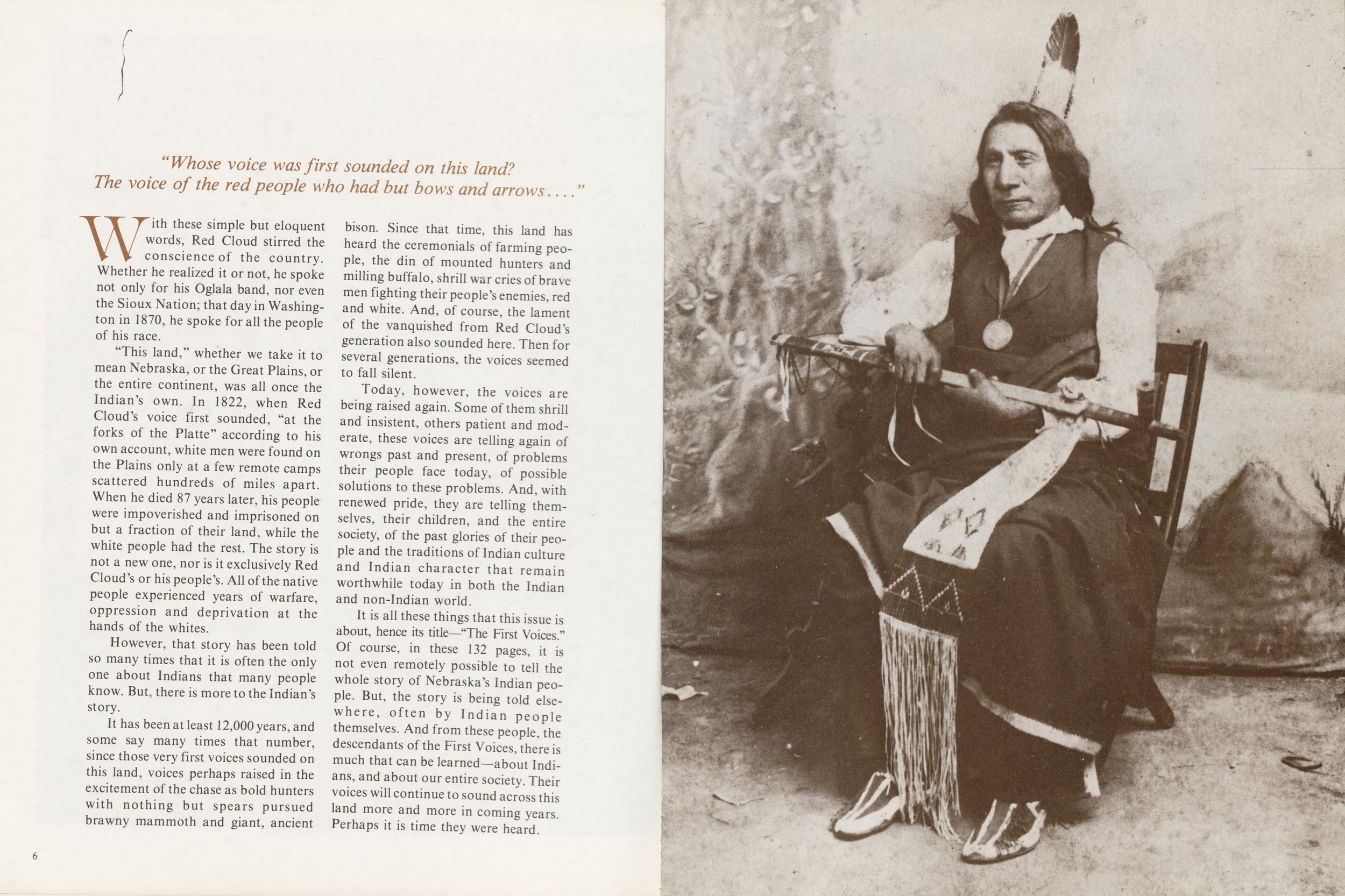
With these simple but eloquent words, Red Cloud stirred the conscience of the country. Whether he realized it or not, he spoke not only for his Oglala band, nor even the Sioux Nation; that day in Washington in 1870, he spoke for all the people of his race.
"This land," whether we take it to mean Nebraska, or the Great Plains, or the entire continent, was all once the Indian's own. In 1822, when Red Cloud's voice first sounded, "at the forks of the Platte" according to his own account, white men were found on the Plains only at a few remote camps scattered hundreds of miles apart. When he died 87 years later, his people were impoverished and imprisoned on but a fraction of their land, while the white people had the rest. The story is not a new one, nor is it exclusively Red Cloud's or his people's. All of the native people experienced years of warfare, oppression and deprivation at the hands of the whites.
However, that story has been told so many times that it is often the only one about Indians that many people know. But, there is more to the Indian's story.
It has been at least 12,000 years, and some say many times that number, since those very first voices sounded on this land, voices perhaps raised in the excitement of the chase as bold hunters with nothing but spears pursued brawny mammoth and giant, ancient bison. Since that time, this land has heard the ceremonials of farming people, the din of mounted hunters and milling buffalo, shrill war cries of brave men fighting their people's enemies, red and white. And, of course, the lament of the vanquished from Red Cloud's generation also sounded here. Then for several generations, the voices seemed to fall silent.
Today, however, the voices are being raised again. Some of them shrill and insistent, others patient and moderate, these voices are telling again of wrongs past and present, of problems their people face today, of possible solutions to these problems. And, with renewed pride, they are telling themselves, their children, and the entire society, of the past glories of their people and the traditions of Indian culture and Indian character that remain worthwhile today in both the Indian and non-Indian world.
It is all these things that this issue is about, hence its title—"The First Voices." Of course, in these 132 pages, it is not even remotely possible to tell the whole story of Nebraska's Indian people. But, the story is being told else- where, often by Indian people themselves. And from these people, the descendants of the First Voices, there is much that can be learned—about Indians, and about our entire society. Their voices will continue to sound across this land more and more in coming years. Perhaps it is time they were heard.
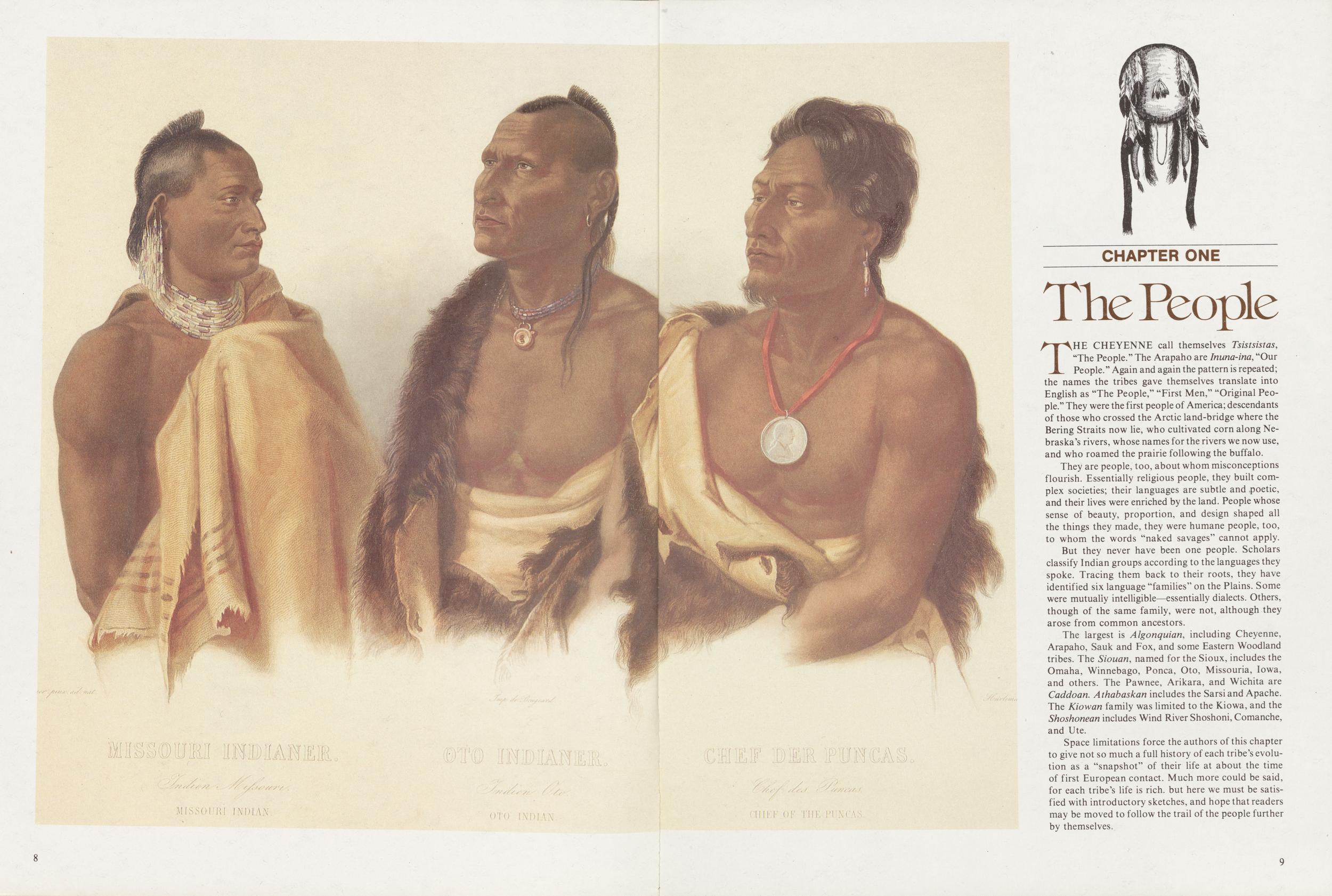
THE CHEYENNE call themselves Tsistsistas, "The People." The Arapaho are Inuna-ina, "Our People." Again and again the pattern is repeated; the names the tribes gave themselves translate into English as "The People," "First Men," "Original People." They were the first people of America; descendants of those who crossed the Arctic land-bridge where the Bering Straits now lie, who cultivated corn along Nebraska's rivers, whose names for the rivers we now use, and who roamed the prairie following the buffalo.
They are people, too, about whom misconceptions flourish. Essentially religious people, they built complex societies; their languages are subtle and poetic, and their lives were enriched by the land. People whose sense of beauty, proportion, and design shaped all the things they made, they were humane people, too, to whom the words "naked savages" cannot apply.
But they never have been one people. Scholars classify Indian groups according to the languages they spoke. Tracing them back to their roots, they have identified six language "families" on the Plains. Some were mutually intelligible—essentially dialects. Others, though of the same family, were not, although they arose from common ancestors.
The largest is Algonquian, including Cheyenne, Arapaho, Sauk and Fox, and some Eastern Woodland tribes. The Siouan, named for the Sioux, includes the Omaha, Winnebago, Ponca, Oto, Missouria, Iowa, and others. The Pawnee, Ankara, and Wichita are Caddoan. Athabaskan includes the Sarsiand Apache. The Kiowan family was limited to the Kiowa, and the Shoshonean includes Wind River Shoshoni, Comanche, and Ute.
Space limitations force the authors of this chapter to give not so much a full history of each tribe's evolution as a "snapshot" of their life at about the time of first European contact. Much more could be said, for each tribe's life is rich, but here we must be satisfied with introductory sketches, and hope that readers may be moved to follow the trail of the people further by themselves.
9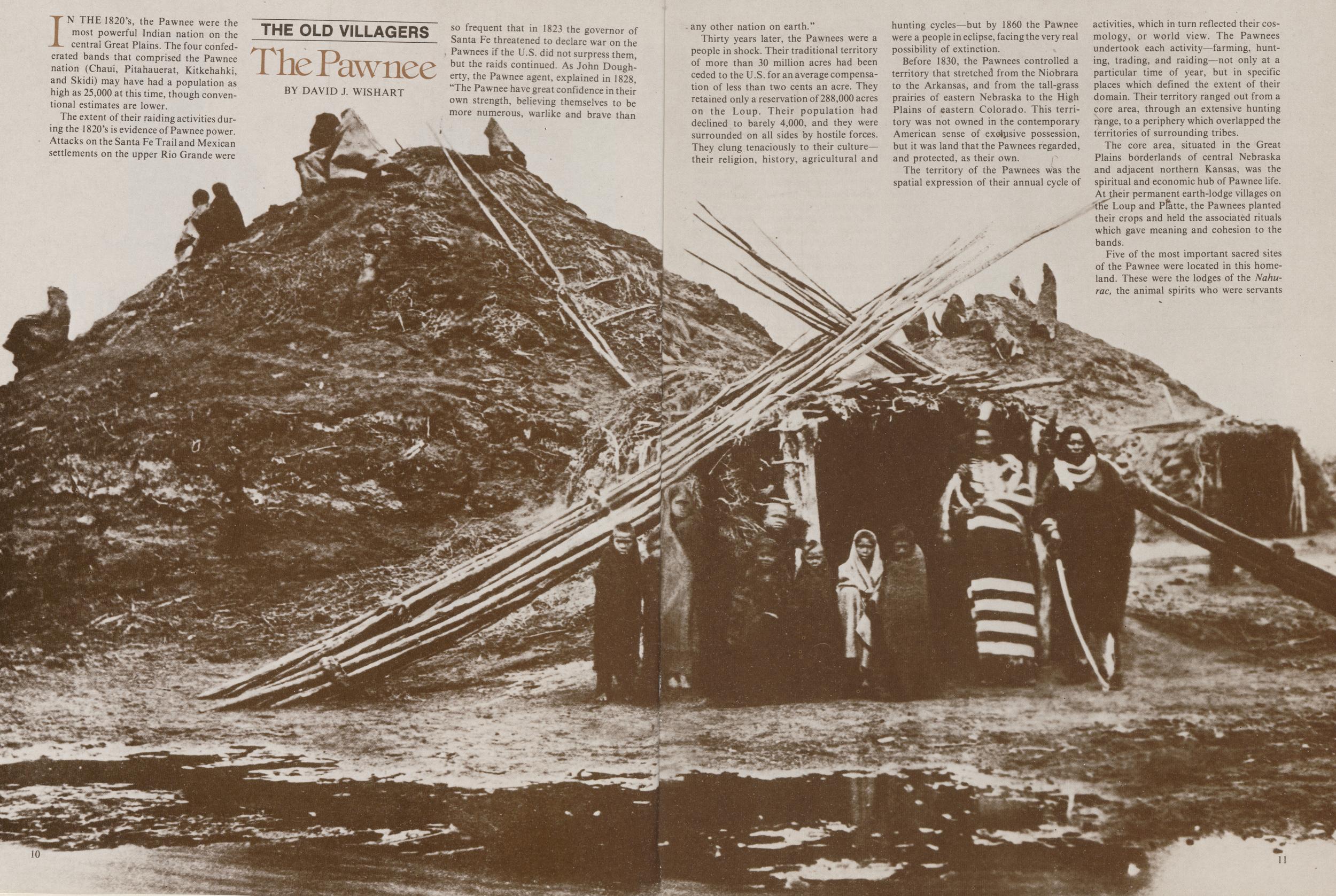
IN THE 1820's, the Pawnee were the most powerful Indian nation on the central Great Plains. The four confederated bands that comprised the Pawnee nation (Chaui, Pitahauerat, Kitkehahki, and Skidi) may have had a population as high as 25,000 at this time, though conventional estimates are lower.
>The extent of their raiding activities during the 1820's is evidence of Pawnee power. Attacks on the Santa Fe Trail and Mexican settlements on the upper Rio Grande were
THE OLD VILLAGERS The Pawnee BY DAVID J. WISHARTso frequent that in 1823 the governor of Santa Fe threatened to declare war on the Pawnees if the U.S. did not surpress them, but the raids continued. As John Dougherty, the Pawnee agent, explained in 1828, "The Pawnee have great confidence in their own strength, believing themselves to be more numerous, warlike and brave than any other nation on earth."
Thirty years later, the Pawnees were a people in shock. Their traditional territory of more than 30 million acres had been ceded to the U.S. for an average compensation of less than two cents an acre. They retained only a reservation of 288,000 acres on the Loup. Their population had declined to barely 4,000, and they were surrounded on all sides by hostile forces. They clung tenaciously to their culture—their religion, history, agricultural and hunting cycles—but by 1860 the Pawnee were a people in eclipse, facing the very real possibility of extinction.
Before 1830, the Pawnees controlled a territory that stretched from the Niobrara to the Arkansas, and from the tall-grass prairies of eastern Nebraska to the High Plains of eastern Colorado. This territory was not owned in the contemporary American sense of exclusive possession, but it was land that the Pawnees regarded, and protected, as their own.
The territory of the Pawnees was the spatial expression of their annual cycle of activities, which in turn reflected their cosmology, or world view. The Pawnees undertook each activity—farming, hunting, trading, and raiding—not only at a particular time of year, but in specific places which defined the extent of their domain. Their territory ranged out from a core area, through an extensive hunting range, to a periphery which overlapped the territories of surrounding tribes.
The core area, situated in the Great Plains borderlands of central Nebraska and adjacent northern Kansas, was the spiritual and economic hub of Pawnee life. At their permanent earth-lodge villages on the Loup and Pfatte, the Pawnees planted their crops and held the associated rituals which gave meaning and cohesion to the bands.
Five of the most important sacred sites of the Pawnee were located in this homeland. These were the lodges of the Nahurac, the animal spirits who were servants
11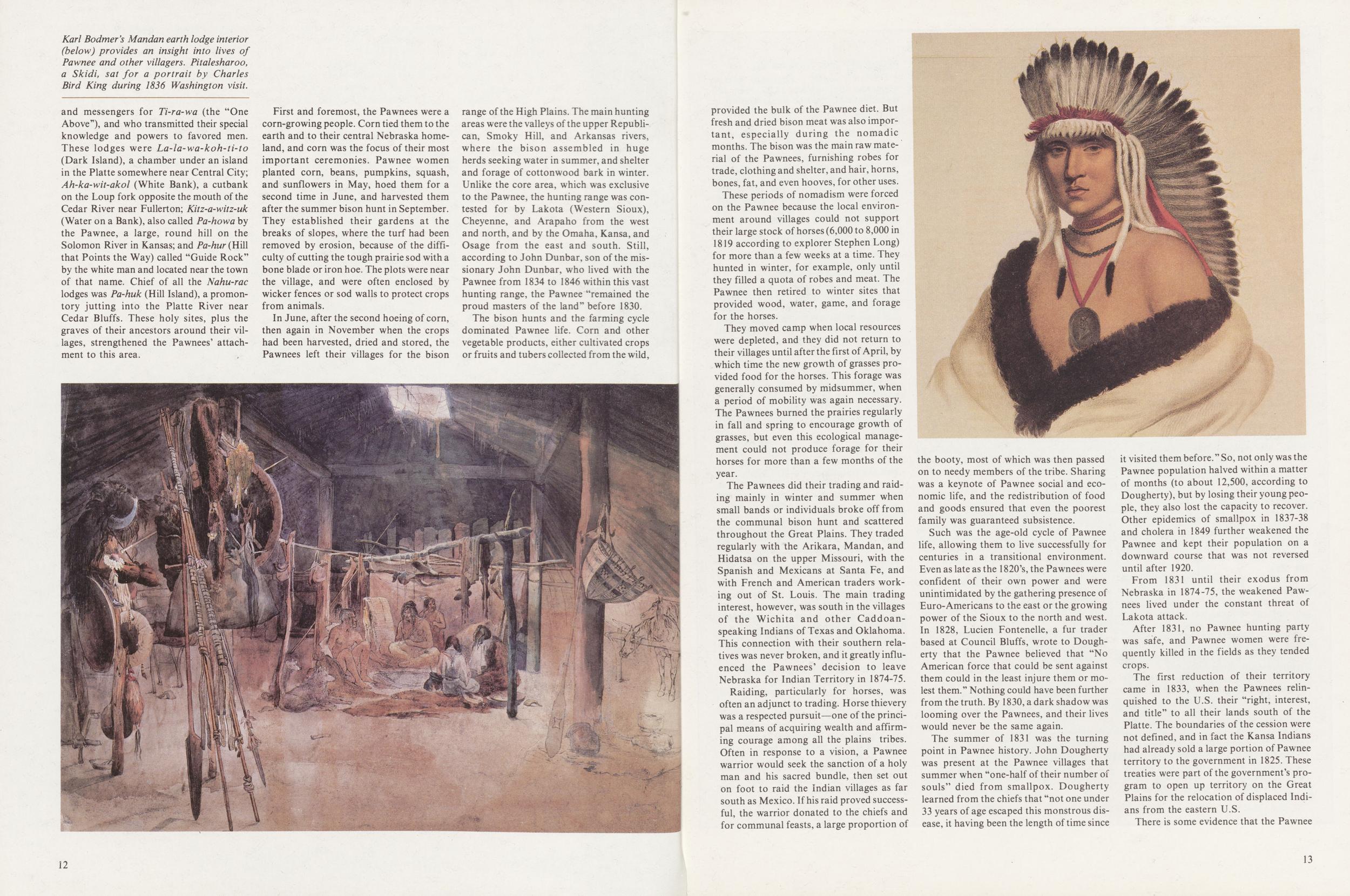
and messengers for Ti-ra-wa (the "One Above"), and who transmitted their special knowledge and powers to favored men. These lodges were La-la-wa-koh-ti-to (Dark Island), a chamber under an island in the Platte somewhere near Central City; Ah-ka-wit-akol (White Bank), a cutbank on the Loup fork opposite the mouth of the Cedar River near Fullerton; Kitz-a-witz-uk (Water on a Bank), also called Pa-howa by the Pawnee, a large, round hill on the Solomon River in Kansas; and Pa-hur (Hill that Points the Way) called "Guide Rock" by the white man and located near the town of that name. Chief of all the Nahu-rac lodges was Pa-huk (Hill Island), a promontory jutting into the Platte River near Cedar Bluffs. These holy sites, plus the graves of their ancestors around their villages, strengthened the Pawnees' attachment to this area.
First and foremost, the Pawnees were a corn-growing people. Corn tied them to the earth and to their central Nebraska homeland, and corn was the focus of their most important ceremonies. Pawnee women planted corn, beans, pumpkins, squash, and sunflowers in May, hoed them for a second time in June, and harvested them after the summer bison hunt in September. They established their gardens at the breaks of slopes, where the turf had been removed by erosion, because of the difficulty of cutting the tough prairie sod with a bone blade or iron hoe. The plots were near the village, and were often enclosed by wicker fences or sod walls to protect crops from animals.
In June, after the second hoeing of corn, then again in November when the crops had been harvested, dried and stored, the Pawnees left their villages for the bison range of the High Plains. The main hunting areas were the valleys of the upper Republican, Smoky Hill, and Arkansas rivers, where the bison assembled in huge herds seeking water in summer, and shelter and forage of cottonwood bark in winter. Unlike the core area, which was exclusive to the Pawnee, the hunting range was contested for by Lakota (Western Sioux), Cheyenne, and Arapaho from the west and north, and by the Omaha, Kansa, and Osage from the east and south. Still, according to John Dunbar, son of the missionary John Dunbar, who lived with the Pawnee from 1834 to 1846 within this vast hunting range, the Pawnee "remained the proud masters of the land" before 1830.
The bison hunts and the farming cycle dominated Pawnee life. Corn and other vegetable products, either cultivated crops or fruits and tubers collected from the wild,
12provided the bulk of the Pawnee diet. But fresh and dried bison meat was also important, especially during the nomadic months. The bison was the main raw material of the Pawnees, furnishing robes for trade, clothing and shelter, and hair, horns, bones, fat, and even hooves, for other uses.
These periods of nomadism were forced on the Pawnee because the local environment around villages could not support their large stock of horses (6,000 to 8,000 in 1819 according to explorer Stephen Long) for more than a few weeks at a time. They hunted in winter, for example, only until they filled a quota of robes and meat. The Pawnee then retired to winter sites that provided wood, water, game, and forage for the horses.
They moved camp when local resources were depleted, and they did not return to their villages until after the first of April, by which time the new growth of grasses provided food for the horses. This forage was generally consumed by midsummer, when a period of mobility was again necessary. The Pawnees burned the prairies regularly in fall and spring to encourage growth of grasses, but even this ecological management could not produce forage for their horses for more than a few months of the year.
The Pawnees did their trading and raiding mainly in winter and summer when small bands or individuals broke off from the communal bison hunt and scattered throughout the Great Plains. They traded regularly with the Arikara, Mandan, and Hidatsa on the upper Missouri, with the Spanish and Mexicans at Santa Fe, and with French and American traders working out of St. Louis, The main trading interest, however, was south in the villages of the Wichita and other Caddoan-speaking Indians of Texas and Oklahoma. This connection with their southern relatives was never broken, and it greatly influenced the Pawnees' decision to leave Nebraska for Indian Territory in 1874-75.
Raiding, particularly for horses, was often an adjunct to trading. Horse thievery was a respected pursuit—one of the principal means of acquiring wealth and affirm- ing courage among all the plains tribes. Often in response to a vision, a Pawnee warrior would seek the sanction of a holy man and his sacred bundle, then set out on foot to raid the Indian villages as far south as Mexico. If his raid proved successful, the warrior donated to the chiefs and for communal feasts, a large proportion of
>the booty, most of which was then passed on to needy members of the tribe. Sharing was a keynote of Pawnee social and economic life, and the redistribution of food and goods ensured that even the poorest family was guaranteed subsistence.
Such was the age-old cycle of Pawnee life, allowing them to live successfully for centuries in a transitional environment. Even as late as the 1820's, the Pawnees were confident of their own power and were unintimidated by the gathering presence of Euro-Americans to the east or the growing power of the Sioux to the north and west. In 1828, Lucien Fontenelle, a fur trader based at Council Bluffs, wrote to Dougherty that the Pawnee believed that "No American force that could be sent against them could in the least injure them or molest them." Nothing could have been further from the truth. By 1830, a dark shadow was looming over the Pawnees, and their lives would never be the same again.
The summer of 1831 was the turning point in Pawnee history. John Dougherty was present at the Pawnee villages that summer when "one-half of their number of souls" died from smallpox. Dougherty learned from the chiefs that "not one under 33 years of age escaped this monstrous disease, it having been the length of time since it visited them before." So, not only was the Pawnee population halved within a matter of months (to about 12,500, according to Dougherty), but by losing their young people, they also lost the capacity to recover. Other epidemics of smallpox in 1837-38 and cholera in 1849 further weakened the Pawnee and kept their population on a downward course that was not reversed until after 1920.
From 1831 until their exodus from Nebraska in 1874-75, the weakened Pawnees lived under the constant threat of Lakota attack. After 1831, no Pawnee hunting party was safe, and Pawnee women were frequently killed in the fields as they tended crops.
The first reduction of their territory came in 1833, when the Pawnees relinquished to the U.S. their "right, interest, and title" to all their lands south of the Platte. The boundaries of the cession were not defined, and in fact the Kansa Indians had already sold a large portion of Pawnee territory to the government in 1825. These treaties were part of the government's program to open up territory on the Great Plains for the relocation of displaced Indians from the eastern U.S.
There is some evidence that the Pawnee
13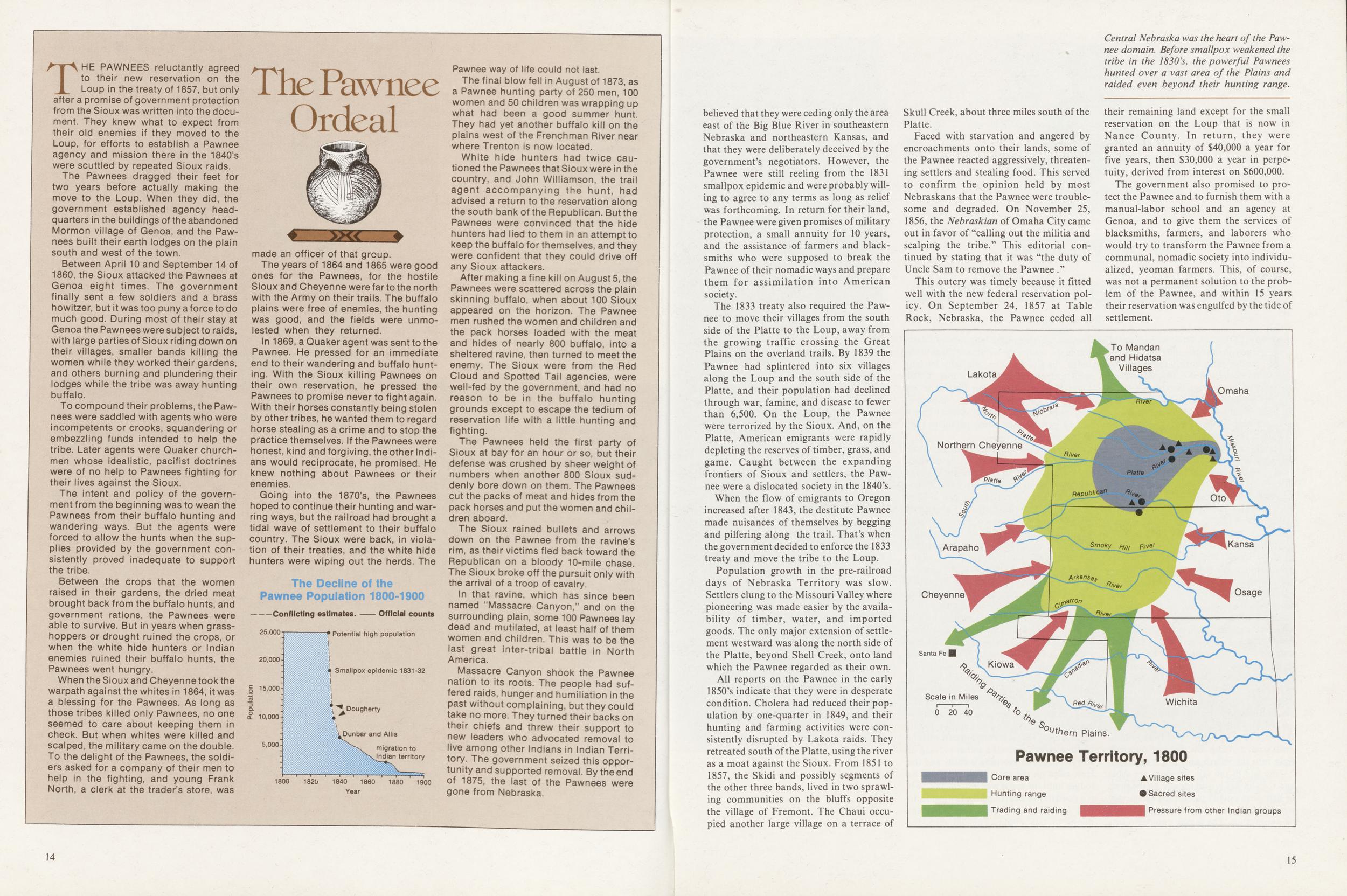
THE PAWNEES reluctantly agreed to their new reservation on the Loup in the treaty of 1857, but only after a promise of government protection from the Sioux was written into the document. They knew what to expect from their old enemies if they moved to the Loup, for efforts to establish a Pawnee agency and mission there in the 1840's were scuttled by repeated Sioux raids.
The Pawnees dragged their feet for two years before actually making the move to the Loup. When they did, the government established agency headquarters in the buildings of the abandoned Mormon village of Genoa, and the Pawnees built their earth lodges on the plain south and west of the town.
Between April 10 and September 14 of 1860, the Sioux attacked the Pawnees at Genoa eight times. The government finally sent a few soldiers and a brass howitzer, but it was too puny a force to do much good. During most of their stay at Genoa the Pawnees were subject to raids, with large parties of Sioux riding down on their villages, smaller bands killing the women while they worked their gardens, and others burning and plundering their lodges while the tribe was away hunting buffalo.
To compound their problems, the Pawnees were saddled with agents who were incompetents or crooks, squandering or embezzling funds intended to help the tribe. Later agents were Quaker churchmen whose idealistic, pacifist doctrines were of no help to Pawnees fighting for their lives against the Sioux.
The intent and policy of the government from the beginning was to wean the Pawnees from their buffalo hunting and wandering ways. But the agents were forced to allow the hunts when the supplies provided by the government consistently proved inadequate to support the tribe.
Between the crops that the women raised in their gardens, the dried meat brought back from the buffalo hunts, and government rations, the Pawnees were able to survive. But in years when grasshoppers or drought ruined the crops, or when the white hide hunters or Indian enemies ruined their buffalo hunts, the Pawnees went hungry.
When the Sioux and Cheyenne took the warpath against the whites in 1864, it was a blessing for the Pawnees. As long as those tribes killed only Pawnees, no one seemed to care about keeping them in check. But when whites were killed and scalped, the military came on the double. To the delight of the Pawnees, the soldiers asked for a company of their men to help in the fighting, and young Frank North, a clerk at the trader's store, was made an officer of that group.
The years of 1864 and 1865 were good ones for the Pawnees, for the hostile Sioux and Cheyenne were far to the north with the Army on their trails. The buffalo plains were free of enemies, the hunting was good, and the fields were unmolested when they returned.
In 1869, a Quaker agent was sent to the Pawnee. He pressed for an immediate end to their wandering and buffalo hunting. With the Sioux killing Pawnees on their own reservation, he pressed the Pawnees to promise never to fight again. With their horses constantly being stolen by other tribes, he wanted them to regard horse stealing as a crime and to stop the practice themselves. If the Pawnees were honest, kind and forgiving, the other Indians would reciprocate, he promised. He knew nothing about Pawnees or their enemies.
Going into the 1870's, the Pawnees hoped to continue their hunting and warring ways, but the railroad had brought a tidal wave of settlement to their buffalo country. The Sioux were back, in violation of their treaties, and the white hide hunters were wiping out the herds. The
The Decline of the Pawnee Population 1800-1900 Conflicting estimates. Official counts 25,000 20,000 15,000 10,000 5,000 Potential high population Smallpox epidemic 1831-32 Dougherty Dunbar and Allis migration to Indian territory 1800 1820 1840 1860 Year 1880 1900Pawnee way of life could not last.
The final blow fell in August of 1873, as a Pawnee hunting party of 250 men, 100 women and 50 children was wrapping up what had been a good summer hunt. They had yet another buffalo kill on the plains west of the Frenchman River near where Trenton is now located.
White hide hunters had twice cautioned the Pawnees that Sioux were in the country, and John Williamson, the trail agent accompanying the hunt, had advised a return to the reservation along the south bank of the Republican. But the Pawnees were convinced that the hide hunters had lied to them in an attempt to keep the buffalo for themselves, and they were confident that they could drive off any Sioux attackers.
After making a fine kill on August 5, the Pawnees were scattered across the plain skinning buffalo, when about 100 Sioux appeared on the horizon. The Pawnee men rushed the women and children and the pack horses loaded with the meat and hides of nearly 800 buffalo, into a sheltered ravine, then turned to meet the enemy. The Sioux were from the Red Cloud and Spotted Tail agencies, were well-fed by the government, and had no reason to be in the buffalo hunting grounds except to escape the tedium of reservation life with a little hunting and fighting.
The Pawnees held the first party of Sioux at bay for an hour or so, but their defense was crushed by sheer weight of numbers when another 800 Sioux suddenly bore down on them. The Pawnees cut the packs of meat and hides from the pack horses and put the women and children aboard.
The Sioux rained bullets and arrows down on the Pawnee from the ravine's rim, as their victims fled back toward the Republican on a bloody 10-mile chase. The Sioux broke off the pursuit only with the arrival of a troop of cavalry. In that ravine, which has since been named "Massacre Canyon," and on the surrounding plain, some 100 Pawnees lay dead and mutilated, at least half of them women and children. This was to be the last great inter-tribal battle in North America.
Massacre Canyon shook the Pawnee nation to its roots. The people had suffered raids, hunger and humiliation in the past without complaining, but they could take no more. They turned their backs on their chiefs and threw their support to new leaders who advocated removal to live among other Indians in Indian Territory. The government seized this opportunity and supported removal. By the end of 1875, the last of the Pawnees were gone from Nebraska.
14believed that they were ceding only the area east of the Big Blue River in southeastern Nebraska and northeastern Kansas, and that they were deliberately deceived by the government's negotiators. However, the Pawnee were still reeling from the 1831 smallpox epidemic and were probably willing to agree to any terms as long as relief was forthcoming. In return for their land, the Pawnee were given promises of military protection, a small annuity for 10 years, and the assistance of farmers and blacksmiths who were supposed to break the Pawnee of their nomadic ways and prepare them for assimilation into American society.
>The 1833 treaty also required the Pawnee to move their villages from the south side of the Platte to the Loup, away from the growing traffic crossing the Great Plains on the overland trails. By 1839 the Pawnee had splintered into six villages along the Loup and the south side of the Platte, and their population had declined through war, famine, and disease to fewer than 6,500. On the Loup, the Pawnee were terrorized by the Sioux. And, on the Platte, American emigrants were rapidly depleting the reserves of timber, grass, and game. Caught between the expanding frontiers of Sioux and settlers, the Pawnee were a dislocated society in the 1840's.
When the flow of emigrants to Oregon increased after 1843, the destitute Pawnee made nuisances of themselves by begging and pilfering along the trail. That's when the government decided to enforce the 1833 treaty and move the tribe to the Loup.
Population growth in the pre-railroad days of Nebraska Territory was slow. Settlers clung to the Missouri Valley where pioneering was made easier by the availability of timber, water, and imported goods. The only major extension of settlement westward was along the north side of the Platte, beyond Shell Creek, onto land which the Pawnee regarded as their own.
All reports on the Pawnee in the early 1850's indicate that they were in desperate condition. Cholera had reduced their population by one-quarter in 1849, and their hunting and farming activities were consistently disrupted by Lakota raids. They retreated south of the Platte, using the river as a moat against the Sioux. From 1851 to 1857, the Skidi and possibly segments of the other three bands, lived in two sprawling communities on the bluffs opposite the village of Fremont. The Chaui occupied another large village on a terrace of Central Nebraska was the heart of the Pawnee domain. Before smallpox weakened the tribe in the 1830's, the powerful Pawnees hunted over a vast area of the Plains and raided even beyond their hunting range. Skull Creek, about three miles south of the Platte.
Faced with starvation and angered by encroachments onto their lands, some of the Pawnee reacted aggressively, threatening settlers and stealing food. This served to confirm the opinion held by most Nebraskans that the Pawnee were troublesome and degraded. On November 25, 1856, the Nebraskian of Omaha City came out in favor of "calling out the militia and scalping the tribe." This editorial continued by stating that it was "the duty of Uncle Sam to remove the Pawnee."
This outcry was timely because it fitted well with the new federal reservation policy. On September 24, 1857 at Table Rock, Nebraska, the Pawnee ceded all their remaining land except for the small reservation on the Loup that is now in Nance County. In return, they were granted an annuity of $40,000 a year for five years, then $30,000 a year in perpetuity, derived from interest on $600,000.
The government also promised to protect the Pawnee and to furnish them with a manual-labor school and an agency at Genoa, and to give them the services of blacksmiths, farmers, and laborers who would try to transform the Pawnee from a communal, nomadic society into individualized, yeoman farmers. This, of course, was not a permanent solution to the problem of the Pawnee, and within 15 years their reservation was engulfed by the tide of settlement.
Pawnee Territory, 1800 Core area Hunting range Trading and raiding A Village sites Sacred sites Pressure from other Indian groups 15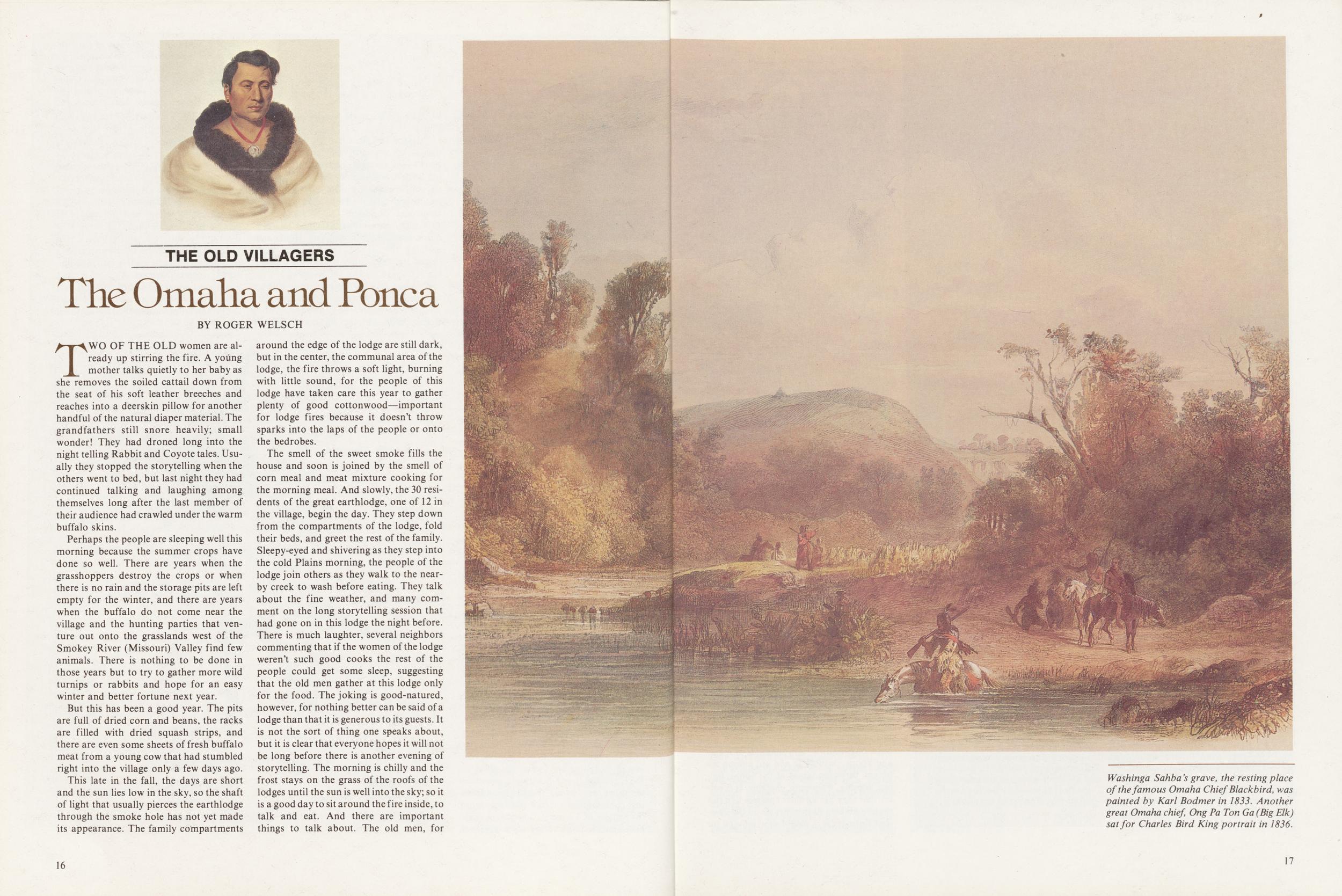
THE OLD VILLAGERS The Omaha and Ponca
BY ROGER WELSCHTWO OF THE OLD women are already up stirring the fire. A young mother talks quietly to her baby as she removes the soiled cattail down from the seat of his soft leather breeches and reaches into a deerskin pillow for another handful of the natural diaper material. The grandfathers still snore heavily; small wonder! They had droned long into the night telling Rabbit and Coyote tales. Usually they stopped the storytelling when the others went to bed, but last night they had continued talking and laughing among themselves long after the last member of their audience had crawled under the warm buffalo skins.
Perhaps the people are sleeping well this morning because the summer crops have done so well. There are years when the grasshoppers destroy the crops or when there is no rain and the storage pits are left empty for the winter, and there are years when the buffalo do not come near the village and the hunting parties that venture out onto the grasslands west of the Smokey River (Missouri) Valley find few animals. There is nothing to be done in those years but to try to gather more wild turnips or rabbits and hope for an easy winter and better fortune next year.
But this has been a good year. The pits are full of dried corn and beans, the racks are filled with dried squash strips, and there are even some sheets of fresh buffalo meat from a young cow that had stumbled right into the village only a few days ago.
This late in the fall, the days are short and the sun lies low in the sky, so the shaft of light that usually pierces the earthlodge through the smoke hole has not yet made its appearance. The family compartments around the edge of the lodge are still dark, but in the center, the communal area of the lodge, the fire throws a soft light, burning with little sound, for the people of this lodge have taken care this year to gather plenty of good cottonwood—important for lodge fires because it doesn't throw sparks into the laps of the people or onto the bedrobes.
The smell of the sweet smoke fills the house and soon is joined by the smell of corn meal and meat mixture cooking for the morning meal. And slowly, the 30 residents of the great earthlodge, one of 12 in the village, begin the day. They step down from the compartments of the lodge, fold their beds, and greet the rest of the family. Sleepy-eyed and shivering as they step into the cold Plains morning, the people of the lodge join others as they walk to the nearby creek to wash before eating. They talk about the fine weather, and many comment on the long storytelling session that had gone on in this lodge the night before. There is much laughter, several neighbors commenting that if the women of the lodge weren't such good cooks the rest of the people could get some sleep, suggesting that the old men gather at this lodge only for the food. The joking is good-natured, however, for nothing better can be said of a lodge than that it is generous to its guests. It is not the sort of thing one speaks about, but it is clear that everyone hopes it will not be long before there is another evening of storytelling. The morning is chilly and the frost stays on the grass of the roofs of the lodges until the sun is well into the sky; so it is a good day to sit around the fire inside, to talk and eat. And there are important things to talk about. The old men, for
16Washinga Sahba's grave, the resting place of the famous Omaha Chief Blackbird, was painted by Karl Bodmer in 1833. Another great Omaha chief, Ong Pa Ton Ga (Big Elk) sat for Charles Bird King portrait in 1836.
17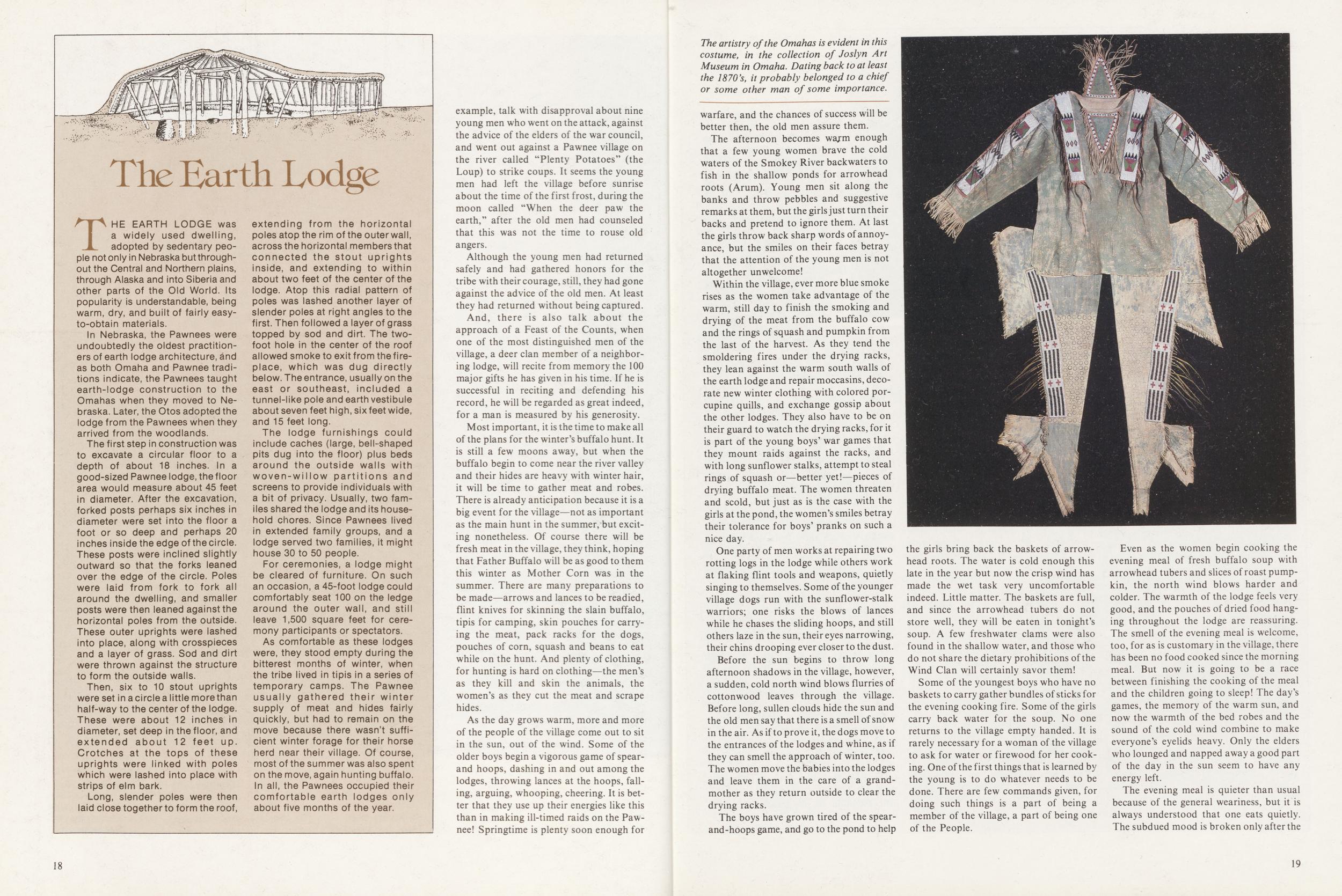 The Earth Lodge
THE EARTH LODGE was a widely used dwelling, adopted by sedentary people not only in Nebraska but throughout the Central and Northern plains, through Alaska and into Siberia and other parts of the Old World. Its popularity is understandable, being warm, dry, and built of fairly easy-to-obtain materials.
In Nebraska, the Pawnees were undoubtedly the oldest practitioners of earth lodge architecture, and as both Omaha and Pawnee traditions indicate, the Pawnees taught earth-lodge construction to the Omahas when they moved to Nebraska. Later, the Otos adopted the lodge from the Pawnees when they arrived from the woodlands.
The first step in construction was to excavate a circular floor to a depth of about 18 inches. In a good-sized Pawnee lodge, the floor area would measure about 45 feet in diameter. After the excavation, forked posts perhaps six inches in diameter were set into the floor a foot or so deep and perhaps 20 inches inside the edge of the circle. These posts were inclined slightly outward so that the forks leaned over the edge of the circle. Poles were laid from fork to fork all around the dwelling, and smaller posts were then leaned against the horizontal poles from the outside. These outer uprights were lashed into place, along with crosspieces and a layer of grass. Sod and dirt were thrown against the structure to form the outside walls.
Then, six to 10 stout uprights were set in a circle a little more than half-way to the center of the lodge. These were about 12 inches in diameter, set deep in the floor, and extended about 12 feet up. Crotches at the tops of these uprights were linked with poles which were lashed into place with strips of elm bark.
Long, slender poles were then laid close together to form the roof, extending from the horizontal poles atop the rim of the outer wall, across the horizontal members that connected the stout uprights inside, and extending to within about two feet of the center of the lodge. Atop this radial pattern of poles was lashed another layer of slender poles at right angles to the first. Then followed a layer of grass topped by sod and dirt. The two-foot hole in the center of the roof allowed smoke to exit from the fireplace, which was dug directly below. The entrance, usually on the east or southeast, included a tunnel-like pole and earth vestibule about seven feet high, six feet wide, and 15 feet long.
The lodge furnishings could include caches (large, bell-shaped pits dug into the floor) plus beds around the outside walls with woven-willow partitions and screens to provide individuals with a bit of privacy. Usually, two familes shared the lodge and its household chores. Since Pawnees lived in extended family groups, and a lodge served two families, it might house 30 to 50 people.
>For ceremonies, a lodge might be cleared of furniture. On such an occasion, a 45-foot lodge could comfortably seat 100 on the ledge around the outer wall, and still leave 1,500 square feet for ceremony participants or spectators.
As comfortable as these lodges were, they stood empty during the bitterest months of winter, when the tribe lived in tipis in a series of temporary camps. The Pawnee usually gathered their winter supply of meat and hides fairly quickly, but had to remain on the move because there wasn't sufficient winter forage for their horse herd near their village. Of course, most of the summer was also spent on the move, again hunting buffalo. In all, the Pawnees occupied their comfortable earth lodges only about five months of the year.
example, talk with disapproval about nine young men who went on the attack, against the advice of the elders of the war council, and went out against a Pawnee village on the river called "Plenty Potatoes" (the Loup) to strike coups. It seems the young men had left the village before sunrise about the time of the first frost, during the moon called "When the deer paw the earth," after the old men had counseled that this was not the time to rouse old angers.
Although the young men had returned safely and had gathered honors for the tribe with their courage, still, they had gone against the advice of the old men. At least they had returned without being captured.
And, there is also talk about the approach of a Feast of the Counts, when one of the most distinguished men of the village, a deer clan member of a neighboring lodge, will recite from memory the 100 major gifts he has given in his time. If he is successful in reciting and defending his record, he will be regarded as great indeed, for a man is measured by his generosity.
Most important, it is the time to make all of the plans for the winter's buffalo hunt. It is still a few moons away, but when the buffalo begin to come near the river valley and their hides are heavy with winter hair, it will be time to gather meat and robes. There is already anticipation because it is a big event for the village—not as important as the main hunt in the summer, but exciting nonetheless. Of course there will be fresh meat in the village, they think, hoping that Father Buffalo will be as good to them this winter as Mother Corn was in the summer. There are many preparations to be made—arrows and lances to be readied, flint knives for skinning the slain buffalo, tipis for camping, skin pouches for carrying the meat, pack racks for the dogs, pouches of corn, squash and beans to eat while on the hunt. And plenty of clothing, for hunting is hard on clothing—the men's as they kill and skin the animals, the women's as they cut the meat and scrape hides.
As the day grows warm, more and more of the people of the village come out to sit in the sun, out of the wind. Some of the older boys begin a vigorous game of spear-and hoops, dashing in and out among the lodges, throwing lances at the hoops, falling, arguing, whooping, cheering. It is better that they use up their energies like this than in making ill-timed raids on the Pawnee! Springtime is plenty soon enough for
18The artistry of the Omahas is evident in this costume, in the collection of Joslyn Art Museum in Omaha. Dating back to at least the 1870's, it probably belonged to a chief or some other man of some importance.
warfare, and the chances of success will be better then, the old men assure them.
The afternoon becomes wajm enough that a few young women brave the cold waters of the Smokey River backwaters to fish in the shallow ponds for arrowhead roots (Arum). Young men sit along the banks and throw pebbles and suggestive remarks at them, but the girls just turn their backs and pretend to ignore them. At last the girls throw back sharp words of annoyance, but the smiles on their faces betray that the attention of the young men is not altogether unwelcome!
Within the village, ever more blue smoke rises as the women take advantage of the warm, still day to finish the smoking and drying of the meat from the buffalo cow and the rings of squash and pumpkin from the last of the harvest. As they tend the smoldering fires under the drying racks, they lean against the warm south walls of the earth lodge and repair moccasins, decorate new winter clothing with colored porcupine quills, and exchange gossip about the other lodges. They also have to be on their guard to watch the drying racks, for it is part of the young boys' war games that they mount raids against the racks, and with long sunflower stalks, attempt to steal rings of squash or—better yet!—pieces of drying buffalo meat. The women threaten and scold, but just as is the case with the girls at the pond, the women's smiles betray their tolerance for boys' pranks on such a nice day.
One party of men works at repairing two rotting logs in the lodge while others work at flaking flint tools and weapons, quietly singing to themselves. Some of the younger village dogs run with the sunflower-stalk warriors; one risks the blows of lances while he chases the sliding hoops, and still others laze in the sun, their eyes narrowing, their chins drooping ever closer to the dust.
Before the sun begins to throw long afternoon shadows in the village, however, a sudden, cold north wind blows flurries of cottonwood leaves through the village. Before long, sullen clouds hide the sun and the old men say that there is a smell of snow in the air. As if to prove it, the dogs move to the entrances of the lodges and whine, as if they can smell the approach of winter, too. The women move the babies into the lodges and leave them in the care of a grandmother as they return outside to clear the drying racks.
The boys have grown tired of the spear-and-hoops game, and go to the pond to help
the girls bring back the baskets of arrowhead roots. The water is cold enough this late in the year but now the crisp wind has made the wet task very uncomfortable indeed. Little matter. The baskets are full, and since the arrowhead tubers do not store well, they will be eaten in tonight's soup. A few freshwater clams were also found in the shallow water, and those who do not share the dietary prohibitions of the Wind Clan will certainly savor them!
Some of the youngest boys who have no baskets to carry gather bundles of sticks for the evening cooking fire. Some of the girls carry back water for the soup. No one returns to the village empty handed. It is rarely necessary for a woman of the village to ask for water or firewood for her cook- ing. One of the first things that is learned by the young is to do whatever needs to be done. There are few commands given, for doing such things is a part of being a member of the village, a part of being one of the People.
Even as the women begin cooking the evening meal of fresh buffalo soup with arrowhead tubers and slices of roast pumpkin, the north wind blows harder and colder. The warmth of the lodge feels very good, and the pouches of dried food hanging throughout the lodge are reassuring. The smell of the evening meal is welcome, too, for as is customary in the village, there has been no food cooked since the morning meal. But now it is going to be a race between finishing the cooking of the meal and the children going to sleep! The day's games, the memory of the warm sun, and now the warmth of the bed robes and the sound of the cold wind combine to make everyone's eyelids heavy. Only the elders who lounged and napped away a good part of the day in the sun seem to have any energy left.
The evening meal is quieter than usual because of the general weariness, but it is always understood that one eats quietly. The subdued mood is broken only after the
19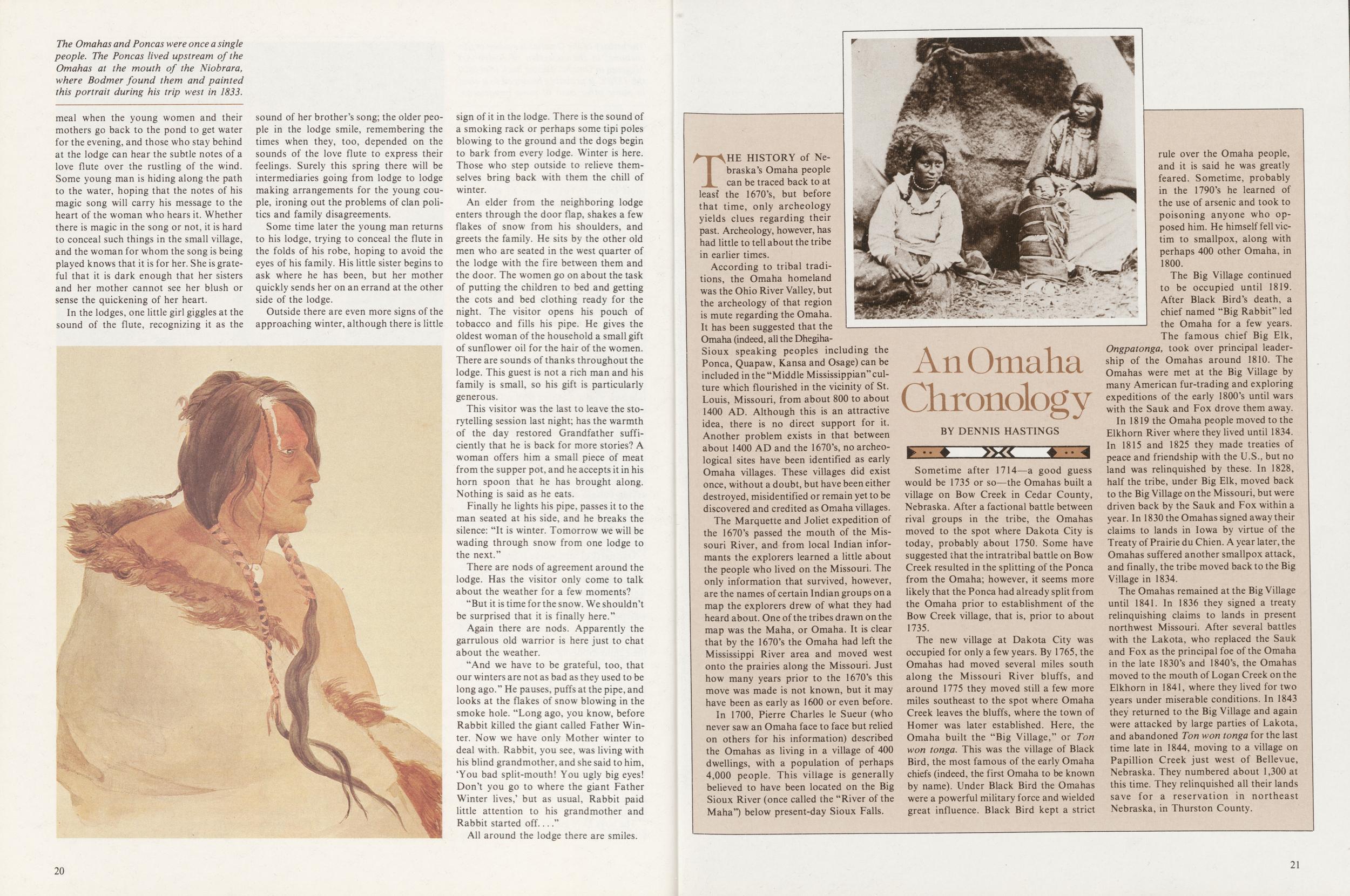
The Omahas and Poncas were once a single people. The Poncas lived upstream of the Omahas at the mouth of the Niobrara, where Bodmer found them and painted this portrait during his trip west in 1833.
meal when the young women and their mothers go back to the pond to get water for the evening, and those who stay behind at the lodge can hear the subtle notes of a love flute over the rustling of the wind. Some young man is hiding along the path to the water, hoping that the notes of his magic song will carry his message to the heart of the woman who hears it. Whether there is magic in the song or not, it is hard to conceal such things in the small village, and the woman for whom the song is being played knows that it is for her. She is grateful that it is dark enough that her sisters and her mother cannot see her blush or sense the quickening of her heart.
In the lodges, one little girl giggles at the sound of the flute, recognizing it as the sound of her brother's song; the older people in the lodge smile, remembering the times when they, too, depended on the sounds of the love flute to express their feelings. Surely this spring there will be intermediaries going from lodge to lodge making arrangements for the young couple, ironing out the problems of clan politics and family disagreements.
Some time later the young man returns to his lodge, trying to conceal the flute in the folds of his robe, hoping to avoid the eyes of his family. His little sister begins to ask where he has been, but her mother quickly sends her on an errand at the other side of the lodge.
Outside there are even more signs of the approaching winter, although there is little sign of it in the lodge. There is the sound of a smoking rack or perhaps some tipi poles blowing to the ground and the dogs begin to bark from every lodge. Winter is here. Those who step outside to relieve themselves bring back with them the chill of winter.
An elder from the neighboring lodge enters through the door flap, shakes a few flakes of snow from his shoulders, and greets the family. He sits by the other old men who are seated in the west quarter of the lodge with the fire between them and the door. The women go on about the task of putting the children to bed and getting the cots and bed clothing ready for the night. The visitor opens his pouch of tobacco and fills his pipe. He gives the oldest woman of the household a small gift of sunflower oil for the hair of the women. There are sounds of thanks throughout the lodge. This guest is not a rich man and his family is small, so his gift is particularly generous.
This visitor was the last to leave the storytelling session last night; has the warmth of the day restored Grandfather sufficiently that he is back for more stories? A woman offers him a small piece of meat from the supper pot, and he accepts it in his horn spoon that he has brought along. Nothing is said as he eats.
Finally he lights his pipe, passes it to the man seated at his side, and he breaks the silence: "It is winter. Tomorrow we will be wading through snow from one lodge to the next."
There are nods of agreement around the lodge. Has the visitor only come to talk about the weather for a few moments?
"But it is time for the snow. We shouldn't be surprised that it is finally here."
Again there are nods. Apparently the garrulous old warrior is here just to chat about the weather.
"And we have to be grateful, too, that our winters are not as bad as they used to be long ago." He pauses, puffs at the pipe, and looks at the flakes of snow blowing in the smoke hole. "Long ago, you know, before Rabbit killed the giant called Father Winter. Now we have only Mother winter to deal with. Rabbit, you see, was living with his blind grandmother, and she said to him, 'You bad split-mouth! You ugly big eyes! Don't you go to where the giant Father Winter lives,' but as usual, Rabbit paid little attention to his grandmother and Rabbit started off...."
All around the lodge there are smiles.
20THE HISTORY of Nebraska's Omaha people can be traced back to at leas! the 1670's, but before that time, only archeology yields clues regarding their past. Archeology, however, has had little to tell about the tribe in earlier times.
According to tribal traditions, the Omaha homeland was the Ohio River Valley, but the archeology of that region is mute regarding the Omaha. It has been suggested that the Omaha (indeed, all the Dhegiha-Sioux speaking peoples including the Ponca, Quapaw, Kansa and Osage) can be included in the "Middle Mississippian" culture which flourished in the vicinity of St. Louis, Missouri, from about 800 to about 1400 AD. Although this is an attractive idea, there is no direct support for it. Another problem exists in that between about 1400 AD and the 1670's, no archeological sites have been identified as early Omaha villages. These villages did exist once, without a doubt, but have been either destroyed, misidentified or remain yet to be discovered and credited as Omaha villages.
The Marquette and Joliet expedition of the 1670's passed the mouth of the Missouri River, and from local Indian informants the explorers learned a little about the people who lived on the Missouri. The only information that survived, however, are the names of certain Indian groups on a map the explorers drew of what they had heard about. One of the tribes drawn on the map was the Maha, or Omaha. It is clear that by the 1670's the Omaha had left the Mississippi River area and moved west onto the prairies along the Missouri. Just how many years prior to the 1670's this move was made is not known, but it may have been as early as 1600 or even before.
In 1700, Pierre Charles le Sueur (who never saw an Omaha face to face but relied on others for his information) described the Omahas as living in a village of 400 dwellings, with a population of perhaps 4,000 people. This village is generally believed to have been located on the Big Sioux River (once called the "River of the Maha") below present-day Sioux Falls.
An Omaha Chronology BY DENNIS HASTINGSSometime after 1714—a good guess would be 1735 or so—the Omahas built a village on Bow Creek in Cedar County, Nebraska. After a factional battle between rival groups in the tribe, the Omahas moved to the spot where Dakota City is today, probably about 1750. Some have suggested that the intratribal battle on Bow Creek resulted in the splitting of the Ponca from the Omaha; however, it seems more likely that the Ponca had already split from the Omaha prior to establishment of the Bow Creek village, that is, prior to about 1735.
The new village at Dakota City was occupied for only a few years. By 1765, the Omahas had moved several miles south along the Missouri River bluffs, and around 1775 they moved still a few more miles southeast to the spot where Omaha Creek leaves the bluffs, where the town of Homer was later established. Here, the Omaha built the "Big Village," or Ton won tonga. This was the village of Black Bird, the most famous of the early Omaha chiefs (indeed, the first Omaha to be known by name). Under Black Bird the Omahas were a powerful military force and wielded great influence. Black Bird kept a strict rule over the Omaha people, and it is said he was greatly feared. Sometime, probably in the 1790's he learned of the use of arsenic and took to poisoning anyone who opposed him. He himself fell victim to smallpox, along with perhaps 400 other Omaha, in 1800.
The Big Village continued to be occupied until 1819. After Black Bird's death, a chief named "Big Rabbit" led the Omaha for a few years. The famous chief Big Elk, Ongpatonga, took over principal leadership of the Omahas around 1810. The Omahas were met at the Big Village by many American fur-trading and exploring expeditions of the early 1800's until wars with the Sauk and Fox drove them away.
In 1819 the Omaha people moved to the Elkhorn River where they lived until 1834. In 1815 and 1825 they made treaties of peace and friendship with the U.S., but no land was relinquished by these. In 1828, half the tribe, under Big Elk, moved back to the Big Village on the Missouri, but were driven back by the Sauk and Fox within a year. In 1830 the Omahas signed away their claims to lands in Iowa by virtue of the Treaty of Prairie du Chien. A year later, the Omahas suffered another smallpox attack, and finally, the tribe moved back to the Big Village in 1834.
The Omahas remained at the Big Village until 1841. In 1836 they signed a treaty relinquishing claims to lands in present northwest Missouri. After several battles with the Lakota, who replaced the Sauk and Fox as the principal foe of the Omaha in the late 1830's and 1840's, the Omahas moved to the mouth of Logan Creek on the Elkhorn in 1841, where they lived for two years under miserable conditions. In 1843 they returned to the Big Village and again were attacked by large parties of Lakota, and abandoned Ton won tonga for the last time late in 1844, moving to a village on Papillion Creek just west of Bellevue, Nebraska. They numbered about 1,300 at this time. They relinquished all their lands save for a reservation in northeast Nebraska, in Thurston County.
21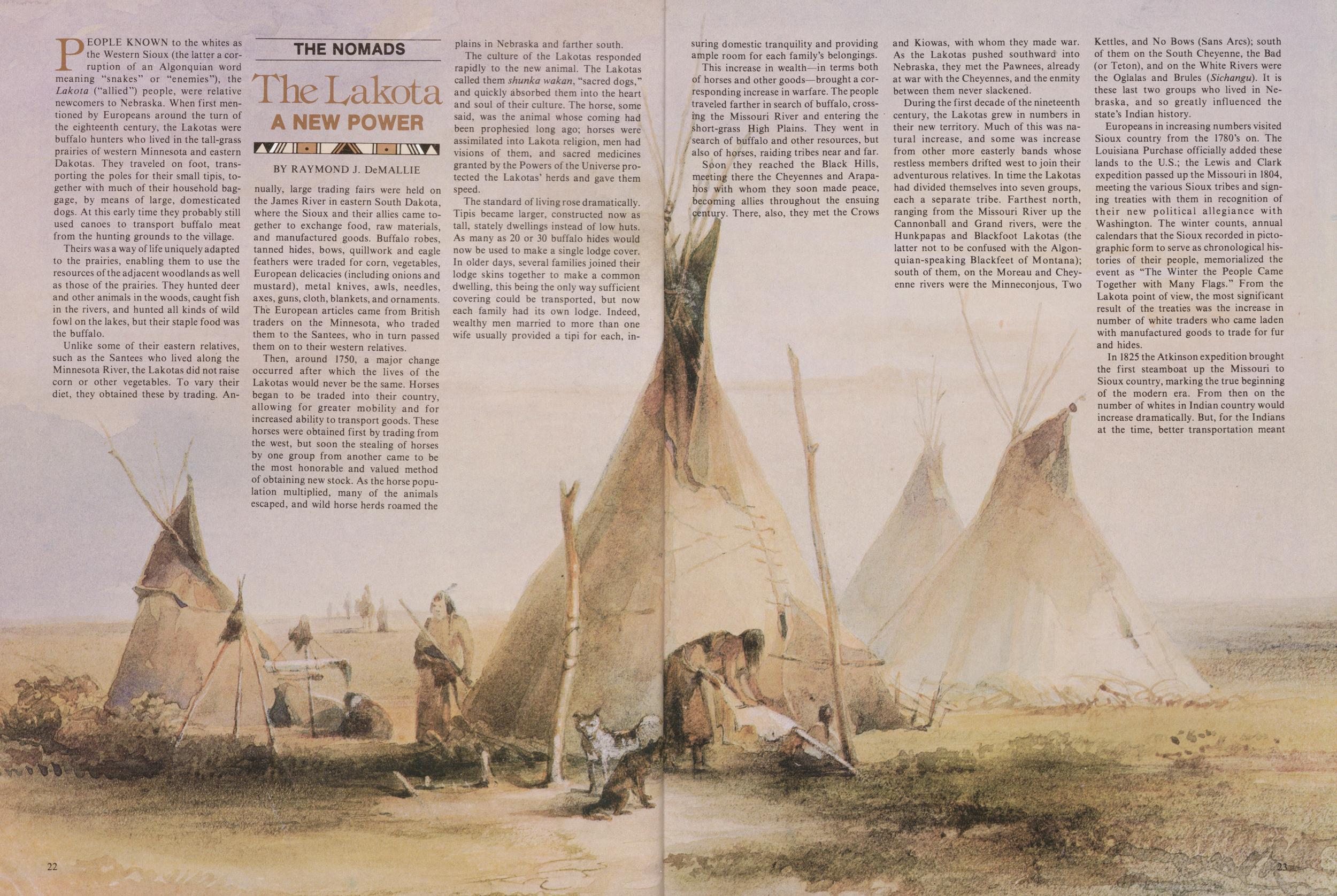
PEOPLE KNOWN to the whites as the Western Sioux (the latter a corruption of an Algonquian word meaning "snakes" or "enemies"), the Lakota ("allied") people, were relative newcomers to Nebraska. When first mentioned by Europeans around the turn of the eighteenth century, the Lakotas were buffalo hunters who lived in the tall-grass prairies of western Minnesota and eastern Dakotas. They traveled on foot, transporting the poles for their small tipis, together with much of their household baggage, by means of large, domesticated dogs. At this early time they probably still used canoes to transport buffalo meat from the hunting grounds to the village.
Theirs was a way of life uniquely adapted to the prairies, enabling them to use the resources of the adjacent woodlands as well as those of the prairies. They hunted deer and other animals in the woods, caught fish in the rivers, and hunted all kinds of wild fowl on the lakes, but their staple food was the buffalo.
Unlike some of their eastern relatives, such as the Santees who lived along the Minnesota River, the Lakotas did not raise corn or other vegetables. To vary their diet, they obtained these by trading. Annually,
THE NOMADS The Lakota A NEW POWER BY RAYMOND J. DeMALLIElarge trading fairs were held on the James River in eastern South Dakota, where the Sioux and their allies came together to exchange food, raw materials, and manufactured goods. Buffalo robes, tanned hides, bows, quillwork and eagle feathers were traded for corn, vegetables, European delicacies (including onions and mustard), metal knives, awls, needles, axes, guns, cloth, blankets, and ornaments. The European articles came from British traders on the Minnesota, who traded them to the Santees, who in turn passed them on to their western relatives.
Then, around 1750, a major change occurred after which the lives of the Lakotas would never be the same. Horses began to be traded into their country, allowing for greater mobility and for increased ability to transport goods. These horses were obtained first by trading from the west, but soon the stealing of horses by one group from another came to be the most honorable and valued method of obtaining new stock. As the horse population multiplied, many of the animals escaped, and wild horse herds roamed the plains in Nebraska and farther south.
The culture of the Lakotas responded rapidly to the new animal. The Lakotas called them shunka wakan, "sacred dogs," and quickly absorbed them into the heart and soul of their culture. The horse, some said, was the animal whose coming had been prophesied long ago; horses were assimilated into Lakota religion, men had visions of them, and sacred medicines granted by the Powers of the Universe protected the Lakotas' herds and gave them speed.
The standard of living rose dramatically. Tipis became larger, constructed now as tall, stately dwellings instead of low huts. As many as 20 or 30 buffalo hides would now be used to make a single lodge cover. In older days, several families joined their lodge skins together to make a common dwelling, this being the only way sufficient covering could be transported, but now each family had its own lodge. Indeed, wealthy men married to more than one wife usually provided a tipi for each, insuring
22domestic tranquility and providing ample room for each family's belongings.
This increase in wealth—in terms both of horses and other goods—brought a corresponding increase in warfare. The people traveled farther in search of buffalo, crossing the Missouri River and entering the short-grass High Plains. They went in search of buffalo and other resources, but I also of horses, raiding tribes near and far.
Soon they reached the Black Hills, meeting there the Cheyennes and Arapahos with whom they soon made peace, becoming allies throughout the ensuing century. There, also, they met the Crows and Kiowas, with whom they made war. As the Lakotas pushed southward into Nebraska, they met the Pawnees, already at war with the Cheyennes, and the enmity between them never slackened.
During the first decade of the nineteenth century, the Lakotas grew in numbers in their new territory. Much of this was natural increase, and some was increase from other more easterly bands whose restless members drifted west to join their adventurous relatives. In time the Lakotas had divided themselves into seven groups, each a separate tribe. Farthest north, ranging from the Missouri River up the Cannonball and Grand rivers, were the Hunkpapas and Blackfoot Lakotas (the latter not to be confused with the Algonquian-speaking Blackfeet of Montana); south of them, on the Moreau and Cheyenne rivers were the Minneconjous, Two Kettles, and No Bows (Sans Arcs); south of them on the South Cheyenne, the Bad (or Teton), and on the White Rivers were the Oglalas and Brules (Sichangu). It is these last two groups who lived in Nebraska, and so greatly influenced the state's Indian history.
Europeans in increasing numbers visited Sioux country from the 1780's on. The Louisiana Purchase officially added these lands to the U.S.; the Lewis and Clark expedition passed up the Missouri in 1804, meeting the various Sioux tribes and signing treaties with them in recognition of their new political allegiance with Washington. The winter counts, annual calendars that the Sioux recorded in pictographic form to serve as chronological histories of their people, memorialized the event as "The Winter the People Came Together with Many Flags." From the Lakota point of view, the most significant result of the treaties was the increase in number of white traders who came laden with manufactured goods to trade for fur and hides.
In 1825 the Atkinson expedition brought the first steamboat up the Missouri to Sioux country, marking the true beginning of the modern era. From then on the number of whites in Indian country would increase dramatically. But, for the Indians at the time, better transportation meant
23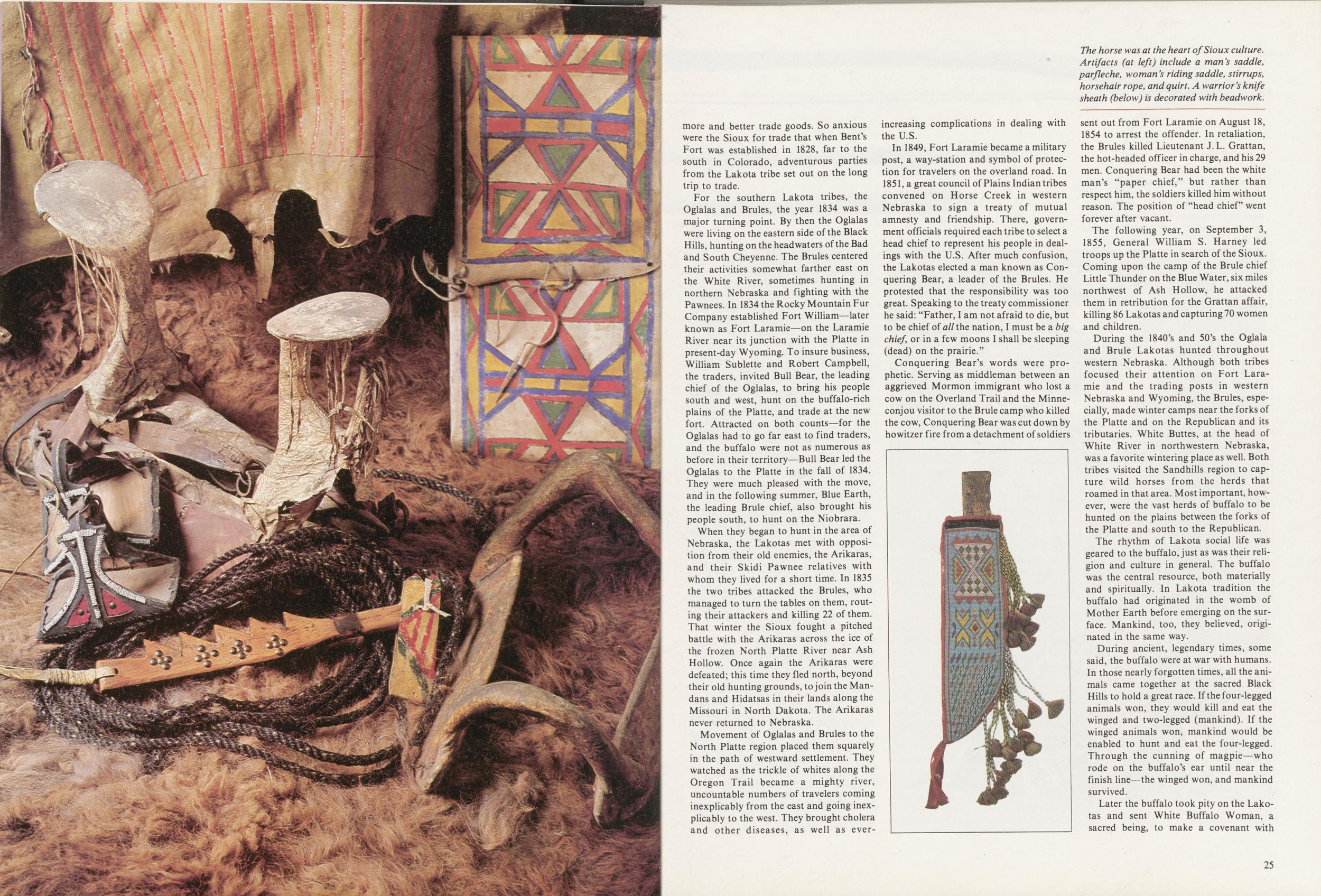
more and better trade goods. So anxious were the Sioux for trade that when Bent's Fort was established in 1828, far to the south in Colorado, adventurous parties from the Lakota tribe set out on the long trip to trade.
For the southern Lakota tribes, the Oglalas and Brules, the year 1834 was a major turning point. By then the Oglalas were living on the eastern side of the Black Hills, hunting on the headwaters of the Bad and South Cheyenne. The Brules centered their activities somewhat farther east on the White River, sometimes hunting in northern Nebraska and fighting with the Pawnees. In 1834 the Rocky Mountain Fur Company established Fort William—later known as Fort Laramie—on the Laramie River near its junction with the Platte in present-day Wyoming. To insure business, William Sublette and Robert Campbell, the traders, invited Bull Bear, the leading chief of the Oglalas, to bring his people south and west, hunt on the buffalo-rich plains of the Platte, and trade at the new fort. Attracted on both counts—for the Oglalas had to go far east to find traders, and the buffalo were not as numerous as before in their territory—Bull Bear led the Oglalas to the Platte in the fall of 1834. They were much pleased with the move, and in the following summer, Blue Earth, the leading Brule chief, also brought his people south, to hunt on the Niobrara.
When they began to hunt in the area of Nebraska, the Lakotas met with opposition from their old enemies, the Arikaras, and their Skidi Pawnee relatives with whom they lived for a short time. In 1835 the two tribes attacked the Brules, who managed to turn the tables on them, routing their attackers and killing 22 of them. That winter the Sioux fought a pitched battle with the Arikaras across the ice of the frozen North Platte River near Ash Hollow. Once again the Arikaras were defeated; this time they fled north, beyond their old hunting grounds, to join the Mandans and Hidatsas in their lands along the Missouri in North Dakota. The Arikaras never returned to Nebraska.
Movement of Oglalas and Brules to the North Platte region placed them squarely in the path of westward settlement. They watched as the trickle of whites along the Oregon Trail became a mighty river, uncountable numbers of travelers coming inexplicably from the east and going inexplicably to the west. They brought cholera and other diseases, as well as ever-increasing complications in dealing with the U.S.
In 1849, Fort Laramie became a military post, a way-station and symbol of protection for travelers on the overland road. In 1851, a great council of Plains Indian tribes convened on Horse Creek in western Nebraska to sign a treaty of mutual amnesty and friendship. There, government officials required each tribe to select a head chief to represent his people in dealings with the U.S. After much confusion, the Lakotas elected a man known as Conquering Bear, a leader of the Brules. He protested that the responsibility was too great. Speaking to the treaty commissioner he said: "Father, I am not afraid to die, but to be chief of all the nation, I must be a big chief, or in a few moons I shall be sleeping (dead) on the prairie."
Conquering Bear's words were prophetic. Serving as middleman between an aggrieved Mormon immigrant who lost a cow on the Overland Trail and the Minneconjou visitor to the Brule camp who killed the cow, Conquering Bear was cut down by howitzer fire from a detachment of soldiers
The horse was at the heart of Sioux culture. Artifacts (at left) include a man's saddle, parfleche, woman's riding saddle, stirrups, horsehair rope, and quirt. A warrior's knife sheath (below) is decorated with beadwork.
sent out from Fort Laramie on August 18, 1854 to arrest the offender. In retaliation, the Brules killed Lieutenant J. L. Grattan, the hot-headed officer in charge, and his 29 men. Conquering Bear had been the white man's "paper chief," but rather than respect him, the soldiers killed him without reason. The position of "head chief" went forever after vacant.
The following year, on September 3, 1855, General William S. Harney led troops up the Platte in search of the Sioux. Coming upon the camp of the Brule chief Little Thunder on the Blue Water, six miles northwest of Ash Hollow, he attacked them in retribution for the Grattan affair, killing 86 Lakotas and capturing 70 women and children.
During the 1840's and 50's the Oglala and Brule Lakotas hunted throughout western Nebraska. Although both tribes focused their attention on Fort Laramie and the trading posts in western Nebraska and Wyoming, the Brules, especially, made winter camps near the forks of the Platte and on the Republican and its tributaries. White Buttes, at the head of White River in northwestern Nebraska, was a favorite wintering place as well. Both tribes visited the Sandhills region to capture wild horses from the herds that roamed in that area. Most important, however, were the vast herds of buffalo to be hunted on the plains between the forks of the Platte and south to the Republican.
The rhythm of Lakota social life was geared to the buffalo, just as was their religion and culture in general. The buffalo was the central resource, both materially and spiritually. In Lakota tradition the buffalo had originated in the womb of Mother Earth before emerging on the surface. Mankind, too, they believed, originated in the same way.
During ancient, legendary times, some said, the buffalo were at war with humans. In those nearly forgotten times, all the animals came together at the sacred Black Hills to hold a great race. If the four-legged animals won, they would kill and eat the winged and two-legged (mankind). If the winged animals won, mankind would be enabled to hunt and eat the four-legged. Through the cunning of magpie—who rode on the buffalo's ear until near the finish line—the winged won, and mankind survived.
Later the buffalo took pity on the Lakotas and sent White Buffalo Woman, a sacred being, to make a covenant with
25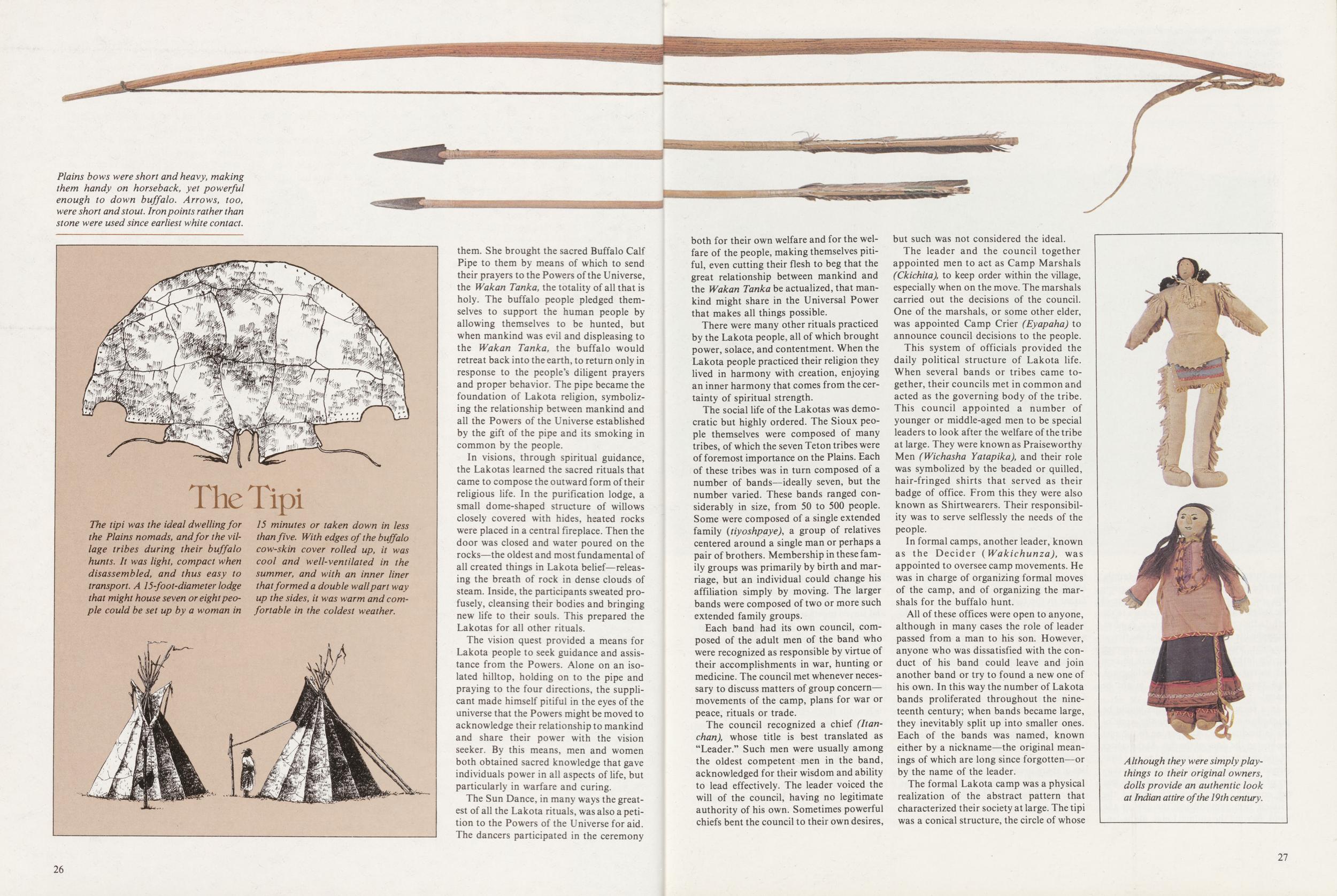
them. She brought the sacred Buffalo Calf Pipe to them by means of which to send their prayers to the Powers of the Universe, the Wakan Tanka, the totality of all that is holy. The buffalo people pledged themselves to support the human people by allowing themselves to be hunted, but when mankind was evil and displeasing to the Wakan Tanka, the buffalo would retreat back into the earth, to return only in response to the people's diligent prayers and proper behavior. The pipe became the foundation of Lakota religion, symbolizing the relationship between mankind and all the Powers of the Universe established by the gift of the pipe and its smoking in common by the people.
In visions, through spiritual guidance, the Lakotas learned the sacred rituals that came to compose the outward form of their religious life. In the purification lodge, a small dome-shaped structure of willows closely covered with hides, heated rocks were placed in a central fireplace. Then the door was closed and water poured on the rocks—the oldest and most fundamental of all created things in Lakota belief—releasing the breath of rock in dense clouds of steam. Inside, the participants sweated profusely, cleansing their bodies and bringing new life to their souls. This prepared the Lakotas for all other rituals.
The vision quest provided a means for Lakota people to seek guidance and assistance from the Powers. Alone on an isolated hilltop, holding on to the pipe and praying to the four directions, the supplicant made himself pitiful in the eyes of the universe that the Powers might be moved to acknowledge their relationship to mankind and share their power with the vision seeker. By this means, men and women both obtained sacred knowledge that gave individuals power in all aspects of life, but particularly in warfare and curing.
The Sun Dance, in many ways the greatest of all the Lakota rituals, was also a petition to the Powers of the Universe for aid. The dancers participated in the ceremony
26both for their own welfare and for the welfare of the people, making themselves pitiful, even cutting their flesh to beg that the great relationship between mankind and the Wakan Tanka be actualized, that mankind might share in the Universal Power that makes all things possible.
There were many other rituals practiced by the Lakota people, all of which brought power, solace, and contentment. When the Lakota people practiced their religion they lived in harmony with creation, enjoying an inner harmony that comes from the certainty of spiritual strength.
The social life of the Lakotas was democratic but highly ordered. The Sioux people themselves were composed of many tribes, of which the seven Teton tribes were of foremost importance on the Plains. Each of these tribes was in turn composed of a number of bands—ideally seven, but the number varied. These bands ranged considerably in size, from 50 to 500 people. Some were composed of a single extended family (tiyoshpaye), a group of relatives centered around a single man or perhaps a pair of brothers. Membership in these family groups was primarily by birth and marriage, but an individual could change his affiliation simply by moving. The larger bands were composed of two or more such extended family groups.
Each band had its own council, composed of the adult men of the band who were recognized as responsible by virtue of their accomplishments in war, hunting or medicine. The council met whenever necessary to discuss matters of group concern-movements of the camp, plans for war or peace, rituals or trade.
The council recognized a chief (Itanchan), whose title is best translated as "Leader." Such men were usually among the oldest competent men in the band, acknowledged for their wisdom and ability to lead effectively. The leader voiced the will of the council, having no legitimate authority of his own. Sometimes powerful chiefs bent the council to their own desires, but such was not considered the ideal.
The leader and the council together appointed men to act as Camp Marshals (Ckichita), to keep order within the village, especially when on the move. The marshals carried out the decisions of the council. One of the marshals, or some other elder, was appointed Camp Crier (Eyapaha) to announce council decisions to the people.
This system of officials provided the daily political structure of Lakota life. When several bands or tribes came together, their councils met in common and acted as the governing body of the tribe. This council appointed a number of younger or middle-aged men to be special leaders to look after the welfare of the tribe at large. They were known as Praiseworthy Men (Wichasha Yatapika), and their role was symbolized by the beaded or quilled, hair-fringed shirts that served as their badge of office. From this they were also known as Shirtwearers. Their responsibility was to serve selflessly the needs of the people.
In formal camps, another leader, known as the Decider (Wakichunza), was appointed to oversee camp movements. He was in charge of organizing formal moves of the camp, and of organizing the marshals for the buffalo hunt.
All of these offices were open to anyone, although in many cases the role of leader passed from a man to his son. However, anyone who was dissatisfied with the conduct of his band could leave and join another band or try to found a new one of his own. In this way the number of Lakota bands proliferated throughout the nineteenth century; when bands became large, they inevitably split up into smaller ones. Each of the bands was named, known either by a nickname—the original meanings of which are long since forgotten—or by the name of the leader.
The formal Lakota camp was a physical realization of the abstract pattern that characterized their society at large. The tipi was a conical structure, the circle of whose
Although they were simply play-things to their original owners, dolls provide an authentic look at Indian attire of the 19th century.
27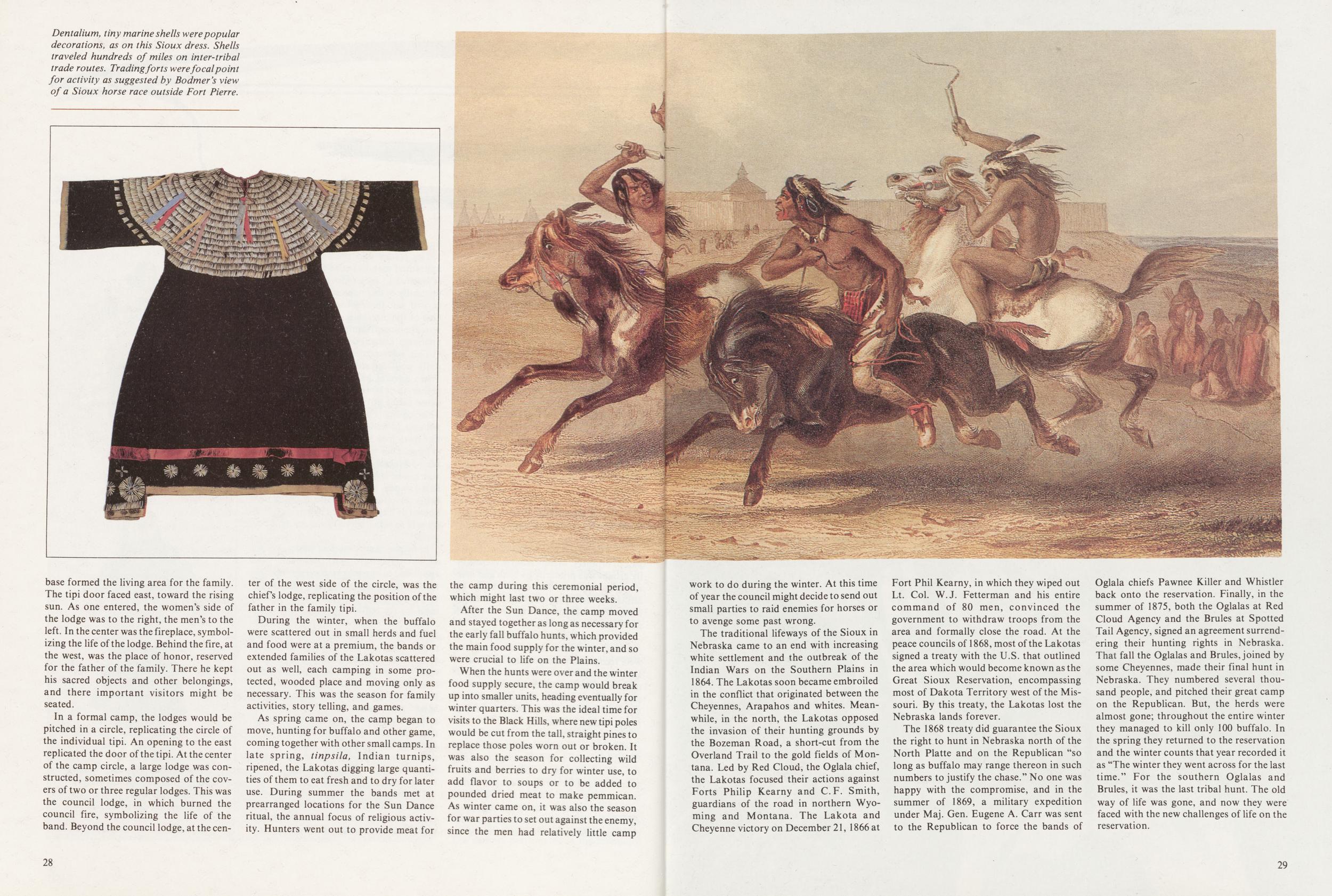
base formed the living area for the family. The tipi door faced east, toward the rising sun. As one entered, the women's side of the lodge was to the right, the men's to the left. In the center was the fireplace, symbolizing the life of the lodge. Behind the fire, at the west, was the place of honor, reserved for the father of the family. There he kept his sacred objects and other belongings, and there important visitors might be seated.
In a formal camp, the lodges would be pitched in a circle, replicating the circle of the individual tipi. An opening to the east replicated the door of the tipi. At the center of the camp circle, a large lodge was constructed, sometimes composed of the covers of two or three regular lodges. This was the council lodge, in which burned the council fire, symbolizing the life of the band. Beyond the council lodge, at the center of the west side of the circle, was the chief's lodge, replicating the position of the father in the family tipi.
During the winter, when the buffalo were scattered out in small herds and fuel and food were at a premium, the bands or extended families of the Lakotas scattered out as well, each camping in some protected, wooded place and moving only as necessary. This was the season for family activities, story telling, and games.
As spring came on, the camp began to move, hunting for buffalo and other game, coming together with other small camps. In late spring, tinpsila, Indian turnips, ripened, the Lakotas digging large quantities of them to eat fresh and to dry for later use. During summer the bands met at prearranged locations for the Sun Dance ritual, the annual focus of religious activity. Hunters went out to provide meat for the camp during this ceremonial period, which might last two or three weeks.
After the Sun Dance, the camp moved and stayed together as long as necessary for the early fall buffalo hunts, which provided the main food supply for the winter, and so were crucial to life on the Plains.
When the hunts were over and the winter food supply secure, the camp would break up into smaller units, heading eventually for winter quarters. This was the ideal time for visits to the Black Hills, where new tipi poles would be cut from the tall, straight pines to replace those poles worn out or broken. It was also the season for collecting wild fruits and berries to dry for winter use, to add flavor to soups or to be added to pounded dried meat to make pemmican. As winter came on, it was also the season for war parties to set out against the enemy, since the men had relatively little camp
28work to do during the winter. At this time of year the council might decide to send out small parties to raid enemies for horses or to avenge some past wrong.
The traditional lifeways of the Sioux in Nebraska came to an end with increasing white settlement and the outbreak of the Indian Wars on the Southern Plains in 1864. The Lakotas soon became embroiled in the conflict that originated between the Cheyennes, Arapahos and whites. Meanwhile, in the north, the Lakotas opposed the invasion of their hunting grounds by the Bozeman Road, a short-cut from the Overland Trail to the gold fields of Montana. Led by Red Cloud, the Oglala chief, the Lakotas focused their actions against Forts Philip Kearny and C.F. Smith, guardians of the road in northern Wyoming and Montana. The Lakota and Cheyenne victory on December 21, 1866 at Fort Phil Kearny, in which they wiped out Lt. Col. W.J. Fetterman and his entire command of 80 men, convinced the government to withdraw troops from the area and formally close the road. At the peace councils of 1868, most of the Lakotas signed a treaty with the U.S. that outlined the area which would become known as the Great Sioux Reservation, encompassing most of Dakota Territorv west of the Missouri. By this treaty, the Lakotas lost the Nebraska lands forever.
The 1868 treaty did guarantee the Sioux the right to hunt in Nebraska north of the North Platte and on the Republican "so long as buffalo may range thereon in such numbers to justify the chase." No one was happy with the compromise, and in the summer of 1869, a military expedition under Maj. Gen. Eugene A. Carr was sent to the Republican to force the bands of Oglala chiefs Pawnee Killer and Whistler back onto the reservation. Finally, in the summer of 1875, both the Oglalas at Red Cloud Agency and the Brules at Spotted Tail Agency, signed an agreement surrendering their hunting rights in Nebraska. That fall the Oglalas and Brules, joined by some Cheyennes, made their final hunt in Nebraska. They numbered several thousand people, and pitched their great camp on the Republican. But, the herds were almost gone; throughout the entire winter they managed to kill only 100 buffalo. In the spring they returned to the reservation and the winter counts that year recorded it as "The winter they went across for the last time." For the southern Oglalas and Brules, it was the last tribal hunt. The old way of life was gone, and now they were faced with the new challenges of life on the reservation.
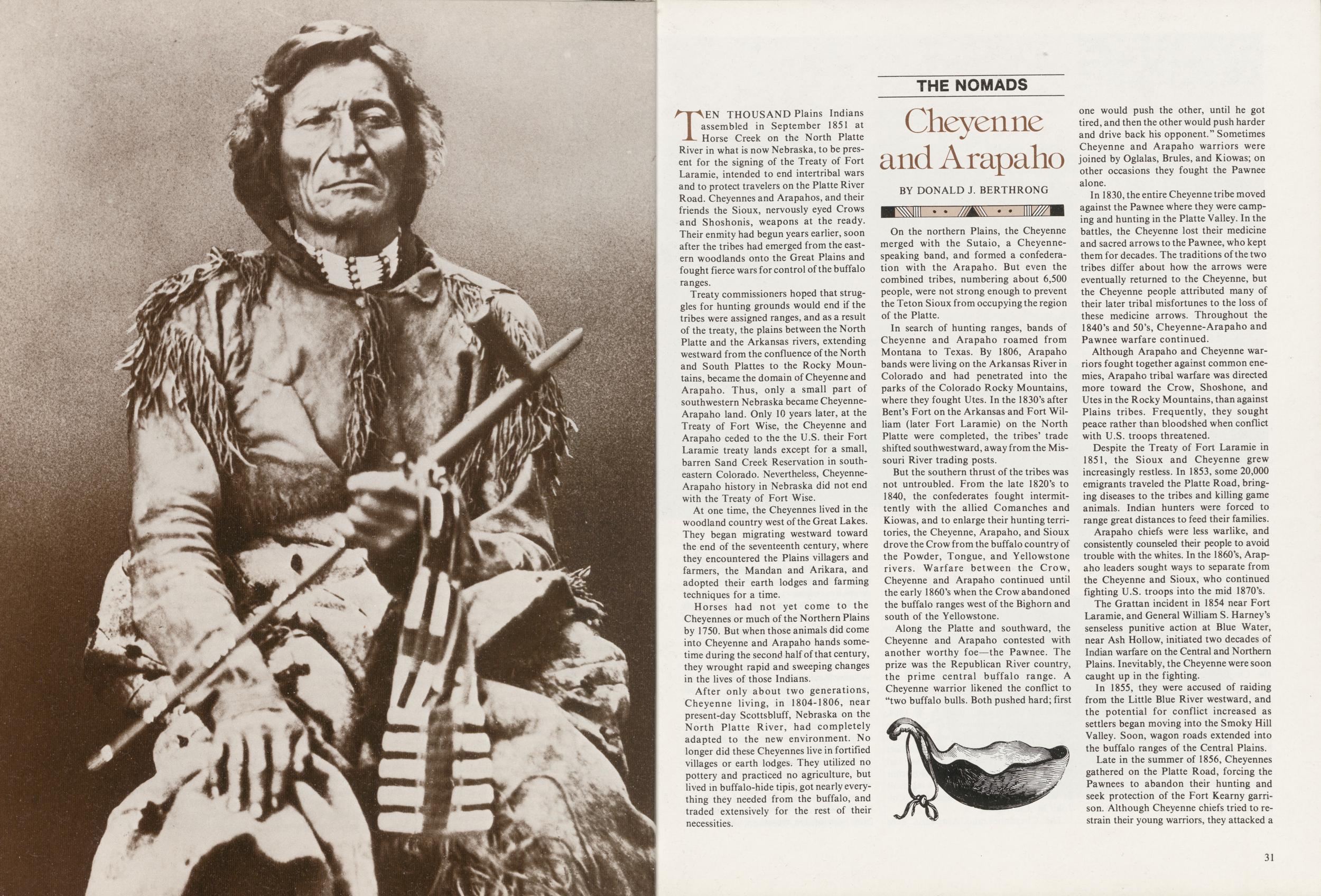
THE NOMADS
THEN THOUSAND Plains Indians assembled in September 1851 at Horse Creek on the North Platte River in what is now Nebraska, to be present for the signing of the Treaty of Fort Laramie, intended to end intertribal wars and to protect travelers on the Platte River Road. Cheyennes and Arapahos, and their friends the Sioux, nervously eyed Crows and Shoshonis, weapons at the ready. Their enmity had begun years earlier, soon after the tribes had emerged from the eastern woodlands onto the Great Plains and fought fierce wars for control of the buffalo ranges.
Treaty commissioners hoped that struggles for hunting grounds would end if the tribes were assigned ranges, and as a result of the treaty, the plains between the North Platte and the Arkansas rivers, extending westward from the confluence of the North and South Plattes to the Rocky Mountains, became the domain of Cheyenne and Arapaho. Thus, only a small part of southwestern Nebraska became Cheyenne-Arapaho land. Only 10 years later, at the Treaty of Fort Wise, the Cheyenne and Arapaho ceded to the the U.S. their Fort Laramie treaty lands except for a small, barren Sand Creek Reservation in south-eastern Colorado. Nevertheless, Cheyenne-Arapaho history in Nebraska did not end with the Treaty of Fort Wise.
At one time, the Cheyennes lived in the woodland country west of the Great Lakes. They began migrating westward toward the end of the seventeenth century, where they encountered the Plains villagers and farmers, the Mandan and Arikara, and adopted their earth lodges and farming techniques for a time.
Horses had not yet come to the Cheyennes or much of the Northern Plains by 1750. But when those animals did come into Cheyenne and Arapaho hands sometime during the second half of that century, they wrought rapid and sweeping changes in the lives of those Indians.
After only about two generations, Cheyenne living, in 1804-1806, near present-day Scottsbluff, Nebraska on the North Platte River, had completely adapted to the new environment. No longer did these Cheyennes live in fortified villages or earth lodges. They utilized no pottery and practiced no agriculture, but lived in buffalo-hide tipis, got nearly everything they needed from the buffalo, and traded extensively for the rest of their necessities.
Cheyenne and Arapaho BY DONALD J. BERTHRONGOn the northern Plains, the Cheyenne merged with the Sutaio, a Cheyenne-speaking band, and formed a confederation with the Arapaho. But even the combined tribes, numbering about 6,500 people, were not strong enough to prevent the Teton Sioux from occupying the region of the Platte.
In search of hunting ranges, bands of Cheyenne and Arapaho roamed from Montana to Texas. By 1806, Arapaho bands were living on the Arkansas River in Colorado and had penetrated into the parks of the Colorado Rocky Mountains, where they fought Utes. In the 1830's after Bent's Fort on the Arkansas and Fort William (later Fort Laramie) on the North Platte were completed, the tribes' trade shifted southwestward, away from the Missouri River trading posts.
But the southern thrust of the tribes was not untroubled. From the late 1820's to 1840, the confederates fought intermittently with the allied Comanches and Kiowas, and to enlarge their hunting territories, the Cheyenne, Arapaho, and Sioux drove the Crow from the buffalo country of the Powder, Tongue, and Yellowstone rivers. Warfare between the Crow, Cheyenne and Arapaho continued until the early 1860's when the Crow abandoned the buffalo ranges west of the Bighorn and south of the Yellowstone.
Along the Platte and southward, the Cheyenne and Arapaho contested with another worthy foe—the Pawnee. The prize was the Republican River country, the prime central buffalo range. A Cheyenne warrior likened the conflict to "two buffalo bulls. Both pushed hard; first one would push the other, until he got tired, and then the other would push harder and drive back his opponent." Sometimes Cheyenne and Arapaho warriors were joined by Oglalas, Brules, and Kiowas; on other occasions they fought the Pawnee alone.
In 1830, the entire Cheyenne tribe moved against the Pawnee where they were camping and hunting in the Platte Valley. In the battles, the Cheyenne lost their medicine and sacred arrows to the Pawnee, who kept them for decades. The traditions of the two tribes differ about how the arrows were eventually returned to the Cheyenne, but the Cheyenne people attributed many of their later tribal misfortunes to the loss of these medicine arrows. Throughout the 1840's and 50's, Cheyenne-Arapaho and Pawnee warfare continued.
Although Arapaho and Cheyenne warriors fought together against common enemies, Arapaho tribal warfare was directed more toward the Crow, Shoshone, and Utes in the Rocky Mountains, than against Plains tribes. Frequently, they sought peace rather than bloodshed when conflict with U.S. troops threatened.
Despite the Treaty of Fort Laramie in 1851, the Sioux and Cheyenne grew increasingly restless. In 1853, some 20,000 emigrants traveled the Platte Road, bringing diseases to the tribes and killing game animals. Indian hunters were forced to range great distances to feed their families.
Arapaho chiefs were less warlike, and consistently counseled their people to avoid trouble with the whites. In the 1860's, Arapaho leaders sought ways to separate from the Cheyenne and Sioux, who continued fighting U.S. troops into the mid 1870's.
The Grattan incident in 1854 near Fort Laramie, and General William S. Harney's senseless punitive action at Blue Water, near Ash Hollow, initiated two decades of Indian warfare on the Central and Northern Plains. Inevitably, the Cheyenne were soon caught up in the fighting.
In 1855, they were accused of raiding from the Little Blue River westward, and the potential for conflict increased as settlers began moving into the Smoky Hill Valley. Soon, wagon roads extended into the buffalo ranges of the Central Plains.
Late in the summer of 1856, Cheyennes gathered on the Platte Road, forcing the Pawnees to abandon their hunting and seek protection of the Fort Kearny garrison. Although Cheyenne chiefs tried to restrain their young warriors, they attacked a
31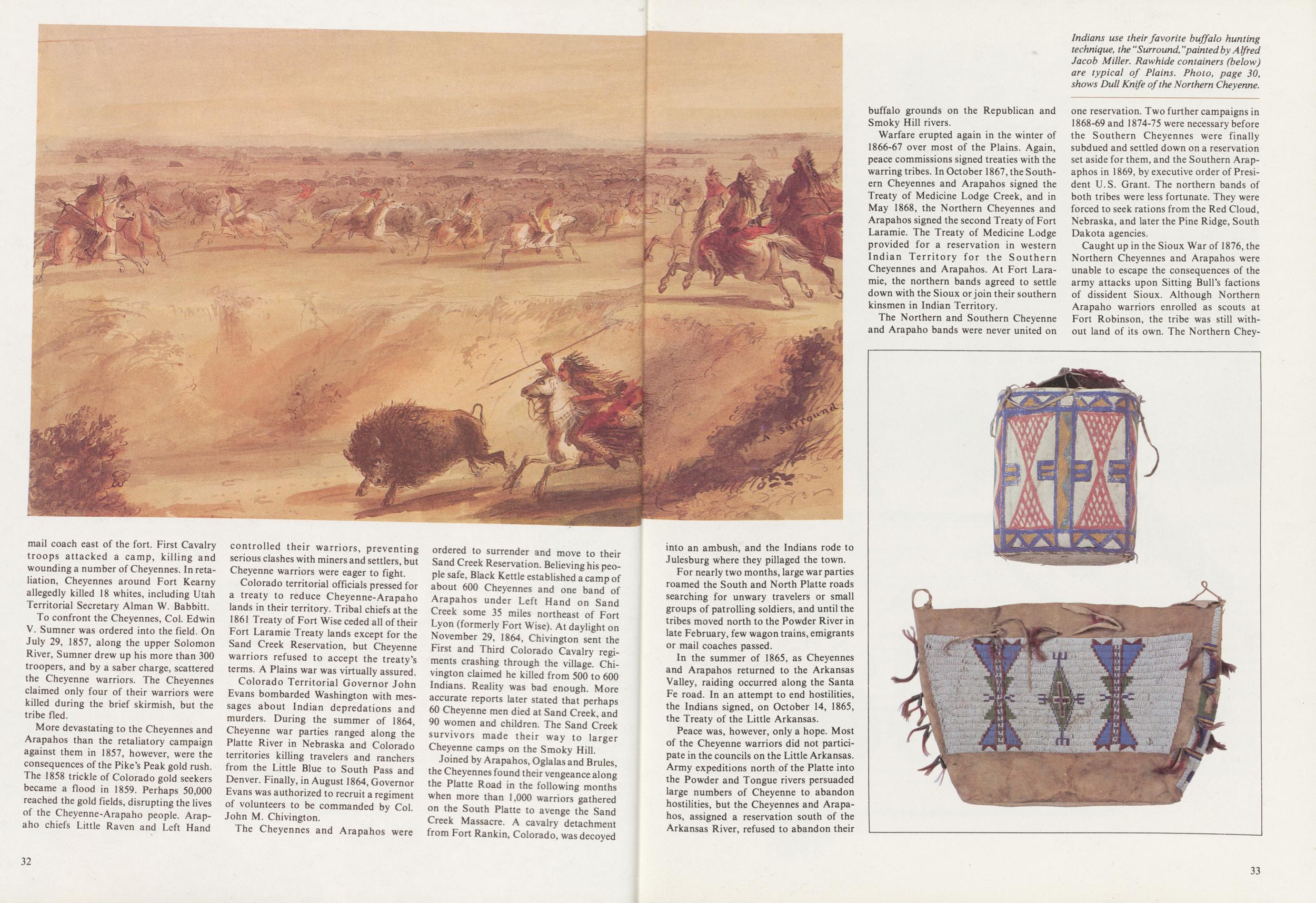
mail coach east of the fort. First Cavalry troops attacked a camp, killing and wounding a number of Cheyennes. In retaliation, Cheyennes around Fort Kearny allegedly killed 18 whites, including Utah Territorial Secretary Alman W. Babbitt.
To confront the Cheyennes, Col. Edwin V. Sumner was ordered into the field. On July 29, 1857, along the upper Solomon River, Sumner drew up his more than 300 troopers, and by a saber charge, scattered the Cheyenne warriors. The Cheyennes claimed only four of their warriors were killed during the brief skirmish, but the tribe fled.
More devastating to the Cheyennes and Arapahos than the retaliatory campaign against them in 1857, however, were the consequences of the Pike's Peak gold rush. The 1858 trickle of Colorado gold seekers became a flood in 1859. Perhaps 50,000 reached the gold fields, disrupting the lives of the Cheyenne-Arapaho people. Arapaho chiefs Little Raven and Left Hand controlled their warriors, preventing serious clashes with miners and settlers, but Cheyenne warriors were eager to fight.
Colorado territorial officials pressed for a treaty to reduce Cheyenne-Arapaho lands in their territory. Tribal chiefs at the 1861 Treaty of Fort Wise ceded all of their Fort Laramie Treaty lands except for the Sand Creek Reservation, but Cheyenne warriors refused to accept the treaty's terms. A Plains war was virtually assured.
Colorado Territorial Governor John Evans bombarded Washington with messages about Indian depredations and murders. During the summer of 1864, Cheyenne war parties ranged along the Platte River in Nebraska and Colorado territories killing travelers and ranchers from the Little Blue to South Pass and Denver. Finally, in August 1864, Governor Evans was authorized to recruit a regiment of volunteers to be commanded by Col. John M. Chivington.
The Cheyennes and Arapahos were ordered to surrender and move to their Sand Creek Reservation. Believing his people safe, Black Kettle established a camp of about 600 Cheyennes and one band of Arapahos under Left Hand on Sand Creek some 35 miles northeast of Fort Lyon (formerly Fort Wise). At daylight on November 29, 1864, Chivington sent the First and Third Colorado Cavalry regiments crashing through the village. Chivington claimed he killed from 500 to 600 Indians. Reality was bad enough. More accurate reports later stated that perhaps 60 Cheyenne men died at Sand Creek, and 90 women and children. The Sand Creek survivors made their way to larger Cheyenne camps on the Smoky Hill.
Joined by Arapahos, Oglalas and Brules, the Cheyennes found their vengeance along the Platte Road in the following months when more than 1,000 warriors gathered on the South Platte to avenge the Sand Creek Massacre. A cavalry detachment from Fort Rankin, Colorado, was decoyed
32into an ambush, and the Indians rode to Julesburg where they pillaged the town.
For nearly two months, large war parties roamed the South and North Platte roads searching for unwary travelers or small groups of patrolling soldiers, and until the tribes moved north to the Powder River in late February, few wagon trains, emigrants or mail coaches passed.
In the summer of 1865, as Cheyennes and Arapahos returned to the Arkansas Valley, raiding occurred along the Santa Fe road. In an attempt to end hostilities, the Indians signed, on October 14, 1865, the Treaty of the Little Arkansas.
Peace was, however, only a hope. Most of the Cheyenne warriors did not participate in the councils on the Little Arkansas. Army expeditions north of the Platte into the Powder and Tongue rivers persuaded large numbers of Cheyenne to abandon hostilities, but the Cheyennes and Arapahos, assigned a reservation south of the Arkansas River, refused to abandon their buffalo grounds on the Republican and Smoky Hill rivers.
Warfare erupted again in the winter of 1866-67 over most of the Plains. Again, peace commissions signed treaties with the warring tribes. In October 1867, the Southern Cheyennes and Arapahos signed the Treaty of Medicine Lodge Creek, and in May 1868, the Northern Cheyennes and Arapahos signed the second Treaty of Fort Laramie. The Treaty of Medicine Lodge provided for a reservation in western Indian Territory for the Southern Cheyennes and Arapahos. At Fort Laramie, the northern bands agreed to settle down with the Sioux or join their southern kinsmen in Indian Territory.
The Northern and Southern Cheyenne and Arapaho bands were never united on
Indians use their favorite buffalo hunting technique, the "Surround, "painted by Alfred Jacob Miller. Rawhide containers (below) are typical of Plains. Photo, page 30, shows Dull Knife of the Northern Cheyenne.
one reservation. Two further campaigns in 1868-69 and 1874-75 were necessary before the Southern Cheyennes were finally subdued and settled down on a reservation set aside for them, and the Southern Arapaphos in 1869, by executive order of President U.S. Grant. The northern bands of both tribes were less fortunate. They were forced to seek rations from the Red Cloud, Nebraska, and later the Pine Ridge, South Dakota agencies.
Caught up in the Sioux War of 1876, the Northern Cheyennes and Arapahos were unable to escape the consequences of the army attacks upon Sitting Bull's factions of dissident Sioux. Although Northern Arapaho warriors enrolled as scouts at Fort Robinson, the tribe was still without land of its own. The Northern Cheyennes
33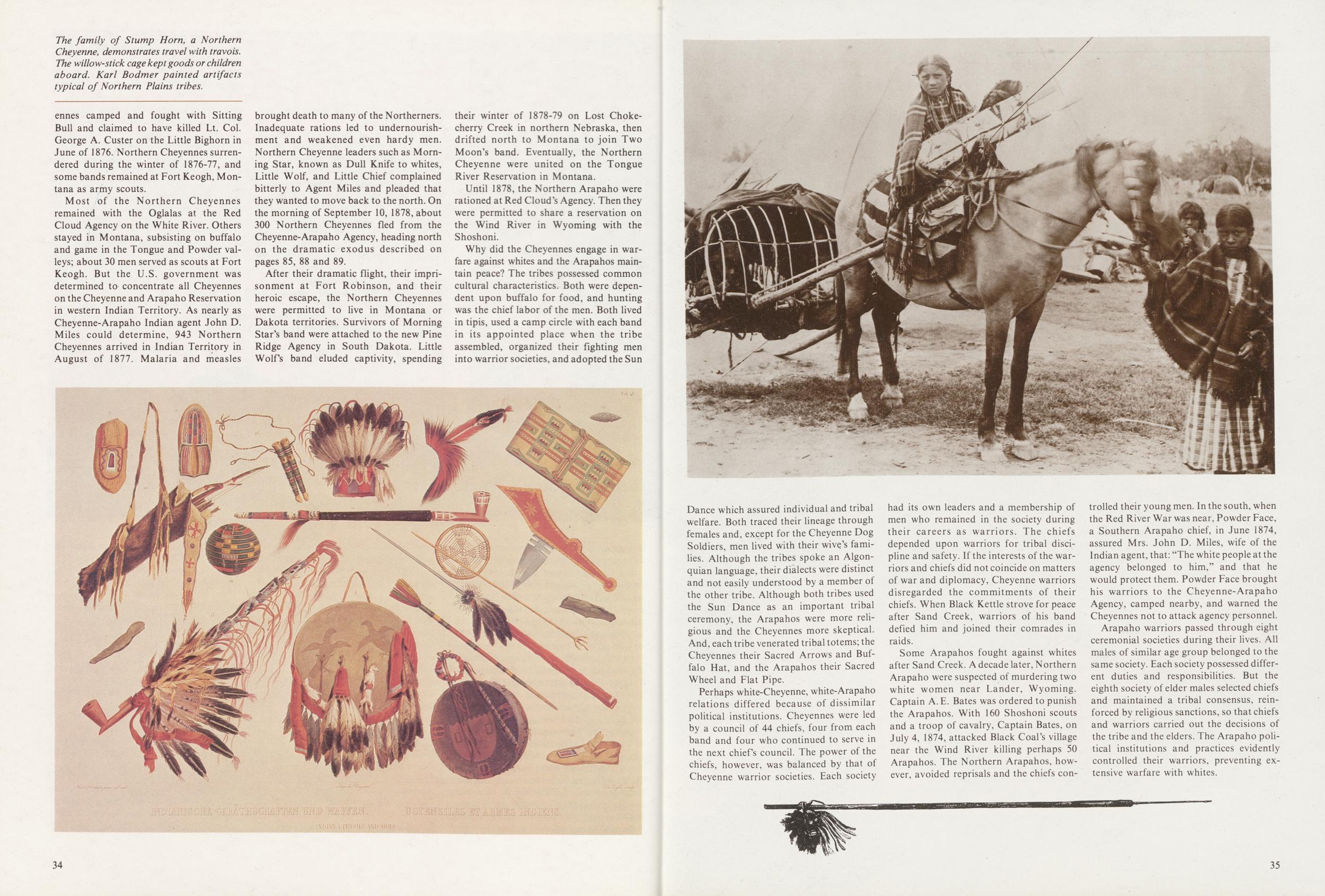
camped and fought with Sitting Bull and claimed to have killed Lt. Col. George A. Custer on the Little Bighorn in June of 1876. Northern Cheyennes surrendered during the winter of 1876-77, and some bands remained at Fort Keogh, Montana as army scouts.
Most of the Northern Cheyennes remained with the Oglalas at the Red Cloud Agency on the White River. Others stayed in Montana, subsisting on buffalo and game in the Tongue and Powder valleys; about 30 men served as scouts at Fort Keogh. But the U.S. government was determined to concentrate all Cheyennes on the Cheyenne and Arapaho Reservation in western Indian Territory. As nearly as Cheyenne-Arapaho Indian agent John D. Miles could determine, 943 Northern Cheyennes arrived in Indian Territory in August of 1877. Malaria and measles brought death to many of the Northerners. Inadequate rations led to undernourishment and weakened even hardy men. Northern Cheyenne leaders such as Morning Star, known as Dull Knife to whites, Little Wolf, and Little Chief complained bitterly to Agent Miles and pleaded that they wanted to move back to the north. On the morning of September 10, 1878, about 300 Northern Cheyennes fled from the Cheyenne-Arapaho Agency, heading north on the dramatic exodus described on pages 85, 88 and 89.
After their dramatic flight, their imprisonment at Fort Robinson, and their heroic escape, the Northern Cheyennes were permitted to live in Montana or Dakota territories. Survivors of Morning Star's band were attached to the new Pine Ridge Agency in South Dakota. Little Wolfs band eluded captivity, spending their winter of 1878-79 on Lost Chokecherry Creek in northern Nebraska, then drifted north to Montana to join Two Moon's band. Eventually, the Northern Cheyenne were united on the Tongue River Reservation in Montana.
Until 1878, the Northern Arapaho were rationed at Red Cloud's Agency. Then they were permitted to share a reservation on the Wind River in Wyoming with the Shoshoni.
Why did the Cheyennes engage in warfare against whites and the Arapahos maintain peace? The tribes possessed common cultural characteristics. Both were dependent upon buffalo for food, and hunting was the chief labor of the men. Both lived in tipis, used a camp circle with each band in its appointed place when the tribe assembled, organized their fighting men into warrior societies, and adopted the Sun
34Dance which assured individual and tribal welfare. Both traced their lineage through females and, except for the Cheyenne Dog Soldiers, men lived with their wive's families. Although the tribes spoke an Algonquian language, their dialects were distinct and not easily understood by a member of the other tribe. Although both tribes used the Sun Dance as an important tribal ceremony, the Arapahos were more religious and the Cheyennes more skeptical. And, each tribe venerated tribal totems; the Cheyennes their Sacred Arrows and Buffalo Hat, and the Arapahos their Sacred Wheel and Flat Pipe.
Perhaps white-Cheyenne, white-Arapaho relations differed because of dissimilar political institutions. Cheyennes were led by a council of 44 chiefs, four from each band and four who continued to serve in the next chiefs council. The power of the chiefs, however, was balanced by that of Cheyenne warrior societies. Each society had its own leaders and a membership of men who remained in the society during their careers as warriors. The chiefs depended upon warriors for tribal discipline and safety. If the interests of the warriors and chiefs did not coincide on matters of war and diplomacy, Cheyenne warriors disregarded the commitments of their chiefs. When Black Kettle strove for peace after Sand Creek, warriors of his band defied him and joined their comrades in raids.
Some Arapahos fought against whites after Sand Creek. A decade later, Northern Arapaho were suspected of murdering two white women near Lander, Wyoming. Captain A.E. Bates was ordered to punish the Arapahos. With 160 Shoshoni scouts and a troop of cavalry, Captain Bates, on July 4, 1874, attacked Black Coal's village near the Wind River killing perhaps 50 Arapahos. The Northern Arapahos, however, avoided reprisals and the chiefs controlled their young men. In the south, when the Red River War was near, Powder Face, a Southern Arapaho chief, in June 1874, assured Mrs. John D. Miles, wife of the Indian agent, that: "The white people at the agency belonged to him," and that he would protect them. Powder Face brought his warriors to the Cheyenne-Arapaho Agency, camped nearby, and warned the Cheyennes not to attack agency personnel.
Arapaho warriors passed through eight ceremonial societies during their lives. All males of similar age group belonged to the same society. Each society possessed different duties and responsibilities. But the eighth society of elder males selected chiefs and maintained a tribal consensus, reinforced by religious sanctions, so that chiefs and warriors carried out the decisions of the tribe and the elders. The Arapaho political institutions and practices evidently controlled their warriors, preventing extensive warfare with whites.
35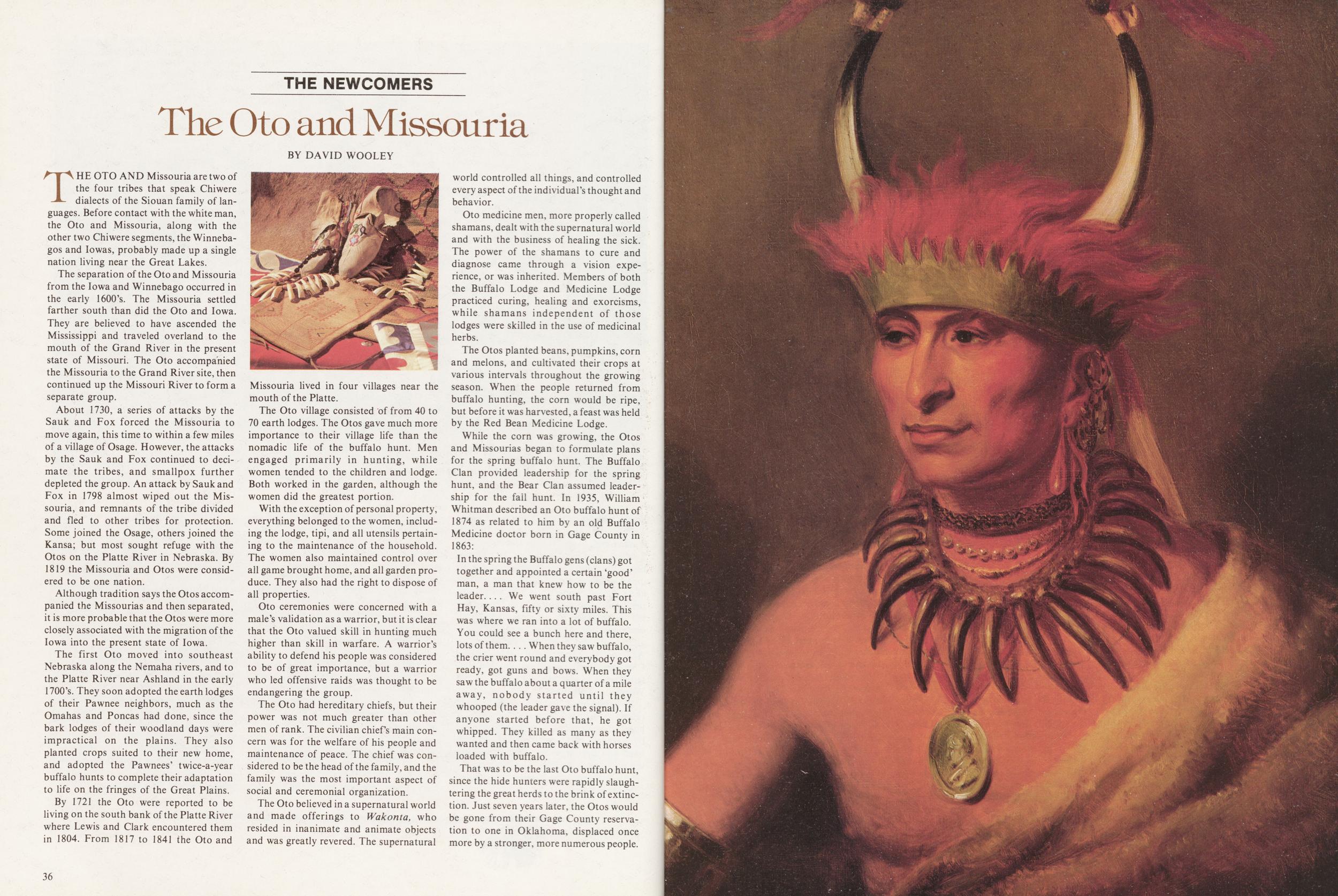
THE NEWCOMERS The Oto and Missouria
THE OTO AND Missouria are two of the four tribes that speak Chiwere dialects of the Siouan family of languages. Before contact with the white man, the Oto and Missouria, along with the other two Chiwere segments, the Winnebagos and Iowas, probably made up a single nation living near the Great Lakes.
The separation of the Oto and Missouria from the Iowa and Winnebago occurred in the early 1600's. The Missouria settled farther south than did the Oto and Iowa. They are believed to have ascended the Mississippi and traveled overland to the mouth of the Grand River in the present state of Missouri. The Oto accompanied the Missouria to the Grand River site, then continued up the Missouri River to form a separate group.
About 1730, a series of attacks by the Sauk and Fox forced the Missouria to move again, this time to within a few miles of a village of Osage. However, the attacks by the Sauk and Fox continued to decimate the tribes, and smallpox further depleted the group. An attack by Sauk and Fox in 1798 almost wiped out the Missouria, and remnants of the tribe divided and fled to other tribes for protection. Some joined the Osage, others joined the Kansa; but most sought refuge with the Otos on the Platte River in Nebraska. By 1819 the Missouria and Otos were considered to be one nation.
Although tradition says the Otos accompanied the Missourias and then separated, it is more probable that the Otos were more closely associated with the migration of the Iowa into the present state of Iowa.
The first Oto moved into southeast Nebraska along the Nemaha rivers, and to the Platte River near Ashland in the early 1700's. They soon adopted the earth lodges of their Pawnee neighbors, much as the Omahas and Poncas had done, since the bark lodges of their woodland days were impractical on the plains. They also planted crops suited to their new home, and adopted the Pawnees' twice-a-year buffalo hunts to complete their adaptation to life on the fringes of the Great Plains.
By 1721 the Oto were reported to be living on the south bank of the Platte River where Lewis and Clark encountered them in 1804. From 1817 to 1841 the Oto and
BY DAVID WOOLEYMissouria lived in four villages near the mouth of the Platte.
The Oto village consisted of from 40 to 70 earth lodges. The Otos gave much more importance to their village life than the nomadic life of the buffalo hunt. Men engaged primarily in hunting, while women tended to the children and lodge. Both worked in the garden, although the women did the greatest portion.
With the exception of personal property, everything belonged to the women, including the lodge, tipi, and all utensils pertaining to the maintenance of the household. The women also maintained control over all game brought home, and all garden produce. They also had the right to dispose of all properties.
Oto ceremonies were concerned with a male's validation as a warrior, but it is clear that the Oto valued skill in hunting much higher than skill in warfare. A warrior's ability to defend his people was considered to be of great importance, but a warrior who led offensive raids was thought to be endangering the group.
The Oto had hereditary chiefs, but their power was not much greater than other men of rank. The civilian chief's main concern was for the welfare of his people and maintenance of peace. The chief was considered to be the head of the family, and the family was the most important aspect of social and ceremonial organization.
The Oto believed in a supernatural world and made offerings to Wakonta, who resided in inanimate and animate objects and was greatly revered. The supernatural world controlled all things, and controlled every aspect of the individual's thought and behavior.
Oto medicine men, more properly called shamans, dealt with the supernatural world and with the business of healing the sick. The power of the shamans to cure and diagnose came through a vision experience, or was inherited. Members of both the Buffalo Lodge and Medicine Lodge practiced curing, healing and exorcisms, while shamans independent of those lodges were skilled in the use of medicinal herbs.
The Otos planted beans, pumpkins, corn and melons, and cultivated their crops at various intervals throughout the growing season. When the people returned from buffalo hunting, the corn would be ripe, but before it was harvested, a feast was held by the Red Bean Medicine Lodge. While the corn was growing, the Otos and Missourias began to formulate plans for the spring buffalo hunt. The Buffalo Clan provided leadership for the spring hunt, and the Bear Clan assumed leadership for the fail hunt. In 1935, William Whitman described an Oto buffalo hunt of 1874 as related to him by an old Buffalo Medicine doctor born in Gage County in 1863:
In the spring the Buffalo gens (clans) got together and appointed a certain 'good' man, a man that knew how to be the leader.... We went south past Fort Hay, Kansas, fifty or sixty miles. This was where we ran into a lot of buffalo. You could see a bunch here and there, lots of them. . . . When they saw buffalo, the crier went round and everybody got ready, got guns and bows. When they saw the buffalo about a quarter of a mile away, nobody started until they whooped (the leader gave the signal). If anyone started before that, he got whipped. They killed as many as they wanted and then came back with horses loaded with buffalo.
That was to be the last Oto buffalo hunt, since the hide hunters were rapidly slaughtering the great herds to the brink of extinction. Just seven years later, the Otos would be gone from their Gage County reservation to one in Oklahoma, displaced once more by a stronger, more numerous people.
36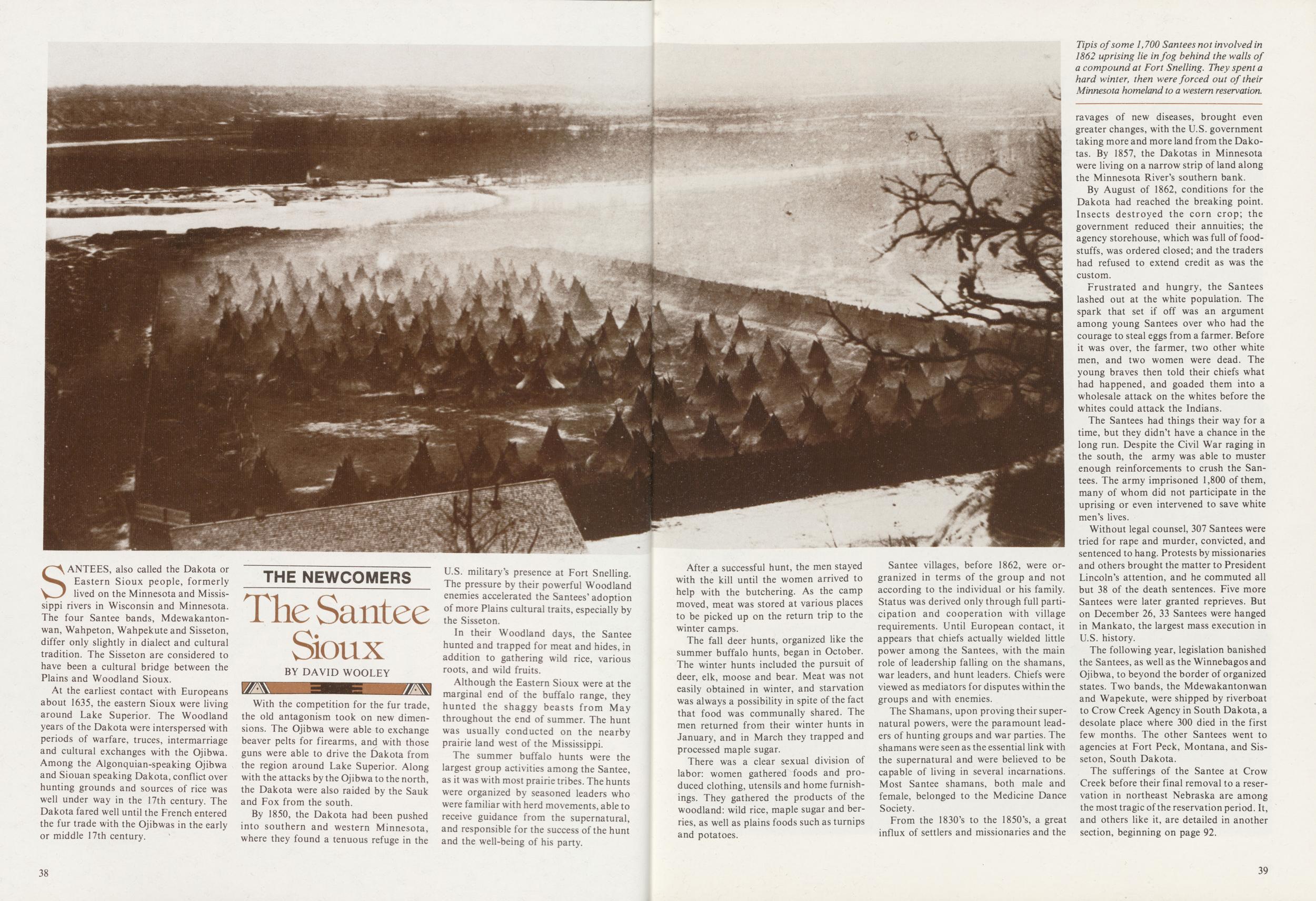
SANTEES, also called the Dakota or Eastern Sioux people, formerly lived on the Minnesota and Mississippi rivers in Wisconsin and Minnesota. The four Santee bands, Mdewakantonwan, Wahpeton, Wahpekute and Sisseton, differ only slightly in dialect and cultural tradition. The Sisseton are considered to have been a cultural bridge between the Plains and Woodland Sioux.
At the earliest contact with Europeans about 1635, the eastern Sioux were living around Lake Superior. The Woodland years of the Dakota were interspersed with periods of warfare, truces, intermarriage and cultural exchanges with the Ojibwa. Among the Algonquian-speaking Ojibwa and Siouan speaking Dakota, conflict over hunting grounds and sources of rice was well under way in the 17th century. The Dakota fared well until the French entered the fur trade with the Ojibwas in the early or middle 17th century.
THE NEWCOMERS The Santee Sioux BY DAVID WOOLEYWith the competition for the fur trade, the old antagonism took on new dimensions. The Ojibwa were able to exchange beaver pelts for firearms, and with those guns were able to drive the Dakota from the region around Lake Superior. Along with the attacks by the Ojibwa to the north, the Dakota were also raided by the Sauk and Fox from the south.
By 1850, the Dakota had been pushed into southern and western Minnesota, where they found a tenuous refuge in the U.S. military's presence at Fort Snelling. The pressure by their powerful Woodland enemies accelerated the Santees' adoption of more Plains cultural traits, especially by the Sisseton.
In their Woodland days, the Santee hunted and trapped for meat and hides, in addition to gathering wild rice, various roots, and wild fruits.
Although the Eastern Sioux were at the marginal end of the buffalo range, they hunted the shaggy beasts from May throughout the end of summer. The hunt was usually conducted on the nearby prairie land west of the Mississippi.
The summer buffalo hunts were the largest group activities among the Santee, as it was with most prairie tribes. The hunts were organized by seasoned leaders who were familiar with herd movements, able to receive guidance from the supernatural, and responsible for the success of the hunt and the well-being of his party.
38After a successful hunt, the men stayed with the kill until the women arrived to help with the butchering. As the camp moved, meat was stored at various places to be picked up on the return trip to the winter camps.
The fall deer hunts, organized like the summer buffalo hunts, began in October. The winter hunts included the pursuit of deer, elk, moose and bear. Meat was not easily obtained in winter, and starvation was always a possibility in spite of the fact that food was communally shared. The men returned from their winter hunts in January, and in March they trapped and processed maple sugar.
There was a clear sexual division of labor: women gathered foods and produced clothing, utensils and home furnishings. They gathered the products of the woodland: wild rice, maple sugar and berries, as well as plains foods such as turnips and potatoes.
Santee villages, before 1862, were orgranized in terms of the group and not according to the individual or his family. Status was derived only through full participation and cooperation with village requirements. Until European contact, it appears that chiefs actually wielded little power among the Santees, with the main role of leadership falling on the shamans, war leaders, and hunt leaders. Chiefs were viewed as mediators for disputes within the groups and with enemies.
The Shamans, upon proving their supernatural powers, were the paramount leaders of hunting groups and war parties. The shamans were seen as the essential link with the supernatural and were believed to be capable of living in several incarnations. Most Santee shamans, both male and female, belonged to the Medicine Dance Society.
From the 1830's to the 1850's, a great influx of settlers and missionaries and the Tipis of some 1,700 Santees not involved in 1862 uprising lie in fog behind the walls of a compound at Fort Snelling. They spent a hard winter, then were forced out of their Minnesota homeland to a western reservation.
ravages of new diseases, brought even greater changes, with the U.S. government taking more and more land from the Dakotas. By 1857, the Dakotas in Minnesota were living on a narrow strip of land along the Minnesota River's southern bank.
By August of 1862, conditions for the Dakota had reached the breaking point. Insects destroyed the corn crop; the government reduced their annuities; the agency storehouse, which was full of food-stuffs, was ordered closed; and the traders had refused to extend credit as was the custom.
Frustrated and hungry, the Santees lashed out at the white population. The spark that set if off was an argument among young Santees over who had the courage to steal eggs from a farmer. Before it was over, the farmer, two other white men, and two women were dead. The young braves then told their chiefs what had happened, and goaded them into a wholesale attack on the whites before the whites could attack the Indians.
The Santees had things their way for a time, but they didn't have a chance in the long run. Despite the Civil War raging in the south, the army was able to muster enough reinforcements to crush the Santees. The army imprisoned 1,800 of them, many of whom did not participate in the uprising or even intervened to save white men's lives.
Without legal counsel, 307 Santees were tried for rape and murder, convicted, and sentenced to hang. Protests by missionaries and others brought the matter to President Lincoln's attention, and he commuted all but 38 of the death sentences. Five more Santees were later granted reprieves. But on December 26, 33 Santees were hanged in Mankato, the largest mass execution in U.S. history.
The following year, legislation banished the Santees, as well as the Winnebagos and Ojibwa, to beyond the border of organized states. Two bands, the Mdewakantonwan and Wapekute, were shipped by riverboat to Crow Creek Agency in South Dakota, a desolate place where 300 died in the first few months. The other Santees went to agencies at Fort Peck, Montana, and Sisseton, South Dakota.
The sufferings of the Santee at Crow Creek before their final removal to a reservation in northeast Nebraska are among the most tragic of the reservation period. It, and others like it, are detailed in another section, beginning on page 92.
39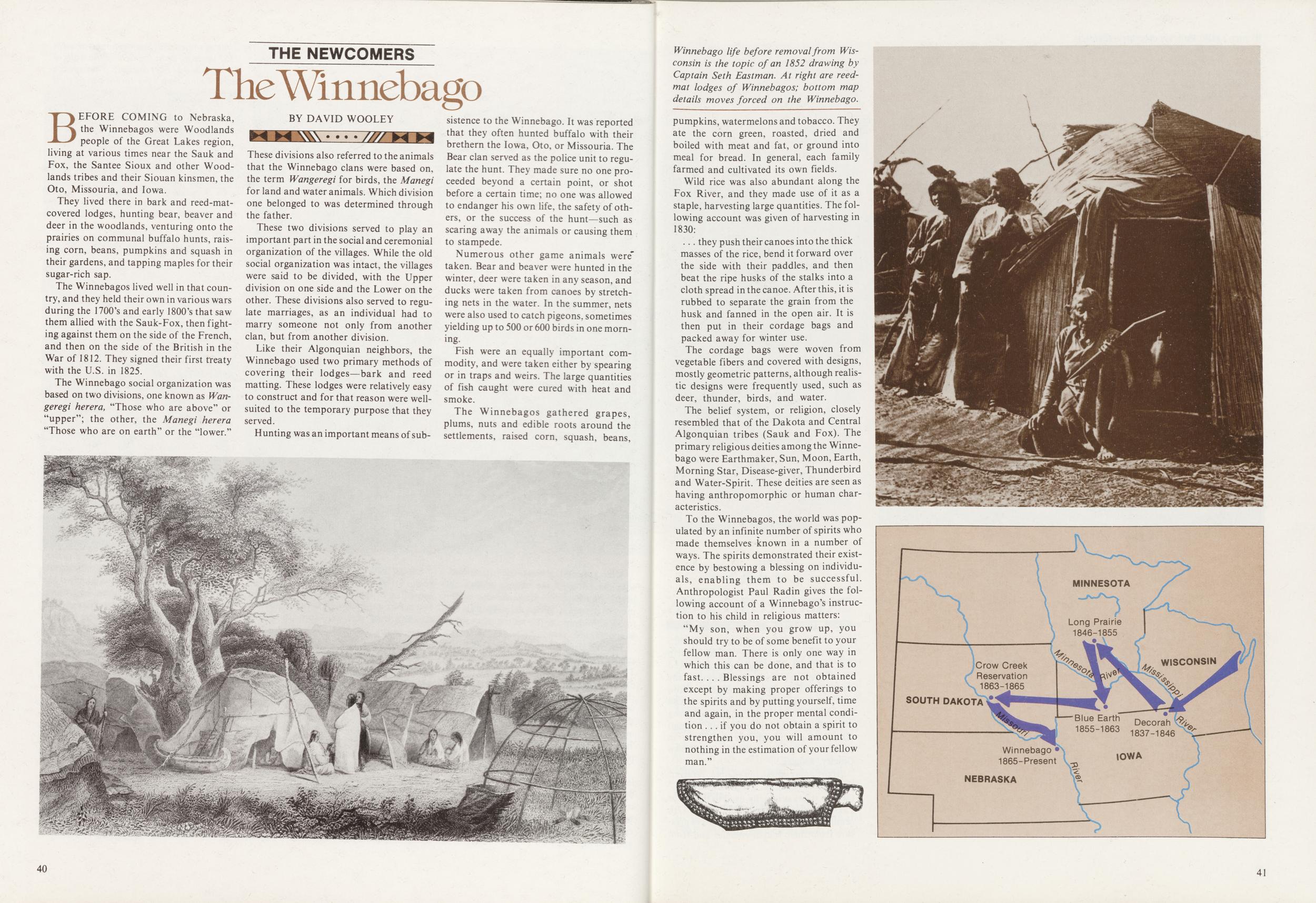 THE NEWCOMERS
The Winnebago
BY DAVID WOOLEY
THE NEWCOMERS
The Winnebago
BY DAVID WOOLEY
BEFORE COMING to Nebraska, the Winnebagos were Woodlands people of the Great Lakes region, living at various times near the Sauk and Fox, the Santee Sioux and other Woodlands tribes and their Siouan kinsmen, the Oto, Missouria, and Iowa.
They lived there in bark and reed-mat-covered lodges, hunting bear, beaver and deer in the woodlands, venturing onto the prairies on communal buffalo hunts, raising corn, beans, pumpkins and squash in their gardens, and tapping maples for their sugar-rich sap.
The Winnebagos lived well in that country, and they held their own in various wars during the 1700's and early 1800's that saw them allied with the Sauk-Fox, then fighting against them on the side of the French, and then on the side of the British in the War of 1812. They signed their first treaty with the U.S. in 1825.
The Winnebago social organization was based on two divisions, one known as Wangeregi herera, "Those who are above" or "upper"; the other, the Manegi herera "Those who are on earth" or the "lower."
These divisions also referred to the animals that the Winnebago clans were based on, the term Wangeregi for birds, the Manegi for land and water animals. Which division one belonged to was determined through the father.
These two divisions served to play an important part in the social and ceremonial organization of the villages. While the old social organization was intact, the villages were said to be divided, with the Upper division on one side and the Lower on the other. These divisions also served to regulate marriages, as an individual had to marry someone not only from another clan, but from another division.
Like their Algonquian neighbors, the Winnebago used two primary methods of covering their lodges—bark and reed matting. These lodges were relatively easy to construct and for that reason were well-suited to the temporary purpose that they served.
Hunting was an important means of subsistence to the Winnebago. It was reported that they often hunted buffalo with their brethern the Iowa, Oto, or Missouria. The Bear clan served as the police unit to regulate the hunt. They made sure no one proceeded beyond a certain point, or shot before a certain time; no one was allowed to endanger his own life, the safety of others, or the success of the hunt—such as scaring away the animals or causing them to stampede.
Numerous other game animals were taken. Bear and beaver were hunted in the winter, deer were taken in any season, and ducks were taken from canoes by stretching nets in the water. In the summer, nets were also used to catch pigeons, sometimes yielding up to 500 or 600 birds in one morning.
Fish were an equally important commodity, and were taken either by spearing or in traps and weirs. The large quantities of fish caught were cured with heat and smoke.
The Winnebagos gathered grapes, plums, nuts and edible roots around the settlements, raised corn, squash, beans,
40Winnebago life before removal from Wisconsin is the topic of an 1852 drawing by Captain Seth Eastman. At right are reedmat lodges of Winnebagos; bottom map details moves forced on the Winnebago.
pumpkins, watermelons and tobacco. They ate the corn green, roasted, dried and boiled with meat and fat, or ground into meal for bread. In general, each family farmed and cultivated its own fields.
Wild rice was also abundant along the Fox River, and they made use of it as a staple, harvesting large quantities. The following account was given of harvesting in 1830:
... they push their canoes into the thick masses of the rice, bend it forward over the side with their paddles, and then beat the ripe husks of the stalks into a cloth spread in the canoe. After this, it is rubbed to separate the grain from the husk and fanned in the open air. It is then put in their cordage bags and packed away for winter use.
The cordage bags were woven from vegetable fibers and covered with designs, mostly geometric patterns, although realistic designs were frequently used, such as deer, thunder, birds, and water. The belief system, or religion, closely resembled that of the Dakota and Central Algonquian tribes (Sauk and Fox). The primary religious deities among the Winnebago were Earthmaker, Sun, Moon, Earth, Morning Star, Disease-giver, Thunderbird and Water-Spirit. These deities are seen as having anthropomorphic or human characteristics.
To the Winnebagos, the world was populated by an infinite number of spirits who made themselves known in a number of ways. The spirits demonstrated their existence by bestowing a blessing on individuals, enabling them to be successful. Anthropologist Paul Radin gives the following account of a Winnebago's instruction to his child in religious matters:
"My son, when you grow up, you should try to be of some benefit to your fellow man. There is only one way in which this can be done, and that is to fast. . . . Blessings are not obtained except by making proper offerings to the spirits and by putting yourself, time and again, in the proper mental condition... if you do not obtain a spirit to strengthen you, you will amount to nothing in the estimation of your fellow man."
MINNESOTA Long Prairie 1846-1855 SOUTH DAKOTA C Crow Creek Reservation 1863-1865 Blue Earth 1855-1863 Decorah Winnebago 1865-Present 1837-1846 IOWA NEBRASKA 41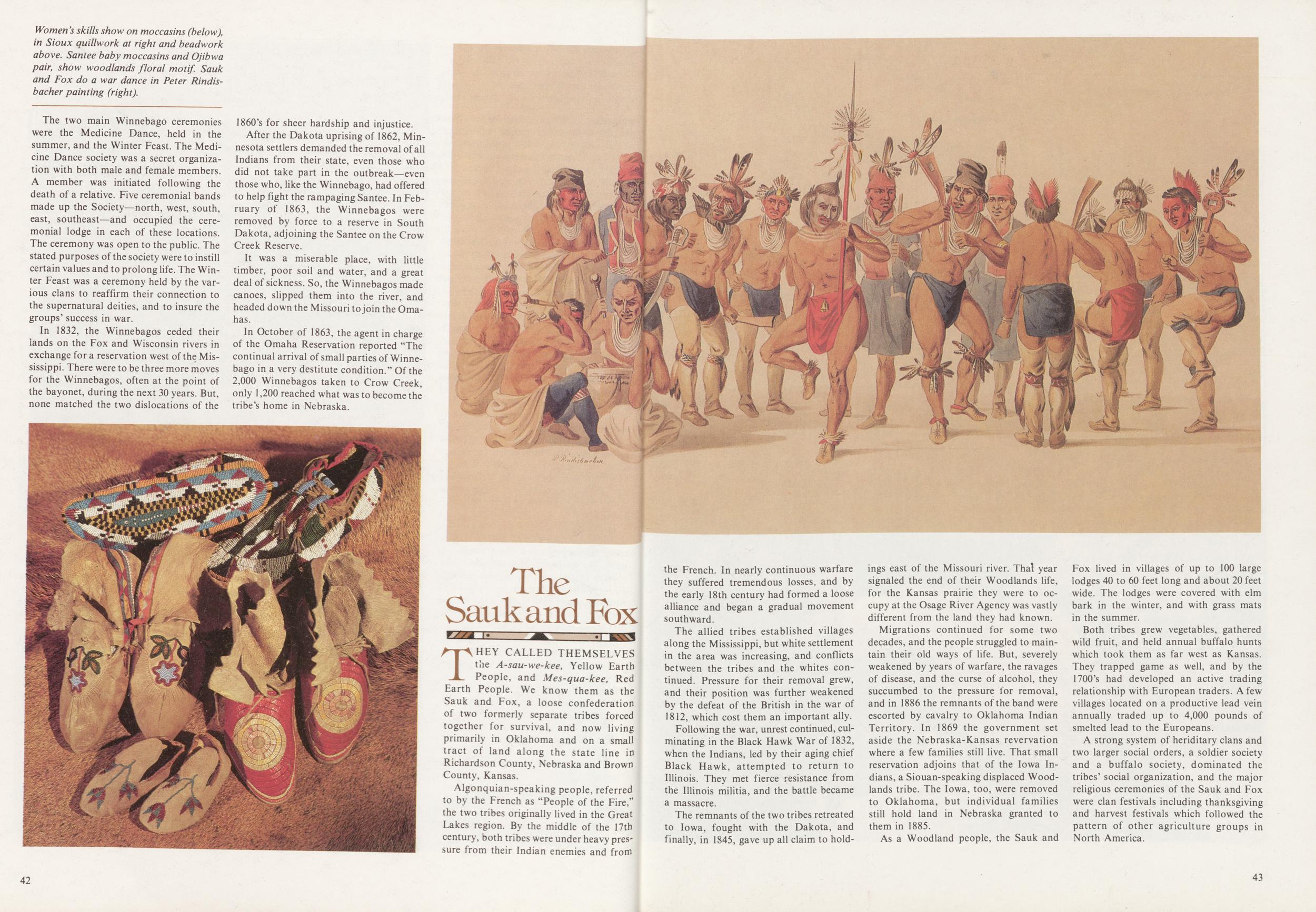
The two main Winnebago ceremonies were the Medicine Dance, held in the summer, and the Winter Feast. The Medicine Dance society was a secret organization with both male and female members. A member was initiated following the death of a relative. Five ceremonial bands made up the Society—north, west, south, east, southeast—and occupied the ceremonial lodge in each of these locations. The ceremony was open to the public. The stated purposes of the society were to instill certain values and to prolong life. The Winter Feast was a ceremony held by the various clans to reaffirm their connection to the supernatural deities, and to insure the groups' success in war.
In 1832, the Winnebagos ceded their lands on the Fox and Wisconsin rivers in exchange for a reservation west of the Mississippi. There were to be three more moves for the Winnebagos, often at the point of the bayonet, during the next 30 years. But, none matched the two dislocations of the 1860's for sheer hardship and injustice.
After the Dakota uprising of 1862, Minnesota settlers demanded the removal of all Indians from their state, even those who did not take part in the outbreak—even those who, like the Winnebago, had offered to help fight the rampaging Santee. In February of 1863, the Winnebagos were removed by force to a reserve in South Dakota, adjoining the Santee on the Crow Creek Reserve.
It was a miserable place, with little timber, poor soil and water, and a great deal of sickness. So, the Winnebagos made canoes, slipped them into the river, and headed down the Missouri to join the Omahas.
In October of 1863, the agent in charge of the Omaha Reservation reported "The continual arrival of small parties of Winnebago in a very destitute condition." Of the 2,000 Winnebagos taken to Crow Creek, only 1,200 reached what was to become the tribe's home in Nebraska.
The Sauk and FoxTHEY CALLED THEMSELVES the A-sau-we-kee, Yellow Earth People, and Mes-qua-kee, Red Earth People. We know them as the Sauk and Fox, a loose confederation of two formerly separate tribes forced together for survival, and now living primarily in Oklahoma and on a small tract of land along the state line in Richardson County, Nebraska and Brown County, Kansas.
Algonquian-speaking people, referred to by the French as "People of the Fire," the two tribes originally lived in the Great Lakes region. By the middle of the 17th century, both tribes were under heavy pressure from their Indian enemies and from
42the French. In nearly continuous warfare they suffered tremendous losses, and by the early 18th century had formed a loose alliance and began a gradual movement southward.
The allied tribes established villages along the Mississippi, but white settlement in the area was increasing, and conflicts between the tribes and the whites continued. Pressure for their removal grew, and their position was further weakened by the defeat of the British in the war of 1812, which cost them an important ally.
Following the war, unrest continued, culminating in the Black Hawk War of 1832, when the Indians, led by their aging chief Black Hawk, attempted to return to Illinois. They met fierce resistance from the Illinois militia, and the battle became a massacre.
The remnants of the two tribes retreated to Iowa, fought with the Dakota, and finally, in 1845, gave up all claim to holdings east of the Missouri river. Thai year signaled the end of their Woodlands life, for the Kansas prairie they were to occupy at the Osage River Agency was vastly different from the land they had known.
Migrations continued for some two decades, and the people struggled to maintain their old ways of life. But, severely weakened by years of warfare, the ravages of disease, and the curse of alcohol, they succumbed to the pressure for removal, and in 1886 the remnants of the band were escorted by cavalry to Oklahoma Indian Territory. In 1869 the government set aside the Nebraska-Kansas revervation where a few families still live. That small reservation adjoins that of the Iowa Indians, a Siouan-speaking displaced Woodlands tribe. The Iowa, too, were removed to Oklahoma, but individual families still hold land in Nebraska granted to them in 1885.
As a Woodland people, the Sauk and Fox lived in villages of up to 100 large lodges 40 to 60 feet long and about 20 feet wide. The lodges were covered with elm bark in the winter, and with grass mats in the summer.
Both tribes grew vegetables, gathered wild fruit, and held annual buffalo hunts which took them as far west as Kansas. They trapped game as well, and by the 1700's had developed an active trading relationship with European traders. A few villages located on a productive lead vein annually traded up to 4,000 pounds of smelted lead to the Europeans.
A strong system of heriditary clans and two larger social orders, a soldier society and a buffalo society, dominated the tribes' social organization, and the major religious ceremonies of the Sauk and Fox were clan festivals including thanksgiving and harvest festivals which followed the pattern of other agriculture groups in North America.
43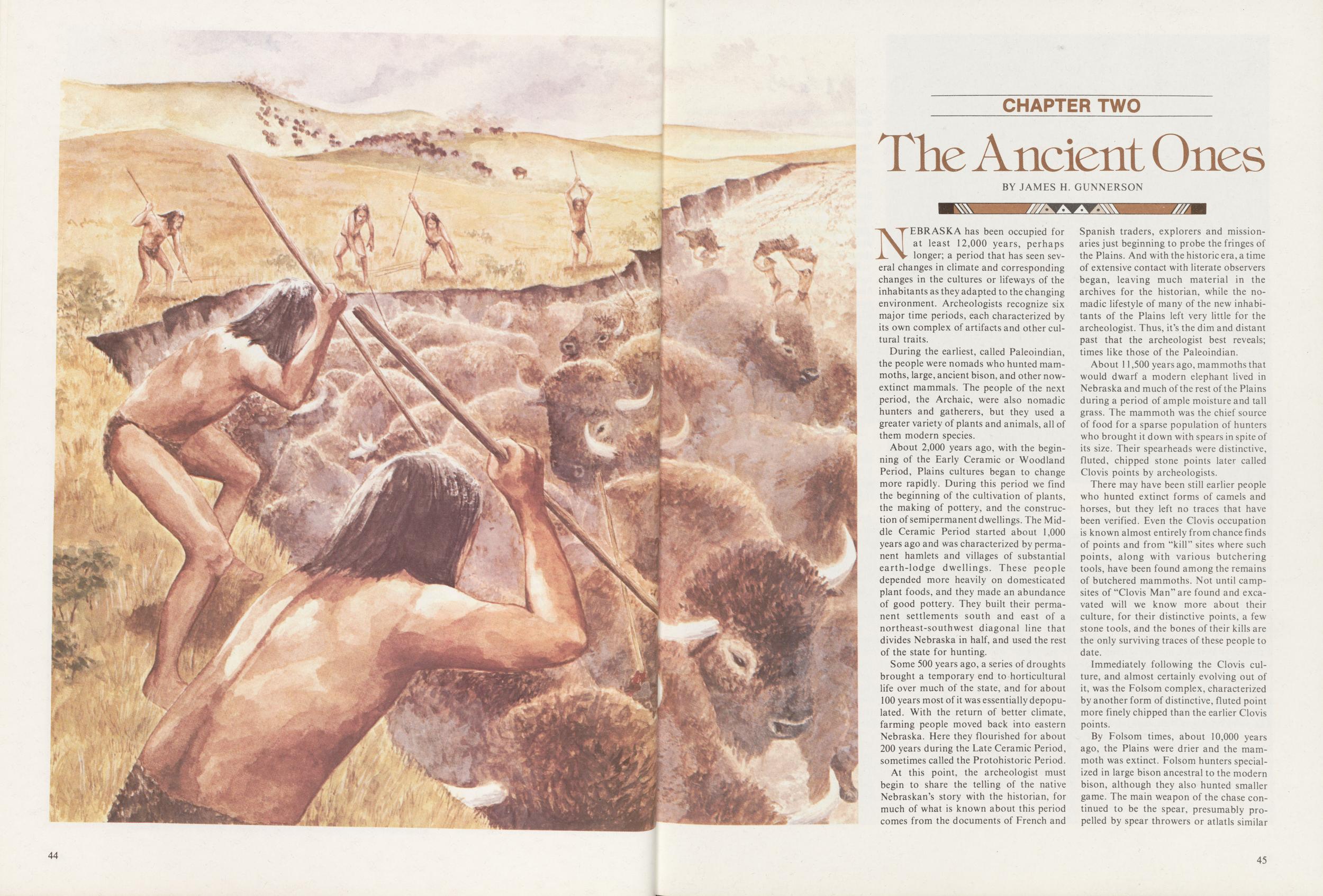
CHAPTER TWO The Ancient Ones
BY JAMES H. GUNNERSONNEBRASKA has been occupied for at least 12,000 years, perhaps longer; a period that has seen several changes in climate and corresponding changes in the cultures or lifeways of the inhabitants as they adapted to the changing environment. Archeologists recognize six major time periods, each characterized by its own complex of artifacts and other cultural traits.
During the earliest, called Paleoindian, the people were nomads who hunted mammoths, large, ancient bison, and other now-extinct mammals. The people of the next period, the Archaic, were also nomadic hunters and gatherers, but they used a greater variety of plants and animals, all of them modern species.
About 2,000 years ago, with the beginning of the Early Ceramic or Woodland Period, Plains cultures began to change more rapidly. During this period we find the beginning of the cultivation of plants, the making of pottery, and the construction of semipermanent dwellings. The Middle Ceramic Period started about 1,000 years ago and was characterized by permanent hamlets and villages of substantial earth-lodge dwellings. These people depended more heavily on domesticated plant foods, and they made an abundance of good pottery. They built their permanent settlements south and east of a northeast-southwest diagonal line that divides Nebraska in half, and used the rest of the state for hunting.
Some 500 years ago, a series of droughts brought a temporary end to horticultural life over much of the state, and for about 100 years most of it was essentially depopulated. With the return of better climate, farming people moved back into eastern Nebraska. Here they flourished for about 200 years during the Late Ceramic Period, sometimes called the Protohistoric Period.
At this point, the archeologist must begin to share the telling of the native Nebraskan's story with the historian, for much of what is known about this period comes from the documents of French and Spanish traders, explorers and missionaries just beginning to probe the fringes of the Plains. And with the historic era, a time of extensive contact with literate observers began, leaving much material in the archives for the historian, while the nomadic lifestyle of many of the new inhabitants of the Plains left very little for the archeologist. Thus, it's the dim and distant past that the archeologist best reveals; times like those of the Paleoindian.
About 11,500 years ago, mammoths that would dwarf a modern elephant lived in Nebraska and much of the rest of the Plains during a period of ample moisture and tall grass. The mammoth was the chief source of food for a sparse population of hunters who brought it down with spears in spite of its size. Their spearheads were distinctive, fluted, chipped stone points later called Clovis points by archeologists.
There may have been still earlier people who hunted extinct forms of camels and horses, but they left no traces that have been verified. Even the Clovis occupation is known almost entirely from chance finds of points and from "kill" sites where such points, along with various butchering tools, have been found among the remains of butchered mammoths. Not until campsites of "Clovis Man" are found and excavated will we know more about their culture, for their distinctive points, a few stone tools, and the bones of their kills are the only surviving traces of these people to date.
Immediately following the Clovis culture, and almost certainly evolving out of it, was the Folsom complex, characterized by another form of distinctive, fluted point more finely chipped than the earlier Clovis points.
By Folsom times, about 10,000 years ago, the Plains were drier and the mammoth was extinct. Folsom hunters specialized in large bison ancestral to the modern bison, although they also hunted smaller game. The main weapon of the chase continued to be the spear, presumably propelled by spear throwers or atlatls similar
45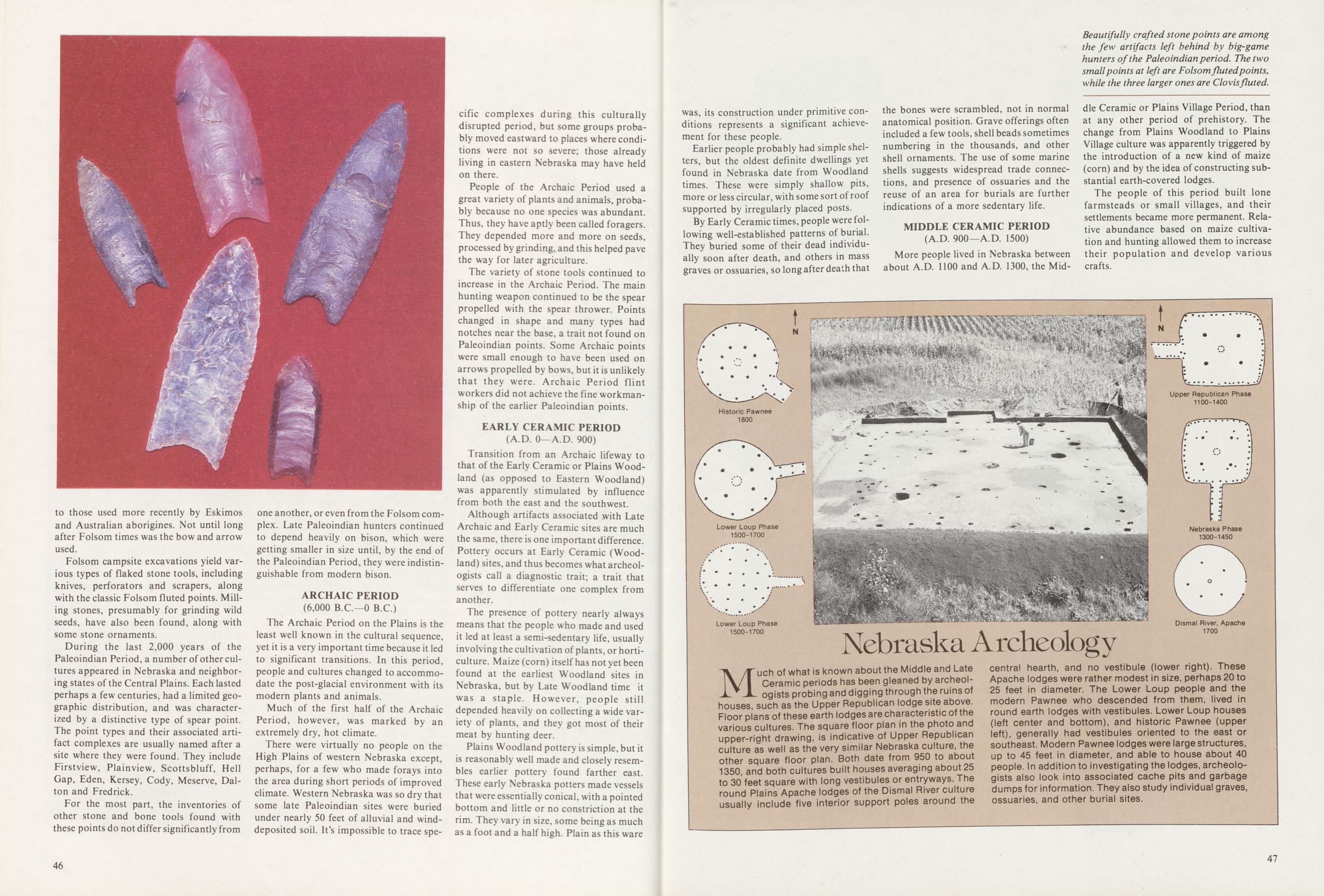
to those used more recently by Eskimos and Australian aborigines. Not until long after Folsom times was the bow and arrow used.
Folsom campsite excavations yield various types of flaked stone tools, including knives, perforators and scrapers, along with the classic Folsom fluted points. Milling stones, presumably for grinding wild seeds, have also been found, along with some stone ornaments.
During the last 2,000 years of the Paleoindian Period, a number of other cultures appeared in Nebraska and neighboring states of the Central Plains. Each lasted perhaps a few centuries, had a limited geographic distribution, and was characterized by a distinctive type of spear point. The point types and their associated artifact complexes are usually named after a site where they were found. They include Firstview, Plainview, Scottsbluff, Hell Gap, Eden, Kersey, Cody, Meserve, Dalton and Fredrick.
For the most part, the inventories of other stone and bone tools found with these points do not differ significantly from one another, or even from the Folsom complex. Late Paleoindian hunters continued to depend heavily on bison, which were getting smaller in size until, by the end of the Paleoindian Period, they were indistinguishable from modern bison.
ARCHAIC PERIOD (6,000 B.C.—0 B.C.)The Archaic Period on the Plains is the least well known in the cultural sequence, yet it is a very important time because it led to significant transitions. In this period, people and cultures changed to accommodate the post-glacial environment with its modern plants and animals.
Much of the first half of the Archaic Period, however, was marked by an extremely dry, hot climate.
There were virtually no people on the High Plains of western Nebraska except, perhaps, for a few who made forays into the area during short periods of improved climate. Western Nebraska was so dry that some late Paleoindian sites were buried under nearly 50 feet of alluvial and wind-deposited soil. It's impossible to trace specific complexes during this culturally disrupted period, but some groups probably moved eastward to places where conditions were not so severe; those already living in eastern Nebraska may have held on there.
People of the Archaic Period used a great variety of plants and animals, probably because no one species was abundant. Thus, they have aptly been called foragers. They depended more and more on seeds, processed by grinding, and this helped pave the way for later agriculture.
The variety of stone tools continued to increase in the Archaic Period. The main hunting weapon continued to be the spear propelled with the spear thrower. Points changed in shape and many types had notches near the base, a trait not found on Paleoindian points. Some Archaic points were small enough to have been used on arrows propelled by bows, but it is unlikely that they were. Archaic Period flint workers did not achieve the fine workmanship of the earlier Paleoindian points.
EARLY CERAMIC PERIOD (A.D. 0—A.D. 900)Transition from an Archaic lifeway to that of the Early Ceramic or Plains Woodland (as opposed to Eastern Woodland) was apparently stimulated by influence from both the east and the southwest. Although artifacts associated with Late Archaic and Early Ceramic sites are much the same, there is one important difference. Pottery occurs at Early Ceramic (Woodland) sites, and thus becomes what archeologists call a diagnostic trait; a trait that serves to differentiate one complex from another.
The presence of pottery nearly always means that the people who made and used it led at least a semi-sedentary life, usually involving the cultivation of plants, or horticulture. Maize (corn) itself has not yet been found at the earliest Woodland sites in Nebraska, but by Late Woodland time it was a staple. However, people still depended heavily on collecting a wide variety of plants, and they got most of their meat by hunting deer.
Plains Woodland pottery is simple, but it is reasonably well made and closely resembles earlier pottery found farther east. These early Nebraska potters made vessels that were essentially conical, with a pointed bottom and little or no constriction at the rim. They vary in size, some being as much as a foot and a half high. Plain as this ware
46was, its construction under primitive conditions represents a significant achievement for these people.
Earlier people probably had simple shelters, but the oldest definite dwellings yet found in Nebraska date from Woodland times. These were simply shallow pits, more or less circular, with some sort of roof supported by irregularly placed posts.
By Early Ceramic times, people were following well-established patterns of burial. They buried some of their dead individually soon after death, and others in mass graves or ossuaries, so long after death that the bones were scrambled, not in normal anatomical position. Grave offerings often included a few tools, shell beads sometimes numbering in the thousands, and other shell ornaments. The use of some marine shells suggests widespread trade connections, and presence of ossuaries and the reuse of an area for burials are further indications of a more sedentary life.
MIDDLE CERAMIC PERIOD (A.D. 900—A.D. 1500)More people lived in Nebraska between about A.D. 1100 and A.D. 1300, the Middle
Ceramic or Plains Village Period, than at any other period of prehistory. The change from Plains Woodland to Plains Village culture was apparently triggered by the introduction of a new kind of maize (corn) and by the idea of constructing substantial earth-covered lodges.
The people of this period built lone farmsteads or small villages, and their settlements became more permanent. Relative abundance based on maize cultivation and hunting allowed them to increase their population and develop various crafts.
Historic Pawnee 1800 Upper Republican Phase 1100-1400 Lower Loup Phase 1500-1700 Lower Loup Phase 1500-1700 Nebraska Phase 1300-1450 Nebraska Archeology Dismal River, Apache 1700Much of what is known about the Middle and Late Ceramic periods has been gleaned by archeologists probing and digging through the ruins of houses, such as the Upper Republican lodge site above. Floor plans of these earth lodges are characteristic of the various cultures. The square floor plan in the photo and upper-right drawing, is indicative of Upper Republican culture as well as the very similar Nebraska culture, the other square floor plan. Both date from 950 to about 1350, and both cultures built houses averaging about 25 to 30 feet square with long vestibules or entryways. The round Plains Apache lodges of the Dismal River culture usually include five interior support poles around the central hearth, and no vestibule (lower right). These Apache lodges were rather modest in size, perhaps 20 to 25 feet in diameter. The Lower Loup people and the modern Pawnee who descended from them, lived in round earth lodges with vestibules. Lower Loup houses (left center and bottom), and historic Pawnee (upper left), generally had vestibules oriented to the east or southeast. Modern Pawnee lodges were large structures, up to 45 feet in diameter, and able to house about 40 people. In addition to investigating the lodges, archeologists also look into associated cache pits and garbage dumps for information. They also study individual graves, ossuaries, and other burial sites.
47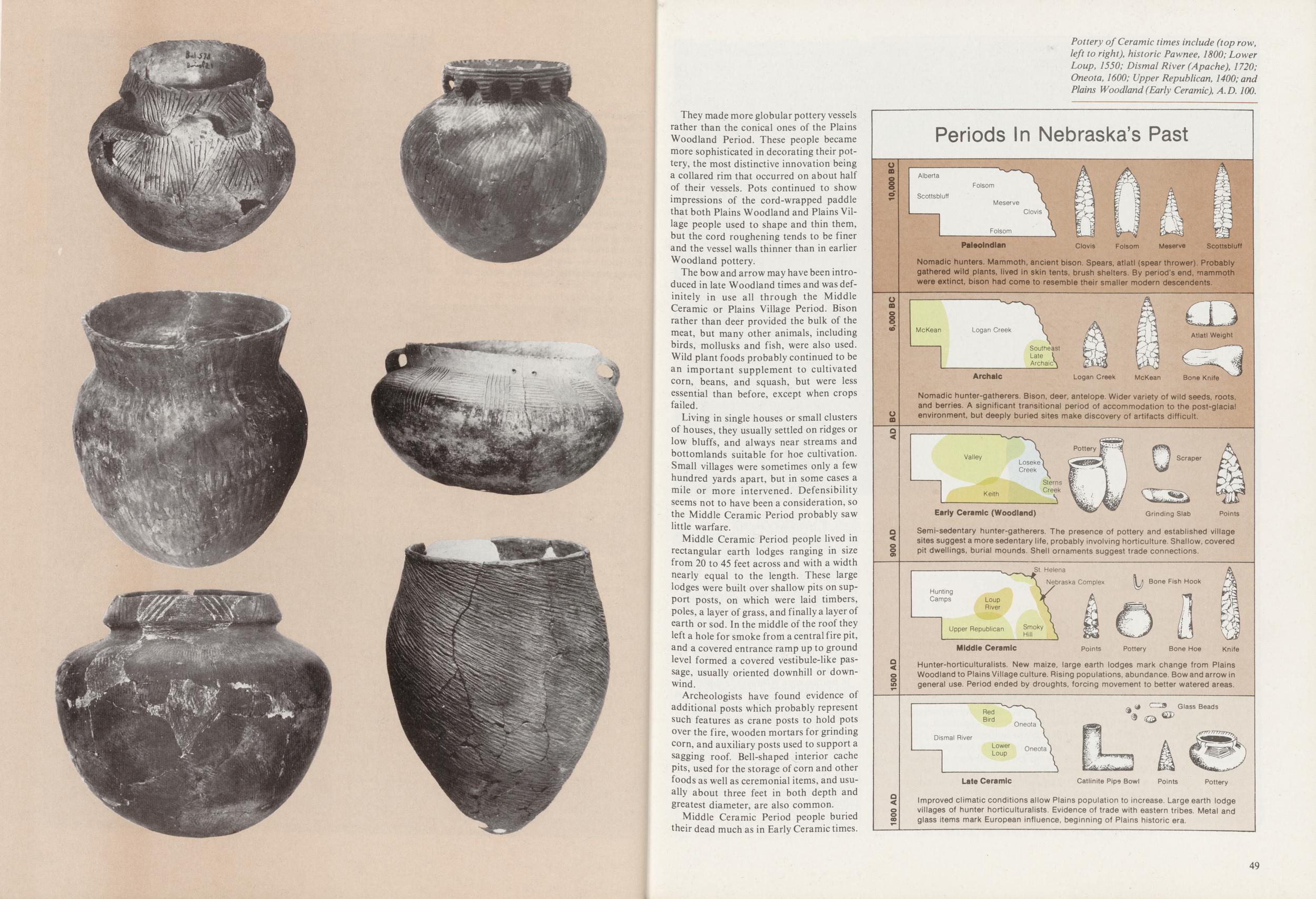
They made more globular pottery vessels rather than the conical ones of the Plains Woodland Period. These people became more sophisticated in decorating their pottery, the most distinctive innovation being a collared rim that occurred on about half of their vessels. Pots continued to show impressions of the cord-wrapped paddle that both Plains Woodland and Plains Village people used to shape and thin them, but the cord roughening tends to be finer and the vessel walls thinner than in earlier Woodland pottery.
The bow and arrow may have been introduced in late Woodland times and was definitely in use all through the Middle Ceramic or Plains Village Period. Bison rather than deer provided the bulk of the meat, but many other animals, including birds, mollusks and fish, were also used. Wild plant foods probably continued to be an important supplement to cultivated corn, beans, and squash, but were less essential than before, except when crops failed.
Living in single houses or small clusters of houses, they usually settled on ridges or low bluffs, and always near streams and bottomlands suitable for hoe cultivation. Small villages were sometimes only a few hundred yards apart, but in some cases a mile or more intervened. Defensibility seems not to have been a consideration, so the Middle Ceramic Period probably saw little warfare.
Middle Ceramic Period people lived in rectangular earth lodges ranging in size from 20 to 45 feet across and with a width nearly equal to the length. These large lodges were built over shallow pits on support posts, on which were laid timbers, poles, a layer of grass, and finally a layer of earth or sod. In the middle of the roof they left a hole for smoke from a central fire pit, and a covered entrance ramp up to ground level formed a covered vestibule-like passage, usually oriented downhill or downwind.
Archeologists have found evidence of additional posts which probably represent such features as crane posts to hold pots over the fire, wooden mortars for grinding corn, and auxiliary posts used to support a sagging roof. Bell-shaped interior cache pits, used for the storage of corn and other foods as well as ceremonial items, and usually about three feet in both depth and greatest diameter, are also common.
Middle Ceramic Period people buried their dead much as in Early Ceramic times.
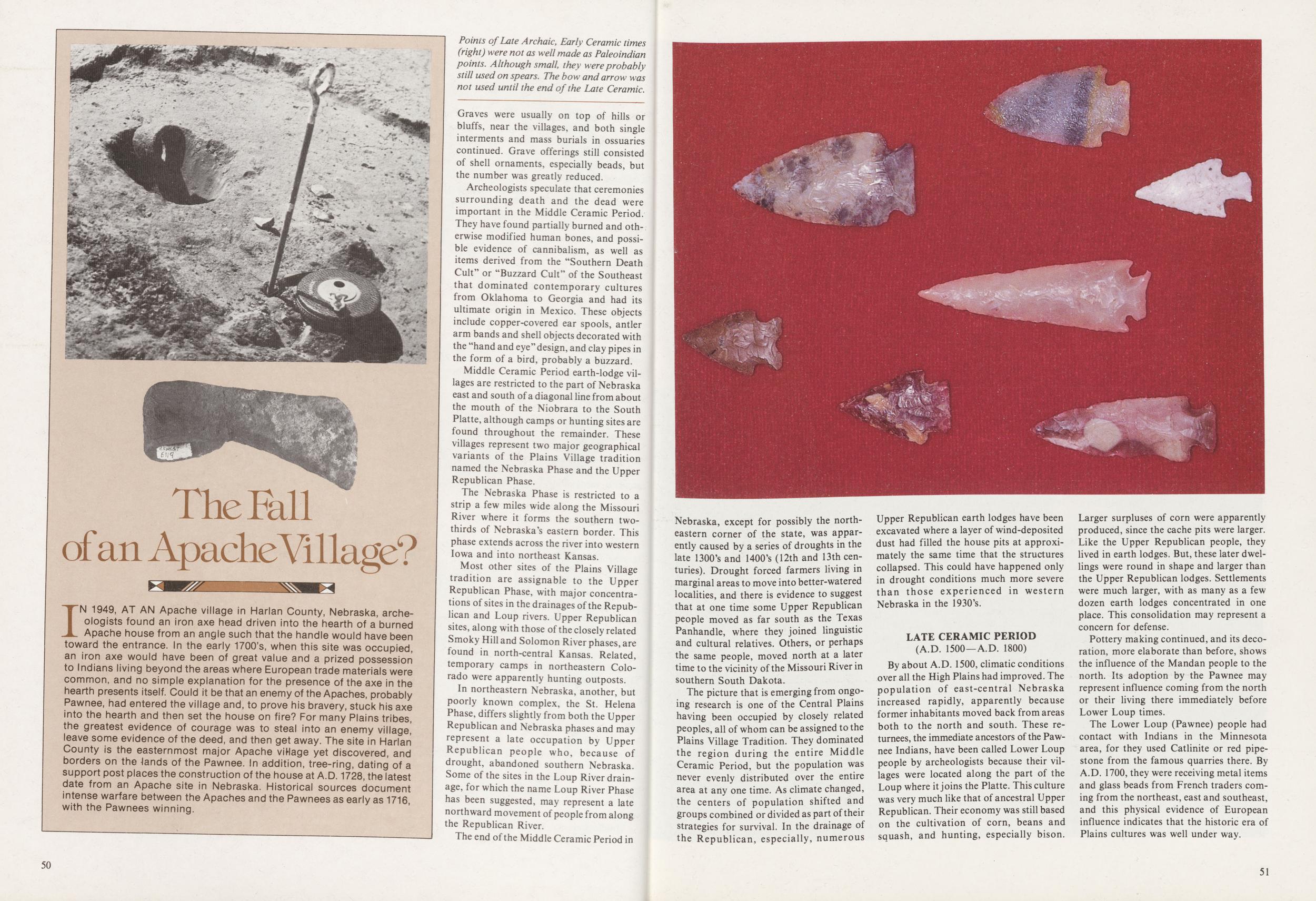 The Fall
of an Apache Village?
The Fall
of an Apache Village?
IN 1949, AT AN Apache village in Harlan County, Nebraska, archeologists found an iron axe head driven into the hearth of a burned Apache house from an angle such that the handle would have been toward the entrance. In the early 1700's, when this site was occupied, an iron axe would have been of great value and a prized possession to Indians living beyond the areas where European trade materials were common, and no simple explanation for the presence of the axe in the hearth presents itself. Could it be that an enemy of the Apaches, probably Pawnee, had entered the village and, to prove his bravery, stuck his axe into the hearth and then set the house on fire? For many Plains tribes, the greatest evidence of courage was to steal into an enemy village, leave some evidence of the deed, and then get away. The site in Harlan County is the easternmost major Apache viHage yet discovered, and borders on the tends of the Pawnee. In addition, tree-ring, dating of a support post places the construction of the house at A.D. 1728, the latest date from an Apache site in Nebraska. Historical sources document intense warfare between the Apaches and the Pawnees as early as 1716, with the Pawnees winning.
Graves were usually on top of hills or bluffs, near the villages, and both single interments and mass burials in ossuaries continued. Grave offerings still consisted of shell ornaments, especially beads, but the number was greatly reduced.
Archeologists speculate that ceremonies surrounding death and the dead were important in the Middle Ceramic Period. They have found partially burned and otherwise modified human bones, and possible evidence of cannibalism, as well as items derived from the "Southern Death Cult" or "Buzzard Cult" of the Southeast that dominated contemporary cultures from Oklahoma to Georgia and had its ultimate origin in Mexico. These objects include copper-covered ear spools, antler arm bands and shell objects decorated with the "hand and eye" design, and clay pipes in the form of a bird, probably a buzzard.
Middle Ceramic Period earth-lodge villages are restricted to the part of Nebraska east and south of a diagonal line from about the mouth of the Niobrara to the South Platte, although camps or hunting sites are found throughout the remainder. These villages represent two major geographical variants of the Plains Village tradition named the Nebraska Phase and the Upper Republican Phase.
The Nebraska Phase is restricted to a strip a few miles wide along the Missouri River where it forms the southern two-thirds of Nebraska's eastern border. This phase extends across the river into western Iowa and into northeast Kansas.
Most other sites of the Plains Village tradition are assignable to the Upper Republican Phase, with major concentrations of sites in the drainages of the Republican and Loup rivers. Upper Republican sites, along with those of the closely related Smoky Hill and Solomon River phases, are found in north-central Kansas. Related, temporary camps in northeastern Colorado were apparently hunting outposts.
In northeastern Nebraska, another, but poorly known complex, the St. Helena Phase, differs slightly from both the Upper Republican and Nebraska phases and may represent a late occupation by Upper Republican people who, because of drought, abandoned southern Nebraska. Some of the sites in the Loup River drainage, for which the name Loup River Phase has been suggested, may represent a late northward movement of people from along the Republican River.
The end of the Middle Ceramic Period in
50Nebraska, except for possibly the northeastern corner of the state, was apparently caused by a series of droughts in the late 1300's and 1400's (12th and 13th centuries). Drought forced farmers living in marginal areas to move into better-watered localities, and there is evidence to suggest that at one time some Upper Republican people moved as far south as the Texas Panhandle, where they joined linguistic and cultural relatives. Others, or perhaps the same people, moved north at a later time to the vicinity of the Missouri River in southern South Dakota.
The picture that is emerging from ongoing research is one of the Central Plains having been occupied by closely related peoples, all of whom can be assigned to the Plains Village Tradition. They dominated the region during the entire Middle Ceramic Period, but the population was never evenly distributed over the entire area at any one time. As climate changed, the centers of population shifted and groups combined or divided as part of their strategies for survival. In the drainage of the Republican, especially, numerous Upper Republican earth lodges have been excavated where a layer of wind-deposited dust had filled the house pits at approximately the same time that the structures collapsed. This could have happened only in drought conditions much more severe than those experienced in western Nebraska in the 1930's.
LATE CERAMIC PERIOD (A.D. 1500-A.D. 1800)By about A.D. 1500, climatic conditions over all the High Plains had improved. The population of east-central Nebraska increased rapidly, apparently because former inhabitants moved back from areas both to the north and south. These returnees, the immediate ancestors of the Pawnee Indians, have been called Lower Loup people by archeologists because their villages were located along the part of the Loup where it joins the Platte. This culture was very much like that of ancestral Upper Republican. Their economy was still based on the cultivation of corn, beans and squash, and hunting, especially bison. Larger surpluses of corn were apparently produced, since the cache pits were larger. Like the Upper Republican people, they lived in earth lodges. But, these later dwellings were round in shape and larger than the Upper Republican lodges. Settlements were much larger, with as many as a few dozen earth lodges concentrated in one place. This consolidation may represent a concern for defense.
Pottery making continued, and its decoration, more elaborate than before, shows the influence of the Mandan people to the north. Its adoption by the Pawnee may represent influence coming from the north or their living there immediately before Lower Loup times.
The Lower Loup (Pawnee) people had contact with Indians in the Minnesota area, for they used Catlinite or red pipestone from the famous quarries there. By A.D. 1700, they were receiving metal items and glass beads from French traders coming from the northeast, east and southeast, and this physical evidence of European influence indicates that the historic era of Plains cultures was well under way.
51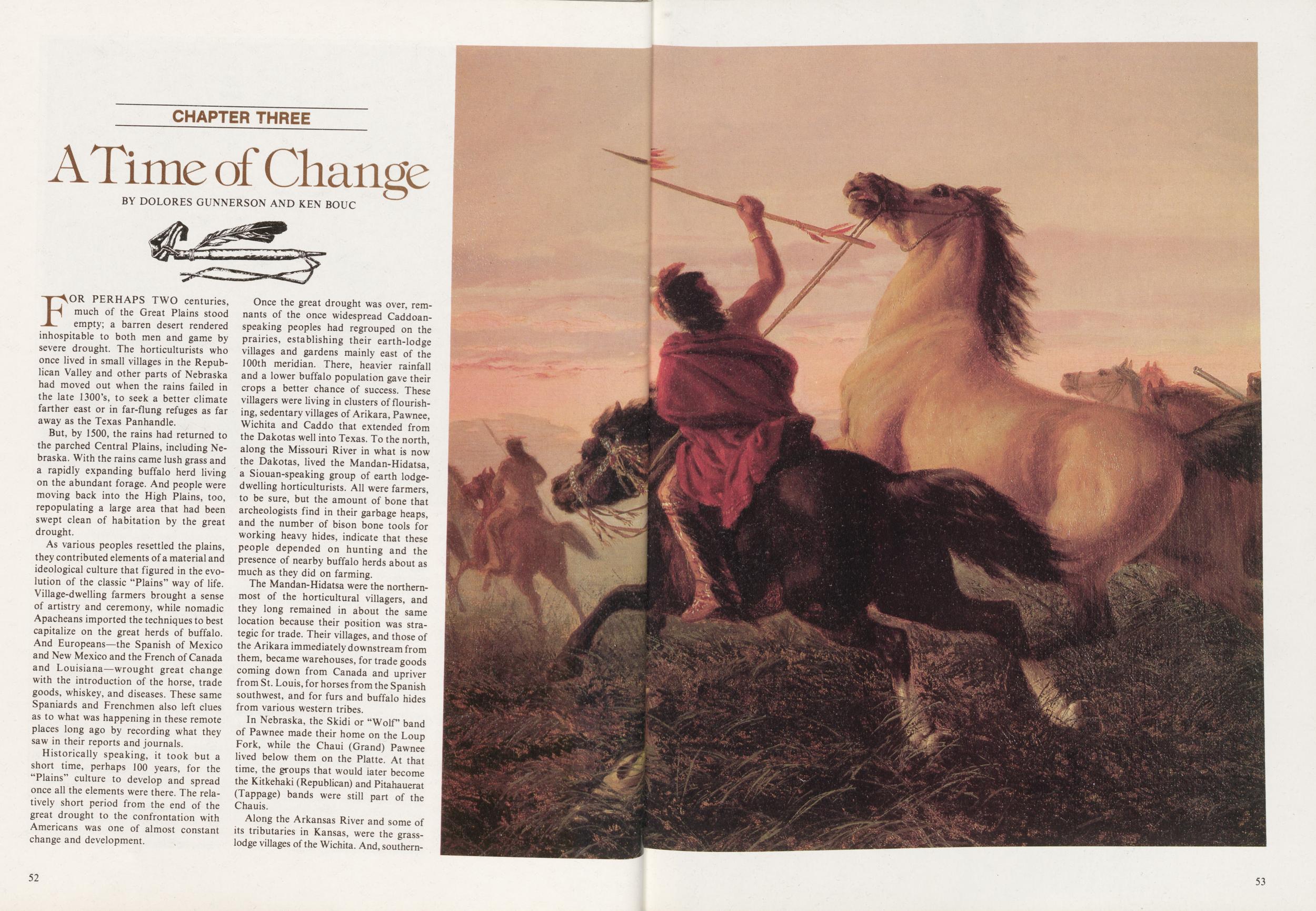
CHAPTER THREE A Time of Change
BY DOLORES GUNNERSON AND KEN BOUCFOR PERHAPS TWO centuries, much of the Great Plains stood empty; a barren desert rendered inhospitable to both men and game by severe drought. The horticulturists who once lived in small villages in the Republican Valley and other parts of Nebraska had moved out when the rains failed in the late 1300's, to seek a better climate farther east or in far-flung refuges as far away as the Texas Panhandle.
But, by 1500, the rains had returned to the parched Central Plains, including Nebraska. With the rains came lush grass and a rapidly expanding buffalo herd living on the abundant forage. And people were moving back into the High Plains, too, repopulating a large area that had been swept clean of habitation by the great drought.
As various peoples resettled the plains, they contributed elements of a material and ideological culture that figured in the evolution of the classic "Plains" way of life. Village-dwelling farmers brought a sense of artistry and ceremony, while nomadic Apacheans imported the techniques to best capitalize on the great herds of buffalo. And Europeans—the Spanish of Mexico and New Mexico and the French of Canada and Louisiana—wrought great change with the introduction of the horse, trade goods, whiskey, and diseases. These same Spaniards and Frenchmen also left clues as to what was happening in these remote places long ago by recording what they saw in their reports and journals.
Historically speaking, it took but a short time, perhaps 100 years, for the "Plains" culture to develop and spread once all the elements were there. The relatively short period from the end of the great drought to the confrontation with Americans was one of almost constant change and development.
Once the great drought was over, remnants of the once widespread Caddoan-speaking peoples had regrouped on the prairies, establishing their earth-lodge villages and gardens mainly east of the 100th meridian. There, heavier rainfall and a lower buffalo population gave their crops a better chance of success. These villagers were living in clusters of flourishing, sedentary villages of Arikara, Pawnee, Wichita and Caddo that extended from the Dakotas well into Texas. To the north, along the Missouri River in what is now the Dakotas, lived the Mandan-Hidatsa, a Siouan-speaking group of earth lodge-dwelling horticulturists. All were farmers, to be sure, but the amount of bone that archeologists find in their garbage heaps, and the number of bison bone tools for working heavy hides, indicate that these people depended on hunting and the presence of nearby buffalo herds about as much as they did on farming.
The Mandan-Hidatsa were the northern-most of the horticultural villagers, and they long remained in about the same location because their position was strategic for trade. Their villages, and those of the Arikara immediately downstream from them, became warehouses, for trade goods coming down from Canada and upriver from St. Louis, for horses from the Spanish southwest, and for furs and buffalo hides from various western tribes.
In Nebraska, the Skidi or "Wolf" band of Pawnee made their home on the Loup Fork, while the Chaui (Grand) Pawnee lived below them on the Platte. At that time, the groups that would later become the Kitkehaki (Republican) and Pitahauerat (Tappage) bands were still part of the Chauis.
Along the Arkansas River and some of its tributaries in Kansas, were the grasslodge villages of the Wichita. And, southern-most,
52 53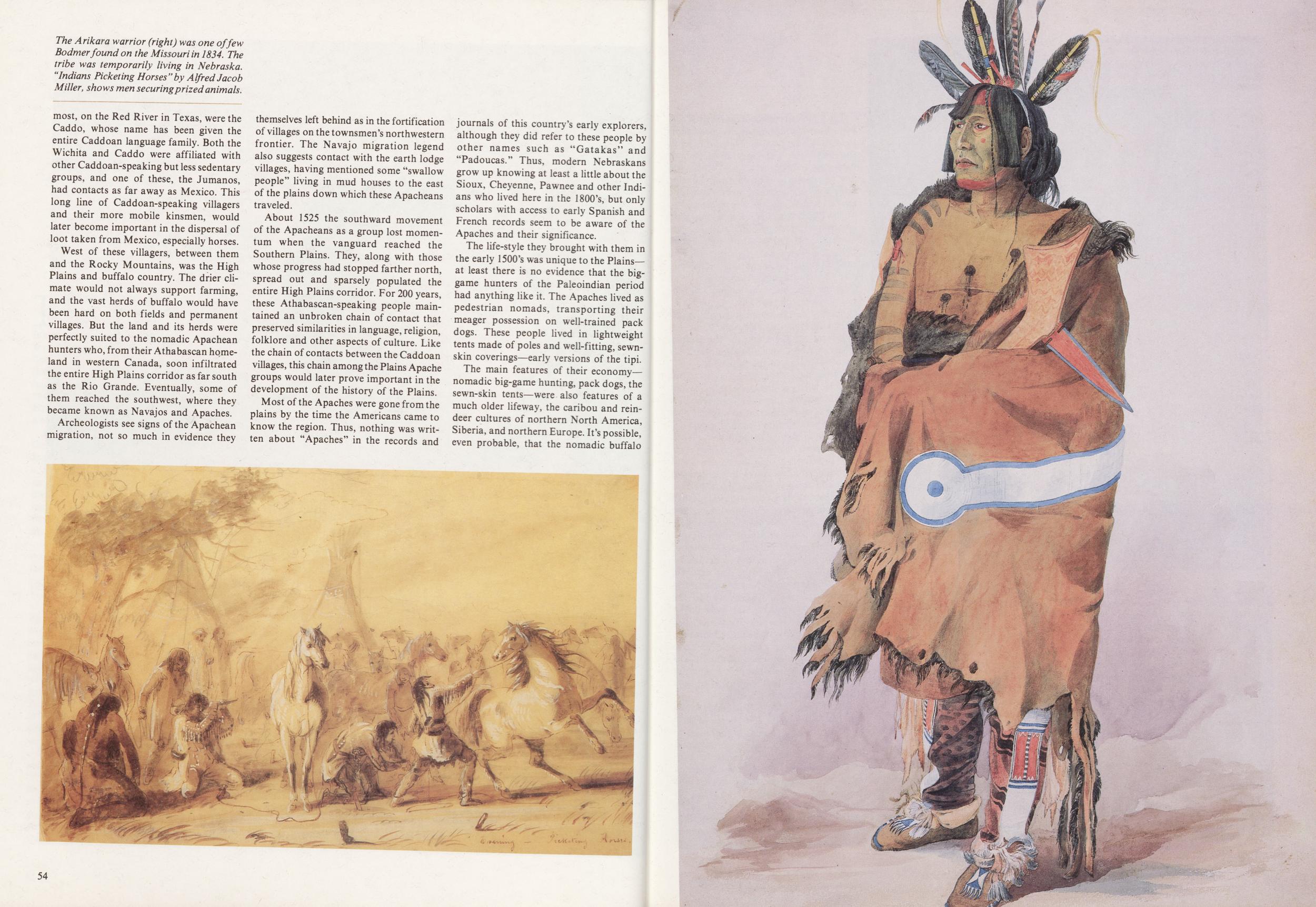
on the Red River in Texas, were the Caddo, whose name has been given the entire Caddoan language family. Both the Wichita and Caddo were affiliated with other Caddoan-speaking but less sedentary groups, and one of these, the Jumanos, had contacts as far away as Mexico. This long line of Caddoan-speaking villagers and their more mobile kinsmen, would later become important in the dispersal of loot taken from Mexico, especially horses.
West of these villagers, between them and the Rocky Mountains, was the High Plains and buffalo country. The drier climate would not always support farming, and the vast herds of buffalo would have been hard on both fields and permanent villages. But the land and its herds were perfectly suited to the nomadic Apachean hunters who, from their Athabascan homeland in western Canada, soon infiltrated the entire High Plains corridor as far south as the Rio Grande. Eventually, some of them reached the southwest, where they became known as Navajos and Apaches.
Archeologists see signs of the Apachean migration, not so much in evidence they
themselves left behind as in the fortification of villages on the townsmen's northwestern frontier. The Navajo migration legend also suggests contact with the earth lodge villages, having mentioned some "swallow people" living in mud houses to the east of the plains down which these Apacheans traveled.
About 1525 the southward movement of the Apacheans as a group lost momentum when the vanguard reached the Southern Plains. They, along with those whose progress had stopped farther north, spread out and sparsely populated the entire High Plains corridor. For 200 years, these Athabascan-speaking people maintained an unbroken chain of contact that preserved similarities in language, religion, folklore and other aspects of culture. Like the chain of contacts between the Caddoan villages, this chain among the Plains Apache groups would later prove important in the development of the history of the Plains.
Most of the Apaches were gone from the plains by the time the Americans came to know the region. Thus, nothing was written about "Apaches" in the records and journals of this country's early explorers, although they did refer to these people by other names such as "Gatakas" and "Padoucas." Thus, modern Nebraskans grow up knowing at least a little about the Sioux, Cheyenne, Pawnee and other Indians who lived here in the 1800's, but only scholars with access to early Spanish and French records seem to be aware of the Apaches and their significance.
The life-style they brought with them in the early 1500's was unique to the Plains—at least there is no evidence that the big-game hunters of the Paleoindian period had anything like it. The Apaches lived as pedestrian nomads, transporting their meager possession on well-trained pack dogs. These people lived in lightweight tents made of poles and well-fitting, sewn-skin coverings—early versions of the tipi.
The main features of their economy—nomadic big-game hunting, pack dogs, the sewn-skin tents—were also features of a much older lifeway, the caribou and reindeer cultures of northern North America, Siberia, and northern Europe. It's possible, even probable, that the nomadic buffalo
54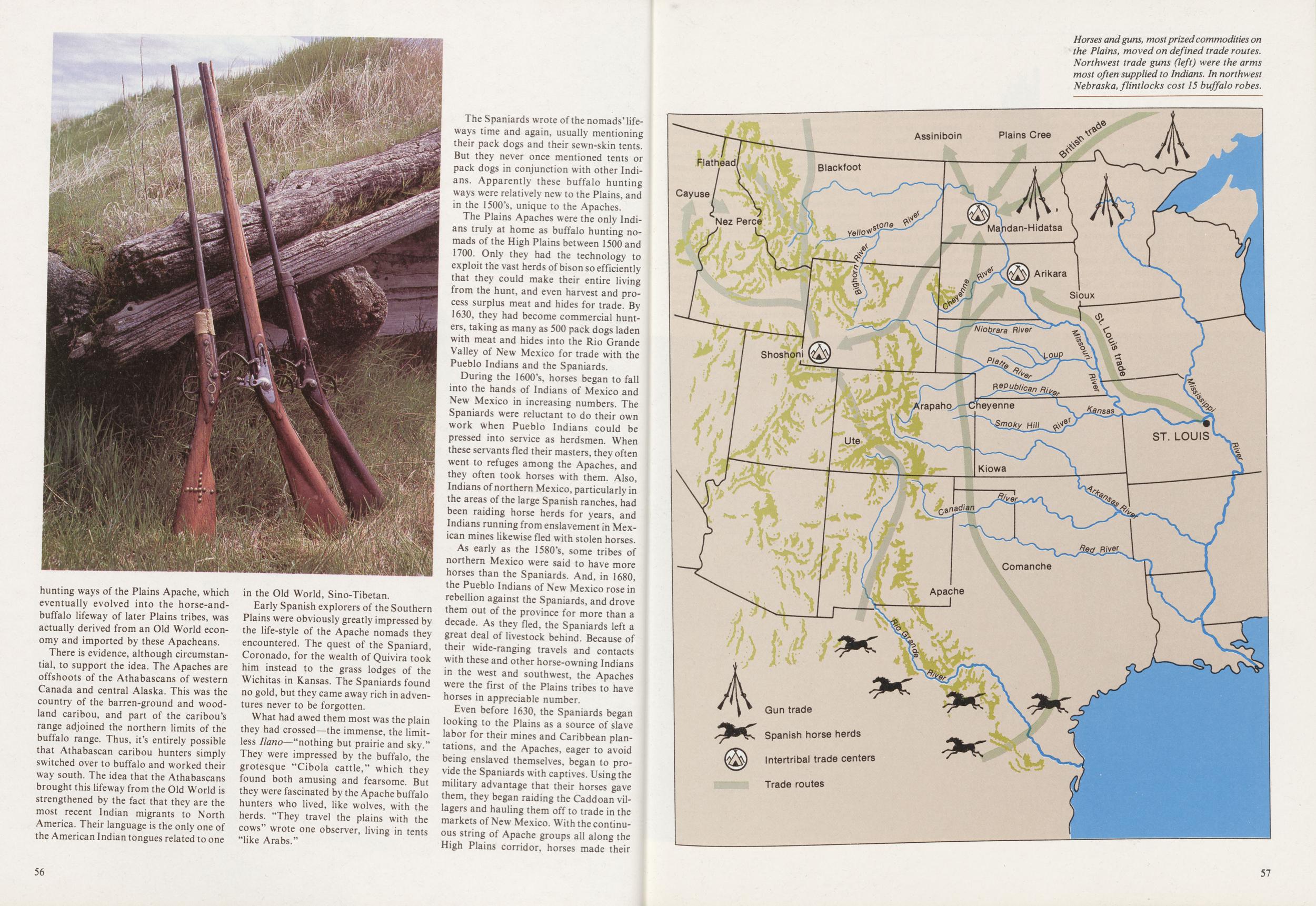
Horses and guns, most prized commodities on the Plains, moved on defined trade routes. Northwest trade guns (left) were the arms most often supplied to Indians. In northwest Nebraska, flintlocks cost 15 buffalo robes. hunting ways of the Plains Apache, which eventually evolved into the horse-and-buffalo lifeway of later Plains tribes, was actually derived from an Old World economy and imported by these Apacheans.
There is evidence, although circumstantial, to support the idea. The Apaches are offshoots of the Athabascans of western Canada and central Alaska. This was the country of the barren-ground and woodland caribou, and part of the caribou's range adjoined the northern limits of the buffalo range. Thus, it's entirely possible that Athabascan caribou hunters simply switched over to buffalo and worked their way south. The idea that the Athabascans brought this lifeway from the Old World is strengthened by the fact that they are the most recent Indian migrants to North America. Their language is the only one of the American Indian tongues related to one in the Old World, Sino-Tibetan.
Early Spanish explorers of the Southern Plains were obviously greatly impressed by the life-style of the Apache nomads they encountered. The quest of the Spaniard, Coronado, for the wealth of Quivira took him instead to the grass lodges of the Wichitas in Kansas. The Spaniards found no gold, but they came away rich in adventures never to be forgotten.
What had awed them most was the plain they had crossed—the immense, the limitless llano—"nothing but prairie and sky." They were impressed by the buffalo, the grotesque "Cibola cattle," which they found both amusing and fearsome. But they were fascinated by the Apache buffalo hunters who lived, like wolves, with the herds. "They travel the plains with the cows" wrote one observer, living in tents "like Arabs."
The Spaniards wrote of the nomads'life-ways time and again, usually mentioning their pack dogs and their sewn-skin tents. But they never once mentioned tents or pack dogs in conjunction with other Indians. Apparently these buffalo hunting ways were relatively new to the Plains, and in the 1500's, unique to the Apaches.
The Plains Apaches were the only Indians truly at home as buffalo hunting nomads of the High Plains between 1500 and 1700. Only they had the technology to exploit the vast herds of bison so efficiently that they could make their entire living from the hunt, and even harvest and process surplus meat and hides for trade. By 1630, they had become commercial hunters, taking as many as 500 pack dogs laden with meat and hides into the Rio Grande Valley of New Mexico for trade with the Pueblo Indians and the Spaniards.
During the 1600's, horses began to fall into the hands of Indians of Mexico and New Mexico in increasing numbers. The Spaniards were reluctant to do their own work when Pueblo Indians could be pressed into service as herdsmen. When these servants fled their masters, they often went to refuges among the Apaches, and they often took horses with them. Also, Indians of northern Mexico, particularly in the areas of the large Spanish ranches, had been raiding horse herds for years, and Indians running from enslavement in Mexican mines likewise fled with stolen horses.
As early as the 1580's, some tribes of northern Mexico were said to have more horses than the Spaniards. And, in 1680, the Pueblo Indians of New Mexico rose in rebellion against the Spaniards, and drove them out of the province for more than a decade. As they fled, the Spaniards left a great deal of livestock behind. Because of their wide-ranging travels and contacts with these and other horse-owning Indians in the west and southwest, the Apaches were the first of the Plains tribes to have horses in appreciable number.
Even before 1630, the Spaniards began looking to the Plains as a source of slave labor for their mines and Caribbean plantations, and the Apaches, eager to avoid being enslaved themselves, began to provide the Spaniards with captives. Using the military advantage that their horses gave them, they began raiding the Caddoan villagers and hauling them off to trade in the markets of New Mexico. With the continuous string of Apache groups all along the High Plains corridor, horses made their
56Horses and guns, most prized commodities on the Plains, moved on defined trade routes. Northwest trade guns (left) were the arms Most often supplied to Indians. In northwest Nebraska, flintlocks cost 15 buffalo robes.
57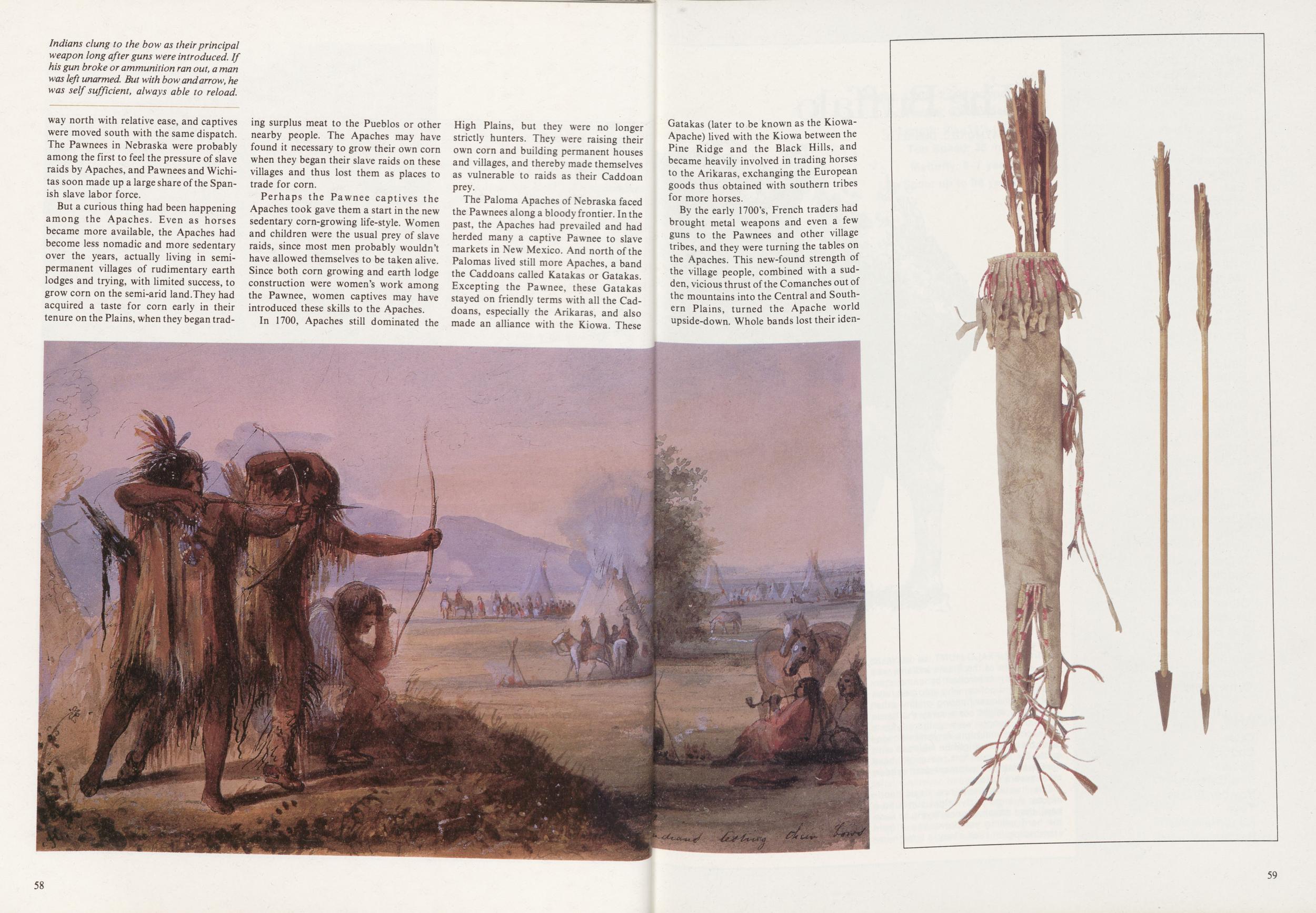
Indians clung to the bow as their principal weapon long after guns were introduced. If his gun broke or ammunition ran out, a man was left unarmed. But with bow and arrow, he was self sufficient, always able to reload.
way north with relative ease, and captives were moved south with the same dispatch. The Pawnees in Nebraska were probably among the first to feel the pressure of slave raids by Apaches, and Pawnees and Wichitas soon made up a large share of the Spanish slave labor force.
But a curious thing had been happening among the Apaches. Even as horses became more available, the Apaches had become less nomadic and more sedentary over the years, actually living in semi-permanent villages of rudimentary earth lodges and trying, with limited success, to grow corn on the semi-arid land.They had acquired a taste for corn early in their tenure on the Plains, when they began trading surplus meat to the Pueblos or other nearby people. The Apaches may have found it necessary to grow their own corn when they began their slave raids on these villages and thus lost them as places to trade for corn.
Perhaps the Pawnee captives the Apaches took gave them a start in the new sedentary corn-growing life-style. Women and children were the usual prey of slave raids, since most men probably wouldn't have allowed themselves to be taken alive. Since both corn growing and earth lodge construction were women's work among the Pawnee, women captives may have introduced these skills to the Apaches.
In 1700, Apaches still dominated the
High Plains, but they were no longer strictly hunters. They were raising their own corn and building permanent houses and villages, and thereby made themselves as vulnerable to raids as their Caddoan prey.
The Paloma Apaches of Nebraska faced the Pawnees along a bloody frontier. In the past, the Apaches had prevailed and had herded many a captive Pawnee to slave markets in New Mexico. And north of the Palomas lived still more Apaches, a band the Caddoans called Katakas or Gatakas. Excepting the Pawnee, these Gatakas stayed on friendly terms with all the Caddoans, especially the Arikaras, and also made an alliance with the Kiowa. These
58Gatakas (later to be known as the Kiowa-Apache) lived with the Kiowa between the Pine Ridge and the Black Hills, and became heavily involved in trading horses to the Arikaras, exchanging the European goods thus obtained with southern tribes for more horses.
By the early 1700's, French traders had brought metal weapons and even a few guns to the Pawnees and other village tribes, and they were turning the tables on the Apaches. This new-found strength of the village people, combined with a sudden, vicious thrust of the Comanches out of the mountains into the Central and Southern Plains, turned the Apache world upside-down. Whole bands lost their iden-
59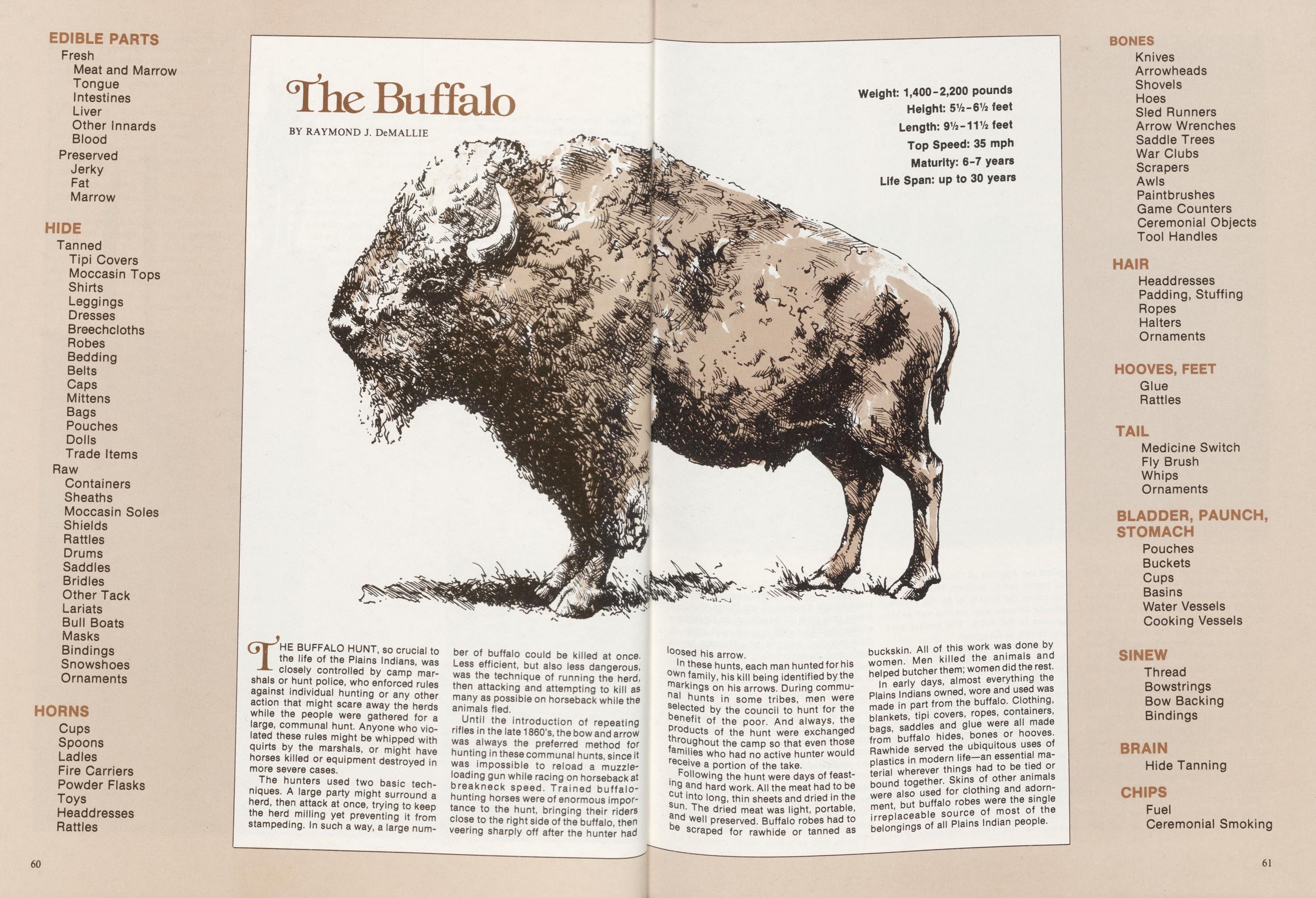 EDIBLE PARTS
Fresh
Meat and Marrow
Tongue
Intestines
Liver
Other Innards
Blood
Preserved
Jerky
Fat
Marrow
HIDE
Tanned
Tipi Covers
Moccasin Tops
Shirts
Leggings
Dresses
Breechcloths
Robes
Bedding
Belts
Caps
Mittens
Bags
Pouches
Dolls
Trade Items
Raw
Containers
Sheaths
Moccasin Soles
Shields
Rattles
Drums
Saddles
Bridles
Other Tack
Lariats
Bull Boats
Masks
Bindings
Snowshoes
Ornaments
HORNS
Cups
Spoons
Ladles
Fire Carriers
Powder Flasks
Toys
Headdresses
Rattles
The Buffalo
BY RAYMOND J. DeMALLIE
Weight: 1,400-2,200 pounds
Height: 5V2-6V2 feet
Length: 9V2-HV2 feet
Top Speed: 35 mph
Maturity: 6-7 years
Life Span: up to 30 years
EDIBLE PARTS
Fresh
Meat and Marrow
Tongue
Intestines
Liver
Other Innards
Blood
Preserved
Jerky
Fat
Marrow
HIDE
Tanned
Tipi Covers
Moccasin Tops
Shirts
Leggings
Dresses
Breechcloths
Robes
Bedding
Belts
Caps
Mittens
Bags
Pouches
Dolls
Trade Items
Raw
Containers
Sheaths
Moccasin Soles
Shields
Rattles
Drums
Saddles
Bridles
Other Tack
Lariats
Bull Boats
Masks
Bindings
Snowshoes
Ornaments
HORNS
Cups
Spoons
Ladles
Fire Carriers
Powder Flasks
Toys
Headdresses
Rattles
The Buffalo
BY RAYMOND J. DeMALLIE
Weight: 1,400-2,200 pounds
Height: 5V2-6V2 feet
Length: 9V2-HV2 feet
Top Speed: 35 mph
Maturity: 6-7 years
Life Span: up to 30 years
THE BUFFALO HUNT, so crucial to the life of the Plains Indians, was closely controlled by camp marshals or hunt police, who enforced rules against individual hunting or any other action that might scare away the herds while the people were gathered for a large, communal hunt. Anyone who violated these rules might be whipped with quirts by the marshals, or might have horses killed or equipment destroyed in more severe cases.
The hunters used two basic techniques. A large party might surround a herd, then attack at once, trying to keep the herd milling yet preventing it from stampeding. In such a way, a large number of buffalo could be killed at once. Less efficient, but also less dangerous, was the technique of running the herd, then attacking and attempting to kill as many as possible on horseback while the animals fled.
Until the introduction of repeating rifles in the late 1860's, the bow and arrow was always the preferred method for hunting in these communal hunts, since it was impossible to reload a muzzle-loading gun while racing on horseback at breakneck speed. Trained buffalo-hunting horses were of enormous importance to the hunt, bringing their riders close to the right side of the buffalo, then veering sharply off after the hunter had
60loosened his arrow.
In these hunts, each man hunted for his family, his kill being identified by the markings on his arrows. During communal hunts in some tribes, men were fleeted by the council to hunt for the benefit of the poor. And always, the Products of the hunt were exchanged inroughout the camp so that even those families who had no active hunter would receive a portion of the take.
Following the hunt were days of feasting and hard work. All the meat had to be Cut into long, thin sheets and dried in the Sun. The dried meat was light, portable, and well preserved. Buffalo robes had to De scraped for rawhide or tanned as buckskin. All of this work was done by women Men killed the animals and Sped butcher them; women did the rest.
In early days, almost everything the Plains Indians owned, wore and used was made in part from the buffalo. Clothing, blankets tipi covers, ropes, containers, bags addles and glue were all made from buffalo hides, bones or hooves Rawhide served the ubiquitous uses of Sties in modern life-an essential material wherever things had to be tied or bound together. Skins of other animals were also used for clothing and adornment, but buffalo robes were the single irreplaceable source of most of the belongings of all Plains Indian people.
BONES Knives Arrowheads Shovels Hoes Sled Runners Arrow Wrenches Saddle Trees War Clubs Scrapers Awls Paintbrushes Game Counters Ceremonial Objects Tool Handles HAIR Headdresses Padding, Stuffing Ropes Halters Ornaments HOOVES, FEET Glue Rattles TAIL Medicine Switch Fly Brush Whips Ornaments BLADDER, PAUNCH, STOMACH Pouches Buckets Cups Basins Water Vessels Cooking Vessels SINEW Thread Bowstrings Bow Backing Bindings BRAIN Hide Tanning CHIPS Fuel Ceremonial Smoking 61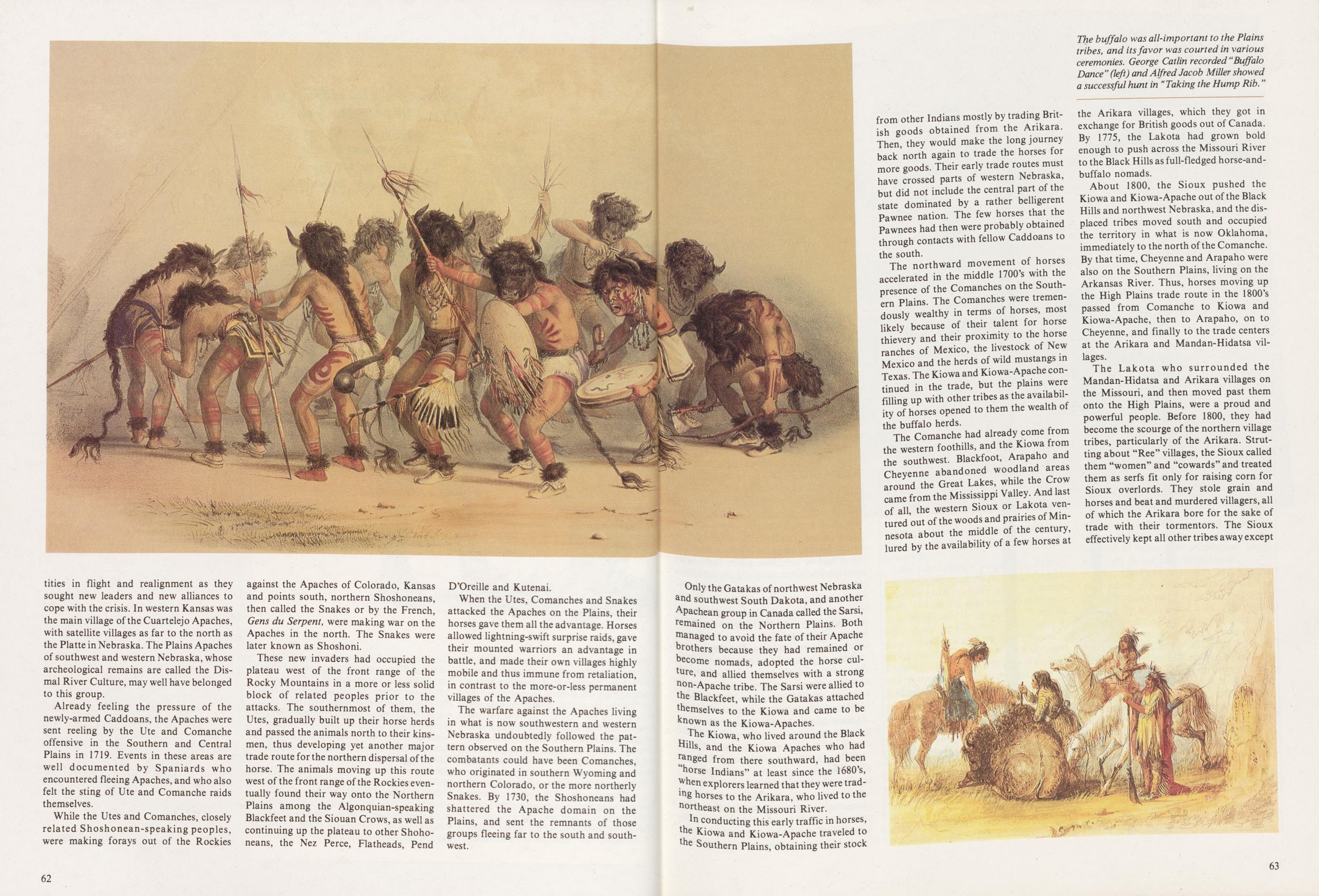
tities in flight and realignment as they sought new leaders and new alliances to cope with the crisis. In western Kansas was the main village of the Cuartelejo Apaches, with satellite villages as far to the north as the Platte in Nebraska. The Plains Apaches of southwest and western Nebraska, whose archeological remains are called the Dismal River Culture, may well have belonged to this group.
Already feeling the pressure of the newly-armed Caddoans, the Apaches were sent reeling by the Ute and Comanche offensive in the Southern and Central Plains in 1719. Events in these areas are well documented by Spaniards who encountered fleeing Apaches, and who also felt the sting of Ute and Comanche raids themselves.
While the Utes and Comanches, closely related Shoshonean-speaking peoples, were making forays out of the Rockies against the Apaches of Colorado, Kansas and points south, northern Shoshoneans, then called the Snakes or by the French, Gens du Serpent, were making war on the Apaches in the north. The Snakes were later known as Shoshoni.
These new invaders had occupied the plateau west of the front range of the Rocky Mountains in a more or less solid block of related peoples prior to the attacks. The southernmost of them, the Utes, gradually built up their horse herds and passed the animals north to their kinsmen, thus developing yet another major trade route for the northern dispersal of the horse. The animals moving up this route west of the front range of the Rockies eventually found their way onto the Northern Plains among the Algonquian-speaking Blackfeet and the Siouan Crows, as well as continuing up the plateau to other Shohoneans, the Nez Perce, Flatheads, Pend D'Oreille and Kutenai.
When the Utes, Comanches and Snakes attacked the Apaches on the Plains, their horses gave them all the advantage. Horses allowed lightning-swift surprise raids, gave their mounted warriors an advantage in battle, and made their own villages highly mobile and thus immune from retaliation, in contrast to the more-or-less permanent villages of the Apaches.
The warfare against the Apaches living in what is now southwestern and western Nebraska undoubtedly followed the pattern observed on the Southern Plains. The combatants could have been Comanches, who originated in southern Wyoming and northern Colorado, or the more northerly Snakes. By 1730, the Shoshoneans had shattered the Apache domain on the Plains, and sent the remnants of those groups fleeing far to the south and southwest.
62Only the Gatakas of northwest Nebraska and southwest South Dakota, and another Apachean group in Canada called the Sarsi, remained on the Northern Plains. Both Managed to avoid the fate of their Apache brothers because they had remained or become nomads, adopted the horse culture, and allied themselves with a strong non-Apache tribe. The Sarsi were allied to lhe Blackfeet, while the Gatakas attached themselves to the Kiowa and came to be known as the Kiowa-Apaches.
The Kiowa, who lived around the Black Hills, and the Kiowa Apaches who had ranged from there southward, had been "horse Indians" at least since the 1680's, when explorers learned that they were trading horses to the Arikara, who lived to the northeast on the Missouri River.
In conducting this early traffic in horses, lhe Kiowa and Kiowa-Apache traveled to the Southern Plains, obtaining their stock
The buffalo was all-important to the Plains tribes, and its favor was courted in various ceremonies. George Catlin recorded "Buffalo Dance" (left) and Alfred Jacob Miller showed a successful hunt in "Taking the Hump Rib."
from other Indians mostly by trading British goods obtained from the Arikara. Then they would make the long journey back 'north again to trade the horses for more goods. Their early trade routes must have crossed parts of western Nebraska, but did not include the central part of the state dominated by a rather belligerent Pawnee nation. The few horses that the Pawnees had then were probably obtained through contacts with fellow Caddoans to the south.
The northward movement of horses accelerated in the middle 1700's with the presence of the Comanches on the Southern Plains. The Comanches were tremendously wealthy in terms of horses, most likely because of their talent for horse thievery and their proximity to the horse ranches of Mexico, the livestock of New Mexico and the herds of wild mustangs in Texas The Kiowa and Kiowa-Apache continued in the trade, but the plains were filling up with other tribes as the availability of horses opened to them the wealth of the buffalo herds.
The Comanche had already come from the western foothills, and the Kiowa from the southwest. Blackfoot, Arapaho and Cheyenne abandoned woodland areas around the Great Lakes, while the Crow came from the Mississippi Valley. And last of all, the western Sioux or Lakota ventured out of the woods and prairies of Minnesota about the middle of the century lured by the availability of a few horses at the Arikara villages, which they got in exchange for British goods out of Canada. By 1775, the Lakota had grown bold enough to push across the Missouri River to the Black Hills as full-fledged horse-and-buffalo nomads.
About 1800, the Sioux pushed the Kiowa and Kiowa-Apache out of the Black Hills and northwest Nebraska, and the displaced tribes moved south and occupied the territory in what is now Oklahoma, immediately to the north of the Comanche. By that time, Cheyenne and Arapaho were also on the Southern Plains, living on the Arkansas River. Thus, horses moving up the High Plains trade route in the 1800's passed from Comanche to Kiowa and Kiowa-Apache, then to Arapaho, on to Cheyenne, and finally to the trade centers at the Arikara and Mandan-Hidatsa villages.
The Lakota who surrounded the Mandan-Hidatsa and Arikara villages on the Missouri, and then moved past them onto the High Plains, were a proud and powerful people. Before 1800, they had become the scourge of the northern village tribes, particularly of the Arikara. Strutting about "Ree" villages, the Sioux called them "women" and "cowards" and treated them as serfs fit only for raising corn for Sioux overlords. They stole grain and horses and beat and murdered villagers, all of which the Arikara bore for the sake of trade with their tormentors. The Sioux effectively kept all other tribes away except
63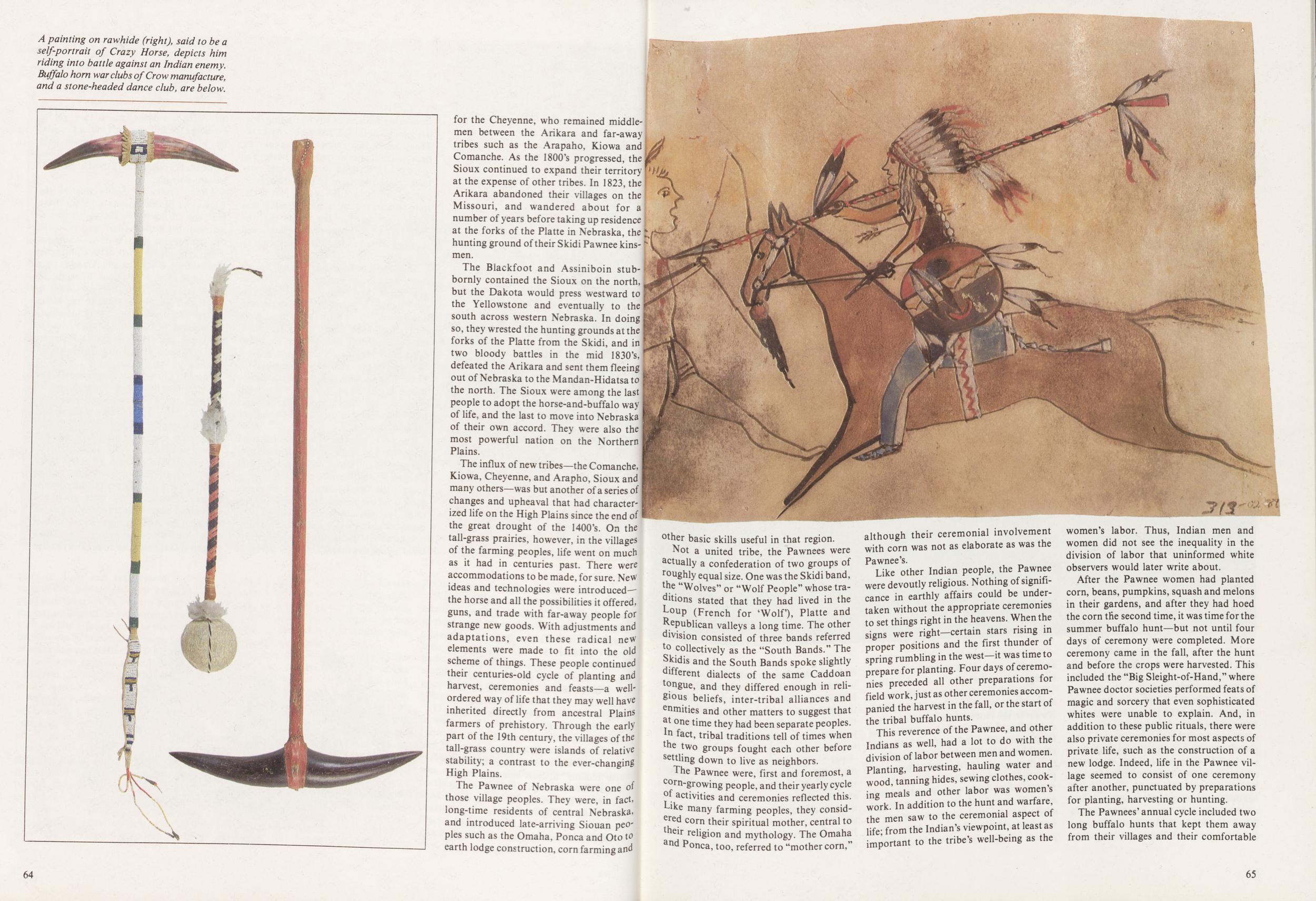
for the Cheyenne, who remained middlemen between the Arikara and far-away tribes such as the Arapaho, Kiowa and Comanche. As the 1800's progressed, the Sioux continued to expand their territory at the expense of other tribes. In 1823, the Arikara abandoned their villages on the Missouri, and wandered about for a number of years before taking up residence at the forks of the Platte in Nebraska, the hunting ground of their Skidi Pawnee kinsmen.
The Blackfoot and Assiniboin stubbornly contained the Sioux on the north, but the Dakota would press westward to the Yellowstone and eventually to the south across western Nebraska. In doing so, they wrested the hunting grounds at the forks of the Platte from the Skidi, and in two bloody battles in the mid 1830's, defeated the Arikara and sent them fleeing out of Nebraska to the Mandan-Hidatsa to the north. The Sioux were among the last people to adopt the horse-and-buffalo way of life, and the last to move into Nebraska of their own accord. They were also the most powerful nation on the Northern Plains.
The influx of new tribes—the Comanche, Kiowa, Cheyenne, and Arapho, Sioux and many others—was but another of a series of changes and upheaval that had characterized life on the High Plains since the end of the great drought of the 1400's. On the tall-grass prairies, however, in the villages of the farming peoples, life went on much as it had in centuries past. There were accommodations to be made, for sure. New ideas and technologies were introduced-the horse and all the possibilities it offered, guns, and trade with far-away people for strange new goods. With adjustments and adaptations, even these radical new elements were made to fit into the old scheme of things. These people continued their centuries-old cycle of planting and harvest, ceremonies and feasts—a well' ordered way of life that they may well have inherited directly from ancestral Plains farmers of prehistory. Through the early part of the 19th century, the villages of the tall-grass country were islands of relative stability; a contrast to the ever-changing High Plains.
The Pawnee of Nebraska were one of those village peoples. They were, in fact, long-time residents of central Nebraska, and introduced late-arriving Siouan peoples such as the Omaha, Ponca and Oto to earth lodge construction, corn farming and
64other basic skills useful in that region.
Not a united tribe, the Pawnees were actually a confederation of two groups of roughly equal size. One was the Skidi band, the "Wolves" or "Wolf People" whose traditions stated that they had lived in the Loup (French for 'Wolf), Platte and Republican valleys a long time. The other division consisted of three bands referred to collectively as the "South Bands." The Skidis and the South Bands spoke slightly different dialects of the same Caddoan tongue, and they differed enough in religious beliefs, inter-tribal alliances and enmities and other matters to suggest that at one time they had been separate peoples. In fact, tribal traditions tell of times when the two groups fought each other before settling down to live as neighbors.
The Pawnee were, first and foremost, a corn-growing people, and their yearly cycle of activities and ceremonies reflected this. Like many farming peoples, they considered corn their spiritual mother, central to their religion and mythology. The Omaha and Ponca, too, referred to "mother corn," although their ceremonial involvement with corn was not as elaborate as was the Pawnee's.
Like other Indian people, the Pawnee were devoutly religious. Nothing of significance in earthly affairs could be undertaken without the appropriate ceremonies to set things right in the heavens. When the signs were right—certain stars rising in proper positions and the first thunder of spring rumbling in the west—it was time to prepare for planting. Four days of ceremonies preceded all other preparations for field work, just as other ceremonies accompanied the harvest in the fall, or the start of the tribal buffalo hunts.
This reverence of the Pawnee, and other Indians as well, had a lot to do with the division of labor between men and women. Planting, harvesting, hauling water and wood, tanning hides, sewing clothes, cooking meals and other labor was women's work. In addition to the hunt and warfare, the men saw to the ceremonial aspect of life- from the Indian's viewpoint, at least as important to the tribe's well-being as the women's labor. Thus, Indian men and women did not see the inequality in the division of labor that uninformed white observers would later write about.
After the Pawnee women had planted corn, beans, pumpkins, squash and melons in their gardens, and after they had hoed the corn the second time, it was time for the summer buffalo hunt—but not until four days of ceremony were completed. More ceremony came in the fall, after the hunt and before the crops were harvested. This included the "Big Sleight-of-Hand," where Pawnee doctor societies performed feats of magic and sorcery that even sophisticated whites were unable to explain. And, in addition to these public rituals, there were also private ceremonies for most aspects of private life, such as the construction of a new lodge. Indeed, life in the Pawnee village seemed to consist of one ceremony after another, punctuated by preparations for planting, harvesting or hunting.
The Pawnees' annual cycle included two long buffalo hunts that kept them away from their villages and their comfortable
65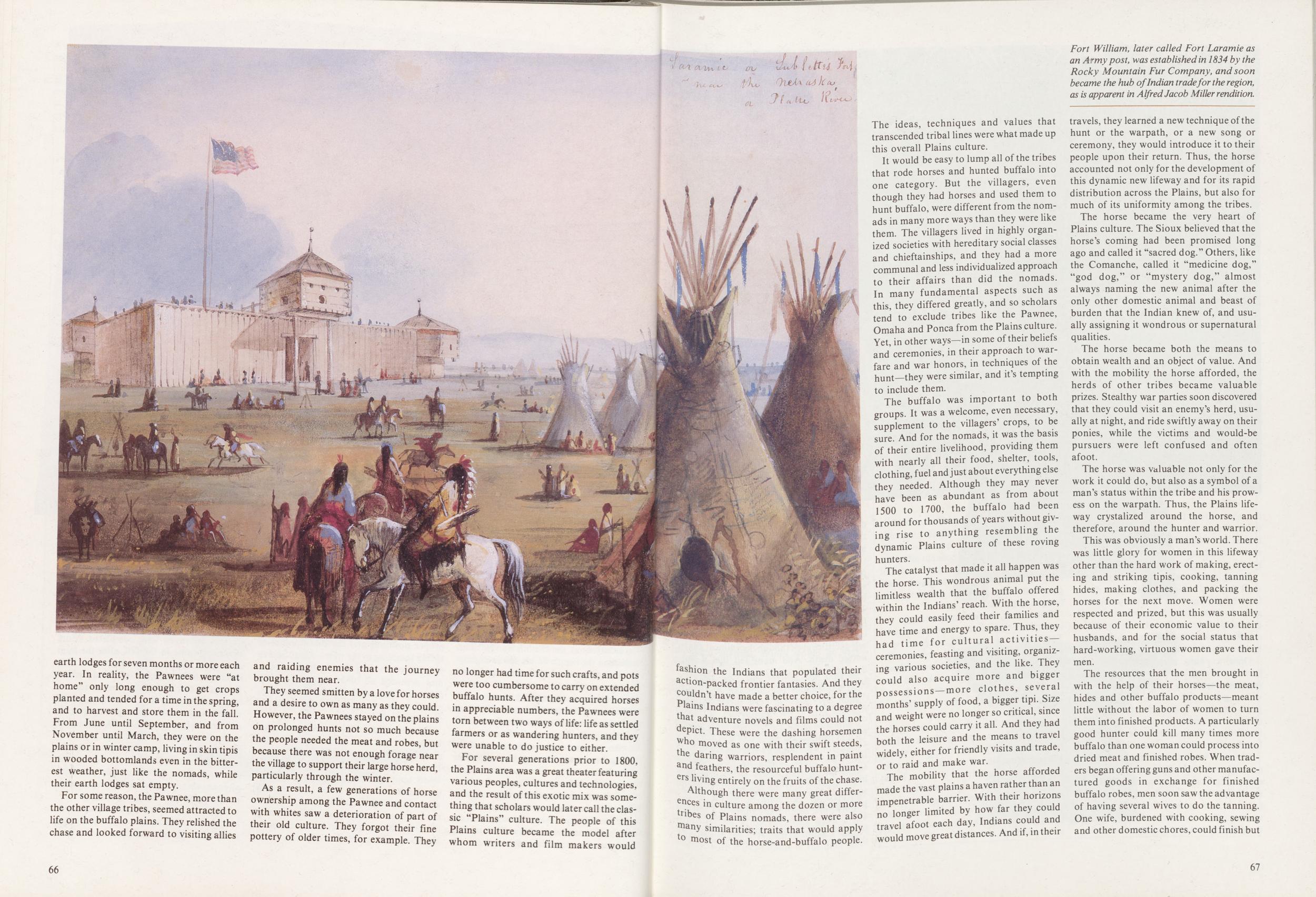
earth lodges for seven months or more each year. In reality, the Pawnees were "at home" only long enough to get crops planted and tended for a time in the spring, and to harvest and store them in the fall.' From June until September, and from November until March, they were on the plains or in winter camp, living in skin tipis in wooded bottomlands even in the bitterest weather, just like the nomads, while their earth lodges sat empty.
For some reason, the Pawnee, more than the other village tribes, seemed attracted to life on the buffalo plains. They relished the chase and looked forward to visiting allies and raiding enemies that the journey brought them near.
They seemed smitten by a love for horses and a desire to own as many as they could. However, the Pawnees stayed on the plains on prolonged hunts not so much because the people needed the meat and robes, but because there was not enough forage near the village to support their large horse herd, particularly through the winter.
As a result, a few generations of horse ownership among the Pawnee and contact with whites saw a deterioration of part of their old culture. They forgot their fine pottery of older times, for example. They no longer had time for such crafts, and pots were too cumbersome to carry on extended buffalo hunts. After they acquired horses in appreciable numbers, the Pawnees were torn between two ways of life: life as settled farmers or as wandering hunters, and they were unable to do justice to either.
For several generations prior to 1800, the Plains area was a great theater featuring various peoples, cultures and technologies, and the result of this exotic mix was something that scholars would later call the classic "Plains" culture. The people of this Plains culture became the model after whom writers and film makers would
66fashion the Indians that populated their action-packed frontier fantasies. And they couldn't have made a better choice, for the Plains Indians were fascinating to a degree that adventure novels and films could not depict. These were the dashing horsemen who moved as one with their swift steeds, the daring warriors, resplendent in paint and feathers, the resourceful buffalo hunters living entirely on the fruits of the chase.
Although there were many great differences in culture among the dozen or more tribes of Plains nomads, there were also many similarities; traits that would apply to most of the horse-and-buffalo people. The ideas, techniques and values that transcended tribal lines were what made up this overall Plains culture.
It would be easy to lump all of the tribes that rode horses and hunted buffalo into one category. But the villagers, even though they had horses and used them to hunt buffalo, were different from the nomads in many more ways than they were like them. The villagers lived in highly organized societies with hereditary social classes and chieftainships, and they had a more communal and less individualized approach to their affairs than did the nomads. In many fundamental aspects such as this, they differed greatly, and so scholars tend to exclude tribes like the Pawnee, Omaha and Ponca from the Plains culture. Yet, in other ways—in some of their beliefs and ceremonies, in their approach to warfare and war honors, in techniques of the hunt—they were similar, and it's tempting to include them.
The buffalo was important to both groups. It was a welcome, even necessary, supplement to the villagers' crops, to be sure. And for the nomads, it was the basis of their entire livelihood, providing them with nearly all their food, shelter, tools, clothing, fuel and just about everything else they needed. Although they may never have been as abundant as from about 1500 to 1700, the buffalo had been around for thousands of years without giving rise to anything resembling the dynamic Plains culture of these roving hunters.
The catalyst that made it all happen was the horse. This wondrous animal put the limitless wealth that the buffalo offered within the Indians' reach. With the horse, they could easily feed their families and have time and energy to spare. Thus, they had time for cultural activities — ceremonies, feasting and visiting, organizing various societies, and the like. They could also acquire more and bigger possessions—more clothes, several months' supply of food, a bigger tipi. Size and weight were no longer so critical, since the horses could carry it all. And they had both the leisure and the means to travel widely, either for friendly visits and trade, or to raid and make war.
The mobility that the horse afforded made the vast plains a haven rather than an impenetrable barrier. With their horizons no longer limited by how far they could travel afoot each day, Indians could and would move great distances. And if, in their
Fort William, later called Fort Laramie as an Army post, was established in 1834 by the Rocky Mountain Fur Company, and soon became the hub of Indian trade for the region, as is apparent in Alfred Jacob Miller rendition.
travels, they learned a new technique of the hunt or the warpath, or a new song or ceremony, they would introduce it to their people upon their return. Thus, the horse accounted not only for the development of this dynamic new lifeway and for its rapid distribution across the Plains, but also for much of its uniformity among the tribes.
The horse became the very heart of Plains culture. The Sioux believed that the horse's coming had been promised long ago and called it "sacred dog." Others, like the Comanche, called it "medicine dog," "god dog," or "mystery dog," almost always naming the new animal after the only other domestic animal and beast of burden that the Indian knew of, and usually assigning it wondrous or supernatural qualities.
The horse became both the means to obtain wealth and an object of value. And with the mobility the horse afforded, the herds of other tribes became valuable prizes. Stealthy war parties soon discovered that they could visit an enemy's herd, usually at night, and ride swiftly away on their ponies, while the victims and would-be pursuers were left confused and often afoot.
The horse was valuable not only for the work it could do, but also as a symbol of a man's status within the tribe and his prowess on the warpath. Thus, the Plains lifeway crystalized around the horse, and therefore, around the hunter and warrior.
This was obviously a man's world. There was little glory for women in this lifeway other than the hard work of making, erecting and striking tipis, cooking, tanning hides, making clothes, and packing the horses for the next move. Women were respected and prized, but this was usually because of their economic value to their husbands, and for the social status that hard-working, virtuous women gave their men.
The resources that the men brought in with the help of their horses—the meat, hides and other buffalo products—meant little without the labor of women to turn them into finished products. A particularly good hunter could kill many times more buffalo than one woman could process into dried meat and finished robes. When traders began offering guns and other manufactured goods in exchange for finished buffalo robes, men soon saw the advantage of having several wives to do the tanning. One wife, burdened with cooking, sewing and other domestic chores, could finish but
67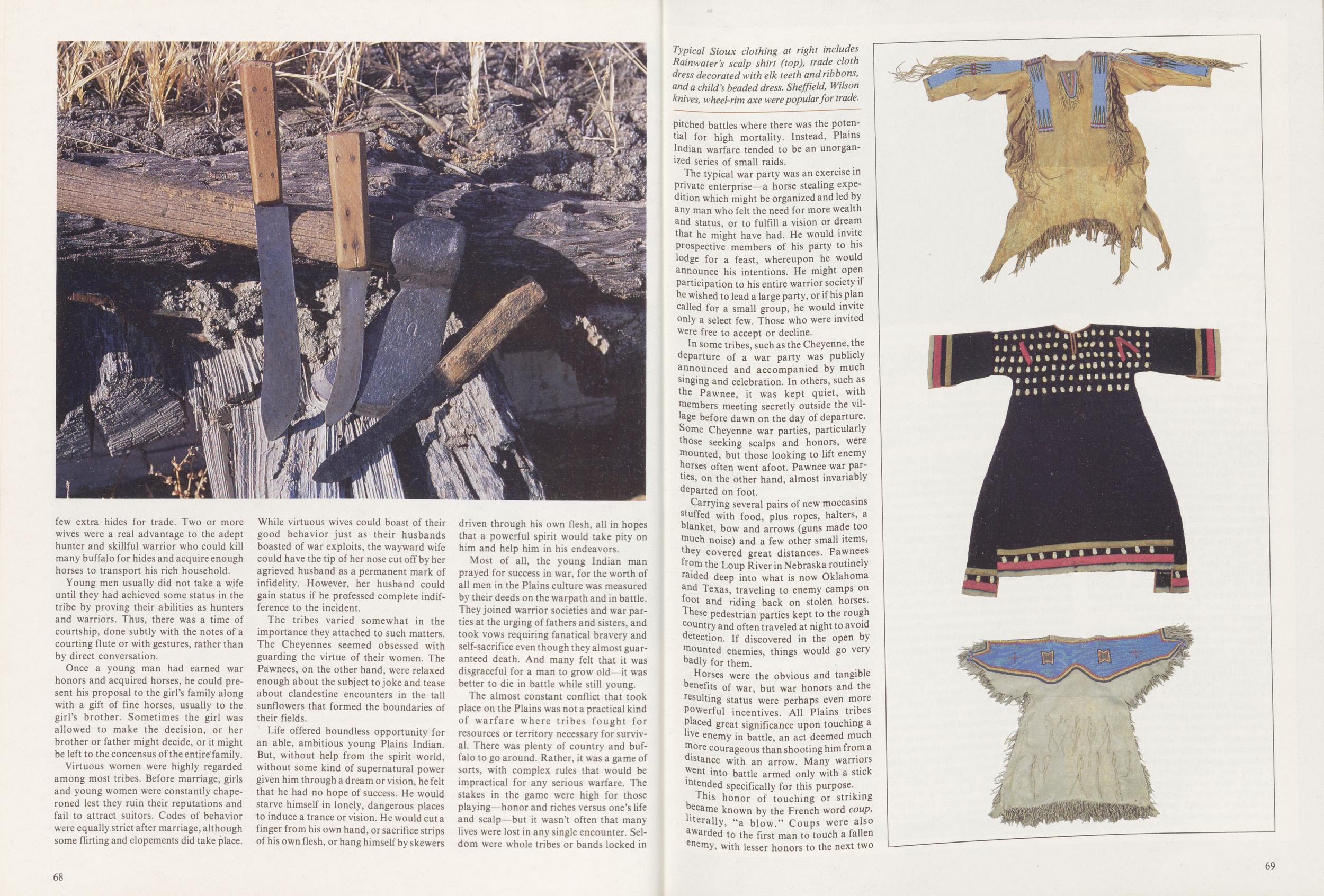
few extra hides for trade. Two or more wives were a real advantage to the adept hunter and skillful warrior who could kill many buffalo for hides and acquire enough horses to transport his rich household.
Young men usually did not take a wife until they had achieved some status in the tribe by proving their abilities as hunters and warriors. Thus, there was a time of courtship, done subtly with the notes of a courting flute or with gestures, rather than by direct conversation.
Once a young man had earned war honors and acquired horses, he could present his proposal to the girl's family along with a gift of fine horses, usually to the girl's brother. Sometimes the girl was allowed to make the decision, or her brother or father might decide, or it might be left to the concensus of the entirelamily. Virtuous women were highly regarded among most tribes. Before marriage, girls and young women were constantly chaperoned lest they ruin their reputations and fail to attract suitors. Codes of behavior were equally strict after marriage, although some flirting and elopements did take place. While virtuous wives could boast of their good behavior just as their husbands boasted of war exploits, the wayward wife could have the tip of her nose cut off by her agrieved husband as a permanent mark of infidelity. However, her husband could gain status if he professed complete indifference to the incident.
The tribes varied somewhat in the importance they attached to such matters. The Cheyennes seemed obsessed with guarding the virtue of their women. The Pawnees, on the other hand, were relaxed enough about the subject to joke and tease about clandestine encounters in the tall sunflowers that formed the boundaries of their fields.
Life offered boundless opportunity for an able, ambitious young Plains Indian. But, without help from the spirit world, without some kind of supernatural power given him through a dream or vision, he felt that he had no hope of success. He would starve himself in lonely, dangerous places to induce a trance or vision. He would cut a finger from his own hand, or sacrifice strips of his own flesh, or hang himself by skewers driven through his own flesh, all in hopes that a powerful spirit would take pity on him and help him in his endeavors.
Most of all, the young Indian man prayed for success in war, for the worth of all men in the Plains culture was measured by their deeds on the warpath and in battle. They joined warrior societies and war parties at the urging of fathers and sisters, and took vows requiring fanatical bravery and self-sacrifice even though they almost guaranteed death. And many felt that it was disgraceful for a man to grow old—it was better to die in battle while still young.
The almost constant conflict that took place on the Plains was not a practical kind of warfare where tribes fought for resources or territory necessary for survival. There was plenty of country and buffalo to go around. Rather, it was a game of sorts, with complex rules that would be impractical for any serious warfare. The stakes in the game were high for those playing—honor and riches versus one's life and scalp—but it wasn't often that many lives were lost in any single encounter. Seldom were whole tribes or bands locked in
68pitched battles where there was the potential for high mortality. Instead, Plains Indian warfare tended to be an unorganized series of small raids.
The typical war party was an exercise in Private enterprise—a horse stealing expedition which might be organized and led by any man who felt the need for more wealth and status, or to fulfill a vision or dream that he might have had. He would invite Prospective members of his party to his iodge for a feast, whereupon he would announce his intentions. He might open Participation to his entire warrior society if he wished to lead a large party, or if his plan called for a small group, he would invite °nly a select few. Those who were invited were free to accept or decline.
In some tribes, such as the Cheyenne, the departure of a war party was publicly announced and accompanied by much singing and celebration. In others, such as the Pawnee, it was kept quiet, with members meeting secretly outside the village before dawn on the day of departure. Some Cheyenne war parties, particularly those seeking scalps and honors, were mounted, but those looking to lift enemy horses often went afoot. Pawnee war parties, on the other hand, almost invariably departed on foot.
Carrying several pairs of new moccasins stuffed with food, plus ropes, halters, a blanket, bow and arrows (guns made too much noise) and a few other small items, they covered great distances. Pawnees from the Loup River in Nebraska routinely raided deep into what is now Oklahoma and Texas, traveling to enemy camps on foot and riding back on stolen horses. These pedestrian parties kept to the rough country and often traveled at night to avoid detection. If discovered in the open by Counted enemies, things would go very badly for them.
Horses were the obvious and tangible benefits of war, but war honors and the resulting status were perhaps even more Powerful incentives. All Plains tribes Placed great significance upon touching a llve enemy in battle, an act deemed much more courageous than shooting him from a distance with an arrow. Many warriors Went into battle armed only with a stick lntended specifically for this purpose.
This honor of touching or striking became known by the French word coup, literally, "a blow." Coups were also awarded to the first man to touch a fallen enemy, with lesser honors to the next two
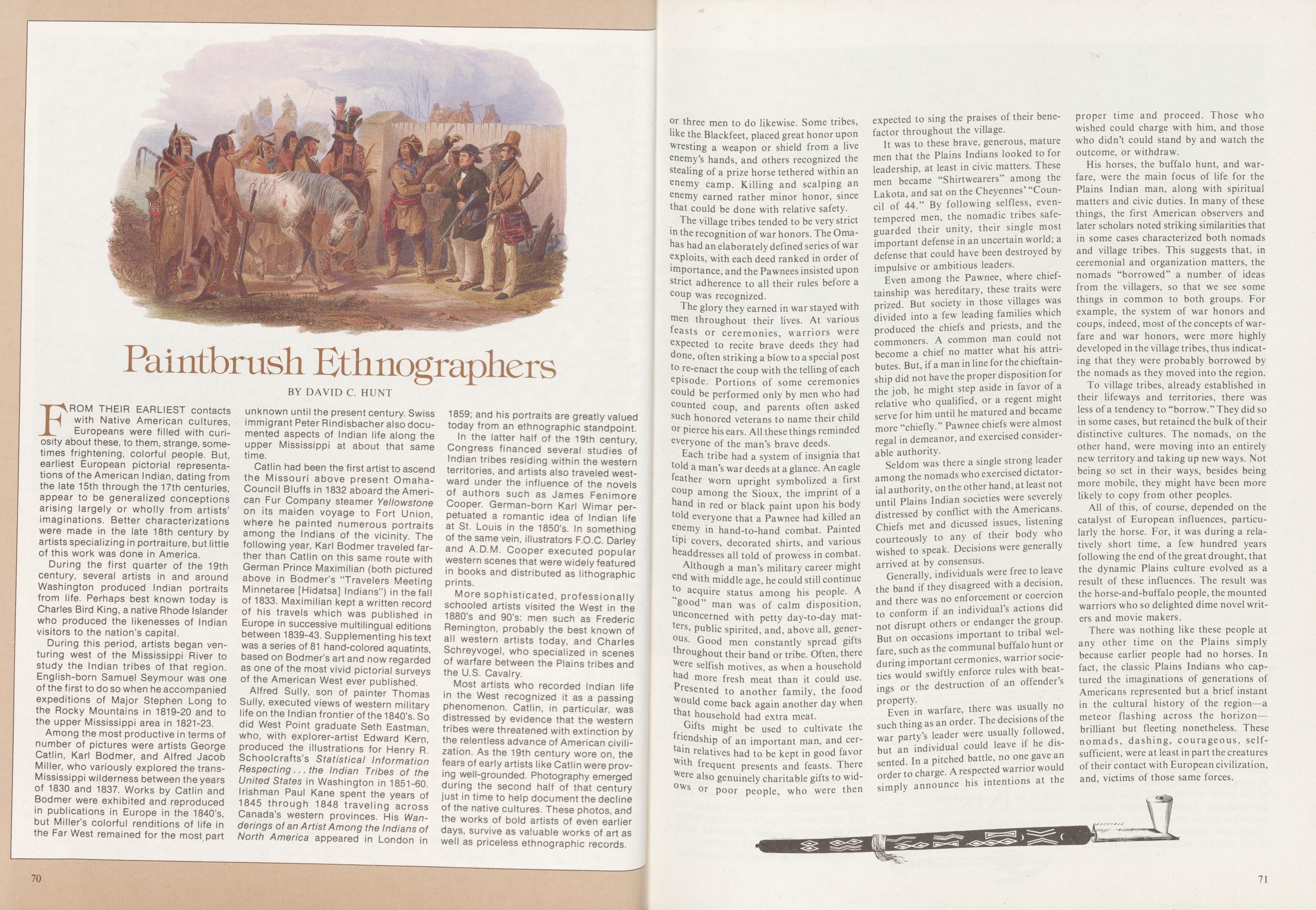
Paintbrush Ethnographers
BY DAVID C. HUNTFROM THEIR EARLIEST contacts with Native American cultures, Europeans were filled with curiosity about these, to them, strange, sometimes frightening, colorful people. But, earliest European pictorial representations of the American Indian, dating from the late 15th through the 17th centuries, appear to be generalized conceptions arising largely or wholly from artists' imaginations. Better characterizations were made in the late 18th century by artists specializing in portraiture, but little of this work was done in America.
During the first quarter of the 19th century, several artists in and around Washington produced Indian portraits from life. Perhaps best known today is Charles Bird King, a native Rhode Islander who produced the likenesses of Indian visitors to the nation's capital.
During this period, artists began venturing west of the Mississippi River to study the Indian tribes of that region. English-born Samuel Seymour was one of the first to do so when he accompanied expeditions of Major Stephen Long to the Rocky Mountains in 1819-20 and to the upper Mississippi area in 1821-23.
Among the most productive in terms of number of pictures were artists George Catlin, Karl Bodmer, and Alfred Jacob Miller, who variously explored the trans-Mississippi wilderness between the years of 1830 and 1837. Works by Catlin and Bodmer were exhibited and reproduced in publications in Europe in the 1840's, but Miller's colorful renditions of life in the Far West remained for the most part unknown until the present century. Swiss immigrant Peter Rindisbacher also documented aspects of Indian life along the upper Mississippi at about that same time.
Catlin had been the first artist to ascend the Missouri above present Omaha-Council Bluffs in 1832 aboard the American Fur Company steamer Yellowstone on its maiden voyage to Fort Union, where he painted numerous portraits among the Indians of the vicinity. The following year, Karl Bodmer traveled farther than Catlin on this same route with German Prince Maximilian (both pictured above in Bodmer's "Travelers Meeting Minnetaree [Hidatsa] Indians") in the fall of 1833. Maximilian kept a written record of his travels which was published in Europe in successive multilingual editions between 1839-43. Supplementing his text was a series of 81 hand-colored aquatints, based on Bodmer's art and now regarded as one of the most vivid pictorial surveys of the American West ever published.
Alfred Sully, son of painter Thomas Sully, executed views of western military life on the Indian frontier of the 1840's. So did West Point graduate Seth Eastman, who, with explorer-artist Edward Kern, produced the illustrations for Henry R. Schoolcrafts's Statistical Information Respecting... the Indian Tribes of the United States in Washington in 1851-60. Irishman Paul Kane spent the years of 1845 through 1848 traveling across Canada's western provinces. His Wanderings of an Artist Among the Indians of North America appeared in London in 1859; and his portraits are greatly valued today from an ethnographic standpoint.
In the latter half of the 19th century, Congress financed several studies of Indian tribes residing within the western territories, and artists also traveled westward under the influence of the novels of authors such as James Fenimore Cooper. German-born Karl Wimar perpetuated a romantic idea of Indian life at St. Louis in the 1850's. In something of the same vein, illustrators F.O.C. Darley and A.D.M. Cooper executed popular western scenes that were widely featured in books and distributed as lithographic prints.
More sophisticated, professionally schooled artists visited the West in the 1880's and 90's: men such as Frederic Remington, probably the best known of all western artists today, and Charles Schreyvogel, who specialized in scenes of warfare between the Plains tribes and the U.S. Cavalry.
Most artists who recorded Indian life in the West recognized it as a passing phenomenon. Catlin, in particular, was distressed by evidence that the western tribes were threatened with extinction by the relentless advance of American civilization. As the 19th century wore on, the fears of early artists like Catlin were proving well-grounded. Photography emerged during the second half of that century just in time to help document the decline of the native cultures. These photos, and the works of bold artists of even earlier days, survive as valuable works of art as well as priceless ethnographic records.
70or three men to do likewise. Some tribes, like the Blackfeet, placed great honor upon wresting a weapon or shield from a live enemy's hands, and others recognized the stealing of a prize horse tethered within an enemy camp. Killing and scalping an enemy earned rather minor honor, since that could be done with relative safety.
The village tribes tended to be very strict in the recognition of war honors. The Omahas had an elaborately defined series of war exploits, with each deed ranked in order of importance, and the Pawnees insisted upon strict adherence to all their rules before a coup was recognized.
The glory they earned in war stayed with men throughout their lives. At various leasts or ceremonies, warriors were expected to recite brave deeds they had done, often striking a blow to a special post to re-enact the coup with the telling of each episode. Portions of some ceremonies could be performed only by men who had counted coup, and parents often asked such honored veterans to name their child or pierce his ears. All these things reminded everyone of the man's brave deeds.
Each tribe had a system of insignia that told a man's war deeds at a glance. An eagle feather worn upright symbolized a first coup among the Sioux, the imprint of a hand in red or black paint upon his body told everyone that a Pawnee had killed an enemy in hand-to-hand combat. Painted tipi covers, decorated shirts, and various headdresses all told of prowess in combat.
Although a man's military career might end with middle age, he could still continue to acquire status among his people. A good" man was of calm disposition, unconcerned with petty day-to-day matters, public spirited, and, above all, generous. Good men constantly spread gifts throughout their band or tribe. Often, there Were selfish motives, as when a household had more fresh meat than it could use. Presented to another family, the food would come back again another day when that household had extra meat.
Gifts might be used to cultivate the friendship of an important man, and certain relatives had to be kept in good favor with frequent presents and feasts. There Were also genuinely charitable gifts to widows or poor people, who were then expected to sing the praises of their benefactor throughout the village.
It was to these brave, generous, mature men that the Plains Indians looked to for leadership, at least in civic matters. These men became "Shirtwearers" among the Lakota, and sat on the Cheyennes' "Council of 44." By following selfless, even-tempered men, the nomadic tribes safeguarded their unity, their single most important defense in an uncertain world; a defense that could have been destroyed by impulsive or ambitious leaders.
Even among the Pawnee, where chieftainship was hereditary, these traits were prized. But society in those villages was divided into a few leading families which produced the chiefs and priests, and the commoners. A common man could not become a chief no matter what his attributes. But, if a man in line for the chieftainship did not have the proper disposition for the job, he might step aside in favor of a relative who qualified, or a regent might serve for him until he matured and became more "chiefly." Pawnee chiefs were almost regal in demeanor, and exercised considerable authority.
Seldom was there a single strong leader among the nomads who exercised dictatorial authority, on the other hand, at least not until Plains Indian societies were severely distressed by conflict with the Americans. Chiefs met and dicussed issues, listening courteously to any of their body who wished to speak. Decisions were generally arrived at by consensus.
Generally, individuals were free to leave the band if they disagreed with a decision, and there was no enforcement or coercion to conform if an individual's actions did not disrupt others or endanger the group. But on occasions important to tribal welfare, such as the communal buffalo hunt or during important cermonies, warrior societies would swiftly enforce rules with beatings or the destruction of an offender's property.
Even in warfare, there was usually no such thing as an order. The decisions of the war party's leader were usually followed, but an individual could leave if he dissented. In a pitched battle, no one gave an order to charge. A respected warrior would simply announce his intentions at the proper time and proceed. Those who wished could charge with him, and those who didn't could stand by and watch the outcome, or withdraw.
His horses, the buffalo hunt, and warfare, were the main focus of life for the Plains Indian man, along with spiritual matters and civic duties. In many of these things, the first American observers and later scholars noted striking similarities that in some cases characterized both nomads and village tribes. This suggests that, in ceremonial and organization matters, the nomads "borrowed" a number of ideas from the villagers, so that we see some things in common to both groups. For example, the system of war honors and coups, indeed, most of the concepts of warfare and war honors, were more highly developed in the village tribes, thus indicating that they were probably borrowed by the nomads as they moved into the region.
To village tribes, already established in their lifeways and territories, there was less of a tendency to "borrow." They did so in some cases, but retained the bulk of their distinctive cultures. The nomads, on the other hand, were moving into an entirely new territory and taking up new ways. Not being so set in their ways, besides being more mobile, they might have been more likely to copy from other peoples.
All of this, of course, depended on the catalyst of European influences, particularly the horse. For, it was during a relatively short time, a few hundred years following the end of the great drought, that the dynamic Plains culture evolved as a result of these influences. The result was the horse-and-buffalo people, the mounted warriors who so delighted dime novel writers and movie makers.
There was nothing like these people at any other time on the Plains simply because earlier people had no horses. In fact, the classic Plains Indians who captured the imaginations of generations of Americans represented but a brief instant in the cultural history of the region—a meteor flashing across the horizon—brilliant but fleeting nonetheless. These nomads, dashing, courageous, self-sufficient, were at least in part the creatures of their contact with European civilization, and, victims of those same forces.
71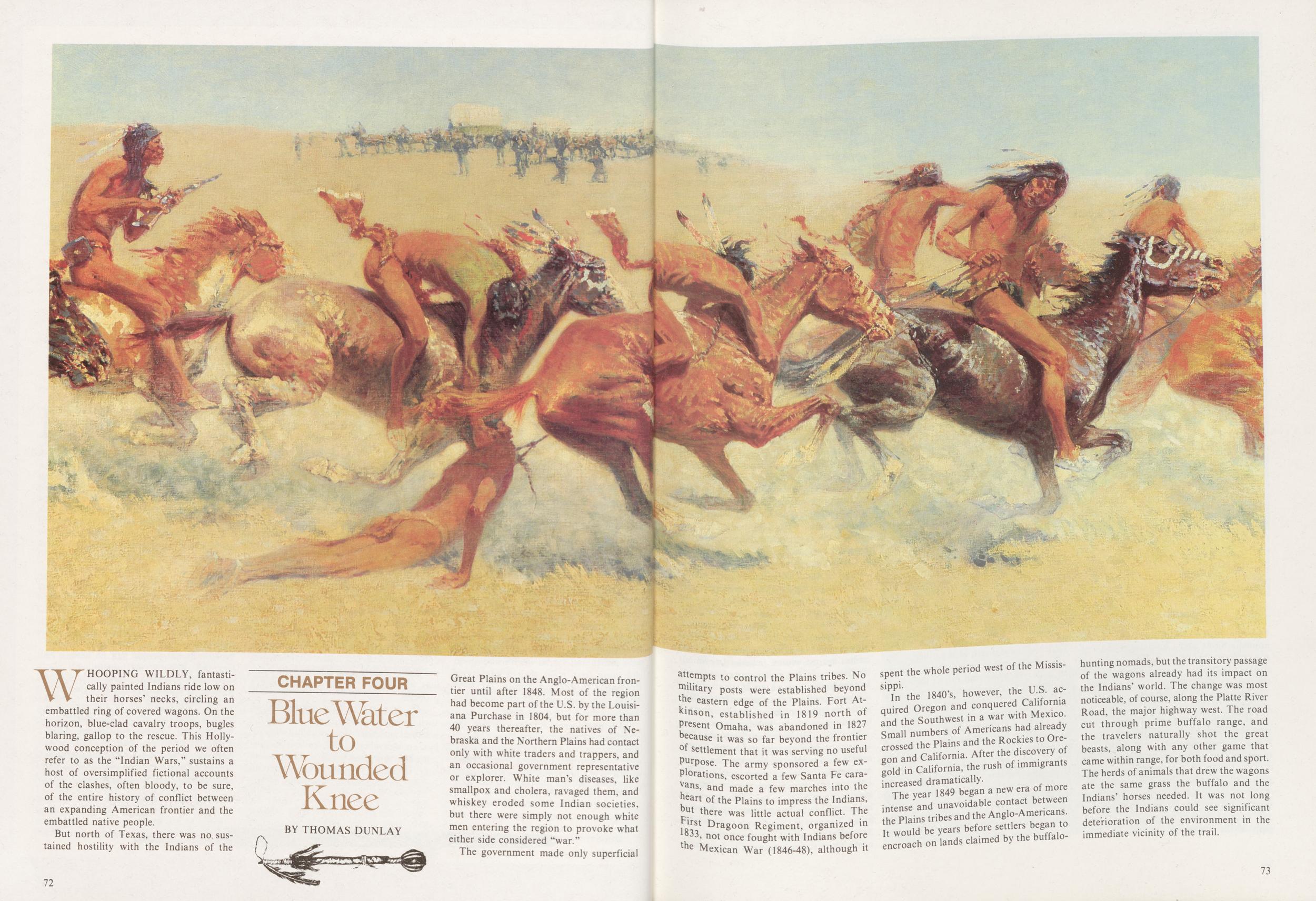
WHOOPING WILDLY, fantastically painted Indians ride low on their horses' necks, circling an embattled ring of covered wagons. On the horizon, blue-clad cavalry troops, bugles blaring, gallop to the rescue. This Hollywood conception of the period we often refer to as the "Indian Wars," sustains a host of oversimplified fictional accounts of the clashes, often bloody, to be sure, of the entire history of conflict between an expanding American frontier and the embattled native people.
But north of Texas, there was no sustained hostility with the Indians of the
CHAPTER FOUR Blue Water to Wounded Knee BY THOMAS DUNLAYGreat Plains on the Anglo-American frontier until after 1848. Most of the region had become part of the U.S. by the Louisiana Purchase in 1804, but for more than 40 years thereafter, the natives of Nebraska and the Northern Plains had contact only with white traders and trappers, and an occasional government representative or explorer. White man's diseases, like smallpox and cholera, ravaged them, and whiskey eroded some Indian societies, but there were simply not enough white men entering the region to provoke what either side considered "war."
The government made only superficial
72attempts to control the Plains tribes. No Military posts were established beyond the eastern edge of the Plains. Fort Atkinson, established in 1819 north of Present Omaha, was abandoned in 1827 because it was so far beyond the frontier of settlement that it was serving no useful Purpose. The army sponsored a few expirations, escorted a few Santa Fe carats, and made a few marches into the heart of the Plains to impress the Indians, but there was little actual conflict. The First Dragoon Regiment, organized in 1833, not once fought with Indians before the Mexican War (1846-48), although it spent the whole period west of the Mississippi
In the 1840's, however, the US. acquired Oregon and conquered California and the Southwest in a war with Mexico. Small numbers of Americans had already crossed the Plains and the Rockies to Oregon and California. After the discovery of gold in California, the rush of immigrants increased dramatically.
The year 1849 began a new era of more intense and unavoidable contact between tie Kins tribes and the Anglo-Americans. It would be years before settlers began to encroach on lands claimed by the buffalo-hunting nomads, but the transitory passage of the wagons already had its impact on the Indians' world. The change was most noticeable, of course, along the Platte River Road, the major highway west. The road cut through prime buffalo range, and the travelers naturally shot the great beasts, along with any other game that came within range, for both food and sport. The herds of animals that drew the wagons ate the same grass the buffalo and the Indians' horses needed. It was not long before the Indians could see significant deterioration of the environment in the immediate vicinity of the trail.
73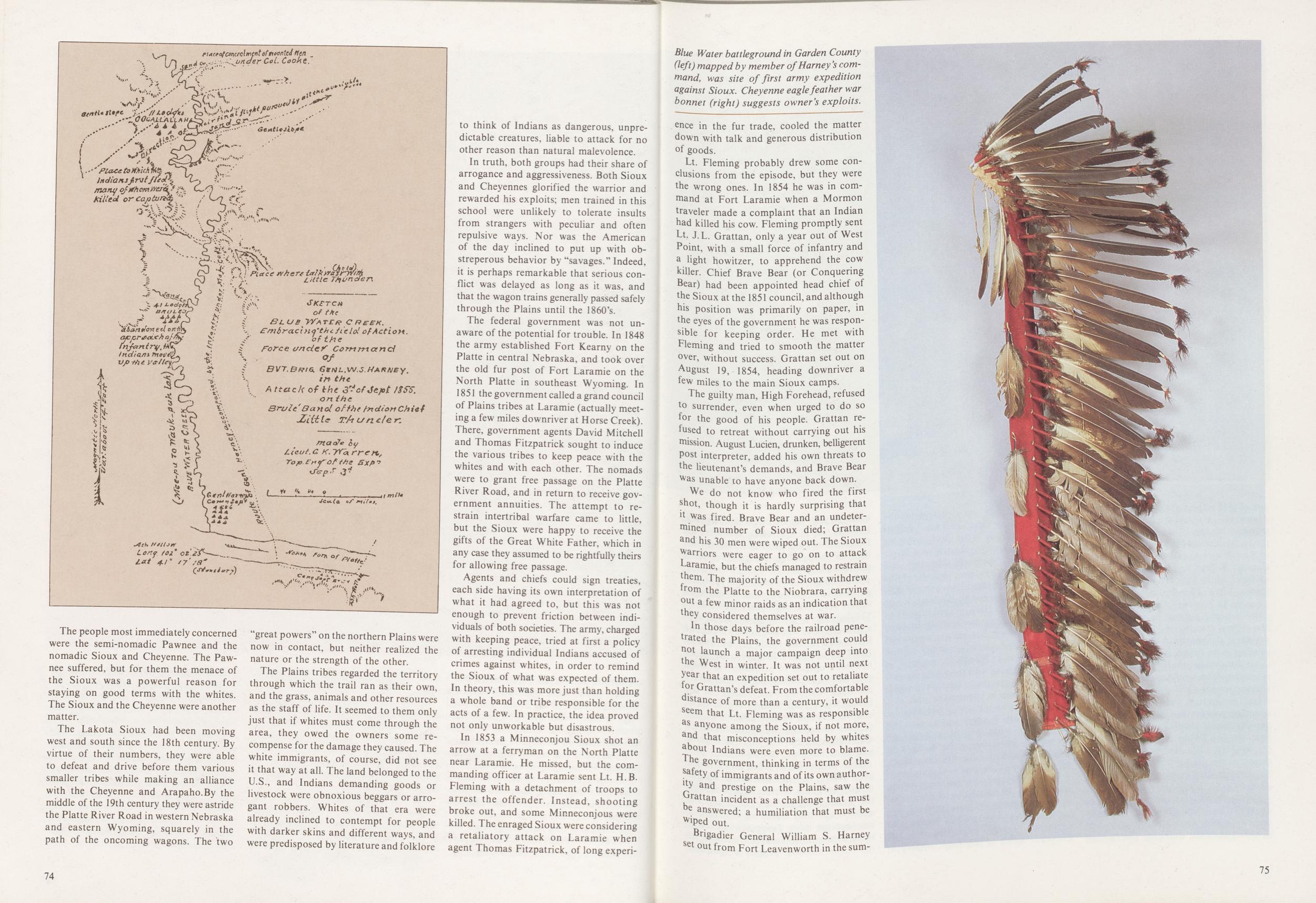
The people most immediately concerned were the semi-nomadic Pawnee and the nomadic Sioux and Cheyenne. The Pawnee suffered, but for them the menace of the Sioux was a powerful reason for staying on good terms with the whites. The Sioux and the Cheyenne were another matter.
The Lakota Sioux had been moving west and south since the 18th century. By virtue of their numbers, they were able to defeat and drive before them various smaller tribes while making an alliance with the Cheyenne and Arapaho.By the middle of the 19th century they were astride the Platte River Road in western Nebraska and eastern Wyoming, squarely in the path of the oncoming wagons. The two "great powers" on the northern Plains were now in contact, but neither realized the nature or the strength of the other.
The Plains tribes regarded the territory through which the trail ran as their own, and the grass, animals and other resources as the staff of life. It seemed to them only just that if whites must come through the area, they owed the owners some recompense for the damage they caused. The white immigrants, of course, did not see it that way at all. The land belonged to the U.S., and Indians demanding goods or livestock were obnoxious beggars or arrogant robbers. Whites of that era were already inclined to contempt for people with darker skins and different ways, and were predisposed by literature and folklore to think of Indians as dangerous, unpredictable creatures, liable to attack for no other reason than natural malevolence.
In truth, both groups had their share of arrogance and aggressiveness. Both Sioux and Cheyennes glorified the warrior and rewarded his exploits; men trained in this school were unlikely to tolerate insults from strangers with peculiar and often repulsive ways. Nor was the American of the day inclined to put up with obstreperous behavior by "savages." Indeed, it is perhaps remarkable that serious conflict was delayed as long as it was, and that the wagon trains generally passed safely through the Plains until the 1860's.
The federal government was not unaware of the potential for trouble. In 1848 the army established Fort Kearny on the Platte in central Nebraska, and took over the old fur post of Fort Laramie on the North Platte in southeast Wyoming. In 1851 the government called a grand council of Plains tribes at Laramie (actually meeting a few miles downriver at Horse Creek). There, government agents David Mitchell and Thomas Fitzpatrick sought to induce the various tribes to keep peace with the whites and with each other. The nomads were to grant free passage on the Platte River Road, and in return to receive government annuities. The attempt to restrain intertribal warfare came to little, but the Sioux were happy to receive the gifts of the Great White Father, which in any case they assumed to be rightfully theirs for allowing free passage.
Agents and chiefs could sign treaties, each side having its own interpretation of what it had agreed to, but this was not enough to prevent friction between individuals of both societies. The army, charged with keeping peace, tried at first a policy of arresting individual Indians accused of crimes against whites, in order to remind the Sioux of what was expected of them. In theory, this was more just than holding a whole band or tribe responsible for the acts of a few. In practice, the idea proved not only unworkable but disastrous.
In 1853 a Minneconjou Sioux shot an arrow at a ferryman on the North Platte near Laramie. He missed, but the commanding officer at Laramie sent Lt. H.B. Fleming with a detachment of troops to arrest the offender. Instead, shooting broke out, and some Minneconjous were killed. The enraged Sioux were considering a retaliatory attack on Laramie when agent Thomas Fitzpatrick, of long experience
74in the fur trade, cooled the matter down with talk and generous distribution of goods.
Lt. Fleming probably drew some conelusions from the episode, but they were the wrong ones. In 1854 he was in command at Fort Laramie when a Mormon traveler made a complaint that an Indian had killed his cow. Fleming promptly sent Lt. J.L. Grattan, only a year out of West Point, with a small force of infantry and a light howitzer, to apprehend the cow killer. Chief Brave Bear (or Conquering Bear) had been appointed head chief of the Sioux at the 1851 council, and although his position was primarily on paper, in the eyes of the government he was responsible for keeping order. He met with Fleming and tried to smooth the matter over, without success. Grattan set out on August 19, 1854, heading downriver a few miles to the main Sioux camps.
The guilty man, High Forehead, refused to surrender, even when urged to do so for the good of his people. Grattan refused to retreat without carrying out his mission. August Lucien, drunken, belligerent Post interpreter, added his own threats to the lieutenant's demands, and Brave Bear was unable to have anyone back down.
We do not know who fired the first shot, though it is hardly surprising that it was fired. Brave Bear and an undetermined number of Sioux died; Grattan and his 30 men were wiped out. The Sioux warriors were eager to go on to attack Laramie, but the chiefs managed to restrain them. The majority of the Sioux withdrew from the Platte to the Niobrara, carrying °ut a few minor raids as an indication that they considered themselves at war.
In those days before the railroad penetrated the Plains, the government could not launch a major campaign deep into the West in winter. It was not until next year that an expedition set out to retaliate for Grattan's defeat. From the comfortable distance of more than a century, it would seem that Lt. Fleming was as responsible as anyone among the Sioux, if not more, and that misconceptions held by whites about Indians were even more to blame. The government, thinking in terms of the safety of immigrants and of its own authority and prestige on the Plains, saw the Grattan incident as a challenge that must he answered; a humiliation that must be wiped out.
Brigadier General William S. Harney set out from Fort Leavenworth in the summer
75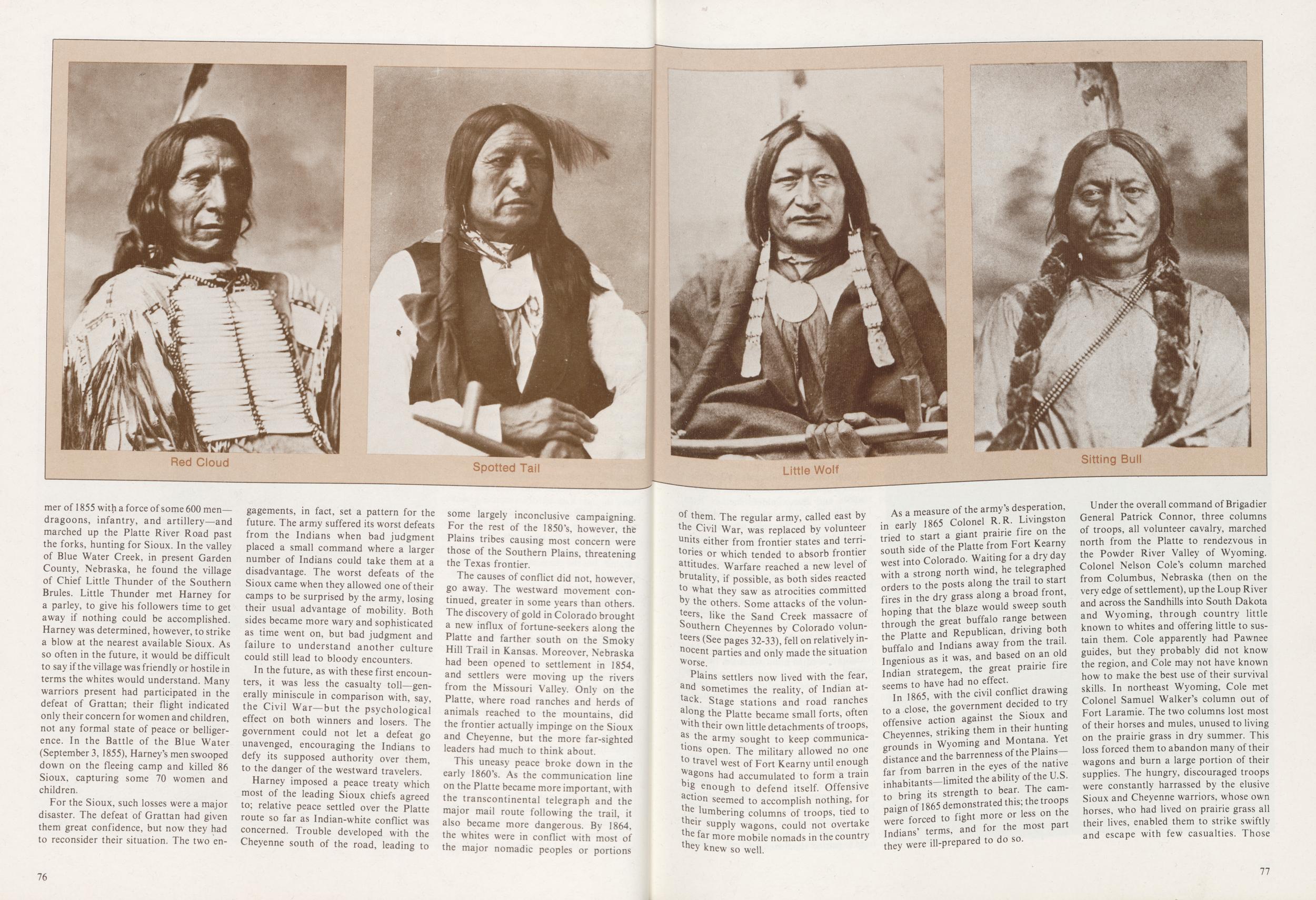 Red Cloud
of 1855 with a force of some 600 mendragoons, infantry, and artillery—and marched up the Platte River Road past the forks, hunting for Sioux. In the valley of Blue Water Creek, in present Garden County, Nebraska, he found the village of Chief Little Thunder of the Southern Brules. Little Thunder met Harney for a parley, to give his followers time to get away if nothing could be accomplished. Harney was determined, however, to strike a blow at the nearest available Sioux. As so often in the future, it would be difficult to say if the village was friendly or hostile in terms the whites would understand. Many warriors present had participated in the defeat of Grattan; their flight indicated only their concern for women and children, not any formal state of peace or belligerence. In the Battle of the Blue Water (September 3, 1855), Harney's men swooped down on the fleeing camp and killed 86 Sioux, capturing some 70 women and children.
For the Sioux, such losses were a major disaster. The defeat of Grattan had given them great confidence, but now they had to reconsider their situation. The two engagements, in fact, set a pattern for the future. The army suffered its worst defeats from the Indians when bad judgment placed a small command where a larger number of Indians could take them at a disadvantage. The worst defeats of the Sioux came when they allowed one of their camps to be surprised by the army, losing their usual advantage of mobility. Both sides became more wary and sophisticated as time went on, but bad judgment and failure to understand another culture could still lead to bloody encounters.
In the future, as with these first encounters, it was less the casualty toll—generally miniscule in comparison with, say, the Civil War—but the psychological effect on both winners and losers. The government could not let a defeat go unavenged, encouraging the Indians to defy its supposed authority over them, to the danger of the westward travelers.
Harney imposed a peace treaty which most of the leading Sioux chiefs agreed to; relative peace settled over the Platte route so far as Indian-white conflict was concerned. Trouble developed with the Cheyenne south of the road, leading to
Spotted Tailsome largely inconclusive campaigning. For the rest of the 1850's, however, the Plains tribes causing most concern were those of the Southern Plains, threatening the Texas frontier.
The causes of conflict did not, however, go away. The westward movement continued, greater in some years than others. The discovery of gold in Colorado brought a new influx of fortune-seekers along the Platte and farther south on the Smoky Hill Trail in Kansas. Moreover, Nebraska had been opened to settlement in 1854, and settlers were moving up the rivers from the Missouri Valley. Only on the Platte, where road ranches and herds of animals reached to the mountains, did the frontier actually impinge on the Sioux and Cheyenne, but the more far-sighted leaders had much to think about.
This uneasy peace broke down in the early 1860's. As the communication line on the Platte became more important, with the transcontinental telegraph and the major mail route following the trail, it also became more dangerous. By 1864, the whites were in conflict with most of the major nomadic peoples or portions
76 Little Wolf Sitting Bullof them. The regular army, called east by the Civil War, was replaced by volunteer units either from frontier states and territories or which tended to absorb frontier attitudes. Warfare reached a new level of brutality, if possible, as both sides reacted to what they saw as atrocities committed by the others. Some attacks of the volunteers, like the Sand Creek massacre of Southern Cheyennes by Colorado volunteers (See pages 32-33), fell on relatively innocent parties and only made the situation Worse.
Plains settlers now lived with the fear, and sometimes the reality, of Indian attack. Stage stations and road ranches along the Platte became small forts, often With their own little detachments of troops, as the army sought to keep communications open. The military allowed no one to travel west of Fort Kearny until enough Wagons had accumulated to form a train big enough to defend itself. Offensive action seemed to accomplish nothing, for the lumbering columns of troops, tied to their supply wagons, could not overtake the far more mobile nomads in the country they knew so well.
As a measure of the army's desperation, in early 1865 Colonel R.R. Livingston tried to start a giant prairie fire on the south side of the Platte from Fort Kearny west into Colorado. Waiting for a dry day with a strong north wind, he telegraphed orders to the posts along the trail to start fires in the dry grass along a broad front hoping that the blaze would sweep south through the great buffalo range between the Platte and Republican, driving both buffalo and Indians away from the trail Ingenious as it was, and based on an old Indian strategem, the great prairie fire seems to have had no effect.
In 1865 with the civil conflict drawing to a close,' the government decided to try offensive action against the Sioux and Cheyennes, striking them in their hunting grounds in Wyoming and Montana Yet distance and the barrenness of the Plains-far from barren in the eyes of the native inhabitants—limited the ability of the U.S. to bring its strength to bear. The campaign of 1865 demonstrated this; the troops S forced to fight more or less on the Sans' terms, and for the most part they were ill-prepared to do so.
Under the overall command of Brigadier General Patrick Connor, three columns of troops, all volunteer cavalry, marched north from the Platte to rendezvous in the Powder River Valley of Wyoming. Colonel Nelson Cole's column marched from Columbus, Nebraska (then on the very edge of settlement), up the Loup River and across the Sandhills into South Dakota and Wyoming, through country little known to whites and offering little to sustain them. Cole apparently had Pawnee guides, but they probably did not know the region, and Cole may not have known how to make the best use of their survival skills. In northeast Wyoming, Cole met Colonel Samuel Walker's column out of Fort Laramie. The two columns lost most of their horses and mules, unused to living on the prairie grass in dry summer. This loss forced them to abandon many of their wagons and burn a large portion of their supplies. The hungry, discouraged troops were constantly harrassed by the elusive Sioux and Cheyenne warriors, whose own horses, who had lived on prairie grass all their lives, enabled them to strike swiftly and escape with few casualties. Those
77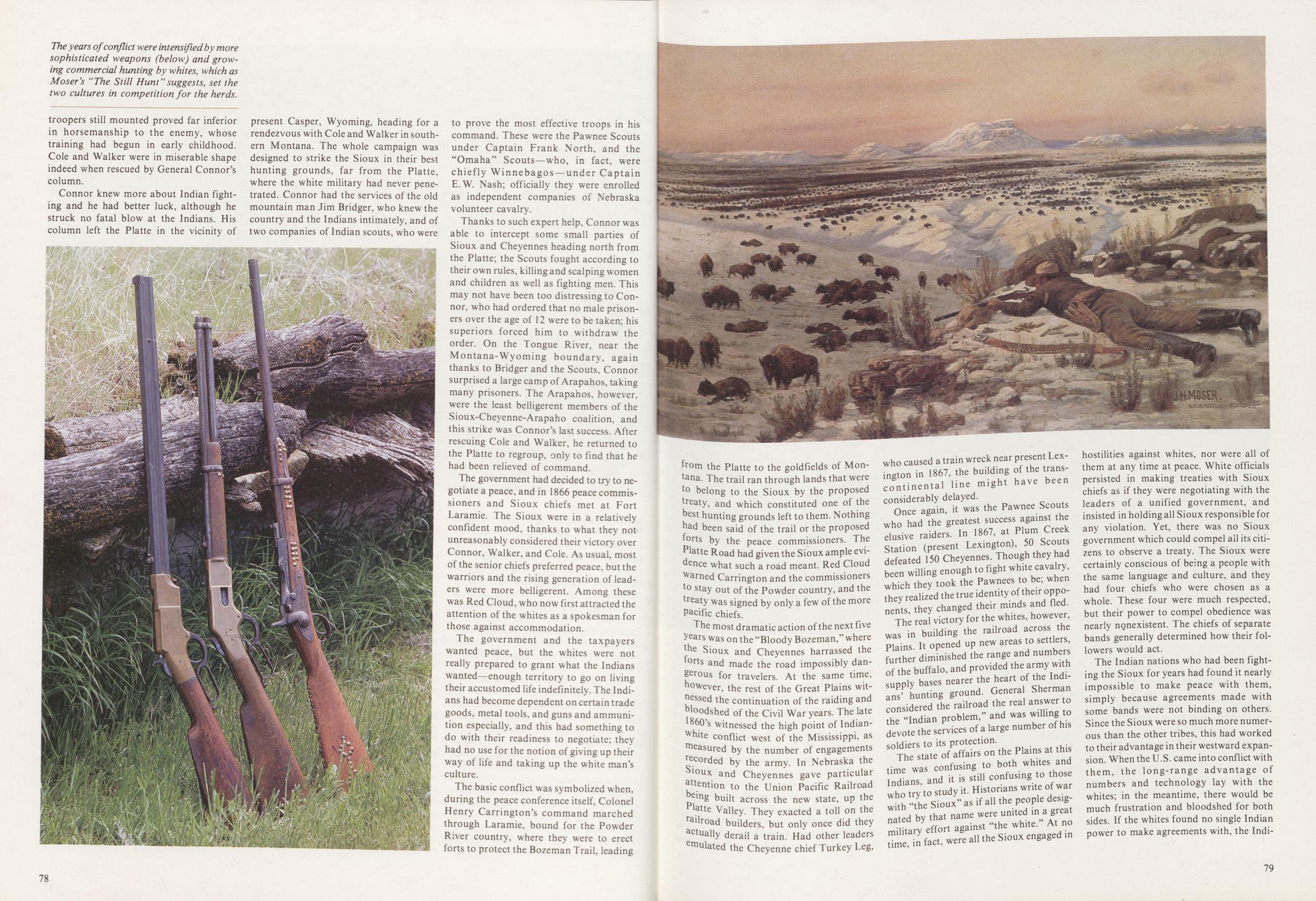
troopers still mounted proved far inferior in horsemanship to the enemy, whose training had begun in early childhood. Cole and Walker were in miserable shape indeed when rescued by General Connor's column.
Connor knew more about Indian fighting and he had better luck, although he struck no fatal blow at the Indians. His column left the Platte in the vicinity of present Casper, Wyoming, heading for a rendezvous with Cole and Walker in southern Montana. The whole campaign was designed to strike the Sioux in their best hunting grounds, far from the Platte, where the white military had never penetrated. Connor had the services of the old mountain man Jim Bridger, who knew the country and the Indians intimately, and of two companies of Indian scouts, who were to prove the most effective troops in his command. These were the Pawnee Scouts under Captain Frank North, and the "Omaha" Scouts—who, in fact, were chiefly Winnebagos—under Captain E.W. Nash; officially they were enrolled as independent companies of Nebraska volunteer cavalry.
Thanks to such expert help, Connor was able to intercept some small parties of Sioux and Cheyennes heading north from the Platte; the Scouts fought according to their own rules, killing and scalping women and children as well as fighting men. This may not have been too distressing to Connor, who had ordered that no male prisoners over the age of 12 were to be taken; his superiors forced him to withdraw the order. On the Tongue River, near the Montana-Wyoming boundary, again thanks to Bridger and the Scouts, Connor surprised a large camp of Arapahos, taking many prisoners. The Arapahos, however, were the least belligerent members of the Sioux-Cheyenne-Arapaho coalition, and this strike was Connor's last success. After rescuing Cole and Walker, he returned to the Platte to regroup, only to find that he had been relieved of command.
The government had decided to try to negotiate a peace, and in 1866 peace commissioners and Sioux chiefs met at Fort Laramie. The Sioux were in a relatively confident mood, thanks to what they not unreasonably considered their victory over Connor, Walker, and Cole. As usual, most of the senior chiefs preferred peace, but the warriors and the rising generation of leaders were more belligerent. Among these was Red Cloud, who now first attracted the attention of the whites as a spokesman for those against accommodation.
The government and the taxpayers wanted peace, but the whites were not really prepared to grant what the Indians wanted—enough territory to go on living their accustomed life indefinitely. The Indians had become dependent on certain trade goods, metal tools, and guns and ammunition especially, and this had something to do with their readiness to negotiate; they had no use for the notion of giving up their way of life and taking up the white man's culture.
The basic conflict was symbolized when, during the peace conference itself, Colonel Henry Carrington's command marched through Laramie, bound for the Powder River country, where they were to erect forts to protect the Bozeman Trail, leading
78from the Platte to the goldfields of Montana. The trail ran through lands that were to belong to the Sioux by the proposed treaty, and which constituted one of the best hunting grounds left to them. Nothing had been said of the trail or the proposed forts by the peace commissioners. The platte Road had given the Sioux ample evidence what such a road meant. Red Cloud warned Carrington and the commissioners to stay out of the Powder country, and the treaty was signed by only a few of the more Pacific chiefs.
The most dramatic action of the next five years was on the "Bloody Bozeman," where the Sioux and Cheyennes harrassed the forts and made the road impossibly dangerous for travelers. At the same time, however, the rest of the Great Plains witnessed the continuation of the raiding and Woodshed of the Civil War years. The late 1860's witnessed the high point of Indian-white conflict west of the Mississippi, as measured by the number of engagements recorded by the army. In Nebraska the Sioux and Cheyennes gave particular attention to the Union Pacific Railroad being built across the new state, up the Platte Valley. They exacted a toll on the railroad builders, but only once did they actually derail a train. Had other leaders emulated the Cheyenne chief Turkey Leg, who caused a train wreck near present Lexington in 1867, the building of the trans-continental line might have been considerably delayed.
Once again, it was the Pawnee Scouts who had the greatest success against the elusive raiders. In 1867, at Plum Creek Station (present Lexington), 50 Scouts defeated 150 Cheyennes. Though they had been willing enough to fight white cavalry, which they took the Pawnees to be; when they realized the true identity of their opponents, they changed their minds and fled.
The real victory for the whites, however, was in building the railroad across the Plains. It opened up new areas to settlers, further diminished the range and numbers of the buffalo, and provided the army with supply bases nearer the heart of the Indians' hunting ground. General Sherman considered the railroad the real answer to the "Indian problem," and was willing to devote the services of a large number of his soldiers to its protection.
The state of affairs on the Plains at this time was confusing to both whites and Indians, and it is still confusing to those who try to study it. Historians write of war with "the Sioux" as if all the people designated by that name were united in a great military effort against "the white." At no time, in fact, were all the Sioux engaged in hostilities against whites, nor were all of them at any time at peace. White officials persisted in making treaties with Sioux chiefs as if they were negotiating with the leaders of a unified government, and insisted in holding all Sioux responsible for any violation. Yet, there was no Sioux government which could compel all its citizens to observe a treaty. The Sioux were certainly conscious of being a people with the same language and culture, and they had four chiefs who were chosen as a whole. These four were much respected, but their power to compel obedience was nearly nonexistent. The chiefs of separate bands generally determined how their followers would act.
The Indian nations who had been fighting the Sioux for years had found it nearly impossible to make peace with them, simply because agreements made with some bands were not binding on others. Since the Sioux were so much more numerous than the other tribes, this had worked to their advantage in their westward expansion. When the U.S. came into conflict with them, the long-range advantage of numbers and technology lay with the whites; in the meantime, there would be much frustration and bloodshed for both sides. If the whites found no single Indian power to make agreements with, the Indi-
79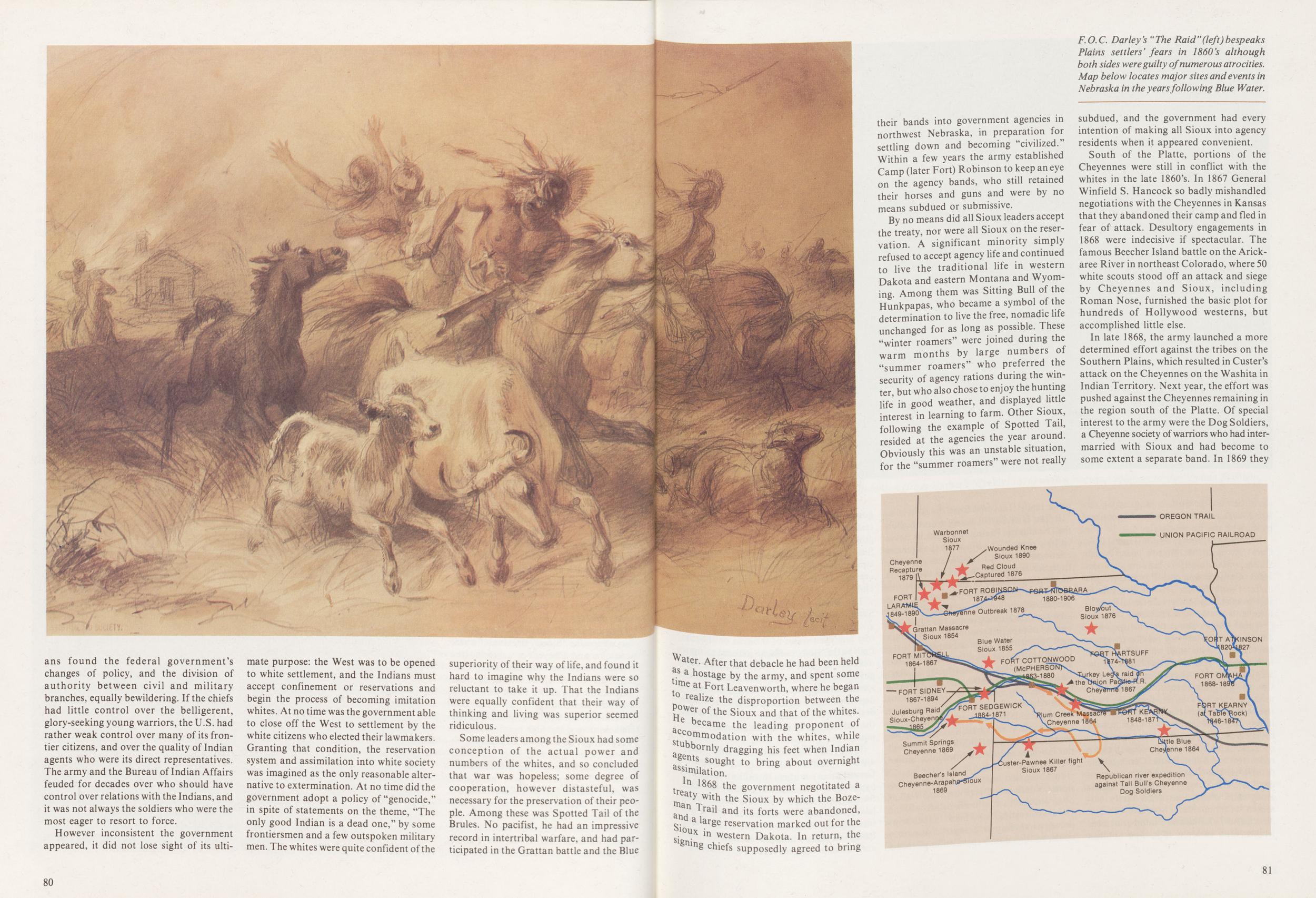
and found the federal government's changes of policy, and the division of authority between civil and military branches, equally bewildering. If the chiefs had little control over the belligerent, glory-seeking young warriors, the U.S. had rather weak control over many of its frontier citizens, and over the quality of Indian agents who were its direct representatives. The army and the Bureau of Indian Affairs feuded for decades over who should have control over relations with the Indians, and it was not always the soldiers who were the most eager to resort to force.
However inconsistent the government appeared, it did not lose sight of its ultimate purpose: the West was to be opened to white settlement, and the Indians must accept confinement or reservations and begin the process of becoming imitation whites. At no time was the government able to close off the West to settlement by the white citizens who elected their lawmakers. Granting that condition, the reservation system and assimilation into white society was imagined as the only reasonable alternative to extermination. At no time did the government adopt a policy of "genocide," in spite of statements on the theme, 'The only good Indian is a dead one," by some frontiersmen and a few outspoken military men. The whites were quite confident of the superiority of their way of life, and found it hard to imagine why the Indians were so reluctant to take it up. That the Indians were equally confident that their way of thinking and living was superior seemed ridiculous.
Some leaders among the Sioux had some conception of the actual power and numbers of the whites, and so concluded that war was hopeless; some degree of cooperation, however distasteful, was necessary for the preservation of their people. Among these was Spotted Tail of the Brules. No pacifist, he had an impressive record in intertribal warfare, and had participated in the Grattan battle and the Blue
80Water. After that debacle he had been held as a hostage by the army, and spent some time at Fort Leavenworth, where he began to realize the disproportion between the power of the Sioux and that of the whites. He became the leading proponent of accomodation with the whites, while a stubbornly dragging his feet when Indian Qgents sought to bring about overnight assimilation.
In 1868 the government negotitated a treaty with the Sioux by which the Bozean Trail and its forts were abandoned, a large reservation marked out for the Sioux in western Dakota. In return, the gning chiefs supposedly agreed to bring their bands into government agencies in northwest Nebraska, in preparation for settling down and becoming "civilized." Within a few years the army established Camp (later Fort) Robinson to keep an eye on the agency bands, who still retained their horses and guns and were by no means subdued or submissive.
By no means did all Sioux leaders accept the treaty, nor were all Sioux on the reservation. A significant minority simply refused to accept agency life and continued to live the traditional life in western Dakota and eastern Montana and Wyoming. Among them was Sitting Bull of the Hunkpapas, who became a symbol of the determination to live the free, nomadic life unchanged for as long as possible. These "winter roamers" were joined during the warm months by large numbers of "summer roamers" who preferred the security of agency rations during the winter, but who also chose to enjoy the hunting life in good weather, and displayed little interest in learning to farm. Other Sioux, following the example of Spotted Tail, resided at the agencies the year around. Obviously this was an unstable situation, for the "summer roamers" were not really
subdued, and the government had every intention of making all Sioux into agency residents when it appeared convenient.
South of the Platte, portions of the Cheyennes were still in conflict with the whites in the late 1860's. In 1867 General Winfield S. Hancock so badly mishandled negotiations with the Cheyennes in Kansas that they abandoned their camp and fled in fear of attack. Desultory engagements in 1868 were indecisive if spectacular. The famous Beecher Island battle on the Arickaree River in northeast Colorado, where 50 white scouts stood off an attack and siege by Cheyennes and Sioux, including Roman Nose, furnished the basic plot for hundreds of Hollywood westerns, but accomplished little else.
In late 1868, the army launched a more determined effort against the tribes on the Southern Plains, which resulted in Custer's attack on the Cheyennes on the Washita in Indian Territory. Next year, the effort was pushed against the Cheyennes remaining in the region south of the Platte. Of special interest to the army were the Dog Soldiers, a Cheyenne society of warriors who had inter-married with Sioux and had become to some extent a separate band. In 1869 they
Cheyenne Recapture 1879 Summit Springs Cheyenne 1869 Beecher's Island Cheyenne-Arapaho 1869 81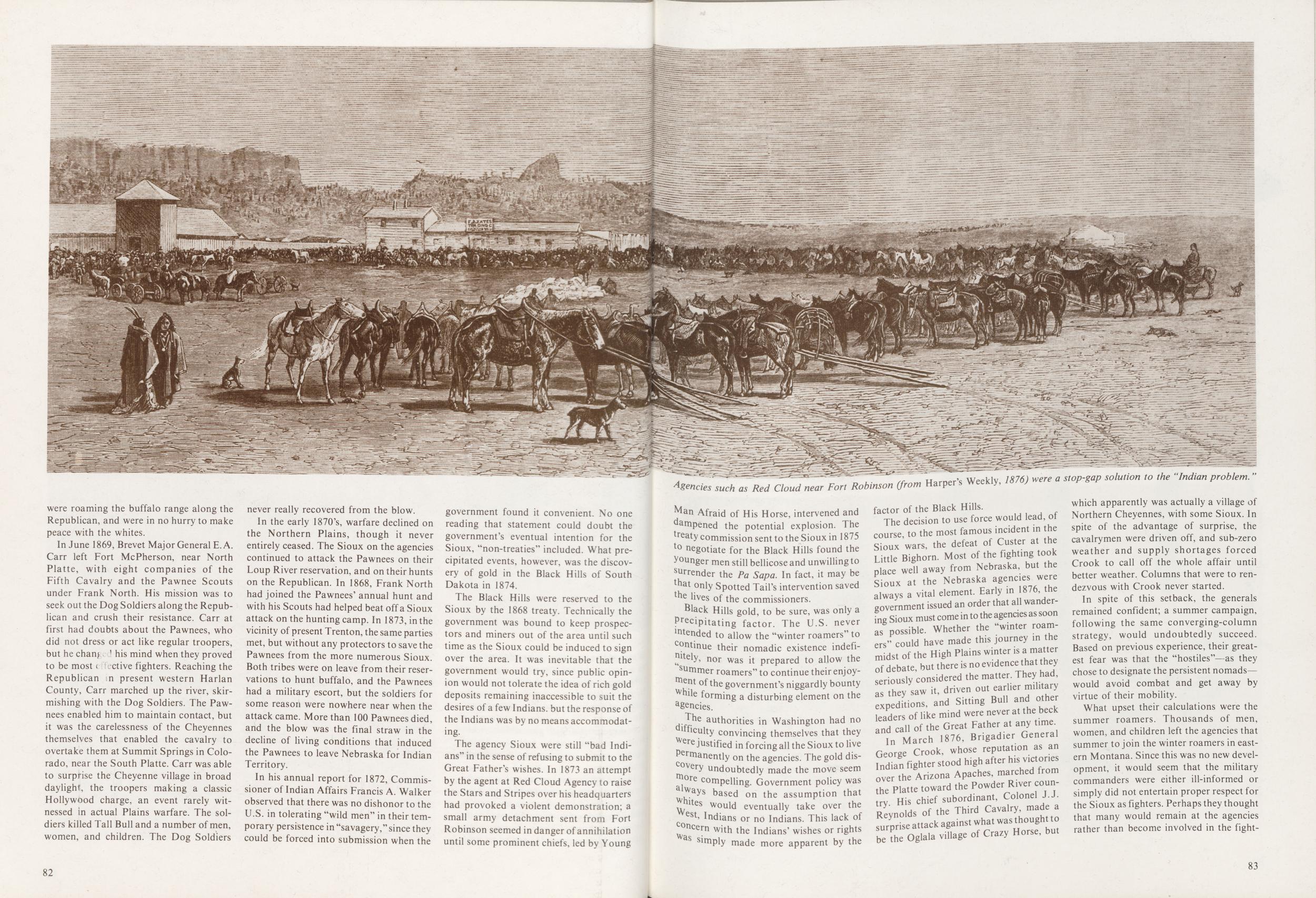
were roaming the buffalo range along the Republican, and were in no hurry to make peace with the whites.
In June 1869, Brevet Major General E. A. Carr left Fort McPherson, near North Platte, with eight companies of the Fifth Cavalry and the Pawnee Scouts under Frank North. His mission was to seek out the Dog Soldiers along the Republican and crush their resistance. Carr at first had doubts about the Pawnees, who did not dress or act like regular troopers, but he changed his mind when they proved to be most active fighters. Reaching the Republican n present western Harlan County, Carr marched up the river, skirmishing with the Dog Soldiers. The Pawnees enabled him to maintain contact, but it was the carelessness of the Cheyennes themselves that enabled the cavalry to overtake them at Summit Springs in Colorado, near the South Platte. Carr was able to surprise the Cheyenne village in broad daylight, the troopers making a classic Hollywood charge, an event rarely witnessed in actual Plains warfare. The soldiers killed Tall Bull and a number of men, women, and children. The Dog Soldiers never really recovered from the blow.
In the early 1870's, warfare declined on the Northern Plains, though it never entirely ceased. The Sioux on the agencies continued to attack the Pawnees on their Loup River reservation, and on their hunts on the Republican. In 1868, Frank North had joined the Pawnees' annual hunt and with his Scouts had helped beat off a Sioux attack on the hunting camp. In 1873, in the vicinity of present Trenton, the same parties met, but without any protectors to save the Pawnees from the more numerous Sioux. Both tribes were on leave from their reservations to hunt buffalo, and the Pawnees had a military escort, but the soldiers for some reason were nowhere near when the attack came. More than 100 Pawnees died, and the blow was the final straw in the decline of living conditions that induced the Pawnees to leave Nebraska for Indian Territory.
In his annual report for 1872, Commissioner of Indian Affairs Francis A. Walker observed that there was no dishonor to the U.S. in tolerating "wild men" in their temporary persistence in "savagery," since they could be forced into submission when the government found it convenient. No one reading that statement could doubt the government's eventual intention for the Sioux, "non-treaties" included. What precipitated events, however, was the discovery of gold in the Black Hills of South Dakota in 1874.
The Black Hills were reserved to the Sioux by the 1868 treaty. Technically the government was bound to keep prospectors and miners out of the area until such time as the Sioux could be induced to sign over the area. It was inevitable that the government would try, since public opinion would not tolerate the idea of rich gold deposits remaining inaccessible to suit the desires of a few Indians, but the response of the Indians was by no means accommodating.
The agency Sioux were still "bad Indians" in the sense of refusing to submit to the Great Father's wishes. In 1873 an attempt by the agent at Red Cloud Agency to raise the Stars and Stripes over his headquarters had provoked a violent demonstration; a small army detachment sent from Fort Robinson seemed in danger of annihilation until some prominent chiefs, led by Young
82Man Afraid of His Horse, intervened and dampened the potential explosion. The treaty commission sent to the Sioux in 1875 to negotiate for the Black Hills found the younger men still bellicose and unwilling to surrender the Pa Sapa. In fact, it may be that only Spotted Tail's intervention saved tne lives of the commissioners.
Black Hills gold, to be sure, was only a Precipitating factor. The U.S. never tended to allow the "winter roamers" to continue their nomadic existence indefinitely, nor was it prepared to allow the summer roamers" to continue their enjoyment of the government's niggardly bounty while forming a disturbing element on the agencies.
The authorities in Washington had no difficulty convincing themselves that they Were justified in forcing all the Sioux to live Permanently on the agencies. The gold discovery undoubtedly made the move seem more compelling. Government policy was always based on the assumption that whites would eventually take over the West, Indians or no Indians. This lack of concern with the Indians' wishes or rights as simply made more apparent by the factor of the Black Hills.
The decision to use force would lead, of course, to the most famous incident in the Sioux wars, the defeat of Custer at the Little Bighorn. Most of the fighting took place well away from Nebraska, but the Sioux at the Nebraska agencies were always a vital element. Early in 1876, the government issued an order that all wandering Sioux must come in to the agencies as soon as possible. Whether the "winter roamers" could have made this journey in the midst of the High Plains winter is a matter of debate, but there is no evidence that they seriously considered the matter. They had, as they saw it, driven out earlier military expeditions, and Sitting Bull and other leaders of like mind were never at the beck and call of the Great Father at any time.
In March 1876, Brigadier General George Crook, whose reputation as an Indian fighter stood high after his victories over the Arizona Apaches, marched from the Platte toward the Powder River country. His chief subordinant, Colonel J.J. Reynolds of the Third Cavalry, made a surprise attack against what was thought to be the Oglala village of Crazy Horse, but which apparently was actually a village of Northern Cheyennes, with some Sioux. In spite of the advantage of surprise, the cavalrymen were driven off, and sub-zero weather and supply shortages forced Crook to call off the whole affair until better weather. Columns that were to rendezvous with Crook never started.
In spite of this setback, the generals remained confident; a summer campaign, following the same converging-column strategy, would undoubtedly succeed. Based on previous experience, their greatest fear was that the "hostiles"—as they chose to designate the persistent nomads—would avoid combat and get away by virtue of their mobility.
What upset their calculations were the summer roamers. Thousands of men, women, and children left the agencies that summer to join the winter roamers in eastern Montana. Since this was no new development, it would seem that the military commanders were either ill-informed or simply did not entertain proper respect for the Sioux as fighters. Perhaps they thought that many would remain at the agencies rather than become involved in the fighting.
83In later years of the Indian wars, warriors often recorded incidents of their lives in ledger-book drawings. Scene below, by unknown Cheyenne, depicts a warrior counting coup on a fallen soldier near a railroad track.
But for the summer roamers, it may well have appeared to be their last chance for enjoyment of the old life, as indeed it was.
Crook marched north again from the Platte, met Sioux and Cheyennes on Rosebud Creek in southern Montana, and encountered such stubborn resistance that he judged it wisest to retreat into Wyoming to await reinforcements. General Alfred Terry, coming west from Dakota, sent out his cavalry under Custer to head off the Indians, who were still expected to run for it rather than stand and fight. What Custer found on the Little Bighorn, of course, was the full force of Sioux and Northern Cheyenne warriors and their families. His bloody defeat stunned both the army and the nation, and historians have tried ever since to explain just how it could have happened. The simple truth is probably that the Sioux were as good or better fighters, man for man, as the soldiers, that there were many more of them, and that Custer's battle plan divided his regiment to the extent that its elements could not support each other.
In the aftermath of the Custer fight, a number of Cheyennes who had remained at Red Cloud Agency decided to flee to the hostiles. At Warbonnet Creek in extreme northwest Nebraska, they were intercepted by the Fifth Cavalry Regiment, called in from Kansas to reinforce the forces of General Crook. There were few casualties, but the episode must have confirmed the army's growing belief that the agencies were in collusion with the hostiles. The military were sure that the agency bands furnished the hostiles with not only fighting men but most of their guns and ammunition, issued by the government to allow the Indians to hunt. The military leaders decided that at least some of these Indians must be disarmed and dismounted.
In October 1876, cavalry under Colonel Ranald Mackenzie surrounded the bands of Red Cloud and Red Leaf, achieving complete surprise thanks to guides and the Pawnee Scouts—recalled for one more campaign—and taking the horses and weapons of these bands. Necessary or not, it was a heavy blow to the pride of these warriors, and it is interesting that when Crook immediately after enlisted a body of Sioux scouts, most of them came from these very bands that had been so humiliated.
In the meantime, the government had sent another treaty commission to negotiate for the Black Hills. The chiefs understood well enough that the Hills were lost, and that they had better take what they could get. Indeed, certain well-intentioned humanitarians had concocted a scheme to remove all the Lakota Sioux to Indian Territory. The project was only thwarted by the warnings of all the principal military commanders involved that any attempt to carry out such a removal would probably result in an Indian war that would make the current troubles seem minor by comparison.
The war did, indeed, mean the end of the old life. Those bands of Sioux who did not come into the agencies fled north to Canada with Sitting Bull, where they endured hardship and hunger due to dwindling of the buffalo herds, until 1881. Even Crazy Horse, the great warrior leader, surrendered in the spring of 1877, and was killed a few months later in an attempt to arrest him. The process of "civilization" of the Sioux could now begin in earnest.
If the project for removing the Sioux to Indian Territory was abandoned, it proved possible to move several hundred Northern Cheyennes there, apparently as a punishment for having fought beside the Sioux. The problem was in keeping them there.
84The notion was apparently that they would be happy because they would be with the Southern Cheyennes; in fact, the northerners found the climate unhealthy and the rations inadequate. In late 1878, under the leadership of Dull Knife and Little Wolf, the Northern Cheyennes fled the agency and headed north for their old homelands. The subsequent chase proved nearly as embarrassing in its way as the Custer defeat. The Cheyennes fled north through relatively settled portions of Kansas, crossing several railroad and telegraph lines, defeating some parties of troops and eluding others. With winter coming on, they slipped across the Union Pacific and disappeared into the Nebraska Sandhills.
At this point the two chiefs fell into disagreement; Dull Knife chose to take a portion of the tribe to Fort Robinson and surrender, hoping that they would be allowed to remain in the Pine Ridge area or somewhere in the north. He was probably moved by the hardships his people had already undergone. Little Wolf was less optimistic, and chose to take his followers on north to Montana. He reached his objective undetected, but Dull Knife's hand was to meet a more tragic fate. They surrendered at Fort Robinson, and at first Were well-treated, housed in an empty barracks and fed army rations.
The Bureau of Indian Affairs would not allow the Cheyennes to get away with their act of defiance. These people had been ordered to Indian Territory and had left without permission, and to Indian Territory they would return! Captain Henry W. Vessels, commanding at Robinson, received orders to prepare them for the journey, using force if necessary. Finding that the Cheyennes had no intention of going, and seeking to avoid a battle, Wessels cut off their food supply and the fuel for heating the barracks. It was then January 1879, and the Indians—men, women, and children—must have suffered greatly. They persisted in their refusal, even re-training a few of their number who tried to leave, for nothing seemed worse than returning to the south.
On the night of January 10, the Cheyennes broke out; they had managed to conceal a number of guns from their capers, and managed to shoot their way through the guards and head west on foot. Pursued by cavalry, they fought rear-guard actions for nearly two weeks. On January 22' the last of them, including about 19 warriors, were killed or captured.
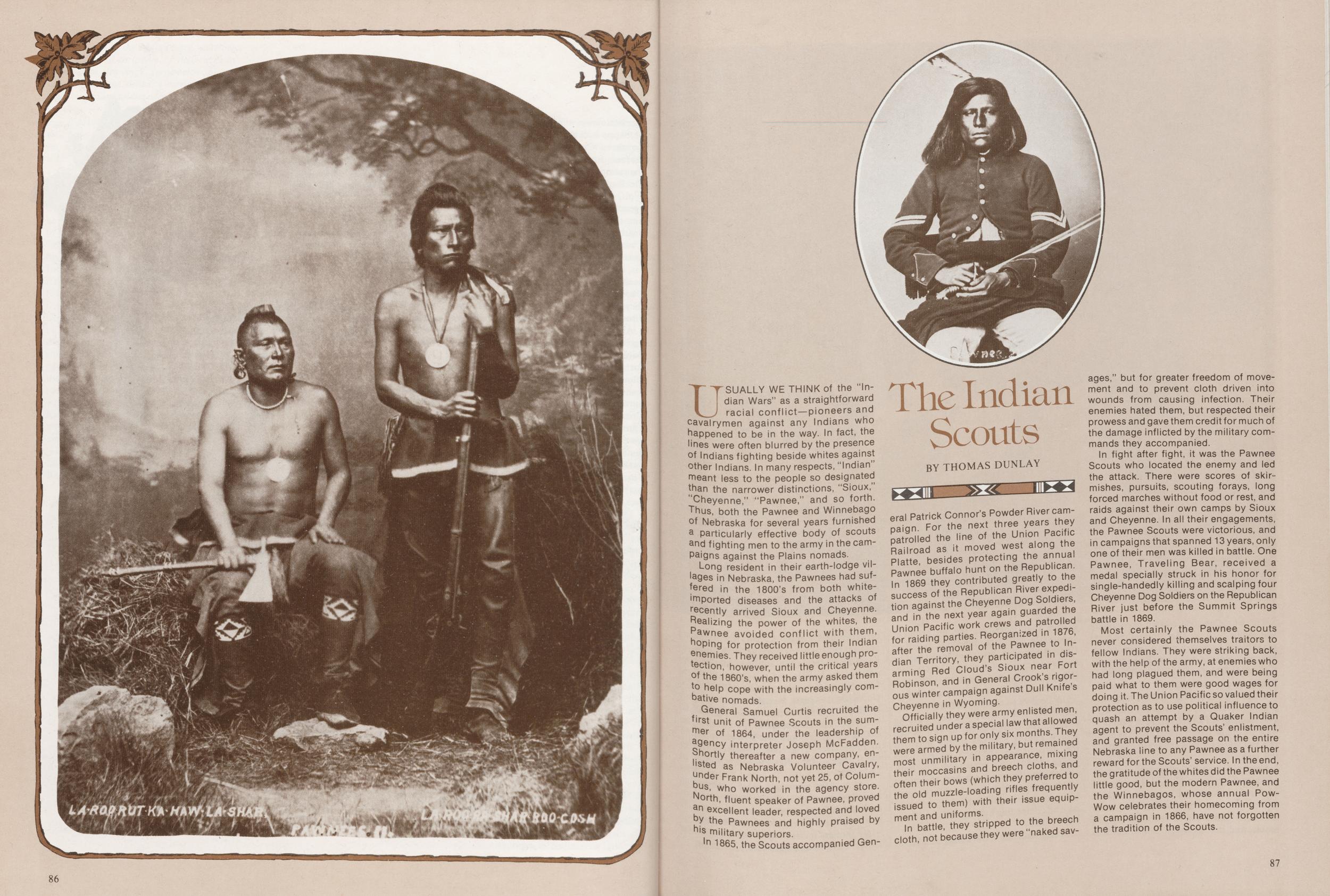 86
86
USUALLY WE THINK of the "Indian Wars" as a straightforward racial conflict—pioneers and cavalrymen against any Indians who happened to be in the way. In fact, the lines were often blurred by the presence of Indians fighting beside whites against other Indians. In many respects, "Indian" meant less to the people so designated than the narrower distinctions, "Sioux," "Cheyenne," "Pawnee," and so forth. Thus, both the Pawnee and Winnebago of Nebraska for several years furnished a particularly effective body of scouts and fighting men to the army in the campaigns against the Plains nomads.
Long resident in their earth-lodge villeges in Nebraska, the Pawnees had suffered in the 1800's from both white-imported diseases and the attacks of recently arrived Sioux and Cheyenne. Realizing the power of the whites, the pawnee avoided conflict with them, hoping for protection from their Indian enemies. They received little enough protection, however, until the critical years of the 1860's, when the army asked them to help cope with the increasingly combative nomads.
General Samuel Curtis recruited the first unit of Pawnee Scouts in the summer of 1864, under the leadership of agency interpreter Joseph McFadden. Shortly thereafter a new company, enilsted as Nebraska Volunteer Cavalry, under Frank North, not yet 25, of Columns, who worked in the agency store. Nrth, fluent speaker of Pawnee, proved an excellent leader, respected and loved by the Pawnees and highly praised by his military superiors.
In 1865, the Scouts accompanied General
The Indian Scouts BY THOMAS DUNLAYPatrick Connor's Powder River camaign For the next three years they Sled the line of the Union Pacific Rai road as it moved west along the Rate besides protecting the annual Pawnee buffalo hunt on the Republican in 1869 they contributed greatly to the access of the Republican Rive, expedition against the Cheyenne Dog Soldiers, and in the next year again guarded he Union Pacific work crews and patrolled for raiding parties. Reorganized in 1876, after he removal of the Pawnee to Indian Territory, they participated in disarming Red Cloud's Sioux near Fort Robinson, and in General Crook's rigorous winter campaign against Dull Knife's Cheyenne in Wyoming.
Officially they were army enlisted men Recruited under a special law that allowed them to sign up for only six months. They were armed by the military, but remained most unitary in appearance mixing their moccasins and breech cloths, and often their bows (which they preferred to the old muzzle-loading rifles frequently issued to them) with their issue equipment and uniforms.
In battle, they stripped to the breech cloth not because they were "naked savages," but for greater freedom of movement and to prevent cloth driven into wounds from causing infection. Their enemies hated them, but respected their prowess and gave them credit for much of the damage inflicted by the military commands they accompanied.
In fight after fight, it was the Pawnee Scouts who located the enemy and led the attack. There were scores of skirmishes, pursuits, scouting forays, long forced marches without food or rest, and raids against their own camps by Sioux and Cheyenne. In all their engagements, the Pawnee Scouts were victorious, and in campaigns that spanned 13 years, only one of their men was killed in battle. One Pawnee, Traveling Bear, received a medal specially struck in his honor for single-handedly killing and scalping four Cheyenne Dog Soldiers on the Republican River just before the Summit Springs battle in 1869.
Most certainly the Pawnee Scouts never considered themselves traitors to fellow Indians. They were striking back, with the help of the army, at enemies who had long plagued them, and were being paid what to them were good wages for doing it. The Union Pacific so valued their protection as to use political influence to quash an attempt by a Quaker Indian agent to prevent the Scouts' enlistment, and granted free passage on the entire Nebraska line to any Pawnee as a further reward for the Scouts' service. In the end, the gratitude of the whites did the Pawnee little good, but the modern Pawnee, and the Winnebagos, whose annual Pow-Wow celebrates their homecoming from a campaign in 1866, have not forgotten the tradition of the Scouts.
87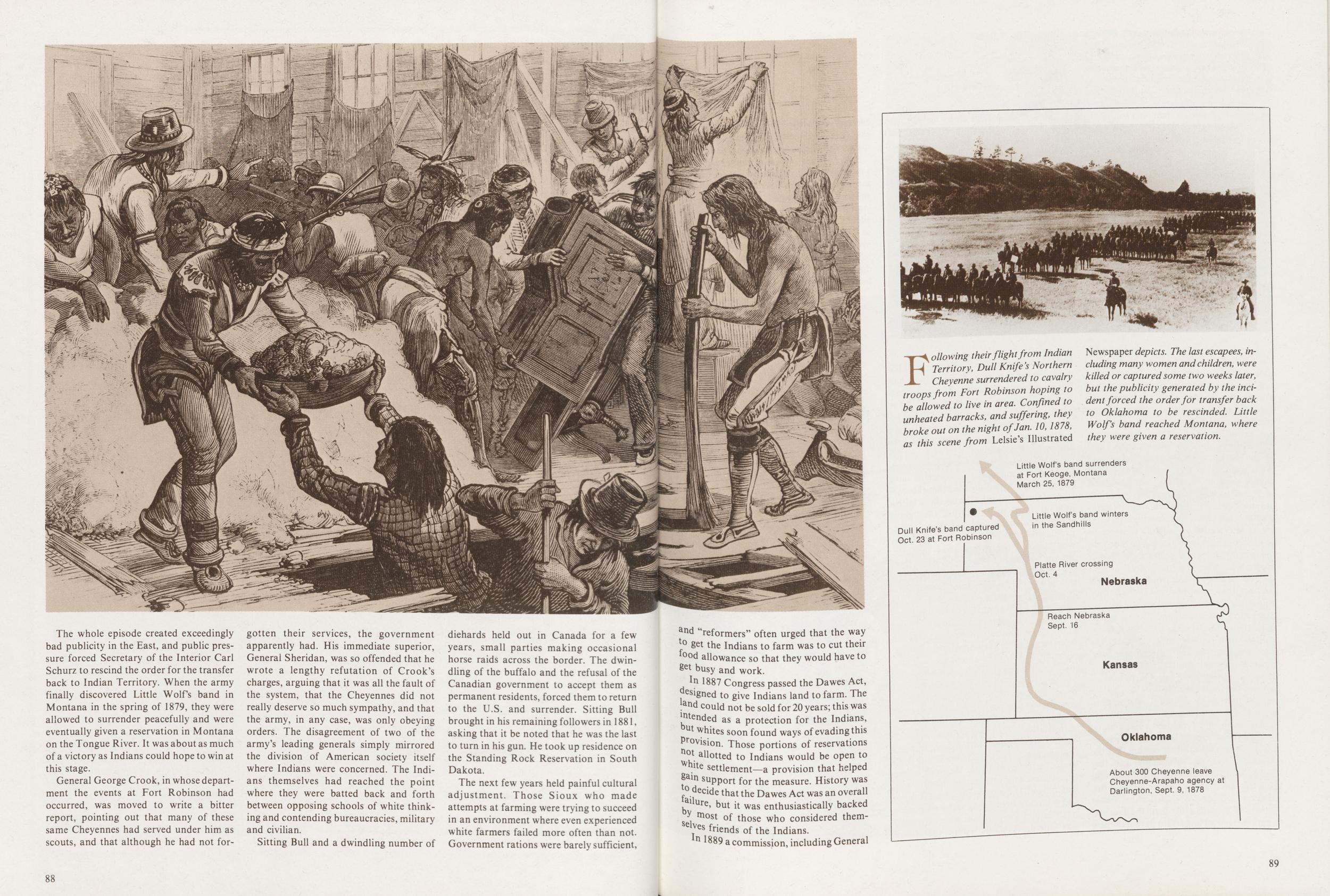
The whole episode created exceedingly bad publicity in the East, and public pressure forced Secretary of the Interior Carl Schurz to rescind the order for the transfer back to Indian Territory. When the army finally discovered Little Wolfs band in Montana in the spring of 1879, they were allowed to surrender peacefully and were eventually given a reservation in Montana on the Tongue River. It was about as much of a victory as Indians could hope to win at this stage.
General George Crook, in whose department the events at Fort Robinson had occurred, was moved to write a bitter report, pointing out that many of these same Cheyennes had served under him as scouts, and that although he had not forgotten their services, the government apparently had. His immediate superior, General Sheridan, was so offended that he wrote a lengthy refutation of Crook's charges, arguing that it was all the fault of the system, that the Cheyennes did not really deserve so much sympathy, and that the army, in any case, was only obeying orders. The disagreement of two of the army's leading generals simply mirrored the division of American society itself where Indians were concerned. The Indians themselves had reached the point where they were batted back and forth between opposing schools of white thinking and contending bureaucracies, military and civilian.
Sitting Bull and a dwindling number of diehards held out in Canada for a few years, small parties making occasional horse raids across the border. The dwindling of the buffalo and the refusal of the Canadian government to accept them as permanent residents, forced them to return to the U.S. and surrender. Sitting Bull brought in his remaining followers in 1881, asking that it be noted that he was the last to turn in his gun. He took up residence on the Standing Rock Reservation in South Dakota.
The next few years held painful cultural adjustment. Those Sioux who made attempts at farming were trying to succeed in an environment where even experienced white farmers failed more often than not. Government rations were barely sufficient,
88and "reformers" often urged that the way to get the Indians to farm was to cut their food allowance so that they would have to get busy and work.
In 1887 Congress passed the Dawes Act, designed to give Indians land to farm. The land could not be sold for 20 years; this was intended as a protection for the Indians, bu* whites soon found ways of evading this Provision. Those portions of reservations not allotted to Indians would be open to white settlement—a provision that helped gain support for the measure. History was to decide that the Dawes Act was an overall bailure, but it was enthusiastically backed by most of those who considered themselves friends of the Indians.
In J889 a commission, including General
Following their flight from Indian Territory, Dull Knife's Northern Cheyenne surrendered to cavalry troops from Fort Robinson hoping to be allowed to live in area. Confined to unhealed barracks, and suffering, they broke out on the night of Jan. 10,1878, as this scene from Lelsie's Illustrated Newspaper depicts. The last escapees, including many women and children, were killed or captured some two weeks later, but the publicity generated by the incident forced the order for transfer back to Oklahoma to be rescinded. Little Wolf's band reached Montana, where they were given a reservation.
Little Wolf's band surrenders at Fort Keoge, Montana March 25, 1879 Little Wolf's band winters Dull Knife's band' captured in the Sandhills Oct. 23 at Fort Robinson Platte River crossing Oct. 4 Nebraska Reach Nebraska Sept. 16 Kansas Oklahoma About 300 Cheyenne leave Cheyenne-Arapaho agency at Darlington, Sept. 9, 1878 89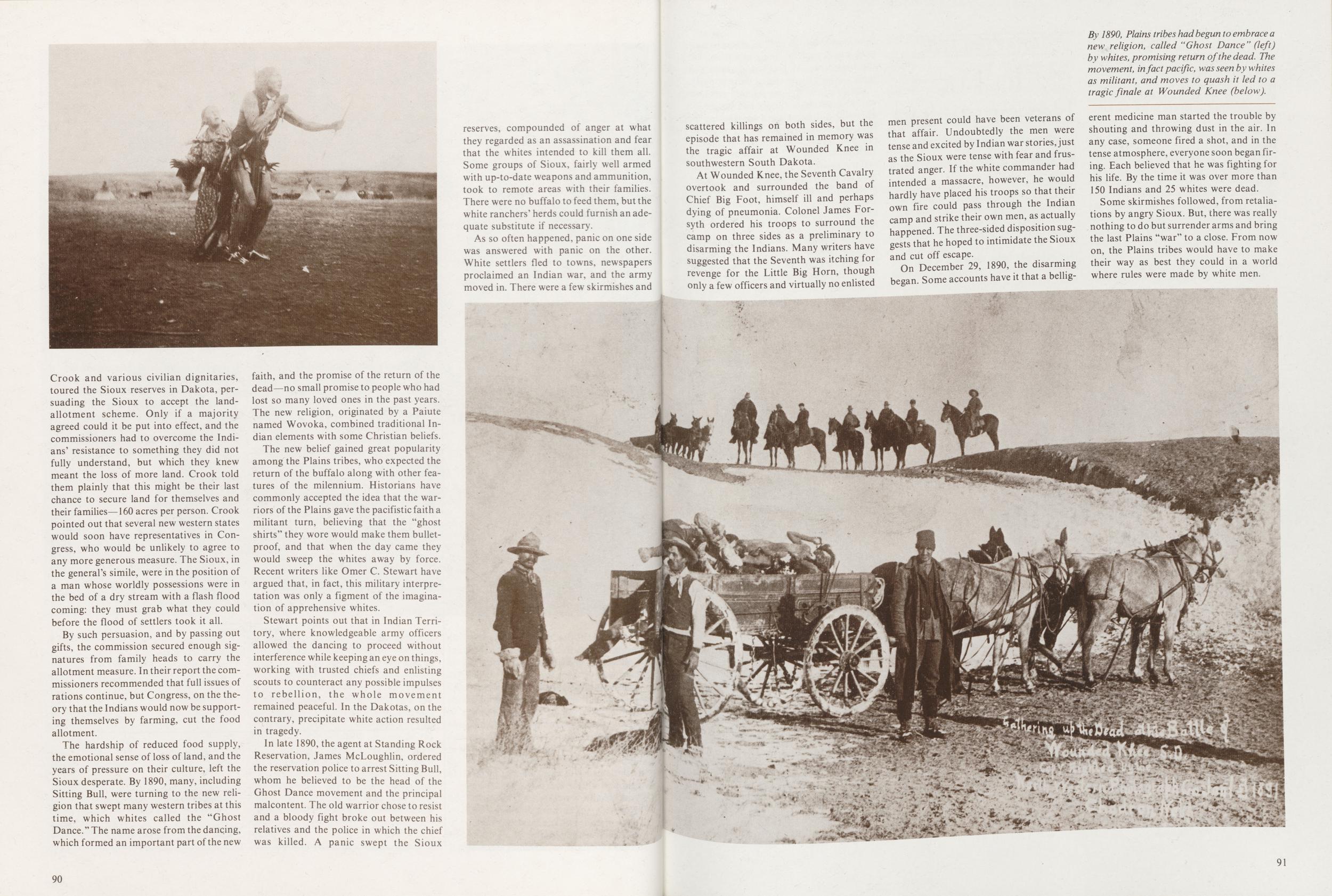
Crook and various civilian dignitaries, toured the Sioux reserves in Dakota, persuading the Sioux to accept the land-allotment scheme. Only if a majority agreed could it be put into effect, and the commissioners had to overcome the Indians' resistance to something they did not fully understand, but which they knew meant the loss of more land. Crook told them plainly that this might be their last chance to secure land for themselves and their families—160 acres per person. Crook pointed out that several new western states would soon have representatives in Congress, who would be unlikely to agree to any more generous measure. The Sioux, in the general's simile, were in the position of a man whose worldly possessions were in the bed of a dry stream with a flash flood coming: they must grab what they could before the flood of settlers took it all.
By such persuasion, and by passing out gifts, the commission secured enough signatures from family heads to carry the allotment measure. In their report the commissioners recommended that full issues of rations continue, but Congress, on the theory that the Indians would now be supporting themselves by farming, cut the food allotment.
The hardship of reduced food supply, the emotional sense of loss of land, and the years of pressure on their culture, left the Sioux desperate. By 1890, many, including Sitting Bull, were turning to the new religion that swept many western tribes at this time, which whites called the "Ghost Dance." The name arose from the dancing, which formed an important part of the new faith, and the promise of the return of the dead—no small promise to people who had lost so many loved ones in the past years. The new religion, originated by a Paiute named Wovoka, combined traditional Indian elements with some Christian beliefs.
The new belief gained great popularity among the Plains tribes, who expected the return of the buffalo along with other features of the milennium. Historians have commonly accepted the idea that the warriors of the Plains gave the pacifistic faith a militant turn, believing that the "ghost shirts" they wore would make them bulletproof, and that when the day came they would sweep the whites away by force. Recent writers like Omer C. Stewart have argued that, in fact, this military interpretation was only a figment of the imagination of apprehensive whites.
Stewart points out that in Indian Territory, where knowledgeable army officers allowed the dancing to proceed without interference while keeping an eye on things, working with trusted chiefs and enlisting scouts to counteract any possible impulses to rebellion, the whole movement remained peaceful. In the Dakotas, on the contrary, precipitate white action resulted in tragedy.
In late 1890, the agent at Standing Rock Reservation, James McLoughlin, ordered the reservation police to arrest Sitting Bull, whom he believed to be the head of the Ghost Dance movement and the principal malcontent. The old warrior chose to resist and a bloody fight broke out between his relatives and the police in which the chief was killed. A panic swept the Sioux reserves, compounded of anger at what they regarded as an assassination and fear that the whites intended to kill them all. Some groups of Sioux, fairly well armed with up-to-date weapons and ammunition, took to remote areas with their families. There were no buffalo to feed them, but the white ranchers' herds could furnish an adequate substitute if necessary.
As so often happened, panic on one side was answered with panic on the other. White settlers fled to towns, newspapers proclaimed an Indian war, and the army moved in. There were a few skirmishes and
90scattered killings on both sides, but the episode that has remained in memory was the tragic affair at Wounded Knee in southwestern South Dakota.
At Wounded Knee, the Seventh Cavalry overtook and surrounded the band of Chief Big Foot, himself ill and perhaps dying of pneumonia. Colonel James Forsyth ordered his troops to surround the camp on three sides as a preliminary to disarming the Indians. Many writers have suggested that the Seventh was itching for revenge for the Little Big Horn, though only a few officers and virtually no enlisted men present could have been veterans of that affair. Undoubtedly the men were tense and excited by Indian war stories, just as the Sioux were tense with fear and frustrated anger. If the white commander had intended a massacre, however, he would hardly have placed his troops so that their own fire could pass through the Indian camp and strike their own men, as actually happened. The three-sided disposition suggests that he hoped to intimidate the Sioux and cut off escape.
On December 29, 1890, the disarming began. Some accounts have it that a belligerent
medicine man started the trouble by shouting and throwing dust in the air. In any case, someone fired a shot, and in the tense atmosphere, everyone soon began firing. Each believed that he was fighting for his life. By the time it was over more than 150 Indians and 25 whites were dead.
Some skirmishes followed, from retaliations by angry Sioux. But, there was really nothing to do but surrender arms and bring the last Plains "war" to a close. From now on, the Plains tribes would have to make their way as best they could in a world where rules were made by white men.
91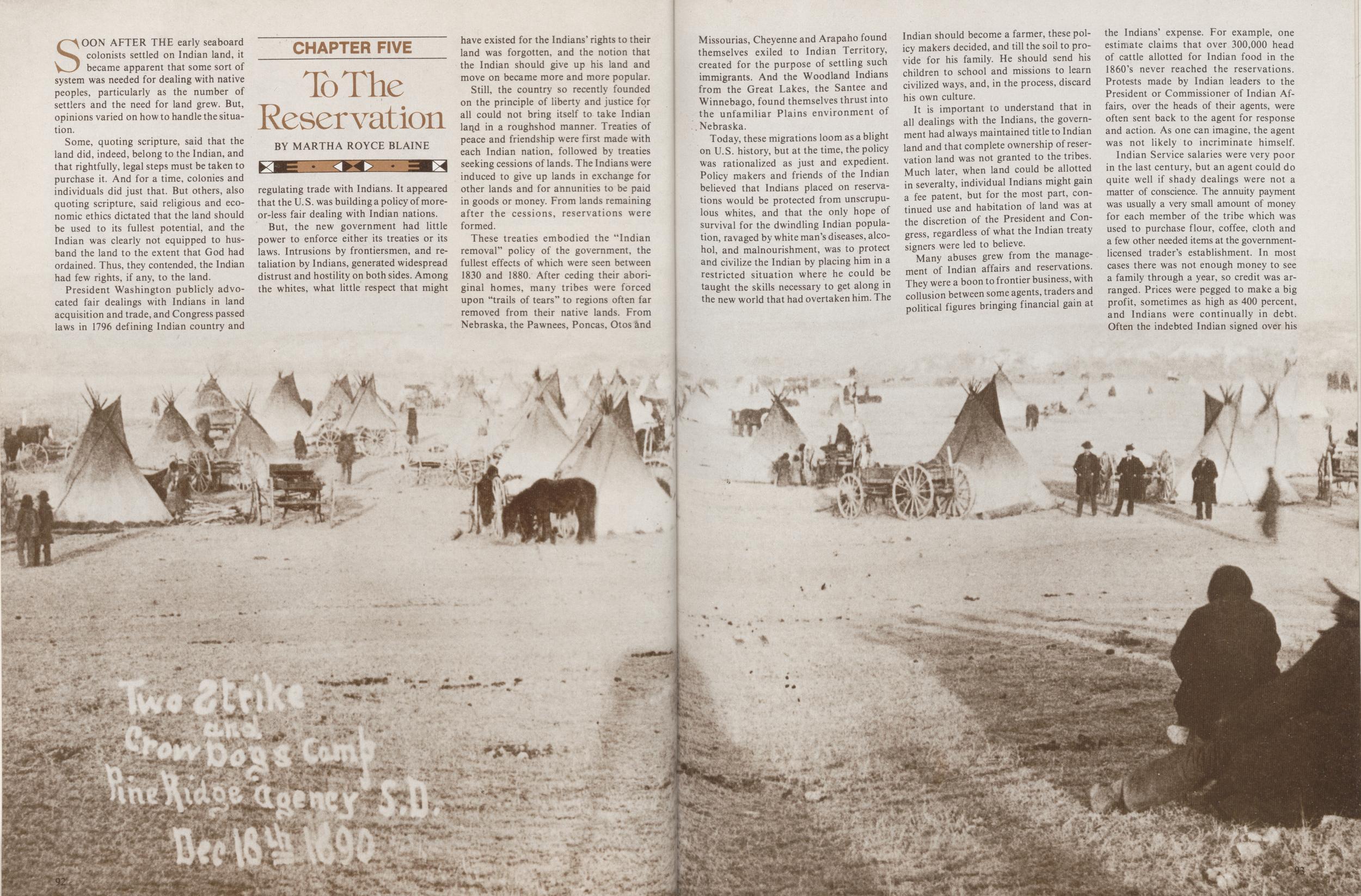
SOON AFTER THE early seaboard colonists settled on Indian land, it became apparent that some sort of system was needed for dealing with native peoples, particularly as the number of settlers and the need for land grew. But, opinions varied on how to handle the situation.
Some, quoting scripture, said that the land did, indeed, belong to the Indian, and that rightfully, legal steps must be taken to purchase it. And for a time, colonies and individuals did just that. But others, also quoting scripture, said religious and economic ethics dictated that the land should be used to its fullest potential, and the Indian was clearly not equipped to husband the land to the extent that God had ordained. Thus, they contended, the Indian had few rights, if any, to the land.
President Washington publicly advocated fair dealings with Indians in land acquisition and trade, and Congress passed laws in 1796 defining Indian country and
CHAPTER FIVE To The Reservation BY MARTHA ROYCE BLAINEregulating trade with Indians. It appeared that the U. S. was building a policy of more-or-less fair dealing with Indian nations.
But, the new government had little power to enforce either its treaties or its laws. Intrusions by frontiersmen, and retaliation by Indians, generated widespread distrust and hostility on both sides. Among the whites, what little respect that might
have existed for the Indians' rights to their land was forgotten, and the notion that the Indian should give up his land and move on became more and more popular.
Still, the country so recently founded on the principle of liberty and justice for all could not bring itself to take Indian laqd in a roughshod manner. Treaties of peace and friendship were first made with each Indian nation, followed by treaties seeking cessions of lands. The Indians were induced to give up lands in exchange for other lands and for annunities to be paid in goods or money. From lands remaining after the cessions, reservations were formed.
These treaties embodied the "Indian removal" policy of the government, the fullest effects of which were seen between 1830 and 1880. After ceding their aboriginal homes, many tribes were forced upon "trails of tears" to regions often far removed from their native lands. From Nebraska, the Pawnees, Poncas, Otos and
Missourias, Cheyenne and Arapaho found themselves exiled to Indian Territory, created for the purpose of settling such immigrants. And the Woodland Indians from the Great Lakes, the Santee and Winnebago, found themselves thrust into the unfamiliar Plains environment of Nebraska.
Today, these migrations loom as a blight on U.S. history, but at the time, the policy was rationalized as just and expedient. Policy makers and friends of the Indian believed that Indians placed on reservations would be protected from unscrupulous whites, and that the only hope of survival for the dwindling Indian population, ravaged by white man's diseases, alcohol, and malnourishment, was to protect and civilize the Indian by placing him in a restricted situation where he could be taught the skills necessary to get along in the new world that had overtaken him. The Indian should become a farmer, these policy makers decided, and till the soil to provide for his family. He should send his children to school and missions to learn civilized ways, and, in the process, discard his own culture.
It is important to understand that in all dealings with the Indians, the government had always maintained title to Indian land and that complete ownership of reservation land was not granted to the tribes. Much later, when land could be allotted in severalty, individual Indians might gain a fee patent, but for the most part, continued use and habitation of land was at the discretion of the President and Congress, regardless of what the Indian treaty signers were led to believe.
Many abuses grew from the management of Indian affairs and reservations. They were a boon to frontier business, with collusion between some agents, traders and political figures bringing financial gain at the Indians' expense. For example, one estimate claims that over 300,000 head of cattle allotted for Indian food in the 1860's never reached the reservations. Protests made by Indian leaders to the President or Commissioner of Indian Affairs, over the heads of their agents, were often sent back to the agent for response and action. As one can imagine, the agent was not likely to incriminate himself.
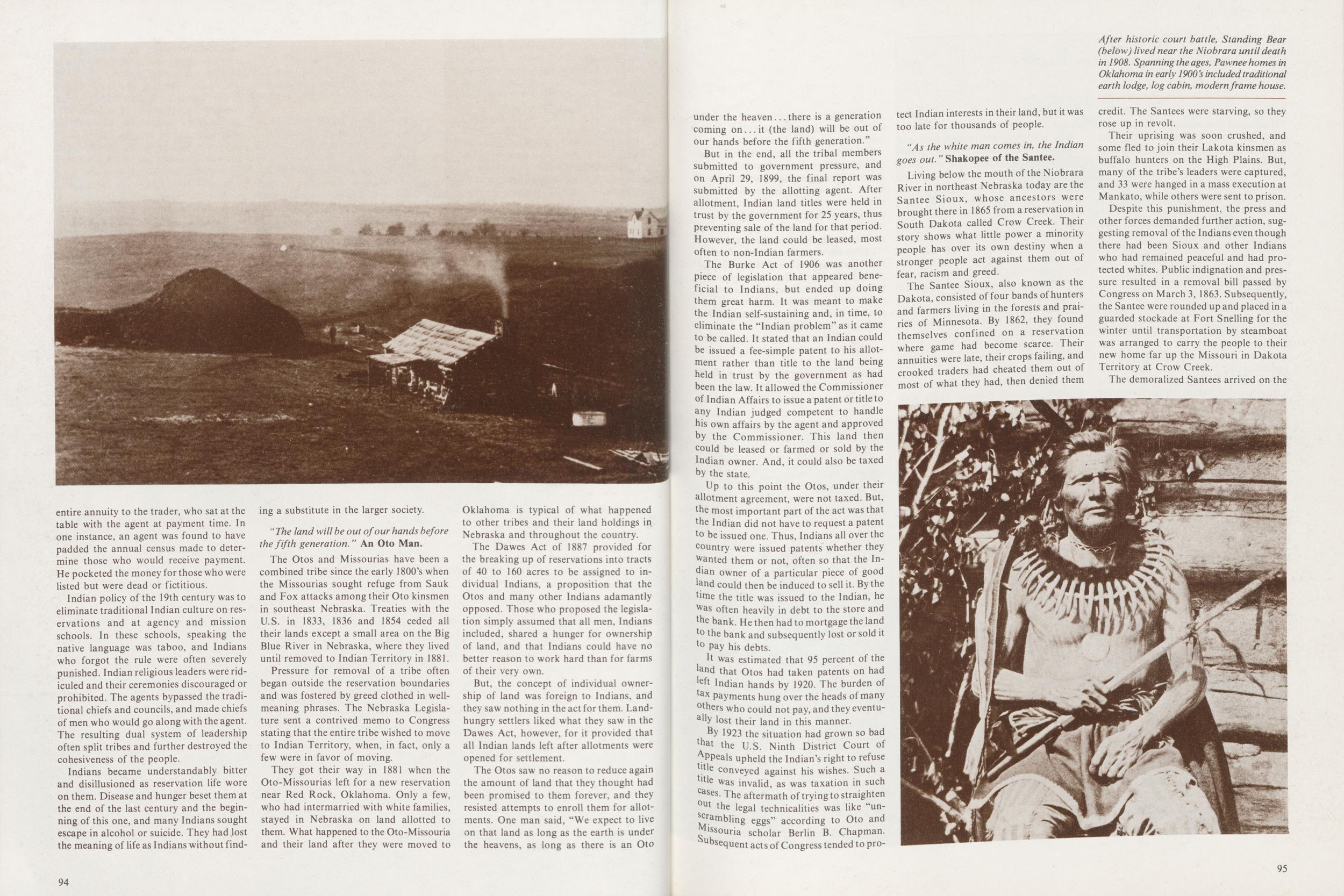
Indian Service salaries were very poor in the last century, but an agent could do quite well if shady dealings were not a matter of conscience. The annuity payment was usually a very small amount of money for each member of the tribe which was used to purchase flour, coffee, cloth and a few other needed items at the government-licensed trader's establishment. In most cases there was not enough money to see a family through a year, so credit was arranged. Prices were pegged to make a big profit, sometimes as high as 400 percent, and Indians were continually in debt. Often the indebted Indian signed over his
entire annuity to the trader, who sat at the table with the agent at payment time. In one instance, an agent was found to have padded the annual census made to determine those who would receive payment. He pocketed the money for those who were listed but were dead or fictitious.
Indian policy of the 19th century was to eliminate traditional Indian culture on reservations and at agency and mission schools. In these schools, speaking the native language was taboo, and Indians who forgot the rule were often severely punished. Indian religious leaders were ridiculed and their ceremonies discouraged or prohibited. The agents bypassed the traditional chiefs and councils, and made chiefs of men who would go along with the agent. The resulting dual system of leadership often split tribes and further destroyed the cohesiveness of the people.
Indians became understandably bitter and disillusioned as reservation life wore on them. Disease and hunger beset them at the end of the last century and the beginning of this one, and many Indians sought escape in alcohol or suicide. They had lost the meaning of life as Indians without finding a substitute in the larger society.
"The land will be out of our hands before the fifth generation." An Oto Man.
The Otos and Missourias have been a combined tribe since the early 1800's when the Missourias sought refuge from Sauk and Fox attacks among their Oto kinsmen in southeast Nebraska. Treaties with the U.S. in 1833, 1836 and 1854 ceded all their lands except a small area on the Big Blue River in Nebraska, where they lived until removed to Indian Territory in 1881.
Pressure for removal of a tribe often began outside the reservation boundaries and was fostered by greed clothed in well-meaning phrases. The Nebraska Legislature sent a contrived memo to Congress stating that the entire tribe wished to move to Indian Territory, when, in fact, only a few were in favor of moving.
They got their way in 1881 when the Oto-Missourias left for a new reservation near Red Rock, Oklahoma. Only a few, who had intermarried with white families, stayed in Nebraska on land allotted to them. What happened to the Oto-Missouria and their land after they were moved to Oklahoma is typical of what happened to other tribes and their land holdings in Nebraska and throughout the country.
The Dawes Act of 1887 provided for the breaking up of reservations into tracts of 40 to 160 acres to be assigned to individual Indians, a proposition that the Otos and many other Indians adamantly opposed. Those who proposed the legislation simply assumed that all men, Indians included, shared a hunger for ownership of land, and that Indians could have no better reason to work hard than for farms of their very own.
But, the concept of individual ownership of land was foreign to Indians, and they saw nothing in the act for them. Land-hungry settlers liked what they saw in the Dawes Act, however, for it provided that all Indian lands left after allotments were opened for settlement.
The Otos saw no reason to reduce again the amount of land that they thought had been promised to them forever, and they resisted attempts to enroll them for allotments. One man said, "We expect to live on that land as long as the earth is under the heavens, as long as there is an Oto
94under the heaven.. .there is a generation coming on... it (the land) will be out of our hands before the fifth generation."
But in the end, all the tribal members submitted to government pressure, and on April 29, 1899, the final report was submitted by the allotting agent. After allotment, Indian land titles were held in trust by the government for 25 years, thus preventing sale of the land for that period. However, the land could be leased, most often to non-Indian farmers.
The Burke Act of 1906 was another piece of legislation that appeared beneficial to Indians, but ended up doing them great harm. It was meant to make the Indian self-sustaining and, in time, to eliminate the "Indian problem" as it came to be called. It stated that an Indian could be issued a fee-simple patent to his allotment rather than title to the land being held in trust by the government as had been the law. It allowed the Commissioner of Indian Affairs to issue a patent or title to any Indian judged competent to handle his own affairs by the agent and approved by the Commissioner. This land then could be leased or farmed or sold by the Indian owner. And, it could also be taxed by the state.
Up to this point the Otos, under their allotment agreement, were not taxed. But, the most important part of the act was that the Indian did not have to request a patent to be issued one. Thus, Indians all over the country were issued patents whether they Wanted them or not, often so that the Indian owner of a particular piece of good !and could then be induced to sell it. By the time the title was issued to the Indian, he was often heavily in debt to the store and lhe bank. He then had to mortgage the land to the bank and subsequently lost or sold it to Pay his debts.
It was estimated that 95 percent of the land that Otos had taken patents on had left Indian hands by 1920. The burden of tax payments hung over the heads of many others who could not pay, and they eventually lost their land in this manner.
By 1923 the situation had grown so bad that the U.S. Ninth District Court of Appeals upheld the Indian's right to refuse title conveyed against his wishes. Such a title was invalid, as was taxation in such cases. The aftermath of trying to straighten out the legal technicalities was like "unscrambling eggs" according to Oto and Missouria scholar Berlin B. Chapman. ubsequent act s of Congress tended to protect Indian interests in their land, but it was too late for thousands of people.
"As the white man comes in, the Indian goes out." Shakopee of the Santee.
Living below the mouth of the Niobrara River in northeast Nebraska today are the Santee Sioux, whose ancestors were brought there in 1865 from a reservation in South Dakota called Crow Creek. Their story shows what little power a minority people has over its own destiny when a stronger people act against them out of fear, racism and greed.
The Santee Sioux, also known as the Dakota, consisted of four bands of hunters and farmers living in the forests and prairies of Minnesota. By 1862, they found themselves confined on a reservation where game had become scarce. Their annuities were late, their crops failing, and crooked traders had cheated them out of most of what they had, then denied them
credit. The Santees were starving, so they rose up in revolt.
Their uprising was soon crushed, and some fled to join their Lakota kinsmen as buffalo hunters on the High Plains. But, many of the tribe's leaders were captured, and 33 were hanged in a mass execution at Mankato, while others were sent to prison.
Despite this punishment, the press and other forces demanded further action, suggesting removal of the Indians even though there had been Sioux and other Indians who had remained peaceful and had protected whites. Public indignation and pressure resulted in a removal bill passed by Congress on March 3, 1863. Subsequently, the Santee were rounded up and placed in a guarded stockade at Fort Snelling for the winter until transportation by steamboat was arranged to carry the people to their new home far up the Missouri in Dakota Territory at Crow Creek.
The demoralized Santees arrived on the
95Surveyors (below) mark out an allotment on the Winnebago Reservation. Various efforts to convert Indians into independent farmers by allotting individual parcels of land only accelerated sale of Indian lands to whites.
hot, vacant plain on June 6, 1863. The Indian agent immediately had what little arable bottomland there was, cultivated and planted. The seeds came up but the young plants soon withered in the scorching summer. There were few horses and guns for hunting.
The account from there on becomes even more forbidding. The population was disproportionately high in women and children because many of the men were being held in prison, and the others had been killed in battle or hanged at Mankato. The women did what was necessary to feed their children, including begging and prostitution.
The agency personnel responsible for doling out the supplies constructed a large vat in which carcasses, heads and entrails of slaughtered cattle, mixed with flour and water, were cooked into a soup. This was apportionated out on a daily basis to the waiting line of hungry people. Soldiers also told of starving Santee women scavenging through horse manure for half-digested kernels of corn to use in making soup.
Why was there not enough food and other necessities provided? When the federal authorities decreed that the Sioux should live at Crow Creek, they also decided that the Santees would become self sufficient, raising their own food. But, successful agriculture at Crow Creek in those days was not even a remote possibility. Still, policy makers persisted in the fiction of self-sufficiency and money was not appropriated by Congress to feed the Indians. In addition, Congress dragged its feet about initiating the survey and sale of their Minnesota reservation, so that funds from that source were not available. Also, annuity payments were forfeited with the dissolving of all treaties in an act of retribution by Congress.
Meanwhile, there were those in Minnesota who were not content to rid themselves of the Sioux, but demanded that the Winnebagos also be removed. So the Winnebagos, too, were shipped off to Crow Creek, while white settlers divided up the tribe's Minnesota land.
Hostilities between the two angry and disillusioned tribes began in the environment of scarcity and bitterness. In the winter of 1863-64, a group of Winnebagos escaped from Crow Creek. A majority of them fled to their friends the Omahas on their reservations in Nebraska. Others made their way back to Minnesota.
Eventually the tribes were resettled in Nebraska on separate reservations. But for some the wounds that occurred never healed and the memories of the hungry times were passed down to succeeding generations. Indian protest movements arise from many sources, one of which is the memory of past wrongs that scarred the spirit and future of a people.
"I am a man. The great spirit made us both." Standing Bear of the Ponca.
There have always been non-Indians
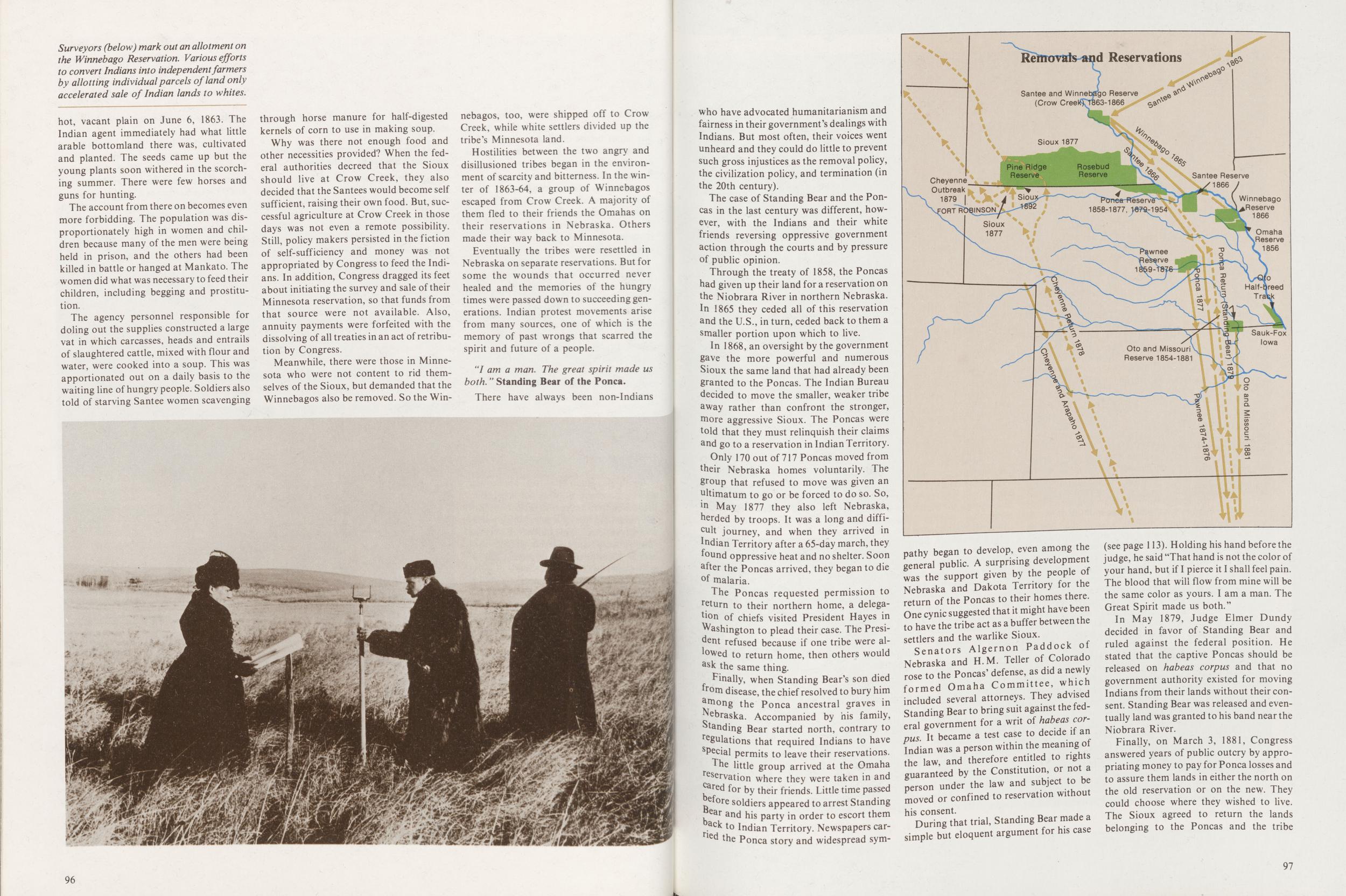 96
96
who have advocated humanitarianism and fairness in their government's dealings with Indians. But most often, their voices went unheard and they could do little to prevent such gross injustices as the removal policy, the civilization policy, and termination (in the 20th century).
The case of Standing Bear and the Poncas in the last century was different, however, with the Indians and their white friends reversing oppressive government action through the courts and by pressure of public opinion.
Through the treaty of 1858, the Poncas had given up their land for a reservation on the Niobrara River in northern Nebraska. In 1865 they ceded all of this reservation and the U.S., in turn, ceded back to them a smaller portion upon which to live.
In 1868, an oversight by the government gave the more powerful and numerous Sioux the same land that had already been granted to the Poncas. The Indian Bureau decided to move the smaller, weaker tribe away rather than confront the stronger, more aggressive Sioux. The Poncas were told that they must relinquish their claims and go to a reservation in Indian Territory.
Only 170 out of 717 Poncas moved from their Nebraska homes voluntarily. The group that refused to move was given an ultimatum to go or be forced to do so. So, in May 1877 they also left Nebraska, herded by troops. It was a long and difficult journey, and when they arrived in Indian Territory after a 65-day march, they found oppressive heat and no shelter. Soon after the Poncas arrived, they began to die of malaria.
The Poncas requested permission to return to their northern home, a delegation of chiefs visited President Hayes in Washington to plead their case. The President refused because if one tribe were allowed to return home, then others would ask the same thing.
Finally, when Standing Bear's son died from disease, the chief resolved to bury him among the Ponca ancestral graves in Nebraska. Accompanied by his family, landing Bear started north, contrary to regulations that required Indians to have sPecial permits to leave their reservations.
The little group arrived at the Omaha Nervation where they were taken in and cared for by their friends. Little time passed before soldiers appeared to arrest Standing Bear and his party in order to escort them back to Indian Territory. Newspapers carried the Ponca story and widespread sympathy began to develop, even among the general public. A surprising development was the support given by the people of Nebraska and Dakota Territory for the return of the Poncas to their homes there. One cynic suggested that it might have been to have the tribe act as a buffer between the settlers and the warlike Sioux.
Senators Algernon Paddock of Nebraska and H.M. Teller of Colorado rose to the Poncas' defense, as did a newly formed Omaha Committee, which included several attorneys. They advised Standing Bear to bring suit against the federal government for a writ of habeas corpus. It became a test case to decide if an Indian was a person within the meaning of the law, and therefore entitled to rights guaranteed by the Constitution, or not a person under the law and subject to be moved or confined to reservation without his consent.
During that trial, Standing Bear made a simple but eloquent argument for his case (see page 113). Holding his hand before the judge, he said "That hand is not the color of your hand, but if I pierce it I shall feel pain. The blood that will flow from mine will be the same color as yours. I am a man. The Great Spirit made us both."
In May 1879, Judge Elmer Dundy decided in favor of Standing Bear and ruled against the federal position. He stated that the captive Poncas should be released on habeas corpus and that no government authority existed for moving Indians from their lands without their consent. Standing Bear was released and eventually land was granted to his band near the Niobrara River.
Finally, on March 3, 1881, Congress answered years of public outcry by appropriating money to pay for Ponca losses and to assure them lands in either the north on the old reservation or on the new. They could choose where they wished to live. The Sioux agreed to return the lands belonging to the Poncas and the tribe
97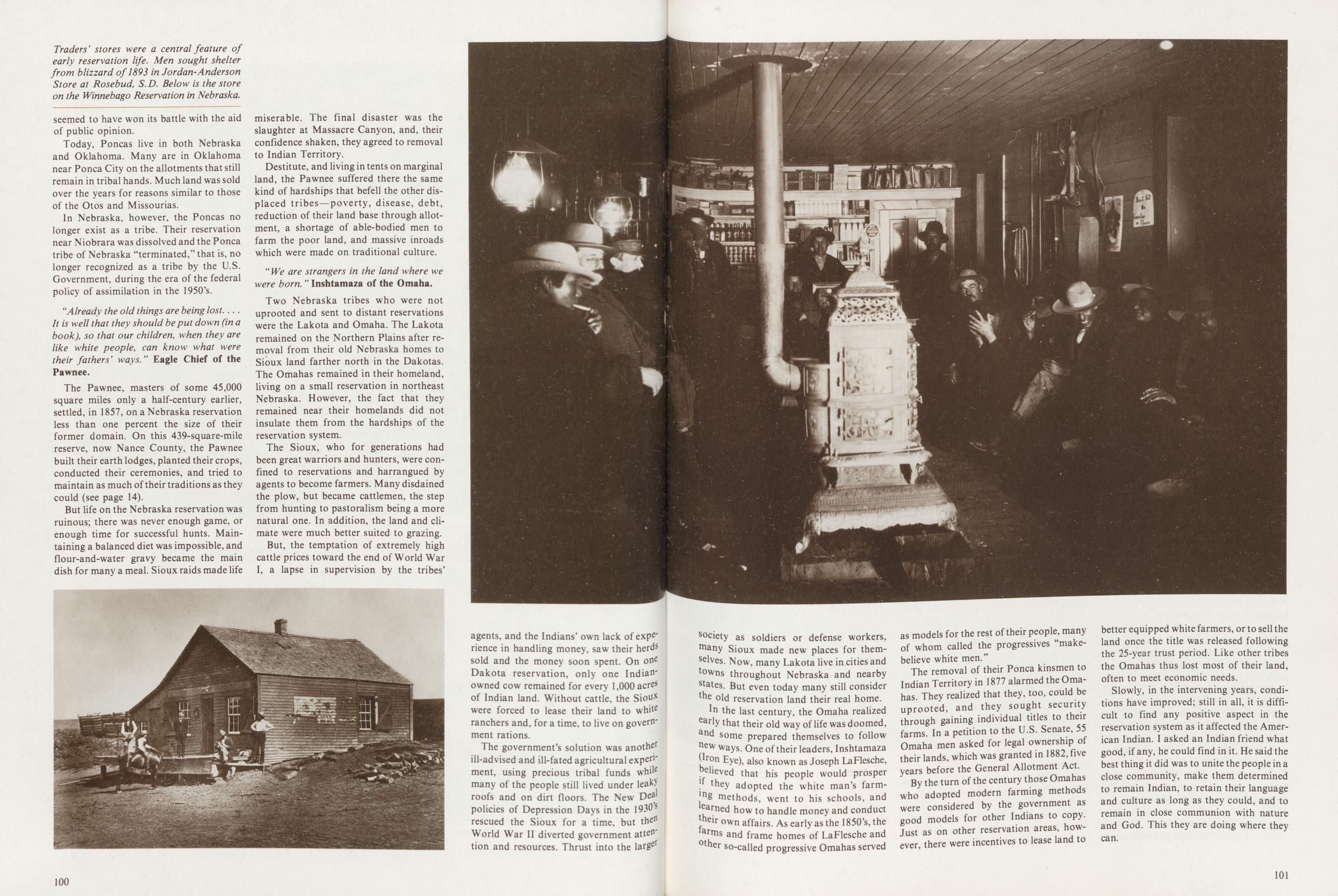
seemed to have won its battle with the aid of public opinion.
Today, Poncas live in both Nebraska and Oklahoma. Many are in Oklahoma near Ponca City on the allotments that still remain in tribal hands. Much land was sold over the years for reasons similar to those of the Otos and Missourias.
In Nebraska, however, the Poncas no longer exist as a tribe. Their reservation near Niobrara was dissolved and the Ponca tribe of Nebraska "terminated," that is, no longer recognized as a tribe by the U.S. Government, during the era of the federal policy of assimilation in the 1950's.
"Already the old things are being lost.... It is well that they should be put down (in a book), so that our children, when they are like white people, can know what were their fathers' ways.' Eagle Chief of the Pawnee.
The Pawnee, masters of some 45,000 square miles only a half-century earlier, settled, in 1857, on a Nebraska reservation less than one percent the size of their former domain. On this 439-square-mile reserve, now Nance County, the Pawnee built their earth lodges, planted their crops, conducted their ceremonies, and tried to maintain as much of their traditions as they could (see page 14).
But life on the Nebraska reservation was ruinous; there was never enough game, or enough time for successful hunts. Maintaining a balanced diet was impossible, and flour-and-water gravy became the main dish for many a meal. Sioux raids made life miserable. The final disaster was the slaughter at Massacre Canyon, and, their confidence shaken, they agreed to removal to Indian Territory.
Destitute, and living in tents on marginal land, the Pawnee suffered there the same kind of hardships that befell the other displaced tribes—poverty, disease, debt, reduction of their land base through allotment, a shortage of able-bodied men to farm the poor land, and massive inroads which were made on traditional culture.
" We are strangers in the land where we were born. " Inshtamaza of the Omaha.
Two Nebraska tribes who were not uprooted and sent to distant reservations were the Lakota and Omaha. The Lakota remained on the Northern Plains after removal from their old Nebraska homes to Sioux land farther north in the Dakotas. The Omahas remained in their homeland, living on a small reservation in northeast Nebraska. However, the fact that they remained near their homelands did not insulate them from the hardships of the reservation system.
The Sioux, who for generations had been great warriors and hunters, were confined to reservations and harrangued by agents to become farmers. Many disdained the plow, but became cattlemen, the step from hunting to pastoralism being a more natural one. In addition, the land and climate were much better suited to grazing.
But, the temptation of extremely high cattle prices toward the end of World War I, a lapse in supervision by the tribes'
agents, and the Indians' own lack of experience in handling money, saw their herds sold and the money soon spent. On one Dakota reservation, only one Indian-owned cow remained for every 1,000 acres of Indian land. Without cattle, the Sioux were forced to lease their land to white ranchers and, for a time, to live on government rations.
The government's solution was another ill-advised and ill-fated agricultural experiment, using precious tribal funds while many of the people still lived under leaky roofs and on dirt floors. The New Deal policies of Depression Days in the 1930 rescued the Sioux for a time, but them World War II diverted government attention and resources. Thrust into the larger
100society as soldiers or defense workers, many Sioux made new places for themselves. Now, many Lakota live in cities and towns throughout Nebraska and nearby states. But even today many still consider the old reservation land their real home.
In the last century, the Omaha realized earlV that their old way of life was doomed, and some prepared themselves to follow new ways. One of their leaders, Inshtamaza (Iron Eye), also known as Joseph LaFlesche, believed that his people would prosper if they adopted the white man's farming methods, went to his schools, and earned how to handle money and conduct their own affairs. As early as the 1850's, the farms and frame homes of LaFlesche and other so-called progressive Omahas served as models for the rest of their people, many of whom called the progressives "make-believe white men."
The removal of their Ponca kinsmen to Indian Territory in 1877 alarmed the Omahas. They realized that they, too, could be uprooted, and they sought security through gaining individual titles to their farms. In a petition to the U.S. Senate, 55 Omaha men asked for legal ownership of their lands, which was granted in 1882, five years before the General Allotment Act.
By the turn of the century those Omahas who adopted modern farming methods were considered by the government as good models for other Indians to copy. Just as on other reservation areas, however, there were incentives to lease land to better equipped white farmers, or to sell the land once the title was released following the 25-year trust period. Like other tribes the Omahas thus lost most of their land, often to meet economic needs.
Slowly, in the intervening years, conditions have improved; still in all, it is difficult to find any positive aspect in the reservation system as it affected the American Indian. I asked an Indian friend what good, if any, he could find in it. He said the best thing it did was to unite the people in a close community, make them determined to remain Indian, to retain their language and culture as long as they could, and to remain in close communion with nature and God. This they are doing where they can.
101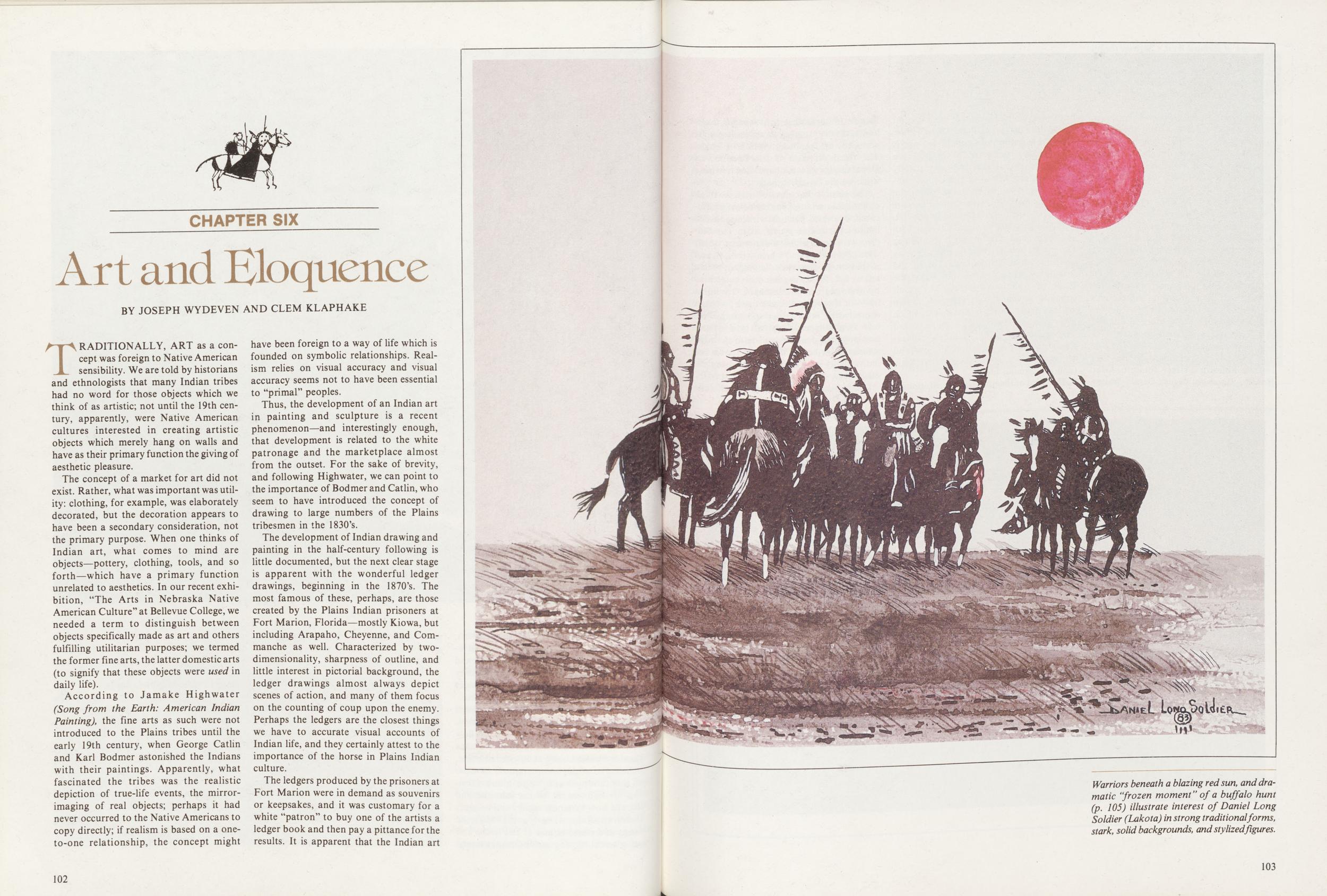
CHAPTER SIX Art and Eloquence
BY JOSEPH WYDEVEN AND CLEM KLAPHAKETRADITIONALLY, ART as a concept was foreign to Native American sensibility. We are told by historians and ethnologists that many Indian tribes had no word for those objects which we think of as artistic; not until the 19th century, apparently, were Native American cultures interested in creating artistic objects which merely hang on walls and have as their primary function the giving of aesthetic pleasure.
The concept of a market for art did not exist. Rather, what was important was utility: clothing, for example, was elaborately decorated, but the decoration appears to have been a secondary consideration, not the primary purpose. When one thinks of Indian art, what comes to mind are objects—pottery, clothing, tools, and so forth—which have a primary function unrelated to aesthetics. In our recent exhibition, "The Arts in Nebraska Native American Culture" at Bellevue College, we needed a term to distinguish between objects specifically made as art and others fulfilling utilitarian purposes; we termed the former fine arts, the latter domestic arts (to signify that these objects were used in daily life).
According to Jamake Highwater (Song from the Earth: American Indian Painting), the fine arts as such were not introduced to the Plains tribes until the early 19th century, when George Catlin and Karl Bodmer astonished the Indians with their paintings. Apparently, what fascinated the tribes was the realistic depiction of true-life events, the mirror-imaging of real objects; perhaps it had never occurred to the Native Americans to copy directly; if realism is based on a one-to-one relationship, the concept might have been foreign to a way of life which is founded on symbolic relationships. Realism relies on visual accuracy and visual accuracy seems not to have been essential to "primal" peoples.
Thus, the development of an Indian art in painting and sculpture is a recent phenomenon—and interestingly enough, that development is related to the white patronage and the marketplace almost from the outset. For the sake of brevity, and following Highwater, we can point to the importance of Bodmer and Catlin, who seem to have introduced the concept of drawing to large numbers of the Plains tribesmen in the 1830's.
The development of Indian drawing and painting in the half-century following is little documented, but the next clear stage is apparent with the wonderful ledger drawings, beginning in the 1870's. The most famous of these, perhaps, are those created by the Plains Indian prisoners at Fort Marion, Florida—mostly Kiowa, but including Arapaho, Cheyenne, and Commanche as well. Characterized by two-dimensionality, sharpness of outline, and little interest in pictorial background, the ledger drawings almost always depict scenes of action, and many of them focus on the counting of coup upon the enemy. Perhaps the ledgers are the closest things we have to accurate visual accounts of Indian life, and they certainly attest to the importance of the horse in Plains Indian culture.
The ledgers produced by the prisoners at Fort Marion were in demand as souvenirs or keepsakes, and it was customary for a white "patron" to buy one of the artists a ledger book and then pay a pittance for the results. It is apparent that the Indian art
102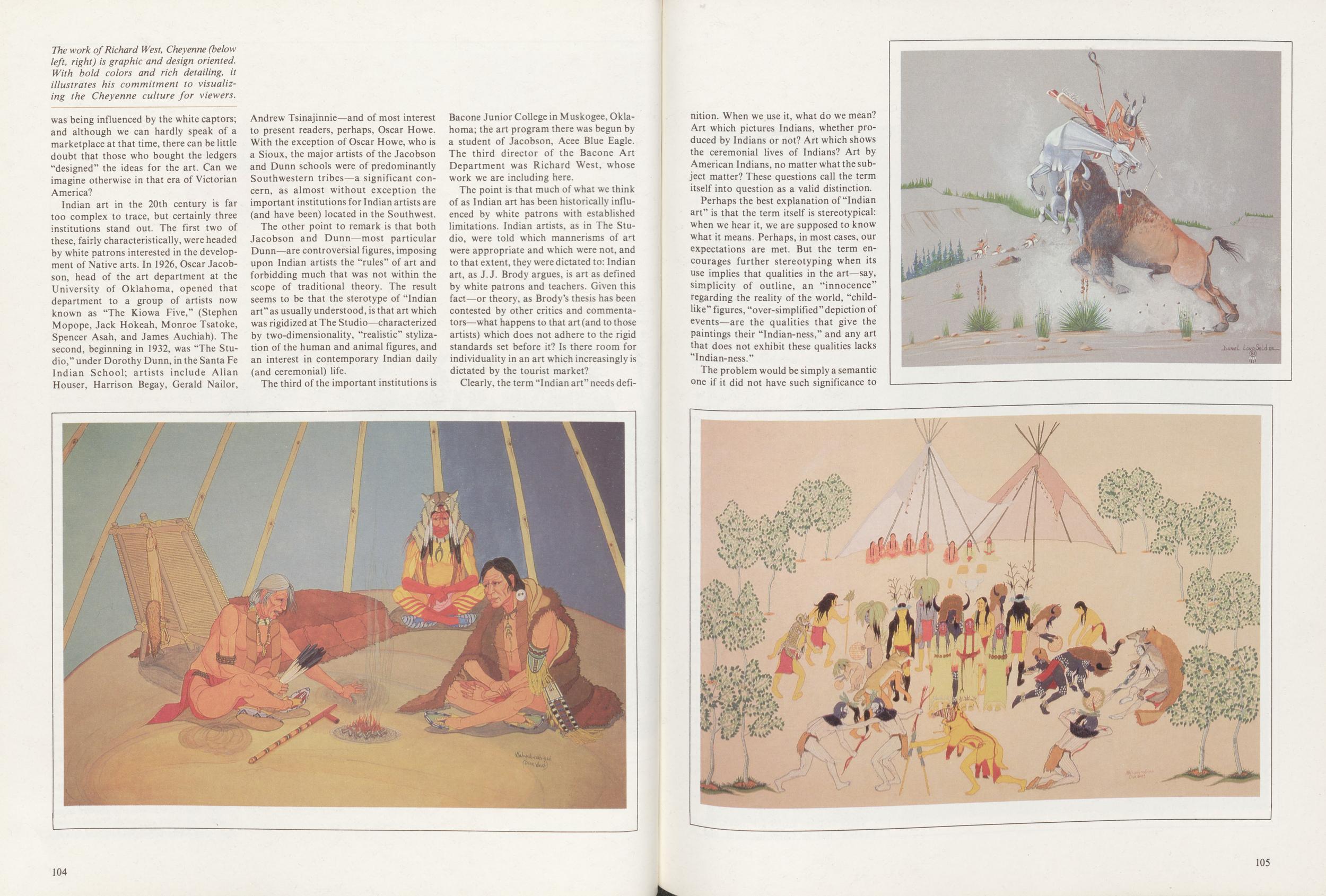
was being influenced by the white captors; and although we can hardly speak of a marketplace at that time, there can be little doubt that those who bought the ledgers "designed" the ideas for the art. Can we imagine otherwise in that era of Victorian America?
Indian art in the 20th century is far too complex to trace, but certainly three institutions stand out. The first two of these, fairly characteristically, were headed by white patrons interested in the development of Native arts. In 1926, Oscar Jacobson, head of the art department at the University of Oklahoma, opened that department to a group of artists now known as "The Kiowa Five," (Stephen Mopope, Jack Hokeah, Monroe Tsatoke, Spencer Asah, and James Auchiah). The second, beginning in 1932, was "The Studio," under Dorothy Dunn, in the Santa Fe Indian School; artists include Allan Houser, Harrison Begay, Gerald Nailor, Andrew Tsinajinnie—and of most interest to present readers, perhaps, Oscar Howe. With the exception of Oscar Howe, who is a Sioux, the major artists of the Jacobson and Dunn schools were of predominantly Southwestern tribes—a significant concern, as almost without exception the important institutions for Indian artists are (and have been) located in the Southwest.
The other point to remark is that both Jacobson and Dunn—most particular Dunn—are controversial figures, imposing upon Indian artists the "rules" of art and forbidding much that was not within the scope of traditional theory. The result seems to be that the sterotype of "Indian art" as usually understood, is that art which was rigidized at The Studio—characterized by two-dimensionality, "realistic" stylization of the human and animal figures, and an interest in contemporary Indian daily (and ceremonial) life.
The third of the important institutions is Bacone Junior College in Muskogee, Oklahoma; the art program there was begun by a student of Jacobson, Acee Blue Eagle. The third director of the Bacone Art Department was Richard West, whose work we are including here.
The point is that much of what we think of as Indian art has been historically influenced by white patrons with established limitations. Indian artists, as in The Studio, were told which mannerisms of art were appropriate and which were not, and to that extent, they were dictated to: Indian art, as J.J. Brody argues, is art as defined by white patrons and teachers. Given this fact—or theory, as Brody's thesis has been contested by other critics and commentators—what happens to that art (and to those artists) which does not adhere to the rigid standards set before it? Is there room for individuality in an art which increasingly is dictated by the tourist market?
Clearly, the term "Indian art" needs definition.
104When we use it, what do we mean? Art which pictures Indians, whether produced by Indians or not? Art which shows the ceremonial lives of Indians? Art by American Indians, no matter what the subject matter? These questions call the term itself into question as a valid distinction.
Perhaps the best explanation of "Indian art" is that the term itself is stereotypical: when we hear it, we are supposed to know what it means. Perhaps, in most cases, our expectations are met. But the term encourages further stereotyping when its use implies that qualities in the art—say, simplicity of outline, an "innocence" regarding the reality of the world, "child-like" figures, "over-simplified "depiction of events—are the qualities that give the paintings their "Indian-ness," and any art that does not exhibit these qualities lacks "Indian-ness."
The problem would be simply a semantic one if it did not have such significance to
105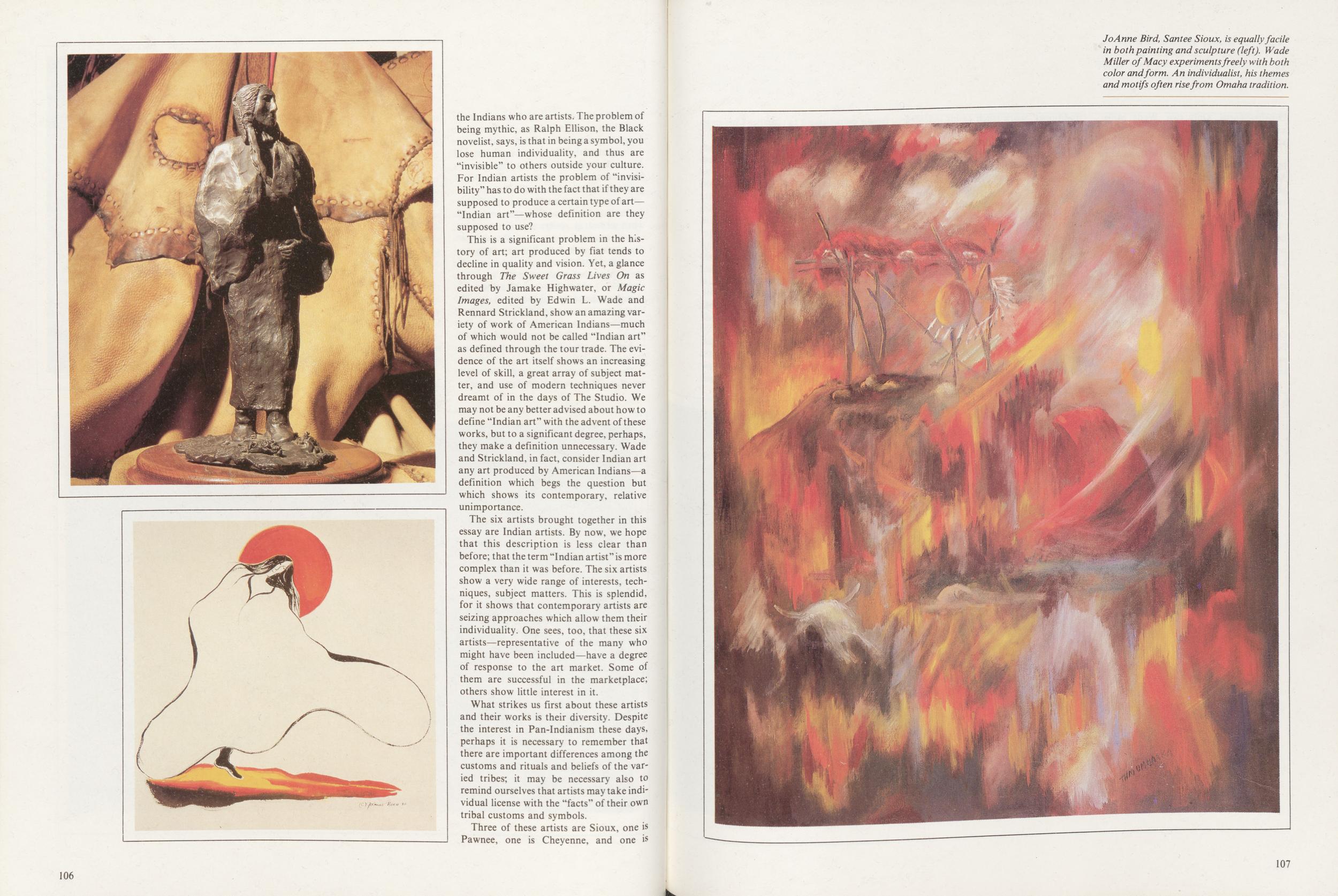
the Indians who are artists. The problem of being mythic, as Ralph Ellison, the Black novelist, says, is that in being a symbol, you lose human individuality, and thus are "invisible" to others outside your culture. For Indian artists the problem of "invisibility" has to do with the fact that if they are supposed to produce a certain type of art—"Indian art"—whose definition are they supposed to use?
This is a significant problem in the history of art; art produced by fiat tends to decline in quality and vision. Yet, a glance through The Sweet Grass Lives On as edited by Jamake Highwater, or Magic Images, edited by Edwin L. Wade and Rennard Strickland, show an amazing variety of work of American Indians—much of which would not be called "Indian art" as defined through the tour trade. The evidence of the art itself shows an increasing level of skill, a great array of subject matter, and use of modern techniques never dreamt of in the days of The Studio. We may not be any better advised about how to define "Indian art" with the advent of these works, but to a significant degree, perhaps, they make a definition unnecessary. Wade and Strickland, in fact, consider Indian art any art produced by American Indians—a definition which begs the question but which shows its contemporary, relative unimportance.
The six artists brought together in this essay are Indian artists. By now, we hope that this description is less clear than before; that the term "Indian artist" is more complex than it was before. The six artists show a very wide range of interests, techniques, subject matters. This is splendid, for it shows that contemporary artists are seizing approaches which allow them their individuality. One sees, too, that these six artists—representative of the many who might have been included—have a degree of response to the art market. Some of them are successful in the marketplace; others show little interest in it.
What strikes us first about these artists and their works is their diversity. Despite the interest in Pan-Indianism these days, perhaps it is necessary to remember that there are important differences among the customs and rituals and beliefs of the varied tribes; it may be necessary also to remind ourselves that artists may take individual license with the "facts" of their own tribal customs and symbols.
Three of these artists are Sioux, one is Pawnee, one is Cheyenne, and one is
106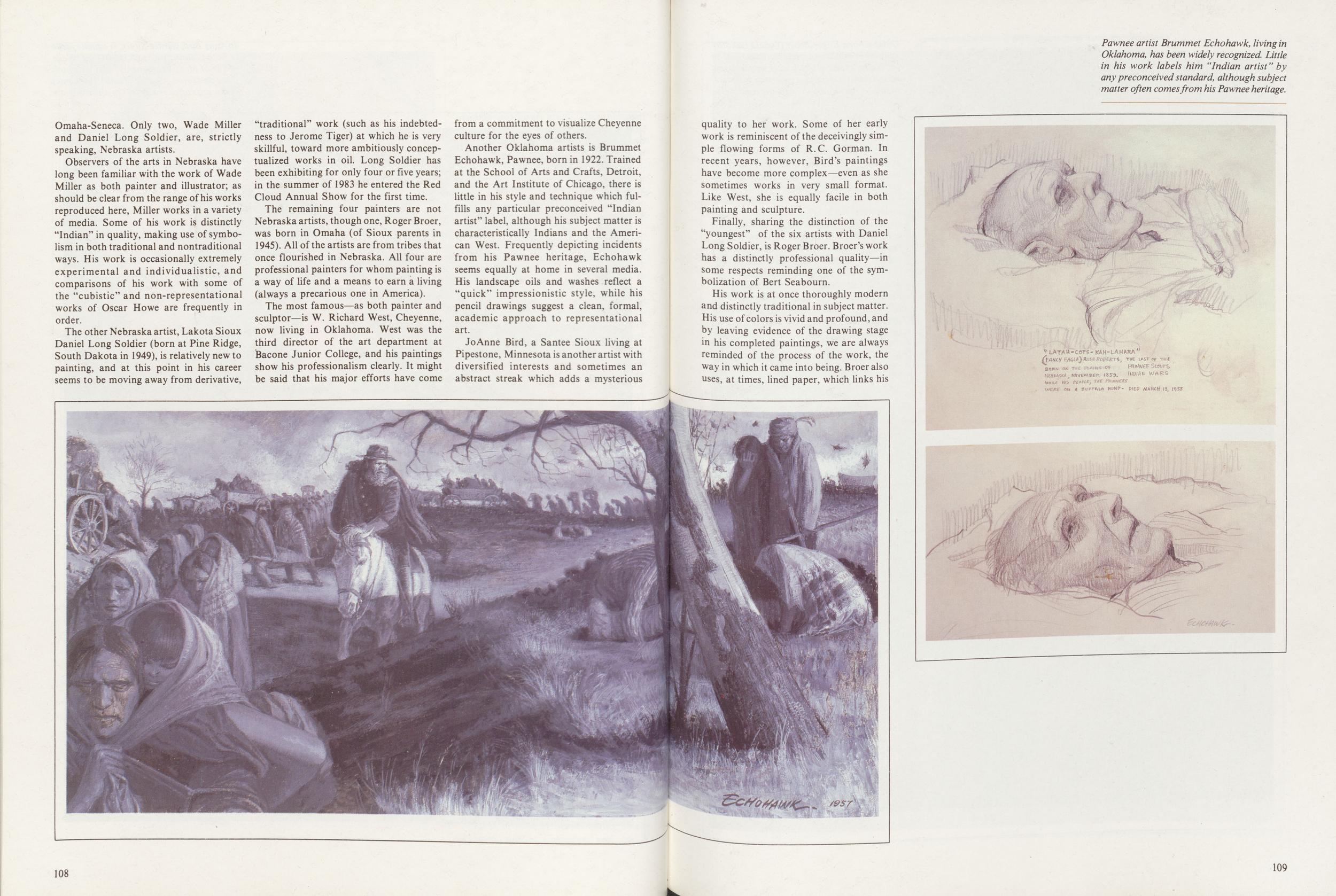
Omaha-Seneca. Only two, Wade Miller and Daniel Long Soldier, are, strictly speaking, Nebraska artists.
Observers of the arts in Nebraska have long been familiar with the work of Wade Miller as both painter and illustrator; as should be clear from the range of his works reproduced here, Miller works in a variety of media. Some of his work is distinctly "Indian" in quality, making use of symbolism in both traditional and nontraditional ways. His work is occasionally extremely experimental and individualistic, and comparisons of his work with some of the "cubistic" and non-representational works of Oscar Howe are frequently in order.
The other Nebraska artist, Lakota Sioux Daniel Long Soldier (born at Pine Ridge, South Dakota in 1949), is relatively new to painting, and at this point in his career seems to be moving away from derivative, "traditional" work (such as his indebtedness to Jerome Tiger) at which he is very skillful, toward more ambitiously conceptualized works in oil. Long Soldier has been exhibiting for only four or five years; in the summer of 1983 he entered the Red Cloud Annual Show for the first time.
The remaining four painters are not Nebraska artists, though one, Roger Broer, was born in Omaha (of Sioux parents in 1945). All of the artists are from tribes that once flourished in Nebraska. All four are professional painters for whom painting is a way of life and a means to earn a living (always a precarious one in America).
The most famous—as both painter and sculptor—is W. Richard West, Cheyenne, now living in Oklahoma. West was the third director of the art department at Bacone Junior College, and his paintings show his professionalism clearly. It might be said that his major efforts have come from a commitment to visualize Cheyenne culture for the eyes of others.
Another Oklahoma artists is Brummet Echohawk, Pawnee, born in 1922. Trained at the School of Arts and Crafts, Detroit, and the Art Institute of Chicago, there is little in his style and technique which fulfills any particular preconceived "Indian artist" label, although his subject matter is characteristically Indians and the American West. Frequently depicting incidents from his Pawnee heritage, Echohawk seems equally at home in several media. His landscape oils and washes reflect a "quick" impressionistic style, while his pencil drawings suggest a clean, formal, academic approach to representational art.
JoAnne Bird, a Santee Sioux living at Pipestone, Minnesota is another artist with diversified interests and sometimes an abstract streak which adds a mysterious
108quality to her work. Some of her early work is reminiscent of the deceivingly simple flowing forms of R.C. Gorman. In recent years, however, Bird's paintings have become more complex—even as she sometimes works in very small format. Like West, she is equally facile in both painting and sculpture.
Finally, sharing the distinction of the "youngest" of the six artists with Daniel Long Soldier, is Roger Broer. Broer's work has a distinctly professional quality—in some respects reminding one of the symbolization of Bert Seabourn.
His work is at once thoroughly modern and distinctly traditional in subject matter. His use of colors is vivid and profound, and by leaving evidence of the drawing stage in his completed paintings, we are always reminded of the process of the work, the way in which it came into being. Broer also uses, at times, lined paper, which links his
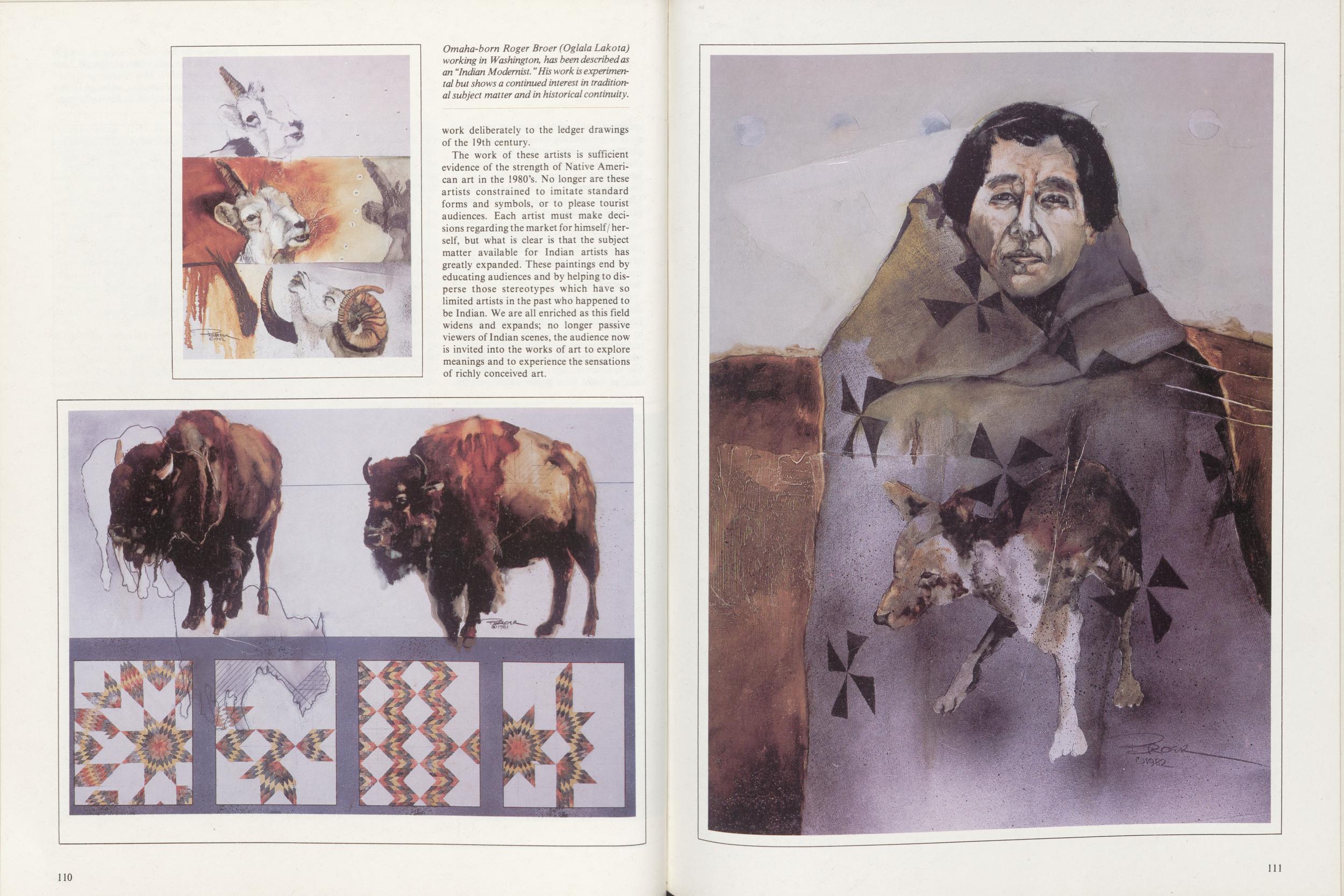
Omaha-bom Roger Broer (Oglala Lakota) working in Washington, has been described as an "Indian Modernist. "His work is experimental but shows a continued interest in traditional subject matter and in historical continuity.
work deliberately to the ledger drawings of the 19th century.
The work of these artists is sufficient evidence of the strength of Native American art in the 1980's. No longer are these artists constrained to imitate standard forms and symbols, or to please tourist audiences. Each artist must make decisions regarding the market for himself/ herself, but what is clear is that the subject matter available for Indian artists has greatly expanded. These paintings end by educating audiences and by helping to disperse those stereotypes which have so limited artists in the past who happened to be Indian. We are all enriched as this field widens and expands; no longer passive viewers of Indian scenes, the audience now is invited into the works of art to explore meanings and to experience the sensations of richly conceived art.
110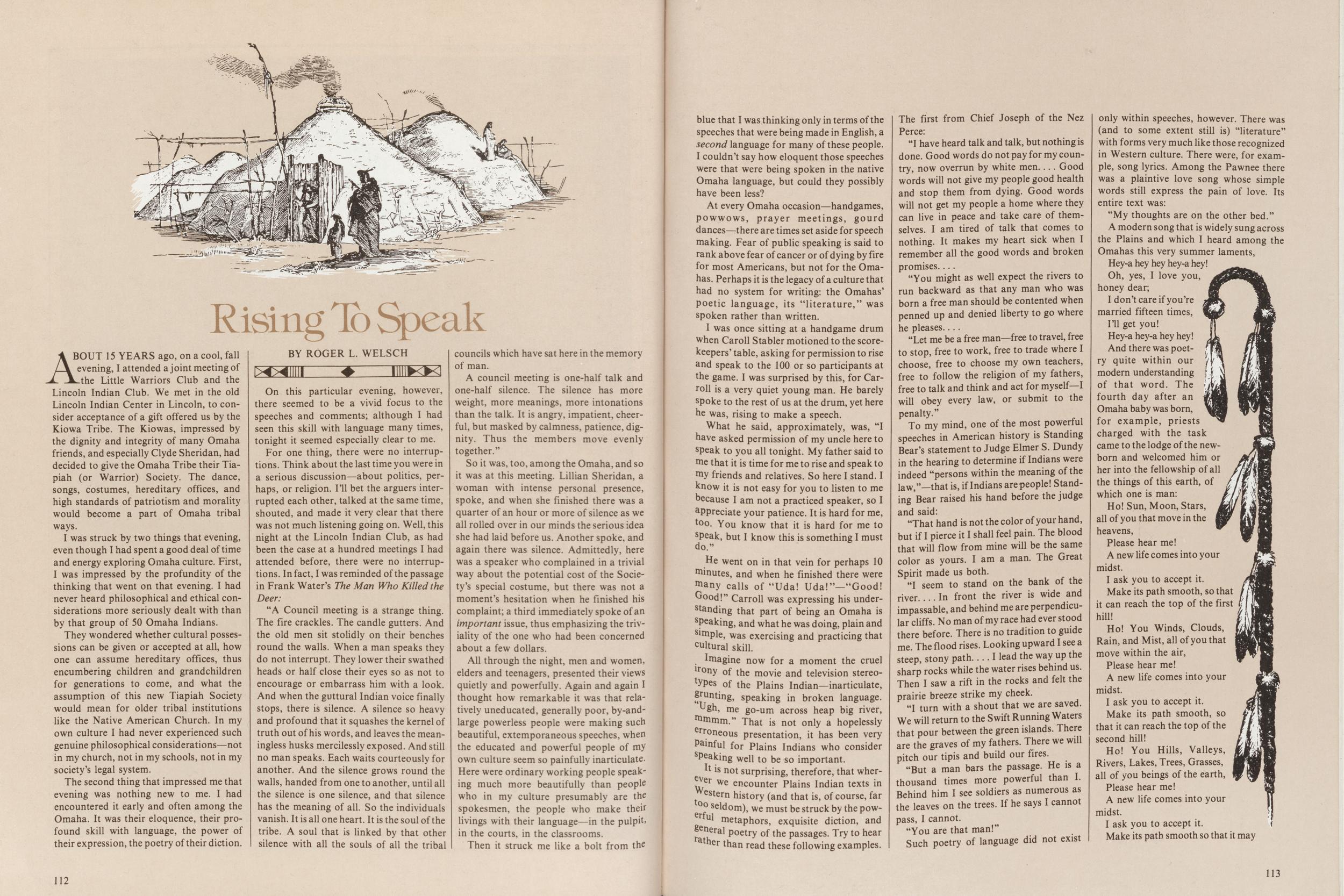
ABOUT 15 YEARS ago, on a cool, fall evening, I attended a joint meeting of the Little Warriors Club and the Lincoln Indian Club. We met in the old Lincoln Indian Center in Lincoln, to consider acceptance of a gift offered us by the Kiowa Tribe. The Kiowas, impressed by the dignity and integrity of many Omaha friends, and especially Clyde Sheridan, had decided to give the Omaha Tribe their Tiapiah (or Warrior) Society. The dance, songs, costumes, hereditary offices, and high standards of patriotism and morality would become a part of Omaha tribal ways.
I was struck by two things that evening, even though I had spent a good deal of time and energy exploring Omaha culture. First, I was impressed by the profundity of the thinking that went on that evening. I had never heard philosophical and ethical considerations more seriously dealt with than by that group of 50 Omaha Indians.
They wondered whether cultural possessions can be given or accepted at all, how one can assume hereditary offices, thus encumbering children and grandchildren for generations to come, and what the assumption of this new Tiapiah Society would mean for older tribal institutions like the Native American Church. In my own culture I had never experienced such genuine philosophical considerations—not in my church, not in my schools, not in my society's legal system.
The second thing that impressed me that evening was nothing new to me. I had encountered it early and often among the Omaha. It was their eloquence, their profound skill with language, the power of their expression, the poetry of their diction.
BY ROGER L. WELSCHOn this particular evening, however, there seemed to be a vivid focus to the speeches and comments; although I had seen this skill with language many times, tonight it seemed especially clear to me.
For one thing, there were no interruptions. Think about the last time you were in a serious discussion—about politics, perhaps, or religion. Til bet the arguers interrupted each other, talked at the same time, shouted, and made it very clear that there was not much listening going on. Well, this night at the Lincoln Indian Club, as had been the case at a hundred meetings I had attended before, there were no interruptions. In fact, I was reminded of the passage in Frank Water's The Man Who Killed the Deer:
"A Council meeting is a strange thing. The fire crackles. The candle gutters. And the old men sit stolidly on their benches round the walls. When a man speaks they do not interrupt. They lower their swathed heads or half close their eyes so as not to encourage or embarrass him with a look. And when the guttural Indian voice finally stops, there is silence. A silence so heavy and profound that it squashes the kernel of truth out of his words, and leaves the meaningless husks mercilessly exposed. And still no man speaks. Each waits courteously for another. And the silence grows round the walls, handed from one to another, until all the silence is one silence, and that silence has the meaning of all. So the individuals vanish. It is all one heart. It is the soul of the tribe. A soul that is linked by that other silence with all the souls of all the tribal councils which have sat here in the memory of man.
A council meeting is one-half talk and one-half silence. The silence has more weight, more meanings, more intonations than the talk. It is angry, impatient, cheerful, but masked by calmness, patience, dignity. Thus the members move evenly together."
So it was, too, among the Omaha, and so it was at this meeting. Lillian Sheridan, a woman with intense personal presence, spoke, and when she finished there was a quarter of an hour or more of silence as we all rolled over in our minds the serious idea she had laid before us. Another spoke, and again there was silence. Admittedly, here was a speaker who complained in a trivial way about the potential cost of the Society's special costume, but there was not a moment's hesitation when he finished his complaint; a third immediately spoke of an important issue, thus emphasizing the triviality of the one who had been concerned about a few dollars.
All through the night, men and women, elders and teenagers, presented their views quietly and powerfully. Again and again I thought how remarkable it was that relatively uneducated, generally poor, by-and-large powerless people were making such beautiful, extemporaneous speeches, when the educated and powerful people of my own culture seem so painfully inarticulate. Here were ordinary working people speaking much more beautifully than people who in my culture presumably are the spokesmen, the people who make their livings with their language—in the pulpit in the courts, in the classrooms.
Then it struck me like a bolt from the
112blue that I was thinking only in terms of the speeches that were being made in English, a second language for many of these people. I couldn't say how eloquent those speeches were that were being spoken in the native Omaha language, but could they possibly have been less?
At every Omaha occasion—handgames, powwows, prayer meetings, gourd dances—there are times set aside for speech making. Fear of public speaking is said to rank above fear of cancer or of dying by fire for most Americans, but not for the Omahas. Perhaps it is the legacy of a culture that had no system for writing: the Omahas' poetic language, its "literature," was spoken rather than written.
I was once sitting at a handgame drum when Caroll Stabler motioned to the score-keepers' table, asking for permission to rise and speak to the 100 or so participants at the game. I was surprised by this, for Carroll is a very quiet young man. He barely spoke to the rest of us at the drum, yet here he was, rising to make a speech.
What he said, approximately, was, "I have asked permission of my uncle here to speak to you all tonight. My father said to me that it is time for me to rise and speak to my friends and relatives. So here I stand. I know it is not easy for you to listen to me because I am not a practiced speaker, so I appreciate your patience. It is hard for me, too. You know that it is hard for me to sPeak, but I know this is something I must do."
He went on in that vein for perhaps 10 minutes, and when he finished there were many calls of "Uda! Uda!"—"Good! Good!" Carroll was expressing his understanding that part of being an Omaha is sPeaking, and what he was doing, plain and simple, was exercising and practicing that cultural skill.
Imagine now for a moment the cruel irony of the movie and television stereotypes of the Plains Indian—inarticulate, punting, speaking in broken language. Ugh, me go-um across heap big river, mmmm." That is not only a hopelessly erroneous presentation, it has been very Painful for Plains Indians who consider sPeaking well to be so important.
It is not surprising, therefore, that wherever we encounter Plains Indian texts in Wastern history (and that is, of course, far too seldom), we must be struck by the powerful metaphors, exquisite diction, and general poetry of the passages. Try to hear rather than read these following examples. The first from Chief Joseph of the Nez Perce:
"I have heard talk and talk, but nothing is done. Good words do not pay for my country, now overrun by white men....Good words will not give my people good health and stop them from dying. Good words will not get my people a home where they can live in peace and take care of themselves. I am tired of talk that comes to nothing. It makes my heart sick when I remember all the good words and broken promises....
"You might as well expect the rivers to run backward as that any man who was born a free man should be contented when penned up and denied liberty to go where he pleases....
"Let me be a free man—free to travel, free to stop, free to work, free to trade where I choose, free to choose my own teachers, free to follow the religion of my fathers, free to talk and think and act for myself—I will obey every law, or submit to the penalty."
To my mind, one of the most powerful speeches in American history is Standing Bear's statement to Judge Elmer S. Dundy in the hearing to determine if Indians were indeed "persons within the meaning of the law,"—that is, if Indians arepeople! Standing Bear raised his hand before the judge and said:
"That hand is not the color of your hand, but if I pierce it I shall feel pain. The blood that will flow from mine will be the same color as yours. I am a man. The Great Spirit made us both.
"I seem to stand on the bank of the river....In front the river is wide and impassable, and behind me are perpendicular cliffs. No man of my race had ever stood there before. There is no tradition to guide me. The flood rises. Looking upward I see a steep, stony path....I lead the way up the sharp rocks while the water rises behind us. Then I saw a rift in the rocks and felt the prairie breeze strike my cheek.
"I turn with a shout that we are saved. We will return to the Swift Running Waters that pour between the green islands. There are the graves of my fathers. There we will pitch our tipis and build our fires. "But a man bars the passage. He is a thousand times more powerful than I. Behind him I see soldiers as numerous as the leaves on the trees. If he says I cannot pass, I cannot.
"You are that man!" Such poetry of language did not exist only within speeches, however. There was (and to some extent still is) "literature" with forms very much like those recognized in Western culture. There were, for example, song lyrics. Among the Pawnee there was a plaintive love song whose simple words still express the pain of love. Its entire text was:
"My thoughts are on the other bed." A modern song that is widely sung across the Plains and which I heard among the Omahas this very summer laments, Hey-a hey hey hey-a hey! Oh, yes, I love you, honey dear; I don't care if you're married fifteen times, I'll get you! Hey-a hey-a hey hey!
And there was poetry quite within our modern understanding of that word. The fourth day after an Omaha baby was born, for example, priests charged with the task came to the lodge of the newborn and welcomed him or her into the fellowship of all the things of this earth, of which one is man:
Ho! Sun, Moon, Stars, all of you that move in the heavens, Please hear me! A new life comes into your midst. I ask you to accept it. Make its path smooth, so that it can reach the top of the first hill! Ho! You Winds, Clouds, Rain, and Mist, all of you that move within the air, Please hear me! A new life comes into your midst. I ask you to accept it. Make its path smooth, so that it can reach the top of the second hill!
Ho! You Hills, Valleys, Rivers, Lakes, Trees, Grasses, all of you beings of the earth, Please hear me! A new life comes into your midst. I ask you to accept it. Make its path smooth so that it may
113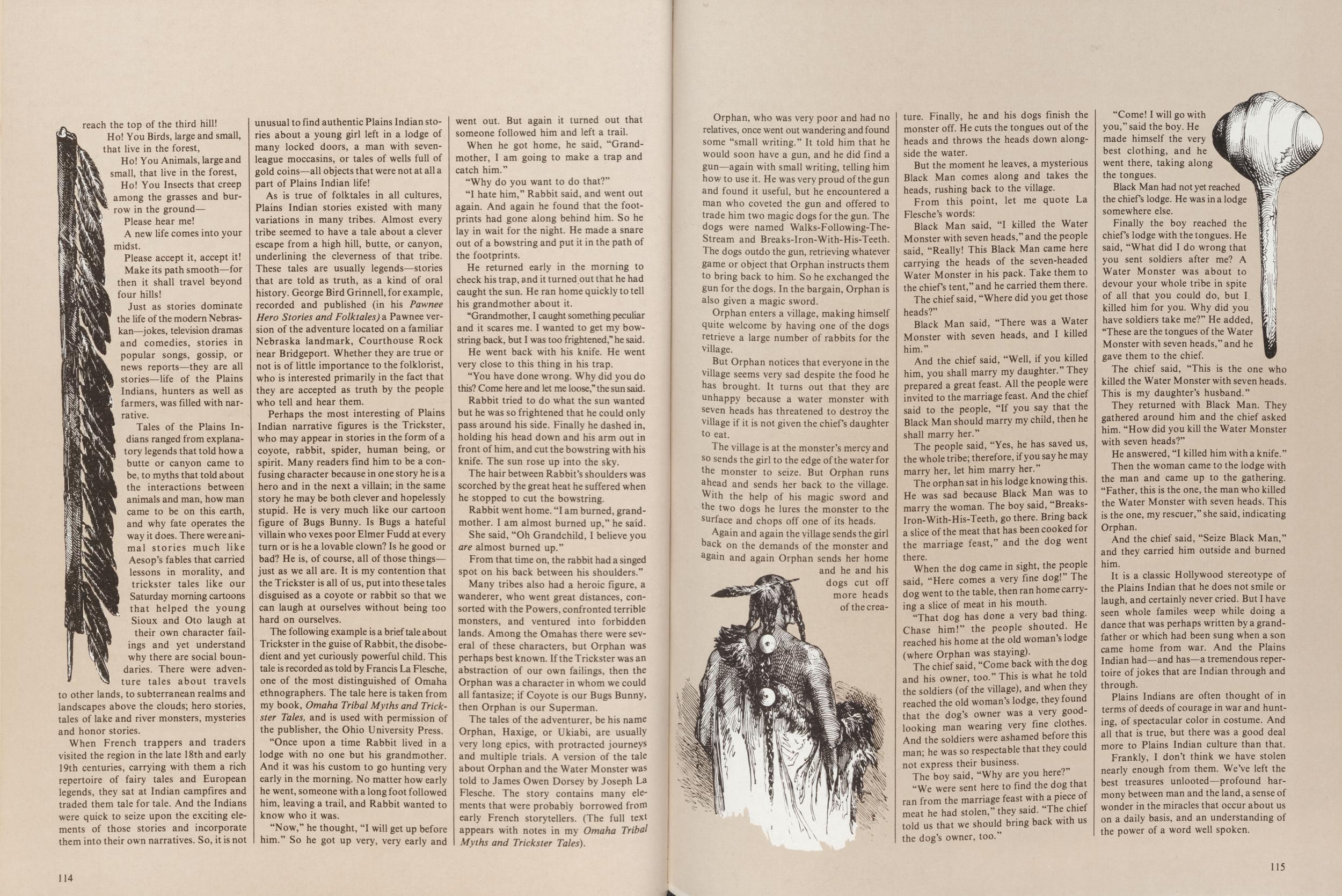
reach the top of the third hill! Ho! You Birds, large and small, that live in the forest, Ho! You Animals, large and small, that live in the forest, Ho! You Insects that creep among the grasses and burrow in the ground—Please hear me! A new life comes into your midst. Please accept it, accept it! Make its path smooth—for then it shall travel beyond four hills! Just as stories dominate the life of the modern Nebraskan—jokes, television dramas and comedies, stories in popular songs, gossip, or news reports—they are all stories—life of the Plains Indians, hunters as well as farmers, was filled with narrative.
Tales of the Plains Indians ranged from explanatory legends that told how a butte or canyon came to be, to myths that told about the interactions between animals and man, how man came to be on this earth, and why fate operates the way it does. There were animal stories much like Aesop's fables that carried lessons in morality, and trickster tales like our Saturday morning cartoons that helped the young Sioux and Oto laugh at their own character failings and yet understand why there are social boundaries. There were adventure tales about travels to other lands, to subterranean realms and landscapes above the clouds; hero stories, tales of lake and river monsters, mysteries and honor stories.
When French trappers and traders visited the region in the late 18th and early 19th centuries, carrying with them a rich repertoire of fairy tales and European legends, they sat at Indian campfires and traded them tale for tale. And the Indians were quick to seize upon the exciting elements of those stories and incorporate them into their own narratives. So, it is not unusual to find authentic Plains Indian stories about a young girl left in a lodge of many locked doors, a man with seven-league moccasins, or tales of wells full of gold coins—all objects that were not at all a part of Plains Indian life!
As is true of folktales in all cultures, Plains Indian stories existed with many variations in many tribes. Almost every tribe seemed to have a tale about a clever escape from a high hill, butte, or canyon, underlining the cleverness of that tribe. These tales are usually legends—stories that are told as truth, as a kind of oral history. George Bird Grinnell, for example, recorded and published (in his Pawnee Hero Stories and Folktales) a Pawnee version of the adventure located on a familiar Nebraska landmark, Courthouse Rock near Bndgeport. Whether they are true or not is of little importance to the folklorist, who is interested primarily in the fact that they are accepted as truth by the people who tell and hear them.
Perhaps the most interesting of Plains Indian narrative figures is the Trickster, who may appear in stories in the form of a coyote, rabbit, spider, human being, or spirit. Many readers find him to be a confusing character because in one story he is a hero and in the next a villain; in the same story he may be both clever and hopelessly stupid. He is very much like our cartoon figure of Bugs Bunny. Is Bugs a hateful villain who vexes poor Elmer Fudd at every turn or is he a lovable clown? Is he good or bad? He is, of course, all of those things—just as we all are. It is my contention that the Trickster is all of us, put into these tales disguised as a coyote or rabbit so that we can laugh at ourselves without being too hard on ourselves.
The following example is a brief tale about Trickster in the guise of Rabbit, the disobedient and yet curiously powerful child. This tale is recorded as told by Francis La Flesche, one of the most distinguished of Omaha ethnographers. The tale here is taken from my book, Omaha Tribal Myths and Trickster Tales, and is used with permission of the publisher, the Ohio University Press. "Once upon a time Rabbit lived in a lodge with no one but his grandmother. And it was his custom to go hunting very early in the morning. No matter how early he went, someone with a long foot followed him, leaving a trail, and Rabbit wanted to know who it was.
"Now," he thought, "I will get up before him." So he got up very, very early and tti "i
went out. But again it turned out that someone followed him and left a trail.
When he got home, he said, "Grandmother, I am going to make a trap and catch him."
Why do you want to do that?" I hate him," Rabbit said, and went out again. And again he found that the footprints had gone along behind him. So he lay in wait for the night. He made a snare out of a bowstring and put it in the path of the footprints.
He returned early in the morning to check his trap, and it turnedout that he had caught the sun. He ran home quickly to tell his grandmother about it.
"Grandmother, I caught something peculiar and it scares me. I wanted to get my bowstring back, but I was too frightened," he said.
He went back with his knife. He went very close to this thing in his trap.
"You have done wrong. Why did you do this? Come here and let me loose," the sun said.
Rabbit tried to do what the sun wanted but he was so frightened that he could only pass around his side. Finally he dashed in, holding his head down and his arm out in front of him, and cut the bowstring with his knife. The sun rose up into the sky.
The hair between Rabbit's shoulders was scorched by the great heat he suffered when he stopped to cut the bowstring.
Rabbit went home. "I am burned, grandmother. I am almost burned up," he said. She said, "Oh Grandchild, I believe you are almost burned up."
From that time on, the rabbit had a singed spot on his back between his shoulders."
Many tribes also had a heroic figure, a wanderer, who went great distances, consorted with the Powers, confronted terrible monsters, and ventured into forbidden lands. Among the Omahas there were several of these characters, but Orphan was perhaps best known. If the Trickster was an abstraction of our own failings, then the Orphan was a character in whom we could all fantasize; if Coyote is our Bugs Bunny, then Orphan is our Superman.
The tales of the adventurer, be his name Orphan, Haxige, or Ukiabi, are usually very long epics, with protracted journeys and multiple trials. A version of the tale about Orphan and the Water Monster was told to James Owen Dorsey by Joseph La Flesche. The story contains many elements that were probably borrowed from early French storytellers. (The full text appears with notes in my Omaha Tribal Myths and Trickster Tales).
114Orphan, who was very poor and had no relatives, once went out wandering and found some "small writing." It told him that he would soon have a gun, and he did find a gun—again with small writing, telling him how to use it. He was very proud of the gun and found it useful, but he encountered a man who coveted the gun and offered to trade him two magic dogs for the gun. The dogs were named Walks-Following-The-Stream and Breaks-Iron-With-His-Teeth. The dogs outdo the gun, retrieving whatever game or object that Orphan instructs them to bring back to him. So he exchanged the gun for the dogs. In the bargain, Orphan is also given a magic sword.
Orphan enters a village, making himself quite welcome by having one of the dogs retrieve a large number of rabbits for the village.
But Orphan notices that everyone in the village seems very sad despite the food he has brought. It turns out that they are unhappy because a water monster with seven heads has threatened to destroy the village if it is not given the chiefs daughter to eat.
The village is at the monster's mercy and so sends the girl to the edge of the water for the monster to seize. But Orphan runs ahead and sends her back to the village. With the help of his magic sword and the two dogs he lures the monster to the surface and chops off one of its heads.
Again and again the village sends the girl hack on the demands of the monster and again and again Orphan sends her home and he and his dogs cut off more heads of the creature. Finally, he and his dogs finish the monster off. He cuts the tongues out of the heads and throws the heads down alongside the water.
But the moment he leaves, a mysterious Black Man comes along and takes the heads, rushing back to the village.
From this point, let me quote La Flesche's words: Black Man said, "I killed the Water Monster with seven heads," and the people said, "Really! This Black Man came here carrying the heads of the seven-headed Water Monster in his pack. Take them to the chief's tent," and he carried them there.
The chief said, "Where did you get those heads?" Black Man said, "There was a Water Monster with seven heads, and I killed him."
And the chief said, "Well, if you killed him, you shall marry my daughter." They prepared a great feast. All the people were invited to the marriage feast. And the chief said to the people, "If you say that the Black Man should marry my child, then he shall marry her."
The people said, "Yes, he has saved us, the whole tribe; therefore, if you say he may marry her, let him marry her."
The orphan sat in his lodge knowing this. He was sad because Black Man was to marry the woman. The boy said, "Breaks-Iron-With-His-Teeth, go there. Bring back a slice of the meat that has been cooked for the marriage feast," and the dog went there.
When the dog came in sight, the people said, "Here comes a very fine dog!" The dog went to the table, then ran home carrying a slice of meat in his mouth.
"That dog has done a very bad thing. Chase him!" the people shouted. He reached his home at the old woman's lodge (where Orphan was staying).
The chief said, "Come back with the dog and his owner, too." This is what he told the soldiers (of the village), and when they reached the old woman's lodge, they found that the dog's owner was a very good-looking man wearing very fine clothes. And the soldiers were ashamed before this man; he was so respectable that they could not express their business.
The boy said, "Why are you here?" "We were sent here to find the dog that ran from the marriage feast with a piece of meat he had stolen," they said. "The chief told us that we should bring back with us the dog's owner, too."
Come! I will go with you," said the boy. He made himself the very best clothing, and he went there, taking along the tongues.
Black Man had not yet reached the chiefs lodge. He was in a lodge somewhere else.
Finally the boy reached the chiefs lodge with the tongues. He said, "What did I do wrong that you sent soldiers after me? A Water Monster was about to devour your whole tribe in spite of all that you could do, but I. killed him for you. Why did you have soldiers take me?" He added, "These are the tongues of the Water Monster with seven heads," and he gave them to the chief.
The chief said, "This is the one who killed the Water Monster with seven heads. This is my daughter's husband."
They returned with Black Man. They gathered around him and the chief asked him. "How did you kill the Water Monster with seven heads?"
He answered, "I killed him with a knife." Then the woman came to the lodge with the man and came up to the gathering. "Father, this is the one, the man who killed the Water Monster with seven heads. This is the one, my rescuer," she said, indicating Orphan.
And the chief said, "Seize Black Man," and they carried him outside and burned him.
It is a classic Hollywood stereotype of the Plains Indian that he does not smile or laugh, and certainly never cried. But I have seen whole familes weep while doing a dance that was perhaps written by a grandfather or which had been sung when a son came home from war. And the Plains Indian had—and has—a tremendous repertoire of jokes that are Indian through and through.
Plains Indians are often thought of in terms of deeds of courage in war and hunting, of spectacular color in costume. And all that is true, but there was a good deal more to Plains Indian culture than that.
Frankly, I don't think we have stolen nearly enough from them. We've left the best treasures unlooted—profound harmony between man and the land, a sense of wonder in the miracles that occur about us on a daily basis, and an understanding of the power of a word well spoken.
115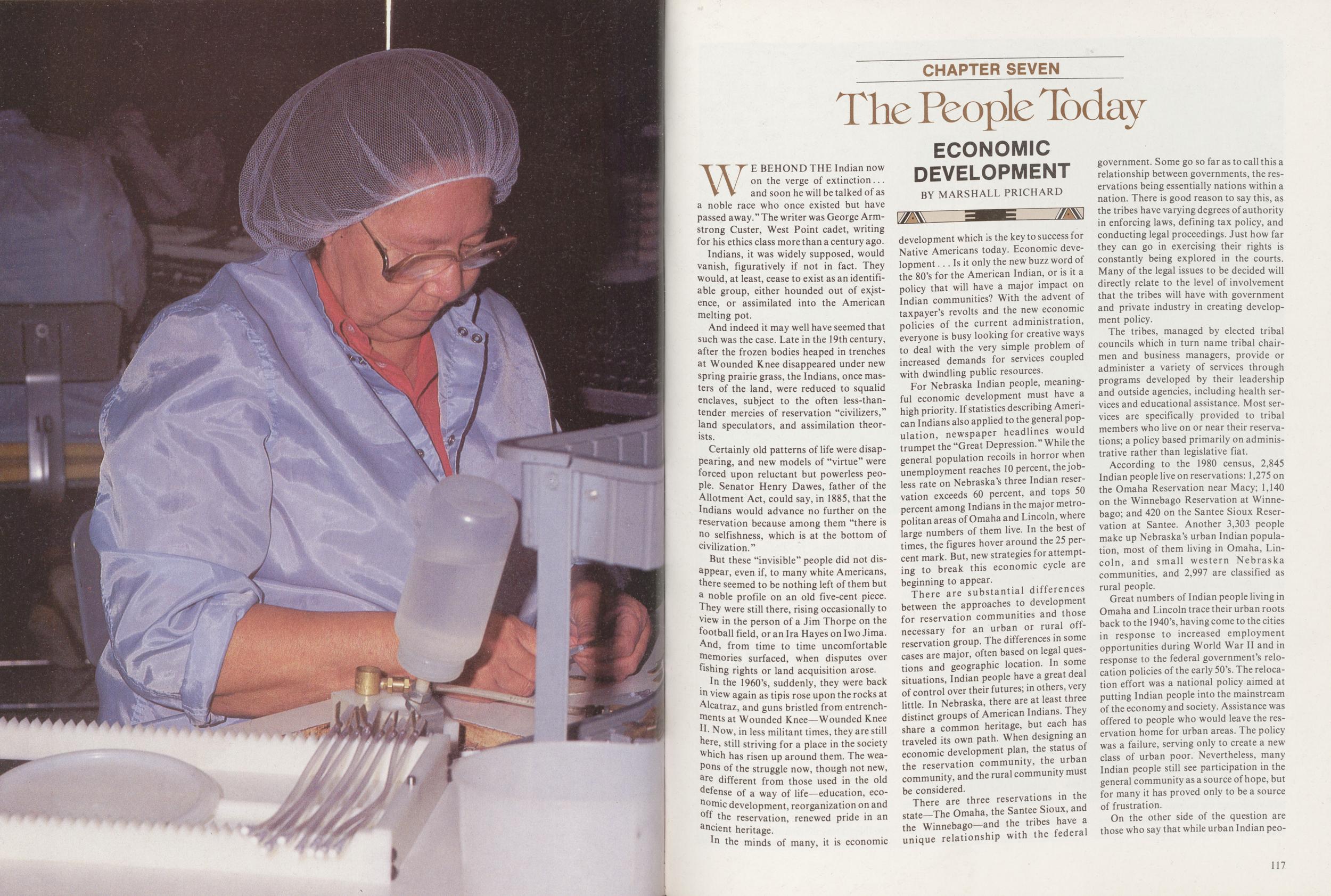
CHAPTER SEVEN The People Today
WE BEHOND THE Indian now on the verge of extinction... and soon he will be talked of as a noble race who once existed but have passed away." The writer was George Armstrong Custer, West Point cadet, writing for his ethics class more than a century ago. Indians, it was widely supposed, would vanish, figuratively if not in fact. They would, at least, cease to exist as an identifiable group, either hounded out of existence, or assimilated into the American melting pot.
And indeed it may well have seemed that such was the case. Late in the 19th century, after the frozen bodies heaped in trenches at Wounded Knee disappeared under new spring prairie grass, the Indians, once masters of the land, were reduced to squalid enclaves, subject to the often less-than-tender mercies of reservation "civilizers," land speculators, and assimilation theorists.
Certainly old patterns of life were disappearing, and new models of "virtue" were forced upon reluctant but powerless people. Senator Henry Dawes, father of the Allotment Act, could say, in 1885, that the Indians would advance no further on the reservation because among them "there is no selfishness, which is at the bottom of civilization."
But these "invisible" people did not disappear, even if, to many white Americans, there seemed to be nothing left of them but a noble profile on an old five-cent piece. They were still there, rising occasionally to view in the person of a Jim Thorpe on the football field, or an Ira Hayes on Iwo Jima. And, from time to time uncomfortable Memories surfaced, when disputes over fishing rights or land acquisition arose.
In the 1960's, suddenly, they were back on view again as tipis rose upon the rocks at Alcatraz, and guns bristled from entrenchments at Wounded Knee—Wounded Knee II. Now, in less militant times, they are still here, still striving for a place in the society which has risen up around them. The weapons of the struggle now, though not new, are different from those used in the old defense of a way of life—education, economic development, reorganization on and off the reservation, renewed pride in an ancient heritage.
In the minds of many, it is economic
ECONOMIC DEVELOPMENT BY MARSHALL PRICHARDdevelopment which is the key to success for Native Americans today. Economic development ... Is it only the new buzz word of the 80's for the American Indian, or is it a policy that will have a major impact on Indian communities? With the advent of taxpayer's revolts and the new economic policies of the current administration, everyone is busy looking for creative ways to deal with the very simple problem of increased demands for services coupled with dwindling public resources.
For Nebraska Indian people, meaningful economic development must have a high priority. If statistics describing American Indians also applied to the general population, newspaper headlines would trumpet the "Great Depression." While the general population recoils in horror when unemployment reaches 10 percent, the jobless rate on Nebraska's three Indian reservation exceeds 60 percent, and tops 50 percent among Indians in the major metropolitan areas of Omaha and Lincoln, where large numbers of them live. In the best of times, the figures hover around the 25 percent mark. But, new strategies for attempting to break this economic cycle are beginning to appear.
There are substantial differences between the approaches to development for reservation communities and those necessary for an urban or rural off-reservation group. The differences in some cases are major, often based on legal questions and geographic location. In some situations, Indian people have a great deal of control over their futures; in others, very little. In Nebraska, there are at least three distinct groups of American Indians. They share a common heritage, but each has traveled its own path. When designing an economic development plan, the status of the reservation community, the urban community, and the rural community must be considered.
There are three reservations in the state—The Omaha, the Santee Sioux, and the Winnebago—and the tribes have a unique relationship with the federal government. Some go so far as to call this a relationship between governments, the reservations being essentially nations within a nation. There is good reason to say this, as the tribes have varying degrees of authority in enforcing laws, defining tax policy, and conducting legal proceedings. Just how far they can go in exercising their rights is constantly being explored in the courts. Many of the legal issues to be decided will directly relate to the level of involvement that the tribes will have with government and private industry in creating development policy.
The tribes, managed by elected tribal councils which in turn name tribal chairmen and business managers, provide or administer a variety of services through programs developed by their leadership and outside agencies, including health services and educational assistance. Most services are specifically provided to tribal members who live on or near their reservations; a policy based primarily on administrative rather than legislative fiat. According to the 1980 census, 2,845 Indian people live on reservations: 1,275 on the Omaha Reservation near Macy; 1,140 on the Winnebago Reservation at Winnebago; and 420 on the Santee Sioux Reservation at Santee. Another 3,303 people make up Nebraska's urban Indian population, most of them living in Omaha, Lincoln, and small western Nebraska communities, and 2,997 are classified as rural people.
Great numbers of Indian people living in Omaha and Lincoln trace their urban roots back to the 1940's, having come to the cities in response to increased employment opportunities during World War II and in response to the federal government's relocation policies of the early 50's. The relocation effort was a national policy aimed at putting Indian people into the mainstream of the economy and society. Assistance was offered to people who would leave the reservation home for urban areas. The policy was a failure, serving only to create a new class of urban poor. Nevertheless, many Indian people still see participation in the general community as a source of hope, but for many it has proved only to be a source of frustration.
On the other side of the question are those who say that while urban Indian people
117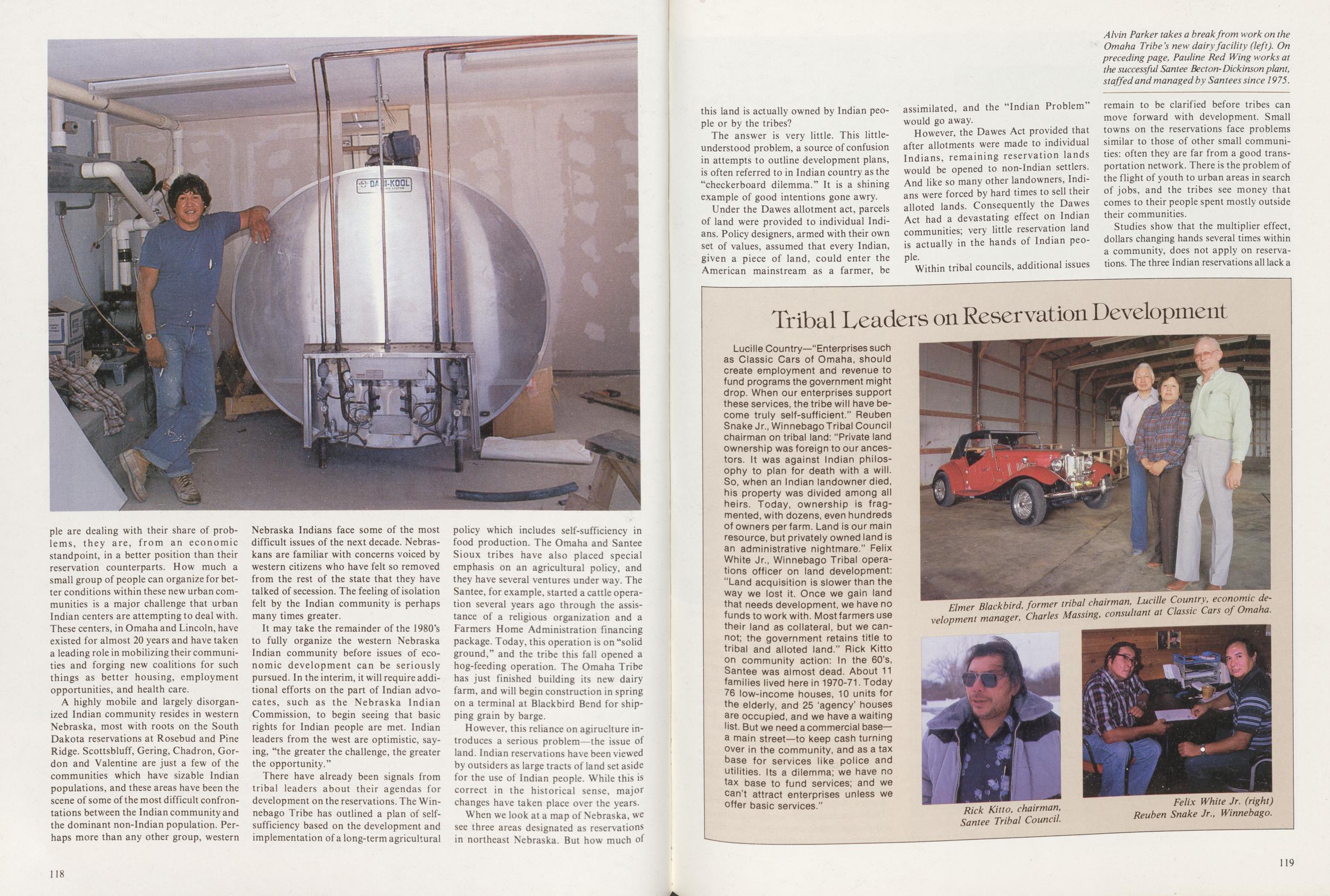
are dealing with their share of problems, they are, from an economic standpoint, in a better position than their reservation counterparts. How much a small group of people can organize for better conditions within these new urban communities is a major challenge that urban Indian centers are attempting to deal with. These centers, in Omaha and Lincoln, have existed for almost 20 years and have taken a leading role in mobilizing their communities and forging new coalitions for such things as better housing, employment opportunities, and health care.
A highly mobile and largely disorganized Indian community resides in western Nebraska, most with roots on the South Dakota reservations at Rosebud and Pine Ridge. Scottsbluff, Gering, Chadron, Gordon and Valentine are just a few of the communities which have sizable Indian populations, and these areas have been the scene of some of the most difficult confrontations between the Indian community and the dominant non-Indian population. Perhaps more than any other group, western Nebraska Indians face some of the most difficult issues of the next decade. Nebraskans are familiar with concerns voiced by western citizens who have felt so removed from the rest of the state that they have talked of secession. The feeling of isolation felt by the Indian community is perhaps many times greater.
It may take the remainder of the 1980's to fully organize the western Nebraska Indian community before issues of economic development can be seriously pursued. In the interim, it will require additional efforts on the part of Indian advocates, such as the Nebraska Indian Commission, to begin seeing that basic rights for Indian people are met. Indian leaders from the west are optimistic, saying, "the greater the challenge, the greater the opportunity."
There have already been signals from tribal leaders about their agendas for development on the reservations. The Winnebago Tribe has outlined a plan of self-sufficiency based on the development and implementation of a long-term agricultural policy which includes self-sufficiency in food production. The Omaha and Santee Sioux tribes have also placed special emphasis on an agricultural policy, and they have several ventures under way. The Santee, for example, started a cattle operation several years ago through the assistance of a religious organization and a Farmers Home Administration financing package. Today, this operation is on "solid ground," and the tribe this fall opened a hog-feeding operation. The Omaha Tribe has just finished building its new dairy farm, and will begin construction in spring on a terminal at Blackbird Bend for shipping grain by barge.
However, this reliance on agiruclture introduces a serious problem—the issue of land. Indian reservations have been viewed by outsiders as large tracts of land set aside for the use of Indian people. While this is correct in the historical sense, major changes have taken place over the years.
When we look at a map of Nebraska, we see three areas designated as reservations in northeast Nebraska. But how much of
118this land is actually owned by Indian people or by the tribes?
The answer is very little. This little-understood problem, a source of confusion in attempts to outline development plans, is often referred to in Indian country as the "checkerboard dilemma." It is a shining example of good intentions gone awry.
Under the Dawes allotment act, parcels of land were provided to individual Indians. Policy designers, armed with their own set of values, assumed that every Indian, given a piece of land, could enter the American mainstream as a farmer, be assimilated, and the "Indian Problem" would go away.
However, the Dawes Act provided that after allotments were made to individual Indians, remaining reservation lands would be opened to non-Indian settlers. And like so many other landowners, Indians were forced by hard times to sell their alloted lands. Consequently the Dawes Act had a devastating effect on Indian communities; very little reservation land is actually in the hands of Indian people.
Within tribal councils, additional issues Alvin Parker takes a break from work on the Omaha Tribe's new dairy facility (left). On preceding page, Pauline Red Wing works at the successful Santee Becton-Dickinson plant, staffed and managed by Santees since 1975.
remain to be clarified before tribes can move forward with development. Small towns on the reservations face problems similar to those of other small communities: often they are far from a good transportation network. There is the problem of the flight of youth to urban areas in search of jobs, and the tribes see money that comes to their people spent mostly outside their communities.
Studies show that the multiplier effect, dollars changing hands several times within a community, does not apply on reservations. The three Indian reservations all lack a
Tribal Leaders on Reservation Development Lucille Country—"Enterprises such as Classic Cars of Omaha, should create employment and revenue to fund programs the government might drop. When our enterprises support these services, the tribe will have become truly self-sufficient." Reuben Snake Jr., Winnebago Tribal Council chairman on tribal land: "Private land ownership was foreign to our ancestors. It was against Indian philosophy to plan for death with a will. So, when an Indian landowner died, his property was divided among all heirs. Today, ownership is fragmented, with dozens, even hundreds of owners per farm. Land is our main resource, but privately owned land is an administrative nightmare." Felix White Jr., Winnebago Tribal operations officer on land development: "Land acquisition is slower than the way we lost it. Once we gain land that needs development, we have no funds to work with. Most farmers use their land as collateral, but we cannot; the government retains title to tribal and alloted land." Rick Kitto on community action: In the 60's, Santee was almost dead. About 11 families lived here in 1970-71. Today 76 low-income houses, 10 units for the elderly, and 25 'agency' houses are occupied, and we have a waiting list. But we need a commercial base—a main street—to keep cash turning over in the community, and as a tax base for services like police and utilities. Its a dilemma; we have no tax base to fund services; and we can't attract enterprises unless we offer basic services."
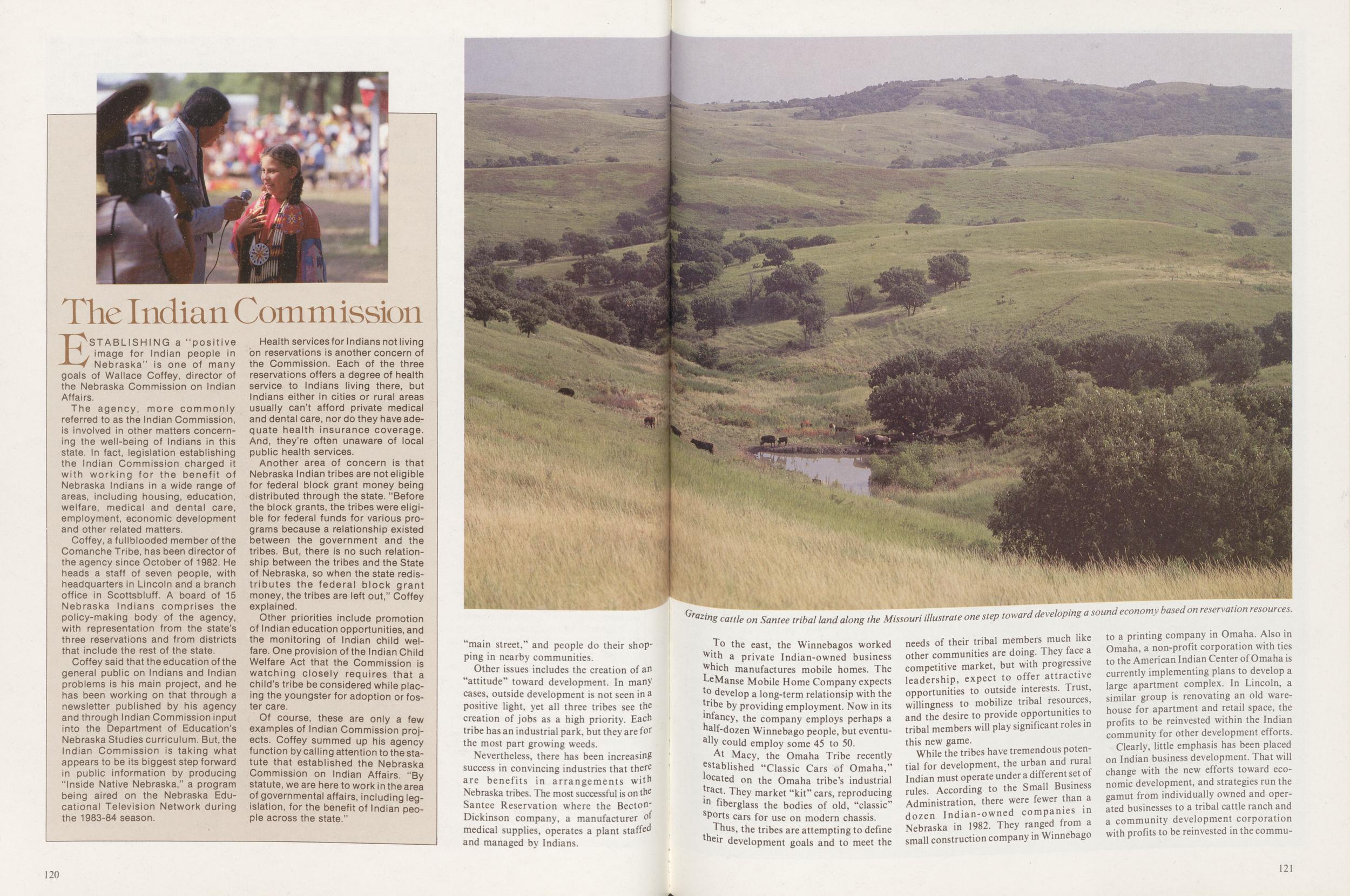 The Indian Commission
ESTABLISHING a "positive image for Indian people in Nebraska" is one of many goals of Wallace Coffey, director of the Nebraska Commission on Indian Affairs.
The agency, more commonly referred to as the Indian Commission, is involved in other matters concerning the well-being of Indians in this state. In fact, legislation establishing the Indian Commission charged it with working for the benefit of Nebraska Indians in a wide range of areas, including housing, education, welfare, medical and dental care, employment, economic development and other related matters.
Coffey, a fullblooded member of the Comanche Tribe, has been director of the agency since October of 1982. He heads a staff of seven people, with headquarters in Lincoln and a branch office in Scottsbluff. A board of 15 Nebraska Indians comprises the policy-making body of the agency, with representation from the state's three reservations and from districts that include the rest of the state.
Coffey said that the education of the general public on Indians and Indian problems is his main project, and he has been working on that through a newsletter published by his agency and through Indian Commission input into the Department of Education's Nebraska Studies curriculum. But, the Indian Commission is taking what appears to be its biggest step forward in public information by producing "Inside Native Nebraska," a program being aired on the Nebraska Educational Television Network during the 1983-84 season.
Health services for Indians not living on reservations is another concern of the Commission. Each of the three reservations offers a degree of health service to Indians living there, but Indians either in cities or rural areas usually can't afford private medical and dental care, nor do they have adequate health insurance coverage. And, they're often unaware of local public health services.
Another area of concern is that Nebraska Indian tribes are not eligible for federal block grant money being distributed through the state. "Before the block grants, the tribes were eligible for federal funds for various programs because a relationship existed between the government and the tribes. But, there is no such relationship between the tribes and the State of Nebraska, so when the state redistributes the federal block grant money, the tribes are left out," Coffey explained.
Other priorities include promotion of Indian education opportunities, and the monitoring of Indian child welfare. One provision of the Indian Child Welfare Act that the Commission is watching closely requires that a child's tribe be considered while placing the youngster for adoption or foster care.
Of course, these are only a few examples of Indian Commission projects. Coffey summed up his agency function by calling attention to the statute that established the Nebraska Commission on Indian Affairs. "By statute, we are here to work in the area of governmental affairs, including legislation, for the benefit of Indian people across the state."
"main street," and people do their shopping in nearby communities.
Other issues includes the creation of an "attitude" toward development. In many cases, outside development is not seen in a positive light, yet all three tribes see the creation of jobs as a high priority. Each tribe has an industrial park, but they are for the most part growing weeds.
Nevertheless, there has been increasing success in convincing industries that there are benefits in arrangements with Nebraska tribes. The most successful is on the Santee Reservation where the Bectofl' Dickinson company, a manufacturer °* medical supplies, operates a plant staffs and managed by Indians.
120To the east, the Winnebagos worked Wlth a private Indian-owned business which manufactures mobile homes. The LeManse Mobile Home Company expects to develop a long-term relationsip with the |nbe by providing employment. Now in its infancy, the company employs perhaps a nalf-dozen Winnebago people, but eventually could employ some 45 to 50.
At Macy, the Omaha Tribe recently established "Classic Cars of Omaha," Seated on the Omaha tribe's industrial /act. They market "kit" cars, reproducing ln fiberglass the bodies of old, "classic" sPorts cars for use on modern chassis.
Thus, the tribes are attempting to define their development goals and to meet the needs of their tribal members much like other communities are doing. They face a competitive market, but with progressive leadership, expect to offer attractive opportunities to outside interests. Trust, willingness to mobilize tribal resources, and the desire to provide opportunities to tribal members will play significant roles in this new game.
While the tribes have tremendous potential for development, the urban and rural Indian must operate under a different set of rules. According to the Small Business Administration, there were fewer than a dozen Indian-owned companies in Nebraska in 1982. They ranged from a small construction company in Winnebago to a printing company in Omaha. Also in Omaha, a non-profit corporation with ties to the American Indian Center of Omaha is currently implementing plans to develop a large apartment complex. In Lincoln, a similar group is renovating an old warehouse for apartment and retail space, the profits to be reinvested within the Indian community for other development efforts.
Clearly, little emphasis has been placed on Indian business development. That will change with the new efforts toward economic development, and strategies run the gamut from individually owned and operated businesses to a tribal cattle ranch and a community development corporation with profits to be reinvested in the community,
121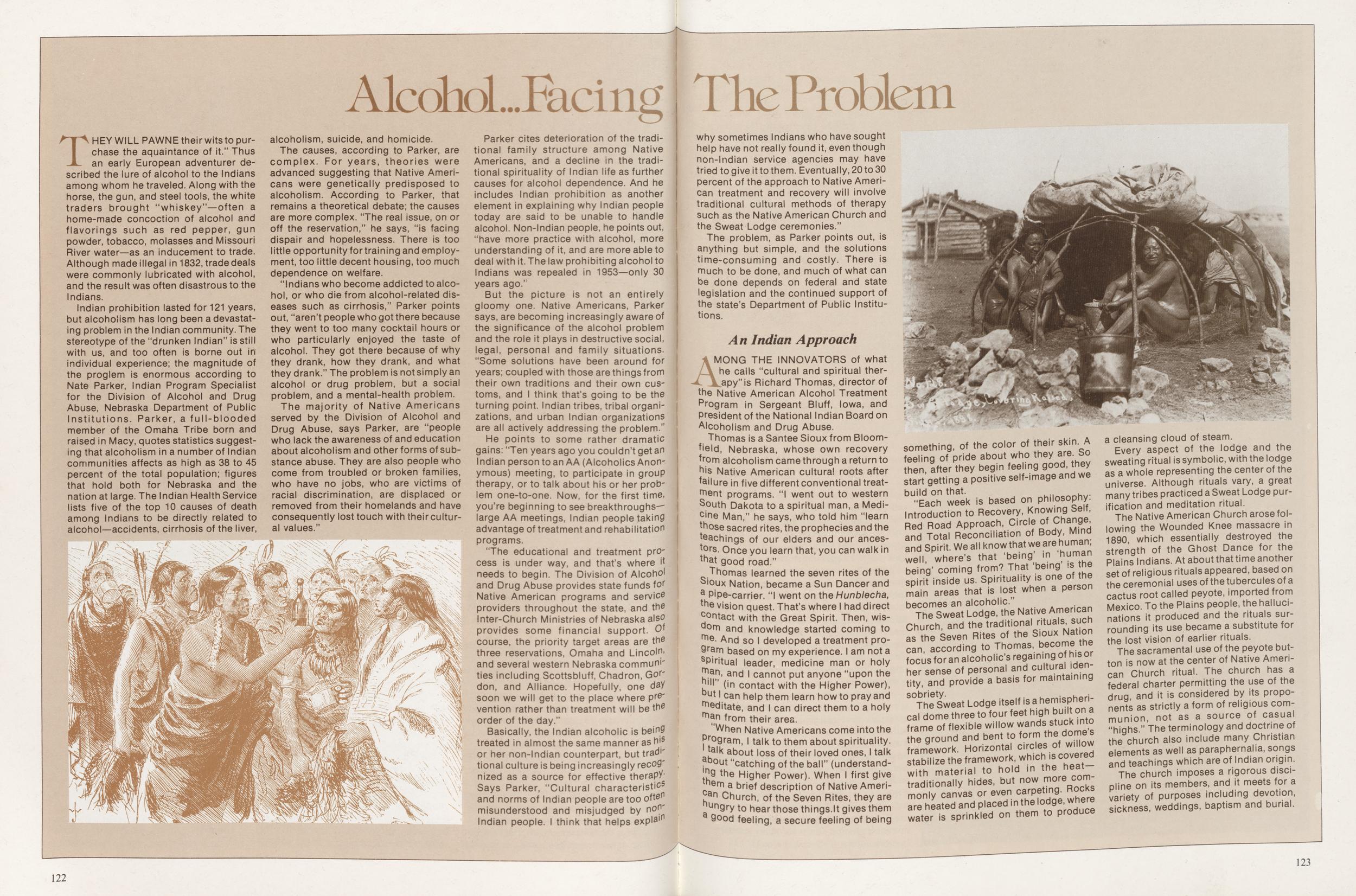
THEY WILL PAWNE their wits to purchase the aquaintance of it." Thus an early European adventurer described the lure of alcohol to the Indians among whom he traveled. Along with the horse, the gun, and steel tools, the white traders brought "whiskey"—often a home-made concoction of alcohol and flavorings such as red pepper, gun powder, tobacco, molasses and Missouri River water—as an inducement to trade. Although made illegal in 1832, trade deals were commonly lubricated with alcohol, and the result was often disastrous to the Indians.
Indian prohibition lasted for 121 years, but alcoholism has long been a devastating problem in the Indian community. The stereotype of the "drunken Indian" is still with us, and too often is borne out in individual experience; the magnitude of the proglem is enormous according to Nate Parker, Indian Program Specialist for the Division of Alcohol and Drug Abuse, Nebraska Department of Public Institutions. Parker, a full-blooded member of the Omaha Tribe born and raised in Macy, quotes statistics suggesting that alcoholism in a number of Indian communities affects as high as 38 to 45 percent of the total population; figures that hold both for Nebraska and the nation at large. The Indian Health Service lists five of the top 10 causes of death among Indians to be directly related to alcohol—accidents, cirrhosis of the liver, alcoholism, suicide, and homicide.
The causes, according to Parker, are complex. For years, theories were advanced suggesting that Native Americans were genetically predisposed to alcoholism. According to Parker, that remains a theoretical debate; the causes are more complex. "The real issue, on or off the reservation," he says, "is facing dispair and hopelessness. There is too little opportunity for training and employment, too little decent housing, too much dependence on welfare.
"Indians who become addicted to alcohol, or who die from alcohol-related diseases such as cirrhosis," Parker points out, "aren't people who got there because they went to too many cocktail hours or who particularly enjoyed the taste of alcohol. They got there because of why they drank, how they drank, and what they drank." The problem is not simply an alcohol or drug problem, but a social problem, and a mental-health problem.
The majority of Native Americans served by the Division of Alcohol and Drug Abuse, says Parker, are "people who lack the awareness of and education about alcoholism and other forms of substance abuse. They are also people who come from troubled or broken families, who have no jobs, who are victims of racial discrimination, are displaced or removed from their homelands and have consequently lost touch with their cultural values."
Parker cites deterioration of the traditional family structure among Native Americans, and a decline in the traditional spirituality of Indian life as further causes for alcohol dependence. And he includes Indian prohibition as another element in explaining why Indian people today are said to be unable to handle alcohol. Non-Indian people, he points out, "have more practice with alcohol, more understanding of it, and are more able to deal with it. The law prohibiting alcohol to Indians was repealed in 1953—only 30 years ago."
But the picture is not an entirely gloomy one. Native Americans, Parker says, are becoming increasingly aware of the significance of the alcohol problem and the role it plays in destructive social, legal, personal and family situations. "Some solutions have been around for years; coupled with those are things from their own traditions and their own customs, and I think that's going to be the turning point. Indian tribes, tribal organizations, and urban Indian organizations are all actively addressing the problem."
He points to some rather dramatic gains: "Ten years ago you couldn't get an Indian person to an AA (Alcoholics Anonymous) meeting, to participate in group therapy, or to talk about his or her problem one-to-one. Now, for the first time, you're beginning to see breakthroughs—large AA meetings, Indian people taking advantage of treatment and rehabilitation programs.
The educational and treatment process is under way, and that's where N needs to begin. The Division of Alcohol and Drug Abuse provides state funds for Native American programs and service providers throughout the state, and the Inter-Church Ministries of Nebraska also provides some financial support. Of course, the priority target areas are the three reservations, Omaha and Lincoln-and several western Nebraska communities including Scottsbluff, Chadron, Gordon, and Alliance. Hopefully, one day soon we will get to the place where prevention rather than treatment will be the order of the day."
Basically, the Indian alcoholic is being treated in almost the same manner as his or her non-Indian counterpart, but traditional culture is being increasingly recognized as a source for effective therapy-Says Parker, "Cultural characteristic5 and norms of Indian people are too often misunderstood and misjudged by non-Indian people. I think that helps explain
122why sometimes Indians who have sought help have not really found it, even though non-Indian service agencies may have tried to give it to them. Eventually, 20 to 30 percent of the approach to Native American treatment and recovery will involve traditional cultural methods of therapy such as the Native American Church and the Sweat Lodge ceremonies."
The problem, as Parker points out, is anything but simple, and the solutions time-consuming and costly. There is much to be done, and much of what can be done depends on federal and state legislation and the continued support of the state's Department of Public Institutions.
An Indian ApproachAMONG THE INNOVATORS of what he calls "cultural and spiritual therapy"is Richard Thomas, director of the Native American Alcohol Treatment Program in Sergeant Bluff, Iowa, and President of the National Indian Board on Alcoholism and Drug Abuse.
Thomas is a Santee Sioux from Bloomfield, Nebraska, whose own recovery from alcoholism came through a return to his Native American cultural roots after failure in five different conventional treatment programs. "I went out to western South Dakota to a spiritual man, a Medicme Man," he says, who told him "learn those sacred rites, the prophecies and the teachings of our elders and our ancestors. Once you learn that, you can walk in that good road."
Thomas learned the seven rites of the Sioux Nation, became a Sun Dancer and a Pipe-carrier. "I went on the Hunblecha, the vision quest. That's where I had direct contact with the Great Spirit. Then, wisdom and knowledge started coming to me. And so I developed a treatment program based on my experience. I am not a spiritual leader, medicine man or holy man, and I cannot put anyone "upon the hill" (in contact with the Higher Power), but I can help them learn how to pray and meditate, and I can direct them to a holy man from their area.
When Native Americans come into the program, I talk to them about spirituality, talk about loss of their loved ones, I talk about "catching of the ball" (understanding the Higher Power). When I first give em a brief description of Native American Church, of the Seven Rites, they are hungry to hear those things. It gives them good feeling, a secure feeling of being
something, of the color of their skin. A feeling of pride about who they are. So then, after they begin feeling good, they start getting a positive self-image and we build on that.
"Each week is based on philosophy: Introduction to Recovery, Knowing Self, Red Road Approach, Circle of Change, and Total Reconciliation of Body, Mind and Spirit. We all know that we are human; well, where's that 'being' in 'human being' coming from? That 'being' is the spirit inside us. Spirituality is one of the main areas that is lost when a person becomes an alcoholic."
The Sweat Lodge, the Native American Church, and the traditional rituals, such as the Seven Rites of the Sioux Nation can, according to Thomas, become the focus for an alcoholic's regaining of his or her sense of personal and cultural identity, and provide a basis for maintaining sobriety.
The Sweat Lodge itself is a hemispherical dome three to four feet high built on a frame of flexible willow wands stuck into the ground and bent to form the dome's framework. Horizontal circles of willow stabilize the framework, which is covered with material to hold in the heat-traditionally hides, but now more commonly canvas or even carpeting. Rocks are heated and placed in the lodge, where water is sprinkled on them to produce a cleansing cloud of steam.
Every aspect of the lodge and the sweating ritual is symbolic, with the lodge as a whole representing the center of the universe. Although rituals vary, a great many tribes practiced a Sweat Lodge purification and meditation ritual.
The Native American Church arose following the Wounded Knee massacre in 1890, which essentially destroyed the strength of the Ghost Dance for the Plains Indians. At about that time another set of religious rituals appeared, based on the ceremonial uses of the tubercules of a cactus root called peyote, imported from Mexico. To the Plains people, the hallucinations it produced and the rituals surrounding its use became a substitute for the lost vision of earlier rituals.
The sacramental use of the peyote button is now at the center of Native American Church ritual. The church has a federal charter permitting the use of the drug and it is considered by its proponents as strictly a form of religious communion, not as a source of casual "highs." The terminology and doctrine of the church also include many Christian elements as well as paraphernalia, songs and teachings which are of Indian origin.
The church imposes a rigorous discipline on its members, and it meets for a variety of purposes including devotion, sickness, weddings, baptism and burial.
123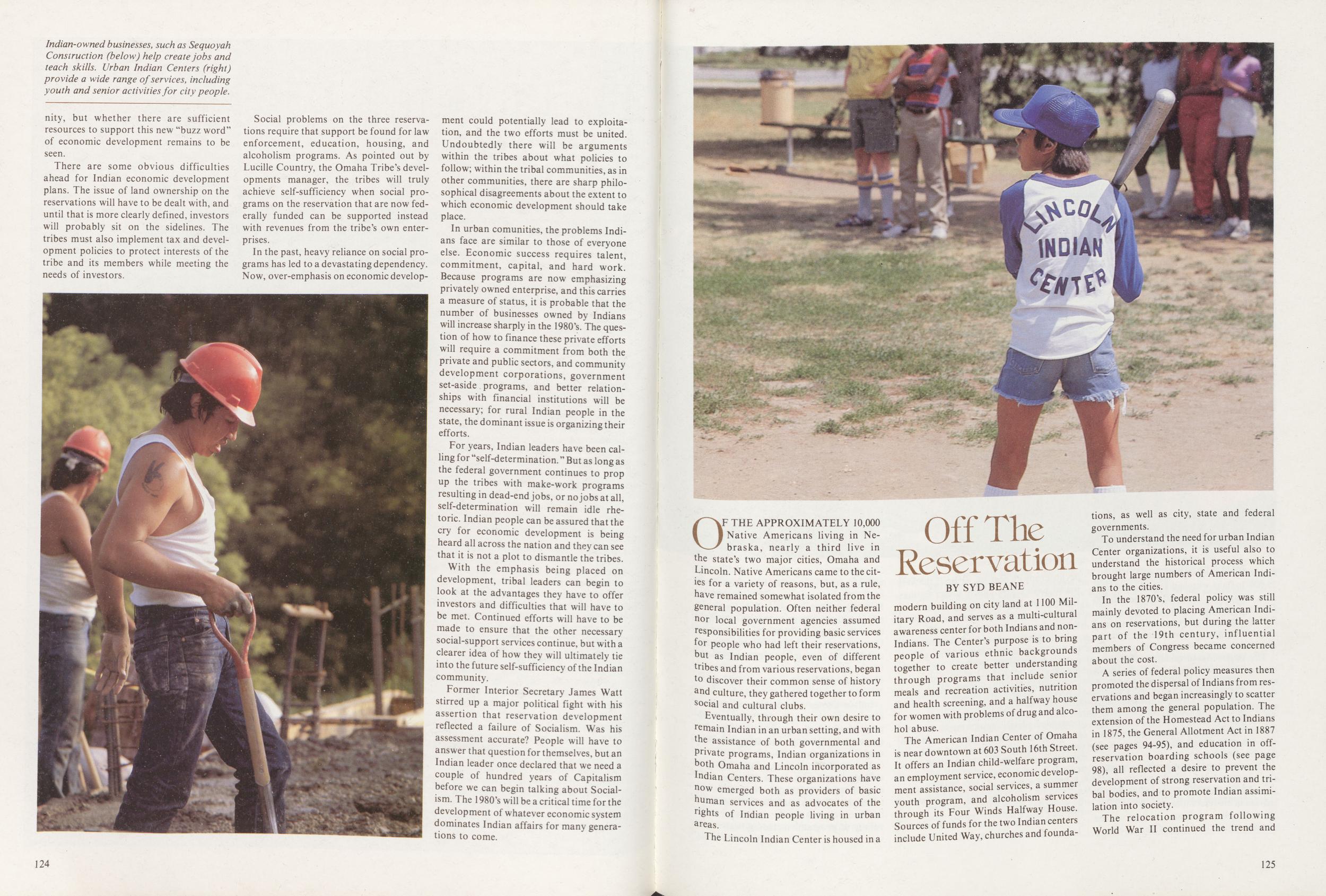
but whether there are sufficient resources to support this new "buzz word" of economic development remains to be seen.
There are some obvious difficulties ahead for Indian economic development plans. The issue of land ownership on the reservations will have to be dealt with, and until that is more clearly defined, investors will probably sit on the sidelines. The tribes must also implement tax and development policies to protect interests of the tribe and its members while meeting the needs of investors.
Social problems on the three reservations require that support be found for law enforcement, education, housing, and alcoholism programs. As pointed out by Lucille Country, the Omaha Tribe's developments manager, the tribes will truly achieve self-sufficiency when social programs on the reservation that are now federally funded can be supported instead with revenues from the tribe's own enterprises.
In the past, heavy reliance on social programs has led to a devastating dependency. Now, over-emphasis on economic development could potentially lead to exploitation, and the two efforts must be united. Undoubtedly there will be arguments within the tribes about what policies to follow; within the tribal communities, as in other communities, there are sharp philosophical disagreements about the extent to which economic development should take place.
In urban comunities, the problems Indians face are similar to those of everyone else. Economic success requires talent, commitment, capital, and hard work. Because programs are now emphasizing privately owned enterprise, and this carries a measure of status, it is probable that the number of businesses owned by Indians will increase sharply in the 1980's. The question of how to finance these private efforts will require a commitment from both the private and public sectors, and community development corporations, government set-aside programs, and better relationships with financial institutions will be necessary; for rural Indian people in the state, the dominant issue is organizing their efforts.
For years, Indian leaders have been calling for "self-determination." But as long as the federal government continues to prop up the tribes with make-work programs resulting in dead-end jobs, or no jobs at all, self-determination will remain idle rhetoric. Indian people can be assured that the cry for economic development is being heard all across the nation and they can see that it is not a plot to dismantle the tribes.
With the emphasis being placed on development, tribal leaders can begin to look at the advantages they have to offer investors and difficulties that will have to be met. Continued efforts will have to be made to ensure that the other necessary social-support services continue, but with a clearer idea of how they will ultimately tie into the future self-sufficiency of the Indian community.
Former Interior Secretary James Watt stirred up a major political fight with his assertion that reservation development reflected a failure of Socialism. Was his assessment accurate? People will have to answer that question for themselves, but an Indian leader once declared that we need a couple of hundred years of Capitalism before we can begin talking about Socialism. The 1980's will be a critical time for the development of whatever economic system dominates Indian affairs for many generations to come.
124OF THE APPROXIMATELY 10,000 I Native Americans living in Nebraska, nearly a third live in the state's two major cities, Omaha and Lincoln. Native Americans came to the cities for a variety of reasons, but, as a rule, have remained somewhat isolated from the general population. Often neither federal nor local government agencies assumed responsibilities for providing basic services for people who had left their reservations, hut as Indian people, even of different tribes and from various reservations, began to discover their common sense of history and culture, they gathered together to form social and cultural clubs.
Eventually, through their own desire to remain Indian in an urban setting, and with the assistance of both governmental and Private programs, Indian organizations in hoth Omaha and Lincoln incorporated as Indian Centers. These organizations have now emerged both as providers of basic human services and as advocates of the nghts of Indian people living in urban areas.
The Lincoln Indian Center is housed in a
Off The Reservationmodern building on city land at 1100 Military Road, and serves as a multi-cultural awareness center for both Indians and non-Indians. The Center's purpose is to bring people of various ethnic backgrounds together to create better understanding through programs that include senior meals and recreation activities, nutrition and health screening, and a halfway house for women with problems of drug and alcohol abuse.
The American Indian Center of Omaha is near downtown at 603 South 16th Street. It offers an Indian child-welfare program, an employment service, economic development assistance, social services, a summer youth program, and alcoholism services through its Four Winds Halfway House. Sources of funds for the two Indian centers include United Way, churches and foundations, as well as city, state and federal governments.
To understand the need for urban Indian Center organizations, it is useful also to understand the historical process which brought large numbers of American Indians to the cities.
In the 1870's, federal policy was still mainly devoted to placing American Indians on reservations, but during the latter part of the 19th century, influential members of Congress became concerned about the cost.
A series of federal policy measures then promoted the dispersal of Indians from reservations and began increasingly to scatter them among the general population. The extension of the Homestead Act to Indians in 1875, the General Allotment Act in 1887 (see pages 94-95), and education in off-reservation boarding schools (see page 98), all reflected a desire to prevent the development of strong reservation and tribal bodies, and to promote Indian assimilation into society.
The relocation program following World War II continued the trend and
125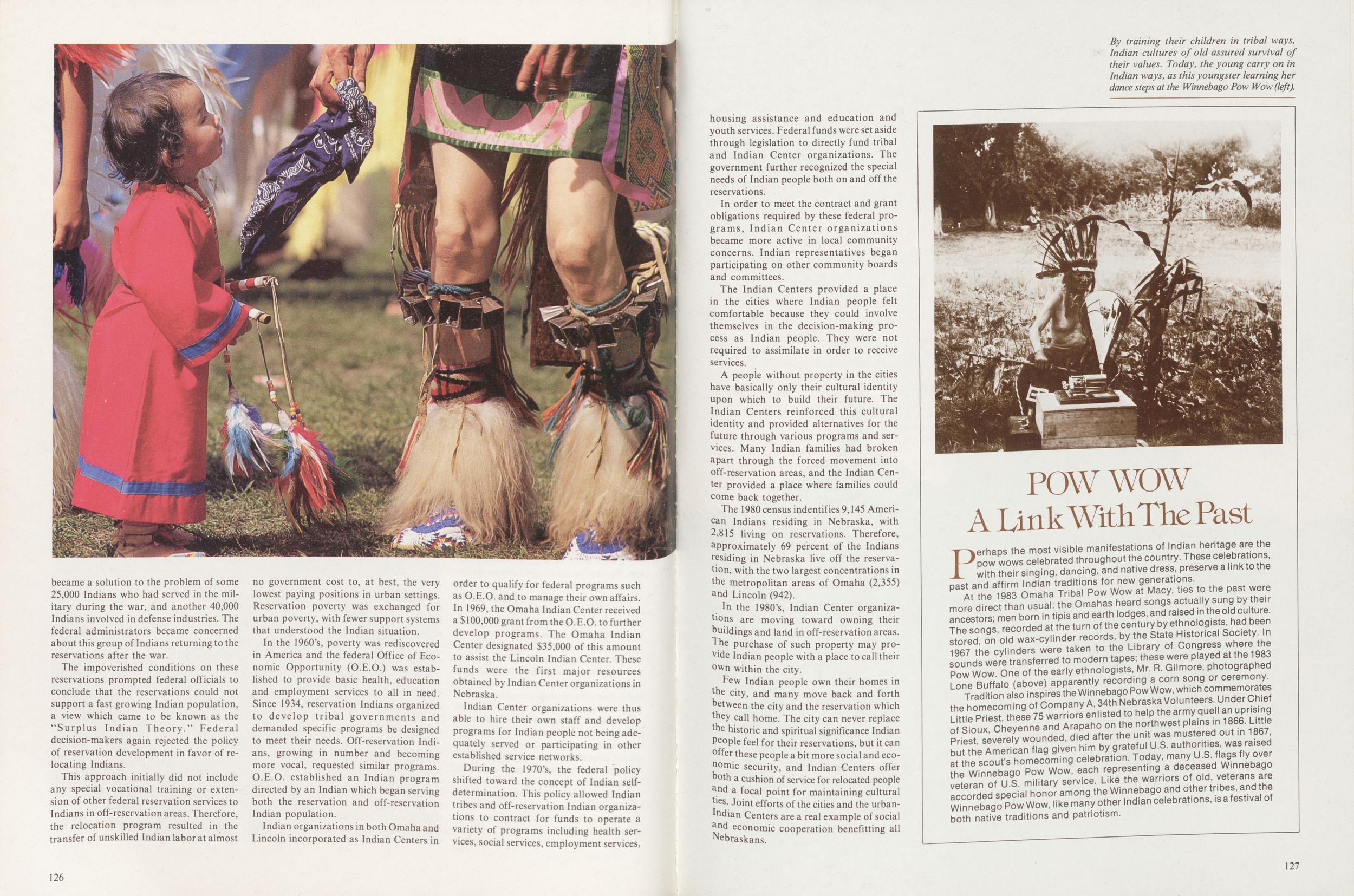
became a solution to the problem of some 25,000 Indians who had served in the military during the war, and another 40,000 Indians involved in defense industries. The federal administrators became concerned about this group of Indians returning to the reservations after the war.
The impoverished conditions on these reservations prompted federal officials to conclude that the reservations could not support a fast growing Indian population, a view which came to be known as the "Surplus Indian Theory." Federal decision-makers again rejected the policy of reservation development in favor of relocating Indians.
This approach initially did not include any special vocational training or extension of other federal reservation services to Indians in off-reservation areas. Therefore, the relocation program resulted in the transfer of unskilled Indian labor at almost no government cost to, at best, the very lowest paying positions in urban settings. Reservation poverty was exchanged for urban poverty, with fewer support systems that understood the Indian situation.
In the 1960's, poverty was rediscovered in America and the federal Office of Economic Opportunity (O.E.O.) was established to provide basic health, education and employment services to all in need. Since 1934, reservation Indians organized to develop tribal governments and demanded specific programs be designed to meet their needs. Off-reservation Indians, growing in number and becoming more vocal, requested similar programs. O.E.O. established an Indian program directed by an Indian which began serving both the reservation and off-reservation Indian population.
Indian organizations in both Omaha and Lincoln incorporated as Indian Centers in order to qualify for federal programs such as O.E.O. and to manage their own affairs. In 1969, the Omaha Indian Center received a $ 100,000 grant from the O.E.O. to further develop programs. The Omaha Indian Center designated $35,000 of this amount to assist the Lincoln Indian Center. These funds were the first major resources obtained by Indian Center organizations in Nebraska.
Indian Center organizations were thus able to hire their own staff and develop programs for Indian people not being adequately served or participating in other established service networks.
During the 1970's, the federal policy shifted toward the concept of Indian self-determination. This policy allowed Indian tribes and off-reservation Indian organizations to contract for funds to operate a variety of programs including health services, social services, employment services,
126housing assistance and education and youth services. Federal funds were set aside through legislation to directly fund tribal and Indian Center organizations. The government further recognized the special needs of Indian people both on and off the reservations.
In order to meet the contract and grant obligations required by these federal programs, Indian Center organizations became more active in local community concerns. Indian representatives began participating on other community boards and committees.
The Indian Centers provided a place in the cities where Indian people felt comfortable because they could involve themselves in the decision-making process as Indian people. They were not required to assimilate in order to receive services.
A people without property in the cities have basically only their cultural identity upon which to build their future. The Indian Centers reinforced this cultural identity and provided alternatives for the future through various programs and services. Many Indian families had broken apart through the forced movement into off-reservation areas, and the Indian Center provided a place where families could come back together.
The 1980 census indentifies 9,145 American Indians residing in Nebraska, with 2,815 living on reservations. Therefore, approximately 69 percent of the Indians residing in Nebraska live off the reservation, with the two largest concentrations in the metropolitan areas of Omaha (2,355) and Lincoln (942).
In the 1980's, Indian Center organizations are moving toward owning their buildings and land in off-reservation areas. The purchase of such property may provide Indian people with a place to call their own within the city.
Few Indian people own their homes in the city, and many move back and forth between the city and the reservation which they call home. The city can never replace the historic and spiritual significance Indian People feel for their reservations, but it can offer these people a bit more social and economic security, and Indian Centers offer both a cushion of service for relocated people and a focal point for maintaining cultural ties. Joint efforts of the cities and the urban-Indian Centers are a real example of social and economic cooperation benefitting all Nebraskans.
POW wow A link With The PastPerhaps the most visible manifestations of Indian heritage are the pow wows celebrated throughout the country. These celebrations, with their singing, dancing, and native dress, preserve a link to the past and affirm Indian traditions for new generations. At the 1983 Omaha Tribal Pow Wow at Macy, ties to the past were more direct than usual: the Omahas heard songs actually sung by their ancestors; men born in tipis and earth lodges, and raised in the old culture. The songs, recorded at the turn of the century by ethnologists, had been stored, on old wax-cylinder records, by the State Historical Society. In 1967 the cylinders were taken to the Library of Congress where the sounds were transferred to modern tapes; these were played at the 1983 Pow Wow. One of the early ethnologists, Mr. R. Gilmore, photographed Lone Buffalo (above) apparently recording a corn song or ceremony. Tradition also inspires the Winnebago Pow Wow, which commemorates the homecoming of Company A, 34th Nebraska Volunteers. Under Chief Little Priest, these 75 warriors enlisted to help the army quell an uprising of Sioux, Cheyenne and Arapaho on the northwest plains in 1866. Little Priest, severely wounded, died after the unit was mustered out in 1867, but the American flag given him by grateful U.S. authorities, was raised at the scout's homecoming celebration. Today, many U.S. flags fly over the Winnebago Pow Wow, each representing a deceased Winnebago veteran of U.S. military service. Like the warriors of old, veterans are accorded special honor among the Winnebago and other tribes, and the Winnebago Pow Wow, like many other Indian celebrations, is a festival of both native traditions and patriotism.
127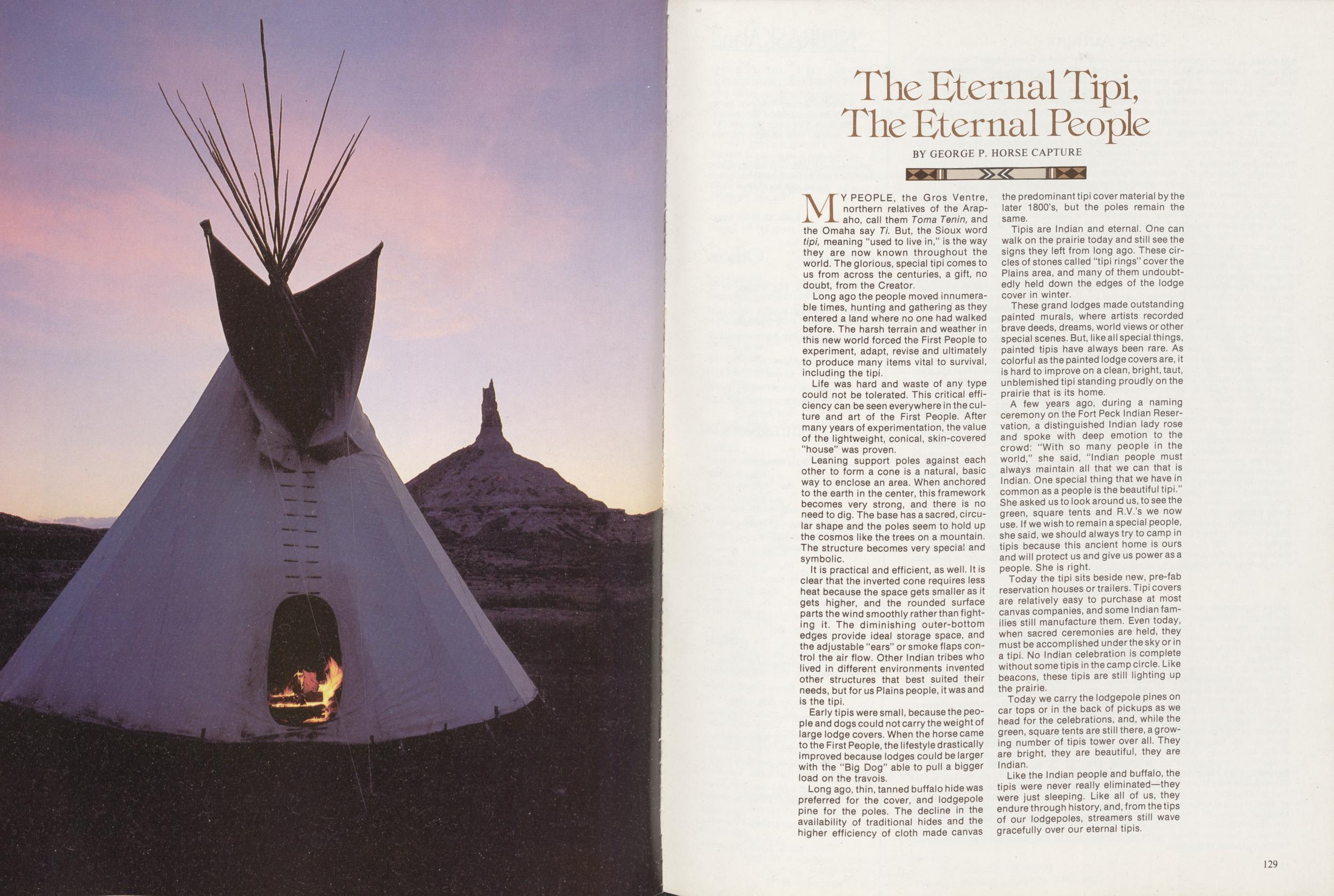
page not in scanned The Eternal Tipi, The Eternal People BY GEORGE P. HORSE CAPTURE MY PEOPLE, the Gros Ventre, northern relatives of the Arapaho, call them Toma Tenin, and the Omaha say 77. But, the Sioux word tipi, meaning "used to live in," is the way they are now known throughout the world. The glorious, special tipi comes to us from across the centuries, a gift, no doubt, from the Creator. Long ago the people moved innumerable times, hunting and gathering as they entered a land where no one had walked before. The harsh terrain and weather in this new world forced the First People to experiment, adapt, revise and ultimately to produce many items vital to survival, including the tipi. Life was hard and waste of any type could not be tolerated. This critical efficiency can be seen everywhere in the culture and art of the First People. After many years of experimentation, the value of the lightweight, conical, skin-covered "house" was proven. Leaning support poles against each other to form a cone is a natural, basic way to enclose an area. When anchored to the earth in the center, this framework becomes very strong, and there is no need to dig. The base has a sacred, circular shape and the poles seem to hold up the cosmos like the trees on a mountain. The structure becomes very special and symbolic. It is practical and efficient, as well. It is clear that the inverted cone requires less heat because the space gets smaller as it gets higher, and the rounded surface parts the wind smoothly rather than fighting it. The diminishing outer-bottom edges provide ideal storage space, and the adjustable "ears" or smoke flaps control the air flow. Other Indian tribes who lived in different environments invented other structures that best suited their needs, but for us Plains people, it was and is the tipi. Early tipis were smal I, because the people and dogs could not carry the weight of large lodge covers. When the horse came to the First People, the lifestyle drastically improved because lodges could be larger with the "Big Dog" able to pull a bigger load on the travois. Long ago, thin, tanned buffalo hide was preferred for the cover, and lodgepole pine for the poles. The decline in the availability of traditional hides and the higher efficiency of cloth made canvas the predominant tipi cover material by the later 1800's, but the poles remain the same. Tipis are Indian and eternal. One can walk on the prairie today and still see the signs they left from long ago. These circles of stones called "tipi rings" cover the Plains area, and many of them undoubtedly held down the edges of the lodge cover in winter. These grand lodges made outstanding painted murals, where artists recorded brave deeds, dreams, world views or other special scenes. But, like all special things, painted tipis have always been rare. As colorful as the painted lodge covers are, it is hard to improve on a clean, bright, taut, unblemished tipi standing proudly on the prairie that is its home. A few years ago, during a naming ceremony on the Fort Peck Indian Reservation, a distinguished Indian lady rose and spoke with deep emotion to the crowd: "With so many people in the world," she said, "Indian people must always maintain all that we can that is Indian. One special thing that we have in common as a people is the beautiful tipi." She asked us to look around us, to see the green, square tents and R.V.'s we now use. If we wish to remain a special people, she said, we should always try to camp in tipis because this ancient home is ours and will protect us and give us power as a people. She is right. Today the tipi sits beside new, pre-fab reservation houses or trailers. Tipi covers are relatively easy to purchase at most canvas companies, and some Indian families still manufacture them. Even today, when sacred ceremonies are held, they must be accomplished under the sky or in a tipi. No Indian celebration is complete without some tipis in the camp circle. Like beacons, these tipis are still lighting up the prairie. Today we carry the lodgepole pines on car tops or in the back of pickups as we head for the celebrations, and, while the green, square tents are still there, a growing number of tipis tower over all. They are bright, they are beautiful, they are Indian. Like the Indian people and buffalo, the tipis were never really eliminated—they were just sleeping. Like all of us, they endure through history, and, from the tips of our lodgepoles, streamers still wave gracefully over our eternal tipis.
129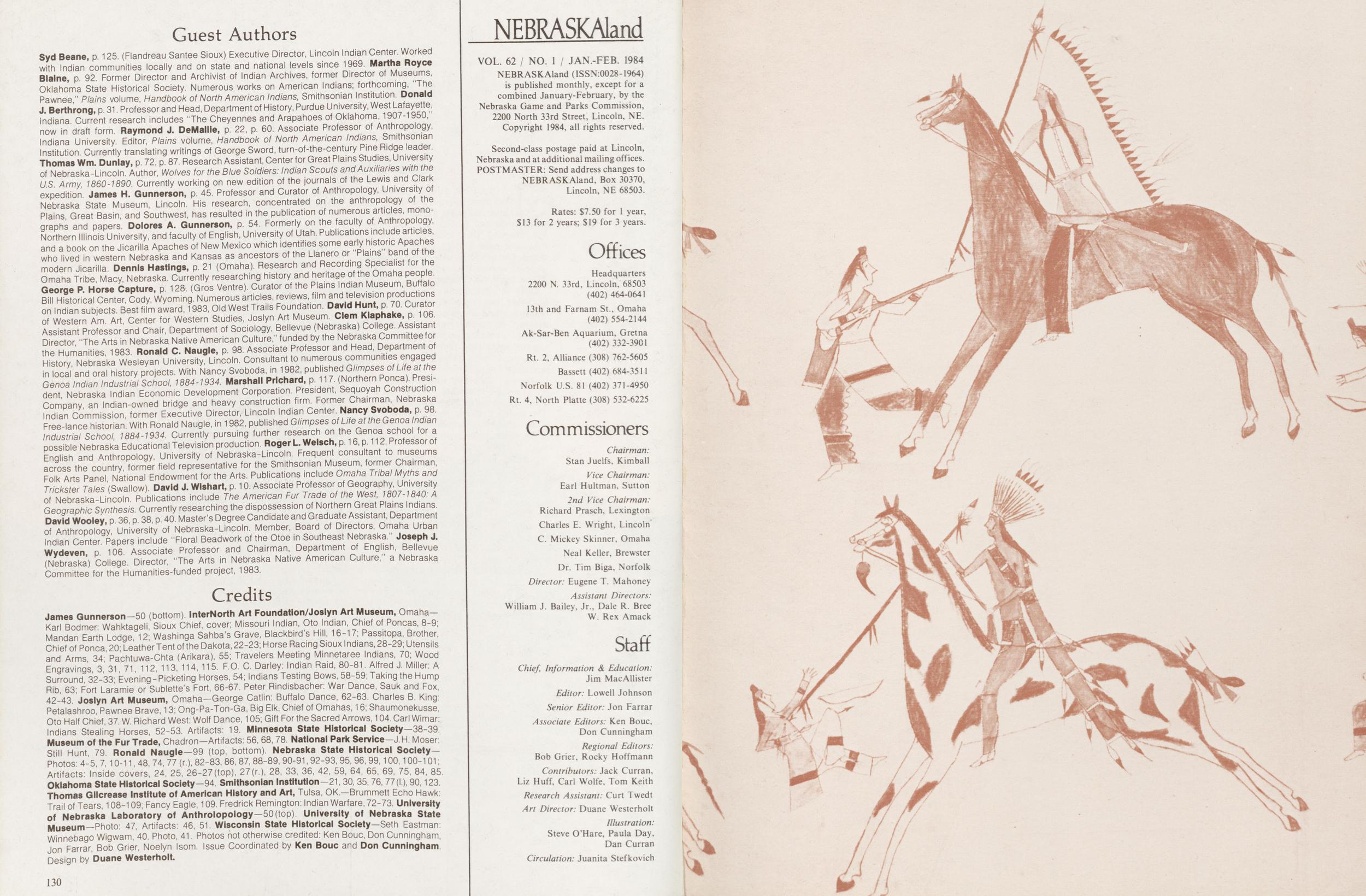
Guest Authors
Syd Beane, p. 125. (Flandreau Santee Sioux) Executive Director, Lincoln Indian Center. Worked with Indian communities locally and on state and national levels since 1969. Martha Royce Blaine, p. 92. Former Director and Archivist of Indian Archives, former Director of Museums, Oklahoma State Historical Society. Numerous works on American Indians; forthcoming, "The Pawnee," Plains volume, Handbook of North American Indians, Smithsonian Institution. Donald J. Berthrong, p. 31. Professor and Head, Department of History, Purdue University, West Lafayette, Indiana. Current research includes "The Cheyennes and Arapahoes of Oklahoma, 1907-1950," now in draft form. Raymond J. DeMallie, p. 22, p. 60. Associate Professor of Anthropology, Indiana University. Editor, Plains volume, Handbook of North American Indians, Smithsonian Institution. Currently translating writings of George Sword, turn-of-the-century Pine Ridge leader. Thomas Wm. Dunlay, p. 72, p. 87. Research Assistant, Center for Great Plains Studies, University of Nebraska-Lincoln. Author, Wolves for the Blue Soldiers: Indian Scouts and Auxiliaries with the U.S. Army, 1860-1890. Currently working on new edition of the journals of the Lewis and Clark expedition. James H. Gunnerson, p. 45. Professor and Curator of Anthropology, University of Nebraska State Museum, Lincoln. His research, concentrated on the anthropology of the Plains, Great Basin, and Southwest, has resulted in the publication of numerous articles, monographs and papers. Dolores A. Gunnerson, p. 54. Formerly on the faculty of Anthropology, Northern Illinois University, and faculty of English, University of Utah. Publications include articles, and a book on the Jicarilla Apaches of New Mexico which identifies some early historic Apaches who lived in western Nebraska and Kansas as ancestors of the Llanero or "Plains" band of the modern Jicarilla. Dennis Hastings, p. 21 (Omaha). Research and Recording Specialist for the Omaha Tribe, Macy, Nebraska. Currently researching history and heritage of the Omaha people. George P. Horse Capture, p. 128. (Gros Ventre). Curator of the Plains Indian Museum, Buffalo Bill Historical Center, Cody, Wyoming. Numerous articles, reviews, film and television productions on Indian subjects. Best film award, 1983, Old West Trails Foundation. David Hunt, p. 70. Curator of Western Am. Art, Center for Western Studies, Joslyn Art Museum. Clem Klaphake, p. 106. Assistant Professor and Chair, Department of Sociology, Bellevue (Nebraska) College. Assistant Director, "The Arts in Nebraska Native American Culture," funded by the Nebraska Committee for the Humanities, 1983. Ronald C. Naugle, p. 98. Associate Professor and Head, Department of History, Nebraska Wesleyan University, Lincoln. Consultant to numerous communities engaged in local and oral history projects. With Nancy Svoboda, in 1982, published Glimpses of Life at the Genoa Indian Industrial School, 1884-1934. Marshall Prichard, p. 117. (Northern Ponca). President, Nebraska Indian Economic Development Corporation. President, Sequoyah Construction Company, an Indian-owned bridge and heavy construction firm. Former Chairman, Nebraska Indian Commission, former Executive Director, Lincoln Indian Center. Nancy Svoboda, p. 98. Free-lance historian. With Ronald Naugle, in 1982, published Glimpses of Life at the Genoa Indian Industrial School, 1884-1934. Currently pursuing further research on the Genoa school for a possible Nebraska Educational Television production. Roger L. Welsch, p. 16, p. 112. Professor of English and Anthropology. University of Nebraska-Lincoln. Frequent consultant to museums across the country, former field representative for the Smithsonian Museum, former Chairman, Folk Arts Panel, National Endowment for the Arts. Publications include Gmaha Tribal Myths and Trickster Tales (Swallow). David J. Wishart, p. 10. Associate Professor of Geography, University of Nebraska-Lincoln. Publications include The American Fur Trade of the West, 1807-1840: A Geographic Synthesis. Currently researching the dispossession of Northern Great Plains Indians. David Wooley, p. 36, p. 38, p. 40. Master's Degree Candidate and Graduate Assistant, Department of Anthropology, University of Nebraska-Lincoln. Member, Board of Directors, Omaha Urban Indian Center. Papers include "Floral Beadwork of the Otoe in Southeast Nebraska." Joseph J. Wydeven, p. 106. Associate Professor and Chairman, Department of English, Bellevue (Nebraska) College. Director, "The Arts in Nebraska Native American Culture," a Nebraska Committee for the Humanities-funded project, 1983. Credits James Gunnerson—50 (bottom) InterNorth Art Foundation/Joslyn Art Museum, Omaha-Karl Bodmer: Wahktageli, Sioux Chief, cover; Missouri Indian, Oto Indian, Chief of Poncas, 8-9; Mandan Earth Lodge, 12; Washinga Sahba's Grave, Blackbird's Hill, 16-17; Passitopa, Brother, Chief of Ponca, 20; Leather Tent of the Dakota, 22-23; Horse Racing Sioux Indians, 28-29; Utensils and Arms, 34; Pachtuwa-Chta (Arikara), 55; Travelers Meeting Minnetaree Indians, 70; Wood Engravings, 3, 31, 71, 112, 113, 114, 115. F.O. C. Darley: Indian Raid, 80-81. Alfred J. Miller: A Surround, 32-33; Evening - Picketing Horses, 54; Indians Testing Bows, 58-59; Taking the Hump Rib, 63; Fort Laramie or Sublette's Fort, 66-67. Peter Rindisbacher: War Dance, Sauk and Fox, 42-43. Joslyn Art Museum, Omaha—George Catlin: Buffalo Dance, 62-63. Charles B. King': Petalashroo, Pawnee Brave, 13; Ong-Pa-Ton-Ga, Big Elk, Chief of Omahas, 16; Shaumonekusse, Oto Half Chief, 37. W. Richard West: Wolf Dance, 105; Gift For the Sacred Arrows, 104. Carl Wimar: Indians Stealing Horses, 52-53. Artifacts: 19. Minnesota State Historical Society—38-39. Museum of the Fur Trade, Chadron—Artifacts: 56, 68, 78. National Park Service—J. H. Moser: Still Hunt, 79. Ronald Naugle—99 (top, bottom). Nebraska State Historical Society-Photos: 4-5, 7, 10-11, 48, 74, 77 (r.), 82-83, 86, 87, 88-89, 90-91, 92-93, 95, 96, 99,100, 100-1 01 Artifacts: Inside covers, 24, 25, 26-27(top), 27(r.), 28, 33, 36, 42, 59, 64, 65, 69, 75, 84, 85. Oklahoma State Historical Society—94 Smithsonian Institution—21, 30, 35,76, 77 (I.), 90,123 Thomas Gilcrease Institute of American History and Art, Tulsa, OK—Brummett Echo Hawk: Trail of Tears, 108-109; Fancy Eagle, 109. Fredrick Remington: Indian Warfare, 72-73. University of Nebraska Laboratory of Anthrolopology—50 (top) University of Nebraska State Museum—Photo: 47, Artifacts: 46, 51. Wisconsin State Historical Society—Seth Eastman-Winnebago Wigwam, 40. Photo, 41. Photos not otherwise credited: Ken Bouc, Don Cunningham Jon Farrar, Bob Grier, Noelyn Isom. Issue Coordinated by Ken Bouc and Don Cunningham Design by Duane Westerholt. 130Position: 204 (35 views)