Volume 61, Issue 11, 1983
NEBRASKAland
DECEMBER 1983 $1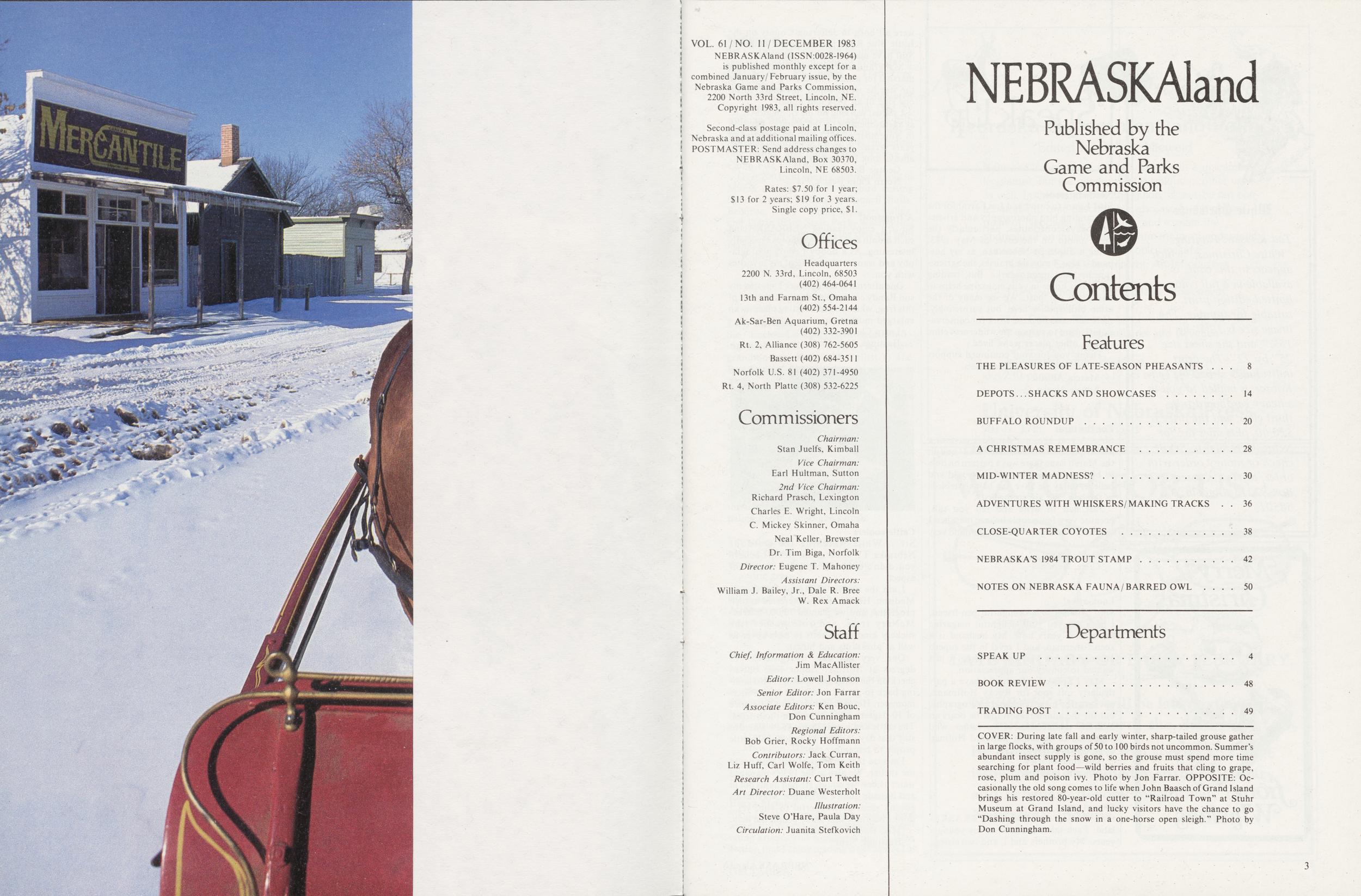
NEBRASKAland
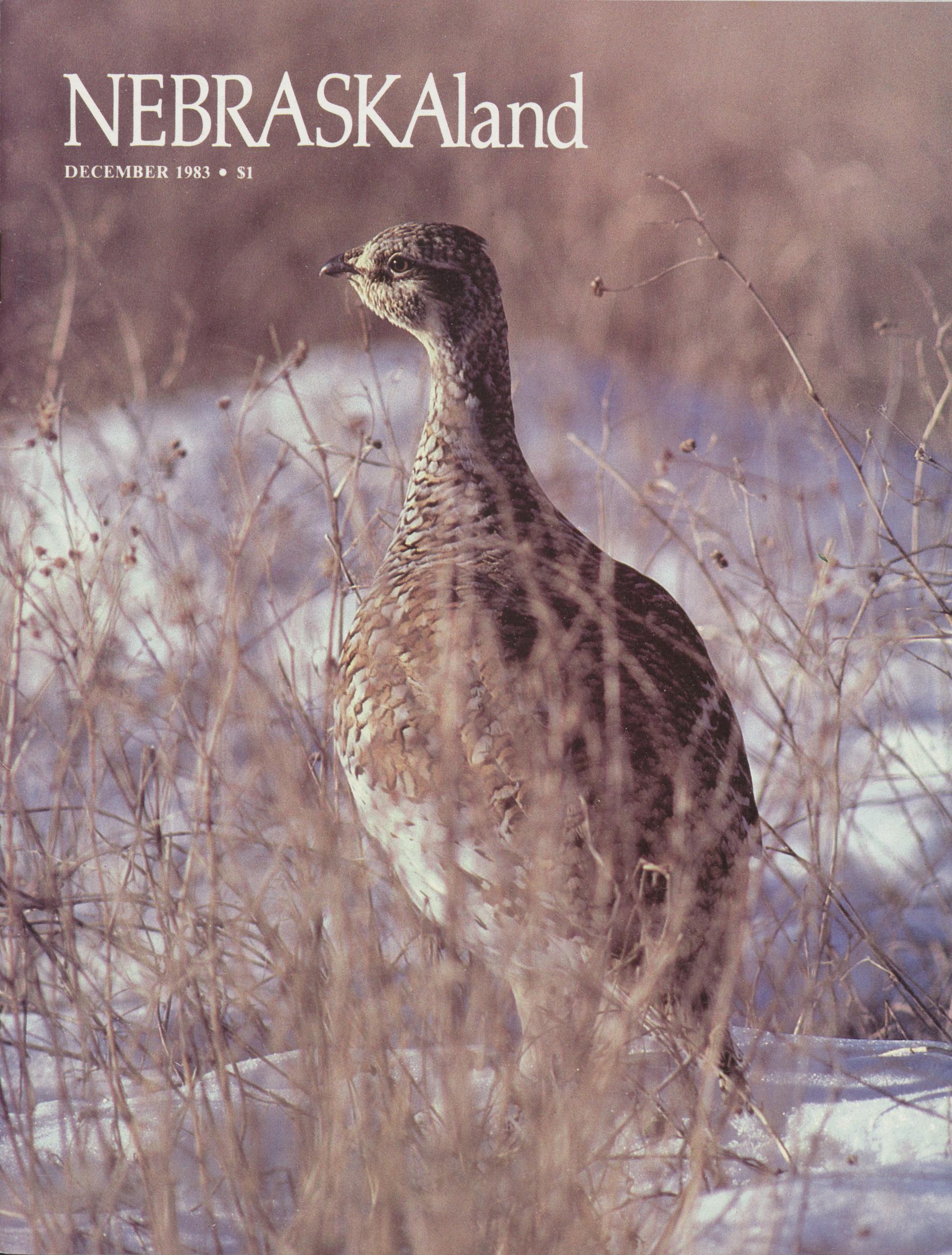
Published by the Nebraska Game and Parks Commission Contents Features THE PLEASURES OF LATE-SEASON PHEASANTS 8 DEPOTS ... SHACKS AND SHOWCASES 14 BUFFALO ROUNDUP 20 A CHRISTMAS REMEMBRANCE 28 MID-WINTER MADNESS? 30 ADVENTURES WITH WHISKERS/MAKING TRACKS 36 CLOSE-QUARTER COYOTES 38 NEBRASKA'S 1984 TROUT STAMP 42 NOTES ON NEBRASKA FAUNA/BARRED OWL 50 Departments SPEAK UP 4 BOOK REVIEW 48 TRADING POST 49 COVER: During late fall and early winter, sharp-tailed grouse gather in large flocks, with groups of 50 to 100 birds not uncommon. Summer's abundant insect supply is gone, so the grouse must spend more time searching for plant food—wild berries and fruits that cling to grape, rose, plum and poison ivy. Photo by Jon Farrar. OPPOSITE: Occasionally the old song comes to life when John Baasch of Grand Island brings his restored 80-year-old cutter to "Railroad Town" at Stuhr Museum at Grand Island, and lucky visitors have the chance to go "Dashing through the snow in a one-horse open sleigh." Photo by Don Cunningham. 3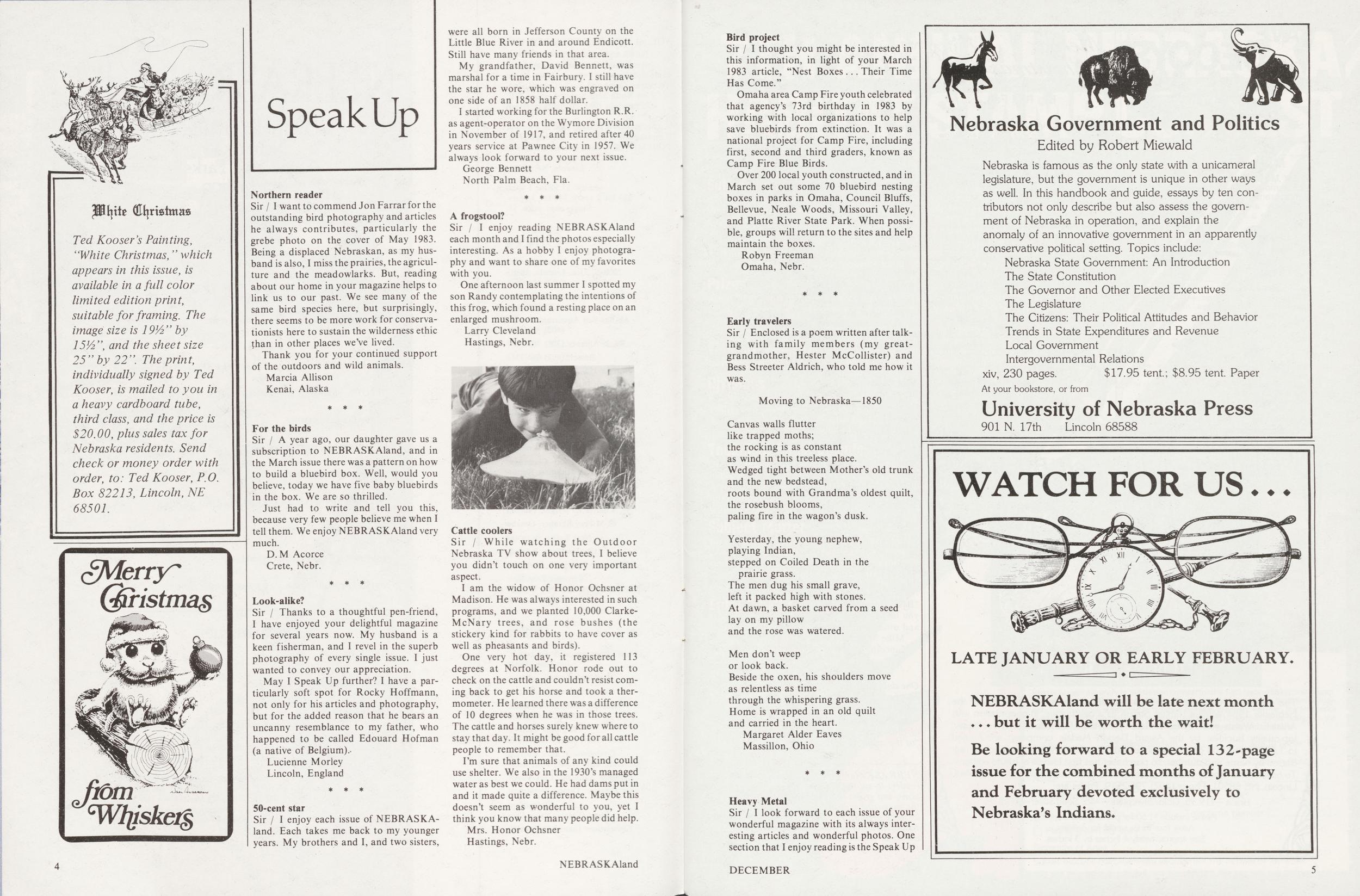
Merry Cristmas from Whiskers
Speak Up
Northern readerSir / I want to commend Jon Farrar for the outstanding bird photography and articles he always contributes, particularly the grebe photo on the cover of May 1983.Being a displaced Nebraskan, as my husband is also, I miss the prairies, the agriculture and the meadowlarks. But, reading about our home in your magazine helps tolink us to our past. We see many of thesame bird species here, but surprisingly, there seems to be more work for conservationists here to sustain the wilderness ethic than in other places we've lived.
Thank you for your continued support of the outdoors and wild animals.
Marcia AllisonKenai, Alaska For the birds
Sir / A year ago, our daughter gave us a subscription to NEBRASKAland, and in the March issue there was a pattern on how to build a bluebird box. Well, would you believe, today we have five baby bluebirds in the box. We are so thrilled.
Just had to write and tell you this, because very few people believe me when I tell them. We enjoy NEBRASKAland very much.
D.M AcorceCrete, Nebr. Look-alike?
Sir / Thanks to a thoughtful pen-friend, I have enjoyed your delightful magazine for several years now. My husband is a keen fisherman, and I revel in the superb photography of every single issue. I just wanted to convey our appreciation.
May I Speak Up further? I have a particularly soft spot for Rocky Hoffmann, not only for his articles and photography, but for the added reason that he bears an uncanny resemblance to my father, who happened to be called Edouard Hofman (a native of Belgium).
Lucienne MorieyLincoln, England 50-cent star
Sir / I enjoy each issue of NEBRASKAland. Each takes me back to my younger years. My brothers and I, and two sisters, were all born in Jefferson County on the Little Blue River in and around Endicott. Still have many friends in that area.
My grandfather, David Bennett, was marshal for a time in Fairbury. I still have the star he wore, which was engraved on one side of an 1858 half dollar.
I started working for the Burlington R.R. as agent-operator on the Wymore Division in November of 1917, and retired after 40 years service at Pawnee City in 1957. We always look forward to your next issue.
George BennettNorth Palm Beach, Fla. A frogstool?
Sir / I enjoy reading NEBRASKAland each month and I find the photos especially interesting. As a hobby I enjoy photography and want to share one of my favorites with you.
One afternoon last summer I spotted my son Randy contemplating the intentions of this frog, which found a resting place on an enlarged mushroom.
Larry ClevelandHastings, Nebr. Cattle coolers
Sir / While watching the Outdoor Nebraska TV show about trees, I believe you didn't touch on one very important aspect.
I am the widow of Honor Ochsner at Madison. He was always interested in such programs, and we planted 10,000 Clarke-McNary trees, and rose bushes (the stickery kind for rabbits to have cover as well as pheasants and birds).
One very hot day, it registered 113 degrees at Norfolk. Honor rode out to check on the cattle and couldn't resist coming back to get his horse and took a thermometer. He learned there was a difference of 10 degrees when he was in those trees. The cattle and horses surely knew where to stay that day. It might be good for all cattle people to remember that.
I'm sure that animals of any kind could use shelter. We also in the 1930's managed water as best we could. He had dams put in and it made quite a difference. Maybe this doesn't seem as wonderful to you, yet I think you know that many people did help.
Mrs. Honor OchsnerHastings, Nebr. 4 NEBRASKAland Bird project
Sir / I thought you might be interested in this information, in light of your March 1983 article, "Nest Boxes Their Time Has Come."
Omaha area Camp Fire youth celebrated that agency's 73rd birthday in 1983 by working with local organizations to help save bluebirds from extinction. It was a national project for Camp Fire, including first, second and third graders, known as Camp Fire Blue Birds.
Over 200 local youth constructed, and in March set out some 70 bluebird nesting boxes in parks in Omaha, Council Bluffs, Bellevue, Neale Woods, Missouri Valley, and Platte River State Park. When possible, groups will return to the sites and help maintain the boxes.
Robyn FreemanOmaha, Nebr. Early travelers
Sir / Enclosed is a poem written after talking with family members (my great-grandmother, Hester McCollister) and Bess Streeter Aldrich, who told me how it was.
Moving to Nebraska—1850
Canvas walls flutter like trapped moths; the rocking is as constant as wind in this treeless place. Wedged tight between Mother's old trunk and the new bedstead, roots bound with Grandma's oldest quilt, the rosebush blooms, paling fire in the wagon's dusk.
Yesterday, the young nephew, playing Indian, stepped on Coiled Death in the prairie grass. The men dug his small grave, left it packed high with stones. At dawn, a basket carved from a seed lay on my pillow and the rose was watered.
Men don't weep or look back. Beside the oxen, his shoulders move as relentless as time through the whispering grass. Home is wrapped in an old quilt and carried in the heart.
Margaret Alder EavesMassillon, Ohio Heavy Metal
Sir / I look forward to each issue of your wonderful magazine with its always interesting articles and wonderful photos. One section that I enjoy reading is the Speak Up
letters. It lets readers know how involved different people get on various subjects, and it's nice to see all the out-of-state addresses.
In the article "Shooting for Metals," would you please explain something for me. It states that this is the annual Nebraska high school .22 metallic silhouette championship. I had the understanding that this was strictly for the .22. It says youngsters using average plinking or hunting .22 rifles can be competitive, but the following line says rifles in the "heavy-class can include silhouette, custom-built and fiberglass."
This just brought up the question as to whether it is strictly for .22's or not.
Ronald BrownFalls City, Nebr.
Yes, while the weight of the rifles can vary (and supposedly their accuracy with it), the shoot is for .22's. There are other divisions of silhouette shooting, with large-caliber rifles (with the .308 very popular) but not in the high school shoot. (Editor)
Nebraskans allSir / I want to take a few minutes to congratulate you on the September 1983 issue of NEBRASKAland. The pictures on pages 28-31 are fantastic! It was so good to see that other minorities, besides Native Americans, work and play in all parts of Nebraska. They contribute greatly and in many ways to make Nebraska what it is today. Keep this up. It's great! The writing and photography are exellent, too.
Gloria Medina ReifenrathMexican American Commission Bad Eggs!
Sir / I was reading the August issue of NEBRASKAland and noticed a recipe for "Basic Poached Fish." I was wondering if you had a similar recipe for Poached deer and other game species? Ha Ha.
Mike SwiggartLincoln, Nebr.
One does hear about various species being poached, but your question about recipes seems valid, as you don't see them around. Actually, it would be best if the poachers of those deer were the ones who ended up "in the soup."(Editor)
NEBRASKAland Magazine invites all readers to submit their comments, suggestions, and gripes to Speak Up. Each month the magazine will publish as many letters as space permits. Pictures are also welcome. NEBRASKAland does reserve the right to edit and condense letters. (Editor) 6 NEBRASKAland7TH ANNUAL NEBRASKA HABITAT STAMP CONTEST
Submission Entries should be protected by a covering but will not be accepted in frames or under glass. Wrap securely and send to: Habitat Stamp Contest, Nebraska Game and Parks Commission, P.O. Box 30370, 2200 N. 33rd St., Lincoln, NE 68503. A completed entry form and reproduction agreement or facsimile thereof must accompany the entry. Name and address of the artist must appear only on the reverse side of the entry. The Game and Parks Commission is not responsible for any entry lost or damaged in transit. Entries will not be returned unless specifically requested and return postage is included. Prizes Adult Division first place winner receives $200 from the Omaha Fish and Wildlife Club. Runners-up all receive a subscription to NEBRASKAland Magazine. Youth Division first place winners in each section receive $50 from the Omaha Fish and Wildlife Club. Runners-up all receive a subscription to NEBRASKAland Magazine. Selected entries will be included in a traveling exhibit to be displayed at various locations around the state. Divisions Adult: Amateur or professional artists. Youth: Senior Section: Grades 9-12 Junior Section: Grades 5-8 Primary Section: Grades 1-4 Technical Requirements Design must be 7 1/2 inches by 4 11/16 inches. It may be matted, but mat may not exceed 10 inches by 7 inches. Any medium is acceptable, but no scroll work or lettering may appear on the design. Color is preferred. One entry per person. Subject Matter Any Nebraska wildlife species in an appropriate habitat setting, except canada goose, ring-necked pheasant, cottontail rabbit, coyote, and wild turkey which are ineligible this year. Entry Deadline March 1, 1984. Contest is open to Nebraska residents only, and winning entry in the Adult Division will appear, on the 1985 Nebraska Habitat Stamp.1984 Winner, Charlotte Edwards, Morse Bluff, NE
The Pleasures of LATE SEASON PHEASANTS
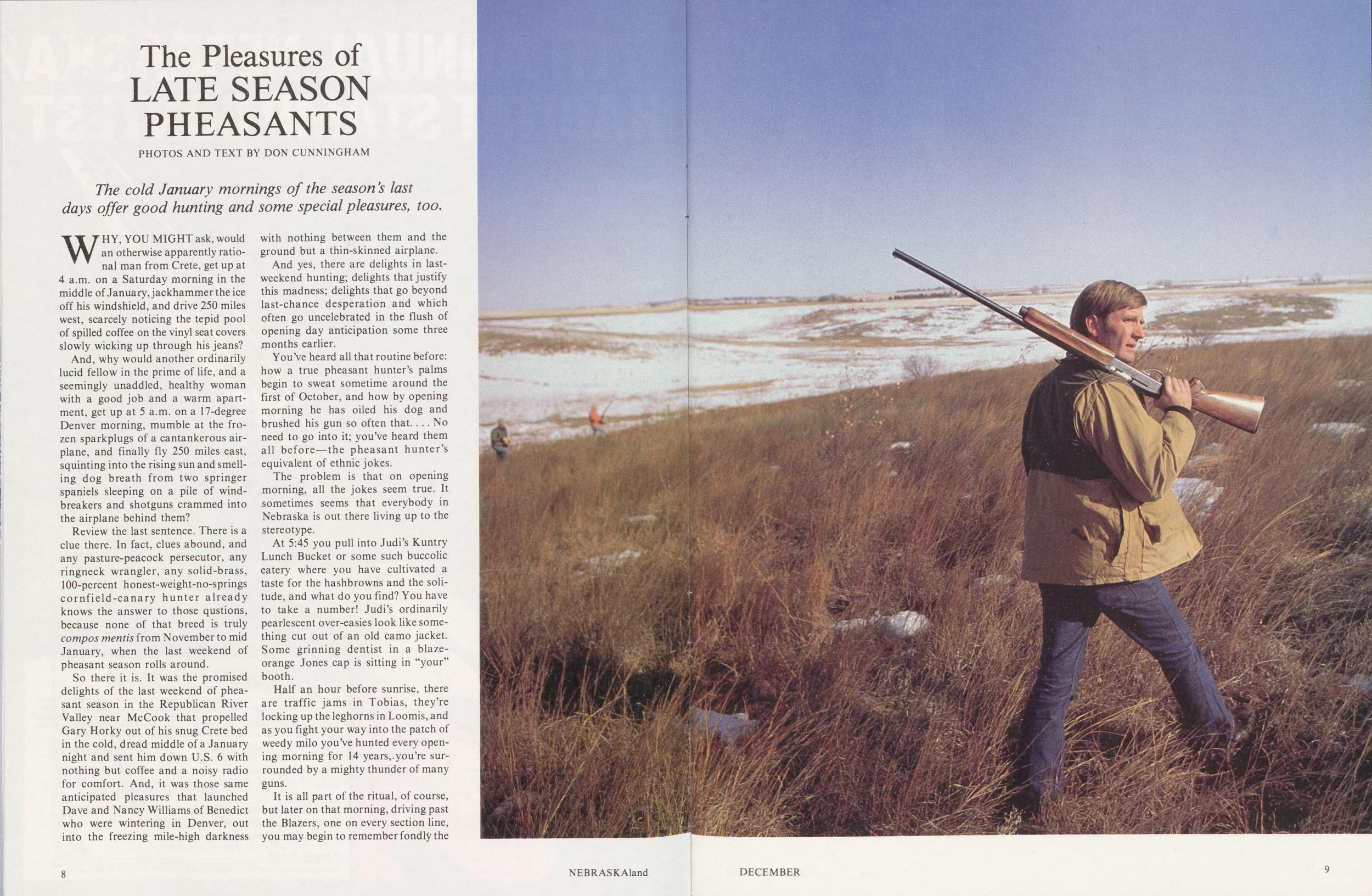
PHOTOS AND TEXT BY DON CUNNINGHAM The cold January mornings of the season's last days offer good hunting and some special pleasures, too.WHY, YOU MIGHT ask, would an otherwise apparently rational man from Crete, get up at 4 a.m. on a Saturday morning in the middle of January, jackhammer the ice off his windshield, and drive 250 miles west, scarcely noticing the tepid pool of spilled coffee on the vinyl seat covers slowly wicking up through his jeans?
And, why would another ordinarily lucid fellow in the prime of life, and a seemingly unaddled, healthy woman with a good job and a warm apartment, get up at 5 a.m. on a 17-degree Denver morning, mumble at the frozen sparkplugs of a cantankerous airplane, and finally fly 250 miles east, squinting into the rising sun and smelling dog breath from two springer spaniels sleeping on a pile of windbreakers and shotguns crammed into the airplane behind them?
Review the last sentence. There is a clue there. In fact, clues abound, and any pasture-peacock persecutor, any ringneck wrangler, any solid-brass, 100-percent honest-weight-no-springs cornfield-canary hunter already knows the answer to those qustions, because none of that breed is truly compos mentis from November to mid January, when the last weekend of pheasant season rolls around.
So there it is. It was the promised delights of the last weekend of pheasant season in the Republican River Valley near McCook that propelled Gary Horky out of his snug Crete bed in the cold, dread middle of a January night and sent him down U.S. 6 with nothing but coffee and a noisy radio for comfort. And, it was those same anticipated pleasures that launched Dave and Nancy Williams of Benedict who were wintering in Denver, out into the freezing mile-high darkness with nothing between them and the ground but a thin-skinned airplane.
And yes, there are delights in lastweekend hunting; delights that justify this madness; delights that go beyond last-chance desperation and which often go uncelebrated in the flush of opening day anticipation some three months earlier.
You've heard all that routine before: how a true pheasant hunter's palms begin to sweat sometime around the first of October, and how by opening morning he has oiled his dog and brushed his gun so often that No need to go into it; you've heard them all before—the pheasant hunter's equivalent of ethnic jokes.
The problem is that on opening morning, all the jokes seem true. It sometimes seems that everybody in Nebraska is out there living up to the stereotype.
At 5:45 you pull into Judi's Kuntry Lunch Bucket or some such buccolic eatery where you have cultivated a taste for the hashbrowns and the solitude, and what do you find? You have to take a number! Judi's ordinarily pearlescent over-easies look like something cut out of an old camo jacket Some grinning dentist in a blaze-orange Jones cap is sitting in "your" booth.
Half an hour before sunrise, there are traffic jams in Tobias, they're locking up the leghorns in Loomis, and as you fight your way into the patch of weedy milo you've hunted every opening morning for 14 years,.you're surrounded by a mighty thunder of many guns.
It is all part of the ritual, of course, but later on that morning, driving past the Blazers, one on every section line, you may begin to remember fondly the
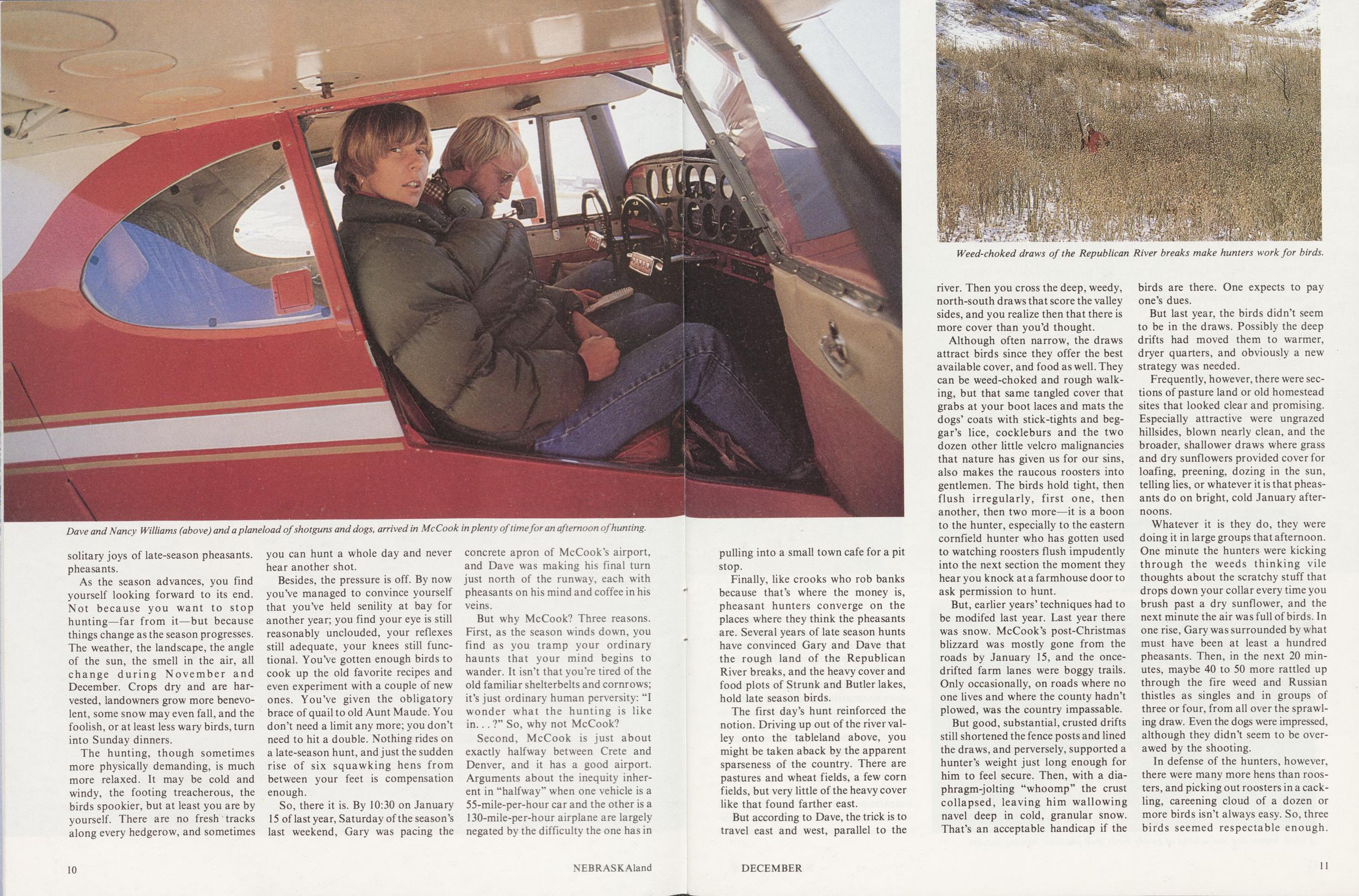
Dave and Nancy Williams (above) and a planeload of shotguns and dogs, arrived in McCook in plenty of time for an afternoon of hunting.
solitary joys of late-season pheasants, pheasants.
As the season advances, you find yourself looking forward to its end. Not because you want to stop hunting—far from it—but because things change as the season progresses. The weather, the landscape, the angle of the sun, the smell in the air, all change during November and December. Crops dry and are harvested, landowners grow more benevolent, some snow may even fall, and the foolish, or at least less wary birds, turn into Sunday dinners.
The hunting, though sometimes more physically demanding, is much more relaxed. It may be cold and windy, the footing treacherous, the birds spookier, but at least you are by yourself. There are no fresh tracks along every hedgerow, and sometimes you can hunt a whole day and never hear another shot.
Besides, the pressure is off. By now you've managed to convince yourself that you've held senility at bay for another year; you find your eye is still reasonably unclouded, your reflexes still adequate, your knees still functional. You've gotten enough birds to cook up the old favorite recipes and even experiment with a couple of new ones. You've given the obligatory brace of quail to old Aunt Maude. You don't need a limit any more; you don't need to hit a double. Nothing rides on a late-season hunt, and just the sudden rise of six squawking hens from between your feet is compensation enough.
So, there it is. By 10:30 on January 15 of last year, Saturday of the season's last weekend, Gary was pacing the concrete apron of McCook's airport, and Dave was making his final turn just north of the runway, each with pheasants on his mind and coffee in his veins.
But why McCook? Three reasons. First, as the season winds down, you find as you tramp your ordinary haunts that your mind begins to wander. It isn't that you're tired of the old familiar shelterbelts and cornrows; it's just ordinary human perversity: "I wonder what the hunting is like in.. . ?" So, why not McCook?
Second, McCook is just about exactly halfway between Crete and Denver, and it has a good airport. Arguments about the inequity inherent in "halfway" when one vehicle is a 55-mile-per-hour car and the other is a 130-mile-per-hour airplane are largely negated by the difficulty the one has in
10 NEBRASKAlandpulling into a small town cafe for a pit stop.
Finally, like crooks who rob banks because that's where the money is, pheasant hunters converge on the places where they think the pheasants are. Several years of late season hunts have convinced Gary and Dave that the rough land of the Republican River breaks, and the heavy cover and food plots of Strunk and Butler lakes, hold late season birds.
The first day's hunt reinforced the notion. Driving up out of the river valley onto the tableland above, you might be taken aback by the apparent sparseness of the country. There are pastures and wheat fields, a few corn fields, but very little of the heavy cover like that found farther east.
But according to Dave, the trick is to travel east and west, parallel to the
Weed-choked draws of the Republican River breaks make hunters work for birds.
river. Then you cross the deep, weedy, north-south draws that score the valley sides, and vou realize then that there is more cover than you'd thought.
Although often narrow, the draws attract birds since they offer the best available cover, and food as well. They can be weed-choked and rough walking, but that same tangled cover that grabs at your boot laces and mats the dogs' coats with stick-tights and beggar's lice, cockleburs and the two dozen other little velcro malignancies that nature has given us for our sins, also makes the raucous roosters into gentlemen. The birds hold tight, then flush irregularly, first one, then another, then two more—it is a boon to the hunter, especially to the eastern cornfield hunter who has gotten used to watching roosters flush impudently into the next section the moment they hear you knock at a farmhouse door to ask permission to hunt.
But, earlier years' techniques had to be modifed last year. Last year there was snow. McCook's post-Christmas blizzard was mostly gone from the roads by January 15, and the once-drifted farm lanes were boggy trails. Only occasionally, on roads where no one lives and where the county hadn't plowed, was the country impassable.
But good, substantial, crusted drifts still shortened the fence posts and lined the draws, and perversely, supported a hunter's weight just long enough for him to feel secure. Then, with a diaphragm-jolting "whoomp" the crust collapsed, leaving him wallowing navel deep in cold, granular snow. That's an acceptable handicap if the birds are there. One expects to pay one's dues.
But last year, the birds didn't seem to be in the draws. Possibly the deep drifts had moved them to warmer, dryer quarters, and obviously a new strategy was needed.
Frequently, however, there were sections of pasture land or old homestead sites that looked clear and promising. Especially attractive were ungrazed hillsides, blown nearly clean, and the broader, shallower draws where grass and dry sunflowers provided cover for loafing, preening, dozing in the sun, telling lies, or whatever it is that pheasants do on bright, cold January afternoons.
Whatever it is they do, they were doing it in large groups that afternoon. One minute the hunters were kicking through the weeds thinking vile thoughts about the scratchy stuff that drops down your collar every time you brush past a dry sunflower, and the next minute the air was full of birds. In one rise, Gary was surrounded by what must have been at least a hundred pheasants. Then, in the next 20 minutes, maybe 40 to 50 more rattled up through the fire weed and Russian thistles as singles and in groups of three or four, from all over the sprawling draw. Even the dogs were impressed, although they didn't seem to be overawed by the shooting.
In defense of the hunters, however, there were many more hens than roosters, and picking out roosters in a cackling, careening cloud of a dozen or more birds isn't always easy. So, three birds seemed respectable enough.
DECEMBER 11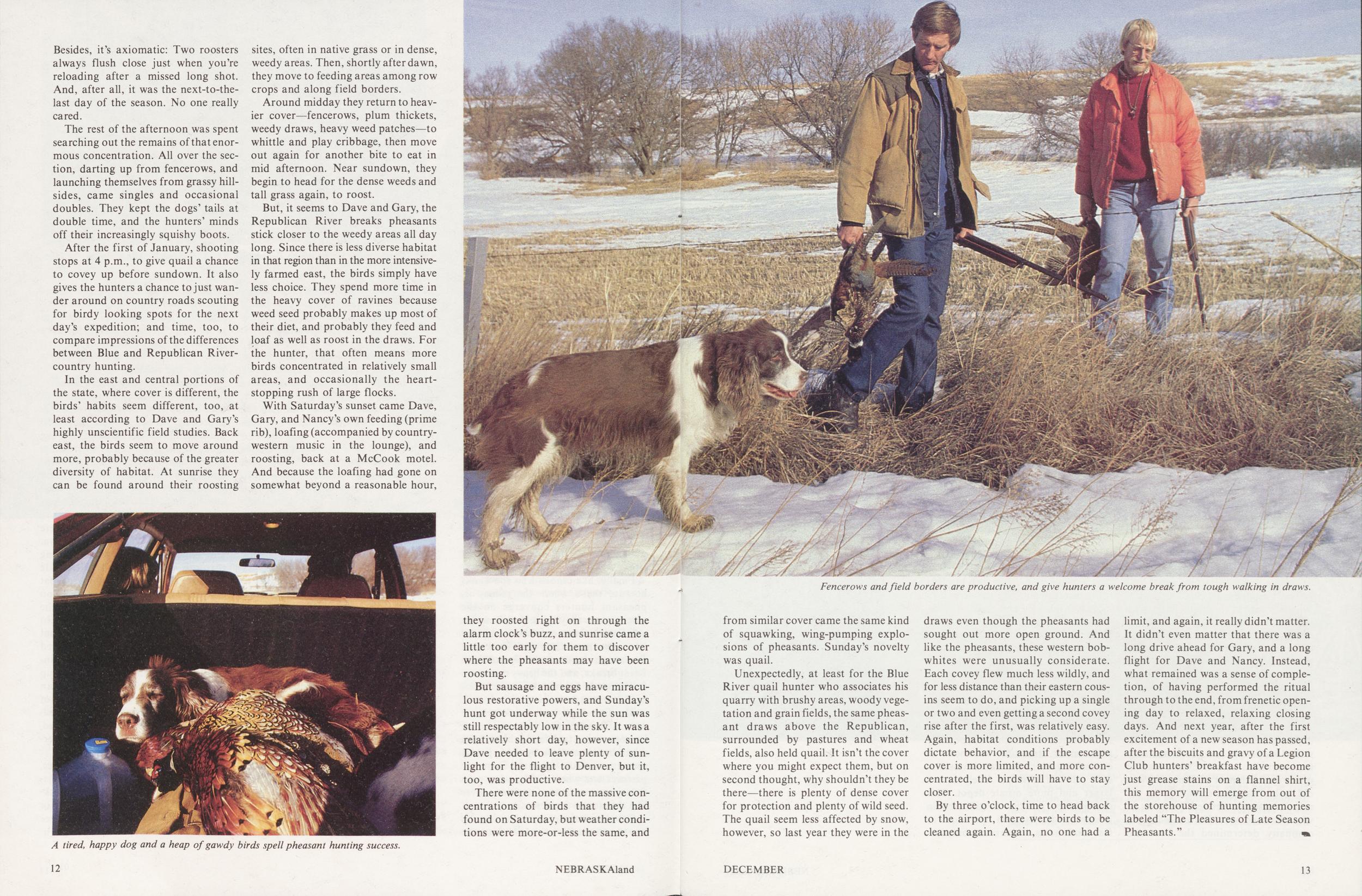
Besides, it's axiomatic: Two roosters always flush close just when you're reloading after a missed long shot. And, after all, it was the next-to-the-last day of the season. No one really cared.
The rest of the afternoon was spent searching out the remains of that enormous concentration. All over the section, darting up from fencerows, and launching themselves from grassy hillsides, came singles and occasional doubles. They kept the dogs' tails at double time, and the hunters' minds off their increasingly squishy boots.
After the first of January, shooting stops at 4 p.m., to give quail a chance to covey up before sundown. It also gives the hunters a chance to just wander around on country roads scouting for birdy looking spots for the next day's expedition; and time, too, to compare impressions of the differences between Blue and Republican River-country hunting.
In the east and central portions of the state, where cover is different, the birds' habits seem different, too, at least according to Dave and Gary's highly unscientific field studies. Back east, the birds seem to move around more, probably because of the greater diversity of habitat. At sunrise they can be found around their roosting sites, often in native grass or in dense, weedy areas. Then, shortly after dawn, they move to feeding areas among row crops and along field borders.
Around midday they return to heavier cover—fencerows, plum thickets, weedy draws, heavy weed patches—to whittle and play cribbage, then move out again for another bite to eat in mid afternoon. Near sundown, they begin to head for the dense weeds and tall grass again, to roost.
But, it seems to Dave and Gary, the Republican River breaks pheasants stick closer to the weedy areas all day long. Since there is less diverse habitat in that region than in the more intensively farmed east, the birds simply have less choice. They spend more time in the heavy cover of ravines because weed seed probably makes up most of their diet, and probably they feed and loaf as well as roost in the draws. For the hunter, that often means more birds concentrated in relatively small areas, and occasionally the heartstopping rush of large flocks.
With Saturday's sunset came Dave, Gary, and Nancy's own feeding (prime rib), loafing (accompanied by country-western music in the lounge), and roosting, back at a McCook motel. And because the loafing had gone on somewhat beyond a reasonable hour,
Fencerows and field borders are productive, and give hunters a welcome break from tough walking in draws.
A tired, happy dog and a heap of gawdy birds spell pheasant hunting success.
they roosted right on through the alarm clock's buzz, and sunrise came a little too early for them to discover where the pheasants may have been roosting.
But sausage and eggs have miraculous restorative powers, and Sunday's hunt got underway while the sun was still respectably low in the sky. It was a relatively short day, however, since Dave needed to leave plenty of sunlight for the flight to Denver, but it, too, was productive.
There were none of the massive concentrations of birds that they had found on Saturday, but weather conditions were more-or-less the same, and
12 NEBRASKAlandfrom similar cover came the same kind of squawking, wing-pumping explosions of pheasants. Sunday's novelty was quail.
Unexpectedly, at least for the Blue River quail hunter who associates his quarry with brushy areas, woody vegetation and grain fields, the same pheasant draws above the Republican, surrounded by pastures and wheat fields, also held quail. It isn't the cover where you might expect them, but on second thought, why shouldn't they be there—there is plenty of dense cover for protection and plenty of wild seed. The quail seem less affected by snow, however, so last year they were in the draws even though the pheasants had sought out more open ground. And like the pheasants, these western bob-whites were unusually considerate. Each covey flew much less wildly, and for less distance than their eastern cousins seem to do, and picking up a single or two and even getting a second covey rise after the first, was relatively easy. Again, habitat conditions probably dictate behavior, and if the escape cover is more limited, and more concentrated, the birds will have to stay closer.
By three o'clock, time to head back to the airport, there were birds to be cleaned again. Again, no one had a limit, and again, it really didn't matter. It didn't even matter that there was a long drive ahead for Gary, and a long flight for Dave and Nancy. Instead, what remained was a sense of completion, of having performed the ritual through to the end, from frenetic opening day to relaxed, relaxing closing days. And next year, after the first excitement of a new season has passed, after the biscuits and gravy of a Legion Club hunters' breakfast have become just grease stains on a flannel shirt, this memory will emerge from out of the storehouse of hunting memories labeled "The Pleasures of Late Season Pheasants."
Depots Shacks and Showcases
PHOTOS COURTESY NEBRASKA STATE HISTORICAL SOCIETY The main connection to the outside world, a train station reflected what a town was, or at least what it wanted visitors to think it was.AT ONE TIME, most journeys for rural town America began or ended at the railroad station. Now, this trackside structure has all but reached its own terminus, as its importance to the economic and social welfare has diminished greatly.
America's railroad construction boom of the late 1800's and early 1900's left the country dotted with buildings erected to serve as points for the sending and receiving of passengers and freight—depots. Experts in the field put the number of depots in America by 1916 at over 85,000. Of this total, about 730 were to be found in Nebraska communities. Whether still existing or defunct, these structures had appearances which ranged from massive brick and stone edifices to serve major population centers, to diminutive frame buildings positioned at remote flag-stop locales.
The Union Pacific and Burlington railroads, when building their first lines across Nebraska, found it necessary to establish company stations every eight to 12 miles to provide telegraph communication for train operations, and refueling points for steam locomotives. Recognized from the outset was that any community along the railroad's path could greatly improve its survival chances by having a depot building and company agent installed so people and goods had easy transportation access. Events leading up to establishment of depot services did not always go smoothly, as the railroad usually dictated the terms of where its depot would be located. If the company determined the best site would be at some distance from an already established town, townsfolk's protests would inevitably go unheeded and the town would eventually have to give in and move to the railroad's site. The strenuous effort by citizens of Sutton to gain a depot rather than surrender to the adjacent Burlington-favored townsite of Grafton is but one of numerous disagreements before railroad and community settled down to more peaceful business relations.
The appearance of Nebraska's depots evolved from very humble structures during the initial phase of railroad construction, to quite fancy, once railroads could afford them. The first structures to house agents were often hastily assembled shacks or converted boxcars. It was only after a community had prospered some, mostly from the effects of rail service, that public pressure was then brought for a better depot; one that provided more convenience and comfort. Citizens also wanted a facility that reflected a prosperous town image, since the depot was the first impression a traveler had of a town.
Railroads soon established a policy of using one or more sets of "standard plans" for depots. Using these blue-prints, the railroads could quite economically construct carbon-copy frame structures in each town, possibly with minor structural variances. A community which generated considerable rail traffic would likely rate a larger and more ornate depot. This carbon-copy practice is still used in business today by such operations as fast-food chains, which commonly fea-
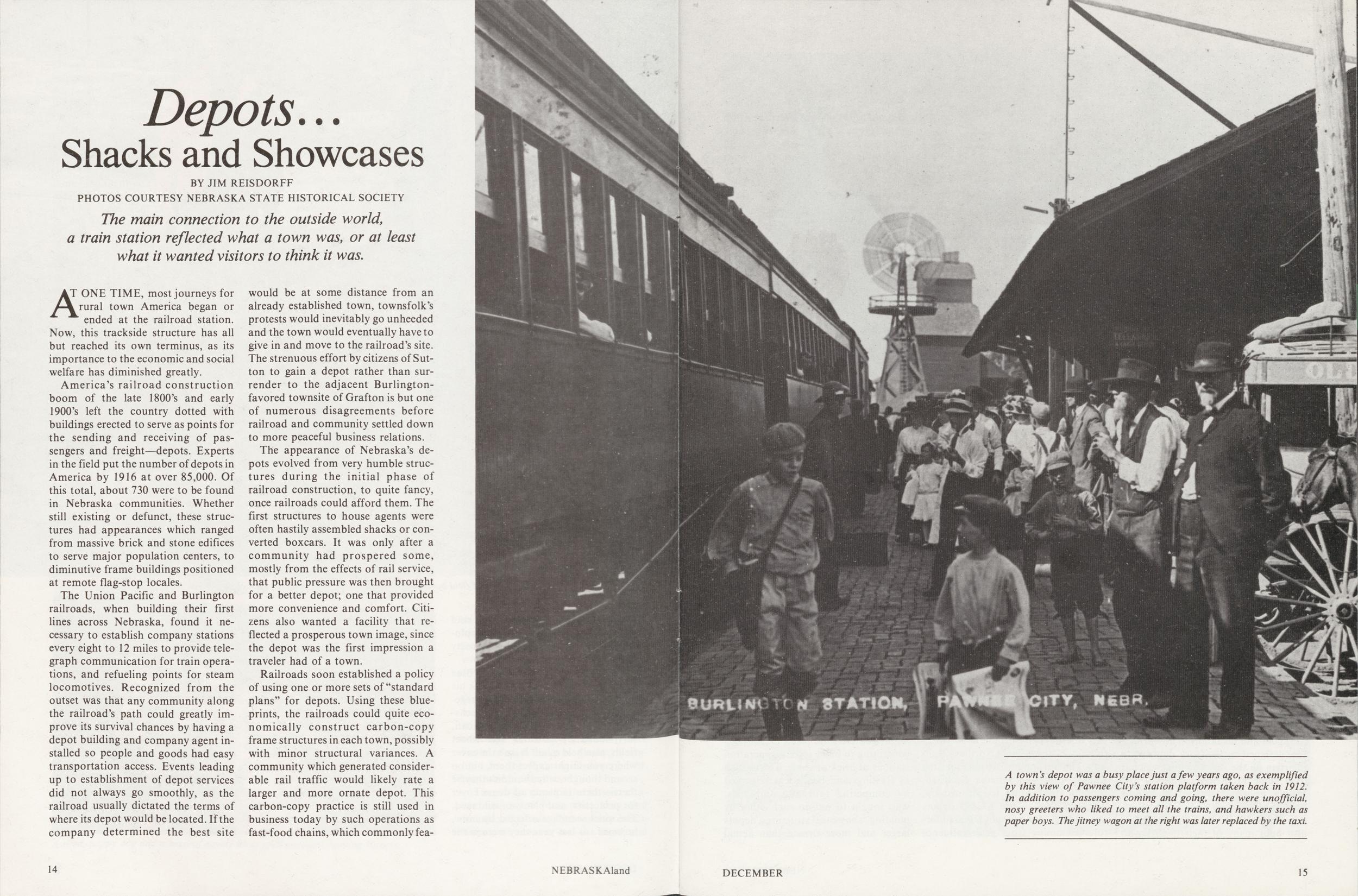
14 NEBRASKAland A town's depot was a busy place just a few years ago, as exemplified by this view of Pawnee City's station platform taken back in 1912. In addition to passengers coming and going, there were unofficial, nosy greeters who liked to meet all the trains, and hawkers such as paper boys. The jitney wagon at the right was later replaced by the taxi. DECEMBER 15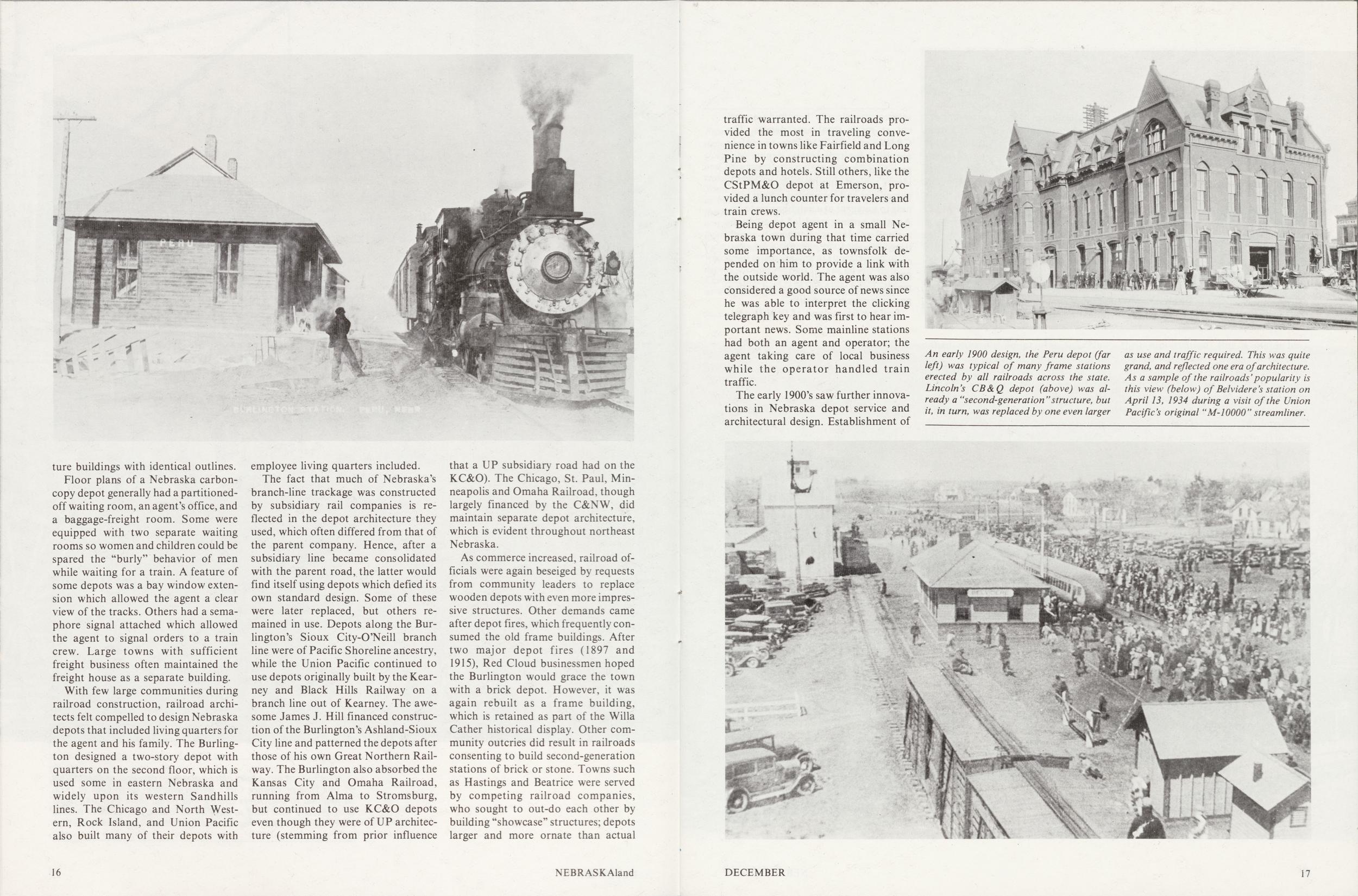
ture buildings with identical outlines.
Floor plans of a Nebraska carbon-copy depot generally had a partitioned-off waiting room, an agent's office, and a baggage-freight room. Some were equipped with two separate waiting rooms so women and children could be spared the "burly" behavior of men while waiting for a train. A feature of some depots was a bay window extension which allowed the agent a clear view of the tracks. Others had a semaphore signal attached which allowed the agent to signal orders to a train crew. Large towns with sufficient freight business often maintained the freight house as a separate building.
With few large communities during railroad construction, railroad architects felt compelled to design Nebraska depots that included living quarters for the agent and his family. The Burlington designed a two-story depot with quarters on the second floor, which is used some in eastern Nebraska and widely upon its western Sandhills lines. The Chicago and North Western, Rock Island, and Union Pacific also built many of their depots with employee living quarters included.
The fact that much of Nebraska's branch-line trackage was constructed by subsidiary rail companies is reflected in the depot architecture they used, which often differed from that of the parent company. Hence, after a subsidiary line became consolidated with the parent road, the latter would find itself using depots which defied its own standard design. Some of these were later replaced, but others remained in use. Depots along the Burlington's Sioux City-O'Neill branch line were of Pacific Shoreline ancestry, while the Union Pacific continued to use depots originally built by the Kearney and Black Hills Railway on a branch line out of Kearney. The awesome James J. Hill financed construction of the Burlington's Ashland-Sioux City line and patterned the depots after those of his own Great Northern Railway. The Burlington also absorbed the Kansas City and Omaha Railroad, running from Alma to Stromsburg, but continued to use KC&O depots even though they were of UP architecture (stemming from prior influence that a UP subsidiary road had on the KC&O). The Chicago, St. Paul, Minneapolis and Omaha Railroad, though largely financed by the C&NW, did maintain separate depot architecture, which is evident throughout northeast Nebraska.
As commerce increased, railroad officials were again beseiged by requests from community leaders to replace wooden depots with even more impressive structures. Other demands came after depot fires, which frequently consumed the old frame buildings. After two major depot fires (1897 and 1915), Red Cloud businessmen hoped the Burlington would grace the town with a brick depot. However, it wasagain rebuilt as a frame building, which is retained as part of the Willa Cather historical display. Other community outcries did result in railroads consenting to build second-generation stations of brick or stone. Towns such as Hastings and Beatrice were served by competing railroad companies, who sought to out-do each other by building "showcase" structures; depots larger and more ornate than actual
16 NEBRASKAlandtraffic warranted. The railroads provided the most in traveling convenience in towns like Fairfield and Long Pine by constructing combination depots and hotels. Still others, like the CStPM&O depot at Emerson, provided a lunch counter for travelers and train crews.
Being depot agent in a small Nebraska town during that time carried some importance, as townsfolk depended on him to provide a link with the outside world. The agent was also considered a good source of news since he was able to interpret the clicking telegraph key and was first to hear important news. Some mainline stations had both an agent and operator; the agent taking care of local business while the operator handled train traffic.
The early 1900's saw further innovations in Nebraska depot service and architectural design. Establishment of
the Nebraska State Railway Commission in 1906 provided citizens with regulatory procedures to use in obtaining railroad cooperation on depot facilities and to deter closing small agencies during times of farm drought or poor economic conditions. The WW I period had many Nebraska towns, served by more than one railroad, having "union stations" as railroads combined services because of an agent-manpower shortage. Towns like Kearney and Laurel returned to separate-agent service after wartime, while others, such as Davenport and Thompson retained their joint agencies.
Examples of "bigger-and-better" depot construction went on as Cozad and Gering were recipients of highly ornate terminals, with the Missouri Pacific's fanciest brick depot in Nebraska located at Falls City. Billed as "fire-proof were the squarish, brick depots constructed by the CStPM&O during the 1920's. A comment by a CB&Q official as late as 1926 that "depots are luxuries and produce no revenue" did not deter a new division-point station at McCook.
But, even as events like the 1931 opening of Omaha's Union Station continued in large cities, a decline in rail service was already becoming apparent at many rural area depots. The C&NW and CB&Q began to replace agents at limited-revenue depots with part-time custodians; locally-hired residents who maintained the depot for passengers and forwarded freight business to an agent at a neighboring town. Another arrangement led to a "dualization" of depots. Economic conditions of the 1930's had the smallest communities losing their depots altogether as the buildings were dismantled and perhaps replaced with a passenger waiting shelter.
Rail traffic demand of WW II post-
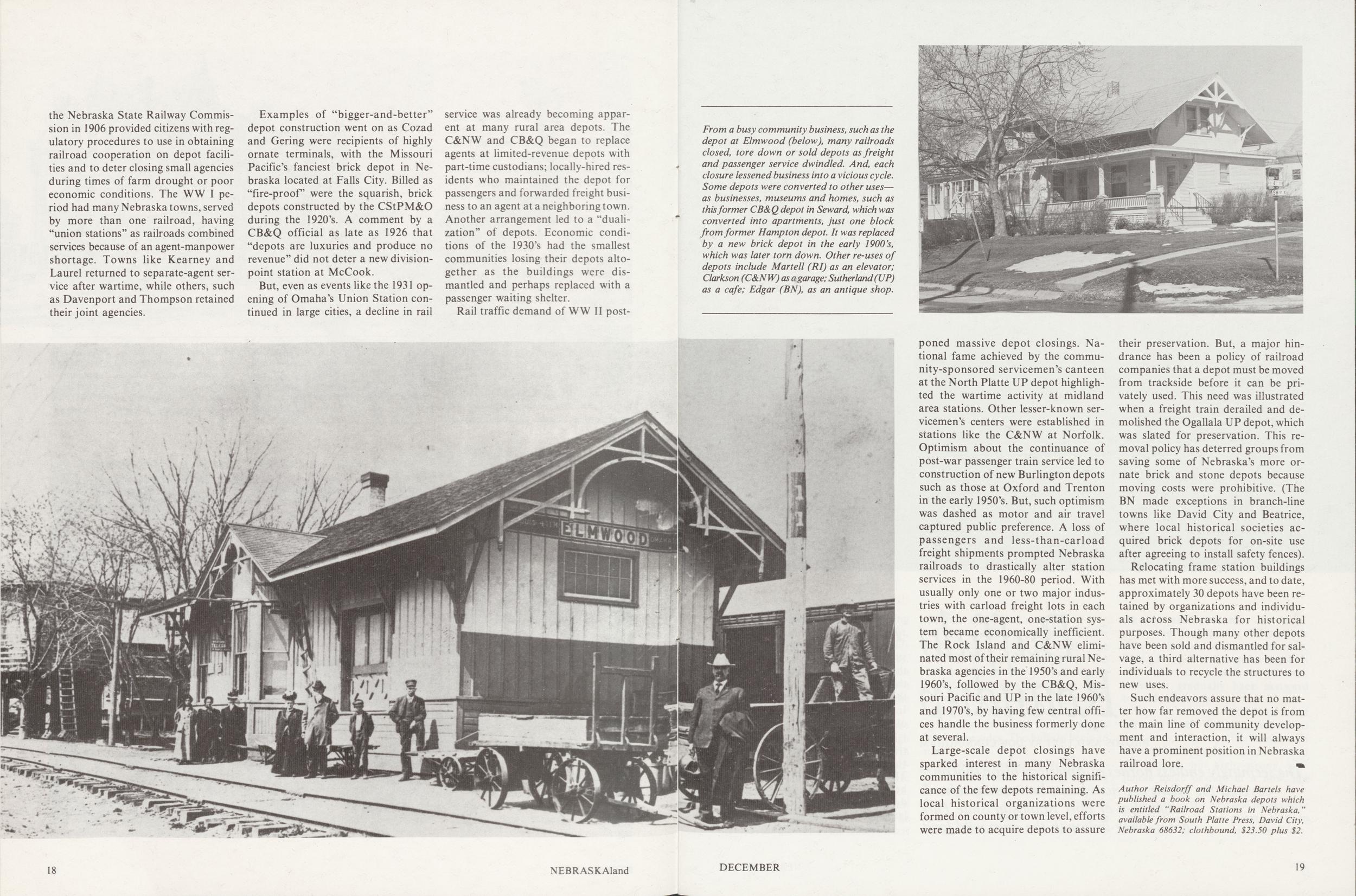
18 NEBRASKAland From a busy community business, such as the depot at Elmwood (below), many railroads closed, tore down or sold depots as freight and passenger service dwindled. And, each closure lessened business into a vicious cycle. Some depots were converted to other uses—as businesses, museums and homes, such as this former CB&Q depot in Seward, which was converted into apartments, just one block from former Hampton depot. It was replaced by a new brick depot in the early 1900's, which was later torn down. Other re-uses of depots include Martell (RI) as an elevator; Clarkson (C&NW) as a garage; Sutherland (UP) as a cafe; Edgar (BN), as an antique shop.poned massive depot closings. National fame achieved by the community-sponsored servicemen's canteen at the North Platte UP depot highlighted the wartime activity at midland area stations. Other lesser-known servicemen's centers were established in stations like the C&NW at Norfolk. Optimism about the continuance of post-war passenger train service led to construction of new Burlington depots such as those at Oxford and Trenton in the early 1950's. But, such optimism was dashed as motor and air travel captured public preference. A loss of passengers and less-than-carload freight shipments prompted Nebraska railroads to drastically alter station services in the 1960-80 period. With usually only one or two major industries with carload freight lots in each town, the one-agent, one-station system became economically inefficient. The Rock Island and C&NW eliminated most of their remaining rural Nebraska agencies in the 1950's and early 1960's, followed by the CB&Q, Missouri Pacific and UP in the late 1960's and 1970's, by having few central offices handle the business formerly done at several.
Large-scale depot closings have sparked interest in many Nebraska communities to the historical significance of the few depots remaining. As local historical organizations were formed on county or town level, efforts were made to acquire depots to assure their preservation. But, a major hindrance has been a policy of railroad companies that a depot must be moved from trackside before it can be privately used. This need was illustrated when a freight train derailed and demolished the Ogallala UP depot, which was slated for preservation. This removal policy has deterred groups from saving some of Nebraska's more ornate brick and stone depots because moving costs were prohibitive. (The BN made exceptions in branch-line towns like David City and Beatrice, where local historical societies acquired brick depots for on-site use after agreeing to install safety fences).
Relocating frame station buildings has met with more success, and to date, approximately 30 depots have been retained by organizations and individuals across Nebraska for historical purposes. Though many other depots have been sold and dismantled for salvage, a third alternative has been for individuals to recycle the structures to new uses.
Such endeavors assure that no matter how far removed the depot is from the main line of community development and interaction, it will always have a prominent position in Nebraska railroad lore.
Author Reisdorff and Michael Bartels have published a book on Nebraska depots which is entitled "Railroad Stations in Nebraska," available from South Platte Press, David City, Nebraska 68632; clothbound, $23.50 plus $2. DECEMBER 19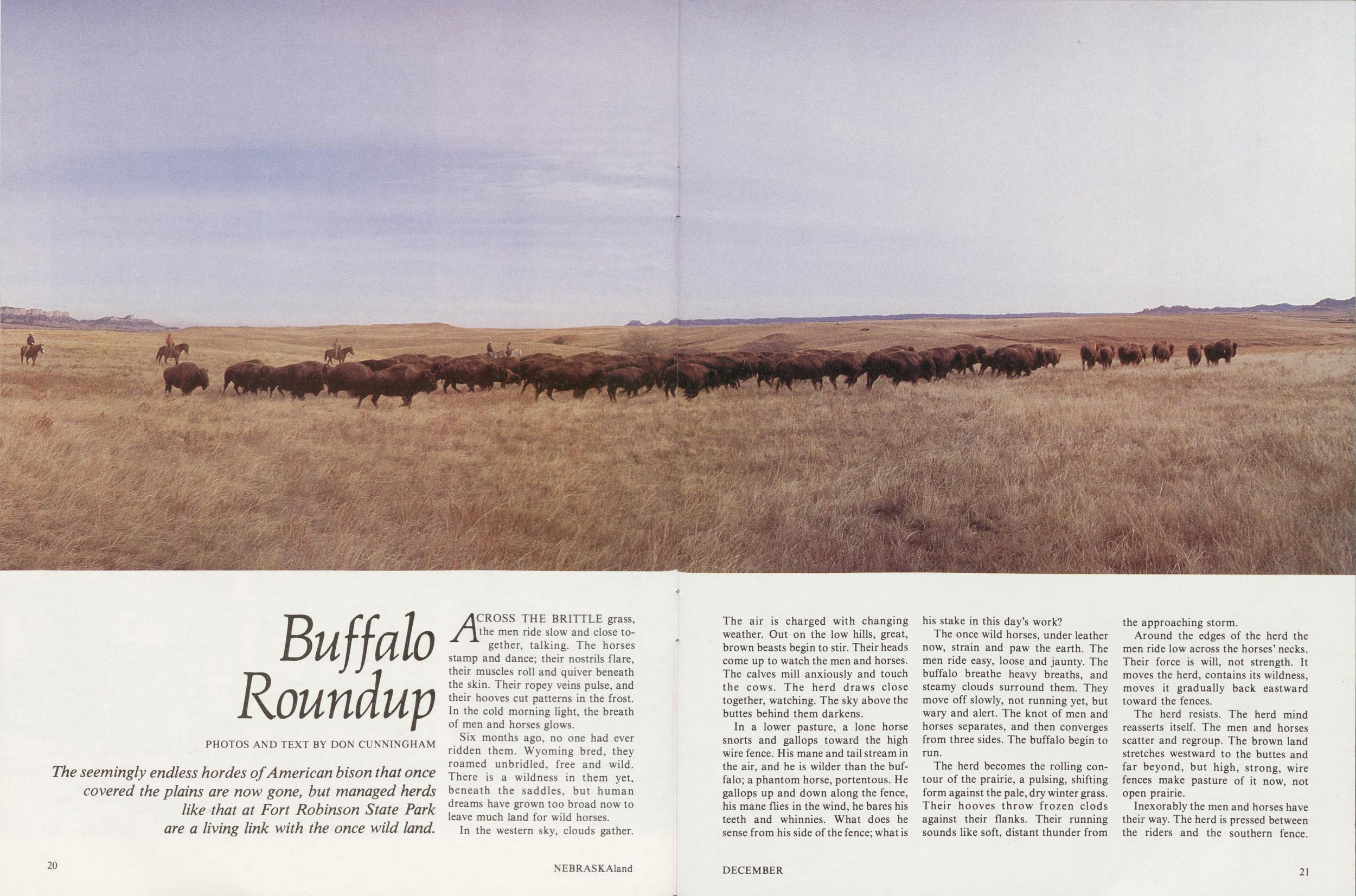
Buffalo Roundup
PHOTOS AND TEXT BY DON CUNNINGHAM The seemingly endless hordes of American bison that once covered the plains are now gone, but managed herds like that at Fort Robinson State Park are a living link with the once wild land.ACROSS THE BRITTLE grass, the men ride slow and close together, talking. The horses stamp and dance; their nostrils flare, their muscles roll and quiver beneath the skin. Their ropey veins pulse, and their hooves cut patterns in the frost. In the cold morning light, the breath of men and horses glows.
Six months ago, no one had ever ridden them. Wyoming bred, they roamed unbridled, free and wild. There is a wildness in them yet, beneath the saddles, but human dreams have grown too broad now to leave much land for wild horses.
In the western sky, clouds gather.
20 NEBRASKAlandThe air is charged with changing weather. Out on the low hills, great, brown beasts begin to stir. Their heads come up to watch the men and horses. The calves mill anxiously and touch the cows. The herd draws close together, watching. The sky above the buttes behind them darkens.
In a lower pasture, a lone horse snorts and gallops toward the high wire fence. His mane and tail stream in the air, and he is wilder than the buffalo; a phantom horse, portentous. He gallops up and down along the fence, his mane flies in the wind, he bares his teeth and whinnies. What does he sense from his side of the fence; what is his stake in this day's work?
The once wild horses, under leather now, strain and paw the earth. The men ride easy, loose and jaunty. The buffalo breathe heavy breaths, and steamy clouds surround them. They move off slowly, not running yet, but wary and alert. The knot of men and horses separates, and then converges from three sides. The buffalo begin to run.
The herd becomes the rolling contour of the prairie, a pulsing, shifting form against the pale, dry winter grass. Their hooves throw frozen clods against their flanks. Their running sounds like soft, distant thunder from the approaching storm.
Around the edges of the herd the men ride low across the horses' necks. Their force is will, not strength. It moves the herd, contains its wildness, moves it gradually back eastward toward the fences.
The herd resists. The herd mind reasserts itself. The men and horses scatter and regroup. The brown land stretches westward to the buttes and far beyond, but high, strong, wire fences make pasture of it now, not open prairie.
Inexorably the men and horses have their way. The herd is pressed between the riders and the southern fence.
DECEMBER 21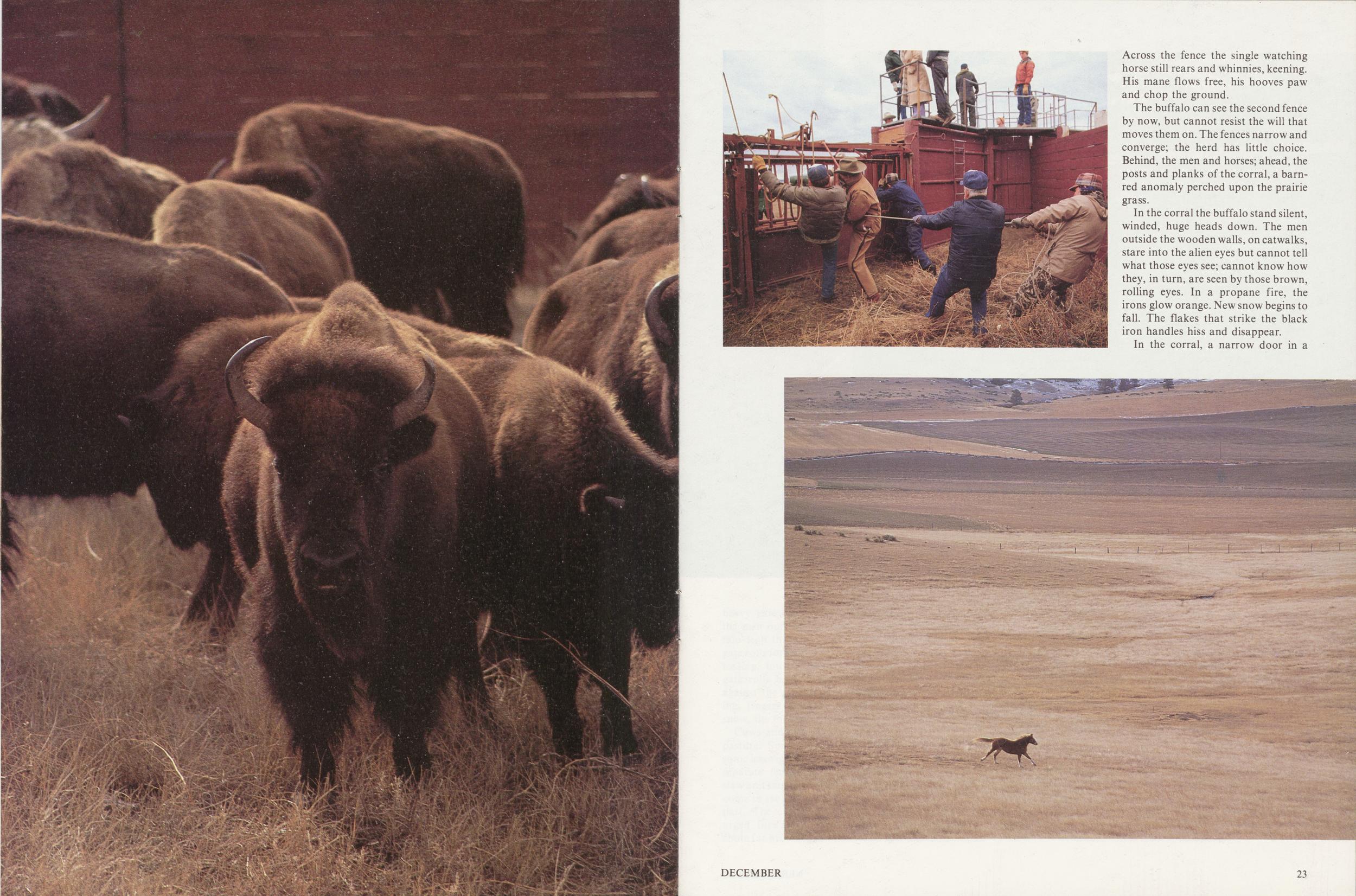
Across the fence the single watching horse still rears and whinnies, keening. His mane flows free, his hooves paw and chop the ground.
The buffalo can see the second fence by now, but cannot resist the will that moves them on. The fences narrow and converge; the herd has little choice. Behind, the men and horses; ahead, the posts and planks of the corral, a barnred anomaly perched upon the prairie grass.
In the corral the buffalo stand silent, winded, huge heads down. The men outside the wooden walls, on catwalks, stare into the alien eyes but cannot tell what those eyes see; cannot know how they, in turn, are seen by those brown, rolling eyes. In a propane fire, the irons glow orange. New snow begins to fall. The flakes that strike the black iron handles hiss and disappear.
In the corral, a narrow door in a
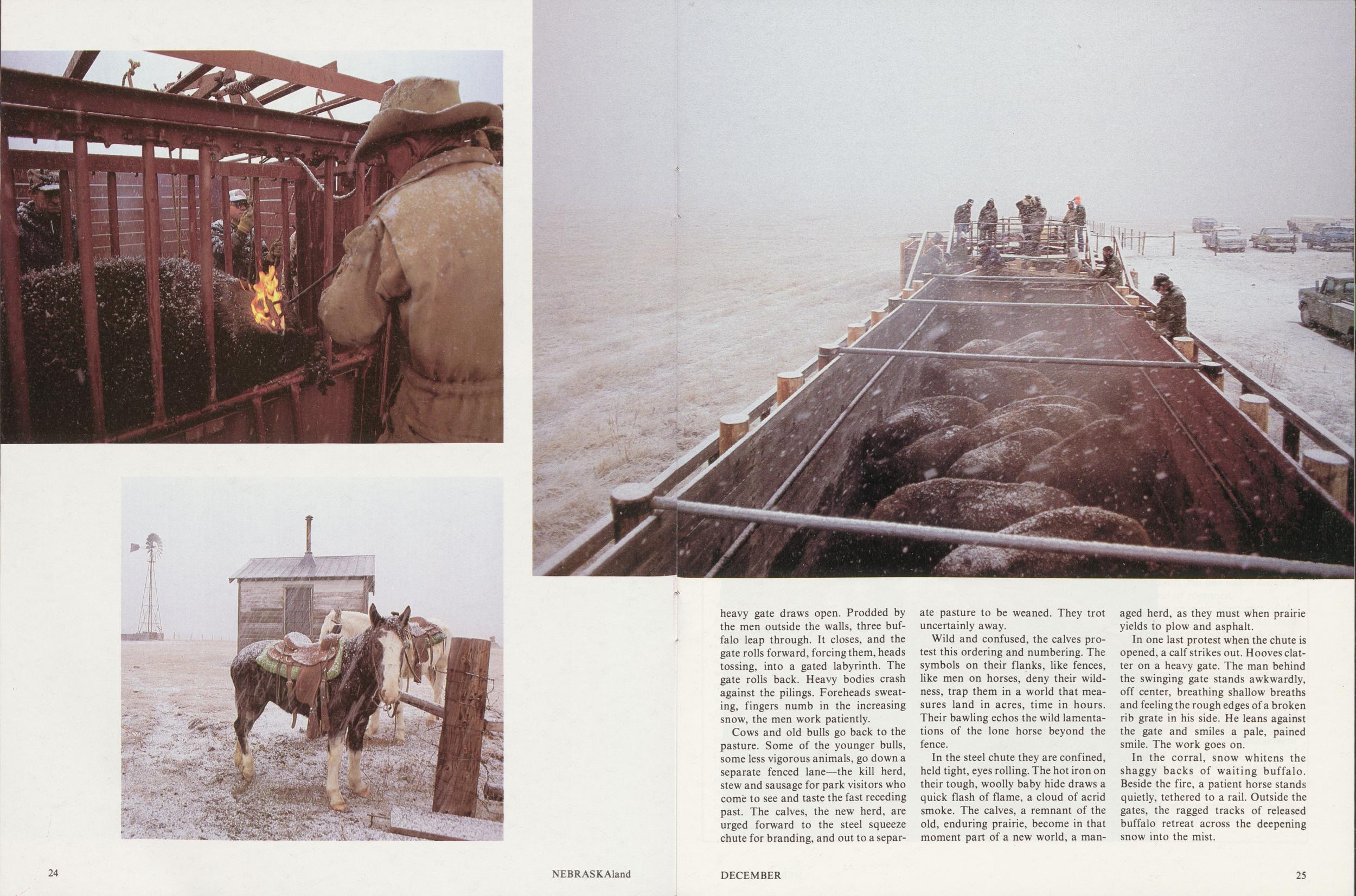
heavy gate draws open. Prodded by the men outside the walls, three buffalo leap through. It closes, and the gate rolls forward, forcing them, heads tossing, into a gated labyrinth. The gate rolls back. Heavy bodies crash against the pilings. Foreheads sweating, fingers numb in the increasing snow, the men work patiently.
Cows and old bulls go back to the pasture. Some of the younger bulls, some less vigorous animals, go down a separate fenced lane—the kill herd, stew and sausage for park visitors who come to see and taste the fast receding past. The calves, the new herd, are urged forward to the steel squeeze chute for branding, and out to a separate pasture to be weaned. They trot uncertainly away.
Wild and confused, the calves protest this ordering and numbering. The symbols on their flanks, like fences, like men on horses, deny their wildness, trap them in a world that measures land in acres, time in hours. Their bawling echos the wild lamentations of the lone horse beyond the fence.
In the steel chute they are confined, held tight, eyes rolling. The hot iron on their tough, woolly baby hide draws a quick flash of flame, a cloud of acrid smoke. The calves, a remnant of the old, enduring prairie, become in that moment part of a new world, a managed herd, as they must when prairie yields to plow and asphalt.
In one last protest when the chute is opened, a calf strikes out. Hooves clatter on a heavy gate. The man behind the swinging gate stands awkwardly, off center, breathing shallow breaths and feeling the rough edges of a broken rib grate in his side. He leans against the gate and smiles a pale, pained smile. The work goes on.
In the corral, snow whitens the shaggy backs of waiting buffalo. Beside the fire, a patient horse stands quietly, tethered to a rail. Outside the gates, the ragged tracks of released buffalo retreat across the deepening snow into the mist.
DECEMBER 25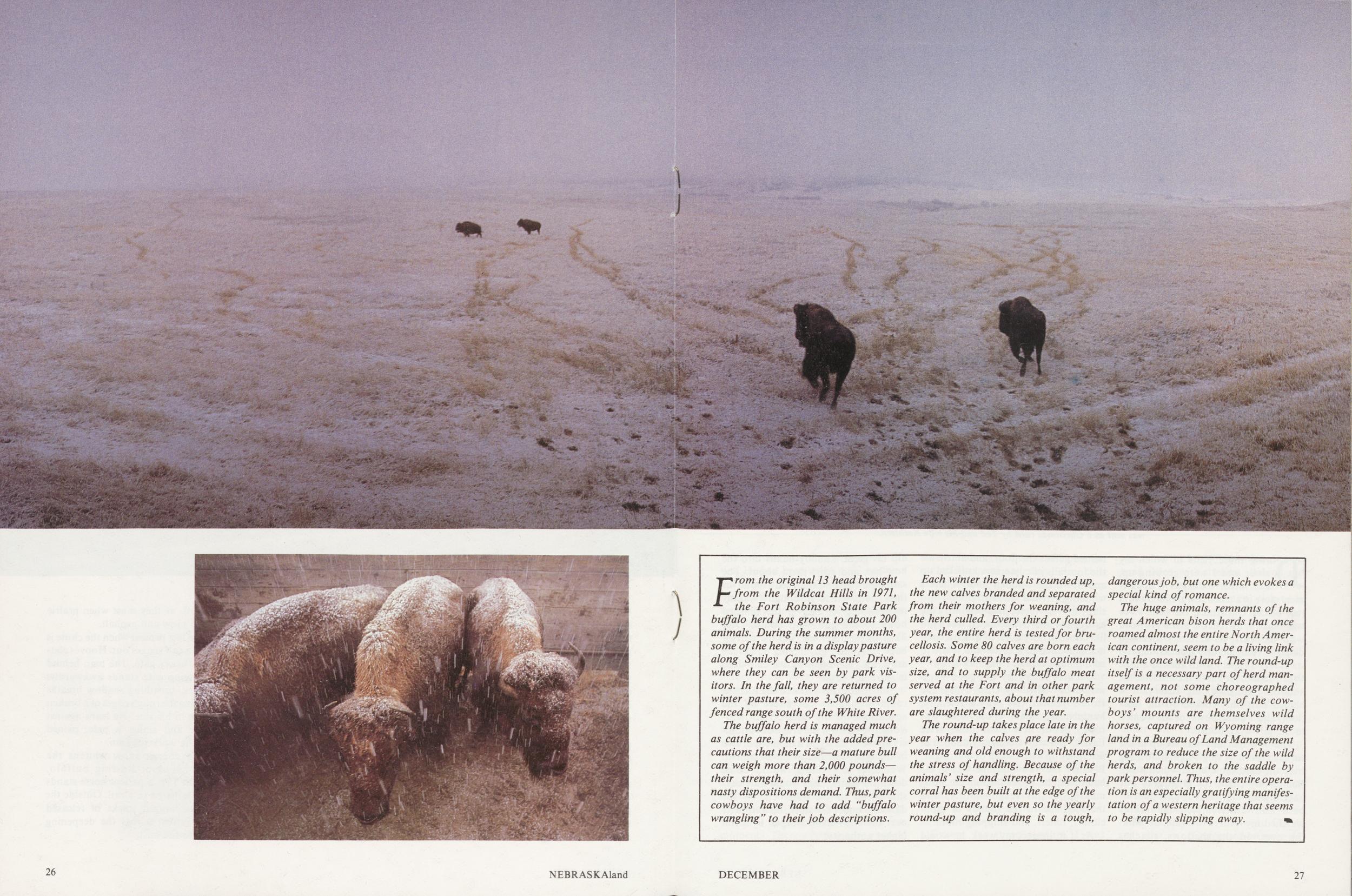
From the original 13 head brought from the Wildcat Hills in 1971, the Fort Robinson State Park buffalo herd has grown to about 200 animals. During the summer months, some of the herd is in a display pasture along Smiley Canyon Scenic Drive, where they can be seen by park visitors. In the fall, they are returned to winter pasture, some 3,500 acres of fenced range south of the White River.
The buffalo herd is managed much as cattle are, but with the added precautions that their size—a mature bull can weigh more than 2,000 pounds—their strength, and their somewhat nasty dispositions demand. Thus, park cowboys have had to add "'buffalo wrangling" to their job descriptions.
Each winter the herd is rounded up, the new calves branded and separated from their mothers for weaning, and the herd culled. Every third or fourth year, the entire herd is tested for brucellosis. Some 80 calves are born each year, and to keep the herd at optimum size, and to supply the buffalo meat served at the Fort and in other park system restaurants, about that number are slaughtered during the year.
The round-up takes place late in the year when the calves are ready for weaning and old enough to withstand the stress of handling. Because of the animals' size and strength, a special corral has been built at the edge of the winter pasture, but even so the yearly round-up and branding is a tough, dangerous job, but one which evokes a special kind of romance.
The huge animals, remnants of the great American bison herds that once roamed almost the entire North American continent, seem to be a living link with the once wild land. The round-up itself is a necessary part of herd management, not some choreographed tourist attraction. Many of the cowboys' mounts are themselves wild horses, captured on Wyoming range land in a Bureau of Land Management program to reduce the size of the wild herds, and broken to the saddle by park personnel. Thus, the entire operation is an especially gratifying manifestation of a western heritage that seems to be rapidly slipping away.
DECEMBER 27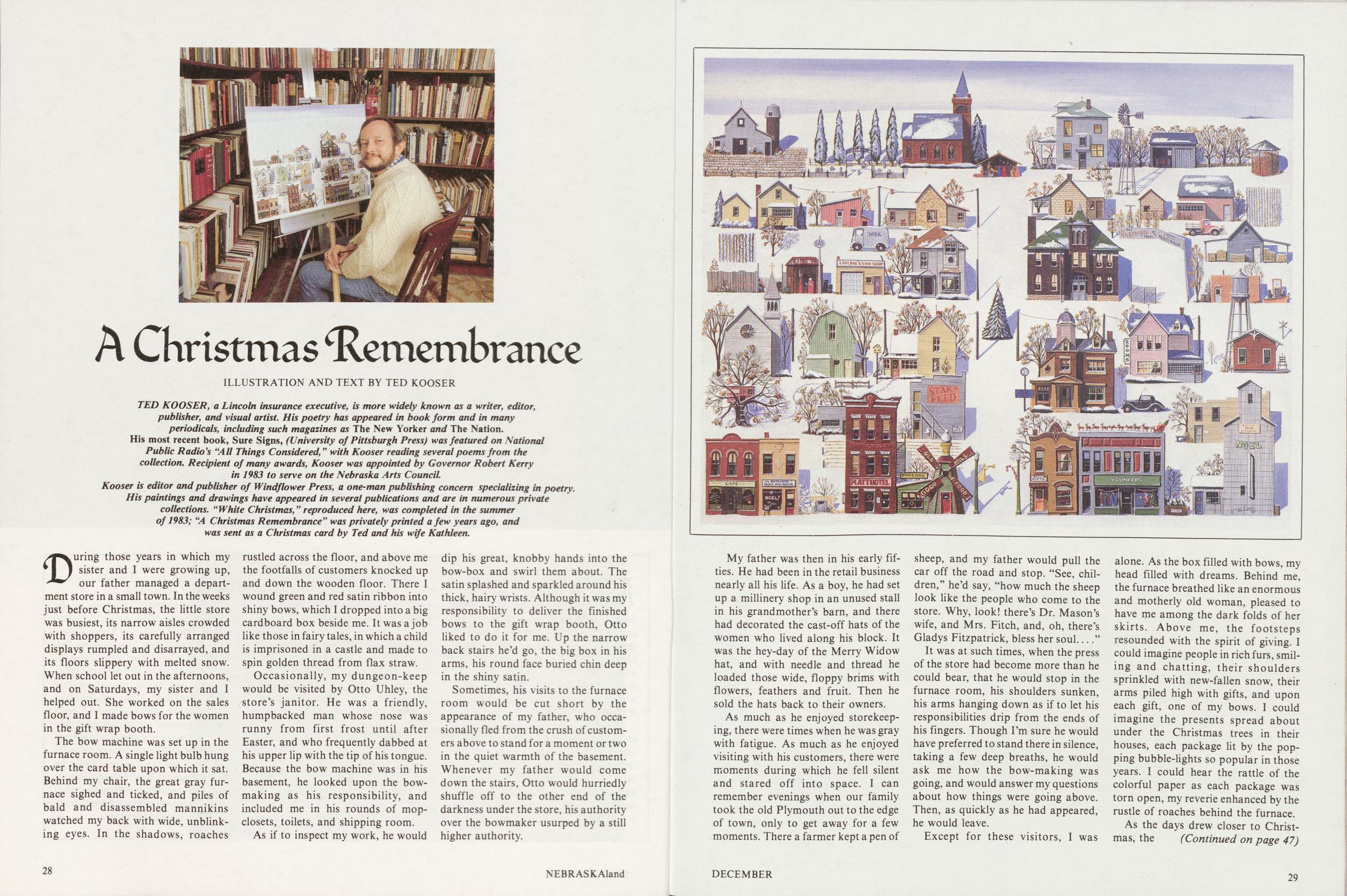
A Christmas Remembrance
ILLUSTRATION AND TEXT BY TED KOOSER TED KOOSER, a Lincoln insurance executive, is more widely known as a writer, editor, publisher, and visual artist. His poetry has appeared in book form and in many periodicals, including such magazines as The New Yorker and The Nation. His most recent book, Sure Signs, (University of Pittsburgh Press) was featured on National Public Radio's "All Things Considered," with Kooser reading several poems from the collection. Recipient of many awards, Kooser was appointed by Governor Robert Kerry in 1983 to serve on the Nebraska Arts Council. Kooser is editor and publisher of Windflower Press, a one-man publishing concern specializing in poetry. His paintings and drawings have appeared in several publications and are in numerous private collections. "White Christmas," reproduced here, was completed in the summer of 1983; "A Christmas Remembrance" was privately printed a few years ago, and was sent as a Christmas card by Ted and his wife Kathleen.During those years in which my II sister and I were growing up, our father managed a department store in a small town. In the weeks just before Christmas, the little store was busiest, its narrow aisles crowded with shoppers, its carefully arranged displays rumpled and disarrayed, and its floors slippery with melted snow. When school let out in the afternoons, and on Saturdays, my sister and I helped out. She worked on the sales floor, and I made bows for the women in the gift wrap booth.
The bow machine was set up in the furnace room. A single light bulb hung over the card table upon which it sat. Behind my chair, the great gray furnace sighed and ticked, and piles of bald and disassembled mannikins watched my back with wide, unblinking eyes. In the shadows, roaches rustled across the floor, and above me the footfalls of customers knocked up and down the wooden floor. There I wound green and red satin ribbon into shiny bows, which I dropped into a big cardboard box beside me. It was a job like those in fairy tales, in which a child is imprisoned in a castle and made to spin golden thread from flax straw.
Occasionally, my dungeon-keep would be visited by Otto Uhley, the store's janitor. He was a friendly, humpbacked man whose nose was runny from first frost until after Easter, and who frequently dabbed at his upper lip with the tip of his tongue. Because the bow machine was in his basement, he looked upon the bow-making as his responsibility, and included me in his rounds of mop-closets, toilets, and shipping room.
As if to inspect my work, he would dip his great, knobby hands into the bow-box and swirl them about. The satin splashed and sparkled around his thick, hairy wrists. Although it was my responsibility to deliver the finished bows to the gift wrap booth, Otto liked to do it for me. Up the narrow back stairs he'd go, the big box in his arms, his round face buried chin deep in the shiny satin.
Sometimes, his visits to the furnace room would be cut short by the appearance of my father, who occasionally fled from the crush of customers above to stand for a moment or two in the quiet warmth of the basement. Whenever my father would come down the stairs, Otto would hurriedly shuffle off to the other end of the darkness under the store, his authority over the bowmaker usurped by a still higher authority.
28 NEBRASKAlandMy father was then in his early fifties. He had been in the retail business nearly all his life. As a boy, he had set up a millinery shop in an unused stall in his grandmother's barn, and there had decorated the cast-off hats of the women who lived along his block. It was the hey-day of the Merry Widow hat, and with needle and thread he loaded those wide, floppy brims with flowers, feathers and fruit. Then he sold the hats back to their owners.
As much as he enjoyed storekeeping, there were times when he was gray with fatigue. As much as he enjoyed visiting with his customers, there were moments during which he fell silent and stared off into space. I can remember evenings when our family took the old Plymouth out to the edge of town, only to get away for a few moments. There a farmer kept a pen of sheep, and my father would pull the car off the road and stop. "See, children," he'd say, "how much the sheep look like the people who come to the store. Why, look! there's Dr. Mason's wife, and Mrs. Fitch, and, oh, there's Gladys Fitzpatrick, bless her soul"
It was at such times, when the press of the store had become more than he could bear, that he would stop in the furnace room, his shoulders sunken, his arms hanging down as if to let his responsibilities drip from the ends of his fingers. Though I'm sure he would have preferred to stand there in silence, taking a few deep breaths, he would ask me how the bow-making was going, and would answer my questions about how things were going above. Then, as quickly as he had appeared, he would leave.
Except for these visitors, I was alone. As the box filled with bows, my head filled with dreams. Behind me, the furnace breathed like an enormous and motherly old woman, pleased to have me among the dark folds of her skirts. Above me, the footsteps resounded with the spirit of giving. I could imagine people in rich furs, smiling and chatting, their shoulders sprinkled with new-fallen snow, their arms piled high with gifts, and upon each gift, one of my bows. I could imagine the presents spread about under the Christmas trees in their houses, each package lit by the popping bubble-lights so popular in those years. I could hear the rattle of the colorful paper as each package was torn open, my reverie enhanced by the rustle of roaches behind the furnace.
As the days drew closer to Christmas, the (Continued on page 47)
DECEMBER 29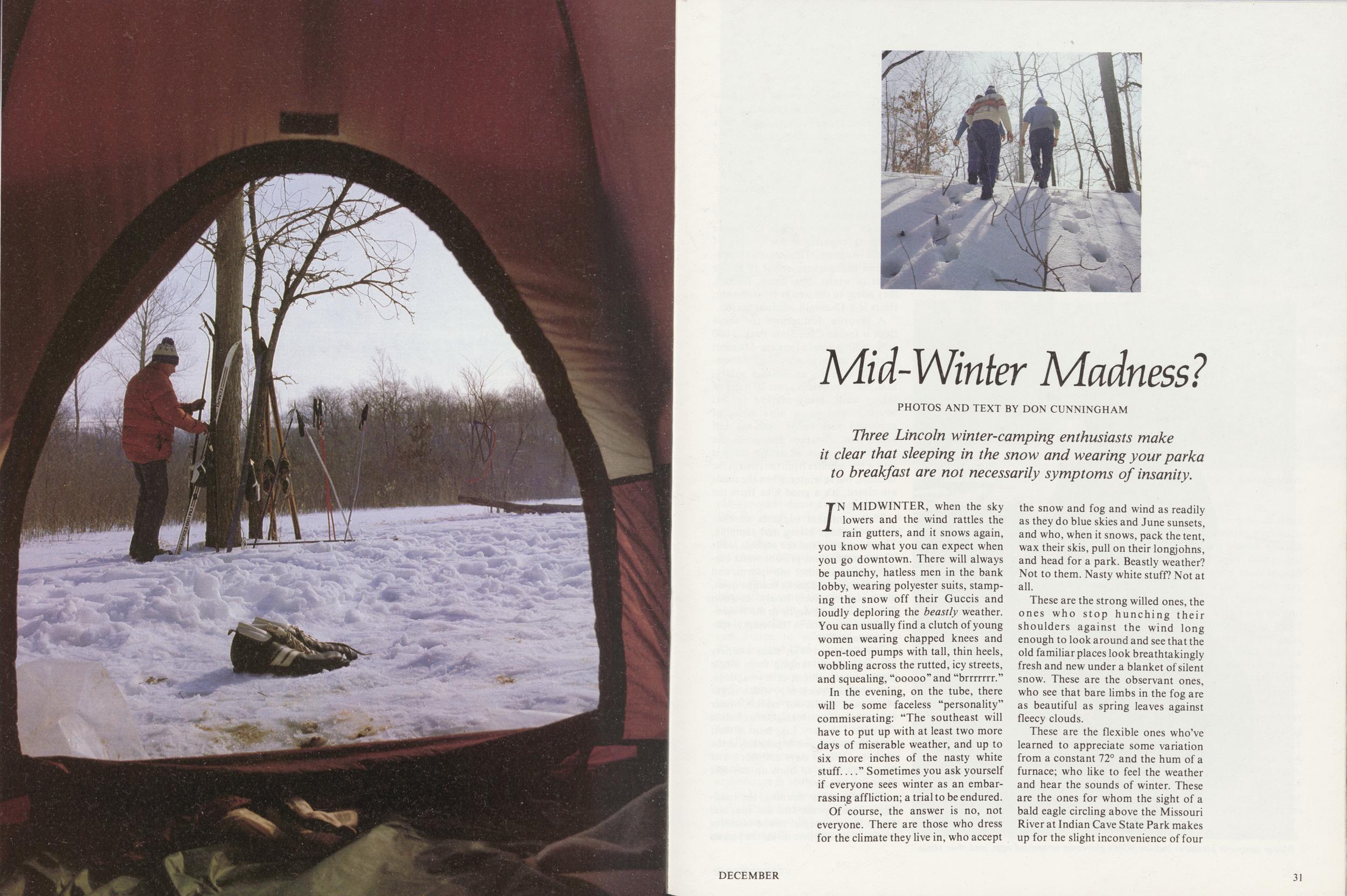
Mid-Winter Madness?
PHOTOS AND TEXT BY DON CUNNINGHAM Three Lincoln winter-camping enthusiasts make it clear that sleeping in the snow and wearing your parka to breakfast are not necessarily symptoms of insanity.IN MIDWINTER, when the sky lowers and the wind rattles the rain gutters, and it snows again, you know what you can expect when you go downtown. There will always be paunchy, hatless men in the bank lobby, wearing polyester suits, stamping the snow off their Guccis and loudly deploring the beastly weather. You can usually find a clutch of young women wearing chapped knees and open-toed pumps with tall, thin heels, wobbling across the rutted, icy streets, and squealing, "ooooo"and "brrrrrrr."
In the evening, on the tube, there will be some faceless "personality commiserating: "The southeast will have to put up with at least two more days of miserable weather, and up to six more inches of the nasty white stuff" Sometimes you ask yourself if everyone sees winter as an embarrassing affliction; a trial to be endured.
Of course, the answer is no, not everyone. There are those who dress for the climate they live in, who accept the snow and fog and wind as readily as they do blue skies and June sunsets, and who, when it snows, pack the tent, wax their skis, pull on their longjohns, and head for a park. Beastly weather? Not to them. Nasty white stuff? Not at all.
These are the strong willed ones, the ones who stop hunching their shoulders against the wind long enough to look around and see that the old familiar places look breathtakingly fresh and new under a blanket of silent snow. These are the observant ones, who see that bare limbs in the fog are as beautiful as spring leaves against fleecy clouds.
These are the flexible ones who've learned to appreciate some variation from a constant 72° and the hum of a furnace; who like to feel the weather and hear the sounds of winter. These are the ones for whom the sight of a bald eagle circling above the Missouri River at Indian Cave State Park makes up for the slight inconvenience of four
DECEMBER 31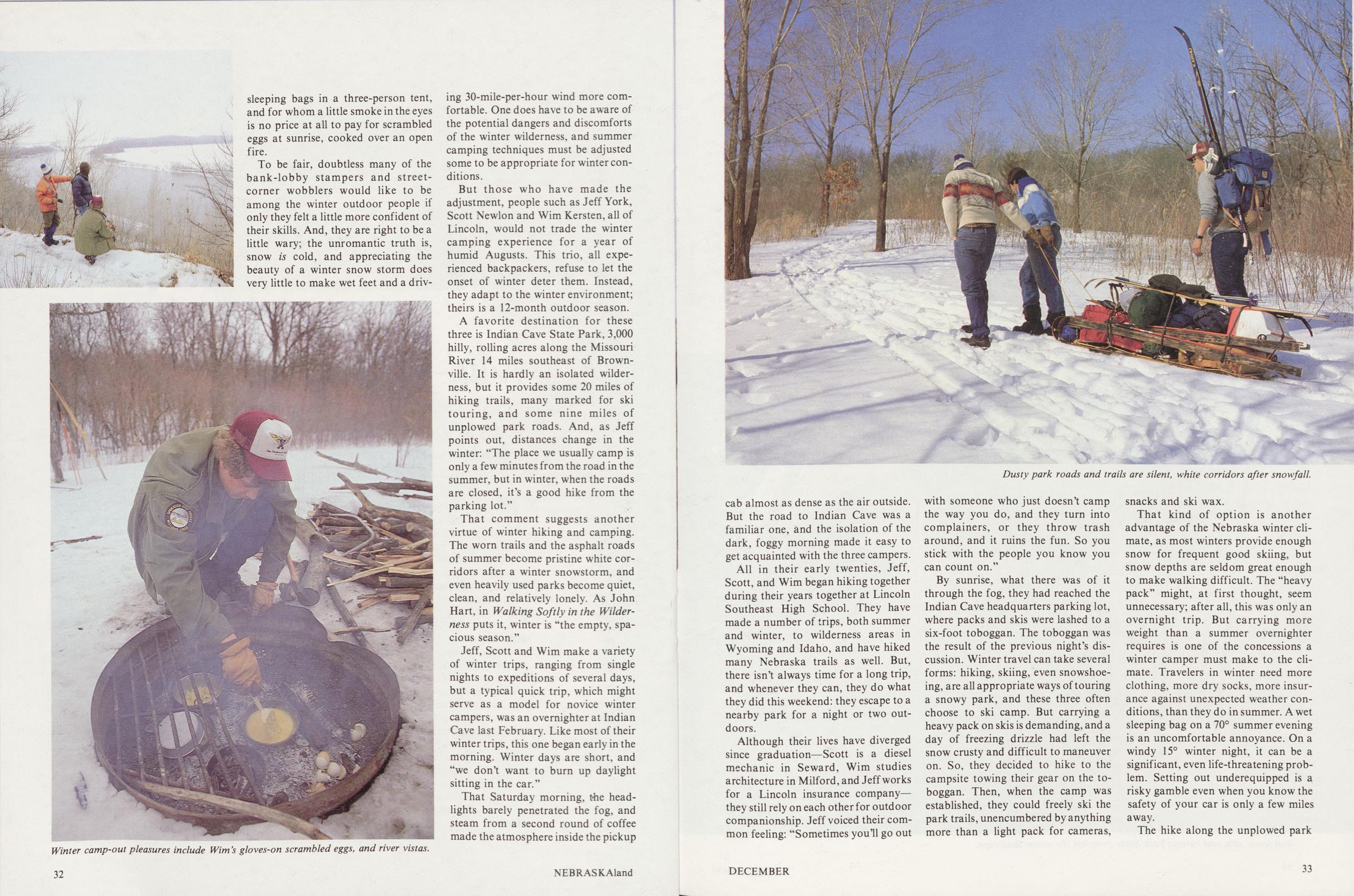
sleeping bags in a three-person tent, and for whom a little smoke in the eyes is no price at all to pay for scrambled eggs at sunrise, cooked over an open fire.
To be fair, doubtless many of the bank-lobby stampers and street-corner wobblers would like to be among the winter outdoor people if only they felt a little more confident of their skills. And, they are right to be a little wary; the unromantic truth is, snow is cold, and appreciating the beauty of a winter snow storm does very little to make wet feet and a driving 30-mile-per-hour wind more comfortable. One does have to be aware of the potential dangers and discomforts of the winter wilderness, and summer camping techniques must be adjusted some to be appropriate for winter conditions.
Winter camp-out pleasures include Wim's gloves-on scrambled eggs, and river vistas.
But those who have made the adjustment, people such as Jeff York, Scott Newlon and Wim Kersten, all of Lincoln, would not trade the winter camping experience for a year of humid Augusts. This trio, all experienced backpackers, refuse to let the onset of winter deter them. Instead, they adapt to the winter environment; theirs is a 12-month outdoor season.
A favorite destination for these three is Indian Cave State Park, 3,000 hilly, rolling acres along the Missouri River 14 miles southeast of Brownville. It is hardly an isolated wilderness, but it provides some 20 miles of hiking trails, many marked for ski touring, and some nine miles of unplowed park roads. And, as Jeff points out, distances change in the winter: "The place we usually camp is only a few minutes from the road in the summer, but in winter, when the roads are closed, it's a good hike from the parking lot."
That comment suggests another virtue of winter hiking and camping. The worn trails and the asphalt roads of summer become pristine white corridors after a winter snowstorm, and even heavily used parks become quiet, clean, and relatively lonely. As John Hart, in Walking Softly in the Wilderness puts it, winter is "the empty, spacious season."
Jeff, Scott and Wim make a variety of winter trips, ranging from single nights to expeditions of several days, but a typical quick trip, which might serve as a model for novice winter campers, was an overnighter at Indian Cave last February. Like most of their winter trips, this one began early in the morning. Winter days are short, and "we don't want to burn up daylight sitting in the car."
That Saturday morning, the headlights barely penetrated the fog, and steam from a second round of coffee made the atmosphere inside the pickup cab almost as dense as the air outside. But the road to Indian Cave was a familiar one, and the isolation of the dark, foggy morning made it easy to get acquainted with the three campers.
32 NEBRASKAlandDusty park roads and trails are silent, white corridors after snowfall.
All in their early twenties, Jeff, Scott, and Wim began hiking together during their years together at Lincoln Southeast High School. They have made a number of trips, both summer and winter, to wilderness areas in Wyoming and Idaho, and have hiked many Nebraska trails as well. But, there isn't always time for a long trip, and whenever they can, they do what they did this weekend: they escape to a nearby park for a night or two outdoors.
Although their lives have diverged since graduation—Scott is a diesel mechanic in Seward, Wim studies architecture in Milford, and Jeff works for a Lincoln insurance company—they still rely on each other for outdoor companionship. Jeff voiced their common feeling: "Sometimes you'll go out with someone who just doesn't camp the way you do, and they turn into complainers, or they throw trash around, and it ruins the fun. So you stick with the people you know you can count on."
By sunrise, what there was of it through the fog, they had reached the Indian Cave headquarters parking lot, where packs and skis were lashed to a six-foot toboggan. The toboggan was the result of the previous night's discussion. Winter travel can take several forms: hiking, skiing, even snowshoeing, are all appropriate ways of touring a snowy park, and these three often choose to ski camp. But carrying a heavy pack on skis is demanding, and a day of freezing drizzle had left the snow crusty and difficult to maneuver on. So, they decided to hike to the campsite towing their gear on the toboggan. Then, when the camp was established, they could freely ski the park trails, unencumbered by anything more than a light pack for cameras, snacks and ski wax.
That kind of option is another advantage of the Nebraska winter climate, as most winters provide enough snow for frequent good skiing, but snow depths are seldom great enough to make walking difficult. The "heavy pack" might, at first thought, seem unnecessary; after all, this was only an overnight trip. But carrying more weight than a summer overnighter requires is one of the concessions a winter camper must make to the climate. Travelers in winter need more clothing, more dry socks, more insurance against unexpected weather conditions, than they do in summer. A wet sleeping bag on a 70° summer evening is an uncomfortable annoyance. On a windy 15° winter night, it can be a significant, even life-threatening problem. Setting out underequipped is a risky gamble even when you know the safety of your car is only a few miles away.
The hike along the unplowed park
DECEMBER 33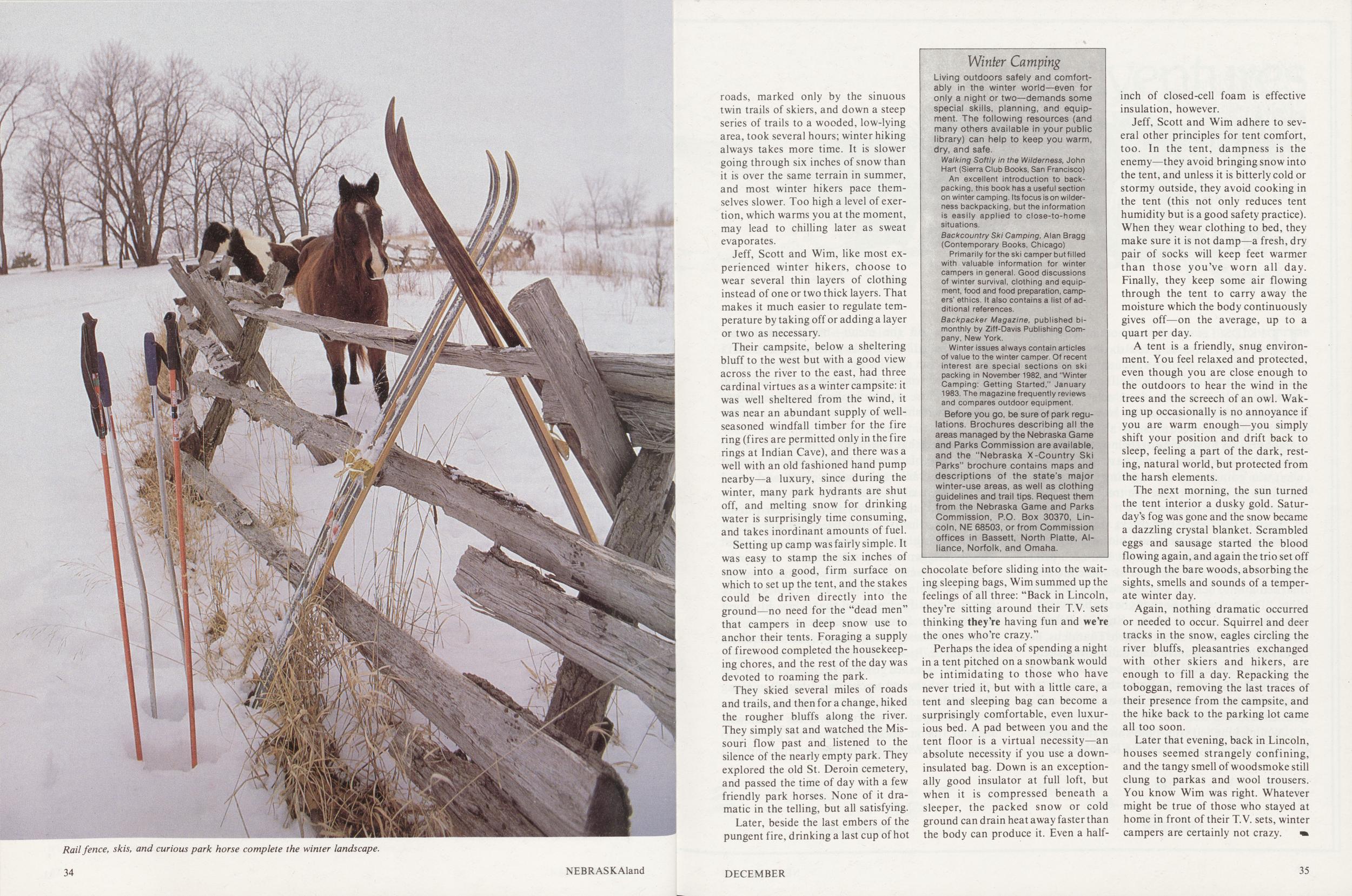
Rail fence, skis, and curious park horse complete the winter landscape.
roads, marked only by the sinuous twin trails of skiers, and down a steep series of trails to a wooded, low-lying area, took several hours; winter hiking always takes more time. It is slower going through six inches of snow than it is over the same terrain in summer, and most winter hikers pace themselves slower. Too high a level of exertion, which warms you at the moment, may lead to chilling later as sweat evaporates.
Jeff, Scott and Wim, like most experienced winter hikers, choose to wear several thin layers of clothing instead of one or two thick layers. That makes it much easier to regulate temperature by taking off or adding a layer or two as necessary.
Their campsite, below a sheltering bluff to the west but with a good view across the river to the east, had three cardinal virtues as a winter campsite: it was well sheltered from the wind, it was near an abundant supply of well-seasoned windfall timber for the fire ring (fires are permitted only in the fire rings at Indian Cave), and there was a well with an old fashioned hand pump nearby—a luxury, since during the winter, many park hydrants are shut off, and melting snow for drinking water is surprisingly time consuming, and takes inordinant amounts of fuel.
Setting up camp was fairly simple. It was easy to stamp the six inches of snow into a good, firm surface on which to set up the tent, and the stakes could be driven directly into the ground—no need for the "dead men" that campers in deep snow use toanchor their tents. Foraging a supply of firewood completed the housekeeping chores, and the rest of the day was devoted to roaming the park.
They skied several miles of roads and trails, and then for a change, hiked the rougher bluffs along the river. They simply sat and watched the Missouri flow past and listened to the silence of the nearly empty park. They explored the old St. Deroin cemetery, and passed the time of day with a few friendly park horses. None of it dramatic in the telling, but all satisfying.
Later, beside the last embers of the pungent fire, drinking a last cup of hot chocolate before sliding into the waiting sleeping bags, Wim summed up the feelings of all three: "Back in Lincoln, they're sitting around their T.V. sets thinking they're having fun and we're the ones who're crazy."
Winter Camping Living outdoors safely and comfortably in the winter world—even for only a night or two—demands some special skills, planning, and equipment. The following resources (and many others available in your public library) can help to keep you warm, dry, and safe. Walking Softly in the Witefemess, John Hart (Sierra Club Books, San Francisco) An excellent introduction to backpacking, this book has a useful section on winter camping. Its focus is on wilderness backpacking, but the information is easily applied to close-to-home situations. Backcountry Ski Camping, Alan Bragg (Contemporary Books, Chicago) Primarily for the ski camper but filled with valuable information for winter campers in general, Good discussions of winter survival, clothing and equipment, food and food preparation, campers' ethics. It also contains a list of additional references. Backpacker Magazine, published bimonthly by Ziff-Davis Publishing Company, New York. Winter issues always contain articles of value to the winter camper. Of recent interest are special sections on ski packing in November 1982, and "Winter Camping: Getting Started/' January 1983, The magazine frequently reviews and compares outdoor equipment. Before you go, be sure of park regulations. Brochures describing all the areas managed by the Nebraska Game and Parks Commission are available, and the "Nebraska X-Country Ski Parks" brochure contains maps and descriptions of the state's major winter-use areas, as well as clothing guidelines and trail tips. Request them from the Nebraska Game and Parks Commission, P.O. Box 30370, Lincoln, NE 68503, or from Commission offices in Bassett, North Platte, Alliance, Norfolk, and Omaha.Perhaps the idea of spending a night in a tent pitched on a snowbank would be intimidating to those who have never tried it, but with a little care, a tent and sleeping bag can become a surprisingly comfortable, even luxurious bed. A pad between you and the tent floor is a virtual necessity—an absolute necessity if you use a down-insulated bag. Down is an exceptionally good insulator at full loft, but when it is compressed beneath a sleeper, the packed snow or cold ground can drain heat away faster than the body can produce it. Even a half-inch of closed-cell foam is effective insulation, however.
Jeff, Scott and Wim adhere to several other principles for tent comfort, too. In the tent, dampness is the enemy—they avoid bringing snow into the tent, and unless it is bitterly cold or stormy outside, they avoid cooking in the tent (this not only reduces tent humidity but is a good safety practice). When they wear clothing to bed, they make sure it is not damp—a fresh, dry pair of socks will keep feet warmer than those you've worn all day. Finally, they keep some air flowing through the tent to carry away the moisture which the body continuously gives off—on the average, up to a quart per day.
A tent is a friendly, snug environment. You feel relaxed and protected, even though you are close enough to the outdoors to hear the wind in the trees and the screech of an owl. Waking up occasionally is no annoyance if you are warm enough—you simply shift your position and drift back to sleep, feeling a part of the dark, resting, natural world, but protected from the harsh elements.
The next morning, the sun turned the tent interior a dusky gold. Saturday's fog was gone and the snow became a dazzling crystal blanket. Scrambled eggs and sausage started the blood flowing again, and again the trio set off through the bare woods, absorbing the sights, smells and sounds of a temperate winter day.
Again, nothing dramatic occurred or needed to occur. Squirrel and deer tracks in the snow, eagles circling the river bluffs, pleasantries exchanged with other skiers and hikers, are enough to fill a day. Repacking the toboggan, removing the last traces of their presence from the campsite, and the hike back to the parking lot came all too soon.
Later that evening, back in Lincoln, houses seemed strangely confining, and the tangy smell of woodsmoke still clung to parkas and wool trousers. You know Wim was right. Whatever might be true of those who stayed at home in front of their T.V. sets, winter campers are certainly not crazy.
DECEMBER 35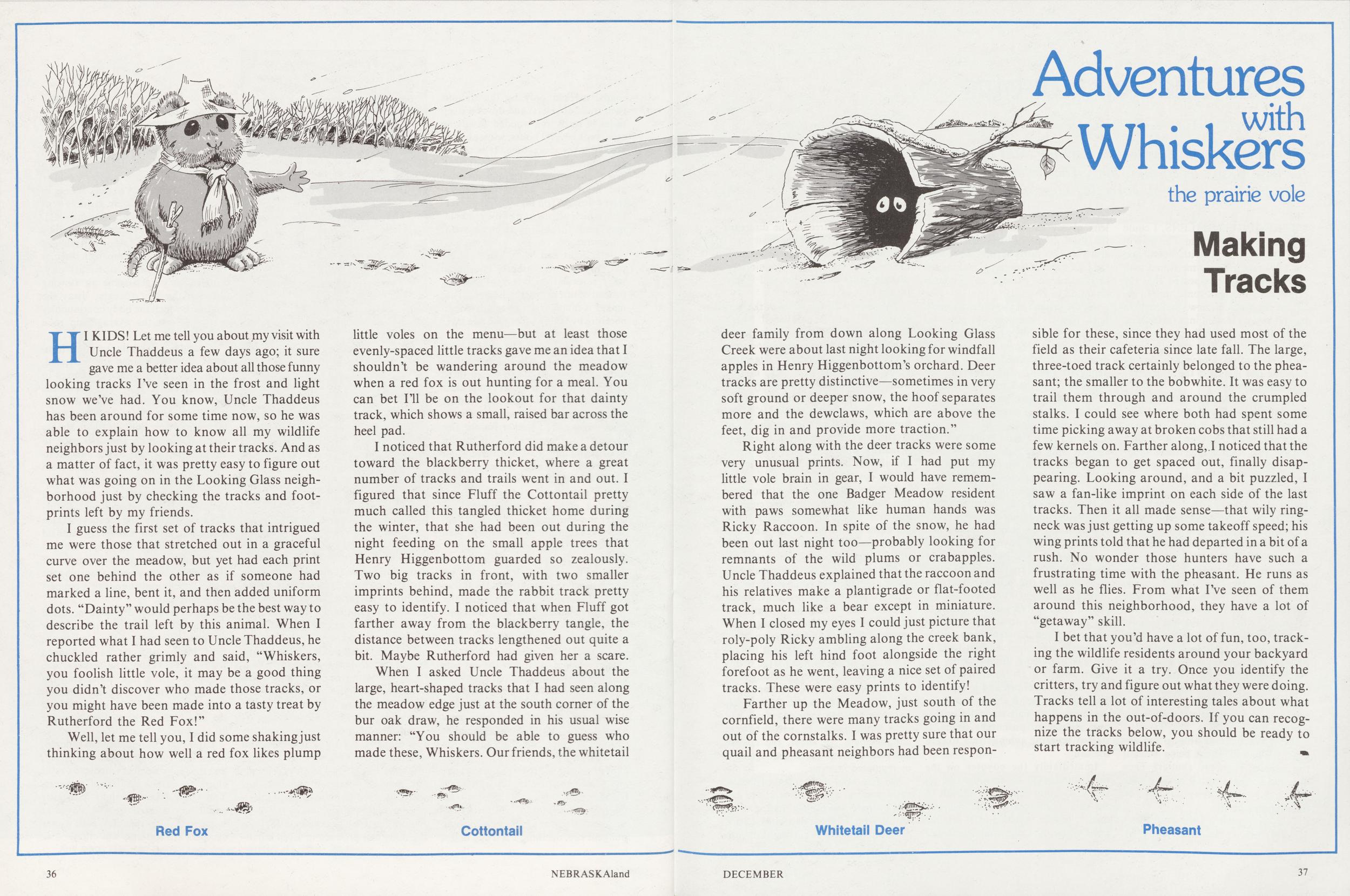
Adventures with Whiskers the prairie vole
Making Tracks
HI KIDS! Let me tell you about my visit with Uncle Thaddeus a few days ago; it sure gave me a better idea about all those funny looking tracks I've seen in the frost and light snow we've had. You know, Uncle Thaddeus has been around for some time now, so he was able to explain how to know all my wildlife neighbors just by looking at their tracks. And as a matter of fact, it was pretty easy to figure out what was going on in the Looking Glass neighborhood just by checking the tracks and foot-prints left by my friends.
I guess the first set of tracks that intrigued me were those that stretched out in a graceful curve over the meadow, but yet had each print set one behind the other as if someone had marked a line, bent it, and then added uniform dots. "Dainty" would perhaps be the best way to describe the trail left by this animal. When I reported what I had seen to Uncle Thaddeus, he chuckled rather grimly and said, "Whiskers, you foolish little vole, it may be a good thing you didn't discover who made those tracks, or you might have been made into a tasty treat by Rutherford the Red Fox!"
Well, let me tell you, I did some shaking just thinking about how well a red fox likes plump little voles on the menu—but at least those evenly-spaced little tracks gave me an idea that I shouldn't be wandering around the meadow when a red fox is out hunting for a meal. You can bet I'll be on the lookout for that dainty track, which shows a small, raised bar across the heel pad.
I noticed that Rutherford did make a detour toward the blackberry thicket, where a great number of tracks and trails went in and out. I figured that since Fluff the Cottontail pretty much called this tangled thicket home during the winter, that she had been out during the night feeding on the small apple trees that Henry Higgenbottom guarded so zealously. Two big tracks in front, with two smaller imprints behind, made the rabbit track pretty easy to identify. I noticed that when Fluff got farther away from the blackberry tangle, the distance between tracks lengthened out quite a bit. Maybe Rutherford had given her a scare.
When I asked Uncle Thaddeus about the large, heart-shaped tracks that I had seen along the meadow edge just at the south corner of the bur oak draw, he responded in his usual wise manner: "You should be able to guess who made these, Whiskers. Our friends, the whitetail deer family from down along Looking Glass Creek were about last night looking for windfall apples in Henry Higgenbottom's orchard. Deer tracks are pretty distinctive—sometimes in very soft ground or deeper snow, the hoof separates more and the dewclaws, which are above the feet, dig in and provide more traction."
Right along with the deer tracks were some very unusual prints. Now, if I had put my little vole brain in gear, I would have remembered that the one Badger Meadow resident with paws somewhat like human hands was Ricky Raccoon. In spite of the snow, he had been out last night too—probably looking for remnants of the wild plums or crabapples. Uncle Thaddeus explained that the raccoon and his relatives make a plantigrade or flat-footed track, much like a bear except in miniature. When I closed my eyes I could just picture that roly-poly Ricky ambling along the creek bank, placing his left hind foot alongside the right forefoot as he went, leaving a nice set of paired tracks. These were easy prints to identify!
Farther up the Meadow, just south of the cornfield, there were many tracks going in and out of the cornstalks. I was pretty sure that our quail and pheasant neighbors had been responsible for these, since they had used most of the field as their cafeteria since late fall. The large, three-toed track certainly belonged to the pheasant; the smaller to the bobwhite. It was easy to trail them through and around the crumpled stalks. I could see where both had spent some time picking away at broken cobs that still had a few kernels on. Farther along,.I noticed that the tracks began to get spaced out, finally disappearing. Looking around, and a bit puzzled, I saw a fan-like imprint on each side of the last tracks. Then it all made sense—that wily ring-neck was just getting up some takeoff speed; his wing prints told that he had departed in a bit of a rush. No wonder those hunters have such a frustrating time with the pheasant. He runs as well as he flies. From what I've seen of them around this neighborhood, they have a lot of "getaway" skill.
I bet that you'd have a lot of fun, too, tracking the wildlife residents around your backyard or farm. Give it a try. Once you identify the critters, try and figure out what they were doing. Tracks tell a lot of interesting tales about what happens in the out-of-doors. If you can recognize the tracks below, you should be ready to start tracking wildlife.
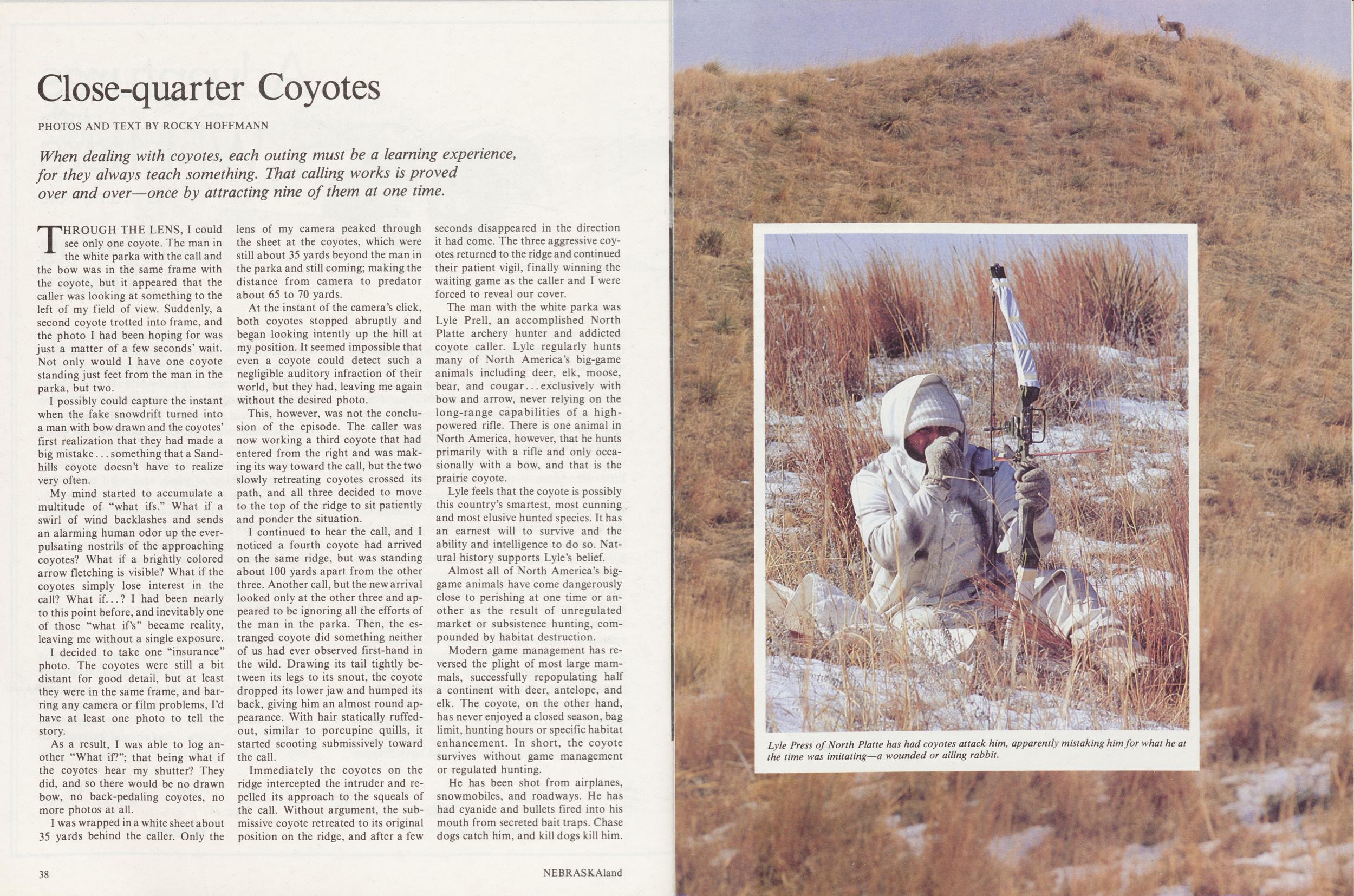
Close-quarter Coyotes
When dealing with coyotes, each outing must be a learning experience, for they always teach something. That calling works is proved over and over—once by attracting nine of them at one time.THROUGH THE LENS, I could see only one coyote. The man in the white parka with the call and the bow was in the same frame with the coyote, but it appeared that the caller was looking at something to the left of my field of view. Suddenly, a second coyote trotted into frame, and the photo I had been hoping for was just a matter of a few seconds' wait. Not only would I have one coyote standing just feet from the man in the parka, but two.
I possibly could capture the instant when the fake snowdrift turned into a man with bow drawn and the coyotes' first realization that they had made a big mistake something that a Sandhills coyote doesn't have to realize very often.
My mind started to accumulate a multitude of "what ifs." What if a swirl of wind backlashes and sends an alarming human odor up the everpulsating nostrils of the approaching coyotes? What if a brightly colored arrow fletching is visible? What if the coyotes simply lose interest in the call? What if? I had been nearly to this point before, and inevitably one of those "what ifs" became reality, leaving me without a single exposure.
I decided to take one "insurance" photo. The coyotes were still a bit distant for good detail, but at least they were in the same frame, and barring any camera or film problems, I'd have at least one photo to tell the story.
As a result, I was able to log another "What if?"; that being what if the coyotes hear my shutter? They did, and so there would be no drawn bow, no back-pedaling coyotes, no more photos at all.
I was wrapped in a white sheet about 35 yards behind the caller. Only the lens of my camera peaked through the sheet at the coyotes, which were still about 35 yards beyond the man in the parka and still coming; making the distance from camera to predator about 65 to 70 yards.
At the instant of the camera's click, both coyotes stopped abruptly and began looking intently up the hill at my position. It seemed impossible that even a coyote could detect such a negligible auditory infraction of their world, but they had, leaving me again without the desired photo.
This, however, was not the conclusion of the episode. The caller was now working a third coyote that had entered from the right and was making its way toward the call, but the two slowly retreating coyotes crossed its path, and all three decided to move to the top of the ridge to sit patiently and ponder the situation.
I continued to hear the call, and I noticed a fourth coyote had arrived on the same ridge, but was standing about 100 yards apart from the other three. Another call, but the new arrival looked only at the other three and appeared to be ignoring all the efforts of the man in the parka. Then, the estranged coyote did something neither of us had ever observed first-hand in the wild. Drawing its tail tightly between its legs to its snout, the coyote dropped its lower jaw and humped its back, giving him an almost round appearance. With hair statically ruffed-out, similar to porcupine quills, it started scooting submissively toward the call.
Immediately the coyotes on the ridge intercepted the intruder and repelled its approach to the squeals of the call. Without argument, the submissive coyote retreated to its original position on the ridge, and after a few seconds disappeared in the direction it had come. The three aggressive coyotes returned to the ridge and continued their patient vigil, finally winning the waiting game as the caller and I were forced to reveal our cover.
The man with the white parka was Lyle Prell, an accomplished North Platte archery hunter and addicted coyote caller. Lyle regularly hunts many of North America's big-game animals including deer, elk, moose, bear, and cougar exclusively with bow and arrow, never relying on the long-range capabilities of a high-powered rifle. There is one animal in North America, however, that he hunts primarily with a rifle and only occasionally with a bow, and that is the prairie coyote.
Lyle feels that the coyote is possibly this country's smartest, most cunning and most elusive hunted species. It has an earnest will to survive and the ability and intelligence to do so. Natural history supports Lyle's belief.
Almost all of North America's biggame animals have come dangerously close to perishing at one time or another as the result of unregulated market or subsistence hunting, compounded by habitat destruction.
Modern game management has reversed the plight of most large mammals, successfully repopulating half a continent with deer, antelope, and elk. The coyote, on the other hand, has never enjoyed a closed season, bag limit, hunting hours or specific habitat enhancement. In short, the coyote survives without game management or regulated hunting.
He has been shot from airplanes, snowmobiles, and roadways. He has had cyanide and bullets fired into his mouth from secreted bait traps. Chase dogs catch him, and kill dogs kill him.
38 NEBRASKAlandLyle Press of North Platte has had coyotes attack him, apparently mistaking him for what he at the time was imitating—a wounded or ailing rabbit.
He has stepped into leg-hold traps and run through snares. His dens have been excavated, flooded, and torched. Bounties have been paid for his ears, and his pelt has brought as much as $150, yet the coyote survives and often thrives.
The coyote has learned a great deal in the 20th century, primarily to suspect everything and to avoid man, his only natural enemy.
Calling coyotes probably results in the lowest harvest rate of all the methods employed to take this wild canine. It is a match-up of learned behavior, instincts, intelligence, and senses. Man is more often the loser than the winner, and therefore the rewards of the successful call-in hunt are considerable. Lyle believes that the coyote is the most consistently challenging animal of all that he regularly hunts, and he has compiled a notebook of experiences from which he learns and adjusts his techniques.
Lyle is an expert with a call. That same afternoon he called in nine coyotes that we saw and two others that we didn't. At one stand, late in the afternoon, Lyle called a coyote that ran directly at him for more than half a mile. As it approached, it disappeared into a small, natural saddle just 100 yards in front of us, and within a few seconds, I could hear it approach from behind, stopping close enough that I could hear it breathing.
When the coyote sensed my presence, I heard it run off, leaving a fresh footprint only two feet behind the sheet I was sitting under. Earlier, another coyote trotted to a spot directly between Lyle and me but made a rapid retreat when it discovered its predicament. Neither Lyle nor I saw the coyote, but we both heard it and found its tracks in the new snow.
Although calling nine coyotes in one day should be considered an extremely successful outing, Lyle recalls that his most exciting experience with coyotes was when he called nine in at once. At the time, he was archery-hunting deer from the ground when he heard a chorus of coyote chatter about 300 yards in front of him. Always carrying a predator call, he dropped to his knees behind a fallen evergreen and began squealing like a distressed rabbit. He had just nocked an arrow when he heard the steady thumping of feet. Silently, Lyle cursed himself for spooking a herd of deer, but his suspicions were proven wrong when coyotes began pouring from the trees in front of him. The entire pack was running directly at him. Picking out the lead coyote, he started to draw his bow when another coyote hit him directly in the middle of his back. The force of the collision knocked Lyle forward onto his bow, and by the time he recovered to make a shot, a bad case of nerves sent the arrow off course.
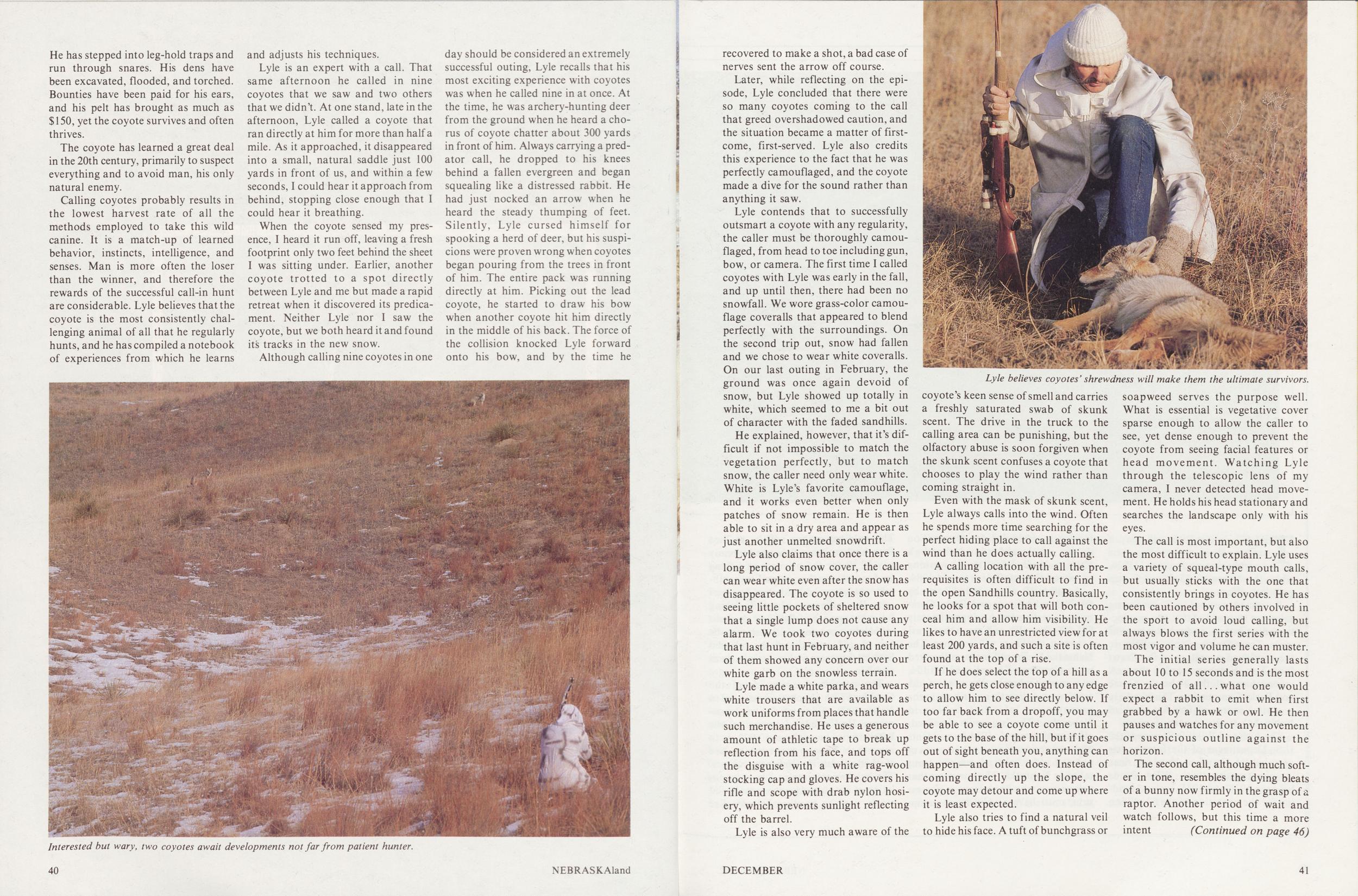
Interested but wary, two coyotes await developments not far from patient hunter.
Later, while reflecting on the episode, Lyle concluded that there were so many coyotes coming to the call that greed overshadowed caution, and the situation became a matter of firstcome, first-served. Lyle also credits this experience to the fact that he was perfectly camouflaged, and the coyote made a dive for the sound rather than anything it saw.
Lyle contends that to successfully outsmart a coyote with any regularity, the caller must be thoroughly camouflaged, from head to toe including gun, bow, or camera. The first time I called coyotes with Lyle was early in the fall, and up until then, there had been no snowfall. We wore grass-color camouflage coveralls that appeared to blend perfectly with the surroundings. On the second trip out, snow had fallen and we chose to wear white coveralls. On our last outing in February, the ground was once again devoid of snow, but Lyle showed up totally in white, which seemed to me a bit out of character with the faded sandhills.
He explained, however, that it's difficult if not impossible to match the vegetation perfectly, but to match snow, the caller need only wear white. White is Lyle's favorite camouflage, and it works even better when only patches of snow remain. He is then able to sit in a dry area and appear as just another unmelted snowdrift.
Lyle also claims that once there is a long period of snow cover, the caller can wear white even after the snow has disappeared. The coyote is so used to seeing little pockets of sheltered snow that a single lump does not cause any alarm. We took two coyotes during that last hunt in February, and neither of them showed any concern over our white garb on the snowless terrain.
Lyle made a white parka, and wears white trousers that are available as work uniforms from places that handle such merchandise. He uses a generous amount of athletic tape to break up reflection from his face, and tops off the disguise with a white rag-wool stocking cap and gloves. He covers his rifle and scope with drab nylon hosiery, which prevents sunlight reflecting off the barrel.
Lyle is also very much aware of the coyote's keen sense of smell and carries a freshly saturated swab of skunk scent. The drive in the truck to the calling area can be punishing, but the olfactory abuse is soon forgiven when the skunk scent confuses a coyote that chooses to play the wind rather than coming straight in.
Lyle believes coyotes' shrewdness will make them the ultimate survivors.
Even with the mask of skunk scent, Lyle always calls into the wind. Often he spends more time searching for the perfect hiding place to call against the wind than he does actually calling.
A calling location with all the prerequisites is often difficult to find in the open Sandhills country. Basically, he looks for a spot that will both conceal him and allow him visibility. He likes to have an unrestricted view for at least 200 yards, and such a site is often found at the top of a rise.
If he does select the top of a hill as a perch, he gets close enough to any edge to allow him to see directly below. If too far back from a dropoff, you may be able to see a coyote come until it gets to the base of the hill, but if it goes out of sight beneath you, anything can happen—and often does. Instead of coming directly up the slope, the coyote may detour and come up where it is least expected.
Lyle also tries to find a natural veil to hide his face. A tuft of bunchgrass or soapweed serves the purpose well. What is essential is vegetative cover sparse enough to allow the caller to see, yet dense enough to prevent the coyote from seeing facial features or head movement. Watching Lyle through the telescopic lens of my camera, I never detected head movement. He holds his head stationary and searches the landscape only with his eyes.
The call is most important, but also the most difficult to explain. Lyle uses a variety of squeal-type mouth calls, but usually sticks with the one that consistently brings in coyotes. He has been cautioned by others involved in the sport to avoid loud calling, but always blows the first series with the most vigor and volume he can muster.
The initial series generally lasts about 10 to 15 seconds and is the most frenzied of all... what one would expect a rabbit to emit when first grabbed by a hawk or owl. He then pauses and watches for any movement or suspicious outline against the horizon.
The second call, although much softer in tone, resembles the dying bleats of a bunny now firmly in the grasp of a raptor. Another period of wait and watch follows, but this time a more intent (Continued on page 46)
DECEMBER 41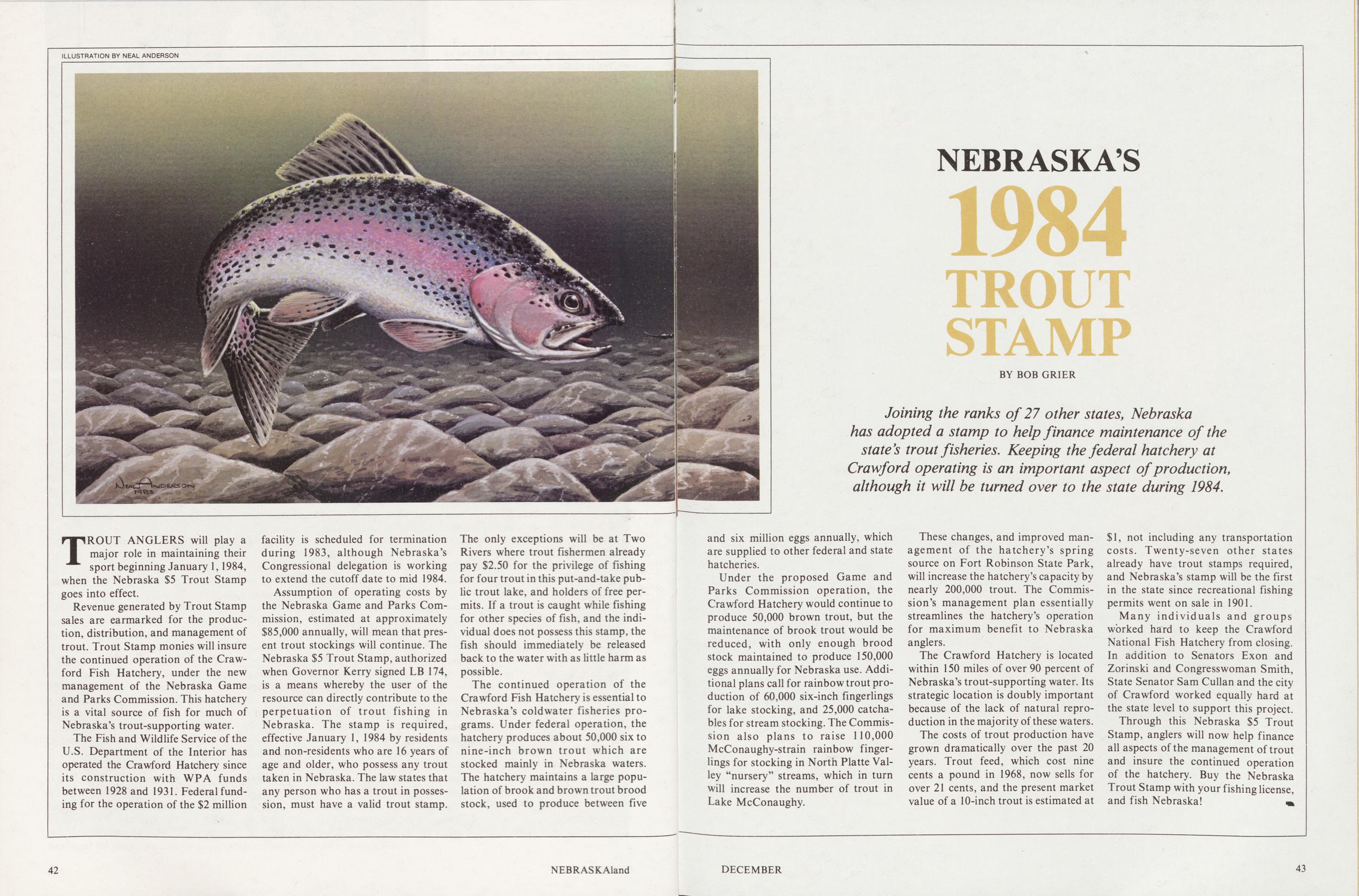
ILLUSTRATION BY NEAL ANDERSON
NEBRASKA'S 1984 TROUT STAMP
Joining the ranks of 27 other states, Nebraska has adopted a stamp to help finance maintenance of the state's trout fisheries. Keeping the federal hatchery at Crawford operating is an important aspect of production, although it will be turned over to the state during 1984.TROUT ANGLERS will play a major role in maintaining their sport beginning January 1,1984, when the Nebraska $5 Trout Stamp goes into effect.
Revenue generated by Trout Stamp sales are earmarked for the production, distribution, and management of trout. Trout Stamp monies will insure the continued operation of the Crawford Fish Hatchery, under the new management of the Nebraska Game and Parks Commission. This hatchery is a vital source of fish for much of Nebraska's trout-supporting water.
The Fish and Wildlife Service of the U.S. Department of the Interior has operated the Crawford Hatchery since its construction with WPA funds between 1928 and 1931. Federal funding for the operation of the $2 million facility is scheduled for termination during 1983, although Nebraska's Congressional delegation is working to extend the cutoff date to mid 1984.
Assumption of operating costs by the Nebraska Game and Parks Commission, estimated at approximately $85,000 annually, will mean that present trout stockings will continue. The Nebraska $5 Trout Stamp, authorized when Governor Kerry signed LB 174, is a means whereby the user of the resource can directly contribute to the perpetuation of trout fishing in Nebraska. The stamp is required, effective January 1, 1984 by residents and non-residents who are 16 years of age and older, who possess any trout taken in Nebraska. The law states that any person who has a trout in possession, must have a valid trout stamp. The only exceptions will be at Two Rivers where trout fishermen already pay $2.50 for the privilege of fishing for four trout in this put-and-take public trout lake, and holders of free permits. If a trout is caught while fishing for other species of fish, and the individual does not possess this stamp, the fish should immediately be released back to the water with as little harm as possible.
The continued operation of the Crawford Fish Hatchery is essential to Nebraska's coldwater fisheries programs. Under federal operation, the hatchery produces about 50,000 six to nine-inch brown trout which are stocked mainly in Nebraska waters. The hatchery maintains a large population of brook and brown trout brood stock, used to produce between five
42 NEBRASKAlandand six million eggs annually, which are supplied to other federal and state hatcheries.
Under the proposed Game and Parks Commission operation, the Crawford Hatchery would continue to produce 50,000 brown trout, but the maintenance of brook trout would be reduced, with only enough brood stock maintained to produce 150,000 eggs annually for Nebraska use. Additional plans call for rainbow trout production of 60,000 six-inch fingerlings for lake stocking, and 25,000 catchables for stream stocking. The Commission also plans to raise 110,000 McConaughy-strain rainbow fingerlings for stocking in North Platte Valley "nursery" streams, which in turn will increase the number of trout in Lake McConaughy.
These changes, and improved management of the hatchery's spring source on Fort Robinson State Park, will increase the hatchery's capacity by nearly 200,000 trout. The Commission's management plan essentially streamlines the hatchery's operation for maximum benefit to Nebraska anglers.
The Crawford Hatchery is located within 150 miles of over 90 percent of Nebraska's trout-supporting water. Its strategic location is doubly important because of the lack of natural reproduction in the majority of these waters.
The costs of trout production have grown dramatically over the past 20 years. Trout feed, which cost nine cents a pound in 1968, now sells for over 21 cents, and the present market value of a 10-inch trout is estimated at $1, not including any transportation costs. Twenty-seven other states already have trout stamps required, and Nebraska's stamp will be the first in the state since recreational fishing permits went on sale in 1901.
Many individuals and groups worked hard to keep the Crawford National Fish Hatchery from closing. In addition to Senators Exon and Zorinski and Congresswoman Smith, State Senator Sam Cullan and the city of Crawford worked equally hard at the state level to support this project.
Through this Nebraska $5 Trout Stamp, anglers will now help finance all aspects of the management of trout and insure the continued operation of the hatchery. Buy the Nebraska Trout Stamp with your fishing license, and fish Nebraska!
DECEMBER 43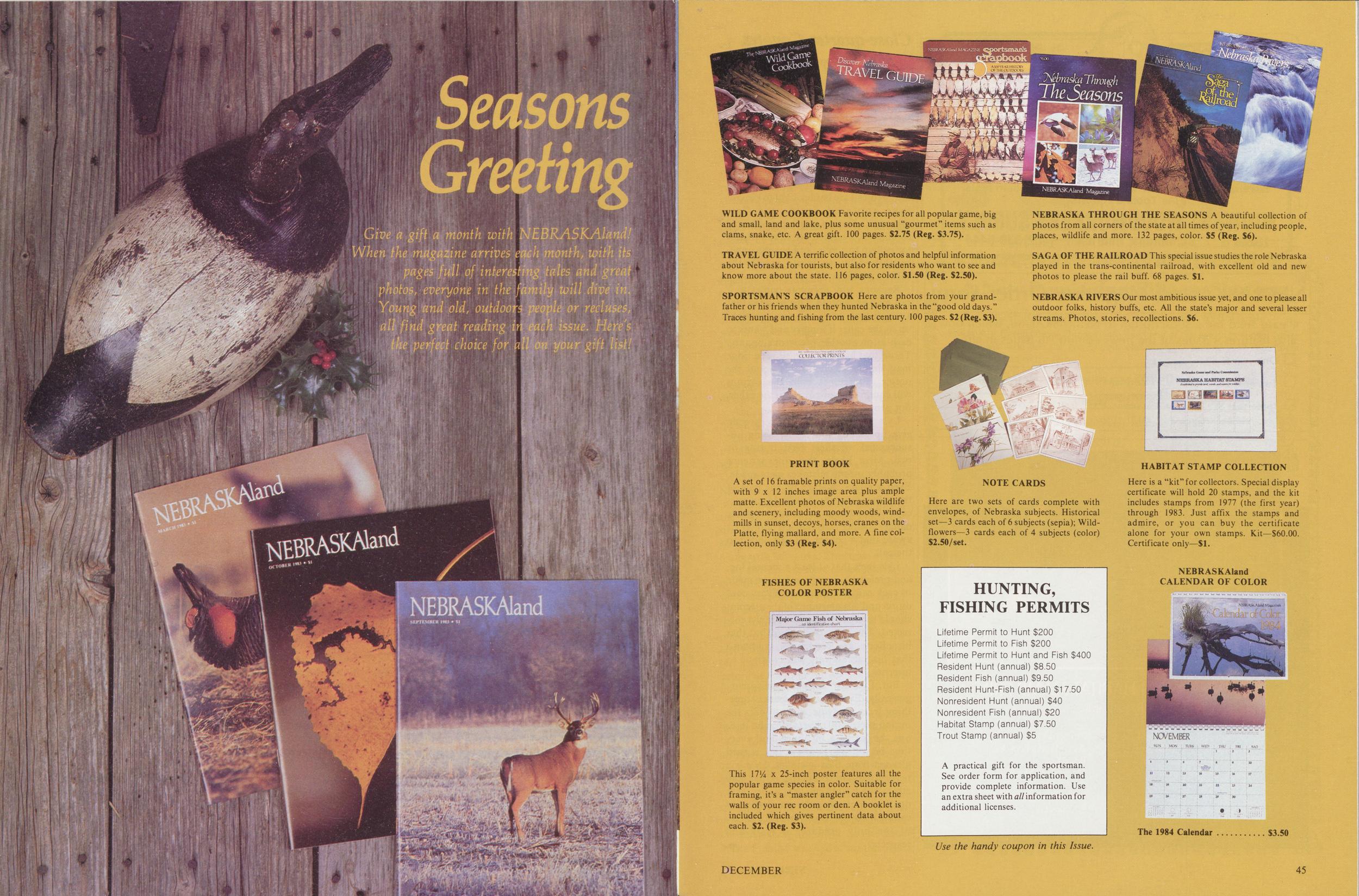
Close-quarter Coyotes
(Continued from page 41)inspection of every blemish in the landscape is made. Finally, the third series of calls is presented, which consists of five or six barely audible squeaks.
The entire three-phase sequence is repeated, if necessary, after a two to three-minute wait, but a majority of the coyotes Lyle has brought to the call have appeared during the first sequence. During perfect acoustical conditions, a coyote can hear a predator call up to a mile, and has the unbelievable ability to locate exactly the caller's position.
Reasons why a coyote comes to acall may be twofold. Lyle believes that a coyote that comes on a dead run right up to the caller is hungry and wants to cash in on another predator's bounty. Those that hold back or sit on a ridge may simply be inquisitive about the noises. Sometimes even the curious will continue their course to the caller, but progress is slow.
Lyle feels that too many people give up calling too easily, being unsuccessful on their first outing or two. Most likely, their inexperience probably means mistakes were made. Even a minor mistake on the part of the caller generally results in no success. Oftentimes, a coyote detects danger before the novice hunter is aware that a coyote has responded to the call.
Lyle feels that at least a mental log, and preferably a written one, be made of each calling experience. Every condition and circumstance of the attempt should then be reviewed and faults corrected. The caller will soon find that his efforts are productive, and also that his success rate will continue to improve.
But, Lyle also defines success categorically. Every time he learns something from a coyote, he considers the outing successful. Every time he loses one, he learns a bit more, and every time he outsmarts one it is a reward gleaned from past mistakes. Lyle is a perfectionist in technique, effort, and ethics, and nothing can hone these qualities more than the satisfaction of calling a coyote to within arm's length of the only predator it fears and respects.
46 NEBRASKAlandA Christmas Remembrance
(Continued from page 29)As the days drew closer to Christmas, the store became busier, and mybox of bows was often whisked away up the stairs before I'd had a chance to fill it. Sometimes, one of the women from the gift wrap booth would comerunning down for it, thus spoiling Otto's opportunity to bury his big face in the gay colors. Sometimes, my father would come for the bows, having passed by the booth in his rounds and seen that the women were nearly out. The footsteps above me flowed together into a steady rumble along the wooden aisles.
In the evening, after the store had closed, my sister, my father and I would pass through the aisles, finding the counter tops a shambles and the floors a wet, black swirl of grime. At the front door, waiting to let us out and lock up behind us, stood Otto, his nose dripping, his mop bucket at the ready.
And then, suddenly, it was Christmas Eve!
Late in the afternoon, I stopped making bows for the year. My work was finished. I shut off the light, put on my coat, and walked the snowy Main Street down to its end and back, enjoying the rush of last-minute shoppers,the Christmas carols being piped out under the awnings of stores. The cold air sang in my lungs. I hummed along with the carols. Christmas at last!
By the time the store closed that day, my father's face was gray and his hands were trembling. He walked through the aisles, absentmindedly touching the counters, straightening the loose piles of unsold clothing. We were the last people in the store—Dad, my sister, and I. Even Otto had gone home before us, his arms full of packages, the floor dirty behind him.
On the "Hold" shelf behind the counter in the gift wrap booth would be several packages, left there by mistake, forgotten; big boxes and small, all mysterious in their gift wrappings, yet made familiar to me by their bows. Thinking that someone might come for them, we waited an extra half hour, standing at the front of the store and peering out into the darkening street, the diminishing traffic. But no one came back. Finally, we loaded up the mystery
gifts and took them home, leaving a note on the front door: "If you have forgotten your package in our gift wrap department, you may pick it up at the home of our manager," followed by our address.
By then we were the only people in the streets, the headlights of the Plymouth searching the white ruts in the snow. In every window, a Christmas tree glittered.
Mother met us at the door, and the smell of cookies baking poured out into the cold air. It seemed every light in the house was turned on. Our tree stood in the corner of the living room, with packages spilling out from under it. We unloaded the orphaned gifts and put them in the entryway, leaving the porch light on for their owners.
Soon, my father's older brother Tubby would come to spend the evening with us. He was a bachelor who had spent most of his life caring for my grandmother, who had died a few years earlier. He was a big, pleasant man who enjoyed Christmas as much as we children did. We would hear him coming across the snowy yard, ringing a belt of harness bells that had been in the family for years. When he came in, the cold night air slid from his great topcoat. His packages, left in the trunk of his car at his office all day, were like blocks of ice. We put them under the tree with the others and sat down together to supper.
All through the evening, as we opened our gifts, strangers came to our door to claim their gifts. Uncomfortable, shy, apologetic, they thanked Dadprofusely for bringing the gifts to our house. As they stood in the doorway, snow melted from their boots onto the carpet and the cold air flowed in around them. What would they have done, how would they have explained to their children?
Finally, all of the mysterious packages were gone, and all of ours had been unwrapped. Our family gathered in the living room lit only by the tree, my uncle dozing in an armchair, Dad and Mom together on the couch, and my sister and I stretched out on the floor on our backs, looking up through the glittering branches. It was quiet. Beyond the window it was snowing. In a box in one corner of the room, the used Christmas wrappings rustled as they slowly unfolded. Near me, the bows sat in a pile under the tree.
Bookshelf
THE FUR TRADE OF THE AMERICAN WEST, 1807-1840
David J. Wishart, 1979. University of Nebraska Press, Lincoln. 237 pp., index, bibliography, maps, illustrations. $15.THE FUR TRADE was an important factor in the exploration and development of the Great Plains-Rocky Mountains region. Extensive historical research throughout the past century has done much to record and interpret the human drama of the trappers and traders, as well as the resources upon which their enterprises depended. One of the early general histories of the fur trade, published in 1902 by H.M. Chittenden, is still good reading.
Animals of several species were trapped and processed into various commercial products. Two species, the beaver and the bison, were the mainstays of the 19th century fur trade. Depletion of beaver populations and changes in fashion caused the trappers and traders to turn their attention to the bison in the 1830's. Annual shipments of bison robes from the upper Missouri River region increased from about 25,000 in 1830 to more than 90,000 by 1840.
David J. Wishart is an associate professor of geography at the University of Nebraska-Lincoln. His treatment is an overview of fur trade evolution, from early efforts of small bands of independent trappers to the highly organized company enterprises of Choteau, Astor and others.
Strategies of the American Fur Company and the rival Rocky Mountain Fur Company are examined and compared by Wishart. Seasonal and annual cycles of the two organizations are described.
Wishart's book presents a highly readable account of an interesting period in American history. A number of maps identify principal geographic regions and sites associated with the fur trade. Five small reproductions of paintings by Alfred Jacob Miller and Carl Bodmer provide glimpses of trading posts, a Missouri River steamboat, and a 19th century trapper at work.
48 NEBRASKAlandTrading Post
DOGS ENGLISH POINTER male, 2 years old, does it all. Call Ken Cooksey, Day (402) 265-2711; Night (402) 873-6288. TRAINING ALL BREEDS Hunting dogs—Vizslas for sale. Rozanek Kennels, Rt. 2, Schuyler, NE 68661. Phone (402) 352-8769. ENGLISH SETTERS and Pointers: Outstanding bloodlines! Puppies, started dogs, and stud service available. High Plains Kennels, 1411 Emerson, Alliance, NE 69301. Phone (308) 762-6709. GERMAN SHORTHAIRS—English pointers andsetters. Stud service, puppies and started dogs available. Also Diamond Dog Food. Wayne Clark, Box 54, Union, NE. (402) 263-3495 or 263-3155. REGISTERED VIZSLA pups and started dogs. Top bloodlines and excellent hunters at stud. Sir Angus Black Labrador retriever. Sire, Tasankhan. 18-month weight, 70 pounds. For more info call (402) 228-0430. MISCELLANEOUS WINE AND BEER: Make your own. Send for free recipes and instructions. Omaha Supply, 13616 Polk, Omaha, Nebr. 68137. GAME BIRDS for sale. Wild turkeys, wood ducks, mandarins, mallards, teal, Canada geese, pheasants—5 breeds chukkar quail. Many others not listed. Frontier Birds, Wauneta, NE 69045. Phone: day (308) 394-5577/evening (308) 394-5715. BED & BREAKFAST of Nebraska offers overnite lodging with breakfast, in homes throughout the state. For reservations contact Bed & Breakfast of Nebraska, 1464 28th Ave., Columbus, NE 68601. Phone (402) 564-7591. N.E. NEBRASKA TROUT Fishing. For rent Mon.Thurs. or Fri.-Sun. 2 modern cottages completely furnished. 5 spring-fed lakes with trout up to 7 lbs. Bass and bluegill also. Diamond E Trout Resort, Orchard, NE 68764. (402) 893-4745. GUNS—Browning, Winchester, Remington, others, Hi-powers, shotguns, new, used, antiques. Want Pre-1964 Winchesters. Buy-Sell-Trade. Ph. (402) 729-6112. Bedlan's Sporting Goods, Fairbury, NE 68352. C.G. BUD PRITCHARD—2 original oils. Approx. 16x20. North of Valentine. Sharptail, pheasant. Taking offers. Round Hill Books, Box 1680, Greenwich, CT 06836. SELLING 30 USED 17' Michicraft aluminum canoes; 30 used Springbar 3-man compact tents; and 8 used 8-place, heavy duty, long-haul type canoe trailers. All equipment guaranteed to your satisfaction or your money back! Wilson Outfitters Nebraska (WON), 1329 Dawes Avenue, Lincoln, NE 68521. Phone (402) 476-2300. WAX WORMS—500—$8.25; 1,000—$14.50. Add 4% sales tax. Postpaid first class. No C.O.D. Harold Malicky, Burwell, NE 68823. FEATHERS—FEATHER BED. Wanted in condition, duck and goose. Kirk Feather Co., 203 Matthies. Papillion, NE 68046. Give location—will call. AIR GUNS Repaired—Benjamin, Crosman, Daisy, other American-made Restoration, old guns wanted. Air Guns, 1225 No. 46th, Lincoln, NE 68503. Phone (402) 466-9223. BEAUTIFUL LAKE VIEW home building lots on Lake McConaughy plus new A-frame cabin ready to move into. Only 20 minutes from historic Ogallala. Write Box 1028, Imperial, Nebr. 69033 or call Bonnie at Stec Real Estate. SHIP YOU GUNS. Repair, restore or reblue. Give quote before proceeding. Fritz Gunsmithing, Wilber, NE 68465-0707. Phone 821-2260. FOR SALE: 925 acres of Niobrara River and Schlagel Creek Canyon Country south of Valentine. Approximately 7/8-mile of river frontage and one mile of trout stream. Deer and turkey country. Bob Gass Agency, Valentine, NE 69201. FOR SALE: 2 1/2 miles southeast of Valentine, 16 lots from 5 to 23 acres in size. Overlooking Niobrara Valley with Valentine and bluffs of Minnechaduza Creek in background. Contact Bob Gass Agency, Valentine, NE 69201. TAXIDERMY JOHNSON TAXIDERMY—servicing southwest Nebraska, specializing in big-game mounts, life-sized mounts, rug work, fish, birds, tanning hair-on leather. Brochure and price list on request. Johnson Taxidermy,Rt. 1, Box 78, Lamar, NE 69035. Telephone (308) 882-5555. AWARD-WINNING TAXIDERMIST. Eight time national award winners. Trust your trophies to a proven winner. Our complete taxidermy service also arranges hunts. Dinges Taxidermy Studio, 2763 South 12th Omaha, NE 68108. Ph. 402-342-3718 LIVE-CATCH ALL-PURPOSE TRAPS FREEZE-DRY TAXIDERMY Wally Allison's StateRecord Taxidermy, 2709 Birch wood, North Platte, NE 69101. Phone: (308) 534-2324. Specializing in Fish and Small Game, Snake and Lizard and Novelties. (Nothing too small) Newest of all taxidermy methods employed. CREATIVE TAXIDERMY in all its branches since 1935, now includes Northstar Freeze-Dry processing of approved small specimens. Also tanning and deerskin processing. Naturecraft Studio. Nebraska City, Nebraska 68510. Joe Voges-Owner. Phone (402) 873-5491. NABITY'S TAXIDERMY. 31 years experience. Specializing in natural grass backgrounds for mammals, birds and fish. 13901 "0"St., Lincoln, NE 68505 4 miles east of 84th and "O". (402) 489-6351. BADE TAXIDERMY—Quality a must—Fast service. Fish, birds, rugs, tanning, full mounts and game heads. 2111 N. Christy St., Fremont, Nebraska 727-5463. PEISTER TAXIDERMY—a name you can trust. We give you professional life-like work at prices most sportsmen can afford. Member National Taxidermist Association, #5 Regency, Place, Kearney, Nebr. 68847. Phone (308) 237-7575. HASTINGS TAXIDERMY. Professional life-like mounting of game heads, birds, fish, rugs, and animals. We specialize in big-game head mounts. Also hair-onand hair-off tanning. Competitive prices. R Rt. 3, Box 162, Ord, NE 68862. Phone (308) 728-5322. TAXIDERMIST Steve J. Abegglen—Experienced quality craftsmanship. Big game heads, life-size mammals, waterfowl, upland game. Affordable prices. Fast delivery. Rt. 4, Box 47, Columbus, NE 68601 (402) 897-5297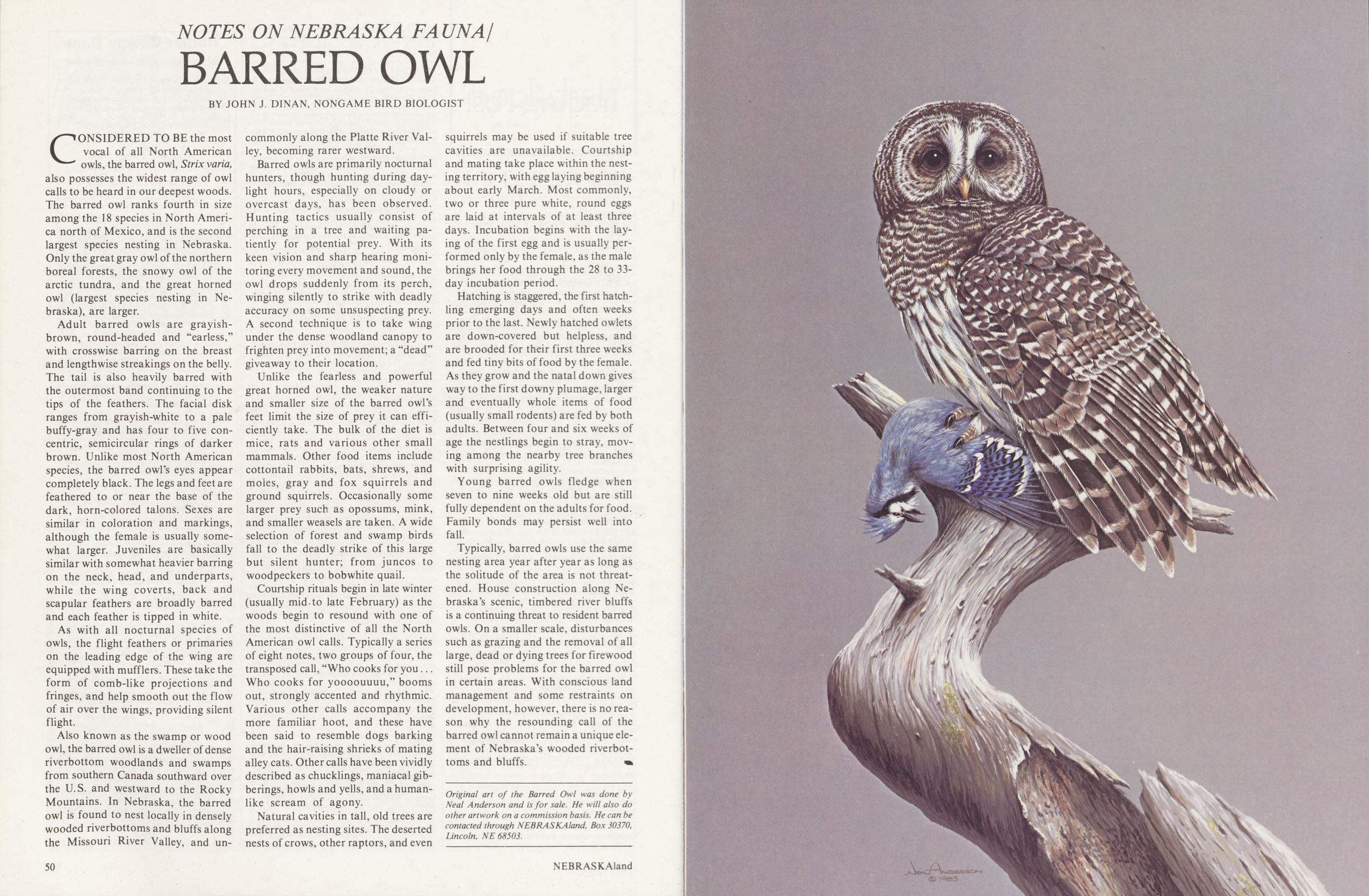
NOTES ON NEBRASKA FAUNA / BARRED OWL
CONSIDERED TO BE the most vocal of all North American owls, the barred owl, Strix varia, also possesses the widest range of owl calls to be heard in our deepest woods. The barred owl ranks fourth in size among the 18 species in North America north of Mexico, and is the second largest species nesting in Nebraska. Only the great gray owl of the northern boreal forests, the snowy owl of the arctic tundra, and the great horned owl (largest species nesting in Nebraska), are larger.
Adult barred owls are grayish-brown, round-headed and "earless," with crosswise barring on the breast and lengthwise streakings on the belly. The tail is also heavily barred with the outermost band continuing to the tips of the feathers. The facial disk ranges from grayish-white to a pale buffy-gray and has four to five concentric, semicircular rings of darker brown. Unlike most North American species, the barred owl's eyes appear completely black. The legs and feet are feathered to or near the base of the dark, horn-colored talons. Sexes are similar in coloration and markings, although the female is usually somewhat larger. Juveniles are basically similar with somewhat heavier barring on the neck, head, and underparts, while the wing coverts, back and scapular feathers are broadly barred and each feather is tipped in white.
As with all nocturnal species of owls, the flight feathers or primaries on the leading edge of the wing are equipped with mufflers. These take the form of comb-like projections and fringes, and help smooth out the flow of air over the wings, providing silent flight.
Also known as the swamp or wood owl, the barred owl is a dweller of dense riverbottom woodlands and swamps from southern Canada southward over the U.S. and westward to the Rocky Mountains. In Nebraska, the barred owl is found to nest locally in denselywooded riverbottoms and bluffs along the Missouri River Valley, and un- commonly along the Platte River Valley, becoming rarer westward.
Barred owls are primarily nocturnal hunters, though hunting during daylight hours, especially on cloudy or overcast days, has been observed. Hunting tactics usually consist of perching in a tree and waiting patiently for potential prey. With its keen vision and sharp hearing monitoring every movement and sound, the owl drops suddenly from its perch, winging silently to strike with deadly accuracy on some unsuspecting prey. A second technique is to take wing under the dense woodland canopy to frighten prey into movement; a "dead" giveaway to their location.
Unlike the fearless and powerful great horned owl, the weaker nature and smaller size of the barred owl's feet limit the size of prey it can efficiently take. The bulk of the diet is mice, rats and various other small mammals. Other food items include cottontail rabbits, bats, shrews, and moles, gray and fox squirrels and ground squirrels. Occasionally some larger prey such as opossums, mink,and smaller weasels are taken. A wide selection of forest and swamp birds fall to the deadly strike of this large but silent hunter; from juncos to woodpeckers to bobwhite quail.
Courtship rituals begin in late winter (usually mid-to late February) as the woods begin to resound with one of the most distinctive of all the North American owl calls. Typically a series of eight notes, two groups of four, the transposed call, "Who cooks for you Who cooks for yoooouuuu," booms out, strongly accented and rhythmic. Various other calls accompany themore familiar hoot, and these have been said to resemble dogs barking and the hair-raising shrieks of mating alley cats. Other calls have been vividly described as chucklings, maniacal gibberings, howls and yells, and a human-like scream of agony.
Natural cavities in tall, old trees are preferred as nesting sites. The deserted nests of crows, other raptors, and even squirrels may be used if suitable treecavities are unavailable. Courtship and mating take place within the nesting territory, with egg laying beginningabout early March. Most commonly, two or three pure white, round eggs are laid at intervals of at least three days. Incubation begins with the laying of the first egg and is usually performed only by the female, as the male brings her food through the 28 to 33-day incubation period.
Hatching is staggered, the first hatch-ling emerging days and often weeks prior to the last. Newly hatched owlets are down-covered but helpless, and are brooded for their first three weeksand fed tiny bits of food by the female. As they grow and the natal down gives way to the first downy plumage, larger and eventually whole items of food (usually small rodents) are fed by both adults. Between four and six weeks of age the nestlings begin to stray, moving among the nearby tree branches with surprising agility.
Young barred owls fledge when seven to nine weeks old but are still fully dependent on the adults for food. Family bonds may persist well into fall.
Typically, barred owls use the same nesting area year after year as long as the solitude of the area is not threatened. House construction along Nebraska's scenic, timbered river bluffs is a continuing threat to resident barred owls. On a smaller scale, disturbances such as grazing and the removal of all large, dead or dying trees for firewood still pose problems for the barred owl in certain areas. With conscious land management and some restraints on development, however, there is no reason why the resounding call of the barred owl cannot remain a unique element of Nebraska's wooded riverbottoms and bluffs.
Original art of the Barred Owl was done by Neal Anderson and is for sale. He will also do other artwork on a commission basis. He can be contacted through NEBRASKAland, Box 30370, Lincoln, NE 68503.
Position: 467 (22 views)