Volume 61, Issue 10, 1983
NEBRASKAland
NOVEMBER 1983 $1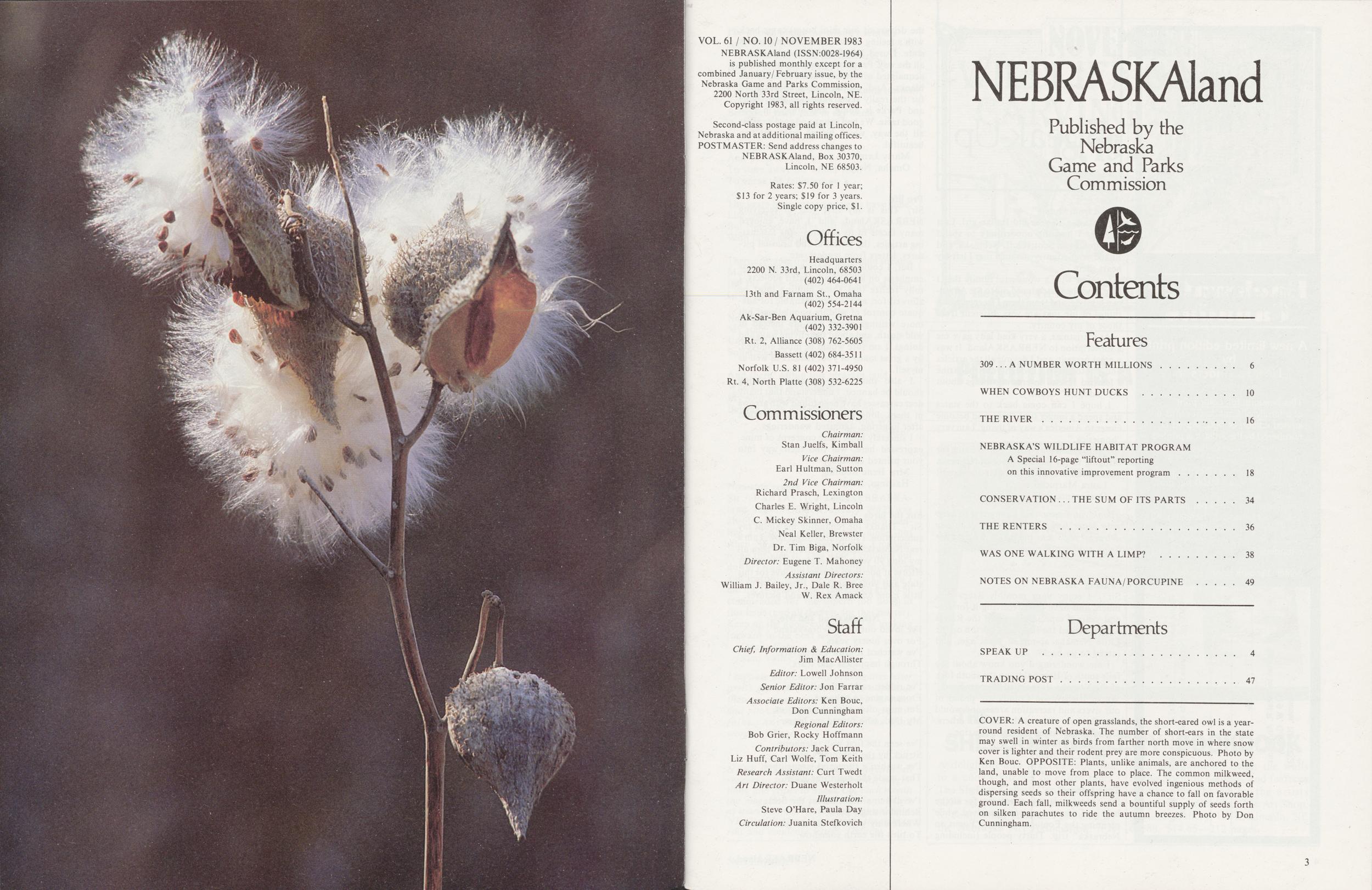
NEBRASKAland Published by the Nebraska Game and Parks Commission
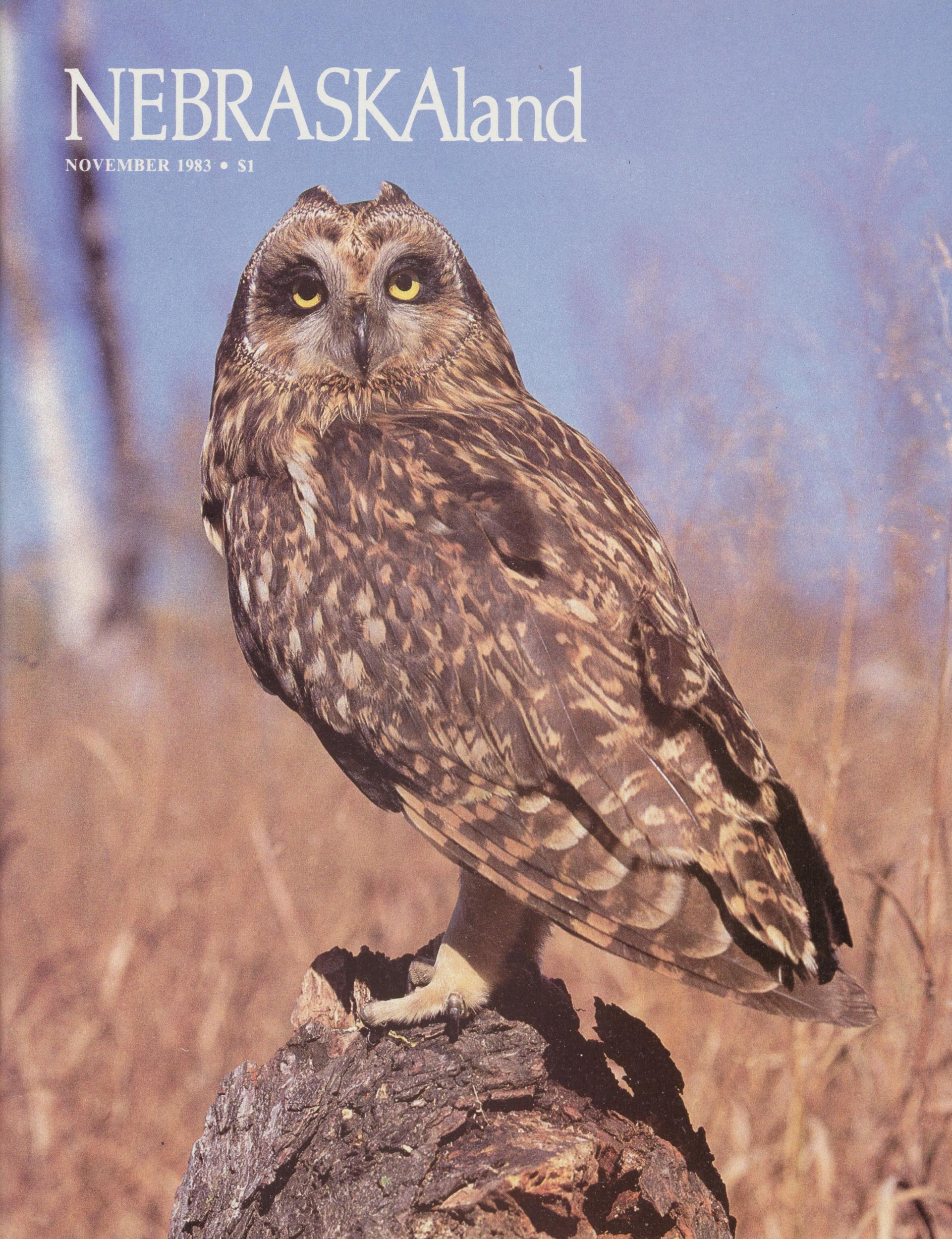
Contents Features 309 A NUMBER WORTH MILLIONS WHEN COWBOYS HUNT DUCKS 10 THE RIVER 16 NEBRASKA'S WILDLIFE HABITAT PROGRAM A Special 16-page "liftout" reporting on this innovative improvement program 18 CONSERVATION THE SUM OF ITS PARTS 34 THE RENTERS 36 WAS ONE WALKING WITH A LIMP? 38 NOTES ON NEBRASKA FAUNA/PORCUPINE 49 Departments SPEAK UP TRADING POST 47 COVER: A creature of open grasslands, the short-eared owl is a year-round resident of Nebraska. The number of short-ears in the state may swell in winter as birds from farther north move in where snow cover is lighter and their rodent prey are more conspicuous. Photo by Ken Bouc. OPPOSITE: Plants, unlike animals, are anchored to the land, unable to move from place to place. The common milkweed, though, and most other plants, have evolved ingenious methods of dispersing seeds so their offspring have a chance to fall on favorable ground. Each fall, milkweeds send a bountiful supply of seeds forth on silken parachutes to ride the autumn breezes. Photo by Don Cunningham. 3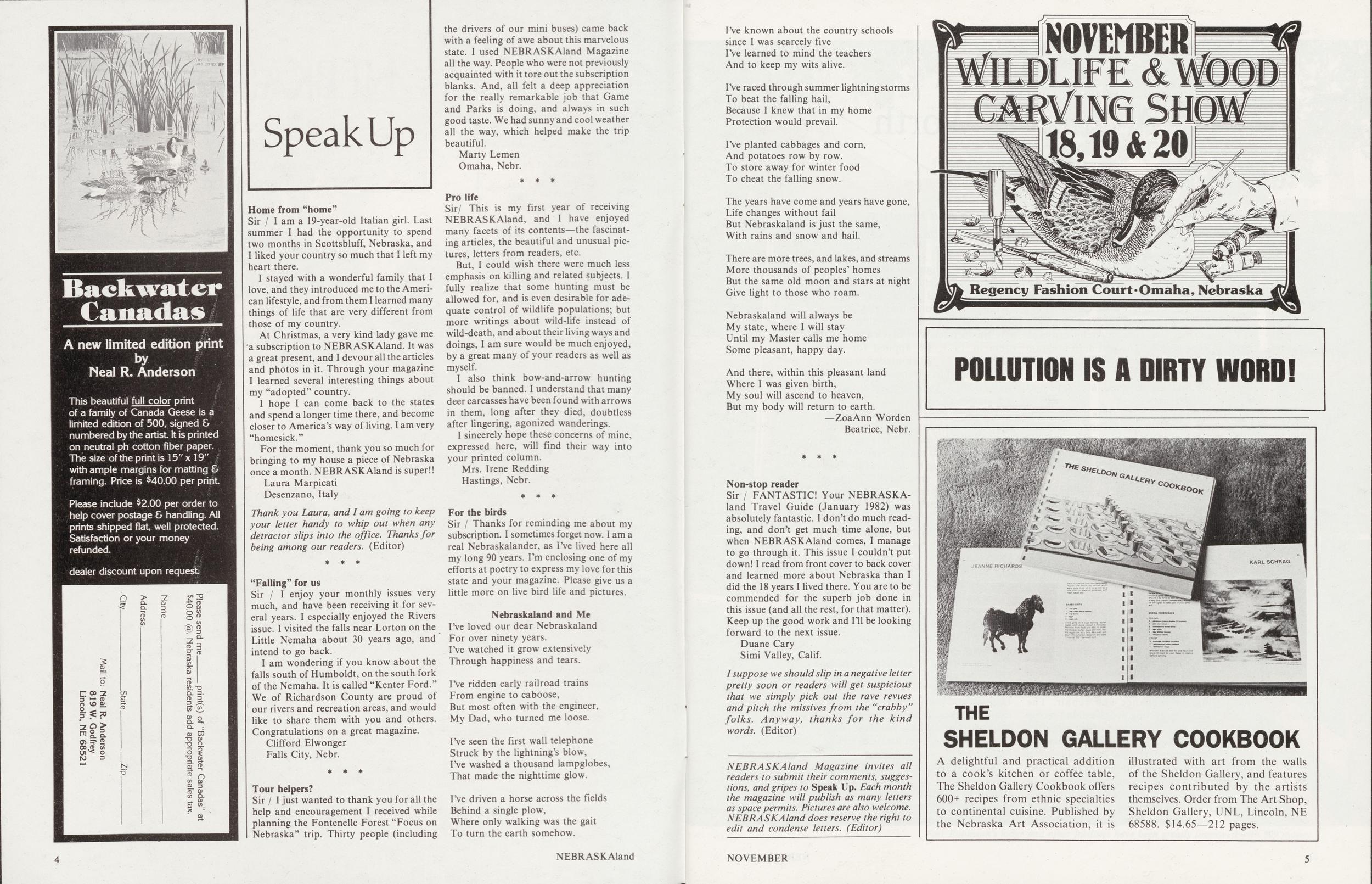
Backwater Canadas
A new limited edition print by Neal R. Anderson This beautiful full color print of a family of Canada Geese is a limited edition of 500, signed & numbered by the artist. It is printed on neutral ph cotton fiber paper. The size of the print is 15" x 19" with ample margins for matting & framing. Price is $40.00 per print. Please include $2.00 per order to help cover postage & handling. All prints shipped flat, well protected. Satisfaction or your money refunded. dealer discount upon request.Speak Up
Home from "home"Sir / I am a 19-year-old Italian girl. Last summer I had the opportunity to spend two months in Scottsbluff, Nebraska, and I liked your country so much that I left my heart there. I stayed with a wonderful family that I love, and they introduced me to the American lifestyle, and from them I learned many things of life that are very different from those of my country. At Christmas, a very kind lady gave me a subscription to NEBRASKAland. It was a great present, and I devour all the articles and photos in it. Through your magazine I learned several interesting things about my "adopted" country. I hope I can come back to the states and spend a longer time there, and become closer to America's way of living. I am very "homesick." For the moment, thank you so much for bringing to my house a piece of Nebraska once a month. NEBRASKAland is super!!
Laura MarpicatiDesenzano, Italy Thank you Laura, and I am going to keep your letter handy to whip out when any detractor slips into the office. Thanks for being among our readers. (Editor) "Falling" for us
Sir / I enjoy your monthly issues very much, and have been receiving it for several years. I especially enjoyed the Rivers issue. I visited the falls near Lorton on the Little Nemaha about 30 years ago, and intend to go back. I am wondering if you know about the falls south of Humboldt, on the south fork of the Nemaha. It is called "Renter Ford. We of Richardson County are proud of our rivers and recreation areas, and would like to share them with you and others. Congratulations on a great magazine.
Clifford ElwongerFalls City, Nebr. Tour helpers?
Sir / I just wanted to thank you for all the help and encouragement I received while planning the Fontenelle Forest "Focus on Nebraska" trip. Thirty people (including the drivers of our mini buses) came back with a feeling of awe about this marvelous state. I used NEBRASKAland Magazine all the way. People who were not previously acquainted with it tore out the subscription blanks. And, all felt a deep appreciation for the really remarkable job that Game and Parks is doing, and always in such good taste. We had sunny and cool weather all the way, which helped make the trip beautiful.
Marty LemenOmaha, Nebr. Pro life
Sir/ This is my first year of receiving NEBRASKAland, and I have enjoyed many facets of its contents—the fascinating articles, the beautiful and unusual pictures, letters from readers, etc. But, I could wish there were much less emphasis on killing and related subjects. I fully realize that some hunting must be allowed for, and is even desirable for adequate control of wildlife populations; but more writings about wild-life instead of wild-death, and about their living ways and doings, I am sure would be much enjoyed, by a great many of your readers as well as myself. I also think bow-and-arrow hunting should be banned. I understand that many deer carcasses have been found with arrows in them, long after they died, doubtless after lingering, agonized wanderings. I sincerely hope these concerns of mine, expressed here, will find their way into your printed column.
Mrs. Irene ReddingHastings, Nebr. For the birds
Sir / Thanks for reminding me about my subscription. I sometimes forget now. I am a real Nebraskalander, as I've lived here all my long 90 years. I'm enclosing one of my efforts at poetry to express my love for this state and your magazine. Please give us a little more on live bird life and pictures.
Nebraskaland and Me I've loved our dear Nebraskaland For over ninety years. I've watched it grow extensively Through happiness and tears. I've ridden early railroad trains From engine to caboose, But most often with the engineer, My Dad, who turned me loose. I've seen the first wall telephone Struck by the lightning's blow, I've washed a thousand lampglobes, That made the nighttime glow. I've driven a horse across the fields Behind a single plow, Where only walking was the gait To turn the earth somehow. 4 NEBRASKAland I've known about the country schools since I was scarcely five I've learned to mind the teachers And to keep my wits alive. I've raced through summer lightning storms To beat the falling hail, Because I knew that in my home Protection would prevail. I've planted cabbages and corn, And potatoes row by row. To store away for winter food To cheat the falling snow. The years have come and years have gone, Life changes without fail But Nebraskaland is just the same, With rains and snow and hail. There are more trees, and lakes, and streams More thousands of peoples' homes But the same old moon and stars at night Give light to those who roam. Nebraskaland will always be My state, where I will stay Until my Master calls me home Some pleasant, happy day. And there, within this pleasant land Where I was given birth, My soul will ascend to heaven, But my body will return to earth.ZoaAnn WordenBeatrice, Nebr. Non-stop reader
Sir / FANTASTIC! Your NEBRASKAland Travel Guide (January 1982) was absolutely fantastic. I don't do much reading, and don't get much time alone, but when NEBRASKAland comes, I manage to go through it. This issue I couldn't put down! I read from front cover to back cover and learned more about Nebraska than I did the 18 years I lived there. You are to be commended for the superb job done in this issue (and all the rest, for that matter). Keep up the good work and I'll be looking forward to the next issue.
Duane CarySimi Valley, Calif. I suppose we should slip in a negative letter pretty soon or readers will get suspicious that we simply pick out the rave revues and pitch the missives from the "'crabby" folks. Anyway, thanks for the kind words. (Editor) NEBRASKAland Magazine invites all readers to submit their comments, suggestions, and gripes to Speak Up. Each month the magazine will publish as many letters as space permits. Pictures are also welcome. NEBRASKAland does reserve the right to edit and condense letters. (Editor)
309 A Number Worth Millions
Providing funds for preserving and restoring state buildings, this program has compounded savings.
EACH YEAR, thousands of Nebraskans and visitors enjoy public areas owned and operated by the Game and Parks Commission. That enjoyment is due, at least in part, to what Commission Architect Frank Bunker calls "The best darn program that ever happened to the Game and Parks Commission"—the Task Force for Building Renewal, also known as the 309 Task Force.
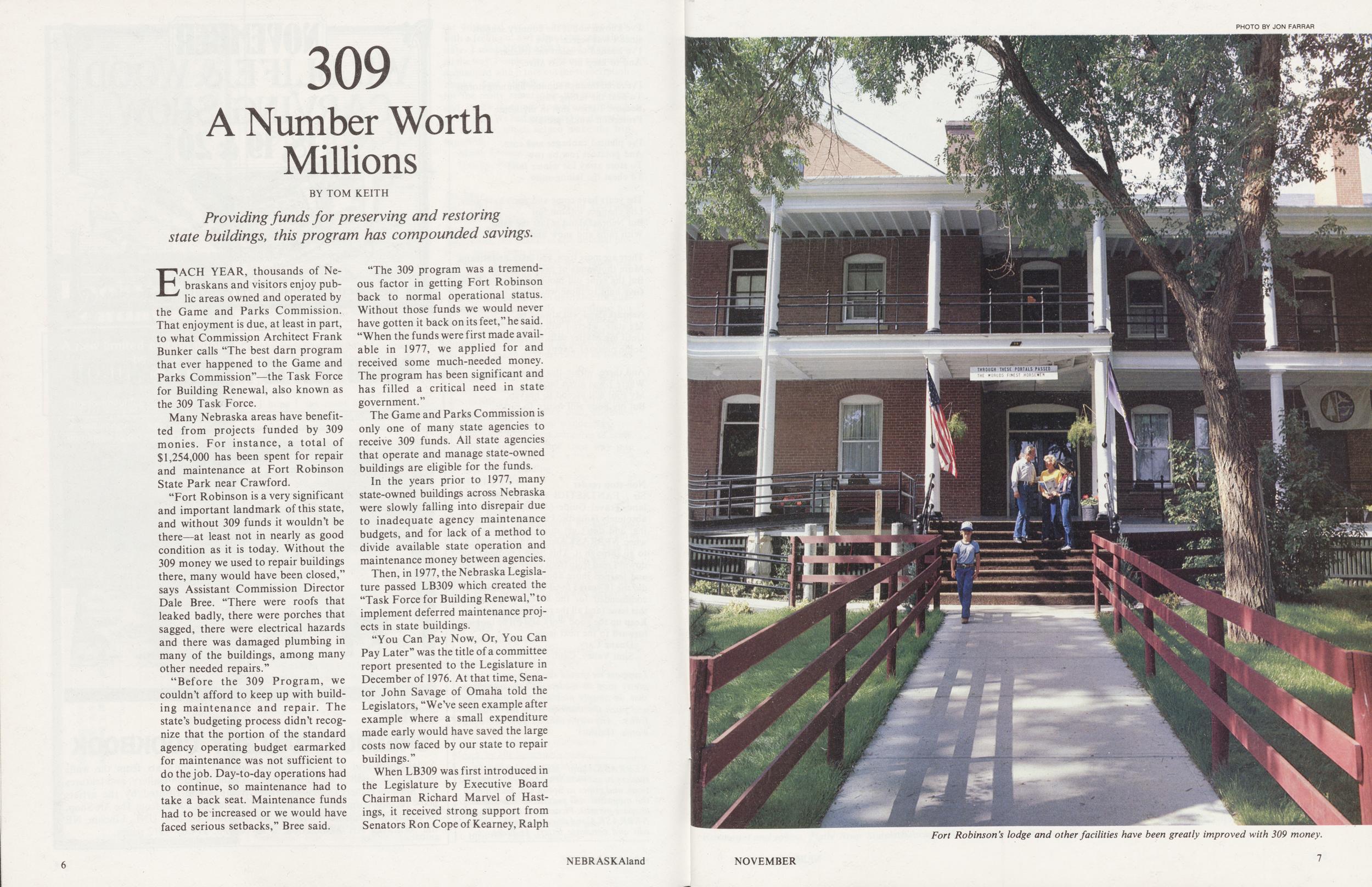
Many Nebraska areas have benefitted from projects funded by 309 monies. For instance, a total of $1,254,000 has been spent for repair and maintenance at Fort Robinson State Park near Crawford.
"Fort Robinson is a very significant and important landmark of this state, and without 309 funds it wouldn't be there—at least not in nearly as good condition as it is today. Without the 309 money we used to repair buildings there, many would have been closed," says Assistant Commission Director Dale Bree. "There were roofs that leaked badly, there were porches that sagged, there were electrical hazards and there was damaged plumbing in many of the buildings, among many other needed repairs."
"Before the 309 Program, we couldn't afford to keep up with building maintenance and repair. The state's budgeting process didn't recognize that the portion of the standard agency operating budget earmarked for maintenance was not sufficient to do the job. Day-to-day operations had to continue, so maintenance had to take a back seat. Maintenance funds had to be increased or we would have faced serious setbacks," Bree said.
"The 309 program was a tremendous factor in getting Fort Robinson back to normal operational status. Without those funds we would never have gotten it back on its feet," he said. "When the funds were first made available in 1977, we applied for and received some much-needed money. The program has been significant and has filled a critical need in state government."
The Game and Parks Commission is only one of many state agencies to receive 309 funds. All state agencies that operate and manage state-owned buildings are eligible for the funds.
In the years prior to 1977, many state-owned buildings across Nebraska were slowly falling into disrepair due to inadequate agency maintenance budgets, and for lack of a method to divide available state operation and maintenance money between agencies.
Then, in 1977, the Nebraska Legislature passed LB309 which created the "Task Force for Building Renewal," to implement deferred maintenance projects in state building.
"You Can Pay Now, Or, You Can Pay Later" was the title of a committee report presented to the Legislature in December of 1976. At that time, Senator John Savage of Omaha told the Legislators, "We've seen example after example where a small expenditure made early would have saved the large costs now faced by our state to repair buildings."
When LB309 was first introduced in the Legislature by Executive Board Chairman Richard Marvel of Hastings, it received strong support from Senators Ron Cope of Kearney, Ralph
Fort Robinson's lodge and other facilities have been greatly improved with 309 money.
Kelly of Grand Island, Dennis Rasmussen of Scotia, and Savage, who believed in the necessity of protecting and preserving state-owned buildings even though allocating maintenance dollars was unpopular at the time. Through their diligence and determination, LB309 won legislative approval and was subsequently signed into law by Governor J. James Exon.
The Task Force concept was conceived by Lou Ninegar, then an instructor at Kearney State College. He served the Legislature as an advisor and took an active part in the interim study and the drafting of legislation for the program. Originally, the Task Force was to be terminated with final adjournment of the 1981 session of the g Legislature, but the job the Task Force set out to do was larger than anticipated. So. the sunset date was extended until June 1985 to allow for completion of the project.
The thrust of LB309 was to provide money for renewal work or preventive maintenance to restore state-owned facilities and utility systems as closely as practical to their original condition. Included were measures to correct structural or mechanical defects that would endanger the integrity of a building or its components, or damage that would allow the elements to further deteriorate a structure.
Steps to correct wasted energy, including minor repairs, alteration and maintenance painting, and general repair and renovation of buildings, were also allowed by the bill; as well as measures to prevent failures in building systems, and for necessary improvements to accommodate handicapped persons.
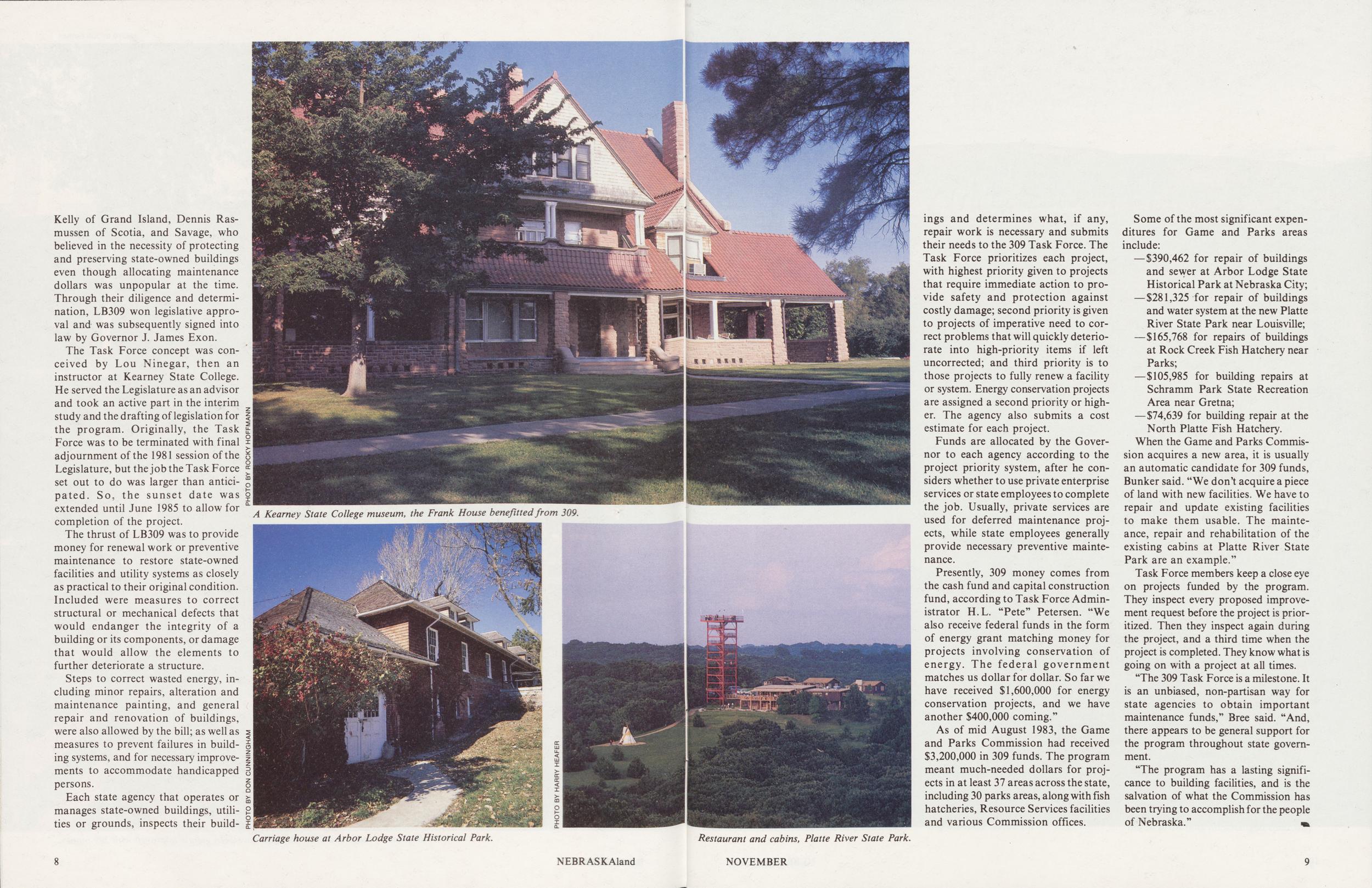
A Kearney State College museum, the Frank House benefitted from 309.
Funds are allocated by the Governor to each agency according to the project priority system, after he considers whether to use private enterprise services or state employees to complete the job. Usually, private services are used for deferred maintenance projects, while state employees generally provide necessary preventive maintenance.
Presently, 309 money comes from the cash fund and capital construction fund, according to Task Force Administrator H.L. "Pete" Petersen. "We also receive federal funds in the form of energy grant matching money for projects involving conservation of energy. The federal government matches us dollar for dollar. So far we have received $1,600,000 for energy conservation projects, and we have another $400,000 coming."
As of mid August 1983, the Game and Parks Commission had received $3,200,000 in 309 funds. The program meant much-needed dollars for projects in at least 37 areas across the state,including 30 parks areas, along with fish hatcheries, Resource Services facilities and various Commission offices.
Some of the most significant expenditures for Game and Parks areas include: $390,462 for repair of buildings and sewer at Arbor Lodge State Historical Park at Nebraska City; $281,325 for repair of buildings and water system at the new Platte River State Park near Louisville; $165,768 for repairs of buildings at Rock Creek Fish Hatchery near Parks; $105,985 for building repairs at Schramm Park State Recreation Area near Gretna; $74,639 for building repair at the North Platte Fish Hatchery.
When the Game and Parks Commission acquires a new area, it is usually an automatic candidate for 309 funds, Bunker said. "We don't acquire a piece of land with new facilities. We have to repair and update existing facilities to make them usable. The mainteance, repair and rehabilitation of the existing cabins at Platte River State Park are an example."
Task Force members keep a close eye on projects funded by the program. They inspect every proposed improvement request before the project is prioritized. Then they inspect again during the project, and a third time when the project is completed. They know what is going on with a project at all times.
"The 309 Task Force is a milestone. It is an unbiased, non-partisan way for state agencies to obtain important maintenance funds," Bree said. "And, there appears to be general support for the program throughout state government.
"The program has a lasting significance to building facilities, and is the salvation of what the Commission has been trying to accomplish for the people of Nebraska."
Carriage house at Arbor Lodge State Historical Park.
Restaurant and cabins, Platte River State Park.
When Cowboys Hunt Ducks
In these parts, jump shooting seemed the only game in town for duck hunters. But, after trial and error, Charley and Glen made decoys work for them.
IF COWBOYS WERE meant to hunt ducks like flatlanders do, there'd likely be pointy-toed, high-heeled chest waders on the racks down at the Gamble store. But, it's not that way at all.
In much of the western Sandhills, the streams are too small and narrow for decoys, but all their loops and bends make ideal spots for a duck to rest and a hunter to sneak him. So, why bother with waders, no matter how stylish, or with decoys, or with any of that other paraphernalia? This country was obviously meant for jump shooting, and that's just what most of the local folks do.
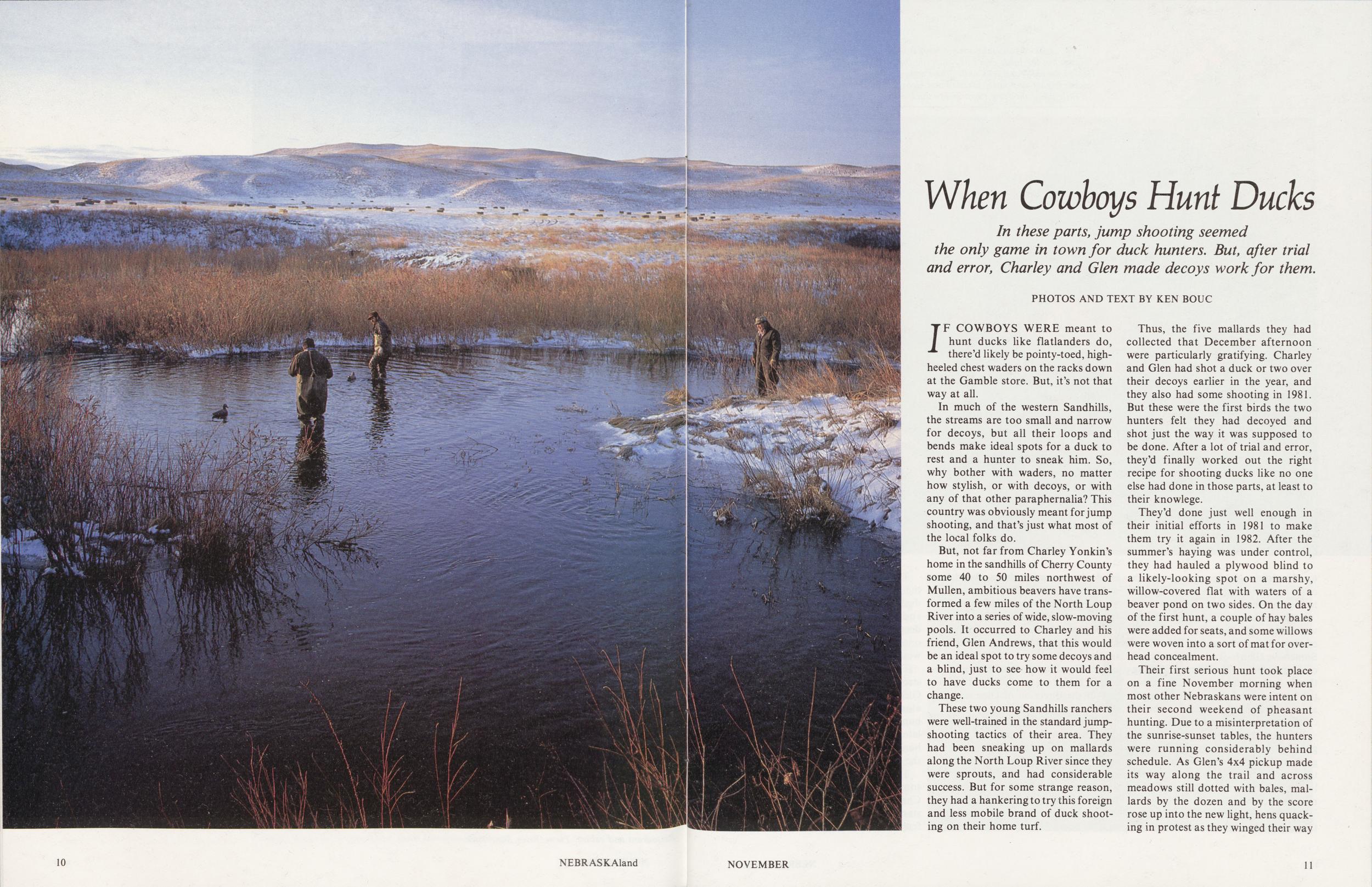
But, not far from Charley Yonkin's home in the sandhills of Cherry County some 40 to 50 miles northwest of Mullen, ambitious beavers have transformed a few miles of the North Loup River into a series of wide, slow-moving pools. It occurred to Charley and his friend, Glen Andrews, that this would be an ideal spot to try some decoys and a blind, just to see how it would feel to have ducks come to them for a change.
These two young Sandhills ranchers were well-trained in the standard jump-shooting tactics of their area. They had been sneaking up on mallards along the North Loup River since they were sprouts, and had considerable success. But for some strange reason, they had a hankering to try this foreign and less mobile brand of duck shooting on their home turf.
Thus, the five mallards they had collected that December afternoon were particularly gratifying. Charley and Glen had shot a duck or two over their decoys earlier in the year, and they also had some shooting in 1981. But these were the first birds the two hunters felt they had decoyed and shot just the way it was supposed to be done. After a lot of trial and error, they'd finally worked out the right recipe for shooting ducks like no one else had done in those parts, at least to their knowlege.
They'd done just well enough in their initial efforts in 1981 to make them try it again in 1982. After the summer's haying was under control, they had hauled a plywood blind to a likely-looking spot on a marshy, willow-covered flat with waters of a beaver pond on two sides. On the day of the first hunt, a couple of hay bales were added for seats, and some willows were woven into a sort of mat for overhead concealment.
Their first serious hunt took place on a fine November morning when most other Nebraskans were intent on their second weekend of pheasant hunting. Due to a misinterpretation of the sunrise-sunset tables, the hunters were running considerably behind schedule. As Glen's 4x4 pickup made its way along the trail and across meadows still dotted with bales, mallards by the dozen and by the score rose up into the new light, hens quacking in protest as they winged their way
10 NEBRASKAland NOVEMBER 11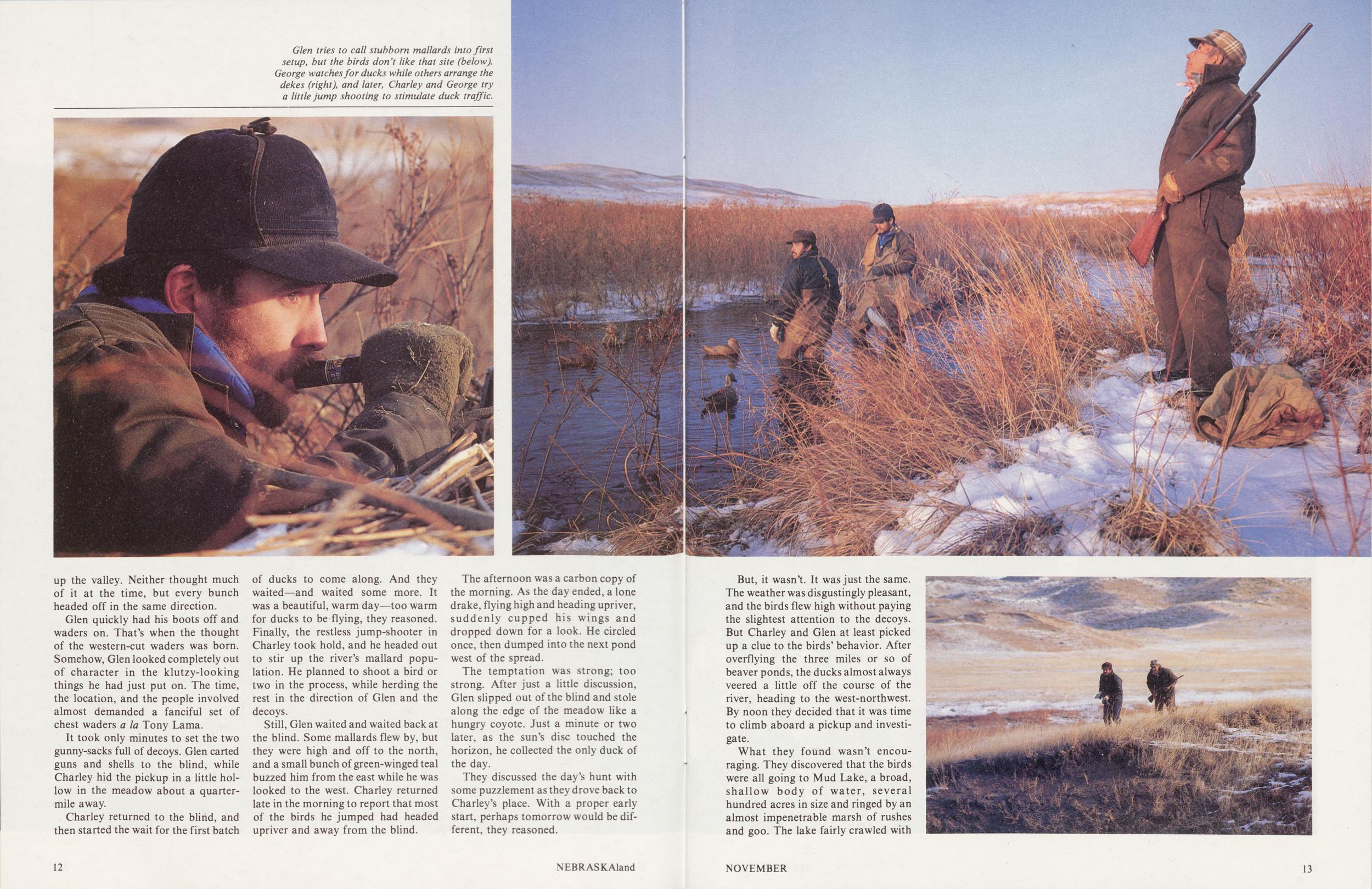
Glen tries to call stubborn mallards into first setup, but the birds don't like that site (below). George watches for ducks while others arrange the dekes (right), and later, Charley and George try a little jump shooting to stimulate duck traffic.
up the valley. Neither thought much of it at the time, but every bunch headed off in the same direction.
Glen quickly had his boots off and waders on. That's when the thought of the western-cut waders was born. Somehow, Glen looked completely out of character in the klutzy-looking things he had just put on. The time, the location, and the people involved almost demanded a fanciful set of chest waders a la Tony Lama.
It took only minutes to set the two gunny-sacks full of decoys. Glen carted guns and shells to the blind, while Charley hid the pickup in a little hollow in the meadow about a quarter-mile away.
Charley returned to the blind, and then started the wait for the first batch of ducks to come along. And they waited—and waited some more. It was a beautiful, warm day—too warm for ducks to be flying, they reasoned. Finally, the restless jump-shooter in Charley took hold, and he headed out to stir up the river's mallard population. He planned to shoot a bird or two in the process, while herding the rest in the direction of Glen and the decoys.
Still, Glen waited and waited back at the blind. Some mallards flew by, but they were high and off to the north, and a small bunch of green-winged teal buzzed him from the east while he was looked to the west. Charley returned late in the morning to report that most of the birds he jumped had headed upriver and away from the blind.
The afternoon was a carbon copy of the morning. As the day ended, a lone drake, flying high and heading upriver, suddenly cupped his wings and dropped down for a look. He circled once, then dumped into the next pond west of the spread.
The temptation was strong; too strong. After just a little discussion, Glen slipped out of the blind and stole along the edge of the meadow like a hungry coyote. Just a minute or two later, as the sun's disc touched the horizon, he collected the only duck of the day.
They discussed the day's hunt with some puzzlement as they drove back to Charley's place. With a proper early start, perhaps tomorrow would be different, they reasoned.
But, it wasn't. It was just the same. The weather was disgustingly pleasant, and the birds flew high without paying the slightest attention to the decoys. But Charley and Glen at least picked up a clue to the birds' behavior. After overflying the three miles or so of beaver ponds, the ducks almost always veered a little off the course of the river, heading to the west-northwest. By noon they decided that it was time to climb aboard a pickup and investigate.
What they found wasn't encouraging. They discovered that the birds were all going to Mud Lake, a broad, shallow body of water, several hundred acres in size and ringed by an almost impenetrable marsh of rushes and goo. The lake fairly crawled with
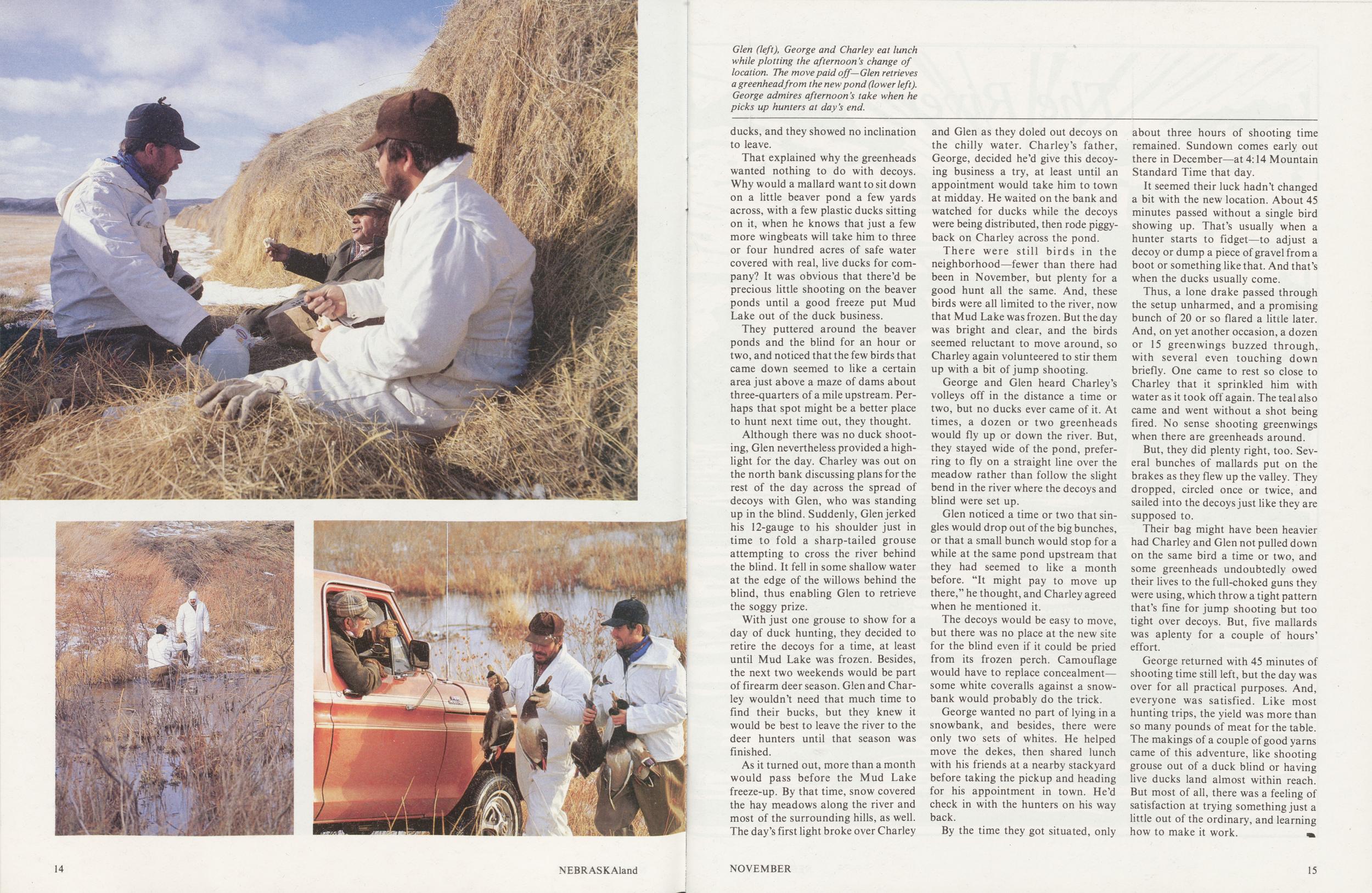
Glen (left), George and Charley eat lunch while plotting the afternoon's change of location. The move paid off—Glen retrieves a greenhead from the new pond (lower left). George admires afternoons take when he picks up hunters at day's end.
ducks, and they showed no inclination to leave.
That explained why the greenheads wanted nothing to do with decoys. Why would a mallard want to sit down on a little beaver pond a few yards across, with a few plastic ducks sitting on it, when he knows that just a few more wingbeats will take him to three or four hundred acres of safe water covered with real, live ducks for company? It was obvious that there'd be precious little shooting on the beaver ponds until a good freeze put Mud Lake out of the duck business.
They puttered around the beaver ponds and the blind for an hour or two, and noticed that the few birds that came down seemed to like a certain area just above a maze of dams about three-quarters of a mile upstream. Perhaps that spot might be a better place to hunt next time out, they thought.
Although there was no duck shooting, Glen nevertheless provided a highlight for the day. Charley was out on the north bank discussing plans for the rest of the day across the spread of decoys with Glen, who was standing up in the blind. Suddenly, Glen jerked his 12-gauge to his shoulder just in time to fold a sharp-tailed grouse attempting to cross the river behind the blind. It fell in some shallow water at the edge of the willows behind the blind, thus enabling Glen to retrieve the soggy prize.
With just one grouse to show for a day of duck hunting, they decided to retire the decoys for a time, at least until Mud Lake was frozen. Besides, the next two weekends would be part of firearm deer season. Glen and Charley wouldn't need that much time to find their bucks, but they knew it would be best to leave the river to the deer hunters until that season was finished.
As it turned out, more than a month would pass before the Mud Lake freeze-up. By that time, snow covered the hay meadows along the river and most of the surrounding hills, as well. The day's first light broke over Charley
and Glen as they doled out decoys on the chilly water. Charley's father, George, decided he'd give this decoying business a try, at least until an appointment would take him to town at midday. He waited on the bank and watched for ducks while the decoys were being distributed, then rode piggyback on Charley across the pond.
There were still birds in the neighborhood—fewer than there had been in November, but plenty for a good hunt all the same. And, these birds were all limited to the river, now that Mud Lake was frozen. But the day was bright and clear, and the birds seemed reluctant to move around, so Charley again volunteered to stir them up with a bit of jump shooting.
George and Glen heard Charley's volleys off in the distance a time or two, but no ducks ever came of it. At times, a dozen or two greenheads would fly up or down the river. But, they stayed wide of the pond, preferring to fly on a straight line over the meadow rather than follow the slight bend in the river where the decoys and blind were set up.
Glen noticed a time or two that singles would drop out of the big bunches, or that a small bunch would stop for a while at the same pond upstream that they had seemed to like a month before. "It might pay to move up there," he thought, and Charley agreed when he mentioned it.
The decoys would be easy to move, but there was no place at the new site for the blind even if it could be pried from its frozen perch. Camouflage would have to replace concealment-some white coveralls against a snowbank would probably do the trick.
George wanted no part of lying in a snowbank, and besides, there were only two sets of whites. He helped move the dekes, then shared lunch with his friends at a nearby stackyard before taking the pickup and heading for his appointment in town. He'd check in with the hunters on his way back.
By the time they got situated, only about three hours of shooting time remained. Sundown comes early out there in December—at 4:14 Mountain Standard Time that day.
It seemed their luck hadn't changed a bit with the new location. About 45 minutes passed without a single bird showing up. That's usually when a hunter starts to fidget—to adjust a decoy or dump a piece of gravel from a boot or something like that. And that's when the ducks usually come.
Thus, a lone drake passed through the setup unharmed, and a promising bunch of 20 or so flared a little later. And, on yet another occasion, a dozen or 15 greenwings buzzed through, with several even touching down briefly. One came to rest so close to Charley that it sprinkled him with water as it took off again. The teal also came and went without a shot being fired. No sense shooting greenwings when there are greenheads around.
But, they did plenty right, too. Several bunches of mallards put on the brakes as they flew up the valley. They dropped, circled once or twice, and sailed into the decoys just like they are supposed to.
Their bag might have been heavier had Charley and Glen not pulled down on the same bird a time or two, and some greenheads undoubtedly owed their lives to the full-choked guns they were using, which throw a tight pattern that's fine for jump shooting but too tight over decoys. But, five mallards was aplenty for a couple of hours' effort.
George returned with 45 minutes of shooting time still left, but the day was over for all practical purposes. And, everyone was satisfied. Like most hunting trips, the yield was more than so many pounds of meat for the table. The makings of a couple of good yarns came of this adventure, like shooting grouse out of a duck blind or having live ducks land almost within reach. But most of all, there was a feeling of satisfaction at trying something just a little out of the ordinary, and learning how to make it work.
NOVEMBER 15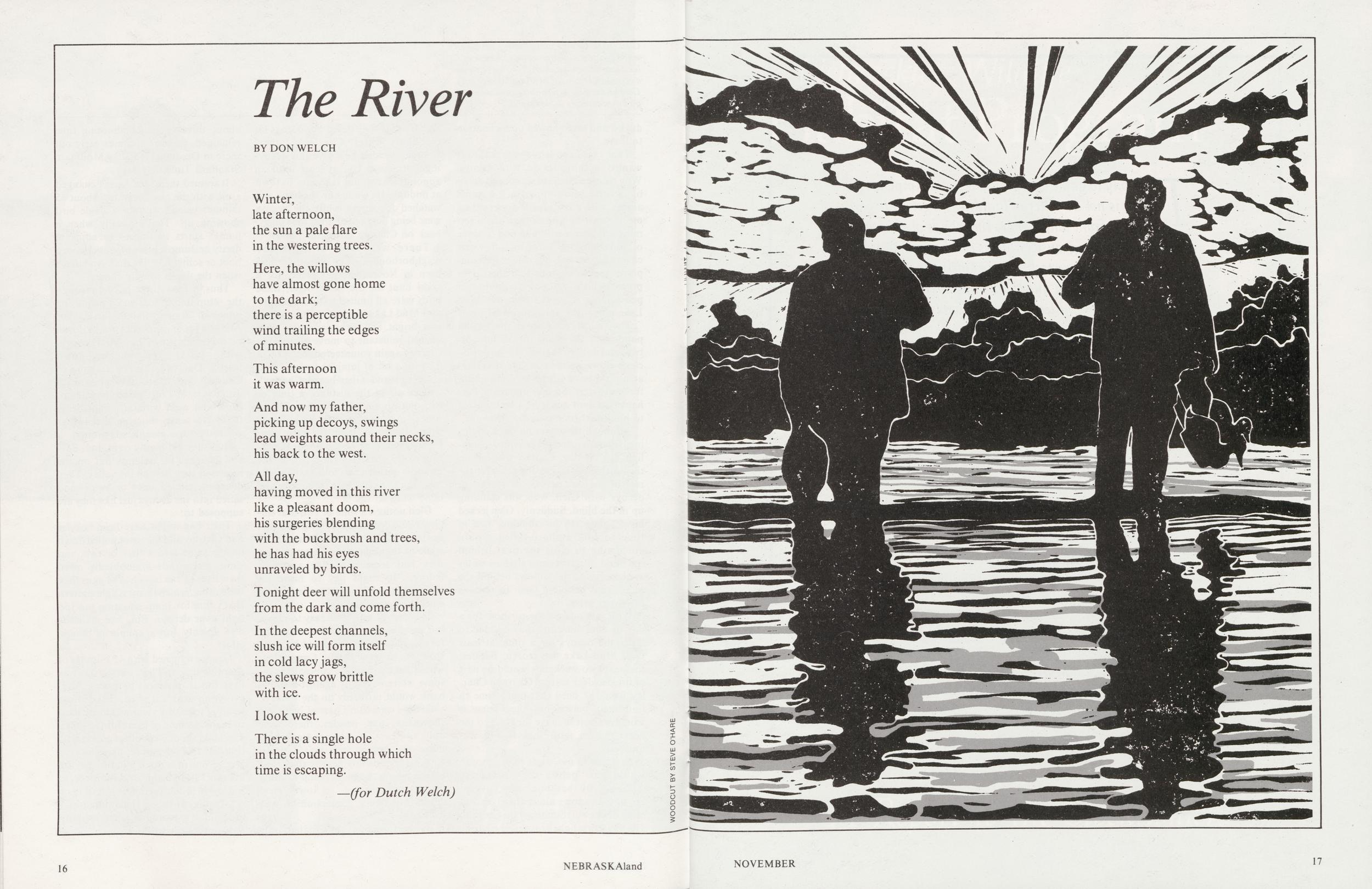
The River
Winter,late afternoon,
the sun a pale flare
in the westering trees.
Here, the willows
have almost gone home
to the dark;
there is a perceptible
wind trailing the edges
of minutes.
This afternoon
it was warm.
And now my father,
picking up decoys, swings
lead weights around their necks,
his back to the west.
All day,
having moved in this river
like a pleasant doom,
his surgeries blending
with the buckbrush and trees,
he has had his eyes
unraveled by birds.
Tonight deer will unfold themse ves
from the dark and come forth.
In the deepest channels,
slush ice will form itself
in cold lacy jags,
the slews grow brittle
with ice.
I look west.
There is a single hole
in the clouds through which
time is escaping.
16 NEBRASKAland NOVEMBER 17
"The way to game abundance is not a simple one. It is not a matter of building larger state game farms from which more thousands of pheasants, quail, rabbits, grouse or ducks can be distributed for release, although restocking has a definite, but minor, place. It is not solely a question of appearing before state legislative committees or before Congress to urge the passage of new laws, although there are definite opportunities for new incentive legislation. It is not a question of protection (law enforcement), since this can be effective only if suitable habitat exists. It is not a problem of open and closed seasons, although proper seasons are of basic importance. The way to game abundance does not call for unrestricted destruction of predators—it may even call for encouragement of larger numbers of certain predators. Neither is artificial winter feeding, or duck food planting, or the establishment of refuges, the single key which will unlock the door to abundance. Game abundance is a function of suitable habitat. All other management measures depend and impinge upon this one. With suitable habitat, many such measures can help produce abundance. Without suitable habitat, no other measures are of value."
The Way to Game AbundanceNebraska/s Wildlife Habitat Program
A Report to the Stockholders
18 NEBRASKAland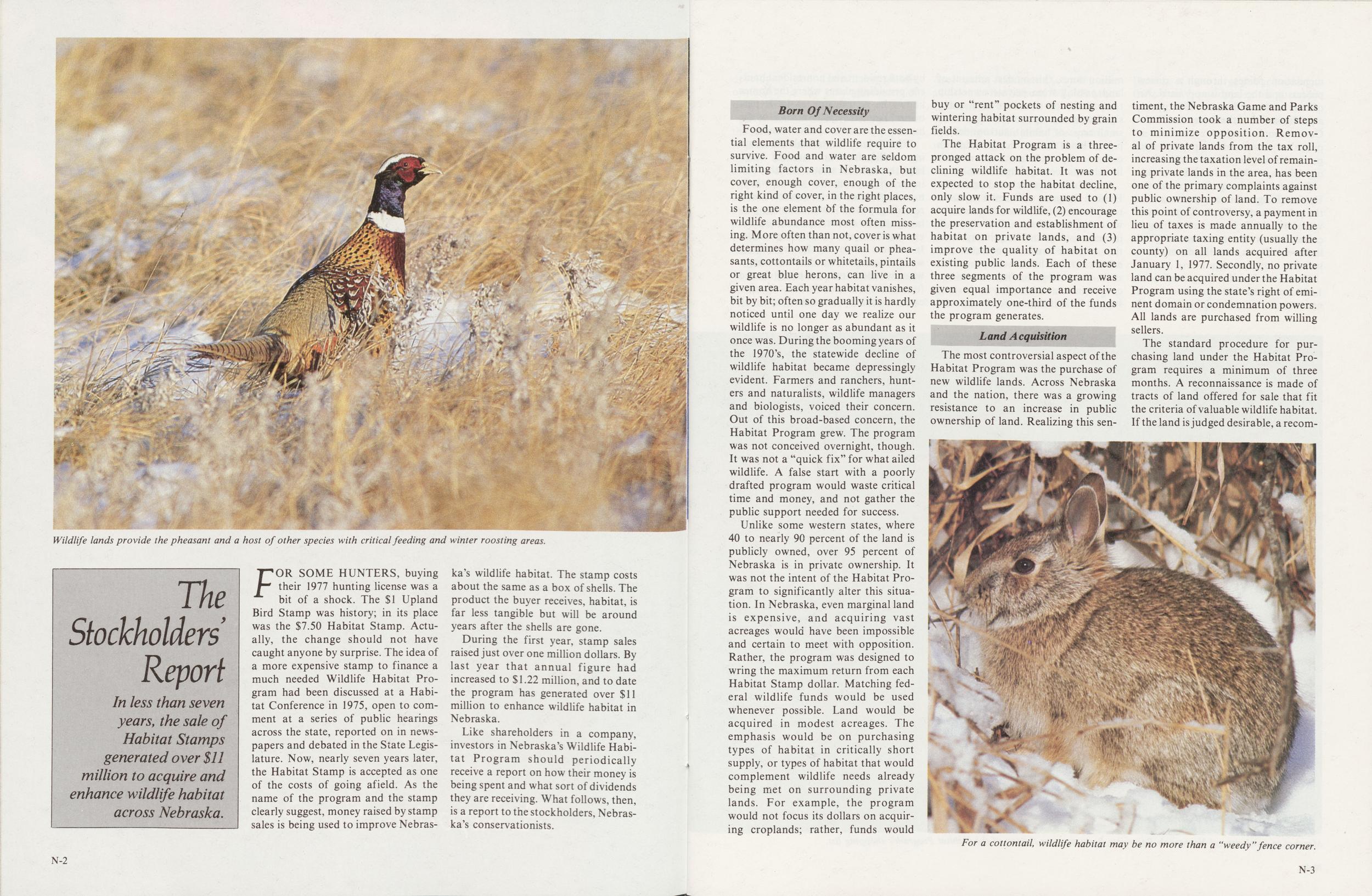
Wildlife lands provide the pheasant and a host of other species with critical feeding and winter roosting areas.
The Stockholders' Report
In less than seven years, the sale of Habitat Stamps generated over $11 million to acquire and enhance wildlife habitat across Nebraska.
FOR SOME HUNTERS, buying their 1977 hunting license was a bit of a shock. The $1 Upland Bird Stamp was history; in its place was the $7.50 Habitat Stamp. Actually, the change should not have caught anyone by surprise. The idea of a more expensive stamp to finance a much needed Wildlife Habitat Program had been discussed at a Habitat Conference in 1975, open to comment at a series of public hearings across the state, reported on in newspapers and debated in the State Legislature. Now, nearly seven years later, the Habitat Stamp is accepted as one of the costs of going afield. As the name of the program and the stamp clearly suggest, money raised by stamp sales is being used to improve Nebraska's wildlife habitat. The stamp costs about the same as a box of shells. The product the buyer receives, habitat, is far less tangible but will be around years after the shells are gone.
During the first year, stamp sales raised just over one million dollars. By last year that annual figure had increased to $1.22 million, and to date the program has generated over $11 million to enhance wildlife habitat in Nebraska.
Like shareholders in a company, investors in Nebraska's Wildlife Habitat Program should periodically receive a report on how their money is being spent and what sort of dividends they are receiving. What follows, then, is a report to the stockholders, Nebraska's conservationists.
Born Of NecessityFood, water and cover are the essential elements that wildlife require to survive. Food and water are seldom limiting factors in Nebraska, but cover, enough cover, enough of the right kind of cover, in the right places, is the one element of the formula for wildlife abundance most often missing. More often than not, cover is what determines how many quail or pheasants, cottontails or whitetails, pintails or great blue herons, can live in a given area. Each year habitat vanishes, bit by bit; often so gradually it is hardly noticed until one day we realize our wildlife is no longer as abundant as it once was. During the booming years of the 1970's, the statewide decline of wildlife habitat became depressingly evident. Farmers and ranchers, hunters and naturalists, wildlife managers and biologists, voiced their concern. Out of this broad-based concern, the Habitat Program grew. The program was not conceived overnight, though. It was not a "quick fix" for what ailed wildlife. A false start with a poorly drafted program would waste critical time and money, and not gather the public support needed for success.
Unlike some western states, where 40 to nearly 90 percent of the land is publicly owned, over 95 percent of Nebraska is in private ownership. It was not the intent of the Habitat Program to significantly alter this situation. In Nebraska, even marginal land is expensive, and acquiring vast acreages would have been impossible and certain to meet with opposition. Rather, the program was designed to wring the maximum return from each Habitat Stamp dollar. Matching federal wildlife funds would be used whenever possible. Land would be acquired in modest acreages. The emphasis would be on purchasing types of habitat in critically short supply, or types of habitat that would complement wildlife needs already being met on surrounding private lands. For example, the program would not focus its dollars on acquiring croplands; rather, funds would buy or "rent" pockets of nesting and wintering habitat surrounded by grain fields.
The Habitat Program is a three-pronged attack on the problem of declining wildlife habitat. It was not expected to stop the habitat decline, only slow it. Funds are used to (1) acquire lands for wildlife, (2) encourage the preservation and establishment of habitat on private lands, and (3) improve the quality of habitat on existing public lands. Each of these three segments of the program was given equal importance and receive approximately one-third of the funds the program generates.
Land AcquisitionThe most controversial aspect of the Habitat Program was the purchase of new wildlife lands. Across Nebraska and the nation, there was a growing resistance to an increase in public ownership of land. Realizing this sentiment, the Nebraska Game and Parks Commission took a number of steps to minimize opposition. Removal of private lands from the tax roll, increasing the taxation level of remaining private lands in the area, has been one of the primary complaints against public ownership of land. To remove this point of controversy, a payment in lieu of taxes is made annually to the appropriate taxing entity (usually the county) on all lands acquired after January 1, 1977. Secondly, no private land can be acquired under the Habitat Program using the state's right of eminent domain or condemnation powers. All lands are purchased from willing sellers.
The standard procedure for purchasing land under the Habitat Program requires a minimum of three months. A reconnaissance is made of tracts of land offered for sale that fit the criteria of valuable wildlife habitat. If the land is judged desirable, a recommendation
For a cottontail, wildlife habitat may be no more than a "weedy" fence corner.
passes through a review process and the land is appraised. An offer is made to the seller. If accepted, a public notice of the Game and Parks Commission's intent to purchase is published in area newspapers, and public hearings are announced where objections or support may be voiced.
Seldom is land acquisition under the Habitat Program in competition with the private sector. Typically, the most valuable wildlife lands are what agriculturalists would consider marginal lands—wetlands, woodlands, or riparian sites along streams.
Under the Habitat Program, about 1,600 acres have been purchased each year. In a state containing some 49 million acres, this modest amount of land passing from private ownership to public ownership is hardly significant—except to wildlife. These small areas of habitat, surrounded by private lands that provide for wildlife's other needs, result in maximum wildlife abundance at minimal cost.
Wildlife lands purchased under the Habitat Program will never meet the total demand for places to hunt, nor were they intended to. But, they will increase each year. The primary function of these lands is to secure and enhance critical habitat components—such as nesting, loafing, or winter cover—in areas where they are in short supply. Wildlife lands are heavily used by both resident and nonresident hunters, providing places where the hunter knows he is welcome as he is part owner. And, they relieve some of the hunting pressure on private lands.
Wildlife lands are valuable in carrying wildlife from surrounding farmland through the winter months, and in providing nesting cover where broods are reared to replenish surrounding private land. Most importantly, public ownership of these areas ensures their permanent preservation. In a time when the few remaining wetlands are threatened with drainage, when wooded areas are being cleared for agriculture, and when riparian cover is being encroached upon by developers and agriculture, public ownership is the only guarantee of long-term protection.
Over 9,000 acres have been added to the state's system of wildlife lands with funds from the Habitat Program: $4.3 million dollars' worth. Nine out of every 10 of these acres received Federal Aid in Fish and Wildlife funds (money derived from an excise tax on firearms and ammunition). On these qualifying projects, each dollar from the Habitat Fund is matched by three dollars of federal-aid money.
Since the Habitat Program began, 34 areas have been purchased, ranging in size from a two-acre addition to the Alexandria Wildlife Management Area east of Alexandria to an 880-acre addition to the Metcalf Wildlife Management Area north of Rushville. While eight purchases were additions to existing wildlife lands, 28 acquisitions were entirely new areas. The average cost per acre has been $486, a modest cost considering the price of most agricultural land, and evidence that, typically, marginal lands are being purchased.
Although habitat land has been purchased across the state, acquisition has been most successful in the eastern half. Relative to the rest of the state, the Panhandle and the Sandhills regions are already rich in public land—large national wildlife refuges, national forests and state lands. Because of these large public holdings, there has been opposition to additional public ownership of land there. Nebraska's population is centered in the east, as are the greatest number of hunters buying habitat stamps.
Also, the area of greatest need is in eastern and southern Nebraska where intensive agriculture and land development are more immediate threats than in the rangelands of the Panhandle and Sandhills. Rainwater Basin wetlands of south-central Nebraska, and riparian areas associated with eastern Nebraska streams, are in urgent need of protection. During the Program's initial years, areas threatened with destruction must remain a priority for acquisition.
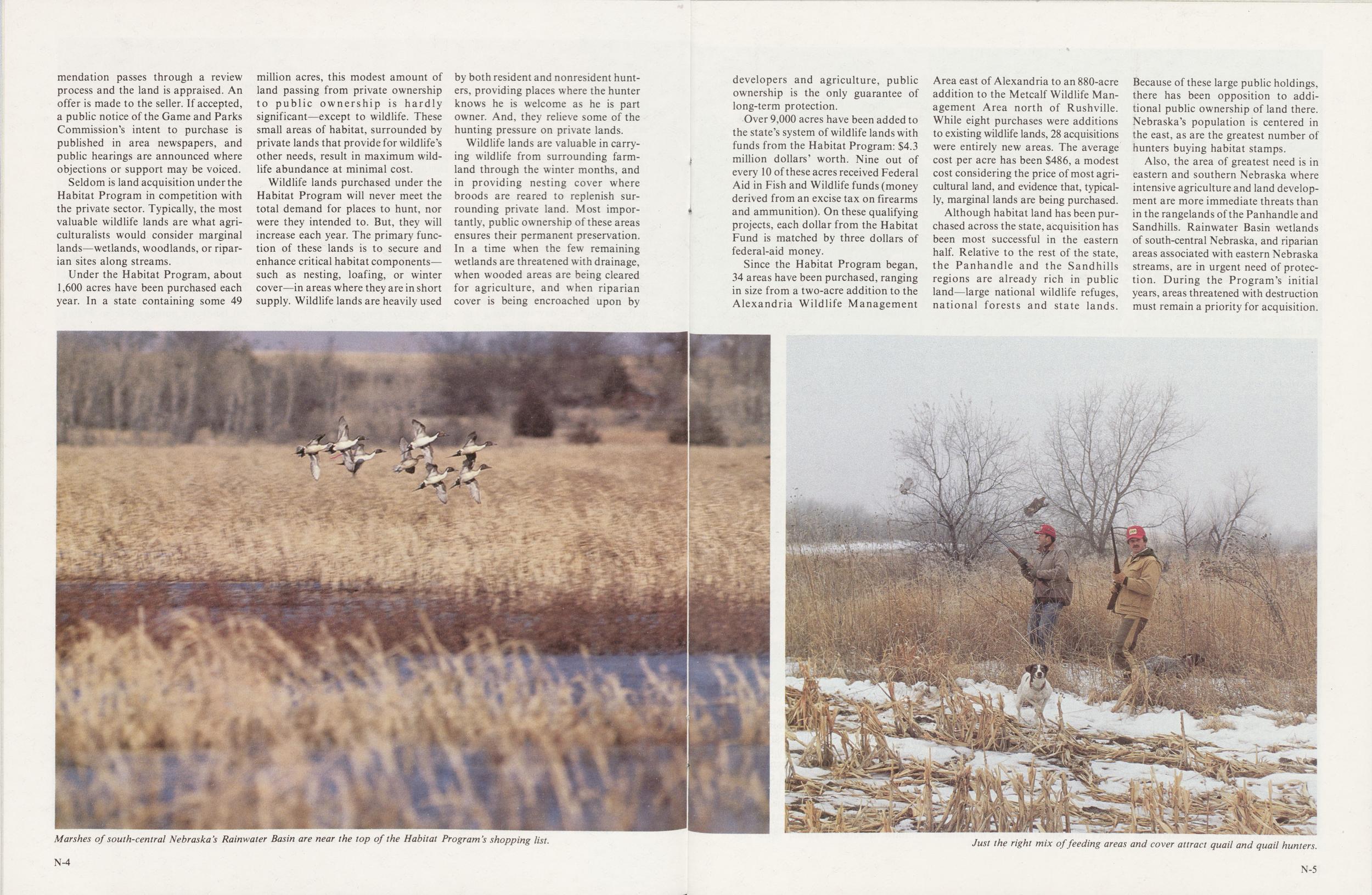
Marshes of south-central Nebraska's Rainwater Basin are near the top of the Habitat Program's shopping list.
Just the right mix of feeding areas and cover attract quail and quail hunters.
Private Lands Habitat Program
A second part of the Habitat Program encourages landowners to improve and maintain existing habitat and to establish new habitat. This phase of the program is administered through local Natural Resources Districts. One of the primary missions of the NRD's is to encourage sound land conservation. As many of the Habitat Program practices not only benefit wildlife but keep marginal, erosion-prone lands in permanent vegetative cover, it was logical that the NRD's and the Game and Parks Commission should join in this effort. In most cases the Commission provides 75 percent of the funding and the NRD's 25 percent, Currently, over 2,300 cooperators are enrolled in the Habitat Improvement Program, providing some 50,000 acres for wildlife and land conservation.
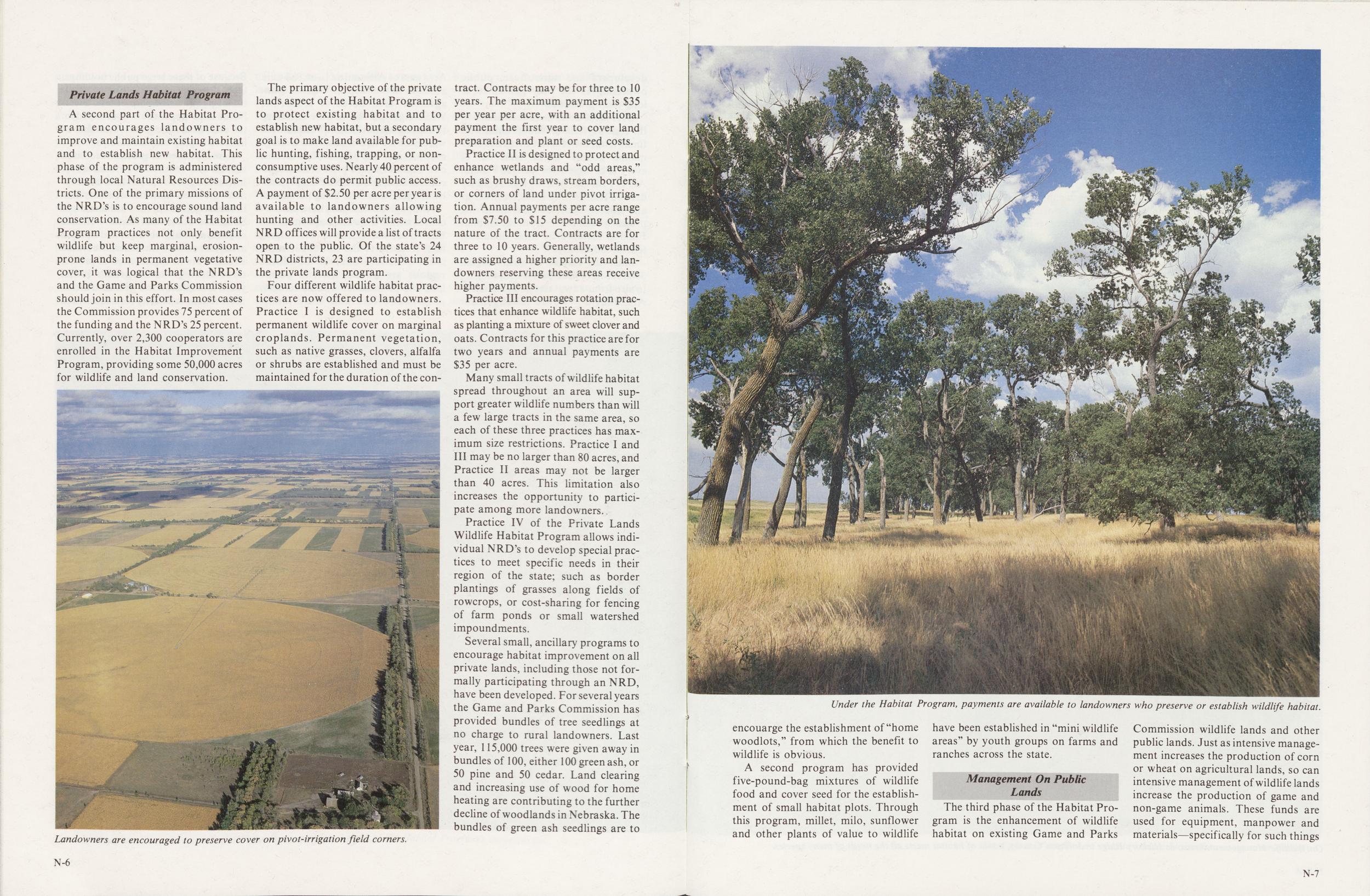
Landowners are encouraged to preserve cover on pivot-irrigation field corners.
The primary objective of the private lands aspect of the Habitat Program is to protect existing habitat and to establish new habitat, but a secondary goal is to make land available for public hunting, fishing, trapping, or non-consumptive uses. Nearly 40 percent of the contracts do permit public access, A payment of $2.50 per acre per year is available to landowners allowing hunting and other activities. Local NRD offices will provide a list of tracts open to the public. Of the state's 24 NRD districts, 23 are participating in the private lands program.
Four different wildlife habitat practices are now offered to landowners. Practice I is designed to establish permanent wildlife cover on marginal croplands. Permanent vegetation, such as native grasses, clovers, alfalfa or shrubs are established and must be maintained for the duration of the contract. Contracts may be for three to 10 years. The maximum payment is $35 per year per acre, with an additional payment the first year to cover laud preparation and plant or seed costs.
Practice II is designed to protect and enhance wetlands and "odd areas," such as brushy draws, stream borders, or corners of land under pivot irrigation. Annual payments per acre range from $7.50 to $15 depending on the nature of the tract. Contracts are for three to 10 years. Generally, wetlands are assigned a higher priority and landowners reserving these areas receive higher payments.
Practice III encourages rotation practices that enhance wildlife habitat, such as planting a mixture of sweet clover and oats. Contracts for this practice are for two years and annual payments are $35 per acre.
Many small tracts of wildlife habitat spread throughout an area will support greater wildlife numbers than will a few large tracts in the same area, so each of these three practices has maximum size restrictions. Practice I and III may be no larger than 80 acres, and Practice II areas may not be larger than 40 acres. This limitation also increases the opportunity to participate among more landowners.
Practice IV of the Private Lands Wildlife Habitat Program allows individual NRD's to develop special practices to meet specific needs in their region of the state; such as border plantings of grasses along fields of rowcrops, or cost-sharing for fencing of farm ponds or small watershed impoundments.
Several small, ancillary programs to encourage habitat improvement on all private lands, including those not formally participating through an NRD, have been developed. For several years the Game and Parks Commission has provided bundles of tree seedlings at no charge to rural landowners. Last year, 115,000 trees were given away in bundles of 100, either 100 green ash, or 50 pine and 50 cedar. Land clearing and increasing use of wood for home heating are contributing to the further decline of woodlands in Nebraska. The bundles of green ash seedlings are to
Under the Habitat Program, payments are available to landowners who preserve or establish wildlife habitat.
encouarge the establishment of "home woodlots," from which the benefit to wildlife is obvious.
A second program has provided five-pound-bag mixtures of wildlife food and cover seed for the establishment of small habitat plots. Through this program, millet, milo, sunflower and other plants of value to wildlife have been established in "mini wildlife areas" by youth groups on farms and ranches across the state.
Management On Public LandsThe third phase of the Habitat Program is the enhancement of wildlife habitat on existing Game and Parks Commission wildlife lands and other public lands. Just as intensive management increases the production of corn or wheat on agricultural lands, so can intensive management of wildlife lands increase the production of game and non-game animals. These funds are used for equipment, manpower and materials—specifically for such things
N-6 N-7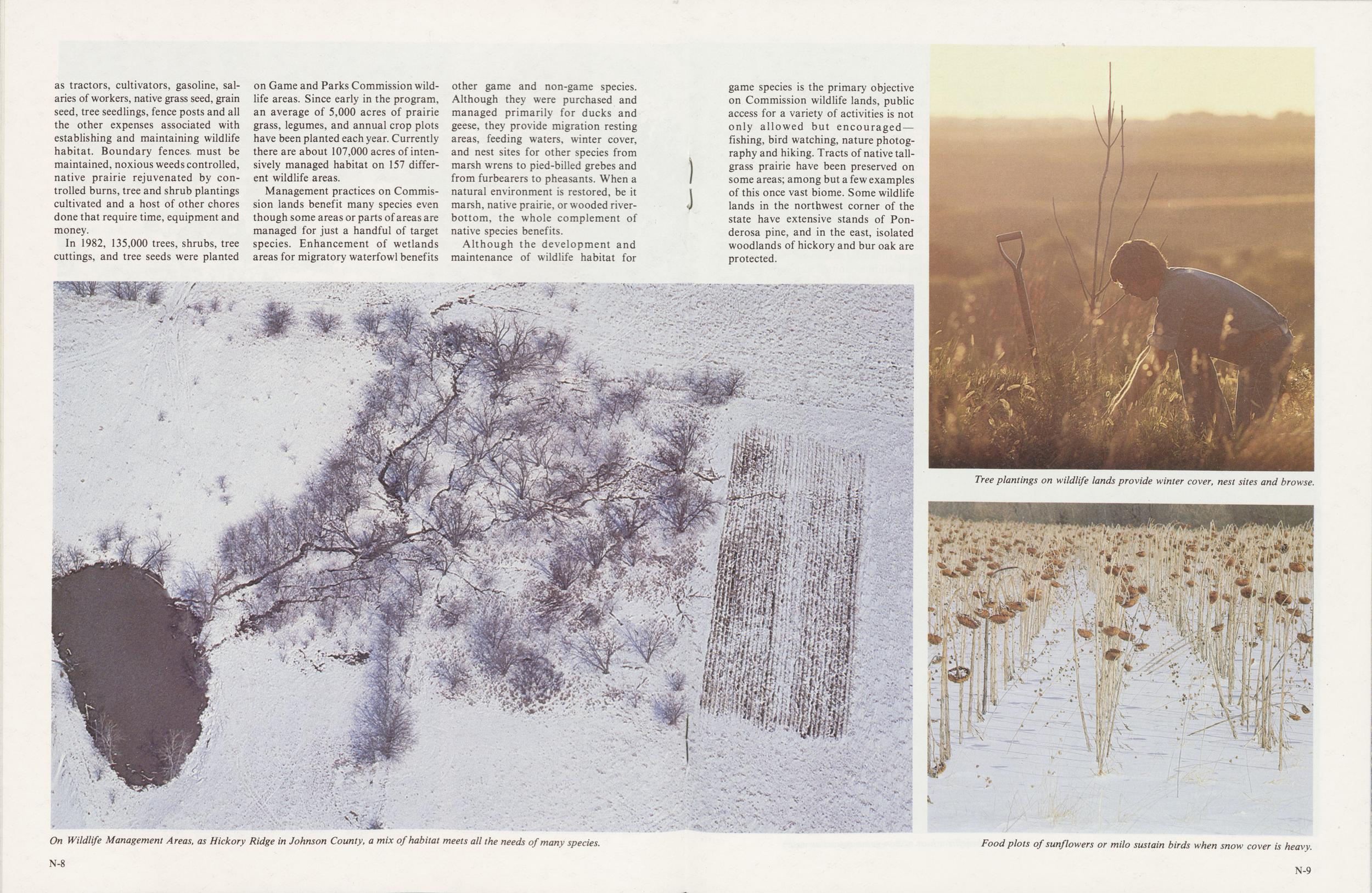
as tractors, cultivators, gasoline, salaries of workers, native grass seed, grain seed, tree seedlings, fence posts and all the other expenses associated with establishing and maintaining wildlife habitat. Boundary fences, must be maintained, noxious weeds controlled, native prairie rejuvenated by controlled burns, tree and shrub plantings cultivated and a host of other chores done that require time, equipment and money.
In 1982, 135,000 trees, shrubs, tree cuttings, and tree seeds were planted on Game and Parks Commission wildlife areas. Since early in the program, an average of 5,000 acres of prairie grass, legumes, and annual crop plots have been planted each year. Currently there are about 107,000 acres of intensively managed habitat on 157 different wildlife areas.
Management practices on Commission lands benefit many species even though some areas or parts of areas are managed for just a handful of target species. Enhancement of wetlands areas for migratory waterfowl benefits other game and non-game species. Although they were purchased and managed primarily for ducks and geese, they provide migration resting areas, feeding waters, winter cover, and nest sites for other species from marsh wrens to pied-billed grebes and from furbearers to pheasants. When a natural environment is restored, be it marsh, native prairie, or wooded river-bottom, the whole complement of native species benefits.
Although the development and maintenance of wildlife habitat for game species is the primary objective on Commission wildlife lands, public access for a variety of activities is not only allowed but encouraged —fishing, bird watching, nature photography and hiking. Tracts of native tallgrass prairie have been preserved on some areas; among but a few examples of this once vast biome. Some wildlife lands in the northwest corner of the state have extensive stands of Ponderosa pine, and in the east, isolated woodlands of hickory and bur oak are protected.
Tree plantings on wildlife lands provide winter cover, nest sites and browse.
On Wildlife Management Areas, as Hickory Ridge in Johnson County, a mix of habitat meets all the needs of many species.
Food plots of sunflowers or milo sustain birds when snow cover is heavy.
These remnants of what Nebraska was, before man so profoundly altered its face, are preserved forever for all citizens. At the same time, they provide the essential requirements for wildlife which in turn are available for hunters who have, for the large part, picked up the tab.
Such activities on Commission-owned lands are only part of the work being done under the "habitat management on public lands" portion of the program. Other public lands are being developed with funds from the program and the aid and expertise of Commission wildlife managers. Although these other public lands were set aside primarily for some other purpose, with proper management they can serve a secondary role in providing wildlife habitat. Roadsides, national forests, land surrounding flood-control or irrigation reservoirs, and even federal Waterfowl Production Areas can be better developed to enhance wildlife habitat. Once again, using Habitat Stamp dollars on these existing public lands requires only a minimum investment for a maximum return. It is not necessary to spend large sums of Habitat Fund money to acquire lands; it is already in public ownership. Funds go directly toward developing and maintaining habitat and increasing the variety and number of species it can support.
One of the most successful of these cooperative ventures has been the County Roadside Seeding for Wildlife program. Anyone who has walked a roadside during nesting season, or driven a county road after a snowstorm, knows the potential of these grassy strips with occasional clumps of plum or chokecherry. More than 80,000 miles of secondary roads crisscross the state, and each mile contains approximately five acres of potentially good wildlife habitat. Statewide, some 325,000 to 400,000 acres of public land in roadsides could be available for
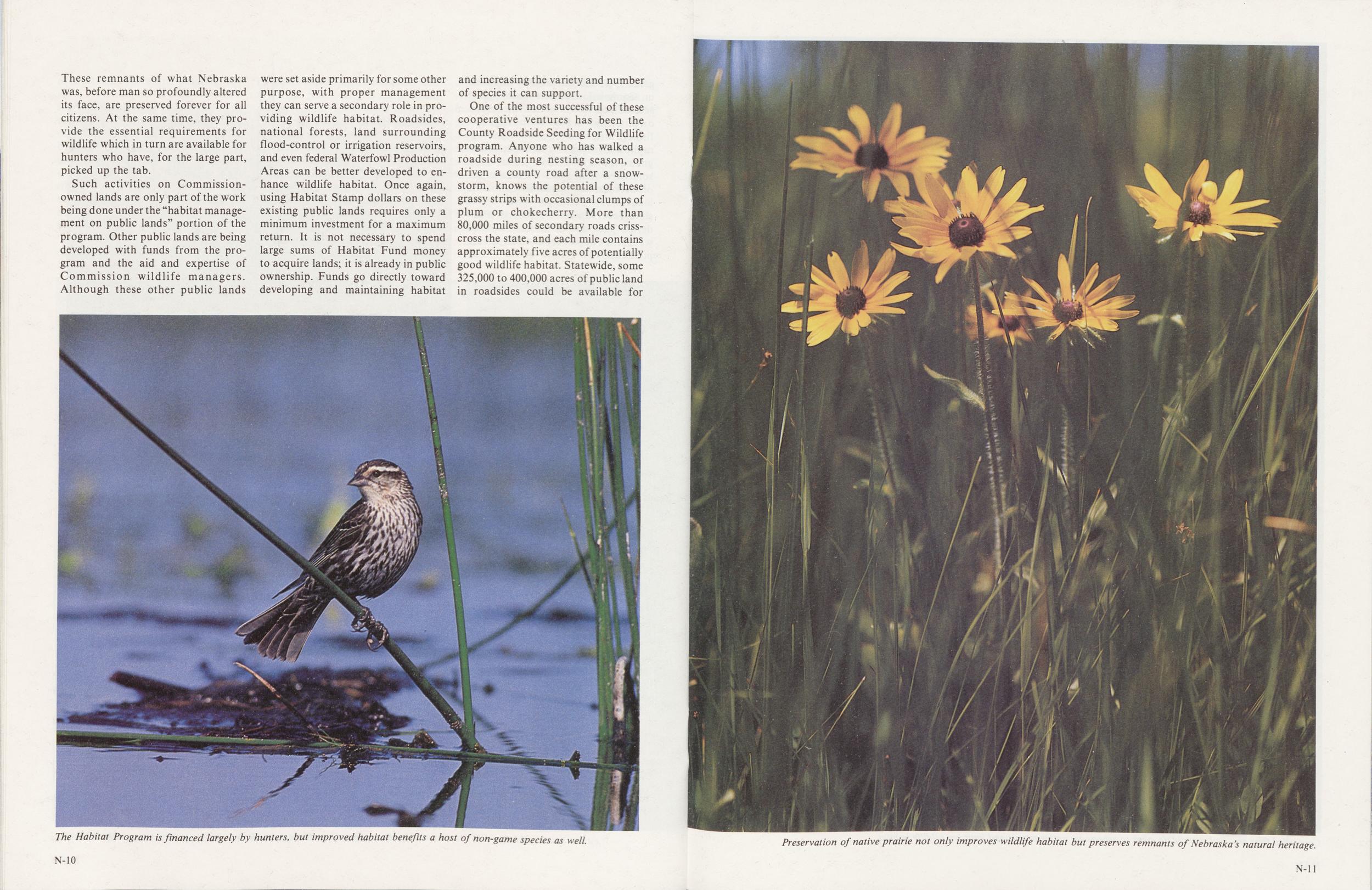
The Habitat Program is financed largely by hunters, but improved habitat benefits a host of non-game species as well.
Preservation of native prairie not only improves wildlife habitat but preserves remnants of Nebraska's natural heritage.
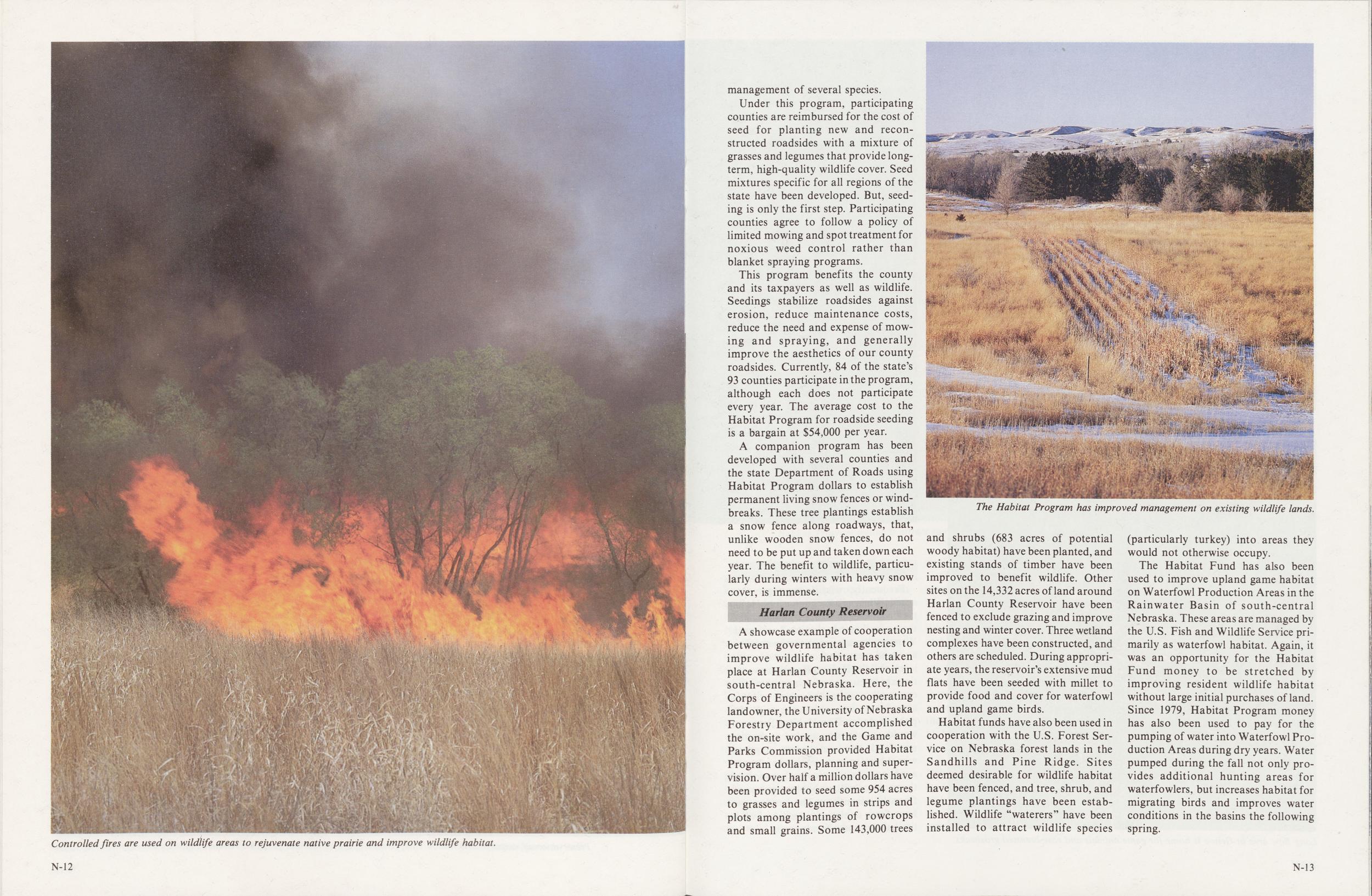
Controlled fires are used on wildlife areas to rejuvenate native prairie and improve wildlife habitat.
management of several species.
Under this program, participating counties are reimbursed for the cost of seed for planting new and reconstructed roadsides with a mixture of grasses and legumes that provide long-term, high-quality wildlife cover. Seed mixtures specific for all regions of the state have been developed. But, seeding is only the first step. Participating counties agree to follow a policy of limited mowing and spot treatment for noxious weed control rather than blanket spraying programs.
This program benefits the county and its taxpayers as well as wildlife. Seedings stabilize roadsides against erosion, reduce maintenance costs, reduce the need and expense of mowing and spraying, and generally improve the aesthetics of our county roadsides. Currently, 84 of the state's 93 counties participate in the program, although each does not participate every year. The average cost to the Habitat Program for roadside seeding is a bargain at $54,000 per year.
A companion program has been developed with several counties and the state Department of Roads using Habitat Program dollars to establish permanent living snow fences or windbreaks. These tree plantings establish a snow fence along roadways, that, unlike wooden snow fences, do not need to be put up and taken down each year. The benefit to wildlife, particularly during winters with heavy snow cover, is immense.
Harlan County ReservoirA showcase example of cooperation between governmental agencies to improve wildlife habitat has taken place at Harlan County Reservoir in south-central Nebraska. Here, the Corps of Engineers is the cooperating landowner, the University of Nebraska Forestry Department accomplished the on-site work, and the Game and Parks Commission provided Habitat Program dollars, planning and supervision. Over half a million dollars have been provided to seed some 954 acres to grasses and legumes in strips and plots among plantings of rowcrops and small grains. Some 143,000 trees
The Habitat Program has improved management on existing wildlife lands.
and shrubs (683 acres of potentialwoody habitat) have been planted, and existing stands of timber have been improved to benefit wildlife. Other sites on the 14,332 acres of land around Harlan County Reservoir have been fenced to exclude grazing and improve nesting and winter cover. Three wetland complexes have been constructed, and others are scheduled. During appropriate years, the reservoir's extensive mud flats have been seeded with millet to provide food and cover for waterfowl and upland game birds.
Habitat funds have also been used in cooperation with the U.S. Forest Service on Nebraska forest lands in the Sandhills and Pine Ridge. Sites deemed desirable for wildlife habitat have been fenced, and tree, shrub, and legume plantings have been established. Wildlife "waterers" have been installed to attract wildlife species (particularly turkey) into areas they would not otherwise occupy.
The Habitat Fund has also been used to improve upland game habitat on Waterfowl Production Areas in the Rainwater Basin of south-central Nebraska. These areas are managed by the U.S. Fish and Wildlife Service primarily as waterfowl habitat. Again, it was an opportunity for the Habitat Fund money to be stretched by improving resident wildlife habitat without large initial purchases of land. Since 1979, Habitat Program money has also been used to pay for the pumping of water into Waterfowl Production Areas during dry years. Water pumped during the fall not only provides additional hunting areas for waterfowlers, but increases habitat for migrating birds and improves water conditions in the basins the following spring.
N-12 N-13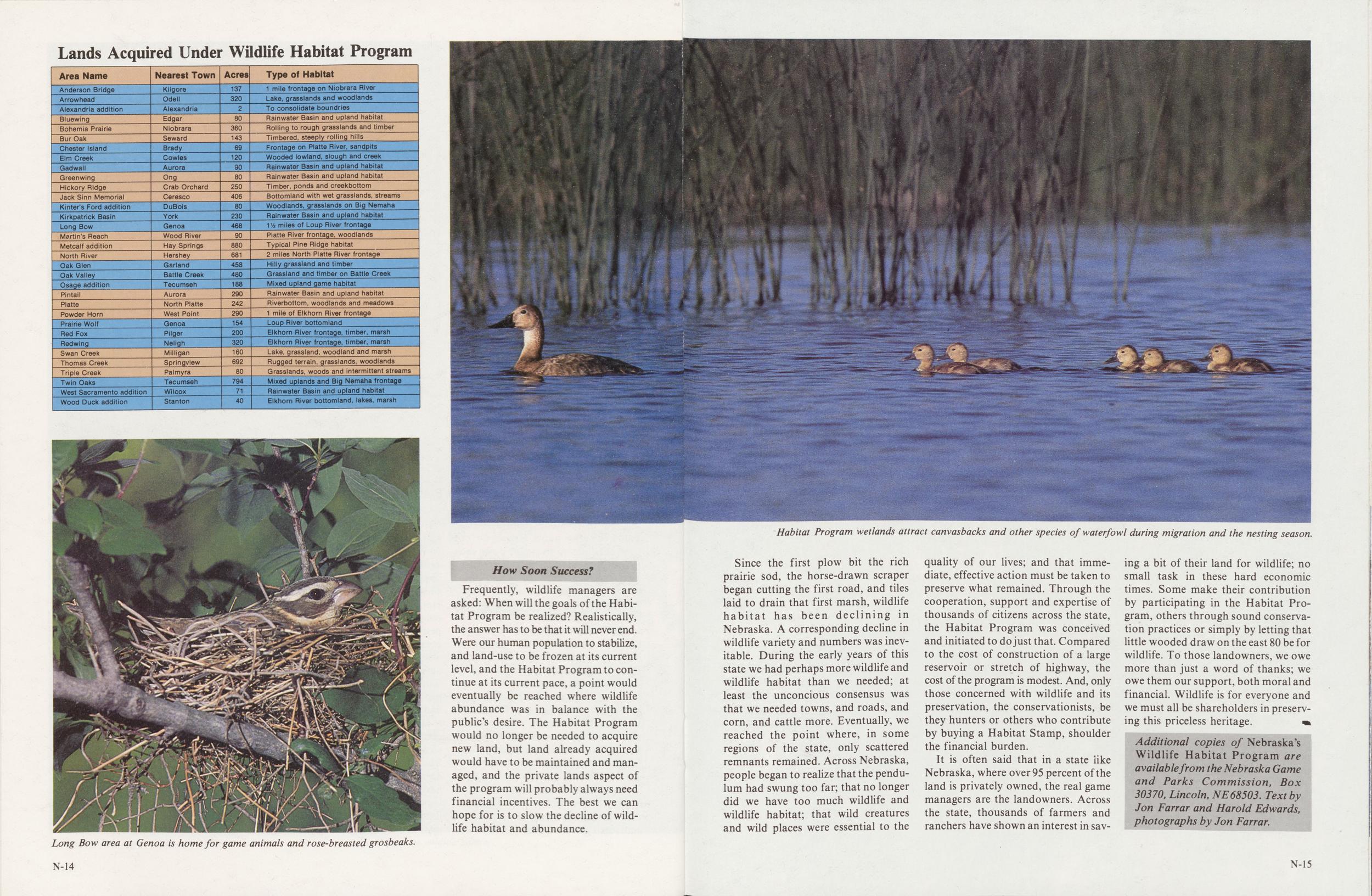
Long Bow area at Genoa is home for game animals and rose-breasted grosbeaks.
Frequently, wildlife managers are asked: When will the goals of the Habitat Program be realized? Realistically, the answer has to be that it will never end. Were our human population to stabilize, and land-use to be frozen at its current level, and the Habitat Program to continue at its current pace, a point would eventually be reached where wildlife abundance was in balance with the public's desire. The Habitat Program would no longer be needed to acquire new land, but land already acquired would have to be maintained and managed, and the private lands aspect of the program will probably always need financial incentives. The best we can hope for is to slow the decline of wildlife habitat and abundance.
Habitat Program wetlands attract canvasbacks and other species of waterfowl during migration and the nesting season.
Since the first plow bit the rich prairie sod, the horse-drawn scraper began cutting the first road, and tiles laid to drain that first marsh, wildlife habitat has been declining in Nebraska. A corresponding decline in wildlife variety and numbers was inevitable. During the early years of this state we had perhaps more wildlife and wildlife habitat than we needed; at least the unconcious consensus was that we needed towns, and roads, and corn, and cattle more. Eventually, we reached the point where, in some regions of the state, only scattered remnants remained. Across Nebraska, people began to realize that the pendulum had swung too far; that no longer did we have too much wildlife and wildlife habitat; that wild creatures and wild places were essential to the quality of our lives; and that immediate, effective action must be taken to preserve what remained. Through the cooperation, support and expertise of thousands of citizens across the state, the Habitat Program was conceived and initiated to do just that. Compared to the cost of construction of a large reservoir or stretch of highway, the cost of the program is modest. And, only those concerned with wildlife and its preservation, the conservationists, be they hunters or others who contribute by buying a Habitat Stamp, shoulder the financial burden.
It is often said that in a state iike Nebraska, where over 95 percent of the land is privately owned, the real game managers are the landowners. Across the state, thousands of farmers and ranchers have shown an interest in saving a bit of their land for wildlife; no small task in these hard economic times. Some make their contribution by participating in the Habitat Program, others through sound conservation practices or simply by letting that little wooded draw on the east 80 be for wildlife. To those landowners, we owe more than just a word of thanks; we owe them our support, both moral and financial. Wildlife is for everyone and we must all be shareholders in preserving this priceless heritage.
Additional copies of Nebraska's Wildlife Habitat Program are available from the Nebraska Game and Parks Commission, Box 30370, Lincoln, NE 68503. Text by Jon Farrar and Harold Edwards, photographs by Jon Farrar. N-14 N-15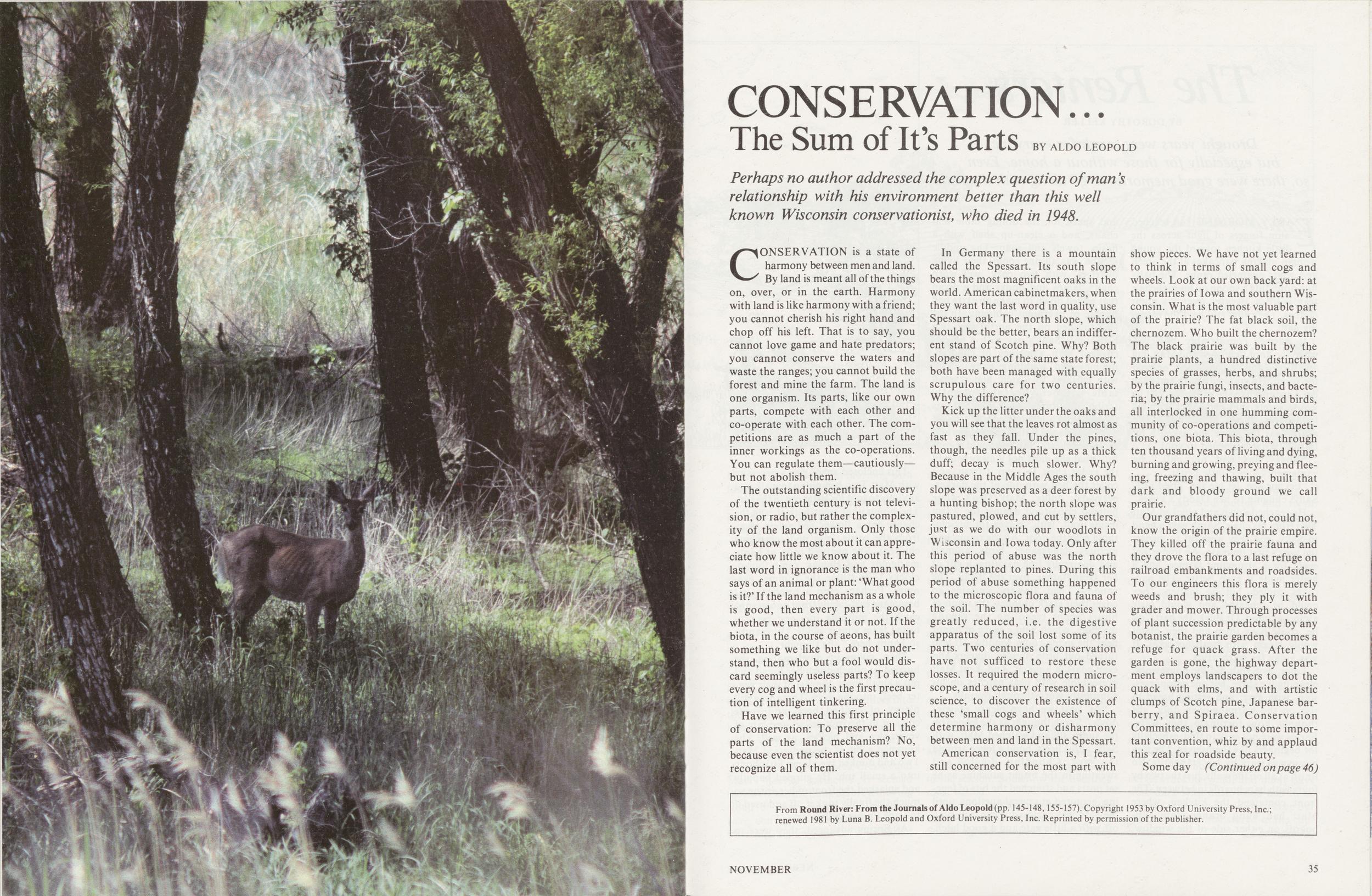
CONSERVATION . . . The Sum of It's Parts
Perhaps no author addressed the complex question of man's relationship with his environment better than this well known Wisconsin conservationist, who died in 1948.CONSERVATION is a state of harmony between men and land. By land is meant all of the things on, over, or in the earth. Harmony with land is like harmony with a friend; you cannot cherish his right hand and chop off his left. That is to say, you cannot love game and hate predators; you cannot conserve the waters and waste the ranges; you cannot build the forest and mine the farm. The land is one organism. Its parts, like our own parts, compete with each other and co-operate with each other. The competitions are as much a part of the inner workings as the co-operations. You can regulate them—cautiously—but not abolish them.
The outstanding scientific discovery of the twentieth century is not television, or radio, but rather the complexity of the land organism. Only those who know the most about it can appreciate how little we know about it. The last word in ignorance is the man who says of an animal or plant: 'What good is it?' If the land mechanism as a whole is good, then every part is good, whether we understand it or not. If the biota, in the course of aeons, has built something we like but do not understand, then who but a fool would discard seemingly useless parts? To keep every cog and wheel is the first precaution of intelligent tinkering.
Have we learned this first principle of conservation: To preserve all trie parts of the land mechanism? No, because even the scientist does not yet recognize all of them.
In Germany there is a mountain called the Spessart. Its south slope bears the most magnificent oaks in the world. American cabinetmakers, when they want the last word in quality, use Spessart oak. The north slope, which should be the better, bears an indifferent stand of Scotch pine. Why? Both slopes are part of the same state forest; both have been managed with equally scrupulous care for two centuries. Why the difference?
Kick up the litter under the oaks and you will see that the leaves rot almost as fast as they fall. Under the pines, though, the needles pile up as a thick duff; decay is much slower. Why? Because in the Middle Ages the south slope was preserved as a deer forest by a hunting bishop; the north slope was pastured, plowed, and cut by settlers, just as we do with our woodlots in Wisconsin and Iowa today. Only after this period of abuse was the north slope replanted to pines. During this period of abuse something happened to the microscopic flora and fauna of the soil. The number of species was greatly reduced, i.e. the digestive apparatus of the soil lost some of its parts. Two centuries of conservation have not sufficed to restore these losses. It required the modern microscope, and a century of research in soil science, to discover the existence of these 'small cogs and wheels' which determine harmony or disharmony between men and land in the Spessart.
American conservation is, I fear, still concerned for the most part with show pieces. We have not yet learned to think in terms of small cogs and wheels. Look at our own back yard: at the prairies of Iowa and southern Wisconsin. What is the most valuable part of the prairie? The fat black soil, the chernozem. Who built the chernozem? The black prairie was built by the prairie plants, a hundred distinctive species of grasses, herbs, and shrubs; by the prairie fungi, insects, and bacteria; by the prairie mammals and birds, all interlocked in one humming community of co-operations and competitions, one biota. This biota, through ten thousand years of living and dying, burning and growing, preying and fleeing, freezing and thawing, built that dark and bloody ground we call prairie.
Our grandfathers did not, could not, know the origin of the prairie empire. They killed off the prairie fauna and they drove the flora to a last refuge on railroad embankments and roadsides. To our engineers this flora is merely weeds and brush; they ply it with grader and mower. Through processes of plant succession predictable by any botanist, the prairie garden becomes a refuge for quack grass. After the garden is gone, the highway department employs landscapers to dot the quack with elms, and with artistic clumps of Scotch pine, Japanese barberry, and Spiraea. Conservation Committees, en route to some important convention, whiz by and applaud this zeal for roadside beauty.
Some day (Continued on page 46)
From Round River: From the Journals of Aldo Leopold (pp. 145-148,155-157). Copyright 1953 by Oxford University Press, Inc.; renewed 1981 by Luna B. Leopold and Oxford University Press, Inc. Reprinted by permission of the publisher. NOVEMBER 35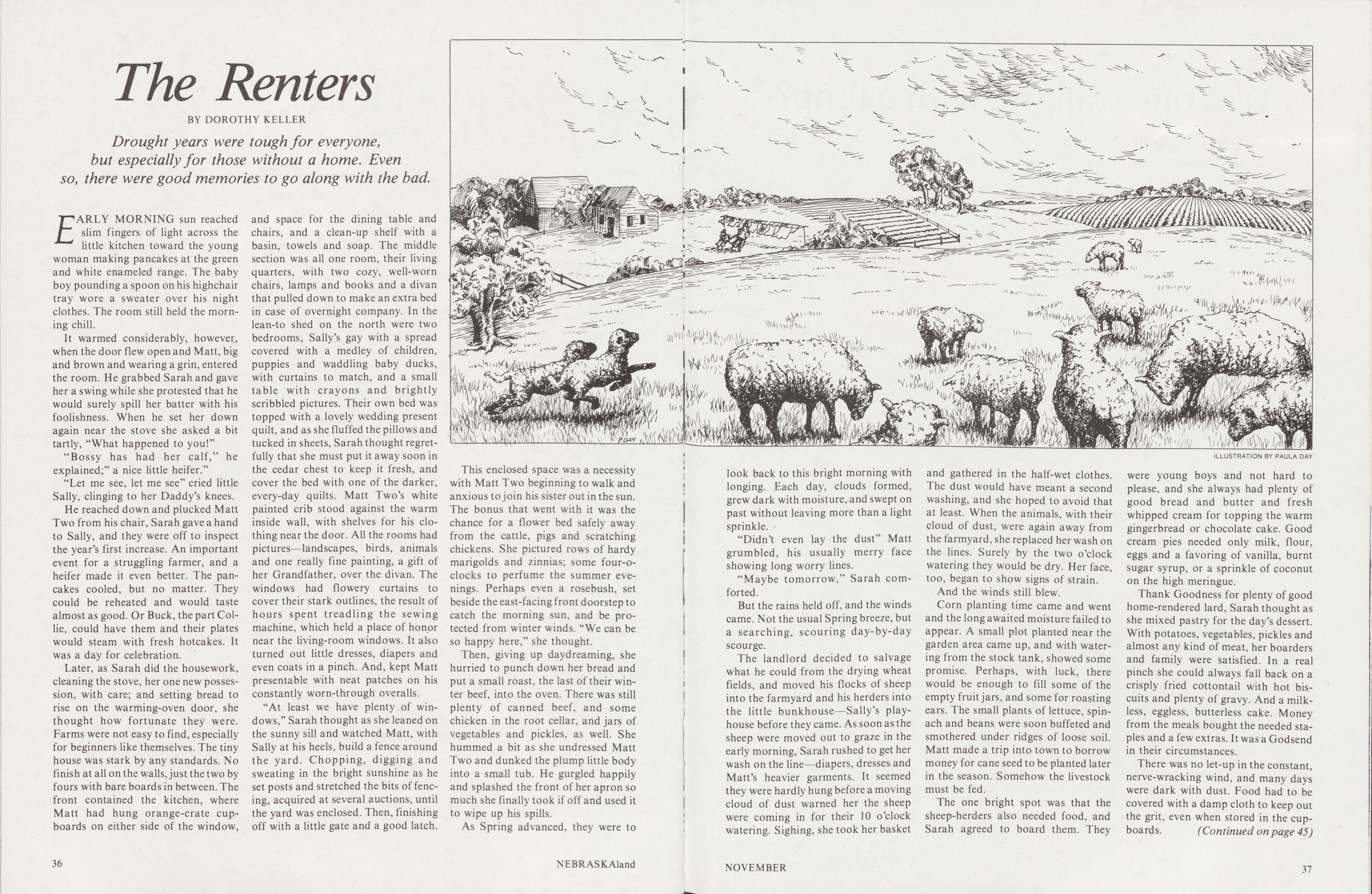
The Renters
Drought years were tough for everyone, but especially for those without a home. Even so, there were good memories to go along with the bad.EARLY MORNING sun reached slim fingers of light across the little kitchen toward the young woman making pancakes at the green and white enameled range. The baby boy pounding a spoon on his highchair tray wore a sweater over his night clothes. The room still held the morning chill.
It warmed considerably, however, when the door flew open and Matt, big and brown and wearing a grin, entered the room. He grabbed Sarah and gave her a swing while she protested that he would surely spill her batter with his foolishness. When he set her down again near the stove she asked a bit tartly, "What happened to you!"
"Bossy has had her calf," he explained;" a nice little heifer."
"Let me see, let me see" cried little Sally, clinging to her Daddy's knees.
He reached down and plucked Matt Two from his chair, Sarah gave a hand to Sally, and they were off to inspect the year's first increase. An important event for a struggling farmer, and a heifer made it even better. The pancakes cooled, but no matter. They could be reheated and would taste almost as good. Or Buck, the part Collie, could have them and their plates would steam with fresh hotcakes. It was a day for celebration.
Later, as Sarah did the housework, cleaning the stove, her one new possession, with care; and setting bread to rise on the warming-oven door, she thought how fortunate they were. Farms were not easy to find, especially for beginners like themselves. The tiny house was stark by any standards. No finish at all on the walls, just the two by fours with bare boards in between. The front contained the kitchen, where Matt had hung orange-crate cupboards on either side of the window, and space for the dining table and chairs, and a clean-up shelf with a basin, towels and soap. The middle section was all one room, their living quarters, with two cozy, well-worn chairs, lamps and books and a divan that pulled down to make an extra bed in case of overnight company. In the lean-to shed on the north were two bedrooms, Sally's gay with a spread covered with a medley of children, puppies and waddling baby ducks, with curtains to match, and a small table with crayons and brightly scribbled pictures. Their own bed was topped with a lovely wedding present quilt, and as she fluffed the pillows and tucked in sheets, Sarah thought regretfully that she must put it away soon in the cedar chest to keep it fresh, and cover the bed with one of the darker, every-day quilts. Matt Two's white painted crib stood against the warm inside wall, with shelves for his clothing near the door. All the rooms had pictures—landscapes, birds, animals and one really fine painting, a gift of her Grandfather, over the divan. The windows had flowery curtains to cover their stark outlines, the result of hours spent treadling the sewing machine, which held a place of honor near the living-room windows. It also turned out little dresses, diapers and even coats in a pinch. And, kept Matt presentable with neat patches on his constantly worn-through overalls.
"At least we have plenty of windows," Sarah thought as she leaned on the sunny sill and watched Matt, with Sally at his heels, build a fence around the yard. Chopping, digging and sweating in the bright sunshine as he set posts and stretched the bits of fencing, acquired at several auctions, until the yard was enclosed. Then, finishing off with a little gate and a good latch.
This enclosed space was a necessity with Matt Two beginning to walk and anxious to join his sister out in the sun. The bonus that went with it was the chance for a flower bed safely away from the cattle, pigs and scratching chickens. She pictured rows of hardy marigolds and zinnias; some four-o-clocks to perfume the summer evenings. Perhaps even a rosebush, set beside the east-facing front doorstep to catch the morning sun, and be protected from winter winds. "We can be so happy here," she thought.
Then, giving up daydreaming, she hurried to punch down her bread and put a small roast, the last of their winter beef, into the oven. There was still plenty of canned beef, and some chicken in the root cellar, and jars of vegetables and pickles, as well. She hummed a bit as she undressed Matt Two and dunked the plump little body into a small tub. He gurgled happily and splashed the front of her apron so much she finally took if off and used it to wipe up his spills.
As Spring advanced, they were to look back to this bright morning with longing. Each day, clouds formed, grew dark with moisture, and swept on past without leaving more than a light sprinkle.
"Didn't even lay the dust" Matt grumbled, his usually merry face showing long worry lines.
"Maybe tomorrow," Sarah comforted.
But the rains held off, and the winds came. Not the usual Spring breeze, but a searching, scouring day-by-day scourge.
The landlord decided to salvage what he could from the drying wheat fields, and moved his flocks of sheep into the farmyard and his herders into the little bunkhouse—Sally's playhouse before they came. As soon as the sheep were moved out to graze in the early morning, Sarah rushed to get her wash on the line—diapers, dresses and Matt's heavier garments. It seemed they were hardly hung before a moving cloud of dust warned her the sheep were coming in for their 10 o'clock watering. Sighing, she took her basket and gathered in the half-wet clothes. The dust would have meant a second washing, and she hoped to avoid that at least. When the animals, with their cloud of dust, were again away from the farmyard, she replaced her wash on the lines. Surely by the two o'clock watering they would be dry. Her face, too, began to show signs of strain.
And the winds still blew.
Corn planting time came and went and the long awaited moisture failed to appear. A small plot planted near the garden area came up, and with watering from the stock tank, showed some promise. Perhaps, with luck, there would be enough to fill some of the empty fruit jars, and some for roasting ears. The small plants of lettuce, spinach and beans were soon buffeted and smothered under ridges of loose soil. Matt made a trip into town to borrow money for cane seed to be planted later in the season. Somehow the livestock must be fed.
The one bright spot was that the sheep-herders also needed food, and Sarah agreed to board them. They were young boys and not hard to please, and she always had plenty of good bread and butter and fresh whipped cream for topping the warm gingerbread or chocolate cake. Good cream pies needed only milk, flour, eggs and a favoring of vanilla, burnt sugar syrup, or a sprinkle of coconut on the high meringue.
Thank Goodness for plenty of good home-rendered lard, Sarah thought as she mixed pastry for the day's dessert. With potatoes, vegetables, pickles and almost any kind of meat, her boarders and family were satisfied. In a real pinch she could always fall back on a crisply fried cottontail with hot biscuits and plenty of gravy. And a milkless, eggless, butterless cake. Money from the meals bought the needed staples and a few extras. It was a Godsend in their circumstances.
There was no let-up in the constant, nerve-wracking wind, and many days were dark with dust. Food had to be covered with a damp cloth to keep out the grit, even when stored in the cupboards. (Continued on page 45)
36 NEBRASKAland NOVEMBER 37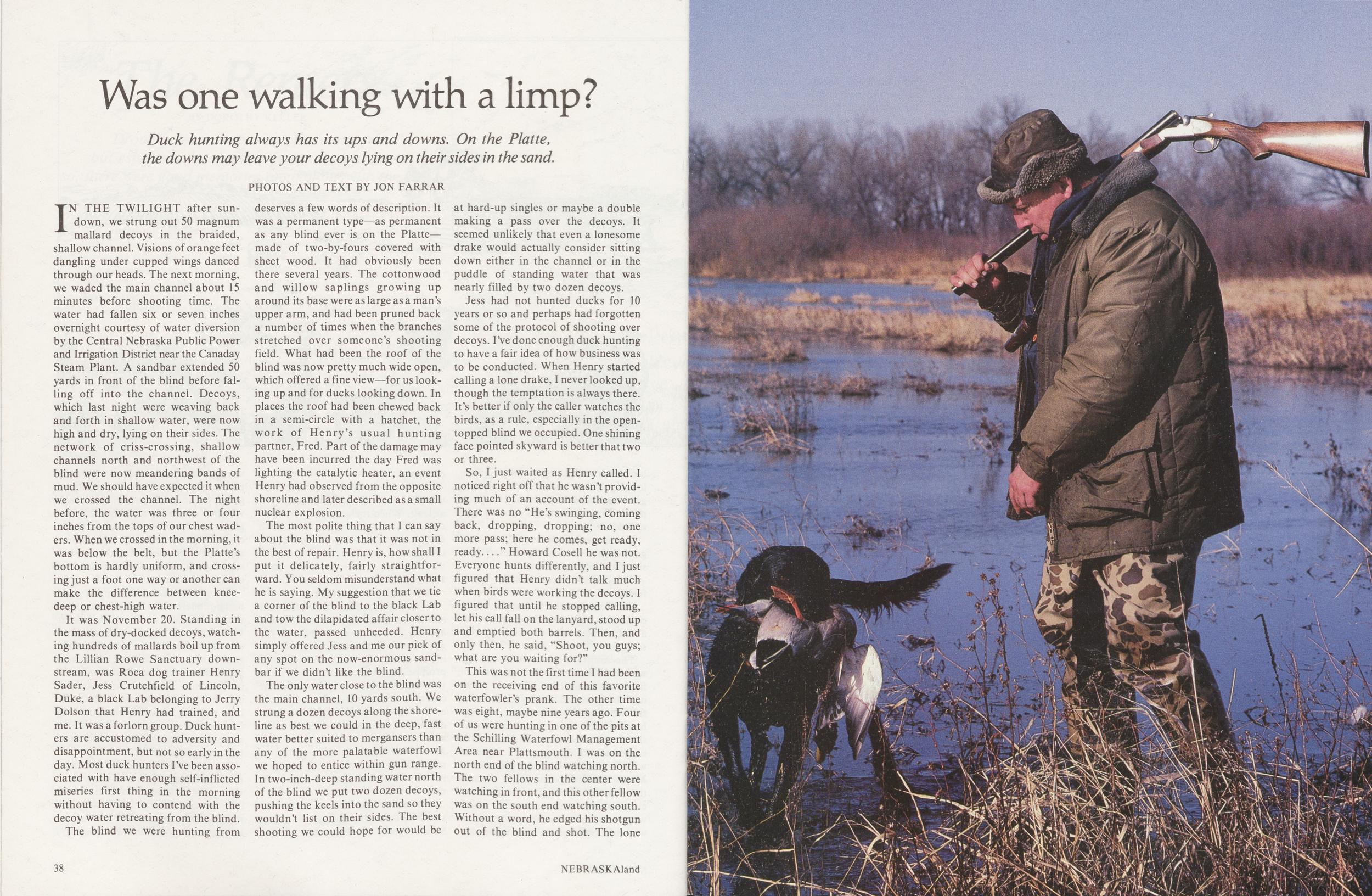
Was one walking with a limp?
Duck hunting always has its ups and downs. On the Platte, the downs may leave your decoys lying on their sides in the sand.IN THE TWILIGHT after sundown, we strung out 50 magnum mallard decoys in the braided, shallow channel. Visions of orange feet dangling under cupped wings danced through our heads. The next morning, we waded the main channel about 15 minutes before shooting time. The water had fallen six or seven inches overnight courtesy of water diversion by the Central Nebraska Public Power and Irrigation District near the Canaday Steam Plant. A sandbar extended 50 yards in front of the blind before falling off into the channel. Decoys, which last night were weaving back and forth in shallow water, were now high and dry, lying on their sides. The network of criss-crossing, shallow channels north and northwest of the blind were now meandering bands of mud. We should have expected it when we crossed the channel. The night before, the water was three or four inches from the tops of our chest waders. When we crossed in the morning, it was below the belt, but the Platte's bottom is hardly uniform, and crossing just a foot one way or another can make the difference between kneedeep or chest-high water.
It was November 20. Standing in the mass of dry-docked decoys, watching hundreds of mallards boil up from the Lillian Rowe Sanctuary downstream, was Roca dog trainer Henry Sader, Jess Crutchfield of Lincoln, Duke, a black Lab belonging to Jerry Dolson that Henry had trained, and me. It was a forlorn group. Duck hunters are accustomed to adversity and disappointment, but not so early in the day. Most duck hunters I've been associated with have enough self-inflicted miseries first thing in the morning without having to contend with the decoy water retreating from the blind.
The blind we were hunting from deserves a few words of description. It was a permanent type—as permanent as any blind ever is on the Plattemade of two-by-fours covered with sheet wood. It had obviously been there several years. The cottonwood and willow saplings growing up around its base were as large as a man's upper arm, and had been pruned back a number of times when the branches stretched over someone's shooting field. What had been the roof of the blind was now pretty much wide open, which offered a fine view—for us looking up and for ducks looking down. In places the roof had been chewed back in a semi-circle with a hatchet, the work of Henry's usual hunting partner, Fred. Part of the damage may have been incurred the day Fred was lighting the catalytic heater, an event Henry had observed from the opposite shoreline and later described as a small nuclear explosion.
The most polite thing that I can say about the blind was that it was not in the best of repair. Henry is, how shall I put it delicately, fairly straightforward. You seldom misunderstand what he is saying. My suggestion that we tie a corner of the blind to the black Lab and tow the dilapidated affair closer to the water, passed unheeded. Henry simply offered Jess and me our pick of any spot on the now-enormous sandbar if we didn't like the blind.
The only water close to the blind was the main channel, 10 yards south. We strung a dozen decoys along the shoreline as best we could in the deep, fast water better suited to mergansers than any of the more palatable waterfowl we hoped to entice within gun range. In two-inch-deep standing water north of the blind we put two dozen decoys, pushing the keels into the sand so they wouldn't list on their sides. The best shooting we could hope for would be at hard-up singles or maybe a double making a pass over the decoys. It seemed unlikely that even a lonesome drake would actually consider sitting down either in the channel or in the puddle of standing water that was nearly filled by two dozen decoys.
Jess had not hunted ducks for 10 years or so and perhaps had forgotten some of the protocol of shooting over decoys. I've done enough duck hunting to have a fair idea of how business was to be conducted. When Henry started calling a lone drake, I never looked up, though the temptation is always there. It's better if only the caller watches the birds, as a rule, especially in the open-topped blind we occupied. One shining face pointed skyward is better that two or three.
So, I just waited as Henry called. I noticed right off that he wasn't providing much of an account of the event. There was no "He's swinging, coming back, dropping, dropping; no, one more pass; here he comes, get ready, ready" Howard Cosell he was not. Everyone hunts differently, and I just figured that Henry didn't talk much when birds were working the decoys. I figured that until he stopped calling, let his call fall on the lanyard, stood up and emptied both barrels. Then, and only then, he said, "Shoot, you guys; what are you waiting for?"
This was not the first time I had been on the receiving end of this favorite waterfowler's prank. The other time was eight, maybe nine years ago. Four of us were hunting in one of the pits at the Schilling Waterfowl Management Area near Plattsmouth. I was on the north end of the blind watching north. The two fellows in the center were watching in front, and this other fellow was on the south end watching south. Without a word, he edged his shotgun out of the blind and shot. The lone
38 NEBRASKAland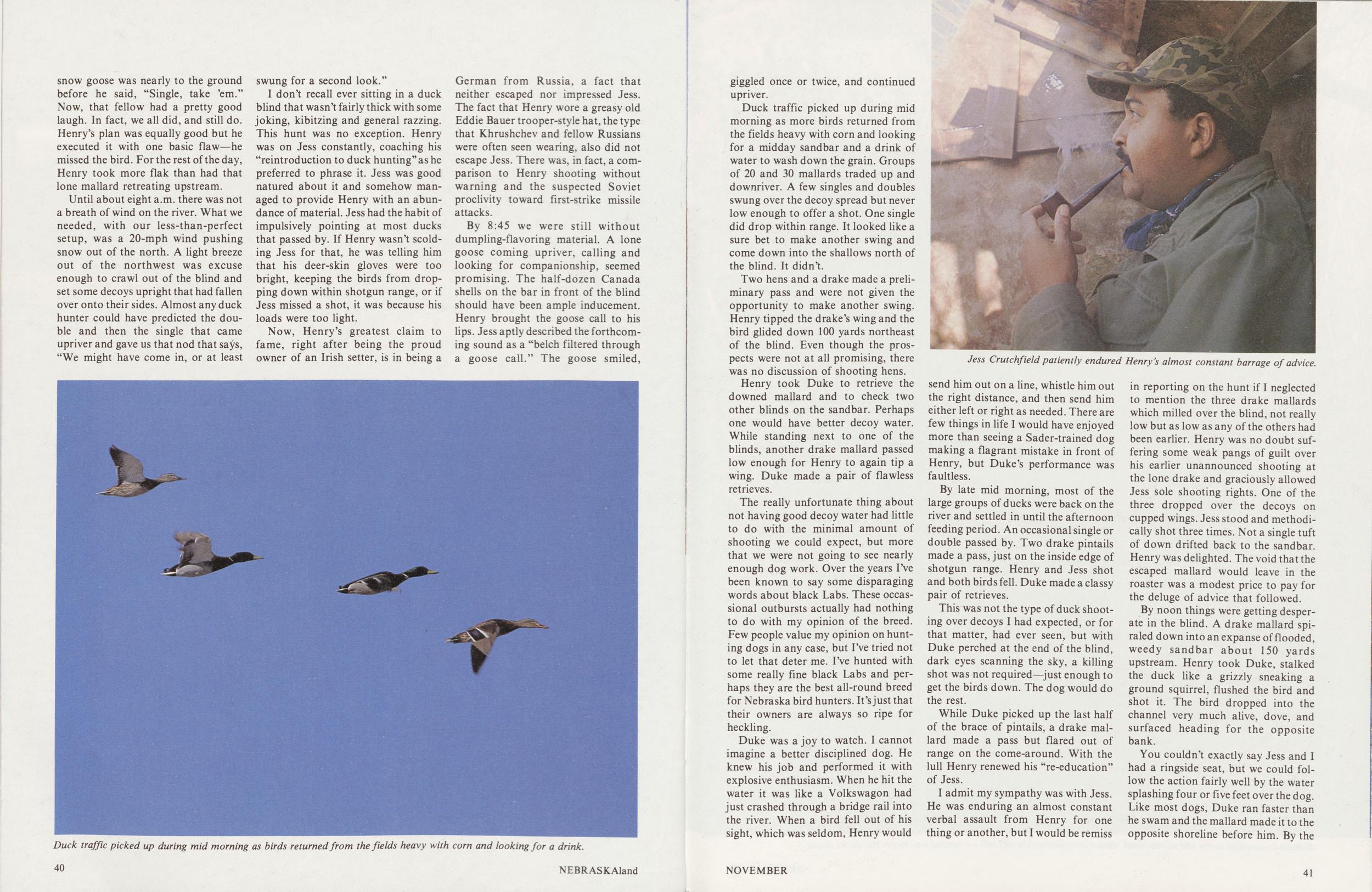
snow goose was nearly to the ground before he said, "Single, take 'em." Now, that fellow had a pretty good laugh. In fact, we all did, and still do. Henry's plan was equally good but he executed it with one basic flaw—he missed the bird. For the rest of the day, Henry took more flak than had that lone mallard retreating upstream.
Until about eight a.m. there was not a breath of wind on the river. What we needed, with our less-than-perfect setup, was a 20-mph wind pushing snow out of the north. A light breeze out of the northwest was excuse enough to crawl out of the blind and set some decoys upright that had fallen over onto their sides. Almost any duck hunter could have predicted the double and then the single that came upriver and gave us that nod that says, "We might have come in, or at least swung for a second look."
I don't recall ever sitting in a duck blind that wasn't fairly thick with some joking, kibitzing and general razzing. This hunt was no exception. Henry was on Jess constantly, coaching his "reintroduction to duck hunting" as he preferred to phrase it. Jess was good natured about it and somehow managed to provide Henry with an abundance of material. Jess had the habit of impulsively pointing at most ducks that passed by. If Henry wasn't scolding Jess for that, he was telling him that his deer-skin gloves were too bright, keeping the birds from dropping down within shotgun range, or if Jess missed a shot, it was because his loads were too light.
Now, Henry's greatest claim to fame, right after being the proud owner of an Irish setter, is in being a German from Russia, a fact that neither escaped nor impressed Jess. The fact that Henry wore a greasy old Eddie Bauer trooper-style hat, the type that Khrushchev and fellow Russians were often seen wearing, also did not escape Jess. There was, in fact, a comparison to Henry shooting without warning and the suspected Soviet proclivity toward first-strike missile attacks.
By 8:45 we were still without dumpling-flavoring material. A lone goose coming upriver, calling and looking for companionship, seemed promising. The half-dozen Canada shells on the bar in front of the blind should have been ample inducement. Henry brought the goose call to his lips. Jess aptly described the forthcoming sound as a "belch filtered through a goose call." The goose smiled,
Duck traffic picked up during mid morning as birds returned from the fields heavy with corn and looking for a drink.
giggled once or twice, and continued upriver.
Duck traffic picked up during mid morning as more birds returned from the fields heavy with corn and looking for a midday sandbar and a drink of water to wash down the grain. Groups of 20 and 30 mallards traded up and downriver. A few singles and doubles swung over the decoy spread but never low enough to offer a shot. One single did drop within range. It looked like a sure bet to make another swing and come down into the shallows north of the blind. It didn't.
Two hens and a drake made a preliminary pass and were not given the opportunity to make another swing. Henry tipped the drake's wing and the bird glided down 100 yards northeast of the blind. Even though the prospects were not at all promising, there was no discussion of shooting hens.
Henry took Duke to retrieve the downed mallard and to check two other blinds on the sandbar. Perhaps one would have better decoy water. While standing next to one of the blinds, another drake mallard passed low enough for Henry to again tip a wing. Duke made a pair of flawless retrieves.
The really unfortunate thing about not having good decoy water had little to do with the minimal amount of shooting we could expect, but more that we were not going to see nearly enough dog work. Over the years I've been known to say some disparaging words about black Labs. These occassional outbursts actually had nothing to do with my opinion of the breed. Few people value my opinion on hunting dogs in any case, but I've tried not to let that deter me. I've hunted with some really fine black Labs and perhaps they are the best all-round breed for Nebraska bird hunters. It's just that their owners are always so ripe for heckling.
Duke was a joy to watch. I cannot imagine a better disciplined dog. He knew his job and performed it with explosive enthusiasm. When he hit the water it was like a Volkswagon had just crashed through a bridge rail into the river. When a bird fell out of his sight, which was seldom, Henry would
Jess Crutchfield patiently endured Henry's almost constant barrage of advice.
send him out on a line, whistle him out the right distance, and then send him either left or right as needed. There are few things in life I would have enjoyed more than seeing a Sader-trained dog making a flagrant mistake in front of Henry, but Duke's performance was faultless.
By late mid morning, most of the large groups of ducks were back on the river and settled in until the afternoon feeding period. An occasional single or double passed by. Two drake pintails made a pass, just on the inside edge of shotgun range. Henry and Jess shot and both birds fell. Duke made a classy pair of retrieves.
This was not the type of duck shooting over decoys I had expected, or for that matter, had ever seen, but with Duke perched at the end of the blind, dark eyes scanning the sky, a killing shot was not required—just enough to get the birds down. The dog would do the rest.
While Duke picked up the last half of the brace of pintails, a drake mallard made a pass but flared out of range on the come-around. With the lull Henry renewed his "re-education" of Jess.
I admit my sympathy was with Jess. He was enduring an almost constant verbal assault from Henry for one thing or another, but I would be remiss in reporting on the hunt if I neglected to mention the three drake mallards which milled over the blind, not really low but as low as any of the others had been earlier. Henry was no doubt suffering some weak pangs of guilt over his earlier unannounced shooting at the lone drake and graciously allowed Jess sole shooting rights. One of the three dropped over the decoys on cupped wings. Jess stood and methodically shot three times. Not a single tuft of down drifted back to the sandbar. Henry was delighted. The void that the escaped mallard would leave in the roaster was a modest price to pay for the deluge of advice that followed.
By noon things were getting desperate in the blind. A drake mallard spiraled down into an expanse of flooded, weedy sandbar about 150 yards upstream. Henry took Duke, stalked the duck like a grizzly sneaking a ground squirrel, flushed the bird and shot it. The bird dropped into the channel very much alive, dove, and surfaced heading for the opposite bank.
You couldn't exactly say Jess and I had a ringside seat, but we could follow the action fairly well by the water splashing four or five feet over the dog. Like most dogs, Duke ran faster than he swam and the mallard made it to the opposite shoreline before him. By the
NOVEMBER 41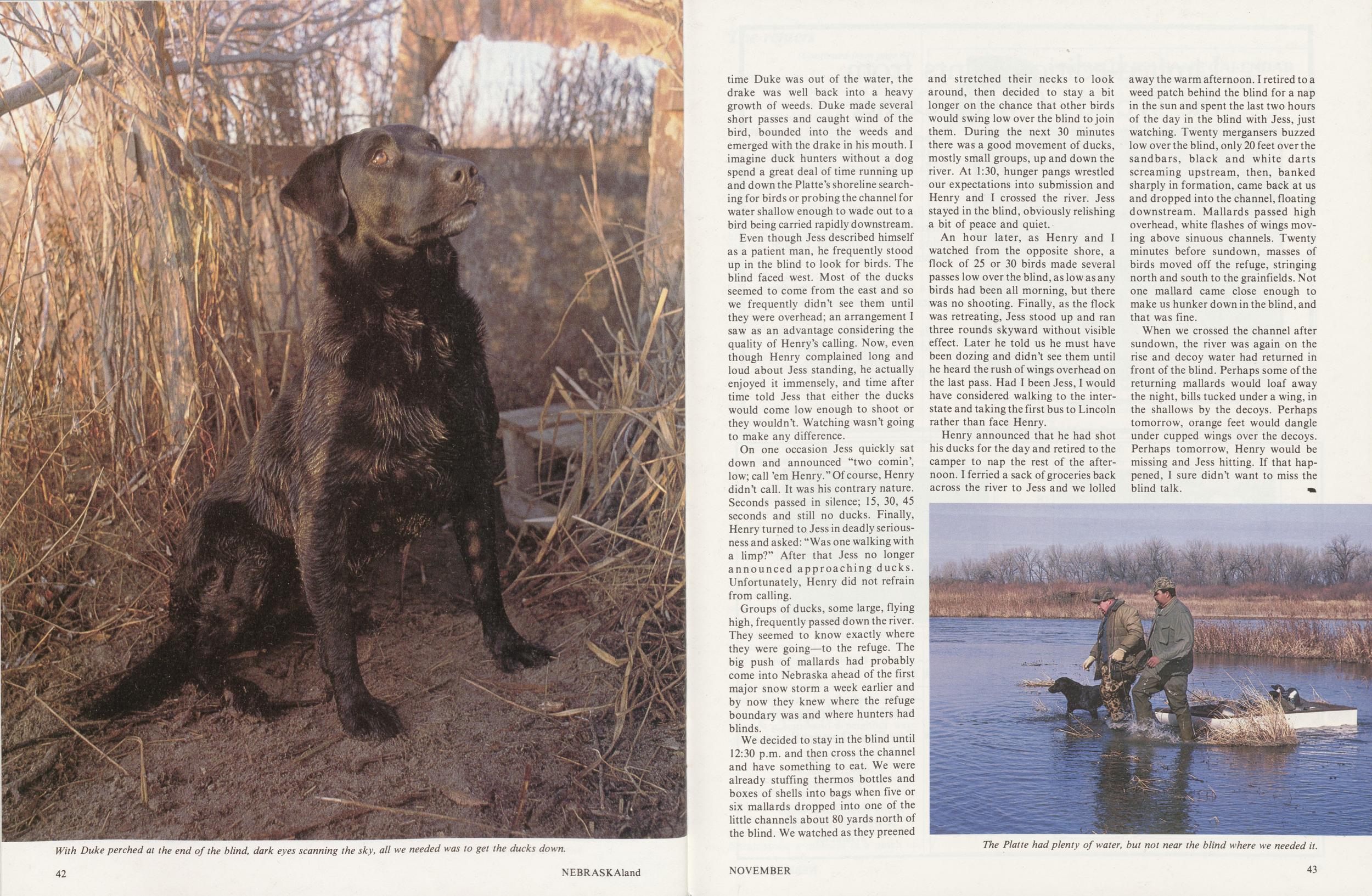
With Duke perched at the end of the blind, dark eyes scanning the sky, all we needed was to get the ducks down.
time Duke was out of the water, the drake was well back into a heavy growth of weeds. Duke made several short passes and caught wind of the bird, bounded into the weeds and emerged with the drake in his mouth. I imagine duck hunters without a dog spend a great deal of time running up and down the Platte's shoreline searching for birds or probing the channel for water shallow enough to wade out to a bird being carried rapidly downstream.
Even though Jess described himself as a patient man, he frequently stood up in the blind to look for birds. The blind faced west. Most of the ducks seemed to come from the east and so we frequently didn't see them until they were overhead; an arrangement I saw as an advantage considering the quality of Henry's calling. Now, even though Henry complained long and loud about Jess standing, he actually enjoyed it immensely, and time after time told Jess that either the ducks would come low enough to shoot or they wouldn't. Watching wasn't going to make any difference.
On one occasion Jess quickly sat down and announced "two comin', low; call 'em Henry." Of course, Henry didn't call. It was his contrary nature. Seconds passed in silence; 15, 30, 45 seconds and still no ducks. Finally, Henry turned to Jess in deadly seriousness and asked: "Was one walking with a limp?" After that Jess no longer announced approaching ducks. Unfortunately, Henry did not refrain from calling.
Groups of ducks, some large, flying high, frequently passed down the river. They seemed to know exactly where they were going—to the refuge. The big push of mallards had probably come into Nebraska ahead of the first major snow storm a week earlier and by now they knew where the refuge boundary was and where hunters had blinds.
We decided to stay in the blind until 12:30 p.m. and then cross the channel and have something to eat. We were already stuffing thermos bottles and boxes of shells into bags when five or six mallards dropped into one of the little channels about 80 yards north of the blind. We watched as they preened and stretched their necks to look around, then decided to stay a bit longer on the chance that other birds would swing low over the blind to join them. During the next 30 minutes there was a good movement of ducks, mostly small groups, up and down the river. At 1:30, hunger pangs wrestled our expectations into submission and Henry and I crossed the river. Jess stayed in the blind, obviously relishing a bit of peace and quiet.
An hour later, as Henry and I watched from the opposite shore, a flock of 25 or 30 birds made several passes low over the blind, as low as any birds had been all morning, but there was no shooting. Finally, as the flock was retreating, Jess stood up and ran three rounds skyward without visible effect. Later he told us he must have been dozing and didn't see them until he heard the rush of wings overhead on the last pass. Had I been Jess, I would have considered walking to the interstate and taking the first bus to Lincoln rather than face Henry.
Henry announced that he had shot his ducks for the day and retired to the camper to nap the rest of the afternoon. I ferried a sack of groceries back across the river to Jess and we lolled away the warm afternoon. I retired to a weed patch behind the blind for a nap in the sun and spent the last two hours of the day in the blind with Jess, just watching. Twenty mergansers buzzed low over the blind, only 20 feet over the sandbars, black and white darts screaming upstream, then, banked sharply in formation, came back at us and dropped into the channel, floating downstream. Mallards passed high overhead, white flashes of wings moving above sinuous channels. Twenty minutes before sundown, masses of birds moved off the refuge, stringing north and south to the grainfields. Not one mallard came close enough to make us hunker down in the blind, and that was fine.
When we crossed the channel after sundown, the river was again on the rise and decoy water had returned in front of the blind. Perhaps some of the returning mallards would loaf away the night, bills tucked under a wing, in the shallows by the decoys. Perhaps tomorrow, orange feet would dangle under cupped wings over the decoys. Perhaps tomorrow, Henry would be missing and Jess hitting. If that happened, I sure didn't want to miss the blind talk.
The Platte had plenty of water, but not near the blind where we needed it.
Limited Edition Prints from the World of Willa Cather
On Lovely Creek
Downey's Fine Photography for Five Generations
Scottsbluff Summer 1969 by Charles Downey
Scottsbluff Lightning 1980 by Tom Downey
Scottsbluff Fall 1954 by Jim Downey
The renters
(Continued from page 37)Tempers grew short and the usually chatty and sociable flock of chickens turned grumpy and retired to their roost in midday. Gradually the winds picked up and carried away the precious topsoil until the small roots lay exposed, bare and dry. At last not even a sheep could find anything to nibble, and they were loaded up and moved away.
But it was fall before the real blow came. One day Matt Two was tumbling about on the floor, playing with his little trucks and yelling with joy when he got a really good hold on Kitty's tail and she had to squirm and pull to get away from him. The next, he was flushed and cranky, turning away from his favorite hot cereal when coaxed to eat. Sarah frantically packed clothing and baby things while Matt fed the stock and Sally gathered eggs and penned up the hens; and they rushed him to the doctor. But they came too late. Just at sunrise on the third morning, the little boy said "Daddy" in a husky whisper and was gone.
Somehow they made it through the dark winter. There were days washed with tears and full of rebellion, days when almost nothing seemed worth while. But as the slow months passed, life's necessities pressed—the daily round of cooking, cleaning and laundry had to be gone through; they needed to play in the snow with Sally, and read to her. She was growing tall and much too serious for her age. And they needed to make plans.
Matt said they would move again in the spring. A place with real wallpaper on the walls and an indoor bathroom. At last Sarah could sit in her sunny east window, sewing little clothes and planning, almost happily, for the new baby.
At last it was the week for moving, and with almost everything packed and ready to load, they marked time. Sarah's parents and a neighbor were on hand to help early on Thursday morning. Her mother and Sally at the new house to have a hot meal ready and beds made up as soon as they arrived, and her father to help with the heavy loading. At last the little house was bare, and it looked more like the granary it really was than ever. Sarah stood a moment in a patch of
WANNA CARVE A DUCK?
GUN DOG TRAINING All Sporting Breeds
Harlan County Dam
Vacation Apartments fully furnished Color TV Kitchen Facilities Full Baths Game cleaning room with freezer One block from shopping center Weekend or week of pleasant living Security Deposit Required Sorry No Pets Dean and Esther Stone Box 145 Ph.(308)799-3422 Republican City, NE 68971Nebraska's First Trout Stamp
sunlight thinking of little Matt playing on the floor there—so long ago, it seemed.
Then she stepped outside, thankful for the warm day, and carefully uprooted her prized pink rose, tucking it into damp soil in the little footwashing tub. "How had it ever survived the past year," she thought as she settled beside Matt and he pressed a comforting arm around her. Their wheels raised a small whirl-wind as they pulled away, not looking back.
A gray rabbit poked a curious nose among the dried flower stems near the back door. The wind blew and the little gate swung on its hinges.
Conservation the sum of its parts
(Continued from page 35)we may need this prairie flora not only to look at but to rebuild the wasting soil of prairie farms. Many species may then be missing. We have our hearts in the right place, but we do not yet recognize the small cogs and wheels.
In our attempts to save the bigger cogs and wheels, we are still pretty naive. A little repentance just before a species goes over the brink is enough to make us feel virtuous. When the species is gone we have a good cry and repeat the performance.
We shall never achieve harmony with land, any more than we shall achieve justice or liberty for people. In these higher aspirations the important thing is not to achieve, but to strive. It is only in mechanical enterprises that we can expect that early or complete fruition of effort which we call 'success.'
The problem, then, is how to bring about a striving for harmony with land among a people many of whom have forgotten there is any such thing as land, among whom education and culture have become almost synonymous with landlessness. This is the problem of 'conservation education.'
When we say 'striving,' we admit at the outset that the thing we need must grow from within. No striving for an idea was ever injected wholly from without.
When we say 'striving,' I think we
46 NEBRASKAlandTrading Post
DOGS ENGLISH POINTER male, 2 years old, does it all. Call Ken Cooksey, Day (402) 265-2711; Night (402) 873-6288. TRAINING ALL BREEDS Hunting dogs—Vizslas for sale. Rozanek Kennels, Rt. 2, Schuyler, NE 68661.Phone (402) 352-8769. ENGLISH SETTERS and Pointers: Outstanding bloodlines! Puppies, started dogs, and stud service available. High Plains Kennels, 1411 Emerson, Alliance, NE 69301. Phone (308) 762-6709. GERMAN SHORTHAIRS—English pointers and setters. Stud service, puppies and started dogs available. Also Diamond Dog Food. Wayne Clark, Box 54, Union, NE. (402) 263-3495 or 263-3155. AKC PUPPIES! Weimaraners, (field champion blood-lines) Labrador retrievers (chocolate, yellow, black), Alaskan Malamutes and Boxers. Large, beautiful pups available now. Shots and wormed to date. Blackwood Kennels, Culbertson, NE 69024. Phone (308) 278-2785. MISCELLANEOUS WINE AND BEER: Make your own. Send for free recipes and instructions. Omaha Supply, 13616 Polk, Omaha, Nebr. 68137 FOR SALE: Wild turkeys. Phone (402) 643-2365 or 643-2586. GAME BIRDS for sale. Wild turkeys, wood ducks, mandarins, mallards, teal, Canada geese, pheasants—5 breeds chukkar quail. Many others not listed. Frontier Birds, Wauneta, NE 69045. Phone: day (308) 394-5577/evening (308) 394-5715. BED & BREAKFAST of Nebraska offers overnite lodging with breakfast, in homes throughout the state. For reservations contact Bed & Breakfast of Nebraska, 1464 28th Ave., Columbus, NE 68601. Phone (402) 564-7591. N.E. NEBRASKA TROUT Fishing. For rent Mon.-Thurs. or Fri.-Sun. 2 modern cottages completely furnished. 5 spring-fed lakes with trout up to 7 lbs. Bass and bluegill also. Diamond E Trout Resort, Orchard, NE 68764. (402) 893-4745. FOR SALE: Sika deer and golden pheasants. Contact Harold Kempf, Box 31, Glenville, NE 68941. GUNS—Browning, Winchester, Remington, others, Hi-powers, shotguns, new, used, antiques. Want Pre-1964 Winchesters. Buy-Sell-Trade. Ph. (402) 729-6112. Bedlan's Sporting Goods, Fairbury, NE 68352. SHERKS HUNTING and trapping lures. Archery and winter seasons. Buck lure. Complete line of trapping lures, available at sporting good stores or SASE for complete price list, retail and wholesale. J Enterprises, 1225 No. 46th, Lincoln, NE 68503. Phone (402) 466-9223. C.G. BUD PRITCHARD—2 original oils. Approx. 16x20. North of Valentine. Sharptail, pheasant. Taking offers. Round Hill Books, Box 1680, Greenwich, CT 06836. SELLING 30 USED 17' Michicraft aluminum canoes; 30 used Springbar 3-man compact tents; and 8 used 8-place, heavy duty, long-haul type canoe trailers. All equipment guaranteed to your satisfaction or your money back! Wilson Outfitters Nebraska (WON), 1329 Dawes Avenue, Lincoln, NE 68521. Phone (402) 476-2300. PINE CONE Fire Starters: Make your own. Complete instructions—adding dye, scent and wick to wax base and glazing. Use in fireplace. No kindling needed. Send $2 and SASE. "Kindling Kones," 7405 S. 147th, Omaha, NE 68138. BEAUTIFUL, 40 LAKEVIEW building lots, A Frame cabins. Get your pick. Gate 18, west of Vans Ogallala, Lake McConaughy. Write Box 1028, Imperial, NE 69033. TAXIDERMY JOHNSON TAXIDERMY—servicing southwest Nebraska, specializing in big-game mounts, lifesized mounts, rug work, fish, birds, tanning hair-on leather. Brochure and price list on request. Johnson Taxidermy, Rt. 1, Box 78, Lamar, NE 69035. Telephone (308) 882-5555. AWARD-WINNING TAXIDERMIST. Eight time national award winners. Trust your trophies to a proven winner. Our complete taxidermy service also arranges hunts. Dinges Taxidermy Studio, 2763 South 12th Omaha, NE 68108. Ph. 402-342-3718. FREEZE-DRY TAXIDERMY Wally Allison's State Record Taxidermy, 2709 Birchwood, North Platte, NE 69101. Phone: (308) 534-2324. Specializing in Fish and Small Game, Snake and Lizard and Novelties. (Nothing too small) Newest of all taxidermy methods employed. CREATIVE TAXIDERMY in all its branches since 1935, now includes Northstar Freeze-Dry processing of approved small specimens. Also tanning and deerskin processing. Naturecraft Studio. Nebraska City, Nebraska 68510. Joe Voges-Owner. Phone (402) 873-5491. NABITY'S TAXIDERMY. 31 years experience. Specializing in natural grass backgrounds for mammals, birds and fish. 13901 "0"St., Lincoln, NE 68505 4 miles east of 84th and "O". (402) 489-6351. BADE TAXIDERMY—Quality a must—Fast service. Fish, birds, rugs, tanning, full mounts and game heads. 2111 N. Christy St., Fremont, Nebraska. 727-5463. PEISTER TAXIDERMY—a name you can trust. We give you professional life-like work at prices most sportsmen can afford. Member National Taxidermist Association, #5 Regency Place, Kearney, Nebr. 68847. Phone (308) 237-7575. HASTINGS TAXIDERMY. Professional life-like mounting of game heads, birds, fish, rugs, and animals. We specialize in big-game head mounts. Also hair-on and hair-off tanning. Competitive prices. R Rt. 3, Box 162, Ord, NE 68862. Phone (308) 728-5322. TAXIDERMIST Steve J. Abegglen—Experienced quality craftsmanship. Big game heads, life-size mammals, waterfowl, upland game. Affordable prices. Fast delivery. Rt. 4, Box 47. Columbus, NE 68601 (402) 897-5297.LIVE-CATCH ALL-PURPOSE TRAPS
Write lor FREE CATALOG Traps without injury squirrels, chipmunks, rabbits, mink, fox, raccoons, stray animals, pests, etc. Sizes for every need. Also traps for snakes, sparrows, pigeons, crabs, turtles, quail, etc. Save on our low factory prices. Send no money. Free catalog and trapping secrets. MUSTANG MFG. CO., Dept. N 34, Box 10880, Houston, Tex. 77018HUNTERS!
J s Otter Creek Marina At Lake McConaughy
Route 1—Box 99 Lewellen, NE 69147 Open 4 a.m. to 8 p.m. (MDT) 7 days a week in November and December. RESTAURANT Breakfast: 4 a.m. to 11 a.m. Lunch & Dinner: 11 a.m. to 8 p.m. We fix lunches to go fill thermoses, etc. HUNTING SPECIAL 3 meals & lodging—$24.95 plus tax per person per day. Located just 5 miles from public hunting area and 6 miles from commercial pits. We carry ammo, caps, gloves, etc. For Lodging Reservations: Call (308) 355-2341WATERFOWL ID
Hunters-Send for this waterfowl identification book. Only 360 (Incl. tax) Mall to: Game and Parks Commission, Box 30370, Lincoln, NE 68503 PUDDLE DUCKSNEBRASKAland 35mm Slides
Select photos in this issue are now available from NEBRASKAland Magazine as 35mm slides in 2" mounts. The slides may be used to round out your home slide file, or to make color enlargement prints to adorn your home or office walls. The slides may not be used in any commercial manner. Slides of other photos in this issue are not readily available. The slides cost $1 each plus appropriate sales tax. Please allow 4-6 weeks delivery. Slides available from this issue include: 11831 Owl Cover 11832 Milkweed p. 2 118320 Pheasant p, 20 118321 Cottontail p. 21 118322 Blackbird p. 22 118325 Ducks p. 25 Please indicate number and description of slides desired, and include check or money order for the full amount made to: NEBRASKAland Magazine. Send orders to: NEBRASKAland Slides, P.O. Box 30370, Lincoln, NE 68503. Nebraskans, please include appropriate sales tax. NOVEMBER 47
DOCS GOOSE LORE
(Formerly Rishling's Goose Lore)
Over the years, some of the finest goose hunting in the North Platte Valley. Now under new ownership, we plan to make this the finest in quality group Canada goose hunting around.Limited-edition Belt Buckle
imply an effort of the mind as well as a disturbance of the emotions. It is inconceivable to me that we can adjust ourselves to the complexities of the land mechanism without an intense curiosity to understand its workings and an habitual personal study of those workings. The urge to comprehend must precede the urge to reform.
When we say 'striving,' we likewise disqualify at least in part the two vehicles which conservation propagandists have most often used: fear and indignation. He who by a lifetime of observation and reflection has learned much about our maladjustments with land is entitled to fear, and would be something less than honest if he were not indignant. But for teaching the fresh mind, these are outmoded tools.
My own gropings come to a dead end when 1 try to appraise the profit motive. For a full generation the American conservation movement has been substituting the profit motive for the fear motive, yet it has failed to motivate. We can all see profit in conservation practice, but the profit accrues to society rather than to the individual. This, of course, explains the trend, at this moment, to wish the whole job on the government.
When one considers the prodigious achievements of the profit motive in wrecking land, one hesitates to reject it as a vehicle for restoring land. I incline to believe we have overestimated the scope of the profit motive. Is it profitable for the individual to build a beautiful home? To give his children a higher education? No, it is seldom profitable, yet we do both. These are, in fact, ethical and aesthetic premises which underlie the economic system.
No such ethical and aesthetic premise yet exists for the condition of the land these children must live in. Our children are our signature to the roster of history; our land is merely the place our money was made. There is as yet no social stigma in the possession of a gullied farm, a wrecked forest, or a polluted stream, provided the dividends suffice to send the youngsters to college. Whatever ails the land, the government will fix it.
I think we have here the root of the problem. What conservation education must build is an ethical underpinning for land economics and a universal curiosity to understand the land mechanism. Conservation may then follow.
48 NEBRASKAlandNOTES ON NEBRASKA FAUNA / PORCUPINE
THE PORCUPINE is the sort of animal that inspires legends. Of the many legends, most are figments of the imagination. It has been said that porcupines can throw their quills. They can't. Neither can they drop them, although they can loosen them. It is often said they have no natural enemies. This too is false, as we will learn later. The porcupine runs away from nothing—it usually doesn't need to. It is pigeon-toed and bowlegged, therefore clumsy on the ground, and, while it spends much time in trees, it is clumsy there, too. This made it easy prey, but the Indians killed it only when no other game was available.
The porcupine, Erethizon dorsatum, is a cat-sized animal with short legs. Like all rodents, it has a pair of upper and lower incisors used for gnawing, and cheek teeth used for chewing. It is best known for the sharp quills which are a formidable but not impregnable defense. The common name comes from the Latin porcus (swine) and from the French "epine" which comes originally from the Latin spina (thorn). Sometimes it is called the quill pig. The scientific name freely translated means "the irritable back." The porcupine is not related to the hedgehog of Europe.
The species now found in North America is believed to have originated in South America, where there are still five species. Fossils of the modern North American porcupine are known from Middle Pleistocene (Ice Age) deposits throughout the U.S., including one from Nebraska. Today it is found in forested areas from northern Mexico throughout most of the western U.S. and Canada into Alaska, east across Canada and the Great Lakes states, Labrador and the northeastern states, and the boreal forests along the tree line.
I once met one in a ravine in Sioux County, the northwesternmost county of Nebraska. It was about a mile from any trees except for some very small junipers growing in the ravine. When it became aware of my presence, it ambled to a pile of jumbled rocks and disappeared. Hollow trees and logs as well as caves in rocky outcrops can serve as dens. As many as 20 porcupines have been found in winter dens.
Most of the dorsal surface of the porcupine, including the tail, is covered with quills. Only its face and underside are without formidable quills. Normally the quills are flattened and invisible beneath a coat of heavy guard hairs. When threatened, every quill is erected. If pressed, a porcupine thrashes its tail from side to side and chatters its teeth.
Microscopic scales at the tip of the quills overlap, with the free edges pointing away from the tip. This barblike structure allows the quill to work its way into the flesh and makes it difficult to remove. Albert Shadle of the biology department at the University of Buffalo (New York), and his wife, studied porcupines intensively in the early 1940's. In handling a newly-born porcupine (quills are soft at the time of birth), he suddenly became aware of a quill (about 5/8-inch in length) stuck into the skin of his right arm about four inches below the elbow. It had entered the skin very nearly parallel to the surface. Attempts to remove it without cutting into the skin were unsuccessful. Dr. Shadle, true scientist that he was, decided to leave it alone and see what happened. Having come from a newborn young, the spine was fairly clean and there was no aching sensation such as occurs from the penetration of an "older" spine; only a slight prickling sensation. About 48 hours after it entered the skin, the sharp end emerged 1 5/8-inches from the point of entrance, having traveled through the skin and muscle at a rate of nearly an inch per day.
Now back to the related myth that the porcupine has no enemies because the spines protect it. An exception is said to be the fisher, a cat-sized member of the weasel family and a skillful climber. Presumably the fisher is able to flip the porcupine over on its back, "attacking the soft underbelly."
Roger Powell, a zoologist at North Carolina State, has devoted an entire chapter of his book on the porcupine describing how a fisher overpowers porcupines. The animal tries to keep its back toward the enemy, keeping its face (the vulnerable part) turned to a tree, log or rock, but the fisher attacks repeatedly, attempting to bite the porcupine's face. Repeated attacks to the face finally kill the porcupine or bewilders it so that the fisher can flip it over. The fisher is also far more agile in a tree than a porcupine. In the process, the fisher acquires a few quills but apparently not enough to dissuade him. There is evidence that porcupines and their predators have coexisted for many millenia. The comingling of their bones, found in caves of present-day Alabama and Missouri from about 900 B.C., seems to confirm this. The porcupine is subject to predation by many species of animals other than the fisher, including coyotes, wolves, mountain lions, lynx and bobcats.
Great-horned owls are known to attack porcupines. When I was at the James Ford Bell Museum at the University of Minnesota, one of the specimens we received for the collections had evidently attacked a porcupine, for it contained many quills. The preparator was surprised to find a short
Porcupine quills are tipped with many microscopic, barb-like scales.
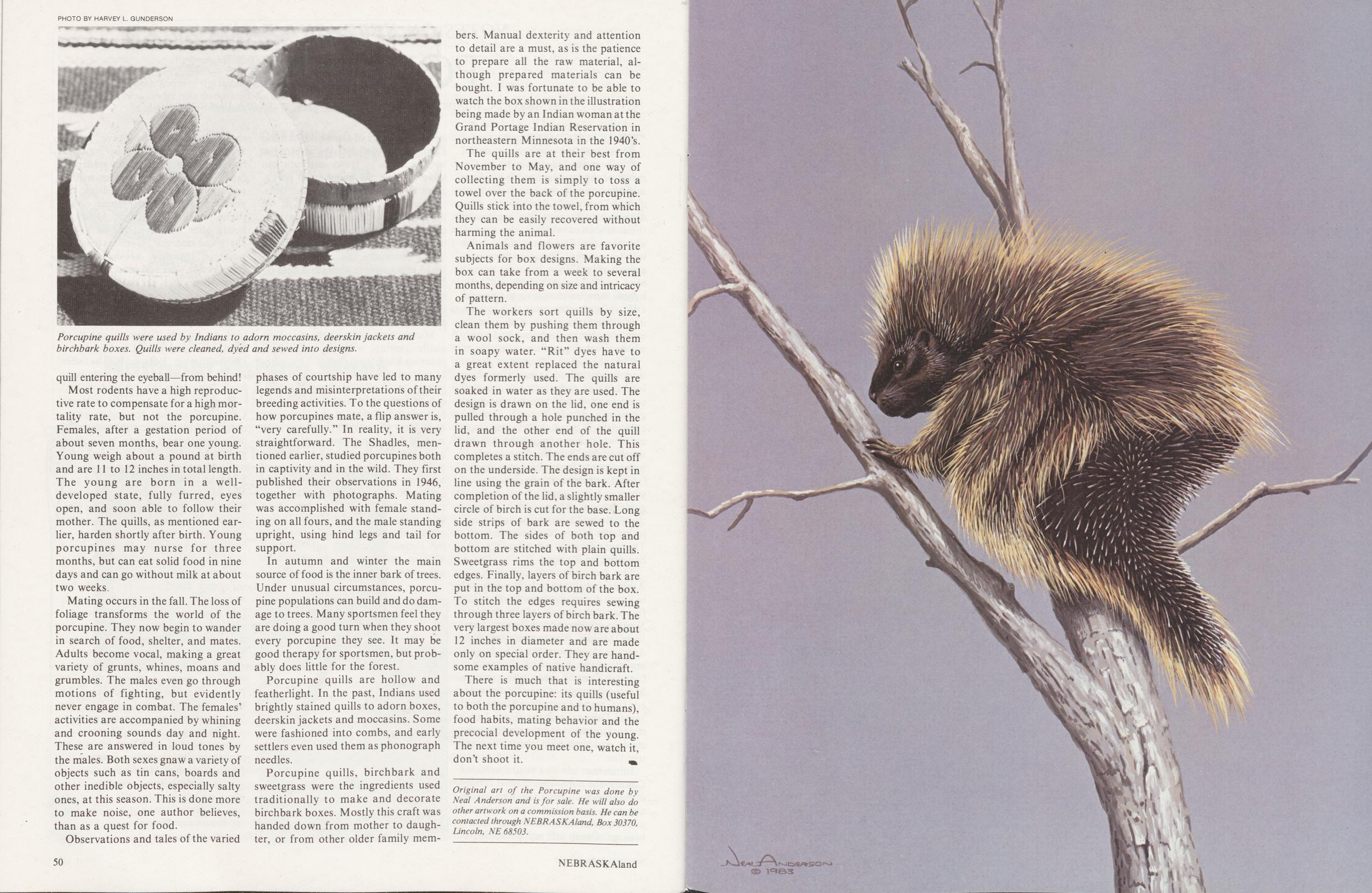
Porcupine quills were used by Indians to adorn moccasins, deerskin jackets and birchbark boxes. Quills were cleaned, dyed and sewed into designs.
quill entering the eyeball—from behind!
Most rodents have a high reproductive rate to compensate for a high mortality rate, but not the porcupine. Females, after a gestation period of about seven months, bear one young. Young weigh about a pound at birth and are 11 to 12 inches in total length. The young are born in a well-developed state, fully furred, eyes open, and soon able to follow their mother. The quills, as mentioned earlier, harden shortly after birth. Young porcupines may nurse for three months, but can eat solid food in nine days and can go without milk at about two weeks.
Mating occurs in the fall. The loss of foliage transforms the world of the porcupine. They now begin to wander in search of food, shelter, and mates. Adults become vocal, making a great variety of grunts, whines, moans and grumbles. The males even go through motions of fighting, but evidently never engage in combat. The females' activities are accompanied by whining and crooning sounds day and night. These are answered in loud tones by the males. Both sexes gnaw a variety of objects such as tin cans, boards and other inedible objects, especially salty ones, at this season. This is done more to make noise, one author believes, than as a quest for food.
Observations and tales of the varied phases of courtship have led to many legends and misinterpretations of their breeding activities. To the questions of how porcupines mate, a flip answer is, "very carefully." In reality, it is very straightforward. The Shadles, mentioned earlier, studied porcupines both in captivity and in the wild. They first published their observations in 1946, together with photographs. Mating was accomplished with female standing on all fours, and the male standing upright, using hind legs and tail for support.
In autumn and winter the main source of food is the inner bark of trees. Under unusual circumstances, porcupine populations can build and do damage to trees. Many sportsmen feel they are doing a good turn when they shoot every porcupine they see. It may be good therapy for sportsmen, but probably does little for the forest.
Porcupine quills are hollow and featherlight. In the past, Indians used brightly stained quills to adorn boxes, deerskin jackets and moccasins. Some were fashioned into combs, and early settlers even used them as phonograph needles.
Porcupine quills, birchbark and sweetgrass were the ingredients used traditionally to make and decorate birchbark boxes. Mostly this craft was handed down from mother to daughter, or from other older family members. Manual dexterity and attention to detail are a must, as is the patience to prepare all the raw material, although prepared materials can be bought. I was fortunate to be able to watch the box shown in the illustration being made by an Indian woman at the Grand Portage Indian Reservation in northeastern Minnesota in the 1940's.
The quills are at their best from November to May, and one way of collecting them is simply to toss a towel over the back of the porcupine. Quills stick into the towel, from which they can be easily recovered without harming the animal.
Animals and flowers are favorite subjects for box designs. Making the box can take from a week to several months, depending on size and intricacy of pattern.
The workers sort quills by size, clean them by pushing them through a wool sock, and then wash them in soapy water. "Rit" dyes have to a great extent replaced the natural dyes formerly used. The quills are soaked in water as they are used. The design is drawn on the lid, one end is pulled through a hole punched in the lid, and the other end of the quill drawn through another hole. This completes a stitch. The ends are cut off on the underside. The design is kept in line using the grain of the bark. After completion of the lid, a slightly smaller circle of birch is cut for the base. Long side strips of bark are sewed to the bottom. The sides of both top and bottom are stitched with plain quills. Sweetgrass rims the top and bottom edges. Finally, layers of birch bark are put in the top and bottom of the box. To stitch the edges requires sewing through three layers of birch bark. The very largest boxes made now are about 12 inches in diameter and are made only on special order. They are handsome examples of native handicraft.
There is much that is interesting about the porcupine: its quills (useful to both the porcupine and to humans), food habits, mating behavior and the precocial development of the young. The next time you meet one, watch it, don't shoot it.
Sock it to 'em this Christmas with the NEBRASKA land Calendar of Color!
Jammed with exquisite, full-color, all-Nebraska photos, the 1984 NEBRASKAland Calendar of Color is the ideal stocking-stuffer or just the right remembrance for those special friends and relatives both near and far. From spacious blocks for noting appointments to the delectable recipes in the back, the Calendar of Color is a gift that keeps on giving all year long. Treat yourself and your friends to this very special calendar. But get your orders in early. The 1983 edition was a sellout. To: NEBRASKAland Calendar of Color P.O. Box 3022, Omaha, NE 68103 Date. Name Address City. State. Zip. Please send me. calendars at $3.50 each. Nebraskans must add the appropriate sales tax. All calendars are mailed 3rd Class Bulk. Please add $1 per calendar for 1st Class postage. Total amount enclosed $ Method of payment check money orderPosition: 378 (25 views)