Volume 61, Issue 9, 1983
NEBRASKAland
OCTOBER 1983 $1
VOL. 61 / NO. 9 / OCTOBER 1983 NEBRASKAland (ISSN:0028-1964) is published monthly by the Nebraska Game and Parks Commission, 2200 North 33rd Street, Lincoln, NE. Copyright 1983, all rights reserved.
Second-class postage paid at Lincoln, Nebraska and at additional mailing offices. POSTMASTER: Send address changes to NEBRASKAland, Box 30370, Lincoln, NE 68503.
Rates: $7.50 for 1 year; $13 for 2 years; $19 for 3 years. Single copy price, $1.
Offices Headquarters 2200 N. 33rd, Lincoln, 68503 (402) 464-0641 13th and Farnam St., Omaha (402) 554-2144 Ak-Sar-Ben Aquarium, Gretna (402) 332-3901 Rt. 2, Alliance (308) 762-5605 Bassett (402) 684-3511 Norfolk U.S. 81 (402) 371-4950 Rt. 4, North Platte (308) 532-6225 Commissioners Chairman: Stan Juelfs, Kimball Vice Chairman: Earl Hultman, Sutton 2nd Vice Chairman: Richard Prasch, Lexington Charles E. Wright, Lincoln C. Mickey Skinner, Omaha Neal Keller, Brewster Dr. Tim Biga, Norfolk Director: Eugene T. Mahoney Assistant Directors: William J. Bailey, Jr., Dale R. Bree W. Rex Amack Staff Chief, Information & Education: Jim MacAllister Editor: Lowell Johnson Senior Editor: Jon Farrar Associate Editors: Ken Bouc, Don Cunningham Regional Editors: Bob Grier, Rocky Hoffmann Contributors: Jack Curran, Liz Huff, Carl Wolfe, Tom Keith Research Assistant: Curt Twedt Art Director: Duane Westerholt Illustration: Steve O'Hare, Christine Mercer Circulation: Juanita StefkovichNEBRASKAland
Published by the Nebraska Game and Parks Commission
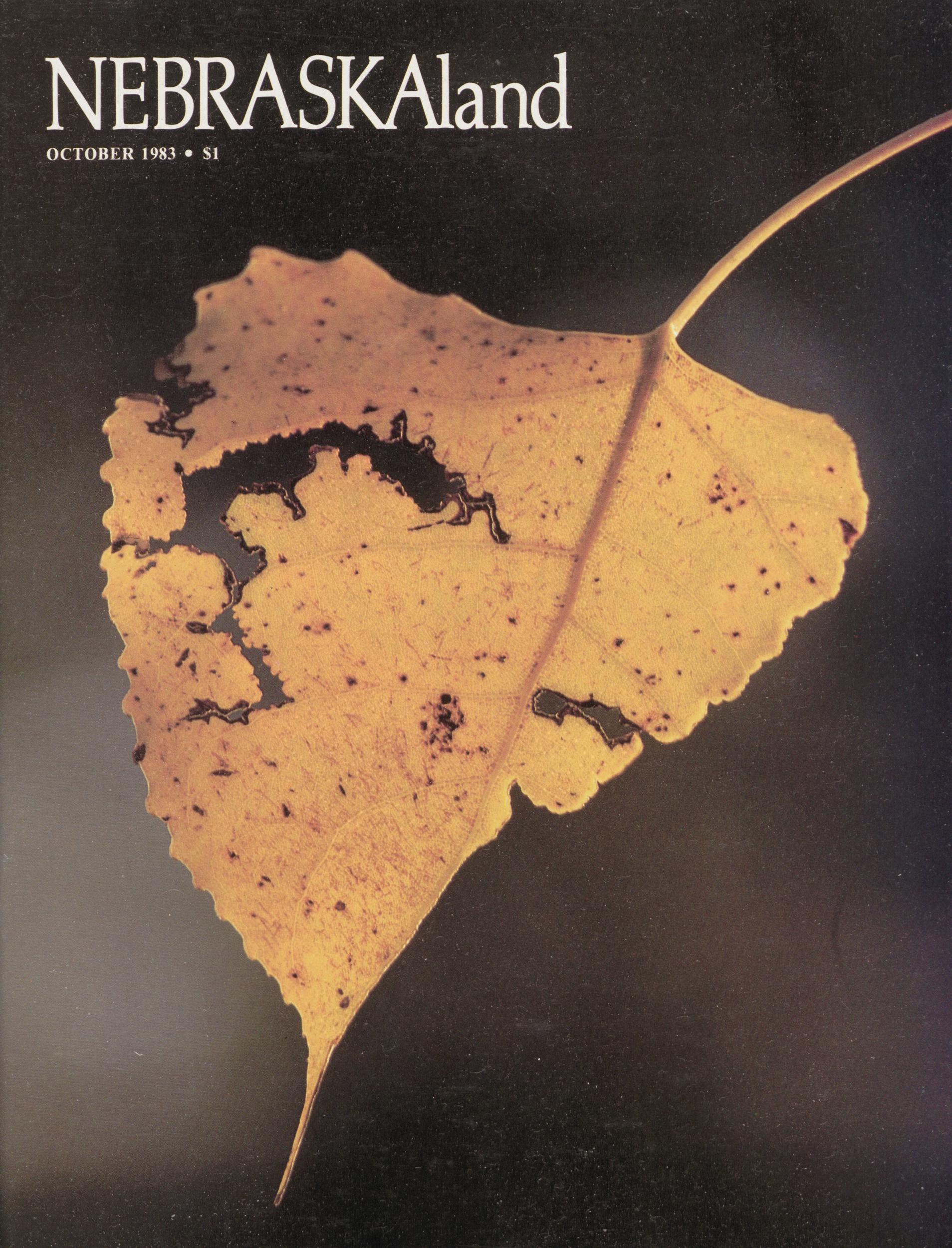
Contents Features DOG DOCTORING (Part 2) 6 FISHING FOR NEBRASKA SHARKS 10 SENTINELS ON THE TRAIL 16 MINATARE'S MYSTERY WALLEYE 22 WELLFLEET ON THE MEDICINE 26 RETURN OF THE CANADAS 32 HAUNTED DUCKS 40 Departments SPEAK UP 4 TRADING POST 49 BOOK REVIEW 50 COVER: As the days grow shorter and the nights cooler, the colors of Autumn begin to sweep across Nebraska, first touching the cottonwoods and ash of the Pine Ridge's creeks and valleys, and later, the oaks and hickories of the southeastern portion of the state. OPPOSITE: Morning fogs cling to the Missouri River, and the river road at Indian Cave State Park seems to lead to an enchanted world. Photographs by Jon Farrar. 3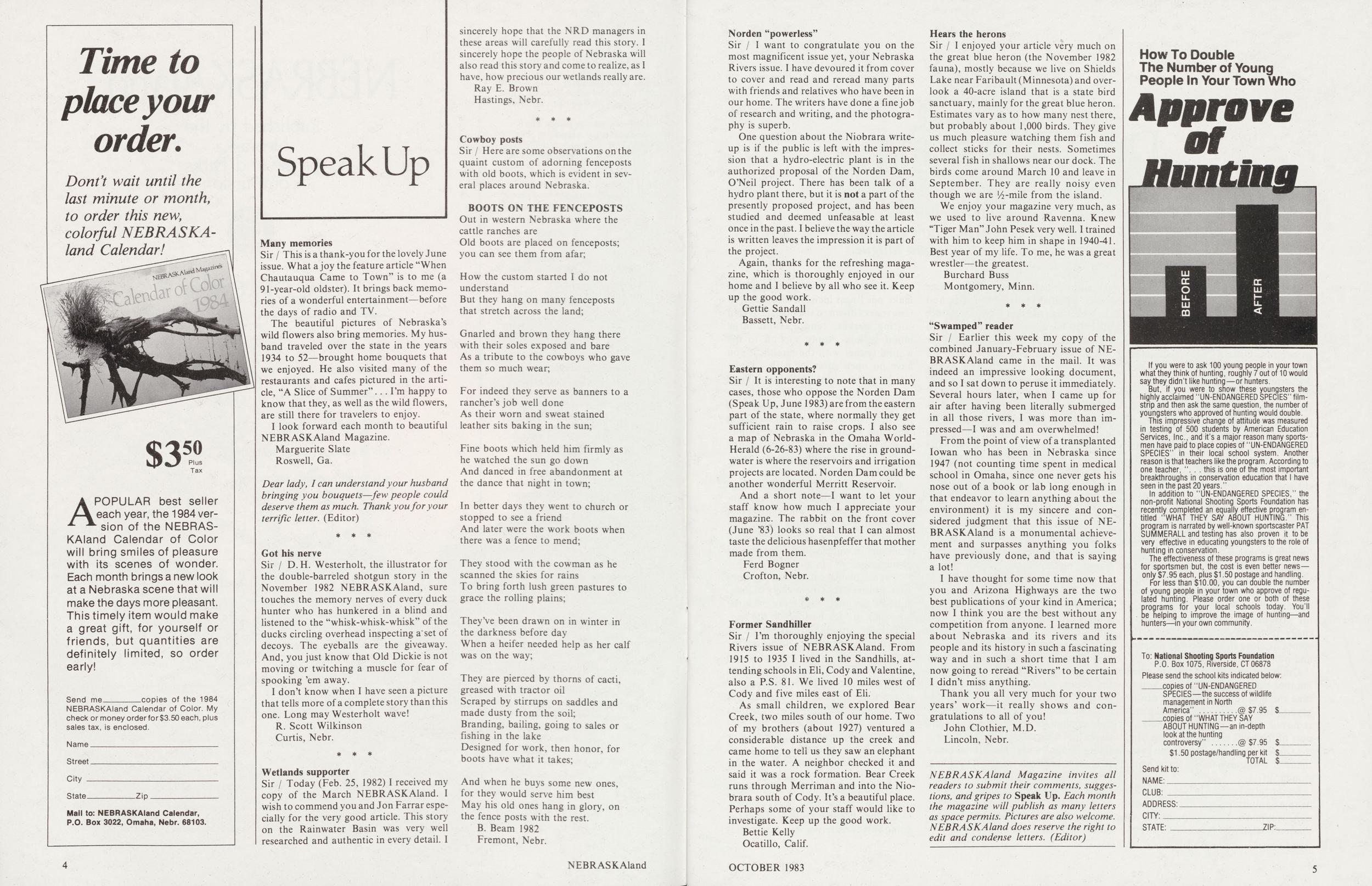
Speak Up
Many memoriesSir / This is a thank-you for the lovely June issue. What a joy the feature article "When Chautauqua Came to Town" is to me (a 91-year-old oldster). It brings back memories of a wonderful entertainment—before the days of radio and TV.
The beautiful pictures of Nebraska's wild flowers also bring memories. My husband traveled over the state in the years 1934 to 52—brought home bouquets that we enjoyed. He also visited many of the restaurants and cafes pictured in the article, "A Slice of Summer" I'm happy to know that they, as well as the wild flowers, are still there for travelers to enjoy.
I look forward each month to beautiful NEBRASKAland Magazine.
Marguerite SlateRoswell, Ga.
Dear lady, I can understand your husband bringing you bouquets—few people could deserve them as much. Thank you for your terrific letter. (Editor)
Got his nerveSir / D. H. Westerholt, the illustrator for the double-barreled shotgun story in the November 1982 NEBRASKAland, sure touches the memory nerves of every duck hunter who has hunkered in a blind and listened to the "whisk-whisk-whisk" of the ducks circling overhead inspecting a'set of decoys. The eyeballs are the giveaway. And, you just know that Old Dickie is not moving or twitching a muscle for fear of spooking 'em away.
I don't know when I have seen a picture that tells more of a complete story than this one. Long may Westerholt wave!
R. Scott WilkinsonCurtis, Nebr.
Wetlands supporter
Sir / Today (Feb. 25, 1982) I received my copy of the March NEBRASKAland. I wish to commend you and Jon Farrar especially for the very good article. This story on the Rainwater Basin was very well researched and authentic in every detail. I sincerely hope that the NRD managers in these areas will carefully read this story. I sincerely hope the people of Nebraska will also read this story and come to realize, as I have, how precious our wetlands really are.
Ray E. BrownHastings, Nebr.
Cowboy posts
Sir / Here are some observations on the quaint custom of adorning fenceposts with old boots, which is evident in several places around Nebraska.
BOOTS ON THE FENCEPOSTSOut in western Nebraska where the
cattle ranches are
Old boots are placed on fenceposts;
you can see them from afar;
How the custom started I do not
understand
But they hang on many fenceposts
that stretch across the land;
Gnarled and brown they hang there
with their soles exposed and bare
As a tribute to the cowboys who gave
them so much wear;
For indeed they serve as banners to a
rancher's job well done
As their worn and sweat stained
leather sits baking in the sun;
Fine boots which held him firmly as
he watched the sun go down
And danced in free abandonment at
the dance that night in town;
In better days they went to church or
stopped to see a friend
And later were the work boots when
there was a fence to mend;
They stood with the cowman as he
scanned the skies for rains
To bring forth lush green pastures to
grace the rolling plains;
They've been drawn on in winter in
the darkness before day
When a heifer needed help as her calf
was on the way;
They are pierced by thorns of cacti,
greased with tractor oil
Scraped by stirrups on saddles and
made dusty from the soil;
Branding, bailing, going to sales
or fishing in the lake
Designed for work, then honor, for
boots have what it takes;
And when he buys some new ones,
for they would serve him best
May his old ones hang in glory, on
the fence posts with the rest.
Fremont, Nebr.
4 NEBRASKAland Norden "powerless"
Sir / I want to congratulate you on the most magnificent issue yet, your Nebraska Rivers issue. I have devoured it from cover to cover and read and reread many parts with friends and relatives who have been in our home. The writers have done a fine job of research and writing, and the photography is superb.
One question about the Niobrara write-up is if the public is left with the impression that a hydro-electric plant is in the authorized proposal of the Norden Dam, O'Neil project. There has been talk of a hydro plant there, but it is not a part of the presently proposed project, and has been studied and deemed unfeasable at least once in the past. I believe the way the article is written leaves the impression it is part of the project.
Again, thanks for the refreshing magazine, which is thoroughly enjoyed in our home and I believe by all who see it. Keep up the good work.
Gettie SandallBassett, Nebr.
Eastern opponents?
Sir / It is interesting to note that in many cases, those who oppose the Norden Dam (Speak Up, June 1983) are from the eastern part of the state, where normally they get sufficient rain to raise crops. I also see a map of Nebraska in the Omaha World-Herald (6-26-83) where the rise in groundwater is where the reservoirs and irrigation projects are located. Norden Dam could be another wonderful Merritt Reservoir.
And a short note—I want to let your staff know how much I appreciate your magazine. The rabbit on the front cover (June '83) looks so real that I can almost taste the delicious hasenpfeffer that mother made from them.
Ferd BognerCrofton, Nebr.
Former Sandhiller
Sir / I'm thoroughly enjoying the special Rivers issue of NEBRASKAland. From 1915 to 1935 I lived in the Sandhills, attending schools in Eli, Cody and Valentine, also a P.S. 81. We lived 10 miles west of Cody and five miles east of Eli.
As small children, we explored Bear Creek, two miles south of our home. Two of my brothers (about 1927) ventured a considerable distance up the creek and came home to tell us they saw an elephant in the water. A neighbor checked it and said it was a rock formation. Bear Creek runs through Merriman and into the Niobrara south of Cody. It's a beautiful place. Perhaps some of your staff would like to investigate. Keep up the good work.
Bettie KellyOcatillo, Calif.
Hears the herons
Sir / I enjoyed your article very much on the great blue heron (the November 1982 fauna), mostly because we live on Shields Lake near Faribault (Minnesota) and overlook a 40-acre island that is a state bird sanctuary, mainly for the great blue heron. Estimates vary as to how many nest there, but probably about 1,000 birds. They give us much pleasure watching them fish and collect sticks for their nests. Sometimes several fish in shallows near our dock. The birds come around March 10 and leave in September. They are really noisy even though we are l^-mile from the island. We enjoy your magazine very much, as we used to live around Ravenna. Knew "Tiger Man" John Pesek very well. I trained with him to keep him in shape in 1940-41. Best year of my life. To me, he was a great wrestler—the greatest.
Burchard BussMontgomery, Minn.
Swamped" reader
Sir / Earlier this week my copy of the combined January-February issue of NEBRASKAland came in the mail. It was indeed an impressive looking document, and so I sat down to peruse it immediately. Several hours later, when I came up for air after having been literally submerged in all those rivers, I was more than impressed—I was and am overwhelmed!
From the point of view of a transplanted Iowan who has been in Nebraska since 1947 (not counting time spent in medical school in Omaha, since one never gets his nose out of a book or lab long enough in that endeavor to learn anything about the environment) it is my sincere and considered judgment that this issue of NEBRASKAland is a monumental achievement and surpasses anything you folks have previously done, and that is saying a lot!
I have thought for some time now that you and Arizona Highways are the two best publications of your kind in America; now I think you are the best without any competition from anyone. I learned more about Nebraska and its rivers and its people and its history in such a fascinating way and in such a short time that I am now going to reread "Rivers" to be certain I didn't miss anything.
Thank you all very much for your two years' work—it really shows and congratulations to all of you!
John Clothier, M.D.Lincoln, Nebr.
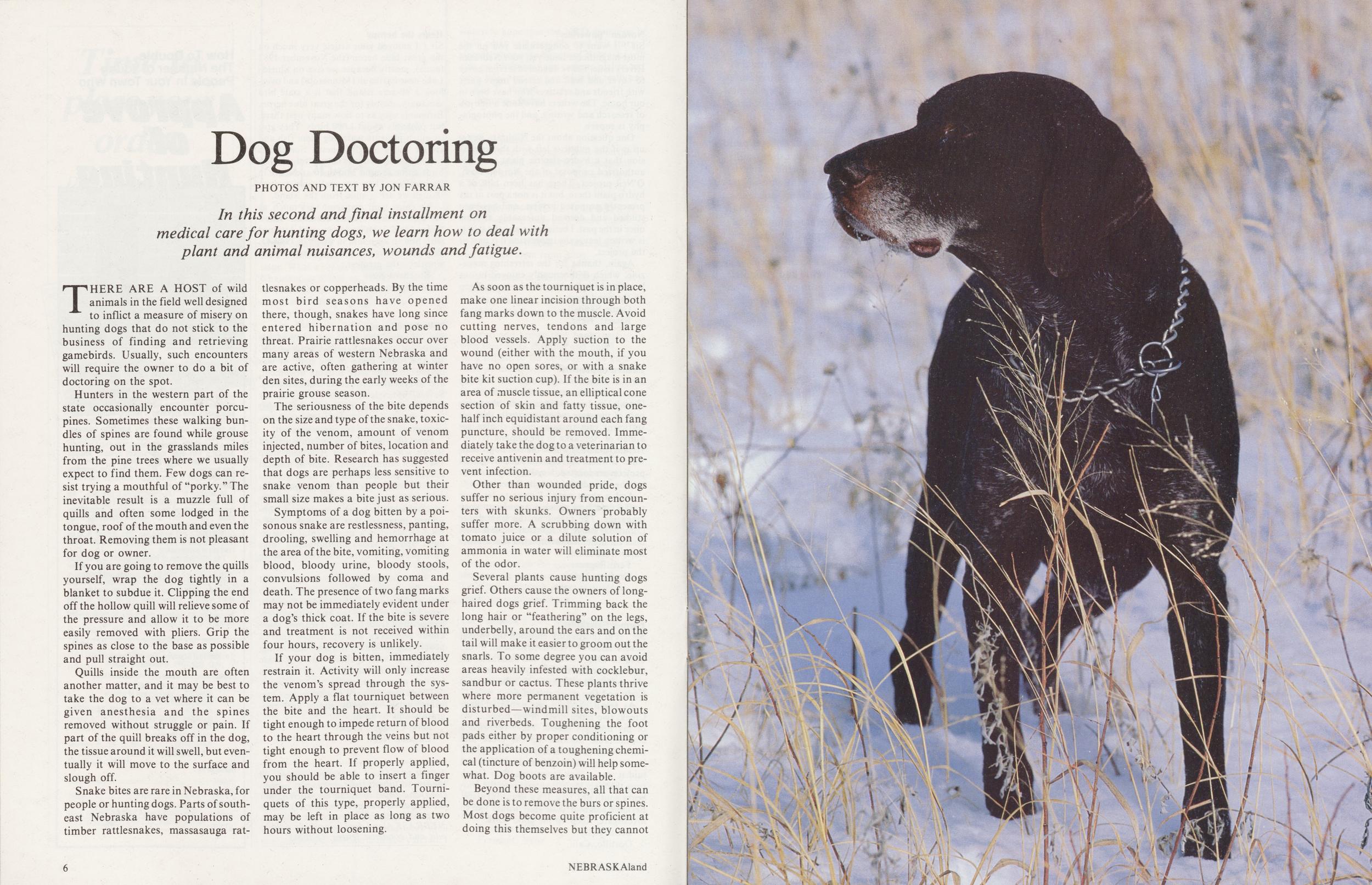
Dog Doctoring
In this second and final installment on medical care for hunting dogs, we learn how to deal with plant and animal nuisances, wounds and fatigue.THERE ARE A HOST of wild animals in the field well designed to inflict a measure of misery on hunting dogs that do not stick to the business of finding and retrieving gamebirds. Usually, such encounters will require the owner to do a bit of doctoring on the spot.
Hunters in the western part of the state occasionally encounter porcupines. Sometimes these walking bundles of spines are found while grouse hunting, out in the grasslands miles from the pine trees where we usually expect to find them. Few dogs can resist trying a mouthful of "porky." The inevitable result is a muzzle full of quills and often some lodged in the tongue, roof of the mouth and even the throat. Removing them is not pleasant for dog or owner.
If you are going to remove the quills yourself, wrap the dog tightly in a blanket to subdue it. Clipping the end off the hollow quill will relieve some of the pressure and allow it to be more easily removed with pliers. Grip the spines as close to the base as possible and pull straight out.
Quills inside the mouth are often another matter, and it may be best to take the dog to a vet where it can be given anesthesia and the spines removed without struggle or pain. If part of the quill breaks off in the dog, the tissue around it will swell, but eventually it will move to the surface and slough off.
Snake bites are rare in Nebraska, for people or hunting dogs. Parts of southeast Nebraska have populations of timber rattlesnakes, massasauga rattlesnakes or copperheads. By the time most bird seasons have opened there, though, snakes have long since entered hibernation and pose no threat. Prairie rattlesnakes occur over many areas of western Nebraska and are active, often gathering at winter den sites, during the early weeks of the prairie grouse season.
The seriousness of the bite depends on the size and type of the snake, toxicity of the venom, amount of venom injected, number of bites, location and depth of bite. Research has suggested that dogs are perhaps less sensitive to snake venom than people but their small size makes a bite just as serious.
Symptoms of a dog bitten by a poisonous snake are restlessness, panting, drooling, swelling and hemorrhage at the area of the bite, vomiting, vomiting blood, bloody urine, bloody stools, convulsions followed by coma and death. The presence of two fang marks may not be immediately evident under a dog's thick coat. If the bite is severe and treatment is not received within four hours, recovery is unlikely.
If your dog is bitten, immediately restrain it. Activity will only increase the venom's spread through the system. Apply a flat tourniquet between the bite and the heart. It should be tight enough to impede return of blood to the heart through the veins but not tight enough to prevent flow of blood from the heart. If properly applied, you should be able to insert a finger under the tourniquet band. Tourniquets of this type, properly applied, may be left in place as long as two hours without loosening.
As soon as the tourniquet is in place, make one linear incision through both fang marks down to the muscle. Avoid cutting nerves, tendons and large blood vessels. Apply suction to the wound (either with the mouth, if you have no open sores, or with a snake bite kit suction cup). If the bite is in an area of muscle tissue, an elliptical cone section of skin and fatty tissue, one-half inch equidistant around each fang puncture, should be removed. Immediately take the dog to a veterinarian to receive antivenin and treatment to prevent infection.
Other than wounded pride, dogs suffer no serious injury from encounters with skunks. Owners probably suffer more. A scrubbing down with tomato juice or a dilute solution of ammonia in water will eliminate most of the odor.
Several plants cause hunting dogs grief. Others cause the owners of long-haired dogs grief. Trimming back the long hair or "feathering" on the legs, underbelly, around the ears and on the tail will make it easier to groom out the snarls. To some degree you can avoid areas heavily infested with cocklebur, sandbur or cactus. These plants thrive where more permanent vegetation is disturbed—windmill sites, blowouts and riverbeds. Toughening the foot pads either by proper conditioning or the application of a toughening chemical (tincture of benzoin) will help somewhat. Dog boots are available.
Beyond these measures, all that can be done is to remove the burs or spines. Most dogs become quite proficient at doing this themselves but they cannot
6 NEBRASKAland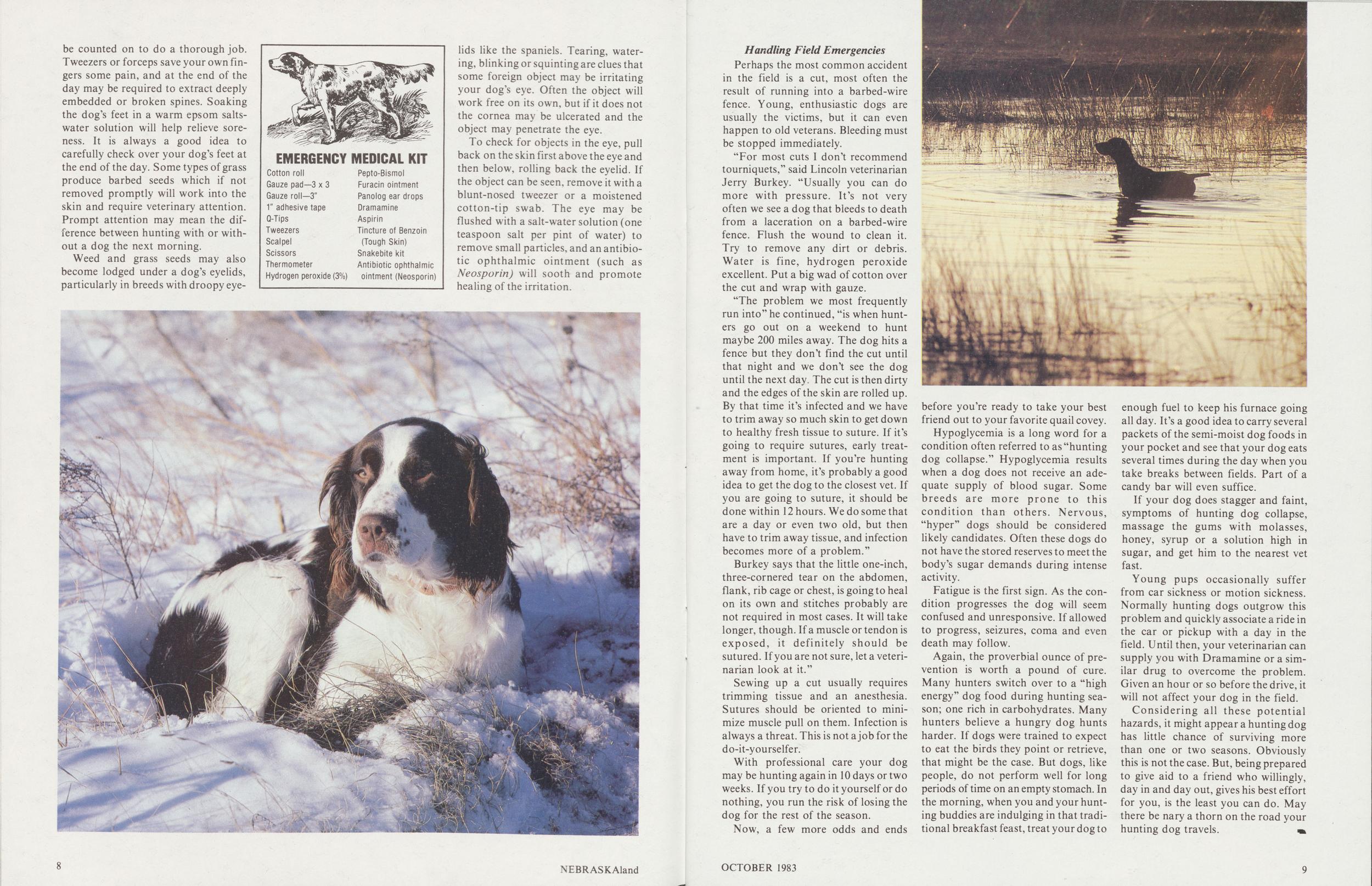
be counted on to do a thorough job. Tweezers or forceps save your own fingers some pain, and at the end of the day may be required to extract deeply embedded or broken spines. Soaking the dog's feet in a warm epsom salts-water solution will help relieve soreness. It is always a good idea to carefully check over your dog's feet at the end of the day. Some types of grass produce barbed seeds which if not removed promptly will work into the skin and require veterinary attention. Prompt attention may mean the difference between hunting with or without a dog the next morning.
Weed and grass seeds may also become lodged under a dog's eyelids, particularly in breeds with droopy eyelids
EMERGENCY Cotton roll Gauze pad—3 x 3 Gauze roll—3" 1" adhesive tape Q-Tips Tweezers Scalpel Scissors Thermometer Hydrogen peroxide (3%) MEDICAL KIT Pepto-Bismol Furacin ointment Panolog ear drops Dramamine Aspirin Tincture of Benzoin (Tough Skin) Snakebite kit Antibiotic ophthalmic ointment (Neosporin)like the spaniels. Tearing, watering, blinking or squinting are clues that some foreign object may be irritating your dog's eye. Often the object will work free on its own, but if it does not the cornea may be ulcerated and the object may penetrate the eye.
To check for objects in the eye, pull back on the skin first above the eye and then below, rolling back the eyelid. If the object can be seen, remove it with a blunt-nosed tweezer or a moistened cotton-tip swab. The eye may be flushed with a salt-water solution (one teaspoon salt per pint of water) to remove small particles, and an antibiotic ophthalmic ointment (such as Neosporin) will sooth and promote healing of the irritation.
Perhaps the most common accident in the field is a cut, most often the result of running into a barbed-wire fence. Young, enthusiastic dogs areusually the victims, but it can even happen to old veterans. Bleeding must be stopped immediately.
"For most cuts I don't recommend tourniquets," said Lincoln veterinarian Jerry Burkey. "Usually you can do more with pressure. It's not very often we see a dog that bleeds to death from a laceration on a barbed-wire fence. Flush the wound to clean it. Try to remove any dirt or debris. Water is fine, hydrogen peroxide excellent. Put a big wad of cotton over the cut and wrap with gauze.
"The problem we most frequently run into" he continued, "is when hunters go out on a weekend to hunt maybe 200 miles away. The dog hits a fence but they don't find the cut until that night and we don't see the dog until the next day. The cut is then dirty and the edges of the skin are rolled up. By that time it's infected and we have to trim away so much skin to get down to healthy fresh tissue to suture. If it's going to require sutures, early treatment is important. If you're hunting away from home, it's probably a good idea to get the dog to the closest vet. If you are going to suture, it should be done within 12 hours. We do some that are a day or even two old, but then have to trim away tissue, and infection becomes more of a problem."
Burkey says that the little one-inch, three-cornered tear on the abdomen, flank, rib cage or chest, is going to heal on its own and stitches probably are not required in most cases. It will take longer, though. If a muscle or tendon is exposed, it definitely should be sutured. If you are not sure, let a veterinarian look at it."
Sewing up a cut usually requires trimming tissue and an anesthesia. Sutures should be oriented to minimize muscle pull on them. Infection is always a threat. This is not a job for the do-it-yourselfer.
With professional care your dog may be hunting again in 10 days or two weeks. If you try to do it yourself or do nothing, you run the risk of losing the dog for the rest of the season.
Now, a few more odds and ends
before you're ready to take your best friend out to your favorite quail covey.
Hypoglycemia is a long word for a condition often referred to as "hunting dog collapse." Hypoglycemia results when a dog does not receive an adequate supply of blood sugar. Some breeds are more prone to this condition than others. Nervous, "hyper" dogs should be considered likely candidates. Often these dogs do not have the stored reserves to meet the body's sugar demands during intense activity.
Fatigue is the first sign. As the condition progresses the dog will seem confused and unresponsive. If allowed to progress, seizures, coma and even death may follow.
Again, the proverbial ounce of prevention is worth a pound of cure. Many hunters switch over to a "high energy" dog food during hunting season; one rich in carbohydrates. Many hunters believe a hungry dog hunts harder. If dogs were trained to expect to eat the birds they point or retrieve, that might be the case. But dogs, like people, do not perform well for long periods of time on an empty stomach. In the morning, when you and your hunting buddies are indulging in that traditional breakfast feast, treat your dog to enough fuel to keep his furnace going all day. It's a good idea to carry several packets of the semi-moist dog foods in your pocket and see that your dog eats several times during the day when you take breaks between fields. Part of a candy bar will even suffice.
If your dog does stagger and faint, symptoms of hunting dog collapse, massage the gums with molasses, honey, syrup or a solution high in sugar, and get him to the nearest vet fast.
Young pups occasionally suffer from car sickness or motion sickness. Normally hunting dogs outgrow this problem and quickly associate a ride in the car or pickup with a day in the field. Until then, your veterinarian can supply you with Dramamine or a similar drug to overcome the problem. Given an hour or so before the drive, it will not affect your dog in the field.
Considering all these potential hazards, it might appear a hunting dog has little chance of surviving more than one or two seasons. Obviously this is not the case. But, being prepared to give aid to a friend who willingly, day in and day out, gives his best effort for you, is the least you can do. May there be nary a thorn on the road your hunting dog travels.
OCTOBER 1983 9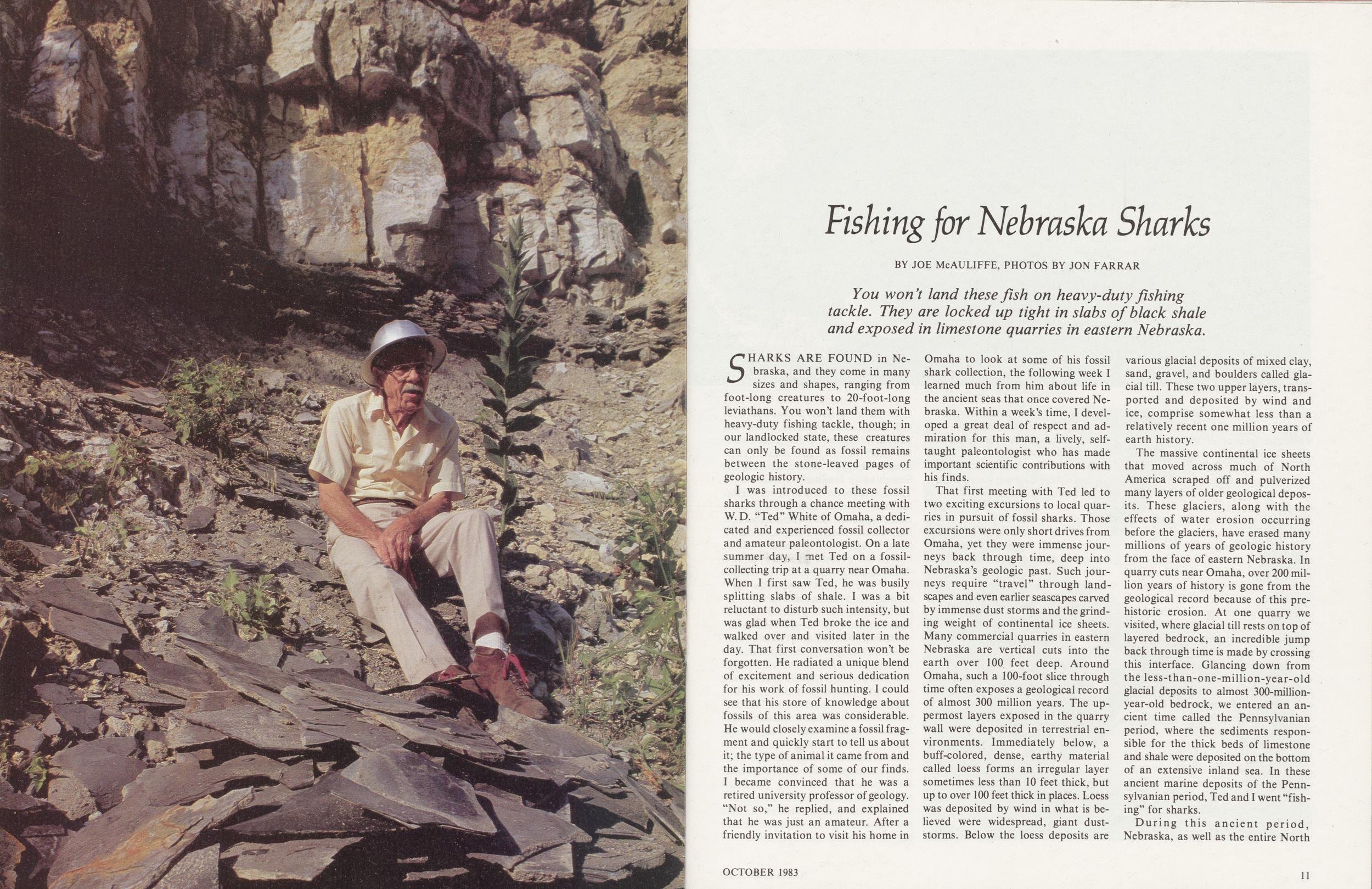
Fishing for Nebraska Sharks
You won't land these fish on heavy-duty fishing tackle. They are locked up tight in slabs of black shale and exposed in limestone quarries in eastern Nebraska.SHARKS ARE FOUND in Nebraska, and they come in many sizes and shapes, ranging from foot-long creatures to 20-foot-long leviathans. You won't land them with heavy-duty fishing tackle, though; in our landlocked state, these creatures can only be found as fossil remains between the stone-leaved pages of geologic history.
I was introduced to these fossil sharks through a chance meeting with W. D. "Ted" White of Omaha, a dedicated and experienced fossil collector and amateur paleontologist. On a late summer day, I met Ted on a fossil-collecting trip at a quarry near Omaha. When I first saw Ted, he was busily splitting slabs of shale. I was a bit reluctant to disturb such intensity, but was glad when Ted broke the ice and walked over and visited later in the day. That first conversation won't be forgotten. He radiated a unique blend of excitement and serious dedication for his work of fossil hunting. I could see that his store of knowledge about fossils of this area was considerable. He would closely examine a fossil fragment and quickly start to tell us about it; the type of animal it came from and the importance of some of our finds. I became convinced that he was a retired university professor of geology. "Not so," he replied, and explained that he was just an amateur. After a friendly invitation to visit his home in Omaha to look at some of his fossil shark collection, the following week I learned much from him about life in the ancient seas that once covered Nebraska. Within a week's time, I developed a great deal of respect and admiration for this man, a lively, self-taught paleontologist who has made important scientific contributions with his finds.
That first meeting with Ted led to two exciting excursions to local quarries in pursuit of fossil sharks. Those excursions were only short drives from Omaha, yet they were immense journeys back through time, deep into Nebraska's geologic past. Such journeys require "travel" through landscapes and even earlier seascapes carved by immense dust storms and the grinding weight of continental ice sheets Many commercial quarries in eastern Nebraska are vertical cuts into the earth over 100 feet deep. Around Omaha, such a 100-foot slice through time often exposes a geological record of almost 300 million years. The uppermost layers exposed in the quarry wall were deposited in terrestrial environments. Immediately below, a buff-colored, dense, earthy material called loess forms an irregular layer sometimes less than 10 feet thick, but up to over 100 feet thick in places. Loess was deposited by wind in what is believed were widespread, giant duststorms. Below the loess deposits are various glacial deposits of mixed clay, sand, gravel, and boulders called glacial till. These two upper layers, transported and deposited by wind and ice, comprise somewhat less than a relatively recent one million years of earth history.
The massive continental ice sheets that moved across much of North America scraped off and pulverized many layers of older geological deposits. These glaciers, along with the effects of water erosion occurring before the glaciers, have erased many millions of years of geologic history from the face of eastern Nebraska. In quarry cuts near Omaha, over 200 million years of history is gone from the geological record because of this pre-historic erosion. At one quarry we visited, where glacial till rests on top of layered bedrock, an incredible jump back through time is made by crossing this interface. Glancing down from the less-than-one-million-year-old glacial deposits to almost 300-million-year-old bedrock, we entered an ancient time called the Pennsylvanian period, where the sediments responsible for the thick beds of limestone and shale were deposited on the bottom of an extensive inland sea. In these ancient marine deposits of the Pennsylvanian period, Ted and I went "fishing" for sharks.
During this ancient period, Nebraska, as well as the entire North
OCTOBER 1983 11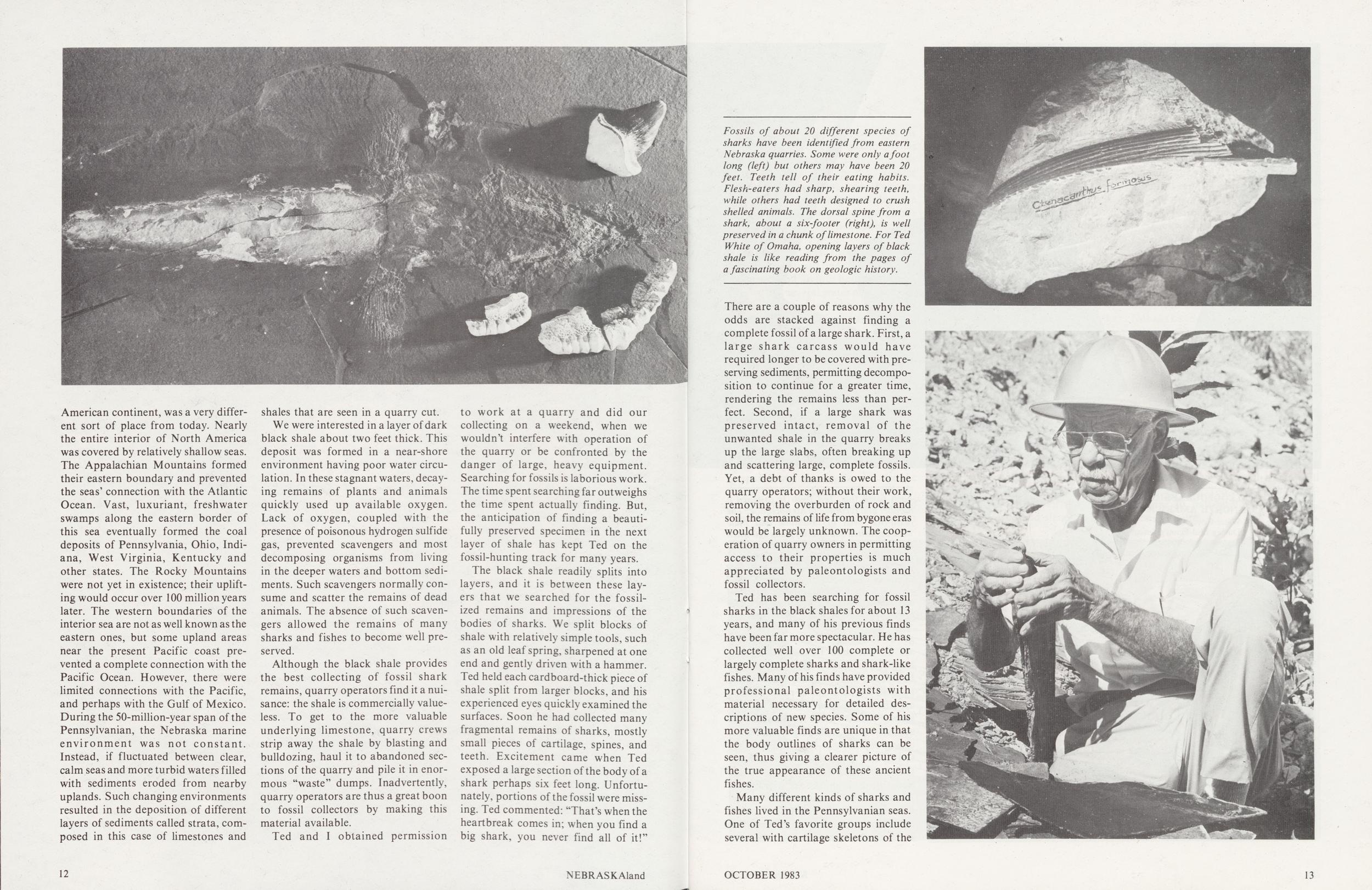
American continent, was a very different sort of place from today. Nearly the entire interior of North America was covered by relatively shallow seas. The Appalachian Mountains formed their eastern boundary and prevented the seas' connection with the Atlantic Ocean. Vast, luxuriant, freshwater swamps along the eastern border of this sea eventually formed the coal deposits of Pennsylvania, Ohio, Indiana, West Virginia, Kentucky and other states. The Rocky Mountains were not yet in existence; their uplifting would occur over 100 million years later. The western boundaries of the interior sea are not as well known as the eastern ones, but some upland areas near the present Pacific coast prevented a complete connection with the Pacific Ocean. However, there were limited connections with the Pacific, and perhaps with the Gulf of Mexico. During the 50-million-year span of the Pennsylvanian, the Nebraska marine environment was not constant. Instead, if fluctuated between clear, calm seas and more turbid waters filled with sediments eroded from nearby uplands. Such changing environments resulted in the deposition of different layers of sediments called strata, composed in this case of limestones and shales that are seen in a quarry cut.
We were interested in a layer of dark black shale about two feet thick. This deposit was formed in a near-shore environment having poor water circulation. In these stagnant waters, decaying remains of plants and animals quickly used up available oxygen. Lack of oxygen, coupled with the presence of poisonous hydrogen sulfide gas, prevented scavengers and most decomposing organisms from living in the deeper waters and bottom sediments. Such scavengers normally consume and scatter the remains of dead animals. The absence of such scavengers allowed the remains of many sharks and fishes to become well preserved.
Although the black shale provides the best collecting of fossil shark remains, quarry operators find it a nuisance: the shale is commercially valueless. To get to the more valuable underlying limestone, quarry crews strip away the shale by blasting and bulldozing, haul it to abandoned sections of the quarry and pile it in enormous "waste" dumps. Inadvertently, quarry operators are thus a great boon to fossil collectors by making this material available.
Ted and I obtained permission to work at a quarry and did our collecting on a weekend, when we wouldn't interfere with operation of the quarry or be confronted by the danger of large, heavy equipment. Searching for fossils is laborious work. The time spent searching far outweighs the time spent actually finding. But, the anticipation of finding a beautifully preserved specimen in the next layer of shale has kept Ted on the fossil-hunting track for many years.
The black shale readily splits into layers, and it is between these layers that we searched for the fossilized remains and impressions of the bodies of sharks. We split blocks of shale with relatively simple tools, such as an old leaf spring, sharpened at one end and gently driven with a hammer. Ted held each cardboard-thick piece of shale split from larger blocks, and his experienced eyes quickly examined the surfaces. Soon he had collected many fragmental remains of sharks, mostly small pieces of cartilage, spines, and teeth. Excitement came when Ted exposed a large section of the body of a shark perhaps six feet long. Unfortunately, portions of the fossil were missing. Ted commented: "That's when the heartbreak comes in; when you find a big shark, you never find all of it!"
12 NEBRASKAlandFossils of about 20 different species of sharks have been identified from eastern Nebraska quarries. Some were only afoot long (left) but others may have been 20 feet. Teeth tell of their eating habits. Flesh-eaters had sharp, shearing teeth, while others had teeth designed to crush shelled animals. The dorsal spine from a shark, about a six-footer (right), is well preserved in a chunk of limestone. For Ted White of Omaha, opening layers of black shale is like reading from the pages of a fascinating book on geologic history.
There are a couple of reasons why the odds are stacked against finding a complete fossil of a large shark. First, a large shark carcass would have required longer to be covered with preserving sediments, permitting decomposition to continue for a greater time, rendering the remains less than perfect. Second, if a large shark was preserved intact, removal of the unwanted shale in the quarry breaks up the large slabs, often breaking up and scattering large, complete fossils. Yet, a debt of thanks is owed to the quarry operators; without their work, removing the overburden of rock and soil, the remains of life from bygone eras would be largely unknown. The cooperation of quarry owners in permitting access to their properties is much appreciated by paleontologists and fossil collectors.
Ted has been searching for fossil sharks in the black shales for about 13 years, and many of his previous finds have been far more spectacular. He has collected well over 100 complete or largely complete sharks and shark-like fishes. Many of his finds have provided professional paleontologists with material necessary for detailed descriptions of new species. Some of his more valuable finds are unique in that the body outlines of sharks can be seen, thus giving a clearer picture of the true appearance of these ancient fishes.
Many different kinds of sharks and fishes lived in the Pennsylvanian seas. One of Ted's favorite groups include several with cartilage skeletons of the
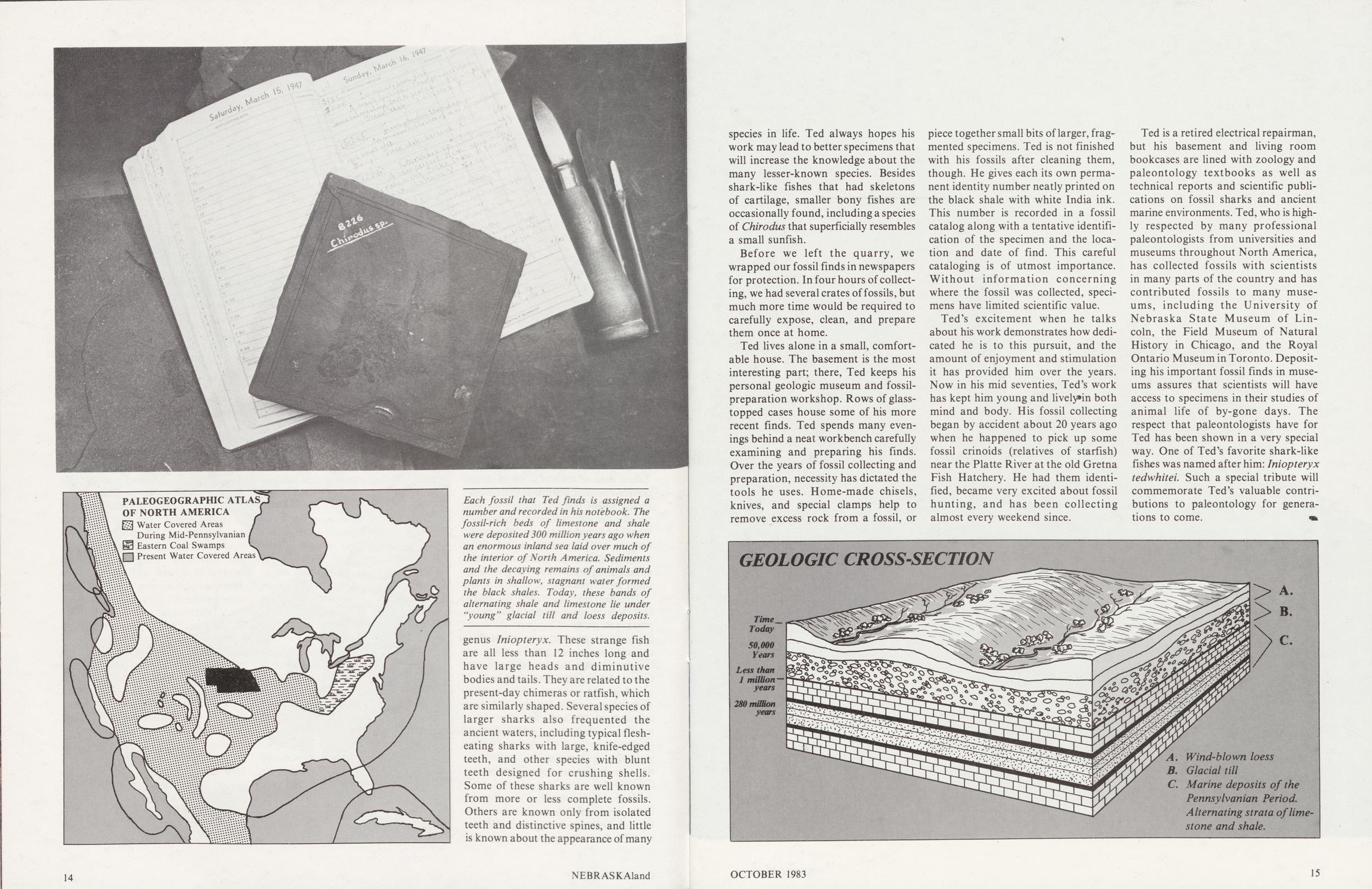
Each fossil that Ted finds is assigned a number and recorded in his notebook. The fossil-rich beds of limestone and shale were deposited 300 million years ago when an enormous inland sea laid over much of the interior of North America. Sediments and the decaying remains of animals and plants in shallow, stagnant water formed the black shales. Today, these bands of alternating shale and limestone lie under young" glacial till and loess deposits.
genus Iniopteryx. These strange fish are all less than 12 inches long and have large heads and diminutive bodies and tails. They are related to the present-day chimeras or ratfish, which are similarly shaped. Several species of larger sharks also frequented the ancient waters, including typical flesheating sharks with large, knife-edged teeth, and other species with blunt teeth designed for crushing shells. Some of these sharks are well known from more or less complete fossils. Others are known only from isolated teeth and distinctive spines, and little is known about the appearance of many
14 NEBRASKAlandspecies in life. Ted always hopes his work may lead to better specimens that will increase the knowledge about the many lesser-known species. Besides shark-like fishes that had skeletons of cartilage, smaller bony fishes are occasionally found, including a species of Chirodus that superficially resembles a small sunfish.
Before we left the quarry, we wrapped our fossil finds in newspapers for protection. In four hours of collecting, we had several crates of fossils, but much more time would be required to carefully expose, clean, and prepare them once at home.
Ted lives alone in a small, comfortable house. The basement is the most interesting part; there, Ted keeps his personal geologic museum and fossil-preparation workshop. Rows of glass-topped cases house some of his more recent finds. Ted spends many evenings behind a neat workbench carefully examining and preparing his finds. Over the years of fossil collecting and preparation, necessity has dictated the tools he uses. Home-made chisels, knives, and special clamps help to remove excess rock from a fossil, or piece together small bits of larger, fragmented specimens. Ted is not finished with his fossils after cleaning them, though. He gives each its own permanent identity number neatly printed on the black shale with white India ink. This number is recorded in a fossil catalog along with a tentative identification of the specimen and the location and date of find. This careful cataloging is of utmost importance. Without information concerning where the fossil was collected, specimens have limited scientific value.
Ted's excitement when he talks about his work demonstrates how dedicated he is to this pursuit, and the amount of enjoyment and stimulation it has provided him over the years. Now in his mid seventies, Ted's work has kept him young and lively»in both mind and body. His fossil collecting began by accident about 20 years ago when he happened to pick up some fossil crinoids (relatives of starfish) near the Platte River at the old Gretna Fish Hatchery. He had them identified, became very excited about fossil hunting, and has been collecting almost every weekend since.
Ted is a retired electrical repairman, but his basement and living room bookcases are lined with zoology and paleontology textbooks as well as technical reports and scientific publications on fossil sharks and ancient marine environments. Ted, who is highly respected by many professional paleontologists from universities and museums throughout North America, has collected fossils with scientists in many parts of the country and has contributed fossils to many museums, including the University of Nebraska State Museum of Lincoln, the Field Museum of Natural History in Chicago, and the Royal Ontario Museum in Toronto. Depositing his important fossil finds in museums assures that scientists will have access to specimens in their studies of animal life of by-gone days. The respect that paleontologists have for Ted has been shown in a very special way. One of Ted's favorite shark-like fishes was named after him: Iniopteryx tedwhitei. Such a special tribute will commemorate Ted's valuable contributions to paleontology for generations to come.
GEOLOGIC CROSS-SECTION Time Today 59,000 Years Less than 1 million years 280 million years A. Wind-blown loess B. Glacial till C. Marine deposits of the Pennsylvanian Period. Alternating strata of limestone and shale.
Sentinels on the trail
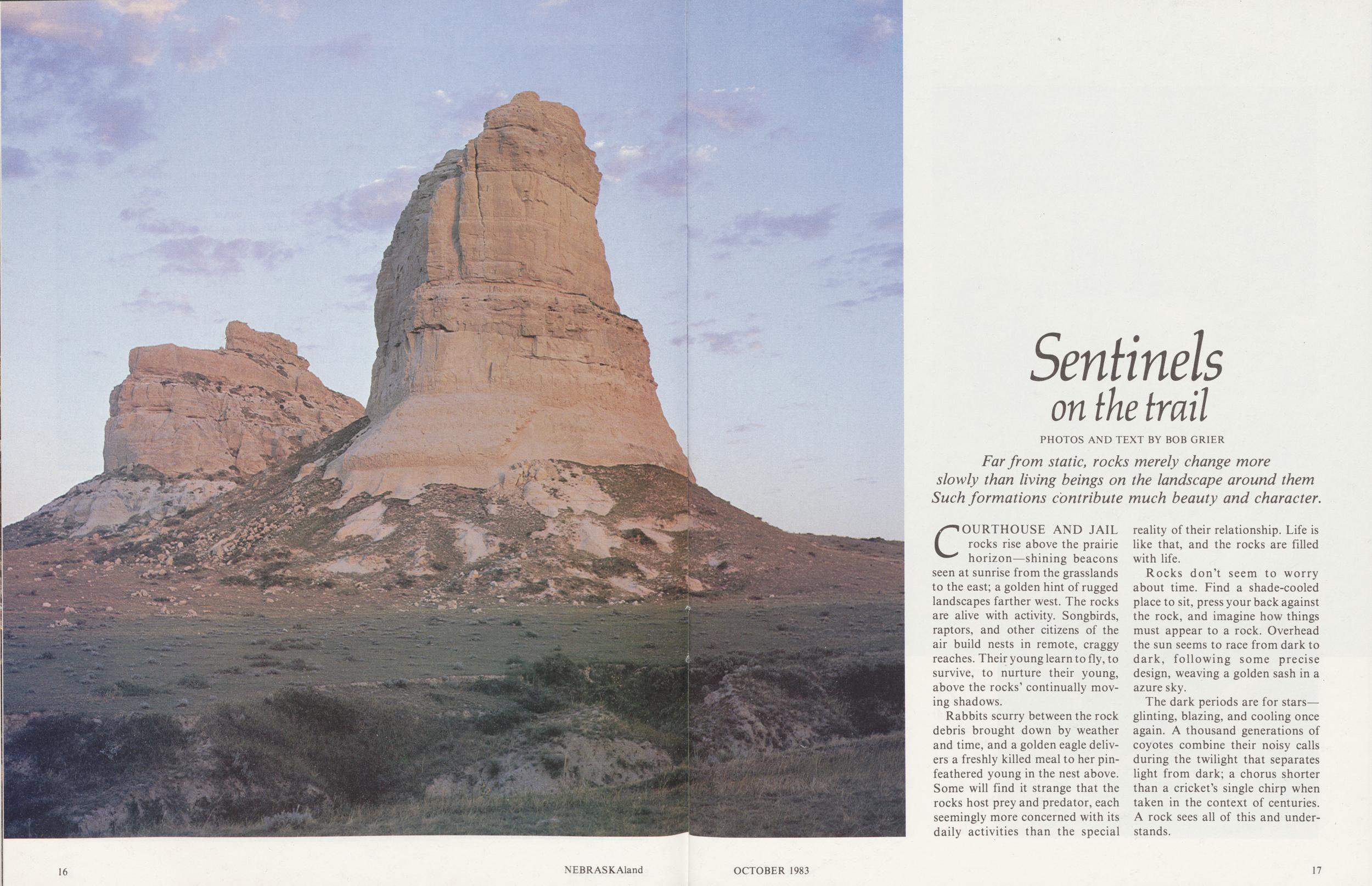
Far from static, rocks merely change more slowly than living beings on the landscape around them Such formations contribute much beauty and character.COURTHOUSE AND JAIL rocks rise above the prairie horizon—shining beacons seen at sunrise from the grasslands to the east; a golden hint of rugged landscapes farther west. The rocks are alive with activity. Songbirds, raptors, and other citizens of the air build nests in remote, craggy reaches. Their young learn to fly, to survive, to nurture their young, above the rocks' continually moving shadows.
Rabbits scurry between the rock debris brought down by weather and time, and a golden eagle delivers a freshly killed meal to her pinfeathered young in the nest above. Some will find it strange that the rocks host prey and predator, each seemingly more concerned with its daily activities than the special reality of their relationship. Life is like that, and the rocks are filled with life.
Rocks don't seem to worry about time. Find a shade-cooled place to sit, press your back against the rock, and imagine how things must appear to a rock. Overhead the sun seems to race from dark to dark, following some precise design, weaving a golden sash in a azure sky.
The dark periods are for stars—glinting, blazing, and cooling once again. A thousand generations of coyotes combine their noisy calls during the twilight that separates light from dark; a chorus shorter than a cricket's single chirp when taken in the context of centuries. A rock sees all of this and under-stands.
OCTOBER 1983 17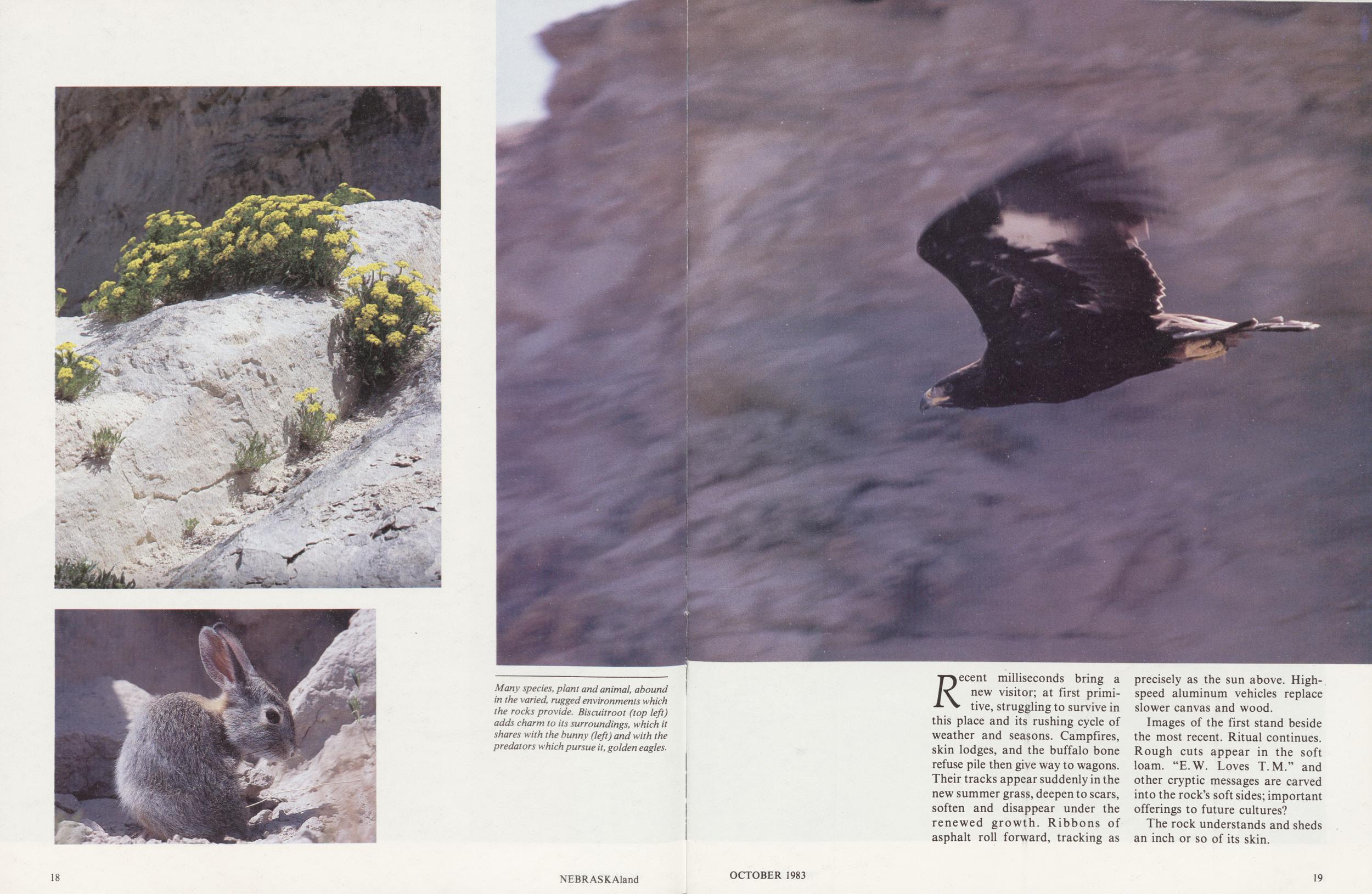
Many species, plant and animal, abound in the varied, rugged environments which the rocks provide. Biscuitroot (top left) adds charm to its surroundings, which it shares with the bunny (left) and with the predators which pursue it, golden eagles.
Recent milliseconds bring a new visitor; at first primitive, struggling to survive in this place and its rushing cycle of weather and seasons. Campfires, skin lodges, and the buffalo bone refuse pile then give way to wagons. Their tracks appear suddenly in the new summer grass, deepen to scars, soften and disappear under the renewed growth. Ribbons of asphalt roll forward, tracking as precisely as the sun above. Highspeed aluminum vehicles replace slower canvas and wood.
Images of the first stand beside the most recent. Ritual continues. Rough cuts appear in the soft loam. "E.W. Loves T.M." and other cryptic messages are carved into the rock's soft sides; important offerings to future cultures?
The rock understands and sheds an inch or so of its skin.
OCTOBER 1983 19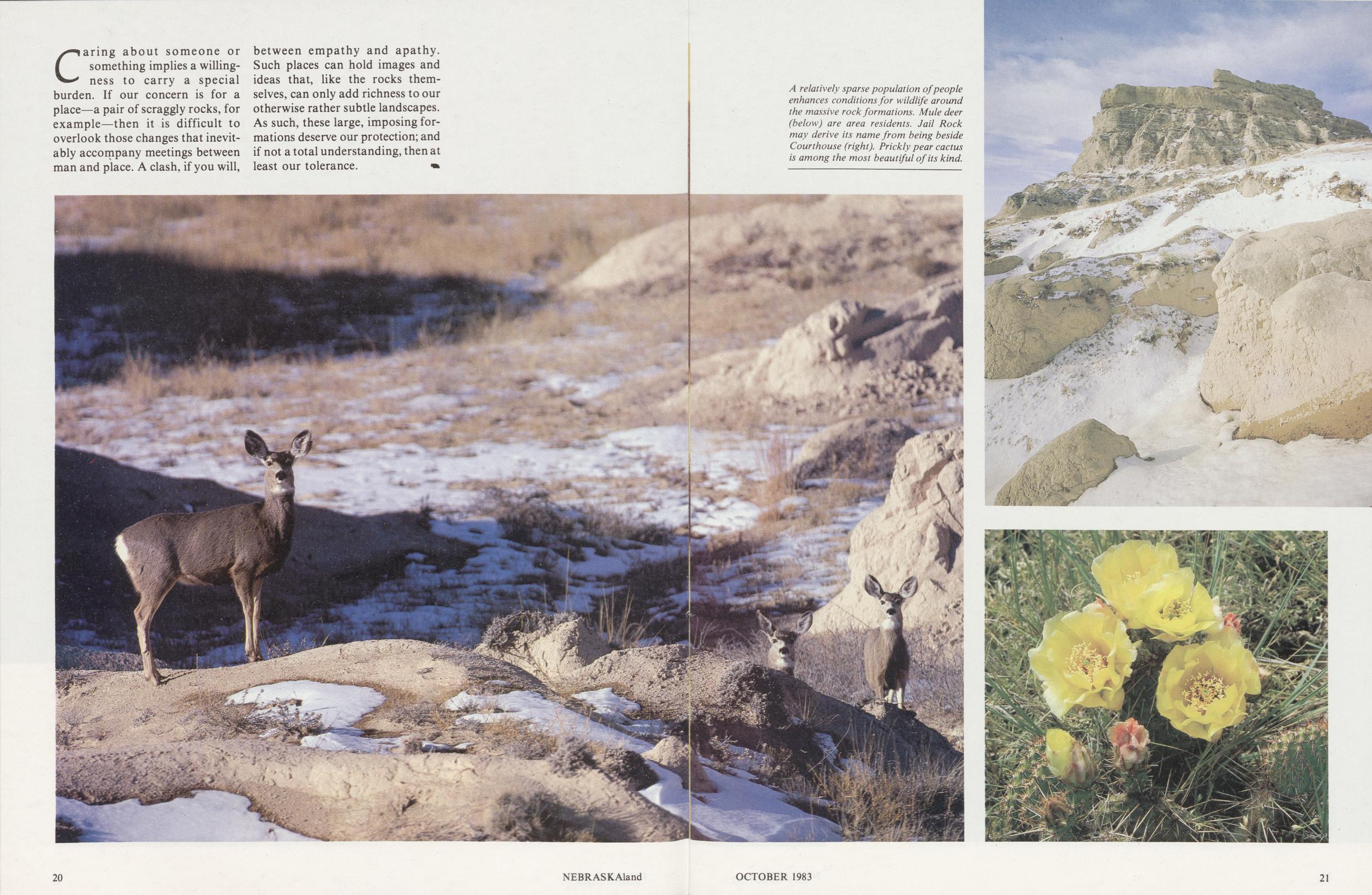
Caring about someone or something implies a willingness to carry a special burden. If our concern is for a place—a pair of scraggly rocks, for example—then it is difficult to overlook those changes that inevitably accompany meetings between man and place. A clash, if you will, between empathy and apathy. Such places can hold images and ideas that, like the rocks themselves, can only add richness to our otherwise rather subtle landscapes. As such, these large, imposing formations deserve our protection; and if not a total understanding, then at least our tolerance.
A relatively sparse population of people enhances conditions for wildlife around the massive rock formations. Mule deer (below) are area residents. Jail Rock may derive its name from being beside Courthouse (right). Prickly pear cactus is among the most beautiful of its kind.
MINATARE'S Mystery Walleye
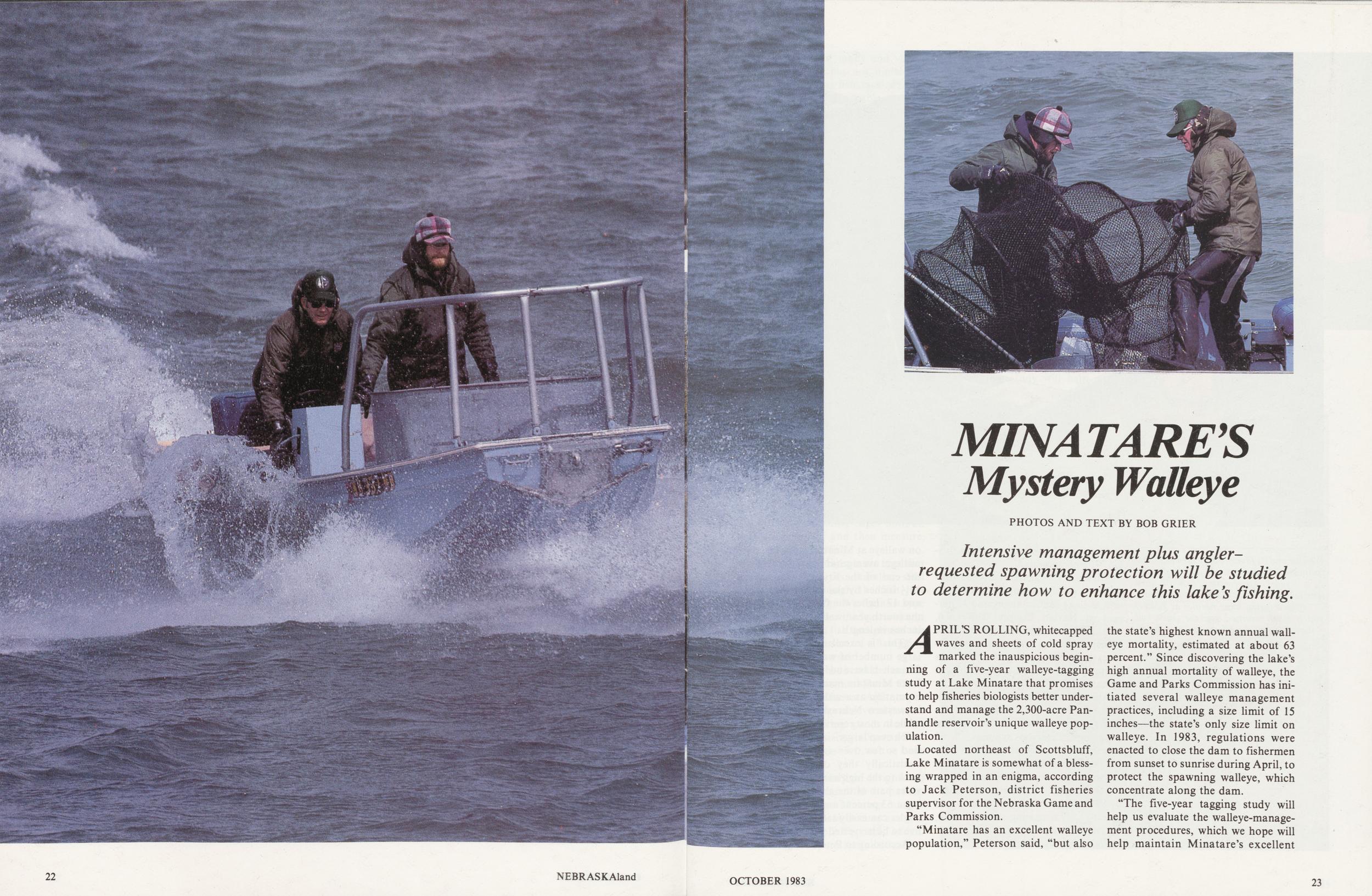
Intensive management plus angler-requested spawning protection will be studied to determine how to enhance this lake's fishing.APRIL'S ROLLING, whitecapped waves and sheets of cold spray marked the inauspicious beginning of a five-year walleye-tagging study at Lake Minatare that promises to help fisheries biologists better understand and manage the 2,300-acre Panhandle reservoir's unique walleye population.
Located northeast of Scottsbluff, Lake Minatare is somewhat of a blessing wrapped in an enigma, according to Jack Peterson, district fisheries supervisor for the Nebraska Game and Parks Commission.
"Minatare has an excellent walleye population," Peterson said, "but also the state's highest known annual walleye mortality, estimated at about 63 percent." Since discovering the lake's high annual mortality of walleye, the Game and Parks Commission has initiated several walleye management practices, including a size limit of 15 inches—the state's only size limit on walleye. In 1983, regulations were enacted to close the dam to fishermen from sunset to sunrise during April, to protect the spawning walleye, which concentrate along the dam.
"The five-year tagging study will help us evaluate the walleye-management procedures, which we hope will help maintain Minatare's excellent
OCTOBER 1983 23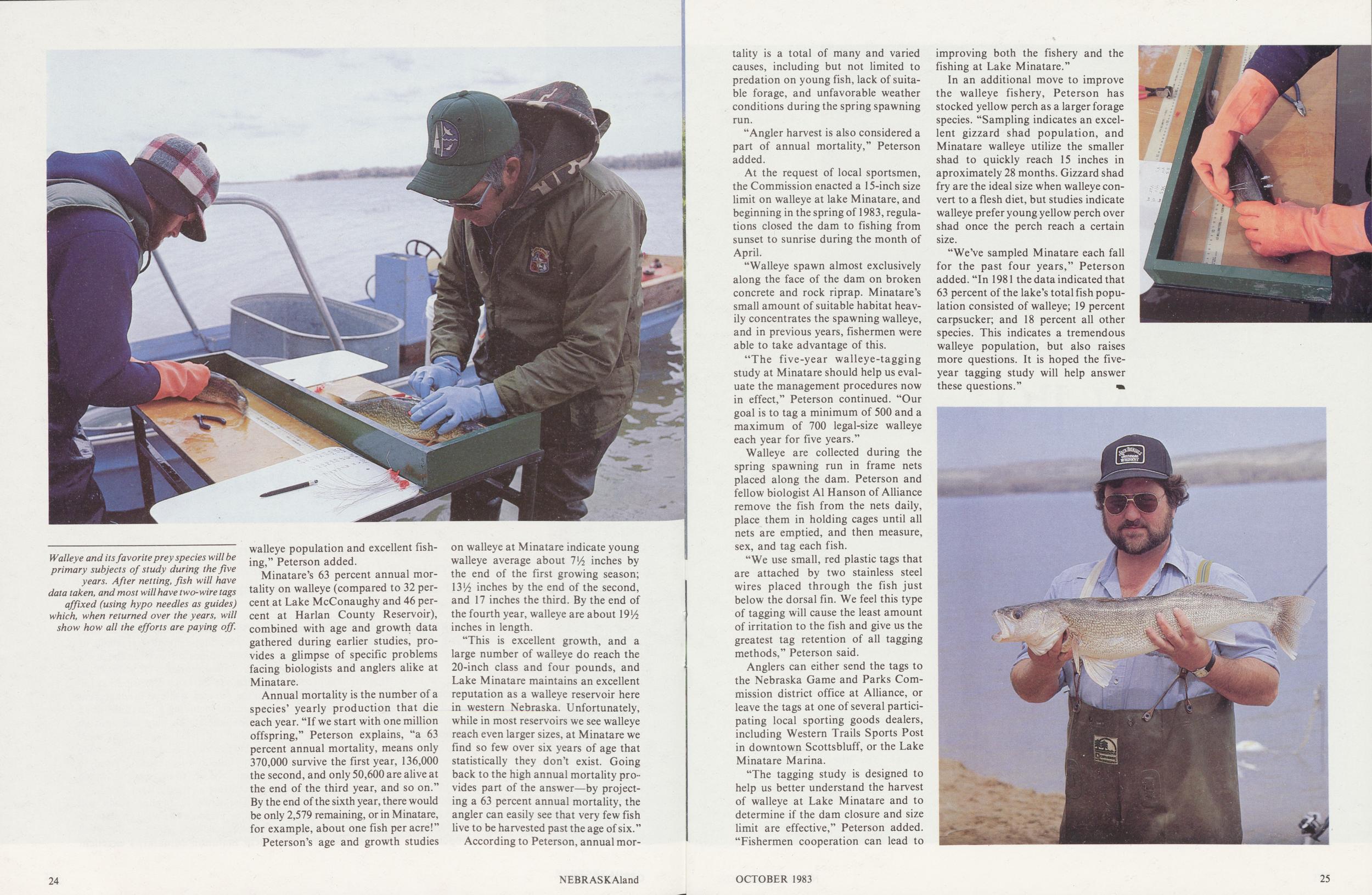
Walleye and its favorite prey species will be primary subjects of study during the five years. After netting, fish will have data taken, and most will have two-wire tags affixed (using hypo needles as guides) which, when returned over the years, will show how all the efforts are paying off.
walleye population and excellent fishing," Peterson added.
Minatare's 63 percent annual mortality on walleye (compared to 32 percent at Lake McConaughy and 46 percent at Harlan County Reservoir), combined with age and growth data gathered during earlier studies, provides a glimpse of specific problems facing biologists and anglers alike at Minatare.
Annual mortality is the number of a species' yearly production that die each year. "If we start with one million offspring," Peterson explains, "a 63 percent annual mortality, means only 370,000 survive the first year, 136,000 the second, and only 50,600 are alive at the end of the third year, and so on." By the end of the sixth year, there would be only 2,579 remaining, or in Minatare, for example, about one fish per acre!"
Peterson's age and growth studies on walleye at Minatare indicate young walleye average about 71/2 inches by the end of the first growing season; WA inches by the end of the second,and 17 inches the third. By the end of the fourth year, walleye are about 19 1/2 inches in length.
"This is excellent growth, and a large number of walleye do reach the 20-inch class and four pounds, and Lake Minatare maintains an excellent reputation as a walleye reservoir here in western Nebraska. Unfortunately, while in most reservoirs we see walleye reach even larger sizes, at Minatare we find so few over six years of age that statistically they don't exist. Going back to the high annual mortality provides part of the answer—by projecting a 63 percent annual mortality, the angler can easily see that very few fish live to be harvested past the age of six."
According to Peterson, annual mortality
24 NEBRASKAlandis a total of many and varied causes, including but not limited to predation on young fish, lack of suitable forage, and unfavorable weather conditions during the spring spawning run.
"Angler harvest is also considered a part of annual mortality," Peterson added.
At the request of local sportsmen, the Commission enacted a 15-inch size limit on walleye at lake Minatare, and beginning in the spring of 1983, regulations closed the dam to fishing from sunset to sunrise during the month of April.
"Walleye spawn almost exclusively along the face of the dam on broken concrete and rock riprap. Minatare's small amount of suitable habitat heavily concentrates the spawning walleye, and in previous years, fishermen were able to take advantage of this.
"The five-year walleye-tagging study at Minatare should help us evaluate the management procedures now in effect," Peterson continued. "Our goal is to tag a minimum of 500 and a maximum of 700 legal-size walleye each year for five years."
Walleye are collected during the spring spawning run in frame nets placed along the dam. Peterson and fellow biologist Al Hanson of Alliance remove the fish from the nets daily, place them in holding cages until all nets are emptied, and then measure, sex, and tag each fish.
"We use small, red plastic tags that are attached by two stainless steel wires placed through the fish just below the dorsal fin. We feel this type of tagging will cause the least amount of irritation to the fish and give us the greatest tag retention of all tagging methods," Peterson said.
Anglers can either send the tags to the Nebraska Game and Parks Commission district office at Alliance, or leave the tags at one of several participating local sporting goods dealers, including Western Trails Sports Post in downtown Scottsbluff, or the Lake Minatare Marina.
"The tagging study is designed to help us better understand the harvest of walleye at Lake Minatare and to determine if the dam closure and size limit are effective," Peterson added. "Fishermen cooperation can lead to improving both the fishery and the fishing at Lake Minatare."
In an additional move to improve the walleye fishery, Peterson has stocked yellow perch as a larger forage species. "Sampling indicates an excellent gizzard shad population, and Minatare walleye utilize the smaller shad to quickly reach 15 inches in aproximately 28 months. Gizzard shad fry are the ideal size when walleye convert to a flesh diet, but studies indicate walleye prefer young yellow perch over shad once the perch reach a certain size.
"We've sampled Minatare each fall for the past four years," Peterson added. "In 1981 the data indicated that 63 percent of the lake's total fish population consisted of walleye; 19 percent carpsucker; and 18 percent all other species. This indicates a tremendous walleye population, but also raises more questions. It is hoped the five-year tagging study will help answer these questions."
Wellfleet on the Medicine
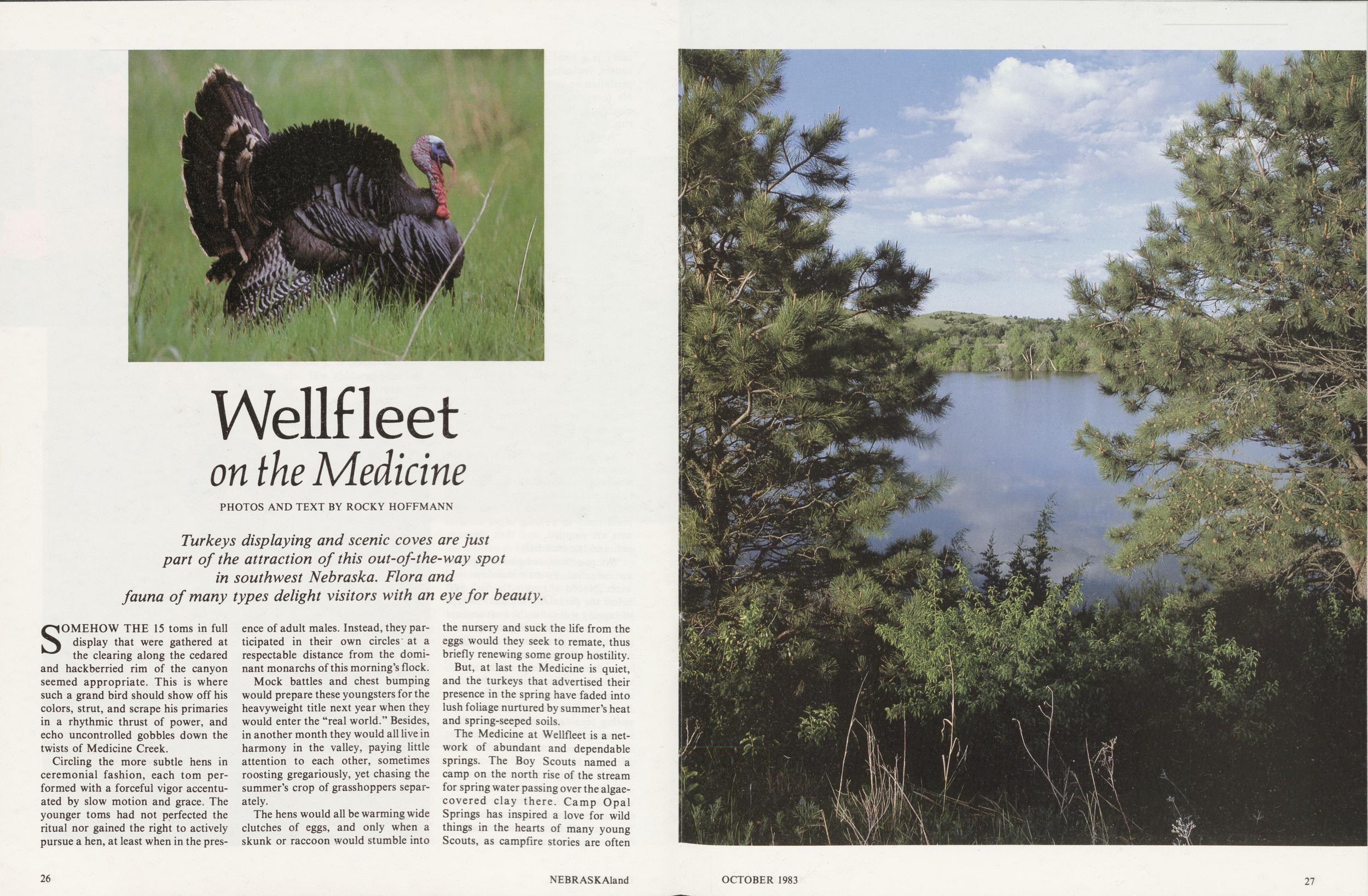
Turkeys displaying and scenic coves are just part of the attraction of this out-of-the-way spot in southwest Nebraska. Flora and fauna of many types delight visitors with an eye for beauty.SOMEHOW THE 15 toms in full display that were gathered at the clearing along the cedared and hackberried rim of the canyon seemed appropriate. This is where such a grand bird should show off his colors, strut, and scrape his primaries in a rhythmic thrust of power, and echo uncontrolled gobbles down the twists of Medicine Creek.
Circling the more subtle hens in ceremonial fashion, each tom performed with a forceful vigor accentuated by slow motion and grace. The younger toms had not perfected the ritual nor gained the right to actively pursue a hen, at least when in the presence of adult males. Instead, they participated in their own circles at a respectable distance from the dominant monarchs of this morning's flock.
Mock battles and chest bumping would prepare these youngsters for the heavyweight title next year when they would enter the "real world." Besides, in another month they would all live in harmony in the valley, paying little attention to each other, sometimes roosting gregariously, yet chasing the summer's crop of grasshoppers separately.
The hens would all be warming wide clutches of eggs, and only when a skunk or raccoon would stumble into the nursery and suck the life from the eggs would they seek to remate, thus briefly renewing some group hostility.
But, at last the Medicine is quiet, and the turkeys that advertised their presence in the spring have faded into lush foliage nurtured by summer's heat and spring-seeped soils.
The Medicine at Wellfleet is a network of abundant and dependable springs. The Boy Scouts named a camp on the north rise of the stream for spring water passing over the algae-covered clay there. Camp Opal Springs has inspired a love for wild things in the hearts of many young Scouts, as campfire stories are often
26 NEBRASKAland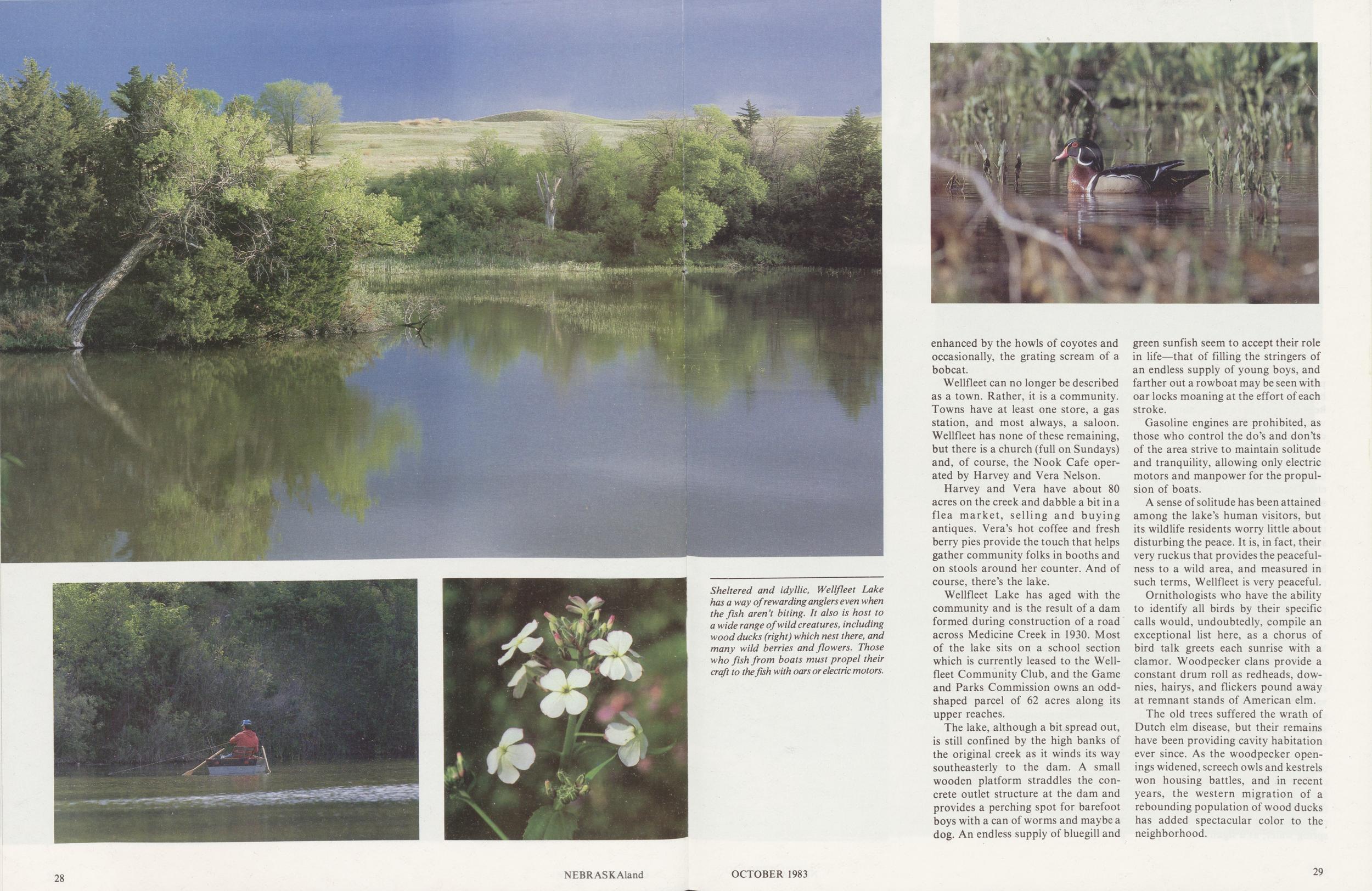
Sheltered and idyllic, Wellfleet Lake has a way of rewarding anglers even when the fish aren't biting. It also is host to a wide range of wild creatures, including wood ducks (right) which nest there, and many wild berries and flowers. Those who fish from boats must propel their craft to the fish with oars or electric motors.
enhanced by the howls of coyotes and occasionally, the grating scream of a bobcat.
Wellfleet can no longer be described as a town. Rather, it is a community. Towns have at least one store, a gas station, and most always, a saloon. Wellfleet has none of these remaining, but there is a church (full on Sundays) and, of course, the Nook Cafe operated by Harvey and Vera Nelson.
Harvey and Vera have about 80 acres on the creek and dabble a bit in a flea market, selling and buying antiques. Vera's hot coffee and fresh berry pies provide the touch that helps gather community folks in booths and on stools around her counter. And of course, there's the lake.
Wellfleet Lake has aged with the community and is the result of a dam formed during construction of a road across Medicine Creek in 1930. Most of the lake sits on a school section which is currently leased to the Wellfleet Community Club, and the Game and Parks Commission owns an oddshaped parcel of 62 acres along its upper reaches.
The lake, although a bit spread out, is still confined by the high banks of the original creek as it winds its way southeasterly to the dam. A small wooden platform straddles the concrete outlet structure at the dam and provides a perching spot for barefoot boys with a can of worms and maybe a dog. An endless supply of bluegill and green sunfish seem to accept their role in life—that of filling the stringers of an endless supply of young boys, and farther out a rowboat may be seen with oar locks moaning at the effort of each stroke.
Gasoline engines are prohibited, as those who control the do's and don'ts of the area strive to maintain solitude and tranquility, allowing only electric motors and manpower for the propulsion of boats.
A sense of solitude has been attained among the lake's human visitors, but its wildlife residents worry little about disturbing the peace. It is, in fact, their very ruckus that provides the peacefulness to a wild area, and measured in such terms, Wellfleet is very peaceful.
Ornithologists who have the ability to identify all birds by their specific calls would, undoubtedly, compile an exceptional list here, as a chorus of bird talk greets each sunrise with a clamor. Woodpecker clans provide a constant drum roll as redheads, downies, hairys, and flickers pound away at remnant stands of American elm.
The old trees suffered the wrath of Dutch elm disease, but their remains have been providing cavity habitation ever since. As the woodpecker openings widened, screech owls and kestrels won housing battles, and in recent years, the western migration of a rebounding population of wood ducks has added spectacular color to the neighborhood.
OCTOBER 1983 29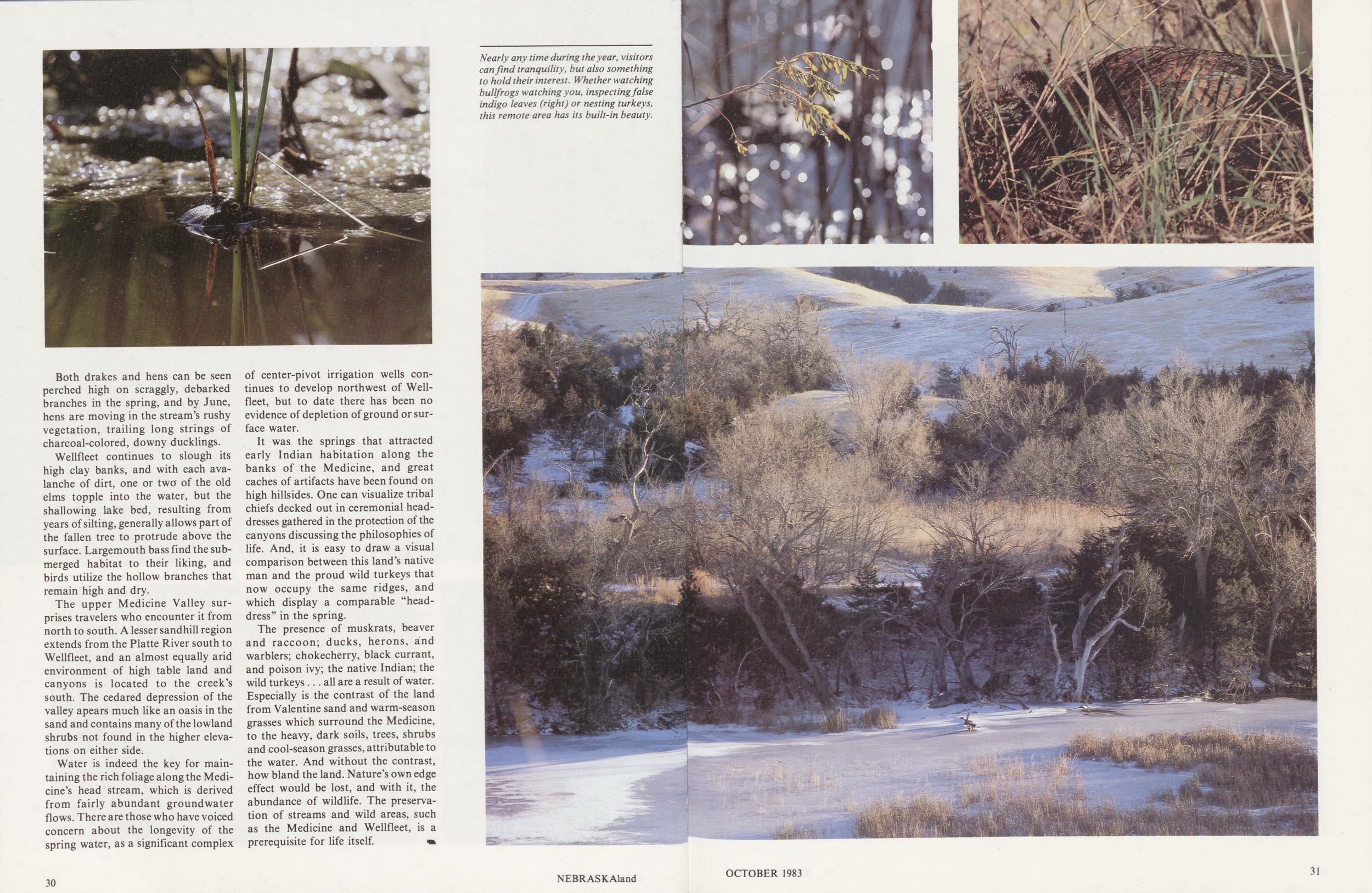
Nearly any time during the year, visitors can find tranquility, but also something to hold their interest. Whether watching bullfrogs watching you, inspecting false indigo leaves (right) or nesting turkeys, this remote area has its built-in beauty.
Both drakes and hens can be seen perched high on scraggly, debarked branches in the spring, and by June, hens are moving in the stream's rushy vegetation, trailing long strings of charcoal-colored, downy ducklings.
Wellfleet continues to slough its high clay banks, and with each avalanche of dirt, one or two of the old elms topple into the water, but the shallowing lake bed, resulting from years of silting, generally allows part of the fallen tree to protrude above the surface. Largemouth bass find the submerged habitat to their liking, and birds utilize the hollow branches that remain high and dry.
The upper Medicine Valley surprises travelers who encounter it from north to south. A lesser sandhill region extends from the Platte River south to Wellfleet, and an almost equally arid environment of high table land and canyons is located to the creek's south. The cedared depression of the valley apears much like an oasis in the sand and contains many of the lowland shrubs not found in the higher elevations on either side.
Water is indeed the key for maintaining the rich foliage along the Medicine's head stream, which is derived from fairly abundant groundwater flows. There are those who have voiced concern about the longevity of the spring water, as a significant complex of center-pivot irrigation wells continues to develop northwest of Wellfleet, but to date there has been no evidence of depletion of ground or surface water.
It was the springs that attracted early Indian habitation along the banks of the Medicine, and great caches of artifacts have been found on high hillsides. One can visualize tribal chiefs decked out in ceremonial head-dresses gathered in the protection of the canyons discussing the philosophies of life. And, it is easy to draw a visual comparison between this land's native man and the proud wild turkeys that now occupy the same ridges, and which display a comparable "head-dress" in the spring.
The presence of muskrats, beaver and raccoon; ducks, herons, and warblers; chokecherry, black currant, and poison ivy; the native Indian; the wild turkeys all are a result of water. Especially is the contrast of the land from Valentine sand and warm-season grasses which surround the Medicine, to the heavy, dark soils, trees, shrubs and cool-season grasses, attributable to the water. And without the contrast, how bland the land. Nature's own edge effect would be lost, and with it, the abundance of wildlife. The preservation of streams and wild areas, such as the Medicine and Wellfleet, is a prerequisite for life itself.
30 NEBRASKAland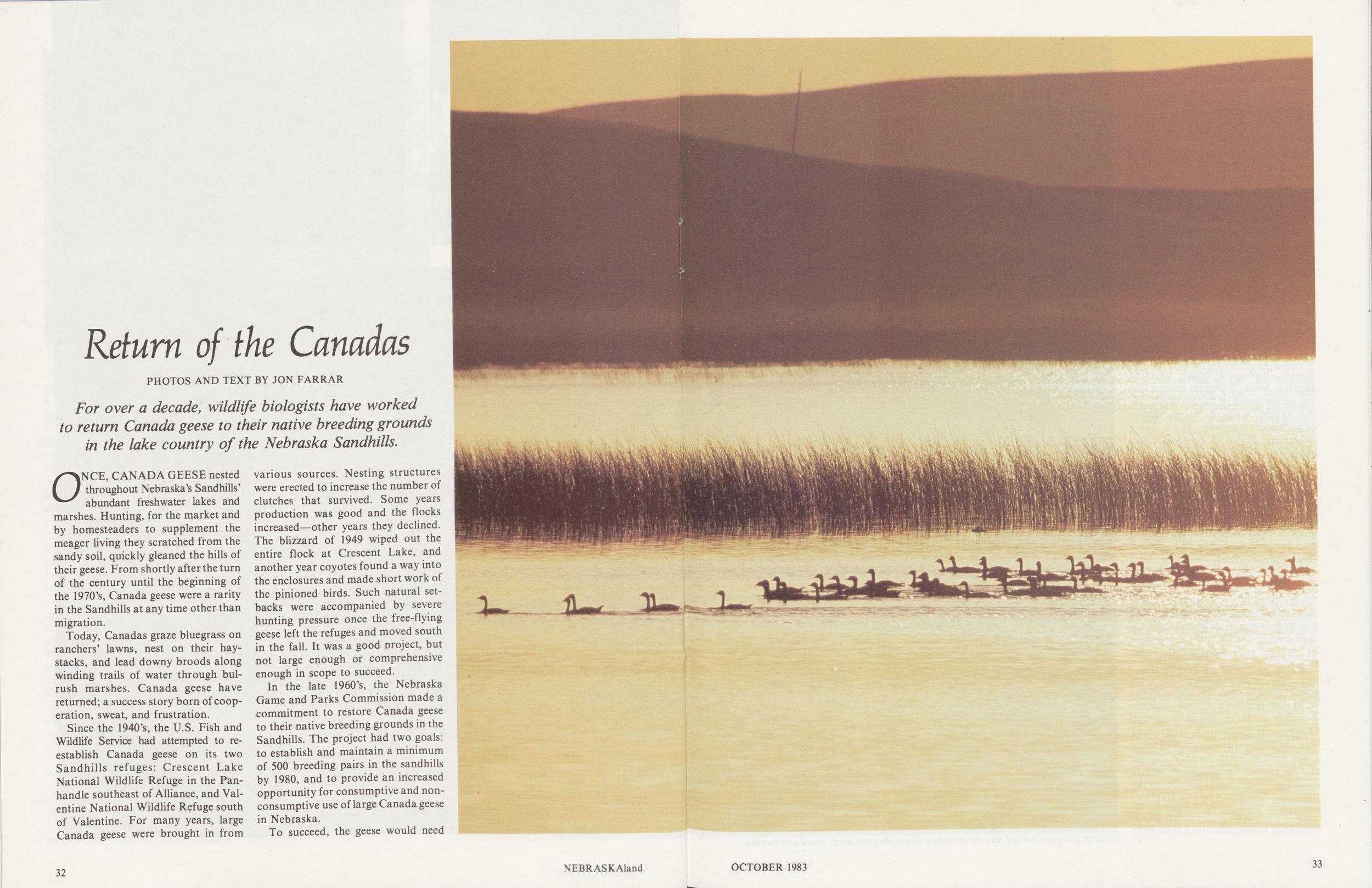
Return of the Canadas
For over a decade, wildlife biologists have worked to return Canada geese to their native breeding grounds in the lake country of the Nebraska Sandhills.ONCE, CANADA GEESE nested throughout Nebraska's Sandhills' abundant freshwater lakes and marshes. Hunting, for the market and by homesteaders to supplement the meager living they scratched from the sandy soil, quickly gleaned the hills of their geese. From shortly after the turn of the century until the beginning of the 1970's, Canada geese were a rarity in the Sandhills at any time other than migration.
Today, Canadas graze bluegrass on ranchers' lawns, nest on their haystacks, and lead downy broods along winding trails of water through bulrush marshes. Canada geese have returned; a success story born of cooperation, sweat, and frustration.
Since the 1940's, the U.S. Fish and Wildlife Service had attempted to reestablish Canada geese on its two Sandhills refuges: Crescent Lake National Wildlife Refuge in the Panhandle southeast of Alliance, and Valentine National Wildlife Refuge south of Valentine. For many years, large Canada geese were brought in from various sources. Nesting structures were erected to increase the number of clutches that survived. Some years production was good and the flocks increased—other years they declined. The blizzard of 1949 wiped out the entire flock at Crescent Lake, and another year coyotes found a way into the enclosures and made short work of the pinioned birds. Such natural setbacks were accompanied by severe hunting pressure once the free-flying geese left the refuges and moved south in the fall. It was a good project, but not large enough or comprehensive enough in scope to succeed.
In the late 1960's, the Nebraska Game and Parks Commission made a commitment to restore Canada geese to their native breeding grounds in the Sandhills. The project had two goals: to establish and maintain a minimum of 500 breeding pairs in the sandhills by 1980, and to provide an increased opportunity for consumptive and non-consumptive use of large Canada geese in Nebraska.
To succeed, the geese would need
32 NEBRASKAland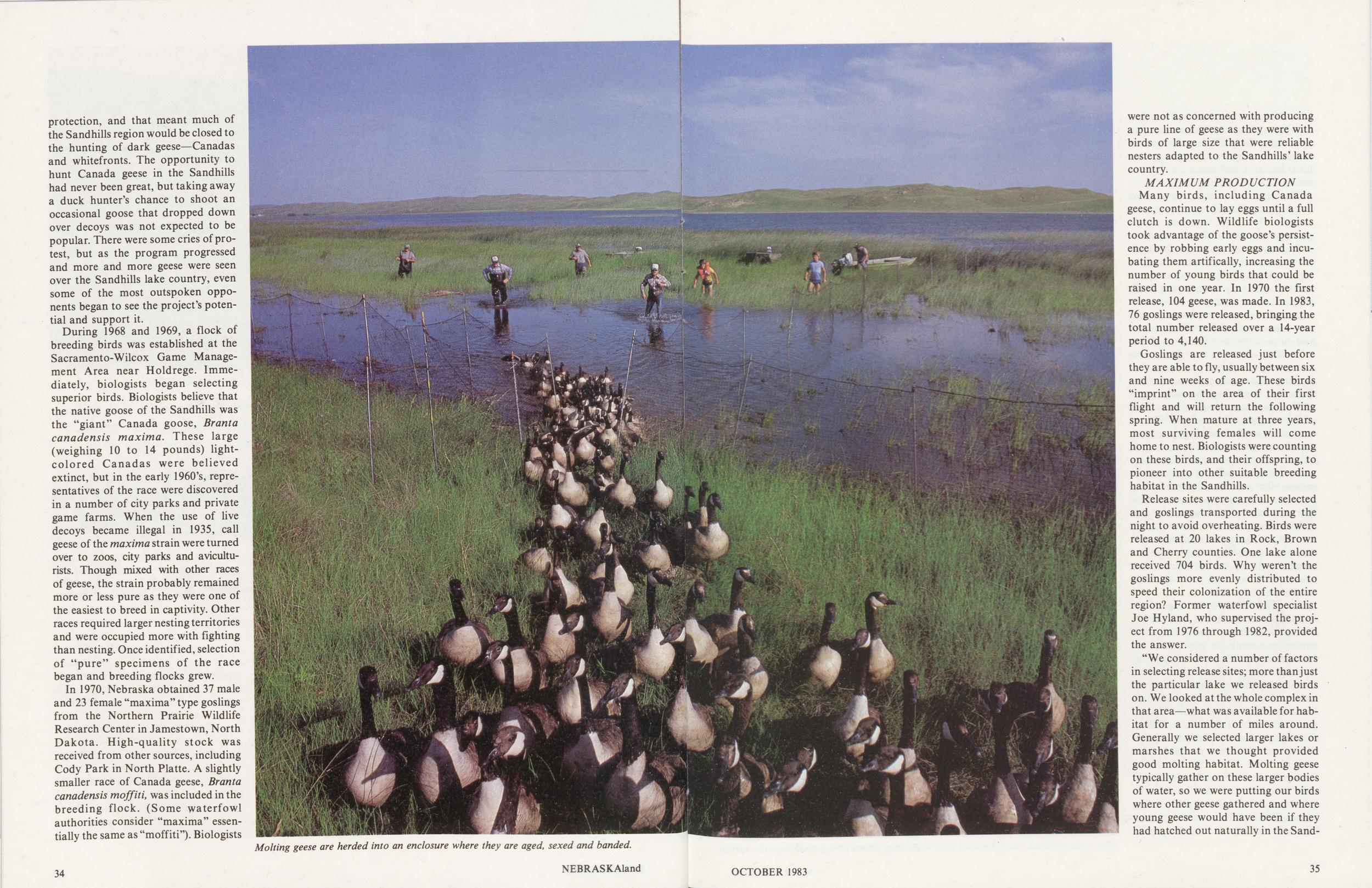
protection, and that meant much of the Sandhills region would be closed to the hunting of dark geese—Canadas and whitefronts. The opportunity to hunt Canada geese in the Sandhills had never been great, but taking away a duck hunter's chance to shoot an occasional goose that dropped down over decoys was not expected to be popular. There were some cries of protest, but as the program progressed and more and more geese were seen over the Sandhills lake country, even some of the most outspoken opponents began to see the project's potential and support it.
During 1968 and 1969, a flock of breeding birds was established at the Sacramento-Wilcox Game Management Area near Holdrege. Immediately, biologists began selecting superior birds. Biologists believe that the native goose of the Sandhills was the "giant" Canada goose, Branta canadensis maxima. These large (weighing 10 to 14 pounds) light-colored Canadas were believed extinct, but in the early 1960's, representatives of the race were discovered in a number of city parks and private game farms. When the use of live decoys became illegal in 1935, call geese of the maxima strain were turned over to zoos, city parks and aviculturists. Though mixed with other races of geese, the strain probably remained more or less pure as they were one of the easiest to breed in captivity. Other races required larger nesting territories and were occupied more with fighting than nesting. Once identified, selection of "pure" specimens of the race began and breeding flocks grew.
In 1970, Nebraska obtained 37 male and 23 female "maxima" type goslings from the Northern Prairie Wildlife Research Center in Jamestown, North Dakota. High-quality stock was received from other sources, including Cody Park in North Platte. A slightly smaller race of Canada geese, Branta canadensis moffiti, was included in the breeding flock. (Some waterfowl authorities consider "maxima" essentially the same as "moffiti"). Biologists
34 NEBRASKAlandwere not as concerned with producing a pure line of geese as they were with birds of large size that were reliable nesters adapted to the Sandhills' lake country.
MAXIMUM PRODUCTIONMany birds, including Canada geese, continue to lay eggs until a full clutch is down. Wildlife biologists took advantage of the goose's persistence by robbing early eggs and incubating them artifically, increasing the number of young birds that could be raised in one year. In 1970 the first release, 104 geese, was made. In 1983, 76 goslings were released, bringing the total number released over a 14-year period to 4,140.
Goslings are released just before they are able to fly, usually between six and nine weeks of age. These birds "imprint" on the area of their first flight and will return the following spring. When mature at three years, most surviving females will come home to nest. Biologists were counting on these birds, and their offspring, to pioneer into other suitable breeding habitat in the Sandhills.
Release sites were carefully selected and goslings transported during the night to avoid overheating. Birds were released at 20 lakes in Rock, Brown and Cherry counties. One lake alone received 704 birds. Why weren't the goslings more evenly distributed to speed their colonization of the entire region? Former waterfowl specialist Joe Hyland, who supervised the project from 1976 through 1982, provided the answer.
"We considered a number of factors in selecting release sites; more than just the particular lake we released birds on. We looked at the whole complex in that area—what was available for habitat for a number of miles around. Generally we selected larger lakes or marshes that we thought provided good molting habitat. Molting geese typically gather on these larger bodies of water, so we were putting our birds where other geese gathered and where young geese would have been if they had hatched out naturally in the Sand-.
Molting geese are herded into an enclosure where they are aged, sexed and banded
hills. We were trying to stimulate what is going on naturally at that time of the year. Also, there is safety, and greater survival, in numbers. We thought our birds had a better chance if they associated with wild birds.
"The lake's location, owner and neighboring landowners were also considerations. We liked to release goslings where disturbance would be at a minimum and where the landowner showed some interest in having the birds and would keep an eye on them. I can't say enough about the cooperation we had from ranchers."
Canada geese have pioneered into new areas in the Sandhills. How far and how many is difficult to determine. Birds released in western Cherry County have spread south and are meeting birds pioneering north from Crescent Lake Refuge. By the spring of 1983, it was estimated that the number of breeding pairs in the Sandhills was very close to the project goal of 500. Aerial surveys conducted annually in May are used to determine the number of breeding ducks and geese in the region. The number of non-breeding geese, those less than three years old, is more difficult to determine. Biologists feel that the geese have not pioneered into all available areas and will continue to increase breeding range and numbers. It is now projected that nearly 1,000 breeding pairs will be in the Sandhills by 1985.
The final release of goslings in the Sandhills was made last July (1983). Biologists feel the "threshold level" needed to sustain the population has been reached; that natural reproduction will now offset mortality factors. The Game and Parks Commission will soon initiate a similar project to establish a breeding population of Canada geese in the North Platte Valley. Goslings produced at the Sacramento-Wilcox area are now needed for this project. Were it not for the North Platte project, more birds would probably be released in the Sandhills to increase the breeding population faster. Without the supplemental releases, it will take a little longer for the sandhills population to occupy all available nesting habitat. Economics is also a consideration. Goslings are not inexpensive to raise, and many do not survive to reach breeding age.
MUSKRATS AND HAY BALESHow successfully Sandhills geese expand into new areas and increase their numbers will be influenced by many factors. Two of the most critical will be water conditions and muskrat activity.
These Canada geese nest in a variety of situations, from haystacks to piles of floating marsh vegetation, but the preferred site is a muskrat house. Abandoned, collapsing muskrat houses and active houses are used, and neighboring houses are favorite loafing and sentry posts for the gander. While these water-encircled structures provide protection from most egg-eating predators, rising water levels may inundate the nest and cause desertion. Abandoned muskrat houses, or houses in poor repair only a few inches above water level, are particularly poor nest sites. Canada geese often will not renest if their first attempt fails.
Generally, Canada geese initiate nesting early, during the first 10 days of April, and eggs are incubated for about 28 days.
The availability of high and dry muskrat houses is critical to nesting success. Muskrat populations are cyclic and not all lakes provide an ample supply of quality houses for goose nesting. Even though a lake may offer all other requirements of a breeding pair of geese, without quality nesting structures there will be little production.
For years the federal refuges erected and maintained artificial nesting structures, usually a fiberglass dish lined with hay on top of a pole driven into the marsh. Geese readily accept these nest sites and rear a higher percentage of successful broods than in natural nest sites. But, these artificial nest structures are not without their drawbacks. They are expensive to maintain
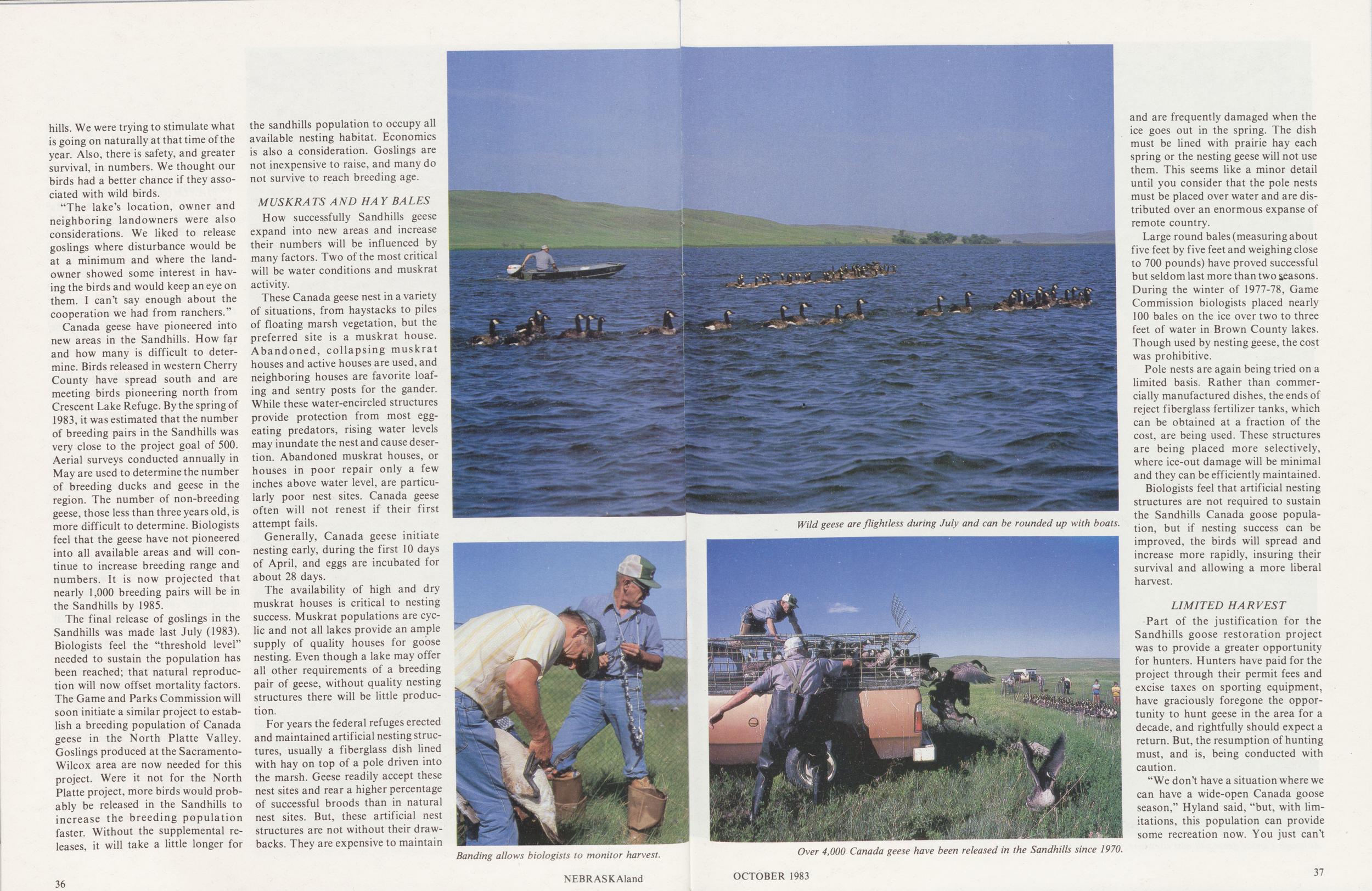
36 NEBRASKAlandWild geese are flightless during July and can be rounded up with boats.
and are frequently damaged when the ice goes out in the spring. The dish must be lined with prairie hay each spring or the nesting geese will not use them. This seems like a minor detail until you consider that the pole nests must be placed over water and are distributed over an enormous expanse of remote country.
Large round bales (measuring about five feet by five feet and weighing close to 700 pounds) have proved successful but seldom last more than two reasons. During the winter of 1977-78, Game Commission biologists placed nearly 100 bales on the ice over two to three feet of water in Brown County lakes. Though used by nesting geese, the cost was prohibitive.
Pole nests are again being tried on a limited basis. Rather than commercially manufactured dishes, the ends of reject fiberglass fertilizer tanks, which can be obtained at a fraction of the cost, are being used. These structures are being placed more selectively, where ice-out damage will be minimal and they can be efficiently maintained.
Biologists feel that artificial nesting structures are not required to sustain the Sandhills Canada goose population, but if nesting success can be improved, the birds will spread and increase more rapidly, insuring their survival and allowing a more liberal harvest.
LIMITED HARVESTPart of the justification for the Sandhills goose restoration project was to provide a greater opportunity for hunters. Hunters have paid for the project through their permit fees and excise taxes on sporting equipment, have graciously foregone the opportunity to hunt geese in the area for a decade, and rightfully should expect a return. But, the resumption of hunting must, and is, being conducted with caution.
"We don't have a situation where we can have a wide-open Canada goose season," Hyland said, "but, with limitations, this population can provide some recreation now. You just can't
Banding allows biologists to monitor harvest.
Over 4,000 Canada geese have been released in the Sandhills since 1970.
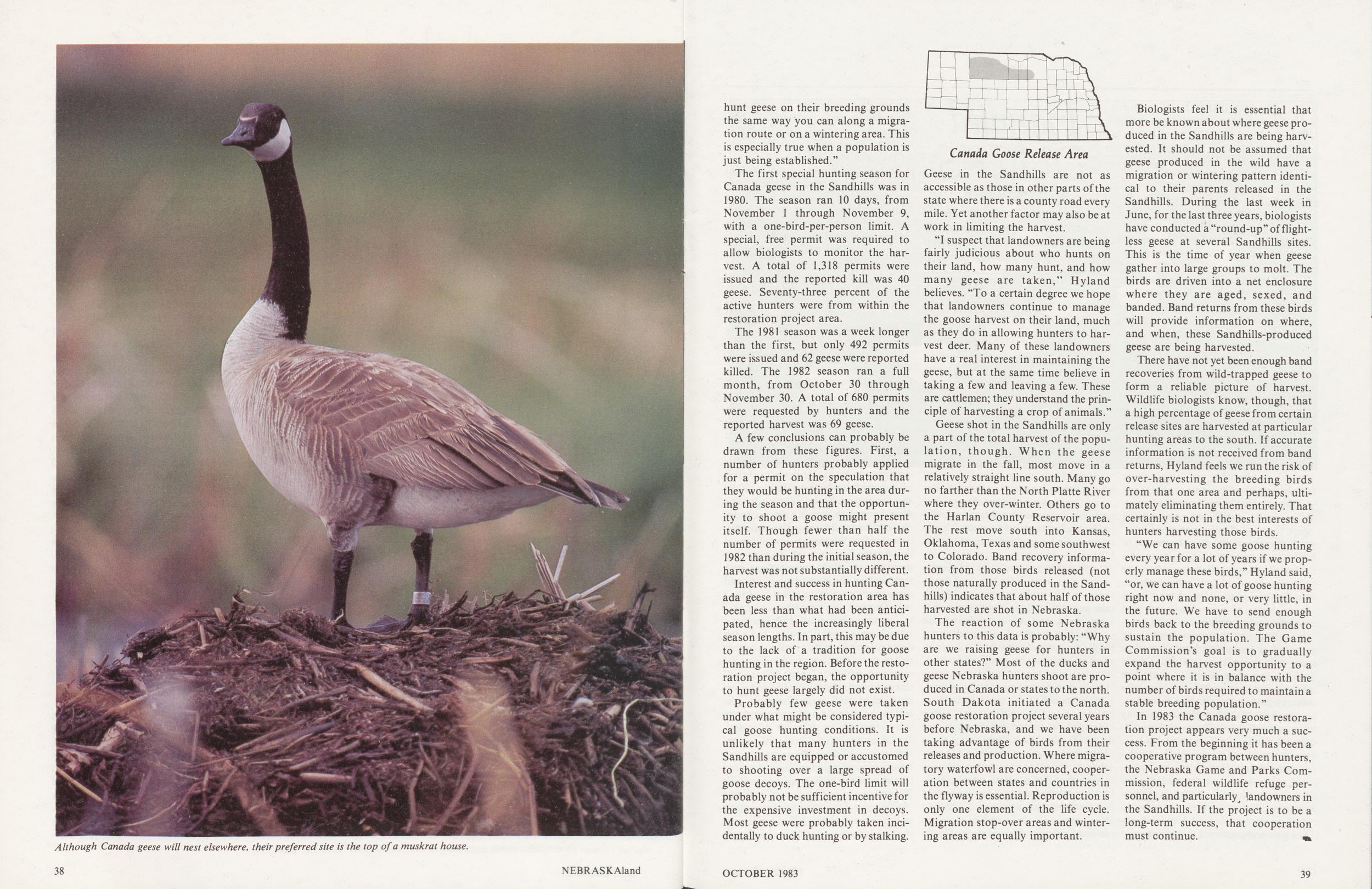
Although Canada geese will nest elsewhere, their preferred site is the top of a muskrat house.
hunt geese on their breeding grounds the same way you can along a migration route or on a wintering area. This is especially true when a population is just being established."
The first special hunting season for Canada geese in the Sandhills was in 1980. The season ran 10 days, from November 1 through November 9, with a one-bird-per-person limit. A special, free permit was required to allow biologists to monitor the harvest. A total of 1,318 permits were issued and the reported kill was 40 geese. Seventy-three percent of the active hunters were from within the restoration project area.
The 1981 season was a week longer than the first, but only 492 permits were issued and 62 geese were reported killed. The 1982 season ran a full month, from October 30 through November 30. A total of 680 permits were requested by hunters and the reported harvest was 69 geese.
A few conclusions can probably be drawn from these figures. First, a number of hunters probably applied for a permit on the speculation that they would be hunting in the area during the season and that the opportunity to shoot a goose might present itself. Though fewer than half the number of permits were requested in 1982 than during the initial season, the harvest was not substantially different.
nterest and success in hunting Canada geese in the restoration area has been less than what had been anticipated, hence the increasingly liberal season lengths. In part, this may be due to the lack of a tradition for goose hunting in the region. Before the restoration project began, the opportunity to hunt geese largely did not exist.
Probably few geese were taken under what might be considered typical goose hunting conditions. It is unlikely that many hunters in the Sandhills are equipped or accustomed to shooting over a large spread of goose decoys. The one-bird limit will probably not be sufficient incentive for the expensive investment in decoys. Most geese were probably taken incidentally to duck hunting or by stalking.
Canada Goose Release Area
Geese in the Sandhills are not as accessible as those in other parts of the state where there is a county road every mile. Yet another factor may also be at work in limiting the harvest.
"I suspect that landowners are being fairly judicious about who hunts on their land, how many hunt, and how many geese are taken," Hyland believes. "To a certain degree we hope that landowners continue to manage the goose harvest on their land, much as they do in allowing hunters to harvest deer. Many of these landowners have a real interest in maintaining the geese, but at the same time believe in taking a few and leaving a few. These are cattlemen; they understand the principle of harvesting a crop of animals."
Geese shot in the Sandhills are only a part of the total harvest of the population, though. When the geese migrate in the fall, most move in a relatively straight line south. Many go no farther than the North Platte River where they over-winter. Others go to the Harlan County Reservoir area. The rest move south into Kansas, Oklahoma, Texas and some southwest to Colorado. Band recovery information from those birds released (not those naturally produced in the Sandhills) indicates that about half of those harvested are shot in Nebraska.
The reaction of some Nebraska hunters to this data is probably: "Why are we raising geese for hunters in other states?" Most of the ducks and geese Nebraska hunters shoot are produced in Canada or states to the north. South Dakota initiated a Canada goose restoration project several years before Nebraska, and we have been taking advantage of birds from their releases and production. Where migratory waterfowl are concerned, cooperation between states and countries in the flyway is essential. Reproduction is only one element of the life cycle. Migration stop-over areas and wintering areas are equally important.
Biologists feel it is essential that more be known about where geese produced in the Sandhills are being harvested. It should not be assumed that geese produced in the wild have a migration or wintering pattern identical to their parents released in the Sandhills. During the last week in June, for the last three years, biologists have conducted a "round-up" of flightless geese at several Sandhills sites. This is the time of year when geese gather into large groups to molt. The birds are driven into a net enclosure where they are aged, sexed, and banded. Band returns from these birds will provide information on where, and when, these Sandhills-produced geese are being harvested.
There have not yet been enough band recoveries from wild-trapped geese to form a reliable picture of harvest. Wildlife biologists know, though, that a high percentage of geese from certain release sites are harvested at particular hunting areas to the south. If accurate information is not received from band returns, Hyland feels we run the risk of over-harvesting the breeding birds from that one area and perhaps, ultimately eliminating them entirely. That certainly is not in the best interests of hunters harvesting those birds.
"We can have some goose hunting every year for a lot of years if we properly manage these birds," Hyland said, "or, we can have a lot of goose hunting right now and none, or very little, in the future. We have to send enough birds back to the breeding grounds to sustain the population. The Game Commission's goal is to gradually expand the harvest opportunity to a point where it is in balance with the number of birds required to maintain a stable breeding population."
In 1983 the Canada goose restoration project appears very much a success. From the beginning it has been a cooperative program between hunters, the Nebraska Game and Parks Commission, federal wildlife refuge personnel, and particularly landowners in the Sandhills. If the project is to be a long-term success, that cooperation must continue.
OCTOBER 1983 39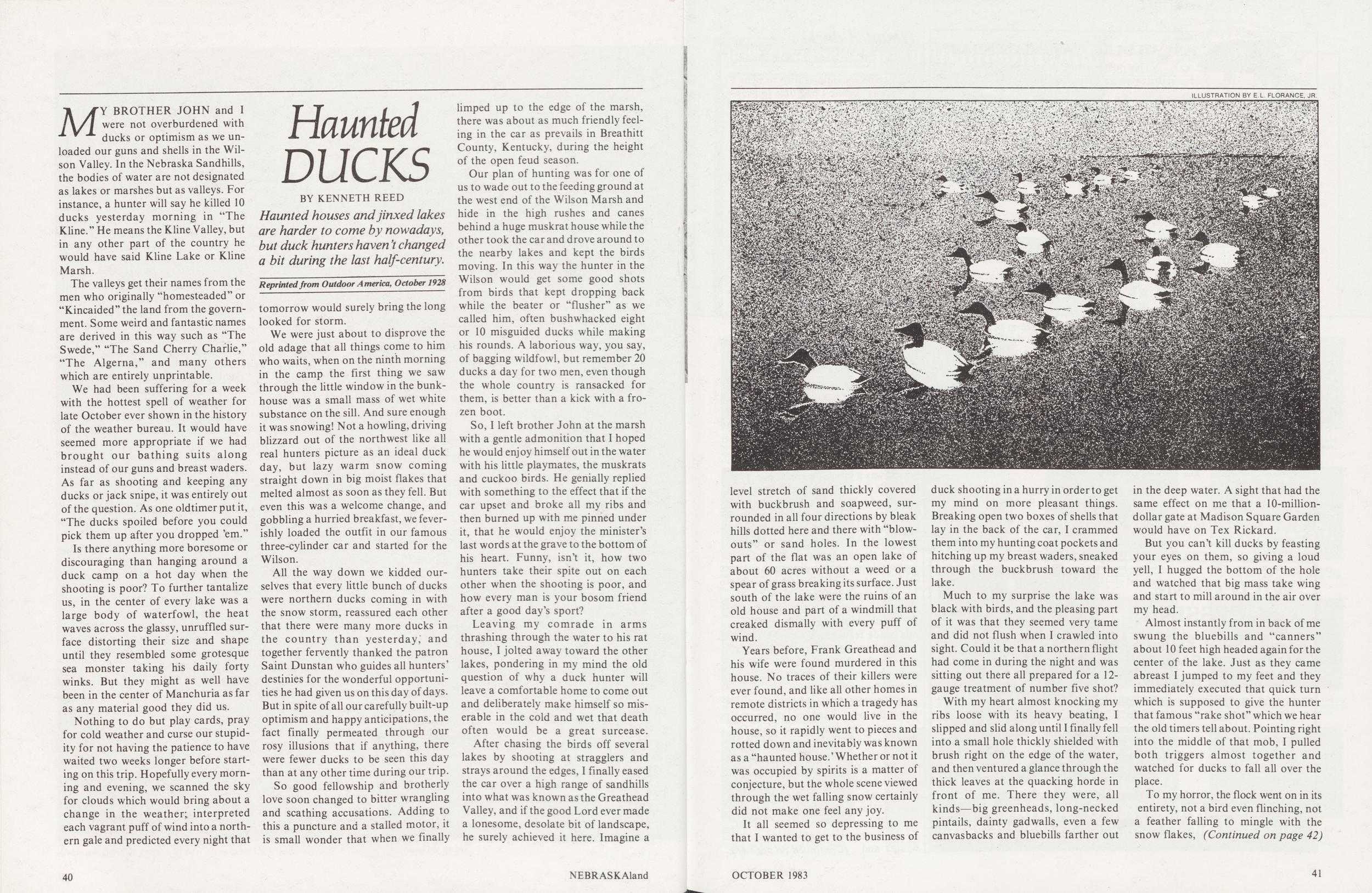
Haunted DUCKS
Haunted houses and jinxed lakes are harder to come by nowadays, but duck hunters haven't changed a bit during the last half-century. Reprinted from Outdoor America, October 1928MY BROTHER JOHN and I were not overburdened with ducks or optimism as we unloaded our guns and shells in the Wilson Valley. In the Nebraska Sandhills, the bodies of water are not designated as lakes or marshes but as valleys. For instance, a hunter will say he killed 10 ducks yesterday morning in "The Kline." He means the Kline Valley, but in any other part of the country he would have said Kline Lake or Kline Marsh.
The valleys get their names from the men who originally "homesteaded" or "Kincaided" the land from the government. Some weird and fantastic names are derived in this way such as "The Swede," "The Sand Cherry Charlie," "The Algerna," and many others which are entirely unprintable.
We had been suffering for a week with the hottest spell of weather for late October ever shown in the history of the weather bureau. It would have seemed more appropriate if we had brought our bathing suits along instead of our guns and breast waders. As far as shooting and keeping any ducks or jack snipe, it was entirely out of the question. As one oldtimer putit, "The ducks spoiled before you could pick them up after you dropped 'em."
Is there anything more boresome or discouraging than hanging around a duck camp on a hot day when the shooting is poor? To further tantalize us, in the center of every lake was a large body of waterfowl, the heat waves across the glassy, unruffled surface distorting their size and shape until they resembled some grotesque sea monster taking his daily forty winks. But they might as well have been in the center of Manchuria as far as any material good they did us.
Nothing to do but play cards, pray for cold weather and curse our stupidity for not having the patience to have waited two weeks longer before starting on this trip. Hopefully every morning and evening, we scanned the sky for clouds which would bring about a change in the weather; interpreted each vagrant puff of wind into a northern gale and predicted every night that tomorrow would surely bring the long looked for storm.
We were just about to disprove the old adage that all things come to him who waits, when on the ninth morning in the camp the first thing we saw through the little window in the bunkhouse was a small mass of wet white substance on the sill. And sure enough it was snowing! Not a howling, driving blizzard out of the northwest like all real hunters picture as an ideal duck day, but lazy warm snow coming straight down in big moist flakes that melted almost as soon as they fell. But even this was a welcome change, and gobbling a hurried breakfast, we feverishly loaded the outfit in our famous three-cylinder car and started for the Wilson.
All the way down we kidded ourselves that every little bunch of ducks were northern ducks coming in with the snow storm, reassured each other that there were many more ducks in the country than yesterday, and together fervently thanked the patron Saint Dunstan who guides all hunters' destinies for the wonderful opportunities he had given us on this day of days. But in spite of all our carefully built-up optimism and happy anticipations, the fact finally permeated through our rosy illusions that if anything, there were fewer ducks to be seen this day than at any other time during our trip.
So good fellowship and brotherly love soon changed to bitter wrangling and scathing accusations. Adding to this a puncture and a stalled motor, it is small wonder that when we finally limped up to the edge of the marsh, there was about as much friendly feeling in the car as prevails in Breathitt County, Kentucky, during the height of the open feud season.
Our plan of hunting was for one of us to wade out to the feeding ground at the west end of the Wilson Marsh and hide in the high rushes and canes behind a huge muskrat house while the other took the car and drove around to the nearby lakes and kept the birds moving. In this way the hunter in the Wilson would get some good shots from birds that kept dropping back while the beater or "flusher" as we called him, often bushwhacked eight or 10 misguided ducks while making his rounds. A laborious way, you say, of bagging wildfowl, but remember 20 ducks a day for two men, even though the whole country is ransacked for them, is better than a kick with a frozen boot.
So, I left brother John at the marsh with a gentle admonition that I hoped he would enjoy himself out in the water with his little playmates, the muskrats and cuckoo birds. He genially replied with something to the effect that if the car upset and broke all my ribs and then burned up with me pinned under it, that he would enjoy the minister's last words at the grave to the bottom of his heart. Funny, isn't it, how two hunters take their spite out on each other when the shooting is poor, and how every man is your bosom friend after a good day's sport?
Leaving my comrade in arms thrashing through the water to his rat house, I jolted away toward the other lakes, pondering in my mind the old question of why a duck hunter will leave a comfortable home to come out and deliberately make himself so miserable in the cold and wet that death often would be a great surcease.
After chasing the birds off several lakes by shooting at stragglers and strays around the edges, I finally eased the car over a high range of sandhills into what was known as the Greathead Valley, and if the good Lord ever made a lonesome, desolate bit of landscape, he surely achieved it here. Imagine a
40 NEBRASKAlandILLUSTRATION BY EL. FLORANCE, JR.
level stretch of sand thickly covered with buckbrush and soapweed, surrounded in all four directions by bleak hills dotted here and there with "blowouts" or sand holes. In the lowest part of the flat was an open lake of about 60 acres without a weed or a spear of grass breaking its surface. Just south of the lake were the ruins of an old house and part of a windmill that creaked dismally with every puff of wind.
Years before, Frank Greathead and his wife were found murdered in this house. No traces of their killers were ever found, and like all other homes in remote districts in which a tragedy has occurred, no one would live in the house, so it rapidly went to pieces and rotted down and inevitably was known as a "haunted house.' Whether or not it was occupied by spirits is a matter of conjecture, but the whole scene viewed through the wet falling snow certainly did not make one feel any joy.
It all seemed so depressing to me that I wanted to get to the business of duck shooting in a hurry in order to get my mind on more pleasant things. Breaking open two boxes of shells that lay in the back of the car, I crammed them into my hunting coat pockets and hitching up my breast waders, sneaked through the buckbrush toward the lake.
Much to my surprise the lake was black with birds, and the pleasing part of it was that they seemed very tame and did not flush when I crawled into sight. Could it be that a northern flight had come in during the night and was sitting out there all prepared for a 12-gauge treatment of number five shot?
With my heart almost knocking my ribs loose with its heavy beating, I slipped and slid along until I finally fell into a small hole thickly shielded with brush right on the edge of the water, and then ventured a glance through the thick leaves at the quacking horde in front of me. There they were, all kinds—big greenheads, long-necked pintails, dainty gadwalls, even a few canvasbacks and bluebills farther out in the deep water. A sight that had the same effect on me that a 10-million-dollar gate at Madison Square Garden would have on Tex Rickard.
But you can't kill ducks by feasting your eyes on them, so giving a loud yell, I hugged the bottom of the hole and watched that big mass take wing and start to mill around in the air over my head.
Almost instantly from in back of me swung the bluebills and "canners" about 10 feet high headed again for the center of the lake. Just as they came abreast I jumped to my feet and they immediately executed that quick turn which is supposed to give the hunter that famous "rake shot" which we hear the old timers tell about. Pointing right into the middle of that mob, I pulled both triggers almost together and watched for ducks to fall all over the place.
To my horror, the flock went on in its entirety, not a bird even flinching, not a feather falling to mingle with the snow flakes, (Continued on page 42)
OCTOBER 1983 41
Haunted ducks
(Continued from page 41) not a cripple slanting down to light a mile away. Before I had time to properly start to curse my luck, a pair of gadwalls came blundering along directly over my head just within that perfect range which you always picture in your mind as just the ideal spot where you want them.
With visions of an easy double, I pulled on the hen and then snapped the gun on the drake. At the double explosion, both birds jumped about six feet higher and flapping their wings a little faster, flew off in the snow.
A very profane silence on my part followed this inexcusable blunder. There are times, of course, when the best of shots have an off day, but these misses of mine seemed to be the last word in frightfulness, and the thought came to me quick and hard that maybe I didn't know as much about duck hunting as I had imagined I did. I hadn't felt so chagrined at my shooting since the time I missed a wonderful shot at some Canada geese.
Let us draw the curtain of kindness over the scene that followed. I missed four more shots in rapid succession, all of them beautiful targets, the last of which was a climbing greenhead who couldn't have been over 15 yards away and who hung suspended in the air above me like one of these stuffed eagles seen in a taxidermist's shop.
clambered out of the pit and went back to the car near the old windmill and sat down on the running board to think matters over. Then the horrible thought came suddenly to my mind that here, in this God-forsaken spot filled with ghastly memories of the past and made fearsome by all the supernatural legends of a frontier country, that maybe the ducks I had shot at were only spirits or ghosts of ducks and really never existed at all.
It seemed ridiculous on the face of it, but the longer I sat amid those gruesome ruins, the more spooky I felt. The fact remained that here was a mass of ducks that had flaunted their bodies in my face and gotten away with it. You readers seated in a cozy armchair in your comfortable home say to yourselves, "How silly that a grown man, especially a hardened duck hunter, could entertain such thoughts of haunts and (Continued on page 47)
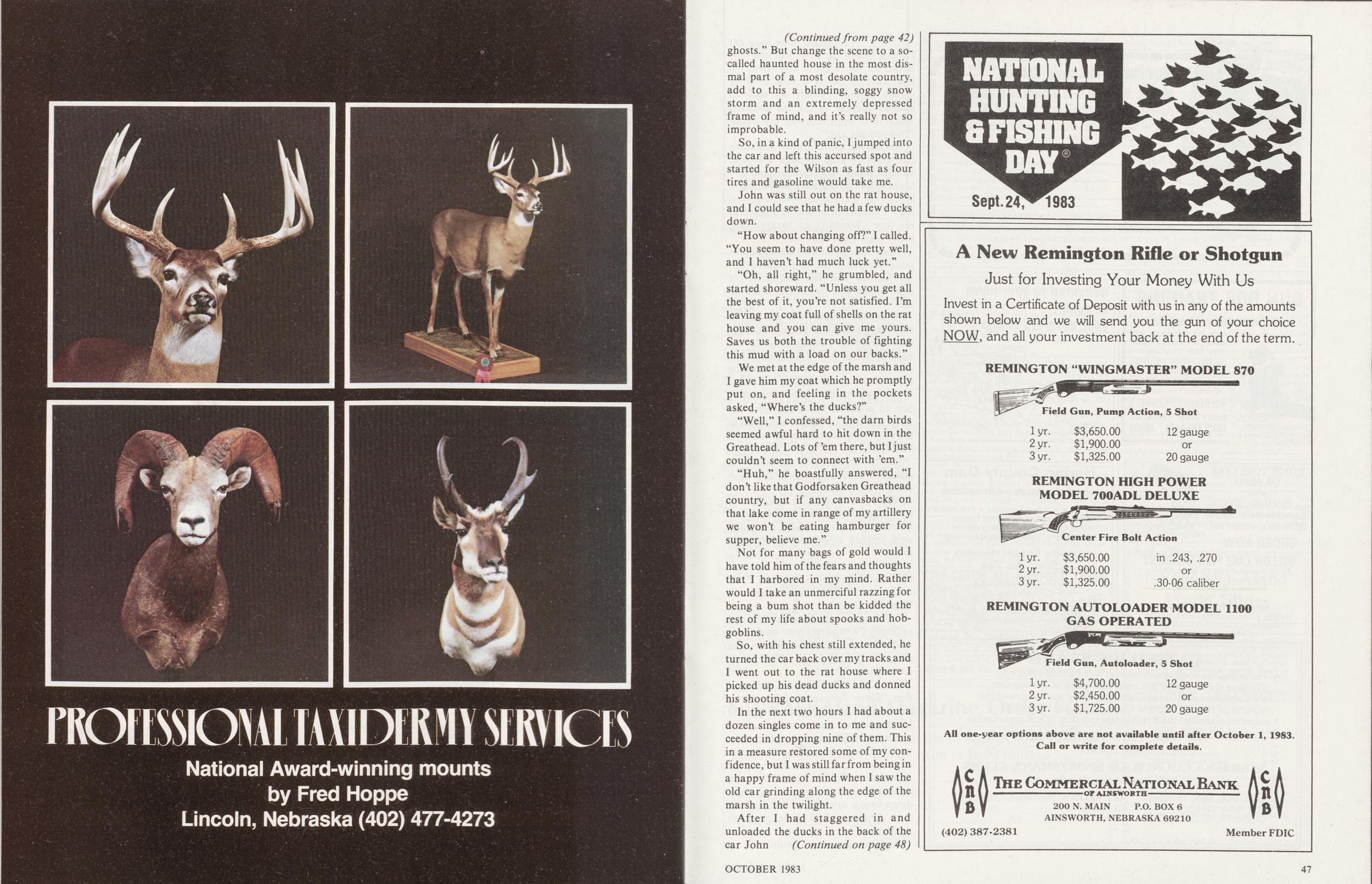
Professional Taxidermy Services National Award-winning mounts by Fred Hoppe Lincoln, Nebraska (402) 477-4273
(Continued from page 42)
ghosts." But change the scene to a so-called haunted house in the most dismal part of a most desolate country, add to this a blinding, soggy snow storm and an extremely depressed frame of mind, and it's really not so improbable.
So, in a kind of panic, I jumped into the car and left this accursed spot and started for the Wilson as fast as four tires and gasoline would take me.
John was still out on the rat house, and I could see that he had a few ducks down.
"How about changing off?" I called.
"You seem to have done pretty well, and I haven't had much luck yet."
"Oh, all right," he grumbled, and started shoreward. "Unless you get all the best of it, you're not satisfied. I'm leaving my coat full of shells on the rat house and you can give me yours. Saves us both the trouble of fighting this mud with a load on our backs."
We met at the edge of the marsh and I gave him my coat which he promptly put on, and feeling in the pockets asked, "Where's the ducks?"
"Well," I confessed, "the darn birds seemed awful hard to hit down in the Greathead. Lots of 'em there, but I just couldn't seem to connect with 'em."
"Huh," he boastfully answered, "I don't like that Godforsaken Greathead country, but if any canvasbacks on that lake come in range of my artillery we won't be eating hamburger for supper, believe me."
Not for many bags of gold would I have told him of the fears and thoughts that I harbored in my mind. Rather would I take an unmerciful razzing for being a bum shot than be kidded the rest of my life about spooks and hob-goblins.
So, with his chest still extended, he turned the car back over my tracks and I went out to the rat house where I picked up his dead ducks and donned his shooting coat.
In the next two hours I had about a dozen singles come in to me and succeeded in dropping nine of them. This in a measure restored some of my confidence, but I was still far from being in a happy frame of mind when I saw the old car grinding along the edge of the marsh in the twilight.
After I had staggered in and unloaded the ducks in the back of the car John (Continued on page 48)
(Continued from page 47)
stepped out of the front seat and motioned for me to get in and drive. We had traveled
nearly, a mile in utter silence before I finally screwed up enough courage to ask
the question which was uppermost in my mind.
"Did you get any?"
His answer came in short sentences like gusts of wind through a broken window pane. "Don't understand it—Darn place gives me the Willies— Ducks all around me—Kept shooting—Couldn't hit a one—Laughed in my face—Wouldn't go back to that lousy place for a million."
They say an honest admission is good for the soul, so I poured out my tale of woe and strangely, for once in his life, John didn't jeer at me.
After supper, like two small children who have been into mischief and feel that they must confess their sin, we both cornered Ben Yount, our host, and told him the entire story, omitting none of the details, taking full blame for being rotten shots but entreating him to prescribe some kind of treatment to put us out of our misery from the harrowing experience we had been through.
At the first part of the story he grinned and then a peculiar expression came over his face.
"Did you boys," he asked, "by any chance take those two boxes of red 'Heavy Eastern Duck Loads' that were stashed over there in the cup-board?"
"Yes," I answered, "but we can't alibi the shells because we both killed ducks on the Wilson with them and killed 'em dead."
"Wait a minute," burst in John excitedly "Remember you used those in the Greathead and then we changed coats at the rat house. Were those shells phony, Ben?"
"Oh, you poor devils," lamented Ben. "Elmer Johnson and Dan Whitney brought a lot of those heavy blank loads up here last year to fool the natives with. They sound and act like a real shell, but you guys never fired an ounce of lead at those ducks in the Greathead. Take a bunch of real ammunition with you tomorrow right down in the same place and you will have the shoot of a lifetime, ghosts orno ghosts."
And strange to say, we did.
48 NEBRASKAlandTrading Post
DOGS ENGLISH POINTER male, 2 years old, does it all. Call Ken Cooksey, Day (402) 265-2711; Night (402) 873-6288. AMUNDSON'S AUSSIES' Kennels has National Stock Registry Australian Shepherd puppies for sale. Whelped May 15th. Complete vet records, registry papers. Red and blue merles, and solids with white and copper highlights. Excellent family dogs, working dogs. For information call (402) 336-4258. Randy Amundson, Box 398, O'Neill, Nebraska. TRAINING ALL BREEDS Hunting dogs—Vizslas for sale. Rozanek Kennels, Rt. 2. Schuyler, NE 68661. Phone (402) 352-8769. ENGLISH SETTERS and Pointers: Outstanding bloodlines! Puppies, started dogs, and stud service available. High Plains Kennels, 1411 Emerson, Alliance, NE 69301. Phone (308) 762-6709. GERMAN SHORTHAIRS—English pointers and setters. Stud service, puppies and started dogs available. Also Diamond Dog Food. Wayne Clark, Box 54, Union, NE. (402) 263-3495 or 263-3155. WIND FALL RETRIEVERS. Top quality field trial lines, bred for desire, marking ability, birdiness, intelligence, stamina, and tractability. Hips guaranteed. Shots to date at delivery. Phone or write Mike Schafer, Wind Fall Retriever Kennels, 12801 Pine Lake Road, Walton, NE 68461. Phone (402) 782-6505. MISCELLANEOUS DUCK HUNTERS—guided duck hunts on the Platte River near Schuyler. Good dogs, good decoys, good blinds and a good time. $25 per day. Make your reservations early. Call Frank Hoppe, Lincoln, 464-8417. FOR SALE: Wild turkeys. Phone (402) 643-2365 or 643-2586. NEBRASKA HUNTING dog classic. October 30th. Sponsored by the Nebraska Shoot to Retrieve Club. For more information or to enter, call or write Bob Erbe, 1333 South 162nd Avenue, Omaha, NE 68130. Phone (402) 330-2830. N.E. NEBRASKA TROUT Fishing. For rent Mon. Thurs. or Fri.-Sun. 2 modern cottages completely furnished. 5 spring-fed lakes with trout up to 7 lbs. Bass and bluegill also. Diamond E Trout Resort, Orchard, NE 68764. (402) 893-4745. WINE AND BEER: Make your own. Send for free recipes and instructions. Omaha Supply, 13616 Polk, Omaha, Nebr. 68137. GUNS—Browning, Winchester, Remington, others, Hi-powers, shotguns, new, used, antiques. Want Pre-1964 Winchesters. Buy-Sell-Trade. Ph. (402) 729-6112. Bedlan's Sporting Goods, Fairbury, NE 68352. SHERKS HUNTING and trapping lures. Archery and winter seasons. Buck lure. Complete line of trapping lures, available at sporting good stores or SASE for complete price list, retail and wholesale. J Enterprises, 1225 No. 46th, Lincoln, NE 68503. Phone (402) 466-9223. AIR GUNS repaired; Benjamin, Crosman, Daisy, other American-made. Restoration, old guns wanted. Air Guns, 1225 No. 46th, Lincoln, NE 68503. Phone (402) 466-9223. PAINTINGS of your favorite spot: homestead, farm, the old fishing hole, vacation homes. Preserve your memories. Large watercolor, $250, oil $500. Satisfaction guaranteed. K.S. Farris, 1898 Phelps, Fremont, NE 68025. (402) 721-2528. FISH FOR SALE. Channel catfish, bass, bluegill, crappie, trout, perch, white bass, minnows, hybrid grass carp, bullhead. We can ship fish, you can pick them up, or we deliver. Contact the Pleasant Valley Fish Farm, Rt. 1, McCook, Nebr. 69001. Phone (308) 345-6599. GAME BIRDS for sale. Wild turkeys, wood ducks, mandarins, mallards, teal, Canada geese, pheasants—5 breeds chukkar quail. Many others not listed. Frontier Birds, Wauneta, NE 69045. Phone: day (308) 394-5577/evening (308) 394-5715. BED & BREAKFAST of Nebraska offers overnite lodging with breakfast, in homes throughout the state. For reservations contact Bed & Breakfast of Nebraska, 1464 28th Ave., Columbus, NE 68601. Phone (402) 564-7591. DEALERS WANTED. One of America's best-selling wood-burning stoves is looking for additional dealers in Nebraska and Kansas to sell Blaze King Stoves. Contact Midwest Blaze King, RR i, Box 183, Scottsbluff, NE 69361. Phone (308) 635-3146. LIVE-CATCH ALL-PURPOSE TRAPS Write for FREE CATALOG Traps without injury squirrels, chipmunks, rabbits, mink, fox, raccoons, stray animals, pests, etc. Sizes for every need. Also traps for snakes, sparrows, pigeons, crabs, turtles, quail, etc. Save on our low factory prices. Send no money. Free catalog and trapping secrets. MUSTANG MFG. CO., Dept. N-34, Box IO88O, Houston, Tex. 77018 NEBRASKAland Magazine Order Form Please start a subscription for me to NEBRASKAland, and send me the current bonus issue (a $6.00 value). One-year $7.50 NAME Two-year $13 ADDRESS CITY Three-year $19 STATE Mail to: NEBRASKAland Box 30370, Lincoln, NE 68503 ZIP FOR SALE: Sika deer and golden pheasants. Contact Harold Kempf, Box 31, Glenville, NE 68941. C.G. BUD PRITCHARD—2 original oils. Approx. 16x20. North of Valentine. Sharptail, pheasant. Taking offers. Round Hill Books, Box 1680, Greenwich, CT 06836. DEER HUNTERS with Sandhills permits: Now booking guided hunts on private land. Limited number of hunters accepted. Phone, evenings, (308) 587-2233. NOW PAYING up to $5 each for expired hunting licenses. One or twenty. Any state or tribal. Call (402) 475-8279 or send to Phil Pfeiffer, 641 S. 21st St., Lincoln, NE 68510. TAXIDERMY JOHNSON TAXIDERMY—servicing southwest Nebraska, specializing in big-game mounts, lifesized mounts, rug work, fish, birds, tanning hair-on leather. Brochure and price list on request. Johnson Taxidermy, Rt. 1, Box 78, Lamar, NE 69035. Telephone (308) 882-5555. AWARD-WINNING TAXIDERMIST. Eight time national award winners. Trust your trophies to a proven winner. Our complete taxidermy service also arranges hunts. Dinges Taxidermy Studio, 2763 South 12th Omaha, NE 68108. Ph. 402-342-3718. FREEZE-DRY TAXIDERMY Wally Allison's State Record Taxidermy, 2709 Birchwood, North Platte, NE 69101. Phone: (308) 534-2324. Specializing in Fish and Small Game, Snake and Lizard and Novelties. (Nothing too small) Newest of all taxidermy methods employed. CREATIVE TAXIDERMY in all its branches since 1935, now includes Northstar Freeze-Dry processing of approved small specimens. Also tanning and deerskin processing. Naturecraft Studio. Nebraska City, Nebraska 68510. Joe Voges-Owner. Phone (402) 873-5491. NABITY'S TAXIDERMY. 31 years experience. Specializing in natural grass backgrounds for mammals, birds and fish. 13901 "0"St., Lincoln, NE 68505 4 miles east of 84th and "O". (402) 489-6351. BADE TAXIDERMY—Quality a must—Fast service. Fish, birds, rugs, tanning, full mounts and game heads. 2111 N. Christy St., Fremont, Nebraska. 727-5463. PEISTER TAXIDERMY—a name you can trust. We give you professional life-like work at prices most sportsmen can afford. Member National Taxidermist Association, #5 Regency Place, Kearney, Nebr. 68847. Phone (308) 237-7575. NEBRASKAland 35mm Slides Select photos in this issue are now available from NEBRASKAland Magazine as 35mm slides in 2" mounts. The slides may be used to round out your home slide file, or to make color enlargement prints to adorn your home or office walls. The slides may not be used in any commercial manner. Slides of other photos in this issue are not readily available. The slides cost $1 each plus appropriate sales tax. Please allow 4-6 weeks delivery. Slides available from this issue include: 10832 Indian Cave p. 2 10838 Hunting Dog p. 8 108316 Courthouse & Jail Rocks p. 16 108320 Deer p. 20 108326 Wild Turkey p. 26 108338 Canada Goose p. 38 Please indicate number and description of slides desired, and include check or money order for the full amount made to: NEBRASKAland Magazine. Send orders to: NEBRASKAland Slides, P.O. Box 30370, Lincoln, NE 68503. Nebraskans, please include appropriate sales tax. OCTOBER 1983 49
Bookshelf
BOOKS ABOUT BIRDS and mammals have been popular for a long time. Older readers probably recall some of the "natural history" presented in various literary forms during the early 1900's. Some of these tales were interesting for a variety of reasons, but the biological "interpretations" often left much to be desired.
Regional faunas of varying detail appeared following exploration and settlement of every part of the world, and the U.S. was no exception. State biological surveys eventually refined data obtained in studies over the years. New York, Wisconsin and Illinois were among early biological survey leaders. These state organizations, as well as their counterparts elsewhere, published many scientific articles and books about the animal life of their respective regions. In the Great Plains, Kansas was the clear leader in the biological survey publication field.
Two natural history books published recently by University of Nebraska Press should be of more than passing interest to NEBRASKAland readers. One of the strong points of each book is the vast amount of information contained in a relatively few pages. The authors of the two volumes have all been involved in field biology and museum-based research, some of them for three decades or more. Due in part to their professional experiences, the authors are able to present, in summary form, the results and implications of literally hundreds of scientific investigations accomplished by hundreds of scientists. The compiled life history approach to regional fauna is useful to the amateur, as well as providing a good review for the professional who has been away from school for more than a few years.
Birds of the Great Plains: Breeding Species and Their Distribution. Paul A. Johnsgard. 1979. University of Nebraska Press; Lincoln. 539 pp.; index; bibliography; distribution maps; line drawings, color plates. $27.50.
The geographic extent of the Great Plains in Johnsgard's book includes all of North Dakota, South Dakota, Nebraska, Kansas and Oklahoma. The Texas Panhandle, eastern Colorado, northeastern New Mexico, western Minnesota and western Iowa are also covered.
An introduction to the Plains is accomplished in about 10 pages of text and a half-dozen maps. Even lifelong residents of the region will find something of value in this overview. Johnsgard's maps, adapted from several standard references, show the major characteristics of Plains climate, topography and native vegetation.
As the title suggests, only those birds which are (or were) breeding species in the region are considered. Approximately 320 species are included, both native and introduced. Perhaps the reader's best approach to the book would be a quick review of the distribution maps. The reader would readily note that some species such as the barn swallow, eastern kingbird and great-horned owl are known to occur (in suitable habitat) throughout the five-state region. On the other hand, several of the warblers and a number of species associated with extensive forests, obviously have more limited ranges.
The author's approach to his subject is basically a one-page discussion of the breeding biology, habitat, nest features and related data for each species. The crisply written text is complemented by a series of 1 1/2 x 3-inch range maps; state boundaries and major rivers are the principal geographic features of the maps. Each species account includes one or two references to suggested reading for those wishing to learn more about a particular bird. Line drawings by the author are interspersed throughout the book, and 30 color plates enhance its contents. Location maps and short descriptions of national wildlife refuges and other public lands provide a guide to 44 choice bird-watching places in the region.
Mammals of the Northern Great Plains. J. Knox Jones, Jr.; David S. Armstrong; Robert S. Hoffman and Clyde Jones. 1983. University of Nebraska Press, Lincoln. 379 pp.; index; bibliography; glossary; range maps; line drawings; photographs. $32.50
The senior author's 1964 technical publication on the distribution and taxonomy of Nebraska mammals provided a considerable portion of the basis for Mammals of the Northern Great Plains.
Introductory chapters cover the physical setting of the three-state region, animal geography and characteristics (anatomy, physiology and behavior) of mammals. The species accounts are arranged according to the major groups called orders, such as rodents, bats, carnivores and hoofed mammals. Rodents comprise the largest number of species, 46, while the opossum and armadillo are the sole representatives of their respective orders occurring in the northern Great Plains. The armadillo is included on the basis of several recent observations in extreme southern Nebraska. Perhaps one of the more surprising revelations is the occurrence of 14 species of bats in the region, although the ranges of several are quite limited.
Individual species accounts begin with the derivation of the animal's scientific name, the two-part name which distinguishes one sort of mouse or rabbit from similar species. Detailed descriptions include measurements, average weight and external characteristics visible in the field. Natural history of each species covers behavior, breeding biology, growth rates, and major mortality factors such as predators and diseases. Distribution within the region is shown on shaded maps, and short text discussions provide additional details.
Illustrations include black-and-white photographs of animals in typical habitat and line drawings of anatomical characteristics such as skulls and feet. The extensive bibliography (nearly 400 published sources) will provide leads to additional information, and short lists of selected references are given at the end of the species accounts. A glossary of technical terms will assist the reader in understanding specialized language used sparingly in the text.
50 NEBRASKAlandOutdoor Nebraska
Watch It Weekly on NETV Thursday at 7:30 P.M. and Sundays at 3 P. M. Presented by NEBRASKA GAME AND PARKS COMMISSION and the NEBRASKA EDUCATIONAL TELEVISION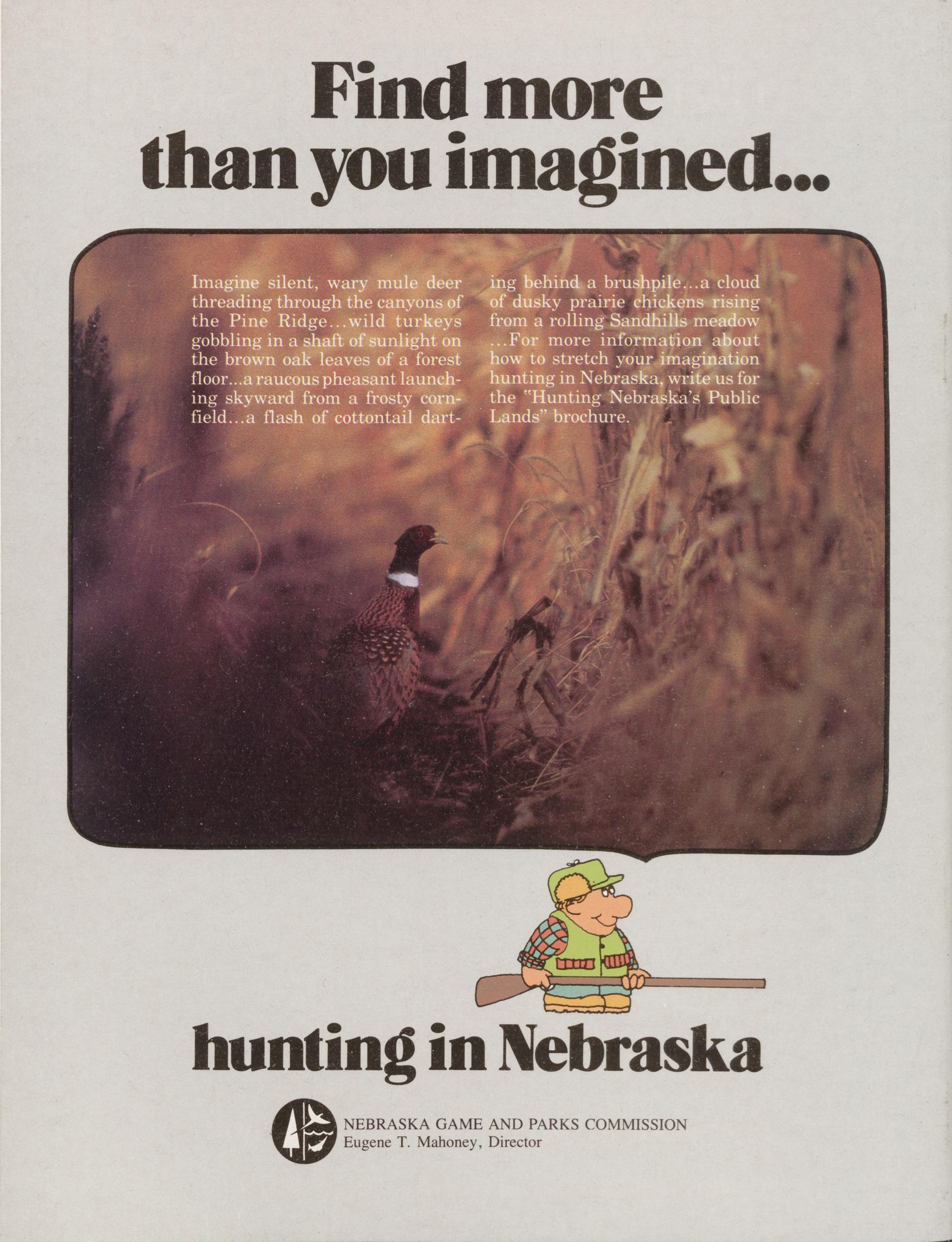
Find more than you imagined
Imagine silent, wary mule deer threading through the canyons of the Pine Ridge wild turkeys gobbling in a shaft of sunlight on the brown oak leaves of a forest floor a raucous pheasant launching skyward from a frosty cornfield a flash of cottontail dart-of dusky prairie chickens rising from a rolling Sandhills meadow For more information about how to stretch your imagination hunting in Nebraska, write us for the "Hunting Nebraska's Public Lands" brochure.
hunting in Nebraska NEBRASKA GAME AND PARKS COMMISSION Eugene T. Mahoney, DirectorPosition: 412 (24 views)