Volume 61, Issue 8, 1983
NEBRASKAland
September 1983 $1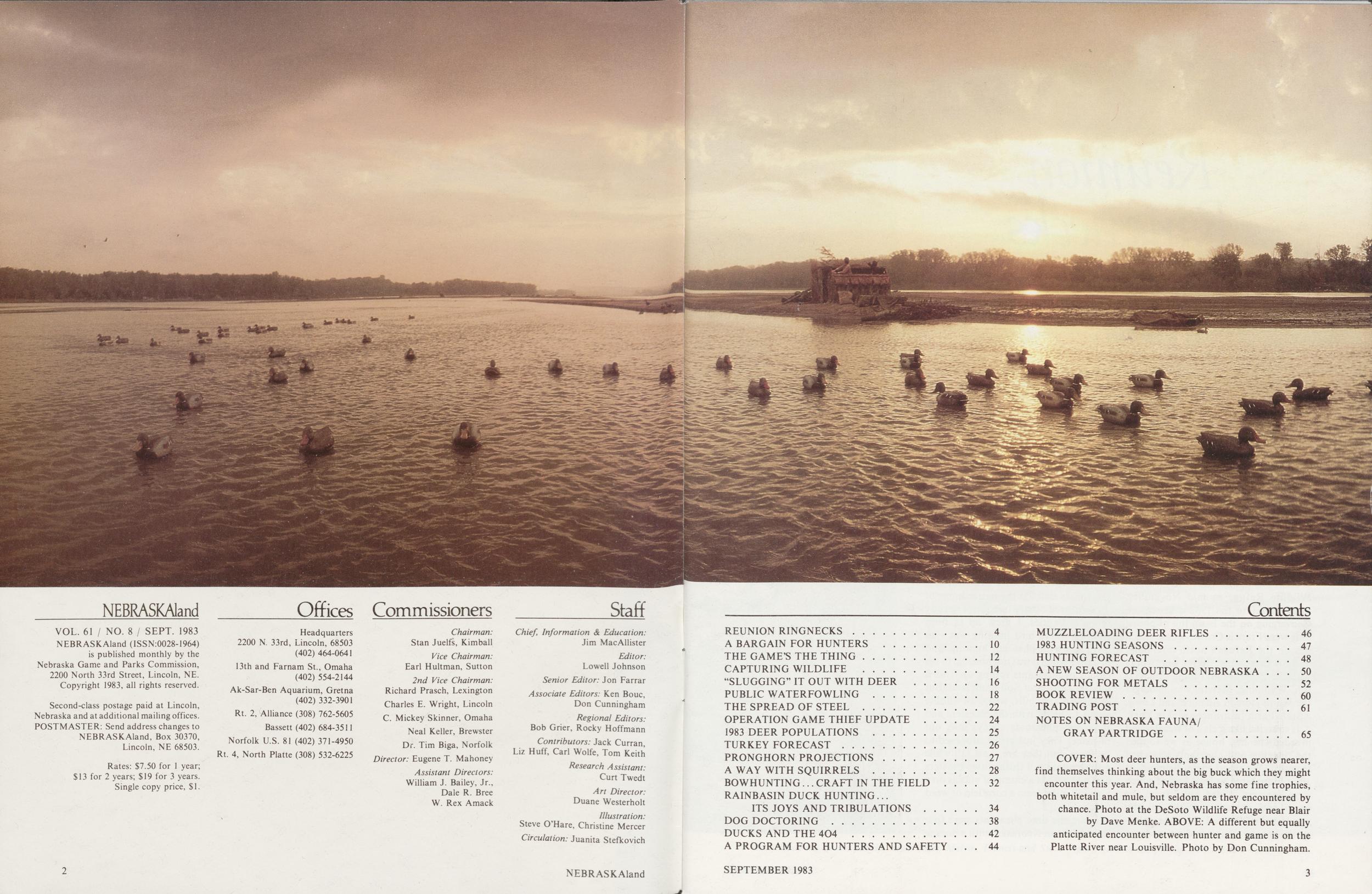
NEBRASKAland
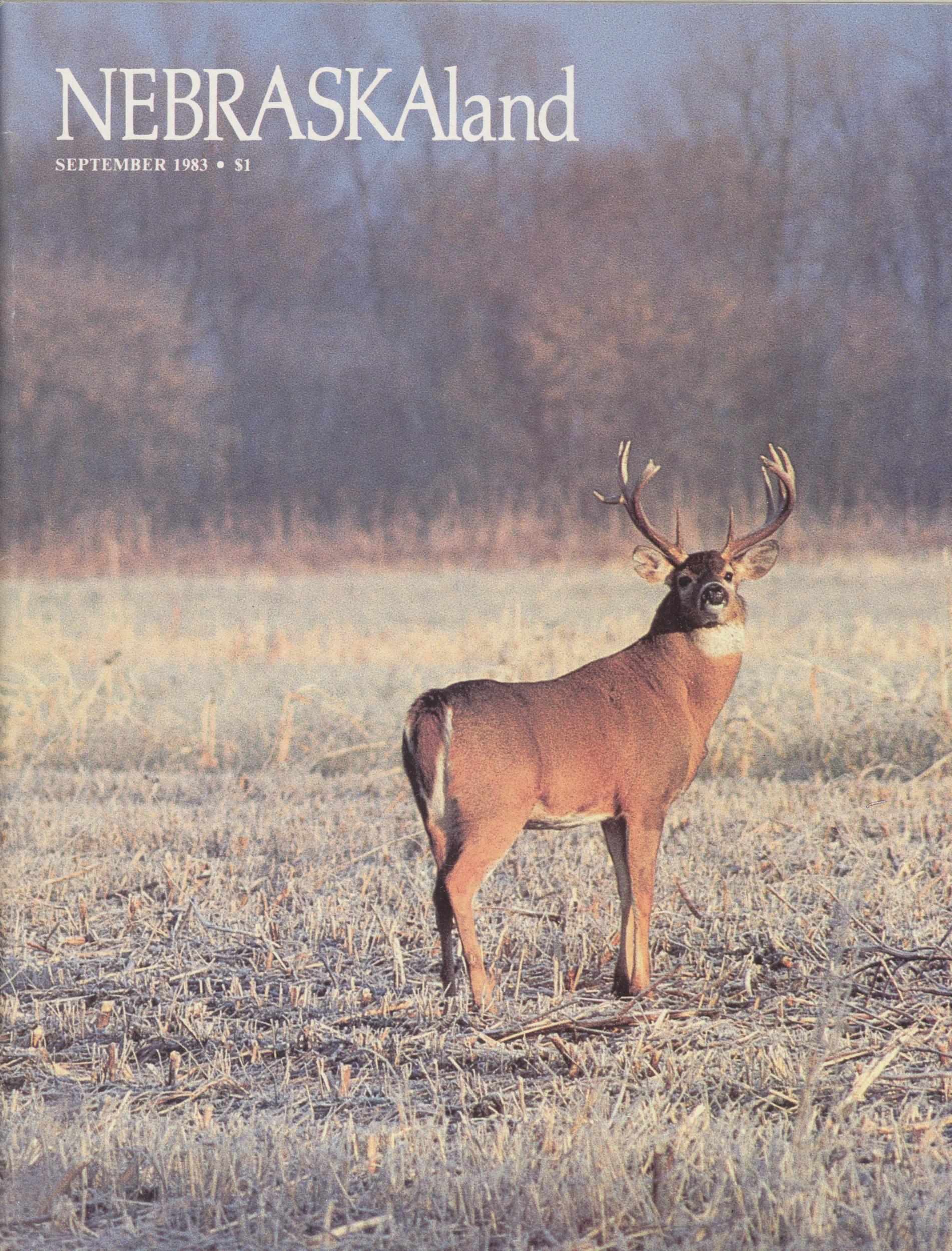
VOL. 61 / NO. 8 / SEPT. 1983 NEBRASKAland (ISSN:0028-1964) is published monthly by the Nebraska Game and Parks Commission, 2200 North 33rd Street, Lincoln, NE. Copyright 1983, all rights reserved. Second-class postage paid at Lincoln, Nebraska and at additional mailing offices. POSTMASTER: Send address changes to NEBRASKAland, Box 30370, Lincoln, NE 68503. Rates: $7.50 for 1 year; $13 for 2 years; $19 for 3 years. Single copy price, $1. Offices Headquarters 2200 N. 33rd, Lincoln, 68503 (402) 464-0641 13th and Farnam St., Omaha (402) 554-2144 Ak-Sar-Ben Aquarium, Gretna (402) 332-3901 Rt. 2, Alliance (308) 762-5605 Bassett (402) 684-3511 Norfolk U.S. 81 (402) 371-4950 Rt. 4, North Platte (308) 532-6225 Commissioners Chairman: Stan Juelfs, Kimball Vice Chairman: Earl Hultman, Sutton 2nd Vice Chairman: Richard Prasch, Lexington Charles E. Wright, Lincoln C. Mickey Skinner, Omaha Neal Keller, Brewster Dr. Tim Biga, Norfolk Director: Eugene T. Mahoney Assistant Directors: William J. Bailey, Jr., Dale R. Bree W. Rex Amack Staff Chief, Information & Education: Jim MacAllister Editor: Lowell Johnson Senior Editor: Jon Farrar Associate Editors: Ken Bouc, Don Cunningham Regional Editors: Bob Grier, Rocky Hoffmann Contributors: Jack Curran, Liz Huff, Carl Wolfe, Tom Keith Research Assistant: Curt Twedt Art Director: Duane Westerholt Illustration: Steve O'Hare, Christine Mercer Circulation: Juanita Stefkovich Contents REUNION RINGNECKS 4 A BARGAIN FOR HUNTERS 10 THE GAME'S THE THING 12 CAPTURING WILDLIFE 14 "SLUGGING" IT OUT WITH DEER 16 PUBLIC WATERFOWLING 18 THE SPREAD OF STEEL 22 OPERATION GAME THIEF UPDATE 24 1983 DEER POPULATIONS 25 TURKEY FORECAST 26 PRONGHORN PROJECTIONS 27 A WAY WITH SQUIRRELS 28 BOWHUNTING CRAFT IN THE FIELD 32 RAINBASIN DUCK HUNTING ITS JOYS AND TRIBULATIONS 34 DOG DOCTORING 38 DUCKS AND THE 404 42 A PROGRAM FOR HUNTERS AND SAFETY 44 MUZZLELOADING DEER RIFLES 46 1983 HUNTING SEASONS 47 HUNTING FORECAST 48 A NEW SEASON OF OUTDOOR NEBRASKA 50 SHOOTING FOR METALS 52 BOOK REVIEW 60 TRADING POST 61 NOTES ON NEBRASKA FAUNA/ GRAY PARTRIDGE 65 COVER: Most deer hunters, as the season grows nearer, find themselves thinking about the big buck which they might encounter this year. And, Nebraska has some fine trophies, both whitetail and mule, but seldom are they encountered by chance. Photo at the DeSoto Wildlife Refuge near Blair by Dave Menke. ABOVE: A different but equally anticipated encounter between hunter and game is on the Platte River near Louisville. Photo by Don Cunningham. 2 NEBRASKAland SEPTEMBER 1983 3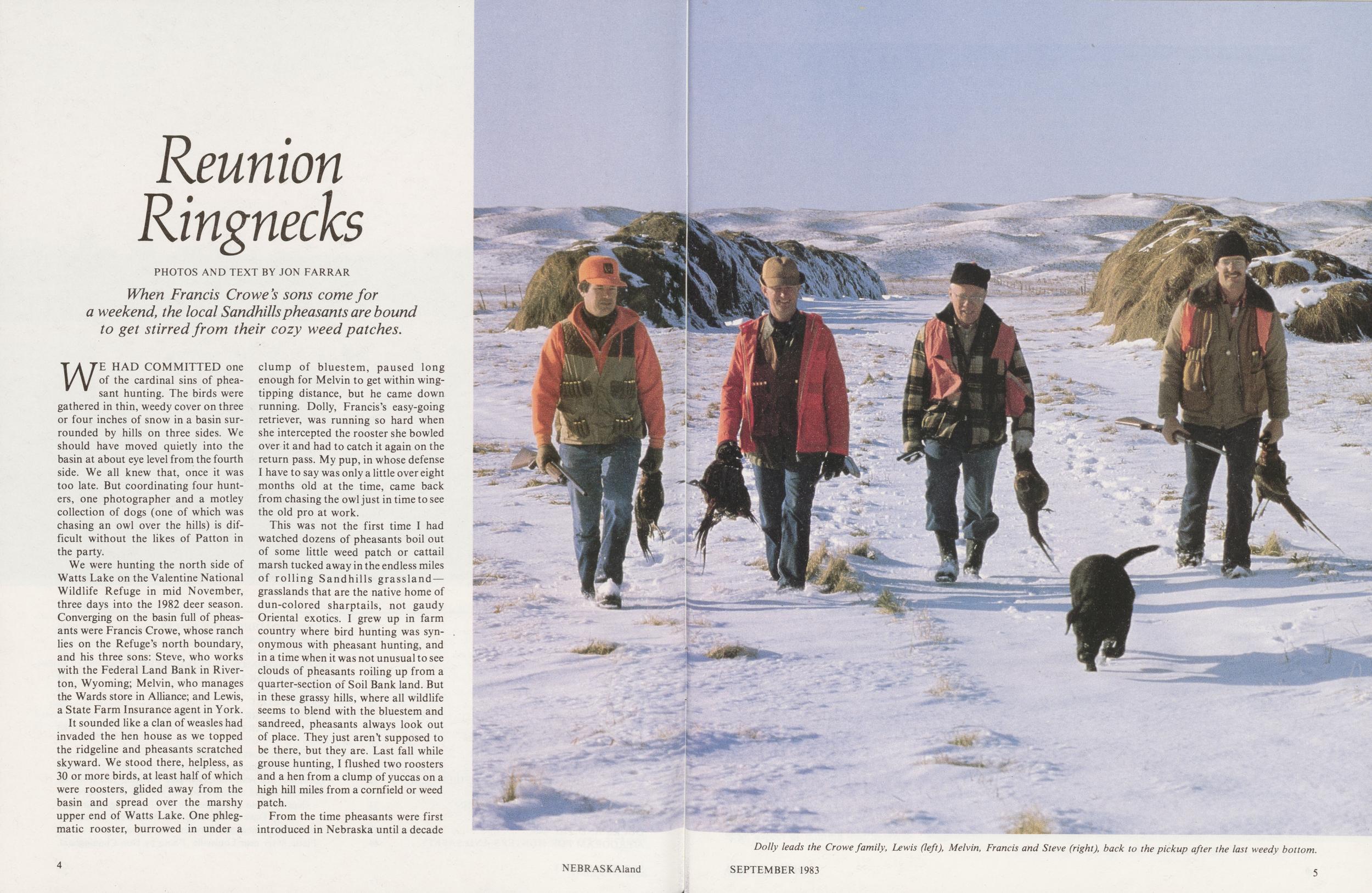
Reunion Ringnecks
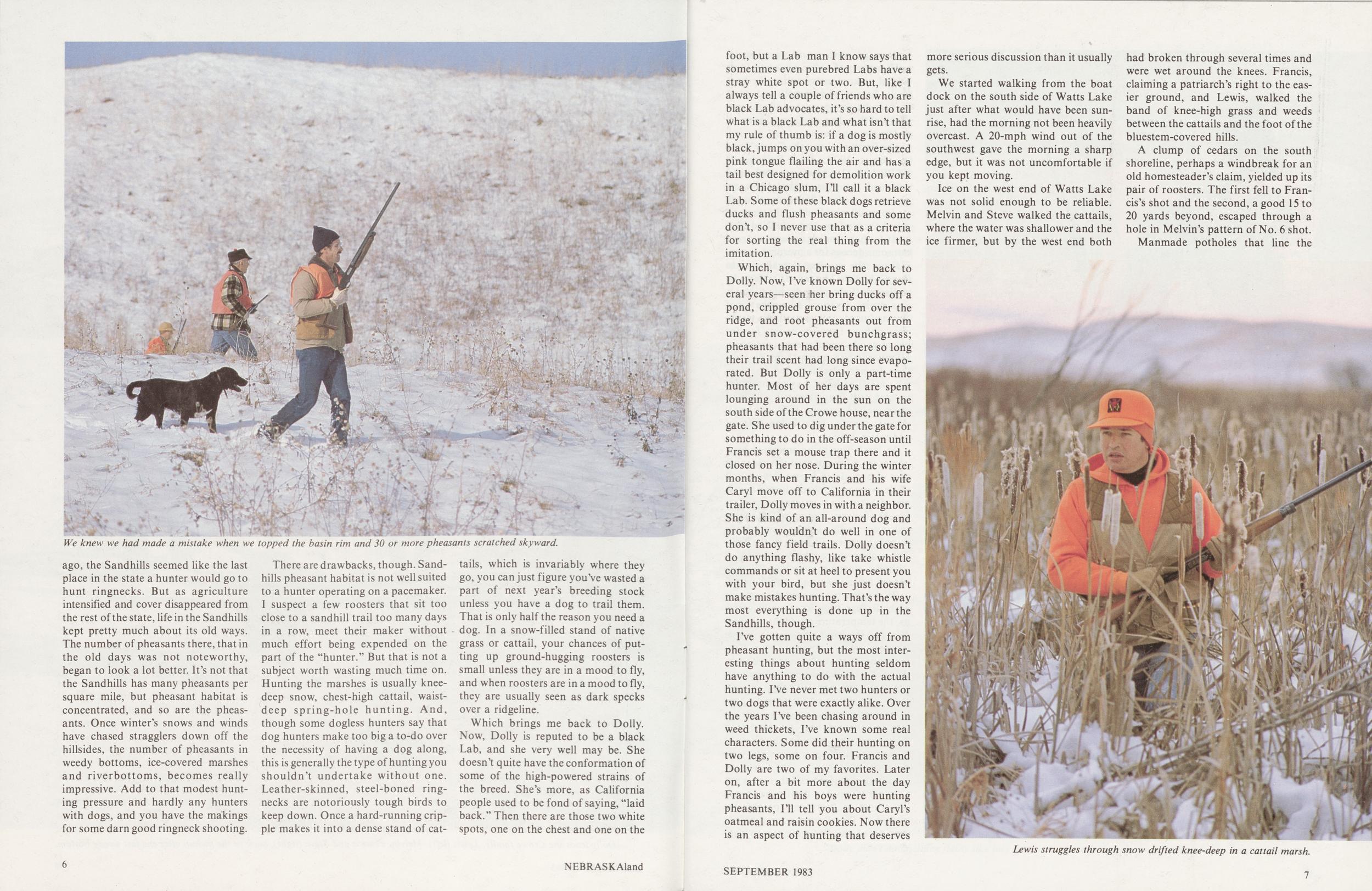
PHOTOS AND TEXT BY JON FARRAR When Francis Crowe's sons come for a weekend, the local Sandhills pheasants are bound to get stirred from their cozy weed patches.WE HAD COMMITTED one of the cardinal sins of phe- asant hunting. The birds were gathered in thin, weedy cover on three or four inches of snow in a basin sur- rounded by hills on three sides. We should have moved quietly into the basin at about eye level from the fourth side. We all knew that, once it was too late. But coordinating four hunt- ers, one photographer and a motley collection of dogs (one of which was chasing an owl over the hills) is dif- ficult without the likes of Patton in the party.
We were hunting the north side of Watts Lake on the Valentine National Wildlife Refuge in mid November, three days into the 1982 deer season. Converging on the basin full of pheas- ants were Francis Crowe, whose ranch lies on the Refuge's north boundary, and his three sons: Steve, who works with the Federal Land Bank in River- ton, Wyoming; Melvin, who manages the Wards store in Alliance; and Lewis, a State Farm Insurance agent in York.
It sounded like a clan of weasles had invaded the hen house as we topped the ridgeline and pheasants scratched skyward. We stood there, helpless, as 30 or more birds, at least half of which were roosters, glided away from the basin and spread over the marshy upper end of Watts Lake. One phleg- matic rooster, burrowed in under a clump of bluestem, paused long enough for Melvin to get within wing- tipping distance, but he came down running. Dolly, Francis's easy-going retriever, was running so hard when she intercepted the rooster she bowled over it and had to catch it again on the return pass. My pup, in whose defense I have to say was only a little over eight months old at the time, came back from chasing the owl just in time to see the old pro at work.
This was not the first time I had watched dozens of pheasants boil out of some little weed patch or cattail marsh tucked away in the endless miles of rolling Sandhills grassland — grasslands that are the native home of dun-colored sharptails, not gaudy Oriental exotics. I grew up in farm country where bird hunting was syn- onymous with pheasant hunting, and in a time when it was not unusual to see clouds of pheasants roiling up from a quarter-section of Soil Bank land. But in these grassy hills, where all wildlife seems to blend with the bluestem and sandreed, pheasants always look out of place. They just aren't supposed to be there, but they are. Last fall while grouse hunting, I flushed two roosters and a hen from a clump of yuccas on a high hill miles from a cornfield or weed patch.
From the time pheasants were first introduced in Nebraska until a decade
There are drawbacks, though. Sand- hills pheasant habitat is not well suited to a hunter operating on a pacemaker. I suspect a few roosters that sit too close to a sandhill trail too many days in a row, meet their maker without much effort being expended on the part of the "hunter." But that is not a subject worth wasting much time on. Hunting the marshes is usually knee- deep snow, chest-high cattail, waist- deep spring-hole hunting. And, though some dogless hunters say that dog hunters make too big a to-do over the necessity of having a dog along, this is generally the type of hunting you shouldn't undertake without one. Leather-skinned, steel-boned ring- necks are notoriously tough birds to keep down. Once a hard-running crip- ple makes it into a dense stand of cat- tails, which is invariably where they go, you can just figure you've wasted a part of next year's breeding stock unless you have a dog to trail them. That is only half the reason you need a dog. In a snow-filled stand of native grass or cattail, your chances of put- ting up ground-hugging roosters is small unless they are in a mood to fly, and when roosters are in a mood to fly, they are usually seen as dark specks over a ridgeline.
Which brings me back to Dolly. Now, Dolly is reputed to be a black Lab, and she very well may be. She doesn't quite have the conformation of some of the high-powered strains of the breed. She's more, as California people used to be fond of saying, "laid back." Then there are those two white spots, one on the chest and one on the foot, but a Lab man I know says that sometimes even purebred Labs have a stray white spot or two. But, like I always tell a couple of friends who are black Lab advocates, it's so hard to tell what is a black Lab and what isn't that my rule of thumb is: if a dog is mostly black, jumps on you with an over-sized pink tongue flailing the air and has a tail best designed for demolition work in a Chicago slum, I'll call it a black Lab. Some of these black dogs retrieve ducks and flush pheasants and some don't, so I never use that as a criteria for sorting the real thing from the imitation.
Which, again, brings me back to Dolly. Now, I've known Dolly for sev- eral years—seen her bring ducks off a pond, crippled grouse from over the ridge, and root pheasants out from under snow-covered bunchgrass; pheasants that had been there so long their trail scent had long since evapo- rated. But Dolly is only a part-time hunter. Most of her days are spent lounging around in the sun on the south side of the Crowe house, near the gate. She used to dig under the gate for something to do in the off-season until Francis set a mouse trap there and it closed on her nose. During the winter months, when Francis and his wife Caryl move off to California in their trailer, Dolly moves in with a neighbor. She is kind of an all-around dog and probably wouldn't do well in one of those fancy field trails. Dolly doesn't do anything flashy, like take whistle commands or sit at heel to present you with your bird, but she just doesn't make mistakes hunting. That's the way most everything is done up in the Sandhills, though.
I've gotten quite a ways off from pheasant hunting, but the most inter- esting things about hunting seldom have anything to do with the actual hunting. I've never met two hunters or two dogs that were exactly alike. Over the years I've been chasing around in weed thickets, I've known some real characters. Some did their hunting on two legs, some on four. Francis and Dolly are two of my favorites. Later on, after a bit more about the day Francis and his boys were hunting pheasants, I'll tell you about Caryl's oatmeal and raisin cookies. Now there is an aspect of hunting that deserves more serious discussion than it usually gets.
We started walking from the boat dock on the south side of Watts Lake just after what would have been sun- rise, had the morning not been heavily overcast. A 20-mph wind out of the southwest gave the morning a sharp edge, but it was not uncomfortable if you kept moving.
Ice on the west end of Watts Lake was not solid enough to be reliable. Melvin and Steve walked the cattails, where the water was shallower and the ice firmer, but by the west end both had broken through several times and were wet around the knees. Francis, claiming a patriarch's right to the eas- ier ground, and Lewis, walked the band of knee-high grass and weeds between the cattails and the foot of the bluestem-covered hills.
A clump of cedars on the south shoreline, perhaps a windbreak for an old homesteader's claim, yielded up its pair of roosters. The first fell to Fran- cis's shot and the second, a good 15 to 20 yards beyond, escaped through a hole in Melvin's pattern of No. 6 shot.
Manmade potholes that line the
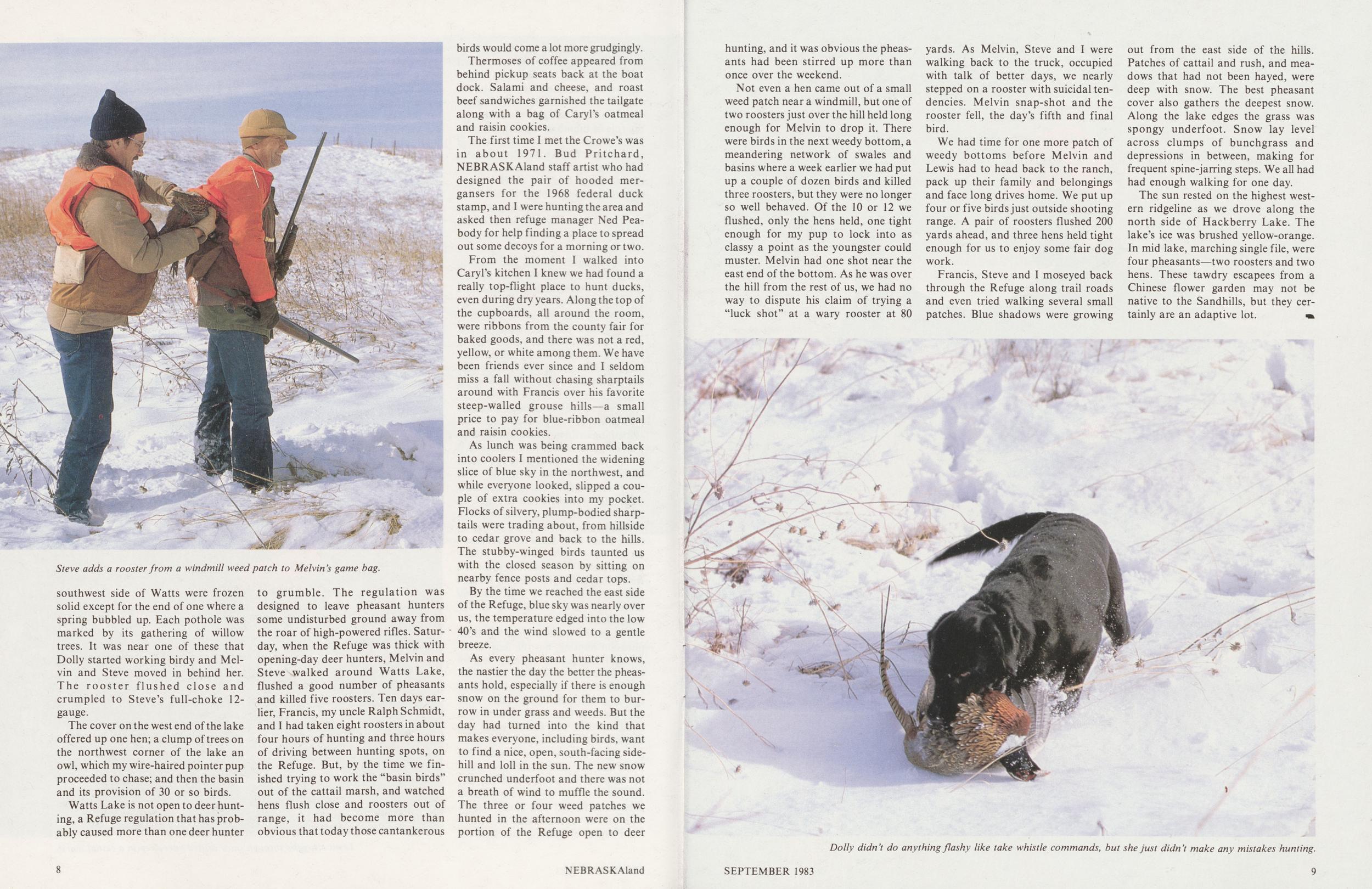
The cover on the west end of the lake offered up one hen; a clump of trees on the northwest corner of the lake an owl, which my wire-haired pointer pup proceeded to chase; and then the basin and its provision of 30 or so birds.
Watts Lake is not open to deer hunt- ing, a Refuge regulation that has prob- ably caused more than one deer hunter to grumble. The regulation was designed to leave pheasant hunters some undisturbed ground away from the roar of high-powered rifles. Satur- day, when the Refuge was thick with opening-day deer hunters, Melvin and Steve walked around Watts Lake, flushed a good number of pheasants and killed five roosters. Ten days ear- lier, Francis, my uncle Ralph Schmidt, and I had taken eight roosters in about four hours of hunting and three hours of driving between hunting spots, on the Refuge. But, by the time we fin- ished trying to work the "basin birds" out of the cattail marsh, and watched hens flush close and roosters out of range, it had become more than obvious that today those cantankerous birds would come a lot more grudgingly.
Thermoses of coffee appeared from behind pickup seats back at the boat dock. Salami and cheese, and roast beef sandwiches garnished the tailgate along with a bag of Caryl's oatmeal and raisin cookies.
The first time I met the Crowe's was in about 1971. Bud Pritchard, NEBRASKAland staff artist who had designed the pair of hooded mer- gansers for the 1968 federal duck stamp, and I were hunting the area and asked then refuge manager Ned Pea- body for help finding a place to spread out some decoys for a morning or two.
From the moment I walked into Caryl's kitchen I knew we had found a really top-flight place to hunt ducks, even during dry years. Along the top of the cupboards, all around the room, were ribbons from the county fair for baked goods, and there was not a red, yellow, or white among them. We have been friends ever since and I seldom miss a fall without chasing sharptails around with Francis over his favorite steep-walled grouse hills—a small price to pay for blue-ribbon oatmeal and raisin cookies.
As lunch was being crammed back into coolers I mentioned the widening slice of blue sky in the northwest, and while everyone looked, slipped a cou- ple of extra cookies into my pocket. Flocks of silvery, plump-bodied sharp- tails were trading about, from hillside to cedar grove and back to the hills. The stubby-winged birds taunted us with the closed season by sitting on nearby fence posts and cedar tops.
By the time we reached the east side of the Refuge, blue sky was nearly over us, the temperature edged into the low 40's and the wind slowed to a gentle breeze.
As every pheasant hunter knows, the nastier the day the better the pheas- ants hold, especially if there is enough snow on the ground for them to bur- row in under grass and weeds. But the day had turned into the kind that makes everyone, including birds, want to find a nice, open, south-facing side- hill and loll in the sun. The new snow crunched underfoot and there was not a breath of wind to muffle the sound. The three or four weed patches we hunted in the afternoon were on the portion of the Refuge open to deer hunting, and it was obvious the pheas- ants had been stirred up more than once over the weekend.
Not even a hen came out of a small weed patch near a windmill, but one of two roosters just over the hill held long enough for Melvin to drop it. There were birds in the next weedy bottom, a meandering network of swales and basins where a week earlier we had put up a couple of dozen birds and killed three roosters, but they were no longer so well behaved. Of the 10 or 12 we flushed, only the hens held, one tight enough for my pup to lock into as classy a point as the youngster could muster. Melvin had one shot near the east end of the bottom. As he was over the hill from the rest of us, we had no way to dispute his claim of trying a "luck shot" at a wary rooster at 80 yards. As Melvin, Steve and I were walking back to the truck, occupied with talk of better days, we nearly stepped on a rooster with suicidal ten- dencies. Melvin snap-shot and the rooster fell, the day's fifth and final bird.
We had time for one more patch of weedy bottoms before Melvin and Lewis had to head back to the ranch, pack up their family and belongings and face long drives home. We put up four or five birds just outside shooting range. A pair of roosters flushed 200 yards ahead, and three hens held tight enough for us to enjoy some fair dog work.
Francis, Steve and I moseyed back through the Refuge along trail roads and even tried walking several small patches. Blue shadows were growing out from the east side of the hills. Patches of cattail and rush, and mea- dows that had not been hayed, were deep with snow. The best pheasant cover also gathers the deepest snow. Along the lake edges the grass was spongy underfoot. Snow lay level across clumps of bunchgrass and depressions in between, making for frequent spine-jarring steps. We all had had enough walking for one day.
The sun rested on the highest west- ern ridgeline as we drove along the north side of Hackberry Lake. The lake's ice was brushed yellow-orange. In mid lake, marching single file, were four pheasants—two roosters and two hens. These tawdry escapees from a Chinese flower garden may not be native to the Sandhills, but they cer- tainly are an adaptive lot.
A Bargain For Hunters
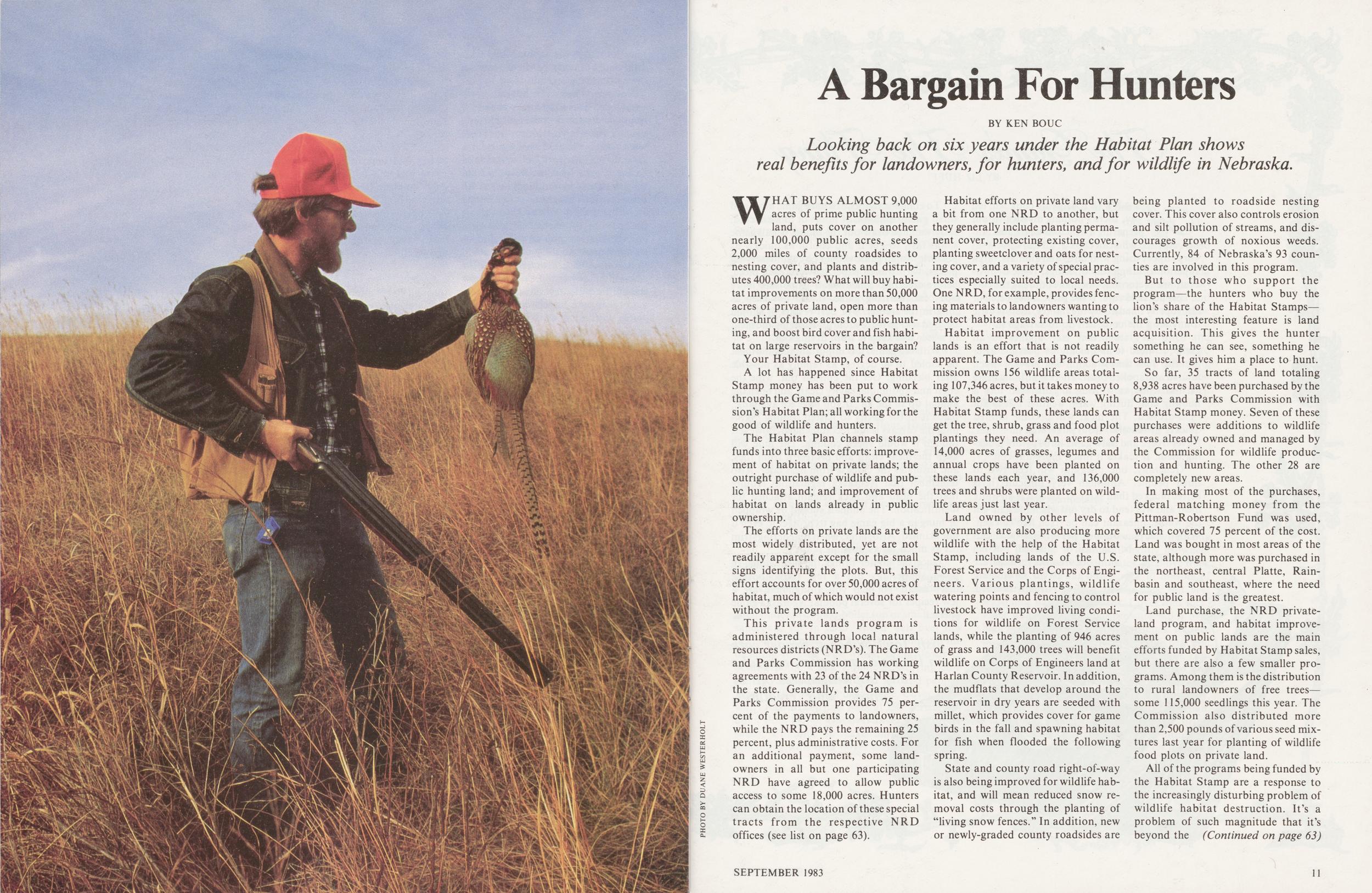
BY KEN BOUC Looking back on six years under the Habitat Plan shows real benefits for landowners, for hunters, and for wildlife in Nebraska.WHAT BUYS ALMOST 9,000 acres of prime public hunting land, puts cover on another nearly 100,000 public acres, seeds 2,000 miles of county roadsides to nesting cover, and plants and distrib- utes 400,000 trees? What will buy habi- tat improvements on more than 50,000 acres of private land, open more than one-third of those acres to public hunt- ing, and boost bird cover and fish habi- tat on large reservoirs in the bargain?
Your Habitat Stamp, of course.
A lot has happened since Habitat Stamp money has been put to work through the Game and Parks Commis- sion's Habitat Plan; all working for the good of wildlife and hunters.
The Habitat Plan channels stamp funds into three basic efforts: improve- ment of habitat on private lands; the outright purchase of wildlife and pub- lic hunting land; and improvement of habitat on lands already in public ownership.
The efforts on private lands are the most widely distributed, yet are not readily apparent except for the small signs identifying the plots. But, this effort accounts for over 50,000 acres of habitat, much of which would not exist without the program.
This private lands program is administered through local natural resources districts (NRD's). The Game and Parks Commission has working agreements with 23 of the 24 NRD's in the state. Generally, the Game and Parks Commission provides 75 per- cent of the payments to landowners, while the NRD pays the remaining 25 percent, plus administrative costs. For an additional payment, some land- owners in all but one participating NRD have agreed to allow public access to some 18,000 acres. Hunters can obtain the location of these special tracts from the respective NRD offices (see list on page 63).
Habitat efforts on private land vary a bit from one NRD to another, but they generally include planting perma- nent cover, protecting existing cover, planting sweetclover and oats for nest- ing cover, and a variety of special prac- tices especially suited to local needs. One NRD, for example, provides fenc- ing materials to landowners wanting to protect habitat areas from livestock.
Habitat improvement on public lands is an effort that is not readily apparent. The Game and Parks Com- mission owns 156 wildlife areas total- ing 107,346 acres, but it takes money to make the best of these acres. With Habitat Stamp funds, these lands can get the tree, shrub, grass and food plot plantings they need. An average of 14,000 acres of grasses, legumes and annual crops have been planted on these lands each year, and 136,000 trees and shrubs were planted on wild- life areas just last year.
Land owned by other levels of government are also producing more wildlife with the help of the Habitat Stamp, including lands of the U.S. Forest Service and the Corps of Engi- neers. Various plantings, wildlife watering points and fencing to control livestock have improved living condi- tions for wildlife on Forest Service lands, while the planting of 946 acres of grass and 143,000 trees will benefit wildlife on Corps of Engineers land at Harlan County Reservoir. In addition, the mudflats that develop around the reservoir in dry years are seeded with millet, which provides cover for game birds in the fall and spawning habitat for fish when flooded the following spring.
State and county road right-of-way is also being improved for wildlife hab- itat, and will mean reduced snow re- moval costs through the planting of "living snow fences." In addition, new or newly-graded county roadsides are being planted to roadside nesting cover. This cover also controls erosion and silt pollution of streams, and dis- courages growth of noxious weeds. Currently, 84 of Nebraska's 93 coun- ties are involved in this program.
But to those who support the program—the hunters who buy the lion's share of the Habitat Stamps— the most interesting feature is land acquisition. This gives the hunter something he can see, something he can use. It gives him a place to hunt.
So far, 35 tracts of land totaling 8,938 acres have been purchased by the Game and Parks Commission with Habitat Stamp money. Seven of these purchases were additions to wildlife areas already owned and managed by the Commission for wildlife produc- tion and hunting. The other 28 are completely new areas.
In making most of the purchases, federal matching money from the Pittman-Robertson Fund was used, which covered 75 percent of the cost. Land was bought in most areas of the state, although more was purchased in the northeast, central Platte, Rain- basin and southeast, where the need for public land is the greatest.
Land purchase, the NRD private- land program, and habitat improve- ment on public lands are the main efforts funded by Habitat Stamp sales, but there are also a few smaller pro- grams. Among them is the distribution to rural landowners of free trees- some 115,000 seedlings this year. The Commission also distributed more than 2,500 pounds of various seed mix- tures last year for planting of wildlife food plots on private land.
All of the programs being funded by the Habitat Stamp are a response to the increasingly disturbing problem of wildlife habitat destruction. It's a problem of such magnitude that it's beyond the (Continued on page 63)
SEPTEMBER 1983 11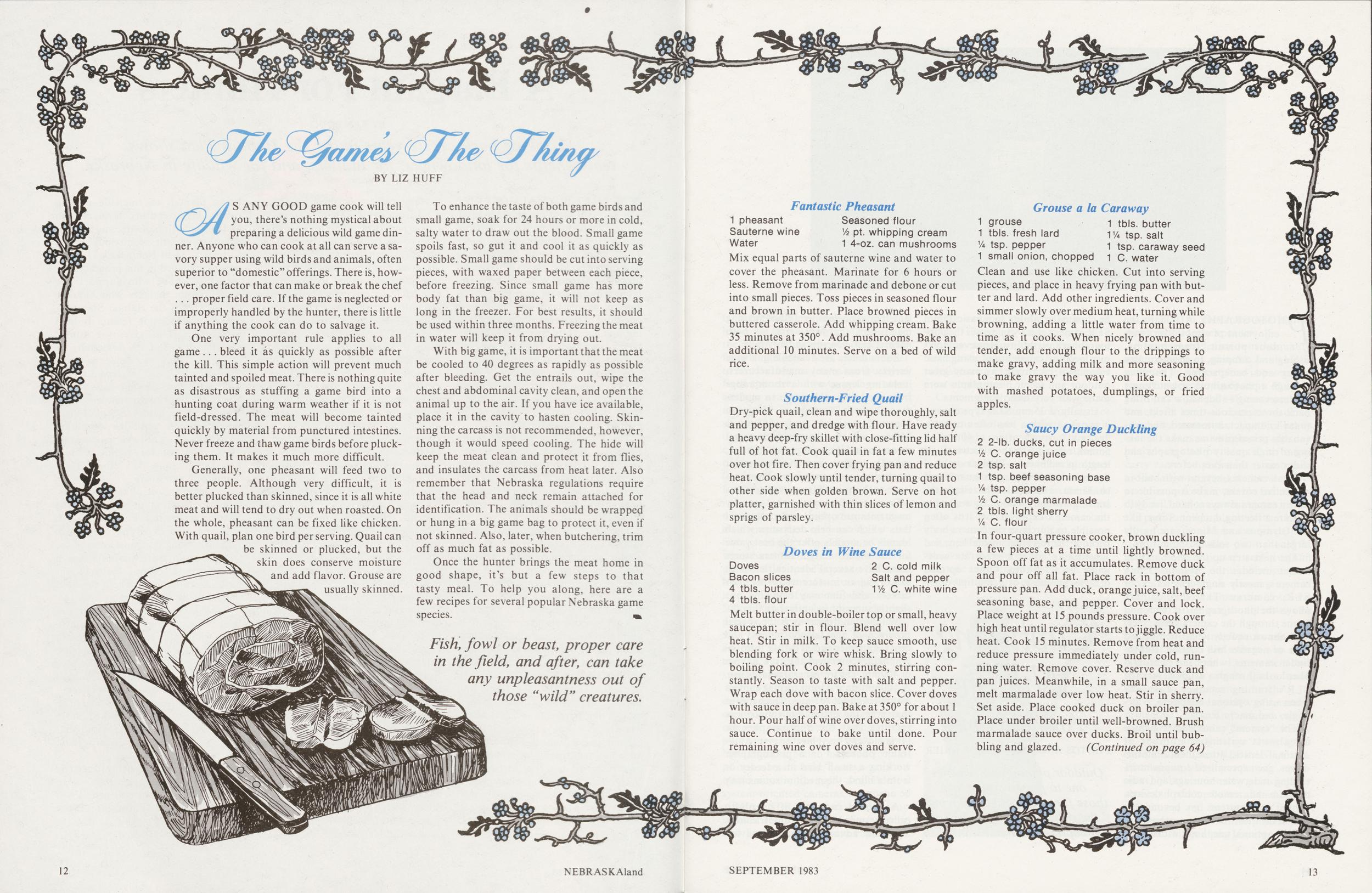
The Game's The Thing
BY LIZ HUFFAS ANY GOOD game cook will tell you, there's nothing mystical about preparing a delicious wild game din- ner. Anyone who can cook at all can serve a sa- vory supper using wild birds and animals, often superior to "domestic" offerings. There is, how- ever, one factor that can make or break the chef proper field care. If the game is neglected or improperly handled by the hunter, there is little if anything the cook can do to salvage it.
One very important rule applies to all game bleed it as quickly as possible after the kill. This simple action will prevent much tainted and spoiled meat. There is nothing quite as disastrous as stuffing a game bird into a hunting coat during warm weather if it is not field-dressed. The meat will become tainted quickly by material from punctured intestines. Never freeze and thaw game birds before pluck- ing them. It makes it much more difficult.
Generally, one pheasant will feed two to three people. Although very difficult, it is better plucked than skinned, since it is all white meat and will tend to dry out when roasted. On the whole, pheasant can be fixed like chicken. With quail, plan one bird per serving. Quail can be skinned or plucked, but the skin does conserve moisture and add flavor. Grouse are usually skinned.
To enhance the taste of both game birds and small game, soak for 24 hours or more in cold, salty water to draw out the blood. Small game spoils fast, so gut it and cool it as quickly as possible. Small game should be cut into serving pieces, with waxed paper between each piece, before freezing. Since small game has more body fat than big game, it will not keep as long in the freezer. For best results, it should be used within three months. Freezing the meat in water will keep it from drying out.
With big game, it is important that the meat be cooled to 40 degrees as rapidly as possible after bleeding. Get the entrails out, wipe the chest and abdominal cavity clean, and open the animal up to the air. If you have ice available, place it in the cavity to hasten cooling. Skin- ning the carcass is not recommended, however, though it would speed cooling. The hide will keep the meat clean and protect it from flies, and insulates the carcass from heat later. Also remember that Nebraska regulations require that the head and neck remain attached for identification. The animals should be wrapped or hung in a big game bag to protect it, even if not skinned. Also, later, when butchering, trim off as much fat as possible.
Once the hunter brings the meat home in good shape, it's but a few steps to that tasty meal. To help you along, here are a few recipes for several popular Nebraska game species.
Fish, fowl or beast, proper care in the field, and after, can take any unpleasantness out of those "wild" creatures. Fantastic Pheasant 1 pheasant Seasoned flour Sauterne wine 1/2 pt. whipping cream Water 1 4-oz. can mushroomsMix equal parts of sauterne wine and water to cover the pheasant. Marinate for 6 hours or less. Remove from marinade and debone or cut into small pieces. Toss pieces in seasoned flour and brown in butter. Place browned pieces in buttered casserole. Add whipping cream. Bake 35 minutes at 350°. Add mushrooms. Bake an additional 10 minutes. Serve on a bed of wild rice.
Southern-Fried QuailDry-pick quail, clean and wipe thoroughly, salt and pepper, and dredge with flour. Have ready a heavy deep-fry skillet with close-fitting lid half full of hot fat. Cook quail in fat a few minutes over hot fire. Then cover frying pan and reduce heat. Cook slowly until tender, turning quail to other side when golden brown. Serve on hot platter, garnished with thin slices of lemon and sprigs of parsley.
Doves in Wine Sauce Doves 2 C. cold milk Bacon slices Salt and pepper 4 tbls. butter 1 1/2 C. white wine 4 tbls. flourMelt butter in double-boiler top or small, heavy saucepan; stir in flour. Blend well over low heat. Stir in milk. To keep sauce smooth, use blending fork or wire whisk. Bring slowly to boiling point. Cook 2 minutes, stirring con- stantly. Season to taste with salt and pepper. Wrap each dove with bacon slice. Cover doves with sauce in deep pan. Bake at 350° for about 1 hour. Pour half of wine over doves, stirring into sauce. Continue to bake until done. Pour remaining wine over doves and serve.
Grouse a la Caraway 1 grouse 1 tbls. butter 1 tbls. fresh lard 1 1/4 tsp. salt 1/4 tsp. pepper 1 tsp. caraway seed 1 small onion, chopped 1 C. waterClean and use like chicken. Cut into serving pieces, and place in heavy frying pan with but- ter and lard. Add other ingredients. Cover and simmer slowly over medium heat, turning while browning, adding a little water from time to time as it cooks. When nicely browned and tender, add enough flour to the drippings to make gravy, adding milk and more seasoning to make gravy the way you like it. Good with mashed potatoes, dumplings, or fried apples.
Saucy Orange Duckling 2 2-lb. ducks, cut in pieces 1/2 C. orange juice 2 tsp. salt 1 tsp. beef seasoning base 1/4 tsp. pepper 1/2 C. orange marmalade 2 tbls. light sherry 1/4 C. flourIn four-quart pressure cooker, brown duckling a few pieces at a time until lightly browned. Spoon off fat as it accumulates. Remove duck and pour off all fat. Place rack in bottom of pressure pan. Add duck, orange juice, salt, beef seasoning base, and pepper. Cover and lock. Place weight at 15 pounds pressure. Cook over high heat until regulator starts to jiggle. Reduce heat. Cook 15 minutes. Remove from heat and reduce pressure immediately under cold, run- ning water. Remove cover. Reserve duck and pan juices. Meanwhile, in a small sauce pan, melt marmalade over low heat. Stir in sherry. Set aside. Place cooked duck on broiler pan. Place under broiler until well-browned. Brush marmalade sauce over ducks. Broil until bub- bling and glazed. (Continued on page 64)
12 NEBRASKAland SEPTEMBER 1983 13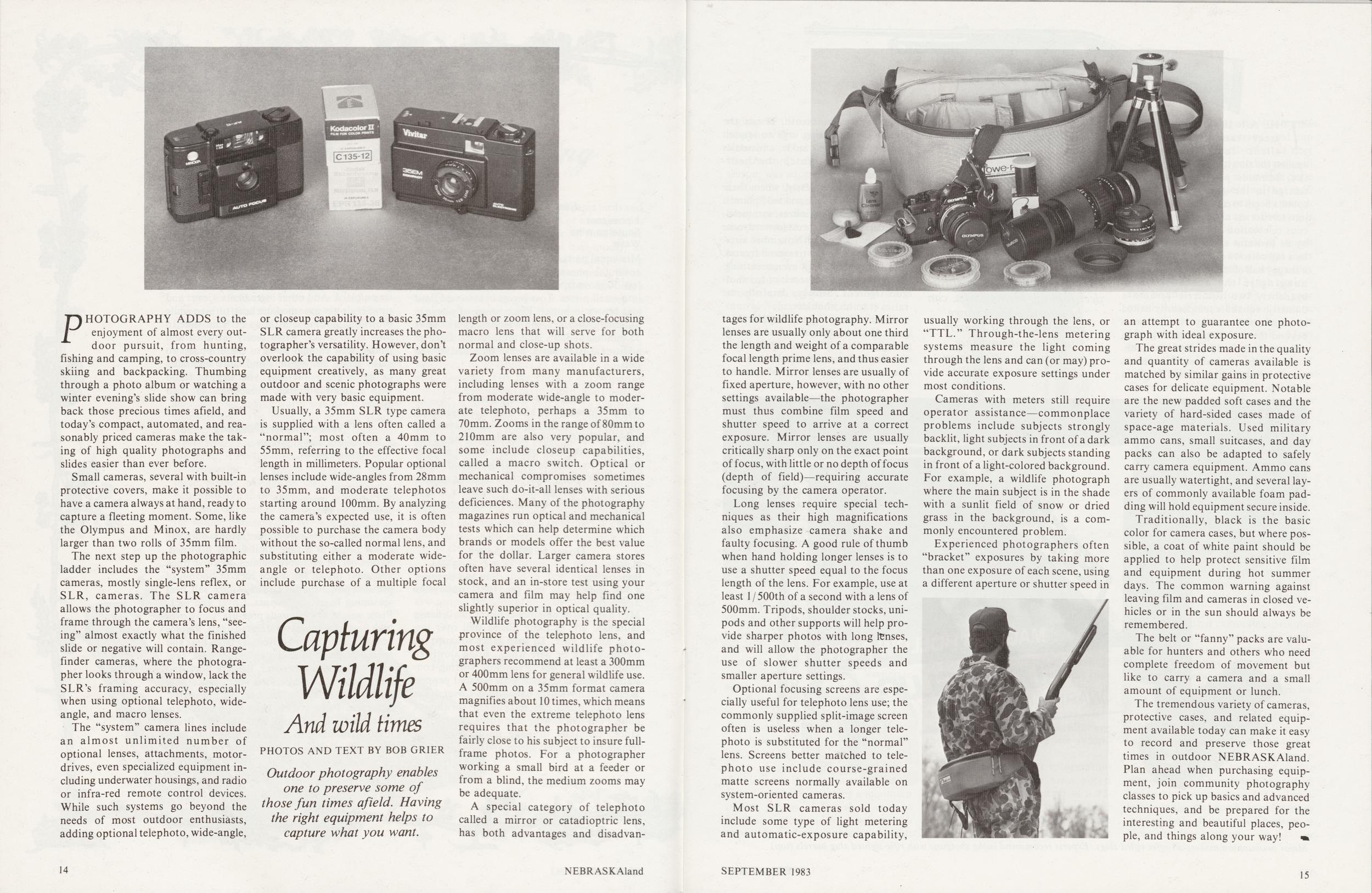
Capturing Wildlife And wild times
PHOTOS AND TEXT BY BOB GRIER Outdoor photography enables one to preserve some of those fun times afield. Having the right equipment helps to capture what you want.PHOTOGRAPHY ADDS to the enjoyment of almost every out- door pursuit, from hunting, fishing and camping, to cross-country skiing and backpacking. Thumbing through a photo album or watching a winter evening's slide show can bring back those precious times afield, and today's compact, automated, and rea- sonably priced cameras make the tak- ing of high quality photographs and slides easier than ever before.
Small cameras, several with built-in protective covers, make it possible to have a camera always at hand, ready to capture a fleeting moment. Some, like the Olympus and Minox, are hardly larger than two rolls of 35mm film.
The next step up the photographic ladder includes the "system" 35mm cameras, mostly single-lens reflex, or SLR, cameras. The SLR camera allows the photographer to focus and frame through the camera's lens, "see- ing" almost exactly what the finished slide or negative will contain. Range- finder cameras, where the photogra- pher looks through a window, lack the SLR's framing accuracy, especially when using optional telephoto, wide- angle, and macro lenses.
The "system" camera lines include an almost unlimited number of optional lenses, attachments, motor- drives, even specialized equipment in- cluding underwater housings, and radio or infra-red remote control devices. While such systems go beyond the needs of most outdoor enthusiasts, adding optional telephoto, wide-angle, or closeup capability to a basic 35mm SLR camera greatly increases the pho- tographer's versatility. However, don't overlook the capability of using basic equipment creatively, as many great outdoor and scenic photographs were made with very basic equipment.
Usually, a 35mm SLR type camera is supplied with a lens often called a "normal"; most often a 40mm to 55mm, referring to the effective focal length in millimeters. Popular optional lenses include wide-angles from 28mm to 35mm, and moderate telephotos starting around 100mm. By analyzing the camera's expected use, it is often possible to purchase the camera body without the so-called normal lens, and substituting either a moderate wide- angle or telephoto. Other options include purchase of a multiple focal length or zoom lens, or a close-focusing macro lens that will serve for both normal and close-up shots.
Zoom lenses are available in a wide variety from many manufacturers, including lenses with a zoom range from moderate wide-angle to moder- ate telephoto, perhaps a 35mm to 70mm. Zooms in the range of 80mm to 210mm are also very popular, and some include closeup capabilities, called a macro switch. Optical or mechanical compromises sometimes leave such do-it-all lenses with serious deficiences. Many of the photography magazines run optical and mechanical tests which can help determine which brands or models offer the best value for the dollar. Larger camera stores often have several identical lenses in stock, and an in-store test using your camera and film may help find one slightly superior in optical quality.
Wildlife photography is the special province of the telephoto lens, and most experienced wildlife photo- graphers recommend at least a 300mm or 400mm lens for general wildlife use. A 500mm on a 35mm format camera magnifies about 10 times, which means that even the extreme telephoto lens requires that the photographer be fairly close to his subject to insure full- frame photos. For a photographer working a small bird at a feeder or from a blind, the medium zooms may be adequate.
A special category of telephoto called a mirror or catadioptric lens, has both advantages and disadvan- tages for wildlife photography. Mirror lenses are usually only about one third the length and weight of a comparable focal length prime lens, and thus easier to handle. Mirror lenses are usually of fixed aperture, however, with no other settings available—the photographer must thus combine film speed and shutter speed to arrive at a correct exposure. Mirror lenses are usually critically sharp only on the exact point of focus, with little or no depth of focus (depth of field)—requiring accurate focusing by the camera operator.
Long lenses require special tech- niques as their high magnifications also emphasize camera shake and faulty focusing. A good rule of thumb when hand holding longer lenses is to use a shutter speed equal to the focus length of the lens. For example, use at least 1 / 500th of a second with a lens of 500mm. Tripods, shoulder stocks, uni- pods and other supports will help pro- vide sharper photos with long tenses, and will allow the photographer the use of slower shutter speeds and smaller aperture settings.
Optional focusing screens are espe- cially useful for telephoto lens use; the commonly supplied split-image screen often is useless when a longer tele- photo is substituted for the "normal" lens. Screens better matched to tele- photo use include course-grained matte screens normally available on system-oriented cameras.
Most SLR cameras sold today include some type of light metering and automatic-exposure capability, usually working through the lens, or "TTL." Through-the-lens metering systems measure the light coming through the lens and can (or may) pro- vide accurate exposure settings under most conditions.
Cameras with meters still require operator assistance—commonplace problems include subjects strongly backlit, light subjects in front of a dark background, or dark subjects standing in front of a light-colored background. For example, a wildlife photograph where the main subject is in the shade with a sunlit field of snow or dried grass in the background, is a com- monly encountered problem.
Experienced photographers often "bracket" exposures by taking more than one exposure of each scene, using a different aperture or shutter speed in an attempt to guarantee one photo- graph with ideal exposure.
The great strides made in the quality and quantity of cameras available is matched by similar gains in protective cases for delicate equipment. Notable are the new padded soft cases and the variety of hard-sided cases made of space-age materials. Used military ammo cans, small suitcases, and day packs can also be adapted to safely carry camera equipment. Ammo cans are usually watertight, and several lay- ers of commonly available foam pad- ding will hold equipment secure inside.
Traditionally, black is the basic color for camera cases, but where pos- sible, a coat of white paint should be applied to help protect sensitive film and equipment during hot summer days. The common warning against leaving film and cameras in closed ve- hicles or in the sun should always be remembered.
The belt or "fanny" packs are valu- able for hunters and others who need complete freedom of movement but like to carry a camera and a small amount of equipment or lunch.
The tremendous variety of cameras, protective cases, and related equip- ment available today can make it easy to record and preserve those great times in outdoor NEBRASKAland. Plan ahead when purchasing equip- ment, join community photography classes to pick up basics and advanced techniques, and be prepared for the interesting and beautiful places, peo- ple, and things along your way!
14 NEBRASKAland SEPTEMBER 1983 15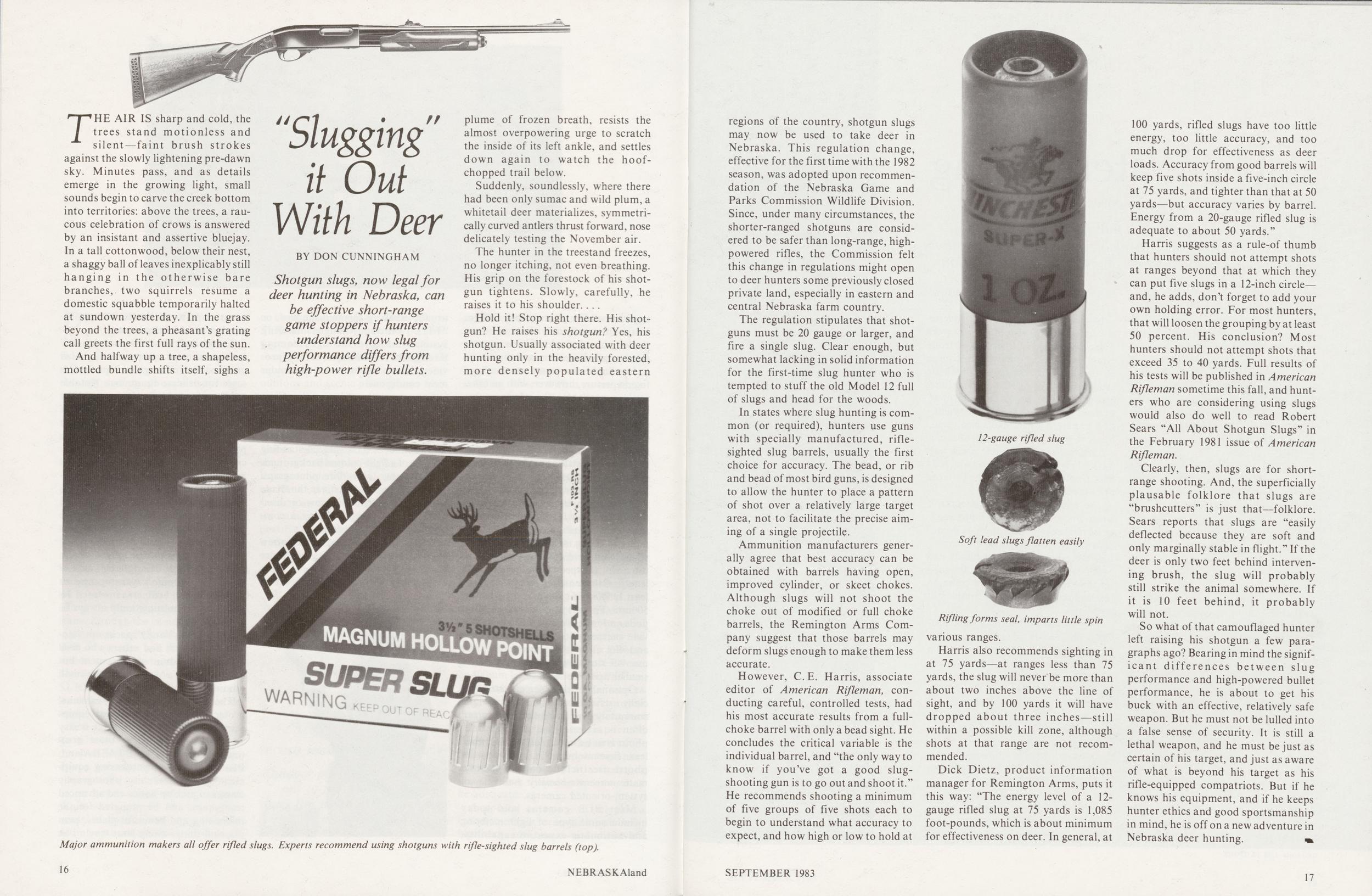
"Slugging" it Out With Deer
BY DON CUNNINGHAM Shotgun slugs, now legal for deer hunting in Nebraska, can be effective short-range game stoppers if hunters understand how slug performance differs from high-power rifle bullets.THE AIR IS sharp and cold, the trees stand motionless and silent—faint brush strokes against the slowly lightening pre-dawn sky. Minutes pass, and as details emerge in the growing light, small sounds begin to carve the creek bottom into territories: above the trees, a rau- cous celebration of crows is answered by an insistant and assertive bluejay. In a tall cottonwood, below their nest, a shaggy ball of leaves inexplicably still hanging in the otherwise bare branches, two squirrels resume a domestic squabble temporarily halted at sundown yesterday. In the grass beyond the trees, a pheasant's grating call greets the first full rays of the sun.
And halfway up a tree, a shapeless, mottled bundle shifts itself, sighs a plume of frozen breath, resists the almost overpowering urge to scratch the inside of its left ankle, and settles down again to watch the hoof- chopped trail below.
Suddenly, soundlessly, where there had been only sumac and wild plum, a whitetail deer materializes, symmetri- cally curved antlers thrust forward, nose delicately testing the November air.
The hunter in the treestand freezes, no longer itching, not even breathing. His grip on the forestock of his shot- gun tightens. Slowly, carefully, he raises it to his shoulder...
Hold it! Stop right there. His shot- gun? He raises his shotgun? Yes, his shotgun. Usually associated with deer hunting only in the heavily forested, more densely populated eastern
The regulation stipulates that shot- guns must be 20 gauge or larger, and fire a single slug. Clear enough, but somewhat lacking in solid information for the first-time slug hunter who is tempted to stuff the old Model 12 full of slugs and head for the woods.
In states where slug hunting is com- mon (or required), hunters use guns with specially manufactured, rifle- sighted slug barrels, usually the first choice for accuracy. The bead, or rib and bead of most bird guns, is designed to allow the hunter to place a pattern of shot over a relatively large target area, not to facilitate the precise aim- ing of a single projectile.
Ammunition manufacturers gener- ally agree that best accuracy can be obtained with barrels having open, improved cylinder, or skeet chokes. Although slugs will not shoot the choke out of modified or full choke barrels, the Remington Arms Com- pany suggest that those barrels may deform slugs enough to make them less accurate.
However, C. E. Harris, associate editor of American Rifleman, con- ducting careful, controlled tests, had his most accurate results from a full- choke barrel with only a bead sight. He concludes the critical variable is the individual barrel, and "the only way to know if you've got a good slug- shooting gun is to go out and shoot it." He recommends shooting a minimum of five groups of five shots each to begin to understand what accuracy to expect, and how high or low to hold at
Harris also recommends sighting in at 75 yards—at ranges less than 75 yards, the slug will never be more than about two inches above the line of sight, and by 100 yards it will have dropped about three inches—still within a possible kill zone, although shots at that range are not recom- mended.
Dick Dietz, product information manager for Remington Arms, puts it this way: "The energy level of a 12- gauge rifled slug at 75 yards is 1,085 foot-pounds, which is about minimum for effectiveness on deer. In general, at 100 yards, rifled slugs have too little energy, too little accuracy, and too much drop for effectiveness as deer loads. Accuracy from good barrels will keep five shots inside a five-inch circle at 75 yards, and tighter than that at 50 yards—but accuracy varies by barrel. Energy from a 20-gauge rifled slug is adequate to about 50 yards."
Harris suggests as a rule-of thumb that hunters should not attempt shots at ranges beyond that at which they can put five slugs in a 12-inch circle— and, he adds, don't forget to add your own holding error. For most hunters, that will loosen the grouping by at least 50 percent. His conclusion? Most hunters should not attempt shots that exceed 35 to 40 yards. Full results of his tests will be published in American Rifleman sometime this fall, and hunt- ers who are considering using slugs would also do well to read Robert Sears "All About Shotgun Slugs" in the February 1981 issue of American Rifleman.
Clearly, then, slugs are for short- range shooting. And, the superficially plausable folklore that slugs are "brushcutters" is just that—folklore. Sears reports that slugs are "easily deflected because they are soft and only marginally stable in flight." If the deer is only two feet behind interven- ing brush, the slug will probably still strike the animal somewhere. If it is 10 feet behind, it probably will not.
So what of that camouflaged hunter left raising his shotgun a few para- graphs ago? Bearing in mind the signif- icant differences between slug performance and high-powered bullet performance, he is about to get his buck with an effective, relatively safe weapon. But he must not be lulled into a false sense of security. It is still a lethal weapon, and he must be just as certain of his target, and just as aware of what is beyond his target as his rifle-equipped compatriots. But if he knows his equipment, and if he keeps hunter ethics and good sportsmanship in mind, he is off on a new adventure in Nebraska deer hunting.
16 NEBRASKAland SEPTEMBER 1983 17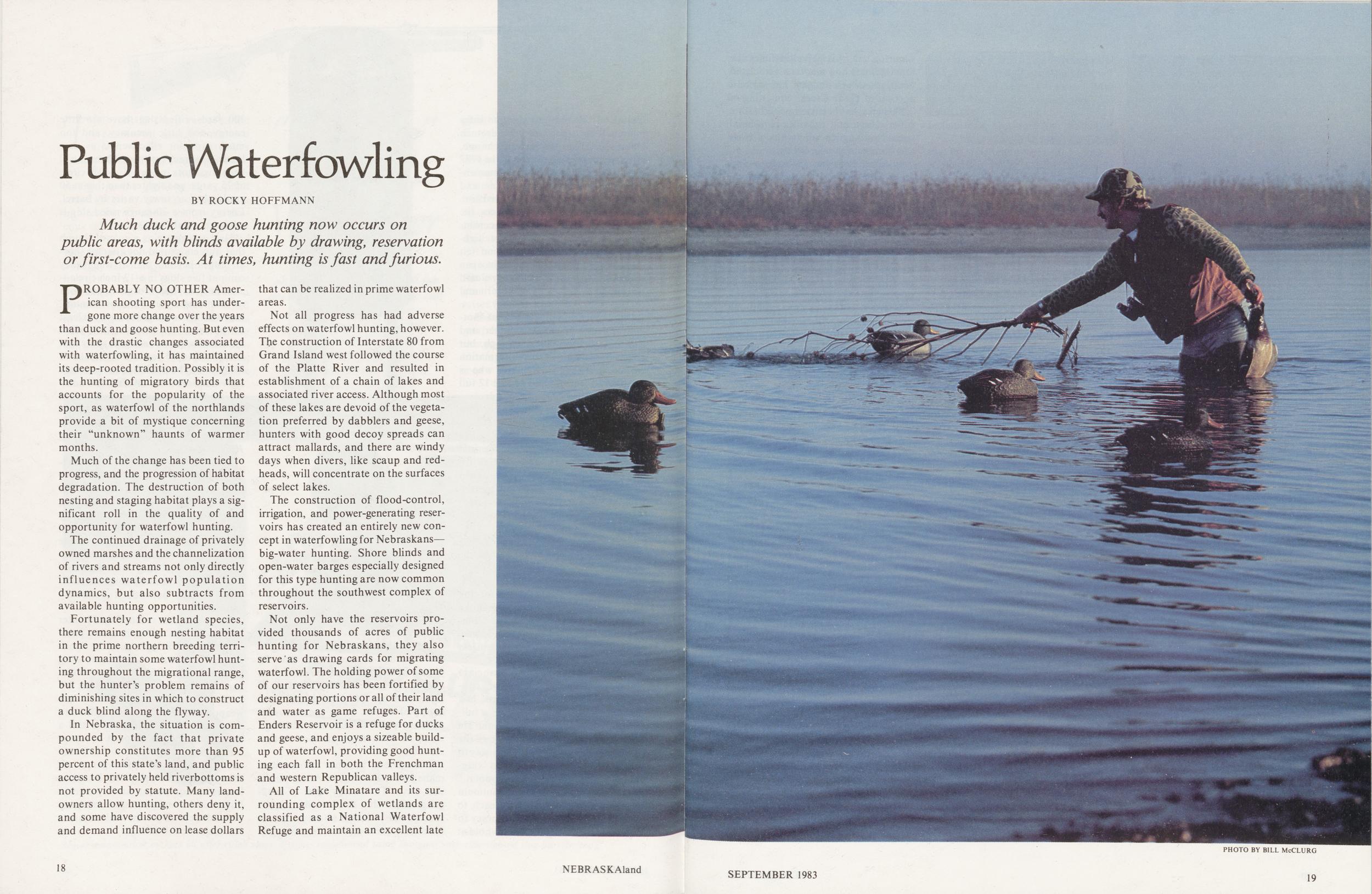
Public Waterfowling
BY ROCKY HOFFMANN Much duck and goose hunting now occurs on public areas, with blinds available by drawing, reservation or first-come basis. At times, hunting is fast and furious.PROBABLY NO OTHER Amer- ican shooting sport has under- gone more change over the years than duck and goose hunting. But even with the drastic changes associated with waterfowling, it has maintained its deep-rooted tradition. Possibly it is the hunting of migratory birds that accounts for the popularity of the sport, as waterfowl of the northlands provide a bit of mystique concerning their "unknown" haunts of warmer months.
Much of the change has been tied to progress, and the progression of habitat degradation. The destruction of both nesting and staging habitat plays a sig- nificant roll in the quality of and opportunity for waterfowl hunting.
The continued drainage of privately owned marshes and the channelization of rivers and streams not only directly influences waterfowl population dynamics, but also subtracts from available hunting opportunities.
Fortunately for wetland species, there remains enough nesting habitat in the prime northern breeding terri- tory to maintain some waterfowl hunt- ing throughout the migrational range, but the hunter's problem remains of diminishing sites in which to construct a duck blind along the flyway.
In Nebraska, the situation is com- pounded by the fact that private ownership constitutes more than 95 percent of this state's land, and public access to privately held riverbottoms is not provided by statute. Many land- owners allow hunting, others deny it, and some have discovered the supply and demand influence on lease dollars that can be realized in prime waterfowl areas.
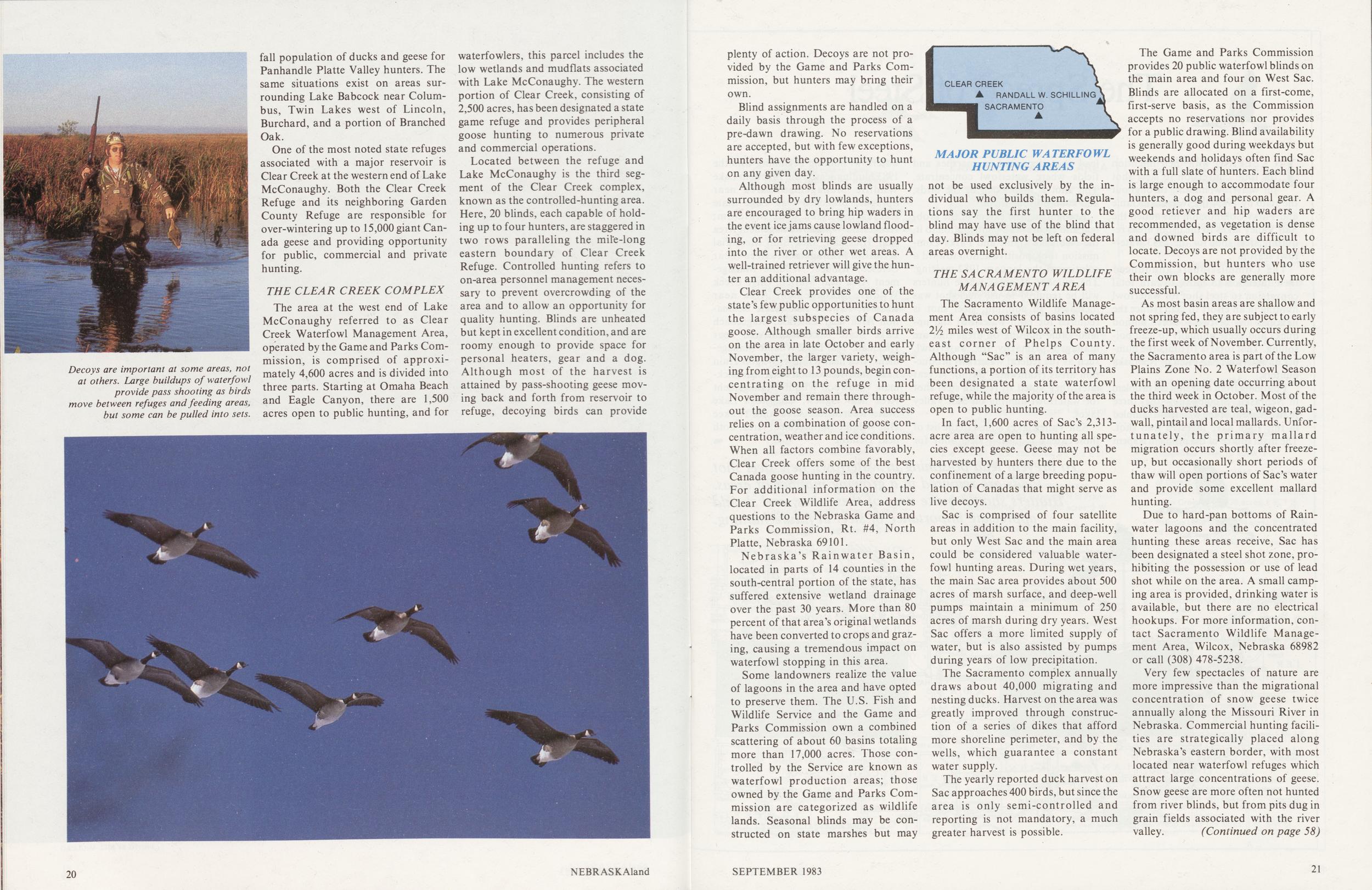
Not all progress has had adverse effects on waterfowl hunting, however. The construction of Interstate 80 from Grand Island west followed the course of the Platte River and resulted in establishment of a chain of lakes and associated river access. Although most of these lakes are devoid of the vegeta- tion preferred by dabblers and geese, hunters with good decoy spreads can attract mallards, and there are windy days when divers, like scaup and red- heads, will concentrate on the surfaces of select lakes.
The construction of flood-control, irrigation, and power-generating reser- voirs has created an entirely new con- cept in waterfowling for Nebraskans— big-water hunting. Shore blinds and open-water barges especially designed for this type hunting are now common throughout the southwest complex of reservoirs.
Not only have the reservoirs pro- vided thousands of acres of public hunting for Nebraskans, they also serveas drawing cards for migrating waterfowl. The holding power of some of our reservoirs has been fortified by designating portions or all of their land and water as game refuges. Part of Enders Reservoir is a refuge for ducks and geese, and enjoys a sizeable build- up of waterfowl, providing good hunt- ing each fall in both the Frenchman and western Republican valleys.
All of Lake Minatare and its sur- rounding complex of wetlands are classified as a National Waterfowl Refuge and maintain an excellent late
One of the most noted state refuges associated with a major reservoir is Clear Creek at the western end of Lake McConaughy. Both the Clear Creek Refuge and its neighboring Garden County Refuge are responsible for over-wintering up to 15,000 giant Can- ada geese and providing opportunity for public, commercial and private hunting.
THE CLEAR CREEK COMPLEXThe area at the west end of Lake McConaughy referred to as Clear Creek Waterfowl Management Area, operated by the Game and Parks Com- mission, is comprised of approxi- mately 4,600 acres and is divided into three parts. Starting at Omaha Beach and Eagle Canyon, there are 1,500 acres open to public hunting, and for waterfowlers, this parcel includes the low wetlands and mudflats associated with Lake McConaughy. The western portion of Clear Creek, consisting of 2,500 acres, has been designated a state game refuge and provides peripheral goose hunting to numerous private and commercial operations.
Located between the refuge and Lake McConaughy is the third seg- ment of the Clear Creek complex, known as the controlled-hunting area. Here, 20 blinds, each capable of hold- ing up to four hunters, are staggered in two rows paralleling the mile-long eastern boundary of Clear Creek Refuge. Controlled hunting refers to on-area personnel management neces- sary to prevent overcrowding of the area and to allow an opportunity for quality hunting. Blinds are unheated but kept in excellent condition, and are roomy enough to provide space for personal heaters, gear and a dog. Although most of the harvest is attained by pass-shooting geese mov- ing back and forth from reservoir to refuge, decoying birds can provide plenty of action. Decoys are not pro- vided by the Game and Parks Com- mission, but hunters may bring their own.
Blind assignments are handled on a daily basis through the process of a pre-dawn drawing. No reservations are accepted, but with few exceptions, hunters have the opportunity to hunt on any given day.
Although most blinds are usually surrounded by dry lowlands, hunters are encouraged to bring hip waders in the event ice jams cause lowland flood- ing, or for retrieving geese dropped into the river or other wet areas. A well-trained retriever will give the hun- ter an additional advantage.
Clear Creek provides one of the state's few public opportunities to hunt the largest subspecies of Canada goose. Although smaller birds arrive on the area in late October and early November, the larger variety, weigh- ing from eight to 13 pounds, begin con- centrating on the refuge in mid November and remain there through- out the goose season. Area success relies on a combination of goose con- centration, weather and ice conditions. When all factors combine favorably, Clear Creek offers some of the best Canada goose hunting in the country. For additional information on the Clear Creek Wildlife Area, address questions to the Nebraska Game and Parks Commission, Rt. #4, North Platte, Nebraska 69101.
Nebraska's Rainwater Basin, located in parts of 14 counties in the south-central portion of the state, has suffered extensive wetland drainage over the past 30 years. More than 80 percent of that area's original wetlands have been converted to crops and graz- ing, causing a tremendous impact on waterfowl stopping in this area.
Some landowners realize the value of lagoons in the area and have opted to preserve them. The U.S. Fish and Wildlife Service and the Game and Parks Commission own a combined scattering of about 60 basins totaling more than 17,000 acres. Those con- trolled by the Service are known as waterfowl production areas; those owned by the Game and Parks Com- mission are categorized as wildlife lands. Seasonal blinds may be con- structed on state marshes but may
The Sacramento Wildlife Manage- ment Area consists of basins located 2 1/2 miles west of Wilcox in the south- east corner of Phelps County. Although "Sac" is an area of many functions, a portion of its territory has been designated a state waterfowl refuge, while the majority of the area is open to public hunting.
In fact, 1,600 acres of Sac's 2,313- acre area are open to hunting all spe- cies except geese. Geese may not be harvested by hunters there due to the confinement of a large breeding popu- lation of Canadas that might serve as live decoys.
Sac is comprised of four satellite areas in addition to the main facility, but only West Sac and the main area could be considered valuable water- fowl hunting areas. During wet years, the main Sac area provides about 500 acres of marsh surface, and deep-well pumps maintain a minimum of 250 acres of marsh during dry years. West Sac offers a more limited supply of water, but is also assisted by pumps during years of low precipitation.
The Sacramento complex annually draws about 40,000 migrating and nesting ducks. Harvest on the area was greatly improved through construc- tion of a series of dikes that afford more shoreline perimeter, and by the wells, which guarantee a constant water supply.
The yearly reported duck harvest on Sac approaches 400 birds, but since the area is only semi-controlled and reporting is not mandatory, a much greater harvest is possible.
The Game and Parks Commission provides 20 public waterfowl blinds on the main area and four on West Sac. Blinds are allocated on a first-come, first-serve basis, as the Commission accepts no reservations nor provides for a public drawing. Blind availability is generally good during weekdays but weekends and holidays often find Sac with a full slate of hunters. Each blind is large enough to accommodate four hunters, a dog and personal gear. A good retiever and hip waders are recommended, as vegetation is dense and downed birds are difficult to locate. Decoys are not provided by the Commission, but hunters who use their own blocks are generally more successful.
As most basin areas are shallow and not spring fed, they are subject to early freeze-up, which usually occurs during the first week of November. Currently, the Sacramento area is part of the Low Plains Zone No. 2 Waterfowl Season with an opening date occurring about the third week in October. Most of the ducks harvested are teal, wigeon, gad- wall, pintail and local mallards. Unfor- tunately, the primary mallard migration occurs shortly after freeze- up, but occasionally short periods of thaw will open portions of Sac's water and provide some excellent mallard hunting.
Due to hard-pan bottoms of Rain- water lagoons and the concentrated hunting these areas receive, Sac has been designated a steel shot zone, pro- hibiting the possession or use of lead shot while on the area. A small camp- ing area is provided, drinking water is available, but there are no electrical hookups. For more information, con- tact Sacramento Wildlife Manage- ment Area, Wilcox, Nebraska 68982 or call (308) 478-5238.
Very few spectacles of nature are more impressive than the migrational concentration of snow geese twice annually along the Missouri River in Nebraska. Commercial hunting facili- ties are strategically placed along Nebraska's eastern border, with most located near waterfowl refuges which attract large concentrations of geese. Snow geese are more often not hunted from river blinds, but from pits dug in grain fields associated with the river valley. (Continued on page 58)
20 NEBRASKAland SEPTEMBER 1983 21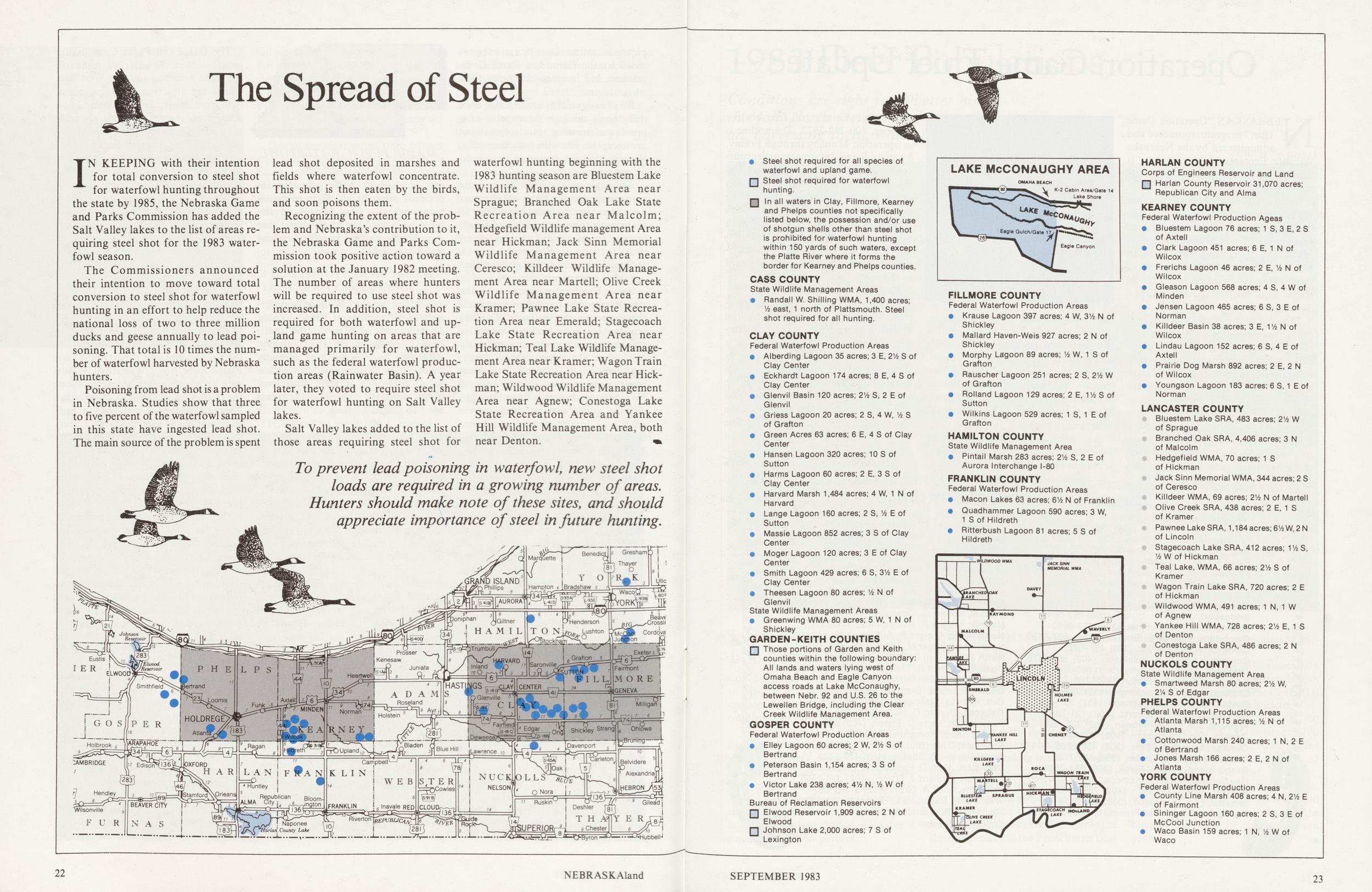
The Spread of Steel
To prevent lead poisoning in waterfowl, new steel shot loads are required in a growing number of areas. Hunters should make note of these sites, and should appreciate importance of steel in future hunting.IN KEEPING with their intention for total conversion to steel shot for waterfowl hunting throughout the state by 1985, the Nebraska Game and Parks Commission has added the Salt Valley lakes to the list of areas re- quiring steel shot for the 1983 water- fowl season.
The Commissioners announced their intention to move toward total conversion to steel shot for waterfowl hunting in an effort to help reduce the national loss of two to three million ducks and geese annually to lead poi- soning. That total is 10 times the num- ber of waterfowl harvested by Nebraska hunters.
Poisoning from lead shot is a problem in Nebraska. Studies show that three to five percent of the waterfowl sampled in this state have ingested lead shot. The main source of the problem is spent lead shot deposited in marshes and fields where waterfowl concentrate. This shot is then eaten by the birds, and soon poisons them.
Recognizing the extent of the prob- lem and Nebraska's contribution to it, the Nebraska Game and Parks Com- mission took positive action toward a solution at the January 1982 meeting. The number of areas where hunters will be required to use steel shot was increased. In addition, steel shot is required for both waterfowl and up- land game hunting on areas that are managed primarily for waterfowl, such as the federal waterfowl produc- tion areas (Rainwater Basin). A year later, they voted to require steel shot for waterfowl hunting on Salt Valley lakes.
Salt Valley lakes added to the list of those areas requiring steel shot for waterfowl hunting beginning with the 1983 hunting season are Bluestem Lake Wildlife Management Area near Sprague; Branched Oak Lake State Recreation Area near Malcolm; Hedgefield Wildlife management Area near Hickman; Jack Sinn Memorial Wildlife Management Area near Ceresco; Killdeer Wildlife Manage- ment Area near Martell; Olive Creek Wildlife Management Area near Kramer; Pawnee Lake State Recrea- tion Area near Emerald; Stagecoach Lake State Recreation Area near Hickman; Teal Lake Wildlife Manage- ment Area near Kramer; Wagon Train Lake State Recreation Area near Hick- man; Wildwood Wildlife Management Area near Agnew; Conestoga Lake State Recreation Area and Yankee Hill Wildlife Management Area, both near Denton.
-Steel shot required for all species of waterfowl and upland game. -Steel shot required for waterfowl hunting. -In all waters in Clay, Fillmore, Kearney and Phelps counties not specifically listed below, the possession and/or use of shotgun shells other than steel shot is prohibited for waterfowl hunting within 150 yards of such waters, except the Platte River where it forms the border for Kearney and Phelps counties. CASS COUNTY State Wildlife Management Areas -Randall W. Shilling WMA, 1,400 acres; 1/2 east, 1 north of Plattsmouth. Steel shot required for all hunting. CLAY COUNTY Federal Waterfowl Production Areas -Alberding Lagoon 35 acres; 3 E, 2 1/2 S of Clay Center -Eckhardt Lagoon 174 acres; 8 E, 4 S of Clay Center -Glenvil Basin 120 acres; 2 1/2 S, 2 E of Glenvil -Griess Lagoon 20 acres; 2 S, 4 W, 1/2 S of Grafton -Green Acres 63 acres; 6 E, 4 S of Clay Center -Hansen Lagoon 320 acres; 10 S of Sutton -Harms Lagoon 60 acres; 2 E, 3 S of Clay Center -Harvard Marsh 1,484 acres; 4 W, 1 N of Harvard -Lange Lagoon 160 acres; 2 S, 1/2 E of Sutton -Massie Lagoon 852 acres; 3 S of Clay Center -Moger Lagoon 120 acres; 3 E of Clay Center -Smith Lagoon 429 acres; 6 S, 3 1/2 E of Clay Center -Theesen Lagoon 80 acres; 1/2 N of Glenvil State Wildlife Management Areas -Greenwing WMA 80 acres; 5 W, 1 N of Shickley GARDEN-KEITH COUNTIES -Those portions of Garden and Keith counties within the following boundary: All lands and waters lying west of Omaha Beach and Eagle Canyon access roads at Lake McConaughy, between Nebr. 92 and U.S. 26 to the Lewellen Bridge, including the Clear Creek Wildlife Management Area. GOSPER COUNTY Federal Waterfowl Production Areas -Elley Lagoon 60 acres; 2 W, 2 1/2 S of Bertrand -Peterson Basin 1,154 acres; 3 S of Bertrand -Victor Lake 238 acres; 4 1/2 N, 1/2 W of Bertrand Bureau of Reclamation Reservoirs -Elwood Reservoir 1,909 acres; 2 N of Elwood -Johnson Lake 2,000 acres; 7 S of Lexington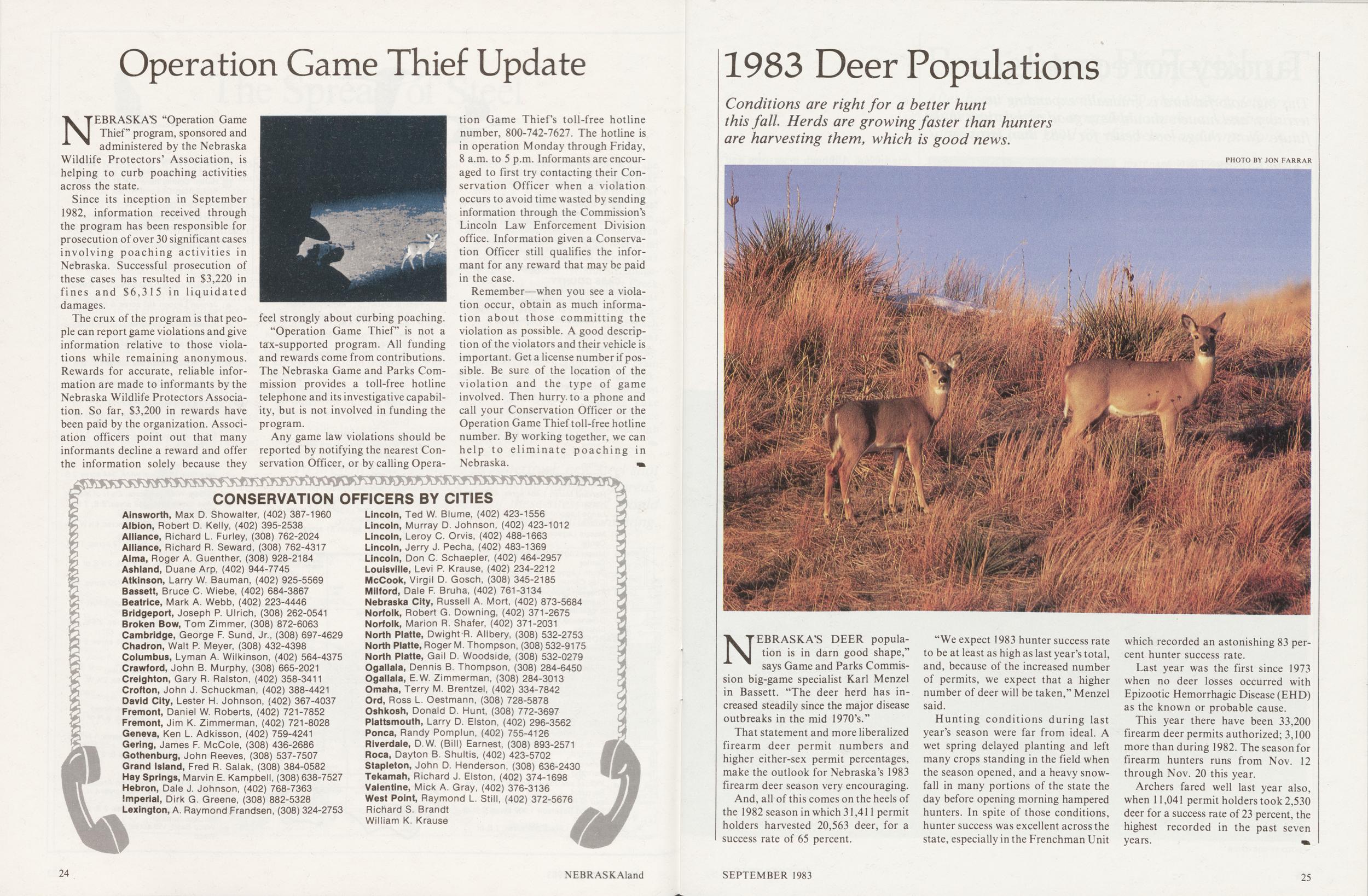
Operation Game Thief Update
NEBRASKA'S "Operation Game Thief" program, sponsored and administered by the Nebraska Wildlife Protectors' Association, is helping to curb poaching activities across the state.
Since its inception in September 1982, information received through the program has been responsible for prosecution of over 30 significant cases involving poaching activities in Nebraska. Successful prosecution of these cases has resulted in $3,220 in fines and $6,315 in liquidated damages.
The crux of the program is that peo- ple can report game violations and give information relative to those viola- tions while remaining anonymous. Rewards for accurate, reliable infor- mation are made to informants by the Nebraska Wildlife Protectors Associa- tion. So far, $3,200 in rewards have been paid by the organization. Associ- ation officers point out that many informants decline a reward and offer the information solely because they feel strongly about curbing poaching.
"Operation Game Thief" is not a tax-supported program. All funding and rewards come from contributions. The Nebraska Game and Parks Com- mission provides a toll-free hotline telephone and its investigative capabil- ity, but is not involved in funding the program.
Any game law violations should be reported by notifying the nearest Con- servation Officer, or by calling Opera- tion Game Thief's toll-free hotline number, 800-742-7627. The hotline is in operation Monday through Friday, 8 a.m. to 5 p.m. Informants are encour- aged to first try contacting their Con- servation Officer when a violation occurs to avoid time wasted by sending information through the Commission's Lincoln Law Enforcement Division office. Information given a Conserva- tion Officer still qualifies the infor- mant for any reward that may be paid in the case.
Remember—when you see a viola- tion occur, obtain as much informa- tion about those committing the violation as possible. A good descrip- tion of the violators and their vehicle is important. Get a license number if pos- sible. Be sure of the location of the violation and the type of game involved. Then hurry, to a phone and call your Conservation Officer or the Operation Game Thief toll-free hotline number. By working together, we can help to eliminate poaching in Nebraska.
CONSERVATION OFFICERS BY CITIES Ainsworth, Max D. Showalter, (402) 387-1960 Albion, Robert D. Kelly, (402) 395-2538 Alliance, Richard L. Furley, (308) 762-2024 Alliance, Richard R. Seward, (308) 762-4317 Alma, Roger A. Guenther, (308) 928-2184 Ashland, Duane Arp, (402) 944-7745 Atkinson, Larry W. Bauman, (402) 925-5569 Bassett, Bruce C. Wiebe, (402) 684-3867 Beatrice, Mark A. Webb, (402) 223-4446 Bridgeport, Joseph P. Ulrich, (308) 262-0541 Broken Bow, Tom Zimmer, (308) 872-6063 Cambridge, George F. Sund, Jr., (308) 697-4629 Chadron, Walt P. Meyer, (308) 432-4398 Columbus, Lyman A. Wilkinson, (402) 564-4375 Crawford, John B. Murphy, (308) 665-2021 Creighton, Gary R. Ralston, (402) 358-3411 Crofton, John J. Schuckman, (402) 388-4421 David City, Lester H. Johnson, (402) 367-4037 Fremont, Daniel W. Roberts, (402) 721-7852 Fremont, Jim K. Zimmerman, (402) 721-8028 Geneva, Ken L. Adkisson, (402) 759-4241 Gering, James F. McCole, (308) 436-2686 Gothenburg, John Reeves, (308) 537-7507 Grand Island, Fred R. Salak, (308) 384-0582 Hay Springs, Marvin E. Kampbell, (308) 638-7527 Hebron, Dale J. Johnson, (402) 768-7363 Imperial, Dirk G. Greene, (308) 882-5328 Lexington, A. Raymond Frandsen, (308) 324-2753 Lincoln, Ted W. Blume, (402) 423-1556 Lincoln, Murray D. Johnson, (402) 423-1012 Lincoln, Leroy C. Orvis, (402) 488-1663 Lincoln, Jerry J. Pecha, (402) 483-1369 Lincoln, Don C. Schaepler, (402) 464-2957 Louisville, Levi P. Krause, (402) 234-2212 McCook, Virgil D. Gosch, (308) 345-2185 Milford, Dale F. Bruha, (402) 761-3134 Nebraska City, Russell A. Mort, (402) 873-5684 Norfolk, Robert G. Downing, (402) 371-2675 Norfolk, Marion R. Shafer, (402) 371-2031 North Platte, DwightR. Allbery, (308) 532-2753 North Platte, Roger M. Thompson, (308) 532-9175 North Platte, Gail D. Woodside, (308) 532-0279 Ogallala, Dennis B. Thompson, (308) 284-6450 Ogallala, E.W. Zimmerman, (308) 284-3013 Omaha, Terry M. Brentzel, (402) 334-7842 Ord, Ross L. Oestmann, (308) 728-5878 Oshkosh, Donald D. Hunt, (308) 772-3697 Plattsmouth, Larry D. Elston, (402) 296-3562 Ponca, Randy Pomplun, (402) 755-4126 Riverdale, D.W. (Bill) Earnest, (308) 893-2571 Roca, Dayton B. Shultis, (402) 423-5702 Stapleton, John D. Henderson, (308) 636-2430 Tekamah, Richard J. Elston, (402) 374-1698 Valentine, Mick A. Gray, (402) 376-3136 West Point, Raymond L. Still, (402) 372-5676 Richard S. Brandt William K. Krause1983 Deer Populations
Conditions are right for a better hunt this fall Herds are growing faster than hunters are harvesting them, which is good news.NEBRASKA'S DEER popula- tion is in darn good shape," says Game and Parks Commis- sion big-game specialist Karl Menzel in Bassett. "The deer herd has in- creased steadily since the major disease outbreaks in the mid 1970's."
That statement and more liberalized firearm deer permit numbers and higher either-sex permit percentages, make the outlook for Nebraska's 1983 firearm deer season very encouraging.
And, all of this comes on the heels of the 1982 season in which 31,411 permit holders harvested 20,563 deer, for a success rate of 65 percent.
"We expect 1983 hunter success rate to be at least as high as last year's total, and, because of the increased number of permits, we expect that a higher number of deer will be taken," Menzel said.
Hunting conditions during last year's season were far from ideal. A wet spring delayed planting and left many crops standing in the field when the season opened, and a heavy snow- fall in many portions of the state the day before opening morning hampered hunters. In spite of those conditions, hunter success was excellent across the state, especially in the Frenchman Unit which recorded an astonishing 83 per- cent hunter success rate.
Last year was the first since 1973 when no deer losses occurred with Epizootic Hemorrhagic Disease (EHD) as the known or probable cause.
This year there have been 33,200 firearm deer permits authorized; 3,100 more than during 1982. The season for firearm hunters runs from Nov. 12 through Nov. 20 this year.
Archers fared well last year also, when 11,041 permit holders took 2,530 deer for a success rate of 23 percent, the highest recorded in the past seven years.
24 NEBRASKAland SEPTEMBER 1983 25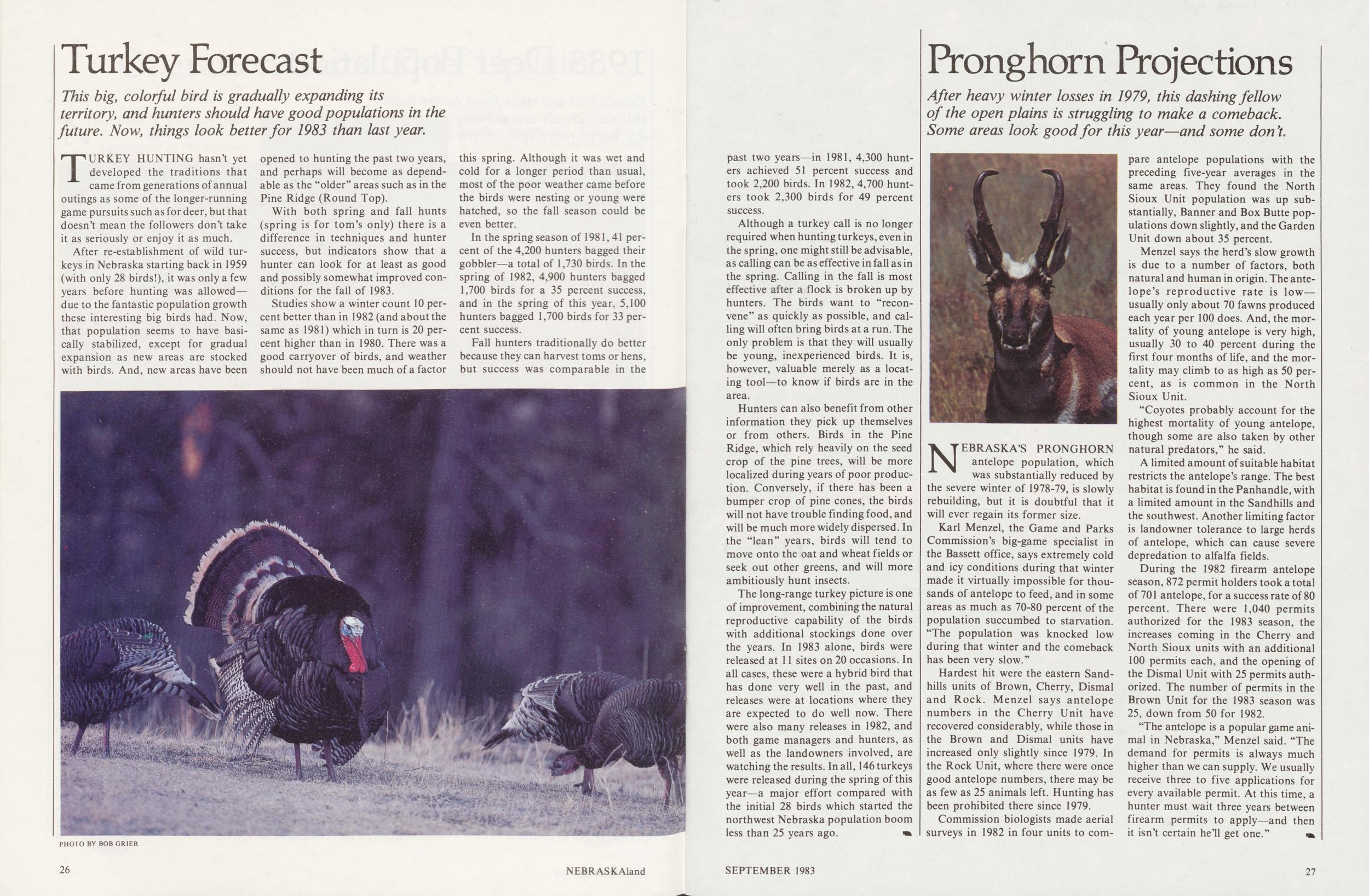
Turkey Forecast
This big, colorful bird is gradually expanding its territory, and hunters should have good populations in the future. Now, things look better for 1983 than last year.TURKEY HUNTING hasn't yet developed the traditions that came from generations of annual outings as some of the longer-running game pursuits such as for deer, but that doesn't mean the followers don't take it as seriously or enjoy it as much.
After re-establishment of wild tur- keys in Nebraska starting back in 1959 (with only 28 birds!), it was only a few years before hunting was allowed— due to the fantastic population growth these interesting big birds had. Now, that population seems to have basi- cally stabilized, except for gradual expansion as new areas are stocked with birds. And, new areas have been opened to hunting the past two years, and perhaps will become as depend- able as the "older" areas such as in the Pine Ridge (Round Top).
With both spring and fall hunts (spring is for tom's only) there is a difference in techniques and hunter success, but indicators show that a hunter can look for at least as good and possibly somewhat improved con- ditions for the fall of 1983.
Studies show a winter count 10 per- cent better than in 1982 (and about the same as 1981) which in turn is 20 per- cent higher than in 1980. There was a good carryover of birds, and weather should not have been much of a factor this spring. Although it was wet and cold for a longer period than usual, most of the poor weather came before the birds were nesting or young were hatched, so the fall season could be even better.
In the spring season of 1981,41 per- cent of the 4,200 hunters bagged their gobbler—a total of 1,730 birds. In the spring of 1982, 4,900 hunters bagged 1,700 birds for a 35 percent success, and in the spring of this year, 5,100 hunters bagged 1,700 birds for 33 per- cent success.
Fall hunters traditionally do better because they can harvest toms or hens, but success was comparable in the
Although a turkey call is no longer required when hunting turkeys, even in the spring, one might still be advisable, as calling can be as effective in fall as in the spring. Calling in the fall is most effective after a flock is broken up by hunters. The birds want to "recon- vene" as quickly as possible, and cal- ling will often bring birds at a run. The only problem is that they will usually be young, inexperienced birds. It is, however, valuable merely as a locat- ing tool—to know if birds are in the area.
Hunters can also benefit from other information they pick up themselves or from others. Birds in the Pine Ridge, which rely heavily on the seed crop of the pine trees, will be more localized during years of poor produc- tion. Conversely, if there has been a bumper crop of pine cones, the birds will not have trouble finding food, and will be much more widely dispersed. In the "lean" years, birds will tend to move onto the oat and wheat fields or seek out other greens, and will more ambitiously hunt insects.
The long-range turkey picture is one of improvement, combining the natural reproductive capability of the birds with additional stockings done over the years. In 1983 alone, birds were released at 11 sites on 20 occasions. In all cases, these were a hybrid bird that has done very well in the past, and releases were at locations where they are expected to do well now. There were also many releases in 1982, and both game managers and hunters, as well as the landowners involved, are watching the results. In all, 146 turkeys were released during the spring of this year—a major effort compared with the initial 28 birds which started the northwest Nebraska population boom less than 25 years ago.
Pronghorn Projections
After heavy winter losses in 1979, this dashing fellow of the open plains is struggling to make a comeback. Some areas look good for this year—and some don't.NEBRASKA'S PRONGHORN antelope population, which was substantially reduced by the severe winter of 1978-79, is slowly rebuilding, but it is doubtful that it will ever regain its former size.
Karl Menzel, the Game and Parks Commission's big-game specialist in the Bassett office, says extremely cold and icy conditions during that winter made it virtually impossible for thou- sands of antelope to feed, and in some areas as much as 70-80 percent of the population succumbed to starvation. "The population was knocked low during that winter and the comeback has been very slow."
Hardest hit were the eastern Sand- hills units of Brown, Cherry, Dismal and Rock. Menzel says antelope numbers in the Cherry Unit have recovered considerably, while those in the Brown and Dismal units have increased only slightly since 1979. In the Rock Unit, where there were once good antelope numbers, there may be as few as 25 animals left. Hunting has been prohibited there since 1979.
Commission biologists made aerial surveys in 1982 in four units to com- pare antelope populations with the preceding five-year averages in the same areas. They found the North Sioux Unit population was up sub- stantially, Banner and Box Butte pop- ulations down slightly, and the Garden Unit down about 35 percent.
Menzel says the herd's slow growth is due to a number of factors, both natural and human in origin. The ante- lope's reproductive rate is low— usually only about 70 fawns produced each year per 100 does. And, the mor- tality of young antelope is very high, usually 30 to 40 percent during the first four months of life, and the mor- tality may climb to as high as 50 per- cent, as is common in the North Sioux Unit.
"Coyotes probably account for the highest mortality of young antelope, though some are also taken by other natural predators," he said.
A limited amount of suitable habitat restricts the antelope's range. The best habitat is found in the Panhandle, with a limited amount in the Sandhills and the southwest. Another limiting factor is landowner tolerance to large herds of antelope, which can cause severe depredation to alfalfa fields.
During the 1982 firearm antelope season, 872 permit holders took a total of 701 antelope, for a success rate of 80 percent. There were 1,040 permits authorized for the 1983 season, the increases coming in the Cherry and North Sioux units with an additional 100 permits each, and the opening of the Dismal Unit with 25 permits auth- orized. The number of permits in the Brown Unit for the 1983 season was 25, down from 50 for 1982.
"The antelope is a popular game ani- mal in Nebraska," Menzel said. "The demand for permits is always much higher than we can supply. We usually receive three to five applications for every available permit. At this time, a hunter must wait three years between firearm permits to apply—and then it isn't certain he'll get one."
26 NEBRASKAland SEPTEMBER 1983 27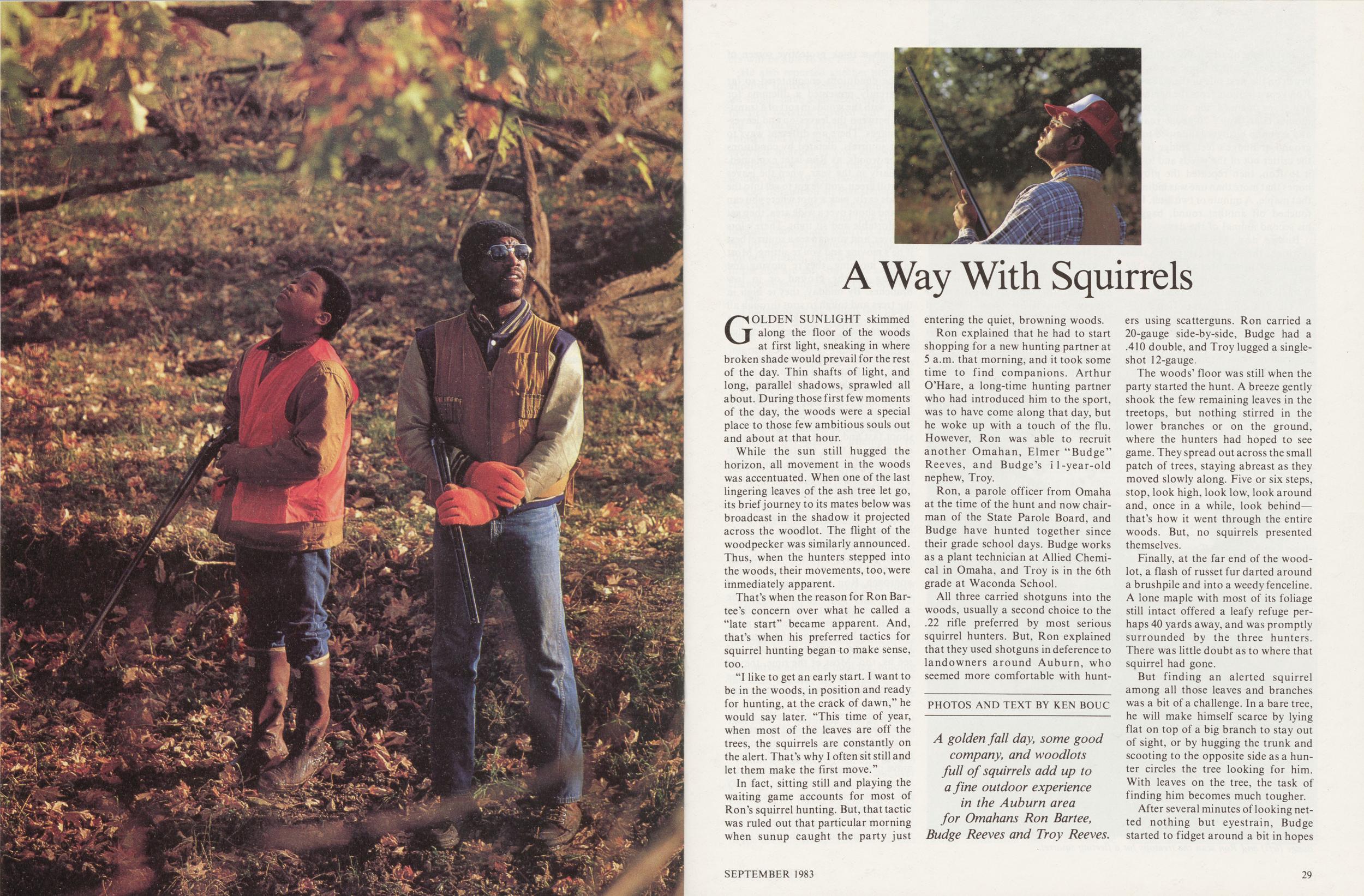
A Way With Squirrels
PHOTOS AND TEXT BY KEN BOUC A golden fall day, some good company, and woodlots full of squirrels add up to a fine outdoor experience in the Auburn area for Omahans Ron Bartee, Budge Reeves and Troy Reeves.GOLDEN SUNLIGHT skimmed along the floor of the woods at first light, sneaking in where broken shade would prevail for the rest of the day. Thin shafts of light, and long, parallel shadows, sprawled all about. During those first few moments of the day, the woods were a special place to those few ambitious souls out and about at that hour.
While the sun still hugged the horizon, all movement in the woods was accentuated. When one of the last lingering leaves of the ash tree let go, its brief journey to its mates below was broadcast in the shadow it projected across the woodlot. The flight of the woodpecker was similarly announced. Thus, when the hunters stepped into the woods, their movements, too, were immediately apparent.
That's when the reason for Ron Bar- tee's concern over what he called a "late start" became apparent. And, that's when his preferred tactics for squirrel hunting began to make sense, too.
"I like to get an early start. I want to be in the woods, in position and ready for hunting, at the crack of dawn," he would say later. "This time of year, when most of the leaves are off the trees, the squirrels are constantly on the alert. That's why I often sit still and let them make the first move."
In fact, sitting still and playing the waiting game accounts for most of Ron's squirrel hunting. But, that tactic was ruled out that particular morning when sunup caught the party just entering the quiet, browning woods.
Ron explained that he had to start shopping for a new hunting partner at 5 a.m. that morning, and it took some time to find companions. Arthur O'Hare, a long-time hunting partner who had introduced him to the sport, was to have come along that day, but he woke up with a touch of the flu. However, Ron was able to recruit another Omahan, Elmer "Budge" Reeves, and Budge's 11-year-old nephew, Troy.
Ron, a parole officer from Omaha at the time of the hunt and now chair- man of the State Parole Board, and Budge have hunted together since their grade school days. Budge works as a plant technician at Allied Chemi- cal in Omaha, and Troy is in the 6th grade at Waconda School.
All three carried shotguns into the woods, usually a second choice to the .22 rifle preferred by most serious squirrel hunters. But, Ron explained that they used shotguns in deference to landowners around Auburn, who seemed more comfortable with hunt- ers using scatterguns. Ron carried a 20-gauge side-by-side, Budge had a .410 double, and Troy lugged a single- shot 12-gauge.
The woods' floor was still when the party started the hunt. A breeze gently shook the few remaining leaves in the treetops, but nothing stirred in the lower branches or on the ground, where the hunters had hoped to see game. They spread out across the small patch of trees, staying abreast as they moved slowly along. Five or six steps, stop, look high, look low, look around and, once in a while, look behind— that's how it went through the entire woods. But, no squirrels presented themselves.
Finally, at the far end of the wood- lot, a flash of russet fur darted around a brushpile and into a weedy fenceline. A lone maple with most of its foliage still intact offered a leafy refuge per- haps 40 yards away, and was promptly surrounded by the three hunters. There was little doubt as to where that squirrel had gone.
But finding an alerted squirrel among all those leaves and branches was a bit of a challenge. In a bare tree, he will make himself scarce by lying flat on top of a big branch to stay out of sight, or by hugging the trunk and scooting to the opposite side as a hun- ter circles the tree looking for him. With leaves on the tree, the task of finding him becomes much tougher.
After several minutes of looking net-
ted nothing but eyestrain, Budge
started to fidget around a bit in hopes
SEPTEMBER 1983 29
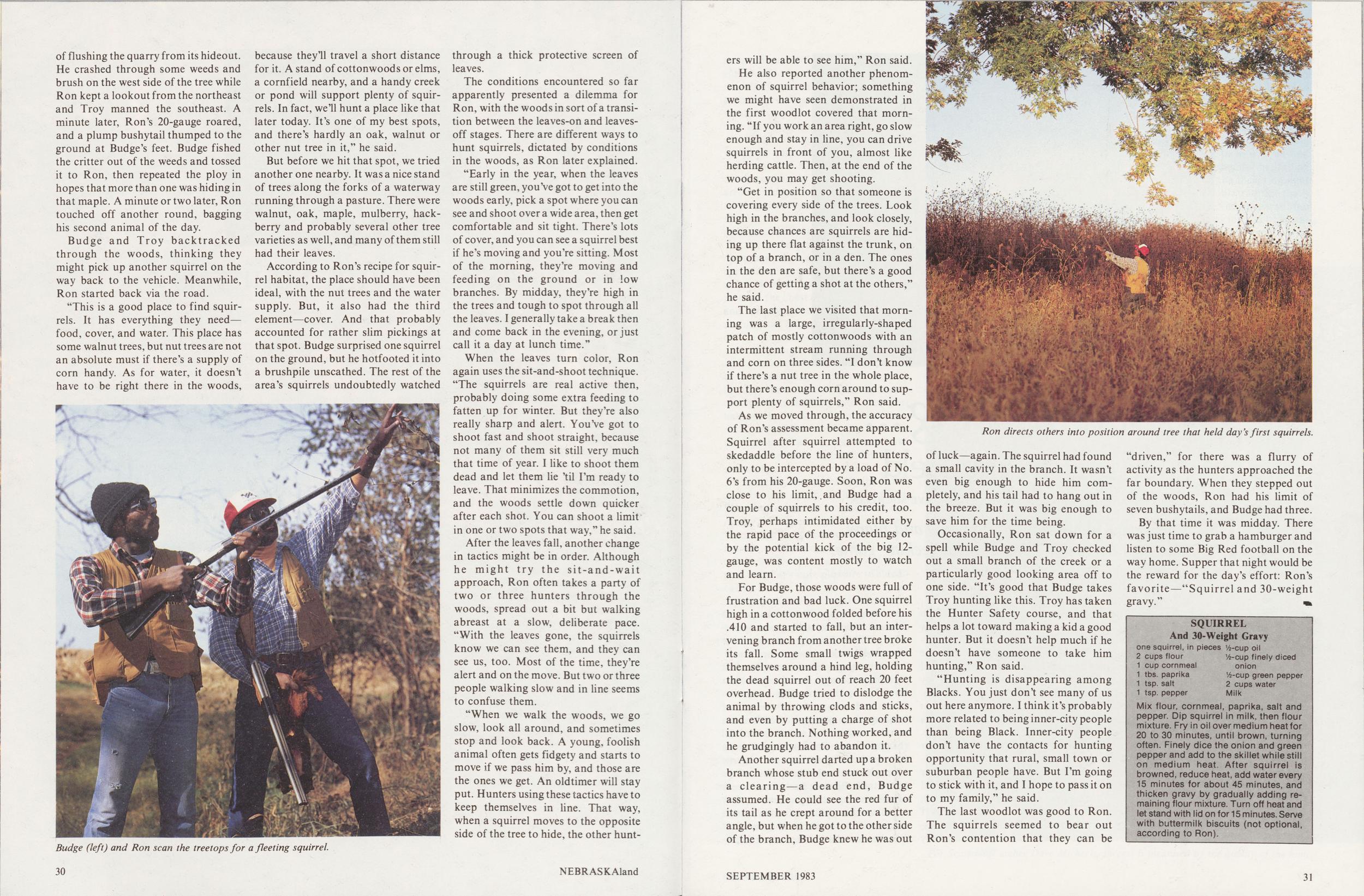 of flushing the quarry from its hideout.
He crashed through some weeds and
brush on the west side of the tree while
Ron kept a lookout from the northeast
and Troy manned the southeast. A
minute later, Ron's 20-gauge roared,
and a plump bushytail thumped to the
ground at Budge's feet. Budge fished
the critter out of the weeds and tossed
it to Ron, then repeated the ploy in
hopes that more than one was hiding in
that maple. A minute or two later, Ron
touched off another round, bagging
his second animal of the day.
of flushing the quarry from its hideout.
He crashed through some weeds and
brush on the west side of the tree while
Ron kept a lookout from the northeast
and Troy manned the southeast. A
minute later, Ron's 20-gauge roared,
and a plump bushytail thumped to the
ground at Budge's feet. Budge fished
the critter out of the weeds and tossed
it to Ron, then repeated the ploy in
hopes that more than one was hiding in
that maple. A minute or two later, Ron
touched off another round, bagging
his second animal of the day.
Budge and Troy backtracked through the woods, thinking they might pick up another squirrel on the way back to the vehicle. Meanwhile, Ron started back via the road.
"This is a good place to find squir- rels. It has everything they need— food, cover, and water. This place has some walnut trees, but nut trees are not an absolute must if there's a supply of corn handy. As for water, it doesn't have to be right there in the woods, because they'll travel a short distance for it. A stand of cottonwoods or elms, a cornfield nearby, and a handy creek or pond will support plenty of squir- rels. In fact, we'll hunt a place like that later today. It's one of my best spots, and there's hardly an oak, walnut or other nut tree in it," he said.
But before we hit that spot, we tried another one nearby. It was a nice stand of trees along the forks of a waterway running through a pasture. There were walnut, oak, maple, mulberry, hack- berry and probably several other tree varieties as well, and many of them still had their leaves.
According to Ron's recipe for squir- rel habitat, the place should have been ideal, with the nut trees and the water supply. But, it also had the third element—cover. And that probably accounted for rather slim pickings at that spot. Budge surprised one squirrel on the ground, but he hotfooted it into a brushpile unscathed. The rest of the area's squirrels undoubtedly watched
The conditions encountered so far apparently presented a dilemma for Ron, with the woods in sort of a transi- tion between the leaves-on and leaves- off stages. There are different ways to hunt squirrels, dictated by conditions in the woods, as Ron later explained.
"Early in the year, when the leaves are still green, you've got to get into the woods early, pick a spot where you can see and shoot over a wide area, then get comfortable and sit tight. There's lots of cover, and you can see a squirrel best if he's moving and you're sitting. Most of the morning, they're moving and feeding on the ground or in low branches. By midday, they're high in the trees and tough to spot through all the leaves. I generally take a break then and come back in the evening, or just call it a day at lunch time."
When the leaves turn color, Ron again uses the sit-and-shoot technique. "The squirrels are real active then, probably doing some extra feeding to fatten up for winter. But they're also really sharp and alert. You've got to shoot fast and shoot straight, because not many of them sit still very much that time of year. I like to shoot them dead and let them lie 'til I'm ready to leave. That minimizes the commotion, and the woods settle down quicker after each shot. You can shoot a limit in one or two spots that way," he said. After the leaves fall, another change in tactics might be in order. Although he might try the sit-and-wait approach, Ron often takes a party of two or three hunters through the woods, spread out a bit but walking abreast at a slow, deliberate pace. "With the leaves gone, the squirrels know we can see them, and they can see us, too. Most of the time, they're alert and on the move. But two or three people walking slow and in line seems to confuse them.
"When we walk the woods, we go slow, look all around, and sometimes stop and look back. A young, foolish animal often gets fidgety and starts to move if we pass him by, and those are the ones we get. An oldtimer will stay put. Hunters using these tactics have to keep themselves in line. That way, when a squirrel moves to the opposite side of the tree to hide, the other hunt- ers will be able to see him," Ron said.
He also reported another phenom- enon of squirrel behavior; something we might have seen demonstrated in the first woodlot covered that morn- ing. "If you work an area right, go slow enough and stay in line, you can drive squirrels in front of you, almost like herding cattle. Then, at the end of the woods, you may get shooting.
"Get in position so that someone is covering every side of the trees. Look high in the branches, and look closely, because chances are squirrels are hid- ing up there flat against the trunk, on top of a branch, or in a den. The ones in the den are safe, but there's a good chance of getting a shot at the others," he said.
The last place we visited that morn- ing was a large, irregularly-shaped patch of mostly cottonwoods with an intermittent stream running through and corn on three sides. "I don't know if there's a nut tree in the whole place, but there's enough corn around to sup- port plenty of squirrels," Ron said.
As we moved through, the accuracy of Ron's assessment became apparent. Squirrel after squirrel attempted to skedaddle before the line of hunters, only to be intercepted by a load of No. 6's from his 20-gauge. Soon, Ron was close to his limit, .and Budge had a couple of squirrels to his credit, too. Troy, perhaps intimidated either by the rapid pace of the proceedings or by the potential kick of the big 12- gauge, was content mostly to watch and learn.
For Budge, those woods were full of frustration and bad luck. One squirrel high in a cottonwood folded before his .410 and started to fall, but an inter- vening branch from another tree broke its fall. Some small twigs wrapped themselves around a hind leg, holding the dead squirrel out of reach 20 feet overhead. Budge tried to dislodge the animal by throwing clods and sticks, and even by putting a charge of shot into the branch. Nothing worked, and he grudgingly had to abandon it.
Another squirrel darted up a broken branch whose stub end stuck out over a clearing—a dead end, Budge assumed. He could see the red fur of its tail as he crept around for a better angle, but when he got to the other side of the branch, Budge knew he was out
Occasionally, Ron sat down for a spell while Budge and Troy checked out a small branch of the creek or a particularly good looking area off to one side. "It's good that Budge takes Troy hunting like this. Troy has taken the Hunter Safety course, and that helps a lot toward making a kid a good hunter. But it doesn't help much if he doesn't have someone to take him hunting," Ron said.
"Hunting is disappearing among Blacks. You just don't see many of us out here anymore. I think it's probably more related to being inner-city people than being Black. Inner-city people don't have the contacts for hunting opportunity that rural, small town or suburban people have. But I'm going to stick with it, and I hope to pass it on to my family," he said.
The last woodlot was good to Ron. The squirrels seemed to bear out Ron's contention that they can be "driven," for there was a flurry of activity as the hunters approached the far boundary. When they stepped out of the woods, Ron had his limit of seven bushytails, and Budge had three.
By that time it was midday. There was just time to grab a hamburger and listen to some Big Red football on the way home. Supper that night would be the reward for the day's effort: Ron's favorite—"Squirrel and 30-weight gravy."
SQUIRREL And 30-Weight Gravy one squirrel, in pieces 1/2-cup oil 2 cups flour 1/2-cup finely diced 1 cup cornmeat onion 1 tbs. paprika 1/2-cup green pepper 1 tsp. salt 2 cups water 1 tsp. pepper Milk Mix flour, cornmeal, paprika, salt and pepper. Dip squirrel in milk, then flour mixture. Fry in oil over medium heat for 20 to 30 minutes, until brown, turning often. Finely dice the onion and green pepper and add to the skillet while still on medium heat. After squirrel is browned, reduce heat, add water every 15 minutes for about 45 minutes, and thicken gravy by gradually adding re- maining flour mixture. Turn off heat and let stand with lid on for 15 minutes. Serve with buttermilk biscuits (not optional, according to Ron). 30 NEBRASKAland SEPTEMBER 1983 31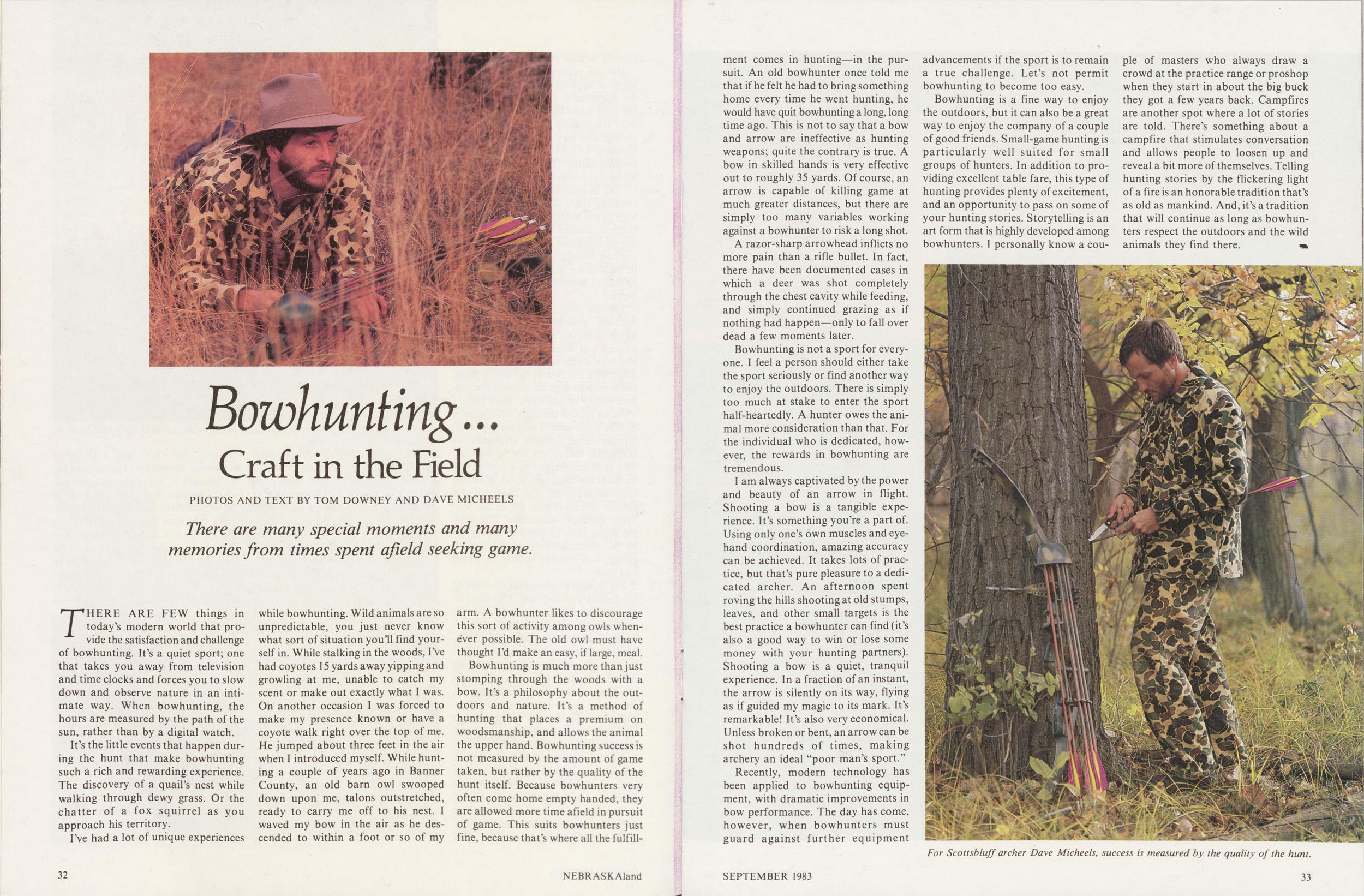
Bowhunting... Craft in the Field
PHOTOS AND TEXT BY TOM DOWNEY AND DAVE MICHEELSThere are many special moments and many memories from times spent afield seeking game.THERE ARE FEW things in today's modern world that pro- vide the satisfaction and challenge of bowhunting. It's a quiet sport; one that takes you away from television and time clocks and forces you to slow down and observe nature in an inti- mate way. When bowhunting, the hours are measured by the path of the sun, rather than by a digital watch.
It's the little events that happen dur- ing the hunt that make bowhunting such a rich and rewarding experience. The discovery of a quail's nest while walking through dewy grass. Or the chatter of a fox squirrel as you approach his territory.
I've had a lot of unique experiences while bowhunting. Wild animals are so unpredictable, you just never know what sort of situation you'll find your- self in. While stalking in the woods, I've had coyotes 15 yards away yipping and growling at me, unable to catch my scent or make out exactly what I was. On another occasion I was forced to make my presence known or have a coyote walk right over the top of me. He jumped about three feet in the air when I introduced myself. While hunt- ing a couple of years ago in Banner County, an old barn owl swooped down upon me, talons outstretched, ready to carry me off to his nest. I waved my bow in the air as he des- cended to within a foot or so of my arm. A bowhunter likes to discourage this sort of activity among owls when- ever possible. The old owl must have thought I'd make an easy, if large, meal.
Bowhunting is much more than just stomping through the woods with a bow. It's a philosophy about the out- doors and nature. It's a method of hunting that places a premium on woodsmanship, and allows the animal the upper hand. Bowhunting success is not measured by the amount of game taken, but rather by the quality of the hunt itself. Because bowhunters very often come home empty handed, they are allowed more time afield in pursuit of game. This suits bowhunters just fine, because that's where all the fulfill- ment comes in hunting—in the pur- suit. An old bowhunter once told me that if he felt he had to bring something home every time he went hunting, he would have quit bowhunting a long, long time ago. This is not to say that a bow and arrow are ineffective as hunting weapons; quite the contrary is true. A bow in skilled hands is very effective out to roughly 35 yards. Of course, an arrow is capable of killing game at much greater distances, but there are simply too many variables working against a bowhunter to risk a long shot.
A razor-sharp arrowhead inflicts no more pain than a rifle bullet. In fact, there have been documented cases in which a deer was shot completely through the chest cavity while feeding, and simply continued grazing as if nothing had happen—only to fall over dead a few moments later.
Bowhunting is not a sport for every- one. I feel a person should either take the sport seriously or find another way to enjoy the outdoors. There is simply too much at stake to enter the sport half-heartedly. A hunter owes the ani- mal more consideration than that. For the individual who is dedicated, how- ever, the rewards in bowhunting are tremendous.
I am always captivated by the power and beauty of an arrow in flight. Shooting a bow is a tangible expe- rience. It's something you're a part of. Using only one's own muscles and eye- hand coordination, amazing accuracy can be achieved. It takes lots of prac- tice, but that's pure pleasure to a dedi- cated archer. An afternoon spent roving the hills shooting at old stumps, leaves, and other small targets is the best practice a bowhunter can find (it's also a good way to win or lose some money with your hunting partners). Shooting a bow is a quiet, tranquil experience. In a fraction of an instant, the arrow is silently on its way, flying as if guided my magic to its mark. It's remarkable! It's also very economical. Unless broken or bent, an arrow can be shot hundreds of times, making archery an ideal "poor man's sport."
Recently, modern technology has been applied to bowhunting equip- ment, with dramatic improvements in bow performance. The day has come, however, when bowhunters must guard against further equipment advancements if the sport is to remain a true challenge. Let's not permit bowhunting to become too easy.
Bowhunting is a fine way to enjoy the outdoors, but it can also be a great way to enjoy the company of a couple of good friends. Small-game hunting is particularly well suited for small groups of hunters. In addition to pro- viding excellent table fare, this type of hunting provides plenty of excitement, and an opportunity to pass on some of your hunting stories. Storytelling is an art form that is highly developed among bowhunters. I personally know a cou- ple of masters who always draw a crowd at the practice range or proshop when they start in about the big buck they got a few years back. Campfires are another spot where a lot of stories are told. There's something about a campfire that stimulates conversation and allows people to loosen up and reveal a bit more of themselves. Telling hunting stories by the flickering light of a fire is an honorable tradition that's as old as mankind. And, it's a tradition that will continue as long as bowhun- ters respect the outdoors and the wild animals they find there.
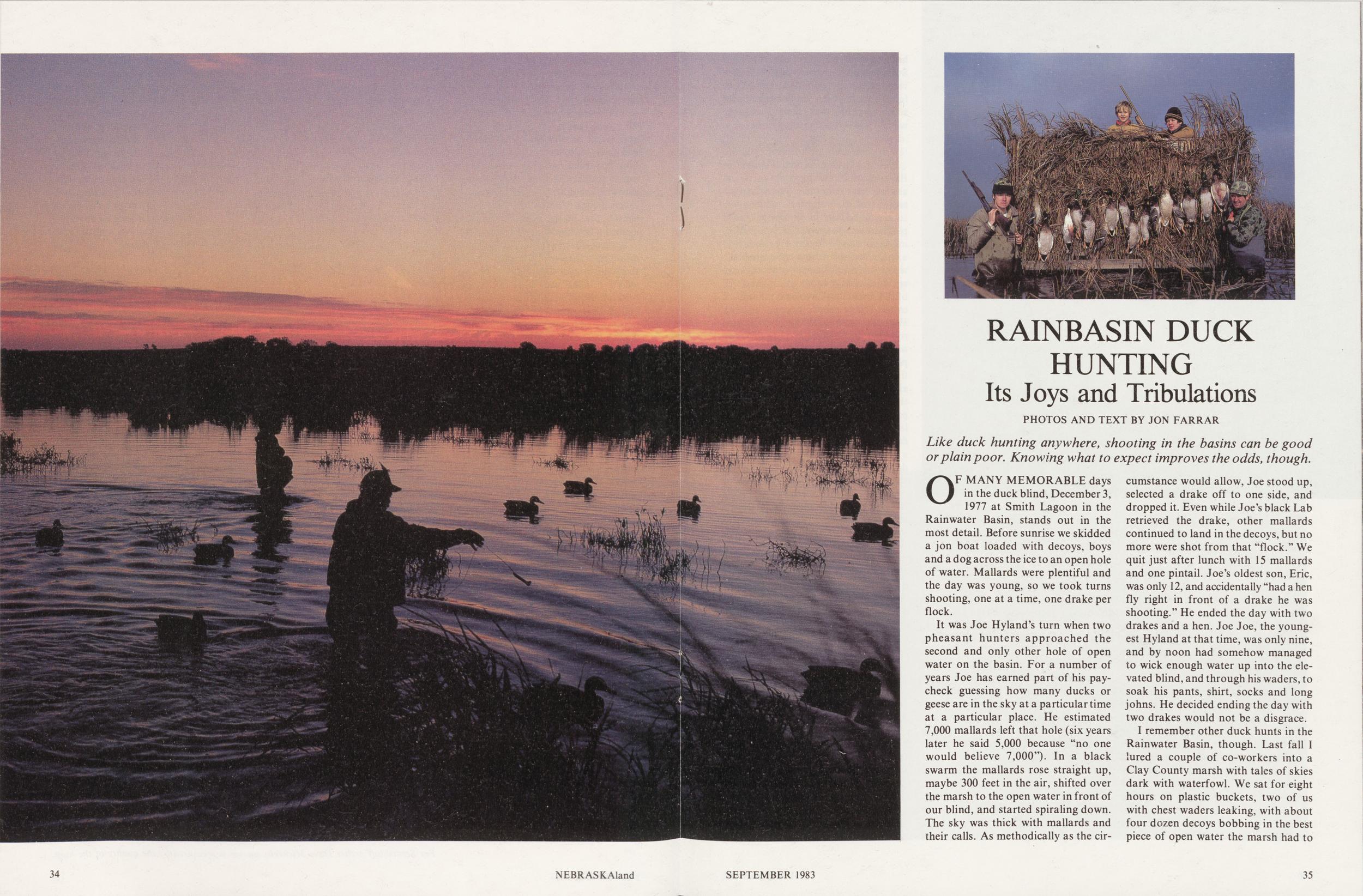
RAINBASIN DUCK HUNTING Its Joys and Tribulations
PHOTOS AND TEXT BY JON FARRAR Like duck hunting anywhere, shooting in the basins can be good or plain poor. Knowing what to expect improves the odds, though.OF MANY MEMORABLE days in the duck blind, December 3, 1977 at Smith Lagoon in the Rainwater Basin, stands out in the most detail. Before sunrise we skidded a jon boat loaded with decoys, boys and a dog across the ice to an open hole of water. Mallards were plentiful and the day was young, so we took turns shooting, one at a time, one drake per flock.
It was Joe Hyland's turn when two pheasant hunters approached the second and only other hole of open water on the basin. For a number of years Joe has earned part of his pay- check guessing how many ducks or geese are in the sky at a particular time at a particular place. He estimated 7,000 mallards left that hole (six years later he said 5,000 because "no one would believe 7,000"). In a black swarm the mallards rose straight up, maybe 300 feet in the air, shifted over the marsh to the open water in front of our blind, and started spiraling down. The sky was thick with mallards and their calls. As methodically as the cir- cumstance would allow, Joe stood up, selected a drake off to one side, and dropped it. Even while Joe's black Lab retrieved the drake, other mallards continued to land in the decoys, but no more were shot from that "flock." We quit just after lunch with 15 mallards and one pintail. Joe's oldest son, Eric, was only 12, and accidentally "had a hen fly right in front of a drake he was shooting." He ended the day with two drakes and a hen. Joe Joe, the young- est Hyland at that time, was only nine, and by noon had somehow managed to wick enough water up into the ele- vated blind, and through his waders, to soak his pants, shirt, socks and long Johns. He decided ending the day with two drakes would not be a disgrace.
I remember other duck hunts in the
Rainwater Basin, though. Last fall I
lured a couple of co-workers into a
Clay County marsh with tales of skies
dark with waterfowl. We sat for eight
hours on plastic buckets, two of us
with chest waders leaking, with about
four dozen decoys bobbing in the best
piece of open water the marsh had to
34 NEBRASKAland
SEPTEMBER 1983 35
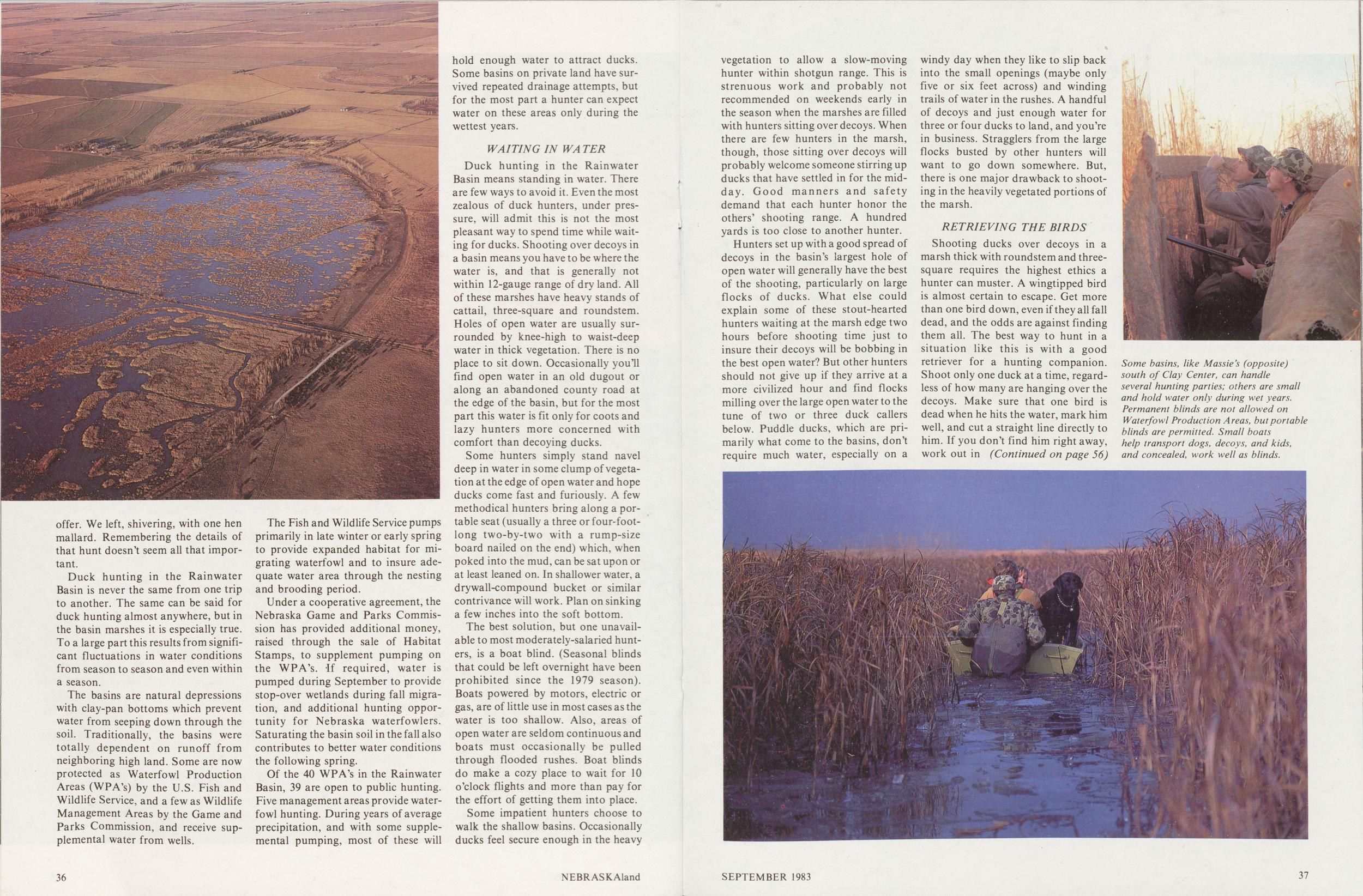 offer. We left, shivering, with one hen
mallard. Remembering the details of
that hunt doesn't seem all that impor-
tant.
offer. We left, shivering, with one hen
mallard. Remembering the details of
that hunt doesn't seem all that impor-
tant.
Duck hunting in the Rainwater Basin is never the same from one trip to another. The same can be said for duck hunting almost anywhere, but in the basin marshes it is especially true. To a large part this results from signifi- cant fluctuations in water conditions from season to season and even within a season.
The basins are natural depressions with clay-pan bottoms which prevent water from seeping down through the soil. Traditionally, the basins were totally dependent on runoff from neighboring high land. Some are now protected as Waterfowl Production Areas (WPA's) by the U.S. Fish and Wildlife Service, and a few as Wildlife Management Areas by the Game and Parks Commission, and receive sup- plemental water from wells.
The Fish and Wildlife Service pumps primarily in late winter or early spring to provide expanded habitat for mi- grating waterfowl and to insure ade- quate water area through the nesting and brooding period.
Under a cooperative agreement, the Nebraska Game and Parks Commis- sion has provided additional money, raised through the sale of Habitat Stamps, to supplement pumping on the WPA's. If required, water is pumped during September to provide stop-over wetlands during fall migra- tion, and additional hunting oppor- tunity for Nebraska waterfowlers. Saturating the basin soil in the fall also contributes to better water conditions the following spring.
Of the 40 WPA's in the Rainwater Basin, 39 are open to public hunting. Five management areas provide water- fowl hunting. During years of average precipitation, and with some supple- mental pumping, most of these will hold enough water to attract ducks. Some basins on private land have sur- vived repeated drainage attempts, but for the most part a hunter can expect water on these areas only during the wettest years.
WAITING IN WATERDuck hunting in the Rainwater Basin means standing in water. There are few ways to avoid it. Even the most zealous of duck hunters, under pres- sure, will admit this is not the most pleasant way to spend time while wait- ing for ducks. Shooting over decoys in a basin means you have to be where the water is, and that is generally not within 12-gauge range of dry land. All of these marshes have heavy stands of cattail, three-square and roundstem. Holes of open water are usually sur- rounded by knee-high to waist-deep water in thick vegetation. There is no place to sit down. Occasionally you'll find open water in an old dugout or along an abandoned county road at the edge of the basin, but for the most part this water is fit only for coots and lazy hunters more concerned with comfort than decoying ducks.
Some hunters simply stand navel deep in water in some clump of vegeta- tion at the edge of open water and hope ducks come fast and furiously. A few methodical hunters bring along a por- table seat (usually a three or four-foot- long two-by-two with a rump-size board nailed on the end) which, when poked into the mud, can be sat upon or at least leaned on. In shallower water, a drywall-compound bucket or similar contrivance will work. Plan on sinking a few inches into the soft bottom.
The best solution, but one unavail- able to most moderately-salaried hunt- ers, is a boat blind. (Seasonal blinds that could be left overnight have been prohibited since the 1979 season). Boats powered by motors, electric or gas, are of little use in most cases as the water is too shallow. Also, areas of open water are seldom continuous and boats must occasionally be pulled through flooded rushes. Boat blinds do make a cozy place to wait for 10 o'clock flights and more than pay for the effort of getting them into place.
Some impatient hunters choose to walk the shallow basins. Occasionally ducks feel secure enough in the heavy vegetation to allow a slow-moving hunter within shotgun range. This is strenuous work and probably not recommended on weekends early in the season when the marshes are filled with hunters sitting over decoys. When there are few hunters in the marsh, though, those sitting over decoys will probably welcome someone stirring up ducks that have settled in for the mid- day. Good manners and safety demand that each hunter honor the others' shooting range. A hundred yards is too close to another hunter.
Hunters set up with a good spread of decoys in the basin's largest hole of open water will generally have the best of the shooting, particularly on large flocks of ducks. What else could explain some of these stout-hearted hunters waiting at the marsh edge two hours before shooting time just to insure their decoys will be bobbing in the best open water? But other hunters should not give up if they arrive at a more civilized hour and find flocks milling over the large open water to the tune of two or three duck callers below. Puddle ducks, which are pri- marily what come to the basins, don't require much water, especially on a windy day when they like to slip back into the small openings (maybe only five or six feet across) and winding trails of water in the rushes. A handful of decoys and just enough water for three or four ducks to land, and you're in business. Stragglers from the large flocks busted by other hunters will want to go down somewhere. But, there is one major drawback to shoot- ing in the heavily vegetated portions of the marsh.
RETRIEVING THE BIRDSShooting ducks over decoys in a marsh thick with roundstem and three- square requires the highest ethics a hunter can muster. A wingtipped bird is almost certain to escape. Get more than one bird down, even if they all fall dead, and the odds are against finding them all. The best way to hunt in a situation like this is with a good retriever for a hunting companion. Shoot only one duck at a time, regard- less of how many are hanging over the decoys. Make sure that one bird is dead when he hits the water, mark him well, and cut a straight line directly to him. If you don't find him right away, work out in (Continued on page 56)
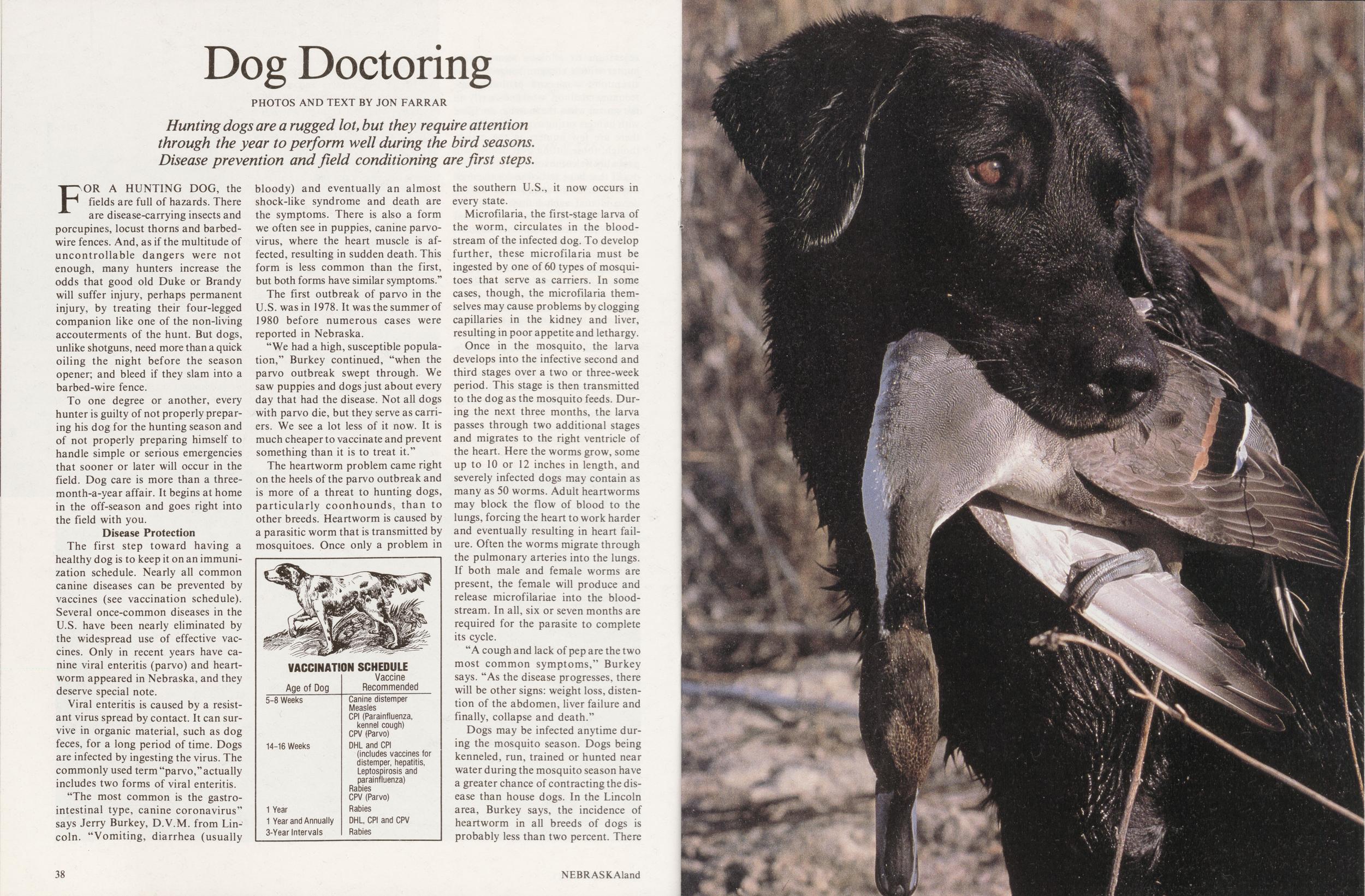
Dog Doctoring
PHOTOS AND TEXT BY JON FARRAR Hunting dogs are a rugged lot, but they require attention through the year to perform well during the bird seasons. Disease prevention and field conditioning are first steps.FOR A HUNTING DOG, the fields are full of hazards. There are disease-carrying insects and porcupines, locust thorns and barbed- wire fences. And, as if the multitude of uncontrollable dangers were not enough, many hunters increase the odds that good old Duke or Brandy will suffer injury, perhaps permanent injury, by treating their four-legged companion like one of the non-living accouterments of the hunt. But dogs, unlike shotguns, need more than a quick oiling the night before the season opener; and bleed if they slam into a barbed-wire fence.
To one degree or another, every hunter is guilty of not properly prepar- ing his dog for the hunting season and of not properly preparing himself to handle simple or serious emergencies that sooner or later will occur in the field. Dog care is more than a three- month-a-year affair. It begins at home in the off-season and goes right into the field with you.
Disease ProtectionThe first step toward having a healthy dog is to keep it on an immuni- zation schedule. Nearly all common canine diseases can be prevented by vaccines (see vaccination schedule). Several once-common diseases in the U.S. have been nearly eliminated by the widespread use of effective vac- cines. Only in recent years have ca- nine viral enteritis (parvo) and heart- worm appeared in Nebraska, and they deserve special note.
Viral enteritis is caused by a resist- ant virus spread by contact. It can sur- vive in organic material, such as dog feces, for a long period of time. Dogs are infected by ingesting the virus. The commonly used term "parvo," actually includes two forms of viral enteritis. "The most common is the gastro- intestinal type, canine coronavirus" says Jerry Burkey, D.V.M. from Lin- coln. "Vomiting, diarrhea (usually bloody) and eventually an almost shock-like syndrome and death are the symptoms. There is also a form we often see in puppies, canine parvo- virus, where the heart muscle is af- fected, resulting in sudden death. This form is less common than the first, but both forms have similar symptoms."
The first outbreak of parvo in the U.S. was in 1978. It was the summer of 1980 before numerous cases were reported in Nebraska.
"We had a high, susceptible popula- tion," Burkey continued, "when the parvo outbreak swept through. We saw puppies and dogs just about every day that had the disease. Not all dogs with parvo die, but they serve as carri- ers. We see a lot less of it now. It is much cheaper to vaccinate and prevent something than it is to treat it."
The heartworm problem came right on the heels of the parvo outbreak and is more of a threat to hunting dogs, particularly coonhounds, than to other breeds. Heartworm is caused by a parasitic worm that is transmitted by mosquitoes. Once only a problem in
Microfilaria, the first-stage larva of the worm, circulates in the blood- stream of the infected dog. To develop further, these microfilaria must be ingested by one of 60 types of mosqui- toes that serve as carriers. In some cases, though, the microfilaria them- selves may cause problems by clogging capillaries in the kidney and liver, resulting in poor appetite and lethargy.
Once in the mosquito, the larva develops into the infective second and third stages over a two or three-week period. This stage is then transmitted to the dog as the mosquito feeds. Dur- ing the next three months, the larva passes through two additional stages and migrates to the right ventricle of the heart. Here the worms grow, some up to 10 or 12 inches in length, and severely infected dogs may contain as many as 50 worms. Adult heartworms may block the flow of blood to the lungs, forcing the heart to work harder and eventually resulting in heart fail- ure. Often the worms migrate through the pulmonary arteries into the lungs. If both male and female worms are present, the female will produce and release microfilariae into the blood- stream. In all, six or seven months are required for the parasite to complete its cycle.
"A cough and lack of pep are the two most common symptoms," Burkey says. "As the disease progresses, there will be other signs: weight loss, disten- tion of the abdomen, liver failure and finally, collapse and death."
Dogs may be infected anytime dur-
ing the mosquito season. Dogs being
kenneled, run, trained or hunted near
water during the mosquito season have
a greater chance of contracting the dis-
ease than house dogs. In the Lincoln
area, Burkey says, the incidence of
heartworm in all breeds of dogs is
probably less than two percent. There
38 NEBRASKAland
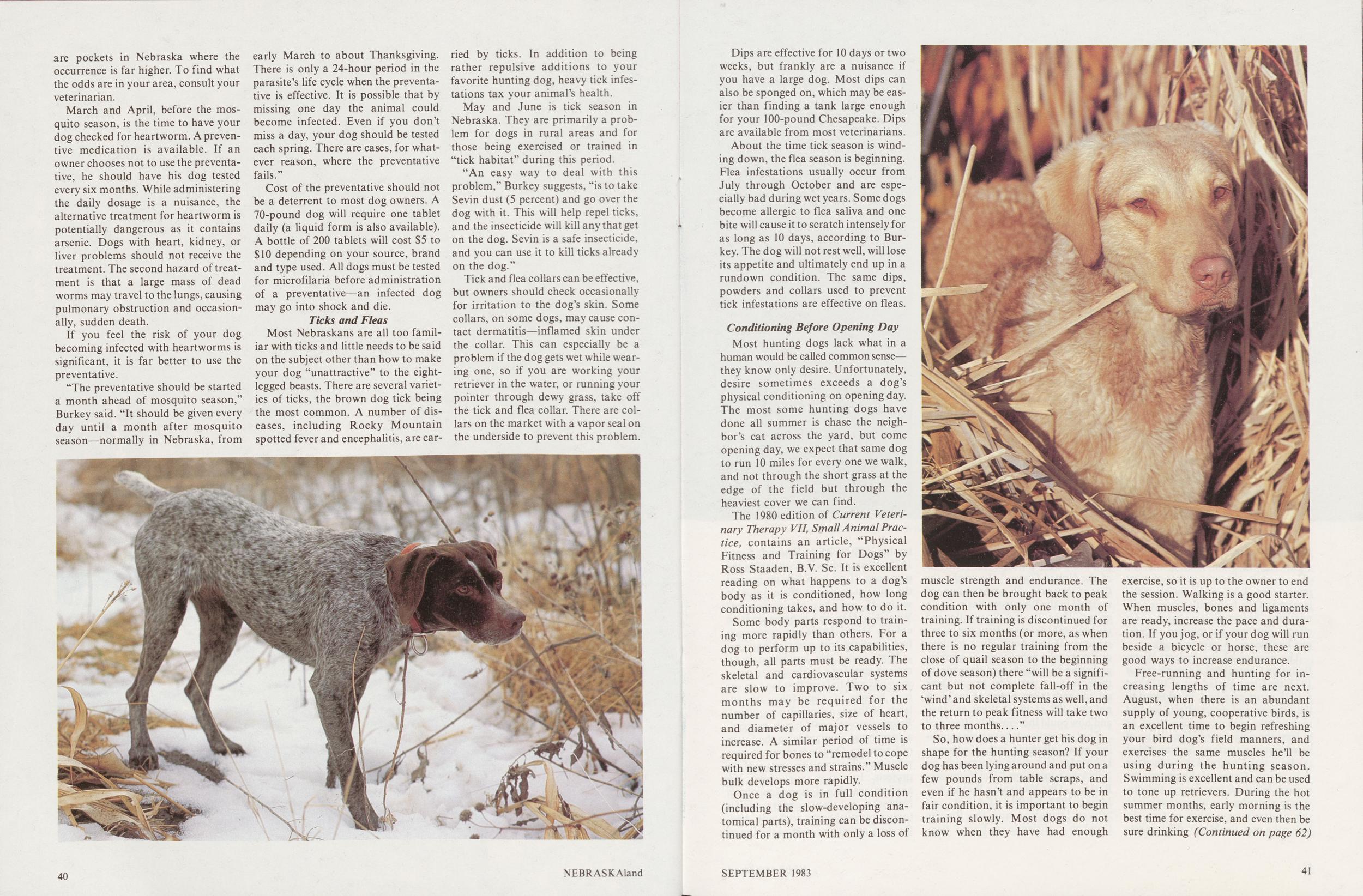 are pockets in Nebraska where the
occurrence is far higher. To find what
the odds are in your area, consult your
veterinarian.
are pockets in Nebraska where the
occurrence is far higher. To find what
the odds are in your area, consult your
veterinarian.
March and April, before the mos- quito season, is the time to have your dog checked for heartworm. A preven- tive medication is available. If an owner chooses not to use the preventa- tive, he should have his dog tested every six months. While administering the daily dosage is a nuisance, the alternative treatment for heartworm is potentially dangerous as it contains arsenic. Dogs with heart, kidney, or liver problems should not receive the treatment. The second hazard of treat- ment is that a large mass of dead worms may travel to the lungs, causing pulmonary obstruction and occasion- ally, sudden death.
If you feel the risk of your dog becoming infected with heartworms is significant, it is far better to use the preventative.
"The preventative should be started a month ahead of mosquito season," Burkey said. "It should be given every day until a month after mosquito season—normally in Nebraska, from early March to about Thanksgiving. There is only a 24-hour period in the parasite's life cycle when the preventa- tive is effective. It is possible that by missing one day the animal could become infected. Even if you don't miss a day, your dog should be tested each spring. There are cases, for what- ever reason, where the preventative fails."
Cost of the preventative should not be a deterrent to most dog owners. A 70-pound dog will require one tablet daily (a liquid form is also available). A bottle of 200 tablets will cost $5 to $10 depending on your source, brand and type used. All dogs must be tested for microfilaria before administration of a preventative—an infected dog may go into shock and die.
Ticks and FleasMost Nebraskans are all too famil- iar with ticks and little needs to be said on the subject other than how to make your dog "unattractive" to the eight- legged beasts. There are several variet- ies of ticks, the brown dog tick being the most common. A number of dis- eases, including Rocky Mountain spotted fever and encephalitis, are car- ried by ticks. In addition to being rather repulsive additions to your favorite hunting dog, heavy tick infes- tations tax your animal's health.
May and June is tick season in Nebraska. They are primarily a prob- lem for dogs in rural areas and for those being exercised or trained in "tick habitat" during this period.
"An easy way to deal with this problem," Burkey suggests, "is to take Sevin dust (5 percent) and go over the dog with it. This will help repel ticks, and the insecticide will kill any that get on the dog. Sevin is a safe insecticide, and you can use it to kill ticks already on the dog."
Tick and flea collars can be effective, but owners should check occasionally for irritation to the dog's skin. Some collars, on some dogs, may cause con- tact dermatitis—inflamed skin under the collar. This can especially be a problem if the dog gets wet while wear- ing one, so if you are working your retriever in the water, or running your pointer through dewy grass, take off the tick and flea collar. There are col- lars on the market with a vapor seal on the underside to prevent this problem.
Dips are effective for 10 days or two weeks, but frankly are a nuisance if you have a large dog. Most dips can also be sponged on, which may be eas- ier than finding a tank large enough for your 100-pound Chesapeake. Dips are available from most veterinarians.
About the time tick season is wind- ing down, the flea season is beginning. Flea infestations usually occur from July through October and are espe- cially bad during wet years. Some dogs become allergic to flea saliva and one bite will cause it to scratch intensely for as long as 10 days, according to Bur- key. The dog will not rest well, will lose its appetite and ultimately end up in a rundown condition. The same dips, powders and collars used to prevent tick infestations are effective on fleas.
Conditioning Before Opening DayMost hunting dogs lack what in a human would be called common sense— they know only desire. Unfortunately, desire sometimes exceeds a dog's physical conditioning on opening day. The most some hunting dogs have done all summer is chase the neigh- bor's cat across the yard, but come opening day, we expect that same dog to run 10 miles for every one we walk, and not through the short grass at the edge of the field but through the heaviest cover we can find.
The 1980 edition of Current Veteri- nary Therapy VII, Small Animal Prac- tice, contains an article, "Physical Fitness and Training for Dogs" by Ross Staaden, B.V. Sc. It is excellent reading on what happens to a dog's body as it is conditioned, how long conditioning takes, and how to do it.
Some body parts respond to train- ing more rapidly than others. For a dog to perform up to its capabilities, though, all parts must be ready. The skeletal and cardiovascular systems are slow to improve. Two to six months may be required for the number of capillaries, size of heart, and diameter of major vessels to increase. A similar period of time is required for bones to "remodel to cope with new stresses and strains." Muscle bulk develops more rapidly.
Once a dog is in full condition (including the slow-developing ana- tomical parts), training can be discon- tinued for a month with only a loss of muscle strength and endurance. The dog can then be brought back to peak condition with only one month of training. If training is discontinued for three to six months (or more, as when there is no regular training from the close of quail season to the beginning of dove season) there "will be a signifi- cant but not complete fall-off in the 'wind' and skeletal systems as well, and the return to peak fitness will take two to three months"
So, how does a hunter get his dog in shape for the hunting season? If your dog has been lying around and put on a few pounds from table scraps, and even if he hasn't and appears to be in fair condition, it is important to begin training slowly. Most dogs do not know when they have had enough exercise, so it is up to the owner to end the session. Walking is a good starter. When muscles, bones and ligaments are ready, increase the pace and dura- tion. If you jog, or if your dog will run beside a bicycle or horse, these are good ways to increase endurance.
Free-running and hunting for in- creasing lengths of time are next. August, when there is an abundant supply of young, cooperative birds, is an excellent time to begin refreshing your bird dog's field manners, and exercises the same muscles he'll be using during the hunting season. Swimming is excellent and can be used to tone up retrievers. During the hot summer months, early morning is the best time for exercise, and even then be sure drinking (Continued on page 62)
40 NEBRASKAland SEPTEMBER 1983 41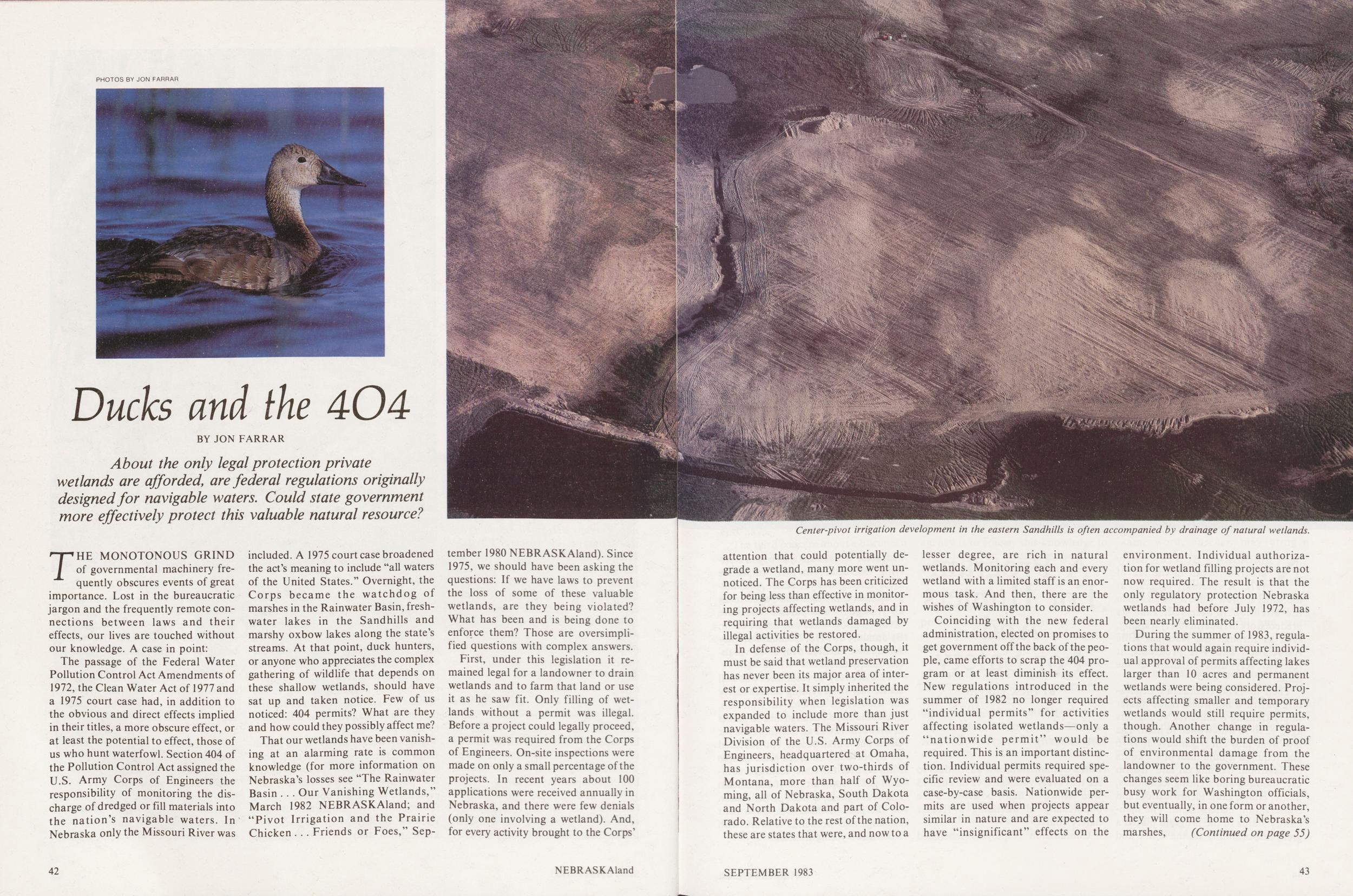
Ducks and the 404
BY JON FARRAR About the only legal protection private wetlands are afforded, are federal regulations originally designed for navigable waters. Could state government more effectively protect this valuable natural resource?THE MONOTONOUS GRIND of governmental machinery fre- quently obscures events of great importance. Lost in the bureaucratic jargon and the frequently remote con- nections between laws and their effects, our lives are touched without our knowledge. A case in point:
The passage of the Federal Water Pollution Control Act Amendments of 1972, the Clean Water Act of 1977 and a 1975 court case had, in addition to the obvious and direct effects implied in their titles, a more obscure effect, or at least the potential to effect, those of us who hunt waterfowl. Section 404 of the Pollution Control Act assigned the U.S. Army Corps of Engineers the responsibility of monitoring the dis- charge of dredged or fill materials into the nation's navigable waters. In Nebraska only the Missouri River was included. A 1975 court case broadened the act's meaning to include "all waters of the United States." Overnight, the Corps became the watchdog of marshes in the Rainwater Basin, fresh- water lakes in the Sandhills and marshy oxbow lakes along the state's streams. At that point, duck hunters, or anyone who appreciates the complex gathering of wildlife that depends on these shallow wetlands, should have sat up and taken notice. Few of us noticed: 404 permits? What are they and how could they possibly affect me?
That our wetlands have been vanish- ing at an alarming rate is common knowledge (for more information on Nebraska's losses see "The Rainwater Basin Our Vanishing Wetlands," March 1982 NEBR ASK Aland; and "Pivot Irrigation and the Prairie Chicken Friends or Foes," Sep- tember 1980 NEBRASKAland). Since 1975, we should have been asking the questions: If we have laws to prevent the loss of some of these valuable wetlands, are they being violated? What has been and is being done to enforce them? Those are oversimpli- fied questions with complex answers.
First, under this legislation it re- mained legal for a landowner to drain wetlands and to farm that land or use it as he saw fit. Only filling of wet- lands without a permit was illegal. Before a project could legally proceed, a permit was required from the Corps of Engineers. On-site inspections were made on only a small percentage of the projects. In recent years about 100 applications were received annually in Nebraska, and there were few denials (only one involving a wetland). And, for every activity brought to the Corps'
In defense of the Corps, though, it must be said that wetland preservation has never been its major area of inter- est or expertise. It simply inherited the responsibility when legislation was expanded to include more than just navigable waters. The Missouri River Division of the U.S. Army Corps of Engineers, headquartered at Omaha, has jurisdiction over two-thirds of Montana, more than half of Wyo- ming, all of Nebraska, South Dakota and North Dakota and part of Colo- rado. Relative to the rest of the nation, these are states that were, and now to a lesser degree, are rich in natural wetlands. Monitoring each and every wetland with a limited staff is an enor- mous task. And then, there are the wishes of Washington to consider.
Coinciding with the new federal administration, elected on promises to get government off the back of the peo- ple, came efforts to scrap the 404 pro- gram or at least diminish its effect. New regulations introduced in the summer of 1982 no longer required "individual permits" for activities affecting isolated wetlands—only a "nationwide permit" would be required. This is an important distinc- tion. Individual permits required spe- cific review and were evaluated on a case-by-case basis. Nationwide per- mits are used when projects appear similar in nature and are expected to have "insignificant" effects on the environment. Individual authoriza- tion for wetland filling projects are not now required. The result is that the only regulatory protection Nebraska wetlands had before July 1972, has been nearly eliminated.
During the summer of 1983, regula- tions that would again require individ- ual approval of permits affecting lakes larger than 10 acres and permanent wetlands were being considered. Proj- ects affecting smaller and temporary wetlands would still require permits, though. Another change in regula- tions would shift the burden of proof of environmental damage from the landowner to the government. These changes seem like boring bureaucratic busy work for Washington officials, but eventually, in one form or another, they will come home to Nebraska's marshes, (Continued on page 55)
42 NEBRASKAland SEPTEMBER 1983 43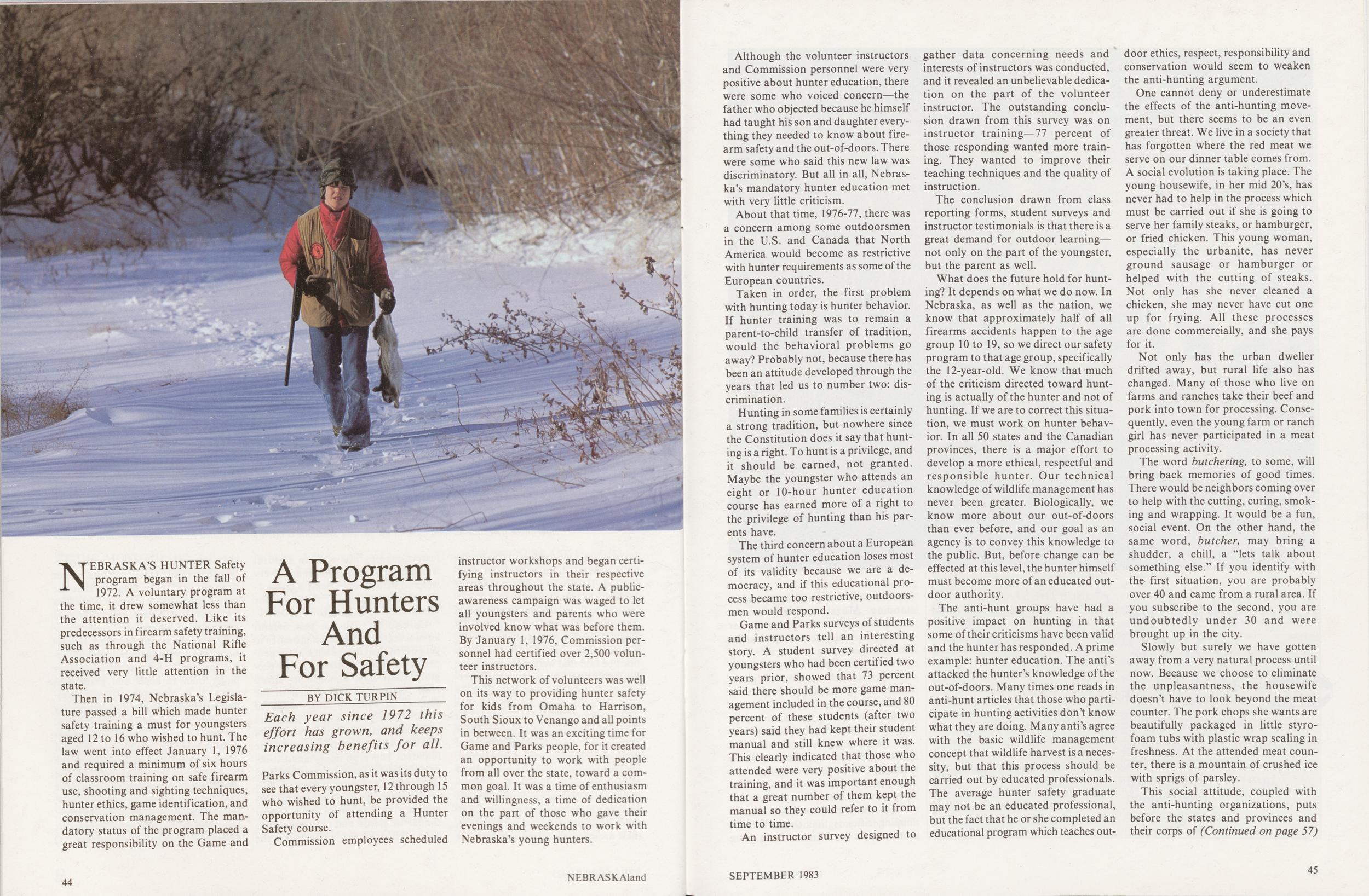
A Program For Hunters And For Safety
BY DICK TURPIN Each year since 1972 this effort has grown, and keeps increasing benefits for allNEBRASKA'S HUNTER Safety program began in the fall of 1972. A voluntary program at the time, it drew somewhat less than the attention it deserved. Like its predecessors in firearm safety training, such as through the National Rifle Association and 4-H programs, it received very little attention in the state.
Then in 1974, Nebraska's Legisla- ture passed a bill which made hunter safety training a must for youngsters aged 12 to 16 who wished to hunt. The law went into effect January 1, 1976 and required a minimum of six hours of classroom training on safe firearm use, shooting and sighting techniques, hunter ethics, game identification, and conservation management. The man- datory status of the program placed a great responsibility on the Game and Parks Commission, as it was its duty to see that every youngster, 12 through 15 who wished to hunt, be provided the opportunity of attending a Hunter Safety course.
Commission employees scheduled instructor workshops and began certi- fying instructors in their respective areas throughout the state. A public- awareness campaign was waged to let all youngsters and parents who were involved know what was before them. By January 1, 1976, Commission per- sonnel had certified over 2,500 volun- teer instructors.
This network of volunteers was well on its way to providing hunter safety for kids from Omaha to Harrison, South Sioux to Venango and all points in between. It was an exciting time for Game and Parks people, for it created an opportunity to work with people from all over the state, toward a com- mon goal. It was a time of enthusiasm and willingness, a time of dedication on the part of those who gave their evenings and weekends to work with Nebraska's young hunters.
Although the volunteer instructors and Commission personnel were very positive about hunter education, there were some who voiced concern—the father who objected because he himself had taught his son and daughter every- thing they needed to know about fire- arm safety and the out-of-doors. There were some who said this new law was discriminatory. But all in all, Nebras- ka's mandatory hunter education met with very little criticism.
About that time, 1976-77, there was a concern among some outdoorsmen in the U.S. and Canada that North America would become as restrictive with hunter requirements as some of the European countries.
Taken in order, the first problem with hunting today is hunter behavior. If hunter training was to remain a parent-to-child transfer of tradition, would the behavioral problems go away? Probably not, because there has been an attitude developed through the years that led us to number two: dis- crimination.
Hunting in some families is certainly a strong tradition, but nowhere since the Constitution does it say that hunt- ing is a right. To hunt is a privilege, and it should be earned, not granted. Maybe the youngster who attends an eight or 10-hour hunter education course has earned more of a right to the privilege of hunting than his par- ents have.
The third concern about a European system of hunter education loses most of its validity because we are a de- mocracy, and if this educational pro- cess became too restrictive, outdoors- men would respond.
Game and Parks surveys of students and instructors tell an interesting story. A student survey directed at youngsters who had been certified two years prior, showed that 73 percent said there should be more game man- agement included in the course, and 80 percent of these students (after two years) said they had kept their student manual and still knew where it was. This clearly indicated that those who attended were very positive about the training, and it was important enough that a great number of them kept the manual so they could refer to it from time to time.
An instructor survey designed to gather data concerning needs and interests of instructors was conducted, and it revealed an unbelievable dedica- tion on the part of the volunteer instructor. The outstanding conclu- sion drawn from this survey was on instructor training—77 percent of those responding wanted more train- ing. They wanted to improve their teaching techniques and the quality of instruction.
The conclusion drawn from class reporting forms, student surveys and instructor testimonials is that there is a great demand for outdoor learning— not only on the part of the youngster, but the parent as well.
What does the future hold for hunt- ing? It depends on what we do now. In Nebraska, as well as the nation, we know that approximately half of all firearms accidents happen to the age group 10 to 19, so we direct our safety program to that age group, specifically the 12-year-old. We know that much of the criticism directed toward hunt- ing is actually of the hunter and not of hunting. If we are to correct this situa- tion, we must work on hunter behav- ior. In all 50 states and the Canadian provinces, there is a major effort to develop a more ethical, respectful and responsible hunter. Our technical knowledge of wildlife management has never been greater. Biologically, we know more about our out-of-doors than ever before, and our goal as an agency is to convey this knowledge to the public. But, before change can be effected at this level, the hunter himself must become more of an educated out- door authority.
The anti-hunt groups have had a positive impact on hunting in that some of their criticisms have been valid and the hunter has responded. A prime example: hunter education. The anti's attacked the hunter's knowledge of the out-of-doors. Many times one reads in anti-hunt articles that those who parti- cipate in hunting activities don't know what they are doing. Many anti's agree with the basic wildlife management concept that wildlife harvest is a neces- sity, but that this process should be carried out by educated professionals. The average hunter safety graduate may not be an educated professional, but the fact that he or she completed an educational program which teaches out- door ethics, respect, responsibility and conservation would seem to weaken the anti-hunting argument.
One cannot deny or underestimate the effects of the anti-hunting move- ment, but there seems to be an even greater threat. We live in a society that has forgotten where the red meat we serve on our dinner table comes from. A social evolution is taking place. The young housewife, in her mid 20's, has never had to help in the process which must be carried out if she is going to serve her family steaks, or hamburger, or fried chicken. This young woman, especially the urbanite, has never ground sausage or hamburger or helped with the cutting of steaks. Not only has she never cleaned a chicken, she may never have cut one up for frying. All these processes are done commercially, and she pays for it.
Not only has the urban dweller drifted away, but rural life also has changed. Many of those who live on farms and ranches take their beef and pork into town for processing. Conse- quently, even the young farm or ranch girl has never participated in a meat processing activity.
The word butchering, to some, will bring back memories of good times. There would be neighbors coming over to help with the cutting, curing, smok- ing and wrapping. It would be a fun, social event. On the other hand, the same word, butcher, may bring a shudder, a chill, a "lets talk about something else." If you identify with the first situation, you are probably over 40 and came from a rural area. If you subscribe to the second, you are undoubtedly under 30 and were brought up in the city.
Slowly but surely we have gotten away from a very natural process until now. Because we choose to eliminate the unpleasantness, the housewife doesn't have to look beyond the meat counter. The pork chops she wants are beautifully packaged in little styro- foam tubs with plastic wrap sealing in freshness. At the attended meat coun- ter, there is a mountain of crushed ice with sprigs of parsley.
This social attitude, coupled with the anti-hunting organizations, puts before the states and provinces and their corps of (Continued on page 57)
44 NEBRASKAland SEPTEMBER 1983 45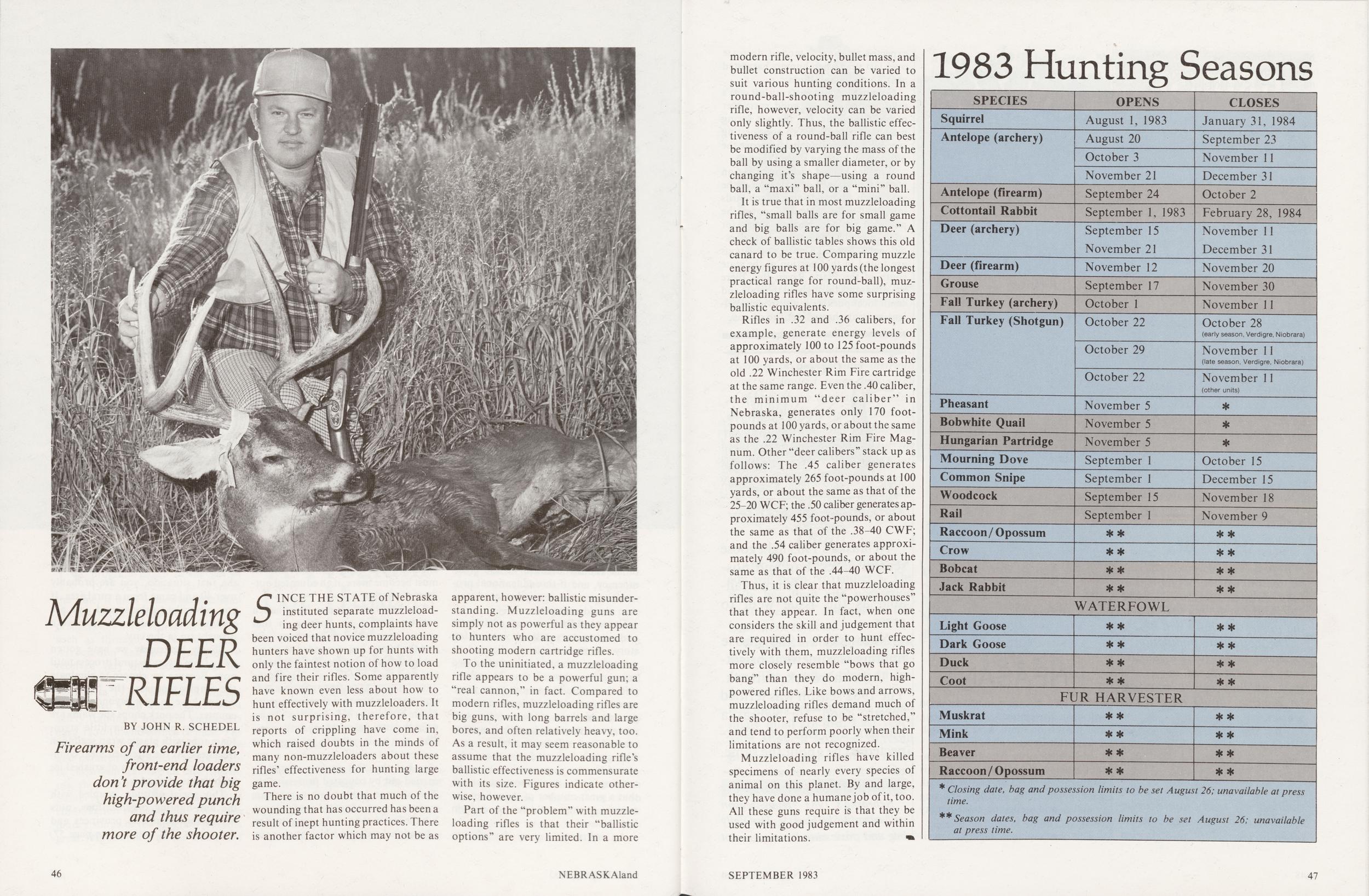
Muzzleloading DEER RIFLES
BY JOHN R. SCHEDEL Firearms of an earlier time, front-end loaders don't provide that big high-powered punch and thus require more of the shooter.SINCE THE STATE of Nebraska instituted separate muzzleload- ing deer hunts, complaints have been voiced that novice muzzleloading hunters have shown up for hunts with only the faintest notion of how to load and fire their rifles. Some apparently have known even less about how to hunt effectively with muzzleloaders. It is not surprising, therefore, that reports of crippling have come in, which raised doubts in the minds of many non-muzzleloaders about these rifles' effectiveness for hunting large game.
There is no doubt that much of the wounding that has occurred has been a result of inept hunting practices. There is another factor which may not be as apparent, however: ballistic misunder- standing. Muzzleloading guns are simply not as powerful as they appear to hunters who are accustomed to shooting modern cartridge rifles.
To the uninitiated, a muzzleloading rifle appears to be a powerful gun; a "real cannon," in fact. Compared to modern rifles, muzzleloading rifles are big guns, with long barrels and large bores, and often relatively heavy, too. As a result, it may seem reasonable to assume that the muzzleloading rifle's ballistic effectiveness is commensurate with its size. Figures indicate other- wise, however.
Part of the "problem" with muzzle- loading rifles is that their "ballistic options" are very limited. In a more modern rifle, velocity, bullet mass, and bullet construction can be varied to suit various hunting conditions. In a round-ball-shooting muzzleloading rifle, however, velocity can be varied only slightly. Thus, the ballistic effec- tiveness of a round-ball rifle can best be modified by varying the mass of the ball by using a smaller diameter, or by changing it's shape—using a round ball, a "maxi" ball, or a "mini" ball.
It is true that in most muzzleloading rifles, "small balls are for small game and big balls are for big game." A check of ballistic tables shows this old canard to be true. Comparing muzzle energy figures at 100 yards (the longest practical range for round-ball), muz- zleloading rifles have some surprising ballistic equivalents.
Rifles in .32 and .36 calibers, for example, generate energy levels of approximately 100 to 125 foot-pounds at 100 yards, or about the same as the old .22 Winchester Rim Fire cartridge at the same range. Even the .40 caliber, the minimum "deer caliber" in Nebraska, generates only 170 foot- pounds at 100 yards, or about the same as the .22 Winchester Rim Fire Mag- num. Other "deer calibers" stack up as follows: The .45 caliber generates approximately 265 foot-pounds at 100 yards, or about the same as that of the 25-20 WCF; the .50 caliber generates ap- proximately 455 foot-pounds, or about the same as that of the .38-40 CWF; and the .54 caliber generates approxi- mately 490 foot-pounds, or about the same as that of the .44-40 WCF.
Thus, it is clear that muzzleloading rifles are not quite the "powerhouses" that they appear. In fact, when one considers the skill and judgement that are required in order to hunt effec- tively with them, muzzleloading rifles more closely resemble "bows that go bang" than they do modern, high- powered rifles. Like bows and arrows, muzzleloading rifles demand much of the shooter, refuse to be "stretched," and tend to perform poorly when their limitations are not recognized.
Muzzleloading rifles have killed specimens of nearly every species of animal on this planet. By and large, they have done a humane job of it, too. All these guns require is that they be used with good judgement and within their limitations.
1983 Hunting Seasons SPECIES OPENS CLOSES Squirrel August 1, 1983 January 31, 1984 Antelope (archery) August 20 September 23 October 3 November 11 November 21 December 31 Antelope (firearm) September 24 October 2 Cottontail Rabbit September 1, 1983 February 28, 1984 Deer (archery) September 15 November 21 November 11 December 31 Deer (firearm) November 12 November 20 Grouse September 17 November 30 Fall Turkey (archery) October 1 November 11 Fall Turkey (Shotgun) October 22 October 28 (early season, Verdigre, Niobrara) October 29 November 11 (late season, Verdigre, Niobrara) October 22 November 11 (other units) Pheasant November 5 Bobwhite Quail November 5 Hungarian Partridge November 5 Mourning Dove September 1 October 15 Common Snipe September 1 December 15 Woodcock September 15 November 18 Rail September 1 November 9 Raccoon/ Opossum Crow Bobcat Jack Rabbit WATERFOWL Light Goose Dark Goose Duck Coot FUR HARVESTER Muskrat Mink Beaver Raccoon/ Opossum Closing date, bag and possession limits to be set August 26; unavailable at press time. Season dates, bag and possession limits to be set August 26; unavailable at press time. 46 NEBRASKAland SEPTEMBER 1983 47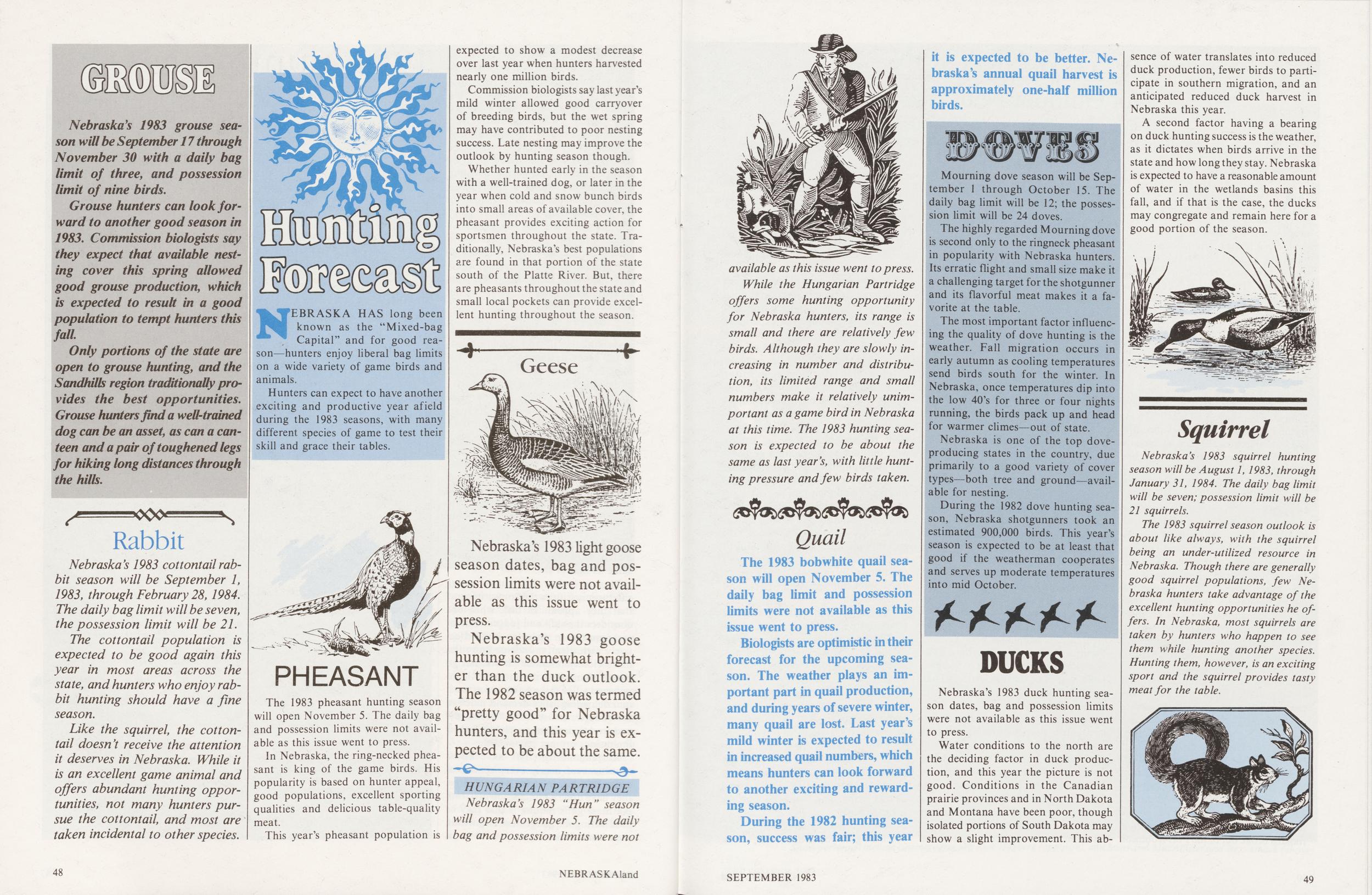
Hunting Forecast
NEBRASKA HAS long been known as the "Mixed-bag Capital" and for good reason—hunters enjoy liberal bag limits on a wide variety of game birds and animals.
Hunters can expect to have another exciting and productive year afield during the 1983 seasons, with many different species of game to test their skill and grace their tables.
GrouseNebraska's 1983 grouse sea- son will be September 17 through November 30 with a daily bag limit of three, and possession limit of nine birds.
Grouse hunters can look for- ward to another good season in 1983. Commission biologists say they expect that available nest- ing cover this spring allowed good grouse production, which is expected to result in a good population to tempt hunters this fall.
Only portions of the state are open to grouse hunting, and the Sandhills region traditionally pro- vides the best opportunities. Grouse hunters find a well-trained dog can be an asset, as can a can- teen and a pair of toughened legs for hiking long distances through the hills.
RabbitNebraska's 1983 cottontail rab- bit season will be September 1, 1983, through February 28,1984. The daily bag limit will be seven, the possession limit will be 21.
The cottontail population is expected to be good again this year in most areas across the state, and hunters who enjoy rab- bit hunting should have a fine season.
Like the squirrel, the cotton- tail doesn't receive the attention it deserves in Nebraska. While it is an excellent game animal and offers abundant hunting oppor- tunities, not many hunters pur- sue the cottontail, and most are taken incidental to other species.
PHEASANTThe 1983 pheasant hunting season will open November 5. The daily bag and possession limits were not avail- able as this issue went to press.
In Nebraska, the ring-necked phea- sant is king of the game birds. His popularity is based on hunter appeal, good populations, excellent sporting qualities and delicious table-quality meat.
This year's pheasant population is expected to show a modest decrease over last year when hunters harvested nearly one million birds.
Commission biologists say last year's mild winter allowed good carryover of breeding birds, but the wet spring may have contributed to poor nesting success. Late nesting may improve the outlook by hunting season though.
Whether hunted early in the season with a well-trained dog, or later in the year when cold and snow bunch birds into small areas of available cover, the pheasant provides exciting action for sportsmen throughout the state. Tra- ditionally, Nebraska's best populations are found in that portion of the state south of the Platte River. But, there are pheasants throughout the state and small local pockets can provide excel- lent hunting throughout the season.
GeeseNebraska's 1983 light goose season dates, bag and pos- session limits were not avail- able as this issue went to press.
Nebraska's 1983 goose hunting is somewhat bright- er than the duck outlook. The 1982 season was termed "pretty good" for Nebraska hunters, and this year is ex- pected to be about the same.
HUNGARIAN PARTRIDGENebraska's 1983 "Hun" season will open November 5. The daily bag and possession limits were not available as this issue went to press.
While the Hungarian Partridge offers some hunting opportunity for Nebraska hunters, its range is small and there are relatively few birds. Although they are slowly in- creasing in number and distribu- tion, its limited range and small numbers make it relatively unim- portant as a game bird in Nebraska at this time. The 1983 hunting sea- son is expected to be about the same as last year's, with little hunt- ing pressure and few birds taken.
QuailThe 1983 bob white quail sea- son will open November 5. The daily bag limit and possession limits were not available as this issue went to press.
Biologists are optimistic in their forecast for the upcoming sea- son. The weather plays an im- portant part in quail production, and during years of severe winter, many quail are lost. Last year's mild winter is expected to result in increased quail numbers, which means hunters can look forward to another exciting and reward- ing season.
During the 1982 hunting sea- son, success was fair; this year it is expected to be better. Ne- braska's annual quail harvest is approximately one-half million birds.
DovesMourning dove season will be Sep- tember 1 through October 15. The daily bag limit will be 12; the posses- sion limit will be 24 doves.
The highly regarded Mourning dove is second only to the ringneck pheasant in popularity with Nebraska hunters. Its erratic flight and small size make it a challenging target for the shotgunner and its flavorful meat makes it a fa- vorite at the table.
The most important factor influenc- ing the quality of dove hunting is the weather. Fall migration occurs in early autumn as cooling temperatures send birds south for the winter. In Nebraska, once temperatures dip into the low 40's for three or four nights running, the birds pack up and head for warmer climes—out of state.
Nebraska is one of the top dove- producing states in the country, due primarily to a good variety of cover types—both tree and ground—avail- able for nesting.
During the 1982 dove hunting sea- son, Nebraska shotgunners took an estimated 900,000 birds. This year's season is expected to be at least that good if the weatherman cooperates and serves up moderate temperatures into mid October.
DUCKSNebraska's 1983 duck hunting sea- son dates, bag and possession limits were not available as this issue went to press.
Water conditions to the north are the deciding factor in duck produc- tion, and this year the picture is not good. Conditions in the Canadian prairie provinces and in North Dakota and Montana have been poor, though isolated portions of South Dakota may show a slight improvement. This ab- sence of water translates into reduced duck production, fewer birds to parti- cipate in southern migration, and an anticipated reduced duck harvest in Nebraska this year.
A second factor having a bearing on duck hunting success is the weather, as it dictates when birds arrive in the state and how long they stay. Nebraska is expected to have a reasonable amount of water in the wetlands basins this fall, and if that is the case, the ducks may congregate and remain here for a good portion of the season.
SquirrelNebraska's 1983 squirrel hunting season will be August 1, 1983, through January 31, 1984. The daily bag limit will be seven; possession limit will be 21 squirrels.
The 1983 squirrel season outlook is about like always, with the squirrel being an under-utilized resource in Nebraska. Though there are generally good squirrel populations, few Ne- braska hunters take advantage of the excellent hunting opportunities he of- fers. In Nebraska, most squirrels are taken by hunters who happen to see them while hunting another species. Hunting them, however, is an exciting sport and the squirrel provides tasty meat for the table.
48 NEBRASKAland SEPTEMBER 1983 49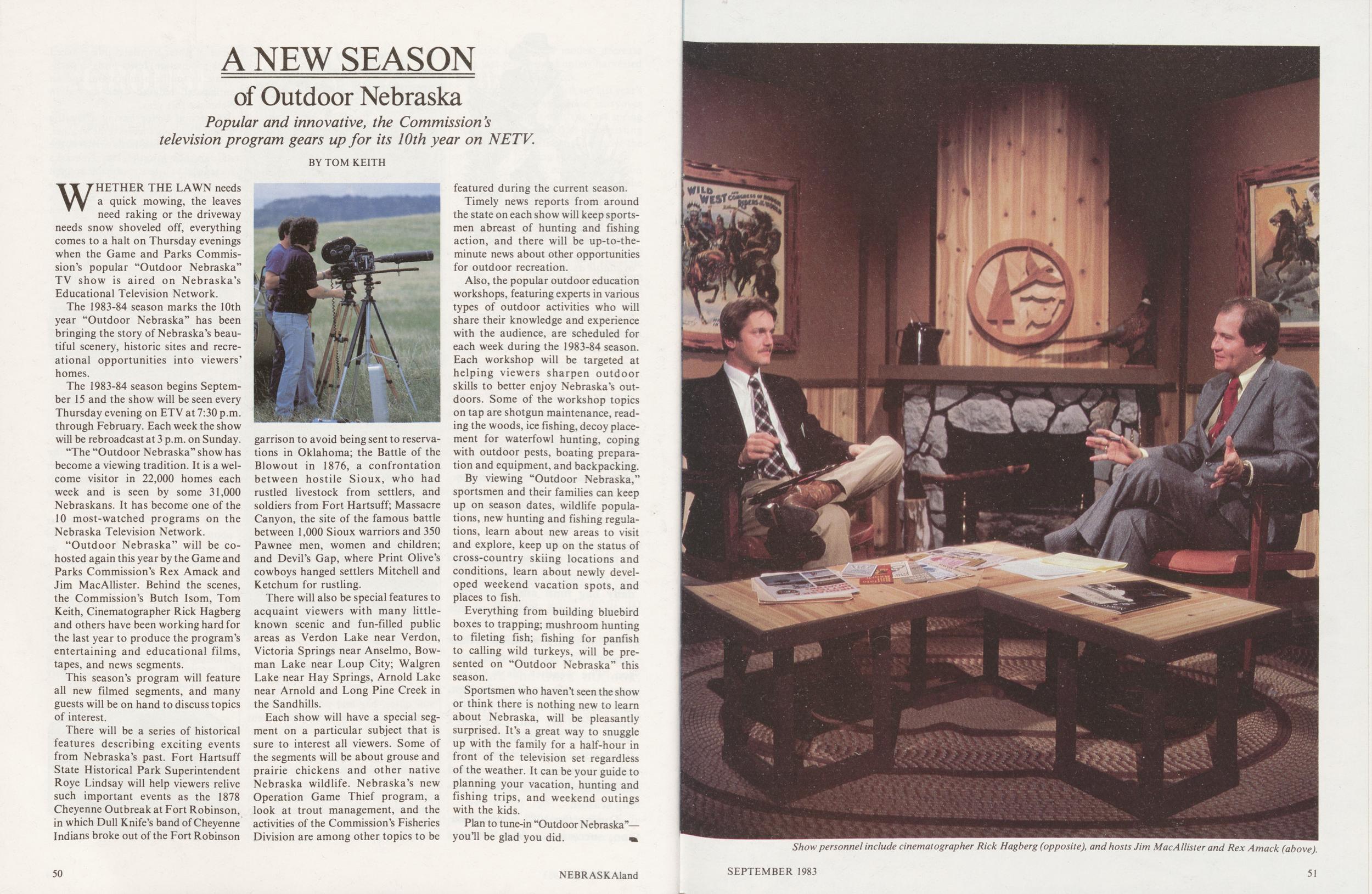
A NEW SEASON of Outdoor Nebraska
Popular and innovative, the Commission's television program gears up for its 10th year on NETV. BY TOM KEITHWHETHER THE LAWN needs a quick mowing, the leaves need raking or the driveway needs snow shoveled off, everything comes to a halt on Thursday evenings when the Game and Parks Commis- sion's popular "Outdoor Nebraska" TV show is aired on Nebraska's Educational Television Network.
The 1983-84 season marks the 10th year "Outdoor Nebraska" has been bringing the story of Nebraska's beau- tiful scenery, historic sites and recre- ational opportunities into viewers' homes.
The 1983-84 season begins Septem- ber 15 and the show will be seen every Thursday evening on ETV at 7:30 p.m. through February. Each week the show will be rebroadcast at 3 p.m. on Sunday,
"The "Outdoor Nebraska" show has become a viewing tradition. It is a wel- come visitor in 22,000 homes each week and is seen by some 31,000 Nebraskans. It has become one of the 10 most-watched programs on the Nebraska Television Network.
"Outdoor Nebraska" will be co- hosted again this year by the Game and Parks Commission's Rex Amack and Jim MacAllister. Behind the scenes, the Commission's Butch Isom, Tom Keith, Cinematographer Rick Hagberg and others have been working hard for the last year to produce the program's entertaining and educational films, tapes, and news segments.
This season's program will feature all new filmed segments, and many guests will be on hand to discuss topics of interest.
There will be a series of historical features describing exciting events from Nebraska's past. Fort Hartsuff State Historical Park Superintendent Roye Lindsay will help viewers relive such important events as the 1878 Cheyenne Outbreak at Fort Robinson, in which Dull Knife's band of Cheyenne Indians broke out of the Fort Robinson garrison to avoid being sent to reserva- tions in Oklahoma; the Battle of the Blowout in 1876, a confrontation between hostile Sioux, who had rustled livestock from settlers, and soldiers from Fort Hartsuff; Massacre Canyon, the site of the famous battle between 1,000 Sioux warriors and 350 Pawnee men, women and children; and Devil's Gap, where Print Olive's cowboys hanged settlers Mitchell and Ketchum for rustling.
There will also be special features to acquaint viewers with many little- known scenic and fun-filled public areas as Verdon Lake near Verdon, Victoria Springs near Anselmo, Bow- man Lake near Loup City; Walgren Lake near Hay Springs, Arnold Lake near Arnold and Long Pine Creek in the Sandhills.
Each show will have a special seg- ment on a particular subject that is sure to interest all viewers. Some of the segments will be about grouse and prairie chickens and other native Nebraska wildlife. Nebraska's new Operation Game Thief program, a look at trout management, and the activities of the Commission's Fisheries Division are among other topics to be featured during the current season.
Timely news reports from around the state on each show will keep sports- men abreast of hunting and fishing action, and there will be up-to-the- minute news about other opportunities for outdoor recreation.
Also, the popular outdoor education workshops, featuring experts in various types of outdoor activities who will share their knowledge and experience with the audience, are scheduled for each week during the 1983-84 season. Each workshop will be targeted at helping viewers sharpen outdoor skills to better enjoy Nebraska's out- doors. Some of the workshop topics on tap are shotgun maintenance, read- ing the woods, ice fishing, decoy place- ment for waterfowl hunting, coping with outdoor pests, boating prepara- tion and equipment, and backpacking.
By viewing "Outdoor Nebraska," sportsmen and their families can keep up on season dates, wildlife popula- tions, new hunting and fishing regula- tions, learn about new areas to visit and explore, keep up on the status of cross-country skiing locations and conditions, learn about newly devel- oped weekend vacation spots, and places to fish.
Everything from building bluebird boxes to trapping; mushroom hunting to fileting fish; fishing for panfish to calling wild turkeys, will be pre- sented on "Outdoor Nebraska" this season.
Sportsmen who haven't seen the show or think there is nothing new to learn about Nebraska, will be pleasantly surprised. It's a great way to snuggle up with the family for a half-hour in front of the television set regardless of the weather. It can be your guide to planning your vacation, hunting and fishing trips, and weekend outings with the kids.
Plan to tune-in "Outdoor Nebraska"— you'll be glad you did.
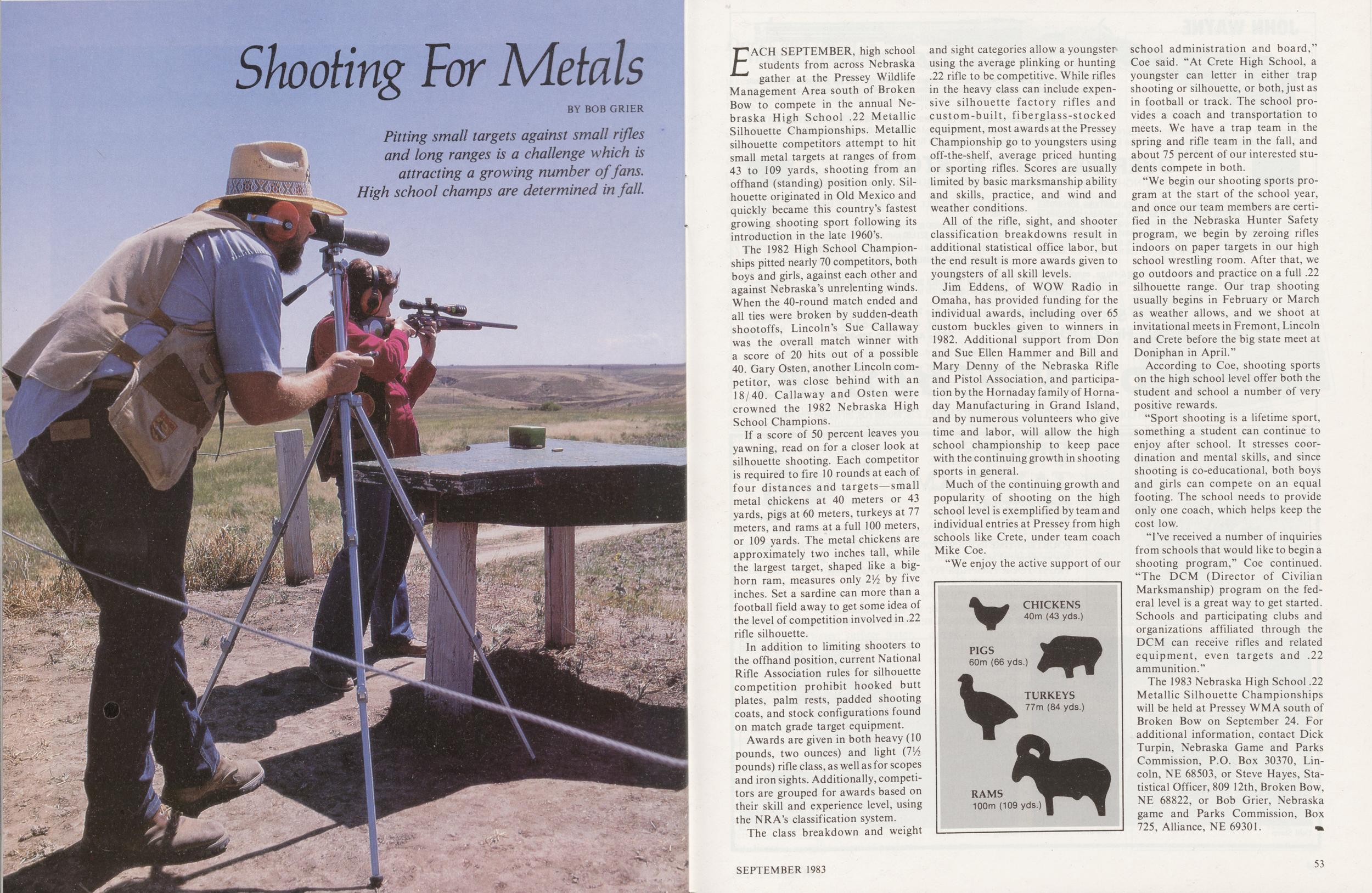
Shooting For Metals
BY BOB GRIER Pitting small targets against small rifles and long ranges is a challenge which is attracting a growing number of fans. High school champs are determined in fall.EACH SEPTEMBER, high school students from across Nebraska gather at the Pressey Wildlife Management Area south of Broken Bow to compete in the annual Ne- braska High School .22 Metallic Silhouette Championships. Metallic silhouette competitors attempt to hit small metal targets at ranges of from 43 to 109 yards, shooting from an offhand (standing) position only. Sil- houette originated in Old Mexico and quickly became this country's fastest growing shooting sport following its introduction in the late 1960's.
The 1982 High School Champion- ships pitted nearly 70 competitors, both boys and girls, against each other and against Nebraska's unrelenting winds. When the 40-round match ended and all ties were broken by sudden-death shootoffs, Lincoln's Sue Callaway was the overall match winner with a score of 20 hits out of a possible 40. Gary Osten, another Lincoln com- petitor, was close behind with an 18/40. Callaway and Osten were crowned the 1982 Nebraska High School Champions.
If a score of 50 percent leaves you yawning, read on for a closer look at silhouette shooting. Each competitor is required to fire 10 rounds at each of four distances and targets—small metal chickens at 40 meters or 43 yards, pigs at 60 meters, turkeys at 77 meters, and rams at a full 100 meters, or 109 yards. The metal chickens are approximately two inches tall, while the largest target, shaped like a big- horn ram, measures only 2 1/2 by five inches. Set a sardine can more than a football field away to get some idea of the level of competition involved in .22 rifle silhouette.
In addition to limiting shooters to the offhand position, current National Rifle Association rules for silhouette competition prohibit hooked butt plates, palm rests, padded shooting coats, and stock configurations found on match grade target equipment.
Awards are given in both heavy (10 pounds, two ounces) and light (7 1/2 pounds) rifle class, as well as for scopes and iron sights. Additionally, competi- tors are grouped for awards based on their skill and experience level, using the NRA's classification system.
The class breakdown and weight and sight categories allow a youngster using the average plinking or hunting .22 rifle to be competitive. While rifles in the heavy class can include expen- sive silhouette factory rifles and custom-built, fiberglass-stocked equipment, most awards at the Pressey Championship go to youngsters using off-the-shelf, average priced hunting or sporting rifles. Scores are usually limited by basic marksmanship ability and skills, practice, and wind and weather conditions.
All of the rifle, sight, and shooter classification breakdowns result in additional statistical office labor, but the end result is more awards given to youngsters of all skill levels.
Jim Eddens, of WOW Radio in Omaha, has provided funding for the individual awards, including over 65 custom buckles given to winners in 1982. Additional support from Don and Sue Ellen Hammer and Bill and Mary Denny of the Nebraska Rifle and Pistol Association, and participa- tion by the Hornaday family of Horna- day Manufacturing in Grand Island, and by numerous volunteers who give time and labor, will allow the high school championship to keep pace with the continuing growth in shooting sports in general.
Much of the continuing growth and popularity of shooting on the high school level is exemplified by team and individual entries at Pressey from high schools like Crete, under team coach Mike Coe.
"We enjoy the active support of our
"We begin our shooting sports pro- gram at the start of the school year, and once our team members are certi- fied in the Nebraska Hunter Safety program, we begin by zeroing rifles indoors on paper targets in our high school wrestling room. After that, we go outdoors and practice on a full .22 silhouette range. Our trap shooting usually begins in February or March as weather allows, and we shoot at invitational meets in Fremont, Lincoln and Crete before the big state meet at Doniphan in April."
According to Coe, shooting sports on the high school level offer both the student and school a number of very positive rewards.
"Sport shooting is a lifetime sport, something a student can continue to enjoy after school. It stresses coor- dination and mental skills, and since shooting is co-educational, both boys and girls can compete on an equal footing. The school needs to provide only one coach, which helps keep the cost low.
"I've received a number of inquiries from schools that would like to begin a shooting program," Coe continued. "The DCM (Director of Civilian Marksmanship) program on the fed- eral level is a great way to get started. Schools and participating clubs and organizations affiliated through the DCM can receive rifles and related equipment, even targets and .22 ammunition."
The 1983 Nebraska High School .22 Metallic Silhouette Championships will be held at Pressey WMA south of Broken Bow on September 24. For additional information, contact Dick Turpin, Nebraska Game and Parks Commission, P.O. Box 30370, Lin- coln, NE 68503, or Steve Hayes, Sta- tistical Officer, 809 12th, Broken Bow, NE 68822, or Bob Grier, Nebraska game and Parks Commission, Box 725, Alliance, NE 69301.
SEPTEMBER 1983 53
JOHN WAYNE WINCHESTER immediate delivery
The receiver depicts a stagecoach under attack by Indians, right side has a cattle drive scene. Both sides have a border design highlighting the names of famous Western movies in which John Wayne starred. The oversized bowed lever and 32-40 caliber are two firsts for a Winchester Commemorative. The most popular and most in demand WINCHESTER COMMEMORATIVE ever. Price fluctuates. At present time (preparation of this ad) price is $588. OKLAHOMA DIAMOND JUBILEE, ANNIE OAKLEY, CHIEF CRAZY HORSE, plus most of the U.S. Commemoratives in stock including the first and the last. Let us know your wants. OVER 800 GUNS IN STOCK BROWNINGS, WINCHESTERS, ITHACAS, S&WS, COLTS, RUGERS, and OTHERS. BELGIAN BROWNING AMERICAN WATERFOWL SERIES, LIGHTNING SUPERPOSED O&U SHOTGUN, LIMITED PRODUCTION OF 500 ONLY, seven hand sculptured 24 karat gold inlays plus inscribed in gold with the words "American Mallard" beautifully figured high grade dark burl walnut hand oiled wood, handcrafted red velvet lined black walnut presentation case, new unfired. The price of current Superposed Waterfowl is $8000. Will sell this one for $5950.00 BROWNING O&U FOUR BARREL SKEET SET, 12, 20, 28 & 410 ga., complete, fitted luggage case, (high post target rib). Citori Grade I, new unfired in factory ctn., Fact. list-$2800.00. WILL SELL FOR $2480.00 CASED JOHN WAYNE COLT, new unfired in original factory carton. RESERVED NO $2488.00 BROWNING CHALLENGER III (American made). 22 cal. Auto, pistol. SPECIAL! $222.00 each- two at $211.00 each- three at each $ 199.50 BROWNING CHALLENGER II (American made), discontinued. SPECIAL! $ 220.00 RUGER, ONE of 5000 STAINLESS AUTO. 22 cal., new unfired in factory carton & original wooden box $ 795.00 STAINLESS STEEL RUGER SUPER BLACKHAWK, 44 MAG., New in factory carton. 10 1/2 inch-$295.00; 7 1/2 inch. $ 269.00 BEDLAN'S THE SPORTSMAN'S HEADQUARTERS 1318 E. St., Box 244, Fairbury, Nebraska 68352 PH. 402-729-6112 If No Answer 402-729-2635 Open Mon.-Sat., 8 a.m.-5:30 p.m.; Thurs till 9 p.m. WE TRADE WANTED WINCHESTERS ANY MODEL PRE-1964 SINGLES OR COLLECTIONS FOR CASH ALL DOUBLE MODEL 21s, Model 70s, all Model 12s & OTHERS.DINGES TAXIDERMY STUDIO
2763 South 12th Street, Omaha, NE 68108, (402) 342-3718 FOURTEEN-TIME INTERNATIONAL AWARD WINNING TAXIDERMISTS We've mounted animals from all over North America and Africa. TRUST YOUR TROPHIES TO A PROVEN WINNER You are cordially invited to visit our new studio. Easy access off I-80 at 13th St. 1/2 blk. N. on 12th St. Contact us before your next trip for further information. COMPLETE PROFESSIONAL SERVICE—TAXIDERMIST—SCULPTORDucks and the 404 (Continued from page 43)
lakes and wetlands or other states that produce waterfowl migrating through Nebraska.
The Clean Water Act of 1977 pro- vided states the option of assuming section 404 responsibilties. All respon- sibilities under this act except the 404 program are already administered by Nebraska. Last spring the Nebraska Department of Environmental Con- trol (DEC) completed a feasibility study to determine if the state should assume 404 responsibility, and con- cluded that it was feasible. DEC has not yet made recommendations as to whether it was desirable. Ultimately, the decision will rest with the Gover- nor. The report and a recommenda- tion should be in his hands by November.
The Department of Environmental Control already has the legislative power to administer the 404 program. Only statutory authority to assess fines against violators would be required from the Legislature. If the state does assume the responsibility, the 404 pro- gram remains a federal program sub- ject to federal oversight, providing in- sulation against political pressures to weaken the program at the state level.
But what are the advantages, if any, of the state administering the 404 pro- gram? Clark Haberman, chief of the Program Plans Section of DEC, headed the feasibility study and per- sonally believes a state agency could do a better job for a number of reasons.
"I believe in ecosystem manage- ment. Management of all the related factors—groundwater, surface water, pollution, fish and wildlife habitat—is more successful than trying to manage only one segment of the environment. You have to have the whole picture in mind to avoid creating new problems while solving one. I think this state knows itself pretty well, knows its resources. I think we can do a better job with our resources than the Corps could, trying to manage such a large, diverse region."
Other DEC staff members feel that a state administered 404 program would put more people in the field to monitor activities affecting wetlands and pro- vide a more complete view of projects than was gained by relying on land- owners to file applications. Enforce- ment would be improved. Educational programs to increase understanding of the value of wetlands and improve communication with landowners, would be important aspects of a state- administered program.
DEC and U.S. Fish and Wildlife are preparing a wetland inventory that should be more comprehensive and accurate than any previously available. This is viewed as a base from which future changes may be monitored. High resolution satellite imagery could be used to periodically update wetland information.
If the state does assume responsibil- ity for the 404 program, DEC has developed a system to predict the impact of various types of individual projects on the environment. Certain aquatic sites are more susceptible to environmental damage than others. Certain types of projects cause more environmental damage than others. Under DEC's proposed system, the type of project and type of site is assigned a number between one and 10. The higher the number the greater the risk to the environment. The two sets of ratings are then combined to determine the category and type of project permit required. Low-impact projects could receive "short-form" general permits; high-impact projects would be subject to a case-by-case review. This sytem would not only speed the processing of low-impact projects but would permit DEC per- sonnel to concentrate on the projects with the greatest potential of adversely altering wetlands.
"Even if the state doesn't take on the 404 program," Haberman said, "we've gained something for the resources of the state. We can now provide specific recommendations to make the pro- gram work better."
For those of us who feel wetlands are at least as valuable as another corn- field or another industrial park, it probably doesn't matter who adminis- ters the program so long as it is done effectively. Our interests should be represented just as strongly as those who would pull the teeth from this program designed to preserve some of the wetland areas remaining. For that to happen, we must convince officials who run the government machine that we care.
Time to place your order.
Dont't wait until the last minute or month, to order this new, colorful NEBRASKA land Calendar! $3.50 plus tax A POPULAR best seller each year, the 1984 ver- sion of the NEBRAS- KAland Calendar of Color will bring smiles of pleasure with its scenes of wonder. Each month brings a new look at a Nebraska scene that will make the days more pleasant. This timely item would make a great gift, for yourself or friends, but quantities are definitely limited, so order early! Send me__copies of the 1984 NEBRASKAland Calendar of Color. My check or money order for $3.50 each, plus sales tax, is enclosed. Name Street City State Zip Mail to: NEBRASKAland Calendar, P.O. Box 3022, Omaha, Nebr. 68103. 54 NEBRASKAland SEPTEMBER 1983 55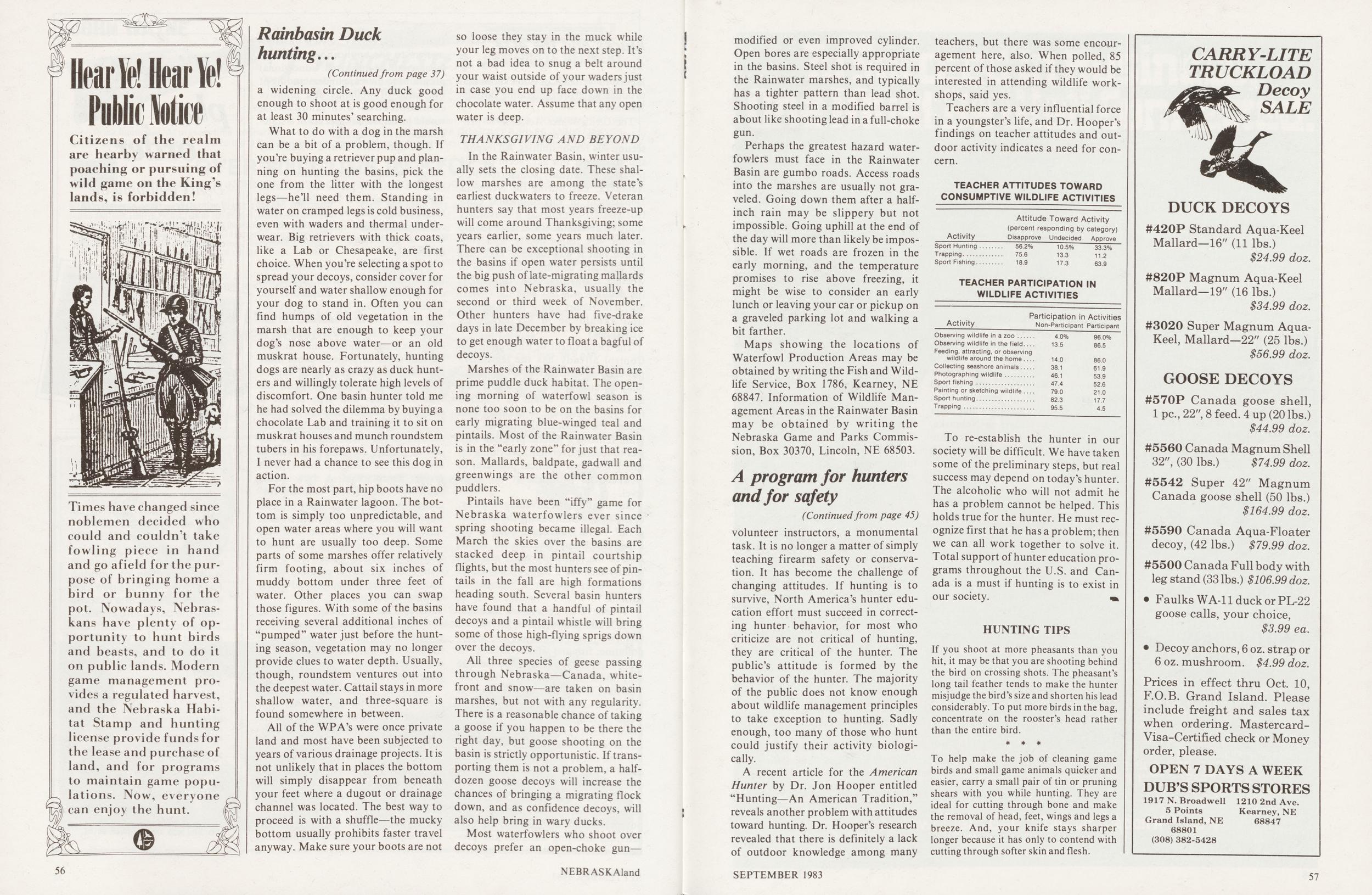
Hear Ye! Hear Ye! Public Notice
Citizens of the realm are hearby warned that poaching or pursuing of wild game on the King's lands, is forbidden! Times have changed since noblemen decided who could and couldn't take fowling piece in hand and go afield for the pur- pose of bringing home a bird or bunny for the pot. Nowadays, Nebras- kans have plenty of op- portunity to hunt birds and beasts, and to do it on public lands. Modern game management pro- vides a regulated harvest, and the Nebraska Habi- tat Stamp and hunting license provide funds for the lease and purchase of land, and for programs to maintain game popu- lations. Now, everyone can enjoy the hunt.Rainbasin Duck hunting (Continued from page 37)
a widening circle. Any duck good enough to shoot at is good enough for at least 30 minutes' searching.
What to do with a dog in the marsh can be a bit of a problem, though. If you're buying a retriever pup and plan- ning on hunting the basins, pick the one from the litter with the longest legs—he'll need them. Standing in water on cramped legs is cold business, even with waders and thermal under- wear. Big retrievers with thick coats, like a Lab or Chesapeake, are first choice. When you're selecting a spot to spread your decoys, consider cover for yourself and water shallow enough for your dog to stand in. Often you can find humps of old vegetation in the marsh that are enough to keep your dog's nose above water—or an old muskrat house. Fortunately, hunting dogs are nearly as crazy as duck hunt- ers and willingly tolerate high levels of discomfort. One basin hunter told me he had solved the dilemma by buying a chocolate Lab and training it to sit on muskrat houses and munch roundstem tubers in his forepaws. Unfortunately, I never had a chance to see this dog in action.
For the most part, hip boots have no place in a Rainwater lagoon. The bot- tom is simply too unpredictable, and open water areas where you will want to hunt are usually too deep. Some parts of some marshes offer relatively firm footing, about six inches of muddy bottom under three feet of water. Other places you can swap those figures. With some of the basins receiving several additional inches of "pumped" water just before the hunt- ing season, vegetation may no longer provide clues to water depth. Usually, though, roundstem ventures out into the deepest water. Cattail stays in more shallow water, and three-square is found somewhere in between.
All of the WP A's were once private land and most have been subjected to years of various drainage projects. It is not unlikely that in places the bottom will simply disappear from beneath your feet where a dugout or drainage channel was located. The best way to proceed is with a shuffle—the mucky bottom usually prohibits faster travel anyway. Make sure your boots are not so loose they stay in the muck while your leg moves on to the next step. It's not a bad idea to snug a belt around your waist outside of your waders just in case you end up face down in the chocolate water. Assume that any open water is deep.
THANKSGIVING AND BEYONDIn the Rainwater Basin, winter usu- ally sets the closing date. These shal- low marshes are among the state's earliest duckwaters to freeze. Veteran hunters say that most years freeze-up will come around Thanksgiving; some years earlier, some years much later. There can be exceptional shooting in the basins if open water persists until the big push of late-migrating mallards comes into Nebraska, usually the second or third week of November. Other hunters have had five-drake days in late December by breaking ice to get enough water to float a bagful of decoys.
Marshes of the Rainwater Basin are prime puddle duck habitat. The open- ing morning of waterfowl season is none too soon to be on the basins for early migrating blue-winged teal and pintails. Most of the Rainwater Basin is in the "early zone" for just that rea- son. Mallards, baldpate, gadwall and greenwings are the other common puddlers.
Pintails have been "iffy" game for Nebraska waterfowlers ever since spring shooting became illegal. Each March the skies over the basins are stacked deep in pintail courtship flights, but the most hunters see of pin- tails in the fall are high formations heading south. Several basin hunters have found that a handful of pintail decoys and a pintail whistle will bring some of those high-flying sprigs down over the decoys.
All three species of geese passing through Nebraska—Canada, white- front and snow—are taken on basin marshes, but not with any regularity. There is a reasonable chance of taking a goose if you happen to be there the right day, but goose shooting on the basin is strictly opportunistic. If trans- porting them is not a problem, a half- dozen goose decoys will increase the chances of bringing a migrating flock down, and as confidence decoys, will also help bring in wary ducks.
Most waterfowlers who shoot over decoys prefer an open-choke gun— modified or even improved cylinder. Open bores are especially appropriate in the basins. Steel shot is required in the Rainwater marshes, and typically has a tighter pattern than lead shot. Shooting steel in a modified barrel is about like shooting lead in a full-choke gun.
Perhaps the greatest hazard water- fowlers must face in the Rainwater Basin are gumbo roads. Access roads into the marshes are usually not gra- veled. Going down them after a half- inch rain may be slippery but not impossible. Going uphill at the end of the day will more than likely be impos- sible. If wet roads are frozen in the early morning, and the temperature promises to rise above freezing, it might be wise to consider an early lunch or leaving your car or pickup on a graveled parking lot and walking a bit farther.
Maps showing the locations of Waterfowl Production Areas may be obtained by writing the Fish and Wild- life Service, Box 1786, Kearney, NE 68847. Information of Wildlife Man- agement Areas in the Rainwater Basin may be obtained by writing the Nebraska Game and Parks Commis- sion, Box 30370, Lincoln, NE 68503.
A program for hunters and for safety (Continued from page 45)
volunteer instructors, a monumental task. It is no longer a matter of simply teaching firearm safety or conserva- tion. It has become the challenge of changing attitudes. If hunting is to survive, North America's hunter edu- cation effort must succeed in correct- ing hunter behavior, for most who criticize are not critical of hunting, they are critical of the hunter. The public's attitude is formed by the behavior of the hunter. The majority of the public does not know enough about wildlife management principles to take exception to hunting. Sadly enough, too many of those who hunt could justify their activity biologi- cally.
A recent article for the American Hunter by Dr. Jon Hooper entitled "Hunting—An American Tradition," reveals another problem with attitudes toward hunting. Dr. Hooper's research revealed that there is definitely a lack of outdoor knowledge among many teachers, but there was some encour- agement here, also. When polled, 85 percent of those asked if they would be interested in attending wildlife work- shops, said yes.
Teachers are a very influential force in a youngster's life, and Dr. Hooper's findings on teacher attitudes and out- door activity indicates a need for con- cern.
TEACHER ATTITUDES TOWARD CONSUMPTIVE WILDLIFE ACTIVITIES Attitude Toward Activity (percent responding by category) Activity Disapprove Undecided Approve Sport Hunting 56.2% 10.5% 33.3% Trapping 75.6 13.3 11.2 Sport Fishing 18.9 17.3 63.9 TEACHER PARTICIPATION IN WILDLIFE ACTIVITIES Participation in Activities Activity Non-Participant Participant Observing wildlife in a zoo 4.0% 96.0% Observing wildlife in the field 13.5 86.5 Feeding, attracting, or observing wildlife around the home 14.0 86.0 Collecting seashore animals 38.1 61.9 Photographing wildlife 46.1 53.9 Sport fishing 47.4 52.6 Painting or sketching wildlife 79.0 21.0 Sport hunting 82.3 17.7 Trapping 95.5 4.5To re-establish the hunter in our society will be difficult. We have taken some of the preliminary steps, but real success may depend on today's hunter. The alcoholic who will not admit he has a problem cannot be helped. This holds true for the hunter. He must rec- ognize first that he has a problem; then we can all work together to solve it. Total support of hunter education pro- grams throughout the U.S. and Can- ada is a must if hunting is to exist in our society.
HUNTING TIPS If you shoot at more pheasants than you hit, it may be that you are shooting behind the bird on crossing shots. The pheasant's long tail feather tends to make the hunter misjudge the bird's size and shorten his lead considerably. To put more birds in the bag, concentrate on the rooster's head rather than the entire bird. To help make the job of cleaning game birds and small game animals quicker and easier, carry a small pair of tin or pruning shears with you while hunting. They are ideal for cutting through bone and make the removal of head, feet, wings and legs a breeze. And, your knife stays sharper longer because it has only to contend with cutting through softer skin and flesh.CARRY-LITE TRUCKLOAD Decoy SALE DUCK DECOYS
#420P Standard Aqua-Keel Mallard—16" (11 lbs.) $24.99 doz. #820P Magnum Aqua-Keel Mallard—19" (16 lbs.) $34.99 doz. #3020 Super Magnum Aqua- Keel, Mallard—22" (25 lbs.) $56.99 doz. GOOSE DECOYS #570P Canada goose shell, 1 pc, 22", 8 feed. 4 up (20 lbs.) $44.99 doz. #5560 Canada Magnum Shell 32", (30 lbs.) $74.99 doz. #5542 Super 42" Magnum Canada goose shell (50 lbs.) $164.99 doz. #5590 Canada Aqua-Floater decoy, (42 lbs.) $79.99 doz. #5500 Canada Full body with leg stand (33 lbs.) $106.99 doz. Faulks WA-11 duck or PL-22 goose calls, your choice, $3.99 ea. Decoy anchors, 6 oz. strap or 6 oz. mushroom. $4.99 doz. Prices in effect thru Oct. 10, F.O.B. Grand Island. Please include freight and sales tax when ordering. Mastercard- Visa-Certified check or Money order, please. OPEN 7 DAYS A WEEK DUB'S SPORTS STORES 1917 N. Broadwell 1210 2nd Ave. 5 Points Kearney, NE Grand Island, NE 68847 68801 (308) 382-5428 56 NEBRASKAland SEPTEMBER 1983 57
HUNTERS! J's Otter Creek Marina At Lake McConaughy
Route 1—Box 99 Lewellen, NE 69147 Open 4 a.m. to 8 p.m. (MDT) 7 days a week in November and December. RESTAURANT Breakfast: 4 a.m. to 11 a.m. Lunch & Dinner: 11 a.m. to 8 p.m. We fix lunches to go fill thermoses, etc. HUNTING SPECIAL 3 meals & lodging—$24.95 plus tax per person per day. Located just 5 miles from public hunting area and 6 miles from commercial pits. We carry ammo, caps, gloves, etc. For Lodging Reservations: Call (308) 355-2341LIVE-CATCH ALL-PURPOSE TRAPS
Write for FREE CATALOG Traps without injury squirrels, chipmunks, rabbits, mink, fox, raccoons, stray animals, pests, etc. Sizes for every need. Also traps for snakes, sparrows, pigeons, crabs, turtles, quail, etc. Save on our low factory prices. Send no money Free catalog and trapping secrets. MUSTANG MFG. CO., Dept. N 34, Box 10880, Houston, Tex. 77018WE HAVE MOVED! Wild Wings KARL SCHWARZ TAXIDERMIST NOW LOCATED AT WILD WINGS GAMEFARM 16804 South 180th
First place on west side of 180th -just south of the creek see classified ads.Public Waterfowling (Continued from page 21)
RANDALL W. SCHILLING WILDLIFE MANAGEMENT AREALocated one mile north and one-half mile east of Plattsmouth is the Randall W. Schilling Wildlife Management Area which annually draws a peak fall population of an estimated 150,000 snow geese.
Originally named Plattsmouth for its proximity to the confluence of the Platte and Missouri rivers, the Schil- ling area combines controlled perime- ter shooting at a state-designated waterfowl refuge.
The area consists of 1,500 acres of which approximately 10 percent is refuge. The entire area is intensively managed for geese, combining crop strips with a 35-acre lake.
Fall geese begin congregating at the Schilling area during the last week in October, with the peak concentrations occurring between November 10 and 20. An exchange of geese is often apparent between Schilling and other Missouri River refuges in Nebraska, Iowa and Missouri, which occasion- ally dramatically increases the area's population.
The popularity of the area and the fact that it is located in the populous zone mandates that all waterfowl hunting be operated on a controlled basis. Unlike Clear Creek, where blinds are allocated through a daily drawing, the Game and Parks Com- mission offers a summer application period from July 1 through August 30.
Annually, 1,400 applications are received for the 620 reservations to be filled. Applicants may indicate first and second-choice date preferrences and may also indicate if they would take any available date. Each success- ful applicant is awarded a blind for the day drawn, and he may bring as many as three guests to share his blind.
The area offers a two-month snow goose season from October 15 through December 15, and will usually allow hunting from 10 four-man blinds through this period. During high con- centration periods of both hunters and geese, Commission personnel may opt to utilize 12 blinds on a first-come basis. Many hunters who were unsuc- cessful during the summer application period arrive at Schilling to vie for blinds not occupied by successful applicants, or to get on a waiting list for blinds that are vacated early in the day.
Although three dozen decoys are provided by the Commission to each blind, most success comes from the feeding movements of geese, working their way into range of blinds. An annual harvest of 500 snow geese can be expected on the Schilling area, and a hunter has an occassional chance to bag a whitefront or small Canada. For additional information contact the Randall W. Schilling Wildlife Man- agement Area, Box 525, Plattsmouth, Nebraska 68048 or call (402) 296-3494.
Nebraskans are fortunate to have a diverse and comparatively bountiful water resource. Many impoundments have been created during this century that established a new waterfowl hunt- ing frontier. Yet, on the other end of the spectrum, an alarming number of wetlands have been drained, destroy- ing some of the fabled duck hunting of old. Regardless of your waterfowling preference—a Missouri River snow goose hunt, a western Platte trip for big Canadas, or early ducks in the Rainbasin—the Game and Parks Commission has provided a facility to fill your expectations and to ensure future generations their own favorite waterfowling spot.
HUNTING TIPSIf your hunting time is limited, you can increase your chances of bagging game by being in the field when the animal you are after is most active. For instance, rabbit hunters score most consistently while hunt- ing along field edges, and near brushpiles and thickets in late afternoon until sunset when rabbits are most active.
If you are planning to touch up the paint on your old decoys for duck hunting this fall, you should choose your paint with special care. Flat paints, cut with turpentine so they will dry with a dull finish, are more life-like than shiny colors provided by glossy paints. Oldtimers say the best way to dull a shiny finish is to buff the area with steel wool until it takes on a life-like appearance.
Small areas of rust that suddenly appear on a gun barrel can be removed with a type- writer eraser without damaging the barrel's surface. A thin coating of gun solvent in the area will return the barrel to its former condition.
To Succeed In Business, One Must Be Well Connected.
When your company is connected to the Northwestern Bell Information Network, it's not just connected to the biggest network in town, or even the biggest in the nation. It's connected to the biggest information network in the world. In fact, it's part of a network that moves 90% of all business information. In addition to voices, the NWB Information Network moves computer data, graphics and video signals. You can use it to take orders electronically, to maintain up-to-the-minute inventories, and to handle billing, payroll and accounting. And handle it all fast and accurately. So if you have information to move, nothing can move more of it, to more places, more quickly, and more reliably than the Information Network of Northwestern Bell. Let us design an information system that will meet your company's communications needs. Call us at 1-800-328-4535 Ext. 2607 In Minnesota, call 1-800-752-4225 Ext. 2607 ©1983. NORTHWESTERN BELL Northwestern Bell The Information Network. 58 NEBRASKAland
Minnetonka Moccasin Catalog Men's, Women's & Children's Sizes
All genuine leather and highest quality Many styles and colors to choose from Minnetonka MOCCASINS Name Address City State Zip Mail to: H & M Bootery, 275 N. Main, Valentine, Neb. 69201 For Full Color Catalog and Price ListGUN DOG TRAINING
All Sporting Breeds Each dog trained on both native game and pen-reared birds. Ducks for retrievers. All dogs worked individually. Field Champion-sired labrador pups for sale. Midwest's finest facilities. WILDERNESS KENNELS Henry Sader-Roca, Nb. (402)423-4212 68430MUTCHIE'S Johnson Lake RESORT
Upstairs Anchor Room Lounge Cold Beer-On/Off Sale Lakefront cabins with swimming beach Fishing tackle Boats & motors Free boat ramp Fishing Swimming Cafe and ice Boating & skiing Gas and oil 9-hole golf course just around the corner Live and frozen bait Pontoon, boat & motor rentals. Overnight Campers-full hookups WRITE FOR FREE BROCHURE or phone reservations 785-2298 Elwood, NebraskaYour Hunting Headquarters
Rifles and shotguns priced to sell Weatherby Smith & Wesson Buy any scope; we will mount and bore sight on your rifle "Free of Charge" Burris LEUPOLD "Golden Ring" SCOPES The PERFORMANCE-PROVED Vari-X II Series AMMO and reloading components FEDERAL Remington RCBS CCI mec SPEER SUN SPORTING GOODS 4223 S. 84th St., Omaha, NE (402) 339-9977Bookshelf
By Curt Twedt HISTORIC SITES ALONG THE OREGON TRAIL (Second Edition). Aubrey L. Haines. 1983. the Patrice Press; Gerald, Missouri. 439 pp.; index; photo- graphs; maps; bibliography. $24.95+ $1.75 postage (clothbound); $9.95+ $1.75 (paper- back).A brief introductory chapter, "The Background," sets the scene for a geographic and historical treat- ment of the nearly 2,000-mile Oregon Trail. Haines draws from more than 400 written sources and a number of interviews with local historians. He presents a well-rounded account of the people who emigrated to the Pacific Northwest in the mid 1800's and the country they crossed to reach their goal.
Each of six major segments of the Trail is introduced by a map covering a little more than 300 miles. Major streams, along with their fords and crossings, and geo- logical formations that became prominent landmarks for travelers, are the main fea- tures of the full-page maps. Areas of par- ticular interest are shown in smaller maps which also include present-day cities, high- ways and railroads.
Text entries ranging from a few lines to several pages are identified by historic locations and trail mileage to the nearest one-tenth mile. The numerous military posts and commercial establishments which were sources of assistance to emi- grants understandably receive the most attention, since these places were most often mentioned in journals and diaries of the participants. Haines also describes monuments and historical markers which are placed at frequent intervals along the entire length of the Oregon Trail. A number of interpretive centers, including Rock Creek Station, Fort Kearny and Ash Hol- low State Historical Parks and Scotts Bluff National Monument in Nebraska, receive the author's praise for preserving precious chapters of our history.
Many black-and-white photographs and reproductions of 19th century works of art provide added interest to the next.
Trading Post
DOGSTRAINING ALL BREEDS Hunting dogs—Vizslas for sale. Rozanek Kennels, Rt. 2, Schuyler, NE 68661. Phone (402) 352-8769.
ENGLISH SETTERS and Pointers: Outstanding bloodlines! Puppies, started dogs, and stud service available. High Plains Kennels, 1411 Emerson, Alliance, NE 69301. Phone (308) 762-6709.
GERMAN SHORTHAIRS—English pointers and setters. Stud service, puppies and started dogs available. Also Diamond Dog Food. Wayne Clark, Box 54, Union, NE. (402) 263-3495 or 263-3155.
WIND FALL RETRIEVERS. Top quality field trial lines, bred for desire, marking ability, birdiness, intelli- gence, stamina, and tractability. Hips guaranteed. Shots to date at delivery. Phone or write Mike Schafer, Wind Fall Retriever Kennels, 12801 Pine Lake Road, Walton, NE 68461. Phone (402) 782-6505.
AKC CHESAPEAKE BAY retrievers. Galen Tuttle, 10515 Whitney Rd., Papillion, NE 68128. Phone (402) 339-3189.
ENGLISH POINTER male, 2 years old, does it all. Call Ken Cooksey, Day (402) 265-2711; Night (402) 873-6288.
AMUNDSON'S AUSSIES' Kennels has National Stock Registry Australian Shepherd puppies for sale. Whelped May 15th. Complete vet records, registry pap- ers. Red and blue merles, and solids with white and copper highlights. Excellent family dogs, working dogs. For information call (402) 336-4258. Randy Amund- son, Box 398, O'Neill, Nebraska.
MISCELLANEOUSGUNS—Browning, Winchester, Remington, others, Hi-powers, shotguns, new, used, antiques. Want Pre- 1964 Winchesters. Buy-Sell-Trade. Ph. (402) 729-6112. Bedlan's Sporting Goods, Fairbury, NE 68352.
NEBRASKA HUNTING dog classic. October 30th. Sponsored by the Nebraska Shoot to Retrieve Club. For more information or to enter, call or write Bob Erbe, 1333 South 162nd Avenue, Omaha, NE 68130. Phone (402) 330-2830.
N.E. NEBRASKA TROUT Fishing. For rent Mon.- Thurs. or Fri.-Sun. 2 modern cottages completely furnished. 5 spring-fed lakes with trout up to 7 lbs. Bass and bluegill also. Diamond E Trout Resort, Orchard, NE 68764. (402) 893-4745.
WINE AND BEER: Make your own. Send for free recipes and instructions. Omaha Supply, 13616 Polk, Omaha, Nebr. 68137.
PUT YOUR "JR." boots on and come see beautiful lakeview homesites, just west of the fabulous Hideaway Lodge, Gate 18, only 20 minutes from historic Ogallala on air strip. A-frames being built to your specifications. Write Box 1028, Imperial, NE 69033.
AIR GUNS repaired; Benjamin, Crosman, Daisy, other American-made. Restoration, old guns wanted. Air Guns, 1225 No. 46th, Lincoln, NE 68503. Phone (402) 466-9223.
OPEN HOUSE Labor Day Weekend, 10 a.m.-6 p.m. Schwartz Wild Wing Taxidermy Studio. Gift shop, live bird display, 16804 So. 180th St., Springfield, NE 68059. Phone (402) 253-2481. (See Map on Page 58).
PAINTINGS of your favorite spot: homestead, farm, the old fishing hole, vacation homes. Preserve your memories. Large watercolor, $250, oil $500. Satisfac- tion guaranteed. K.S. Farris, 1898 Phelps, Fremont, NE 68025. (402) 721-2528.
FISH FOR SALE. Channel catfish, bass, bluegill, crappie, trout, perch, white bass, minnows, hybrid grass carp, bullhead. We can ship fish, you can pick them up, or we deliver. Contact the Pleasant Valley Fish Farm, Rt. 1, McCook, Nebr. 69001. Phone (308) 345-6599.
GAME BIRDS for sale. Wild turkeys, wood ducks, mandarins, mallards, teal, Canada geese, pheasants— 5 breeds chukkar quail. Many others not listed. Frontier Birds, Wauneta, NE 69045. Phone: day (308) 394-5577/evening (308) 394-5715.
SAVE MONEY. Have fun. New booklet "How to Brew Delicious Beer and Root Beer—Secrets of Suc- cessful Brewing the Easy Way." $3.00. Guaranteed. Paul's Publications, 1424 Grove, Dept. NL, Crete, Nebraska 68333.
DEALERS WANTED. One of America's best-selling wood-burning stoves is looking for additional dealers in Nebraska and Kansas to sell Blaze King Stoves. Contact Midwest Blaze King, RR 1, Box 183, Scotts- bluff, NE 69361. Phone (308) 635-3146.
DUCK HUNTERS—guided duck hunts on the Platte River near Schuyler. Good dogs, good decoys, good blinds and a good time. $25 per day. Make your reservations early. Call Frank Hoppe, Lincoln, 464- 8417.
SHERKS HUNTING and trapping lures. Archery and winter seasons. Buck lure. Complete line of trapping lures, available at sporting good stores or SASE for complete price list, retail and wholesale. J Enterprises, 1225 No. 46th, Lincoln, NE 68503. Phone (402) 466- 9223.
TAXIDERMYNABITY'S TAXIDERMY. 31 years experience. Specializing in natural grass backgrounds for mam- mals, birds and fish. 13901 "0"St., Lincoln, NE 68505 4 miles east of 84th and "O". (402) 489-6351.
BADE TAXIDERMY—Quality a must—Fast service. Fish, birds, rugs, tanning, full mounts and game heads. 1924 North Lincoln, Fremont, Nebraska. 727-5463.
PEISTER TAXIDERMY—a name you can trust. We give you professional life-like work at prices most sportsmen can afford. Member National Taxidermist Association, #5 Regency Place, Kearney, Nebr. 68847. Phone (308) 237-7575.
MOVED MOVED MOVED. Karl Schwartz Taxidermists of Omaha has moved to a new country- side location near Schramm Park and the Ak-Sar-Ben Aquarium. Same professional quality. Tanning and mounting service at reasonable prices. Studio gift shop, live bird display. Open 9 a.m.-6 p.m. Monday thru Friday, 10 a.m.-2 p.m. Saturday. Any other time by appointment only. Schwartz Wild Wing Taxidermy, Dept. A, 16804 So. 180th St. Springfield, NE 68059. Phone (402) 253-2481. (See Map on page 58).
FREEZE-DRY TAXIDERMY Wally Allison's State Record Taxidermy, 2709 Birchwood, North Platte, NE 69101. Phone: (308) 534-2324. Specializing in Fish and Small Game, Snake and Lizard and Novelties. (Nothing too small) Newest of all taxidermy methods employed.
CREATIVE TAXIDERMY in all its branches since 1935, now includes Northstar Freeze-Dry processing of approved small specimens. Also tanning and deer- skin processing. Naturecraft Studio. Nebraska City, Nebraska 68510. Joe Voges-Owner. Phone (402) 873- 5491.
JOHNSON TAXIDERMY—servicing southwest Ne- braska, specializing in big-game mounts, lifesized mounts, rug work, fish, birds, tanning hair-on leather. Brochure and price list on request. Johnson Taxidermy, Rt. 1, Box 78, Lamar, NE 69035. Telephone (308) 882- 5555.
AWARD-WINNING TAXIDERMIST. Eight time national award winners. Trust your trophies to a prov- en winner. Our complete taxidermy service also arranges hunts. Dinges Taxidermy Studio, 2763 South 12th Omaha, NE 68108. Ph. 402-342-3718.
BIG BEAR TAXIDERMY, Rt. 2, Mitchell, Nebraska 69357. We specialize in all big game from Alaska to Ne- braska, also birds and fish. Hair on and hair off tan- ning, 4 1/2 miles west of Scottsbluff on Highway 26. Phone (308) 635-3013.
NEBRASKAland Magazine Order Form
Please start a subscription for me to NEBRASKAland, and send me the current bonus issue (a $6.00 value). One-year $7.50 Two-year $13 Three-year $19 NAME ADDRESS CITY STATE ZIP Mail to: NEBRASKAland, Box 30370, Lincoln, NE 68503NEBRASKAland 35mm Slides
Select photos in this issue are now available from NEBRASKAland Magazine as 35mm slides in 2" mounts. The slides may be used to round out your home slide file, or to make color enlargement prints to adorn your home or office walls. The slides may not be used in any commercial manner. Slides of other photos in this issue are not readily available. The slides cost $1 each plus appropriate sales tax. Please allow 4-6 weeks delivery. Slides available from this issue include: 9832 Platte Duck Hunt p. 2 98320 Geese In Flight p. 20 98325 Deer p. 25 98326 Turkeys p. 26 98339 Black Labrador p. 39 98340 German Shorthair p 40 Please indicate number and description of slides desired, and include check or money order for the full amount made to: NEBRASKAland Magazine. Send orders to: NEBRASKAland Slides, P.O. Box 30370, Lincoln, NE 68503. Remember, please include appropriate sales tax. 60 NEBRASKAIand SEPTEMBER 1983 61
UNITED WE STAND
Protecting the Sportsman's interest is our primary function. We have the credibility you need from years of working with the Legislature and Game Commission. We want and need the input of all Nebraska Sports Clubs to continue the united effort in protecting YOUR rights and expanding YOUR opportunities. WE NEED YOU—YOU NEED US JOIN TODAY NEBRASKA COUNCIL OF SPORTSMAN'S CLUBS Write today for details. BILL WALKER, President 1711 North 107th St. Omaha, Ne. 68114 ART BROWN, Membership Chairman 530 Midlands St. Syracuse, Ne. 68446 Non-Profit StatewideSTOCK YOUR LAKE OR POND with CHANNEL CAT LARGEMOUTH BASS BLUEGILL-CRAPPIE
ORDER NOW WILLOW LAKE FISH HATCHERY Rt. 3, Box 46, Hastings, Nebr. 68901 Gaylord L. Crawford Phone: (402) 463-8022 Day or Night For April to October 15 stocking Hybrid grass carp for moss controlHarlan County Dam
Vacation Apartments--fully furnished Color TV Kitchen Facilities Full Baths Game cleaning room with freezer One block from shopping center Weekend or week of pleasant living Security Deposit Required Sorry No Pets Dean and Esther Stone Box 145 Ph. (308) 799-3422 Republican City, NE 68971THE ADMIRAL'S COVE
EXIT 6 ON THE NORTH SIDE VISIT THE ADMIRAL'S GALLEY RESTAURANT YOUR FAVORITE COCKTAILS FANCY LARGE SALAD BAR TROPHY STRIPERS ON DISPLAY CLOSE TO WATER Located on the north shore of Lake McConaughy, 7 miles west of dam SERVICES Tackle, Bait, Gas, Oil, Ice, Beer, Pop, etc. MOTEL Lake McConaughy's largest motel and apartment complex-includes new units BOAT AND MOTOR RENTAL GUIDE SERVICE Ph: 308-355-2102 Lemoyne, Ne 69146Dog Doctoring (Continued from page 41)
water is available.
How often is training necessary? According to Staaden: "One training session per week is useless, perhaps detrimental. Most of the training effect is lost by the next session. The more frequent the training, the greater the response, providing there is no structu- ral breakdown or mental fatiguing." Twice a week is probably a minimum.
Preseason conditioning also tough- ens a dog's foot pads. If your dog's pads are not tough when the season rolls around, commercial preparations of tincture of benzoin (or "Tough Skin" such as athletes use) will help if applied for several days before hunt- ing.
Into the FieldDuring the early seasons, especially for grouse hunting, warm tempera- tures may be a problem for dogs. Dogs are "air cooled" by panting, not by sweating. When the air temperature is extremely high, panting is less effi- cient. Dogs cannot tolerate as high temperatures as humans, and may be in serious trouble when you are merely uncomfortable.
We have all heard stories of dogs dying after being left in a car on a hot day while the owner is in a store. The same thing can happen to a dog left in a portable kennel in the back of a covered pickup or station wagon while hunters are having lunch or even driv- ing to the next field. Heat stroke can occur right in a dog's kennel at home if there is inadequate air movement, no shade or no water available. Heat stroke may occur when the air temper- ature around the dog is as low as 90° F—the temperature in a portable kennel may exceed this. High humid- ity, feeding, exercise or excitement may contribute to heat stroke.
A dog suffering from heat stroke will exhibit some or all of the following symptoms: frantic panting, vomiting, a dark red tongue and gums, weakness, a visible pulse in the jugular vein, and eventually, a coma. The dog's body temperature may be 106 to 109 degrees. For the dog to survive, it is critical that the body temperature be lowered immediately. Move the dog into a shady area with plenty of air circulation. If heat stroke is only beginning, this alone may be enough. If more serious symptoms are evident, move the dog into an air-conditioned environment, or immerse it or hose with water. Get the dog to a veterinar- ian quickly, as heat stroke will be accompanied by other complications that require professional treatment.
Prevention of heat stroke, by avoid- ing situations that may cause it, is of course better than running the risk of losing a valuable animal and compan- ion. Always have an adequate supply of water available. Carry a jug of water and a dish in your vehicle. Do not feed a dog during the hot part of the day. Be sure the dog has good ventilation and shade when he is not hunting. On hot days, exercise or hunt your dog only during early morning or late-day hours.
Cold weather is usually not a prob- lem for hunting dogs. However, when driving to or from the hunt, or even between fields, dogs that are not in a heated car or pickup cab need some protection. Commercial car kennels or homemade boxes, provided they are not too open and are lined with straw or hay bedding, will usually provide adequate protection from cold.
Dogs that are kenneled outside and accustomed to cold temperatures, will require less pampering than those that sleep away the winter months in front of a heat vent in the house.
"Dogs have to become acclimated to cold weather," Burkey said. "An ani- mal's physiology makes adjustments so the animal endures its environment better. The coat is a factor, too. Each breed of dog, and individuals within that breed, have a certain genetically determined range in which hair length and thickness will fall. An English pointer is not going to develop a coat like a Chesapeake retriever no matter how cold an environment it is kept in. But within its genetic limitations a dog acclimated to cold weather will develop a better coat."
There are situations where a dog may suffer from the cold. Dogs not specifically bred for cold weather retrieving duties in water, light-haired upland bird dogs that accidently end up in cold water, or wet dogs being transported in an open pickup box, are likely candidates for hypothermia. Most of these situations may be avoided if the hunter does not allow the excitement of the hunt, or simple thoughtlessness, to cloud his judg- ment.
The signs of hypothermia are violent shivering, listlessness, and if allowed to progress, coma and death. If you sus- pect your dog has exceeded his capac- ity to cope with the cold, warm him up in front of the car heater, dry him off, and feed him to help maintain his body temperature.
Snow, particularly wet snow, may present special problems for long- haired dogs. Clipping long hair between the foot pads and on the legs will minimize "snowballing."
Editor's NoteNext month, in part two of this "mini- series," we will discuss tips on handling field emergencies for dogs.
A Bargain for Hunters (Continued from page 11)
scope of a single agency or program. Most of Nebraska's wildlife and wild- life habitat are on private land under the management of farmers and ranch- ers. What farmers and ranchers do to their land is determined more by fed- eral policy, foreign markets and far- away droughts and floods than by anything that happens within Nebras- ka. And, for several decades, these factors have dictated a net decline in habitat, which continues to this day.
Still, the programs made possible by the Habitat Stamp have made a big difference. Without a doubt, there is more habitat in Nebraska today, more wildlife and better hunting than there would be without these efforts. But at least as important, there is a growing realization among landowners, sports- men, and the general public that habi- tat is all-important to wildlife.
NATURAL RESOURCES DISTRICTS—1983
Upper Big Blue, 105 Lincoln Ave., York, NE 68467 Phone: (402) 362-6601 Lower Big Blue, 512 Bell St., Box 826, Beatrice, NE 68310 Phone: (402) 228-3402 Upper Elkhorn, Box 365, O'Neill, NE 68763 Phone: (402) 336-3867 Lower Elkhorn, Box 838, Norfolk, NE 68701 Phone: (402) 371-7313 Little Blue, Box 100, Davenport, NE 68335 Phone: (402) 364-2145 Upper Loup, Box 212, Thedford, NE 69166 Phone: (308) 645-2250 Lower Loup, Box 210, Ord, NE 68862 Phone: (308) 728-3221 Lewis and Clark, Box 518, Hartington, NE 68739 Phone: (402) 254-6758 Middle Missouri, Box 267, Walthill, NE 68067 Phone: (402) 846-5463 Paplo,3015 Menke Circle, Omaha, NE 68134 Phone: (402) 444-6222 Nemaha, Box 717, Tecumseh, NE 68450 Phone: (402) 335-3326 Upper Niobrara-White, Box 470, Chadron, NE 69337 Phone: (308) 432-4469 Middle Niobrara, 526 E. First St., Valentine, NE 69201 Phone: (402) 376-3241 Lower Niobrara, P.O. Box 350, Butte, NE 68722 Phone: (402) 775-2343 North Platte, Rundell Rd., Box 36, Gering, NE 69341 Phone: (308) 436-7111 South Platte, 517 13th Ave., Box 294, Sidney, NE 69612 Phone: (308) 254-2377 Twin Platte, 215 S. Jeffers, Box 1347, North Platte, NE 69101 Phone: (308) 532-0220 Central Platte, 116 W. Fourth St., Grand Island, NE 68801 Phone: (308) 381-5825 Lower Platte North, Box 258, David City, NE 68632 Phone: (402) 367-3103 Lower Platte South, Suite301, Walton Bldg., 216 N. 11th St., Lincoln, NE 68508 Phone: (402) 474-3232 and 474-3338 Upper Republican, 135 W. Fifth St., Imperial, NE 69033 Phone: (308) 882-5173 Middle Republican, Box 81, Curtis, NE69025 Phone: (308) 367-4281 Tri-Basin, 1308 Second Ave., Box 528, Holdrege, NE 68949 Phone: (308) 995-6688 Lower Republican, Court House, Box 618, Alma, NE 69020 Phone: (308) 928-2182FREE WORLD'S FOREMOST OUTFITTER Hunting, Fishing, and Outdoor Gear
Clothing...Footwear...Optics...Knives... Gun Cases...Bows...Arrows...Decoys... Gifts...Reloading Supplies...and much more. Yes, send my FREE Fall Catalog Cabela's 812-13th Ave. 863-309 Sidney, Nebraska 69160 Name Address City State Zip 62 NEBRASKAland SEPTEMBER 1983 63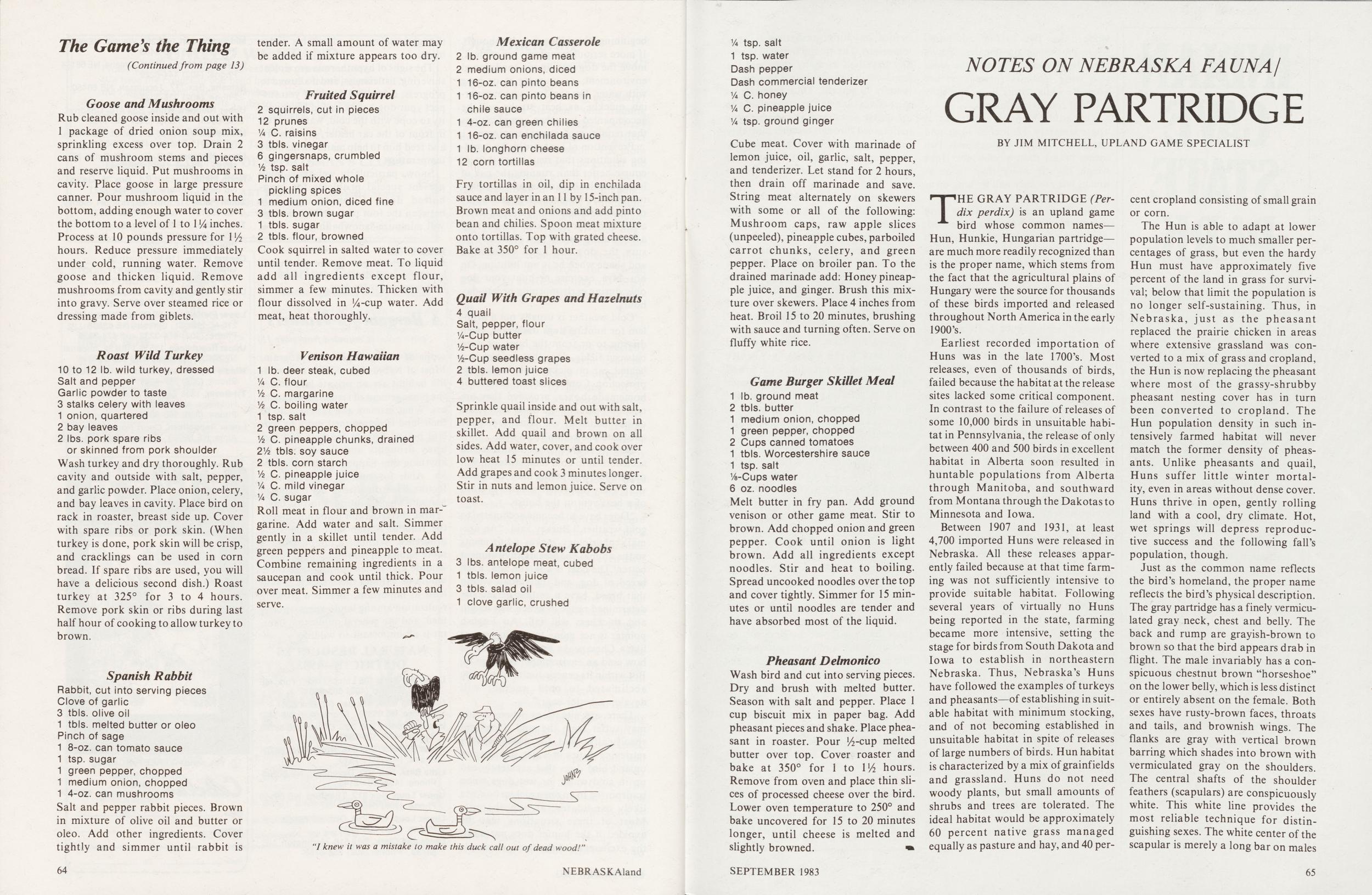
The Game's the Thing (Continued from page 13)
Goose and MushroomsRub cleaned goose inside and out with 1 package of dried onion soup mix, sprinkling excess over top. Drain 2 cans of mushroom stems and pieces and reserve liquid. Put mushrooms in cavity. Place goose in large pressure canner. Pour mushroom liquid in the bottom, adding enough water to cover the bottom to a level of 1 to 1 1/4 inches. Process at 10 pounds pressure for 1 1/2 hours. Reduce pressure immediately under cold, running water. Remove goose and thicken liquid. Remove mushrooms from cavity and gently stir into gravy. Serve over steamed rice or dressing made from giblets.
Roast Wild Turkey 10 to 12 lb. wild turkey, dressed Salt and pepper Garlic powder to taste 3 stalks celery with leaves 1 onion, quartered 2 bay leaves 2 lbs. pork spare ribs or skinned from pork shoulderWash turkey and dry thoroughly. Rub cavity and outside with salt, pepper, and garlic powder. Place onion, celery, and bay leaves in cavity. Place bird on rack in roaster, breast side up. Cover with spare ribs or pork skin. (When turkey is done, pork skin will be crisp, and cracklings can be used in corn bread. If spare ribs are used, you will have a delicious second dish.) Roast turkey at 325° for 3 to 4 hours. Remove pork skin or ribs during last half hour of cooking to allow turkey to brown.
Spanish Rabbit Rabbit, cut into serving pieces Clove of garlic 3 tbls. olive oil 1 tbls. melted butter or oleo Pinch of sage 1 8-oz. can tomato sauce 1 tsp. sugar 1 green pepper, chopped 1 medium onion, chopped 1 4-oz. can mushroomsSalt and pepper rabbit pieces. Brown in mixture of olive oil and butter or oleo. Add other ingredients. Cover tightly and simmer until rabbit is tender. A small amount of water may be added if mixture appears too dry.
Fruited Squirrel 2 squirrels, cut in pieces 12 prunes 1/4 C. raisins 3 tbls. vinegar 6 gingersnaps, crumbled 1/2 tsp. salt Pinch of mixed whole pickling spices 1 medium onion, diced fine 3 tbls. brown sugar 1 tbls. sugar 2 tbls. flour, brownedCook squirrel in salted water to cover until tender. Remove meat. To liquid add all ingredients except flour, simmer a few minutes. Thicken with flour dissolved in 1/4-cup water. Add meat, heat thoroughly.
Venison Hawaiian 1 lb. deer steak, cubed 1/4 C. flour 1/2 C. margarine 1/2 C. boiling water 1 tsp. salt 2 green peppers, chopped 1/2 C. pineapple chunks, drained 2 1/2 tbls. soy sauce 2 tbls. corn starch 1/2 C. pineapple juice 1/4 C. mild vinegar 1/4 C. sugarRoll meat in flour and brown in mar- garine. Add water and salt. Simmer gently in a skillet until tender. Add green peppers and pineapple to meat. Combine remaining ingredients in a saucepan and cook until thick. Pour over meat. Simmer a few minutes and serve.
Mexican Casserole 2 lb. ground game meat 2 medium onions, diced 1 16-oz. can pinto beans 1 16-oz. can pinto beans in chile sauce 1 4-oz. can green chilies 1 16-oz. can enchilada sauce 1 lb. longhorn cheese 12 corn tortillasFry tortillas in oil, dip in enchilada sauce and layer in an 11 by 15-inch pan. Brown meat and onions and add pinto bean and chilies. Spoon meat mixture onto tortillas. Top with grated cheese. Bake at 350° for 1 hour.
Quail With Grapes and Hazelnuts 4 quail Salt, pepper, flour 1/4-Cup butter 1/2-Cup water 1/2-Cup seedless grapes 2 tbls. lemon juice 4 buttered toast slicesSprinkle quail inside and out with salt, pepper, and flour. Melt butter in skillet. Add quail and brown on all sides. Add water, cover, and cook over low heat 15 minutes or until tender, Add grapes and cook 3 minutes longer. Stir in nuts and lemon juice. Serve on toast.
Antelope Stew Kabobs 3 lbs. antelope meat, cubed 1 tbls. lemon juice 3 tbls. salad oil 1 clove garlic, crushedCube meat. Cover with marinade of lemon juice, oil, garlic, salt, pepper, and tenderizer. Let stand for 2 hours, then drain off marinade and save. String meat alternately on skewers with some or all of the following: Mushroom caps, raw apple slices (unpeeled), pineapple cubes, parboiled carrot chunks, celery, and green pepper. Place on broiler pan. To the drained marinade add: Honey pineap- ple juice, and ginger. Brush this mix- ture over skewers. Place 4 inches from heat. Broil 15 to 20 minutes, brushing with sauce and turning often. Serve on fluffy white rice.
Game Burger Skillet Meal 1 lb. ground meat 2 tbls. butter 1 medium onion, chopped 1 green pepper, chopped 2 Cups canned tomatoes 1 tbls. Worcestershire sauce 1 tsp. salt 1/8-Cups water 6 oz. noodlesMelt butter in fry pan. Add ground venison or other game meat. Stir to brown. Add chopped onion and green pepper. Cook until onion is light brown. Add all ingredients except noodles. Stir and heat to boiling. Spread uncooked noodles over the top and cover tightly. Simmer for 15 min- utes or until noodles are tender and have absorbed most of the liquid.
Pheasant DelmonicoWash bird and cut into serving pieces. Dry and brush with melted butter. Season with salt and pepper. Place 1 cup biscuit mix in paper bag. Add pheasant pieces and shake. Place phea- sant in roaster. Pour 1/2-cup melted butter over top. Cover roaster and bake at 350° for 1 to 1 1/2 hours. Remove from oven and place thin sli- ces of processed cheese over the bird. Lower oven temperature to 250° and bake uncovered for 15 to 20 minutes longer, until cheese is melted and slightly browned.
NOTES ON NEBRASKA FAUNA/
GRAY PARTRIDGE
BY JIM MITCHELL, UPLAND GAME SPECIALISTTHE GRAY PARTRIDGE (Per- dix perdix) is an upland game bird whose common names— Hun, Hunkie, Hungarian partridge— are much more readily recognized than is the proper name, which stems from the fact that the agricultural plains of Hungary were the source for thousands of these birds imported and released throughout North America in the early 1900's.
Earliest recorded importation of Huns was in the late 1700's. Most releases, even of thousands of birds, failed because the habitat at the release sites lacked some critical component. In contrast to the failure of releases of some 10,000 birds in unsuitable habi- tat in Pennsylvania, the release of only between 400 and 500 birds in excellent habitat in Alberta soon resulted in huntable populations from Alberta through Manitoba, and southward from Montana through the Dakotas to Minnesota and Iowa.
Between 1907 and 1931, at least 4,700 imported Huns were released in Nebraska. All these releases appar- ently failed because at that time farm- ing was not sufficiently intensive to provide suitable habitat. Following several years of virtually no Huns being reported in the state, farming became more intensive, setting the stage for birds from South Dakota and Iowa to establish in northeastern Nebraska. Thus, Nebraska's Huns have followed the examples of turkeys and pheasants—of establishing in suit- able habitat with minimum stocking, and of not becoming established in unsuitable habitat in spite of releases of large numbers of birds. Hun habitat is characterized by a mix of grainfields and grassland. Huns do not need woody plants, but small amounts of shrubs and trees are tolerated. The ideal habitat would be approximately 60 percent native grass managed equally as pasture and hay, and 40 per- cent cropland consisting of small grain or corn.
The Hun is able to adapt at lower population levels to much smaller per- centages of grass, but even the hardy Hun must have approximately five percent of the land in grass for survi- val; below that limit the population is no longer self-sustaining. Thus, in Nebraska, just as the pheasant replaced the prairie chicken in areas where extensive grassland was con- verted to a mix of grass and cropland, the Hun is now replacing the pheasant where most of the grassy-shrubby pheasant nesting cover has in turn been converted to cropland. The Hun population density in such in- tensively farmed habitat will never match the former density of pheas- ants. Unlike pheasants and quail, Huns suffer little winter mortal- ity, even in areas without dense cover. Huns thrive in open, gently rolling land with a cool, dry climate. Hot, wet springs will depress reproduc- tive success and the following fall's population, though.
Just as the common name reflects
the bird's homeland, the proper name
reflects the bird's physical description.
The gray partridge has a finely vermicu-
lated gray neck, chest and belly. The
back and rump are grayish-brown to
brown so that the bird appears drab in
flight. The male invariably has a con-
spicuous chestnut brown "horseshoe"
on the lower belly, which is less distinct
or entirely absent on the female. Both
sexes have rusty-brown faces, throats
and tails, and brownish wings. The
flanks are gray with vertical brown
barring which shades into brown with
vermiculated gray on the shoulders.
The central shafts of the shoulder
feathers (scapulars) are conspicuously
white. This white line provides the
most reliable technique for distin-
guishing sexes. The white center of the
scapular is merely a long bar on males
64 NEBRASKAland
SEPTEMBER 1983 65
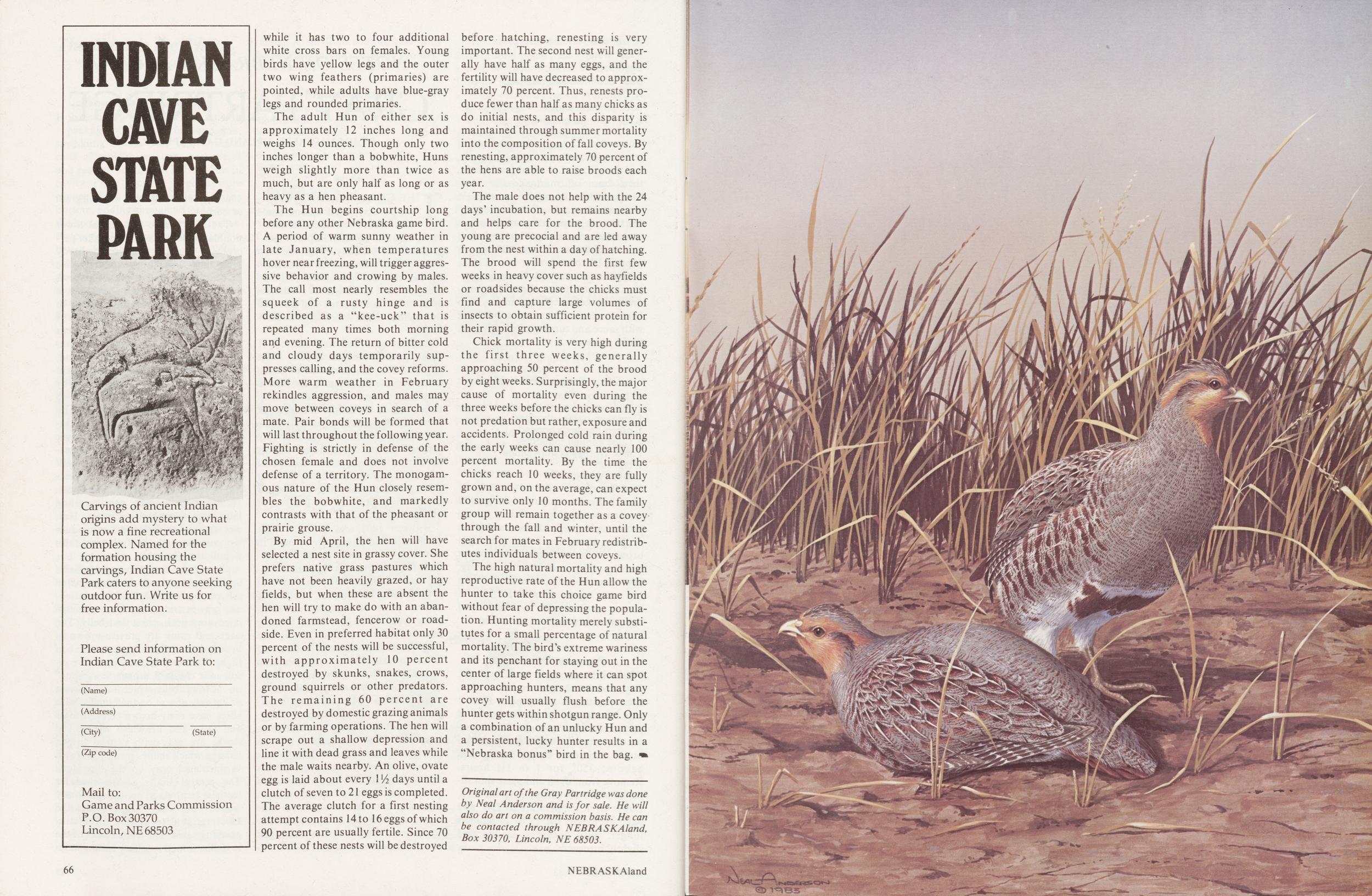 while it has two to four additional
white cross bars on females. Young
birds have yellow legs and the outer
two wing feathers (primaries) are
pointed, while adults have blue-gray
legs and rounded primaries.
while it has two to four additional
white cross bars on females. Young
birds have yellow legs and the outer
two wing feathers (primaries) are
pointed, while adults have blue-gray
legs and rounded primaries.
The adult Hun of either sex is approximately 12 inches long and weighs 14 ounces. Though only two inches longer than a bobwhite, Huns weigh slightly more than twice as much, but are only half as long or as heavy as a hen pheasant.
The Hun begins courtship long before any other Nebraska game bird. A period of warm sunny weather in late January, when temperatures hover near freezing, will trigger aggres- sive behavior and crowing by males. The call most nearly resembles the squeek of a rusty hinge and is described as a "kee-uck" that is repeated many times both morning and evening. The return of bitter cold and cloudy days temporarily sup- presses calling, and the covey reforms. More warm weather in February rekindles aggression, and males may move between coveys in search of a mate. Pair bonds will be formed that will last throughout the following year. Fighting is strictly in defense of the chosen female and does not involve defense of a territory. The monogam- ous nature of the Hun closely resem- bles the bobwhite, and markedly contrasts with that of the pheasant or prairie grouse.
By mid April, the hen will have selected a nest site in grassy cover. She prefers native grass pastures which have not been heavily grazed, or hay fields, but when these are absent the hen will try to make do with an aban- doned farmstead, fencerow or road- side. Even in preferred habitat only 30 percent of the nests will be successful, with approximately 10 percent destroyed by skunks, snakes, crows, ground squirrels or other predators. The remaining 60 percent are destroyed by domestic grazing animals or by farming operations. The hen will scrape out a shallow depression and line it with dead grass and leaves while the male waits nearby. An olive, ovate egg is laid about every 1 1/2 days until a clutch of seven to 21 eggs is completed. The average clutch for a first nesting attempt contains 14 to 16 eggs of which 90 percent are usually fertile. Since 70 percent of these nests will be destroyed before hatching, renesting is very important. The second nest will gener- ally have half as many eggs, and the fertility will have decreased to approx- imately 70 percent. Thus, renests pro- duce fewer than half as many chicks as do initial nests, and this disparity is maintained through summer mortality into the composition of fall coveys. By renesting, approximately 70 percent of the hens are able to raise broods each year.
The male does not help with the 24 days' incubation, but remains nearby and helps care for the brood. The young are precocial and are led away from the nest within a day of hatching. The brood will spend the first few weeks in heavy cover such as hayfields or roadsides because the chicks must find and capture large volumes of insects to obtain sufficient protein for their rapid growth.
Chick mortality is very high during the first three weeks, generally approaching 50 percent of the brood by eight weeks. Surprisingly, the major cause of mortality even during the three weeks before the chicks can fly is not predation but rather, exposure and accidents. Prolonged cold rain during the early weeks can cause nearly 100 percent mortality. By the time the chicks reach 10 weeks, they are fully grown and, on the average, can expect to survive only 10 months. The family group will remain together as a covey through the fall and winter, until the search for mates in February redistrib- utes individuals between coveys.
The high natural mortality and high reproductive rate of the Hun allow the hunter to take this choice game bird without fear of depressing the popula- tion. Hunting mortality merely substi- tutes for a small percentage of natural mortality. The bird's extreme wariness and its penchant for staying out in the center of large fields where it can spot approaching hunters, means that any covey will usually flush before the hunter gets within shotgun range. Only a combination of an unlucky Hun and a persistent, lucky hunter results in a "Nebraska bonus" bird in the bag.
INDIAN CAVE STATE PARK
Carvings of ancient Indian origins add mystery to what is now a fine recreational complex. Named for the formation housing the carvings, Indian Cave State Park caters to anyone seeking outdoor fun. Write us for free information. Please send information on Indian Cave State Park to: (Name) (Address) (City) (State) (Zip code) Mail to: Game and Parks Commission P.O. Box30370 Lincoln, NE 68503 66 NEBRASKAland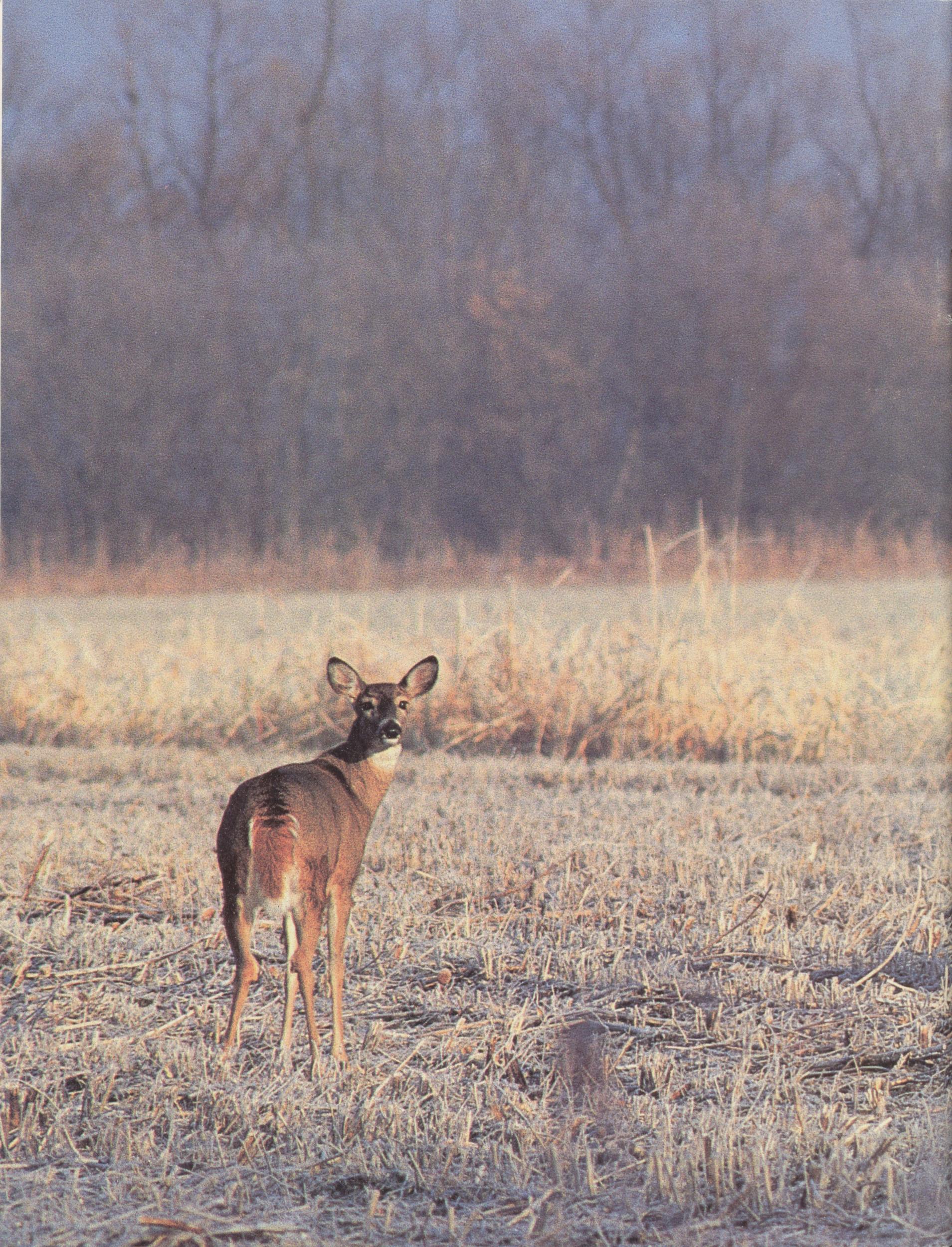
Position: 541 (20 views)