Volume 61, Issue 7, 1983
NEBRASKAland
August 1983 $1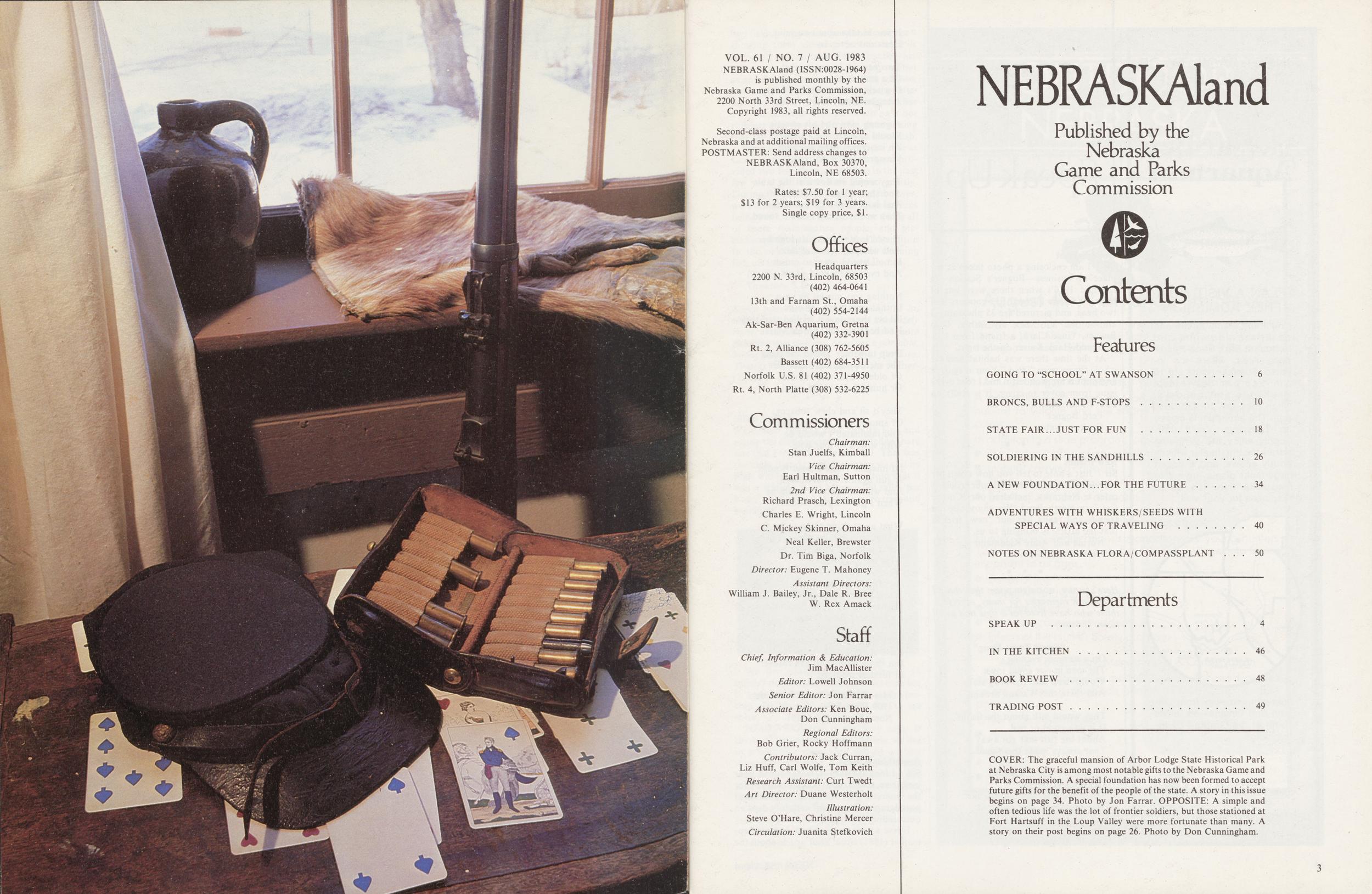
NEBRASKAland
Published by the Nebraska Game and Parks Commission
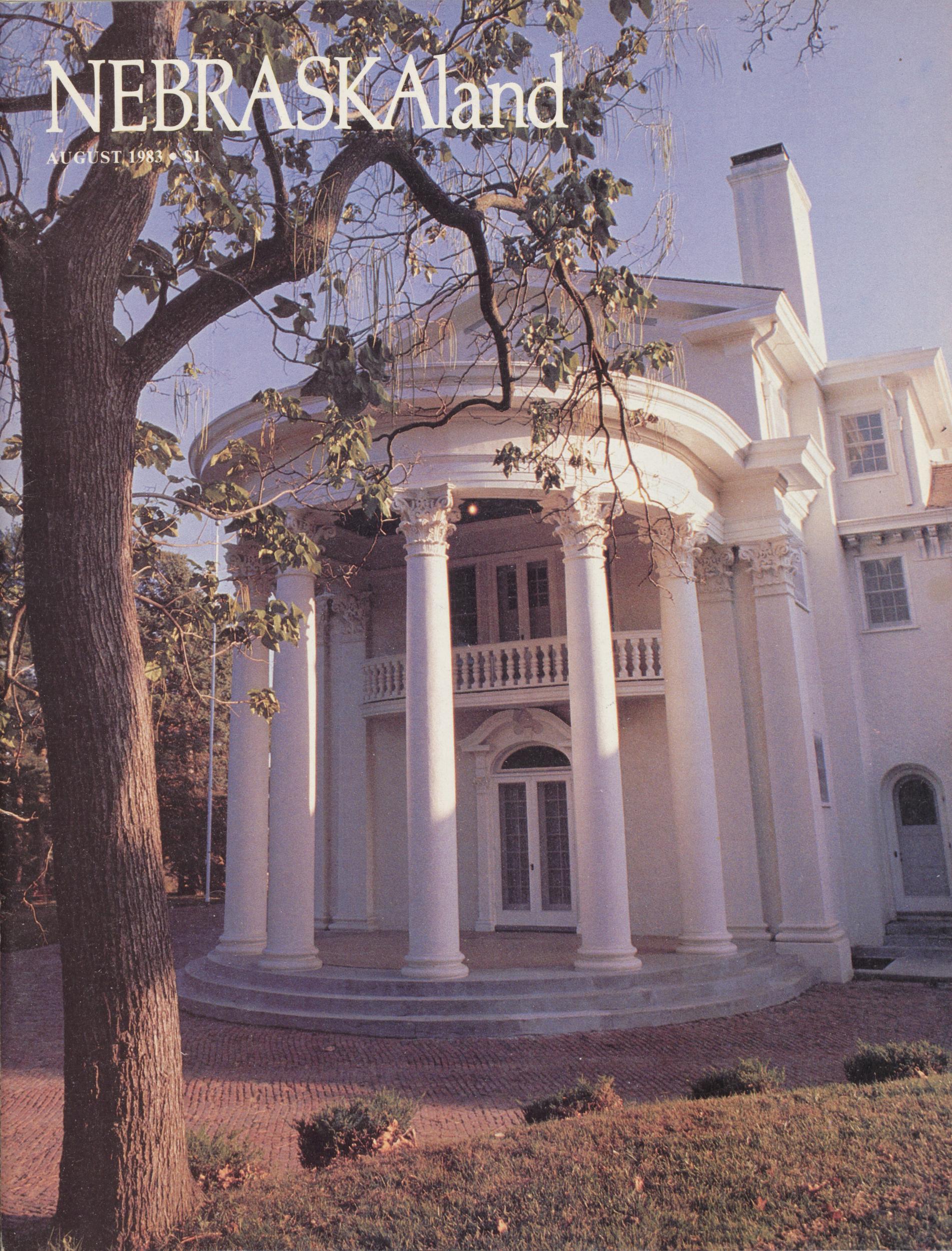
Contents Features GOING TO "SCHOOL" AT SWANSON 6 BRONCS, BULLS AND F-STOPS 10 STATE FAIR JUST FOR FUN 18 SOLDIERING IN THE SANDHILLS 26 ANEW FOUNDATION... FOR THE FUTURE 34 ADVENTURES WITH WHISKERS/SEEDS WITH SPECIAL WAYS OF TRAVELING 40 NOTES ON NEBRASKA FLORA/COMPASSPLANT 50 Departments SPEAK UP IN THE KITCHEN 46 BOOK REVIEW 48 TRADING POST 49COVER: The graceful mansion of Arbor Lodge State Historical Park at Nebraska City is among most notable gifts to the Nebraska Game and Parks Commission. A special foundation has now been formed to accept future gifts for the benefit of the people of the state. A story in this issue begins on page 34. Photo by Jon Farrar. OPPOSITE: A simple and often tedious life was the lot of frontier soldiers, but those stationed at Fort Hartsuff in the Loup Valley were more fortunate than many. A story on their post begins on page 26. Photo by Don Cunningham.
Speak Up
Good harvestSir / I am enclosing a photo taken at my place of business—Bogner's Station—in the mid 1930's when there were lots of birds. We were allowed five roosters and two hens, and pictured are 35 pheasants. I am on the left, then my father, Otto Bogner, Vince Clark, a friend from Lincoln, and Hank Kaiser on the right.
At the time there was habitat because whole farms were "idled." Your magazine and photos are wonderful and I read every issue from cover to cover. It is really an asset to our state.
Ferd Bogner Crofton, Nebr. New friendsSir / Just a note to tell you how much my husband Andy and I enjoyed your article of cafes in Nebraska, including our "Corner Cafe" in North Bend. We enjoy our old friends and really like our "new" friends that the article is bringing to us.
Norma and Andy Riedmann North Bend, Nebr.Here's a nice, nostalgic poem that should bring back memories for many, especially those who have lived for a time in a small town. (Editor)
"Small Town Drug" On a summer evening The men in our small town Would drop into the drug store And there they'd stand around. They would talk about the fishin' If it was good or bad About the fish that got away That always made them mad. Each story was a whopper, Experiences unfold The story that was told the last Was by far the best one told. We kids went in for candy Our noses 'gainst the glass. It would take about an hour, Decisions never fast. Two pennies in our pocket, Or a cent at least, If wisely spent would truly buy A reg'lar candy feast. A young man and his sweetie Would come in for a treat. An ice cream cone or sodie Was pretty hard to beat. They would sit down at the table And shyly glance around And hope they'd go unnoticed, They would barely make a sound. They'd lean their heads together And whisper, 'stead of talk, But all would grow so qui-et And everyone would gawk. Nothing was missed by man In that small town of ours, I'll bet those lovers wished that they Had been courtin' up on Mars. Deep in winter 'round the stove The men would tell such tales Of olden days, and Indians, Or hunting duck and quail. They'd sit and chew tobaccy, Or smoke their favorite pipe. And fascinated I would be With stories of that type. I'd imagine I was Daniel Boone, A gun against my shoulder, And what a hunter I would be When I grew big an' bolder. What an exciting place to be In that cozy small town store, Never a kinder man than he Who was proprietor. He often gave me candy. When I was broke and blue He would pat me on the shoulder And pet old Rover, too. Time has passed, and many years Have slipped away from me, But those days shall live forever In fondest memory. Mrs. Richard (Betty) Edwards 1709 West B St. North Platte, NE 69101 Something's fishy!Sir / I look forward to each issue of your magazine, and want to compliment you for the interesting articles and the excellent photography. Your staff certainly does an outstanding job.
I have a concern, however, in your September (1981) issue. Your article about the two fishing families has a photo on page 9 showing them cleaning fish on what is obviously a picnic table. I note that they are using a good covering of newspapers, but as any field maintenance man will tell you, cleaning fish on picnic tables in a public-use area is bad, bad, bad! Anyone who has ever sat down to a picnic lunch on a hot summer day has no trouble determining that the table has been used to clean fish.
What is the answer? I don't know. We at Lewis and Clark Lake Project have provided two fish-cleaning stations in the past few years and these have helped greatly. During the prime fishing season, however, we will still find tables and comfort stations being used. I think you would be doing all of those maintenance people, and picnickers, a favor if you would call attention to the objectionable practice of cleaning fish on facilities not designed for such.
Harold Green Yankton, S.D.Sir / After reading your "Speak Up" and seeing the cloud pictures, I wanted to share one that I took on June 20, 1981. That was the night that Arnold, Nebraska was hit by high winds and hail. We were told that it was a straight wind of over 100 miles per hour, and it did a lot of damage to trees and buildings.
We live straight south of Arnold, 19 miles. I do not remember the exact time but it was early evening when I took the picture. We thought you might like to see these.
NEBRASKAland is the very best. If there are people who do not believe we live in a beautiful state, they should see this magazine. We have friends in California who are transplanted Nebraskans and still take your magazine, and they show off our state with every issue.
Thank you for giving us so much pleasure month after month.
Gretchen Turnquist Gothenburg, Nebr. 4 NEBRASKAland AUGUST 1983 5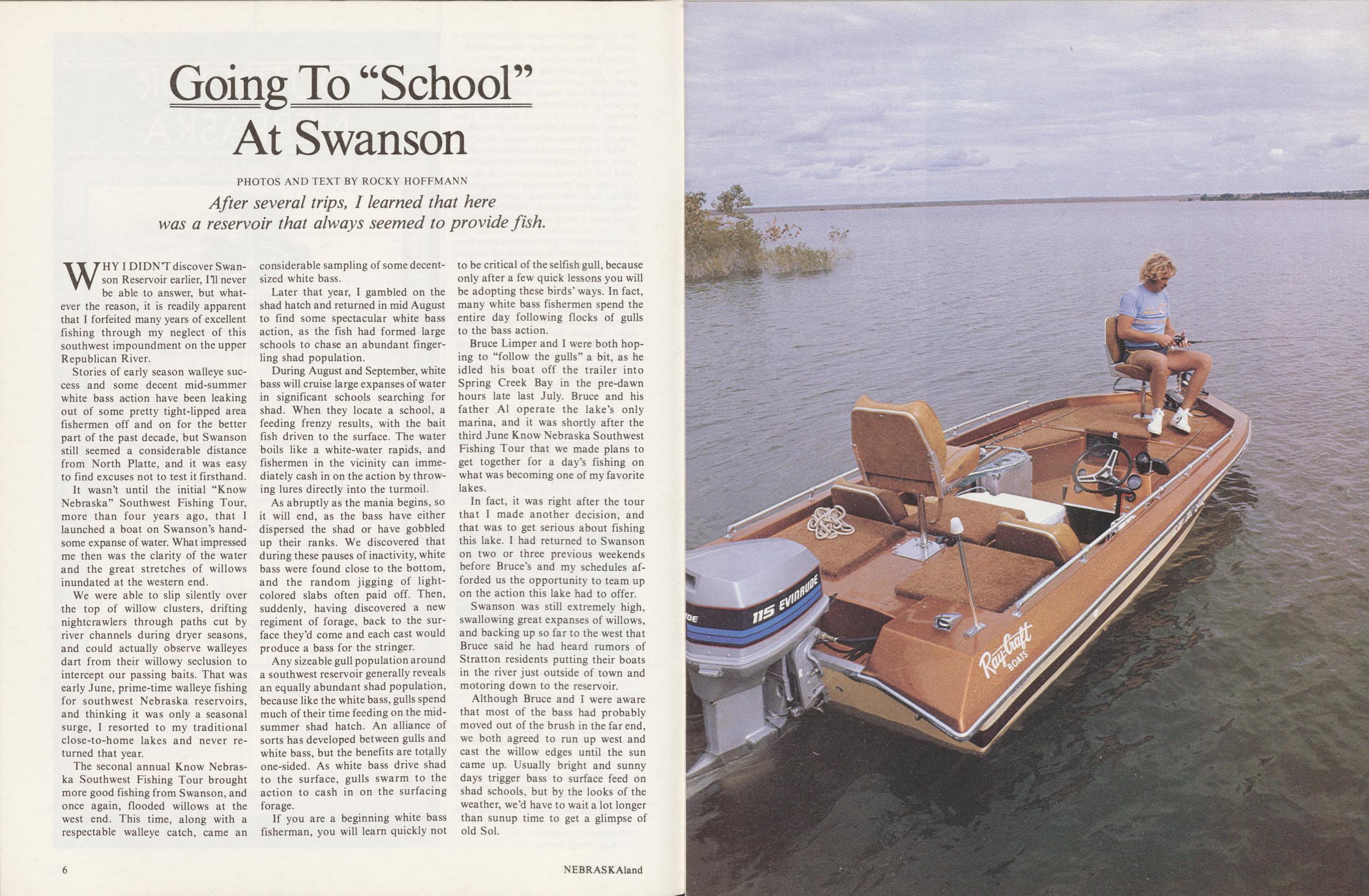
Going To "School At Swanson
After several trips, I learned that here was a reservoir that always seemed to provide fish.WHY I DIDN'T discover Swanson Reservoir earlier, I'll never be able to answer, but whatever the reason, it is readily apparent that I forfeited many years of excellent fishing through my neglect of this southwest impoundment on the upper Republican River.
Stories of early season walleye success and some decent mid-summer white bass action have been leaking out of some pretty tight-lipped area fishermen off and on for the better part of the past decade, but Swanson still seemed a considerable distance from North Platte, and it was easy to find excuses not to test it firsthand.
It wasn't until the initial "Know Nebraska" Southwest Fishing Tour, more than four years ago, that I launched a boat on Swanson's handsome expanse of water. What impressed me then was the clarity of the water and the great stretches of willows inundated at the western end.
We were able to slip silently over the top of willow clusters, drifting nightcrawlers through paths cut by river channels during dryer seasons, and could actually observe walleyes dart from their willowy seclusion to intercept our passing baits. That was early June, prime-time walleye fishing for southwest Nebraska reservoirs, and thinking it was only a seasonal surge, I resorted to my traditional close-to-home lakes and never returned that year.
The Seconal annual Know Nebraska Southwest Fishing Tour brought more good fishing from Swanson, and once again, flooded willows at the west end. This time, along with a respectable walleye catch, came an considerable sampling of some decent-sized white bass.
Later that year, I gambled on the shad hatch and returned in mid August to find some spectacular white bass action, as the fish had formed large schools to chase an abundant fingerling shad population.
During August and September, white bass will cruise large expanses of water in significant schools searching for shad. When they locate a school, a feeding frenzy results, with the bait fish driven to the surface. The water boils like a white-water rapids, and fishermen in the vicinity can immediately cash in on the action by throwing lures directly into the turmoil.
As abruptly as the mania begins, so it will end, as the bass have either dispersed the shad or have gobbled up their ranks. We discovered that during these pauses of inactivity, white bass were found close to the bottom, and the random jigging of lightcolored slabs often paid off. Then, suddenly, having discovered a new regiment of forage, back to the surface they'd come and each cast would produce a bass for the stringer.
Any sizeable gull population around a southwest reservoir generally reveals an equally abundant shad population, because like the white bass, gulls spend much of their time feeding on the midsummer shad hatch. An alliance of sorts has developed between gulls and white bass, but the benefits are totally one-sided. As white bass drive shad to the surface, gulls swarm to the action to cash in on the surfacing forage.
If you are a beginning white bass fisherman, you will learn quickly not to be critical of the selfish gull, because only after a few quick lessons you will be adopting these birds' ways. In fact, many white bass fishermen spend the entire day following flocks of gulls to the bass action.
Bruce Limper and I were both hoping to "follow the gulls" a bit, as he idled his boat off the trailer into Spring Creek Bay in the pre-dawn hours late last July. Bruce and his father Al operate the lake's only marina, and it was shortly after the third June Know Nebraska Southwest Fishing Tour that we made plans to get together for a day's fishing on what was becoming one of my favorite lakes.
In fact, it was right after the tour that I made another decision, and that was to get serious about fishing this lake. I had returned to Swanson on two or three previous weekends before Bruce's and my schedules afforded us the opportunity to team up on the action this lake had to offer.
Swanson was still extremely high, swallowing great expanses of willows, and backing up so far to the west that Bruce said he had heard rumors of Stratton residents putting their boats in the river just outside of town and motoring down to the reservoir.
Although Bruce and I were aware that most of the bass had probably moved out of the brush in the far end, we both agreed to run up west and cast the willow edges until the sun came up. Usually bright and sunny days trigger bass to surface feed on shad schools, but by the looks of the weather, we'd have to wait a lot longer than sunup time to get a glimpse of old Sol.
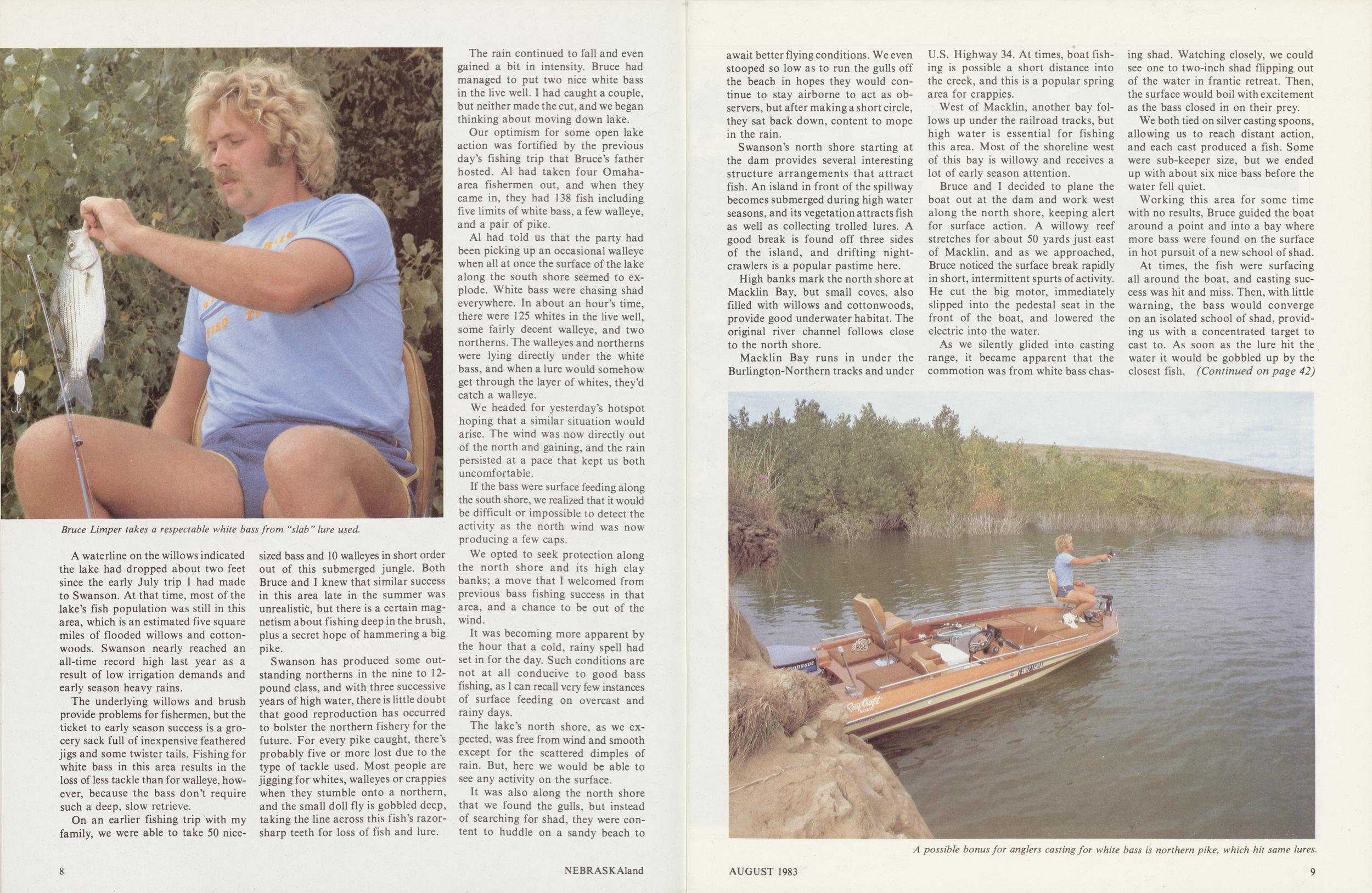
Bruce Limper takes a respectable white bass from "slab " lure used.
A waterline on the willows indicated the lake had dropped about two feet since the early July trip I had made to Swanson. At that time, most of the lake's fish population was still in this area, which is an estimated five square miles of flooded willows and cottonwoods. Swanson nearly reached an all-time record high last year as a result of low irrigation demands and early season heavy rains.
The underlying willows and brush provide problems for fishermen, but the ticket to early season success is a grocery sack full of inexpensive feathered jigs and some twister tails. Fishing for white bass in this area results in the loss of less tackle than for walleye, however, because the bass don't require such a deep, slow retrieve.
On an earlier fishing trip with my family, we were able to take 50 nice-sized bass and 10 walleyes in short order out of this submerged jungle. Both Bruce and I knew that similar success in this area late in the summer was unrealistic, but there is a certain magnetism about fishing deep in the brush, plus a secret hope of hammering a big pike.
Swanson has produced some out-standing northerns in the nine to 12-pound class, and with three successive years of high water, there is little doubt that good reproduction has occurred to bolster the northern fishery for the future. For every pike caught, there's probably five or more lost due to the type of tackle used. Most people are jigging for whites, walleyes or crappies when they stumble onto a northern, and the small doll fly is gobbled deep, taking the line across this fish's razor-sharp teeth for loss of fish and lure.
The rain continued to fall and even gained a bit in intensity. Bruce had managed to put two nice white bass in the live well. I had caught a couple, but neither made the cut, and we began thinking about moving down lake.
Our optimism for some open lake action was fortified by the previous day's fishing trip that Bruce's father hosted. Al had taken four Omaha-area fishermen out, and when they came in, they had 138 fish including five limits of white bass, a few walleye, and a pair of pike.
Al had told us that the party had been picking up an occasional walleye when all at once the surface of the lake along the south shore seemed to explode. White bass were chasing shad everywhere. In about an hour's time, there were 125 whites in the live well, some fairly decent walleye, and two northerns. The walleyes and northerns were lying directly under the white bass, and when a lure would somehow get through the layer of whites, they'd catch a walleye.
We headed for yesterday's hotspot hoping that a similar situation would arise. The wind was now directly out of the north and gaining, and the rain persisted at a pace that kept us both uncomfortable.
If the bass were surface feeding along the south shore, we realized that it would be difficult or impossible to detect the activity as the north wind was now producing a few caps.
We opted to seek protection along the north shore and its high clay banks; a move that I welcomed from previous bass fishing success in that area, and a chance to be out of the wind.
It was becoming more apparent by the hour that a cold, rainy spell had set in for the day. Such conditions are not at all conducive to good bass fishing, as I can recall very few instances of surface feeding on overcast and rainy days.
The lake's north shore, as we expected, was free from wind and smooth except for the scattered dimples of rain. But, here we would be able to see any activity on the surface.
It was also along the north shore that we found the gulls, but instead of searching for shad, they were content to huddle on a sandy beach to await better flying conditions. We even stooped so low as to run the gulls off the beach in hopes they would continue to stay airborne to act as observers, but after making a short circle, they sat back down, content to mope in the rain.
Swanson's north shore starting at the dam provides several interesting structure arrangements that attract fish. An island in front of the spillway becomes submerged during high water seasons, and its vegetation attracts fish as well as collecting trolled lures. A good break is found off three sides of the island, and drifting night-crawlers is a popular pastime here.
High banks mark the north shore at Macklin Bay, but small coves, also filled with willows and cottonwoods, provide good underwater habitat. The original river channel follows close to the north shore.
Macklin Bay runs in under the Burlington-Northern tracks and under U.S. Highway 34. At times, boat fishing is possible a short distance into the creek, and this is a popular spring area for crappies.
West of Macklin, another bay follows up under the railroad tracks, but high water is essential for fishing this area. Most of the shoreline west of this bay is willowy and receives a lot of early season attention.
Bruce and I decided to plane the boat out at the dam and work west along the north shore, keeping alert for surface action. A willowy reef stretches for about 50 yards just east of Macklin, and as we approached, Bruce noticed the surface break rapidly in short, intermittent spurts of activity. He cut the big motor, immediately slipped into the pedestal seat in the front of the boat, and lowered the electric into the water.
As we silently glided into casting range, it became apparent that the commotion was from white bass chasing shad. Watching closely, we could see one to two-inch shad flipping out of the water in frantic retreat. Then, the surface would boil with excitement as the bass closed in on their prey.
We both tied on silver casting spoons, allowing us to reach distant action, and each cast produced a fish. Some were sub-keeper size, but we ended up with about six nice bass before the water fell quiet.
Working this area for some time with no results, Bruce guided the boat around a point and into a bay where more bass were found on the surface in hot pursuit of a new school of shad.
At times, the fish were surfacing all around the boat, and casting success was hit and miss. Then, with little warning, the bass would converge on an isolated school of shad, providing us with a concentrated target to cast to. As soon as the lure hit the water it would be gobbled up by the closest fish, (Continued on page 42)
A possible bonus for anglers casting for white bass is northern pike, which hit same lures.
Broncs, Bulls and F-Stops
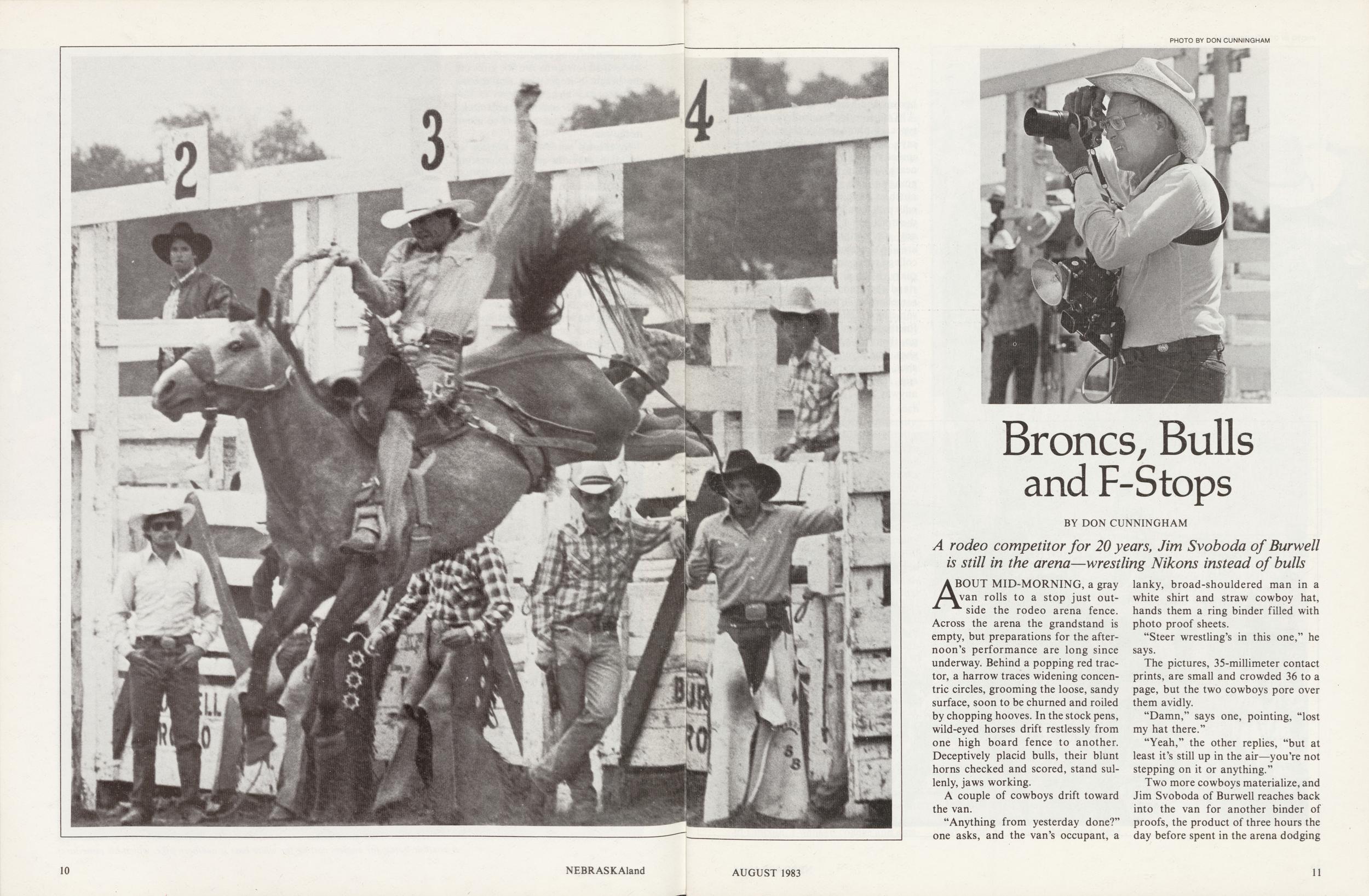
A rodeo competitor for 20 years, Jim Svoboda of Burwell is still in the arena—wrestling Nikons instead of bullsABOUT MID-MORNING, a gray Z-Xvan rolls to a stop just outside the rodeo arena fence. Across the arena the grandstand is empty, but preparations for the afternoon's performance are long since underway. Behind a popping red tractor, a harrow traces widening concentric circles, grooming the loose, sandy surface, soon to be churned and roiled by chopping hooves. In the stock pens, wild-eyed horses drift restlessly from one high board fence to another. Deceptively placid bulls, their blunt horns checked and scored, stand sullenly, jaws working.
A couple of cowboys drift toward the van.
"Anything from yesterday done?" one asks, and the van's occupant, a lanky, broad-shouldered man in a white shirt and straw cowboy hat, hands them a ring binder filled with photo proof sheets.
"Steer wrestling's in this one," he says.
The pictures, 35-millimeter contact prints, are small and crowded 36 to a page, but the two cowboys pore over them avidly.
"Damn," says one, pointing, "lost my hat there."
"Yeah," the other replies, "but at least it's still up in the air—you're not stepping on it or anything."
Two more cowboys materialize, and Jim Svoboda of Burwell reaches back into the van for another binder of proofs, the product of three hours the day before spent in the arena dodging
10 NEBRASKAland AUGUST 1983 11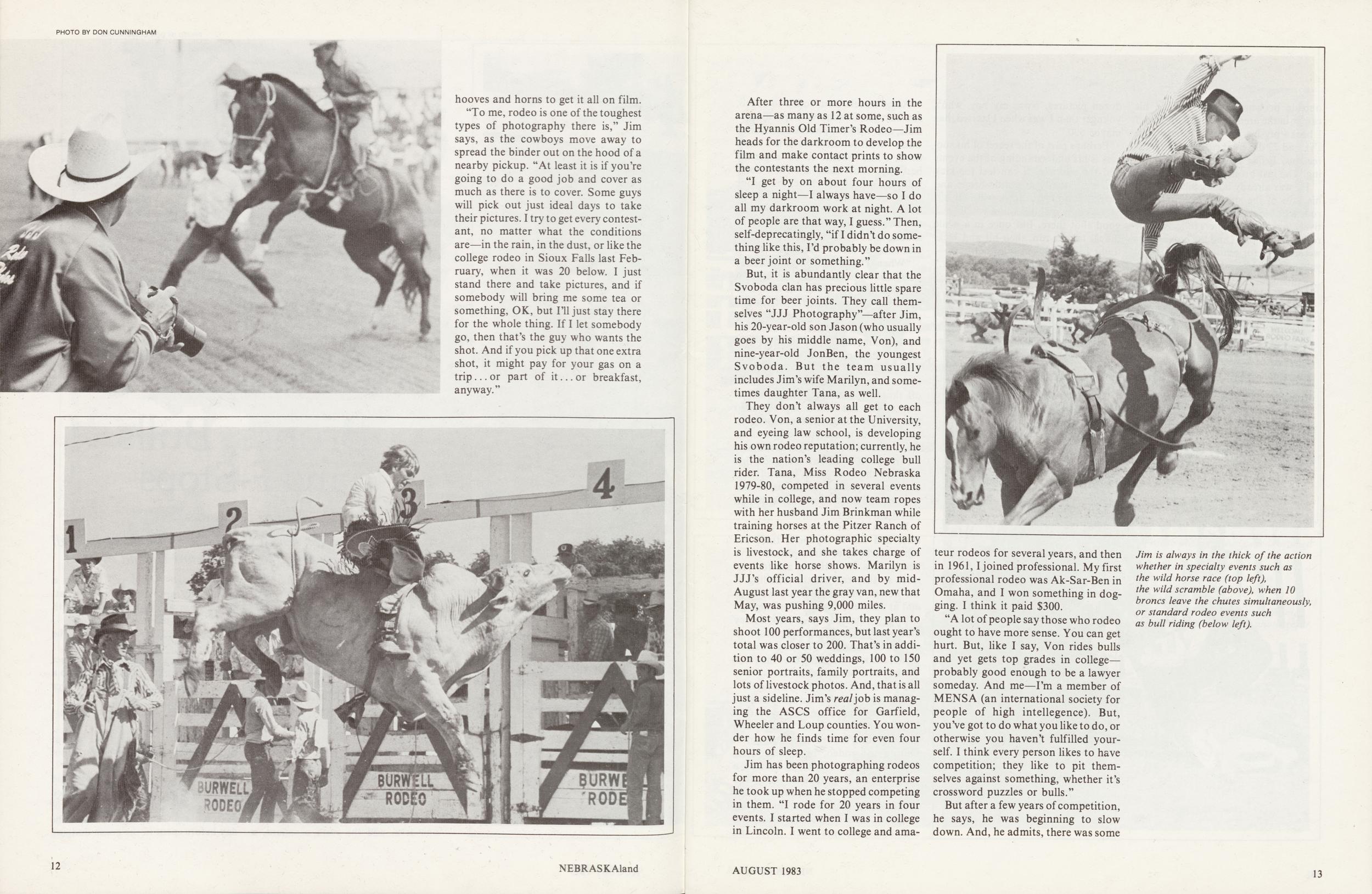
hooves and horns to get it all on film.
"To me, rodeo is one of the toughest types of photography there is," Jim says, as the cowboys move away to spread the binder out on the hood of a nearby pickup. "At least it is if you're going to do a good job and cover as much as there is to cover. Some guys will pick out just ideal days to take their pictures. I try to get every contestant, no matter what the conditions are—in the rain, in the dust, or like the college rodeo in Sioux Falls last February, when it was 20 below. I just stand there and take pictures, and if somebody will bring me some tea or something, OK, but I'll just stay there for the whole thing. If I let somebody go, then that's the guy who wants the shot. And if you pick up that one extra shot, it might pay for your gas on a trip or part of it or breakfast, anyway."
After three or more hours in the arena—as many as 12 at some, such as the Hyannis Old Timer's Rodeo—Jim heads for the darkroom to develop the film and make contact prints to show the contestants the next morning.
"I get by on about four hours of sleep a night—I always have—so I do all my darkroom work at night. A lot of people are that way, I guess." Then, self-deprecatingly, "if I didn't do something like this, I'd probably be down in a beer joint or something."
But, it is abundantly clear that the Svoboda clan has precious little spare time for beer joints. They call themselves "JJJ Photography"—after Jim, his 20-year-old son Jason (who usually goes by his middle name, Von), and nine-year-old JonBen, the youngest Svoboda. But the team usually includes Jim's wife Marilyn, and sometimes daughter Tana, as well.
They don't always all get to each rodeo. Von, a senior at the University, and eyeing law school, is developing his own rodeo reputation; currently, he is the nation's leading college bull rider. Tana, Miss Rodeo Nebraska 1979-80, competed in several events while in college, and now team ropes with her husband Jim Brinkman while training horses at the Pitzer Ranch of Ericson. Her photographic specialty is livestock, and she takes charge of events like horse shows. Marilyn is JJJ's official driver, and by mid-August last year the gray van, new that May, was pushing 9,000 miles.
Most years, says Jim, they plan to shoot 100 performances, but last year's total was closer to 200. That's in addition to 40 or 50 weddings, 100 to 150 senior portraits, family portraits, and lots of livestock photos. And, that is all just a sideline. Jim's real job is managing the ASCS office for Garfield, Wheeler and Loup counties. You wonder how he finds time for even four hours of sleep.
Jim has been photographing rodeos for more than 20 years, an enterprise he took up when he stopped competing in them. "I rode for 20 years in four events. I started when I was in college in Lincoln. I went to college and amateur rodeos for several years, and then in 1961,1 joined professional. My first professional rodeo was Ak-Sar-Ben in Omaha, and I won something in dogging. I think it paid $300.
"A lot of people say those who rodeo ought to have more sense. You can get hurt. But, like I say, Von rides bulls and yet gets top grades in college—probably good enough to be a lawyer someday. And me—I'm a member of MENSA (an international society for people of high intellegence). But, you've got to do what you like to do, or otherwise you haven't fulfilled yourself. I think every person likes to have competition; they like to pit themselves against something, whether it's crossword puzzles or bulls."
But after a few years of competition, he says, he was beginning to slow down. And, he admits, there was some
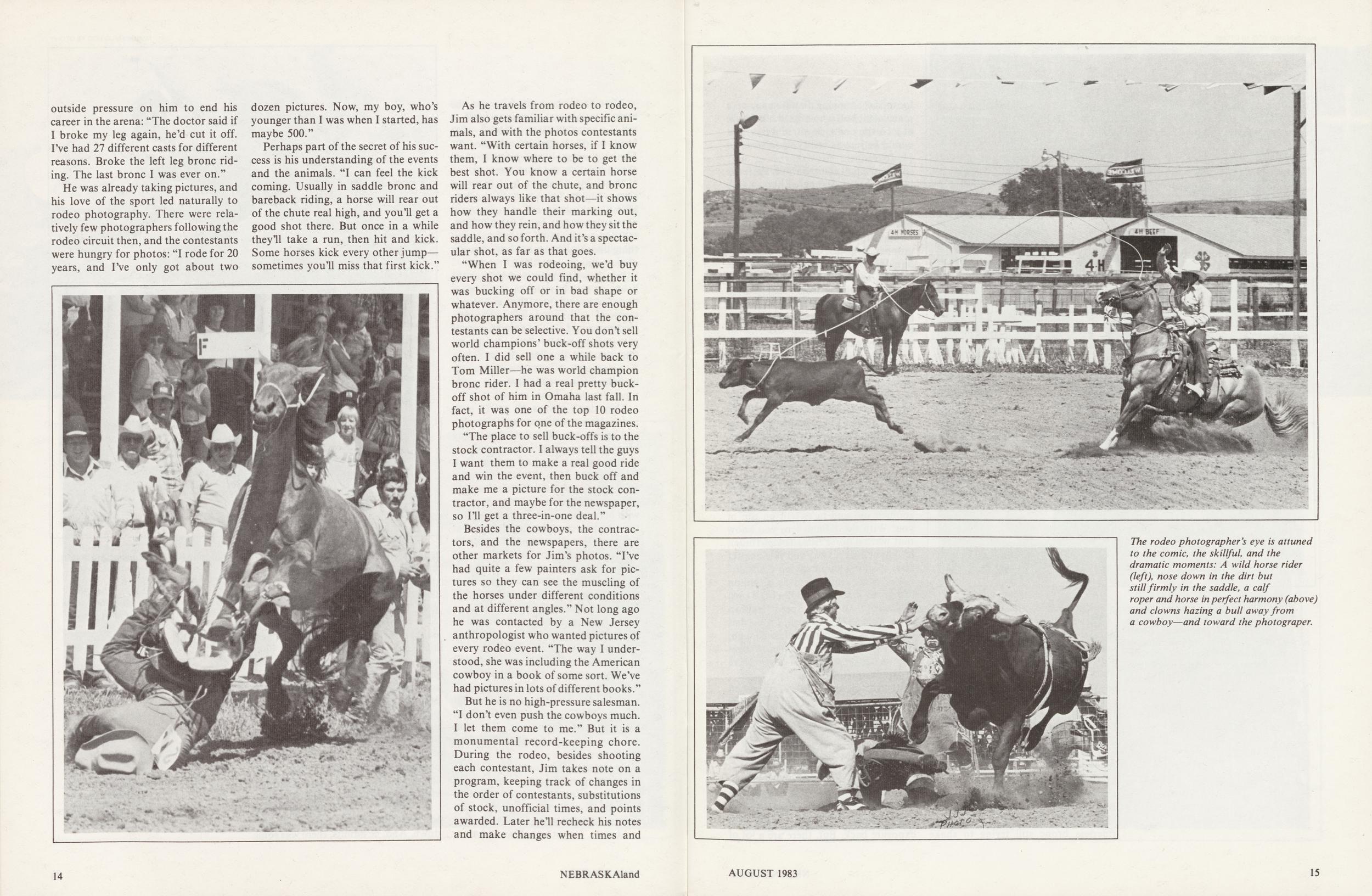
Jim is always in the thick of the action whether in specialty events such as the wild horse race (top left), the wild scramble (above), when 10 broncs leave the chutes simultaneously, or standard rodeo events such as bull riding (below left).
outside pressure on him to end his career in the arena: "The doctor said if I broke my leg again, he'd cut it off. I've had 27 different casts for different reasons. Broke the left leg bronc riding. The last bronc I was ever on."
He was already taking pictures, and his love of the sport led naturally to rodeo photography. There were relatively few photographers following the rodeo circuit then, and the contestants were hungry for photos: "I rode for 20 years, and I've only got about two dozen pictures. Now, my boy, who's younger than I was when I started, has maybe 500."
Perhaps part of the secret of his success is his understanding of the events and the animals. "I can feel the kick coming. Usually in saddle bronc and bareback riding, a horse will rear out of the chute real high, and you'll get a good shot there. But once in a while they'll take a run, then hit and kick. Some horses kick every other jump—sometimes you'll miss that first kick."
As he travels from rodeo to rodeo, Jim also gets familiar with specific animals, and with the photos contestants want. "With certain horses, if I know them, I know where to be to get the best shot. You know a certain horse will rear out of the chute, and bronc riders always like that shot—it shows how they handle their marking out, and how they rein, and how they sit the saddle, and so forth. And it's a spectacular shot, as far as that goes.
"When I was rodeoing, we'd buy every shot we could find, whether it was bucking off or in bad shape or whatever. Anymore, there are enough photographers around that the contestants can be selective. You don't sell world champions' buck-off shots very often. I did sell one a while back to Tom Miller—he was world champion bronc rider. I had a real pretty buck-off shot of him in Omaha last fall. In fact, it was one of the top 10 rodeo photographs for one of the magazines.
"The place to sell buck-offs is to the stock contractor. I always tell the guys I want them to make a real good ride and win the event, then buck off and make me a picture for the stock contractor, and maybe for the newspaper, so 111 get a three-in-one deal."
Besides the cowboys, the contractors, and the newspapers, there are other markets for Jim's photos. "I've had quite a few painters ask for pictures so they can see the muscling of the horses under different conditions and at different angles." Not long ago he was contacted by a New Jersey anthropologist who wanted pictures of every rodeo event. "The way I understood, she was including the American cowboy in a book of some sort. We've had pictures in lots of different books."
But he is no high-pressure salesman. "I don't even push the cowboys much. I let them come to me." But it is a monumental record-keeping chore. During the rodeo, besides shooting each contestant, Jim takes note on a program, keeping track of changes in the order of contestants, substitutions of stock, unofficial times, and points awarded. Later he'll recheck his notes and make changes when times and
The rodeo photographer's eye is attuned to the comic, the skillful, and the dramatic moments: A wild horse rider (left), nose down in the dirt but still firmly in the saddle, a calf roper and horse in perfect harmony (above) and clowns hazing a bull away from a cowboy—and toward the photograper.
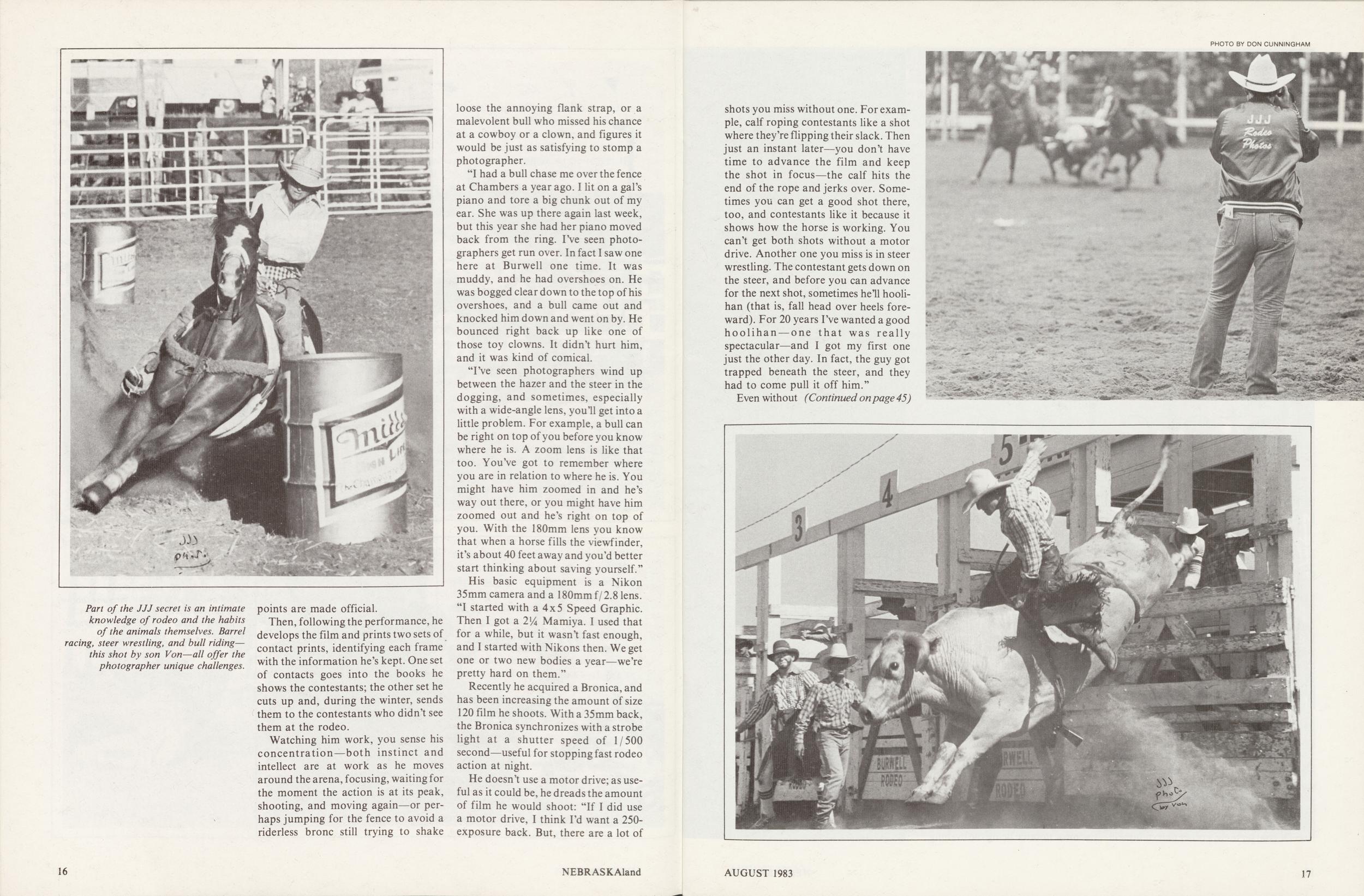
Part of the JJJ secret is an intimate knowledge of rodeo and the habits of the animals themselves. Barrel racing, steer wrestling, and bull riding—this shot by son Von—all offer the photographer unique challenges.
points are made official.
Then, following the performance, he develops the film and prints two sets of contact prints, identifying each frame with the information he's kept. One set of contacts goes into the books he shows the contestants; the other set he cuts up and, during the winter, sends them to the contestants who didn't see them at the rodeo.
Watching him work, you sense his concentration—both instinct and intellect are at work as he moves around the arena, focusing, waiting for the moment the action is at its peak, shooting, and moving again—or perhaps jumping for the fence to avoid a riderless bronc still trying to shake loose the annoying flank strap, or a malevolent bull who missed his chance at a cowboy or a clown, and figures it would be just as satisfying to stomp a photographer.
"I had a bull chase me over the fence at Chambers a year ago. I lit on a gal's piano and tore a big chunk out of my ear. She was up there again last week, but this year she had her piano moved back from the ring. I've seen photographers get run over. In fact I saw one here at Burwell one time. It was muddy, and he had overshoes on. He was bogged clear down to the top of his overshoes, and a bull came out and knocked him down and went on by. He bounced right back up like one of those toy clowns. It didn't hurt him, and it was kind of comical.
"I've seen photographers wind up between the hazer and the steer in the dogging, and sometimes, especially with a wide-angle lens, you'll get into a little problem. For example, a bull can be right on top of you before you know where he is. A zoom lens is like that too. You've got to remember where you are in relation to where he is. You might have him zoomed in and he's way out there, or you might have him zoomed out and he's right on top of you. With the 180mm lens you know that when a horse fills the viewfinder, it's about 40 feet away and you'd better start thinking about saving yourself."
His basic equipment is a Nikon 35mm camera and a 180mmf/2.81ens. "I started with a 4x5 Speed Graphic. Then I got a 2l/4 Mamiya. I used that for a while, but it wasn't fast enough, and I started with Nikons then. We get one or two new bodies a year—we're pretty hard on them."
Recently he acquired a Bronica, and has been increasing the amount of size 120 film he shoots. With a 35mm back, the Bronica synchronizes with a strobe light at a shutter speed of 1/500 second—useful for stopping fast rodeo action at night.
He doesn't use a motor drive; as useful as it could be, he dreads the amount of film he would shoot: "If I did use a motor drive, I think I'd want a 250-exposure back. But, there are a lot of shots you miss without one. For example, calf roping contestants like a shot where they're flipping their slack. Then just an instant later—you don't have time to advance the film and keep the shot in focus—the calf hits the end of the rope and jerks over. Sometimes you can get a good shot there, too, and contestants like it because it shows how the horse is working. You can't get both shots without a motor drive. Another one you miss is in steer wrestling. The contestant gets down on the steer, and before you can advance for the next shot, sometimes hell hoolihan (that is, fall head over heels foreward). For 20 years I've wanted a good hoolihan — one that was really spectacular—and I got my first one just the other day. In fact, the guy got trapped beneath the steer, and they had to come pull it off him."
Even without (Continued on page 45)
Alzora Alive
State Fair
The State Fair appeals to all kinds of people for all kinds of reasons. But most of all, folks come to the Fair for one purpose... to have a bit of funTHERE'S ONLY ONE real reason to go to the State Fair—to have fun. And, it's been that way since the first one was held in Nebraska at Nebraska City way back in 1869.
Its founding fathers came up with all kinds of high-falutin' justifications for this celebration of agriculture, but they also knew from the start that people wouldn't show up just to be educated, enlightened and inspired. People also wanted to be entertained. They wanted to have fun.
Under this premise, that it should be fun, the Nebraska State Fair has evolved into what it is today. Opinions vary from person to person and from time to time as to what constitutes fun, and the fair takes this into account. Thus, it attracts record crowds nearly every year—593,000 last year.
For many folks, the State Fair is primarily a big carnival. It's cotton candy and snow cones, games of skill and games of chance, rides that thrill and side shows that chill.
The midway is all noise and lights and action, the kind of place that attracts nearly all visitors for at least a quick inspection, even though they might not choose to partake of its wonders. Youngsters dash from one attraction to another, while small clusters of their elders stand back a safe distance, occasionally granting grudging approval and the necessary greenbacks for their youthful charges to participate.
Of course, there's other entertainment—the most notable being the evening
18 NEBRASKAland AUGUST 1983 19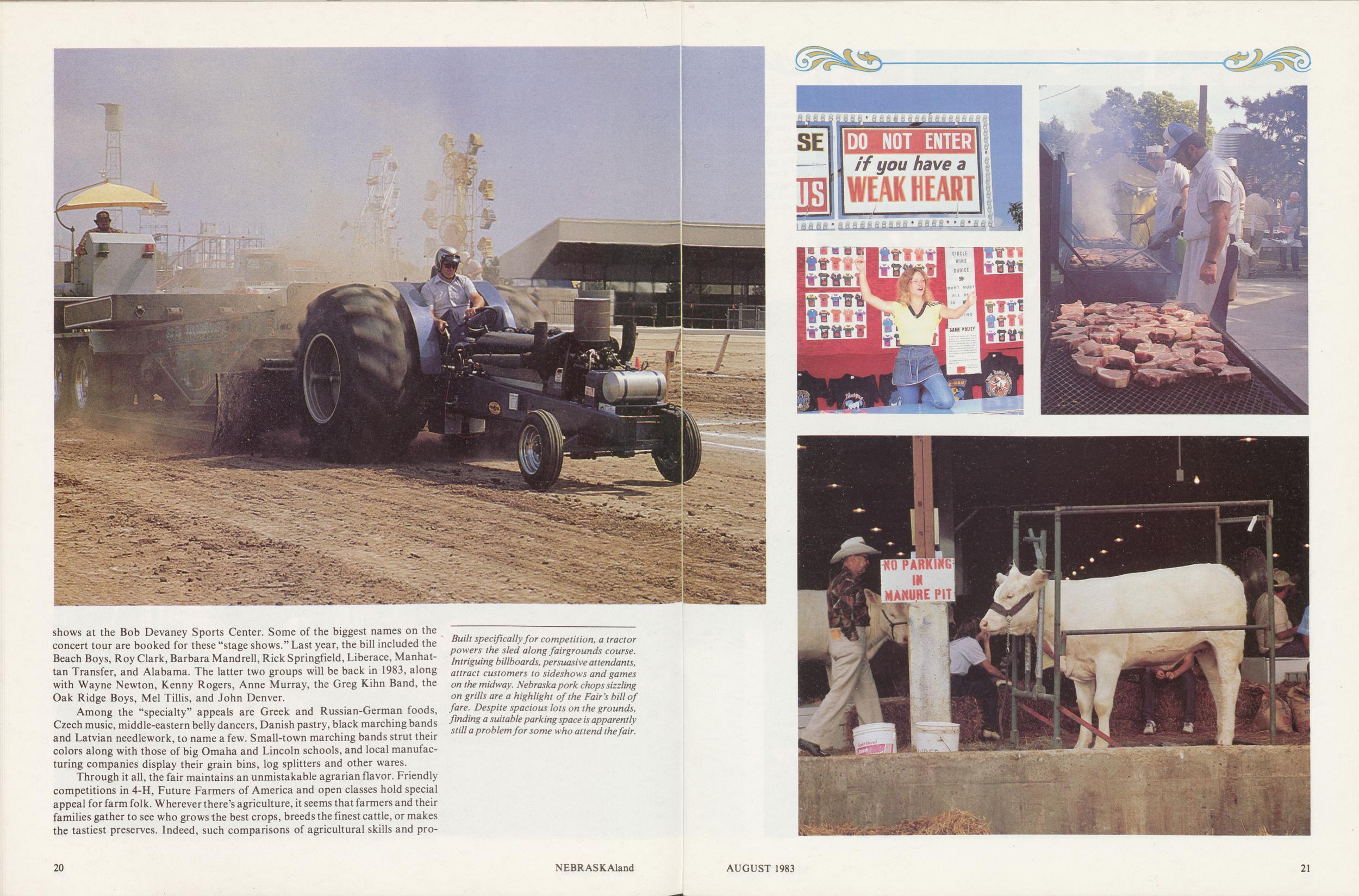
Built specifically for competition, a tractor powers the sled along fairgrounds course. Intriguing billboards, persuasive attendants, attract customers to sideshows and games on the midway. Nebraska pork chops sizzling on grills are a highlight of the Fair's bill of fare. Despite spacious lots on the grounds, finding a suitable parking space is apparently still a problem for some who attend the fair.
shows at the Bob Devaney Sports Center. Some of the biggest names on the concert tour are booked for these "stage shows." Last year, the bill included the Beach Boys, Roy Clark, Barbara Mandrell, Rick Springfield, Liberace, Manhattan Transfer, and Alabama. The latter two groups will be back in 1983, along with Wayne Newton, Kenny Rogers, Anne Murray, the Greg Kihn Band, the Oak Ridge Boys, Mel Tillis, and John Denver.
Among the "specialty" appeals are Greek and Russian-German foods, Czech music, middle-eastern belly dancers, Danish pastry, black marching bands and Latvian needlework, to name a few. Small-town marching bands strut their colors along with those of big Omaha and Lincoln schools, and local manufacturing companies display their grain bins, log splitters and other wares.
Through it all, the fair maintains an unmistakable agrarian flavor. Friendly competitions in 4-H, Future Farmers of America and open classes hold special appeal for farm folk. Wherever there's agriculture, it seems that farmers and their families gather to see who grows the best crops, breeds the finest cattle, or makes the tastiest preserves. Indeed, such comparisons of agricultural skills and produce
20 NEBRASKAland AUGUST 1983 21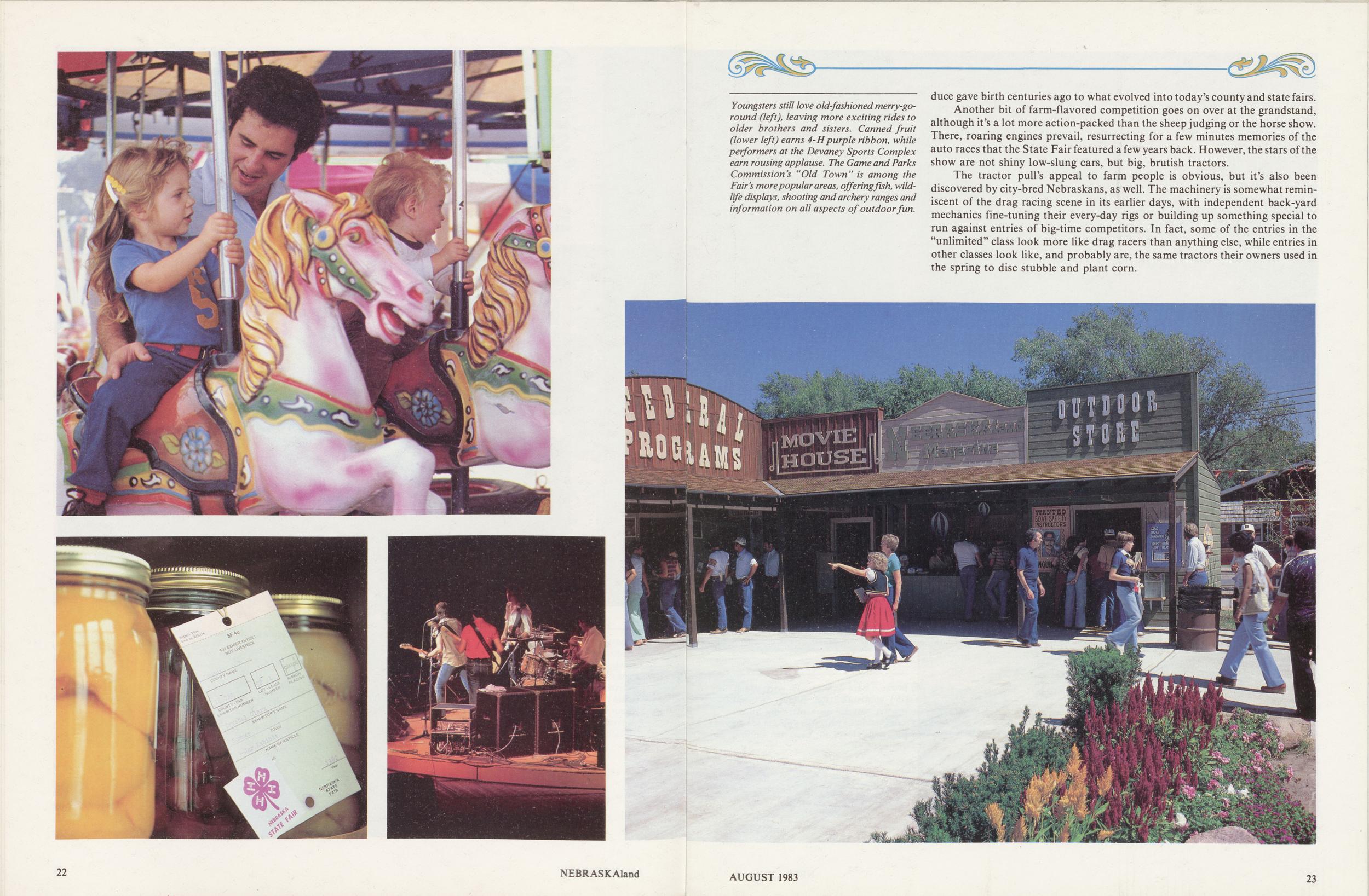
Youngsters still love old-fashioned merry-go-round (left), leaving more exciting rides to older brothers and sisters. Canned fruit (lower left) earns 4-H purple ribbon, while performers at the Devaney Sports Complex earn rousing applause. The Game and Parks Commission's "Old Town" is among the Fair's more popular areas, offering fish, wildlife displays, shooting and archery ranges and information on all aspects of outdoor fun.
gave birth centuries ago to what evolved into today's county and state fairs.
Another bit of farm-flavored competition goes on over at the grandstand, although it's a lot more action-packed than the sheep judging or the horse show. There, roaring engines prevail, resurrecting for a few minutes memories of the auto races that the State Fair featured a few years back. However, the stars of the show are not shiny low-slung cars, but big, brutish tractors.
The tractor pull's appeal to farm people is obvious, but it's also been discovered by city-bred Nebraskans, as well. The machinery is somewhat reminiscent of the drag racing scene in its earlier days, with independent back-yard mechanics fine-tuning their every-day rigs or building up something special to run against entries of big-time competitors. In fact, some of the entries in the "unlimited" class look more like drag racers than anything else, while entries in other classes look like, and probably are, the same tractors their owners used in the spring to disc stubble and plant corn.
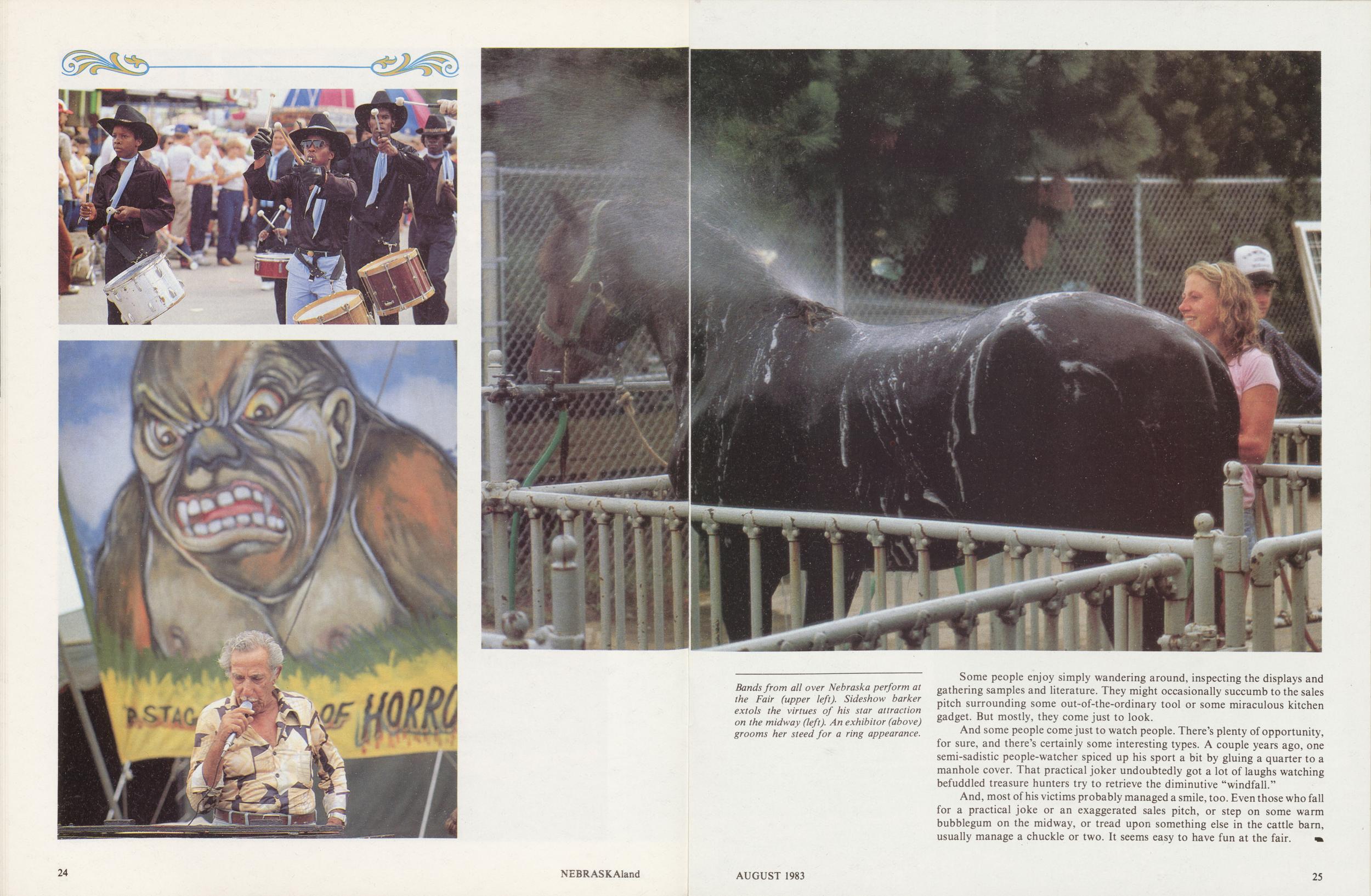
Bands from all over Nebraska perform at the Fair (upper left). Sideshow barker extols the virtues of his star attraction on the midway (left). An exhibitor (above) grooms her steed for a ring appearance.
Some people enjoy simply wandering around, inspecting the displays and gathering samples and literature. They might occasionally succumb to the sales pitch surrounding some out-of-the-ordinary tool or some miraculous kitchen gadget. But mostly, they come just to look.
And some people come just to watch people. There's plenty of opportunity, for sure, and there's certainly some interesting types. A couple years ago, one semi-sadistic people-watcher spiced up his sport a bit by gluing a quarter to a manhole cover. That practical joker undoubtedly got a lot of laughs watching befuddled treasure hunters try to retrieve the diminutive "windfall."
And, most of his victims probably managed a smile, too. Even those who fall for a practical joke or an exaggerated sales pitch, or step on some warm bubblegum on the midway, or tread upon something else in the cattle barn, usually manage a chuckle or two. It seems easy to have fun at the fair.
24 NEBRASKAland AUGUST 1983 25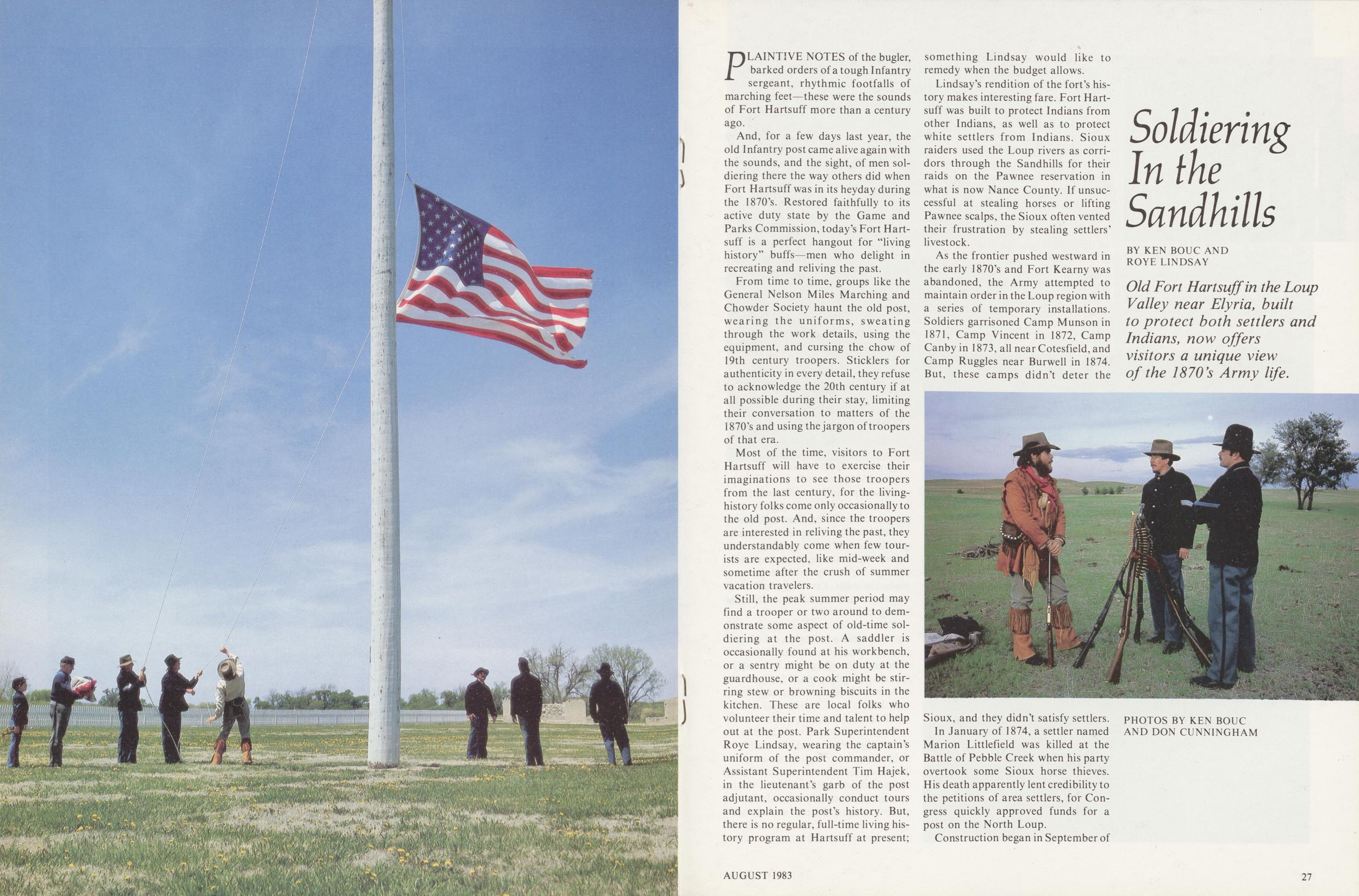
Soldiering In the Sandhills
Old Fort Hartsuff in the Loup Valley near Elyria, built to protect both settlers and Indians, now offers visitors a unique view of the 1870's Army life.PLAINTIVE NOTES of the bugler, barked orders of a tough Infantry sergeant, rhythmic footfalls of marching feet—these were the sounds of Fort Hartsuff more than a century ago.
And, for a few days last year, the old Infantry post came alive again with the sounds, and the sight, of men soldiering there the way others did when Fort Hartsuff was in its heyday during the 1870's. Restored faithfully to its active duty state by the Game and Parks Commission, today's Fort Hartsuff is a perfect hangout for "living history" buffs—men who delight in recreating and reliving the past.
From time to time, groups like the General Nelson Miles Marching and Chowder Society haunt the old post, wearing the uniforms, sweating through the work details, using the equipment, and cursing the chow of 19th century troopers. Sticklers for authenticity in every detail, they refuse to acknowledge the 20th century if at all possible during their stay, limiting their conversation to matters of the 1870's and using the jargon of troopers of that era.
Most of the time, visitors to Fort Hartsuff will have to exercise their imaginations to see those troopers from the last century, for the living-history folks come only occasionally to the old post. And, since the troopers are interested in reliving the past, they understandably come when few tourists are expected, like mid-week and sometime after the crush of summer vacation travelers.
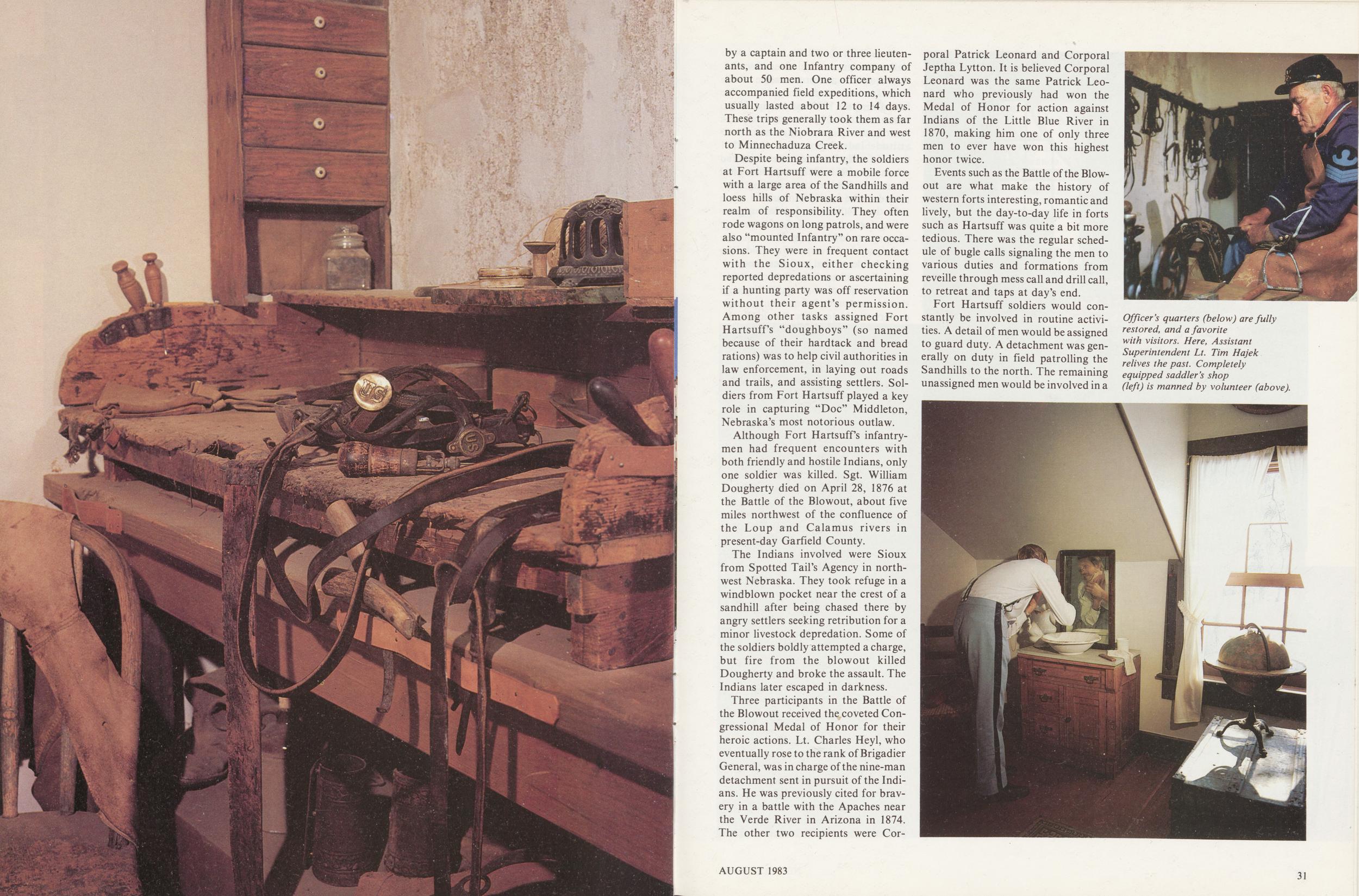
Still, the peak summer period may find a trooper or two around to demonstrate some aspect of old-time soldiering at the post. A saddler is occasionally found at his workbench, or a sentry might be on duty at the guardhouse, or a cook might be stirring stew or browning biscuits in the kitchen. These are local folks who volunteer their time and talent to help out at the post. Park Superintendent Roye Lindsay, wearing the captain's uniform of the post commander, or Assistant Superintendent Tim Hajek, in the lieutenant's garb of the post adjutant, occasionally conduct tours and explain the post's history. But, there is no regular, full-time living history program at Hartsuff at present; something Lindsay would like to remedy when the budget allows.
Lindsay's rendition of the fort's history makes interesting fare. Fort Hartsuff was built to protect Indians from other Indians, as well as to protect white settlers from Indians. Sioux raiders used the Loup rivers as corridors through the Sandhills for their raids on the Pawnee reservation in what is now Nance County. If unsuccessful at stealing horses or lifting Pawnee scalps, the Sioux often vented their frustration by stealing settlers' livestock.
As the frontier pushed westward in the early 1870's and Fort Kearny was abandoned, the Army attempted to maintain order in the Loup region with a series of temporary installations. Soldiers garrisoned Camp Munson in 1871, Camp Vincent in 1872, Camp Canby in 1873, all near Cotesfield, and Camp Ruggles near Burwell in 1874. But, these camps didn't deter the Sioux, and they didn't satisfy settlers.
In January of 1874, a settler named Marion Littlefield was killed at the Battle of Pebble Creek when his party overtook some Sioux horse thieves. His death apparently lent credibility to the petitions of area settlers, for Congress quickly approved funds for a post on the North Loup.
Construction began in September of
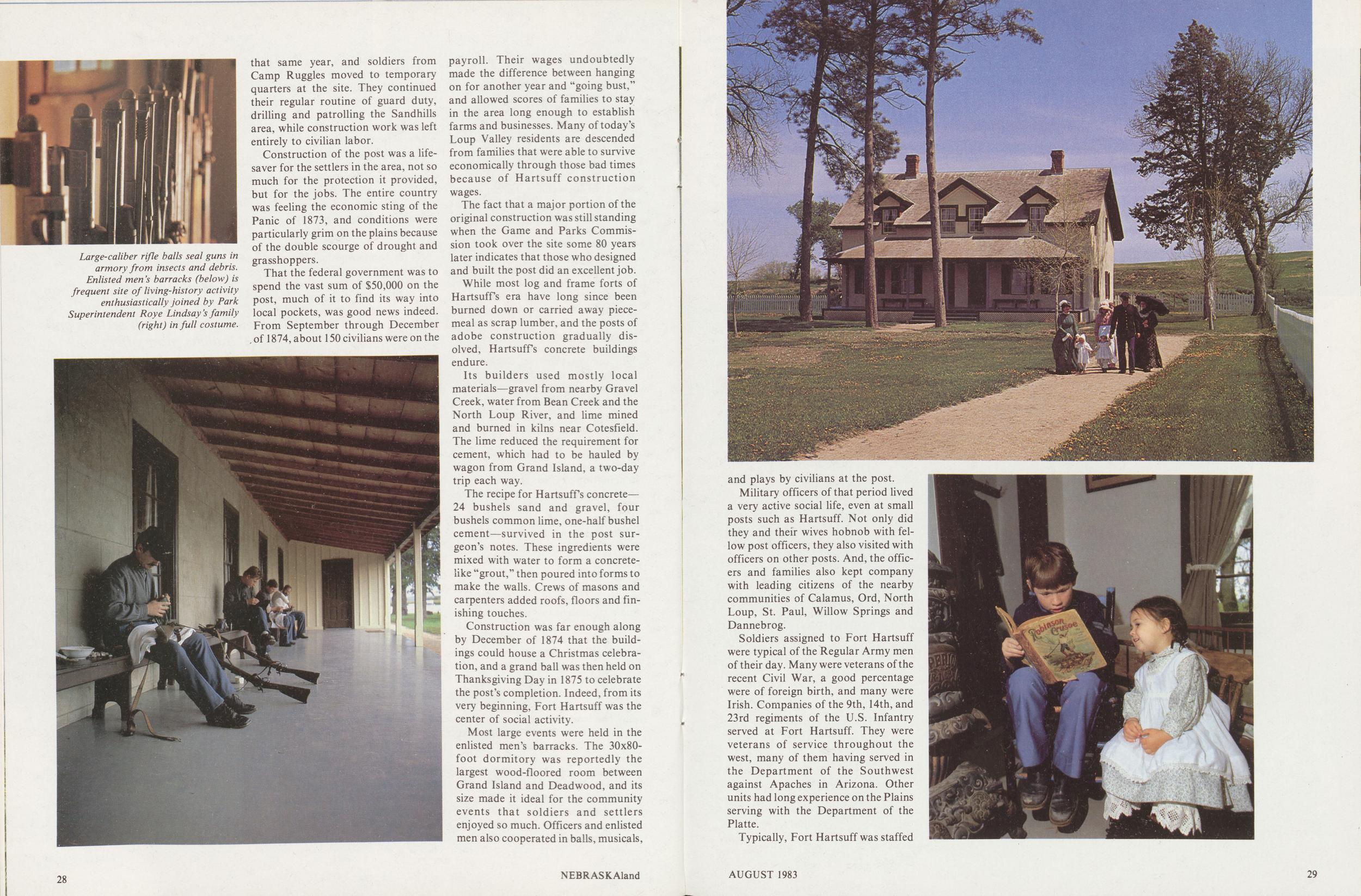
Large-caliber rifle balls seal guns in armory from insects and debris. Enlisted men's barracks (below) is frequent site of living-history activity enthusiastically joined by Park Superintendent Roye Lindsay's family (right) in full costume.
that same year, and soldiers from Camp Ruggles moved to temporary quarters at the site. They continued their regular routine of guard duty, drilling and patrolling the Sandhills area, while construction work was left entirely to civilian labor.
Construction of the post was a lifesaver for the settlers in the area, not so much for the protection it provided, but for the jobs. The entire country was feeling the economic sting of the Panic of 1873, and conditions were particularly grim on the plains because of the double scourge of drought and grasshoppers.
That the federal government was to spend the vast sum of $50,000 on the post, much of it to find its way into local pockets, was good news indeed. From September through December of 1874, about 150 civilians were on the payroll. Their wages undoubtedly made the difference between hanging on for another year and "going bust," and allowed scores of families to stay in the area long enough to establish farms and businesses. Many of today's Loup Valley residents are descended from families that were able to survive economically through those bad times because of Hartsuff construction wages.
The fact that a major portion of the original construction was still standing when the Game and Parks Commission took over the site some 80 years later indicates that those who designed and built the post did an excellent job.
While most log and frame forts of Hartsuffs era have long since been burned down or carried away piece-meal as scrap lumber, and the posts of adobe construction gradually disolved, Hartsuffs concrete buildings endure.
Its builders used mostly local materials—gravel from nearby Gravel Creek, water from Bean Creek and the North Loup River, and lime mined and burned in kilns near Cotesfield. The lime reduced the requirement for cement, which had to be hauled by wagon from Grand Island, a two-day trip each way.
The recipe for Hartsuffs concrete—24 bushels sand and gravel, four bushels common lime, one-half bushel cement—survived in the post surgeon's notes. These ingredients were mixed with water to form a concrete-like "grout," then poured into forms to make the walls. Crews of masons and carpenters added roofs, floors and finishing touches.
Construction was far enough along by December of 1874 that the buildings could house a Christmas celebration, and a grand ball was then held on Thanksgiving Day in 1875 to celebrate the post's completion. Indeed, from its very beginning, Fort Hartsuff was the center of social activity.
Most large events were held in the enlisted men's barracks. The 30x80-foot dormitory was reportedly the largest wood-floored room between Grand Island and Deadwood, and its size made it ideal for the community events that soldiers and settlers enjoyed so much. Officers and enlisted men also cooperated in balls, musicals, and plays by civilians at the post.
Military officers of that period lived a very active social life, even at small posts such as Hartsuff. Not only did they and their wives hobnob with fellow post officers, they also visited with officers on other posts. And, the officers and families also kept company with leading citizens of the nearby communities of Calamus, Ord, North Loup, St. Paul, Willow Springs and Dannebrog.
Soldiers assigned to Fort Hartsuff were typical of the Regular Army men of their day. Many were veterans of the recent Civil War, a good percentage were of foreign birth, and many were Irish. Companies of the 9th, 14th, and 23rd regiments of the U.S. Infantry served at Fort Hartsuff. They were veterans of service throughout the west, many of them having served in the Department of the Southwest against Apaches in Arizona. Other units had long experience on the Plains serving with the Department of the Platte.
Typically, Fort Hartsuff was staffed
by a captain and two or three lieutenants, and one Infantry company of about 50 men. One officer always accompanied field expeditions, which usually lasted about 12 to 14 days. These trips generally took them as far north as the Niobrara River and west to Minnechaduza Creek.
Despite being infantry, the soldiers at Fort Hartsuff were a mobile force with a large area of the Sandhills and loess hills of Nebraska within their realm of responsibility. They often rode wagons on long patrols, and were also "mounted Infantry" on rare occasions. They were in frequent contact with the Sioux, either checking reported depredations or ascertaining if a hunting party was off reservation without their agent's permission. Among other tasks assigned Fort Hartsuffs "doughboys" (so named because of their hardtack and bread rations) was to help civil authorities in law enforcement, in laying out roads and trails, and assisting settlers. Soldiers from Fort Hartsuff played a key role in capturing "Doc" Middleton, Nebraska's most notorious outlaw.
Although Fort Hartsuffs infantrymen had frequent encounters with both friendly and hostile Indians, only one soldier was killed. Sgt. William Dougherty died on April 28, 1876 at the Battle of the Blowout, about five miles northwest of the confluence of the Loup and Calamus rivers in present-day Garfield County.
The Indians involved were Sioux from Spotted Tail's Agency in northwest Nebraska. They took refuge in a windblown pocket near the crest of a sandhill after being chased there by angry settlers seeking retribution for a minor livestock depredation. Some of the soldiers boldly attempted a charge, but fire from the blowout killed Dougherty and broke the assault. The Indians later escaped in darkness.
Three participants in the Battle of the Blowout received the coveted Congressional Medal of Honor for their heroic actions. Lt. Charles Heyl, who eventually rose to the rank of Brigadier General, was in charge of the nine-man detachment sent in pursuit of the Indians. He was previously cited for bravery in a battle with the Apaches near the Verde River in Arizona in 1874. The other two recipients were Cor- poral Patrick Leonard and Corporal Jeptha Lytton. It is believed Corporal Leonard was the same Patrick Leonard who previously had won the Medal of Honor for action against Indians of the Little Blue River in 1870, making him one of only three men to ever have won this highest honor twice.
Events such as the Battle of the Blow-out are what make the history of western forts interesting, romantic and lively, but the day-to-day life in forts such as Hartsuff was quite a bit more tedious. There was the regular schedule of bugle calls signaling the men to various duties and formations from reveille through mess call and drill call, to retreat and taps at day's end.
Fort Hartsuff soldiers would constantly be involved in routine activities. A detail of men would be assigned to guard duty. A detachment was generally on duty in field patrolling the Sandhills to the north. The remaining unassigned men would be involved in a
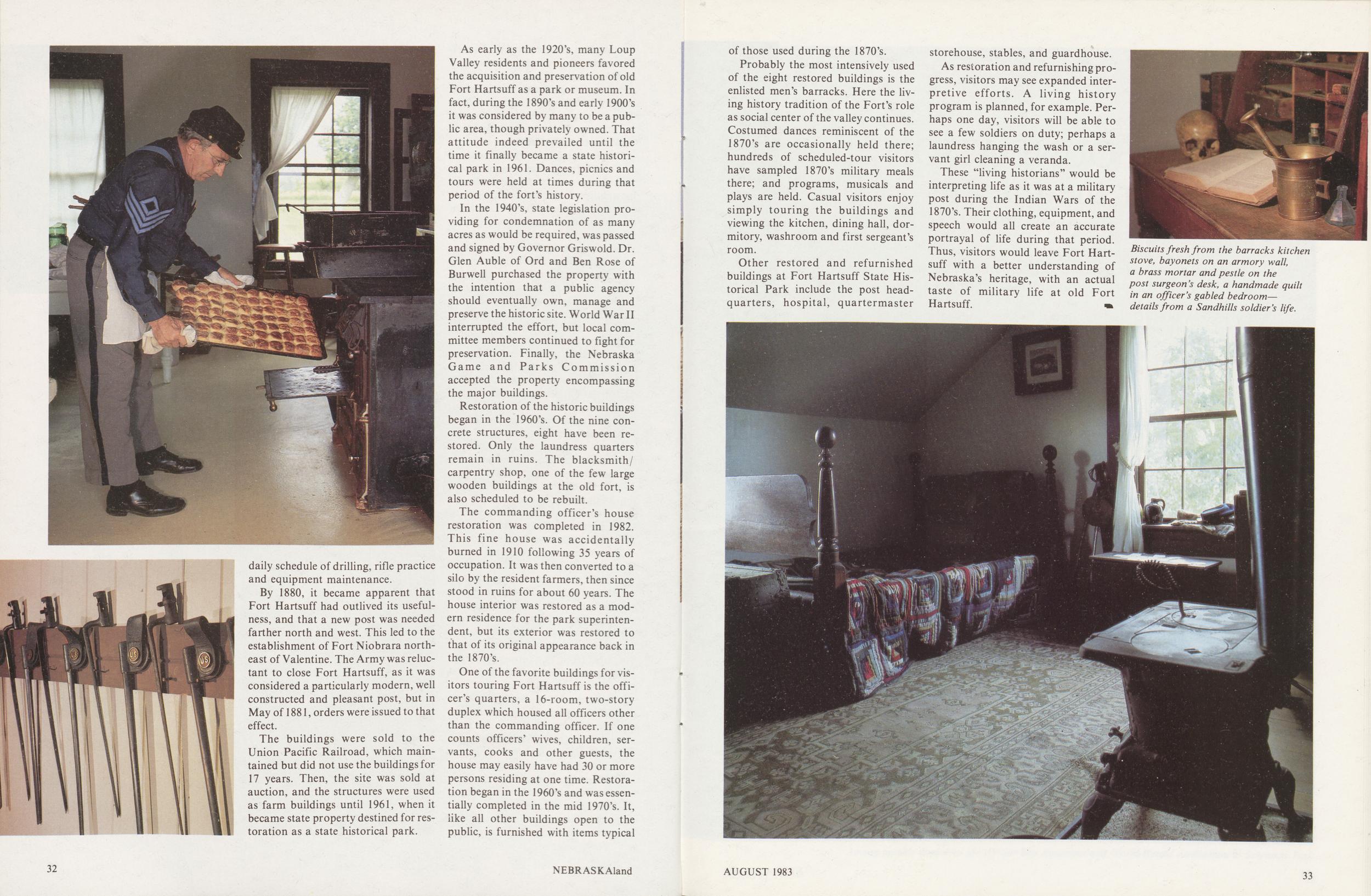
Officer's quarters (below) are fully restored, and a favorite with visitors. Here, Assistant Superintendent Lt. Tim Hajek relives the past. Completely equipped saddler's shop (left) is manned by volunteer (above).
daily schedule of drilling, rifle practice and equipment maintenance.
By 1880, it became apparent that Fort Hartsuff had outlived its usefulness, and that a new post was needed farther north and west. This led to the establishment of Fort Niobrara northeast of Valentine. The Army was reluctant to close Fort Hartsuff, as it was considered a particularly modern, well constructed and pleasant post, but in May of 1881, orders were issued to that effect.
The buildings were sold to the Union Pacific Railroad, which maintained but did not use the buildings for 17 years. Then, the site was sold at auction, and the structures were used as farm buildings until 1961, when it became state property destined for restoration as a state historical park.
As early as the 1920's, many Loup Valley residents and pioneers favored the acquisition and preservation of old Fort Hartsuff as a park or museum. In fact, during the 1890's and early 1900's it was considered by many to be a public area, though privately owned. That attitude indeed prevailed until the time it finally became a state historical park in 1961. Dances, picnics and tours were held at times during that period of the fort's history.
In the 1940's, state legislation providing for condemnation of as many acres as would be required, was passed and signed by Governor Griswold. Dr. Glen Auble of Ord and Ben Rose of Burwell purchased the property with the intention that a public agency should eventually own, manage and preserve the historic site. World War II interrupted the effort, but local committee members continued to fight for preservation. Finally, the Nebraska Game and Parks Commission accepted the property encompassing the major buildings.
Restoration of the historic buildings began in the 1960's. Of the nine concrete structures, eight have been restored. Only the laundress quarters remain in ruins. The blacksmith/carpentry shop, one of the few large wooden buildings at the old fort, is also scheduled to be rebuilt.
The commanding officer's house restoration was completed in 1982. This fine house was accidentally burned in 1910 following 35 years of occupation. It was then converted to a silo by the resident farmers, then since stood in ruins for about 60 years. The house interior was restored as a modern residence for the park superintendent, but its exterior was restored to that of its original appearance back in the 1870's.
One of the favorite buildings for visitors touring Fort Hartsuff is the officer's quarters, a 16-room, two-story duplex which housed all officers other than the commanding officer. If one counts officers' wives, children, servants, cooks and other guests, the house may easily have had 30 or more persons residing at one time. Restoration began in the 1960's and was essentially completed in the mid 1970's. It, like all other buildings open to the public, is furnished with items typical of those used during the 1870's.
Probably the most intensively used of the eight restored buildings is the enlisted men's barracks. Here the living history tradition of the Fort's role as social center of the valley continues. Costumed dances reminiscent of the 1870's are occasionally held there; hundreds of scheduled-tour visitors have sampled 1870's military meals there; and programs, musicals and plays are held. Casual visitors enjoy simply touring the buildings and viewing the kitchen, dining hall, dormitory, washroom and first sergeant's room.
Other restored and refurnished buildings at Fort Hartsuff State Historical Park include the post headquarters, hospital, quartermaster storehouse, stables, and guardhouse.
As restoration and refurnishing progress, visitors may see expanded interpretive efforts. A living history program is planned, for example. Perhaps one day, visitors will be able to see a few soldiers on duty; perhaps a laundress hanging the wash or a servant girl cleaning a veranda.
These "living historians" would be interpreting life as it was at a military post during the Indian Wars of the 1870's. Their clothing, equipment, and speech would all create an accurate portrayal of life during that period. Thus, visitors would leave Fort Hartsuff with a better understanding of Nebraska's heritage, with an actual taste of military life at old Fort Hartsuff.
Biscuits fresh from the barracks kitchen stove, bayonets on an armory wall, a brass mortar and pestle on the post surgeon's desk, a handmade quilt in an officer's gabled bedroom—details from a Sandhills soldier's life.
A NEW FOUNDATION . . . For the Future
Formed to administer funds from donations or bequests from individuals and companies, this, group will be a major factor in future recreation in the state.WEBSTER DEFINES the word "foundation" as a "basis upon which something stands or is supported a body or ground upon which something is built up or overlaid."
What better way to describe the new Nebraska Game and Parks Foundation, for this group of dedicated Nebraskans has banded together to create a solid basis for the future of parks, wildlife management, and conservation in our state. The organization promises to be a "strong right arm" to the future endeavors of the Game and Parks Commission.
"The Foundation will be a benefit not only to the Commission but to all the citizens of Nebraska," commented Dr. Bruce Cowgill of Silver Creek, the group's executive director. "And, it's not just the money and gifts that it makes possible it's the feeling of taking part it's the involvement of people all kinds of people."
That observation was borne out in the gifts accepted at the Foundation's first official meeting, when the group received a donation of $4.90 from a first grader at Valentine, and $175,000 from the Burlington Northern Foundation. Young Adam Nielsen was concerned about the continued operation of the fish hatchery at Crawford, which the Commission will take over in 1984. He sent the proceeds from his school project to be earmarked for the hatchery. The $175,000 from BN will finance the visitor center and other developments at Rock Creek State Historical Park near Fairbury. No gift is too small and none too big. All will go to help improve outdoor recreation for all Nebraskans. Any individual is invited and encouraged to take part. The Foundation now makes it possible to earmark even the smallest donation for an individual's pet project or area.
Harold Andersen, president of the Omaha World-Herald and chairman of the board of the Foundation, said of their role: "Through the Foundation, we hope to help develop the state's park, recreation and wildlife areas even beyond the splendid level to which these facilities have been built by the Game and Parks Commission, Director Eugene T. Mahoney, and his excellent staff.
"Preliminary funding for these areas, of course, must come from state government, through the law and appropriations which the governor recommends and the Legislature enacts. We feel that our Foundation can add an important dimension of growth in quality beyond the basic funding provided by state government, and by fees from the public for hunting, fishing, and use of the parks."
In the words of Game and Parks Director Gene Mahoney: "The Nebraska Game and Parks Foundation represents a joining of hands between the public and private sectors. It is an organization committed to improving the quality of life for Nebraskans. The Foundation is open to every citizen in the state. The pennies, nickels, and dimes of school children are as important as the help from
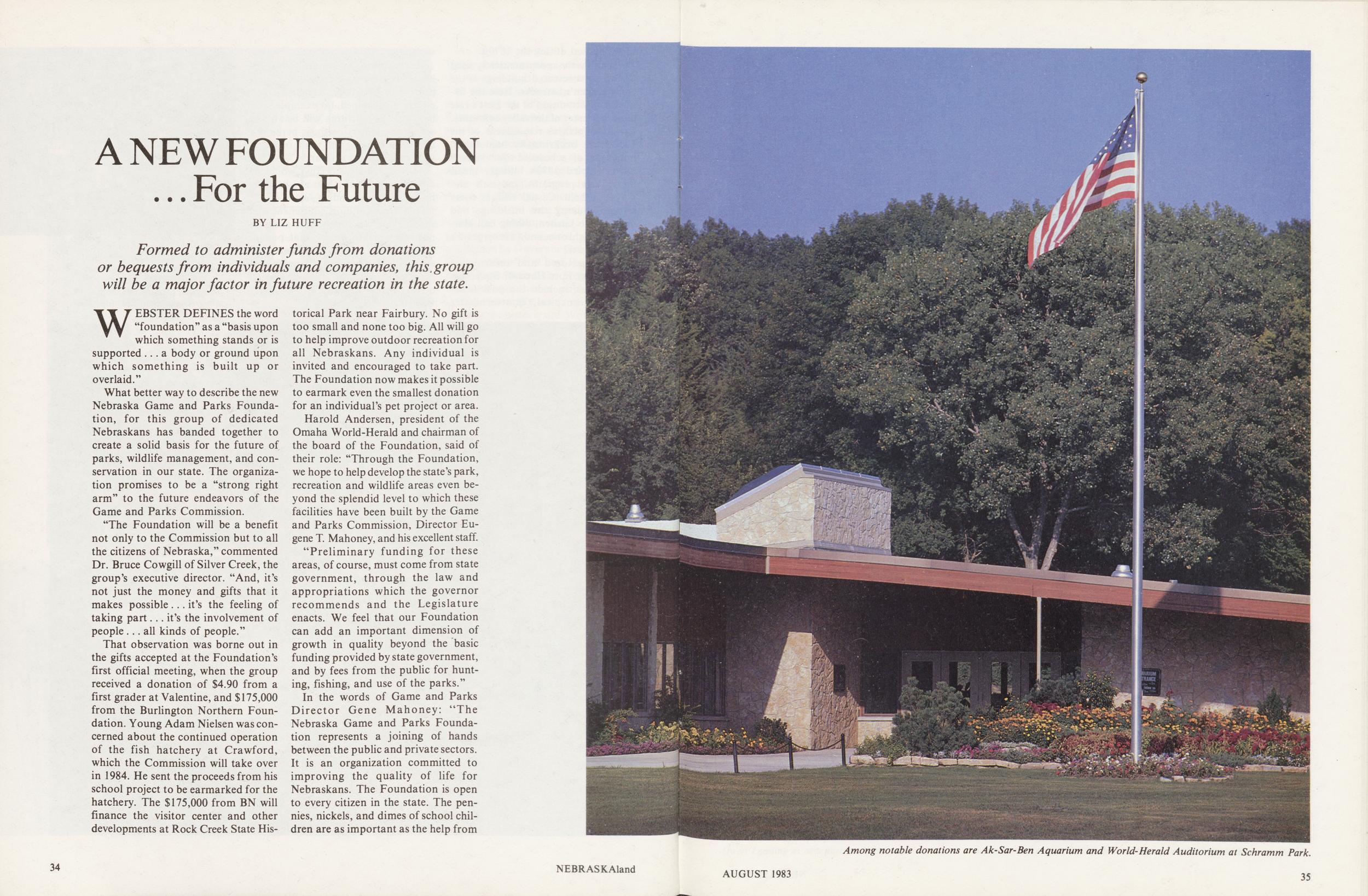
Among notable donations are Ak-Sar-Ben Aquarium and World-Herald Auditorium at Schramm Park.
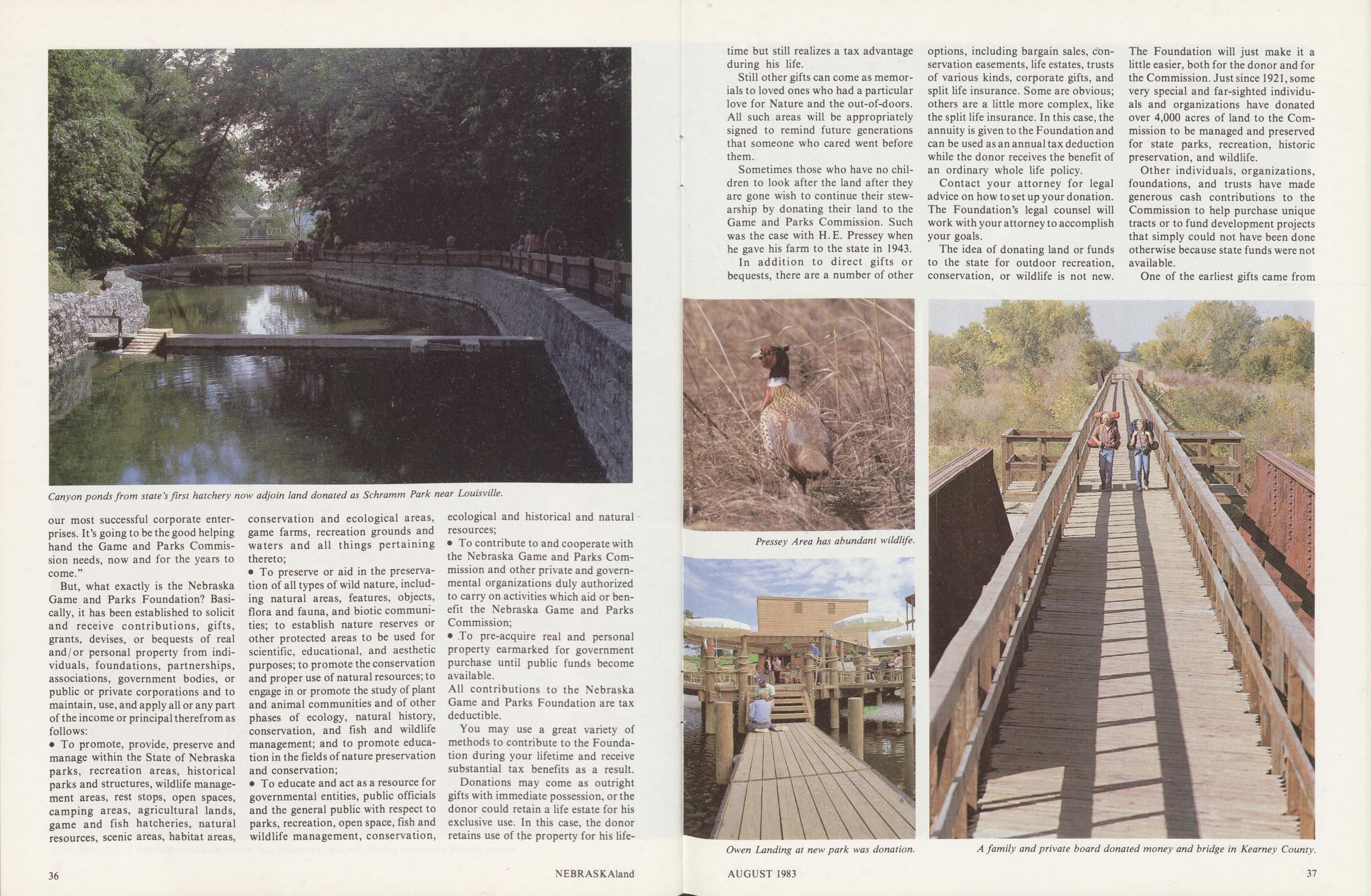
Canyon ponds from state's first hatchery now adjoin land donated as Schramm Park near Louisville.
our most successful corporate enterprises. It's going to be the good helping hand the Game and Parks Commission needs, now and for the years to come."
But, what exactly is the Nebraska Game and Parks Foundation? Basically, it has been established to solicit and receive contributions, gifts, grants, devises, or bequests of real and/or personal property from individuals, foundations, partnerships, associations, government bodies, or public or private corporations and to maintain, use, and apply all or any part of the income or principal therefrom as follows:
To promote, provide, preserve and manage within the State of Nebraska parks, recreation areas, historical parks and structures, wildlife management areas, rest stops, open spaces, camping areas, agricultural lands, game and fish hatcheries, natural resources, scenic areas, habitat areas, conservation and ecological areas, game farms, recreation grounds and waters and all things pertaining thereto;
To preserve or aid in the preservation of all types of wild nature, including natural areas, features, objects, flora and fauna, and biotic communities; to establish nature reserves or other protected areas to be used for scientific, educational, and aesthetic purposes; to promote the conservation and proper use of natural resources; to engage in or promote the study of plant and animal communities and of other phases of ecology, natural history, conservation, and fish and wildlife management; and to promote education in the fields of nature preservation and conservation;
To educate and act as a resource for governmental entities, public officials and the general public with respect to parks, recreation, open space, fish and wildlife management, conservation, ecological and historical and natural resources;
To contribute to and cooperate with the Nebraska Game and Parks Commission and other private and governmental organizations duly authorized to carry on activities which aid or benefit the Nebraska Game and Parks Commission;
To pre-acquire real and personal property earmarked for government purchase until public funds become available.
All contributions to the Nebraska Game and Parks Foundation are tax deductible.
You may use a great variety of methods to contribute to the Foundation during your lifetime and receive substantial tax benefits as a result.
Donations may come as outright gifts with immediate possession, or the donor could retain a life estate for his exclusive use. In this case, the donor retains use of the property for his lifetime but still realizes a tax advantage during his life.
Still other gifts can come as memorials to loved ones who had a particular love for Nature and the out-of-doors. All such areas will be appropriately signed to remind future generations that someone who cared went before them.
Sometimes those who have no children to look after the land after they are gone wish to continue their stewarship by donating their land to the Game and Parks Commission. Such was the case with H.E. Pressey when he gave his farm to the state in 1943.
In addition to direct gifts or bequests, there are a number of other options, including bargain sales, conservation easements, life estates, trusts of various kinds, corporate gifts, and split life insurance. Some are obvious; others are a little more complex, like the split life insurance. In this case, the annuity is given to the Foundation and can be used as an annual tax deduction while the donor receives the benefit of an ordinary whole life policy.
Contact your attorney for legal advice on how to set up your donation. The Foundation's legal counsel will work with your attorney to accomplish your goals.
The idea of donating land or funds to the state for outdoor recreation, conservation, or wildlife is not new. The Foundation will just make it a little easier, both for the donor and for the Commission. Just since 1921, some very special and far-sighted individuals and organizations have donated over 4,000 acres of land to the Commission to be managed and preserved for state parks, recreation, historic preservation, and wildlife.
Other individuals, organizations, foundations, and trusts have made generous cash contributions to the Commission to help purchase unique tracts or to fund development projects that simply could not have been done otherwise because state funds were not available.
One of the earliest gifts came from
Pressey Area has abundant wildlife.
Owen Landing at new park was donation.
A family and private board donated money and bridge in Kearney County.
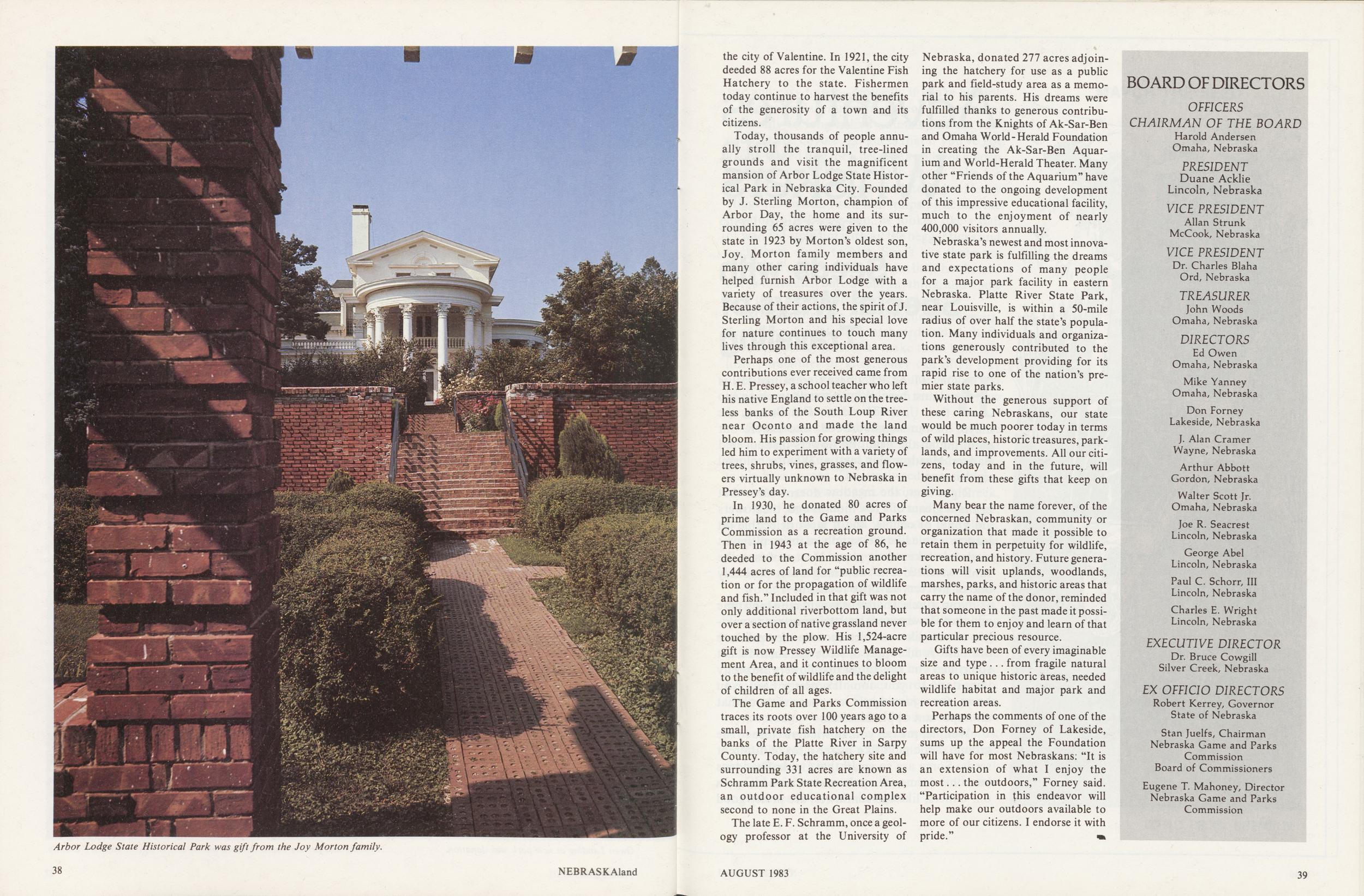
Arbor Lodge State Historical Park was gift from the Joy Morton family.
the city of Valentine. In 1921, the city deeded 88 acres for the Valentine Fish Hatchery to the state. Fishermen today continue to harvest the benefits of the generosity of a town and its citizens.
Today, thousands of people annually stroll the tranquil, tree-lined grounds and visit the magnificent mansion of Arbor Lodge State Historical Park in Nebraska City. Founded by J. Sterling Morton, champion of Arbor Day, the home and its surrounding 65 acres were given to the state in 1923 by Morton's oldest son, Joy. Morton family members and many other caring individuals have helped furnish Arbor Lodge with a variety of treasures over the years. Because of their actions, the spirit of J. Sterling Morton and his special love for nature continues to touch many lives through this exceptional area. Perhaps one of the most generous contributions ever received came from H. E. Pressey, a school teacher who left his native England to settle on the treeless banks of the South Loup River near Oconto and made the land bloom. His passion for growing things led him to experiment with a variety of trees, shrubs, vines, grasses, and flowers virtually unknown to Nebraska in Pressey's day.
In 1930, he donated 80 acres of prime land to the Game and Parks Commission as a recreation ground. Then in 1943 at the age of 86, he deeded to the Commission another 1,444 acres of land for "public recreation or for the propagation of wildlife and fish." Included in that gift was not only additional riverbottom land, but over a section of native grassland never touched by the plow. His 1,524-acre gift is now Pressey Wildlife Management Area, and it continues to bloom to the benefit of wildlife and the delight of children of all ages.
The Game and Parks Commission traces its roots over 100 years ago to a small, private fish hatchery on the banks of the Platte River in Sarpy County. Today, the hatchery site and surrounding 331 acres are known as Schramm Park State Recreation Area, an outdoor educational complex second to none in the Great Plains.
The late E. F. Schramm, once a geology professor at the University of Nebraska, donated 277 acres adjoining the hatchery for use as a public park and field-study area as a memorial to his parents. His dreams were fulfilled thanks to generous contributions from the Knights of Ak-Sar-Ben and Omaha World-Herald Foundation in creating the Ak-Sar-Ben Aquarium and World-Herald Theater. Many other "Friends of the Aquarium" have donated to the ongoing development of this impressive educational facility, much to the enjoyment of nearly 400,000 visitors annually.
Nebraska's newest and most innovative state park is fulfilling the dreams and expectations of many people for a major park facility in eastern Nebraska. Platte River State Park, near Louisville, is within a 50-mile radius of over half the state's population. Many individuals and organizations generously contributed to the park's development providing for its rapid rise to one of the nation's premier state parks.
Without the generous support of these caring Nebraskans, our state would be much poorer today in terms of wild places, historic treasures, parklands, and improvements. All our citizens, today and in the future, will benefit from these gifts that keep on giving.
Many bear the name forever, of the concerned Nebraskan, community or organization that made it possible to retain them in perpetuity for wildlife, recreation, and history. Future generations will visit uplands, woodlands, marshes, parks, and historic areas that carry the name of the donor, reminded that someone in the past made it possible for them to enjoy and learn of that particular precious resource.
Gifts have been of every imaginable size and type from fragile natural areas to unique historic areas, needed wildlife habitat and major park and recreation areas.
Perhaps the comments of one of the directors, Don Forney of Lakeside, sums up the appeal the Foundation will have for most Nebraskans: "It is an extension of what I enjoy the most the outdoors," Forney said. "Participation in this endeavor will help make our outdoors available to more of our citizens. I endorse it with pride."
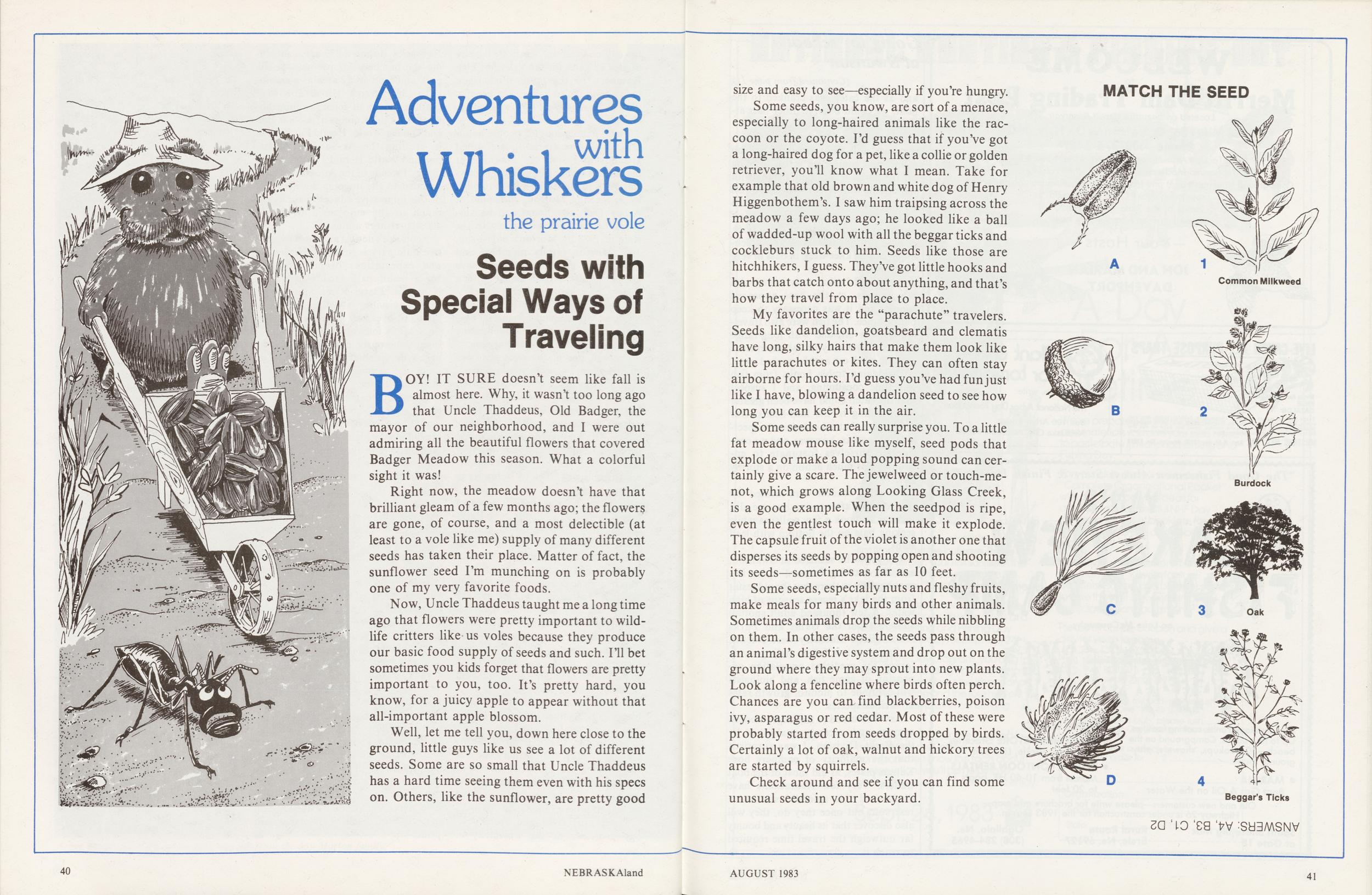
Adventures Whiskers the prairie vole
Seeds with Special Ways of Traveling
BOY! IT SURE doesn't seem like fall is almost here. Why, it wasn't too long ago that Uncle Thaddeus, Old Badger, the mayor of our neighborhood, and I were out admiring all the beautiful flowers that covered Badger Meadow this season. What a colorful sight it was!
Right now, the meadow doesn't have that brilliant gleam of a few months ago; the flowers are gone, of course, and a most delectible (at least to a vole like me) supply of many different seeds has taken their place. Matter of fact, the sunflower seed I'm munching on is probably one of my very favorite foods.
Now, Uncle Thaddeus taught me a long time ago that flowers were pretty important to wildlife critters like us voles because they produce our basic food supply of seeds and such. I'll bet sometimes you kids forget that flowers are pretty important to you, too. It's pretty hard, you know, for a juicy apple to appear without that all-important apple blossom.
Well, let me tell you, down here close to the ground, little guys like us see a lot of different seeds. Some are so small that Uncle Thaddeus has a hard time seeing them even with his specs on. Others, like the sunflower, are pretty good size and easy to see—especially if you're hungry.
Some seeds, you know, are sort of a menace, especially to long-haired animals like the raccoon or the coyote. I'd guess that if you've got a long-haired dog for a pet, like a collie or golden retriever, you'll know what I mean. Take for example that old brown and white dog of Henry Higgenbothem's. I saw him traipsing across the meadow a few days ago; he looked like a ball of wadded-up wool with all the beggar ticks and cockleburs stuck to him. Seeds like those are hitchhikers, I guess. They've got little hooks and barbs that catch onto about anything, and that's how they travel from place to place.
My favorites are the "parachute" travelers. Seeds like dandelion, goatsbeard and clematis have long, silky hairs that make them look like little parachutes or kites. They can often stay airborne for hours. I'd guess you've had fun just like I have, blowing a dandelion seed to see how long you can keep it in the air.
Some seeds can really surprise you. To a little fat meadow mouse like myself, seed pods that explode or make a loud popping sound can certainly give a scare. The jewelweed or touch-me-not, which grows along Looking Glass Creek, is a good example. When the seedpod is ripe, even the gentlest touch will make it explode. The capsule fruit of the violet is another one that disperses its seeds by popping open and shooting its seeds—sometimes as far as 10 feet.
Some seeds, especially nuts and fleshy fruits, make meals for many birds and other animals. Sometimes animals drop the seeds while nibbling on them. In other cases, the seeds pass through an animal's digestive system and drop out on the ground where they may sprout into new plants. Look along a fenceline where birds often perch. Chances are you can find blackberries, poison ivy, asparagus or red cedar. Most of these were probably started from seeds dropped by birds. Certainly a lot of oak, walnut and hickory trees are started by squirrels.
Check around and see if you can find some unusual seeds in your backyard.
MATCH THE SEED Common Milkweed Burdock Oak Beggar's Ticks
Going to "school" at Swanson
(Continued from page 11)and as the catch was cranked to the boat, we could observe other bass attempting to steal the lure.
When the action is fast, most fishermen use doll flies, generally two on a line, and some even resort to filing off the barbs. Very often, fishing with the double doll fly will yield two fish per cast, and the absence of the barb allows the fisherman faster fish removal and more casts to the school. A boat full of casters using this technique can be knee-deep in bass in very short order.
Bruce and I reluctantly stayed with our spoons, as the bass appeared spooky and it was necessary to keep our distance. The fish were also traveling quite a bit, and with long-range spoons, it was easy to fish them close and still reach out as they worked away.
Dislodging treble hooks from fish was time consuming, and I suspect that the catch could have been greater by switching to the lead-heads. Our catch from that school was a respect-able 20 keepers, however, and we considered ourselves fortunate to encounter this much action on a stormy day.
No other schools were located the rest of the afternoon, but we did manage to hook a few walleyes while seeking bass on the bottom with lead slabs.
I've yet to be skunked at Swanson, and I'm looking forward to an improving fishery there that should result from the lake's recent seasons of high water. A few thousand adult spottail shiners from the Game and Parks North Platte Hatchery were stocked in Swanson last fall to help provide forage for predicted population expansion of game fish, and biologists will continue to monitor growth rates of various species.
As we returned to the large, modern campground, recently established by the Parks Division, I was surprised that the majority of campers bore Kansas plates, as did most of the boat trailers. Very few Nebraskans have discovered this splendid southwest reservoir, but once they do, they will also discover that its beauty and bounty far outweigh the travel time required to reach it.
Broncs, bulls and F stop's
(Continued from page 17)a motor drive, JJJ Photography shoots a prodigious amount of film. Jim estimates a yearly average of 5,000 feet of 35mm Tri-X and some Plus-X, and about 1,000 feet of 120 film—more than a mile of film, shot an inch at a time.
Eventually, Jim says, he is interested in sharing his experience with neophyte rodeo photographers—perhaps by organizing workshops or offering a summer rodeo photography school. "I think it should be done, because there are a lot of guys trying to get into rodeo photography. I think it could help them, and even the instructor could learn a lot from other people.
"Another thing I'd like to do when I slow down taking pictures myself: I'd like to get all my stuff together and put out a book. I write poetry, too; it's kind of a hobby. I want to put out a book of rodeo poetry with photographs.
"One thing about photography: you could live to be 100 years old and you'd never learn everything there is to know about it. That's why it intrigues me, I think. When I start something, I'm inclined to switch to something else before long. But I've stayed with this for about 20 years now, so. . . ."
By now, most of the cowboys have drifted away. Today's performance is about to begin, and through the last few minutes of conversation, Jim has been getting his equipment together. An old man, walking slowly and laboriously with the help of a cane but looking still tough, proud and leathery, greets the photographer. "Lyman is recovering from a stroke," Jim explains. "I used to enter the wild-horse race with Lyman, way back when. I lost a bunch of teeth out there one year. They're still lying on that track someplace. We used to have some good old times. When Lyman gets back in shape, we're going to get back in the wild-horse race."
"I will, too," says Lyman, making his painful way to the south grandstand. Jim, laden with Nikon, lens, and pockets full of film, swings open the heavy gate and steps into the sandy arena. A grinning rodeo clown in grotesque face paint and grossly oversized jeans, tips his derby to the photographer—a salute from one rodeo professional to another.
Back to Basics
In The Kitchen
Basic Baked Fish 3 to 4 pounds fresh fish, dressed for baking Salt Pepper 1/4 cup butter or other fat, melted 3 slices bacon (optional)Sprinkle inside and outside offish with salt and pepper. Place fish in greased baking dish and brush with melted butter. Place slices of bacon on top of fish. Bake in a preheated 350 degree oven for 40 to 60 minutes, depending on thickness of fish. Baste once or twice with drippings of melted butter. Serve with lemon wedges. Makes 4 to 6 servings.
Basic Pan Fried Fish 2 pounds fresh fish filets, steaks or pan-dressed whole fish Salt Pepper 1 egg 1 tablespoon milk or water 1 cup dry bread crumbs, cracker crumbs, cornmeal, or flourCut filets into serving-size portions. Sprinkle both sides with salt and pepper. Beat egg slightly and blend in milk. Dip portions in the egg mixture then roll them in crumbs. Place fish in a heavy frying pan with about 1/4-inch melted fat, hot but not smoking. Fry at a moderate heat until fish is brown on one side. Turn carefully and brown the other side. Cooking time is approximately 10 minutes depending on the thickness of the fish. Drain on absorbent paper and serve with lemon wedges or sauce. Makes 4 to 6 servings.
Basic Broiled Fish 2 pounds fresh fish filets or steaks 2 lemons 1/4 cup melted margarine Salt PepperCover broiler pan with aluminum foil. Slice 1 lemon into Va inch slices and place on foil. Baste filets with melted margarine and juice from 1 lemon. Sprinkle both sides of filets with salt and pepper. Place fish in broiler pan on top of lemon slices. Broil fish about 4 inches from source of heat for 8 to 14 minutes, depending on thickness of fish. Fish will be done when it flakes easily when tested with a fork. Baste once during broiling, but do not turn. If desired, saute assorted vegetables and place on top offish before serving. Makes 4 to 6 servings.
Basic Poached fish 1 pound fresh fish filets or steaks 1 quart water 1 1/2 tablespoons saltLower fish into salted, boiling water and simmer for 10 minutes, or until fish flakes easily when tested with a fork. Do not allow water to boil. Remove fish carefully and serve hot with a sauce, or flake after cooling for use in other recipes.
Basic Oven Fried Fish 2 pounds fresh fish filets 1 tablespoon salt 1 cup milk 1 cup dry bread crumbs or cracker crumbs 1/4 cup butter or other fat, meltedCut filets into serving-size portions. Combine salt and milk. Dip portions in milk then roll them in dry crumbs. Place portions in a well-greased baking dish and drizzle with melted butter. Place baking dish on top shelf of preheated 500 degree oven and bake 10 to 12 minutes, or until portions flake easily when tested with a fork. Makes 4 to 6 servings.
Buttermilk Fried Filets 2 pounds skinless filets 1 cup buttermilk 1 cup biscuit mix 2 teaspoons saltCut filets into serving-size portions. Place portions in a single layer in a shallow dish. Pour buttermilk over portions and let stand for 30 minutes, turning once. Combine biscuit mix and salt. Remove portions from buttermilk and roll in biscuit mix. Fry in moderately hot cooking oil for 4 to 5 minutes or until brown. Turn carefully and fry 4 to 5 minutes longer or until fish is brown and flakes easily when tested with a fork. Drain on absorbent paper. Serve with lemon wedges or malt vinegar. Makes 4 to 6 servings.
Fisherman's Tartar Sauce 1 cup mayonnaise 2 tablespoons dill pickle, finely chopped 2 tablespoons onion, finely chopped 2 tablespoons olives, finely chopped 1 teaspoon lemon juice Dash pepper 1/4 cup sour cream (optional) Combine all ingredients well and chill. Makes 2 cups of sauce.
Bookshelf
SMALL PUBLISHING firms often specialize in one or a few topics, and do it very well. One such is The Patrice Press; P.O. Box 42; Gerald, Missouri 63037, and its specialty is Western U.S. history. This month we review two recent Patrice offerings, and in a later issue will cover a third in their "pioneer trails" series.
The Latter-Day Saints' Emigrants' Guide. William Clayton (edited by Stanley B. Kimball). 1983. The Patrice Press; 107 pp.; index; photographs; maps. $9.95 + $1.75 postage.
Originally published in 1848, Clayton's Guide was an indispensable aid to thousands of Mormons on their 1000-mile route from Winter Quarters on the Missouri River to Great Salt Lake. Concise descriptions of landmarks, locations of wood and water along the route, and other vital information must have been reassuring to those seeking homes and opportunity in the great west. As editor Kimball remarks, Clayton's guidebook received immediate acceptance and was given the ultimate compliment in being copied by other guide "authors."
Facsimiles of the 24-page Guide are interspersed throughout this reprint. Here are a few samples of Clayton's concise entries:
"Loup Fork—lake and timber. Opposite to where the Pawnees were located in the Spring of 1847, and is a good place to camp." (86 miles from Winter Quarters, north of present-day Omaha, and 945 miles from Great Salt Lake).
"Chimney Rock, south side of the river. The higher land now begins to be sandy and barren. Many Prickly-pears and Wild Sage which continue mostly through the remainder of the country." (452 1/2 miles from Winter Quarters and 578 1/2 miles from Great Salt Lake).
"South Pass this is the dividing ridge between the waters of the Atlantic and Pacific. Altitude 7,085 feet." (799 1/2 miles from Winter Quarters and 231 1/2 miles from Great Salt Lake).
The mileage figures throughout the Guide were made possible by a Clayton invention, a wagon wheel odometer illustrated in the reprint's introduction. An earlier method of measuring distance was counting revolutions of a wagon wheel, which proved quite accurate but must have been extremely boring for the "recorder."
Descriptions of numerous fords and crossings occupy prominent places in the book. Supplementary notes by editor Kimball show correlations with present-day locations and legal descriptions of key landscape features. A number of aerial photographs give a feel of the country, which even today must inspire awe in all but the most casual observer. Five sectional maps provide comparisons of the Mormon Trail and modern highways.
The Oregon Trail Revisited (2nd edition). Gregory M. Franzwa. 1978. The Patrice Press; 417 pp.; index; bibliography; photos; maps. $12.95 + $1.35 postage.
This compact volume, about the size of a Peterson field guide, deals with the great stretch of country from the Missouri River to the Pacific Northwest. Thousands of emigrants passed through the corridor, which became known as the Oregon Trail in the mid 1800's. An introductory section gives a brief history of how the Trail developed, from the trial-and-error routes of explorers and fur traders to a sort of pioneer Interstate. One of the earliest recorded crossings was actually the reverse of the emigrant route, from Oregon to St. Louis, by Robert Stuart and several trappers in 1812-1813.
Approximately 300 pages of the book are devoted to state-by-state descriptions of the trail. Reproductions of drawings and paintings by W. H. Jackson and Alfred Jacob Miller, as well as unidentified artists, are interspersed with recent photographs. Though small, these pictures lend a sense of place to the narrative. Independence Rock, Devil's Gate and Chimney Rock are among the geological features illustrated. The role of military posts such as Fort Kearny and Fort Laramie in maintaining relative safety for emigrants, is discussed briefly.
Excerpts from contemporary diaries are used effectively in describing the difficulties encountered and how problems were solved along the trail. Several photographs of gravesites remind us of those who died along the way. Despite the hardships endured by Oregon Trail travelers, touches of humor could be found. Joe Meek discounted stories of mosquitoes as big as turkeys by saying, "Why, the biggest one I saw was no larger than a crow."
Revisiting the Oregon Trail with Franzwa's book as a guide should be rewarding to both novice and old hand. Precise directions, highway mileages, and descriptions of landmarks are available for the entire route. The author cautions that it would require about a month to retrace the Trail completely. Since none but the most dedicated would be likely to set out on such a trip, you might compromise by seeing a particularly interesting segment one year and then add other stretches later.
Trading Post
DOGS TRAINING ALL BREEDS Hunting dogs—Vizslas for sale. Rozanek Kennels, Rt. 2, Schuyler, NE 68661. Phone (402) 352-8769. GOLDEN RETRIEVER PUPPIES: AKC registered with shots. Males $125/Females $100. Contact Dean Forney, Alliance, 308-762-3573 or 6050. ENGLISH SETTERS and Pointers: Outstanding bloodlines! Puppies, started dogs, and stud service available. High Plains Kennels, 1411 Emerson, Alliance, NE 69301. Phone (308) 762-6709. GERMAN SHORTHAIRS—English pointers and setters. Stud service, puppies and started dogs available. Also Diamond Dog Food. Wayne Clark, Box 54, Union, NE. (402) 263-3495 or 263-3155. WIND FALL RETRIEVERS. Top quality field trial lines, bred for desire, marking ability, birdiness, intelligence, stamina, and tractability. Hips guaranteed. Shots to date at delivery. Phone or write Mike Schafer, Wind Fall Retriever Kennels, 12801 Pine Lake Road, Walton, NE 68461. Phone (402) 782-6505. MISCELLANEOUS GUNS—Browning, Winchester, Remington, others, Hi-powers, shotguns, new, used, antiques. Want Pre-1964 Winchesters. Buy-Sell-Trade. Ph. (402) 729-6112. Bedlan's Sporting Goods, Fairbury, NE 68352. PAINTINGS of your favorite spot: homestead, farm, the old fishing hole, vacation homes. Preserve your memories. Large watercolor, $250, oil $500. Satisfaction guaranteed. K.S. Farris, 1898 Phelps, Fremont, NE 68025. (402) 721-2528. N.E. NEBRASKA TROUT Fishing. For rent Mon.-Thurs. or Fri.-Sun. 2 modern cottages completely furnished. 5 spring-fed lakes with trout up to 7 lbs. Bass and bluegill also. Diamond E Trout Resort, Orchard, NE 68764. (402) 893-4745. WINE AND BEER: Make your own. Send for free recipes and instructions. Omaha Supply, 13616 Polk, Omaha, Nebr. 68137. FISH FOR SALE. Channel catfish, bass, bluegill, crappie, trout, perch, white bass, minnows, hybrid grass carp, bullhead. We can ship fish, you can pick them up, or we deliver. Contact the Pleasant Valley Fish Farm, Rt. 1, McCook, Nebr. 69001. Phone (308) 345-6599. GAME BIRDS for sale. Wild turkeys, wood ducks, mandarins, mallards, teal, Canada geese, pheasants—5 breeds chukkar quail. Many others not listed. Frontier Birds, Wauneta, NE 69045. Phone: day (308) 394-5577/evening (308) 394-5715. SAVE MONEY. Have fun. New booklet "How to Brew Delicious Beer and Root Beer—Secrets of Successful Brewing the Easy Way." $3.00. Guaranteed. Paul's Publications, 1424 Grove, Dept. NL, Crete, Nebraska 68333. TAXIDERMY JOHNSON TAXIDERMY—servicing southwest Nebraska, specializing in big-game mounts, lifesized mounts, rug work, fish, birds, tanning hair-on leather. Brochure and price list on request. Johnson Taxidermy, Rt. 1, Box 78, Lamar, NE 69035. Telephone (308) 882-5555. AWARD-WINNING TAXIDERMIST. Eight time national award winners. Trust your trophies to a proven winner. Our complete taxidermy service also arranges hunts. Dinges Taxidermy Studio, 2763 South 12th Omaha, NE 68108. Ph. 402-342-3718. BIG BEAR TAXIDERMY, Rt. 2, Mitchell, Nebraska 69357. We specialize in all big game from Alaska to Nebraska, also birds and fish. Hair on and hair off tanning, 4 1/2 miles west of Scottsbluff on Highway 26 Phone (308) 635-3013. KARL SCHWARZ Master Taxidermist. Mounting of game heads—birds—fish—animals—fur rugs—robes-tanning buckskin. Since 1910. 424 South 13th Street, Dept. A, Omaha, Nebraska 68102. FREEZE-DRY TAXIDERMY Wally Allison's State Record Taxidermy, 2709 Birchwood, North Platte, NE 69101. Phone: (308) 534-2324. Specializing in Fish and Small Game, Snake and Lizard and Novelties. (Nothing too small) Newest of all taxidermy methods employed. CREATIVE TAXIDERMY in all its branches since 1935, now includes Northstar Freeze-Dry processing of approved small specimens. Also tanning and deer-skin processing. Naturecraft Studio. Nebraska City, Nebraska 68510. Joe Voges-Owner. Phone (402) 873-5491. NABITY'S TAXIDERMY. 31 years experience. Specializing in natural grass backgrounds for mammals, birds and fish. 13901 "0"St., Lincoln, NE 68505 (4 miles east of 84th and "O". (402) 489-6351. BADE TAXIDERMY—Quality a must—Fast service. Fish, birds, rugs, tanning, full mounts and game heads. 1924 North Lincoln, Fremont, Nebraska. 727-5463. PEISTER TAXIDERMY—a name you can trust. We give you professional life-like work at prices most sportsmen can afford. Member National Taxidermist Association, #5 Regency Place, Kearney, Nebr. 68847. Phone (308) 237-7575. NEBRASKAland Magazine Order Form Please start a subscription for me to NEBRASKAland, and send me the current bonus issue (a $6.00 value). One-year $7.50 Two-year $13 NAME ADDRESS CITY Three-year $19 STATE Mail to: NEBRASKAland, Box 30370, Lincoln, NE 68503 ZIP GUN DOG TRAINING All Sporting Breeds Each dog trained on both native game and pen-reared birds. Ducks for retrievers. All dogs worked individually. Field Champion-sired labrador pups for sale. Midwest's finest facilities. WILDERNESS KENNELS Henry Sader—Roca. Nb. (402)423-4212 68430 STOCK YOUR LAKE OR POND with CHANNEL CAT LARGEMOUTH BASS BLUEGILL-CRAPPIE ORDER NOW WILLOW LAKE FISH HATCHERY Rt. 3, Box 46, Hastings, Nebr. 68901 Gaylord L. Crawford Phone: (402) 463-8022 Day or Night For April to October 15 stocking Hybrid grass carp for moss control Harlan County Dam Vacation Apartments fully furnished Color TV Kitchen Facilities Full Baths Game cleaning room with freezer One block from shopping center Weekend or week of pleasant living Security Deposit Required Sorry No Pets Dean and Esther Stone Box 145 Ph. (308) 799-3422 Republican City, NE 68971 NEBRASKAland 35mm Slides Select photos in this issue are now available from NEBRASKAland Magazine as 35mm slides in 2" mounts. The slides may be used to round out your home slide file, or to make color enlargement prints to adorn your home or office walls. The slides may not be used in any commercial manner. Slides of other photos in this issue are not readily available. The slides cost $1 each plus appropriate sales tax. Please allow 4-6 weeks delivery. Slides available from this issue include: 8831 Arbor Lodge Cover 88319 State Fair p. 19 88326 Fort Hartsuff p. 26 88329T Officer's Quarters. p. 29 top 88336T Canyon Ponds p. 36 top 88338 Arbor Lodge p. 38 Please indicate number and description of slides desired, and include check or money order for the full amount made to: NEBRASKAland Magazine. Send orders to: NEBRASKAland Slides, P.O. Box 30370, Lincoln, NE 68503. Remember, please include appropriate sales tax. 48 NEBRASKAland AUGUST 1983 49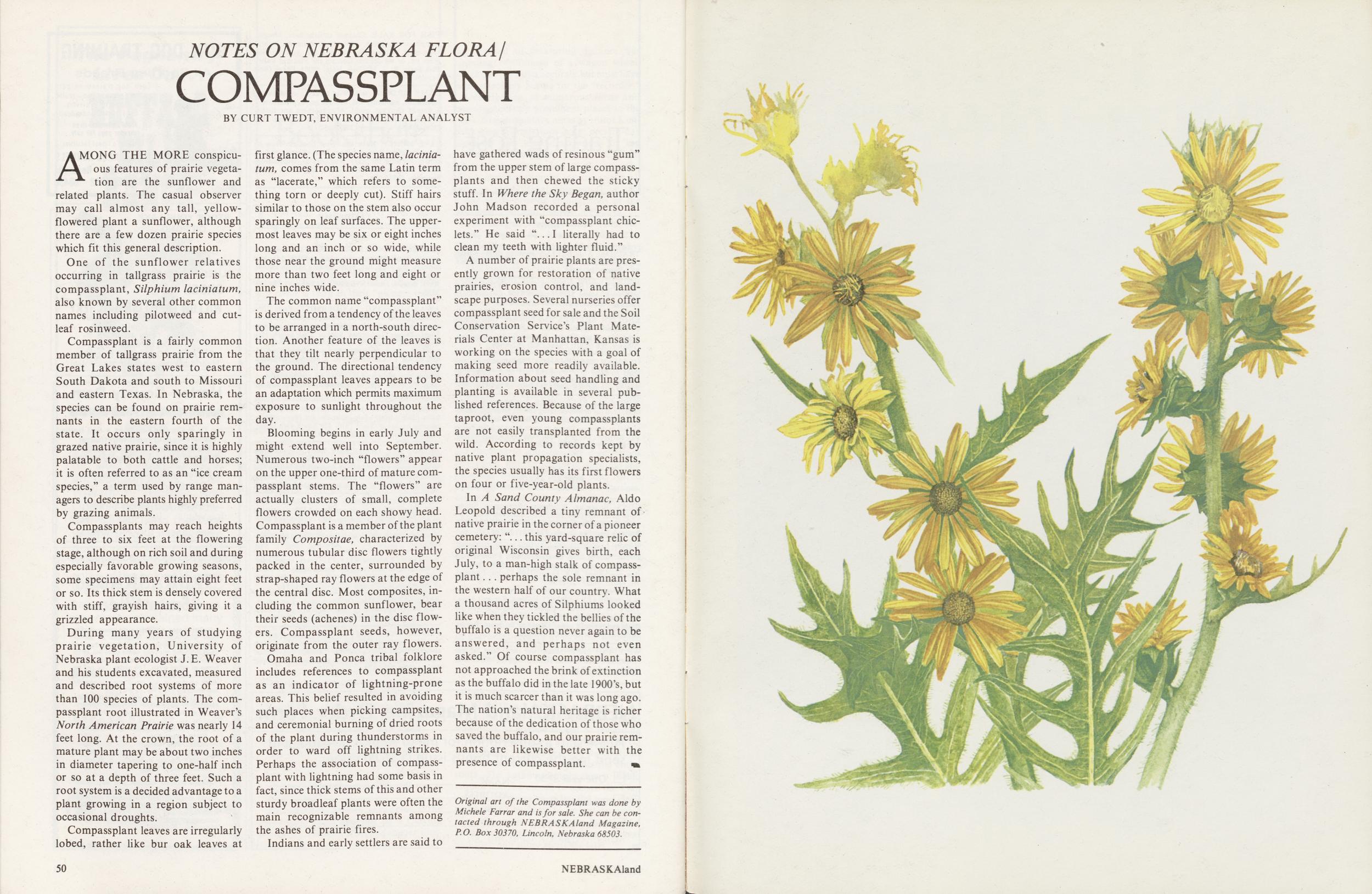
NOTES ON NEBRASKA FLORA / COMPASSPLANT
AMONG THE MORE conspicuous features of prairie vegetation are the sunflower and related plants. The casual observer may call almost any tall, yellow-flowered plant a sunflower, although there are a few dozen prairie species which fit this general description.
One of the sunflower relatives occurring in tallgrass prairie is the compassplant, Silphium laciniatum, also known by several other common names including pilotweed and cutleaf rosinweed.
Compassplant is a fairly common member of tallgrass prairie from the Great Lakes states west to eastern South Dakota and south to Missouri and eastern Texas. In Nebraska, the species can be found on prairie remnants in the eastern fourth of the state. It occurs only sparingly in grazed native prairie, since it is highly palatable to both cattle and horses; it is often referred to as an "ice cream species," a term used by range managers to describe plants highly preferred by grazing animals.
Compassplants may reach heights of three to six feet at the flowering stage, although on rich soil and during especially favorable growing seasons, some specimens may attain eight feet or so. Its thick stem is densely covered with stiff, grayish hairs, giving it a grizzled appearance. During many years of studying prairie vegetation, University of Nebraska plant ecologist J. E. Weaver and his students excavated, measured and described root systems of more than 100 species of plants. The compassplant root illustrated in Weaver's North American Prairie was nearly 14 feet long. At the crown, the root of a mature plant may be about two inches in diameter tapering to one-half inch or so at a depth of three feet. Such a root system is a decided advantage to a plant growing in a region subject to occasional droughts.
Compassplant leaves are irregularly lobed, rather like bur oak leaves at first glance. (The species name, laciniatum, comes from the same Latin term as "lacerate," which refers to something torn or deeply cut). Stiff hairs similar to those on the stem also occur sparingly on leaf surfaces. The uppermost leaves may be six or eight inches long and an inch or so wide, while those near the ground might measure more than two feet long and eight or nine inches wide.
The common name "compassplant" is derived from a tendency of the leaves to be arranged in a north-south direction. Another feature of the leaves is that they tilt nearly perpendicular to the ground. The directional tendency of compassplant leaves appears to be an adaptation which permits maximum exposure to sunlight throughout the day.
Blooming begins in early July and might extend well into September. Numerous two-inch "flowers" appear on the upper one-third of mature compassplant stems. The "flowers" are actually clusters of small, complete flowers crowded on each showy head. Compassplant is a member of the plant family Compositae, characterized by numerous tubular disc flowers tightly packed in the center, surrounded by strap-shaped ray flowers at the edge of the central disc. Most composites, including the common sunflower, bear their seeds (achenes) in the disc flowers. Compassplant seeds, however, originate from the outer ray flowers.
Omaha and Ponca tribal folklore includes references to compassplant as an indicator of lightning-prone areas. This belief resulted in avoiding such places when picking campsites, and ceremonial burning of dried roots of the plant during thunderstorms in order to ward off lightning strikes. Perhaps the association of compassplant with lightning had some basis in fact, since thick stems of this and other sturdy broadleaf plants were often the main recognizable remnants among the ashes of prairie fires.
Indians and early settlers are said to have gathered wads of resinous "gum" from the upper stem of large compassplants and then chewed the sticky stuff. In Where the Sky Began, author John Madson recorded a personal experiment with "compassplant chiclets." He said "I literally had to clean my teeth with lighter fluid."
A number of prairie plants are presently grown for restoration of native prairies, erosion control, and landscape purposes. Several nurseries offer compassplant seed for sale and the Soil Conservation Service's Plant Materials Center at Manhattan, Kansas is working on the species with a goal of making seed more readily available. Information about seed handling and planting is available in several published references. Because of the large taproot, even young compassplants are not easily transplanted from the wild. According to records kept by native plant propagation specialists, the species usually has its first flowers on four or five-year-old plants.
In A Sand County Almanac, Aldo Leopold described a tiny remnant of native prairie in the corner of a pioneer cemetery: " this yard-square relic of original Wisconsin gives birth, each July, to a man-high stalk of compassplant perhaps the sole remnant in the western half of our country. What a thousand acres of Silphiums looked like when they tickled the bellies of the buffalo is a question never again to be answered, and perhaps not even asked." Of course compassplant has not approached the brink of extinction as the buffalo did in the late 1900's, but it is much scarcer than it was long ago. The nation's natural heritage is richer because of the dedication of those who saved the buffalo, and our prairie remnants are likewise better with the presence of compassplant.
Original art of the Compassplant was done by Michele Farrar and is for sale. She can be contacted through NEBRASKAland Magazine, P.O. Box 30370, Lincoln, Nebraska 68503.
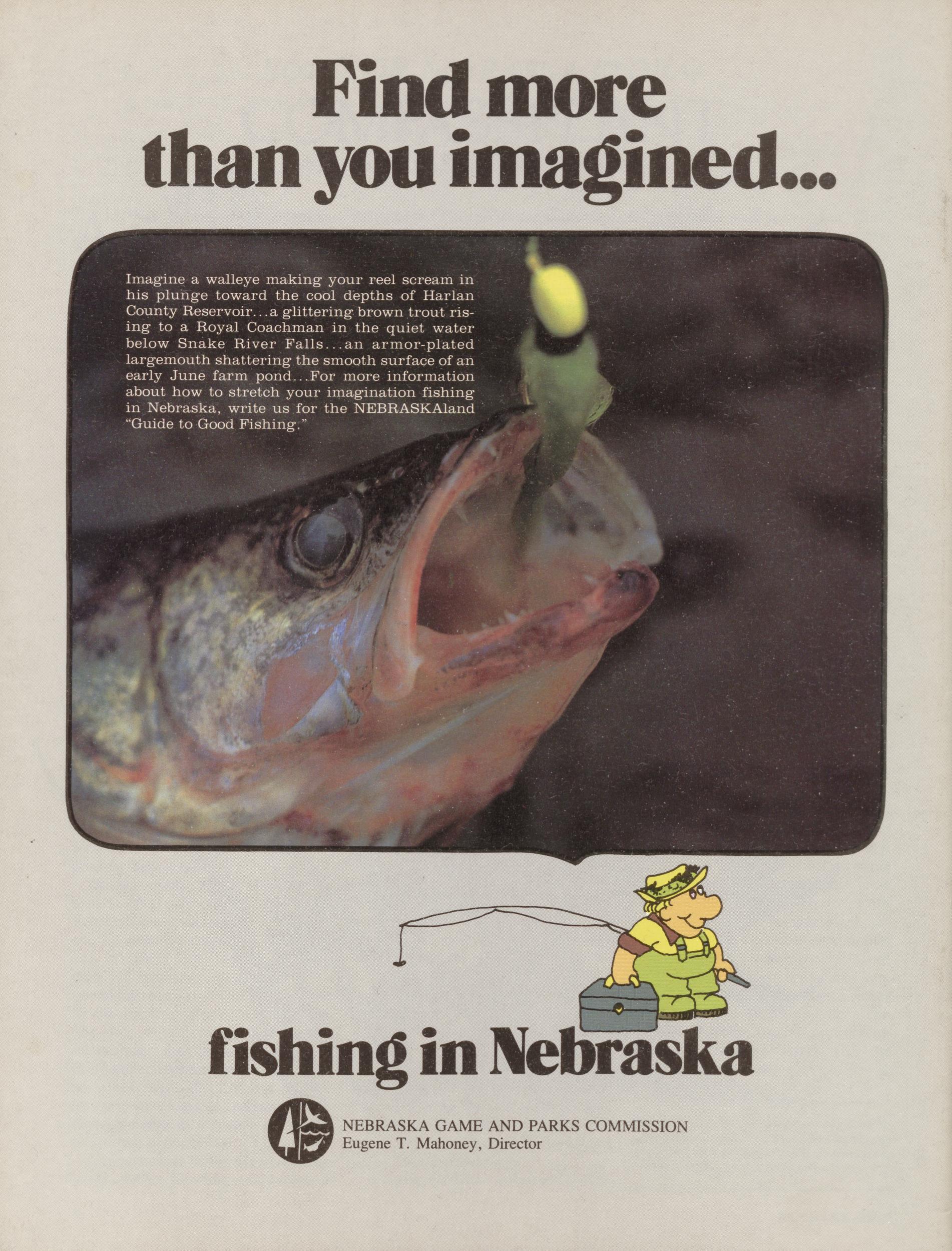
Position: 467 (22 views)