Volume 61, Issue 6, 1983

NEBRASKAland
July 1983 $1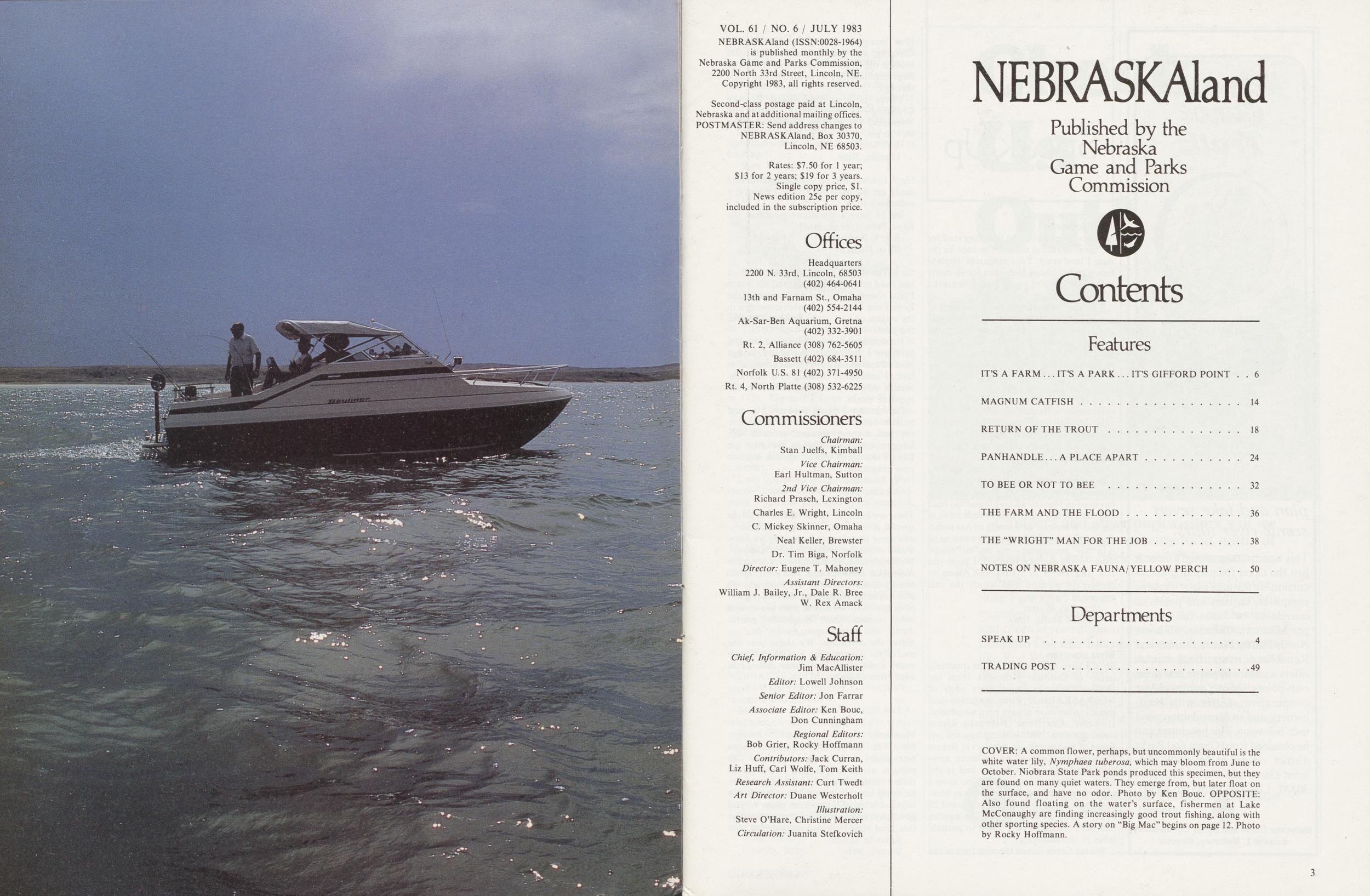
VOL. 61 / NO. 6 / JULY 1983 NEBRASKAland (ISSN:0028-1964) is published monthly by the Nebraska Game and Parks Commission, 2200 North 33rd Street, Lincoln, NE. Copyright 1983, all rights reserved.
Second-class postage paid at Lincoln, Nebraska and at additional mailing offices. POSTMASTER: Send address changes to NEBRASKAland, Box 30370, Lincoln, NE 68503.
Rates: $7.50 for 1 year; $13 for 2 years; $19 for 3 years. Single copy price, $1. News edition 25c per copy, included in the subscription price.
Offices Headquarters 2200 N. 33rd, Lincoln, 68503 (402) 464-0641 13th and Farnam St., Omaha (402) 554-2144 Ak-Sar-Ben Aquarium, Gretna (402) 332-3901 Rt. 2, Alliance (308) 762-5605 Bassett (402) 684-3511 Norfolk U.S. 81 (402) 371-4950 Rt. 4, North Platte (308) 532-6225
Commissioners Chairman: Stan Juelfs, Kimball Vice Chairman: Earl Hultman, Sutton 2nd Vice Chairman: Richard Prasch, Lexington Charles E. Wright, Lincoln C. Mickey Skinner, Omaha Neal Keller, Brewster Dr. Tim Biga, Norfolk Director: Eugene T. Mahoney Assistant Directors: William J. Bailey, Jr., Dale R. Bree W. Rex Amack
Staff Chief, Information & Education: Jim MacAllister Editor: Lowell Johnson Senior Editor: Jon Farrar Associate Editor: Ken Bouc, Don Cunningham Regional Editors: Bob Grier, Rocky Hoffmann Contributors: Jack Curran, Liz Huff, Carl Wolfe, Tom Keith Research Assistant: Curt Twedt Art Director: Duane Westerholt Illustration: Steve O'Hare, Christine Mercer Circulation: Juanita Stefkovich
NEBRASKAland Published by the Nebraska Game and Parks Commission
Contents
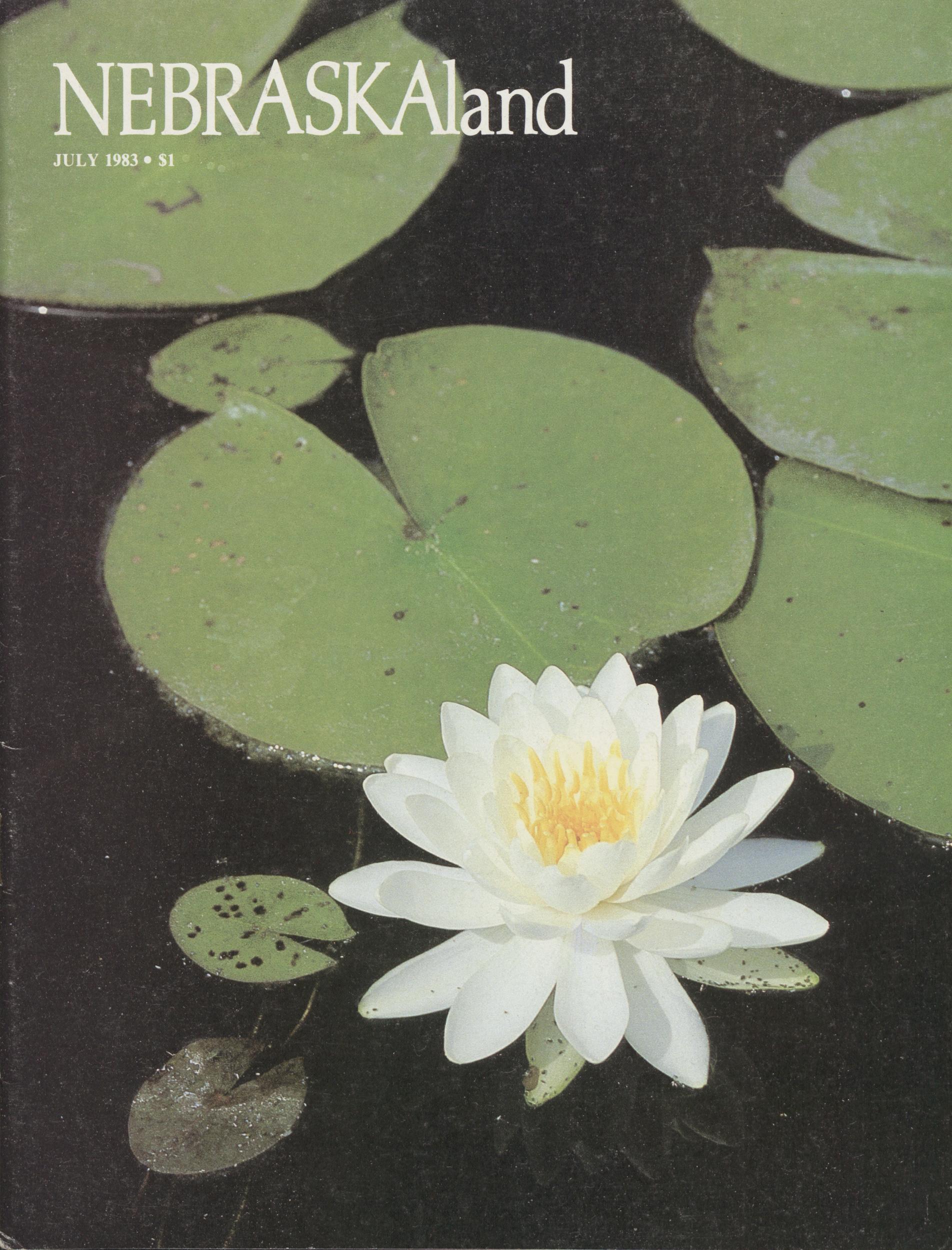
Features IT'S A FARM IT'S A PARK IT'S GIFFORD POINT 6 MAGNUM CATFISH 14 RETURN OF THE TROUT 18 PANHANDLE A PLACE APART 24 TO BEE OR NOT TO BEE 32 THE FARM AND THE FLOOD 36 THE "WRIGHT" MAN FOR THE JOB 38 NOTES ON NEBRASKA FAUNA/YELLOW PERCH 50 Departments SPEAK UP 4 TRADING POST 49COVER: A common flower, perhaps, but uncommonly beautiful is the white water lily, Nymphaea tuberosa, which may bloom from June to October. Niobrara State Park ponds produced this specimen, but they are found on many quiet waters. They emerge from, but later float on the surface, and have no odor. Photo by Ken Bouc. OPPOSITE: Also found floating on the water's surface, fishermen at Lake McConaughy are finding increasingly good trout fishing, along with other sporting species. A story on "Big Mac" begins on page 12. Photo by Rocky Hoffmann.
Nebraska Canoe Trails
Nebraska Game and Parks Commission Eugene T. Mahoney, Director A brochure to help plan and take seven scenic river tours. This handy "take-along" folder is just the ticket for planning an excursion. It features maps showing campsites, barriers and points of interest to be found on the upper Missouri, Calamus, Elkhorn, North Platte, Platte, Dismal and Republican rivers. Each stretch offers a choice of put-in and takeout points. Most campsites are cooperative efforts with land-owners, and so depend upon good user behavior. The brochures can be obtained from Game and Parks district offices or by mail, free, from Game and Parks, P.O. Box 30370, Lincoln, Nebraska 68503. Nebraska Game and Parks Commission Eugene T. Mahoney, DirectorSpeak Up
A Maskellite?Sir / I commend you and the entire staff for the most beautiful tribute I've seen to the state I love most. Your magazine displays how I've felt about Nebraska for so many years, and I believe you promote Nebraska as it should be.
You may be interested to share a story of my hometown, Masked, Nebraska. It was one of the many "thriving" railroad towns in the early 1900's, and many people settled there to work for the railroad and the many businesses which sprang up. Many disasters took their toll in the form of fire, tornadoes and railroad closing. After many years of "fighting back," the people in that community were ecstatic to learn that in 1980, Masked was Nebraska's fastest growing community (1980 census shows population 76). The town's oldest citizen is Annie Bishop, who is 98.
A story you might consider concerns Nebraska's county roads, in particular in Dixon County. My Dad, Hugh Bostwick, has lived in Masked all his life and has built and maintained the county's roads most of his life. Whenever he's lonely or has something on his mind, the place he wants to be is in "his" maintainer—out on "his" roads. These roads are beautiful,and I hope you can find room in NEBRASKAland to capture in pictures and words the real essence of Nebraska.
Mrs. Ray Waters Council Bluffs, Iowa River observersSir / I have many copies of the quarterly issues of Outdoor Nebraska from the 1950's 60's, and almost every copy of NEBRASKALand! Your magazine and special issues have always been wonderful. However, Ken Bouc (Nebraska Rivers issue, Jan-Feb. 1983) is being frowned on! Some of my friends and relatives at Beaver Crossing are "shook" as he never mentioned the artesian wells they had in the whole area for many years. Yes, even I remember when the Blue River was blue, and when a pipe driven into the ground 20 or 30 feet spurted up water! The aquifer had been traced in later years to pothole lakes in the Sandhills.
Beaver Creek joined the west fork of the Blue three miles west of present-day Beaver Crossing, and that is where the pioneers crossed the river. The settlement moved to its present location when the railroad came through.
There is a saying about Beaver Crossing—Is there a beaver crossing Nebraska? Yes, but that beaver has a long way to go!
J. E. Miller Lincoln, Nebr.Sir / I subscribed to your magazine so I could get the issue on Rivers. I count it a collector's item.
But, I have a question—why was the Keya Paha river omitted?
Roy I. Anderson Blair, Nebr.Sir / The Rivers edition was beautiful—I had lived near the Niobrara, and the North Platte rivers. But as a child I lived near the Keya Paha River. I remember crossing it in the wagon on ice also fording it later in the year.
I remember when the ice took out the bridges. I remember the plank bridge which Papa would drive the car across after that. I remember crossing in a box suspended on pulleys attached to trees on the opposite banks.
I remember picking chokecherries and buffalo berries near it. And, I remember the fish dinners obtained from it. So, imagine my sadness when the dear old Keya Paha didn't merit even one word in your magazine.
V. Ruchman Albany, Ore.These are but a few of the comments on the special Rivers issue of January-February, and serve to point up something we knew would occur, but which couldn 't be helped. We simply couldn't mention every stream in Nebraska, although that was our original intent. Space and time overtook us. We also neglected to mention the Wood River in central Nebraska, and there are several other streams which we couldn't get to. Partly this was human frailty, and we regret the omissions. We thank you one and all for your interest, and admit that an entire issue could have been devoted to each river. (Editor)
WonderfulSir / This is a perfectly wonderful magazine, and I enjoy it to the utmost. The pictures are beautiful, and I save all of them. I also let my friends enjoy them. Keep up the good work. I realize that it requires a lot of work from many of you good guys to publish a good magazine like this. God bless each and every one of you.
Amanda Sundell Wisner, Nebr. "You're great"Sir / Just a short note to let all your staff know how great NEBRASKAland Magazine is. Being very interested in outdoor photography myself, I especially look forward every month to the fantastic pictures throughout the magazine. Every month I learn something new about Nebraska. I have enclosed a photo I took this winter eight miles west of Albion, while pheasant hunting.
Rick Schack Albion, Nebr.Sir / I recently heard of an organization in Nebraska that consists of people born in sod houses, and am interested. I was born in a sod house one-half mile north of Merna, Custer County, in 1904 to Mr. and Mrs. Ellis W. Given, who moved to Illinois in 1926. The last I knew of the farm, it belonged to a Miss Marie Krenz of Merna.
My parents moved out of the soddie in 1907 after building a frame house. Not having been back to Merna for several years, I do not know what the place is like anymore.
I am interested in learning more about the sod house organization, and am wondering if you can give me any information.
Mrs. Ardette Knox Morrison, Ill.Sir / My name is Mike Ersch. I am a NEBRASKAland Magazine reader. I'm 13 years old and I like hunting, fishing, hiking, raccoons and snakes.
My father subscribed to NEBRASKAland about seven years ago, and I've always enjoyed reading it. I've found even very old ones can seem just brand new! I really like the article on Nebraska's nonpoisonous snakes in the June 1978 issue.
I hope NEBRASKAland continues with great articles and special issues. I think we have a truly excellent Game and Parks Commission and I hope it continues and even gets better.
Mike Ersch Lincoln, Nebr.Check Us Out!
Campers and other park visitors will see some rather nice improvements at many of Nebraska's state park areas this season thanks in part to development funds raised by the State Park Entry Permit. There are new and/or greatly improved camping areas, solar showers, picnic areas, and more at recreation areas all across the state. From Branched Oak near Lincoln to the southwest reservoirs like Red Willow and Medicine Creek, campers should like what they will find. There is a completely new, ultra-fine area at Cedar Vue at Lake McConaughy. New trailer dump stations have been installed at numerous areas, and all facilities have been spruced up for the new season. So, all you campers and other park-goers, come on in and check us out. NEBRASKA GAME AND PARKS COMMISSION Eugene T. Mahoney, Director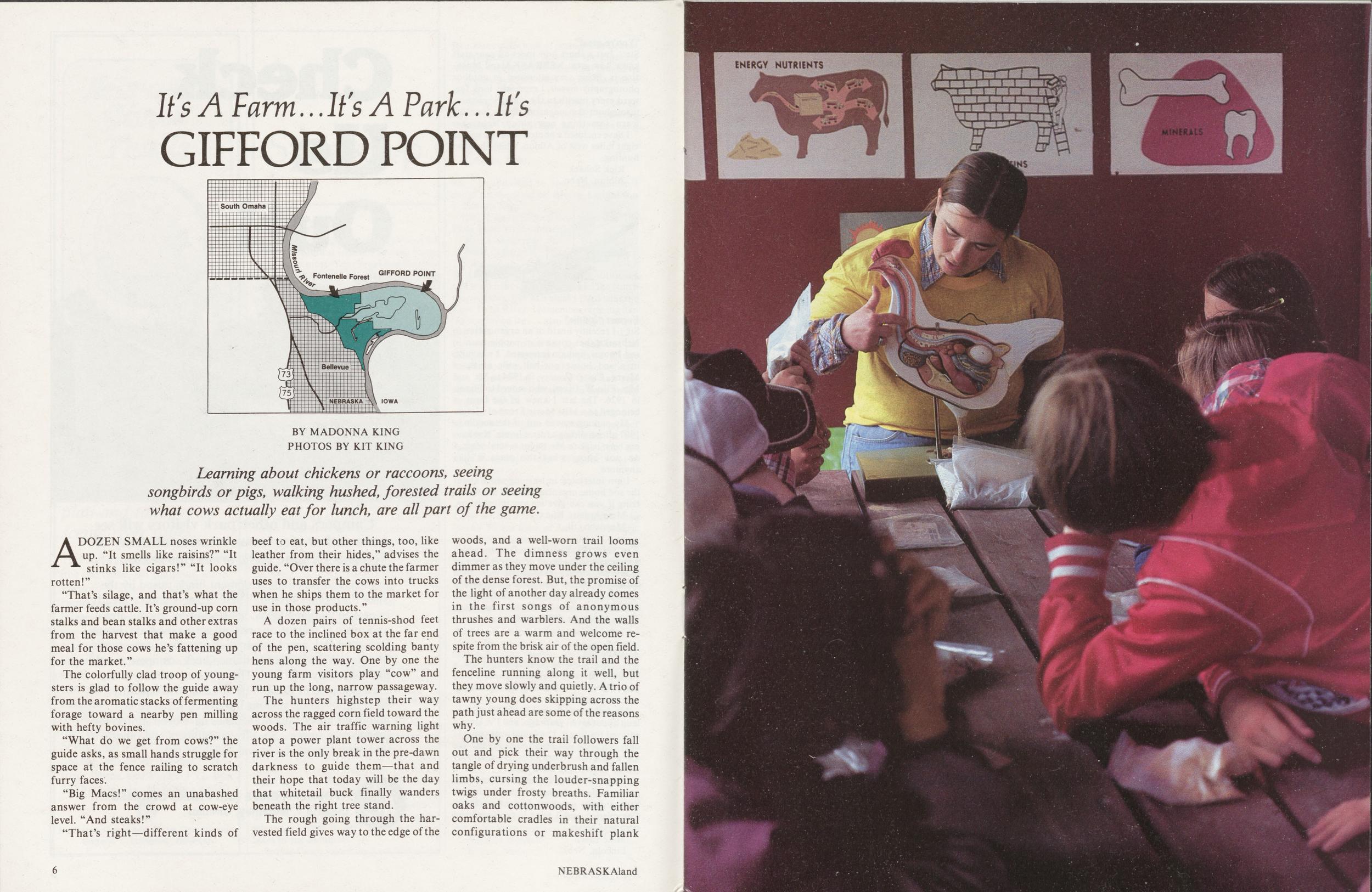
It's A Farm It's A Park It's GIFFORD POINT
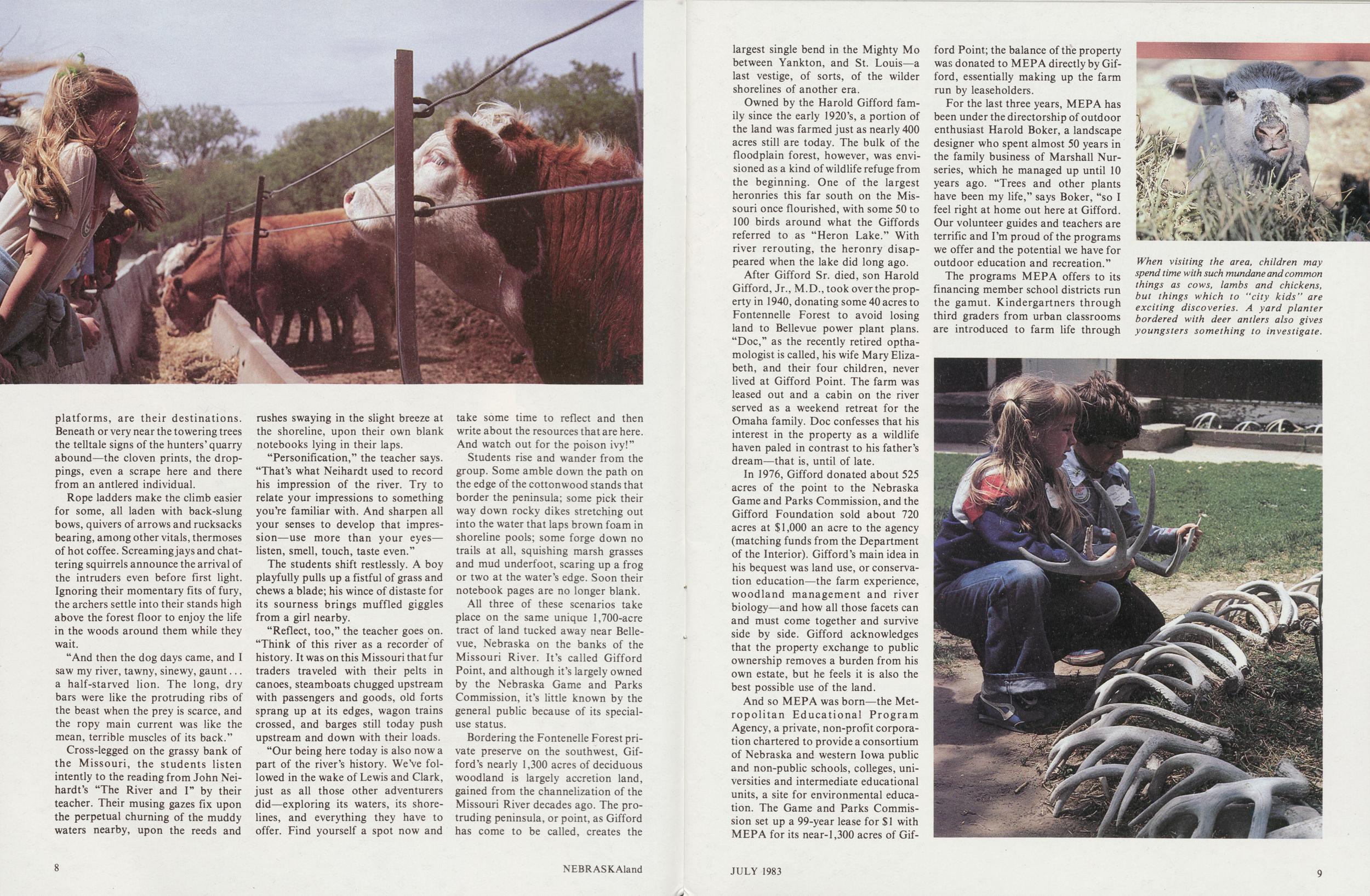
Learning about chickens or raccoons, seeing songbirds or pigs, walking hushed, forested trails or seeing what cows actually eat for lunch, are all part of the game.A DOZEN SMALL noses wrinkle up. "It smells like raisins?" "It stinks like cigars!" "It looks rotten!"
"That's silage, and that's what the farmer feeds cattle. It's ground-up corn stalks and bean stalks and other extras from the harvest that make a good meal for those cows he's fattening up for the market."
The colorfully clad troop of youngsters is glad to follow the guide away from the aromatic stacks of fermenting forage toward a nearby pen milling with hefty bovines.
"What do we get from cows?" the guide asks, as small hands struggle for space at the fence railing to scratch furry faces.
"Big Macs!" comes an unabashed answer from the crowd at cow-eye level. "And steaks!"
"That's right—different kinds of beef to eat, but other things, too, like leather from their hides," advises the guide. "Over there is a chute the farmer uses to transfer the cows into trucks when he ships them to the market for use in those products."
A dozen pairs of tennis-shod feet race to the inclined box at the far end of the pen, scattering scolding banty hens along the way. One by one the young farm visitors play "cow" and run up the long, narrow passageway.
The hunters highstep their way across the ragged corn field toward the woods. The air traffic warning light atop a power plant tower across the river is the only break in the pre-dawn darkness to guide them—that and their hope that today will be the day that whitetail buck finally wanders beneath the right tree stand.
The rough going through the harvested field gives way to the edge of the woods, and a well-worn trail looms ahead. The dimness grows even dimmer as they move under the ceiling of the dense forest. But, the promise of the light of another day already comes in the first songs of anonymous thrushes and warblers. And the walls of trees are a warm and welcome respite from the brisk air of the open field.
The hunters know the trail and the fenceline running along it well, but they move slowly and quietly. A trio of tawny young does skipping across the path just ahead are some of the reasons why.
One by one the trail followers fall out and pick their way through the tangle of drying underbrush and fallen limbs, cursing the louder-snapping twigs under frosty breaths. Familiar oaks and cottonwoods, with either comfortable cradles in their natural configurations or makeshift plank
platforms, are their destinations. Beneath or very near the towering trees the telltale signs of the hunters'quarry abound—the cloven prints, the droppings, even a scrape here and there from an antlered individual.
Rope ladders make the climb easier for some, all laden with back-slung bows, quivers of arrows and rucksacks bearing, among other vitals, thermoses of hot coffee. Screaming jays and chattering squirrels announce the arrival of the intruders even before first light. Ignoring their momentary fits of fury, the archers settle into their stands high above the forest floor to enjoy the life in the woods around them while they wait.
"And then the dog days came, and I saw my river, tawny, sinewy, gaunt a half-starved lion. The long, dry bars were like the protruding ribs of the beast when the prey is scarce, and the ropy main current was like the mean, terrible muscles of its back."
Cross-legged on the grassy bank of the Missouri, the students listen intently to the reading from John Neihardt's "The River and I" by their teacher. Their musing gazes fix upon the perpetual churning of the muddy waters nearby, upon the reeds and rushes swaying in the slight breeze at the shoreline, upon their own blank notebooks lying in their laps.
"Personification," the teacher says. "That's what Neihardt used to record his impression of the river. Try to relate your impressions to something you're familiar with. And sharpen all your senses to develop that impression—use more than your eyes—listen, smell, touch, taste even."
The students shift restlessly. A boy playfully pulls up a fistful of grass and chews a blade; his wince of distaste for its sourness brings muffled giggles from a girl nearby.
"Reflect, too," the teacher goes on. "Think of this river as a recorder of history. It was on this Missouri that fur traders traveled with their pelts in canoes, steamboats chugged upstream with passengers and goods, old forts sprang up at its edges, wagon trains crossed, and barges still today push upstream and down with their loads.
"Our being here today is also now a part of the river's history. We've followed in the wake of Lewis and Clark, just as all those other adventurers did—exploring its waters, its shorelines, and everything they have to offer. Find yourself a spot now and take some time to reflect and then write about the resources that are here. And watch out for the poison ivy!"
Students rise and wander from the group. Some amble down the path on the edge of the cottonwood stands that border the peninsula; some pick their way down rocky dikes stretching out into the water that laps brown foam in shoreline pools; some forge down no trails at all, squishing marsh grasses and mud underfoot, scaring up a frog or two at the water's edge. Soon their notebook pages are no longer blank.
All three of these scenarios take place on the same unique 1,700-acre tract of land tucked away near Bellevue, Nebraska on the banks of the Missouri River. It's called Gifford Point, and although it's largely owned by the Nebraska Game and Parks Commission, it's little known by the general public because of its special-use status.
Bordering the Fontenelle Forest private preserve on the southwest, Gifford's nearly 1,300 acres of deciduous woodland is largely accretion land, gained from the channelization of the Missouri River decades ago. The protruding peninsula, or point, as Gifford has come to be called, creates the largest single bend in the Mighty Mo between Yankton, and St. Louis—a last vestige, of sorts, of the wilder shorelines of another era.
Owned by the Harold Gifford family since the early 1920's, a portion of the land was farmed just as nearly 400 acres still are today. The bulk of the floodplain forest, however, was envisioned as a kind of wildlife refuge from the beginning. One of the largest heronries this far south on the Missouri once flourished, with some 50 to 100 birds around what the Giffords referred to as "Heron Lake." With river rerouting, the heronry disappeared when the lake did long ago.
After Gifford Sr. died, son Harold Gifford, Jr., M.D., took over the property in 1940, donating some 40 acres to Fontennelle Forest to avoid losing land to Bellevue power plant plans. "Doc," as the recently retired opthamologist is called, his wife Mary Elizabeth, and their four children, never lived at Gifford Point. The farm was leased out and a cabin on the river served as a weekend retreat for the Omaha family. Doc confesses that his interest in the property as a wildlife haven paled in contrast to his father's dream—that is, until of late.
In 1976, Gifford donated about 525 acres of the point to the Nebraska Game and Parks Commission, and the Gifford Foundation sold about 720 acres at $1,000 an acre to the agency (matching funds from the Department of the Interior). Gifford's main idea in his bequest was land use, or conservation education—the farm experience, woodland management and river biology—and how all those facets can and must come together and survive side by side. Gifford acknowledges that the property exchange to public ownership removes a burden from his own estate, but he feels it is also the best possible use of the land.
And so MEPA was born—the Metropolitan Educational Program Agency, a private, non-profit corporation chartered to provide a consortium of Nebraska and western Iowa public and non-public schools, colleges, universities and intermediate educational units, a site for environmental education. The Game and Parks Commission set up a 99-year lease for $1 with MEPA for its near-1,300 acres of Gifford Point; the balance of the property was donated to MEPA directly by Gifford, essentially making up the farm run by leaseholders.
For the last three years, MEPA has been under the directorship of outdoor enthusiast Harold Boker, a landscape designer who spent almost 50 years in the family business of Marshall Nurseries, which he managed up until 10 years ago. "Trees and other plants have been my life," says Boker, "so I feel right at home out here at Gifford. Our volunteer guides and teachers are terrific and I'm proud of the programs we offer and the potential we have for outdoor education and recreation."
The programs MEPA offers to its financing member school districts run the gamut. Kindergartners through third graders from urban classrooms are introduced to farm life through
When visiting the area, children may spend time with such mundane and common things as cows, lambs and chickens, but things which to "city kids" are exciting discoveries. A yard planter bordered with deer antlers also gives youngsters something to investigate.
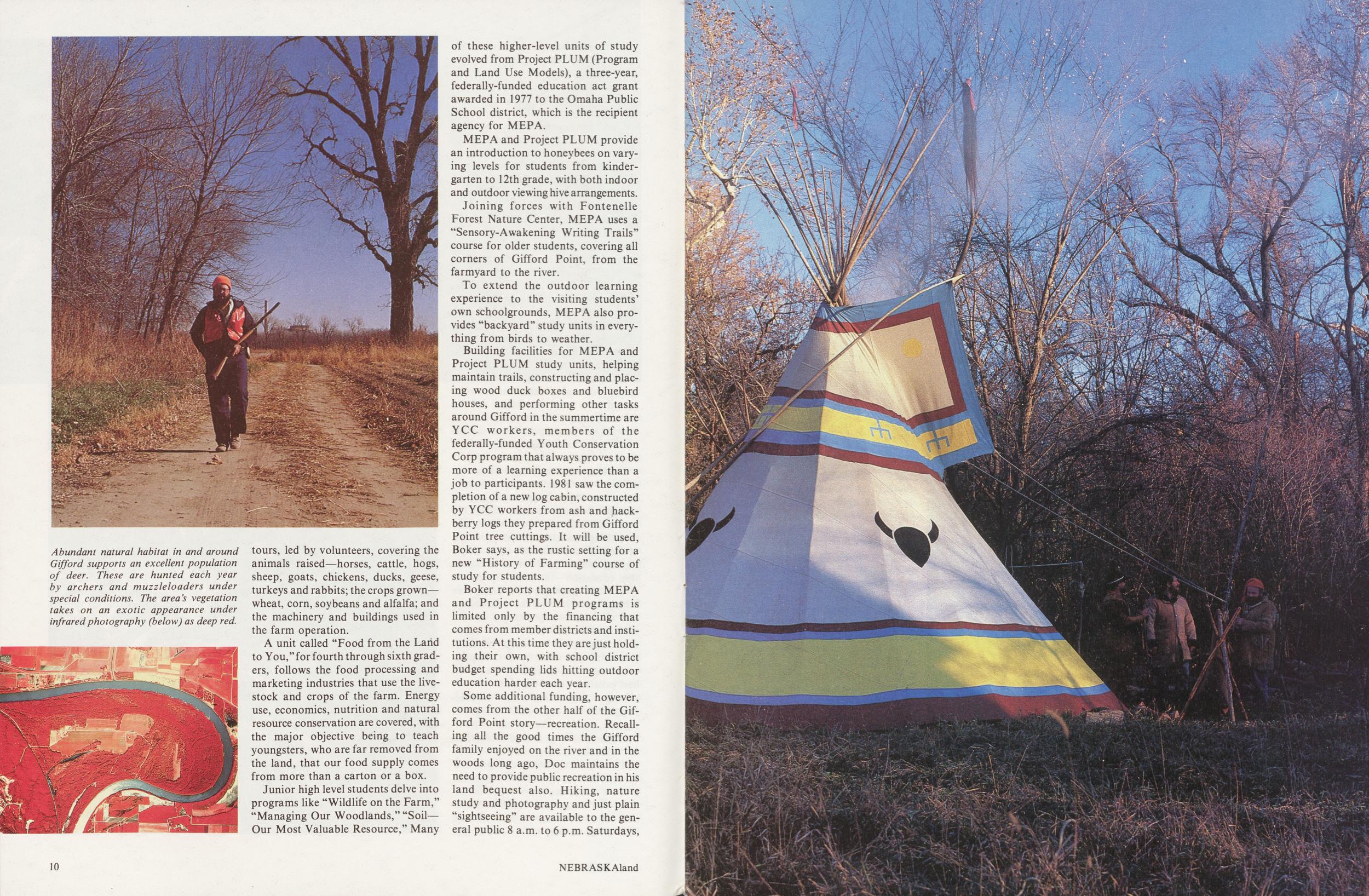
Abundant natural habitat in and around Gifford supports an excellent population of deer. These are hunted each year by archers and muzzleloaders under special conditions. The area's vegetation takes on an exotic appearance under infrared photography (below) as deep red.
tours, led by volunteers, covering the animals raised—horses, cattle, hogs, sheep, goats, chickens, ducks, geese, turkeys and rabbits; the crops grown—wheat, corn, soybeans and alfalfa; and the machinery and buildings used in the farm operation.
A unit called "Food from the Land to You,"for fourth through sixth graders, follows the food processing and marketing industries that use the livestock and crops of the farm. Energy use, economics, nutrition and natural resource conservation are covered, with the major objective being to teach youngsters, who are far removed from the land, that our food supply comes from more than a carton or a box.
Junior high level students delve into programs like "Wildlife on the Farm," "Managing Our Woodlands," "Soil —Our Most Valuable Resource," Many of these higher-level units of study evolved from Project PLUM (Program and Land Use Models), a three-year, federally-funded education act grant awarded in 1977 to the Omaha Public School district, which is the recipient agency for MEPA.
MEPA and Project PLUM provide an introduction to honeybees on varying levels for students from kindergarten to 12th grade, with both indoor and outdoor viewing hive arrangements.
Joining forces with Fontenelle Forest Nature Center, MEPA uses a "Sensory-Awakening Writing Trails" course for older students, covering all corners of Gifford Point, from the farmyard to the river.
To extend the outdoor learning experience to the visiting students' own schoolgrounds, MEPA also provides "backyard" study units in everything from birds to weather.
Building facilities for MEPA and Project PLUM study units, helping maintain trails, constructing and placing wood duck boxes and bluebird houses, and performing other tasks around Gifford in the summertime are YCC workers, members of the federally-funded Youth Conservation Corp program that always proves to be more of a learning experience than a job to participants. 1981 saw the completion of a new log cabin, constructed by YCC workers from ash and hackberry logs they prepared from Gifford Point tree cuttings. It will be used, Boker says, as the rustic setting for a new "History of Farming" course of study for students.
Boker reports that creating MEPA and Project PLUM programs is limited only by the financing that comes from member districts and institutions. At this time they are just holding their own, with school district budget spending lids hitting outdoor education harder each year.
Some additional funding, however, comes from the other half of the Gifford Point story—recreation. Recalling all the good times the Gifford family enjoyed on the river and in the woods long ago, Doc maintains the need to provide public recreation in his land bequest also. Hiking, nature study and photography and just plain "sightseeing" are available to the general public 8 a.m. to 6 p.m. Saturdays,
Sundays and holidays for a small fee (which is paid in advance either through the mail or in person at the MEPA office at Gifford during the week.) Public access is confined to the woodlands, as the farm is restricted to MEPA school programs only. The woodland trails are for foot traffic only, and no pets, motorized vehicles or horseback riding is allowed.
The Omaha Walking Club, which has held a lease with the Gifford family (and now with MEPA) since the early '20's, is headquartered in a cabin on the northwest edge of the woods. Members use the trails for group outings. They have always been "the best of neighbors," according to Doc, who notes that they always adhere to a familiar motto they erected on a sign in the woods: "Take nothing but pictures, leave nothing but footprints."
With a lush farm in the center of Gifford's young woodlands, and neighboring Fontenelle Forest being short on forage with its older, unthinned tree population, whitetail deer thrive on the point. They thrive, in fact, to the tune of an estimated 300 to 400 head. The hunting that is necessary to keep the herd at a healthy, manageable size, and within the economic tolerance of the farming operation, is yet another source of revenue for MEPA.
Hunters are charged a $6 walk-in trespass fee or a $26 drive-in trespass fee for the season. Half of the additional $20 for drive-in hunters goes to MEPA, and half goes to help cover the crop depredation losses; the $6 charge makes up MEPA's trail and road maintenance fund.
Only archery deer hunting is regularly allowed at Gifford, since high-powered firearms are considered too risky in an area that is landlocked by housing developments and a non-hunting nature preserve. A 100-permit muzzleloading season was allowed in 1980, however, to help substantially reduce the growing herd size, since bow-and-arrow success rates are generally not too high, and the old-time muzzleloading guns have a much shorter, safer range of fire. Game and Parks Commission Wildlife Division chief Ken Johnson says future muzzle-loading seasons are possible from time to time to thin out the herd, but "greater amounts of recreation come with archery deer hunting at Gifford and we'll continue to give preference to archery over a regular firearm season of any kind."
Boker reports that about 416 archers tried their luck at Gifford during the 1980 season, with an average of about 35 hunters out in the woods each day. Opening weekend saw some 120 archers out, so he advises hunting during the week and later in the season. Boker also notes that success rates at Gifford, based on check-ins at the local farm, are actually almost 10 percentage points higher than the state average.
Archery success has been good each year there, totaling 25.5 percent in 1981 and going to over 28 percent in 1982. Muzzleloaders, however, experienced a drop somewhat, from over 61 percent in 1980 to 44 percent in 1982. The 1982 season was held in order to hold deer populations down, but fewer permits were issued—dropping from 140 in 1980 to 91 in 1982—and a 1983
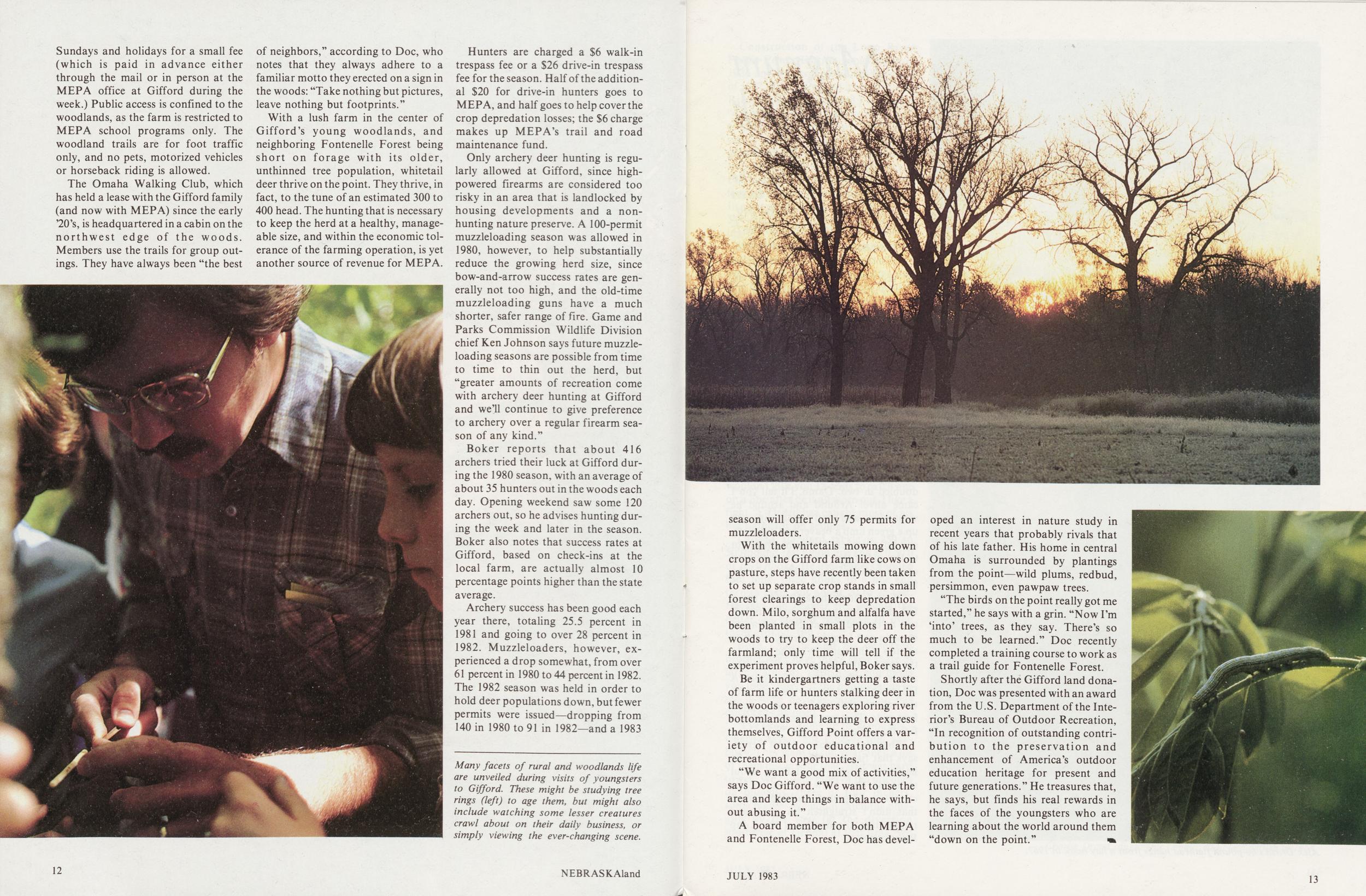
Many facets of rural and woodlands life are unveiled during visits of youngsters to Gifford. These might be studying tree rings (left) to age them, but might also include watching some lesser creatures crawl about on their daily business, or simply viewing the ever-changing scene.
season will offer only 75 permits for muzzleloaders.
With the whitetails mowing down crops on the Gifford farm like cows on pasture, steps have recently been taken to set up separate crop stands in small forest clearings to keep depredation down. Milo, sorghum and alfalfa have been planted in small plots in the woods to try to keep the deer off the farmland; only time will tell if the experiment proves helpful, Boker says.
Be it kindergartners getting a taste of farm life or hunters stalking deer in the woods or teenagers exploring river bottomlands and learning to express themselves, Gifford Point offers a variety of outdoor educational and recreational opportunities.
"We want a good mix of activities," says Doc Gifford. "We want to use the area and keep things in balance without abusing it."
A board member for both MEPA and Fontenelle Forest, Doc has developed an interest in nature study in recent years that probably rivals that of his late father. His home in central Omaha is surrounded by plantings from the point—wild plums, redbud, persimmon, even pawpaw trees.
"The birds on the point really got me started," he says with a grin. "Now I'm 'into' trees, as they say. There's so much to be learned." Doc recently completed a training course to work as a trail guide for Fontenelle Forest.
Shortly after the Gifford land donation, Doc was presented with an award from the U.S. Department of the Interior's Bureau of Outdoor Recreation, "In recognition of outstanding contribution to the preservation and enhancement of America's outdoor education heritage for present and future generations." He treasures that, he says, but finds his real rewards in the faces of the youngsters who are learning about the world around them "down on the point."
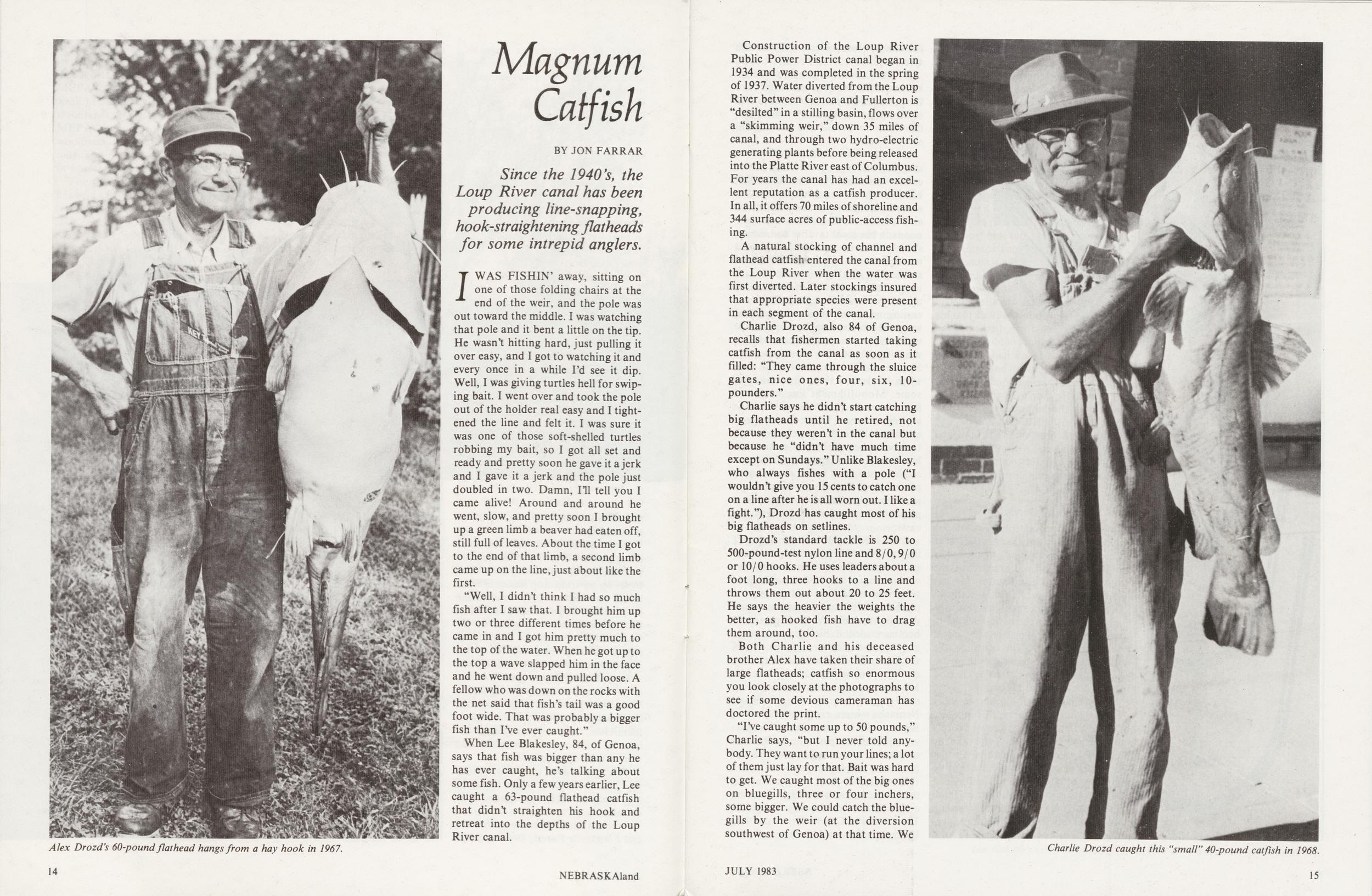
Alex Drozd's 60-pound flat head hangs from a hay hook in 1967.
Magnum Catfish
Since the 19409s, the Loup River canal has been producing line-snapping, hook-straightening flat heads for some intrepid anglers.
I WAS FISHIN' away, sitting on one of those folding chairs at the end of the weir, and the pole was out toward the middle. I was watching that pole and it bent a little on the tip. He wasn't hitting hard, just pulling it over easy, and I got to watching it and every once in a while I'd see it dip. Well, I was giving turtles hell for swiping bait. I went over and took the pole out of the holder real easy and I tightened the line and felt it. I was sure it was one of those soft-shelled turtles robbing my bait, so I got all set and ready and pretty soon he gave it a jerk and I gave it a jerk and the pole just doubled in two. Damn, I'll tell you I came alive! Around and around he went, slow, and pretty soon I brought up a green limb a beaver had eaten off, still full of leaves. About the time I got to the end of that limb, a second limb came up on the line, just about like the first.
"Well, I didn't think I had so much fish after I saw that. I brought him up two or three different times before he came in and I got him pretty much to the top of the water. When he got up to the top a wave slapped him in the face and he went down and pulled loose. A fellow who was down on the rocks with the net said that fish's tail was a good foot wide. That was probably a bigger fish than I've ever caught."
When Lee Blakesley, 84, of Genoa, says that fish was bigger than any he has ever caught, he's talking about some fish. Only a few years earlier, Lee caught a 63-pound flathead catfish that didn't straighten his hook and retreat into the depths of the Loup River canal.
Construction of the Loup River Public Power District canal began in 1934 and was completed in the spring of 1937. Water diverted from the Loup River between Genoa and Fullerton is "desilted" in a stilling basin, flows over a "skimming weir," down 35 miles of canal, and through two hydro-electric generating plants before being released into the Platte River east of Columbus. For years the canal has had an excellent reputation as a catfish producer. In all, it offers 70 miles of shoreline and 344 surface acres of public-access fishing.
A natural stocking of channel and flathead catfish entered the canal from the Loup River when the water was first diverted. Later stockings insured that appropriate species were present in each segment of the canal.
Charlie Drozd, also 84 of Genoa, recalls that fishermen started taking catfish from the canal as soon as it filled: "They came through the sluice gates, nice ones, four, six, 10-pounders."
Charlie says he didn't start catching big flatheads until he retired, not because they weren't in the canal but because he "didn't have much time except on Sundays." Unlike Blakesley, who always fishes with a pole ("I wouldn't give you 15 cents to catch one on a line after he is all worn out. I like a fight."), Drozd has caught most of his big flatheads on set lines.
Drozd's standard tackle is 250 to 500-pound-test nylon line and 8/0,9/0 or 10/0 hooks. He uses leaders about a foot long, three hooks to a line and throws them out about 20 to 25 feet. He says the heavier the weights the better, as hooked fish have to drag them around, too.
Both Charlie and his deceased brother Alex have taken their share of large flatheads; catfish so enormous you look closely at the photographs to see if some devious cameraman has doctored the print.
"I've caught some up to 50 pounds," Charlie says, "but I never told anybody. They want to run your lines; a lot of them just lay for that. Bait was hard to get. We caught most of the big ones on bluegills, three or four inchers, some bigger. We could catch the blue-gills by the weir (at the diversion southwest of Genoa) at that time. We
Charlie Drozd caught this "small" 40-pound catfish in 1968.
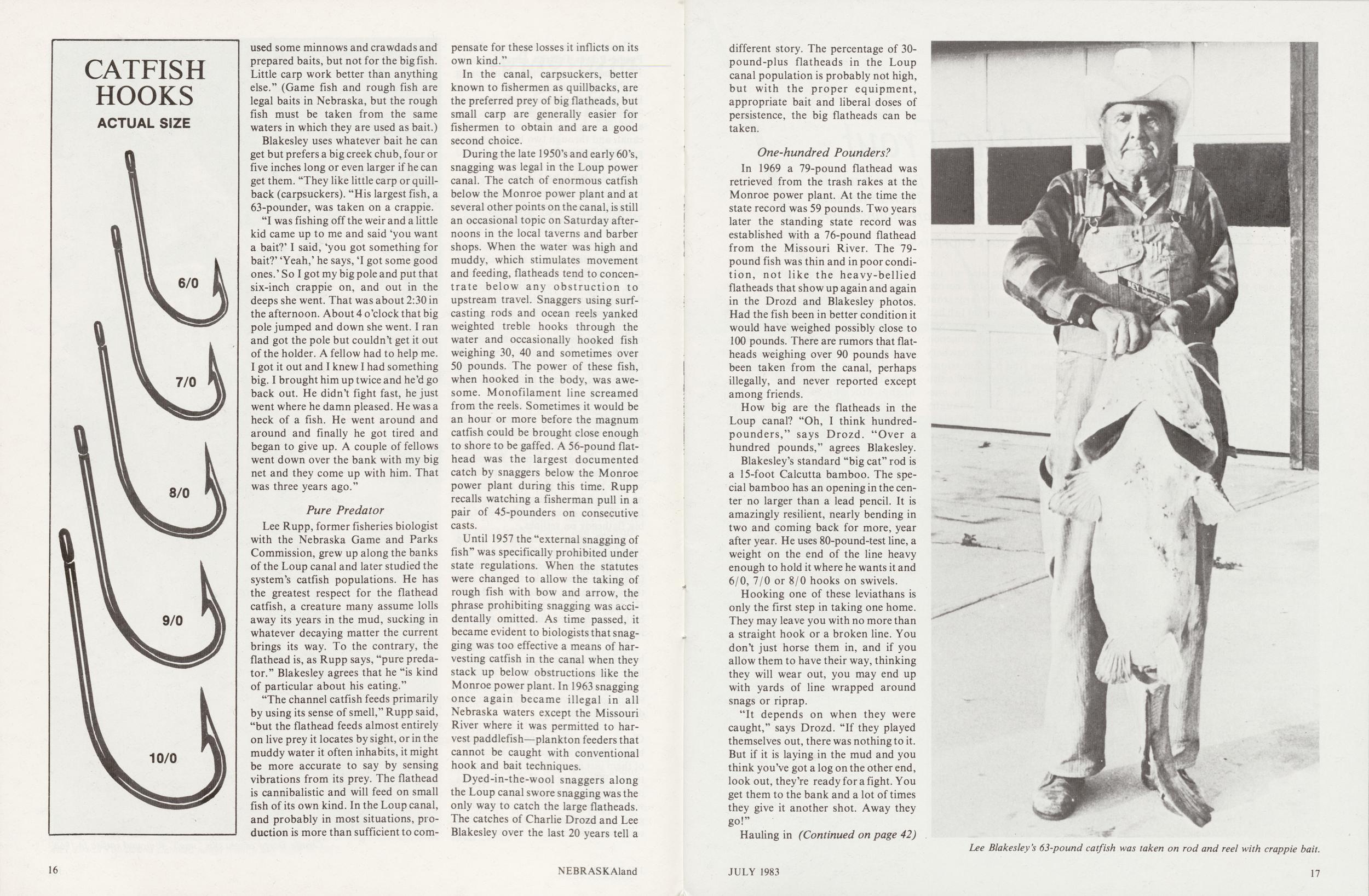
CATFISH HOOKS ACTUAL SIZE
used some minnows and crawdads and prepared baits, but not for the big fish. Little carp work better than anything else." (Game fish and rough fish are legal baits in Nebraska, but the rough fish must be taken from the same waters in which they are used as bait.)
Blakesley uses whatever bait he can get but prefers a big creek chub, four or five inches long or even larger if he can get them. "They like little carp or quillback (carpsuckers). "His largest fish, a 63-pounder, was taken on a crappie.
"I was fishing off the weir and a little kid came up to me and said 'you want a bait?' I said, 'you got something for bait?' 'Yeah,' he says, T got some good ones.' So I got my big pole and put that six-inch crappie on, and out in the deeps she went. That was about 2:30 in the afternoon. About 4 o'clock that big pole jumped and down she went. I ran and got the pole but couldn't get it out of the holder. A fellow had to help me. I got it out and I knew I had something big. I brought him up twice and he'd go back out. He didn't fight fast, he just went where he damn pleased. He was a heck of a fish. He went around and around and finally he got tired and began to give up. A couple of fellows went down over the bank with my big net and they come up with him. That was three years ago."
Pure PredatorLee Rupp, former fisheries biologist with the Nebraska Game and Parks Commission, grew up along the banks of the Loup canal and later studied the system's catfish populations. He has the greatest respect for the flathead catfish, a creature many assume lolls away its years in the mud, sucking in whatever decaying matter the current brings its way. To the contrary, the flathead is, as Rupp says, "pure predator." Blakesley agrees that he "is kind of particular about his eating."
"The channel catfish feeds primarily by using its sense of smell," Rupp said, "but the flathead feeds almost entirely on live prey it locates by sight, or in the muddy water it often inhabits, it might be more accurate to say by sensing vibrations from its prey. The flathead is cannibalistic and will feed on small fish of its own kind. In the Loup canal, and probably in most situations, production is more than sufficient to compensate for these losses it inflicts on its own kind."
In the canal, carpsuckers, better known to fishermen as quillbacks, are the preferred prey of big fatheads, but small carp are generally easier for fishermen to obtain and are a good second choice.
During the late 1950's and early 60's, snagging was legal in the Loup power canal. The catch of enormous catfish below the Monroe power plant and at several other points on the canal, is still an occasional topic on Saturday afternoons in the local taverns and barber shops. When the water was high and muddy, which stimulates movement and feeding, fatheads tend to concentrate below any obstruction to upstream travel. Snaggers using surfcasting rods and ocean reels yanked weighted treble hooks through the water and occasionally hooked fish weighing 30, 40 and sometimes over 50 pounds. The power of these fish, when hooked in the body, was awesome. Monofilament line screamed from the reels. Sometimes it would be an hour or more before the magnum catfish could be brought close enough to shore to be gaffed. A 56-pound flathead was the largest documented catch by snaggers below the Monroe power plant during this time. Rupp recalls watching a fisherman pull in a pair of 45-pounders on consecutive casts.
Until 1957 the "external snagging of fish" was specifically prohibited under state regulations. When the statutes were changed to allow the taking of rough fish with bow and arrow, the phrase prohibiting snagging was accidentally omitted. As time passed, it became evident to biologists that snagging was too effective a means of harvesting catfish in the canal when they stack up below obstructions like the Monroe power plant. In 1963 snagging once again became illegal in all Nebraska waters except the Missouri River where it was permitted to harvest paddlefish—plankton feeders that cannot be caught with conventional hook and bait techniques.
Dyed-in-the-wool snaggers along the Loup canal swore snagging was the only way to catch the large fatheads. The catches of Charlie Drozd and Lee Blakesley over the last 20 years tell a different story. The percentage of 30-pound-plus fatheads in the Loup canal population is probably not high, but with the proper equipment, appropriate bait and liberal doses of persistence, the big fatheads can be taken.
One-hundred Pounders?In 1969 a 79-pound flathead was retrieved from the trash rakes at the Monroe power plant. At the time the state record was 59 pounds. Two years later the standing state record was established with a 76-pound flathead from the Missouri River. The 79-pound fish was thin and in poor condition, not like the heavy-bellied fatheads that show up again and again in the Drozd and Blakesley photos. Had the fish been in better condition it would have weighed possibly close to 100 pounds. There are rumors that flat-heads weighing over 90 pounds have been taken from the canal, perhaps illegally, and never reported except among friends.
How big are the flatheads in the Loup canal? "Oh, I think hundred-pounders," says Drozd. "Over a hundred pounds," agrees Blakesley.
Blakesley's standard "big cat" rod is a 15-foot Calcutta bamboo. The special bamboo has an opening in the center no larger than a lead pencil. It is amazingly resilient, nearly bending in two and coming back for more, year after year. He uses 80-pound-test line, a weight on the end of the line heavy enough to hold it where he wants it and 6/0, 7/0 or 8/0 hooks on swivels.
Hooking one of these leviathans is only the first step in taking one home. They may leave you with no more than a straight hook or a broken line. You don't just horse them in, and if you allow them to have their way, thinking they will wear out, you may end up with yards of line wrapped around snags or riprap.
"It depends on when they were caught," says Drozd. "If they played themselves out, there was nothing to it. But if it is laying in the mud and you think you've got a log on the other end, look out, they're ready for a fight. You get them to the bank and a lot of times they give it another shot. Away they go!"
Hauling in (Continued on page 42)
Lee Blakesley's 63-pound catfish was taken on rod and reel with crappie bait.
Return of the Trout
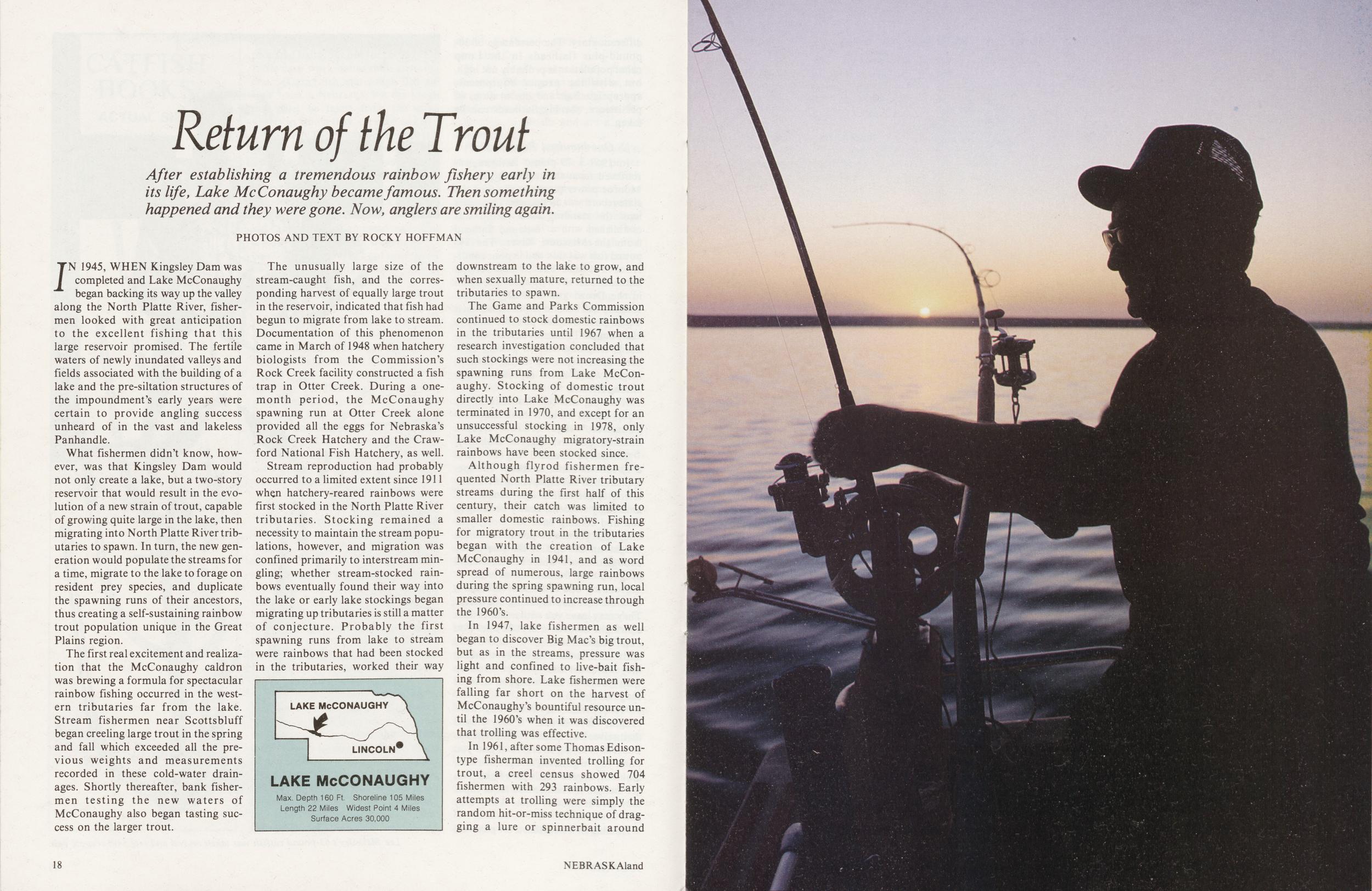
After establishing a tremendous rainbow fishery early in its life, Lake McConaughy became famous. Then something happened and they were gone. Now, anglers are smiling again.
IN 1945, WHEN Kingsley Dam was completed and Lake McConaughy began backing its way up the valley along the North Platte River, fishermen looked with great anticipation to the excellent fishing that this large reservoir promised. The fertile waters of newly inundated valleys and fields associated with the building of a lake and the pre-siltation structures of the impoundment's early years were certain to provide angling success unheard of in the vast and lakeless Panhandle.
What fishermen didn't know, however, was that Kingsley Dam would not only create a lake, but a two-story reservoir that would result in the evolution of a new strain of trout, capable of growing quite large in the lake, then migrating into North Platte River tributaries to spawn. In turn, the new generation would populate the streams for a time, migrate to the lake to forage on resident prey species, and duplicate the spawning runs of their ancestors, thus creating a self-sustaining rainbow trout population unique in the Great Plains region.
The first real excitement and realization that the McConaughy caldron was brewing a formula for spectacular rainbow fishing occurred in the western tributaries far from the lake. Stream fishermen near Scottsbluff began creeling large trout in the spring and fall which exceeded all the previous weights and measurements recorded in these cold-water drainages. Shortly thereafter, bank fishermen testing the new waters of McConaughy also began tasting success on the larger trout.
The unusually large size of the stream-caught fish, and the corresponding harvest of equally large trout in the reservoir, indicated that fish had begun to migrate from lake to stream. Documentation of this phenomenon came in March of 1948 when hatchery biologists from the Commission's Rock Creek facility constructed a fish trap in Otter Creek. During a one-month period, the McConaughy spawning run at Otter Creek alone provided all the eggs for Nebraska's Rock Creek Hatchery and the Crawford National Fish Hatchery, as well.
LAKE MCCONAUGHY Max. Depth 160 Ft. Shoreline 105 Miles Length 22 Miles Widest Point 4 Miles Surface Acres 30,000
The Game and Parks Commission continued to stock domestic rainbows in the tributaries until 1967 when a research investigation concluded that such stockings were not increasing the spawning runs from Lake McConaughy. Stocking of domestic trout directly into Lake McConaughy was terminated in 1970, and except for an unsuccessful stocking in 1978, only Lake McConaughy migratory-strain rainbows have been stocked since.
Although flyrod fishermen frequented North Platte River tributary streams during the first half of this century, their catch was limited to smaller domestic rainbows. Fishing for migratory trout in the tributaries began with the creation of Lake McConaughy in 1941, and as word spread of numerous, large rainbows during the spring spawning run, local pressure continued to increase through the 1960's.
In 1947, lake fishermen as well began to discover Big Mac's big trout, but as in the streams, pressure was light and confined to live-bait fishing from shore. Lake fishermen were falling far short on the harvest of McConaughy's bountiful resource until the 1960's when it was discovered that trolling was effective.
In 1961, after some Thomas Edison-type fisherman invented trolling for trout, a creel census showed 704 fishermen with 293 rainbows. Early attempts at trolling were simply the random hit-or-miss technique of dragging a lure or spinnerbait around
McConaughy's expansive waters, but as fishermen learned more about rainbow trout and the lake itself, a better harvest began.
It was necessary for fishermen to gain a basic understanding of the physical characteristics of a two-story reservoir and how it affects the habits of its fish populations. In fairly simple terms, a two-story reservoir is a body of water that will support both cold and warm-water species of fish year-round. Rainbow trout, a cold-water variety, must always have water available with a temperature below 70 degrees F. which contains at least three parts per million dissolved oxygen.
During spring, winter and fall seasons, most of Nebraska's reservoirs have temperature and oxygen characteristics that can accommodate rainbow trout, but during July, August and September, water temperatures increase substantially beyond the habitat range of cold-water species. Lake McConaughy, on the other hand, normally stratifies during warm-weather months.
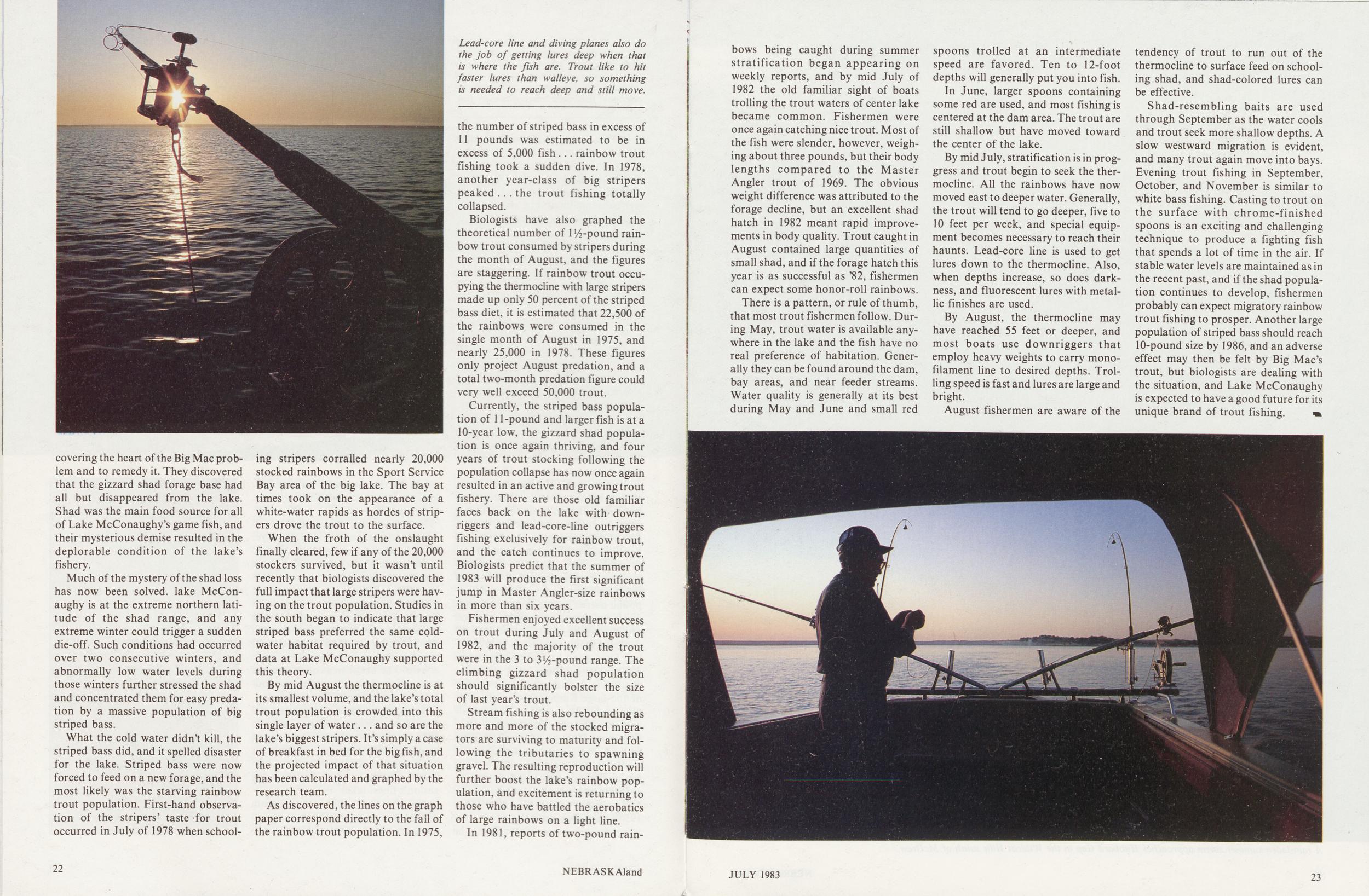
During stratification, two distinct water layers form: the upper (the epilimnion) is composed of warmer water that is well oxygenated, while the bottom layer (the hypolimnion) consists of cold water, but is almost void of oxygen. The key to maintaining a lake population of rainbows in a warm climate rests with neither layer, but with the transition water that separates the two. This water is known as the thermocline, and maintains a temperature below 70 degrees with a dissolved oxygen content of at least three parts per million.
It is the thermocline that rainbow trout inhabit from as early as mid July to as late as mid September. And during some years, the thermocline may make up a very small percentage of the lake's total water, thus concentrating the trout population, much to the fisherman's delight.
Armed with the new knowledge of preferred summer trout habitat that McConaughy uniquely provided its rainbows, and the recently discovered trolling method for taking trout, fishermen began catching these feisty prizes on a regular basis. The trout being caught were amazingly large and healthy, and McConaughy quickly gained the reputation of providing the finest rainbow fishery in the west, if not the entire U.S. Fishermen from across the country funneled into Ogallala to test Big Mac's waters, and for the most part returned home happy to spread the word and generate even greater excitement.
Any good fisherman with the proper equipment could hook a dozen or more trout in a single outing, and was often rewarded with a Master Anglersized lunker of five pounds or better. Eight to 10 pounders were at the top end, but many were wrestled aboard boats at the time. In 1969, pages of Master Angler trout, amounting to 468 separate listings, were compiled at Commission headquarters, and fishermen began looking to a new decade of fine trout fishing.
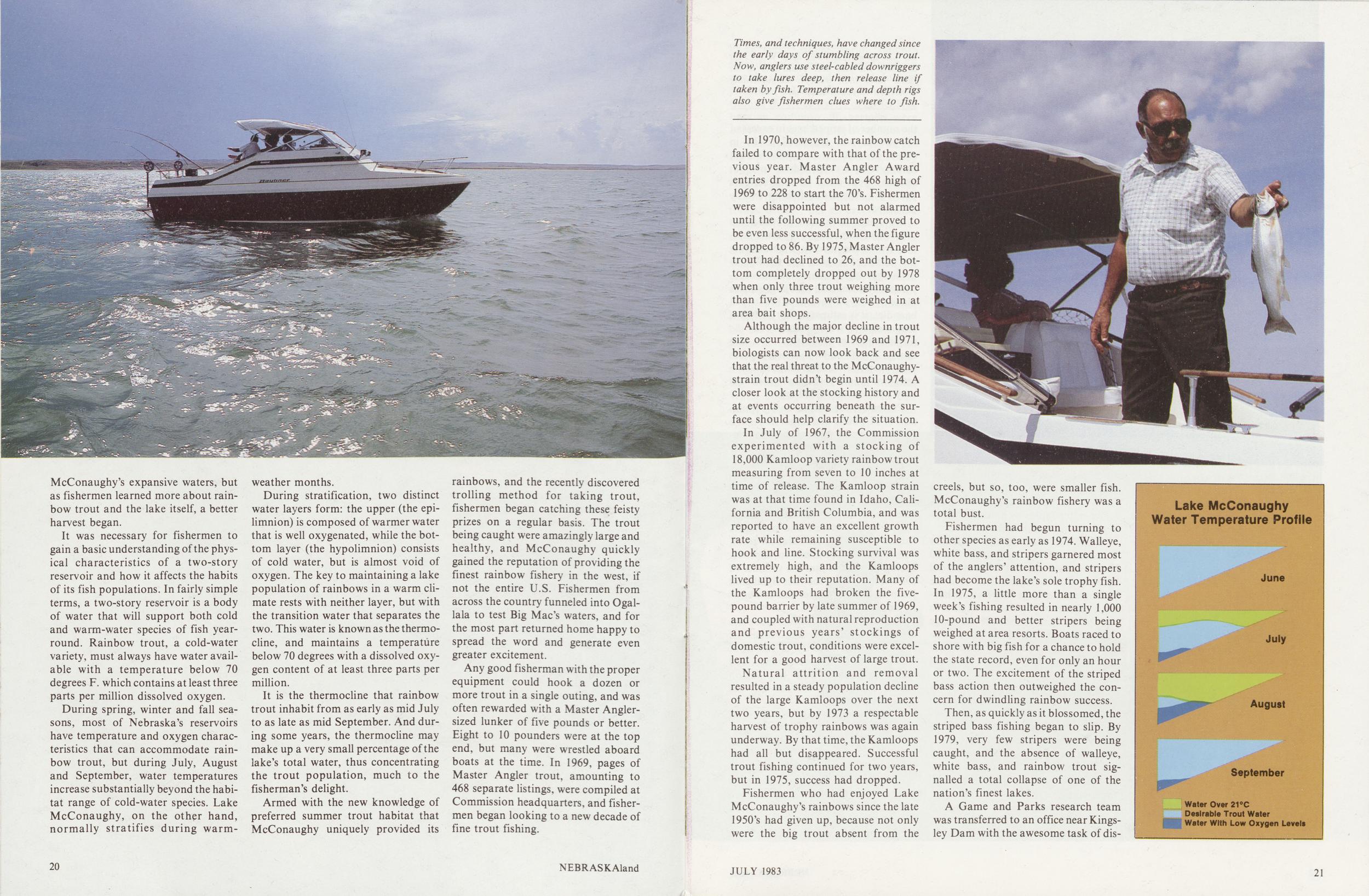
Times, and techniques, have changed since the early days of stumbling across trout. Now, anglers use steel-cabled downriggers to take lures deep, then release line if taken by fish. Temperature and depth rigs also give fishermen clues where to fish.
In 1970, however, the rainbow catch failed to compare with that of the previous year. Master Angler Award entries dropped from the 468 high of 1969 to 228 to start the 70's. Fishermen were disappointed but not alarmed until the following summer proved to be even less successful, when the figure dropped to 86. By 1975, Master Angler trout had declined to 26, and the bottom completely dropped out by 1978 when only three trout weighing more than five pounds were weighed in at area bait shops.
Although the major decline in trout size occurred between 1969 and 1971, biologists can now look back and see that the real threat to the McConaughy-strain trout didn't begin until 1974. A closer look at the stocking history and at events occurring beneath the surface should help clarify the situation.
In July of 1967, the Commission experimented with a stocking of 18,000 Kamloop variety rainbow trout measuring from seven to 10 inches at time of release. The Kamloop strain was at that time found in Idaho, California and British Columbia, and was reported to have an excellent growth rate while remaining susceptible to hook and line. Stocking survival was extremely high, and the Kamloops lived up to their reputation. Many of the Kamloops had broken the five-pound barrier by late summer of 1969, and coupled with natural reproduction and previous years' stockings of domestic trout, conditions were excellent for a good harvest of large trout.
Natural attrition and removal resulted in a steady population decline of the large Kamloops over the next two years, but by 1973 a respectable harvest of trophy rainbows was again underway. By that time, the Kamloops had all but disappeared. Successful trout fishing continued for two years, but in 1975, success had dropped.
Fishermen who had enjoyed Lake McConaughy's rainbows since the late 1950's had given up, because not only were the big trout absent from the creels, but so, too, were smaller fish. McConaughy's rainbow fishery was a total bust.
Fishermen had begun turning to other species as early as 1974. Walleye, white bass, and stripers garnered most of the anglers' attention, and stripeis had become the lake's sole trophy fish. In 1975, a little more than a single week's fishing resulted in nearly 1,000 10-pound and better stripers being weighed at area resorts. Boats raced to shore with big fish for a chance to hold the state record, even for only an hour or two. The excitement of the striped bass action then outweighed the concern for dwindling rainbow success.
Then, as quickly as it blossomed, the striped bass fishing began to slip. By 1979, very few stripers were being caught, and the absence of walleye, white bass, and rainbow trout signalled a total collapse of one of the nation's finest lakes.
A Game and Parks research team was transferred to an office near Kingsley Dam with the awesome task of discovering
Lake McConaughy Water Temperature Profile June July August September Water Over 21°C Desirable Trout Water Water With Low Oxygen Levels
the heart of the Big Mac problem and to remedy it. They discovered that the gizzard shad forage base had all but disappeared from the lake. Shad was the main food source for all of Lake McConaughy's game fish, and their mysterious demise resulted in the deplorable condition of the lake's fishery.
Much of the mystery of the shad loss has now been solved, lake McConaughy is at the extreme northern latitude of the shad range, and any extreme winter could trigger a sudden die-off. Such conditions had occurred over two consecutive winters, and abnormally low water levels during those winters further stressed the shad and concentrated them for easy predation by a massive population of big striped bass.
What the cold water didn't kill, the striped bass did, and it spelled disaster for the lake. Striped bass were now forced to feed on a new forage, and the most likely was the starving rainbow trout population. First-hand observation of the stripers' taste for trout occurred in July of 1978 when schooling stripers corralled nearly 20,000 stocked rainbows in the Sport Service Bay area of the big lake. The bay at times took on the appearance of a white-water rapids as hordes of stripers drove the trout to the surface.
When the froth of the onslaught finally cleared, few if any of the 20,000 stockers survived, but it wasn't until recently that biologists discovered the full impact that large stripers were having on the trout population. Studies in the south began to indicate that large striped bass preferred the same cold-water habitat required by trout, and data at Lake McConaughy supported this theory.
By mid August the thermocline is at its smallest volume, and the lake's total trout population is crowded into this single layer of water and so are the lake's biggest stripers. It's simply a case of breakfast in bed for the big fish, and the projected impact of that situation has been calculated and graphed by the research team.
Lead-core line and diving planes also do the job of getting lures deep when that is where the fish are. Trout like to hit faster lures than walleye, so something is needed to reach deep and still move.
Biologists have also graphed the theoretical number of 1 impound rainbow trout consumed by stripers during the month of August, and the figures are staggering. If rainbow trout occupying the thermocline with large stripers made up only 50 percent of the striped bass diet, it is estimated that 22,500 of the rainbows were consumed in the single month of August in 1975, and nearly 25,000 in 1978. These figures only project August predation, and a total two-month predation figure could very well exceed 50,000 trout.
Currently, the striped bass population of 11-pound and larger fish is at a 10-year low, the gizzard shad population is once again thriving, and four years of trout stocking following the population collapse has now once again resulted in an active and growing trout fishery. There are those old familiar faces back on the lake with down-riggers and lead-core-line outriggers fishing exclusively for rainbow trout, and the catch continues to improve. Biologists predict that the summer of 1983 will produce the first significant jump in Master Angler-size rainbows in more than six years.
Fishermen enjoyed excellent success on trout during July and August of 1982, and the majority of the trout were in the 3 to 3!^-pound range. The climbing gizzard shad population should significantly bolster the size of last year's trout.
Stream fishing is also rebounding as more and more of the stocked migrators are surviving to maturity and following the tributaries to spawning gravel. The resulting reproduction will further boost the lake's rainbow population, and excitement is returning to those who have battled the aerobatics of large rainbows on a light line.
In 1981, reports of two-pound rainbows being caught during summer stratification began appearing on weekly reports, and by mid July of 1982 the old familiar sight of boats trolling the trout waters of center lake became common. Fishermen were once again catching nice trout. Most of the fish were slender, however, weighing about three pounds, but their body lengths compared to the Master Angler trout of 1969. The obvious weight difference was attributed to the forage decline, but an excellent shad hatch in 1982 meant rapid improvements in body quality. Trout caught in August contained large quantities of small shad, and if the forage hatch this year is as successful as '82, fishermen can expect some honor-roll rainbows.
There is a pattern, or rule of thumb, that most trout fishermen follow. During May, trout water is available anywhere in the lake and the fish have no real preference of habitation. Generally they can be found around the dam, bay areas, and near feeder streams. Water quality is generally at its best during May and June and small red spoons trolled at an intermediate speed are favored. Ten to 12-foot depths will generally put you into fish.
In June, larger spoons containing some red are used, and most fishing is centered at the dam area. The trout are still shallow but have moved toward the center of the lake.
By mid July, stratification is in proggress and trout begin to seek the thermocline. All the rainbows have now moved east to deeper water. Generally, the trout will tend to go deeper, five to 10 feet per week, and special equipment becomes necessary to reach their haunts. Lead-core line is used to get lures down to the thermocline. Also, when depths increase, so does darkness, and fluorescent lures with metallic finishes are used.
By August, the thermocline may have reached 55 feet or deeper, and most boats use downriggers that employ heavy weights to carry monofilament line to desired depths. Trolling speed is fast and lures are large and bright.
August fishermen are aware of the tendency of trout to run out of the thermocline to surface feed on schooling shad, and shad-colored lures can be effective.
Shad-resembling baits are used through September as the water cools and trout seek more shallow depths. A slow westward migration is evident, and many trout again move into bays. Evening trout fishing in September, October, and November is similar to white bass fishing. Casting to trout on the surface with chrome-finished spoons is an exciting and challenging technique to produce a fighting fish that spends a lot of time in the air. If stable water levels are maintained as in the recent past, and if the shad population continues to develop, fishermen probably can expect migratory rainbow trout fishing to prosper. Another large population of striped bass should reach 10-pound size by 1986, and an adverse effect may then be felt by Big Mac's trout, but biologists are dealing with the situation, and Lake McConaughy is expected to have a good future for its unique brand of trout fishing.
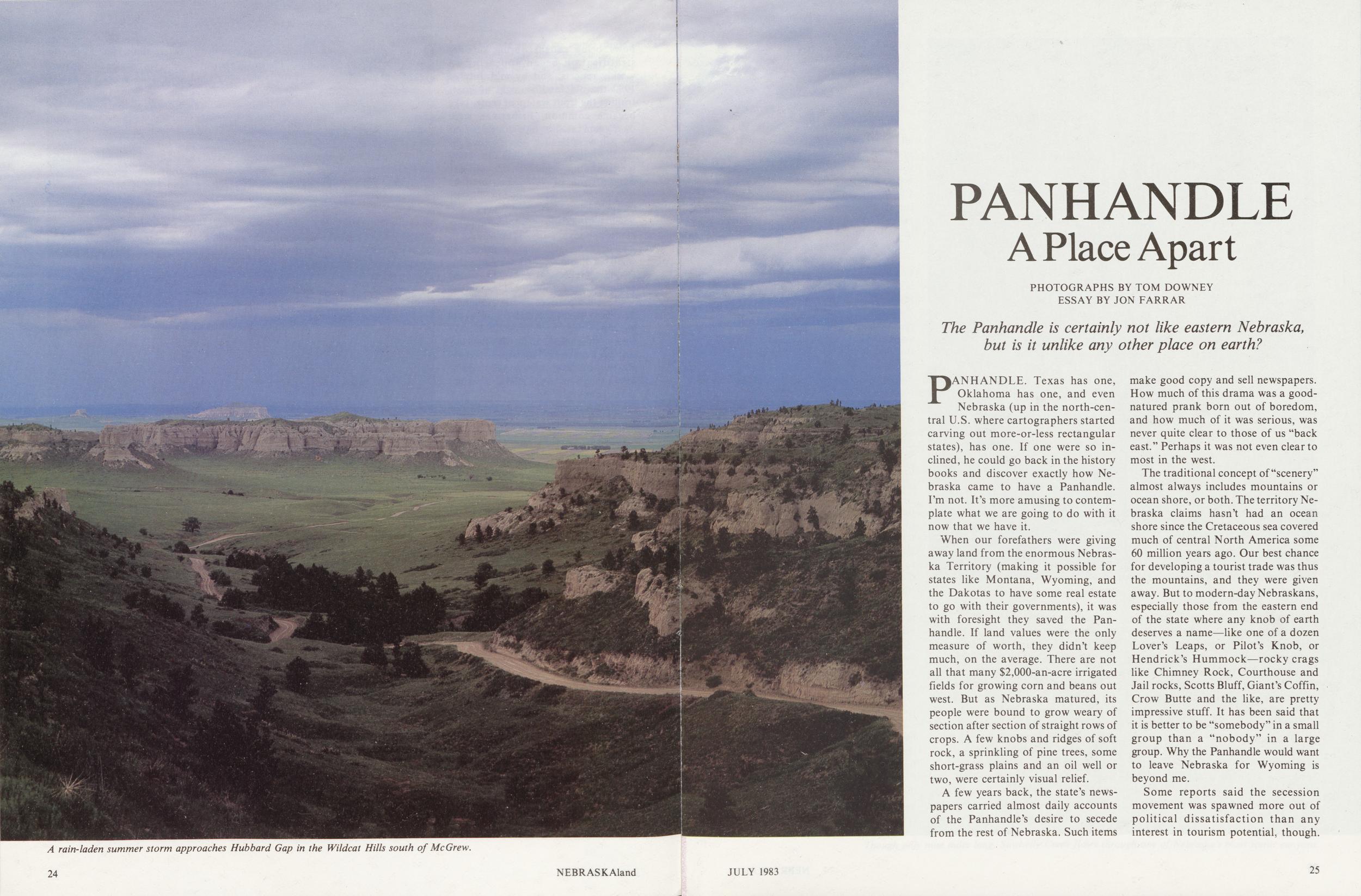
A rain-laden summer storm approaches Hubbard Gap in the Wildcat Hills south of McGrew.
PANHANDLE
A Place Apart
The Panhandle is certainly not like eastern Nebraska, but is it unlike any other place on earth?PANHANDLE. Texas has one, Oklahoma has one, and even Nebraska (up in the north-central U.S. where cartographers started carving out more-or-less rectangular states), has one. If one were so inclined, he could go back in the history books and discover exactly how Nebraska came to have a Panhandle. I'm not. It's more amusing to contemplate what we are going to do with it now that we have it.
When our forefathers were giving away land from the enormous Nebraska Territory (making it possible for states like Montana, Wyoming, and the Dakotas to have some real estate to go with their governments), it was with foresight they saved the Panhandle. If land values were the only measure of worth, they didn't keep much, on the average. There are not all that many $2,000-an-acre irrigated fields for growing corn and beans out west. But as Nebraska matured, its people were bound to grow weary of section after section of straight rows of crops. A few knobs and ridges of soft rock, a sprinkling of pine trees, some short-grass plains and an oil well or two, were certainly visual relief.
A few years back, the state's newspapers carried almost daily accounts of the Panhandle's desire to secede from the rest of Nebraska. Such items make good copy and sell newspapers. How much of this drama was a good-natured prank born out of boredom, and how much of it was serious, was never quite clear to those of us "back east." Perhaps it was not even clear to most in the west.
The traditional concept of "scenery" almost always includes mountains or ocean shore, or both. The territory Nebraska claims hasn't had an ocean shore since the Cretaceous sea covered much of central North America some 60 million years ago. Our best chance for developing a tourist trade was thus the mountains, and they were given away. But to modern-day Nebraskans, especially those from the eastern end of the state where any knob of earth deserves a name—like one of a dozen Lover's Leaps, or Pilot's Knob, or Hendrick's Hummock—rocky crags like Chimney Rock, Courthouse and Jail rocks, Scotts Bluff, Giant's Coffin, Crow Butte and the like, are pretty impressive stuff. It has been said that it is better to be "somebody" in a small group than a "nobody" in a large group. Why the Panhandle would want to leave Nebraska for Wyoming is beyond me.
Some reports said the secession movement was spawned more out of political dissatisfaction than any interest in tourism potential, though.
24 NEBRASKAland JULY 1983 25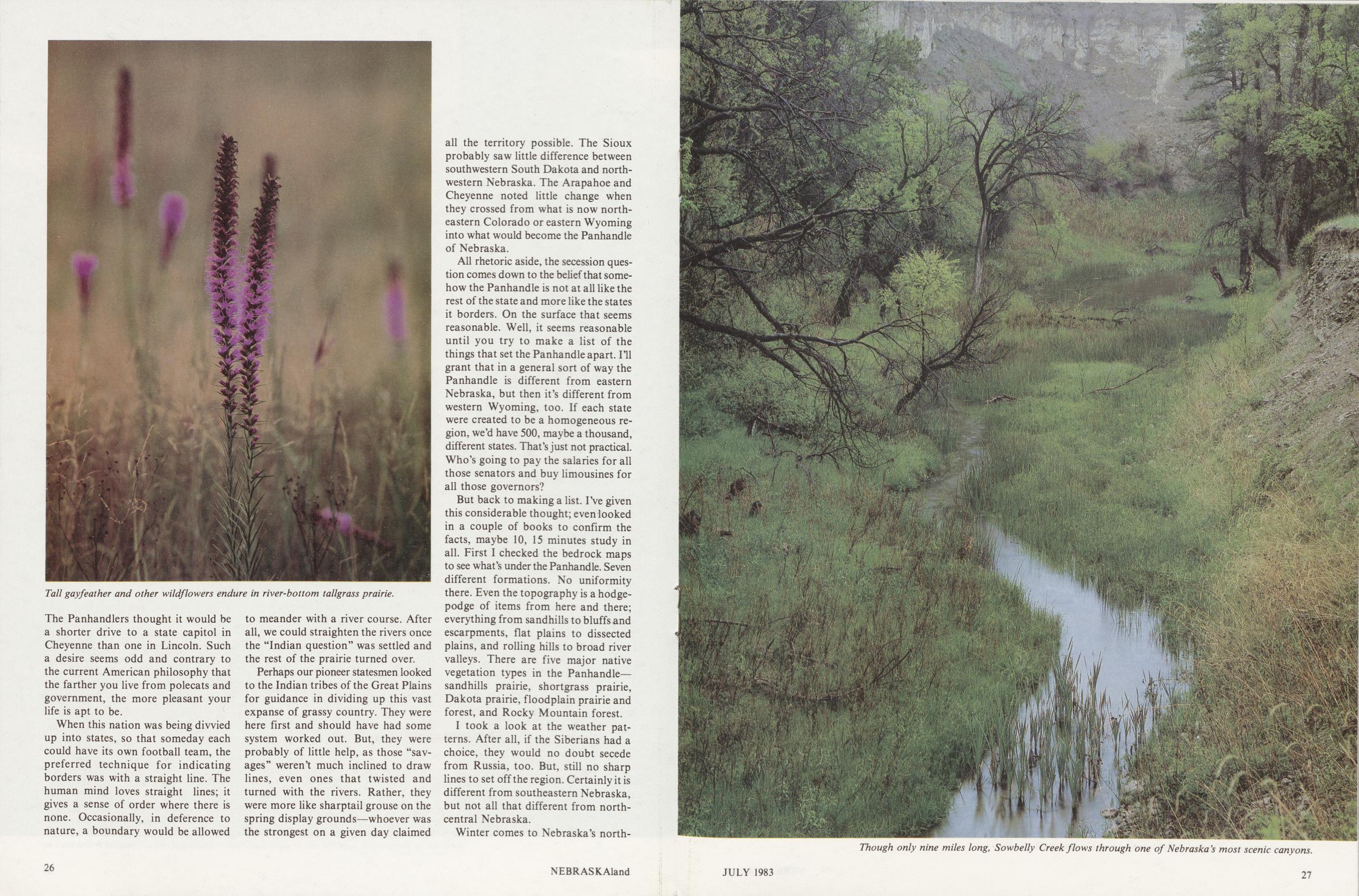
Tall gayfeather and other wildflowers endure in river-bottom tallgrass prairie.
The Panhandlers thought it would be a shorter drive to a state capitol in Cheyenne than one in Lincoln. Such a desire seems odd and contrary to the current American philosophy that the farther you live from polecats and government, the more pleasant your life is apt to be.
When this nation was being divvied up into states, so that someday each could have its own football team, the preferred technique for indicating borders was with a straight line. The human mind loves straight lines; it gives a sense of order where there is none. Occasionally, in deference to nature, a boundary would be allowed to meander with a river course. After all, we could straighten the rivers once the "Indian question" was settled and the rest of the prairie turned over.
Perhaps our pioneer statesmen looked to the Indian tribes of the Great Plains for guidance in dividing up this vast expanse of grassy country. They were here first and should have had some system worked out. But, they were probably of little help, as those "savages" weren't much inclined to draw lines, even ones that twisted and turned with the rivers. Rather, they were more like sharptail grouse on the spring display grounds—whoever was the strongest on a given day claimed all the territory possible. The Sioux probably saw little difference between southwestern South Dakota and northwestern Nebraska. The Arapahoe and Cheyenne noted little change when they crossed from what is now northeastern Colorado or eastern Wyoming into what would become the Panhandle of Nebraska.
All rhetoric aside, the secession question comes down to the belief that somehow the Panhandle is not at all like the rest of the state and more like the states it borders. On the surface that seems reasonable. Well, it seems reasonable until you try to make a list of the things that set the Panhandle apart. Ill grant that in a general sort of way the Panhandle is different from eastern Nebraska, but then it's different from western Wyoming, too. If each state were created to be a homogeneous region, we'd have 500, maybe a thousand, different states. That's just not practical. Who's going to pay the salaries for all those senators and buy limousines for all those governors?
But back to making a list. I've given this considerable thought; even looked in a couple of books to confirm the facts, maybe 10, 15 minutes study in all. First I checked the bedrock maps to see what's under the Panhandle. Seven different formations. No uniformity there. Even the topography is a hodgepodge of items from here and there; everything from sandhills to bluffs and escarpments, flat plains to dissected plains, and rolling hills to broad river valleys. There are five major native vegetation types in the Panhandle—sandhills prairie, shortgrass prairie, Dakota prairie, floodplain prairie and forest, and Rocky Mountain forest.
I took a look at the weather patterns. After all, if the Siberians had a choice, they would no doubt secede from Russia, too. But, still no sharp lines to set off the region. Certainly it is different from southeastern Nebraska, but not all that different from north-central Nebraska. Winter comes to Nebraska's northwest
Though only nine miles long, Sowbelly Creek flows through one of Nebraska's most scenic canyons.
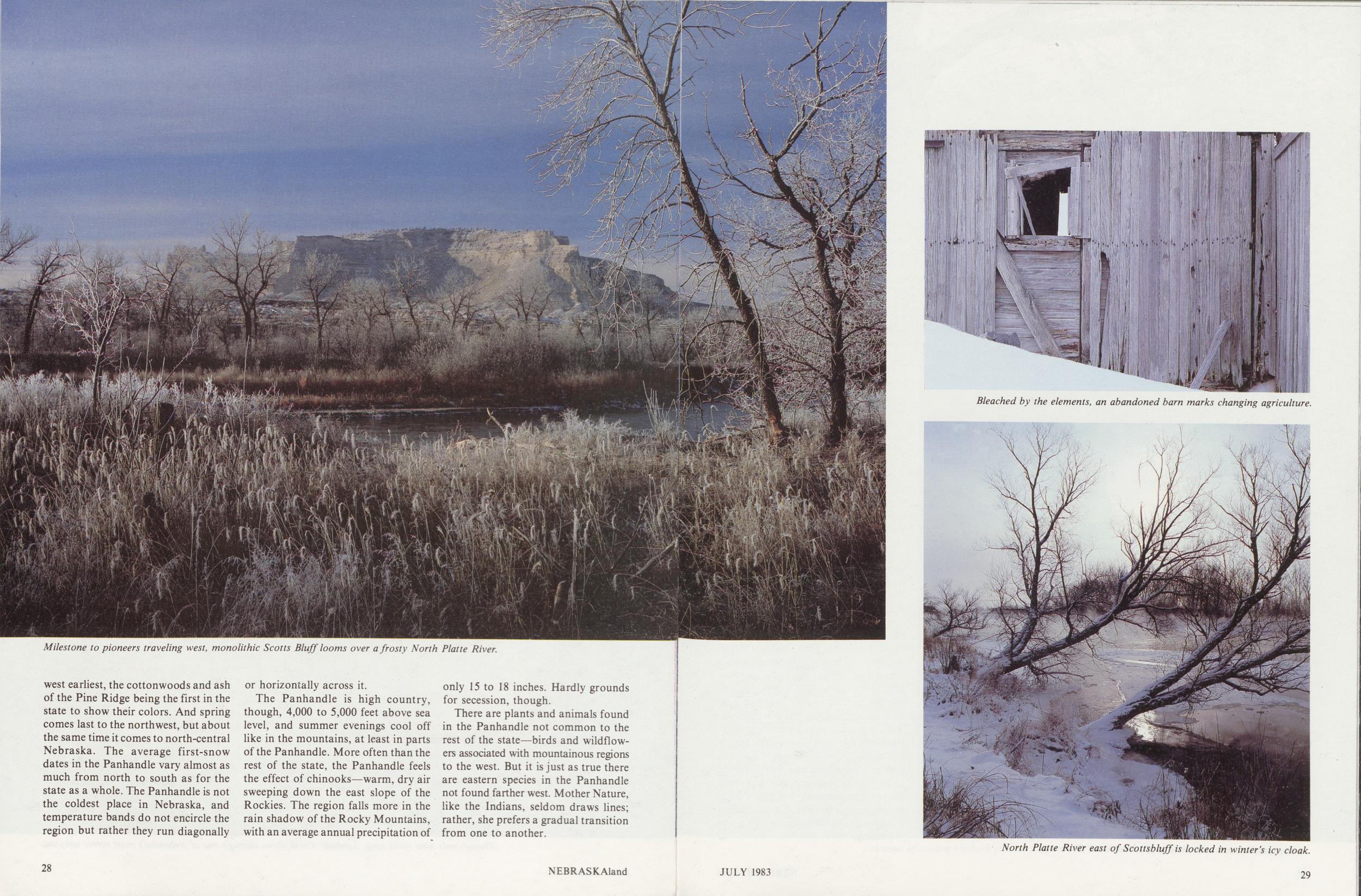
Milestone to pioneers traveling west, monolithic Scotts Bluff looms over a frosty North Platte River.
earliest, the cottonwoods and ash of the Pine Ridge being the first in the state to show their colors. And spring comes last to the northwest, but about the same time it comes to north-central Nebraska. The average first-snow dates in the Panhandle vary almost as much from north to south as for the state as a whole. The Panhandle is not the coldest place in Nebraska, and temperature bands do not encircle the region but rather they run diagonally or horizontally across it.
The Panhandle is high country, though, 4,000 to 5,000 feet above sea level, and summer evenings cool off like in the mountains, at least in parts of the Panhandle. More often than the rest of the state, the Panhandle feels the effect of chinooks—warm, dry air sweeping down the east slope of the Rockies. The region falls more in the rain shadow of the Rocky Mountains, with an average annual precipitation of only 15 to 18 inches. Hardly grounds for secession, though.
There are plants and animals found in the Panhandle not common to the rest of the state—birds and wildflowers associated with mountainous regions to the west. But it is just as true there are eastern species in the Panhandle not found farther west. Mother Nature, like the Indians, seldom draws lines; rather, she prefers a gradual transition from one to another.
Bleached by the elements, an abandoned barn marks changing agriculture.
North Platte River east of Scottsbluff is locked in winter's icy cloak.
If the people of the Panhandle were a homogeneous lot, unlike those around them, that alone would be reason enough to secede. After all, most Frenchmen live in France and most Italians in Italy. There is little evidence to suggest that the Panhandle was settled, or is now occupied, by a majority of people from one nationality or another. I doubt there is much difference between a farmer at Brule and one just across the imaginary line at Big Springs, or between a rancher from Ashby and one from Bingham, or a waitress in Merriman and one in Gordon. Waitresses can be surly anywhere. Granted, there are a lot of cowboys in the Panhandle, but anymore we've got a fair number of pick-up trucks and cowboy hats running around in Lincoln and Omaha. Can we easterners bend any further to get along with our western cousins?
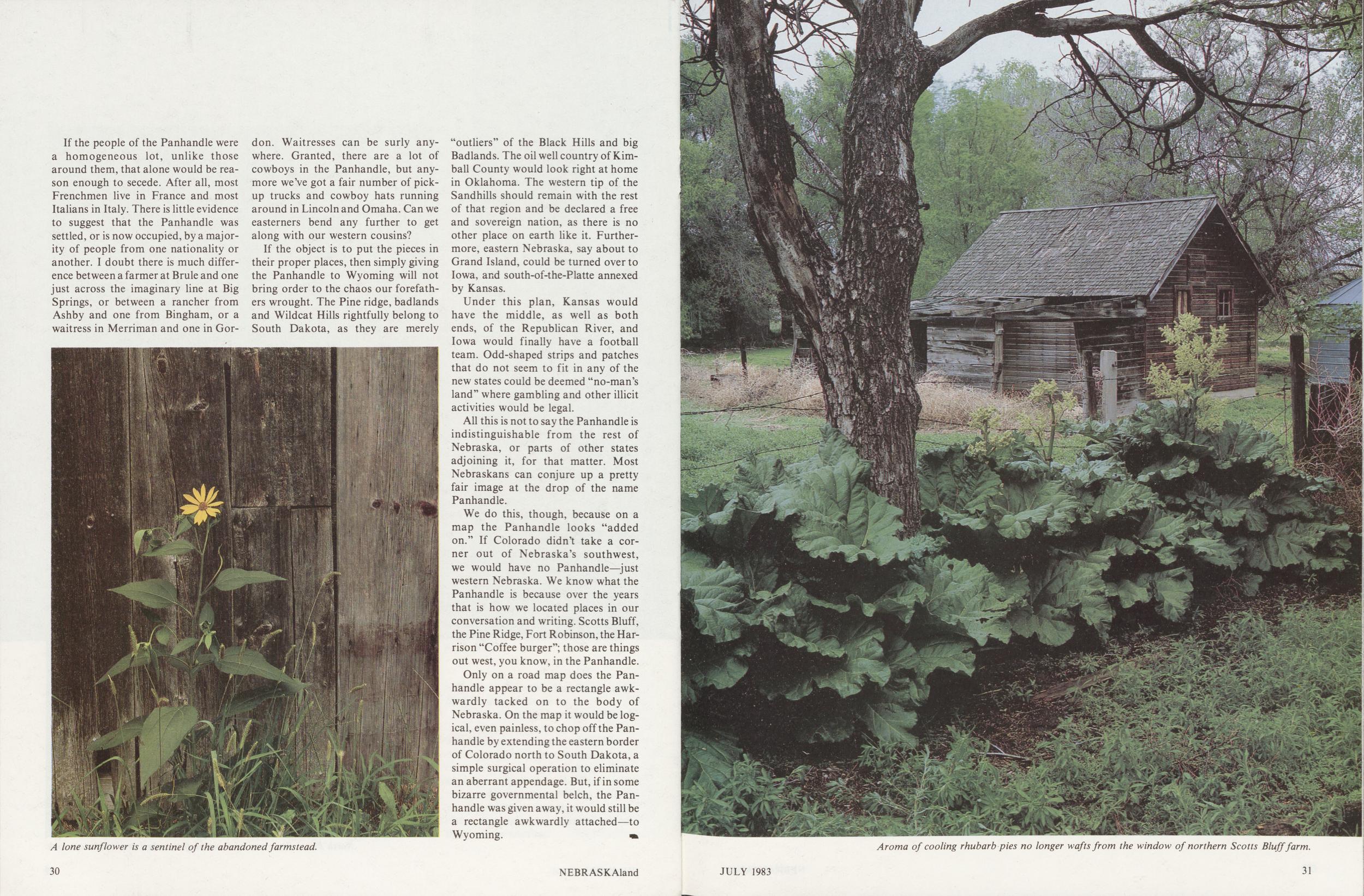
A lone sunflower is a sentinel of the abandoned farmstead.
Under this plan, Kansas would have the middle, as well as both ends, of the Republican River, and Iowa would finally have a football team. Odd-shaped strips and patches that do not seem to fit in any of the new states could be deemed "no-man's land" where gambling and other illicit activities would be legal.
All this is not to say the Panhandle is indistinguishable from the rest of Nebraska, or parts of other states adjoining it, for that matter. Most Nebraskans can conjure up a pretty fair image at the drop of the name Panhandle.
We do this, though, because on a map the Panhandle looks "added on." If Colorado didn't take a corner out of Nebraska's southwest, we would have no Panhandle—just western Nebraska. We know what the Panhandle is because over the years that is how we located places in our conversation and writing. Scotts Bluff, the Pine Ridge, Fort Robinson, the Harrison "Coffee burger"; those are things out west, you know, in the Panhandle.
Only on a road map does the Panhandle appear to be a rectangle awkwardly tacked on to the body of Nebraska. On the map it would be logical, even painless, to chop off the Panhandle by extending the eastern border of Colorado north to South Dakota, a simple surgical operation to eliminate an aberrant appendage. But, if in some bizarre governmental belch, the Panhandle was given away, it would still be a rectangle awkwardly attached—to Wyoming.
Aroma of cooling rhubarb pies no longer wafts from the window of northern Scotts Bluff farm.
TO BEE or not TO BEE
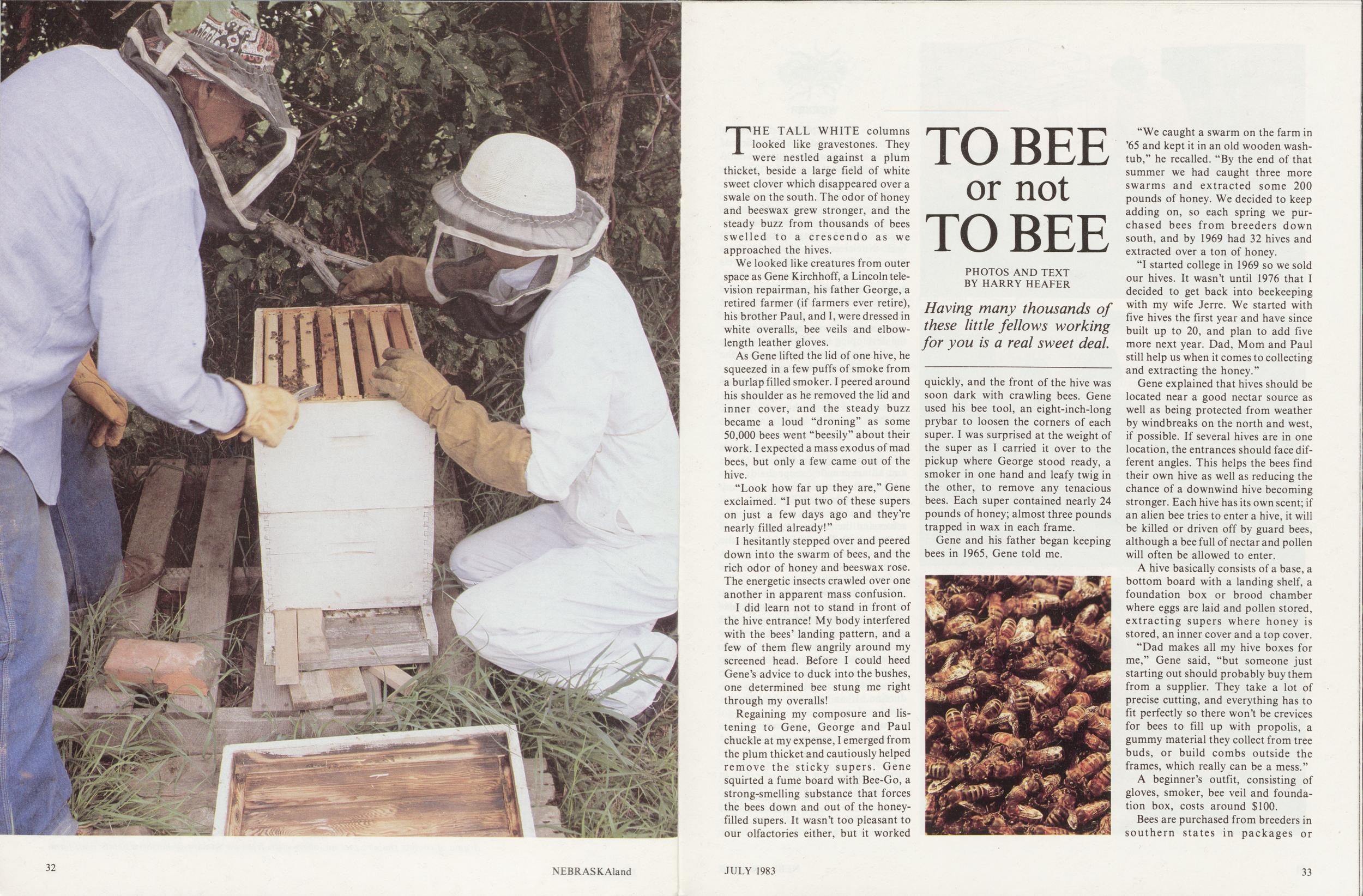
Having many thousands of these little fellows working for you is a real sweet dealTHE TALL WHITE columns looked like gravestones. They were nestled against a plum thicket, beside a large field of white sweet clover which disappeared over a swale on the south. The odor of honey and beeswax grew stronger, and the steady buzz from thousands of bees swelled to a crescendo as we approached the hives.
We looked like creatures from outer space as Gene Kirchhoff, a Lincoln television repairman, his father George, a retired farmer (if farmers ever retire), his brother Paul, and I, were dressed in white overalls, bee veils and elbow-length leather gloves.
As Gene lifted the lid of one hive, he squeezed in a few puffs of smoke from a burlap filled smoker. I peered around his shoulder as he removed the lid and inner cover, and the steady buzz became a loud "droning" as some 50,000 bees went "beesily" about their work. I expected a mass exodus of mad bees, but only a few came out of the hive.
"Look how far up they are," Gene exclaimed. "I put two of these supers on just a few days ago and they're nearly filled already!"
I hesitantly stepped over and peered down into the swarm of bees, and the rich odor of honey and beeswax rose. The energetic insects crawled over one another in apparent mass confusion.
I did learn not to stand in front of the hive entrance! My body interfered with the bees' landing pattern, and a few of them flew angrily around my screened head. Before I could heed Gene's advice to duck into the bushes, one determined bee stung me right through my overalls!
Regaining my composure and listening to Gene, George and Paul chuckle at my expense, I emerged from the plum thicket and cautiously helped remove the sticky supers. Gene squirted a fume board with Bee-Go, a strong-smelling substance that forces the bees down and out of the honey-filled supers. It wasn't too pleasant to our olfactories either, but it worked quickly, and the front of the hive was soon dark with crawling bees. Gene used his bee tool, an eight-inch-long prybar to loosen the corners of each super. I was surprised at the weight of the super as I carried it over to the pickup where George stood ready, a smoker in one hand and leafy twig in the other, to remove any tenacious bees. Each super contained nearly 24 pounds of honey; almost three pounds trapped in wax in each frame.
Gene and his father began keeping bees in 1965, Gene told me.
"We caught a swarm on the farm in '65 and kept it in an old wooden washtub," he recalled. "By the end of that summer we had caught three more swarms and extracted some 200 pounds of honey. We decided to keep adding on, so each spring we purchased bees from breeders down south, and by 1969 had 32 hives and extracted over a ton of honey.
"I started college in 1969 so we sold our hives. It wasn't until 1976 that I decided to get back into beekeeping with my wife Jerre. We started with five hives the first year and have since built up to 20, and plan to add five more next year. Dad, Mom and Paul still help us when it comes to collecting and extracting the honey."
Gene explained that hives should be located near a good nectar source as well as being protected from weather by windbreaks on the north and west, if possible. If several hives are in one location, the entrances should face different angles. This helps the bees find their own hive as well as reducing the chance of a downwind hive becoming stronger. Each hive has its own scent; if an alien bee tries to enter a hive, it will be killed or driven off by guard bees, although a bee full of nectar and pollen will often be allowed to enter.
A hive basically consists of a base, a bottom board with a landing shelf, a foundation box or brood chamber where eggs are laid and pollen stored, extracting supers where honey is stored, an inner cover and a top cover.
"Dad makes all my hive boxes for me," Gene said, "but someone just starting out should probably buy them from a supplier. They take a lot of precise cutting, and everything has to fit perfectly so there won't be crevices for bees to fill up with propolis, a gummy material they collect from tree buds, or build combs outside the frames, which really can be a mess."
A beginner's outfit, consisting of gloves, smoker, bee veil and foundation box, costs around $100.
Bees are purchased from breeders in southern states in packages or
32 NEBRASKAland JULY 1983 33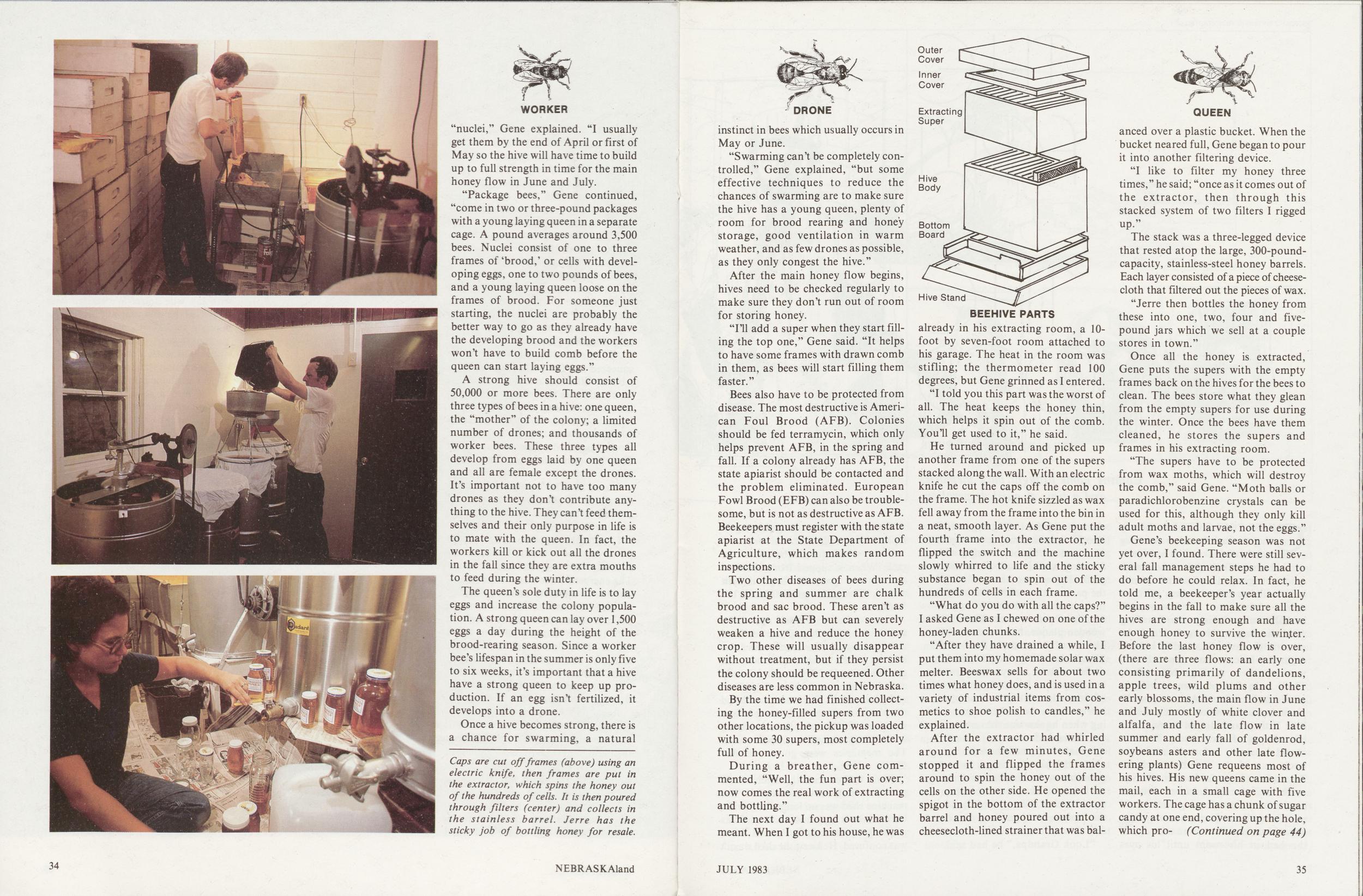
WORKER
nuclei," Gene explained. "I usually get them by the end of April or first of May so the hive will have time to build up to full strength in time for the main honey flow in June and July.
"Package bees," Gene continued, "come in two or three-pound packages with a young laying queen in a separate cage. A pound averages around 3,500 bees. Nuclei consist of one to three frames of 'brood,' or cells with developing eggs, one to two pounds of bees, and a young laying queen loose on the frames of brood. For someone just starting, the nuclei are probably the better way to go as they already have the developing brood and the workers won't have to build comb before the queen can start laying eggs."
A strong hive should consist of 50,000 or more bees. There are only three types of bees in a hive: one queen, the "mother" of the colony; a limited number of drones; and thousands of worker bees. These three types all develop from eggs laid by one queen and all are female except the drones. It's important not to have too many drones as they don't contribute anything to the hive. They can't feed themselves and their only purpose in life is to mate with the queen. In fact, the workers kill or kick out all the drones in the fall since they are extra mouths to feed during the winter.
The queen's sole duty in life is to lay eggs and increase the colony population. A strong queen can lay over 1,500 eggs a day during the height of the brood-rearing season. Since a worker bee's lifespan in the summer is only five to six weeks, it's important that a hive have a strong queen to keep up production. If an egg isn't fertilized, it develops into a drone.
Once a hive becomes strong, there is a chance for swarming, a natural
Caps are cut off frames (above) using an electric knife, then frames are put in the extractor, which spins the honey out of the hundreds of cells. It is then poured through filters (center) and collects in the stainless barrel. Jerre has the sticky job of bottling honey for resale.
DRONE
instinct in bees which usually occurs in May or June.
"Swarming can't be completely controlled," Gene explained, "but some effective techniques to reduce the chances of swarming are to make sure the hive has a young queen, plenty of room for brood rearing and honey storage, good ventilation in warm weather, and as few drones as possible, as they only congest the hive."
After the main honey flow begins, hives need to be checked regularly to make sure they don't run out of room for storing honey.
"I'll add a super when they start filling the top one," Gene said. "It helps to have some frames with drawn comb in them, as bees will start filling them faster."
Bees also have to be protected from disease. The most destructive is American Foul Brood (AFB). Colonies should be fed terramycin, which only helps prevent AFB, in the spring and fall. If a colony already has AFB, the state apiarist should be contacted and the problem eliminated. European Fowl Brood (EFB) can also be troublesome, but is not as destructive as AFB. Beekeepers must register with the state apiarist at the State Department of Agriculture, which makes random inspections.
Two other diseases of bees during the spring and summer are chalk brood and sac brood. These aren't as destructive as AFB but can severely weaken a hive and reduce the honey crop. These will usually disappear without treatment, but if they persist the colony should be requeened. Other diseases are less common in Nebraska.
By the time we had finished collecting the honey-filled supers from two other locations, the pickup was loaded with some 30 supers, most completely full of honey.
During a breather, Gene commented, "Well, the fun part is over; now comes the real work of extracting and bottling."
Outer Cover Inner Cover Extracting Super Hive Body Bottom Board Hive Stand BEEHIVE PARTS
"I told you this part was the worst of all. The heat keeps the honey thin, which helps it spin out of the comb. You'll get used to it," he said.
He turned around and picked up another frame from one of the supers stacked along the wall. With an electric knife he cut the caps off the comb on the frame. The hot knife sizzled as wax fell away from the frame into the bin in a neat, smooth layer. As Gene put the fourth frame into the extractor, he flipped the switch and the machine slowly whirred to life and the sticky substance began to spin out of the hundreds of cells in each frame.
"What do you do with all the caps?" I asked Gene as I chewed on one of the honey-laden chunks.
"After they have drained a while, I put them into my homemade solar wax melter. Beeswax sells for about two times what honey does, and is used in a variety of industrial items from cosmetics to shoe polish to candles," he explained.
QUEEN
"I like to filter my honey three times," he said; "once as it comes out of the extractor, then through this stacked system of two filters I rigged up.
The stack was a three-legged device that rested atop the large, 300-pound-capacity, stainless-steel honey barrels. Each layer consisted of a piece of cheese-cloth that filtered out the pieces of wax.
"Jerre then bottles the honey from these into one, two, four and five-pound jars which we sell at a couple stores in town."
Once all the honey is extracted, Gene puts the supers with the empty frames back on the hives for the bees to clean. The bees store what they glean from the empty supers for use during the winter. Once the bees have them cleaned, he stores the supers and frames in his extracting room.
"The supers have to be protected from wax moths, which will destroy the comb," said Gene. "Moth balls or paradichlorobenzine crystals can be used for this, although they only kill adult moths and larvae, not the eggs."
Gene's beekeeping season was not yet over, I found. There were still several fall management steps he had to do before he could relax. In fact, he told me, a beekeeper's year actually begins in the fall to make sure all the hives are strong enough and have enough honey to survive the wiitfer. Before the last honey flow is over, (there are three flows: an early one consisting primarily of dandelions, apple trees, wild plums and other early blossoms, the main flow in June and July mostly of white clover and alfalfa, and the late flow in late summer and early fall of goldenrod, soybeans asters and other late flowering plants) Gene requeens most of his hives. His new queens came in the mail, each in a small cage with five workers. The cage has a chunk of sugar candy at one end, covering up the hole, which pro- (Continued on page 44)
34 NEBRASKAland JULY 1983 35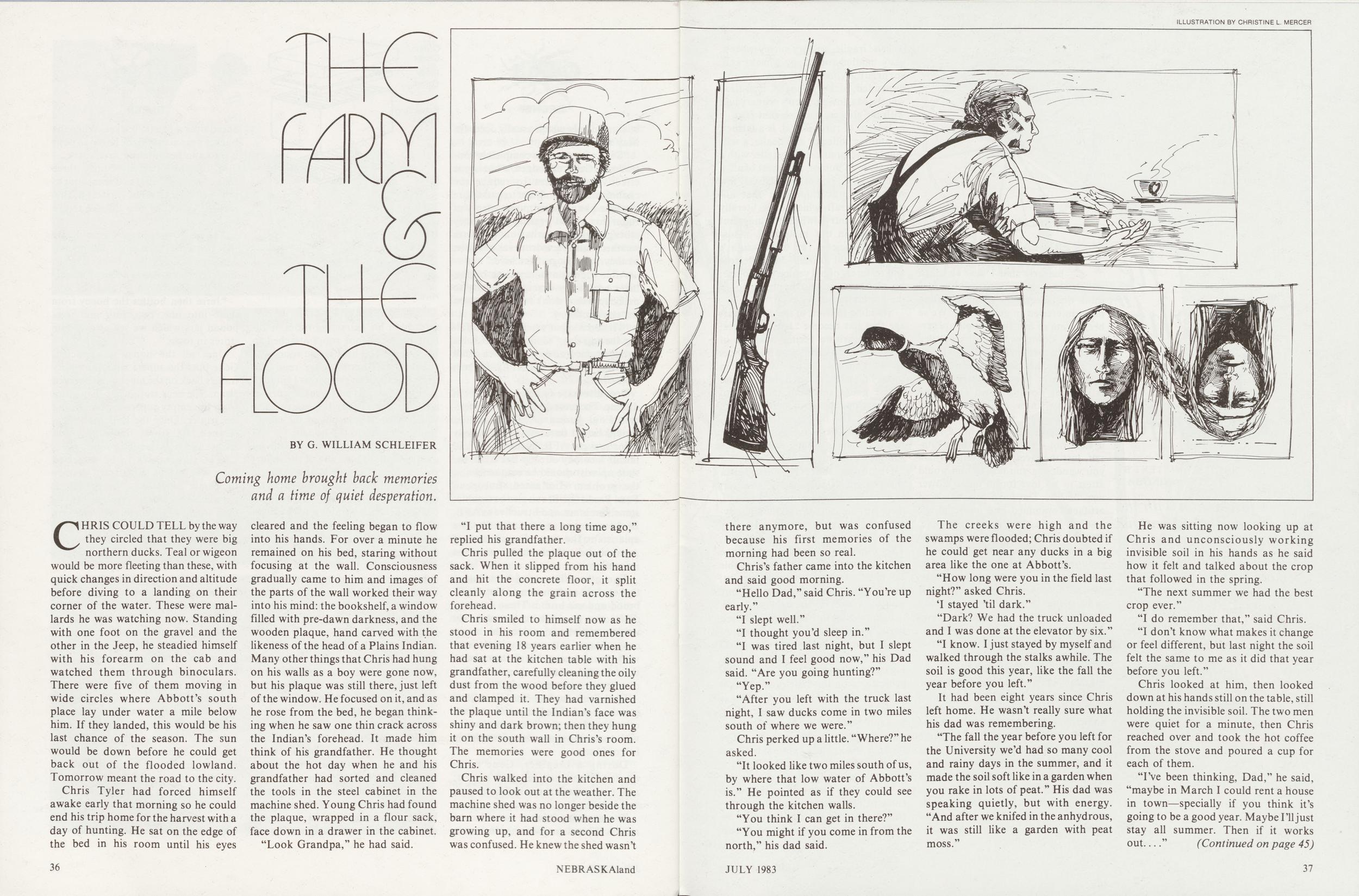
The Farm & The Flood
CHRIS COULD TELL by the way they circled that they were big northern ducks. Teal or wigeon would be more fleeting than these, with quick changes in direction and altitude before diving to a landing on their corner of the water. These were mallards he was watching now. Standing with one foot on the gravel and the other in the Jeep, he steadied himself with his forearm on the cab and watched them through binoculars. There were five of them moving in wide circles where Abbott's south place lay under water a mile below him. If they landed, this would be his last chance of the season. The sun would be down before he could get back out of the flooded lowland. Tomorrow meant the road to the city.
Chris Tyler had forced himself awake early that morning so he could end his trip home for the harvest with a day of hunting. He sat on the edge of the bed in his room until his eyes cleared and the feeling began to flow into his hands. For over a minute he remained on his bed, staring without focusing at the wall. Consciousness gradually came to him and images of the parts of the wall worked their way into his mind: the bookshelf, a window filled with pre-dawn darkness, and the wooden plaque, hand carved with the likeness of the head of a Plains Indian. Many other things that Chris had hung on his walls as a boy were gone now, but his plaque was still there, just left of the window. He focused on it, and as he rose from the bed, he began thinking when he saw one thin crack across the Indian's forehead. It made him think of his grandfather. He thought about the hot day when he and his grandfather had sorted and cleaned the tools in the steel cabinet in the machine shed. Young Chris had found the plaque, wrapped in a flour sack, face down in a drawer in the cabinet.
"Look Grandpa," he had said.
"I put that there a long time ago," replied his grandfather.
Chris pulled the plaque out of the sack. When it slipped from his hand and hit the concrete floor, it split cleanly along the grain across the forehead.
Chris smiled to himself now as he stood in his room and remembered that evening 18 years earlier when he had sat at the kitchen table with his grandfather, carefully cleaning the oily dust from the wood before they glued and clamped it. They had varnished the plaque until the Indian's face was shiny and dark brown; then they hung it on the south wall in Chris's room. The memories were good ones for Chris.
Chris walked into the kitchen and paused to look out at the weather. The machine shed was no longer beside the barn where it had stood when he was growing up, and for a second Chris was confused. He knew the shed wasn't there anymore, but was confused because his first memories of the morning had been so real.
Chris's father came into the kitchen and said good morning.
"Hello Dad," said Chris. "You're up early."
"I slept well."
"I thought you'd sleep in."
"I was tired last night, but I slept sound and I feel good now," his Dad said. "Are you going hunting?"
"Yep."
"After you left with the truck last night, I saw ducks come in two miles south of where we were."
Chris perked up a little. "Where?" he asked.
"It looked like two miles south of us, by where that low water of Abbott's is." He pointed as if they could see through the kitchen walls.
"You think I can get in there?"
"You might if you come in from the north," his dad said.
The creeks were high and the swamps were flooded; Chris doubted if he could get near any ducks in a big area like the one at Abbott's.
"How long were you in the field last night?" asked Chris.
'I stayed 'til dark."
"Dark? We had the truck unloaded and I was done at the elevator by six."
"I know. I just stayed by myself and walked through the stalks awhile. The soil is good this year, like the fall the year before you left."
It had been eight years since Chris left home. He wasn't really sure what his dad was remembering.
"The fall the year before you left for the University we'd had so many cool and rainy days in the summer, and it made the soil soft like in a garden when you rake in lots of peat." His dad was speaking quietly, but with energy. "And after we knifed in the anhydrous, it was still like a garden with peat moss.
He was sitting now looking up at Chris and unconsciously working invisible soil in his hands as he said how it felt and talked about the crop that followed in the spring.
"The next summer we had the best crop ever."
"I do remember that," said Chris.
"I don't know what makes it change or feel different, but last night the soil felt the same to me as it did that year before you left."
Chris looked at him, then looked down at his hands still on the table, still holding the invisible soil. The two men were quiet for a minute, then Chris reached over and took the hot coffee from the stove and poured a cup for each of them.
"I've been thinking, Dad," he said, "maybe in March I could rent a house in town—specially if you think it's going to be a good year. Maybe I'll just stay all summer. Then if it works out" (Continued on page 45)
36 NEBRASKAland JULY 1983 37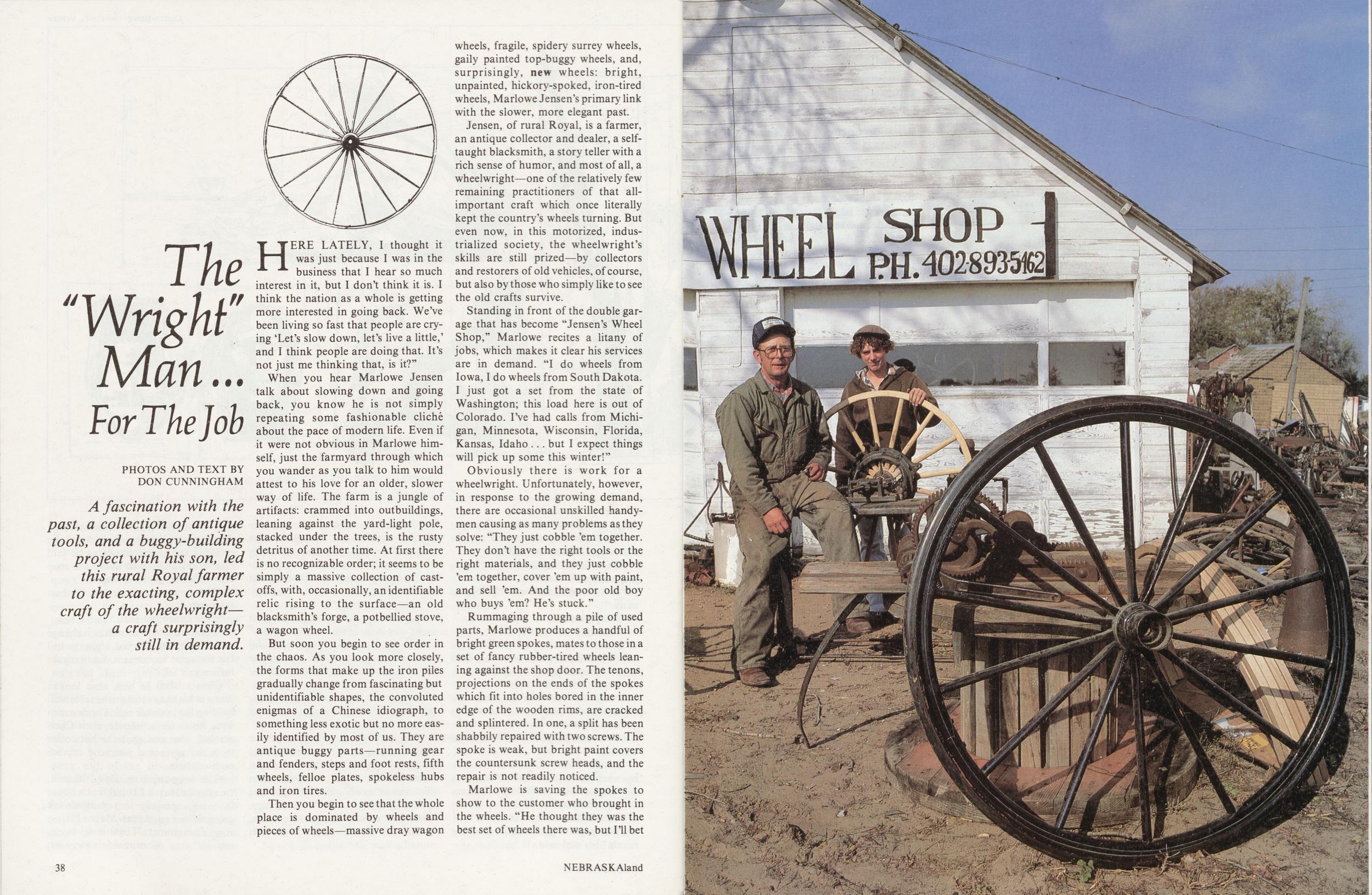
The "Wright" Man For The Job
A fascination with the past, a collection of antique tools, and a buggy-building project with his son, led this rural Royal farmer to the exacting, complex craft of the wheelwright—a craft surprisingly still in demand.
HERE LATELY, I thought it was just because I was in the business that I hear so much interest in it, but I don't think it is. I think the nation as a whole is getting more interested in going back. We've been living so fast that people are crying 'Let's slow down, let's live a little,' and I think people are doing that. It's not just me thinking that, is it?"
When you hear Marlowe Jensen talk about slowing down and going back, you know he is not simply repeating some fashionable cliche about the pace of modern life. Even if it were not obvious in Marlowe himself, just the farmyard through which you wander as you talk to him would attest to his love for an older, slower way of life. The farm is a jungle of artifacts: crammed into outbuildings, leaning against the yard-light pole, stacked under the trees, is the rusty detritus of another time. At first there is no recognizable order; it seems to be simply a massive collection of castoffs, with, occasionally, an identifiable relic rising to the surface—an old blacksmith's forge, a potbellied stove, a wagon wheel.
But soon you begin to see order in the chaos. As you look more closely, the forms that make up the iron piles gradually change from fascinating but unidentifiable shapes, the convoluted enigmas of a Chinese idiograph, to something less exotic but no more easily identified by most of us. They are antique buggy parts—running gear and fenders, steps and foot rests, fifth wheels, felloe plates, spokeless hubs and iron tires.
Then you begin to see that the whole place is dominated by wheels and pieces of wheels—massive dray wagon wheels, fragile, spidery surrey wheels, gaily painted top-buggy wheels, and, surprisingly, new wheels: bright, unpainted, hickory-spoked, iron-tired wheels, Marlowe Jensen's primary link with the slower, more elegant past.
Jensen, of rural Royal, is a farmer, an antique collector and dealer, a self-taught blacksmith, a story teller with a rich sense of humor, and most of all, a wheelwright—one of the relatively few remaining practitioners of that all-important craft which once literally kept the country's wheels turning. But even now, in this motorized, industrialized society, the wheelwright's skills are still prized—by collectors and restorers of old vehicles, of course, but also by those who simply like to see the old crafts survive.
Standing in front of the double garage that has become "Jensen's Wheel Shop," Marlowe recites a litany of jobs, which makes it clear his services are in demand. "I do wheels from Iowa, I do wheels from South Dakota. I just got a set from the state of Washington; this load here is out of Colorado. I've had calls from Michigan, Minnesota, Wisconsin, Florida, Kansas, Idaho but I expect things will pick up some this winter!"
Obviously there is work for a wheelwright. Unfortunately, however, in response to the growing demand, there are occasional unskilled handymen causing as many problems as they solve: "They just cobble 'em together. They don't have the right tools or the right materials, and they just cobble 'em together, cover 'em up with paint, and sell 'em. And the poor old boy who buys 'em? He's stuck."
Rummaging through a pile of used parts, Marlowe produces a handful of bright green spokes, mates to those in a set of fancy rubber-tired wheels leaning against the shop door. The tenons, projections on the ends of the spokes which fit into holes bored in the inner edge of the wooden rims, are cracked and splintered. In one, a split has been shabbily repaired with two screws. The spoke is weak, but bright paint covers the countersunk screw heads, and the repair is not readily noticed.
Marlowe is saving the spokes to show to the customer who brought in the wheels. "He thought they was the best set of wheels there was, but I'll bet
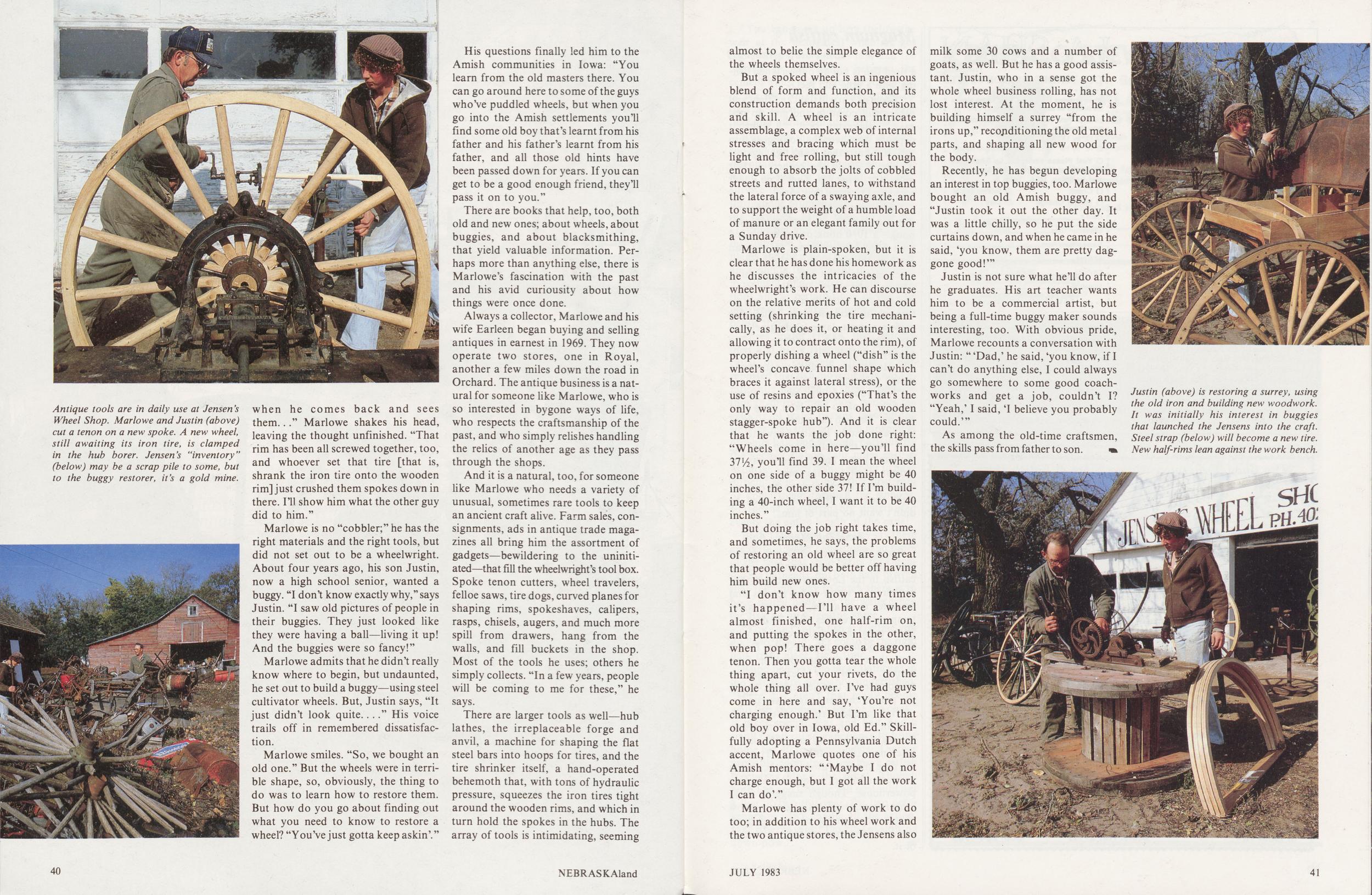
Antique tools are in daily use at Jensen's Wheel Shop. Marlowe and Justin (above) cut a tenon on a new spoke. A new wheel, still awaiting its iron tire, is clamped in the hub borer. Jensen's "inventory" (below) may be a scrap pile to some, but to the buggy restorer, it's a gold mine.
when he comes back and sees them." Marlowe shakes his head, leaving the thought unfinished. "That rim has been all screwed together, too, and whoever set that tire [that is, shrank the iron tire onto the wooden rim] just crushed them spokes down in there. I'll show him what the other guy did to him."
Marlowe is no "cobbler;" he has the right materials and the right tools, but did not set out to be a wheelwright. About four years ago, his son Justin, now a high school senior, wanted a buggy. "I don't know exactly why, "says Justin. "I saw old pictures of people in their buggies. They just looked like they were having a ball—living it up! And the buggies were so fancy!"
Marlowe admits that he didn't really know where to begin, but undaunted, he set out to build a buggy—using steel cultivator wheels. But, Justin says, "It just didn't look quite." His voice trails off in remembered dissatisfaction.
Marlowe smiles. "So, we bought an old one." But the wheels were in terrible shape, so, obviously, the thing to do was to learn how to restore them. But how do you go about finding out what you need to know to restore a wheel? "You've just gotta keep askin'.
His questions finally led him to the Amish communities in Iowa: "You learn from the old masters there. You can go around here to some of the guys who've puddled wheels, but when you go into the Amish settlements you'll find some old boy that's learnt from his father and his father's learnt from his father, and all those old hints have been passed down for years. If you can get to be a good enough friend, they'll pass it on to you."
There are books that help, too, both old and new ones; about wheels, about buggies, and about blacksmithing, that yield valuable information. Perhaps more than anything else, there is Marlowe's fascination with the past and his avid curiousity about how things were once done.
Always a collector, Marlowe and his wife Earleen began buying and selling antiques in earnest in 1969. They now operate two stores, one in Royal, another a few miles down the road in Orchard. The antique business is a natural for someone like Marlowe, who is so interested in bygone ways of life, who respects the craftsmanship of the past, and who simply relishes handling the relics of another age as they pass through the shops.
And it is a natural, too, for someone like Marlowe who needs a variety of unusual, sometimes rare tools to keep an ancient craft alive. Farm sales, consignments, ads in antique trade magazines all bring him the assortment of gadgets—bewildering to the uninitiated—that fill the wheelwright's tool box. Spoke tenon cutters, wheel travelers, felloe saws, tire dogs, curved planes for shaping rims, spokeshaves, calipers, rasps, chisels, augers, and much more spill from drawers, hang from the walls, and fill buckets in the shop. Most of the tools he uses; others he simply collects. "In a few years, people will be coming to me for these," he says.
There are larger tools as well—hub lathes, the irreplaceable forge and anvil, a machine for shaping the flat steel bars into hoops for tires, and the tire shrinker itself, a hand-operated behemoth that, with tons of hydraulic pressure, squeezes the iron tires tight around the wooden rims, and which in turn hold the spokes in the hubs. The array of tools is intimidating, seeming almost to belie the simple elegance of the wheels themselves.
But a spoked wheel is an ingenious blend of form and function, and its construction demands both precision and skill. A wheel is an intricate assemblage, a complex web of internal stresses and bracing which must be light and free rolling, but still tough enough to absorb the jolts of cobbled streets and rutted lanes, to withstand the lateral force of a swaying axle, and to support the weight of a humble load of manure or an elegant family out for a Sunday drive.
Marlowe is plain-spoken, but it is clear that he has done his homework as he discusses the intricacies of the wheelwright's work. He can discourse on the relative merits of hot and cold setting (shrinking the tire mechanically, as he does it, or heating it and allowing it to contract onto the rim), of properly dishing a wheel ("dish" is the wheel's concave funnel shape which braces it against lateral stress), or the use of resins and epoxies ("That's the only way to repair an old wooden stagger-spoke hub"). And it is clear that he wants the job done right: "Wheels come in here—you'll find 37J4, you'll find 39. I mean the wheel on one side of a buggy might be 40 inches, the other side 37! If I'm building a 40-inch wheel, I want it to be 40 inches."
But doing the job right takes time, and sometimes, he says, the problems of restoring an old wheel are so great that people would be better off having him build new ones.
"I don't know how many times it's happened—I'll have a wheel almost finished, one half-rim on, and putting the spokes in the other, when pop! There goes a daggone tenon. Then you gotta tear the whole thing apart, cut your rivets, do the whole thing all over. I've had guys come in here and say, 'You're not charging enough.' But I'm like that old boy over in Iowa, old Ed." Skillfully adopting a Pennsylvania Dutch accent, Marlowe quotes one of his Amish mentors: "'Maybe I do not charge enough, but I got all the work I can do'."
Marlowe has plenty of work to do too; in addition to his wheel work and the two antique stores, the Jensens also milk some 30 cows and a number of goats, as well. But he has a good assistant. Justin, who in a sense got the whole wheel business rolling, has not lost interest. At the moment, he is building himself a surrey "from the irons up," reconditioning the old metal parts, and shaping all new wood for the body.
Recently, he has begun developing an interest in top buggies, too. Marlowe bought an old Amish buggy, and "Justin took it out the other day. It was a little chilly, so he put the side curtains down, and when he came in he said, 'you know, them are pretty daggone good!'"
Justin is not sure what he'll do after he graduates. His art teacher wants him to be a commercial artist, but being a full-time buggy maker sounds interesting, too. With obvious pride, Marlowe recounts a conversation with Justin: "'Dad,' he said, 'you know, if I can't do anything else, I could always go somewhere to some good coach-works and get a job, couldn't I? "Yeah,' I said, I believe you probably could.'"
As among the old-time craftsmen, the skills pass from father to son.
Justin (above) is restoring a surrey, using the old iron and building new woodwork. It was initially his interest in buggies that launched the Jensens into the craft. Steel strap (below) will become a new tire. New half-rims lean against the work bench.
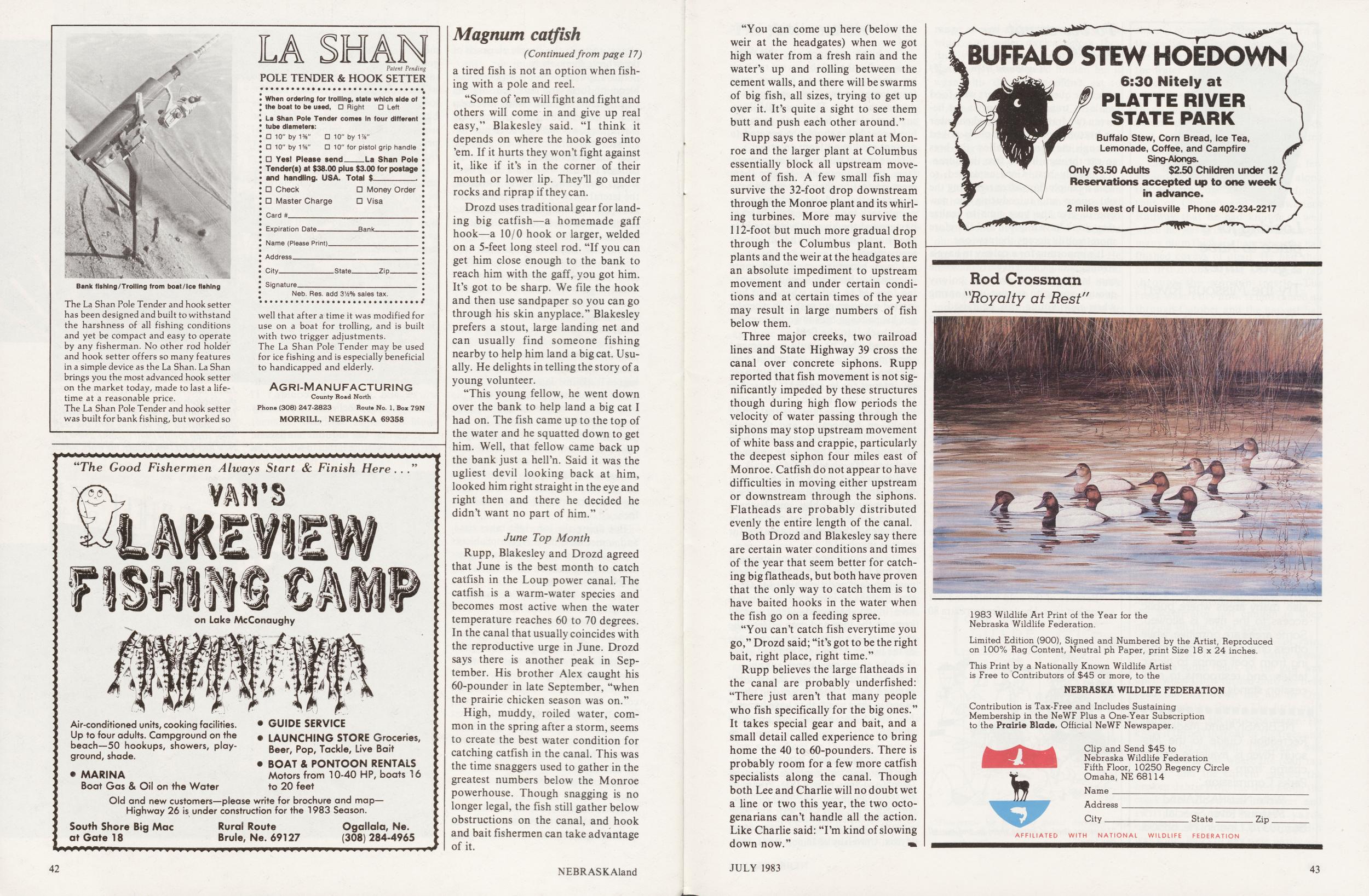
Magnum catfish
(Continued from page 17)a tired fish is not an option when fishing with a pole and reel.
"Some of 'em will fight and fight and others will come in and give up real easy," Blakesley said. "I think it depends on where the hook goes into 'em. If it hurts they won't fight against it, like if it's in the corner of their mouth or lower lip. They'll go under rocks and riprap if they can.
Drozd uses traditional gear for landing big catfish—a homemade gaff hook—a 10/0 hook or larger, welded on a 5-feet long steel rod. "If you can get him close enough to the bank to reach him with the gaff, you got him. It's got to be sharp. We file the hook and then use sandpaper so you can go through his skin anyplace." Blakesley prefers a stout, large landing net and can usually find someone fishing nearby to help him land a big cat. Usually. He delights in telling the story of a young volunteer.
"This young fellow, he went down over the bank to help land a big cat I had on. The fish came up to the top of the water and he squatted down to get him. Well, that fellow came back up the bank just a hell'n. Said it was the ugliest devil looking back at him, looked him right straight in the eye and right then and there he decided he didn't want no part of him."
June Top MonthRupp, Blakesley and Drozd agreed that June is the best month to catch catfish in the Loup power canal. The catfish is a warm-water species and becomes most active when the water temperature reaches 60 to 70 degrees. In the canal that usually coincides with the reproductive urge in June. Drozd says there is another peak in September. His brother Alex caught his 60-pounder in late September, "when the prairie chicken season was on."
High, muddy, roiled water, common in the spring after a storm, seems to create the best water condition for catching catfish in the canal. This was the time snaggers used to gather in the greatest numbers below the Monroe powerhouse. Though snagging is no longer legal, the fish still gather below obstructions on the canal, and hook and bait fishermen can take advantage of it.
"You can come up here (below the weir at the headgates) when we got high water from a fresh rain and the water's up and rolling between the cement walls, and there will be swarms of big fish, all sizes, trying to get up over it. It's quite a sight to see them butt and push each other around."
Rupp says the power plant at Monroe and the larger plant at Columbus essentially block all upstream movement of fish. A few small fish may survive the 32-foot drop downstream through the Monroe plant and its whirling turbines. More may survive the 112-foot but much more gradual drop through the Columbus plant. Both plants and the weir at the headgates are an absolute impediment to upstream movement and under certain conditions and at certain times of the year may result in large numbers of fish below them.
Three major creeks, two railroad lines and State Highway 39 cross the canal over concrete siphons. Rupp reported that fish movement is not significantly impeded by these structures though during high flow periods the velocity of water passing through the siphons may stop upstream movement of white bass and crappie, particularly the deepest siphon four miles east of Monroe. Catfish do not appear to have difficulties in moving either upstream or downstream through the siphons. Flatheads are probably distributed evenly the entire length of the canal.
Both Drozd and Blakesley say there are certain water conditions and times of the year that seem better for catching big flatheads, but both have proven that the only way to catch them is to have baited hooks in the water when the fish go on a feeding spree.
""You can't catch fish everytime you go," Drozd said; "it's got to be the right bait, right place, right time."
Rupp believes the large flatheads in the canal are probably underfished: "There just aren't that many people who fish specifically for the big ones." It takes special gear and bait, and a small detail called experience to bring home the 40 to 60-pounders. There is probably room for a few more catfish specialists along the canal. Though both Lee and Charlie will no doubt wet a line or two this year, the two octogenarians can't handle all the action. Like Charlie said: "I'm kind of slowing down now."
Rod Grossman "Royalty at Rest 1983 Wildlife Art Print of the Year for the Nebraska Wildlife Federation. Limited Edition (900), Signed and Numbered by the Artist, Reproduced on 100% Rag Content, Neutral ph Paper, print Size 18 x 24 inches. This Print by a Nationally Known Wildlife Artist is Free to Contributors of $45 or more, to the NEBRASKA WILDLIFE FEDERATION Contribution is Tax-Free and Includes Sustaining Membership in the NeWF Plus a One-Year Subscription to the Prairie Blade. Official NeWF Newspaper. Clip and Send $45 to Nebraska Wildlife Federation Fifth Floor, 10250 Regency Circle Omaha, NE 68114 Name Address City State Zip AFFILIATED WITH NATIONAL WILDLIFE FEDERATION
To bee or not to bee
(Continued from page 35)vides the queen and workers with food while in transit. The cage is set between two frames in the brood chamber or bottom box, and a hole is poked through the candy to allow the bees to eat through it and free the queen. It's usually best, Gene explained, to wait a couple days after removing the old queen and introducing the new one to give the bees time to realize they don't have a queen and therefore more readily accept the new one.
It's important for a colony to have a strong, young queen in early fall so she can lay eggs and give the colony enough young to survive until spring when new young can be raised.
A strong hive will require about 80 pounds of honey to carry it through winter. Only about 30 pounds will be used during the winter, with the rest used for brood raising in early spring before nectar and pollen are available.
"I check my hives several times during the winter to make sure they haven't run out of, or can't reach, the honey," Gene said. "Below 45 degrees, bees become chilled and unable to move. Even if a supply of honey is a few inches away, they will starve to death if they are too chilled.
During winter, bees huddle in clumps around several honey-filled frames, trying to keep the cluster's temperature around 57 degrees. In the winter, bees may survive six months or longer compared to their five to six-week lifespan in the summer.
"Because of the cold winter and wet spring last year, I had to feed an extra 80 pounds of sugar to my 13 hives," Gene said.
The hive's entrance also has to be narrowed in the fall to prevent robbing by other bees, and to prevent mice from entering, as they can quickly destroy the comb. The bees will fill any small cracks or holes with propolis, but larger holes should be covered to prevent cold wind from entering.
Gene moves his hives to his parents' farm during the winter to give them more protection than they would have at sites in the field. He said that some people tack tar paper or stack bales of hay around the hives in winter to help the bees maintain the cluster's temperature.
I was becoming more and more interested in beekeeping and was looking forward to spring when Gene had invited me to go out with him when he got his package bees in and moves his hives back into the field.
I asked what he would recommend someone do to get started in beekeeping. He must have been able to see my interest for he replied, "Those bee stings must have gotten to your blood, huh? Well, there are several good books on beekeeping, and the state apiarist offers workshops that will help a beginner avoid some of the common mistakes. It's also helpful to talk to beekeepers and watch their operation to get an idea what's involved. It's a time-consuming hobby, and I would recommend someone just starting out to have only three hives to get a feel for what is involved."
I have seen how time-consuming it was, but I had become engrossed these past two days and even hinted to Gene that I might be interested in putting a hive in my backyard. Gene seemed keen on the idea and even offered the use of one of his hives for a percentage of the honey. My mouth watered at the thought of my own honey supply.
Gene's comment to me the first day came to mind: "Beekeepers don't have blood in their veins; they have honey." My blood was already beginning to change.
BEEKEEPING BOOKSThe Hive and the Honeybee, edited by Dadant and Sons, revised 1975, Printed by Journal Printing Co., Carthage, Illinois. ABC and XYZ of Bee Culture, published by A.I. Root Co., Medina, Ohio. Beekeeping in the Midwest, Elbert R. Jaycox, University of Illinois Press, 1976.
"I just got tired of letting them in and out all day long!"
CHIEF BIG Owl's GUIDE SERVICE
"Tomorrow we take the guests overland to Shining Lake does anyone remember how to get there?"
The farm and the flood
(Continued from page 37)Chris's mother walked in and interrupted his sentence with her morning greetings and offers of breakfast, and the routine of the day took over.
Chris took their big full-chested yellow Lab with him and jumped a half-dozen places he knew before 10 o'clock. Abbott's place looked risky so he stuck to the pond. Since there was a light wind from the north, he jumped ponds with dikes on the north end. He knew the ducks would be there, huddled in the corner where the water was calm. Chris was glad he was alone. After parking on the first road of the pond he was stalking, he would work his way through the stubble or the rows of cut or uncut corn for as much as three-quarters of a mile before reaching the dike. The walking was hard work. There was still mud in the low places, but the struggle made him feel good. He was a long way from the city.
The ducks had been hunted at every stop between Canada and the Nebraska fields. They were easily spooked, and Chris moved as quietly as he could, but the brush was brittle. They hid behind the dikes and listened for the rustle of his boots in the weeds and the whispered commands to his dog. The sound carried to them clearly on the wind. As the snap of the brush came nearer, they moved out into the breeze on the water and away from him.
At the base of a dike Chris tightened his grip on the tether that held his dog in check. Then, dropping to his hands and knees and pushing his gun ahead of him, he crawled to the top of the mound. The scene was always the same. The ducks had moved to the far end where the water and the open fields protected them. They knew he was coming now. They were tense and ready to fly at the first appearnce of his silhouette at the top of the dike, and they spread out on the water in anticipation of the flush. Chris waited, knowing they wouldn't return to his end of the pond. He tried to rush them, running low to the ground with his gun and his dog. He stopped when they broke and he shot, or didn't shoot—with the same results. They knew his range as well as he did and they flew wider and wider circles before they finally disappeared south—toward Kansas. He was a good hunter, but it wasn't his day. He couldn't get to them.
After the sixth pond, Chris bent down and slipped the choke-chain off the dog's neck. "It's no good." He was kneeling beside the dog, talking to her, with one arm over her neck. "Go on girl. Run back to the Jeep. Go on."
The dog ran through the high brush with strong bounds and then ran at full speed with her ears back when she hit bare patches of pasture. Chris laughed out loud at the sight of the dog bouncing up and down in the weeds. He rested his 12-gauge on his shoulder and struck an easy, strong gait back through the section. His dog was waiting for him, panting lightly, when he stepped over the fence.
That was in the morning. He had gone back to the farm and waited until now for one last try before he had to go back to the city.
Chris leaned against the cab of his Jeep and watched the big mallards grow smaller as they turned on the far side of their half-mile-wide circle. It looked for a minute like they might disappear completely; then the circle brought them back. They were powerful birds, carefully covering all of the land around the water where they wanted to rest for the evening. They were tired from the day's pressure of being pushed farther and farther south, and their strong, concentric circles grew smaller as they began to lose altitude with each pass. They banked sharply to meet the force of the turn as the radius tightened. Then, breaking the pattern, they started their glide to the water. As spent as they were, they were ready to pull out if they sensed an interruption in the environment. But there was none, and they settled behind the long line of cottonwoods that marked the banks of the flooded creek.
Chris panned the section for a few seconds with his binoculars. All along the western edge lay the abandoned spur of Chicago and Northwestern Railway that he had known so well when he was growing up. There were many plum thickets there where he had flushed coveys of quail. He had shot his first double where Dry Creek ran through the wooden trestle. The creek wasn't dry now. It had rained all through October and the harvest had been difficult. It was a clear day finally, with dry air, but the water still ran strong under the trestle and into the section where it spread across Abbott's south place. It was a good feeling to know something as well as he knew the land along this part of Dry Creek. The flood made it look different, but underneath it was the same. Chris knew the way to get to where the ducks were.
He moved deliberately as if excitement could spook the birds from a mile away. He sat down easy in the Jeep and closed the door so there was no sound other than the click of the latch. The engine started quickly and he wished it were quieter. He slipped it into first and started rolling. All the time he moved carefully with his eyes fixed on the top of the row of trees where he had last seen the mallards. Chris touched the accelerator just enough to keep moving on the loose gravel.
After the first two days of rain, Abbott had moved his cattle away from his south fields, so the gate was open when Chris turned onto the field road that led down the hill to Dry Creek and the flood. The little-used road sloped right into the water. He knew it turned in front of the trees and ran parallel to them. The water was wide and shallow where the road ran into it, and the current carried the broken debris from the trees along the creek. The flood was narrower and swifter a couple hundred yards upstream, but where Chris stopped it was wide. Bales of hay were partly visible
44 NEBRASKAland JULY 1983 45
in the muddy water. It wasn't deep. The trees and brush were thick along that part of the creek. There was a knoll just on the other side that formed a cup and he figured the ducks were in behind there. He took a handful of number four magnum shells out of the box on the dash and stuffed them into his jacket pocket.
The dog was excited. Her big yellow tail was thumping the side of the Jeep and she was shifting her weight from one paw to the other. "Sorry girl," he said as he rubbed her scruff with brisk strokes. "You can't make this trip too much water." Chris was still watching the place he knew the ducks would be. "Now stay."
He picked up his gun by the stock from the passenger's seat, and closed the door with just a click without pushing it past the first catch. The dog whined but Chris didn't hear her. He was concentrating on the ducks. Over the steady gurgle of the water he heard them. At once he could tell by the sound of their prattle that they didn't know he was there. He was listening to evening calls—a little feeding and some playing, but mostly just resting sounds—like they were sighing after a long day of pushing south. They weren't apprehensive sounds at all. From two hundred yards away he could hear them.
"This is going to be easy," Chris thought. "They can't hear me over the water. They're not protected on this side. There's a ridge over there and they're in behind that. They won't see me coming 'til I'm over the top. Then it'll be too late. I'll have them."
His best way was through the part where the water was wide and not as deep. The water was very cold because it was late October, and he felt the chill in his whole body as soon as his rubber boots touched the water. It felt good. To keep from losing his balance in the current he had to slide his feet forward without picking them up. The water ran as high as his knees. It pushed him from the side and tried to cut his feet out from under him.
"I have to be careful here," he thought. "Listen to them. There's a lot more in there than the five I saw."
The water broke on his right leg and formed a V that spread from his body for a few yards downstream. Sometimes after he took a step, the water would be higher on his thigh; but he could move to the right or left and back to higher ground. Chris stopped at one of the bales of hay and rested. He was using his gun for balance like a high-wire performer, and it was heavy.
"It's getting dark quicker than I thought. The sun really moves fast when it's in that part of the sky. It's getting colder."
He left the bale and moved toward the cottonwoods again. When he walked he could feel the wheat stubble break under his feet until he got right up to the tree line. The dirt road was there. When he stepped in the ruts the water rose high on his thigh and then went back down to his knees as he moved on into the trees.
The top of the knoll stuck up above the water behind the trees, and he could just make it out through the thicket in the failing light. The water was wide and flat and it moved steadily through the trees with the ripples moving back and forth from the trunks of the cottonwoods to the sticks of the brush trees. It calmed him and took everything out of his mind. Even the ducks began to fade as he relaxed—methodically pushing one leg in front of the other.
"Just a few more yards now. Look at the way the water stretches out across that alfalfa field. No wonder they think they're so safe. There's six hundred yards of water out there on the other side of that ridge. You could never get to them from the other side they don't count on me walking through these trees."
Suddenly, without warning, Chris stepped over the hidden edge of the bank of the creek. The flood had disguised it, but under the water the creek still cut down into the earth. He was rigid with cold. He couldn't see. The gun was pulling him under the water. His chest was caving in from the shock of the sudden cold. He was going deeper. His face had been slapped with the chilling rush of water and his jaw and his eyes were tight against the flood. His head was under. He couldn't think. His boots were filling and his feet were moving away from him.
"I can't let my feet get away."
Any movement he tried to make, came hard and slow. His arms were heavy.
"I've got to try to brace myself with the gun. Over to the left."
He pushed down hard with the gun but it slipped in the mud.
"I've got to think. Push again with the gun. Move back."
Moving both hands onto the barrel, he pushed again against the invisible, slippery earth and the force of the flood. The water slammed him against the brush trees growing on the submerged bank of the creek. He instinctively grabbed for a tree, sensing it was his only chance. The barrel was back in his right hand and his left hand found a tree to grip.
"I've got to get out now or it's over. I'll have to breathe soon. Push hard with the gun and hold onto the tree."
He was above water for an instant, then under again—slipping back. The water was deep. It ran way over his head.
"Hold hard against the water."
Under the water, Chris wedged his foot between the base of a tree and the bank.
"Shove against the tree. Now fall backwards. There's the top of the bank."
He lunged backwards in the cold, muddy water, pushing hard from the tree. He felt the ground hit his butt and he let the water roll him over onto his hands and knees. He lifted his head and he could breathe again.
He crawled forward and struggled against the current to get back on his feet using the gun again. He ached. His strength was spent for the moment. He stood up and took a few breaths as deep as he could against the cold.
If he had been listening he could still have heard the ducks calling through the trees with the same relaxed evening sounds, but he was looking for the quickest way out now.
"It's a lot shorter to dry land going west," he thought. "The current is stonger and it's a little deeper but I'll make it. It will cut the distance in half back up to the hill. I'm sure as hell not going to get any wetter than I already am. I've got to get back."
His teeth were chattering and his muscles ached from the cold. He moved his legs as strongly as he could in the waist-deep water. The point he was making for was 200 yards west of his Jeep. The bales to his right were black shadows now against the gray flat plain of the moving water. Twice he fell in the strong current and swore out loud, but he wasn't angry—just cold and sore. His breath came in short, choppy gulps because the walls of his chest were contracted. When he stumbled out of the flood onto the field, his legs wouldn't lift right. They were heavy from the water and cramped from the cold. He ran toward the Jeep swinging one boot after the other with big, heavy movements.
Chris flopped across the hood panting hard. He reached over and opened the door and the dog jumped out and then up on her master. She ran around the Jeep. He collapsed into the front seat.
"Get back in girl. Come on." She climbed across Chris and into the back. "I walked out across there right toward those ducks and I walked right into the creek. It's got about 10 feet of water in it, and I stepped right over the edge like I never knew there was a creek there." He coughed, then laughed in disbelief as he started the engine. He turned around and went back up the hill away from the flood. The sun had gone down behind him and the sky was the same gray color as the water.
Chris had finished a long warm bath and was working under the light over the kitchen counter when his dad came in. All the pieces of his gun were lying neatly arranged on sheets of newspaper. He had dried them, and now was oiling them before reassembling.
"Any luck?"
No," said Chris. He would tell about the flood another day.
Supper was good. They talked about the farm. His dad had put the combine away for the winter. Chris knew how he had cleaned it and
Ash Hollow State Historical Park
Like an oasis on the plains, the Ash Hollow area served early Indiansand white men, providing shelter, water, wood and food. Artifacts from 10,000 years ago, plus tales from pioneers traveling through just a century ago, mingle here. And, they are on display at the interpretive center. A couple miles away is famous Windlass Hill, another part of Ash Hollow, where the pioneers lowered their wagons from the top of the hill into the valley. It is all located along Highway 26 near Lewellen in central Nebraska at the west end of Lake McConaughy. VISIT US SOON! LEWELLEN, NE (308) 778-5651 NEBRASKA GAME AND PARKS COMMISSION 46 NEBRASKAland JULY 1983 47
greased it and adjusted it, and he knew how he would do it before the harvest in the fall.
They stayed at the table and talked after supper was over.
"I'm ready to move to town," said his father.
'What?" Chris was caught off guard.
I can move to town in the spring, and you could live here."
I haven't thought about it." He lied.
'What's to think about? I want you to run the farm."
His mother sat without saying a word. She'd been ready for this for many months.
"Are you really sure? Now? This is your place."
"If you run the farm, you live here. You know how I feel about it."
'It's still your farm," said Chris.
'It doesn't belong to anyone. It will be here long after you and I aren't. It's just your turn, that's all. There'll be others."
He was right. Chris had known it all along.
"I need some time to think. I've got all winter."
"Fine," said his dad.
They knew the decision had been made.
When he went into his room for the night, Chris took a squeeze bottle of Elmer's white glue and a ball of twine. He took the plaque from the wall and squirted a few drops in the crack in the Indian's forehead. He wrapped the twine around the wood until the glue oozed out in beads on the Indian's face. He wiped the beads off with his finger, then onto his jeans; then he wet his finger and wiped the glue from the plaque again. He laid the plaque down where it would dry by morning.
Long after dark a big flock of snow geese flew in. There was a bright moon that reflected off the flood. The geese didn't circle. They were high and could see all the land. Dropping swiftly from 4,000 feet, they landed quietly behind the knoll, behind the trees, on the flood.
Trading Post
DOGSTRAINING ALL BREEDS Hunting dogs—Vizslas for sale. Rozanek Kennels, Rt. 2, Schuyler, NE 68661. Phone (402) 352-8769.
GERMAN SHORTHAIRED Pointers, five months old, AKC, four males, champion blood lines, excellent hunters. Phone (308) 262-1403.
ENGLISH SETTERS and Pointers: Outstanding bloodlines! Puppies, started dogs, and stud service available. High Plains Kennels, 1411 Emerson, Alliance, NE 69301. Phone (308) 762-6709.
GERMAN SHORTHAIRS—English pointers and setters. Stud service, puppies and started dogs, available. Also Diamond Dog Food. Wayne Clark, Box 54, Union, NE. (402) 263-3495 or 263-3155.
MISCELLANEOUS GUNS—Browning, Winchester, Remington, others, Hi-powers, shotguns, new, used, antiques. Want Pre-1964 Winchesters. Buy-Sell-Trade. Ph. (402) 729-6112. Bedlan's Sporting Goods, Fairbury, NE 68352. PAINTINGS of your favorite spot: homestead, farm, the old fishing hole, vacation homes. Preserve your memories. Large watercolor, $250, oil $500. Satisfaction guaranteed. K.S. Farris, 1898 Phelps, Fremont, NE 68025. (402) 721-2528. N.E. NEBRASKA TROUT Fishing. For rent Mon.-Thurs. or Fri.-Sun. 2 modern cottages completely furnished. 5 spring-fed lakes with trout up to 7 lbs. Bass and bluegill also. Diamond E Trout Resort, Orchard, NE 68764. (402) 893-4745. WINE AND BEER: Make your own. Send for free recipes and instructions. Omaha Supply, 13616 Polk, Omaha, Nebr. 68137. SELLING 50 USED Muchi-craft canoes. New ones too! Wilson Outfitters, 1329 Dawes Ave. (14th & Cornhusker), Lincoln, NE 68521. LAKE McCONAUGHY MAP!!! Just published in February, a 3-color, very detailed map of "Big Mac." A must for your camping and fishing needs. Shown in detail are water depths, location of services and facilities, main roads, off-roads, entrances, boat ramps, concessionaires, and much more. Order today—send $2 with name and address to: RJ Mapping, 10530 W. Alamo Place, Littleton, CO 80127. HATCHING EGGS. Valley quail, chukar partridge-Norwegian blue fox pups. Adults available on birds and fox. Frank Roy, Chapman, NE 68827. Phone (308) 986-2410. FISH FOR SALE. Channel catfish, bass, bluegill, crappie, trout, perch, white bass, minnows, hybrid grass carp, bullhead. We can ship fish, you can pick them up, or we deliver. Contact the Pleasant Valley Fish Farm, Rt. 1, McCook, Nebr. 69001. Phone (308) 345-6599.' GAME BIRDS for sale. Wild turkeys, wood ducks, mandarins, mallards, teal, Canada geese, pheasants—5 breeds chukkar quail. Many others not listed. Frontier Birds, Wauneta, NE 69045. Phone: day (308) 394-5577/evening (308) 394-5715. SAVE MONEY. Have fun. New booklet "How to Brew Delicious Beer and Root Beer—Secrets of Successful Brewing the Easy Way." $3.00. Guaranteed. Paul's Publications, 1424 Grove, Dept. NL, Crete, Nebraska 68333. TAXIDERMYCREATIVE TAXIDERMY in all its branches since 1935, now includes Northstar Freeze-Dry processing of approved small specimens. Also tanning and deerskin processing. Naturecraft Studio. Nebraska City, Nebraska 68510. Joe Voges-Owner. Phone (402) 873-5491.
NABITY'S TAXIDERMY. 31 years experience. Specializing in natural grass backgrounds for mammals, birds and fish. 13901 "0"St., Lincoln, NE 68505 (4 miles east of 84th and "O" (402) 489-6351.
BADE TAXIDERMY—Quality a must—Fast service. Fish, birds, rugs, tanning, full mounts and game heads. 1924 North Lincoln, Fremont, Nebraska. 727-5463.
Harlan County Dam Vacation Apartments fully furnished Color TV Kitchen Facilities Full Baths Game cleaning room with freezer One block from shopping center Weekend or week of pleasant living Security Deposit Required Sorry No Pets Dean and Esther Stone Box 145 Ph. (308) 799-3422 Republican City, NE 68971
Please start a subscription for me to NEBRASKAland, and send me the current bonus issue (a $6.00 value). One-year $7.50 Two-year $13 NAME ADDRESS CITY Three-year $19 STATE Mail to: NEBRASKAland Box 30370, Lincoln, NE 68503 ZIP
PEISTER TAXIDERMY—a name you can trust. We give you professional life-like work at prices most sportsmen can afford. Member National Taxidermist Association, #5 Regency Place, Kearney, Nebr. 68847. Phone (308) 237-7575.
JOHNSON TAXIDERMY—servicing southwest Nebraska, specializing in big-game mounts, lifesized mounts, rug work, fish, birds, tanning hair-on leather. Brochure and price list on request. Johnson Taxidermy, Rt. 1, Box 78, Lamar, NE 69035. Telephone (308) 882-5555.
AWARD-WINNING TAXIDERMIST. Eight time national award winners. Trust your trophies to a proven winner. Our complete taxidermy service also arranges hunts. Dinges Taxidermy Studio, 2763 South 12th Omaha, NE 68108. Ph. 402-342-3718.
BIG BEAR TAXIDERMY, Rt. 2, Mitchell, Nebraska 69357. We specialize in all big game from Alaska to Nebraska, also birds and fish. Hair on and hair off tanning, 4 1/2 miles west of Scottsbluff on Highway 26. Phone (308) 635-3013.
KARL SCHWARZ Master Taxidermist. Mounting of game heads—birds—fish—animals—fur rugs—robes—tanning buckskin. Since 1910. 424 South 13th Street, Dept. A, Omaha, Nebraska 68102.
FREEZE-DRY TAXIDERMY Wally Allison's State Record Taxidermy, 2709 Birchwood, North Platte, NE 69101. Phone: (308) 534-2324. Specializing in Fish and Small Game, Snake and Lizard and Novelties. (Nothing too small) Newest of all taxidermy methods employed.
BERGMAN'S RESORT On Johnson Lake Modern Lakefront Cabins Groceries Bait Tackle Full RV Hookups Boats for Rent Swim Fish Golf Write or Call: RR 2, Elwood, NE 68937 (308) 785-2298
LETS POOL TOGETHER AMERICA
NEBRASKAland 35mm Slides Select photos in this issue are now available from NEBRASKAland Magazine as 35mm slides in 2" mounts. The slides may be used to round out your home slide file, or to make color enlargement prints to adorn your home or office walls. The slides may not be used in any commercial manner. Slides of other photos in this issue are not readily available. The slides cost $1 each plus appropriate sales tax. Please allow 4-6 weeks delivery. Slides available from this issue include: 7831 Water Lily Cover 78320 Fishing Lake Mac p. 20 Please indicate number and description of slides desired, and include check or money order for the full amount made to: NEBRASKAland Magazine. Send orders to: NEBRASKAland Slides, P.O. Box 30370, Lincoln, NE 68503. Remember, please include appropriate sales tax.
JULY 1983 49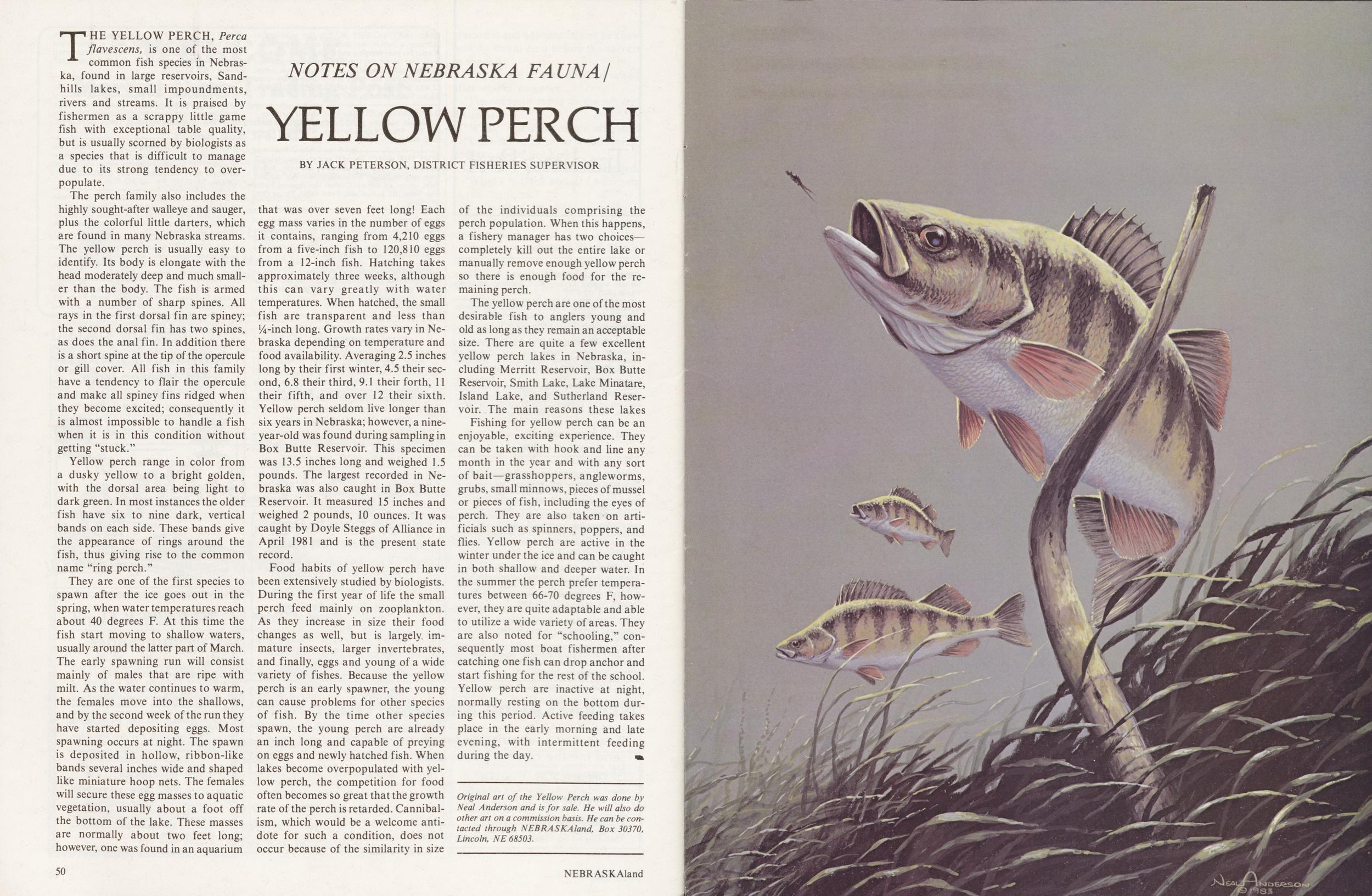
NOTES ON NEBRASKA FAUNA YELLOW PERCH
THE YELLOW PERCH, Perca flavescens, is one of the most common fish species in Nebraska, found in large reservoirs, Sandhills lakes, small impoundments, rivers and streams. It is praised by fishermen as a scrappy little game fish with exceptional table quality, but is usually scorned by biologists as a species that is difficult to manage due to its strong tendency to over-populate.
The perch family also includes the highly sought-after walleye and sauger, plus the colorful little darters, which are found in many Nebraska streams. The yellow perch is usually easy to identify. Its body is elongate with the head moderately deep and much smaller than the body. The fish is armed with a number of sharp spines. All rays in the first dorsal fin are spiney; the second dorsal fin has two spines, as does the anal fin. In addition there is a short spine at the tip of the opercule or gill cover. All fish in this family have a tendency to flair the opercule and make all spiney fins ridged when they become excited; consequently it is almost impossible to handle a fish when it is in this condition without getting "stuck."
Yellow perch range in color from a dusky yellow to a bright golden, with the dorsal area being light to dark green. In most instances the older fish have six to nine dark, vertical bands on each side. These bands give the appearance of rings around the fish, thus giving rise to the common name "ring perch."
They are one of the first species to spawn after the ice goes out in the spring, when water temperatures reach about 40 degrees F. At this time the fish start moving to shallow waters, usually around the latter part of March. The early spawning run will consist mainly of males that are ripe with milt. As the water continues to warm, the females move into the shallows, and by the second week of the run they have started depositing eggs. Most spawning occurs at night. The spawn is deposited in hollow, ribbon-like bands several inches wide and shaped like miniature hoop nets. The females will secure these egg masses to aquatic vegetation, usually about a foot off the bottom of the lake. These masses are normally about two feet long; however, one was found in an aquarium that was over seven feet long! Each egg mass varies in the number of eggs it contains, ranging from 4,210 eggs from a five-inch fish to 120,810 eggs from a 12-inch fish. Hatching takes approximately three weeks, although this can vary greatly with water temperatures. When hatched, the small fish are transparent and less than 1/4-inch long. Growth rates vary in Nebraska depending on temperature and food availability. Averaging 2.5 inches long by their first winter, 4.5 their second, 6.8 their third, 9.1 their forth, 11 their fifth, and over 12 their sixth. Yellow perch seldom live longer than six years in Nebraska; however, a nine-year-old was found during sampling in Box Butte Reservoir. This specimen was 13.5 inches long and weighed 1.5 pounds. The largest recorded in Nebraska was also caught in Box Butte Reservoir. It measured 15 inches and weighed 2 pounds, 10 ounces. It was caught by Doyle Steggs of Alliance in April 1981 and is the present state record.
Food habits of yellow perch have been extensively studied by biologists. During the first year of life the small perch feed mainly on zooplankton. As they increase in size their food changes as well, but is largely, immature insects, larger invertebrates, and finally, eggs and young of a wide variety of fishes. Because the yellow perch is an early spawner, the young can cause problems for other species of fish. By the time other species spawn, the young perch are already an inch long and capable of preying on eggs and newly hatched fish. When lakes become overpopulated with yellow perch, the competition for food often becomes so great that the growth rate of the perch is retarded. Cannibalism, which would be a welcome antidote for such a condition, does not occur because of the similarity in size of the individuals comprising the perch population. When this happens, a fishery manager has two choices—completely kill out the entire lake or manually remove enough yellow perch so there is enough food for the remaining perch.
The yellow perch are one of the most desirable fish to anglers young and old as long as they remain an acceptable size. There are quite a few excellent yellow perch lakes in Nebraska, including Merritt Reservoir, Box Butte Reservoir, Smith Lake, Lake Minatare, Island Lake, and Sutherland Reservoir. The main reasons these lakes
Fishing for yellow perch can be an enjoyable, exciting experience. They can be taken with hook and line any month in the year and with any sort of bait—grasshoppers, angleworms, grubs, small minnows, pieces of mussel or pieces of fish, including the eyes of perch. They are also taken on artificials such as spinners, poppers, and flies. Yellow perch are active in the winter under the ice and can be caught in both shallow and deeper water. In the summer the perch prefer temperatures between 66-70 degrees F, however, they are quite adaptable and able to utilize a wide variety of areas. They are also noted for "schooling," consequently most boat fishermen after catching one fish can drop anchor and start fishing for the rest of the school. Yellow perch are inactive at night, normally resting on the bottom during this period. Active feeding takes place in the early morning and late evening, with intermittent feeding during the day.
Original art of the Yellow Perch was done by Neal Anderson and is for sale. He will also do other art on a commission basis. He can be contacted through NEBRASKAland, Box 30370, Lincoln, NE 68503.
Find more than you imagined . . .
There's hiking and camping, swimming and fishing, cookouts and tennis, trail rides and buffalo stew. You'll find more than you can possibly imagine waiting for you in Nebraska's wide and scenic parklands. For more information about how Nebraska's state parks can stretch your imagination, write us for the "Nebraska Parklands" brochure. at Nebraska's state parks Nebraska Game and Parks Commission, Eugene T. Mahoney, DirectorPosition: 443 (23 views)