Volume 61, Issue 5, 1983
NEBRASKAland
June 1983 $1
NEBRASKAland
Published by the Nebraska Game and Parks Commission Contents Features A FESTIVAL HARKING TO A COLORFUL PAST 8 WHEN CHAUTAUQUA CAME TO TOWN 14 PANHANDLE BOUQUET 20 BOWS AND BARBS FOR BUFFALO BEAUS 28 A SLICE OF SUMMER 32 RETURN OF THE BIGHORNS 40 NOTES ON NEBRASKA FAUNA/CURLEW 49 Departments SPEAK UP 4 IN THE KITCHEN 44 BOOK REVIEW 46 TRADING POST 47
Speak Up
Watching the tracksSir / The photography in NEBRASKAland is superb. The cover on April issue makes me lonesome to again walk the railroad right-of-way and pick some of the beautiful blue-eyed grass flowers which are so dainty. It makes me sad to see our railroads being torn up. As a child in the 1920's, it was such fun to find the spring flowers blooming along the banks. Then if we kids saw the smoke of the old steam engine in the distance on our way home from school, we always waited to watch the train go by and chug to make it up the grade southeast of Cheney.
Is any of the native land from the railroads being preserved for parks or habitat by the Game and Parks Commission? I would like to know the status of it as I am such a preservationist and sentimentalist in every way.
Thanks for the beautiful magazine to refresh memories of bygone days, and also to keep me current on outdoor Nebraska.
Elinor L. BrownCeresco, Nebr. It's still home
Sir / Reading the May issue of NEBRASKAland, I noted the item about the South Platte area and the polyhedral barn near Bartley. I bought a purebred sow from L. E. Moore for my 4-H project soon after the barn was constructed. My dad's farm was located southeast of Stockville on Medicine Creek.
I have been a California resident for 40 years, but Nebraska is "home" even now. NEBRASKAland helps me relive some of my early experiences.
Howard MarcellusSacramento, Calif. "You're great"
Sir / Just a short note to let all your staff know how great NEBRASKAland Magazine is. Being very interested in outdoor photography myself, I especially look forward every month to the fantastic pictures throughout the magazine. Every month I learn something new about Nebraska. Keep up the great work.
I have enclosed a photo I took this winter eight miles west of Albion, while pheasant hunting.
Rick SchackAlbion, Nebr. A real booster
Sir / I'm an outdoorsman who does a lot of fishing, hunting, trapping and wildlife observation. We believe in and practice wildlife conservation. We listen to "Outdoor Nebraska" on radio; we watch "Outdoor Nebraska" on TV—these programs are very educational, informative and entertaining, and we enjoy them immensely. NEBRASKAland Magazine, which we subscribe to and read, is really a work of art. The photography and stories are terrific—one of the best outdoor magazines obtainable.
The people of Nebraska are blessed with one of the finest Game and Parks Commissions in this great land of ours. We should all be proud and thankful for all the conservation programs and the work they perform.
George StoppkotteGrand Island, Nebr. Still snapping away
Sir / I was born and raised in Saunders County and left Nebraska in 1935. I've received NEBRASKAland for a number of years, and have always appreciated it. The photos tell a lot about the state that I had no chance to see.
My father started in photography with glass plates in the early 1890's. He graduated to a bellows type post-card-size Kodak about 1918.1 got started with a vest pocket Kodak in 1928 or '29 when I worked on a pole line crew for Northwestern Bell in the Holdrege vicinity. I progressed through several cameras, getting into SLR in 1961, and then also shifted from mostly B/W to color slides. I guess I have 12 to 15,000 B/W photos and about 12,000 slides.
I still want to be able to take better pictures. It doesn't mean that 95 percent of mine are good, but I don't throw away more than 5 percent of those I take. I knew a very successful amateur photographer who said only 10 percent of his were good enough to show.
So, what makes a good photographer? There are experts who use box cameras, but there is also the guy hired to get 12 photos to illustrate an article. He spent a week and made 4,000 exposures. Could this be mostly luck?
I got the same feeling when, in your reply to a reader who asks you to print more data on your photos that it was "difficult to keep track of the thousands of exposures we make each year for the benefit of the few we use." Do you just shoot and hope? I don't believe it.
However, despite your wish to not keep and reveal exposure data, many magazines do include film type, F stop, exposure time as well as camera.
Gordon GibsonOrchard Park, N.Y. Check out the next letter—also from a New Yorker, for a different view. I can't believe so many people are enamored with statistical data that they want more. I merely tried to explain that our photographers basically always use the same color film (and only two kinds at most) so why include that fact? And, exposure varies with the light, and the information would be worthless to the next person on the scene. A good photo is a combination of framing, sharpness and light, but the difficult part is recognizing when the photo is "right"—the technical stuff can basically be taken from the little sheet of paper packed with the film. (Editor) She has "read"' feet
Sir / I have just "waded" through "Nebraska's Rivers." The copy is most informative and pictures, as usual, beautiful. Many things have changed since I was born and raised there.
Since I have been subscribing to NEBRASKAland, I have learned more about my home state than I ever knew when I lived there. When people ask where I am from, I never fail to give them a short travel tour about the beauties of Nebraska, and they are both surprised and interested. I look forward to each issue.
I also just read my April NEBRASKAland. I always read the "Speak Up" column first, and in this issue was interested in the letter from Jack Rosen of my hometown. He asks for specific info about the beautiful pictures in the magazine.
Having expensive equipment is part of the answer; knowing how to use it is the other part, but also having an eye for composition is most important. I have some beautiful pictures taken with fixed-lens cameras which required no knowledge except composition.
The picture of Arbor Lodge is beautiful. Trees are the subject and so are in the foreground with the contrasting white house making a lovely background—not centered, but to one side.
Jeannette CameronN.Y., N.Y. I'm against it!
Sir / I am an avid hunter and fisherman, born and raised in Nebraska, who wishes to voice his opposition in two areas. First, I am in opposition to the excessive
Happy Father's Day
To the guy who used to bait your hook. Give NEBRASKAland Magazine and get a FREE Sportsman's Scrapbook. 100 years of hunting fishing and outdoor recreation are yours. Send NEBRASKAland and FREE Scrapbook Send the Scrapbook @ $3.00 Name One-year $7.50 Two-year $13.00 Three-years $19.00 Address City Apt. State Master Charge Charge to: VISA Expiration Date: Acct. Month. Year. Sign gift card from: Use separate sheet for additional orders. Include complete address and choice of bonus for each. Mail to: NEBRASKAland Magazine, Box 30370, Lincoln, NE 68503 4 NEBRASKAland JUNE 1983 5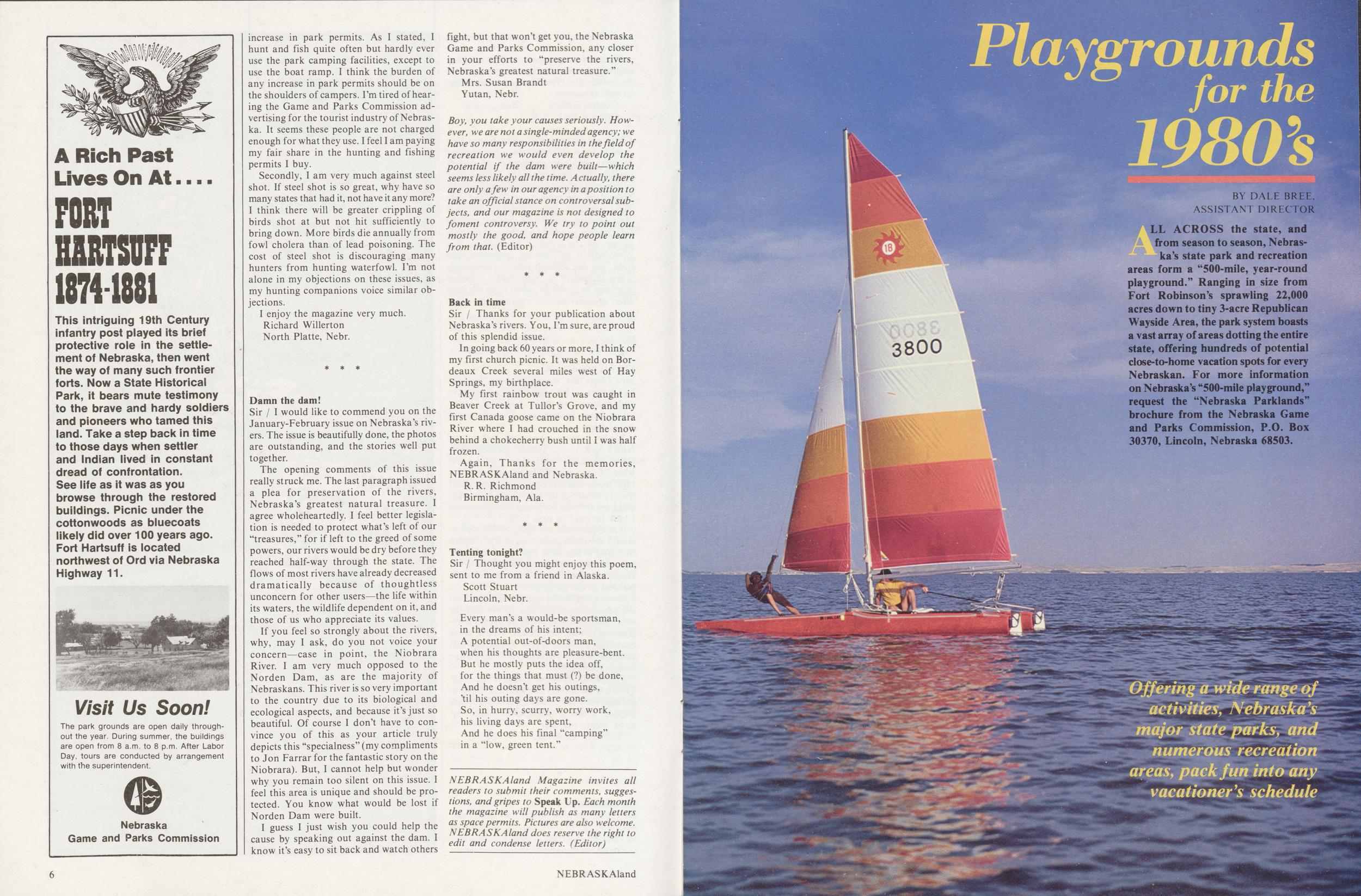
increase in park permits. As I stated, I hunt and fish quite often but hardly ever use the park camping facilities, except to use the boat ramp. I think the burden of any increase in park permits should be on the shoulders of campers. I'm tired of hearing the Game and Parks Commission advertising for the tourist industry of Nebraska. It seems these people are not charged enough for what they use. I feel I am paying my fair share in the hunting and fishing permits I buy.
Secondly, I am very much against steel shot. If steel shot is so great, why have so many states that had it, not have it any more? I think there will be greater crippling of birds shot at but not hit sufficiently to bring down. More birds die annually from fowl cholera than of lead poisoning. The cost of steel shot is discouraging many hunters from hunting waterfowl. I'm not alone in my objections on these issues, as my hunting companions voice similar objections.
I enjoy the magazine very much.
Richard WillertonNorth Platte, Nebr. Damn the dam!
Sir / I would like to commend you on the January-February issue on Nebraska's rivers. The issue is beautifully done, the photos are outstanding, and the stories well put together.
The opening comments of this issue really struck me. The last paragraph issued a plea for preservation of the rivers, Nebraska's greatest natural treasure. I agree wholeheartedly. I feel better legislation is needed to protect what's left of our "treasures," for if left to the greed of some powers, our rivers would be dry before they reached half-way through the state. The flows of most rivers have already decreased dramatically because of thoughtless unconcern for other users—the life within its waters, the wildlife dependent on it, and those of us who appreciate its values.
If you feel so strongly about the rivers, why, may I ask, do you not voice your concern—case in point, the Niobrara River. I am very much opposed to the Norden Dam, as are the majority of Nebraskans. This river is so very important to the country due to its biological and ecological aspects, and because it's just so beautiful. Of course I don't have to convince you of this as your article truly depicts this "specialness" (my compliments to Jon Farrar for the fantastic story on the Niobrara). But, I cannot help but wonder why you remain too silent on this issue. I feel this area is unique and should be protected. You know what would be lost if Norden Dam were built.
I guess I just wish you could help the cause by speaking out against the dam. I know it's easy to sit back and watch others fight, but that won't get you, the Nebraska Game and Parks Commission, any closer in your efforts to "preserve the rivers, Nebraska's greatest natural treasure."
Mrs. Susan BrandtYutan, Nebr. Boy, you take your causes seriously. However, we are not a single-minded agency; we have so many responsibilities in the field of recreation we would even develop the potential if the dam were built—which seems less likely all the time. Actually, there are only a few in our agency in a position to take an official stance on contraversal subjects, and our magazine is not designed to foment controversy. We try to point out mostly the good, and hope people learn from that. (Editor) Back in time
Sir / Thanks for your publication about Nebraska's rivers. You, I'm sure, are proud of this splendid issue.
In going back 60 years or more, I think of my first church picnic. It was held on Bordeaux Creek several miles west of Hay Springs, my birthplace.
My first rainbow trout was caught in Beaver Creek at Tullor's Grove, and my first Canada goose came on the Niobrara River where I had crouched in the snow behind a chokecherry bush until I was half frozen.
Again, Thanks for the memories, NEBRASKAland and Nebraska.
R. R. RichmondBirmingham, Ala. Tenting tonight?
Sir / Thought you might enjoy this poem, sent to me from a friend in Alaska.
Scott StuartLincoln, Nebr. Every man's a would-be sportsman, in the dreams of his intent; A potential out-of-doors man, when his thoughts are pleasure-bent. But he mostly puts the idea off, for the things that must (?) be done, And he doesn't get his outings, 'til his outing days are gone. So, in hurry, scurry, worry work, his living days are spent, And he does his final "camping" in a "low, green tent." NEBRASKAland Magazine invites all readers to submit their comments, suggestions, and gripes to Speak Up. Each month the magazine will publish as many letters as space permits. Pictures are also welcome. NEBRASKAland does reserve the right to edit and condense letters. (Editor) 6 NEBRASKAland
Playgrounds for the 1980's
BY DALE BREE, ASSISTANT DIRECTORALL ACROSS the state, and from season to season, Nebraska's state park and recreation areas form a "500-mile, year-round playground." Ranging in size from Fort Robinson's sprawling 22,000 acres down to tiny 3-acre Republican Wayside Area, the park system boasts a vast array of areas dotting the entire state, offering hundreds of potential close-to-home vacation spots for every Nebraskan. For more information on Nebraska's "500-mile playground," request the "Nebraska Parklands brochure from the Nebraska Game and Parks Commission, P.O. Box 30370, Lincoln, Nebraska 68503. vacationer's schedule
A Festival Harking To A Colorful Past
When the "hide-bound" buckskinners gather, a good time is had by all—that is Fur Trade Days motto
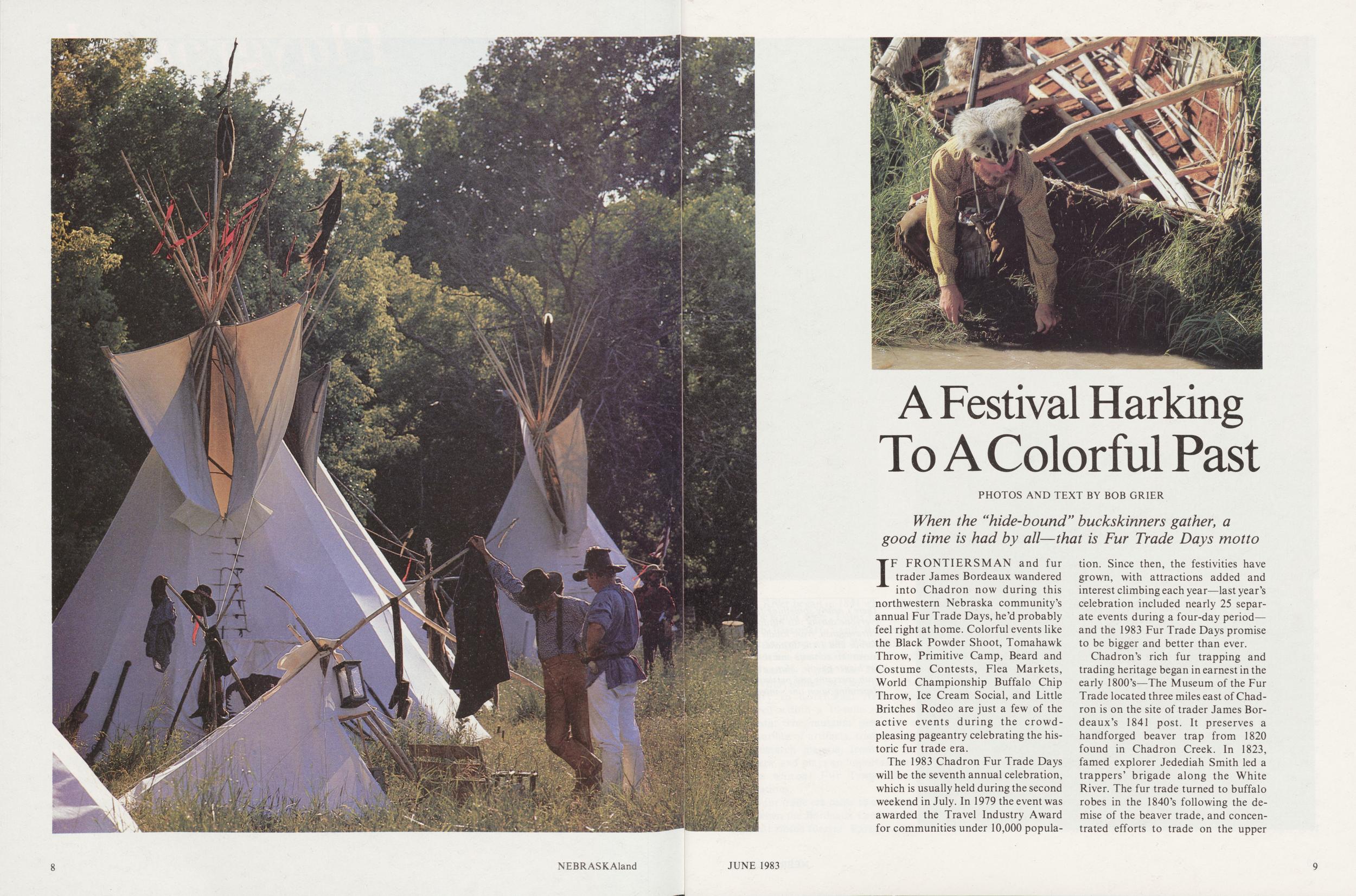
IF FRONTIERSMAN and fur trader James Bordeaux wandered into Chadron now during this northwestern Nebraska community's annual Fur Trade Days, he'd probably feel right at home. Colorful events like the Black Powder Shoot, Tomahawk Throw, Primitive Camp, Beard and Costume Contests, Flea Markets, World Championship Buffalo Chip Throw, Ice Cream Social, and Little Britches Rodeo are just a few of the active events during the crowd-pleasing pageantry celebrating the historic fur trade era.
The 1983 Chadron Fur Trade Days will be the seventh annual celebration, which is usually held during the second weekend in July. In 1979 the event was awarded the Travel Industry Award for communities under 10,000 population. Since then, the festivities have grown, with attractions added and interest climbing each year—last year's celebration included nearly 25 separate events during a four-day period—and the 1983 Fur Trade Days promise to be bigger and better than ever.
Chadron's rich fur trapping and trading heritage began in earnest in the early 1800's—The Museum of the Fur Trade located three miles east of Chadron is on the site of trader James Bordeaux's 1841 post. It preserves a handforged beaver trap from 1820 found in Chadron Creek. In 1823, famed explorer Jedediah Smith led a trappers' brigade along the White River. The fur trade turned to buffalo robes in the 1840's following the demise of the beaver trade, and concentrated efforts to trade on the upper
8 NEBRASKAland JUNE 1983 9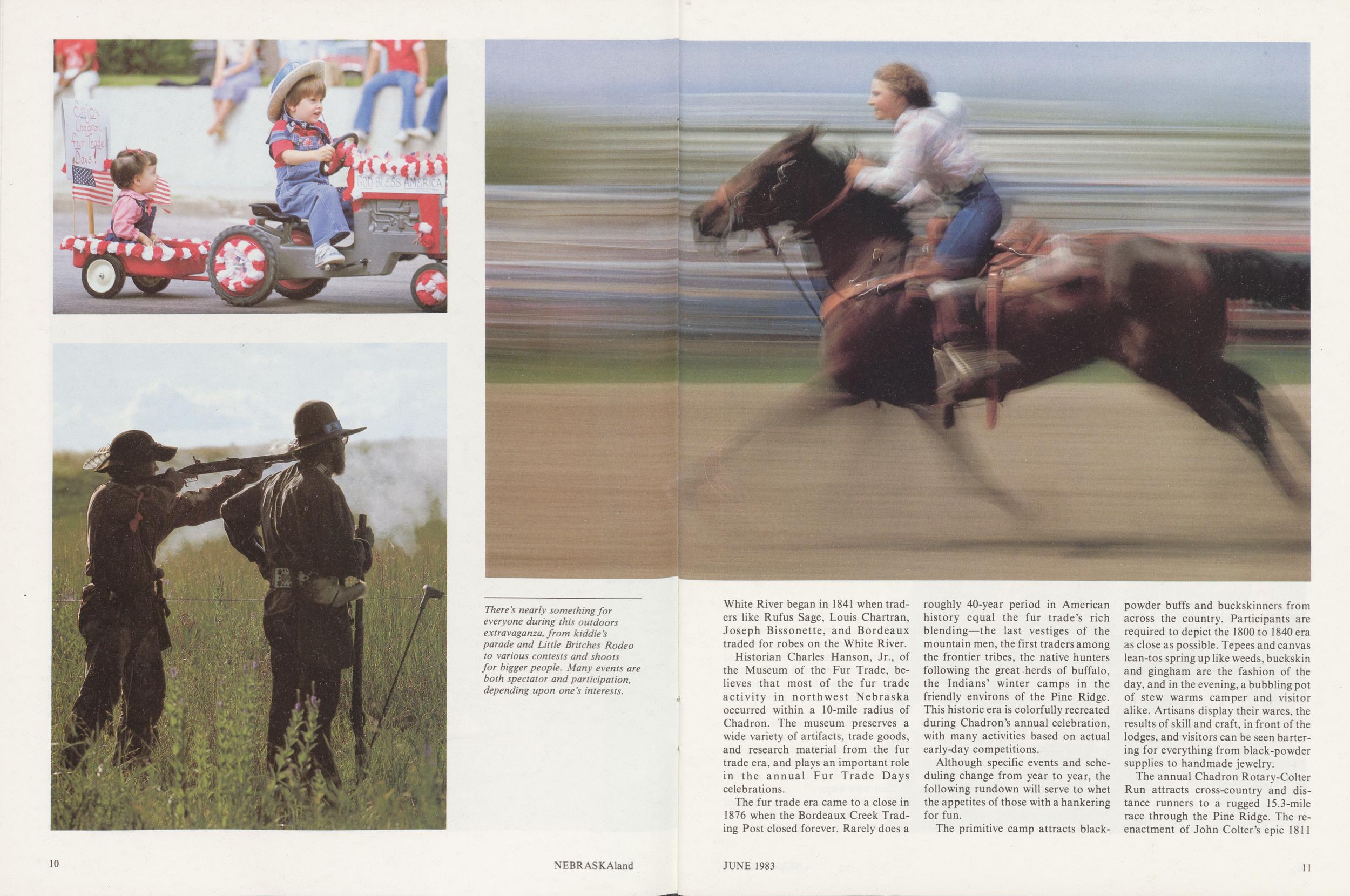
There's nearly something for everyone during this outdoors extravaganza, from kiddie's parade and Little Britches Rodeo to various contests and shoots for bigger people. Many events are both spectator and participation, depending upon one's interests.
White River began in 1841 when traders like Rufus Sage, Louis Chartran, Joseph Bissonette, and Bordeaux traded for robes on the White River.
Historian Charles Hanson, Jr., of the Museum of the Fur Trade, believes that most of the fur trade activity in northwest Nebraska occurred within a 10-mile radius of Chadron. The museum preserves a wide variety of artifacts, trade goods, and research material from the fur trade era, and plays an important role in the annual Fur Trade Days celebrations.
The fur trade era came to a close in 1876 when the Bordeaux Creek Trading Post closed forever. Rarely does a roughly 40-year period in American history equal the fur trade's rich blending—the last vestiges of the mountain men, the first traders among the frontier tribes, the native hunters following the great herds of buffalo, the Indians' winter camps in the friendly environs of the Pine Ridge. This historic era is colorfully recreated during Chadron's annual celebration, with many activities based on actual early-day competitions.
Although specific events and scheduling change from year to year, the following rundown will serve to whet the appetites of those with a hankering for fun.
The primitive camp attracts blackpowder buffs and buckskinners from across the country. Participants are required to depict the 1800 to 1840 era as close as possible. Tepees and canvas lean-tos spring up like weeds, buckskin and gingham are the fashion of the day, and in the evening, a bubbling pot of stew warms camper and visitor alike. Artisans display their wares, the results of skill and craft, in front of the lodges, and visitors can be seen bartering for everything from black-powder supplies to handmade jewelry.
The annual Chadron Rotary-Colter Run attracts cross-country and distance runners to a rugged 15.3-mile race through the Pine Ridge. The reenactment of John Colter's epic 1811
10 NEBRASKAland JUNE 1983 11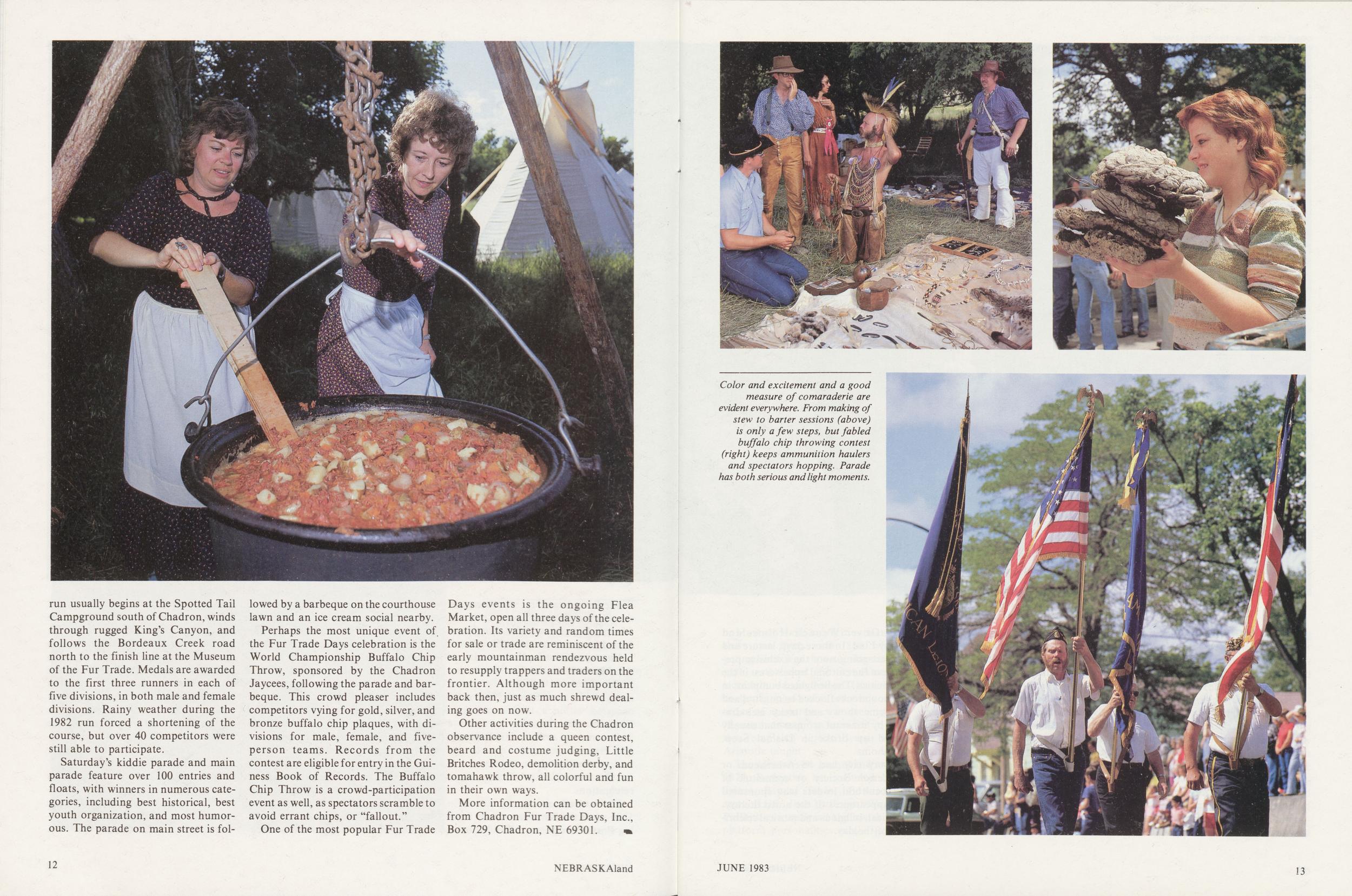
run usually begins at the Spotted Tail Campground south of Chadron, winds through rugged King's Canyon, and follows the Bordeaux Creek road north to the finish line at the Museum of the Fur Trade. Medals are awarded to the first three runners in each of five divisions, in both male and female divisions. Rainy weather during the 1982 run forced a shortening of the course, but over 40 competitors were still able to participate.
Saturday's kiddie parade and main parade feature over 100 entries and floats, with winners in numerous categories, including best historical, best youth organization, and most humorous. The parade on main street is followed by a barbeque on the courthouse lawn and an ice cream social nearby.
Perhaps the most unique event of the Fur Trade Days celebration is the World Championship Buffalo Chip Throw, sponsored by the Chadron Jaycees, following the parade and barbeque. This crowd pleaser includes competitors vying for gold, silver, and bronze buffalo chip plaques, with divisions for male, female, and five-person teams. Records from the contest are eligible for entry in the Guiness Book of Records. The Buffalo Chip Throw is a crowd-participation event as well, as spectators scramble to avoid errant chips, or "fallout."
One of the most popular Fur Trade Days events is the ongoing Flea Market, open all three days of the celebration. Its variety and random times for sale or trade are reminiscent of the early mountainman rendezvous held to resupply trappers and traders on the frontier. Although more important back then, just as much shrewd dealing goes on now.
Other activities during the Chadron observance include a queen contest, beard and costume judging, Little Britches Rodeo, demolition derby, and tomahawk throw, all colorful and fun in their own ways.
More information can be obtained from Chadron Fur Trade Days, Inc., Box 729, Chadron, NE 69301.
Color and excitement and a good measure of comaraderie are evident everywhere. From making of stew to barter sessions (above) is only a few steps, but fabled buffalo chip throwing contest (right) keeps ammunition haulers and spectators hopping. Parade has both serious and light moments.
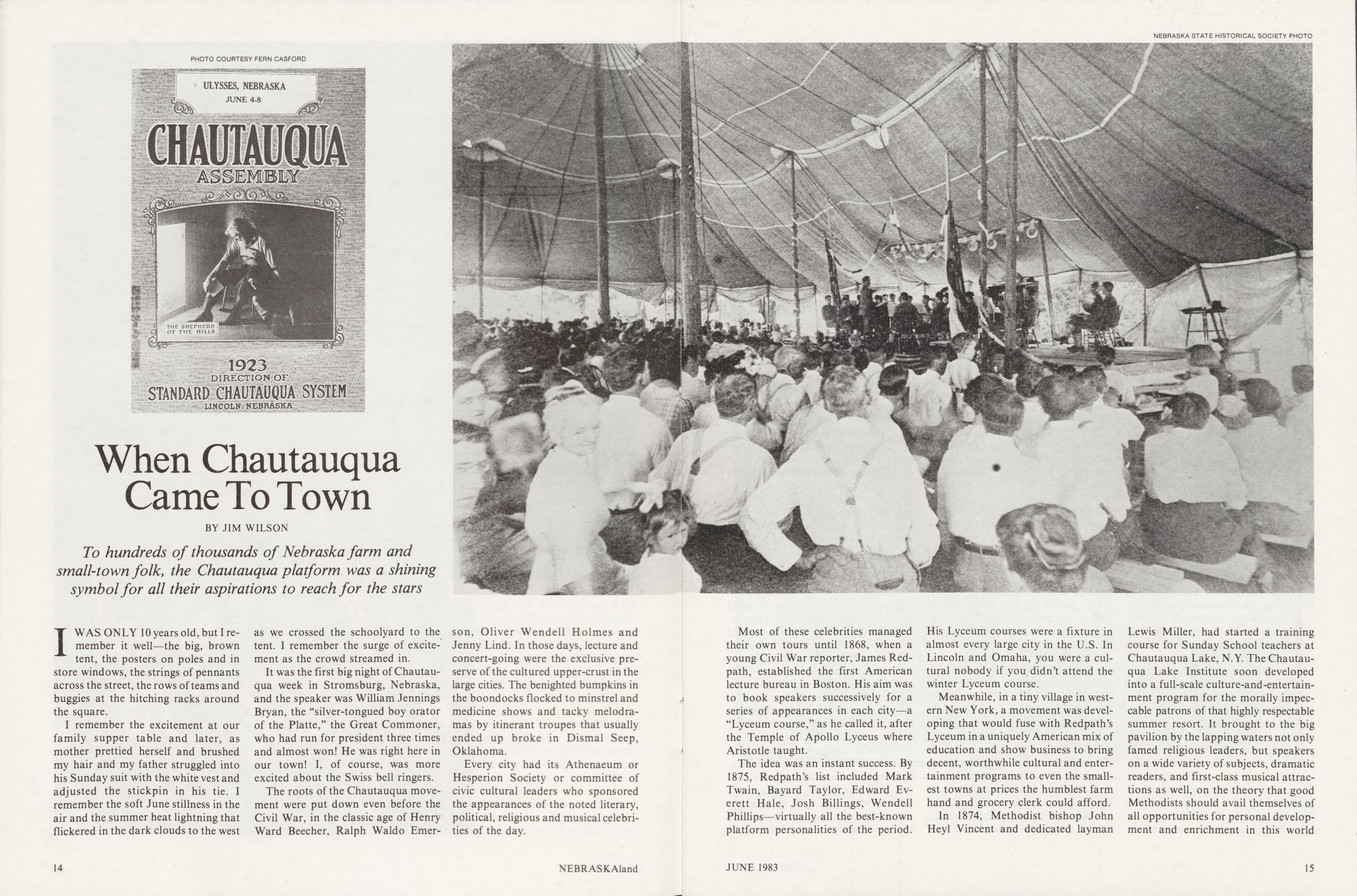
ULYSSES, NEBRASKA JUNE 4-8 ASSEMBLY 1923 DIRECTION OF STANDARD CHAUTAUQUA SYSTEM LINCOLN, NEBRASKA.
When Chautauqua Came To Town
To hundreds of thousands of Nebraska farm and small-town folk, the Chautauqua platform was a shining symbol for all their aspirations to reach for the starsI WAS ONLY 10 years old, but I remember it well—the big, brown tent, the posters on poles and in store windows, the strings of pennants across the street, the rows of teams and buggies at the hitching racks around the square.
I remember the excitement at our family supper table and later, as mother prettied herself and brushed my hair and my father struggled into his Sunday suit with the white vest and adjusted the stickpin in his tie. I remember the soft June stillness in the air and the summer heat lightning that flickered in the dark clouds to the west as we crossed the schoolyard to the tent. I remember the surge of excitement as the crowd streamed in.
It was the first big night of Chautauqua week in Stromsburg, Nebraska, and the speaker was William Jennings Bryan, the "silver-tongued boy orator of the Platte," the Great Commoner, who had run for president three times and almost won! He was right here in our town! I, of course, was more excited about the Swiss bell ringers.
The roots of the Chautauqua movement were put down even before the Civil War, in the classic age of Henry Ward Beecher, Ralph Waldo Emerson, Oliver Wendell Holmes and Jenny Lind. In those days, lecture and concert-going were the exclusive preserve of the cultured upper-crust in the large cities. The benighted bumpkins in the boondocks flocked to minstrel and medicine shows and tacky melodramas by itinerant troupes that usually ended up broke in Dismal Seep, Oklahoma.
Every city had its Athenaeum or Hesperion Society or committee of civic cultural leaders who sponsored the appearances of the noted literary, political, religious and musical celebrities of the day.
Most of these celebrities managed their own tours until 1868, when a young Civil War reporter, James Red-path, established the first American lecture bureau in Boston. His aim was to book speakers successively for a series of appearances in each city—a "Lyceum course," as he called it, after the Temple of Apollo Lyceus where Aristotle taught.
The idea was an instant success. By 1875, Redpath's list included Mark Twain, Bayard Taylor, Edward Everett Hale, Josh Billings, Wendell Phillips—virtually all the best-known platform personalities of the period. His Lyceum courses were a fixture in almost every large city in the U.S. In Lincoln and Omaha, you were a cultural nobody if you didn't attend the winter Lyceum course.
Meanwhile, in a tiny village in western New York, a movement was developing that would fuse with Redpath's Lyceum in a uniquely American mix of education and show business to bring decent, worthwhile cultural and entertainment programs to even the smallest towns at prices the humblest farm hand and grocery clerk could afford.
In 1874, Methodist bishop John Heyl Vincent and dedicated layman Lewis Miller, had started a training course for Sunday School teachers at Chautauqua Lake, N. Y. The Chautauqua Lake Institute soon developed into a full-scale culture-and-entertainment program for the morally impeccable patrons of that highly respectable summer resort. It brought to the big pavilion by the lapping waters not only-famed religious leaders, but speakers on a wide variety of subjects, dramatic readers, and first-class musical attractions as well, on the theory that good Methodists should avail themselves of all opportunities for personal development and enrichment in this world
14 NEBRASKAland JUNE 1983 15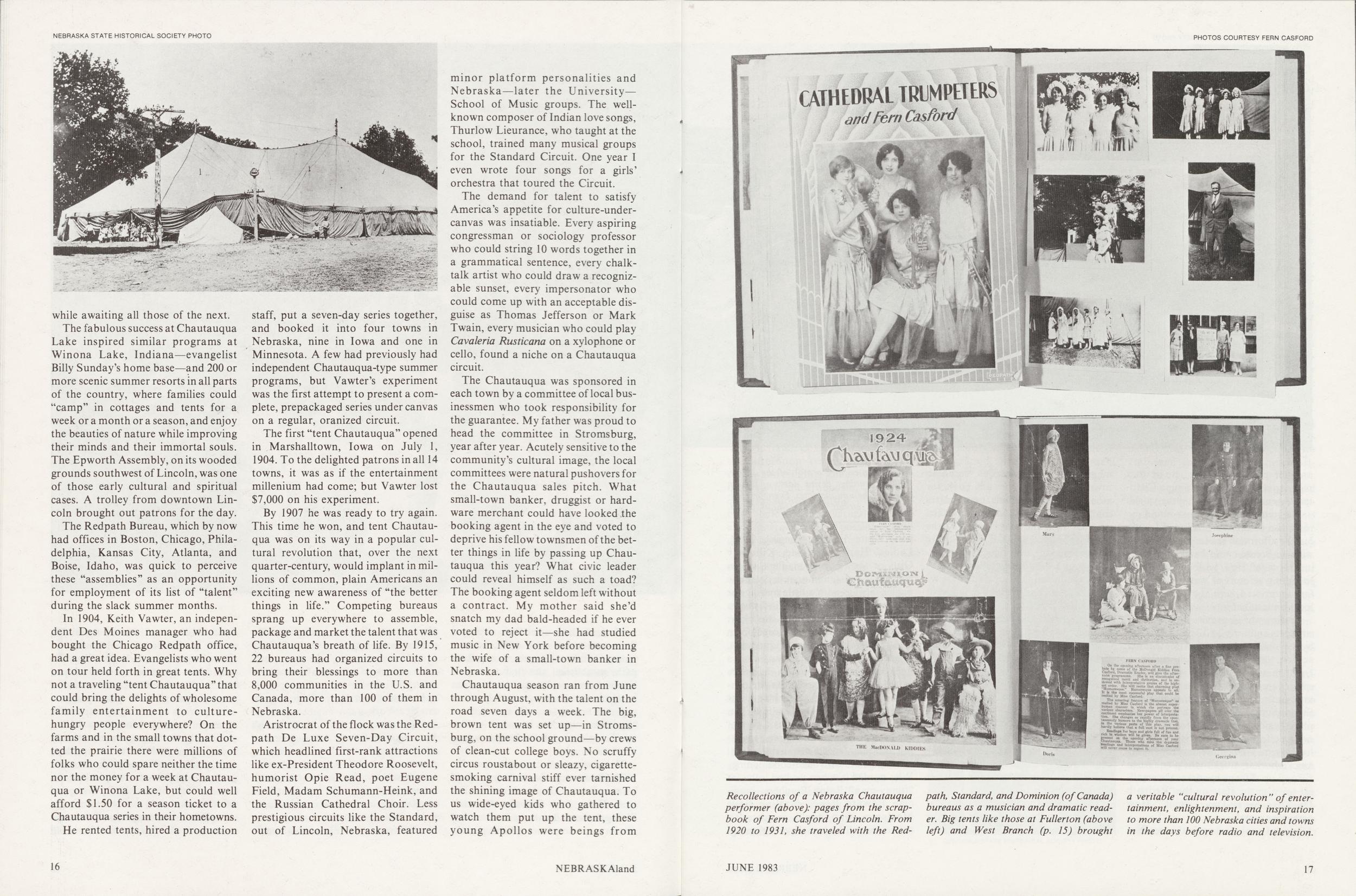
while awaiting all those of the next.
The fabulous success at Chautauqua Lake inspired similar programs at Winona Lake, Indiana—evangelist Billy Sunday's home base—and 200 or more scenic summer resorts in all parts of the country, where families could "camp" in cottages and tents for a week or a month or a season, and enjoy the beauties of nature while improving their minds and their immortal souls. The Epworth Assembly, on its wooded grounds southwest of Lincoln, was one of those early cultural and spiritual cases. A trolley from downtown Lincoln brought out patrons for the day.
The Redpath Bureau, which by now had offices in Boston, Chicago, Philadelphia, Kansas City, Atlanta, and Boise, Idaho, was quick to perceive these "assemblies" as an opportunity for employment of its list of "talent" during the slack summer months.
In 1904, Keith Vawter, an independent Des Moines manager who had bought the Chicago Redpath office, had a great idea. Evangelists who went on tour held forth in great tents. Why not a traveling "tent Chautauqua" that could bring the delights of wholesome family entertainment to culture-hungry people everywhere? On the farms and in the small towns that dotted the prairie there were millions of folks who could spare neither the time nor the money for a week at Chautauqua or Winona Lake, but could well afford $1.50 for a season ticket to a Chautauqua series in their hometowns.
He rented tents, hired a production staff, put a seven-day series together, and booked it into four towns in Nebraska, nine in Iowa and one in Minnesota. A few had previously had independent Chautauqua-type summer programs, but Vawter's experiment was the first attempt to present a complete, prepackaged series under canvas on a regular, oranized circuit.
The first "tent Chautauqua" opened in Marshalltown, Iowa on July 1, 1904. To the delighted patrons in all 14 towns, it was as if the entertainment millenium had come; but Vawter lost $7,000 on his experiment.
By 1907 he was ready to try again. This time he won, and tent Chautauqua was on its way in a popular cultural revolution that, over the next quarter-century, would implant in millions of common, plain Americans an exciting new awareness of "the better things in life." Competing bureaus sprang up everywhere to assemble, package and market the talent that was Chautauqua's breath of life. By 1915, 22 bureaus had organized circuits to bring their blessings to more than 8,000 communities in the U.S. and Canada, more than 100 of them in Nebraska.
Aristrocrat of the flock was the Red-path De Luxe Seven-Day Circuit, which headlined first-rank attractions like ex-President Theodore Roosevelt, humorist Opie Read, poet Eugene Field, Madam Schumann-Heink, and the Russian Cathedral Choir. Less prestigious circuits like the Standard, out of Lincoln, Nebraska, featured minor platform personalities and Nebraska—later the University—School of Music groups. The well-known composer of Indian love songs, Thurlow Lieurance, who taught at the school, trained many musical groups for the Standard Circuit. One year I even wrote four songs for a girls' orchestra that toured the Circuit.
The demand for talent to satisfy America's appetite for culture-under-canvas was insatiable. Every aspiring congressman or sociology professor who could string 10 words together in a grammatical sentence, every chalk-talk artist who could draw a recognizable sunset, every impersonator who could come up with an acceptable disguise as Thomas Jefferson or Mark Twain, every musician who could play Cavaleria Rusticana on a xylophone or cello, found a niche on a Chautauqua circuit.
The Chautauqua was sponsored in each town by a committee of local businessmen who took responsibility for the guarantee. My father was proud to head the committee in Stromsburg, year after year. Acutely sensitive to the community's cultural image, the local committees were natural pushovers for the Chautauqua sales pitch. What small-town banker, druggist or hardware merchant could have looked the booking agent in the eye and voted to deprive his fellow townsmen of the better things in life by passing up Chautauqua this year? What civic leader could reveal himself as such a toad? The booking agent seldom left without a contract. My mother said she'd snatch my dad bald-headed if he ever voted to reject it—she had studied music in New York before becoming the wife of a small-town banker in Nebraska.
Chautauqua season ran from June through August, with the talent on the road seven days a week. The big, brown tent was set up—in Stromsburg, on the school ground—by crews of clean-cut college boys. No scruffy circus roustabout or sleazy, cigarette-smoking carnival stiff ever tarnished the shining image of Chautauqua. To us wide-eyed kids who gathered to watch them put up the tent, these young Apollos were beings from
CATHEDRAL TRUMPETERS and Fern Casford
Recollections of a Nebraska Chautauqua performer (above): pages from the scrapbook of Fern Casford of Lincoln. From 1920 to 1931, she traveled with the Red-path, Standard, and Dominion (of Canada) bureaus as a musician and dramatic reader. Big tents like those at Fullerton (above left) and West Branch (p. 15) brought a veritable "cultural revolution" of entertainment, enlightenment, and inspiration to more than 100 Nebraska cities and towns in the days before radio and television.
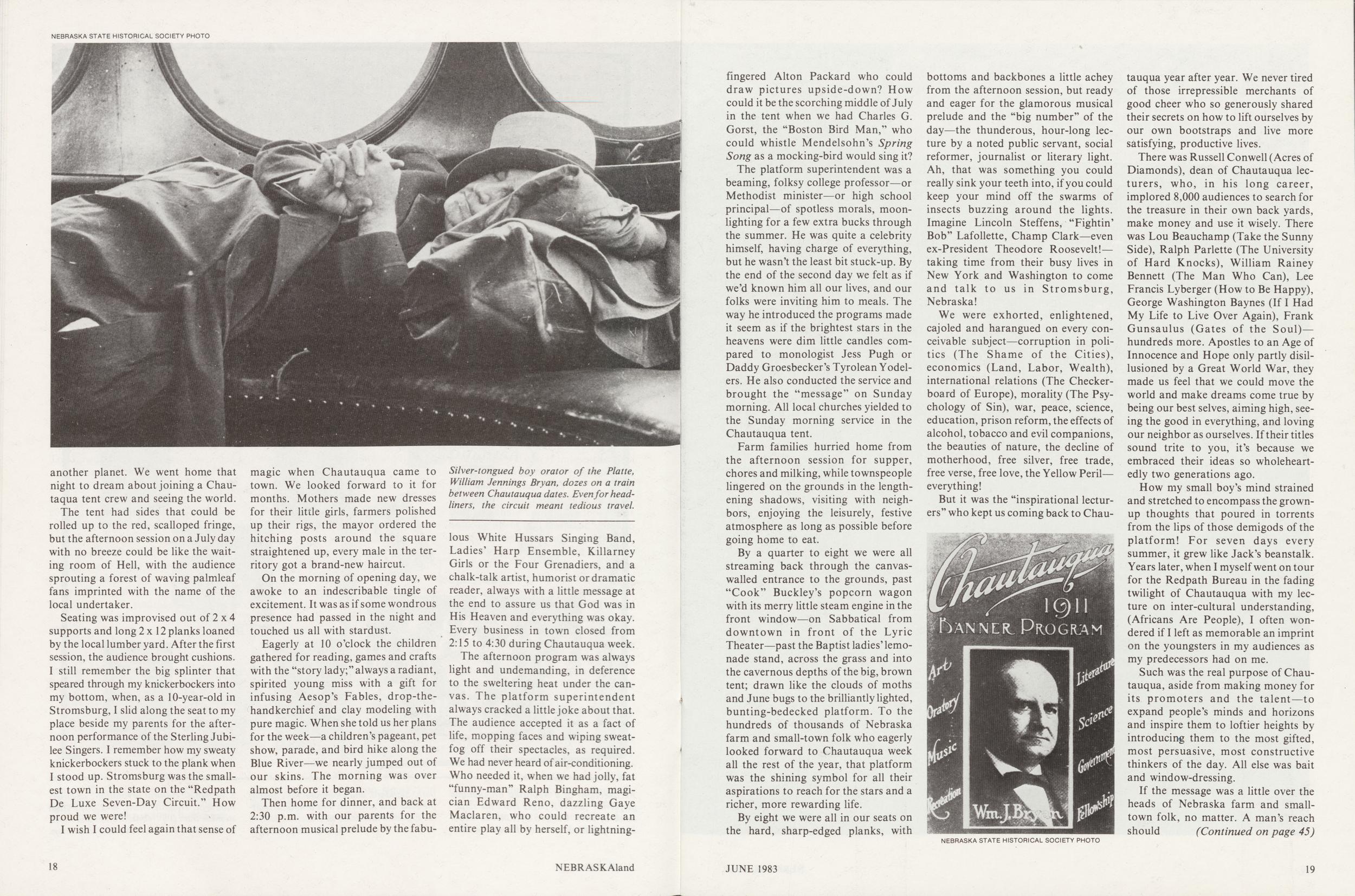
Silver-tongued boy orator of the Platte, William Jennings Bryan, dozes on a train between Chautauqua dates. Even for headliners, the circuit meant tedious travel.
another planet. We went home that night to dream about joining a Chautaqua tent crew and seeing the world.
The tent had sides that could be rolled up to the red, scalloped fringe, but the afternoon session on a July day with no breeze could be like the waiting room of Hell, with the audience sprouting a forest of waving palmleaf fans imprinted with the name of the local undertaker.
Seating was improvised out of 2 x 4 supports and long 2 x 12 planks loaned by the local lumber yard. After the first session, the audience brought cushions. I still remember the big splinter that speared through my knickerbockers into my bottom, when, as a 10-year-old in Stromsburg, I slid along the seat to my place beside my parents for the afternoon performance of the Sterling Jubilee Singers. I remember how my sweaty knickerbockers stuck to the plank when I stood up. Stromsburg was the smallest town in the state on the "Redpath De Luxe Seven-Day Circuit." How proud we were!
I wish I could feel again that sense of magic when Chautauqua came to town. We looked forward to it for months. Mothers made new dresses for their little girls, farmers polished up their rigs, the mayor ordered the hitching posts around the square straightened up, every male in the territory got a brand-new haircut.
On the morning of opening day, we awoke to an indescribable tingle of excitement. It was as if some wondrous presence had passed in the night and touched us all with Stardust.
Eagerly at 10 o'clock the children gathered for reading, games and crafts with the "story lady;" always a radiant, spirited young miss with a gift for infusing Aesop's Fables, drop-the-handkerchief and clay modeling with pure magic. When she told us her plans for the week—a children's pageant, pet show, parade, and bird hike along the Blue River—we nearly jumped out of our skins. The morning was over almost before it began.
Then home for dinner, and back at 2:30 p.m. with our parents for the afternoon musical prelude by the fabu- lous White Hussars Singing Band, Ladies' Harp Ensemble, Killarney Girls or the Four Grenadiers, and a chalk-talk artist, humorist or dramatic reader, always with a little message at the end to assure us that God was in His Heaven and everything was okay. Every business in town closed from 2:15 to 4:30 during Chautauqua week.
The afternoon program was always light and undemanding, in deference to the sweltering heat under the canvas. The platform superintendent always cracked a little joke about that. The audience accepted it as a fact of life, mopping faces and wiping sweat-fog off their spectacles, as required. We had never heard of air-conditioning. Who needed it, when we had jolly, fat "funny-man" Ralph Bingham, magician Edward Reno, dazzling Gaye Maclaren, who could recreate an entire play all by herself, or lightning-fingered Alton Packard who could draw pictures upside-down? How could it be the scorching middle of July in the tent when we had Charles G. Gorst, the "Boston Bird Man," who could whistle Mendelsohn's Spring Song as a mocking-bird would sing it?
The platform superintendent was a beaming, folksy college professor—or Methodist minister—or high school principal—of spotless morals, moon-lighting for a few extra bucks through the summer. He was quite a celebrity himself, having charge of everything, but he wasn't the least bit stuck-up. By the end of the second day we felt as if we'd known him all our lives, and our folks were inviting him to meals. The way he introduced the programs made it seem as if the brightest stars in the heavens were dim little candles compared to monologist Jess Pugh or Daddy Groesbecker's Tyrolean Yodelers. He also conducted the service and brought the "message" on Sunday morning. All local churches yielded to the Sunday morning service in the Chautauqua tent.
Farm families hurried home from the afternoon session for supper, chores and milking, while townspeople lingered on the grounds in the lengthening shadows, visiting with neighbors, enjoying the leisurely, festive atmosphere as long as possible before going home to eat.
By a quarter to eight we were all streaming back through the canvas-walled entrance to the grounds, past "Cook" Buckley's popcorn wagon with its merry little steam engine in the front window—on Sabbatical from downtown in front of the Lyric Theater—past the Baptist ladies'lemonade stand, across the grass and into the cavernous depths of the big, brown tent; drawn like the clouds of moths and June bugs to the brilliantly lighted, bunting-bedecked platform. To the hundreds of thousands of Nebraska farm and small-town folk who eagerly looked forward to Chautauqua week all the rest of the year, that platform was the shining symbol for all their aspirations to reach for the stars and a richer, more rewarding life.
By eight we were all in our seats on the hard, sharp-edged planks, with bottoms and backbones a little achey from the afternoon session, but ready and eager for the glamorous musical prelude and the "big number" of the day—the thunderous, hour-long lecture by a noted public servant, social reformer, journalist or literary light. Ah, that was something you could really sink your teeth into, if you could keep your mind off the swarms of insects buzzing around the lights. Imagine Lincoln Steffens, "Fightin' Bob" Lafollette, Champ Clark—even ex-President Theodore Roosevelt!—taking time from their busy lives in New York and Washington to come and talk to us in Stromsburg, Nebraska!
We were exhorted, enlightened, cajoled and harangued on every conceivable subject—corruption in politics (The Shame of the Cities), economics (Land, Labor, Wealth), international relations (The Checkerboard of Europe), morality (The Psychology of Sin), war, peace, science, education, prison reform, the effects of alcohol, tobacco and evil companions, the beauties of nature, the decline of motherhood, free silver, free trade, free verse, free love, the Yellow Peril—everything!
But it was the "inspirational lecturers" who kept us coming back to Chau-
There was Russell Conwell (Acres of Diamonds), dean of Chautauqua lecturers, who, in his long career, implored 8,000 audiences to search for the treasure in their own back yards, make money and use it wisely. There was Lou Beauchamp (Take the Sunny Side), Ralph Parlette (The University of Hard Knocks), William Rainey Bennett (The Man Who Can), Lee Francis Lyberger (How to Be Happy), George Washington Baynes (If I Had My Life to Live Over Again), Frank Gunsaulus (Gates of the Soul)—hundreds more. Apostles to an Age of Innocence and Hope only partly disillusioned by a Great World War, they made us feel that we could move the world and make dreams come true by being our best selves, aiming high, seeing the good in everything, and loving our neighbor as ourselves. If their titles sound trite to you, it's because we embraced their ideas so wholeheartedly two generations ago.
How my small boy's mind strained and stretched to encompass the grown-up thoughts that poured in torrents from the lips of those demigods of the platform! For seven days every summer, it grew like Jack's beanstalk. Years later, when I myself went on tour for the Redpath Bureau in the fading twilight of Chautauqua with my lecture on inter-cultural understanding, (Africans Are People), I often wondered if I left as memorable an imprint on the youngsters in my audiences as my predecessors had on me.
Such was the real purpose of Chautauqua, aside from making money for its promoters and the talent—to expand people's minds and horizons and inspire them to loftier heights by-introducing them to the most gifted, most persuasive, most constructive thinkers of the day. All else was bait and window-dressing.
If the message was a little over the heads of Nebraska farm and smalltown folk, no matter. A man's reach should (Continued on page 45)
18 NEBRASKAland JUNE 1983 19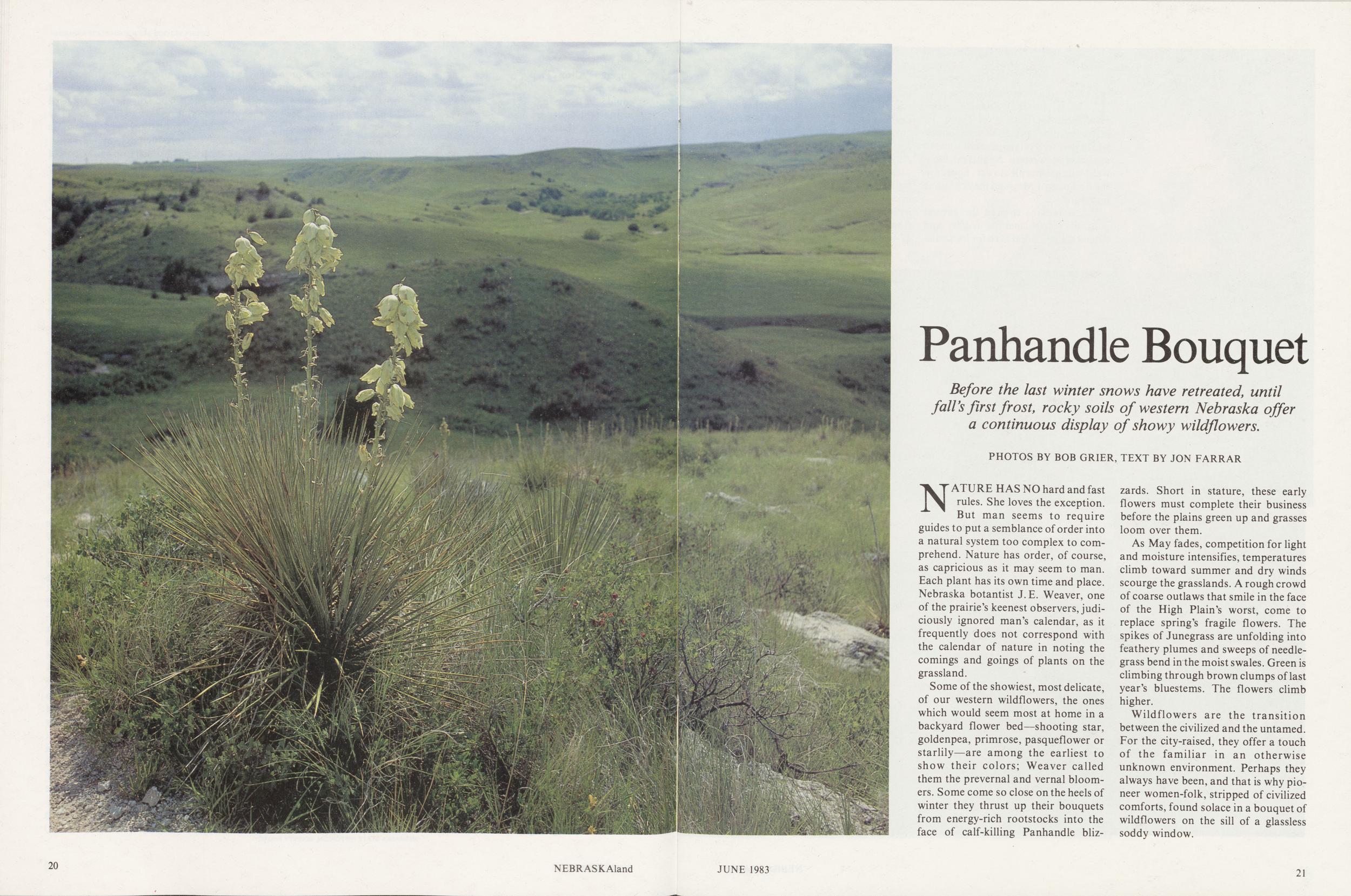
Panhandle Bouquet
Before the last winter snows have retreated, until fall's first frost, rocky soils of western Nebraska offer a continuous display of showy wild/lowers.
NATURE HAS NO hard and fast rules. She loves the exception. But man seems to require guides to put a semblance of order into a natural system too complex to comprehend. Nature has order, of course, as capricious as it may seem to man. Each plant has its own time and place. Nebraska botantist J. E. Weaver, one of the prairie's keenest observers, judiciously ignored man's calendar, as it frequently does not correspond with the calendar of nature in noting the comings and goings of plants on the grassland.
Some of the showiest, most delicate, of our western wildflowers, the ones which would seem most at home in a backyard flower bed—shooting star, goldenpea, primrose, pasqueflower or starlily—are among the earliest to show their colors; Weaver called them the prevernal and vernal bloomers. Some come so close on the heels of winter they thrust up their bouquets from energy-rich rootstocks into the face of calf-killing Panhandle blizzards. Short in stature, these early flowers must complete their business before the plains green up and grasses loom over them.
As May fades, competition for light and moisture intensifies, temperatures climb toward summer and dry winds scourge the grasslands. A rough crowd of coarse outlaws that smile in the face of the High Plain's worst, come to replace spring's fragile flowers. The spikes of Junegrass are unfolding into feathery plumes and sweeps of needlegrass bend in the moist swales. Green is climbing through brown clumps of last year's bluestems. The flowers climb higher.
Wildflowers are the transition between the civilized and the untamed. For the city-raised, they offer a touch of the familiar in an otherwise unknown environment. Perhaps they always have been, and that is why pioneer women-folk, stripped of civilized comforts, found solace in a bouquet of wildflowers on the sill of a glassless soddy window.
20 NEBRASKAland JUNE 1983 21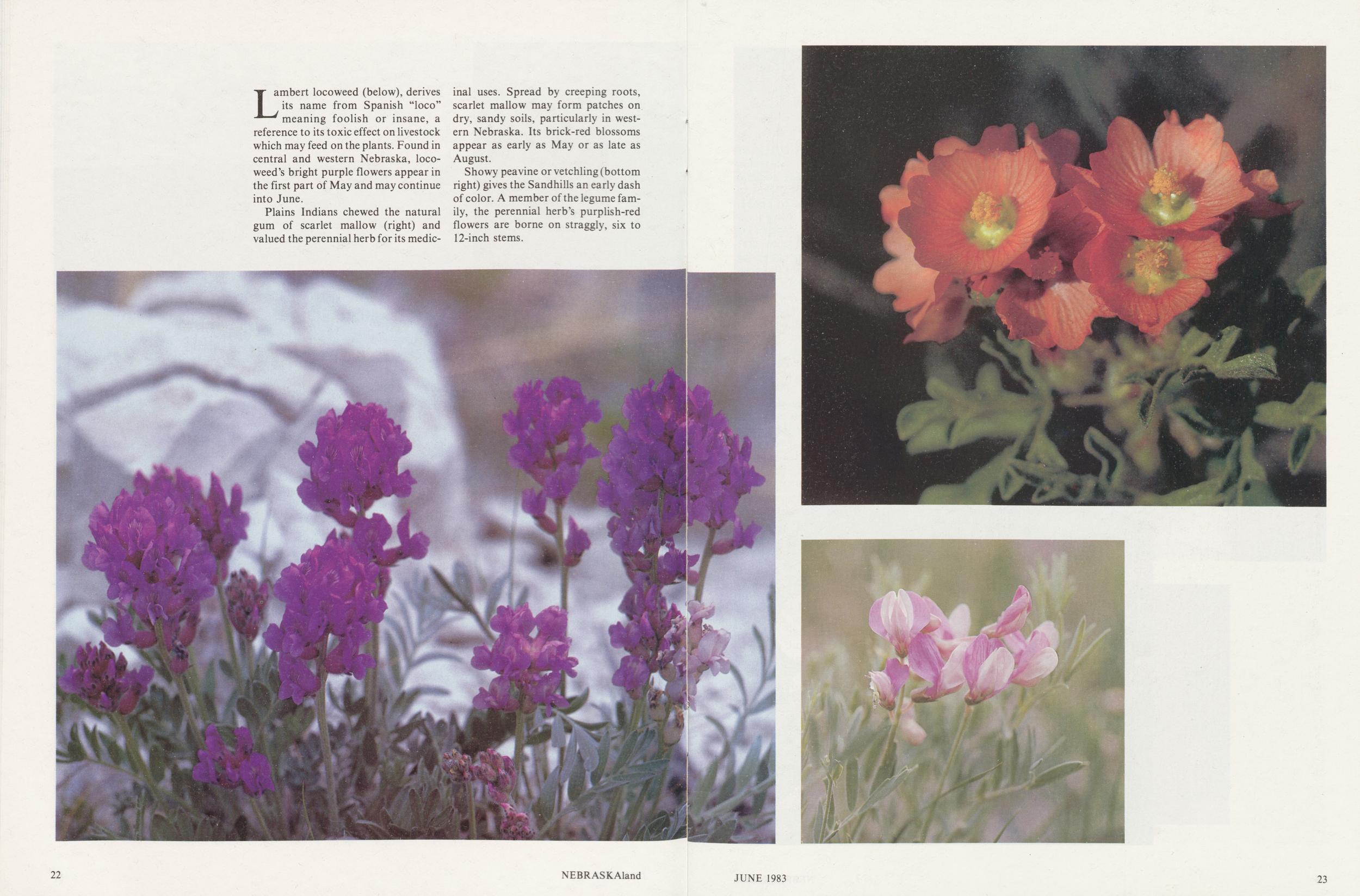
Lambert locoweed (below), derives its name from Spanish "loco" meaning foolish or insane, a reference to its toxic effect on livestock which may feed on the plants. Found in central and western Nebraska, locoweed's bright purple flowers appear in the first part of May and may continue into June.
Plains Indians chewed the natural gum of scarlet mallow (right) and valued the perennial herb for its medicinal uses. Spread by creeping roots, scarlet mallow may form patches on dry, sandy soils, particularly in western Nebraska. Its brick-red blossoms appear as early as May or as late as August.
Showy pea vine or vetchling (bottom right) gives the Sandhills an early dash of color. A member of the legume family, the perennial herb's purplish-red flowers are borne on straggly, six to 12-inch stems.
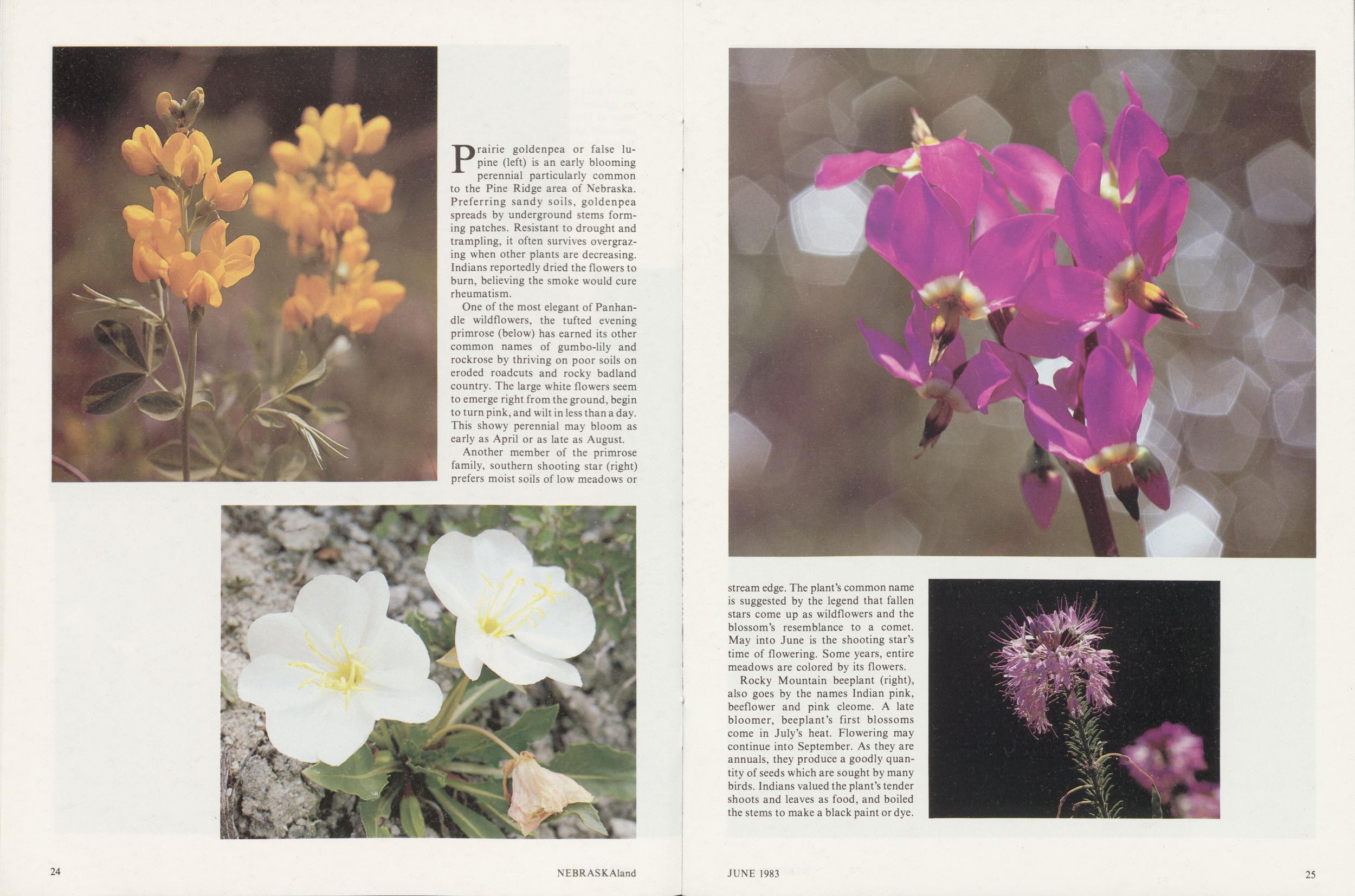
Prairie goldenpea or false lupine (left) is an early blooming perennial particularly common to the Pine Ridge area of Nebraska. Preferring sandy soils, goldenpea spreads by underground stems forming patches. Resistant to drought and trampling, it often survives overgrazing when other plants are decreasing. Indians reportedly dried the flowers to burn, believing the smoke would cure rheumatism.
One of the most elegant of Panhandle wildflowers, the tufted evening primrose (below) has earned its other common names of gumbo-lily and rockrose by thriving on poor soils on eroded roadcuts and rocky badland country. The large white flowers seem to emerge right from the ground, begin to turn pink, and wilt in less than a day. This showy perennial may bloom as early as April or as late as August.
Another member of the primrose family, southern shooting star (right) prefers moist soils of low meadows or stream edge. The plant's common name is suggested by the legend that fallen stars come up as wildflowers and the blossom's resemblance to a comet. May into June is the shooting star's time of flowering. Some years, entire meadows are colored by its flowers.
Rocky Mountain beeplant (right), also goes by the names Indian pink, beeflower and pink cleome. A late bloomer, beeplant's first blossoms come in July's heat. Flowering may continue into September. As they are annuals, they produce a goodly quantity of seeds which are sought by many birds. Indians valued the plant's tender shoots and leaves as food, and boiled the stems to make a black paint or dye.
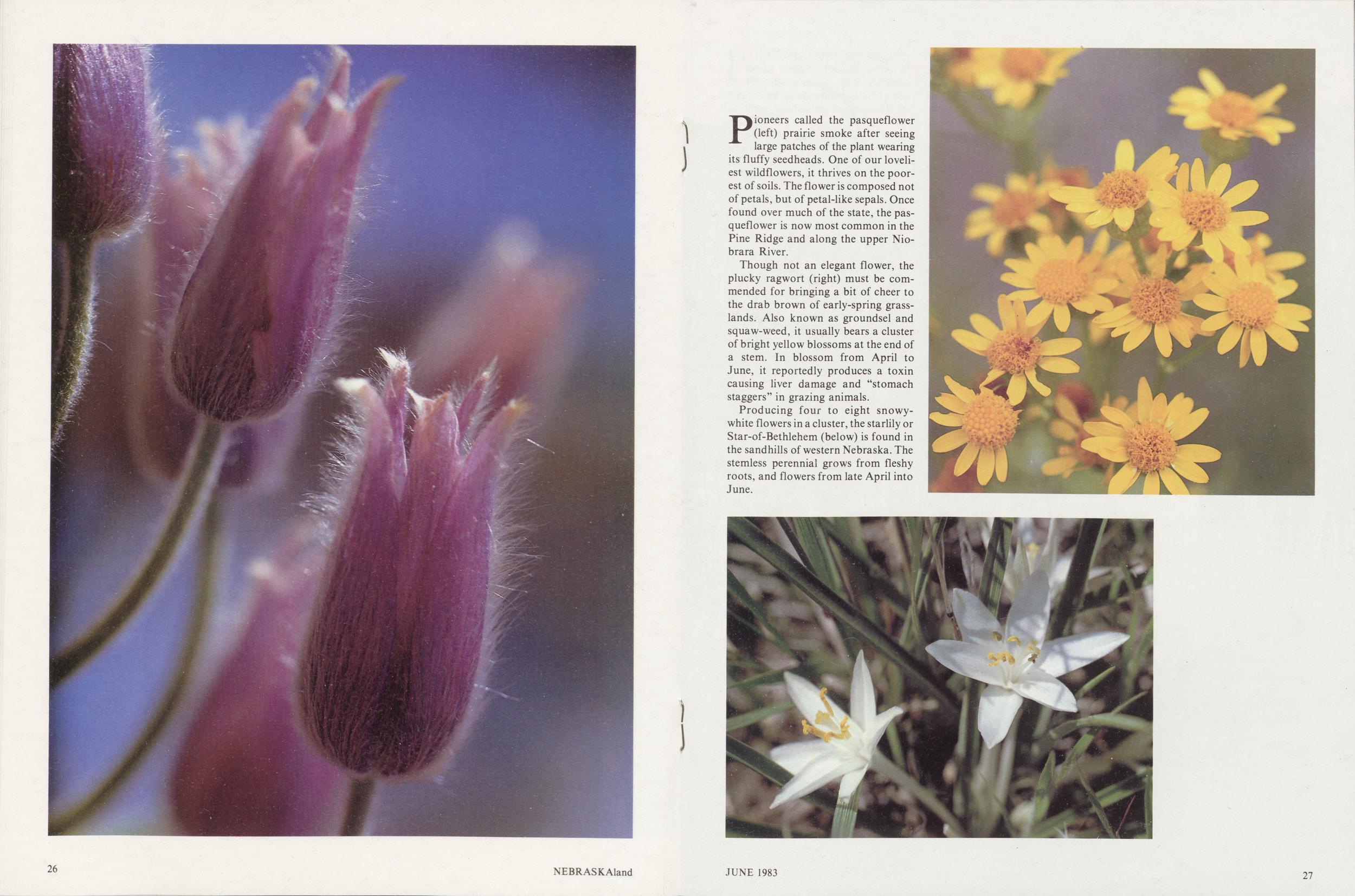
Pioneers called the pasqueflower (left) prairie smoke after seeing large patches of the plant wearing its fluffy seedheads. One of our loveliest wildflowers, it thrives on the poorest of soils. The flower is composed not of petals, but of petal-like sepals. Once found over much of the state, the pasqueflower is now most common in the Pine Ridge and along the upper Niobrara River.
Though not an elegant flower, the plucky ragwort (right) must be commended for bringing a bit of cheer to the drab brown of early-spring grasslands. Also known as groundsel and squaw-weed, it usually bears a cluster of bright yellow blossoms at the end of a stem. In blossom from April to June, it reportedly produces a toxin causing liver damage and "stomach staggers" in grazing animals.
Producing four to eight snowy-white flowers in a cluster, the starlily or Star-of-Bethlehem (below) is found in the sandhills of western Nebraska. The stemless perennial grows from fleshy roots, and flowers from late April into June.
Bows and Barbs For Buffalo "Beaus"
Joining a couple pros at archery fishing proves to be not only a learning experience, but fun, as well "Catching"fish during amorous time of spring spawn is fast, exciting sport.
IT HAD RAINED almost three weeks straight, turning spring of 1982 into a mucky mess. All hope of catching the carp and buffalo spawn for some bowfishing was about gone when the call came.
"They're spawning," Randy Schaefer said.
The trip was on.
Ever since meeting Randy and his father John (Jack), neighbors of mine in Omaha, the subject of bowfishing had been talked up pretty enthusiastically. "Once, the carp and buffalo almost swamped our boat," said Jack about one bowfishing trip. Another time, according to Jack, a day's catch had been so great that it had broken a steel stringer.
The Schaefers could tell a story or two as it was, but some of their bow-fishing tales were awfully tall—especially for an "outsider" who'd never experienced this unique springtime ritual. A lucky break in the remarkable May monsoon was apparently going to provide the opportunity to get to the bottom of this bowfishing fable.
The air was still muggy from the recent rains and the sky appeared a threatening ash-gray as we wheeled north on 1-29 to our destination, Decatur Lake, just east of the Missouri River bridge at Decatur.
The lake had once been the main channel of the Missouri, but was now an unusual oxbow, as it had been created by engineers so that the nearby bridge could be built over a dry river channel. When the bridge was completed, the Big Mo was diverted to run under the structure, and Decatur Lake was born. The old oxbow was a summer and winter retreat for area fishermen, boaters, waterfowl hunters and about 20 cabin owners, including the Schaefers.
Jack had gotten the afternoon off from his electrician's job to accompany 21-year-old Randy and Randy's high school friend, Louie McGranaghan, on a bowfishing trip that had been a tradition for almost 15 years. As the miles of soggy bottomland passed, stories of past "spawning shoots" were recounted in glorious detail.
One expedition was conducted on one of those dark, overcast days more conducive to duck hunting than spot- ting spawning carp and buffalo. Jack was convinced it was a day to stay inside rather than bow hunt, but Randy had talked him into launching the family pontoon boat on the hunch that the spawn was on.
Randy was right. No sooner had he jumped into the water near a favorite slough than he got a shot at a large, unidentifiable fish. The arrow broke as the big fish swam to freedom. A subsequent shot also hit, but this time the barbed arrow-point came back bent backwards.
It had to be some big buffalo.
"All I had to do was say 'buffalo,' and my dad was out of the boat in two seconds," chuckled Randy.
Twenty-five buffalo and carp were hauled in that day; none was under 10 pounds. Jack doesn't doubt Randy's fish sense anymore.
Simple arithmatic said that made for one gigantic fish fry. I could just shake my head. "No kidding," I said, as the miles passed. This I decided I'd have to see for myself.
A light sprinkle spotted the windshield as Jack's truck pulled into the entrance to the lake. The cottonwood trees were shedding their snowy seeds, a backwoods sign that the carp and buffalo were spawning. We'd no sooner gotten our first glimpse of an old boating canal which feeds into the lake than an angry disturbance in the water was seen near the closest shore.
Something was charging the grassy banks of the canal like a vengeful bull, thrashing the brown water to a bubbly froth.
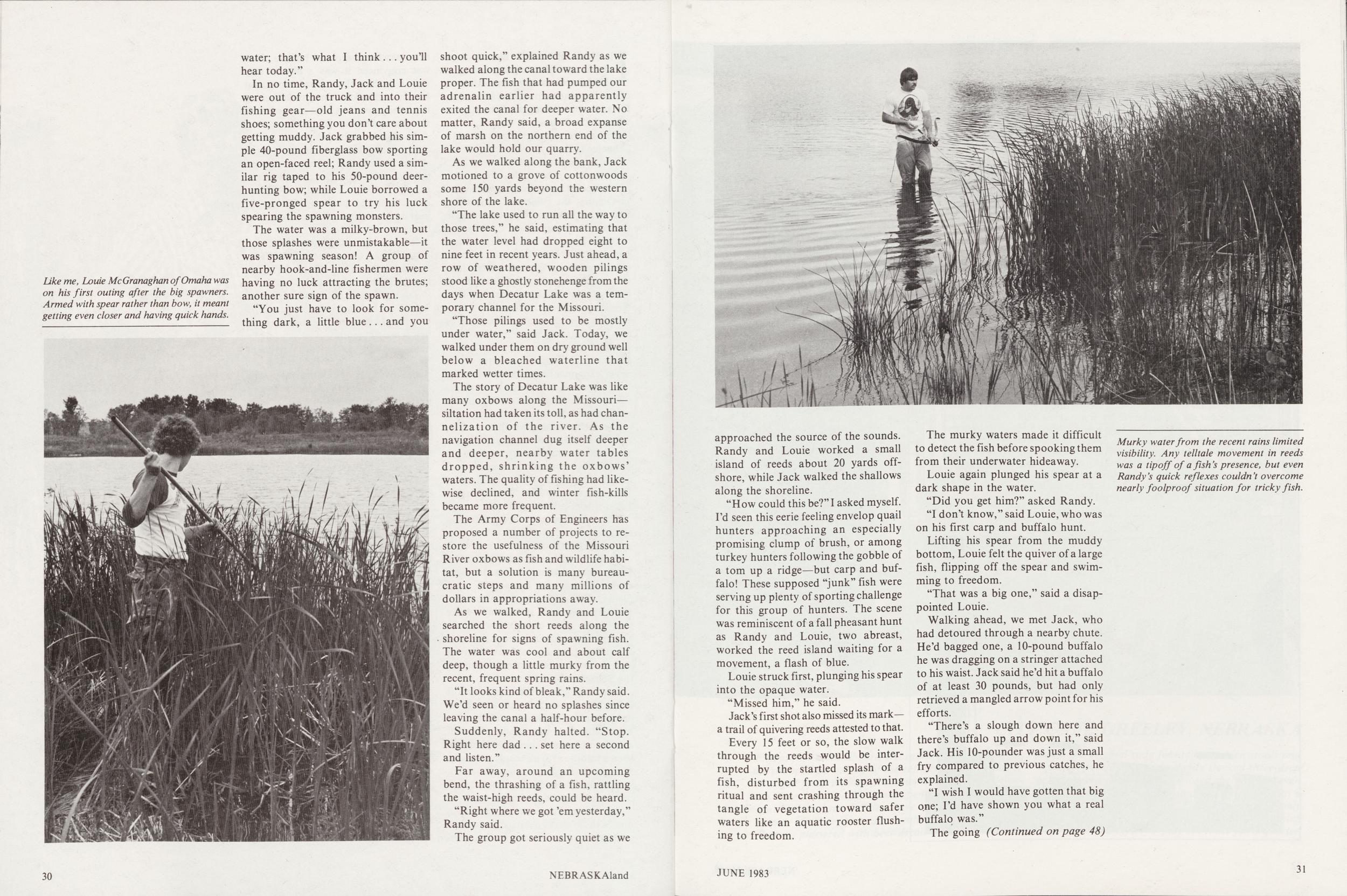
Like me, Louie McGranaghan of Omaha was on his first outing after the big spawners. Armed with spear rather than bow, it meant getting even closer and having quick hands.
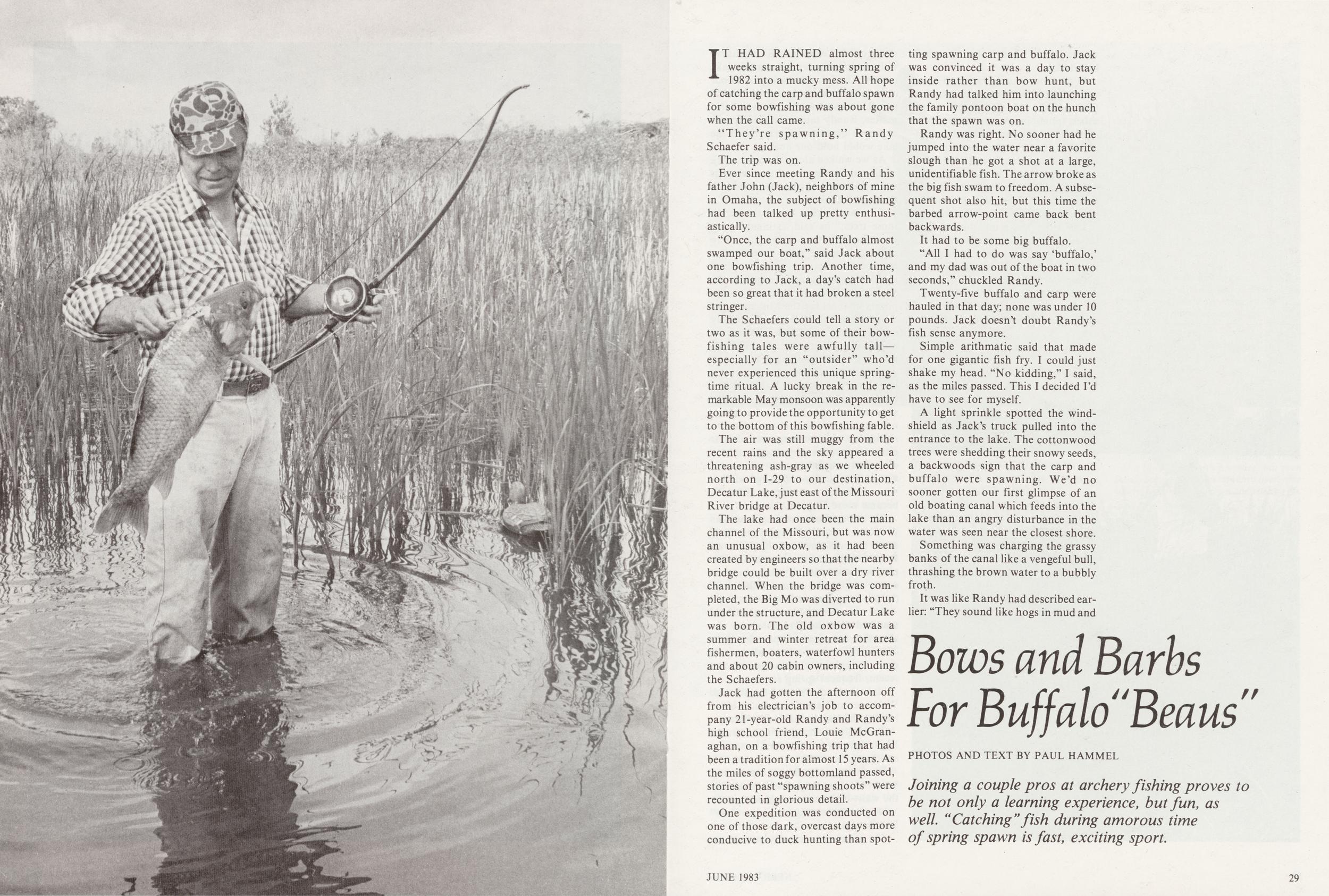
In no time, Randy, Jack and Louie were out of the truck and into their fishing gear—old jeans and tennis shoes; something you don't care about getting muddy. Jack grabbed his simple 40-pound fiberglass bow sporting an open-faced reel; Randy used a similar rig taped to his 50-pound deer-hunting bow; while Louie borrowed a five-pronged spear to try his luck spearing the spawning monsters.
The water was a milky-brown, but those splashes were unmistakable—it was spawning season! A group of nearby hook-and-line fishermen were having no luck attracting the brutes; another sure sign of the spawn.
"You just have to look for something dark, a little blue and you shoot quick," explained Randy as we walked along the canal toward the lake proper. The fish that had pumped our adrenalin earlier had apparently exited the canal for deeper water. No matter, Randy said, a broad expanse of marsh on the northern end of the lake would hold our quarry.
As we walked along the bank, Jack motioned to a grove of cottonwoods some 150 yards beyond the western shore of the lake.
"The lake used to run all the way to those trees," he said, estimating that the water level had dropped eight to nine feet in recent years. Just ahead, a row of weathered, wooden pilings stood like a ghostly stonehenge from the days when Decatur Lake was a temporary channel for the Missouri.
"Those pilings used to be mostly under water," said Jack. Today, we walked under them on dry ground well below a bleached waterline that marked wetter times.
The story of Decatur Lake was like many oxbows along the Missouri—siltation had taken its toll, as had channelization of the river. As the navigation channel dug itself deeper and deeper, nearby water tables dropped, shrinking the oxbows' waters. The quality of fishing had like-wise declined, and winter fish-kills became more frequent.
The Army Corps of Engineers has proposed a number of projects to restore the usefulness of the Missouri River oxbows as fish and wildlife habitat, but a solution is many bureaucratic steps and many millions of dollars in appropriations away.
As we walked, Randy and Louie searched the short reeds along the shoreline for signs of spawning fish. The water was cool and about calf deep, though a little murky from the recent, frequent spring rains.
"It looks kind of bleak," Randy said. We'd seen or heard no splashes since leaving the canal a half-hour before.
Suddenly, Randy halted. "Stop. Right here dad set here a second and listen."
Far away, around an upcoming bend, the thrashing of a fish, rattling the waist-high reeds, could be heard.
"Right where we got 'em yesterday," Randy said.
The group got seriously quiet as we approached the source of the sounds. Randy and Louie worked a small island of reeds about 20 yards offshore, while Jack walked the shallows along the shoreline.
"How could this be?" I asked myself. I'd seen this eerie feeling envelop quail hunters approaching an especially promising clump of brush, or among turkey hunters following the gobble of a torn up a ridge—but carp and buffalo! These supposed "junk" fish were serving up plenty of sporting challenge for this group of hunters. The scene was reminiscent of a fall pheasant hunt as Randy and Louie, two abreast, worked the reed island waiting for a movement, a flash of blue.
Louie struck first, plunging his spear into the opaque water.
"Missed him," he said.
Jack's first shot also missed its mark—a trail of quivering reeds attested to that.
Every 15 feet or so, the slow walk through the reeds would be interrupted by the startled splash of a fish, disturbed from its spawning ritual and sent crashing through the tangle of vegetation toward safer waters like an aquatic rooster flushing to freedom.
The murky waters made it difficult to detect the fish before spooking them from their underwater hideaway.
Louie again plunged his spear at a dark shape in the water.
'Did you get him?" asked Randy.
"I don't know," said Louie, who was on his first carp and buffalo hunt.
Lifting his spear from the muddy bottom, Louie felt the quiver of a large fish, flipping off the spear and swimming to freedom.
"That was a big one," said a disappointed Louie.
Walking ahead, we met Jack, who had detoured through a nearby chute. He'd bagged one, a 10-pound buffalo he was dragging on a stringer attached to his waist. Jack said he'd hit a buffalo of at least 30 pounds, but had only retrieved a mangled arrow point for his efforts.
"There's a slough down here and there's buffalo up and down it," said Jack. His 10-pounder was just a small fry compared to previous catches, he explained.
"I wish I would have gotten that big one; I'd have shown you what a real buffalo was."
The going (Continued on page 48)
Murky water from the recent rains limited visibility. Any telltale movement in reeds was a tip off of a fish's presence, but even Randy's quick reflexes couldn't overcome nearly foolproof situation for tricky fish.
A Slice of Summer
Forced to give up a New England vacation, we instead made a tour of several Nebraska towns and found equally as quaint and colorful subjects.
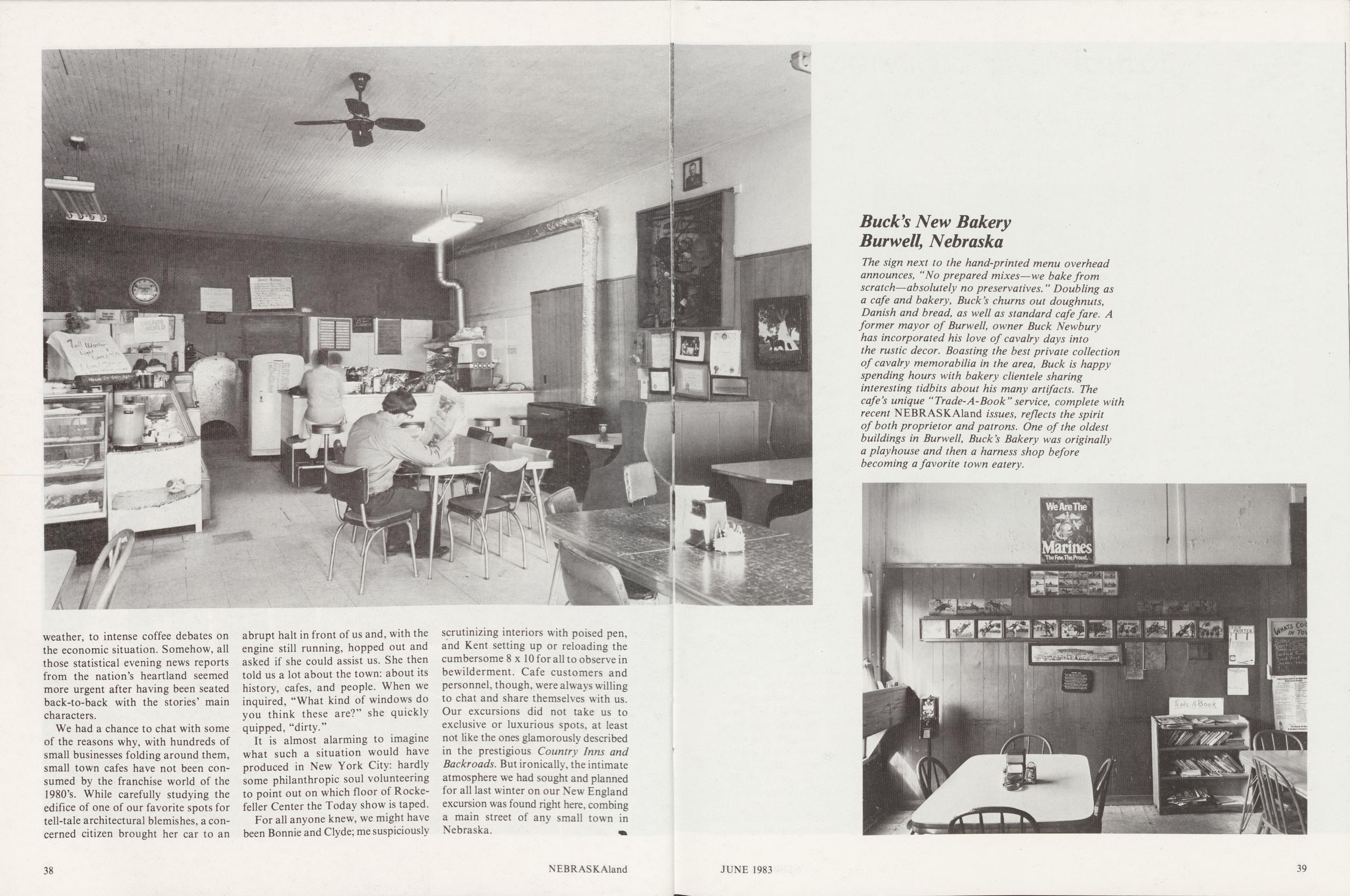
The photographs for this article were made on a 4 X 5, 5 X 7, or 8 X 10-inch view camera. The Tri-X pan film was rated at ASA 200, with the exposure determined by doubling the meter reading. Long exposure times allowed for maximum depth of field. In the Wigwam Cafe photograph, the waitress continued serving throughout the three-minute exposure, but did not appear in the image as she didn't stand still long enough to register on the film. The photographs were printed on a normal grade-two paper; either Ilfobrom, Seagull or Kodak Azo.
Kent Klima's photographs will be exhibited through August at the DeSoto National Wildlife Refuge. Ten pages of Kent's color photographs appeared in the October 1982 issue of NEBRASKA land Magazine. Kent's wife Melissa counsels gifted children in the Bellevue Public Schools and plays cello in the Omaha Symphony.
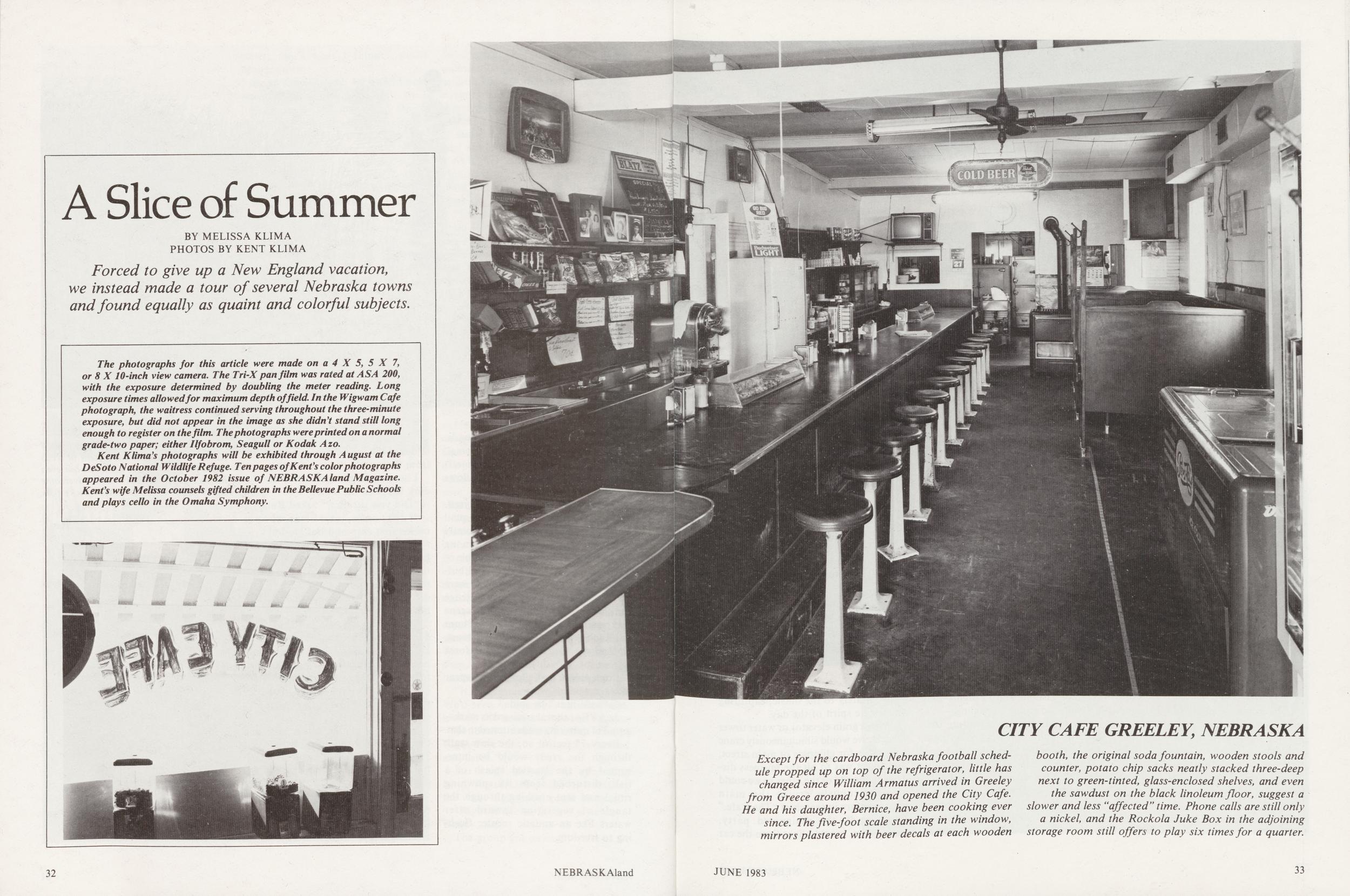
CITY CAFE GREELEY, NEBRASKA
Except for the cardboard Nebraska football schedule propped up on top of the refrigerator, little has changed since William Armatus arrived in Greeley from Greece around 1930 and opened the City Cafe. He and his daughter, Bernice, have been cooking ever since. The five-foot scale standing in the window, mirrors plastered with beer decals at each wooden booth, the original soda fountain, wooden stools and counter, potato chip sacks neatly stacked three-deep next to green-tinted, glass-enclosed shelves, and even the sawdust on the black linoleum floor, suggest a slower and less "affected" time. Phone calls are still only a nickel, and the Rockola Juke Box in the adjoining storage room still offers to play six times for a quarter.
WE HAD PLANNED big on our second annual New England trek: rambling and refined country inns, elegant six-course dinners, some of the world's finest cultural events, plenty of 18th century atmosphere. Unfortunately, the price of atmosphere did not plummet in the past year, so the idea of scouring Nebraska for memorable and unique small town cafes, minus the 5,000 miles worth of gasoline and 22 nights' lodging, sounded rather appealing.
The ritual for our substitute early morning jaunts consisted of reving up the questionable 1965 Olds, turning in a receivable classical station and, after consulting the dilapidated road atlas, veering in the opposite direction from our previous outing. Sailing along to the strains of Paganini and Mozart, the corn-bedecked highways swayed appropriately to the music, capturing the festive spirit of the day.
With a grain elevator or water tower in sight, we would simultaneously crane our necks for glimpses of main street; the object was to hit the business district at one end or the other so we could inconspicuously cruise the main thoroughfare in search of "The Cafe." Spotting it, the designated party, usually me, would alight from the car
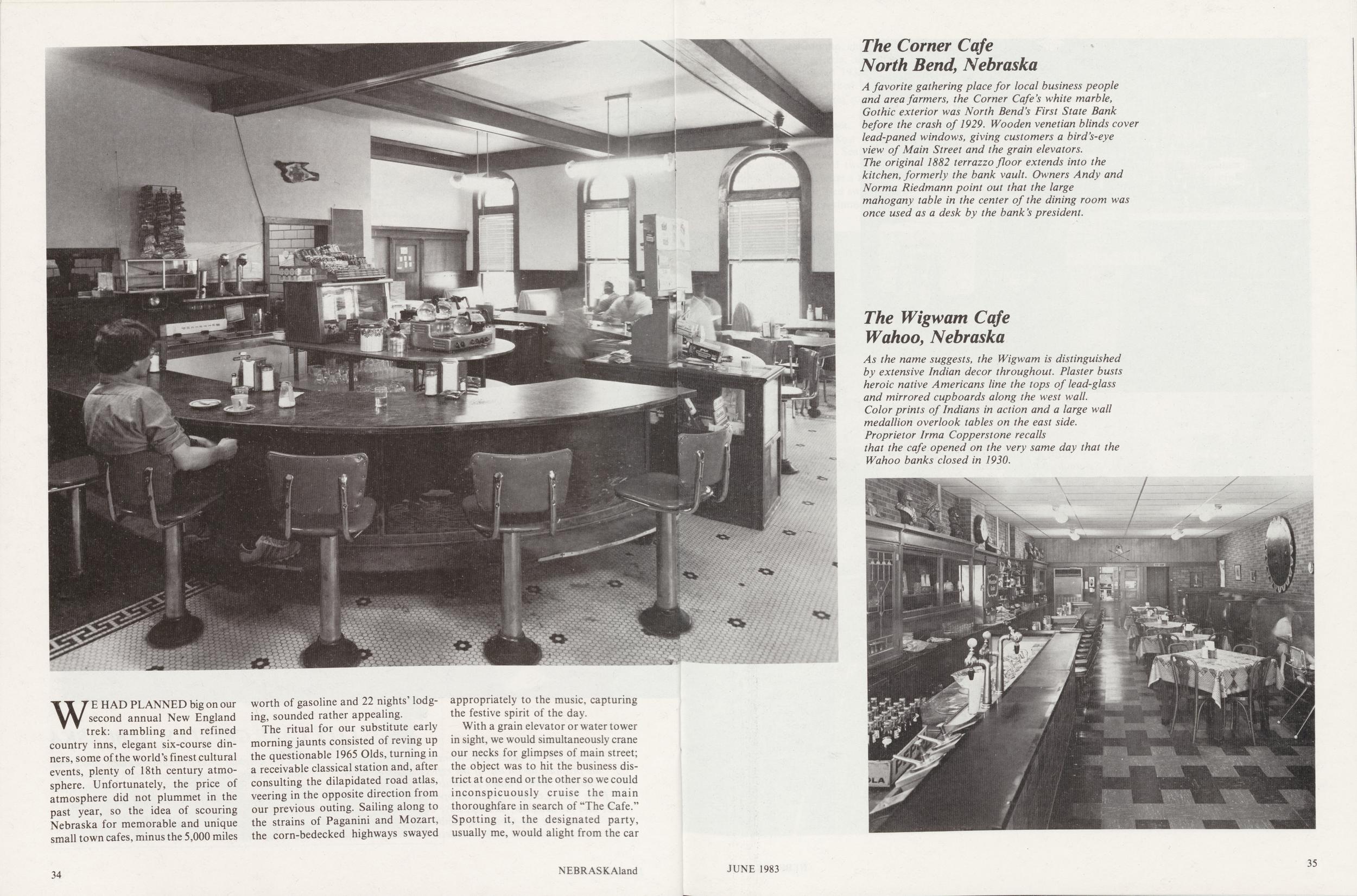
The Corner Cafe North Bend, Nebraska
A favorite gathering place for local business people and area farmers, the Corner Cafe's white marble, Gothic exterior was North Bend's First State Bank before the crash of 1929. Wooden Venetian blinds cover lead-paned windows, giving customers a bird's-eye view of Main Street and the grain elevators. The original 1882 terrazzo floor extends into the kitchen, formerly the bank vault. Owners Andy and Norma Riedmann point out that the large mahogany table in the center of the dining room was once used as a desk by the bank's president.
The Wigwam Cafe Wahoo, Nebraska
As the name suggests, the Wigwam is distinguished by extensive Indian decor throughout. Plaster busts heroic native Americans line the tops of lead-glass and mirrored cupboards along the west wall. Color prints of Indians in action and a large wall medallion overlook tables on the east side. Proprietor Irma Copperstone recalls that the cafe opened on the very same day that the Wahoo banks closed in 1930.
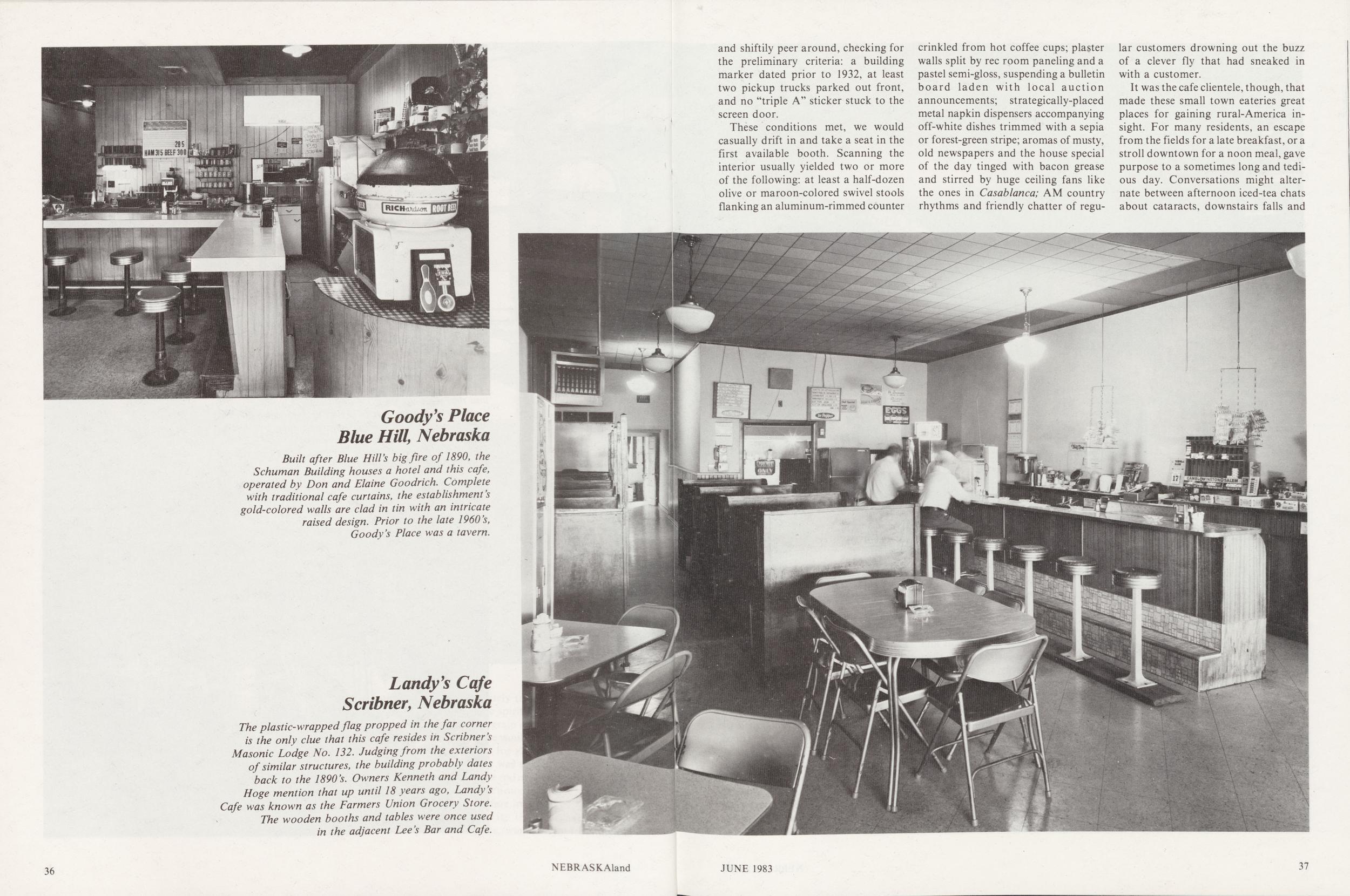
Goody's Place Blue Hill, Nebraska
Built after Blue Hill's big fire of 1890, the Schuman Building houses a hotel and this cafe, operated by Don and Elaine Goodrich. Complete with traditional cafe curtains, the establishment's gold-colored walls are clad in tin with an intricate raised design. Prior to the late 1960's, Goody's Place was a tavern.
Landy's Cafe Scribner, Nebraska
The plastic-wrapped flag propped in the far corner is the only clue that this cafe resides in Scribner's Masonic Lodge No. 132. Judging from the exteriors of similar structures, the building probably dates back to the 1890's. Owners Kenneth and Landy Hoge mention that up until 18 years ago, Landy's Cafe was known as the Farmers Union Grocery Store. The wooden booths and tables were once used in the adjacent Lee's Bar and Cafe.
and shiftily peer around, checking for the preliminary criteria: a building marker dated prior to 1932, at least two pickup trucks parked out front, and no "triple A" sticker stuck to the screen door.
These conditions met, we would casually drift in and take a seat in the first available booth. Scanning the interior usually yielded two or more of the following: at least a half-dozen olive or maroon-colored swivel stools flanking an aluminum-rimmed counter crinkled from hot coffee cups; plaster walls split by rec room paneling and a pastel semi-gloss, suspending a bulletin board laden with local auction announcements; strategically-placed metal napkin dispensers accompanying off-white dishes trimmed with a sepia or forest-green stripe; aromas of musty, old newspapers and the house special of the day tinged with bacon grease and stirred by huge ceiling fans like the ones in Casablanca; AM country rhythms and friendly chatter of regular customers drowning out the buzz of a clever fly that had sneaked in with a customer.
It was the cafe clientele, though, that
made these small town eateries great
places for gaining rural-America insight. For many residents, an escape
from the fields for a late breakfast, or a
stroll downtown for a noon meal, gave
purpose to a sometimes long and tedious day. Conversations might alternate between
afternoon iced-tea chats
about cataracts, downstairs falls and
36
NEBRASKAland
JUNE 1983
37
 weather, to intense coffee debates on
the economic situation. Somehow, all
those statistical evening news reports
from the nation's heartland seemed
more urgent after having been seated
back-to-back with the stories' main
characters.
weather, to intense coffee debates on
the economic situation. Somehow, all
those statistical evening news reports
from the nation's heartland seemed
more urgent after having been seated
back-to-back with the stories' main
characters.
We had a chance to chat with some of the reasons why, with hundreds of small businesses folding around them, small town cafes have not been consumed by the franchise world of the 1980's. While carefully studying the edifice of one of our favorite spots for tell-tale architectural blemishes, a concerned citizen brought her car to an abrupt halt in front of us and, with the engine still running, hopped out and asked if she could assist us. She then told us a lot about the town: about its history, cafes, and people. When we inquired, "What kind of windows do you think these are?" she quickly quipped, "dirty."
It is almost alarming to imagine what such a situation would have produced in New York City: hardly some philanthropic soul volunteering to point out on which floor of Rockefeller Center the Today show is taped. For all anyone knew, we might have been Bonnie and Clyde; me suspiciously scrutinizing interiors with poised pen, and Kent setting up or reloading the cumbersome 8 x 10 for all to observe in bewilderment. Cafe customers and personnel, though, were always willing to chat and share themselves with us. Our excursions did not take us to exclusive or luxurious spots, at least not like the ones glamorously described in the prestigious Country Inns and Backroads. But ironically, the intimate atmosphere we had sought and planned for all last winter on our New England excursion was found right here, combing a main street of any small town in Nebraska.
Buck's New Bakery Burwell, Nebraska
The sign next to the hand-printed menu overhead announces, "No prepared mixes—we bake from scratch—absolutely no preservatives." Doubling as a cafe and bakery, Buck's churns out doughnuts, Danish and bread, as well as standard cafe fare. A former mayor of Burwell, owner Buck Newbury has incorporated his love of cavalry days into the rustic decor. Boasting the best private collection of cavalry memorabilia in the area, Buck is happy spending hours with bakery clientele sharing interesting tidbits about his many artifacts. The cafe's unique "Trade-A-Book" service, complete with recent NEBRASKAland issues, reflects the spirit of both proprietor and patrons. One of the oldest buildings in Burwell, Buck's Bakery was originally a playhouse and then a harness shop before becoming a favorite town eatery.
Return of the Bighorns
A nucleus herd for what is hoped will become a permanent Pine Ridge sheep population already provides for learning, viewing.
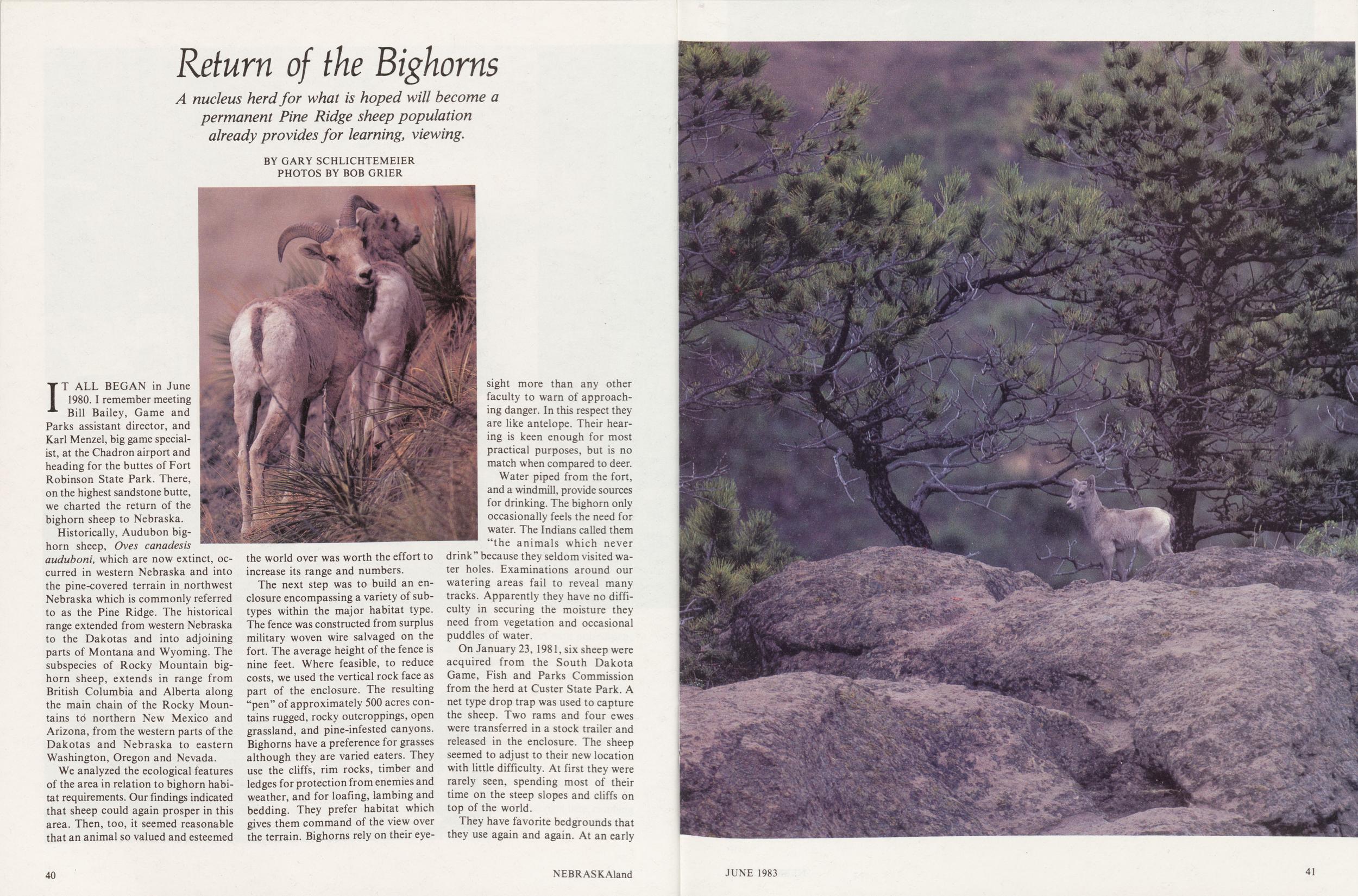
IT ALL BEGAN in June 1980.1 remember meeting Bill Bailey, Game and Parks assistant director, and Karl Menzel, big game specialist, at the Chadron airport and heading for the buttes of Fort Robinson State Park. There, on the highest sandstone butte, we charted the return of the bighorn sheep to Nebraska.
Historically, Audubon bighorn sheep, Oves canadesis auduboni, which are now extinct, occurred in western Nebraska and into the pine-covered terrain in northwest Nebraska which is commonly referred to as the Pine Ridge. The historical range extended from western Nebraska to the Dakotas and into adjoining parts of Montana and Wyoming. The subspecies of Rocky Mountain bighorn sheep, extends in range from British Columbia and Alberta along the main chain of the Rocky Mountains to northern New Mexico and Arizona, from the western parts of the Dakotas and Nebraska to eastern Washington, Oregon and Nevada.
We analyzed the ecological features of the area in relation to bighorn habitat requirements. Our findings indicated that sheep could again prosper in this area. Then, too, it seemed reasonable that an animal so valued and esteemed the world over was worth the effort to increase its range and numbers.
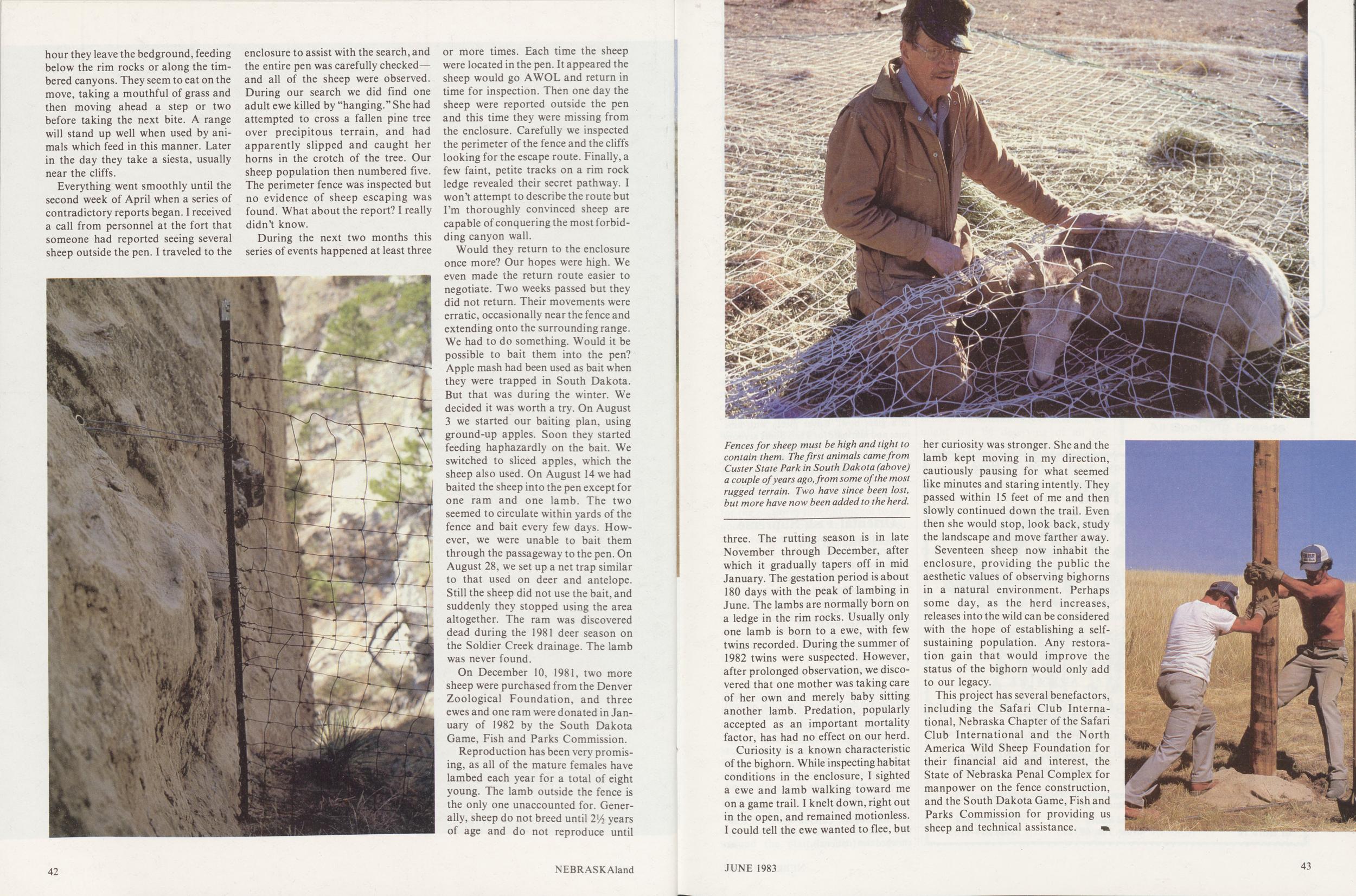
The next step was to build an enclosure encompassing a variety of subtypes within the major habitat type. The fence was constructed from surplus military woven wire salvaged on the fort. The average height of the fence is nine feet. Where feasible, to reduce costs, we used the vertical rock face as part of the enclosure. The resulting "pen" of approximately 500 acres contains rugged, rocky outcroppings, open grassland, and pine-infested canyons. Bighorns have a preference for grasses although they are varied eaters. They use the cliffs, rim rocks, timber and ledges for protection from enemies and weather, and for loafing, lambing and bedding. They prefer habitat which gives them command of the view over the terrain. Bighorns rely on their eyesight more than any other faculty to warn of approaching danger. In this respect they are like antelope. Their hearing is keen enough for most practical purposes, but is no match when compared to deer.
Water piped from the fort, and a windmill, provide sources for drinking. The bighorn only occasionally feels the need for water. The Indians called them "the animals which never drink" because they seldom visited water holes. Examinations around our watering areas fail to reveal many tracks. Apparently they have no difficulty in securing the moisture they need from vegetation and occasional puddles of water.
On January 23, 1981, six sheep were acquired from the South Dakota Game, Fish and Parks Commission from the herd at Custer State Park. A net type drop trap was used to capture the sheep. Two rams and four ewes were transferred in a stock trailer and released in the enclosure. The sheep seemed to adjust to their new location with little difficulty. At first they were rarely seen, spending most of their time on the steep slopes and cliffs on top of the world.
They have favorite bedgrounds that they use again and again. At an early
 hour they leave the bedground, feeding
below the rim rocks or along the timbered canyons. They seem to eat on the
move, taking a mouthful of grass and
then moving ahead a step or two
before taking the next bite. A range
will stand up well when used by animals which feed in this manner. Later
in the day they take a siesta, usually
near the cliffs.
hour they leave the bedground, feeding
below the rim rocks or along the timbered canyons. They seem to eat on the
move, taking a mouthful of grass and
then moving ahead a step or two
before taking the next bite. A range
will stand up well when used by animals which feed in this manner. Later
in the day they take a siesta, usually
near the cliffs.
Everything went smoothly until the second week of April when a series of contradictory reports began. I received a call from personnel at the fort that someone had reported seeing several sheep outside the pen. I traveled to the enclosure to assist with the search, and the entire pen was carefully checked—and all of the sheep were observed. During our search we did find one adult ewe killed by "hanging." She had attempted to cross a fallen pine tree over precipitous terrain, and had apparently slipped and caught her horns in the crotch of the tree. Our sheep population then numbered five. The perimeter fence was inspected but no evidence of sheep escaping was found. What about the report? I really didn't know.
During the next two months this series of events happened at least three or more times. Each time the sheep were located in the pen. It appeared the sheep would go AWOL and return in time for inspection. Then one day the sheep were reported outside the pen and this time they were missing from the enclosure. Carefully we inspected the perimeter of the fence and the cliffs looking for the escape route. Finally, a few faint, petite tracks on a rim rock ledge revealed their secret pathway. I won't attempt to describe the route but I'm thoroughly convinced sheep are capable of conquering the most forbidding canyon wall.
Would they return to the enclosure once more? Our hopes were high. We even made the return route easier to negotiate. Two weeks passed but they did not return. Their movements were erratic, occasionally near the fence and extending onto the surrounding range. We had to do something. Would it be possible to bait them into the pen? Apple mash had been used as bait when they were trapped in South Dakota. But that was during the winter. We decided it was worth a try. On August 3 we started our baiting plan, using ground-up apples. Soon they started feeding haphazardly on the bait. We switched to sliced apples, which the sheep also used. On August 14 we had baited the sheep into the pen except for one ram and one lamb. The two seemed to circulate within yards of the fence and bait every few days. However, we were unable to bait them through the passageway to the pen. On August 28, we set up a net trap similar to that used on deer and antelope. Still the sheep did not use the bait, and suddenly they stopped using the area altogether. The ram was discovered dead during the 1981 deer season on the Soldier Creek drainage. The lamb was never found.
On December 10, 1981, two more sheep were purchased from the Denver Zoological Foundation, and three ewes and one ram were donated in January of 1982 by the South Dakota Game, Fish and Parks Commission.
Fences for sheep must be high and tight to contain them. The first animals came from Custer State Park in South Dakota (above) a couple of years ago, from some of the most rugged terrain. Two have since been lost, but more have now been added to the herd.
Curiosity is a known characteristic of the bighorn. While inspecting habitat conditions in the enclosure, I sighted a ewe and lamb walking toward me on a game trail. I knelt down, right out in the open, and remained motionless. I could tell the ewe wanted to flee, but her curiosity was stronger. She and the lamb kept moving in my direction, cautiously pausing for what seemed like minutes and staring intently. They passed within 15 feet of me and then slowly continued down the trail. Even then she would stop, look back, study the landscape and move farther away. Seventeen sheep now inhabit the enclosure, providing the public the aesthetic values of observing bighorns in a natural environment. Perhaps some day, as the herd increases, releases into the wild can be considered with the hope of establishing a self-sustaining population. Any restoration gain that would improve the status of the bighorn would only add to our legacy.
This project has several benefactors, including the Safari Club International, Nebraska Chapter of the Safari Club International and the North America Wild Sheep Foundation for their financial aid and interest, the State of Nebraska Penal Complex for manpower on the fence construction, and the South Dakota Game, Fish and Parks Commission for providing us sheep and technical assistance.
In The Kitchen
Ceviche 1 pound fresh fish filets, skinned 1 bottle (8 ounces) lime juice or juice from 20-30 fresh limes 1 large onion, finely chopped 2 medium tomatoes, chopped 1 small Jalapeno pepper, chopped 30 pitted Spanish green olives 1/8 teaspoon comino 20 capers 1/4 cup olive oil Salt, to taste Pepper, to taste 1 tablespoon parsley, chopped teaspoon oreganoDice filets into dime-size pieces and place in a glass bowl. Cover pieces with lime juice and marinate for 4 to 5 hours at room temperature. Drain pieces and blot off excess lime juice. Combine pieces with remaining ingredients and mix well in a glass bowl. Cover and refrigerate mixture until cold, then serve as a salad or hors d'oeuvre.
Oriental Fish Supreme 2 pounds fresh fish filets 1 cup sliced celery 4 ounces sliced onions 1 cup sliced raw mushrooms 1 clove garlic, minced 1 cup frozen snow peas, partially defrosted 1/4 cup chicken bouillon 1 tablespoon sherry extract 1 tablespoon soy sauce 1 1/2 teaspoons salt 1/4 teaspoon powdered gingerPlace filets on non-stick baking pan and bake at 350 degrees for 15 minutes or until fish flakes easily when tested with a fork. Break filets into bite-size pieces and set aside. In a large saucepan or wok, simmer celery, onions, mushrooms and garlic in 1 cup water. Cook until vegetables are tender, stirring occasionally. Pour off excess water, add snow peas and mix thoroughly. Blend in remaining ingredients except fish and simmer for 5 minutes. Add fish pieces and heat thoroughly. Carefully divide mixture into 4 portions and serve each over Vi cup enriched rice (optional).
When Chautauqua Came to Town
(Continued from page 19)exceed his grasp. If it was occasionally clothed in flowery platitudes delivered with over-much flailing of the air and pounding of the lectern, never mind. They were used to that in church. Most speakers had something of importance to say, and said it very well.
Thus passed the golden days of Chautauqua week, up to the final performance—"Joy Night," the best of all. If some of the lectures had been a trifle taxing for minds unused to grappling with great issues, this was the reward for making the effort—a full-scale concert by Creature's or Thaviu's Band, or the equivalent thereof, complete with soloists.
How splendid the musicians looked as they took their places on the platform in their snow-white uniforms, how dazzling the leader in his medals and gold braid, how lovely the dramatic soprano in her chaste white evening gown, towering hair-do and rhinestone tiara! The program said she actually came from New York!
National Emblem—Overture from William Tell—Selections from Carmen—The Jolly Coppersmith-Aria from Madame Butterfly—Blue Danube Waltz. Intermission was time for the platform superintendent to say goodbye. He hoped we had enjoyed the programs as much as he had enjoyed his week with us, and thanked us for inviting him to our homes. Did we want the Chautauqua again next year? Thunderous applause!
We put off the end as long as we could, demanding encore after encore. At last, Stars and Stripes Forever. This, we knew, was it. There wouldn't be any more. On the final reprise, the flag rolled down from the back-drop and we all stood up. Cornetists and trombonists marched to the front of the platform and gave us everything they had, the bells of their polished horns gleaming in the lights. Oh, but it was brave, and noble, and inspiring! We would have followed Old Glory to the end of the earth!
The memory of the last chord still hung and echoed in the night air as we filed out. Already the boys in the tent crew were taking down the bunting around the platform. It was over. Tomorrow there'd be only trampled grass where the tent had been. How sad that Chautauqua couldn't last all year! But it would be back next summer! And next. And next. Until....
Tent Chautauqua died almost as suddenly as it had come to life. The last tent was struck and packed for the last time in a little New Hampshire village in 1932. The "wireless," invented by Guglielmo Marconi in 1894, had learned to talk, sing and play. In Hollywood, Cecil B. DeMille was producing spectacles that boggled the imagination. And if you wanted an evening's entertainment in the near-by city, a gallon or two of gas would get you there. Who needed Chautauqua any more? It was hopelessly old-fashioned anyway.
Maybe it was. But no one was ever inspired to go out and rob a bank, mug an old lady or seduce a little girl, by what went on in the big, brown tent. If American Democracy has fallen short of its former glory because of an irresponsible, permissive, too-materially-oriented society, surely it was not the fault of Chautauqua. If all the forms of entertainment that succeeded it had been as conscientiously conceived, we might still be deserving of all the advantages we enjoy as Americans.
A town not far from the farm in Polk County where my wife and I now live used to host the Redpath De Luxe Seven-Day Circuit every season. Today, the local theater shows X-rated movies several times a month. Is this better than Chautauqua? Is this better than anything?
BERGMAN'S RESORT On Johnson Lake Modern Lakefront Cabins Groceries Bait Tackle Full RV Hookups Boats for Rent Swim Fish Golf Write or Call: RR 2, Elwood, NE 68937 (308) 785-2298
GUN DOG TRAINING All Sporting Breeds Each dog trained on both native game and pen-reared birds. Ducks for retrievers. All dogs worked individually. Field Champion-sired labrador pups for sale. Midwest's finest facilities. WILDERNESS KENNELS Henry Sader-Roca. Nb. (402)423-4212 68430
LIVE-CATCH ALL-PURPOSE TRAPS Write for FREE CATALOG Traps without injury squirrels, chipmunks, rabbits, mink, fox, raccoons, stray animals, pests, etc. Sizes for every need. Also traps for snakes, sparrows, pigeons, crabs, turtles, quail, etc. Save on our low factory prices. Send no money. Free catalog and trapping secrets. MUSTANG MFG. CO., Dept. N-34, Box 10880, Houston, Tex. 77018
NEBRASKAland Magazine Order Form Please start a subscription for me to NEBRASKAland, and send me the current bonus issue (a $6.00 value). One-year $7.50 NAME Two-year $13 ADDRESS CITY Three-year $19 STATE Mail to: NEBRASKAland, Box 30370, Lincoln, NE 68503 ZIP
44 NEBRASKAland JUNE 1983 45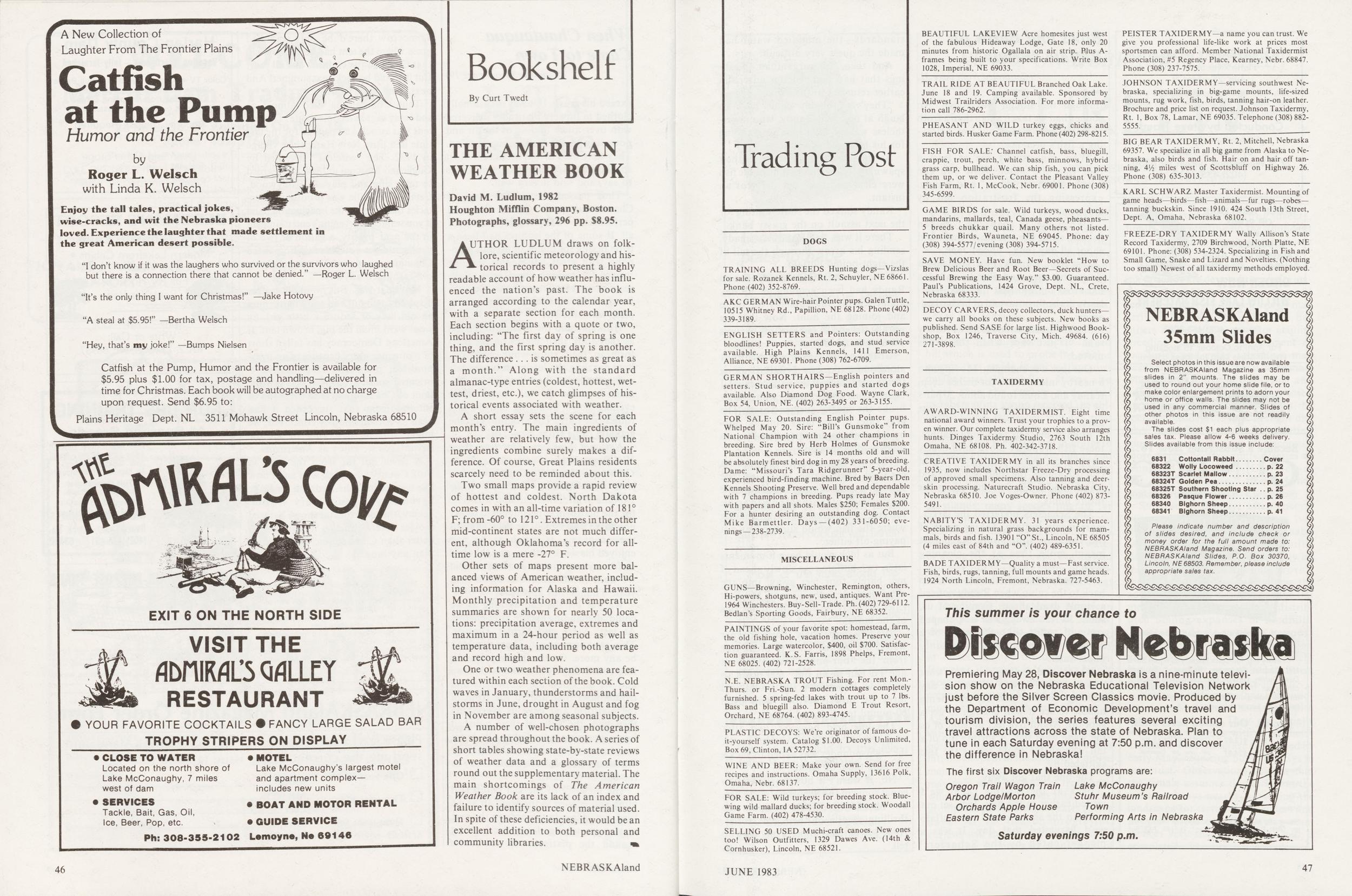
The Admiral's Cove EXIT 6 ON THE NORTH SIDE VISIT THE RESTAURANT YOUR FAVORITE COCKTAILS FANCY LARGE SALAD BAR TROPHY STRIPERS ON DISPLAY CLOSE TO WATER Located on the north shore of Lake McConaughy, 7 miles west of dam SERVICES Tackle, Bait, Gas, Oil, Ice, Beer, Pop, etc. MOTEL Lake McConaughy's largest motel and apartment complex-includes new units BOAT AND MOTOR RENTAL GUIDE SERVICE Ph: 308-355-2102 Lemoyne, No 69146
Bookshelf
THE AMERICAN WEATHER BOOK David M. Ludlum, 1982 Houghton Mifflin Company, Boston. Photographs, glossary, 296 pp. $8.95.AUTHOR LUDLUM draws on folklore, scientific meteorology and historical records to present a highly readable account of how weather has influenced the nation's past. The book is arranged according to the calendar year, with a separate section for each month. Each section begins with a quote or two, including: "The first day of spring is one thing, and the first spring day is another. The difference is sometimes as great as a month." Along with the standard almanac-type entries (coldest, hottest, wettest, driest, etc.), we catch glimpses of historical events associated with weather.
A short essay sets the scene for each month's entry. The main ingredients of weather are relatively few, but how the ingredients combine surely makes a difference. Of course, Great Plains residents scarcely need to be reminded about this.
Two small maps provide a rapid review of hottest and coldest. North Dakota comes in with an all-time variation of 181° F; from-60° to 121°. Extremes in the other mid-continent states are not much different, although Oklahoma's record for alltime low is a mere -27° F.
Other sets of maps present more balanced views of American weather, including information for Alaska and Hawaii. Monthly precipitation and temperature summaries are shown for nearly 50 locations: precipitation average, extremes and maximum in a 24-hour period as well as temperature data, including both average and record high and low.
One or two weather phenomena are featured within each section of the book. Cold waves in January, thunderstorms and hailstorms in June, drought in August and fog in November are among seasonal subjects.
A number of well-chosen photographs are spread throughout the book. A series of short tables showing state-by-state reviews of weather data and a glossary of terms round out the supplementary material. The main shortcomings of The American Weather Book are its lack of an index and failure to identify sources of material used. In spite of these deficiencies, it would be an excellent addition to both personal and community libraries.
Trading Post
DOGSTRAINING ALL BREEDS Hunting dogs—Vizslas for sale. Rozanek Kennels, Rt. 2, Schuyler, NE 68661. Phone (402) 352-8769.
AKC GERMAN Wire-hair Pointer pups. Galen Tuttle, 10515 Whitney Rd., Papillion, NE 68128. Phone (402) 339-3189.
ENGLISH SETTERS and Pointers: Outstanding bloodlines! Puppies, started dogs, and stud service available. High Plains Kennels, 1411 Emerson, Alliance, NE 69301. Phone (308) 762-6709.
GERMAN SHORTHAIRS—English pointers and setters. Stud service, puppies and started dogs available. Also Diamond Dog Food. Wayne Clark, Box 54, Union, NE. (402) 263-3495 or 263-3155.
FOR SALE: Outstanding English Pointer pups. Whelped May 20. Sire: "Bill's Gunsmoke" from National Champion with 24 other champions in breeding. Sire bred by Herb Holmes of Gunsmoke Plantation Kennels. Sire is 14 months old and will be absolutely finest bird dog in my 28 years of breeding. Dame: "Missouri's Tara Ridgerunner" 5-year-old, experienced bird-finding machine. Bred by Baers Den Kennels Shooting Preserve. Well bred and dependable with 7 champions in breeding. Pups ready late May with papers and all shots. Males $250; Females $200. For a hunter desiring an outstanding dog. Contact Mike Barmettler. Days —(402) 331-6050; evenings—238-2739.
MISCELLANEOUSGUNS—Browning, Winchester, Remington, others, Hi-powers, shotguns, new, used, antiques. Want Pre-1964 Winchesters. Buy-Sell-Trade. Ph. (402) 729-6112. Bedlans Sporting Goods, Fairbury, NE 68352.
PAINTINGS of your favorite spot: homestead, farm, the old fishing hole, vacation homes. Preserve your memories. Large watercolor, $400, oil $700. Satisfaction guaranteed. K.S. Farris, 1898 Phelps, Fremont, NE 68025. (402) 721-2528.
N.E. NEBRASKA TROUT Fishing. For rent Mon.-Thurs. or Fri.-Sun. 2 modern cottages completely furnished. 5 spring-fed lakes with trout up to 7 lbs. Bass and bluegill also. Diamond E Trout Resort, Orchard, NE 68764. (402) 893-4745.
PLASTIC DECOYS: We're originator of famous do-it-yourself system. Catalog $1.00. Decoys Unlimited, Box 69, Clinton, IA 52732. WINE AND BEER: Make your own. Send for free recipes and instructions. Omaha Supply, 13616 Polk, Omaha, Nebr. 68137.
FOR SALE: Wild turkeys; for breeding stock. Bluewing wild mallard ducks; for breeding stock. Woodall Game Farm. (402) 478-4530. SELLING 50 USED Muchi-craft canoes. New ones too! Wilson Outfitters, 1329 Dawes Ave. (14th & Cornhusker), Lincoln, NE 68521.
BEAUTIFUL LAKEVIEW Acre homesites just west of the fabulous Hideaway Lodge, Gate 18, only 20 minutes from historic Ogallala on air strip. Plus A-frames being built to your specifications. Write Box 1028, Imperial, NE 69033.
TRAIL RIDE AT BEAUTIFUL Branched Oak Lake. June 18 and 19. Camping available. Sponsored by Midwest Trailriders Association. For more information call 786-2962.
PHEASANT AND WILD turkey eggs, chicks and started birds. Husker Game Farm. Phone (402) 298-8215.
FISH FOR SALE: Channel catfish, bass, bluegill, crappie, trout, perch, white bass, minnows, hybrid grass carp, bullhead. We can ship fish, you can pick them up, or we deliver. Contact the Pleasant Valley Fish Farm, Rt. 1, McCook. Nebr. 69001. Phone (308) 345-6599.
GAME BIRDS for sale. Wild turkeys, wood ducks, mandarins, mallards, teal, Canada geese, pheasants—5 breeds chukkar quail. Many others not listed. Frontier Birds, Wauneta, NE 69045. Phone: day (308) 394-5577/evening (308) 394-5715.
SAVE MONEY. Have fun. New booklet "How to Brew Delicious Beer and Root Beer—Secrets of Successful Brewing the Easy Way." $3.00. Guaranteed. Paul's Publications, 1424 Grove, Dept. NL, Crete. Nebraska 68333.
DECOY CARVERS, decoy collectors, duck hunters—we carry all books on these subjects. New books as published. Send SASE for large list. Highwood Bookshop, Box 1246, Traverse City, Mich. 49684. (616) 271-3898.
TAXIDERMY AWARD-WINNING TAXIDERMIST. Eight time national award winners. Trust your trophies to a proven winner. Our complete taxidermy service also arranges hunts. Dinges Taxidermy Studio, 2763 South 12th Omaha, NE 68108. Ph. 402-342-3718. CREATIVE TAXIDERMY in all its branches since 1935, now includes Northstar Freeze-Dry processing of approved small specimens. Also tanning and deer-skin processing. Naturecraft Studio. Nebraska City, Nebraska 68510. Joe Voges-Owner. Phone (402) 873-5491. NABITY'S TAXIDERMY. 31 years experience. Specializing in natural grass backgrounds for mammals, birds and fish. 13901 "0"St., Lincoln, NE 68505 (4 miles east of 84th and "O". (402) 489-6351. BADE TAXIDERMY—Quality a must—Fast service. Fish, birds, rugs, tanning, full mounts and game heads. 1924 North Lincoln, Fremont, Nebraska. 727-5463. PEISTER TAXIDERMY—a name you can trust. We give you professional life-like work at prices most sportsmen can afford. Member National Taxidermist Association, #5 Regency Place, Kearney, Nebr. 68847. Phone (308) 237-7575. JOHNSON TAXIDERMY—servicing southwest Nebraska, specializing in big-game mounts, life-sized mounts, rug work, fish, birds, tanning hair-on leather. Brochure and price list on request. Johnson Taxidermy, Rt. 1, Box 78, Lamar, NE 69035. Telephone (308) 882-5555. BIG BEAR TAXIDERMY, Rt. 2, Mitchell, Nebraska 69357. We specialize in all big game from Alaska to Nebraska, also birds and fish. Hair on and hair off tanning, 4 1/2 miles west of Scottsbluff on Highway 26. Phone (308) 635-3013. KARL SCHWARZ Master Taxidermist. Mounting of game heads—birds—fish—animals—fur rugs—robes—tanning buckskin. Since 1910. 424 South 13th Street, Dept. A, Omaha, Nebraska 68102. FREEZE-DRY TAXIDERMY Wally Allison's State Record Taxidermy, 2709 Birchwood, North Platte, NE 69101. Phone: (308) 534-2324. Specializing in Fish and Small Game, Snake and Lizard and Novelties. (Nothing too small) Newest of all taxidermy methods employed.NEBRASKAland 35mm Slides Select photos in this issue are now available from NEBRASKAland Magazine as 35mm slides in 2" mounts. The slides may be used to round out your home slide file, or to make color enlargement prints to adorn your home or office walls. The slides may not be used in any commercial manner. Slides of other photos in this issue are not readily available. The slides cost $1 each plus appropriate sales tax. Please allow 4-6 weeks delivery. Slides available from this issue include: 6831 Cottontail Rabbit Cover 68322 Wolly Locoweed p. 22 68323T Scarlet Mallow p. 23 68324T Golden Pea p. 24 68325T Southern Shooting Star p. 25 68326 Pasque Flower p. 26 68340 Bighorn Sheep p. 40 68341 Bighorn Sheep p. 41 Please indicate number and description of slides desired, and include check or money order for the full amount made to: NEBRASKAland Magazine. Send orders to: NEBRASKAland Slides, P.O. Box 30370, Lincoln, NE 68503. Remember, please include appropriate sales tax.
This summer is your chance to Discover Premiering May 28, Discover Nebraska is a nine-minute television show on the Nebraska Educational Television Network just before the Silver Screen Classics movie. Produced by the Department of Economic Development's travel and tourism division, the series features several exciting travel attractions across the state of Nebraska. Plan to tune in each Saturday evening at 7:50 p.m. and discover the difference in Nebraska! The first six Discover Nebraska programs are: Oregon Trail Wagon Train Lake McConaughy Arbor Lodge/Morton Stuhr Museum's Railroad Orchards Apple House Town Eastern State Parks Performing Arts in Nebraska Saturday evenings 7:50 p.m.
46 NEBRASKAland JUNE 1983 47
Bows and Barbs for Buffalo "Beaus"
(Continued from page 31)through the slough was tough. No sooner had we taken a step than a froth of water exploded at our feet, betraying a fish's presence.
"You can usually see at least a foot into the water. Now you can hardly see three inches," said Randy, expressing the frustration felt by everyone.
"When they're spawning, you can usually sit in the middle of them and shoot all day long," added Jack.
Just then, Louie's spear sank into a six-pound carp and Randy nailed a like-sized buffalo that thrashed fruitlessly at the business end of his barbed-arrow.
"I didn't really even see him," Randy said. "I just shot when the weeds moved."
Our luck was changing. Moving into a nearby inlet about four inches deep, Randy and Louie found about 20 pairs of carp lying side-by-side in the clear pool.
Blinded by their spawning instinct, these fish wouldn't move until nearly stepped on. After picking off about two fish apiece, the sport was gone and Randy and Louie left the others for future hunts.
The Schaefers preferred the larger, more meaty buffalo. Taking more of the three to four-pound carp just meant more time at the cleaning table.
We had just started the two-mile trip back to the cabin when Randy noticed a ripple dead ahead. Coming at us, some 30-feet away, was a V-shaped wave of water—like the wake of a motorboat on a calm lake, only underwater.
It's an odd feeling watching what had to be the biggest fish of the day coming directly for us, but being unable to see it well enough to get a shot off. About five feet in front of us the wave went flat. A flirting flip of a tail was all we could see as the fish skittered by.
The one that got away.
Back at the boating canal we'd visited earlier in the day, Jack set out to clean the six carp and two buffalo we'd harvested that day. It was a meager catch by the Schaefers' standards—the muddied water had made the quest very difficult.
And then, the gargantuan splashings that had pumped our adrenalin earlier returned to the canal.
"They've probably come back to laugh at us," said Randy, who nevertheless wasted little time in grabbing for his bow and arrow.
As they charged the shore in their spawning frenzy, the outline of the fish were clearly visible, but only for an instant.
Randy stalked the shore waiting for the next assault on the grassy bank. There it was, and Randy was ready, sending his arrow through the tail of the eight-pound buffalo.
Now it was my turn. Jack and Randy had been goading me all day about leaving my cameras on shore and joining the hunt. Now that we were at the end of our trip, my excuses were running out.
Grabbing the bow I'd brought along—just in case—I walked along the opposite side of the narrow canal. I hadn't gone 10 feet when white water broke the murky surface ahead. The gray sides of two large buffalo, side-by-side, rose to the surface and just as quickly, disappeared.
The next few moments resembled a carnival shell game, pursuing the spawning splashes up and down the grassy banks of the canal only to arrive too late for a decent shot. Anticipating where the fish would surface was not paying off either.
But as luck would have it moments later, two buffalo rose slowly ahead of me, barely four feet away, into the clear water near the surface. My shot rifled securely through the upper ribs of the buffalo.
Tugging desperately toward deeper water, the big fish tried to break free from the four-pound monofilament line I'd had in an old reel taped to my bow. A novice's rig, I was told later by bowfishermen who used 60-pound test line and better.
The line held however, and after what seemed a long, drawn-out battle, the eight-pounder was added to Jack's cleaning table on shore.
No, it wasn't a bowfishing trip to equal some of the Schaefers' past tales, but now it was harder to doubt the thrilling details of their old stories. And, I even had some of my own to tell.
NOTES ON NEBRASKA FAUNA/
CURLEW
RELIEF FROM THE long Sandhills winter comes on a clear, long, drawn-out whistle, "wheeet, wheeet, wheeet,"from nearby hilltops. The curlews have returned, having traveled by night in one, perhaps several, steps from their winter quarters on the mud flats of coastal Texas and Mexico.
It was there that nature fashioned their seven to nine-inch sickle-shaped bill which is used to probe for marine worms that reside in curved burrows on the coastal tidal flats. It was also there that the curlew and other members of its group received the collective name, sandpiper. But like most other sandpipers, the long-billed curlew leaves the coast and migrates to breeding grounds which are inland and often not at all associated with aquatic environments. Usually, sandpipers summer in open surroundings like the grasslands; many species migrate far north into the closely-cropped Arctic tundra. In these environments they may only rarely venture into the water or along its edge to forage, but instead will seek out the many forms of terrestrial invertebrates, usually insects, that are available.
The largest of all North American sandpipers (height about 20 inches; wingspan about 30 inches) the long-billed curlew's diet also consists mostly of insects on the breeding grounds. However, it arrives in Nebraska before most insects have emerged (earliest recorded arrival, March 12; however most are clustered in the first week of April). For many days the early arrivals may go with little to eat, surviving on their remaining reserves of winter fat; much spent in the migratory movement. During these early weeks, they may gain some sustenance from ants, which may emerge from their underground colonies on warm, early spring days. As the season progresses, curlews will shift their attention to the increasing variety and abundance of emerging surface-dwelling insects, finally concentrating on the abundant and energy-rich grasshoppers in late season.
The first several weeks on the breeding grounds are devoted to pair formation and establishment of nesting and feeding territories. Some curlews may arrive in the Sandhills with mates, but others arrive singly and later acquire breeding partners. Establishment of territories and mate attraction may occur simultaneously, for it is the male who is most active in displaying and advertising his presence in the chosen area. During the first few weeks, he spends considerable time in flight display. As he flies arcing and undulating loops over a large area of a score or more acres, he also emits a series of rising and falling notes: "Curl-e-e-e-u-u-u, curl-e-e-e-u-u-u," from whence comes its name.
Such aerial displays often encompass a territory that includes two distinct but adjacent sandhills habitats: meadows and rolling hills. Each habitat is utilized differently by the curlew. The rolling hills provide the nest sites. Following hatching, the adults and young venture into the flat meadows that are irregularly distributed among expanses of sandhills. These meadows usually support denser stands of sedges and grasses, and at least at about the time of hatching, also support more abundant insect populations for the chicks.
Nests are little more than hollowed-out depressions in the sand lined with fine grass blades. They are usually located on hillsides with a southerly exposure. Most nests are completed by early May, requiring but a few days to construct. Observations suggest that the female assumes this task, but the male is always nearby, surveying the landscape for territorial intruders and possible predators. Egg laying commences very shortly after the nest is completed. The normal complement
48 NEBRASKAland JUNE 1983 49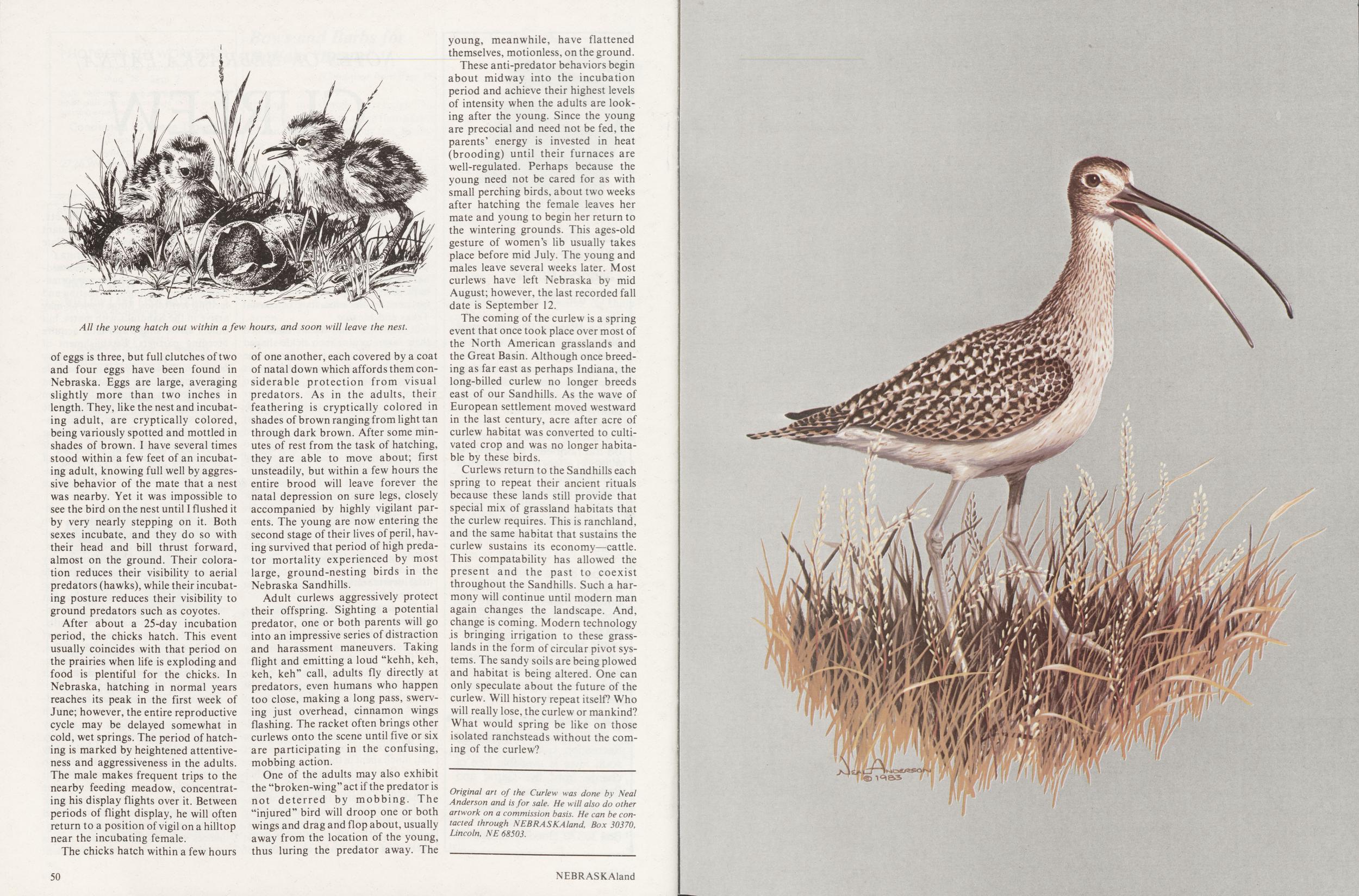
All the young hatch out within a few hours, and soon will leave the nest.
of eggs is three, but full clutches of two and four eggs have been found in Nebraska. Eggs are large, averaging slightly more than two inches in length. They, like the nest and incubating adult, are cryptically colored, being variously spotted and mottled in shades of brown. I have several times stood within a few feet of an incubating adult, knowing full well by aggressive behavior of the mate that a nest was nearby. Yet it was impossible to see the bird on the nest until I flushed it by very nearly stepping on it. Both sexes incubate, and they do so with their head and bill thrust forward, almost on the ground. Their coloration reduces their visibility to aerial predators (hawks), while their incubating posture reduces their visibility to ground predators such as coyotes.
After about a 25-day incubation period, the chicks hatch. This event usually coincides with that period on the prairies when life is exploding and food is plentiful for the chicks. In Nebraska, hatching in normal years reaches its peak in the first week of June; however, the entire reproductive cycle may be delayed somewhat in cold, wet springs. The period of hatching is marked by heightened attentiveness and aggressiveness in the adults. The male makes frequent trips to the nearby feeding meadow, concentrating his display flights over it. Between periods of flight display, he will often return to a position of vigil on a hilltop near the incubating female. The chicks hatch within a few hours of one another, each covered by a coat of natal down which affords them considerable protection from visual predators. As in the adults, their feathering is cryptically colored in shades of brown ranging from light tan through dark brown. After some minutes of rest from the task of hatching, they are able to move about; first unsteadily, but within a few hours the entire brood will leave forever the natal depression on sure legs, closely accompanied by highly vigilant parents. The young are now entering the second stage of their lives of peril, having survived that period of high predator mortality experienced by most large, ground-nesting birds in the Nebraska Sandhills.
Adult curlews aggressively protect their offspring. Sighting a potential predator, one or both parents will go into an impressive series of distraction and harassment maneuvers. Taking flight and emitting a loud "kehh, keh, keh, keh" call, adults fly directly at predators, even humans who happen too close, making a long pass, swerving just overhead, cinnamon wings flashing. The racket often brings other curlews onto the scene until five or six are participating in the confusing, mobbing action.
One of the adults may also exhibit the "broken-wing" act if the predator is not deterred by mobbing. The "injured" bird will droop one or both wings and drag and flop about, usually away from the location of the young, thus luring the predator away. The young, meanwhile, have flattened themselves, motionless, on the ground.
These anti-predator behaviors begin about midway into the incubation period and achieve their highest levels of intensity when the adults are looking after the young. Since the young are precocial and need not be fed, the parents' energy is invested in heat (brooding) until their furnaces are well-regulated. Perhaps because the young need not be cared for as with small perching birds, about two weeks after hatching the female leaves her mate and young to begin her return to the wintering grounds. This ages-old gesture of women's lib usually takes place before mid July. The young and males leave several weeks later. Most curlews have left Nebraska by mid August; however, the last recorded fall date is September 12.
The coming of the curlew is a spring event that once took place over most of the North American grasslands and the Great Basin. Although once breeding as far east as perhaps Indiana, the long-billed curlew no longer breeds east of our Sandhills. As the wave of European settlement moved westward in the last century, acre after acre of curlew habitat was converted to cultivated crop and was no longer habitable by these birds.
Curlews return to the Sandhills each spring to repeat their ancient rituals because these lands still provide that special mix of grassland habitats that the curlew requires. This is ranchland, and the same habitat that sustains the curlew sustains its economy—cattle. This compatability has allowed the present and the past to coexist throughout the Sandhills. Such a harmony will continue until modern man again changes the landscape. And, change is coming. Modern technology is bringing irrigation to these grasslands in the form of circular pivot systems. The sandy soils are being plowed and habitat is being altered. One can only speculate about the future of the curlew. Will history repeat itself? Who will really lose, the curlew or mankind? What would spring be like on those isolated ranchsteads without the coming of the curlew?
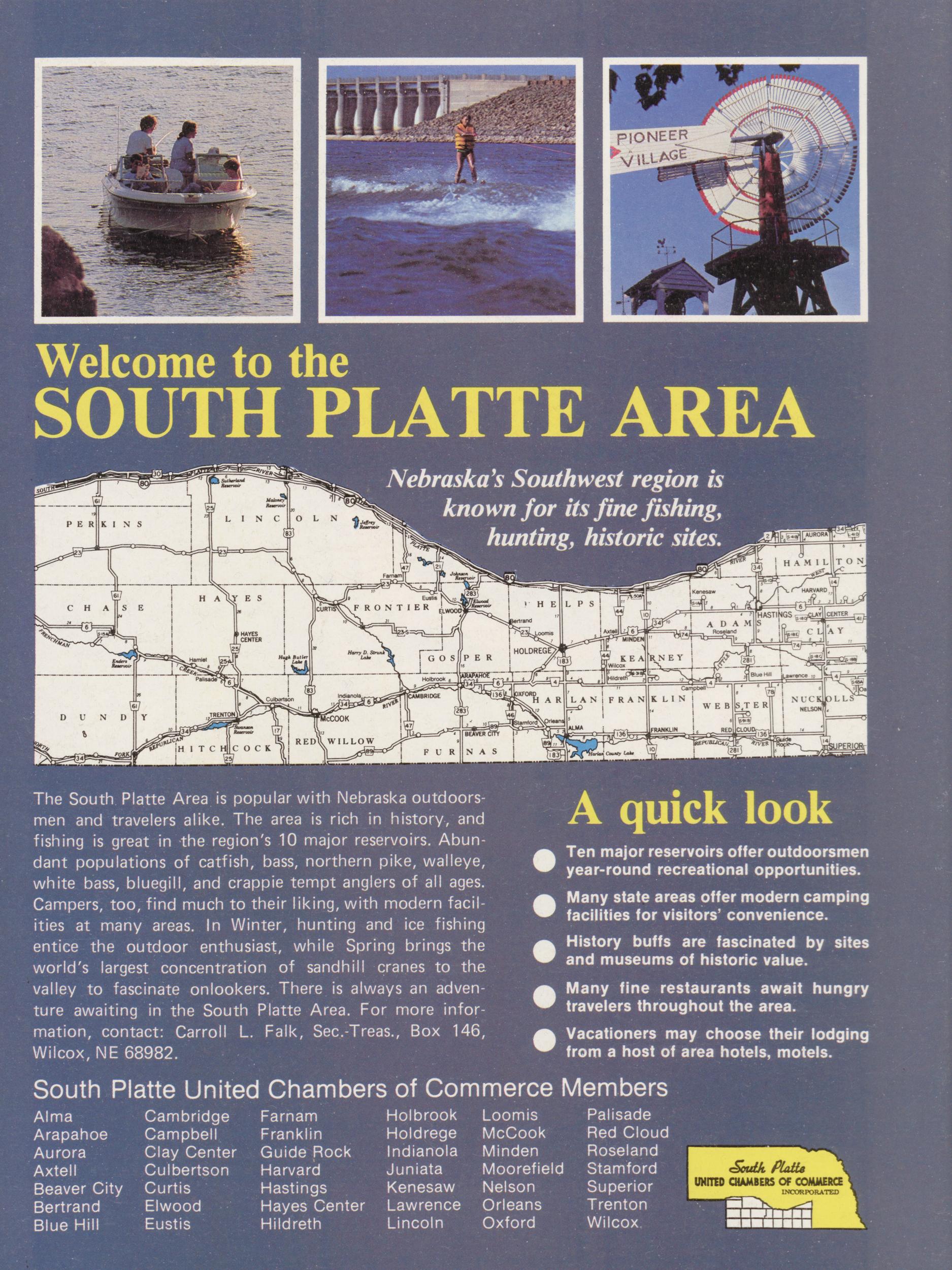
Welcome to the South Platte Area Nebraska's Southwest region is known for its fine fishing, hunting, historic sites.
FRONTIER Hugh Bull Palisade" Hurry D. HITCH COCK Indianola REDU WILLOW CAMBRIDGE HOLDREGE ADAM HASTINGS Campbell NUCKUOLLS NELSONfL
The South Platte Area is popular with Nebraska outdoorsmen and travelers alike. The area is rich in history, and fishing is great in the region's 10 major reservoirs. Abundant populations of catfish, bass, northern pike, walleye, white bass, bluegill, and crappie tempt anglers of all ages. Campers, too, find much to their liking, with modern facilities at many areas. In Winter, hunting and ice fishing entice the outdoor enthusiast, while Spring brings the world's largest concentration of sandhill cranes to the valley to fascinate onlookers. There is always an adventure awaiting in the South Platte Area. For more information, contact: Carroll L. Falk, Sec.-Treas., Box 146, Wilcox, NE 68982.
A quick look Ten major reservoirs offer outdoorsmen year-round recreational opportunities. Many state areas offer modern camping facilities for visitors' convenience. History buffs are fascinated by sites and museums of historic value. Many fine restaurants await hungry travelers throughout the area. Vacationers may choose their lodging from a host of area hotels, motels.South Platte United Chambers of Commerce Members Cambridge Campbell Clay Center Culbertson Curtis Elwood Eustis Farnam Franklin Guide Rock Harvard Hastings Hayes Center Hildreth Holbrook Holdrege Indianola Juniata Kenesaw Lawrence Lincoln Loomis McCook Minden Moorefield Nelson Orleans Oxford Palisade Red Cloud Roseland Stamford Superior Trenton Wilcox
South Platte UNITED CHAMBERS OF COMMERCE INCORPORATEDPosition: 373 (26 views)