Volume 61, Issue 4, 1983
NEBRASKAland
MAY 1983 $1
Speak Up
ASH HOLLOW State Historical Park Like an oasis on the plains, the Ash Hollow area served early Indians and white men, providing shelter, water, wood and food. Artifacts from 10,000 years ago, plus tales from pioneers traveling through just a century ago, mingle here. And, they are on display at the interpretive center. A couple miles away is famous Windlass Hill, another part of Ash Hollow, where the pioneers lowered their wagons from the top of the hill into the valley. It is all located along Highway 26 near Lewellen in central Nebraska at the west end of Lake McConaughy. VISIT US SOON! LEWELLEN, NE (308) 778-5651 NEBRASKA GAME AND PARKS COMMISSION Homesick readersSir / We have recently been transferred from Nebraska to Colorado. We both grew up in Scottsbluff, near the beautiful national monument. Since we lived there, we never thought so much about the beauty Nebraska has—until we left. We are homesick, and so we decided to get NEBRASKAland. I tell you, just to read about the "homeland" has been the biggest help. I think we wouldn't have made it this long without it.
I just had to write to tell you how we felt, but it would take a book to tell you all that your magazine has done for us—we regret we never had your lovely magazine when we lived there. I guess we didn't think we needed it—until now. I am so glad you're around.
SanDee and Roger Price Mead, Colo. Lucky hunterSir / I read with keen interest "Cropping the Halsey Herd" in the November 1982 issue. I was also one who drew a permit for that hunt. Lyle Swift, a gunshop operator near Allen and I drew permits. We drove out together, which was most exciting for both of us. We were housed with the wardens (one was Harold Miner) also of Allen. The fellowship, housing and food, were super.
We got our deer shortly after our arrival—we, too, were using some military rifles—30/06's. We had hunted many coyotes in northeast Nebraska prior to our big game hunt. We were pretty experienced hunters, however.
I have enjoyed many deer hunts in Nebraska since the first one, and they are all exciting. I cannot visualize a man who doesn't like to hunt or fish. They are so invigorating and enjoyable.
We all love NEBRASKAland Magazine-such beautiful pictures. Nebraska has so many fine places to enjoy—we have a great state.
Edwin Fahrenholz Allen, Nebr. Here is a poem from reader Helen Hubbard of Norfolk which is timed about right for Spring—at least we hope it is nearly Spring. (Editor)PRELUDE TO SUMMER
There is excitement in the air, A breathless sort of waiting, A promise, light and debonair And even some elating.
Tonight the trees will have a Ball, Twill last 'til nigh on dawn. Then we can see them standing tall With all their finery on.
The elm has chosen for her gown A delicate, dainty green. The maple's gown, a lovely red, Would do justice to a queen.
With flowing lines and feathery plumes Comes graceful weeping willow. Her filmy gown, we must assume, Is a blend of green and yellow.
The stately pine, with winter's dress Adorned with jewels of red. Comes right behind Miss Lilac With regal plumes upon her head.
Miss Cherry Tree, in fine array, Wears fluffy, lacy white. Another maple, in silvery green, Just shimmers in the light.
Miss Olive, in a silver gown, Receives many an admiring glance. But when Miss Flowering Crab arrives She doesn't stand a chance.
Another gown of frothy white Is worn by Mistress Plum. Oh, this is such a lovely sight It makes the bees all hum.
If you are one to lie abed On this sweet dewy morn, You're going to miss a glorious sight As sure as you were born. —Helen J. Hubbard Busy namer
Sir / Reading the article "Crow Bait" in the November 1981 issue really brought back childhood memories. When in my teens, I lived in south-central Custer and north-central Dawson County—buffalo grass hills just over the divide from the South Loup River east of Oconto.
From the age of nine months until I was 16, I lived on a ranch, then on a farm. An only child, my companions were my dog Bob, my horse Prince, my cats—usually 10 or so (all named), a colt or two every spring, calves, bottle-fed pigs, baby chicks and ducks, pigeons, Blackie, my pet crow, a pair of owls, one prairie dog (who escaped in 12 hours), a squirrel or two, wild rabbits, 4 NEBRASKAland toads and frogs, even a small garter snake.
When I was nine, my parents adopted a five-year-old boy, and while I remember the years we were all together, my most vivid memories are of those years I had my pets and farm friends.
Now at 62, I love to go back to the valleys and hills, fish at Pressey and just roam the hills.
Jean Miner Schroer Kearney, Nebr. Memory stirrerSir / Thank you for giving us the marvelous Rivers issue. You stirred many a nostalgic memory for those of us who enjoyed them winter and summer.
The Republican River flood is still a vivid memory with its awful devastation. It was the "100-year flood" predicted long before by the Indians.
The text in the articles was outstanding, and the photography splendid. We are most grateful.
Mrs. I.A. Trively Highlands, N.C. Nit picker?Sir / The "Nebraska Rivers" issue is super. The writing is the best I have read in NEBRASKAland I am impressed by how well the writers did their homework, and all the color photos are great.
The magazine is an interesting and valuable source of information. I am sincere about the above, but please excuse me for a little nit-picking.
It is hard to believe that Fullerton is the testing station for the Big Nemaha Rivers (chart page 143).
The stream miles amount of 468 for the Big Blue River seems excessive.
On page 122 is a reference to a fur trader named Chardon, and on page 126 is a reference to a fur trader named Louis Chartran. Noting the similarity between the two, I consulted Nebraska Place-Names and found that the city of Chadron was named in honor of a trapper named Pierre Chardon. Could these be the same man?
Is it true, as I have heard, that Nebraska has more stream miles than any other state?
Robert Spore Elwood, Nebr.You are right about Fullerton not being the testing station—that was an error of unknown origin. However, the stream miles for the Big Blue is the proper amount, as it is a cumulative figure for the branches, as well. And, they were indeed different men—thus the different first names—Louis and Pierre. And, while Nebraska does have a surprising amount of river mileage, it is apparently not the most, especially if navigable mileage is the criteria, but
Happy Fathers Day To the guy who used to bait your hook. Give NEBRASKAland Magazine and get a FREE Sportsman's Scrapbook. 100 years of hunting fishing and outdoor recreation are yours. Send NEBRASKAland and FREE Scrapbook Send the Scrapbook @ $3.00 Name One-year $7.50 Two-year $13.00 Three-years $19.00 Address City Apt. State Zip Charge to: Master Charge VISA Acct. Expiration Date: Sign gift card from: Month Year. Use separate sheet for additional orders. Include complete address and choice of bonus for each. Mail to: NEBRASKAland Magazine, Box 30370, Lincoln, NE 68503 MAY 1983 5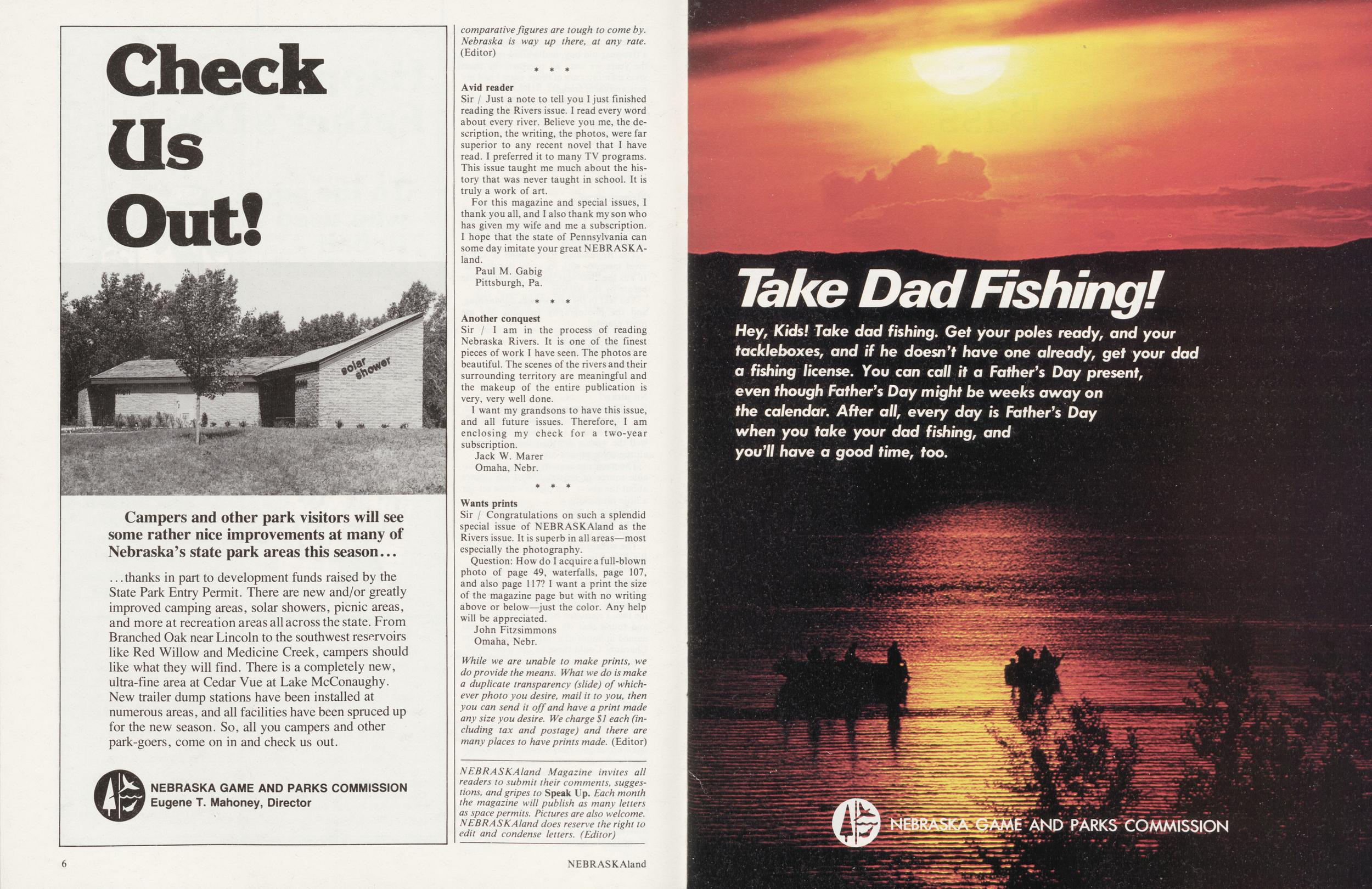 Check
Us
Out!
Campers and other park visitors will see
some rather nice improvements at many of
Nebraska's state park areas this season
thanks in part to development funds raised by the
State Park Entry Permit. There are new and/or greatly
improved camping areas, solar showers, picnic areas,
and more at recreation areas all across the state. From
Branched Oak near Lincoln to the southwest reservoirs
like Red Willow and Medicine Creek, campers should
like what they will find. There is a completely new,
ultra-fine area at Cedar Vue at Lake McConaughy.
New trailer dump stations have been installed at
numerous areas, and all facilities have been spruced up
for the new season. So, all you campers and other
park-goers, come on in and check us out.
NEBRASKA GAME AND PARKS COMMISSION
Eugene T. Mahoney, Director
Check
Us
Out!
Campers and other park visitors will see
some rather nice improvements at many of
Nebraska's state park areas this season
thanks in part to development funds raised by the
State Park Entry Permit. There are new and/or greatly
improved camping areas, solar showers, picnic areas,
and more at recreation areas all across the state. From
Branched Oak near Lincoln to the southwest reservoirs
like Red Willow and Medicine Creek, campers should
like what they will find. There is a completely new,
ultra-fine area at Cedar Vue at Lake McConaughy.
New trailer dump stations have been installed at
numerous areas, and all facilities have been spruced up
for the new season. So, all you campers and other
park-goers, come on in and check us out.
NEBRASKA GAME AND PARKS COMMISSION
Eugene T. Mahoney, Director
comparative figures are tough to come by. Nebraska is way up there, at any rate. (Editor)
Avid readerSir / Just a note to tell you I just finished reading the Rivers issue. I read every word about every river. Believe you me, the description, the writing, the photos, were far superior to any recent novel that I have read. I preferred it to many TV programs. This issue taught me much about the history that was never taught in school. It is truly a work of art.
For this magazine and special issues, I thank you all, and I also thank my son who has given my wife and me a subscription. I hope that the state of Pennsylvania can some day imitate your great NEBRASKAland.
Paul M. Gabig Pittsburgh, Pa. Another conquestSir / I am in the process of reading Nebraska Rivers. It is one of the finest pieces of work I have seen. The photos are beautiful. The scenes of the rivers and their surrounding territory are meaningful and the makeup of the entire publication is very, very well done.
I want my grandsons to have this issue, and all future issues. Therefore, I am enclosing my check for a two-year subscription.
Jack W. Marer Omaha, Nebr. Wants printsSir / Congratulations on such a splendid special issue of NEBRASKAland as the Rivers issue. It is superb in all areas—most especially the photography.
Question: How do I acquire a full-blown photo of page 49, waterfalls, page 107, and also page 117? I want a print the size of the magazine page but with no writing above or below—just the color. Any help will be appreciated.
John Fitzsimmons Omaha, Nebr. While we are unable to make prints, we do provide the means. What we do is make a duplicate transparency (slide) of whichever photo you desire, mail it to you, then you can send it off and have a print made any size you desire. We charge $1 each (including tax and postage) and there are many places to have prints made. (Editor) NEBRASKAland Magazine invites all readers to submit their comments, suggestions, and gripes to Speak Up. Each month the magazine will publish as many letters as space permits. Pictures are also welcome. NEBRASKAland does reserve the right to edit and condense letters. (Editor) 6 NEBRASKAland
Ladies Like Bass
Members of a new women's bass club travel to Valentine Refuge lakes to catch bass, and to practice angling skills that make them more self-sufficient.
MOST NEBRASKA fishermen would rather forget the spring of 1982. What should have been an idyll of sunshine, blue skies and big fish became, instead, a nightmare of muddied waters, washed out fishing trips, and spirits dampened by almost non-stop rain.
But at least one party of Nebraska anglers did more than dream about better times. They lived them, even if only for a couple of days.
The fish were certainly there—bass after bass in the 12 to 14-inch class, plus a couple near 16 inches and one that pushed 19. There were also some modest-sized pike. And, a "long-as-your-leg" muskie turned one angler's knees to rubber as it followed a lure to boatside, stared for a moment through sinister eyes, then swam away without striking, as muskies are wont to do.
Judi Owens, her sister, Jayne Walla, and Tess Hewitt had come to the Valentine National Waterfowl Refuge with high hopes, and they were not disappointed. The refuge gave them not only fish, but also those special experiences that only wilderness settings can give.
There was silence; broken only by the occasional scolding of a redwing blackbird in the rushes, or the whoops of a companion with a nice fish on. There was solitude: no one around, not one other boat, not a bank fisherman, not a sign of human presence except for a lone barbed-wire fence and some white specks in the distance that turned out to be ranch buildings. And, there was the setting: crystaline water amid all the varying greens of rushes, meadows and hills.
The weather, alone, would have made the trip worthwhile. The sun, something most Nebraskans hadn't seen for weeks, peered down from a blue sky, obscured only occasionally by a billowing white cloud. Raincoats and sweatshirts were put aside in the unaccustomed warmth.
The good turn in the weather took everyone a bit by surprise. They had packed Judi's pickup and hitched up the 14-foot boat in a steady rain, then driven most of six hours in more showers and gloom. But it took only minutes to unpack and get fishing gear in order when the sun broke through shortly after arrival.
West Long Lake was the target of their efforts for what remained of the first day. Like all of the refuge lakes, West Long is shallow, and at that time of the year, clear as water could be. The weeds that would choke off fishing in a few weeks were still a couple of feet from the surface, with pockets and spaces in the growth where fish undoubtedly lurked.
Just who caught the first fish isn't clear, and it doesn't really matter a whole lot, either. Tess and Jayne fished out of the first boat launched, and one of them had scored on a 12-inch large-mouth before Judi could get on the water in the second. They started flinging spoons, crankbaits and most of the other standard bass lures, but everyone soon settled on fast spinnerbaits as the best way to cope with the weeds beneath the surface.
The two boats stayed together for about an hour and half, working the south shoreline for a bass every 15 minutes or so. Then Tess and Jayne buzzed off toward the west end of the lake, leaving the east to Judi. That ended a fairly constant stream of chatter between the boats, and allowed 8 NEBRASKAland
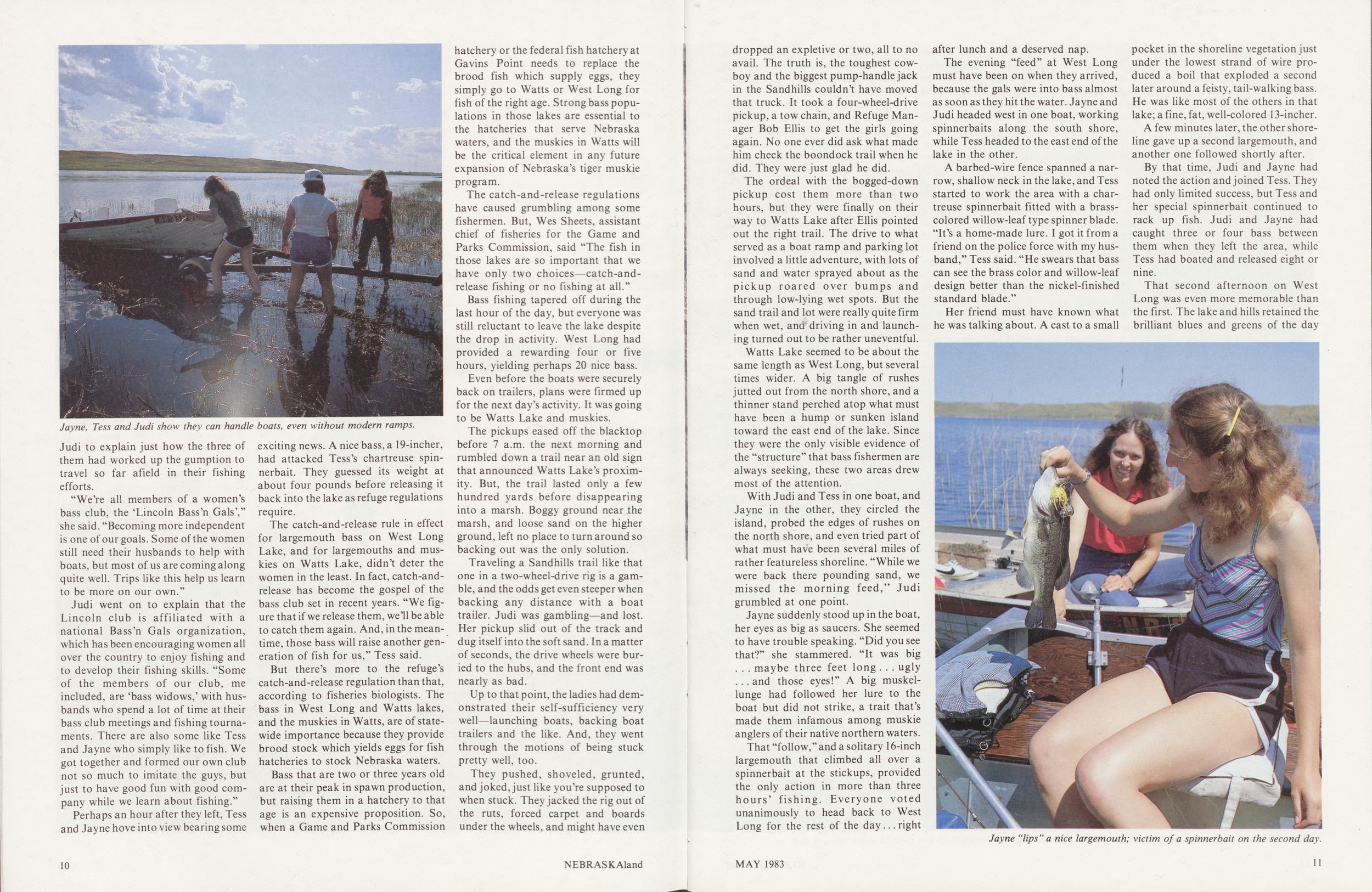
"We're all members of a women's bass club, the 'Lincoln Bass'n Gals'," she said. "Becoming more independent is one of our goals. Some of the women still need their husbands to help with boats, but most of us are coming along quite well. Trips like this help us learn to be more on our own."
Judi went on to explain that the Lincoln club is affiliated with a national Bass'n Gals organization, which has been encouraging women all over the country to enjoy fishing and to develop their fishing skills. "Some of the members of our club, me included, are 'bass widows,' with husbands who spend a lot of time at their bass club meetings and fishing tournaments. There are also some like Tess and Jayne who simply like to fish. We got together and formed our own club not so much to imitate the guys, but just to have good fun with good company while we learn about fishing."
Perhaps an hour after they left, Tess and Jayne hove into view bearing some exciting news. A nice bass, a 19-incher, had attacked Tess's chartreuse spinnerbait. They guessed its weight at about four pounds before releasing it back into the lake as refuge regulations require.
The catch-and-release rule in effect for largemouth bass on West Long Lake, and for largemouths and muskies on Watts Lake, didn't deter the women in the least. In fact, catch-and-release has become the gospel of the bass club set in recent years. "We figure that if we release them, we'll be able to catch them again. And, in the meantime, those bass will raise another generation of fish for us," Tess said.
But there's more to the refuge's catch-and-release regulation than that, according to fisheries biologists. The bass in West Long and Watts lakes, and the muskies in Watts, are of statewide importance because they provide brood stock which yields eggs for fish hatcheries to stock Nebraska waters.
Bass that are two or three years old are at their peak in spawn production, but raising them in a hatchery to that age is an expensive proposition. So, when a Game and Parks Commission hatchery or the federal fish hatchery at Gavins Point needs to replace the brood fish which supply eggs, they simply go to Watts or West Long for fish of the right age. Strong bass populations in those lakes are essential to the hatcheries that serve Nebraska waters, and the muskies in Watts will be the critical element in any future expansion of Nebraska's tiger muskie program.
The catch-and-release regulations have caused grumbling among some fishermen. But, Wes Sheets, assistant chief of fisheries for the Game and Parks Commission, said "The fish in those lakes are so important that we have only two choices—catch-and-release fishing or no fishing at all."
Bass fishing tapered off during the last hour of the day, but everyone was still reluctant to leave the lake despite the drop in activity. West Long had provided a rewarding four or five hours, yielding perhaps 20 nice bass.
Even before the boats were securely back on trailers, plans were firmed up for the next day's activity. It was going to be Watts Lake and muskies.
The pickups eased off the blacktop before 7 a.m. the next morning and rumbled down a trail near an old sign that announced Watts Lake's proximity. But, the trail lasted only a few hundred yards before disappearing into a marsh. Boggy ground near the marsh, and loose sand on the higher ground, left no place to turn around so backing out was the only solution.
Traveling a Sandhills trail like that one in a two-wheel-drive rig is a gamble, and the odds get even steeper when backing any distance with a boat trailer. Judi was gambling—and lost. Her pickup slid out of the track and dug itself into the soft sand. In a matter of seconds, the drive wheels were buried to the hubs, and the front end was nearly as bad.
Up to that point, the ladies had demonstrated their self-sufficiency very well—launching boats, backing boat trailers and the like. And, they went through the motions of being stuck pretty well, too.
They pushed, shoveled, grunted, and joked, just like you're supposed to when stuck. They jacked the rig out of the ruts, forced carpet and boards under the wheels, and might have even 10 NEBRASKAland dropped an expletive or two, all to no avail. The truth is, the toughest cowboy and the biggest pump-handle jack in the Sandhills couldn't have moved that truck. It took a four-wheel-drive pickup, a tow chain, and Refuge Manager Bob Ellis to get the girls going again. No one ever did ask what made him check the boondock trail when he did. They were just glad he did.
The ordeal with the bogged-down pickup cost them more than two hours, but they were finally on their way to Watts Lake after Ellis pointed out the right trail. The drive to what served as a boat ramp and parking lot involved a little adventure, with lots of sand and water sprayed about as the pickup roared over bumps and through low-lying wet spots. But the sand trail and lot were really quite firm when wet, and driving in and launching turned out to be rather uneventful.
Watts Lake seemed to be about the same length as West Long, but several times wider. A big tangle of rushes jutted out from the north shore, and a thinner stand perched atop what must have been a hump or sunken island toward the east end of the lake. Since they were the only visible evidence of the "structure" that bass fishermen are always seeking, these two areas drew most of the attention.
With Judi and Tess in one boat, and Jayne in the other, they circled the island, probed the edges of rushes on the north shore, and even tried part of what must have been several miles of rather featureless shoreline. "While we were back there pounding sand, we missed the morning feed," Judi grumbled at one point.
Jayne suddenly stood up in the boat, her eyes as big as saucers. She seemed to have trouble speaking. "Did you see that?" she stammered. "It was big maybe three feet long ugly ... and those eyes!" A big muskel-lunge had followed her lure to the boat but did not strike, a trait that's made them infamous among muskie anglers of their native northern waters.
That "follow," and a solitary 16-inch largemouth that climbed all over a spinnerbait at the stickups, provided the only action in more than three hours' fishing. Everyone voted unanimously to head back to West Long for the rest of the day right after lunch and a deserved nap.
The evening "feed" at West Long must have been on when they arrived, because the gals were into bass almost as soon as they hit the water. Jayne and Judi headed west in one boat, working spinnerbaits along the south shore, while Tess headed to the east end of the lake in the other.
A barbed-wire fence spanned a narrow, shallow neck in the lake, and Tess started to work the area with a chartreuse spinnerbait fitted with a brass-colored willowleaf type spinner blade. "It's a home-made lure. I got it from a friend on the police force with my husband," Tess said. "He swears that bass can see the brass color and willow-leaf design better than the nickel-finished standard blade."
Her friend must have known what he was talking about. A cast to a small pocket in the shoreline vegetation just under the lowest strand of wire produced a boil that exploded a second later around a feisty, tail-walking bass. He was like most of the others in that lake; a fine, fat, well-colored 13-incher.
A few minutes later, the other shoreline gave up a second largemouth, and another one followed shortly after.
By that time, Judi and Jayne had noted the action and joined Tess. They had only limited success, but Tess and her special spinnerbait continued to rack up fish. Judi and Jayne had caught three or four bass between them when they left the area, while Tess had boated and released eight or nine.
That second afternoon on West Long was even more memorable than the first. The lake and hills retained the brilliant blues and greens of the day
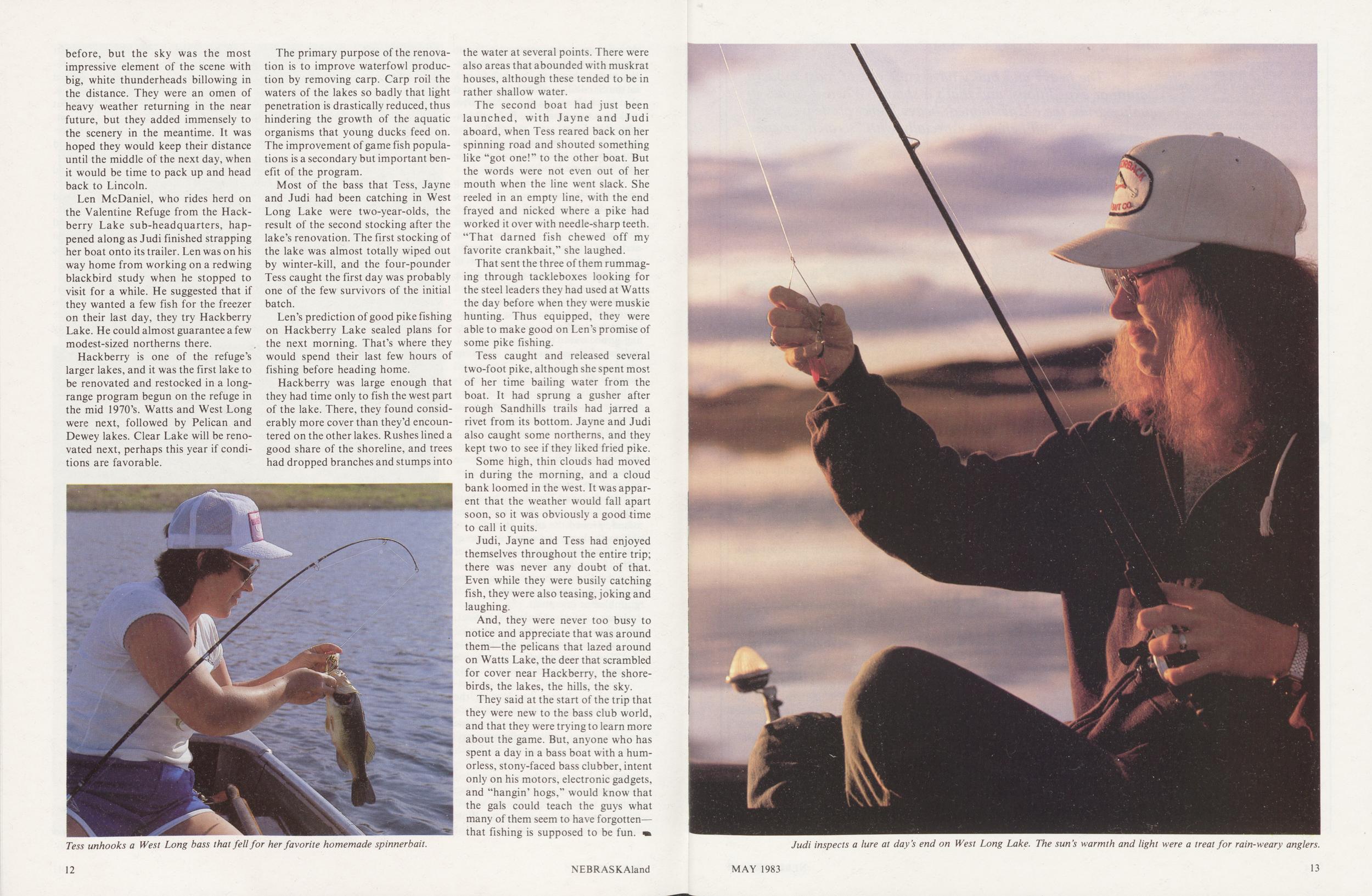 before, but the sky was the most
impressive element of the scene with
big, white thunderheads billowing in
the distance. They were an omen of
heavy weather returning in the near
future, but they added immensely to
the scenery in the meantime. It was
hoped they would keep their distance
until the middle of the next day, when
it would be time to pack up and head
back to Lincoln.
before, but the sky was the most
impressive element of the scene with
big, white thunderheads billowing in
the distance. They were an omen of
heavy weather returning in the near
future, but they added immensely to
the scenery in the meantime. It was
hoped they would keep their distance
until the middle of the next day, when
it would be time to pack up and head
back to Lincoln.
Len McDaniel, who rides herd on the Valentine Refuge from the Hackberry Lake sub-headquarters, happened along as Judi finished strapping her boat onto its trailer. Len was on his way home from working on a redwing blackbird study when he stopped to visit for a while. He suggested that if they wanted a few fish for the freezer on their last day, they try Hackberry Lake. He could almost guarantee a few modest-sized northerns there.
Hackberry is one of the refuge's larger lakes, and it was the first lake to be renovated and restocked in a long-range program begun on the refuge in the mid 1970's. Watts and West Long were next, followed by Pelican and Dewey lakes. Clear Lake will be renovated next, perhaps this year if conditions are favorable.
The primary purpose of the renovation is to improve waterfowl production by removing carp. Carp roil the waters of the lakes so badly that light penetration is drastically reduced, thus hindering the growth of the aquatic organisms that young ducks feed on. The improvement of game fish populations is a secondary but important benefit of the program.
Most of the bass that Tess, Jayne and Judi had been catching in West Long Lake were two-year-olds, the result of the second stocking after the lake's renovation. The first stocking of the lake was almost totally wiped out by winter-kill, and the four-pounder Tess caught the first day was probably one of the few survivors of the initial batch.
Len's prediction of good pike fishing on Hackberry Lake sealed plans for the next morning. That's where they would spend their last few hours of fishing before heading home.
Hackberry was large enough that they had time only to fish the west part of the lake. There, they found considerably more cover than they'd encountered on the other lakes. Rushes lined a good share of the shoreline, and trees had dropped branches and stumps into
The second boat had just been launched, with Jayne and Judi aboard, when Tess reared back on her spinning road and shouted something like "got one!" to the other boat. But the words were not even out of her mouth when the line went slack. She reeled in an empty line, with the end frayed and nicked where a pike had worked it over with needle-sharp teeth. "That darned fish chewed off my favorite crankbait," she laughed.
That sent the three of them rummaging through tackleboxes looking for the steel leaders they had used at Watts the day before when they were muskie hunting. Thus equipped, they were able to make good on Len's promise of some pike fishing.
Tess caught and released several two-foot pike, although she spent most of her time bailing water from the boat. It had sprung a gusher after rough Sandhills trails had jarred a rivet from its bottom. Jayne and Judi also caught some northerns, and they kept two to see if they liked fried pike.
Some high, thin clouds had moved in during the morning, and a cloud bank loomed in the west. It was apparent that the weather would fall apart soon, so it was obviously a good time to call it quits.
Judi, Jayne and Tess had enjoyed themselves throughout the entire trip; there was never any doubt of that. Even while they were busily catching fish, they were also teasing, joking and laughing,
And, they were never too busy to notice and appreciate that was around them—the pelicans that lazed around on Watts Lake, the deer that scrambled for cover near Hackberry, the shorebirds, the lakes, the hills, the sky.
They said at the start of the trip that they were new to the bass club world, and that they were trying to learn more about the game. But, anyone who has spent a day in a bass boat with a humorless, stony-faced bass clubber, intent only on his motors, electronic gadgets, and "hangin' hogs," would know that the gals could teach the guys what many of them seem to have forgotten—that fishing is supposed to be fun.
12 NEBRASKAland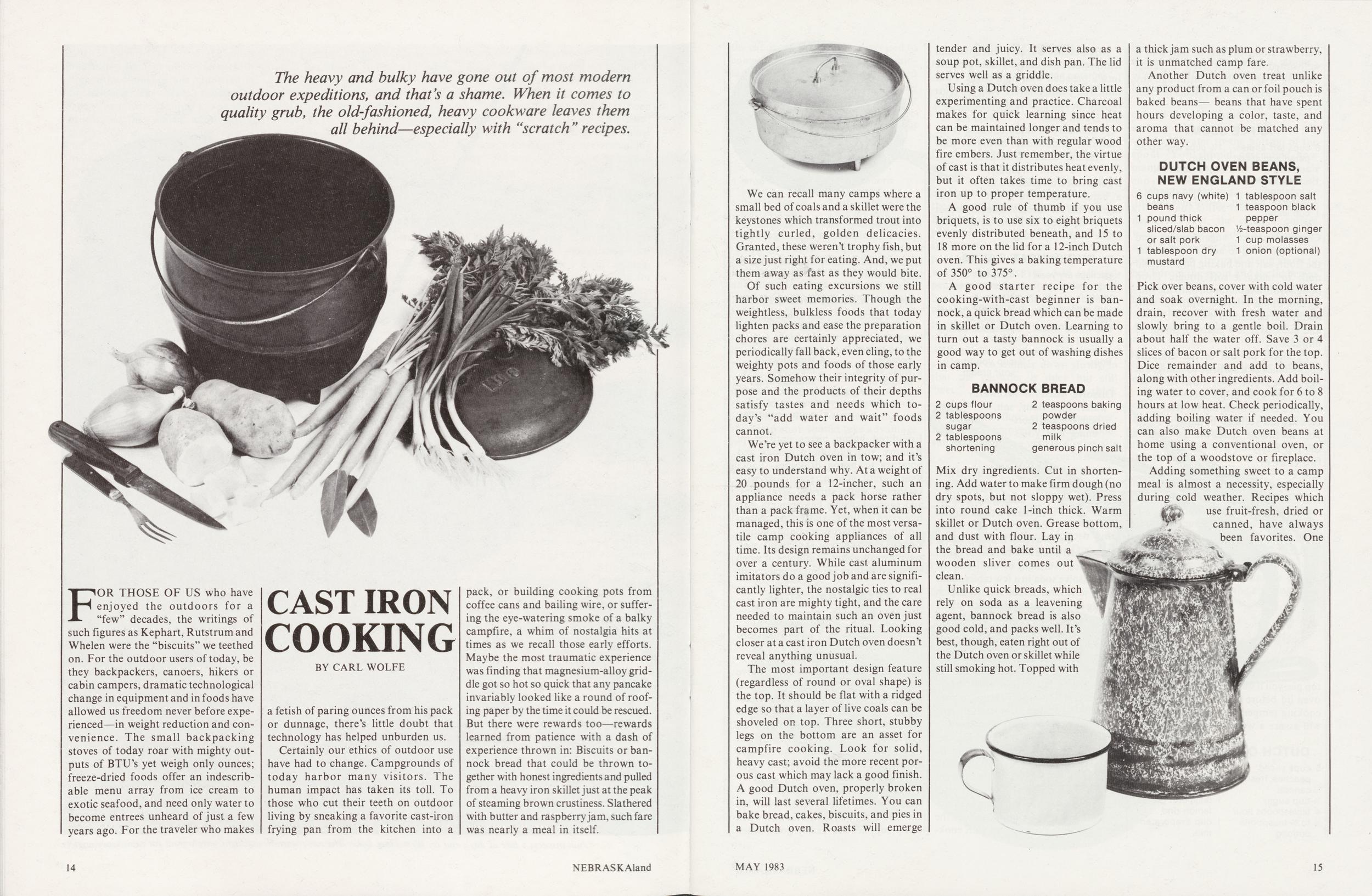
CAST IRON COOKING
The heavy and bulky have gone out of most modern outdoor expeditions, and that's a shame. When it comes to quality grub, the old-fashioned, heavy cookware leaves them all behind—especially with "scratch " recipes.
FOR THOSE OF US who have enjoyed the outdoors for a "few" decades, the writings of such figures as Kephart, Rutstrum and Whelen were the "biscuits" we teethed on. For the outdoor users of today, be they backpackers, canoers, hikers or cabin campers, dramatic technological change in equipment and in foods have allowed us freedom never before experienced—in weight reduction and convenience. The small backpacking stoves of today roar with mighty outputs of BTU's yet weigh only ounces; freeze-dried foods offer an indescribable menu array from ice cream to exotic seafood, and need only water to become entrees unheard of just a few years ago. For the traveler who makes a fetish of paring ounces from his pack or dunnage, there's little doubt that technology has helped unburden us.
Certainly our ethics of outdoor use have had to change. Campgrounds of today harbor many visitors. The human impact has taken its toll. To those who cut their teeth on outdoor living by sneaking a favorite cast-iron frying pan from the kitchen into a pack, or building cooking pots from coffee cans and bailing wire, or suffering the eye-watering smoke of a balky campfire, a whim of nostalgia hits at times as we recall those early efforts. Maybe the most traumatic experience was finding that magnesium-alloy griddle got so hot so quick that any pancake invariably looked like a round of roofing paper by the time it could be rescued. But there were rewards too—rewards learned from patience with a dash of experience thrown in: Biscuits or bannock bread that could be thrown together with honest ingredients and pulled from a heavy iron skillet just at the peak of steaming brown crustiness. Slathered with butter and raspberry jam, such fare was nearly a meal in itself.
14 NEBRASKAlandWe can recall many camps where a small bed of coals and a skillet were the keystones which transformed trout into tightly curled, golden delicacies. Granted, these weren't trophy fish, but a size just right for eating. And, we put them away as fast as they would bite.
Of such eating excursions we still harbor sweet memories. Though the weightless, bulkless foods that today lighten packs and ease the preparation chores are certainly appreciated, we periodically fall back, even cling, to the weighty pots and foods of those early years. Somehow their integrity of purpose and the products of their depths satisfy tastes and needs which today's "add water and wait" foods cannot.
We're yet to see a backpacker with a cast iron Dutch oven in tow; and it's easy to understand why. At a weight of 20 pounds for a 12-incher, such an appliance needs a pack horse rather than a pack frame. Yet, when it can be managed, this is one of the most versatile camp cooking appliances of all time. Its design remains unchanged for over a century. While cast, aluminum imitators do a good job and are significantly lighter, the nostalgic ties to real cast iron are mighty tight, and the care needed to maintain such an oven just becomes part of the ritual. Looking closer at a cast iron Dutch oven doesn't reveal anything unusual.
The most important design feature (regardless of round or oval shape) is the top. It should be flat with a ridged edge so that a layer of live coals can be shoveled on top. Three short, stubby legs on the bottom are an asset for campfire cooking. Look for solid, heavy cast; avoid the more recent porous cast which may lack a good finish. A good Dutch oven, properly broken in, will last several lifetimes. You can bake bread, cakes, biscuits, and pies in a Dutch oven. Roasts will emerge tender and juicy. It serves also as a soup pot, skillet, and dish pan. The lid serves well as a griddle.
Using a Dutch oven does take a little experimenting and practice. Charcoal makes for quick learning since heat can be maintained longer and tends to be more even than with regular wood fire embers. Just remember, the virtue of cast is that it distributes heat evenly, but it often takes time to bring cast iron up to proper temperature.
A good rule of thumb if you use briquets, is to use six to eight briquets evenly distributed beneath, and 15 to 18 more on the lid for a 12-inch Dutch oven. This gives a baking temperature of 350° to 375°.
A good starter recipe for the cooking-with-cast beginner is bannock, a quick bread which can be made in skillet or Dutch oven. Learning to turn out a tasty bannock is usually a good way to get out of washing dishes in camp.
BANNOCK BREAD 2 cups flour2 tablespoons sugar
2 tablespoons shortening
2 teaspoons baking powder
2 teaspoons dried milk
generous pinch salt
Mix dry ingredients. Cut in shortening. Add water to make firm dough (no dry spots, but not sloppy wet). Press into round cake 1-inch thick. Warm skillet or Dutch oven. Grease bottom, and dust with flour. Lay in the bread and bake until a wooden sliver comes out clean.
Unlike quick breads, which rely on soda as a leavening agent, bannock bread is also good cold, and packs well. It's best, though, eaten right out of the Dutch oven or skillet while still smoking hot. Topped with a thick jam such as plum or strawberry, it is unmatched camp fare.
Another Dutch oven treat unlike any product from a can or foil pouch is baked beans— beans that have spent hours developing a color, taste, and aroma that cannot be matched any other way.
DUTCH OVEN BEANS, NEW ENGLAND STYLE6 cups navy (white) beans
1 tablespoon salt
1 teaspoon black pepper
1 pound thick sliced/slab bacon or salt pork
½-teaspoon ginger
1 cup molasses
1 onion (optional) 1 tablespoon dry mustard
Pick over beans, cover with cold water and soak overnight. In the morning, drain, recover with fresh water and slowly bring to a gentle boil. Drain about half the water off. Save 3 or 4 slices of bacon or salt pork for the top. Dice remainder and add to beans, along with other ingredients. Add boiling water to cover, and cook for 6 to 8 hours at low heat. Check periodically, adding boiling water if needed. You can also make Dutch oven beans at home using a conventional oven, or the top of a woodstove or fireplace.
Adding something sweet to a camp
meal is almost a necessity, especially
during cold weather. Recipes which
use fruit-fresh, dried or
canned, have always
been favorites. One
MAY 1983
15
 that has stood the test of time and is
well-suited to Dutch oven or skillet
cooking is apple slump, although any
fruit such as peaches, apricots or cherries, works fine.
that has stood the test of time and is
well-suited to Dutch oven or skillet
cooking is apple slump, although any
fruit such as peaches, apricots or cherries, works fine.
6 cups tart apples, pared and sliced
1 cup sugar
1½ teaspoons cinnamon
½-teaspoon nutmeg
1 cup water
1½ cups all-purpose flour
¼-teaspoon salt
1½ teaspoons baking powder
½-cup milk (about)
Combine apples, sugar, spices and water and bring to boil. Mix together the flour, salt and baking powder; add milk to make a soft dough. Drop dough from a tablespoon onto the simmering apple mixture. Sprinkle with additional cinnamon if desired. Cover and cook over low coals for about 30 minutes.
Pulling a pie out of the campfire coals comes as a surprise to many, but again, the Dutch oven shows its versatility. Any kind of pie seems to do well in a Dutch oven, but the fruit pies always seem to be most popular. In order to brown the top nicely on a two-crust or latticetop pie, you'll wnat to preheat the Dutch oven lid before laying on the coals. A cooking temperature of 400° to 425° will assure a well-browned crust.
DUTCH OVEN PEACH PIE5 cups sliced peaches, fresh or canned
¾-cup sugar
4 tablespoons flour ½ to ¾ teaspoons nutmeg
¼-teaspoon salt
1 tablespoon lemon juice
1 teaspoon grated lemon rind
1 cup evaporated milk
Mix peaches, sugar, flour, spice and lemon juice together. Place mixture into a pie shell with high edges. Pour milk over peach mixture. Add top crust if desired. Bake 35 to 45 minutes in a hot Dutch oven.
A mainstay of camp cooking is the pancake, griddlecake, string of flats or flannel cake. Whatever name you want to apply, a good cast iron griddle and a batter built from scratch are the ingredients for success. One staple that is just as good at home as at camp is the buckwheat cake.
BUCKWHEAT CAKES1 package dry yeast
1 cup lukewarm water
1 cup buckwheat flour
1 cup whole-wheat flour
1 cup all-purpose flour
1 teaspoon salt
3 tablespoons honey
2 tablespoons liquid shortening
½-teaspoon baking soda
1 egg
½-cup yogurt or sour cream
Dissolve yeast in lukewarm water. Mix flour, salt, honey, liquid shortening and yogurt into yeast mixture, adding warm water to make a thick batter. (You can omit shortening if sour cream is used). Cover bowl and allow to raise in warm place overnight or until bubbly. Dissolve soda in a few tablespoons of warm water. Add slightly beaten egg to soda mixture, and stir gently into a buckwheat batter. You'll note an effervescence and increase in bulk of the batter. Immediately pour onto a hot, greased griddle. Serve with butter and hot syrup.
For the camper whose early mornings are taken up with important things like fishing or just puttering around with binoculars or camera, a small Dutch oven or heavy skillet is a good way to start breakfast and be assured of a hearty meal after the fish have stopped biting; or when the light has become too harsh for good photography. Several recipes are particularly suited to those who can't let the early morning be taken up with cooking chores, but who still enjoy the almost sinful pleasure of lazing around a cheery campfire enjoying good food, companionship and the flavor of the outdoors.
SHEEPHERDER BREAKFAST6 slices bacon, diced
6 eggs
3 large boiled potatoes
2 small yellow onions or 2 onions
Salt and pepper to taste
1 teaspoon sweet marjoram
4 large links of precooked pork sausage or an equivalent amount of summer sausage
Fry diced bacon pieces until crisp. Remove and add diced onions and potatoes to bacon drippings. Saute lightly until golden, sprinkling with seasoning while stirring. Beat eggs, add sausage, which has been cut into bite-sized chunks, and bacon pieces. Add mixture to potatoes and onions. Cover Dutch oven or skillet and cook on low coals about 20 minutes or when sides and bottom are brown and crusty.
TEXAS TRAIL EGGS6 slices bacon, diced
1 medium yellow onion
6 eggs
1 medium can whole tomatoes
Fry bacon pieces until brown. Remove and add chopped onions. Drain tomatoes, add along with onions. Cook gently for 4-5 minutes or until onions are golden. Add eggs. Season with salt and pepper. Cover Dutch oven and cook over low coals until the eggs are set. Serve with hot biscuits or thick slices of fried bread.
There are times (which most of us would rather forget) when even the lowliest of fish refuse to bite, or when camp supplies are nearly gone, when 16 NEBRASKAland the camp cook may be hard-pressed to come up with vittles which will maintain morale and provide some needed calories. This is one recipe that may generate some obtuse comments, but it's rescued many a cook from the frivolities of nature or a dwindling food box.
BAD LUCK STEW4 large boiled potatoes
2 tablespoons cornmeal
4 thick slices (at least ⅜-inch) bacon or salt pork
2 tablespoons flour
1 ½ cups milk
Salt and pepper to taste 2 onions, sliced
Coat the bacon slices or salt pork with cornmeal and fry until golden brown, and set aside. Saute onions in remaining hot fat. Mix flour and cold milk together, adding to onion and fat. Stir and cook until a medium-thick gravy results. Add sliced potatoes and bacon. Season to taste. While this mixture sometimes becomes a camp joke, its components differ little from a traditional canoe-country recipe which sustained many early voyageurs.
For those days when the fish do bite, the camp cook should take advantage of a fresh catch to make a fish chowder. Simplicity is the key to a good chowder; a good iron pot or Dutch oven helps significantly in the preparation.
FISH CHOWDERFish (any kind) to yield about 2 pounds of bone-free meat
4 thick slices bacon or salt pork
4 large onions
6 large potatoes
About 4 cups rich milk
Salt and pepper to taste
Wrap fish in aluminum foil or cotton towel. Immerse in a pot of boiling water for about 10 to 15 minutes, allowing to steam gently. When cooked through or tender, pick away the skin and bones and set meat aside. Dice bacon or salt pork and brown in pot or Dutch oven. Add onions and cook until translucent. Add diced potatoes, fish pieces, and enough water to barely cover. Add salt and pepper, and put on low coals or pull back to the edge of the fire so the mixture can simmer gently. If you've got the time, 3-4 hours will marry the flavors and produce a better product. Add milk about an hour before serving and allow to simmer down slowly so that the chowder is thick but still "wet." Serve with plenty of thick crackers.
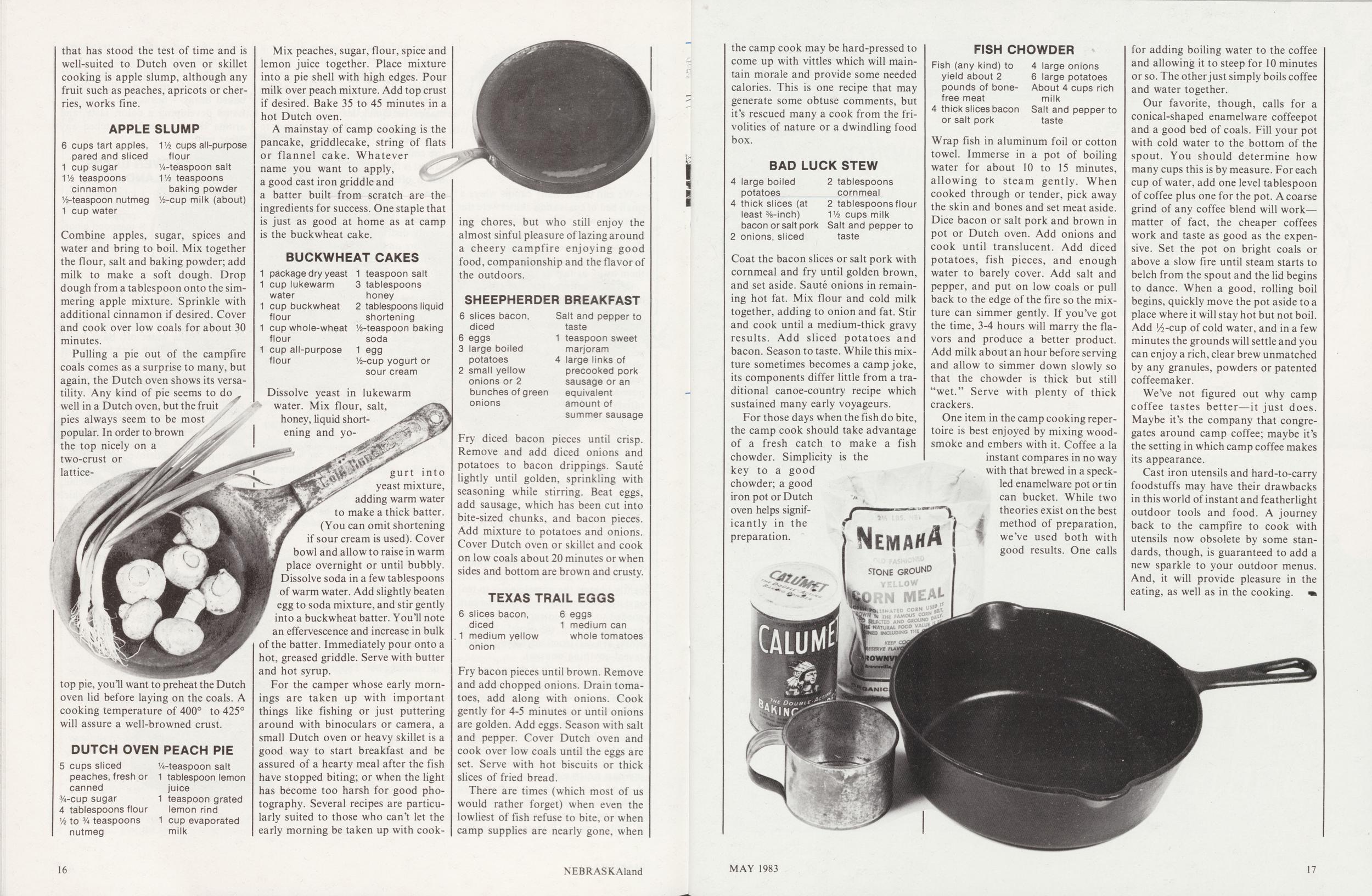
One item in the camp cooking repertoire is best enjoyed by mixing woodsmoke and embers with it. Coffee a la instant compares in no way with that brewed in a speckled enamelware pot or tin can bucket. While two theories exist on the best method of preparation, we've used both with good results. One calls for adding boiling water to the coffee and allowing it to steep for 10 minutes or so. The other just simply boils coffee and water together.
Our favorite, though, calls for a conical-shaped enamelware coffeepot and a good bed of coals. Fill your pot with cold water to the bottom of the spout. You should determine how many cups this is by measure. For each cup of water, add one level tablespoon of coffee plus one for the pot. A coarse grind of any coffee blend will work—matter of fact, the cheaper coffees work and taste as good as the expensive. Set the pot on bright coals or above a slow fire until steam starts to belch from the spout and the lid begins to dance. When a good, rolling boil begins, quickly move the pot aside to a place where it will stay hot but not boil. Add 1/2-cup of cold water, and in a few minutes the grounds will settle and you can enjoy a rich, clear brew unmatched by any granules, powders or patented coffeemaker.
We've not figured out why camp coffee tastes better—it just does. Maybe it's the company that congregates around camp coffee; maybe it's the setting in which camp coffee makes its appearance.
Cast iron utensils and hard-to-carry foodstuffs may have their drawbacks in this world of instant and featherlight outdoor tools and food. A journey back to the campfire to cook with utensils now obsolete by some standards, though, is guaranteed to add a new sparkle to your outdoor menus. And, it will provide pleasure in the eating, as well as in the cooking.
MAY 1983 17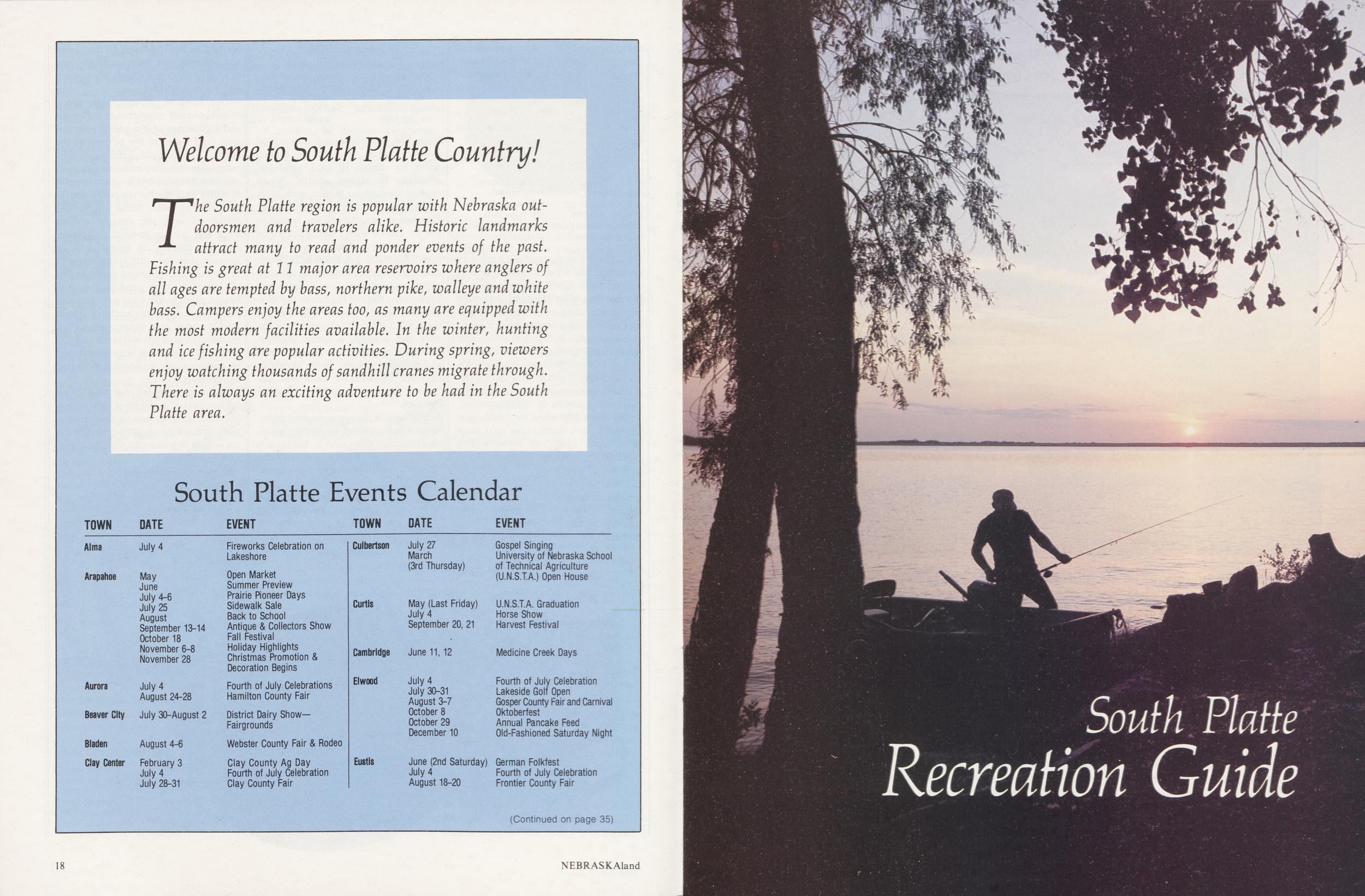
South Platte Recreation Guide
Welcome to South Platte Country!
The South Platte region is popular with Nebraska outdoorsmen and travelers alike. Historic landmarks attract many to read and ponder events of the past. Fishing is great at 11 major area reservoirs where anglers of all ages are tempted by bass, northern pike, walleye and white bass. Campers enjoy the areas too, as many are equipped with the most modern facilities available. In the winter, hunting and ice fishing are popular activities. During spring, viewers enjoy watching thousands of sandhill cranes migrate through. There is always an exciting adventure to be had in the South Platte area.
South Platte Events Calendar TOWN Alma Arapahoe Aurora Bladen Clay Center DATE EVENT TOWN DATE EVENT July 4 May June July 4-6 July 25 August September 13-14 October 18 November 6-8 November 28 July 4 August 24-28 Beaver City July 30-August 2 August 4-6 February 3 July 4 July 28-31 Fireworks Celebration on Lakeshore Open Market Summer Preview Prairie Pioneer Days Sidewalk Sale Back to School Antique & Collectors Show Fall Festival Holiday Highlights Christmas Promotion & Decoration Begins Fourth of July Celebrations Hamilton County Fair District Dairy Show-Fairgrounds Webster County Fair & Rodeo Clay County Ag Day Fourth of July Celebration Clay County Fair Culbertson Curtis July 27 March (3rd Thursday) May (Last Friday) July 4 September 20, 21 Cambridge June 11,12 Elwood July 4 July 30-31 August 3-7 October 8 October 29 December 10 Gospel Singing University of Nebraska School of Technical Agriculture (U.N.S.TA.) Open House U.N.STA Graduation Horse Show Harvest Festival Medicine Creek Days Fourth of July Celebration Lakeside Golf Open Gosper County Fair and Carnival Oktoberfest Annual Pancake Feed Old-Fashioned Saturday Night Eustis June (2nd Saturday) German Folkfest July 4 Fourth of July Celebration August 18-20 Frontier County Fair (Continued on page 35) 18 NEBRASKAland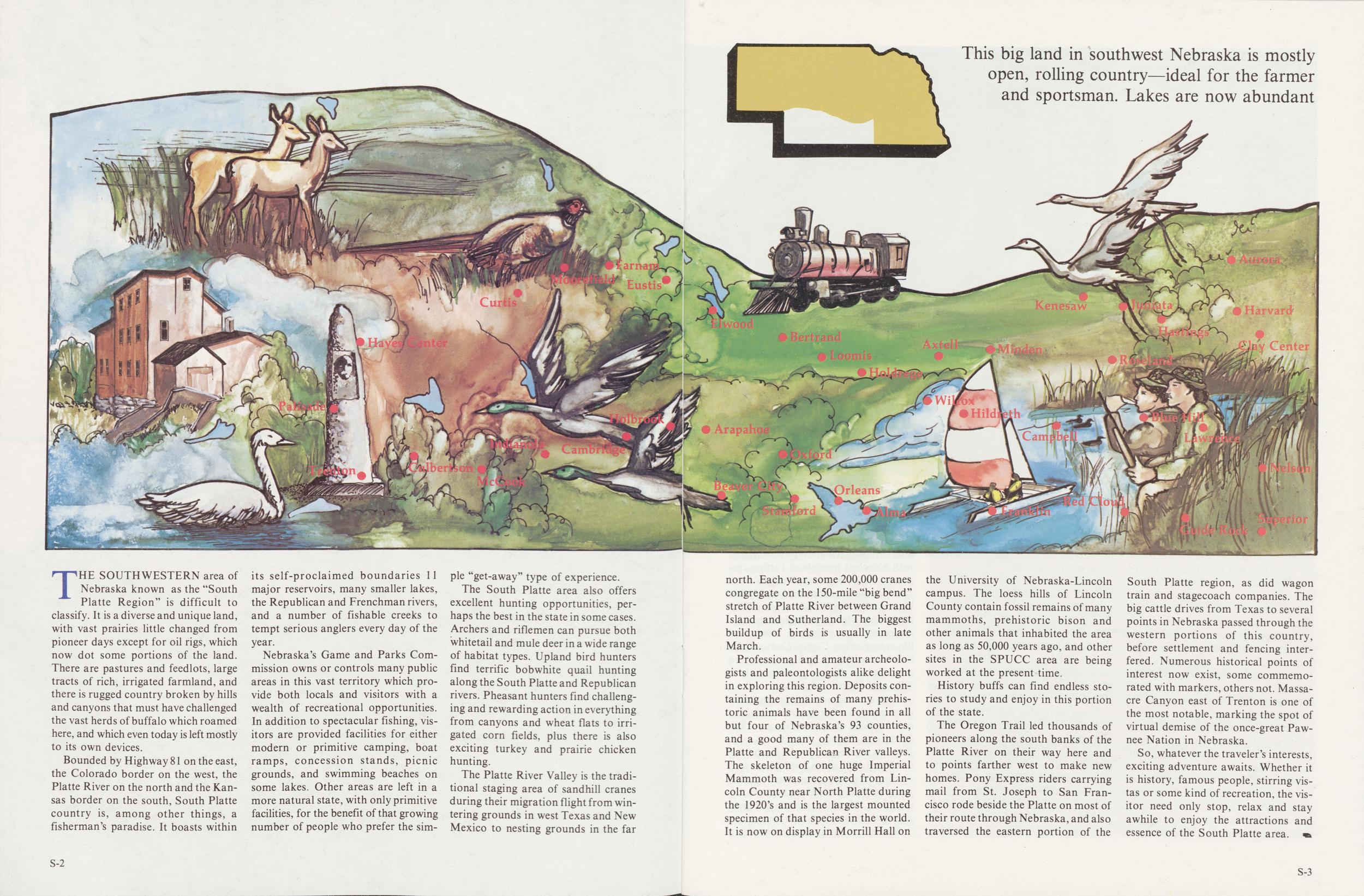 This big land in southwest Nebraska is mostly
open, rolling country—ideal for the farmer
and sportsman. Lakes are now abundant
This big land in southwest Nebraska is mostly
open, rolling country—ideal for the farmer
and sportsman. Lakes are now abundant
THE SOUTHWESTERN area of Nebraska known as the "South Platte Region" is difficult to classify. It is a diverse and unique land, with vast prairies little changed from pioneer days except for oil rigs, which now dot some portions of the land. There are pastures and feedlots, large tracts of rich, irrigated farmland, and there is rugged country broken by hills and canyons that must have challenged the vast herds of buffalo which roamed here, and which even today is left mostly to its own devices.
Bounded by Highway 81 on the east, the Colorado border on the west, the Platte River on the north and the Kansas border on the south, South Platte country is, among other things, a fisherman's paradise. It boasts within its self-proclaimed boundaries 11 major reservoirs, many smaller lakes, the Republican and Frenchman rivers, and a number of fishable creeks to tempt serious anglers every day of the year.
Nebraska's Game and Parks Commission owns or controls many public areas in this vast territory which provide both locals and visitors with a wealth of recreational opportunities. In addition to spectacular fishing, visitors are provided facilities for either modern or primitive camping, boat ramps, concession stands, picnic grounds, and swimming beaches on some lakes. Other areas are left in a more natural state, with only primitive facilities, for the benefit of that growing number of people who prefer the simple "get-away" type of experience.
The South Platte area also offers excellent hunting opportunities, perhaps the best in the state in some cases. Archers and riflemen can pursue both whitetail and mule deer in a wide range of habitat types. Upland bird hunters find terrific bobwhite quail hunting along the South Platte and Republican rivers. Pheasant hunters find challenging and rewarding action in everything from canyons and wheat flats to irrigated corn fields, plus there is also exciting turkey and prairie chicken hunting.
The Platte River Valley is the traditional staging area of sandhill cranes during their migration flight from wintering grounds in west Texas and New Mexico to nesting grounds in the far S-2 north. Each year, some 200,000 cranes congregate on the 150-mile "big bend" stretch of Platte River between Grand Island and Sutherland. The biggest buildup of birds is usually in late March.
Professional and amateur archeologists and paleontologists alike delight in exploring this region. Deposits containing the remains of many prehistoric animals have been found in all but four of Nebraska's 93 counties, and a good many of them are in the Platte and Republican River valleys. The skeleton of one huge Imperial Mammoth was recovered from Lincoln County near North Platte during the 1920's and is the largest mounted specimen of that species in the world. It is now on display in Morrill Hall on the University of Nebraska-Lincoln campus. The loess hills of Lincoln County contain fossil remains of many mammoths, prehistoric bison and other animals that inhabited the area as long as 50,000 years ago, and other sites in the SPUCC area are being worked at the present time.
History buffs can find endless stories to study and enjoy in this portion of the state.
The Oregon Trail led thousands of pioneers along the south banks of the Platte River on their way here and to points farther west to make new homes. Pony Express riders carrying mail from St. Joseph to San Francisco rode beside the Platte on most of their route through Nebraska, and also traversed the eastern portion of the South Platte region, as did wagon train and stagecoach companies. The big cattle drives from Texas to several points in Nebraska passed through the western portions of this country, before settlement and fencing interfered. Numerous historical points of interest now exist, some commemorated with markers, others not. Massacre Canyon east of Trenton is one of the most notable, marking the spot of virtual demise of the once-great Pawnee Nation in Nebraska.
So, whatever the traveler's interests, exciting adventure awaits. Whether it is history, famous people, stirring vistas or some kind of recreation, the visitor need only stop, relax and stay awhile to enjoy the attractions and essence of the South Platte area.
S-3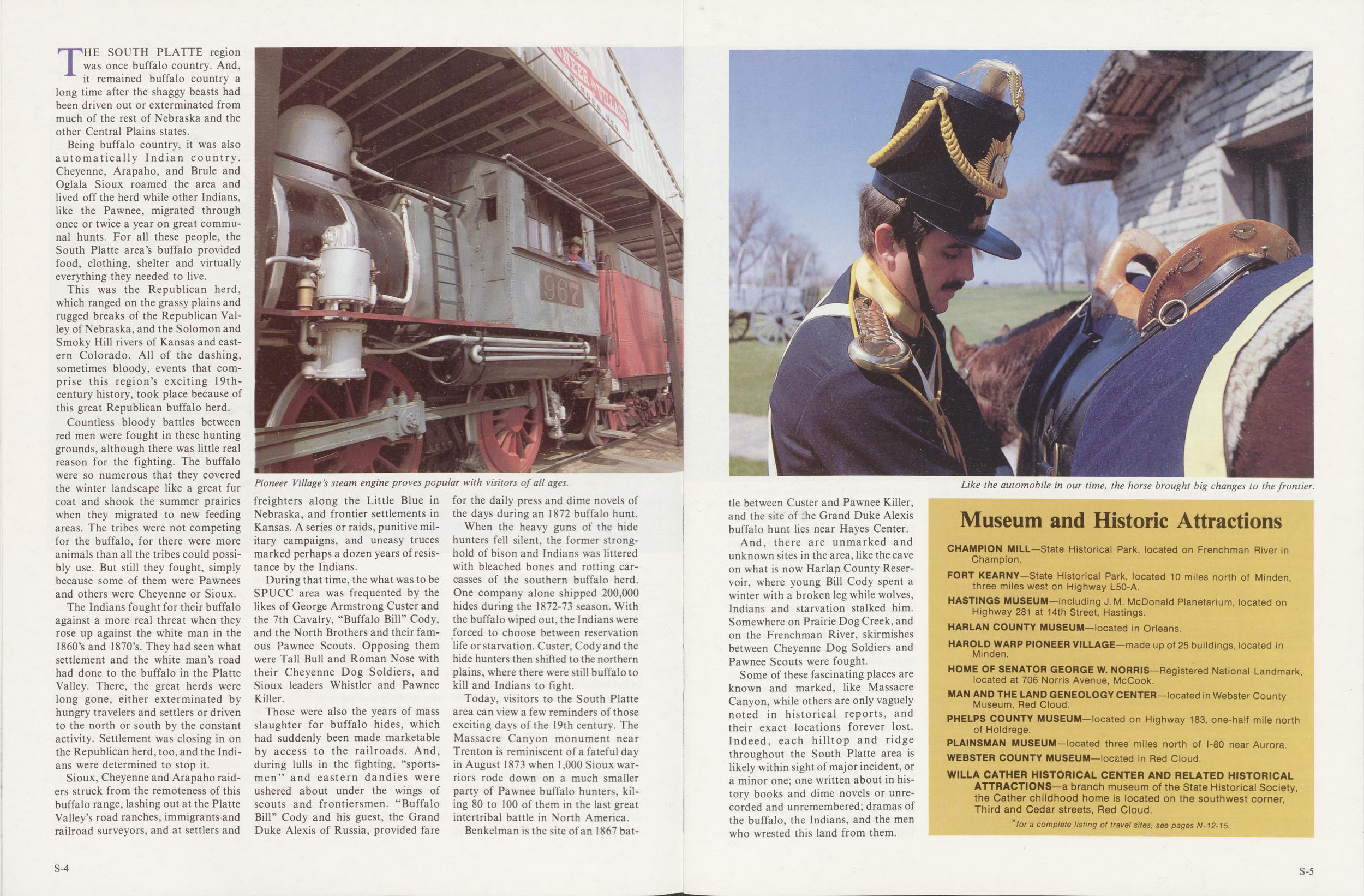
THE SOUTH PLATTE region was once buffalo country. And, it remained buffalo country a long time after the shaggy beasts had been driven out or exterminated from much of the rest of Nebraska and the other Central Plains states.
Being buffalo country, it was also automatically Indian country. Cheyenne, Arapaho, and Brule and Oglala Sioux roamed the area and lived off the herd while other Indians, like the Pawnee, migrated through once or twice a year on great communal hunts. For all these people, the South Platte area's buffalo provided food, clothing, shelter and virtually everything they needed to live.
This was the Republican herd, which ranged on the grassy plains and rugged breaks of the Republican Valley of Nebraska, and the Solomon and Smoky Hill rivers of Kansas and eastern Colorado. All of the dashing, sometimes bloody, events that comprise this region's exciting 19th-century history, took place because of this great Republican buffalo herd.
Countless bloody battles between red men were fought in these hunting grounds, although there was little real reason for the fighting. The buffalo were so numerous that they covered the winter landscape like a great fur coat and shook the summer prairies when they migrated to new feeding areas. The tribes were not competing for the buffalo, for there were more animals than all the tribes could possibly use. But still they fought, simply because some of them were Pawnees and others were Cheyenne or Sioux.
The Indians fought for their buffalo against a more real threat when they rose up against the white man in the 1860's and 1870's. They had seen what settlement and the white man's road had done to the buffalo in the Platte Valley. There, the great herds were long gone, either exterminated by hungry travelers and settlers or driven to the north or south by the constant activity. Settlement was closing in on the Republican herd, too, and the Indians were determined to stop it.
Sioux, Cheyenne and Arapaho raiders struck from the remoteness of this buffalo range, lashing out at the Platte Valley's road ranches, immigrants and railroad surveyors, and at settlers and
During that time, the what was to be SPUCC area was frequented by the likes of George Armstrong Custer and the 7th Cavalry, "Buffalo Bill" Cody, and the North Brothers and their famous Pawnee Scouts. Opposing them were Tall Bull and Roman Nose with their Cheyenne Dog Soldiers, and Sioux leaders Whistler and Pawnee Killer.
Those were also the years of mass slaughter for buffalo hides, which had suddenly been made marketable by access to the railroads. And, during lulls in the fighting, "sportsmen" and eastern dandies were ushered about under the wings of scouts and frontiersmen. "Buffalo Bill" Cody and his guest, the Grand Duke Alexis of Russia, provided fare for the daily press and dime novels of the days during an 1872 buffalo hunt.
When the heavy guns of the hide hunters fell silent, the former strong-hold of bison and Indians was littered with bleached bones and rotting carcasses of the southern buffalo herd. One company alone shipped 200,000 hides during the 1872-73 season. With the buffalo wiped out, the Indians were forced to choose between reservation life or starvation. Custer, Cody and the hide hunters then shifted to the northern plains, where there were still buffalo to kill and Indians to fight.
Today, visitors to the South Platte area can view a few reminders of those exciting days of the 19th century. The Massacre Canyon monument near Trenton is reminiscent of a fateful day in August 1873 when 1,000 Sioux warriors rode down on a much smaller party of Pawnee buffalo hunters, kiling 80 to 100 of them in the last great intertribal battle in North America.
Benkelman is the site of an 1867 battle between Custer and Pawnee Killer, S-4
And, there are unmarked and unknown sites in the area, like the cave on what is now Harlan County Reservoir, where young Bill Cody spent a winter with a broken leg while wolves, Indians and starvation stalked him. Somewhere on Prairie Dog Creek, and on the Frenchman River, skirmishes between Cheyenne Dog Soldiers and Pawnee Scouts were fought.
Some of these fascinating places are known and marked, like Massacre Canyon, while others are only vaguely noted in historical reports, and their exact locations forever lost. Indeed, each hilltop and ridge throughout the South Platte area is likely within sight of major incident, or a minor one; one written about in history books and dime novels or unrecorded and unremembered; dramas of the buffalo, the Indians, and the men who wrested this land from them.
Museum and Historic Attractions CHAMPION MILL—State Historical Park, located on Frenchman River in Champion. FORT KEARNY—State Historical Park, located 10 miles north of Minden, three miles west on Highway L50-A. HASTINGS MUSEUM—including J. M. McDonald Planetarium, located on Highway 28l at 14th Street, Hastings. HARLAN COUNTY MUSEUM-located in Orleans. HAROLD WARP PIONEER VILLAGE—made up of 25 buildings, located in Minden. HOME OF SENATOR GEORGE W. NORRIS-Registered National Landmark, located at 706 Norris Avenue, McCook. MAN AND THE LAND GENEOLOGY CENTER—located in Webster County Museum, Red Cloud. PHELPS COUNTY MUSEUM-located on Highway 183, one-half mile north of Holdrege. PLAINSMAN MUSEUM-located three miles north of I-80 near Aurora. WEBSTER COUNTY MUSEUM-located in Red Cloud. WILLA CATHER HISTORICAL CENTER AND RELATED HISTORICAL ATTRACTIONS—a branch museum of the State Historical Society, the Cather childhood home is located on the southwest corner, Third and Cedar streets, Red Cloud. for a complete listing of travel sites, see pages N-12-15. S-5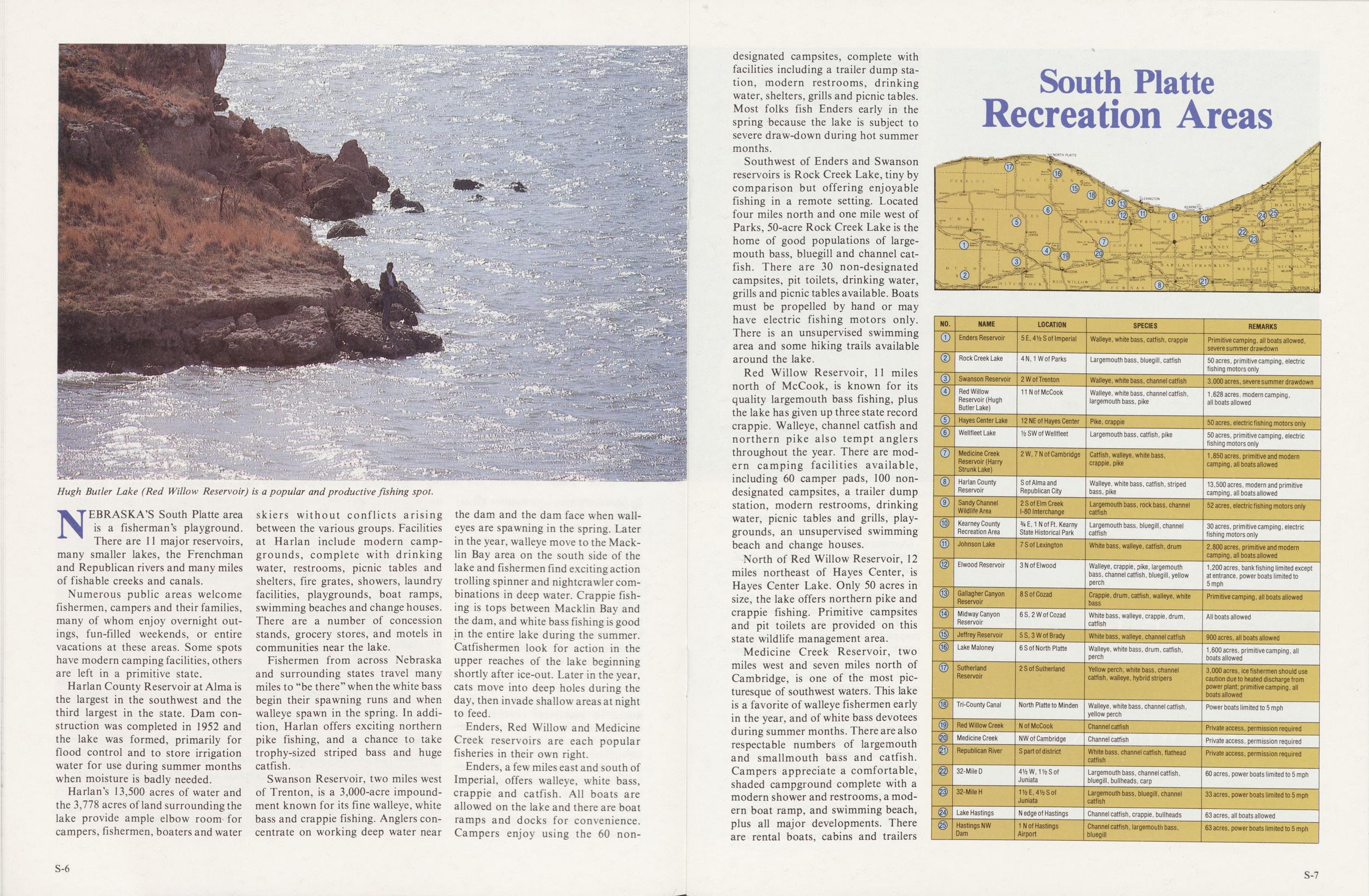
NEBRASKA'S South Platte area is a fisherman's playground. There are 11 major reservoirs, many smaller lakes, the Frenchman and Republican rivers and many miles of fishable creeks and canals.
Numerous public areas welcome fishermen, campers and their families, many of whom enjoy overnight outings, fun-filled weekends, or entire vacations at these areas. Some spots have modern camping facilities, others are left in a primitive state.
Harlan County Reservoir at Alma is the largest in the southwest and the third largest in the state. Dam construction was completed in 1952 and the lake was formed, primarily for flood control and to store irrigation water for use during summer months when moisture is badly needed.
Harlan's 13,500 acres of water and the 3,778 acres of land surrounding the lake provide ample elbow room for campers, fishermen, boaters and water skiers without conflicts arising between the various groups. Facilities at Harlan include modern camp-grounds, complete with drinking water, restrooms, picnic tables and shelters, fire grates, showers, laundry facilities, playgrounds, boat ramps, swimming beaches and change houses. There are a number of concession stands, grocery stores, and motels in communities near the lake.
Fishermen from across Nebraska and surrounding states travel many miles to "be there" when the white bass begin their spawning runs and when walleye spawn in the spring. In addition, Harlan offers exciting northern pike fishing, and a chance to take trophy-sized striped bass and huge catfish.
Swanson Reservoir, two miles west of Trenton, is a 3,000-acre impoundment known for its fine walleye, white bass and crappie fishing. Anglers concentrate on working deep water near the dam and the dam face when walleyes are spawning in the spring. Later in the year, walleye move to the Macklin Bay area on the south side of the lake and fishermen find exciting action trolling spinner and nightcrawler combinations in deep water. Crappie fishing is tops between Macklin Bay and the dam, and white bass fishing is good in the entire lake during the summer. Catfishermen look for action in the upper reaches of the lake beginning shortly after ice-out. Later in the year, cats move into deep holes during the day, then invade shallow areas at night to feed.
Enders, Red Willow and Medicine Creek reservoirs are each popular fisheries in their own right.
Enders, a few miles east and south of Imperial, offers walleye, white bass, crappie and catfish. All boats are allowed on the lake and there are boat ramps and docks for convenience. Campers enjoy using the 60 non-designated campsites, complete with S-6 facilities including a trailer dump station, modern restrooms, drinking water, shelters, grills and picnic tables. Most folks fish Enders early in the spring because the lake is subject to severe draw-down during hot summer months.
Southwest of Enders and Swanson reservoirs is Rock Creek Lake, tiny by comparison but offering enjoyable fishing in a remote setting. Located four miles north and one mile west of Parks, 50-acre Rock Creek Lake is the home of good populations of large-mouth bass, bluegill and channel cat-fish. There are 30 non-designated campsites, pit toilets, drinking water, grills and picnic tables available. Boats must be propelled by hand or may have electric fishing motors only. There is an unsupervised swimming area and some hiking trails available around the lake.
Red Willow Reservoir, 11 miles north of McCook, is known for its quality largemouth bass fishing, plus the lake has given up three state record crappie. Walleye, channel catfish and northern pike also tempt anglers throughout the year. There are modern camping facilities available, including 60 camper pads, 100 non-designated campsites, a trailer dump station, modern restrooms, drinking water, picnic tables and grills, play-grounds, an unsupervised swimming beach and change houses.
North of Red Willow Reservoir, 12 miles northeast of Hayes Center, is Hayes Center Lake. Only 50 acres in size, the lake offers northern pike and crappie fishing. Primitive campsites and pit toilets are provided on this state wildlife management area.
Medicine Creek Reservoir, two miles west and seven miles north of Cambridge, is one of the most picturesque of southwest waters. This lake is a favorite of walleye fishermen early in the year, and of white bass devotees during summer months. There are also respectable numbers of largemouth and smallmouth bass and catfish. Campers appreciate a comfortable, shaded campground complete with a modern shower and restrooms, a modern boat ramp, and swimming beach, plus all major developments. There are rental boats, cabins and trailers
NO. NAME Enders Reservoir Rock Creek Lake Swanson Reservoir Red Willow Reservoir (Hugh Butler Lake) Hayes Center Lake Wellfleet Lake Medicine Creek Reservoir (Harry Strunk Lake) LOCATION 5E,41/2 Sot Imperial 4N,1WofParks 2 W of Trenton 11 Not McCook 12 NE of Hayes Center 1/2 SW of Wellfleet SPECIES Walleye, white bass, catfish, crappie Largemouth bass, bluegill, catfish Walleye, white bass, channel catfish Walleye, white bass, channel catfish, largemouth bass, pike Pike, crappie Largemouth bass, catfish, pike Harlan County Reservoir Sandy Channel Wildlife Area Kearney County Recreation Area Johnson Lake Elwood Reservoir Gallagher Canyon Reservoir Midway Canyon Reservoir 2 W, 7 N of Cambridge S of Alma and Republican City 2 S of Elm Creek I-80 Interchange 3/4 E,1N of Ft. Kearny State Historical Park 7 S of Lexington 3 N of Elwood 8 S of Cozad 6 S. 2 W of Cozad Jeffrey Reservoir Lake Maloney Sutherland Reservoir Tri-County Canal Red Willow Creek Medicine Creek Republican River 32-Mile D 32-Mile H Lake Hastings 5 S, 3 W of Brady 6 S of North Platte Catfish, walleye, white bass, crappie, pike Walleye, white bass, catfish, striped bass, pike Largemouth bass, rock bass, channel catfish Largemouth bass, bluegill, channel catfish White bass, walleye, catfish, drum Walleye, crappie, pike, largemouth bass, channel catfish, bluegill, yellow perch Crappie, drum, catfish, walleye, white bass White bass, walleye, crappie, drum, catfish White bass, walleye, channel catfish 2 S of Sutherland North Platte to Minden N of McCook NW of Cambridge S part of district 4 1/2W,1 1/2 S of Juniata 1 1/2 E,4 1/2 S of Juniata N edge of Hastings Hastings NW Dam 1 N of Hastings Airport Walleye, white bass, drum, catfish, perch Yellow perch, white bass, channel catfish, walleye, hybrid stripers Walleye, white bass, channel catfish, yellow perch Channel catfish Channel catfish White bass, channel catfish, flathead catfish Largemouth bass, channel catfish, bluegill, bullheads, carp Largemouth bass, bluegill, channel catfish Channel catfish, crappie, bullheads Channel catfish, largemouth bass, bluegill REMARKS Primitive camping, all boats allowed, severe summer drawdown 50 acres, primitive camping, electric fishing motors only 3,000 acres, severe summer drawdown 1,628 acres, modern camping, all boats allowed 50 acres, electric fishing motors only 50 acres, primitive camping, electric fishing motors only 1,850 acres, primitive and modern camping, all boats allowed 13,500 acres, modern and primitive camping, all boats allowed 52 acres, electric fishing motors only 30 acres, primitive camping, electric fishing motors only 2,800 acres, primitive and modern camping, all boats allowed 1,200 acres, bank fishing limited except at entrance, power boats limited to 5mph Primitive camping, all boats allowed All boats allowed 900 acres, all boats allowed 1,600 acres, primitive camping, all boats allowed 3,000 acres, ice fishermen should use caution due to heated discharge from power plant; primitive camping, all boats allowed Power boats limited to 5 mph Private access, permission required Private access, permission required Private access, permission required 60 acres, power boats limited to 5 mph 33 acres, power boats limited to 5 mph 63 acres, all boats allowed 63 acres, power boats limited to 5 mph S-7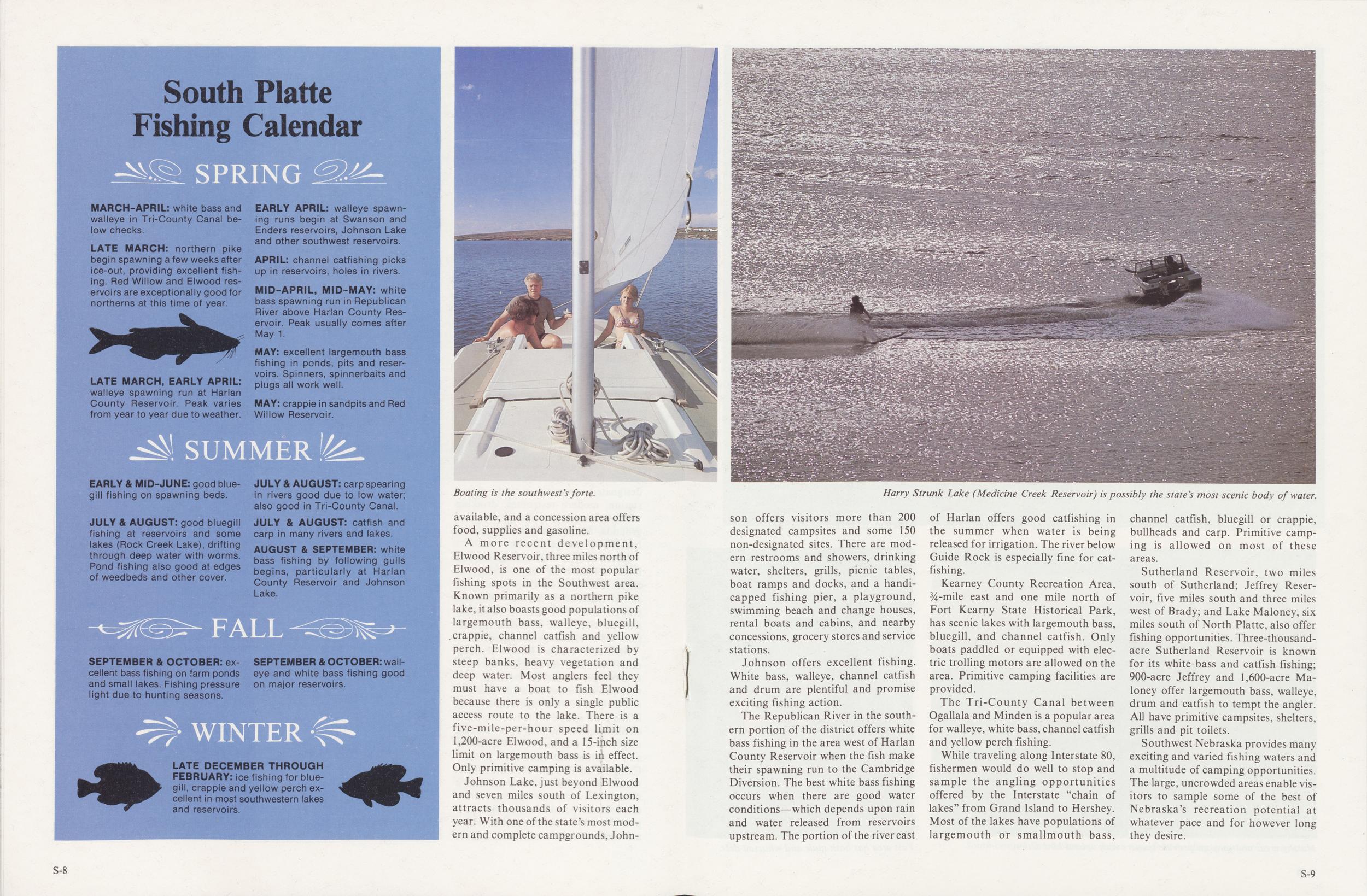
available, and a concession area offers food, supplies and gasoline.
A more recent development, Elwood Reservoir, three miles north of Elwood, is one of the most popular fishing spots in the Southwest area. Known primarily as a northern pike lake, it also boasts good populations of largemouth bass, walleye, bluegill, crappie, channel catfish and yellow perch. Elwood is characterized by steep banks, heavy vegetation and deep water. Most anglers feel they must have a boat to fish Elwood because there is only a single public access route to the lake. There is a five-mile-per-hour speed limit on 1,200-acre Elwood, and a 15-inch size limit on largemouth bass is in effect. Only primitive camping is available.
Johnson Lake, just beyond Elwood and seven miles south of Lexington, attracts thousands of visitors each year. With one of the state's most modern and complete campgrounds, Johnson offers visitors more than 200 S-8
Johnson offers excellent fishing. White bass, walleye, channel catfish and drum are plentiful and promise exciting fishing action.
The Republican River in the southern portion of the district offers white bass fishing in the area west of Harlan County Reservoir when the fish make their spawning run to the Cambridge Diversion. The best white bass fishing occurs when there are good water conditions—which depends upon rain and water released from reservoirs upstream. The portion of the river east of Harlan offers good catfishing in the summer when water is being released for irrigation. The river below Guide Rock is especially fine for catfishing.
Kearney County Recreation Area, ¾-mile east and one mile north of Fort Kearny State Historical Park, has scenic lakes with largemouth bass, bluegill, and channel catfish. Only boats paddled or equipped with electric trolling motors are allowed on the area. Primitive camping facilities are provided.
The Tri-County Canal between Ogallala and Minden is a popular area for walleye, white bass, channel catfish and yellow perch fishing. While traveling along Interstate 80, fishermen would do well to stop and sample the angling opportunities offered by the Interstate "chain of lakes" from Grand Island to Hershey. Most of the lakes have populations of largemouth or smallmouth bass, channel catfish, bluegill or crappie, bullheads and carp. Primitive camping is allowed on most of these areas.
Sutherland Reservoir, two miles south of Sutherland; Jeffrey Reservoir, five miles south and three miles west of Brady; and Lake Maloney, six miles south of North Platte, also offer fishing opportunities. Three-thousand-acre Sutherland Reservoir is known for its white bass and catfish fishing; 900-acre Jeffrey and 1,600-acre Maloney offer largemouth bass, walleye, drum and catfish to tempt the angler. All have primitive campsites, shelters, grills and pit toilets.
Southwest Nebraska provides many exciting and varied fishing waters and a multitude of camping opportunities. The large, uncrowded areas enable visitors to sample some of the best of Nebraska's recreation potential at whatever pace and for however long they desire.
S-9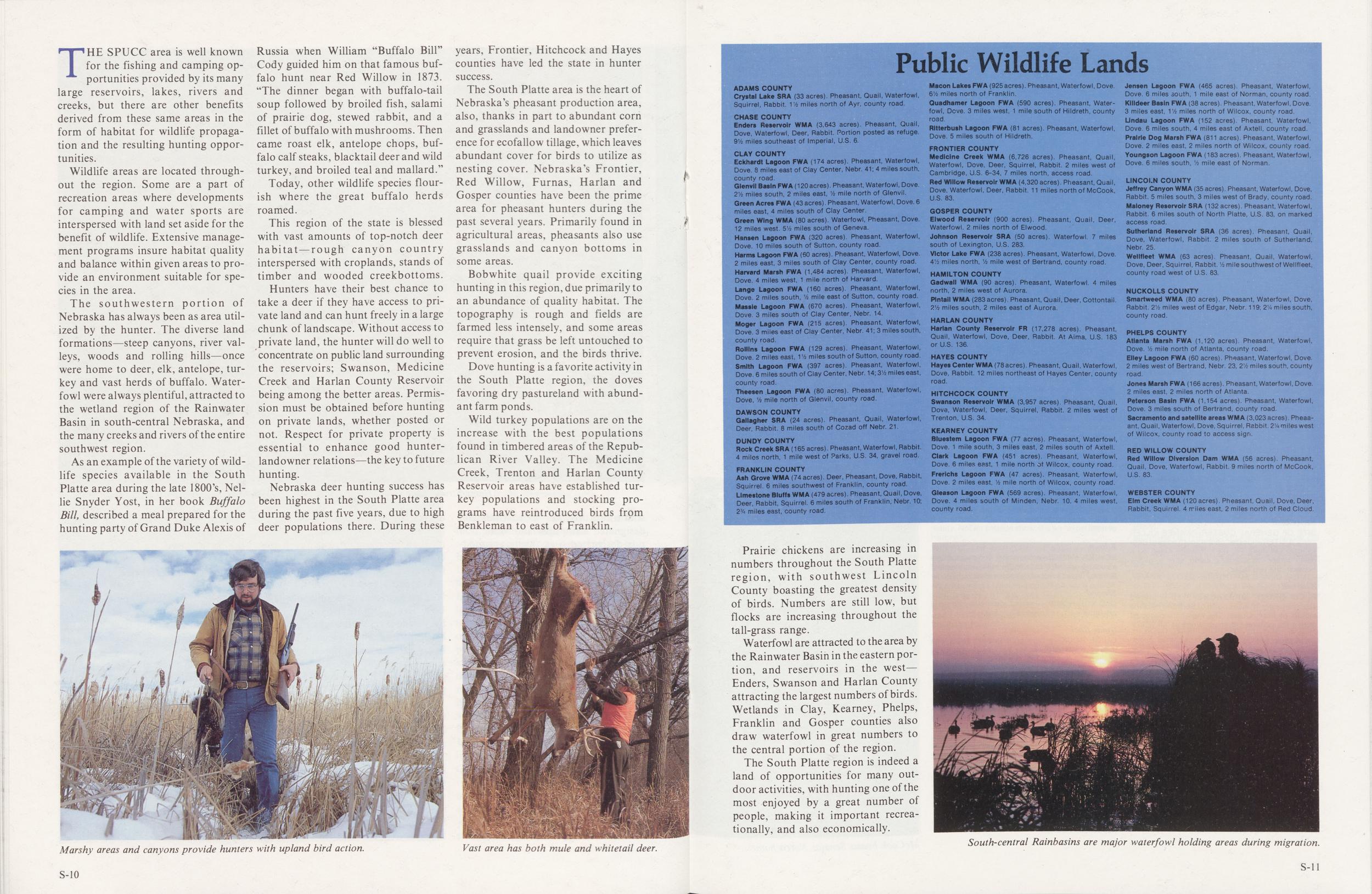
THE SPUCC area is well known for the fishing and camping opportunities provided by its many large reservoirs, lakes, rivers and creeks, but there are other benefits derived from these same areas in the form of habitat for wildlife propagation and the resulting hunting opportunities.
Wildlife areas are located throughout the region. Some are a part of recreation areas where developments for camping and water sports are interspersed with land set aside for the benefit of wildlife. Extensive management programs insure habitat quality and balance within given areas to provide an environment suitable for species in the area.
The southwestern portion of Nebraska has always been as area utilized by the hunter. The diverse land formations—steep canyons, river valleys, woods and rolling hills—once were home to deer, elk, antelope, turkey and vast herds of buffalo. Waterfowl were always plentiful, attracted to the wetland region of the Rainwater Basin in south-central Nebraska, and the many creeks and rivers of the entire southwest region.
As an example of the variety of wildlife species available in the South Platte area during the late 1800's, Nellie Snyder Yost, in her book Buffalo Bill, described a meal prepared for the hunting party of Grand Duke Alexis of Russia when William "Buffalo Bill" Cody guided him on that famous buffalo hunt near Red Willow in 1873. "The dinner began with buffalo-tail soup followed by broiled fish, salami of prairie dog, stewed rabbit, and a fillet of buffalo with mushrooms. Then came roast elk, antelope chops, buffalo calf steaks, blacktail deer and wild turkey, and broiled teal and mallard."
Today, other wildlife species flourish where the great buffalo herds roamed.
This region of the state is blessed with vast amounts of top-notch deer habitat—rough canyon country interspersed with croplands, stands of timber and wooded creekbottoms.
Hunters have their best chance to take a deer if they have access to private land and can hunt freely in a large chunk of landscape. Without access to private land, the hunter will do well to concentrate on public land surrounding the reservoirs; Swanson, Medicine Creek and Harlan County Reservoir being among the better areas. Permission must be obtained before hunting on private lands, whether posted or not. Respect for private property is essential to enhance good hunter-landowner relations—the key to future hunting.
Nebraska deer hunting success has been highest in the South Platte area during the past five years, due to high deer populations there. During these years, Frontier, Hitchcock and Hayes counties have led the state in hunter success.
The South Platte area is the heart of Nebraska's pheasant production area, also, thanks in part to abundant corn and grasslands and landowner preference for ecofallow tillage, which leaves abundant cover for birds to utilize as nesting cover. Nebraska's Frontier, Red Willow, Furnas, Harlan and Gosper counties have been the prime area for pheasant hunters during the past several years. Primarily found in agricultural areas, pheasants also use grasslands and canyon bottoms in some areas.
Bobwhite quail provide exciting hunting in this region, due primarily to an abundance of quality habitat. The topography is rough and fields are farmed less intensely, and some areas require that grass be left untouched to prevent erosion, and the birds thrive.
Dove hunting is a favorite activity in the South Platte region, the doves favoring dry pastureland with abundant farm ponds.
Wild turkey populations are on the increase with the best populations found in timbered areas of the Republican River Valley. The Medicine Creek, Trenton and Harlan County Reservoir areas have established turkey populations and stocking programs have reintroduced birds from Benkleman to east of Franklin.
S-10 Public Wildlife Lands ADAMS COUNTY Crystal Lake SRA (33 acres). Pheasant, Quail, Waterfowl, Squirrel, Rabbit. Vh miles north of Ayr, county road. CHASE COUNTY Enders Reservoir WMA (3,643 acres). Pheasant, Quail, Dove, Waterfowl, Deer, Babbit. Portion posted as refuge. 9 1/2 miles southeast of Imperial, U.S. 6. CLAY COUNTY Eckhardt Lagoon FWA (174 acres). Pheasant, Waterfowl, Dove. 8 miles east of Clay Center, Nebr. 41; 4 miles south, county road. Glenvil Basin FWA (120acres). Pheasant, Waterfowl, Dove. 2 1/2 miles south, 2 miles east, 1/2 mile north of Glenvil. Green Acres FWA (43 acres). Pheasant, Waterfowl, Dove. 6 miles east, 4 miles south of Clay Center. Green Wing WMA (80 acres). Waterfowl, Pheasant, Dove. 12 miles west. 5 1/2 miles south of Geneva. Hansen Lagoon FWA (320 acres). Pheasant, Waterfowl, Dove. 10 miles south of Sutton, county road. Harms Lagoon FWA (60 acres). Pheasant, Waterfowl, Dove. 2 miles east, 3 miles south of Clay Center, county road. Harvard Marsh FWA (1,484 acres). Pheasant, Waterfowl, Dove. 4 miles west, 1 mile north of Harvard. Lange Lagoon FWA (160 acres). Pheasant, Waterfowl, Dove. 2 miles south, 1/2 mile east of Sutton, county road. Massie Lagoon FWA (670 acres). Pheasant, Waterfowl, Dove. 3 miles south of Clay Center, Nebr. 14. Moger Lagoon FWA (215 acres). Pheasant, Waterfowl, Dove. 3 miles east of Clay Center, Nebr. 41; 3 miles south, county road. Rollins Lagoon FWA (129 acres). Pheasant, Waterfowl, Dove. 2 miles east, 1 1/2 miles south of Sutton, county road. Smith Lagoon FWA (397 acres). Pheasant, Waterfowl, Dove. 6 miles south of Clay Center, Nebr. 14; 3 1/2 miles east, county road. Theesen Lagoon FWA (80 acres). Pheasant, Waterfowl, Dove, 1/2 mile north of Glenvil, county road. DAWSON COUNTY Gallagher SRA (24 acres). Pheasant, Quail, Waterfowl, Deer, Rabbit. 8 miles south of Cozad off Nebr. 21. DUNDY COUNTY Rock Creek SRA (165 acres). Pheasant, Waterfowl, Rabbit. 4 miles north, 1 mile west of Parks, U.S. 34, gravel road. FRANKLIN COUNTY Ash Grove WMA (74 acres). Deer, Pheasant, Dove, Rabbit, Squirrel. 6 miles southwest of Franklin, county road. Limestone Bluffs WMA (479 acres). Pheasant, Quail, Dove, Deer, Rabbit, Squirrel. 6 miles south of Franklin, Nebr. 10; 2 3/4 miles east, county road. Macon Lakes FWA (925 acres). Pheasant, Waterfowl, Dove. 6 1/2 miles north of Franklin. Quadhamer Lagoon FWA (590 acres). Pheasant, Waterfowl, Dove. 3 miles west, 1 mile south of Hildreth, county road. Rltterbush Lagoon FWA (81 acres). Pheasant, Waterfowl, Dove. 5 miies south of Hildreth. FRONTIER COUNTY Medicine Creek WMA (6,726 acres). Pheasant, Quail, Waterfowl, Dove, Deer, Squirrel, Rabbit. 2 miles west of Cambridge, U.S. 6-34, 7 miles north, access road. Red Willow Reservoir WMA (4,320 acres). Pheasant, Quail, Dove, Waterfowl, Deer, Rabbit. 11 miles north of McCook, U.S. 83. GOSPER COUNTY Elwood Reservoir (900 acres). Pheasant, Quail, Deer, Waterfowl. 2 miles north of Elwood. Johnson Reservoir SRA (50 acres). Waterfowl. 7 miles south of Lexington, U.S. 283. Victor Lake FWA (238 acres). Pheasant, Waterfowl, Dove. 4 1/2 miles north, 1/4 mile west of Bertrand, county road. HAMILTON COUNTY Gadwall WMA (90 acres). Pheasant, Waterfowl. 4 miles north, 2 miles west of Aurora. Pintail WMA (283 acres). Pheasant, Quail, Deer, Cottontail. 2 1/2 miles south, 2 miles east of Aurora. HARLAN COUNTY Harlan County Reservoir FR (17,278 acres). Pheasant, Quail, Waterfowl, Dove, Deer, Rabbit. At Aima, U.S. 183 or U.S. 136. HAYES COUNTY Hayes Center WMA (78 acres). Pheasant, Quail, Waterfowl, Dove, Rabbit. 12 miles northeast of Hayes Center, county road. HITCHCOCK COUNTY Swanson Reservoir WMA (3,957 acres). Pheasant, Quail, Dove, Waterfowl, Deer, Squirrel, Rabbit. 2 miles west of Trenton, U.S. 34. KEARNEY COUNTY Bluestem Lagoon FWA (77 acres). Pheasant, Waterfowl, Dove. 1 mile south, 3 miles east, 2 miles south of Axtell. Clark Lagoon FWA (451 acres). Pheasant, Waterfowl, Dove. 6 miles east, 1 mile north of Wilcox, county road. Frerichs Lagoon FWA (47 acres). Pheasant, Waterfowl, Dove. 2 miles east, V2 mile north of Wilcox, county road. Gleason Lagoon FWA (569 acres). Pheasant, Waterfowl, Dove. 4 miles south of Minden, Nebr. 10. 4 miles west, county road. Jensen Lagoon FWA (465 acres). Pheasant, Waterfowl, Dove. 6 miles south, 1 mile east of Norman, county road. Killdeer Basin FWA (38 acres). Pheasant, Waterfowl, Dove. 3 miles east, Vk miles north of Wilcox, county road. Undau Lagoon FWA (152 acres). Pheasant, Waterfowl, Dove. 6 miles south, 4 miles east of Axtell, county road. Prairie Dog Marsh FWA (811 acres). Pheasant, Waterfowl, Dove. 2 miles east, 2 miles north of Wilcox, county road. Youngson Lagoon FWA (183 acres). Pheasant, Waterfowl, Dove. 6 miles south, 1/2 mile east of Norman. LINCOLN COUNTY Jeffrey Canyon WMA (35 acres). Pheasant, Waterfowl, Dove, Rabbit. 5 miles south, 3 miles west of Brady, county road. Maloney Reservoir SRA (132 acres). Pheasant, Waterfowl, Rabbit. 6 miles south of North Platte, U.S. 83, on marked access road. Sutherland Reservoir SRA (36 acres). Pheasant, Quail, Dove, Waterfowl, Rabbit. 2 miles south of Sutherland, Nebr. 25. Wellfleet WMA (63 acres). Pheasant, Quail, Waterfowl, Dove, Deer, Squirrel, Rabbit. 1/2 mile southwest of Wellfleet, county road west of U.S. 83. NUCKOLLS COUNTY Smartweed WMA (80 acres). Pheasant, Waterfowl, Dove, Rabbit. 2 1/2 miles west of Edgar, Nebr. 119; 2 1/4 miles south, county road. PHELPS COUNTY Atlanta Marsh FWA (1,120 acres). Pheasant, Waterfowl, Dove. 1/2 mile north of Atlanta, county road. Elley Lagoon FWA (60 acres). Pheasant, Waterfowl, Dove. 2 miles west of Bertrand, Nebr. 23, 2 1/2 miles south, county road. Jones Marsh FWA (166 acres). Pheasant, Waterfowl, Dove. 2 miles east, 2 miles north of Atlanta. Peterson Basin FWA (1,154 acres). Pheasant, Waterfowl, Dove. 3 miles south of Bertrand, county road. Sacramento and satellite areas WMA (3,023 acres). Pheasant, Quail, Waterfowl, Dove, Squirrel, Rabbit. 2 1/4 miles west of Wilcox, county road to access sign. RED WILLOW COUNTY Red Willow Diversion Dam WMA (56 acres). Pheasant, Quail, Dove, Waterfowl, Rabbit. 9 miles north of McCook, U.S. 83. WEBSTER COUNTY Elm Creek WMA (120 acres). Pheasant, Quail, Dove. Deer, Rabbit, Squirrel. 4 miles east, 2 miles north of Red Cloud.Prairie chickens are increasing in numbers throughout the South Platte region, with southwest Lincoln County boasting the greatest density of birds. Numbers are still low, but flocks are increasing throughout the tall-grass range.
Waterfowl are attracted to the area by the Rainwater Basin in the eastern portion, and reservoirs in the west—Enders, Swanson and Harlan County attracting the largest numbers of birds. Wetlands in Clay, Kearney, Phelps, Franklin and Gosper counties also draw waterfowl in great numbers to the central portion of the region.
The South Platte region is indeed a land of opportunities for many outdoor activities, with hunting one of the most enjoyed by a great number of people, making it important recreationally, and also economically.
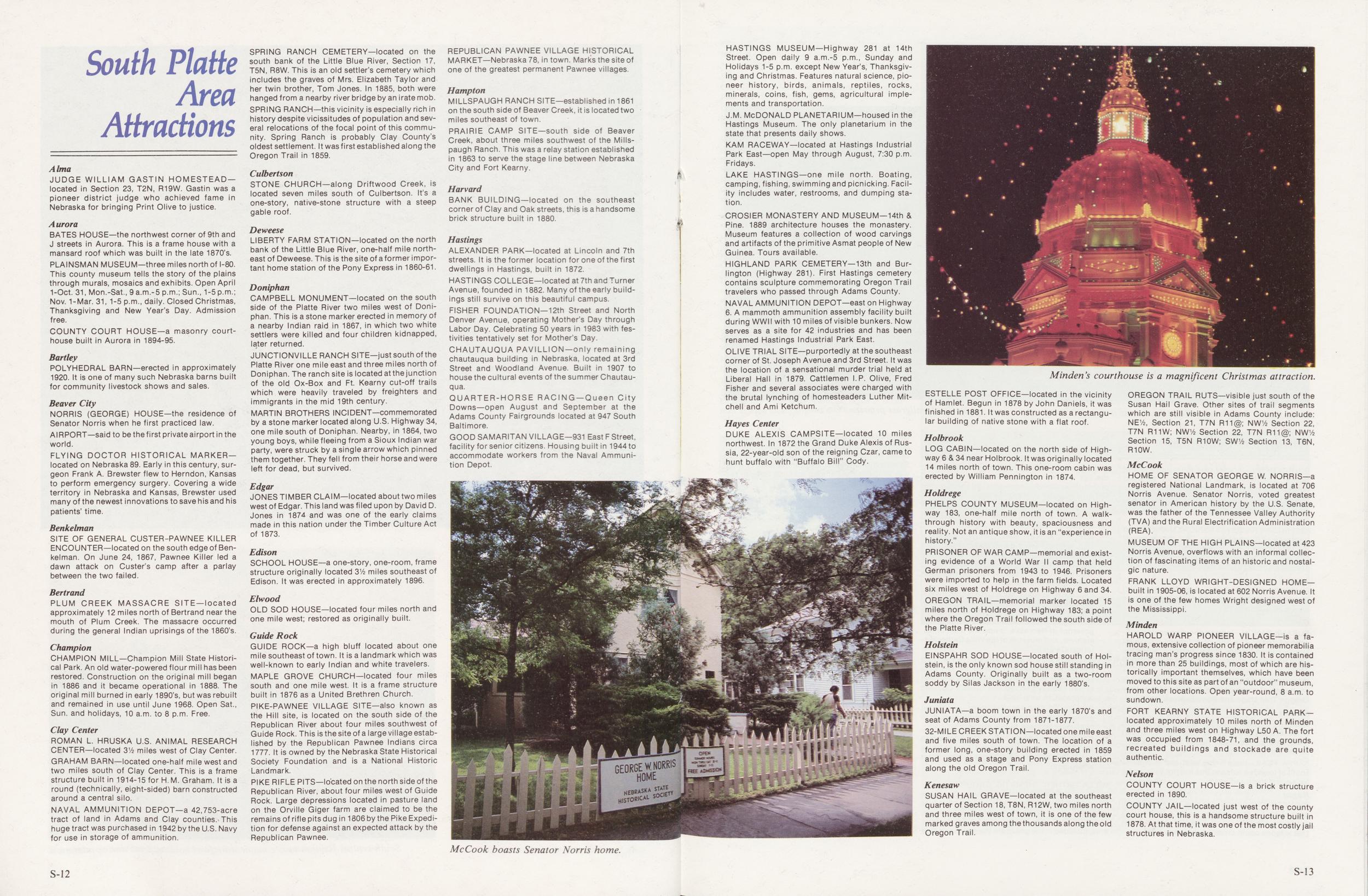 South Platte
Area
Attractions
Alma
JUDGE WILLIAM GASTIN HOMESTEAD —
located in Section 23, T2N, R19W. Gastin was a
pioneer district judge who achieved fame in
Nebraska for bringing Print Olive to justice.
Aurora
BATES HOUSE—the northwest corner of 9th and
J streets in Aurora. This is a frame house with a
mansard roof which was built in the late 1870's.
PLAINSMAN MUSEUM—three miles north of I-80.
This county museum tells the story of the plains
through murals, mosaics and exhibits. Open April
1-Oct. 31, Mon.-Sat.,9a.m.-5p.m.; Sun., 1-5 p.m.;
Nov. 1-Mar. 31, 1-5 p.m., daily. Closed Christmas,
Thanksgiving and New Year's Day. Admission
free.
COUNTY COURT HOUSE—a masonry courthouse built in Aurora in 1894-95.
Bartley
POLYHEDRAL BARN—erected in approximately
1920. It is one of many such Nebraska barns built
for community livestock shows and sales.
Beaver City
NORRIS (GEORGE) HOUSE—the residence of
Senator Norris when he first practiced law.
AIRPORT—said to be the first private airport in the
world.
FLYING DOCTOR HISTORICAL MARKER—
located on Nebraska 89. Early in this century, surgeon Frank A. Brewster flew to Herndon,
Kansas
to perform emergency surgery. Covering a wide
territory in Nebraska and Kansas, Brewster used
many of the newest innovations to save his and his
patients' time.
Benkelman
SITE OF GENERAL CUSTER-PAWNEE KILLER
ENCOUNTER—located on the south edge of Benkelman. On June 24, 1867, Pawnee Killer
led a
dawn attack on Custer's camp after a parlay
between the two failed.
Bertrand
PLUM CREEK MASSACRE SITE —located
approximately 12 miles north of Bertrand near the
mouth of Plum Creek. The massacre occurred
during the general Indian uprisings of the 1860's.
Champion
CHAMPION MILL—Champion Mill State Historical Park. An old water-powered flour mill
has been
restored. Construction on the original mill began
in 1886 and it became operational in 1888. The
original mill burned in early 1890's, but was rebuilt
and remained in use until June 1968. Open Sat.,
Sun. and holidays, 10 a.m. to 8 p.m. Free.
Clay Center
ROMAN L. HRUSKA U.S. ANIMAL RESEARCH
CENTER—located 31/2 miles west of Clay Center.
GRAHAM BARN—located one-half mile west and
two miles south of Clay Center. This is a frame
structure built in 1914-15 for H. M. Graham. It is a
round (technically, eight-sided) barn constructed
around a central silo.
NAVAL AMMUNITION DEPOT—a 42,753-acre
tract of land in Adams and Clay counties. This
huge tract was purchased in 1942 by the U.S. Navy
for use in storage of ammunition.
SPRING RANCH CEMETERY—located on the
south bank of the Little Blue River, Section 17,
T5N, R8W. This is an old settler's cemetery which
includes the graves of Mrs. Elizabeth Taylor and
her twin brother, Tom Jones. In 1885, both were
hanged from a nearby river bridge by an irate mob.
SPRING RANCH—this vicinity is especially rich in
history despite vicissitudes of population and several relocations of the focal point
of this community. Spring Ranch is probably Clay County's
oldest settlement. It was first established along the
Oregon Trail in 1859.
Culbertson
STONE CHURCH—along Driftwood Creek, is
located seven miles south of Culbertson. It's a
one-story, native-stone structure with a steep
gable roof.
Deweese
LIBERTY FARM STATION—located on the north
bank of the Little Blue River, one-half mile northeast of Deweese. This is the site
of a former important home station of the Pony Express in 1860-61.
Doniphan
CAMPBELL MONUMENT—located on the south
side of the Platte River two miles west of Doniphan. This is a stone marker erected
in memory of
a nearby Indian raid in 1867, in which two white
settlers were killed and four children kidnapped,
later returned.
JUNCTIONVILLE RANCH SITE—just south of the
Platte River one mile east and three miles north of
Doniphan. The ranch site is located at the junction
of the old Ox-Box and Ft. Kearny cut-off trails
which were heavily traveled by freighters and
immigrants in the mid 19th century.
MARTIN BROTHERS INCIDENT-commemorated
by a stone marker located along U.S. Highway 34,
one mile south of Doniphan. Nearby, in 1864, two
young boys, while fleeing from a Sioux Indian war
party, were struck by a single arrow which pinned
them together. They fell from their horse and were
left for dead, but survived.
Edgar
JONES TIMBER CLAIM—located about two miles
west of Edgar. This land was filed upon by David D.
Jones in 1874 and was one of the early claims
made in this nation under the Timber Culture Act
of 1873.
Edison
SCHOOL HOUSE—a one-story, one-room, frame
structure originally located 3 1/2 miles southeast of
Edison. It was erected in approximately 1896.
Elwood
OLD SOD HOUSE—located four miles north and
one mile west; restored as originally built.
Guide Rock
GUIDE ROCK—a high bluff located about one
mile southeast of town. It is a landmark which was
well-known to early Indian and white travelers.
MAPLE GROVE CHURCH—located four miles
south and one mile west. It is a frame structure
built in 1876 as a United Brethren Church.
PIKE-PAWNEE VILLAGE SITE—also known as
the Hill site, is located on the south side of the
Republican River about four miles southwest of
Guide Rock. This is the site of a large village established by the Republican Pawnee
Indians circa
1777. It is owned by the Nebraska State Historical
Society Foundation and is a National Historic
Landmark.
PIKE RIFLE PITS—located on the north side of the
Republican River, about four miles west of Guide
Rock. Large depressions located in pasture land
on the Orville Giger farm are claimed to be the
remains of rifle pits dug in 1806 by the Pike Expedition for defense against an expected
attack by the
Republican Pawnee.
REPUBLICAN PAWNEE VILLAGE HISTORICAL
MARKET—Nebraska 78, in town. Marks the site of
one of the greatest permanent Pawnee villages.
Hampton
MILLSPAUGH RANCH SITE—established in 1861
on the south side of Beaver Creek, it is located two
miles southeast of town.
PRAIRIE CAMP SITE—south side of Beaver
Creek, about three miles southwest of the Millspaugh Ranch. This was a relay station
established
in 1863 to serve the stage line between Nebraska
City and Fort Kearny.
Harvard
BANK BUILDING—located on the southeast
corner of Clay and Oak streets, this is a handsome
brick structure built in 1880.
Hastings
ALEXANDER PARK—located at Lincoln and 7th
streets. It is the former location for one of the first
dwellings in Hastings, built in 1872.
HASTINGS COLLEGE—located at 7th and Turner
Avenue, founded in 1882. Many of the early buildings still survive on this beautiful
campus.
FISHER FOUNDATION—12th Street and North
Denver Avenue, operating Mother's Day through
Labor Day. Celebrating 50 years in 1983 with festivities tentatively set for Mother's
Day.
CHAUTAUQUA PAVILLION—only remaining
Chautauqua building in Nebraska, located at 3rd
Street and Woodland Avenue. Built in 1907 to
house the cultural events of the summer Chautauqua.
QUARTER-HORSE RACING —Queen City
Downs—open August and September at the
Adams County Fairgrounds located at 947 South
Baltimore.
GOOD SAMARITAN VILLAGE—931 East F Street,
facility for senior citizens. Housing built in 1944 to
accommodate workers from the Naval Ammunition Depot.
HASTINGS MUSEUM—Highway 281 at 14th
Street. Open daily 9 a.m.-5 p.m., Sunday and
Holidays 1-5 p.m. except New Year's, Thanksgiving and Christmas. Features natural
science, pioneer history, birds, animals, reptiles, rocks,
minerals, coins, fish, gems, agricultural implements and transportation.
J.M. MCDONALD PLANETARIUM—housed in the
Hastings Museum. The only planetarium in the
state that presents daily shows.
KAM RACEWAY—located at Hastings Industrial
Park East—open May through August, 7:30 p.m.
Fridays.
LAKE HASTINGS—one mile north. Boating,
camping, fishing, swimming and picnicking. Facility includes water, restrooms, and
dumping station.
CROSIER MONASTERY AND MUSEUM—14th &
Pine. 1889 architecture houses the monastery.
Museum features a collection of wood carvings
and artifacts of the primitive Asmat people of New
Guinea. Tours available.
HIGHLAND PARK CEMETERY—13th and Burlington (Highway 281). First Hastings cemetery
contains sculpture commemorating Oregon Trail
travelers who passed through Adams County.
NAVAL AMMUNITION DEPOT—east on Highway
6. A mammoth ammunition assembly facility built
during WWII with 10 miles of visible bunkers. Now
serves as a site for 42 industries and has been
renamed Hastings Industrial Park East.
OLIVE TRIAL SITE—purportedly at the southeast
corner of St. Joseph Avenue and 3rd Street. It was
the location of a sensational murder trial held at
Liberal Hall in 1879. Cattlemen LP. Olive, Fred
Fisher and several associates were charged with
the brutal lynching of homesteaders Luther Mitchell and Ami Ketchum.
Hayes Center
DUKE ALEXIS CAMPSITE—located 10 miles
northwest. In 1872 the Grand Duke Alexis of Russia, 22-year-old son of the reigning
Czar, came to
hunt buffalo with "Buffalo Bill" Cody.
South Platte
Area
Attractions
Alma
JUDGE WILLIAM GASTIN HOMESTEAD —
located in Section 23, T2N, R19W. Gastin was a
pioneer district judge who achieved fame in
Nebraska for bringing Print Olive to justice.
Aurora
BATES HOUSE—the northwest corner of 9th and
J streets in Aurora. This is a frame house with a
mansard roof which was built in the late 1870's.
PLAINSMAN MUSEUM—three miles north of I-80.
This county museum tells the story of the plains
through murals, mosaics and exhibits. Open April
1-Oct. 31, Mon.-Sat.,9a.m.-5p.m.; Sun., 1-5 p.m.;
Nov. 1-Mar. 31, 1-5 p.m., daily. Closed Christmas,
Thanksgiving and New Year's Day. Admission
free.
COUNTY COURT HOUSE—a masonry courthouse built in Aurora in 1894-95.
Bartley
POLYHEDRAL BARN—erected in approximately
1920. It is one of many such Nebraska barns built
for community livestock shows and sales.
Beaver City
NORRIS (GEORGE) HOUSE—the residence of
Senator Norris when he first practiced law.
AIRPORT—said to be the first private airport in the
world.
FLYING DOCTOR HISTORICAL MARKER—
located on Nebraska 89. Early in this century, surgeon Frank A. Brewster flew to Herndon,
Kansas
to perform emergency surgery. Covering a wide
territory in Nebraska and Kansas, Brewster used
many of the newest innovations to save his and his
patients' time.
Benkelman
SITE OF GENERAL CUSTER-PAWNEE KILLER
ENCOUNTER—located on the south edge of Benkelman. On June 24, 1867, Pawnee Killer
led a
dawn attack on Custer's camp after a parlay
between the two failed.
Bertrand
PLUM CREEK MASSACRE SITE —located
approximately 12 miles north of Bertrand near the
mouth of Plum Creek. The massacre occurred
during the general Indian uprisings of the 1860's.
Champion
CHAMPION MILL—Champion Mill State Historical Park. An old water-powered flour mill
has been
restored. Construction on the original mill began
in 1886 and it became operational in 1888. The
original mill burned in early 1890's, but was rebuilt
and remained in use until June 1968. Open Sat.,
Sun. and holidays, 10 a.m. to 8 p.m. Free.
Clay Center
ROMAN L. HRUSKA U.S. ANIMAL RESEARCH
CENTER—located 31/2 miles west of Clay Center.
GRAHAM BARN—located one-half mile west and
two miles south of Clay Center. This is a frame
structure built in 1914-15 for H. M. Graham. It is a
round (technically, eight-sided) barn constructed
around a central silo.
NAVAL AMMUNITION DEPOT—a 42,753-acre
tract of land in Adams and Clay counties. This
huge tract was purchased in 1942 by the U.S. Navy
for use in storage of ammunition.
SPRING RANCH CEMETERY—located on the
south bank of the Little Blue River, Section 17,
T5N, R8W. This is an old settler's cemetery which
includes the graves of Mrs. Elizabeth Taylor and
her twin brother, Tom Jones. In 1885, both were
hanged from a nearby river bridge by an irate mob.
SPRING RANCH—this vicinity is especially rich in
history despite vicissitudes of population and several relocations of the focal point
of this community. Spring Ranch is probably Clay County's
oldest settlement. It was first established along the
Oregon Trail in 1859.
Culbertson
STONE CHURCH—along Driftwood Creek, is
located seven miles south of Culbertson. It's a
one-story, native-stone structure with a steep
gable roof.
Deweese
LIBERTY FARM STATION—located on the north
bank of the Little Blue River, one-half mile northeast of Deweese. This is the site
of a former important home station of the Pony Express in 1860-61.
Doniphan
CAMPBELL MONUMENT—located on the south
side of the Platte River two miles west of Doniphan. This is a stone marker erected
in memory of
a nearby Indian raid in 1867, in which two white
settlers were killed and four children kidnapped,
later returned.
JUNCTIONVILLE RANCH SITE—just south of the
Platte River one mile east and three miles north of
Doniphan. The ranch site is located at the junction
of the old Ox-Box and Ft. Kearny cut-off trails
which were heavily traveled by freighters and
immigrants in the mid 19th century.
MARTIN BROTHERS INCIDENT-commemorated
by a stone marker located along U.S. Highway 34,
one mile south of Doniphan. Nearby, in 1864, two
young boys, while fleeing from a Sioux Indian war
party, were struck by a single arrow which pinned
them together. They fell from their horse and were
left for dead, but survived.
Edgar
JONES TIMBER CLAIM—located about two miles
west of Edgar. This land was filed upon by David D.
Jones in 1874 and was one of the early claims
made in this nation under the Timber Culture Act
of 1873.
Edison
SCHOOL HOUSE—a one-story, one-room, frame
structure originally located 3 1/2 miles southeast of
Edison. It was erected in approximately 1896.
Elwood
OLD SOD HOUSE—located four miles north and
one mile west; restored as originally built.
Guide Rock
GUIDE ROCK—a high bluff located about one
mile southeast of town. It is a landmark which was
well-known to early Indian and white travelers.
MAPLE GROVE CHURCH—located four miles
south and one mile west. It is a frame structure
built in 1876 as a United Brethren Church.
PIKE-PAWNEE VILLAGE SITE—also known as
the Hill site, is located on the south side of the
Republican River about four miles southwest of
Guide Rock. This is the site of a large village established by the Republican Pawnee
Indians circa
1777. It is owned by the Nebraska State Historical
Society Foundation and is a National Historic
Landmark.
PIKE RIFLE PITS—located on the north side of the
Republican River, about four miles west of Guide
Rock. Large depressions located in pasture land
on the Orville Giger farm are claimed to be the
remains of rifle pits dug in 1806 by the Pike Expedition for defense against an expected
attack by the
Republican Pawnee.
REPUBLICAN PAWNEE VILLAGE HISTORICAL
MARKET—Nebraska 78, in town. Marks the site of
one of the greatest permanent Pawnee villages.
Hampton
MILLSPAUGH RANCH SITE—established in 1861
on the south side of Beaver Creek, it is located two
miles southeast of town.
PRAIRIE CAMP SITE—south side of Beaver
Creek, about three miles southwest of the Millspaugh Ranch. This was a relay station
established
in 1863 to serve the stage line between Nebraska
City and Fort Kearny.
Harvard
BANK BUILDING—located on the southeast
corner of Clay and Oak streets, this is a handsome
brick structure built in 1880.
Hastings
ALEXANDER PARK—located at Lincoln and 7th
streets. It is the former location for one of the first
dwellings in Hastings, built in 1872.
HASTINGS COLLEGE—located at 7th and Turner
Avenue, founded in 1882. Many of the early buildings still survive on this beautiful
campus.
FISHER FOUNDATION—12th Street and North
Denver Avenue, operating Mother's Day through
Labor Day. Celebrating 50 years in 1983 with festivities tentatively set for Mother's
Day.
CHAUTAUQUA PAVILLION—only remaining
Chautauqua building in Nebraska, located at 3rd
Street and Woodland Avenue. Built in 1907 to
house the cultural events of the summer Chautauqua.
QUARTER-HORSE RACING —Queen City
Downs—open August and September at the
Adams County Fairgrounds located at 947 South
Baltimore.
GOOD SAMARITAN VILLAGE—931 East F Street,
facility for senior citizens. Housing built in 1944 to
accommodate workers from the Naval Ammunition Depot.
HASTINGS MUSEUM—Highway 281 at 14th
Street. Open daily 9 a.m.-5 p.m., Sunday and
Holidays 1-5 p.m. except New Year's, Thanksgiving and Christmas. Features natural
science, pioneer history, birds, animals, reptiles, rocks,
minerals, coins, fish, gems, agricultural implements and transportation.
J.M. MCDONALD PLANETARIUM—housed in the
Hastings Museum. The only planetarium in the
state that presents daily shows.
KAM RACEWAY—located at Hastings Industrial
Park East—open May through August, 7:30 p.m.
Fridays.
LAKE HASTINGS—one mile north. Boating,
camping, fishing, swimming and picnicking. Facility includes water, restrooms, and
dumping station.
CROSIER MONASTERY AND MUSEUM—14th &
Pine. 1889 architecture houses the monastery.
Museum features a collection of wood carvings
and artifacts of the primitive Asmat people of New
Guinea. Tours available.
HIGHLAND PARK CEMETERY—13th and Burlington (Highway 281). First Hastings cemetery
contains sculpture commemorating Oregon Trail
travelers who passed through Adams County.
NAVAL AMMUNITION DEPOT—east on Highway
6. A mammoth ammunition assembly facility built
during WWII with 10 miles of visible bunkers. Now
serves as a site for 42 industries and has been
renamed Hastings Industrial Park East.
OLIVE TRIAL SITE—purportedly at the southeast
corner of St. Joseph Avenue and 3rd Street. It was
the location of a sensational murder trial held at
Liberal Hall in 1879. Cattlemen LP. Olive, Fred
Fisher and several associates were charged with
the brutal lynching of homesteaders Luther Mitchell and Ami Ketchum.
Hayes Center
DUKE ALEXIS CAMPSITE—located 10 miles
northwest. In 1872 the Grand Duke Alexis of Russia, 22-year-old son of the reigning
Czar, came to
hunt buffalo with "Buffalo Bill" Cody.
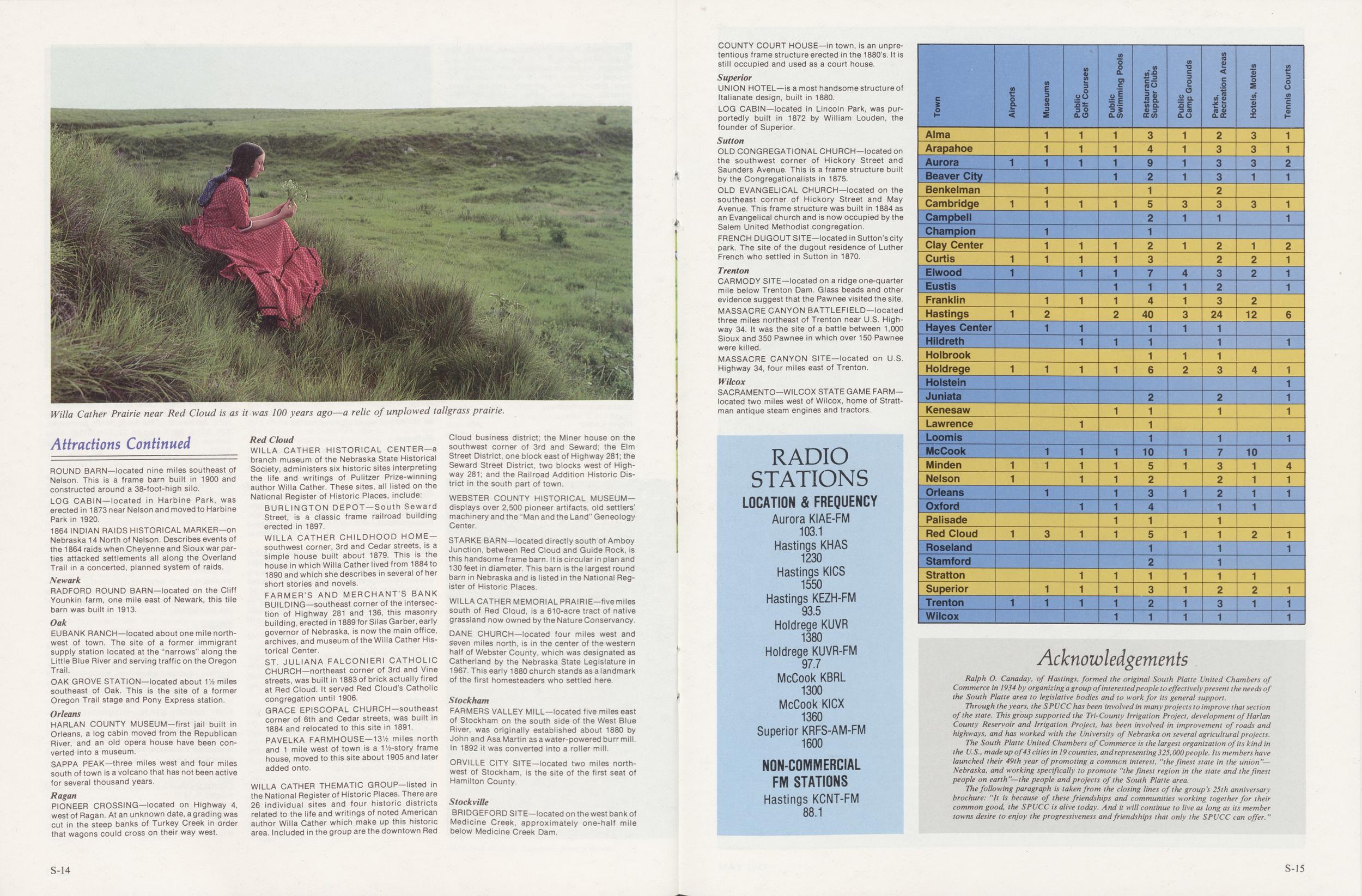
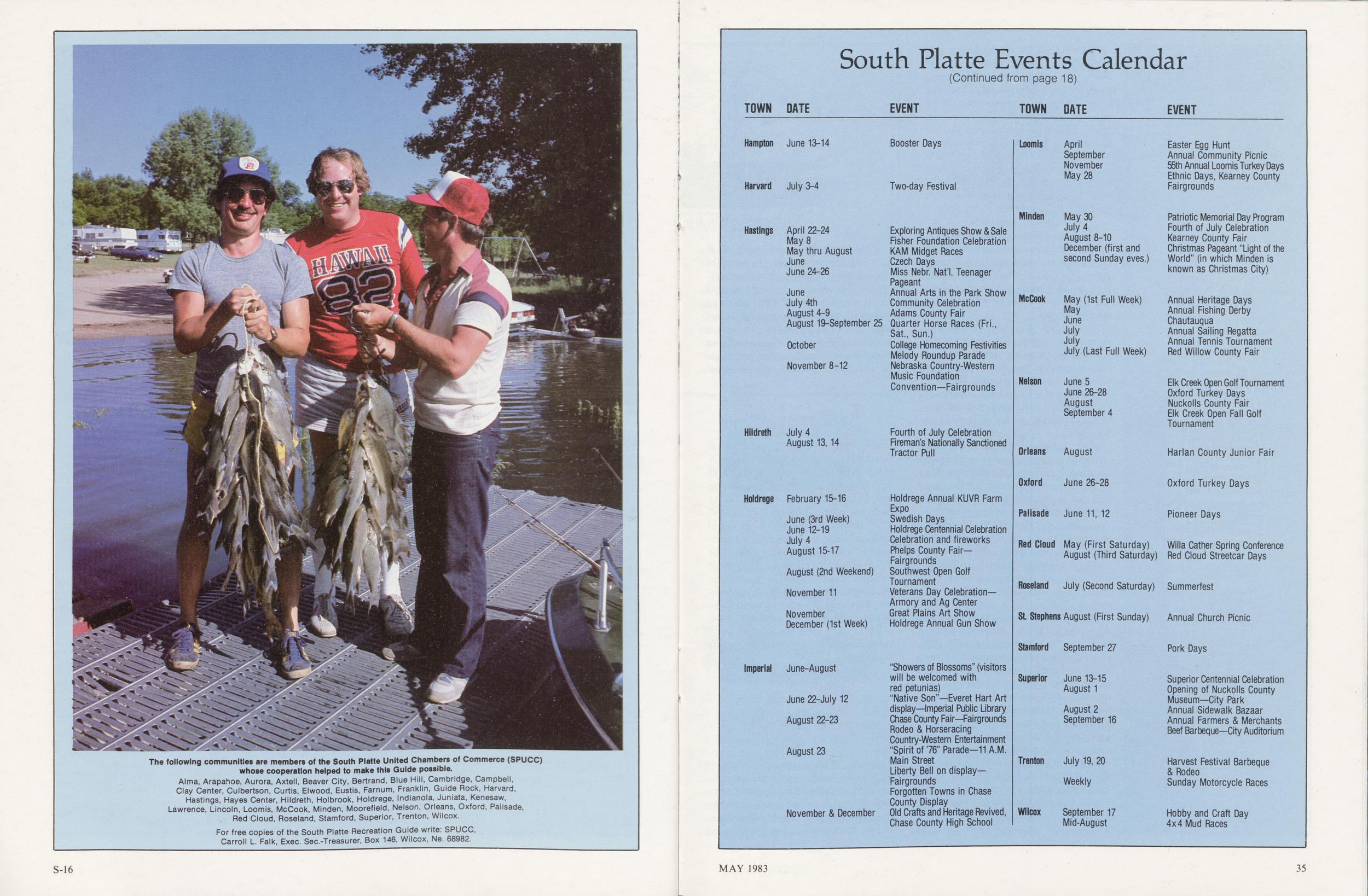
Getting Afloat . . . and staying afloat
BOATING IN NEBRASKA is a family affair; a sport that is enjoyed by thousands each year, with new enthusiasts added each season. Nebraska boasts lakes in all parts of the state that invite sailing, skiing, fishing or just cruising, plus the Missouri River which offers its own brand of "long-range" boating. Water facilities extend from the Salt Valley lakes complex in the east to Lake McConaughy in the west; and from Lewis and Clark in the northeast to a bevy of southwest reservoirs.
Nebraska's recreational boating got started on several small natural Sandhills lakes, and sandpit lakes. Victory Lake (No. 15) at the Fremont State Recreation Area is one such sandpit, and remains one of the most heavily used yet today.
Pre-World War II boating was enjoyed by very few people, partially because of economic conditions and lack of facilities, but also because technology had not progressed to the mass production era. Since then, aluminum and fiberglass hulls have made recreational boating grow by leaps and bounds.
With that growth, it became apparent that a uniform numbering and registration system was necessary, along with common-sense rules, for the control and safety of the boating public. Nebraska now has a program to educate, patrol and regulate boaters on all waters of the state. There are over 45,000 registered boats in Nebraska, in addition to many thousands of rowboats, canoes, kayaks, sailboats and inflatables which do not require registration.
While at some peak-use periods on major holidays our lakes are some-what crowded, there is generally still room for considerable growth of the sport. However, if we are to safely participate and enjoy the various water-oriented activities, everyone must be familiar with the laws by which we are governed, and learn good safety practices which will help avoid accidents and other unpleasant experiences. With this in mind, the following information is provided in the hope that it might eliminate the need for each boater to make his own mistakes, but instead, to learn from the mistakes of others.
Selecting The 'Right BoatThere are several considerations in selecting the right boat: The intended use—fishing, skiing, or just cruising-how many passengers you want to carry, and the size of the body of water you will most often frequent. For example, a 12 to 14-foot aluminum boat that you could carry on top of your car, and a small outboard motor, might be adequate if you fish only on small. protected lakes; however, it would not be safe on our larger reservoirs.
For safety, larger boats are required on larger lakes. More horsepower will be necessary if you want to carry a lot of passengers or tow skiers. Explain your needs to your local marine dealer; he can help you make the correct decision. A good used boat might also be a consideration.
EquipmentWhen you have your boat, be sure it meets legal and safety requirements. A personal flotation device (of type I, II or III) is required for each person on board. In addition to the P.F.D. for each passenger, one type IV throwable device (ring buoy or float cushion) must be on board. All passengers under age 12 must wear their P.F.D., and all flotation devices must be U.S. Coast Guard approved, in good condition, and be readily accessible. This does not mean stowed away in a locker somewhere on board. Also, a P.F.D. on a child on or near water should not be a substitute for adequate supervision.
Other equipment requirements vary with vessel length; however, generally required are a paddle or pair of oars, bailing bucket or sponge, a sounding device, and lights for night operation. Fire extinguishers are not required on outboard motorboats of less than 26 feet of open construction which do not carry passengers for hire. All vessels 26 feet and over which are not of open construction must carry the appropriate type and number of extinguishers. It is important to note that all inboards, and all outboards with closed compartments or enclosed fuel tanks, regardless of length, must carry an approved fire extinguisher.
EtiquetteCommon sense and good judgement go hand in hand with the Nebraska statutes and the rules and regulations. The golden rule of "do unto others" is seldom more important than in boating activities.
Courtesy at the ramp, whether launching or retrieving your boat, is essential. If the ramp is busy, take your turn. When you arrive at the launch area, park your vehicle out of the way. Then, unload all equipment and supplies from your vehicle and place it in your boat. Install your drain plug, release the tie-down straps and in general prepare to launch your boat. Then, when you take your turn on the ramp, all that will be required is to back down the ramp and float your boat free. Tie up or have a friend hold the line while you move your car to a parking area.
On returning to the ramp to load your boat, again, take your turn. Load your boat, then move directly to the parking area before shuffling equipment or preparing for highway travel.
While on the water, be safety conscious. Do not overload your boat. Observe the rules of navigation. Keep in mind that any vessel not operating under mechanical power, and any anchored vessel, have the right-of-way over any vessel under mechanical power. Don't operate your boat in any swimming area or close enough to shore to disturb fishermen.
As on the highways, speed is also a problem on our state's waterways. Two regulations that apparently cause some confusion are the "Five-mile-per hour" and "No-wake" zones. Some believe the two are synonymous, but this is not true. Five miles per hour means just that; no more than five miles per hour. No-wake boating varies with hull design and load. One boat will create a larger wake or swell at five miles per hour than another traveling at a much higher speed. To meet the no-wake requirement thus may mean little more than idle speed.
When towing skiers, remember that the operator of the boat is responsible for the actions of the skiers. Your skier should not spray water on other boaters or see how close he can get to someone else. Also, when your skier drops off, retrieve the tow rope immediately and store aboard your boat. Pick up fallen skiers as quickly as possible. The skier must wear a life saving device of some type when skiing. While it does not need to be of the "approved" type, there must be an approved P.F.D. on board the boat for each skier. While towing a skier, you must have a wide-angle rear-view mirror or an observer (age 12 or over) to monitor the progress of your skier.
Alcohol is involved in a large and growing number of boating accidents. It is imperative to have control of all faculties while boating. Visual acuity and coordination must not be impaired, as they are just as important while operating a boat as an automobile. Besides, you can't just "walk away" from a boating accident or a fall overboard.
In short, keep your equipment in good repair. Know the rules and regulations you will be expected to follow. Be courteous to your fellow boaters and others who use our lakes and recreation areas so that everyone will enjoy your time afloat.
To help learn and practice safe boat operation, and to know the regulations, a current boating guide is available from all Game and Parks Commission offices and 1,100 permit vendors across the state.
36 NEBRASKAland MAY 1983 37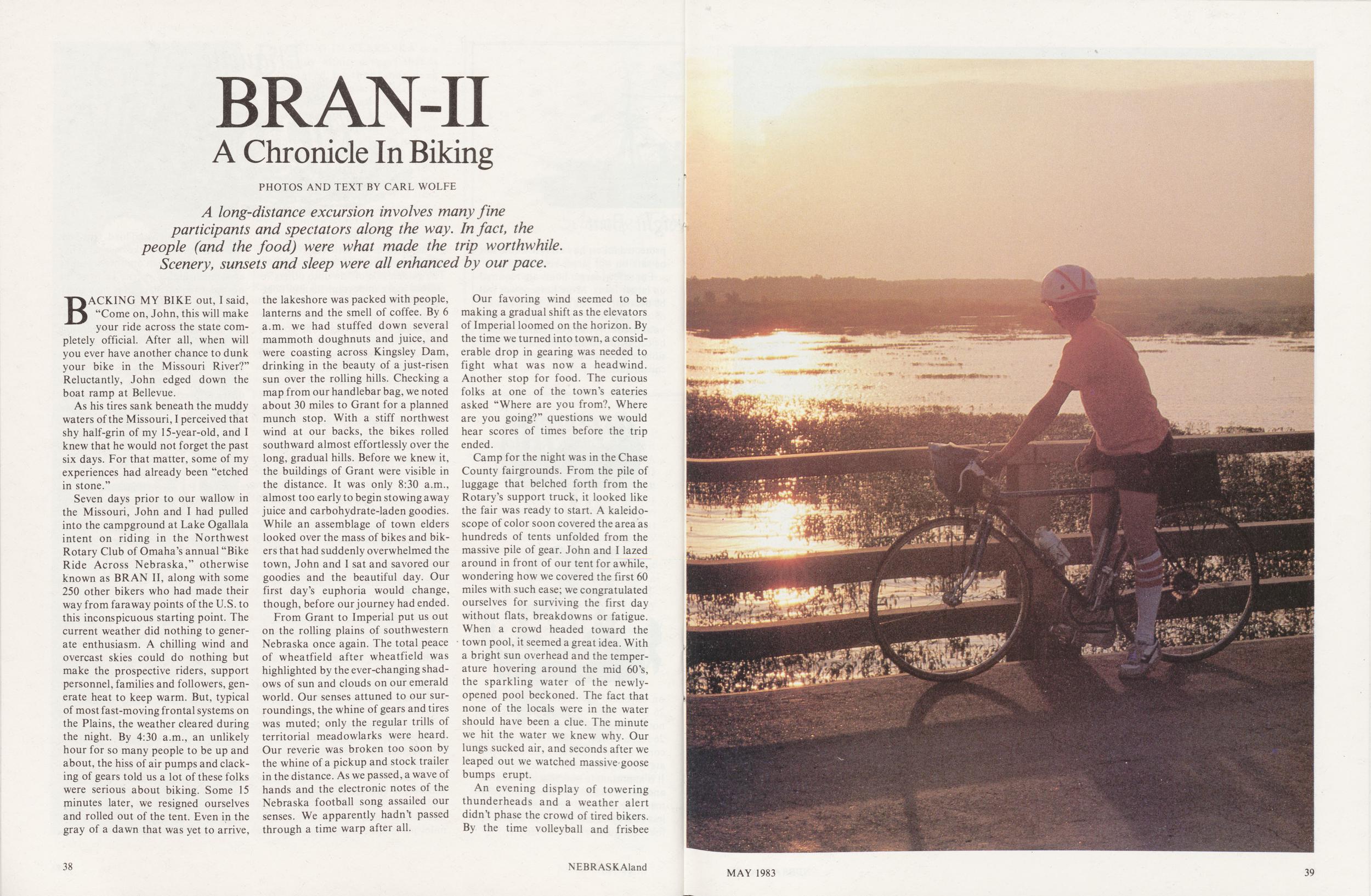
BRAN-II
A Chronicle In Biking
A long-distance excursion involves many fine participants and spectators along the way. In fact, the people (and the food) were what made the trip worthwhile. Scenery, sunsets and sleep were all enhanced by our pace.BACKING MY BIKE out, I said, "Come on, John, this will make your ride across the state completely official. After all, when will you ever have another chance to dunk your bike in the Missouri River? Reluctantly, John edged down the boat ramp at Bellevue.
As his tires sank beneath the muddy waters of the Missouri, I perceived that shy half-grin of my 15-year-old, and I knew that he would not forget the past six days. For that matter, some of my experiences had already been "etched in stone."
Seven days prior to our wallow in the Missouri, John and I had pulled into the campground at Lake Ogallala intent on riding in the Northwest Rotary Club of Omaha's annual "Bike Ride Across Nebraska," otherwise known as BRAN II, along with some 250 other bikers who had made their way from faraway points of the U.S. to this inconspicuous starting point. The current weather did nothing to generate enthusiasm. A chilling wind and overcast skies could do nothing but make the prospective riders, support personnel, families and followers, generate heat to keep warm. But, typical of most fast-moving frontal systems on the Plains, the weather cleared during the night. By 4:30 a.m., an unlikely hour for so many people to be up and about, the hiss of air pumps and clacking of gears told us a lot of these folks were serious about biking. Some 15 minutes later, we resigned ourselves and rolled out of the tent. Even in the gray of a dawn that was yet to arrive, the lakeshore was packed with people, lanterns and the smell of coffee. By 6 a.m. we had stuffed down several mammoth doughnuts and juice, and were coasting across Kingsley Dam, drinking in the beauty of a just-risen sun over the rolling hills. Checking a map from our handlebar bag, we noted about 30 miles to Grant for a planned munch stop. With a stiff northwest wind at our backs, the bikes rolled southward almost effortlessly over the long, gradual hills. Before we knew it, the buildings of Grant were visible in the distance. It was only 8:30 a.m., almost too early to begin stowing away juice and carbohydrate-laden goodies. While an assemblage of town elders looked over the mass of bikes and bikers that had suddenly overwhelmed the town, John and I sat and savored our goodies and the beautiful day. Our first day's euphoria would change, though, before our journey had ended.
From Grant to Imperial put us out on the rolling plains of southwestern Nebraska once again. The total peace of wheatfield after wheatfield was highlighted by the ever-changing shadows of sun and clouds on our emerald world. Our senses attuned to our surroundings, the whine of gears and tires was muted; only the regular trills of territorial meadowlarks were heard. Our reverie was broken too soon by the whine of a pickup and stock trailer in the distance. As we passed, a wave of hands and the electronic notes of the Nebraska football song assailed our senses. We apparently hadn't passed through a time warp after all.
Our favoring wind seemed to be making a gradual shift as the elevators of Imperial loomed on the horizon. By the time we turned into town, a considerable drop in gearing was needed to fight what was now a headwind. Another stop for food. The curious folks at one of the town's eateries asked "Where are you from?, Where are you going?" questions we would hear scores of times before the trip ended.
Camp for the night was in the Chase County fairgrounds. From the pile of luggage that belched forth from the Rotary's support truck, it looked like the fair was ready to start. A kaleidoscope of color soon covered the area as hundreds of tents unfolded from the massive pile of gear. John and I lazed around in front of our tent for awhile, wondering how we covered the first 60 miles with such ease; we congratulated ourselves for surviving the first day without flats, breakdowns or fatigue. When a crowd headed toward the town pool, it seemed a great idea. With a bright sun overhead and the temperature hovering around the mid 60's, the sparkling water of the newly-opened pool beckoned. The fact that none of the locals were in the water should have been a clue. The minute we hit the water we knew why. Our lungs sucked air, and seconds after we leaped out we watched massive-goose bumps erupt.
An evening display of towering thunderheads and a weather alert didn't phase the crowd of tired bikers. By the time volleyball and frisbee
38 NEBRASKAland MAY 1983 39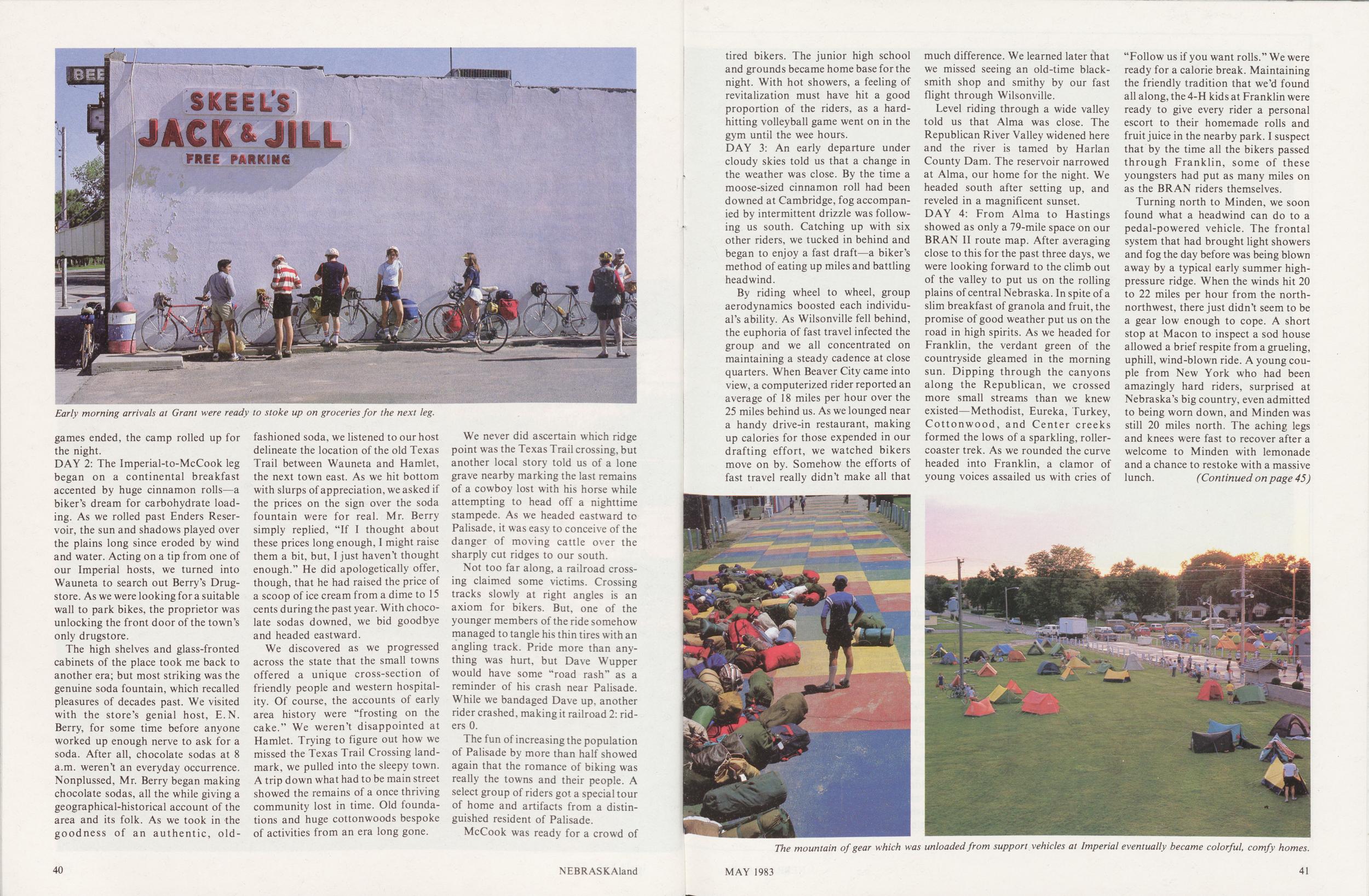
Early morning arrivals at Grant were ready to stoke up on groceries for the next leg.
games ended, the camp rolled up for the night.
DAY 2: The Imperial-to-McCook leg began on a continental breakfast accented by huge cinnamon rolls—a biker's dream for carbohydrate loading. As we rolled past Enders Reservoir, the sun and shadows played over the plains long since eroded by wind and water. Acting on a tip from one of our Imperial hosts, we turned into Wauneta to search out Berry's Drugstore. As we were looking for a suitable wall to park bikes, the proprietor was unlocking the front door of the town's only drugstore.
The high shelves and glass-fronted cabinets of the place took me back to another era; but most striking was the genuine soda fountain, which recalled pleasures of decades past. We visited with the store's genial host, E.N. Berry, for some time before anyone worked up enough nerve to ask for a soda. After all, chocolate sodas at 8 a.m. weren't an everyday occurrence. Nonplussed, Mr. Berry began making chocolate sodas, all the while giving a geographical-historical account of the area and its folk. As we took in the goodness of an authentic, old-fashioned soda, we listened to our host delineate the location of the old Texas Trail between Wauneta and Hamlet, the next town east. As we hit bottom with slurps of appreciation, we asked if the prices on the sign over the soda fountain were for real. Mr. Berry simply replied, "If I thought about these prices long enough, I might raise them a bit, but, I just haven't thought enough." He did apologetically offer, though, that he had raised the price of a scoop of ice cream from a dime to 15 cents during the past year. With chocolate sodas downed, we bid goodbye and headed eastward.
We discovered as we progressed across the state that the small towns offered a unique cross-section of friendly people and western hospitality. Of course, the accounts of early area history were "frosting on the cake." We weren't disappointed at Hamlet. Trying to figure out how we missed the Texas Trail Crossing landmark, we pulled into the sleepy town. A trip down what had to be main street showed the remains of a once thriving community lost in time. Old foundations and huge cottonwoods bespoke of activities from an era long gone.
We never did ascertain which ridge point was the Texas Trail crossing, but another local story told us of a lone grave nearby marking the last remains of a cowboy lost with his horse while attempting to head off a nighttime stampede. As we headed eastward to Palisade, it was easy to conceive of the danger of moving cattle over the sharply cut ridges to our south.
Not too far along, a railroad crossing claimed some victims. Crossing tracks slowly at right angles is an axiom for bikers. But, one of the younger members of the ride somehow managed to tangle his thin tires with an angling track. Pride more than anything was hurt, but Dave Wupper would have some "road rash" as a reminder of his crash near Palisade. While we bandaged Dave up, another rider crashed, making it railroad 2: riders 0.
The fun of increasing the population of Palisade by more than half showed again that the romance of biking was really the towns and their people. A select group of riders got a special tour of home and artifacts from a distinguished resident of Palisade.
McCook was ready for a crowd of tired bikers. The junior high school and grounds became home base for the night. With hot showers, a feeling of revitalization must have hit a good proportion of the riders, as a hard-hitting volleyball game went on in the gym until the wee hours.
DAY 3: An early departure under cloudy skies told us that a change in the weather was close. By the time a moose-sized cinnamon roll had been downed at Cambridge, fog accompanied by intermittent drizzle was following us south. Catching up with six other riders, we tucked in behind and began to enjoy a fast draft—a biker's method of eating up miles and battling headwind.
By riding wheel to wheel, group aerodynamics boosted each individual's ability. As Wilsonville fell behind, the euphoria of fast travel infected the group and we all concentrated on maintaining a steady cadence at close quarters. When Beaver City came into view, a computerized rider reported an average of 18 miles per hour over the 25 miles behind us. As we lounged near a handy drive-in restaurant, making up calories for those expended in our drafting effort, we watched bikers move on by. Somehow the efforts of fast travel really didn't make all that much difference. We learned later that we missed seeing an old-time blacksmith shop and smithy by our fast flight through Wilsonville.
Level riding through a wide valley told us that Alma was close. The Republican River Valley widened here and the river is tamed by Harlan County Dam. The reservoir narrowed at Alma, our home for the night. We headed south after setting up, and reveled in a magnificent sunset.
DAY 4: From Alma to Hastings showed as only a 79-mile space on our BRAN II route map. After averaging close to this for the past three days, we were looking forward to the climb out of the valley to put us on the rolling plains of central Nebraska. In spite of a slim breakfast of granola and fruit, the promise of good weather put us on the road in high spirits. As we headed for Franklin, the verdant green of the countryside gleamed in the morning sun. Dipping through the canyons along the Republican, we crossed more small streams than we knew existed—Methodist, Eureka, Turkey, Cottonwood, and Center creeks formed the lows of a sparkling, rollercoaster trek. As we rounded the curve headed into Franklin, a clamor of young voices assailed us with cries of "Follow us if you want rolls." We were ready for a calorie break. Maintaining the friendly tradition that we'd found all along, the 4-H kids at Franklin were ready to give every rider a personal escort to their homemade rolls and fruit juice in the nearby park. I suspect that by the time all the bikers passed through Franklin, some of these youngsters had put as many miles on as the BRAN riders themselves.
Turning north to Minden, we soon found what a headwind can do to a pedal-powered vehicle. The frontal system that had brought light showers and fog the day before was being blown away by a typical early summer high-pressure ridge. When the winds hit 20 to 22 miles per hour from the north-northwest, there just didn't seem to be a gear low enough to cope. A short stop at Macon to inspect a sod house allowed a brief respite from a grueling, uphill, wind-blown ride. A young couple from New York who had been amazingly hard riders, surprised at Nebraska's big country, even admitted to being worn down, and Minden was still 20 miles north. The aching legs and knees were fast to recover after a welcome to Minden with lemonade and a chance to restoke with a massive lunch. (Continued on page 45)
The mountain of gear which was unloaded from support vehicles at Imperial eventually became colorful, comfy homes.
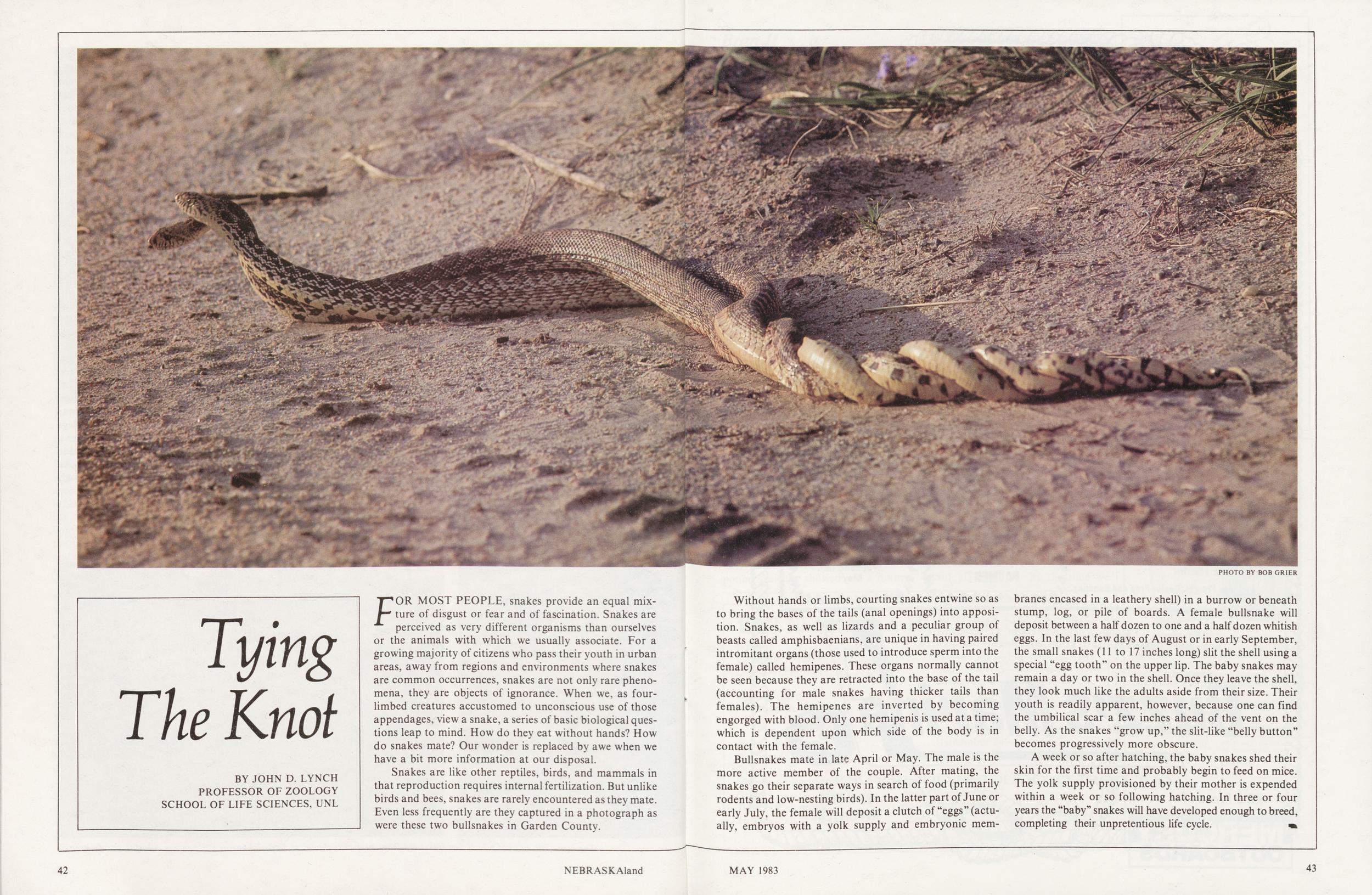
PHOTO BY BOB GRIER
Tying The Knot
FOR MOST PEOPLE, snakes provide an equal mixture of disgust or fear and of fascination. Snakes are perceived as very different organisms than ourselves or the animals with which we usually associate. For a growing majority of citizens who pass their youth in urban areas, away from regions and environments where snakes are common occurrences, snakes are not only rare phenomena, they are objects of ignorance. When we, as four-limbed creatures accustomed to unconscious use of those appendages, view a snake, a series of basic biological questions leap to mind. How do they eat without hands? How do snakes mate? Our wonder is replaced by awe when we have a bit more information at our disposal.
Snakes are like other reptiles, birds, and mammals in that reproduction requires internal fertilization. But unlike birds and bees, snakes are rarely encountered as they mate. Even less frequently are they captured in a photograph as were these two bullsnakes in Garden County.
Without hands or limbs, courting snakes entwine so as to bring the bases of the tails (anal openings) into apposition. Snakes, as well as lizards and a peculiar group of beasts called amphisbaenians, are unique in having paired intromitant organs (those used to introduce sperm into the female) called hemipenes. These organs normally cannot be seen because they are retracted into the base of the tail (accounting for male snakes having thicker tails than females). The hemipenes are inverted by becoming engorged with blood. Only one hemipenis is used at a time; which is dependent upon which side of the body is in contact with the female.
Bullsnakes mate in late April or May. The male is the more active member of the couple. After mating, the snakes go their separate ways in search of food (primarily rodents and low-nesting birds). In the latter part of June or early July, the female will deposit a clutch of "eggs "(actually, embryos with a yolk supply and embryonic mem- branes encased in a leathery shell) in a burrow or beneath stump, log, or pile of boards. A female bullsnake will deposit between a half dozen to one and a half dozen whitish eggs. In the last few days of August or in early September, the small snakes (11 to 17 inches long) slit the shell using a special egg tooth" on the upper lip. The baby snakes may remain a day or two in the shell. Once they leave the shell, they look much like the adults aside from their size. Their youth is readily apparent, however, because one can find the umbilical scar a few inches ahead of the vent on the belly. As the snakes "grow up," the slit-like "belly button" becomes progressively more obscure.
A week or so after hatching, the baby snakes shed their skin for the first time and probably begin to feed on mice. The yolk supply provisioned by their mother is expended within a week or so following hatching. In three or four years the "baby" snakes will have developed enough to breed, completing their unpretentious life cycle.
42 NEBRASKAland MAY 1983 43
Bran II... a Chronicle of Biking
(Continued from page 41)Turning east toward Hastings, the wind became an asset. The long three hours of grinding into the wind from Franklin to Minden had taken a toll of riders, however. That the day's ride had been strenuous was evidenced by the lack of frisbees whistling around the tents and the great number of late arrivals. The flat expanses of Nebraska's prairie weren't so flat after all. DAY 5: After the "killer wind" of yesterday, early risers were much fewer. John and I leisurely put away doughnuts and juice, watched a busy mother robin chase a wayward fledgling around tents, through bicycle wheels and under pannier bags, and then we groaned eastward. As the miles rolled by, we realized that a light wind and a bright day were helping our tired bodies get retuned.
Clay Center came into view and a massive breakfast was stowed away; we found ourselves flying along at a fast pace over fairly level terrain adorned with a new, green mantle of recently planted corn and winter wheat. Here and there an occasional mallard drifted down to a shallow prairie marsh, and the raucous crowing of a pheasant was heard at times.
Flying along as we were, Milligan was soon behind. We learned later that this was a highlight stopover for a number of riders. Certainly it was the only point on the trip where a 300-pound resident showed off a homebuilt bike—and even rode it backwards to the amazement of onlookers.
A series of long, rolling hills just after a snack break and we were winding our way into Wilber. The Legion Park soon blossomed the familiar multicolor display of tents, and the booming voice of Heine Dietrich went non-stop as he greeted and shook hands with every single rider. As Wilber's welcoming committee and one-man Chamber of Commerce, we figured he worked harder than we did.
Having made good time on the road allowed plenty of time to explore A convenient bakery wasn't overlooked. Homemade kolaches, fresh from the oven, and other ethnic pastries provided plenty of calories to replace those burned off in the fast run from Hastings. After loading up there, a few steps further and we were into one of the town's cafes to continue sampling good Czech cooking.
DAY 6: We delayed our usual 6:00 a.m. takeoff to make a return raid on the downtown bakery. Sitting on a curbstone of main street, we contemplated the dawn until the kolaches and juice started the leg muscles going. Climbing out of the Blue River Valley, we looked forward to an easy 56 miles for today.
The physiography was beginning to show a gradual change. Those gently rolling plains some 100 miles behind us were now punctuated by small stream courses and drainages. Small fingers of woodland intercepted the green fields; hills became more numerous. It seemed now there was another crest ahead all the time. By the time we
1983 NEBRASKA HUNTING SEASONS
Squirrel August 1--January 31, 1984 Cottontail Rabbit September 1—February 28, 1984 Deer (Archery) September 15—November 11 November 21—December 31 Deer (Firearm) November 12-20 Antelope (Archery) August 20—September 23 October 3—November 11 November 21—December 31 Antelope (Firearm) September 24—October 2 Pheasant opens November 5 Quail opens November 5 Hungarian Partridge opens November 5 Grouse opens September 17 Turkey (Fall archery) opens October 1 Turkey (Fall shotgun) opens October 22 & 29 Nebraska Game and Parks Commission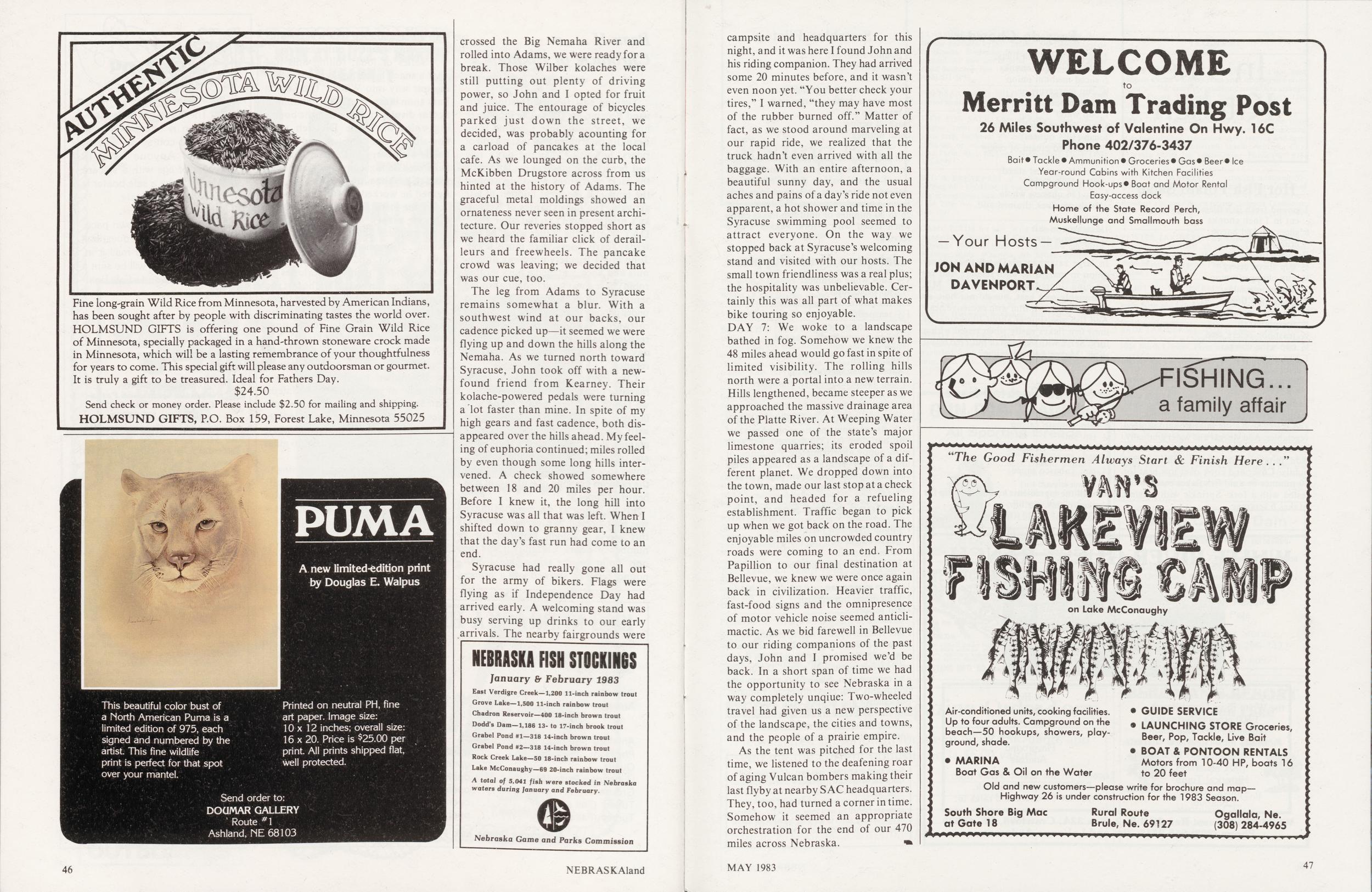
crossed the Big Nemaha River and rolled into Adams, we were ready for a break. Those Wilber kolaches were still putting out plenty of driving power, so John and I opted for fruit and juice. The entourage of bicycles parked just down the street, we decided, was probably acounting for a carload of pancakes at the local cafe. As we lounged on the curb, the McKibben Drugstore across from us hinted at the history of Adams. The graceful metal moldings showed an ornateness never seen in present architecture. Our reveries stopped short as we heard the familiar click of derailleurs and freewheels. The pancake crowd was leaving; we decided that was our cue, too.
The leg from Adams to Syracuse remains somewhat a blur. With a southwest wind at our backs, our cadence picked up—it seemed we were flying up and down the hills along the Nemaha. As we turned north toward Syracuse, John took off with a new-found friend from Kearney. Their kolache-powered pedals were turning a lot faster than mine. In spite of my high gears and fast cadence, both disappeared over the hills ahead. My feeling of euphoria continued; miles rolled by even though some long hills intervened. A check showed somewhere between 18 and 20 miles per hour. Before I knew it, the long hill into Syracuse was all that was left. When I shifted down to granny gear, I knew that the day's fast run had come to an end.
Syracuse had really gone all out for the army of bikers. Flags were flying as if Independence Day had arrived early. A welcoming stand was busy serving up drinks to our early arrivals. The nearby fairgrounds were 46 NEBRASKAland campsite and headquarters for this night, and it was here I found John and his riding companion. They had arrived some 20 minutes before, and it wasn't even noon yet. "You better check your tires," I warned, "they may have most of the rubber burned off." Matter of fact, as we stood around marveling at our rapid ride, we realized that the truck hadn't even arrived with all the baggage. With an entire afternoon, a beautiful sunny day, and the usual aches and pains of a day's ride not even apparent, a hot shower and time in the Syracuse swimming pool seemed to attract everyone. On the way we stopped back at Syracuse's welcoming stand and visited with our hosts. The small town friendliness was a real plus; the hospitality was unbelievable. Certainly this was all part of what makes bike touring so enjoyable.
DAY 7: We woke to a landscape bathed in fog. Somehow we knew the 48 miles ahead would go fast in spite of limited visibility. The rolling hills north were a portal into a new terrain. Hills lengthened, became steeper as we approached the massive drainage area of the Platte River. At Weeping Water we passed one of the state's major limestone quarries; its eroded spoil piles appeared as a landscape of a different planet. We dropped down into the town, made our last stop at a check point, and headed for a refueling establishment. Traffic began to pick up when we got back on the road. The enjoyable miles on uncrowded country roads were coming to an end. From Papillion to our final destination at Bellevue, we knew we were once again back in civilization. Heavier traffic, fast-food signs and the omnipresence of motor vehicle noise seemed anticlimactic. As we bid farewell in Bellevue to our riding companions of the past days, John and I promised we'd be back. In a short span of time we had the opportunity to see Nebraska in a way completely unqiue: Two-wheeled travel had given us a new perspective of the landscape, the cities and towns, and the people of a prairie empire.
As the tent was pitched for the last time, we listened to the deafening roar of aging Vulcan bombers making their last flyby at nearby SAC headquarters. They, too, had turned a corner in time. Somehow it seemed an appropriate orchestration for the end of our 470 miles across Nebraska.
"The Good Fishermen Always Start & Finish Here " on Lake McConaughy Air-conditioned units, cooking facilities. Up to four adults. Campground on the beach—50 hookups, showers, playground, shade. MARINA Boat Gas & Oil on the Water Old and new customers—please write for brochure and map-Highway 26 is under construction for the 1983 Season. South Shore Big Mac Rural Route Ogallala, Ne. at Gate 18 Brule, Ne. 69127 (308) 284-4965 GUIDE SERVICE LAUNCHING STORE Groceries, Beer, Pop, Tackle, Live Bait BOAT & PONTOON RENTALS Motors from 10-40 HP, boats 16 to 20 feet
In The Kitchen
Hot Fish Potato Salad 1 pound fresh fish filets, cut in 1 inch chunks 6 slices cooked bacon, crumbled Reserved bacon fat 1/2 cup sliced celery 1/2 cup chopped onion 3 tablespoons sugar 1 tablespoon flour 1/2 teaspoon paprika 1/4 teaspoon salt 1/4 teaspoon celery seed 1/2 cup wine vinegar 1 cup water 3 cups sliced cooked potatoes Chopped parsleySauté celery and onion in bacon fat until tender. Combine sugar, flour, paprika, salt and celery seed. Stir mixture into sauteed vegetables. Add vinegar and water gradually. Cook until thickened, stirring constantly. Add potatoes, bacon and fish and mix lightly. Cover and cook over low heat for 10 minutes or until fish flakes easily when tested with a fork. Sprinkle with parsley. Makes 6 servings.
Easy-do Chowder 2 pounds fresh fish filets, cut in 1 1/2 inch chunks 1 sliced medium onion 1/4 cup margarine or cooking oil 1 cup water 1 cup half-and-half cream 1 can (10 1/2 ounces) condensed cream of celery soup 1 can (16 ounces) sliced carrots, drained 1 can (16 ounces) whole Irish potatoes, drained and cubed 1 1/2 teaspoon salt 1/2 teaspoon dill weedIn large saucepan or Dutch oven, saute onion in margarine until tender. Add remaining ingredients except fish. Mix thoroughly and heat, but do not boil, as cream will form a film with excessive heat. Add fish and simmer about 10 minutes or until fish flakes easily when tested with a fork. Serve with sea toast or buttered bread slices. Makes 4 to 6 servings.
Classic Cocktail Sauce 2 tsp. fresh prepared horseradish 3 tbsp. tomato catsup 1/2 tsp. salt 2 tbsp. white vinegar 4 tbsp. lemon juice 1/4 tsp. Tabasco sauce Mix all the ingredients and use as a dip for oysters, clams, shrimp, or scallops. Sunshine Filets 2 pounds fresh fish filets 3 tablespoons oil or melted fat 2 tablespoons fresh orange juice 2 teaspoons grated orange rind 1 teaspoon salt Dash of pepper Dash nutmegCut filets into serving-size portions. Place portions in a single layer, skin side down, in a well-greased baking dish. Combine remaining ingredients and pour over fish. Bake in a moderate oven, 350 degrees, for 25 to 30 minutes or until fish flakes easily when tested with a fork. Makes 4 to 6 servings.
Jalapeno Hush Puppies 1 1/2 cups white cornmeal 1/2 cup sifted flour 2 1/2 teaspoons baking powder 1 1/2 teaspoons salt 1/2 teaspoon pepper 1/3 cup onion, finely chopped 1 cup milk 1 egg, beaten 3 tablespoons vegetable oil 1/4 cup Jalapeno peppers, choppedCombine dry ingredients. Add remaining ingredients and stir until blended. Using a fork, drop heaping portions of the mixture into hot, deep fat (350 degrees). Fry each hush puppy approximately 3 minutes, or until golden brown. Turn once during cooking. Drain on absorbent paper. Makes approximately 30 hush puppies.
Seafood Salad Sandwich 1 pound fresh fish filets 1 quart water 1 tablespoon salt 3 hard-boiled eggs, chopped 3/4 cup olives, chopped 1/3 cup mayonnaise or salad dressing 1 tablespoon horseradish Dash pepperPlace filets in a pan of salted, boiling water. Cover and return to a boil. Reduce heat and simmer for 10 minutes, or until fish flakes easily when tested with a fork. Drain filets and remove skin. Flake filets and combine thoroughly with eggs, olives, mayonnaise, horseradish and pepper. Add salt to taste and chill. Use mixture as a sandwich spread or serve on lettuce leaves as a salad. Makes approximately 6 sandwiches.
Since food is an important part of everyone's life, space will be devoted to recipes whenever possible. Readers who have an old favorite or who have come up with new, tasty ways to serve wild fish, fowl or game are invited to send their recipes for inclusion in this section. Send to Recipes, NEBRASKAland Magazine, Box 30370, Lincoln, NE 68503.
WHITE RIVER GUEST RANCH
Enjoy a "working" ranch vacation at the White River Guest Ranch. 1,500 acres in Nebraska's fabulous Pine Ridge country. Activities for all ages and interests. Camping Cabins Historical Tours Rock Tours Cookouts Trail Rides Pack Trips Fishing Wagon Rides Playground Animals Located on the scenic White River near Fort Robinson State Park. Write for brochure and rates to: White River Guest Ranch, R.R. 2, Box 32A, Crawford, NE. 69339 Phone (308) 665-2515, Jim and LaVonne AndersonTrading Post
DOGSTRAINING ALL BREEDS Hunting dogs—Vizslas for sale. Rozanek Kennels, Rt. 2, Schuyler, NE 68661. Phone (402) 352-8769.
WEIMARANER (Gray Ghost) AKC puppies for sale. Excellent hunting background. Good with children. Lincoln, Nebraska. Phone (402) 467-2848.
FOUR LITTLE GIRL AKC Registered Yorkshire terriers, England's favorite. (Their mother consistently 7 litter.) Each is black-blond, silver and red—will be silver, red and gold. Downy, silken fur noted for non-shedding. Shots. Tails docked. 8 months old and house trained. $200. 1515 Boyce, Hastings, NE 68901. Phone (402) 463-3907.
GERMAN SHORTHAIRS—English pointers and setters. Stud service, puppies and started dogs available. Also Diamond Dog Food. Wayne Clark, Box 54, Union, NE. (402) 263-3495 or 263-3155.
MISCELLANEOUSGUNS—Browning, Winchester, Remington, others, Hi-powers, shotguns, new, used, antiques. Want Pre-1964 Winchesters. Buy-Sell-Trade. Ph. (402) 729-6112. Bedlan's Sporting Goods, Fairbury, NE 68352.
PAINTINGS of your favorite spot: homestead, farm, the old fishing hole, vacation homes. Preserve your memories. Large watercolor, $400, oil $700. Satisfaction guaranteed. K.S. Farris, 1898 Phelps, Fremont, NE 68025. (402) 721-2528.
N.E. NEBRASKA TROUT Fishing. For rent Mon. Thurs. or Fri.-Sun. 2 modern cottages completely furnished. 5 spring-fed lakes with trout up to 7 lbs. Bass and bluegill also. Diamond E Trout Resort, Orchard, NE 68764. (402) 893-4741
PLASTIC DECOYS: We're originator of famous do-it-yourself system. Catalog $1.00. Decoys Unlimited, Box 69, Clinton, IA 52732.
WINE AND BEER: Make your own. Send for free recipes and instructions. Omaha Supply, 13616 Polk, Omaha, Nebr. 68137.
CLASSIC GROUSE books: Grouse Feathers, More Grouse Feathers, by Bert Spiller. The Gallant Grouse by Heacox, Timberdoodle by Woolner. $13.50 each, prepaid. All now out of print. Supply limited. Highwood Bookshop, Box 1246, Traverse City, Mich. 49684. (616) 271-3898.
PHEASANT AND WILD turkey eggs, chicks and started birds. Husker Game Farm. Phone (402) 298-8215.
FISH FOR SALE. Channel catfish, bass, bluegill, crappie, trout, perch, white bass, minnows, hybrid grass carp, bullhead. We can ship fish, you can pick them up, or we deliver. Contact the Pleasant Valley Fish Farm, Rt. 1, McCook, Nebr. 69001. Phone (308) 345-6599.
BED & BREAKFAST of Nebraska offers overnite lodging with breakfast, in homes throughout the state. For reservations contact Bed & Breakfast of Nebraska, 1464 28th Ave., Columbus, NE 68601. Phone (402) 564-7591.
GAME BIRDS for sale. Wild turkeys, wood ducks, mandarins, mallards, teal, Canada geese, pheasants—5 breeds chukkar quail. Many others not listed. Frontier Birds, Wauneta, NE 69045. Phone: day (308) 394-5577/evening (308) 394-5715.
TAXIDERMYDEER HUNTER'S book special! The Modem Deer Hunter by John Cartier, published at $10.95, and Hunting Trophy Deer by John Wooters, published at $13.95. A total $24.90 value, now only $12.95 prepaid. Highwood Bookshop, Box 1246-N, Traverse City, Michigan. 49685. Phone (616) 271-3898.
DECOY CARVERS, decoy collectors, duck hunters—we carry all books on these subjects. New books as published. Send SASE for large list. Highwood Bookshop, Box 1246, Traverse City, Mich. 49684. (616) 271-3898.
GUN DOG TRAINING All Sporting Breeds Each dog trained on both native game and pen-reared birds. Ducks for retrievers. All dogs worked individually. Field Champion-sired labrador pups for sale. " Midwest's finest facilities. WILDERNESS KENNELS Henry Sader-Roca, Nb. (402) 423-4212 68430
CATCH ALL-PURPOSE TRAPS Write for FREE CATALOG Traps without injury squirrels, chipmunks, rabbits, mink, fox, raccoons, stray animals, pests, etc. Sizes for every need. Also traps for snakes, sparrows, pigeons, crabs, turtles, quail, etc. Save on our low factory prices. Send no money. Free catalog and trapping secrets. MUSTANG MFG. CO., Dept. N 34, Box 10880, Houston, Tex. 77018
Please start a subscription for me to NEBRASKAland, and send me the current bonus issue (a $6.00 value). One-year $7.50 NAME ADDRESS Two-year $13 CITY Three-year $19 STATE ZIP Mail to: NEBRASKAland Box 30370, Lincoln, NE 68503
AWARD-WINNING TAXIDERMIST. Eight time national award winners. Trust your trophies to a proven winner. Our complete taxidermy service also arranges hunts. Dinges Taxidermy Studio, 2763 South 12th Omaha, NE 68108. Ph. 402-342-3718.
CREATIVE TAXIDERMY in all its branches since 1935, now includes Northstar Freeze-Dry processing of approved small specimens. Also tanning and deerskin processing. Naturecraft Studio. Nebraska City, Nebraska 68510. Joe Voges-Owner. Phone (402) 873-5491.
JOHNSON TAXIDERMY—servicing southwest Nebraska, specializing in big-game mounts, lifesized mounts, rug work, fish, birds, tanning hair-on leather. Brochure and price list on request. Johnson Taxidermy, Rt. 1, Box 78, Lamar, NE 69035. Telephone (308) 882-5555.
PEISTER TAXIDERMY—a name you can trust. We give you professional life-like work at prices most sportsmen can afford. Member National Taxidermist Association, #5 Regency Place, Kearney, Nebr. 68847. Phone (308) 237-7575.
NABITY'S TAXIDERMY. 31 years experience. Specializing in natural grass backgrounds for mammals, birds and fish. 13901 "O St., Lincoln, NE 68505 (4 miles east of 84th and "O". (402) 489-6351.
BADE TAXIDERMY—Quality a must—Fast service. Fish, birds, rugs, tanning, full mounts and game heads. 1924 North Lincoln, Fremont, Nebraska. 727-5463.
BIG BEAR TAXIDERMY, Rt. 2, Mitchell, Nebraska 69357. We specialize in all big game from Alaska to Nebraska, also birds and fish. Hair on and hair off tanning, 4 1/2 miles west of Scottsbluff on Highway 26. Phone (308) 635-3013.
KARL SCHWARZ Master Taxidermist. Mounting of game heads—birds—fish—animals—fur rugs—robes—tanning buckskin. Since 1910. 424 South 13th Street, Dept. A, Omaha, Nebraska 68102.
FREEZE-DRY TAXIDERMY Wally Allison's State Record Taxidermy, 2709 Birchwood, North Platte, NE 69101. Phone: (308) 534-2324. Specializing in Fish and Small Game, Snake and Lizard and Novelties. (Nothing too small) Newest of all taxidermy methods employed.
Harlan County Dam Vacation Apartments fully furnished Color TV Kitchen Facilities Full Baths Game cleaning room with freezer One block from shopping center Weekend or week of pleasant living Security Deposit Required Sorry No Pets Dean and Esther Stone Box 145 Ph. (308) 799-3422 Republican City, NE 68971
BERGMAN'S RESORT On Johnson Lake Modern Lakefront Cabins Groceries Bait Tackle Full RV Hookups Boats for Rent Swim Fish Golf Write or Call: RR 2, Elwood, NE 68937 (308) 785-2298
48 NEBRASKAland MAY 1983 49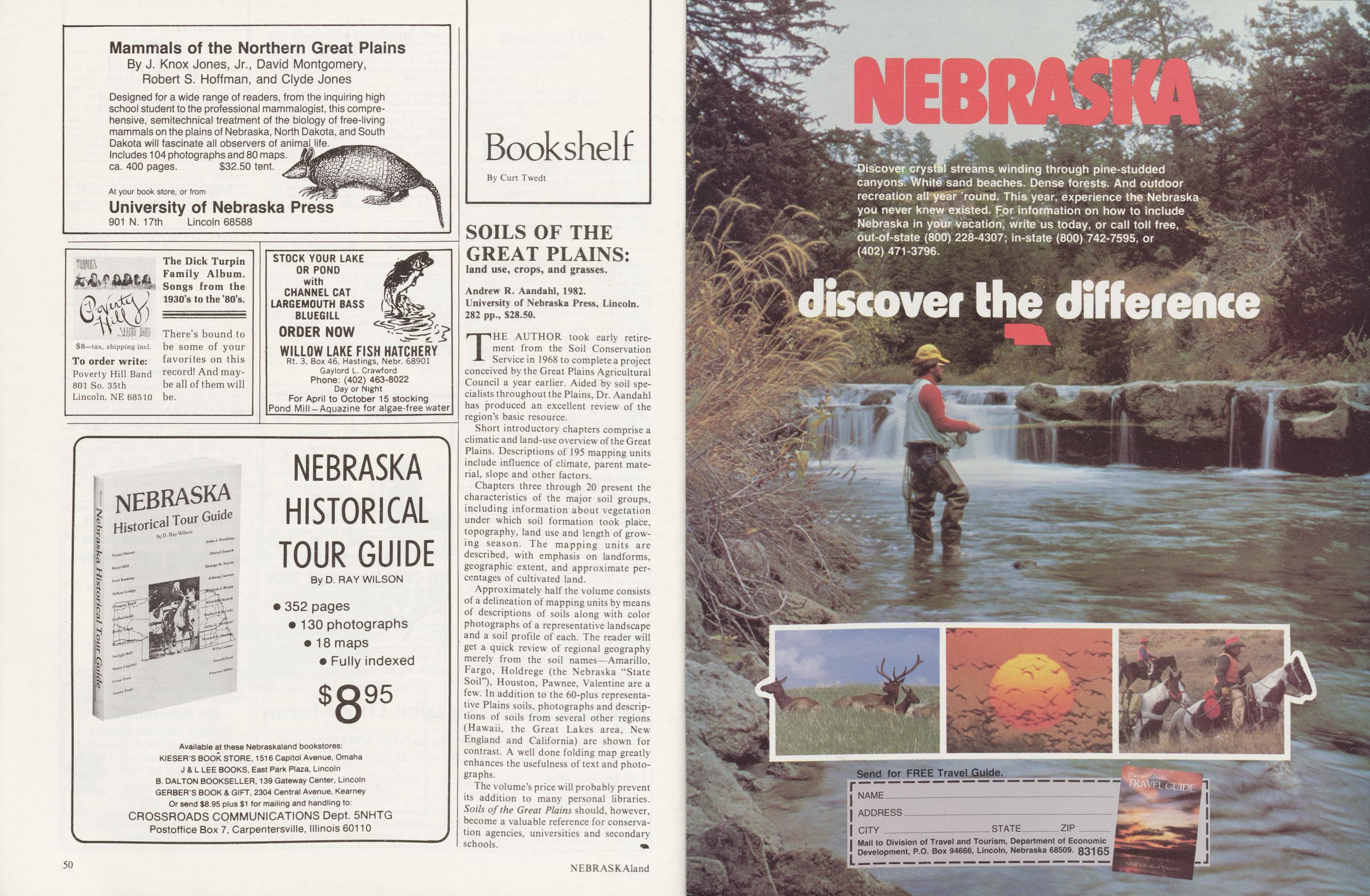
Mammals of the Northern Great Plains By J. Knox Jones, Jr., David Montgomery, Robert S. Hoffman, and Clyde Jones Designed for a wide range of readers, from the inquiring high school student to the professional mammalogist, this comprehensive, semitechnical treatment of the biology of free-living mammals on the plains of Nebraska, North Dakota, and South Dakota will fascinate all observers of animal.life. Includes 104 photographs and 80 maps, ca. 400 pages. $32.50 tent. At your book store, or from University of Nebraska Press 901 N. 17th Lincoln 68588
$8—tax, shipping incl. To order write: Poverty Hill Band 801 So. 35th Lincoln, NE 68510 The Dick Turpin Family Album. Songs from the 1930's to the 80s. There's bound to be some of your favorites on this record! And maybe all of them will be. STOCK YOUR LAKE OR POND with CHANNEL CAT LARGEM0UTH BASS BLUEGILL ORDER NOW WILLOW LAKE FISH HATCHERY Rt. 3, Box 46, Hastings, Nebr. 68901 Gaylord L. Crawford Phone: (402) 463-8022 Day or Night For April to October 15 stocking Pond Mill-Aquazine for algae-free waterNEBRASKA Historical Tour Guide NEBRASKA HISTORICAL TOUR GUIDE By D.RAY WILSON 352 pages 130 photographs 18 maps Fully indexed Available at these Nebraskaland bookstores: KIESERS BOOK STORE, 1516 Capitol Avenue, Omaha J & L LEE BOOKS, East Park Plaza, Lincoln B. DALTON BOOKSELLER, 139 Gateway Center, Lincoln GERBERS BOOK & GIFT, 2304 Central Avenue, Kearney Or send $8.95 plus $1 for mailing and handling to: CROSSROADS COMMUNICATIONS Dept. 5NHTG Postoffice Box 7, Carpentersville, Illinois 60110
Bookshelf
SOILS OF THE GREAT PLAINS: land use, crops, and grasses.
Andrew R. Aandahl, 1982. University of Nebraska Press, Lincoln. 282 pp., $28.50.THE AUTHOR took early retirement from the Soil Conservation Service in 1968 to complete a project conceived by the Great Plains Agricultural Council a year earlier. Aided by soil specialists throughout the Plains, Dr. Aandahl has produced an excellent review of the region's basic resource.
Short introductory chapters comprise a climatic and land-use overview of the Great Plains. Descriptions of 195 mapping units include influence of climate, parent material, slope and other factors.
Chapters three through 20 present the characteristics of the major soil groups, including information about vegetation under which soil formation took place, topography, land use and length of growing season. The mapping units are described, with emphasis on landforms, geographic extent, and approximate percentages of cultivated land.
Approximately half the volume consists of a delineation of mapping units by means of descriptions of soils along with color photographs of a representative landscape and a soil profile of each. The reader will get a quick review of regional geography merely from the soil names—Amarillo, Fargo, Holdrege (the Nebraska "State Soil"), Houston, Pawnee, Valentine are a few. In addition to the 60-plus representative Plains soils, photographs and descriptions of soils from several other regions (Hawaii, the Great Lakes area, New England and California) are shown for contrast. A well done folding map greatly enhances the usefulness of text and photographs.
The volume's price will probably prevent its addition to many personal libraries. Soils of the Great Plains should, however, become a valuable reference for conservation agencies, universities and secondary schools.
50 NEBRASKAlandNebraska
Discover crystal streams winding through pine-studded canyons. White sand beaches. Dense forests. And outdoor recreation all year round. This year, experience the Nebraska you never knew existed. For information on how to include Nebraska in your vacation, write us today, or call toll free, out-of-state (800) 228-4307; in-state (800) 742-7595, or (402)471-3796. discover the difference Send for FREE Travel Guide. NAME ADDRESS STATE CITY Mail to Division of Travel and Tourism, Department of Economic Development, P.O. Box 94666, Lincoln, Nebraska 68509. 83165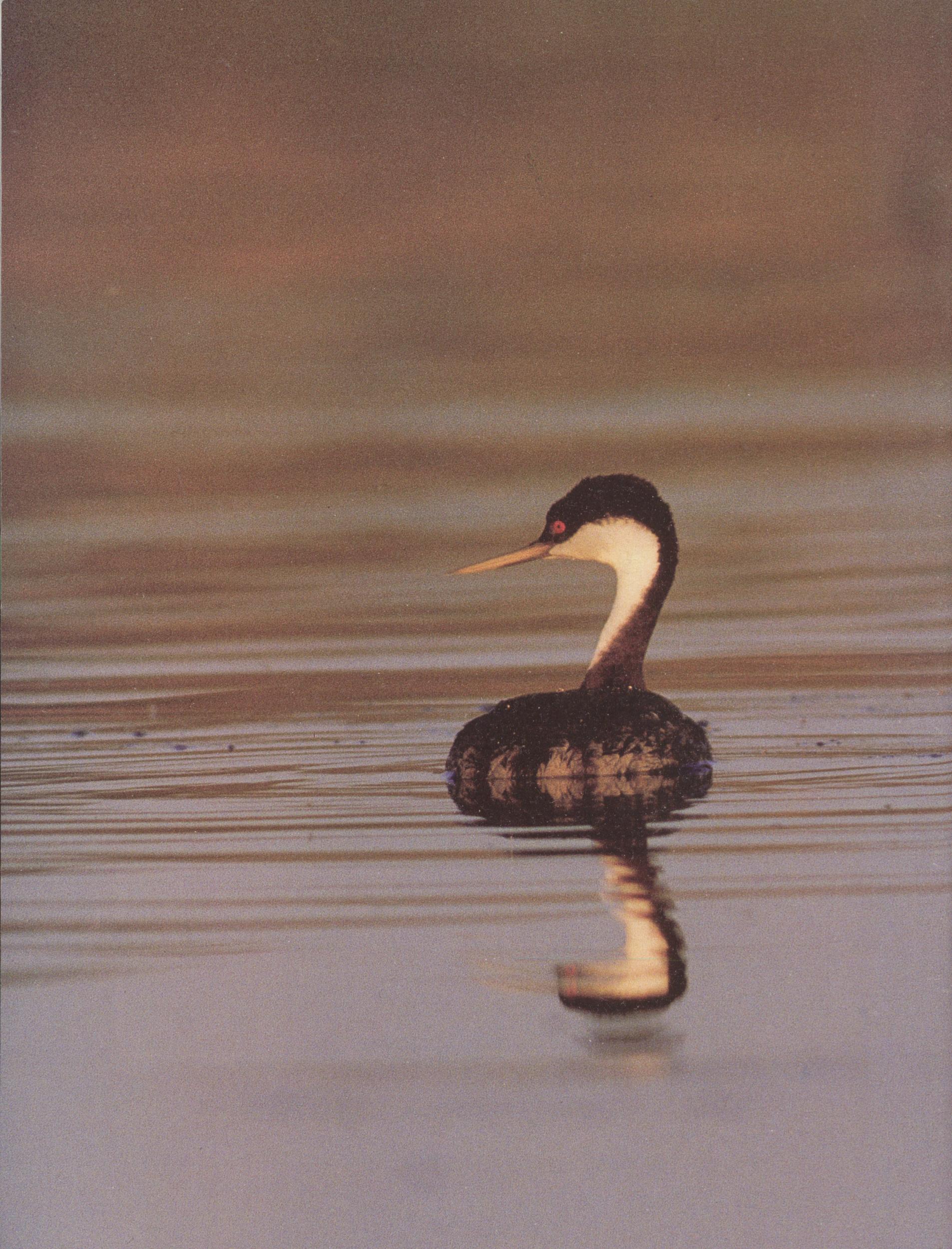
Position: 223 (34 views)