Volume 61, Issue 3, 1983
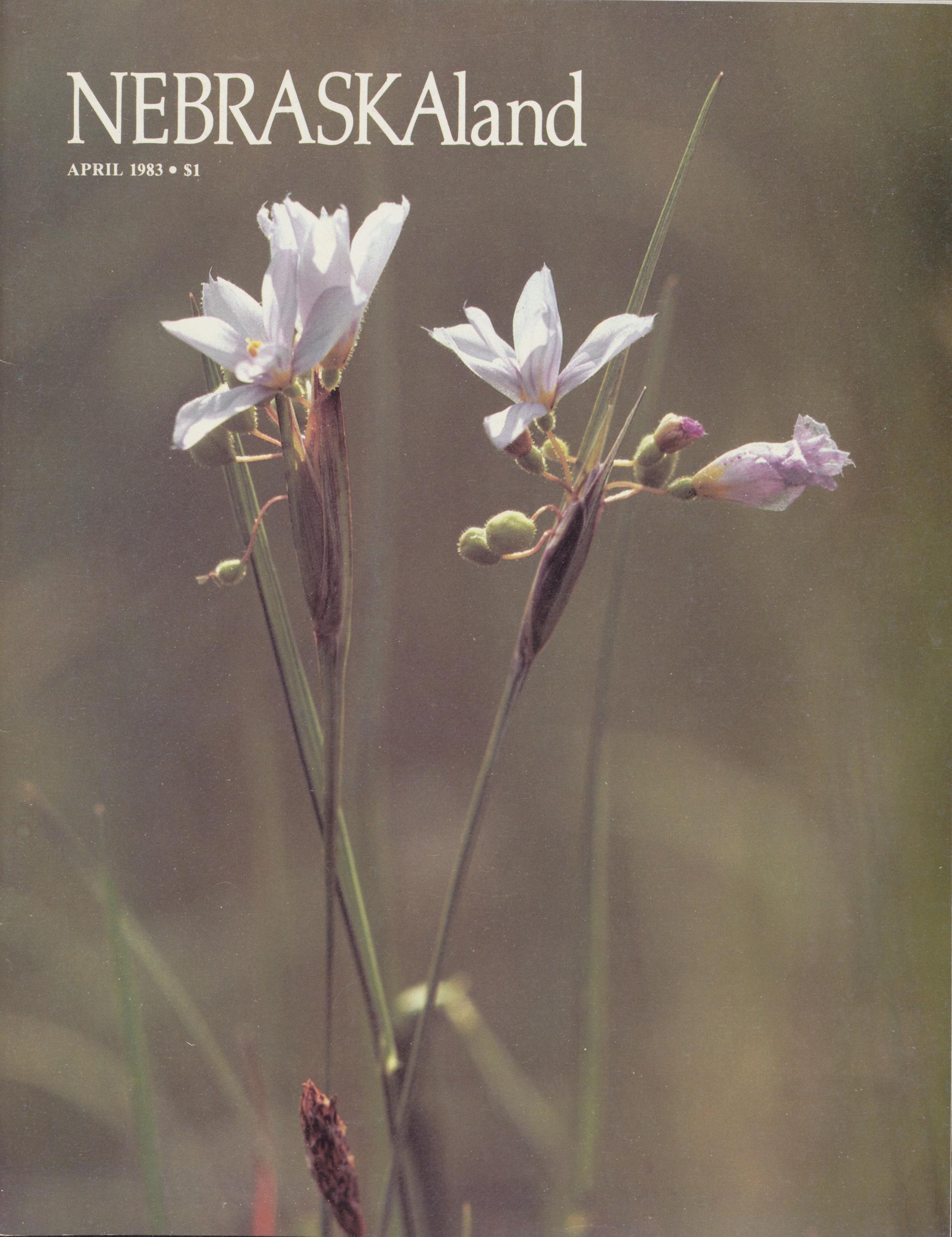
NEBRASKAland
APRIL 1983 $1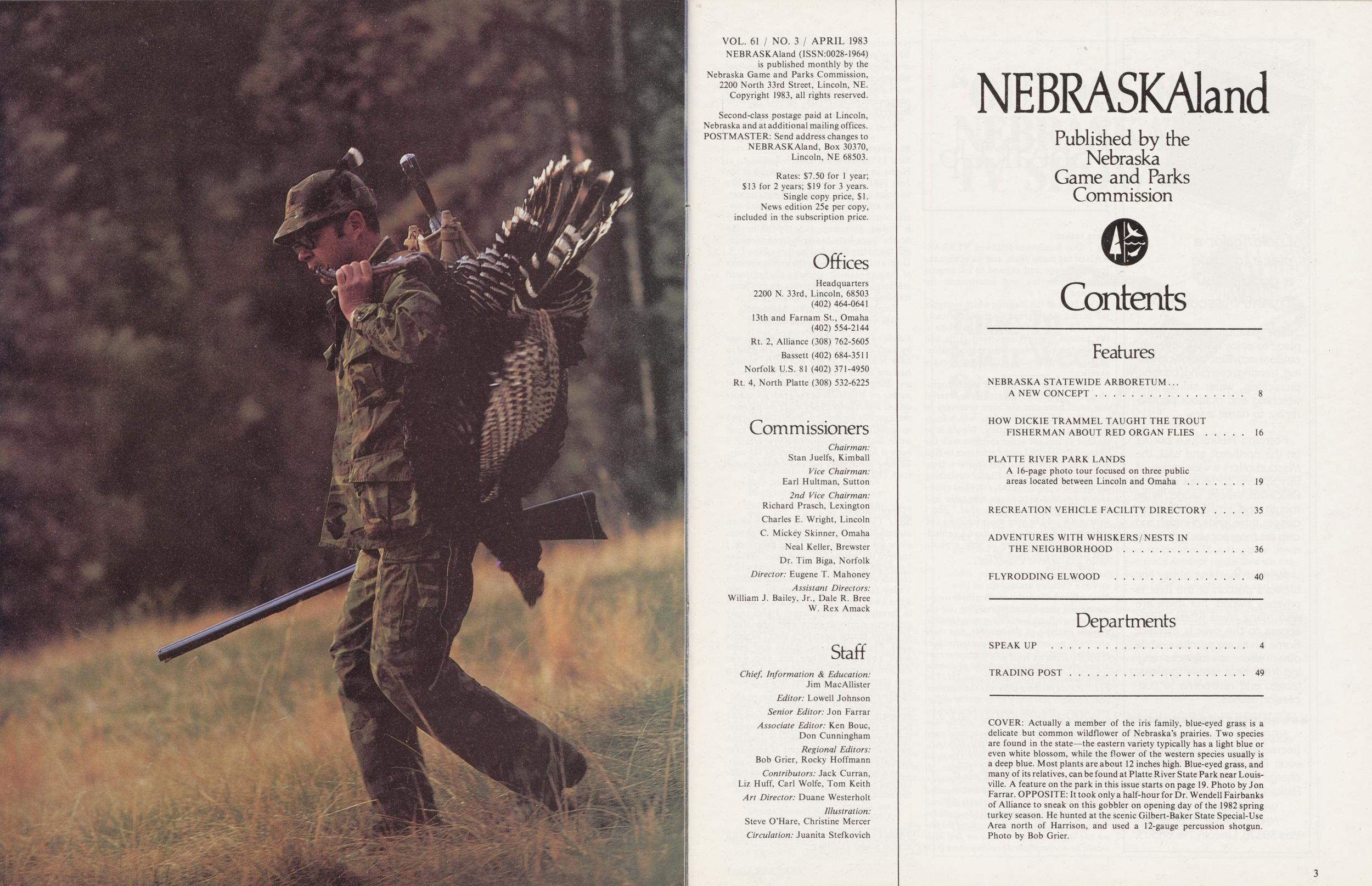
NEBRASKAland
VOL. 61 / NO. 3 / APRIL 1983 NEBRASKAland (ISSN:0028-1964) is published monthly by the Nebraska Game and Parks Commission, 2200 North 33rd Street, Lincoln, NE. Copyright 1983, all rights reserved. Second-class postage paid at Lincoln, Nebraska and at additional mailing offices. POSTMASTER: Send address changes to NEBRASKAland, Box 30370, Lincoln, NE 68503. Rates: $7.50 for 1 year; $13 for 2 years; $19 for 3 years. Single copy price, $1. News edition 25c per copy, included in the subscription price. Offiices Headquarters 2200 N. 33rd, Lincoln, 68503 (402) 464-0641 13th and Farnam St., Omaha (402) 554-2144 Rt. 2, Alliance (308) 762-5605 Bassett(402) 684-3511 Norfolk U.S. 81 (402) 371-4950 Rt. 4, North Platte (308) 532-6225 Commissioners Chairman: Stan Juelfs, Kimball Vice Chairman: Earl Hultman, Sutton 2nd Vice Chairman: Richard Prasch, Lexington Charles E. Wright, Lincoln C. Mickey Skinner, Omaha Neal Keller, Brewster Dr. Tim Biga, Norfolk Director: Eugene T. Mahoney Assistant Directors: William J. Bailey, Jr., Dale R. Bree W. Rex Amack Staff Chief, Information & Education: Jim MacAllister Editor: Lowell Johnson Senior Editor: Jon Farrar Associate Editor: Ken Bouc, Don Cunningham Regional Editors: Bob Grier, Rocky Hoffmann Contributors: Jack Curran, Liz Huff, Carl Wolfe, Tom Keith Art Director: Duane Westerholt Illustration: Steve O'Hare, Christine Mercer Circulation: Juanita Stefkovich Published by the Nebraska Game and Parks Commission
Speak Up
Looking for a place to have a good time? Try the Missouri River! The Missouri River is a great place to enjoy a wide variety of outdoor activities, including fishing, hunting, camping, boating, picnicking, water skiing, bird watching and outdoor photography, to name a few. Forming Nebraska's border on the northeast and east, the Missouri offers a wide variety of fish species to tempt anglers. Paddlefish, walleye, sauger, large-mouth and smallmouth bass, crappie, three kinds of catfish and carp are most popular with fishermen. Most of the land along Nebraska's portion of the river is privately owned, but there are also many areas where public access to the river is allowed. Some areas are primitive, while others offer conveniences ranging from boat ramps to picnic tables, and restrooms to concession stands. NEBRASKAland Magazine's Recreation Guide to the Missouri River is available free of charge from the Game and Parks Commission. Write NEBRASKAland Missouri River Special, Box 30370, Lincoln, Ne. 68503. Data seekerSir / Our family has followed NEBRASKAland for many years, and we've seen the format change and expand to encompass invaluable history and information for everyone.
One facet of the magzine which intrigues me is the photography—from the early days of blurry, grainy, black and white to the present pictures involving skills and knowledge of color, telephotos, wide-angles, macro closeups, etc. The photos are excellent.
Many novices in the field of photography, like myself, are aware of the interest one must have and the time necessary in order to achieve these results, which leads me to the following inquiry. Would it be feasible to include some specifics with the photos? Primarily I make reference to film type, lens, shutter speed and aperture. How about a feature on Jon Farrar describing techniques, equipment etc. Everyone enjoys opening a book or magazine and saying, "Hey, that's a super shot," and I believe it would be even more fulfilling and meaningful if people could have a behind-the-scene understanding of how a photo gets from field to front page.
Jack Bosen Omaha, Nebr.Your letter is similar to many others we get during the year (except for saying our old photos were fuzzy), and we run one once in a while because of the number, but there are really no secrets or unusual techniques involved, and when our photographers are asked about data, they usually say something like: "Just tell them it was 1/125 at Fll." We do nothing different than anyone else, perhaps just more of it, and at different times. We use mostly Ektachrome because we process our own; a little Kodachrome for "special"projects, and standard equipment—mostly Hasselblads, some Mamiya (645 s) and more 35mm all the time—Nikon, Cannon, Pentax. It would do little good to give exposures, except to say they are what was demanded at the time. It would be extremely difficult to keep track of the thousands of exposures we make each year for the benefit of the few we use in the magazine, and we feel little would be accomplished printing them if we remembered. We just use meters when we have to and shoot what they say. This probably doesn't help, and perhaps if we print something really unique, we should give more data. We will try to do that where it s convenient or necessary. Thanks for your letter. (Editor)
Bat boosterSir / In regard to the article: Rabies at Home in the Wild which appeared in the July 1981 NEBRASKAland. I would like to point out some questionable statement.
The article included bats along with several common wildlife hosts of rabies, which is unfair grouping, as only 10 human deaths from bats have occurred throughout the entire recorded history of the U.S. Dogs and cats are by far the greatest source of human rabies. Perhaps the enclosed material can help correct some long-standing misconceptions about bats.
Stephen Kern, Program Manager Bat Conservation InternationalI didn't even know bats were championed by such an organization, but I am glad to have it brought to our attention. Indeed, bats are much maligned, and even now we are doing considerable research and preparing an article about the great good bats do. As insect eaters, they make purple martins look like vegetarians. If only they weren't so homely! Anyway, thanks much for your letter, and it has prompted a new article. I hope it will be within the year. By the way, we have some more bat champions on our staff. (Editor)
"Clean" farmerSir / Congratulations on publishing an outstanding magazine. The superb photos alone are worth the cost of the magazine. I enjoyed the railroad issue [August 1981] as I grew up with the C & N W Railroad which crosses our farm. This is the same Elkhorn Valley farm my parents bought in 1906 when I was one year old. We are still active in farming (the same farm). I also enjoy early-day stories as there were large tracts of native prairie near here then (70 years ago). Prairie chickens, ducks and geese were abundant. When my dad went chicken hunting, I enjoyed tagging along and carrying the birds. He had a double-barrel, 10-gauge shotgun.
I have been in the Acres for Wildlife program since its beginning, and as our farm is an island in a sea of pesticide sprayers, I have seen a steady decline in quail and pheasant populations in spite of abundant habitat on our place (we use no chemicals).
As a hobby, I do pencil drawings of wildlife and nature, and thought you might like the enclosed poem.
Fred Kampe "A Nebraska Farmer"Thanks for your letter Fred, and herewith is that poem. (Editor)
4 NEBRASKAland Looking Back How I wish that I could go back two-hundred years or so. And see Nebraska's prairie lands made by the Creator's hands. The waving grass, the prairie flowers brought to life by April showers. Brooks with water pure and clear bison, elk, and whitetail deer. Antelope always in sight coyotes singing in the night. Meadowlark and upland plover in the grass have nesting cover. Grouse and prairie chickens too not a tree to block the view. Only where the rivers flow will you find that trees do grow. Prairie dogs and rattlesnakes ducks and geese on all the lakes. Muskrat lodges in the bogs turtles, coots, and leopard frogs. In the reeds the redwings sing a startled heron takes to wing. Many other birds I see but their names, unknown to me. Gone forever such a view gone the peace and quiet too. The grass destroyed by farmers' plows over-grazed by herds of cows. Miles of cornfields in their place other crops fill every space. Cars and trucks are everywhere jets and planes are in the air. Railroad tracks across the land roads and highways near at hand. Tractors roaring in the fields go day and night to boost the yields. When irrigators dry the streams they will only flow in dreams Pesticides on fields they spray for this the farmers dearly pay. Thus many quail and pheasants died and lots of other birds besides. So now I wish that I could go and live two-hundred years ago. By Fred Kampe A Nebraska Farmer Now you see itSir / I have enjoyed your magazine for 2 1/2 years, and it has shown me just how much the state has to offer. Which, by the way, has led us to the Niobrara River for many canoeing and camping trips.
I was amazed at the beauty and scenic surroundings of the river, and I hope in your upcoming special issue about Nebraska's rivers that you do a very special story and have plenty of pictures of one of the greatest rivers in Nebraska, the Niobrara.
Maybe if enough of us realize how important it is, we can save this river from "dam" nation, because if that ever happens, a part of Nebraska will be gone forever.
Larry Tylkowski Grand Island, Nebr. "OUTDOOR NEBRASKA TV SHOW Tune In Each Week On ETV "Outdoor Nebraska", the Game and Parks Commission's popular weekly television show began its ninth program season on October 7 on the Nebraska Educational Television Network, channel 12. Hosting this year's show will be Game and Parks Commission Assistant Director Rex Amack and Jim MacAllister, Chief of the Information and Education Division. The show's filmed segments are produced and directed by program coordinator—cinematographer Rick Hagberg. This year's format will include two main outdoor topics and an outdoor education workshop segment during each program. Also included will be up-to-date outdoor activity reports from across the state and interesting features on Nebraska history. The 1982-83 season presents all new outdoor adventure films highlighting a host of outdoor activity from a look at some Nebraska fishing hotspots to the new Platte State Park, waterfowl identification to hunting dog training. Plan to tune in each Thursday evening at 7:30 p.m. and enjoy the all new Outdoor Nebraska. If, for some reason, you miss the Thursday evening program, it will be rebroadcast Sunday evenings at 5 p.m., also on ETV. OUTDOOR NEBRASKA APRIL PROGRAM SCHEDULE APRIL 7 Outdoor Education Segment: Outdoor Pests (Part I) Main Topic: Rock Creek Station Workshop: Camping Basics APRIL 14 Outdoor Education Segment: Outdoor Pests (Part II) Main Topic: Arbor Lodge Tree Trail; Buffalo Bill Ranch Workshop: Canoe Basics APRIL 21 (Last Show the 1982-83 Season Main Topic: Wildcat Hills Workshop: Cleaning and Cooking Carp APRIL 1983 5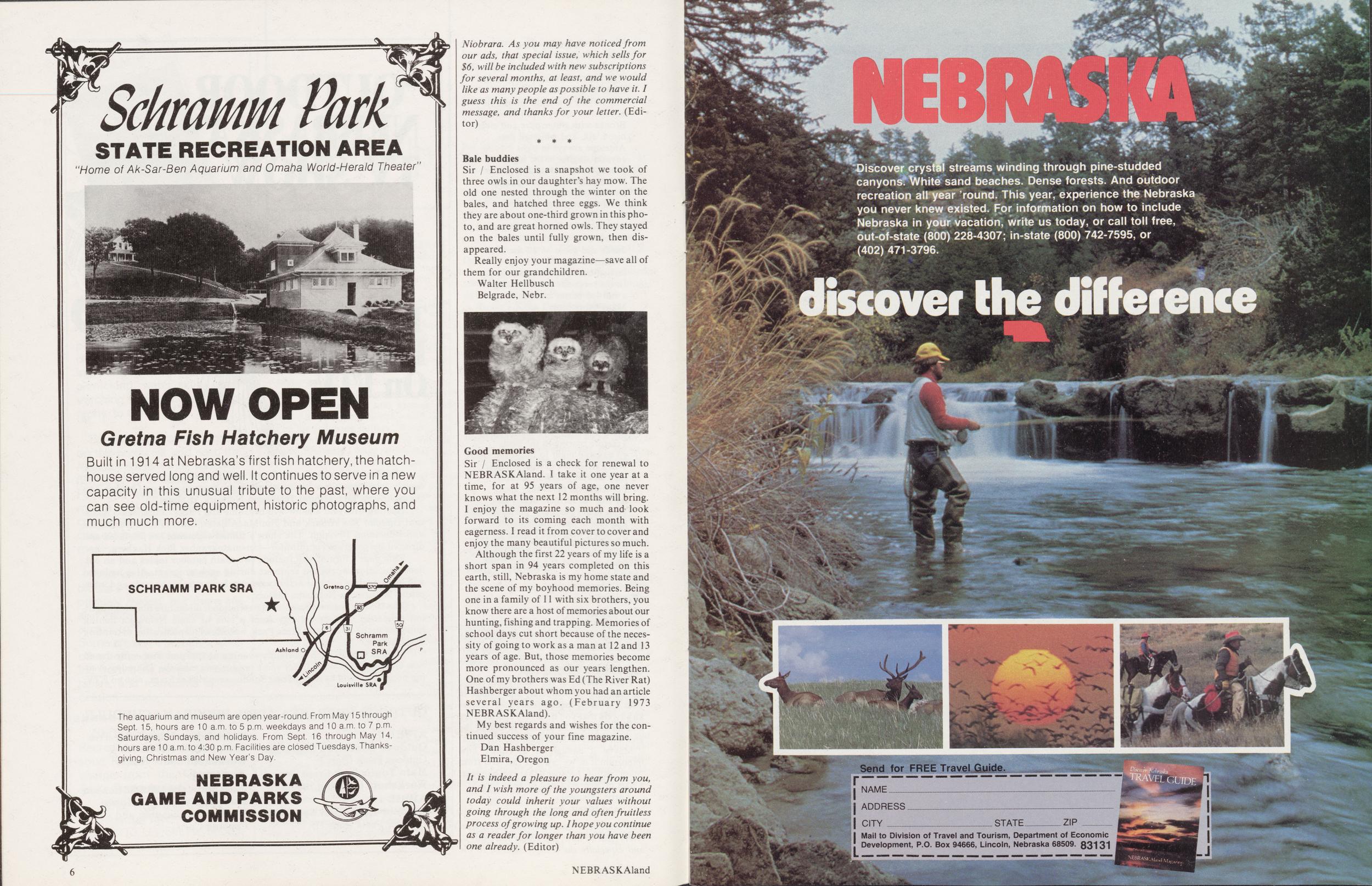 Schramm Park
STATE RECREATION AREA
"Home of Ak-Sar-Ben Aquarium and Omaha World-Herald Theater"
NOW OPEN
Gretna Fish Hatchery Museum
Built in 1914 at Nebraska's first fish hatchery, the hatch-house served long and well.
It continues to serve in a new
capacity in this unusual tribute to the past, where you
can see old-time equipment, historic photographs, and
much much more.
SCHRAMM PARK SRA
Louisville SRA
The aquarium and museum are open year-round. From May 15 through
Sept. 15, hours are 10 a.m. to 5 p.m. weekdays and 10 a.m. to 7 p.m.
Saturdays, Sundays, and holidays. From Sept. 16 through May 14,
hours are 10 a.m. to 4:30 p.m. Facilities are closed Tuesdays, Thanksgiving, Christmas
and New Year's Day.
NEBRASKA
GAME AND PARKS
COMMISSION
Schramm Park
STATE RECREATION AREA
"Home of Ak-Sar-Ben Aquarium and Omaha World-Herald Theater"
NOW OPEN
Gretna Fish Hatchery Museum
Built in 1914 at Nebraska's first fish hatchery, the hatch-house served long and well.
It continues to serve in a new
capacity in this unusual tribute to the past, where you
can see old-time equipment, historic photographs, and
much much more.
SCHRAMM PARK SRA
Louisville SRA
The aquarium and museum are open year-round. From May 15 through
Sept. 15, hours are 10 a.m. to 5 p.m. weekdays and 10 a.m. to 7 p.m.
Saturdays, Sundays, and holidays. From Sept. 16 through May 14,
hours are 10 a.m. to 4:30 p.m. Facilities are closed Tuesdays, Thanksgiving, Christmas
and New Year's Day.
NEBRASKA
GAME AND PARKS
COMMISSION
You doubtless have received your special rivers issue by now, and I hope you enjoy it, and especially the section devoted to the Niobrara. As you may have noticed from our ads, that special issue, which sells for $6, will be included with new subscriptions for several months, at least, and we would like as many people as possible to have it. I guess this is the end of the commercial message, and thanks for your letter. (Editor)
Bale buddiesSir / Enclosed is a snapshot we took of three owls in our daughter's hay mow. The old one nested through the winter on the bales, and hatched three eggs. We think they are about one-third grown in this photo, and are great horned owls. They stayed on the bales until fully grown, then disappeared.
Really enjoy your magazine—save all of them for our grandchildren.
Walter Hellbusch Belgrade, Nebr.Sir / Enclosed is a check for renewal to NEBRASKAland. I take it one year at a time, for at 95 years of age, one never knows what the next 12 months will bring. I enjoy the magazine so much and look forward to its coming each month with eagerness. I read it from cover to cover and enjoy the many beautiful pictures so much.
Although the first 22 years of my life is a short span in 94 years completed on this earth, still, Nebraska is my home state and the scene of my boyhood memories. Being one in a family of 11 with six brothers, you know there are a host of memories about our hunting, fishing and trapping. Memories of school days cut short because of the necessity of going to work as a man at 12 and 13 years of age. But, those memories become more pronounced as our years lengthen. One of my brothers was Ed (The River Rat) Hashberger about whom you had an article several years ago. (February 1973 NEBRASKAland).
My best regards and wishes for the continued success of your fine magazine.
Dan Hashberger Elmira, OregonIt is indeed a pleasure to hear from you, and I wish more of the youngsters around today could inherit your values without going through the long and often fruitless process of growing up. I hope you continue as a reader for longer than you have been one already. (Editor)
6 NEBRASKAland Discover crystal streams winding through pine-studded canyons? White sand beaches. Dense forests. And outdoor recreation all year round. This year, experience the Nebraska you never knew existed. For information on how to include Nebraska in your vacation, write us today, or call toll free, out-of-state (800) 228-4307; in-state (800) 742-7595, or (402)471-3796. Send for FREE Travel Guide. NAME ADDRESS CITY Mail to Division of Travel and Tourism, Department of Economic Development, P.O. Box 94666, Lincoln, Nebraska 68509. 83131 STATE ZIP
Nebraska Statewide Arboretum A New Concept
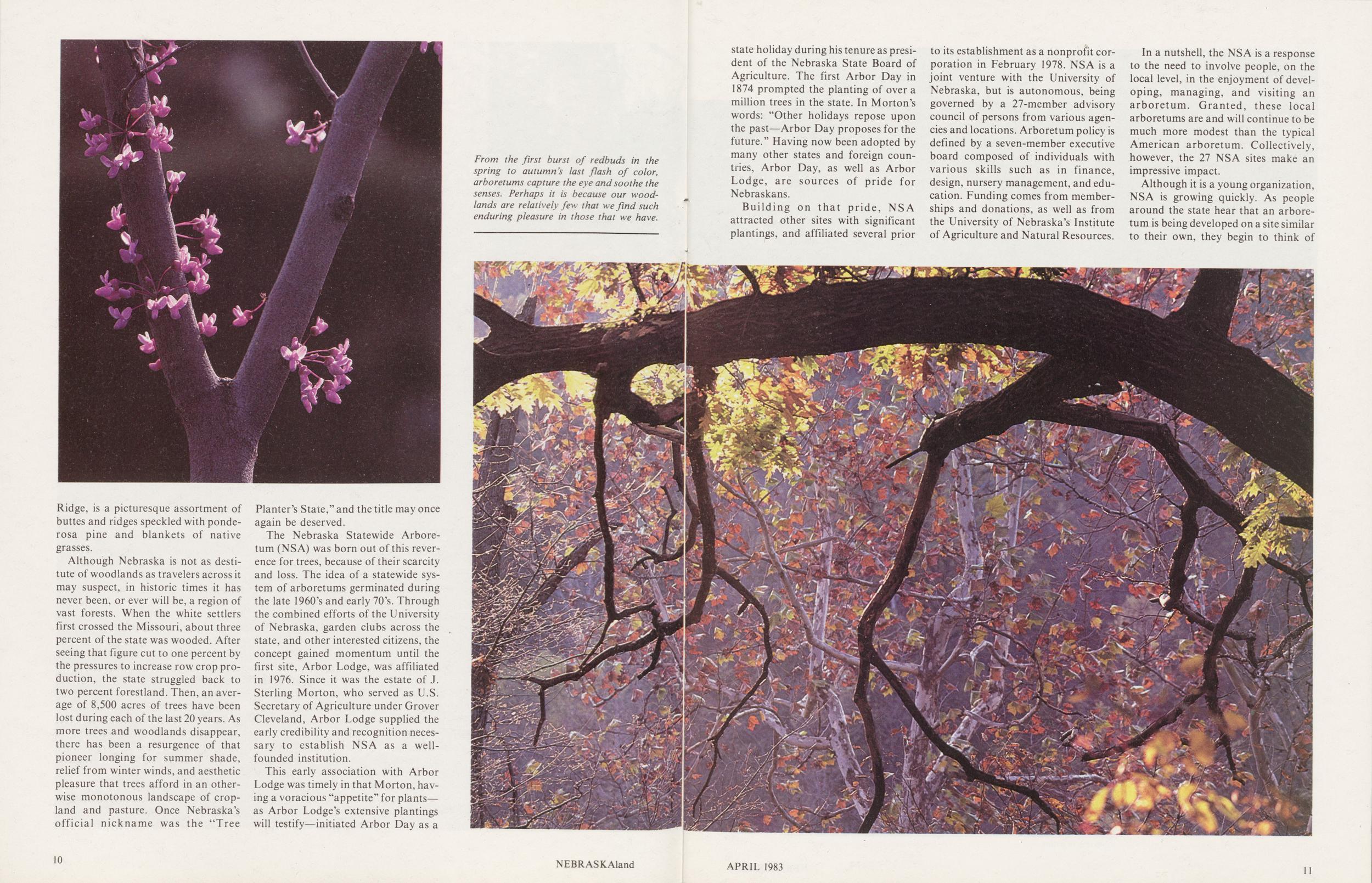
BY GEORGE BRIGGS PHOTOGRAPHS BY JON FARRAR Perhaps nowhere are trees appreciated more than on the wind-swept expanses of the prairie and plains.FOLKLORIST ROGER WELSH tells of a Nebraska pioneer writing his brother in the East and saying that here they "could put a plow in the ground at Nebraska City and go two hundred miles straight west without ever stopping for a root or a rock."
In his publication Of Trees and Dreams, Welsch continues: "And yet for all the freedom and openness of this new land, the pioneers missed their trees. For hundreds of generations in Europe and the eastern United States men had built with wood. Art came from wood, and cradles, and weapons, food, heat and shelter, books, clothing, furniture, and even tools. Soon the gentle longing for trees grew to an ache, even an obsession."
Compared to the forestland of the Appalachians or northern Pacific coast, Nebraska was indeed a flat, homogenous plain. But, even though Nebraska lies in the heart of the Great Plains, its topography and vegetative character are far more diverse than most Americans from the east or west coasts expect. The windy climate of cold winters and hot, dry summers does limit the palette of plant materials—more so in the western portion of the state than in the east. As one travels from the southeast to the northwest corner of the state, rainfall diminishes from 36 inches per year to around 17 inches; and the elevation rises from just a few hundred feet above sea level near the Missouri River to over 5,000 feet in the west.
Within the apparent uniformity of
this vast, sloping plain is great diversity; particularly in plant communities.
Along the Missouri River the land
rolls gently, reflecting the etching of
the tributaries and drainageways of
surface water making its way east. The
stately bur oak, somewhat gnarled by
the stress of life in the region, congregates in groves to form the primary-tree vegetation.
The Platte River
meanders across central Nebraska,
bordered by expanses of flat flood-plain and lined with generous allocations of the
state tree, the cottonwood.
The Sandhills, a rolling expanse of
sand dunes cloaked in native grass,
occupy a fourth of the state's land area
in north-central Nebraska. These fragile, windswept hills lack trees except
for occasional junipers or others that
tenacious ranchers have established.
The state's westernmost region, the Pine
APRIL 1983
9
 Ridge, is a picturesque assortment of
buttes and ridges speckled with ponderosa pine and blankets of native
grasses.
Ridge, is a picturesque assortment of
buttes and ridges speckled with ponderosa pine and blankets of native
grasses.
Although Nebraska is not as destitute of woodlands as travelers across it may suspect, in historic times it has never been, or ever will be, a region of vast forests. When the white settlers first crossed the Missouri, about three percent of the state was wooded. After seeing that figure cut to one percent by the pressures to increase row crop production, the state struggled back to two percent forestland. Then, an average of 8,500 acres of trees have been lost during each of the last 20 years. As more trees and woodlands disappear, there has been a resurgence of that pioneer longing for summer shade, relief from winter winds, and aesthetic pleasure that trees afford in an otherwise monotonous landscape of cropland and pasture. Once Nebraska's official nickname was the "Tree Planter's State," and the title may once again be deserved.
The Nebraska Statewide Arboretum (NSA) was born out of this reverence for trees, because of their scarcity and loss. The idea of a statewide system of arboretums germinated during the late 1960's and early 70's. Through the combined efforts of the University of Nebraska, garden clubs across the state, and other interested citizens, the concept gained momentum until the first site, Arbor Lodge, was affiliated in 1976. Since it was the estate of J. Sterling Morton, who served as U.S. Secretary of Agriculture under Grover Cleveland, Arbor Lodge supplied the early credibility and recognition necessary to establish NSA as a well-founded institution.
This early association with Arbor Lodge was timely in that Morton, having a voracious "appetite" for plants—as Arbor Lodge's extensive plantings will testify—initiated Arbor Day as a F
Building on that pride, NSA attracted other sites with significant plantings, and affiliated several prior to its establishment as a nonprofit corporation in February 1978. NSA is a joint venture with the University of Nebraska, but is autonomous, being governed by a 27-member advisory council of persons from various agencies and locations. Arboretum policy is defined by a seven-member executive board composed of individuals with various skills such as in finance, design, nursery management, and education. Funding comes from memberships and donations, as well as from the University of Nebraska's Institute of Agriculture and Natural Resources.
In a nutshell, the NSA is a response to the need to involve people, on the local level, in the enjoyment of developing, managing, and visiting an arboretum. Granted, these local arboretums are and will continue to be much more modest than the typical American arboretum. Collectively, however, the 27 NSA sites make an impressive impact.
Although it is a young organization,
NSA is growing quickly. As people
around the state hear that an arboretum is being developed on a site similar
to their own, they begin to think of
APRIL 1983
11
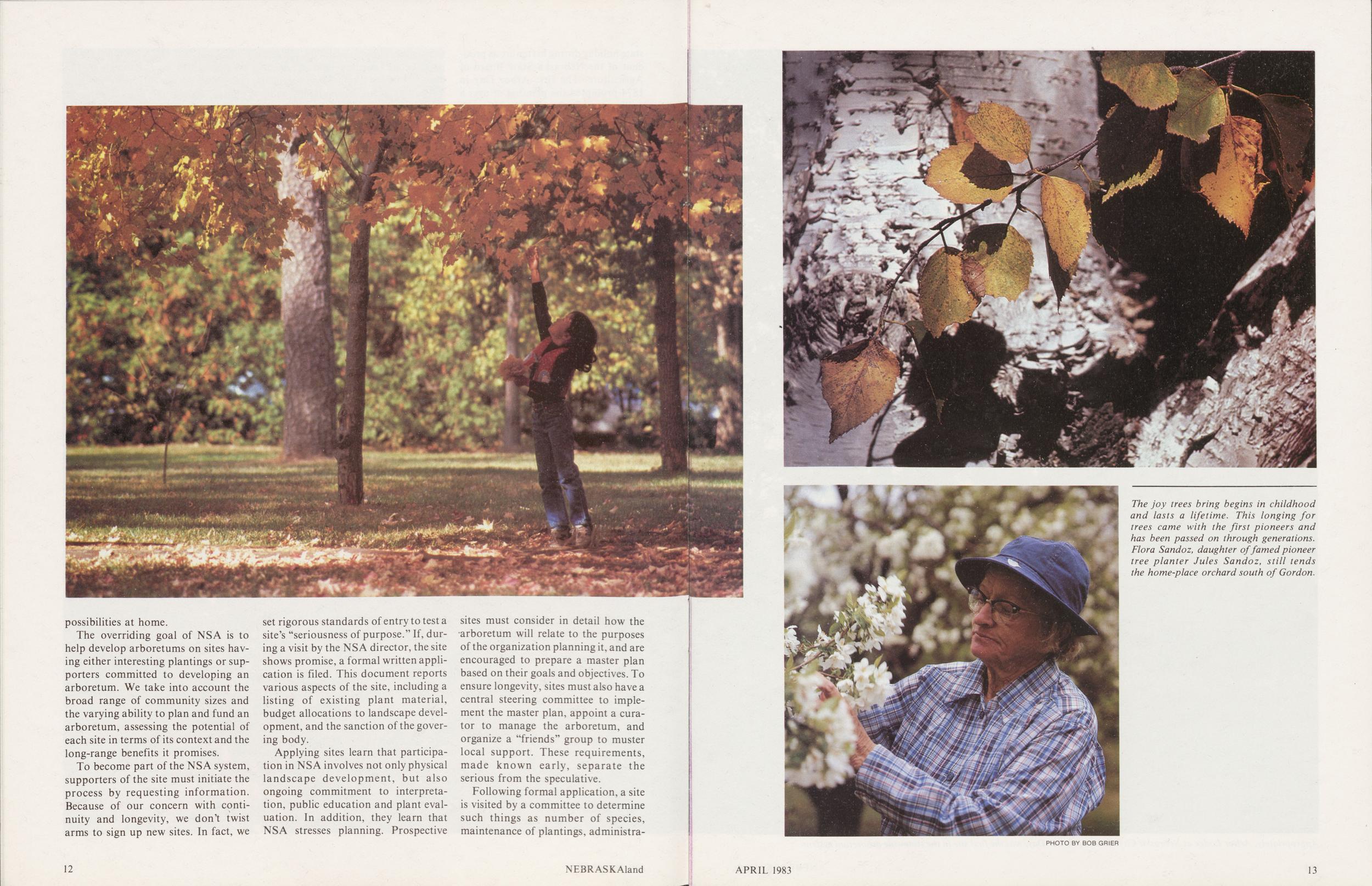
The overriding goal of NSA is to help develop arboretums on sites having either interesting plantings or supporters committed to developing an arboretum. We take into account the broad range of community sizes and the varying ability to plan and fund an arboretum, assessing the potential of each site in terms of its context and the long-range benefits it promises.
To become part of the NSA system, supporters of the site must initiate the process by requesting information. Because of our concern with continuity and longevity, we don't twist arms to sign up new sites. In fact, we set rigorous standards of entry to test a site's "seriousness of purpose." If, during a visit by the NSA director, the site shows promise, a formal written application is filed. This document reports various aspects of the site, including a listing of existing plant material, budget allocations to landscape development, and the sanction of thegovering body.
Applying sites learn that participation in NSA involves not only physical landscape development, but also ongoing commitment to interpretation, public education and plant evaluation. In addition, they learn that NSA stresses planning. Prospective sites must consider in detail how the arboretum will relate to the purposes of the organization planning it, and are encouraged to prepare a master plan based on their goals and objectives. To ensure longevity, sites must also have a central steering committee to implement the master plan, appoint a curator to manage the arboretum, and organize a "friends" group to muster local support. These requirements, made known early, separate the serious from the speculative.
Following formal application, a site is visited by a committee to determine such things as number of species, maintenance of plantings, administrative 12 NEBRASKAland
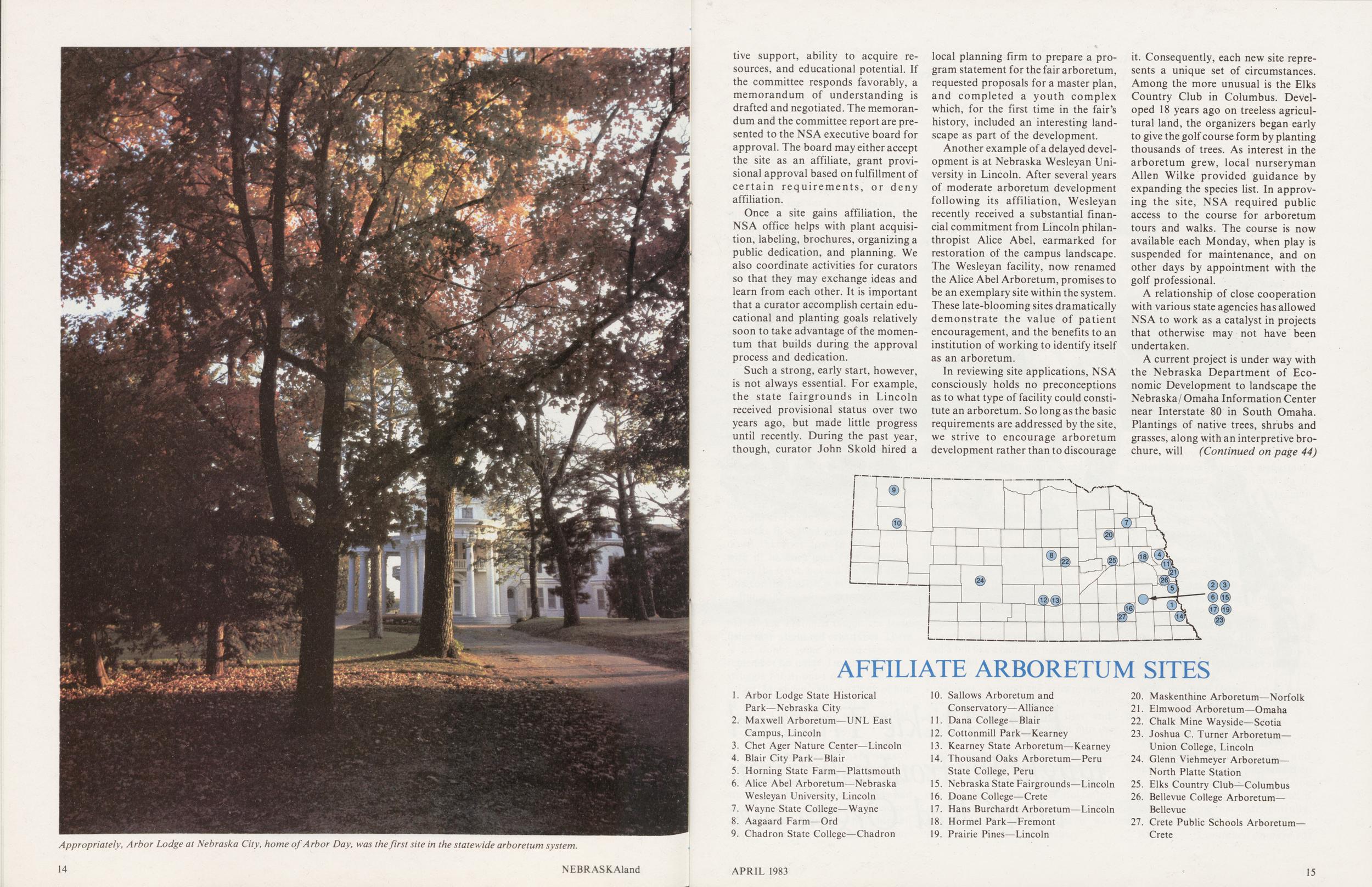
Once a site gains affiliation, the NSA office helps with plant acquisition, labeling, brochures, organizing a public dedication, and planning. We also coordinate activities for curators so that they may exchange ideas and learn from each other. It is important that a curator accomplish certain educational and planting goals relatively soon to take advantage of the momentum that builds during the approval process and dedication.
Such a strong, early start, however, is not always essential. For example, the state fairgrounds in Lincoln received provisional status over two years ago, but made little progress until recently. During the past year, though, curator John Skold hired a local planning firm to prepare a program statement for the fair arboretum, requested proposals for a master plan, and completed a youth complex which, for the first time in the fair's history, included an interesting landscape as part of the development.
Another example of a delayed development is at Nebraska Wesleyan University in Lincoln. After several years of moderate arboretum development following its affiliation, Wesleyan recently received a substantial financial commitment from Lincoln philanthropist Alice Abel, earmarked for restoration of the campus landscape. The Wesleyan facility, now renamed the Alice Abel Arboretum, promises to be an exemplary site within the system. These late-blooming sites dramatically demonstrate the value of patient encouragement, and the benefits to an institution of working to identify itself as an arboretum.
In reviewing site applications, NSA consciously holds no preconceptions as to what type of facility could constitute an arboretum. So long as the basic requirements are addressed by the site, we strive to encourage arboretum development rather than to discourage it. Consequently, each new site represents a unique set of circumstances. Among the more unusual is the Elks Country Club in Columbus. Developed 18 years ago on treeless agricultural land, the organizers began early to give the golf course form by planting thousands of trees. As interest in the arboretum grew, local nurseryman Allen Wilke provided guidance by expanding the species list. In approving the site, NSA required public access to the course for arboretum tours and walks. The course is now available each Monday, when play is suspended for maintenance, and on other days by appointment with the golf professional.
A relationship of close cooperation with various state agencies has allowed NSA to work as a catalyst in projects that otherwise may not have been undertaken.
A current project is under way with the Nebraska Department of Economic Development to landscape the Nebraska/ Omaha Information Center near Interstate 80 in South Omaha. Plantings of native trees, shrubs and grasses, along with an interpretive brochure, will (Continued on page 44)
How Dickie Trammel taught the trout fisherman about Red Organ flies
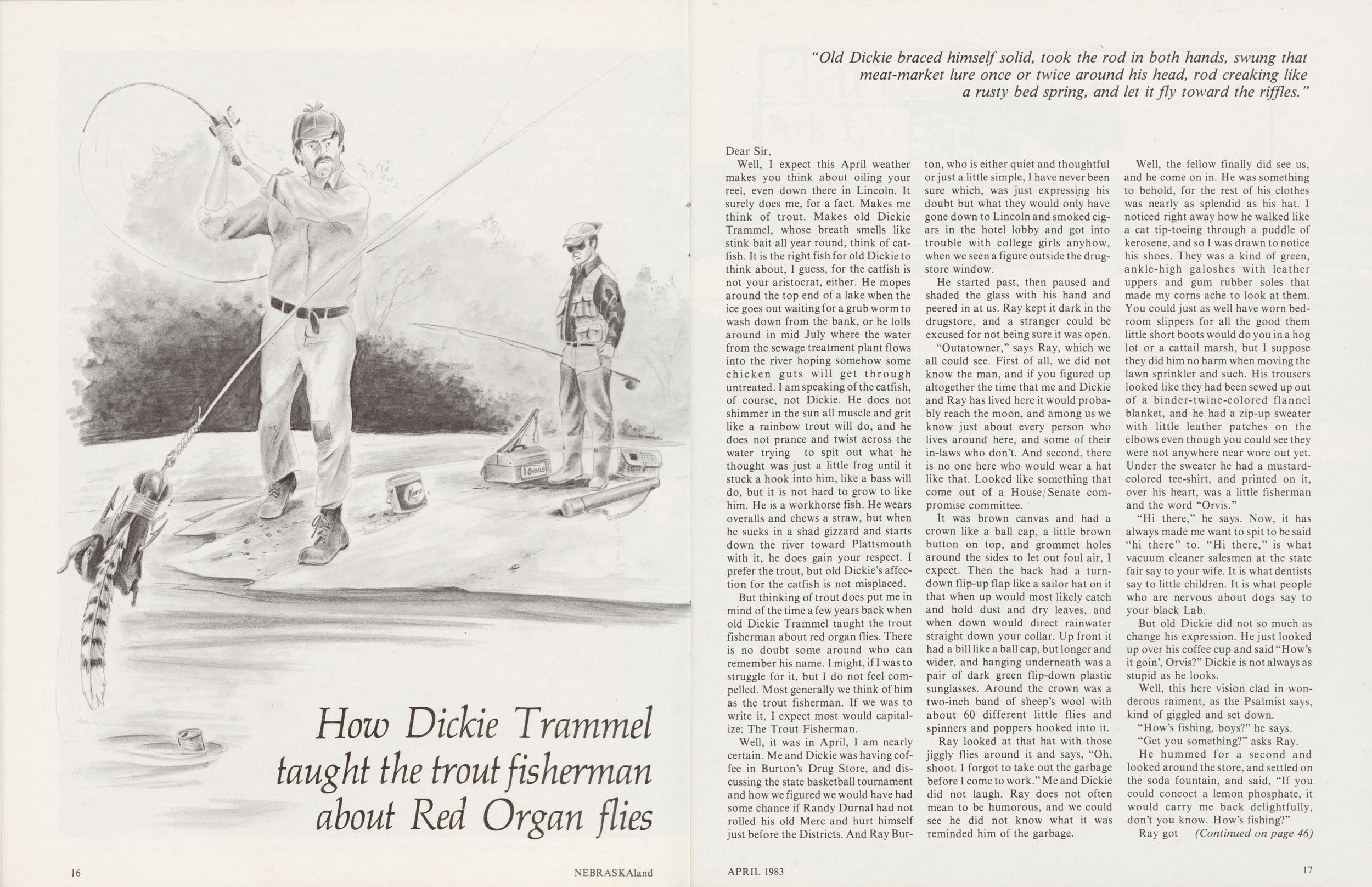
16 NEBRASKAland "Old Dickie braced himself solid, took the rod in both hands, swung that meat-market lure once or twice around his head, rod creaking like a rusty bed spring, and let it fly toward the riffles."Dear Sir,
Well, I expect this April weather makes you think about oiling your reel, even down there in Lincoln. It surely does me, for a fact. Makes me think of trout. Makes old Dickie Trammel, whose breath smells like stink bait all year round, think of catfish. It is the right fish for old Dickie to think about, I guess, for the catfish is not your aristocrat, either. He mopes around the top end of a lake when the ice goes out waiting for a grub worm to wash down from the bank, or he lolls around in mid July where the water from the sewage treatment plant flows into the river hoping somehow some chicken guts will get through untreated. I am speaking of the catfish, of course, not Dickie. He does not shimmer in the sun all muscle and grit like a rainbow trout will do, and he does not prance and twist across the water trying to spit out what he thought was just a little frog until it stuck a hook into him, like a bass will do, but it is not hard to grow to like him. He is a workhorse fish. He wears overalls and chews a straw, but when he sucks in a shad gizzard and starts down the river toward Plattsmouth with it, he does gain your respect. I prefer the trout, but old Dickie's affection for the catfish is not misplaced.
But thinking of trout does put me in mind of the time a few years back when old Dickie Trammel taught the trout fisherman about red organ flies. There is no doubt some around who can remember his name. I might, if I was to struggle for it, but I do not feel compelled. Most generally we think of him as the trout fisherman. If we was to write it, I expect most would capitalize: The Trout Fisherman.
Well, it was in April, I am nearly certain. Me and Dickie was having coffee in Burton's Drug Store, and discussing the state basketball tournament and how we figured we would have had some chance if Randy Durnal had not rolled his old Merc and hurt himself just before the Districts. And Ray Burton, who is either quiet and thoughtful or just a little simple, I have never been sure which, was just expressing his doubt but what they would only have gone down to Lincoln and smoked cigars in the hotel lobby and got into trouble with college girls anyhow, when we seen a figure outside the drugstore window.
He started past, then paused and shaded the glass with his hand and peered in at us. Ray kept it dark in the drugstore, and a stranger could be excused for not being sure it was open.
"Outatowner," says Ray, which we all could see. First of all, we did not know the man, and if you figured up altogether the time that me and Dickie and Ray has lived here it would probably reach the moon, and among us we know just about every person who lives around here, and some of their in-laws who don't. And second, there is no one here who would wear a hat like that. Looked like something that come out of a House/Senate compromise committee.
It was brown canvas and had a crown like a ball cap, a little brown button on top, and grommet holes around the sides to let out foul air, I expect. Then the back had a turndown flip-up flap like a sailor hat on it that when up would most likely catch and hold dust and dry leaves, and when down would direct rainwater straight down your collar. Up front it had a bill like a ball cap, but longer and wider, and hanging underneath was a pair of dark green flip-down plastic sunglasses. Around the crown was a two-inch band of sheep's wool with about 60 different little flies and spinners and poppers hooked into it.
Ray looked at that hat with those jiggly flies around it and says, "Oh, shoot. I forgot to take out the garbage before I come to work." Me and Dickie did not laugh. Ray does not often mean to be humorous, and we could see he did not know what it was reminded him of the garbage.
Well, the fellow finally did see us, and he come on in. He was something to behold, for the rest of his clothes was nearly as splendid as his hat. I noticed right away how he walked like a cat tip-toeing through a puddle of kerosene, and so I was drawn to notice his shoes. They was a kind of green, ankle-high galoshes with leather uppers and gum rubber soles that made my corns ache to look at them. You could just as well have worn bedroom slippers for all the good them little short boots would do you in a hog lot or a cattail marsh, but I suppose they did him no harm when moving the lawn sprinkler and such. His trousers looked like they had been sewed up out of a binder-twine-colored flannel blanket, and he had a zip-up sweater with little leather patches on the elbows even though you could see they were not anywhere near wore out yet. Under the sweater he had a mustard-colored tee-shirt, and printed on it, over his heart, was a little fisherman and the word "Orvis."
"Hi there," he says. Now, it has always made me want to spit to be said "hi there" to. "Hi there," is what vacuum cleaner salesmen at the state fair say to your wife. It is what dentists say to little children. It is what people who are nervous about dogs say to your black Lab.
But old Dickie did not so much as change his expression. He just looked up over his coffee cup and said "How's it goin', Orvis?" Dickie is not always as stupid as he looks.
Well, this here vision clad in wonderous raiment, as the Psalmist says, kind of giggled and set down.
How's fishing, boys?" he says.
Get you something?" asks Ray.
He hummed for a second and looked around the store, and settled on the soda fountain, and said, "If you could concoct a lemon phosphate, it would carry me back delightfully, don't you know. How's fishing?" Ray got (Continued on page 46)
APRIL 1983 17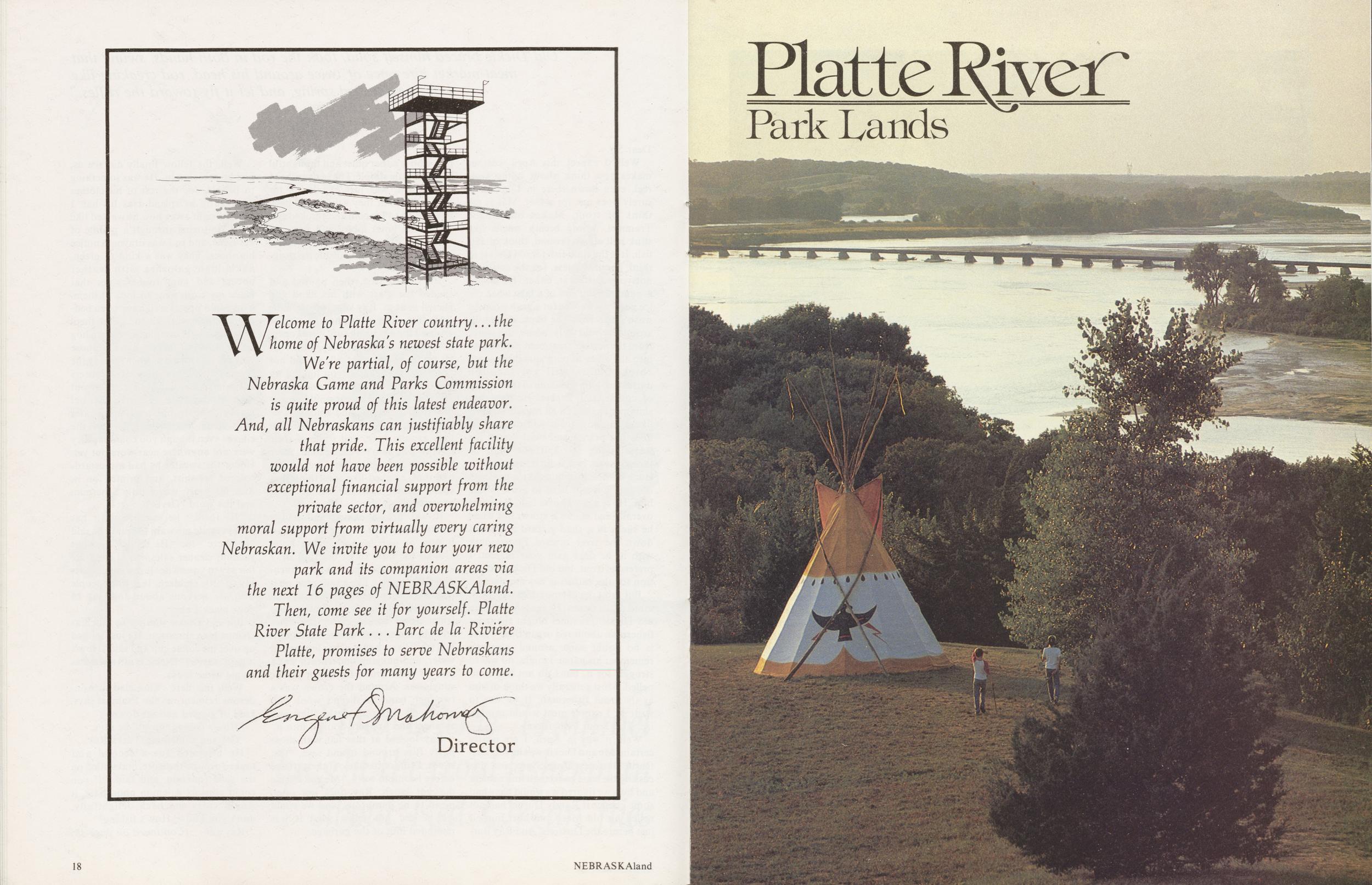
Platte River
Park Lands" Welcome to Platte River country the home of Nebraska's newest state park. We're partial, of course, but the Nebraska Game and Parks Commission is quite proud of this latest endeavor. And, all Nebraskans can justifiably share that pride. This excellent facility would not have been possible without exceptional financial support from the private sector, and overwhelming moral support from virtually every caring Nebraskan. We invite you to tour your new park and its companion areas via the next 16 pages of NEBRASKAland. Then, come see it for yourself. Platte River State Park Pare de la Riviere Platte, promises to serve Nebraskans and their guests for many years to come.
Director 18 NEBRASKAland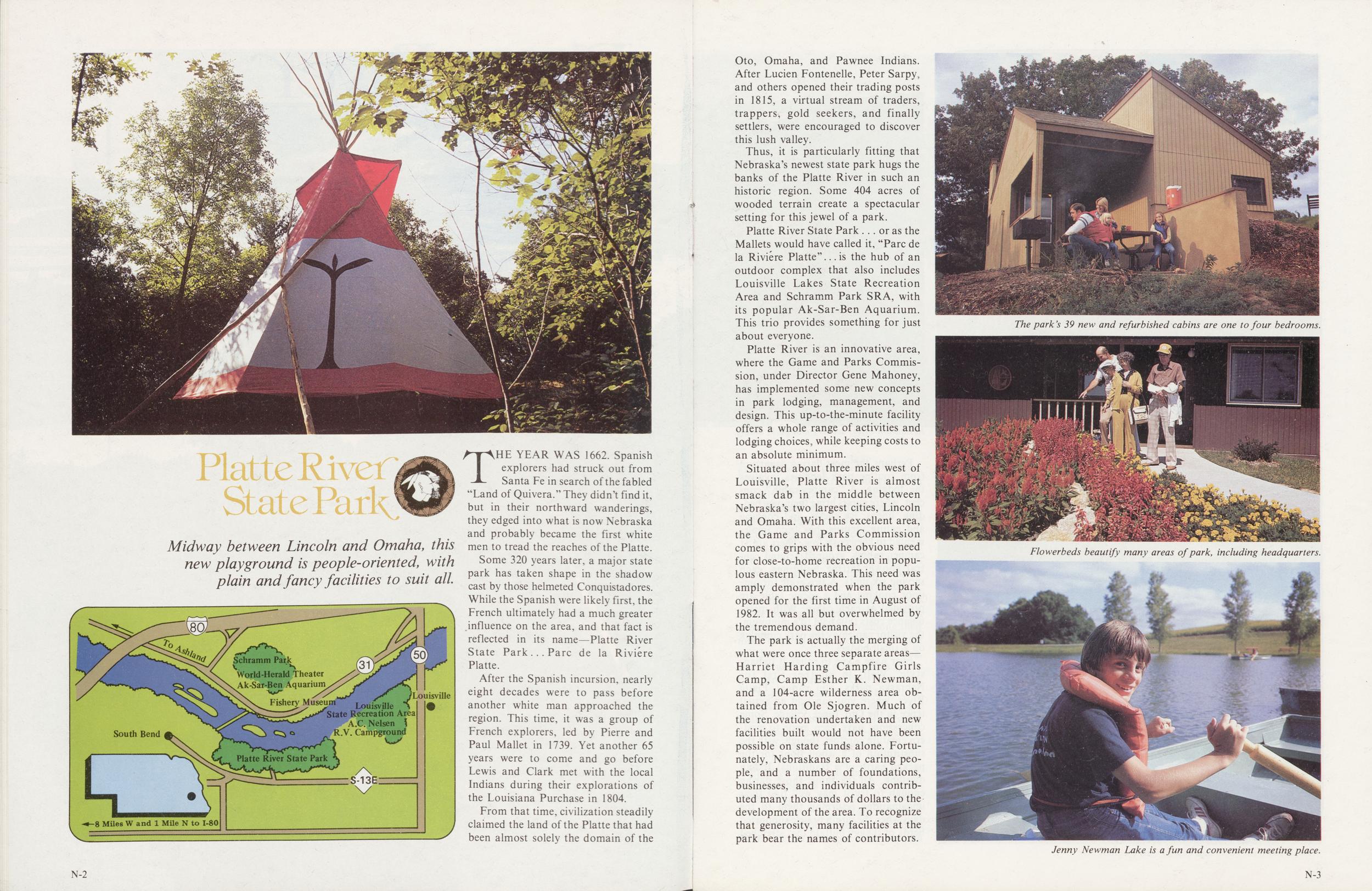
THE YEAR WAS 1662. Spanish explorers had struck out from Santa Fe in search of the fabled "Land of Quivera." They didn't find it, but in their northward wanderings, they edged into what is now Nebraska and probably became the first white men to tread the reaches of the Platte.
Some 320 years later, a major state park has taken shape in the shadow cast by those helmeted Conquistadores. While the Spanish were likely first, the French ultimately had a much greater influence on the area, and that fact is reflected in its name—Platte River State Park Pare de la Riviere Platte.
After the Spanish incursion, nearly eight decades were to pass before another white man approached the region. This time, it was a group of French explorers, led by Pierre and Paul Mallet in 1739. Yet another 65 years were to come and go before Lewis and Clark met with the local Indians during their explorations of the Louisiana Purchase in 1804.
From that time, civilization steadily claimed the land of the Platte that had been almost solely the domain of the N-2 Oto, Omaha, and Pawnee Indians. After Lucien Fontenelle, Peter Sarpy, and others opened their trading posts in 1815, a virtual stream of traders, trappers, gold seekers, and finally settlers, were encouraged to discover this lush valley.
Thus, it is particularly fitting that Nebraska's newest state park hugs the banks of the Platte River in such an historic region. Some 404 acres of wooded terrain create a spectacular setting for this jewel of a park.
Platte River State Park or as the Mallets would have called it, "Pare de la Riviere Platte" is the hub of an outdoor complex that also includes Louisville Lakes State Recreation Area and Schramm Park SRA, with its popular Ak-Sar-Ben Aquarium. This trio provides something for just about everyone.
Platte River is an innovative area, where the Game and Parks Commission, under Director Gene Mahoney, has implemented some new concepts in park lodging, management, and design. This up-to-the-minute facility offers a whole range of activities and lodging choices, while keeping costs to an absolute minimum.
Situated about three miles west of Louisville, Platte River is almost smack dab in the middle between Nebraska's two largest cities, Lincoln and Omaha. With this excellent area, the Game and Parks Commission comes to grips with the obvious need for close-to-home recreation in populous eastern Nebraska. This need was amply demonstrated when the park opened for the first time in August of 1982. It was all but overwhelmed by the tremendous demand.
The park is actually the merging of what were once three separate areas—Harriet Harding Campfire Girls Camp, Camp Esther K. Newman, and a 104-acre wilderness area obtained from Ole Sjogren. Much of the renovation undertaken and new facilities built would not have been possible on state funds alone. Fortunately, Nebraskans are a caring people, and a number of foundations, businesses, and individuals contributed many thousands of dollars to the development of the area. To recognize that generosity, many facilities at the park bear the names of contributors.
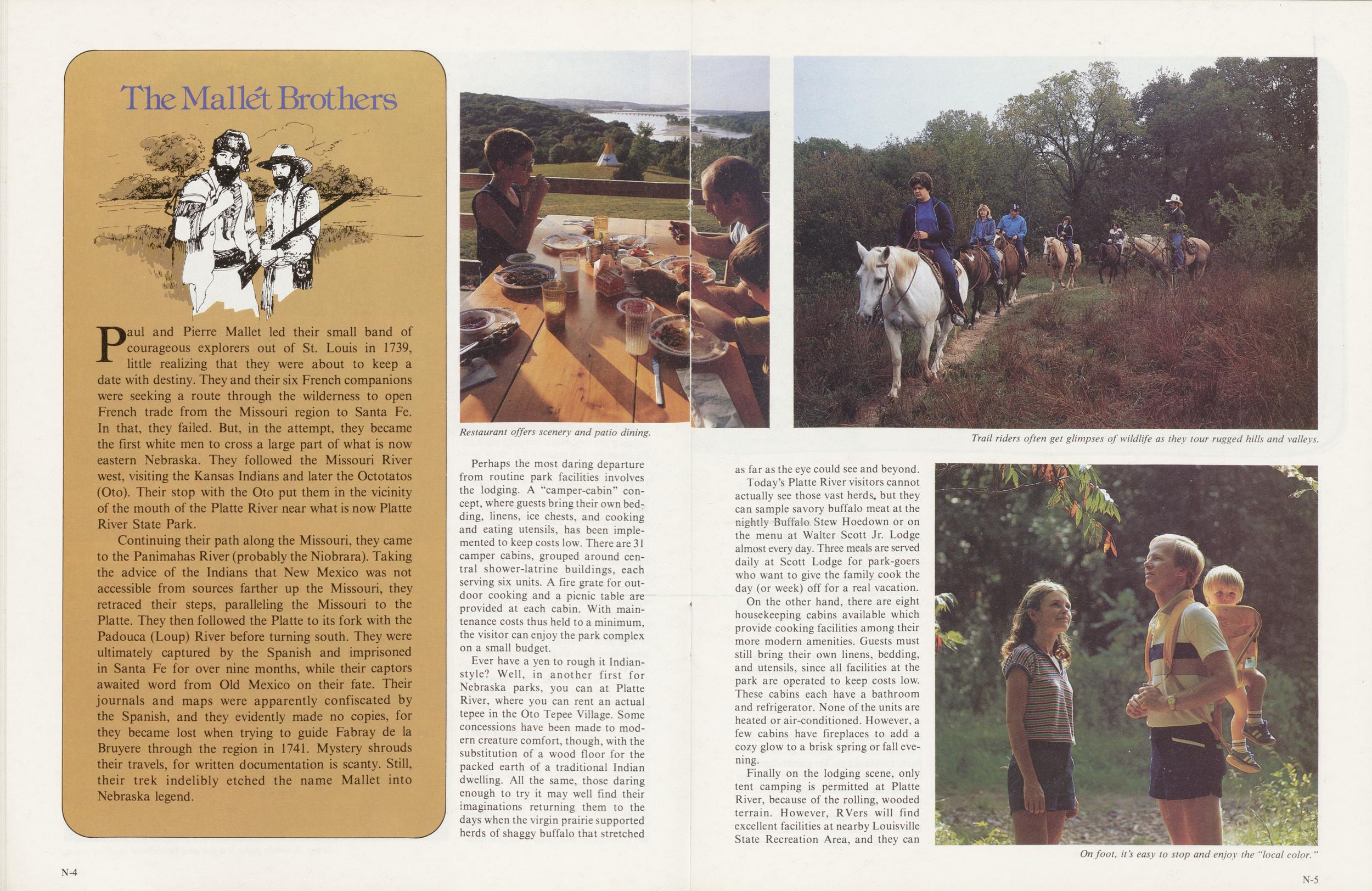 The Mallet Brothers
Paul and Pierre Mallet led their small band of courageous explorers out of St. Louis in 1739, little realizing that they were about to keep a date with destiny. They and their six French companions were seeking a route through the wilderness to open French trade from the Missouri region to Santa Fe. In that, they failed. But, in the attempt, they became the first white men to cross a large part of what is now eastern Nebraska. They followed the Missouri River west, visiting the Kansas Indians and later the Octotatos (Oto). Their stop with the Oto put them in the vicinity of the mouth of the Platte River near what is now Platte River State Park.
Continuing their path along the Missouri, they came to the Panimahas River (probably the Niobrara). Taking the advice of the Indians that New Mexico was not accessible from sources farther up the Missouri, they retraced their steps, paralleling the Missouri to the Platte. They then followed the Platte to its fork with the Padouca (Loup) River before turning south. They were ultimately captured by the Spanish and imprisoned in Santa Fe for over nine months, while their captors awaited word from Old Mexico on their fate. Their journals and maps were apparently confiscated by the Spanish, and they evidently made no copies, for they became lost when trying to guide Fabray de la Bruyere through the region in 1741. Mystery shrouds their travels, for written documentation is scanty. Still, their trek indelibly etched the name Mallet into Nebraska legend.
Ever have a yen to rough it Indian-style? Well, in another first for Nebraska parks, you can at Platte River, where you can rent an actual tepee in the Oto Tepee Village. Some concessions have been made to modern creature comfort, though, with the substitution of a wood floor for the packed earth of a traditional Indian dwelling. All the same, those daring enough to try it may well find their imaginations returning them to the days when the virgin prairie supported herds of shaggy buffalo that stretched N-4 as far as the eye could see and beyond.
Today's Platte River visitors cannot actually see those vast herds, but they can sample savory buffalo meat at the nightly Buffalo Stew Hoedown or on the menu at Walter Scott Jr. Lodge almost every day. Three meals are served daily at Scott Lodge for park-goers who want to give the family cook the day (or week) off for a real vacation.
On the other hand, there are eight housekeeping cabins available which provide cooking facilities among their more modern amenities. Guests must still bring their own linens, bedding, and utensils, since all facilities at the park are operated to keep costs low. These cabins each have a bathroom and refrigerator. None of the units are heated or air-conditioned. However, a few cabins have fireplaces to add a cozy glow to a brisk spring or fall evening.
Finally on the lodging scene, only tent camping is permitted at Platte River, because of the rolling, wooded terrain. However, RVers will find excellent facilities at nearby Louisville State Recreation Area, and they can
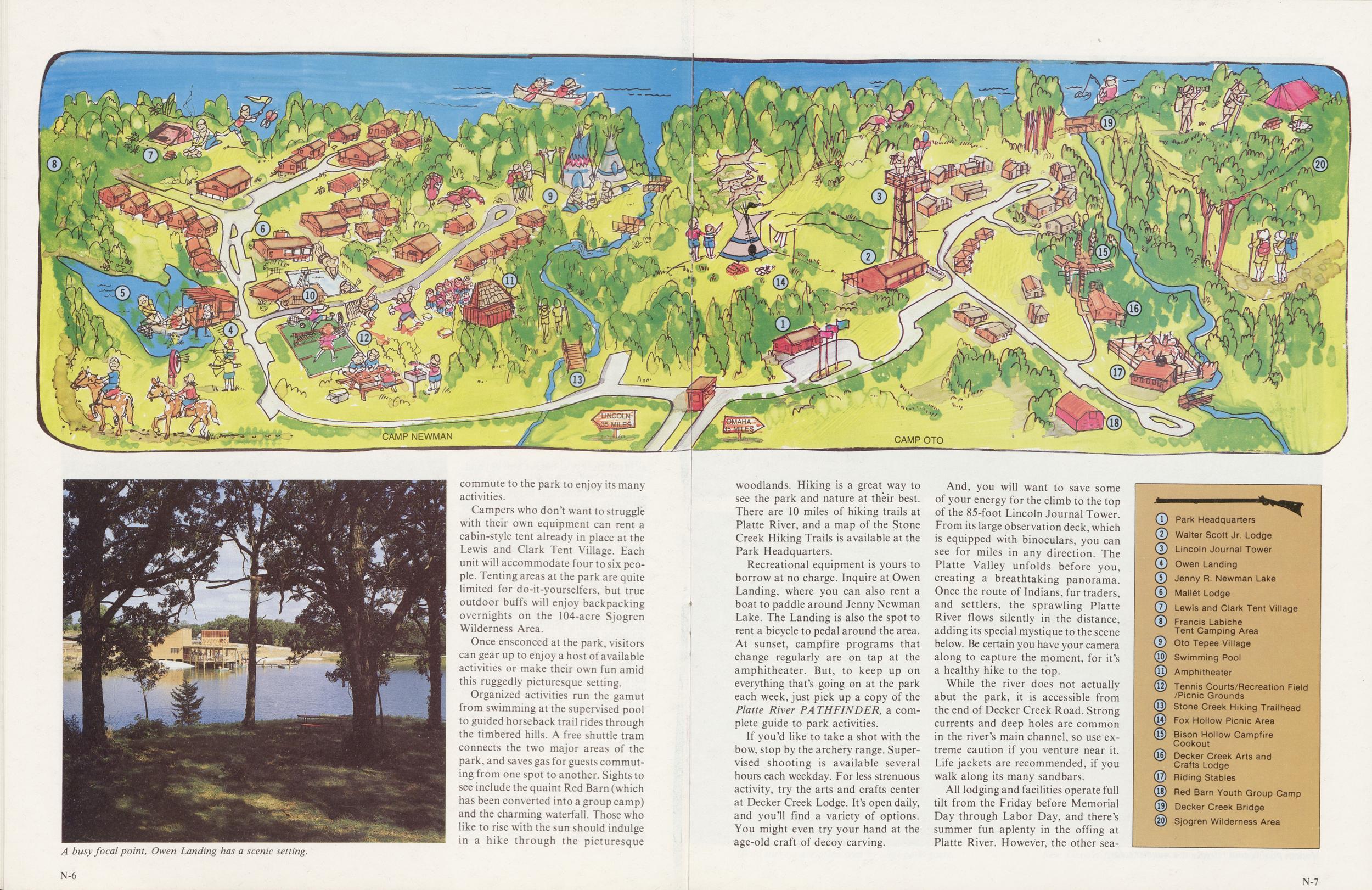
Campers who don't want to struggle with their own equipment can rent a cabin-style tent already in place at the Lewis and Clark Tent Village. Each unit will accommodate four to six people. Tenting areas at the park are quite limited for do-it-yourselfers, but true outdoor buffs will enjoy backpacking overnights on the 104-acre Sjogren Wilderness Area.
Once ensconced at the park, visitors can gear up to enjoy a host of available activities or make their own fun amid this ruggedly picturesque setting.
Organized activities run the gamut from swimming at the supervised pool to guided horseback trail rides through the timbered hills. A free shuttle tram connects the two major areas of the park, and saves gas for guests commuting from one spot to another. Sights to see include the quaint Red Barn (which has been converted into a group camp) and the charming waterfall. Those who like to rise with the sun should indulge in a hike through the picturesque
Recreational equipment is yours to borrow at no charge. Inquire at Owen Landing, where you can also rent a boat to paddle around Jenny Newman Lake. The Landing is also the spot to rent a bicycle to pedal around the area. At sunset, campfire programs that change regularly are on tap at the amphitheater. But, to keep up on everything that's going on at the park each week, just pick up a copy of the Platte River PATHFINDER, a complete guide to park activities.
If you'd like to take a shot with the bow, stop by the archery range. Supervised shooting is available several hours each weekday. For less strenuous activity, try the arts and crafts center at Decker Creek Lodge. It's open daily, and you'll find a variety of options. You might even try your hand at the age-old craft of decoy carving.
And, you will want to save some of your energy for the climb to the top of the 85-foot Lincoln Journal Tower. From its large observation deck, which is equipped with binoculars, you can see for miles in any direction. The Platte Valley unfolds before you, creating a breathtaking panorama. Once the route of Indians, fur traders, and settlers, the sprawling Platte River flows silently in the distance, adding its special mystique to the scene below. Be certain you have your camera along to capture the moment, for it's a healthy hike to the top.
While the river does not actually abut the park, it is accessible from the end of Decker Creek Road. Strong currents and deep holes are common in the river's main channel, so use extreme caution if you venture near it. Life jackets are recommended, if you walk along its many sandbars.
Park Headquarters Walter Scott Jr. Lodge Lincoln Journal Tower Owen Landing Jenny R. Newman Lake Mallet Lodge Lewis and Clark Tent Village Francis Labiche Tent Camping Area Oto Tepee Village Swimming Pool Amphitheater Tennis Courts/Recreation Field /Picnic Grounds Stone Creek Hiking Trailhead Fox Hollow Picnic Area Bison Hollow Campfire Cookout Decker Creek Arts and Crafts Lodge Riding Stables Red Barn Youth Group Camp Decker Creek Bridge Sjogren Wilderness Area N-7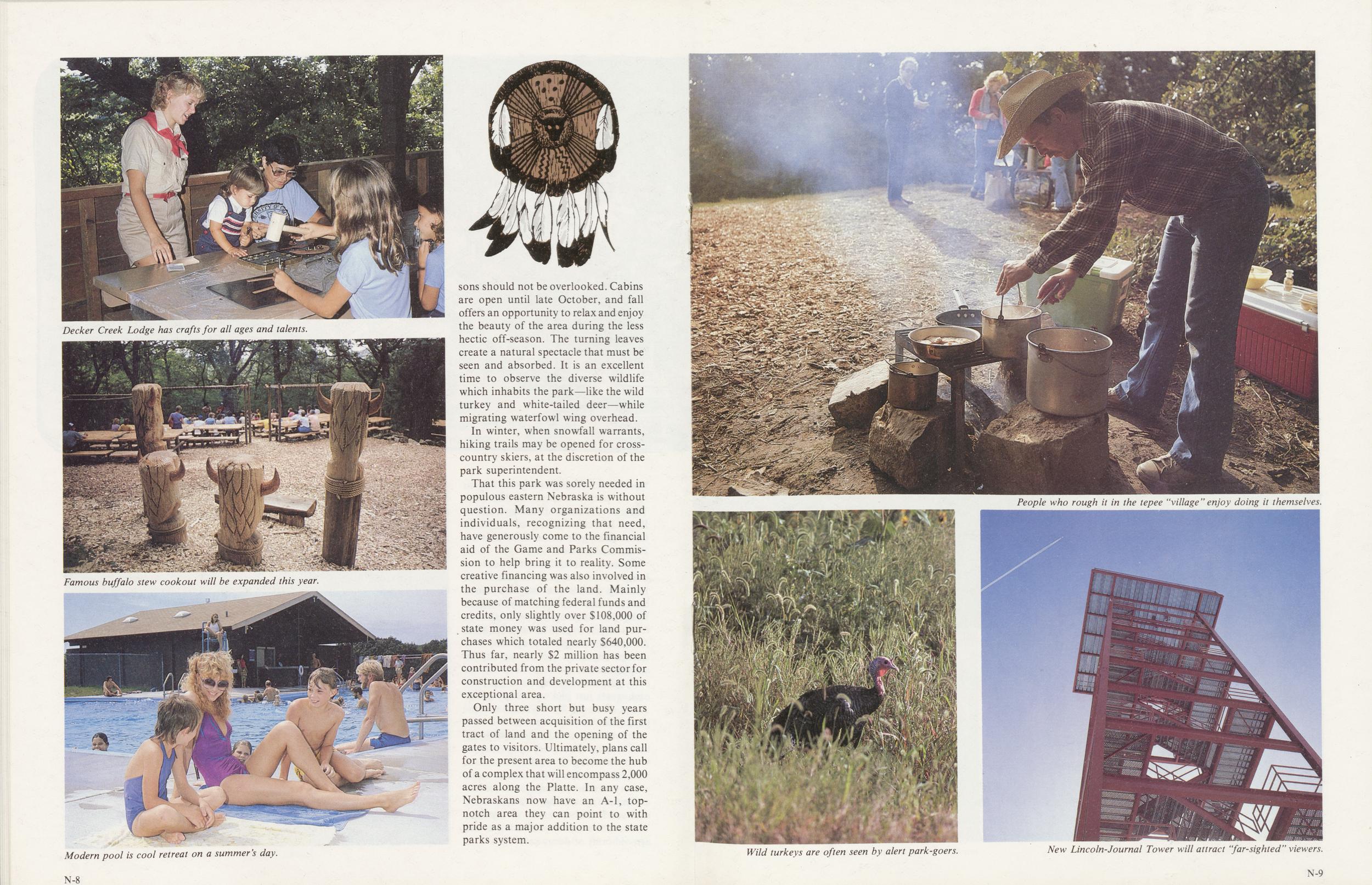
All lodging and facilities operate full tilt from the Friday before Memorial Day through Labor Day, and there's summer fun aplenty in the offing at Platte River. However, the other seasons sons should not be overlooked. Cabins are open until late October, and fall offers an opportunity to relax and enjoy the beauty of the area during the less hectic off-season. The turning leaves create a natural spectacle that must be seen and absorbed. It is an excellent time to observe the diverse wildlife which inhabits the park—like the wild turkey and white-tailed deer—while migrating waterfowl wing overhead.
In winter, when snowfall warrants, hiking trails may be opened for cross-country skiers, at the discretion of the park superintendent.
That this park was sorely needed in populous eastern Nebraska is without question. Many organizations and individuals, recognizing that need, have generously come to the financial aid of the Game and Parks Commission to help bring it to reality. Some creative financing was also involved in the purchase of the land. Mainly because of matching federal funds and credits, only slightly over $108,000 of state money was used for land purchases which totaled nearly $640,000. Thus far, nearly $2 million has been contributed from the private sector for construction and development at this exceptional area.
Only three short but busy years passed between acquisition of the first tract of land and the opening of the gates to visitors. Ultimately, plans call for the present area to become the hub of a complex that will encompass 2,000 acres along the Platte. In any case, Nebraskans now have an A-l, top-notch area they can point to with pride as a major addition to the state parks system.
N-8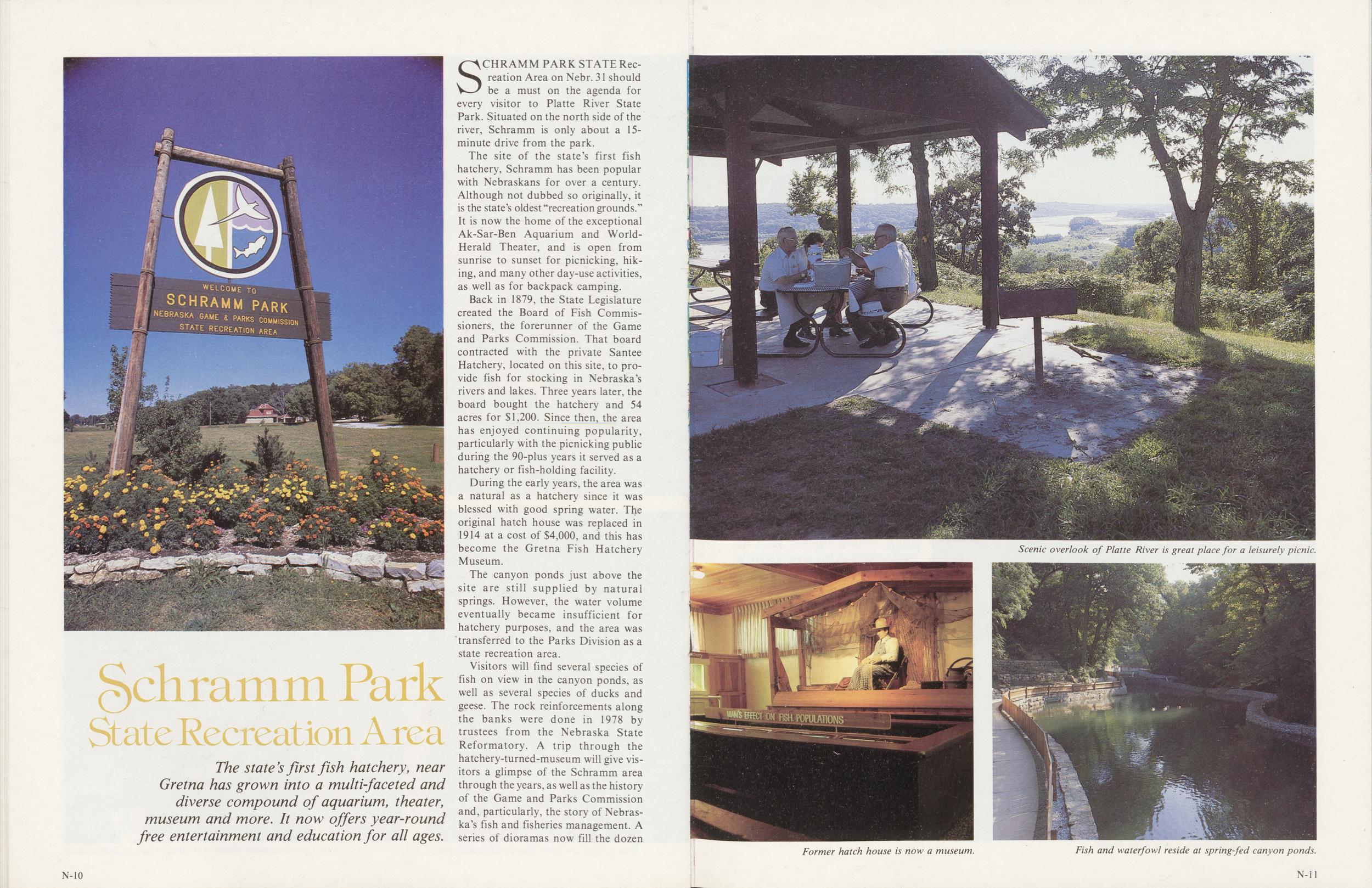
Schramm Park
State Recreation Area The state's first fish hatchery, near Gretna has grown into a multi-faceted and diverse compound of aquarium, theater, museum and more. It now offers year-round free entertainment and education for all ages.SCHRAMM PARK STATE Recreation Area on Nebr. 31 should be a must on the agenda for every visitor to Platte River State Park. Situated on the north side of the river, Schramm is only about a 15-minute drive from the park.
The site of the state's first fish hatchery, Schramm has been popular with Nebraskans for over a century. Although not dubbed so originally, it is the state's oldest "recreation grounds." It is now the home of the exceptional Ak-Sar-Ben Aquarium and World-Herald Theater, and is open from sunrise to sunset for picnicking, hiking, and many other day-use activities, as well as for backpack camping.
Back in 1879, the State Legislature created the Board of Fish Commissioners, the forerunner of the Game and Parks Commission. That board contracted with the private Santee Hatchery, located on this site, to provide fish for stocking in Nebraska's rivers and lakes. Three years later, the board bought the hatchery and 54 acres for $1,200. Since then, the area has enjoyed continuing popularity, particularly with the picnicking public during the 90-plus years it served as a hatchery or fish-holding facility.
During the early years, the area was a natural as a hatchery since it was blessed with good spring water. The original hatch house was replaced in 1914 at a cost of $4,000, and this has become the Gretna Fish Hatchery Museum.
The canyon ponds just above the site are still supplied by natural springs. However, the water volume eventually became insufficient for hatchery purposes, and the area was transferred to the Parks Division as a state recreation area.
Visitors will find several species of fish on view in the canyon ponds, as well as several species of ducks and geese. The rock reinforcements along the banks were done in 1978 by trustees from the Nebraska State Reformatory. A trip through the hatchery-turned-museum will give visitors a glimpse of the Schramm area through the years, as well as the history of the Game and Parks Commission and, particularly, the story of Nebraska's fish and fisheries management. A series of dioramas now fill the dozen N-10
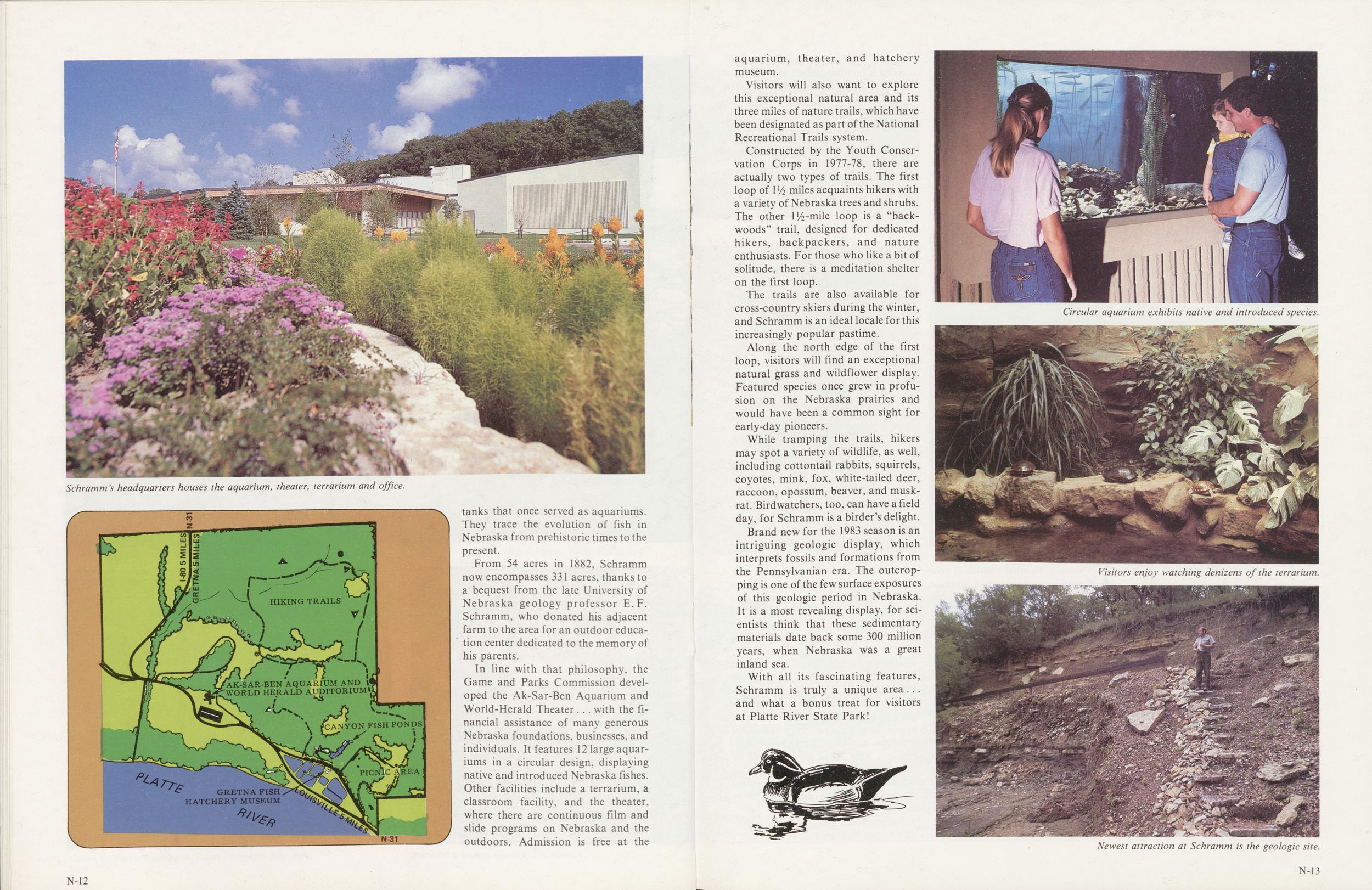
From 54 acres in 1882, Schramm now encompasses 331 acres, thanks to a bequest from the late University of Nebraska geology professor E.F. Schramm, who donated his adjacent farm to the area for an outdoor education center dedicated to the memory of his parents.
In line with that philosophy, the Game and Parks Commission developed the Ak-Sar-Ben Aquarium and World-Herald Theater with the financial assistance of many generous Nebraska foundations, businesses, and individuals. It features 12 large aquariums in a circular design, displaying native and introduced Nebraska fishes. Other facilities include a terrarium, a classroom facility, and the theater, where there are continuous film and slide programs on Nebraska and the outdoors. Admission is free at the
Visitors will also want to explore this exceptional natural area and its three miles of nature trails, which have been designated as part of the National Recreational Trails system.
Constructed by the Youth Conservation Corps in 1977-78, there are actually two types of trails. The first loop of IVi miles acquaints hikers with a variety of Nebraska trees and shrubs. The other l^-mile loop is a "backwoods" trail, designed for dedicated hikers, backpackers, and nature enthusiasts. For those who like a bit of solitude, there is a meditation shelter on the first loop.
The trails are also available for cross-country skiers during the winter, and Schramm is an ideal locale for this increasingly popular pastime.
Along the north edge of the first loop, visitors will find an exceptional natural grass and wildflower display. Featured species once grew in profusion on the Nebraska prairies and would have been a common sight for early-day pioneers.
While tramping the trails, hikers may spot a variety of wildlife, as well, including cottontail rabbits, squirrels, coyotes, mink, fox, white-tailed deer, raccoon, opossum, beaver, and muskrat. Birdwatchers, too, can have afield day, for Schramm is a birder's delight.
Brand new for the 1983 season is an intriguing geologic display, which interprets fossils and formations from the Pennsylvanian era. The outcropping is one of the few surface exposures of this geologic period in Nebraska. It is a most revealing display, for scientists think that these sedimentary materials date back some 300 million years, when Nebraska was a great inland sea.
With all its fascinating features, Schramm is truly a unique area and what a bonus treat for visitors at Platte River State Park!
Louisville State Recreation Area
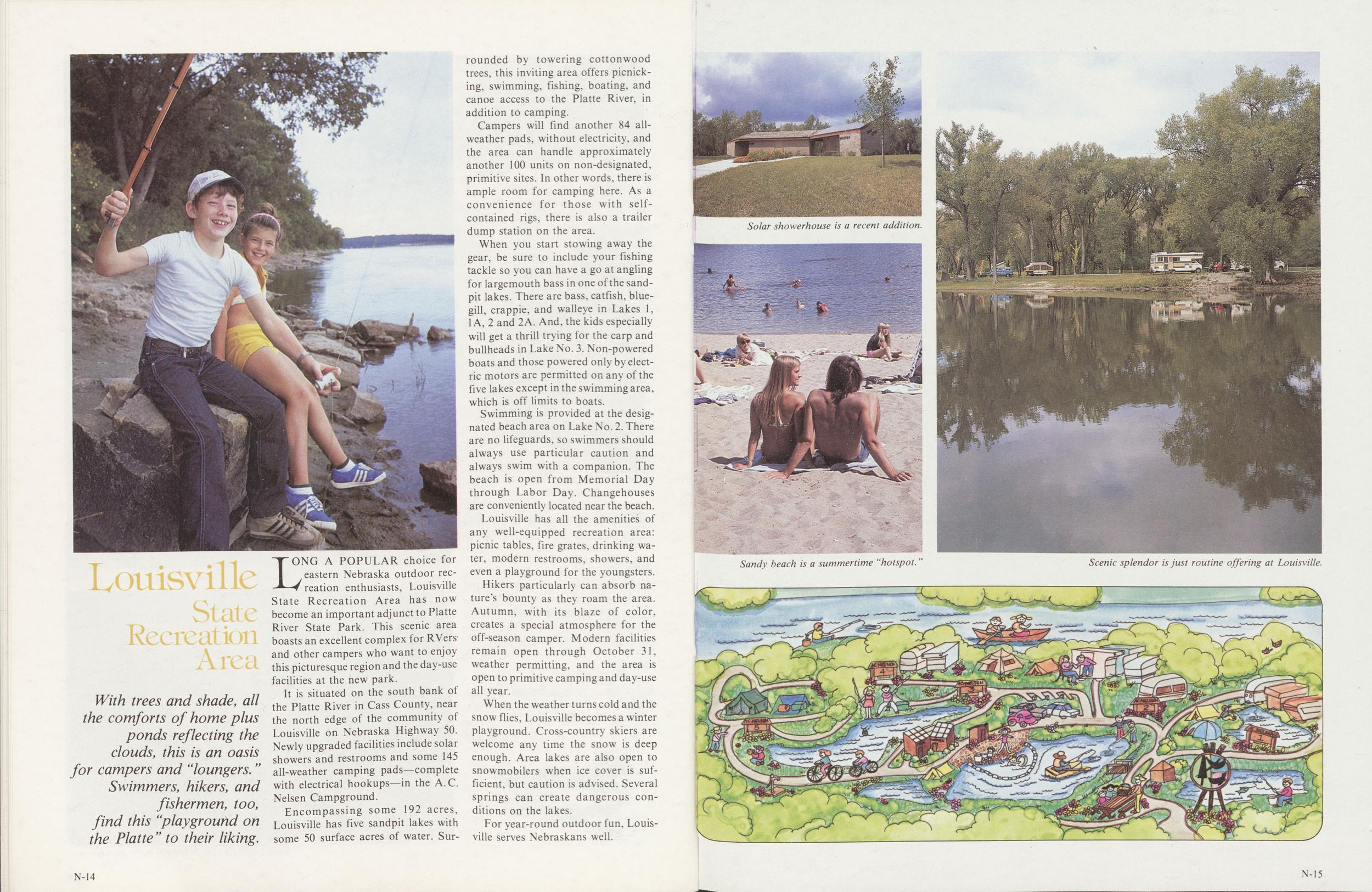
With trees and shade, all the comforts of home plus ponds reflecting the clouds, this is an oasis for campers and "loungers." Swimmers, hikers, and fishermen, too, find this "playground on the Platte" to their liking.IONG A POPULAR choice for eastern Nebraska outdoor recreation enthusiasts, Louisville State Recreation Area has now become an important adjunct to Platte River State Park, This scenic area boasts an excellent complex for RVers and other campers who want to enjoy this picturesque region and the day-use facilities at the new park.
It is situated on the south bank of the Platte River in Cass County, near the north edge of the community of Louisville on Nebraska Highway 50. Newly upgraded facilities include solar showers and restrooms and some 145 all-weather camping pads—complete with electrical hookups—in the A.C. Nelsen Campground.
Encompassing some 192 acres, Louisville has five sandpit lakes with some 50 surface acres of water. Surrounded by towering cottonwood trees, this inviting area offers picnicking, swimming, fishing, boating, and canoe access to the Platte River, in addition to camping.
Campers will find another 84 all-weather pads, without electricity, and the area can handle approximately another 100 units on non-designated, primitive sites. In other words, there is ample room for camping here. As a convenience for those with self-contained rigs, there is also a trailer dump station on the area.
When you start stowing away the gear, be sure to include your fishing tackle so you can have a go at angling for largemouth bass in one of the sand-pit lakes. There are bass, catfish, bluegill, crappie, and walleye in Lakes 1, 1 A, 2 and 2A. And, the kids especially will get a thrill trying for the carp and bullheads in Lake No. 3. Non-powered boats and those powered only by electric motors are permitted on any of the five lakes except in the swimming area, which is off limits to boats.
Swimming is provided at the designated beach area on Lake No. 2. There are no lifeguards, so swimmers should always use particular caution and always swim with a companion. The beach is open from Memorial Day through Labor Day. Changehouses are conveniently located near the beach.
Louisville has all the amenities of any well-equipped recreation area: picnic tables, fire grates, drinking water, modern restrooms, showers, and even a playground for the youngsters.
Hikers particularly can absorb nature's bounty as they roam the area. Autumn, with its blaze of color, creates a special atmosphere for the off-season camper. Modern facilities remain open through October 31, weather permitting, and the area is open to primitive camping and day-use all year.
When the weather turns cold and the snow flies, Louisville becomes a winter playground. Cross-country skiers are welcome any time the snow is deep enough. Area lakes are also open to snowmobilers when ice cover is sufficient, but caution is advised. Several springs can create dangerous conditions on the lakes.
For year-round outdoor fun, Louisville serves Nebraskans well.
N-14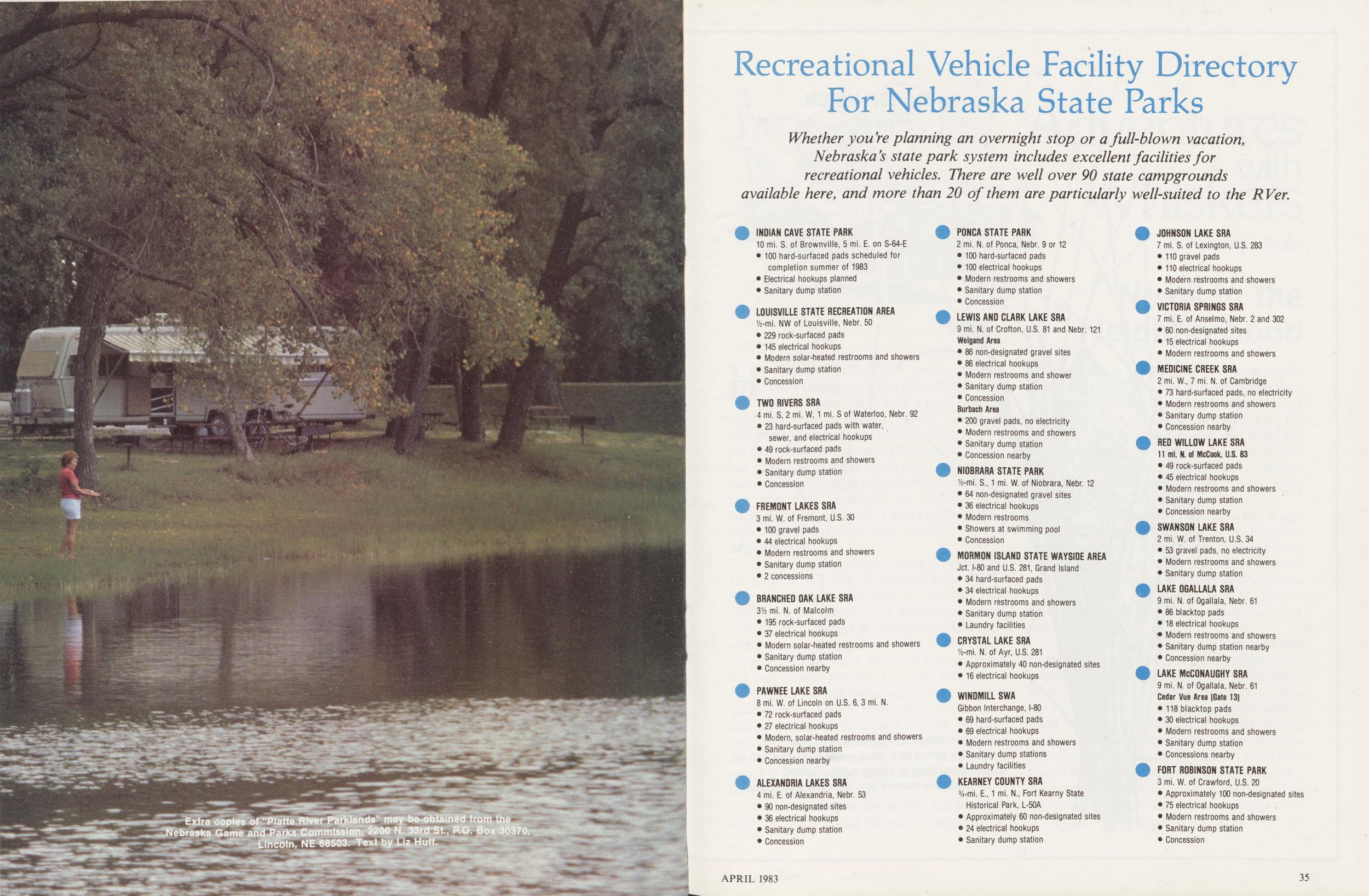
Recreational Vehicle Facility Directory For Nebraska State Parks
Whether you're planning an overnight stop or a full-blown vacation, Nebraska's state park system includes excellent facilities for recreational vehicles. There are well over 90 state campgrounds available here, and more than 20 of them are particularly well-suited to the R Ver. INDIAN CAVE STATE PARK 10 mi. S. of Brownville, 5 mi. E. on S-64-E 100 hard-surfaced pads scheduled for completion summer of 1983 Electrical hookups planned Sanitary dump station LOUISVILLE STATE RECREATION AREA 1/2-mi. NW of Louisville, Nebr. 50 229 rock-surfaced pads 145 electrical hookups Modern solar-heated restrooms and showers Sanitary dump station Concession TWO RIVERS SRA 4 mi. S, 2 mi. W, 1 mi. S of Waterloo, Nebr. 92 23 hard-surfaced pads with water, sewer, and electrical hookups 49 rock-surfaced pads Modern restrooms and showers Sanitary dump station Concession FREMONT LAKES SRA 3 mi. W. of Fremont, U.S. 30 100 gravel pads 44 electrical hookups Modern restrooms and showers Sanitary dump station 2 concessions BRANCHED OAK LAKE SRA 31/2 mi. N. of Malcolm 195 rock-surfaced pads 37 electrical hookups Modern solar-heated restrooms and showers Sanitary dump station Concession nearby PAWNEE LAKE SRA 8 mi. W. of Lincoln on U.S. 6, 3 mi. N. 72 rock-surfaced pads 27 electrical hookups Modern, solar-heated restrooms and showers Sanitary dump station Concession nearby ALEXANDRIA LAKES SRA 4 mi. E. of Alexandria, Nebr. 53 90 non-designated sites 36 electrical hookups Sanitary dump station Concession P0NCA STATE PARK 2 mi. N. of Ponca, Nebr. 9 or 12 100 hard-surfaced pads 100 electrical hookups Modern restrooms and showers Sanitary dump station Concession LEWIS AND CLARK LAKE SRA 9 mi. N. of Crofton, U.S. 81 and Nebr. 121 Weigand Area 86 non-designated gravel sites 86 electrical hookups Modern restrooms and shower Sanitary dump station Concession Burbach Area 200 gravel pads, no electricity Modern restrooms and showers Sanitary dump station Concession nearby NIOBRARA STATE PARK 1/2-mi. S., 1 mi. W. of Niobrara, Nebr. 12 64 non-designated gravel sites 36 electrical hookups Modern restrooms Showers at swimming pool Concession MORMON ISLAND STATE WAYSIDE AREA Jet. 1-80 and U.S. 281, Grand Island 34 hard-surfaced pads 34 electrical hookups Modern restrooms and showers Sanitary dump station Laundry facilities CRYSTAL LAKE SRA 1/2-mi. N. of Ayr, U.S. 281 Approximately 40 non-designated sites 16 electrical hookups WINDMILL SWA Gibbon Interchange, I-80 69 hard-surfaced pads 69 electrical hookups Modern restrooms and showers Sanitary dump stations Laundry facilities KEARNEY COUNTY SRA 3/4-mi. E., 1 mi. N., Fort Kearny State Historical Park, L-50A Approximately 60 non-designated sites 24 electrical hookups Sanitary dump station JOHNSON LAKE SRA 7 mi. S. of Lexington, U.S. 283 110 gravel pads 110 electrical hookups Modern restrooms and showers Sanitary dump station VICTORIA SPRINGS SRA 7 mi. E. of Anselmo, Nebr. 2 and 302 60 non-designated sites 15 electrical hookups Modern restrooms and showers MEDICINE CREEK SRA 2 mi. W., 7 mi. N. of Cambridge 73 hard-surfaced pads, no electricity Modern restrooms and showers Sanitary dump station Concession nearby RED WILLOW LAKE SRA 11 mi. N. of McCook. U.S. 83 49 rock-surfaced pads 45 electrical hookups Modern restrooms and showers Sanitary dump station Concession nearby SWANS0N LAKE SRA 2 mi. W. of Trenton, U.S. 34 53 gravel pads, no electricity Modern restrooms and showers Sanitary dump station LAKE 0GALLALA SRA 9 mi. N. of Ogallala, Nebr. 61 86 blacktop pads 18 electrical hookups Modern restrooms and showers Sanitary dump station nearby Concession nearby LAKE McCONAUGHY SRA 9 mi. N. of Ogallala, Nebr. 61 Cedar Vue Area (Gate 13) 118 blacktop pads 30 electrical hookups Modern restrooms and showers Sanitary dump station Concessions nearby FORT ROBINSON STATE PARK 3 mi. W. of Crawford, U.S. 20 Approximately 100 non-designated sites 75 electrical hookups Modern restrooms and showers Sanitary dump station Concession APRIL 1983 35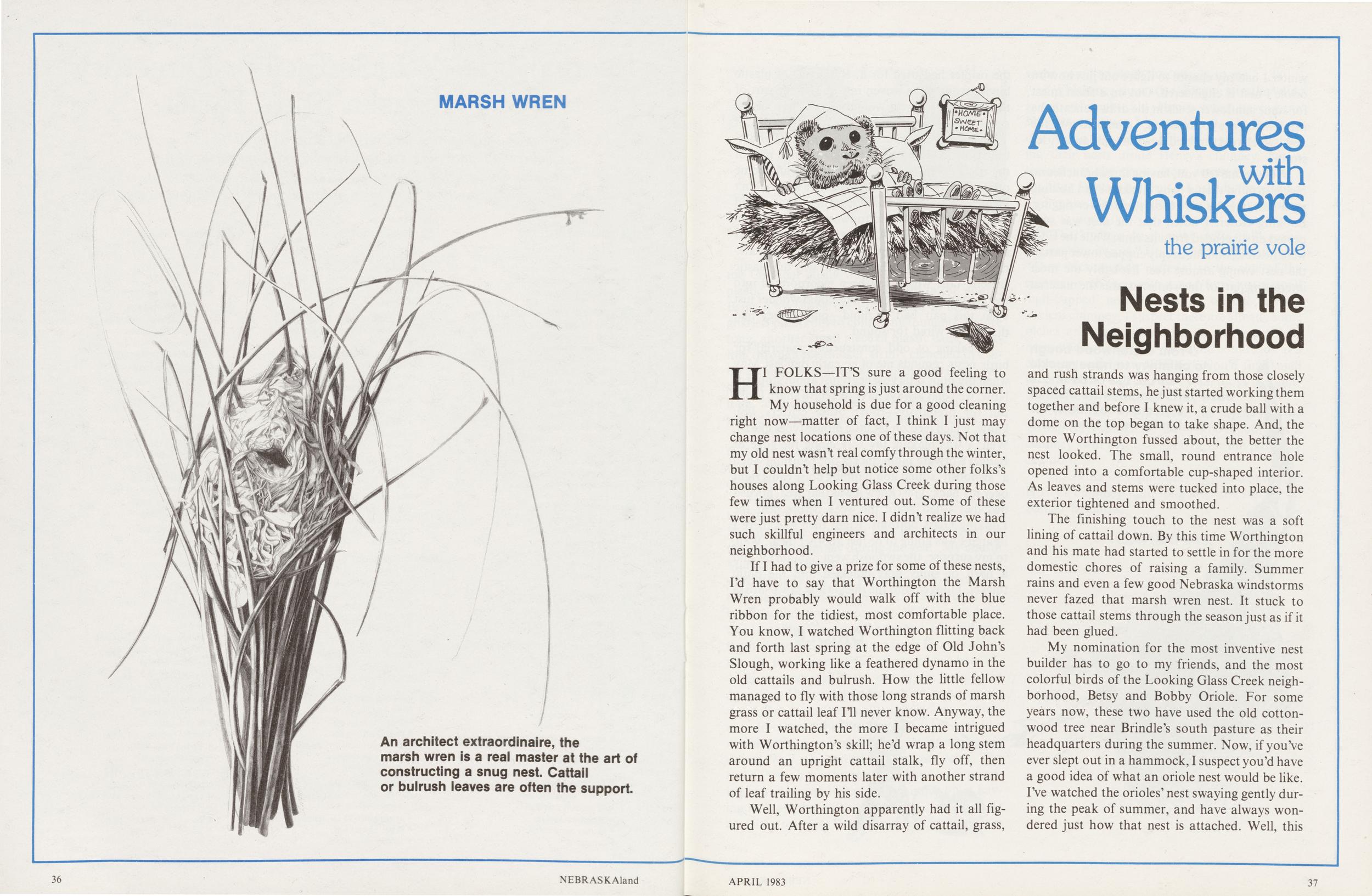
Adventures Whiskers the prairie vole
Nests in the NeighborhoodHI FOLKS—IT'S sure a good feeling to know that spring is just around the corner. My household is due for a good cleaning right now—matter of fact, I think I just may change nest locations one of these days. Not that my old nest wasn't real comfy through the winter, but I couldn't help but notice some other folks's houses along Looking Glass Creek during those few times when I ventured out. Some of these were just pretty darn nice. I didn't realize we had such skillful engineers and architects in our neighborhood.
If I had to give a prize for some of these nests, I'd have to say that Worthington the Marsh Wren probably would walk off with the blue ribbon for the tidiest, most comfortable place. You know, I watched Worthington flitting back and forth last spring at the edge of Old John's Slough, working like a feathered dynamo in the old cattails and bulrush. How the little fellow managed to fly with those long strands of marsh grass or cattail leaf I'll never know. Anyway, the more I watched, the more I became intrigued with Worthington's skill; he'd wrap a long stem around an upright cattail stalk, fly off, then return a few moments later with another strand of leaf trailing by his side.
Well, Worthington apparently had it all figured out. After a wild disarray of cattail, grass, and rush strands was hanging from those closely spaced cattail stems, he just started working them together and before I knew it, a crude ball with a dome on the top began to take shape. And, the more Worthington fussed about, the better the nest looked. The small, round entrance hole opened into a comfortable cup-shaped interior. As leaves and stems were tucked into place, the exterior tightened and smoothed.
The finishing touch to the nest was a soft lining of cattail down. By this time Worthington and his mate had started to settle in for the more domestic chores of raising a family. Summer rains and even a few good Nebraska windstorms never fazed that marsh wren nest. It stuck to those cattail stems through the season just as if it had been glued.
My nomination for the most inventive nest
builder has to go to my friends, and the most
colorful birds of the Looking Glass Creek neighborhood, Betsy and Bobby Oriole. For
some
years now, these two have used the old cottonwood tree near Brindle's south pasture
as their
headquarters during the summer. Now, if you've
ever slept out in a hammock, I suspect you'd have
a good idea of what an oriole nest would be like.
I've watched the orioles' nest swaying gently during the peak of summer, and have
always wondered just how that nest is attached. Well, this
APRIL 1983
37
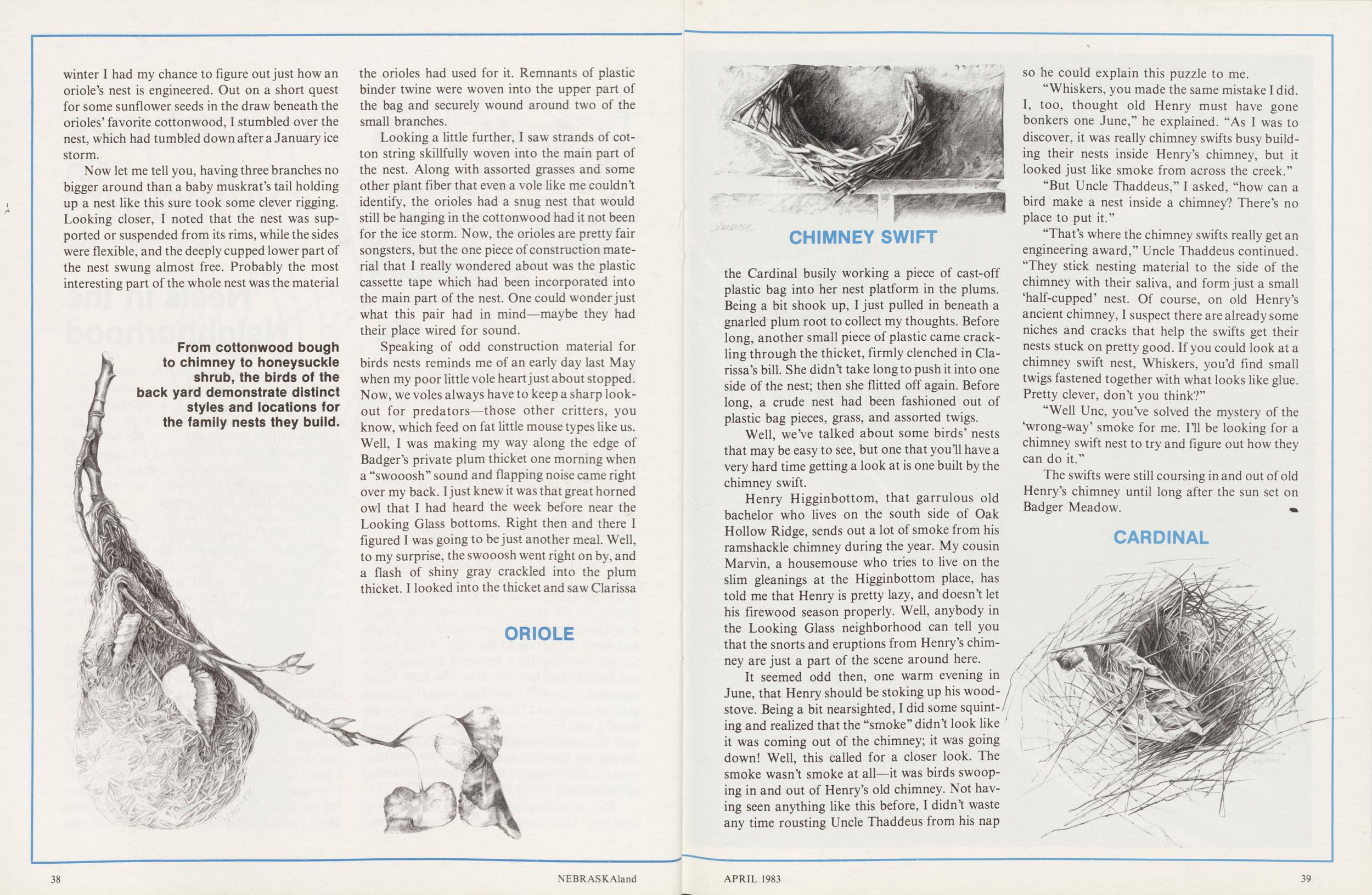 winter I had my chance to figure out just how an
oriole's nest is engineered. Out on a short quest
for some sunflower seeds in the draw beneath the
orioles' favorite cottonwood, I stumbled over the
nest, which had tumbled down after a January ice
storm.
winter I had my chance to figure out just how an
oriole's nest is engineered. Out on a short quest
for some sunflower seeds in the draw beneath the
orioles' favorite cottonwood, I stumbled over the
nest, which had tumbled down after a January ice
storm.
Now let me tell you, having three branches no bigger around than a baby muskrat's tail holding up a nest like this sure took some clever rigging. Looking closer, I noted that the nest was supported or suspended from its rims, while the sides were flexible, and the deeply cupped lower part of the nest swung almost free. Probably the most interesting part of the whole nest was the material
Looking a little further, I saw strands of cotton string skillfully woven into the main part of the nest. Along with assorted grasses and some other plant fiber that even a vole like me couldn't identify, the orioles had a snug nest that would still be hanging in the cottonwood had it not been for the ice storm. Now, the orioles are pretty fair songsters, but the one piece of construction material that I really wondered about was the plastic cassette tape which had been incorporated into the main part of the nest. One could wonder just what this pair had in mind—maybe they had their place wired for sound.
Speaking of odd construction material for birds nests reminds me of an early day last May when my poor little vole heart just about stopped. Now, we voles always have to keep a sharp lookout for predators—those other critters, you know, which feed on fat little mouse types like us. Well, I was making my way along the edge of Badger's private plum thicket one morning when a "swooosh" sound and flapping noise came right over my back. I just knew it was that great horned owl that I had heard the week before near the Looking Glass bottoms. Right then and there I figured I was going to be just another meal. Well, to my surprise, the swooosh went right on by, and a flash of shiny gray crackled into the plum thicket. I looked into the thicket and saw Clarissa
Well, we've talked about some birds' nests that may be easy to see, but one that you'll have a very hard time getting a look at is one built by the chimney swift.
Henry Higginbottom, that garrulous old bachelor who lives on the south side of Oak Hollow Ridge, sends out a lot of smoke from his ramshackle chimney during the year. My cousin Marvin, a housemouse who tries to live on the slim gleanings at the Higginbottom place, has told me that Henry is pretty lazy, and doesn't let his firewood season properly. Well, anybody in the Looking Glass neighborhood can tell you that the snorts and eruptions from Henry's chimney are just a part of the scene around here.
It seemed odd then, one warm evening in June, that Henry should be stoking up his woodstove. Being a bit nearsighted, I did some squinting and realized that the "smoke" didn't look like it was coming out of the chimney; it was going down! Well, this called for a closer look. The smoke wasn't smoke at all—it was birds swooping in and out of Henry's old chimney. Not having seen anything like this before, I didn't waste any time rousting Uncle Thaddeus from his nap so he could explain this puzzle to me.
"Whiskers, you made the same mistake I did. I, too, thought old Henry must have gone bonkers one June," he explained. "As I was to discover, it was really chimney swifts busy building their nests inside Henry's chimney, but it looked just like smoke from across the creek."
"But Uncle Thaddeus," I asked, "how can a bird make a nest inside a chimney? There's no place to put it."
"That's where the chimney swifts really get an engineering award," Uncle Thaddeus continued. "They stick nesting material to the side of the chimney with their saliva, and form just a small 'half-cupped' nest. Of course, on old Henry's ancient chimney, I suspect there are already some niches and cracks that help the swifts get their nests stuck on pretty good. If you could look at a chimney swift nest, Whiskers, you'd find small twigs fastened together with what looks like glue. Pretty clever, don't you think?"
"Well Unc, you've solved the mystery of the 'wrong-way' smoke for me. I'll be looking for a chimney swift nest to try and figure out how they can do it."
The swifts were still coursing in and out of old Henry's chimney until long after the sun set on Badger Meadow.
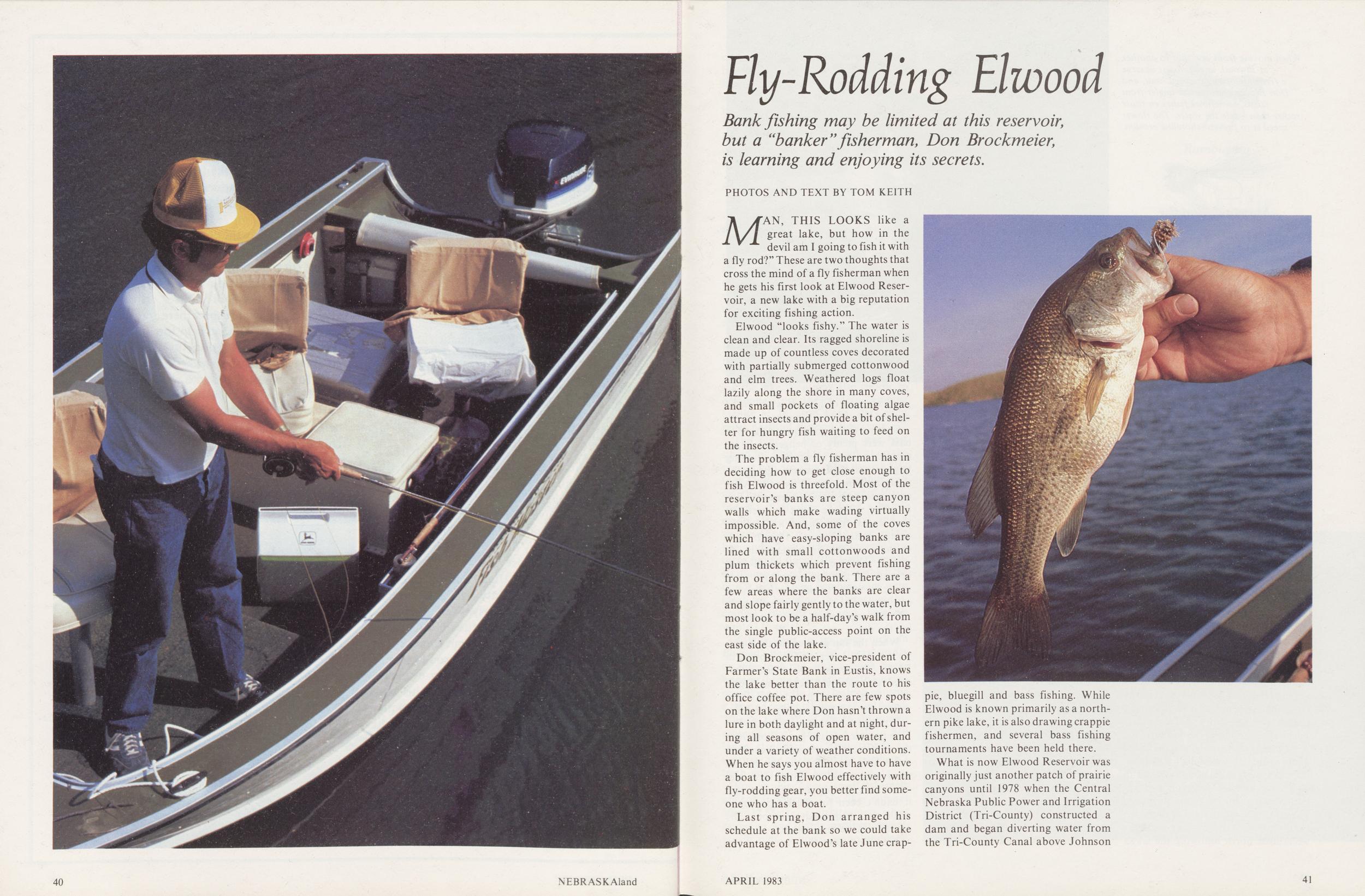
Fly-Rodding Elwood
Bank fishing may be limited at this reservoir, but a "banker"fisherman, Don Brockmeier, is learning and enjoying its secrets. PHOTOS AND TEXT BY TOM KEITHMAN, THIS LOOKS like a great lake, but how in the devil am I going to fish it with a fly rod?" These are two thoughts that cross the mind of a fly fisherman when he gets his first look at Elwood Reservoir, a new lake with a big reputation for exciting fishing action.
Elwood "looks fishy." The water is clean and clear. Its ragged shoreline is made up of countless coves decorated with partially submerged Cottonwood and elm trees. Weathered logs float lazily along the shore in many coves, and small pockets of floating algae attract insects and provide a bit of shelter for hungry fish waiting to feed on the insects.
The problem a fly fisherman has in deciding how to get close enough to fish Elwood is threefold. Most of the reservoir's banks are steep canyon walls which make wading virtually impossible. And, some of the coves which have easy-sloping banks are lined with small cottonwoods and plum thickets which prevent fishing from or along the bank. There are a few areas where the banks are clear and slope fairly gently to the water, but most look to be a half-day's walk from the single public-access point on the east side of the lake.
Don Brockmeier, vice-president of Farmer's State Bank in Eustis, knows the lake better than the route to his office coffee pot. There are few spots on the lake where Don hasn't thrown a lure in both daylight and at night, during all seasons of open water, and under a variety of weather conditions. When he says you almost have to have a boat to fish Elwood effectively with fly-rodding gear, you better find someone who has a boat.
Last spring, Don arranged his schedule at the bank so we could take advantage of Elwood's late June crappie, bluegill and bass fishing. While Elwood is known primarily as a northern pike lake, it is also drawing crappie fishermen, and several bass fishing tournaments have been held there.
What is now Elwood Reservoir was originally just another patch of prairie canyons until 1978 when the Central Nebraska Public Power and Irrigation District (Tri-County) constructed a dam and began diverting water from the Tri-County Canal above Johnson
In addition to providing a reservoir for irrigation water, Elwood has also become a favorite with anglers thanks to the expertise and foresight of the Game and Parks Commission's biologists who developed a management program to produce an excellent fishery in the new lake.
A number of species have been stocked in Elwood to provide fishermen with the makings for many exciting memories. Northern pike are the most sought-after species, followed closely by crappie, largemouth bass, walleye and catfish. There are also growing populations of bluegill, rock bass, white bass and bullhead to tempt anglers of all ages, regardless of their fishing preferences or degree of skill.
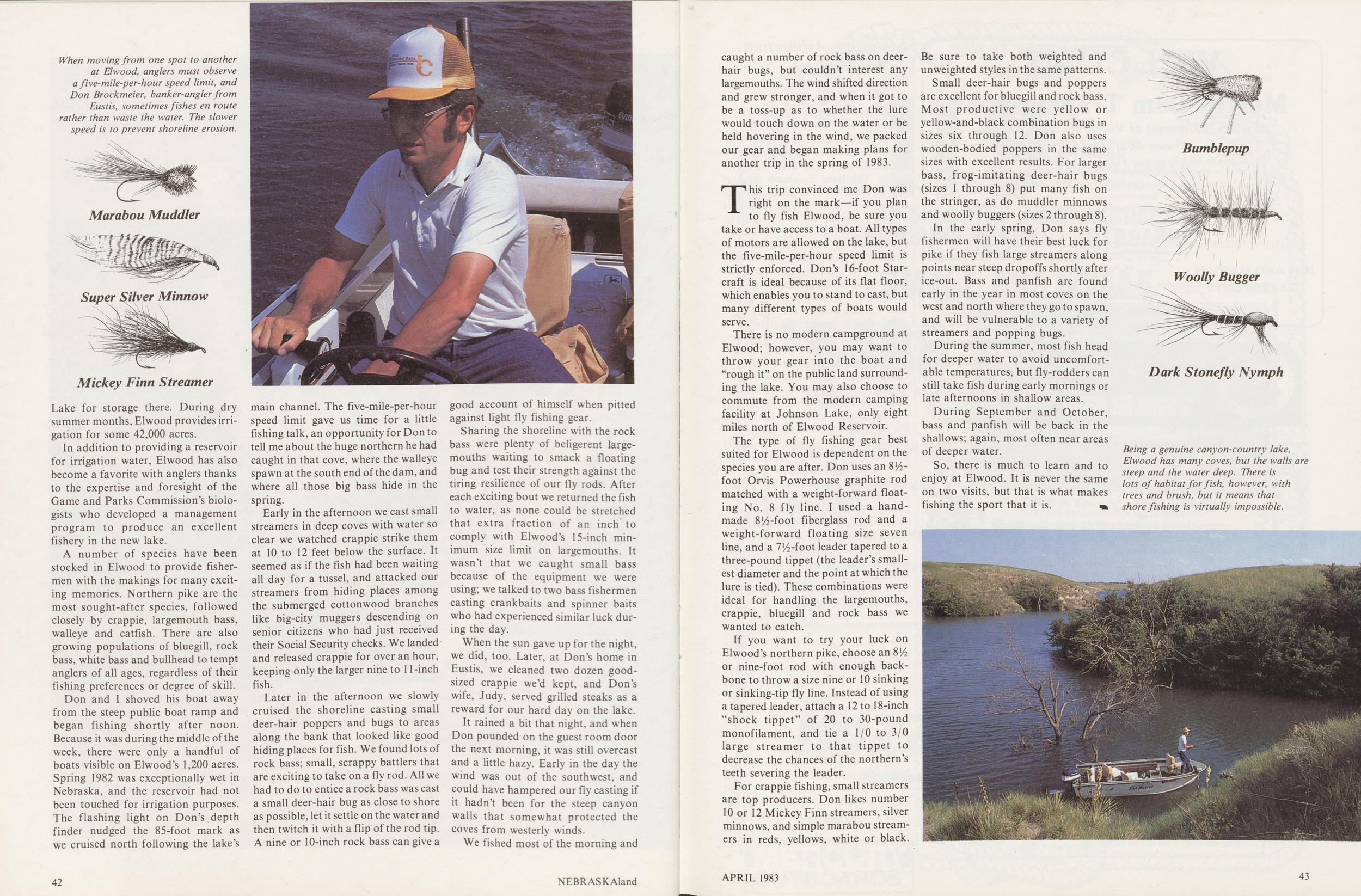
Don and I shoved his boat away from the steep public boat ramp and began fishing shortly after noon. Because it was during the middle of the week, there were only a handful of boats visible on Elwood's 1,200 acres. Spring 1982 was exceptionally wet in Nebraska, and the reservoir had not been touched for irrigation purposes. The flashing light on Don's depth finder nudged the 85-foot mark as we cruised north following the lake's main channel. The five-mile-per-hour speed limit gave us time for a little fishing talk, an opportunity for Don to tell me about the huge northern he had caught in that cove, where the walleye spawn at the south end of the dam, and where all those big bass hide in the spring.
Early in the afternoon we cast small streamers in deep coves with water so clear we watched crappie strike them at 10 to 12 feet below the surface. It seemed as if the fish had been waiting all day for a tussel, and attacked our streamers from hiding places among the submerged cottonwood branches like big-city muggers descending on senior citizens who had just received their Social Security checks. We landed and released crappie for over an hour, keeping only the larger nine to 11-inch fish.
Later in the afternoon we slowly cruised the shoreline casting small deer-hair poppers and bugs to areas along the bank that looked like good hiding places for fish. We found lots of rock bass; small, scrappy battlers that are exciting to take on a fly rod. All we had to do to entice a rock bass was cast a small deer-hair bug as close to shore as possible, let it settle on the water and then twitch it with a flip of the rod tip. A nine or 10-inch rock bass can give a good account of himself when pitted against light fly fishing gear.
Sharing the shoreline with the rock bass were plenty of beligerent large-mouths waiting to smack a floating bug and test their strength against the tiring resilience of our fly rods. After each exciting bout we returned the fish to water, as none could be stretched that extra fraction of an inch to comply with Elwood's 15-inch minimum size limit on largemouths. It wasn't that we caught small bass because of the equipment we were using; we talked to two bass fishermen casting crankbaits and spinner baits who had experienced similar luck during the day.
When the sun gave up for the night, we did, too. Later, at Don's home in Eustis, we cleaned two dozen good-sized crappie we'd kept, and Don's wife, Judy, served grilled steaks as a reward for our hard day on the lake.
It rained a bit that night, and when Don pounded on the guest room door the next morning, it was still overcast and a little hazy. Early in the day the wind was out of the southwest, and could have hampered our fly casting if it hadn't been for the steep canyon walls that somewhat protected the coves from westerly winds.
We fished most of the morning and 42 NEBRASKAland caught a number of rock bass on deer-hair bugs, but couldn't interest any largemouths. The wind shifted direction and grew stronger, and when it got to be a toss-up as to whether the lure would touch down on the water or be held hovering in the wind, we packed our gear and began making plans for another trip in the spring of 1983.
This trip convinced me Don was right on the mark—if you plan to fly fish Elwood, be sure you take or have access to a boat. All types of motors are allowed on the lake, but the five-mile-per-hour speed limit is strictly enforced. Don's 16-foot Starcraft is ideal because of its flat floor, which enables you to stand to cast, but many different types of boats would serve.
There is no modern campground at Elwood; however, you may want to throw your gear into the boat and "rough it" on the public land surrounding the lake. You may also choose to commute from the modern camping facility at Johnson Lake, only eight miles north of Elwood Reservoir.
The type of fly fishing gear best suited for Elwood is dependent on the species you are after. Don uses an 8 1/2 foot Orvis Powerhouse graphite rod matched with a weight-forward floating No. 8 fly line. I used a handmade 8 1/2-foot fiberglass rod and a weight-forward floating size seven line, and a 7 1/2-foot leader tapered to a three-pound tippet (the leader's smallest diameter and the point at which the lure is tied). These combinations were ideal for handling the largemouths, crappie, bluegill and rock bass we wanted to catch.
If you want to try your luck on Elwood's northern pike, choose an 8 1/2 or nine-foot rod with enough back-bone to throw a size nine or 10 sinking or sinking-tip fly line. Instead of using a tapered leader, attach a 12 to 18-inch "shock tippet" of 20 to 30-pound monofilament, and tie a 1/0 to 3/0 large streamer to that tippet to decrease the chances of the northern's teeth severing the leader.
For crappie fishing, small streamers are top producers. Don likes number 10 or 12 Mickey Finn streamers, silver minnows, and simple marabou streamers in reds, yellows, white or black. Be sure to take both weighted and unweighted styles in the same patterns.
Small deer-hair bugs and poppers are excellent for bluegill and rock bass. Most productive were yellow or yellow-and-black combination bugs in sizes six through 12. Don also uses wooden-bodied poppers in the same sizes with excellent results. For larger bass, frog-imitating deer-hair bugs (sizes 1 through 8) put many fish on the stringer, as do muddler minnows and woolly buggers (sizes 2 through 8).
In the early spring, Don says fly fishermen will have their best luck for pike if they fish large streamers along points near steep dropoffs shortly after ice-out. Bass and panfish are found early in the year in most coves on the west and north where they go to spawn, and will be vulnerable to a variety of streamers and popping bugs.
During the summer, most fish head for deeper water to avoid uncomfortable temperatures, but fly-rodders can still take fish during early mornings or late afternoons in shallow areas.
During September and October, bass and panfish will be back in the shallows; again, most often near areas of deeper water.
So, there is much to learn and to enjoy at Elwood. It is never the same on two visits, but that is what makes fishing the sport that it is.
Statewide Arboretum
A new concept (Continued from page 15) WELCOME to Merritt Dam Trading Post 26 Miles Southwest of Valentine On Hwy. 16C Phone 402/376-3437 Bait Tackle Ammunition Groceries Gas Beer Ice Year-round Cabins with Kitchen Facilities Campground Hook-ups Boat and Motor Rental Easy-access dock Home of the State Record Perch, Muskellunge and Smallmouth bass Your Hosts JON AND MARIAN DAVENPORT Making America a better place to live through tree Stewardship a tame to gram FOR YOUR FREE "Plant a Tree For Tomorrow" Booklet. WRITE. ARBOR LODGE 100 Nebraska City, Nebraska 68410 TREES we plant today enrich our lives and provide a legacy for future generations of Nebraskans. As a member of the NSA, you aid in the establishment and maintenance of arboretums throughout the state. You also receive quarterly The Seed, filled with Arboretum news, professional landscaping hints and valuable tips for home gardeners. THE ARBORETUM NEEDS YOU! YES! I want to support the Nebraska Statewide Arboretum with my membership and receive quarterly THE SEED newsletter. NAME STREET CITY/STATE/ZIP TELEPHONE Individual $10-25/yr. Family $25/yr. Student $5/yr. Patron $100/yr. Organization $25/yr. Sustaining $50-99/yr. Corporate $100/yr. Life $1,000 MAKE CHECKS PAYABLE TO: NEBRASKA STATEWIDE ARBORETUM 112 FORESTRY SCIENCES LABORATORY, UNL-EAST CAMPUS, LINCOLN, NE 68583-0823help orient visitors to Nebraska's landscape and plant resources.
The Nebraska Game and Parks Commission has sponsored two arboretum sites in addition to Arbor Lodge. The Hans Burchardt Arboretum at Branched Oak Lake near Lincoln was dedicated in 1982. It includes plants gathered from around the region for testing and use on wildlife lands and park areas. The third site is Chalkmine State Wayside Area near Scotia. This site is unique in that the plants are entirely native species. Chalkmine's trees along the nature trail will be identified and labeled.
Other sites include local parks, a highway wayside area, natural resources district lands, plant research stations, a secondary school, and 11 college or university campuses.
The network of arboretums provides an ideal medium for testing and evaluating plant materials throughout the climatic regions of the state.
To fulfill the educational potential that the system of arboretums offers, NSA is seeking funding for a permanent educational director. In a prairie state such as Nebraska, making these collections of trees, shrubs and herbaceous plants available for study by young people is particularly important. As more arboretums are affiliated across the state, and are fully developed, they will be used more and more by school groups, for workshops and for self-guided tours.
The most gratifying aspect of NSA is the mood among our supporters. The feeling is positive, and the sites support each other's efforts rather than competing. Sometimes development is slower than we would hope, but as a group, the affiliates are tenacious, refusing to abandon their goals in spite of setbacks. It is in this regard, perhaps, that the association with others has been most rewarding.
In its statewide arboretum system, Nebraska, we feel, has planted a seed that will grow and spread its kind across the state and perhaps even into other states where a gentle longing for trees has grown into an ache. But of course, what pioneer worth his salt wouldn't feel that way?
44 NEBRASKAland NEBRASKAland NOW AT BUZZ'S MARIN! IN KEARNEY ANNUAL PERCENTAGE RATE FINANCING ON SELECTED SMALL MODELS FEATURING MERCURY 0UTB0ARDS DURING OUR APRIL SMALL BOAT SALE COMPLETE RIG 16' Chaparral 162 VBR V-Hull For Top Performance and Feather Smooth Ride Teak Trim Stainless Steel Hardware and Rails 50 HP Mercury Outboard Motor Deluxe Trailer Includes Freight. Dealer Prep and Handling $115.57 LOW MONTHLY PAYMENT Open Mon.-Sat. 8:30-5:30 Sun. 12:00-4:30 Open Every Weekend in April 48 Payments, 1 1.9 APR on approved credit, $1 100 down or equivalent. Deferred price of $6647.90, sales tax not included. RR & Avenue F our best product is our service.. 234-4576 Kearney, NE
How Dickie Trammel taught about red organ flies
(Continued from page 17) WHAT JUST CAN DO TO POLLUTION People start pollution. People can stop it. Advertising contributed for the public good Keep America Beautiful 99 Park Avenue, New York, New York 10016 keep it up. By driving less, planning trips more wisely and keeping our cars in tune, well keep saving gas. And money—because wasted gas is wasted money. Little by LITTLE, IT ALL ADDS UP. ENERGY EFFICIENCY U S Department of Energy A Pubic Service at This Magazine $ The Advertising Councilup and made a more than necessary commotion behind the fountain, and Dickie drew back and squinted the way he does before he tells a lie and says, "Trout are hitting good, but damn if they are not all little fellows. Took home a washtub full of 14-inchers last Sunday as some of Ruby's kin was coming for dinner. They was fit for panfish, but there was not one with any real size to him. Still, I am sure the adults will begin to feed real soon now. You fish?"
Old Dickie is what they call a man of few words most of the time, but when he lies, he does it in paragraphs.
"Oh my, yes," says the sartorial-stranger, nodding till his spinners jingled. "And where, if I might ask, did you net those beauties?"
"Never netted 'em" says Dickie. "Took 'em on flies."
Ray and me said nothing. I do not think old Dickie Trammel has ever fly fished in his life. I know for a fact that he has never been caught at it around here. He has no doubt hooked a trout or two, for if you often enough dump a glob of worms into a stream where there are trout, you will sooner or later catch one. But the thought of him standing in a stream with a split-willow creel clipped to his overall buttons, one end of a long, skinny fly-rod disappearing into his hairy hand, and likely as not a greasy seed-corn hat on his head and Beech-Nut flakes on his chin, does make you want to laugh.
Well, this fellow just sat there with
Dickie drains the rest of his coffee and shoves back from the table. Me and Ray was just as interested to hear as the stranger was, as this was the first time through it for us, too, and probably both of us was doubting if Dickie could name a fly at all.
"Red Organ," he says, packing a fresh clot of Beech-Nut into his cheek. "Meet me here about six tomorrow morning if you're free to. Might be able to show you some fishing." Then he stands up, nods to me, and on his way out says to Ray, "Thanks for the coffee. It carried me back delightfully." The stranger never even noticed, he was so caught up in his vision of a wash tub full of 14 inchers, I expect.
After about a minute he come to himself again. "I certainly do have a lot to learn, I'm afraid," he said, kind of thoughtfully running his finger around the rim of his phosphate glass. "I have been studying everything about fly fishing I can lay my hands on, don't you know, but I am just positive I have never encountered a reference to Red Organs."
I had thought he must be new at it. No scuffs on his gum-bottoms, in a manner of speaking. But I am not new at it, and I have to admit that Dickie shook me a little, too. I mean, I pretty near believed him when he said "Red Organ."
Dickie tells good lies. If he would take them to fairs, he would win ribbons for them. This one was extra good. Not so much for what he said, but for the implications. He only said a little, but he made you feel there was depth and significance behind it. It had grace and an air of truth, and it was beyond the powers of the ordinary amateur. It would have got at least an honorable mention down in Lincoln, if he could have saved it up and told it there. Anyhow, I knew where I would be at six the next morning.
When I pulled up to the drugstore at about 10 of, Dickie was already there, leaned back in his old pickup, eating something brown. Ruby's breakfasts are unique. I decline them when I can 46 NEBRASKAland do it without giving offense. I climbed in beside him, but damn if he offered one word of explanation. Since he didn't, damn if I would ask, so we just set there. I noticed he had a bluejay feather stuck in his cap, making him look odder than usual.
Pretty soon along come a big, square, self-propelled motel room with screen doors and storm windows and No. 1 county tags on it, and out steps The Trout Fisherman.
"Hop in the little old Arvee, boys," he said; "there is room to spare, don't you know." Looked like there was even spare rooms. I am not certain how to spell Arvee. The only name I saw on the rig was an Indian tribe. I did have some curiosity about how it was laid out inside—looked to me like you must have to drive her from the breakfast nook—but Dickie said, "Get your gear. We will go in my truck."
Well, then I could see why that fellow drove such a pullman car. He began to unload his accouterments and pile them on the stoop. He had so much gear he must have had that rig's cellar and attic and hall closet all plum full. I carted it over to Dickie's truck while The Trout Fisherman checked the kitchen stove and jiggled the toilet handle, or whatever he did before leaving home.
We all squeezed into Dickie's truck and headed west past the sugar factory. The T. F. chattered on about fly fishing, and never noticed how the gear-shift made a black stripe on the knee of his yellow flannels every time Dickie put her in second. He fulminated on the merits of Tonkin cane versus graphite and boron, and about Full-Wells and reversed half-Wells grips, and every so often he would pause and ask Dickie what he thought about something or other, and Dickie would always say, "Whatever suits" or "To each his own," which seemed mighty thin expertise to me, but satisified T. F. who was only half listening.
In about 20 minutes we pulled up to Eldon Frickie's pasture. I opened the gate, and we drove on down to the river, where no trout, as far as I know, has ever been seen. "Get out your tackle," says Dickie, "we are here."
The T. F. hops out, swings his arms around and then hugs his chest and says, "Ah, the pure air of the west." It was not too bad, either, since the wind was blowing back toward Eldon's feed lot, and the factory does not begin to process beets until around October. Then, he starts opening his parcels.
First thing he does is shuck off his gum-bottoms and wiggle into a pair of hip waders which he fastens to his belt with little rubber garters. Then on goes a vest the color of his hat, with 35 or 40 pockets in it, and a whole passel of spring-loaded reels like the kind janitors keep their keys on. And, dangling from the reels were nets, and little brass scales, and scissors and flashlights, and I do not remember what all.
He clips on a creel and flips his sun-glasses up and down once or twice, and then pulls out an oiled, saddle-leather case, opens it up, and puts together a willowy, bamboo fly rod about eight feet long and about as big around as a pencil. It was a beauty, I have to admit.
Dickie, he just reaches under the pickup seat and pulls out his old tele-scoping steel casting rod. He grunts a couple of times and stretches out the top couple of sections, but the bottom ones won't slide and he cannot get it longer than about four feet. He whips it against the pickup roof a couple of strokes, and each time raises a little rust cloud. It is not clear if it is pickup rust or rod rust. Well, that did the job, and he stretched the rod on out to about 10 feet. Then he picks up a butcher-paper package and his old Karo Syrup-bucket tackle box and says, "Let's get a-going," and heads for the riverbank.
"Right about here ought to do it," he says, and sets down his gear. Then he looks over at the T. F., who is unsnapping and zipping himself up in various places, and says, "Your tackle is too light, I think, but it will have to serve."
Then he pries off the top of his syrup bucket, fumbles in it, and pulls out a treble hook about the size of a fist. He ties that to his line, which was about 30-pound-test braided casting line. By now the T. F. cannot do anything but stand and stare. Finally he croaks out, "I thought you used flies, don't you know."
"Yes," says Dickie, "Red Organs. Tie 'em fresh each time. They do not keep well."
Then he unrolls the butcher paper package, and out squirms about two pounds of beef liver. He manages to surround a handful and wraps it around the shank of that hook so that only the barbs are showing. Then he runs two or three turns of store string from the package around it to hold the liver in place. Next he pulls the bluejay feather out of his cap and stabs it into the liver, and holds up the whole concoction, glistening in the morning sun, and says "Red Organ."
Well, the joke should have been over right there, but the T. F. just stared with his jaw hanging slack, and Dickie picked up his rig, rod in one hand, Red Organ in the other, and walked down to the bank where an old cottonwood had blown down, forming a quiet pool in the water with a little riffle at the downstream edge.
Old Dickie braced himself solid, took the rod in both hands, swung that meat-market lure once or twice around his head, rod creaking like a rusty bed spring, and let it fly toward the riffles.
Well, that was it, I figured. What happens when you put a lure to water? All bets are off. Then it is up to the fish, and a joke will get kind of drawn out and boring by the third or fourth time you reel it in and cast it out. I could see it would not take too many hours of fly casting two pounds of wet liver to make the whole idea go sour.
 At Stud
ELHEW HUSKER JOHN 179214
Elhew Huckster Ch- Elhew Huckleberry
Elhew Shagger Ch- Elhew Holly
(sire) Elhew Penelope Ch. Red Water Rex
Elhew Knickette
Elhew Alligator Elhew Huckster
Elhew Puffin Elhew Tutlou
(dam) Elhew Sprite Elhew Knickerbocker
Elhew Ball's Lady
Elhew Husker John
Stud Fee $250
J.H. Render, P.O. Box 86, Panama, NE 68419
Phone (402) 788-2213
STOCK YOUR LAKE
OR POND
with
CHANNEL CAT
LARGEMOUTH BASS
BLUEGILL-CRAPPIE
ORDER NOW
WILLOW LAKE FISH HATCHERY
Rt. 3, Box 46, Hastings, Nebr. 68901
Gaylord L. Crawford
Phone: (402) 463-8022
Day or Night
For April to October 15 stocking
Hybrid grass carp for moss control
THE
SHELDON GALLERY COOKBOOK
A delightful and practical addition
to a cook's kitchen or coffee table,
The Sheldon Gallery Cookbook offers
600+ recipes from ethnic specialties
to continental cuisine. Published by
the Nebraska Art Association, it is
illustrated with art from the walls
of the Sheldon Gallery, and features
recipes contributed by the artists
themselves. Order from The Art Shop,
Sheldon Gallery, UNL, Lincoln, NE
68588. $14.65—212 pages.
At Stud
ELHEW HUSKER JOHN 179214
Elhew Huckster Ch- Elhew Huckleberry
Elhew Shagger Ch- Elhew Holly
(sire) Elhew Penelope Ch. Red Water Rex
Elhew Knickette
Elhew Alligator Elhew Huckster
Elhew Puffin Elhew Tutlou
(dam) Elhew Sprite Elhew Knickerbocker
Elhew Ball's Lady
Elhew Husker John
Stud Fee $250
J.H. Render, P.O. Box 86, Panama, NE 68419
Phone (402) 788-2213
STOCK YOUR LAKE
OR POND
with
CHANNEL CAT
LARGEMOUTH BASS
BLUEGILL-CRAPPIE
ORDER NOW
WILLOW LAKE FISH HATCHERY
Rt. 3, Box 46, Hastings, Nebr. 68901
Gaylord L. Crawford
Phone: (402) 463-8022
Day or Night
For April to October 15 stocking
Hybrid grass carp for moss control
THE
SHELDON GALLERY COOKBOOK
A delightful and practical addition
to a cook's kitchen or coffee table,
The Sheldon Gallery Cookbook offers
600+ recipes from ethnic specialties
to continental cuisine. Published by
the Nebraska Art Association, it is
illustrated with art from the walls
of the Sheldon Gallery, and features
recipes contributed by the artists
themselves. Order from The Art Shop,
Sheldon Gallery, UNL, Lincoln, NE
68588. $14.65—212 pages.
But it arched out and plummeted down toward the water, and then one more miracle in a day of wonders occurred. It was one of those moments when the wretched condition of man is relieved by the intervention of devine grace, as the preacher says, but more likely by unforeseen coincidence. That liver just barely touched the water. It had not even time to make the splat you would expect, when a hole the size of a bucket yawned open in the surface of the river, and with a sucking noise, the Red Organ disappeared. Old Dickie's rod bent just about double.
I do not know what was in the mind of that catfish. He must have been lying around that cottonwood just dreaming of liver, and when the shadow of that Red Organ descended upon him, he took it as a sign of virtue rewarded and just opened up his lazy big mouth. Never saw one feed off the surface before or since.
Old Dickie horsed the cat up onto the bank, and it measured out to about 30 inches—29 and %, actually, according to the T. F.'s retractable, stainless-steel combination tape measure and adjustable-focus, goose-neck reading lamp. Weighed 13 pounds six ounces on his spring-loaded, brass-barreled scale.
As he weighed it out he said, "Funny looking trout, don't you know." I was about to credit him for taking a joke like a gentleman, when I saw that he still did not know that it was not one. He meant it! He thought it was a funny looking trout, and he did not know yet but what he had just skipped over the part about Red Organs in one of his trout fishing books. I was about to tell him, but decided against it. You may not think me strict enough in my morals, but I could not see why I should be expected to go around furnishing brains to Omaha trout fishermen.
Dickie says, "He is a channel trout. There is still a few around."
That fellow came out several springs after that and fished for channel trout with Red Organ flies, but I never heard of him getting one. Probably his tackle was too light.
Well, the real reason I am writing to you is to renew my subscription. I hope you will take cash, for I have not yet put my trust in a checking account, although it would be useful to have the little calendar that they give you every year to stick into your checkbook.
If you get out this way, stop by the drugstore. If me or Dickie is not there, Ray can get in touch, and we might be able to show you some fishing.
Sincerely, Clemens Babcock 48 NEBRASKAlandTrading Post
DOGSWELL-BRED Hunting dogs for sale—Brittanies, English setters and pointers—ranging in age from puppies to young dogs. Darrell Yentes, 1118 McMillan, Holdrege, NE 68949. Phone (308) 995-8570 or (308) 995-4797.
GERMAN SHORTHAIRS—English Pointers and Setters. Stud service, puppies and started dogs available. Wayne Clark, Box 54, Union, NE. (402) 263-3495 or 263-3155.
TRAINING ALL BREEDS Hunting dogs—Vizslas for sale. Rozanek Kennels, Rt. 2, Schuyler, NE 68661. Phone (402) 352-8769.
WEIMARANER (Gray Ghost) AKC puppies for sale. Excellent hunting background. Good with children. Lincoln, Nebraska. Phone (402) 467-2848.
MISCELLANEOUSGUNS—Browning, Winchester, Remington, others, Hi-powers, shotguns, new, used, antiques. Want Pre-1964 Winchesters. Buy-Sell-Trade. Ph. (402) 729-6112. Bedlan's Sporting Goods, Fairbury, NE 68352.
N.E. NEBRASKA Trout Fishing. For rent Mon.-Thurs. or Fri.-Sun. 2 modern cottages completely furnished. 3 ponds with trout up to 5 lbs. 2 ponds with bass and bluegill. Diamond E. Trout Resort, Orchard, NE 68764 (402) 893-4745.
PLASTIC DECOYS: We're originator of famous do-it-yourself system. Catalog $1.00. Decoys Unlimited, Box 69, Clinton, IA 52732.
CLASSIC GROUSE books: Grouse Feathers, More Grouse Feathers, by Bert Spiller. The Gallant Grouse by Heacox, Timberdoodle by Woolner. $13.50 each, prepaid. All now out of print. Supply limited. Highwood Bookshop, Box 1246, Traverse City, Mich. 49684. (616) 271-3898.
30 USED, 17' QUALITY Michi-Craft Canoes! Clean, Reconditioned, Guaranteed! A good used canoe is far better than a poor new one! Let us show you the difference! Sale ends April 10! Wilson Outfitters Nebraska (WON) 1329 Dawes Avenue, Lincoln, NE 68521. Phone (402) 476-2300/489-6241.
WINE AND BEER: Make your own. Send for free recipes and instructions. Omaha Supply, 13616 Polk, Omaha, Nebr. 68137.
FISH FOR SALE. Channel catfish, bass, bluegill, crappie, trout, perch, white bass, minnows, hybrid grass carp, bullhead. We can ship fish, you can pick them up, or we deliver. Contact the Pleasant Valley Fish Farm, Rt. 1, McCook, Nebr. 69001. Phone (308) 345-6599.
BED & BREAKFAST of Nebraska offers overnite lodging with breakfast, in homes throughout the state. For reservations contact Bed & Breakfast of Nebraska, 1464 28th Ave., Columbus, NE 68601. Phone (402) 564-7591.
12 x 50-FOOT AMERICAN Mobil Home on private lot with covered patio and boat storage. Air-conditioned and furnished. Walking distance to the beach at Sailor's Point, Lake McConaughy. $19,800. Phone (308) 262-0122.
DEER HUNTER'S book special! The Modern Deer Hunter by John Cartier, published at $10.95, and Hunting Trophy Deer by John Wooters, published at $13.95. A total $24.90 value, now only $12.95 prepaid. Highwood Bookshop, Box 1246-N, Traverse City, Michigan. 49685. Phone (616) 271-3898.
DECOY CARVERS, decoy collectors, duck hunters—we carry all books on these subjects. New books as published. Send SASE for large list. Highwood Book-shop, Box 1246, Traverse City, Mich. 49684 (616) 271-3898.
LIVE-CATCH ALL-PURPOSE TRAPS Write for FREE CATALOG Traps without injury squirrels, chipmunks, rabbits, mink, fox raccoons, stray animals, pests, etc Sizes for every need. Also traps for snakes, sparrows, pigeons, crabs, turtles, quail, etc. Save on our low factory prices. Send no money. Free catalog and trapping secrets. MUSTANG MFG. CO., Oept. N-34, Box 10880, Houston, Tex. 77018 1 out of 4 forest fires are started by trash fires. NEBRASKAland Magazine Order Form Please start a subscription for me to NEBRASKAland, and send me the current bonus issue (a $6.00 value). One-year $7.50 Two-year $13 NAME ADDRESS CITY Three-year $19 STATE Mail to: NEBRASKAland Box 30370, Lincoln, NE 68503 ZIP TAXIDERMYAWARD-WINNING TAXIDERMIST. Eight time national award winners. Trust your trophies to a proven winner. Our complete taxidermy service also arranges hunts. Dinges Taxidermy Studio, 2763 South 12th Omaha, NE 68108. Ph. 402-342-3718.
CREATIVE TAXIDERMY in all its branches since 1935, now includes Northstar Freeze-Dry processing of approved small specimens. Also tanning and deerskin processing. Naturecraft Studio. Nebraska City, Nebraska 68510. Joe Voges-Owner. Phone (402) 873-5491.
JOHNSON TAXIDERMY—servicing southwest Nebraska, specializing in big-game mounts, lifesized mounts, rug work, fish, birds, tanning hair-on leather. Brochure and price list on request. Johnson Taxidermy, Rt. 1, Box 78, Lamar, NE 69035. Telephone (308) 882-5555.
PEISTER TAXIDERMY—a name you can trust. We give you professional life-like work at prices most sportsmen can afford. Member National Taxidermist Association, #5 Regency Place, Kearney, Nebr. 68847. Phone (308) 237-7575.
NABITY'S TAXIDERMY. 31 years experience. Specializing in natural grass backgrounds for mammals, birds and fish. 13901 "0"St., Lincoln, NE 68505 (4 miles east of 84th and "O". (402) 489-6351.
BADE TAXIDERMY—Quality a must—Fast service. Fish, birds, rugs, tanning, full mounts and game heads. 1924 North Lincoln, Fremont, Nebraska. 727-5463.
BIG BEAR TAXIDERMY, Rt. 2, Mitchell, Nebraska 69357. We specialize in all big game from Alaska to Nebraska, also birds and fish. Hair on and hair off tanning, 4 1/2 miles west of Scottsbluff on Highway 26 Phone (308) 635-3013.
KARL SCHWARZ Master Taxidermist. Mounting of game heads—birds—fish—animals—fur rugs—robes-tanning buckskin. Since 1910. 424 South 13th Street, Dept. A, Omaha, Nebraska 68102.
FREEZE-DRY TAXIDERMY Wally Allison's State Record Taxidermy, 2709 Birchwood, North Platte, NE 69101. Phone: (308) 534-2324. Specializing in Fish and Small Game, Snake and Lizard and Novelties. (Nothing too small) Newest of all taxidermy methods employed.
Harlan County Dam Vacation Apartments fully furnished Color TV Kitchen Facilities Full Baths Game cleaning room with freezer One block from shopping center Weekend or week of pleasant living Security Deposit Required Sorry No Pets Dean and Esther Stone Box 145 Ph. (308) 799-3422 Republican City, NE 68971 BERGMAN'S RESORT On Johnson Lake Modern Lakefront Cabins Groceries Bait Tackle Full RV Hookups Boats for Rent Swim Fish Golf Write or Call: RR 2, Elwood, NE 68937 (308) 785-2298 APRIL 1983 49
Bookshelf
By Curt Twedt SPRING CATALOG World s foremost supplier of quality hunting, fishing, and outdoor gear. A FULL YEAR S FREE SUBSCRIPTION 5 Catalogs throughout the year! Rods Reels Lures Boating Rod Building Camping Bows Hunting Supplies Outdoor Clothing Footwear Knives Decoys. Yes, send my FREE Subscription 812 13th Ave. Dept. 863-304 Sidney, Nebraska 69160 NAME ADDRESS CITY STATE ZIP QUN DOQ. THE MAG A ZINE OF UPLA ND BIRD A ND WATERFOWL DOGS North America's only magazine devoted totally and exclusively to upland bird and waterfowl hunters and to their dogs. In every big, full-color issue, you'll join Gene Hill, Charley Waterman, Richard A. Wolters, Dave Duffey, George Bird Evans, and a host of others as they share their adventures and devote their skills, their knowledge, and their talents to you and your dog. Join us. Our season never ends! 1 Yr. $13.97 2 Yr. $24.97 Prices are for the U.S. and its Possessions. Add $4 per year for Canadian subscriptions. Name Address City State Zip Please clip and mail with your check or money order to: GUN DOG Magazine, Dept. H-7148, P.O. Box 10756, Des Moines, IA 50340.THE BISON BOOK series was launched by University of Nebraska Press (UNP) in 1960. Since that debut, more than 500 titles have appeared in high quality paperbacks so characteristic of the Bison Book "herd." A number of subjects of interest to readers are covered in the series—literature and literary criticism, European history, anthropology, natural history and American history. The major emphasis in the realm of American history is the West, especially the Great Plains and northern Rocky Mountains. Come along for a quick trip through the UNP catalog for a sample of natural history and American West books.
It's quite appropriate having a trio of titles about buffalo lead this brief parade of Bison Books. The Hunting of the Buffalo by E. Douglas Branch first appeared in 1929 as the published version of a graduate degree thesis. Two more recent surveys of the buffalo and its environment are The Time of the Buffalo by Tom McHugh and The Great Buffalo Hunt by Wayne Gard. Of the three, McHugh's book contains more information about the animal's biology and natural history, while the other two emphasize human exploitation and the near extinction of the great bison herds.
Another symbol of the American West is examined through the sometimes differing eyes of biologist and historian. The Clever Coyote by Stanley P. Young and Hartley H.T. Jackson is concerned mainly with biology and economic impacts of the subject animal, although a variety of impressions are conveyed through the reporting and analysis of first-hand accounts. Texan J. Frank Dobie was one of America's great storytellers and folklore collectors of the early and mid 1900's. In The Voice of the Coyote, Dobie reaches back in time to explain the role of the coyote in tribal beliefs and traditions; more recent views of the beast are provided as well—from the uninhibited, all-out tall tales to the reports of excellent, self-taught animal behavior students such as ranchers and trappers. Dobie's book is enhanced with numerous drawings by Olaus J. Murie, a biologist-writer who observed and sketched coyotes from Alaska to Mexico during his professional career.
Another Texan, historian Walter Prescott Webb, wrote a sweeping study with the simple title of The Great Plains which first appeared in 1931. Professor Webb had a fine grasp of, and appreciation for, the way geology and climate have influenced human use of the region from prehistoric times to the present. Although the great drought of the 1930's had not yet made its appearance, Webb seemed to be posting warnings based on knowledge of climatic history. Loosely paraphrased, Webb told us the Great Plains will accept only those civilizations having proper regard for the extremes of heat/cold and flood/drought. There's little need for embellishment to make a point—unadorned facts sometimes seem to surpass elements of the tall tale. The history of the northern Great Plains, from the Canadian border to the Platte/ Republican River country, can be reviewed and appreciated with a threesome of scholarly works that are at the same time eminently readable. History of North Dakota by Elwyn B. Robinson, History of South Dakota by Herbert S. Schell and History of Nebraska by James C. Olson, all contain some of the Plains historian's outlook established by Professor Webb. The three state histories all have good selections of maps and photographs accompanying their texts. Bibliography and footnotes strike a reasonable balance for both the casual reader and the more serious amateur historian.
The original human inhabitants of the Plains and their way of life receive considerable emphasis in the Bison Book series. A general background study The Hoe and the Horse on the Plains by Preston Holder, presents the two-fold mode of Plains Indian life: the fairly sedentary horticultural village dwellers and the semi-nomadic horseback hunters of buffalo. The late Professor Holder taught anthropology at University of Nebraska—Lincoln for many years. A useful companion volume to Hoe and Horse is M.R. Gilmore's Uses of Plants by Indians of the Missouri River Region, which was reviewed in the April, 1982 NEBRASKAland.
Three excellent studies of prominent Plains Indian "nations" would be welcome additions to the library of amateur historian or budding anthropologist. The Cheyenne Indians: Their History and Ways of Life (two volumes) by George Bird Grinnell, The Lost Universe: Pawnee Life and Culture by Gene Weltfish, and The Omaha Tribe (two volumes) by Alice C. Fletcher and Francis LaFlesche are available to readers as Bison paperbacks at a fraction of what the out-of-print originals would cost. Of course, even paperback prices are up due to higher production costs. The presently available paperback of Voice of the Coyote is $6.95, while a dog-eared early 1960's printing carried a "new" price of $2.25. Anyway, books are still bargains—especially good paperbacks. A copy of the current catalog for the Bison Book series is available from University of Nebraska Press; 901 North 17 Street; Lincoln, NE 68588-0520.
50 NEBRASKAland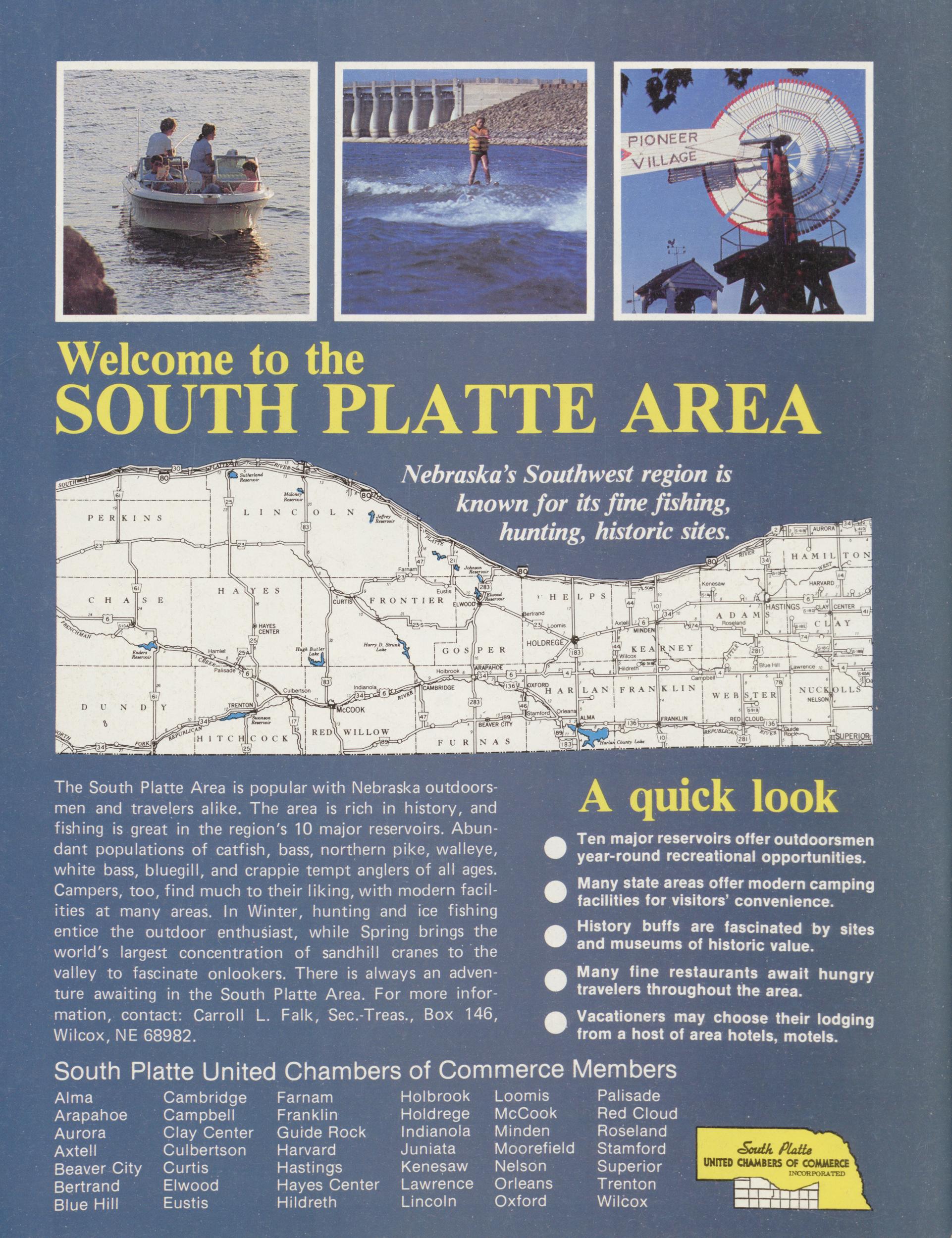
Position: 396 (24 views)