Volume 61, Issue 2, 1983
NEBRASKAland
MARCH 1983 $1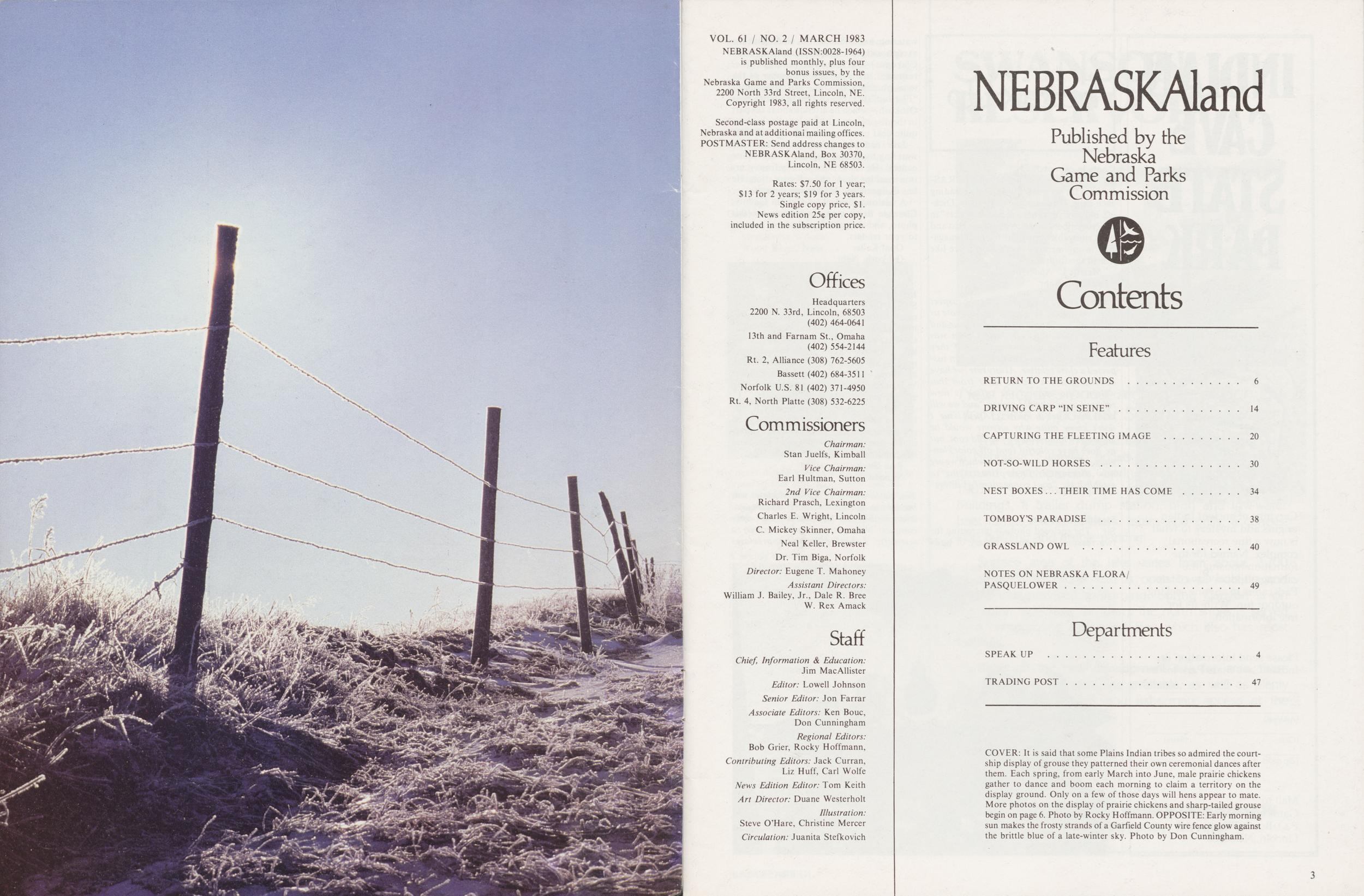
NEBRASKAland
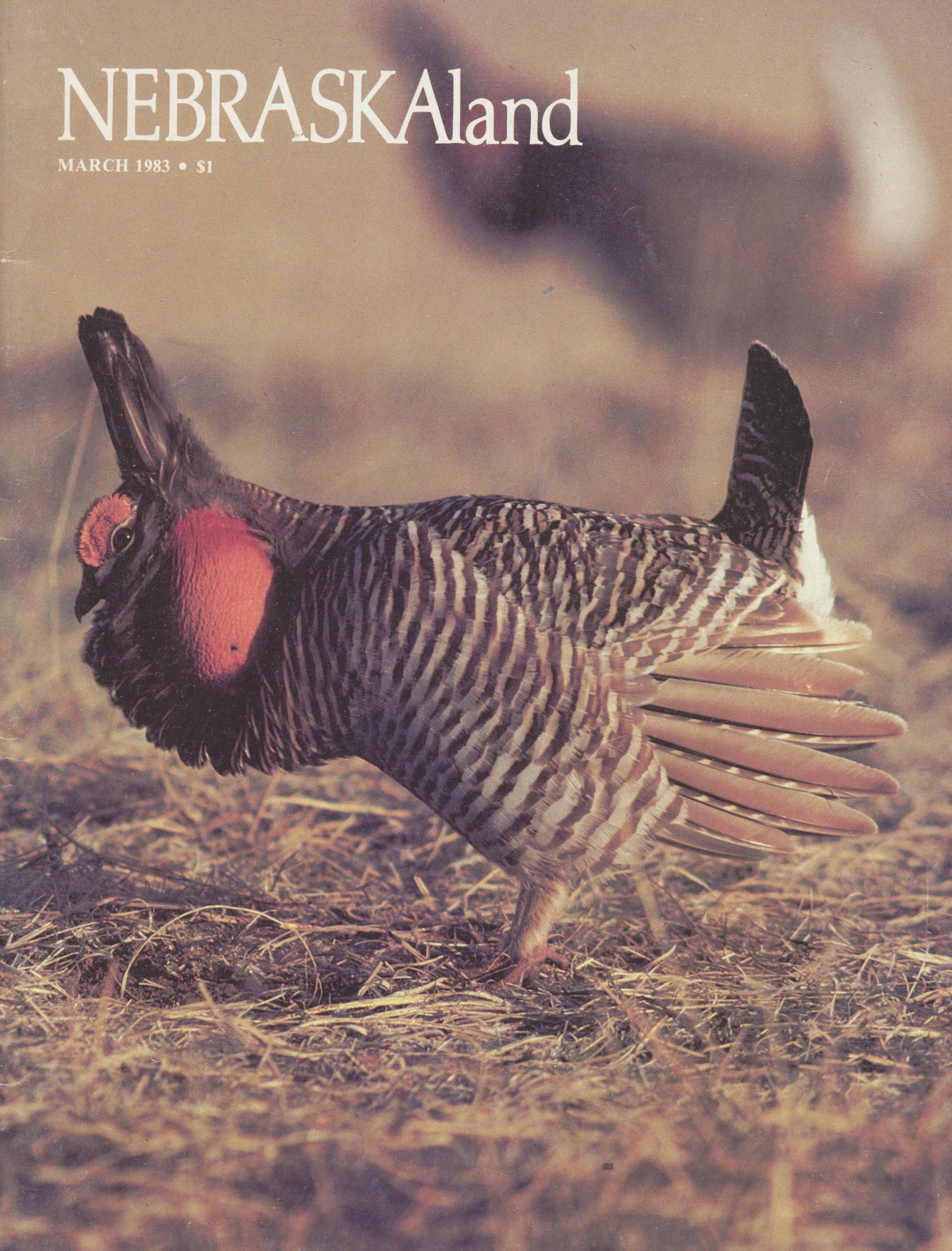
Published by the Nebraska Game and Parks Commission VOL. 61 / NO. 2 / MARCH 1983 NEBRASKAland (ISSN:0028-1964) is published monthly, plus four bonus issues, by the Nebraska Game and Parks Commission, 2200 North 33rd Street, Lincoln, NE. Copyright 1983, all rights reserved. Second-class postage paid at Lincoln, Nebraska and at additional mailing offices. POSTMASTER: Send address changes to NEBRASKAland, Box 30370, Lincoln, NE 68503. Rates: $7.50 for 1 year; $13 for 2 years; $19 for 3 years. Single copy price, $1. News edition 25c per copy, included in the subscription price. Offices Headquarters 2200 N. 33rd, Lincoln, 68503 (402) 464-0641 13th and Farnam St., Omaha (402) 554-2144 Rt. 2, Alliance (308) 762-5605 Bassett (402) 684-3511 Norfolk U.S. 81 (402) 371-4950 Rt. 4, North Platte (308) 532-6225 Commissioners Chairman: Stan Juelfs, Kimball Vice Chairman: Earl Hultman, Sutton 2nd Vice Chairman: Richard Prasch, Lexington Charles E. Wright, Lincoln C Mickey Skinner, Omaha Neal Keller, Brewster Dr. Tim Biga, Norfolk Director: Eugene T. Mahoney Assistant Directors: William J. Bailey, Jr., Dale R. Bree W. Rex Amack Staff Chief, Information & Education: Jim MacAllister Editor: Lowell Johnson Senior Editor: Jon Farrar Associate Editors: Ken Bouc, Don Cunningham Regional Editors: Bob Grier, Rocky Hoffmann, Contributing Editors: Jack Curran, Liz Huff, Carl Wolfe News Edition Editor: Tom Keith Art Director: Duane Westerholt Illustration: Steve O'Hare, Christine Mercer Circulation: Juanita Stefkovich Contents Features RETURN TO THE GROUNDS 6 DRIVING CARP "IN SEINE" 14 CAPTURING THE FLEETING IMAGE 20 NOT-SO-WILD HORSES 30 NEST BOXES... THEIR TIME HAS COME 34 TOMBOY'S PARADISE 38 GRASSLAND OWL 40 NOTES ON NEBRASKA FLORA PASQUELOWER 49 Departments SPEAK UP TRADING POST 47 COVER: It is said that some Plains Indian tribes so admired the courtship display of grouse they patterned their own ceremonial dances after them. Each spring, from early March into June, male prairie chickens gather to dance and boom each morning to claim a territory on the display ground. Only on a few of those days will hens appear to mate. More photos on the display of prairie chickens and sharp-tailed grouse begin on page 6. Photo by Rocky Hoffmann. OPPOSITE: Early morning sun makes the frosty strands of a Garfield County wire fence glow against the brittle blue of a late-winter sky. Photo by Don Cunningham. 3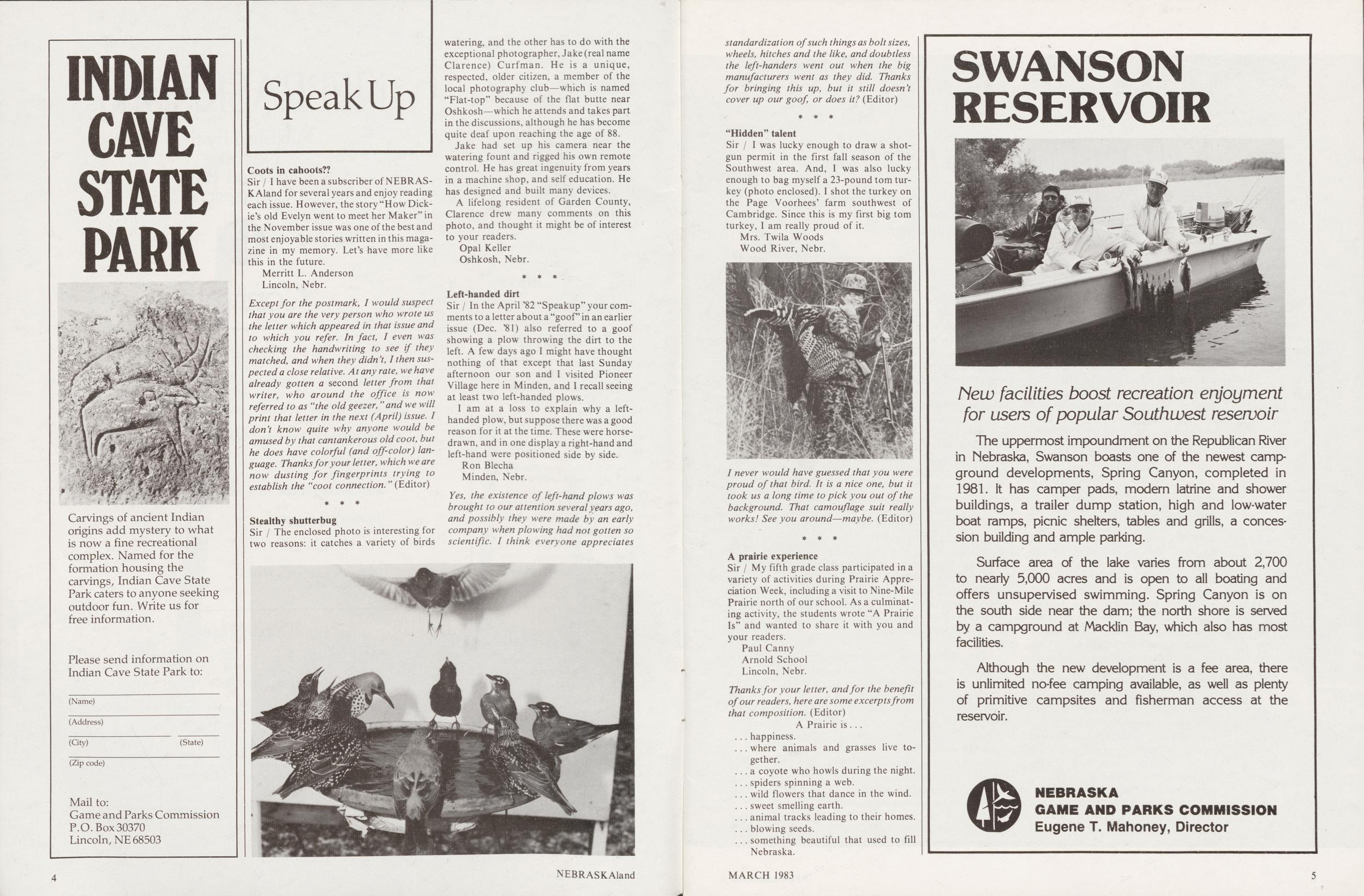
Speak Up
INDIAN CAVE STATE PARK Carvings of ancient Indian origins add mystery to what is now a fine recreational complex. Named for the formation housing the carvings, Indian Cave State Park caters to anyone seeking outdoor fun. Write us for free information. Please send information on Indian Cave State Park to: (Name) (Address) (City) (State) (Zip code) Mail to: Game and Parks Commission P.O. Box30370 Lincoln, NE 68503 Coots in cahoots??Sir / I have been a subscriber of NEBRASKAland for several years and enjoy reading each issue. However, the story "How Dickie's old Evelyn went to meet her Maker" in the November issue was one of the best and most enjoyable stories written in this magazine in my memory. Let's have more like this in the future.
Merritt L. Anderson Lincoln, Nebr.Except for the postmark, I would suspect that you are the very person who wrote us the letter which appeared in that issue and to which you refer. In fact, I even was checking the handwriting to see if they matched, and when they didn 't, I then suspected a close relative. At any rate, we have already gotten a second letter from that writer, who around the office is now referred to as "the old geezer, "and we will print that letter in the next (April) issue. I don't know quite why anyone would be amused by that cantankerous old coot, but he does have colorful (and off-color) language. Thanks for your letter, which we are now dusting for fingerprints trying to establish the "coot connection." (Editor)
Stealthy shutterbugSir / The enclosed photo is interesting for two reasons: it catches a variety of birds watering, and the other has to do with the exceptional photographer, Jake (real name Clarence) Curfman. He is a unique, respected, older citizen, a member of the local photography club—which is named "Flat-top" because of the flat butte near Oshkosh—which he attends and takes part in the discussions, although he has become quite deaf upon reaching the age of 88.
Jake had set up his camera near the watering fount and rigged his own remote control. He has great ingenuity from years in a machine shop, and self education. He has designed and built many devices.
A lifelong resident of Garden County, Clarence drew many comments on this photo, and thought it might be of interest to your readers.
Opal Keller Oshkosh, Nebr. Left-handed dirtSir / In the April '82 "Speakup" your comments to a letter about a "goof" in an earlier issue (Dec. '81) also referred to a goof showing a plow throwing the dirt to the left. A few days ago I might have thought nothing of that except that last Sunday afternoon our son and I visited Pioneer Village here in Minden, and I recall seeing at least two left-handed plows.
I am at a loss to explain why a left-handed plow, but suppose there was a good reason for it at the time. These were horsedrawn, and in one display a right-hand and left-hand were positioned side by side.
Ron Blecha Minden, Nebr.Yes, the existence of left-hand plows was brought to our attention several years ago, and possibly they were made by an early company when plowing had not gotten so scientific. I think everyone appreciates 4 NEBRASKAland standardization of such things as bolt sizes, wheels, hitches and the like, and doubtless the left-handers went out when the big manufacturers went as they did. Thanks for bringing this up, but it still doesn't cover up our goof or does it? (Editor)
"Hidden" talentSir / I was lucky enough to draw a shotgun permit in the first fall season of the Southwest area. And, I was also lucky enough to bag myself a 23-pound torn turkey (photo enclosed). I shot the turkey on the Page Voorhees' farm southwest of Cambridge. Since this is my first big torn turkey, I am really proud of it.
Mrs. Twila Woods Wood River, Nebr.I never would have guessed that you were proud of that bird. It is a nice one, but it took us a long time to pick you out of the background. That camouflage suit really works! See you around—maybe. (Editor)
A prairie experienceSir / My fifth grade class participated in a variety of activities during Prairie Appreciation Week, including a visit to Nine-Mile Prairie north of our school. As a culminating activity, the students wrote "A Prairie Is" and wanted to share it with you and your readers.
Paul Canny Arnold School Lincoln, Nebr.Thanks for your letter, and for the benefit of our readers, here are some excerpts from that composition. (Editor)
A Prairie is happiness. where animals and grasses live together. a coyote who howls during the night. spiders spinning a web. wild flowers that dance in the wind. sweet smelling earth. animal tracks leading to their homes. blowing seeds. something beautiful that used to fill Nebraska. SWANSON RESERVOIR New facilities boost recreation enjoyment for users of popular Southwest reservoir The uppermost impoundment on the Republican River in Nebraska, Swanson boasts one of the newest campground developments, Spring Canyon, completed in 1981. It has camper pads, modern latrine and shower buildings, a trailer dump station, high and low-water boat ramps, picnic shelters, tables and grills, a concession building and ample parking. Surface area of the lake varies from about 2,700 to nearly 5,000 acres and is open to all boating and offers unsupervised swimming. Spring Canyon is on the south side near the dam; the north shore is served by a campground at Macklin Bay, which also has most facilities. Although the new development is a fee area, there is unlimited no-fee camping available, as well as plenty of primitive campsites and fisherman access at the reservoir. NEBRASKA GAME AND PARKS COMMISSION Eugene T. Mahoney, Director MARCH 1983 5
Return to the Grounds
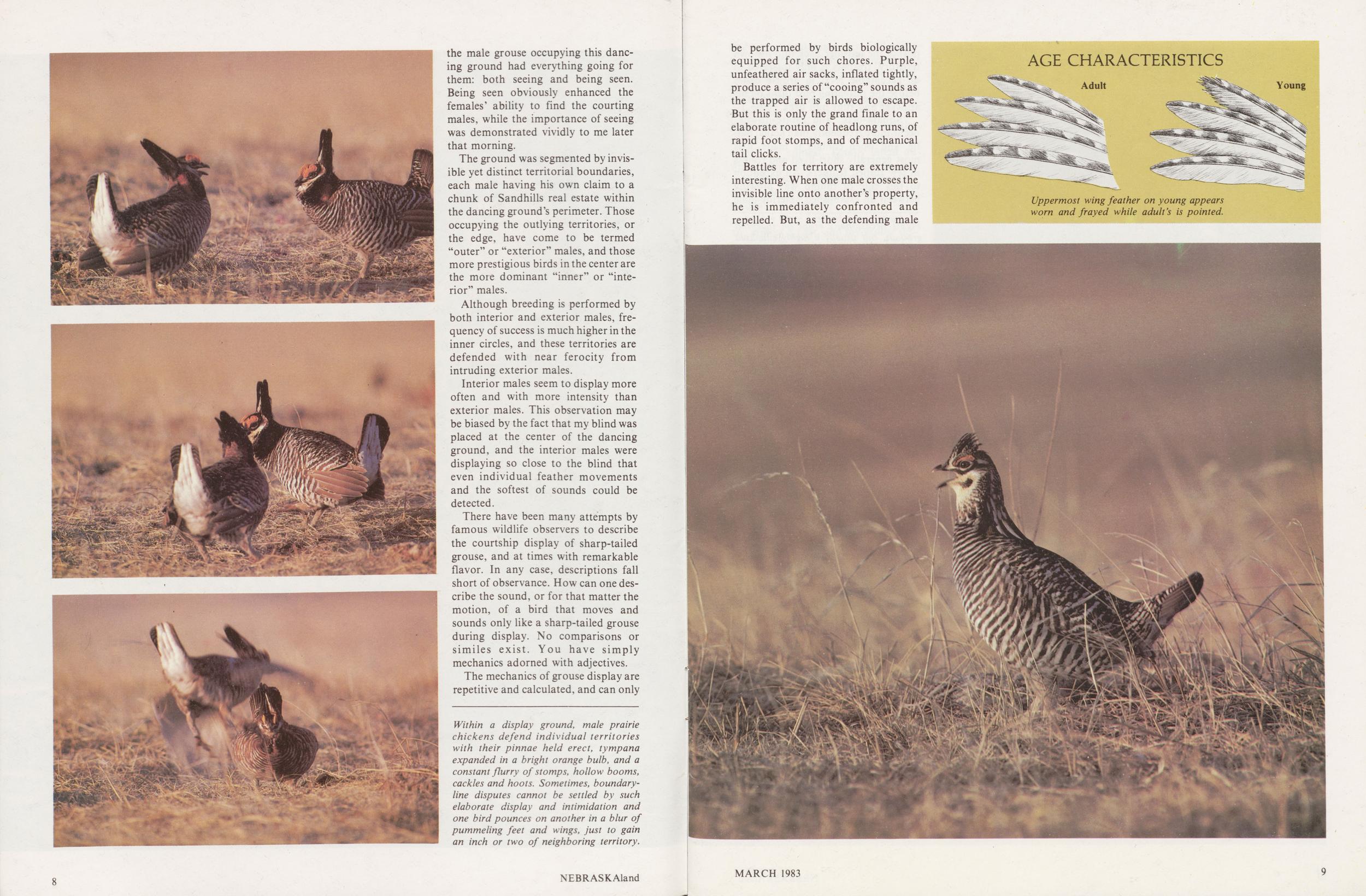
Each spring, male prairie chicken and sharp-tailed grouse gather on display grounds to dance and strut, and perhaps win the favor of a visiting hen. PHOTOS AND TEXT BY ROCKY HOFFMANNTHE LIGHT SKIFF of snow that had carpeted the dancing ground just three days before, had yielded to the early April drab of the still-dormant Sandhills a transformation, I am certain, that resulted not from thaw but from wind and evaporation. Past mornings in the blind seemed endless, with a penetrating chill from the relentless Sandhills wind while the climatically coordinated gray and blustery skies lit the subdued antics of the sharptails that appeared daily before me.
The grouse had seemed content to wait for brighter, drier days when the wind would be more forgiving. Faith-fully they returned, however, day after day to the dancing ground as they had since late February to the same little mound of sand and sod that some had visited last year, and as their ancestors had for many generations. As grain farmers of the Platte River Valley south of my grouse ground await the unique chortle of sandhill cranes stringing their way northward, so, too, does the cattle rancher of the Sandhills wait for the rattle of the sharptail and the boom of the chicken to signal a warmer season.
Possibly that season arrived sometime during the night. I sensed it as I unfolded the photo blind. It was incredibly calm in contrast to the previous mornings—spent in a sharply flapping canvas shroud under gloomy and sometimes snow-spattered skies.
It was obvious that the grouse had also sensed the change, and males began to arrive early on the nuptial dance floor, moving in around me under the stars while there was only a hint of a glow to the east.
It was nearly an hour before sunrise, and my time for coffee, for checking camera settings by shielded match that even remained lit this morning, and for listening to the chatter of mounting excitement outside my cocoon. Gray, ghost-like forms were only barely visible, but it was obvious that more males had already arrived on the ground than had accumulated there on the windy, gloomy days preceeding an indication that when the sun finally caught up with my lens and film capabilities, I would be plenty busy.
My only contact with the nuptially communal sharptails was through a viewfinder and 600 mm lens, which handicapped me with "narrow sightedness." I began following individual birds, changing focus constantly during display and defense runs, and occasionally taking meter readings, anticipating the first adequate light for photos.
It was obvious that the sharptails cared not a whit about "f 'stop or film speed, as active displaying preceeded sunlight by nearly 45 minutes, and some real battles were shaping up between the "regular" males, who had established territorial boundaries earlier on the ground, and the influx of new males who had arrived with this morning's good weather.
During bad-weather mornings, I was afforded the opportunity to look at the ground as a whole, and to see how really divided it was. Located obtrusively atop a soddy knob of sand, 6 NEBRASKAland
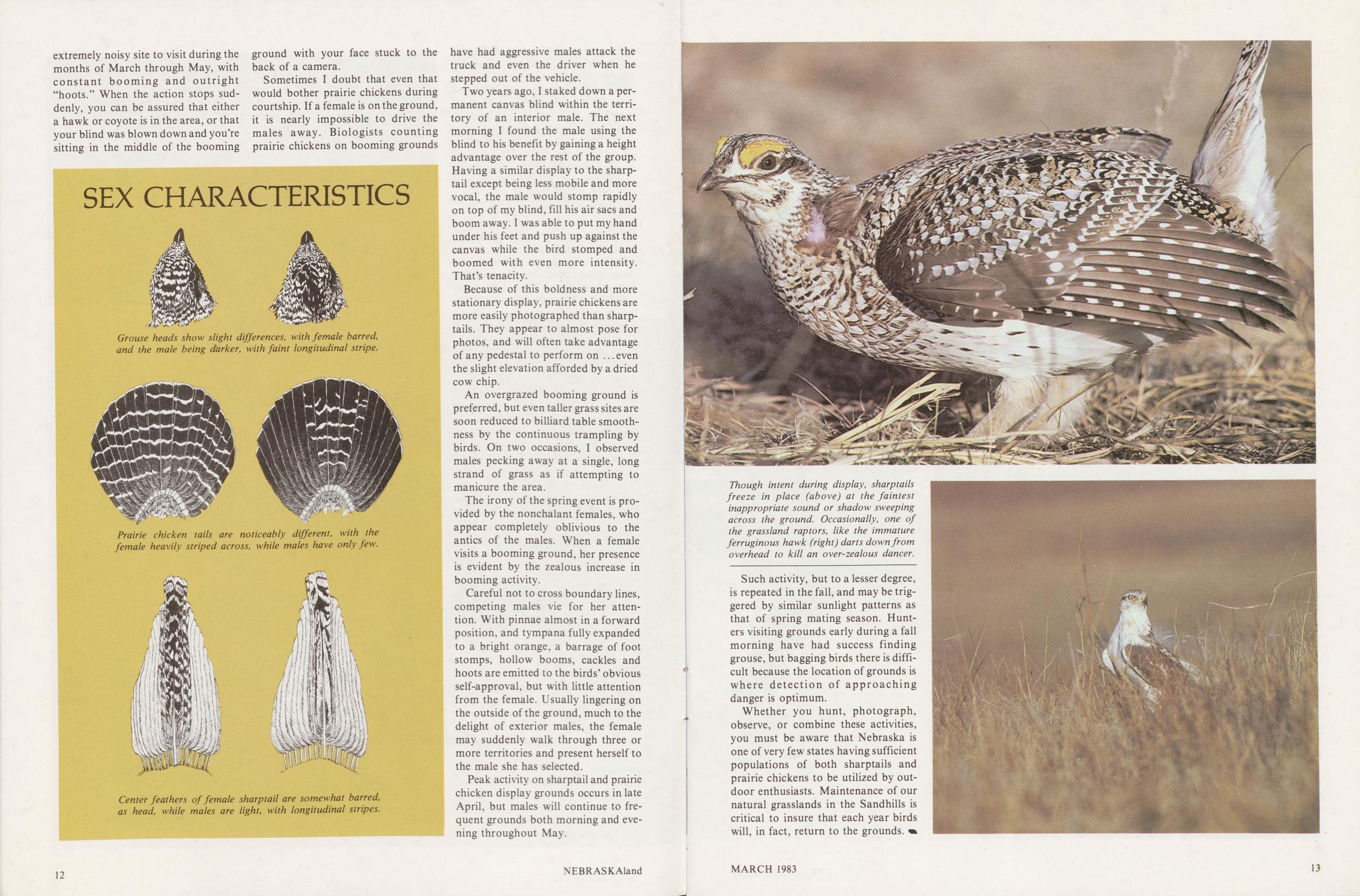
The ground was segmented by invisible yet distinct territorial boundaries, each male having his own claim to a chunk of Sandhills real estate within the dancing ground's perimeter. Those occupying the outlying territories, or the edge, have come to be termed outer" or "exterior" males, and those more prestigious birds in the center are the more dominant "inner" or "interior" males. Although breeding is performed by both interior and exterior males, frequency of success is much higher in the inner circles, and these territories are defended with near ferocity from intruding exterior males.
Interior males seem to display more often and with more intensity than exterior males. This observation may be biased by the fact that my blind was placed at the center of the dancing ground, and the interior males were displaying so close to the blind that even individual feather movements and the softest of sounds could be detected.
There have been many attempts by famous wildlife observers to describe the courtship display of sharp-tailed grouse, and at times with remarkable flavor. In any case, descriptions fall short of observance. How can one describe the sound, or for that matter the motion, of a bird that moves and sounds only like a sharp-tailed grouse during display. No comparisons or similes exist. You have simply mechanics adorned with adjectives.
The mechanics of grouse display are repetitive and calculated, and can only
Battles for territory are extremely interesting. When one male crosses the invisible line onto another's property, he is immediately confronted and repelled. But, as the defending male
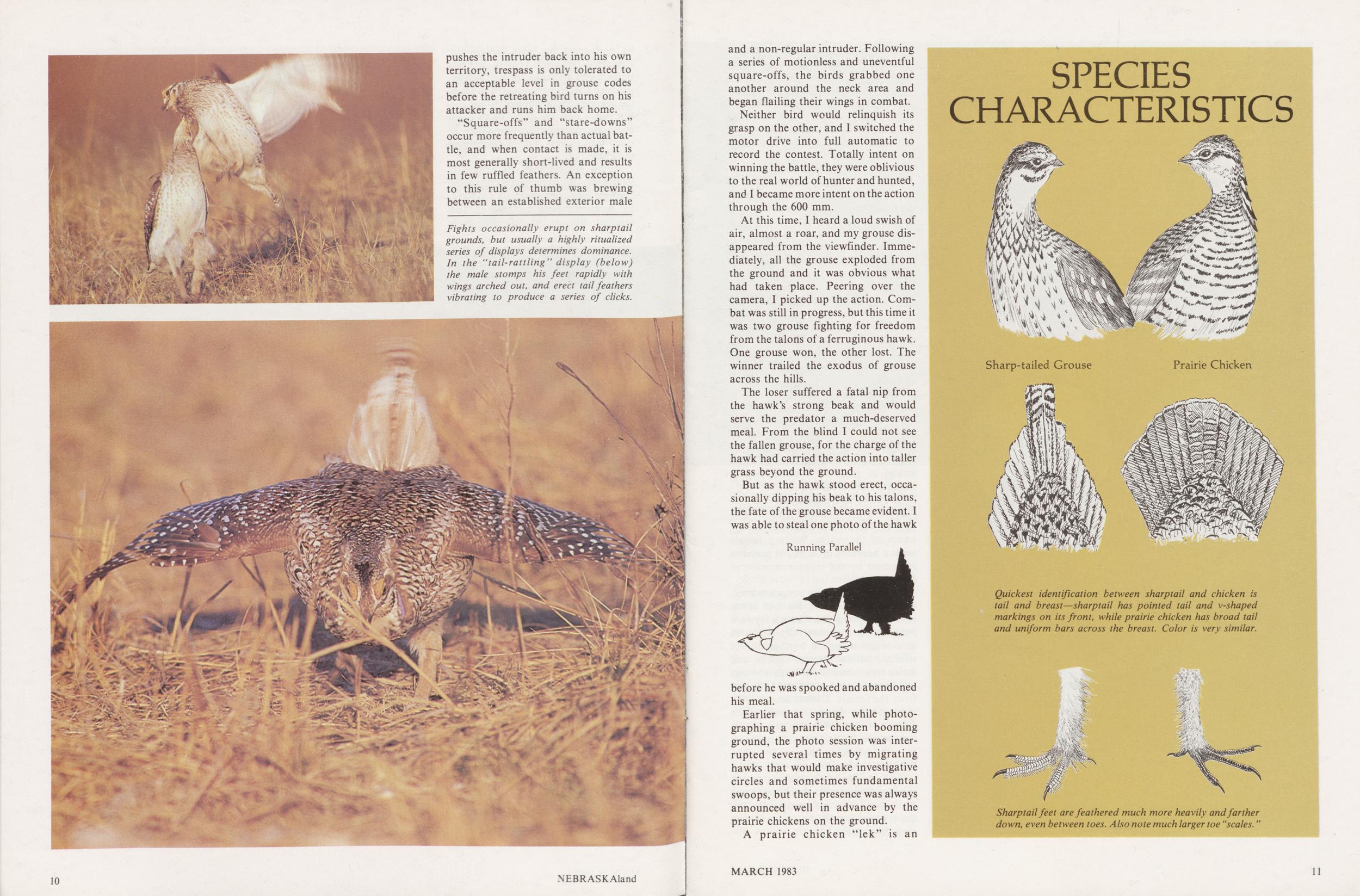 pushes the intruder back into his own
territory, trespass is only tolerated to
an acceptable level in grouse codes
before the retreating bird turns on his
attacker and runs him back home.
pushes the intruder back into his own
territory, trespass is only tolerated to
an acceptable level in grouse codes
before the retreating bird turns on his
attacker and runs him back home.
"Square-offs" and "stare-downs" occur more frequently than actual battle, and when contact is made, it is most generally short-lived and results in few ruffled feathers. An exception to this rule of thumb was brewing between an established exterior male
Neither bird would relinquish its grasp on the other, and I switched the motor drive into full automatic to record the contest. Totally intent on winning the battle, they were oblivious to the real world of hunter and hunted, and I became more intent on the action through the 600 mm.
At this time, I heard a loud swish of air, almost a roar, and my grouse disappeared from the viewfinder. Immediately, all the grouse exploded from the ground and it was obvious what had taken place. Peering over the camera, I picked up the action. Combat was still in progress, but this time it was two grouse fighting for freedom from the talons of a ferruginous hawk. One grouse won, the other lost. The winner trailed the exodus of grouse across the hills.
The loser suffered a fatal nip from the hawk's strong beak and would serve the predator a much-deserved meal. From the blind I could not see the fallen grouse, for the charge of the hawk had carried the action into taller grass beyond the ground.
But as the hawk stood erect, occasionally dipping his beak to his talons, the fate of the grouse became evident. I was able to steal one photo of the hawk before he was spooked and abandoned his meal.
Earlier that spring, while photographing a prairie chicken booming ground, the photo session was interrupted several times by migrating hawks that would make investigative circles and sometimes fundamental swoops, but their presence was always announced well in advance by the prairie chickens on the ground.
A prairie chicken "lek" is an
 extremely noisy site to visit during the
months of March through May, with
constant booming and outright
"hoots." When the action stops suddenly, you can be assured that either
a hawk or coyote is in the area, or that
your blind was blown down and you're
sitting in the middle of the booming
ground with your face stuck to the
back of a camera.
extremely noisy site to visit during the
months of March through May, with
constant booming and outright
"hoots." When the action stops suddenly, you can be assured that either
a hawk or coyote is in the area, or that
your blind was blown down and you're
sitting in the middle of the booming
ground with your face stuck to the
back of a camera.
Sometimes I doubt that even that would bother prairie chickens during courtship. If a female is on the ground, it is nearly impossible to drive the males away. Biologists counting prairie chickens on booming grounds
Two years ago, I staked down a permanent canvas blind within the territory of an interior male. The next morning I found the male using the blind to his benefit by gaining a height advantage over the rest of the group. Having a similar display to the sharptail except being less mobile and more vocal, the male would stomp rapidly on top of my blind, fill his air sacs and boom away. I was able to put my hand under his feet and push up against the canvas while the bird stomped and boomed with even more intensity. That's tenacity.
Because of this boldness and more stationary display, prairie chickens are more easily photographed than sharptails. They appear to almost pose for photos, and will often take advantage of any pedestal to perform on even the slight elevation afforded by a dried cow chip.
An overgrazed booming ground is preferred, but even taller grass sites are soon reduced to billiard table smoothness by the continuous trampling by birds. On two occasions, I observed males pecking away at a single, long strand of grass as if attempting to manicure the area.
The irony of the spring event is provided by the nonchalant females, who appear completely oblivious to the antics of the males. When a female visits a booming ground, her presence is evident by the zealous increase in booming activity.
Careful not to cross boundary lines, competing males vie for her attention. With pinnae almost in a forward position, and tympana fully expanded to a bright orange, a barrage of foot stomps, hollow booms, cackles and hoots are emitted to the birds' obvious self-approval, but with little attention from the female. Usually lingering on the outside of the ground, much to the delight of exterior males, the female may suddenly walk through three or more territories and present herself to the male she has selected.
Peak activity on sharptail and prairie chicken display grounds occurs in late April, but males will continue to frequent grounds both morning and evening throughout May.
12 NEBRASKAlandSuch activity, but to a lesser degree, is repeated in the fall, and may be triggered by similar sunlight patterns as that of spring mating season. Hunters visiting grounds early during a fall morning have had success finding grouse, but bagging birds there is difficult because the location of grounds is where detection of approaching danger is optimum.
Whether you hunt, photograph, observe, or combine these activities, you must be aware that Nebraska is one of very few states having sufficient populations of both sharptails and prairie chickens to be utilized by outdoor enthusiasts. Maintenance of our natural grasslands in the Sandhills is critical to insure that each year birds will, in fact, return to the grounds.
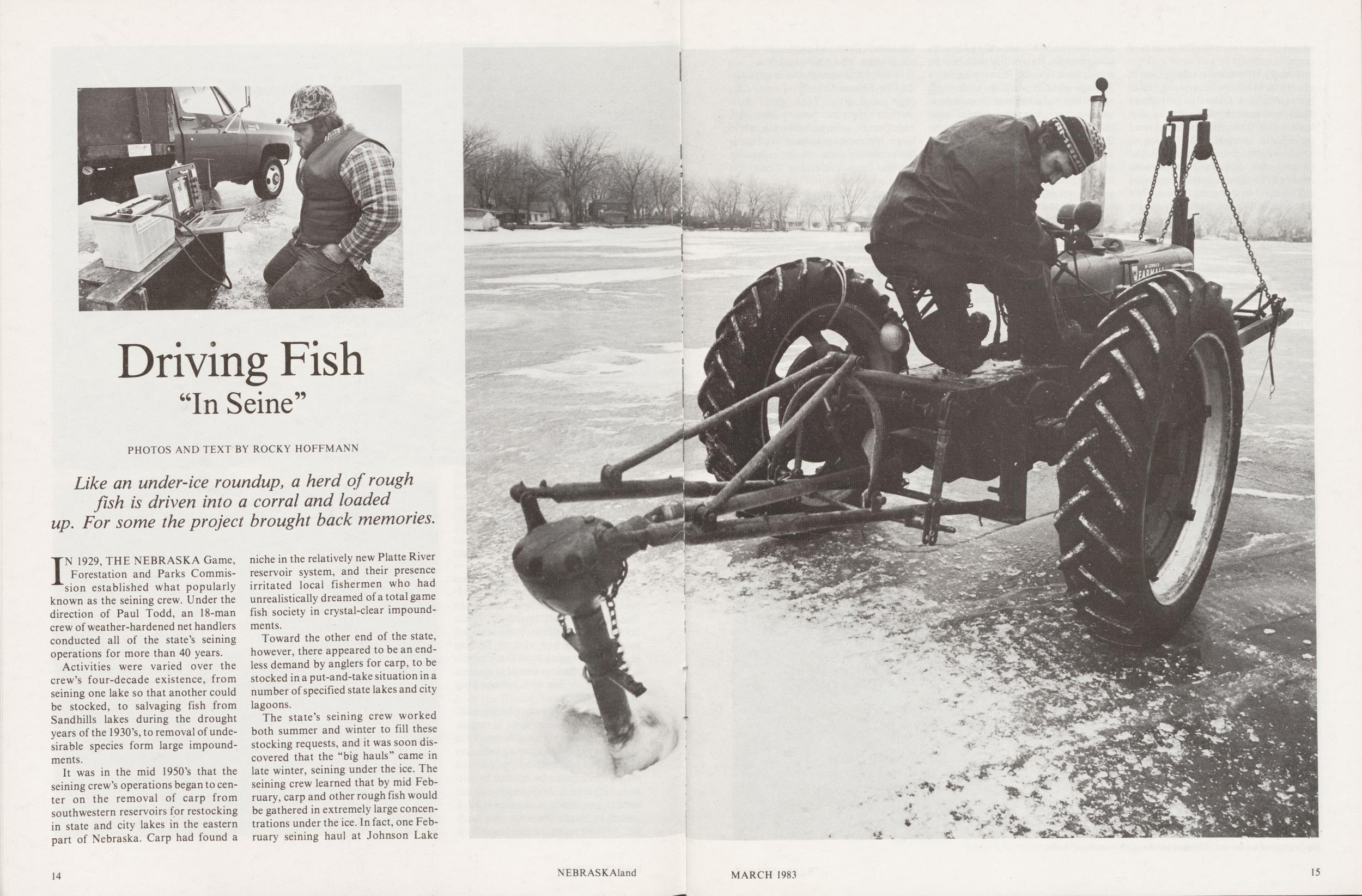
Driving Fish "In Seine
PHOTOS AND TEXT BY ROCKY HOFFMANN Like an under-ice roundup, a herd of rough fish is driven into a corral and loaded up. For some the project brought back memories.IN 1929, THE NEBRASKA Game, Forestation and Parks Commission established what popularly known as the seining crew. Under the direction of Paul Todd, an 18-man crew of weather-hardened net handlers conducted all of the state's seining operations for more than 40 years.
Activities were varied over the crew's four-decade existence, from seining one lake so that another could be stocked, to salvaging fish from Sandhills lakes during the drought years of the 1930's, to removal of undesirable species form large impoundments.
It was in the mid 1950's that the seining crew's operations began to center on the removal of carp from southwestern reservoirs for restocking in state and city lakes in the eastern part of Nebraska. Carp had found a niche in the relatively new Platte River reservoir system, and their presence irritated local fishermen who had unrealistically dreamed of a total game fish society in crystal-clear impoundments.
Toward the other end of the state, however, there appeared to be an endless demand by anglers for carp, to be stocked in a put-and-take situation in a number of specified state lakes and city lagoons.
The state's seining crew worked both summer and winter to fill these stocking requests, and it was soon discovered that the "big hauls" came in late winter, seining under the ice. The seining crew learned that by mid February, carp and other rough fish would be gathered in extremely large concentrations under the ice. In fact, one February seining haul at Johnson Lake 14 NEBRASKAland
 netted the crew over 100,000 pounds of
carp.
netted the crew over 100,000 pounds of
carp.
Today's efforts for stocking carp in eastern Nebraska have been reduced to put-and-take fisheries at Dead Timber, Fremont, Two Rivers and Louisville State Recreation Areas, requiring a total annual stocking of about 48,000 pounds of carp. The Commission abolished the seining crew in 1971 due to increased costs and difficulties in locating labor. The Fisheries Division in North Platte adopted all seining operations, and had been able to fill stocking requests through an annual seining operation during the carp spawning season at Sutherland Reservoir. However, changes from development of the Gerald Gentleman power plant interrupted this program.
It might be difficult for the fishing purist to come to the realization that carp are here to stay, and it might be equally difficult for that same purist to realize that the lowly carp is an extremely valuable natural and renewable resource. Carp will never be eradicated from Platte River reservoirs through seining operations or through any other technique for that matter, and research has documented that their presence in Lake Maloney, Sutherland, and Johnson approaches the rate of 300 pounds per acre. Lake Maloney's 1,600 surface acres alone would thus account for nearly half a million pounds of carp.
Sound conservation practices require the wise use of a natural resource, but in the case of Nebraska's carp population, this valuable resource is basically underharvested. It is ironic, however, that just 250 miles distance can result in a complete attitude reversal in terms of utilizing carp for high protein and palatable table fare. In North Platte, an angler's carp is more likely to be mulched into the garden than to end up on his plate, while in Omaha and Lincoln, a number of restaurants specializing in fried carp filets and carp sandwiches are doing a land office business.
In other midwestern and eastern cities like Kansas City, St. Louis, Chicago, and New York, fresh fish markets supply inexpensive, tasty, and high protein carp to urbanites, while large restaurants have placed carp flesh among some of their leading entrees. Even religion has blessed the carp, as exemplified by Chicago's exclusive Covenant Club for Jewish membership, where the highly traditional Gefilte fish among the orthodox is prepared from freshwater carp.
Gary Grange, plant manager of Stoller's Fish Processors in Spirit Lake, Iowa, a company that has commercially processed carp since 1932, said that more than 90 percent of Stoller's carp volume are fileted and shipped to the east coast for processing
Human consumption, fertilizer, protein-enriched cattle feed, and many more uses have increased demand for Nebraska's unheralded carp, and the Game and Parks Commission, in an attempt to more fully utilize an abundant resource, recently contracted with a comercial fishing firm from Arlington, Minnesota.
Under terms of the agreement, owner Ken Seemann of Seemann Commercial Fishing, is permitted to remove nongame fish (carp, buffalo, quillback, and sucker) from lakes Maloney, Sutherland, Johnson, Midway, and Gallagher Canyon in the Tri-County system, for a nominal fee, through netting operations. Biologists from the Game and Parks Commission are required to be on hand during all netting activities to insure the safe release of desirable game fish species.
Seemann and full-time operations supervisor Rocky Kistner began experimental sampling of the designated lakes in the spring and summer of 1979 with an eye toward under-ice operations in the winter of 1980-81, but insufficient ice cover that winter wouldn't support equipment necessary for such an operation.
Experimental open-water seining the following year at Johnson Lake resulted in removal of 200,000 pounds of carp suitable for human consumption. Then in the winter of 1981-82, three arctic cold fronts produced nearly 20 inches of lake ice in late January, and the rigors of sub-zero seining began in earnest at Lake Maloney the following month. The operation was to be a unique opportunity for some to relive a bit of the history of the seining crew and an equally unique experience for others to observe for the first time how 2,000 feet of seine can be successfully maneuvered under the ice, resulting in a large bag of trapped fish.
On Sunday, January 31, Ken and Rocky were on Lake Maloney early attempting to locate a large concentration of carp. Crew members Gene Lawrence, Jeff Matz and Kevin Grochow, all of Arlington, Minnesota, began drilling holes through which a transducer of an elaborate graphic sonar unit scanned horizontally under the ice. In short order, a large school was located near the inlet of the reservoir in about 15 feet of water.
The plan of operations included providing for a "put in" hole (a large hole through which all the net would be fed) on the far side of the bay, a take-out hole near the shore in water deep enough to hold a large catch of fish yet shallow enough that the crew could actually get into the water to insure that the net was not tangling, and two corner holes at diagonals to the take-out hole, designating where the turns would be made, while feeding
Sunshine was not in the cards for Monday, and neither was the warmth normally associated with it. At 7:45 a.m., the time scheduled for sunrise, snow had already begun blowing across the ice, and the mercury had not yet reached the plus side of the scale. The prospects of working in water with subzero winds whipping across the surface of a frozen lake wasn't exactly the best formula for having fun, but the crew from Minnesota seemed to be enjoying the "heat wave" in Nebraska and had already begun feeding both ends of the net through an eight-foot by 10-foot hole they had sawed out.
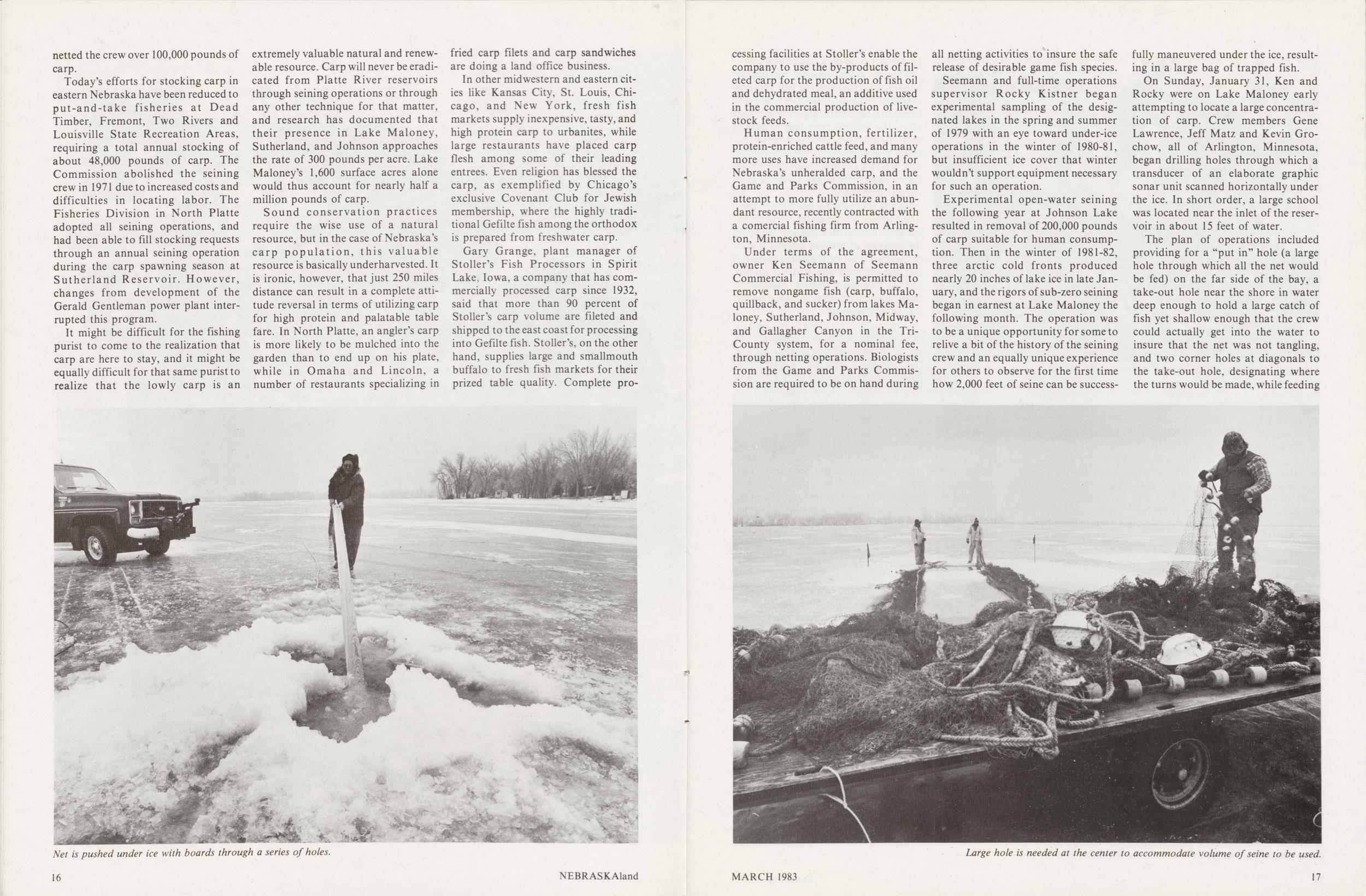
Tractors with 20-inch ice augers began working toward the corner markers, drilling holes every 80 feet. Some of the oldtimers remembered when the seining crew had to punch every hole with heavy spud bars. The holes provided access for a series of 1 x 6 boards that were pushed along from hole to hole, dragging the ends of the net with them.
As the net ends reached their respective corner markers, the sonar was lowered into the take-out hole to check the location of the fish school. It was discovered that the drilling activity had spooked the fish and the school had broken into smaller concentrations, some of which had moved out of the seining corridor.
Tow chains were quickly attached to the bumpers of trucks waiting on the ice, and the crew scrambled to drive the fish back into the pocket. The chains dragging on the ice made considerable noise below and served to haze the fish, and soon the school was concentrated again in the path of the net.
The tractors made the turns and began boring holes toward the takeout site. Eventually, both ends met again and the 15 by 15-foot take-out hole would soon reveal the extent of the catch as the net was winched to the center.
There is always a great amount of anticipation when the net comes from the deep, but it seemed even more intense to anticipate what had been locked under the cap of ice.
Trouble was, the first revelation of the net was an entanglement of tumbleweeds that had come down 25 miles of canal from Sutherland. The crew began to straighten out the mess, but was forced to abandon the tumbleweed project as a more immediate priority developed.
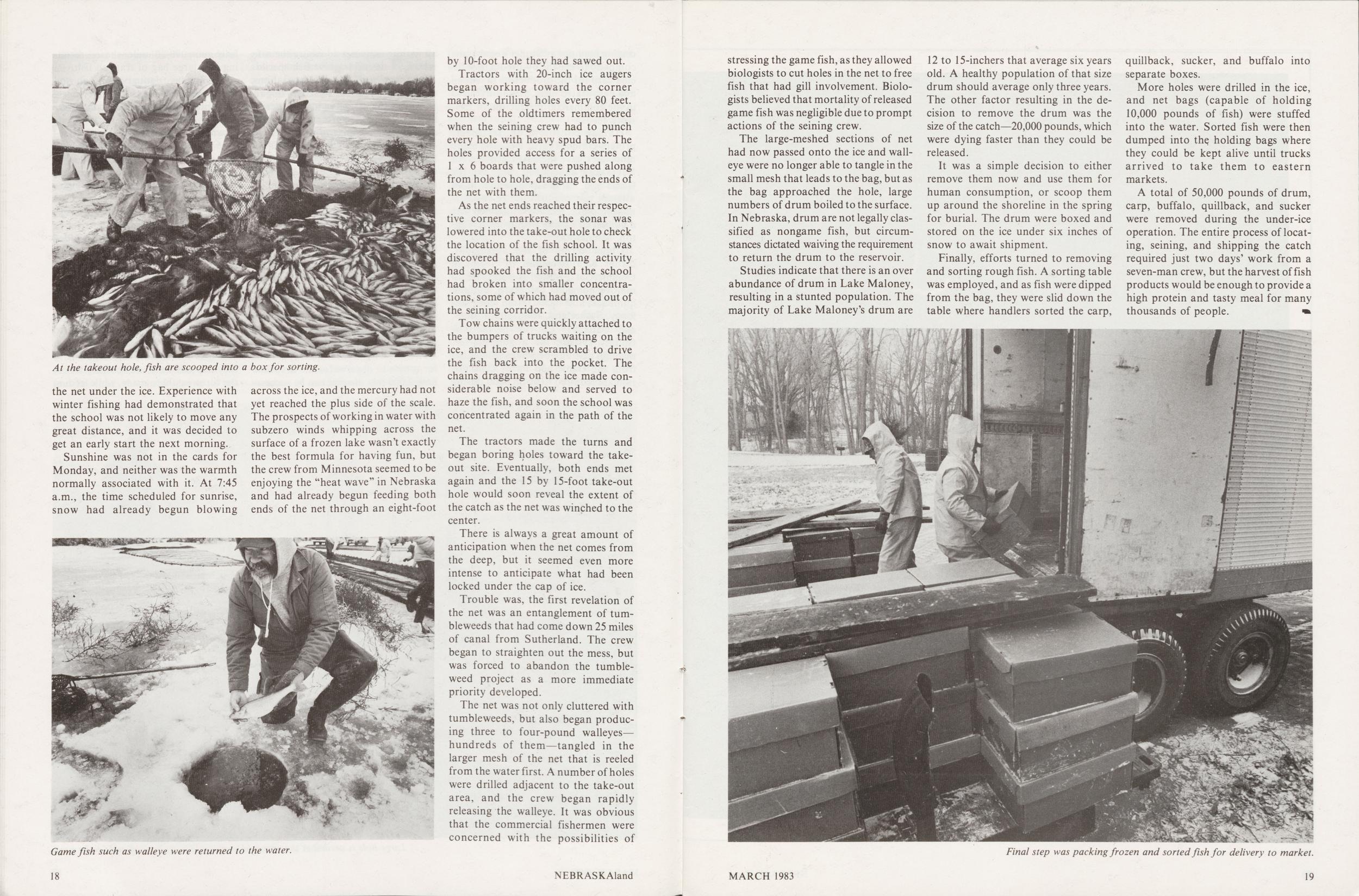
The net was not only cluttered with tumbleweeds, but also began producing three to four-pound walleyes—hundreds of them-tangled in the larger mesh of the net that is reeled from the water first. A number of holes were drilled adjacent to the take-out area, and the crew began rapidly releasing the walleye. It was obvious that the commercial fishermen were concerned with the possibilities of
The large-meshed sections of net had now passed onto the ice and walleye were no longer able to tangle in the small mesh that leads to the bag, but as the bag approached the hole, large numbers of drum boiled to the surface. In Nebraska, drum are not legally classified as nongame fish, but circumstances dictated waiving the requirement to return the drum to the reservoir.
Studies indicate that there is an over abundance of drum in Lake Maloney, resulting in a stunted population. The majority of Lake Maloney's drum are 12 to 15-inchers that average six years old. A healthy population of that size drum should average only three years. The other factor resulting in the decision to remove the drum was the size of the catch—20,000 pounds, which were dying faster than they could be released.
It was a simple decision to either remove them now and use them for human consumption, or scoop them up around the shoreline in the spring for burial. The drum were boxed and stored on the ice under six inches of snow to await shipment.
Finally, efforts turned to removing and sorting rough fish. A sorting table was employed, and as fish were dipped from the bag, they were slid down the table where handlers sorted the carp, quillback, sucker, and buffalo into separate boxes.
More holes were drilled in the ice, and net bags (capable of holding 10,000 pounds of fish) were stuffed into the water. Sorted fish were then dumped into the holding bags where they could be kept alive until trucks arrived to take them to eastern markets.
A total of 50,000 pounds of drum, carp, buffalo, quillback, and sucker were removed during the under-ice operation. The entire process of locating, seining, and shipping the catch required just two days' work from a seven-man crew, but the harvest offish products would be enough to provide a high protein and tasty meal for many thousands of people.
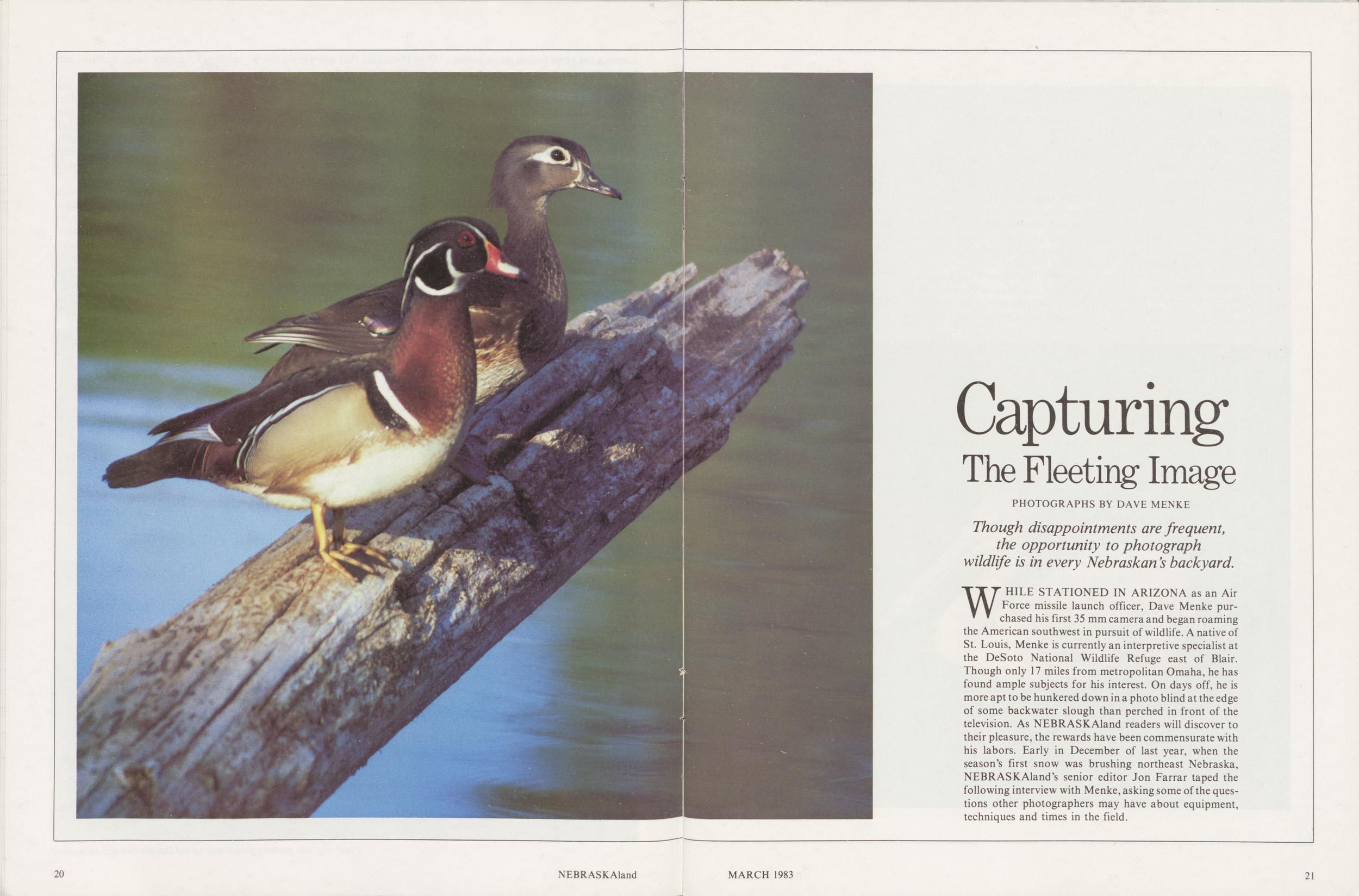
Capturing The Fleeting Image
PHOTOGRAPHS BY DAVE MENKE Though disappointments are frequent, the opportunity to photograph wildlife is in every Nebraskan 's backyard.WHILE STATIONED IN ARIZONA as an Air Force missile launch officer, Dave Menke purchased his first 35 mm camera and began roaming the American southwest in pursuit of wildlife. A native of St. Louis, Menke is currently an interpretive specialist at the DeSoto National Wildlife Refuge east of Blair. Though only 17 miles from metropolitan Omaha, he has found ample subjects for his interest. On days off, he is more apt to be hunkered down in a photo blind at the edge of some backwater slough than perched in front of the television. As NEBRASKAland readers will discover to their pleasure, the rewards have been commensurate with his labors. Early in December of last year, when the season's first snow was brushing northeast Nebraska, NEBRASKAland's senior editor Jon Farrar taped the following interview with Menke, asking some of the questions other photographers may have about equipment, techniques and times in the field.
MARCH 1983 21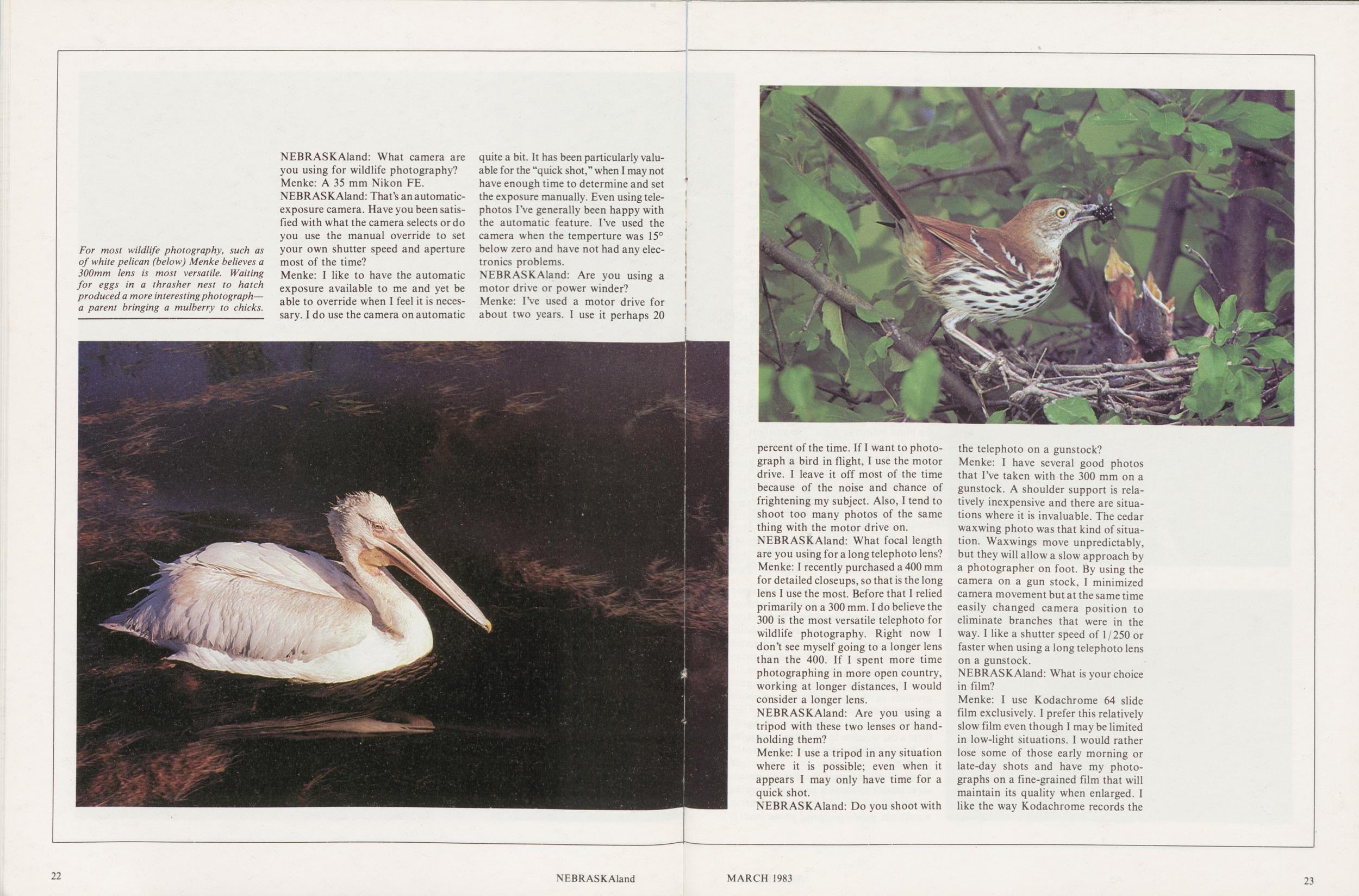
NEBRASKAland: What camera are you using for wildlife photography? Menke: A 35 mm Nikon FE.
NEBRASKAland: That's an automatic-exposure camera. Have you been satisfied with what the camera selects or do you use the manual override to set your own shutter speed and aperture most of the time?
Menke: I like to have the automatic exposure available to me and yet be able to override when I feel it is necessary. I do use the camera on automatic quite a bit. It has been particularly valuable for the "quick shot," when I may not have enough time to determine and set the exposure manually. Even using telephotos I've generally been happy with the automatic feature. I've used the camera when the temperture was 15° below zero and have not had any electronics problems.
NEBRASKAland: Are you using a motor drive or power winder?
Menke: I've used a motor drive for about two years. I use it perhaps 20
NEBRASKAland: What focal length are you using for a long telephoto lens?
Menke: I recently purchased a 400 mm for detailed closeups, so that is the long lens I use the most. Before that I relied primarily on a 300 mm. I do believe the 300 is the most versatile telephoto for wildlife photography. Right now I don't see myself going to a longer lens than the 400. If I spent more time photographing in more open country, working at longer distances, I would consider a longer lens.
NEBRASKAland: Are you using a tripod with these two lenses or hand-holding them?
Menke: I use a tripod in any situation where it is possible; even when it appears I may only have time for a quick shot.
NEBRASKAland: Do you shoot with the telephoto on a gunstock?
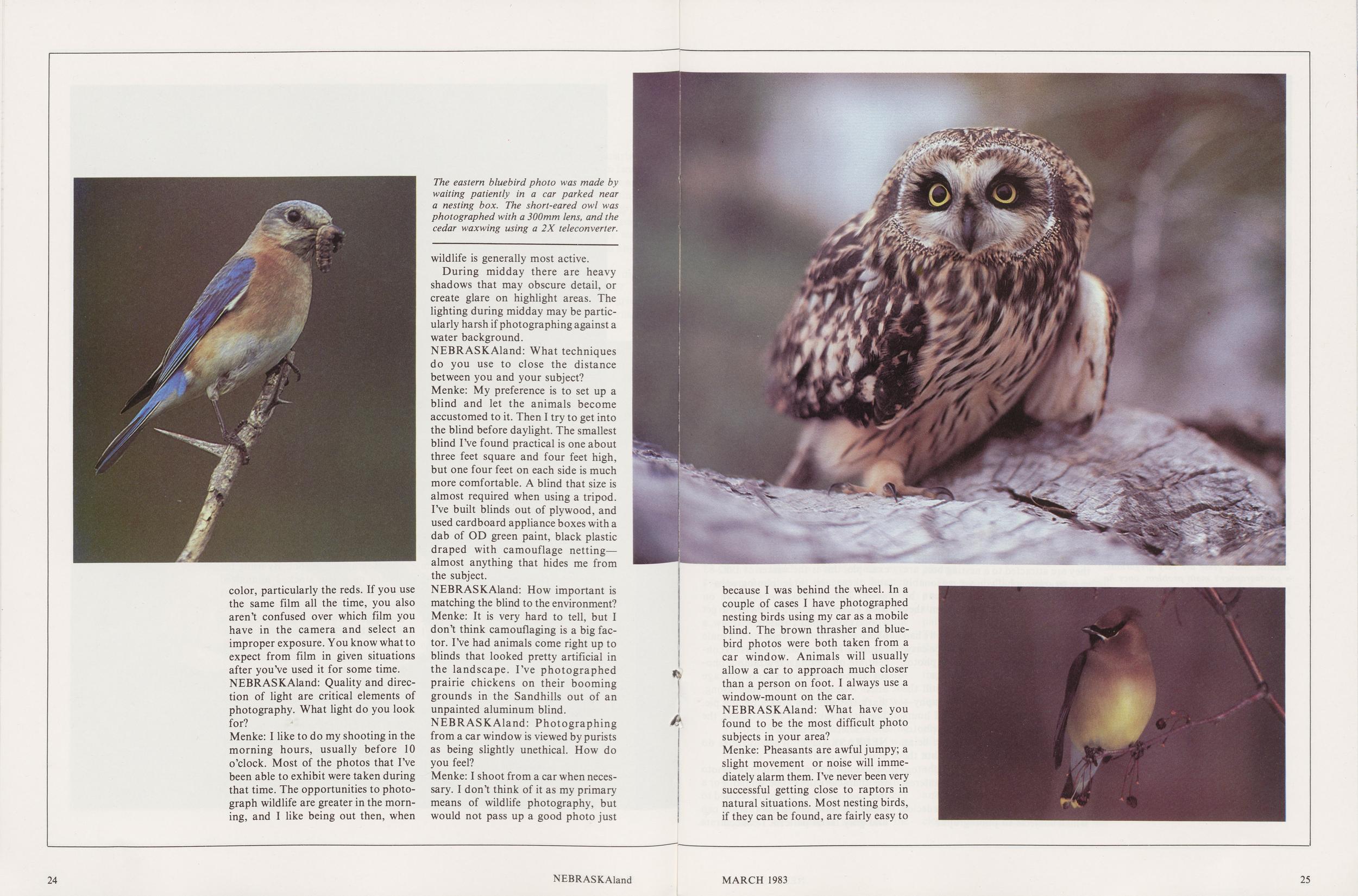
Menke: I have several good photos that I've taken with the 300 mm on a gunstock. A shoulder support is relatively inexpensive and there are situations where it is invaluable. The cedar waxwing photo was that kind of situation. Waxwings move unpredictably, but they will allow a slow approach by a photographer on foot. By using the camera on a gun stock, I minimized camera movement but at the same time easily changed camera position to eliminate branches that were in the way. I like a shutter speed of 1/250 or faster when using a long telephoto lens on a gunstock.
NEBRASKAland: What is your choice in film?
Menke: I use Kodachrome 64 slide
film exclusively. I prefer this relatively
slow film even though I may be limited
in low-light situations. I would rather
lose some of those early morning or
late-day shots and have my photographs on a fine-grained film that will
maintain its quality when enlarged. I
like the way Kodachrome records the
MARCH 1983
23
NEBRASKAland: Quality and direction of light are critical elements of photography. What light do you look for?
Menke: I like to do my shooting in the morning hours, usually before 10 o'clock. Most of the photos that I've been able to exhibit were taken during that time. The opportunities to photograph wildlife are greater in the morning, and I like being out then, when wildlife is generally most active. During midday there are heavy shadows that may obscure detail, or create glare on highlight areas. The lighting during midday may be particularly harsh if photographing against a water background.
NEBRASKAland: What techniques do you use to close the distance between you and your subject?
Menke: My preference is to set up a blind and let the animals become accustomed to it. Then I try to get into the blind before daylight. The smallest blind I've found practical is one about three feet square and four feet high, but one four feet on each side is much more comfortable. A blind that size is almost required when using a tripod. I've built blinds out of plywood, and used cardboard appliance boxes with a dab of OD green paint, black plastic draped with camouflage netting—almost anything that hides me from the subject.
NEBRASKAland: How important is matching the blind to the environment?
Menke: It is very hard to tell, but I don't think camouflaging is a big factor. I've had animals come right up to blinds that looked pretty artificial in the landscape. I've photographed prairie chickens on their booming grounds in the Sandhills out of an unpainted aluminum blind.
NEBRASKAland: Photographing from a car window is viewed by purists as being slightly unethical. How do you feel?
Menke: I shoot from a car when necessary. I don't think of it as my primary means of wildlife photography, but would not pass up a good photo just 24 NEBRASKAland
NEBRASKAland: What have you found to be the most difficult photo subjects in your area?
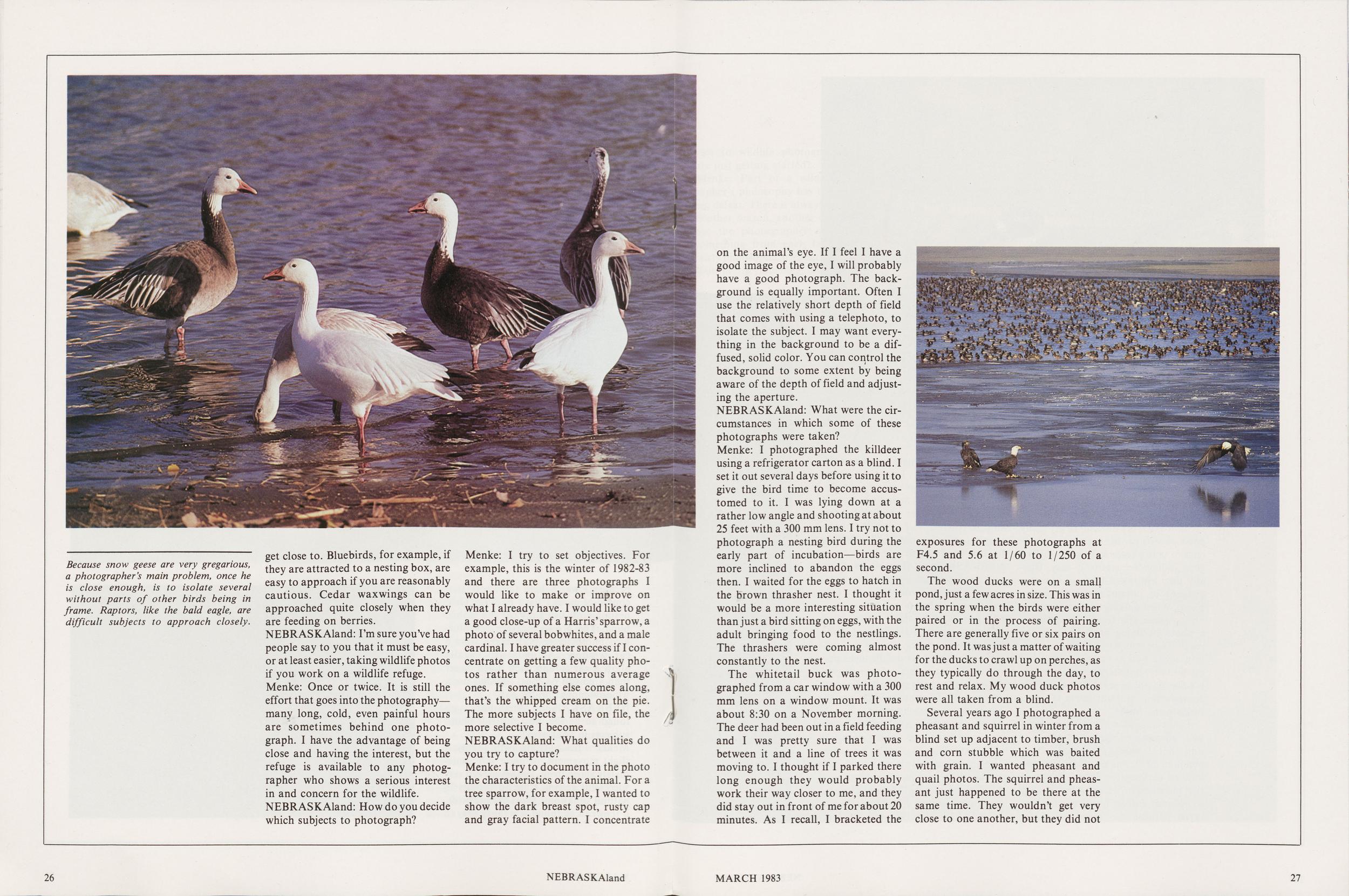
Menke: Pheasants are awful jumpy; a
slight movement or noise will immediately alarm them. I've never been very
successful getting close to raptors in
natural situations. Most nesting birds,
if they can he found, are fairly easy to
MARCH 1983
25
NEBRASKAland: I'm sure you've had people say to you that it must be easy, or at least easier, taking wildlife photos if you work on a wildlife refuge.
Menke: Once or twice. It is still the effort that goes into the photography—many long, cold, even painful hours are sometimes behind one photograph. I have the advantage of being close and having the interest, but the refuge is available to any photographer who shows a serious interest in and concern for the wildlife.
NEBRASKAland: How do you decide which subjects to photograph?
Menke: I try to set objectives. For example, this is the winter of 1982-83 and there are three photographs I would like to make or improve on what I already have. I would like to get a good close-up of a Harris'sparrow, a photo of several bobwhites, and a male cardinal. I have greater success if I concentrate on getting a few quality photos rather than numerous average ones. If something else comes along, that's the whipped cream on the pie. The more subjects I have on file, the more selective I become.
NEBRASKAland: What qualities do you try to capture?
Menke: I try to document in the photo the characteristics of the animal. For a tree sparrow, for example, I wanted to show the dark breast spot, rusty cap and gray facial pattern. I concentrate 26 NEBRASKAland on the animal's eye. If I feel I have a good image of the eye, I will probably have a good photograph. The background is equally important. Often I use the relatively short depth of field that comes with using a telephoto, to isolate the subject. I may want everything in the background to be a diffused, solid color. You can control the background to some extent by being aware of the depth of field and adjusting the aperture.
NEBRASKAland: What were the circumstances in which some of these photographs were taken?
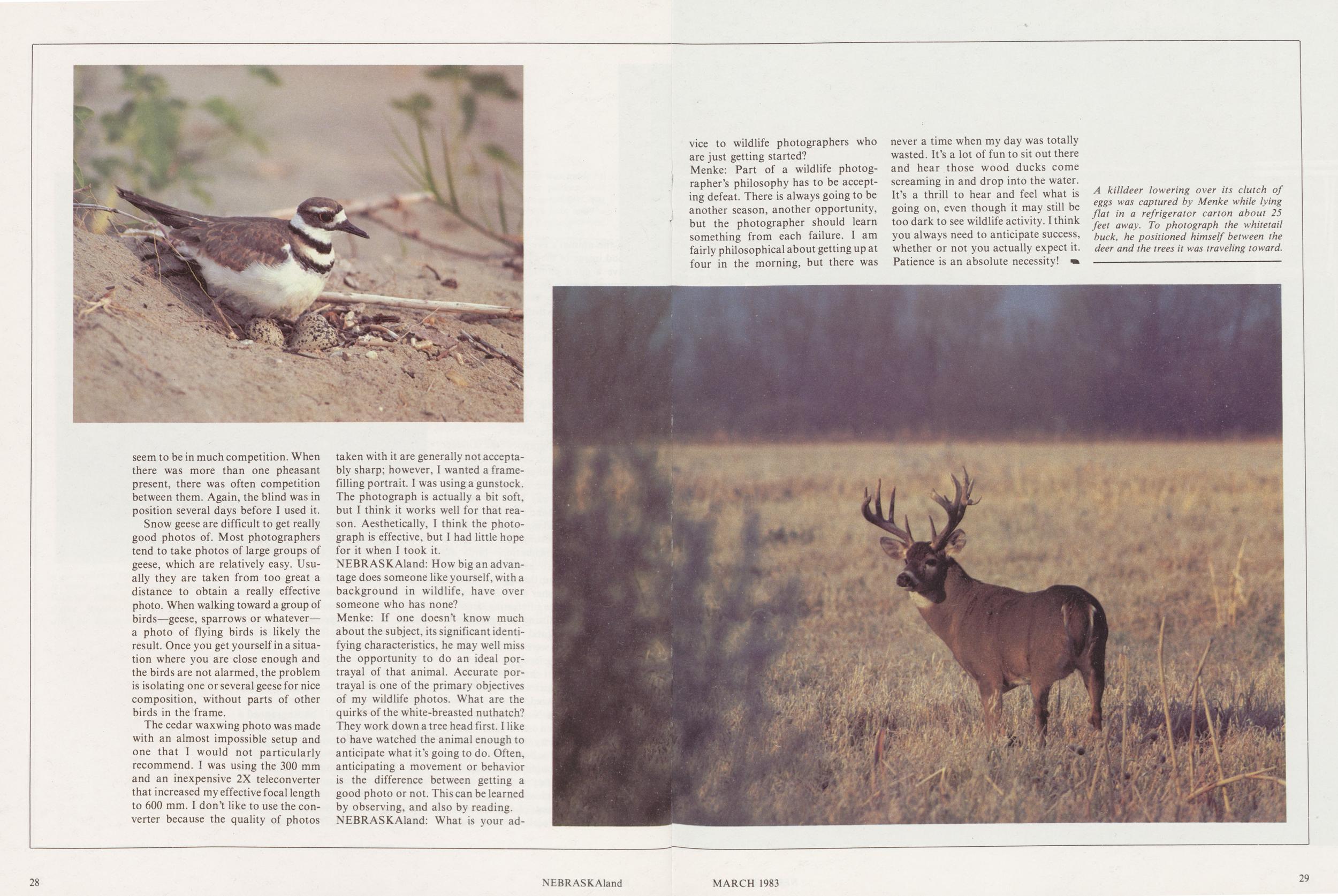
Menke: I photographed the killdeer using a refrigerator carton as a blind. I set it out several days before using it to give the bird time to become accustomed to it. I was lying down at a rather low angle and shooting at about 25 feet with a 300 mm lens. I try not to photograph a nesting bird during the early part of incubation—birds are more inclined to abandon the eggs then. I waited for the eggs to hatch in the brown thrasher nest. I thought it would be a more interesting situation than just a bird sitting on eggs, with the adult bringing food to the nestlings. The thrashers were coming almost constantly to the nest.
The whitetail buck was photographed from a car window with a 300 mm lens on a window mount. It was about 8:30 on a November morning. The deer had been out in a field feeding and I was pretty sure that I was between it and a line of trees it was moving to. I thought if I parked there long enough they would probably work their way closer to me, and they did stay out in front of me for about 20 minutes. As I recall, I bracketed the
The wood ducks were on a small pond, just a few acres in size. This was in the spring when the birds were either paired or in the process of pairing. There are generally five or six pairs on the pond. It was just a matter of waiting for the ducks to crawl up on perches, as they typically do through the day, to rest and relax. My wood duck photos were all taken from a blind.
Several years ago I photographed a
pheasant and squirrel in winter from a
blind set up adjacent to timber, brush
and corn stubble which was baited
with grain. I wanted pheasant and
quail photos. The squirrel and pheasant just happened to be there at the
same time. They wouldn't get very
close to one another, but they did not
MARCH 1983
27
Snow geese are difficult to get really good photos of. Most photographers tend to take photos of large groups of geese, which are relatively easy. Usually they are taken from too great a distance to obtain a really effective photo. When walking toward a group of birds—geese, sparrows or whatever—a photo of flying birds is likely the result. Once you get yourself in a situation where you are close enough and the birds are not alarmed, the problem is isolating one or several geese for nice composition, without parts of other birds in the frame.
The cedar waxwing photo was made with an almost impossible setup and one that I would not particularly recommend. I was using the 300 mm and an inexpensive 2X teleconverter that increased my effective focal length to 600 mm. I don't like to use the converter because the quality of photos taken with it are generally not acceptably sharp; however, I wanted a frame-filling portrait. I was using a gunstock. The photograph is actually a bit soft, but I think it works well for that reason. Aesthetically, I think the photograph is effective, but I had little hope for it when I took it.
NEBRASKAland: How big an advantage does someone like yourself, with a background in wildlife, have over someone who has none?
Menke: If one doesn't know much about the subject, its significant identifying characteristics, he may well miss the opportunity to do an ideal portrayal of that animal. Accurate portrayal is one of the primary objectives of my wildlife photos. What are the quirks of the white-breasted nuthatch? They work down a tree head first. I like to have watched the animal enough to anticipate what it's going to do. Often, anticipating a movement or behavior is the difference between getting a good photo or not. This can be learned by observing, and also by reading.
NEBRASKAland: What is your advice 28 NEBRASKAland to wildlife photographers who are just getting started?
Menke: Part of a wildlife photographer's philosophy has to be accepting defeat. There is always going to be another season, another opportunity, but the photographer should learn something from each failure. I am fairly philosophical about getting up at four in the morning, but there was never a time when my day was totally wasted. It's a lot of fun to sit out there and hear those wood ducks come screaming in and drop into the water. It's a thrill to hear and feel what is going on, even though it may still be too dark to see wildlife activity. I think you always need to anticipate success, whether or not you actually expect it. Patience is an absolute necessity!
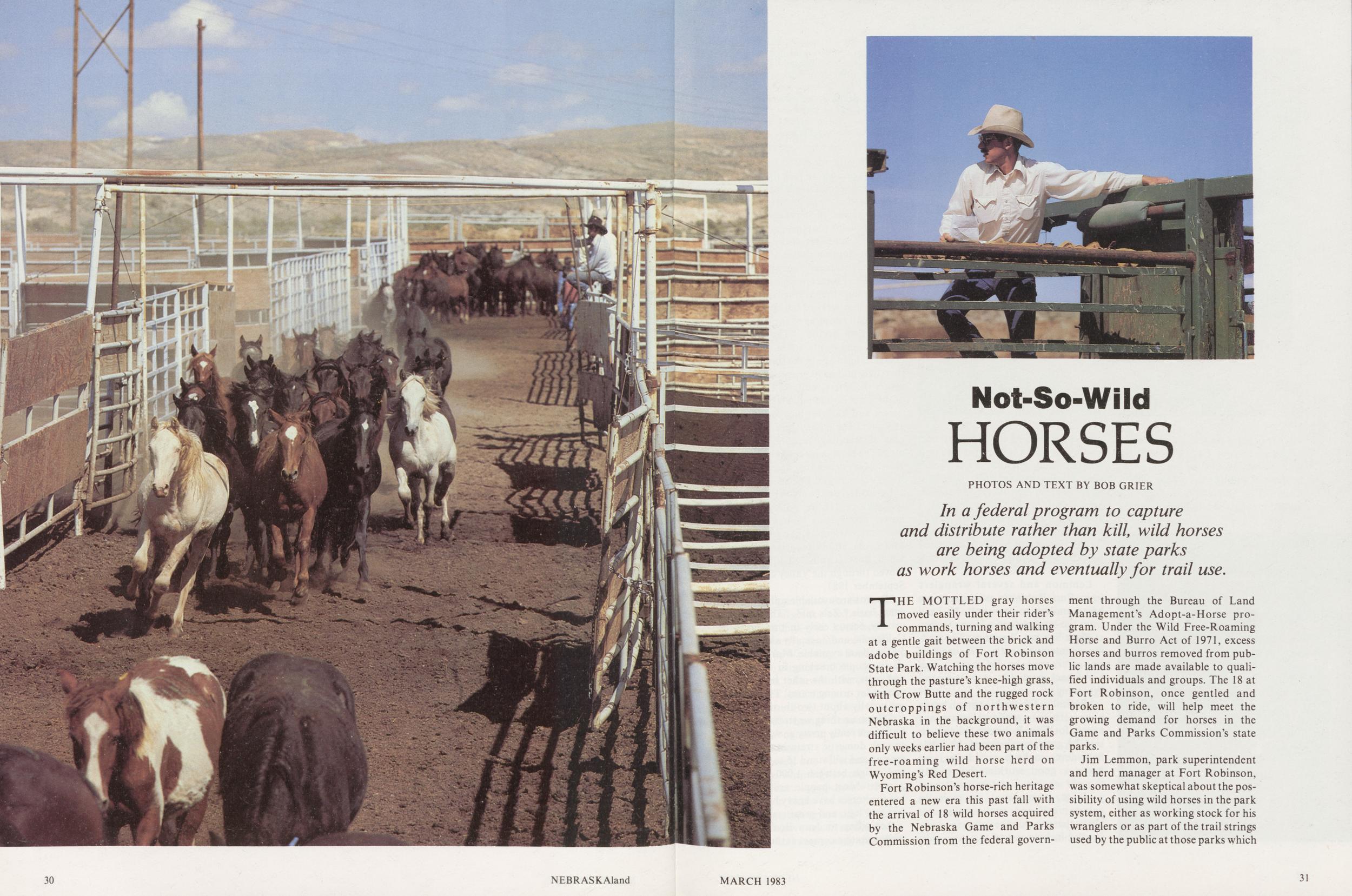
Not-So-Wild HORSES
PHOTOS AND TEXT BY BOB GRIER In a federal program to capture and distribute rather than kill, wild horses are being adopted by state parks as work horses and eventually for trail use.THE MOTTLED gray horses moved easily under their rider's commands, turning and walking at a gentle gait between the brick and adobe buildings of Fort Robinson State Park. Watching the horses move through the pasture's knee-high grass, with Crow Butte and the rugged rock outcroppings of northwestern Nebraska in the background, it was difficult to believe these two animals only weeks earlier had been part of the free-roaming wild horse herd on Wyoming's Red Desert.
Fort Robinson's horse-rich heritage entered a new era this past fall with the arrival of 18 wild horses acquired by the Nebraska Game and Parks Commission from the federal government through the Bureau of Land Management's Adopt-a-Horse program. Under the Wild Free-Roaming Horse and Burro Act of 1971, excess horses and burros removed from public lands are made available to qualified individuals and groups. The 18 at Fort Robinson, once gentled and broken to ride, will help meet the growing demand for horses in the Game and Parks Commission's state parks.
Jim Lemmon, park superintendent
and herd manager at Fort Robinson,
was somewhat skeptical about the possibility of using wild horses in the park
system, either as working stock for his
wranglers or as part of the trail strings
used by the public at those parks which
MARCH 1983
31
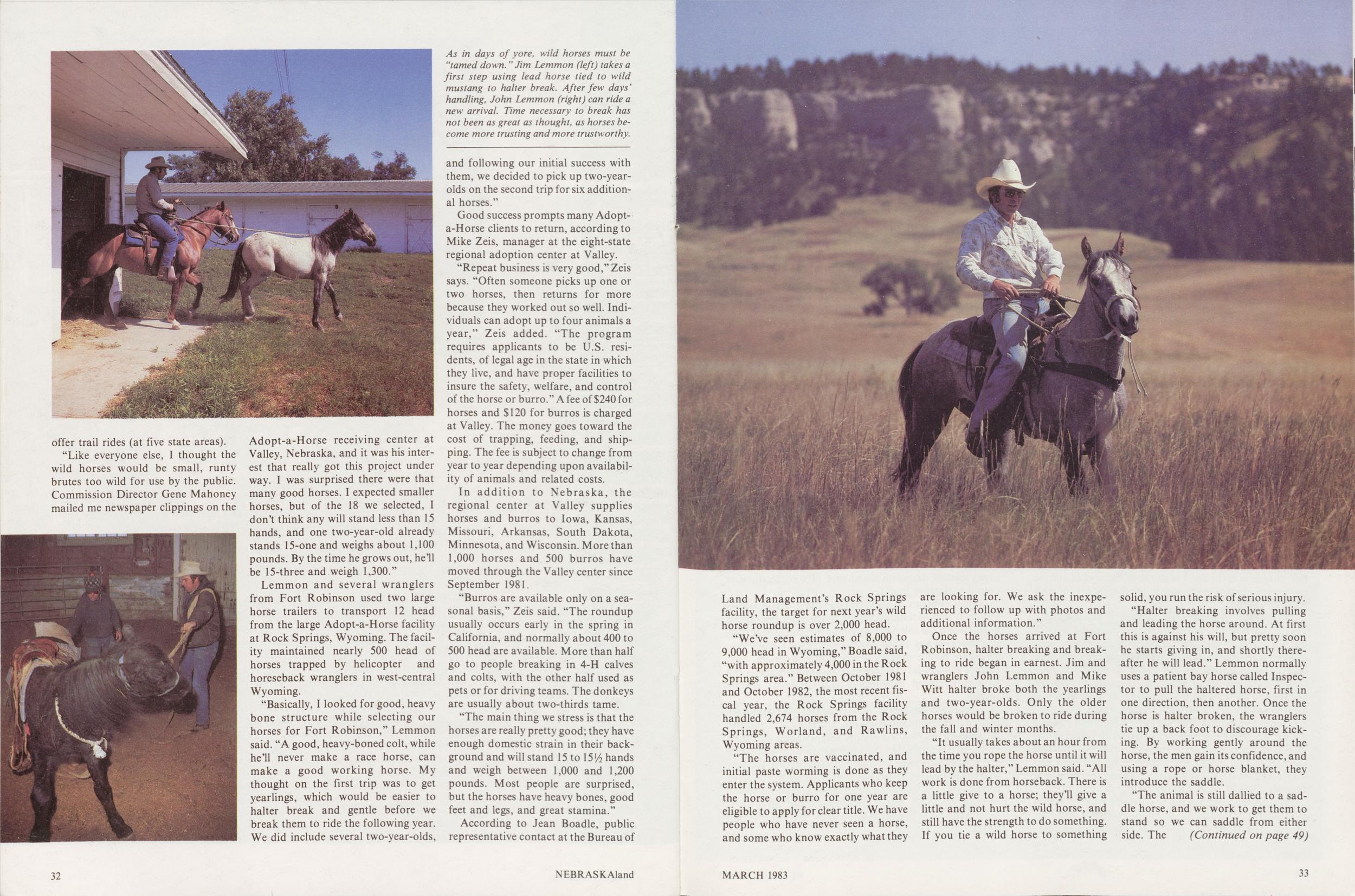
"Like everyone else, I thought the wild horses would be small, runty brutes too wild for use by the public. Commission Director Gene Mahoney mailed me newspaper clippings on the Adopt-a-Horse receiving center at Valley, Nebraska, and it was his interest that really got this project under way. I was surprised there were that many good horses. I expected smaller horses, but of the 18 we selected, I don't think any will stand less than 15 hands, and one two-year-old already stands 15-one and weighs about 1,100 pounds. By the time he grows out, he'll be 15-three and weigh 1,300."
Lemmon and several wranglers from Fort Robinson used two large horse trailers to transport 12 head from the large Adopt-a-Horse facility at Rock Springs, Wyoming. The facility maintained nearly 500 head of horses trapped by helicopter and horeseback wranglers in west-central Wyoming.
"Basically, I looked for good, heavy bone structure while selecting our horses for Fort Robinson," Lemmon said. "A good, heavy-boned colt, while he'll never make a race horse, can make a good working horse. My thought on the first trip was to get yearlings, which would be easier to halter break and gentle before we break them to ride the following year. We did include several two-year-olds, and following our initial success with them, we decided to pick up two-year-olds on the second trip for six additional horses."
Good success prompts many Adopt-a-Horse clients to return, according to Mike Zeis, manager at the eight-state regional adoption center at Valley.
"Repeat business is very good," Zeis says. "Often someone picks up one or two horses, then returns for more because they worked out so well. Individuals can adopt up to four animals a year," Zeis added. "The program requires applicants to be U.S. residents, of legal age in the state in which they live, and have proper facilities to insure the safety, welfare, and control of the horse or burro." A fee of $240 for horses and $120 for burros is charged at Valley. The money goes toward the cost of trapping, feeding, and shipping. The fee is subject to change from year to year depending upon availability of animals and related costs.
In addition to Nebraska, the regional center at Valley supplies horses and burros to Iowa, Kansas, Missouri, Arkansas, South Dakota, Minnesota, and Wisconsin. More than 1,000 horses and 500 burros have moved through the Valley center since September 1981.
"Burros are available only on a seasonal basis," Zeis said. "The roundup usually occurs early in the spring in California, and normally about 400 to 500 head are available. More than half go to people breaking in 4-H calves and colts, with the other half used as pets or for driving teams. The donkeys are usually about two-thirds tame.
"The main thing we stress is that the horses are really pretty good; they have enough domestic strain in their background and will stand 15 to 15 ½ hands and weigh between 1,000 and 1,200 pounds. Most people are surprised, but the horses have heavy bones, good feet and legs, and great stamina."
According to Jean Boadle, public representative contact at the Bureau of 32 NEBRASKAland
"We've seen estimates of 8,000 to 9,000 head in Wyoming," Boadle said, "with approximately 4,000 in the Rock Springs area." Between October 1981 and October 1982, the most recent fiscal year, the Rock Springs facility handled 2,674 horses from the Rock Springs, Worland, and Rawlins, Wyoming areas.
"The horses are vaccinated, and initial paste worming is done as they enter the system. Applicants who keep the horse or burro for one year are eligible to apply for clear title. We have people who have never seen a horse, and some who know exactly what they are looking for. We ask the inexperienced to follow up with photos and additional information."
Once the horses arrived at Fort Robinson, halter breaking and breaking to ride began in earnest. Jim and wranglers John Lemmon and Mike Witt halter broke both the yearlings and two-year-olds. Only the older horses would be broken to ride during the fall and winter months.
"It usually takes about an hour from the time you rope the horse until it will lead by the halter," Lemmon said. "All work is done from horseback. There is a little give to a horse; they'll give a little and not hurt the wild horse, and still have the strength to do something. If you tie a wild horse to something solid, you run the risk of serious injury.
"Halter breaking involves pulling and leading the horse around. At first this is against his will, but pretty soon he starts giving in, and shortly there-after he will lead." Lemmon normally uses a patient bay horse called Inspector to pull the haltered horse, first in one direction, then another. Once the horse is halter broken, the wranglers tie up a back foot to discourage kicking. By working gently around the horse, the men gain its confidence, and using a rope or horse blanket, they introduce the saddle.
"The animal is still dallied to a saddle horse, and we work to get them to stand so we can saddle from either side. The (Continued on page 49)
MARCH 1983 33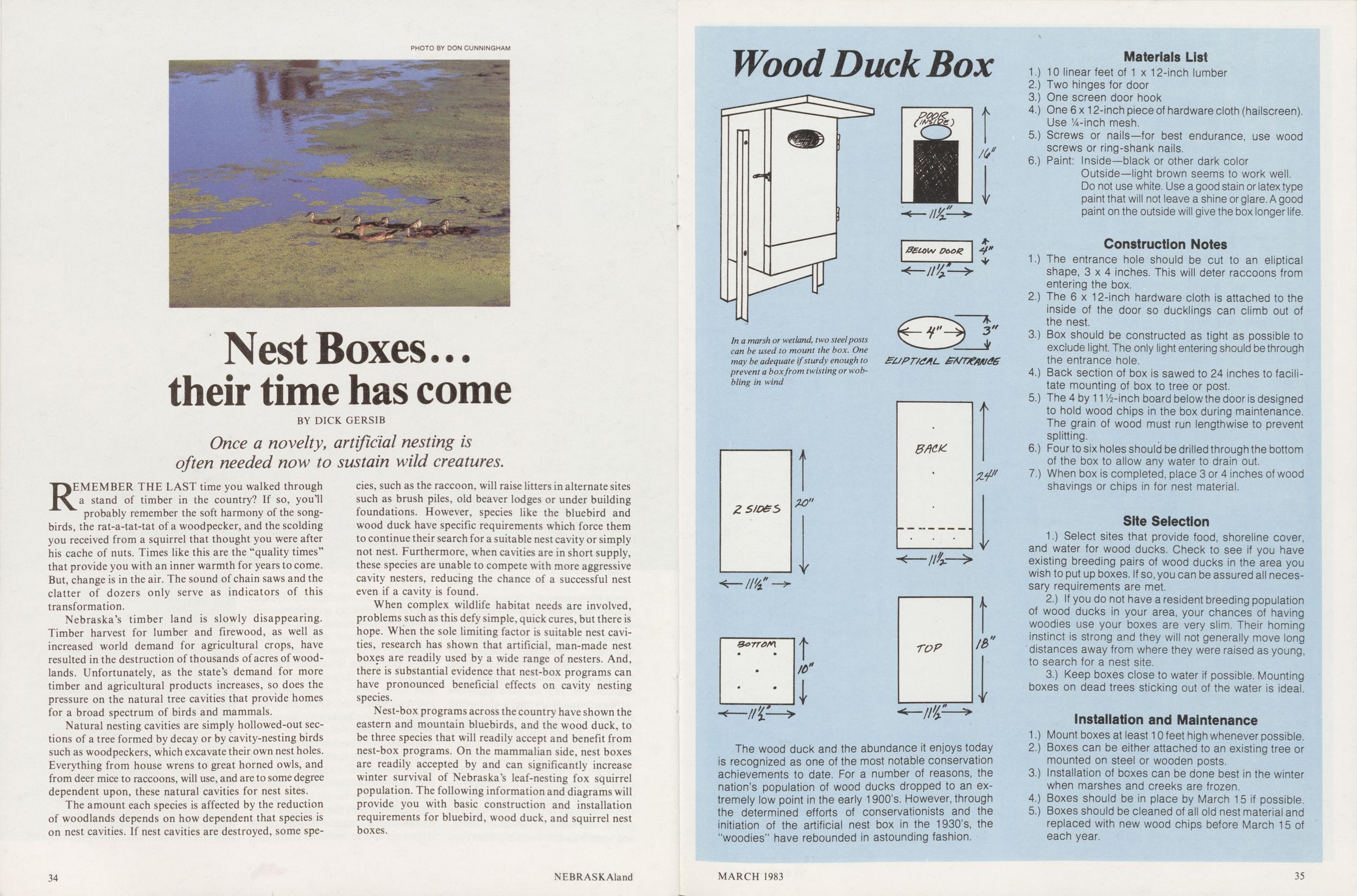
Nest Boxes their time has come
BY DICK GERSIB Once a novelty, artificial nesting is often needed now to sustain wild creatures.REMEMBER THE LAST time you walked through a stand of timber in the country? If so, you'll probably remember the soft harmony of the song-birds, the rat-a-tat-tat of a woodpecker, and the scolding you received from a squirrel that thought you were after his cache of nuts. Times like this are the "quality times" that provide you with an inner warmth for years to come. But, change is in the air. The sound of chain saws and the clatter of dozers only serve as indicators of this transformation.
Nebraska's timber land is slowly disappearing. Timber harvest for lumber and firewood, as well as increased world demand for agricultural crops, have resulted in the destruction of thousands of acres of woodlands. Unfortunately, as the state's demand for more timber and agricultural products increases, so does the pressure on the natural tree cavities that provide homes for a broad spectrum of birds and mammals.
Natural nesting cavities are simply hollowed-out sections of a tree formed by decay or by cavity-nesting birds such as woodpeckers, which excavate their own nest holes. Everything from house wrens to great horned owls, and from deer mice to raccoons, will use, and are to some degree dependent upon, these natural cavities for nest sites.
The amount each species is affected by the reduction of woodlands depends on how dependent that species is on nest cavities. If nest cavities are destroyed, some species, such as the raccoon, will raise litters in alternate sites such as brush piles, old beaver lodges or under building foundations. However, species like the bluebird and wood duck have specific requirements which force them to continue their search for a suitable nest cavity or simply not nest. Furthermore, when cavities are in short supply, these species are unable to compete with more aggressive cavity nesters, reducing the chance of a successful nest even if a cavity is found.
When complex wildlife habitat needs are involved, problems such as this defy simple, quick cures, but there is hope. When the sole limiting factor is suitable nest cavities, research has shown that artificial, man-made nest boxes are readily used by a wide range of nesters. And, there is substantial evidence that nest-box programs can have pronounced beneficial effects on cavity nesting species.
Nest-box programs across the country have shown the eastern and mountain bluebirds, and the wood duck, to be three species that will readily accept and benefit from nest-box programs. On the mammalian side, nest boxes are readily accepted by and can significantly increase winter survival of Nebraska's leaf-nesting fox squirrel population. The following information and diagrams will provide you with basic construction and installation requirements for bluebird, wood duck, and squirrel nest boxes.
34 NEBRASKAland Wood Duck Box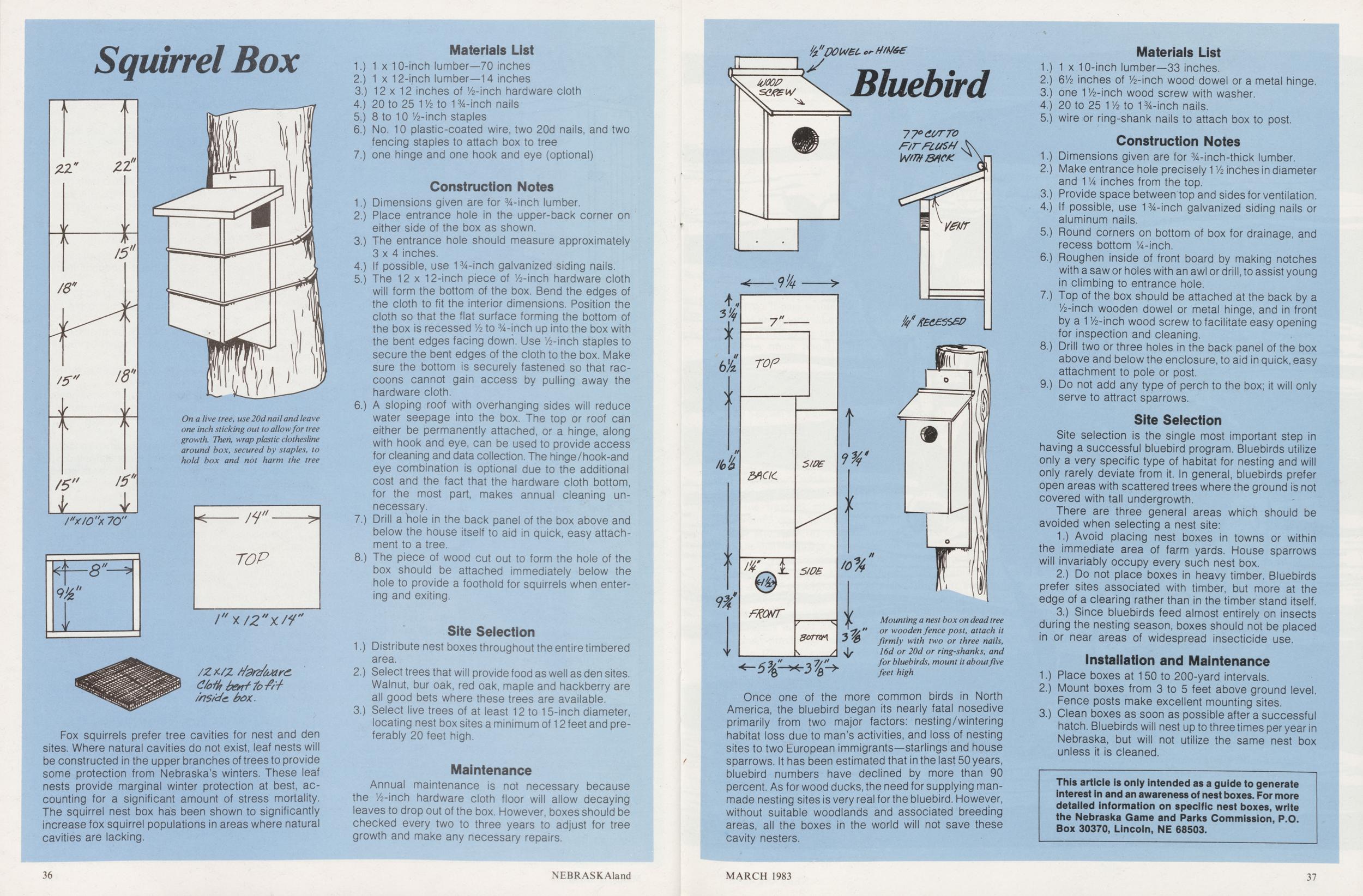 Squirrel Box
Site selection is the single most important step in having a successful bluebird program. Bluebirds utilize only a very specific type of habitat for nesting and will only rarely deviate from it. In general, bluebirds prefer open areas with scattered trees where the ground is not covered with tall undergrowth.
There are three general areas which should be avoided when selecting a nest site:
1. Avoid placing nest boxes in towns or within the immediate area of farm yards. House sparrows will invariably occupy every such nest box. 2. Do not place boxes in heavy timber. Bluebirds prefer sites associated with timber, but more at the edge of a clearing rather than in the timber stand itself. 3. Since bluebirds feed almost entirely on insects during the nesting season, boxes should not be placed in or near areas of widespread insecticide use. Installation and Maintenance 1. Place boxes at 150 to 200-yard intervals. 2. Mount boxes from 3 to 5 feet above ground level. Fence posts make excellent mounting sites. 3. Clean boxes as soon as possible after a successful hatch. Bluebirds will nest up to three times per year in Nebraska, but will not utilize the same nest box unless it is cleaned. This article is only intended as a guide to generate interest in and an awareness of nest boxes. For more detailed information on specific nest boxes, write the Nebraska Game and Parks Commission, P.O. Box 30370, Lincoln, NE 68503. MARCH 1983 37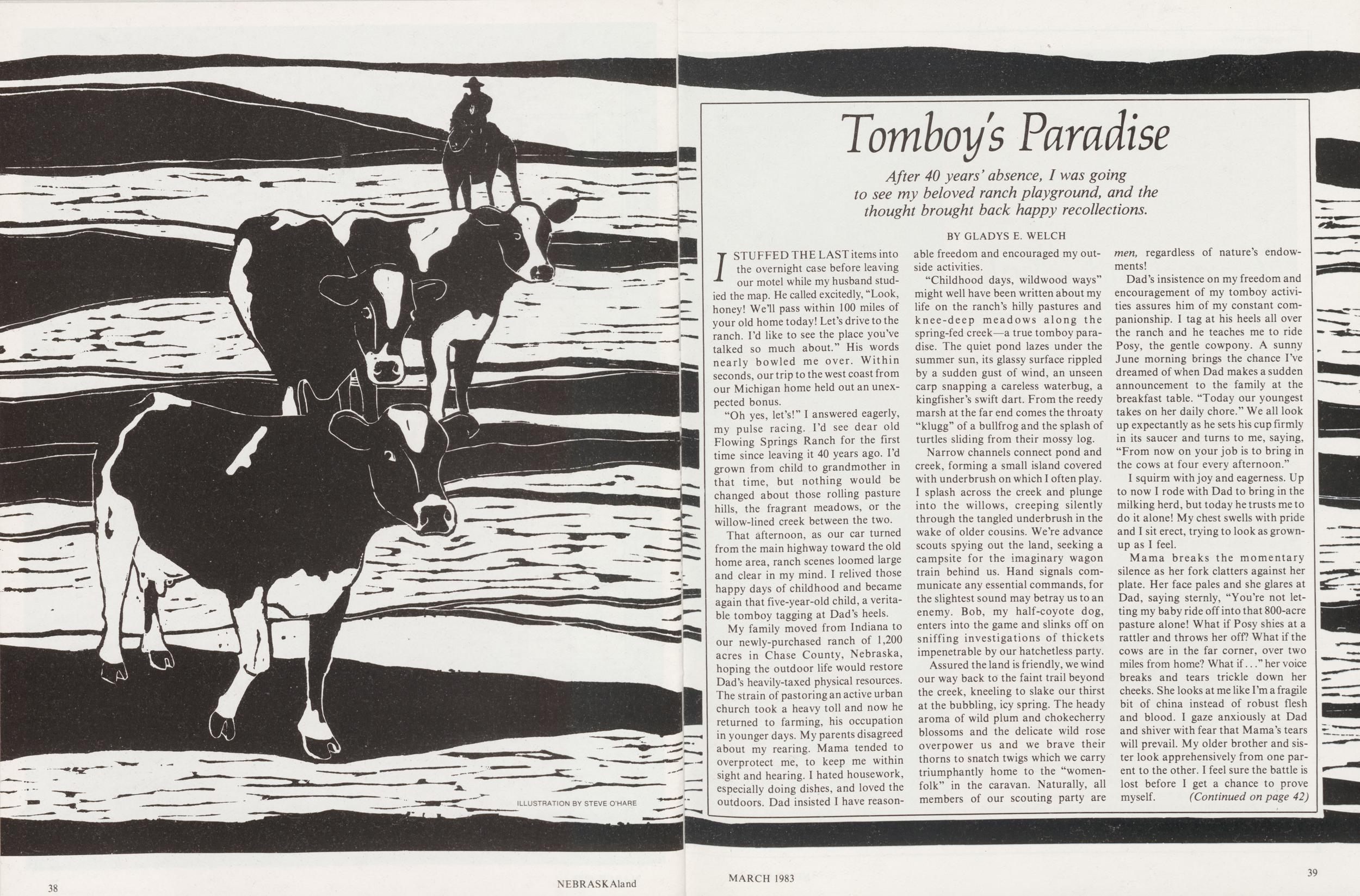
Tomboys Paradise
After 40 years' absence, I was going to see my beloved ranch playground, and the thought brought back happy recollections. BY GLADYS E. WELCHI STUFFED THE LAST items into the overnight case before leaving our motel while my husband studied the map. He called excitedly, "Look, honey! We'll pass within 100 miles of your old home today! Let's drive to the ranch. I'd like to see the place you've talked so much about.'' His words nearly bowled me over. Within seconds, our trip to the west coast from our Michigan home held out an unexpected bonus.
"Oh yes, let's!" I answered eagerly, my pulse racing. I'd see dear old Flowing Springs Ranch for the first time since leaving it 40 years ago. I'd grown from child to grandmother in that time, but nothing would be changed about those rolling pasture hills, the fragrant meadows, or the willow-lined creek between the two.
That afternoon, as our car turned from the main highway toward the old home area, ranch scenes loomed large and clear in my mind. I relived those happy days of childhood and became again that five-year-old child, a veritable tomboy tagging at Dad's heels.
My family moved from Indiana to our newly-purchased ranch of 1,200 acres in Chase County, Nebraska, hoping the outdoor life would restore Dad's heavily-taxed physical resources. The strain of pastoring an active urban church took a heavy toll and now he returned to farming, his occupation in younger days. My parents disagreed about my rearing. Mama tended to overprotect me, to keep me within sight and hearing. I hated housework, especially doing dishes, and loved the outdoors. Dad insisted I have reasonable freedom and encouraged my outside activities.
"Childhood days, wildwood ways" might well have been written about my life on the ranch's hilly pastures and knee-deep meadows along the spring-fed creek—a true tomboy paradise. The quiet pond lazes under the summer sun, its glassy surface rippled by a sudden gust of wind, an unseen carp snapping a careless waterbug, a kingfisher's swift dart. From the reedy marsh at the far end comes the throaty "klugg" of a bullfrog and the splash of turtles sliding from their mossy log.
Narrow channels connect pond and creek, forming a small island covered with underbrush on which I often play. I splash across the creek and plunge into the willows, creeping silently through the tangled underbrush in the wake of older cousins. We're advance scouts spying out the land, seeking a campsite for the imaginary wagon train behind us. Hand signals communicate any essential commands, for the slightest sound may betray us to an enemy. Bob, my half-coyote dog, enters into the game and slinks off on sniffing investigations of thickets impenetrable by our hatchetless party.
Assured the land is friendly, we wind our way back to the faint trail beyond the creek, kneeling to slake our thirst at the bubbling, icy spring. The heady aroma of wild plum and chokecherry blossoms and the delicate wild rose overpower us and we brave their thorns to snatch twigs which we carry triumphantly home to the "women-folk" in the caravan. Naturally, all members of our scouting party are men, regardless of nature's endowments!
Dad's insistence on my freedom and encouragement of my tomboy activities assures him of my constant companionship. I tag at his heels all over the ranch and he teaches me to ride Posy, the gentle cowpony. A sunny June morning brings the chance I've dreamed of when Dad makes a sudden announcement to the family at the breakfast table. "Today our youngest takes on her daily chore." We all look up expectantly as he sets his cup firmly in its saucer and turns to me, saying, "From now on your job is to bring in the cows at four every afternoon."
I squirm with joy and eagerness. Up to now I rode with Dad to bring in the milking herd, but today he trusts me to do it alone! My chest swells with pride and I sit erect, trying to look as grownup as I feel.
Mama breaks the momentary silence as her fork clatters against her plate. Her face pales and she glares at Dad, saying sternly, "You're not letting my baby ride off into that 800-acre pasture alone! What if Posy shies at a rattler and throws her off? What if the cows are in the far corner, over two miles from home? What if." her voice breaks and tears trickle down her cheeks. She looks at me like Fm a fragile bit of china instead of robust flesh and blood. I gaze anxiously at Dad and shiver with fear that Mama's tears will prevail. My older brother and sister look apprehensively from one parent to the other. I feel sure the battle is lost before I get a chance to prove myself. (Continued on page 42)
MARCH 1983 39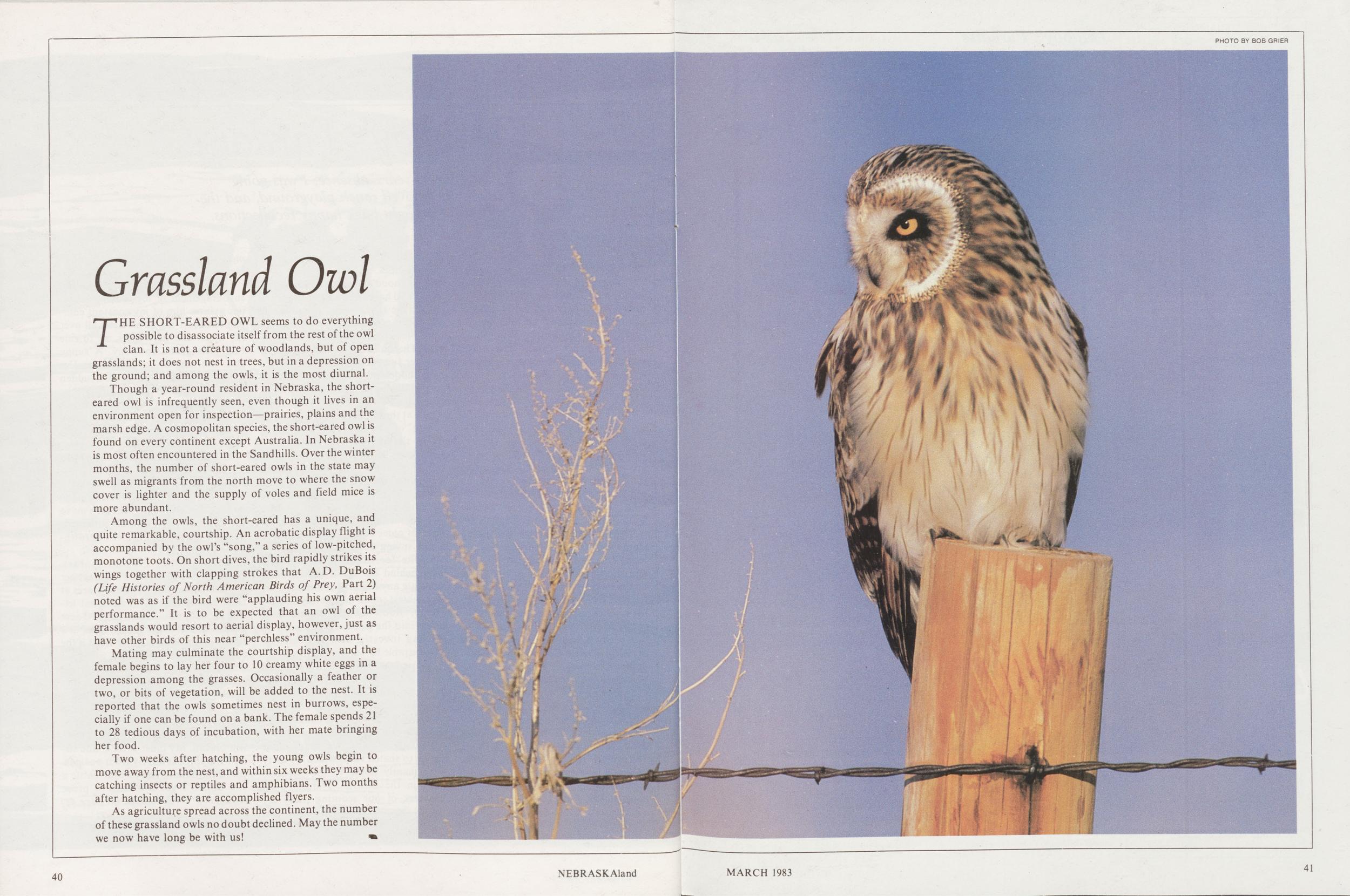
Grassland Owl
THE SHORT-EARED OWL seems to do everything possible to disassociate itself from the rest of the owl clan. It is not a creature of woodlands, but of open grasslands; it does not nest in trees, but in a depression on the ground; and among the owls, it is the most diurnal.
Though a year-round resident in Nebraska, the short-eared owl is infrequently seen, even though it lives in an environment open for inspection—prairies, plains and the marsh edge. A cosmopolitan species, the short-eared owl is found on every continent except Australia. In Nebraska it is most often encountered in the Sandhills. Over the winter months, the number of short-eared owls in the state may swell as migrants from the north move to where the snow cover is lighter and the supply of voles and field mice is more abundant.
Among the owls, the short-eared has a unique, and quite remarkable, courtship. An acrobatic display flight is accompanied by the owl's "song," a series of low-pitched, monotone toots. On short dives, the bird rapidly strikes its wings together with clapping strokes that A. D. DuBois (Life Histories of North American Birds of Prey, Part 2) noted was as if the bird were "applauding his own aerial performance." It is to be expected that an owl of the grasslands would resort to aerial display, however, just as have other birds of this near "perchless" environment.
Mating may culminate the courtship display, and the female begins to lay her four to 10 creamy white eggs in a depression among the grasses. Occasionally a feather or two, or bits of vegetation, will be added to the nest. It is reported that the owls sometimes nest in burrows, especially if one can be found on a bank. The female spends 21 to 28 tedious days of incubation, with her mate bringing her food.
Two weeks after hatching, the young owls begin to move away from the nest, and within six weeks they may be catching insects or reptiles and amphibians. Two months after hatching, they are accomplished flyers.
As agriculture spread across the continent, the number of these grassland owls no doubt declined. May the number we now have long be with us!
40 NEBRASKAland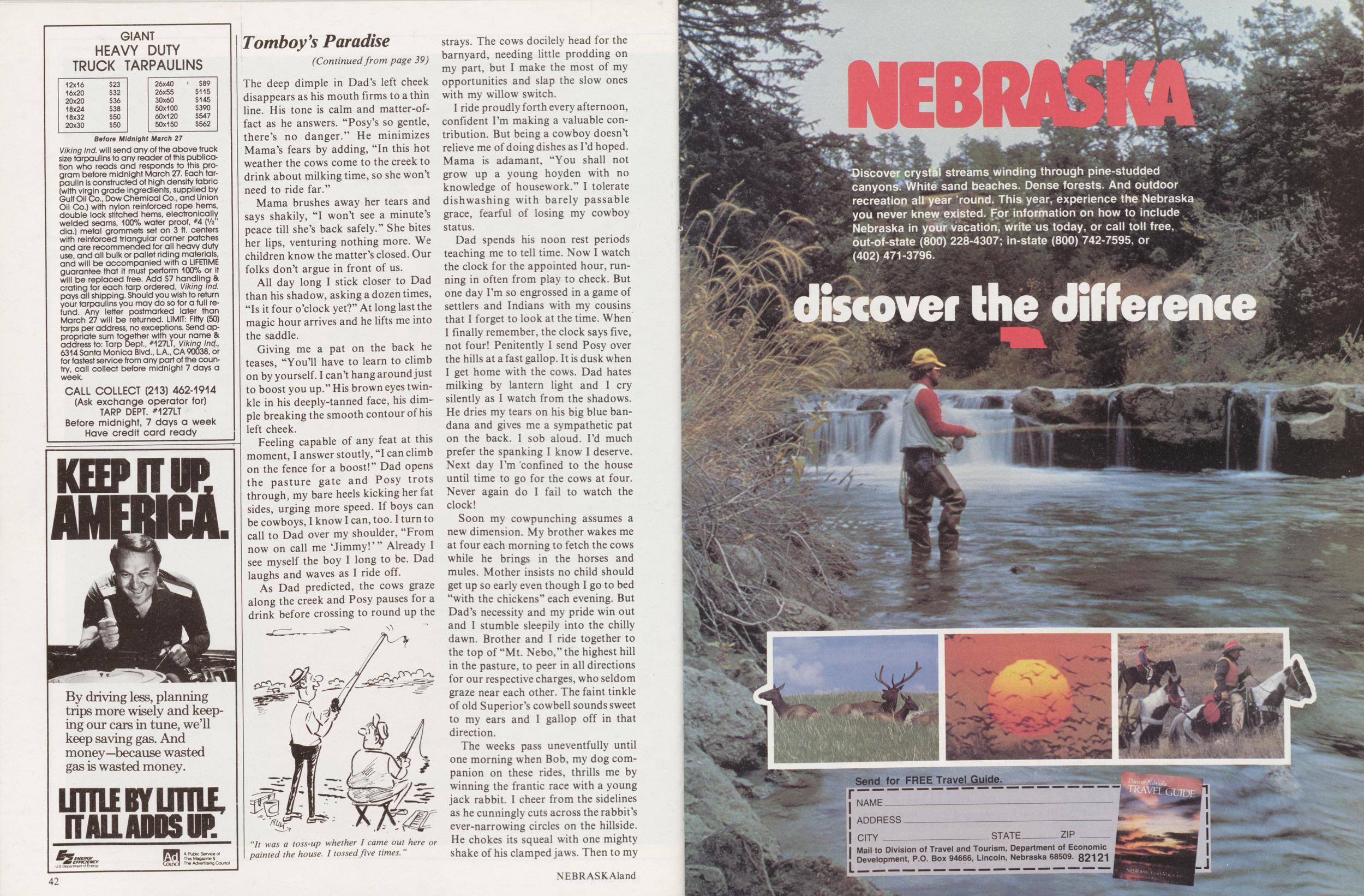
The deep dimple in Dad's left cheek disappears as his mouth firms to a thin line. His tone is calm and matter-of-fact as he answers. "Posy's so gentle, there's no danger." He minimizes Mama's fears by adding, "In this hot weather the cows come to the creek to drink about milking time, so she won't need to ride far."
Mama brushes away her tears and says shakily, "I won't see a minute's peace till she's back safely." She bites her lips, venturing nothing more. We children know the matter's closed. Our folks don't argue in front of us. All day long I stick closer to Dad than his shadow, asking a dozen times, "Is it four o'clock yet?" At long last the magic hour arrives and he lifts me into the saddle.
Giving me a pat on the back he teases, "You'll have to learn to climb on by yourself. I can't hang around just to boost you up." His brown eyes twinkle in his deeply-tanned face, his dimple breaking the smooth contour of his left cheek.
Feeling capable of any feat at this moment, I answer stoutly, "I can climb on the fence for a boost!" Dad opens the pasture gate and Posy trots through, my bare heels kicking her fat sides, urging more speed. If boys can be cowboys, I know I can, too. I turn to call to Dad over my shoulder, "From now on call me 'Jimmy!'" Already I see myself the boy I long to be. Dad laughs and waves as I ride off.
As Dad predicted, the cows graze along the creek and Posy pauses for a drink before crossing to round up the
I ride proudly forth every afternoon, confident I'm making a valuable contribution. But being a cowboy doesn't relieve me of doing dishes as I'd hoped. Mama is adamant, "You shall not grow up a young hoyden with no knowledge of housework." I tolerate dishwashing with barely passable grace, fearful of losing my cowboy status.
Dad spends his noon rest periods teaching me to tell time. Now I watch the clock for the appointed hour, running in often from play to check. But one day I'm so engrossed in a game of settlers and Indians with my cousins that I forget to look at the time. When I finally remember, the clock says five, not four! Penitently I send Posy over the hills at a fast gallop. It is dusk when I get home with the cows. Dad hates milking by lantern light and I cry silently as I watch from the shadows. He dries my tears on his big blue bandana and gives me a sympathetic pat on the back. I sob aloud. I'd much prefer the spanking I know I deserve. Next day I'm confined to the house until time to go for the cows at four. Never again do I fail to watch the clock!
Soon my cowpunching assumes a new dimension. My brother wakes me at four each morning to fetch the cows while he brings in the horses and mules. Mother insists no child should get up so early even though I go to bed "with the chickens" each evening. But Dad's necessity and my pride win out and I stumble sleepily into the chilly dawn. Brother and I ride together to the top of "Mt. Nebo," the highest hill in the pasture, to peer in all directions for our respective charges, who seldom graze near each other. The faint tinkle of old Superior's cowbell sounds sweet to my ears and I gallop off in that direction.
The weeks pass uneventfully until one morning when Bob, my dog companion on these rides, thrills me by winning the frantic race with a young jack rabbit. I cheer from the sidelines as he cunningly cuts across the rabbit's ever-narrowing circles on the hillside. He chokes its squeal with one mighty shake of his clamped jaws. Then to my utter delight and amazement, Bob brings his quarry to lay at Posy's feet, looking up at me for praise! I slide swiftly to the ground. I hug Bob, saying "Good boy! Good Bob!" I pick up the rabbit for proof of his prowess.
Discover crystal streams winding through pine-studded canyons White sand beaches. Dense forests. And outdoor recreation all year round. This year, experience the Nebraska you never knew existed. For information on how to include Nebraska in your vacation, write us today, or call toll free, out-of-state (800) 228-4307; in-state (800) 742-7595, or (402) 471-3796. Send for FREE Travel Guide. NAME ADDRESS CITY STATE ZIP Mail to Division of Travel and Tourism, Department of Economic Development, P.O. Box 94666, Lincoln, Nebraska 68509. 82121 42 NEBRASKAland FREE Cabela's CATALOGS World's foremost supplier of quality hunting, fishing, and outdoor gear A FULL YEARS FREE SUBSCRIPTION 5 Catalogs throughout the year! Rods Reels Lures Tackle Rod Building Hunting Supplies Camping Footwear Outdoor Clothing Optics Boating Supplies Gifts Bows Knives Gun Cases Decoys and much, much more. Cabela's 863"303 812 13th Ave. Sidney, Nebraska 69160 Mail today to receive your free subscription of Cabela's catalogs. Spring Summer Fall Christmas Mid-Winter NAME ADDRESS CITY STATE ZIP At Stud ELHEW HUSKER JOHN 179214 Elhew Shagger (sire) Elhew Huckster, Elhew Penelope Ch. Elhew Huckleberry Ch. Elhew Holly Ch. Red Water Rex Elhew Knickette Elhew Elhew Puffin (dam) Alligator Elhew 6 Elhew Huckster Tutlou Elhew Sprite Elhew Knickerbocker Elhew Ball's Lady Elhew Husker John Stud Fee $250 J.H. Render, P.O. Box 86, Panama, NE 68419 Phone (402) 788-2213 Operation Game Thief Annual Meeting of the Nebraska Wildlife Protector's Association Tuesday, March 22, 10:30 a.m. Municipal Building, Broken Bow, (314 S. 10th) In case of inclement weather, meeting will be postponed one week same time and place The public is invited. Sportsmen—we encourage you to become involved in the "Operation Game Thief Program. It is the purpose of the Wildlife Protector's Association to raise money for the Operation Game Thief reward fund. Donations can be sent to Box 336, Broken Bow, NE 68822. Donations over $10 will be acknowledged with a donor patch. Sportsmen—Plan to Attend.Now I'm really in a jam. How do I get back on Posy? No nearby fence to give me a leg-up, just rolling hills and an occasional clump of prickly devil's fritter cactus! All right, I'll walk the mile and a half if I must, but I won't leave Bob's trophy behind! I hook Posy's reins over my arm and trudge after the cows, dragging the rabbit by his long ears. Nearly back to the barn, I spy a small washout close to the trail and use its low bank for the needed boost. Now I can arrive like a true conquering hero!
Bob wriggles with joy at the family's praise, and I grow inches taller from Dad's pat on the back. Even Mama ceases to worry I'll be stranded miles from home, for I've proved I can cope with emergencies.
Though ranch life affords many opportunities for learning the facts of life, I ponder over the sketchiness of details in my parents' answers to questions. One dewy morning these mysteries are revealed when I chance upon Barby, a young heifer, giving birth to her first calf.
After a few short years, the rumblings of the Great Depression doom my tomboy days. The trust company holding our mortgage fails and we must leave the life I love. We'll move to Colorado where Dad will again take up ministerial duties. I must put away tomboy activities and devote my time entirely to girl stuff! I'm inconsolable, though Mama tries to tempt me with promises of learning to cook and sew.
I take a last ride over the hills, bidding a tearful farewell to my favorite haunts. The next day Posy goes to a new master and I creep into my island thicket to cry. Only Bob, my dog, will go with us to the new home, and he licks my cheeks sympathetically. I feel certain life holds no future happiness.
Dad meets me by the bridge as I drag reluctant feet homeward and we watch the matchless Nebraska sunset paint the sky and pond in brilliant, glowing colors. Dad's arm around my shoulders expresses his understanding of my sadness. He tells me of the new home. "Well have electricity, so you'll have no more lamps to fill or chimneys to wash. Won't it be great to simply push a button and have instant light?" I nod, unable to speak past the hard lump lodged in my throat. "And there's a town library where you can borrow all those books you like to read." He pats my back comfortingly and we walk to the house.
44 NEBRASKAland Live Next Imagine yourself surrounded by sunshine, or dining under the stars! You can enjoy a fresh, new outlook on life by adding a glass-enclosed environment to your home. It's easy to enclose a deck, patio or hot tub. Or create a studio, breakfast nook, sunroom, hobby or entertainment center. Picture all the possibilities! Our glass enclosures come pre-designed to meet codes, specifications and quality To Nature Year-Round. standards for room additions. Find out now how to have one added to your home, or do it yourself. Mail the coupon or call 800-672-3469 NE WATS or 1-402-371-2141 for the name of the nearest display dealer. Introducing the only thermal-break room with insulated glass on the market today! I WANT MORE FACTS ON A GLASS-ENCLOSED ENVIRONMENT: Name Address City State Zip Home phone (PLEASE PRINT: INCLUDE AREA CODES) SUN ROOMS OF NEBRASKA Mail to: Sun Rooms of Nebraska Box 1321 Norfolk, NE 68701 Business Phone Looking for a
place to have
a good time?
Try the Missouri River!
The Missouri River is a great
place to enjoy a wide variety of
outdoor activities, including fishing, hunting, camping, boating,
picnicking, water skiing, bird
watching and outdoor photography, to name a few.
Forming Nebraska's border
on the northeast and east, the
Missouri offers a wide variety of
fish species to tempt anglers.
Paddlefish, walleye, sauger, large
mouth and smallmouth bass,
crappie, three kinds of catfish and
carp are most popular with fishermen.
Most of the land along Nebraska's portion of the river is
privately owned, but there are
also many areas where public
access to the river is allowed.
Some areas are primitive, while
others offer conveniences ranging from boat ramps to picnic
tables, and restrooms to concession stands.
NEBRASKAland Magazine's
Recreation Guide to the Missouri River is available free of
charge from the Game and
Parks Commission.
Write NEBRASKAland
Missouri River Special,
Box 30370, Lincoln, Ne. 68503.
Looking for a
place to have
a good time?
Try the Missouri River!
The Missouri River is a great
place to enjoy a wide variety of
outdoor activities, including fishing, hunting, camping, boating,
picnicking, water skiing, bird
watching and outdoor photography, to name a few.
Forming Nebraska's border
on the northeast and east, the
Missouri offers a wide variety of
fish species to tempt anglers.
Paddlefish, walleye, sauger, large
mouth and smallmouth bass,
crappie, three kinds of catfish and
carp are most popular with fishermen.
Most of the land along Nebraska's portion of the river is
privately owned, but there are
also many areas where public
access to the river is allowed.
Some areas are primitive, while
others offer conveniences ranging from boat ramps to picnic
tables, and restrooms to concession stands.
NEBRASKAland Magazine's
Recreation Guide to the Missouri River is available free of
charge from the Game and
Parks Commission.
Write NEBRASKAland
Missouri River Special,
Box 30370, Lincoln, Ne. 68503.
Mama, too, sees my sadness. She responds in typical feminine fashion. "Come see the new red silk dress I'm making for you to wear to church." I can't resist the shining soft folds and bright color. Maybe being a girl isn't a complete disaster after all! Then a wave of loyalty sweeps over me and I know nothing can ever be as wonderful as these tomboy years on the ranch!
Abruptly my memories of the ranch fade, for my husband is driving into a gas station. This is Wauneta, my childhood mecca on trips to town for supplies. But nothing looks familiar and we must ask our way to the ranch. The new road bypasses the old Wagoner Hill and other landmarks I knew. I feel lost. Then I spy the old mailbox corner with its wagonwheel of boxes on a post. I lean forward to peer ahead.
A slight rise hides the ranch meadows and buildings, but in the distance beyond it the familiar pasture hills rise in breathtaking silhouette against Nebraska's azure sky.
We top the low hill and I gasp in dismay. "Oh, no!" I point with trembling hand. "A cornfield instead of the meadows I used to explore! You can't tell where the creek is—the willows are gone from its banks!" My husband looks at me sympathetically, for I've described it all in great detail so many times.
We bounce over the rutted lane toward the farmstead and clatter across the plank bridge Dad built. I point to the left. "See, there's the hideaway island we scouted, but the thickets are gone. And right here by the bridge is the swimming hole. It used to be shaded by a giant cottonwood, but now there's not even a sapling in its place!" I point again to the left. "All that marsh fills the big pond where the carp snapped their waterbugs, the frogs croaked in chorus and the kingfishers darted for food!" My heart feels like a rock in my breast. Depression sweeps over me. I close my eyes momentarily, hoping the horrible scene will disappear. But it remains when I open them.
We drive past the barn whose remembered proportions have mysteriously shrunk, and stop in front of the house. I shake my head and whisper hoarsely, "It looks so strange. The structure is the same, but this gleaming white paint bears no resemblance to the weatherstained siding I knew. If I'd seen a picture of it. I'd never have recognized it!" We sit in silence a moment, then I burst out, "I almost wish we hadn't come—it's all so different! The pasture hills are the only thing that stayed the same!"
I am face to face with the reality of time's passing: you can't go back to what used to be! Time changes people and places as well as things. I admit that memory provides the best medium for reviewing childhood days and ways. I blink back the tears and swallow the lump in my throat, silently bidding a final farewell to Flowing Springs Ranch, my tomboy paradise.
My feelings run too deep for words. My husband understands and pats me sympathetically. He drives back down the rutted lane, over the bridge across the denuded creek, and along the meadow-cornfield toward the highway.
Sighing deeply in resignation to the inevitable, I turn on the radio. A snatch of song in a husky young voice expresses my mood perfectly as we speed away from my beloved childhood scenes:
"Those were the days, my friend Oh, yes, those were the days!"
NEBRASKAland proudly presents the stories of its readers. Here is the opportunity so many have requested-a chance to tell their own outdoor tales. Hunting trips, the "big fish that got away", unforgettable characters, outdoor impressions-all have a place here. If you have a story to tell, jot it down and send it to Editor, NEBRASKAland, Box 30370, Lincoln, Nebr. 68503. Send photographs, black and white or color, too, if any are available.
Trading Post
DOGSWELL-BRED Hunting dogs for sale—Brittanies, English setters and pointers—ranging in age from puppies to young dogs. Darrell Yentes, 1118 McMillan, Holdrege, NE 68949. Phone (308) 995-8570 or (308) 995-4797.
GERMAN SHORTHAIRS—English Pointers and Setters. Stud service, puppies and started dogs available; 21/2-year-old male Pointer points, backs and retrieves; the best. Will consider leasing several older dogs this season. Wayne Clark, Box 54, Union, NE. (402) 263-3495 or 263-3155.
AKC CHESAPEAKE Bay Retrievers. Galen Tuttle, 10515 Whitney Rd., Papillion, NE 68128. Call (402) 339-3189.
TRAINING ALL BREEDS Hunting dogs—Vizslas for sale. Rozanek Kennels, Rt. 2, Schuyler, NE 68661. Phone (402) 352-8769.
MISCELLANEOUSGUNS—Browning, Winchester, Remington, others, Hi-powers, shotguns, new, used, antiques. Want Pre-1964 Winchesters. Buy-Sell-Trade. Ph. (402) 729-6112. Bedlan's Sporting Goods, Fairbury, NE 68352.
N.E. NEBRASKA Trout Fishing. For rent Mon.-Thurs. or Fri.-Sun. 2 modern cottages completely furnished. 3 ponds with trout up to 5 lbs. 2 ponds with bass and bluegill. Diamond E. Trout Resort, Orchard, NE 68764 (402) 893-4745.
PLASTIC DECOYS: We're originator of famous do-it-yourself system. Catalog $1.00. Decoys Unlimited, Box 69, Clinton, IA 52732.
WINE AND BEER: Make your own. Send for free recipes and instructions. Omaha Supply, 13616 Polk, Omaha, Nebr. 68137.
CLASSIC GROUSE books: Grouse Feathers, More Grouse Feathers, by Bert Spiller. The Gallant Grouse by Heacox, Timber doodle by Woolner. $13.50 each, prepaid. All now out of print. Supply limited. Highwood Bookshop, Box 1246, Traverse City, Mich. 49684. (616) 271-3898.
FOR SALE: Wild turkeys, bobwhite quail and ring-necked pheasant. Phone (402) 643-2365 or 643-2586.
WATERFOWL HUNTING Secrets of an expert—a booklet—send $10 to October Enterprises, P.O. Box 428, Okemos, Michigan 48864.
30 USED, 17' QUALITY Michi-Craft Canoes! Clean, Reconditioned, Guaranteed! A good used canoe is far better than a poor new one! Let us show you the difference! Sale ends April 10! Wilson Outfitters Nebraska (WON) 1329 Dawes Avenue, Lincoln, NE 68521. Phone (402) 476-2300/489-6241.
EARN A FREE Canoe Trip (or even 3!) For Yourself! Sponsor a full-service, canoe-camping trip with Wilson Outfitters Nebraska (WON) and recruit participants from your community, county, club, church, school, neighbors, friends, fellow employees, etc. For details, send self-addressed, stamped envelope to Wilson Outfitters Nebraska (WON) 1329 Dawes Avenue, Lincoln, NE 68521. Phone (402) 476-2300/489-6241. Veterans of 300 river trips in 11 seasons!
FISH FOR SALE. Channel catfish, bass, bluegill, crappie, trout, perch, white bass, minnows, hybrid grass carp, bullhead. We can ship fish, you can pick them up, or we deliver. Contact the Pleasant Valley Fish Farm, Rt. 1, McCook, Nebr. 69001. Phone (308) 345-6599.
FOR SALE: A-frame home; 25 minutes from Harlan County Dam. 2-Bedrooms, fireplace, fully carpeted. Call (402) 761-2624, Milford.
ROCKY FORD CAMP and Canoe Base on the Niobrara featuring Daily 9:15 a.m. shuttle service! Great fast-food service! $20 Daily Canoe Rental! 15-design T-Shirt selection! The finest in riverfront campsites! A full-length canoe trip on the Niobrara! For a world of good canoeing information and a free Niobrara River map, send self-addressed, stamped envelope to Wilson Outfitters Nebraska (WON) 1329 Dawes Avenue, Lincoln, NE 68521. Phone (402) 476-2300/489-6241.
BED & BREAKFAST of Nebraska offers overnite lodging with breakfast, in homes throughout the state. For reservations contact Bed & Breakfast of Nebraska, 1464 28th Ave., Columbus, NE 68601. Phone (402) 564-7591.
TAXIDERMYAWARD-WINNING TAXIDERMIST. Eight time national award winners. Trust your trophies to a proven winner. Our complete taxidermy service also arranges hunts. Dinges Taxidermy Studio, 2763 South 12th Omaha, NE 68108. Ph. 402-342-3718.
CREATIVE TAXIDERMY in all its branches since 1935, now includes Northstar Freeze-Dry processing of approved small specimens. Also tanning and deerskin processing. Naturecraft Studio. Nebraska City, Nebraska 68510. Joe Voges-Owner. Phone (402) 873-5491.
JOHNSON TAXIDERMY—servicing southwest Nebraska, specializing in big-game mounts, lifesized mounts, rug work, fish, birds, tanning hair-on leather. Brochure and price list on request. Johnson Taxidermy, Rt. 1, Box 78, Lamar, NE 69035. Telephone (308) 882-5555.
PEISTER TAXIDERMY—a name you can trust. We give you professional life-like work at prices most sportsmen can afford. Member National Taxidermist Association, #5 Regency Place, Kearney, Nebr. 68847. Phone (308) 237-7575.
NABITY'S TAXIDERMY. 31 years experience. Specializing in natural grass backgrounds for mammals, birds and fish. 13901 "0"St., Lincoln, NE 68505 (4 miles east of 84th and "O". (402) 489-6351.
BADE TAXIDERMY—Quality a must—Fast service. Fish, birds, rugs, tanning, full mounts and game heads. 1924 North Lincoln, Fremont, Nebraska. 727-5463.
BIG BEAR TAXIDERMY, Rt. 2, Mitchell, Nebraska 69357. We specialize in all big game from Alaska to Nebraska, also birds and fish. Hair on and hair off tanning, 4 1/2 miles west of Scottsbluff on Highway 26. Phone (308) 635-3013.
KARL SCHWARZ Master Taxidermist. Mounting of game heads—birds—fish—animals—fur rugs—robes—tanning buckskin. Since 1910. 424 South 13th Street, Dept. A, Omaha, Nebraska 68102.
FREEZE-DRY TAXIDERMY Wally Allison's State Record Taxidermy, 2709 Birchwood, North Platte, NE 69101. Phone: (308) 534-2324. Specializing in Fish and Small Game, Snake and Lizard and Novelties. (Nothing too small) Newest of all taxidermy methods employed.
LIVE-CATCH ALL-PURPOSE TRAPS FREE CATALOG Traps without injury squirrels, chipmunks, rabbits, mink, fox, raccoons, stray animals, pests, etc. Sizes for every need. Also traps for snakes, sparrows, pigeons, crabs, turtles, quail, etc. Save on our low factory prices. Send no money Free catalog and trapping secrets. MUSTANG MFG. CO., Dept. N-34, Box 1Ams 0880 , Houston, Tex. 77018 And then there were none. The list of already extinct animals grows the great auk, the Texas gray wolf, the Badlands bighorn,the sea mink, the passenger pigeon What happens if civilization continues to slowly choke out wildlife species by species? Man cannot live on a planet unfit for animals. Join an organization that's doing something about preserving our endangered species. Get involved. Write the National Wildlife Federation, Department 105, 1412 16th Street, MW. Washington, DC 20036. It's not too late. AMERICAN & METRIC 62-PIECE HEAVY DUTY INDUSTRIAL TOOL CHEST $28 Before Midnight March 27 We will send to each reader of this publication, who reads and responds to this test before midnight March 27, a 62-piece American and Metric Heavy Duty Industrial tool set and metal storage chest containing all the basic and special tools necessary to service and repair domestic and foreign trucks, tractors, autos, and all heavy industrial machinery. Consists of: 7 American 3/8 inch drive sockets. (3/8"), (7/16"), (1/2"), (9/16"), (5/8"), (11/16"), (3/4"). 9 American 1/4 inch drive sockets. (3/16"), (7/32"), (1/4"), (9/32"), (5/16"), (11/32") (3/8"), (7/16"), (1/2"). 9 Metric 3/8 inch drive sockets. (9MM), (10MM), (11MM), (12MM), (13MM), (14MM), (16MM), (17MM), (19MM). 9 Metric 1/4 inch drive sockets. (4.5MM), (5MM), (6MM), (7MM), (8MM), (9MM), (10MM), (11MM), (12MM). A 3/8 inch fine tooth ratchet with quick release drive combination-forward and reversible, a 1/4 inch x 3/8 inch adapter, a 3/8 inch drive extension bar 3 inch. A 3/8 inch spark plug socket with oil resistant insert and speed installation and removal. An 18-piece industrial steel ignition wrench set, complete set of spark plug gap setting gauges for any type of spark plug. One "1/4-drive" heavy screwdriver, (1) One large set of feeler gauges, industrial "Phillips" heavy duty and "regular" screwdriver. All tools are drop forged alloy steel for durable heavy duty repair work, and will be accompanied with a LIFETIME guarantee that it must perform 100% or it will be replaced free. Add $7 handling and crating for each Tool Chest requested, we pay all shipping. Should you wish to return your tools, you may do so for a full refund. Any letter postmarked later than March 27, will be returned. LIMIT: Six (6) sets per address, no exceptions. Send appropriate sum together with your name and ad- dress to: Tool Test Dept. #103DW, Viking Ind., 6314 Santa Monica Blvd., Los Angeles, CA 90038, or for fastest service from any part of the country, call collect, before midnight 7 days a week, (213) 462-1914. (Ask for) TOOL TEST, #103DW, have credit card ready. MARCH 1983 47
Bookshelf
ELHEW PUPS FOR SALE Ch. Elhew Copper Tan. (sire) 133434 Ch. Elhew Copper Tan Lucy Elhew Dot (dam) 149142 Ch. Elhew Copper Strike Ch. Red Water Rex Elhew Phyllis Humphries Elhew Honey Elhew Hickock Elhew Peggysue Gator's Elhew Baron Elhew Alligator Elhew Gretchen Elhew Knickerbock Nikki Elhew Knickerbocker Elhew Vanessa Lucy Elhew Dot Best of breeding for top gun dogs. Will have all shots. $300 each. $50 Deposit Required. J.H. Render, P.O. Box 86, Panama, NE 68419 Phone (402) 788-2213 Harlan County Dam Vacation Apartments fully furnished Color TV Kitchen Facilities Full Baths Game cleaning room with freezer One block from shopping center Weekend or week of pleasant living Security Deposit Required Sorry No Pets Dean and Esther Stone Box 145 Ph. (308) 799-3422 Republican City, NE 68971 BERGMAN'S RESORT On Johnson Lake Modern Lakefront Cabins Groceries Bait Tackle RV Hookups Boats for Rent Swim Fish Golf Write or Call: RR 2, Elwood, NE 68937 (308) 785-2298 Making America a better place to live through Tree Stewardship a time to grow FOR YOUR FREE "Plant a Tree For Tomorrow" Booklet. WRITE: ARBOR LODGE 100 Nebraska City. Nebraska 68410 WELCOME to Merritt Dam Trading Post 26 Miles Southwest of Valentine On Hwy. 16C Phone 402/376-3437 Bait Tackle Ammunition Groceries Gas Beer Ice Year round Cabins with Kitchen Facilities Campground Hook-ups Boat and Motor Rental Easy-access dock Home of the State Record Perch, Muskellunge and Smallmouth bass Your Hosts JON AND MARIAN DAVENPORT North American Range Plants (2nd edition) James Stubbendieck, Stephen L. Hatch and Kathie J. Kjar. 1982. University of Nebraska Press, Lincoln. 464 pp., illustrations. $13.95 (paper), $24.95 (cloth).CHARACTERISTICS and geographic distributions of 200 plant species are presented concisely in this volume. An introduction discusses the organization and objectives of the book, followed by a well-illustrated survey of structure and terminology necessary for plant identification.
Each species discussed in the book is represented by an excellent line drawing of the entire plant, supplemented by enlarged details of plant parts by which species may be distinguished. The text page following each of the illustrations presents a great deal of information with few words. In addition to identification features, brief notes include background about geographic origin (native to North America or introduced), value to livestock and wildlife (forage, browse, cover), and historical uses as food or medicine by Indians and early settlers.
As the title indicates, plant resources of southern Canada, northern Mexico and the contiguous 48 states are represented. Approximately 65 of the species covered are widely distributed in Nebraska, and an additional 30 or so occur in portions of the state. The Pine Ridge and upper North Platte Valley have a number of typical Rocky Mountain region plants, while eastern Nebraska represents the western limit of several species which are more abundant in areas to the east.
Although North American Range Plants may be used mainly as a college-level text, it would be a useful reference for ranchers, naturalists and wildlife managers, among others.
48 NEBRASKAlandnext step, with the rear foot still tied, is to mount and dismount from either side until the horse will stand. This usually takes about 15 to 20 minutes.
"Finally, we untie the hind foot and go to riding. By that time the horse is familiar with you, not so scared of you, and most will basically do about what you want. Some will bite at first, but once they know you won't harm them, they settle down pretty fast."
Lemmon and his wranglers will tie up a hind foot on each horse, saddle, mount and dismount, and then untie the hind foot and ride each new horse for about four days. Finally, the wranglers can go through the procedure without tying up the foot.
"We'll ride the horses for several years before working them into a trail ride string. We hope to breed some of the mares to a quarter horse stud and raise horses at Fort Robinson again; not the quality of the great thorough-breds the Army raised here, but good, working horses. We have some of the wild horses ready to go to the other parks now, and perhaps all will be ready by spring."
In addition to meeting the requirements specified earlier, including residency and age, prospective applicants must submit an adoption application specifying the type of animal and kind of facilities available. If an application is accepted, the applicant will be advised when an animal will be available. The BLM tries to make an animal available from the nearest distribution center, but the applicant is responsible for transporting the animal and all costs for its future upkeep, including veterinarian charges.
Title may be obtained after one year with humane treatment and care certified in writing by a licensed veterinarian. Restrictions before title is received prevent using the animal for any commercial purpose because of its wild characteristics. For example, the animal cannot be used for bucking or similar events, such as wild horse races.
For additional information on the program, contact the Adopt-a-Horse Regional Center, Valley, Nebraska 68064 or the Rock Springs Bureau of Land Management, P.O. Box 1869, Rock Springs, Wyoming 82901.NOTES ON NEBRSKA FLORA
PASQUEFLOWER
BY JAN WHITNEYJUST AS THE ARRIVAL of the sandhill cranes in the central Platte Valley signals that spring is just around the corner, the emergence of the pasqueflower in northern and western Nebraska heralds the reawakening of the state's prairie flora. Other flower species are only just appearing when the pasqueflower shows its mature, fluffy white seedhead. Frequently, a pasqueflower's showy blossoms are found emerging from the snow of a late winter storm.
Pasqueflower (Anemonepatens L.), so named because it blooms during the Easter (Paschal) season, is a native perennial, widely distributed through the American west, from Alaska to Texas, extending east on dry prairies and barrens to Wisconsin and northern Illinois. It is the floral emblem of both South Dakota and Manitoba.
The pasqueflower belongs to the primitive buttercup family (Ranunculaceae). Its deep, dish-shaped white to blue or lavender flowers contain numerous golden stamens and carpels. The flowers are two to three inches in diameter and have no petals, but rather five to seven petal-like sepals. Some plants may have nearly a dozen blooms, each on a separate stem. As is typical of early spring flowers, the pasqueflower blooms close to the earth (under 10 inches) where competition for sunlight would be much too great later in the season.
The leaves, which often don't appear until after the sepals have fallen, are deeply cut into narrow lobes. The basal leaves occur on slender stalks called petioles, while those of the upper stem are sessile. The entire plant is covered with long, silky hairs. As the Cree Indians said, "These brave little flowers come while it is still so cold that they must wear their fur coats."
The pasqueflower differs from other species of Anemone in having long, feathery appendages to the achenes. This conspicuous, fluffy seedhead, similar to Clematis, persists until June or July.
There are certain characteristics common to many early spring bloomers, including the pasqueflower: a bowl or saucer shape, heliotropism (sun-following), reflective petals, and centers composed of many fuzzy stamens and carpels. Roger Knutson, professor of biology at Luther College in Decorah, Iowa, has studied "solar heating" in plants and observed that such flowers focus reflected light and heat on the flower center where reradiation
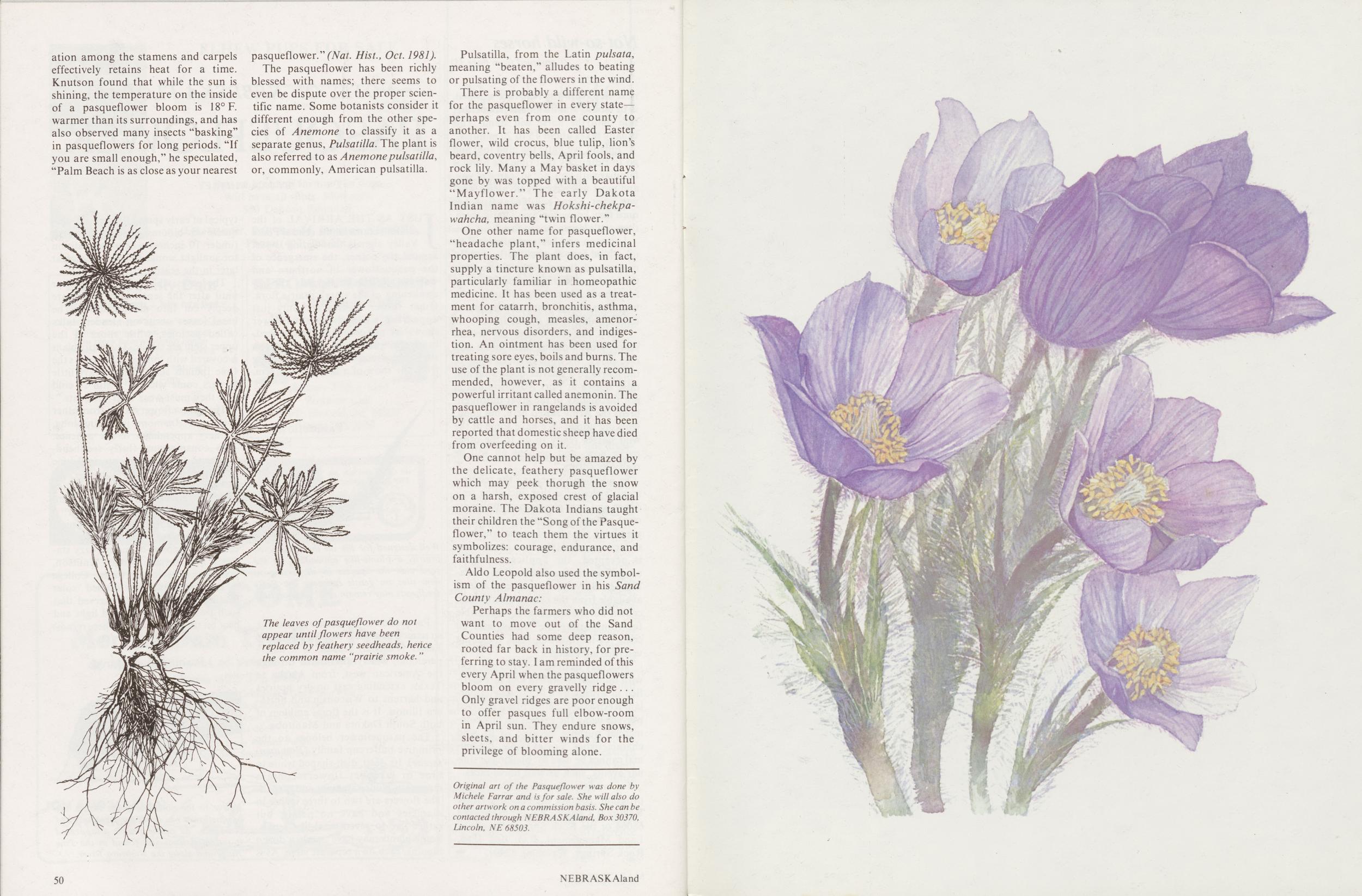 ation among the stamens and carpels
effectively retains heat for a time.
Knutson found that while the sun is
shining, the temperature on the inside
of a pasqueflower bloom is 18° F.
warmer than its surroundings, and has
also observed many insects "basking"
in pasqueflowers for long periods. "If
you are small enough," he speculated,
"Palm Beach is as close as your nearest
pasqueflower.'' (Nat. Hist., Oct. 1981).
ation among the stamens and carpels
effectively retains heat for a time.
Knutson found that while the sun is
shining, the temperature on the inside
of a pasqueflower bloom is 18° F.
warmer than its surroundings, and has
also observed many insects "basking"
in pasqueflowers for long periods. "If
you are small enough," he speculated,
"Palm Beach is as close as your nearest
pasqueflower.'' (Nat. Hist., Oct. 1981).
The pasqueflower has been richly blessed with names; there seems to even be dispute over the proper scientific name. Some botanists consider it different enough from the other species of Anemone to classify it as a separate genus, Pulsatilla. The plant is also referred to as Anemone Pulsatilla, or, commonly, American Pulsatilla.
Pulsatilla, from the Latin pulsata, meaning "beaten," alludes to beating or pulsating of the flowers in the wind.
There is probably a different name for the pasqueflower in every state—perhaps even from one county to another. It has been called Easter flower, wild crocus, blue tulip, lion's beard, Coventry bells, April fools, and rock lily. Many a May basket in days gone by was topped with a beautiful "Mayflower.' The early Dakota Indian name was Hokshi-chekpa-wahcha, meaning "twin flower."
One other name for pasqueflower, "headache plant," infers medicinal properties. The plant does, in fact, supply a tincture known as Pulsatilla, particularly familiar in homeopathic medicine. It has been used as a treatment for catarrh, bronchitis, asthma, whooping cough, measles, amenorrhea, nervous disorders, and indigestion. An ointment has been used for treating sore eyes, boils and burns. The use of the plant is not generally recommended, however, as it contains a powerful irritant called anemonin. The pasqueflower in rangelands is avoided by cattle and horses, and it has been reported that domestic sheep have died from overfeeding on it.
One cannot help but be amazed by the delicate, feathery pasqueflower which may peek thorugh the snow on a harsh, exposed crest of glacial moraine. The Dakota Indians taught their children the "Song of the Pasque-flower," to teach them the virtues it symbolizes: courage, endurance, and faithfulness.
Aldo Leopold also used the symbolism of the pasqueflower in his Sand County Almanac:
Perhaps the farmers who did not want to move out of the Sand Counties had some deep reason, rooted far back in history, for preferring to stay. I am reminded of this every April when the pasqueflowers bloom on every gravelly ridge Only gravel ridges are poor enough to offer pasques full elbow-room in April sun. They endure snows, sleets, and bitter winds for the privilege of blooming alone.
Original art of the Pasqueflower was done by Michele Farrar and is for sale. She will also do other artwork on a commission basis. She can be contacted through NEBRASKAland, Box 30370, Lincoln, NE 68503. 50 NEBRASKAland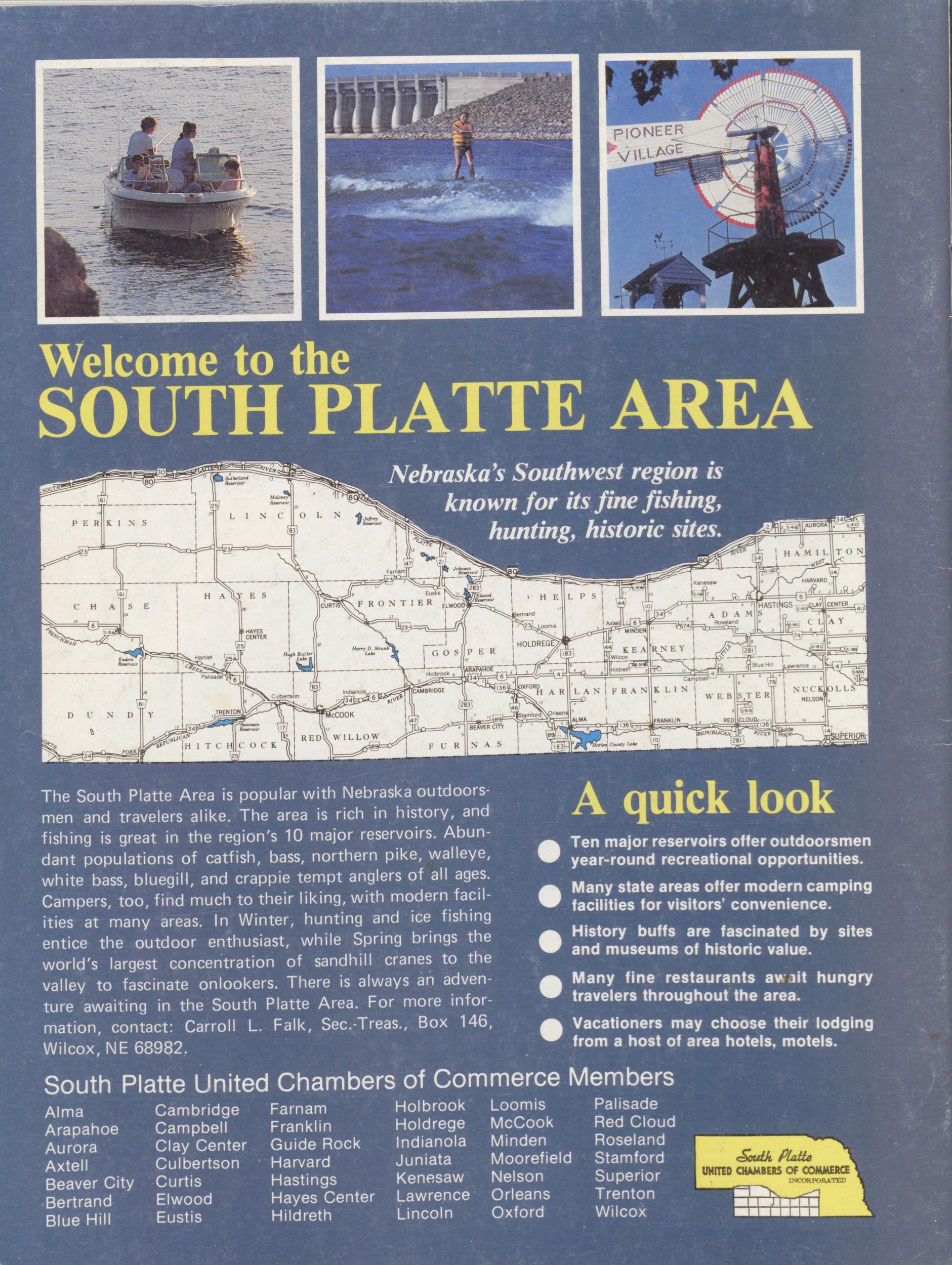
Position: 541 (20 views)