Volume 60, Issue 18, 1982
NEBRASKAland
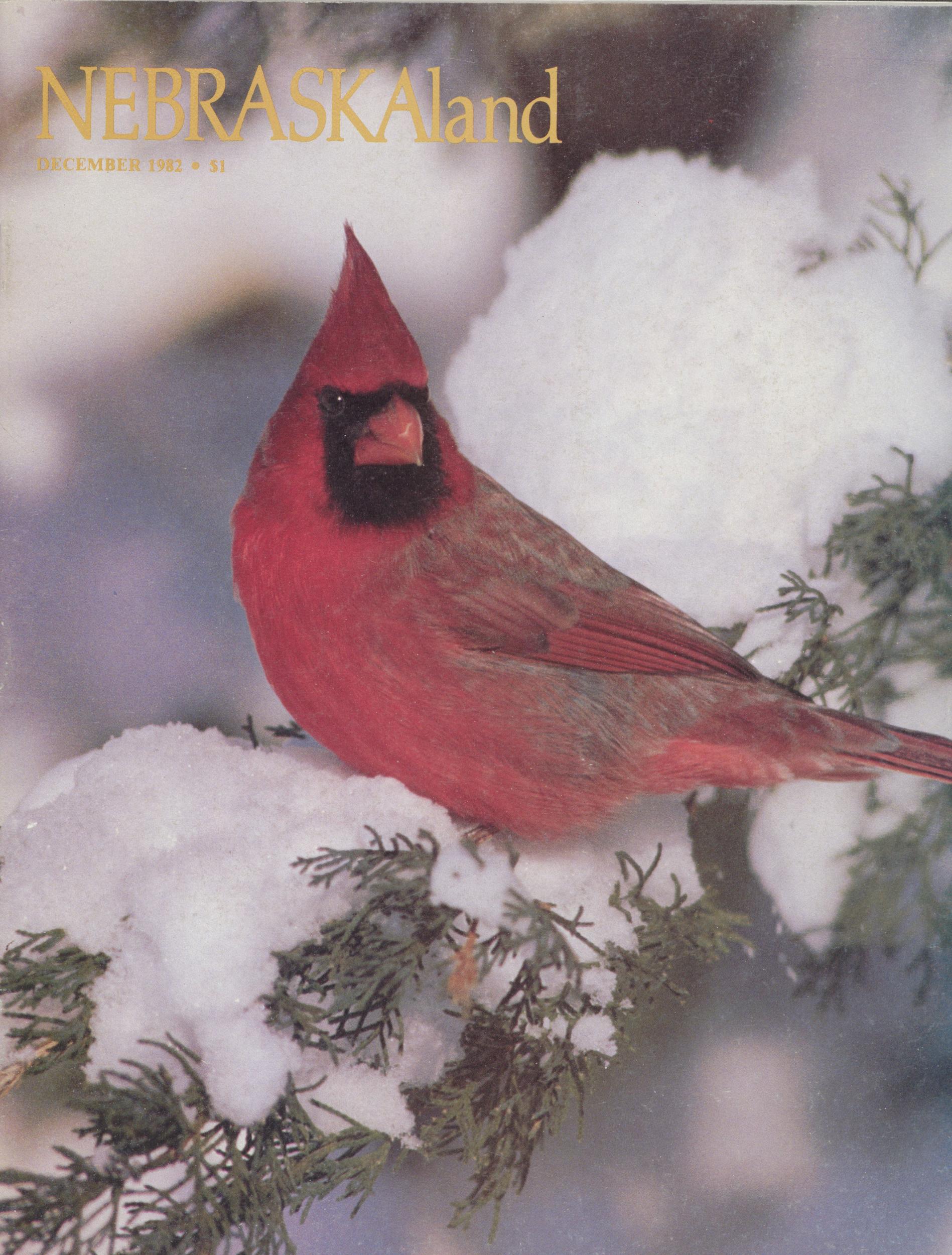
DECEMBER 1982 $1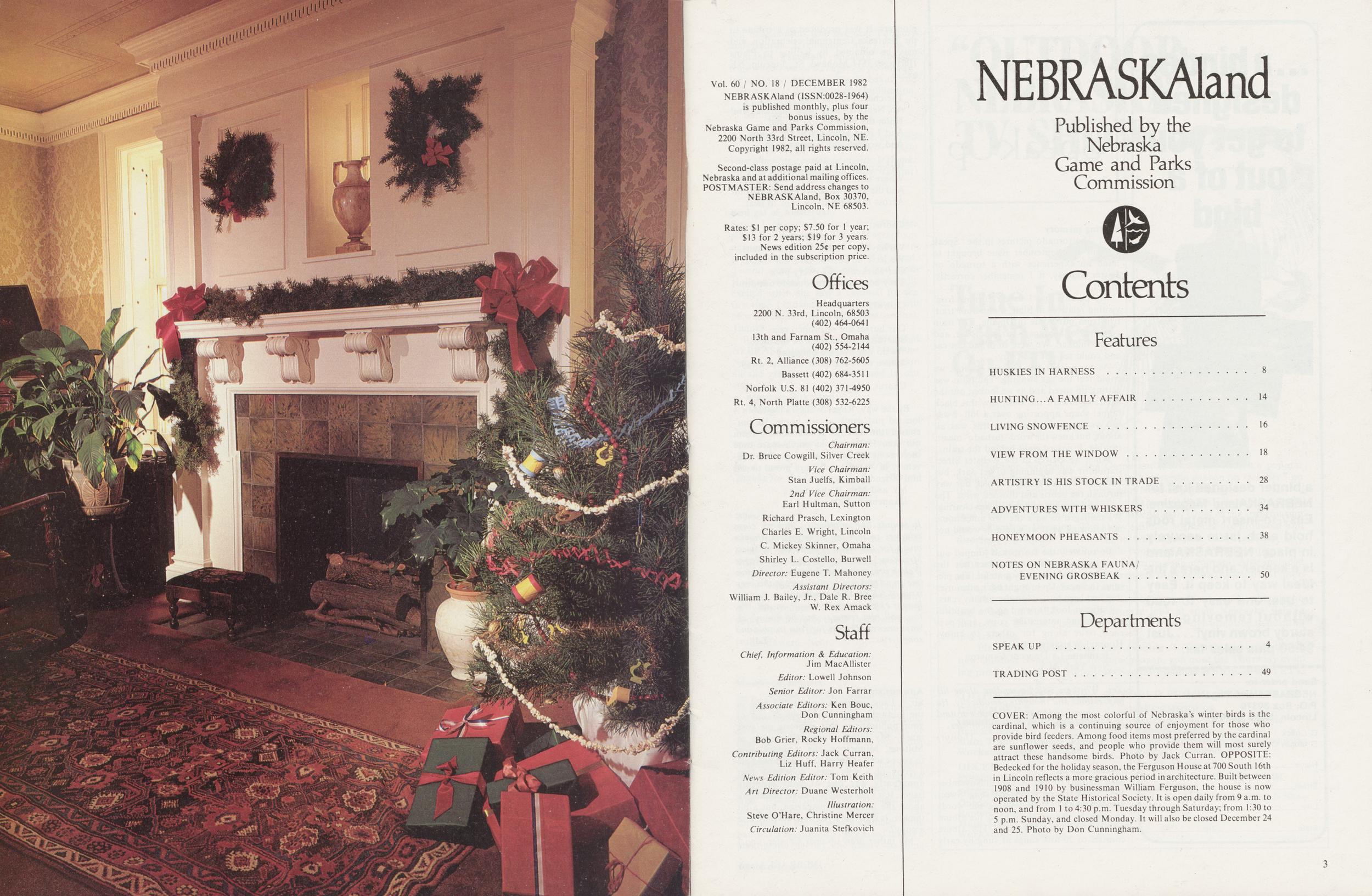
NEBRASKAland
Published by the Nebraska Game and Parks Commission Vol. 60 / NO. 18 / DECEMBER 1982 NEBRASKAland (ISSN:0028-1964) is published monthly, plus four bonus issues, by the Nebraska Game and Parks Commission, 2200 North 33rd Street, Lincoln, NE. Copyright 1982, all rights reserved. Second-class postage paid at Lincoln, Nebraska and at additional mailing offices. POSTMASTER: Send address changes to NEBRASKAland, Box 30370, Lincoln, NE 68503. Rates: $1 per copy; $7.50 for 1 year; $13 for 2 years; $19 for 3 years. News edition 25c per copy, included in the subscription price. Offiices Headquarters 2200 N. 33rd, Lincoln, 68503 (402)464-0641 13th and Farnam St., Omaha (402) 554-2144 Rt. 2, Alliance (308) 762-5605 Bassett (402) 684-3511 Norfolk U.S. 81 (402) 371-4950 Rt. 4, North Platte (308) 532-6225 Commissioners Chairman: Dr. Bruce Cowgill, Silver Creek Vice Chairman: Stan Juelfs, Kimball 2nd Vice Chairman: Earl Hultman, Sutton Richard Prasch, Lexington Charles E. Wright, Lincoln C. Mickey Skinner, Omaha Shirley L. Costello, Burwell Director: Eugene T. Mahoney Assistant Directors: William J. Bailey, Jr., Dale R. Bree W. Rex Amack Staff Chief, Information & Education: Jim MacAllister Editor: Lowell Johnson Senior Editor: Jon Farrar Associate Editors: Ken Bouc, Don Cunningham Regional Editors: Bob Grier, Rocky Hoffmann, Contributing Editors: Jack Curran, Liz Huff, Harry Heafer News Edition Editor: Tom Keith Art Director: Duane Westerholt Illustration: Steve O'Hare, Christine Mercer Circulation: Juanita Stefkovich Contents Features HUSKIES IN HARNESS 8 HUNTING...A FAMILY AFFAIR 14 LIVING SNOWFENCE 16 VIEW FROM THE WINDOW 18 ARTISTRY IS HIS STOCK IN TRADE 28 ADVENTURES WITH WHISKERS 34 HONEYMOON PHEASANTS 38 NOTES ON NEBRASKA FAUNA/ EVENING GROSBEAK 50 Departments SPEAK UP 4 TRADING POST 49 COVER: Among the most colorful of Nebraska's winter birds is the cardinal, which is a continuing source of enjoyment for those who provide bird feeders. Among food items most preferred by the cardinal are sunflower seeds, and people who provide them will most surely attract these handsome birds. Photo by Jack Curran. OPPOSITE: Bedecked for the holiday season, the Ferguson House at 700 South 16th in Lincoln reflects a more gracious period in architecture. Built between 1908 and 1910 by businessman William Ferguson, the house is now operated by the State Historical Society. It is open daily from 9 a.m. to noon, and from 1 to 4:30 p.m. Tuesday through Saturday; from 1:30 to 5 p.m. Sunday, and closed Monday. It will also be closed December 24 and 25. Photo by Don Cunningham. 3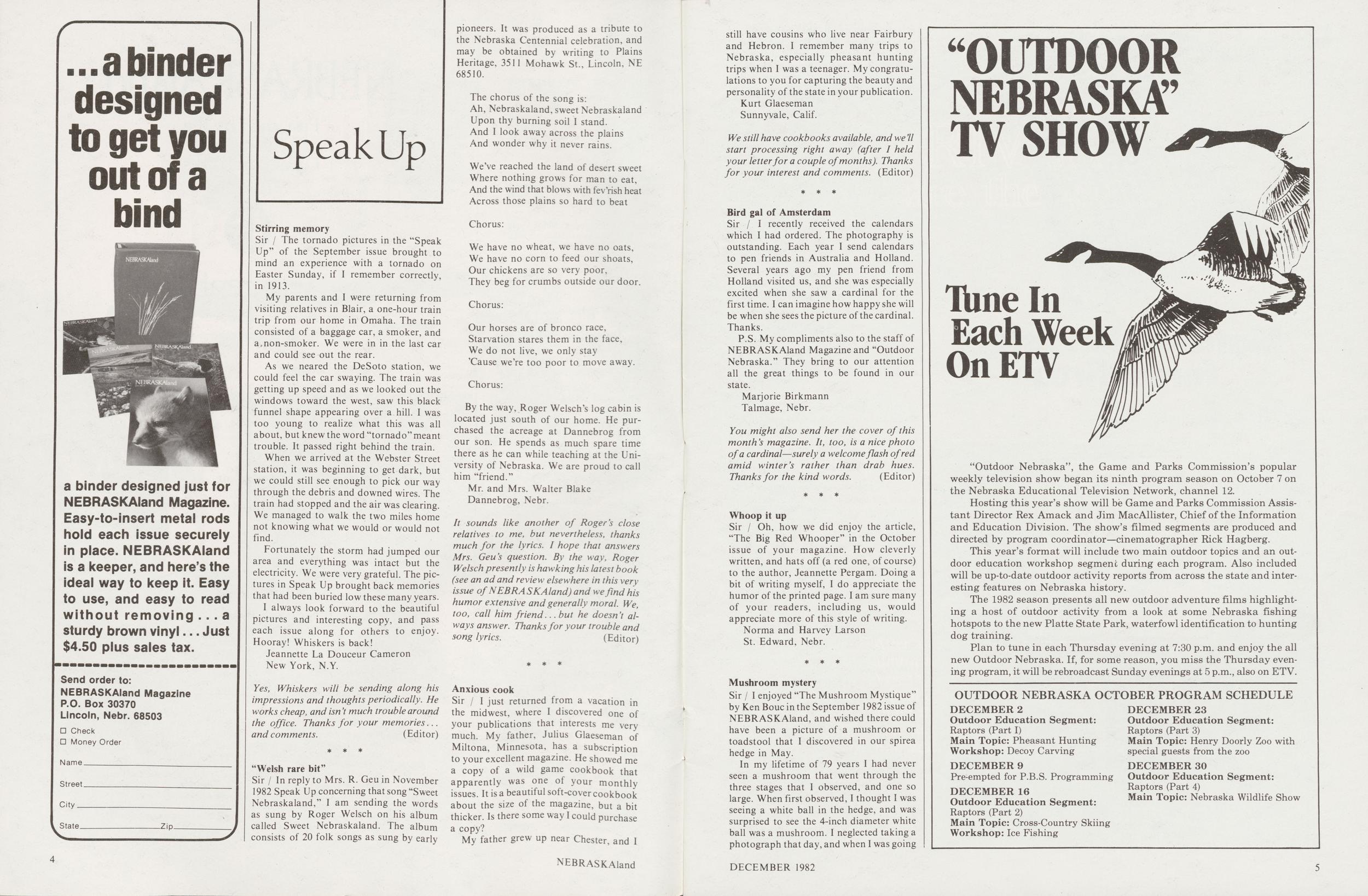
Speak Up
Stirring memorySir / The tornado pictures in the "Speak Up" of the September issue brought to mind an experience with a tornado on Easter Sunday, if I remember correctly, in 1913.
My parents and I were returning from visiting relatives in Blair, a one-hour train trip from our home in Omaha. The train consisted of a baggage car, a smoker, and a, non-smoker. We were in in the last car and could see out the rear.
As we neared the DeSoto station, we could feel the car swaying. The train was getting up speed and as we looked out the windows toward the west, saw this black funnel shape appearing over a hill. I was too young to realize what this was all about, but knew the word "tornado" meant trouble. It passed right behind the train.
When we arrived at the Webster Street station, it was beginning to get dark, but we could still see enough to pick our way through the debris and downed wires. The train had stopped and the air was clearing. We managed to walk the two miles home not knowing what we would or would not find.
When we arrived at the Webster Street station, it was beginning to get dark, but we could still see enough to pick our way through the debris and downed wires. The train had stopped and the air was clearing. We managed to walk the two miles home not knowing what we would or would not find.
When we arrived at the Webster Street station, it was beginning to get dark, but we could still see enough to pick our way through the debris and downed wires. The train had stopped and the air was clearing. We managed to walk the two miles home not knowing what we would or would not find.
Fortunately the storm had jumped our area and everything was intact but the electricity. We were very grateful. The pictures in Speak Up brought back memories that had been buried low these many years.
I always look forward to the beautiful pictures and interesting copy, and pass each issue along for others to enjoy. Hooray! Whiskers is back!
Jeannette La Douceur Cameron New York, N.Y.Yes, Whiskers will be sending along his impressions and thoughts periodically. He works cheap, and isn't much trouble around the office. Thanks for your memories... and comments. (Editor)
"Welsh rare bit"Sir / In reply to Mrs. R. Geu in November 1982 Speak Up concerning that song "Sweet Nebraskaland," I am sending the words as sung by Roger Welsch on his album called Sweet Nebraskaland. The album consists of 20 folk songs as sung by early pioneers. It was produced as a tribute to the Nebraska Centennial celebration, and may be obtained by writing to Plains Heritage, 3511 Mohawk St., Lincoln, NE 68510.
The chorus of the song is:Ah, Nebraskaland, sweet Nebraskaland
Upon thy burning soil I stand.
And I look away across the plains
And wonder why it never rains.
We've reached the land of desert sweet
Where nothing grows for man to eat,
And the wind that blows with fev'rish heat
Across those plains so hard to beat
Chorus:
We have no wheat, we have no oats,
We have no corn to feed our shoats,
Our chickens are so very poor,
They beg for crumbs outside our door.
Chorus:
Our horses are of bronco race,
Starvation stares them in the face,
We do not live, we only stay
'Cause we're too poor to move away.
Chorus:
By the way, Roger Welsch's log cabin is located just south of our home. He purchased the acreage at Dannebrog from our son. He spends as much spare time there as he can while teaching at the University of Nebraska. We are proud to call him "friend."
Mr. and Mrs. Walter Blake Dannebrog, Nebr.It sounds like another of Roger's close relatives to me, but nevertheless, thanks much for the lyrics. I hope that answers Mrs. Geu's question. By the way, Roger Welsch presently is hawking his latest book (see an ad and review elsewhere in this very issue of NEBRASKAIand) and we find his humor extensive and generally moral. We, too, call him friend... but he doesn't always answer. Thanks for your trouble and song lyrics. (Editor)
Anxious cookSir / I just returned from a vacation in the midwest, where I discovered one of your publications that interests me very much. My father, Julius Glaeseman of Miltona, Minnesota, has a subscription to your excellent magazine. He showed me a copy of a wild game cookbook that apparently was one of your monthly issues. It is a beautiful soft-cover cookbook about the size of the magazine, but a bit thicker. Is there some way I could purchase a copy?
My father grew up near Chester, and I 4 NEBRASKAland still have cousins who live near Fairbury and Hebron. I remember many trips to Nebraska, especially pheasant hunting trips when I was a teenager. My congratulations to you for capturing the beauty and personality of the state in your publication.
Kurt Glaeseman Sunnyvale, Calif.We still have cookbooks available, and we '11 start processing right away (after I held your letter for a couple of months). Thanks for your interest and comments. (Editor)
Bird gal of AmsterdamSir / I recently received the calendars which I had ordered. The photography is outstanding. Each year I send calendars to pen friends in Australia and Holland. Several years ago my pen friend from Holland visited us, and she was especially excited when she saw a cardinal for the first time. I can imagine how happy she will be when she sees the picture of the cardinal. Thanks.
P.S. My compliments also to the staff of NEBRASKAland Magazine and "Outdoor Nebraska." They bring to our attention all the great things to be found in our state.
Marjorie Birkmann Talmage, Nebr.You might also send her the cover of this month's magazine. It, too, is a nice photo of a cardinal—surely a welcome flash of red amid winter's rather than drab hues. Thanks for the kind words. (Editor)
Whoop it upSir / Oh, how we did enjoy the article, "The Big Red Whooper" in the October issue of your magazine. How cleverly written, and hats off (a red one, of course) to the author, Jeannette Pergam. Doing a bit of writing myself, I do appreciate the humor of the printed page. I am sure many of your readers, including us, would appreciate more of this style of writing.
Norma and Harvey Larson St. Edward, Nebr. Mushroom mysterySir / I enjoyed "The Mushroom Mystique" by Ken Bouc in the September 1982 issue of NEBRASKAland, and wished there could have been a picture of a mushroom or toadstool that I discovered in our spirea hedge in May.
In my lifetime of 79 years I had never seen a mushroom that went through the three stages that I observed, and one so large. When first observed, I thought I was seeing a white ball in the hedge, and was surprised to see the 4-inch diameter white ball was a mushroom. I neglected taking a photograph that day, and when I was going to take a photo, it had changed to an umbrella shape. When I checked it again, in a couple more days, it had changed its shape to an umbrella turned inside out.
"OUTDOOR NEBRASKA TV SHOW lime In Each Week OnETV "Outdoor Nebraska", the Game and Parks Commission's popular weekly television show began its ninth program season on October 7 on the Nebraska Educational Television Network, channel 12. Hosting this year's show will be Game and Parks Commission Assistant Director Rex Amack and Jim MacAllister, Chief of the Information and Education Division. The show's filmed segments are produced and directed by program coordinator—cinematographer Rick Hagberg. This year's format will include two main outdoor topics and an outdoor education workshop segment during each program. Also included will be up-to-date outdoor activity reports from across the state and interesting features on Nebraska history. The 1982 season presents all new outdoor adventure films highlighting a host of outdoor activity from a look at some Nebraska fishing hotspots to the new Platte State Park, waterfowl identification to hunting dog training. Plan to tune in each Thursday evening at 7:30 p.m. and enjoy the all new Outdoor Nebraska. If, for some reason, you miss the Thursday evening program, it will be rebroadcast Sunday evenings at 5 p.m., also on ETV. OUTDOOR NEBRASKA OCTOBER PROGRAM SCHEDULE DECEMBER 2 Outdoor Education Segment: Raptors (Part I) Main Topic: Pheasant Hunting Workshop: Decoy Carving DECEMBER 9 Pre-empted for P.B.S. Programming DECEMBER 16 Outdoor Education Segment: Raptors (Part 2) Main Topic: Cross-Country Skiing Workshop: Ice Fishing DECEMBER 23 Outdoor Education Segment: Raptors (Part 3) Main Topic: Henry Doorly Zoo with special guests from the zoo DECEMBER 30 Outdoor Education Segment: Raptors (Part 4) Main Topic: Nebraska Wildlife Show DECEMBER 1982 5 Matches don't start
forest fires.
A Public Service of This Magazine & The Advertising Council
SPEED
LIMIT
It's not just
A good idea.
It's the low.
A pubiic service of this magazine,
the U.S. Department of Transportation
and the Advertising Council.
Matches don't start
forest fires.
A Public Service of This Magazine & The Advertising Council
SPEED
LIMIT
It's not just
A good idea.
It's the low.
A pubiic service of this magazine,
the U.S. Department of Transportation
and the Advertising Council.
I would be interested to know if Ken Bouc or any other person had ever noticed a mushroom like this. I would be glad to send the two color photos I took of the later stages. I am enclosing some drawing of the mushroom as I observed it. I wish to thank you for the wonderful magazine. I have enjoyed the magazine for several years.
R. F. Fahrlander Plattsmouth, Nebr.As we (and everyone) who deals with mushrooms always stress when talking about identification, you can only be positive by taking all steps—color, site, host, spore print, etc., but several varieties change as you describe, so it is not unique. Thanks for your letter, however. (Editor)
Trees of yoreSir / What a nice surprise to see a picture of our Christmas tree planting and our farmstead in the March issue of NEBRASKAland Magazine, and on the back page of the Wildlife Habitat bulletin.
I would greatly appreciate a large copy of this picture for framing, if possible. By the way, that photo was taken in 1974 or 1975 and our farm is located on the south edge of Belden.
Lawrence Fuchs Belden, Nebr.Your Christmas tree planting apparently struck someone's fancy while they were passing that way, and has been in file ever since. When we needed such a photo to illustrate techniques, there it was. I am sorry I have been holding your letter since April 1981, but it just surfaced on a stack of other stuff. We will see what can be done about a photo, and thanks for writing. (Editor)
Novel renewal Sir / I'm a very old lady with two crippled knees So never again can I climb trees. My backbone is damaged in exactly three places, So no more will I travel to see new faces. Arthritis and sciatica prevent my chance to run, So I sit on the sidelines and miss all the fun. My head is the only thing I have left to command, So By Jingo I'm going to have my NEBRASKAland! Zoa Ann Worden (@91) Beatrice, Nebr./ don't believe you're 91 you little rascal, but it was a nice response to the renewal letter we sent. Thanks. (Editor)
6 NEBRASKAland Rivers are the issue After a couple of years in production, it is almost here .. . the big rivers issue, that is!! Yes, the very next NEBRASKAland will be a special combined January-February issue all about the state's rivers in story and photo. Free to subscribers, this will be a $6 value. But remember, there'll be no February edition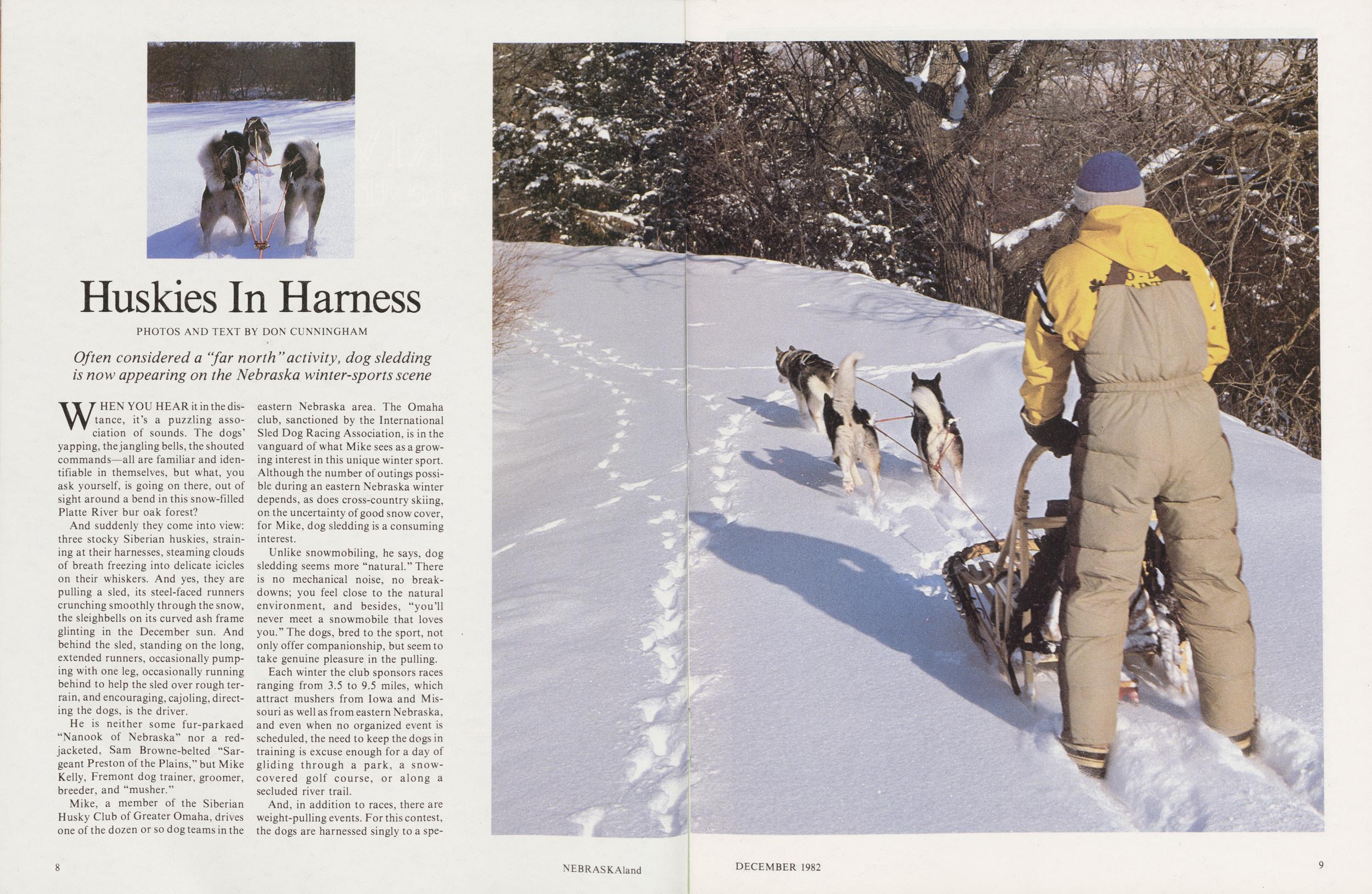
Huskies In Harness
PHOTOS AND TEXT BY DON CUNNINGHAM Often considered a "far north"activity, dog sledding is now appearing on the Nebraska winter-sports sceneWHEN YOU HEAR it in the distance, it's a puzzling association of sounds. The dogs' yapping, the jangling bells, the shouted commands—all are familiar and identifiable in themselves, but what, you ask yourself, is going on there, out of sight around a bend in this snow-filled Platte River bur oak forest?
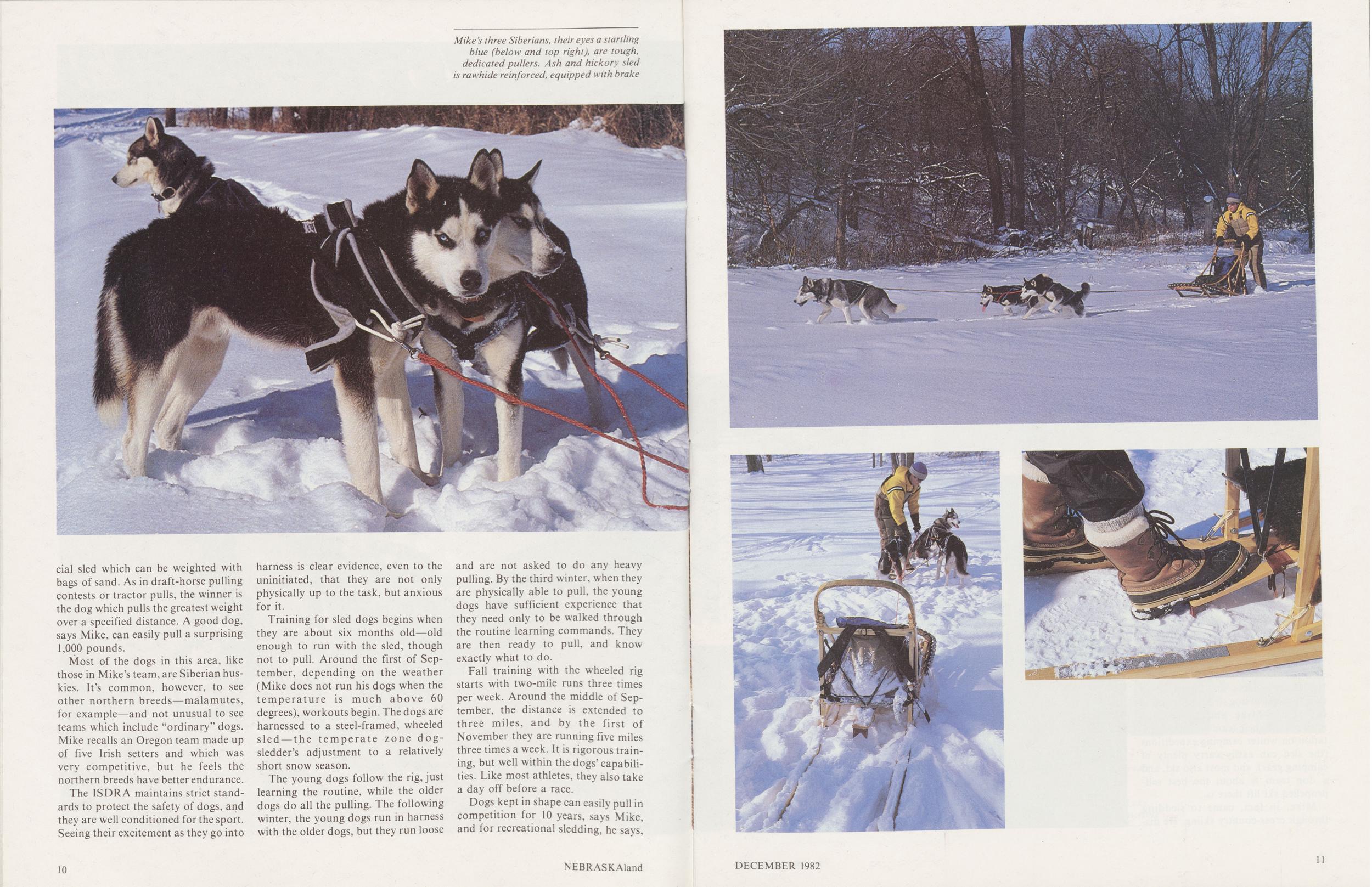
And suddenly they come into view: three stocky Siberian huskies, straining at their harnesses, steaming clouds of breath freezing into delicate icicles on their whiskers. And yes, they are pulling a sled, its steel-faced runners crunching smoothly through the snow, the sleighbells on its curved ash frame glinting in the December sun. And behind the sled, standing on the long, extended runners, occasionally pumping with one leg, occasionally running behind to help the sled over rough terrain, and encouraging, cajoling, directing the dogs, is the driver.
He is neither some fur-parkaed "Nanook of Nebraska" nor a red-jacketed, Sam Browne-belted "Sargeant Preston of the Plains," but Mike Kelly, Fremont dog trainer, groomer, breeder, and "musher."
Mike, a member of the Siberian Husky Club of Greater Omaha, drives one of the dozen or so dog teams in the eastern Nebraska area. The Omaha club, sanctioned by the International Sled Dog Racing Association, is in the vanguard of what Mike sees as a growing interest in this unique winter sport. Although the number of outings possible during an eastern Nebraska winter depends, as does cross-country skiing, on the uncertainty of good snow cover, for Mike, dog sledding is a consuming interest.
Unlike snowmobiling, he says, dog sledding seems more "natural." There is no mechanical noise, no break-downs; you feel close to the natural environment, and besides, "you'll never meet a snowmobile that loves you." The dogs, bred to the sport, not only offer companionship, but seem to take genuine pleasure in the pulling.
Each winter the club sponsors races ranging from 3.5 to 9.5 miles, which attract mushers from Iowa and Missouri as well as from eastern Nebraska, and even when no organized event is scheduled, the need to keep the dogs in training is excuse enough for a day of gliding through a park, a snow-covered golf course, or along a secluded river trail.
And, in addition to races, there are weight-pulling events. For this contest, the dogs are harnessed singly to a special 8 NEBRASKAland
Most of the dogs in this area, like those in Mike's team, are Siberian huskies. It's common, however, to see other northern breeds—malamutes, for example—and not unusual to see teams which include "ordinary" dogs. Mike recalls an Oregon team made up of five Irish setters and which was very competitive, but he feels the northern breeds have better endurance.
The ISDRA maintains strict standards to protect the safety of dogs, and they are well conditioned for the sport. Seeing their excitement as they go into harness is clear evidence, even to the uninitiated, that they are not only physically up to the task, but anxious for it.
Training for sled dogs begins when they are about six months old—old enough to run with the sled, though not to pull. Around the first of September, depending on the weather (Mike does not run his dogs when the temperature is much above 60 degrees), workouts begin. The dogs are harnessed to a steel-framed, wheeled sled — the temperate zone dog-sledder's adjustment to a relatively short snow season.
The young dogs follow the rig, just learning the routine, while the older dogs do all the pulling. The following winter, the young dogs run in harness with the older dogs, but they run loose and are not asked to do any heavy pulling. By the third winter, when they are physically able to pull, the young dogs have sufficient experience that they need only to be walked through the routine learning commands. They are then ready to pull, and know exactly what to do.
Fall training with the wheeled rig starts with two-mile runs three times per week. Around the middle of September, the distance is extended to three miles, and by the first of November they are running five miles three times a week. It is rigorous training, but well within the dogs' capabilities. Like most athletes, they also take a day off before a race.
Dogs kept in shape can easily pull in competition for 10 years, says Mike, and for recreational sledding, he says, 10 NEBRASKAland
Mike does more recreational saddling than racing, not because he prefers it but because the number of races in this area is limited by the unpredictability of snow. In the mountains, he says, there is at least one race every weekend. Leadville and Estes Park, Colorado, and Jackson Hole, Wyoming, are dog-sledding centers, and there is high interest in Michigan, Wisconsin, and Minnesota.
In those areas, a musher could easily run 50 races a season, but most Nebraska sledders are interested in other aspects of dog sledding as well as in racing. Mike and other area mushers use their teams for transportation on winter camping expeditions (the sled can easily carry plenty of camping gear), and most also ski, and a dog team is about the best self-propelled ski lift there is.
Mike, in fact, came to sledding through cross-country skiing. He discovered
The move to sledding was a logical step. During the winter of 1979-80, he bought a book on dog sledding, and trained his dogs to respond to commands. He saved money for a sled, and is now an insatiable musher; his ultimate goal is to dog sled in Alaska—probably the Mecca for which all sledders yearn.
The training itself comes easily to him. He has lived around animals, both horses and dogs, all his life, and after college, dog training seemed a good alternative to a white-collar job. Now he's involved in all aspects of dog handling, from basic obedience training, grooming, hunting and field trial training, to sled-team work. "I always seemed to have knack for it," he says. "I can take a puppy and make it understand what it's supposed to do."
His sled, like most used by the Omaha club members, was built in Michigan by Frank Hall, one of the most renowned racers and sled-makers in the country. Hall helped to organize the ISDRA, as well as many local clubs, and now is also a widely recognized sled-dog breeder.
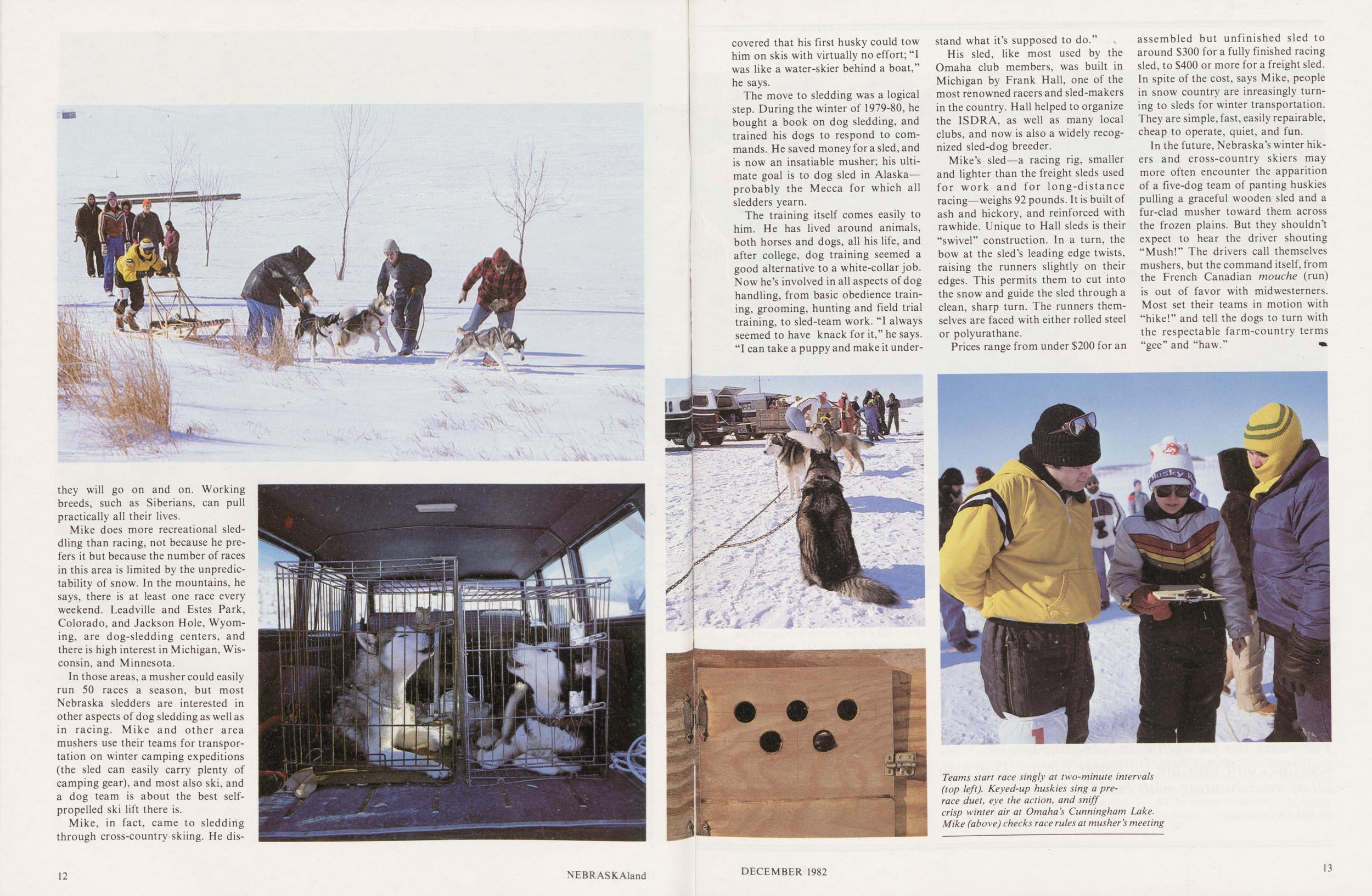
Mike's sled—a racing rig, smaller and lighter than the freight sleds used for work and for long-distance racing—weighs 92 pounds. It is built of ash and hickory, and reinforced with rawhide. Unique to Hall sleds is their "swivel" construction. In a turn, the bow at the sled's leading edge twists, raising the runners slightly on their edges. This permits them to cut into the snow and guide the sled through a clean, sharp turn. The runners themselves are faced with either rolled steel or polyurathane.
Prices range from under $200 for an assembled but unfinished sled to around $300 for a fully finished racing sled, to $400 or more for a freight sled. In spite of the cost, says Mike, people in snow country are inreasingly turning to sleds for winter transportation. They are simple, fast, easily repairable, cheap to operate, quiet, and fun.
In the future, Nebraska's winter hikers and cross-country skiers may more often encounter the apparition of a five-dog team of panting huskies pulling a graceful wooden sled and a fur-clad musher toward them across the frozen plains. But they shouldn't expect to hear the driver shouting "Mush!" The drivers call themselves mushers, but the command itself, from the French Canadian mouche (run) is out of favor with midwesterners. Most set their teams in motion with "hike!" and tell the dogs to turn with the respectable farm-country terms "gee" and "haw."
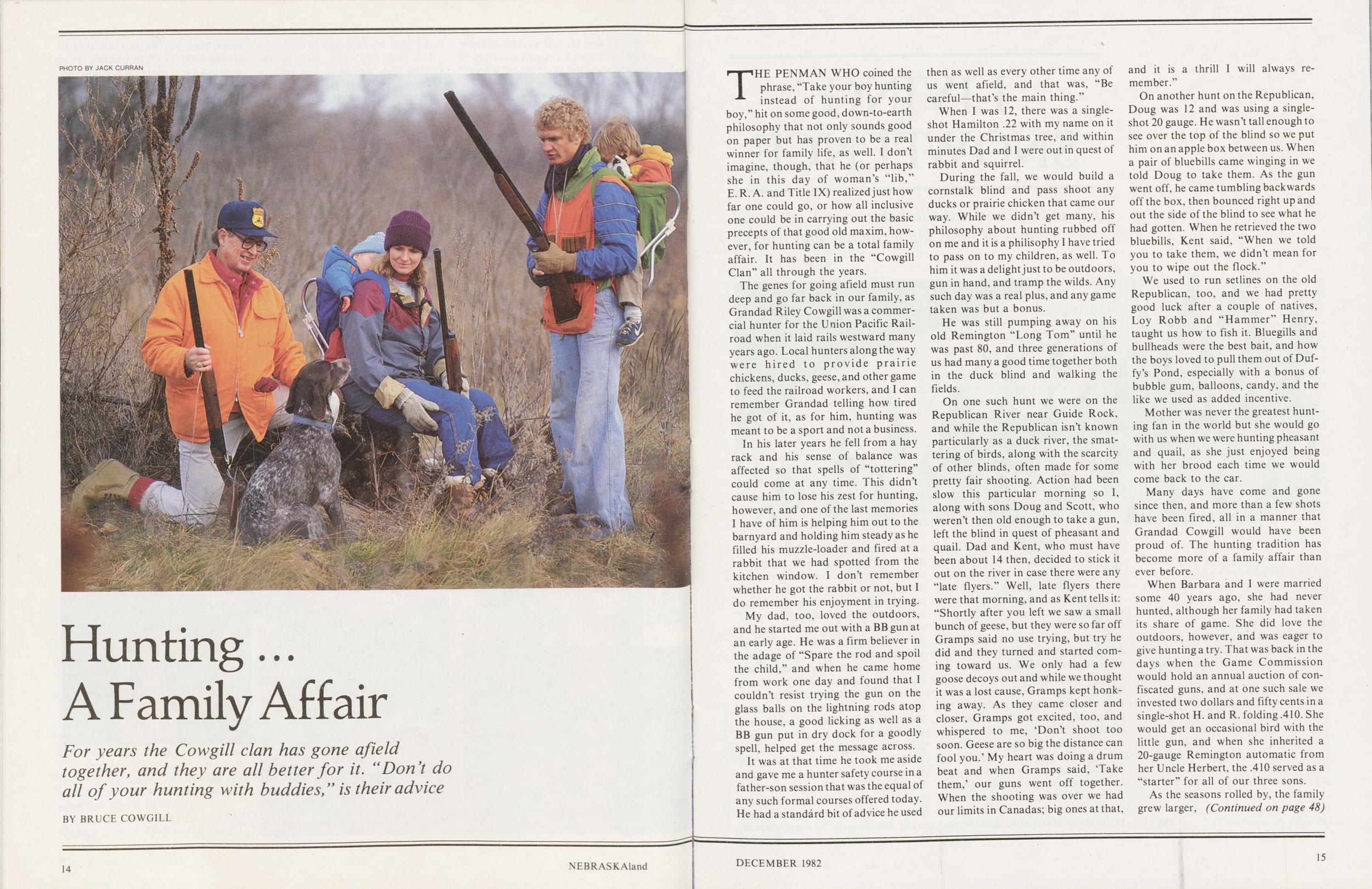
Hunting... A Family Affair
For years the Cowgill clan has gone afield together, and they are all better for it. "Don't do all of your hunting with buddies," is their advice BY BRUCE COWGILL 14 NEBRASKAlandTHE PENMAN WHO coined the phrase, "Take your boy hunting instead of hunting for your boy," hit on some good, down-to-earth philosophy that not only sounds good on paper but has proven to be a real winner for family life, as well. I don't imagine, though, that he (or perhaps she in this day of woman's "lib," E. R. A. and Title IX) realized just how far one could go, or how all inclusive one could be in carrying out the basic precepts of that good old maxim, however, for hunting can be a total family affair. It has been in the "Cowgill Clan" all through the years.
The genes for going afield must run deep and go far back in our family, as Grandad Riley Cowgill was a commercial hunter for the Union Pacific Railroad when it laid rails westward many years ago. Local hunters along the way were hired to provide prairie chickens, ducks, geese, and other game to feed the railroad workers, and I can remember Grandad telling how tired he got of it, as for him, hunting was meant to be a sport and not a business.
In his later years he fell from a hay rack and his sense of balance was affected so that spells of "tottering" could come at any time. This didn't cause him to lose his zest for hunting, however, and one of the last memories I have of him is helping him out to the barnyard and holding him steady as he filled his muzzle-loader and fired at a rabbit that we had spotted from the kitchen window. I don't remember whether he got the rabbit or not, but I do remember his enjoyment in trying.
My dad, too, loved the outdoors, and he started me out with a BB gun at an early age. He was a firm believer in the adage of "Spare the rod and spoil the child," and when he came home from work one day and found that I couldn't resist trying the gun on the glass balls on the lightning rods atop the house, a good licking as well as a BB gun put in dry dock for a goodly spell, helped get the message across.
It was at that time he took me aside and gave me a hunter safety course in a father-son session that was the equal of any such formal courses offered today. He had a standard bit of advice he used then as well as every other time any of us went afield, and that was, "Be careful—that's the main thing."
When I was 12, there was a single-shot Hamilton .22 with my name on it under the Christmas tree, and within minutes Dad and I were out in quest of rabbit and squirrel.
During the fall, we would build a cornstalk blind and pass shoot any ducks or prairie chicken that came our way. While we didn't get many, his philosophy about hunting rubbed off on me and it is a philisophy I have tried to pass on to my children, as well. To him it was a delight just to be outdoors, gun in hand, and tramp the wilds. Any such day was a real plus, and any game taken was but a bonus.
He was still pumping away on his old Remington "Long Tom" until he was past 80, and three generations of us had many a good time together both in the duck blind and walking the fields.
On one such hunt we were on the Republican River near Guide Rock, and while the Republican isn't known particularly as a duck river, the smattering of birds, along with the scarcity of other blinds, often made for some pretty fair shooting. Action had been slow this particular morning so I, along with sons Doug and Scott, who weren't then old enough to take a gun, left the blind in quest of pheasant and quail. Dad and Kent, who must have been about 14 then, decided to stick it out on the river in case there were any "late flyers." Well, late flyers there were that morning, and as Kent tells it: Shortly after you left we saw a small bunch of geese, but they were so far off Gramps said no use trying, but try he did and they turned and started coming toward us. We only had a few goose decoys out and while we thought it was a lost cause, Gramps kept honking away. As they came closer and closer, Gramps got excited, too, and whispered to me, 'Don't shoot too soon. Geese are so big the distance can fool you.' My heart was doing a drum beat and when Gramps said, Take them,' our guns went off together. When the shooting was over we had our limits in Canadas; big ones at that, and it is a thrill I will always remember."
On another hunt on the Republican, Doug was 12 and was using a single-shot 20 gauge. He wasn't tall enough to see over the top of the blind so we put him on an apple box between us. When a pair of bluebills came winging in we told Doug to take them. As the gun went off, he came tumbling backwards off the box, then bounced right up and out the side of the blind to see what he had gotten. When he retrieved the two bluebills, Kent said, "When we told you to take them, we didn't mean for you to wipe out the flock."
We used to run setlines on the old Republican, too, and we had pretty good luck after a couple of natives, Loy Robb and "Hammer" Henry, taught us how to fish it. Bluegills and bullheads were the best bait, and how the boys loved to pull them out of Duffy's Pond, especially with a bonus of bubble gum, balloons, candy, and the like we used as added incentive.
Mother was never the greatest hunting fan in the world but she would go with us when we were hunting pheasant and quail, as she just enjoyed being with her brood each time we would come back to the car.
Many days have come and gone since then, and more than a few shots have been fired, all in a manner that Grandad Cowgill would have been proud of. The hunting tradition has become more of a family affair than ever before.
When Barbara and I were married some 40 years ago, she had never hunted, although her family had taken its share of game. She did love the outdoors, however, and was eager to give hunting a try. That was back in the days when the Game Commission would hold an annual auction of confiscated guns, and at one such sale we invested two dollars and fifty cents in a single-shot H. and R. folding .410. She would get an occasional bird with the little gun, and when she inherited a 20-gauge Remington automatic from her Uncle Herbert, the .410 served as a "starter" for all of our three sons.
As the seasons rolled by, the family grew larger, (Continued on page 48)
DECEMBER 1982 15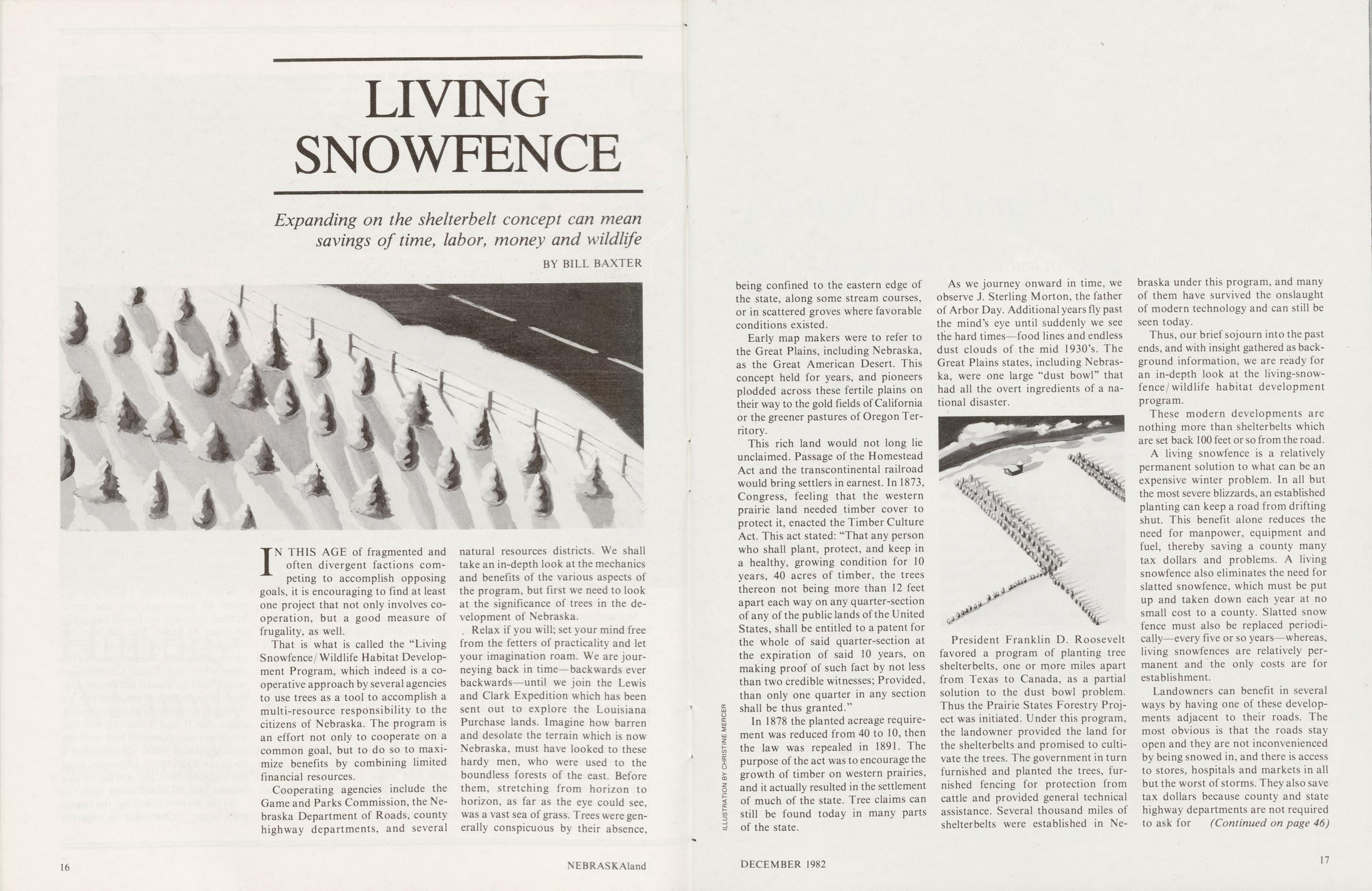
LIVING SNOWFENCE
Expanding on the shelterbelt concept can mean savings of time, labor, money and wildlife BY BILL BAXTERIN THIS AGE of fragmented and often divergent factions competing to accomplish opposing goals, it is encouraging to find at least one project that not only involves cooperation, but a good measure of frugality, as well.
That is what is called the "Living Snowfence/Wildlife Habitat Development Program, which indeed is a cooperative approach by several agencies to use trees as a tool to accomplish a multi-resource responsibility to the citizens of Nebraska. The program is an effort not only to cooperate on a common goal, but to do so to maximize benefits by combining limited financial resources.
Cooperating agencies include the Game and Parks Commission, the Nebraska Department of Roads, county highway departments, and several natural resources districts. We shall take an in-depth look at the mechanics and benefits of the various aspects of the program, but first we need to look at the significance of trees in the development of Nebraska.
Relax if you will; set your mind free from the fetters of practicality and let your imagination roam. We are journeying back in time—backwards ever backwards—until we join the Lewis and Clark Expedition which has been sent out to explore the Louisiana Purchase lands. Imagine how barren and desolate the terrain which is now Nebraska, must have looked to these hardy men, who were used to the boundless forests of the east. Before them, stretching from horizon to horizon, as far as the eye could see, was a vast sea of grass. Trees were generally conspicuous by their absence, 16 NEBRASKAland being confined to the eastern edge of the state, along some stream courses, or in scattered groves where favorable conditions existed.
Early map makers were to refer to the Great Plains, including Nebraska, as the Great American Desert. This concept held for years, and pioneers plodded across these fertile plains on their way to the gold fields of California or the greener pastures of Oregon Territory.
This rich land would not long lie unclaimed. Passage of the Homestead Act and the transcontinental railroad would bring settlers in earnest. In 1873, Congress, feeling that the western prairie land needed timber cover to protect it, enacted the Timber Culture Act. This act stated: "That any person who shall plant, protect, and keep in a healthy, growing condition for 10 years, 40 acres of timber, the trees thereon not being more than 12 feet apart each way on any quarter-section of any of the public lands of the United States, shall be entitled to a patent for the whole of said quarter-section at the expiration of said 10 years, on making proof of such fact by not less than two credible witnesses; Provided, than only one quarter in any section shall be thus granted."
In 1878 the planted acreage requirement was reduced from 40 to 10, then the law was repealed in 1891. The purpose of the act was to encourage the growth of timber on western prairies, and it actually resulted in the settlement of much of the state. Tree claims can still be found today in many parts of the state.
As we journey onward in time, we observe J. Sterling Morton, the father of Arbor Day. Additional years fly past the mind's eye until suddenly we see the hard times—food lines and endless dust clouds of the mid 1930's. The Great Plains states, including Nebraska, were one large "dust bowl" that had all the overt ingredients of a national disaster.
President Franklin D. Roosevelt favored a program of planting tree shelterbelts, one or more miles apart from Texas to Canada, as a partial solution to the dust bowl problem. Thus the Prairie States Forestry Project was initiated. Under this program, the landowner provided the land for the shelterbelts and promised to cultivate the trees. The government in turn furnished and planted the trees, furnished fencing for protection from cattle and provided general technical assistance. Several thousand miles of shelterbelts were established in Nebraska under this program, and many of them have survived the onslaught of modern technology and can still be seen today.
Thus, our brief sojourn into the past ends, and with insight gathered as background information, we are ready for an in-depth look at the living-snow-fence/wildlife habitat development program.
These modern developments are nothing more than shelterbelts which are set back 100 feet or so from the road.These modern developments are nothing more than shelterbelts which are set back 100 feet or so from the road.
A living snowfence is a relatively permanent solution to what can be an expensive winter problem. In all but the most severe blizzards, an established planting can keep a road from drifting shut. This benefit alone reduces the need for manpower, equipment and fuel, thereby saving a county many tax dollars and problems. A living snowfence also eliminates the need for slatted snowfence, which must be put up and taken down each year at no small cost to a county. Slatted snow fence must also be replaced periodically—every five or so years—whereas, living snowfences are relatively permanent and the only costs are for establishment.
Landowners can benefit in several ways by having one of these developments adjacent to their roads. The most obvious is that the roads stay open and they are not inconvenienced by being snowed in, and there is access to stores, hospitals and markets in all but the worst of storms. They also save tax dollars because county and state highway departments are not required to ask for (Continued on page 46)
DECEMBER 1982 17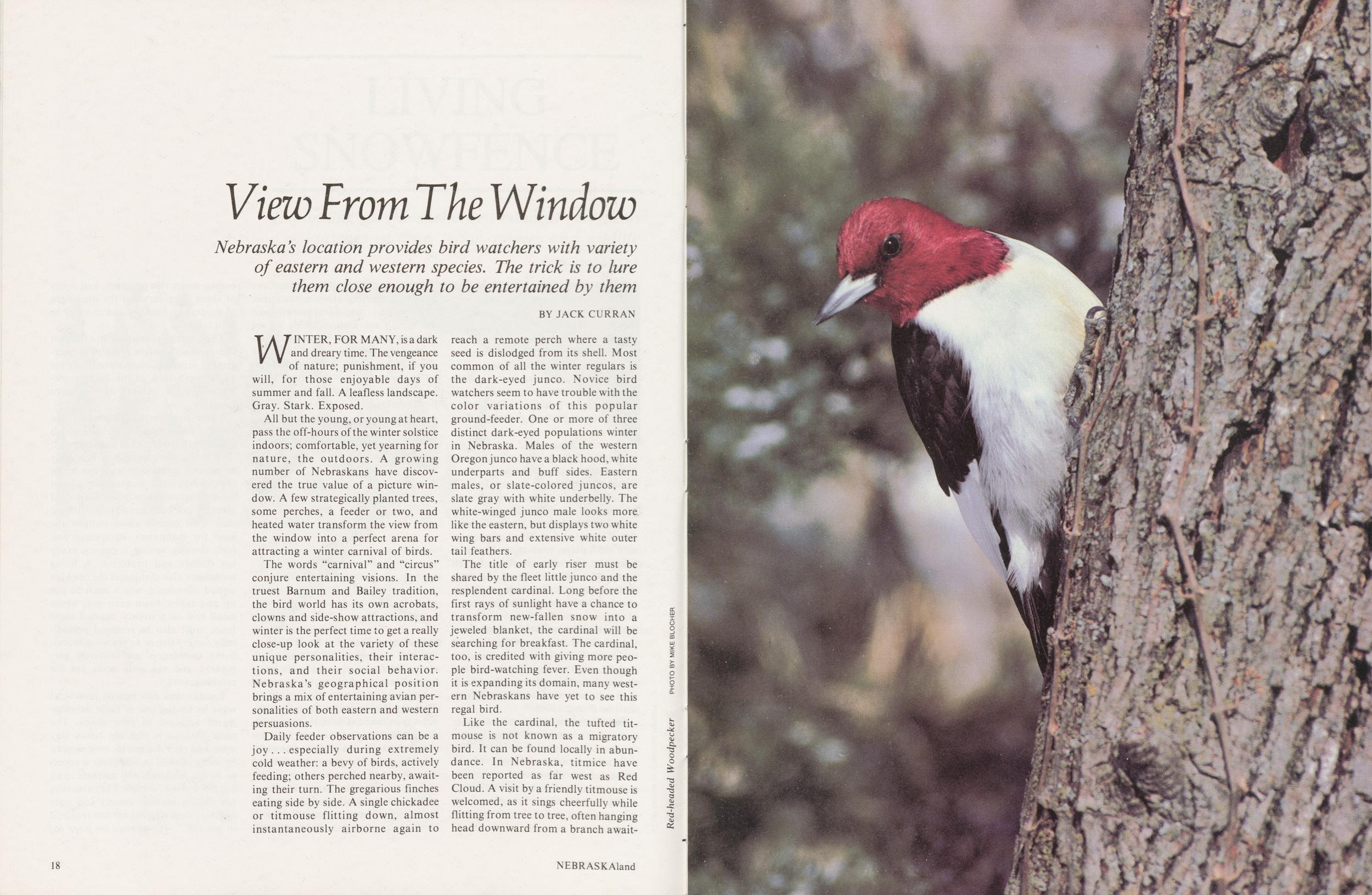
View From The Window
Nebraska's location provides bird watchers with variety of eastern and western species. The trick is to lure them close enough to be entertained by them BY JACK CURRANWINTER, FOR MANY, is a dark and dreary time. The vengeance of nature; punishment, if you will, for those enjoyable days of summer and fall. A leafless landscape. Gray. Stark. Exposed.
All but the young, or young at heart, pass the off-hours of the winter solstice indoors; comfortable, yet yearning for nature, the outdoors. A growing number of Nebraskans have discovered the true value of a picture window. A few strategically planted trees, some perches, a feeder or two, and heated water transform the view from the window into a perfect arena for attracting a winter carnival of birds.
The words "carnival" and "circus" conjure entertaining visions. In the truest Barnum and Bailey tradition, the bird world has its own acrobats, clowns and side-show attractions, and winter is the perfect time to get a really close-up look at the variety of these unique personalities, their interactions, and their social behavior. Nebraska's geographical position brings a mix of entertaining avian personalities of both eastern and western persuasions.
Daily feeder observations can be a joy . . . especially during extremely cold weather: a bevy of birds, actively feeding; others perched nearby, awaiting their turn. The gregarious finches eating side by side. A single chickadee or titmouse flitting down, almost instantaneously airborne again to reach a remote perch where a tasty seed is dislodged from its shell. Most common of all the winter regulars is the dark-eyed junco. Novice bird watchers seem to have trouble with the color variations of this popular ground-feeder. One or more of three distinct dark-eyed populations winter in Nebraska. Males of the western Oregon junco have a black hood, white underparts and buff sides. Eastern males, or slate-colored juncos, are slate gray with white underbelly. The white-winged junco male looks more like the eastern, but displays two white wing bars and extensive white outer tail feathers.
The title of early riser must be shared by the fleet little junco and the resplendent cardinal. Long before the first rays of sunlight have a chance to transform new-fallen snow into a jeweled blanket, the cardinal will be searching for breakfast. The cardinal, too, is credited with giving more people bird-watching fever. Even though it is expanding its domain, many western Nebraskans have yet to see this regal bird.
Like the cardinal, the tufted titmouse is not known as a migratory
bird. It can be found locally in abundance. In Nebraska, titmice have
been reported as far west as Red
Cloud. A visit by a friendly titmouse is
welcomed, as it sings cheerfully while
flitting from tree to tree, often hanging
head downward from a branch awaiting
18
NEBRASKAland
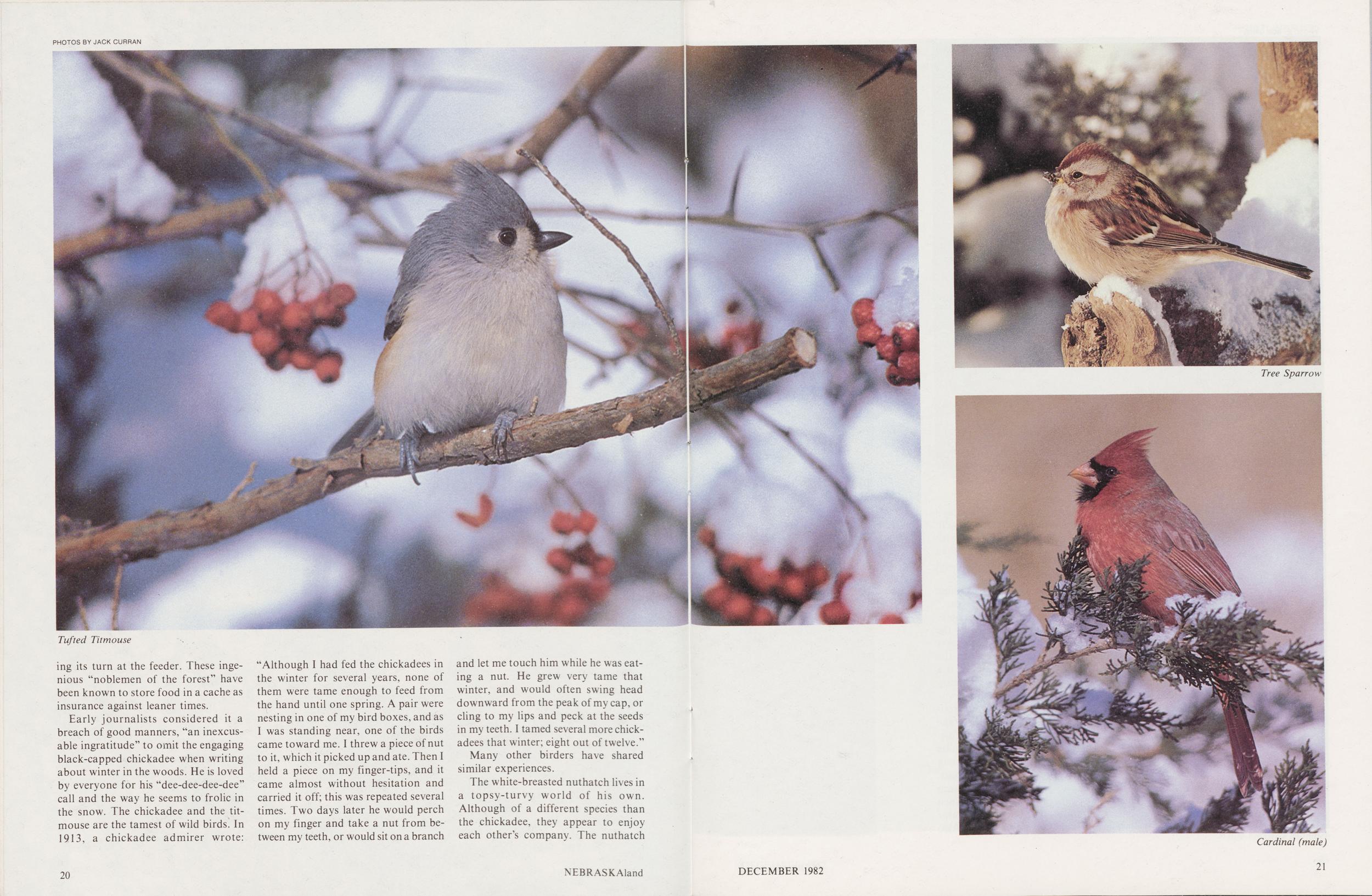
Early journalists considered it a breach of good manners, "an inexcusable ingratitude" to omit the engaging black-capped chickadee when writing about winter in the woods. He is loved by everyone for his "dee-dee-dee-dee" call and the way he seems to frolic in the snow. The chickadee and the titmouse are the tamest of wild birds. In 1913, a chickadee admirer wrote: "Although I had fed the chickadees in the winter for several years, none of them were tame enough to feed from the hand until one spring. A pair were nesting in one of my bird boxes, and as I was standing near, one of the birds came toward me. I threw a piece of nut to it, which it picked up and ate. Then I held a piece on my finger-tips, and it came almost without hesitation and carried it off; this was repeated several times. Two days later he would perch on my finger and take a nut from between my teeth, or would sit on a branch and let me touch him while he was eating a nut. He grew very tame that winter, and would often swing head downward from the peak of my cap, or cling to my lips and peck at the seeds in my teeth. I tamed several more chickadees that winter; eight out of twelve."
Many other birders have shared similar experiences.
The white-breasted nuthatch lives in a topsy-turvy world of his own. Although of a different species than the chickadee, they appear to enjoy each other's company. The nuthatch 20 NEBRASKAland
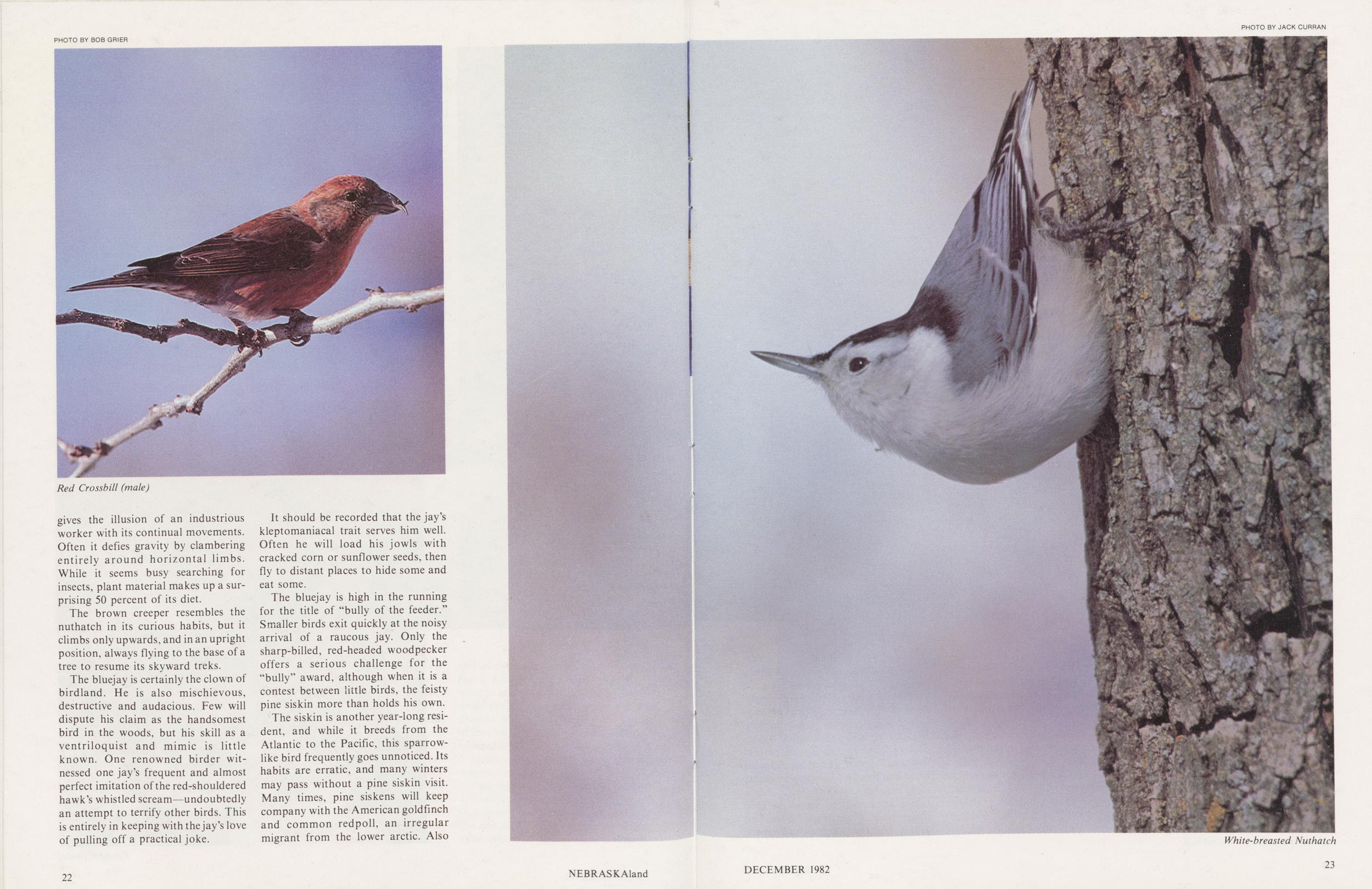
The brown creeper resembles the nuthatch in its curious habits, but it climbs only upwards, and in an upright position, always flying to the base of a tree to resume its skyward treks.
The bluejay is certainly the clown of birdland. He is also mischievous, destructive and audacious. Few will dispute his claim as the handsomest bird in the woods, but his skill as a ventriloquist and mimic is little known. One renowned birder witnessed one jay's frequent and almost perfect imitation of the red-shouldered hawk's whistled scream—undoubtedly an attempt to terrify other birds. This is entirely in keeping with the jay's love of pulling off a practical joke.
It should be recorded that the jay's kleptomaniacal trait serves him well. Often he will load his jowls with cracked corn or sunflower seeds, then fly to distant places to hide some and eat some.
The bluejay is high in the running for the title of "bully of the feeder." Smaller birds exit quickly at the noisy arrival of a raucous jay. Only the sharp-billed, red-headed woodpecker offers a serious challenge for the "bully" award, although when it is a contest between little birds, the feisty pine siskin more than holds his own.
The siskin is another year-long resident, and while it breeds from the Atlantic to the Pacific, this sparrow-like bird frequently goes unnoticed. Its habits are erratic, and many winters may pass without a pine siskin visit. Many times, pine siskens will keep company with the American goldfinch and common redpoll, an irregular migrant from the lower arctic. Also 22 NEBRASKAland
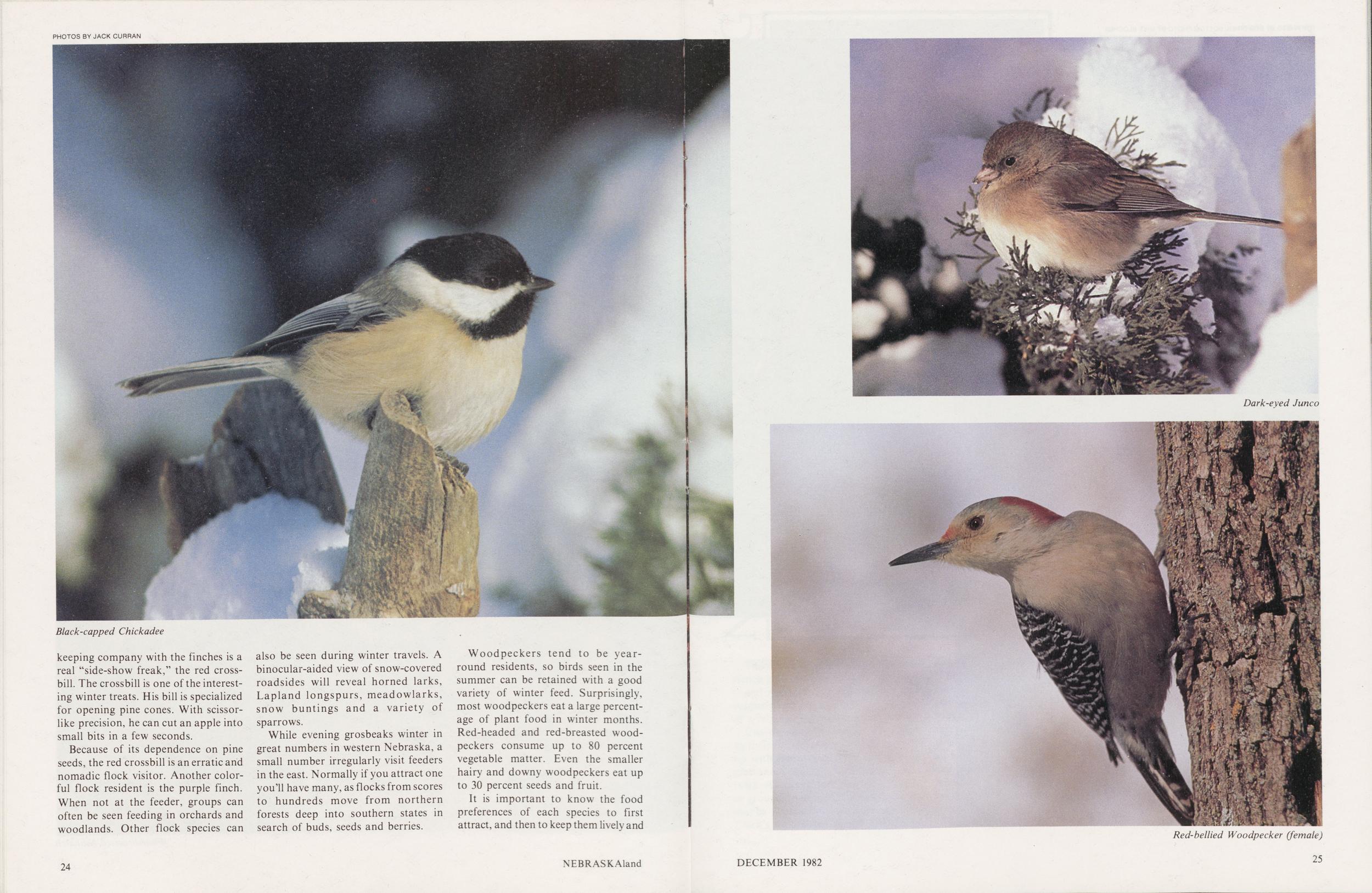
Because of its dependence on pine seeds, the red crossbill is an erratic and nomadic flock visitor. Another colorful flock resident is the purple finch. When not at the feeder, groups can often be seen feeding in orchards and woodlands. Other flock species can also be seen during winter travels. A binocular-aided view of snow-covered roadsides will reveal horned larks, Lapland longspurs, meadowlarks, snow buntings and a variety of sparrows.
While evening grosbeaks winter in great numbers in western Nebraska, a small number irregularly visit feeders in the east. Normally if you attract one you'll have many, as flocks from scores to hundreds move from northern forests deep into southern states in search of buds, seeds and berries.
Woodpeckers tend to be year-round residents, so birds seen in the summer can be retained with a good variety of winter feed. Surprisingly, most woodpeckers eat a large percentage of plant food in winter months. Red-headed and red-breasted woodpeckers consume up to 80 percent vegetable matter. Even the smaller hairy and downy woodpeckers eat up to 30 percent seeds and fruit.
It is important to know the food preferences of each species to first attract, and then to keep them lively and 24 NEBRASKAland
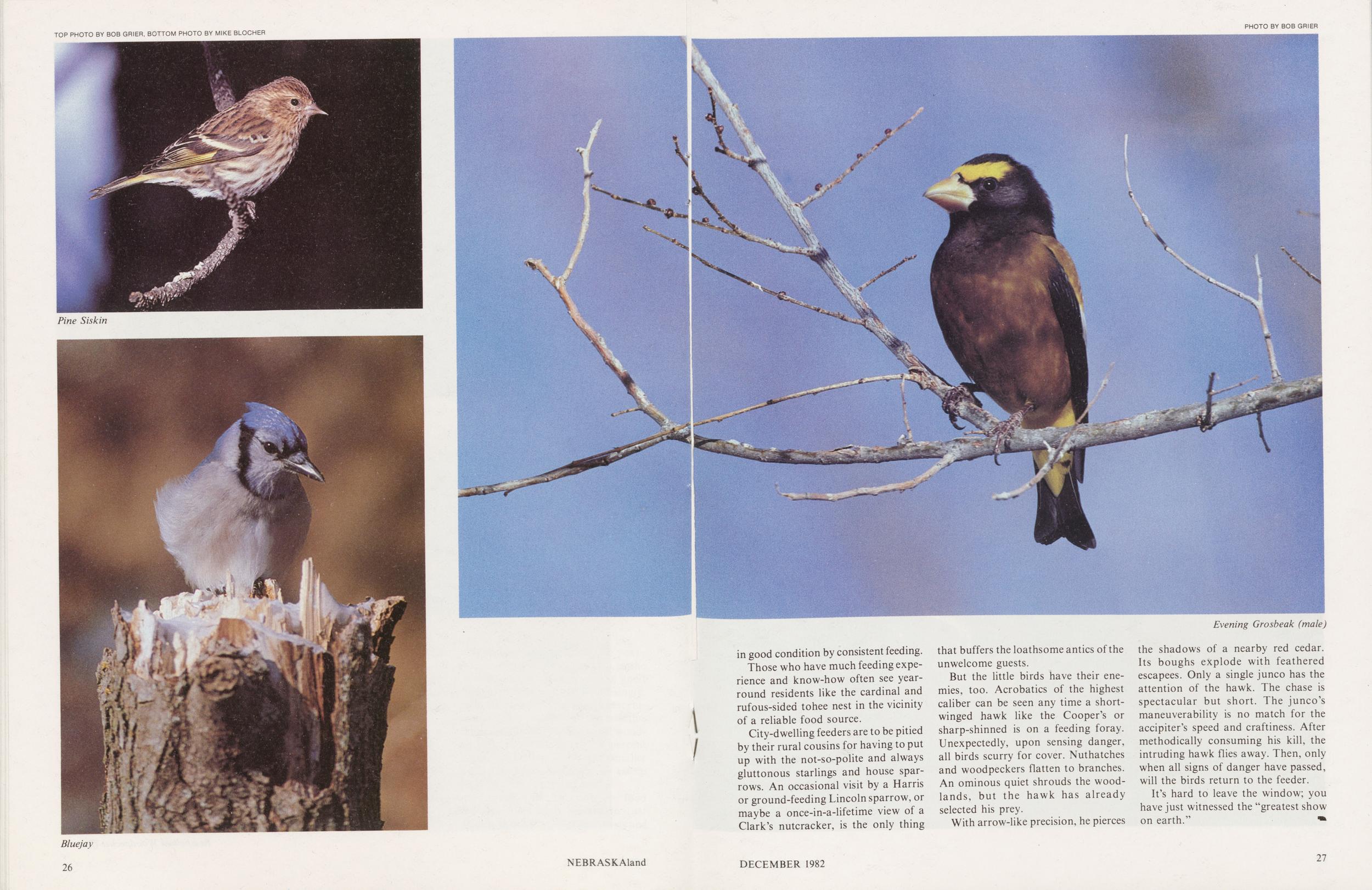
Those who have much feeding experience and know-how often see year-round residents like the cardinal and rufous-sided tohee nest in the vicinity of a reliable food source.
City-dwelling feeders are to be pitied by their rural cousins for having to put up with the not-so-polite and always gluttonous starlings and house sparrows. An occasional visit by a Harris or ground-feeding Lincoln sparrow, or maybe a once-in-a-lifetime view of a Clark's nutcracker, is the only thing that buffers the loathsome antics of the unwelcome guests.
But the little birds have their enemies, too. Acrobatics of the highest caliber can be seen any time a short-winged hawk like the Cooper's or sharp-shinned is on a feeding foray. Unexpectedly, upon sensing danger, all birds scurry for cover. Nuthatches and woodpeckers flatten to branches. An ominous quiet shrouds the woodlands, but the hawk has already selected his prey.
With arrow-like precision, he pierces Evening Grosbeak (male) the shadows of a nearby red cedar. Its boughs explode with feathered escapees. Only a single junco has the attention of the hawk. The chase is spectacular but short. The junco's maneuverability is no match for the accipiter's speed and craftiness. After methodically consuming his kill, the intruding hawk flies away. Then, only when all signs of danger have passed, will the birds return to the feeder.
It's hard to leave the window; you have just witnessed the "greatest show on earth."
DECEMBER 1982 27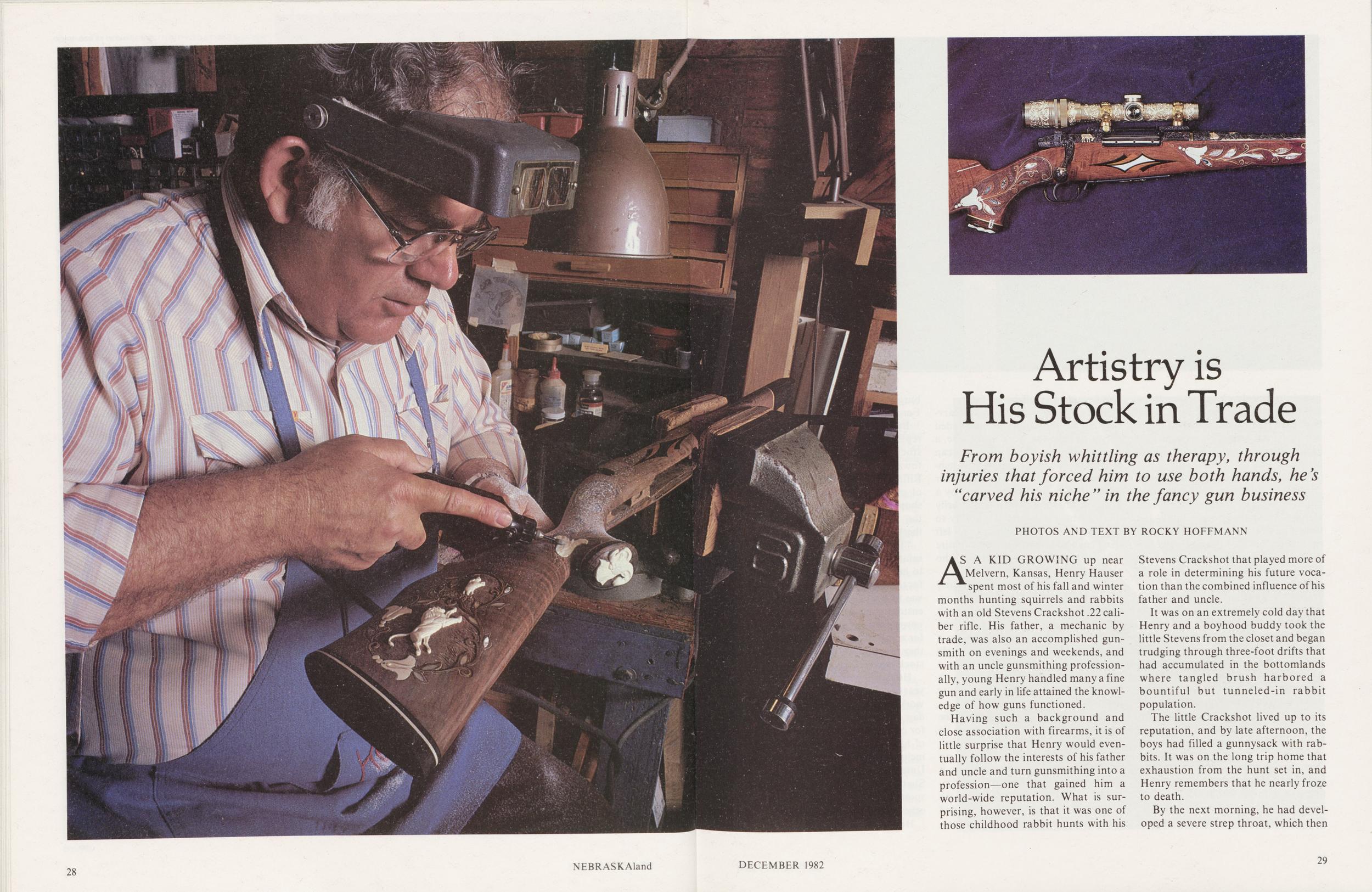
Artistry is His Stock in Trade
From boyish whittling as therapy, through injuries that forced him to use both hands, he's carved his niche" in the fancy gun business PHOTOS AND TEXT BY ROCKY HOFFMANNAS A KID GROWING up near Melvern, Kansas, Henry Hauser spent most of his fall and winter months hunting squirrels and rabbits with an old Stevens Crackshot .22 caliber rifle. His father, a mechanic by trade, was also an accomplished gunsmith on evenings and weekends, and with an uncle gunsmithing professionally, young Henry handled many a fine gun and early in life attained the knowledge of how guns functioned.
Having such a background and close association with firearms, it is of little surprise that Henry would eventually follow the interests of his father and uncle and turn gunsmithing into a profession—one that gained him a world-wide reputation. What is surprising, however, is that it was one of those childhood rabbit hunts with his Stevens Crackshot that played more of a role in determining his future vocation than the combined influence of his father and uncle.
It was on an extremely cold day that Henry and a boyhood buddy took the little Stevens from the closet and began trudging through three-foot drifts that had accumulated in the bottomlands where tangled brush harbored a bountiful but tunneled-in rabbit population.
The little Crackshot lived up to its reputation, and by late afternoon, the boys had filled a gunnysack with rabbits. It was on the long trip home that exhaustion from the hunt set in, and Henry remembers that he nearly froze to death.
By the next morning, he had developed a severe strep throat, which then
DECEMBER 1982
29
The years of recovery were long and confining, and it was during that tedious time of recuperation that Henry started sketching wildlife. His father, in an attempt to provide physical therapy for his son's badly swollen hands, began bringing home blocks of balsa wood and encouraging him to do some "whittlin'."
Henry's whittlin,' however, was at once recognized as carving, and the youngster began designing and manufacturing model airplanes. He once carved a glider that, when finished, was too large to take out of his room. Another plane, which he refers to as his "super plane," was so well designed that it was only flown once. Henry and his uncle watched it disappear from sight, never to be recovered.
Even with his natural ability for art and carving, his hobby never came easy. At times his right hand would become so swollen that he was forced to carve with his left hand, in effect becoming ambidextrous. Such an ability to make intricate cuts with either hand would pay off in the future.
There are many angles in any carving that would require a one-handed carver to reset the work in the vise, a time-consuming maneuver which can be completely avoided simply by switching hands with the cutting tool. Later in life, Henry was badly injured by a horse in Missouri, which temporarily disabled his right arm. His ability to carve with equal precision with his left hand enabled him to work up an entire custom stock for an attorney who always demanded perfection.
The Hausers, shortly after Henry became ill with rheumatic fever, moved to California, where Henry's uncle professionally built guns, and where his father took a job as a mechanic. Henry's uncle immediately recognized his nephew's talent with a knife and persuaded him to assist with stock work while learning the smithing trade.
Henry learned quickly and by the time he reached the eighth grade he had completely built his first firearm, but it wasn't until he started with an old Mossburg .22 plinker, building it into a custom shooter with all the trimmings, that he decided he could make a living from his talent. He traded that once plain-looking old Mossburg straight across for a Model "A" Ford.
By 1956, Henry had gained a local reputation as a fine gunsmith, and his stock-carving techniques continued toward perfection. The Weatherby Rifle Company had been sending a lot of custom stock work to his uncle's shop and Henry observed first-hand the fine work that went into Weatherby rifles.
"That was still the era of big-game safaris, and Weatherby was considered to have the finest rifles on the market for that purpose. My greatest ambition was to work for them, so I built up two custom guns, walked into their office, unwrapped my work, and asked them for a job. It was quite a surprise, but they hired me on the spot as a custom stock maker."
He stayed with Weatherby for seven years as a master carver and gunsmith, working full time for the company by day and doing custom work at night for customers of Weatherby and some of his own. Some of those customers included A.J. Foyt, Bobby and Al Unser, Hubert Humphry, and the late Shah of Iran. Others were movie stars, sports and professional people, and other noted big-game hunters.
Henry continued to develop his 30 NEBRASKAland
As his dexterity once again improved, the E.C. Bishop and Son stock company began sending him custom work, and after complete recovery, he decided to leave Weatherby, and the long commuting and heavy traffic, to go to work for Bishop in the hardwood forest country of Missouri.
When Bishop abandoned plans to construct a complete custom stock shop, Henry moved to North Platte to be near relatives, but he continues his close ties with Bishop, doing many custom jobs for the company from his North Platte shop.
DECEMBER 1982 31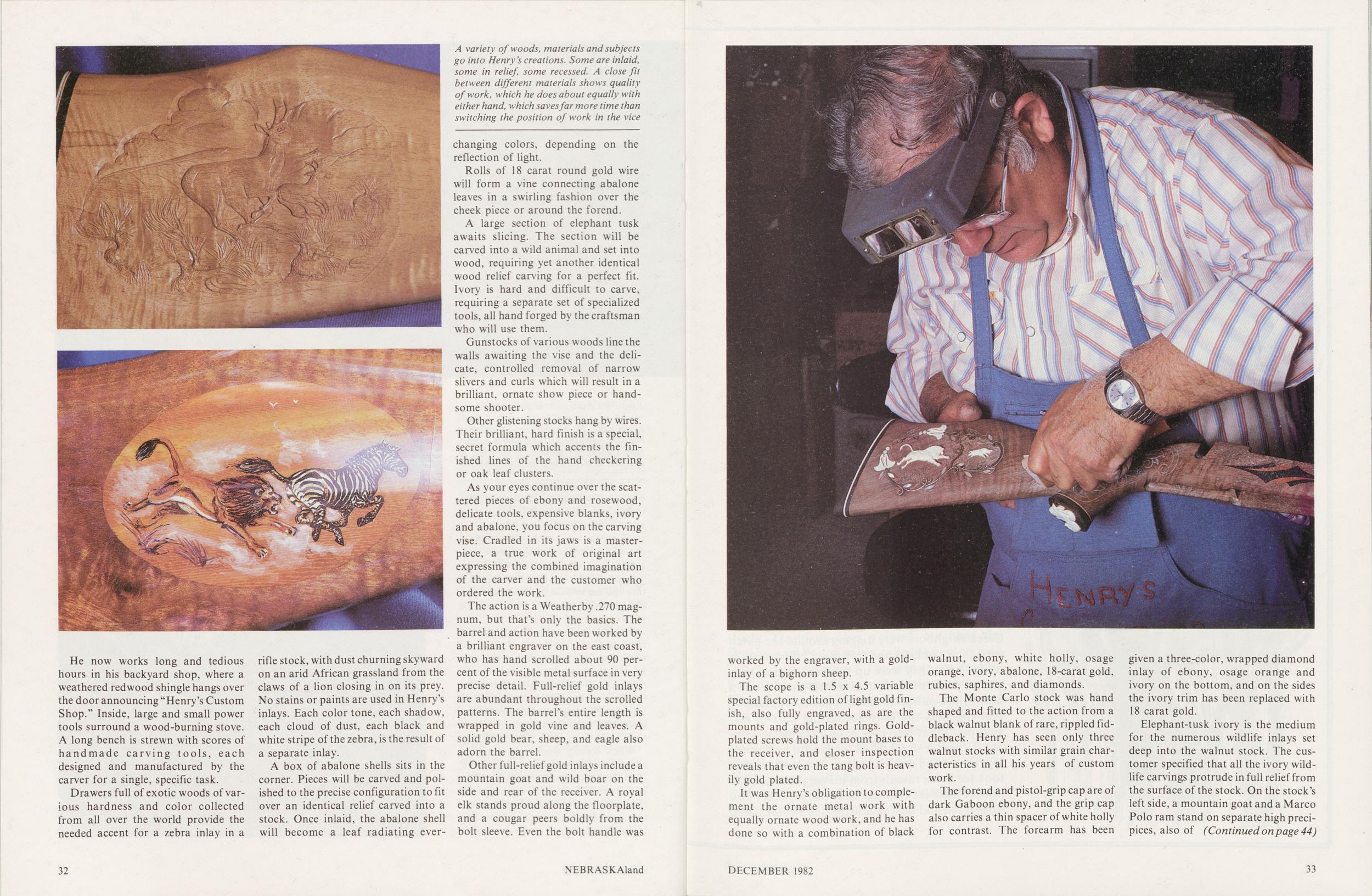
He now works long and tedious hours in his backyard shop, where a weathered redwood shingle hangs over the door announcing "Henry's Custom Shop." Inside, large and small power tools surround a wood-burning stove. A long bench is strewn with scores of handmade carving tools, each designed and manufactured by the carver for a single, specific task.
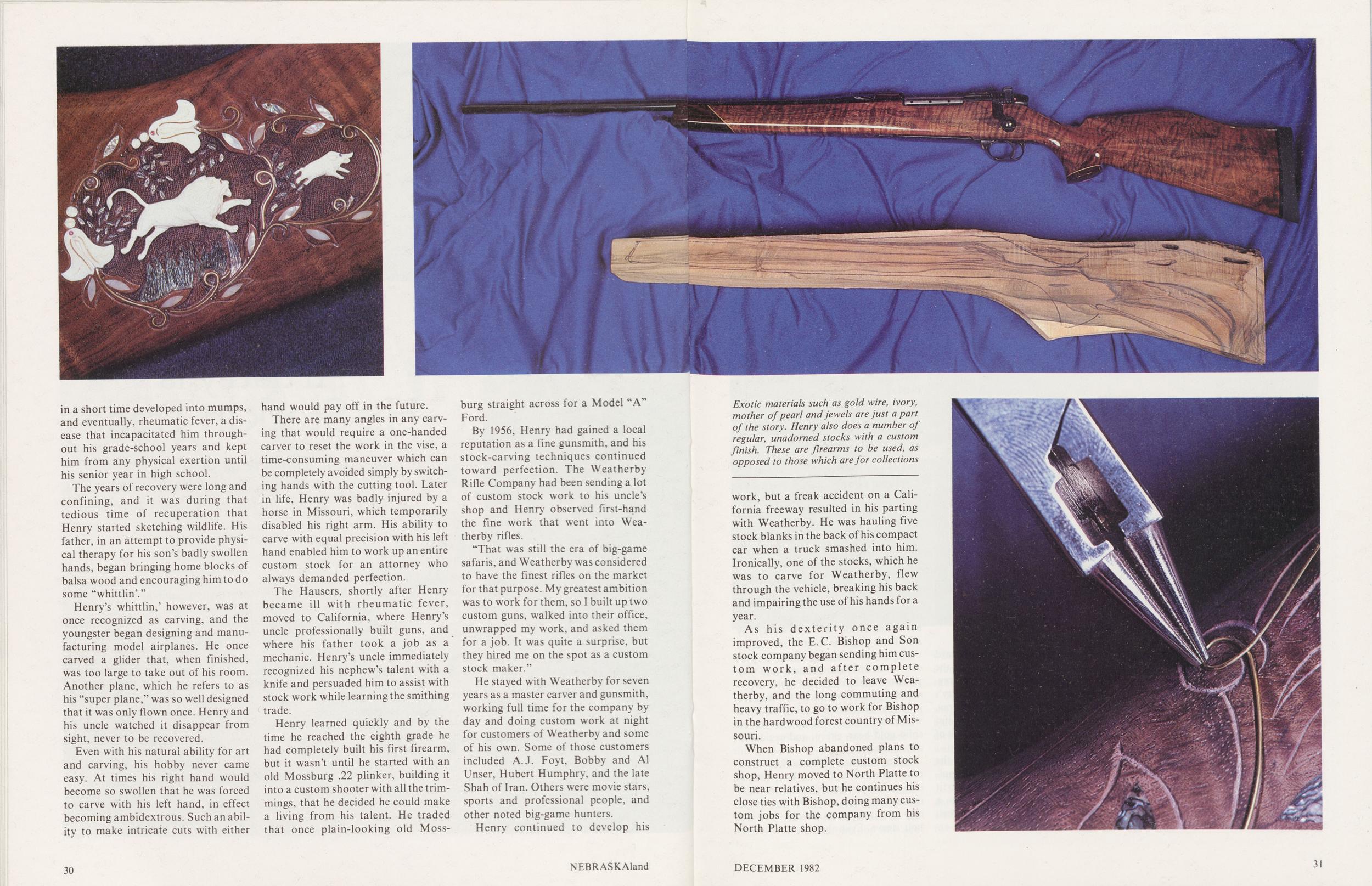
Drawers full of exotic woods of various hardness and color collected from all over the world provide the needed accent for a zebra inlay in a rifle stock, with dust churning skyward on an arid African grassland from the claws of a lion closing in on its prey. No stains or paints are used in Henry's inlays. Each color tone, each shadow, each cloud of dust, each black and white stripe of the zebra, is the result of a separate inlay.
A box of abalone shells sits in the corner. Pieces will be carved and polished to the precise configuration to fit over an identical relief carved into a stock. Once inlaid, the abalone shell will become a leaf radiating ever-changing colors, depending on the reflection of light.
Rolls of 18 carat round gold wire will form a vine connecting abalone leaves in a swirling fashion over the cheek piece or around the forend.
A large section of elephant tusk awaits slicing. The section will be carved into a wild animal and set into wood, requiring yet another identical wood relief carving for a perfect fit. Ivory is hard and difficult to carve, requiring a separate set of specialized tools, all hand forged by the craftsman who will use them.
Gunstocks of various woods line the walls awaiting the vise and the delicate, controlled removal of narrow slivers and curls which will result in a brilliant, ornate show piece or handsome shooter.
Other glistening stocks hang by wires. Their brilliant, hard finish is a special, secret formula which accents the finished lines of the hand checkering or oak leaf clusters.
As your eyes continue over the scattered pieces of ebony and rosewood, delicate tools, expensive blanks, ivory and abalone, you focus on the carving vise. Cradled in its jaws is a masterpiece, a true work of original art expressing the combined imagination of the carver and the customer who ordered the work.
The action is a Weatherby .270 magnum, but that's only the basics. The barrel and action have been worked by a brilliant engraver on the east coast, who has hand scrolled about 90 percent of the visible metal surface in very precise detail. Full-relief gold inlays are abundant throughout the scrolled patterns. The barrel's entire length is wrapped in gold vine and leaves. A solid gold bear, sheep, and eagle also adorn the barrel.
Other full-relief gold inlays include a mountain goat and wild boar on the side and rear of the receiver. A royal elk stands proud along the floorplate, and a cougar peers boldly from the bolt sleeve. Even the bolt handle was 32 NEBRASKAland
The scope is a 1.5 x 4.5 variable special factory edition of light gold finish, also fully engraved, as are the mounts and gold-plated rings. Gold-plated screws hold the mount bases to the receiver, and closer inspection reveals that even the tang bolt is heavily gold plated.
It was Henry's obligation to complement the ornate metal work with equally ornate wood work, and he has done so with a combination of black walnut, ebony, white holly, osage orange, ivory, abalone, 18-carat gold, rubies, saphires, and diamonds.
The Monte Carlo stock was hand shaped and fitted to the action from a black walnut blank of rare, rippled fiddleback. Henry has seen only three walnut stocks with similar grain characteristics in all his years of custom work.
The forend and pistol-grip cap are of dark Gaboon ebony, and the grip cap also carries a thin spacer of white holly for contrast. The forearm has been given a three-color, wrapped diamond inlay of ebony, osage orange and ivory on the bottom, and on the sides the ivory trim has been replaced with 18 carat gold.
Elephant-tusk ivory is the medium for the numerous wildlife inlays set deep into the walnut stock. The customer specified that all the ivory wildlife carvings protrude in full relief from the surface of the stock. On the stock's left side, a mountain goat and a Marco Polo ram stand on separate high precipices, also of (Continued on page 44)
DECEMBER 1982 33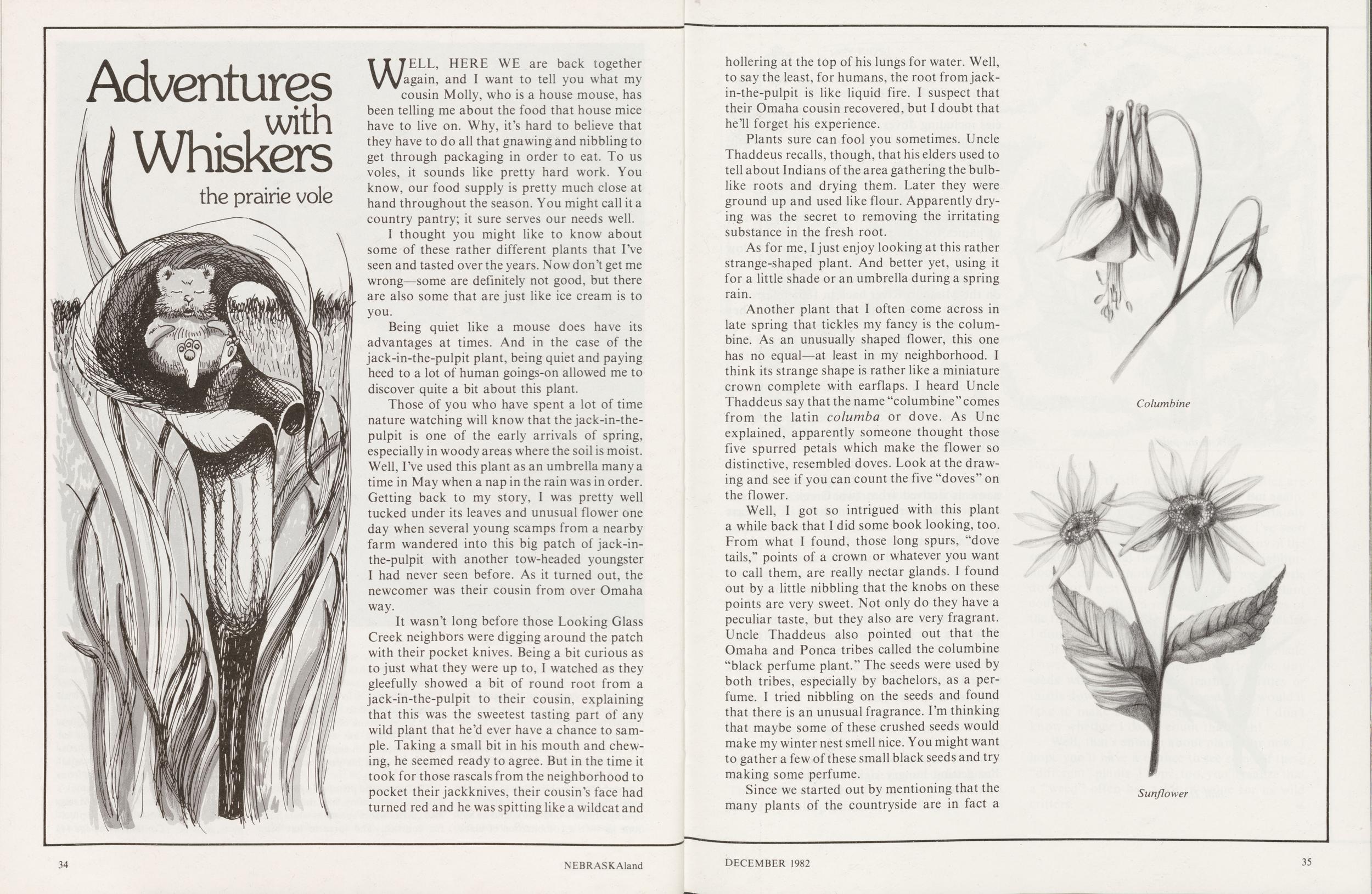
Adventures Whiskers the prairie vole
WELL, HERE WE are back together again, and I want to tell you what my cousin Molly, who is a house mouse, has been telling me about the food that house mice have to live on. Why, it's hard to believe that they have to do all that gnawing and nibbling to get through packaging in order to eat. To us voles, it sounds like pretty hard work. You know, our food supply is pretty much close at hand throughout the season. You might call it a country pantry; it sure serves our needs well.
I thought you might like to know about some of these rather different plants that I've seen and tasted over the years. Now don't get me wrong—some are definitely not good, but there are also some that are just like ice cream is to you.
Being quiet like a mouse does have its advantages at times. And in the case of the jack-in-the-pulpit plant, being quiet and paying heed to a lot of human goings-on allowed me to discover quite a bit about this plant.
Those of you who have spent a lot of time nature watching will know that the jack-in-the-pulpit is one of the early arrivals of spring, especially in woody areas where the soil is moist. Well, I've used this plant as an umbrella many a time in May when a nap in the rain was in order. Getting back to my story, I was pretty well tucked under its leaves and unusual flower one day when several young scamps from a nearby farm wandered into this big patch of jack-in-the-pulpit with another tow-headed youngster I had never seen before. As it turned out, the newcomer was their cousin from over Omaha way.
It wasn't long before those Looking Glass Creek neighbors were digging around the patch with their pocket knives. Being a bit curious as to just what they were up to, I watched as they gleefully showed a bit of round root from a jack-in-the-pulpit to their cousin, explaining that this was the sweetest tasting part of any wild plant that he'd ever have a chance to sample. Taking a small bit in his mouth and chewing, he seemed ready to agree. But in the time it took for those rascals from the neighborhood to pocket their jackknives, their cousin's face had turned red and he was spitting like a wildcat and 34 NEBRASKAland hollering at the top of his lungs for water. Well, to say the least, for humans, the root from jack-in-the-pulpit is like liquid fire. I suspect that their Omaha cousin recovered, but I doubt that he'll forget his experience.
Plants sure can fool you sometimes. Uncle Thaddeus recalls, though, that his elders used to tell about Indians of the area gathering the bulb-like roots and drying them. Later they were ground up and used like flour. Apparently drying was the secret to removing the irritating substance in the fresh root.
As for me, I just enjoy looking at this rather strange-shaped plant. And better yet, using it for a little shade or an umbrella during a spring rain.
Another plant that I often come across in late spring that tickles my fancy is the columbine. As an unusually shaped flower, this one has no equal—at least in my neighborhood. I think its strange shape is rather like a miniature crown complete with earflaps. I heard Uncle Thaddeus say that the name "columbine" comes from the latin columba or dove. As Unc explained, apparently someone thought those five spurred petals which make the flower so distinctive, resembled doves. Look at the drawing and see if you can count the five "doves" on the flower.
Well, I got so intrigued with this plant a while back that I did some book looking, too. From what I found, those long spurs, "dove tails," points of a crown or whatever you want to call them, are really nectar glands. I found out by a little nibbling that the knobs on these points are very sweet. Not only do they have a peculiar taste, but they also are very fragrant. Uncle Thaddeus also pointed out that the Omaha and Ponca tribes called the columbine "black perfume plant." The seeds were used by both tribes, especially by bachelors, as a perfume. I tried nibbling on the seeds and found that there is an unusual fragrance. I'm thinking that maybe some of these crushed seeds would make my winter nest smell nice. You might want to gather a few of these small black seeds and try making some perfume.
Since we started out by mentioning that the many plants of the countryside are in fact a
As long as I'm giving you clues about this plant, why don't you see if you can guess what it might be? Here are some more clues:
The Indian tribes of the state had a number of names for this plant. All were keyed to the color of the flower. Their names were "yellow flower," "yellow weed" and "yellow eyes." Lewis and Clark in their journals of exploration on the Missouri River back in 1805 referred to this plant and Indian use of the seed. They found that the seeds were used to make a type of bread, and for thickening soup. Matter of fact, the seeds from this plant provided an oil that was used as a hair dressing.
I suspect you probably know what this plant is by now, but just in case you need a few more clues, here are some that will make it real easy to figure out what yellow-flowered plant we're talking about.
The yellow flower of this plant turns to follow our brightest star throughout the day. Its name is derived from two Greek nouns and mentions the star itself. Sometimes its seeds are called "Russian peanuts." If I were to tell you that it is the state flower of our closest neighbor to the south, you'd know for sure what we've been trying to get you to say. You're right; it's sunflower! Now, I think the name "yellow eyes" as used by the Pawnee is really the best. To a vole like me, looking up at a big patch of sunflowers is just like having hundreds of "yellow eyes" looking back. Why don't you try it sometime? Pick a good patch and lie down, then look up and see if you don't think all these "sunflower eyes" aren't pretty neat.
Certainly there are a lot of folks who consider sunflowers to be nothing but pesky weeds, but to us wild critters, let me tell you, this plant is a real mainstay of our country pantry. Why, I'm getting hungry right now thinking about some tender and tasty sunflower seeds.
Talking about something yellow just leads 36 NEBRASKAland naturally to another plant that I see a lot of. First let me tell about the "snowstorm" I thought was starting when I woke up from a nap one day. As usual, I had nibbled on a more than generous sunflower seed lunch one day last fall, and had fallen asleep at the meadow's edge. Deep in my slumber I kept thinking (maybe dreaming) that Gus Goldfinch was nearby talking to me. When I rubbed my eyes to wake up, everything around me was a downy white— even the air was filled with drifting white gossamer threads that looked like an early fall snowshower. Well, my nose and tail told me it wasn't cold enough to snow, but the white blizzard continued. When I finally got all the sleep rubbed from my eyes and got the old meadow mouse brain functioning again, it was apparent that it hadn't snowed at all. That greedy Gus, in typical goldfinch fashion, was busy tearing apart a ripened bull thistle flower, and was rapidly chucking down the tiny seeds for lunch. The thistle fuzz was flying everywhere, and it certainly did resemble an out-of-season snowstorm.
The bull thistle and many other thistles are often considered troublesome weeds. But again, to many wild creatures, such weeds certainly have a place in our life cycles. Why, I've seen thistle down used for nest linings by many of the songbirds around the Looking Glass neighborhood. Come to think of it, I've even used thistle down for a nest liner. How this part of the plant could be so soft is a real puzzler. The leaves of the thistle are so loaded with spines and prickles I don't even venture into thistle patches.
If you have a chance, examine a thistle flower after it has opened. Look for the tiny seeds which hang on the feathery bristles or thistle down. How many of these seeds would it take to make a goldfinch meal? Wow! I don't know whether I could count that high!
Well, that's enough about plants for now. I hope you'll have a chance to see some of these "different" plants. I hope, too, you'll realize that a "weed" often has a lot of value for us wild critters.
DECEMBER 1982 37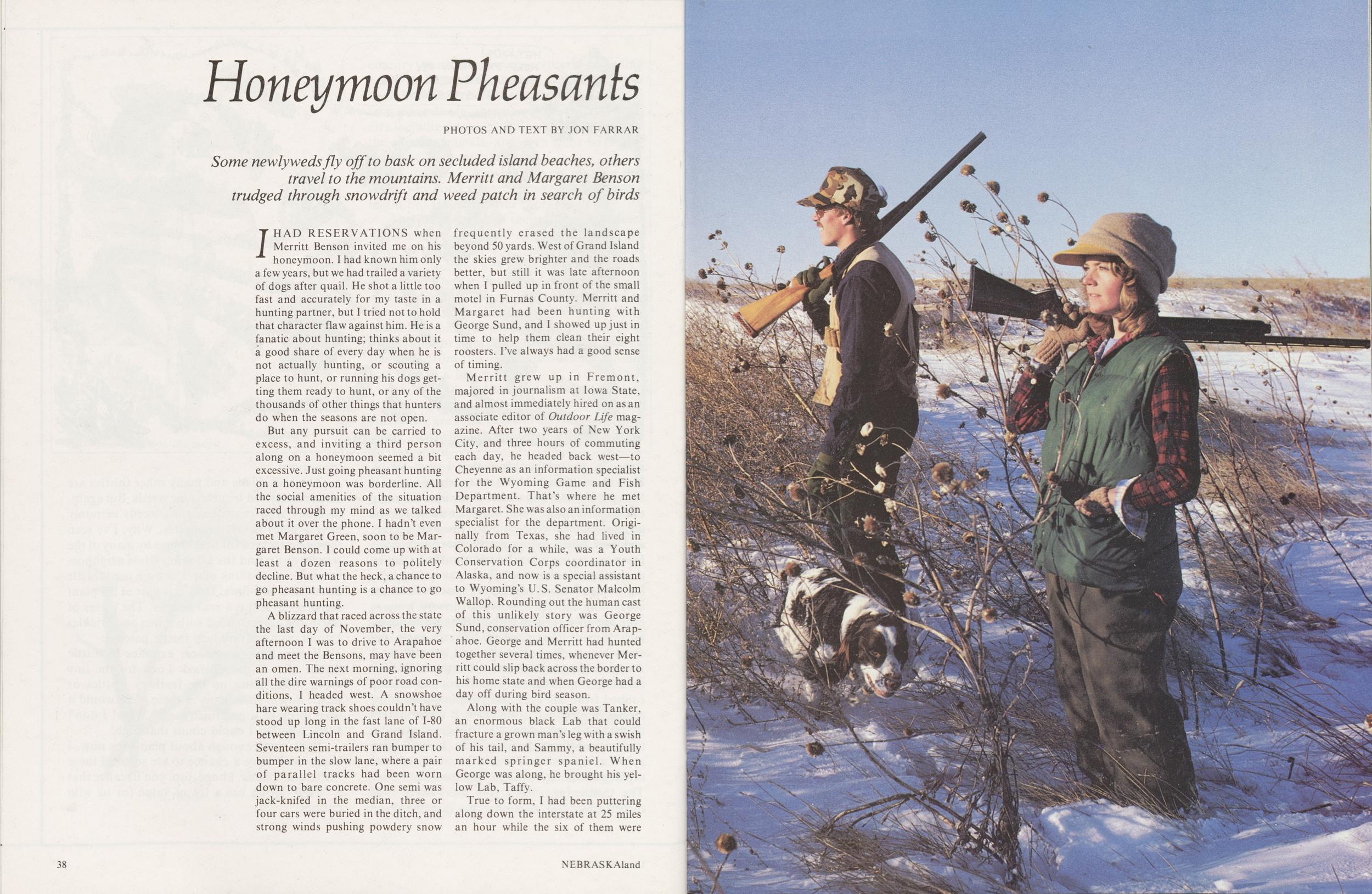
Honeymoon Pheasants
PHOTOS AND TEXT BY JON FARRAR Some newlywedsfly off to bask on secluded island beaches, others travel to the mountains. Merritt and Margaret Benson trudged through snowdrift and weed patch in search of birdsI HAD RESERVATIONS when Merritt Benson invited me on his honeymoon. I had known him only a few years, but we had trailed a variety of dogs after quail. He shot a little too fast and accurately for my taste in a hunting partner, but I tried not to hold that character flaw against him. He is a fanatic about hunting; thinks about it a good share of every day when he is not actually hunting, or scouting a place to hunt, or running his dogs getting them ready to hunt, or any of the thousands of other things that hunters do when the seasons are not open.
But any pursuit can be carried to excess, and inviting a third person along on a honeymoon seemed a bit excessive. Just going pheasant hunting on a honeymoon was borderline. All the social amenities of the situation raced through my mind as we talked about it over the phone. I hadn't even met Margaret Green, soon to be Margaret Benson. I could come up with at least a dozen reasons to politely decline. But what the heck, a chance to go pheasant hunting is a chance to go pheasant hunting.
A blizzard that raced across the state the last day of November, the very afternoon I was to drive to Arapahoe and meet the Bensons, may have been an omen. The next morning, ignoring all the dire warnings of poor road conditions, I headed west. A snowshoe hare wearing track shoes couldn't have stood up long in the fast lane of 1-80 between Lincoln and Grand Island. Seventeen semi-trailers ran bumper to bumper in the slow lane, where a pair of parallel tracks had been worn down to bare concrete. One semi was jack-knifed in the median, three or four cars were buried in the ditch, and strong winds pushing powdery snow frequently erased the landscape beyond 50 yards. West of Grand Island the skies grew brighter and the roads better, but still it was late afternoon when I pulled up in front of the small motel in Furnas County. Merritt and Margaret had been hunting with George Sund, and I showed up just in time to help them clean their eight roosters. I've always had a good sense of timing.
Merritt grew up in Fremont, majored in journalism at Iowa State, and almost immediately hired on as an associate editor of Outdoor Life magazine. After two years of New York City, and three hours of commuting each day, he headed back west—to Cheyenne as an information specialist for the Wyoming Game and Fish Department. That's where he met Margaret. She was also an information specialist for the department. Originally from Texas, she had lived in Colorado for a while, was a Youth Conservation Corps coordinator in Alaska, and now is a special assistant to Wyoming's U.S. Senator Malcolm Wallop. Rounding out the human cast of this unlikely story was George Sund, conservation officer from Arapahoe. George and Merritt had hunted together several times, whenever Merritt could slip back across the border to his home state and when George had a day off during bird season.
Along with the couple was Tanker, an enormous black Lab that could fracture a grown man's leg with a swish of his tail, and Sammy, a beautifully marked springer spaniel. When George was along, he brought his yellow Lab, Taffy.
True to form, I had been puttering along down the interstate at 25 miles an hour while the six of them were 38 NEBRASKAland
George was on duty the next morning. About shooting time, the rest of us were bouncing over frozen ruts along the west side of Medicine Creek Reservoir. For years I had heard that Medicine Creek's shrub-filled canyons and food plots drew winter pheasants from the surrounding farmland like water to a sponge. Merritt had hunted the reservoir last year with good success.
Snow was still plastered to the north sides of large, round bales, and drifted into plum thickets, clumps of trees and fencelines. Fields without stubble were blown clean. The trail roads and dirt county roads were muddy, but frozen in place. We knew we would have to abandon the canyons at the first sign of thaw or face wallowing in greasy clay gumbo. At the head of a trail blocked by drifted snow we parked the truck and walked in.
The wind was cold and sharp, but the skies had cleared, and in the canyons the sun was warm. Snow was gathered deepest where the pheasants would be. We walked through stands of bluestem and switchgrass, through ravines filled with plum and sumac wearing russet seedheads. Rabbit tracks already laced the snow, along with a few made by pheasants moving from heavy cover to rows of milo in the food plots.
There are days when a limit of roosters comes easily, and days when roosters flush wild and hens sit tight. Even at mid-morning, hens, dozens of hens, were still burrowed in snow tunnels under clumps of native grass. Hens that would let you walk by, then flush three feet behind you if you happened to stop. The few wary roosters knew they were under the gun. Margaret said it was like a bag of gorp (a trail snack of candy, nuts and raisins) after three days of canoeing—most of the M & M's have been picked out.
Certain we would find roosters in the next draw or the next food plot, we were over a mile from the truck when we first noticed mud rolling up over the edges of our boots. Visions of a pickup belly-deep in the middle of the road brushed aside those imagined scenes of roosters peeling out like blue-rocks from a trap. The trail back was all uphill, and each yard of progress forward on the greased fields came with a foot slide back. It was nearly noon when we raked pounds of mud from our feet at the truck.
To a young hunter, getting stuck
added a bit of exhilaration; harmless
danger to an outing. For an older
DECEMBER 1982
41
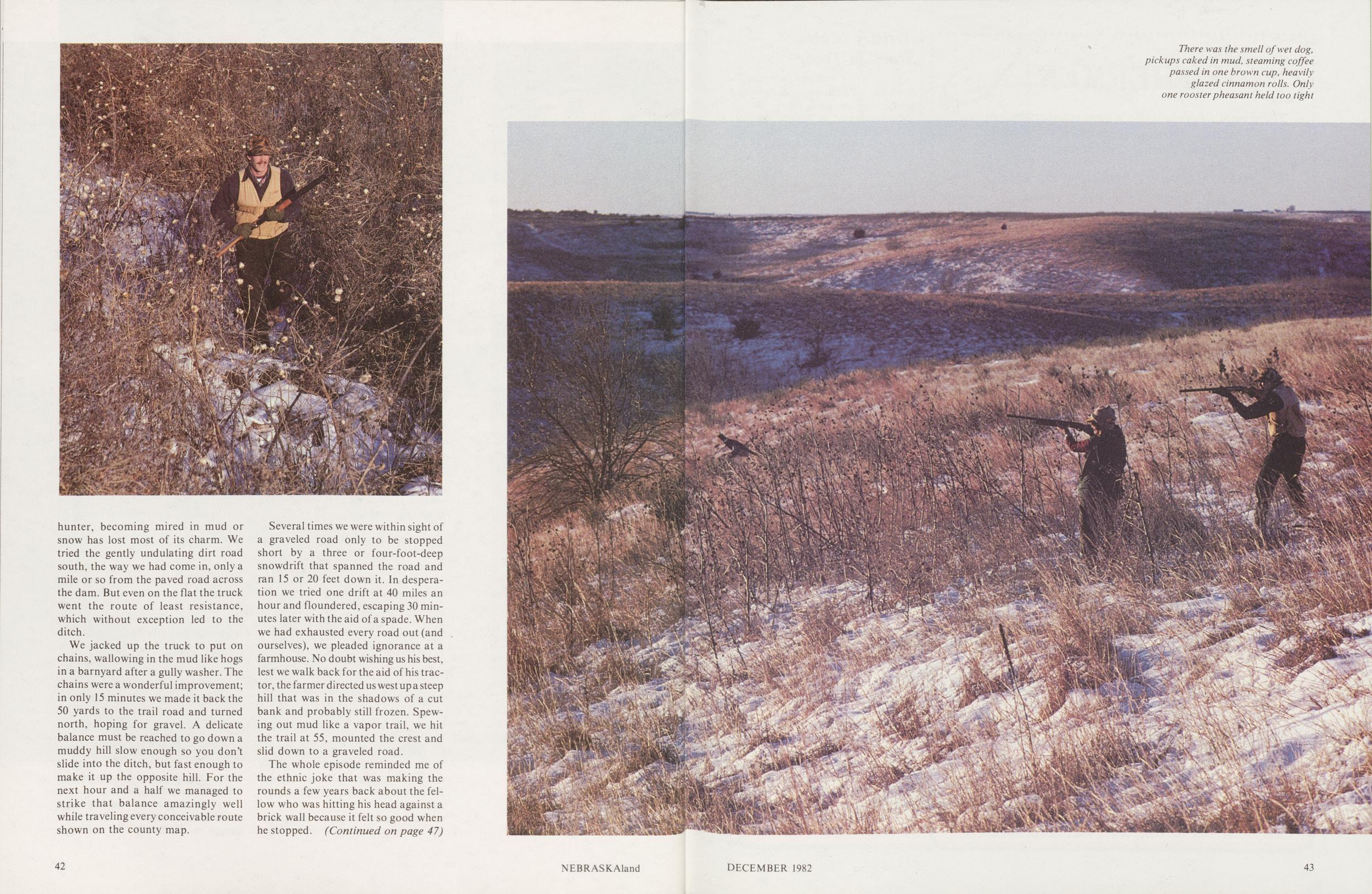
We jacked up the truck to put on chains, wallowing in the mud like hogs in a barnyard after a gully washer. The chains were a wonderful improvement; in only 15 minutes we made it back the 50 yards to the trail road and turned north, hoping for gravel. A delicate balance must be reached to go down a muddy hill slow enough so you don't slide into the ditch, but fast enough to make it up the opposite hill. For the next hour and a half we managed to strike that balance amazingly well while traveling every conceivable route shown on the county map.
Several times we were within sight of a graveled road only to be stopped short by a three or four-foot-deep snowdrift that spanned the road and ran 15 or 20 feet down it. In desperation we tried one drift at 40 miles an hour and floundered, escaping 30 minutes later with the aid of a spade. When we had exhausted every road out (and ourselves), we pleaded ignorance at a farmhouse. No doubt wishing us his best, lest we walk back for the aid of his tractor, the farmer directed us west up a steep hill that was in the shadows of a cut bank and probably still frozen. Spewing out mud like a vapor trail, we hit the trail at 55, mounted the crest and slid down to a graveled road.
The whole episode reminded me of the ethnic joke that was making the rounds a few years back about the fellow who was hitting his head against a brick wall because it felt so good when he stopped. (Continued on page 47)
42 NEBRASKAland Take part in Nebraska's best wintertime event
The 6th Annual Valentine Jaycees
Ice Fishing Tournament
Saturday, February 5, 1983
at Merritt Reservoir
• Entry Deadline is January 30, 1982 • Cash and Prizes in over 30 catagories
• Entry fee: $40 per team • For further information or entry
blanks
Checks payable to Valentine Jaycees call Kevin Thornton (402) 376-1199 or
Mike Young, 376-1281 or
Verification and information will be write Valentine Jaycees, Box 4,
mailed to each entrant
Valentine NE 69201
Name
Address
City
State
Zip
Fishing Partner
Address
City
State
Zip
A New Collection of
Laughter From The Frontier Plains
Catfish
at the Pump
Humor and the Frontier
by
Roger L. Welsch
with Linda K. Welsch
Enjoy the tall tales, practical jokes,
wise-cracks, and wit the Nebraska pioneers
loved. Experience the laughter that made settlement in
the great American desert possible.
"I don't know if it was the laughers who survived or the survivors who laughed
but there is a connection there that cannot be denied." —Roger L. Welsch
«ii»
It's the only thing I want for Christmas!" —Jake Hotovy
"A steal at $5.95!" —Bertha Welsch
"Hey, that's my joke!" —Bumps Nielsen
Catfish at the Pump, Humor and the Frontier is available for
$5.95 plus $1.00 for tax, postage and handling—delivered in
time for Christmas. Each book will be autographed at no charge
upon request. Send $6.95 to:
Plains Heritage Dept. NL 3511 Mohawk Street Lincoln, Nebraska 68510
Take part in Nebraska's best wintertime event
The 6th Annual Valentine Jaycees
Ice Fishing Tournament
Saturday, February 5, 1983
at Merritt Reservoir
• Entry Deadline is January 30, 1982 • Cash and Prizes in over 30 catagories
• Entry fee: $40 per team • For further information or entry
blanks
Checks payable to Valentine Jaycees call Kevin Thornton (402) 376-1199 or
Mike Young, 376-1281 or
Verification and information will be write Valentine Jaycees, Box 4,
mailed to each entrant
Valentine NE 69201
Name
Address
City
State
Zip
Fishing Partner
Address
City
State
Zip
A New Collection of
Laughter From The Frontier Plains
Catfish
at the Pump
Humor and the Frontier
by
Roger L. Welsch
with Linda K. Welsch
Enjoy the tall tales, practical jokes,
wise-cracks, and wit the Nebraska pioneers
loved. Experience the laughter that made settlement in
the great American desert possible.
"I don't know if it was the laughers who survived or the survivors who laughed
but there is a connection there that cannot be denied." —Roger L. Welsch
«ii»
It's the only thing I want for Christmas!" —Jake Hotovy
"A steal at $5.95!" —Bertha Welsch
"Hey, that's my joke!" —Bumps Nielsen
Catfish at the Pump, Humor and the Frontier is available for
$5.95 plus $1.00 for tax, postage and handling—delivered in
time for Christmas. Each book will be autographed at no charge
upon request. Send $6.95 to:
Plains Heritage Dept. NL 3511 Mohawk Street Lincoln, Nebraska 68510
Artistry is his Stock in Trade
(Continued from page 33)ivory, and an ice floe provides a resting site for an ivory polar bear.
On the left side, an African lion gives a wild boar a sudden chase through tall grass. Here the grass and foliage are not ivory, but minute slivers of abalone shell. The final ivory wildlife miniature is the bust of a bighorn ram framed full-face on the contrasting ebony pistol grip cap.
Each ivory wildlife inlay is hand carved in exacting detail, as Hauser gains realism by providing features like fangs, whiskers, claws and even body hair. He concedes that it is generally the lioness that does most of the hunting, but he generally carves the male because of the majestic appearance of the mane.
Saphires, diamonds and rubies have been set into the ivory to provide the animals with glistening eyes.
A gold-inlaid ivory vine trimmed in gold-swirl patterns of foliage throughout the stock, frames most of the wildlife scenes. The vine's blossoms suggest African violets, and each flower has a small red ruby. The leaves are randomly mixed ivory and polished abalone shell.
A generous inlay of 18-carat round gold wire trims much of the ivory vine. Hauser estimates that over 16 feet of the heavy wire was used to adorn this stock.
Avoiding lacquer completely, this particular stock received about 20 applications of a catalytic-hardened finish, providing the walnut a lifetime of highly polished protection.
This particular stock was the fifth for this client, with each successive job being more ornate, requiring more inlays, and demanding more detail. In fact, Hauser claims that this particular gun is the most involved work he has ever, completed in nearly 30 years of stock work.
After close inspection of the piece, one would surely guess that the rifle was built for a famous European nobleman, a South African diamond magnate, or a mid-east oil shiek, but Henry smiles and says that building this rifle proves he's still available to common folks. The Weatherby, diamonds and all, was built for a midwestern farmer.
44 NEBRASKAland From January's cardinal in the snow to December's ice sculpture on the Platte, the 1983 NEBRASKAland Calendar of Color will be a pleasant and useful addition to your home and office. There's information on the newest state park near Lincoln and Omaha, some delectable recipes, and much more. But the fabulous photos which accompany each month will start your days off with happy thoughts. Order yours now, and they're great for gifts, too! NEBRASKAland Magazine s $500 TO: NEBRASKAland Calendar P.O. Box 3022, Omaha, Nebraska 68103 Date. NAME ADDRESS CITY STATE ZIP Gentlemen: Please mail, postage-paid, calendars at $3.00 each, plus sales tax if required. Nebraska residents must include sales tax. Total enclosed $ Q My check is enclosed □ Money order enclosed Calendars are mailed at no extra charge at 3rd Class bulk rate. Add $1 per calendar for 1st Class postage. Minnetonka Moccasin Catalog
Men's, Women's & Children's Sizes
All genuine leather and highest quality
Many styles and colors to choose from
MINNEJQNKA
MOCCASINS
Name
Address
City
State
Zip
Mail to: H & M Bootery, 275 N. Main, Valentine, Neb. 69201
For Full Color Catalog and Price List
IT'S TIME
TO GET
INVOLVED.
People start pollution.
People can stop it.
Harlan County Dam
Vacation Apartments - fully furnished
Color TV • Kitchen Facilities • Full Baths
Game cleaning room with freezer
One block from shopping center
Weekend or week of pleasant living
Security Deposit Required
Sorry —No Pets
Dean and Esther Stone
Box 145 Ph. (308) 799-3422
Republican City, NE 68971
Subscribe to
Natural History
Now
Natural History is a
beautiful and thought-provoking monthly
magazine that will
inform you, educate
you, fascinate you and
amaze you. It is
published by the
American Museum of
Natural History, and you
can save $9 off the
newsstand price if you
subsribe now. Just fill-in
the coupon detach and
mail today.
Natural History Order Form
DYES, I want a one-year subscription
to Natural History for $15, saving
me $9 off the newsstand price. M498
Name
Address
City
State
Zip
□ Payment enclosed □ Bill me
Moneyback guarantee if not satisfied
Send to Natural History PO Box 4200.
Bergenfield. N J 07621
orcall1-800-247-5470«1-800-532-1272(in lowa)
Please allow 7 weeks for shipment of first copy.
Outside U.S.A., please add $3 for postage
Minnetonka Moccasin Catalog
Men's, Women's & Children's Sizes
All genuine leather and highest quality
Many styles and colors to choose from
MINNEJQNKA
MOCCASINS
Name
Address
City
State
Zip
Mail to: H & M Bootery, 275 N. Main, Valentine, Neb. 69201
For Full Color Catalog and Price List
IT'S TIME
TO GET
INVOLVED.
People start pollution.
People can stop it.
Harlan County Dam
Vacation Apartments - fully furnished
Color TV • Kitchen Facilities • Full Baths
Game cleaning room with freezer
One block from shopping center
Weekend or week of pleasant living
Security Deposit Required
Sorry —No Pets
Dean and Esther Stone
Box 145 Ph. (308) 799-3422
Republican City, NE 68971
Subscribe to
Natural History
Now
Natural History is a
beautiful and thought-provoking monthly
magazine that will
inform you, educate
you, fascinate you and
amaze you. It is
published by the
American Museum of
Natural History, and you
can save $9 off the
newsstand price if you
subsribe now. Just fill-in
the coupon detach and
mail today.
Natural History Order Form
DYES, I want a one-year subscription
to Natural History for $15, saving
me $9 off the newsstand price. M498
Name
Address
City
State
Zip
□ Payment enclosed □ Bill me
Moneyback guarantee if not satisfied
Send to Natural History PO Box 4200.
Bergenfield. N J 07621
orcall1-800-247-5470«1-800-532-1272(in lowa)
Please allow 7 weeks for shipment of first copy.
Outside U.S.A., please add $3 for postage
Living Snow fence
(Continued from page 17)higher budgets to maintain and replace slatted snowfence and to remove as much snow. The area between the planting and the road makes a good wintering area for livestock, wind erosion is reduced, and the plantings add diversity to the scenery and to the wildlife populations they support.
Many species of wildlife benefit from the habitat provided by these shelterbelts. The tree and shrub belts provide nesting, loafing, roosting and feeding sites, and some winter cover for songbirds, game birds and mammals such as cottontail rabbits. Whitetailed deer also use these developments as bedding or loafing areas.
Ivan Petska, Valley County engineer, and Dick Beran, manager of the Lower Loup N.R.D., introduced the concept of using shelterbelts as living snowfences in Nebraska. The Game and Parks Commission cooperated with them by including living snowfences as an eligible practice under the Private Lands Habitat Program which is funded by the Habitat Stamp which all hunters must purchase, and by the natural resources district. The N. R. D. handles administration of the program.
The Game and Parks Commission entered into an agreement with the Nebraska Department of Roads during the winter of 1980-81 to cooperatively develop living snowfence/wildlife habitat plantings at maintenance problem areas along state and federal highways, which the Department of Roads maintains. Under this program, the Department of Roads selects the sites, administers the program and arranges for necessary easements. The Game Commission pays one-half the material and installation costs for the development.
The Commission considered the program a success at the state level, and during the fall of 1981, extended the program with minor modifications to all counties of the state. Under the program, the county makes arrangements for land, planting and fence installation. The Commission pays for all planting stock, including replacement plants, and all fencing materials for the development. During its first year this program was 46 NEBRASKAland well received, with seven counties enrolled and several miles of snowfence established.
The Soil Conservation Service of the U.S. Department of Agriculture has thrown its expertise and resources behind the county program and is helping make it a success. Several natural resources districts are also assisting in this program with landowner contacts, coordination and on-site development.
The cooperative program with the counties was not intended to be a replacement for or an alternative to on-going living snowfence programs under the Private Lands Habitat Program. The county cooperative program was designed to supplement and complement the program administered by the natural resources districts.
The Living Snowfence/Wildlife Habitat Development Program represents a concept that has come of age. It has become a model of cooperation between governmental agencies—federal, state, regional, and county. By working cooperatively, all agencies are able to accomplish their goals and meet their responsibilities to the public at a minimum cost to each agency.
More information on the Living Snowfence/Wildlife Habitat Development program can be obtained from Game and Parks Commission offices in Alliance, North Platte, Bassett, Norfolk, or Lincoln.
Honeymoon Pheasants
(Continued from page 43)We decided not to go looking for any more brick walls.
There was a time, not all that long ago, when hunting stories did not appear in outdoor magazines unless a limit of birds was taken over dogs that pointed and retrieved with impeccable precision, or a near world-record Dall ram was packed down a remote mountain, or at the very least, a hunter was mauled by a bear. Unfortunately, that philosophy set rather unrealistic, and perhaps even undersirable, goals for many hunters. Not every hunt ends with a trophy or a limit, though that may be the expectation. But, hunters keep coming back to wallow in mud, spill frigid water in their waders, and stumble over one more hill. The kill, the premise upon which subsistance hunting rests, is only a small part of the sport of hunting. That is why it really didn't matter what we did with the rest of the day. We had survived the mud. That was enough. That was the day's trophy. In years to come it will be recalled as frequently as the days the roosters held tight.
The Sacramento Wildlife Management Area southeast of Holdrege has earned a fair reputation for late-season pheasant hunting. It's a topflight place to be late in the day when ducks and geese are laying over. Margaret and Merritt hunted the last hour of the day there, at least they had their shotguns with them. I have no doubt they would have shot a rooster had it flushed in range, but the pace was more relaxed than in the morning. I stayed around the truck, comfortably measuring its gradual descent into the mud, knowing that the day would only get colder, the roads more solid—and a tractor was only half a mile away.
Hundreds of Canada geese were trading over the marshes. I would have expected them to be eagerly moving out into the grainfields to feed after being grounded for two days by the storm, but instead they rose like a dense cloud, milled, played with the wind and then labored back into it and settled on the marsh only yards from where they had been. Late-day light turned roundstem and smartweed a rich reddish brown. Whitetail does with nearly full-grown fawns browsed out from the shelterbelts to feed in the open. Pheasants that had eluded us all day glided low over the marsh to weed patches on high ground to roost for the night. Naked cottonwoods glowed silver gray and the bands of cedars continued to absorb tumbling mobs of crows. Ice gathered around the small ponds. There is more to this hunting than a body count at the end of the day.
The next morning, George and Taffy rejoined the group on private land along well graveled roads. There were more canyons, heavy with pigweed, hemp and ragweed, their heads choked in shrubs, their mouths with a few cottonwoods or boxelder. There were more miles of muddy fields, level drifts over chest-deep cuts, tight-sitting hens and wild-flying cock birds that rode the wind like darts over wheat fields. A covey of quail, which on a riverbottom would have glided ahead and spread into cover, disappeared over a ridgeline in this spartan country. There was the smell of wet dog, pickups caked in mud, steaming coffee passed around in one brown cup, heavily glazed cinnamon rolls from the Derby Cafe where each morning hunters from other states gathered. Only one rooster held too tight.
In the afternoon we broke ice and floated sheets to one end of a pond to open enough water for decoys, which would weave back and forth on bronze water. The 100-pound Lab wanted to be hunting grassland, not cramped in a pit blind half filled with snow. Canada geese passed low over the decoys, spinning down into some unseen water. And again, crows beyond counting flared low over the pit, hung broadside, peered down as if unable to explain men in the ground, their cold, piercing eyes searching for one last meal before crowding into the roost. Marsh hawks hovered effortlessly, gazing behind weed stalks for wild mice, perhaps tomorrow riding the wind to Kansas.
There were uncontrolable shudders, not so much from being cold but from the body's need to move, and a pair of mallards and a shoveler that flared too late over the decoys. There was comfortable talk of other times and other places, other hunts and hunts to come. Ahead of the Bensons were miles of asphalt in the night to Cheyenne, and a lifetime of roosters that flush wild and hens that hold tight.
DECEMBER 1982 47
Hunting ...A family affair
(Continued from page 15)and the new additions, too, have joined in on the treks afield. Kent is now an English professor at Winona State University and spends most of his weekends combing the Minnesota bluffs in search of ruffed grouse. Eric, at 11, will tote a single-shot for the first time this year, while Andy at five is still in the "trailer" stage. Wife Beth goes along with binocs and a bird book, as bird identification is her bag. It all makes for a great family outing, and the two activities go well together. Kent and Eric also spend many hours together tying flies to tempt the trout in streams nearby.
I guess the real conservationist in the family, at least according to his brothers, is Doug, who is now a resident surgeon in Los Angeles. They chide him about doing lots of shooting but very little hitting, and point to the time the boys were hunting ducks with Don Hunt and Nick Lyman in western Nebraska a few years ago. Don and Nick are real pro's and can spot and identify ducks as far as they can see them, as well as being able to draw a good bead on them. According to Kent, everyone but Doug filled out a limit of ducks at an early hour, but Doug kept shooting—and shooting—until his shells were gone and it was time to call it quits. Doug has Grandad Cowgill's philosophy, however, and getting the L.A. smog out and Nebraska fresh air in is the real purpose of an outing for him.
My misses are more frequent now, and I guess it's a matter of getting the right trifocal on the feathered beauties, so a camera is my field companion on more and more hunts. The misses are not as apparent this way, and the days can be relived and enjoyed with the "bag" from my 126.
The real epitome of family fun now are days in the field with Scott and his wife Nancy who both teach at Grand Island. Like Barbara, Nancy had to be introduced to a gun, but she took to it like a duck to water. With two-year-old son Colorado going "piggyback" with his dad, and six-week-old son Dakota going "front pack" with his mother, three generations of us now take to the field together, with the only change being that Barbara and I are now the "older generation." Scott has a shorthair, "Fila," and the beauty of pointing and retrieving adds a whole new perspective to an autumn weekend.
On one such beautiful day last fall, Fila went on point right in front of me. The covey almost hit me when they flushed, and the air was packed with quail. When I was querried as to why nary a shot was fired, I had to answer. "They were out of range;" out of range, that is, before I was able to get the sights on any one of them, so... back to the camera for the rest of the hunt.
Yes, hunting can truly be a "family affair," and those sportsmen who confine their activities afield with only their hunting buddies are missing a real bet indeed. There is so much to enjoy in the outdoors with so many wildlife related activities that can tie in with a hunt that everyone, young and old alike, can be a part of it all. So, while "Buddy" hunts need not be forsaken, why not take the family once in a while, too? It's a good way to get acquainted, and with a philosophy of just getting out and enjoying the wonderful world of nature, any game taken will be a bonus indeed.
Bookshelf
Catfish at the Pump: Humor and the Frontier Welsch, Roger L., with Linda K. Welsch. 1982 Plains Heritage; 3511 Mohawk St.; Lincoln, NE 68510. Paperback, 152 pages, $5.95FRONTIER HUMOR served a variety of purposes. Perhaps the most common benefit of the frequently bittersweet Plains humor was that it could lessen the effects of forces and conditions beyond control of the individual. Powerful business interests exacted high prices for necessities while offering shamefully low prices for products of the soil. Storms could destroy a year's work in a matter of minutes. The ordinary amenities, which are taken for granted today, were generally lacking on farms and ranches and in small towns of the 1800's.
Humor could spring from the everyday occurrence, the unknown or the improbable. Extremes provided a wonderfully fertile field for the inventive mind—biggest, smallest, fastest, slowest, hottest, coldest, and on and on. The art of story telling was practiced diligently by our Plains ancestors, for whom entertainment was either self-made or non-existent. The premier yarn spinner was undoubtedly a most welcome guest at frontier gatherings.
Catfish at the Pump consists of a collection of tales gathered by Roger Welsch, University of Nebraska, Lincoln, folklorist and professor of English. Welsch's sources include publications and "as told by" stories; HA RPER 'S Magazine was cited as the origin of about 50 stories, and Nebraska newspapers of the late 1800's were also rich in items. Catfish takes its title from this 1894 Fremont newspaper account:
"A party of youngsters who were camping and fishing on the Elkhorn had a novel experience the other evening. They were getting water out of a pump when they were attacked by four immense catfish who were apparently desperate for a drink of water. After a lively battle they managed to lasso three of the fish, while the other got away. The boys brought the captives to the city and sold them for two dollars. Anybody who doubts this fish story can go out to the Elkhorn and see the pump."
A real windfall of material came to Welsch in the form of 1930's WPA Writer's Project files, including transcriptions of interviews with old-time residents of the region.
Whether your preference runs to fish stories, weather stories or just tall tales in general, you will likely find something to suit you in Catfish. Great Plains folklore enthusiasts are fortunate to have Roger Welsch out prospecting for story "gold." Lets hope his brand of gold fever continues long into the future.
48 NEBRASKAlandTrading Post
DOGSWELL-BRED Hunting dogs for sale—Brittanies, English setters and pointers—ranging in age from puppies to young dogs. Darrell Yentes, 1118 McMillan, Holdrege, NE 68949. Phone (308) 995-8570 or (308) 995-4797.
AKC REGISTERED Chesepeake Bay Retriever pups for sale—5 months old. Call or write Frank Sokol, Crookston, Nebr. 69212. Phone (605) 429-3356.
WIND FALL RETRIEVERS has two litters of Field and Amateur Field Champion sired Labrador puppies available, (whelped September 6 and the end of October). These pups are from outstanding bloodline and are excellent field trial and/or hunting prospects. Also have a 14 month started male from Field Champion Bloodlines. All dogs have shots, and hips are guaranteed. Inquiries to Mike Schafer (402) 782-6505.
GERMAN SHORTHAIRS—English Pointers and Setters. Stud service, puppies and started dogs available; 2!/2-year-old male Pointer points, backs and retrieves; the best. Will consider leasing several older dogs this season. Wayne Clark, Box 54, Union, NE. (402) 263-3495 or 263-3155.
PHEASANT AND QUAIL dogs—English pointers, English setter pups and trained dogs year round. (402) 873-6288.
MISCELLANEOUSGUNS—Browning, Winchester, Remington, others, Hi-powers, shotguns, new, used, antiques. Want Pre-1964 Winchesters. Buy-Sell-Trade. Ph. (402) 729-6112. Bedlan's Sporting Goods, Fairbury. NE 68352.
GAME BIRDS for sale. Wild turkeys, wood ducks, manderins, mallards, teal, Canada geese. Pheasants-5 breeds—Chukkars, quail. Many others not listed. Frontier Birds, Wauneta, Nebr. 69045. Phone: day (308) 394-5577/evening (308) 394-5715.
LIVE-CATCH ALL-PURPOSE TRAPS Wrtftor FREE CATALOG Traps without injury squirrels, chipmunks, rabbits, mink, fox, raccoons, stray animals, pests, etc. Sizes for every need. Also traps for snakes, sparrows, pigeons, crabs, turtles, quail, etc. Save on our low factory prices. Send no money. Free catalog and trapping secrets. MUSTANG MFG. CO., Dept. N-34, Box 11810, Huston, Tex. 77018FISHERMEN! Plan to attend Nebraska's best winter-time event—the Valentine Jaycee Ice Fishing Tournament, Feb. 5, 1982, Merritt Reservoir. Cash and prizes in over 30 categories. Free Coors beer, food, entertainment and prizes night before at happy hour show. Entry blanks available at local bait dealers in December (also see ad this publication). For information write Valentine Jaycees, P.O. Box 4, Valentine, Nebr. 69201 or call Kevin Thornton (402) 376-1199 or Mike Young 376-1281.
N.E. NEBRASKA Trout Fishing. For rent Mon.-Thurs. or Fri. Sun. 2 modern cottages completely furnished. 3 ponds with trout up to 5 lbs. 2 ponds with bass and bluegill. Diamond E. Trout Resort, Orchard, NE 68764 (402) 893-4745.
BEAUTIFUL HOME SITES, west of Blue Front on Big Mac, on Air Strip only 20 minutes from Historic Ogallala, Cowboy Capitol. Excellent investment property. Write Vinta Claney, Imperial, NE 69033.
WAX WORMS 500—$8.25; 1,000—$14.50. Add 3'/2 percent sales tax. Postpaid first class. No C.O.D. Harold Malicky, Burwell, NE 68823.
PLASTIC DECOYS: WeVe originator of famous do-it-yourself system. Catalog $1.00. Decoys Unlimited, Box 69, Clinton, IA 52732.
WINE AND BEER: Make your own. Send for free recipes and instructions. Omaha Supply, 13616 Polk, Omaha, Nebr. 68137.
YEAR AROUND living in vacation paradise. Buy a beautiful acre home site. Lake View Hills, Gate 18, South side—Big Mac, Ogallala, Nebr. Write Vinta Claney, Imperial, Nebr. 69033.
TAXIDERMYAWARD-WINNING TAXIDERMIST. Eight time national award winners. Trust your trophies to a proven winner. Our complete taxidermy service also arranges hunts. Dinges Taxidermy Studio, 2763 South 12th Omaha, NE 68108. Ph. 402-342-3718.
CREATIVE TAXIDERMY in all its branches since 1935, now includes Northstar Freeze-Dry processing of approved small specimens. Also tanning and deerskin processing. Naturecraft Studio. Nebraska City, Nebraska 68510. Joe Voges-Owner. Phone (402) 873-5491.
JOHNSON TAXIDERMY—servicing southwest Nebraska, specializing in big-game mounts, lifesized mounts, rug work, fish, birds, tanning hair-on leather. Brochure and price list on request. Johnson Taxidermy, Rt. 1, Box 78, Lamar, NE 69035. Telephone (308) 882-5555.
PEISTER TAXIDERMY—a name you can trust. We give you professional life-like work at prices most sportsmen can afford. Member National Taxidermist Association, #5 Regency Place, Kearney, Nebr. 68847. Phone (308) 237-7575.
NABITY'S TAXIDERMY. 31 years experience. Specializing in natural grass backgrounds for mammals, birds and fish. 13901 "O" St., Lincoln, NE 68505 (4 miles east of 84th and "O" (402) 489-6351.
BADE TAXIDERMY—Quality a must—Fast service. Fish, birds, rugs, tanning, full mounts and game heads. 1924 North Lincoln, Fremont, Nebraska. 727-5463.
SUPPORT NEBRASKA'S OPERATION GAME THIEF TOLL-FREE HOTUNE...800-742-7627BIG BEAR TAXIDERMY, Rt. 2, Mitchell. Nebraska 69357. We specialize in all big game from Alaska to Nebraska, also birds and fish. Hair on and hair off tanning, 4'/2 miles west of Scottsbluff on Highway 26. Phone (308) 635-3013.
KARL SCHWARZ Master Taxidermist. Mounting of game heads—birds—fish—animals—fur rugs—robes—tanning buckskin. Since 1910. 424 South 13th Street, Dept. A, Omaha, Nebraska 68102.
FREEZE-DRY TAXIDERMY Wally Allison's State Record Taxidermy, 2709 Birchwood, North Platte, NE 69101. Phone: (308) 534-2324. Specializing in Fish and Small Game, Snake and Lizard and Novelties. (Nothing too small) Newest of all taxidermy methods employed.
HASTINGS TAXIDERMY: Professional life-like mounting of game heads, birds, fish, rugs, and animals. We specialize in big-game head mounts. Also hair-on and hair-off tanning. Competitive prices. R Rt. 3, Box 162, Ord, NE 68862. Phone (308) 728-5322.
Statement of ownership, management, and monthly circulation of NEBRASKAland Magazine OWNER AND PUBLISHER: Nebraska Game and Parks Commission EDITOR AND MANAGING EDITOR: Lowell A. Johnson HEADQUARTERS OF PUBLISHER AND PUBLICATION 2200 N. 33rd Street, Lincoln, NE 68503 STOCKHOLDERS: BONDHOLDERS: MORTGAGE: OTHER SECURITY HOLDERS: None Average No. of copies Single issue each issue during nearest to preceding 12 months filing date Oct. '81 A. TOTAL COPIES PRINTED Sept. '82 Sept. '82 (net press run) 62,992 62,500 B. PAID CIRCULATION 1. Single-copy sales 2,500 1,500 2. Mail subscription 54,112 55,040 C. TOTAL PAID CIRCULATION 56,612 56,540 D. FREE DISTRIBUTION (incl. samples) BY MAIL, or OTHER MEANS, (no news agents) 4,500 2,986 E. TOTAL DISTRIBUTION (sum of C and D) 61,112 59,526 F. OFFICE USE, LEFTOVERS, ETC. 1,389 2,489 RETURNS FROM NEWS AGENTS 491 485 G TOTAL (sum of E and F) 62,992 62,500 3 1/2 miles east, 1/2 mile south on north side of Platte River, Lewellen, Nebr. in Garden County GOOSE BLINDS Bordering Clear Creek Refuge Write or Call George Rishling, Manager Lewellen, NE 69140 Phone (308) 778-5412 or Watson's Husky 778-5391 DECEMBER 1982 49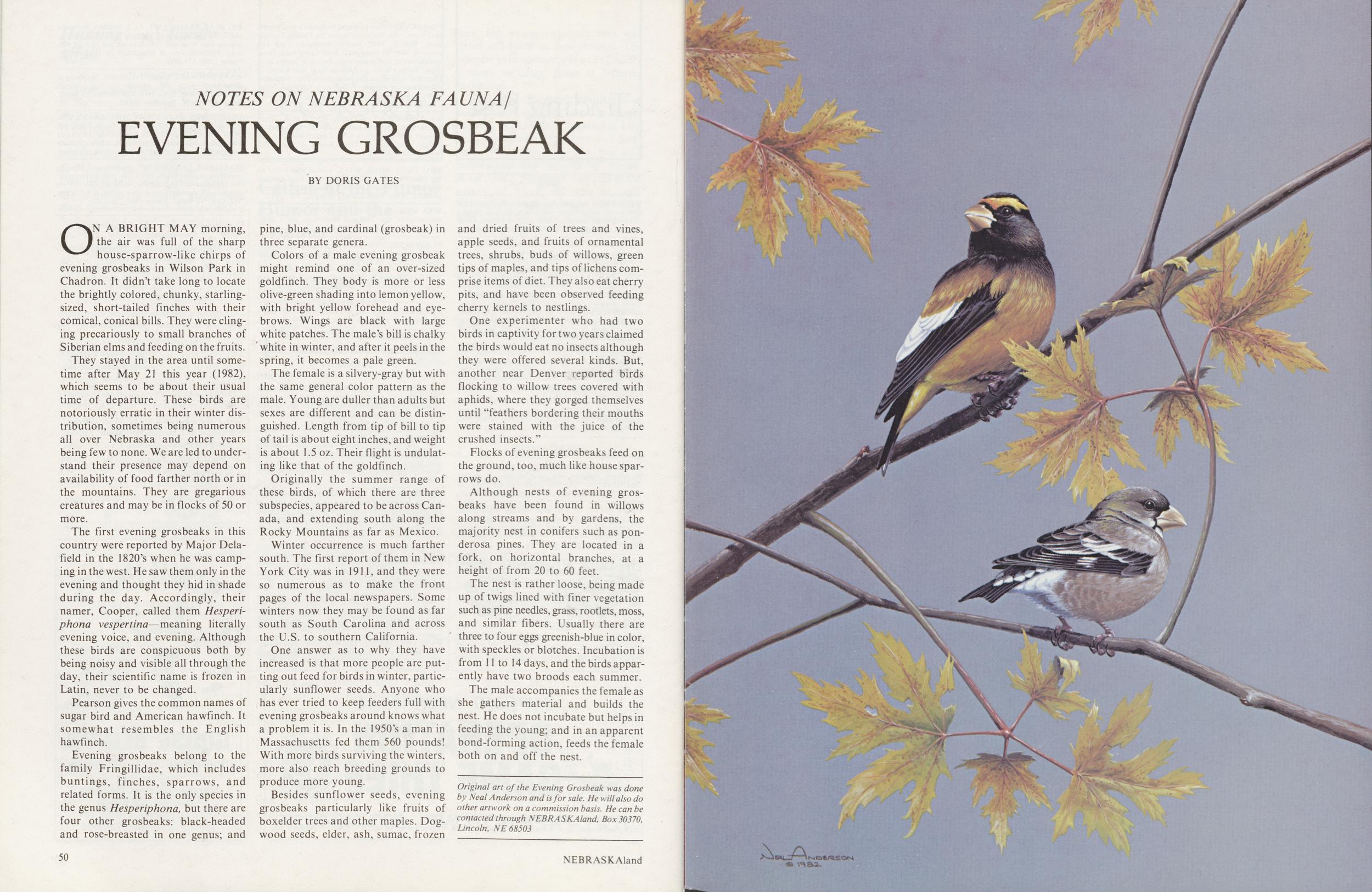
NOTES ON NEBRASKA FAUNA/ EVENING GROSBEAK
BY DORIS GATESON A BRIGHT MAY morning, the air was full of the sharp house-sparrow-like chirps of evening grosbeaks in Wilson Park in Chadron. It didn't take long to locate the brightly colored, chunky, starling-sized, short-tailed finches with their comical, conical bills. They were clinging precariously to small branches of Siberian elms and feeding on the fruits.
They stayed in the area until sometime after May 21 this year (1982), which seems to be about their usual time of departure. These birds are notoriously erratic in their winter distribution, sometimes being numerous all over Nebraska and other years being few to none. We are led to understand their presence may depend on availability of food farther north or in the mountains. They are gregarious creatures and may be in flocks of 50 or more.
The first evening grosbeaks in this country were reported by Major Delafield in the 1820's when he was camp- ing in the west. He saw them only in the evening and thought they hid in shade during the day. Accordingly, their namer, Cooper, called them Hesperiphona vespertina—meaning literally evening voice, and evening. Although these birds are conspicuous both by being noisy and visible all through the day, their scientific name is frozen in Latin, never to be changed.
Pearson gives the common names of sugar bird and American hawfinch. It somewhat resembles the English hawfinch.
Evening grosbeaks belong to the family Fringillidae, which includes buntings, finches, sparrows, and related forms. It is the only species in the genus Hesperiphona, but there are four other grosbeaks: black-headed and rose-breasted in one genus; and pine, blue, and cardinal (grosbeak) in three separate genera.
Colors of a male evening grosbeak might remind one of an over-sized goldfinch. They body is more or less olive-green shading into lemon yellow, with bright yellow forehead and eyebrows. Wings are black with large white patches. The male's bill is chalky ' white in winter, and after it peels in the spring, it becomes a pale green.
The female is a silvery-gray but with the same general color pattern as the male. Young are duller than adults but sexes are different and can be distinguished. Length from tip of bill to tip of tail is about eight inches, and weight is about 1.5 oz. Their flight is undulating like that of the goldfinch.
Originally the summer range of these birds, of which there are three subspecies, appeared to be across Canada, and extending south along the Rocky Mountains as far as Mexico.
Winter occurrence is much farther south. The first report of them in New York City was in 1911, and they were so numerous as to make the front pages of the local newspapers. Some winters now they may be found as far south as South Carolina and across the U.S. to southern California.
One answer as to why they have increased is that more people are putting out feed for birds in winter, particularly sunflower seeds. Anyone who has ever tried to keep feeders full with evening grosbeaks around knows what a problem it is. In the 1950's a man in Massachusetts fed them 560 pounds! With more birds surviving the winters, more also reach breeding grounds to produce more young.
Besides sunflower seeds, evening grosbeaks particularly like fruits of boxelder trees and other maples. Dogwood seeds, elder, ash, sumac, frozen and dried fruits of trees and vines, apple seeds, and fruits of ornamental trees, shrubs, buds of willows, green tips of maples, and tips of lichens comprise items of diet. They also eat cherry pits, and have been observed feeding cherry kernels to nestlings.
One experimenter who had two birds in captivity for two years claimed the birds would eat no insects although they were offered several kinds. But, another near Denver reported birds flocking to willow trees covered with aphids, where they gorged themselves until "feathers bordering their mouths were stained with the juice of the crushed insects."
Flocks of evening grosbeaks feed on the ground, too, much like house sparrows do.
Although nests of evening grosbeaks have been found in willows along streams and by gardens, the majority nest in conifers such as ponderosa pines. They are located in a fork, on horizontal branches, at a height of from 20 to 60 feet.
The nest is rather loose, being made up of twigs lined with finer vegetation such as pine needles, grass, rootlets, moss, and similar fibers. Usually there are three to four eggs greenish-blue in color, with speckles or blotches. Incubation is from 11 to 14 days, and the birds apparently have two broods each summer.
The male accompanies the female as she gathers material and builds the nest. He does not incubate but helps in feeding the young; and in an apparent bond-forming action, feeds the female both on and off the nest.
Original art of the Evening Grosbeak was done by Neal Anderson and is for sale. He will also do other artwork on a commission basis. He can be contacted through NEBRASKAland, Box 30370, Lincoln, NE 68503 50 NEBRASKAland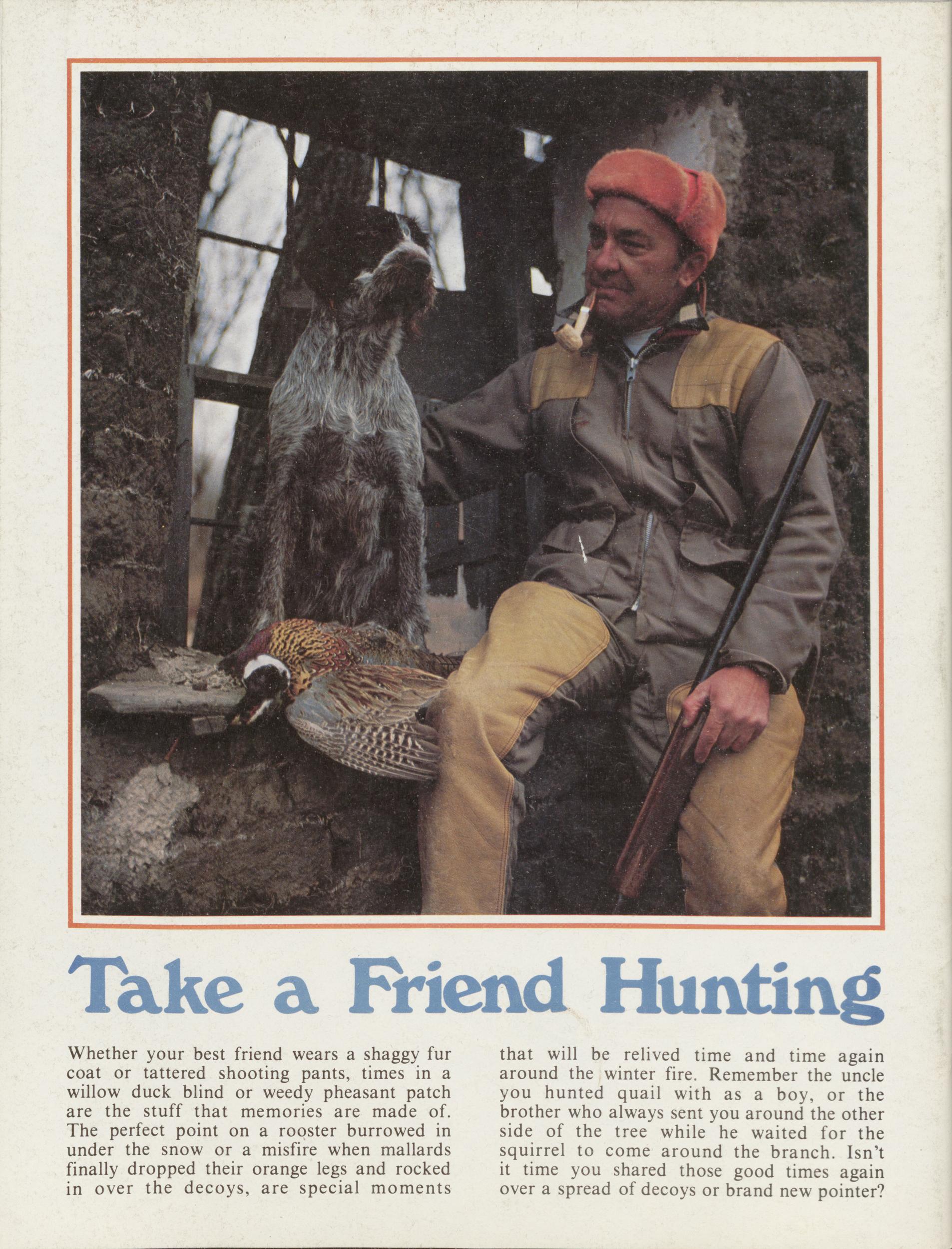
Take a Friend Hunting
Whether your best friend wears a shaggy fur coat or tattered shooting pants, times in a willow duck blind or weedy pheasant patch are the stuff that memories are made of. The perfect point on a rooster burrowed in under the snow or a misfire when mallards finally dropped their orange legs and rocked in over the decoys, are special moments that will be relived time and time again around the winter fire. Remember the uncle you hunted quail with as a boy, or the brother who always sent you around the other side of the tree while he waited for the squirrel to come around the branch. Isn't it time you shared those good times again over a spread of decoys or brand new pointer?Position: 305 (29 views)