Volume 60, Issue 16, 1982
NEBRASKAland
NOVEMBER 1982 $1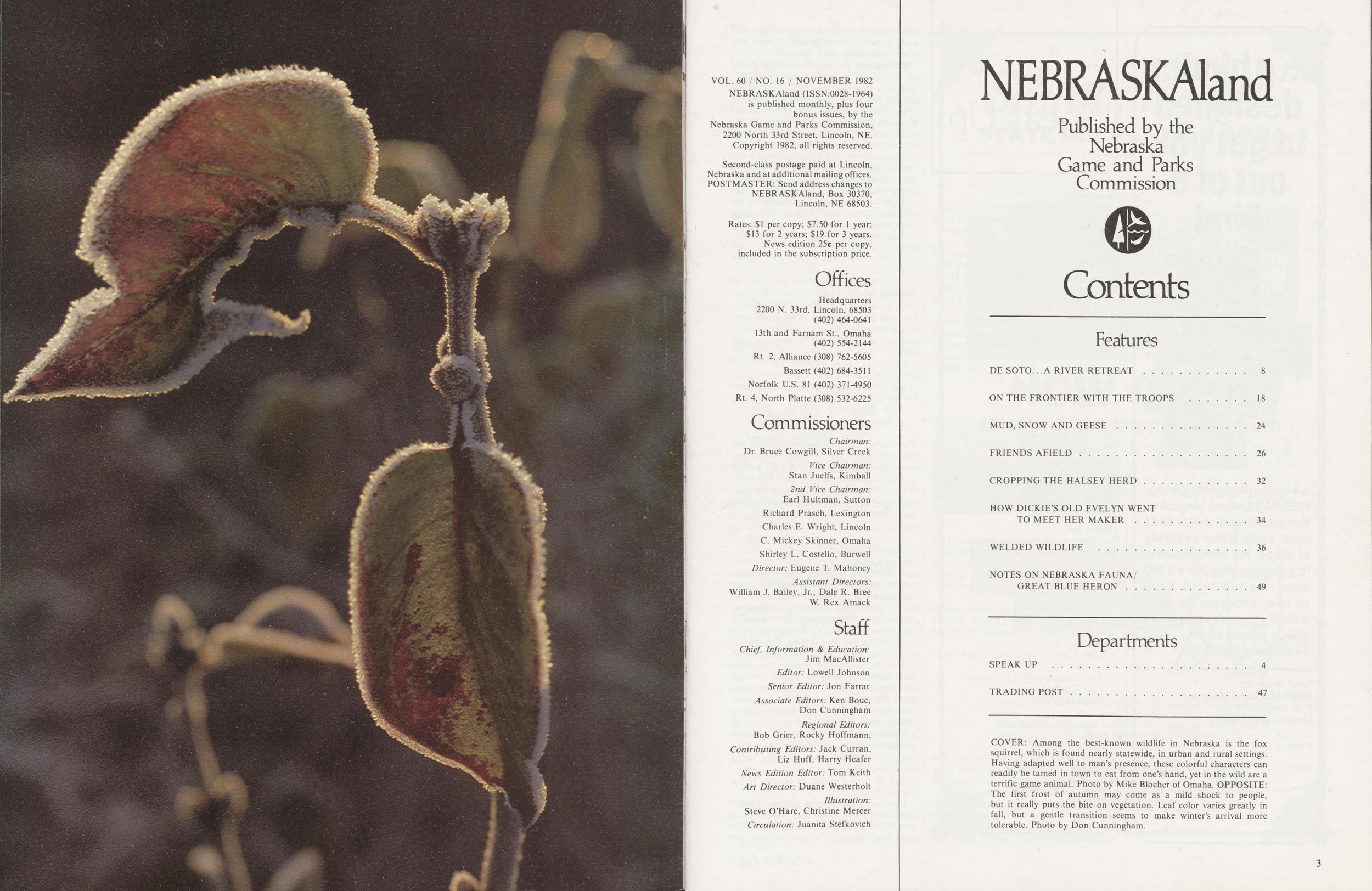
NEBRASKAland
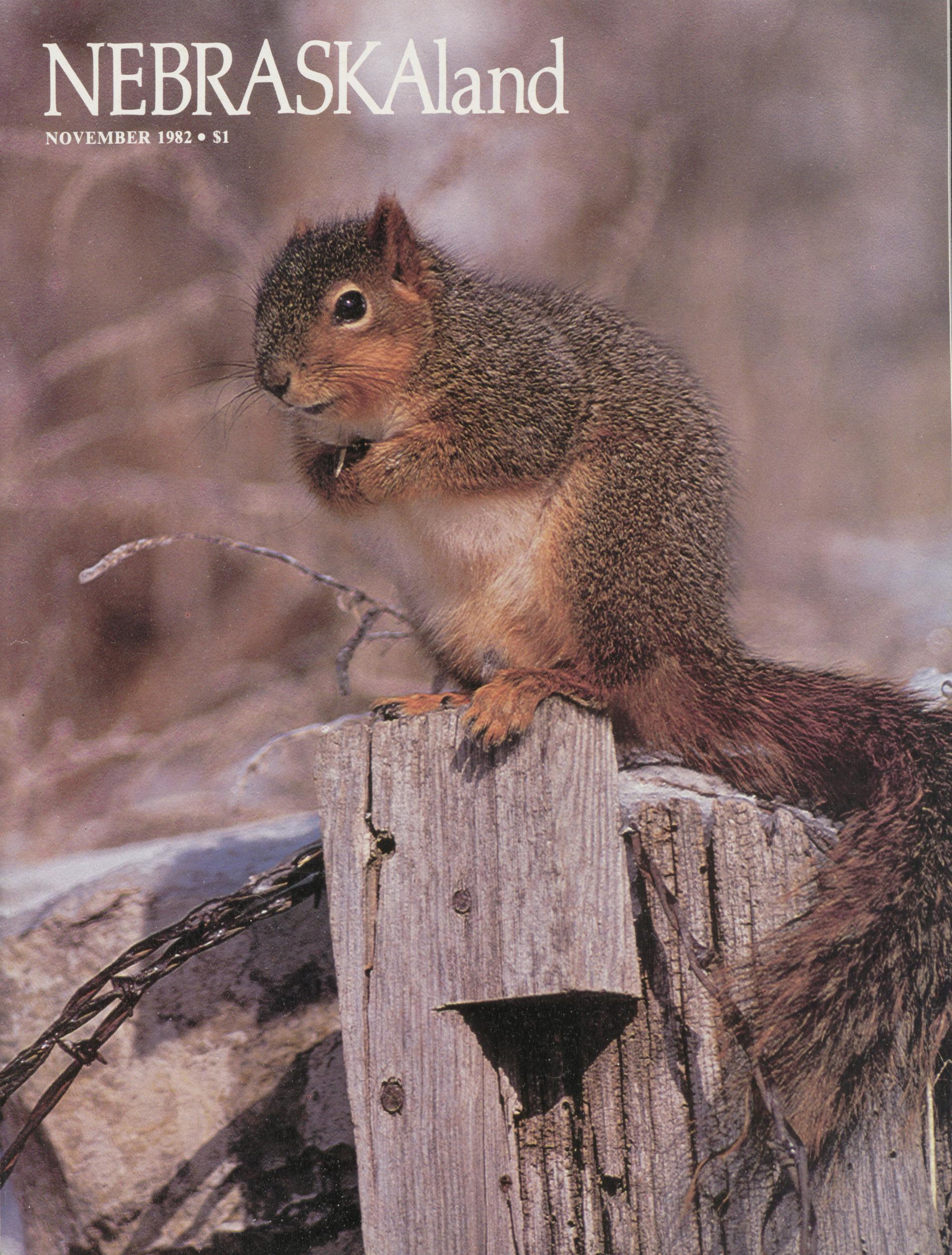
Published by the Nebraska Game and Parks Commission VOL. 60 /NO. 16 / NOVEMBER 1982 NEBRASKAland (ISSN:0028-1964) is published monthly, plus four bonus issues, by the Nebraska Game and Parks Commission, 2200 North 33rd Street, Lincoln, NE. Copyright 1982, all rights reserved. Second-class postage paid at Lincoln, Nebraska and at additional mailing offices. POSTMASTER: Send address changes to NEBRASKAland, Box 30370, Lincoln, NE 68503. Rates: $1 per copy; $7.50 for 1 year; $13 for 2 years; $19 for 3 years. News edition 25c per copy, included in the subscription price. Offices Headquarters 2200 N. 33rd, Lincoln, 68503 (402) 464-0641 13th and Farnam St., Omaha (402) 554-2144 Rt. 2, Alliance (308) 762-5605 Bassett (402) 684-3511 Norfolk U.S. 81 (402) 371-4950 Rt. 4, North Platte (308) 532-6225 Commissioners Chairman: Dr. Bruce Cowgill, Silver Creek Vice Chairman: Stan Juelfs, Kimball 2nd Vice Chairman: Earl Hultman, Sutton Richard Prasch, Lexington Charles E. Wright, Lincoln C. Mickey Skinner, Omaha Shirley L. Costello, Burwell Director: Eugene T. Mahoney Assistant Directors: William J. Bailey, Jr., Dale R. Bree W. Rex Amack Staff Chief, Information & Education: Jim MacAllister Editor: Lowell Johnson Senior Editor: Jon Farrar Associate Editors: Ken Bouc, Don Cunningham Regional Editors: Bob Grier, Rocky Hoffmann, Contributing Editors: Jack Curran, Liz Huff, Harry Heafer News Edition Editor: Tom Keith Art Director: Duane Westerholt Illustration: Steve O'Hare, Christine Mercer Circulation: Juanita Stefkovich Contents Features DE SOTO...A RIVER RETREAT 8 ON THE FRONTIER WITH THE TROOPS 18 MUD, SNOW AND GEESE 24 FRIENDS AFIELD 26 CROPPING THE HALSEY HERD 32 HOW DICKIE'S OLD EVELYN WENT TO MEET HER MAKER 34 WELDED WILDLIFE 36 NOTES ON NEBRASKA FAUNA/ GREAT BLUE HERON 49 Departments SPEAK UP 4 TRADING POST 47 COVER: Among the best-known wildlife in Nebraska is the fox squirrel, which is found nearly statewide, in urban and rural settings. Having adapted well to man's presence, these colorful characters can readily be tamed in town to eat from one's hand, yet in the wild are a terrific game animal. Photo by Mike Blocher of Omaha. OPPOSITE: The first frost of autumn may come as a mild shock to people, but it really puts the bite on vegetation. Leaf color varies greatly in fall, but a gentle transition seems to make winter's arrival more tolerable. Photo by Don Cunningham. 3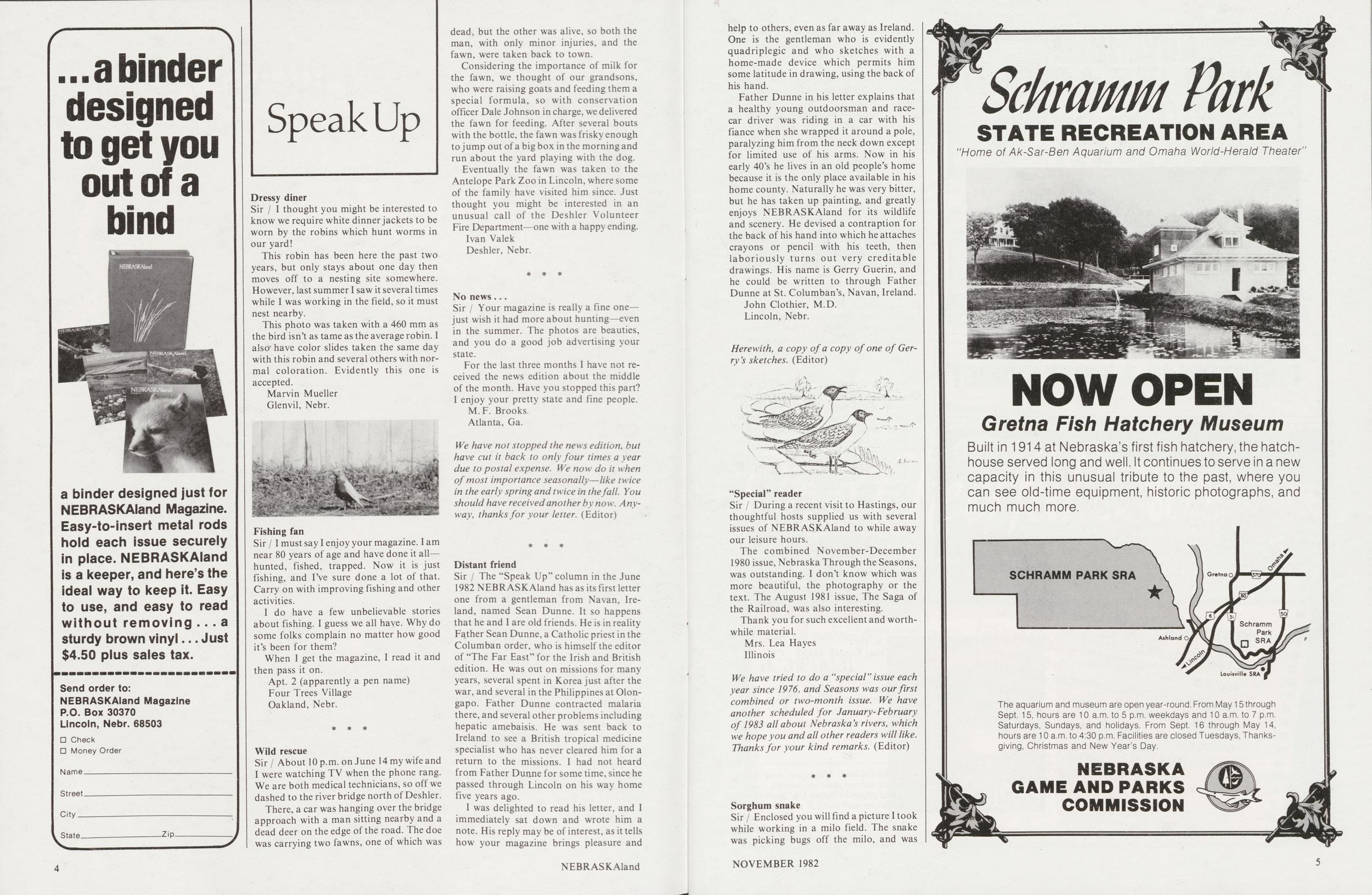
Speak Up
Dressy dinerSir / I thought you might be interested to know we require white dinner jackets to be worn by the robins which hunt worms in our yard!
This robin has been here the past two years, but only stays about one day then moves off to a nesting site somewhere. However, last summer I saw it several times while I was working in the field, so it must nest nearby.
This photo was taken with a 460 mm as the bird isn't as tame as the average robin. I also' have color slides taken the same day with this robin and several others with normal coloration. Evidently this one is accepted.
Marvin Mueller Glenvil, Nebr.Sir / I must say I enjoy your magazine. I am near 80 years of age and have done it all—hunted, fished, trapped. Now it is just fishing, and I've sure done a lot of that. Carry on with improving fishing and other activities.
I do have a few unbelievable stories about fishing. I guess we all have. Why do some folks complain no matter how good it's been for them?
When I get the magazine, I read it and then pass it on.
Apt. 2 (apparently a pen name) Four Trees Village Oakland, Nebr. Wild rescueSir / About 10 p.m. on June 14 my wife and I were watching TV when the phone rang. We are both medical technicians, so off we dashed to the river bridge north of Deshier.
There, a car was hanging over the bridge approach with a man sitting nearby and a dead deer on the edge of the road. The doe was carrying two fawns, one of which was dead, but the other was alive, so both the man, with only minor injuries, and the fawn, were taken back to town.
Considering the importance of milk for the fawn, we thought of our grandsons, who were raising goats and feeding them a special formula, so with conservation officer Dale Johnson in charge, we delivered the fawn for feeding. After several bouts with the bottle, the fawn was frisky enough to jump out of a big box in the morning and run about the yard playing with the dog.
Eventually the fawn was taken to the Antelope Park Zoo in Lincoln, where some of the family have visited him since. Just thought you might be interested in an unusual call of the Deshier Volunteer Fire Department—one with a happy ending.
Ivan Valek Deshier, Nebr. No news ...Sir / Your magazine is really a fine one—just wish it had more about hunting—even in the summer. The photos are beauties, and you do a good job advertising your state.
For the last three months I have not received the news edition about the middle of the month. Have you stopped this part? I enjoy your pretty state and fine people.
M. F. Brooks Atlanta, Ga.We have not stopped the news edition, but have cut it back to only four times a year due to postal expense. We now do it when of most importance seasonally—like twice in the early spring and twice in the fall You should have received another by now. Anyway, thanks for your letter. (Editor)
Distant friendSir / The "Speak Up" column in the June 1982 NEBRASKAland has as its first letter one from a gentleman from Navan, Ireland, named Sean Dunne. It so happens that he and I are old friends. He is in reality Father Sean Dunne, a Catholic priest in the Columban order, who is himself the editor of "The Far East" for the Irish and British edition. He was out on missions for many years, several spent in Korea just after the war, and several in the Philippines at Olongapo. Father Dunne contracted malaria there, and several other problems including hepatic amebaisis. He was sent back to Ireland to see a British tropical medicine specialist who has never cleared him for a return to the missions. I had not heard from Father Dunne for some time, since he passed through Lincoln on his way home five years ago.
I was delighted to read his letter, and I immediately sat down and wrote him a note. His reply may be of interest, as it tells how your magazine brings pleasure and 4 NEBRASKAland help to others, even as far away as Ireland. One is the gentleman who is evidently quadriplegic and who sketches with a home-made device which permits him some latitude in drawing, using the back of his hand.
Father Dunne in his letter explains that a healthy young outdoorsman and racecar driver was riding in a car with his fiance when she wrapped it around a pole, paralyzing him from the neck down except for limited use of his arms. Now in his early 40's he lives in an old people's home because it is the only place available in his home county. Naturally he was very bitter, but he has taken up painting, and greatly enjoys NEBRASKAIand for its wildlife and scenery. He devised a contraption for the back of his hand into which he attaches crayons or pencil with his teeth, then laboriously turns out very creditable drawings. His name is Gerry Guerin, and he could be written to through Father Dunne at St. Columban's, Navan, Ireland.
John Clothier, M.D. Lincoln, Nebr.Herewith, a copy of a copy of one of Gerry's sketches. (Editor)
Sir / During a recent visit to Hastings, our thoughtful hosts supplied us with several issues of NEBRASKAland to while away our leisure hours.
The combined November-December 1980 issue, Nebraska Through the Seasons, was outstanding. I don't know which was more beautiful, the photography or the text. The August 1981 issue, The Saga of the Railroad, was also interesting.
Thank you for such excellent and worthwhile material.
Mrs. Lea Hayes IllinoisWe have tried to do a "special"issue each year since 1976, and Seasons was our first combined or two-month issue. We have another scheduled for January-February of 1983 all about Nebraska's rivers, which we hope you and all other readers will like. Thanks for your kind remarks. (Editor)
Sorghum snakeSir / Enclosed you will find a picture I took while working in a milo field. The snake was picking bugs off the milo, and was there for over 20 minutes, as he was there when I found him, and all the while I was away getting the camera, and was still there when I left.
Schramm Park STATE RECREATION AREA "Home of Ak-Sar-Ben Aquarium and Omaha World-Herald Theater" NOW OPEN Gretna Fish Hatchery Museum Built in 1914 at Nebraska's first fish hatchery, the hatch-house served long and well. It continues to serve in a new capacity in this unusual tribute to the past, where you can see old-time equipment, historic photographs, and much much more. SCHRAMM PARK SRA The aquarium and museum are open year-round. From May 15 through Sept. 15, hours are 10 a.m. to 5 p.m. weekdays and 10 a.m. to 7 p.m. Saturdays, Sundays, and holidays. From Sept. 16 through May 14, hours are 10 a.m. to 4:30 p.m. Facilities are closed Tuesdays, Thanksgiving, Christmas and New Year's Day. NEBRASKA GAME AND PARKS COMMISSION NOVEMBER 1982 5 NOVEMBER
WILDLIFE & WOOD
CARVING SHOW
19, 20, & 21
Regency Fashion Courty-Omaha, Nebraska
POLLUTION IS A DIRTY WORD
NOVEMBER
WILDLIFE & WOOD
CARVING SHOW
19, 20, & 21
Regency Fashion Courty-Omaha, Nebraska
POLLUTION IS A DIRTY WORD
Friends told me to send it to you as they had never seen a snake at the top of milo getting his dinner.
Mrs. Kenneth Jorgensen Exeter, NebraskaSir / I get NEBRASKAland from my daughter, who lives in Wichita, Kansas. I'm 80 years old and remember the grade school song we used to sing. I was born and raised in Cuming County, Nebraska.
Oh Nebraskaland, Sweet Nebraskaland as on the highest hill I stand. I look away across the plains, and wonder if twill ever rain, but when I come to view my corn, I think I'll never sell my farm. When we first came to get a start The neighbors all lived far apart But now a man's on every claim And sometimes they all want the same.There are more verses, which I can't recall. Is there someone who remembers the others and would send them? I'd sure like to know.
Mrs. R. Geu Winfield, Kansas 67156Boy, I hope those other verses are better. Perhaps you need to sing them to really appreciate them. Just kidding. . . hope someone can recall and send them to you. What was it called—"Cuming 'round the Claim?" (Editor)
NEBRASKAland Magazine invites all readers to submit their comments, suggestions, and gripes to Speak Up. Each month the magazine will publish as many letters as space permits. Pictures are also welcome. NEBRASKAland does reserve the right to edit and condense letters. (Editor) 6 NEBRASKAland On a Cheerful Note From January's cardinal in the snow to December's ice sculpture on the Platte, the 1983 NEBRASKAland Calendar of Color will be a pleasant and useful addition to your home and office. There's information on the newest state park near Lincoln and Omaha, some delectable recipes, and much more. But the fabulous photos which accompany each month will start your days off with happy thoughts. Order yours now, and they're great for gifts, too! NEBRASKAland Magazines $3.00 TO: NEBRASKAland Calendar P.O. Box 3022, Omaha, Nebraska 68103 NAME ADDRESS CITY STATE Gentlemen: Please mail, postage-paid, Date. ZIP calendars at $3.00 each, plus sales tax if required. Nebraska residents must include sales tax. Total enclosed $ D My check is enclosed □ Money order enclosed Calendars are mailed at no extra charge at 3rd Class bulk rate Add $1 per calendar for 1st Class postage.
DeSoto... A River Retreat
PHOTOS AND TEXT BY KEN BOUC From the serenity of tip-toeing deer and falling cottonwood leaves to the raucous noises of people and geese, DeSoto National Wildlife Refuge east of Blair is a place of ever-changing moodsFARMERS LOOK UP from their chores for a moment or two, townsfolk forget business, and youngsters take time out from touch football. Almost as an involuntary reflex, they turn their eyes, their thoughts, and their dreams skyward. Fall has come to the Missouri River for sure now—the geese are heading for DeSoto.
It happened in October this year. That's when the first snow geese came; the vanguard of scores of undulating chevrons totaling hundreds of thousands of birds, all following the Missouri River toward wintering grounds far to the south. They've been making the same trip each fall since the end of the last ice age, but only in the last 20 years or so has a significant portion of the flight sought out this specific spot.
Known officially as DeSoto National Wildlife Refuge, the area sits astride the Nebraska-Iowa border 30 minutes north of Omaha. DeSoto's entrance is in Iowa, just off U.S. 30 a few miles east of Blair. There are 7,823 acres in all, including a seven-mile-long oxbow lake that loops through the tract of flat Missouri River bottomland.
The U.S. Fish and Wildlife Service established the refuge in 1959 to provide migrating waterfowl with a haven from the chaos that has engulfed their former haunts on the Missouri River. Vast changes have been made in the Missouri Valley since it was settled, most of which reduced waterfowl habitat along this traditional flyway.
Marshes, sandbars, chutes and backwaters were eliminated through channelization, leaving the birds few places to rest. Increased human activity like boat traffic, hunting and riverside agriculture compounded the effects of habitat loss. Thus, the sanctuary offered by places like DeSoto is most attractive to the birds.
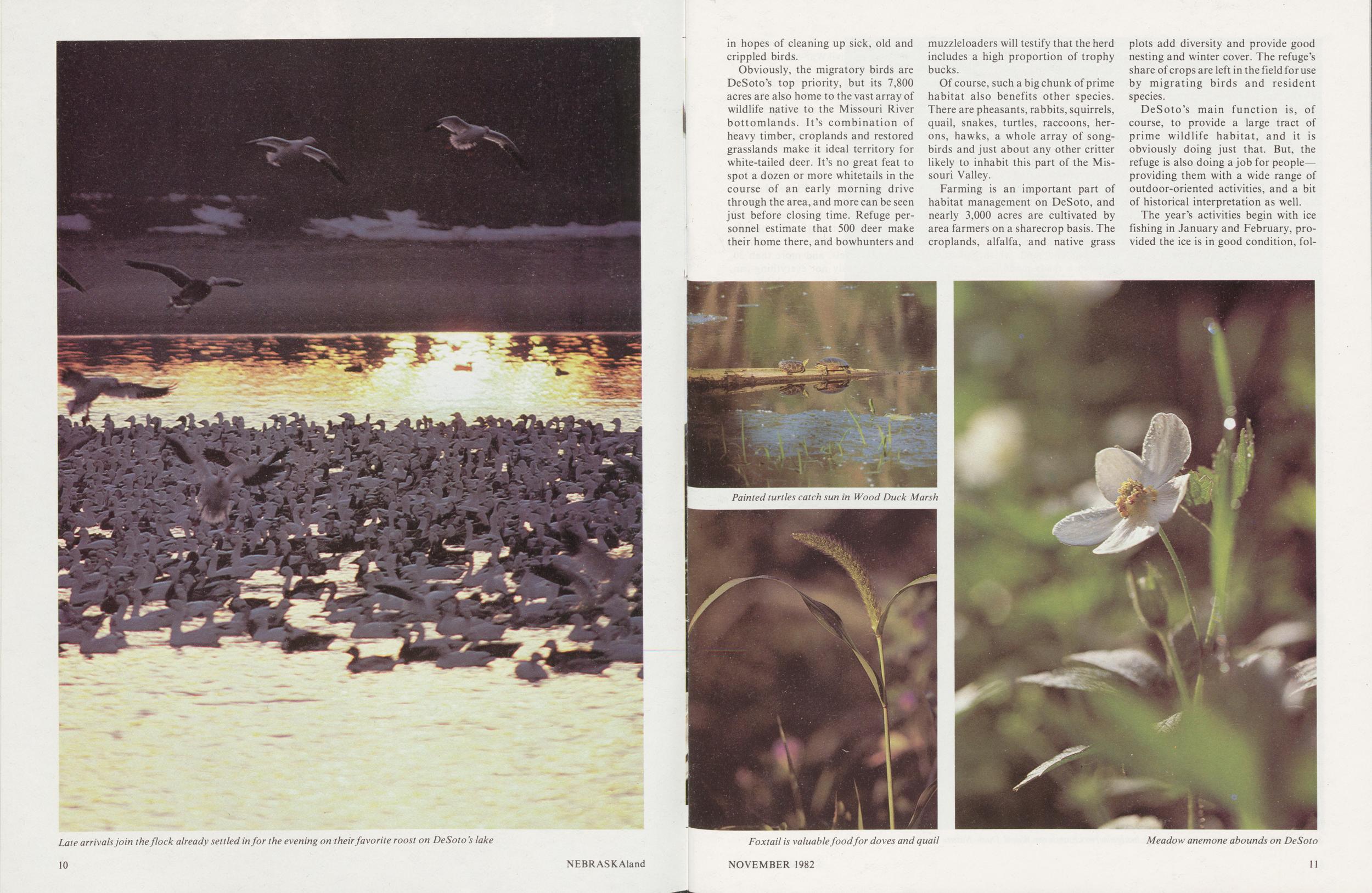
In an average year, peak fall waterfowl concentrations will include about 175,000 blue and snow geese, a few hundred Canadas, and 160,000 ducks.
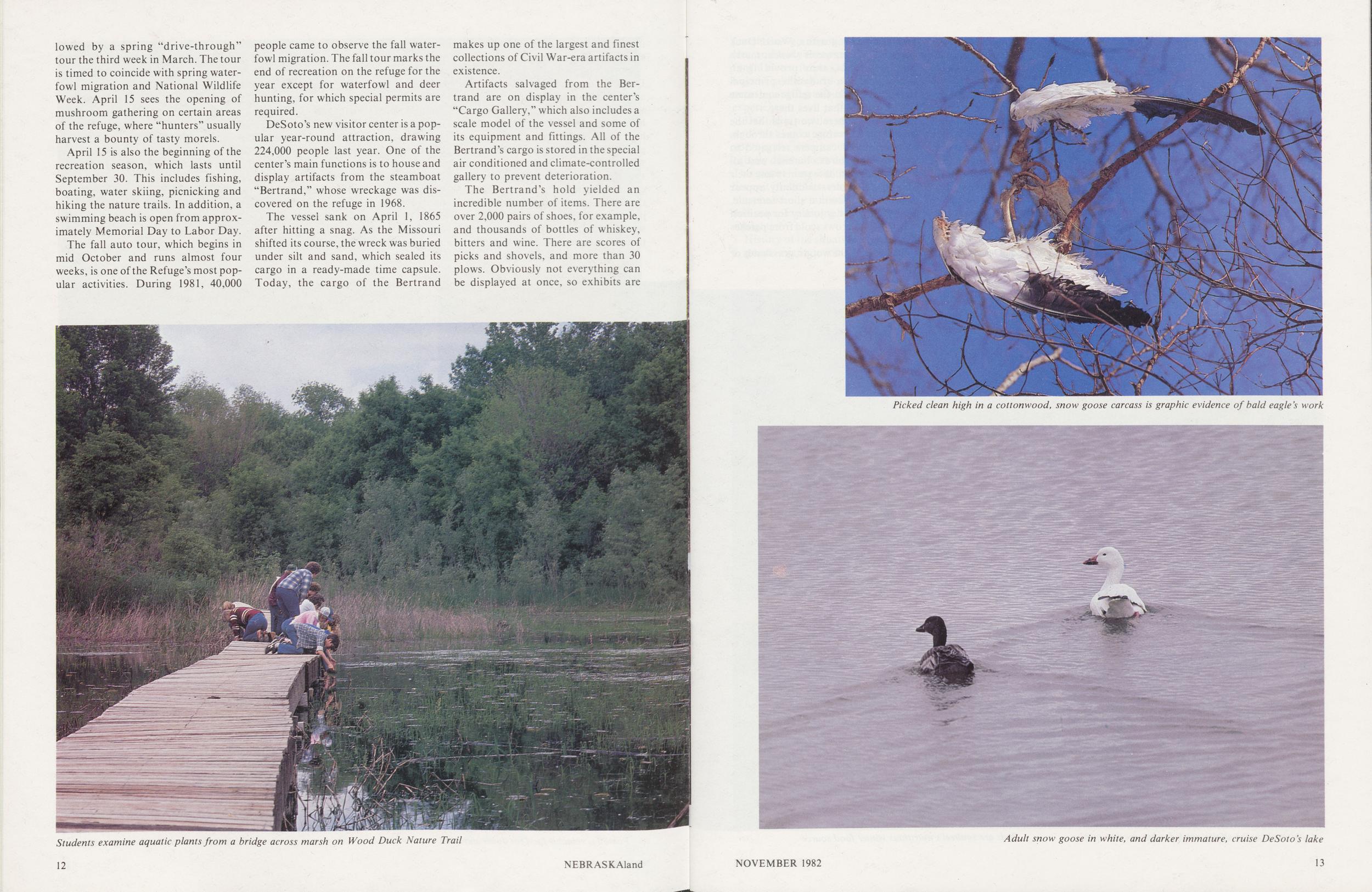
November sees the peak concentrations at DeSoto, but waterfowl will stay in the area well into December if open water remains available. And, as long as a significant number of ducks and geese remain, there will also be bald eagles hanging around the flock 8 NEBRASKAland
Obviously, the migratory birds are DeSoto's top priority, but its 7,800 acres are also home to the vast array of wildlife native to the Missouri River bottomlands. It's combination of heavy timber, croplands and restored grasslands make it ideal territory for white-tailed deer. It's no great feat to spot a dozen or more whitetails in the course of an early morning drive through the area, and more can be seen just before closing time. Refuge personnel estimate that 500 deer make their home there, and bowhunters and muzzleloaders will testify that the herd includes a high proportion of trophy bucks.
Of course, such a big chunk of prime habitat also benefits other species. There are pheasants, rabbits, squirrels, quail, snakes, turtles, raccoons, herons, hawks, a whole array of song-birds and just about any other critter likely to inhabit this part of the Missouri Valley.
Farming is an important part of habitat management on DeSoto, and nearly 3,000 acres are cultivated by area farmers on a sharecrop basis. The croplands, alfalfa, and native grass plots add diversity and provide good nesting and winter cover. The refuge's share of crops are left in the field for use by migrating birds and resident species.
DeSoto's main function is, of course, to provide a large tract of prime wildlife habitat, and it is obviously doing just that. But, the refuge is also doing a job for people—providing them with a wide range of outdoor-oriented activities, and a bit of historical interpretation as well.
The year's activities begin with ice fishing in January and February, provided the ice is in good condition, followed
 by a spring "drive-through"
tour the third week in March. The tour
is timed to coincide with spring waterfowl migration and National Wildlife
Week. April 15 sees the opening of
mushroom gathering on certain areas
of the refuge, where "hunters" usually
harvest a bounty of tasty morels.
by a spring "drive-through"
tour the third week in March. The tour
is timed to coincide with spring waterfowl migration and National Wildlife
Week. April 15 sees the opening of
mushroom gathering on certain areas
of the refuge, where "hunters" usually
harvest a bounty of tasty morels.
April 15 is also the beginning of the recreation season, which lasts until September 30. This includes fishing, boating, water skiing, picnicking and hiking the nature trails. In addition, a swimming beach is open from approximately Memorial Day to Labor Day.
The fall auto tour, which begins in mid October and runs almost four weeks, is one of the Refuge's most popular activities. During 1981, 40,000 people came to observe the fall waterfowl migration. The fall tour marks the end of recreation on the refuge for the year except for waterfowl and deer hunting, for which special permits are required.
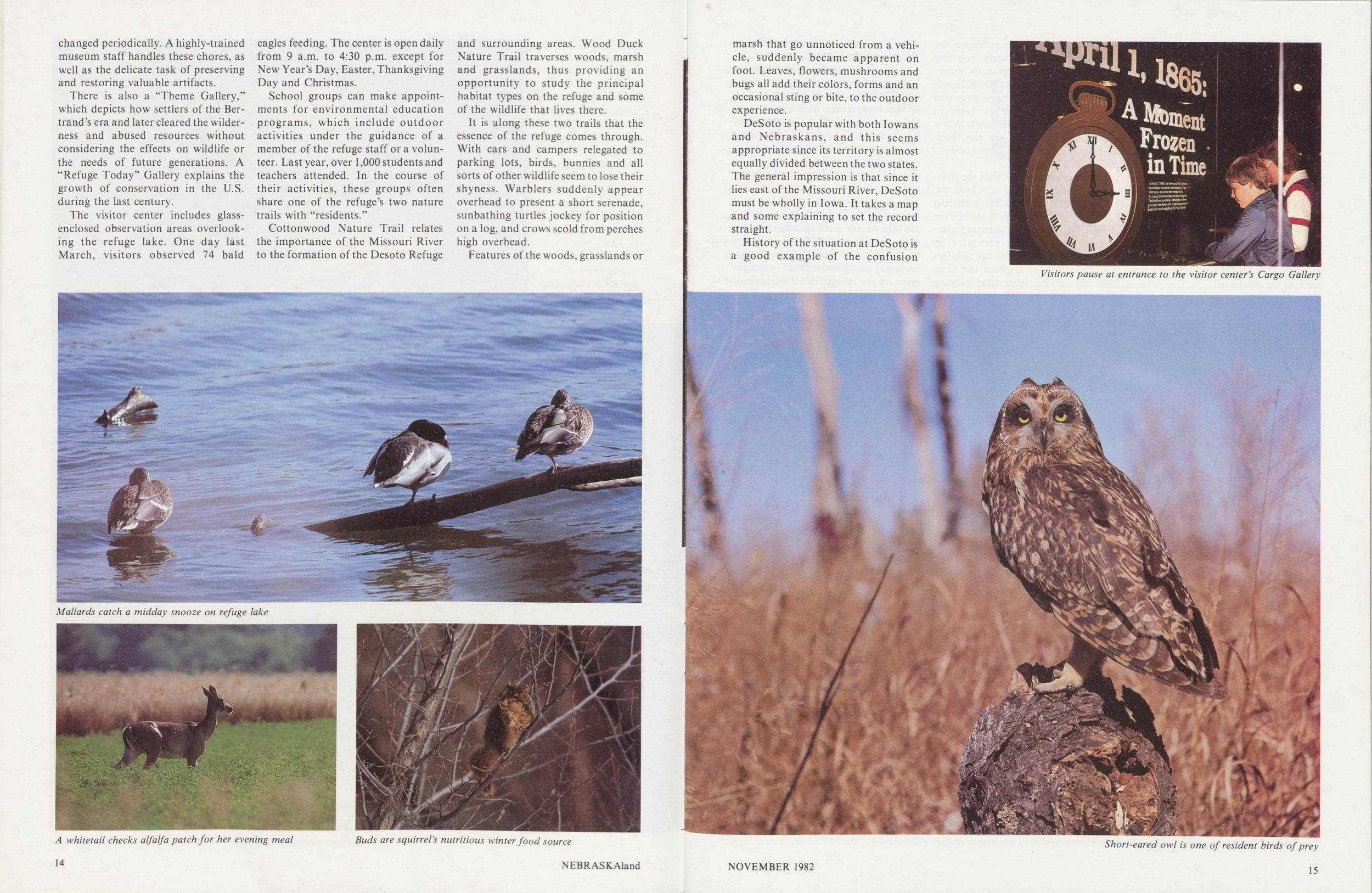
DeSoto's new visitor center is a popular year-round attraction, drawing 224,000 people last year. One of the center's main functions is to house and display artifacts from the steamboat "Bertrand," whose wreckage was discovered on the refuge in 1968.
The vessel sank on April 1, 1865 after hitting a snag. As the Missouri shifted its course, the wreck was buried under silt and sand, which sealed its cargo in a ready-made time capsule. Today, the cargo of the Bertrand makes up one of the largest and finest collections of Civil War-era artifacts in existence.
Artifacts salvaged from the Bertrand are on display in the center's "Cargo Gallery," which also includes a scale model of the vessel and some of its equipment and fittings. All of the Bertrand's cargo is stored in the special air conditioned and climate-controlled gallery to prevent deterioration.
The Bertrand's hold yielded an incredible number of items. There are over 2,000 pairs of shoes, for example, and thousands of bottles of whiskey, bitters and wine. There are scores of picks and shovels, and more than 30 plows. Obviously not everything can be displayed at once, so exhibits are
 changed periodically. A highly-trained
museum staff handles these chores, as
well as the delicate task of preserving
and restoring valuable artifacts.
changed periodically. A highly-trained
museum staff handles these chores, as
well as the delicate task of preserving
and restoring valuable artifacts.
There is also a "Theme Gallery," which depicts how settlers of the Bertrand's era and later cleared the wilderness and abused resources without considering the effects on wildlife or the needs of future generations. A "Refuge Today" Gallery explains the growth of conservation in the U.S. during the last century.
The visitor center includes glass-enclosed observation areas overlooking the refuge lake. One day last March, visitors observed 74 bald eagles feeding. The center is open daily from 9 a.m. to 4:30 p.m. except for New Year's Day, Easter, Thanksgiving Day and Christmas.
School groups can make appointments for environmental education programs, which include outdoor activities under the guidance of a member of the refuge staff or a volunteer. Last year, over 1,000 students and teachers attended. In the course of their activities, these groups often share one of the refuge's two nature trails with "residents."
Cottonwood Nature Trail relates the importance of the Missouri River to the formation of the Desoto Refuge and surrounding areas. Wood Duck Nature Trail traverses woods, marsh and grasslands, thus providing an opportunity to study the principal habitat types on the refuge and some of the wildlife that lives there.
It is along these two trails that the essence of the refuge comes through. With cars and campers relegated to parking lots, birds, bunnies and all sorts of other wildlife seem to lose their shyness. Warblers suddenly appear overhead to present a short serenade, sunbathing turtles jockey for position on a log, and crows scold from perches high overhead.
Features of the woods, grasslands or Features of the woods, grasslands or
DeSoto is popular with both Iowans and Nebraskans, and this seems appropriate since its territory is almost equally divided between the two states. The general impression is that since it lies east of the Missouri River, DeSoto must be wholly in Iowa. It takes a map and some explaining to set the record straight.
History of the situation at DeSoto is a good example of the confusion
 wrought by the Missouri River's
meandering and the Corps of Engineers' attempts to "correct" the river.
wrought by the Missouri River's
meandering and the Corps of Engineers' attempts to "correct" the river.
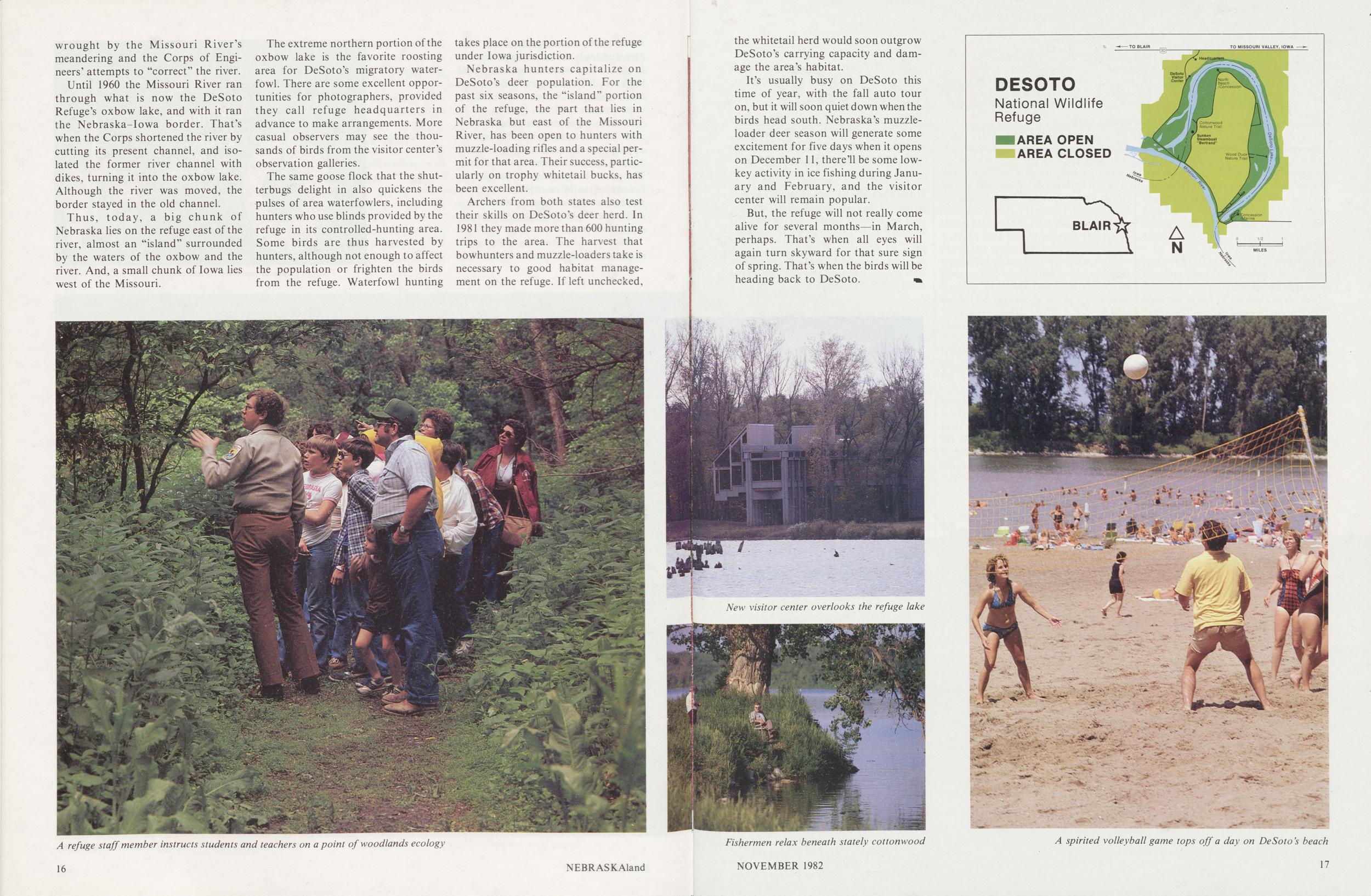
Until 1960 the Missouri River ran through what is now the DeSoto Refuge's oxbow lake, and with it ran the Nebraska-Iowa border. That's when the Corps shortened the river by cutting its present channel, and isolated the former river channel with dikes, turning it into the oxbow lake. Although the river was moved, the border stayed in the old channel.
Thus, today, a big chunk of Nebraska lies on the refuge east of the river, almost an "island" surrounded by the waters of the oxbow and the river. And, a small chunk of Iowa lies west of the Missouri.
The extreme northern portion of the oxbow lake is the favorite roosting area for DeSoto's migratory waterfowl. There are some excellent opportunities for photographers, provided they call refuge headquarters in advance to make arrangements. More casual observers may see the thousands of birds from the visitor center's observation galleries.
The same goose flock that the shutterbugs delight in also quickens the pulses of area waterfowlers, including hunters who use blinds provided by the refuge in its controlled-hunting area. Some birds are thus harvested by hunters, although not enough to affect the population or frighten the birds from the refuge. Waterfowl hunting takes place on the portion of the refuge under Iowa jurisdiction.
Nebraska hunters capitalize on DeSoto's deer population. For the past six seasons, the "island" portion of the refuge, the part that lies in Nebraska but east of the Missouri River, has been open to hunters with muzzle-loading rifles and a special permit for that area. Their success, particularly on trophy whitetail bucks, has been excellent.
Archers from both states also test their skills on DeSoto's deer herd. In 1981 they made more than 600 hunting trips to the area. The harvest that bowhunters and muzzle-loaders take is necessary to good habitat management on the refuge. If left unchecked,
It's usually busy on DeSoto this time of year, with the fall auto tour on, but it will soon quiet down when the birds head south. Nebraska's muzzle-loader deer season will generate some excitement for five days when it opens on December 11, there'll be some lowkey activity in ice fishing during January and February, and the visitor center will remain popular.
But, the refuge will not really come alive for several months—in March, perhaps. That's when all eyes will again turn skyward for that sure sign of spring. That's when the birds will be heading back to DeSoto.
The Nebraska Dispatch
SIXTH YEAR WEDNESDAY, MAY 10, 1876 NO. 187 On the Frontier With the Troops A True and Accurate Account of the Daily Hardships and Privations Borne by the Hardy Soldiers of Fort Hartsuff on the Loup River of NebraskaAs re-enacted in May of 1982 by Five Enlisted Men and a Government Scout Who Marched for Three Days Across the Desolate Hills and Towering Bluffs of this Wild Region, and Engaged in
An Imaginary Skirmish with Sioux Indians As reported by D. Cunningham, our Correspondent in the FieldThose who reside in the sedate and civilized metropolises in the eastern regions of this young republic, accustomed to the luxuries of bricked thoroughfares and rubber-tired conveyances, of abundant hot water and an infinite variety of dainty foodstuffs, to say nothing of the comforts of a settled life and the protection of an alert and ever-present constabulary, may little comprehend the rigors of the frontier settler. Nay, to be beset by summer heat sufficient to consume the struggling crops, to wrestle with a plague of locusts blackening the Autumn sky, to shiver at the meager hearth, engulfed by raging prairie blizzards, cut off by ice and drift from the few distant neighbors far off on the lonesome plains, or to fear by day and night the howling descent of Indian raiders, requires a fortitude and strength of spirit well-nigh inconceivable to those who have not been put to the test.
Chief among the protections that the hardy souls in the vast lands west of the broad Missouri may rely upon is the common soldier, torn from the bosom of his family and sent to serve upon the plains. Tales of his deeds abound, and long will we celebrate his courage, for his heroism in the teeth of battle, yet in the main his life is one of heat and cold, of drudgery and boredom, of salt pork and hardtack.
One cannot lightly entertain the thought of trekking into the wild interior of this region, depending for protection and for sustenance upon the meager goods strapped insecurely about his person. One must look forward to long nights beneath the stars, protected from the cold earth by the fragile membrane of an India-rubber poncho and comforted in but a single woolen blanket. Nor are the days devoid of danger. It is but a moment since were heard, in the words of Mr. Harold Foght, A.M., of The Ord Quiz, ".. . the lonely bluffs of the Loup echoing the sharp crack of the rifles of the white men and the red engaged in mortal combat."
Yet soldiers may not question orders, and with light hearts and merry smiles surprising to this scribbler, the little company received its orders and set out, seeming in fact to relish this bold undertaking. Herewith a true transcription of the document under whose aegis they went forth:
Hdqrs. Fort Hartsuff, Neb. Dept. of the Platte Special Orders No. 7 May 6, 1876Sgt. Henry is to proceed with detachment of men and one gov't scout to a point in the sandhills northwest of the forks of the Calamus and Loup rivers.
Sgt. Henry is directed to locate a route from near the point where Sgt. Dougherty was killed by marauding Sioux on the 28th ultimo. This route and its reconaissance should be covert so as not to alarm local settlers. The area traversed should be evaluated with a view to establishing two or more outposts to be manned by small detachments for early warning of the hostiles entering the region.
Sgt. Henry will require Corp. Sperry to prepare a map of route covered with recommended outposts. This map, along with field diary, will be presented to Lt. Hajek, adjutant Fort Hartsuff, prior to sundown of the 9th inst.
Three days field rations will be drawn from the Post Quartermaster.
By Order of the Post CommanderTo habitual readers of this periodical, little reference will need be made to the death of brave First Sergeant Dougherty, casualty of the recent engagement known as the "Battle of the Blowout," which occurred little more than a week ago, on the 28th of April, 1876.
In brief, this bloody interlude occurred following the discovery of an itinerant band of Sioux, who were pursued and brought to bay in a wide blowout north of Pebble Creek. In the perhaps ill-advised assault upon it, Sgt. Dougherty was cut down with a mortal wound to the breast.
But that sad event lies in the past, and we have yet to introduce the cast of this, the second act in this frontier drama, a perilous march, a long-range skirmish with a band of hostiles, and at last a rousing welcome back to the safety of the fort.
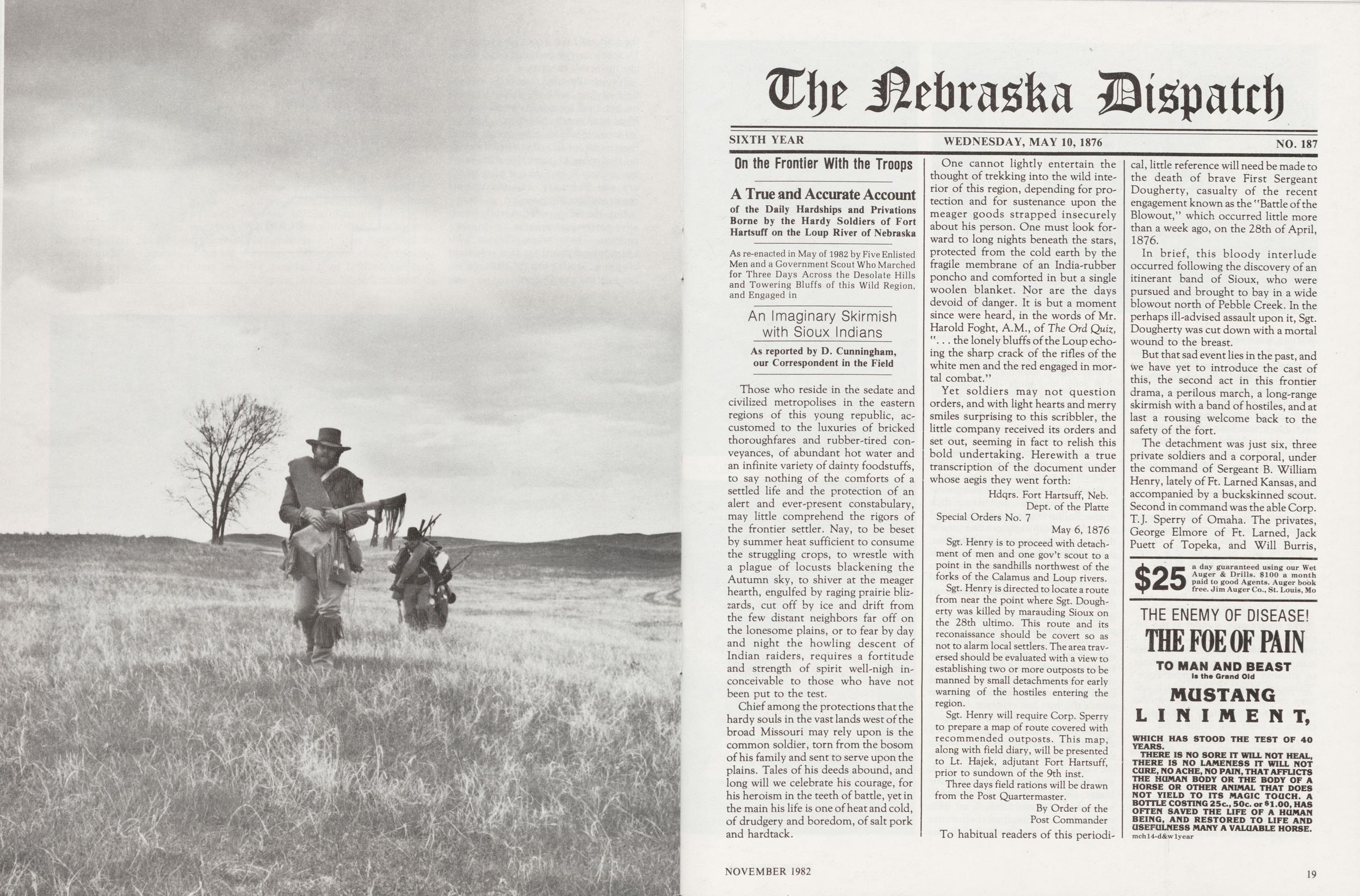
The detachment was just six, three private soldiers and a corporal, under the command of Sergeant B. William Henry, lately of Ft. Larned Kansas, and accompanied by a buckskinned scout. Second in command was the able Corp. T.J. Sperry of Omaha. The privates, George Elmore of Ft. Larned, Jack Puett of Topeka, and Will Burris, Wichita, a raw recruit, here making his first foray as a soldier. The scout was Charles Smith of Great Bend, Kansas, called "Chuck-a-Luck" by his grandfather, for the gambling game admired by tinhorns and bunco artists.
$25 a day guaranteed using our Wet Auger & Drills. $100 a month paid to good Agents. Auger book free. Jim Auger Co., St. Louis, Mo THE ENEMY OF DISEASE! THE FOE OF RUN TO MAN AND BEAST Is the Grand Old MUSTANG LINIMEN T, WHICH HAS STOOD THE TEST OF 40 YEARS. THERE IS NO SORE IT WILL NOT HEAL, THERE IS NO LAMENESS IT WILL NOT CURE, NO ACHE, NO PAIN, THAT AFFLICTS THE HUMAN BODY OR THE BODY OF A HORSE OR OTHER ANIMAL THAT DOES NOT YIELD TO ITS MAGIC TOUCH. A BOTTLE COSTING 25c, 50c. or $1.00, HAS OFTEN SAVED THE LIFE OF A HUMAN BEING, AND RESTORED TO LIFE AND USEFULNESS MANY A VALUABLE HORSE. NOVEMBER 1982 19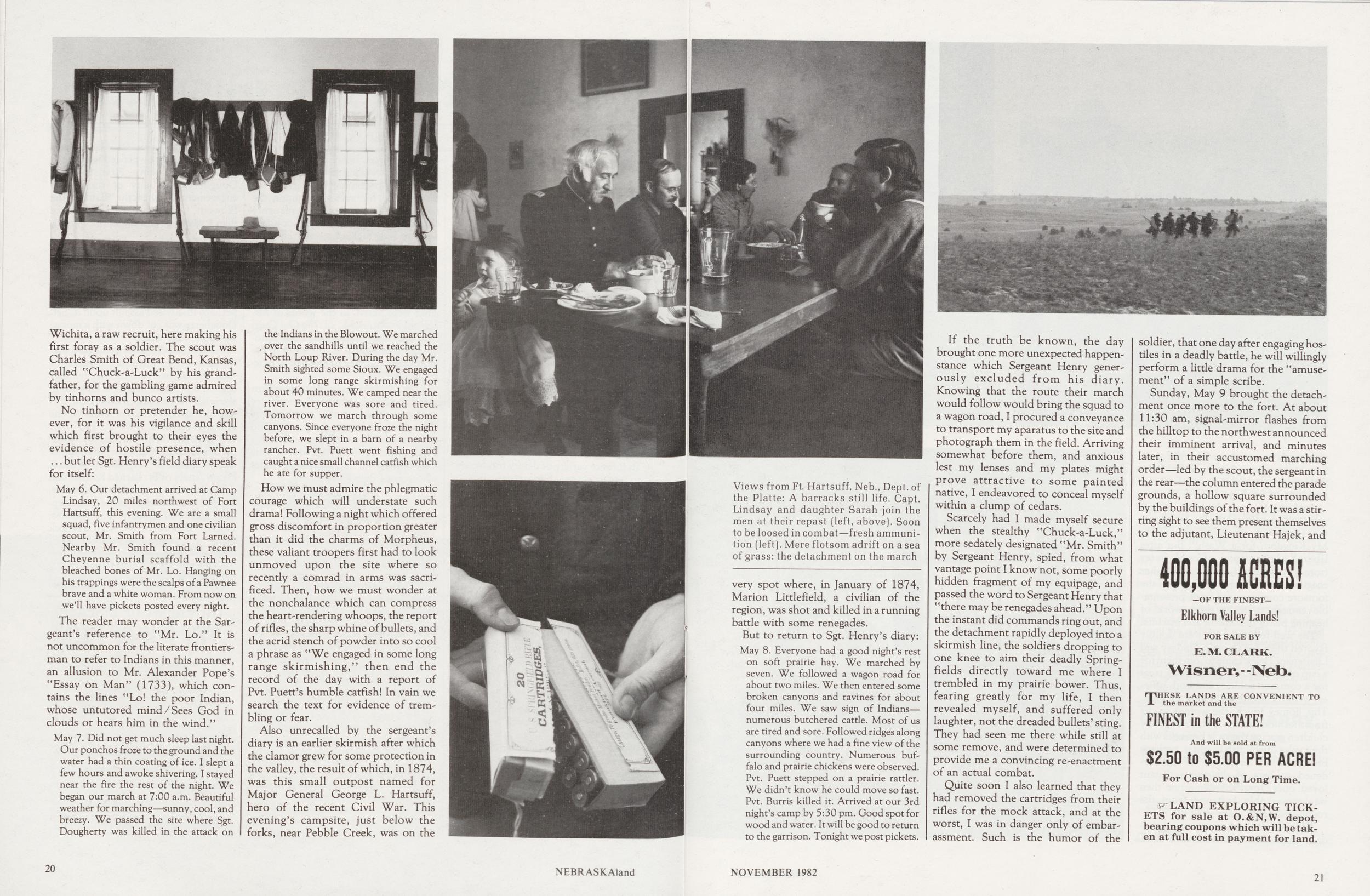
No tinhorn or pretender he, however, for it was his vigilance and skill which first brought to their eyes the evidence of hostile presence, when ... but let Sgt. Henry's field diary speak for itself:
May 6. Our detachment arrived at Camp Lindsay, 20 miles northwest of Fort Hartsuff, this evening. We are a small squad, five infantrymen and one civilian scout, Mr. Smith from Fort Larned. Nearby Mr. Smith found a recent Cheyenne burial scaffold with the bleached bones of Mr. Lo. Hanging on his trappings were the scalps of a Pawnee brave and a white woman. From now on we'll have pickets posted every night.
The reader may wonder at the Sargeant's reference to "Mr. Lo." It is not uncommon for the literate frontiersman to refer to Indians in this manner, an allusion to Mr. Alexander Pope's "Essay on Man" (1733), which contains the lines "Lo! the poor Indian, whose untutored mind/Sees God in clouds or hears him in the wind."
May 7. Did not get much sleep last night. Our ponchos froze to the ground and the water had a thin coating of ice. I slept a few hours and awoke shivering. I stayed near the fire the rest of the night. We began our march at 7:00 a.m. Beautiful weather for marching—sunny, cool, and breezy. We passed the site where Sgt. Dougherty was killed in the attack on the Indians in the Blowout. We marched over the sandhills until we reached the North Loup River. During the day Mr. Smith sighted some Sioux. We engaged in some long range skirmishing for about 40 minutes. We camped near the river. Everyone was sore and tired. Tomorrow we march through some canyons. Since everyone froze the night before, we slept in a barn of a nearby rancher. Pvt. Puett went fishing and caught a nice small channel catfish which he ate for supper.
How we must admire the phlegmatic courage which will understate such drama! Following a night which offered gross discomfort in proportion greater than it did the charms of Morpheus, these valiant troopers first had to look unmoved upon the site where so recently a comrad in arms was sacrificed. Then, how we must wonder at the nonchalance which can compress the heart-rendering whoops, the report of rifles, the sharp whine of bullets, and the acrid stench of powder into so cool a phrase as "We engaged in some long range skirmishing," then end the record of the day with a report of Pvt. Puett's humble catfish! In vain we search the text for evidence of trembling or fear.
Also unrecalled by the sergeant's diary is an earlier skirmish after which the clamor grew for some protection in the valley, the result of which, in 1874, was this small outpost named for Major General George L. Hartsuff, hero of the recent Civil War. This evening's campsite, just below the forks, near Pebble Creek, was on the 20 NEBRASKAland
But to return to Sgt. Henry's diary:
May 8. Everyone had a good night's rest on soft prairie hay. We marched by seven. We followed a wagon road for about two miles. We then entered some broken canyons and ravines for about four miles. We saw sign of Indians—numerous butchered cattle. Most of us are tired and sore. Followed ridges along canyons where we had a fine view of the surrounding country. Numerous buffalo and prairie chickens were observed. Pvt. Puett stepped on a prairie rattler. We didn't know he could move so fast. Pvt. Burris killed it. Arrived at our 3rd night's camp by 5:30 pm. Good spot for wood and water. It will be good to return to the garrison. Tonight we post pickets.
If the truth be known, the day brought one more unexpected happen-stance which Sergeant Henry generously excluded from his diary. Knowing that the route their march would follow would bring the squad to a wagon road, I procured a conveyance to transport my aparatus to the site and photograph them in the field. Arriving somewhat before them, and anxious lest my lenses and my plates might prove attractive to some painted native, I endeavored to conceal myself within a clump of cedars.
Scarcely had I made myself secure when the stealthy "Chuck-a-Luck," more sedately designated "Mr. Smith" by Sergeant Henry, spied, from what vantage point I know not, some poorly hidden fragment of my equipage, and passed the word to Sergeant Henry that "there may be renegades ahead." Upon the instant did commands ring out, and the detachment rapidly deployed into a skirmish line, the soldiers dropping to one knee to aim their deadly Springfields directly toward me where I trembled in my prairie bower. Thus, fearing greatly for my life, I then revealed myself, and suffered only laughter, not the dreaded bullets' sting. They had seen me there while still at some remove, and were determined to provide me a convincing re-enactment of an actual combat.
Quite soon I also learned that they had removed the cartridges from their rifles for the mock attack, and at the worst, I was in danger only of embarassment. Such is the humor of the soldier, that one day after engaging hostiles in a deadly battle, he will willingly perform a little drama for the "amusement" of a simple scribe.
Sunday, May 9 brought the detachment once more to the fort. At about 11:30 am, signal-mirror flashes from the hilltop to the northwest announced their imminent arrival, and minutes later, in their accustomed marching order—led by the scout, the sergeant in the rear—the column entered the parade grounds, a hollow square surrounded by the buildings of the fort. It was a stirring sight to see them present themselves to the adjutant, Lieutenant Hajek, and afterwards to see them raise the great flag up the towering pole, hauled from the banks of Long Pine Creek in the first year of the fort's life.
400,000 ACRES! -OF THE FINEST- Elkhorn Valley Lands! FOR SALE BY E. M. CLARK. Wisneiv -Neb, THESE LANDS ARE CONVENIENT TO the market and the FINEST in the STATE! And will be sold at from $2.50 to $5.00 PER ACRE! For Cash or on Long Time. sx LAND EXPLORING TICKETS for sale at 0.&N,W. depot, bearing coupons which will be taken at full cost in payment for land. NOVEMBER 1982 21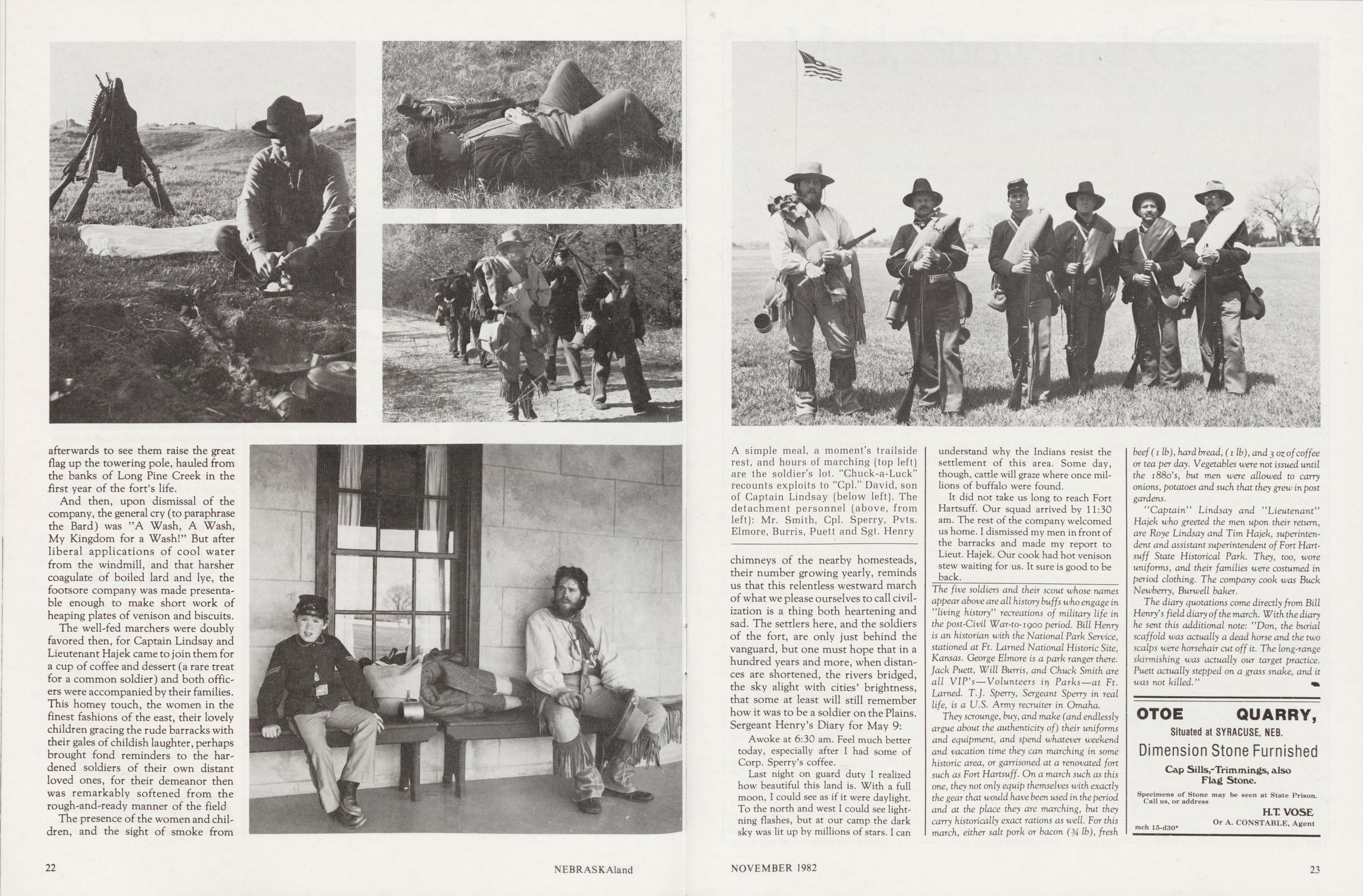
And then, upon dismissal of the company, the general cry (to paraphrase the Bard) was "A Wash, A Wash, My Kingdom for a Wash!" But after liberal applications of cool water from the windmill, and that harsher coagulate of boiled lard and lye, the footsore company was made presentable enough to make short work of heaping plates of venison and biscuits.
The well-fed marchers were doubly favored then, for Captain Lindsay and Lieutenant Hajek came to join them for a cup of coffee and dessert (a rare treat for a common soldier) and both officers were accompanied by their families. This homey touch, the women in the finest fashions of the east, their lovely children gracing the rude barracks with their gales of childish laughter, perhaps brought fond reminders to the hardened soldiers of their own distant loved ones, for their demeanor then was remarkably softened from the rough-and-ready manner of the field
The presence of the women and children, and the sight of smoke from 22 NEBRASKAland
Awoke at 6:30 am. Feel much better today, especially after I had some of Corp. Sperry's coffee.
Last night on guard duty I realized how beautiful this land is. With a full moon, I could see as if it were daylight. To the north and west I could see lightning flashes, but at our camp the dark sky was lit up by millions of stars. I can understand why the Indians resist the settlement o{ this area. Some day, though, cattle will graze where once millions of buffalo were found.
It did not take us long to reach Fort Hartsuff. Our squad arrived by 11:30 am. The rest of the company welcomed us home. I dismissed my men in front of the barracks and made my report to Lieut. Hajek. Our cook had hot venison stew waiting for us. It sure is good to be back.
The five soldiers and their scout whose names appear above are all history buffs who engage in "living history" recreations of military life in the post-Civil War-to-igoo period. Bill Henry is an historian with the National Park Service, stationed at Ft. Lamed National Historic Site, Kansas. George Elmore is a park ranger there. Jack Puett, Will Burris, and Chuck Smith are all VIP's—Volunteers in Parks—at Ft. Lamed. T.j. Sperry, Sergeant Sperry in real life, is a U.S. Army recruiter in Omaha.
They scrounge, buy, and make (and endlessly argue about the authenticity of) their uniforms and equipment, and spend whatever weekend and vacation time they can marching in some historic area, or garrisoned at a renovated fort such as Fort Hartsuff. On a march such as this one, they not only equip themselves with exactly the gear that would have been used in the period and at the place they are marching, but they carry historically exact rations as well. For this march, either salt pork or bacon (% lb), fresh beef(i lb), hard bread, (ilb), and 3 oz of coffee or tea per day. Vegetables were not issued until the 1880's, but men were allowed to carry onions, potatoes and such that they grew in post gardens.
"Captain" Lindsay and "Lieutenant" Hajek who greeted the men upon their return, are Roye Lindsay and Tim Hajek, superintendent and assistant superintendent of Fort Hartsuff State Historical Park. They, too, wore uniforms, and their families were costumed in period clothing. The company cook was Buck Newberry, Burwell baker.
The diary quotations come directly from Bill Henry's field diary of the march. With the diary he sent this additional note: "Don, the burial scaffold was actually a dead horse and the two scalps were horsehair cut off it. The long-range skirmishing was actually our target practice. Puett actually stepped on a grass snake, and it was not killed."
OTOE QUARRY, Situated at SYRACUSE. NEB. Dimension Stone Furnished Cap Sills, also Flag Stone. Specimens of Stone may be seen at State Prison. Call us, or address 15-d30 H.T VOSE Or A. CONSTABLE, Agent NOVEMBER 1982 23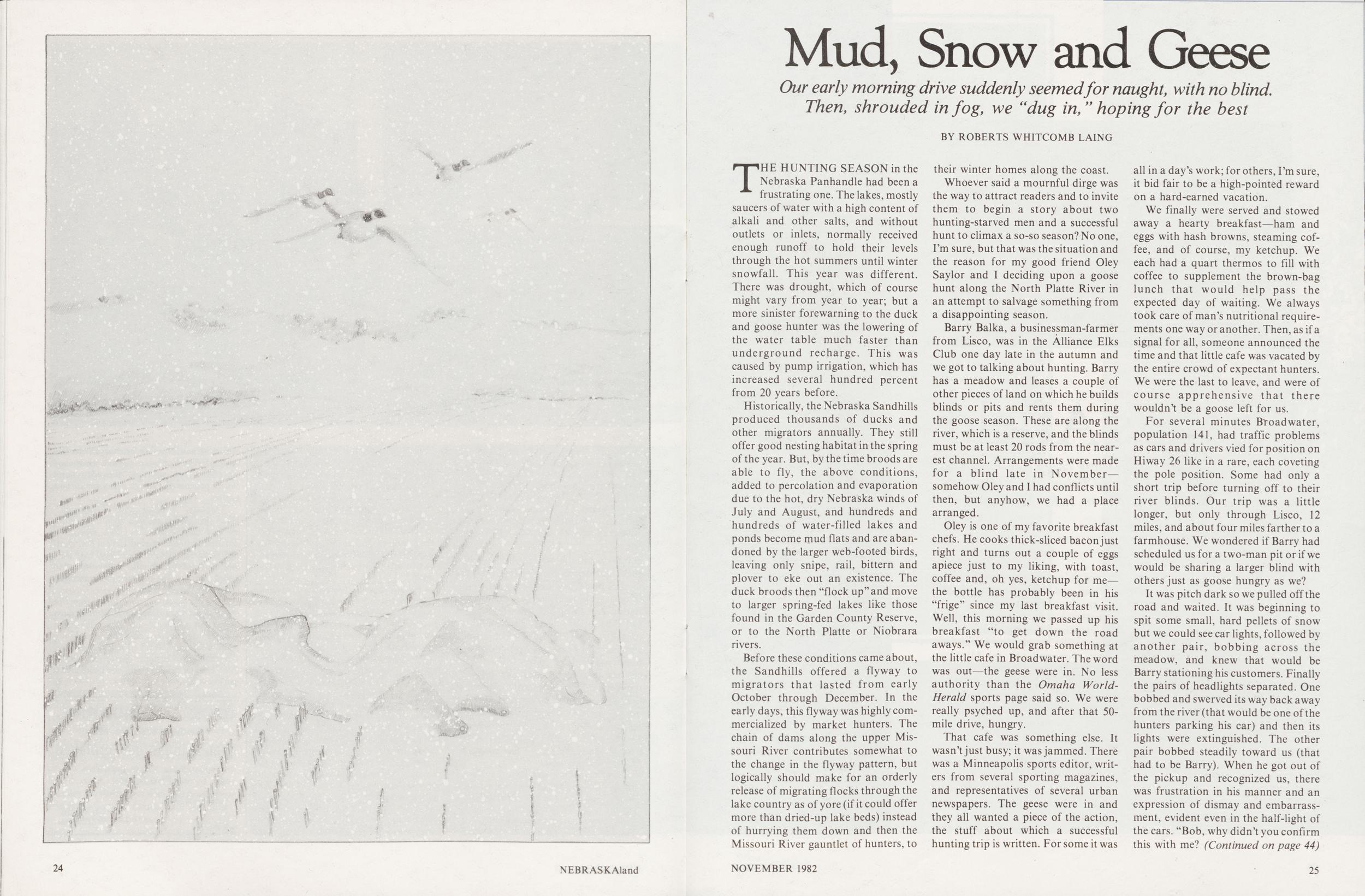
Mud, Snow and Geese
Our early morning drive suddenly seemed for naught, with no blind. Then, shrouded in fog, we "dug in," hoping for the best BY ROBERTS WHITCOMB LAINGTHE HUNTING SEASON in the Nebraska Panhandle had been a frustrating one. The lakes, mostly saucers of water with a high content of alkali and other salts, and without outlets or inlets, normally received enough runoff to hold their levels through the hot summers until winter snowfall. This year was different. There was drought, which of course might vary from year to year; but a more sinister forewarning to the duck and goose hunter was the lowering of the water table much faster than underground recharge. This was caused by pump irrigation, which has increased several hundred percent from 20 years before.
Historically, the Nebraska Sandhills produced thousands of ducks and other migrators annually. They still offer good nesting habitat in the spring of the year. But, by the time broods are able to fly, the above conditions, added to percolation and evaporation due to the hot, dry Nebraska winds of July and August, and hundreds and hundreds of water-filled lakes and ponds become mud flats and are abandoned by the larger web-footed birds, leaving only snipe, rail, bittern and plover to eke out an existence. The duck broods then "flock up" and move to larger spring-fed lakes like those found in the Garden County Reserve, or to the North Platte or Niobrara rivers.
Before these conditions came about, the Sandhills offered a flyway to migrators that lasted from early October through December. In the early days, this flyway was highly commercialized by market hunters. The chain of dams along the upper Missouri River contributes somewhat to the change in the flyway pattern, but logically should make for an orderly release of migrating flocks through the lake country as of yore (if it could offer more than dried-up lake beds) instead of hurrying them down and then the Missouri River gauntlet of hunters, to their winter homes along the coast.
Whoever said a mournful dirge was the way to attract readers and to invite them to begin a story about two hunting-starved men and a successful hunt to climax a so-so season? No one, I'm sure, but that was the situation and the reason for my good friend Oley Saylor and I deciding upon a goose hunt along the North Platte River in an attempt to salvage something from a disappointing season.
Barry Balka, a businessman-farmer from Lisco, was in the Alliance Elks Club one day late in the autumn and we got to talking about hunting. Barry has a meadow and leases a couple of other pieces of land on which he builds blinds or pits and rents them during the goose season. These are along the river, which is a reserve, and the blinds must be at least 20 rods from the nearest channel. Arrangements were made for a blind late in November—somehow Oley and I had conflicts until then, but anyhow, we had a place arranged.
Oley is one of my favorite breakfast chefs. He cooks thick-sliced bacon just right and turns out a couple of eggs apiece just to my liking, with toast, coffee and, oh yes, ketchup for me—the bottle has probably been in his "frige" since my last breakfast visit. Well, this morning we passed up his breakfast "to get down the road aways.'' We would grab something at the little cafe in Broadwater. The word was out—the geese were in. No less authority than the Omaha World-Herald sports page said so. We were really psyched up, and after that 50-mile drive, hungry.
That cafe was something else. It wasn't just busy; it was jammed. There was a Minneapolis sports editor, writers from several sporting magazines, and representatives of several urban newspapers. The geese were in and they all wanted a piece of the action, the stuff about which a successful hunting trip is written. For some it was all in a day's work; for others, I'm sure, it bid fair to be a high-pointed reward on a hard-earned vacation.
We finally were served and stowed away a hearty breakfast—ham and eggs with hash browns, steaming coffee, and of course, my ketchup. We each had a quart thermos to fill with coffee to supplement the brown-bag lunch that would help pass the expected day of waiting. We always took care of man's nutritional requirements one way or another. Then, as if a signal for all, someone announced the time and that little cafe was vacated by the entire crowd of expectant hunters. We were the last to leave, and were of course apprehensive that there wouldn't be a goose left for us.
For several minutes Broadwater, population 141, had traffic problems as cars and drivers vied for position on Hiway 26 like in a rare, each coveting the pole position. Some had only a short trip before turning off to their river blinds. Our trip was a little longer, but only through Lisco, 12 miles, and about four miles farther to a farmhouse. We wondered if Barry had scheduled us for a two-man pit or if we would be sharing a larger blind with others just as goose hungry as we?
It was pitch dark so we pulled off the road and waited. It was beginning to spit some small, hard pellets of snow but we could see car lights, followed by another pair, bobbing across the meadow, and knew that would be Barry stationing his customers. Finally the pairs of headlights separated. One bobbed and swerved its way back away from the river (that would be one of the hunters parking his car) and then its lights were extinguished. The other pair bobbed steadily toward us (that had to be Barry). When he got out of the pickup and recognized us, there was frustration in his manner and an expression of dismay and embarrassment, evident even in the half-light of the cars. "Bob, why didn't you confirm this with me? (Continued on page 44)
NOVEMBER 1982 25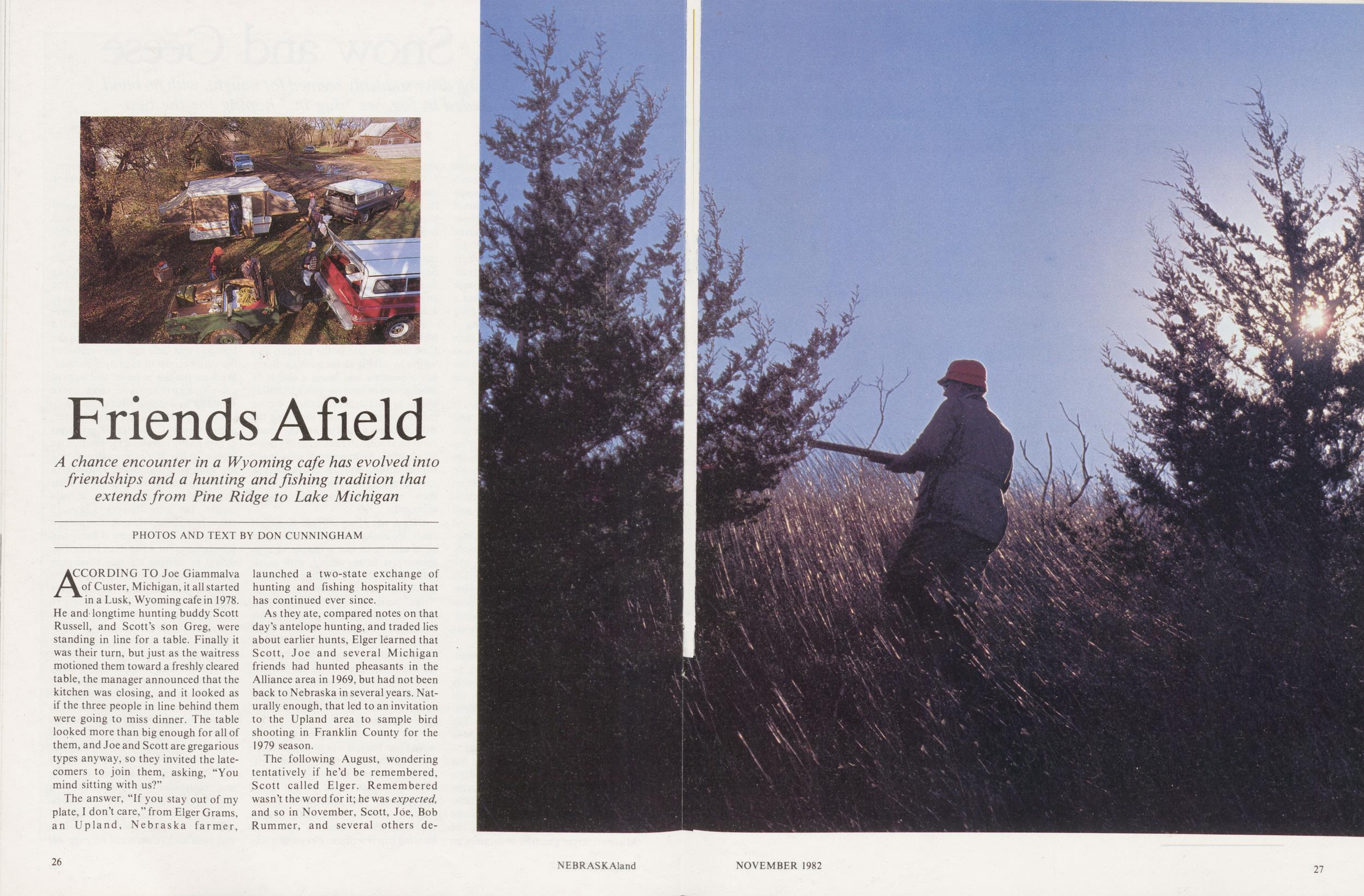
Friends Afield
A chance encounter in a Wyoming cafe has evolved into friendships and a hunting and fishing tradition that extends from Pine Ridge to Lake Michigan PHOTOS AND TEXT BY DON CUNNINGHAMACCORDING TO Joe Giammalva of Custer, Michigan, it all started in a Lusk, Wyoming cafe in 1978. He and longtime hunting buddy Scott Russell, and Scott's son Greg, were standing in line for a table. Finally it was their turn, but just as the waitress motioned them toward a freshly cleared table, the manager announced that the kitchen was closing, and it looked as if the three people in line behind them were going to miss dinner. The table looked more than big enough for all of them, and Joe and Scott are gregarious types anyway, so they invited the late-comers to join them, asking, "You mind sitting with us?"
The answer, "If you stay out of my plate, I don't care," from Elger Grams, an Upland, Nebraska farmer, launched a two-state exchange of hunting and fishing hospitality that has continued ever since.
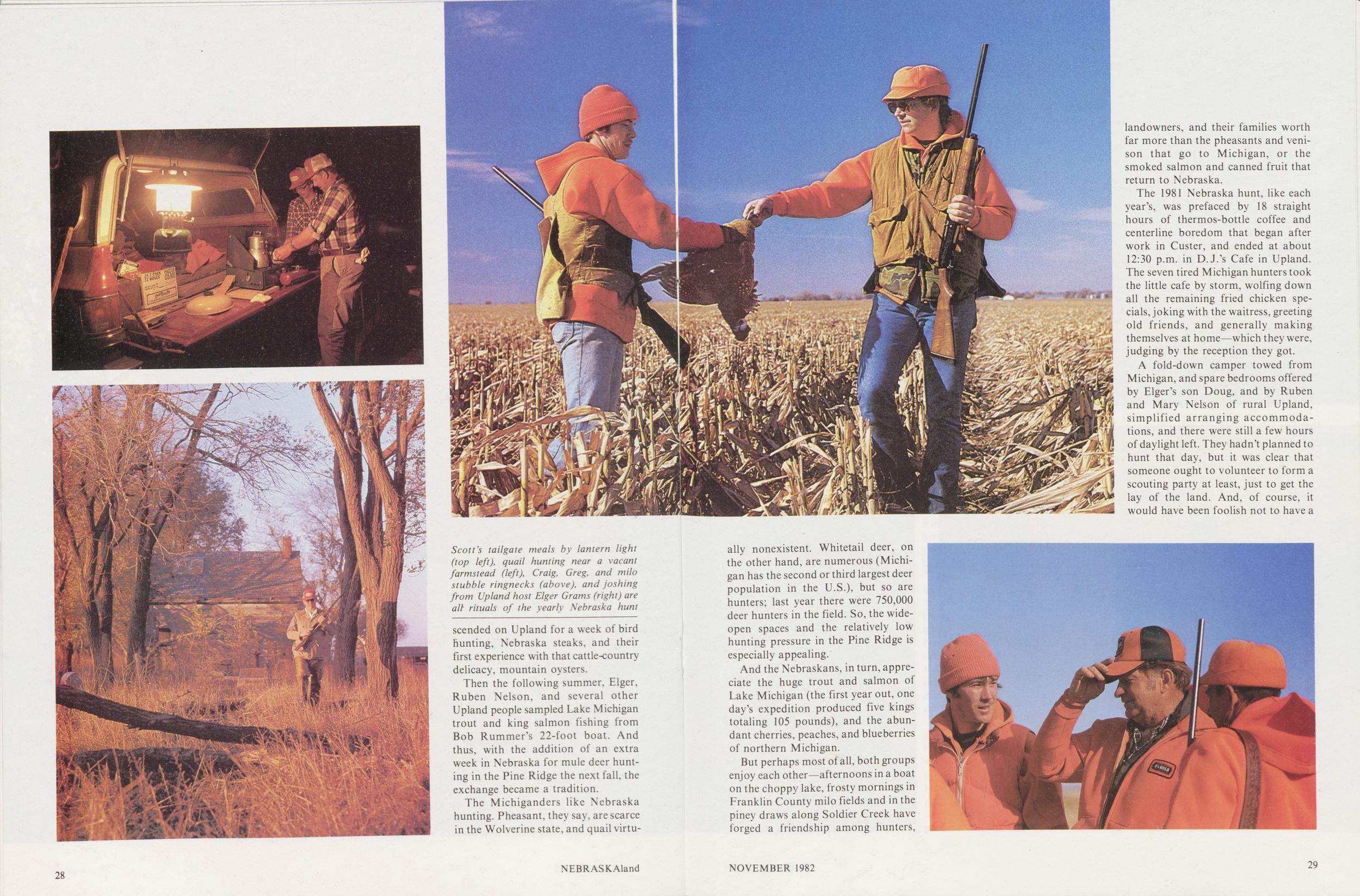
As they ate, compared notes on that day's antelope hunting, and traded lies about earlier hunts, Elger learned that Scott, Joe and several Michigan friends had hunted pheasants in the Alliance area in 1969, but had not been back to Nebraska in several years. Naturally enough, that led to an invitation to the Upland area to sample bird shooting in Franklin County for the 1979 season.
The following August, wondering tentatively if he'd be remembered, Scott called Elger. Remembered wasn't the word for it; he was expected, and so in November, Scott, Joe, Bob Rummer, and several others descended 26 NEBRASKAland
Then the following summer, Elger, Ruben Nelson, and several other Upland people sampled Lake Michigan trout and king salmon fishing from Bob Rummer's 22-foot boat. And thus, with the addition of an extra week in Nebraska for mule deer hunting in the Pine Ridge the next fall, the exchange became a tradition.
The Michiganders like Nebraska hunting. Pheasant, they say, are scarce in the Wolverine state, and quail virtually 28 NEBRASKAland nonexistent. Whitetail deer, on the other hand, are numerous (Michigan has the second or third largest deer population in the U.S.), but so are hunters; last year there were 750,000 deer hunters in the field. So, the wideopen spaces and the relatively low hunting pressure in the Pine Ridge is especially appealing.
And the Nebraskans, in turn, appreciate the huge trout and salmon of Lake Michigan (the first year out, one day's expedition produced five kings totaling 105 pounds), and the abundant cherries, peaches, and blueberries of northern Michigan.
But perhaps most of all, both groups enjoy each other—afternoons in a boat on the choppy lake, frosty mornings in Franklin County milo fields and in the piney draws along Soldier Creek have forged a friendship among hunters, landowners, and their families worth far more than the pheasants and venison that go to Michigan, or the smoked salmon and canned fruit that return to Nebraska.
The 1981 Nebraska hunt, like each year's, was prefaced by 18 straight hours of thermos-bottle coffee and centerline boredom that began after work in Custer, and ended at about 12:30 p.m. in D.J.'s Cafe in Upland. The seven tired Michigan hunters took the little cafe by storm, wolfing down all the remaining fried chicken specials, joking with the waitress, greeting old friends, and generally making themselves at home—which they were, judging by the reception they got.
A fold-down camper towed from Michigan, and spare bedrooms offered by Elger's son Doug, and by Ruben and Mary Nelson of rural Upland, simplified arranging accommodations, and there were still a few hours of daylight left. They hadn't planned to hunt that day, but it was clear that someone ought to volunteer to form a scouting party at least, just to get the lay of the land. And, of course, it would have been foolish not to have a
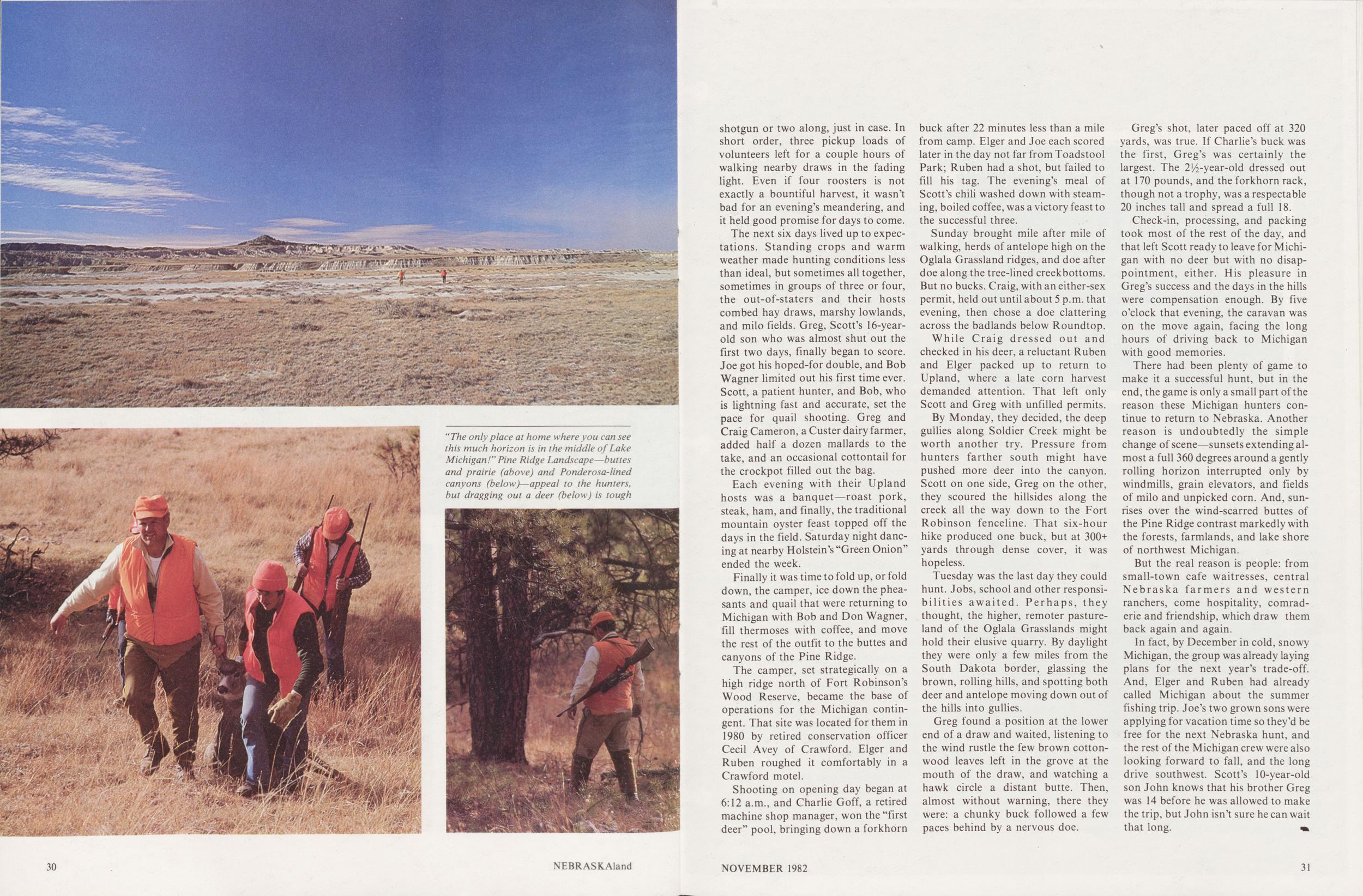
The next six days lived up to expectations. Standing crops and warm weather made hunting conditions less than ideal, but sometimes all together, sometimes in groups of three or four, the out-of-staters and their hosts combed hay draws, marshy lowlands, and milo fields. Greg, Scott's 16-year-old son who was almost shut out the first two days, finally began to score. Joe got his hoped-for double, and Bob Wagner limited out his first time ever. Scott, a patient hunter, and Bob, who is lightning fast and accurate, set the pace for quail shooting. Greg and Craig Cameron, a Custer dairy farmer, added half a dozen mallards to the take, and an occasional cottontail for the crockpot filled out the bag.
Each evening with their Upland hosts was a banquet—roast pork, steak, ham, and finally, the traditional mountain oyster feast topped off the days in the field. Saturday night dancing at nearby Holstein's "Green Onion" ended the week.
Finally it was time to fold up, or fold down, the camper, ice down the pheasants and quail that were returning to Michigan with Bob and Don Wagner, fill thermoses with coffee, and move the rest of the outfit to the buttes and canyons of the Pine Ridge.
The camper, set strategically on a high ridge north of Fort Robinson's Wood Reserve, became the base of operations for the Michigan contingent. That site was located for them in 1980 by retired conservation officer Cecil Avey of Crawford. Elger and Ruben roughed it comfortably in a Crawford motel.
Shooting on opening day began at 6:12 a.m., and Charlie Goff, a retired machine shop manager, won the "first deer" pool, bringing down a forkhorn buck after 22 minutes less than a mile from camp. Elger and Joe each scored later in the day not far from Toadstool Park; Ruben had a shot, but failed to fill his tag. The evening's meal of Scott's chili washed down with steaming, boiled coffee, was a victory feast to the successful three.
Sunday brought mile after mile of walking, herds of antelope high on the Oglala Grassland ridges, and doe after doe along the tree-lined creekbottoms. But no bucks. Craig, with an either-sex permit, held out until about 5 p.m. that evening, then chose a doe clattering across the badlands below Roundtop.
While Craig dressed out and checked in his deer, a reluctant Ruben and Elger packed up to return to Upland, where a late corn harvest demanded attention. That left only Scott and Greg with unfilled permits.
By Monday, they decided, the deep gullies along Soldier Creek might be worth another try. Pressure from hunters farther south might have pushed more deer into the canyon. Scott on one side, Greg on the other, they scoured the hillsides along the creek all the way down to the Fort Robinson fenceline. That six-hour hike produced one buck, but at 300+ yards through dense cover, it was hopeless.
Tuesday was the last day they could hunt. Jobs, school and other responsibilities awaited. Perhaps, they thought, the higher, remoter pastureland of the Oglala Grasslands might hold their elusive quarry. By daylight they were only a few miles from the South Dakota border, glassing the brown, rolling hills, and spotting both deer and antelope moving down out of the hills into gullies.
Greg found a position at the lower end of a draw and waited, listening to the wind rustle the few brown cottonwood leaves left in the grove at the mouth of the draw, and watching a hawk circle a distant butte. Then, almost without warning, there they were: a chunky buck followed a few paces behind by a nervous doe.
Greg's shot, later paced off at 320 yards, was true. If Charlie's buck was the first, Greg's was certainly the largest. The 2½-year-old dressed out at 170 pounds, and the forkhorn rack, though not a trophy, was a respectable 20 inches tall and spread a full 18.
Check-in, processing, and packing took most of the rest of the day, and that left Scott ready to leave for Michigan with no deer but with no disappointment, either. His pleasure in Greg's success and the days in the hills were compensation enough. By five o'clock that evening, the caravan was on the move again, facing the long hours of driving back to Michigan with good memories.
There had been plenty of game to make it a successful hunt, but in the end, the game is only a small part of the reason these Michigan hunters continue to return to Nebraska. Another reason is undoubtedly the simple change of scene—sunsets extending almost a full 360 degrees around a gently rolling horizon interrupted only by windmills, grain elevators, and fields of milo and unpicked corn. And, sunrises over the wind-scarred buttes of the Pine Ridge contrast markedly with the forests, farmlands, and lake shore of northwest Michigan.
But the real reason is people: from small-town cafe waitresses, central Nebraska farmers and western ranchers, come hospitality, comraderie and friendship, which draw them back again and again.
In fact, by December in cold, snowy Michigan, the group was already laying plans for the next year's trade-off. And, Elger and Ruben had already called Michigan about the summer fishing trip. Joe's two grown sons were applying for vacation time so they'd be free for the next Nebraska hunt, and the rest of the Michigan crew were also looking forward to fall, and the long drive southwest. Scott's 10-year-old son John knows that his brother Greg was 14 before he was allowed to make the trip, but John isn't sure he can wait that long.
NOVEMBER 1982 31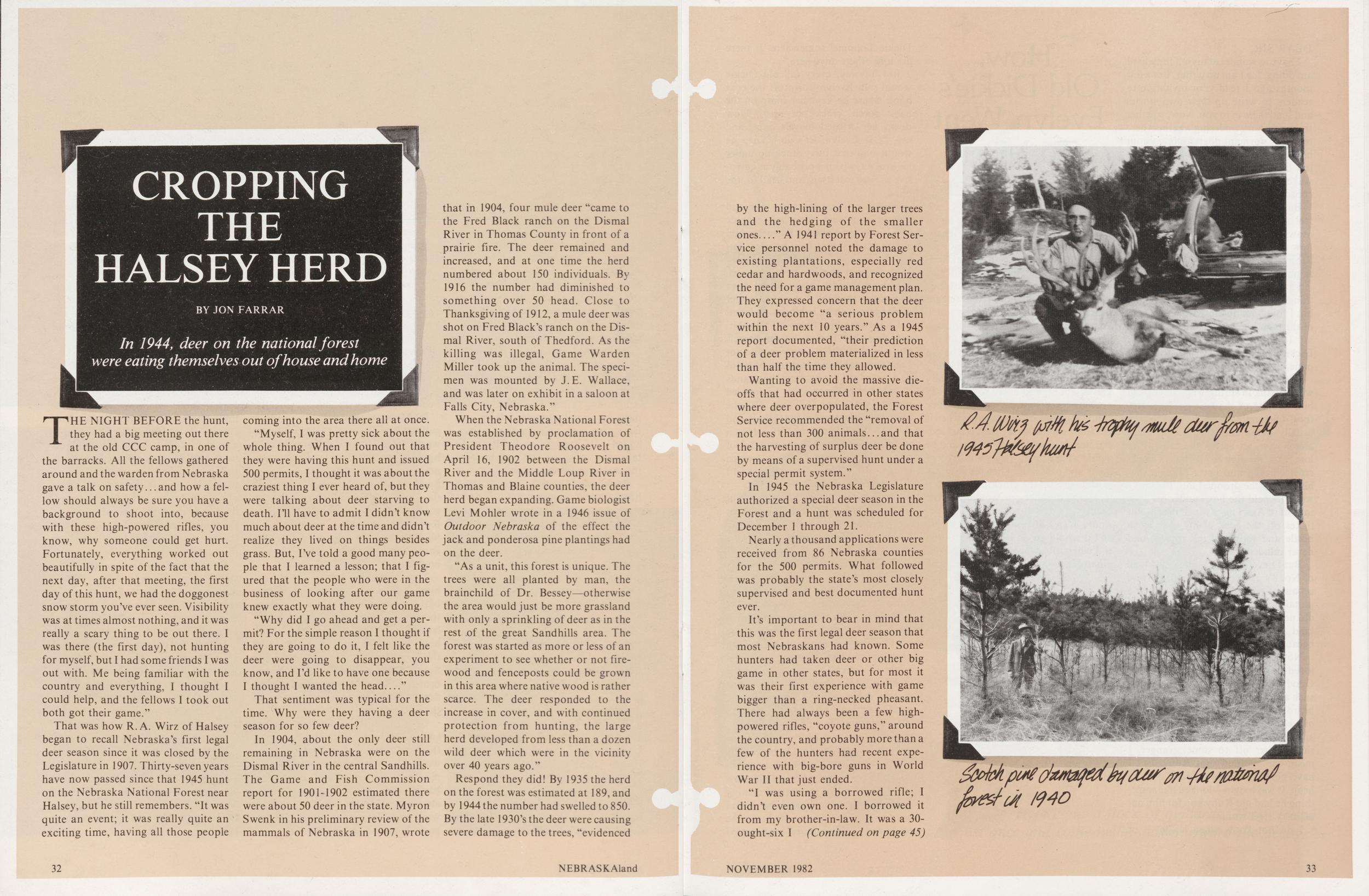
CROPPING THE HALSEY HERD
BY JON FARRAR In 1944, deer on the national forest were eating themselves out of house and homeTHE NIGHT BEFORE the hunt, they had a big meeting out there at the old CCC camp, in one of the barracks. All the fellows gathered around and the warden from Nebraska gave a talk on safety...and how a fellow should always be sure you have a background to shoot into, because with these high-powered rifles, you know, why someone could get hurt. Fortunately, everything worked out beautifully in spite of the fact that the next day, after that meeting, the first day of this hunt, we had the doggonest snow storm you've ever seen. Visibility was at times almost nothing, and it was really a scary thing to be out there. I was there (the first day), not hunting for myself, but I had some friends I was out with. Me being familiar with the country and everything, I thought I could help, and the fellows I took out both got their game."
That was how R. A. Wirz of Halsey began to recall Nebraska's first legal deer season since it was closed by the Legislature in 1907. Thirty-seven years have now passed since that 1945 hunt on the Nebraska National Forest near Halsey, but he still remembers. "It was quite an event; it was really quite an exciting time, having all those people coming into the area there all at once.
"Myself, I was pretty sick about the whole thing. When I found out that they were having this hunt and issued 500 permits, I thought it was about the craziest thing I ever heard of, but they were talking about deer starving to death. I'll have to admit I didn't know much about deer at the time and didn't realize they lived on things besides grass. But, I've told a good many people that I learned a lesson; that I figured that the people who were in the business of looking after our game knew exactly what they were doing.
"Why did I go ahead and get a permit? For the simple reason I thought if they are going to do it, I felt like the deer were going to disappear, you know, and I'd like to have one because I thought I wanted the head...."
That sentiment was typical for the time. Why were they having a deer season for so few deer?
In 1904, about the only deer still remaining in Nebraska were on the Dismal River in the central Sandhills. The Game and Fish Commission report for 190LI902 estimated there were about 50 deer in the state. Myron Swenk in his preliminary review of the mammals of Nebraska in 1907, wrote that in 1904, four mule deer "came to the Fred Black ranch on the Dismal River in Thomas County in front of a prairie fire. The deer remained and increased, and at one time the herd numbered about 150 individuals. By 1916 the number had diminished to something over 50 head. Close to Thanksgiving of 1912, a mule deer was shot on Fred Black's ranch on the Dismal River, south of Thedford. As the killing was illegal, Game Warden Miller took up the animal. The specimen was mounted by J. E. Wallace, and was later on exhibit in a saloon at Falls City, Nebraska."
When the Nebraska National Forest was established by proclamation of President Theodore Roosevelt on April 16, 1902 between the Dismal River and the Middle Loup River in Thomas and Blaine counties, the deer herd began expanding. Game biologist Levi Mohler wrote in a 1946 issue of Outdoor Nebraska of the effect the jack and ponderosa pine plantings had on the deer.
"As a unit, this forest is unique. The trees were all planted by man, the brainchild of Dr. Bessey—otherwise the area would just be more grassland with only a sprinkling of deer as in the rest .of the great Sandhills area. The forest was started as more or less of an experiment to see whether or not firewood and fenceposts could be grown in this area where native wood is rather scarce. The deer responded to the increase in cover, and with continued protection from hunting, the large herd developed from less than a dozen wild deer which were in the vicinity over 40 years ago."
Respond they did! By 1935 the herd on the forest was estimated at 189, and by 1944 the number had swelled to 850. By the late 1930's the deer were causing severe damage to the trees, "evidenced 32 NEBRASKAland by the high-lining of the larger trees and the hedging of the smaller ones...."A 1941 report by Forest Service personnel noted the damage to existing plantations, especially red cedar and hardwoods, and recognized the need for a game management plan. They expressed concern that the deer would become "a serious problem within the next 10 years." As a 1945 report documented, "their prediction of a deer problem materialized in less than half the time they allowed.
Wanting to avoid the massive die-offs that had occurred in other states where deer overpopulated, the Forest Service recommended the "removal of not less than 300 animals...and that the harvesting of surplus deer be done by means of a supervised hunt under a special permit system."
In 1945 the Nebraska Legislature authorized a special deer season in the Forest and a hunt was scheduled for December 1 through 21.
Nearly a thousand applications were received from 86 Nebraska counties for the 500 permits. What followed was probably the state's most closely supervised and best documented hunt ever.
It's important to bear in mind that this was the first legal deer season that most Nebraskans had known. Some hunters had taken deer or other big game in other states, but for most it was their first experience with game bigger than a ring-necked pheasant. There had always been a few high-powered rifles, "coyote guns," around the country, and probably more than a few of the hunters had recent experience with big-bore guns in World War II that just ended.
"I was using a borrowed rifle; I didn't even own one. I borrowed it from my brother-in-law. It was a 30-ought-six I (Continued on page 45)
How Old Dickie's Evelyn Went To Meet Her Maker
DEAR SIR,I have to wonder at myself for what I am doing, for I am no writer. But a few months ago I read your invitation to readers to write up their own stories and send them in to you. Now, whether this was from wondering whether there might be dormant poets among us out here, or just because you have grown too lazy to write up stories for yourselves, I will leave to your own conscience.
But as I see by the calendar and the feel of the air mornings, duck season is drawing near, and I am put to mind of how old Dickie's Evelyn went to meet her maker, so I believe I will take a stab at putting it down.
I am not a man to make light of the things that are sacred to another man, but I find I am not above making light of the man himself, which is why I can say I have sometimes thought of old Dickie Trammel, who is a friend of mine, as about a quart low.
Him and I have set on a green-willow bank in spring, and I have liked him in spite of the rust on the eight-foot, telescoping steel fishing rod he usually keeps under his pickup seat, and I have set across the table from him and swallowed Ruby's Crisco-crust chicken and never minded that his moustache drooped into the gravy when he held the bowl under his nose to sniff it. And I have wiped Beech-Nut flakes off the neck of my sour mash bottle and took a drink myself, and never minded it.
But I never seen him touch off a load of No. 8's at a covey of quail, or raise up out of a blind and whale away at a pintail with his old double but what I did not feel that I am friends with some kind of a road-kill. And it was all because of that dumb shotgun.
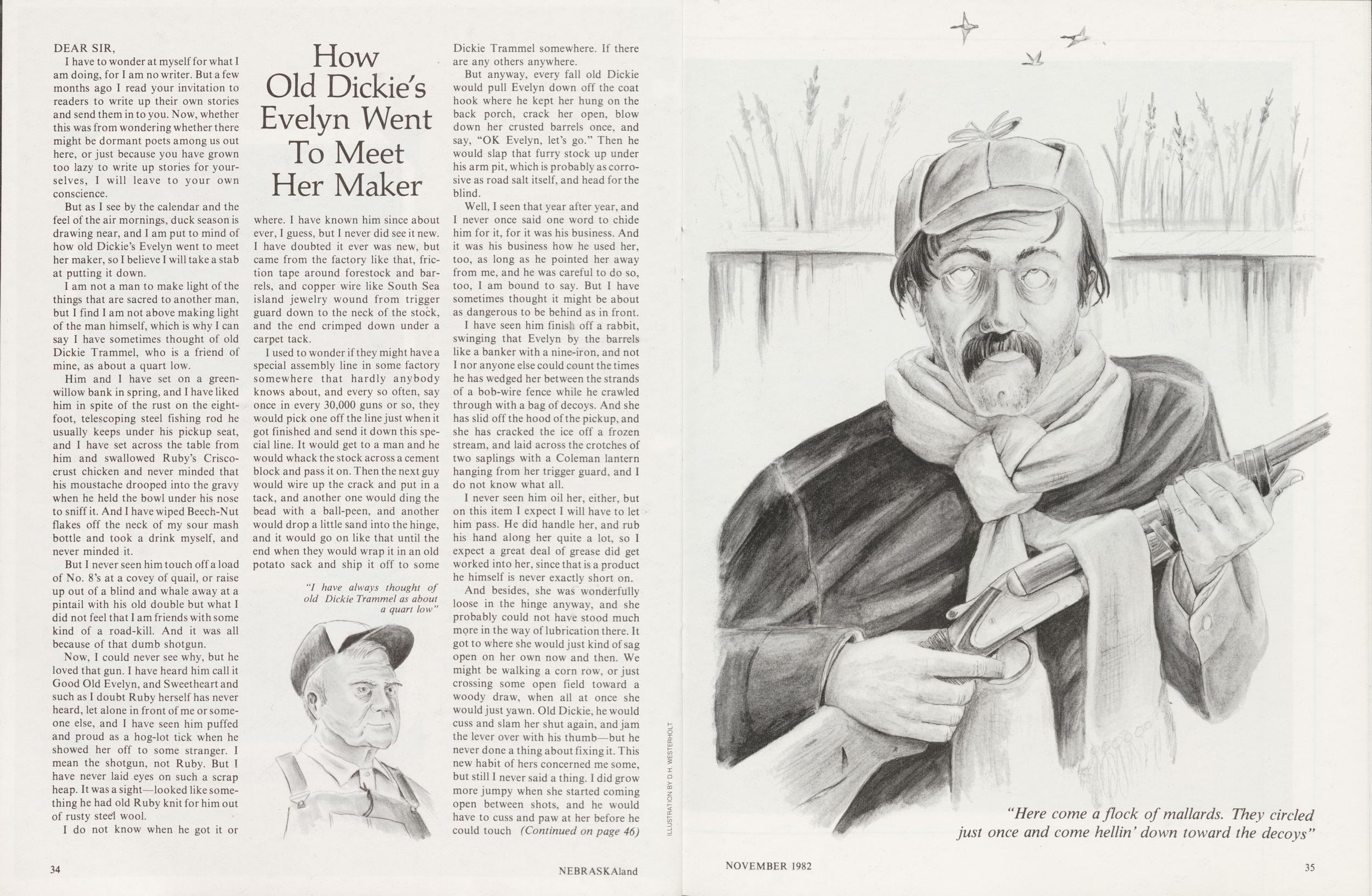
Now, I could never see why, but he loved that gun. I have heard him call it Good Old Evelyn, and Sweetheart and such as I doubt Ruby herself has never heard, let alone in front of me or someone else, and I have seen him puffed and proud as a hog-lot tick when he showed her off to some stranger. I mean the shotgun, not Ruby. But I have never laid eyes on such a scrap heap. It was a sight—looked like something he had old Ruby knit for him out of rusty steel wool.
I do not know when he got it or where. I have known him since about ever, I guess, but I never did see it new. I have doubted it ever was new, but came from the factory like that, friction tape around forestock and barrels, and copper wire like South Sea island jewelry wound from trigger guard down to the neck of the stock, and the end crimped down under a carpet tack.
I used to wonder if they might have a special assembly line in some factory somewhere that hardly anybody knows about, and every so often, say once in every 30,000 guns or so, they would pick one off the line just when it got finished and send it down this special line. It would get to a man and he would whack the stock across a cement block and pass it on. Then the next guy would wire up the crack and put in a tack, and another one would ding the bead with a ball-peen, and another would drop a little sand into the hinge, and it would go on like that until the end when they would wrap it in an old potato sack and ship it off to some Dickie Trammel somewhere. If there are any others anywhere.
But anyway, every fall old Dickie would pull Evelyn down off the coat hook where he kept her hung on the back porch, crack her open, blow down her crusted barrels once, and say, "OK Evelyn, let's go." Then he would slap that furry stock up under his arm pit, which is probably as corrosive as road salt itself, and head for the blind.
Well, I seen that year after year, and I never once said one word to chide him for it, for it was his business. And it was his business how he used her, too, as long as he pointed her away from me, and he was careful to do so, too, I am bound to say. But I have sometimes thought it might be about as dangerous to be behind as in front.
I have seen him finish off a rabbit, swinging that Evelyn by the barrels like a banker with a nine-iron, and not I nor anyone else could count the times he has wedged her between the strands of a bob-wire fence while he crawled through with a bag of decoys. And she has slid off the hood of the pickup, and she has cracked the ice off a frozen stream, and laid across the crotches of two saplings with a Coleman lantern hanging from her trigger guard, and I do not know what all.
I never seen him oil her, either, but on this item I expect I will have to let him pass. He did handle her, and rub his hand along her quite a lot, so I expect a great deal of grease did get worked into her, since that is a product he himself is never exactly short on.
And besides, she was wonderfully loose in the hinge anyway, and she probably could not have stood much more in the way of lubrication there. It got to where she would just kind of sag open on her own now and then. We might be walking a corn row, or just crossing some open field toward a woody draw, when all at once she would just yawn. Old Dickie, he would cuss and slam her shut again, and jam the lever over with his thumb—but he never done a thing about fixing it. This new habit of hers concerned me some, but still I never said a thing. I did grow more jumpy when she started coming open between shots, and he would have to cuss and paw at her before he could touch (Continued on page 46)
34 NEBRASKAland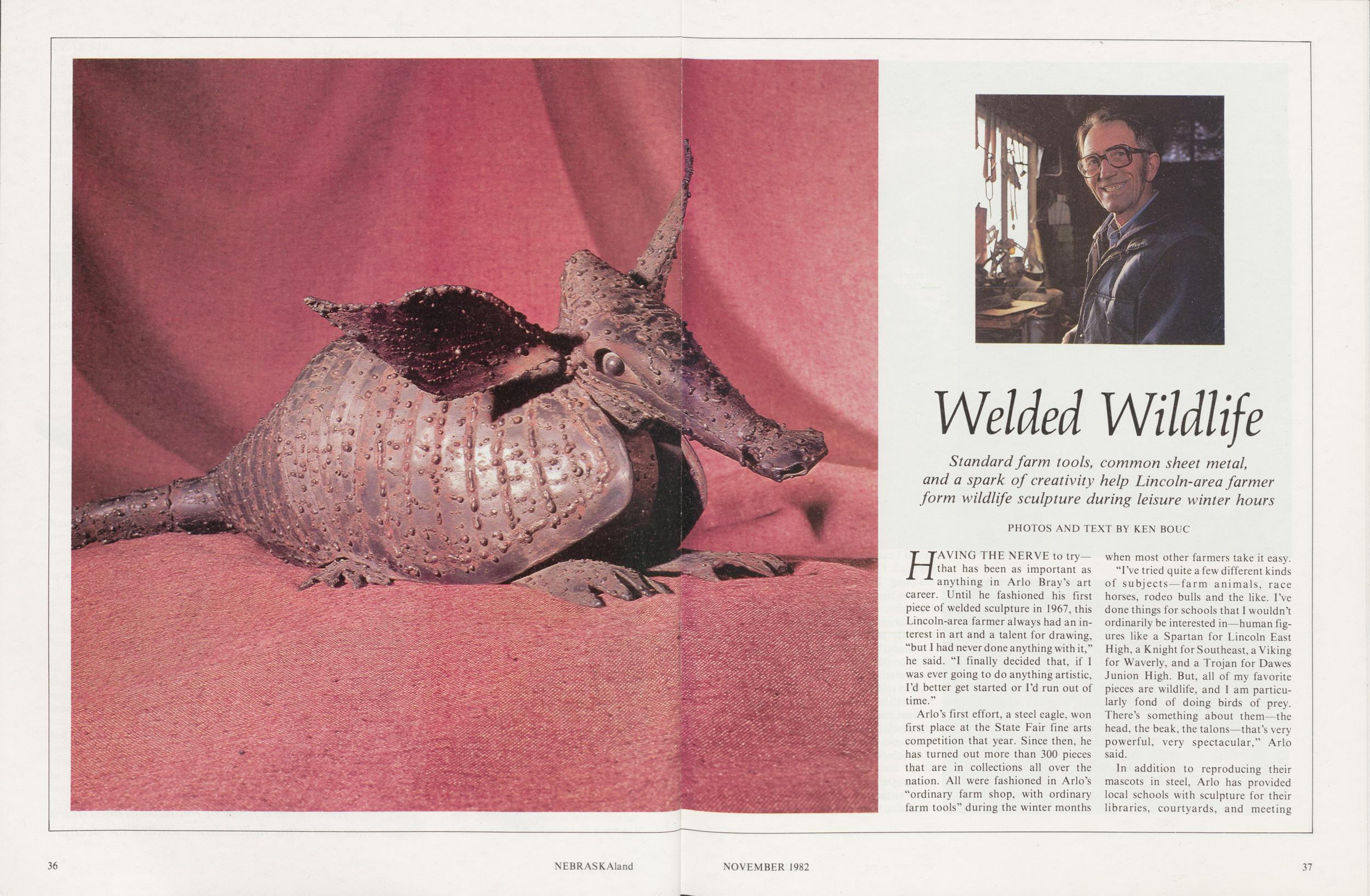
Welded Wildlife
Standard farm tools, common sheet metal, and a spark of creativity help Lincoln-area farmer form wildlife sculpture during leisure winter hours PHOTOS AND TEXT BY KEN BOUCHAVING THE NERVE to try-that has been as important as anything in Arlo Bray's art career. Until he fashioned his first piece of welded sculpture in 1967, this Lincoln-area farmer always had an interest in art and a talent for drawing, "but I had never done anything with it," he said. "I finally decided that, if I was ever going to do anything artistic, I'd better get started or I'd run out of time."
Arlo's first effort, a steel eagle, won first place at the State Fair fine arts competition that year. Since then, he has turned out more than 300 pieces that are in collections all over the nation. All were fashioned in Arlo's "ordinary farm shop, with ordinary farm tools" during the winter months when most other farmers take it easy.
"I've tried quite a few different kinds of subjects — farm animals, race horses, rodeo bulls and the like. I've done things for schools that I wouldn't ordinarily be interested in—human figures like a Spartan for Lincoln East High, a Knight for Southeast, a Viking for Waverly, and a Trojan for Dawes Junion High. But, all of my favorite pieces are wildlife, and I am particularly fond of doing birds of prey. There's something about them—the head, the beak, the talons—that's very powerful, very spectacular," Arlo said.
In addition to reproducing their
mascots in steel, Arlo has provided
local schools with sculpture for their
libraries, courtyards, and meeting
NOVEMBER 1982
37
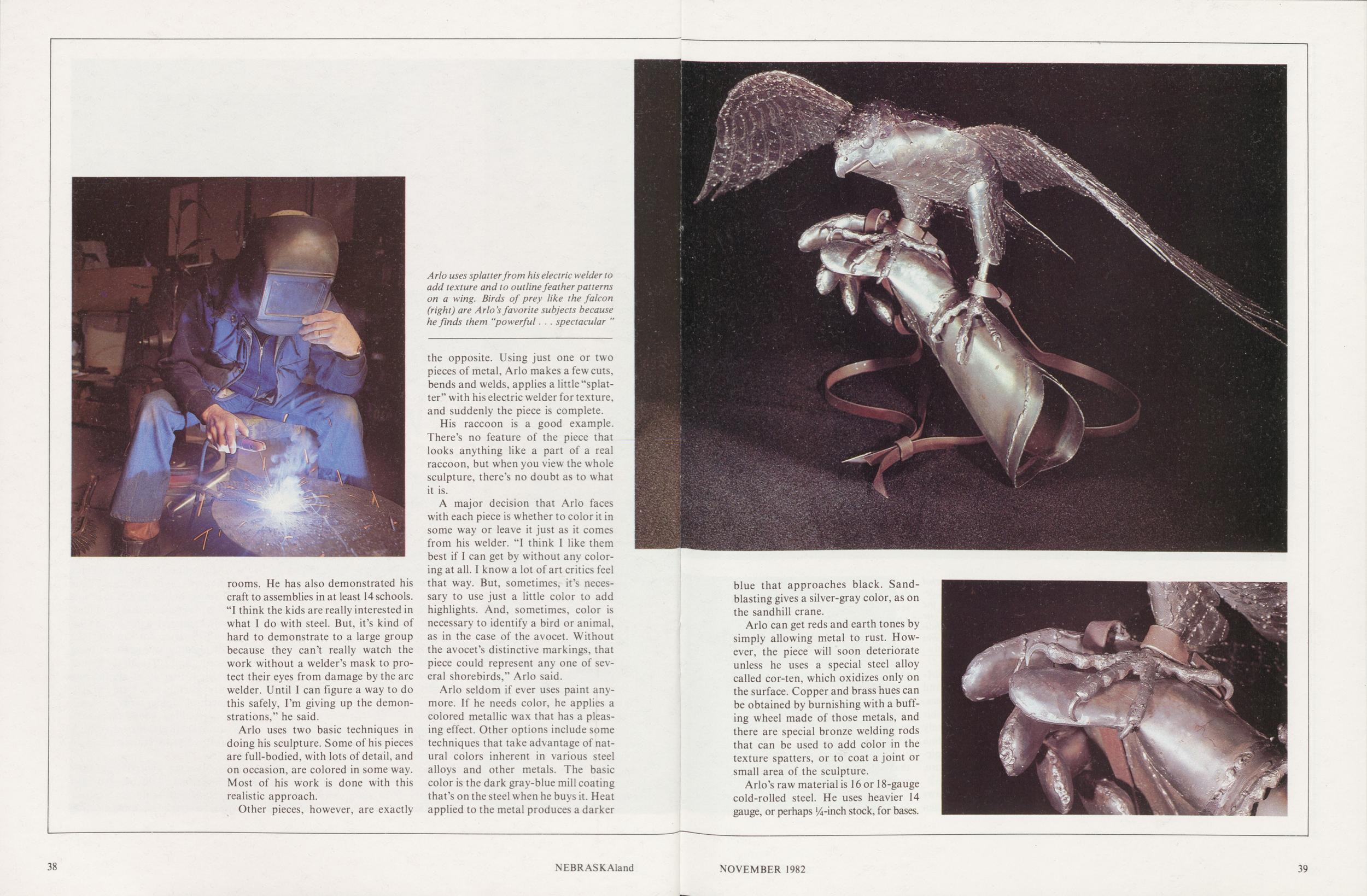
Arlo uses two basic techniques in doing his sculpture. Some of his pieces are full-bodied, with lots of detail, and on occasion, are colored in some way. Most of his work is done with this realistic approach.
Other pieces, however, are exactly the opposite. Using just one or two pieces of metal, Arlo makes a few cuts, bends and welds, applies a little "splatter" with his electric welder for texture, and suddenly the piece is complete.
His raccoon is a good example. There's no feature of the piece that looks anything like a part of a real raccoon, but when you view the whole sculpture, there's no doubt as to what it is.
A major decision that Arlo faces with each piece is whether to color it in some way or leave it just as it comes from his welder. "I think I like them best if I can get by without any coloring at all. I know a lot of art critics feel that way. But, sometimes, it's necessary to use just a little color to add highlights. And, sometimes, color is necessary to identify a bird or animal, as in the case of the avocet. Without the avocet's distinctive markings, that piece could represent any one of several shorebirds," Arlo said.
Arlo seldom if ever uses paint anymore. If he needs color, he applies a colored metallic wax that has a pleasing effect. Other options include some techniques that take advantage of natural colors inherent in various steel alloys and other metals. The basic color is the dark gray-blue mill coating that's on the steel when he buys it. Heat applied to the metal produces a darker 36 NEBRASKAland blue that approaches black. Sandblasting gives a silver-gray color, as on the sandhill crane.
Arlo can get reds and earth tones by simply allowing metal to rust. However, the piece will soon deteriorate unless he uses a special steel alloy called cor-ten, which oxidizes only on the surface. Copper and brass hues can be obtained by burnishing with a buffing wheel made of those metals, and there are special bronze welding rods that can be used to add color in the texture spatters, or to coat a joint or small area of the sculpture.
Arlo's raw material is 16 or 18-gauge cold-rolled steel. He uses heavier 14 gauge, or perhaps Vi-inch stock, for bases.
NOVEMBER 1982 37
Magazines such as NEBRASKAland, Audubon, National Wildlife and Ranger Rick provide Arlo with ideas, as well as reference for detail on his critters. "A reference is absolutely necessary, at least the first time I do a particular bird or animal. I need a picture to see feather patterns, posture, proportions and that sort of thing."
From his references, Arlo draws patterns on heavy paper, which he then cuts out with scissors. Thus he'll produce a wing, which usually consists of several layers of feathers, or a body or a head. Then, he transfers each component of the part to metal and cuts it out with a gas cutting torch. Next, Arlo does some grinding, some bending and shaping with a hammer, welding and texturing with the electric welder, then perhaps a bit more grinding. After a few days, the components become bodies, heads and limbs, then finally, a finished sculpture.
Arlo is always quick to point out that only very basic welding and shop equipment is necessary.
The only special piece of equipment in his shop is an old knee-high wooden 40 NEBRASKAland stump with a hollow worked into the top. By beating metal into that hollow, Arlo forms all of the curves and contours that appear in his work. "You could find everything I use in just about any farmer's shop except for that stump, and I could make another just like it in a few minutes," he said.
Since he fashioned that first steel eagle in 1967, Arlo has been refining and improving his work. "I wouldn't be too happy with that first piece anymore. In fact, if I still had it, I would probably cut it up."
Arlo likes to tell of what inspired
him to direct his artistic energies
toward welding. "Working in my shop,
fixing farm machinery, I'd often get
NOVEMBER 1982
41
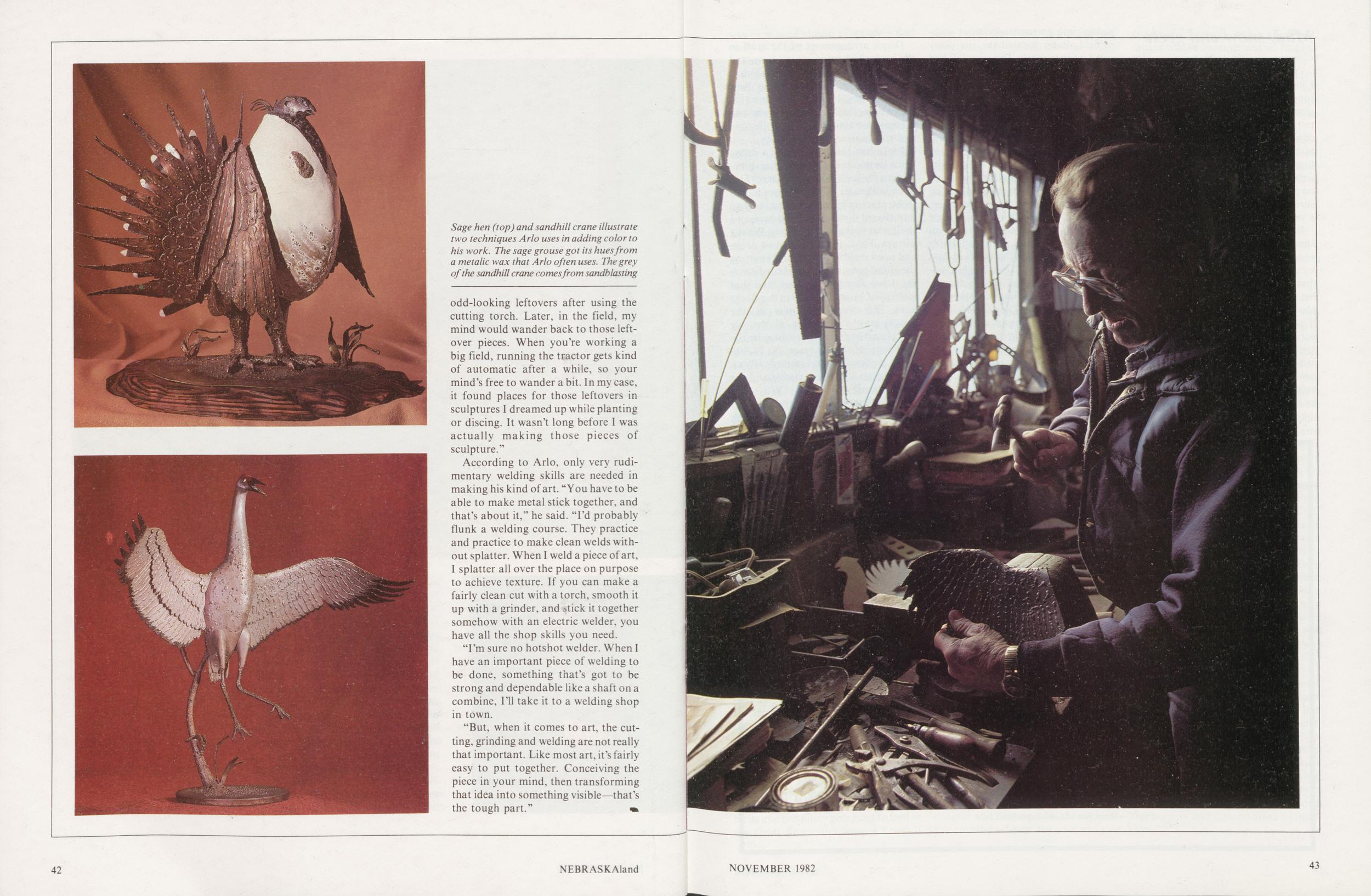
According to Arlo, only very rudimentary welding skills are needed in making his kind of art. "You have to be able to make metal stick together, and that's about it," he said. "I'd probably flunk a welding course. They practice and practice to make clean welds without splatter. When 1 weld a piece of art, I splatter all over the place on purpose to achieve texture. If you can make a fairly clean cut with a torch, smooth it up with a grinder, and stick it together somehow with an electric welder, you have all the shop skills you need.
"I'm sure no hotshot welder. When I have an important piece of welding to be done, something that's got to be strong and dependable like a shaft on a combine, I'll take it to a welding shop in town.
"But, when it comes to art, the cutting, grinding and welding are not really that important. Like most art, it's fairly easy to put together. Conceiving the piece in your mind, then transforming that idea into something visible—that's the tough part."
42 NEBRASKAland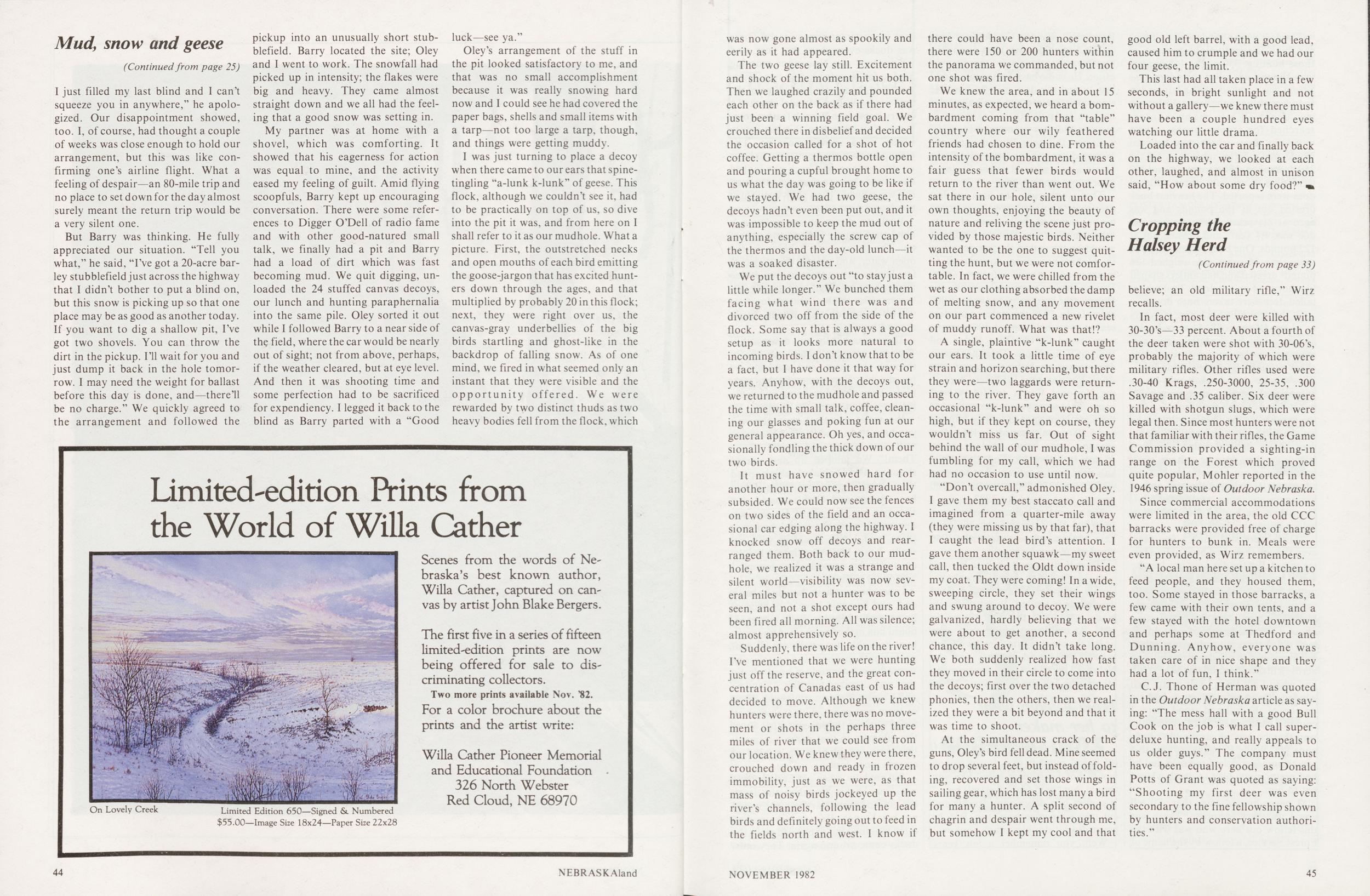
Mud, snow and geese
(Continued from page 25)I just filled my last blind and I can't squeeze you in anywhere," he apologized. Our disappointment showed, too. I, of course, had thought a couple of weeks was close enough to hold our arrangement, but this was like confirming one's airline flight. What a feeling of despair—an 80-mile trip and no place to set down for the day almost surely meant the return trip would be a very silent one.
But Barry was thinking. He fully appreciated our situation. "Tell you what," he said, "I've got a 20-acre barley stubblefield just across the highway that I didn't bother to put a blind on, but this snow is picking up so that one place may be as good as another today. If you want to dig a shallow pit, I've got two shovels. You can throw the dirt in the pickup. I'll wait for you and just dump it back in the hole tomorrow. I may need the weight for ballast before this day is done, and—there'll be no charge." We quickly agreed to the arrangement and followed the pickup into an unusually short stubblefield. Barry located the site; Oley and I went to work. The snowfall had picked up in intensity; the flakes were big and heavy. They came almost straight down and we all had the feeling that a good snow was setting in.
My partner was at home with a shovel, which was comforting. It showed that his eagerness for action was equal to mine, and the activity eased my feeling of guilt. Amid flying scoopfuls, Barry kept up encouraging conversation. There were some references to Digger O'Dell of radio fame and with other good-natured small talk, we finally had a pit and Barry had a load of dirt which was fast becoming mud. We quit digging, unloaded the 24 stuffed canvas decoys, our lunch and hunting paraphernalia into the same pile. Oley sorted it out while I followed Barry to a near side of the field, where the car would be nearly out of sight; not from above, perhaps, if the weather cleared, but at eye level. And then it was shooting time and some perfection had to be sacrificed for expendiency. I legged it back to the blind as Barry parted with a "Good luck—see ya."
Oley's arrangement of the stuff in the pit looked satisfactory to me, and that was no small accomplishment because it was really snowing hard now and I could see he had covered the paper bags, shells and small items with a tarp—not too large a tarp, though, and things were getting muddy.
I was just turning to place a decoy when there came to our ears that spine-tingling "a-lunk k-lunk" of geese. This flock, although we couldn't see it, had to be practically on top of us, so dive into the pit it was, and from here on I shall refer to it as our mudhole. What a picture. First, the outstretched necks and open mouths of each bird emitting the goose-jargon that has excited hunters down through the ages, and that multiplied by probably 20 in this flock; next, they were right over us, the canvas-gray underbellies of the big birds startling and ghost-like in the backdrop of falling snow. As of one mind, we fired in what seemed only an instant that they were visible and the opportunity offered. We were rewarded by two distinct thuds as two heavy bodies fell from the flock, which was now gone almost as spookily and eerily as it had appeared.
Limited-edition Prints from the World of Willa Cather [image] On Lovely Creek Limited Edition 650—Signed &t Numbered $55.00—Image Size 18x24—Paper Size 22x28 Scenes from the words of Nebraska's best known author, Willa Cather, captured on canvas by artist John Blake Bergers. The first five in a series of fifteen limited-edition prints are now being offered for sale to discriminating collectors. Two more prints available Nov. 82. For a color brochure about the prints and the artist write: Willa Cather Pioneer Memorial and Educational Foundation 326 North Webster Red Cloud, NE 68970 44 NEBRASKAlandThe two geese lay still. Excitement and shock of the moment hit us both. Then we laughed crazily and pounded each other on the back as if there had just been a winning field goal. We crouched there in disbelief and decided the occasion called for a shot of hot coffee. Getting a thermos bottle open and pouring a cupful brought home to us what the day was going to be like if we stayed. We had two geese, the decoys hadn't even been put out, and it was impossible to keep the mud out of anything, especially the screw cap of the thermos and the day-old lunch—it was a soaked disaster.
We put the decoys out "to stay just a little while longer." We bunched them facing what wind there was and divorced two off from the side of the flock. Some say that is always a good setup as it looks more natural to incoming birds. I don't know that to be a fact, but I have done it that way for years. Anyhow, with the decoys out, we returned to the mudhole and passed the time with small talk, coffee, cleaning our glasses and poking fun at our general appearance. Oh yes, and occasionally fondling the thick down of our two birds.
It must have snowed hard for another hour or more, then gradually subsided. We could now see the fences on two sides of the field and an occasional car edging along the highway. I knocked snow off decoys and rearranged them. Both back to our mudhole, we realized it was a strange and silent world—visibility was now several miles but not a hunter was to be seen, and not a shot except ours had been fired all morning. All was silence; almost apprehensively so.
Suddenly, there was life on the river! I've mentioned that we were hunting just off the reserve, and the great concentration of Canadas east of us had decided to move. Although we knew hunters were there, there was no movement or shots in the perhaps three miles of river that we could see from our location. We knew they were there, crouched down and ready in frozen immobility, just as we were, as that mass of noisy birds jockeyed up the river's channels, following the lead birds and definitely going out to feed in the fields north and west. I know if there could have been a nose count, there were 150 or 200 hunters within the panorama we commanded, but not one shot was fired.
We knew the area, and in about 15 minutes, as expected, we heard a bombardment coming from that "table" country where our wily feathered friends had chosen to dine. From the intensity of the bombardment, it was a fair guess that fewer birds would return to the river than went out. We sat there in our hole, silent unto our own thoughts, enjoying the beauty of nature and reliving the scene just provided by those majestic birds. Neither wanted to be the one to suggest quitting the hunt, but we were not comfortable. In fact, we were chilled from the wet as our clothing absorbed the damp of melting snow, and any movement on our part commenced a new rivelet of muddy runoff. What was that!?
A single, plaintive "k-lunk" caught our ears. It took a little time of eye strain and horizon searching, but there they were—two laggards were returning to the river. They gave forth an occasional "k-lunk" and were oh so high, but if they kept on course, they wouldn't miss us far. Out of sight behind the wall of our mudhole, I was fumbling for my call, which we had had no occasion to use until now.
"Don't overcall," admonished Oley. I gave them my best staccato call and imagined from a quarter-mile away (they were missing us by that far), that I caught the lead bird's attention. I gave them another squawk—my sweet call, then tucked the Oldt down inside my coat. They were coming! In a wide, sweeping circle, they set their wings and swung around to decoy. We were galvanized, hardly believing that we were about to get another, a second chance, this day. It didn't take long. We both suddenly realized how fast they moved in their circle to come into the decoys; first over the two detached phonies, then the others, then we realized they were a bit beyond and that it was time to shoot.
At the simultaneous crack of the guns, Oley's bird fell dead. Mine seemed to drop several feet, but instead of folding, recovered and set those wings in sailing gear, which has lost many a bird for many a hunter. A split second of chagrin and despair went through me, but somehow I kept my cool and that good old left barrel, with a good lead, caused him to crumple and we had our four geese, the limit.
This last had all taken place in a few seconds, in bright sunlight and not without a gallery—we knew there must have been a couple hundred eyes watching our little drama.
Loaded into the car and finally back on the highway, we looked at each other, laughed, and almost in unison said, "How about some dry food?"
Cropping the Halsey Herd
(Continued from page 33)believe; an old military rifle," Wirz recalls.
In fact, most deer were killed with 30-30's—33 percent. About a fourth of the deer taken were shot with 30-06's, probably the majority of which were military rifles. Other rifles used were .30-40 Krags, .250-3000, 25-35, .300 Savage and .35 caliber. Six deer were killed with shotgun slugs, which were legal then. Since most hunters were not that familiar with their rifles, the Game Commission provided a sighting-in range on the Forest which proved quite popular, Mohler reported in the 1946 spring issue of Outdoor Nebraska.
Since commercial accommodations were limited in the area, the old CCC barracks were provided free of charge for hunters to bunk in. Meals were even provided, as Wirz remembers.
"A local man here set up a kitchen to feed people, and they housed them, too. Some stayed in those barracks, a few came with their own tents, and a few stayed with the hotel downtown and perhaps some at Thedford and Dunning. Anyhow, everyone was taken care of in nice shape and they had a lot of fun, I think."
C.J. Thone of Herman was quoted in the Outdoor Nebraska article as saying: "The mess hall with a good Bull Cook on the job is what I call super-deluxe hunting, and really appeals to us older guys." The company must have been equally good, as Donald Potts of Grant was quoted as saying: ''Shooting my first deer was even secondary to the fine fellowship shown by hunters and conservation authorities."
NOVEMBER 1982 45
The deer were abundant and success ran high. Seventy-eight percent of those hunting, 350 of the 448 hunters who showed up, killed their deer. One permit was revoked when a hunter was found smoking in the forest. Either sex was legal. While many hunters searched for trophy bucks, others opted for does, which they believed would make better table fare. Of the 350 deer taken, 154 were bucks and 207 were does. Curiously, three antlered does were reported. The heaviest buck dressed out at 196 pounds and was aged at 8!^> years, while the heaviest doe was 9lA years and dressed out at 122 pounds. One buck, estimated to be more than 15 years old, weighed 126 pounds dressed and had antlers shaped like horns of an antelope. Two white-tailed deer were taken, both does.
Of the deer killed, 87 were 6!/2 years or older. Of those 87, 51 were bucks, and as might be expected, some tremendous racks passed through the check station. By today's standards, Wirz's mule deer buck would be an exceptional trophy, measuring 177, but it was not even mentioned among the trophies in the Outdoor Nebraska article. Wirz was in no hurry to take his deer. After he had helped his two friends get their deer, he waited a week before going out himself. He had the advantage of living in the area and of having run a planting crew on the forest. Even then, he hunted four half days before killing his buck.
"There were still quite a few deer, even though there had been quite a few taken out. But the day I got my deer, he was a good 300 yards off and standing pretty much by himself across a little valley. I took sharp aim and shot and I knew I hit him; there was no question about it because he sort of went down, but I didn't think it was down enough to kill him. I had to run down this hill and across a little valley and up the next hill and when I got there I was pretty well winded. It was awful tall grass. I got up on top of the hill and stood there. I couldn't see my deer but I figured the way that he was hit he couldn't have gone far. While I caught my breath I saw the grass wiggle. I ran over and he had pretty much bled to death when I got to him.
"I never hunted after that. I'll tell you I was very fortunate. There was this fellow out here who was with the Forest Service, a fellow by the name of Ralph Hill. He was a supervisor here (at the National Forest) but during the hunt was stationed in the Denver office. He came back for the hunt and I just turned my deer over to him. He skinned it for me and took the head back to Jonas Brothers Taxidermy in Denver and they mounted it for $35."
Earlier this year Wirz donated the mounted head to the Game and Parks Commission, where it will be displayed after some repair work.
That trophy was the first and last deer that Wirz ever shot. Contrary to his concern and the concern of many others in the state—that the 1945 hunt would be the end of the few deer then in Nebraska—deer continued to increase and expand into new areas. During the last years of the 1940's, the Halsey deer herd remained around 300 animals. In 1949 the state's next deer season was held and 1,500 permits wer,e issued for the Pine Ridge and Wildcat Hills regions. There has been a deer season in Nebraska every year since, but not until 1953 were deer on the National Forest at Halsey legal game. That same year, other regions of the state were opened to deer hunting and 5,300 permits issued. By 1961, deer seasons were being held in every county in Nebraska. Today, Nebraska's deer herd is estimated at between 90,000 and 100,000 animals; 30,300 permits were issued for 1982.
The success of Nebraska's deer even surprised the veteran game biologist Levi Mohler, who wrote in the 1946 Outdoor Nebraska article:
"Deer hunting isn't likely to become a major activity for Nebraskans, simply because the amount of good deer range is limited. But it definitely made a hit with the 'first timers' in 1945. As one happy hunter said when he left the checking station: T wouldn't take a thousand dollars for the Nebraska deer I got.' There were many others who felt the same way."
How Evelyn went to her maker
(Continued from page 34)off barrel number two. It got so you would not hear "bam-bam" like you should, but "bam-(damn! slam!) bam." It slowed him down considerable and cut into his percentages, too. But, he never did hit doubles much anyhow.
Well, you remember a few years back when winter came so early? There was ducks everywhere that year, and we was out one November morning hoping for a greenhead or two. Snow just filled the air. Reminded me of the time young Wilson Mundel chucked a cherry bomb into Verna's feather comforter. You know how it is just before sunup on a snowy morning. The pickup lights picked out every flake as we drove along, and each one looked like it was about to slam right through the windshield. Then they would just touch and disappear.
Well, we drove on up to Dickie's blind on Six-mile Slough and got set up. The decoys was bobbing in the open water, and we was drinking coffee, Dickie setting there in his old blue farmer coat with that long, greasy yellow muffler Ruby knitted for him wrapped about two dozen turns around his neck.
There was hardly any dawn at all. The air just got lighter and lighter through the snow, and suddenly we heard ducks. Here come a flock of mallards. They circled just once and come helling down toward the decoys.
We made ourselves wait, the way you have to do, and finally I could not wait any longer, and I said "Take Them!'' We jumped up and started shooting. Old Dickie's double popped once, then flopped open like it had been doing, and Dickie cussed and slammed her shut again. He was getting quick at it. By then I had shot twice, and I was fumbling with my shells. I saw him raise up old Evelyn again for his second shot, but all I heard was a click.
I guess he must have thought he had a dud, and he could have, too, because he generally kept his shells in a cardboard box in the basement. After every hunt he would just empty out his coat pockets into that box, and next time he went, dip out a couple of handfuls. So they was all mixed together, 4's and 6's and 8's, and some was quite old. Some of them was paper, with the color all faded out and the edges scuffed. Over the summers in that damp basement, the brass would pick up a kind of arsenic green look.
But anyhow, when old Evelyn would not fire, Dickie thumbed the lever, but now in her contraryness, she would not break open. He was just standing there looking kind of puzzled when the ducks come around again. They must
46 NEBRASKAlandTrading Post
DOGSWELL-BRED Hunting dogs for sale—Brittanies, English setters and pointers—ranging in age from puppies to young dogs. Darrell Yentes, 1118 McMillan, Holdrege, NE 68949. Phone (308) 995-8570 or (308) 995-4797.
AKC REGISTERED Chesepeake Bay Retriever pups for sale—5 months old. Call or write Frank Sokol, Crookston, Nebr. 69212. Phone (605) 429-3356.
WIND FALL RETRIEVERS has two litters of Field and Amateur Field Champion sired Labrador puppies available, (whelped September 6 and the end of October). These pups are from outstanding bloodline and are excellent field trial and/ or hunting prospects. Also have a 14 month started male from Field Champion Bloodlines. All dogs have shots, and hips are guaranteed. Inquiries to Mike Schafer (402) 782-6505.
GERMAN SHORTHA1RS, Setters and Pointers-Pups and started dogs. Stud service. Also 3-year-old male shorthair—trained. 9-month-old pointer female, well started. Wayne Clark (402) 263-3495 or 263-3155 Union, Nebraska.
GERMAN SHORTHAIRS—English Pointers and Setters. Stud service, puppies and started dogs available. 2'/2-year-old male Pointer points, backs and retrieves; the best. Will consider leasing several older dogs this season. Wayne Clark—Box 54—Union, NE. (402-263-3495 or 263-3155).
MISCELLANEOUSGUNS—Browning, Winchester, Remington, others, Hi-powers, shotguns, new, used, antiques. Want Pre-1964 Winchesters. Buy-Sell-Trade. Ph. (402) 729-6112. Bedlan's Sporting Goods, Fairbury, NE 68352.
GAME BIRDS for sale. Wild turkeys, wood ducks, manderins, mallards, teal, Canada geese. Pheasants—5 breeds—Chukkars, quail. Many others not listed. Frontier Birds, Wauneta, Nebr. 69045. Phone: day (308) 394-5577/evening (308) 394-5715.
N.E. NEBRASKA Trout Fishing. For rent Mon.-Thurs. or Fri.-Sun. 2 modern cottages completely furnished. 3 ponds with trout up to 5 lbs. 2 ponds with bass and bluegill. Diamond E. Trout Resort, Orchard, NE 68764 (402) 893-4745.
PHEASANT, QUAIL, duck and squirrel hunting. Package Deal includes room, board, meals. Big Sandy Vacation Farm, Rt. 1, Box 78, Edgar, Nebr. 68935. Phone (402) 224-4121.
PLASTIC DECOYS: We're originator of famous do-it-yourself system. Catalog $1.00. Decoys Unlimited, Box 69, Clinton, IA 52732.
BOOKS: Wing and Shot...$15.99, Water Dog...$17.99, Gun Dog... $17.99, Train Your Retriever.. .$19.99, Dave Duffy Trains Gun Dogs.. .$11.99, Training and Hunting the Brittany Spaniel.. .$15.99, plus many other books available! Whistle's... Lanyards... Training Scent... Training Dummies... Leather leads... Whatever youi interest, please write. Pet-O-Mine, 4014 Leavenworth, Omaha, NE 68124, (402) 342-5727. All items will be sent C. O. D. Send stamped, addressed envelope for price list.
WINE AND BEER: Make your own. Send for free recipes and instructions. Omaha Supply, 13616 Polk, Omaha, Nebr. 68137.
FOR SALE: Norwegian Blue and Arctic Shadow Fox; Valley and Gambels Quail; Chuckar Partridge; Dutch Bunnies. Frank Roy, Chapman, Nebr. (308) 986-2410. HUNTING RETREAT FOR LEASE. Niobrara River Frontage, 240 Acres near Niobrara, Nebr. Deer, turkey, ducks, geese, quail and partridge. Swimming, fishing, canoeing. Newly furnished, 3-bedroom house with dishwasher, ice maker, canoe, etc. Large barn, corral, outbuilding. 1-year lease, $350 month—Clifford Ruzicka (707) 263-6155.
"ATTENTION ALL SPORTSMEN"! For sale, a hunter's paradise with unlimited possibilities, possession immediately. 740 acres, Knox County west of Crofton, 240 acres highly productive farm land, 500 acres good native pasture. A well-rounded operation with plenty of pasture hay and grains to handle a hundred cow and calf unit. Above average buildings, newly remodeled house, well-kept barn. Cattle shed and graineries, a 5,000 bushel drying bin. 72x96 machine shed and a 500 hog confinement finishing house, all automatic, new (present owner would manage). Deer, pheasant, wild turkey and fishing from a spring fed pivot stocked pond right at the Gavins Point Dam and Devil's Nest, to add to the scenery and future development possibilities. We are looking for sportsmen, one or a group. Must be seen to appreciate. Phone (402) 373-4857 at Bloomfield.
SELLING 50 USED Muchi-craft canoes. New ones too! Wilson Outfitters, 1329 Dawes Ave. (14th & Cornhusker), Lincoln, NE 68521.
DEER PROCESSING—Famous for our jerky (solid or stick), salami, ring bologna; most kinds of sausage made. 10 years experience. Murray Locker, Murray, Nebr. Phone (402) 235-2841.
TAXIDERMYBIG BEAR TAXIDERMY, Rt. 2, Mitchell, Nebraska 69357. We specialize in all big game from Alaska to Nebraska, also birds and fish. Hair on and hair off tanning, 4'/2 miles west of Scottsbluff on Highway 26. Phone (308) 635-3013.
KARL SCHWARZ Master Taxidermist. Mounting of game heads—birds—fish—animals—fur rugs—robes—tanning buckskin. Since 1910. 424 South 13th Street, Dept. A, Omaha, Nebraska 68102.
FREEZE-DRY TAXIDERMY Wally Allison's State Record Taxidermy, 2709 Birchwood, North Platte, NE 69101. Phone: (308) 534-2324. Specializing in Fish and Small Game, Snake and Lizard and Novelties. (Nothing too small) Newest of all taxidermy methods employed.
HASTINGS TAXIDERMY: Professional life-like mounting of game heads, birds, fish, rugs, and animals. We specialize in big-game head mounts. Also hair-on and hair-off tanning. Competitive prices. R Rt. 3, Box 162, Ord, NE 68862. Phone (308) 728-5322.
3 1/2 miles east, 1/2 mile south on north side of Platte River, Lewellen, Nebr. in Garden County GOOSE BLINDS Bordering Clear Creek Refuge Write or Call George Rishling, Manager Lewellen, NE 69140 Phone (308) 778-5412 or Watson's Husky 778-5391AWARD-WINNING TAXIDERMIST. Eight time national award winners. Trust your trophies to a proven winner. Our complete taxidermy service also arranges hunts. Dinges Taxidermy Studio, 2763 South 12th Omaha, NE 68108. Ph. 402-342-3718.
CREATIVE TAXIDERMY in all its branches since 1935, now includes Northstar Freeze-Dry processing of approved small specimens. Also tanning and deerskin processing. Naturecraft Studio. Nebraska City, Nebraska 68510. Joe Voges-Owner. Phone (402) 873-5491.
JOHNSON TAXIDERMY—servicing southwest Nebraska, specializing in big-game mounts, life-sized mounts, rug work, fish, birds, tanning hair-on leather. Brochure and price list on request. Johnson Taxidermy, Rt. 1, Box 78, Lamar, NE 69035. Telephone (308) 882-5555.
PEISTER TAXIDERMY—a name you can trust. We give you professional life-like work at prices most sportsmen can afford. Member National Taxidermist Association, #5 Regency Place, Kearney, Nebr. 68847. Phone (308) 237-7575.
TAXIDERMIST Steve J. Abegglen—Experienced quality craftsmanship. Big game heads, life-size mammals, waterfowl, upland game, tanning. Affordable prices. Fast delivery. Rt. 4, Box 47. Columbus, Nebraska 68601 (402) 897-2707.
NABITY'S TAXIDERMY. 31 years experience. Specializing in natural grass backgrounds for mammals, birds and fish. 13901 "O" St., Lincoln, NE 68505 (4 miles east of 84th and "O" (402) 489-6351.
BADE TAXIDERMY—Quality a must—Fast service. Fish, birds, rugs, tanning, full mounts and game heads. 1924 North Lincoln, Fremont, Nebraska. 727-5463.
HUNT MR. D's Commercial Duck and Goose Hunting on the last natural stretch of the mighty Missouri. Reasonable Rates For Information Call (402) 254-3962 or write: MR. D's Box 367 Hartington, NE 68739 LIVE-CATCH ALL-PURPOSE TRAPS Write for FREE CATALOG Traps without injury squirrels, chipmunks, rabbits, mink, fox, raccoons, stray animals, pests, etc. Sizes for every need. Also traps for snakes, sparrows, pigeons, crabs, turtles, quail, etc. Save on our low factory prices. Send no money. Free catalog and trapping secrets MUSTANG MFG. CO., Dept. N 34. Box 10880, Houston, Tex. 77018 Harlan County Dam Vacation Apartments - fully furnished Color TV • Kitchen Facilities • Full Baths Game cleaning room with freezer One block from shopping center Weekend or week of pleasant living Security Deposit Required Sorry —No Pets Dean and Esther Stone Box 145 Ph. (308) 799-3422 Republican City, NE 68971 NOVEMBER 1982 47
have been considerble confused in the snow storm.
Right then I seen what his trouble was, but before I could say one word, a big drake veered off from the rest and flew directly at us. Dickie never paused, but shouldered that gun and tugged at the triggers again. Of course the first one could not fire, for he had already shot that barrel and had not reloaded her. Reloading could become a project anyway, as many times the ejectors did not work and he would have to dig out the empties with his knife. The second barrel would not even click this time.
I started to tell him what it was, for as I said, I seen the problem, but he was uncommonly perturbed, and was not listening to me, and that Kamikaze drake was still bearing down on us. It was only about four foot above the water, looking big as a Buick, flying straight at the blind.
Dickie, he just flipped Evelyn around real nimble, and went into a crouch, Evelyn cocked over his shoulder like a Louisville Slugger. He tensed up and started to swing, and then that duck faded to the right like a spitball slider. Dickie swung with all his might, and on the follow-through, old Evelyn slipped right through his fingers and headed out end over end into Six-Mile Slough.
Minnetonka Moccasin Catalog Men's, Women's & Children's Sizes All genuine leather and highest quality Many styles and colors to choose from Name Address City State Zip Mail to: H & M Bootery, 275 N. Main, Valentine, Neb. 69201 For Full Color Catalog and Price List WILD GAME PROCESSING! • JERKY • POLISH & • SUMMER SAUSAGE • SMOKED BACON Let Don Shuster turn your antelope, deer, elk or moose into a gourmet's delight. Meat cut and wrapped for the freezer. Bring in boned meat or let Don do the skinning. DON & GERRY'S MARKET 1216 No. 10th • Lincoln, NE • (402) 432-8931I saw then it was too late to tell old Dickie why that gun would not fire, for right about then he began to understand it too. When she had sailed out about 15 yards, she stopped real abrupt, like a dog who had forgot he was tied to the clothes line post; old Dickie got a kind of strained look on his face, and his neck stretched out a lick, and then his whole ungainly body followed right along over the edge of the blind into the channel where Swede Creek flows into the slough, and tethered to old Evelyn by about 15 yards of that stretched-out muffler which had come off from around his neck in the excitement, and got slammed into old Evelyn's breech after the first shot.
I looked over the edge of the blind, and all I could see was the bottom half of his waders, soles up, slowly sinking as the air leaked out through a wire cut he had not got around to having vulcanized. I reached over and rocked him back and forth until he tipped back right side up, spitting and blowing. "That oughta 'bout do it for today, doncha think?" he said, real calm.
Well, the free end of that muffler was caught on a snag about 20 yards out in the slough, and it was stretched out taut from the weight of Evelyn on the other end. I seen it, and I seen that he seen it, but he never waded out to reel her in, and he has never mentioned her again. Not to this day. I never have either. She is probably out there yet, if you want her. Probably in about the same condition as when she went in, too.
He has another gun now, but I have never heard him call it by name. I do not know where he could have found it. The friction tape is already beginning to peel back from around the forestock.
Well, that's it. You are welcome to print it if you wish to. I have went to some pains to disguise the right names of the people in it, and besides, I do not suppose there is any of them that reads magazines, although there may be one or two who would look at the pictures. It is all right if you print my name, but do not put in my address. I would not wish to get on any more damn fool mailing lists.
Yrs. Sincerely, Clemens Babcock 48 NEBRASKAlandNOTES ON NEBRASKA FAUNA / GREAT BLUE HERON
BY JOHN J. DINAN, NONGAME BIRD BIOLOGISTTHE LARGEST, MOST commonly sighted, and therefore best known heron occurring in Nebraska is the great blue. It stands nearly four feet tall and has an impressive wingspan of about 70 inches. Although comparable in general size to a turkey, its weight is far less, averaging only six to eight pounds. Its stilt-like legs are counterbalanced with an equally long neck, which serves as a periscope in marsh vegetation. While flying with slow, graceful strokes of its great, broad wings, the blue crane (as it is commonly and mistakenly called) rests its head upon its folded neck, unlike the crane, whose neck is extended in flight.
Both sexes of the great blue heron are identical in coloration and voice. The male, however, may tend to be slightly larger. Various shades of bluish-gray in the adult birds are relieved by a black crest, wing primaries and sides of the crown. The rest of the crown, cheeks and chin are white, as are the undertail coverts. The neck is a light gray with streaks of white, black and rust. The longish plumes of the lower neck and breast are a light gray and the whitish abdomen is interspersed with streaks of rust. The legs and feet are blackish except that the soles of the feet are yellowish. The sharply pointed beak is about five inches long and yellowish, with the upper mandible having a dusky, greenish ridge.
Juvenile herons are much like the adult except for a generally browner coloration. There are no lengthened feathers on the head, and most of the crown is black.
Various subspecies of the great blue heron occur across the United States and range from nearly identical colorations to the all white "great white" heron subspecies of southern Florida.
The great blue heron, the largest of the dark herons, ranges across the whole of North America except for the extreme north. It is common throughout Nebraska, although current documented breeding records are limited. In the northernmost portion of its range the heron is definitely migratory, gathering in flocks from five to 30 birds. Most wintering occurs in the southern half of the range and south through Mexico, Panama, the West Indies and Venezuela. An occasional heron may overwinter in Nebraska, however, and may be seen feeding in snow-free fields or areas of open water in January. Following the breeding and nesting season, young birds wander in all directions before eventually moving south. The southward migration usually begins early in October, and the northward migration commences in mid February and early March.
Rivers, streams, wetlands, lakes and ponds are preferred foraging areas, although the heron is equally at home in meadows and upland areas. The heron is most often observed standing motionless waiting for prey in shallow waters. Its slender, widely spaced toes keep it from sinking deeply into the soft muck while walking slowly and carefully, closing the distance between meals. Great blue herons are regarded as omnivors, feeding on both animal and plant matter—the latter being quite minimal. While fish of almost any variety are the principal prey, other frequently taken items include amphibians, crustaceans, small aquatic and terrestrial mammals, reptiles, birds, grasshoppers and other insects. Although most of the heron's food is captured while waiting or stalking in the shallows, they occasionally have been observed landing in deep water, and appearing somewhat "high centered." After gathering up whatever it was that enticed this long-legged creature into such a precarious-looking position, it lifts itself up off the water rather effortlessly with flaps of its large powerful wings.
Old cottonwood stands are the most frequently used sites for heronries in Nebraska, although small colonies have also been found in willow, elm and jack pine stands. The nests are usually at the very uppermost branches of the tree, whether the tree is only 10 feet tall or as high as 100 feet. Numerous great blue heron nests may be contained in one tree, along with nests of other wading birds.
Herons are very sensitive to disturbances (human or other) during the breeding season, so remoteness of the site is important. This is probably the most limiting factor to new heronry establishment. Where colony nesting occurs successfully, the great blue herons are inclined to come back year after year to renest.
A good stream flow and a high water table for maintaining springs and farm ponds are important to the heron food supply. Heron fisheries are generally within six miles of a colony and often adjacent to or within one mile.
Great blue herons start arriving in
NOVEMBER 1982
49
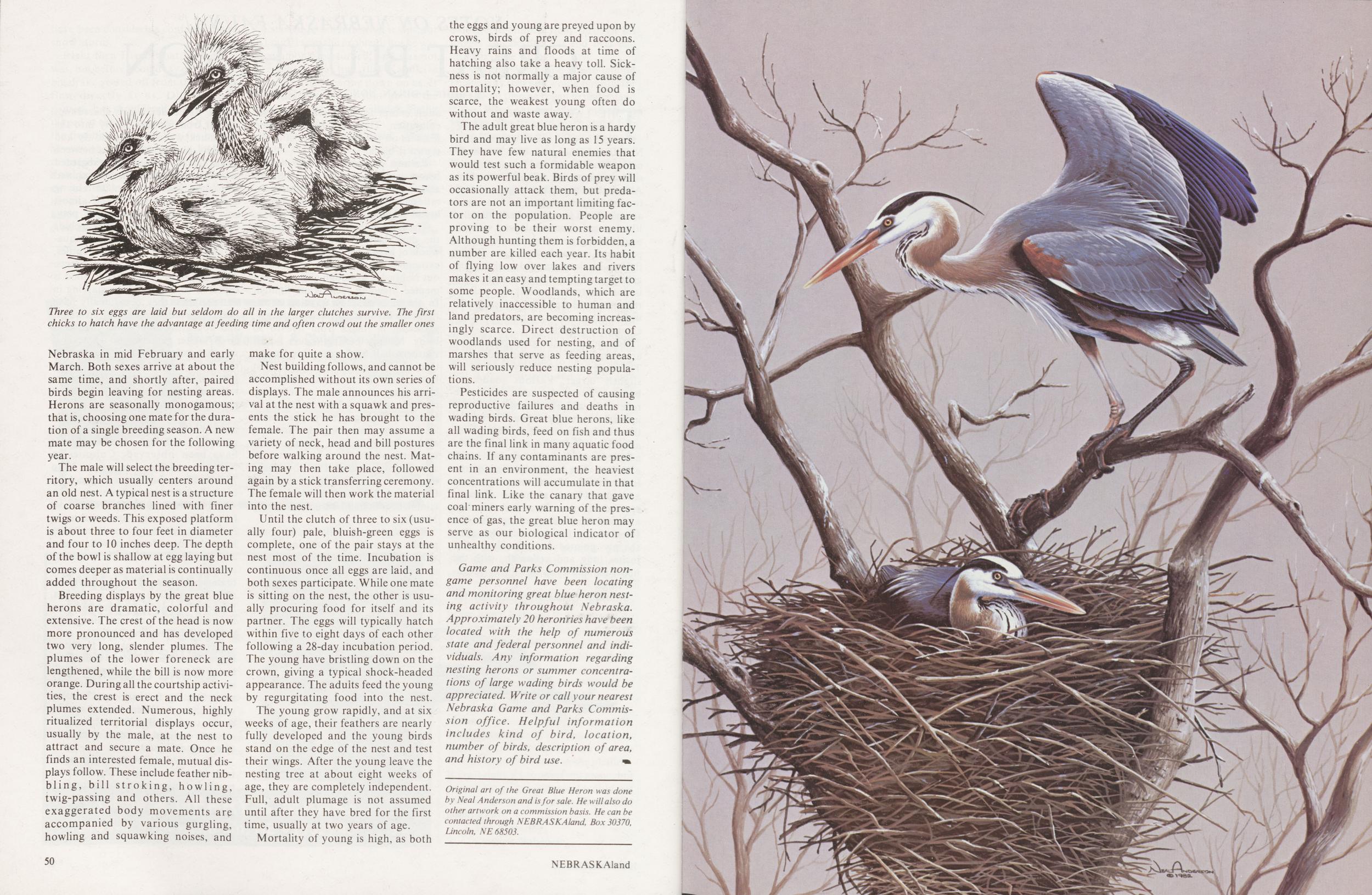
The male will select the breeding territory, which usually centers around an old nest. A typical nest is a structure of coarse branches lined with finer twigs or weeds. This exposed platform is about three to four feet in diameter and four to 10 inches deep. The depth of the bowl is shallow at egg laying but comes deeper as material is continually added throughout the season.
Breeding displays by the great blue herons are dramatic, colorful and extensive. The crest of the head is now more pronounced and has developed two very long, slender plumes. The plumes of the lower foreneck are lengthened, while the bill is now more orange. During all the courtship activities, the crest is erect and the neck plumes extended. Numerous, highly ritualized territorial displays occur, usually by the male, at the nest to attract and secure a mate. Once he finds an interested female, mutual displays follow. These include feather nibbling, bill stroking, howling, twig-passing and others. All these exaggerated body movements are accompanied by various gurgling, howling and squawking noises, and make for quite a show.
Nest building follows, and cannot be accomplished without its own series of displays. The male announces his arrival at the nest with a squawk and presents the stick he has brought to the female. The pair then may assume a variety of neck, head and bill postures before walking around the nest. Mating may then take place, followed again by a stick transferring ceremony. The female will then work the material into the nest.
Until the clutch of three to six (usually four) pale, bluish-green eggs is complete, one of the pair stays at the nest most of the time. Incubation is continuous once all eggs are laid, and both sexes participate. While one mate is sitting on the nest, the other is usually procuring food for itself and its partner. The eggs will typically hatch within five to eight days of each other following a 28-day incubation period. The young have bristling down on the crown, giving a typical shock-headed appearance. The adults feed the young by regurgitating food into the nest.
The young grow rapidly, and at six weeks of age, their feathers are nearly fully developed and the young birds stand on the edge of the nest and test their wings. After the young leave the nesting tree at about eight weeks of age, they are completely independent. Full, adult plumage is not assumed until after they have bred for the first time, usually at two years of age.
Mortality of young is high, as both the eggs and young are preyed upon by crows, birds of prey and raccoons. Heavy rains and floods at time of hatching also take a heavy toll. Sickness is not normally a major cause of mortality; however, when food is scarce, the weakest young often do without and waste away.
The adult great blue heron is a hardy bird and may live as long as 15 years. They have few natural enemies that would test such a formidable weapon as its powerful beak. Birds of prey will occasionally attack them, but predators are not an important limiting factor on the population. People are proving to be their worst enemy. Although hunting them is forbidden, a number are killed each year. Its habit of flying low over lakes and rivers makes it an easy and tempting target to some people. Woodlands, which are relatively inaccessible to human and land predators, are becoming increasingly scarce. Direct destruction of woodlands used for nesting, and of marshes that serve as feeding areas, will seriously reduce nesting populations.
Pesticides are suspected of causing reproductive failures and deaths in wading birds. Great blue herons, like all wading birds, feed on fish and thus are the final link in many aquatic food chains. If any contaminants are present in an environment, the heaviest concentrations will accumulate in that final link. Like the canary that gave coal" miners early warning of the presence of gas, the great blue heron may serve as our biological indicator of unhealthy conditions.
Game and Parks Commission nongame personnel have been locating and monitoring great blue heron nesting activity throughout Nebraska. Approximately 20 heronries have been located with the help of numerous state and federal personnel and individuals. Any information regarding nesting herons or summer concentrations of large wading birds would be appreciated. Write or call your nearest Nebraska Game and Parks Commission office. Helpful information includes kind of bird, location, number of birds, description of area, and history of bird use.
Original art of the Great Blue Heron was done by Neal Anderson and is for sale. He will also do other artwork on a commission basis. He can be contacted through NEBRASKAland, Box 30370, Lincoln, NE 68503. 50 NEBRASKAland
Live Next To Nature Year-Round.
Imagine yourself surrounded by sunshine, or dining under the stars! You can enjoy a fresh, new outlook on life by adding a glass-enclosed environment to your home. It's easy to enclose a deck, patio or hot tub. Or create a studio, breakfast nook, sunroom, hobby or entertainment center. Picture all the possibilities! Our glass enclosures come pre-designed to meet codes, specifications and quality Year-Roun standards for room additions. Find out now how to have one added to your home, or do it yourself. Mail the coupon or call 800-672-3469 NE WATS or 1-402-371-2141 for the name of the nearest display dealer.Position: 583 (19 views)