Volume 60, Issue 15, 1982
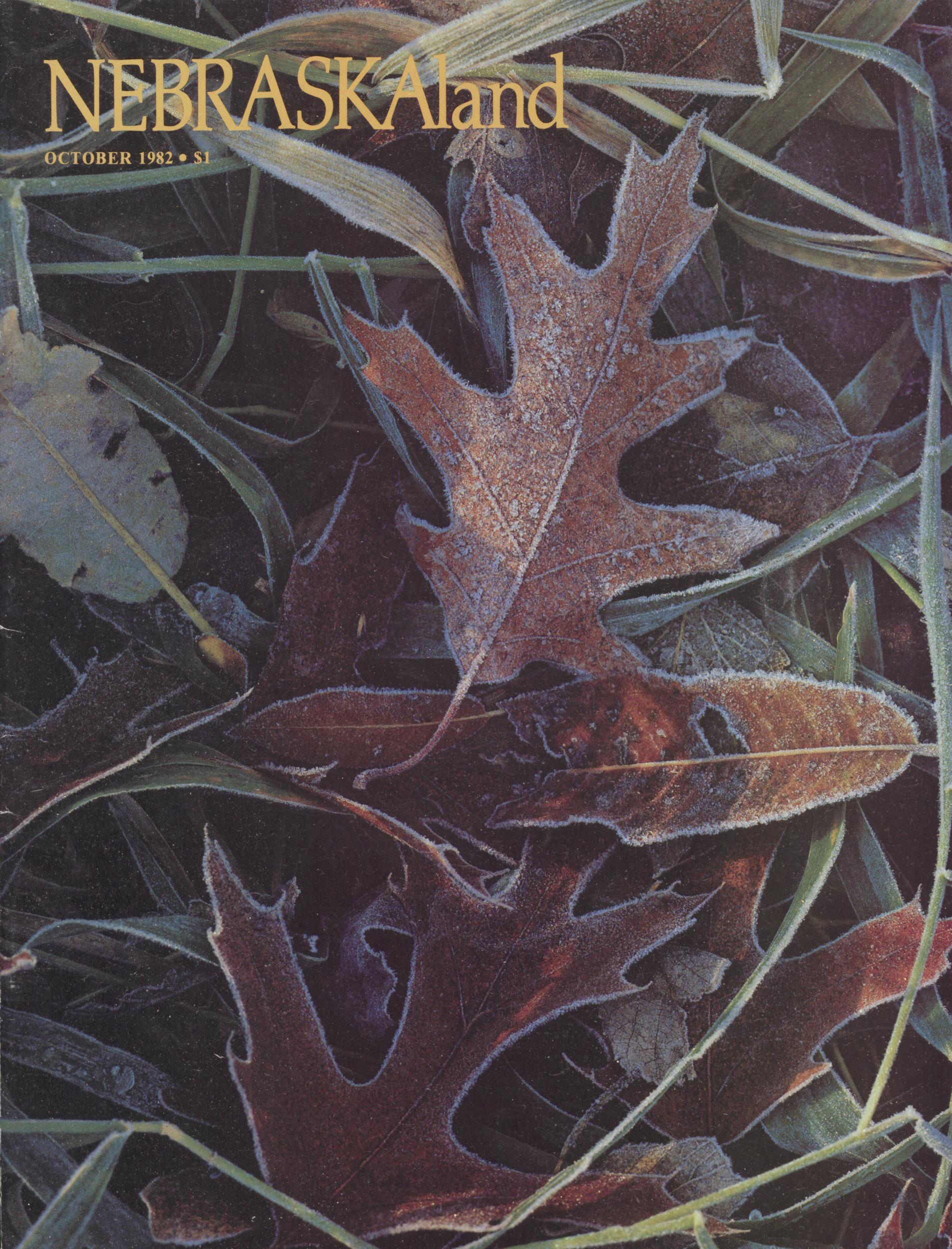
NEBRASKAland
OCTOBER 1982 $1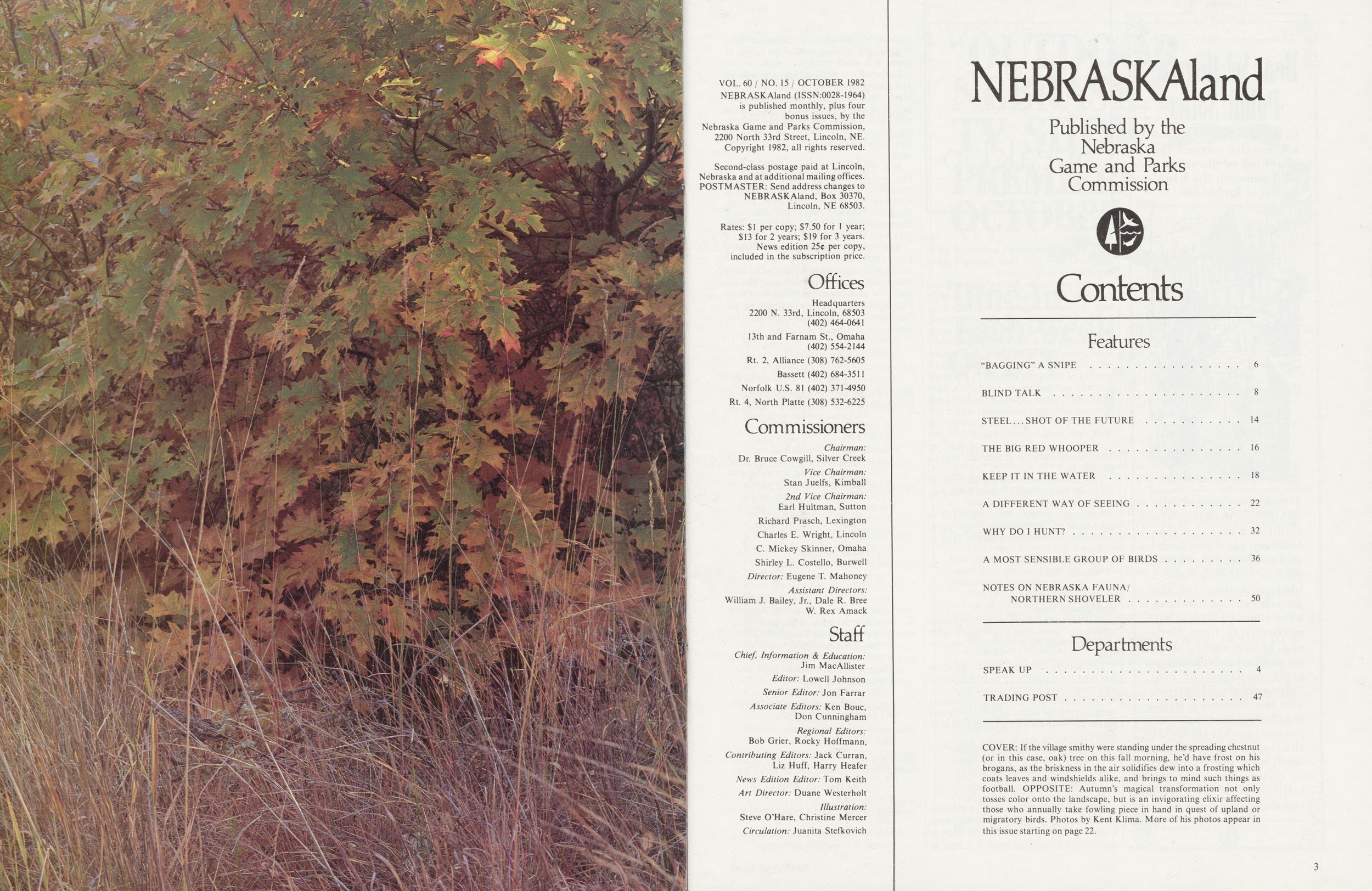
NEBRASKAland
Published by the Nebraska Game and Parks Commission VOL. 60 / NO. 15 / OCTOBER 1982 NEBRASKAland (ISSN:0028-1964) is published monthly, plus four bonus issues, by the Nebraska Game and Parks Commission, 2200 North 33rd Street, Lincoln, NE. Copyright 1982, all rights reserved. Second-class postage paid at Lincoln, Nebraska and at additional mailing offices. POSTMASTER: Send address changes to NEBRASKAland, Box 30370, Lincoln, NE 68503. Rates: $1 per copy; $7.50 for 1 year; $13 for 2 years; $19 for 3 years. News edition 25c per copy, included in the subscription price. Offices Headquarters 2200 N. 33rd, Lincoln, 68503 (402) 464-0641 13th and Farnam St., Omaha (402) 554-2144 Rt. 2, Alliance (308) 762-5605 Bassett (402) 684-3511 Norfolk U.S. 81 (402) 371-4950 Rt. 4, North Platte (308) 532-6225 Commissioners Chairman: Dr. Bruce Cowgill, Silver Creek Vice Chairman: Stan Juelfs, Kimball 2nd Vice Chairman: Earl Hultman, Sutton Richard Piasch, Lexington Charles E. Wright, Lincoln C. Mickey Skinner, Omaha Shirley L. Costello, Burwell Director: Eugene T. Mahoney Assistant Directors: William J. Bailey, Jr., Dale R. Bree W. Rex Amack Staff Chief, Information & Education: Jim MacAllister Editor: Lowell Johnson Senior Editor: Jon Farrar Associate Editors: Ken Bouc, Don Cunningham Regional Editors: Bob Grier, Rocky Hoffmann, Contributing Editors: Jack Curran, Liz Huff, Harry Heafer News Edition Editor: Tom Keith Art Director: Duane Westerholt Illustration: Steve O'Hare, Christine Mercer Circulation: Juanita Stefkovich Contents Features BAGGING" A SNIPE 6 BLIND TALK 8 STEEL... SHOT OF THE FUTURE 14 THE BIG RED WHOOPER 16 KEEP IT IN THE WATER 18 A DIFFERENT WAY OF SEEING 22 WHY DO I HUNT? 32 A MOST SENSIBLE GROUP OF BIRDS 36 NOTES ON NEBRASKA FAUNA/ NORTHERNSHOVELER 50 Departments SPEAK UP 4 TRADING POST 47 COVER: If the village smithy were standing under the spreading chestnut (or in this case, oak) tree on this fall morning, he'd have frost on his brogans, as the briskness in the air solidifies dew into a frosting which coats leaves and windshields alike, and brings to mind such things as football. OPPOSITE: Autumn's magical transformation not only tosses color onto the landscape, but is an invigorating elixir affecting those who annually take fowling piece in hand in quest of upland or migratory birds. Photos by Kent Klima. More of his photos appear in this issue starting on page 22. 3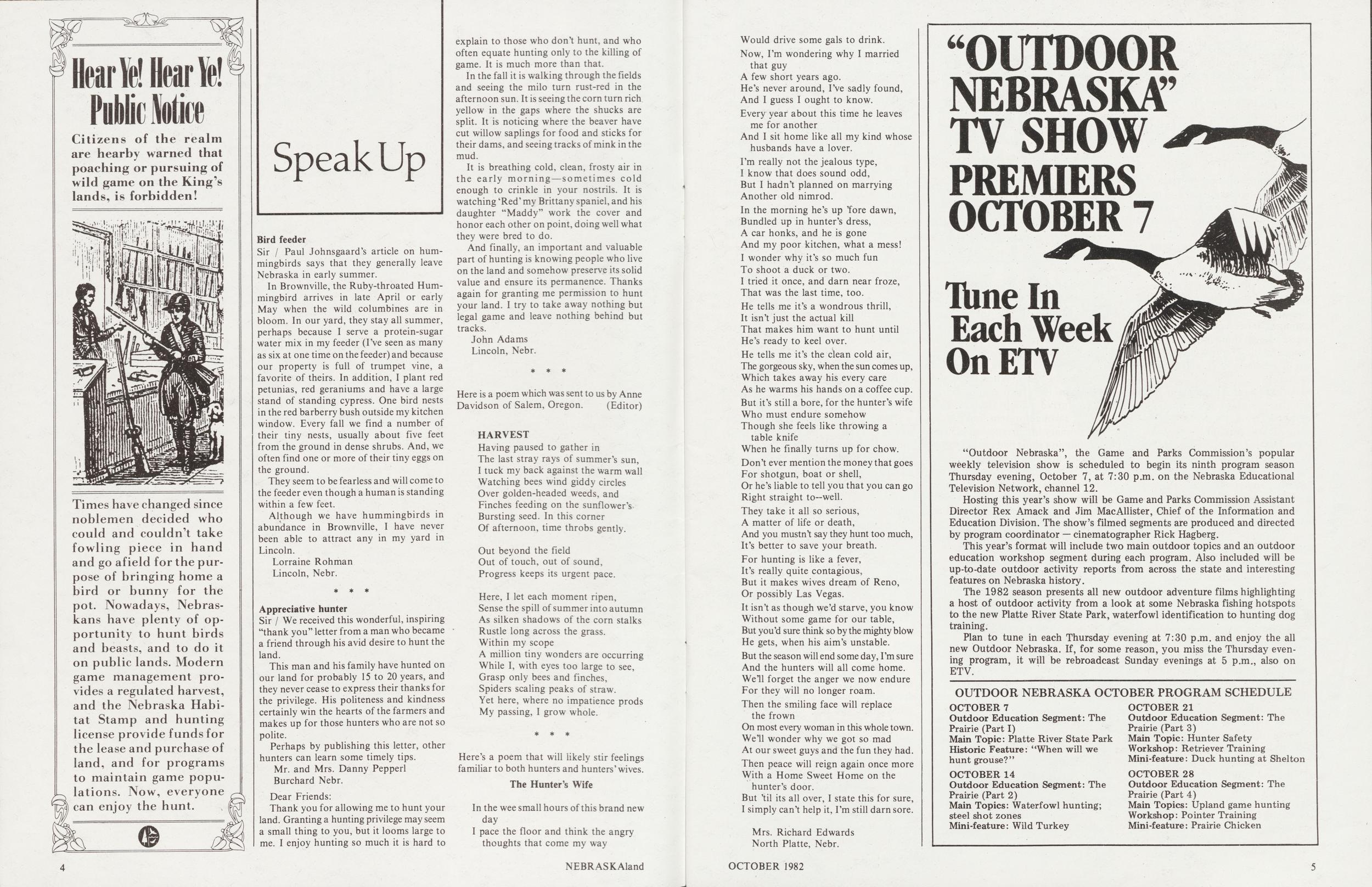
Speak Up
Bird feederSir / Paul Johnsgaard's article on hummingbirds says that they generally leave Nebraska in early summer.
In Brownville, the Ruby-throated Hummingbird arrives in late April or early May when the wild columbines are in bloom. In our yard, they stay all summer, perhaps because I serve a protein-sugar water mix in my feeder (I've seen as many as six at one time on the feeder) and because our property is full of trumpet vine, a favorite of theirs. In addition, I plant red petunias, red geraniums and have a large stand of standing cypress. One bird nests in the red barberry bush outside my kitchen window. Every fall we find a number of their tiny nests, usually about five feet from the ground in dense shrubs. And, we often find one or more of their tiny eggs on the ground.
They seem to be fearless and will come to the feeder even though a human is standing within a few feet.
Although we have hummingbirds in abundance in Brownville, I have never been able to attract any in my yard in Lincoln.
Lorraine Rohman Lincoln, Nebr. Appreciative hunterSir / We received this wonderful, inspiring "thank you" letter from a man who became a friend through his avid desire to hunt the land.
This man and his family have hunted on our land for probably 15 to 20 years, and they never cease to express their thanks for the privilege. His politeness and kindness certainly win the hearts of the farmers and makes up for those hunters who are not so polite.
Perhaps by publishing this letter, other hunters can learn some timely tips.
Mr. and Mrs. Danny Pepped Burchard Nebr. Dear Friends:Thank you for allowing me to hunt your land. Granting a hunting privilege may seem a small thing to you, but it looms large to me. I enjoy hunting so much it is hard to explain to those who don't hunt, and who often equate hunting only to the killing of game. It is much more than that.
In the fall it is walking through the fields and seeing the milo turn rust-red in the afternoon sun. It is seeing the corn turn rich yellow in the gaps where the shucks are split. It is noticing where the beaver have cut willow saplings for food and sticks for their dams, and seeing tracks of mink in the mud.
It is breathing cold, clean, frosty air in the early morning—sometimes cold enough to crinkle in your nostrils. It is watching 'Red' my Brittany spaniel, and his daughter "Maddy" work the cover and honor each other on point, doing well what they were bred to do.
And finally, an important and valuable part of hunting is knowing people who live on the land and somehow preserve its solid value and ensure its permanence. Thanks again for granting me permission to hunt your land. I try to take away nothing but legal game and leave nothing behind but tracks.
John Adams Lincoln, Nebr.Here is a poem which was sent to us by Anne Davidson of Salem, Oregon. (Editor)
HARVEST Having paused to gather in The last stray rays of summer's sun, I tuck my back against the warm wall Watching bees wind giddy circles Over golden-headed weeds, and Finches feeding on the sunflower's Bursting seed. In this corner Of afternoon, time throbs gently. Out beyond the field Out of touch, out of sound, Progress keeps its urgent pace. Here, I let each moment ripen, Sense the spill of summer into autumn As silken shadows of the corn stalks Rustle long across the grass. Within my scope A million tiny wonders are occurring While I, with eyes too large to see, Grasp only bees and finches, Spiders scaling peaks of straw. Yet here, where no impatience prods My passing, I grow whole.Here's a poem that will likely stir feelings familiar to both hunters and hunters' wives.
The Hunter's Wife In the wee small hours of this brand new day I pace the floor and think the angry thoughts that come my way 4 MEBRASKAland Would drive some gals to drink. Now, I'm wondering why I married that guy A few short years ago. He's never around, I've sadly found, And I guess I ought to know. Every year about this time he leaves me for another And I sit home like all my kind whose husbands have a lover. I'm really not the jealous type, I know that does sound odd, But I hadn't planned on marrying Another old nimrod. In the morning he's up 'fore dawn, Bundled up in hunter's dress, A car honks, and he is gone And my poor kitchen, what a mess! I wonder why it's so much fun To shoot a duck or two. I tried it once, and darn near froze, That was the last time, too. He tells me it's a wondrous thrill, It isn't just the actual kill That makes him want to hunt until He's ready to keel over. He tells me it's the clean cold air, The gorgeous sky, when the sun comes up, Which takes away his every care As he warms his hands on a coffee cup. But it's still a bore, for the hunter's wife Who must endure somehow Though she feels like throwing a table knife When he finally turns up for chow. Don't ever mention the money that goes For shotgun, boat or shell, Or he's liable to tell you that you can go Right straight to—well. They take it all so serious, A matter of life or death, And you mustn't say they hunt too much, It's better to save your breath. For hunting is like a fever, It's really quite contagious, But it makes wives dream of Reno, Or possibly Las Vegas. It isn't as though we'd starve, you know Without some game for our table, But you'd sure think so by the mighty blow He gets, when his aim's unstable. But the season will end some day, I'm sure And the hunters will all come home. We'll forget the anger we now endure For they will no longer roam. Then the smiling face will replace the frown On most every woman in this whole town. We'll wonder why we got so mad At our sweet guys and the fun they had. Then peace will reign again once more With a Home Sweet Home on the hunter's door. But 'til its all over, I state this for sure, I simply can't help it, I'm still darn sore. Mrs. Richard Edwards North Platte, Nebr. Tune In Each Week On ETV "OUTDOOR NEBRASKA' TV SHOW PREMIERS OCTOBER 7 "Outdoor Nebraska", the Game and Parks Commission's popular weekly television show is scheduled to begin its ninth program season Thursday evening, October 7, at 7:30 p.m. on the Nebraska Educational Television Network, channel 12. Hosting this year's show will be Game and Parks Commission Assistant Director Rex Amack and Jim MacAllister, Chief of the Information and Education Division. The show's filmed segments are produced and directed by program coordinator — cinematographer Rick Hagberg. This year's format will include two main outdoor topics and an outdoor education workshop segment during each program. Also included will be up-to-date outdoor activity reports from across the state and interesting features on Nebraska history. The 1982 season presents all new outdoor adventure films highlighting a host of outdoor activity from a look at some Nebraska fishing hotspots to the new Platte River State Park, waterfowl identification to hunting dog training. Plan to tune in each Thursday evening at 7:30 p.m. and enjoy the all new Outdoor Nebraska. If, for some reason, you miss the Thursday evening program, it will be rebroadcast Sunday evenings at 5 p.m., also on ETV. OUTDOOR NEBRASKA OCTOBER PROGRAM SCHEDULE OCTOBER 7 Outdoor Education Segment: The Prairie (Part I) Main Topic: Platte River State Park Historic Feature: "When will we hunt grouse?*' OCTOBER 14 Outdoor Education Segment: The Prairie (Part 2) Main Topics: Waterfowl hunting; steel shot zones Mini-feature: Wild Turkey OCTOBER 21 Outdoor Education Segment: The Prairie (Part 3) Main Topic: Hunter Safety Workshop: Retriever Training Mini-feature: Duck hunting at Shelton OCTOBER 28 Outdoor Education Segment: The Prairie (Part 4) Main Topics: Upland game hunting Workshop: Pointer Training Mini-feature: Prairie Chicken OCTOBER 1982 5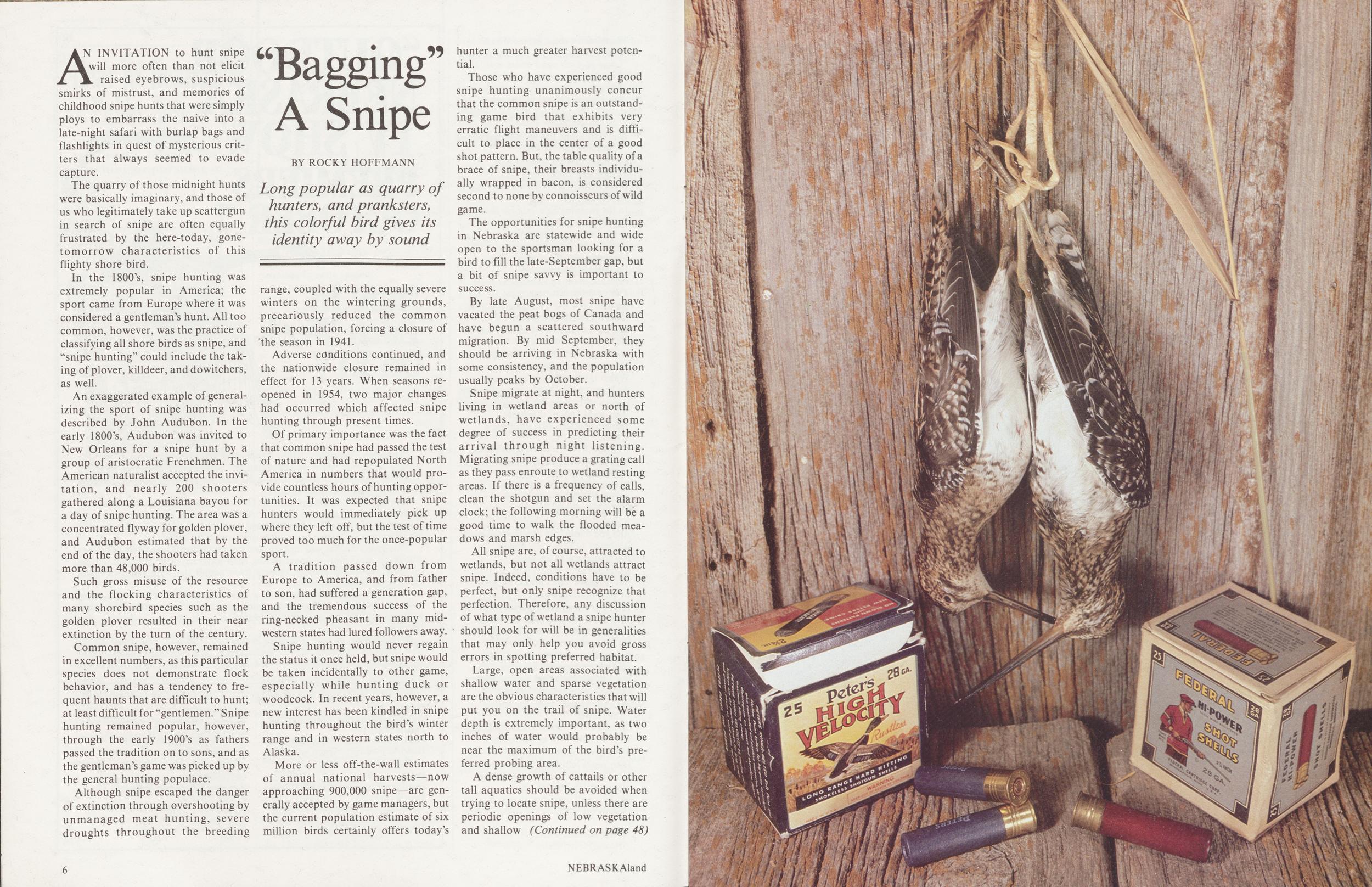
"Bagging" A Snipe
BY ROCKY HOFFMANN Long popular as quarry of hunters, and pranksters, this colorful bird gives its identity away by soundAN INVITATION to hunt snipe will more often than not elicit raised eyebrows, suspicious smirks of mistrust, and memories of childhood snipe hunts that were simply ploys to embarrass the naive into a late-night safari with burlap bags and flashlights in quest of mysterious critters that always seemed to evade capture.
The quarry of those midnight hunts were basically imaginary, and those of us who legitimately take up scattergun in search of snipe are often equally frustrated by the here-today, gone-tomorrow characteristics of this flighty shore bird.
In the 1800's, snipe hunting was extremely popular in America; the sport came from Europe where it was considered a gentleman's hunt. All too common, however, was the practice of classifying all shore birds as snipe, and "snipe hunting" could include the taking of plover, killdeer, and dowitchers, as well.
An exaggerated example of generalizing the sport of snipe hunting was described by John Audubon. In the early 1800's, Audubon was invited to New Orleans for a snipe hunt by a group of aristocratic Frenchmen. The American naturalist accepted the invitation, and nearly 200 shooters gathered along a Louisiana bayou for a day of snipe hunting. The area was a concentrated flyway for golden plover, and Audubon estimated that by the end of the day, the shooters had taken more than 48,000 birds.
Such gross misuse of the resource and the flocking characteristics of many shorebird species such as the golden plover resulted in their near extinction by the turn of the century.
Common snipe, however, remained in excellent numbers, as this particular species does not demonstrate flock behavior, and has a tendency to frequent haunts that are difficult to hunt; at least difficult for "gentlemen." Snipe hunting remained popular, however, through the early 1900's as fathers passed the tradition on to sons, and as the gentleman's game was picked up by the general hunting populace.
Although snipe escaped the danger of extinction through overshooting by unmanaged meat hunting, severe droughts throughout the breeding range, coupled with the equally severe winters on the wintering grounds, precariously reduced the common snipe population, forcing a closure of 'the season in 1941.
Adverse conditions continued, and the nationwide closure remained in effect for 13 years. When seasons re-opened in 1954, two major changes had occurred which affected snipe hunting through present times.
Of primary importance was the fact that common snipe had passed the test of nature and had repopulated North America in numbers that would provide countless hours of hunting opportunities. It was expected that snipe hunters would immediately pick up where they left off, but the test of time proved too much for the once-popular sport.
A tradition passed down from Europe to America, and from father to son, had suffered a generation gap, and the tremendous success of the ring-necked pheasant in many midwestern states had lured followers away.
Snipe hunting would never regain the status it once held, but snipe would be taken incidentally to other game, especially while hunting duck or woodcock. In recent years, however, a new interest has been kindled in snipe hunting throughout the bird's winter range and in western states north to Alaska.
More or less off-the-wall estimates of annual national harvests—now approaching 900,000 snipe—are generally accepted by game managers, but the current population estimate of six million birds certainly offers today's hunter a much greater harvest potential.
Those who have experienced good snipe hunting unanimously concur that the common snipe is an outstanding game bird that exhibits very erratic flight maneuvers and is difficult to place in the center of a good shot pattern. But, the table quality of a brace of snipe, their breasts individually wrapped in bacon, is considered second to none by connoisseurs of wild game.
The opportunities for snipe hunting in Nebraska are statewide and wide open to the sportsman looking for a bird to fill the late-September gap, but a bit of snipe savvy is important to success.
By late August, most snipe have vacated the peat bogs of Canada and have begun a scattered southward migration. By mid September, they should be arriving in Nebraska with some consistency, and the population usually peaks by October.
Snipe migrate at night, and hunters living in wetland areas or north of wetlands, have experienced some degree of success in predicting their arrival through night listening. Migrating snipe produce a grating call as they pass enroute to wetland resting areas. If there is a frequency of calls, clean the shotgun and set the alarm clock; the following morning will be a good time to walk the flooded meadows and marsh edges.
All snipe are, of course, attracted to wetlands, but not all wetlands attract snipe. Indeed, conditions have to be perfect, but only snipe recognize that perfection. Therefore, any discussion of what type of wetland a snipe hunter should look for will be in generalities that may only help you avoid gross errors in spotting preferred habitat.
Large, open areas associated with shallow water and sparse vegetation are the obvious characteristics that will put you on the trail of snipe. Water depth is extremely important, as two inches of water would probably be near the maximum of the bird's preferred probing area.
A dense growth of cattails or other tall aquatics should be avoided when trying to locate snipe, unless there are periodic openings of low vegetation and shallow (Continued on page 48)
6 NEBRASKAland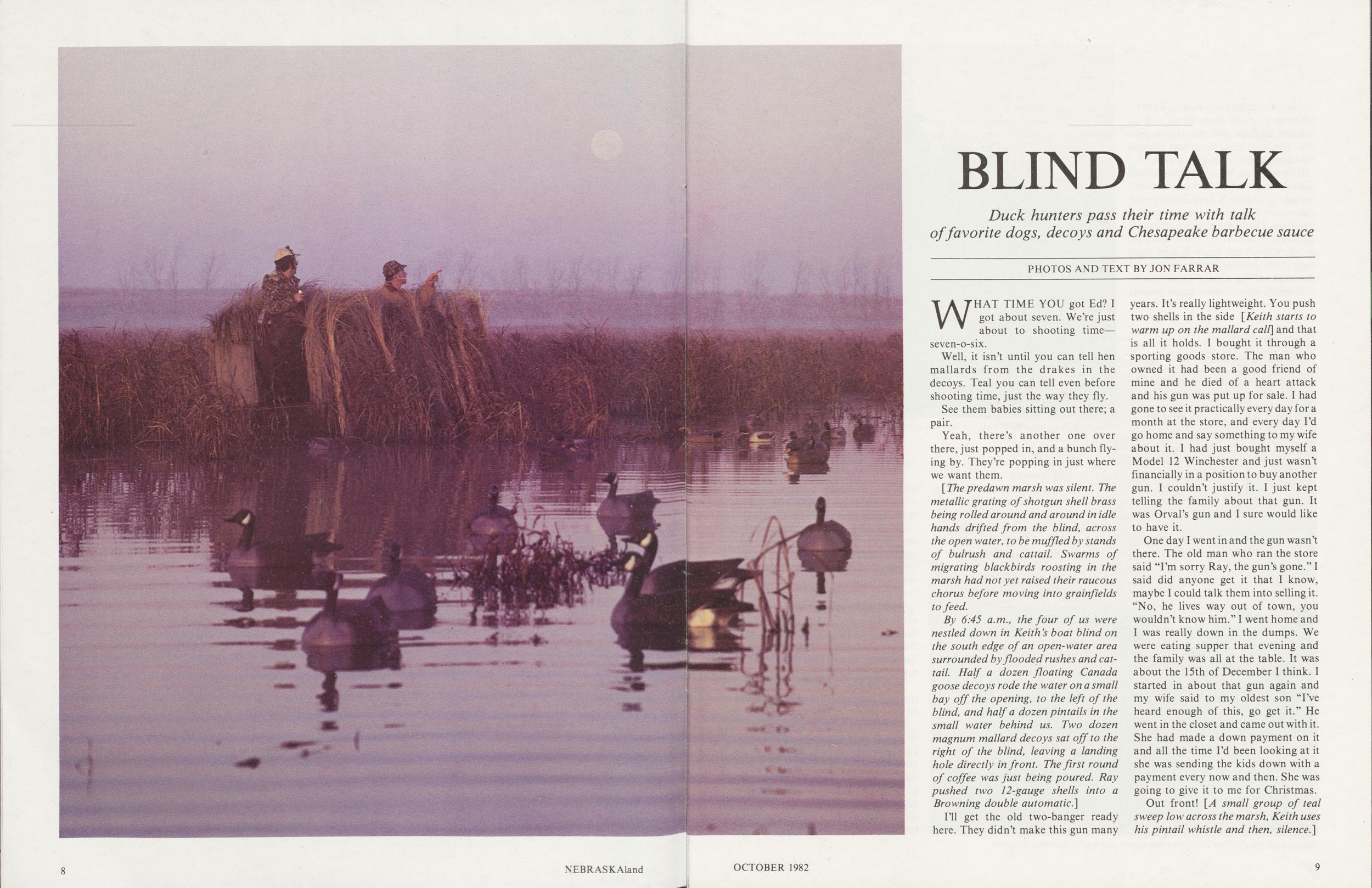
BLIND TALK
Duck hunters pass their time with talk of favorite dogs, decoys and Chesapeake barbecue sauce PHOTOS AND TEXT BY JON FARRARWHAT TIME YOU got Ed? I got about seven. We're just about to shooting time—seven-o-six.
Well, it isn't until you can tell hen mallards from the drakes in the decoys. Teal you can tell even before shooting time, just the way they fly. See them babies sitting out there; a pair.
Yeah, there's another one over there, just popped in, and a bunch flying by. They're popping in just where we want them.
[The predawn marsh was silent. The metallic grating of shotgun shell brass being rolled around and around in idle hands drifted from the blind, across the open water, to be muffled by stands of bulrush and cattail. Swarms of migrating blackbirds roosting in the marsh had not yet raised their raucous chorus before moving into grainfields to feed.
By 6:45 a.m., the four of us were nestled down in Keith's boat blind on the south edge of an open-water area surrounded by flooded rushes and cattail. Half a dozen floating Canada goose decoys rode the water on a small bay off the opening, to the left of the blind, and half a dozen pintails in the small water behind us. Two dozen magnum mallard decoys sat off to the right of the blind, leaving a landing hole directly in front. The first round of coffee was just being poured. Ray pushed two 12-gauge shells into a Browning double automatic.]
I'll get the old two-banger ready here. They didn't make this gun many years. It's really lightweight. You push two shells in the side [Keith starts to warm up on the mallard call] and that is all it holds. I bought it through a sporting goods store. The man who owned it had been a good friend of mine and he died of a heart attack and his gun was put up for sale. I had gone to see it practically every day for a month at the store, and every day I'd go home and say something to my wife about it. I had just bought myself a Model 12 Winchester and just wasn't financially in a position to buy another gun. I couldn't justify it. I just kept telling the family about that gun. It was Orval's gun and I sure would like to have it.
One day I went in and the gun wasn't there. The old man who ran the store said "I'm sorry Ray, the gun's gone." I said did anyone get it that I know, maybe I could talk them into selling it. "No, he lives way out of town, you wouldn't know him." I went home and I was really down in the dumps. We were eating supper that evening and the family was all at the table. It was about the 15th of December I think. I started in about that gun again and my wife said to my oldest son "I've heard enough of this, go get it." He went in the closet and came out with it. She had made a down payment on it and all the time I'd been looking at it she was sending the kids down with a payment every now and then. She was going to give it to me for Christmas.
Out front! [A small group of teal sweep low across the marsh, Keith uses his pintail whistle and then, silence.]
OCTOBER 1982 9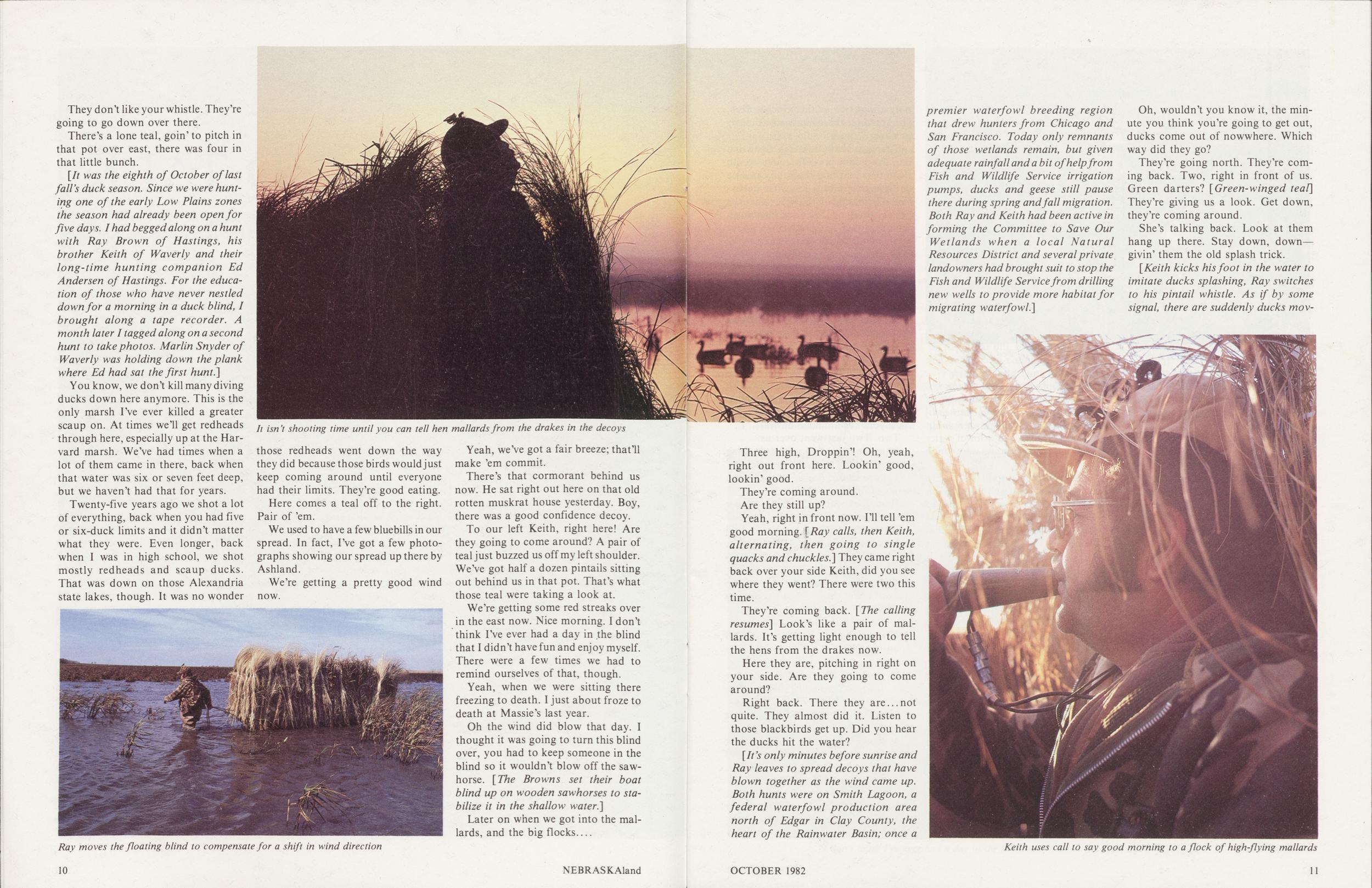
They don't like your whistle. They're going to go down over there.
There's a lone teal, goin' to pitch in that pot over east, there was four in that little bunch.
[It was the eighth of October of last fall's duck season. Since we were hunting one of the early Low Plains zones the season had already been open for five days. I had begged along on a hunt with Ray Brown of Hastings, his brother Keith of Waverly and their long-time hunting companion Ed Andersen of Hastings. For the education of those who have never nestled down for a morning in a duck blind, I brought along a tape recorder. A month later I tagged along on a second hunt to take photos. Marlin Snyder of Waverly was holding down the plank where Ed had sat the first hunt.]
You know, we don't kill many diving ducks down here anymore. This is the only marsh I've ever killed a greater scaup on. At times we'll get redheads through here, especially up at the Harvard marsh. We've had times when a lot of them came in there, back when that water was six or seven feet deep, but we haven't had that for years.
Twenty-five years ago we shot a lot of everything, back when you had five or six-duck limits and it didn't matter what they were. Even longer, back when I was in high school, we shot mostly redheads and scaup ducks. That was down on those Alexandria state lakes, though. It was no wonder those redheads went down the way they did because those birds would just keep coming around until everyone had their limits. They're good eating.
Here comes a teal off to the right. Pair of 'em.
We used to have a few bluebills in our spread. In fact, I've got a few photographs showing our spread up there by Ashland.
We're getting a pretty good wind now.
Yeah, we've got a fair breeze; that'll make 'em commit.
There's that cormorant behind us now. He sat right out here on that old rotten muskrat house yesterday. Boy, there was a good confidence decoy.
To our left Keith, right here! Are they going to come around? A pair of teal just buzzed us off my left shoulder. We've got half a dozen pintails sitting out behind us in that pot. That's what those teal were taking a look at.
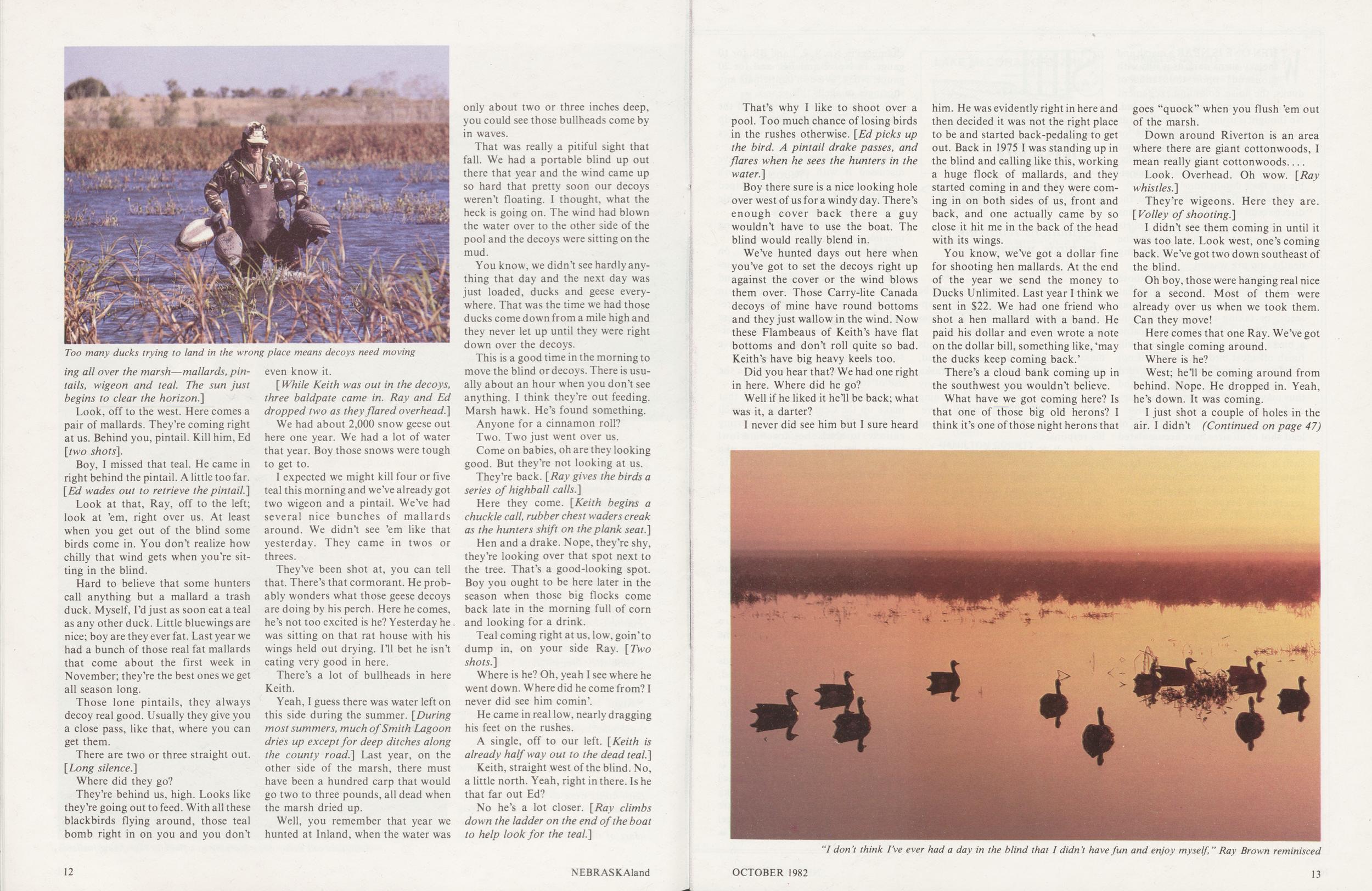
We're getting some red streaks over in the east now. Nice morning. I don't think I've ever had a day in the blind that I didn't have fun and enjoy myself. There were a few times we had to remind ourselves of that, though.
Yeah, when we were sitting there freezing to death. I just about froze to death at Massie's last year.
Oh the wind did blow that day. I thought it was going to turn this blind over, you had to keep someone in the blind so it wouldn't blow off the sawhorse. [The Browns set their boat blind up on wooden sawhorses to stabilize it in the shallow water.]
Later on when we got into the mallards, and the big flocks....
10 NEBRASKAlandThree high, Droppin'! Oh, yeah, right out front here. Lookin' good, lookin' good.
They're coming around.
Are they still up?
Yeah, right in front now. I'll tell 'em good morning. {Ray calls, then Keith, alternating, then going to single quacks and chuckles.] They came right back over your side Keith, did you see where they went? There were two this time.
They're coming back. [The calling resumes] Look's like a pair of mallards. It's getting light enough to tell the hens from the drakes now.
Here they are, pitching in right on your side. Are they going to come around?
Right back. There they are...not quite. They almost did it. Listen to those blackbirds get up. Did you hear the ducks hit the water?
[It's only minutes before sunrise and Ray leaves to spread decoys that have blown together as the wind came up. Both hunts were on Smith Lagoon, a federal waterfowl production area north of Edgar in Clay County, the heart of the Rainwater Basin; once a premier waterfowl breeding region that drew hunters from Chicago and San Francisco. Today only remnants of those wetlands remain, but given adequate rainfall and a bit of help from Fish and Wildlife Service irrigation pumps, ducks and geese still pause there during spring and fall migration. Both Ray and Keith had been active in forming the Committee to Save Our Wetlands when a local Natural Resources District and several private landowners had brought suit to stop the Fish and Wildlife Service from drilling new wells to provide more habitat for migrating waterfowl.]
Oh, wouldn't you know it, the minute you think you're going to get out, ducks come out of now where. Which way did they go?
They're going north. They're coming back. Two, right in front of us. Green darters? [Green-winged teal] They're giving us a look. Get down, they're coming around.
She's talking back. Look at them hang up there. Stay down, down—givin' them the old splash trick.
[Keith kicks his foot in the water to imitate ducks splashing, Ray switches to his pintail whistle. As if by some signal, there are suddenly ducks moving
Look, ofTto the west. Here comes a pair of mallards. They're coming right at us. Behind you, pintail. Kill him, Ed [two shots].
Boy, I missed that teal. He came in right behind the pintail. A little too far. [Ed wades out to retrieve the pintail.]
Look at that, Ray, off to the left; look at 'em, right over us. At least when you get out of the blind some birds come in. You don't realize how chilly that wind gets when you're sitting in the blind.
Hard to believe that some hunters call anything but a mallard a trash duck. Myself, I'd just as soon eat a teal as any other duck. Little bluewings are nice; boy are they ever fat. Last year we had a bunch of those real fat mallards that come about the first week in November; they're the best ones we get all season long.
Those lone pintails, they always decoy real good. Usually they give you a close pass, like that, where you can get them.
There are two or three straight out. [Long silence.]
Where did they go?
They're behind us, high. Looks like they're going out to feed. With all these blackbirds flying around, those teal bomb right in on you and you don't even know it.
[ While Keith was out in the decoys, three baldpate came in. Ray and Ed dropped two as they flared overhead.]
We had about 2,000 snow geese out here one year. We had a lot of water that year. Boy those snows were tough to get to.
I expected we might kill four or five teal this morning and we've already got two wigeon and a pintail. We've had several nice bunches of mallards around. We didn't see 'em like that yesterday. They came in twos or threes.
They've been shot at, you can tell that. There's that cormorant. He probably wonders what those geese decoys are doing by his perch. Here he comes, he's not too excited is he? Yesterday he was sitting on that rat house with his wings held out drying. I'll bet he isn't eating very good in here.
There's a lot of bullheads in here Keith.
Yeah, I guess there was water left on this side during the summer. [During most summers, much of Smith Lagoon dries up except for deep ditches along the county road.] Last year, on the other side of the marsh, there must have been a hundred carp that would go two to three pounds, all dead when the marsh dried up.
Well, you remember that year we hunted at Inland, when the water was only about two or three inches deep, you could see those bullheads come by in waves.
That was really a pitiful sight that fall. We had a portable blind up out there that year and the wind came up so hard that pretty soon our decoys weren't floating. I thought, what the heck is going on. The wind had blown the water over to the other side of the pool and the decoys were sitting on the mud.
You know, we didn't see hardly anything that day and the next day was just loaded, ducks and geese everywhere. That was the time we had those ducks come down from a mile high and they never let up until they were right down over the decoys.
This is a good time in the morning to move the blind or decoys. There is usually about an hour when you don't see anything. I think they're out feeding. Marsh hawk. He's found something.
Anyone for a cinnamon roll?
Two. Two just went over us.
Come on babies, oh are they looking good. But they're not looking at us.
They're back. [Ray gives the birds a series of highball calls.]
Here they come. [Keith begins a chuckle call, rubber chest waders creak as the hunters shift on the plank seat.]
Hen and a drake. Nope, they're shy, they're looking over that spot next to the tree. That's a good-looking spot. Boy you ought to be here later in the season when those big flocks come back late in the morning full of corn and looking for a drink.
Teal coming right at us, low, goin' to dump in, on your side Ray. [Two shots.]
Where is he? Oh, yeah I see where he went down. Where did he come from? I never did see him comin'.
He came in real low, nearly dragging his feet on the rushes.
A single, off to our left. [Keith is already halfway out to the dead teal.]
Keith, straight west of the blind. No, a little north. Yeah, right in there. Is he that far out Ed?
No he's a lot closer. [Ray climbs down the ladder on the end of the boat to help look for the teal.]
12 NEBRASKAlandThat's why I like to shoot over a pool. Too much chance of losing birds in the rushes otherwise. [Ed picks up the bird. A pintail drake passes, and flares when he sees the hunters in the water.]
Boy there sure is a nice looking hole over west of us for a windy day. There's enough cover back there a guy wouldn't have to use the boat. The blind would really blend in.
We've hunted days out here when you've got to set the decoys right up against the cover or the wind blows them over. Those Carry-lite Canada decoys of mine have round bottoms and they just wallow in the wind. Now these Flambeaus of Keith's have flat bottoms and don't roll quite so bad. Keith's have big heavy keels too.
Did you hear that? We had one right in here. Where did he go?
Well if he liked it he'll be back; what was it, a darter?
I never did see him but I sure heard him. He was evidently right in here and then decided it was not the right place to be and started back-pedaling to get out. Back in 1975 I was standing up in the blind and calling like this, working a huge flock of mallards, and they started coming in and they were coming in on both sides of us, front and back, and one actually came by so close it hit me in the back of the head with its wings.
You know, we've got a dollar fine for shooting hen mallards. At the end of the year we send the money to Ducks Unlimited. Last year I think we sent in $22. We had one friend who shot a hen mallard with a band. He paid his dollar and even wrote a note on the dollar bill, something like, 'may the ducks keep coming back.'
There's a cloud bank coming up in the southwest you wouldn't believe.
What have we got coming here? Is that one of those big old herons? I think it's one of those night herons that goes "quock" when you flush 'em out of the marsh.
Down around Riverton is an area where there are giant cottonwoods, I mean really giant cottonwoods....
Look. Overhead. Oh wow. [Ray whistles.]
They're wigeons. Here they are. [Volley of shooting.]
I didn't see them coming in until it was too late. Look west, one's coming back. We've got two down southeast of the blind.
Oh boy, those were hanging real nice for a second. Most of them were already over us when we took them. Can they move!
Here comes that one Ray. We've got that single coming around.
Where is he?
West; he'll be coming around from behind. Nope. He dropped in. Yeah, he's down. It was coming.
I just shot a couple of holes in the air. I didn't (Continued on page 47)
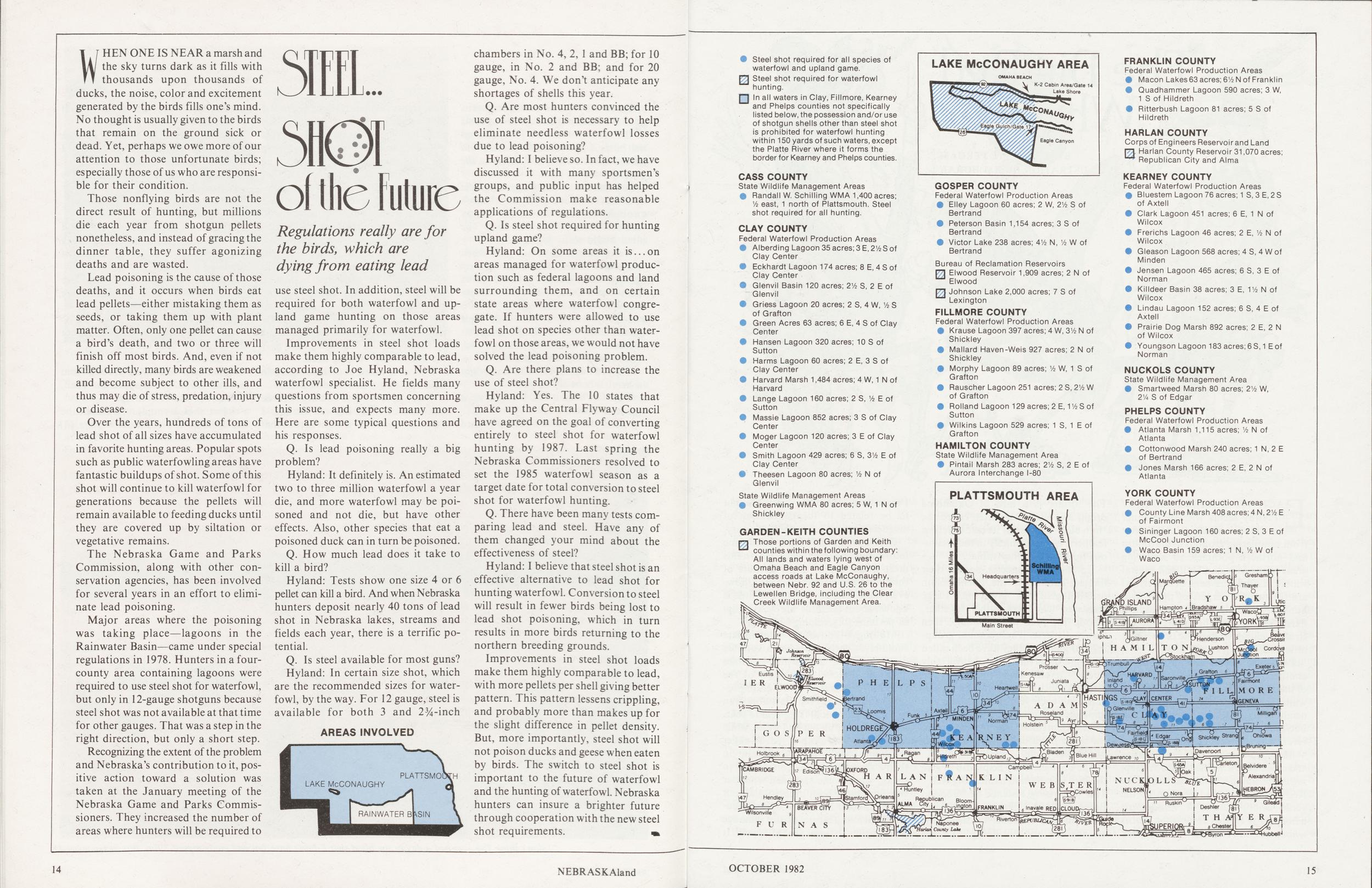
STEEL SHOT of the Future
Regulations really are for the birds, which are dying from eating leadWHEN ONE IS NEAR a marsh and the sky turns dark as it fills with thousands upon thousands of ducks, the noise, color and excitement generated by the birds fills one's mind. No thought is usually given to the birds that remain on the ground sick or dead. Yet, perhaps we owe more of our attention to those unfortunate birds; especially those of us who are responsible for their condition.
Those nonflying birds are not the direct result of hunting, but millions die each year from shotgun pellets nonetheless, and instead of gracing the dinner table, they suffer agonizing deaths and are wasted.
Lead poisoning is the cause of those deaths, and it occurs when birds eat lead pellets—either mistaking them as seeds, or taking them up with plant matter. Often, only one pellet can cause a bird's death, and two or three will finish off most birds. And, even if not killed directly, many birds are weakened and become subject to other ills, and thus may die of stress, predation, injury or disease.
Over the years, hundreds of tons of lead shot of all sizes have accumulated in favorite hunting areas. Popular spots such as public waterfowling areas have fantastic buildups of shot. Some of this shot will continue to kill waterfowl for generations because the pellets will remain available to feeding ducks until they are covered up by siltation or vegetative remains.
The Nebraska Game and Parks Commission, along with other conservation agencies, has been involved for several years in an effort to eliminate lead poisoning.
Major areas where the poisoning was taking place—lagoons in the Rainwater Basin—came under special regulations in 1978. Hunters in a four-county area containing lagoons were required to use steel shot for waterfowl, but only in 12-gauge shotguns because steel shot was not available at that time for other gauges. That was a step in the right direction, but only a short step.
Recognizing the extent of the problem and Nebraska's contribution to it, positive action toward a solution was taken at the January meeting of the Nebraska Game and Parks Commissioners. They increased the number of areas where hunters will be required to use steel shot. In addition, steel will be required for both waterfowl and up-land game hunting on those areas managed primarily for waterfowl.
Improvements in steel shot loads make them highly comparable to lead, according to Joe Hyland, Nebraska waterfowl specialist. He fields many questions from sportsmen concerning this issue, and expects many more. Here are some typical questions and his responses.
Q. Is lead poisoning really a big problem?
Hyland: It definitely is. An estimated two to three million waterfowl a year die, and more waterfowl may be poisoned and not die, but have other effects. Also, other species that eat a poisoned duck can in turn be poisoned.
Q. How much lead does it take to kill a bird?
Hyland: Tests show one size 4 or 6 pellet can kill a bird. And when Nebraska hunters deposit nearly 40 tons of lead shot in Nebraska lakes, streams and fields each year, there is a terrific potential.
Q. Is steel available for most guns?
Hyland: In certain size shot, which are the recommended sizes for waterfowl, by the way. For 12 gauge, steel is available for both 3 and 2%-inch chambers in No. 4, 2, 1 and BB; for 10 gauge, in No. 2 and BB; and for 20 gauge, No. 4. We don't anticipate any shortages of shells this year.
Q. Are most hunters convinced the use of steel shot is necessary to help eliminate needless waterfowl losses due to lead poisoning?
Hyland: I believe so. In fact, we have discussed it with many sportsmen's groups, and public input has helped the Commission make reasonable applications of regulations.
Q. Is steel shot required for hunting upland game?
Hyland: On some areas it is...on areas managed for waterfowl production such as federal lagoons and land surrounding them, and on certain state areas where waterfowl congregate. If hunters were allowed to use lead shot on species other than waterfowl on those areas, we would not have solved the lead poisoning problem.
Q. Are there plans to increase the use of steel shot?
Hyland: Yes. The 10 states that make up the Central Flyway Council have agreed on the goal of converting entirely to steel shot for waterfowl hunting by 1987. Last spring the Nebraska Commissioners resolved to set the 1985 waterfowl season as a target date for total conversion to steel shot for waterfowl hunting.
Q. There have been many tests comparing lead and steel. Have any of them changed your mind about the effectiveness of steel?
Hyland: I believe that steel shot is an effective alternative to lead shot for hunting waterfowl. Conversion to steel will result in fewer birds being lost to lead shot poisoning, which in turn results in more birds returning to the northern breeding grounds.
Improvements in steel shot loads make them highly comparable to lead, with more pellets per shell giving better pattern. This pattern lessens crippling, and probably more than makes up for the slight difference in pellet density. But, more importantly, steel shot will not poison ducks and geese when eaten by birds. The switch to steel shot is important to the future of waterfowl and the hunting of waterfowl. Nebraska hunters can insure a brighter future through cooperation with the new steel shot requirements.
14 NEBRASKAland Steel shot required for all species of waterfowl and upland game. Steel shot required for waterfowl hunting. In all waters in Clay, Fillmore, Kearney and Phelps counties not specifically listed below, the possession and/or use of shotgun shells other than steel shot is prohibited for waterfowl hunting within 150 yards of such waters, except the Platte River where it forms the border for Kearney and Phelps counties. CASS COUNTY State Wildlife Management Areas Randall W. Schilling WMA 1,400 acres; 1/2 east, 1 north of Plattsmouth. Steel shot required for all hunting. CLAY COUNTY Federal Waterfowl Production Areas • Alberding Lagoon 35 acres; 3 E, 21/2 S of Clay Center • Eckhardt Lagoon 174 acres; 8 E, 4 S of Clay Center • Glenvil Basin 120 acres; 21/2 S, 2 E of Glenvil • Griess Lagoon 20 acres; 2 S, 4 W, 1/2 S of Grafton • Green Acres 63 acres; 6 E, 4 S of Clay Center • Hansen Lagoon 320 acres; 10 S of Sutton • Harms Lagoon 60 acres; 2 E, 3 S of Clay Center • Harvard Marsh 1,484 acres; 4 W, 1 N of Harvard • Lange Lagoon 160 acres; 2 S, 1/2 E of Sutton • Massie Lagoon 852 acres; 3 S of Clay Center • Moger Lagoon 120 acres; 3 E of Clay Center • Smith Lagoon 429 acres; 6 S, 31/2 E of Clay Center • Theesen Lagoon 80 acres; 1/2 N of Glenvil State Wildlife Management Areas • Greenwing WMA 80 acres; 5 W, 1 N of Shickley GARDEN-KEITH COUNTIES Those portions of Garden and Keith counties within the following boundary: All lands and waters lying west of Omaha Beach and Eagle Canyon access roads at Lake McConaughy, between Nebr. 92 and U.S. 26 to the Lewellen Bridge, including the Clear Creek Wildlife Management Area.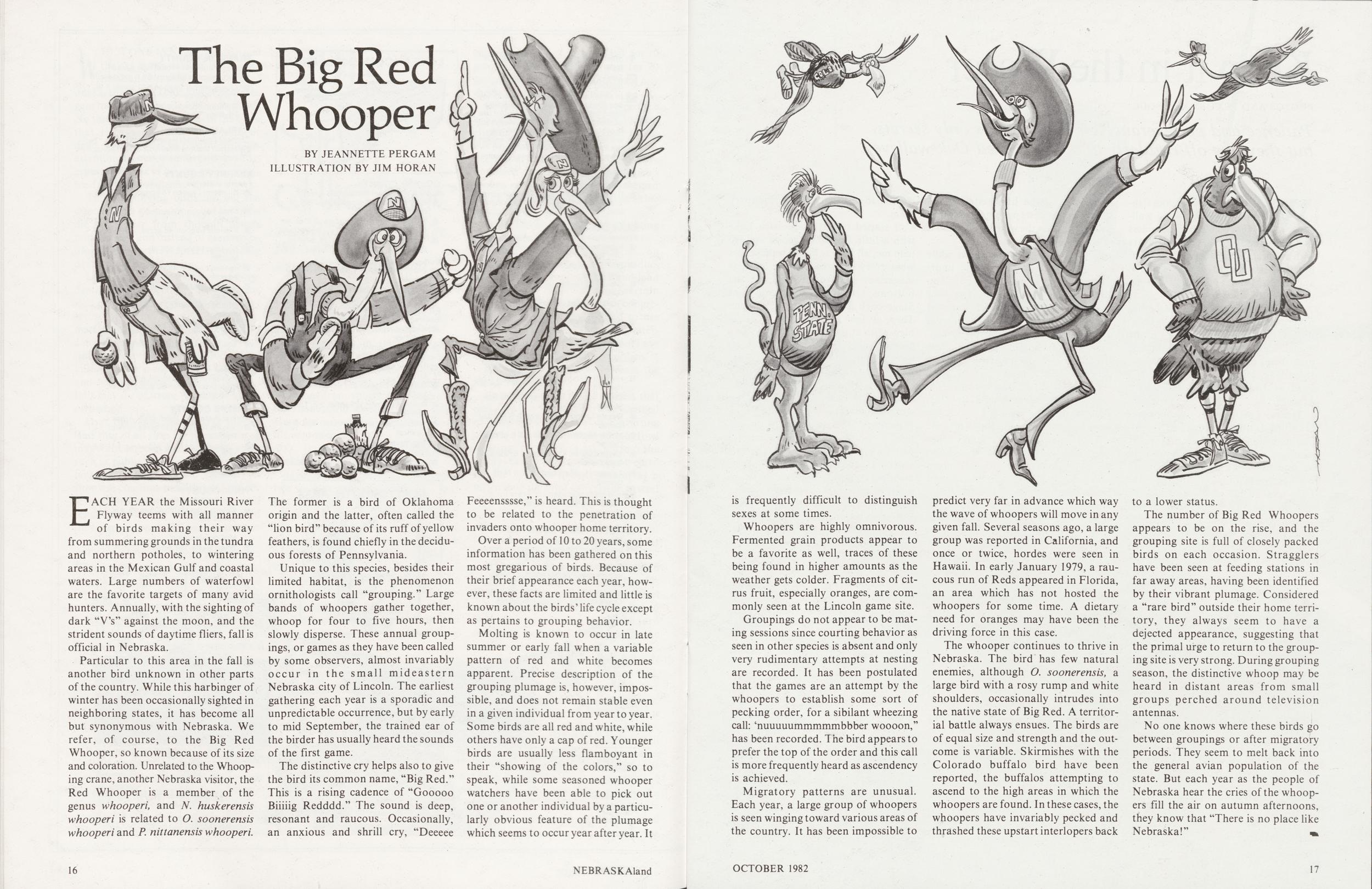
The Big Red Whooper
BY JEANNETTE PERGAM ILLUSTRATION BY JIM HORANEACH YEAR the Missouri River Flyway teems with all manner of birds making their way from summering grounds in the tundra and northern potholes, to wintering areas in the Mexican Gulf and coastal waters. Large numbers of waterfowl are the favorite targets of many avid hunters. Annually, with the sighting of dark "V's" against the moon, and the strident sounds of daytime fliers, fall is official in Nebraska.
Particular to this area in the fall is another bird unknown in other parts of the country. While this harbinger of winter has been occasionally sighted in neighboring states, it has become all but synonymous with Nebraska. We refer, of course, to the Big Red Whooper, so known because of its size and coloration. Unrelated to the Whooping crane, another Nebraska visitor, the Red Whooper is a member of the genus whooperi, and N. huskerensis whooperi is related to O. soonerensis whooperi and P. nittanensis whooperi. The former is a bird of Oklahoma origin and the latter, often called the "lion bird" because of its ruff of yellow feathers, is found chiefly in the deciduous forests of Pennsylvania.
Unique to this species, besides their limited habitat, is the phenomenon ornithologists call "grouping." Large bands of whoopers gather together, whoop for four to five hours, then slowly disperse. These annual groupings, or games as they have been called by some observers, almost invariably occur in the small mideastern Nebraska city of Lincoln. The earliest gathering each year is a sporadic and unpredictable occurrence, but by early to mid September, the trained ear of the birder has usually heard the sounds of the first game.
The distinctive cry helps also to give the bird its common name, "Big Red." This is a rising cadence of "Gooooo Biiiiig Redddd." The sound is deep, resonant and raucous. Occasionally, an anxious and shrill cry, "Deeeee Feeeensssse," is heard. This is thought to be related to the penetration of invaders onto whooper home territory.
Over a period of 10 to 20 years, some information has been gathered on this most gregarious of birds. Because of their brief appearance each year, however, these facts are limited and little is known about the birds' life cycle except as pertains to grouping behavior.
Molting is known to occur in late summer or early fall when a variable pattern of red and white becomes apparent. Precise description of the grouping plumage is, however, impossible, and does not remain stable even in a given individual from year to year. Some birds are all red and white, while others have only a cap of red. Younger birds are usually less flamboyant in their "showing of the colors," so to speak, while some seasoned whooper watchers have been able to pick out one or another individual by a particularly obvious feature of the plumage which seems to occur year after year. It 16 NEBRASKAland is frequently difficult to distinguish sexes at some times.
Whoopers are highly omnivorous. Fermented grain products appear to be a favorite as well, traces of these being found in higher amounts as the weather gets colder. Fragments of citrus fruit, especially oranges, are commonly seen at the Lincoln game site.
Groupings do not appear to be mating sessions since courting behavior as seen in other species is absent and only very rudimentary attempts at nesting are recorded. It has been postulated that the games are an attempt by the whoopers to establish some sort of pecking order, for a sibilant wheezing call: 'nuuuuummmmmbbber woooon," has been recorded. T he bird appears to prefer the top of the order and this call is more frequently heard as ascendency is achieved.
Migratory patterns are unusual. Each year, a large group of whoopers is seen winging toward various areas of the country. It has been impossible to predict very far in advance which way the wave of whoopers will move in any given fall. Several seasons ago, a large group was reported in California, and once or twice, hordes were seen in Hawaii. In early January 1979, a raucous run of Reds appeared in Florida, an area which has not hosted the whoopers for some time. A dietary need for oranges may have been the driving force in this case.
The whooper continues to thrive in Nebraska. The bird has few natural enemies, although O. soonerensis, a large bird with a rosy rump and white shoulders, occasionally intrudes into the native state of Big Red. A territorial battle always ensues. The birds are of equal size and strength and the outcome is variable. Skirmishes with the Colorado buffalo bird have been reported, the buffalos attempting to ascend to the high areas in which the whoopers are found. In these cases, the whoopers have invariably pecked and thrashed these upstart interlopers back to a lower status.
The number of Big Red Whoopers appears to be on the rise, and the grouping site is full of closely packed birds on each occasion. Stragglers have been seen at feeding stations in far away areas, having been identified by their vibrant plumage. Considered a "rare bird" outside their home territory, they always seem to have a dejected appearance, suggesting that the primal urge to return to the grouping site is very strong. During grouping season, the distinctive whoop may be heard in distant areas from small groups perched around television antennas.
No one knows where these birds go between groupings or after migratory periods. They seem to melt back into the general avian population of the state. But each year as the people of Nebraska hear the cries of the whoopers fill the air on autumn afternoons, they know that "There is no place like Nebraska!"
OCTOBER 1982 17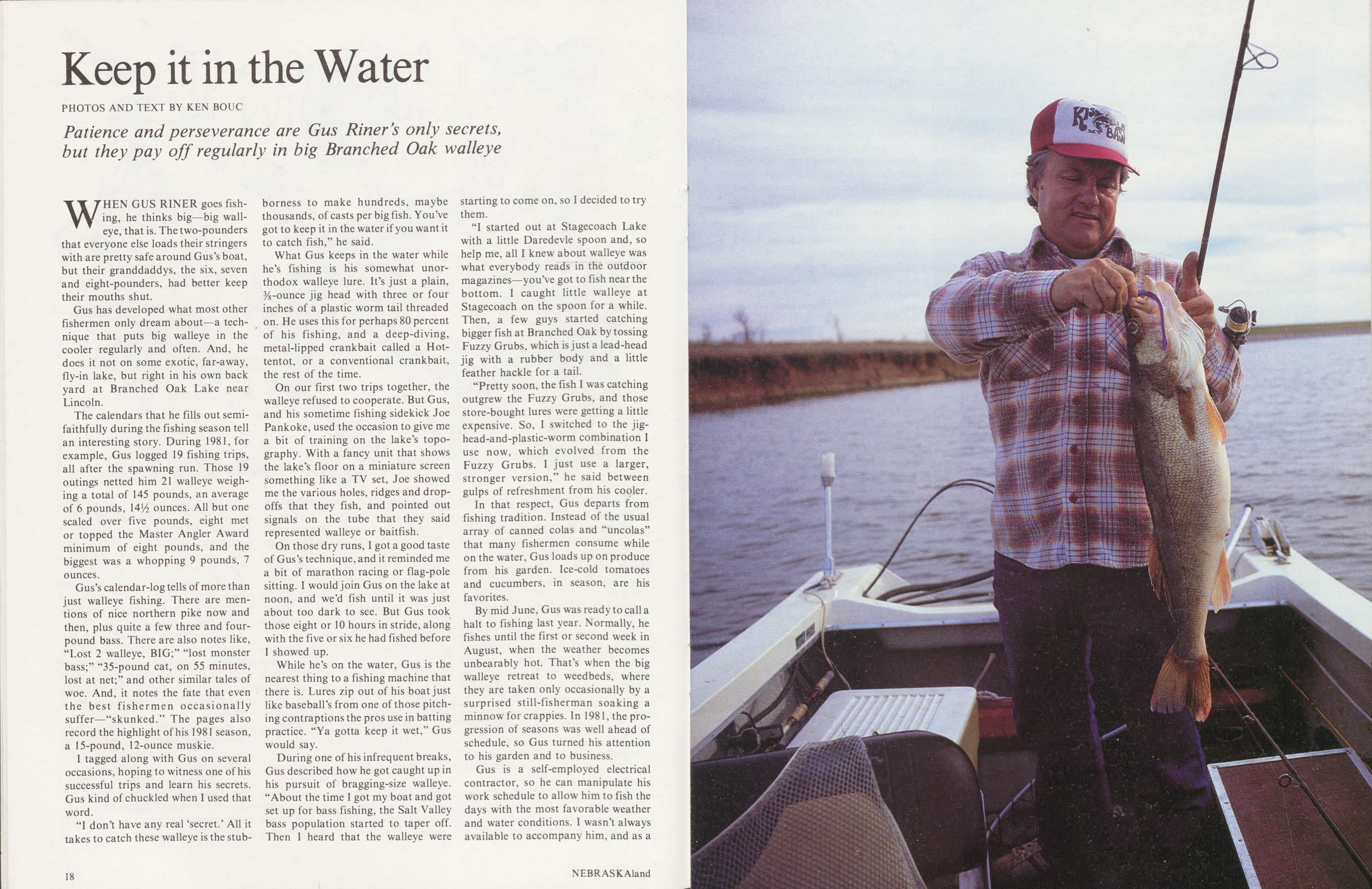
Keep it in the Water
PHOTOS AND TEXT BY KEN BOUC Patience and perseverance are Gus Riner's only secrets, but they pay off regularly in big Branched Oak walleyeWHEN GUS RINER goes fishing, he thinks big—big walleye, that is. The two-pounders that everyone else loads their stringers with are pretty safe around Gus's boat, but their granddaddys, the six, seven and eight-pounders, had better keep their mouths shut.
Gus has developed what most other fishermen only dream about—a technique that puts big walleye in the cooler regularly and often. And, he does it not on some exotic, far-away, fly-in lake, but right in his own back yard at Branched Oak Lake near Lincoln.
The calendars that he fills out semi-faithfully during the fishing season tell an interesting story. During 1981, for example, Gus logged 19 fishing trips, all after the spawning run. Those 19 outings netted him 21 walleye weighing a total of 145 pounds, an average of 6 pounds, 14J/2 ounces. All but one scaled over five pounds, eight met or topped the Master Angler Award minimum of eight pounds, and the biggest was a whopping 9 pounds, 7 ounces.
Gus's calendar-log tells of more than just walleye fishing. There are mentions of nice northern pike now and then, plus quite a few three and four-pound bass. There are also notes like, "Lost 2 walleye, BIG;" "lost monster bass;" "35-pound cat, on 55 minutes, lost at net;" and other similar tales of woe. And, it notes the fate that even the best fishermen occasionally suffer—"skunked." The pages also record the highlight of his 1981 season, a 15-pound, 12-ounce muskie.
I tagged along with Gus on several occasions, hoping to witness one of his successful trips and learn his secrets. Gus kind of chuckled when I used that word.
"I don't have any real 'secret.' All it takes to catch these walleye is the stubborness to make hundreds, maybe thousands, of casts per big fish. You've got to keep it in the water if you want it to catch fish," he said.
What Gus keeps in the water while he's fishing is his somewhat unorthodox walleye lure. It's just a plain, 3/8-ounce jig head with three or four inches of a plastic worm tail threaded on. He uses this for perhaps 80 percent of his fishing, and a deep-diving, metal-lipped crankbait called a Hottentot, or a conventional crankbait, the rest of the time.
On our first two trips together, the walleye refused to cooperate. But Gus, and his sometime fishing sidekick Joe Pankoke, used the occasion to give me a bit of training on the lake's topography, With a fancy unit that shows the lake's floor on a miniature screen something like a TV set, Joe showed me the various holes, ridges and drop-offs that they fish, and pointed out signals on the tube that they said represented walleye or baitfish.
On those dry runs, I got a good taste of Gus's technique, and it reminded me a bit of marathon racing or flag-pole sitting. I would join Gus on the lake at noon, and we'd fish until it was just about too dark to see. But Gus took those eight or 10 hours in stride, along with the five or six he had fished before I showed up.
While he's on the water, Gus is the nearest thing to a fishing machine that there is. Lures zip out of his boat just like baseball's from one of those pitching contraptions the pros use in batting practice. "Ya gotta keep it wet," Gus would say.
During one of his infrequent breaks, Gus described how he got caught up in his pursuit of bragging-size walleye. "About the time I got my boat and got set up for bass fishing, the Salt Valley bass population started to taper off. Then I heard that the walleye were starting to come on, so I decided to try them.
"I started out at Stagecoach Lake with a little Daredevle spoon and, so help me, all I knew about walleye was what everybody reads in the outdoor magazines—you've got to fish near the bottom. I caught little walleye at Stagecoach on the spoon for a while. Then, a few guys started catching bigger fish at Branched Oak by tossing Fuzzy Grubs, which is just a lead-head jig with a rubber body and a little feather hackle for a tail.
"Pretty soon, the fish I was catching outgrew the Fuzzy Grubs, and those store-bought lures were getting a little expensive. So, I switched to the jig-head-and-plastic-worm combination I use now, which evolved from the Fuzzy Grubs. I just use a larger, stronger version," he said between gulps of refreshment from his cooler.
In that respect, Gus departs from fishing tradition. Instead of the usual array of canned colas and "uncolas" that many fishermen consume while on the water, Gus loads up on produce from his garden. Ice-cold tomatoes and cucumbers, in season, are his favorites.
By mid June, Gus was ready to call a halt to fishing last year. Normally, he fishes until the first or second week in August, when the weather becomes unbearably hot. That's when the big walleye retreat to weedbeds, where they are taken only occasionally by a surprised still-fisherman soaking a minnow for crappies. In 1981, the progression of seasons was well ahead of schedule, so Gus turned his attention to his garden and to business.
Gus is a self-employed electrical contractor, so he can manipulate his work schedule to allow him to fish the days with the most favorable weather and water conditions. I wasn't always available to accompany him, and as a 18 NEBRASKAland
On one occasion, I was driving past Branched Oak on other business when I spotted Gus anchored off one of his favorite hotspots. I found a parking lot and hiked down the shoreline to visit with him a bit. There was just an hour or so of daylight left, and he had been fishing most of the day without success. He said something about quitting for the day, but I knew he'd be around until dark.
While we talked across the water, I happened to remember a new plastic bait that I had picked up the day before at the tackle shop. For some reason, I happened to have just one in my jacket pocket, so I offered it to Gus. He cast ashore with a bare jig, and I threaded the critter on so that he could reel it back to the boat.
The lure was a white, two-inch, shad-shaped affair with a down-turned tail that churned seductively when dragged through the water. They were designed to be fished on a jig head, so I bought them with Gus's technique in mind.
That night, during the 10 o'clock news, the phone rang. It was Gus, and he had a lot better report than what I was watching on the tube. Just minutes after I had left him at the lake, he tied into and landed an 8-pound, 5-ounce walleye, and had hooked and lost another lunker. And, he did it with that single rubber shad I had given him that evening. The next morning, Gus bought every white rubber shad body in sight, and he fished with them the rest of the summer. He did well with them, too, taking at least his usual share of trophy walleye, as well as some nice bass and pike. The shad body also accounted for his prize of the season, the 15-pound 12-ounce muskie.
"When I hooked that son-of-a-gun, I thought it was another nice walleye. He stayed deep, moved kind of strong and slow, and didn't put on any long runs. When I finally got him closer to the surface, he suddenly stripped about 40 yards of line from the reel and capped the run with about a four-foot leap. That's the first I knew I had something besides a walleye on.
"I was fishing with Daryl Klone, a Lincoln architect, who was handling the net. We thought the fight was over when we got the fish into the boat, but it really didn't begin until then. That fish thrashed and snapped and slapped all over the boat, knocking over tackle boxes and rods and everything else. We almost had to get out of the boat when he got in. I finally had to smack him between the eyes with a wrench and stuff him in a cooler before it was safe around there. After it was all over, I checked my line and it fell apart in my hands from the chewing that muskie had given it. I was darned lucky to land him," Gus said.
That muskie was his last big fish of the 1981 summer. I still had not witnessed Gus working his will on big walleye, so I persuaded him to give fall fishing a try. He went out on October 25, taking a 6!/2-pound walleye and a nine-pound pike, and when he reported his success, I made plans to accompany him two days later.
By then, duck season was several weeks old, and the weather looked at least as well suited to waterfowl hunting as walleye fishing. It was cloudy and cool, with a bit of a breeze.
I climbed aboard Gus's boat about 1 p.m., and he immediately motored us over to one of the eight or 10 spots he regularly fishes. Then, he began his usual rapid-fire delivery, working each spot thoroughly with numerous casts retrieved at various depths and speeds.
His graphite pole bent and his reel's drag sang briefly at one hole, but the fish shook the hook after about 10 seconds of fight. "He was a nice one, but there's more out here," Gus said 29 NEBRASKAland philosophically.
An hour and a half into the outing, Gus hauled back on the rod again, making it bend and the reel sing. This time, the hook stayed put while Gus patiently worked some of the spunk out of the fish and pumped it closer to the surface.
Walleye aren't particularly fast or flashy fighters, but they're good for a thrill, just the same. When that 2Vi feet of green and gold fish came to the surface, I got slightly short of breath. I can't tell if it's the beauty of the fish in its crystal-clear environment, the sinister look in its big, marble-like eyes, or the realization that this is the culmination of many hours of effort, but I get the same feeling every time I see a nice walleye come to the net.
Gus was up to the task, and he soon had the fish aboard. He guessed its weight at eight pounds or better.
It was then that I noticed Gus had used his tried-and-true jig and worm tail instead of the jig with the shad body we discovered earlier in the year. I asked him about that.
"I'm about out of the shad, and I haven't found any more in the stores," he answered. "But, I don't think that it matters too much what you throw at these fish. Sometimes you know they're there—you can see them on the scope—but they just won't hit. Other times, they'll crawl all over anything you show them. I don't make too much fuss about color or even type of lure. Take my jig heads, for example. I don't even bother to paint them. I just use them in the plain lead color they come with.
"With the jig head lure, I'll use different types and speeds of retrieve. I think that makes a difference. Sometimes I'll use a steady retrieve, and sometimes I'll try to hop it along. I'll get a lot of strikes as the lure falls, either after one of the hops or as it falls after a cast.
"I think the key to this walleye fishing is to put something with hooks on it in front of the walleye during one of those short periods during the day when he's active. You've got to find them and you've got to find them hungry or mad. Since you don't know when that's going to happen, you've got to cast, cast, cast," he said.
As if to prove his point, Gus began alternating between a rod fitted with a Hottentot and his usual jig-and-worm outfit. We worked his favorite haunts for perhaps another hour, which is about how long it takes for the excitement of a big fish to wear off.
Gus jerked us back from impending tedium, rocking the boat as he drove the hooks of the little crankbait into another heavy fish. There was another eight or 10-minute struggle, a carbon copy of the first right down to the lump in my throat as I gripped the net.
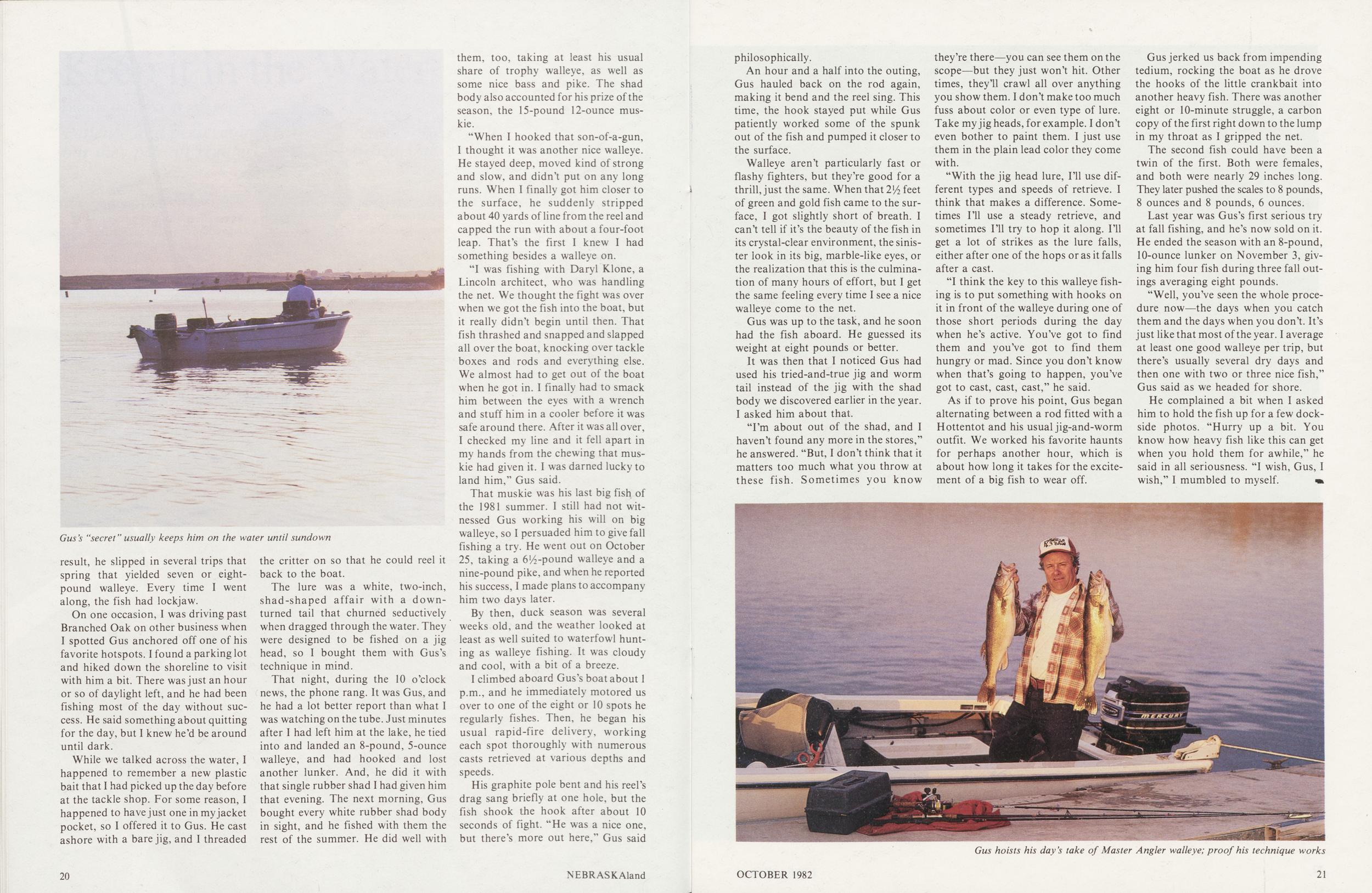
The second fish could have been a twin of the first. Both were females, and both were nearly 29 inches long. They later pushed the scales to 8 pounds, 8 ounces and 8 pounds, 6 ounces.
Last year was Gus's first serious try at fall fishing, and he's now sold on it. He ended the season with an 8-pound, 10-ounce lunker on November 3, giving him four fish during three fall outings averaging eight pounds.
"Well, you've seen the whole procedure now—the days when you catch them and the days when you don't. It's just like that most of the year. I average at least one good walleye per trip, but there's usually several dry days and then one with two or three nice fish," Gus said as we headed for shore.
He complained a bit when I asked him to hold the fish up for a few dockside photos. "Hurry up a bit. You know how heavy fish like this can get when you hold them for awhile," he said in all seriousness. "I wish, Gus, I wish," I mumbled to myself.
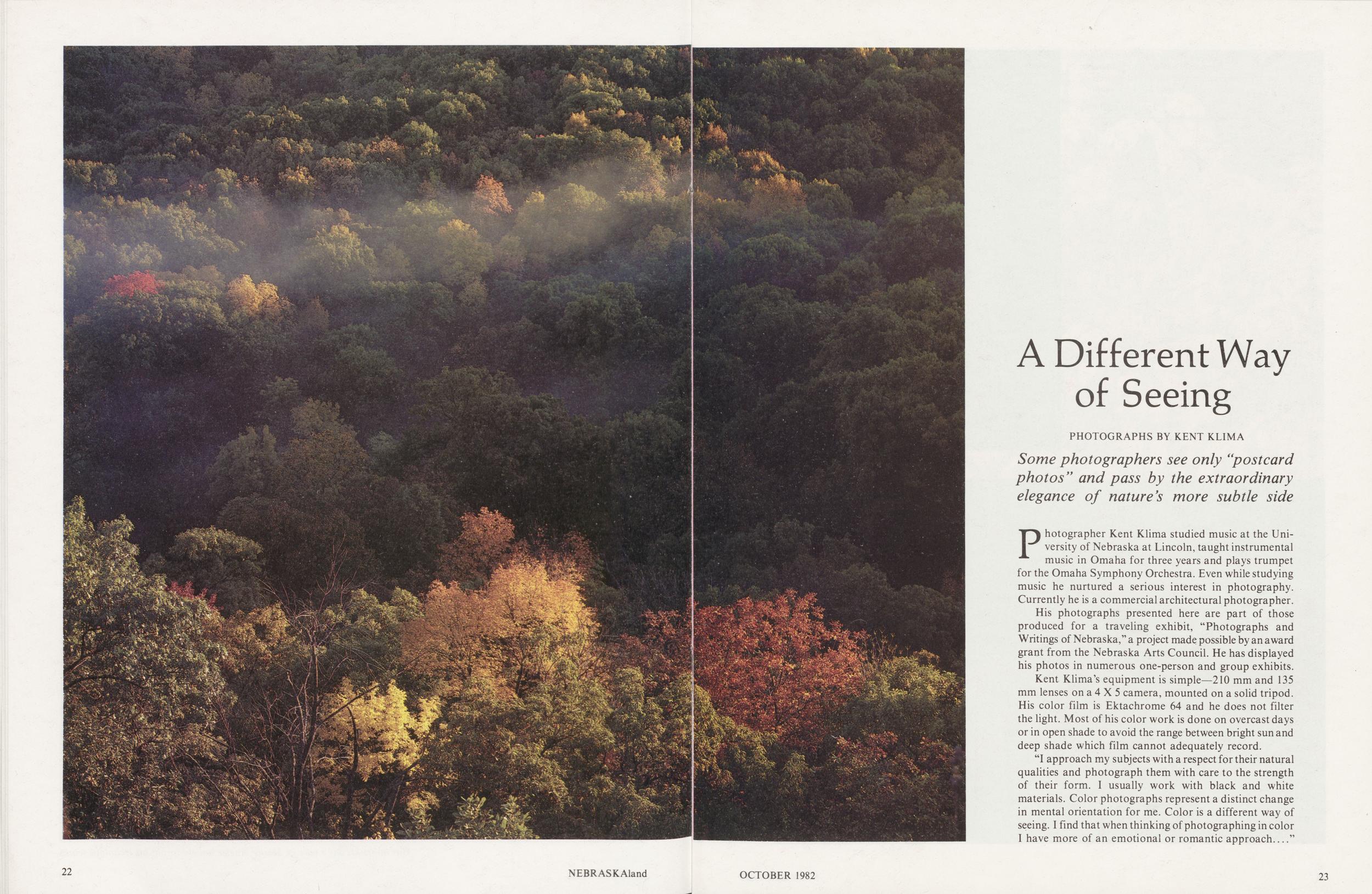
A Different Way of Seeing
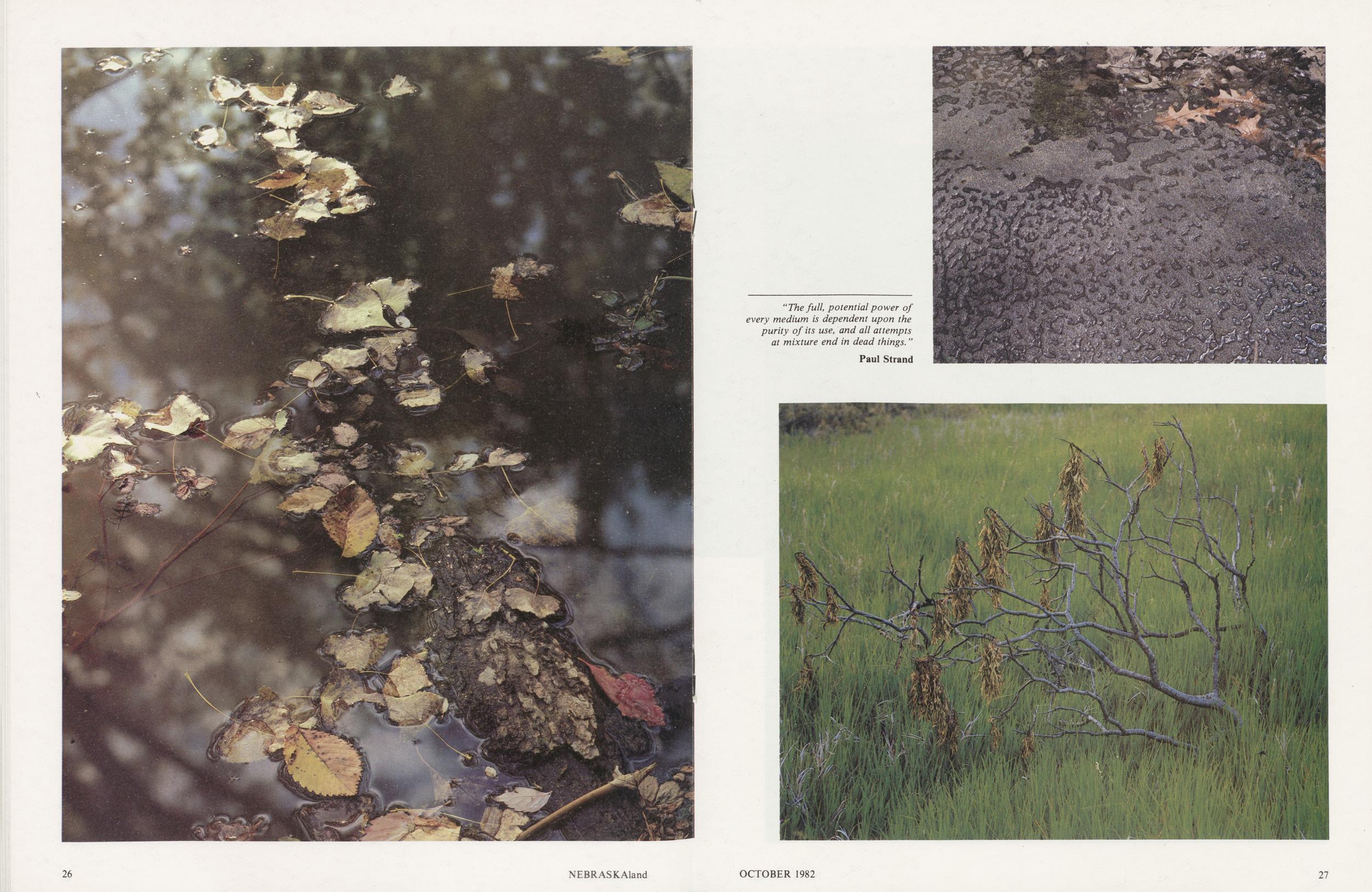
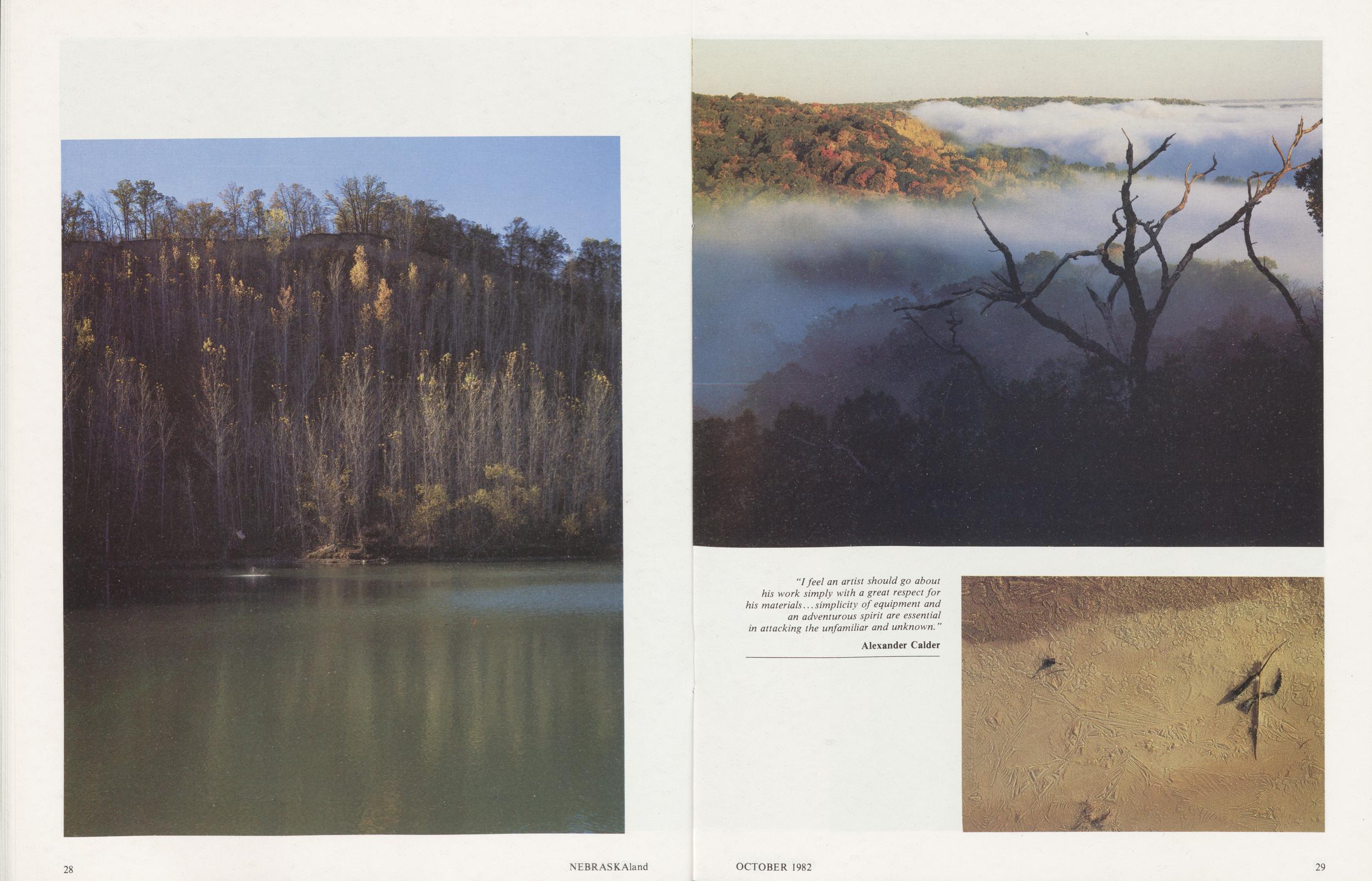
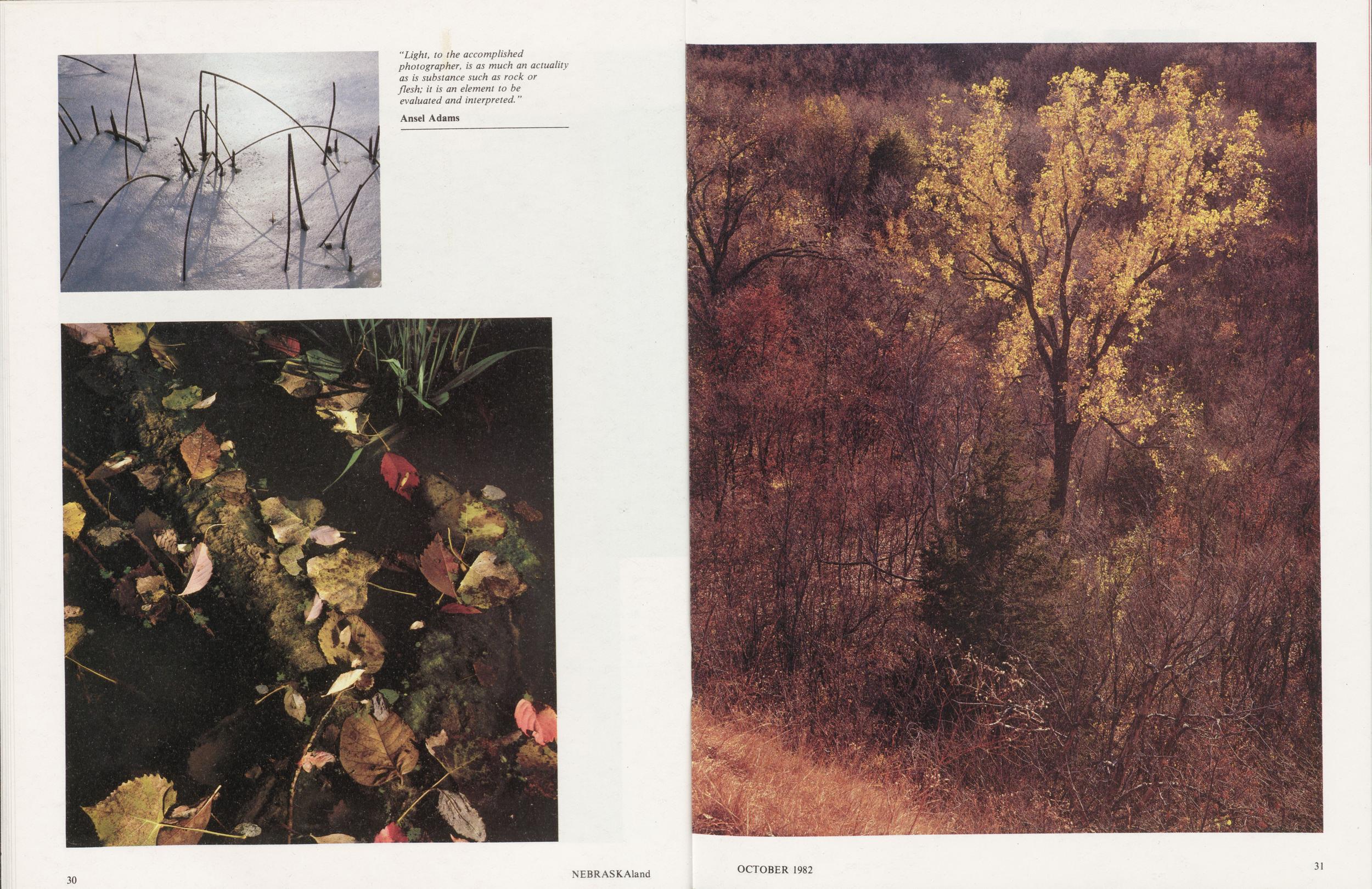
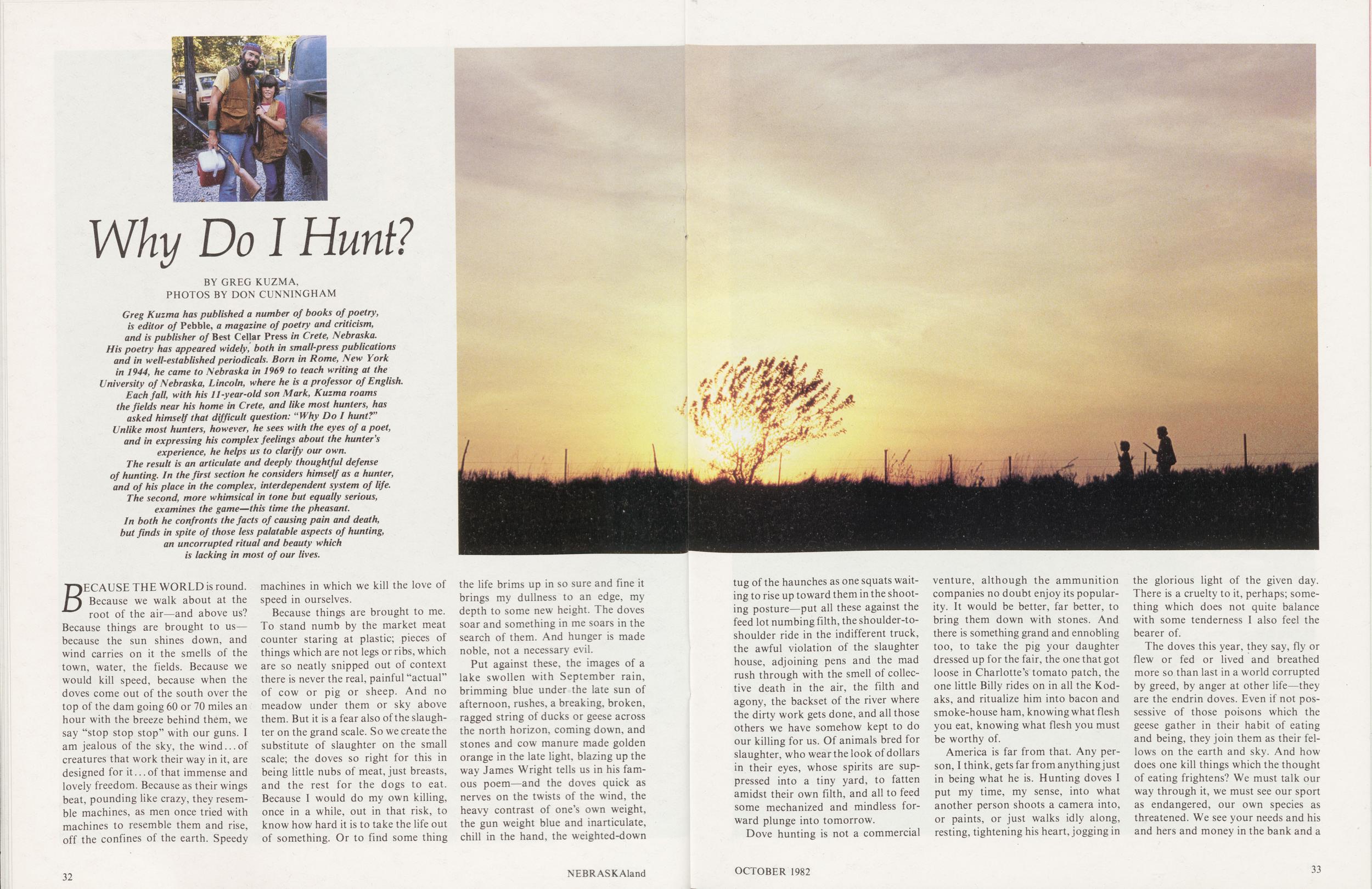
PHOTOGRAPHS BY KENT KLIMA Some photographers see only "postcard photos" and pass by the extraordinary elegance of nature's more subtle sidePhotographer Kent Klima studied music at the University of Nebraska at Lincoln, taught instrumental music in Omaha for three years and plays trumpet for the Omaha Symphony Orchestra. Even while studying music he nurtured a serious interest in photography. Currently he is a commercial architectural photographer.
His photographs presented here are part of those produced for a traveling exhibit, "Photographs and Writings of Nebraska," a project made possible by an award grant from the Nebraska Arts Council. He has displayed his photos in numerous one-person and group exhibits.
Kent Klima's equipment is simple—210 mm and 135 mm lenses on a 4 X 5 camera, mounted on a solid tripod. His color film is Ektachrome 64 and he does not filter the light. Most of his color work is done on overcast days or in open shade to avoid the range between bright sun and deep shade which film cannot adequately record.
"I approach my subjects with a respect for their natural qualities and photograph them with care to the strength of their form. I usually work with black and white materials. Color photographs represent a distinct change in mental orientation for me. Color is a different way of seeing. I find that when thinking of photographing in color I have more of an emotional or romantic approach...."
OCTOBER 1982 23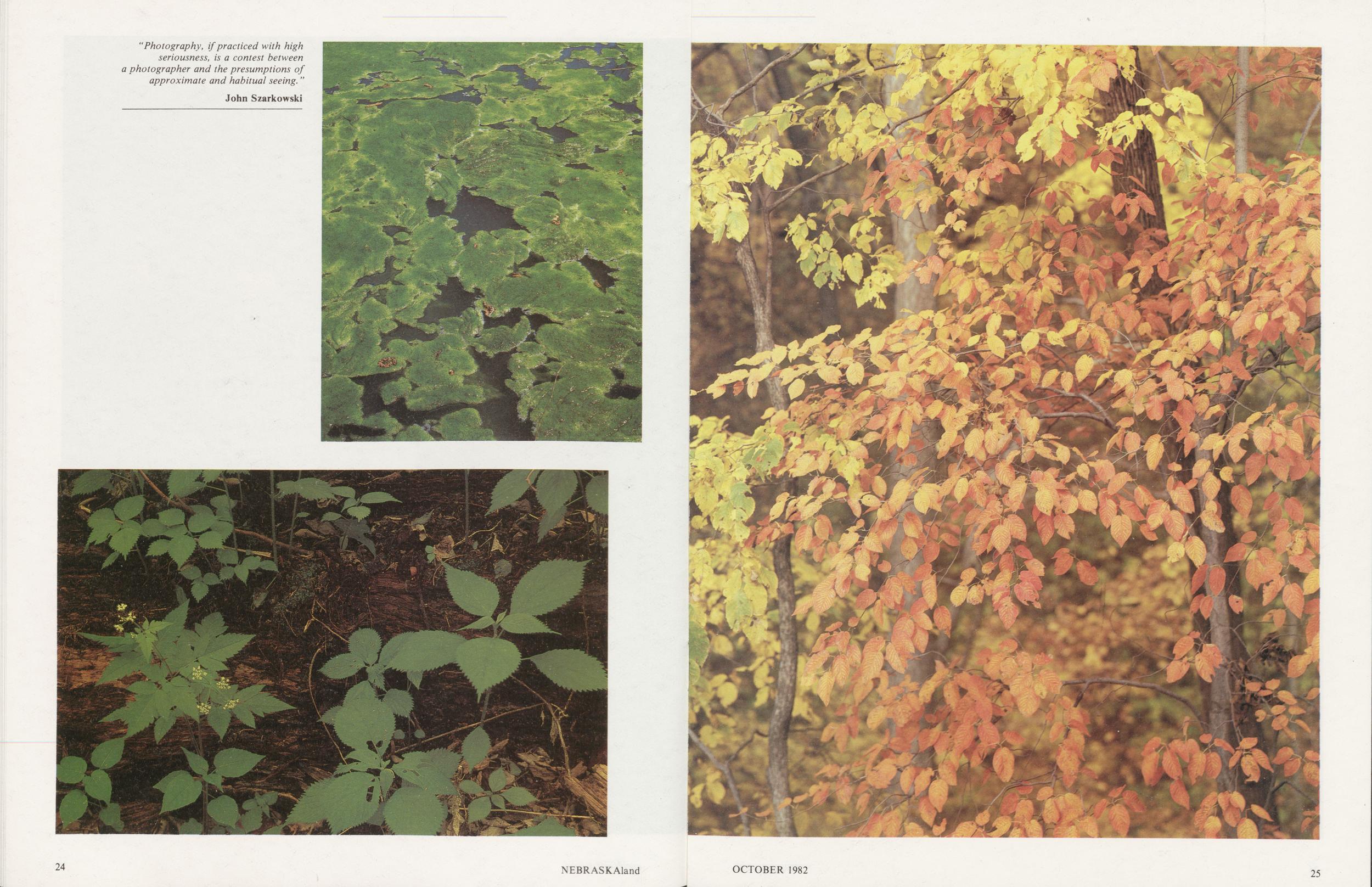
Why Do I Hunt?
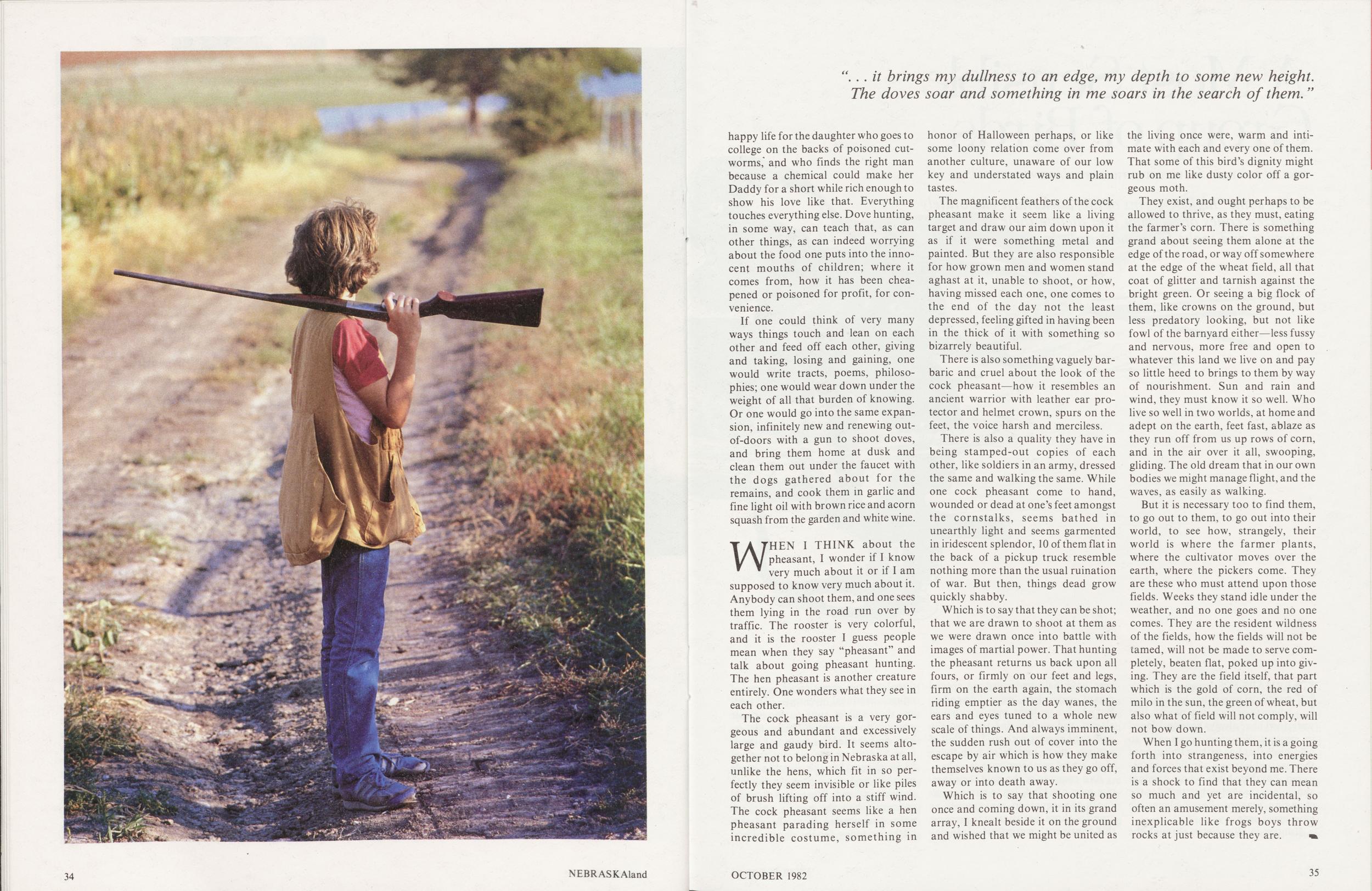
BY GREG KUZMA, PHOTOS BY DON CUNNINGHAM Greg Kuzma has published a number of books of poetry, is editor of Pebble, a magazine of poetry and criticism, and is publisher of Best Cellar Press in Crete, Nebraska. His poetry has appeared widely, both in small-press publications and in well-established periodicals. Born in Rome, New York in 1944, he came to Nebraska in 1969 to teach writing at the University of Nebraska, Lincoln, where he is a professor of English. Each fall, with his 11-year-old son Mark, Kuzma roams the fields near his home in Crete, and like most hunters, has asked himself that difficult question: "Why Do I hunt?" Unlike most hunters, however, he sees with the eyes of a poet, and in expressing his complex feelings about the hunter's experience, he helps us to clarify our own. The result is an articulate and deeply thoughtful defense of hunting. In the first section he considers himself as a hunter, and of his place in the complex, interdependent system of life. The second, more whimsical in tone but equally serious, examines the game—this time the pheasant. In both he confronts the facts of causing pain and death, but finds in spite of those less palatable aspects of hunting, an uncorrupted ritual and beauty which is lacking in most of our lives.BECAUSE THE WORLD is round. Because we walk about at the root of the air—and above us? Because things are brought to us—because the sun shines down, and wind carries on it the smells of the town, water, the fields. Because we would kill speed, because when the doves come out of the south over the top of the dam going 60 or 70 miles an hour with the breeze behind them, we say "stop stop stop" with our guns. I am jealous of the sky, the wind...of creatures that work their way in it, are designed for it... of that immense and lovely freedom. Because as their wings beat, pounding like crazy, they resemble machines, as men once tried with machines to resemble them and rise, off the confines of the earth. Speedy machines in which we kill the love of speed in ourselves.
Because things are brought to me. To stand numb by the market meat counter staring at plastic; pieces of things which are not legs or ribs, which are so neatly snipped out of context there is never the real, painful "actual" of cow or pig or sheep. And no meadow under them or sky above them. But it is a fear also of the slaughter on the grand scale. So we create the substitute of slaughter on the small scale; the doves so right for this in being little nubs of meat, just breasts, and the rest for the dogs to eat. Because I would do my own killing, once in a while, out in that risk, to know how hard it is to take the life out of something. Or to find some thing the life brims up in so sure and fine it brings my dullness to an edge, my depth to some new height. The doves soar and something in me soars in the search of them. And hunger is made noble, not a necessary evil.
Put against these, the images of a lake swollen with September rain, brimming blue under the late sun of afternoon, rushes, a breaking, broken, ragged string of ducks or geese across the north horizon, coming down, and stones and cow manure made golden orange in the late light, blazing up the way James Wright tells us in his famous poem—and the doves quick as nerves on the twists of the wind, the heavy contrast of one's own weight, the gun weight blue and inarticulate, chill in the hand, the weighted-down 32 NEBRASKAland tug of the haunches as one squats waiting to rise up toward them in the shoot- ing posture—put all these against the feed lot numbing filth, the shoulder-to-shoulder ride in the indifferent truck, the awful violation of the slaughter house, adjoining pens and the mad rush through with the smell of collective death in the air, the filth and agony, the backset of the river where the dirty work gets done, and all those others we have somehow kept to do our killing for us. Of animals bred for slaughter, who wear the look of dollars in their eyes, whose spirits are suppressed into a tiny yard, to fatten amidst their own filth, and all to feed some mechanized and mindless forward plunge into tomorrow.
Dove hunting is not a commercial venture, although the ammunition companies no doubt enjoy its popularity. It would be better, far better, to bring them down with stones. And there is something grand and ennobling too, to take the pig your daughter dressed up for the fair, the one that got loose in Charlotte's tomato patch, the one little Billy rides on in all the Kodaks, and ritualize him into bacon and smoke-house ham, knowing what flesh you eat, knowing what flesh you must be worthy of.
America is far from that. Any person, I think, gets far from anything just in being what he is. Hunting doves I put my time, my sense, into what another person shoots a camera into, or paints, or just walks idly along, resting, tightening his heart, jogging in the glorious light of the given day. There is a cruelty to it, perhaps; something which does not quite balance with some tenderness I also feel the bearer of.
The doves this year, they say, fly or
flew or fed or lived and breathed
more so than last in a world corrupted
by greed, by anger at other life—they
are the endrin doves. Even if not possessive of those poisons which the
geese gather in their habit of eating
and being, they join them as their fellows on the earth and sky. And how
does one kill things which the thought
of eating frightens? We must talk our
way through it, we must see our sport
as endangered, our own species as
threatened. We see your needs and his
and hers and money in the bank and a
OCTOBER 1982
33
If one could think of very many ways things touch and lean on each other and feed off each other, giving and taking, losing and gaining, one would write tracts, poems, philosophies; one would wear down under the weight of all that burden of knowing. Or one would go into the same expansion, infinitely new and renewing out-of-doors with a gun to shoot doves, and bring them home at dusk and clean them out under the faucet with the dogs gathered about for the remains, and cook them in garlic and fine light oil with brown rice and acorn squash from the garden and white wine.
WHEN I THINK about the pheasant, I wonder if I know very much about it or if I am supposed to know very much about it. Anybody can shoot them, and one sees them lying in the road run over by traffic. The rooster is very colorful, and it is the rooster I guess people mean when they say "pheasant" and talk about going pheasant hunting. The hen pheasant is another creature entirely. One wonders what they see in each other.
The cock pheasant is a very gorgeous and abundant and excessively large and gaudy bird. It seems altogether not to belong in Nebraska at all, unlike the hens, which fit in so perfectly they seem invisible or like piles of brush lifting off into a stiff wind. The cock pheasant seems like a hen pheasant parading herself in some incredible costume, something in honor of Halloween perhaps, or like some loony relation come over from another culture, unaware of our low key and understated ways and plain tastes.
The magnificent feathers of the cock pheasant make it seem like a living target and draw our aim down upon it as if it were something metal and painted. But they are also responsible for how grown men and women stand aghast at it, unable to shoot, or how, having missed each one, one comes to the end of the day not the least depressed, feeling gifted in having been in the thick of it with something so bizarrely beautiful.
There is also something vaguely barbaric and cruel about the look of the cock pheasant—how it resembles an ancient warrior with leather ear protector and helmet crown, spurs on the feet, the voice harsh and merciless.
There is also a quality they have in being stamped-out copies of each other, like soldiers in an army, dressed the same and walking the same. While one cock pheasant come to hand, wounded or dead at one's feet amongst the cornstalks, seems bathed in unearthly light and seems garmented in iridescent splendor, 10 of them flat in the back of a pickup truck resemble nothing more than the usual ruination of war. But then, things dead grow quickly shabby.
Which is to say that they can be shot; that we are drawn to shoot at them as we were drawn once into battle with images of martial power. That hunting the pheasant returns us back upon all fours, or firmly on our feet and legs, firm on the earth again, the stomach riding emptier as the day wanes, the ears and eyes tuned to a whole new scale of things. And always imminent, the sudden rush out of cover into the escape by air which is how they make themselves known to us as they go off, away or into death away.
Which is to say that shooting one once and coming down, it in its grand array, I knealt beside it on the ground and wished that we might be united as the living once were, warm and intimate with each and every one of them. That some of this bird's dignity might rub on me like dusty color off a gorgeous moth.
They exist, and ought perhaps to be allowed to thrive, as they must, eating the farmer's corn. There is something grand about seeing them alone at the edge of the road, or way off somewhere at the edge of the wheat field, all that coat of glitter and tarnish against the bright green. Or seeing a big flock of them, like crowns on the ground, but less predatory looking, but not like fowl of the barnyard either—less fussy and nervous, more free and open to whatever this land we live on and pay so little heed to brings to them by way of nourishment. Sun and rain and wind, they must know it so well. Who live so well in two worlds, at home and adept on the earth, feet fast, ablaze as they run off from us up rows of corn, and in the air over it all, swooping, gliding. The old dream that in our own bodies we might manage flight, and the waves, as easily as walking.
But it is necessary too to find them, to go out to them, to go out into their world, to see how, strangely, their world is where the farmer plants, where the cultivator moves over the earth, where the pickers come. They are these who must attend upon those fields. Weeks they stand idle under the weather, and no one goes and no one comes. They are the resident wildness of the fields, how the fields will not be tamed, will not be made to serve completely, beaten flat, poked up into giving. They are the field itself, that part which is the gold of corn, the red of milo in the sun, the green of wheat, but also what of field will not comply, will not bow down.
When I go hunting them, it is a going forth into strangeness, into energies and forces that exist beyond me. There is a shock to find that they can mean so much and yet are incidental, so often an amusement merely, something inexplicable like frogs boys throw rocks at just because they are.
OCTOBER 1982 35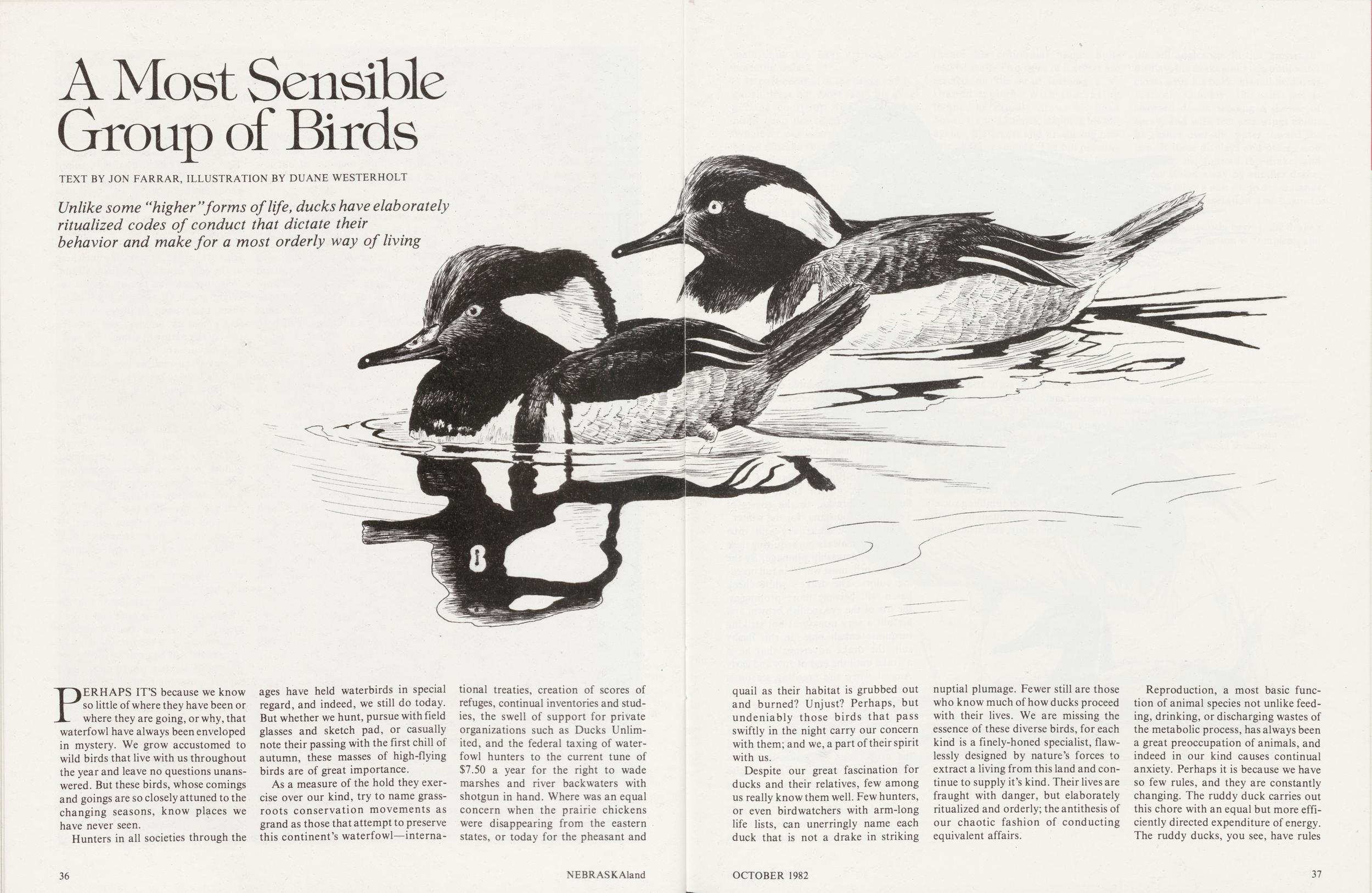
A Most Sensible Group of Birds
TEXT BY JON FARRAR, ILLUSTRATION BY DUANE WESTERHOLT Unlike some "higher"forms of life, ducks have elaborately ritualized codes of conduct that dictate their behavior and make for a most orderly way of livingPERHAPS IT'S because we know so little of where they have been or where they are going, or why, that waterfowl have always been enveloped in mystery. We grow accustomed to wild birds that live with us throughout the year and leave no questions unanswered. But these birds, whose comings and goings are so closely attuned to the changing seasons, know places we have never seen.
Hunters in all societies through the ages have held waterbirds in special regard, and indeed, we still do today. But whether we hunt, pursue with field glasses and sketch pad, or casually note their passing with the first chill of autumn, these masses of high-flying birds are of great importance.
As a measure of the hold they exercise over our kind, try to name grass-roots conservation movements as grand as those that attempt to preserve this continent's waterfowl—international treaties, creation of scores of refuges, continual inventories and studies, the swell of support for private organizations such as Ducks Unlimited, and the federal taxing of waterfowl hunters to the current tune of $7.50 a year for the right to wade marshes and river backwaters with shotgun in hand. Where was an equal concern when the prairie chickens were disappearing from the eastern states, or today for the pheasant and 36 NEBRASKAland quail as their habitat is grubbed out and burned? Unjust? Perhaps, but undeniably those birds that pass swiftly in the night carry our concern with them; and we, a part of their spirit with us.
Despite our great fascination for ducks and their relatives, few among us really know them well. Few hunters, or even birdwatchers with arm-long life lists, can unerringly name each duck that is not a drake in striking nuptial plumage. Fewer still are those who know much of how ducks proceed with their lives. We are missing the essence of these diverse birds, for each kind is a finely-honed specialist, flawlessly designed by nature's forces to extract a living from this land and continue to supply it's kind. Their lives are fraught with danger, but elaborately ritualized and orderly; the antithesis of our chaotic fashion of conducting equivalent affairs.
Reproduction, a most basic function of animal species not unlike feeding, drinking,
or discharging wastes of
the metabolic process, has always been
a great preoccupation of animals, and
indeed in our kind causes continual
anxiety. Perhaps it is because we have
so few rules, and they are constantly
changing. The ruddy duck carries out
this chore with an equal but more efficiently directed expenditure of energy.
The ruddy ducks, you see, have rules
OCTOBER 1982
37
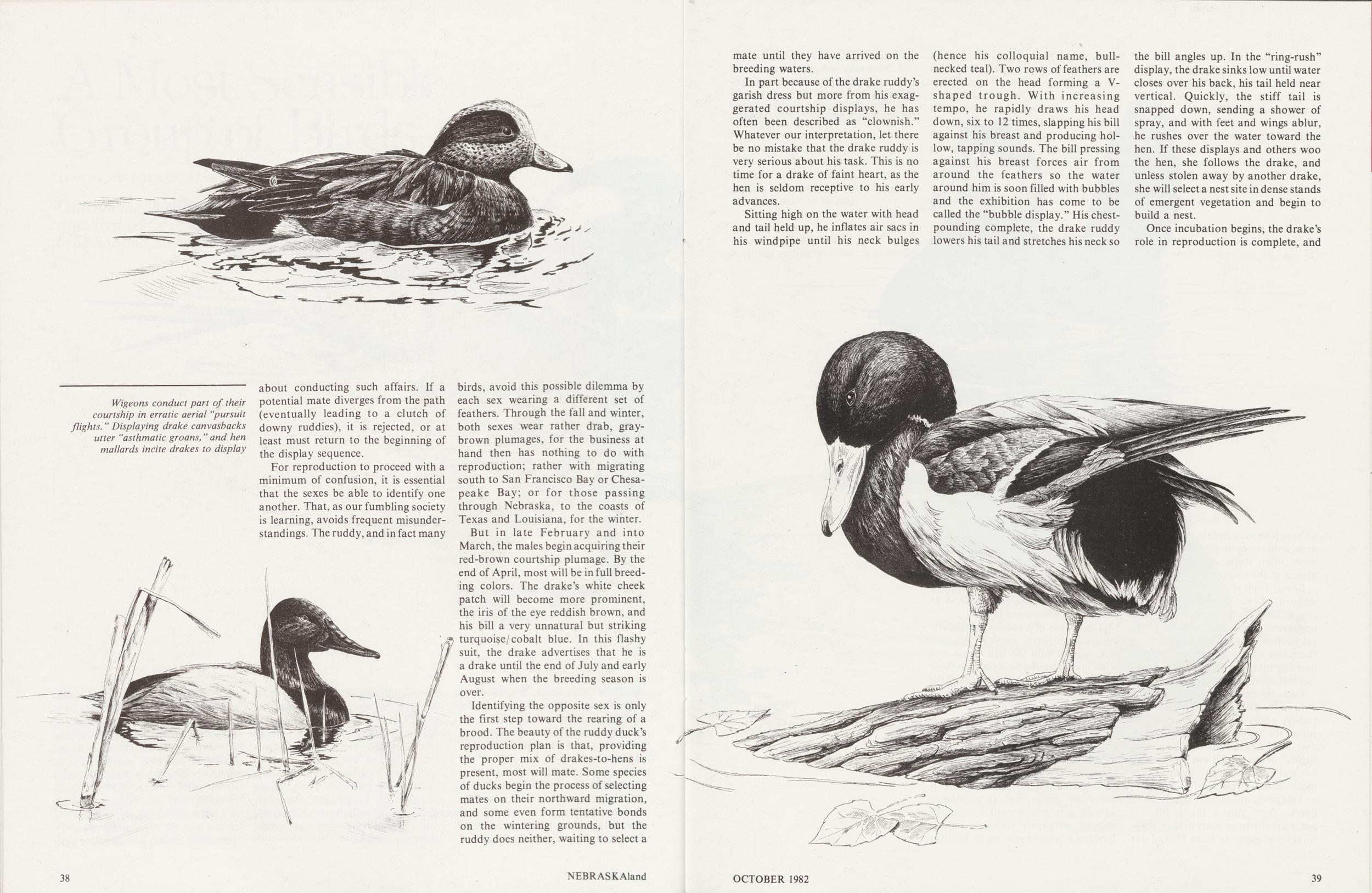
For reproduction to proceed with a minimum of confusion, it is essential that the sexes be able to identify one another. That, as our fumbling society is learning, avoids frequent misunderstandings. The ruddy, and in fact many birds, avoid this possible dilemma by each sex wearing a different set of feathers. Through the fall and winter, both sexes wear rather drab, gray-brown plumages, for the business at hand then has nothing to do with reproduction; rather with migrating south to San Francisco Bay or Chesapeake Bay; or for those passing through Nebraska, to the coasts of Texas and Louisiana, for the winter.
But in late February and into March, the males begin acquiring their red-brown courtship plumage. By the end of April, most will be in full breeding colors. The drake's white cheek patch will become more prominent, the iris of the eye reddish brown, and his bill a very unnatural but striking turquoise/cobalt blue. In this flashy suit, the drake advertises that he is a drake until the end of July and early August when the breeding season is over.
Identifying the opposite sex is only the first step toward the rearing of a brood. The beauty of the ruddy duck's reproduction plan is that, providing the proper mix of drakes-to-hens is present, most will mate. Some species of ducks begin the process of selecting mates on their northward migration, and some even form tentative bonds on the wintering grounds, but the ruddy does neither, waiting to select a 38 NEBRASKAland mate until they have arrived on the breeding waters.
In part because of the drake ruddy's garish dress but more from his exaggerated courtship displays, he has often been described as "clownish." Whatever our interpretation, let there be no mistake that the drake ruddy is very serious about his task. This is no time for a drake of faint heart, as the hen is seldom receptive to his early advances.
Sitting high on the water with head and tail held up, he inflates air sacs in his windpipe until his neck bulges (hence his colloquial name, bull-necked teal). Two rows of feathers are erected on the head forming a V-shaped trough. With increasing tempo, he rapidly draws his head down, six to 12 times, slapping his bill against his breast and producing hollow, tapping sounds. The bill pressing against his breast forces air from around the feathers so the water around him is soon filled with bubbles and the exhibition has come to be called the "bubble display." His chest-pounding complete, the drake ruddy lowers his tail and stretches his neck so the bill angles up. In the "ring-rush" display, the drake sinks low until water closes over his back, his tail held near vertical. Quickly, the stiff tail is snapped down, sending a shower of spray, and with feet and wings ablur, he rushes over the water toward the hen. If these displays and others woo the hen, she follows the drake, and unless stolen away by another drake, she will select a nest site in dense stands of emergent vegetation and begin to build a nest.
Once incubation begins, the drake's role in reproduction is complete, and
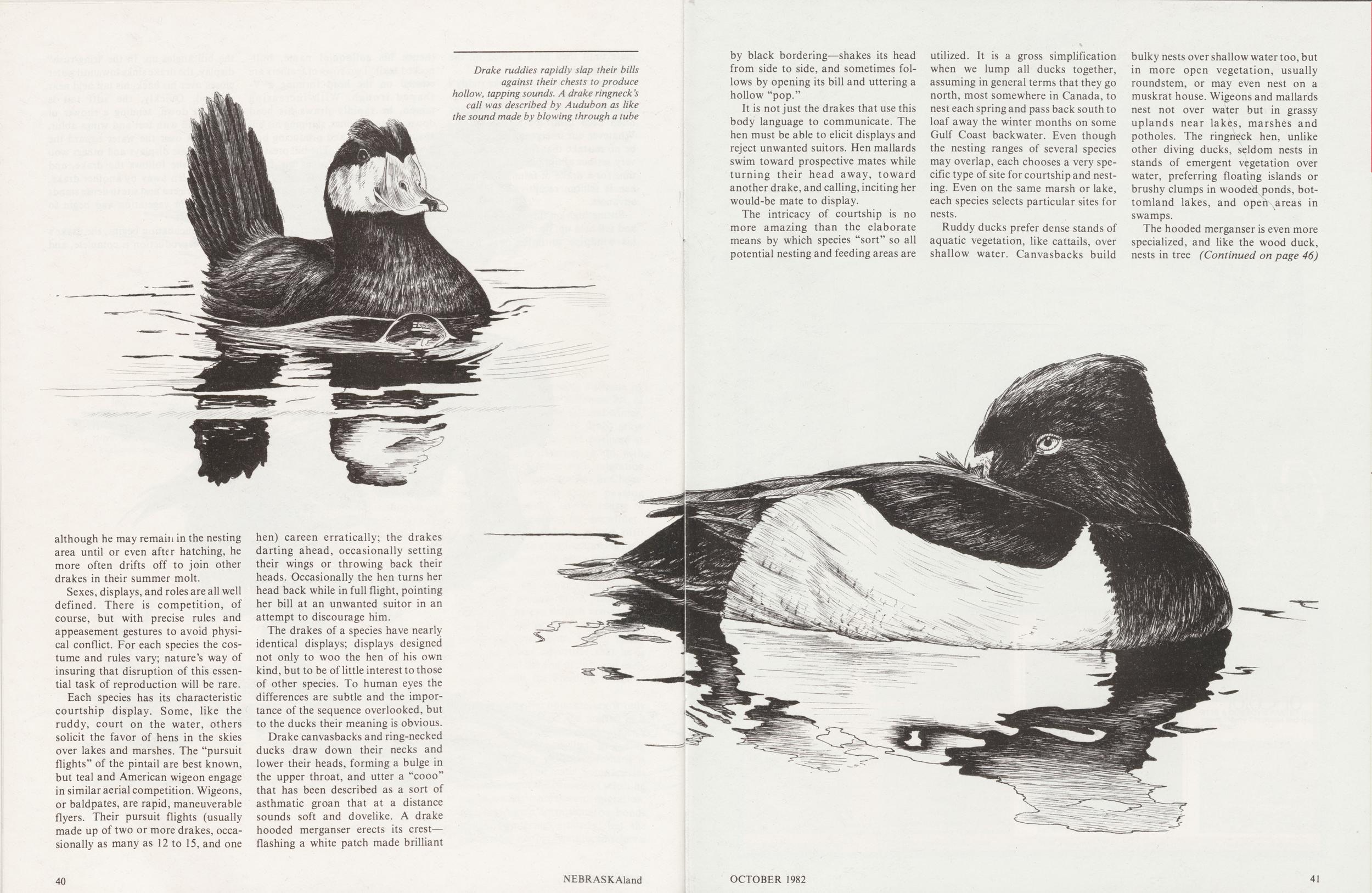
Sexes, displays, and roles are all well defined. There is competition, of course, but with precise rules and appeasement gestures to avoid physical conflict. For each species the costume and rules vary; nature's way of insuring that disruption of this essential task of reproduction will be rare.
Each species has its characteristic courtship display. Some, like the ruddy, court on the water, others solicit the favor of hens in the skies over lakes and marshes. The "pursuit flights" of the pintail are best known, but teal and American wigeon engage in similar aerial competition. Wigeons, or baldpates, are rapid, maneuverable flyers. Their pursuit flights (usually made up of two or more drakes, occasionally as many as 12 to 15, and one hen) careen erratically; the drakes darting ahead, occasionally setting their wings or throwing back their heads. Occasionally the hen turns her head back while in full flight, pointing her bill at an unwanted suitor in an attempt to discourage him.
The drakes of a species have nearly identical displays; displays designed not only to woo the hen of his own kind, but to be of little interest to those of other species. To human eyes the differences are subtle and the importance of the sequence overlooked, but to the ducks their meaning is obvious.
Drake canvasbacks and ring-necked ducks draw down their necks and lower their heads, forming a bulge in the upper throat, and utter a "cooo" that has been described as a sort of asthmatic groan that at a distance sounds soft and dovelike. A drake hooded merganser erects its crest—flashing a white patch made brilliant 40 NEBRASKAland by black bordering—shakes its head from side to side, and sometimes follows by opening its bill and uttering a hollow "pop."
It is not just the drakes that use this body language to communicate. The hen must be able to elicit displays and reject unwanted suitors. Hen mallards swim toward prospective mates while turning their head away, toward another drake, and calling, inciting her would-be mate to display.
The intricacy of courtship is no more amazing than the elaborate means by which species "sort" so all potential nesting and feeding areas are utilized. It is a gross simplification when we lump all ducks together, assuming in general terms that they go north, most somewhere in Canada, to nest each spring and pass back south to loaf away the winter months on some Gulf Coast backwater. Even though the nesting ranges of several species may overlap, each chooses a very specific type of site for courtship and nesting. Even on the same marsh or lake, each species selects particular sites for nests.
Ruddy ducks prefer dense stands of aquatic vegetation, like cattails, over shallow water. Canvasbacks build bulky nests over shallow water too, but in more open vegetation, usually roundstem, or may even nest on a muskrat house. Wigeons and mallards nest not over water but in grassy uplands near lakes, marshes and potholes. The ringneck hen, unlike other diving ducks, seldom nests in stands of emergent vegetation over water, preferring floating islands or brushy clumps in wooded ponds, bottomland lakes, and open areas in swamps.
The hooded merganser is even more specialized, and like the wood duck, nests in tree (Continued on page 46)
 From January's cardinal in the snow to December's ice sculpture on the Platte, the
1983 NEBRASKAland Calendar of Color will be a pleasant and useful addition to your
home and office. There's information on the newest state park near Lincoln and Omaha,
some delectable recipes, and much more. But the fabulous photos which accompany each
month will start your days off with happy thoughts. Order yours now, and they're great
for gifts, too!
NEBRASKAland Magazines
TO: NEBRASKAland Calendar
P.O. Box 3022, Omaha, Nebraska 68103
Date
NAME
ADDRESS
CITY
STATE
ZIP
Gentlemen:
Please mail, postage-paid,
calendars at $3.00 each,
plus sales tax if required. Nebraska residents must include
sales tax.
Total enclosed $.
S3.00
□ My check is enclosed
D Money order enclosed
Calendars are mailed at no extra charge at 3rd Class
bulk rate. Add $1 per calendar tor 1st Class postage.
CHRISTMAS CARDS
You can send Christmas cards created from original
works of art worth thousands of dollars! Leanin' Tree
creates fine art Christmas cards from authentic
paintings by award-winning western artists whose works
are on display in prestigious museums and galleries
across America. Printed on the finest quality paper,
these 5" x 7" art cards will bring
you compliments from every person
on your Christmas card list. And
1496 "...and a Merry Christmas to you,
too!" "May yours be a joyful Christmas
and your New Year happy!"
2151 "Dear Santa" verse inside
"May your Christmas and the New
Year be filled with warmth and love"
2118 "...and, io, the star, etc." Matthew 2:9 "May you have the Spirit of
Christmas which is Peace...Love"
1142 "Never too...deep the snow, to
wish you the Merriest Christmas our
good Lord can bestow!"
Box 9500-R-BK26
Boulder, CO 80301
our easy mail ordering lets you avoid all the crowds,
hassles and frustrations of ordinary Christmas
shopping. Simply fill in the order coupon...and
remember to look for YOUR FREE GIFT offer. Six
sheets of colorful Christmas giftwrap with six matching
design gift tags...a $4.50 value...can be yours free.
Exclusive western art Christmas
cards for your friends and loved
ones and free giftwrap for you! See
order coupon for details.
GREETINGS...
from our house to yours.
2022 "GREETINGS...from our house...'
"May you have the Spirit of Christmas
which is Peace...Hope...Love"
2146 Flapjack recipe inside. "...Vittles skeerce...Both horses lame, but
Merry Christmas just the same!"
1602 CHRISTMAS WISHES COME
TRUE "Merry Christmas and best
wishes for a Happy New Year"
2130 "When the tips of the pines
touch the heavenly skies, etc."
"Merry Christmas...New Year"
1822 Christmas Greetings "Wishing
you a Merry Christmas and a Happy
New Year"
2033 "May Christmas bring Friends
to your Fireside, Peace...and Good
Health throughout the New Year"
Greetings from
Our Outfit to Yours...
2124 "Greetings from our outfit to
yours..." "With friendly greetings of
the season and best wishes, etc."
1320 Appaloosa Mother "May you
have the Spirit of Christmas which
is Peace...the Heart which is Love"
1462 "Peace on Earth" "May Peace
be your Gift at Christmas and your
Treasure through all the Year"
6117 "May Christmas bring Friends
to your Fireside, Peace...and Good
Health throughout the New Year"
2119 A COWBOY'S PRAYER (32-line
poem) "Merry Christmas and Happy
New Year"
2011 "To those we love and see
each day and other loved ones far
away...Merry Christmas...New Year"
OCTOBER 1982
43
From January's cardinal in the snow to December's ice sculpture on the Platte, the
1983 NEBRASKAland Calendar of Color will be a pleasant and useful addition to your
home and office. There's information on the newest state park near Lincoln and Omaha,
some delectable recipes, and much more. But the fabulous photos which accompany each
month will start your days off with happy thoughts. Order yours now, and they're great
for gifts, too!
NEBRASKAland Magazines
TO: NEBRASKAland Calendar
P.O. Box 3022, Omaha, Nebraska 68103
Date
NAME
ADDRESS
CITY
STATE
ZIP
Gentlemen:
Please mail, postage-paid,
calendars at $3.00 each,
plus sales tax if required. Nebraska residents must include
sales tax.
Total enclosed $.
S3.00
□ My check is enclosed
D Money order enclosed
Calendars are mailed at no extra charge at 3rd Class
bulk rate. Add $1 per calendar tor 1st Class postage.
CHRISTMAS CARDS
You can send Christmas cards created from original
works of art worth thousands of dollars! Leanin' Tree
creates fine art Christmas cards from authentic
paintings by award-winning western artists whose works
are on display in prestigious museums and galleries
across America. Printed on the finest quality paper,
these 5" x 7" art cards will bring
you compliments from every person
on your Christmas card list. And
1496 "...and a Merry Christmas to you,
too!" "May yours be a joyful Christmas
and your New Year happy!"
2151 "Dear Santa" verse inside
"May your Christmas and the New
Year be filled with warmth and love"
2118 "...and, io, the star, etc." Matthew 2:9 "May you have the Spirit of
Christmas which is Peace...Love"
1142 "Never too...deep the snow, to
wish you the Merriest Christmas our
good Lord can bestow!"
Box 9500-R-BK26
Boulder, CO 80301
our easy mail ordering lets you avoid all the crowds,
hassles and frustrations of ordinary Christmas
shopping. Simply fill in the order coupon...and
remember to look for YOUR FREE GIFT offer. Six
sheets of colorful Christmas giftwrap with six matching
design gift tags...a $4.50 value...can be yours free.
Exclusive western art Christmas
cards for your friends and loved
ones and free giftwrap for you! See
order coupon for details.
GREETINGS...
from our house to yours.
2022 "GREETINGS...from our house...'
"May you have the Spirit of Christmas
which is Peace...Hope...Love"
2146 Flapjack recipe inside. "...Vittles skeerce...Both horses lame, but
Merry Christmas just the same!"
1602 CHRISTMAS WISHES COME
TRUE "Merry Christmas and best
wishes for a Happy New Year"
2130 "When the tips of the pines
touch the heavenly skies, etc."
"Merry Christmas...New Year"
1822 Christmas Greetings "Wishing
you a Merry Christmas and a Happy
New Year"
2033 "May Christmas bring Friends
to your Fireside, Peace...and Good
Health throughout the New Year"
Greetings from
Our Outfit to Yours...
2124 "Greetings from our outfit to
yours..." "With friendly greetings of
the season and best wishes, etc."
1320 Appaloosa Mother "May you
have the Spirit of Christmas which
is Peace...the Heart which is Love"
1462 "Peace on Earth" "May Peace
be your Gift at Christmas and your
Treasure through all the Year"
6117 "May Christmas bring Friends
to your Fireside, Peace...and Good
Health throughout the New Year"
2119 A COWBOY'S PRAYER (32-line
poem) "Merry Christmas and Happy
New Year"
2011 "To those we love and see
each day and other loved ones far
away...Merry Christmas...New Year"
OCTOBER 1982
43
 2148 A COWBOY'S CHRISTMAS
PRAYER (poem inside) "May the
Peace...or Christmas...be with you"
1444 "...the splendor of Christ's,
birth" "Wishing you a Blessed
Christmas and Happiness, etc."
2128 "May Christmas bring Friends
to your Fireside, etc." "With Best
Wishes at Christmas and...all...Year"
2152 BARNYARD HAPPENINGS
"Wishing you the many blessings of
a Joyous Christmas Season"
1979 "...when...the trail's all
covered with snow...to wish Merry
Christmas to all whom we know!"
2156 "It's Christmas again! May
yours be a joyful one and your New
Year happy!"
2132 "We are thinking of you, etc."
"...good will to you is what we mean
in...The Spirit of Christmas"
3216 "May Christmas bring to you the
music of laughter...the warmth of
friendship and the spirit of love."
1434 "To those we love and see
each day and other loved ones far
away, etc." "Merry Christmas"
2080 "Wishing you the many blessings of a Joyous Christmas Season"
2137 "May...small wonders of the
season cause joyful happenings In
your heart." "Merry Christmas, etc."
2038 "...never an old year ends...
but someone thinks of...old friends."
"Merry Christmas...New Year"
2145 "To those we love and see
each day and other loved ones far
away, etc." "Merry Christmas, etc."
2009 MISCHIEVOUS VISITOR "May
Christmas bring to you the music of
laughter...the spirit of love"
3230 "They walk with God upon the
hills!, etc." "Wishing you a Blessed
Christmas and Happiness, etc."
2087 RUNNING WITH THE WIND
"Wishing...a Blessed Christmas and
Happiness throughout the...Year"
A Season of Rejoicing
3152 "A Season of Rejoicing..."
"for the many blessings...of life and
love. Merry Christmas...New Year"
2157 "May the miracle of
Christmas fill your hearts anew.,
remain the whole year through"
Times change, and see with time,
but not in the ways of friendship.
2126 "Times change...but not In the
ways of friendship. "Let us keep
Christmas...Remembering Friends."
2129 "To have joy one must share
it, happiness was born a twin."
"Merry Christmas...New Year"
1305 "A good old-fashioned
greeting from the two of us, etc"
"...a joyous Christmas, etc."
2111 "Christmas trees with lights
aglow...winter snow, etc." "Merry
Cnristmas...Happy New Year"
2122 REINDEER REPAIRS "Merry
Christmas and a Happy New Year"
1304 "...may God hold you In the
hollow of His hand." "Merry
Christmas and Best Wishes, etc."
44
NEBRASKAland
2153 "In every home...it's time to
greet the friends It's nice to know."
"Merry Christmas...New Year"
1140 "The wonder of Christmas fills
the night" "May Christmas bring
Friends...Peace...and Good Health"
3234 "To those we love and see
each day and other loved ones far
away, etc." "Merry Christmas, etc."
1986 "May Christmas bring Friends
to your Fireside, Peace...and Good
Health throughout the New Year"
2133 "...the glory of Christmas
remains...may its light...bless you
with joy...throughout...the Year"
4192 "Glory to God, etc." St. Luke
2:14 "May the Peace and Joy of
Christmas be with you...all...Year"
1455 "May Christmas bring Friends to
your Fireside, Peace to your Pathway
And Good Health through...the...Year"
1498 "May the small wonders...cause
joyful happenings in your heart."
"Merry Christmas...Happy New Year"
1692 "...neither change nor end...
Christ's...birth, the love of friend for
friend." "...a Blessed Christmas..."
2150 "God made a...star to shine
on His only Son, etc." "Wishing you
a Christmas Season blessed, etc."
1216 "May...the Great Spirit Bless
all, etc." "With Best Wishes for
Christmas and all the New Year"
1674 "Merry Christmas" "...and best
wishes for a Happy New Year from Our
Outfit to Yours"
HOW TO ORDER: Order cards of all one
design or assort in any combination totaling
12, 25, 37, 50, etc. Indicate number of cards to
right of order code. Remember to include
postage and handling. Enclose payment with
order form. Mastercard and VISA accepted. No
C.O.D.'s. (Canadian orders will be charged a
customs duty at the border.)
Choose one envelope color
5 color
CHRISTMAS CARD
PRICE LIST
Cards Cost
Your Name
Printed on Cards
12
25
37
50
75
100
125
150
175
200
$4.75
$7.95
$11.95
$15.75
$23.65
$31.35
$37.95
$44.55
$51.15
$57.75
Cards
50 & under
51-100
101-200
Over 200
Cost
$3.50
$4.50
$5.50
$6.00
Your Address
Printed on Envelopes
Over 200—280 per card
Cards
50 & under
51-100
101-200
Over 200
Cost
$3.50
$4.50
$5.50
$6.00
1140 1462 2009 2119 2137 2157
1142 1496 2011 2122 2145 3152
1216 1498 2022 2124 2146 3216
1304 1602 2033 2126 2148 3230
1305 1674 2038 2128 2150 3234
1320 1692 2080 2129 2151 4192
1434 1822 2087 2130 2152 6117
1444 1979 2111 2132 2153
1455 1986 2118 2133 2156
Number of cards
Cost of cards $
Name printing $
Address printing $
CO res. add 3% sales tax CA res. add 6% use tax $
Postage & Handling Total order P&H Under $10 $1.50 $10 to $20 $2.00 Over
$20 $2.50 $
Total $
FREE GIFT!
Names to be printed
on Christmas cards
Send cards
and/or catalog to:
Rte., St., Box No.
City
R-BK26
Check (s)
here if total is
$15.00 or more
and receive six
sheets of gift wrap
and six gift tags!
State.
Zip.
Box 9500-R-BK26
Boulder, CO 80301
Satisfaction Guaranteed
Or Money Back—
Our 33rd Year
□ Mastercard □ BankAmericard/
Inter Bank No. (4 digit
. no. above name, MC only)
Account# (all digits)
Signature
(Required if using credit card)
Expiration Date.
82
Please send me
a free catalog
and a free
Christmas card.
2148 A COWBOY'S CHRISTMAS
PRAYER (poem inside) "May the
Peace...or Christmas...be with you"
1444 "...the splendor of Christ's,
birth" "Wishing you a Blessed
Christmas and Happiness, etc."
2128 "May Christmas bring Friends
to your Fireside, etc." "With Best
Wishes at Christmas and...all...Year"
2152 BARNYARD HAPPENINGS
"Wishing you the many blessings of
a Joyous Christmas Season"
1979 "...when...the trail's all
covered with snow...to wish Merry
Christmas to all whom we know!"
2156 "It's Christmas again! May
yours be a joyful one and your New
Year happy!"
2132 "We are thinking of you, etc."
"...good will to you is what we mean
in...The Spirit of Christmas"
3216 "May Christmas bring to you the
music of laughter...the warmth of
friendship and the spirit of love."
1434 "To those we love and see
each day and other loved ones far
away, etc." "Merry Christmas"
2080 "Wishing you the many blessings of a Joyous Christmas Season"
2137 "May...small wonders of the
season cause joyful happenings In
your heart." "Merry Christmas, etc."
2038 "...never an old year ends...
but someone thinks of...old friends."
"Merry Christmas...New Year"
2145 "To those we love and see
each day and other loved ones far
away, etc." "Merry Christmas, etc."
2009 MISCHIEVOUS VISITOR "May
Christmas bring to you the music of
laughter...the spirit of love"
3230 "They walk with God upon the
hills!, etc." "Wishing you a Blessed
Christmas and Happiness, etc."
2087 RUNNING WITH THE WIND
"Wishing...a Blessed Christmas and
Happiness throughout the...Year"
A Season of Rejoicing
3152 "A Season of Rejoicing..."
"for the many blessings...of life and
love. Merry Christmas...New Year"
2157 "May the miracle of
Christmas fill your hearts anew.,
remain the whole year through"
Times change, and see with time,
but not in the ways of friendship.
2126 "Times change...but not In the
ways of friendship. "Let us keep
Christmas...Remembering Friends."
2129 "To have joy one must share
it, happiness was born a twin."
"Merry Christmas...New Year"
1305 "A good old-fashioned
greeting from the two of us, etc"
"...a joyous Christmas, etc."
2111 "Christmas trees with lights
aglow...winter snow, etc." "Merry
Cnristmas...Happy New Year"
2122 REINDEER REPAIRS "Merry
Christmas and a Happy New Year"
1304 "...may God hold you In the
hollow of His hand." "Merry
Christmas and Best Wishes, etc."
44
NEBRASKAland
2153 "In every home...it's time to
greet the friends It's nice to know."
"Merry Christmas...New Year"
1140 "The wonder of Christmas fills
the night" "May Christmas bring
Friends...Peace...and Good Health"
3234 "To those we love and see
each day and other loved ones far
away, etc." "Merry Christmas, etc."
1986 "May Christmas bring Friends
to your Fireside, Peace...and Good
Health throughout the New Year"
2133 "...the glory of Christmas
remains...may its light...bless you
with joy...throughout...the Year"
4192 "Glory to God, etc." St. Luke
2:14 "May the Peace and Joy of
Christmas be with you...all...Year"
1455 "May Christmas bring Friends to
your Fireside, Peace to your Pathway
And Good Health through...the...Year"
1498 "May the small wonders...cause
joyful happenings in your heart."
"Merry Christmas...Happy New Year"
1692 "...neither change nor end...
Christ's...birth, the love of friend for
friend." "...a Blessed Christmas..."
2150 "God made a...star to shine
on His only Son, etc." "Wishing you
a Christmas Season blessed, etc."
1216 "May...the Great Spirit Bless
all, etc." "With Best Wishes for
Christmas and all the New Year"
1674 "Merry Christmas" "...and best
wishes for a Happy New Year from Our
Outfit to Yours"
HOW TO ORDER: Order cards of all one
design or assort in any combination totaling
12, 25, 37, 50, etc. Indicate number of cards to
right of order code. Remember to include
postage and handling. Enclose payment with
order form. Mastercard and VISA accepted. No
C.O.D.'s. (Canadian orders will be charged a
customs duty at the border.)
Choose one envelope color
5 color
CHRISTMAS CARD
PRICE LIST
Cards Cost
Your Name
Printed on Cards
12
25
37
50
75
100
125
150
175
200
$4.75
$7.95
$11.95
$15.75
$23.65
$31.35
$37.95
$44.55
$51.15
$57.75
Cards
50 & under
51-100
101-200
Over 200
Cost
$3.50
$4.50
$5.50
$6.00
Your Address
Printed on Envelopes
Over 200—280 per card
Cards
50 & under
51-100
101-200
Over 200
Cost
$3.50
$4.50
$5.50
$6.00
1140 1462 2009 2119 2137 2157
1142 1496 2011 2122 2145 3152
1216 1498 2022 2124 2146 3216
1304 1602 2033 2126 2148 3230
1305 1674 2038 2128 2150 3234
1320 1692 2080 2129 2151 4192
1434 1822 2087 2130 2152 6117
1444 1979 2111 2132 2153
1455 1986 2118 2133 2156
Number of cards
Cost of cards $
Name printing $
Address printing $
CO res. add 3% sales tax CA res. add 6% use tax $
Postage & Handling Total order P&H Under $10 $1.50 $10 to $20 $2.00 Over
$20 $2.50 $
Total $
FREE GIFT!
Names to be printed
on Christmas cards
Send cards
and/or catalog to:
Rte., St., Box No.
City
R-BK26
Check (s)
here if total is
$15.00 or more
and receive six
sheets of gift wrap
and six gift tags!
State.
Zip.
Box 9500-R-BK26
Boulder, CO 80301
Satisfaction Guaranteed
Or Money Back—
Our 33rd Year
□ Mastercard □ BankAmericard/
Inter Bank No. (4 digit
. no. above name, MC only)
Account# (all digits)
Signature
(Required if using credit card)
Expiration Date.
82
Please send me
a free catalog
and a free
Christmas card.
A most sensible group of birds
(Continued from page 41)cavities, and in fact often successfully incubates its clutch to hatching in man-made nest boxes designed for wood ducks. These small, trim mergansers prefer woodland water even when not nesting—streams, rivers, ponds, lake coves and swamps—often on fast streams with clear water that enhances their fishing success. Their choice of nesting and feeding areas probably dictates their social habits; seldom do they gather with other ducks. Most often they are seen alone, in pairs, or in small flocks of five to 10 birds.
Duck species further minimize competition and exploit every available niche in the diverse environment by specializing in their feeding habits; not only what they feed on but where. The hooded merganser well deserves his local name of "fish duck" or "sawbill," as its diet is made up of about 96 percent animal foods, particularly small fish, crayfish and aquatic insects.
Canvasbacks, ruddy ducks and ringnecks all feed by diving. Only a small part of their diet is composed of mollusks (such as snails), crustaceans and aquatic insects. The bulk of their food is aquatic vegetation like pond weeds that are grazed from the bottoms of shallow water—a food source out of reach of the dabbling puddle ducks.
Puddle ducks, like the mallard, eat a high percentage of vegetable material (about 90 percent of their diet) such as the stems of aquatic plants, cultivated grains, and mast. Because of their versatile feeding habits, mallards have been better able to adapt to the changing face of the land. As their natural foods dwindled, mallards quickly adapted to gleaning fields of waste grain. The wigeon is likewise learning to survive on what man has left on the once expansive feeding areas and are joining the mallards in the grain fields.
Minnetonka Moccasin Catalog Men's, Women's & Children's Sizes All genuine leather and highest quality Many styles and colors to choose from Send $1 for color catalog and price list MOCCASINS Name Address City State Zip Mail to: H & M Bootery, 275 N. Main, Valentine, Neb. 69201 For Full Color Catalog and Price List WELCOME to Merritt Dam Trading Post 26 Miles Southwest of Valentine On Hwy. 16C Phone 402/376-3437 Bait* Tackle • Ammunition • Groceries• Gas• Beer* Ice Year-round Cabins with Kitchen Facilities Campground Hook-ups* Boat and Motor Rental Easy-access dock Home of the State Record Perch, Muskellunge and Smallmouth bass — Your Hosts — JON AND MARIAN DAVENPORTWigeons make it a regular habit to shadow other waterbirds—especially diving ducks, geese and swans—picking up aquatic tidbits the larger birds dislodge from the bottom, and often actually pilfer food their benefactors bring to the surface. It seems that even among ducks are those who would live at the expense of others.
Yet, for all their success coping with their own kind, ducks have not fared so well in dealings with man and his extensive alteration of the environment. They survived years of exploitation at the hands of market hunters, but never regained their former abundance, as already their nesting grounds were being destroyed. They endured the drought years of the 1930's, but never again darkened the autumn skies as before. Some species have been brought back from periliously low numbers by special management, but it seems unlikely that even such adaptive creatures can hold their own with the unrelenting destruction of nesting and wintering grounds and stop-over waters.
The threat is not new; it is like an insidious disease that gnaws imperceptibly at its victim. John C. Phillips and Frederick C. Lincoln, premier waterfowl biologists of their time, wrote 52 years ago in American Waterfowl—Their Present Situation and the Outlook for Their Future:
"... we must not forget for a moment that conservation will in the final analysis always have to contend with what is best economically for the average person in these United States. And this for the reason that only about five percent of our citizens are interested directly in the outcome from the standpoint of sportsmen or nature-lovers. If we could imagine some startling discovery which suddenly made wild ducks an economic necessity... we could probably double or triple the present duck population... in a very few years. But ducks would have to be worth a great deal more than they are today or probably ever will be."
46 NEBRASKAlandBlind Talk
(Continued from page 13)even shoot at that one, I thought Ray killed it. I don't know how I could have missed that basketball hanging up there. I wasn't even ready, they were high the first pass. They really swung around fast and came in.
If we'd been two seconds earlier that would have been some shoot. They must have been sitting right on the rushes when they came in.
Hey, Ray wasn't it out over there? No come on west, about 40 feet.
I used to work with this fellow, his dad was a country mail man in Hanover, Kansas. He knew where every covey of quail was. They used to take me quail hunting down there and I would take him duck hunting. He was out picking up birds in the decoys one day and he had his gun with him....
Here come some. [Silence while everyone watches. No one calls.]
One dropped out already.
Well, this fellow from Kansas was out in the decoys one day and a flock decoyed....
No Ray, it's still west of you.... There they are, high and to our left....
Well, he said afterwards that when I called to take that flock that came in, he could almost have reached out and grabbed a hen, they were right in on the decoys.
That should be right there now Ray. There's a duck north. Yeah, that's the single, no, it looks like a bigger duck. [Keith whistles.]
He's coming this way. He's going to come in, maybe not, oh yeah. Look at that! Drop, come on, come on... [Silence, no calling.]
Did he go down? [Hunters shift in the boat to look through the screen of cordgrass that covers the blind. Ray gives a highball, Keith chuckles.]
Pretty spooky. Yeah he's leaving. He's coming back, no, dropping into the rushes. No.
Yeah, yeah, yeah. Take him!
Three west of us. Little birds, teal. [Keith is working the pintail whistle, Ray is telling about making a double on greenwings.]
Coming around your side now Ray.
Oh yeah, a little south now. Nope. No go.
Probably went down with all those others over there. I'm having a terrible time seeing out of this side today. A whole flock comes in on me and I don't even see them.
We need some pheasant hunters to stir the ducks up.
Yeah, the best day to go duck hunting is the opening day of pheasant season. They push all the ducks off the ponds.
Time for a flock Keith. I've got 9:35. Time for the 10:00 o'clock flight. So often we have a 1:00 o'clock flight at Massie's.
You know, we kill a few whitefronts out of these basins every year. In 1979 we had that one bunch of about 150 whitefronts. We busted ice that day. It was kind of rotten ice but was about three of four inches deep. We broke a hole out and got it worked out real good. Seined out the ice chunks with chicken wire. There were a lot of birds moving that day. It was Friday after Thanksgiving and colder than the devil.
There goes that little grebe swimming back.
I called in four specklebellies. I heard them first; when I looked up they were so small. They were so high they looked like sparrows.
I started calling and they just kept circling like vultures. Coming lower and lower. I had six of the oversized duck decoys, they're really a goose body with a duck head on them, and they were sitting off to the side and that is what those "specks" were decoying to. When I called to take 'em, one of the guys couldn't get up. The rest of us got up and each shot one of them. They were so low, like three feet off the water when we took them. By the time the last guy got up they were flying off and he didn't even get a shot!
Oh. Dang it! You might know it, make a move and there they are.
They're still lookin'.
Yeah, they're still right here. They're interested.
How interested?
They're interested enough to break up. [Ray whistles.]
Here's a pair. We haven't had any real 'wind-whistlers' today. They came in there high enough, if they would have hit the brakes and come down.
They went off to the north, both bunches. A couple of them had their wings cupped out there. I thought we had 'em.
I prefer the days when it isn't so windy. A lot of people say they like the windy days. It might be alright on the river....
Hey! Right here. Kill 'em. [All three shoot.]
We got three. Watch that one next to the rushes. You know, we had a pair of mallards and a lone wigeon looking at the same time.
You know, I could probably count the number of days we've had good shooting on dead calm days on half of one hand. Even on the river where you've got the current to work the decoys, birds just don't work the spread. I like a wind under 15 mph but preferably over 7 or 8 mph so that it really makes them commit, and I love a partly cloudy day, not a full overcast or a big-blue-sky day like today.
Is anybody ready for an endrin sandwich? [Keith had brought along a cooler full of duck-salad sandwiches on hoagie buns. The high levels of the insecticide endrin found in some waterfowl earlier in the year had nearly closed the duck season.]
The next ducks I fix I'm going to bone out and put in a crock pot and make a whole bunch of Chesapeake barbecue sauce and cook 'em all day.
Where are those home-made ginger snaps? Want some coffee?
Keith, let me use your knife a minute. You guys want an apple? We're getting the wind around in the right direction now. Well, this is the time to look up and see a big bunch just raining down. Heck with 'em now, I'm eating my dinner.
You know, one time down by Ashland, my Chesapeake went under the ice and brought out two ducks. I didn't even want him to. When he started to retrieve I almost called him off because if he went under that ice....
We got a single, north, no, northwest, going west.
Off to the left now. Bigger than a teal. [Ray and Keith start on the whistles.]
Here you go Ray. Just coming out of those white clouds. There he is.
A single right here, are you ready Eddy? [Three shots.]
How come you didn't kill him the first shot?
I had a hole in my pattern.
Here comes another pair.
Oh, yeah, now I got 'urn. Come on babies, get down.
They're going to take a look at the
OCTOBER 1982
47
 back side. Coming around to the north
again. Here they come over us.
back side. Coming around to the north
again. Here they come over us.
Boy, that Chesapeake was a good dog. He won the Chesapeake National Derby in 1957 when he was just 22 months old and took second place in qualifying stakes. The only guy that beat me....
Get ready Ray. They're a little high.
I can't see 'em. I don't even see 'em.
They're going to pass over us in a second. They're awful high.
Well, then let's not take 'em.
Where are they?
West of us now.
I wonder how many rats [muskrats] live in a house? As fast as they put one of those houses together you wonder how many are working. They really clean out a lot of rushes to put one together. It must make a good insulated house. Those rushes are like styrofoam in the center with little air pockets.
You know Smith Lagoon used to be like a lake. They water skied on it, even had a boat dock.
The first time I came down here to Smith there was a hay meadow all the way around and it was always cut in the fall and you could drive around it. It was almost all open water then. There were a lot of birds here then.
How long ago was that?
A long time ago, about 25 years.
Here's a bunch, clear up there.
You got better eyes than I do. They must have oxygen masks on.
Those are thrilling times when they do come down from way up there.
Oh, here comes one down, a single just dropping. He's a candy bird, he might pull the rest down with him.
He's letting the air out. They're still going.
He was going to bank off and come right down into us. They do that when they can't talk the rest of them into following. They go back up.
[By late morning there were few ducks moving; most had found their spot of water in the rushes for the day or had joined into larger flocks and continued their migration. We gave the 1 p.m. flight a chance to appear, which it did, five minutes late in the form of two small groups of teal while we were picking up decoys.
Later when I listened to the tapes of conversation in the blind I thought about how much it sounded like any number of other days I've spent in the blind with good company and good hunters. The calling was a little different and the times remembered were of different places with different people, other dogs, someone else's perfect spread of decoys. I'm sure that if I had not been a new hunter in the blind some of the stories would not have been told in any detail but no doubt referred to and each of the hunters who had shared that experience would have instantly recalled it. The strongest ties and most lasting friendships are always born out of sharing times of great adversity and great pleasure. When duck hunters gather they frequently share both, often at the same time.]
"Bagging" a snipe
(Continued from page 6)water. Heavily grazed areas in super-saturated ground will also tend to concentrate snipe, but the soil must be highly organic with sub-irrigation being permanent enough to have accumulated a rich variety of invertebrates.
Some vegetation is usually needed, and will generally indicate the quality of the soil, but snipe have been found in good numbers on barren mud flats associated with dropping water levels on larger reservoirs. If the bottom is basically sand, snipe will not be present, but if it does have ample humus available, the chances of finding snipe will be greatly improved.
Snipe hunting does not require the use of a dog or high waders, but you have to be willing to get your feet wet and do a bit of trudging through marshy soil. Snipe usually don't flush in flocks unless there is an exceptional concentration in a small area. They tend to jump at regular intervals as the hunter approaches. The shot must be taken quickly, as the bird's speed will soon put it out of range, and there is often the need for a second shot. A missed snipe should be watched closely, as it often appears to be flying a direct course out of danger, but will sometimes wheel around and come back directly overhead, affording a second opportunity.
A good lead, a little luck, and short reaction time are prerequisites for taking snipe. The necessity to shoot quickly, however, may create problems, as the hunter has very little time to properly identify his target.
Snipe are relatively small, averaging about 11 inches in length including their 2!/2-inch beak. Their appearance resembles that of a slender woodcock, with brownish hues of plumage.
The long bill of the snipe sets it apart from many species of shorebirds, but misidentification can often occur when the hunter confuses the common snipe and its close cousin, the long-billed dowitcher or Waltimeyer snipe. In silhouette, the birds are nearly identical, and in hand, their similarities are striking. Only a slight difference in color and marking separate the species, but there still remains a nearly foolproof method of identification.
When startled, the snipe emits a single, one-syllable warning call, almost without exception. It is best described as a short, grating buzz, and often it is heard before the bird can be seen taking flight. No other shorebird produces a call similar to that of the snipe, and this single identifying feature is a foolproof method of bagging the proper bird. Audible identification of snipe is generally possible only while jump shooting, as they do not habitually call while simply circling a marsh. The element of surprise triggers the alarm "buzz;" a reaction generally produced by "walking up" birds.
Hunting seasons in Nebraska have an obvious gap that falls in late September and runs through mid October. Frost and time have pushed doves south, and as one nervously awaits the first of November for pheasant and quail seasons to begin, anxieties steadily mount. Working on the duck blind in preparation for northern mallards is excellent therapy, but this year when you begin pulling willows up around your blind, take along the shotgun and keep a close eye on the wet grasses and a keen ear alert for the buzz of a snipe.
Nebraska's 1982 snipe hunting season begins September 1 and continues through December 15. The daily bag limit is 8, possession limit is 16 birds.
48 NEBRASKAlandTrading Post
DOGSWELL-BRED Hunting dogs for sale—Brittanies, English setters and pointers—ranging in age from puppies to young dogs. Darrell Yentes, 1118 McMillan, Holdrege, NE 68949. Phone (308) 995-8570 or (308) 995-4797.
AKC REGISTERED Chesepeake Bay Retriever pups for sale—5 months old. Call or write Frank Sokol, Crookston, Nebr. 69212. Phone (605) 429-3356.
WIND FALL RETRIEVERS has two litters of Field and Amateur Field Champion sired Labrador puppies available, (whelped September 6 and the end of October). These pups are from outstanding bloodline and are excellent field trial and/ or hunting prospects. Also have a 14 month started male from Field Champion Bloodlines. All dogs have shots, and hips are guaranteed. Inquiries to Mike Schafer (402) 782-6505.
GERMAN SHORTHAIRS, Setters and Pointers- Pups and started dogs. Stud service. Also 3-year-old male shorthair—trained. 9-month-old pointer female, well started. Wayne Clark (402) 263-3495 or 263-3155 Union, Nebraska.
MISCELLANEOUSGUNS—Browning, Winchester, Remington, others, Hi-powers, shotguns, new, used, antiques. Want Pre-1964 Winchesters. Buy-Sell-Trade. Ph. (402) 729-6112. Bedlan's Sporting Goods, Fairbury, NE 68352.
CATFISH. My dad spent his life fishing the waters of Nebraska and other states. He passed down a proven recipe for catfish stink bait. I'd like to share it with you. Send $1 and stamped, self-addressed envelope to BB Box 96, Lemoyne, NE 69146.
FISH FOR SALE. Channel catfish, bass, bluegill, crappie, trout, perch, white bass, minnows, hybrid grass carp, bullheads. We can ship fish, you can pick them up, or we deliver. Contact the Pleasant Valley Fish Farm, Rt. 1, McCook, Nebr. 69001. Phone (308) 345-6599.
GAME BIRDS for sale. Wild turkeys, wood ducks, manderins, mallards, teal, Canada geese. Pheasants—5 breeds—Chukkars, quail. Many others not listed. Frontier Birds, Wauneta, Nebr. 69045. Phone: day (308) 394-5577/evening (308) 394-5715.
N.E. NEBRASKA Trout Fishing. For rent Mon.-Thurs. or Fri.-Sun. 2 modern cottages completely furnished. 3 ponds with trout up to 5 lbs. 2 ponds with bass and bluegill. Diamond E. Trout Resort, Orchard, NE 68764 (402) 893-4745.
HUNTERS. Hunt Nebraska successfully. Pheasant and all other upland and small game, plus special hunts that make you money! 1000 square miles of private land unaccessible to the general public. All hunts guaranteed. Call Derek Emmons at Black Out Hunting Camps. (Professional hunting is my only business.) 402-947-2181.
PHEASANT, QUAIL, duck and squirrel hunting. Package Deal includes room, board, meals. Big Sandy Vacation Farm, Rt. 1, Box 78, Edgar, Nebr. 68935. Phone (402) 224-4121.
PLASTIC DECOYS: We're originator of famous do-it-yourself system. Catalog $1.00. Decoys Unlimited. Box 69, Clinton, IA 52732.
TAXIDERMYBIG BEAR TAXIDERMY, Rt. 2, Mitchell, Nebraska 69357. We specialize in all big game from Alaska to Nebraska, also birds and fish. Hair on and hair off tanning, 4'/2 miles west of Scottsbluff on Highway 26. Phone (308) 635-3013.
KARL SCHWARZ Master Taxidermist. Mounting of game heads—birds—fish—animals—fur rugs—robes—tanning buckskin. Since 1910. 424 South 13th Street, Dept. A, Omaha, Nebraska 68102.
FREEZE-DRY TAXIDERMY Wally Allison's State Record Taxidermy, 2709 Birchwood, North Platte, NE 69101. Phone: (308) 534-2324. Specializing in Fish and Small Game, Snake and Lizard and Novelties. (Nothing too small) Newest of all taxidermy methods employed.
AWARD-WINNING TAXIDERMIST. Eight time national award winners. Trust your trophies to a proven winner. Our complete taxidermy service also arranges hunts. Dinges Taxidermy Studio, 2763 South 12th Omaha, NE 68108. Ph. 402-342-3718.
CREATIVE TAXIDERMY in all its branches since 1935, now includes Northstar Freeze-Dry processing of approved small specimens. Also tanning and deerskin processing. Naturecraft Studio. Nebraska City, Nebraska 68510. Joe Voges-Owner. Phone (402) 873-5491.
JOHNSON TAXIDERMY—servicing southwest Nebraska, specializing in big-game mounts, life-sized mounts, rug work, fish, birds, tanning hair-on leather. Brochure and price list on request. Johnson Taxidermy, Rt. 1, Box 78, Lamar, NE 69035.'Telephone (308) 882-5555.
LIVE-CATCH ALL-PURPOSE TRAPS Write for FREE CATALOG Traps without injury squirrels, chipmunks, rabbits, mink, fox, raccoons, stray animals, pests, etc. Sizes for every need. Also traps for snakes, sparrows, pigeons, crabs, turtles, quail, etc. Save on our low factory prices. Send no money. Free catalog and trapping secrets. MUSTANG MFG. CO., Dept. N-34, Box 10880, Houston, Tex. 77118 NEBRASKAland Magazine Order Form Please send me a subscription to NEBRASKAland, which now also features 4 issues of the news edition (16 issues in al U One-year $7.50 NAME D Two-year $13 ADDRESS CITY □ Three-year $19 STATE Mail to: NEBRASKAland Box 30370, Lincoln, NE 68503 ZIPPEISTER TAXIDERMY—a name you can trust. We give you professional life-like work at prices most sportsmen can afford. Member National Taxidermist Association, #5 Regency Place, Kearney, Nebr. 68847. Phone (308) 237-7575.
TAXIDERMIST Steve J. Abegglen—Experienced quality craftsmanship. Big game heads, life-size mammals, waterfowl, upland game, tanning. Affordable prices. Fast delivery. Rt. 4, Box 47. Columbus, Nebraska 68601 (402) 897-2707.
NABITY'S TAXIDERMY. 31 years experience. Specializing in natural grass backgrounds for mammals, birds and fish. 13901 "0"St., Lincoln, NE 68505 (4 miles east of 84th and "O". (402) 489-6351.
BADE TAXIDERMY—Quality a must—Fast service. Fish, birds, rugs, tanning, full mounts and game heads. 1924 North Lincoln, Fremont, Nebraska. 727-5463.
Harlan County Dam Vacation Apartments - fully furnished Color TV • Kitchen Facilities • Full Baths Game cleaning room with freezer One block from shopping center Weekend or week of pleasant living Security Deposit Required Sorry —No Pets Dean and Esther Stone Box 145 Ph. (308) 799-3422 Republican City, NE 68971 HUNT MR. D's Commercial Duck and Goose Hunting on the last natural stretch of the mighty Missouri. Reasonable Rates For Information Call (402) 254-3962 or write: MR. D's Box 367 Huntington, NE 68739 LORE 3 1/2 miles east, 1/2 mile south on north side of Platte River, Lewellen, Nebr. in Garden County GOOSE BLINDS Bordering Clear Creek Refuge Write or Call George Rishling, Manager Lewellen, NE 69140 Phone (308) 778-5412 or Watson's Husky 778-5391 OCTOBER 1982 49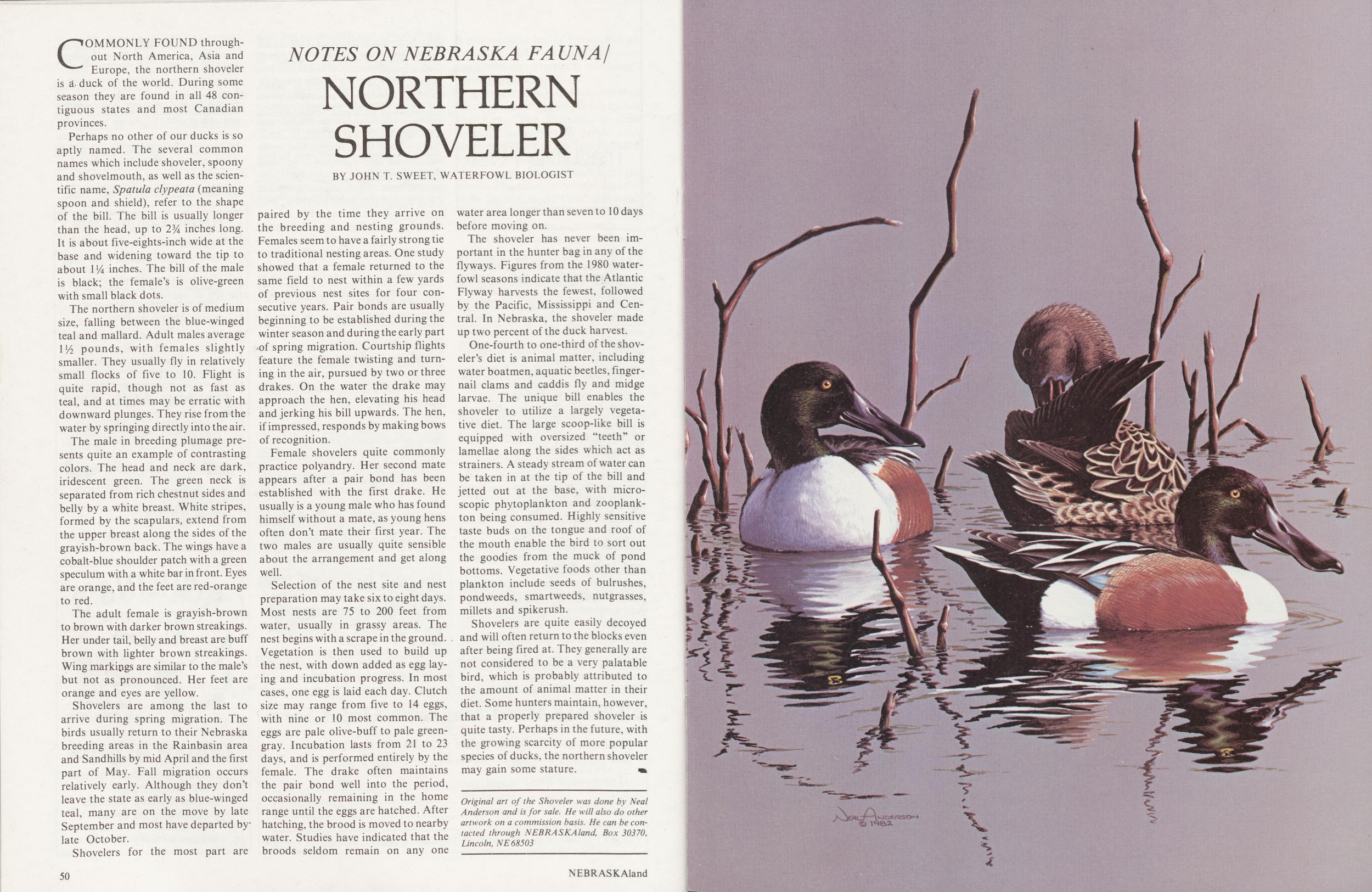
NOTES ON NEBRASKA FAUNA/ NORTHERN SHOVELER
BY JOHN T. SWEET, WATERFOWL BIOLOGISTCOMMONLY FOUND throughout North America, Asia and Europe, the northern shoveler is a duck of the world. During some season they are found in all 48 contiguous states and most Canadian provinces.
Perhaps no other of our ducks is so aptly named. The several common names which include shoveler, spoony and shovelmouth, as well as the scientific name, Spatula clypeata (meaning spoon and shield), refer to the shape of the bill. The bill is usually longer than the head, up to 2% inches long. It is about five-eights-inch wide at the base and widening toward the tip to about 1 lA inches. The bill of the male is black; the female's is olive-green with small black dots.
The northern shoveler is of medium size, falling between the blue-winged teal and mallard. Adult males average Wi pounds, with females slightly smaller. They usually fly in relatively small flocks of five to 10. Flight is quite rapid, though not as fast as teal, and at times may be erratic with downward plunges. They rise from the water by springing directly into the air.
The male in breeding plumage presents quite an example of contrasting colors. The head and neck are dark, iridescent green. The green neck is separated from rich chestnut sides and belly by a white breast. White stripes, formed by the scapulars, extend from the upper breast along the sides of the grayish-brown back. The wings have a cobalt-blue shoulder patch with a green speculum with a white bar in front. Eyes are orange, and the feet are red-orange to red.
The adult female is grayish-brown to brown with darker brown streakings. Her under tail, belly and breast are buff brown with lighter brown streakings. Wing markings are similar to the male's but not as pronounced. Her feet are orange and eyes are yellow.
Shovelers are among the last to arrive during spring migration. The birds usually return to their Nebraska breeding areas in the Rainbasin area and Sandhills by mid April and the first part of May. Fall migration occurs relatively early. Although they don't leave the state as early as blue-winged teal, many are on the move by late September and most have departed by-late October.
Shovelers for the most part are paired by the time they arrive on the breeding and nesting grounds. Females seem to have a fairly strong tie to traditional nesting areas. One study showed that a female returned to the same field to nest within a few yards of previous nest sites for four consecutive years. Pair bonds are usually beginning to be established during the winter season and during the early part of spring migration. Courtship flights feature the female twisting and turning in the air, pursued by two or three drakes. On the water the drake may approach the hen, elevating his head and jerking his bill upwards. The hen, if impressed, responds by making bows of recognition.
Female shovelers quite commonly practice polyandry. Her second mate appears after a pair bond has been established with the first drake. He usually is a young male who has found himself without a mate, as young hens often don't mate their first year. The two males are usually quite sensible about the arrangement and get along well.
Selection of the nest site and nest preparation may take six to eight days. Most nests are 75 to 200 feet from water, usually in grassy areas. The nest begins with a scrape in the ground... Vegetation is then used to build up the nest, with down added as egg laying and incubation progress. In most cases, one egg is laid each day. Clutch size may range from five to 14 eggs, with nine or 10 most common. The eggs are pale olive-buff to pale green-gray. Incubation lasts from 21 to 23 days, and is performed entirely by the female. The drake often maintains the pair bond well into the period, occasionally remaining in the home range until the eggs are hatched. After hatching, the brood is moved to nearby water. Studies have indicated that the broods seldom remain on any one water area longer than seven to 10 days before moving on.
The shoveler has never been important in the hunter bag in any of the fly ways. Figures from the 1980 waterfowl seasons indicate that the Atlantic Flyway harvests the fewest, followed by the Pacific, Mississippi and Central. In Nebraska, the shoveler made up two percent of the duck harvest.
One-fourth to one-third of the shoveler's diet is animal matter, including water boatmen, aquatic beetles, fingernail clams and caddis fly and midge larvae. The unique bill enables the shoveler to utilize a largely vegetative diet. The large scoop-like bill is equipped with oversized "teeth" or lamellae along the sides which act as strainers. A steady stream of water can be taken in at the tip of the bill and jetted out at the base, with microscopic phytoplankton and zooplankton being consumed. Highly sensitive taste buds on the tongue and roof of the mouth enable the bird to sort out the goodies from the muck of pond bottoms. Vegetative foods other than plankton include seeds of bulrushes, pondweeds, smartweeds, nutgrasses, millets and spikerush.
Shovelers are quite easily decoyed and will often return to the blocks even after being fired at. They generally are not considered to be a very palatable bird, which is probably attributed to the amount of animal matter in their diet. Some hunters maintain, however, that a properly prepared shoveler is quite tasty. Perhaps in the future, with the growing scarcity of more popular species of ducks, the northern shoveler may gain some stature.
Original art of the Shoveler was done by Neal Anderson and is for sale. He will also do other artwork on a commission basis. He can be contacted through NEBRASKAland, Box 30370, Lincoln, NE 68503 50 NEBRASKAland
SIXTH ANNUAL NEBRASKA HABITAT STAMP CONTEST
Submission Entries should be protected by a covering but will not be accepted in frames or under glass. Wrap securely and send to: Habitat Stamp Contest, Nebraska Game and Parks Commission, P.O. Box 30370, 2200 N. 33rd St., Lincoln, NE 68503. A completed entry form and reproduction agreement or facsimile thereof must accompany the entry. Name and address of the artist must appear only on the reverse side of the entry. The Game and Parks Commission is not responsible for any entry lost or damaged in transit. Entries will not be returned unless specifically requested. Prizes Adult Division first place winner receives $200 from the Omaha Fish and Wildlife Club. Runners-up all receive a one-year subscription to NEBRASKAland Magazine. Youth Division first place winners in each section receive $50 from the Omaha Fish and Wildlife Club. Runners-up all receive a one-year subscription to NEBRASKAland Magazine. Selected entries will be included in a traveling exhibit to be displayed at various locations around the state. Divisions Adult: Amateur or professional artists. Youth: Senior Section: Grades 9-12 Junior Section: Grades 5-8 Primary Section: Grades 1-4 Technical Requirements Design must be 71/2 inches by 411/ie inches. It may be matted, but mat may not exceed 10 inches by 7 inches. Any medium is acceptable, but no scroll work or lettering may appear on the design. Color is preferred. One entry per person. Subject Matter Any Nebraska wildlife species in an appropriate habitat setting, except bobwhite quail, ring-necked pheasant,, cottontail rabbit, coyote, and wild turkeys which are ineligible this year. Entry Deadline March 1, 1983. Contest is open to Nebraska i residents only, and winning entry in the Adult Division will appear on the 1984 Nebraska Habitat Stamp. 1983 Winner, Bill Hoile, Norfolk NE itry Form Please accept my entry in the design contest for the 1984 Nebraska Habitat Stamp. I hereby certify that I have complied with all of the rules governing this competition and that the work submitted is my own original creation. Further, the Nebraska Game and Parks Commission is hereby authorized to reproduce the design on the 1984 habitat Stamp or in any other fashion it may deem appropriate. Date Division/Section. School Name Age (if under 19) Grade in School Street Address State City Zip □ Please return my entry Signature of Artist Telephone NumberPosition: 341 (27 views)