Volume 60, Issue 13, 1982
NEBRASKAland
SEPTEMBER 1982 $1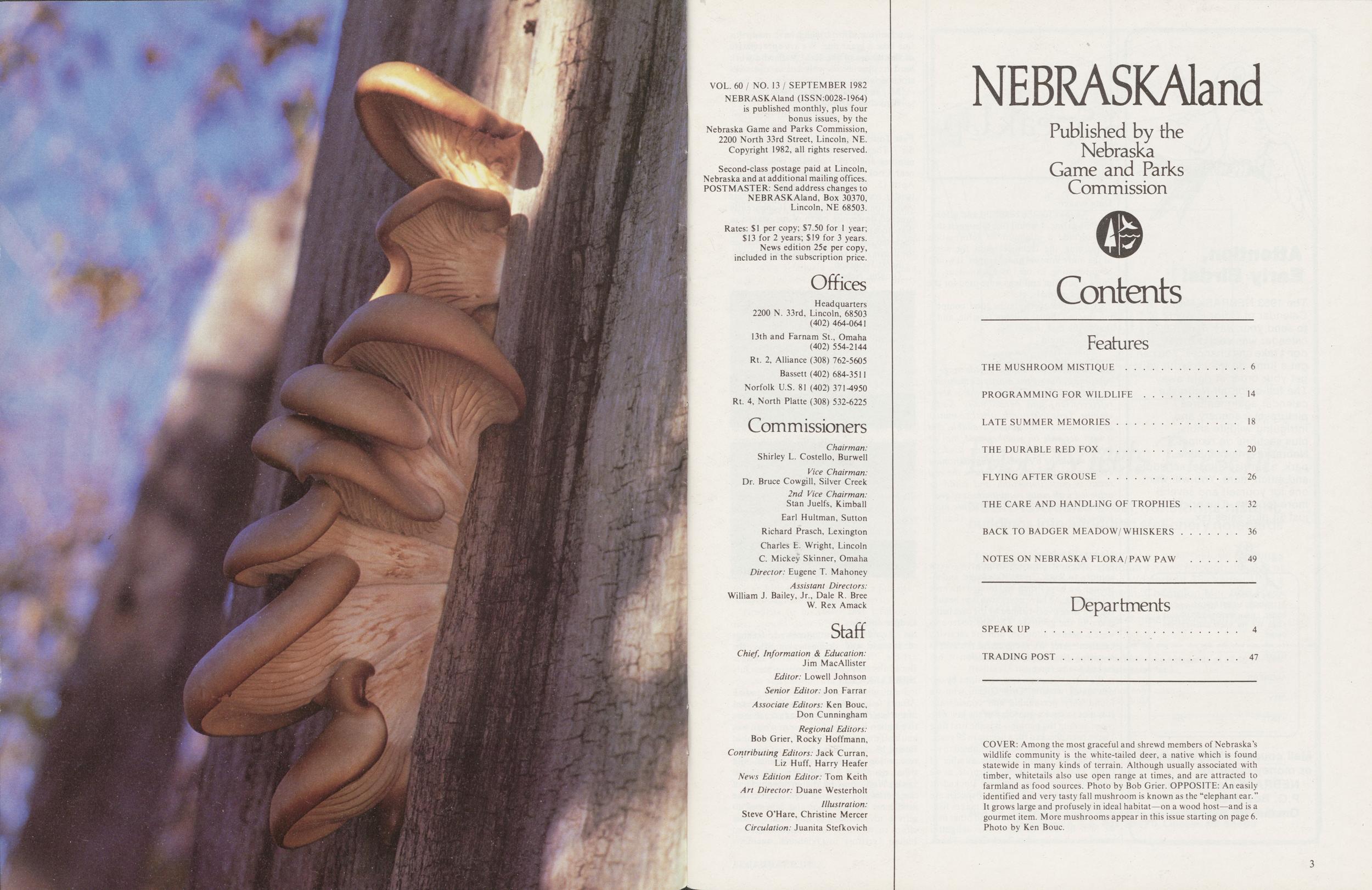
NEBRASKAland
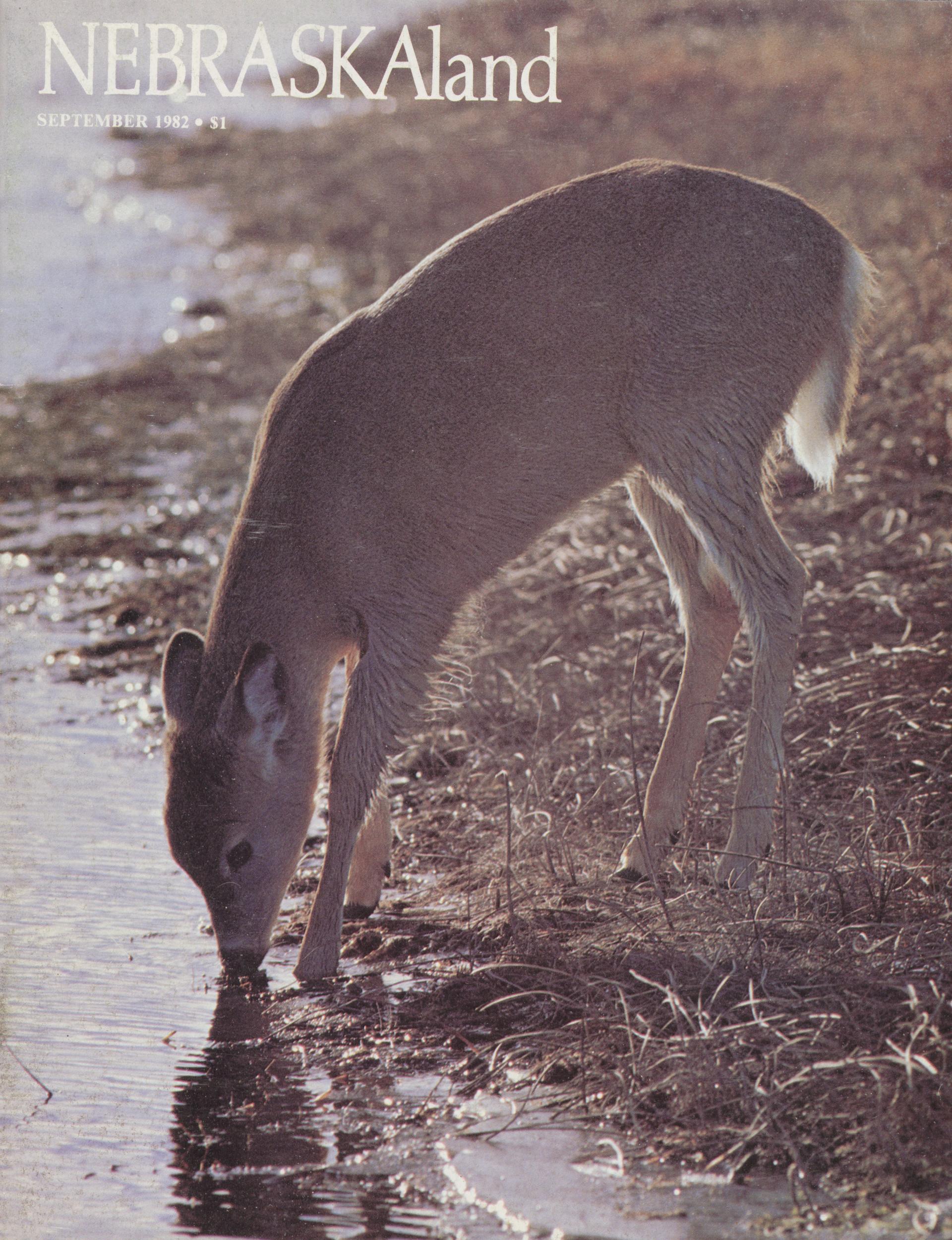
Published by the Nebraska Game and Parks Commission VOL. 60 / NO. 13 / SEPTEMBER 1982 NEBRASKAland (ISSN:0028-1964) is published monthly, plus four bonus issues, by the Nebraska Game and Parks Commission, 2200 North 33rd Street, Lincoln, NE. Copyright 1982, all rights reserved. Second-class postage paid at Lincoln, Nebraska and at additional mailing offices. POSTMASTER: Send address changes to NEBRASKAland, Box 30370, Lincoln, NE 68503. Rates: $1 per copy; $7.50 for 1 year; $13 for 2 years; $19 for 3 years. News edition 25c per copy, included in the subscription price. Offices Headquarters 2200 N. 33rd, Lincoln, 68503 (402) 464-0641 13th and Farnam St., Omaha (402) 554-2144 Rt. 2, Alliance (308) 762-5605 Bassett (402) 684-3511 Norfolk U.S. 81 (402) 371-4950 Rt. 4, North Platte (308) 532-6225 Commissioners Chairman: Shirley L. Costello, Burwell Vice Chairman: Dr. Bruce Cowgill, Silver Creek 2nd Vice Chairman: Stan Juelfs, Kimball Earl Hultman, Sutton Richard Prasch, Lexington Charles E. Wright, Lincoln C. Mickey Skinner, Omaha Director: Eugene T. Mahoney Assistant Directors: William J. Bailey, Jr., Dale R. Bree W. Rex Amack Staff Chief, Information & Education: Jim MacAllister Editor: Lowell Johnson Senior Editor: Jon Farrar Associate Editors: Ken Bouc, Don Cunningham Regional Editors: Bob Grier, Rocky Hoffmann, Contributing Editors: Jack Curran, Liz Huff, Harry Heafer News Edition Editor: Tom Keith Art Director: Duane Westerholt Illustration: Steve O'Hare, Christine Mercer Circulation: Juanita Stefkovich Contents Features THE MUSHROOM MISTIQUE 6 PROGRAMMING FOR WILDLIFE 14 LATE SUMMER MEMORIES 18 THE DURABLE RED FOX 20 FLYING AFTER GROUSE 26 THE CARE AND HANDLING OF TROPHIES 32 BACK TO BADGER MEADOW/ WHISKERS 36 NOTES ON NEBRASKA FLORA/ PAW PAW 49 Departments SPEAK UP 4 TRADING POST 47 COVER: Among the most graceful and shrewd members of Nebraska's wildlife community is the white-tailed deer, a native which is found statewide in many kinds of terrain. Although usually associated with timber, whitetails also use open range at times, and are attracted to farmland as food sources. Photo by Bob Grier. OPPOSITE: An easily identified and very tasty fall mushroom is known as the "elephant ear." It grows large and profusely in ideal habitat—on a wood host—and is a gourmet item. More mushrooms appear in this issue starting on page 6. Photo by Ken Bouc. 3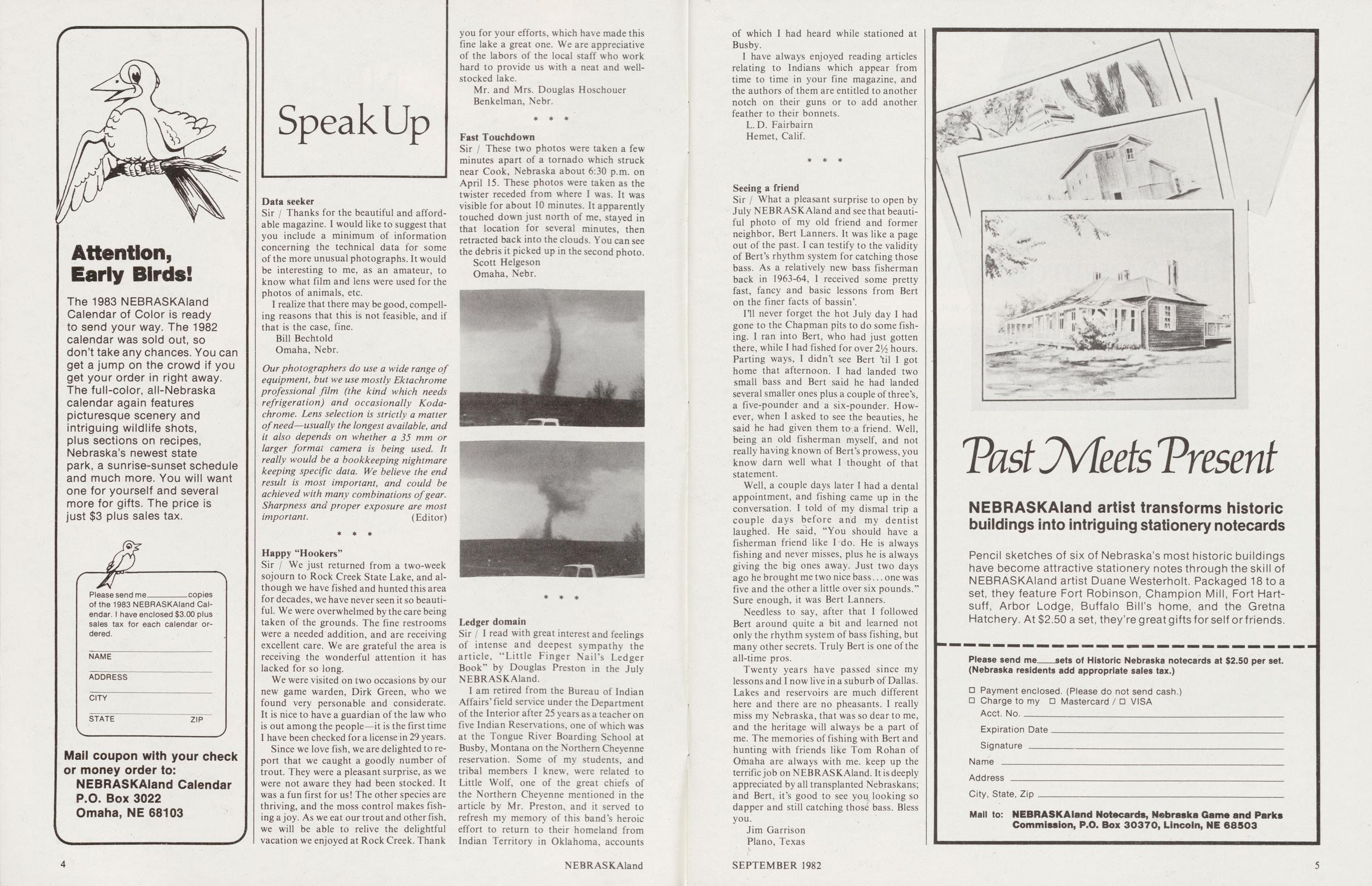
Speak Up
Data seekerSir / Thanks for the beautiful and affordable magazine. I would like to suggest that you include a minimum of information concerning the technical data for some of the more unusual photographs. It would be interesting to me, as an amateur, to know what film and lens were used for the photos of animals, etc.
I realize that there may be good, compelling reasons that this is not feasible, and if that is the case, fine.
Bill Bechtold Omaha, Nebr.Our photographers do use a wide range of equipment, but we use mostly Ektachrome professional film (the kind which needs refrigeration) and occasionally Koda-chrome. Lens selection is strictly a matter of need—usually the longest available, and it also depends on whether a 35 mm or larger format camera is being used. It really would be a bookkeeping nightmare keeping specific data. We believe the end result is most important, and could be achieved with many combinations of gear. Sharpness and proper exposure are most important. (Editor)
Happy "Hookers"Sir / We just returned from a two-week sojourn to Rock Creek State Lake, and although we have fished and hunted this area for decades, we have never seen it so beautiful. We were overwhelmed by the care being taken of the grounds. The fine restrooms were a needed addition, and are receiving excellent care. We are grateful the area is receiving the wonderful attention it has lacked for so long.
We were visited on two occasions by our new game warden, Dirk Green, who we found very personable and considerate. It is nice to have a guardian of the law who is out among the people—it is the first time I have been checked for a license in 29 years.
Since we love fish, we are delighted to report that we caught a goodly number of trout. They were a pleasant surprise, as we were not aware they had been stocked. It was a fun first for us! The other species are thriving, and the moss control makes fishing a joy. As we eat our trout and other fish, we will be able to relive the delightful vacation we enjoyed at Rock Creek. Thank you for your efforts, which have made this fine lake a great one. We are appreciative of the labors of the local staff who work hard to provide us with a neat and well-stocked lake.
Mr. and Mrs. Douglas Hoschouer Benkelman, Nebr. Fast TouchdownSir / These two photos were taken a few minutes apart of a tornado which struck near Cook, Nebraska about 6:30 p.m. on April 15. These photos were taken as the twister receded from where I was. It was visible for about 10 minutes. It apparently touched down just north of me, stayed in that location for several minutes, then retracted back into the clouds. You can see the debris it picked up in the second photo.
Scott Helgeson Omaha, Nebr.Sir / I read with great interest and feelings of intense and deepest sympathy the article, "Little Finger Nail's Ledger Book" by Douglas Preston in the July NEBRASKAland.
I am retired from the Bureau of Indian Affairs'field service under the Department of the Interior after 25 years as a teacher on five Indian Reservations, one of which was at the Tongue River Boarding School at Busby, Montana on the Northern Cheyenne reservation. Some of my students, and tribal members I knew, were related to Little Wolf, one of the great chiefs of the Northern Cheyenne mentioned in the article by Mr. Preston, and it served to refresh my memory of this band's heroic effort to return to their homeland from Indian Territory in Oklahoma, accounts 4 NEBRASKAland of which I had heard while stationed at Busby.
I have always enjoyed reading articles relating to Indians which appear from time to time in your fine magazine, and the authors of them are entitled to another notch on their guns or to add another feather to their bonnets.
L. D. Fairbairn Hemet, Calif. Seeing a friendSir / What a pleasant surprise to open by July NEBRASKAland and see that beautiful photo of my old friend and former neighbor, Bert Lanners. It was like a page out of the past. I can testify to the validity of Bert's rhythm system for catching those bass. As a relatively new bass fisherman back in 1963-64, I received some pretty fast, fancy and basic lessons from Bert on the finer facts of bassin'.
I'll never forget the hot July day I had gone to the Chapman pits to do some fishing. I ran into Bert, who had just gotten there, while I had fished for over 2!/2 hours. Parting ways, I didn't see Bert 'til I got home that afternoon. I had landed two small bass and Bert said he had landed several smaller ones plus a couple of three's, a five-pounder and a six-pounder. However, when I asked to see the beauties, he said he had given them to a friend. Well, being an old fisherman myself, and not really having known of Bert's prowess, you know darn well what I thought of that statement.
Well, a couple days later I had a dental appointment, and fishing came up in the conversation. I told of my dismal trip a couple days before and my dentist laughed. He said, "You should have a fisherman friend like I do. He is always fishing and never misses, plus he is always giving the big ones away. Just two days ago he brought me two nice bass... one was five and the other a little over six pounds." Sure enough, it was Bert Lanners.
Needless to say, after that I followed Bert around quite a bit and learned not only the rhythm system of bass fishing, but many other secrets. Truly Bert is one of the all-time pros.
Twenty years have passed since my lessons and I now live in a suburb of Dallas. Lakes and reservoirs are much different here and there are no pheasants. I really miss my Nebraska, that was so dear to me, and the heritage will always be a part of me. The memories of fishing with Bert and hunting with friends like Tom Rohan of Omaha are always with me. keep up the terrific job on NEBRASKAland. It is deeply appreciated by all transplanted Nebraskans; and Bert, it's good to see you looking so dapper and still catching those bass. Bless you.
Jim Garrison Piano, Texas Past Meets Present NEBRASKAland artist transforms historic buildings into intriguing stationery notecards Pencil sketches of six of Nebraska's most historic buildings have become attractive stationery notes through the skill of NEBRASKAland artist Duane Westerholt. Packaged 18 to a set, they feature Fort Robinson, Champion Mill, Fort Hartsuff, Arbor Lodge, Buffalo Bill's home, and the Gretna Hatchery. At $2.50 a set, they're great gifts for self or friends. Please send me____sets of Historic Nebraska notecards at $2.50 per set. (Nebraska residents add appropriate sales tax.) □ Payment enclosed. (Please do not send cash.) □ Charge to my □ Mastercard / □ VISA Acct. No. Expiration Date Signature Name Address City, State, Zip Mail to: NEBRASKAland Notecards, Nebraska Game and Parks Commission, P.O. Box 30370, Lincoln, NE 68503 SEPTEMBER 1982 5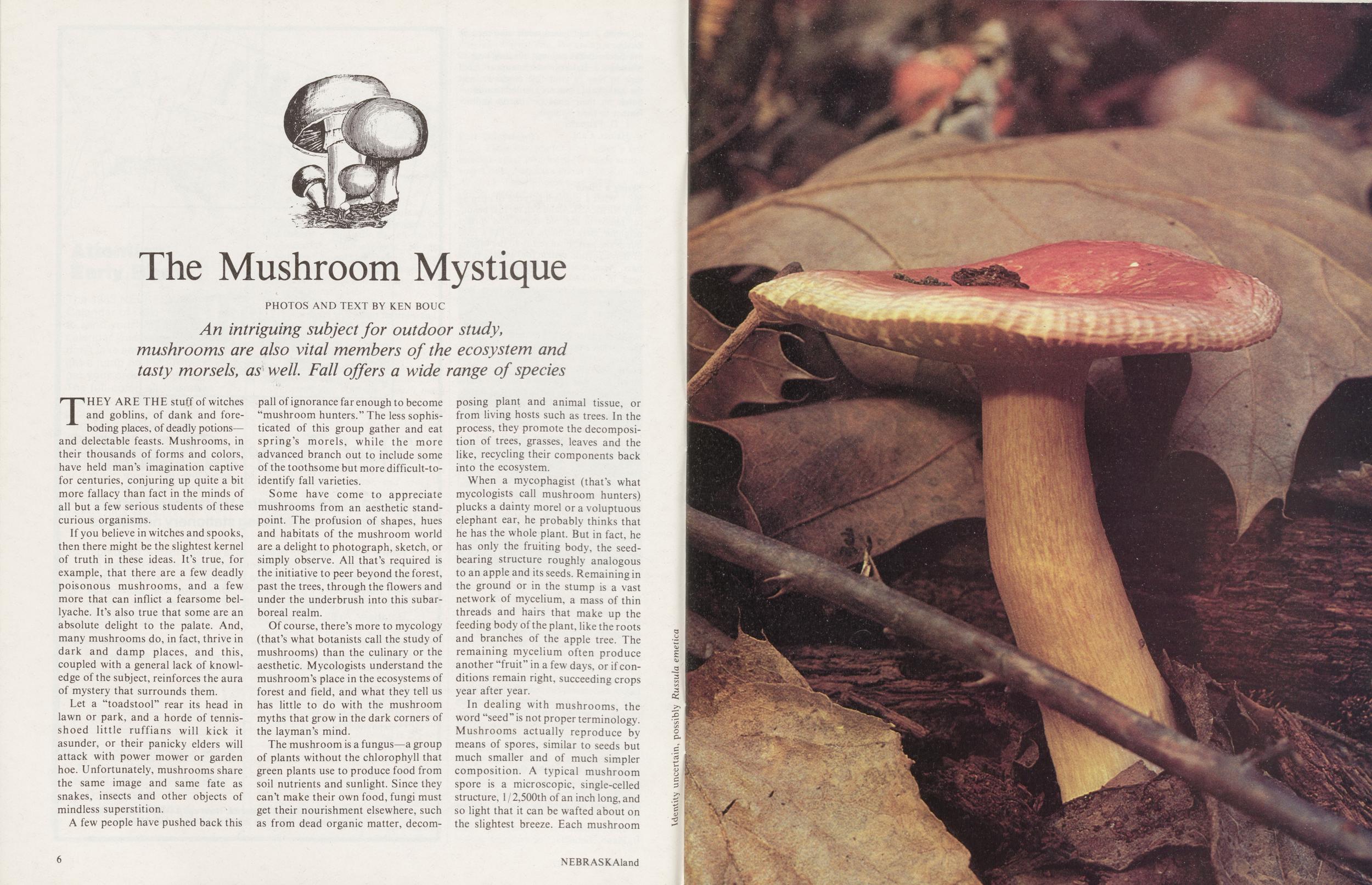
The Mushroom Mystique
PHOTOS AND TEXT BY KEN BOUC An intriguing subject for outdoor study, mushrooms are also vital members of the ecosystem and tasty morsels, as well Fall offers a wide range of speciesTHEY ARE THE stuff of witches and goblins, of dank and foreboding places, of deadly potions—and delectable feasts. Mushrooms, in their thousands of forms and colors, have held man's imagination captive for centuries, conjuring up quite a bit more fallacy than fact in the minds of all but a few serious students of these curious organisms.
If you believe in witches and spooks, then there might be the slightest kernel of truth in these ideas. It's true, for example, that there are a few deadly poisonous mushrooms, and a few more that can inflict a fearsome bellyache. It's also true that some are an absolute delight to the palate. And, many mushrooms do, in fact, thrive in dark and damp places, and this, coupled with a general lack of knowledge of the subject, reinforces the aura of mystery that surrounds them.
Let a "toadstool" rear its head in lawn or park, and a horde of tennis-shoed little ruffians will kick it asunder, or their panicky elders will attack with power mower or garden hoe. Unfortunately, mushrooms share the same image and same fate as snakes, insects and other objects of mindless superstition.
A few people have pushed back this pall of ignorance far enough to become "mushroom hunters." The less sophisticated of this group gather and eat spring's morels, while the more advanced branch out to include some of the toothsome but more difficult-to-identify fall varieties.
Some have come to appreciate mushrooms from an aesthetic standpoint. The profusion of shapes, hues and habitats of the mushroom world are a delight to photograph, sketch, or simply observe. All that's required is the initiative to peer beyond the forest, past the trees, through the flowers and under the underbrush into this subarboreal realm.
Of course, there's more to mycology (that's what botanists call the study of mushrooms) than the culinary or the aesthetic. Mycologists understand the mushroom's place in the ecosystems of forest and field, and what they tell us has little to do with the mushroom myths that grow in the dark corners of the layman's mind.
The mushroom is a fungus—a group of plants without the chlorophyll that green plants use to produce food from soil nutrients and sunlight. Since they can't make their own food, fungi must get their nourishment elsewhere, such as from dead organic matter, decomposing plant and animal tissue, or from living hosts such as trees. In the process, they promote the decomposition of trees, grasses, leaves and the like, recycling their components back into the ecosystem.
When a mycophagist (that's what mycologists call mushroom hunters) plucks a dainty morel or a voluptuous elephant ear, he probably thinks that he has the whole plant. But in fact, he has only the fruiting body, the seed-bearing structure roughly analogous to an apple and its seeds. Remaining in the ground or in the stump is a vast network of mycelium, a mass of thin threads and hairs that make up the feeding body of the plant, like the roots and branches of the apple tree. The remaining mycelium often produce another "fruit" in a few days, or if conditions remain right, succeeding crops year after year.
In dealing with mushrooms, the word "seed" is not proper terminology. Mushrooms actually reproduce by means of spores, similar to seeds but much smaller and of much simpler composition. A typical mushroom spore is a microscopic, single-celled structure, 1 / 2,500th of an inch long, and so light that it can be wafted about on the slightest breeze. Each mushroom 6 NEBRASKAland
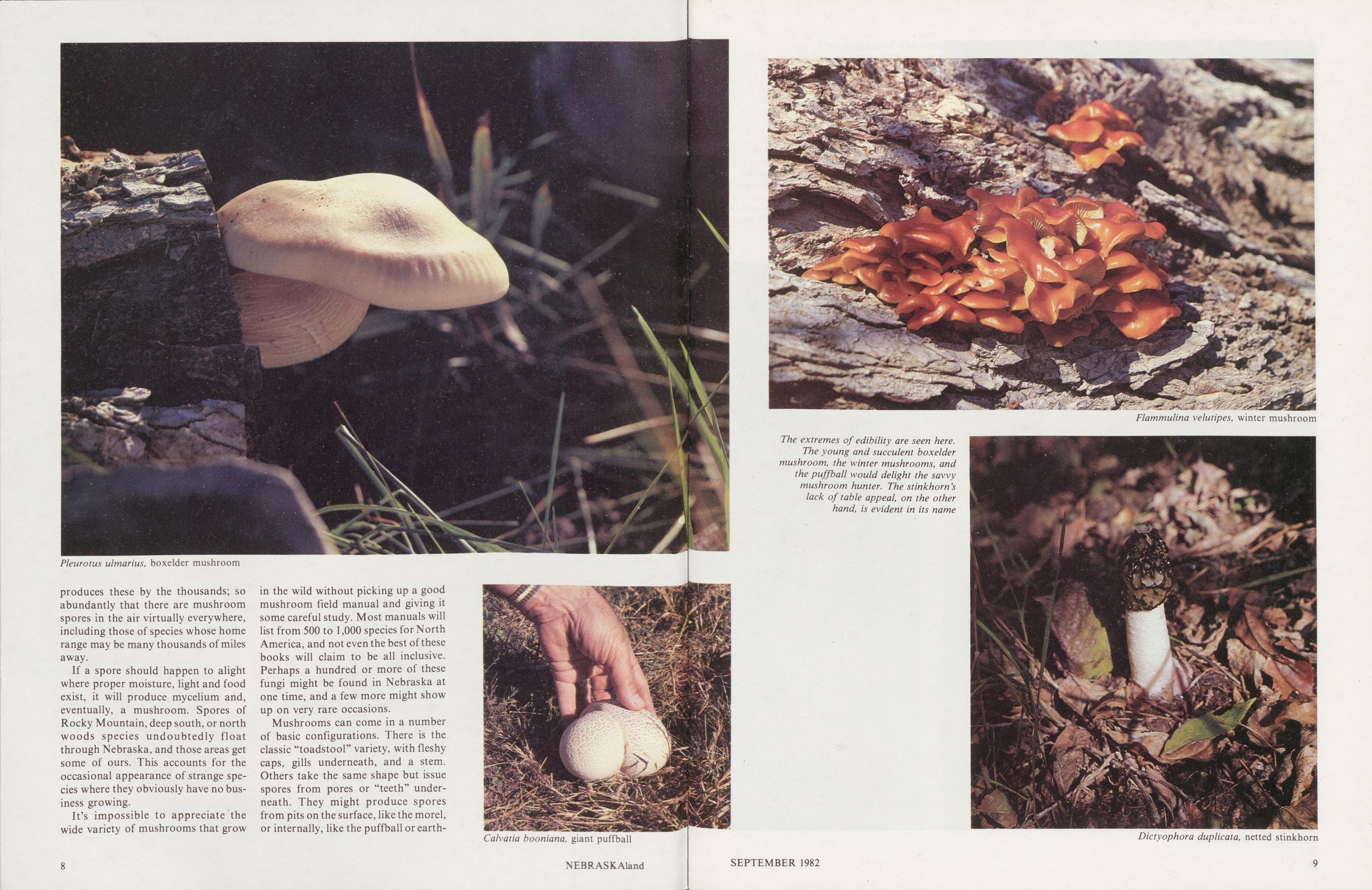
If a spore should happen to alight where proper moisture, light and food exist, it will produce mycelium and, eventually, a mushroom. Spores of Rocky Mountain, deep south, or north woods species undoubtedly float through Nebraska, and those areas get some of ours. This accounts for the occasional appearance of strange species where they obviously have no business growing.
It's impossible to appreciate the wide variety of mushrooms that grow in the wild without picking up a good mushroom field manual and giving it some careful study. Most manuals will list from 500 to 1,000 species for North America, and not even the best of these books will claim to be all inclusive. Perhaps a hundred or more of these fungi might be found in Nebraska at one time, and a few more might show up on very rare occasions.
Mushrooms can come in a number of basic configurations. There is the classic "toadstool" variety, with fleshy caps, gills underneath, and a stem. Others take the same shape but issue spores from pores or "teeth" underneath. They might produce spores from pits on the surface, like the morel, or internally, like the puffball or earthstar. They might look like a bird's nest or a branch of coral. Some are soft and jelly-like, some slimy or filmy or parchment-like, others woody and as tough as a two-by-four.
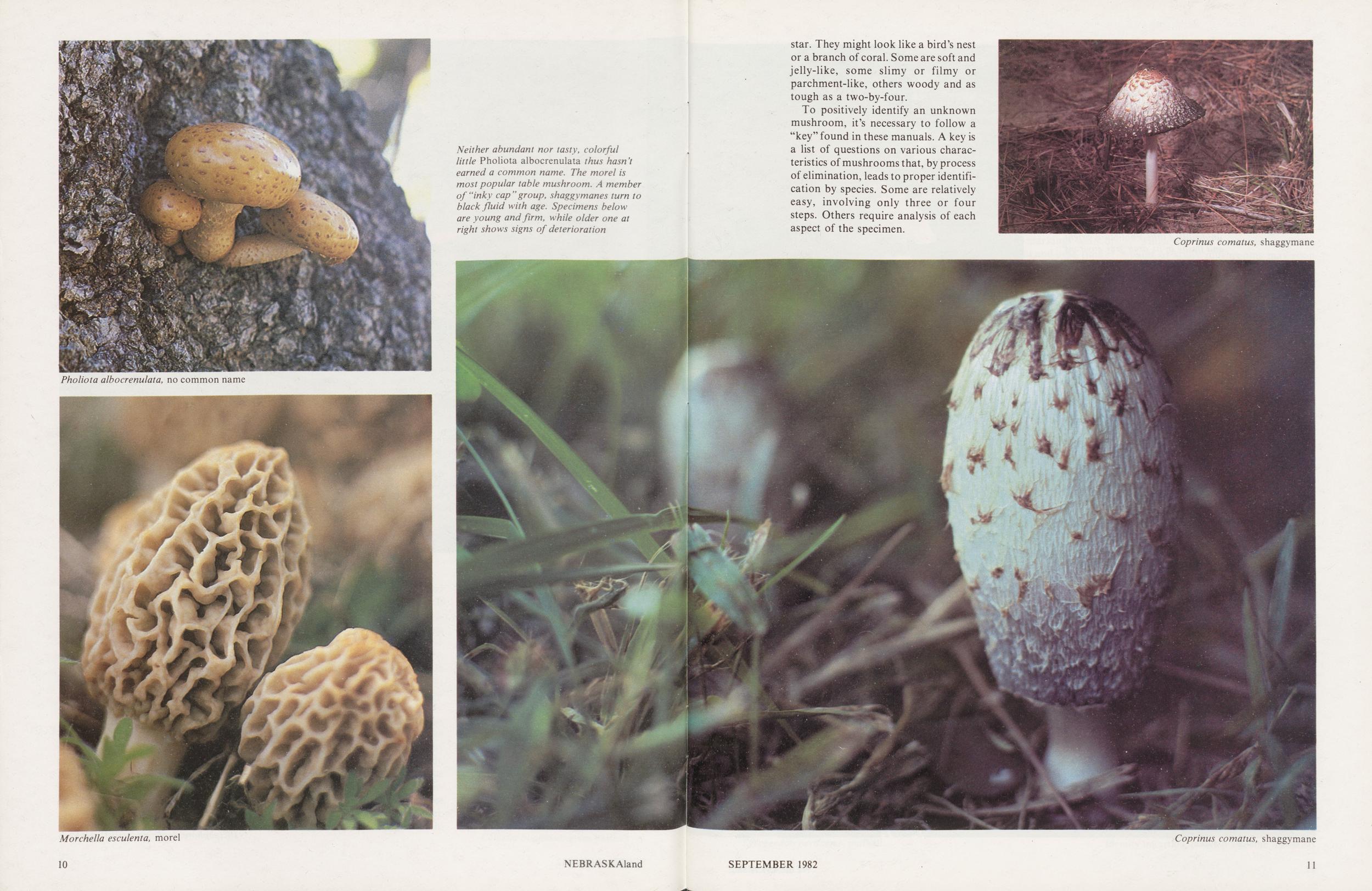 Neither abundant nor tasty, colorful
little Pholiota albocrenulata thus hasn't
earned a common name. The morel is
most popular table mushroom. A member
of "inky cap" group, shaggy manes turn to
black fluid with age. Specimens below
are young and firm, while older one at
right shows signs of deterioration
Neither abundant nor tasty, colorful
little Pholiota albocrenulata thus hasn't
earned a common name. The morel is
most popular table mushroom. A member
of "inky cap" group, shaggy manes turn to
black fluid with age. Specimens below
are young and firm, while older one at
right shows signs of deterioration
To positively identify an unknown mushroom, it's necessary to follow a "key" found in these manuals. A key is a list of questions on various characteristics of mushrooms that, by process of elimination, leads to proper identification by species. Some are relatively easy, involving only three or four steps. Others require analysis of each aspect of the specimen.
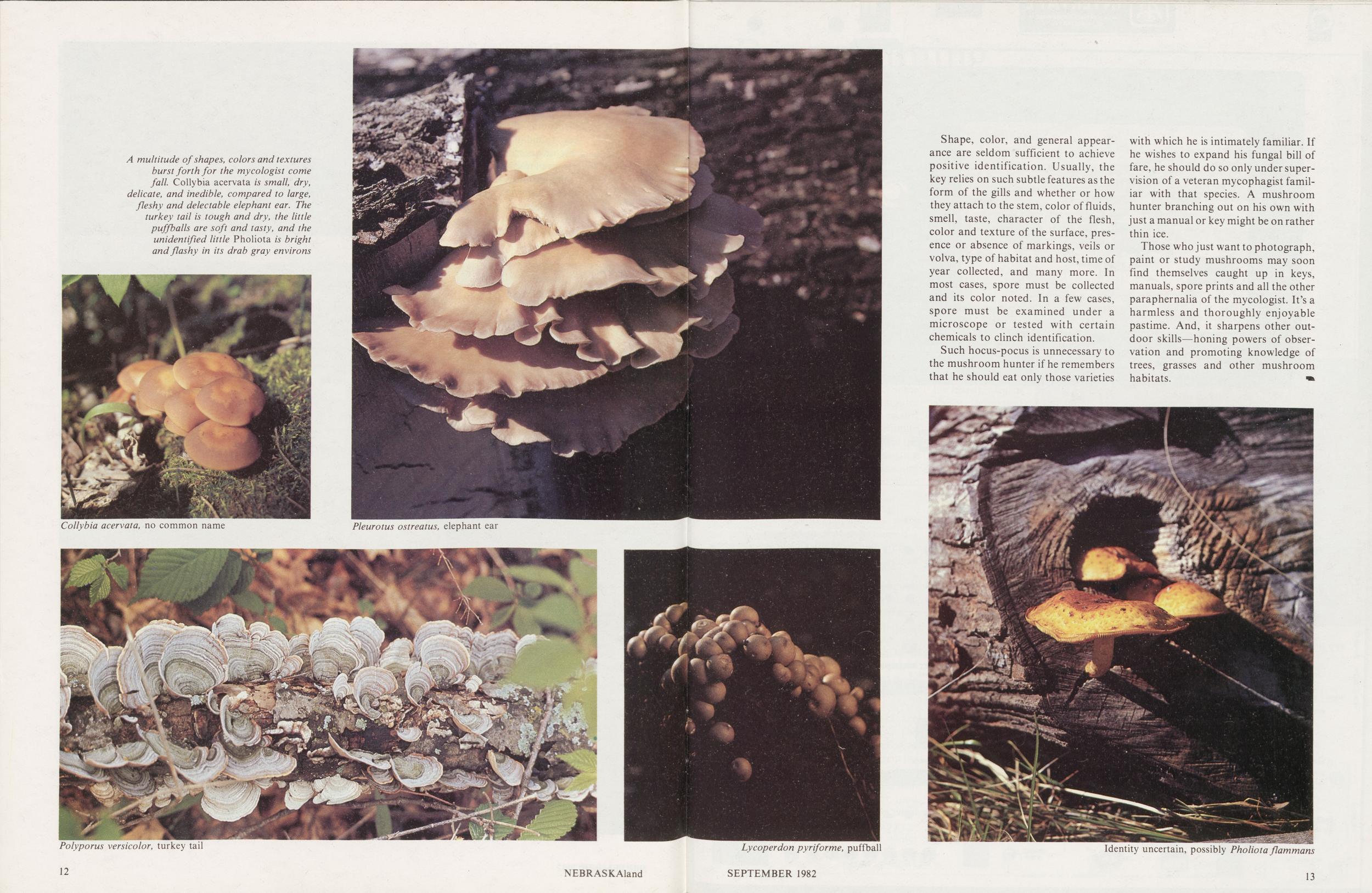 A multitude of shapes, colors and textures
burst forth for the mycologist come
fall. Collybia acervata is small, dry,
delicate, and inedible, compared to large,
fleshy and delectable elephant ear. The
turkey tail is tough and dry, the little
puffballs are soft and tasty, and the
unidentified little Pholiota is bright
and flashy in its drab gray environs
A multitude of shapes, colors and textures
burst forth for the mycologist come
fall. Collybia acervata is small, dry,
delicate, and inedible, compared to large,
fleshy and delectable elephant ear. The
turkey tail is tough and dry, the little
puffballs are soft and tasty, and the
unidentified little Pholiota is bright
and flashy in its drab gray environs
Shape, color, and general appearance are seldom sufficient to achieve positive identification. Usually, the key relies on such subtle features as the form of the gills and whether or how they attach to the stem, color of fluids, smell, taste, character of the flesh, color and texture of the surface, presence or absence of markings, veils or volva, type of habitat and host, time of year collected, and many more. In most cases, spore must be collected and its color noted. In a few cases, spore must be examined under a microscope or tested with certain chemicals to clinch identification.
Such hocus-pocus is unnecessary to the mushroom hunter if he remembers that he should eat only those varieties with which he is intimately familiar. If he wishes to expand his fungal bill of fare, he should do so only under supervision of a veteran mycophagist familiar with that species. A mushroom hunter branching out on his own with just a manual or key might be on rather thin ice.
Those who just want to photograph, paint or study mushrooms may soon find themselves caught up in keys, manuals, spore prints and all the other paraphernalia of the mycologist. It's a harmless and thoroughly enjoyable pastime. And, it sharpens other outdoor skills—honing powers of observation and promoting knowledge of trees, grasses and other mushroom habitats.
Programming for Wildlife
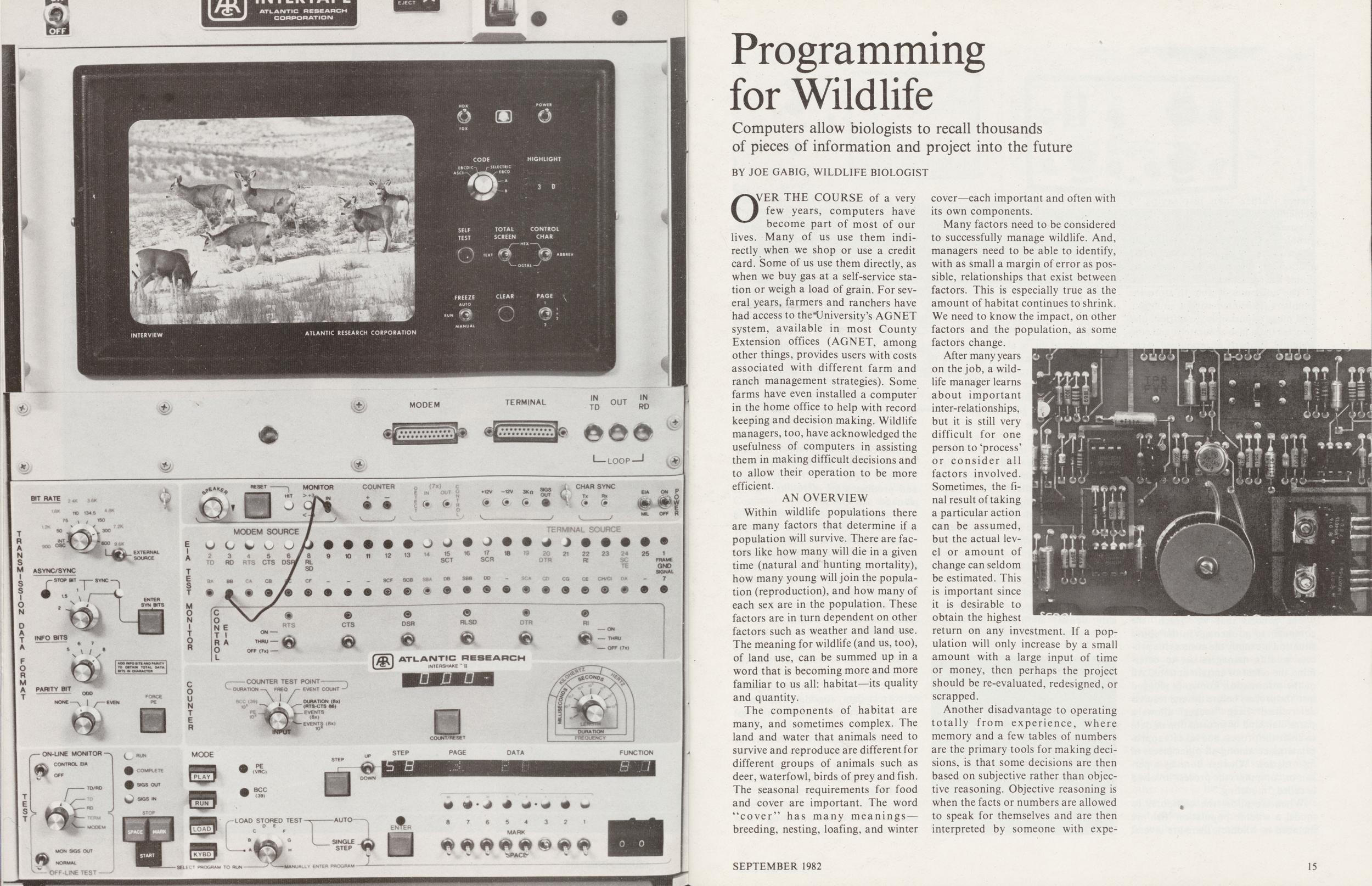
Computers allow biologists to recall thousands of pieces of information and project into the future BY JOE GABIG, WILDLIFE BIOLOGISTOVER THE COURSE of a very f few years, computers have become part of most of our lives. Many of us use them indirectly when we shop or use a credit card. Some of us use them directly, as when we buy gas at a self-service station or weigh a load of grain. For several years, farmers and ranchers have had access to the University's AGNET system, available in most County Extension offices (AGNET, among other things, provides users with costs associated with different farm and ranch management strategies). Some farms have even installed a computer in the home office to help with record keeping and decision making. Wildlife managers, too, have acknowledged the usefulness of computers in assisting them in making difficult decisions and to allow their operation to be more efficient.
AN OVERVIEWWithin wildlife populations there are many factors that determine if a population will survive. There are factors like how many will die in a given time (natural and hunting mortality), how many young will join the population (reproduction), and how many of each sex are in the population. These factors are in turn dependent on other factors such as weather and land use. The meaning for wildlife (and us, too), of land use, can be summed up in a word that is becoming more and more familiar to us all: habitat—its quality and quantity.
The components of habitat are many, and sometimes complex. The land and water that animals need to survive and reproduce are different for different groups of animals such as deer, waterfowl, birds of prey and fish. The seasonal requirements for food and cover are important. The word "cover" has many meanings — cover—each important and often with its own components.
Many factors need to be considered to successfully manage wildlife. And, managers need to be able to identify, with as small a margin of error as possible, relationships that exist between factors. This is especially true as the amount of habitat continues to shrink. We need to know the impact, on other factors and the population, as some factors change.
After many years on the job, a wildlife manager learns about important inter-relationships, but it is still very difficult for one person to 'process' or consider all factors involved. Sometimes, the final result of taking a particular action can be assumed, but the actual level or amount of change can seldom be estimated. This is important since it is desirable to obtain the highest return on any investment. If a population will only increase by a small amount with a large input of time or money, then perhaps the project should be re-evaluated, redesigned, or scrapped.
Another disadvantage to operating
totally from experience, where
memory and a few tables of numbers
are the primary tools for making decisions, is that some decisions are then
based on subjective rather than objective reasoning. Objective reasoning is
when the facts or numbers are allowed
to speak for themselves and are then
interpreted by someone with experience,
SEPTEMBER 1982
15
 rather than just saying "I
remember when we killed a lot more
pheasants." The objective approach to
problem solving provides wildlife and
fisheries managers with the best information on which to base decisions.
Enter the computer.
rather than just saying "I
remember when we killed a lot more
pheasants." The objective approach to
problem solving provides wildlife and
fisheries managers with the best information on which to base decisions.
Enter the computer.
The computer is able to store the numbers associated with a situation, and more importantly, to retrieve and process them fast, accurately, and consistently. Properly programmed, it can take into account information collected over the years by experienced people and report it in a form that can be interpreted. It can analyze the information statistically to help determine if a real change in animal numbers or hunter success has occurred. It can take into account what might be considered obscure information to assist in improving an estimate of the impact of a particular action. It can apply all of the factors known or suspected to have had an impact on a species of wildlife, allowing us to check if the logic used by the computer program aligns with what we see and can measure todav. Once we determine that the computer is doing a good job of describing history, we can let it begin to predict future impacts.
The process that we "teach" the computer to go through in the above situation is exactly the same as the process wildlife managers use to determine the effect of certain actions. All of the information known is plugged into the process before the end result is determined. Each "socket" allows a particular kind of information or data to enter the process and take its appropriate place among all other pieces of information. Whether done by a person or computer, the process involved is called "modeling."
When we allow the computer to model a wildlife population (fish are included in wildlife), there are several advantages. Data from many sources and of many kinds can be stored. Information ranging from reproductive rates to precipitation amounts to the number of acres of corn can be used in the model. Even though reproductive rates may remain unchanged from year to year, corn acreage changes annually and precipitation monthly, it is no trouble to keep all of this data stored on the machine. And once entered, it is always available, and always the same. In addition, it may be best to put corn acres and precipitation amounts into the model for different areas rather than for the entire state. In general, computer modeling allows the handling of more information than if people had to do it, and with improved accuracy.
Once all of the factors that might affect a regional or statewide population are made available to the computer, the relationships between factors can be investigated. These relationships become part of the model and it begins to take its final form. Its results can be compared to what is known to have happened in the past. Input by the professional wildlife manager is crucial throughout this model-building process to ensure success. The manager can identify biological limits and meaningful relationships. The manager gains from the experience by having to identify, logically and clearly, what he knows, what he doesn't know, and, of course, what he wants to know.
After the model describes what has occurred in the past, we can ask about future years, given certain conditions. These conditions can be averages of what has happened, they can be essentially random circumstances (such as allowing weather to fluctuate within certain limits), or they can be controlled by the manager. The manager might want to control certain factors .such as reduced acres planted to alfalfa. He may want to propose a new management program, but want to see its results first. It might be useful to predict future population levels with reduced or increased numbers of hunting permits. The machine will take an objective view of the numbers input and produce a set of results that the manager can interpret.
A model will not provide all the answers to a particular problem because of all the factors that impact a wildlife population. Social attitudes can be a main ingredient in decision making, and cannot be very well modeled. In addition, if a model predicts a decreasing population of a certain species of wildlife, it is the manager's job to identify what factors are responsible, control those factors in the direction desired, and verify the expected results.
A useful model depends on the input of correct data, the identification of valid relationships between factors, and, to a very high degree, the ability of the wildlife manager to interpret the computer-produced results. When these things are all working together, the entire system allows the professional manager to spend more time applying what he knows, learning what he doesn't, and educating others about wildlife and its ways.
16 NEBRASKAlandThe Wildlife and Fisheries divisions of the Nebraska Game and Parks Commission have been using the computer since the early 1970's in several applications, initially for wildlife and fish data tabulation and analysis. In 1978, the agency shifted from the computer at the University of Nebraska to the Nebraska State Computer System. We now have two computer terminals in our Lincoln office and one in our Norfolk office. Technical publications about the sharp-tailed grouse, fish populations and the ring-necked pheasant would not have been possible without the aid of the computer. Two of the most recent published reports in which the computer played a major role dealt with the survival and distribution of Central Flyway mallards and the development of a new fish population model.
During the last few years, much wildlife and fishery population monitoring has been computerized. Most of the information for wildlife surveys has been analyzed by computer, freeing professional personnel for more important tasks. Fish population estimates and other statistics are much more quickly and accurately available through computer programs.
The Wildlife Division has been mailing a survey to as many as 7,400 hunters each year to help monitor the upland game and waterfowl harvest in Nebraska. Mailing labels used to be typed, put on envelopes, and these put into ZIP code order (to reduce mailing costs). Now, the names and addresses are put into the computer and sorted before they are printed. This process alone saves several days for employees each year.
Hunters are asked where and how many days they hunted and how many of each species were taken. Returns provide nearly 10,000 pieces of information. This information ('data' in computer talk) was tabulated by hand until 1978, when we began to use the computer. But, there were trade-offs to be made in being able to obtain the results of this survey accurately, quickly and with minimal manpower. We had to pay rent on terminals and on the computer. Also, time was needed to write and run the programs (instructions to the computer). And, while it took a considerable amount of time the first year to get everything running right, little time was needed for the 1979 and 1980 seasons.
A project which would have been impossible without the computer resulted in the "Low Plains proposal." This proposal, had it been accepted by the U.S. Fish and Wildlife Service (USFWS), would have allowed Nebraskans who hunt ducks in the Low Plains (eastern) portion of Nebraska to have a few more days to hunt. The proposal documented essentially what species of ducks (primarily mallards) would be harvested by such a season and that the season would not harm the duck population.
More than 60,000 pieces of information were used to get the best estimate of how long a mallard lives in the wild. We tallied males and females separately, and young and adults within each sex. We had to investigate the relationship of ducks passing through and taken in Nebraska, to those of other states in the Central Flyway and in the western Mississippi Flyway. We had to determine when certain groups of mallards (Continued on page 44)
SEPTEMBER 1982 17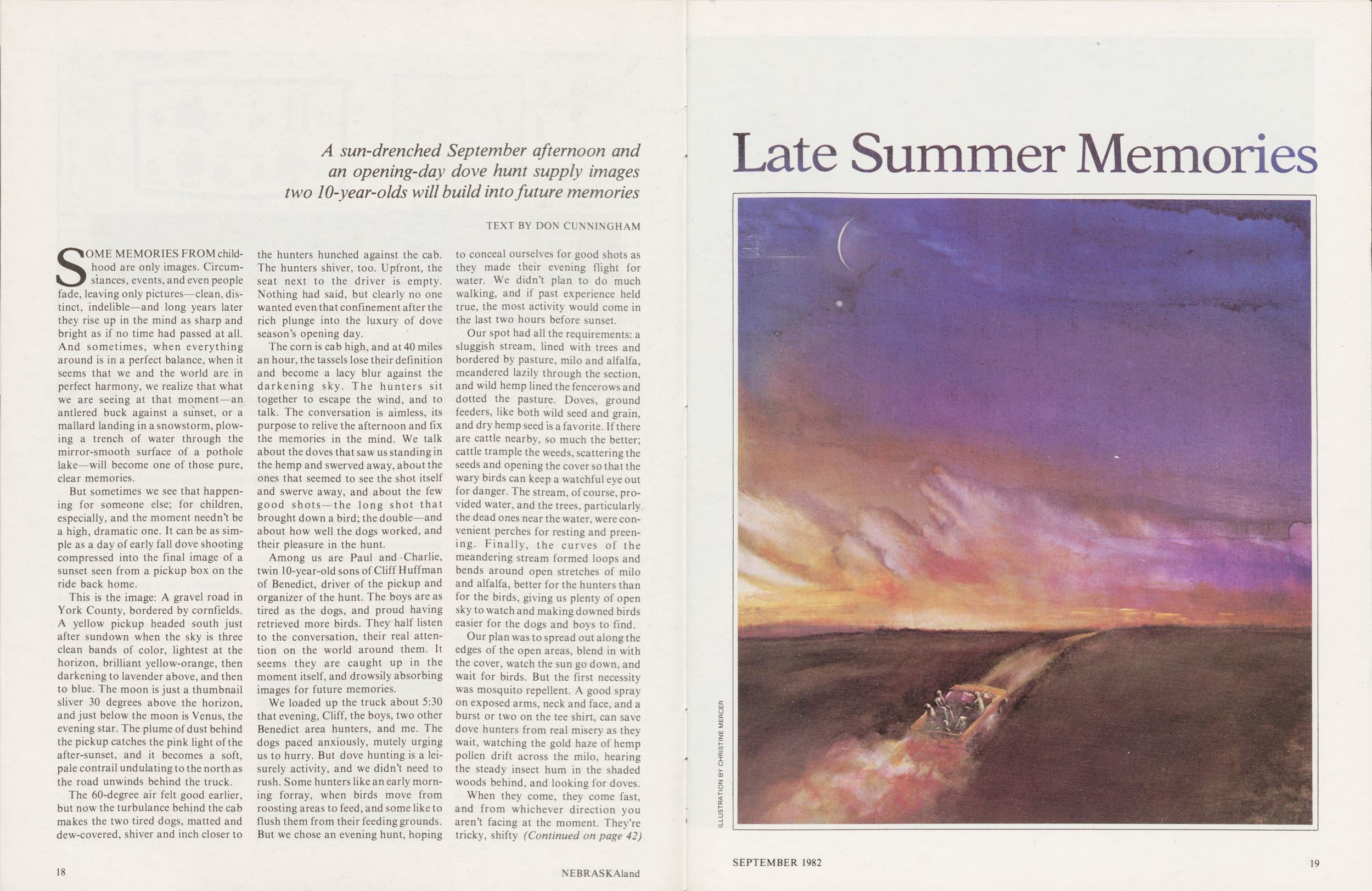
Late Summer Memories
A sun-drenched September afternoon and an opening-day dove hunt supply images two 10-year-olds will build into future memories TEXT BY DON CUNNINGHAMSOME MEMORIES FROM childhood are only images. Circumstances, events, and even people fade, leaving only pictures—clean, distinct, indelible—and long years later they rise up in the mind as sharp and bright as if no time had passed at all. And sometimes, when everything around is in a perfect balance, when it seems that we and the world are in perfect harmony, we realize that what we are seeing at that moment—an antlered buck against a sunset, or a mallard landing in a snowstorm, plowing a trench of water through the mirror-smooth surface of a pothole lake—will become one of those pure, clear memories.
But sometimes we see that happening for someone else; for children, especially, and the moment needn't be a high, dramatic one. It can be as simple as a day of early fall dove shooting compressed into the final image of a sunset seen from a pickup box on the ride back home.
This is the image: A gravel road in York County, bordered by cornfields. A yellow pickup headed south just after sundown when the sky is three clean bands of color, lightest at the horizon, brilliant yellow-orange, then darkening to lavender above, and then to blue. The moon is just a thumbnail sliver 30 degrees above the horizon, and just below the moon is Venus, the evening star. The plume of dust behind the pickup catches the pink light of the after-sunset, and it becomes a soft, pale contrail undulating to the north as the road unwinds behind the truck.
The 60-degree air felt good earlier, but now the turbulance behind the cab makes the two tired dogs, matted and dew-covered, shiver and inch closer to the hunters hunched against the cab. The hunters shiver, too. Upfront, the seat next to the driver is empty. Nothing had said, but clearly no one wanted even that confinement after the rich plunge into the luxury of dove season's opening day.
The corn is cab high, and at 40 miles an hour, the tassels lose their definition and become a lacy blur against the darkening sky. The hunters sit together to escape the wind, and to talk. The conversation is aimless, its purpose to relive the afternoon and fix the memories in the mind. We talk about the doves that saw us standing in the hemp and swerved away, about the ones that seemed to see the shot itself and swerve away, and about the few good shots — the long shot that brought down a bird; the double—and about how well the dogs worked, and their pleasure in the hunt.
Among us are Paul and Charlie, twin 10-year-old sons of Cliff Huffman of Benedict, driver of the pickup and organizer of the hunt. The boys are as tired as the dogs, and proud having retrieved more birds. They half listen to the conversation, their real attention on the world around them. It seems they are caught up in the moment itself, and drowsily absorbing images for future memories.
We loaded up the truck about 5:30 that evening, Cliff, the boys, two other Benedict area hunters, and me. The dogs paced anxiously, mutely urging us to hurry. But dove hunting is a leisurely activity, and we didn't need to rush. Some hunters like an early morning forray, when birds move from roosting areas to feed, and some like to flush them from their feeding grounds. But we chose an evening hunt, hoping to conceal ourselves for good shots as they made their evening flight for water. We didn't plan to do much walking, and if past experience held true, the most activity would come in the last two hours before sunset.
Our spot had all the requirements: a sluggish stream, lined with trees and bordered by pasture, milo and alfalfa, meandered lazily through the section, and wild hemp lined the fencerows and dotted the pasture. Doves, ground feeders, like both wild seed and grain, and dry hemp seed is a favorite. If there are cattle nearby, so much the better; cattle trample the weeds, scattering the seeds and opening the cover so that the wary birds can keep a watchful eye out for danger. The stream, of course, provided water, and the trees, particularly the dead ones near the water, were convenient perches for resting and preening. Finally, the curves of the meandering stream formed loops and bends around open stretches of milo and alfalfa, better for the hunters than for the birds, giving us plenty of open sky to watch and making downed birds easier for the dogs and boys to find.
Our plan was to spread out along the edges of the open areas, blend in with the cover, watch the sun go down, and wait for birds. But the first necessity was mosquito repellent. A good spray on exposed arms, neck and face, and a burst or two on the tee shirt, can save dove hunters from real misery as they wait, watching the gold haze of hemp pollen drift across the milo, hearing the steady insect hum in the shaded woods behind, and looking for doves.
When they come, they come fast, and from whichever direction you aren't facing at the moment. They're tricky, shifty (Continued on page 42)
18 NEBRASKAland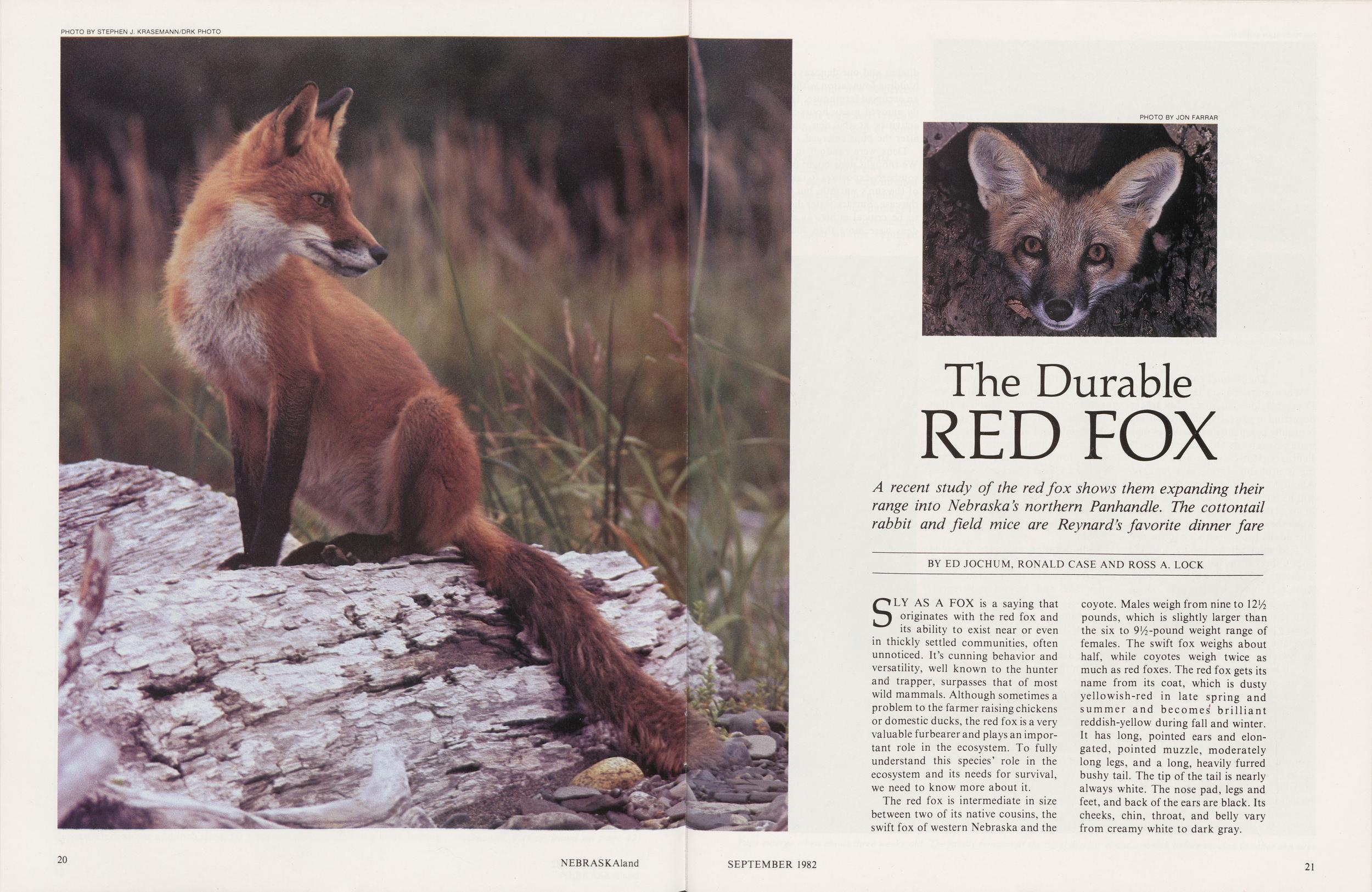
The Durable RED FOX
A recent study of the red fox shows them expanding their range into Nebraska's northern Panhandle. The cottontail rabbit and field mice are Reynard's favorite dinner fare BY ED JOCHUM, RONALD CASE AND ROSS A. LOCKSLY AS A FOX is a saying that originates with the red fox and its ability to exist near or even in thickly settled communities, often unnoticed. It's cunning behavior and versatility, well known to the hunter and trapper, surpasses that of most wild mammals. Although sometimes a problem to the farmer raising chickens or domestic ducks, the red fox is a very valuable furbearer and plays an important role in the ecosystem. To fully understand this species' role in the ecosystem and its needs for survival, we need to know more about it.
The red fox is intermediate in size between two of its native cousins, the swift fox of western Nebraska and the coyote. Males weigh from nine to 12! pounds, which is slightly larger than the six to 9½-pound weight range of females. The swift fox weighs about half, while coyotes weigh twice as much as red foxes. The red fox gets its name from its coat, which is dusty yellowish-red in late spring and summer and becomes* brilliant reddish-yellow during fall and winter. It has long, pointed ears and elongated, pointed muzzle, moderately long legs, and a long, heavily furred bushy tail. The tip of the tail is nearly always white. The nose pad, legs and feet, and back of the ears are black. Its cheeks, chin, throat, and belly vary from creamy white to dark gray.
SEPTEMBER 1982 21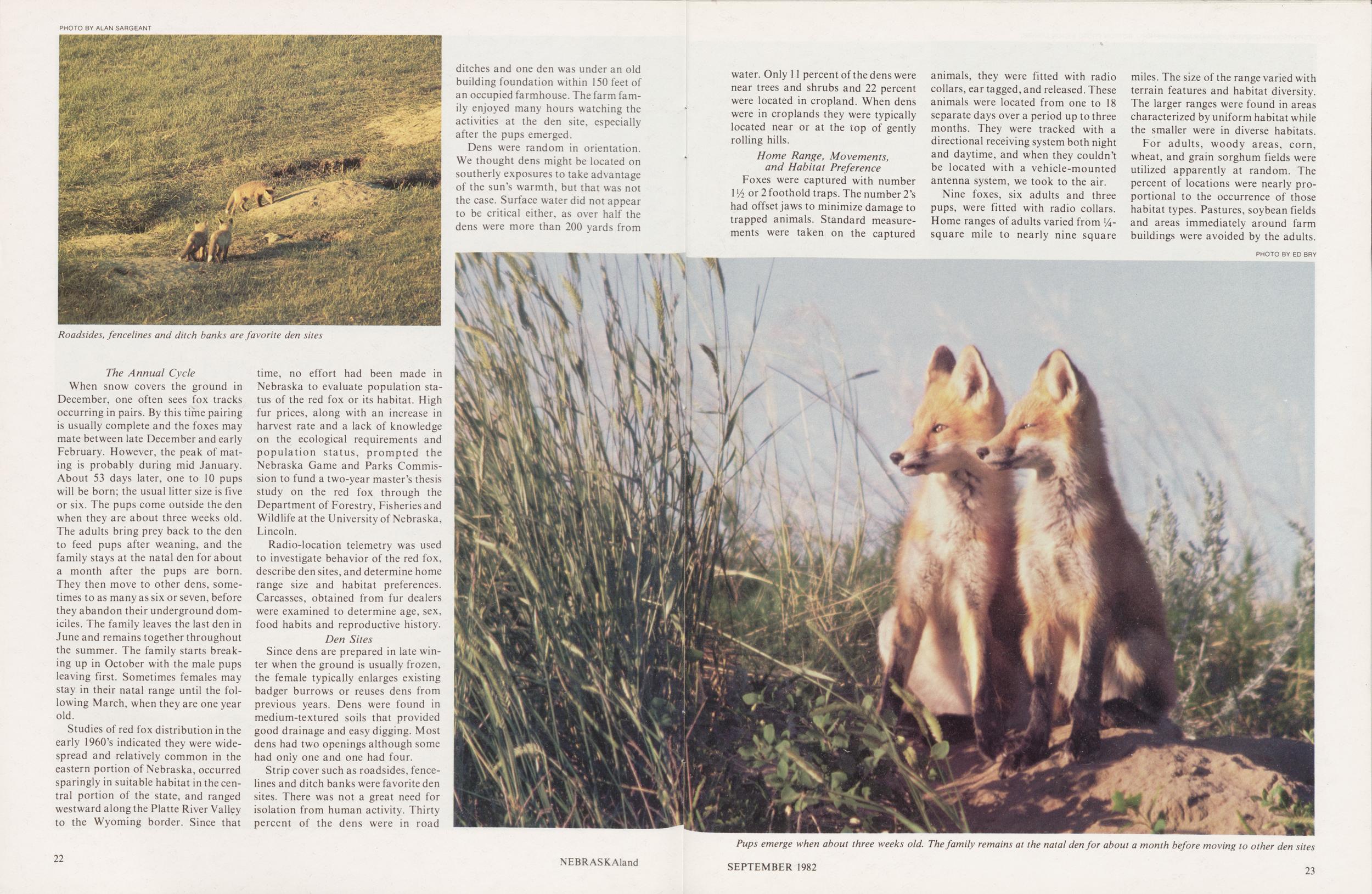
When snow covers the ground in December, one often sees fox tracks occurring in pairs. By this time pairing is usually complete and the foxes may mate between late December and early February. However, the peak of mating is probably during mid January. About 53 days later, one to 10 pups will be born; the usual litter size is five or six. The pups come outside the den when they are about three weeks old. The adults bring prey back to the den to feed pups after weaning, and the family stays at the natal den for about a month after the pups are born. They then move to other dens, sometimes to as many as six or seven, before they abandon their underground domiciles. The family leaves the last den in June and remains together throughout the summer. The family starts breaking up in October with the male pups leaving first. Sometimes females may stay in their natal range until the following March, when they are one year old.
Studies of red fox distribution in the early 1960's indicated they were widespread and relatively common in the eastern portion of Nebraska, occurred sparingly in suitable habitat in the central portion of the state, and ranged westward along the Platte River Valley to the Wyoming border. Since that time, no effort had been made in Nebraska to evaluate population status of the red fox or its habitat. High fur prices, along with an increase in harvest rate and a lack of knowledge on the ecological requirements and population status, prompted the Nebraska Game and Parks Commission to fund a two-year master's thesis study on the red fox through the Department of Forestry, Fisheries and Wildlife at the University of Nebraska, Lincoln.
Radio-location telemetry was used to investigate behavior of the red fox, describe den sites, and determine home range size and habitat preferences. Carcasses, obtained from fur dealers were examined to determine age, sex, food habits and reproductive history.
Den SitesSince dens are prepared in late winter when the ground is usually frozen, the female typically enlarges existing badger burrows or reuses dens from previous years. Dens were found in medium-textured soils that provided good drainage and easy digging. Most dens had two openings although some had only one and one had four.
Strip cover such as roadsides, fencelines and ditch banks were favorite den sites. There was not a great need for isolation from human activity. Thirty percent of the dens were in road ditches and one den was under an old building foundation within 150 feet of an occupied farmhouse. The farm family enjoyed many hours watching the activities at the den site, especially after the pups emerged.
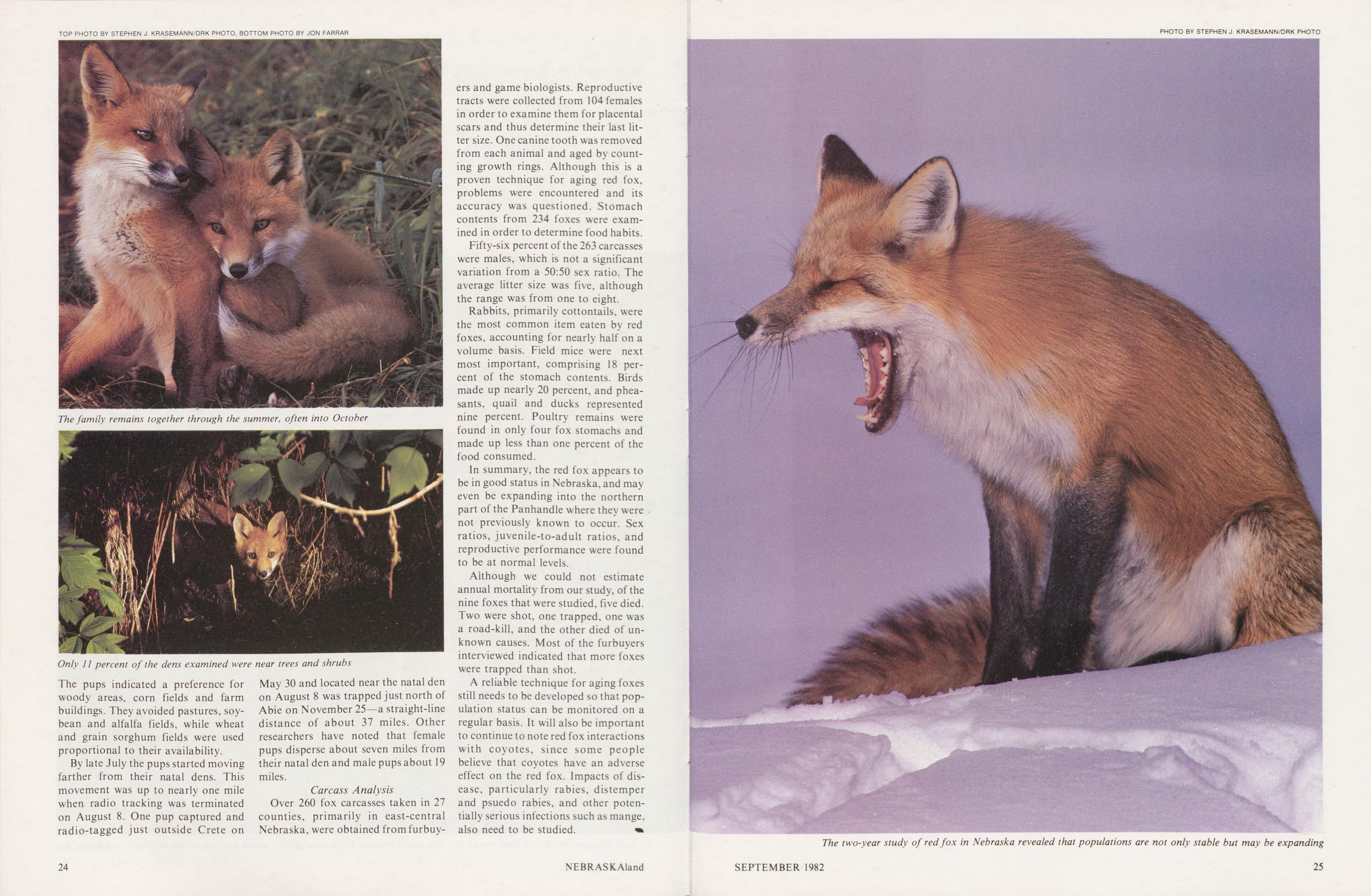
Dens were random in orientation. We thought dens might be located on southerly exposures to take advantage of the sun's warmth, but that was not the case. Surface water did not appear to be critical either, as over half the dens were more than 200 yards from 22 NEBRASKAland water. Only 11 percent of the dens were near trees and shrubs and 22 percent were located in cropland. When dens were in croplands they were typically located near or at the top of gently rolling hills.
Home Range, Movements, and Habitat PreferenceFoxes were captured with number 1½ or 2 foothold traps. The number 2's had offset jaws to minimize damage to trapped animals. Standard measurements were taken on the captured animals, they were fitted with radio collars, ear tagged, and released. These animals were located from one to 18 separate days over a period up to three months. They were tracked with a directional receiving system both night and daytime, and when they couldn't be located with a vehicle-mounted antenna system, we took to the air.
Nine foxes, six adults and three pups, were fitted with radio collars. Home ranges of adults varied from ¼-square mile to nearly nine square miles. The size of the range varied with terrain features and habitat diversity. The larger ranges were found in areas characterized by uniform habitat while the smaller were in diverse habitats.
For adults, woody areas, corn, wheat, and grain sorghum fields were utilized apparently at random. The percent of locations were nearly proportional to the occurrence of those habitat types. Pastures, soybean fields and areas immediately around farm buildings were avoided by the adults. The pups indicated a preference for woody areas, corn fields and farm buildings. They avoided pastures, soybean and alfalfa fields, while wheat and grain sorghum fields were used proportional to their availability.
By late July the pups started moving farther from their natal dens. This movement was up to nearly one mile when radio tracking was terminated on August 8. One pup captured and radio-tagged just outside Crete on May 30 and located near the natal den on August 8 was trapped just north of Abie on November 25—a straight-line distance of about 37 miles. Other researchers have noted that female pups disperse about seven miles from their natal den and male pups about 19 miles.
Carcass AnalysisOver 260 fox carcasses taken in 27 counties, primarily in east-central Nebraska, were obtained fromfurbuyers and game biologists. Reproductive tracts were collected from 104 females in order to examine them for placental scars and thus determine their last litter size. One canine tooth was removed from each animal and aged by counting growth rings. Although this is a proven technique for aging red fox, problems were encountered and its accuracy was questioned. Stomach contents from 234 foxes were examined in order to determine food habits.
Fifty-six percent of the 263 carcasses were males, which is not a significant variation from a 50:50 sex ratio. The average litter size was five, although the range was from one to eight.
Rabbits, primarily cottontails, were the most common item eaten by red foxes, accounting for nearly half on a volume basis. Field mice were next most important, comprising 18 percent of the stomach contents. Birds made up nearly 20 percent, and pheasants, quail and ducks represented nine percent. Poultry remains were found in only four fox stomachs and made up less than one percent of the food consumed.
In summary, the red fox appears to be in good status in Nebraska, and may even be expanding into the northern part of the Panhandle where they were not previously known to occur. Sex ratios, juvenile-to-adult ratios, and reproductive performance were found to be at normal levels.
Although we could not estimate annual mortality from our study, of the nine foxes that were studied, five died. Two were shot, one trapped, one was a road-kill, and the other died of unknown causes. Most of the furbuyers interviewed indicated that more foxes were trapped than shot.
A reliable technique for aging foxes still needs to be developed so that population status can be monitored on a regular basis. It will also be important to continue to note red fox interactions with coyotes, since some people believe that coyotes have an adverse effect on the red fox. Impacts of disease, particularly rabies, distemper and psuedo rabies, and other potentially serious infections such as mange, also need to be studied.
24 NEBRASKAland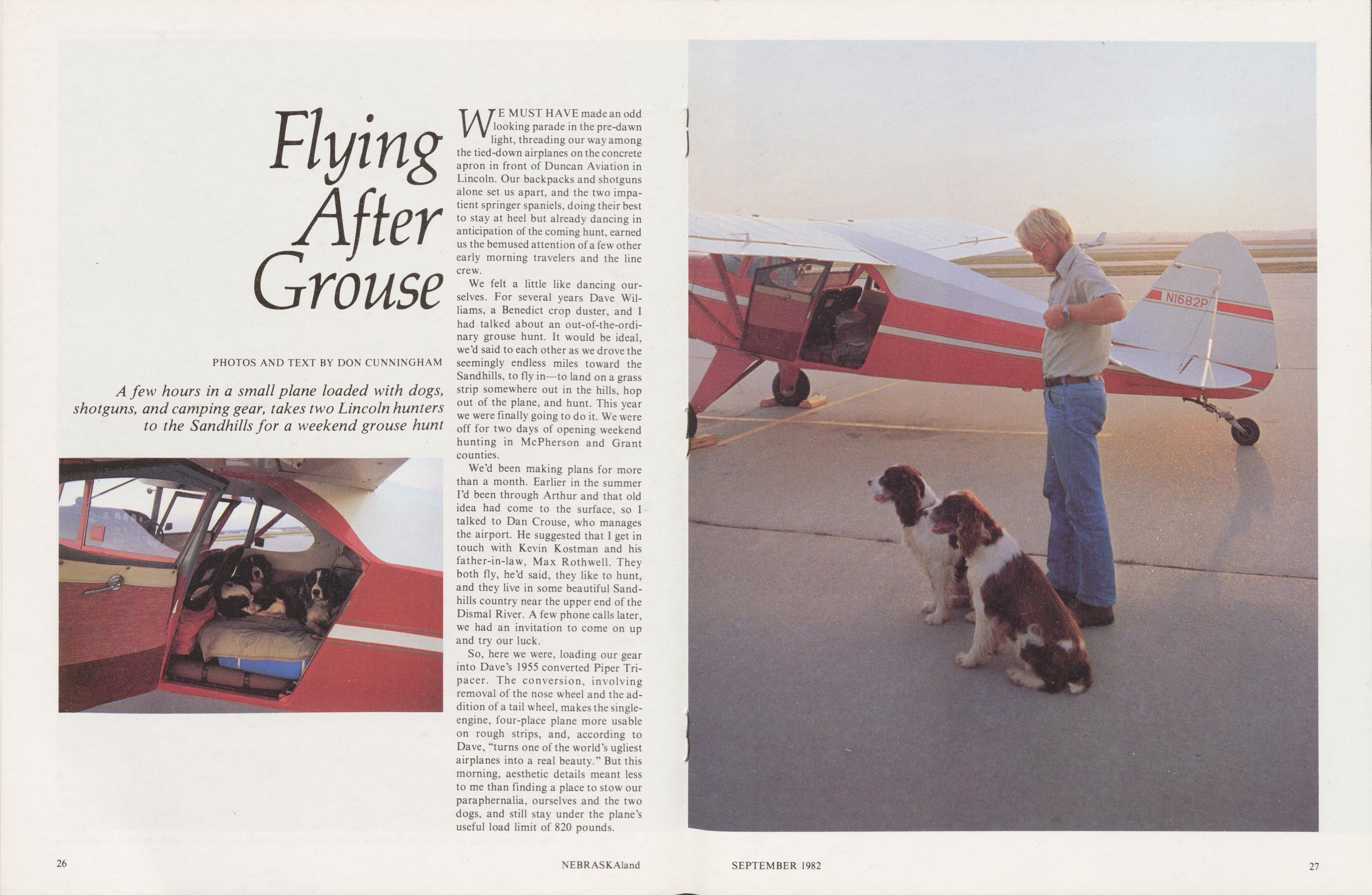
Flying After Grouse
PHOTOS AND TEXT BY DON CUNNINGHAM A few hours in a small plane loaded with dogs, shotguns, and camping gear, takes two Lincoln hunters to the Sandhills for a weekend grouse huntWE MUST HAVE made an odd looking parade in the pre-dawn light, threading our way among the tied-down airplanes on the concrete apron in front of Duncan Aviation in Lincoln. Our backpacks and shotguns alone set us apart, and the two impatient springer spaniels, doing their best to stay at heel but already dancing in anticipation of the coming hunt, earned us the bemused attention of a few other early morning travelers and the line crew.
We felt a little like dancing ourselves. For several years Dave Williams, a Benedict crop duster, and I had talked about an out-of-the-ordinary grouse hunt. It would be ideal, we'd said to each other as we drove the seemingly endless miles toward the Sandhills, to fly in—to land on a grass strip somewhere out in the hills, hop out of the plane, and hunt. This year we were finally going to do it. We were off for two days of opening weekend hunting in McPherson and Grant counties.
We'd been making plans for more than a month. Earlier in the summer I'd been through Arthur and that old idea had come to the surface, so I talked to Dan Crouse, who manages the airport. He suggested that I get in touch with Kevin Kostman and his father-in-law, Max Rothwell. They both fly, he'd said, they like to hunt, and they live in some beautiful Sandhills country near the upper end of the Dismal River. A few phone calls later, we had an invitation to come on up and try our luck.
So, here we were, loading our gear into Dave's 1955 converted Piper Tri-pacer. The conversion, involving removal of the nose wheel and the addition of a tail wheel, makes the single-engine, four-place plane more usable on rough strips, and, according to Dave, "turns one of the world's ugliest airplanes into a real beauty." But this morning, aesthetic details meant less to me than finding a place to stow our paraphernalia, ourselves and the two dogs, and still stay under the plane's useful load limit of 820 pounds.
26 NEBRASKAland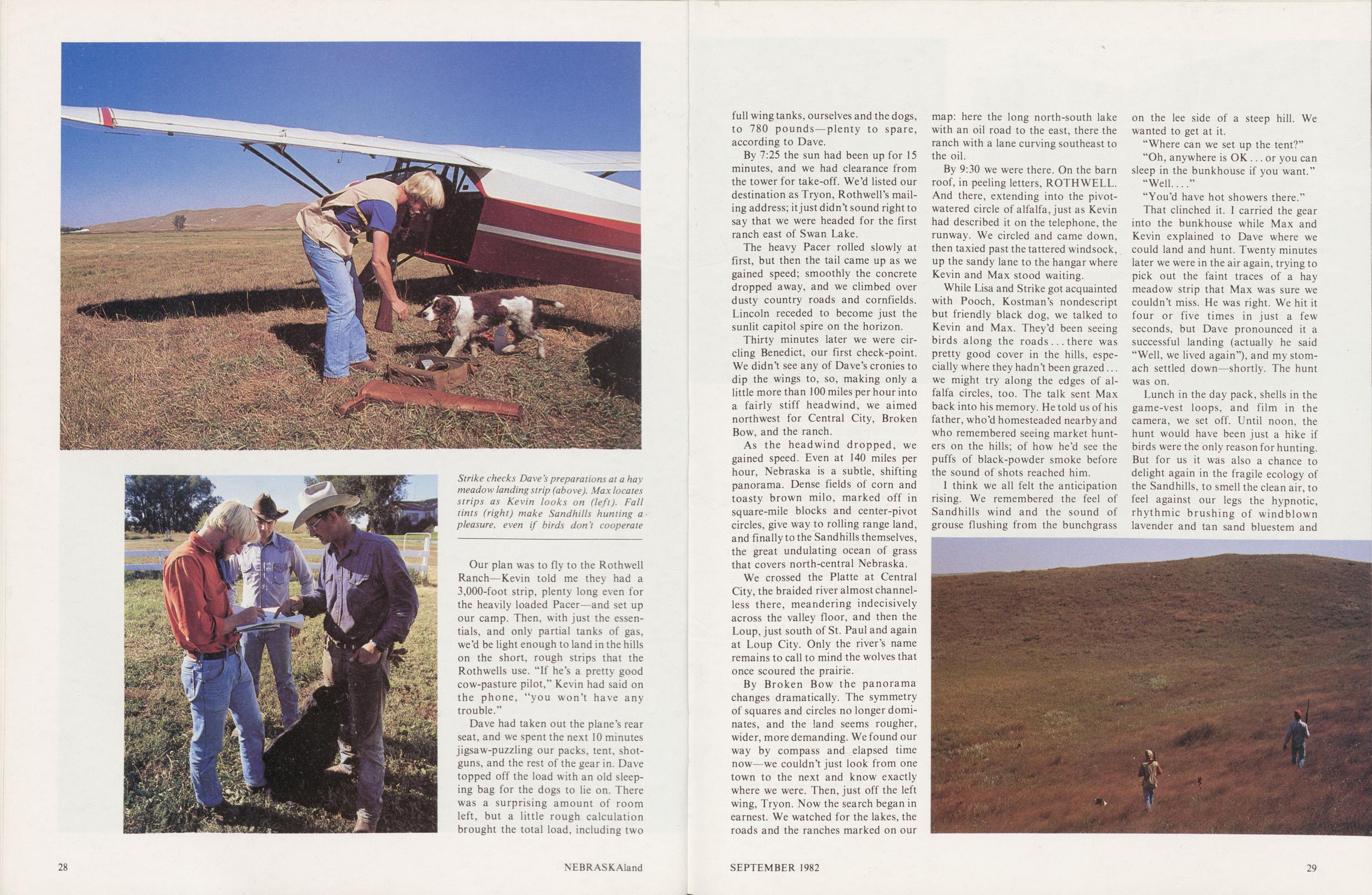
Our plan was to fly to the Rothwell Ranch—Kevin told me they had a 3,000-foot strip, plenty long even for the heavily loaded Pacer—and set up our camp. Then, with just the essentials, and only partial tanks of gas, we'd be light enough to land in the hills on the short, rough strips that the Rothwells use. "If he's a pretty good cow-pasture pilot," Kevin had said on the phone, "you won't have any trouble."
Dave had taken out the plane's rear seat, and we spent the next 10 minutes jigsaw-puzzling our packs, tent, shotguns, and the rest of the gear in. Dave topped off the load with an old sleeping bag for the dogs to lie on. There was a surprising amount of room left, but a little rough calculation brought the total load, including two 28 NEBRASKAland full wing tanks, ourselves and the dogs, to 780 pounds—plenty to spare, according to Dave.
By 7:25 the sun had been up for 15 minutes, and we had clearance from the tower for take-off. We'd listed our destination as Tryon, Rothwell's mailing address; it just didn't sound right to say that we were headed for the first ranch east of Swan Lake.
The heavy Pacer rolled slowly at first, but then the tail came up as we gained speed; smoothly the concrete dropped away, and we climbed over dusty country roads and cornfields. Lincoln receded to become just the sunlit capitol spire on the horizon.
Thirty minutes later we were circling Benedict, our first check-point. We didn't see any of Dave's cronies to dip the wings to, so, making only a little more than 100 miles per hour into a fairly stiff headwind, we aimed northwest for Central City, Broken Bow, and the ranch.
As the headwind dropped, we gained speed. Even at 140 miles per hour, Nebraska is a subtle, shifting panorama. Dense fields of corn and toasty brown milo, marked off in square-mile blocks and center-pivot circles, give way to rolling range land, and finally to the Sandhills themselves, the great undulating ocean of grass that covers north-central Nebraska.
We crossed the Platte at Central City, the braided river almost channelless there, meandering indecisively across the valley floor, and then the Loup, just south of St. Paul and again at Loup City. Only the river's name remains to call to mind the wolves that once scoured the prairie.
By Broken Bow the panorama changes dramatically. The symmetry of squares and circles no longer dominates, and the land seems rougher, wider, more demanding. We found our way by compass and elapsed time now—we couldn't just look from one town to the next and know exactly where we were. Then, just off the left wing, Tryon. Now the search began in earnest. We watched for the lakes, the roads and the ranches marked on our map: here the long north-south lake with an oil road to the east, there the ranch with a lane curving southeast to the oil.
By 9:30 we were there. On the barn roof, in peeling letters, ROTHWELL. And there, extending into the pivot-watered circle of alfalfa, just as Kevin had described it on the telephone, the runway. We circled and came down, then taxied past the tattered windsock, up the sandy lane to the hangar where Kevin and Max stood waiting.
While Lisa and Strike got acquainted with Pooch, Kostman's nondescript but friendly black dog, we talked to Kevin and Max. They'd been seeing birds along the roads ... there was pretty good cover in the hills, especially where they hadn't been grazed... we might try along the edges of alfalfa circles, too. The talk sent Max back into his memory. He told us of his father, who'd homesteaded nearby and who remembered seeing market hunters on the hills; of how he'd see the puffs of black-powder smoke before the sound of shots reached him.
I think we all felt the anticipation rising. We remembered the feel of Sandhills wind and the sound of grouse flushing from the bunchgrass on the lee side of a steep hill. We wanted to get at it.
Where can we set up the tent?"
Oh, anywhere is OK ... or you can sleep in the bunkhouse if you want."
Well...."
"You'd have hot showers there."
That clinched it. I carried the gear into the bunkhouse while Max and Kevin explained to Dave where we could land and hunt. Twenty minutes later we were in the air again, trying to pick out the faint traces of a hay meadow strip that Max was sure we couldn't miss. He was right. We hit it four or five times in just a few seconds, but Dave pronounced it a successful landing (actually he said "Well, we lived again"), and my stomach settled down—shortly. The hunt was on.
Lunch in the day pack, shells in the
game-vest loops, and film in the
camera, we set off. Until noon, the
hunt would have been just a hike if
birds were the only reason for hunting.
But for us it was also a chance to
delight again in the fragile ecology of
the Sandhills, to smell the clean air, to
feel against our legs the hypnotic,
rhythmic brushing of windblown
lavender and tan sand bluestem and
SEPTEMBER 1982
29
 lovegrass, and beneath our feet the
springy resilience of short, tough buffalo grass. It was a time for the dogs to
run before they got to the serious business of hunting, to snuffle through the
small white heath asters, to learn about
cactus spines again, to flush a long-eared, loping jack rabbit, and to swim
in a mossy windmill tank.
lovegrass, and beneath our feet the
springy resilience of short, tough buffalo grass. It was a time for the dogs to
run before they got to the serious business of hunting, to snuffle through the
small white heath asters, to learn about
cactus spines again, to flush a long-eared, loping jack rabbit, and to swim
in a mossy windmill tank.
Lunch was smoked oysters, cheese and crackers on a hilltop, and a half-hour of shirts off in the sun, interrupted by the drone of Max's white Supercub, checking windmills. We watched him circle the Pacer, now just a red and white speck two miles west of us, perhaps to assure himself that we'd gotten down alright, then disappear over the ragged horizon. But the dogs were restless, and the grouse were waiting.
After lunch the dogs got serious, working close, zigzagging through the ungrazed heavy grass, stubby tails in constant motion. Lisa stopped short momentarily, then plunged furiously ahead, tail at double time—a sure sign she'd picked up a scent. Two grouse flushed near the brow of the hill, and in defiance of their usual habits, flew uphill, into the wind, and over the crest long before we were able to get off a shot.
But grouse often flush raggedly, some holding tight while others fly, and the adrenalin continued pumping. A few seconds later, more grouse broke cover, and Dave made our first kill. It's hard to tell whether Dave or Lisa was more pleased as she pranced back with the gray ball of feathers in her mouth.
Another mile or so of walking produced another flock of birds, and again we scored. As we'd learned on previous hunts, the grouse seem to prefer the lee sides of hills, just a few yards below the crest. Generally when they flush, they quickly turn with the wind, which helps them to gain speed rapidly, but by hunting them upwind, we could exploit that habit. Their downwind turns gave us crossing or quartering shots, and kept the birds within shooting range a few seconds longer.
Kevin had gotten us permission to hunt on an adjoining ranch, as well, so a half-hour later, when we reached the oil road—some 50 miles of one-lane asphalt snaking across the hills between highways 92 and 2—we crossed and started up another line of hills. Another hour's walk, and time out for a drink at another windmill, brought us to the base of still another range.
Once again, near the crest, the dogs began to tell us there were birds nearby, and suddenly grouse were all around us, catapulting left and right, in front and behind. Momentarily it was like it must have been in the days of the settlers, who told stories of grouse and prairie chicken in flocks like clouds rising from the Sandhills grass; when Chicago buyers paid four dollars a dozen for them.
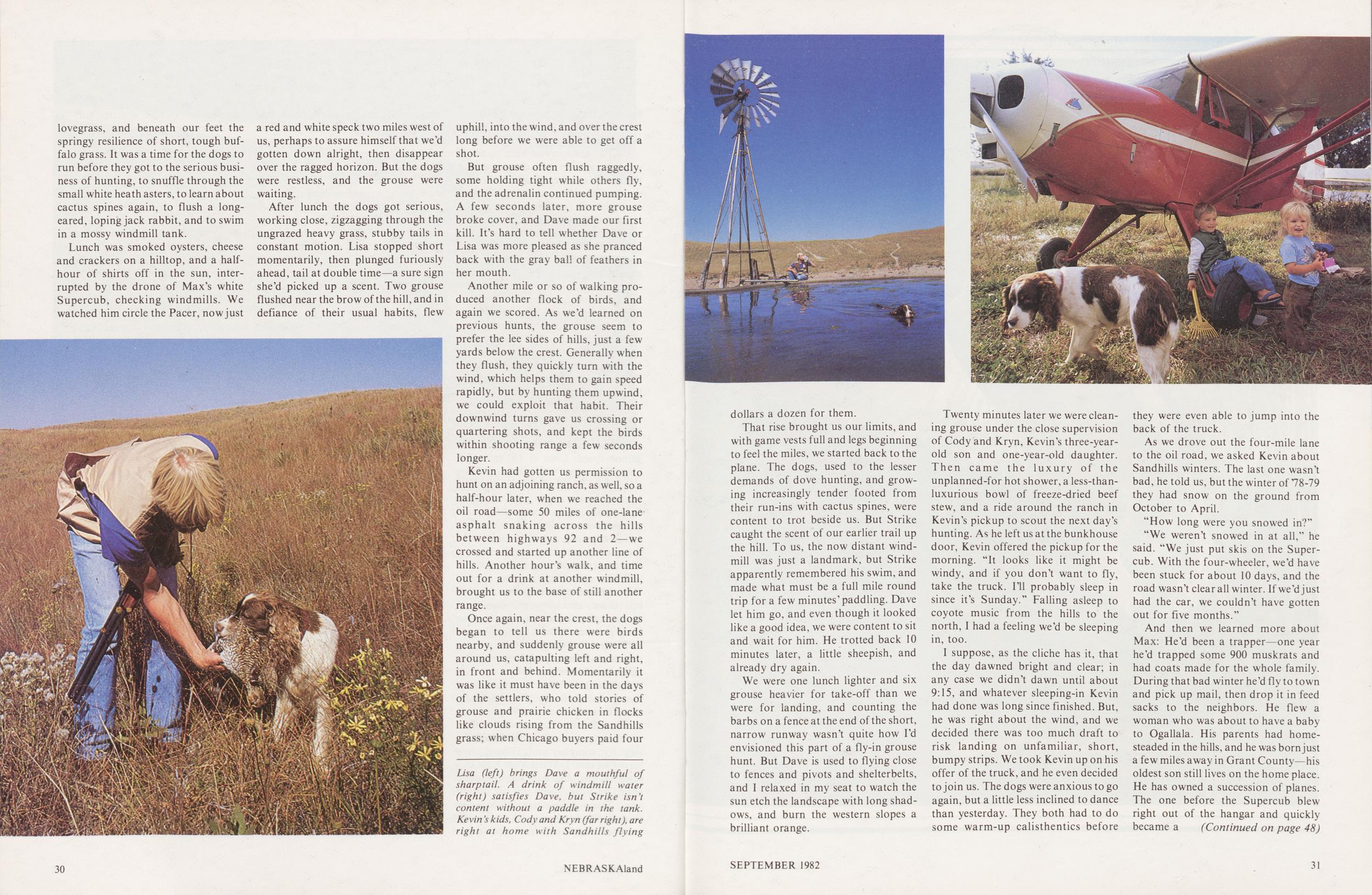
Lisa (left) brings Dave a mouthful of sharp tail. A drink of windmill water (right) satisfies Dave, but Strike isn't content without a paddle in the tank. Kevin's kids, Cody and Kryn (far right), are right at home with Sandhills flying 30 NEBRASKAlandThat rise brought us our limits, and with game vests full and legs beginning to feel the miles, we started back to the plane. The dogs, used to the lesser demands of dove hunting, and growing increasingly tender footed from their run-ins with cactus spines, were content to trot beside us. But Strike caught the scent of our earlier trail up the hill. To us, the now distant windmill was just a landmark, but Strike apparently remembered his swim, and made what must be a full mile round trip for a few minutes'paddling. Dave let him go, and even though it looked like a good idea, we were content to sit and wait for him. He trotted back 10 minutes later, a little sheepish, and already dry again.
We were one lunch lighter and six grouse heavier for take-off than we were for landing, and counting the barbs on a fence at the end of the short, narrow runway wasn't quite how I'd envisioned this part of a fly-in grouse hunt. But Dave is used to flying close to fences and pivots and shelterbelts, and I relaxed in my seat to watch the sun etch the landscape with long shadows, and burn the western slopes a brilliant orange.
Twenty minutes later we were cleaning grouse under the close supervision of Cody and Kryn, Kevin's three-year-old son and one-year-old daughter. Then came the luxury of the unplanned-for hot shower, a less-than-luxurious bowl of freeze-dried beef stew, and a ride around the ranch in Kevin's pickup to scout the next day's hunting. As he left us at the bunkhouse door, Kevin offered the pickup for the morning. "It looks like it might be windy, and if you don't want to fly, take the truck. I'll probably sleep in since it's Sunday." Falling asleep to coyote music from the hills to the north, I had a feeling we'd be sleeping in, too.
I suppose, as the cliche has it, that the day dawned bright and clear; in any case we didn't dawn until about 9:15, and whatever sleeping-in Kevin had done was long since finished. But, he was right about the wind, and we decided there was too much draft to risk landing on unfamiliar, short, bumpy strips. We took Kevin up on his offer of the truck, and he even decided to join us. The dogs were anxious to go again, but a little less inclined to dance than yesterday. They both had to do some warm-up calisthentics before they were even able to jump into the back of the truck.
As we drove out the four-mile lane to the oil road, we asked Kevin about Sandhills winters. The last one wasn't bad, he told us, but the winter of 78-79 they had snow on the ground from October to April.
How long were you snowed in?"
'We weren't snowed in at all," he said. "We just put skis on the Super-cub. With the four-wheeler, we'd have been stuck for about 10 days, and the road wasn't clear all winter. If we'd just had the car, we couldn't have gotten out for five months."
And then we learned more about Max: He'd been a trapper—one year he'd trapped some 900 muskrats and had coats made for the whole family. During that bad winter he'd fly to town and pick up mail, then drop it in feed sacks to the neighbors. He flew a woman who was about to have a baby to Ogallala. His parents had homesteaded in the hills, and he was born just a few miles away in Grant County—his oldest son still lives on the home place. He has owned a succession of planes. The one before the Supercub blew right out of the hangar and quickly became a (Continued on page 48)
SEPTEMBER 1982 31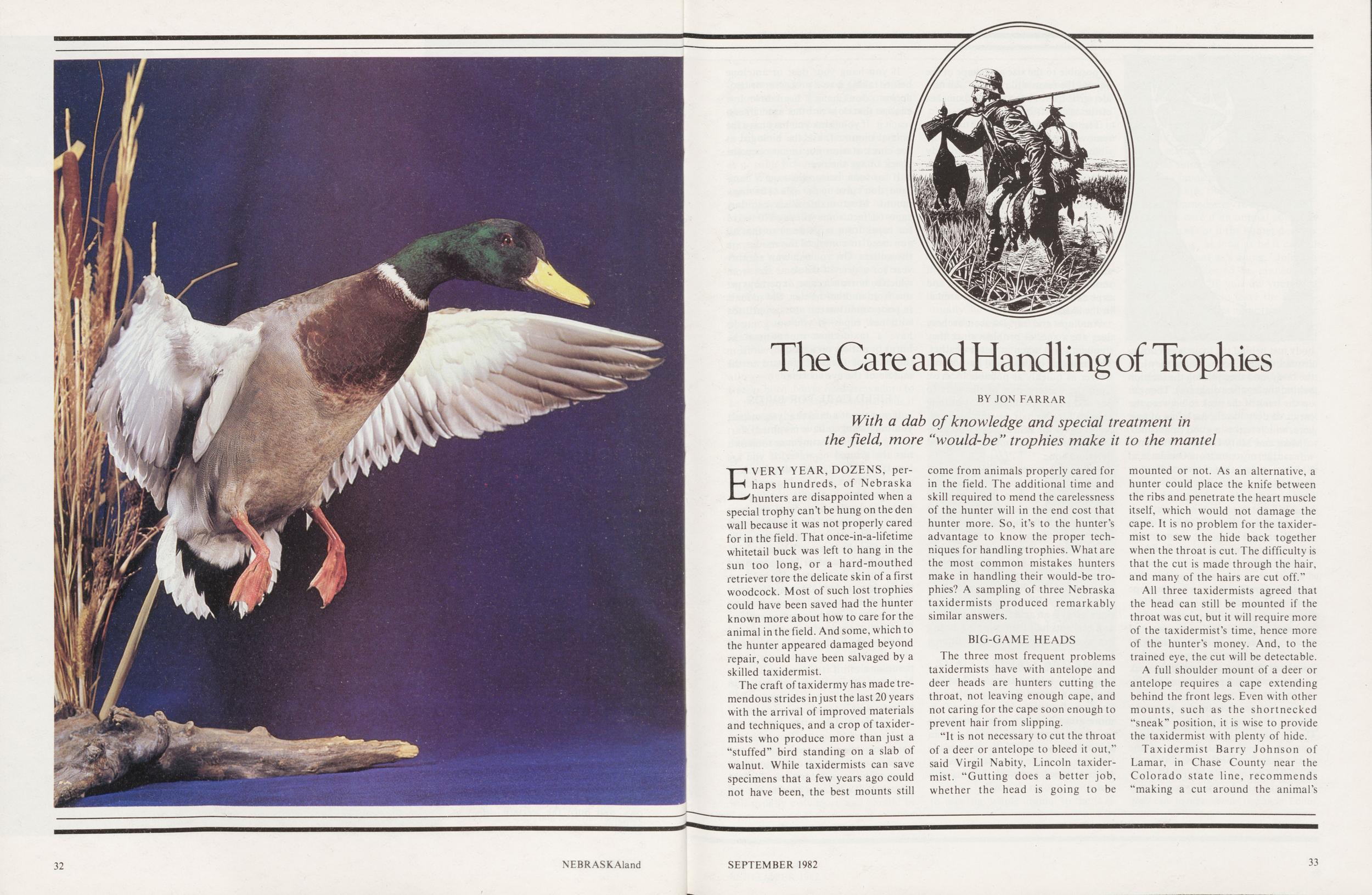
The Care and Handling of Trophies
BY JON FARRAR With a dab of knowledge and special treatment in the field, more "would-be" trophies make it to the mantelEVERY YEAR, DOZENS, perhaps hundreds, of Nebraska hunters are disappointed when a special trophy can't be hung on the den wall because it was not properly cared for in the field. That once-in-a-lifetime whitetail buck was left to hang in the sun too long, or a hard-mouthed retriever tore the delicate skin of a first woodcock. Most of such lost trophies could have been saved had the hunter known more about how to care for the animal in the field. And some, which to the hunter appeared damaged beyond repair, could have been salvaged by a skilled taxidermist.
The craft of taxidermy has made tremendous strides in just the last 20 years with the arrival of improved materials and techniques, and a crop of taxidermists who produce more than just a "stuffed" bird standing on a slab of walnut. While taxidermists can save specimens that a few years ago could not have been, the best mounts still come from animals properly cared for in the field. The additional time and skill required to mend the carelessness of the hunter will in the end cost that hunter more. So, it's to the hunter's advantage to know the proper techniques for handling trophies. What are the most common mistakes hunters make in handling their would-be trophies? A sampling of three Nebraska taxidermists produced remarkably similar answers.
BIG-GAME HEADSThe three most frequent problems taxidermists have with antelope and deer heads are hunters cutting the throat, not leaving enough cape, and not caring for the cape soon enough to prevent hair from slipping.
"It is not necessary to cut the throat of a deer or antelope to bleed it out," said Virgil Nabity, Lincoln taxidermist. "Gutting does a better job, whether the head is going to be mounted or not. As an alternative, a hunter could place the knife between the ribs and penetrate the heart muscle itself, which would not damage the cape. It is no problem for the taxidermist to sew the hide back together when the throat is cut. The difficulty is that the cut is made through the hair, and many of the hairs are cut off."
All three taxidermists agreed that the head can still be mounted if the throat was cut, but it will require more of the taxidermist's time, hence more of the hunter's money. And, to the trained eye, the cut will be detectable.
A full shoulder mount of a deer or antelope requires a cape extending behind the front legs. Even with other mounts, such as the shortnecked "sneak" position, it is wise to provide the taxidermist with plenty of hide.
Taxidermist Barry Johnson of
Lamar, in Chase County near the
Colorado state line, recommends
"making a cut around the animal's
SEPTEMBER 1982
33
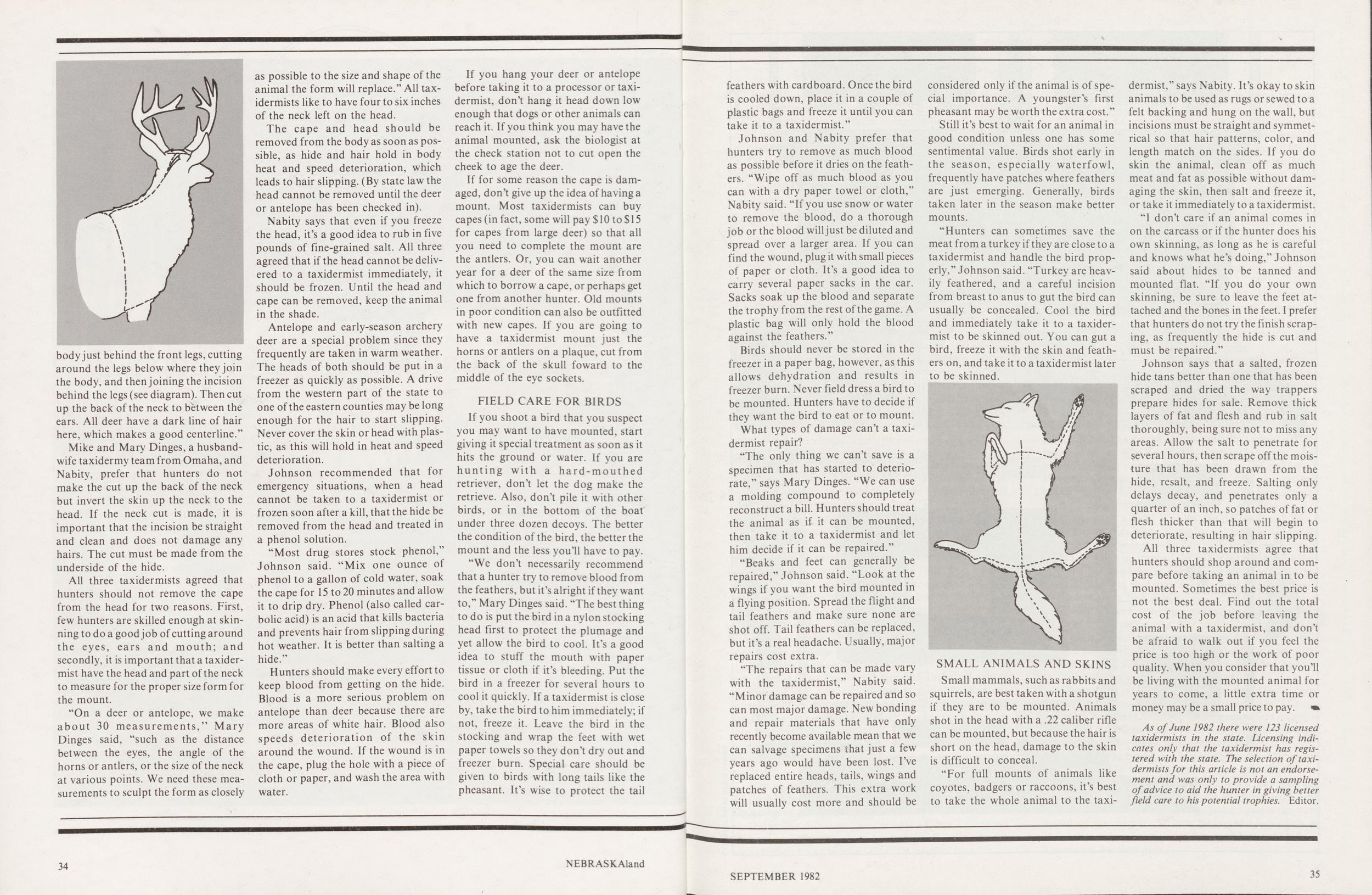
Mike and Mary Dinges, a husband-wife taxidermy team from Omaha, and Nabity, prefer that hunters do not make the cut up the back of the neck but invert the skin up the neck to the head. If the neck cut is made, it is important that the incision be straight and clean and does not damage any hairs. The cut must be made from the underside of the hide.
All three taxidermists agreed that hunters should not remove the cape from the head for two reasons. First, few hunters are skilled enough at skinning to do a good job of cutting around the eyes, ears and mouth; and secondly, it is important that a taxidermist have the head and part of the neck to measure for the proper size form for the mount.
"On a deer or antelope, we make about 30 measurements," Mary Dinges said, "such as the distance between the eyes, the angle of the horns or antlers, or the size of the neck at various points. We need these measurements to sculpt the form as closely as possible to the size and shape of the animal the form will replace." All taxidermists like to have four to six inches of the neck left on the head.
The cape and head should be removed from the body as soon as possible, as hide and hair hold in body heat and speed deterioration, which leads to hair slipping. (By state law the head cannot be removed until the deer or antelope has been checked in).
Nabity says that even if you freeze the head, it's a good idea to rub in five pounds of fine-grained salt. All three agreed that if the head cannot be delivered to a taxidermist immediately, it should be frozen. Until the head and cape can be removed, keep the animal in the shade.
Antelope and early-season archery deer are a special problem since they frequently are taken in warm weather. The heads of both should be put in a freezer as quickly as possible. A drive from the western part of the state to one ofthe eastern counties may be long enough for the hair to start slipping. Never cover the skin or head with plastic, as this will hold in heat and speed deterioration.
Johnson recommended that for emergency situations, when a head cannot be taken to a taxidermist or frozen soon after a kill, that the hide be removed from the head and treated in a phenol solution.
"Most drug stores stock phenol," Johnson said. "Mix one ounce of phenol to a gallon of cold water, soak the cape for 15 to 20 minutes and allow it to drip dry. Phenol (also called carbolic acid) is an acid that kills bacteria and prevents hair from slipping during hot weather. It is better than salting a hide."
Hunters should make every effort to keep blood from getting on the hide. Blood is a more serious problem on antelope than deer because there are more areas of white hair. Blood also speeds deterioration of the skin around the wound. If the wound is in the cape, plug the hole with a piece of cloth or paper, and wash the area with water.
If you hang your deer or antelope before taking it to a processor or taxidermist, don't hang it head down low enough that dogs or other animals can reach it. If you think you may have the animal mounted, ask the biologist at the check station not to cut open the cheek to age the deer.
If for some reason the cape is damaged, don't give up the idea of having a mount. Most taxidermists can buy capes (in fact, some will pay $10 to $15 for capes from large deer) so that all you need to complete the mount are the antlers. Or, you can wait another year for a deer of the same size from which to borrow a cape, or perhaps get one from another hunter. Old mounts in poor condition can also be outfitted with new capes. If you are going to have a taxidermist mount just the horns or antlers on a plaque, cut from the back of the skull foward to the middle of the eye sockets.
FIELD CARE FOR BIRDSIf you shoot a bird that you suspect you may want to have mounted, start giving it special treatment as soon as it hits the ground or water. If you are hunting with a hard-mouthed retriever, don't let the dog make the retrieve. Also, don't pile it with other birds, or in the bottom of the boat under three dozen decoys. The better the condition of the bird, the better the mount and the less you'll have to pay.
"We don't necessarily recommend that a hunter try to remove blood from the feathers, but it's alright if they want to," Mary Dinges said. "The best thing to do is put the bird in a nylon stocking head first to protect the plumage and yet allow the bird to cool. It's a good idea to stuff the mouth with paper tissue or cloth if it's bleeding. Put the bird in a freezer for several hours to cool it quickly. If a taxidermist is close by, take the bird to him immediately; if not, freeze it. Leave the bird in the stocking and wrap the feet with wet paper towels so they don't dry out and freezer burn. Special care should be given to birds with long tails like the pheasant. It's wise to protect the tail 34 NEBRASKAland feathers with cardboard. Once the bird is cooled down, place it in a couple of plastic bags and freeze it until you can take it to a taxidermist."
Johnson and Nabity prefer that hunters try to remove as much blood as possible before it dries on the feathers. "Wipe off as much blood as you can with a dry paper towel or cloth," Nabity said. "If you use snow or water to remove the blood, do a thorough job or the blood will just be diluted and spread over a larger area. If you can find the wound, plug it with small pieces of paper or cloth. It's a good idea to carry several paper sacks in the car. Sacks soak up the blood and separate the trophy from the rest ofthe game. A plastic bag will only hold the blood against the feathers."
Birds should never be stored in the freezer in a paper bag, however, as this allows dehydration and results in freezer burn. Never field dress a bird to be mounted. Hunters have to decide if they want the bird to eat or to mount.
What types of damage can't a taxidermist repair?
"The only thing we can't save is a specimen that has started to deteriorate," says Mary Dinges. "We can use a molding compound to completely reconstruct a bill. Hunters should treat the animal as if it can be mounted, then take it to a taxidermist and let him decide if it can be repaired."
"Beaks and feet can generally be repaired," Johnson said. "Look at the wings if you want the bird mounted in a flying position. Spread the flight and tail feathers and make sure none are shot off. Tail feathers can be replaced, but it's a real headache. Usually, major repairs cost extra.
"The repairs that can be made vary with the taxidermist," Nabity said. "Minor damage can be repaired and so can most major damage. New bonding and repair materials that have only recently become available mean that we can salvage specimens that just a few years ago would have been lost. I've replaced entire heads, tails, wings and patches of feathers. This extra work will usually cost more and should be considered only if the animal is of special importance. A youngster's first pheasant may be worth the extra cost."
Still it's best to wait for an animal in good condition unless one has some sentimental value. Birds shot early in the season, especially waterfowl, frequently have patches where feathers are just emerging. Generally, birds taken later in the season make better mounts.
"Hunters can sometimes save the meat from a turkey if they are close to a taxidermist and handle the bird properly," Johnson said. "Turkey are heavily feathered, and a careful incision from breast to anus to gut the bird can usually be concealed. Cool the bird and immediately take it to a taxidermist to be skinned out. You can gut a bird, freeze it with the skin and feathers on, and take it to a taxidermist later to be skinned.
Small mammals, such as rabbits and squirrels, are best taken with a shotgun if they are to be mounted. Animals shot in the head with a .22 caliber rifle can be mounted, but because the hair is short on the head, damage to the skin is difficult to conceal.
coyotes, badgers or raccoons, it's best to take the whole animal to the taxidermist," says Nabity. It's okay to skin animals to be used as rugs or sewed to a felt backing and hung on the wall, but incisions must be straight and symmetrical so that hair patterns, color, and length match on the sides. If you do skin the animal, clean off as much meat and fat as possible without damaging the skin, then salt and freeze it, or take it immediately to a taxidermist.
"I don't care if an animal comes in on the carcass or if the hunter does his own skinning, as long as he is careful and knows what he's doing," Johnson said about hides to be tanned and mounted flat. "If you do your own skinning, be sure to leave the feet attached and the bones in the feet. I prefer that hunters do not try the finish scraping, as frequently the hide is cut and must be repaired."
Johnson says that a salted, frozen hide tans better than one that has been scraped and dried the way trappers prepare hides for sale. Remove thick layers of fat and flesh and rub in salt thoroughly, being sure not to miss any areas. Allow the salt to penetrate for several hours, then scrape off the moisture that has been drawn from the hide, resalt, and freeze. Salting only delays decay, and penetrates only a quarter of an inch, so patches of fat or flesh thicker than that will begin to deteriorate, resulting in hair slipping.
All three taxidermists agree that hunters should shop around and compare before taking an animal in to be mounted. Sometimes the best price is not the best deal. Find out the total cost of the job before leaving the animal with a taxidermist, and don't be afraid to walk out if you feel the price is too high or the work of poor quality. When you consider that you'll be living with the mounted animal for years to come, a little extra time or money may be a small price to pay.
As of June 1982 there were 123 licensed taxidermists in the state. Licensing indicates only that the taxidermist has registered with the state. The selection of taxidermists for this article is not an endorsement and was only to provide a sampling of advice to aid the hunter in giving better field care to his potential trophies. Editor. SEPTEMBER 1982 35
Lennie's First Goose
BY MRS. E.R. OETTING 36 NEBRASKAlandLEAVES ON THE whispering cottonwood trees of Nebraska were turning to gold. It was in the 1880's, and Lennie Gaines came thumping down the stairs to his mother, Sarah Jane, who was mixing flannel cakes for breakfast.
"Mama, did you hear the honkers going over last night?"
"Yes I did, Lennie," she answered. "And this morning I was at the kitchen door when Oscar went out to milk. I saw the biggest flock I've ever seen flapping against the sky."
"Were they the large white or the small grey ones?" asked Lennie.
"White as snow Lennie, white as snow. My but one would smell good in the roasting pan, but the men folk have no time for hunting these days." She gave a sad smile in his general direction.
He almost agreed. Papa Gaines was no longer young. His pastoral duties took all of his strength and time. So, at the end of the sixth grade, Lennie became one of two farmers in the family—he and Oscar. He felt his responsibility greatly, and if Mama wanted a goose in the roaster, she should have a goose in the roaster. He made a firm resolution and promise to himself. Papa had been gone for a week on church business, but would return to preach his Sunday sermon. By that time the fall flight might be over.
Oscar entered with a pail of milk, there was breakfast to eat, chores to do and corn to pick. Thank goodness there was a good crop this fall and their little family was assured of money and food for winter with enough left over to pay for spring planting. Oscar, at 16, could even have some sparking money to take Jessie Kepler to the winter spelling bees, literary society meetings, and maybe sneak out to the dances in Elk City where Papa's church was. To him it would always be Papa's church even though another parson might in time fill the pulpit. He had watched the neighborhood parishoners and his own half brothers build the church according to his father's plans and orders. Now those brothers were the well diggers in the area, or had homes of their own in other communities. Only he, Oscar, Mama and Papa lived together on the little farm.
When the day's work was done and the evening chores completed, Lennie went to the gun rack above the pantry shelves and said, "Oscar, will you help me load this old muzzle loader? I've watched you and Papa many times but I'm not just certain how much of what to use in each step."
Oscar asked, "What do you intend to do with it when it's loaded? You've never even pulled the trigger on this big gun."
"I'm going to get up when you do in the morning. And if a flock of geese goes over the barnyard again tomorrow, I'm going to try for one."
Oscar was dubious. "You're only 13, but I guess we have to do what we feel we have to do. Get the powder horn, the shot and the wadding. I'll tell you how."
Lennie climbed to the top pantry shelf and brought down the powder horn and the shot.
"Now," said Oscar, "take the powder and pour it into your hand. That's about right. Now pour it into the barrel. Take that newspaper. Papa always says, 'About twice as big as a half a sheet.' Ram it in—tamp it hard. Now, about an ounce of shot—more paper, and don't tamp it quite as hard. Take a cap and put it over the tube on the back of the gun. Don't let the cap get damp or it'll just go 'Whoosh' and you'll have to dig it out and put in a new one.
"Good job, Lennie, for a first time. Now remember, lead the goose some if they are high. Some of these flocks are so large and fly in such close formation you don't need to pick a special one. Just shoot."
Lennie thanked Oscar and went up to bed to dream of geese with angel wings and angels flying like geese on goose wings. It seemed a short night when Oscar shook him awake. "Time to go shoot a goose, Lennie; good luck."
When Lennie went out in the yard, the dark was turning to a rosy blush, with the sun still below the horizon. Far to the north he heard a faint "honk, honk, honk." If they just came close to the yard. Their farrn was on a direct line from the Elkhorn to the mouth of the Platte where it entered the Missouri River, but sometimes geese followed the creek, a quarter-mile to the east. He began to shiver. Was it cold or excitement? Then he willed his quivering to stop. It did. Here they come, right over. He stretched out on his back in the fallen leaves and barnyard dust. As the big birds flew over, he took aim and fired.
Wow, what a kick! Was his shoulder broken? Was a goose falling? Yes it was, it was! It was falling, falling into the orchard. Lennie stumbled to his feet and ran as fast as he could. When he reached the goose, he had to pick it up with his left hand as his right shoulder, arm, wrist and hand were numb. He could feel no pain; he was too elated. He had shot his first goose.
When he took it to his mother, she felt it all over. "Lennie, it's a young one. Not much shot in it, and we shall eat it for Sunday dinner. How proud Papa will be!" He had earned the hug and kiss she gave him, and didn't see the tears she wiped away because her little boy had had to become a man at too young an age.
Oscar came into the kitchen laughing. "Mama, come look—your Lennie made quite an impression." Lennie followed, and there, outlined on the ground was his entire body, and the deepest part was under the right shoulder. Oscar said, "Let's take a look at that shoulder. I forgot to tell you that muzzieloader kicks like a mule. I'll bet you didn't even hold it tightly against your shoulder."
The shoulder really was turning black and blue, but nothing seemed to be broken. For a week he used his left arm to throw the picked ears of corn against the bang board of the wagon. No one measured his bushels on those days either, for the little family had enjoyed helping Lennie eat his first goose.
SEPTEMBER 1982 37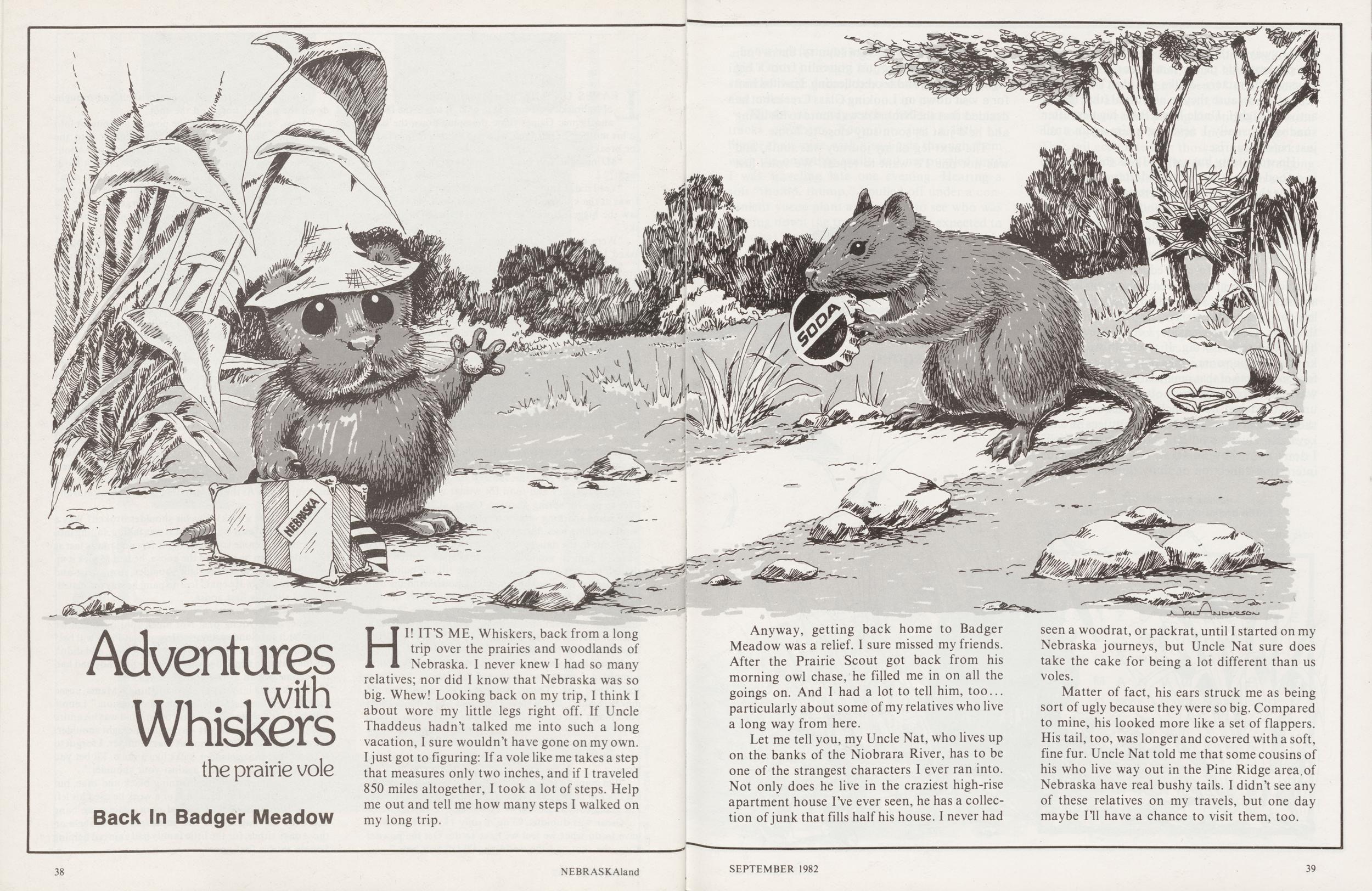
Adventures with Whiskers the prairie vole
Back In Badger MeadowHI! IT'S ME, Whiskers, back from a long trip over the prairies and woodlands of Nebraska. I never knew I had so many relatives; nor did I know that Nebraska was so big. Whew! Looking back on my trip, I think I about wore my little legs right off. If Uncle Thaddeus hadn't talked me into such a long vacation, I sure wouldn't have gone on my own. I just got to figuring: If a vole like me takes a step that measures only two inches, and if I traveled 850 miles altogether, I took a lot of steps. Help me out and tell me how many steps I walked on my long trip.
38 NEBRASKAlandAnyway, getting back home to Badger Meadow was a relief. I sure missed my friends. After the Prairie Scout got back from his morning owl chase, he filled me in on all the goings on. And I had a lot to tell him, too... particularly about some of my relatives who live a long way from here.
Let me tell you, my Uncle Nat, who lives up on the banks of the Niobrara River, has to be one of the strangest characters I ever ran into. Not only does he live in the craziest high-rise apartment house I've ever seen, he has a collection of junk that fills half his house. I never had seen a woodrat, or packrat, until I started on my Nebraska journeys, but Uncle Nat sure does take the cake for being a lot different than us voles.
Matter of fact, his ears struck me as being sort of ugly because they were so big. Compared to mine, his looked more like a set of flappers. His tail, too, was longer and covered with a soft, fine fur. Uncle Nat told me that some cousins of his who live way out in the Pine Ridge area.of Nebraska have real bushy tails. I didn't see any of these relatives on my travels, but one day maybe 111 have a chance to visit them, too.
SEPTEMBER 1982 39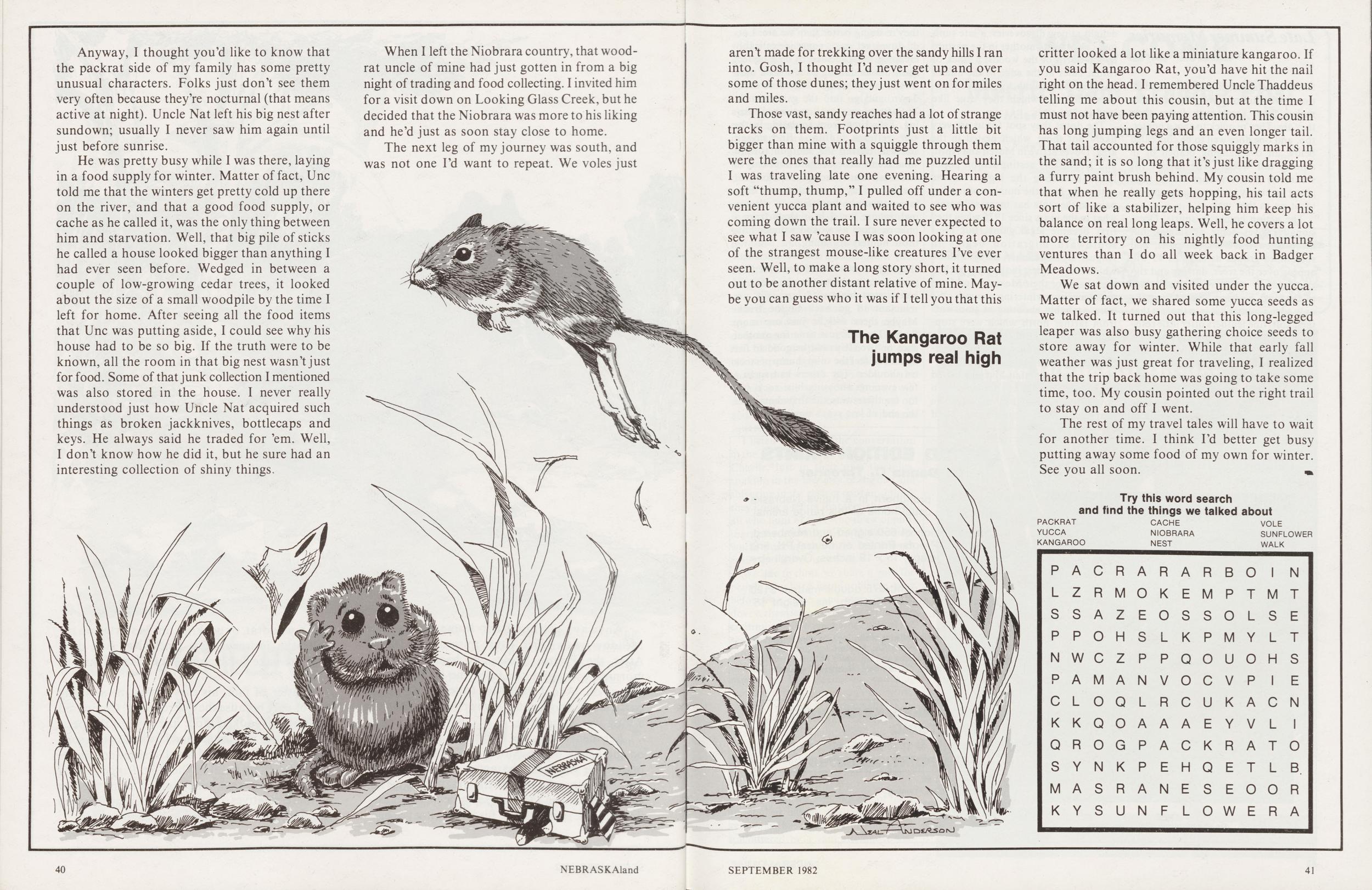
Anyway, I thought you'd like to know that the packrat side of my family has some pretty unusual characters. Folks just don't see them very often because they're nocturnal (that means active at night). Uncle Nat left his big nest after sundown; usually I never saw him again until just before sunrise.
He was pretty busy while I was there, laying in a food supply for winter. Matter of fact, Unc told me that the winters get pretty cold up there on the river, and that a good food supply, or cache as he called it, was the only thing between him and starvation. Well, that big pile of sticks he called a house looked bigger than anything I had ever seen before. Wedged in between a couple of low-growing cedar trees, it looked about the size of a small woodpile by the time I left for home. After seeing all the food items that Unc was putting aside, I could see why his house had to be so big. If the truth were to be known, all the room in that big nest wasn't just for food. Some of that junk collection I mentioned was also stored in the house. I never really understood just how Uncle Nat acquired such things as broken jackknives, bottlecaps and keys. He always said he traded for 'em. Well, I don't know how he did it, but he sure had an interesting collection of shiny things.
When I left the Niobrara country, that wood-rat uncle of mine had just gotten in from a big night of trading and food collecting. I invited him for a visit down on Looking Glass Creek, but he decided that the Niobrara was more to his liking and he'd just as soon stay close to home.
The next leg of my journey was south, and was not one I'd want to repeat. We voles just 40 NEBRASKAland aren't made for trekking over the sandy hills I ran into. Gosh, I thought I'd never get up and over some of those dunes; they just went on for miles and miles.
Those vast, sandy reaches had a lot of strange tracks on them. Footprints just a little bit bigger than mine with a squiggle through them were the ones that really had me puzzled until I was traveling late one evening. Hearing a soft "thump, thump," I pulled off under a convenient yucca plant and waited to see who was coming down the trail. I sure never expected to see what I saw 'cause I was soon looking at one of the strangest mouse-like creatures I've ever seen. Well, to make a long story short, it turned out to be another distant relative of mine. Maybe you can guess who it was if I tell you that this critter looked a lot like a miniature kangaroo. If you said Kangaroo Rat, you'd have hit the nail right on the head. I remembered Uncle Thaddeus telling me about this cousin, but at the time I must not have been paying attention. This cousin has long jumping legs and an even longer tail. That tail accounted for those squiggly marks in the sand; it is so long that it's just like dragging a furry paint brush behind. My cousin told me that when he really gets hopping, his tail acts sort of like a stabilizer, helping him keep his balance on real long leaps. Well, he covers a lot more territory on his nightly food hunting ventures than I do all week back in Badger Meadows.
We sat down and visited under the yucca. Matter of fact, we shared some yucca seeds as we talked. It turned out that this long-legged leaper was also busy gathering choice seeds to store away for winter. While that early fall weather was just great for traveling, I realized that the trip back home was going to take some time, too. My cousin pointed out the right trail to stay on and off I went.
The rest of my travel tales will have to wait for another time. I think I'd better get busy putting away some food of my own for winter. See you all soon.
The Kangaroo Rat jumps real high Try this word search and find the things we talked about PACKRAT YUCCA KANGAROO CACHE NIOBRARA NEST VOLE SUNFLOWER WALK SEPTEMBER 1982 41
Late Summer Memories
(Continued from page 18)fliers, and their ability to change direction at the flip of a wing tip probably makes them seem even faster than they are. They're quick to spot a hunter, too, and one does well to be concealed below an overhanging branch or in among tall weeds. The laziest (or smartest) hunters sometimes take along an empty bucket or a campstool to sit on as they wait.
The action comes in spurts. Occasionally doves come as singles, but more often there will be pairs, and sometimes groups as large as 15 will appear over the trees, darting and zig-zagging their way across the clearings to the next wooded area. About the only edge a hunter has is in the fact that their soft, fine feathers offer little resistance even to No. 8 or 9 shot and the light loads that most dove hunters favor. When doves come, Charlie and Paul are excited during the action, but bored with the inactivity between flights, and they wander off from time to time. We hear their exclamation of delight at new discoveries: a late summer calf with its mother in the pasture to the north of the woods, a stack of rotten bales at the edge of the alfalfa on which they climb to be dove lookouts and into which they dive like land-locked seals.
The doves they spot for us are very likely not those which nested in the area. Doves arrive in March and April, and Nebraska's nesting-season population is among the highest in the nation. In fact, the number of nesting pairs in the state has increased somewhat in the years since 1975 when they first became legal game, but their southward migration begins in August. By September, many of those which came to nest in the state packed their bags for their Mexican and Central American wintering grounds. We were probably shooting at transients from farther north which were stopping off for rest and recuperation.
The afternoon flows on, an insect-buzzing, golden glare, gradually softening toward nightfall, and punctuated by sudden flurries of activity when doves come. Filtered by the trees, we hear each other's shots and wonder if they're doing better than we are. Lots of doves get past, some inexplicably escaping what seemed to be a perfect shot, others darting past unseen until they're out of range. But some come down, and go into the game pouch. The afternoon creeps on toward evening. Eyes tired from squinting in the sun, reflexes fading, I find myself startled, raising the shotgun toward what seems to be a distant dove only to find it is a nearby mosquito looking for a chink in my chemical armor. Five jays raucously harrassing a drowsy owl, ignore me. I hear shots from a mile or more away and wonder how those hunters are doing.
By 8:30 the sun is a lop-sided ball slipping below the horizon. I see Cliff pacing restlessly beside the stack of bales, stretching stiff legs. We are reluctant to go back to the truck. Maybe there will be just one more flight. There is just time for another shot or two. It would be good to fire again and feel the solid thump of stock on shoulder. The others had spent a few evenings shooting blue rock, but for me these were the first shots since the end of last year's quail season.
PRONGHORN AT CHIMNEY ROCK by Throener LIMITED EDITION PRINTS by Donna C. Throener Shows the pronghorn in a native Nebraska setting, the usual home of this range animal. Limited edition of 550 signed and numbered; 20 Artist's Proofs. Printed on neutral PH, fine art paper. Image: 15x19 inches; Overall size 181/2 x 23. Cost: $55 per print; $75 double-matted; $120 framed and matted. Packing, Ins. freight $5. Shipped flat. Terms: Send payment with order. Include check, draft, or money order, or use VISA, MasterCard (Include card number, expiration date and signature.) MasterCard, also include four digits above name. Nebraska residents add sales tax. Send orders to: Dealer Inquiries Welcome THROENER S KENAI-WEST ART STUDIO ROUTE #1 BOX 134 WEST POINT, NE 68788 Also Available at: Gloria's Custom Framing Rockbrook Village 108 and Center Omaha, Nebraska 42 NEBRASKAlandI see Cliff pick up the game, vest shed in the heat some time before, and I grudgingly agree—it's sunset, time to stop. No one has his limit, but for each, as we walk back to the truck, there is the satisfying feel of weighted vest against the small of the back. Our pockets bulge with empty shells to be recycled through the loader. We unload our birds. The final count is 23; no record-setting day, but no one is disappointed, and no one needs to speak about the way it feels to climb into the truck just after sunset on a successful opening day. The cleaning will come later. Now we feel renewed, refreshed, and quietly happy.
And so we start back down that cornfield-bordered, York County gravel road, and as the last light fades, only higher promontories remain silhouetted against the sky. Power poles appear suddenly as dark forms against deep blue, and then recede again into the black of shelterbelts. Silos and barn cupolas appear and disappear—shadows of man's presence in the former prairie wilderness. It is no wilderness now; the land is sectioned off and center-pivots carve green circles in squares.
I listen vaguely to the conversation in the pickup box and look at Paul and Charlie, lost in their own thoughts, soaking in the memory of the day and shivering in the rush of cool air. I think they know a secret that they share with all who hunt or fish, who draw or photograph, or simply sit and watch the world work around them. It is one not easily put down in words.
We like to think we share it with the people who lived here for all the years before we came, and even with the doves themselves. The secret lies in continuity and change, the cycle of the seasons, the movement of migrating birds, and our role and our responsibility in the flow of life that is the essence of this fragile but enduring world. Perhaps those aren't the words the boys would use. Perhaps they'd use no words at all, and maybe that's better. Perhaps, though, they will carry with them, stored deep in the mysterious mechanism of the memory, an image of the evening of that first day of dove season.
Perhaps it will become one of those pure, clear images, undiluted by later retellings that leave out or add detail, uncluttered by a vain attempt to verbalize the non verbal, unadulterated by the words of others, like me, who were also there and who might change the memories of the boys by telling ours to them. Perhaps it will be a direct link to the past, rising out of some deep corner of their minds, and treasured, with the intuitive knowledge that the image is uniquely theirs, uniquely uncommunicable because it comes not from the upper levels of the mind, the intellect, cluttered with myriad distractions of what they've heard or read, but from the deepest reaches of the mind, from pure sensation processed and stored in ganglia, to flash back in some future recollection across synanpses as a clean spark of memory from the past.
WELCOME to Merritt Dam Trading Post 26 Miles Southwest of Valentine On Hwy. 16C Phone 402/376-3437 Bait* Tackle •Ammunition* Groceries* Gas* Beer* Ice Year-round Cabins with Kitchen Facilities Campground Hook-ups* Boat and Motor Rental Easy-access dock Home of the State Record Perch, Muskellunge and Smallmouth bass — Your Hosts- JON AND MARIAN DAVENPORT New Whitetetail Hunter America's Most Popular Compoound Bow! Bow With 25 lb. Weight Adjustment System. SEPTEMBER 1982 43 A New Collection of
Laughter From The Frontier Plains
Catfish
at the Pump
Humor and the Frontier
by
Roger L. Welsch
with Linda K. Welsch
Enjoy the tall tales, practical jokes,
wise-cracks, and wit the Nebraska pioneers
loved. Experience the laughter that made settlement in
the great American desert possible.
"I don't know if it was the laughers who survived or the survivors who laughed
but there is a connection there that cannot be denied." —Roger L. Welsch
«Tx>
It's the only thing I want for Christmas!" —Jake Hotovy
"A steal at $5.95!" —Bertha Welsch
"Hey, that's my joke!" —Bumps Nielsen
Catfish at the Pump, Humor and the Frontier is available for
$5.95 plus $1.00 for tax, postage and handling—delivered in
time for Christmas. Each book will be autographed at no charge
upon request. Send $6.95 to:
Plains Heritage Dept. NL 3511 Mohawk Street Lincoln, Nebraska 68510
THE
ADMIRAL'S COVE
EXIT 6 ON THE NORTH SIDE
VISIT THE
ADMIRAL'S GALLEY
RESTAURANT
YOUR FAVORITE COCKTAILS • FANCY LARGE SALAD BAR
TROPHY STRIPERS ON DISPLAY
• CLOSE TO WATER
Located on the north shore of
Lake McConaughy, 7 miles
west of dam
• SERVICES
Tackle, Bait, Gas, Oil,
Ice, Beer, Pop, etc.
• MOTEL
Lake McConaughy's largest motel
and apartment complex-includes new units
• BOAT AND MOTOR RENTAL
• GUIDE SERVICE
Ph: 308-355-2102 Lemoyne, Ne 69146
A New Collection of
Laughter From The Frontier Plains
Catfish
at the Pump
Humor and the Frontier
by
Roger L. Welsch
with Linda K. Welsch
Enjoy the tall tales, practical jokes,
wise-cracks, and wit the Nebraska pioneers
loved. Experience the laughter that made settlement in
the great American desert possible.
"I don't know if it was the laughers who survived or the survivors who laughed
but there is a connection there that cannot be denied." —Roger L. Welsch
«Tx>
It's the only thing I want for Christmas!" —Jake Hotovy
"A steal at $5.95!" —Bertha Welsch
"Hey, that's my joke!" —Bumps Nielsen
Catfish at the Pump, Humor and the Frontier is available for
$5.95 plus $1.00 for tax, postage and handling—delivered in
time for Christmas. Each book will be autographed at no charge
upon request. Send $6.95 to:
Plains Heritage Dept. NL 3511 Mohawk Street Lincoln, Nebraska 68510
THE
ADMIRAL'S COVE
EXIT 6 ON THE NORTH SIDE
VISIT THE
ADMIRAL'S GALLEY
RESTAURANT
YOUR FAVORITE COCKTAILS • FANCY LARGE SALAD BAR
TROPHY STRIPERS ON DISPLAY
• CLOSE TO WATER
Located on the north shore of
Lake McConaughy, 7 miles
west of dam
• SERVICES
Tackle, Bait, Gas, Oil,
Ice, Beer, Pop, etc.
• MOTEL
Lake McConaughy's largest motel
and apartment complex-includes new units
• BOAT AND MOTOR RENTAL
• GUIDE SERVICE
Ph: 308-355-2102 Lemoyne, Ne 69146
Programming for Wildlife
(Continued from page 17)could be expected to be where (what 10-day period were ducks banded in the Mississippi Flyway harvested in Nebraska?). And, we had to put this data together and interpret our findings.
If you can think about all those things (sexes, ages, places and time periods) as a set of buckets, each labeled, then we can start to get a feel for part of what the computer did for us. Picture a pile of 60,000 pennies alongside the buckets, and on each penny is a description of which bucket it should go into. Now imagine picking up a penny, reading the informtion on it and tossing it into the correct bucket, while also keeping count of the pennies. There are 576 buckets—10 Central Flyway and 6 western Mississippi Flyway states, 9 time zones for each state, 2 sexes and 2 age classes... that's 16x9x2x2. Now, I'll have to admit that even the computer could not do all this in a matter of seconds, but it can in a relatively few minutes. And, if asked to do the job over again, it will not complain and it will do it exactly as it did the first time.
The Low Plains proposal was further justified by using other data provided by the USFWS. Some hunters across the country are asked to send a wing to the FWS from each duck they take. Biologists can determine the species, sex and age of ducks harvested. In addition, the hunter provides kill date, time and location. More than 1.2 million individual kill records were processed to get the 100,000 records from the Central Flyway that we wanted to use. Through programs written here, several short tables and graphs were produced, allowing us to obtain at least some meaning from all those records. The task would have been monumental by hand.
44 NEBRASKAland Submission Entries should be protected by a covering but will not be accepted in frames or under glass. Wrap securely and send to: Habitat Stamp Contest, Nebraska Game and Parks Commission, P.O. Box 30370, 2200 N. 33rd St., Lincoln, NE 68503. A completed entry form and reproduction agreement or facsimile thereof must accompany the entry. Name and address of the artist must appear only on the reverse side of the entry. The Game and Parks Commission is not responsible for any entry lost or damaged in transit. Entries will not be returned unless specifically requested. Prizes Adult Division first place winner receives $200 from the Omaha Fish and Wildlife Club. Runners-up all receive a one-year subscription to NEBRASKAland Magazine. Youth Division first place winners in each section receive $50 from the Omaha Fish and Wildlife Club. Runners-up all receive a one-year subscription to NEBRASKAland Magazine. Selected entries will be included in a traveling exhibit to be displayed at various locations around the state. Divisions Adult: Amateur or professional artists. Youth: Senior Section: Grades 9-12 Junior Section: Grades 5-8 Primary Section: Grades 1-4 Technical Requirements Design must be 71/2 inches by 411/i6 inches. It may be matted, but mat may not exceed 10 inches by 7 inches. Any medium is acceptable, but no scroll work or lettering may appear on the design. Color is preferred. One entry per person. Subject Matter Any Nebraska wildlife species in an appropriate habitat setting, except bobwhite quail, ring-necked pheasant, cottontail rabbit, coyote, and wild turkeys which are ineligible this year. Entry Deadline March 1, 1983. Contest is open to Nebraska residents only, and winning entry in the Adult Division will appear on the 1984 Nebraska Habitat Stamp. Please accept my entry in the design contest for the 1984 Nebraska Habitat Stamp. 3by certify that I have complied with all of the rules governing this competition that the work submitted is my own original creation. Further, the Nebraska Game and Parks Commission is hereby authorized to reproduce the design on the 1984 Habitat Stamp or in any other fashion it may deem appropriate. Division/Section School Name Age (if under 19) Grade in School □ Please return my entry. Signature of Artist Street Address State City Zip Telephone Number
Harlan County Dam
Vacation Apartments - fully furnished
Color TV • Kitchen Facilities • Full Baths
Game cleaning room with freezer
One block from shopping center
Weekend or week of pleasant living
Security Deposit Required
Sorry —No Pets
Dean and Esther Stone
Box 145 Ph. (308) 799-3422
Republican City, NE 68971
STOCK YOUR LAKE
OR POND
with
CHANNEL CAT
LARGEMOUTH BASS
BLUEGILL
ORDER NOW
WILLOW LAKE FISH HATCHERY
Rt. 3, Box 46, Hastings, Nebr. 68901
Gaylord L. Crawford
Phone: (402) 463-8022
Day or Night
For April to October 15 stocking
Pond Mill-Aquazine for algae-free water
LET'S POOL
TOGETHER
AMERICA
GIANT
HEAVY DUTY
TRUCK TARPAULINS
12x16 $23 26x40 $89
16x20 $32 26x55 $115
20x20 $36 30x60 $145
18x24 $38 50x100 $390
18x32 $50 60x120 $547
20x30 $50 50x150 $562
Before Midnight Sept. 26
Firestone Tarp Mfg. will send any of the
above truck size tarpaulins to any reader
of this publication who reads and responds
to this test before midnight Sept. 26. Each
tarpaulin lot (#Z-18, PVC) is constructed of
high density fabric (with virgin grade ingredient, supplied by Gulf Oil Co., Dow
Chemical Co., and Union Oil Co.) with
nylon reinforced rope hems, double lock
stitched hems, electronically welded
seams, 100% water proof, #4 {W dia.) metal
grommets set on 3 ft. centers with reinforced
triangular corner patches and are recommended for all heavy duty use, and all bulk
or pallet riding materials, and will be accompanied with a LIFETIME guarantee
that it must perform 100% or it will be
replaced free. Add $7 handling & crating
for each tarp ordered. Firestone Tarp Mfg.
pays all shipping. Should you wish to return
your tarpaulins you may do so for a full
refund. Any letter postmarked later than
Sept. 26, will be returned. LIMIT: Fifty (50)
tarps per address, no exceptions. Send
appropriate sum together with your name
& address to: Tarp Test Dept. #459J, Firestone Tarp Mfg., Inc., 6314 Santa Monica
Blvd., L.A..CA., 90038, or for fastest service
from any part of the country call collect,
before midnight 7 days a week (213)
462-1914 (Ask Operator for) TARP TEST
#459J, have credit card ready.
These are, of course, extreme examples of data handling problems. But the concepts and problems in these large data sets are the same for ones much smaller. Along with the hunter success survey, the Wildlife Division operates a trapper success survey, a rural mail carrier survey, and surveys relating to our Sandhills Canada goose population, quail, grouse, and youth and nonresident hunters. We have "computerized" the data and reports associated with trophy deer and antelope citations, waterfowl gizzards analysis for lead shot, and deer harvest records. Citations of a different type, those issued by our conservation officers, have also been entered into the computer for easy recall.
MODELING THE RINGNECKThe statewide pheasant population model includes such factors as acres per nest, young bird survival rate, crippling loss, an estimate of the number of hens killed, eggs per successful nest, monthly precipitation amounts, temperatures, and acres of certain nesting cover types. The relationship between harvest estimates (we always talk about making 'estimates' when modeling) and season length, number of hunters, bag size and population size is described. Three weather indices are calculated for each year for which the model is run, one each for the nesting season, summer and winter (an 'index' in this case is just an indication of how close the weather was or is to normal). The size of four populations is modeled for each year: pre-nesting, post-nesting, pre-hunt and post-hunt. Each pre-nesting population is calculated from the previous year's post-hunt population after taking into account winter mortality.
Currently, the model is running with 34 years of historical data and for 16 years into the future, for a total of 50 years. It allows for the weather indices to be random with certain limits placed on the values. A single page of the report is dedicated to listing the results of each year included so detailed analysis can be done when necessary. The program also produces summary tables and graphs to help in quickly determining the value of a particular simulation. The model, as is the real pheasant population, is more sensitive to changes in some factors than others. Just building the model helped identify some of those factors.
Another model was designed for describing fish populations. With the appropriate information, the model will estimate population statistics for nearly any population desired. Some factors included are natural and fishing mortality, number stocked, young produced, fish growth, season lengths and legal fish length. The model will run the simulated fish population through as many as 30 years. Several age 'buckets' are available for which different mortality and reproduction rates can be specified. Average weights for different aged fish are included in the model since fish growth is affected by the total pounds of fish in a population.
These are the kinds of things that actually occur in the wild and need to be taken into account if a wildlife population model is to be realistic. This particular model was useful in Nebraska when its projections significantly aided in recent decisions relating to the management of striped bass.
The current picture for computer usage by the Wildlife and Fishery divisions is bright. Many surveys and data collected are nearly standardized, and programs developed three years ago can be run against current data with little or no modifications.
46 NEBRASKAlandTrading Post
DOGSWELL-BRED Hunting dogs for sale—Brittanies, English setters and pointers—ranging in age from puppies to young dogs. Darrell Yentes, 1118 McMillan, Holdrege, NE 68949. Phone (308) 995-8570 or (308) 995-4797.
PHEASANT AND QUAIL dogs, English pointers, English setter pups and trained dogs year round. (402) 873-6288.
GERMAN SHORTHAIRS, Setters and Pointers- Pups and started dogs. Stud service. Also 3-year-old male shorthair—trained. 9-month-old pointer female, well started. Wayne Clark (402) 263-3495 or 263-3155 Union, Nebraska.
MISCELLANEOUSGUNS—Browning, Winchester, Remington, others, Hi-powers, shotguns, new, used, antiques. Want Pre-1964 Winchesters. Buy-Sell-Trade. Ph. (402) 729-6112. Bedlan's Sporting Goods, Fairbury, NE 68352.
CATFISH. My dad spent his life fishing the waters of Nebraska and other states. He passed down a proven recipe for catfish stink bait. I'd like to share it with you. Send $1 and stamped, self-addressed envelope to BB Box 96, Lemoyne, NE 69146.
FISH FOR SALE. Channel catfish, bass, bluegill, crappie, trout, perch, white bass, minnows, hybrid grass carp, bullheads. We can ship fish, you can pick them up, or we deliver. Contact the Pleasant Valley Fish Farm, Rt. 1, McCook, Nebr. 69001. Phone (308) 345-6599.
PLASTIC DECOYS: We're originator of famous do-it-yourself system. Catalog $1.00. Decoys Unlimited, Box 69, Clinton, IA 52732.
N.E. NEBRASKA Trout Fishing. For rent Mon.-Thurs. or Fri.-Sun. 2 modern cottages completely furnished. 3 ponds with trout up to 5 lbs. 2 ponds with bass and bluegill. Diamond E. Trout Resort, Orchard, NE 68764 (402) 893-4745.
GAME BIRDS for sale. Wild turkeys, wood ducks, manderins, mallards, teal, Canada geese. Pheasants—5 breeds—Chukkars, quail. Many others not listed. Frontier Birds, Wauneta, Nebr. 69045. Phone: day (308) 394-5577/evening (308) 394-5715.
TAXIDERMYBIG BEAR TAXIDERMY, Rt. 2, Mitchell, Nebraska 69357. We specialize in all big game from Alaska to Nebraska, also birds and fish. Hair on and hair off tanning, 4'/2 miles west of Scottsbluff on Highway 26. Phone (308) 635-3013.
KARL SCHWARZ Master Taxidermist. Mounting of game heads—birds—fish—animals—fur rugs—robes-tanning buckskin. Since 1910. 424 South 13th Street, Dept. A, Omaha, Nebraska 68102.
FREEZE-DRY TAXIDERMY Wally Allison's State Record Taxidermv, 2709 Birchwood, North Platte, NE 69101. Phone: (308) 534-2324. Specializing in Fish and Small Game, Snake and Lizard and Novelties. (Nothing too small) Newest of all taxidermy methods employed.
AWARD-WINNING TAXIDERMIST. Eight time national award winners. Trust your trophies to a proven winner. Our complete taxidermy service also arranges hunts. Dinges Taxidermy Studio, 2763 South 12th Omaha, NE 68108. Ph. 402-342-3718
CREATIVE TAXIDERMY in all its branches since 1935, now includes Northstar Freeze-Dry processing of approved small specimens. Also tanning and deerskin processing. Naturecraft Studio. Nebraska City, Nebraska 68510. Joe Voges-Owner. Phone (402) 873-5491.
NABITY'S TAXIDERMY. 31 years experience. Specializing in natural grass backgrounds for mammals, birds and fish. 13901 "0"St., Lincoln, NE 68505 (4 miles east of 84th and "O". (402) 489-6351.
JOHNSON TAXIDERMY—servicing southwest Nebraska, specializing in big-game mounts, life-sized mounts, rug work, fish, birds, tanning hair-on leather. Brochure and price list on request. Johnson Taxidermy, Rt. 1, Box 78, Lamar, NE 69035. Telephone (308) 882-5555.
BADE TAXIDERMY—Quality a must—Fast service. Fish, birds, rugs, tanning, full mounts and game heads. 1924 North Lincoln, Fremont, Nebraska. 727-5463.
LIVE-CATCH ALL-PURPOSE TRAPS Write for FREE CATALOG Traps without injury squirrels, chipmunks, rabbits, mink, fox, raccoons, stray animals, pests, etc. Sizes for every need. Also traps for snakes, sparrows, pigeons, crabs, turtles, quail, etc. Save on our low factory prices. Send no money. Free catalog and trapping secrets. MUSTANG MFG. CO., Dept. N-34, Box 10880, Houston, Tex. 77018 FISHES OF NEBRASKA Get the scoop on all Nebraska fish. Send for the 100-page book, "The Fishes of Nebraska complete with full-color photos and range maps of every species. Send 50$ plus tax to the Game and Parks Commission, P.O. Box 30370 Lincoln, Ne 68503. NEBRASKAland Magazine Order Form Please send me a subscription to NEBRASKAland, which now also features 4 issues of the news edition (16 issues in all). One-year $7.50 Two-year $13 NAME ADDRESS CITY □ Three-year $19 STATE Ma/7 to: NEBRASKAland, Box 30370, Lincoln, NE 68503 ZIP BERGMAN'S RESORT On Johnson Lake Modern Lakefront Cabins • Groceries • Bait • Tackle • Full RV Hookups « Boats for Rent Swim — Fish — Golf Write or Call: RR 2, Elwood, NE 68937 (308) 785-2298 Conservation in all things plan a RANCH Get away from it all to Nebraska's scenic Pine Ridge for a vacation you'll remember a lifetime. Stay ill modern nicely-furnished log cabins. Take % quiet walk on scenic hiking trails, try some great fishing then have a campfire ibbkout. See a 16-foot waterwheel, unbelievable sunsets you'll never find in the city and more stars than you ever thought existed. For brochure write: Rt. 3, Box 30, Crawford, NE. 69339 SEPTEMBER 1982 47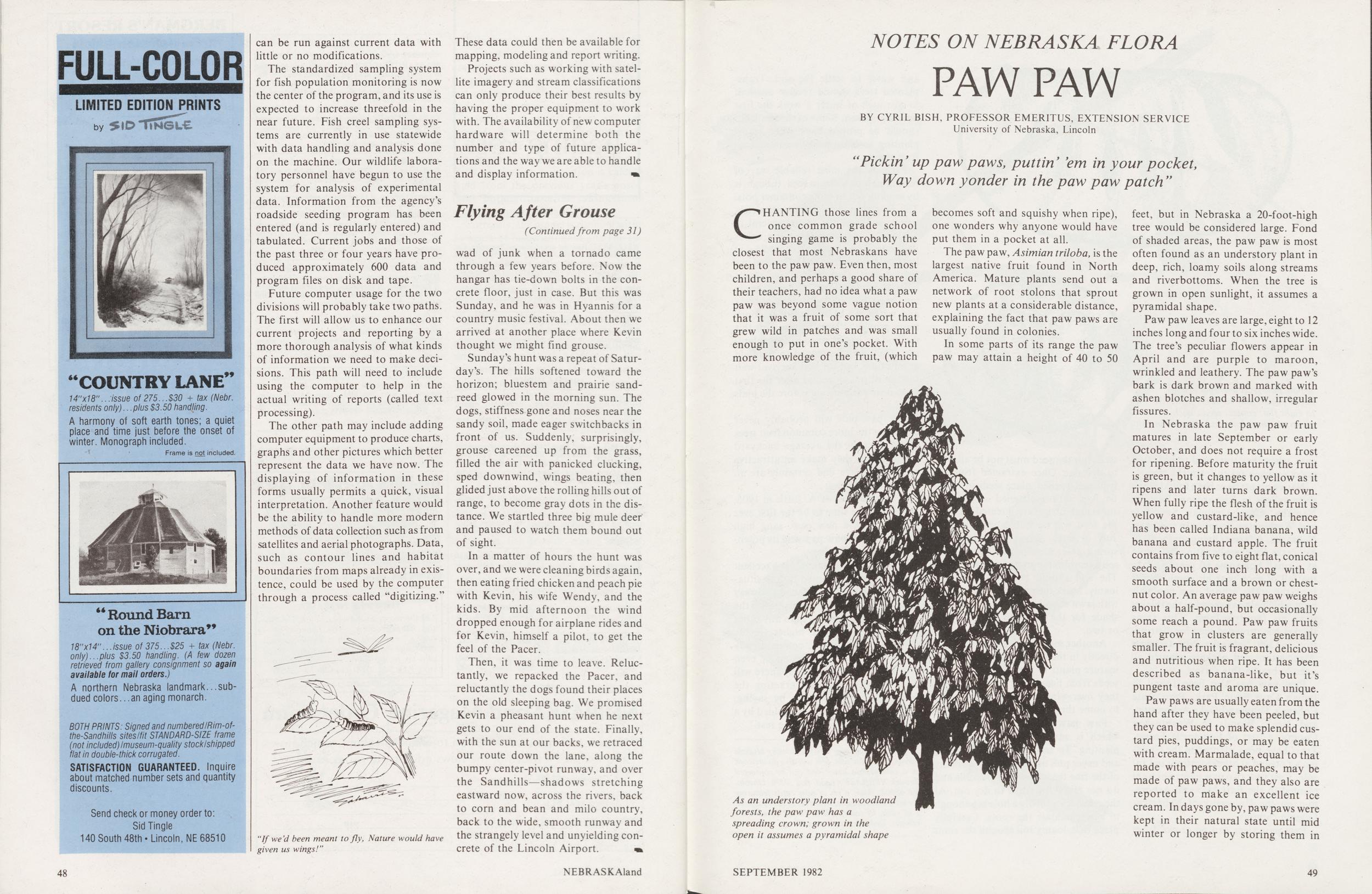 FULL-COLOR
LIMITED EDITION PRINTS
by
COUNTRY LANE
14"x18"...issue of 275...$30 + tax (Nebr.
residents only)... plus $3.50 handling.
A harmony of soft earth tones; a quiet
place and time just before the onset of
winter. Monograph included.
Frame is not included.
"Round Barn
on the Niobrara"
18"x14"...issue of 375...$25 + tax (Nebr.
only)...plus $3.50 handling. (A few dozen
retrieved from gallery consignment so again
available for mail orders.)
A northern Nebraska landmark...subdued colors.. .an aging monarch.
BOTH PRINTS: Signed and numbered/Rim-of-the-Sandhills sites/fit STANDARD-SIZE frame
(not included)/museum-quality stock I shipped
flat in double-thick corrugated.
SATISFACTION GUARANTEED. Inquire
about matched number sets and quantity
discounts.
Send check or money order to:
Sid Tingle
140 South 48th • Lincoln, NE 68510
FULL-COLOR
LIMITED EDITION PRINTS
by
COUNTRY LANE
14"x18"...issue of 275...$30 + tax (Nebr.
residents only)... plus $3.50 handling.
A harmony of soft earth tones; a quiet
place and time just before the onset of
winter. Monograph included.
Frame is not included.
"Round Barn
on the Niobrara"
18"x14"...issue of 375...$25 + tax (Nebr.
only)...plus $3.50 handling. (A few dozen
retrieved from gallery consignment so again
available for mail orders.)
A northern Nebraska landmark...subdued colors.. .an aging monarch.
BOTH PRINTS: Signed and numbered/Rim-of-the-Sandhills sites/fit STANDARD-SIZE frame
(not included)/museum-quality stock I shipped
flat in double-thick corrugated.
SATISFACTION GUARANTEED. Inquire
about matched number sets and quantity
discounts.
Send check or money order to:
Sid Tingle
140 South 48th • Lincoln, NE 68510
The standardized sampling system for fish population monitoring is now the center of the program, and its use is expected to increase threefold in the near future. Fish creel sampling systems are currently in use statewide with data handling and analysis done on the machine. Our wildlife laboratory personnel have begun to use the system for analysis of experimental data. Information from the agency's roadside seeding program has been entered (and is regularly entered) and tabulated. Current jobs and those of the past three or four years have produced approximately 600 data and program files on disk and tape.
Future computer usage for the two divisions will probably take two paths. The first will allow us to enhance our current projects and reporting by a more thorough analysis of what kinds of information we need to make decisions. This path will need to include using the computer to help in the actual writing of reports (called text processing).
The other path may include adding computer equipment to produce charts, graphs and other pictures which better represent the data we have now. The displaying of information in these forms usually permits a quick, visual interpretation. Another feature would be the ability to handle more modern methods of data collection such as from satellites and aerial photographs. Data, such as contour lines and habitat boundaries from maps already in existence, could be used by the computer through a process called "digitizing." These data could then be available for mapping, modeling and report writing.
Projects such as working with satellite imagery and stream classifications can only produce their best results by having the proper equipment to work with. The availability of new computer hardware will determine both the number and type of future applications and the way we are able to handle and display information.
Flying After Grouse
(Continued from page 31)wad of junk when a tornado came through a few years before. Now the hangar has tie-down bolts in the concrete floor, just in case. But this was Sunday, and he was in Hyannis for a country music festival. About then we arrived at another place where Kevin thought we might find grouse.
Sunday's hunt was a repeat of Saturday's. The hills softened toward the horizon; bluestem and prairie sandreed glowed in the morning sun. The dogs, stiffness gone and noses near the sandy soil, made eager switchbacks in front of us. Suddenly, surprisingly, grouse careened up from the grass, filled the air with panicked clucking, sped downwind, wings beating, then glided just above the rolling hills out of range, to become gray dots in the distance. We startled three big mule deer and paused to watch them bound out of sight.
In a matter of hours the hunt was over, and we were cleaning birds again, then eating fried chicken and peach pie with Kevin, his wife Wendy, and the kids. By mid afternoon the wind dropped enough for airplane rides and for Kevin, himself a pilot, to get the feel of the Pacer.
Then, it was time to leave. Reluctantly, we repacked the Pacer, and reluctantly the dogs found their places on the old sleeping bag. We promised Kevin a pheasant hunt when he next gets to our end of the state. Finally, with the sun at our backs, we retraced our route down the lane, along the bumpy center-pivot runway, and over the Sandhills—shadows stretching eastward now, across the rivers, back to corn and bean and milo country, back to the wide, smooth runway and the strangely level and unyielding concrete of the Lincoln Airport.
48 NEBRASKAlandNOTES ON NEBRASKA FLORA PAW PAW
BY CYRIL BISH, PROFESSOR EMERITUS, EXTENSION SERVICE University of Nebraska, Lincoln "Pickin' up paw paws, put tin' 'em in your pocket, Way down yonder in the paw paw patch"CHANTING those lines from a once common grade school singing game is probably the closest that most Nebraskans have been to the paw paw. Even then, most children, and perhaps a good share of their teachers, had no idea what a paw paw was beyond some vague notion that it was a fruit of some sort that grew wild in patches and was small enough to put in one's pocket. With more knowledge of the fruit, (which becomes soft and squishy when ripe), one wonders why anyone would have put them in a pocket at all.
The paw paw, Asimian triloba, is the largest native fruit found in North America. Mature plants send out a network of root stolons that sprout new plants at a considerable distance, explaining the fact that paw paws are usually found in colonies.
In some parts of its range the paw paw may attain a height of 40 to 50 feet, but in Nebraska a 20-foot-high tree would be considered large. Fond of shaded areas, the paw paw is most often found as an understory plant in deep, rich, loamy soils along streams and riverbottoms. When the tree is grown in open sunlight, it assumes a pyramidal shape.
Paw paw leaves are large, eight to 12 inches long and four to six inches wide. The tree's peculiar flowers appear in April and are purple to maroon, wrinkled and leathery. The paw paw's bark is dark brown and marked with ashen blotches and shallow, irregular fissures.
In Nebraska the paw paw fruit matures in late September or early October, and does not require a frost for ripening. Before maturity the fruit is green, but it changes to yellow as it ripens and later turns dark brown. When fully ripe the flesh of the fruit is yellow and custard-like, and hence has been called Indiana banana, wild banana and custard apple. The fruit contains from five to eight flat, conical seeds about one inch long with a smooth surface and a brown or chestnut color. An average paw paw weighs about a half-pound, but occasionally some reach a pound. Paw paw fruits that grow in clusters are generally smaller. The fruit is fragrant, delicious and nutritious when ripe. It has been described as banana-like, but it's pungent taste and aroma are unique.
Paw paws are usually eaten from the
hand after they have been peeled, but
they can be used to make splendid custard pies, puddings, or may be eaten
with cream. Marmalade, equal to that
made with pears or peaches, may be
made of paw paws, and they also are
reported to make an excellent ice
cream. In days gone by, paw paws were
kept in their natural state until mid
winter or longer by storing them in
SEPTEMBER 1982
49
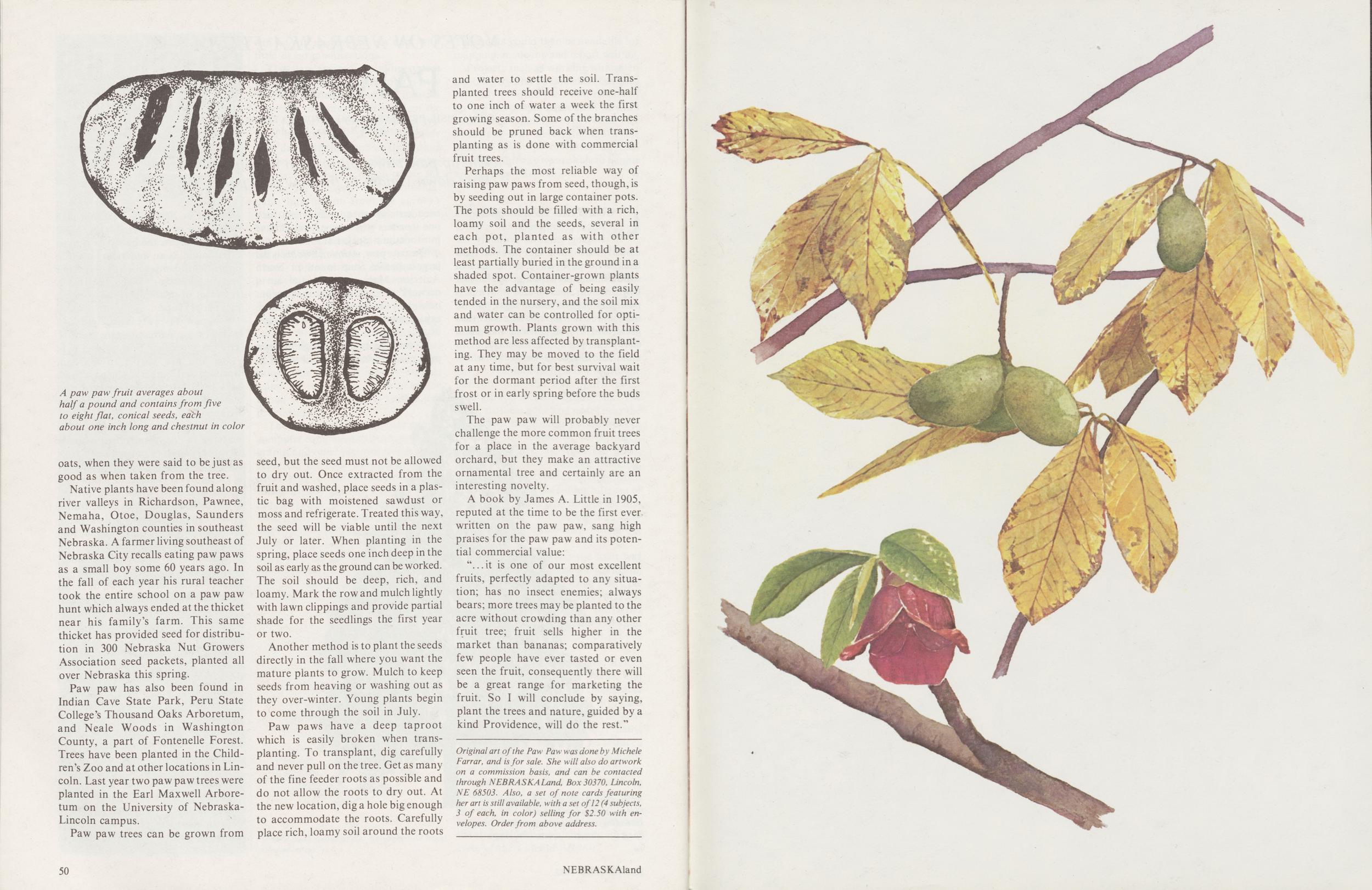
Native plants have been found along river valleys in Richardson, Pawnee, Nemaha, Otoe, Douglas, Saunders and Washington counties in southeast Nebraska. A farmer living southeast of Nebraska City recalls eating paw paws as a small boy some 60 years ago. In the fall of each year his rural teacher took the entire school on a paw paw hunt which always ended at the thicket near his family's farm. This same thicket has provided seed for distribution in 300 Nebraska Nut Growers Association seed packets, planted all over Nebraska this spring.
Paw paw has also been found in Indian Cave State Park, Peru State College's Thousand Oaks Arboretum, and Neale Woods in Washington County, a part of Fontenelle Forest. Trees have been planted in the Children's Zoo and at other locations in Lincoln. Last year two paw paw trees were planted in the Earl Maxwell Arboretum on the University of Nebraska-Lincoln campus.
Paw paw trees can be grown from seed, but the seed must not be allowed to dry out. Once extracted from the fruit and washed, place seeds in a plastic bag with moistened sawdust or moss and refrigerate. Treated this way, the seed will be viable until the next July or later. When planting in the spring, place seeds one inch deep in the soil as early as the ground can be worked. The soil should be deep, rich, and loamy. Mark the row and mulch lightly with lawn clippings and provide partial shade for the seedlings the first year or two.
Another method is to plant the seeds directly in the fall where you want the mature plants to grow. Mulch to keep seeds from heaving or washing out as they over-winter. Young plants begin to come through the soil in July.
Paw paws have a deep taproot which is easily broken when transplanting. To transplant, dig carefully and never pull on the tree. Get as many of the fine feeder roots as possible and do not allow the roots to dry out. At the new location, dig a hole big enough to accommodate the roots. Carefully place rich, loamy soil around the roots and water to settle the soil. Transplanted trees should receive one-half to one inch of water a week the first growing season. Some of the branches should be pruned back when transplanting as is done with commercial fruit trees.
Perhaps the most reliable way of raising paw paws from seed, though, is by seeding out in large container pots. The pots should be filled with a rich, loamy soil and the seeds, several in each pot, planted as with other methods. The container should be at least partially buried in the ground in a shaded spot. Container-grown plants have the advantage of being easily tended in the nursery, and the soil mix and water can be controlled for optimum growth. Plants grown with this method are less affected by transplanting. They may be moved to the field at any time, but for best survival wait for the dormant period after the first frost or in early spring before the buds swell.
The paw paw will probably never challenge the more common fruit trees for a place in the average backyard orchard, but they make an attractive ornamental tree and certainly are an interesting novelty.
A book by James A. Little in 1905, reputed at the time to be the first ever written on the paw paw, sang high praises for the paw paw and its potential commercial value:
"...it is one of our most excellent fruits, perfectly adapted to any situation; has no insect enemies; always bears; more trees may be planted to the acre without crowding than any other fruit tree; fruit sells higher in the market than bananas; comparatively few people have ever tasted or even seen the fruit, consequently there will be a great range for marketing the fruit. So I will conclude by saying, plant the trees and nature, guided by a kind Providence, will do the rest."
Original art of the Paw Paw was done by Michele Farrar, and is for sale. She will also do artwork on a commission basis, and can be contacted through NEBRASKALand, Box30370, Lincoln, NE 68503. Also, a set of note cards featuring her art is still available, with a set of 12 (4 subjects, 3 of each, in color) selling for $2.50 with envelopes. Order from above address. 50 NEBRASKAland
Position: 99 (60 views)