Volume 60, Issue 12, 1982
Nebraskaland
August 1982 $1
 The old west is still here...
Fishing is Catching On
Few activities can match fishing for fun or reward. It is challenging, if you want it to be; or relaxing; it is sociable or solitary; it is there for an hour's diversion or long vacation. Dozens of different kinds of fish await, from scrappy northern pike to tasty bluegill. Yes, fishing is for everyone, and Nebraska is the place to anchor and angle!
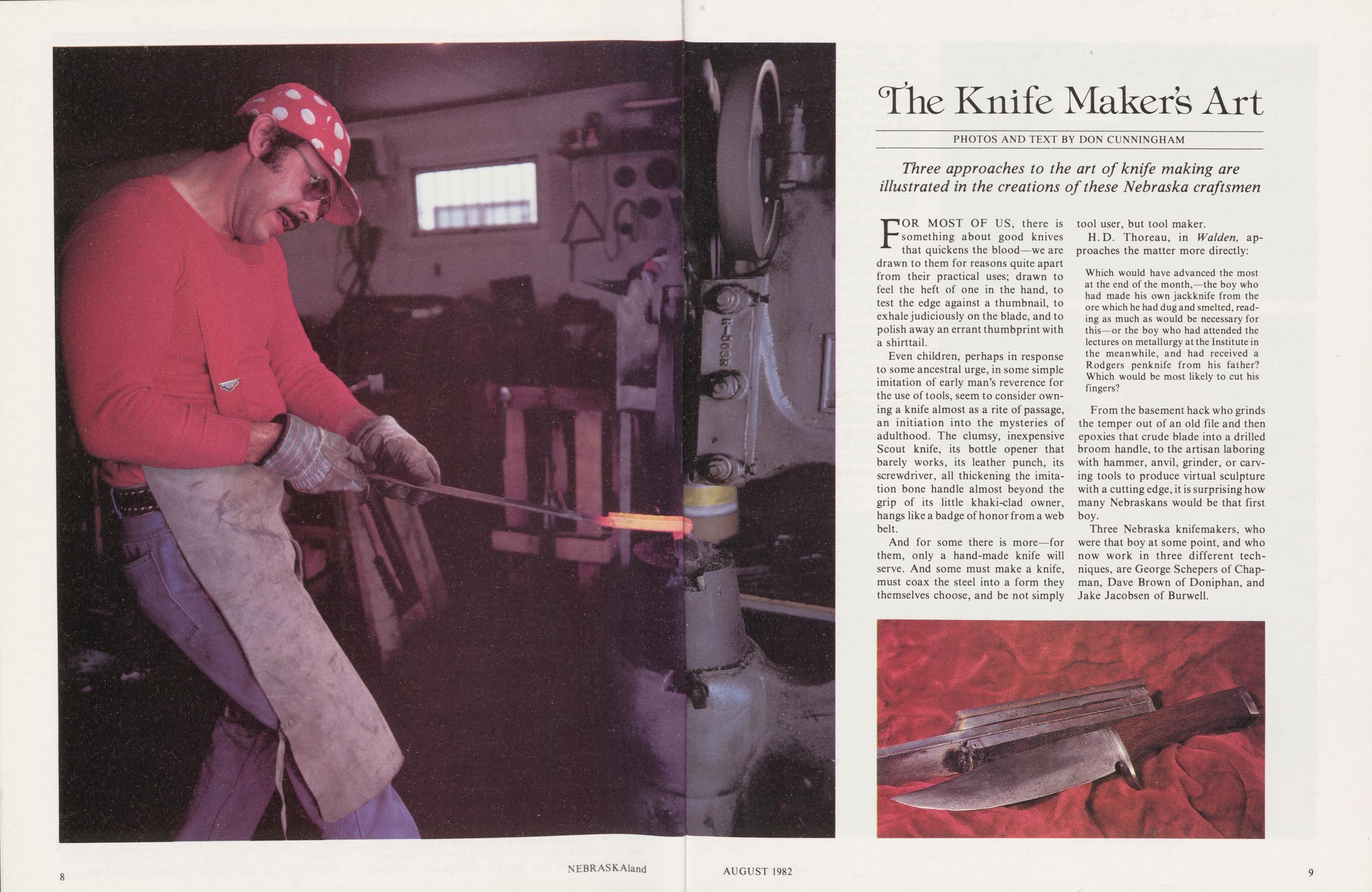
The Knife Makers Art
Three approaches to the art of knife making are illustrated in the creations of these Nebraska craftsmen
FOR MOST OF US, there is something about good knives that quickens the blood—we are drawn to them for reasons quite apart from their practical uses; drawn to feel the heft of one in the hand, to test the edge against a thumbnail, to exhale judiciously on the blade, and to polish away an errant thumbprint with a shirttail.
Even children, perhaps in response to some ancestral urge, in some simple imitation of early man's reverence for the use of tools, seem to consider owning a knife almost as a rite of passage, an initiation into the mysteries of adulthood. The clumsy, inexpensive Scout knife, its bottle opener that barely works, its leather punch, its screwdriver, all thickening the imitation bone handle almost beyond the grip of its little khaki-clad owner, hangs like a badge of honor from a web belt.
And for some there is more—for them, only a hand-made knife will serve. And some must make a knife, must coax the steel into a form they themselves choose, and be not simply tool user, but tool maker.
H.D. Thoreau, in Walden, approaches the matter more directly: Which would have advanced the most at the end of the month,—the boy who had made his own jackknife from the ore which he had dug and smelted, reading as much as would be necessary for this—or the boy who had attended the lectures on metallurgy at the Institute in the meanwhile, and had received a Rodgers penknife from his father? Which would be most likely to cut his fingers?
From the basement hack who grinds the temper out of an old file and then epoxies that crude blade into a drilled broom handle, to the artisan laboring with hammer, anvil, grinder, or carving tools to produce virtual sculpture with a cutting edge, it is surprising how many Nebraskans would be that first boy.
Three Nebraska knifemakers, who were that boy at some point, and who now work in three different techniques, are George Schepers of Chapman, Dave Brown of Doniphan, and Jake Jacobsen of Burwell.
When he was 18, George Schepers of Chapman broke a family tradition: his great grandfather had been a blacksmith, his grandfather had been a blacksmith, and although modern technology had made automobile repair more important than setting wagon tires, his father, too, kept the family trade alive. But, says George, "I was 18, and too damn pretty to get dirty."
Now, at "39 and holding," George guesses he was really born 100 years too late. He has become not only a blacksmith, but a knifemaker, working in one of the most demanding and intricate techniques in the blacksmith's repertoire, Damascus steel.
"Damascus," as the term is generally used, refers to a finely laminated steel which is made by forge welding alternating layers of at least two steels containing different amounts of carbon, phosphorous, nickel, and other materials. Usually, the layered steel is further manipulated and reforged to produce an elaborate pattern which is then emphasized by acid etching and polishing. The result is an intricate interweaving of minute layers, usually several hundred and often up to several thousand, which makes each piece made from Damascus, sometimes called pattern-welded steel, unique.
True Damascus was the product of complex casting and forging that did not include pattern welding, but pattern welded swords and spear points are known to have been made in Europe as early as the second century A.D. The name Damascus, however, was given to the material by European crusaders who encountered it in Syria.
Because early metal workers were forced to use relatively low-temperature smelting processes, they were unable to reduce the iron silicate (slag) content enough to produce fine-grained steel. That meant that for high-quality tools and weapons, the steel had to be welded and hammered out many times to align its siliceous
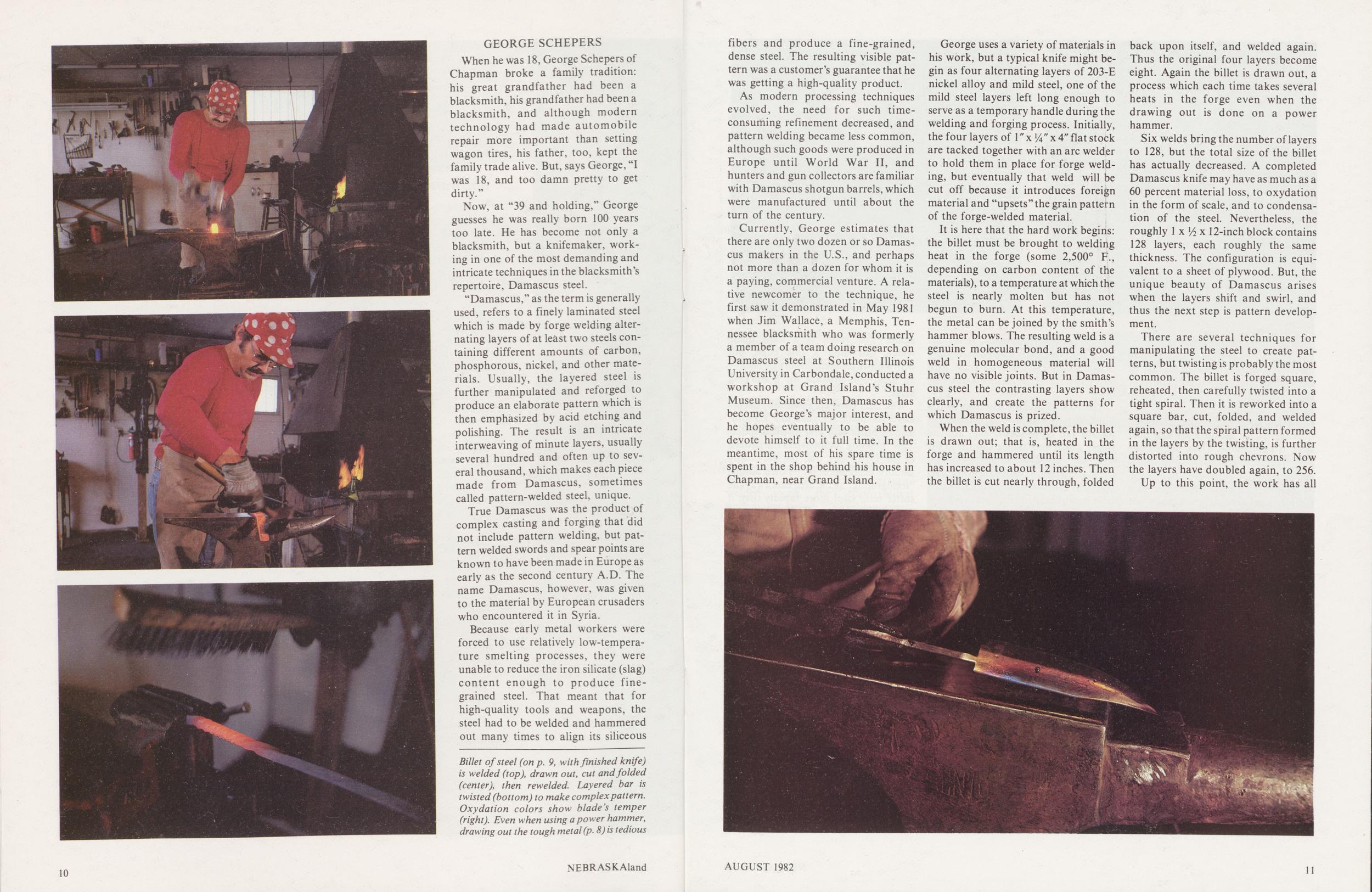
Billet of steel (on p. 9, with finished knife) is welded (top), drawn out, cut and folded (center), then rewelded. Layered bar is twisted (bottom) to make complex pattern. Oxydation colors show blade's temper (right). Even when using a power hammer, drawing out the tough m|etal (p. 8) is tedious fibers and produce a fine-grained, dense steel. The resulting visible pattern was a customer's guarantee that he was getting a high-quality product.
10 NEBRASKAlandAs modern processing techniques evolved, the need for such timeconsuming refinement decreased, and pattern welding became less common, although such goods were produced in Europe until World War II, and hunters and gun collectors are familiar with Damascus shotgun barrels, which were manufactured until about the turn of the century.
Currently, George estimates that there are only two dozen or so Damascus makers in the U.S., and perhaps not more than a dozen for whom it is a paying, commercial venture. A relative newcomer to the technique, he first saw it demonstrated in May 1981 when Jim Wallace, a Memphis, Tennessee blacksmith who was formerly a member of a team doing research on Damascus steel at Southern Illinois University in Carbondale, conducted a workshop at Grand Island's Stuhr Museum. Since then, Damascus has become George's major interest, and he hopes eventually to be able to devote himself to it full time. In the meantime, most of his spare time is spent in the shop behind his house in Chapman, near Grand Island.
George uses a variety of materials in his work, but a typical knife might begin as four alternating layers of 203-E nickel alloy and mild steel, one of the mild steel layers left long enough to serve as a temporary handle during the welding and forging process. Initially, the four layers of 1" x ¼" x 4" flat stock are tacked together with an arc welder to hold them in place for forge welding, but eventually that weld will be cut off because it introduces foreign material and "upsets" the grain pattern of the forge-welded material.
It is here that the hard work begins: the billet must be brought to welding heat in the forge (some 2,500° F., depending on carbon content of the materials), to a temperature at which the steel is nearly molten but has not begun to burn. At this temperature, the metal can be joined by the smith's hammer blows. The resulting weld is a genuine molecular bond, and a good weld in homogeneous material will have no visible joints. But in Damascus steel the contrasting layers show clearly, and create the patterns for which Damascus is prized.
When the weld is complete, the billet is drawn out; that is, heated in the forge and hammered until its length has increased to about 12 inches. Then the billet is cut nearly through, folded back upon itself, and welded again. Thus the original four layers become eight. Again the billet is drawn out, a process which each time takes several heats in the forge even when the drawing out is done on a power hammer.
Six welds bring the number of layers to 128, but the total size of the billet has actually decreased. A completed Damascus knife may have as much as a 60 percent material loss, to oxydation in the form of scale, and to condensation of the steel. Nevertheless, the roughly 1 x ½ x 12-inch block contains 128 layers, each roughly the same thickness. The configuration is equivalent to a sheet of plywood. But, the unique beauty of Damascus arises when the layers shift and swirl, and thus the next step is pattern development.
There are several techniques for manipulating the steel to create patterns, but twisting is probably the most common. The billet is forged square, reheated, then carefully twisted into a tight spiral. Then it is reworked into a square bar, cut, folded, and welded again, so that the spiral pattern formed in the layers by the twisting, is further distorted into rough chevrons. Now the layers have doubled again, to 256.
Up to this point, the work has all been devoted to creating the raw material from which the knife is made, and there is nothing knife-like about the well-worked but homely gray chunk of steel. The next steps, however, change all that.
Neither of the two materials used thus far, 203-E nickel alloy and mild steel, is hardenable. Thus, neither can be tempered adequately to produce the combination of hardness and flexibility needed in a good knife. So, for a cutting edge, George must make one more weld. The Damascus bar is again cut and the two halves welded on either side of a W-1 tool-steel insert, giving him a kind of Damascus sandwich: two slices of ornately patterned Damascus with a filling of high-carbon tool steel.
Finally, under the careful blows of his 4½-pound hammer, a recognizable knife begins to take shape; first the tang, then the blade appears, and after a few more heats, only a little rough grinding is necessary to give the knife its final shape. At this point, the forging is complete—at a cost of about 100 pounds of coal, compared to the six or eight pounds required to forge an ordinary single-steel knife. But, there is still much to be done.
The roughly shaped blade must then be annealed—that is, heated to the steel's critical temperature (the point at which its magnetism is lost), then cooled slowlv to remove the internal stresses that make it hard and brittle, and to regularize its grain structure. Annealed steel is at its softest, and its crystaline structure is at its finest, preparing the metal for further heat treatment.
The annealed blade can then be file finished, polished, the tang threaded to receive the tapped butt cap, and its finger guard and handle shaped to fit. Then the knife is disassembled for hardening. Again the blade is raised to just above its critical temperature, but this time it is quenched—cooled rapidly—usually in water, brine, oil or air, depending on the type of metal it is.
A hardened piece of steel is very brittle, and the internal stress very high. Depending on the use to which it is to be put, a tool must be tempered to relieve these internal stresses and to achieve the desired compromise between hardness and toughness. This is accomplished by heating the knife carefully, and quenching it at just the right moment. Rather than putting the nearly completed knife directly into the fire again, George draws a temper by placing it, back down, against a heated block of steel. As the polished knife is heated by the hot steel below it, the surface oxidizes and its color changes with the temperature. These colors signal the degree of hardness a piece of high carbon steel will have when quenched. When the blade reaches a light straw color, the back has already passed through straw and brown to blue, and the blade is quenched again. The result is a hard blade which will hold a fine edge, but with a more resilient, less brittle back—an ideal combination for a working knife.
The next steps are essentially decorative: the blade is etched in a 1:5 solution of nitric acid and distilled water. This "pickling" emphasizes the pattern in the Damascus, and the previously smooth blade takes on its own unique "topography" as the acid eats away the softer mild steel more rapidly than it does the harder nickel alloy.
After about five minutes of etching, the blade is removed, the acid neutralized and the blade cleaned and blued. The blueing lends a protective finish to the steel, and also emphasizes the pattern, since the final polishing and buffing lightens the blueing on the slightly raised layers of nickel, which contrast with the darker, recessed layers of mild steel.
After final assembly and finishing of the handle, the knife is complete—representing about two weeks' work. George tends to downplay his growing skill—the hardest part of being a blacksmith, he says, is learning to chew tobacco—but his excitement in the process is clearly evident. He quotes William F. Moran, Jr., the generally acknowledged master of American Damascus steel makers, who says part of your soul goes into each piece of Damascus. And Damascus does seem almost a magic metal; George even admits to sometimes pickling a piece before finishing it just because he can't wait to see the pattern.
12 NEBRASKAland DAVE BROWNIn the cramped basement of his Doniphan home, with hardly room enough to sit straight, Dave Brown hunkers over a "square wheel" grinder, delicately manipulating a nondescript slab of dull, gray metal against the red blur of a whining abrasive-coated belt. The undistinguished chunk of metal, the low-ceilinged basement with its powdery brick walls, and the jumble of tools crowding the room, belie the delicacy of the work going on here.
Upstairs, as he lays knife after gleaming knife on a scrap of buckskin, it becomes abundantly clear that however cramped the shop, Dave is a knife-maker to be reckoned with. The absolute symetry of the hollow-ground blades, the mirror-bright polish of stainless steel and brass, and the flawlessly crafted micarta handles, reach a level of perfection which challenges, even surpasses, factory knives.
Dave's technique is stock removal. Unlike the Damascus makers, who marshal their skills over anvil and forge to produce unique, virtually unrepeatable pieces graced by the fortuitous combination of pattern-welded steels, the stock-removal knifemaker strives for absolute symetry, for micrometer accuracy, and for precision of fit and finish which, to the layman, seems virtually impossible for handwork. Although he exploits modern technology—power grinders and bandsaws, exotic alloys—like the Damascus maker, the stock-removal knifemaker is essentially a craftsman, depending on a finely tuned eye and practiced hand for results.
Dave, a boilermaker by profession, is relatively new to knifemaking; he has completed some 75 pieces, "counting mistakes" (what do you do when you mess one up? "Have a model change"). But, he is serious about eventually becoming a full-time knife-maker
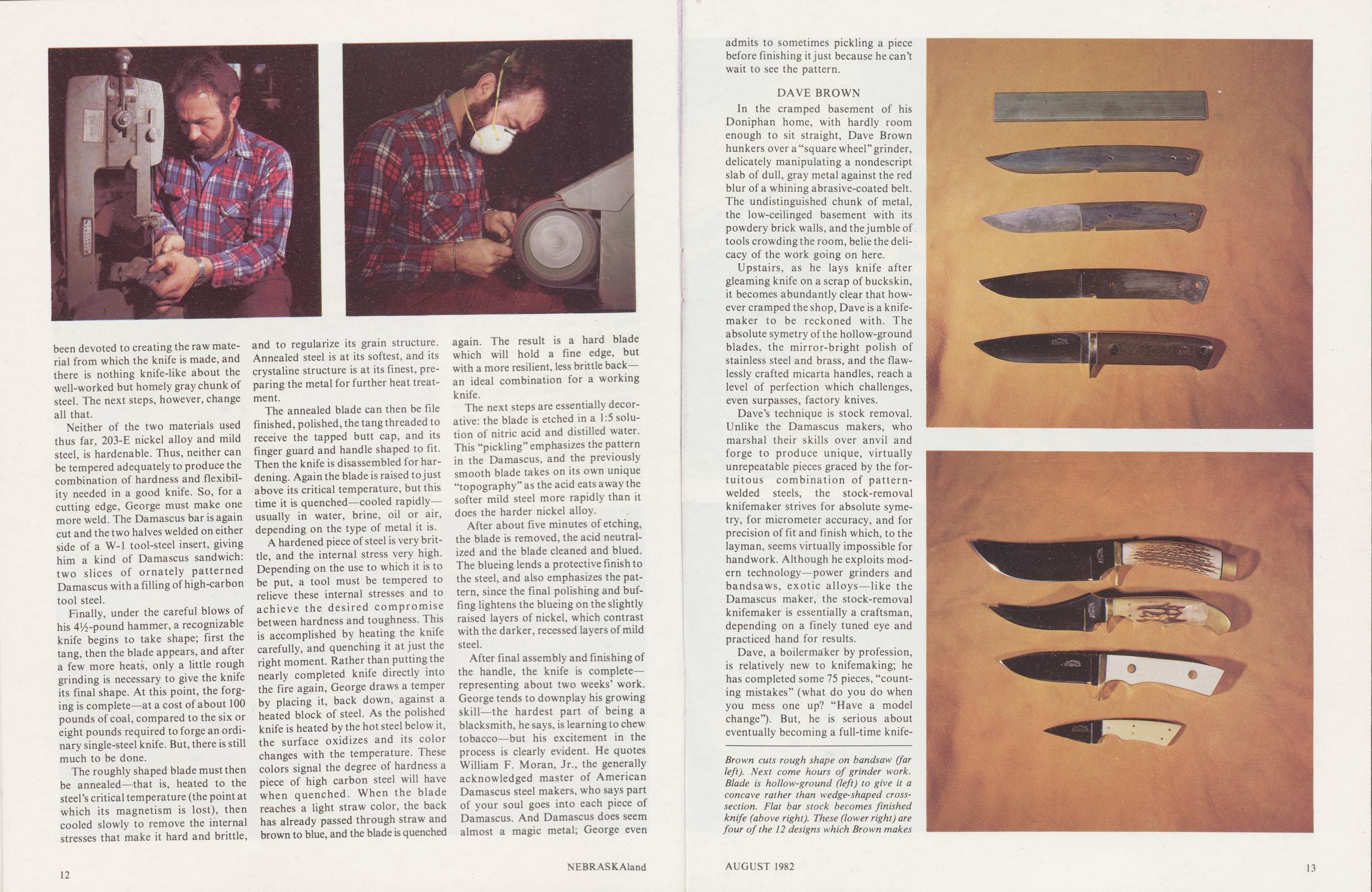
Brown cuts rough shape on handsaw (far left). Next come hours of grinder work. Blade is hollow-ground (left) to give it a concave rather than wedge-shaped cross-section. Flat bar stock becomes finished knife (above right). These (lower right) are four of the 12 designs which Brown makes if he possibly can. The elite, he says, the masters, are back-ordered as much as 10 years, some getting as much as a thousand dollars per knife. Joining that exclusive number is some way off, and perhaps his biggest problem, he allows, is "wanting to get too good too quick."
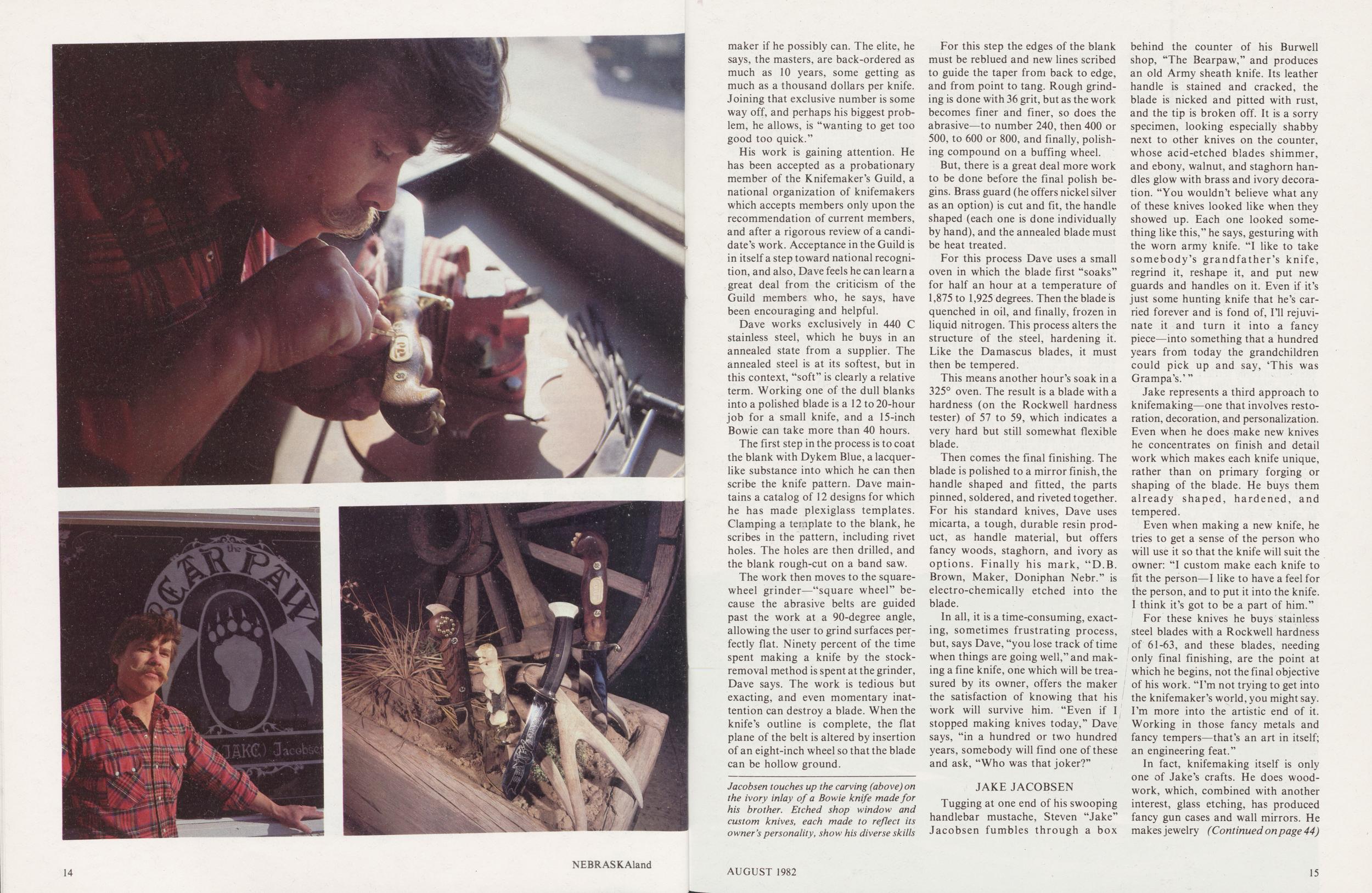
if he possibly can. The elite, he says, the masters, are back-ordered as much as 10 years, some getting as much as a thousand dollars per knife. Joining that exclusive number is some way off, and perhaps his biggest problem, he allows, is "wanting to get too good too quick."
His work is gaining attention. He has been accepted as a probationary member of the Knifemaker's Guild, a national organization of knifemakers which accepts members only upon the recommendation of current members, and after a rigorous review of a candidate's work. Acceptance in the Guild is in itself a step toward national recognition, and also, Dave feels he can learn a great deal from the criticism of the Guild members who, he says, have been encouraging and helpful.
Dave works exclusively in 440 C stainless steel, which he buys in an annealed state from a supplier. The annealed steel is at its softest, but in this context, "soft" is clearly a relative term. Working one of the dull blanks into a polished blade is a 12 to 20-hour job for a small knife, and a 15-inch Bowie can take more than 40 hours.
The first step in the process is to coat the blank with Dykem Blue, a lacquer-like substance into which he can then scribe the knife pattern. Dave maintains a catalog of 12 designs for which he has made plexiglass templates. Clamping a template to the blank, he scribes in the pattern, including rivet holes. The holes are then drilled, and the blank rough-cut on a band saw.
The work then moves to the square-wheel grinder—"square wheel" because the abrasive belts are guided past the work at a 90-degree angle, allowing the user to grind surfaces perfectly flat. Ninety percent of the time spent making a knife by the stock-removal method is spent at the grinder, Dave says. The work is tedious but exacting, and even momentary inattention can destroy a blade. When the knife's outline is complete, the flat plane of the belt is altered by insertion of an eight-inch wheel so that the blade can be hollow ground.
Jacobsen touches up the carving (above) on the ivory inlay of a Bowie knife made for his brother. Etched shop window and custom knives, each made to reflect its owner's personality, show his diverse skills
For this step the edges of the blank must be reblued and new lines scribed to guide the taper from back to edge, and from point to tang. Rough grinding is done with 36 grit, but as the work becomes finer and finer, so does the abrasive—to number 240, then 400 or 500, to 600 or 800, and finally, polishing compound on a buffing wheel.
But, there is a great deal more work to be done before the final polish begins. Brass guard (he offers nickel silver as an option) is cut and fit, the handle shaped (each one is done individually by hand), and the annealed blade must be heat treated.
For this process Dave uses a small oven in which the blade first "soaks" for half an hour at a temperature of 1,875 to 1,925 degrees. Then the blade is quenched in oil, and finally, frozen in liquid nitrogen. This process alters the structure of the steel, hardening it. Like the Damascus blades, it must then be tempered.
This means another hour's soak in a 325° oven. The result is a blade with a hardness (on the Rockwell hardness tester) of 57 to 59, which indicates a very hard but still somewhat flexible blade.
Then comes the final finishing. The blade is polished to a mirror finish, the handle shaped and fitted, the parts pinned, soldered, and riveted together. For his standard knives, Dave uses micarta, a tough, durable resin product, as handle material, but offers fancy woods, staghorn, and ivory as options. Finally his mark, "D.B. Brown, Maker, Doniphan Nebr." is electro-chemically etched into the blade.
In all, it is a time-consuming, exacting, sometimes frustrating process, but, says Dave, "you lose track of time when things are going well," and making a fine knife, one which will be treasured by its owner, offers the maker the satisfaction of knowing that his work will survive him. "Even if I stopped making knives today," Dave says, "in a hundred or two hundred years, somebody will find one of these and ask, "Who was that joker?"
JAKE JACOBSENTugging at one end of his swooping handlebar mustache, Steven "Jake" Jacobsen fumbles through a box behind the counter of his Burwell shop, "The Bearpaw," and produces an old Army sheath knife. Its leather handle is stained and cracked, the blade is nicked and pitted with rust, and the tip is broken off. It is a sorry specimen, looking especially shabby next to other knives on the counter, whose acid-etched blades shimmer, and ebony, walnut, and staghorn handles glow with brass and ivory decoration. "You wouldn't believe what any of these knives looked like when they showed up. Each one looked something like this," he says, gesturing with the worn army knife. "I like to take somebody's grandfather's knife, regrind it, reshape it, and put new guards and handles on it. Even if it's just some hunting knife that he's carried forever and is fond of, I'll rejuvinate it and turn it into a fancy piece—into something that a hundred years from today the grandchildren could pick up and say, 'This was Grampa's."'
Jake represents a third approach to knifemaking—one that involves restoration, decoration, and personalization. Even when he does make new knives he concentrates on finish and detail work which makes each knife unique, rather than on primary forging or shaping of the blade. He buys them already shaped, hardened, and tempered.
Even when making a new knife, he tries to get a sense of the person who will use it so that the knife will suit the owner: "I custom make each knife to fit the person—I like to have a feel for the person, and to put it into the knife. I think it's got to be a part of him."
For these knives he buys stainless steel blades with a Rockwell hardness of 61-63, and these blades, needing only final finishing, are the point at which he begins, not the final objective of his work. "I'm not trying to get into the knifemaker's world, you might say. I'm more into the artistic end of it. Working in those fancy metals and fancy tempers—that's an art in itself; an engineering feat."
In fact, knifemaking itself is only one of Jake's crafts. He does wood-work, which, combined with another interest, glass etching, has produced fancy gun cases and wall mirrors. He makes jewelry (Continued on page 44)
Where has the monster gone?
Once of world-wide fame, a local beastie drew tourists from afar. Then, without so much as a farewell, he sank from sight
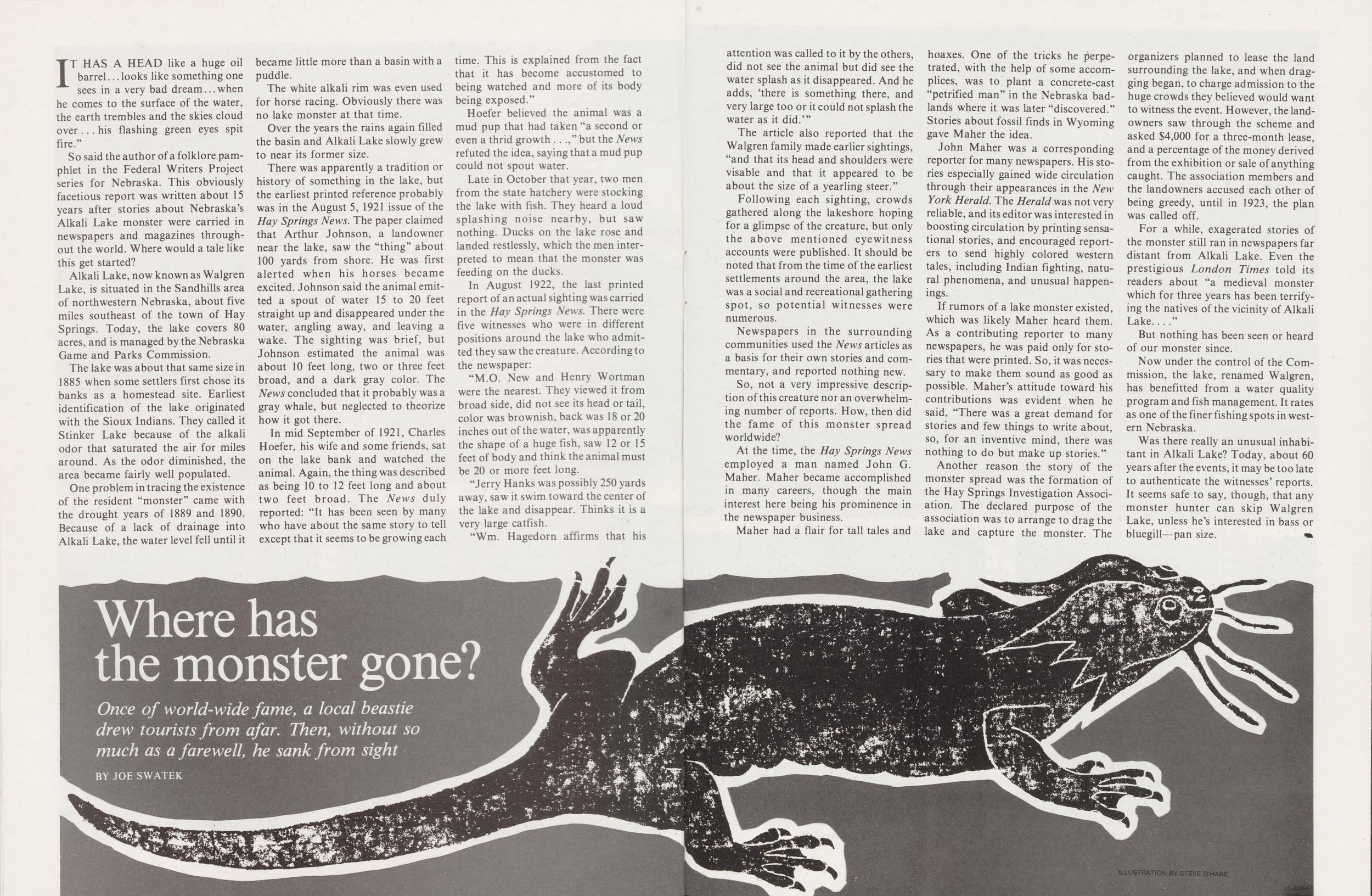
IT HAS A HEAD like a huge oil barrel... looks like something one sees in a very bad dream... when he comes to the surface of the water, the earth trembles and the skies cloud over ... his flashing green eyes spit fire."
So said the author of a folklore pamphlet in the Federal Writers Project series for Nebraska. This obviously facetious report was written about 15 years after stories about Nebraska's Alkali Lake monster were carried in newspapers and magazines throughout the world. Where would a tale like this get started?
Alkali Lake, now known as Walgren Lake, is situated in the Sandhills area of northwestern Nebraska, about five miles southeast of the town of Hay Springs. Today, the lake covers 80 acres, and is managed by the Nebraska Game and Parks Commission.
The lake was about that same size in 1885 when some settlers first chose its banks as a homestead site. Earliest identification of the lake originated with the Sioux Indians. They called it Stinker Lake because of the alkali odor that saturated the air for miles around. As the odor diminished, the area became fairly well populated.
One problem in tracing the existence of the resident "monster" came with the drought years of 1889 and 1890. Because of a lack of drainage into Alkali Lake, the water level fell until it became little more than a basin with a puddle.
The white alkali rim was even used for horse racing. Obviously there was no lake monster at that time.
Over the years the rains again filled the basin and Alkali Lake slowly grew to near its former size.
There was apparently a tradition or history of something in the lake, but the earliest printed reference probably was in the August 5, 1921 issue of the Hay Springs News. The paper claimed that Arthur Johnson, a landowner near the lake, saw the "thing" about 100 yards from shore. He was first alerted when his horses became excited. Johnson said the animal emitted a spout of water 15 to 20 feet straight up and disappeared under the water, angling away, and leaving a wake. The sighting was brief, but Johnson estimated the animal was about 10 feet long, two or three feet broad, and a dark gray color. The News concluded that it probably was a gray whale, but neglected to theorize how it got there.
In mid September of 1921, Charles Hoefer, his wife and some friends, sat on the lake bank and watched the animal. Again, the thing was described as being 10 to 12 feet long and about two feet broad. The News duly reported: "It has been seen by many who have about the same story to tell except that it seems to be growing each time. This is explained from the fact that it has become accustomed to being watched and more of its body being exposed."
Hoefer believed the animal was a mud pup that had taken "a second or even a thrid growth . ..," but the News refuted the idea, saying that a mud pup could not spout water.
Late in October that year, two men from the state hatchery were stocking the lake with fish. They heard a loud splashing noise nearby, but saw nothing. Ducks on the lake rose and landed restlessly, which the men interpreted to mean that the monster was feeding on the ducks.
In August 1922, the last printed report of an actual sighting was carried in the Hay Springs News. There were five witnesses who were in different positions around the lake who admitted they saw the creature. According to the newspaper:
"M.O. New and Henry Wortman were the nearest. They viewed it from broad side, did not see its head or tail, color was brownish, back was 18 or 20 inches out of the water, was apparently the shape of a huge fish, saw 12 or 15 feet of body and think the animal must be 20 or more feet long.
"Jerry Hanks was possibly 250 yards away, saw it swim toward the center of the lake and disappear. Thinks it is a very large catfish.
"Wm. Hagedorn affirms that his attention was called to it by the others, did not see the animal but did see the water splash as it disappeared. And he adds, 'there is something there, and very large too or it could not splash the water as it did.'"
The article also reported that the Walgren family made earlier sightings, "and that its head and shoulders were visable and that it appeared to be about the size of a yearling steer."
Following each sighting, crowds gathered along the lakeshore hoping for a glimpse of the creature, but only the above mentioned eyewitness accounts were published. It should be noted that from the time of the earliest settlements around the area, the lake was a social and recreational gathering spot, so potential witnesses were numerous.
Newspapers in the surrounding communities used the News articles as a basis for their own stories and commentary, and reported nothing new.
So, not a very impressive description of this creature nor an overwhelming number of reports. How, then did the fame of this monster spread worldwide?
At the time, the Hay Springs News employed a man named John G. Maher. Maher became accomplished in many careers, though the main interest here being his prominence in the newspaper business.
Maher had a flair for tall tales and hoaxes. One of the tricks he perpetrated, with the help of some accomplices, was to plant a concrete-cast "petrified man" in the Nebraska badlands where it was later "discovered." Stories about fossil finds in Wyoming gave Maher the idea.
John Maher was a corresponding reporter for many newspapers. His stories especially gained wide circulation through their appearances in the New York Herald. The Herald was not very reliable, and its editor was interested in boosting circulation by printing sensational stories, and encouraged reporters to send highly colored western tales, including Indian fighting, natural phenomena, and unusual happenings.
If rumors of a lake monster existed, which was likely Maher heard them. As a contributing reporter to many newspapers, he was paid only for stories that were printed. So, it was necessary to make them sound as good as possible. Maher's attitude toward his contributions was evident when he said, "There was a great demand for stories and few things to write about, so, for an inventive mind, there was nothing to do but make up stories."
Another reason the story of the monster spread was the formation of the Hay Springs Investigation Association. The declared purpose of the association was to arrange to drag the lake and capture the monster. The organizers planned to lease the land surrounding the lake, and when dragging began, to charge admission to the huge crowds they believed would want to witness the event. However, the landowners saw through the scheme and asked $4,000 for a three-month lease, and a percentage of the money derived from the exhibition or sale of anything caught. The association members and the landowners accused each other of being greedy, until in 1923, the plan was called off.
For a while, exagerated stories of the monster still ran in newspapers far distant from Alkali Lake. Even the prestigious London Times told its readers about "a medieval monster which for three years has been terrifying the natives of the vicinity of Alkali Lake...."
But nothing has been seen or heard of our monster since.
Now under the control of the Commission, the lake, renamed Walgren, has benefitted from a water quality program and fish management. It rates as one of the finer fishing spots in western Nebraska.
Was there really an unusual inhabitant in Alkali Lake? Today, about 60 years after the events, it may be too late to authenticate the witnesses' reports. It seems safe to say, though, that any monster hunter can skip Walgren Lake, unless he's interested in bass or bluegill—pan size.
Brass, Leather and Wool
A history of America's western expansion is traced in the colorful uniform reproductions worn at four Nebraska state historical parks
THE YELLOWSTONE Expeditionary Force reached Lewis and Clark's "Council Bluff" in September 1819. Winter was approaching, and supply lines were inadequate. When the steamboats they had hoped would carry them up the almost uncharted river system to the confluence of the Yellowstone and the Missouri broke down, they had pushed on in keelboats, dragging them upstream with ropes at the rate of seven to eight exhausting miles per day.
Near Council Bluff they established Cantonment Missouri, later renamed Fort Atkinson. It was America's westernmost military post, and the primary point of contact with western Indians. At its peak, the 1,000-man garrison made up nearly one-fifth of the entire U.S. Army.
Almost self-sufficient, the fort asserted American presence in the Louisiana Territory, and proved, with its successful farm, that the area was not the "Great American Desert" some had thought.
Abandoned in 1827, the site was acquired in 1963 by the Game and Parks Commission. Portions of the barracks and stockade have recently been rebuilt, and the fort, just outside the town of Fort Calhoun, nine miles north of Omaha, is a Registered National Historic Landmark.
Less than 20 years after Ft. Atkinson's demise, the Nebraska prairie had become a highway. Immigrants and gold-seekers poured west on the Oregon Trail, and an early fort named for Col. Stephen W. Kearny in what is now Nebraska City, was too far east to protect the travelers.
In the spring of 1848, construction began on a new post nearly 200 miles west. Traffic through the area was staggering: In 1849, more than 30,000 people passed through the new Ft. Kearny in an 18-month period, depending on it for protection and supplies.
The Civil War took the fort's regular garrison, leaving it manned by volunteers, but by 1864, with the war winding down and Indian troubles increasing, it again became a bustling post. It was home to Pawnee Scouts, to Pony Express riders, and to "Galvanized Yankees"—Confederate prisoners released to serve on the frontier in the Union Army.
But by 1867, railroad completion ended overland wagon freighting, and Indian troubles in the area began to slacken. In 1871, Kearny's garrison was reduced to 50 men, then was abandoned.
Forty of its original 65,000 acres make up the present Ft. Kearny State Historical Park a few miles southeast of the city of Kearney. An interpretive center and several reconstructed buildings help modern visitors to understand and appreciate the vital role played by this
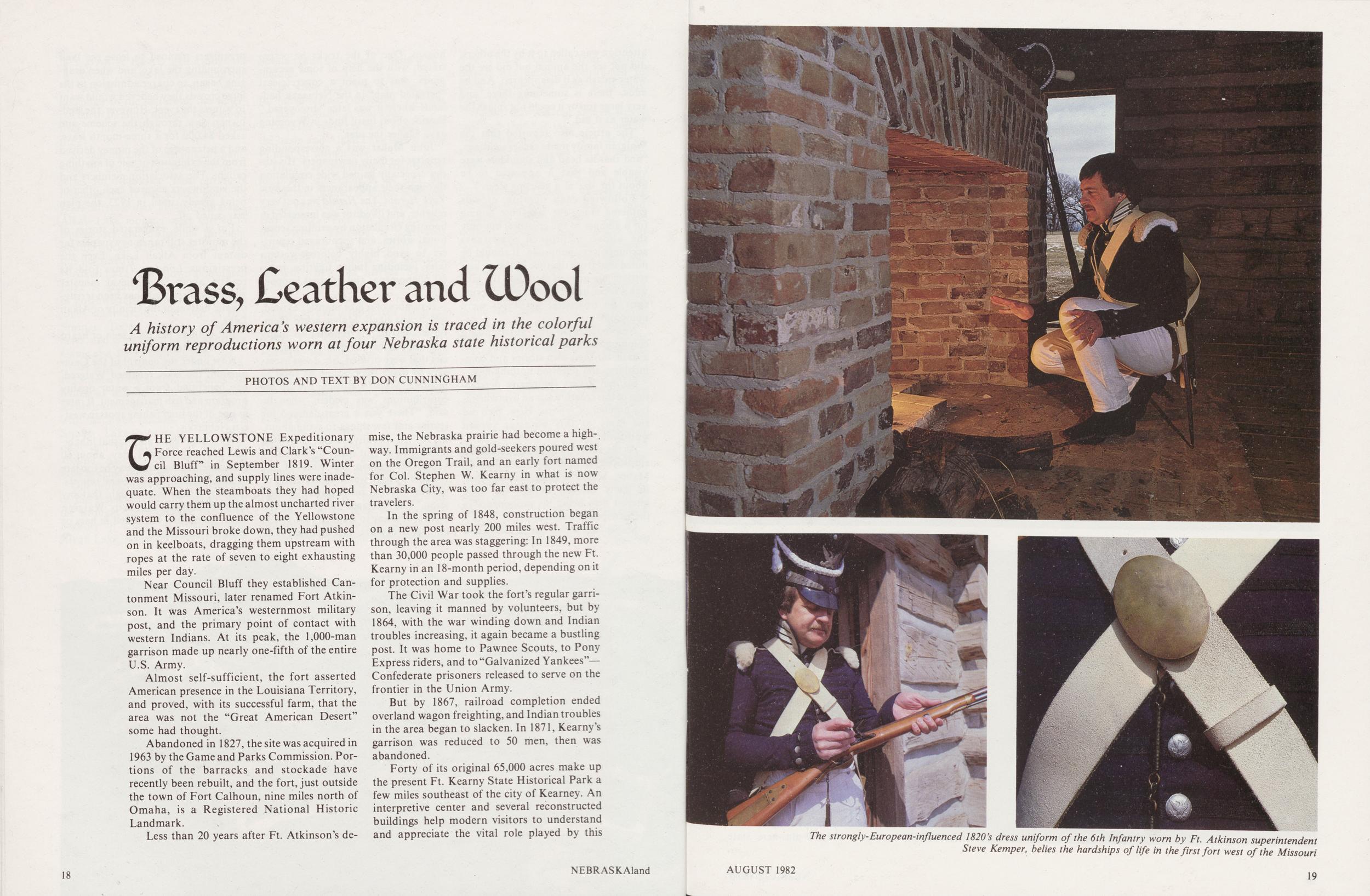
18 NEBRASKAlandThe strongly-European-influenced 1820's dress uniform of the 6th Infantry worn by Ft. Atkinson superintendent Steve Kemper, belies the hardships of life in the first fort west of the Missouri
fort in the development of the west.
Kearny, like most western forts, was never attacked. The Indians could not risk facing the firepower of a fully-armed garrison. But, as westward migration and settlement increased, so did Indian raids. Following the Grattan "massacre" at Ft. Laramie in 1854, an incident resulting from the loss of a single cow to the Indians and the bull-headed intransigence of some officers, the Army set out to "punish" the Sioux.
The battle took place at Blue Water Creek, northwest of the present town of Lewellen, six miles from Ash Hollow. Part of a grandiose plan to conquer the Northern Plains, the battle resulted in the death of 86 Indians and five troopers. It was the first military expedition against the Sioux, the largest battle in Nebraska, and is generally considered the first incident in the long and bloody "Indian Wars."
Ash Hollow, where the troops camped before the battle and now a 1,000-plus-acre state
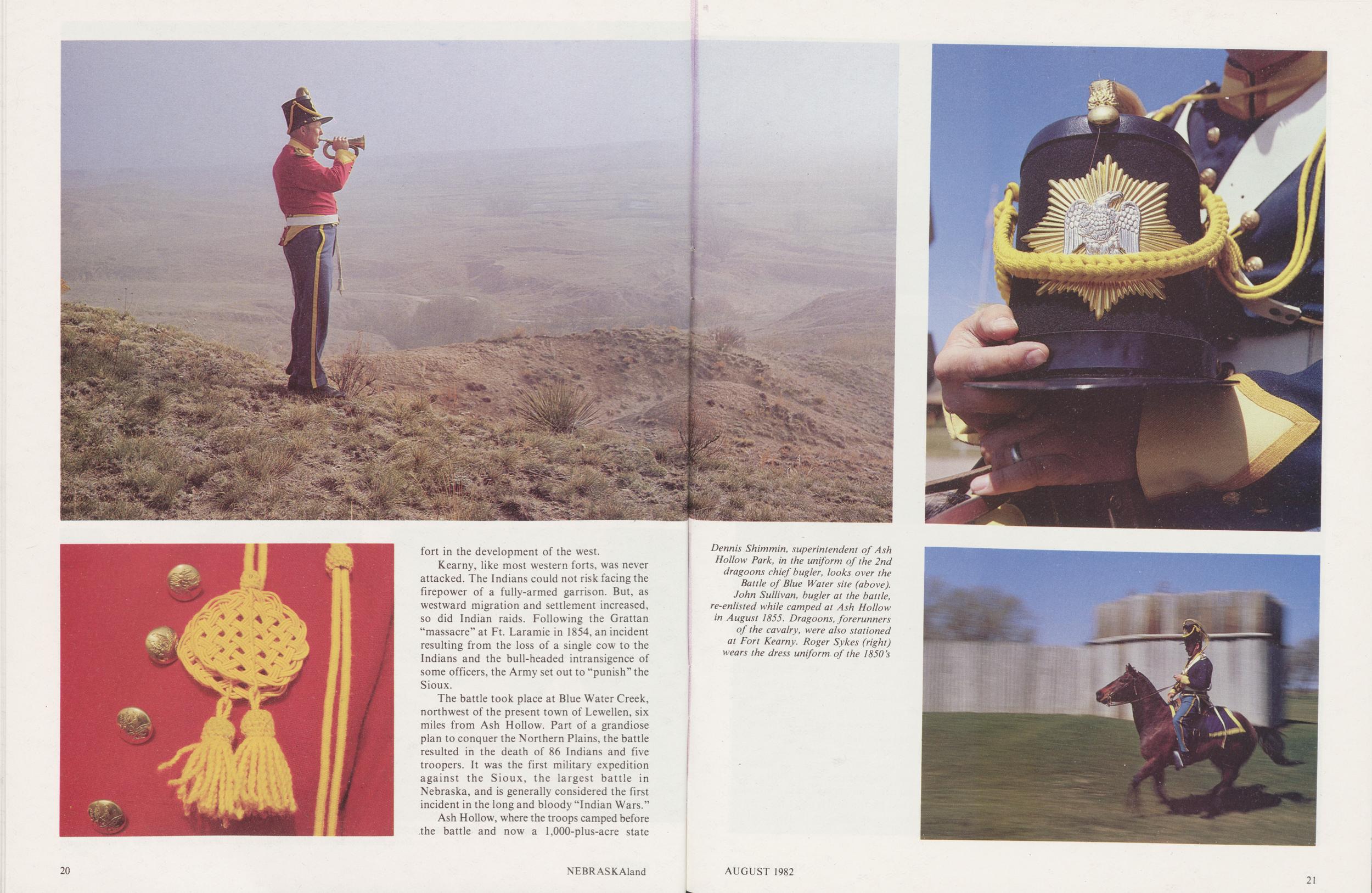
20 NEBRASKAlandDennis Shimmin, superintendent of Ash Hollow Park, in the uniform of the 2nd dragoons chief bugler, looks over the Battle of Blue Water site (above). John Sullivan, bugler at the battle, re-enlisted while camped at Ash Hollow in August 1855. Dragoons, forerunners of the cavalry, were also stationed at Fort Kearny. Roger Sykes (right) wears the dress uniform of the 1850's
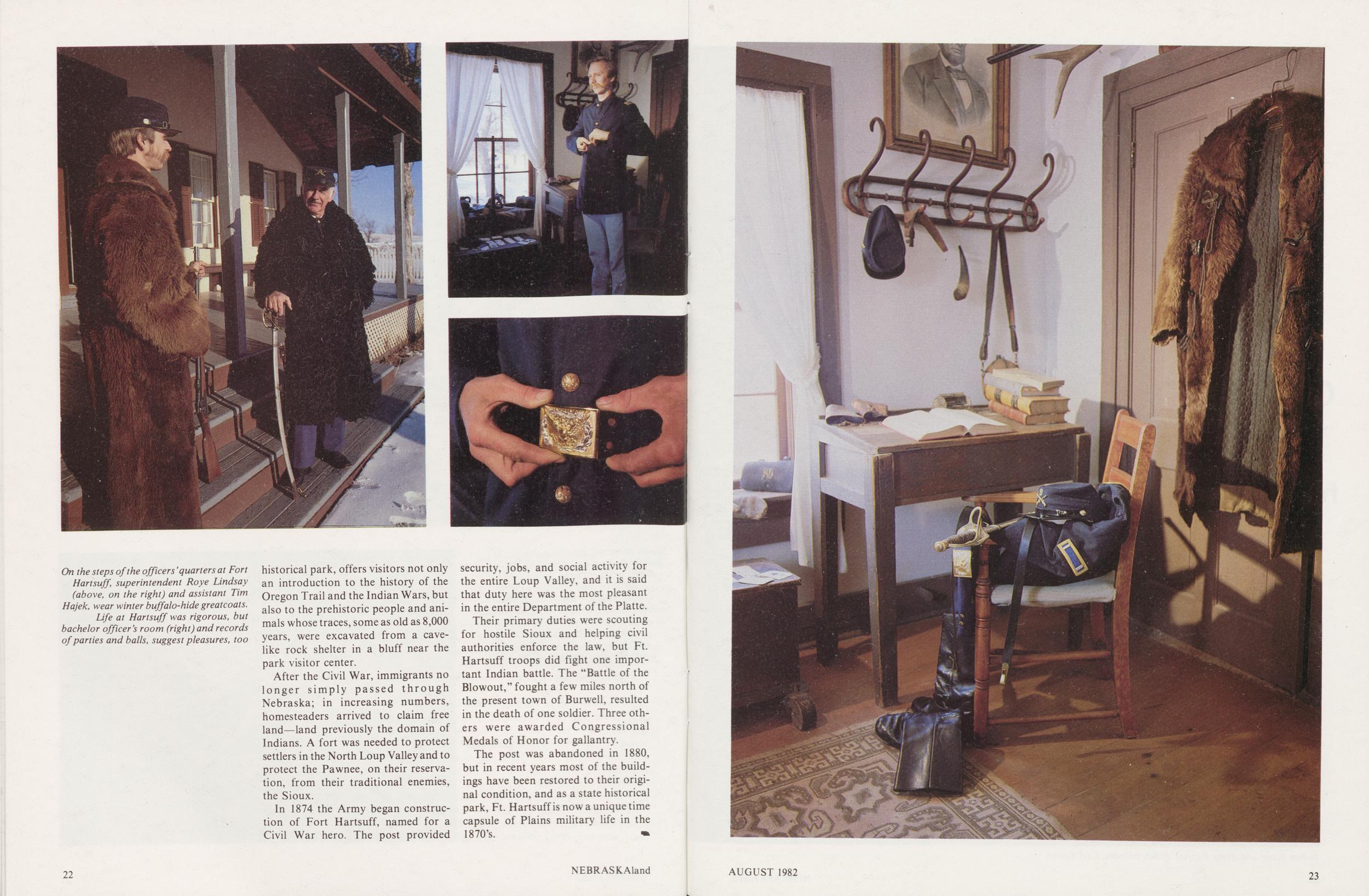
On the steps of the officers 'quarters at Fort Hartsuff superintendent Roye Lindsay (above, on the right) and assistant Tim Hajek, wear winter buffalo-hide greatcoats. Life at Hartsuff was rigorous, but bachelor officer's room (right) and records of parties and balls, suggest pleasures, too
historical park, offers visitors not only an introduction to the history of the Oregon Trail and the Indian Wars, but also to the prehistoric people and animals whose traces, some as old as 8,000 years, were excavated from a cave-like rock shelter in a bluff near the park visitor center.
After the Civil War, immigrants no longer simply passed through Nebraska; in increasing numbers, homesteaders arrived to claim free land—land previously the domain of Indians. A fort was needed to protect settlers in the North Loup Valley and to protect the Pawnee, on their reservation, from their traditional enemies, the Sioux.
In 1874 the Army began construction of Fort Hartsuff, named for a Civil War hero. The post provided security, jobs, and social activity for the entire Loup Valley, and it is said that duty here was the most pleasant in the entire Department of the Platte.
Their primary duties were scouting for hostile Sioux and helping civil authorities enforce the law, but Ft. Hartsuff troops did fight one important Indian battle. The "Battle of the Blowout," fought a few miles north of the present town of Burwell, resulted in the death of one soldier. Three others were awarded Congressional Medals of Honor for gallantry.
The post was abandoned in 1880, but in recent years most of the buildings have been restored to their original condition, and as a state historical park, Ft. Hartsuff is now a unique time capsule of Plains military life in the 1870's.
22 NEBRASKAland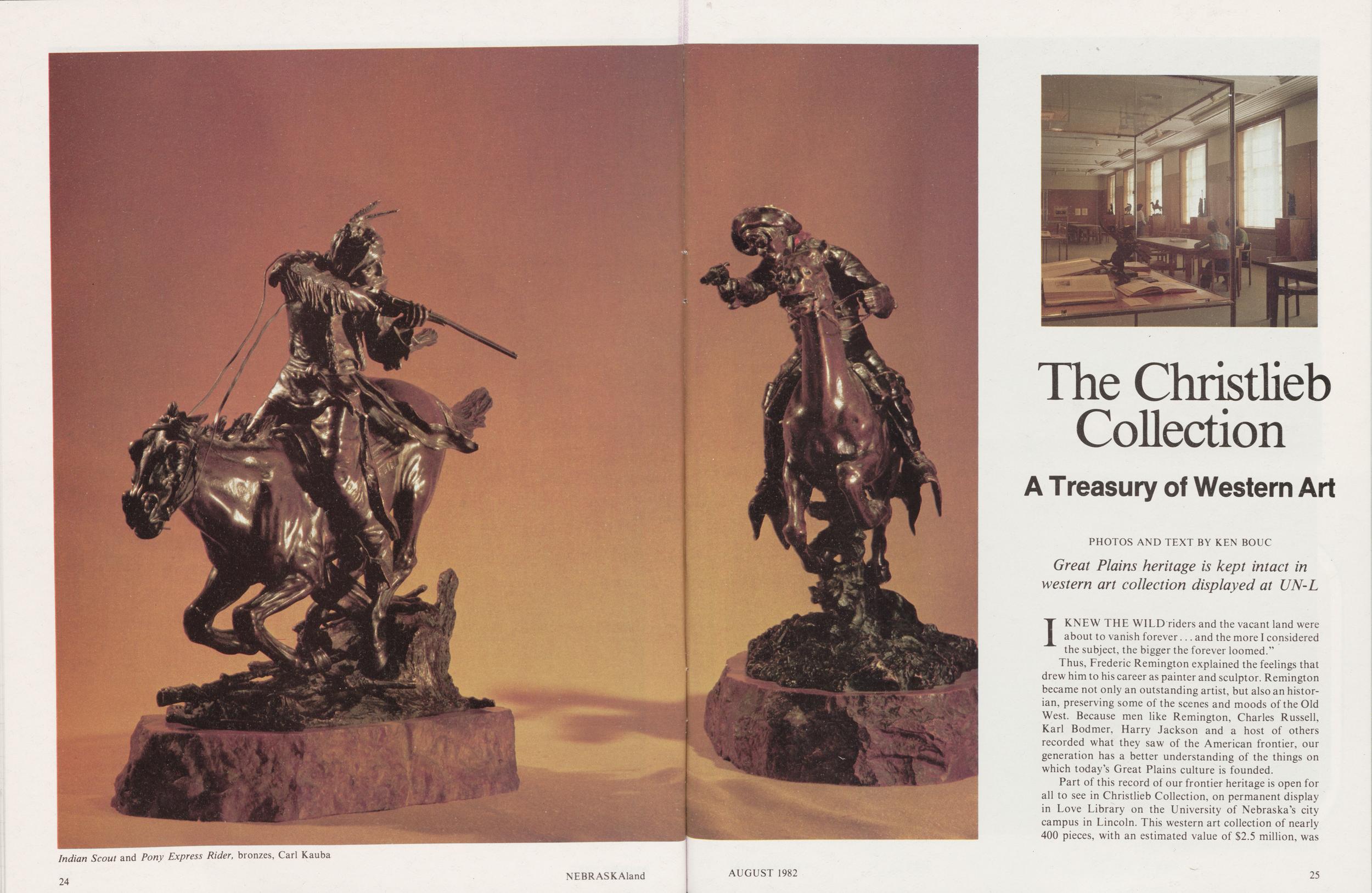
Indian Scout and Pony Express Rider, bronzes, Carl Kauba
The Christlieb Collection
A Treasury of Western Art
Great Plains heritage is kept intact in western art collection displayed at UN-LI KNEW THE WILD riders and the vacant land were about to vanish forever... and the more I considered the subject, the bigger the forever loomed."
Thus, Frederic Remington explained the feelings that drew him to his career as painter and sculptor. Remington became not only an outstanding artist, but also an historian, preserving some of the scenes and moods of the Old West. Because men like Remington, Charles Russell, Karl Bodmer, Harry Jackson and a host of others recorded what they saw of the American frontier, our generation has a better understanding of the things on which today's Great Plains culture is founded.
Part of this record of our frontier heritage is open for all to see in Christlieb Collection, on permanent display in Love Library on the University of Nebraska's city campus in Lincoln. This western art collection of nearly 400 pieces, with an estimated value of $2.5 million, was
AUGUST 1982 25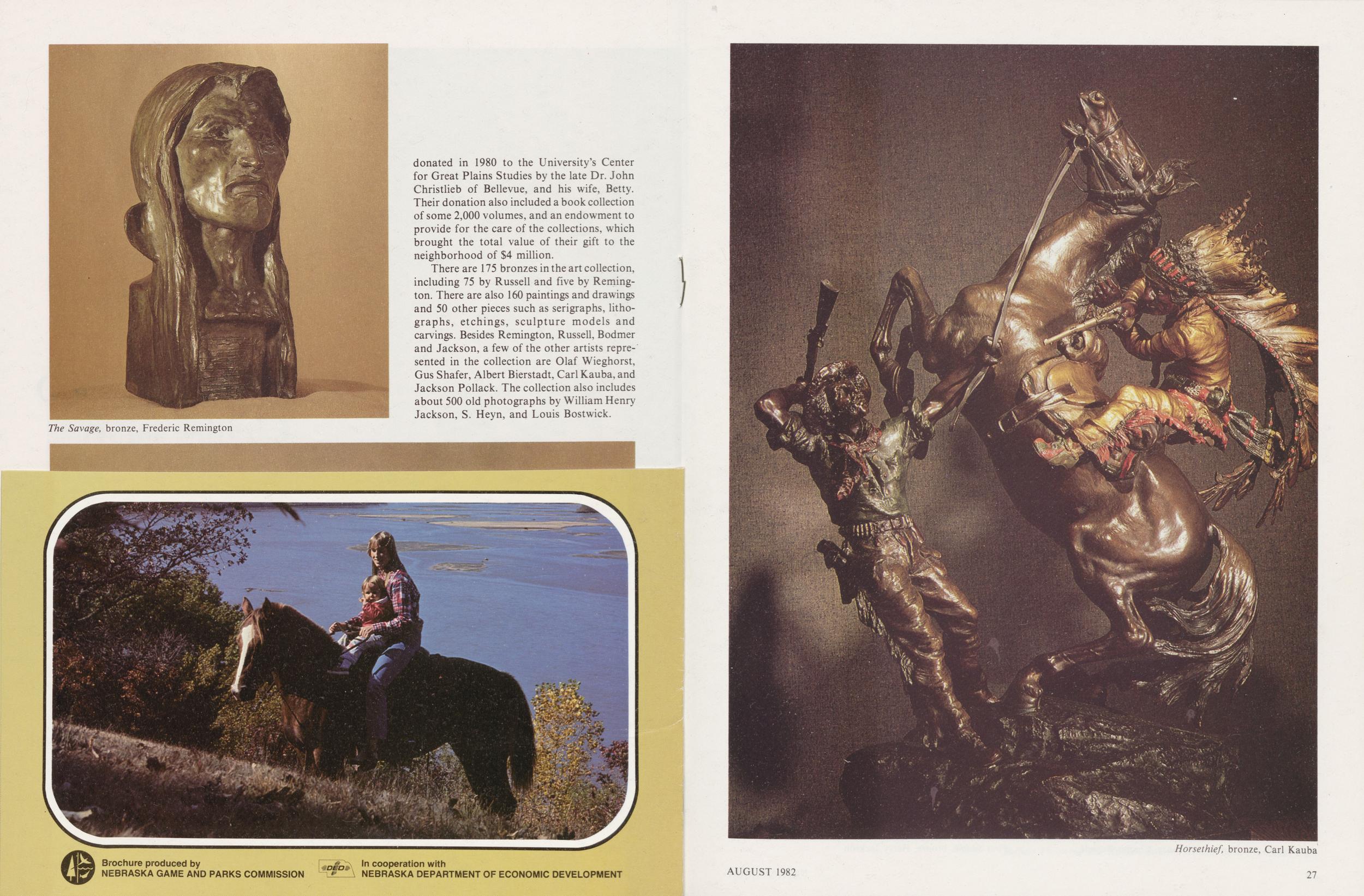
The Savage, bronze, Frederic Remington
donated in 1980 to the University's Center for Great Plains Studies by the late Dr. John Christlieb of Bellevue, and his wife, Betty. Their donation also included a book collection of some 2,000 volumes, and an endowment to provide for the care of the collections, which brought the total value of their gift to the neighborhood of $4 million.
There are 175 bronzes in the art collection, including 75 by Russell and five by Remington. There are also 160 paintings and drawings and 50 other pieces such as serigraphs, lithographs, etchings, sculpture models and carvings. Besides Remington, Russell, Bodmer and Jackson, a few of the other artists represented in the collection are Olaf Wieghorst, Gus Shafer, Albert Bierstadt, Carl Kauba, and Jackson Pollack. The collection also includes about 500 old photographs by William Henry Jackson, S. Heyn, and Louis Bostwick.
Brochure produced by In cooperation with NEBRASKA GAME AND PARKS COMMISSION NEBRASKA DEPARTMENT OF ECONOMIC DEVELOPMENT
Horsethief, bronze, Carl Kauba
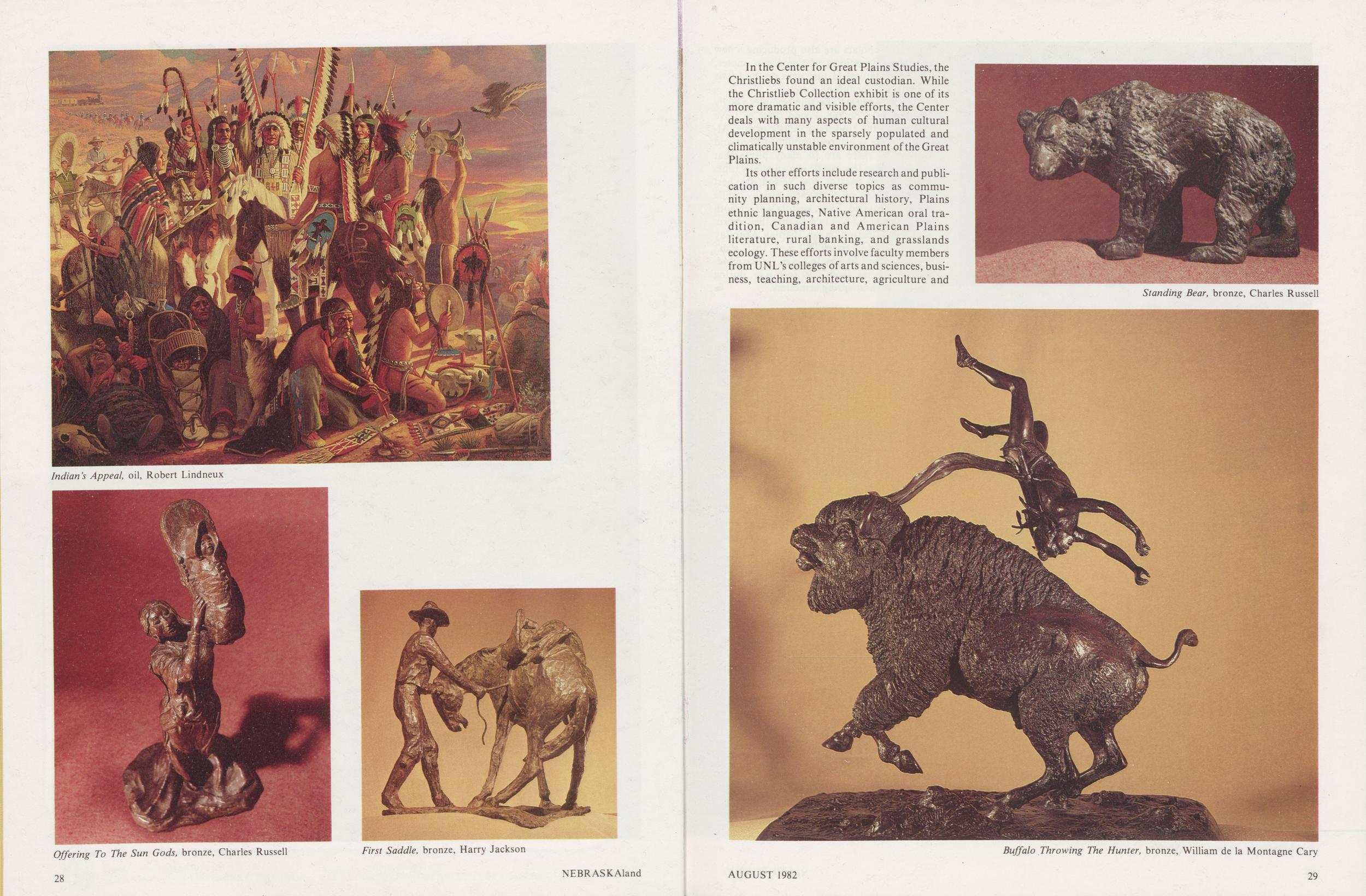
Indian's Appeal oil, Robert Lindneux
Offering To The Sun Gods, bronze, Charles Russell
First Saddle, bronze, Harry Jackson
In the Center for Great Plains Studies, the Christliebs found an ideal custodian. While the Christlieb Collection exhibit is one of its more dramatic and visible efforts, the Center deals with many aspects of human cultural development in the sparsely populated and climatically unstable environment of the Great Plains.
Its other efforts include research and publication in such diverse topics as community planning, architectural history, Plains ethnic languages, Native American oral tradition, Canadian and American Plains literature, rural banking, and grasslands ecology. These efforts involve faculty members from UNL's colleges of arts and sciences, business, teaching, architecture, agriculture and
Standing Bear, bronze, Charles Russell
Buffalo Throwing The Hunter, bronze, William de la Montagne Cary
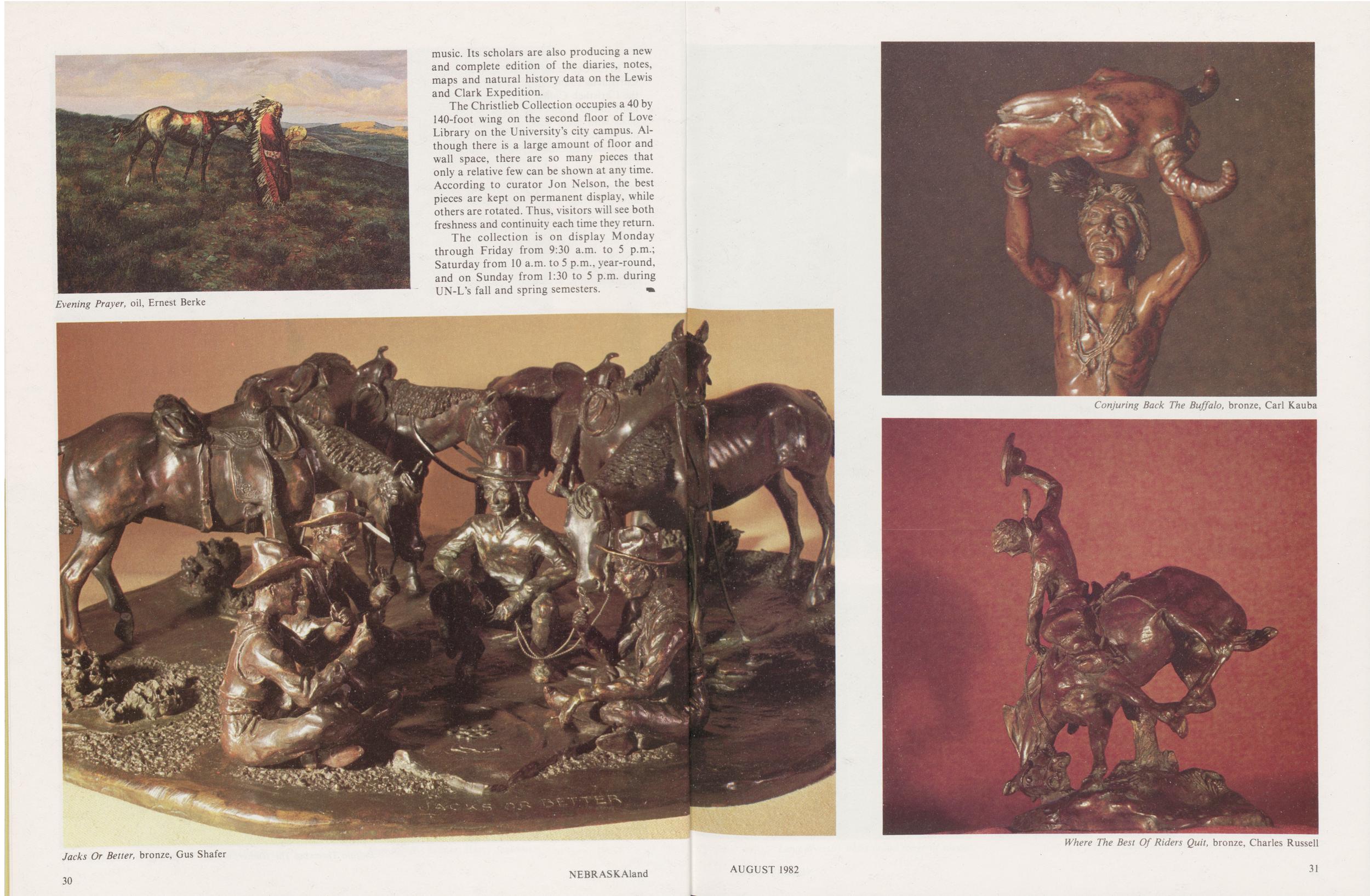
Evening Prayer, oil, Ernest Berke
music. Its scholars are also producing a new and complete edition of the diaries, notes, maps and natural history data on the Lewis and Clark Expedition.
The Christlieb Collection occupies a 40 by 140-foot wing on the second floor of Love Library on the University's city campus. Although there is a large amount of floor and wall space, there are so many pieces that only a relative few can be shown at any time. According to curator Jon Nelson, the best pieces are kept on permanent display, while others are rotated. Thus, visitors will see both freshness and continuity each time they return.
The collection is on display Monday through Friday from 9:30 a.m. to 5 p.m.; Saturday from 10 a.m. to 5 p.m., year-round, and on Sunday from 1:30 to 5 p.m. during UN-L's fall and spring semesters.
Jacks Or Better, bronze, Gus Shafer
Conjuring Back The Buffalo, bronze, Carl Kauba
Where The Best Of Riders Quit, bronze, Charles Russell
Life A long Pepper Creek
From a donation of land, this outdoor learning center has evolved into a valuable and popular site to catalog insects, wildlife and plants
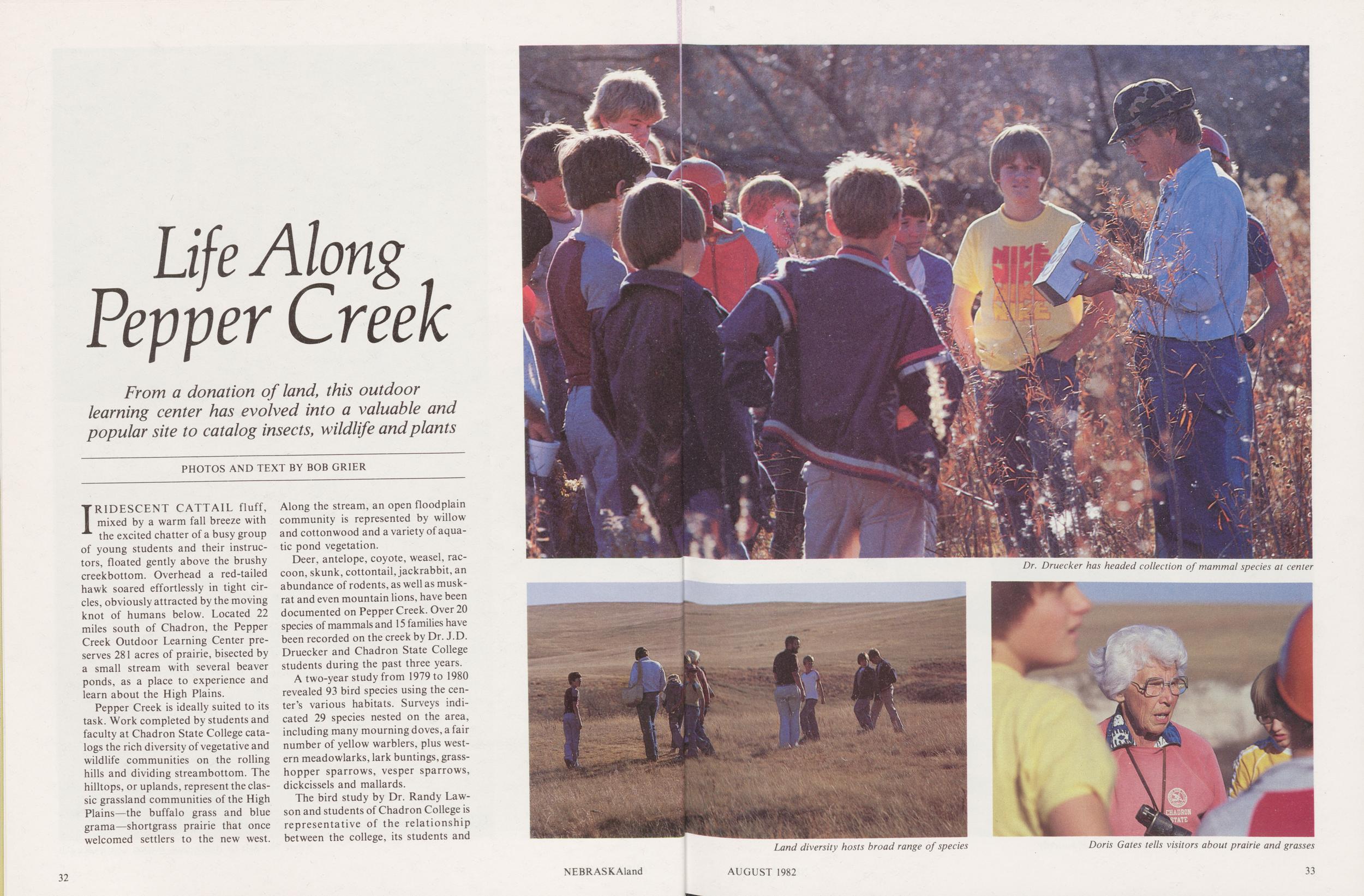
IRIDESCENT CATTAIL fluff, mixed by a warm fall breeze with the excited chatter of a busy group of young students and their instructors, floated gently above the brushy creekbottom. Overhead a red-tailed hawk soared effortlessly in tight circles, obviously attracted by the moving knot of humans below. Located 22 miles south of Chadron, the Pepper Creek Outdoor Learning Center preserves 281 acres of prairie, bisected by a small stream with several beaver ponds, as a place to experience and learn about the High Plains.
Pepper Creek is ideally suited to its task. Work completed by students and faculty at Chadron State College catalogs the rich diversity of vegetative and wildlife communities on the rolling hills and dividing streambottom. The hilltops, or uplands, represent the classic grassland communities of the High Plains—the buffalo grass and blue grama—shortgrass prairie that once welcomed settlers to the new west. Along the stream, an open floodplain community is represented by willow and cottonwood and a variety of aquatic pond vegetation.
Deer, antelope, coyote, weasel, raccoon, skunk, cottontail, jackrabbit, an abundance of rodents, as well as muskrat and even mountain lions, have been documented on Pepper Creek. Over 20 species of mammals and 15 families have been recorded on the creek by Dr. J.D. Druecker and Chadron State College students during the past three years.
A two-year study from 1979 to 1980 revealed 93 bird species using the center's various habitats. Surveys indicated 29 species nested on the area, including many mourning doves, a fair number of yellow warblers, plus western meadowlarks, lark buntings, grasshopper sparrows, vesper sparrows, dickcissels and mallards.
The bird study by Dr. Randy Lawson and students of Chadron College is representative of the relationship between the college, its students and
32 NEBRASKAlandDr. Druecker has headed collection of mammal species at center
Land diversity hosts broad range of species
Doris Gates tells visitors about prairie and grasses
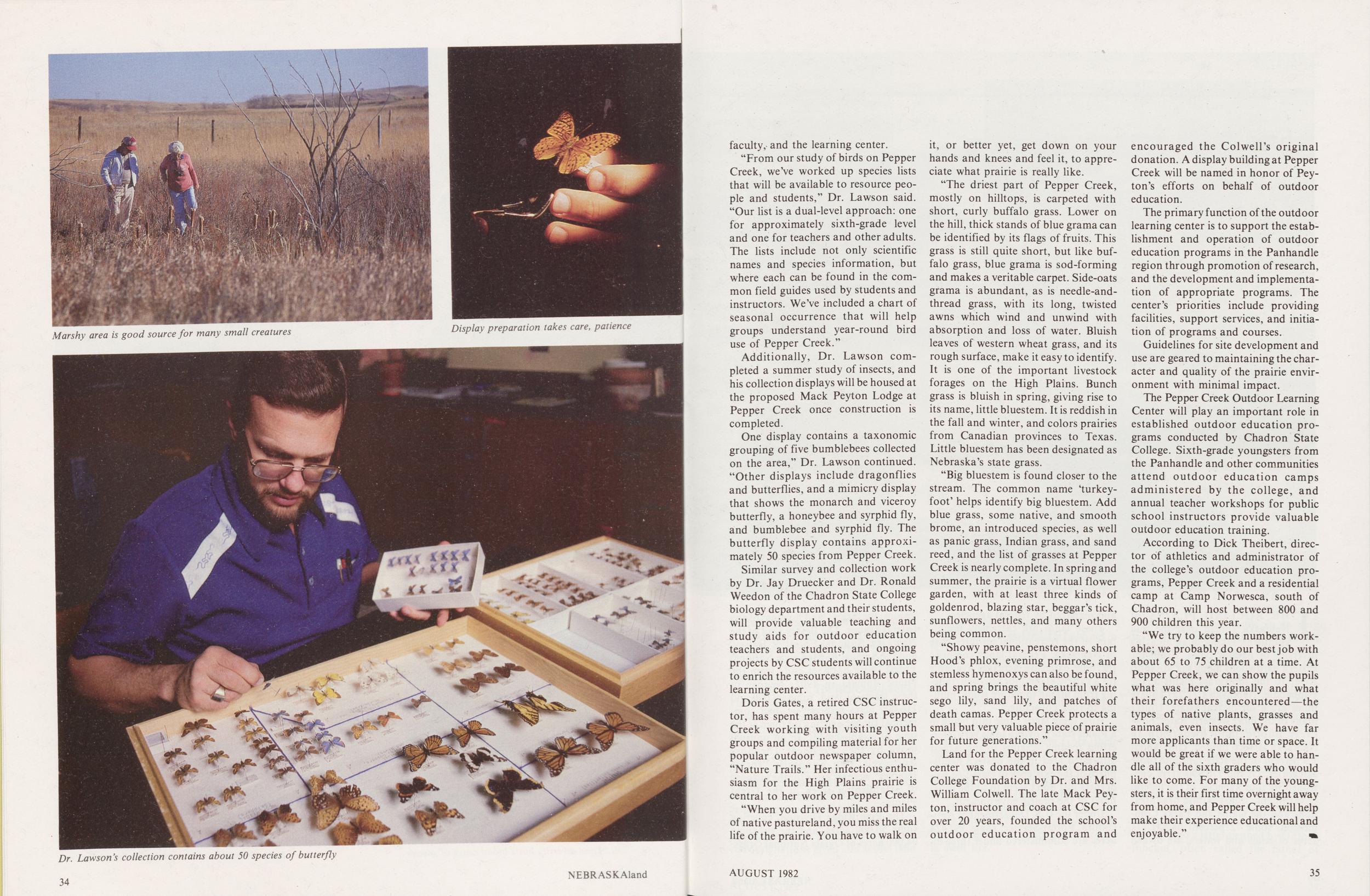
Marshy area is good source for many small creatures
Display preparation takes care, patience
Dr. Lawson's collection contains about 50 species of butterfly
faculty, and the learning center.
"From our study of birds on Pepper Creek, we've worked up species lists that will be available to resource people and students," Dr. Lawson said. "Our list is a dual-level approach: one for approximately sixth-grade level and one for teachers and other adults. The lists include not only scientific names and species information, but where each can be found in the common field guides used by students and instructors. We've included a chart of seasonal occurrence that will help groups understand year-round bird use of Pepper Creek."
Additionally, Dr. Lawson completed a summer study of insects, and his collection displays will be housed at the proposed Mack Peyton Lodge at Pepper Creek once construction is completed.
One display contains a taxonomic grouping of five bumblebees collected on the area," Dr. Lawson continued. "Other displays include dragonflies and butterflies, and a mimicry display that shows the monarch and viceroy butterfly, a honeybee and syrphid fly, and bumblebee and syrphid fly. The butterfly display contains approximately 50 species from Pepper Creek.
Similar survey and collection work by Dr. Jay Druecker and Dr. Ronald Weedon of the Chadron State College biology department and their students, will provide valuable teaching and study aids for outdoor education teachers and students, and ongoing projects by CSC students will continue to enrich the resources available to the learning center.
Doris Gates, a retired CSC instructor, has spent many hours at Pepper Creek working with visiting youth groups and compiling material for her popular outdoor newspaper column, "Nature Trails." Her infectious enthusiasm for the High Plains prairie is central to her work on Pepper Creek.
"When you drive by miles and miles of native pastureland, you miss the real life of the prairie. You have to walk on it, or better yet, get down on your hands and knees and feel it, to appreciate what prairie is really like.
The driest part of Pepper Creek, mostly on hilltops, is carpeted with short, curly buffalo grass. Lower on the hill, thick stands of blue grama can be identified by its flags of fruits. This grass is still quite short, but like buffalo grass, blue grama is sod-forming and makes a veritable carpet. Side-oats grama is abundant, as is needle-and-thread grass, with its long, twisted awns which wind and unwind with absorption and loss of water. Bluish leaves of western wheat grass, and its rough surface, make it easy to identify. It is one of the important livestock forages on the High Plains. Bunch grass is bluish in spring, giving rise to its name, little bluestem. It is reddish in the fall and winter, and colors prairies from Canadian provinces to Texas. Little bluestem has been designated as Nebraska's state grass.
"Big bluestem is found closer to the stream. The common name 'turkey-foot' helps identify big bluestem. Add blue grass, some native, and smooth brome, an introduced species, as well as panic grass, Indian grass, and sand reed, and the list of grasses at Pepper Creek is nearly complete. In spring and summer, the prairie is a virtual flower garden, with at least three kinds of goldenrod, blazing star, beggar's tick, sunflowers, nettles, and many others being common.
"Showy peavine, penstemons, short Hood's phlox, evening primrose, and stemless hymenoxys can also be found, and spring brings the beautiful white sego lily, sand lily, and patches of death camas. Pepper Creek protects a small but very valuable piece of prairie for future generations."
Land for the Pepper Creek learning center was donated to the Chadron College Foundation by Dr. and Mrs. William Colwell. The late Mack Peyton, instructor and coach at CSC for over 20 years, founded the school's outdoor education program and encouraged the Colwell's original donation. A display building at Pepper Creek will be named in honor of Peyton's efforts on behalf of outdoor education.
The primary function of the outdoor learning center is to support the establishment and operation of outdoor education programs in the Panhandle region through promotion of research, and the development and implementation of appropriate programs. The center's priorities include providing facilities, support services, and initiation of programs and courses.
Guidelines for site development and use are geared to maintaining the character and quality of the prairie environment with minimal impact.
The Pepper Creek Outdoor Learning Center will play an important role in established outdoor education programs conducted by Chadron State College. Sixth-grade youngsters from the Panhandle and other communities attend outdoor education camps administered by the college, and annual teacher workshops for public school instructors provide valuable outdoor education training.
According to Dick Theibert, director of athletics and administrator of the college's outdoor education programs, Pepper Creek and a residential camp at Camp Norwesca, south of Chadron, will host between 800 and 900 children this year.
"We try to keep the numbers workable; we probably do our best job with about 65 to 75 children at a time. At Pepper Creek, we can show the pupils what was here originally and what their forefathers encountered—the types of native plants, grasses and animals, even insects. We have far more applicants than time or space. It would be great if we were able to handle all of the sixth graders who would like to come. For many of the youngsters, it is their first time overnight away from home, and Pepper Creek will help make their experience educational and enjoyable."
The Squeeze on Public Lands
Each year, an increasing population and commercial interests put more of a load on federal areas. Costs also climb, so all users may have to adapt in futureThe Pine Ridge Division, covering some 50,000 acres, and the sweeping 94,000 acres of Oglala National Grasslands, 36 NEBRASKAland didn't come into being until the late 1930's. The drought of the 30's sent landowners scurrying from marginal lands of the northwest almost as fast as the massive clouds of dust rolled across the plains. The Bankhead-Jones Farm Tenant Act of 1937 provided the catalyst that eventually created the Pine Ridge Division and Oglala Grasslands. In simple terms, these lands had been so abused and depleted that the federal government moved "to correct maladjustments in land use, and thus assist in controlling soil erosion... and protecting the public lands—" Over several decades these lands were simply held. Not until 1954 were official designations given and actual land management practices begun.
These, the largest federal holdings in Nebraska, came into being under unusual circumstances. Nevertheless, the role and purpose of Forest Service lands today figure significantly in the state's economy and outdoor recreation needs.
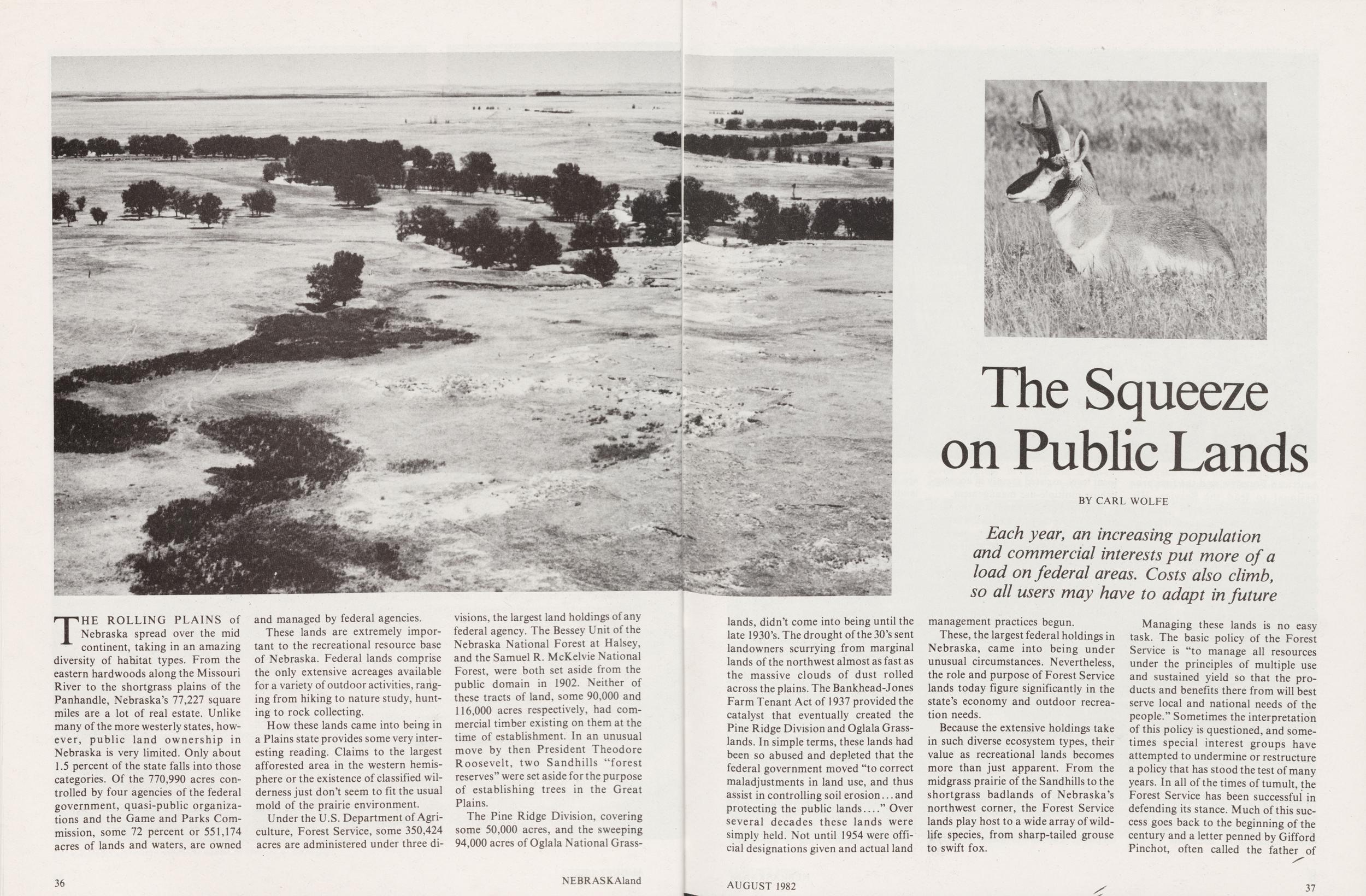
Because the extensive holdings take in such diverse ecosystem types, their value as recreational lands becomes more than just apparent. From the midgrass prairie of the Sandhills to the shortgrass badlands of Nebraska's northwest corner, the Forest Service lands play host to a wide array of wildlife species, from sharp-tailed grouse to swift fox.
Managing these lands is no easy
task. The basic policy of the Forest
Service is "to manage all resources
under the principles of multiple use
and sustained yield so that the products and benefits there from will best
serve local and national needs of the
people." Sometimes the interpretation
of this policy is questioned, and sometimes special interest groups have
attempted to undermine or restructure
a policy that has stood the test of many
years. In all of the times of tumult, the
Forest Service has been successful in
defending its stance. Much of this success goes back to the beginning of the
century and a letter penned by Gifford
Pinchot, often called the father of
AUGUST 1982 37
To this day, Pinchot's letter is still basic to the operation of the Forest Service. This ageless philosophy of resource management has helped the Forest Service achieve success. But along the way, a "good-neighbor" policy, coupled with the ability to make most management decisions at the local level, assisted greatly in accomplishing multiple-use management.
With greater demands on the land and its resources now and in the future, it's easy for the recreation user to become uneasy about the status of the state's prime outdoor areas.
Looking ahead, all is not a bed of roses. The new administration has put all of the nation's large land-holding agencies on notice that changes are coming. In Nebraska, we may not see or feel some of the impact as will other states. None of the conifers or hardwoods on Forest Service lands are classified as commercial timber. Timber is sold in the state, but not with the fervor of the timber states of the far west.
While future timber harvest on USFS lands in the state appears to be conservative, and with other benefits accruing, future uses of lands may be a little disconcerting to the recreationist.
The search for new energy sources does not overlook USFS lands in Nebraska. Oil and uranium interests on public lands of northwest Nebraska are very real. Under law, all USFS lands are open for exploration and production. Fortunately, the Forest Service does have full authority to determine or dictate how these activities will be carried out. Again, such exploration and use are usually geared to local conditions. Only the future, though, will tell just where and how Forest Service lands of Nebraska fit into the national energy picture, and what impact will be seen on some of the state's most vital wildlife land.
If any one weak link is showing at present in the management of Forest Service lands, it would have to be their "business" of providing resources at cut-rate prices. Grazing leases, firewood and developed recreation are just some parts of the picture that spell subsidy to special interest groups. That a need exists to be more beneficial to the public is recognized by USFS officials. What this spells out very clearly is that the users are going to have to pay for what they take or use in public lands.
Already handwriting is appearing 38 NEBRASKAland on the wall. Recreation areas that do not have a great deal of use are being closed down. Thosefolks who utilized managed recreation areas during the past summer noted a very substantial increase in the daily fee. Paying for the product will be a way of life for the public land user—even moreso as greater demands are placed on the land.
With an output-oriented, user-pays-the-going-rate change in management direction, one could ask the question: where does wildlife fit into the new plans? In spite of demonstrated needs, significant public use, and a good start toward a systematic approach to wildlife habitat management and improvement, there's little doubt that wildlife has lost favor. The impact of diminished interest in wildlife is hard to pre- dict. Certainly the push exists to improve habitat; a willingness to finance improvement is not.For the hunter who has come to rely on the Pine Ridge country for his annual deer and turkey hunts; for those who vie for the limited number of antelope permits and who depend on the Oglala National Grasslands for a place to hunt; for the backpacker or photographer winding his way through the Wood Reserve; even the lone grouse hunter tramping the hills near the Dismal River—all are using the land and its resources, but none are paying admission. If we continue on into a product-oriented, product-for-sale era, it's easy to see why the recreationist may not count much when the "sales" are tallied. Many types of use just don't fit the profit mold, but it certainly fits the multiple-use concept. Therein lies the paradox. How the Forest Service or any other federal land management agency will cope with this problem is far from being resolved. Seat-of-the-pants intuition would say that the hunter, fisherman, and every other resource user is willing to pay his way if this is what it will take to keep his niche in the user group web.
If this assumption is correct, it's not going to be easy to solve the problem of fitting such a contribution into the complex economic equation that results in a final dollars-and-cents figure for a given piece of land. It is easy to determine a fee for grazing a given number of cattle on a given number of acres for a given time period, or assess a reasonable fee for overnight camping. But placing a dollar value on the many evanescent pleasures provided by rolling prairie landscapes or deep pine-studded canyon lands and the wild species they contain, just doesn't seem to fit economic molds.
For those who derive their pleasures and uses of public lands by values such as these, the realization must come quickly that continued management of Forest Service lands will depend on input from the indirect user, also. Increased demands from all sectors for a share of the public lands pie is simply a fact of life. And with only so much "pie" to be cut and served, the administration and management of Forest Service lands doesn't come easy anymore. How well the chore of management is done in future will be best answered only by the public. Your own stake in this most treasured of resources, our federal lands in Nebraska, is more important today than at any other time.
If you haven't already done so, become acquainted with at least one of the fine areas administered by the Forest Service this summer. Your comments on these unique areas of Nebraska could do much to influence future management decisions.
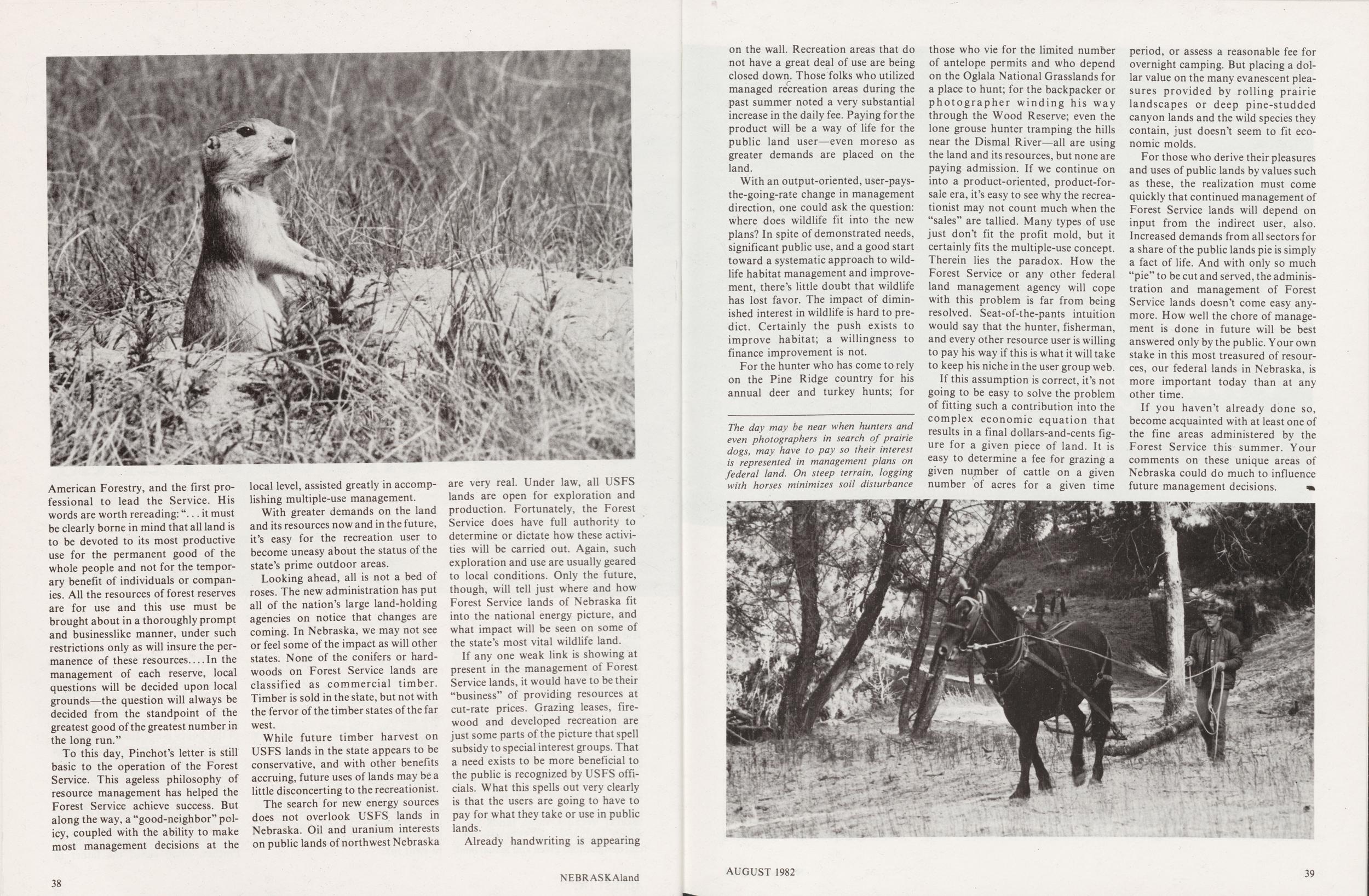
The day may be near when hunters and even photographers in search of prairie dogs, may have to pay so their interest is represented in management plans on federal land. On steep terrain, logging with horses minimizes soil disturbance
How to Hunt Walleye
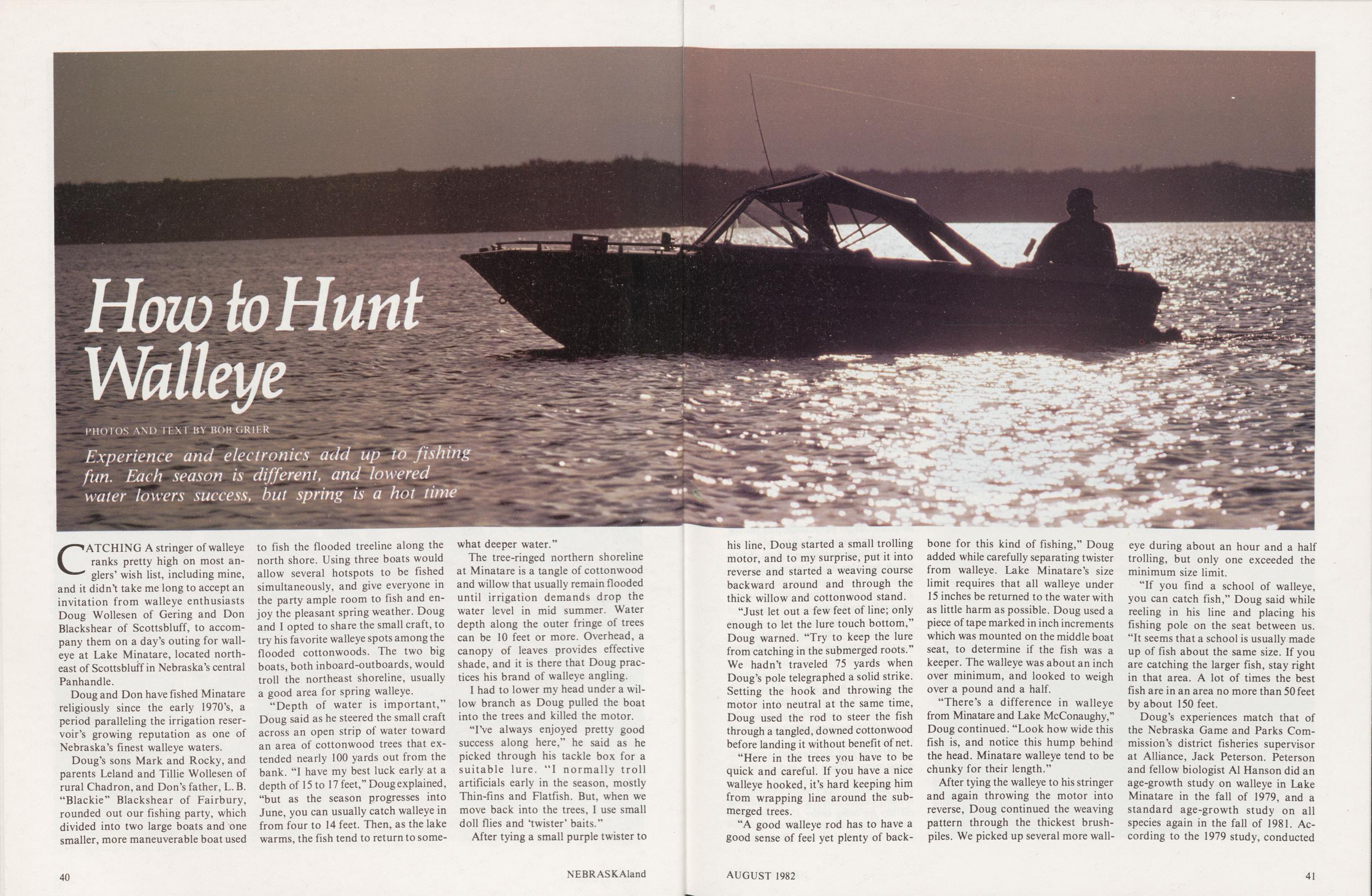
Experience and electronics add up to fishing fun. Each season is different, and lowered water lowers success, but spring is a hot time
CATCHING A stringer of walleye ranks pretty high on most anglers' wish list, including mine, and it didn't take me long to accept an invitation from walleye enthusiasts Doug Wollesen of Gering and Don Blackshear of Scottsbluff, to accompany them on a day's outing for walleye at Lake Minatare, located northeast of Scottsbluff in Nebraska's central Panhandle.
Doug and Don have fished Minatare religiously since the early 1970's, a period paralleling the irrigation reservoir's growing reputation as one of Nebraska's finest walleye waters.
Doug's sons Mark and Rocky, and parents Leland and Tillie Wollesen of rural Chadron, and Don's father, L. B. "Blackie" Blackshear of Fairbury, rounded out our fishing party, which divided into two large boats and one smaller, more maneuverable boat used to fish the flooded treeline along the north shore. Using three boats would allow several hotspots to be fished simultaneously, and give everyone in the party ample room to fish and enjoy the pleasant spring weather. Doug and I opted to share the small craft, to try his favorite walleye spots among the flooded cottonwoods. The two big boats, both inboard-outboards, would troll the northeast shoreline, usually a good area for spring walleye.
"Depth of water is important," Doug said as he steered the small craft across an open strip of water toward an area of cottonwood trees that extended nearly 100 yards out from the bank. "I have my best luck early at a depth of 15 to 17 feet," Doug explained, "but as the season progresses into June, you can usually catch walleye in from four to 14 feet. Then, as the lake warms, the fish tend to return to somewhat deeper water."
The tree-ringed northern shoreline at Minatare is a tangle of cottonwood and willow that usually remain flooded until irrigation demands drop the water level in mid summer. Water depth along the outer fringe of trees can be 10 feet or more. Overhead, a canopy of leaves provides effective shade, and it is there that Doug practices his brand of walleye angling.
I had to lower my head under a willow branch as Doug pulled the boat into the trees and killed the motor.
"I've always enjoyed pretty good success along here," he said as he picked through his tackle box for a suitable lure. "I normally troll artificials early in the season, mostly Thin-fins and Flatfish. But, when we move back into the trees, I use small doll flies and 'twister' baits."
After tying a small purple twister to 40 NEBRASKAland his line, Doug started a small trolling motor, and to my surprise, put it into reverse and started a weaving course backward around and through the thick willow and cottonwood stand.
"Just let out a few feet of line; only enough to let the lure touch bottom," Doug warned. "Try to keep the lure from catching in the submerged roots." We hadn't traveled 75 yards when Doug's pole telegraphed a solid strike. Setting the hook and throwing the motor into neutral at the same time, Doug used the rod to steer the fish through a tangled, downed cottonwood before landing it without benefit of net.
"Here in the trees you have to be quick and careful. If you have a nice walleye hooked, it's hard keeping him from wrapping line around the submerged trees.
"A good walleye rod has to have a good sense of feel yet plenty of backbone for this kind of fishing," Doug added while carefully separating twister from walleye. Lake Minatare's size limit requires that all walleye under 15 inches be returned to the water with as little harm as possible. Doug used a piece of tape marked in inch increments which was mounted on the middle boat seat, to determine if the fish was a keeper. The walleye was about an inch over minimum, and looked to weigh over a pound and a half.
"There's a difference in walleye from Minatare and Lake McConaughy," Doug continued. "Look how wide this fish is, and notice this hump behind the head. Minatare walleye tend to be chunky for their length."
After tying the walleye to his stringer and again throwing the motor into reverse, Doug continued the weaving pattern through the thickest brush-piles. We picked up several more walleye during about an hour and a half trolling, but only one exceeded the minimum size limit.
"If you find a school of walleye, you can catch fish," Doug said while reeling in his line and placing his fishing pole on the seat between us. "It seems that a school is usually made up of fish about the same size. If you are catching the larger fish, stay right in that area. A lot of times the best fish are in an area no more than 50 feet by about 150 feet.
Doug's experiences match that of the Nebraska Game and Parks Commission's district fisheries supervisor at Alliance, Jack Peterson. Peterson and fellow biologist Al Hanson did an age-growth study on walleye in Lake Minatare in the fall of 1979, and a standard age-growth study on all species again in the fall of 1981. According to the 1979 study, conducted
AUGUST 1982 41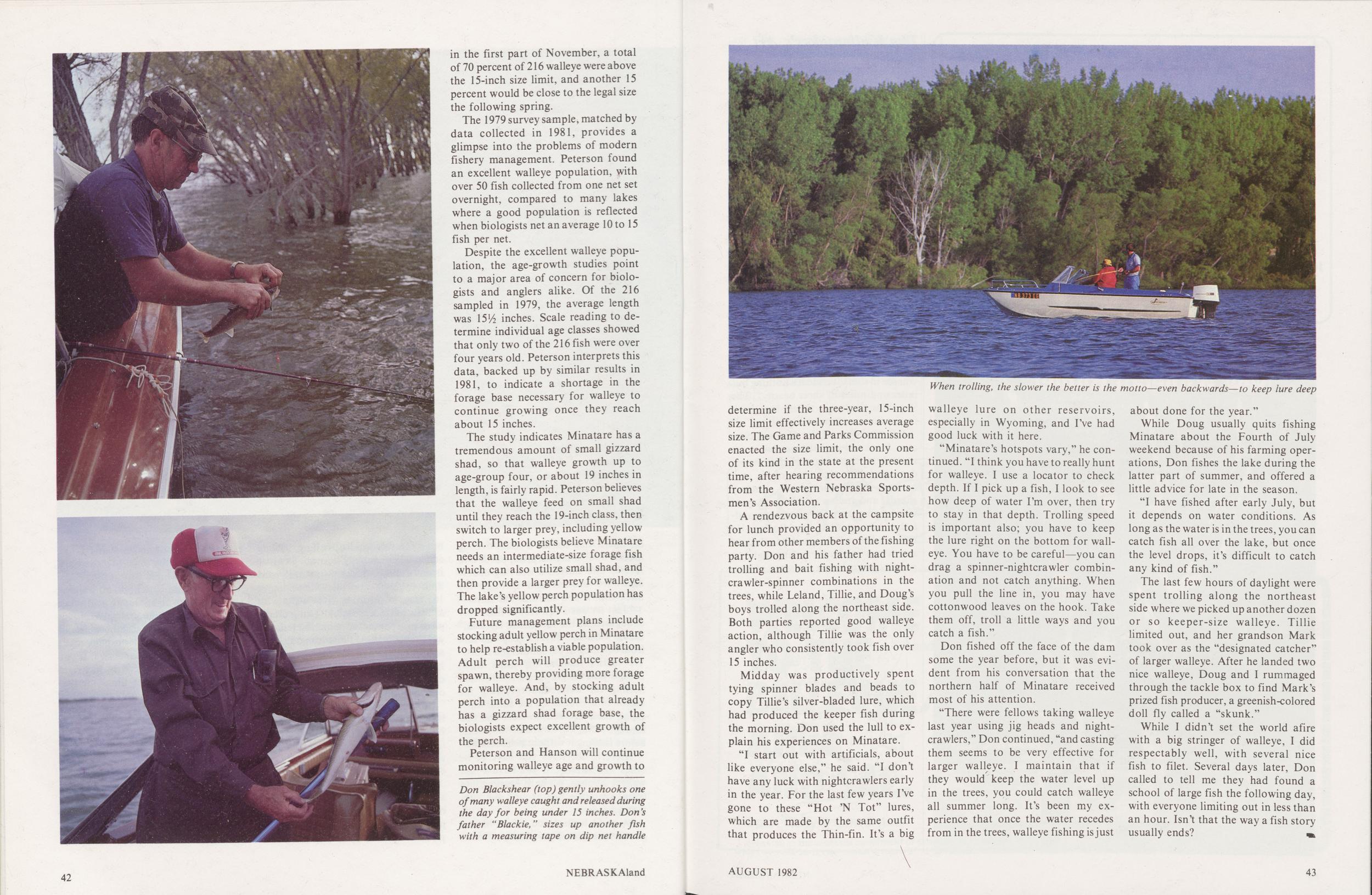
Don Blackshear (top) gently unhooks one of many walleye caught and released during the day for being under 15 inches. Don's father "Blackie," sizes up another fish with a measuring tape on dip net handle
in the first part of November, a total of 70 percent of 216 walleye were above the 15-inch size limit, and another 15 percent would be close to the legal size the following spring.
The 1979 survey sample, matched by data collected in 1981, provides a glimpse into the problems of modern fishery management. Peterson found an excellent walleye population, with over 50 fish collected from one net set overnight, compared to many lakes where a good population is reflected when biologists net an average 10 to 15 fish per net.
Despite the excellent walleye population, the age-growth studies point to a major area of concern for biologists and anglers alike. Of the 216 sampled in 1979, the average length was 15V4 inches. Scale reading to determine individual age classes showed that only two of the 216 fish were over four years old. Peterson interprets this data, backed up by similar results in 1981, to indicate a shortage in the forage base necessary for walleye to continue growing once they reach about 15 inches.
The study indicates Minatare has a tremendous amount of small gizzard shad, so that walleye growth up to age-group four, or about 19 inches in length, is fairly rapid. Peterson believes that the walleye feed on small shad until they reach the 19-inch class, then switch to larger prey, including yellow perch. The biologists believe Minatare needs an intermediate-size forage fish which can also utilize small shad, and then provide a larger prey for walleye. The lake's yellow perch population has dropped significantly.
Future management plans include stocking adult yellow perch in Minatare to help re-establish a viable population. Adult perch will produce greater spawn, thereby providing more forage for walleye. And, by stocking adult perch into a population that already has a gizzard shad forage base, the biologists expect excellent growth of the perch.
Peterson and Hanson will continue monitoring walleye age and growth to
42 NEBRASKAlandWhen trolling, the slower the better is the motto—even backwards—to keep lure deep
determine if the three-year, 15-inch size limit effectively increases average size. The Game and Parks Commission enacted the size limit, the only one of its kind in the state at the present time, after hearing recommendations from the Western Nebraska Sportsmen's Association.
A rendezvous back at the campsite for lunch provided an opportunity to hear from other members of the fishing party. Don and his father had tried trolling and bait fishing with nightcrawler-spinner combinations in the trees, while Leland, Tillie, and Doug's boys trolled along the northeast side. Both parties reported good walleye action, although Tillie was the only angler who consistently took fish over 15 inches.
Midday was productively spent tying spinner blades and beads to copy Tillie's silver-bladed lure, which had produced the keeper fish during the morning. Don used the lull to explain his experiences on Minatare.
"I start out with artificials, about like everyone else," he said. "I don't have any luck with nightcrawlers early in the year. For the last few years I've gone to these "Hot 'N Tot" lures, which are made by the same outfit that produces the Thin-fin. It's a big walleye lure on other reservoirs, especially in Wyoming, and I've had good luck with it here.
"Minatare's hotspots vary," he continued. "I think you have to really hunt for walleye. I use a locator to check depth. If I pick up a fish, I look to see how deep of water I'm over, then try to stay in that depth. Trolling speed is important also; you have to keep the lure right on the bottom for walleye. You have to be careful—you can drag a spinner-nightcrawler combination and not catch anything. When you pull the line in, you may have cottonwood leaves on the hook. Take them off, troll a little ways and you catch a fish."
Don fished off the face of the dam some the year before, but it was evident from his conversation that the northern half of Minatare received most of his attention.
"There were fellows taking walleye last year using jig heads and nightcrawlers," Don continued, "and casting them seems to be very effective for larger walleye. I maintain that if they would keep the water level up in the trees, you could catch walleye all summer long. It's been my experience that once the water recedes from in the trees, walleye fishing is just about done for the year."
While Doug usually quits fishing Minatare about the Fourth of July weekend because of his farming operations, Don fishes the lake during the latter part of summer, and offered a little advice for late in the season.
"I have fished after early July, but it depends on water conditions. As long as the water is in the trees, you can catch fish all over the lake, but once the level drops, it's difficult to catch any kind of fish."
The last few hours of daylight were spent trolling along the northeast side where we picked up another dozen or so keeper-size walleye. Tillie limited out, and her grandson Mark took over as the "designated catcher" of larger walleye. After he landed two nice walleye, Doug and I rummaged through the tackle box to find Mark's prized fish producer, a greenish-colored doll fly called a "skunk."
While I didn't set the world afire with a big stringer of walleye, I did respectably well, with several nice fish to filet. Several days later, Don called to tell me they had found a school of large fish the following day, with everyone limiting out in less than an hour. Isn't that the way a fish story usually ends?
The Knifemaker's Art
(Continued from page 15)and does silversmithing, and carves intricate miniatures in horn and bone. He was formerly a licensed taxidermist, worked as an engineer on the reconstruction of a city block in downtown Denver, and was public relations man for a company building homes on the Pine Ridge Reservation, to name a few of his involvements.
But now, with his wife and two daughters, he feels settled in Burwell. It is not the kind of place where his work can get a great deal of exposure, but simple word-of-mouth advertising keeps him back-ordered: "One of my knives gets passed around and next thing I know. I've got somebody calling me."
Besides, he says, he can't seem to stay away from Nebraska, and he has a special love for the Sandhills. "Lots of people look at them and say 'What do you see in that?' To me it's nothing but miles and miles of sheer beauty.'1 The Sandhills, he says, offer him both inspiration and tranquility.
But it's a love of the past and concern for his own heritage that most strongly motivate his work. His shop is decorated with reminders of his own heritage—tools, ironwork, pottery shards, and Indian artifacts, many of which came from the place his grandfather homesteaded near Boelus. He uses traditional motifs in his designs and is worried by the feeling that as a people, we are losing our sense of heritage.
"Wonders of nature—very good, Elliot, very good"
"We're living in a plastic generation,'' he says. "Nobody's passing anything down—I'm trying to change that."
The love of knives began when he was a child, when he was fascinated by his brother's Morseth knife. He still has a fondness for Morseth blades, and they are generally his choice when he makes a new knife. But the idea of restoring old knives arose several years ago when friends brought him two old Puma knives, both in bad condition. He restored the blades, made new handles and guards, and dated his work, making them what he calls "heritage pieces,"—something to be passed down which carries with it a record of its past—perhaps of someone's father or grandfather who owned it and used it.
All of his knives are usable, he says, "but I've made a lot of pieces that I know will never leave the mantel; that for the next 100 years will just be passed down. I hope someday that this stuff will hit the Smithsonian—that's what I try to do it for. I sign every piece, and I'm proud of everything I do, but I'd give anything to have a knife that was my grandfather's."
Platte River State Park Parc de la Riviere Plate
Park area has 12,000 years of people use
THE AREA around the lower portion of the Platte River near its confluence with the Missouri River, has a rich historical and archeological heritage. The available evidence suggests that the area has been occupied, probably more or less continuously, for about the past 12,000 years.
The earliest evidence of human occupation in the area consists of occasional surface finds of large leaf-shaped or stemmed chipped stone spear points. The people that made these, sometimes referred to as Paleo-Indians, apparently subsisted primarily from the nomadic hunting of large animals, such as the mammoth and bison. This earliest period lasted from about 10,000 to 6,000 B.C. It was characterized by a cooler and moister climate than at present. One find from this period was made southwest of Gretna near the Platte River.
Beginning about 6,000 B.C., the inhabitants of the area began to adopt a lifestyle that was somewhat more diversified than earlier times. By this time, the very large animals, such as the mammoth, had become extinct, and the climate had changed and was more like that of today. Although the people still subsisted largely from hunting, they probably relied on a larger variety of game species and had begun to supplement their diet of meat with various roots, nuts, and berries.
This hunting and gathering lifestyle characterized the period from about 6,000 B.C. to 1 A.D. Archeological complexes dating to this period, sometimes referred to as Plains Archaic, are identified from the remains of campsites. A wider variety of spear or dart point forms were being made by this time. The most common were types of large-stemmed or side-notched points, which were propelled with the aid of a spear thrower or atlatl. The bow and arrow had not yet been introduced. Evidence of occupation in the area during this period has been found near the mouth of the Platte River and also near Ashland and Weeping Water.
Beginning about 2,000 years ago, influences from eastern North America began to reach the Plains. Consequently, archeological sites dating from about 1 A.D. to 900 or 1000 A.D. are usually referred to as Plains Woodland. Pottery, mound burials, and the bows and arrows all appeared during this period. There is also some evidence of limited horiticulture and a more settled way of life toward the end of the period. Such sites in the area have been found near South Bend, Ashland, Weeping Water, and Bellevue.
By about 900 to 1000 A.D. groups with a well-developed horticultural way of life had appeared in the area. This lifestyle persisted with few changes until about 1450 A.D. These were the first people to build earthlodges, which were rectangular and built partly below the earth's surface. They were constructed of timber and earth and were well-adapted to the Plains environment. Although hunting was still important, corn, beans, squash, and possibly other domesticated plants were raised in enough quantities to make up a significant part of the diet. Sites of this period, often referred to as prehistoric farmer or Central Plains Tradition, are quite numerous all along the lower Platte River, as well as the Missouri River, Weeping Water Creek, and other small streams in the area.
Although archeologists have found only limited evidence of later occupation (from 1450 A.D. to 1750 A.D.) of the area so far, remains of a type known as Oneota have been excavated at one site near Ashland. The most characteristic artifacts of this type are shell-tempered pottery decorated with numerous designs, executed with a wide, flat tool. These sites are generally believed to have been occupied by ancestors of some of the Siouian speaking 46 NEBRASKAland tribes, such as the Oto, Missouri, and others. Another somewhat later occupation at the same site near Ashland may have been by ancestors of the historic Pawnee Indians.
During the historic period, roughly after 1750 A.D., the area along the lower Platte River was claimed by the Oto and Omaha. The Oto generally lived south of the Platte River, while the Omaha lived to the north of the Platte. The Pawnee also lived along the Platte River, but were mostly a considerable distance upriver. One Oto village is said to have been located near the mouth of Salt Creek. A later Oto village, occupied in the 1830's west of LaPlatte, was associated with the Moses Merrill Mission. The last Omaha village, occupied in the 1850's prior to removal to the reservation, was located west of Belle vue near Papillion Creek. A late Pawnee village is believed to have existed for a short time on the south side of the Platte River, west of South Bend, as shown on an 1857 map.
The earliest well-documented settlement by White Men in the area was in the vicinity of present-day Bellevue, where a fur trading post was established in 1822.
Early Inhabitants
Nomadic hunters until the early 1700's, the Oto settled in the Missouri-Platte region to build earth lodges and grow crops, after the Pawnee halted their westward expansion in a decisive battle. During fur trade days, Iatan was chief, honored for his rout of the Comanche. He signed a friendship treaty with Major Long at Fort Atkinson in 1825. Like many tribes, the Oto fell victim to starvation, disease, and broken treaties. The last Oto lands west of the Missouri were ceded in 1854.
Bookshelf
Where The Sky Began: Land of the Tallgrass Prairie.
Madson, John. 1982. Houghton Mifflin Company; Boston. 321 pp. $13.95.A GENERAL treatment of a vast geographic area, its resources Land history, is invariably harder to find than technical studies of specific aspects. John Madson has succeeded in presenting a balanced introduction to the tallgrass prairie region. Whether you are "prairie born and stayed," transplanted native, or simply interested in one of our country's 19th century frontiers, there is bound to be something of both the new and the familiar. The reader will obtain an appreciation of the prairie climate, soil, flora, fauna and human history. The physical setting is described in terms of being located in the middle of the continent and subject to great extremes of weather, both day-to-day and seasonally. Long-term climatic extremes and geologic phenomena likewise have had a profound influence on development of the prairie, from the dim past of the great Cretaceous inland sea and Pleistocene glaciation, up to the historical periods of extended drought. The effects of grassland fauna (from insects to the large grazing animals) and recurring fires are also set down in a most understandable manner.
The sense of apprehension and awe which the early explorers and path-finders experienced upon emerging onto the prairie from their familiar woodlands is conveyed in a number of excerpts from journals and other first-hand accounts.
A steadily growing population of Americans yearning for land of their own, began settling in the eastern fringes of the prairie by the 1820's and 30's. A temporary lull in the influx of pioneers was experienced during the Civil War, but at the end of that conflict and with the inducements of the 1862 Homestead Act the movement to the tallgrass region became a flood.
Some of the experiences of pioneer settlers in their new surroundings are portrayed effectively, both in first-person narratives and the works of novelists including Garland, Cather and Rolvaag. In the chapter entitled "Grandfather Country," Madson presents the checkered tale of exuberance and despair that marked the first and second generations of prairie settlement. Prairie fires, grasshopper plagues, blizzards and hailstorms were but a few of the constant challenges faced by the settlers. "Grandfather Country" also appeared in a recent issue of Audubon Magazine, along with reproductions of a number of Harvey Dunn paintings of pioneer life is eastern Dakota.
The concluding chapter, 'People Pastures," is set down as a tribute to recent efforts to preserve and restore prairie for the future. Madson began this section with these words: "This chapter belongs to Jim Wilson, a seed grower out in Polk, Nebraska, who specialized in native grasses and preached a gospel of grasslands for livestock and people, extolling tailgrass prairie as prime pasturage for the human spirit." Prairie preservation programs in the eastern outposts of the region began several decades ago. The acquisition and management of native grassland by conservation departments, universities, The Nature Conservancy, and other organizations, are described briefly; Wisconsin, Illinois and Missouri have especially successful programs along these lines. The Nature Conservancy now has tracts of tallgrass prairie ranging from a few acres to the 8,600-acre Konza Prairie in the Kansas Flint Hills.
Where the Sky Began is nicely illustrated by Dycie Madson, the author's wife. A number of full-page line drawings of grasses, wildflowers, animals, and other appropriate subjects are enjoyable little side-trips that enhance the written word. More than a few readers will probably continue their prairie journey by a second reading of My Antonia, Giants in the Earth or one of the other regional novels. Better yet, get acquainted with a nearby prairie and learn for yourself some of the secrets whispered by the grass.
Trading Post
DOGS WELL-BRED Hunting dogs for sale—Brittanies, English setters and pointers—ranging in age from puppies to young dogs. Darrell Yentes, 1118 McMillan, Holdrege, NE 68949. Phone (308) 995-8570 or (308) 995-4797. GERMAN SHORTHAIRS—English Pointers. Pups and started dogs. Stud service. These dogs are my personal meat dogs and they produce quality bird dogs. Wayne Clark, #5 Ash Court, Union, Nebr. Phone (402) 263-3495 or (402) 263-3155. PHEASANT AND QUAIL dogs, English pointers, English setter pups and trained dogs year round. (402) 873-6288. ROMEO ALPHA Kennels has National Stock Dog Registry Australian Shepherd puppies for sale. Tri-coloreds. All shots. Excellent dispositions. Stud service available Randy Amundson, 1762-31st Avenue, Columbus, NE 68601. (402) 564-2539 or (402) 589-0082. A.K.C. WEIMARANER Puppies. Excellent bloodlines. Parents proven hunters. Phone (308) 324-4842 in Lexington, Nebraska, and ask for Tom. MISCELLANEOUS GUNS—Browning, Winchester, Remington, others, Hi-powers, shotguns, new, used, antiques. Want Pre-1964 Winchesters. Buy-Sell-Trade. Ph. (402) 729-6112. Bedlan's Sporting Goods, Fairbury, NE 68352. CATFISH. My dad spent his life fishing the waters of Nebraska and other states. He passed down a proven recipe for catfish stink bait. Id like to share it with you. Send $1 and stamped, self-addressed envelope to BB Box 96, Lemoyne, NE 69146. FISH FOR SALE. Channel catfish, bass, bluegill, crappie, trout, perch, white bass, minnows, hybrid grass carp, bullheads. We can ship fish, you can pick them up, or we deliver. Contact the Pleasant Valley Fish Farm, Rt. 1, McCook, Nebr. 69001. Phone (308) 345-6599. HISTORIC HOTEL BUILDING near Fort Robinson State Park. Excellent for restoration—antique store, business, storage units. Solid, but needs work. Brick, rewired. 8,000 square feet, 40 rooms. Under $20,000. POB 112, Crawford, NE 69339. (308) 665-2225, (303) 433-4166. PLASTIC DECOYS: We're originator of famous do-it-yourself system. Catalog $1.00. Decoys Unlimited, Box 69, Clinton, IA 52732. N.E. NEBRASKA Trout Fishing. Lor rent Mon.-Thurs. or Fri.-Sun. 2 modern cottages completely furnished. 3 ponds with trout up to 5 lbs. 2 ponds with bass and bluegill. Diamond E. Trout Resort, Orchard, NE 68764 (402) 893-4745. RETIREMENT—near Fort Robinson State Park; hunting, fishing, woods. 3-bedroom, energy-efficient home, 2 acres. Outbuildings, fruit trees, in town, $30,000. Also wooded land on stream, minimum 10 acres. POB 112, Crawford, NE 69339. (308) 665-2225, (303) 433-4166. GAME BIRDS for sale. Wild turkeys, wood ducks, manderins, mallards, teal, Canada geese. Pheasants—5 breeds—Chukkars, quail. Many others not listed. Frontier Birds, Wauneta, Nebr. 69045. Phone: day (308) 394-5577/evening (308) 394-5715. FOR SALE: Custom made walnut gun cabinets made to order. Harry Scott, Beatrice, Nebr. (402) 228-1943. DOLL-HOUSES, FRAMES, and other wooden things! If you have an idea and a basic pattern to show me, I will make furniture, toys, and other wooden things to suit your needs and desires. Randy Amundson, 1762-31st Avenue, Columbus, NE 68601. (402)589-0082. TAXIDERMY BIG BEAR TAXIDERMY, Rt. 2, Mitchell, Nebraska 69357. We specialize in all big game from Alaska to Nebraska, also birds and fish. Hair on and hair off tanning, 4'/2 miles west of Scottsbluff on Highway 26. Phone (308) 635-3013. KARL SCHWARZ Master Taxidermist. Mounting of game heads—birds—fish—animals—fur rugs—robes—tanning buckskin. Since 1910. 424 South 13th Street, Dept. A, Omaha, Nebraska 68102. FREEZE-DRY TAXIDERMY Wally Allison's State Record Taxidermy, 2709 Birchwood, North Platte, NE 69101. Phone: (308) 534-2324. Specializing in Fish and Small Game, Snake and Lizard and Novelties. (Nothing too small) Newest of all taxidermy methods employed. AWARD-WINNING TAXIDERMIST. Eight time national award winners. Trust your trophies to a proven winner. Our complete taxidermy service also arranges hunts. Dinges Taxidermy Studio, 2763 South 12th Omaha, NE 68108. Ph. 402-342-3718. CREATIVE TAXIDERMY in all its branches since 1935, now includes Northstar Freeze-Dry processing of approved small specimens. Also tanning and deerskin processing. Naturecraft Studio. Nebraska City, Nebraska 68510. Joe Voges-Owner. Phone (402) 873-5491. NABITY'S TAXIDERMY. 31 years experience. Specializing in natural grass backgrounds for mammals, birds and fish. 13901 "0"St., Lincoln, NE 68505 (4 miles east of 84th and "O". (402) 489-6351. JOHNSON TAXIDERMY—servicing southwest Ne- braska, specializing in big-game mounts, life-sized mounts, rug work, fish, birds, tanning hair-on leather. Brochure and price list on request. Johnson Taxidermy, Rt. 1, Box 78, Lamar, NE 69035. Telephone (308) 882-5555. BADE TAXIDERMY—Quality a must—Fast service. Fish, birds, rugs, tanning, full mounts and game heads. 1924 North Lincoln, Fremont, Nebraska. 727-5463. LIVE-CATCH ALL-PURPOSE TRAPS CATALOG Traps without injury squirrels, chipmunks, rabbits, mink, fox, raccoons, stray animals, pests, etc. Sizes for every need. Also traps for snakes, sparrows, pigeons, crabs, turtles, quail, etc. Save on our low factory prices. Send no money. Free catalog and trapping secrets. MUSTANG MFG. CO., Dept. N 34. Box 10880, Houston, Tex. 77018 plan a RANCH Get away from it all to Nebraska's scenic Pine Ridge for a vacation you'll remember a lifetime. Stay in modern nively-furnished log cabins. Take a- quiet walk on scenic hiking trails, try some great fishing then have a campfire lookout. See a 16-foot waterwheel, unbelievable sunsets you'll never find in the city and more stars than you ever thought existed. For brochure write: Rt. 3; Box 30, Crawford, NE, 69339 FISHES OF NEBRASKA Get the scoop on all Nebraska fish. Send for the 100-page book, "The Fishes of Nebraska," complete with full-color photos and range maps of every species. Send 504 plus tax to the Came and Parks Commission, P.O. Box 30370. Lincoln, Ne 68503. NEBRASKAland Magazine Order Form Please send me a subscription to NEBRASKAland, which now also features 12 issues of the news edition (24 issues in all). One-year $7.50 NAME Two-year $13 ADDRESS CITY ZIP Three-year $19 STATE Mail to: NEBRASKAIand, Box 30370, Lincoln, NE 68503
Mallet Brothers Early Explorers
Exploring an overland route from Missouri Country to "new" Mexico in 1739, French brothers Pierre and Paul Mallet (pron. mallay), and six companions became the first white men to cross this region. Their historic 800-mile trek took them through a part of this area, but mystery still shrouds their travels. Only an early French abstract of their missing journals and maps remains. They evidently didn't have copies either, for they became lost two years later when trying to guide Fabray de la Bruyere.
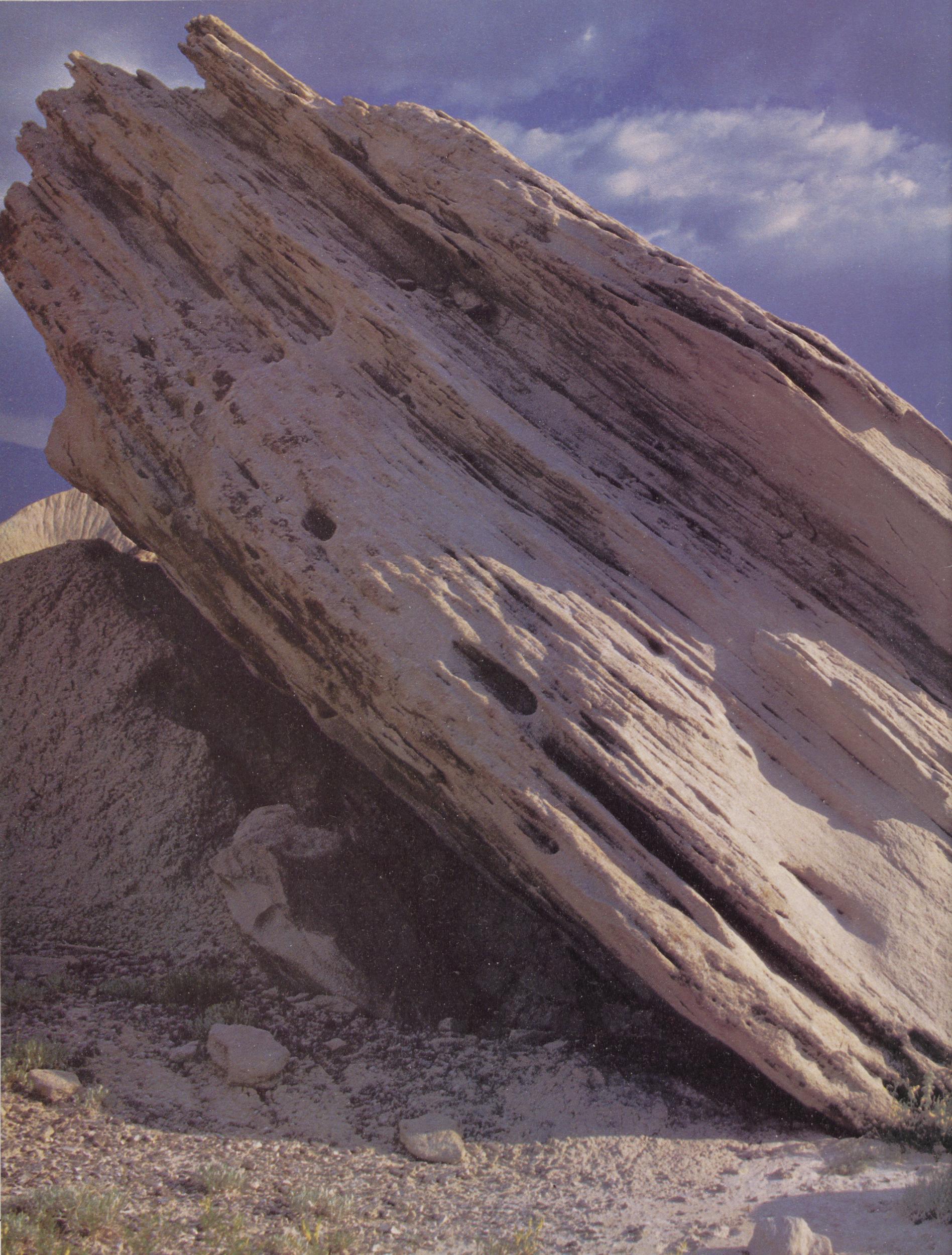
Position: 233 (33 views)