Volume 60, Issue 11, 1982
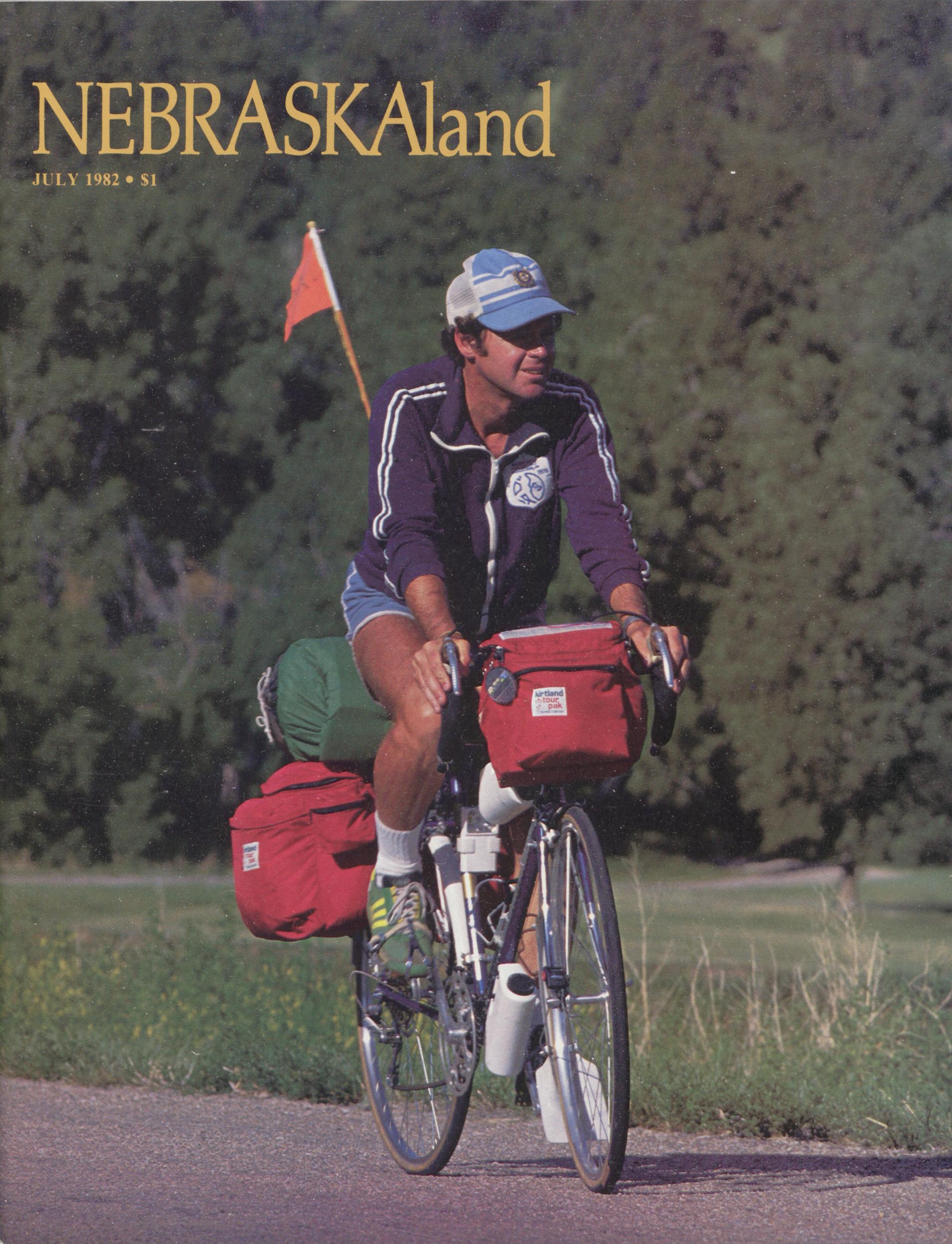
NEBRASKAland
July 1982 $1
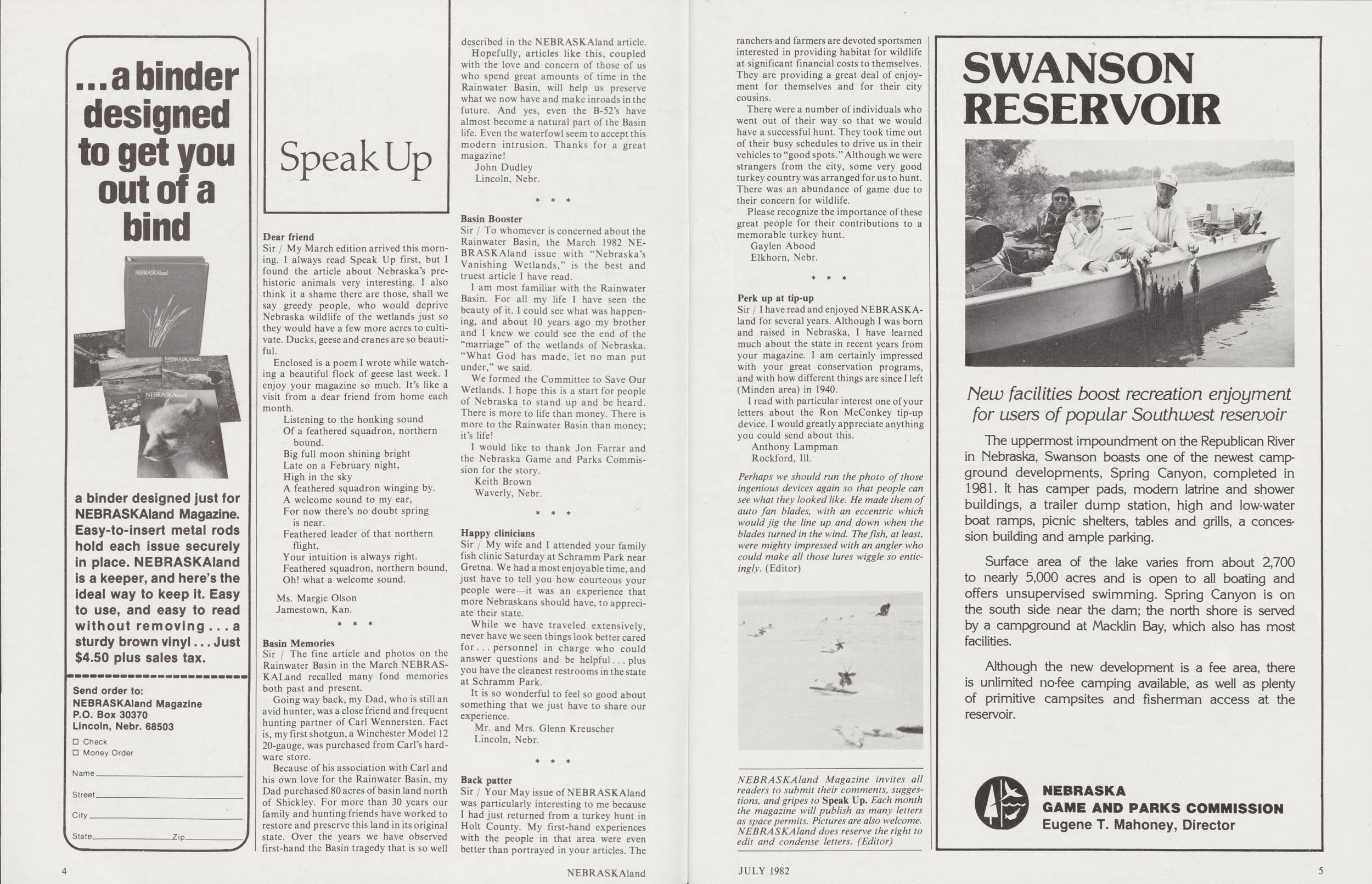
Speak Up
Dear friend Sir / My March edition arrived this morning. I always read Speak Up first, but I found the article about Nebraska's prehistoric animals very interesting. I also think it a shame there are those, shall we say greedy people, who would deprive Nebraska wildlife of the wetlands just so they would have a few more acres to cultivate. Ducks, geese and cranes are so beautiful. Enclosed is a poem I wrote while watching a beautiful flock of geese last week. I enjoy your magazine so much. It's like a visit from a dear friend from home each month. Listening to the honking sound Of a feathered squadron, northern bound. Big full moon shining bright Late on a February night, High in the sky A feathered squadron winging by. A welcome sound to my ear, For now there's no doubt spring is near. Feathered leader of that northern flight, Your intuition is always right. Feathered squadron, northern bound, Oh! what a welcome sound. Ms. Margie Olson Jamestown, Kan. Basin Memories Sir / The fine article and photos on the Rainwater Basin in the March NEBRASKALand recalled many fond memories both past and present. Going way back, my Dad, who is still an avid hunter, was a close friend and frequent hunting partner of Carl Wennersten. Fact is, my first shotgun, a Winchester Model 12 20-gauge, was purchased from Carl's hardware store. Because of his association with Carl and his own love for the Rainwater Basin, my Dad purchased 80 acres of basin land north of Shickley. For more than 30 years our family and hunting friends have worked to restore and preserve this land in its original state. Over the years we have observed first-hand the Basin tragedy that is so well described in the NEBRASKAIand article. Hopefully, articles like this, coupled with the love and concern of those of us who spend great amounts of time in the Rainwater Basin, will help us preserve what we now have and make inroads in the future. And yes, even the B-52's have almost become a natural part of the Basin life. Even the waterfowl seem to accept this modern intrusion. Thanks for a great magazine! John Dudley Lincoln, Nebr. Basin Booster Sir / To whomever is concerned about the Rainwater Basin, the March 1982 NEBRASKAland issue with "Nebraska's Vanishing Wetlands," is the best and truest article I have read. I am most familiar with the Rainwater Basin. For all my life I have seen the beauty of it. I could see what was happening, and about 10 years ago my brother and I knew we could see the end of the "marriage" of the wetlands of Nebraska. "What God has made, let no man put under," we said. We formed the Committee to Save Our Wetlands. I hope this is a start for people of Nebraska to stand up and be heard. There is more to life than money. There is more to the Rainwater Basin than money; it's life! I would like to thank Jon Farrar and the Nebraska Game and Parks Commission for the story. Keith Brown Waverly, Nebr. Happy clinicians Sir / My wife and I attended your family fish clinic Saturday at Schramm Park near Gretna. We had a most enjoyable time, and just have to tell you how courteous your people were—it was an experience that more Nebraskans should have, to appreciate their state. While we have traveled extensively, never have we seen things look better cared for . . . personnel in charge who could answer questions and be helpful. . . plus you have the cleanest restrooms in the state at Schramm Park. It is so wonderful to feel so good about something that we just have to share our experience. Mr. and Mrs. Glenn Kreuscher Lincoln, Nebr. Back patter Sir / Your May issue of NEBRASKAland was particularly interesting to me because I had just returned from a turkey hunt in Holt County. My first-hand experiences with the people in that area were even better than portrayed in your articles. The 4 NEBRASKAland ranchers and farmers are devoted sportsmen interested in providing habitat for wildlife at significant financial costs to themselves. They are providing a great deal of enjoyment for themselves and for their city cousins. There were a number of individuals who went out of their way so that we would have a successful hunt. They took time out of their busy schedules to drive us in their vehicles to "good spots." Although we were strangers from the city, some very good turkey country was arranged for us to hunt. There was an abundance of game due to their concern for wildlife. Please recognize the importance of these great people for their contributions to a memorable turkey hunt. Gaylen Abood Elkhorn, Nebr. Perk up at tip-up Sir / I have read and enjoyed NEBRASKAland for several years. Although I was born and raised in Nebraska, I have learned much about the state in recent years from your magazine. I am certainly impressed with your great conservation programs, and with how different things are since I left (Minden area) in 1940. I read with particular interest one of your letters about the Ron McConkey tip-up device. I would greatly appreciate anything you could send about this. Anthony Lampman Rockford, III. Perhaps we should run the photo of those ingenious devices again so that people can see what they looked like. He made them of auto fan blades, with an eccentric which would jig the line up and down when the blades turned in the wind. The fish, at least, were mighty impressed with an angler who could make all those lures wiggle so enticingly. (Editor)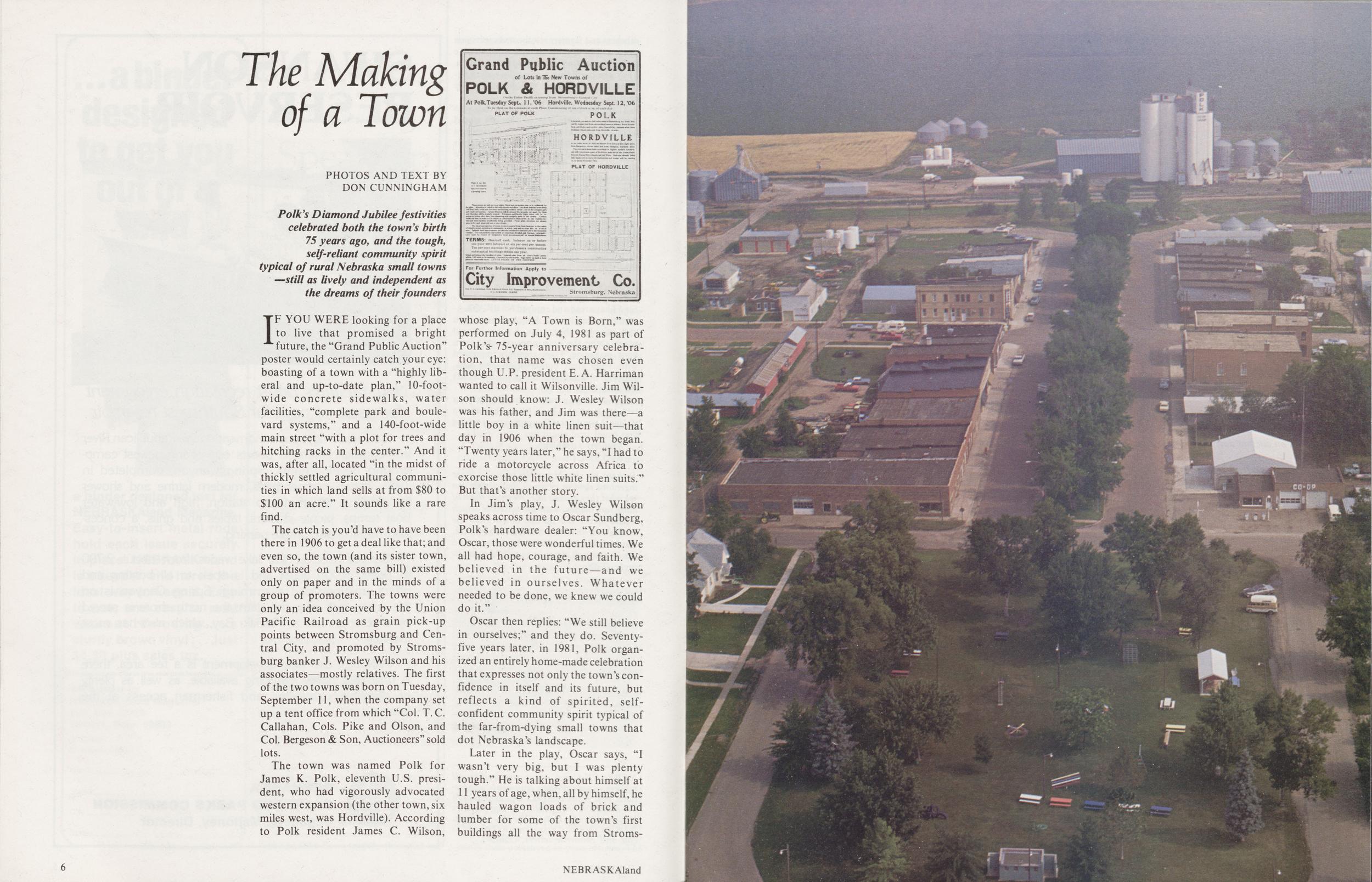
The Making of a Town
Polk's Diamond Jubilee festivities celebrated both the town's birth 75 years ago, and the tough, self-reliant community spirit typical of rural Nebraska small towns —still as lively and independent as the dreams of their founders
IF YOU WERE looking for a place to live that promised a bright future, the "Grand Public Auction" poster would certainly catch your eye: boasting of a town with a "highly liberal and up-to-date plan," 10-foot-wide concrete sidewalks, water facilities, "complete park and boulevard systems," and a 140-foot-wide main street "with a plot for trees and hitching racks in the center." And it was, after all, located "in the midst of thickly settled agricultural communities in which land sells at from $80 to $100 an acre." It sounds like a rare find.
The catch is you'd have to have been there in 1906 to get a deal like that; and even so, the town (and its sister town, advertised on the same bill) existed only on paper and in the minds of a group of promoters. The towns were only an idea conceived by the Union Pacific Railroad as grain pick-up points between Stromsburg and Central City, and promoted by Stromsburg banker J. Wesley Wilson and his associates—mostly relatives. The first of the two towns was born on Tuesday, September 11, when the company set up a tent office from which "Col. T. C. Callahan, Cols. Pike and Olson, and Col. Bergeson and Son, Auctioneers" sold lots.
The town was named Polk for James K. Polk, eleventh U.S. president, who had vigorously advocated western expansion (the other town, six miles west, was Hordville). According to Polk resident James C. Wilson, whose play, "A Town is Born," was performed on July 4, 1981 as part of Polk's- 75-year anniversary celebration, that name was chosen even though U.P. president E. A. Harriman wanted to call it Wilsonville. Jim Wilson should know: J. Wesley Wilson was his father, and Jim was there—a little boy in a white linen suit—that day in 1906 when the town began. "Twenty years later," he says, "I had to ride a motorcycle across Africa to exorcise those little white linen suits." But that's another story.
In Jim's play, J. Wesley Wilson speaks across time to Oscar Sundberg, Polk's hardware dealer: "You know, Oscar, those were wonderful times. We all had hope, courage, and faith. We believed in the future—and we believed in ourselves. Whatever needed to be done, we knew we could do it."
Oscar then replies: "We still believe in ourselves;" and they do. Seventy-five years later, in 1981, Polk organized an entirely home-made celebration that expresses not only the town's confidence in itself and its future, but reflects a kind of spirited, self-confident community spirit typical of the far-from-dying small towns that dot Nebraska's landscape.
Later in the play, Oscar says, "I wasn't very big, but I was plenty tough." He is talking about himself at 11 years of age, when, all by himself, he hauled wagon loads of brick and lumber for some of the town's first buildings all the way from Stromsburg.
6 NEBRASKAland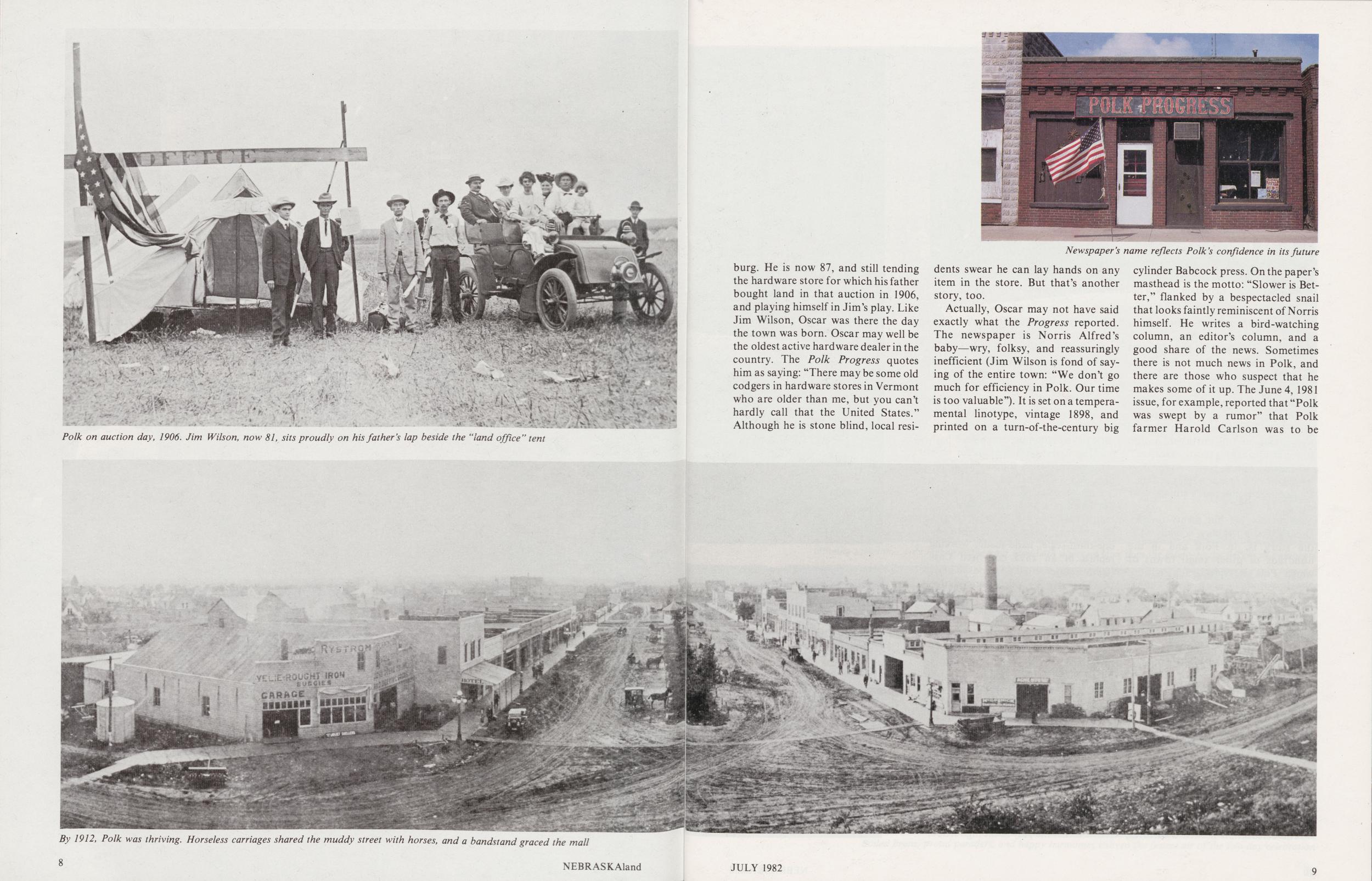
Polk on auction day, 1906. Jim Wilson, now 81, sits proudly on his father's lap beside the "land office" tent
By 1912, Polk was thriving. Horseless carriages shared the muddy street with horses, and a bandstand graced the mall
Newspaper's name reflects Polk's confidence in its future
He is now 87, and still tending the hardware store for which his father bought land in that auction in 1906, and playing himself in Jim's play. Like Jim Wilson, Oscar was there the day the town was born. Oscar may well be the oldest active hardware dealer in the country. The Polk Progress quotes him as saying: "There may be some old codgers in hardware stores in Vermont who are older than me, but you can't hardly call that the United States." Although he is stone blind, local residents swear he can lay hands on any item in the store. But that's another story, too.
Actually, Oscar may not have said exactly what the Progress reported. The newspaper is Norris Alfred's baby—wry, folksy, and reassuringly inefficient (Jim Wilson is fond of saying of the entire town: "We don't go much for efficiency in Polk. Our time is too valuable"). It is set on a temperamental linotype, vintage 1898, and printed on a turn-of-the-century big cylinder Babcock press. On the paper's masthead is the motto: "Slower is Better," flanked by a bespectacled snail that looks faintly reminiscent of Norris himself. He writes a bird-watching column, an editor's column, and a good share of the news. Sometimes there is not much news in Polk, and there are those who suspect that he makes some of it up. The June 4, 1981 issue, for example, reported that "Polk was swept by a rumor" that Polk farmer Harold Carlson was to be
JULY 1982 9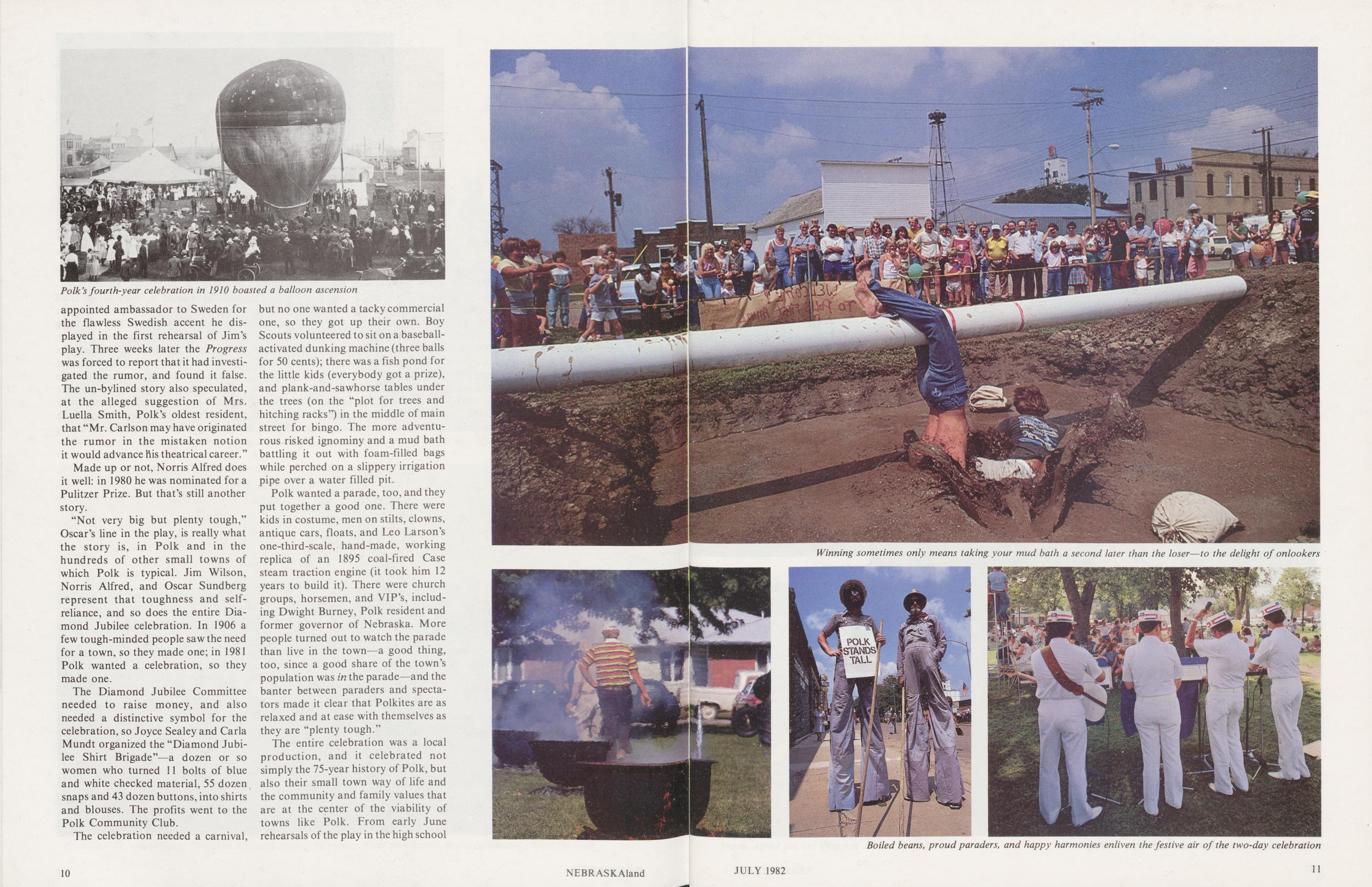
appointed ambassador to Sweden for the flawless Swedish accent he displayed in the first rehearsal of Jim's play. Three weeks later the Progress was forced to report that it had investigated the rumor, and found it false. The un-bylined story also speculated, at the alleged suggestion of Mrs. Luella Smith, Polk's oldest resident, that "Mr. Carlson may have originated the rumor in the mistaken notion it would advance his theatrical career."
Made up or not, Norris Alfred does it well: in 1980 he was nominated for a Pulitzer Prize. But that's still another story.
"Not very big but plenty tough," Oscar's line in the play, is really what the story is, in Polk and in the hundreds of other small towns of which Polk is typical. Jim Wilson, Norris Alfred, and Oscar Sundberg represent that toughness and self-reliance, and so does the entire Diamond Jubilee celebration. In 1906 a few tough-minded people saw the need for a town, so they made one; in 1981 Polk wanted a celebration, so they made one.
The Diamond Jubilee Committee needed to raise money, and also needed a distinctive symbol for the celebration, so Joyce Sealey and Carla Mundt organized the "Diamond Jubilee Shirt Brigade"—a dozen or so women who turned 11 bolts of blue and white checked material, 55 dozen snaps and 43 dozen buttons, into shirts and blouses. The profits went to the Polk Community Club.
The celebration needed a carnival, but no one wanted a tacky commercial one, so they got up their own. Boy Scouts volunteered to sit on a baseball-activated dunking machine (three balls for 50 cents); there was a fish pond for the little kids (everybody got a prize), and plank-and-sawhorse tables under the trees (on the "plot for trees and hitching racks") in the middle of main street for bingo. The more adventurous risked ignominy and a mud bath battling it out with foam-filled bags while perched on a slippery irrigation pipe over a water filled pit.
Polk wanted a parade, too, and they put together a good one. There were kids in costume, men on stilts, clowns, antique cars, floats, and Leo Larson's one-third-scale, hand-made, working replica of an 1895 coal-fired Case steam traction engine (it took him 12 years to build it). There were church groups, horsemen, and VIP's, including Dwight Burney, Polk resident and former governor of Nebraska. More people turned out to watch the parade than live in the town—a good thing, too, since a good share of the town's population was in the parade—and the banter between paraders and spectators made it clear that Polkites are as relaxed and at ease with themselves as they are "plenty tough."
The entire celebration was a local production, and it celebrated not simply the 75-year history of Polk, but also their small town way of life and the community and family values that are at the center of the viability of towns like Polk. From early June rehearsals of the play in the high school
10 NEBRASKAland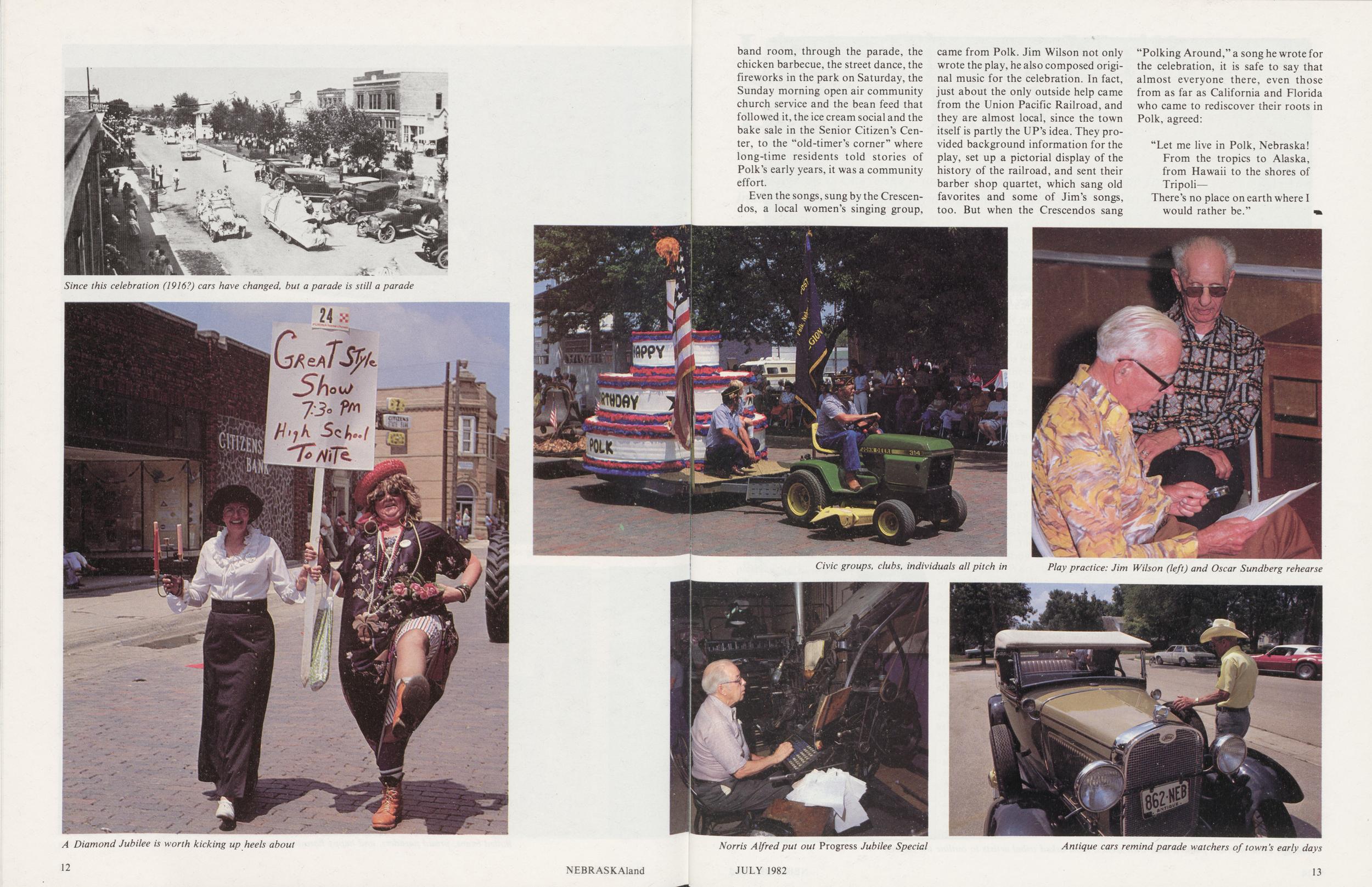
band room, through the parade, the chicken barbecue, the street dance, the fireworks in the park on Saturday, the Sunday morning open air community church service and the bean feed that followed it, the ice cream social and the bake sale in the Senior Citizen's Center, to the "old-timer's corner" where long-time residents told stories of Polk's early years, it was a community effort.
Even the songs, sung by the Crescendos, a local women's singing group, came from Polk. Jim Wilson not only wrote the play, he also composed original music for the celebration. In fact, just about the only outside help came from the Union Pacific Railroad, and they are almost local, since the town itself is partly the UP's idea. They provided background information for the play, set up a pictorial display of the history of the railroad, and sent their barber shop quartet, which sang old favorites and some of Jim's songs, too. But when the Crescendos sang "Polking Around," a song he wrote for the celebration, it is safe to say that almost everyone there, even those from as far as California and Florida who came to rediscover their roots in Polk, agreed:
"Let me live in Polk, Nebraska! From the tropics to Alaska, from Hawaii to the shores of Tripoli— There's no place on earth where I would rather be."
Little Finger Nail's Ledger Book
Drawings by a Cheyenne warrior recorded his tribe's escape from Indian Territory in Oklahoma and their battles returning to Nebraska
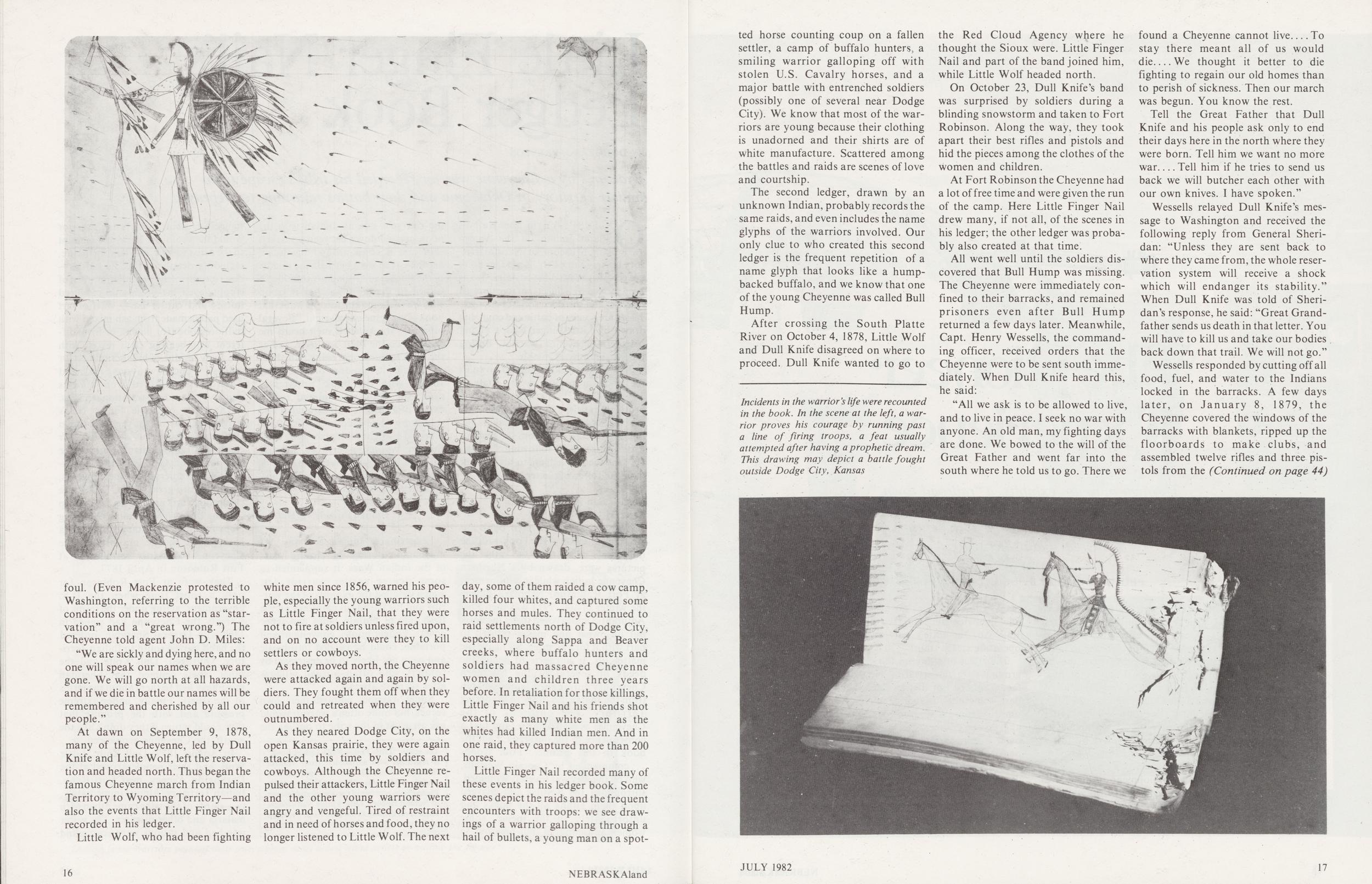
ON DISPLAY in the Hall of Plains Indians at the American Museum of Natural History in New York City, is a ledger book covered with faded bloodstains. It has been pierced by a. bullet that tore through its cover and shredded some of its pages. Inside are scenes of battle and courtship drawn by Little Finger Nail, a young Northern Cheyenne warrior, during the last months of his life.
This ledger was one of two given to the Museum in 1912 by the estate of Joseph Cuyler Hardie. Hardie's brother Francis, a cavalry officer during the Indian wars, had taken the bullet-pierced ledger from the body of Little Finger Nail following a battle. He sent the two ledgers to his brother with the following letter:
Post of San Antonio, Texas Sept. 21, 1889 Only the canvas covered book has any special history, the book with the bullet hole in it. It was, or rather the pictures were, drawn by a Northern Cheyenne Indian while in confinement at Fort Robinson, Nebraska during the winter of 78, 79. I was then Post Adjutant. I endeavored to get the book but its owner and maker refused to part with it for any price. So I gave the matter up. It purports to depict the deeds of several of the Northern Cheyennes during their famous march from the Indian Territory to Wyoming Territory. The outbreak of the Cheyennes is well known, and [as] a consequence of the outbreak, I got the book in this manner. Four troops ... commanded by Captain Wessells, who by the way was severely wounded, surrounded the hostiles and charged upon them killing all the bucks and unfortunately in the melee, some women and children, but previous to the charge I saw an Indian with the book pressed down between his naked skin and a strap around his waist; another strap went between the middle of the book and around his shoulder. I turned to Private Laselle of H troop who was near me and said, "I want that book if we come out all right." Several others of the enlisted men heard me also. When the fight was over, and as the dead Indians were being pulled out of the rifle pit, they drew out finally my Indian with the book, apparently dead; the book was injured to the extent of a carbine ball through it and was more or less covered with fresh blood. This fight took place near Bluff Station, Wyoming Territory, January 22, 1879. This fight was the closing one of a series of fights with the Indians, and they perished to a man. In haste, Frank [Francis H. Hardie]Ledger-book Indian art was not uncommon during the closing years of the Indian Wars. It supplanted to some degree earlier warrior art, which detailed the exploits of the warrior and his friends in paintings on the flesh side of buffalo hides and tepee covers. Ledger books, convenient and portable, could be carried into battle and were not likely to be destroyed by soldiers who often burned villages after surprise attacks.
Some warriors painted their own scenes, but more often a warrior would ask an artist in the tribe to outline the figures in paint, which the warrior would then color in. He would recount to the artist various incidents in his life, including details of specific battles—descriptions of horses, the number of troops, even the brands on captured horses and cattle. Early warrior art used paints made from ash mixed with buffalo blood (for black), or from different iron-bearing clays mixed with the gluey residue of hide scrapings (for colors). Pencils, crayons, ink, and watercolors obtained from traders quickly replaced the traditional paints.
The article "Little Finger Nail's Ledger Book" is reprinted with permission from Natural History, Volume 89, No. 10, Copyright The American Museum of Natural History, 1980. Photographs courtesy of the American Museum of Natural History. Little Finger Nail's ledger book is on display at the American Museum of Natural History, New York, New York.The story of Little Finger Nail's ledger begins with the Northern Cheyenne's disastrous defeat at their camp on Crazy Woman's Fork on the Powder River. Gen. Ranald Mackenzie and his soldiers drove the survivors, including two great chiefs, Dull Knife (Morning Star) and Little Wolf, deep into the Bighorn Mountains. Suffering from frostbite and starvation after a bad winter in the mountains, the Cheyenne voluntarily surrendered at Fort Robinson in April 1877.
They were at Fort Robinson for only a short time when the U.S. government, acting under the terms of a treaty the Cheyenne had signed in 1868 with General Sheridan, ordered the band moved south to Indian Territory. Outraged, Dull Knife and the other chiefs claimed that Sheridan must have lied to them about the terms of the treaty. Finally, under extreme pressure and with the promise that they could return if they didn't like the south, the Cheyenne acquiesced.
In August 1877, Dull Knife, Little
Wolf, and their people arrived at the
Darlington Agency, near Fort Reno,
Indian Territory. Almost immediately,
two-thirds of the tribe came down with
malaria and other diseases. The water
was bad and rations were scarce and
JULY 1982 15
 foul. (Even Mackenzie protested to
Washington, referring to the terrible
conditions on the reservation as "starvation" and a "great wrong.") The
Cheyenne told agent John D. Miles:
foul. (Even Mackenzie protested to
Washington, referring to the terrible
conditions on the reservation as "starvation" and a "great wrong.") The
Cheyenne told agent John D. Miles:
"We are sickly and dying here, and no one will speak our names when we are gone. We will go north at all hazards, and if we die in battle our names will be remembered and cherished by all our people."
At dawn on September 9, 1878, many of the Cheyenne, led by Dull Knife and Little Wolf, left the reservation and headed north. Thus began the famous Cheyenne march from Indian Territory to Wyoming Territory—and also the events that Little Finger Nail recorded in his ledger.
Little Wolf, who had been fighting white men since 1856, warned his people, especially the young warriors such as Little Finger Nail, that they were not to fire at soldiers unless fired upon, and on no account were they to kill settlers or cowboys.
As they moved north, the Cheyenne were attacked again and again by soldiers. They fought them off when they could and retreated when they were outnumbered.
As they neared Dodge City, on the open Kansas prairie, they were again attacked, this time by soldiers and cowboys. Although the Cheyenne repulsed their attackers, Little Finger Nail and the other young warriors were angry and vengeful. Tired of restraint and in need of horses and food, they no longer listened to Little Wolf. The next day, some of them raided a cow camp, killed four whites, and captured some horses and mules. They continued to raid settlements north of Dodge City, especially along Sappa and Beaver creeks, where buffalo hunters and soldiers had massacred Cheyenne women and children three years before. In retaliation for those killings, Little Finger Nail and his friends shot exactly as many white men as the whites had killed Indian men. And in one raid, they captured more than 200 horses.
Little Finger Nail recorded many of these events in his ledger book. Some scenes depict the raids and the frequent encounters with troops: we see drawings of a warrior galloping through a hail of bullets, a young man on a spotted 16 NEBRASKAland horse counting coup on a fallen settler, a camp of buffalo hunters, a smiling warrior galloping off with stolen U.S. Cavalry horses, and a major battle with entrenched soldiers (possibly one of several near Dodge City). We know that most of the warriors are young because their clothing is unadorned and their shirts are of white manufacture. Scattered among the battles and raids are scenes of love and courtship.
The second ledger, drawn by an unknown Indian, probably records the same raids, and even includes the name glyphs of the warriors involved. Our only clue to who created this second ledger is the frequent repetition of a name glyph that looks like a humpbacked buffalo, and we know that one of the young Cheyenne was called Bull Hump.
After crossing the South Platte River on October 4, 1878, Little Wolf and Dull Knife disagreed on where to proceed. Dull Knife wanted to go to
Incidents in the warrior's life were recounted in the book. In the scene at the left, a warrior proves his courage by running past a line of firing troops, a feat usually attempted after having a prophetic dream. This drawing may depict a battle fought outside Dodge City, Kansas
the Red Cloud Agency where he thought the Sioux were. Little Finger Nail and part of the band joined him, while Little Wolf headed north.
On October 23, Dull Knife's band was surprised by soldiers during a blinding snowstorm and taken to Fort Robinson. Along the way, they took apart their best rifles and pistols and hid the pieces among the clothes of the women and children.
At Fort Robinson the Cheyenne had a lot of free time and were given the run of the camp. Here Little Finger Nail drew many, if not all, of the scenes in his ledger; the other ledger was probably also created at that time.
All went well until the soldiers discovered that Bull Hump was missing. The Cheyenne were immediately confined to their barracks, and remained prisoners even after Bull Hump returned a few days later. Meanwhile, Capt. Henry Wessells, the commanding officer, received orders that the Cheyenne were to be sent south immediately. When Dull Knife heard this, he said:
"All we ask is to be allowed to live, and to live in peace. I seek no war with anyone. An old man, my fighting days are done. We bowed to the will of the Great Father and went far into the south where he told us to go. There we found a Cheyenne cannot live....To stay there meant all of us would die....We thought it better to die fighting to regain our old homes than to perish of sickness. Then our march was begun. You know the rest.
Tell the Great Father that Dull Knife and his people ask only to end their days here in the north where they were born. Tell him we want no more war.... Tell him if he tries to send us back we will butcher each other with our own knives. I have spoken."
Wessells relayed Dull Knife's message to Washington and received the following reply from General Sheridan: "Unless they are sent back to where they came from, the whole reservation system will receive a shock which will endanger its stability." When Dull Knife was told of Sheridan's response, he said: "Great Grandfather sends us death in that letter. You will have to kill us and take our bodies back down that trail. We will not go."
Wessells responded by cutting off all food, fuel, and water to the Indians locked in the barracks. A few days later, on January 8, 1879, the Cheyenne covered the windows of the barracks with blankets, ripped up the floorboards to make clubs, and assembled twelve rifles and three pistols from the (Continued on page 44)
The Pioneer Experience
Through museum exhibits, a ''railroad town," and special activities, Grand Island's Stuhr Museum preserves and displays the 19th century Great Plains heritage
AMONG ALL OF Nebraska's nearly five million acres, few can more effectively introduce a visitor or a native Nebraskan to the state's pioneer heritage than the 200 acres of prairie grassland at the junction of Highways 34 and 281 south of Grand Island that comprise the Stuhr Museum of the Prairie Pioneer. There, after an introductory tour of the imposing main museum building, where carefully organized displays introduce modern visitors to the history and development of the Great Plains, one can stroll through a 60-building, turn-of-the-century railroad town, an eight-structure log cabin farm, an antique auto and farm machinery collection, an arboretum, and then ride the Nebraska Midland Railroad, the state's only authentic, operating steam train.
The effect of a day on the museum grounds is a far cry from either the fact-crammed but lifeless view of the past sometimes presented by museums, or from the sensory barrage and aggressive cuteness of amusement park historical recreations. Instead, one leaves this museum with a new appreciation for those who preceded us on the "Great American Desert," a new knowledge of the hardships they faced, and the ways they overcame those hardships. And most of all, one leaves with a sense of that life itself—
18 NEBRASKAland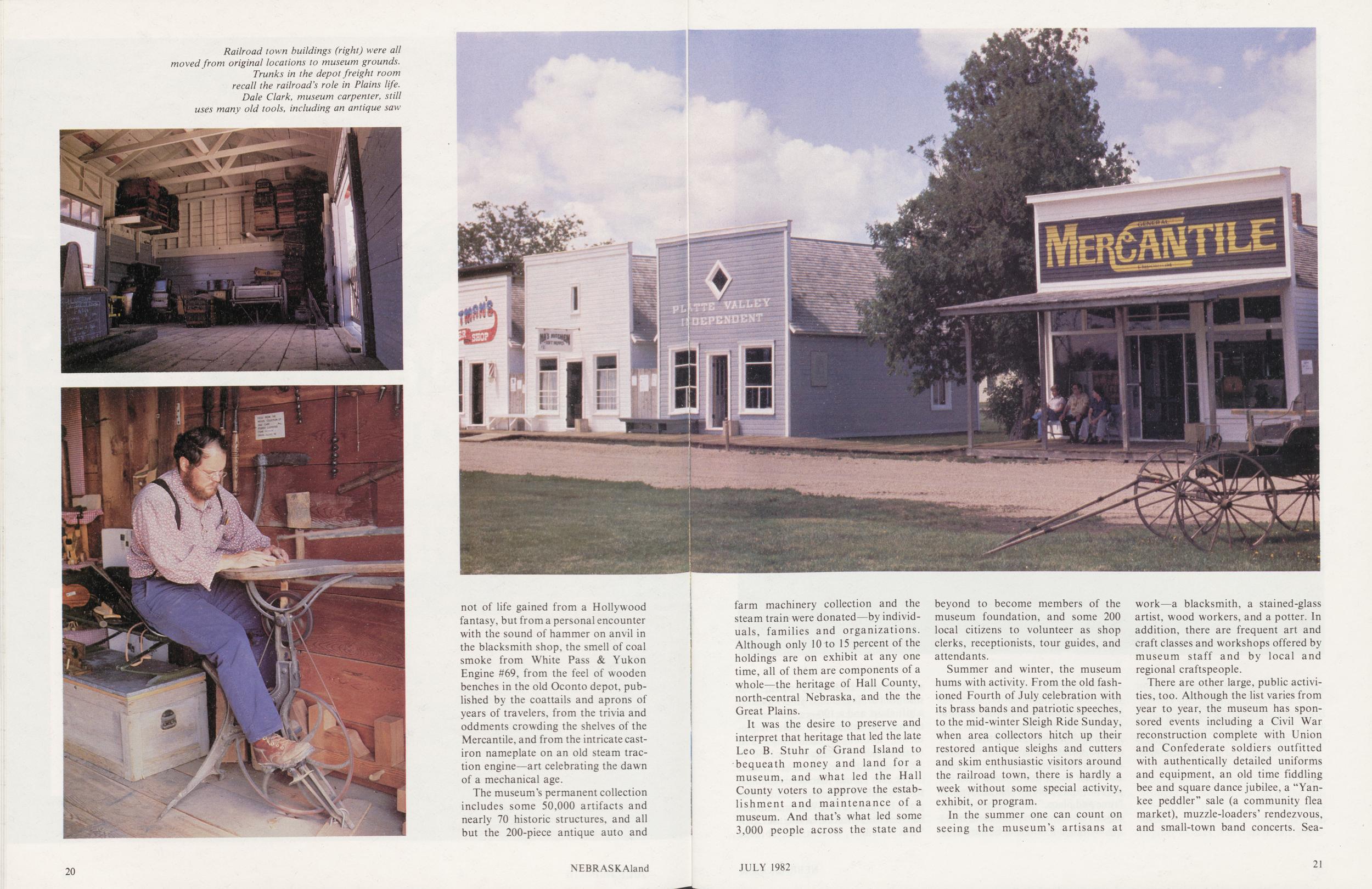
not of life gained from a Hollywood fantasy, but from a personal encounter with the sound of hammer on anvil in the blacksmith shop, the smell of coal smoke from White Pass and Yukon Engine #69, from the feel of wooden benches in the old Oconto depot, published by the coattails and aprons of years of travelers, from the trivia and oddments crowding the shelves of the Mercantile, and from the intricate cast-iron nameplate on an old steam traction engine—art celebrating the dawn of a mechanical age.
The museum's permanent collection includes some 50,000 artifacts and nearly 70 historic structures, and all but the 200-piece antique auto and farm machinery collection and the steam train were donated—by individuals, families and organizations. Although only 10 to 15 percent of the holdings are on exhibit at any one time, all of them are components of a whole—the heritage of Hall County, north-central Nebraska, and the the Great Plains.
20 NEBRASKAlandIt was the desire to preserve and interpret that heritage that led the late Leo B. Stuhr of Grand Island to bequeath money and land for a museum, and what led the Hall County voters to approve the establishment and maintenance of a museum. And that's what led some 3,000 people across the state and beyond to become members of the museum foundation, and some 200 local citizens to volunteer as shop clerks, receptionists, tour guides, and attendants.
Summer and winter, the museum hums with activity. From the old fashioned Fourth of July celebration with its brass bands and patriotic speeches, to the mid-winter Sleigh Ride Sunday, when area collectors hitch up their restored antique sleighs and cutters and skim enthusiastic visitors around the railroad town, there is hardly a week without some special activity, exhibit, or program.
In the summer one can count on seeing the museum's artisans at work—a blacksmith, a stained-glass artist, wood workers, and a potter. In addition, there are frequent art and craft classes and workshops offered by museum staff and by local and regional craftspeople.
There are other large, public activities, too. Although the list varies from
year to year, the museum has sponsored events including a Civil War
reconstruction complete with Union
and Confederate soldiers outfitted
with authentically detailed uniforms
and equipment, an old time fiddling
bee and square dance jubilee, a "Yankee peddler" sale (a community flea
market), muzzle-loaders' rendezvous,
and small-town band concerts. Seasonally,
JULY 1982 21
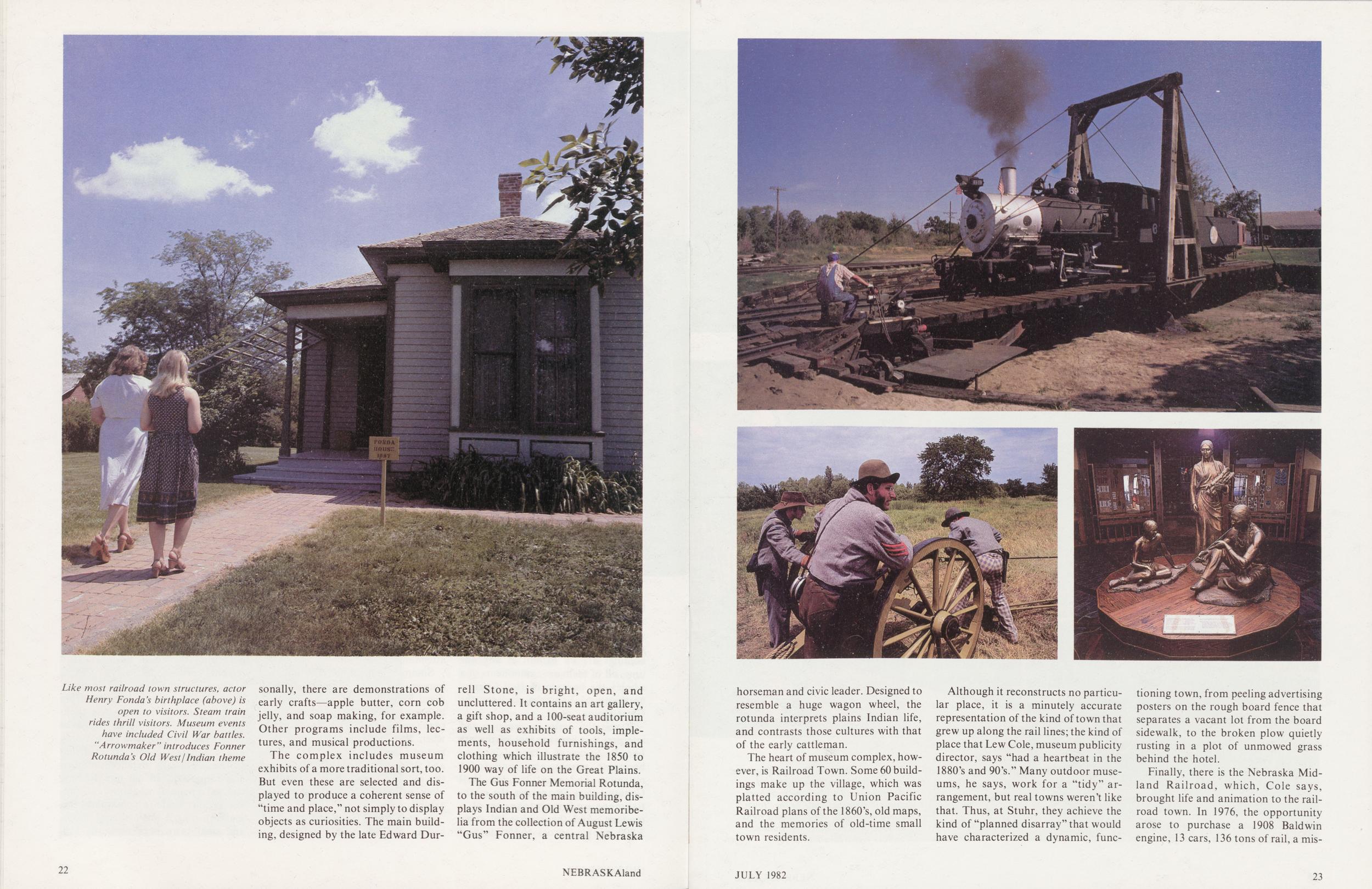
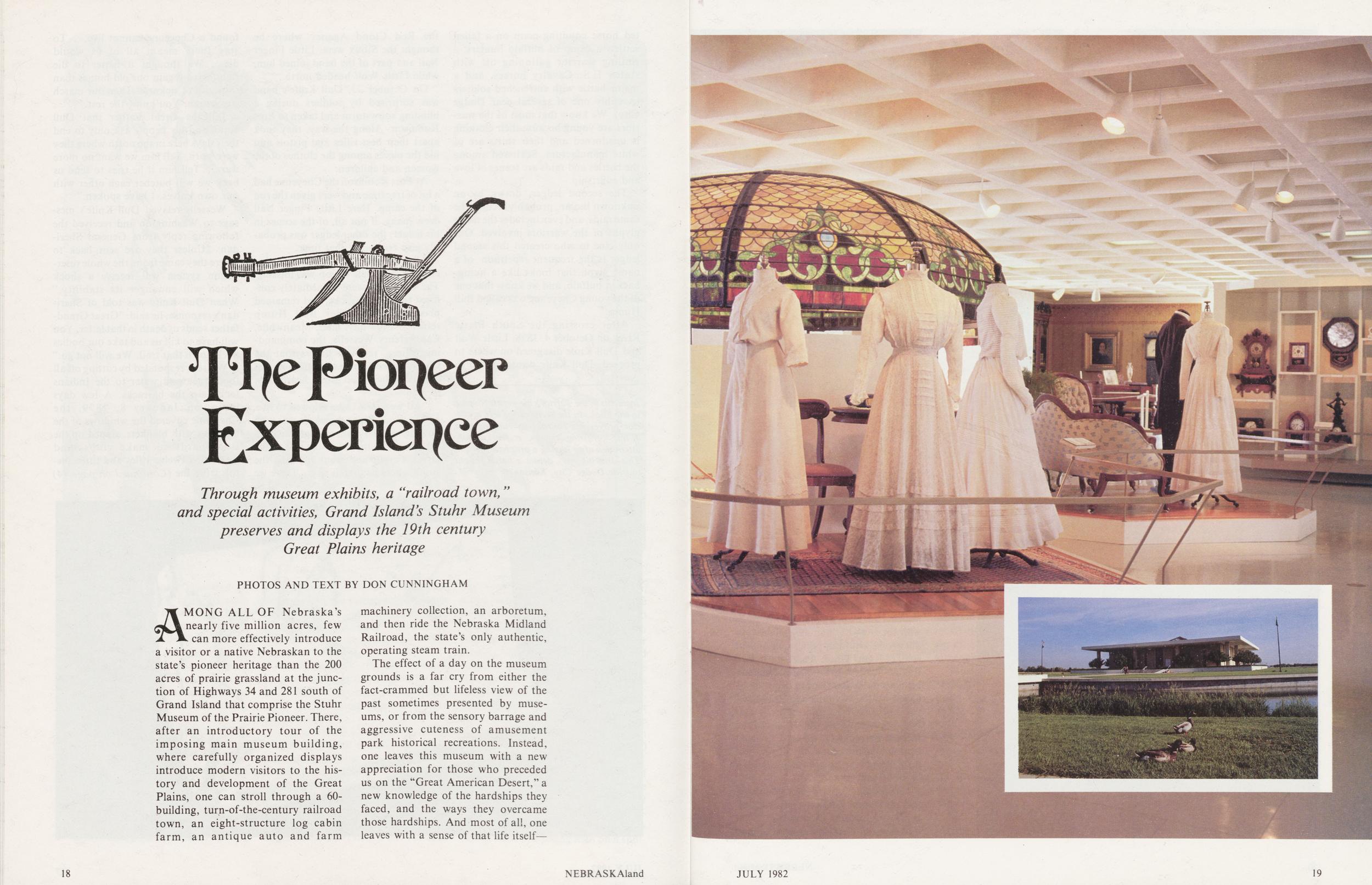
The complex includes museum exhibits of a more traditional sort, too. But even these are selected and displayed to produce a coherent sense of "time and place," not simply to display objects as curiosities. The main building, designed by the late Edward Durrell Stone, is bright, open, and uncluttered. It contains an art gallery, a gift shop, and a 100-seat auditorium as well as exhibits of tools, implements, household furnishings, and clothing which illustrate the 1850 to 1900 way of life on the Great Plains.
The Gus Fonner Memorial Rotunda, to the south of the main building, displays Indian and Old West memoribelia from the collection of August Lewis "Gus" Fonner, a central Nebraska horseman and civic leader. Designed to resemble a huge wagon wheel, the rotunda interprets plains Indian life, and contrasts those cultures with that of the early cattleman.
22 NEBRASKAlandThe heart of museum complex, however, is Railroad Town. Some 60 buildings make up the village, which was platted according to Union Pacific Railroad plans of the 1860's, old maps, and the memories of old-time small town residents.
Although it reconstructs no particular place, it is a minutely accurate representation of the kind of town that grew up along the rail lines; the kind of place that Lew Cole, museum publicity director, says "had a heartbeat in the 1880's and 90's." Many outdoor museums, he says, work for a "tidy" arrangement, but real towns weren't like that. Thus, at Stuhr, they achieve the kind of "planned disarray" that would have characterized a dynamic, functioning town, from peeling advertising posters on the rough board fence that separates a vacant lot from the board sidewalk, to the broken plow quietly rusting in a plot of unmowed grass behind the hotel.
Finally, there is the Nebraska Midland Railroad, which, Cole says, brought life and animation to the railroad town. In 1976, the opportunity arose to purchase a 1908 Baldwin engine, 13 cars, 136 tons of rail, a miscellaneous collection of ties, switches, spikes, and joint bars, and one redwood water tower. The appraised value of the collection at the time was $187,000, far more than the museum could afford. But the owner, James Conley of North Platte, realized that his tax position made it advantageous for him to sell the railroad to Stuhr for $50,000, with the balance designated a gift to the museum. After some negotiation, the museum board authorized the purchase if the money could be raised by subscription, and if no tax funds were expended in the project.
JULY 1982 23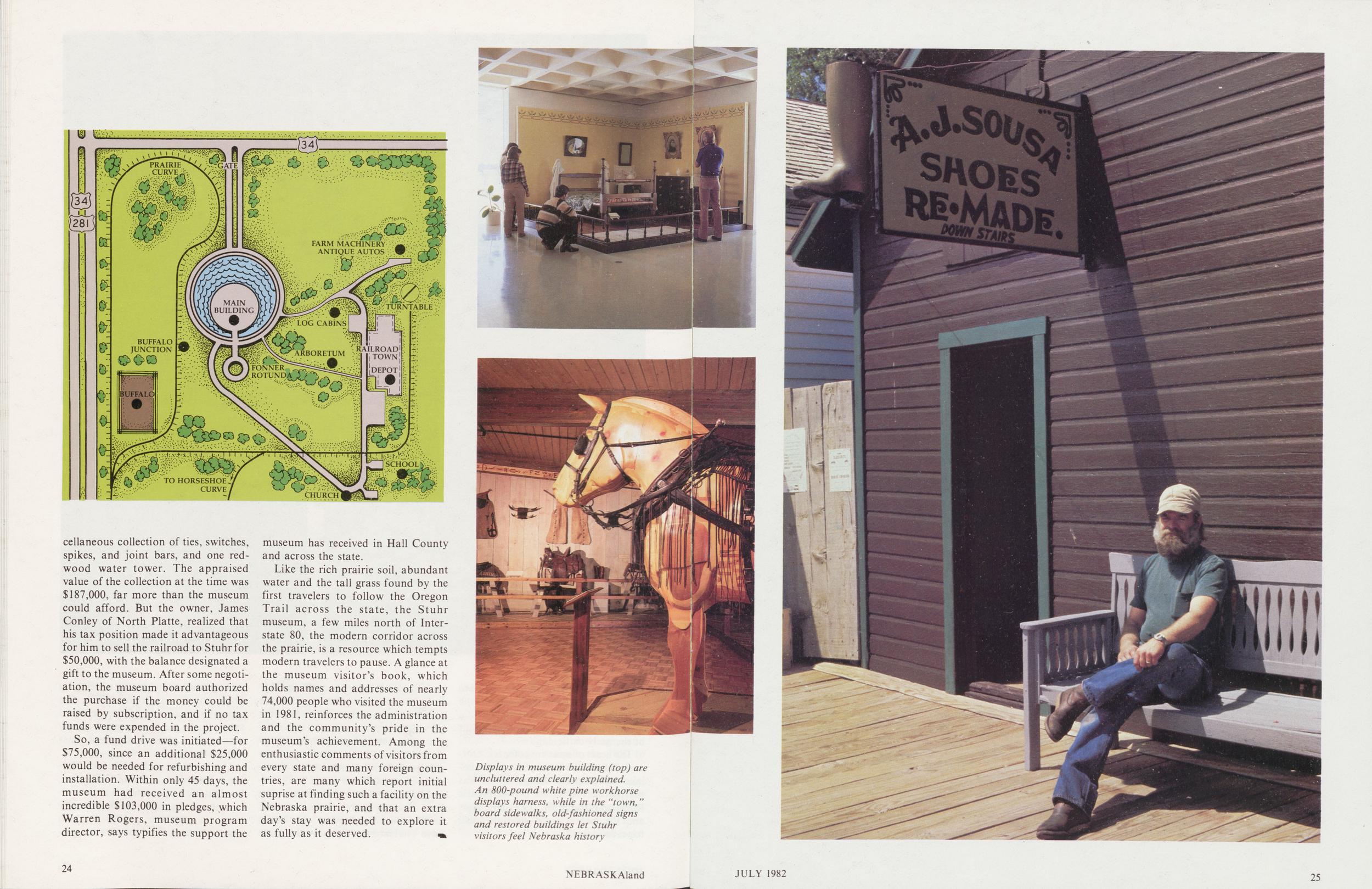
So, a fund drive was initiated—for $75,000, since an additional $25,000 would be needed for refurbishing and installation. Within only 45 days, the museum had received an almost incredible $103,000 in pledges, which Warren Rogers, museum program director, says typifies the support the museum has received in Hall County and across the state.
Like the rich prairie soil, abundant water and the tali grass found by the first travelers to follow the Oregon Trail across the state, the Stuhr museum, a few miles north of Interstate 80, the modern corridor across the prairie, is a resource which tempts modern travelers to pause. A glance at the museum visitor's book, which holds names and addresses of nearly 74,000 people who visited the museum in 1981, reinforces the administration and the community's pride in the museum's achievement. Among the enthusiastic comments of visitors from every state and many foreign countries, are many which report initial suprise at finding such a facility on the Nebraska prairie, and that an extra day's stay was needed to explore it as fully as it deserved.
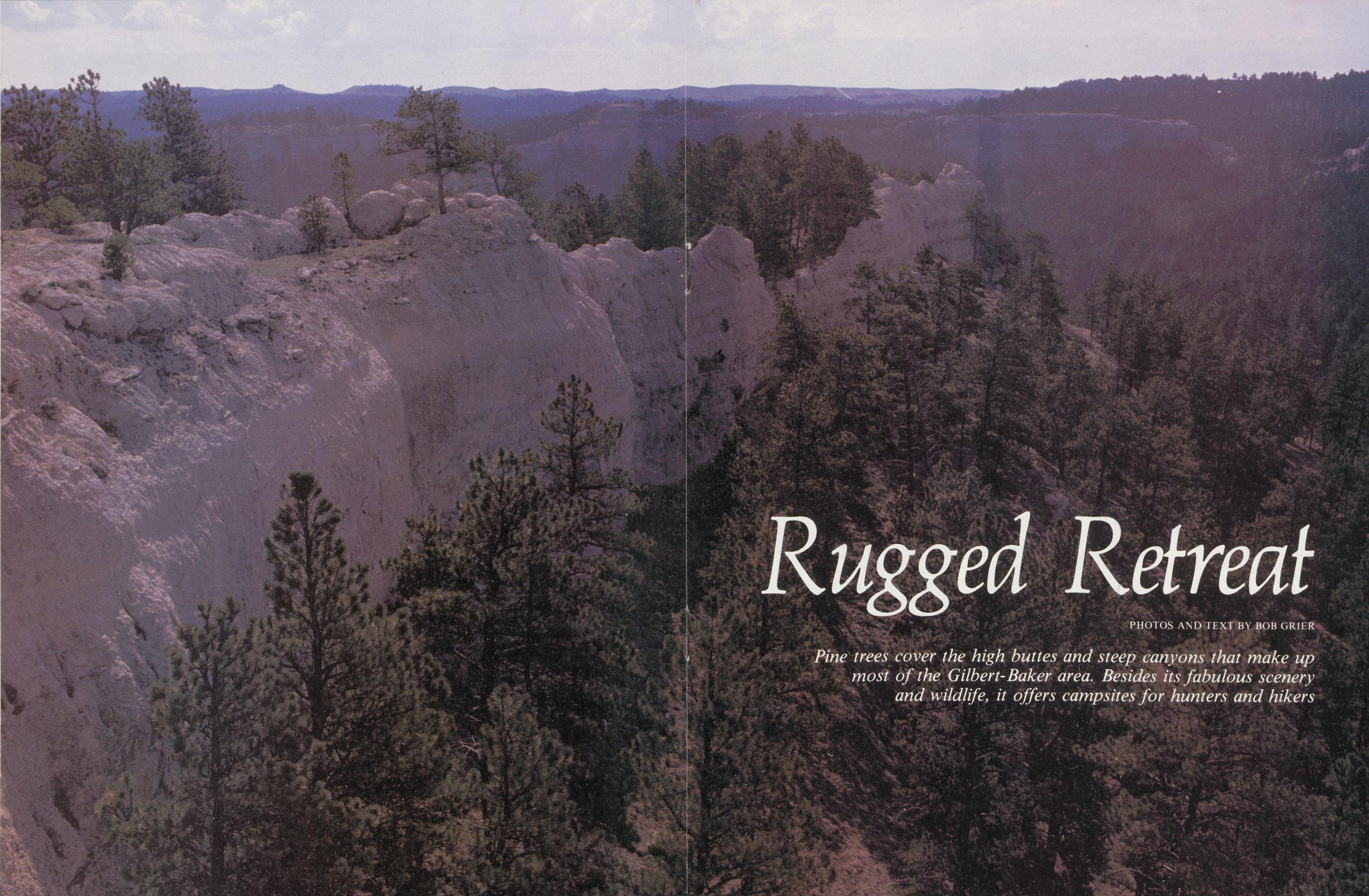
Rugged Retreat
Pine trees cover the high buttes and steep canyons that make up most of the Gilbert-Baker area. Besides its fabulous scenery and wildlife, it offers campsites for hunters and hikers
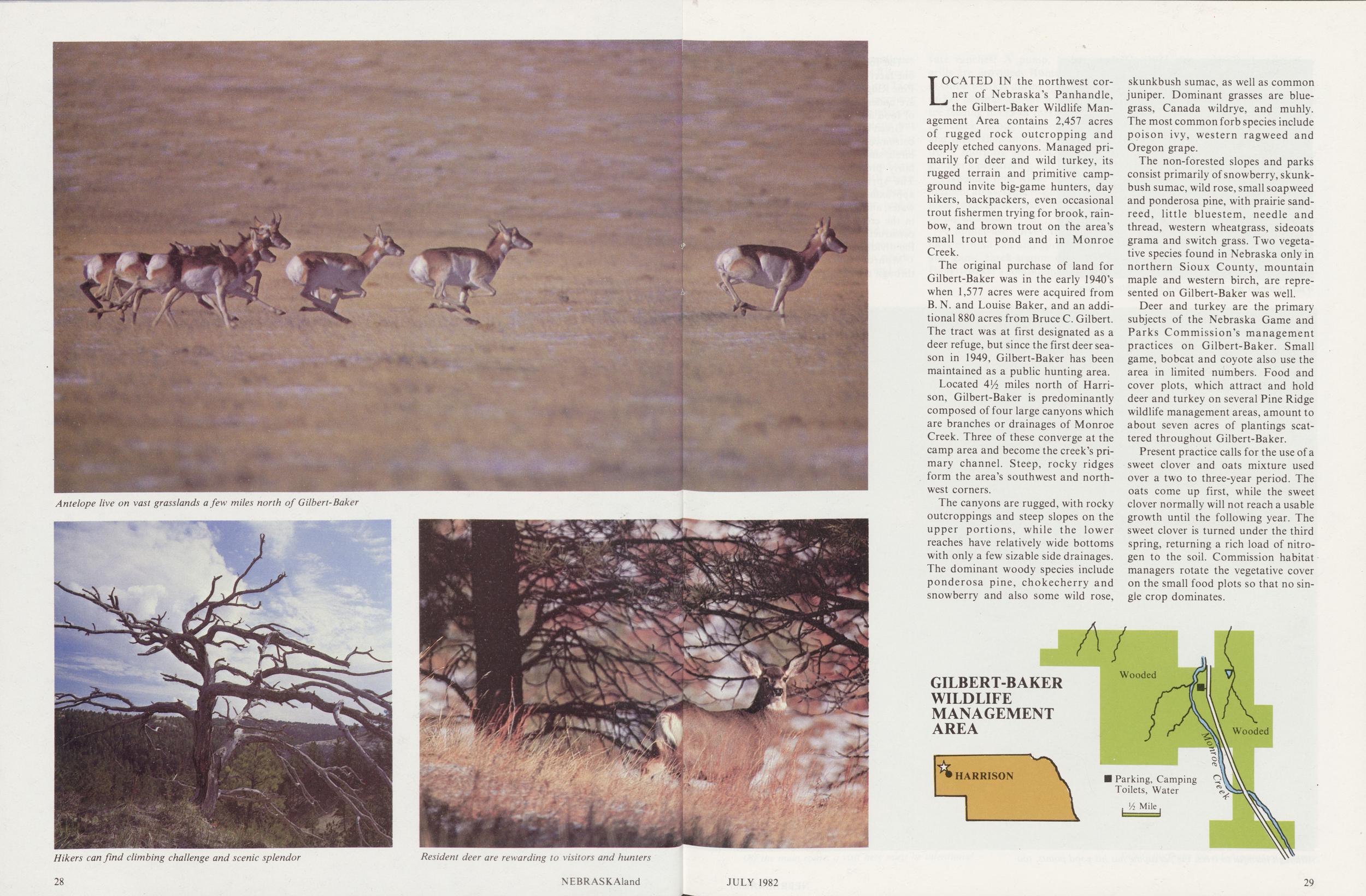
LOCATED IN the northwest corner of Nebraska's Panhandle, the Gilbert-Baker Wildlife Management Area contains 2,457 acres of rugged rock outcropping and deeply etched canyons. Managed primarily for deer and wild turkey, its rugged terrain and primitive campground invite big-game hunters, day hikers, backpackers, even occasional trout fishermen trying for brook, rainbow, and brown trout on the area's small trout pond and in Monroe Creek.
The original purchase of land for Gilbert-Baker was in the early 1940's when 1,577 acres were acquired from B. N. and Louise Baker, and an additional 880 acres from Bruce C. Gilbert. The tract was at first designated as a deer refuge, but since the first deer season in 1949, Gilbert-Baker has been maintained as a public hunting area.
Located 4!^ miles north of Harrison, Gilbert-Baker is predominantly composed of four large canyons which are branches or drainages of Monroe Creek. Three of these converge at the camp area and become the creek's primary channel. Steep, rocky ridges form the area's southwest and northwest corners.
The canyons are rugged, with rocky outcroppings and steep slopes on the upper portions, while the lower reaches have relatively wide bottoms with only a few sizable side drainages. The dominant woody species include ponderosa pine, chokecherry and snowberry and also some wild rose, skunkbush sumac, as well as common juniper. Dominant grasses are bluegrass, Canada wildrye, and muhly. The most common forb species include poison ivy, western ragweed and Oregon grape.
The non-forested slopes and parks consist primarily of snowberry, skunkbush sumac, wild rose, small soapweed and ponderosa pine, with prairie sandreed, little bluestem, needle and thread, western wheatgrass, sideoats grama and switch grass. Two vegetative species found in Nebraska only in northern Sioux County, mountain maple and western birch, are represented on Gilbert-Baker was well.
Deer and turkey are the primary subjects of the Nebraska Game and Parks Commission's management practices on Gilbert-Baker. Small game, bobcat and coyote also use the area in limited numbers. Food and cover plots, which attract and hold deer and turkey on several Pine Ridge wildlife management areas, amount to about seven acres of plantings scattered throughout Gilbert-Baker.
Present practice calls for the use of a sweet clover and oats mixture used over a two to three-year period. The oats come up first, while the sweet clover normally will not reach a usable growth until the following year. The sweet clover is turned under the third spring, returning a rich load of nitrogen to the soil. Commission habitat managers rotate the vegetative cover on the small food plots so that no single crop dominates.
JULY 1982 29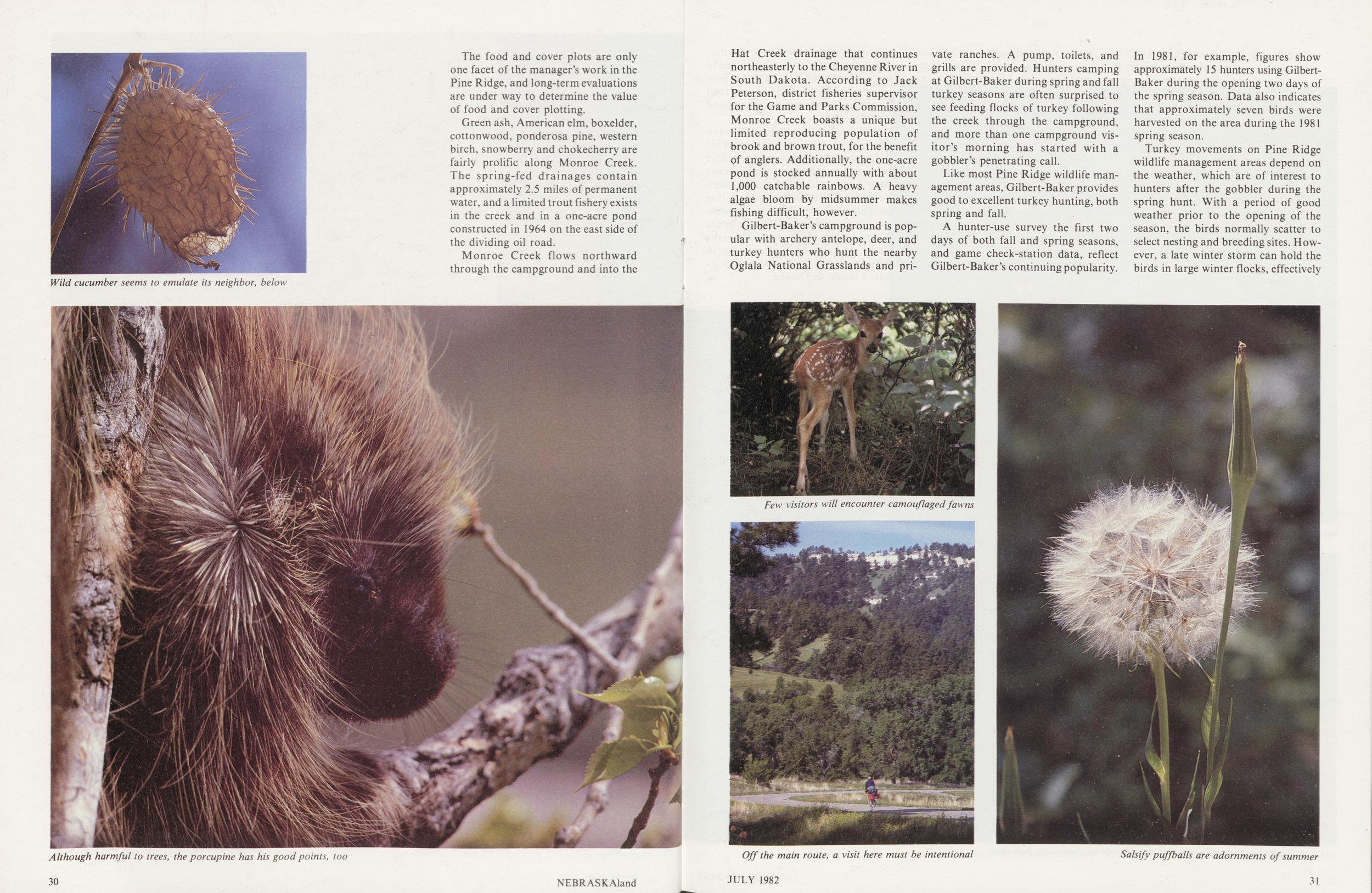
The food and cover plots are only one facet of the manager's work in the Pine Ridge, and long-term evaluations are under way to determine the value of food and cover plotting.
Green ash, American elm, boxelder, cottonwood, ponderosa pine, western birch, snowberry and chokecherry are fairly prolific along Monroe Creek. The spring-fed drainages contain approximately 2.5 miles of permanent water, and a limited trout fishery exists in the creek and in a one-acre pond constructed in 1964 on the east side of the dividing oil road.
Monroe Creek flows northward through the campground and into the 30 NEBRASKAland Hat Creek drainage that continues northeasterly to the Cheyenne River in South Dakota. According to Jack Peterson, district fisheries supervisor for the Game and Parks Commission, Monroe Creek boasts a unique but limited reproducing population of brook and brown trout, for the benefit of anglers. Additionally, the one-acre pond is stocked annually with about 1,000 catchable rainbows. A heavy algae bloom by midsummer makes fishing difficult, however.
Gilbert-Baker's campground is popular with archery antelope, deer, and turkey hunters who hunt the nearby Oglala National Grasslands and private ranches. A pump, toilets, and grills are provided. Hunters camping at Gilbert-Baker during spring and fall turkey seasons are often surprised to see feeding flocks of turkey following the creek through the campground, and more than one campground visitor's morning has started with a gobbler's penetrating call.
Like most Pine Ridge wildlife management areas, Gilbert-Baker provides good to excellent turkey hunting, both spring and fall.
A hunter-use survey the first two days of both fall and spring seasons, and game check-station data, reflect Gilbert-Baker's continuing popularity. In 1981, for example, figures show approximately 15 hunters using Gilbert-Baker during the opening two days of the spring season. Data also indicates that approximately seven birds were harvested on the area during the 1981 spring season.
Turkey movements on Pine Ridge wildlife management areas depend on the weather, which are of interest to hunters after the gobbler during the spring hunt. With a period of good weather prior to the opening of the season, the birds normally scatter to select nesting and breeding sites. However, a late winter storm can hold the birds in large winter flocks, effectively reducing hunting success. As is the case throughout the Pine Ridge, the larger flocks often remain on private land, usually tied to creekbottoms and nearby agricultural and cattle-feeding operations during late winter. When spring arrives, the birds scatter, and roving bands of gobblers are sometimes seen miles from tree cover.
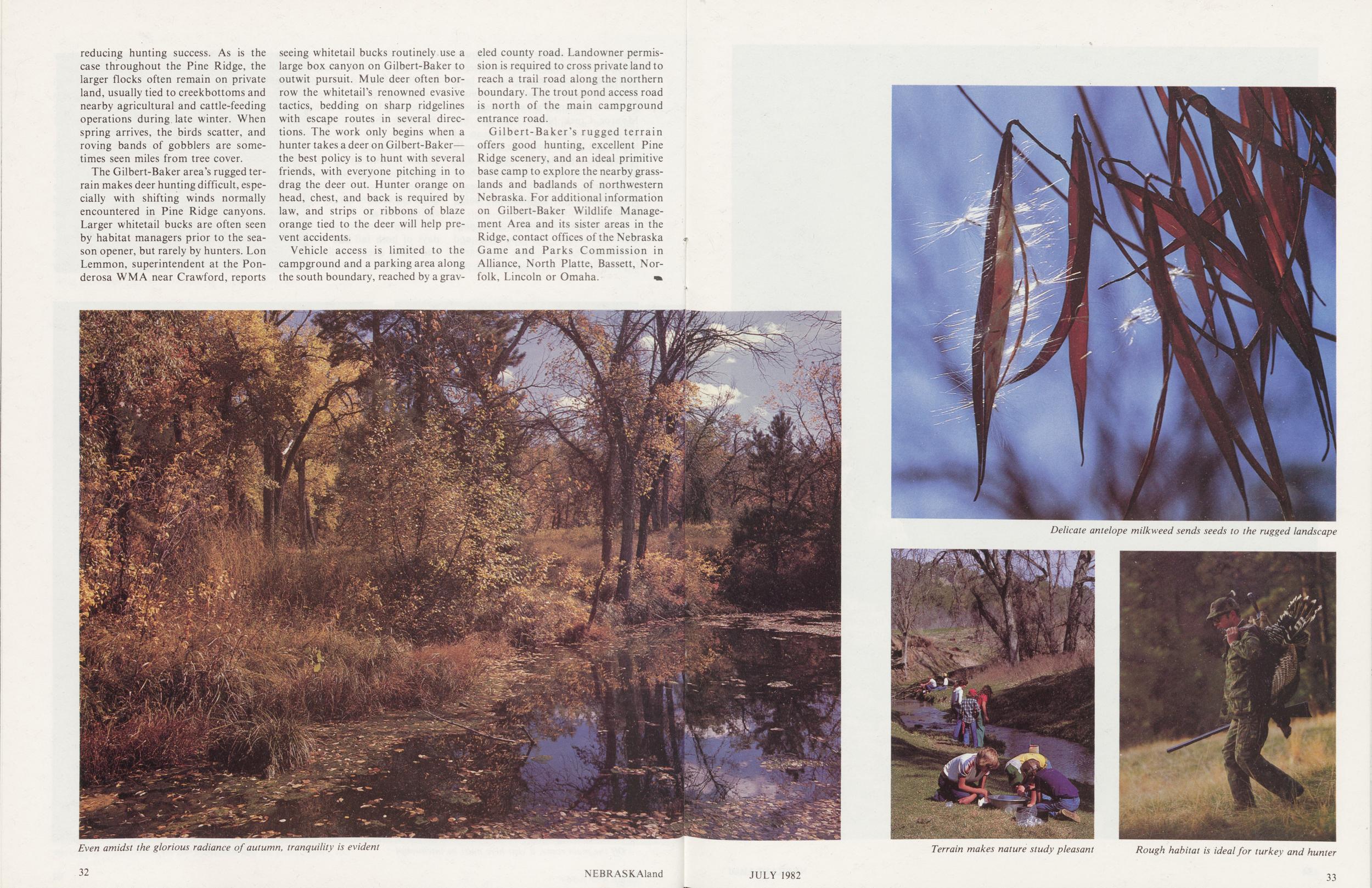
The Gilbert-Baker area's rugged terrain makes deer hunting difficult, especially with shifting winds normally encountered in Pine Ridge canyons. Larger whitetail bucks are often seen by habitat managers prior to the season opener, but rarely by hunters. Lon Lemmon, superintendent at the Ponderosa WMA near Crawford, reports seeing whitetail bucks routinely use a large box canyon on Gilbert-Baker to outwit pursuit. Mule deer often borrow the whitetail's renowned evasive tactics, bedding on sharp ridgelines with escape routes in several directions. The work only begins when a hunter takes a deer on Gilbert-Baker—the best policy is to hunt with several friends, with everyone pitching in to drag the deer out. Hunter orange on head, chest, and back is required by law, and strips or ribbons of blaze orange tied to the deer will help prevent accidents.
Vehicle access is limited to the campground and a parking area along the south boundary, reached by a graveled county road. Landowner permission is required to cross private land to reach a trail road along the northern boundary. The trout pond access road is north of the main campground entrance road.
Gilbert-Baker's rugged terrain offers good hunting, excellent Pine Ridge scenery, and an ideal primitive base camp to explore the nearby grasslands and badlands of northwestern Nebraska. For additional information on Gilbert-Baker Wildlife Management Area and its sister areas in the Ridge, contact offices of the Nebraska Game and Parks Commission in Alliance, North Platte, Bassett, Norfolk, Lincoln or Omaha.
BASS with Rhythm
For many years, quiet, patient Bert Lanners researched a unique method of catching largemouth bass. He has perfected it, and gradually the word is spreading that his simple dancing-worm technique works
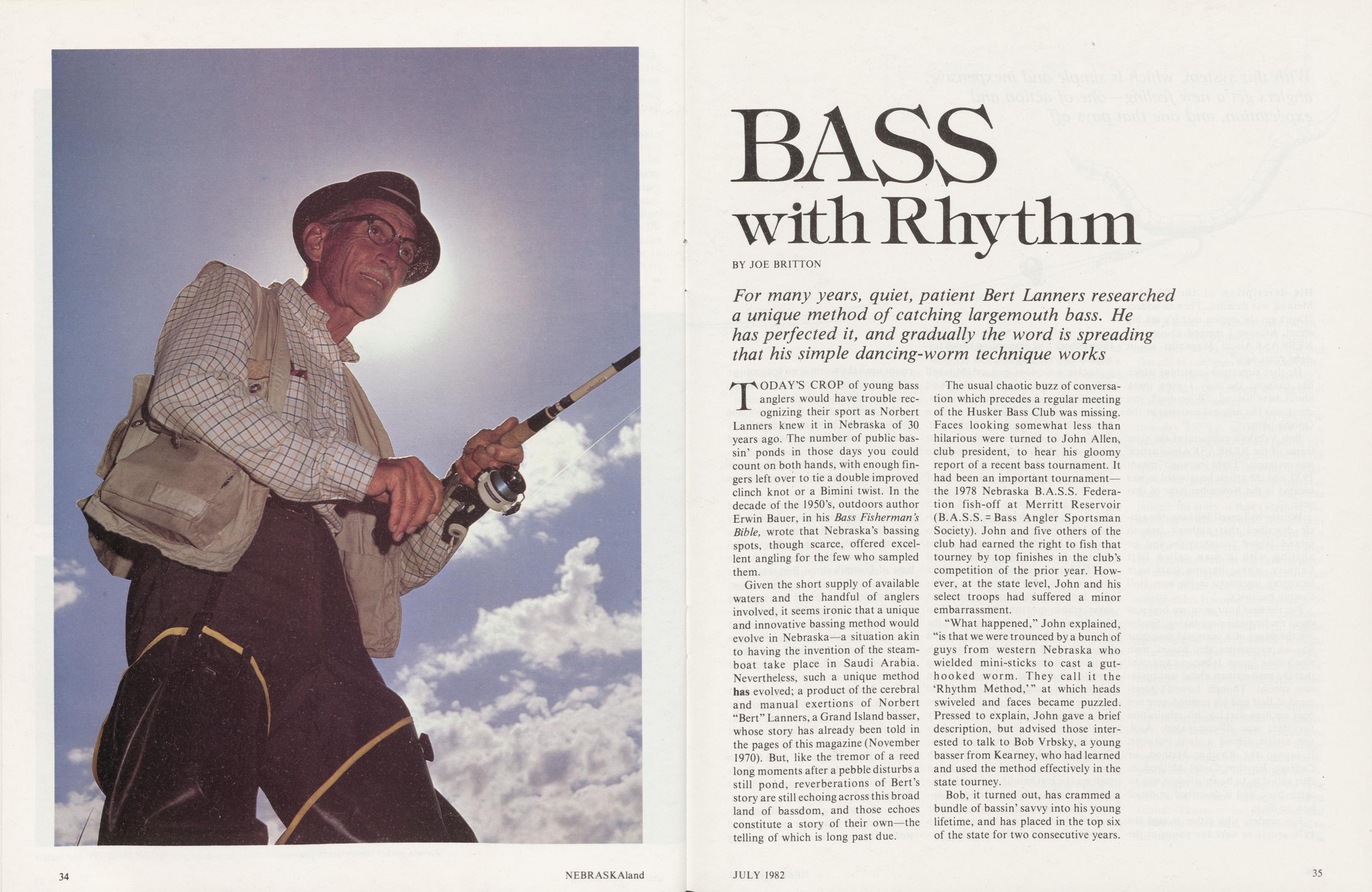
TODAY'S CROP of young bass anglers would have trouble recognizing their sport as Norbert Lanners knew it in Nebraska of 30 years ago. The number of public bassin' ponds in those days you could count on both hands, with enough fingers left over to tie a double improved clinch knot or a Bimini twist. In the decade of the 1950's, outdoors author Erwin Bauer, in his Bass Fisherman s Bible, wrote that Nebraska's bassing spots, though scarce, offered excellent angling for the few who sampled them.
Given the short supply of available waters and the handful of anglers involved, it seems ironic that a unique and innovative bassing method would evolve in Nebraska—a situation akin to having the invention of the steamboat take place in Saudi Arabia. Nevertheless, such a unique method has evolved; a product of the cerebral and manual exertions of Norbert "Bert" Lanners, a Grand Island basser, whose story has already been told in the pages of this magazine (November 1970). But, like the tremor of a reed long moments after a pebble disturbs a still pond, reverberations of Bert's story are still echoing across this broad land of bassdom, and those echoes constitute a story of their own—the telling of which is long past due.
The usual chaotic buzz of conversation which precedes a regular meeting of the Husker Bass Club was missing. Faces looking somewhat less than hilarious were turned to John Allen, club president, to hear his gloomy report of a recent bass tournament. It had been an important tournament—the 1978 Nebraska B.A.S.S. Federation fish-off at Merritt Reservoir (B.A.S.S. = Bass Angler Sportsman Society). John and five others of the club had earned the right to fish that tourney by top finishes in the club's competition of the prior year. However, at the state level, John and his select troops had suffered a minor embarrassment.
"What happened," John explained, "is that we were trounced by a bunch of guys from western Nebraska who wielded mini-sticks to cast a gut-hooked worm. They call it the 'Rhythm Method,'" at which heads swiveled and faces became puzzled. Pressed to explain, John gave a brief description, but advised those interested to talk to Bob Vrbsky, a young basser from Kearney, who had learned and used the method effectively in the state tourney.
Bob, it turned out, has crammed a bundle of bassin' savvy into his young lifetime, and has placed in the top six of the state for two consecutive years.
JULY 1982 35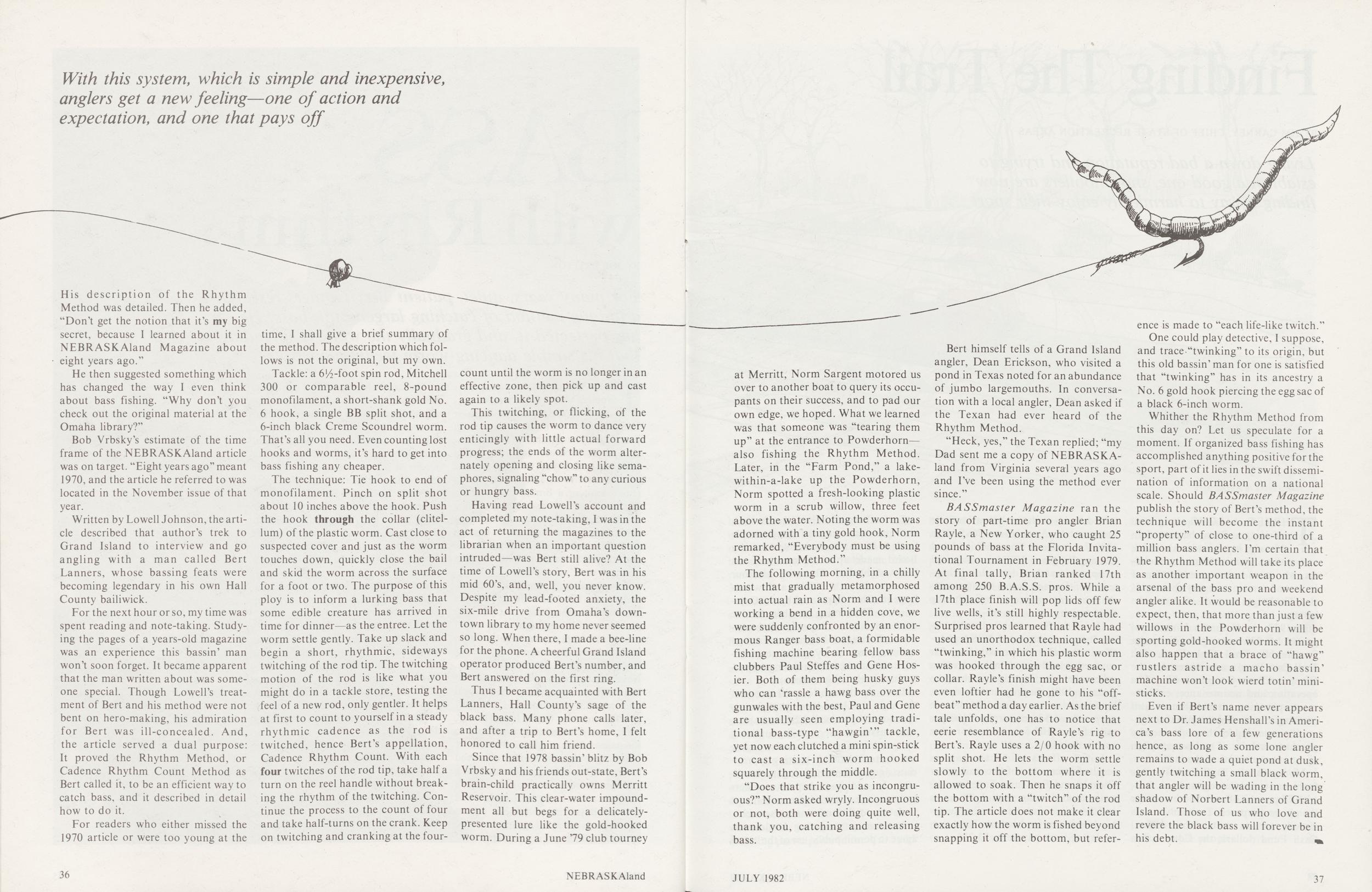
With this system, which is simple and inexpensive, anglers get a new feeling—one of action and expectation, and one that pays off
His description of the Rhythm Method was detailed. Then he added, "Don't get the notion that it's my big secret, because I learned about it in NEBRASKAland Magazine about eight years ago."
He then suggested something which has changed the way I even think about bass fishing. "Why don't you check out the original material at the Omaha library?"
Bob Vrbsky's estimate of the time frame of the NEBRASKAland article was on target. "Eight years ago" meant 1970, and the article he referred to was located in the November issue of that year.
Written by Lowell Johnson, the article described that author's trek to Grand Island to interview and go angling with a man called Bert Lanners, whose bassing feats were becoming legendary in his own Hall County bailiwick.
For the next hour or so, my time was spent reading and note-taking. Studying the pages of a years-old magazine was an experience this bassin' man won't soon forget. It became apparent that the man written about was someone special. Though Lowell's treatment of Bert and his method were not bent on hero-making, his admiration for Bert was ill-concealed. And, the article served a dual purpose: It proved the Rhythm Method, or Cadence Rhythm Count Method as Bert called it, to be an efficient way to catch bass, and it described in detail how to do it.
For readers who either missed the 1970 article or were too young at the time, I shall give a brief summary of the method. The description which follows is not the original, but my own.
Tackle: a 6!/2-foot spin rod, Mitchell 300 or comparable reel, 8-pound monofilament, a short-shank gold No. 6 hook, a single BB split shot, and a 6-inch black Creme Scoundrel worm. That's all you need. Even counting lost hooks and worms, it's hard to get into bass fishing any cheaper.
The technique: Tie hook to end of monofilament. Pinch on split shot about 10 inches above the hook. Push the hook through the collar (clitellum) of the plastic worm. Cast close to suspected cover and just as the worm touches down, quickly close the bail and skid the worm across the surface for a foot or two. The purpose of this ploy is to inform a lurking bass that some edible creature has arrived in time for dinner—as the entree. Let the worm settle gently. Take up slack and begin a short, rhythmic, sideways twitching of the rod tip. The twitching motion of the rod is like what you might do in a tackle store, testing the feel of a new rod, only gentler. It helps at first to count to yourself in a steady rhythmic cadence as the rod is twitched, hence Bert's appellation, Cadence Rhythm Count. With each four twitches of the rod tip, take half a turn on the reel handle without breaking the rhythm of the twitching. Continue the process to the count of four and take half-turns on the crank. Keep on twitching and cranking at the four-count until the worm is no longer in an effective zone, then pick up and cast again to a likely spot.
This twitching, or flicking, of the rod tip causes the worm to dance very enticingly with little actual forward progress; the ends of the worm alternately opening and closing like semaphores, signaling "chow" to any curious or hungry bass.
Having read Lowell's account and completed my note-taking, I was in the act of returning the magazines to the librarian when an important question intruded—was Bert still alive? At the time of Lowell's story, Bert was in his mid 60's, and, well, you never know. Despite my lead-footed anxiety, the six-mile drive from Omaha's downtown library to my home never seemed so long. When there, I made a bee-line for the phone. A cheerful Grand Island operator produced Bert's number, and Bert answered on the first ring.
Thus I became acquainted with Bert Lanners, Hall County's sage of the black bass. Many phone calls later, and after a trip to Bert's home, I felt honored to call him friend.
Since that 1978 bassin' blitz by Bob Vrbsky and his friends out-state, Bert's brain-child practically owns Merritt Reservoir. This clear-water impoundment all but begs for a delicately-presented lure like the gold-hooked worm. During a June '79 club tourney
36 NEBRASKAlandat Merritt, Norm Sargent motored us over to another boat to query its occupants on their success, and to pad our own edge, we hoped. What we learned was that someone was "tearing them up" at the entrance to Powderhorn—also fishing the Rhythm Method. Later, in the "Farm Pond," a lake-within-a-lake up the Powderhorn, Norm spotted a fresh-looking plastic worm in a scrub willow, three feet above the water. Noting the worm was adorned with a tiny gold hook, Norm remarked, "Everybody must be using the Rhythm Method."
The following morning, in a chilly mist that gradually metamorphosed into actual rain as Norm and I were working a bend in a hidden cove, we were suddenly confronted by an enormous Ranger bass boat, a formidable fishing machine bearing fellow bass clubbers Paul Steffes and Gene Hosier. Both of them being husky guys who can 'rassle a hawg bass over the gunwales with the best, Paul and Gene are usually seen employing traditional bass-type "hawgin"' tackle, yet now each clutched a mini spin-stick to cast a six-inch worm hooked squarely through the middle.
"Does that strike you as incongruous?" Norm asked wryly. Incongruous or not, both were doing quite well, thank you, catching and releasing bass.
Bert himself tells of a Grand Island angler, Dean Erickson, who visited a pond in Texas noted for an abundance of jumbo largemouths. In conversation with a local angler, Dean asked if the Texan had ever heard of the Rhythm Method.
"Heck, yes," the Texan replied; "my Dad sent me a copy of NEBRASKAland from Virginia several years ago and I've been using the method ever since."
BASSmaster Magazine ran the story of part-time pro angler Brian Rayle, a New Yorker, who caught 25 pounds of bass at the Florida Invitational Tournament in February 1979. At final tally, Brian ranked 17th among 250 B.A.S.S. pros. While a 17th place finish will pop lids off few live wells, it's still highly respectable. Surprised pros learned that Rayle had used an unorthodox technique, called "twinking," in which his plastic worm was hooked through the egg sac, or collar. Rayle's finish might have been even loftier had he gone to his "off-beat" method a day earlier. As the brief tale unfolds, one has to notice that eerie resemblance of Rayle's rig to Bert's. Rayle uses a 2/0 hook with no split shot. He lets the worm settle slowly to the bottom where it is allowed to soak. Then he snaps it off the bottom with a "twitch" of the rod tip. The article does not make it clear exactly how the worm is fished beyond snapping it off the bottom, but reference is made to "each life-like twitch."
One could play detective, I suppose, and trace"twinking" to its origin, but this old bassin' man for one is satisfied that "twinking" has in its ancestry a No. 6 gold hook piercing the egg sac of a black 6-inch worm.
Whither the Rhythm Method from this day on? Let us speculate for a moment. If organized bass fishing has accomplished anything positive for the sport, part of it lies in the swift dissemination of information on a national scale. Should BASSmaster Magazine publish the story of Bert's method, the technique will become the instant "property" of close to one-third of a million bass anglers. I'm certain that the Rhythm Method will take its place as another important weapon in the arsenal of the bass pro and weekend angler alike. It would be reasonable to expect, then, that more than just a few willows in the Powderhorn will be sporting gold-hooked worms. It might also happen that a brace of "hawg" rustlers astride a macho bassin' machine won't look wierd totin' mini-sticks.
Even if Bert's name never appears next to Dr. James Henshall's in America's bass lore of a few generations hence, as long as some lone angler remains to wade a quiet pond at dusk, gently twitching a small black worm, that angler will be wading in the long shadow of Norbert Lanners of Grand Island. Those of us who love and revere the black bass will forever be in his debt.
JULY 1982 37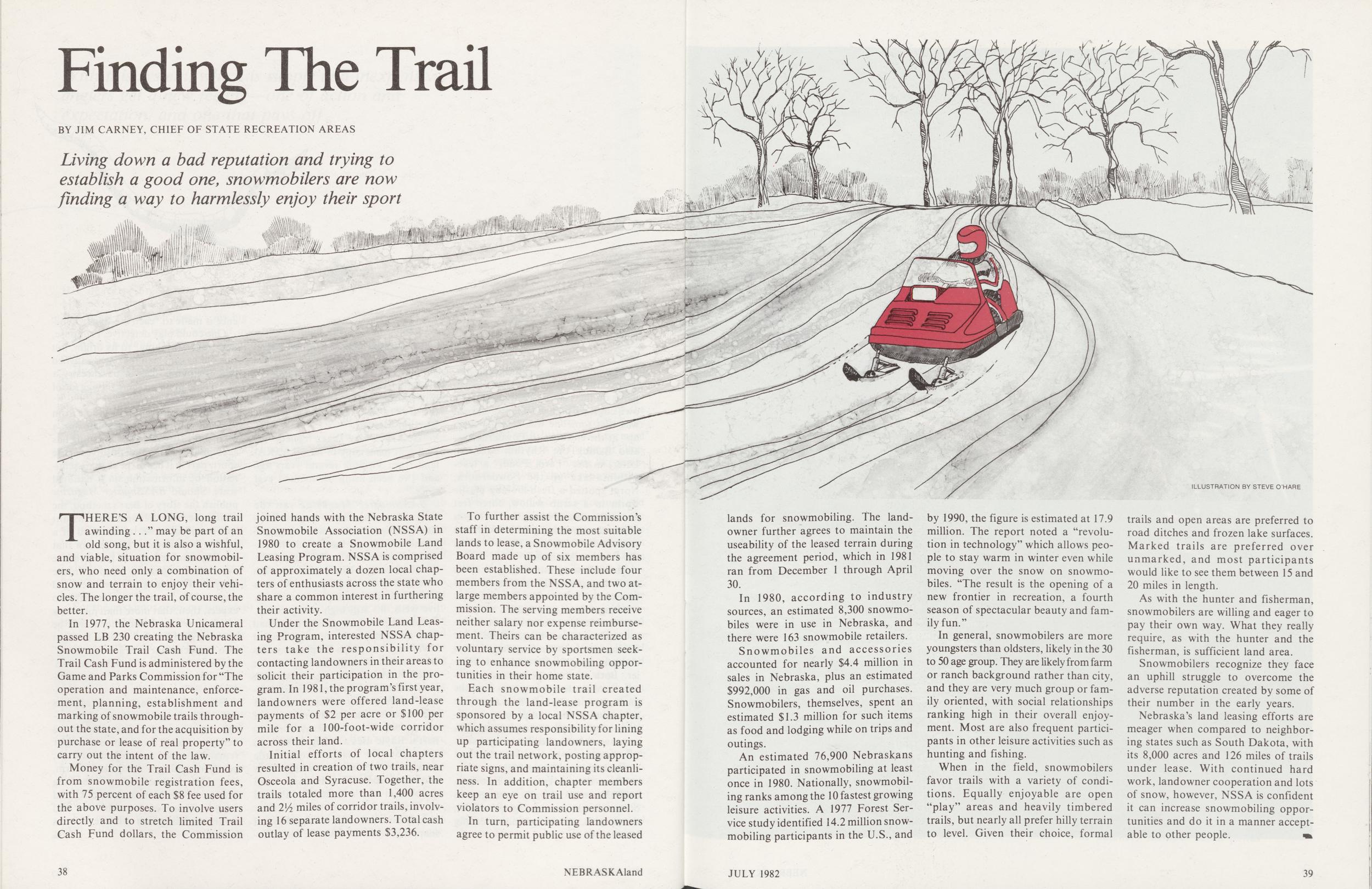
Finding The Trail
Living down a bad reputation and trying to establish a good one, snowmobilers are now finding a way to harmlessly enjoy their sport
ILLUSTRATION BY STEVE O'HARETHERE'S A LONG, long trail a winding ..." may be part of an old song, but it is also a wishful, and viable, situation for snowmobilers, who need only a combination of snow and terrain to enjoy their vehicles. The longer the trail, of course, the better.
In 1977, the Nebraska Unicameral passed LB 230 creating the Nebraska Snowmobile Trail Cash Fund. The Trail Cash Fund is administered by the Game and Parks Commission for "The operation and maintenance, enforcement, planning, establishment and marking of snowmobile trails throughout the state, and for the acquisition by purchase or lease of real property" to carry out the intent of the law.
Money for the Trail Cash Fund is from snowmobile registration fees, with 75 percent of each $8 fee used for the above purposes. To involve users directly and to stretch limited Trail Cash Fund dollars, the Commission joined hands with the Nebraska State Snowmobile Association (NSSA) in 1980 to create a Snowmobile Land Leasing Program. NSSA is comprised of approximately a dozen local chapters of enthusiasts across the state who share a common interest in furthering their activity.
Under the Snowmobile Land Leasing Program, interested NSSA chapters take the responsibility for contacting landowners in their areas to solicit their participation in the program. In 1981, the program's first year, landowners were offered land-lease payments of $2 per acre or $100 per mile for a 100-foot-wide corridor across their land.
Initial efforts of local chapters resulted in creation of two trails, near Osceola and Syracuse. Together, the trails totaled more than 1,400 acres and 2!/2 miles of corridor trails, involving 16 separate landowners. Total cash outlay of lease payments 53,236.
To further assist the Commission's staff in determining the most suitable lands to lease, a Snowmobile Advisory Board made up of six members has been established. These include four members from the NSSA, and two at-large members appointed by the Commission. The serving members receive neither salary nor expense reimbursement. Theirs can be characterized as voluntary service by sportsmen seeking to enhance snowmobiling opportunities in their home state.
Each snowmobile trail created through the land-lease program is sponsored by a local NSSA chapter, which assumes responsibility for lining up participating landowners, laying out the trail network, posting appropriate signs, and maintaining its cleanliness. In addition, chapter members keep an eye on trail use and report violators to Commission personnel.
In turn, participating landowners agree to permit public use of the leased lands for snowmobiling. The landowner further agrees to maintain the useability of the leased terrain during the agreement period, which in 1981 ran from December 1 through April 30.
38 NEBRASKAlandIn 1980, according to industry sources, an estimated 8,300 snowmobiles were in use in Nebraska, and there were 163 snowmobile retailers.
Snowmobiles and accessories accounted for nearly $4.4 million in sales in Nebraska, plus an estimated $992,000 in gas and oil purchases. Snowmobilers, themselves, spent an estimated $1.3 million for such items as food and lodging while on trips and outings.
An estimated 76,900 Nebraskans participated in snowmobiling at least once in 1980. Nationally, snowmobiling ranks among the 10 fastest growing leisure activities. A 1977 Forest Service study identified 14.2 million snowmobiling participants in the U.S., and by 1990, the figure is estimated at 17.9 million. The report noted a "revolution in technology" which allows people to stay warm in winter even while moving over the snow on snowmobiles. "The result is the opening of a new frontier in recreation, a fourth season of spectacular beauty and family fun."
In general, snowmobilers are more youngsters than oldsters, likely in the 30 to 50 age group. They are likely from farm or ranch background rather than city, and they are very much group or family oriented, with social relationships ranking high in their overall enjoyment. Most are also frequent participants in other leisure activities such as hunting and fishing.
When in the field, snowmobilers favor trails with a variety of conditions. Equally enjoyable are open "play" areas and heavily timbered trails, but nearly all prefer hilly terrain to level. Given their choice, formal trails and open areas are preferred to road ditches and frozen lake surfaces. Marked trails are preferred over unmarked, and most participants would like to see them between 15 and 20 miles in length.
As with the hunter and fisherman, snowmobilers are willing and eager to pay their own way. What they really require, as with the hunter and the fisherman, is sufficient land area.
Snowmobilers recognize they face an uphill struggle to overcome the adverse reputation created by some of their number in the early years.
Nebraska's land leasing efforts are meager when compared to neighboring states such as South Dakota, with its 8,000 acres and 126 miles of trails under lease. With continued hard work, landowner cooperation and lots of snow, however, NSSA is confident it can increase snowmobiling opportunities and do it in a manner acceptable to other people.
JULY 1982 39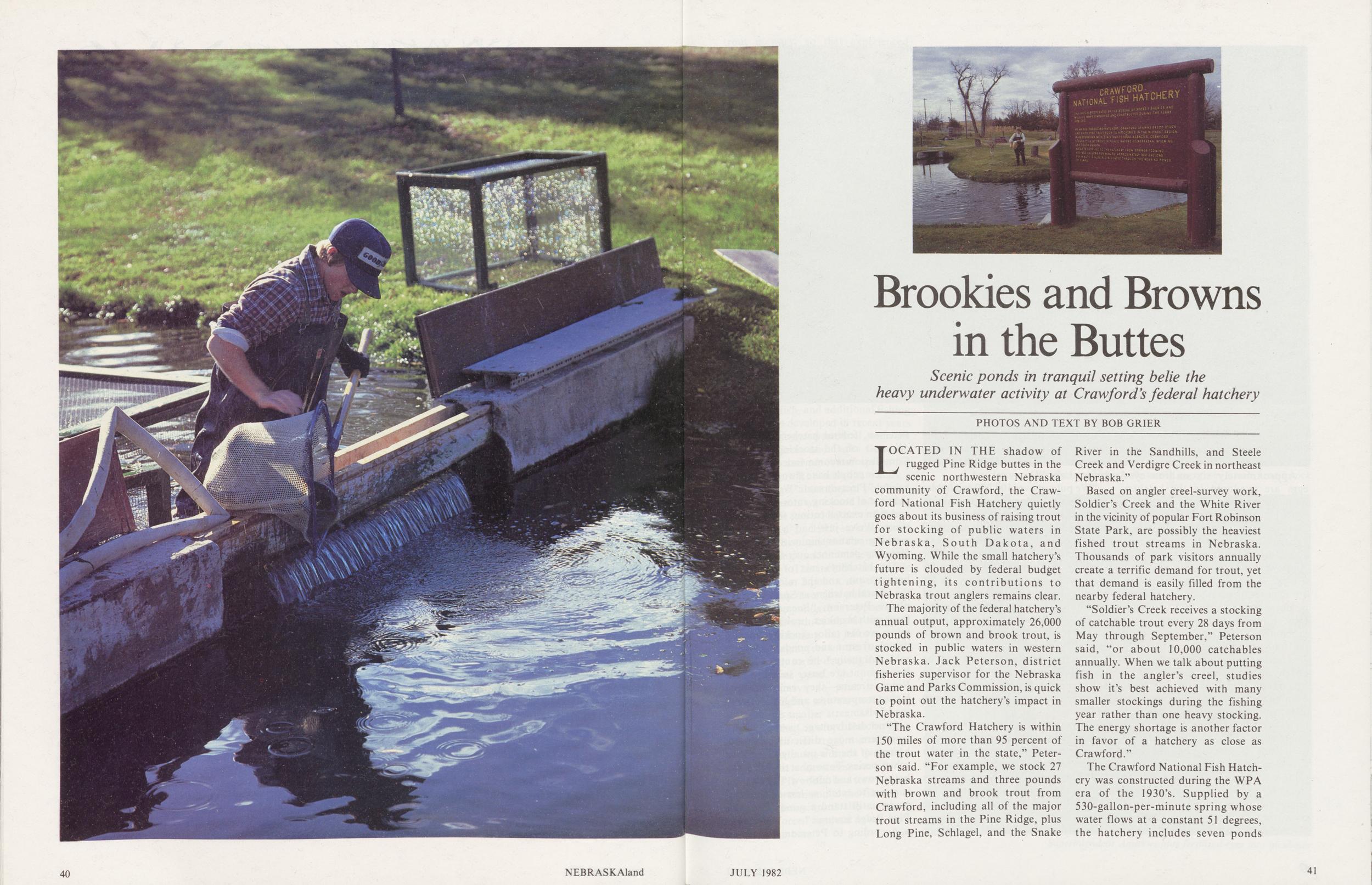
Brookies and Browns in the Buttes
Scenic ponds in tranquil setting belie the heavy underwater activity at Crawford's federal hatchery
LOCATED IN THE shadow of rugged Pine Ridge buttes in the scenic northwestern Nebraska community of Crawford, the Crawford National Fish Hatchery quietly goes about its business of raising trout for stocking of public waters in Nebraska, South Dakota, and Wyoming. While the small hatchery's future is clouded by federal budget tightening, its contributions to Nebraska trout anglers remains clear.
The majority of the federal hatchery's annual output, approximately 26,000 pounds of brown and brook trout, is stocked in public waters in western Nebraska. Jack Peterson, district fisheries supervisor for the Nebraska Game and Parks Commission, is quick to point out the hatchery's impact in Nebraska.
"The Crawford Hatchery is within 150 miles of more than 95 percent of the trout water in the state," Peterson said. "For example, we stock 27 Nebraska streams and three pounds with brown and brook trout from Crawford, including all of the major trout streams in the Pine Ridge, plus Long Pine, Schlagel, and the Snake River in the Sandhills, and Steele Creek and Verdigre Creek in northeast Nebraska."
Based on angler creel-survey work, Soldier's Creek and the White River in the vicinity of popular Fort Robinson State Park, are possibly the heaviest fished trout streams in Nebraska. Thousands of park visitors annually create a terrific demand for trout, yet that demand is easily filled from the nearby federal hatchery.
"Soldier's Creek receives a stocking of catchable trout every 28 days from May through September," Peterson said, "or about 10,000 catchables annually. When we talk about putting fish in the angler's creel, studies show it's best achieved with many smaller stockings during the fishing year rather than one heavy stocking. The energy shortage is another factor in favor of a hatchery as close as Crawford."
The Crawford National Fish Hatchery was constructed during the WPA era of the 1930's. Supplied by a 530-gallon-per-minute spring whose water flows at a constant 51 degrees, the hatchery includes seven ponds located in the northwest corner of Crawford, plus two rearing ponds on the nearby Wood Reserve.
JULY 1982 41Approximately six million eyed eggs are produced in the hatchery house each year, a portion going to other hatcheries in the U.S. and as far away as Canada and Mexico.
Eggs are taken in fall and winter, according to hatchery manager Artis Andrews. Two to five-year-old brood fish are stripped of their eggs, which are then fertilized and placed in trays in running water for 15 to 20 days. Once stripped of eggs and sperm, excess brood fish, including brook trout in the four-pound class, are stocked in area waters in late fall, much to the delight of area fishermen.
It takes approximately 120 days from egg to trout fingerling, and the little trout then remain in the hatchery house until reaching 5Vi inches in length, after which they are transferred to outside ponds to continue their growth to the 9l/2 to 10-inch "catchable" stage at which time they are ready for stocking the following spring. A small number of future brood fish are held back to renew the cycle.
According to Andrews, the hatchery's stocking schedule usually begins by the second week in April and continues until the first part of September, just before Labor Day weekend.
"We put out over 100,000 catchables on average," Andrews said. "In addition to stocking the Crawford-produced brown and brook trout, our personnel meet the hatchery truck from Spearfish when we receive rainbow trout for stocking in Nebraska. We go as far south as Kimball and Sidney, as far north as Rapid City, and as far east as Valentine, where we meet trucks going to the Norfolk area. Our trout go as far west as the Wind River Reservation in central Wyoming."
Crawford-produced trout can be shipped throughout the U.S. and to other countries because of the hatchery's disease-free status, Andrews added.
The trout stocked in Nebraska streams are supplied at no cost through trade agreements between the Nebraska Game and Parks Commission and the U.S. Fish and Wildlife Service. Excess northern pike and other species are traded by the Commission for the federal trout.
According to fisheries supervisor Peterson, federal hatchery personnel do most of the stocking following Commission-recommended schedules.
"Their people have always been very helpful," Peterson said. "We can specify the time of stocking, rates of stocking, and even exact locations for release of trout. We've just had a very good working relationship with Crawford Hatchery personnel over the years."
The hatchery's mix of brook and brown trout, and the rainbows from the federal hatchery at Spearfish, also please Peterson. "Because we can stock with brookies, browns and rainbows, we can tailor stockings to individual streams and ponds," Peterson said. "Actually," he continued, "the brown trout are better suited to Pine Ridge streams—they can withstand higher temperatures and higher flooding levels.
"One disadvantage is that brown trout are more difficult to catch; harvest of them is usually lower than other species. To combat this, we stock both brown and rainbow. The rainbow is easier to catch, so less-experienced anglers still stand a good chance on Pine Ridge streams."
According to Peterson, the brown trout is wary, so that experienced anglers have pretty good odds of catching bigger brown trout that carry through to the winter months. Several mild winters in northwestern Nebraska have created a more year-round use of the area's trout waters.
42 NEBRASKAland"While the White River and Soldier's Creek are the most heavily fished trout streams in the Pine Ridge, we also stock Big and Little Bordeaux, Clay and White Clay, Beaver and Larabee, as well as Sow Belly and East and West Hat creeks—all with Crawford Hatchery trout and all providing fine trout fishing.
"From the management aspect, the main problem with Pine Ridge streams is flooding. Brown trout can withstand some flooding, but then we are faced with a lack of carryover of trout. Most fish stocked this year just won't be around next year. If we have a year with no floods, you can go in the following spring and catch larger trout. But, usually we have extremely high water that washes them out."
Additional demand for the Crawford Hatchery's fish, and additional fishing access, were developed in recent years as Peterson and personnel with the Nebraska Game and Parks Commission rebuilt and renovated spring-fed ponds at Fort Robinson State Park.
"Years ago, a number of ponds on Fort Robinson were used as rearing ponds by the federal hatchery," Peterson recalls. "In 1981 several ponds were cleaned out and the spring source opened, giving us additional cold-water trout habitat. This includes the Grable No. 1 and No. 2 ponds, as well as the Cherry Creek diversion ponds.
"All of the ponds that support trout are stocked with catchable-size fish. We are continuing our efforts to increase fishing access on the fort, with plans already on the drawing board for an additional pond. The ponds are very attractive to park visitors, especially anglers who may not be able to work the smaller streams.
"To say the Crawford Hatchery is a vital part of our trout management program here in western Nebraska would be an understatement," Peterson added. "It would be a tremendous loss to fishermen and to the Game and Parks Commission if this hatchery should be forced to close down. Let's hope for the best."
Little Finger Nail's Ledger Book
(Continued from page 17)pieces they had previously hidden. Thinking something might be up, Wessells increased the guard and had a blacksmith wrap chains across the locked doors. During the evening of January 9, the Cheyenne put on their war clothes and painted their faces. Little Finger Nail strapped his ledger around his waist and secured it with a second strap that passed through the middle of the book and around his shoulder.
At 9:45 P.M., Little Finger Nail and another young leader smashed two windows and started shooting, killing the sentries at the southwest and western ends of the barracks. Within seconds, the other warriors opened fire on the guards. Men, women, and children began pouring through the broken windows. As the Cheyenne fled across the snow-covered prairie in the bright moonlight, the soldiers piled out of their quarters and fired away at the fleeing figures, killing about half, including some of the slower women and children. Wessells sent the cavalry in pursuit of the rest.
Little Finger Nail and a small band of people made it across the White River and headed southwest into a series of bluffs behind the camp, then veered northwest. They had no horses, little food, and scant clothing. During the days that followed, the Cheyenne tried to shake the soldiers from their trail, with no success.
Finally, thirteen days after the escape and only thrity-five miles from Fort Robinson, they realized that escape was hopeless and decided to dig in to meet the soldiers in battle. Uncharacteristically, they chose a poor defensive position—a dry streambed at the edge of the bluffs. The soldiers had a clear line of fire, and the Cheyenne did little to conceal their presence, although they did pile up frozen sod and try to chip out rifle pits in the earth.
The pursuing soldiers, Frank Hardie among them, quickly discovered the hide-out. As Hardie mentions in his letter, he was close enough to pick out Little Finger Nail before the battle. The cavalry charged to the edge of the washout again and again, firing into the scattered shrubbery, the rifle pits, and the crude breastworks that hid the Cheyenne. For an hour, the vastly outnumbered Indians—thirty-one men, women, and children—fought with the few guns and ammunition they had. When all was silent, Wessells and the troops moved up the edge of the washout and gazed at the bodies scattered about. Suddenly, a warrior raised his gun and fired at the captain, hitting him in the head. The soldiers immediately resumed the attack. After firing at the bodies in the hollow for about fifteen minutes, they again paused, but within moments three bloody warriors leaped up, and armed with only two knives, charged the soldiers. The soldiers promptly shot them down.
Once more the nervous soldiers crept to the edge of the washout. Only a few women and children were alive; most were badly wounded.
When the soldiers had hauled the last of the bodies from the washout, Hardie untied the ledger book from Little Finger Nail's body. He carried it with him for ten years until 1889, when he sent it east to his brother. The Museum, which received the ledger in 1912, put it on display in the Hall of Plains Indians in 1934. It remains there today, a Cheyenne warrior's account of the last days of his people.
HOW TO BUILD A CAMPFIRE.
Everyone loves to sit around a warm campfire. But campfires can be dangerous if not properly built. So before you build your next campfire, here are a few simple facts to remember.
ARE CAMPFIRES ALLOWED? There are some places in the United States where campfires cannot be built. And there are other spots where campfires are allowed only certain months of the year. So be sure to ask about local campfire laws when planning your trip.
SELECTING A SITE. Try to select an area with lots of shade. And make sure its away from all bushes, needles, leaves and overhanging branches. So that sparks from your campfire have less chance of starting a forest fire.
PREPARING YOUR CAMPFIRE. The forest floor is covered with very flammable materials — things like bark, dry leaves and roots. So always clear a 10-foot area around your campfire. Then dig a hole the size of your campfire in the middle of the cleared area. And be sure you dig down until you reach thick, natural soil.This will prevent the fire from spreading along the dry topsoil and getting out of control.
STARTING A CAMPFIRE. Always have your safety tools ready before you light your campfire. Simple firefighting equipment includes a shovel, an ax, a big bucket of water, or a car-size fire extinguisher. After you've surrounded your campfire with rocks to hold in the flames, you're ready to add the fuel. Always use dry wood and cut it into short sticks. But never cut into a living tree.
PUTTING THE CAMPFIRE OUT. Pouring dirt and water on a campfire doesn't always put it out. If the ground is dry your campfire could flame-up again several hours or days later. Always make sure your fire is dead out before you leave. Drown the campfire with lots of water, mix the ashes with plenty of dirt and then W drown and stir again. And always check to make sure the rocks around your campfire are cool and not hiding hot embers. And finally, if some of the wood in your fire isn't completely burned, be sure to scrape it down, wet it down and bury it in plenty of dirt. Please. Follow these simple rules the next time you build a campfire. You'll be sure to have a safe trip. And a forest to visit again next year. A Public Service of This Magazine \& The Advertising Council
STOCK YOUR LAKE OR POND with CHANNEL CAT LARGEM0UTH BASS BLUEGILL ORDER NOW WILLOW LAKE FISH HATCHERY Rt. 3, Box 46, Hastings, Nebr. 68901 Gaylord L. Crawford Phone: (402) 463-8022 Day or Night For April to October 15 stocking Pond Mill-Aquazine for algae-free water Conservation in all things plan a RANCH Get away from it all to Nebraska's scenic Pine Ridge for a vacation you'll remember a lifetime. Stay in modern nicely-furnished log cabins. Take a quilt walk on scenic hiking trails, try some great fishing then have a campfire cookout. See a 16-foot waterwheel, unbelievable sunsets you'll never find in the city and more stars than you ever thought existed. For brochure write: Rt. 3, Box 30 Crawford, NE. 69339 JULY 1982 47 WIL-O-WOOD" SPINNERS
No. 1 Viking-hook Trolling Rig
No. 1/0 Beak-hook Trolling Rig
No. 2 Beak-hook Trolling Rig
The Nightcrawler Harness
A great lure for walleye and
other sport fish
Wil-O-Wood Mfg. Co
Dealer Inquiries Invited
P.O. Box 1071
North Platte, Nebraska 69101
Ph. 308/532-3529
Take Dad Fishing!
GERMAN
SHORTHAIRS
A fourth repeat breeding of superior, close-working
pheasant and quail dogs. This breeding has resulted in over
25 proven hunters. Guaranteed healthy pups will also make
excellent household companions. Professional references
available.
Dr. J.D. Nelson Kimball, Nebraska (308)235-4611/3392
WELCOME
to
Merritt Dam Trading Post
26 Miles Southwest of Valentine On Hwy. 16C
Phone 402/376-3437
Bait* Tackle* Ammunition* Groceries* Gas* Beer* Ice
Year-round Cabins with Kitchen Facilities
Campground Hook-ups* Boat and Motor Rental
Easy access dock
Home of the State Record Perch,
Muskellunge and Smallmouth bass
— Your Hosts —
JON AND MARIAN
DAVENPORT
WIL-O-WOOD" SPINNERS
No. 1 Viking-hook Trolling Rig
No. 1/0 Beak-hook Trolling Rig
No. 2 Beak-hook Trolling Rig
The Nightcrawler Harness
A great lure for walleye and
other sport fish
Wil-O-Wood Mfg. Co
Dealer Inquiries Invited
P.O. Box 1071
North Platte, Nebraska 69101
Ph. 308/532-3529
Take Dad Fishing!
GERMAN
SHORTHAIRS
A fourth repeat breeding of superior, close-working
pheasant and quail dogs. This breeding has resulted in over
25 proven hunters. Guaranteed healthy pups will also make
excellent household companions. Professional references
available.
Dr. J.D. Nelson Kimball, Nebraska (308)235-4611/3392
WELCOME
to
Merritt Dam Trading Post
26 Miles Southwest of Valentine On Hwy. 16C
Phone 402/376-3437
Bait* Tackle* Ammunition* Groceries* Gas* Beer* Ice
Year-round Cabins with Kitchen Facilities
Campground Hook-ups* Boat and Motor Rental
Easy access dock
Home of the State Record Perch,
Muskellunge and Smallmouth bass
— Your Hosts —
JON AND MARIAN
DAVENPORT
Bookshelf
The West as Romantic HoriZOn. Goetzmann, Wm. H. and Joseph C. Porter. 1981. Distributed by University of Nebraska Press, Lincoln. 128 pp. Hardbound $34.50; paperback $18.95.The major portion of this volume is devoted to biographies and color reproductions of works by artists Alfred Jacob Miller and Karl Bodmer. They, along with George Catlin, portrayed landscape, flora, fauna and native cultures of the Great Plains and Rocky Mountain regions in the 1830's. It is astounding to realize that so many superb works of art resulted from relatively short periods actually spent in the West. Bodmer accompanied Prince Maximilian to the upper Missouri River country on a journey of exploration that lasted a little more than a year. Miller was chosen by William Drummond Stewart to serve as artist for an expedition across the northern Rockies which eventually reached Oregon; the Stewart-Miller party was in the field from spring to autumn of 1837.
Brief biographies of about 30 artists bring out their varied backgrounds and careers. Two of those whose works are included in the Joslyn collection, Seth Eastman and Alfred Sully, also posted distinguished military records in the West. Most of the artists represented lived during the 1800's; N. C. Wyeth, Edward Borein and Harvey T. Dunn are identified with the twentieth century.
The West as Romantic Horizon is a joint effort by the Center for Western Studies, Joslyn Art Museum, The Inter-North Art Foundation, Omaha, and contains information on medium, title inscriptions and dimensions of 90 works of art by 39 artists, including three "unknown" identified only by signature initials. Full-page color reproductions, 14 by Bodmer, 13 by Miller and nine by other painters, highlight the volume. Six by Bodmer are of individual leaders of the Mandan, Hidatsa and Piegan tribes. A number of excellent landscapes by Miller, ceremonial scenes and structures such as the Bellevue trading post and Fort Laramie, provide glimpses of the frontier. Line drawings and color details of Indian pipes, apparel and weapons are placed throughout; color miniatures of several animals are attractive additions, as well.
48 NEBRASKAlandTrading Post
DOGS WELL-BRED Hunting dogs for sale—Brittanies, English setters and pointers—ranging in age from puppies to young dogs. Darrell Yentes, 1118 McMillan, Holdrege, NE 68949. Phone (308) 995-8570 or (308) 995-4797. GERMAN SHORTHAIRS—English Pointers. Pups and started dogs. Stud service. These dogs are my personal meat dogs and they produce quality bird dogs. Wayne Clark, #5 Ash Court, Union, Nebr. Phone (402) 263-3495 or (402) 263-3155. PHEASANT AND QUAIL dogs, English pointers, English setter pups and trained dogs year round. (402) 873-6288. ROMEO ALPHA Kennels has National Stock Dog Registry Australian Shepherd puppies for sale. Tri-coloreds. All shots. Excellent dispositions. Stud service available. Randy Amundson, 1762-31st Avenue, Columbus, NE 68601. (402) 564-2539 or (402) 589-0082.MISCELLANEOUS GUNS—Browning, Winchester, Remington, others, Hi-powers, shotguns, new, used, antiques. Want Pre-1964 Winchesters. Buy-Sell-Trade. Ph. (402) 729-6112. Bedlan's Sporting Goods, Fairbury, NE 68352. WINE AND BEER: Make your own. Send for free recipes and instructions. Omaha Supply, 13616 Polk, Omaha, Nebr. 68137. FISH FOR SALE. Channel catfish, bass, bluegill, crappie, trout, perch, white bass, minnows, hybrid grass carp, bullheads. We can ship fish, you can pick them up or we deliver. Contact the Pleasant Valley Fish Farm, Rt. 1, McCook, Nebr. 69001. Phone (308) 345-6599. HISTORIC HOTEL BUILDING near Fort Robinson State Park. Excellent for restoration—antique store, business, storage units. Solid, but needs work. Brick, rewired 8,000 square feet, 40 rooms. Under $20,000. POB 112, Crawford, NE 69339. (303) 665-2225, (303) 433-4166.' PLASTIC DECOYS: We're originator of famous do-it-yourself system. Catalog $1.00. Decoys Unlimited, Box 69, Clinton, IA 52732. N.E. NEBRASKA Trout Fishing. For rent Mon.-Thurs. or Fri -Sun 2 modern cottages completely furnished. 3 ponds with trout up to 5 lbs. 2 ponds with bass and bluegill. Diamond E. Trout Resort, Orchard, NE 68764 (402) 893-4745. RETIREMENT—near Fort Robinson State Park; hunting, fishing, woods. 3-bedroom, energy-efficient home, 2 acres. Outbuildings, fruit trees, in town, $30,000. Also wooded land on stream, minimum 10 acres. POB 112, Crawford, NE 69339. (308) 665-2225, (303) 433-4166. GAME BIRDS for sale. Wild turkeys, wood ducks, manderins, mallards, teal, Canada geese. Pheasants-5 breeds—Chukkars, quail. Many others not listed Frontier Birds, Wauneta, Nebr. 69045. Phone: day (308) 394-5577/evening (308) 394-5715. FOR SALE: Custom made walnut gun cabinets made to order. Harry Scott, Beatrice, Nebr. (402) 228-1943. DOLL-HOUSES, FRAMES, and other wooden things! If you have an idea and a basic pattern to show me, I will make furniture, toys, and other wooden things to suit your needs and desires. Randy Amundson, 1762-31st Avenue, Columbus, NE 68601. (402) 589-0082.
TAXIDERMY BIG BEAR TAXIDERMY, Rt. 2, Mitchell, Nebraska 69357. We specialize in all big game from Alaska to Nebraska, also birds and fish. Hair on and hair off tan- ning, AV2 miles west of Scottsbluff on Highway 26. Phone (308) 635-3013. KARL SCHWARZ Master Taxidermist. Mounting of game heads—birds—fish—animals—fur rugs—robes—tanning buckskin. Since 1910. 424 South 13th Street, Dept. A, Omaha, Nebraska 68102. FREEZE-DRY TAXIDERMY Wally Allison's State Record Taxidermy, 2709 Birchwood, North Platte, NE 69101. Phone: (308) 534-2324. Specializing in Fish and Small Game, Snake and Lizard and Novelties. (Nothing too small) Newest of all taxidermy methods employed. AWARD-WINNING TAXIDERMIST. Eight time national award winners. Trust your trophies to a proven winner. Our complete taxidermy service also arranges hunts. Dinges Taxidermy St >, 2763 South 12th Omaha, NE 68108. Ph. 402-' 3718. CREATIVE TAXIDERMY in all its branches since 1935, now includes Northstar Freeze-Dry processing of approved small specimens. Also tanning and deerskin processing. Naturecraft Studio. Nebraska City, Nebraska 68510. Joe Voges-Owner. Phone (402) 873-5491. NABITY'S TAXIDERMY. 31 years experience. Specializing in natural grass backgrounds for mammals, birds and fish. 13901 "0"St., Lincoln, NE 68505 (4 miles east of 84th and "O". (402) 489-6351. JOHNSON TAXIDERMY—servicing southwest Nebraska, specializing in big-game mounts, life-sized mounts, rug work, fish, birds, tanning hair-on leather. Brochure and price list on request. Johnson Taxidermy, Rt. 1, Box 78, Lamar, NE 69035. Telephone (308) 882-5555. PEISTER TAXIDERMY—a name you can trust. We give you professional life-like work at prices most sportsmen can afford. Member National Taxidermist Association. #5 Regency Place, Kearney, Nebr. Phone (308) 237-7575. BADE TAXIDERMY—Quality a must—Fast service. Fish, birds, rugs, tanning, full mounts and game heads. 1924 North Lincoln, Fremont, Nebraska. 727-5463. LIVE-CATCH ALL-PURPOSE TRAPS Write for FREE CATALOG _ Traps without injury squirrels, chipmunks, rabbits, mink, fox, raccoons, stray animals, pests, etc. Sizes for every need. Also traps for snakes, sparrows, pigeons, crabs, turtles, quail, etc. Save on our low factory prices. Send no money. Free catalog and trapping secrets. MUSTANG MFG. CO., Dept. N-34, Box 10880, Houston. Tex. 77018 GIANT HEAVY DUTY TRUCK TARPAULINS 12'x 16' $23 16'x20' $32 20' x 20' $36 18'x24' $38 18'x32' $50 20'x30' $50 26'x 40' $89 26'x 55' $115 30'x 60' $145 50'x 100' $390 60'x 120' $547 50'x 150' $562 Before Midnight July 25 Firestone Tarp Mfg. will send any of the above truck size tarpaulins to any reader of this publication who reads and responds to this test before midnight July 25. Each tarpaulin Lot (#Z-18, PVC) is constructed of high density fabric (with virgin grade ingredient, supplied by Gulf Oil Co., Dow Chemical Co., and Union Oil Co.) with nylon reinforced rope hems, double lock stitched hems, electronically welded seams, 100% water proof, #4 C/2" dia.) metal grommets set on 3 ft. centers with reinforced triangular corner patches and are recommended for all heavy duty use and all bulk or pallet riding materials, and will be accompanied with a LIFETIME guarantee that it must perform 100% or it will be replaced free. Add $7 handling \& crating for each tarp ordered, Firestone Tarp Mfg. pays all shipping. Should you wish to return your tarpaulins you may do so for a full refund. Any letter postmarked later than July 25, will be returned. LIMIT: Fifty (50) tarps per address, no exceptions. Send appropriate sum together with your name \& address to : Tarp Test Dept. #455G, Firestone Tarp Mfg., Inc., 6314 Santa Monica Blvd., Los Angeles, CA 90038, for fastest service from any part of the country call collect, before midnight 7 days a week (213) 629-1062 (ask Operator for) TARP TEST #455G, have credit card ready. DEFENSIVE DRIVING COURSE Enroll in the DEFENSIVE DRIVING COURSE Harlan County Dam Vacation Apartments - fully furnished Color TV • Kitchen Facilities • Full Baths Game cleaning room with freezer One block from shopping center Weekend or week of pleasant living Security Deposit Required Sorry —No Pets Dean and Esther Stone Box 145 Ph. (308) 799-3422 Republican City, NE 68971 NEBRASKAland Magazine Order Form Please send me a subscription to NEBRASKAIand, which now also features 12 issues of the news edition (24 issues in al □ One-year $7.50 □ Two-year $13 □ Three-year $19 NAME ADDRESS CITY STATE ZIP Mail to: NEBRASKAIand, Box 30370, Lincoln, NE 68503 JULY 1982 49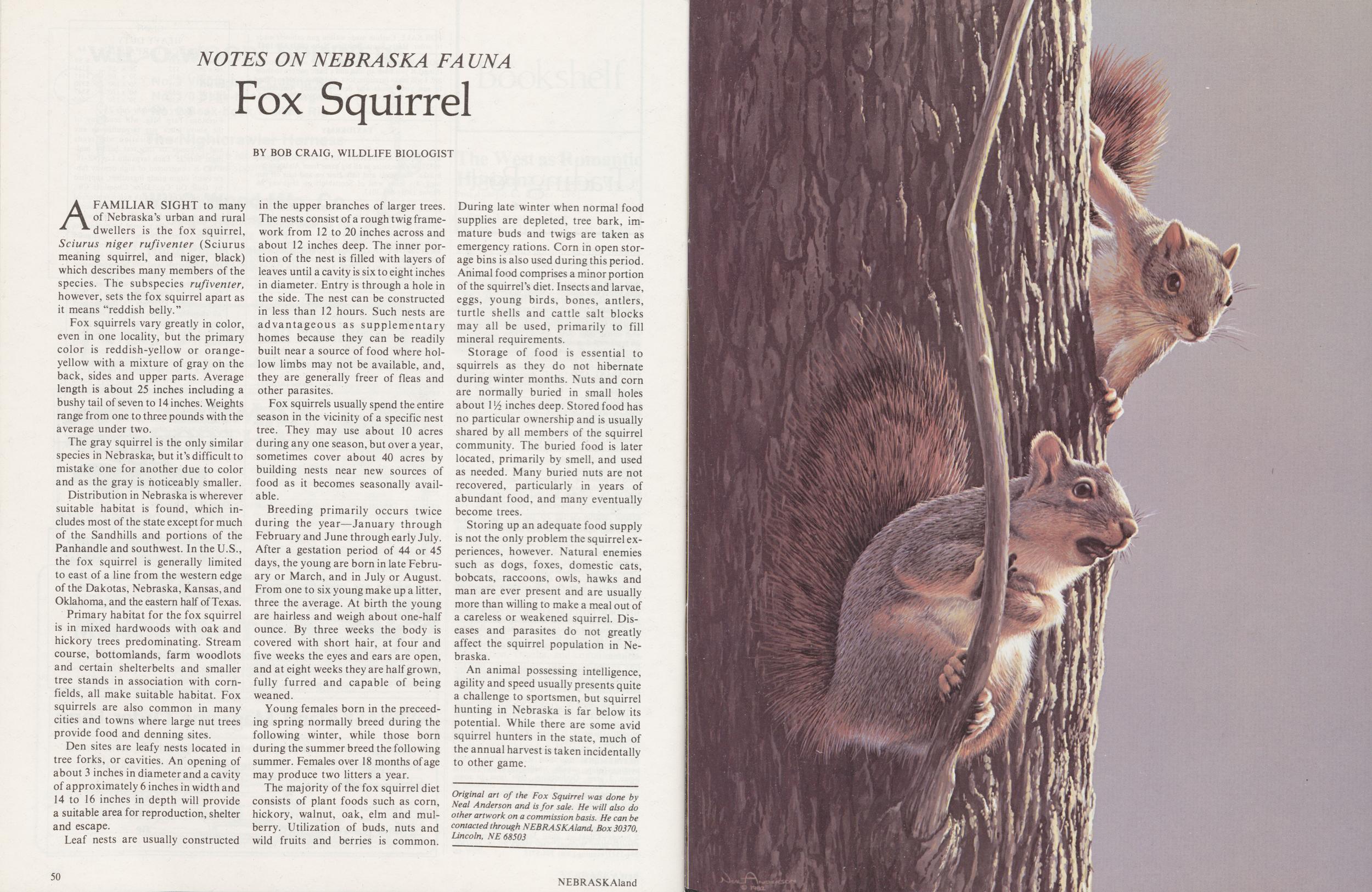
NOTES ON NEBRASKA FAUNA Fox Squirrel
A FAMILIAR SIGHT to many of Nebraska's urban and rural dwellers is the fox squirrel, Sciurus niger rufiventer (Sciurus meaning squirrel, and niger, black) which describes many members of the species. The subspecies rufiventer, however, sets the fox squirrel apart as it means "reddish belly."
Fox squirrels vary greatly in color, even in one locality, but the primary color is reddish-yellow or orange-yellow with a mixture of gray on the back, sides and upper parts. Average length is about 25 inches including a bushy tail of seven to 14 inches. Weights range from one to three pounds with the average under two.
The gray squirrel is the only similar species in Nebraska-, but it's difficult to mistake one for another due to color and as the gray is noticeably smaller.
Distribution in Nebraska is wherever suitable habitat is found, which includes most of the state except for much of the Sandhills and portions of the Panhandle and southwest. In the U.S., the fox squirrel is generally limited to east of a line from the western edge of the Dakotas, Nebraska, Kansas, and Oklahoma, and the eastern half of Texas.
Primary habitat for the fox squirrel is in mixed hardwoods with oak and hickory trees predominating. Stream course, bottomlands, farm woodlots and certain shelterbelts and smaller tree stands in association with cornfields, all make suitable habitat. Fox squirrels are also common in many cities and towns where large nut trees provide food and denning sites.
Den sites are leafy nests located in tree forks, or cavities. An opening of about 3 inches in diameter and a cavity of approximately 6 inches in width and 14 to 16 inches in depth will provide a suitable area for reproduction, shelter and escape.
Leaf nests are usually constructed in the upper branches of larger trees. The nests consist of a rough twig framework from 12 to 20 inches across and about 12 inches deep. The inner portion of the nest is filled with layers of leaves until a cavity is six to eight inches in diameter. Entry is through a hole in the side. The nest can be constructed in less than 12 hours. Such nests are advantageous as supplementary homes because they can be readily built near a source of food where hollow limbs may not be available, and, they are generally freer of fleas and other parasites.
Fox squirrels usually spend the entire season in the vicinity of a specific nest tree. They may use about 10 acres during any one season, but over a year, sometimes cover about 40 acres by building nests near new sources of food as it becomes seasonally available.
Breeding primarily occurs twice during the year—January through February and June through early July. After a gestation period of 44 or 45 days, the young are born in late February or March, and in July or August. From one to six young make up a litter, three the average. At birth the young are hairless and weigh about one-half ounce. By three weeks the body is covered with short hair, at four and five weeks the eyes and ears are open, and at eight weeks they are half grown, fully furred and capable of being weaned.
Young females born in the preceeding spring normally breed during the following winter, while those born during the summer breed the following summer. Females over 18 months of age may produce two litters a year.
The majority of the fox squirrel diet consists of plant foods such as corn, hickory, walnut, oak, elm and mulberry. Utilization of buds, nuts and wild fruits and berries is common. During late winter when normal food supplies are depleted, tree bark, immature buds and twigs are taken as emergency rations. Corn in open storage bins is also used during this period. Animal food comprises a minor portion of the squirrel's diet. Insects and larvae, eggs, young birds, bones, antlers, turtle shells and cattle salt blocks may all be used, primarily to fill mineral requirements.
Storage of food is essential to squirrels as they do not hibernate during winter months. Nuts and corn are normally buried in small holes about \Vi inches deep. Stored food has no particular ownership and is usually shared by all members of the squirrel community. The buried food is later located, primarily by smell, and used as needed. Many buried nuts are not recovered, particularly in years of abundant food, and many eventually become trees.
Storing up an adequate food supply is not the only problem the squirrel experiences, however. Natural enemies such as dogs, foxes, domestic cats, bobcats, raccoons, owls, hawks and man are ever present and are usually more than willing to make a meal out of a careless or weakened squirrel. Diseases and parasites do not greatly affect the squirrel population in Nebraska.
An animal possessing intelligence, agility and speed usually presents quite a challenge to sportsmen, but squirrel hunting in Nebraska is far below its potential. While there are some avid squirrel hunters in the state, much of the annual harvest is taken incidentally to other game.
50 NEBRASKAland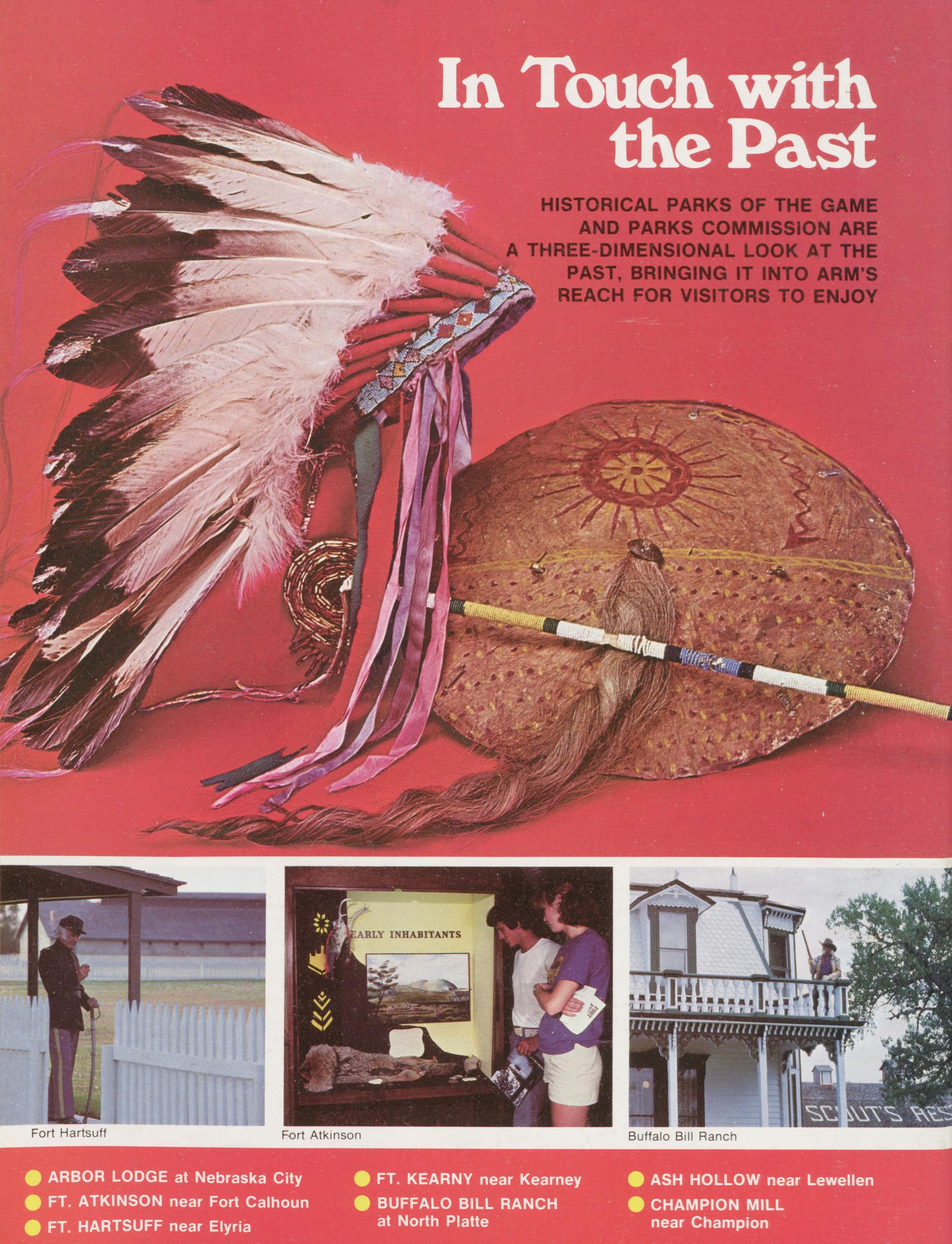
In Touch with The Past
HISTORICAL PARKS OF THE GAME AND PARKS COMMISSION ARE A THREE-DIMENSIONAL LOOK AT THE PAST, BRINGING IT INTO ARM'S REACH FOR VISITORS TO ENJOY
Position: 443 (23 views)